 EVILLE—why should we not
keep the proper and more
euphonious form, Sevilla?—the
home of that Don Juan
on whom Byron and Mozart
have shed a lustre more enviable
than his reputation, has
been made familiar to every
one by melodious Figaro as
well; and more lately Mérimée's
Carmen, veiled in the
music of Bizet, has brought it
into the foreign consciousness
again.
EVILLE—why should we not
keep the proper and more
euphonious form, Sevilla?—the
home of that Don Juan
on whom Byron and Mozart
have shed a lustre more enviable
than his reputation, has
been made familiar to every
one by melodious Figaro as
well; and more lately Mérimée's
Carmen, veiled in the
music of Bizet, has brought it
into the foreign consciousness
again.
To me it is memorable as
the place where I saw the jars
in which the Forty Thieves
were smothered. Worried by
a painfully profuse odor that
filled the whole street, one day
I sought the cause, and found
it in an olive-oil merchant's
tienda, where there were some
terra-cotta jars of the exact
form given in the story-books,
and afflicted with elephantiasis to such a degree that one or two men
could easily have hidden in each. I am sure they were the same into
which Morgiana poured the boiling oil, though why it should have been
heated is inexplicable: the smell alone ought to have been fatal.
A prouder distinction is that Sevilla is the capital of Andalusia, that
gayest and most diversified province of Spain; the native ground of
the bull-fight and breeder of the best bulls; a region abounding in racy
customs and characteristics. The sea-going Phœnicians, who bear down
on us from so many points of the historical compass, found in Andalusia
an important trading field. Its mountains are still stored with silver,
copper, gold, lead, which have yielded steady tribute for thousands
of years. In its breadths of sun-bathed plain and orange-mantled slope
the ancients placed their Elysian Fields. Goth and Roman, Moor and
Spaniard, struggled for the mastery of so rich a possession; and meanwhile
Sevilla, the favorite of Cæsar—his "little Rome"—lay at the core
of the fruitful land, herself careless in the main as to everything except
an easy life, with plenty of singing and love-making. From climate
and history, nevertheless, from art and the mingling of antipodal races,
Sevilla received those influences which have shaped her into the bizarre
and eminently Spanish creation that she is—a visible memory of the
past, and a sparkling embodiment of the present. Society, amusement,
and religious awe are the controlling aims of the people, blended with
revolutionary politics, and great liveliness in their increasing commerce.
The songs of Andalusia pervade the whole kingdom; its dances—cidarillos,
manchegas, boleros, the cachuca, and the wildly graceful Sevillanas—enjoy
an equal renown.
To accept Sevilla without disappointment, however, a robust appreciation
is needed. Its squalors and splendors are impartially distributed.
Luxurious mansions are dropped down indiscriminately among
mean abodes and the homes of dirt. Poverty and showiness, supreme
beauty and grotesque ugliness, jostle each other at close quarters. It
is a sort of olla podrida among cities; but the total result is exceedingly
curious, and piques the observation.
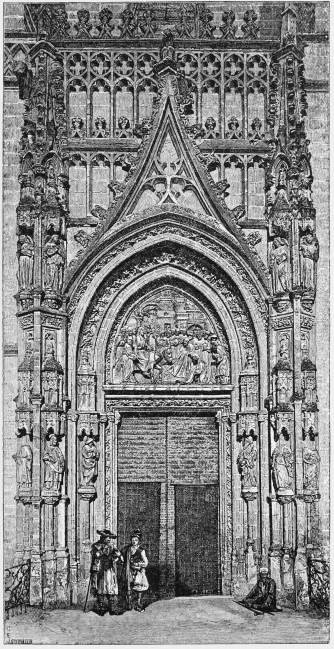
MAIN ENTRANCE TO THE CATHEDRAL, SEVILLA
From a photograph by J. Laurent & Co., Madrid.
The first of it that met our eyes was the Giralda tower of the cathedral,
rising in unique majesty above the unseen town, and as if inspired
with a fresher grace by its own fame. If the bronze female figure of
Faith on the summit could have spoken, it might have said: "In all
the range of view from this pinnacle there is nothing so fair as Sevilla."
The very next object of notice was a woman in the street, who began
begging from below the instant we set foot on the balcony for a general
survey. She gave us our money's worth of misery, but the supply
afterward proved too great for our demand. The mendicants of Sevilla
are much more daring and pertinacious than their craft elsewhere.
They call your attention with a sharp "tst, tst," as if you were hired to
go through life casually, stopping the instant they summon you. There
was in particular one energetic man
who never failed to pounce upon us
from his lair, and place some few inches
in front of us the red and twisted
stump from which his hand had been
severed. He had seemingly persuaded
himself that our journey of several
thousand miles was undertaken principally
to inspect this anatomical
specimen. The amount of execution
he did with that mutilated
member was enough to shame
any able-bodied, self-supporting
person. With a single wave of
it he could put us to
flight.
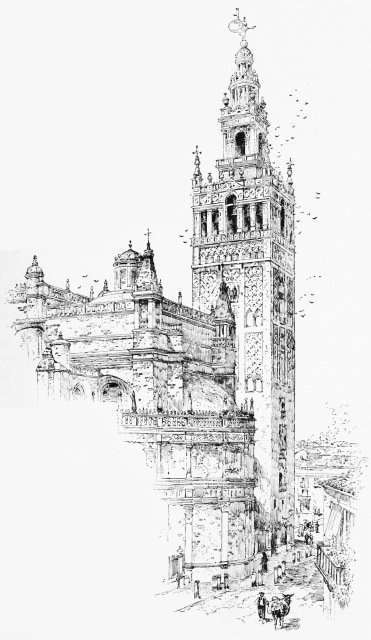
THE GIRALDA TOWER.
From a photograph by J. Laurent
& Co., Madrid.
The effect
would not have been more
instantaneous if he had suddenly
unmasked a mitrailleuse
a yard from our noses.
To assume unconsciousness
was futile, for, whichever way
we turned, he was always (it
would hardly be correct to
say "on hand," but) on time
with his fingerless deformity—he
always placed it, with the instinct of a finished artist, in the best
light and most effective pose—getting it adroitly between us and anything
we pretended to look at.
I imagined the noble cathedral might afford a refuge from such attacks,
but every door was guarded by a squad of the decrepit army, so
that entrance there became a horror. These sanctuary beggars serve a
double purpose, however. The black-garbed Sevillan ladies, who are
perpetually stealing in and out noiselessly under cover of their archly
draped lace veils—losing themselves in the dark, incense-laden interior,
or emerging from confession into the daylight glare again—are careful
to drop some slight conscience-money into the palms that wait. Occasionally,
by pre-arrangement, one of these beggars will convey into the
hand that passes him a silver piece a tightly-folded note from some
clandestine lover. It is a convenient underground mail, and I am
afraid the venerable church innocently shelters a good many little
transactions of this kind.
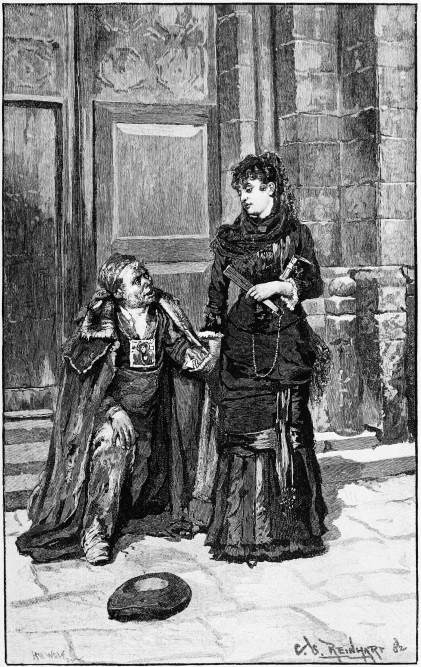
THE "UNDERGROUND" MAIL.
Nothing can surpass in grandeur, in solemn and restful beauty, the
hollow mountain of embellished stone which constitutes this cathedral.
It does not present the usual cross shape, but is based upon the oblong
form of an old mosque, originally formed somewhat like that at Cordova,
but now wholly gone, excepting for the unequalled Giralda, and
a few other minor muezzin towers. The Court of Oranges is another
relic of the mosque-builders, where clumps of polished leafage contrast
their own vivid strength with the energetic lines of flying-buttresses in
the background—a florid yet melancholy height of trellised stone. The
enclosing walls of the Orange Court, made of firmly cohering mud, or
tapia, are tipped with flame-pointed battlements. At their eastern end
rises the tall, square Giralda, with a serenity in its simple lines expressing,
like Greek temples, the satisfied senses controlled by an elevated
mind. The lower portion bears other impress of its Moorish origin in
variously patterned courses of sunken brick; but the whole tower terminates
in a filigree Christian spire of the sixteenth century, with a row
of queer rusty iron ornaments, imitating vases filled with flowers, placed
on the ledge above the belfry at the spire's base. Then, as you continue
the circuit on the east, you arrive opposite the apse curve marking
the chancel of the Chapel Royal; and here the wall is moulded to
the taste of Charles V.'s time, which affected Roman simplicity and
weight, adding to it a trace of feudal pomp in high-relief coats of arms.
On the third and south side a crumbling frieze of deer's heads and
flower garlands skirts the cornice above a long plain front, the straightness
of which our friend Whetstone, clambering up on a low coping
so as to squint along the side, and see if the lines were perfectly true,
admired more than anything else. Afterward one reaches a corner
where the work remains unfinished, and the blackened trunks of incomplete
pinnacles in graded ranks suggest the charred fragments of a faith
once all afire, now darkened and cold. There is no all-dominating
dome; but there are two or three bulbous upheavals in the roof, some
spindling turrets on the north, and a square elevation in the middle revealing
the form of the transept. The whole top is ribbed with stone,
serrated with ornate crockets, crowded with bosses and small spires, or
edged with a double balustrade mimicking in its flame-points a thousand
altar lights. Petrified rosettes and spiral wreathings project from
the sides in unchangeable efflorescence, and great arches, furrowed
around by concentric ripples of carving, and sometimes overpeered by
quaint terra-cotta heads, give entrance to the interior of the gigantic
marvel. And over all towers the Giralda to a height of three hundred
and fifty feet, surmounted by the Giraldillo vane—a woman's form,
which turns its twenty-five hundred-weight of bronze from point to
point at the slightest veering of the wind. But the consummate wonder
of this great fabric, under which prostrate ages seem to crouch
while lifting it to heaven, is the union of diverse styles and spirits in its
construction. The different schools conglomerated in such an exterior
give the cathedral a great and mysterious power of variety; yet, decided
though their contrasts are, the effect is not harsh. It bears witness
to the truth that the spirit of man when attuned to the mood of
sincere worship, however unlike its expression may be at different
epochs and through different races, will always make a certain grand
inclusive harmony with itself.
The coolness of the lofty and umbrageous aisles within is not penetrated
by the fiercest summer heats; but their religious twilight,
though inciting to a devout and prayerful sentiment, wraps in obscurity
the crowded works of art, the emblazoned retablos, the paintings of
Murillo, Campaña, and Morales, and the costly ornaments bestowed
upon the high altar, as well as those of some thirty side-chapels. In
the central nave, before a shrine at the choir-back, lies the tomb of Ferdinand,
son of Christopher Columbus. The colossal form of another
Christopher, the saint, lifts itself up the wall to a height of thirty-two
feet, near the Gate of the Exchange. Whoever looks upon St. Christopher,
to him no harm shall come during that day; hence this worthy
is a common object in Spanish cathedrals, and always painted so large
that no one who diligently attends mass can possibly miss seeing him. A
curious relic on the Chapel Royal altar is the Battle Virgin, a small ivory
image which King Ferdinand the Sainted always carried in war firmly
fixed on his saddle-bow. There, too, the King himself, embalmed, is preserved
in a chiselled silver case, to be uncovered and shown three times
a year with great pomp of military music. A life-size Virgin with movable
joints and spun-gold hair watches over him, but did not prevent his
crown from being stolen a few years ago. Not far away Murillo's San
Antonio hangs, the chief figure in which was also stolen, being cut out
in 1874, as many who read this will remember, and carried to New York,
where it was recovered. Innumerable other works and wonders there
are, and the sacristies contain great value of goldsmiths' products; but,
unless it be made a subject of long artistic study, the fundamental
charm of the cathedral consists in its general aspects, its mysterious
perspectives, its proportions so simple and grandiose; the isolated
pictures formed at almost any point by jewelled and candle-lit chapels
sparkling dimly through a permanent dusk, rainbowed here and there
by the light from old stained windows.
From the Giralda, which is mounted by inclined planes in place of
stairs, one looks down upon the glorious building as if it were something
belonging to a lower and different world. All around, beyond,
the mazy city flattens itself out in a confusion of white walls and tiled
roofs, that look like the armored backs of scaly monsters huddled sluggishly
in the powerful sunshine, with impossible streets among them
reduced to mere thin lines of shadow. The tawny river touches it;
palaces and gardens and abandoned monasteries fringe it. Quite near
you see the Tower of Gold—a surviving outwork of the Moorish defences—which
was formerly coated with orange-colored tiles on the
outside, while the inside furnished a repository for treasure brought
from the New World. A crenellated Moorish fortification rises up
dreamily at one point, but finding itself out of date, abruptly subsides
again. Farther out are the seven suburbs, including the gypsy and
sailor quarter, the Triana; and then the plains stretch into an immense
area of olive, gold, and white, reaching to mountains on the north and
east. A multitude of doves inhabit the spire, and there is almost always
a hawk sailing above it, higher than anything else under the
cloudless sky. At the base lives the bell-ringer, through whose stone-paved
dining-room and nursery, filled with his family, we had to pass
in order to ascend. Once, as we stood toward sunset in the high gallery
where the bells are hung in rectangular or arched apertures, we
heard the repique sounding the Angelus. It was a furious explosion of
metallic resonance.
Twenty bells on swinging beams, that throw the echoing mouths
outward through the openings, and two fixed in place within, of which
Santa Maria—profanely called The Fat One—is the largest: such is
the battery at command. They are not all used at once, however, for
the Angelus. The ringer and his two sons were satisfied with touching
up Santa Catalina (of a tone peculiarly deep and acceptable), St. John
the Baptist, San José, and one or two others. The whole brazen family
have been duly baptized, among them being San Laureano and San
Isidoro, named after the special patrons of Sevilla. One after another
their tongues rolled forth a deafening roar, in a systematic disorder of
thunderous tones, while the chief ringer went about unconcernedly with
a smouldering cigarette in his lips. One of his sons, after uncoiling the
twisted rope around the beam of San Laureano, thus getting it into
violent motion, watched his chance, sprung on to the beam, agile as a
cat, and stood there while it rocked, the bell under him swinging out
at each turn, over the open square below. It was three hundred feet,
down to the pavement, and the least slip would have sent him down
to it like a handful of dirt. His conception of what would please us,
nevertheless, led him thoroughly to unnerve us by repeating the performance
several times.
"Why don't the high-priest, or whatever he is, go on and finish up
this church?" asked Whetstone of the guide. "Seems to me it's about
time."
"The priest? He don't want to," was Vincent's answer, given
with a movement of the fingers meant to imply the receiving of money.
"It make too good excuse."
Our conductor, who I am sure was a sceptic, went on to declare that
within the last ten years ninety thousand dollars had been left by will
for carrying on the unfinished portion of the cathedral, but as yet no
movement to begin the work had been made. "Where all that money
go?" he asked, innocent curiosity overspreading his features, while his
eye gleamed with hidden intelligence.
"What do the people think of the priests?" one of us asked.
"The chimneys[7] will find out some time," he replied; adding, in the
proverbial strain common with Spaniards: "When the river comes
down from the mountains, it brings stones."
"By the river, you mean revolution? But you've had that before."
The conclusive answer to this was a maxim borrowed from the ring:
"The fifth bull is never a bad one" (meaning, "Success comes to those
who wait").
Our guide's English was put to a severe strain in the Alcazar, a
palace largely Oriental, with interiors that outshine the Alhambra in
resplendent color and gilding. There is, in particular, one round-domed
ceiling constructed with an intricacy of interdependent supports, cones,
truncations, dropping cusps, which is counterpoint made plastic; and
in its inverted cup-like cysts the burnished gold glows like clotted
honey. But, for all that, it does not equal the matchless Alhambra in
arrangement, variety, or poetic surroundings. The memory of King
Pedro the Cruel is closely connected with this Alcazar. From it he
used to make night sallies into the town, by means of what Vincent
termed a "soup-tureen passage," which brought him up through a trap-door
somewhere in the thick of his subjects. Pedro, who lived in the
fourteenth century, was a monarch of a severely playful disposition.
He used to have the heads of people that were obnoxious to him cut off,
and hung up over the lintel of his dressing-room door, where he could
look at them while he was putting in his shirt-studs, or whenever he
felt bored. In the extensive gardens, half Eastern and half mediæval,
behind the palace, among the box and myrtle planted in forms of heraldic
devices, among the palms and terraces and fountains, there run
long paths, secretly perforated in places for fine jets of water. These
are the traces of a still more ingenious amusement invented by Pedro.
From a place of concealment he would watch until the ladies of the
court, when promenading, had got directly over one of his underground—I
mean "soup-tureen"—fountains, then he would turn a faucet, and
drench them with a shower-bath from below.
There are other palaces in Sevilla, of which the Duke of Montpensier's
San Telmo is the chief, and a model of uninteresting magnificence,
aside from the valuable collection of old Spanish masters which it contains.
These pictures were sent to Boston for a loan exhibition during
the last revolution in Spain, in 1874; and although their aggregate
worth is easily surpassed by the pictures preserved at the public gallery
of Sevilla and at the Caridad Hospital, the Duke of Montpensier's
possessions embrace a masterly portrait of Velazquez, by himself (repeated
in the Museo at Valencia), and a charming "Madonna of the
Swaddling Clothes," by Murillo. San Telmo was formerly a nautical
college, having been founded by the son of Christopher Columbus.
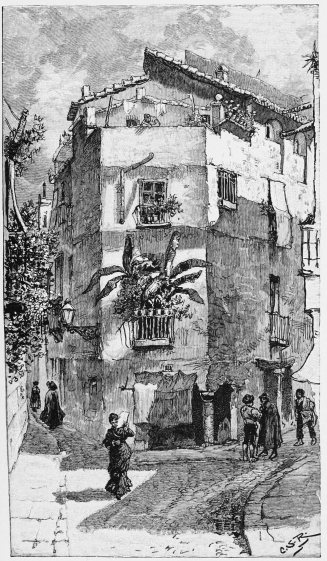
A STREET CORNER.
But the long succession of apartments through which the visitor is
ushered suggests no association with the former maritime prowess of
Spain; it is haunted rather by the failures and disappointments of its
owner, who, missing the throne on which his foot had almost rested,
lived to see his daughter, Queen Mercedes, die, and another daughter
mysteriously follow Mercedes into the grave after being plighted to the
reigning King. The grounds attached to the palace are very large, and
filled with palms, orange-trees, and other less tropical growths; and
they may be inspected, under the guidance of a forester armed with an
innocuous gun, by anybody who, after getting permission, is willing to
pay a small fee and tire himself out by an aimless ramble.
Sevilla, where Murillo was born and spent so many years of artistic
activity in the height of his powers, is the next best place after Madrid
for a study of the sweetest among Spanish painters. His house still
stands in the Jews' Quarter, and a few of his best works are kept in
the picture-gallery; among them the one which he was wont to call
"my picture"—"St. Thomas of Villanueva Giving Alms." Like the
"Saint Elizabeth" at Madrid, it is a grand study of beggary—vagabondism
as you may see it to-day throughout Spain, but here elevated
by excellent design, charming sympathy with nature, and the resources
of a delightful colorist, into something possessing dignity and permanent
interest—qualities which the original phenomenon lacks. Murillo
is pure, sincere, simple, but never profound; though to this he perhaps
approaches more nearly in his "St. Francis Embracing the Crucified
Saviour" than in any other of his productions. Like others of his
pictures in Sevilla, however, it is painted in his latest style, called
"vaporoso," which, to my thinking, marks by its meretricious softness
of hazy atmosphere, and its too free coloring, a distinct decadence.
In the church connected with the Caridad are hung two colossal canvases,
one depicting the miracle of the loaves and fishes, the other,
Moses striking the rock. This last is better known by its popular title,
"The Thirst," which pays tribute to its masterly portrayal of that animal
desire. In the suffering revealed by the faces of the Israelites, as
well as the eager joy of the crowd (and even of their beasts of burden)
on receiving relief, there is a dramatic contention of pain and pleasure,
for the rendering of which the naturalistic genius of the artist was eminently
suited—and he has made the most of his opportunity. The
representation is terribly true; and its range of observation culminates
in the figure of the mother drinking first, though her babe begs for
water; for this is exactly what one would expect in Spanish mothers
of her class, whose faces are lined with a sombre harshness, a want of
human kindness singularly repellent. Such a picture is hardly agreeable;
and it must be owned that, excepting in his gentle, honest "Conceptions,"
and a few other pieces, Murillo shares the earthiness of his
national school, the effect of which, despite much magnificence in treatment,
is on the whole depressing.
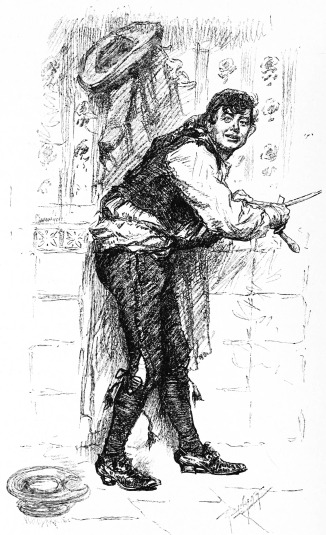
FIGARO.
The House of Pilate, owned by the Duke of Medina Celi, is quite
another sort of thing from San Telmo; a roomy, irregular edifice, dating
from the sixteenth century, but almost wholly Saracenic. The walls are
repoussés in fine arabesques, and sheathed at the base with old color-veined
tiles that throw back the light in flashes from their surface.
These also enamel the grand staircase, which makes a square turn beneath
a roof described as a media naranja—natural Spanish music for
our plain "half-orange"—the vault of which is fretted cedar cased in
stucco. At the top landing is posted a cock in effigy, representing the
one that crowed witness to Peter's denial. Again, a balcony is shown
which stands for that at which Pilate washed his hands before the people;
and in fine, the whole place is net-worked with fancies of this kind,
identifying it with the scene of Christ's trial. For it was the whim of
the lordly founder to make his house the starting-point for a Via Crucis,
marking the path of Jesus on his way to crucifixion, and these devices
were adopted to heighten the verisimilitude of the scene. In Passion-week
pilgrims come to pray at the several "stations" along the route
to the figurative Calvary at the end of the Via.
Into the Duke of Montpensier's garden stare the plebeian, commercial—let
us hope unenvious—windows of the government tobacco factory;
an enormous building, guarded like a fort to prevent the smuggling
out of tobacco. Indeed, every one of the three thousand women
employed is carefully watched for the same purpose as she passes forth
at the general evening dismissal. Mounting the broad stairs of stone,
I heard a peculiar medley of light sounds in the distance. If a lot of
steam-looms were endowed with the faculty of throwing out falsetto
and soprano notes instead of their usual inhuman click, the effect could
not be more uninterrupted than this subdued merry buzzing. It was the
chatter of the working-girls in the cigarette room. As we stepped over
the threshold these sounds continued with crescendo effect, ourselves being
taken for the theme. At least one hundred girls fixed their attention
on us, delivering a volley of salutations, jokes, and general remarks.
"What do you seek, little señor? You will get no papelitos here!"
exclaimed one, pretty enough to venture on sauciness.
"French, French! don't you see?" another said; and her companions,
in airy tones, begged us to disburse a few cuartos, which are cent-and-a-quarter
pieces.
There was one young person of a satirical turn who affected to
approve a very small beard which one of us had raised incidentally
in travelling. She stroked her own smooth cheek, and carolled out,
"What a pretty barbule!"
They certainly were not enslaved to conventionality, though they
may be to necessity. They seemed to enjoy themselves, too. Their
eyes flashed; they broke into laughter; they bent their heads to give
effect to the regulation flat curls on their temples, and all the time
their nimble fingers never stopped filling cigarettes, rolling the papers,
whisking them into bundles, and seizing fresh pinches of tobacco. In
all there were three or four hundred of them, and some of them had a
spendthrift, common sort of beauty, which, owing to their Southern vivacity
and fine physique, had the air of being more than it really was.
At first glance there appeared to be a couple of hundred other girls
hung up against the walls and pillars; but these turned out to be only
the skirts and boots of the workers, which are kept carefully away from
the smouch of the cigarette trays, so as to maintain the proverbially
neat appearance of their wearers on the street. Some of the women,
however, were scornful and morose, and others pale and sad. It was
easy to guess why, when we saw their babies lying in improvised box-cradles
or staggering about naked, as if intoxicated with extreme youth
and premature misery, or as if blindly beginning a search for their fathers—something
none of them will ever find. We laid a few coppers
in the cradles, and went on to the cigar-room.
It was much the same, excepting that the soberness of experience
there partially took the place of the giddiness rampant among the cigarette
girls. There were some appalling old crones among the thousand
individuals who rolled, chopped, gummed, and tied cigars at the
low tables distributed through a heavily groined stone hall choked
with thick pillars, and some six hundred or seven hundred yards in
length. Others, on the contrary, looked blooming and coquettish.
Many were in startling deshabille, resorted to on account of the intense
July heat, and hastened to draw pretty pañuelos
of variegated dye over
their bare shoulders when they saw us coming. Here, too, there was a
large nursery business being carried on, with a very damaged article of
child, smeary, sprawling, and crying. Nor was it altogether cheering to
observe now and then a woman who, having dissipated too late the
night before, sat fast asleep with her head in the cigar dust of the table.
"Ojala! May God do her work!" cried one of her friends. If he
did not, it was not because there was any lack of shrines in the factory.
They were erected here and there against the wall, with gilt images
and candles arrayed in front of a white sheet, and occasionally the older
women knelt at their devotions before them. I don't object to the
shrines, but it struck me that a good crèche system for the children
might not come amiss.
As to the factory-girls smoking cigarettes in public, it is an operatic
fiction: no such practice is common in Spain. And the beauty of these
Carmens has certainly been exaggerated. It may be remarked here
that, as an offset to occasional disappointment arising from such exaggerations,
all Spanish women walk with astonishing gracefulness, a
natural and elastic step; and that is their chief
advantage over women of other nations. Even
the chamber-maids of Sevilla were modelled on
a heroic, ancient-history plan, with big, supple
necks, and showed such easy power in their
movements that we half feared they might, in
tidying the rooms, pick us up by mistake and
throw us away somewhere to perish miserably
in a dust-heap. Why there should be so much
inborn ease and freedom expressed in the manner
of women who are guarded with Oriental
precautions, I don't know. Andalusian fathers
have, no doubt, the utmost confidence in their
daughters, but at the same time they save them
the trouble of taking care of themselves by putting
iron gratings on the windows. The reja,
the domestic gittern, is very common in Sevilla.
The betrothed suitor, if he is quite correct, must
hold his tender interviews with his mistress
through its forbidding bars. My companion
actually saw a handsome young fellow standing on the sidewalk, and
conducting one of these peculiar tête-à-têtes.
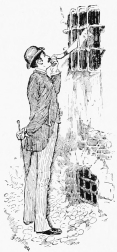 "Stone walls do not a prison
make,
"Stone walls do not a prison
make,
Nor iron bars a cage."
Every house is, furthermore, provided with a patio. The façades,
as a rule, are monotonous and unspeakably plain, but the poorest dwelling
always has its airy court set with shrubs, and perhaps provided with
water. They are tiled, as most rooms are in Spain—a good precaution
against vermin, which unluckily is not infallible as regards fleas, which
search the traveller in Spain even more rigorously than the customs
officers or the Civil Guards. The flea is still and small, like the voice of
conscience, but that is the only moral thing about him. In the Peninsula
I found him peculiarly unregenerate. As to these patios, the well-to-do
protect them from the open vestibule leading to the street by
gates of ornamental open iron, letting the air-currents play through the
unroofed court, and sometimes with movable screens behind the gate.
Chess-tables and coffee are carried out there in the evening, and the
music-room gives conveniently upon the cool central space.
In Sevilla, if you hear a shrill little bell tinkling in the street, do not
imagine that a bicycle is coming. One day a slight tintinnabulation
announced the approach of a funeral procession, headed by two gentlemen
wearing round caps and blue gowns, on which were sewed flaming
red hearts. One bore a small alms-basket; the other rung the bell to
attract contributions. It appears that this is the manner appointed for
sundry brothers who maintain the Caridad, a hospital for indigent old
men. The members, though pursuing their ordinary mode of life, are
banded for the support of the institution. Necessarily rich and aristocrats,
it matters not: when one of them dies, he must be buried by
means of offerings collected on the way to his grave. This Caridad, let
me add, was founded by Don Miguel de Manera, a friend of Don Juan,
and a reformed rake. His epitaph reads: "Here lie the ashes of the
worst man that ever was." I suspect a lingering vanity in that assertion,
but at any rate the tombstone tries hard not to lie.
Fashionable society, after recovering from its mid-day siesta, and before
going to the theatre or ball, turns itself out for an airing on Las
Delicias—"The Delights"—an arbored road running two or three miles
along the river-side. Nowhere can you see more magnificent horses
than there. Their race was formerly crossed with the finest mettle of
Barbary studs, and their blood, carried into Kentucky through Mexico,
may have had its share in the victories of Parole, Iroquois, and Foxhall.
A more strictly popular resort is the New Plaza, where citizens attend
a concert and fireworks twice a week in summer, and keep their distressed
babies up till midnight to see the fun. They are less demonstrative
than one would expect. An American reserve hangs over
them. Perfect informality reigns; they saunter, chat, and laugh without
constraint, yet their enjoyment is taken in a languid, half-pensive
way. In the various foot-streets where carriages do not appear—the
most notable of which is the winding one called simply Sierpes,
"The Serpents"—the same quietude prevails. Lined with attractive
bazar-like shops, and overhung by "sails" drawn from roof to roof,
which make them look like telescopic booths, these streets form
shady avenues down which figures glide unobtrusively: sometimes a
cigarette girl in a pale geranium skirt, with a crimson shawl; sometimes
a lady in black, with lace-draped head; and perhaps an erroneous
man in a heavy blue cloak, saving up warmth for next winter; or a
peasant re-arranging his scarlet waist-cloth by tucking one end into his
trousers, then turning round and round till he is wound up like a
watch-spring, and finally putting his needle-pointed knife into the folds,
ready for the next quarrel.
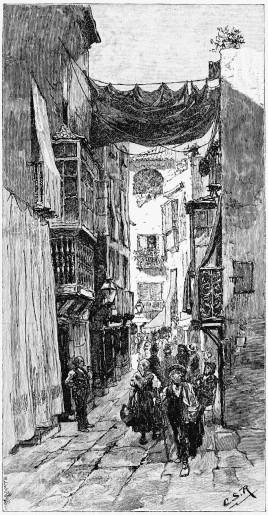
IN "THE SERPENT."
Once we caught sight of two belted forms with carbines stealing
across the alley, far down, as if for a flank movement against us. Oh,
horror! they were the Civil Guards, who were always blighting us at
the happiest moment. As they did not succeed in capturing us, we believed
they must have lost themselves in one of the calles that squirm
through the houses with no visible intention of ever coming out anywhere.
Velveteen wanted to go and look for their bones, thinking
they had perished of starvation, but I opportunely reflected that we
might ourselves be lost in the attempt. No wonder assassination has
been frequent in these narrow windings! Once astray in them, that
would be the easiest way out.
Shall we go to the Thursday-morning fair, which begins, in order to
avoid the great heats, at 6 A.M.? Come, then; and if we are up early,
we may pass on the way through the low-walled market, gay with
fruits, flowers, vegetables, where bread from Alcalá in the exact pattern
of buttercup blossoms is sold, and where, at a particularly bloody and
ferocious stall, butchers are dispensing the meat of bulls slaughtered at
the fights. The fair is held in Fair Street. A frantic miscellany of old
iron, of clothing, crockery, mat baskets, and large green pine-cones full
of plump seeds, which, when ripened, taste like butternuts, is set forth.
Full on the pavement is spread an array of second-hand shoes—the
proverbial dead men's, perhaps—temptingly blacked. Pale cinereous
earthen vessels, all becurled with raised patterns like intelligent wax-drippings,
but exceedingly well shaped, likewise monopolize the thoroughfare,
put in peril only by random dogs, which, having quarrelled
over the offal freely thrown into the street for them, sometimes race
disreputably through the brittle ware. At apt corners old women have
set up their frying-pans under Bedouin tents, and are cooking calentitos—long
coils of dough browned in hot olive oil—which are much sought
as a relish for the matutinal chocolate. Omnipresent, of course, are
those water stalls that, in Sevilla especially, acquire eminent dignity
by their row of stout jars, and their complicated cordage rigged across
from one house-top to another, so as to sustain shadowing canvas canopies.
There is a great crowd, but even the fair is comparatively quiet,
like the other phases of local life.
The absence of wagon-traffic in the town creates, notwithstanding
its reposeful character, a new relative scale of noises, and there is consequently
good store of fretting attacks on the hearing in Sevilla. With
very early morning begins the deep clank of bells, under the chins of
asses that go the rounds to deliver domestic milk from their own udders.
There is no end of noise. Even in the elegant dining-room
where we ate, lottery-dealers would howl at us through the barred windows,
or a donkey outside would rasp our ears with his intolerable
braying. Then the street cries are incessant. At night the crowds
chafe and jabber till the latest hours, and after eleven the watchmen
begin their drawl of unearthly sadness, alternating with the occult and
remorseless industry of the mosquito; until, somewhere about dawn,
you drop perspiring into an oppressively tropical dream-land, with
the sereno's last cry ringing in your ears: "Hail, Mary, most pure!
Three o'clock has struck."
This is the weird tune to which he chants it:

AN English lady, conversing with a Sevillan gentleman who had
been making some rather tall statements, asked him: "Are you telling
me the truth?"
"Madam," he replied, gravely, but with a twinkle in his eye, "I am
an Andalusian!" At which the surrounding listeners, his fellow-countrymen,
broke into an appreciative laugh.
So proverbial is the want of veracity, or, to put it more genially, the
imagination, of these Southerners. Their imagination will explain also
the vogue of their brief, sometimes pathetic, yet never more than half-expressed,
scraps of song, which are sung with so much feeling throughout
the kingdom to crude barbaric airs, and loved alike by gentle and
simple. I mean the Peteneras and Malagueñas. There are others of
the same general kind, sung to a variety of dances; but the ruling tunes
are alike—usually pitched in a minor key, and interspersed with passionate
trills, long quavers, unexpected ups and downs, which it requires
no little skill to render. I have seen gypsy singers grow apoplectic
with the long breath and volume of sound which they threw into
these eccentric melodies amid thunders of applause. It is not a high
nor a cultivated order of music, but there lurks in it something consonant
with the broad, stimulating shine of the sun, the deep red earth,
the thick, strange-flavored wine of the Peninsula; its constellated nights,
and clear daylight gleamed with flying gold from the winnowing-field.
The quirks of the melody are not unlike those of very old English ballads,
and some native composer with originality should be able to
expand their deep, bold, primitive ululations into richer, lasting forms.
The fantastic picking of the mandurra accompaniment reminds me of
Chinese music with which I have been familiar. Endless preludes and
interminable windings-up enclose the minute kernel of actual song; but
to both words and music is lent a repressed touching power and suggestiveness
by repeating, as is always done, the opening bars and first
words at the end, and then breaking off in mid-strain. For instance:
"All the day I am happy,
But at evening orison
Like a millstone grows my heart.
All the day I am happy." [Limitless Guitar Solo.]
It is like the never-ended strain of Schumann's "Warum?" The
words are always simple and few—often bald. One of the most popular
pieces amounts simply to this:
"Both Lagartijo and Frascuelo
Swordsmen are of quality,
Since when they the bulls are slaying—
O damsel of my heart!
They do it with serenity.
Both Lagartijo and Frascuelo
Swordsmen are of quality."
But such evident ardor of feeling and such wealth of voice are
breathed into these fragments that they become sufficient. The people
supply from their imagination what is barely hinted in the lines. Under
their impassive exteriors they preserve memories, associations, emotions
of burning intensity, which throng to aid their enjoyment, as soon as
the muffled strings begin to vibrate and syllables of love or sorrow are
chanted. I recalled to a young and pretty Spanish lady one line,
"Pajarito, tu que vuelas."
She flushed, fire came to her eyes, and with clasped hands she murmured,
"Oh, what a beautiful song it is!" Yet it contains only four
lines. Here is a translation:
"Bird, little bird that wheelest
Through God's fair worlds in the sky,
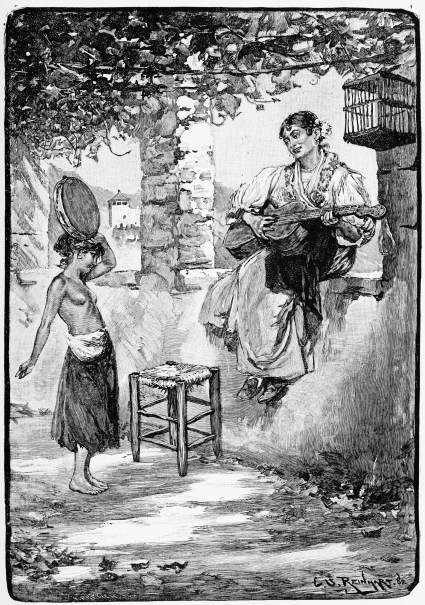
"ALL THE DAY I AM HAPPY."
Say if thou anywhere seest
A being more sad than I.
Bird, little bird that wheelest."
Some of these little compositions are roughly humorous, and others
very grotesque, appearing to foreigners empty and ridiculous.
The following one has something of the odd imagery and clever inconsequence
of our negro improvisations:
"As I was gathering pine-cones
In the sweet pine woods of love,
My heart was cracked by a splinter
That flew from the tree above.
I'm dead: pray for me, sweethearts!"
There was one evening in Granada when we sat in a company of
some two dozen people, and one after another of the ladies took her
turn in singing to the guitar of a little girl, a musical prodigy. But
they were all outdone by Cándida, the brisk, naïve, handsome serving-girl,
who was invited in, but preferred to stand outside the grated window,
near the lemon-trees and pomegranates, looking in, with a flower
in her hair, and pouring into the room her warm contralto—that voice
so common among Spanish peasant-women—which seemed to have
absorbed the clear dark of Andalusian nights when the stars glitter
like lance-points aimed at the earth. Through the twanging of the
strings we could hear the rush of water that gurgles all about the Alhambra;
and, just above the trees that stirred in the perfumed air without,
we knew the unsentinelled walls of the ancient fortress were frowning.
The most elaborate piece was one meant to accompany a dance
called the Zapateado, or "kick-dance." It begins:
"Tie me, with my fiery charger,
To your window's iron lattice.
Though he break loose, my fiery charger,
Me he cannot tear away;"
and then passes into rhyme:
"Much I ask of San Francisco,
Much St. Thomas I implore;
But of thee, my little brown girl,
Ah, of thee I ask much more!"
The singing went on:
"In Triana there are rogues,
And there are stars in heaven.
Four and one rods away
There lives, there lives a woman.
Flowers there are in gardens,
And beautiful girls in Sevilla."
Nevertheless, we had been glad to leave Sevilla, especially since during
our stay an epidemic was in progress, graphically called "the minute,"
from its supposed characteristic of finishing off a victim ready for
the undertaker in exactly sixty
seconds after attacking him.
The inhabitants of Granada
likewise seemed to be a good
deal occupied in burying themselves—a
habit which became
confirmed, no doubt, during the
wars and insurrections of their
ancestors, and is aided to-day
by bad sanitary arrangements.
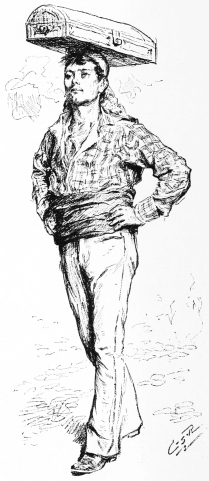
We saw a dead man being carried
in the old Moorish way,
with his forehead bared to the
sky, a green wreath on his head,
his cold hands emerging from
the shroud in their last prayer-clasp,
and quite indifferent to
the pitiless sun that beat down
on them. But, perched as we
were on the Alhambra Hill,
high above the baking city,
such spectacles were transient
specks in the world of fascination
that infolded us.
 GRANADA UNDERTAKER.
THE MOORISH GATE, SEVILLA.
Granada rests in what might
pass for the Happy Valley of
Rasselas, a deep stretch of thirty
miles, called simply the Vega,
and tilled from end to end on
a system of irrigation established
by the Moslem conquerors.
Rugged mountains, bastions of
a more than Cyclopean earthwork,
girdle and defend it. To penetrate them you must leave the hot
rolling lands of the west, and confront steep heights niched here and
there for creamy-hued villages or deserted castles, and sentried by small
Moorish watch-towers rising like chessmen on the highest crests. The
olive-trees spread on wide slopes of tanned earth were like thick dots
of black connected in one design, and seemed to suggest the possible
origin of Spanish lace. The shapes of the mountains, too, were extravagant.
One of the most singular, the Peñon de los Enamorados, near
Antequera, showed us by accident at a distance the exact profile of
George Washington, with every detail after Stuart, hewn out in mountain
size and looking directly up into the heavens from a position of
supine rigidity. Our first intimation of a near approach to Granada
was a long stretch of blanched folds showing through evening mistiness
in the southern sky, like the drapings of some celestial tabernacle, so
high up that they might have been clouds but for a certain persistent,
awful immobility that controlled them. Their spectral whiteness, detached
from the earth, hung, it is true, ten thousand feet above the sea-level;
but they were not clouds. They were the summits of the Sierra
Nevada, the great Snowy Range.
Twenty miles to the north of these frosty heights stands the Alhambra
Hill, shrouded in dark trees, and dominated by the Mountain
of the Sun. The names are significant—Snowy Range and Mountain
of the Sun—for the landscape that unrolls itself between these ridges
is a mixture of torrid glow and Alpine coldness. I stood in a hanging
garden delicious with aromatic growths, on the ramparts beside the
great Lookout Tower, the city lying like a calcareous deposit packed
in the gorge of the Darro's stream below. Across the Vega I beheld
that sandy pass of the hills through which Boabdil withdrew after his
surrender—the Last Sigh of the Moor. Fierce sunlight smote upon
me, spattering the leaves like metal in flux; but the snow-fields mantling
the blue wall of the Sierra loomed over the landscape so distinct
as to seem within easy hail, and I felt their breath in a sweet coolness
that drifted by from time to time. The other mountains were bare
and golden brown. But in their midst the mild Vega, inlaid with
curves of the River Genil, receded in breadths of alternate green orchard
and mellow rye, where distant villages are scattered "like white
antelopes at pasture," says Señor Don Contreras, the accomplished
curator of the Alhambra. It was not like a dream, for dreams are imitative;
nor like reality, for that is too unstable. It was blended of both
these, with a purely ideal strand. As I looked at the rusty red walls
and abraded towers palisading the hill, the surroundings became like
some miraculous web, and these ruins, concentring the threads, were
the shattered cocoon from which it had been spun.
The Alhambra was originally a village on the height, perhaps the
first local settlement, surrounded by a wall for defensive purposes.
A WATER-CARRIER.
The wall, which once united a system of thirty-seven towers, fringes the
irregular edges of the hill-top plateau, describing an enclosure like a
rude crescent lying east and west. At the west end the hill contracts
to an anvil point, and on this are grouped the works of the citadel Alcazaba,
governed by the huge square Lookout Tower. On a ridge
close to the south stand the Vermilion Towers, suspected of having
been mixed up with the Phœnicians at an early epoch, but not yet
fully convicted by the antiquarians. The intervening glade receives a
steep road from the city, and is arcaded with elms and cherries of prodigious
size, sent over as saplings by the Duke of Wellington half a
century ago. There the nightingales sing in spring-time, and in summer
the boughs give perch to other songsters. Ramps lead up to the
top of the hill, and on the northern edge of its crescent, at the brink of
the Darro Valley, the Alhambra Palace proper is lodged.
We shall go in by the Gate of Justice, through a door-way running
up two-thirds of its tower's height, and culminating in a little horseshoe
arch, whereon a rude hand is incised—a favorite Mohammedan symbol
of doctrine. We pass a poor pictured oratory of the Virgin, and some
lance-rests of Ferdinand V., to worm our way through the grim passage
that cautiously turns twice before emerging through an arch of pointed
brick with enamellings on argil, into the open gravelled Place of the Reservoirs.
This is undermined by a fettered lake, generally attributed to
the Moors, but more probably made after Isabella's conquest. On the
right side, behind hedges and low trees, is reared that gray rectangular
Græco-Roman pile which Charles V. had the audacity to begin. His
palace is deservedly unfinished, yet its intrusion is effective. It makes
you think of the terror-striking helmet of unearthly size in the Castle
of Otranto, and looks indeed like a piece of mediæval armor flung down
here to challenge vainly the wise Arabian beauty of the older edifice.
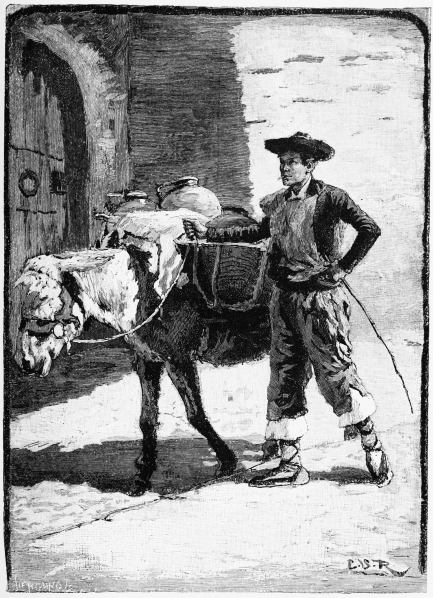
To the Place of Reservoirs come in uninterrupted course all day the
tinkling and tasselled mules that carry back to the city jars of fresh
water, kept cool in baskets filled with leaves. And hither walk toward
sunset the majos and majas—dandies and coquettes—to stroll and gossip
for an hour, even as we saw them when we were lingering at the
northern parapet one evening and looking off through the clear air,
in which a million rose-leaves seemed to have dipped and left their
faint color.
THE veritable entrance to the Alhambra is now buried within some
later buildings added to the original. But it never, though Irving naturally
supposed the contrary, had a grand portal in the middle. Gorgeous
and showy means of ingress would not have suited the Oriental
mind. The exterior of the palace and all the towers is dull, blank, uncommunicative.
Their coating of muddy or ferruginous cement, marked
here and there by slim upright oblongs of black window spaces, was
not meant to reveal the luxury of loveliness concealed within. The
Moslem idea was to secrete the abodes of earthly bliss, nor even to hint
at them by outward signs of ostentation.
So the petty modern door cut for convenience is not wholly out of
keeping. It ushers one with a sudden surprise into the presence of
those marvels which have been for years a distant enticing vision. You
find yourself, in fact, wandering into the Alhambra courts as if by accident.
The first one—the Court of the Pond, or of the Myrtles—arrays
before us beauty enough and to spare. But it is only the beginning.
A long tank occupies the centre, brimmed with water from a rill that
gurgles, by day and night forever, with a low, half-laughing sob. Around
it level plates of white marble are riveted to the ground, and two hedges
of clipped myrtle border the placid surface. At the nearest end a double
gallery closes the court, imposed on seven arches so evenly rounded
as to emulate the Roman, but upheld by columns of amazing slenderness;
and in the spandrels are translucent arabesques inlaced with fillets,
radiating leaf-points, and loose knots. Above these blink some
square windows, shut as with frozen gauze by minute stone lattice-work,
over fifteen hundred twisted or cubed pieces being combined in
each. From there the women of the harem used to witness pageantries
and ceremonies that took place in the court; and over the veiled windows
is a roofed balcony repeating the lower arches, which would serve
for spectators not under ban of invisibility.
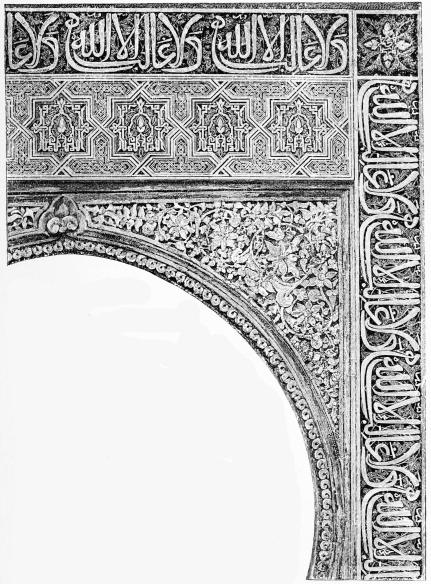 BIT OF ARCH IN A COURT OF
THE ALHAMBRA.
BIT OF ARCH IN A COURT OF
THE ALHAMBRA.
From a photograph by J. Laurent & Co., Madrid.
Various low doors lead from this Court of the Pond, giving sealed
intimation of what may lie beyond, but disclosing little. One turns
naturally, however, to the Hall of Ambassadors at the other end, in the
mighty Tower of Comares. The transverse arcade at the entrance is
roofed with shining vitreous-faced tiles of blue and white that also carry
their stripes over the little cupola, to
which many similar ones doubtless formerly
surrounded the court, and in the
cloister underneath the inmates reclined on
divans glinting with rippled gold-thread and
embroidered with colored silks. Then comes
the anteroom, the Chamber of Benediction (usually
called of the Boat, on account of its long,
scooped ceiling), which is like the hollow of a capsized
boat suspended over us, and darkened with
deep lapis lazuli. There are some low doors in
the wall, meant for the humble approach of slaves
when serving their masters, or leading to lost
inner corridors and stairways now fallen into dust.
But the large central arch conducts at once into
the Hall of the Ambassadors, after we have
passed some niches in which of old were set encarmined
water-jars of sweet-scented clay. Beside these may have
stood the carven racks for weapons of jewelled hilt and tempered
blade.
In the Chamber of Benediction begin those multitudinous arabesques
by which the Alhambra is most widely known. In the hall
beyond they flow out with unimpeded grace and variety over the walls
of an immensely high and nobly spacious apartment, pierced on three
sides at the floor level with arched ajimez[8] windows halved by a thin,
flower-headed column, in the embrasures of which, enchased with cement,
are mouldings that overrun the groundwork in bands, curves, diamonds,
scrolls, delicate as the ribs of leaves or as vine tendrils. Within
these soft convolved lines, arranged to make the most florid detail tributary
to the general effect, Arabic characters twisted into the design
contain outbursts of poetry celebrating the edifice, the room itself.
"As if I were the arc of the rainbow," says one inscription in the hooped
door-way, "and the sun were Lord Abul Hachach." The windows
look forth upon the sheer northern fall of the hill; the waving tree-tops
scarcely rising to the balcony under the sills. They look upon old
Granada dozing below in the unmitigated sunlight, with here and there
the sculptured columns of a patio visible among the houses on the opposite
slope; and farther away the Sesame doors of gypsy habitations
cut into the solid mountain above the Darro. One of the most beautiful
of glimpses about the Alhambra is that through the east window,
looking along the parapet gallery to the Toilet Tower. Precipitous
masonry plunges down among trees that shoot incredibly high, as if incited
by the lines of the building; and on the Mountain of the Sun the
irregular lint-white buildings of the Generalife—an old retreat of Moorish
sovereigns and nobles—are lodged among cypresses and orange
thickets. Within the hall itself all is cool, subdued, and breezy, and
the smooth vault of the larch-wood ceiling, still dimly rich with azure
and gold, spans the area high overhead like a solemn twilight sky at
night.
It was in this Tower of Comares that the last King of Granada,
Boabdil, was imprisoned with his mother, Ayeshah, by his stormy and
fatuous father, Muley Abul Hassan, owing to the rival influence of the
Morning Star, Zoraya, Hassan's favorite wife. Boabdil escaped, being
let down to the ground by the scarfs of his mother and her female attendants.
Years after, when he had succeeded to the throne for a brief
and hapless reign, El Rey Chico (The Little King), as the Spaniards
called him, was led by his mother into the Hall of Ambassadors after
he had capitulated to Ferdinand and Isabella. Silently she made its
circuit with him, and then, overcome with the bitterness of loss, she
cried: "Behold what thou art giving up, and remember that all thy
forefathers died kings of Granada, but in thee the kingdom dies!"
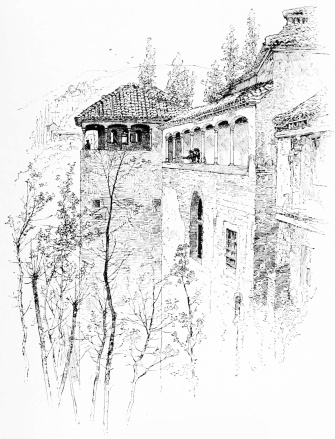
THE TOILET TOWER.
From a photograph by J. Laurent & Co., Madrid.
The Hall of Ambassadors is assigned to the epoch of the caliphate.
Certainly the Court of Lions is invested with a somewhat different character.
Its arches are more pointed, more nearly Gothic, and are hung
upon a maze of exquisitely slight columns, presenting, as you look in,
an opulent confusion of crinkled curves and wavering ellipses, bordered
with dropping points and brief undulations that look like festoons of
heavy petrified lace: as lace, heavy; but as architecture, light. There
is incalculable diversity in the proportions, unevenness in the grouping
of the pillars, irregularity in the cupolas; yet through all persists an
unsurpassable harmony, a sensitive equilibrium. The Hall of Justice,
which opens from it, and contains—contrary to Mohammedan principles—some
mysterious early Italian frescoes depicting Moorish and
Christian combats, is a grotto of stalactites. All this part of the palace,
one would say, might have sprung from the spray of those hidden
canals which brought the snow-water hither, spouting up, then falling
and crystallizing in shapes of arrested motion; so perfect is the geometrical
balance, so suave are the flowing lines. The un-Moorish lions sustaining
the central basin are meagre and crude, and the size of the
court is disappointing; but it is a miniature labyrinth of beauty. From
one side you may pass into the Hall of the Abencerages, under the
fine star-shaped roof of which a number of those purely Arab-blooded
knights are said to have been, at the instigation of their half-Christian
rivals, the Zegris, assembled at a banquet and then murdered. An invitation
to dinner in those days was a doubtful compliment, which a
gentleman had to think twice about before accepting.
On the other side lies the access to the Chamber of the Two Sisters,
a lovely apartment, having a grooved bed in the marble floor for a current
of water to course through and run out under the zigzag-carven
cedar door. Everything is exactly as you would have it, and you seem
to be straying through embodied reveries of Bagdad and Damascus.
But it would be futile to describe the myriad traceries of these rooms;
the bevelled entablatures, the elastic ceilings, displaying an order and
multiplicity of tiny relief as systematic as the cells and tissues in a cut
pomegranate; or the dadoes of colored tiles, still dimly glistening with
glaze, and chameleonizing the base of the partitions. The culmination
of microscopic refinement comes, with a sigh of relief from such an
overplus of sensuous delight, in the boudoir of Lindaraxa, which overlooks
from a superb embayed window a little oasis of fountained court,
blooming with citrons and lemons, and bedded with violets. That
small garden, green and laughing, and interspersed with dark flower-mould,
lies clasped in the branching wings of masonry, as simple and
refreshing as a dew-drop. It is shut in on the other side by some mediæval
rooms fitted up in heavy oak panelling for Philip V. and his second
bride, Elisabetta, when with rare judgment they chose this Islamitic
spot for their honey-moon—a crescent, I suppose. It was in one
of these rooms—the Room of the Fruits—that, to quote Señor Contreras
again, "the celebrated poet Washington Irving harbored, composing
there his best works." From which it will be inferred that the
gallant Spaniard has not probed deeply the "Knickerbocker History
of New York," the "Sketch-book," and the "Life of Washington."[9]
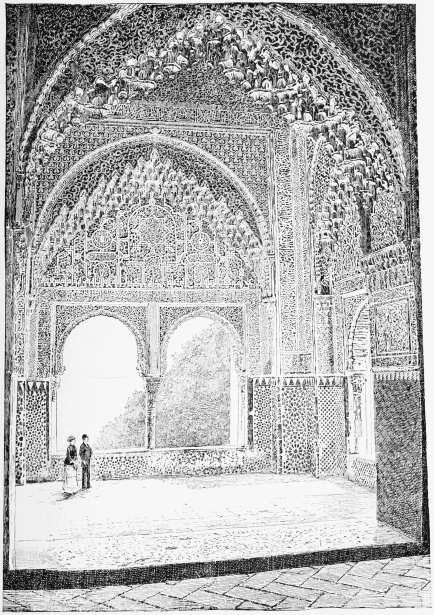
BOUDOIR OF LINDARAXA
One may prolong one's explorations to the Queen's Toilet Tower—who
"the queen" was remains decidedly vague—poised like a lofty
palm on the verge commanding the Darro gorge. In one corner of its
engirdling colonnade are some round punctures, through which perfume
was wafted to saturate the queen's garments while she was dressing.
Or one may descend to the Baths, vaulted in below the general
level. Their antechamber is the only portion which has been completely
restored to its pristine magnificence of blue and gold, vermilion-flecked
and overspreading the polygonal facets of stucco-work. I could
imagine the Sultan coming there with stately step to be robed for
the bath by female slaves, then passing on wooden clogs into the inner
chamber of heated marble, and at a due interval emerging to take his
place on one of the inclined slabs in an outer alcove, enveloped in a
tcherchef—his head bound with a soft silk muffler—there to devote
himself to rest, sweetmeats, and lazy conversation.
The Alhambra Palace is remarkable as being more Persian than
Turkish, and reproducing many features that crop up in the architecture
of India, Syria, Arabia, and Turkey, yet incorporating them in an
independent total. The horseshoe arch is not the prevailing one, though
it occurs often enough to renew and deepen the impression of its unique
effect. What makes this arch so adroitly significant of the East? Possibly
the fact that it suggests a bow bent to the extremest convexity.
It is easy to imagine stretched between the opposite sides a bow-string—that
handy implement of conjugal strangulation which no Sultan's
family should be without.
Part of the populous ancient settlement on the hill still exists in a
single street outside of the palace, now inhabited by a more respectable
population than that riffraff of silk-weavers, vagabonds, potters, smugglers,
and broken-down soldiers who flourished there half a century
since. A church stands among the dwellings. Strolling up the street
one moonlit night, we bought some blue and white wine-pitchers of
Granada-ware at a little drinking-shop, and saw farther on a big circle
of some twenty people sitting together in the open air—one of those
informal social clubs called tertulias, common among neighbors and
intimate friends in all ranks of Spanish society. At another spot a man
was sleeping in the moonlight on a cot beside the parapet, with his two
little Indian-looking boys dreaming on a sheet laid over the ground.
Mateo Ximenes, the son of Irving's "Son of the Alhambra," lives in
this quarter, officiating as a guide. Thanks to "Geoffrey Crayon" he is
prosperous, and has accordingly built a new square house which is the
acme of commonplace. Beyond the street, across some open ground
where figs and prickly-pears are growing, stands the Tower of the
Captive, where Isabella de Solis, a Christian princess, being captured,
was imprisoned, and became the wife of Abul Hassan. She was, in
fact, the Zoraya who became Ayeshah's rival. Dense ivy mats the
wall between this and the Tower of the Princesses—a structure utilized
by Irving in one of his prettiest tales. Both towers are incrusted interiorly
with a perfection rivalling the palace chambers, and perhaps even
more enchanting, but no vestige of coloring is left in them. To me
this wan aspect of the walls is more poetic than any restoration of the
original emblazonments. The pale white-brown surface seems compounded
of historic ashes, and is imbued with a pathos,
"Like a picture when the pride
Of its coloring hath died,"
which one would be loath to lose.
The sunlit and vine-clad decrepitude that sits so lightly on this
magic stronghold—this "fortress and mansion of joy," as one of the
mural mottoes calls it—is among its main charms. The most bitter
opponent of any Moorish return to power in Granada would, I think,
be the modern æsthetic tourist. I rambled frequently close under the
old rufous-mottled walls, from which young trees sprout up lustily, and
enjoyed their decay almost as much as I did the palace. At one point
near the Tower of Seven Stories (which has never quite recovered from
being blown up by the French) there was a long stretch of garden where
phlox and larkspur and chrysanthemums, that would not wait for autumn,
grew rank among the fruit-trees. A Moorish water-pipe near the
top of the wall had broken, and, bursting through the brick-work, its
current had formed a narrow cascade that tumbled into the garden
through wavering loops of maiden-hair, and over mosses or water-plants
which it had brought into life on the escarpment. Grapes and figs rose
luxuriantly about rings of box enclosing fountains, and at sunset some
shaft of fire would level itself into the greenery, striking the gorgeous
pomegranate blossoms into prominence, like scarlet-tufted birds' heads.
All day there was a loud chir of cicadas, and a rain of white-hot light
sifted through the leaves. But at night everything died away except
the rush of water, which grew louder and louder till it filled the whole
air like a ghostly warning. I used to wake long after midnight, and
hear nothing but this chilling whisper, unless by chance some gypsies
squatted on the road were singing Malagueñas, or the strange, piercing
note of the tree-toad that haunts the hill rung out in elfin and inhuman
pipings of woe. For the builders who laid them here these running
streams make a fit memorial—unstable as their power that has slipped
away, yet surviving them, and remaining here as an echo of their voices,
a reminder of the absent race which not for an hour can one forget in
Granada.
But the supreme spell of the Alhambra reserves itself for moonlight.
When the Madonna's lamp shone bright amid the ingulfing shadows
of the Tower of Justice, while its upper half was cased in steely radiance,
we passed in by Charles's Palace, where the moon, shining through
the roofless top, made a row of smaller moons in the circular upper
windows of the dark gray wall. In the Court of the Pond a low gourd-like
umbellation at the north end sparkled in diamond lustre beneath
the quivering rays; while the whole Tower of Comares behind it repeated
itself in the gray-green water at our feet, with a twinkle of stars
around its reversed summit. This image, dropped into the liquid
depth, has dwelt there ever since its original was reared, and it somehow
idealized itself into a picture of the tower's primitive perfection.
The coldness of the moonlight on the soft cream-colored plaster, in this
warm, stilly air, is peculiarly impressive. As for sound, absolutely none
is heard but that of dripping water; nor did I ever walk through a profounder,
more ghost-like silence than that which eddied in Lindaraxa's
garden around the fountain, as it mourned in silvery monotones of
neglected grief. The moon-glare, coming through the lonely arches,
shaped gleaming cuirasses on the ground, or struck the out-thrust
branches of citron-trees, and seemed to drip from them again in a dazzle
of snowy fire; and when I discovered my two companions looking
out unexpectedly from a pointed window, they were so pale in the
brilliance which played over them that for a moment I easily fancied
them white-stoled apparitions from the past. As we glanced from the
Queen's Peinador, where the black trees of the shaggy ascent sprung
toward us in swift lines or serpentine coilings as if to grasp at us, we
saw long shadows from the towers thrown out over the sleeping city,
which, far below, caked together its squares of hammered silver, dusked
over by the dead gray of roofs that did not reflect the light. But
within the Hall of Ambassadors reigned a gloom like that of the grave.
Gleams of sharp radiance lay in the deep embrasures without penetrating;
and, at one, the intricacies of open-work above the arch were
mapped in clear figures of light on a space of jet-black floor. Another
was filled nearly to the top by the blue, weirdly luminous image of a
mountain across the valley. Through all these openings, I thought,
the spirits of the departed could find entrance as easily as the footless
night breeze. I wonder if the people who lived in this labyrinth of art
ever smiled? In the palpitating dusk, robed men and veiled women
seemed to steal by with a rustle no louder than that of their actual
movement in life; silk hangings hung floating from the walls; scented
lamps shed their beams at moments through the obscurity, and I saw
the gleam of enamelled swords, the shine of bronze candlesticks, the
blur of colored vases in the corners; the kasidas of which poetry-loving
monarchs turned the pages. But in such a place I could not imagine
laughter. I felt inclined to prostrate myself in the darkness before I
know not what power of by-gone yet ever-present things—a half tangible
essence that expressed only the solemnity of life and the presentiment
of change.
IT is not surprising that Isabella the Catholic, who had so completely
thrown her heart into the conquest of Granada, should have
wished to be buried in that city, though dying far away. Her marble
semblance rests beside that of Ferdinand in the Royal Chapel, which
serves as vestibule to the ugly Renaissance cathedral. The statues are
peculiarly impressive, and sleep on high sepulchres of alabaster, beautifully
chased. Both of them are placed with their heads where, if sentient,
they might contemplate the astonishing reredos of the altar—a
wooden mass piled to the roof, and containing many niches filled by figures
carved, gilded, and painted with flesh-color. Among them is John
the Baptist standing upright, with blood gushing from his severed neck,
while the head which has just quitted it is being presented on a charger
to Herodias's daughter. There are other hideous things in this strange
and brutal church ornament, which is a museum of monstrosities; but
parts of it depict the triumphs of the royal pair, and it was no doubt
accordant with their taste. Their bodies lie in a black vault under the
floor, which we visited by the light of a single candle. Two long bulks
of lead, with a simple letter F. on one and an I. on the other; that was
all that marked the presence of two great monarchs' earthly part.
Juana the Mad, Charles V.'s mother, rests in another leaden casket—the
poor Queen, whom her famous son probably reported crazy for his
own political purposes, but whose supposed mania of watching her dead
husband's body, in jealous fear that he could still be loved by other
women, has been effectively treated in Padilla's picture. Her husband,
Philip the Fair, lies on the opposite side. Hardly could there be a
more impressive contrast than that between this tomb under the soft,
musty shadows of the chapel—all that is left of the conqueror—and
that glorious sun-imbued ruin on the hill—all that is left of the conquered.
Two mighty forces met and clashed around Granada in 1492;
and, when the victory was won, both receded like spent waves, leaving
the Alhambra to slow burial in rubbish and oblivion, under which
Washington Irving literally rediscovered it. How fine a coincidence
that the very spot from which Isabella finally despatched Columbus on
his great quest should owe so much to a son of the new continent
which Columbus discovered!
Another edifice of no small interest, although seldom heard of at a
distance, is La Cartuja, the Carthusian church and monastery, lying
upon a hill-slope called Hinadamar, across the city and on its outskirts,
due west from the Alhambra. The monks who formerly occupied it
have, in common with those of other orders, been driven out of Spain;
so that we approached the church-steps through an old arched gate-way,
no longer guarded, and by way of a grass-grown enclosure that bore
the appearance of complete neglect. The interior, however, is very
well preserved. It was curious to walk through it, under the guidance
of a pursy old woman, and, afterward, of the lame sacristan, who did his
best with chattering gossip to rob the place of whatever sanctity remained
to it. The refectory (fitly inhabited by an echo) stands bare
and empty, save for the reading-desk, from which the monks used to
be refreshed with Scripture while at their meals; and on the wall at
one end of this long, high hall hangs apparently a wooden cross, which
at first it is impossible to believe is only painted there. The barren,
round-arched cloisters are frescoed with an interminable series of scenes
by Cotan, the same artist who painted the cross; and in this case he
was given a free commission, of which he availed himself to the utmost
in depicting the most distressing incidents of Carthusian martyrology.
Especially does he seem to have delighted in the persecutions inflicted
by English Protestants under Henry VIII. on San Bruno, the founder
of this order. How strange the conception of a holy and exalted life
which led men in religious retirement to keep before their eyes, in
these corridors meant for mild exercise and recreation, representations
so full of blood and horror! In fact, one cannot escape the impression,
stamped more vividly on the mind here in Granada than anywhere else,
except perhaps in Toledo, that Christianity in Spain meant barbarism.
But where it was released from the immediate purposes of ecclesiastic
dogma, Christian art showed a taste not so much barbarous as barbaric,
and the results of its activity were often beautiful. In this same monastery
is a splendid example of that tendency. The church is not remarkably
fine or impressive; but the sacristy is a marvel of sumptuous
decoration, and decoration very peculiar in kind. Its walls are wholly
incased in a most effective species of green and white marble, cut in
smooth, polished slabs, the natural veinings of which present grotesque
resemblances to human and other forms, which are somewhat trivially
insisted upon by the custodian and guide, and should be allowed to
lose themselves in the general richness of aspect. The great doors of
this sacristy are inlaid with ebony, silver, mother-of-pearl, and tortoise-shell,
in designs of much intricacy and richness; and all around the
room (which is provided with an altar, so that it becomes a sort of sub-church
or chapel, adjoining the main church) are low closets fitted into
the wall. These were originally used for holding the vestments of the
brotherhood. Made of sweet-scented cedar, they are adorned on the
outside with the same inlaid work that appears on the doors. The
dim, veiled shimmer of the mother-of-pearl, the delicate, translucent
browns of the tortoise-shell, and the wandering threads of silver, form
a decorative surface wonderful in its refinement, its perfection of elegance.
I scarcely know how to give an idea of its appearance, unless
I say that it was somewhat as if layers of spider-webs had been spread,
with all their mystery of exact curves and angles, over the wood-work,
and then had had their fibres changed by some magic into precious and
enduring materials. The frail but well-adjusted fabric has outlasted
the dominion of those for whose selfish and secluded pride of worship
it was made; and, seeing it, one may pardon them some of their mistakes.
It is pleasant also to find that the art of making this inlay, after
having long fallen out of use, has been revived in Granada; for in these
days of enlightened adaptation and artistic education there seems to
be no reason why such a handicraft should be lost or even confined
to Spain.
The gypsies of Granada are disappointing, apart from their peculiar
quivering dance, performed by gitanas in all Spanish cities under the
name of flamenco.[10] Their hill-caves, so operative with one's curiosity
when regarded from across the valley, gape open in such dingy, sour,
degraded foulness on a nearer view, that I found no amount of theory
would avail to restore their interest. Yet some of the fortune-telling
women are spirited enough, and the inextinguishable Romany spark
smoulders in their black eyes. Perhaps it was an interloping drop of
Celtic blood that made one of them say to me, "Señorito, listen. I
will tell you your fortune. But I speak French—I come from Africa!"
And to clinch the matter she added, "You needn't pay me if every
word of the prediction isn't true!" Much as I had heard of the Spanish
bull, I never knew until then how closely it resembled the Irish
breed.
Fortuny's model, Marinero, who lives in a burrow on the Alhambra
side, occasionally starts up out of the earth in a superb and expensive
costume, due to the dignity of his having been painted by Fortuny.
Dark as a negro, with a degree of luminous brown in his skin, and very
handsome, he plants himself immovably in one spot to sell photographs
of himself. His nostrils visibly dilate with pride, but he makes no
other bid for custom. He expands his haughty nose, and you immediately
buy a picture. Velveteen chanced upon Marinero's daughter,
and got her to pose. When he engaged her she was so delighted that
she took a rose from her hair and presented it to him, with a charming,
unaffected air of gratitude, came an hour before the time, and waited
impatiently. She wore a wine-colored skirt, if I remember, a violet
jacket braided with black, and a silk neckerchief of dull purple-pink
silk. But that was not enough: a blue silk kerchief also was wound
about her waist, and in among her smooth jet locks she had tucked a
vivid scarlet flower. The result was perfect, for the rich pale-brown of
her complexion could harmonize anything; and in Spain, moreover,
combinations of color that appear too harsh elsewhere are paled and
softened by the overpowering light.
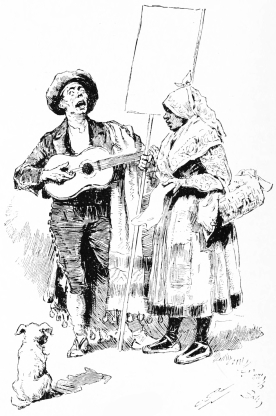
GYPSIES.
Episodes like these tinged our dreams of the Alhambra with novel
dashes of living reality. Even the tedious bustle of a Spanish town,
too, has its attractions. The moving figures on the steep Albaycin
streets, that perpetually break into flights of steps; the blocks of
pressed snow brought in mule panniers every night from the Sierra to
cool sugar-water and risadas of orange at the cafés; peasants coming
in to the beautiful old grain market with gaudy mantles over their
shoulders, stuffing into their sashes a variety of purchases, and becoming
corpulent with a day's transactions; the patient efforts of shop-keepers
to water the main street, Zacatin, with a pailful at a time—all
this was amusing to watch. The Generalife was another source of
pleasure, for in its topmost loggia one may sit like a bird, with the Alhambra
spread out below in all the distinctness of a raised map. In
the saloons of the Generalife hang the portraits of the Moorish and
the Christian ancestors of the present owner. Their direct descendant
is a woman; therefore she has married an Italian count, and flitted
from this ideal, quite unparalleled eyry, returning to her ancestral
home only at rare intervals.
There came an hour when we too flitted. To oblige an eccentric
time-table we had to get up at dawn; but the last glimpse of the Alhambra
at that early hour was a compensation. The dim red towers
already began to soften into a reminiscence under this tender blending
of moonlight and morning; but a small constellation in the east
sparkled on the blue like a necklace of diamonds, and Saturn still
flamed above the mountains, growing momently larger, as if it were a
huge topaz in the turban of some giant Moor advancing in the early
stillness to reclaim the Alhambra throne.