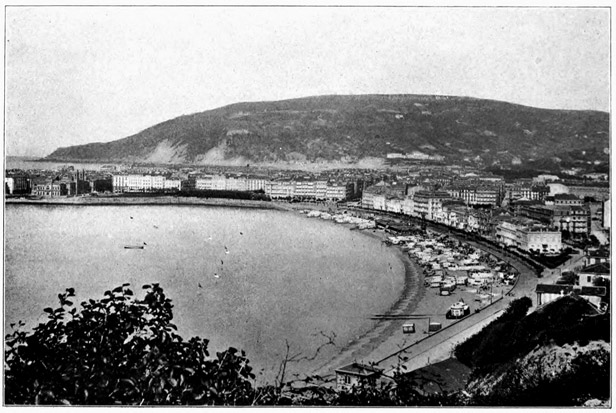
| San Sebastian |
Frontispiece |
| Facing Page |
| Pasajes |
8 |
|
An Arab Gateway in Burgos |
23 |
|
Playing at Bull-fight. From painting by Bayeu |
30 |
|
The Mosque of Cordova |
39 |
|
The Columbus Monument in Granada |
46 |
|
The Alhambra. Hall of Justice |
55 |
|
Filling the Water-jars |
62 |
|
Off for the War. From painting by Rubio |
71 |
|
Looking toward the Darro |
78 |
|
A Milkman of Granada |
101 |
|
A Roman Well in Ronda |
112 |
|
The Giralda |
131 |
|
The Passing of the Pageants |
146 |
|
The Pageant of Gethsemane |
167 |
|
"Jesus of the Passion" |
174 |
|
"Christ of the Seven Words" |
195 |
|
Maria Santisima |
210 |
|
A Spanish Monk. From painting by Zurbarán |
215 |
|
A Seville Street |
222 |
|
An Old-fashioned Bull-fight. From painting by Goya |
243 |
|
The Bull-fight of To-day |
258
|
|
The King of the Gypsies |
275 |
|
Gypsy Tenants of an Arab Palace |
290 |
|
From the Golden Tower down the Guadalquivír |
311 |
|
Cadiz, from the Sea |
318 |
|
The Divine Shepherd. From painting by Murillo |
339 |
|
The Royal Palace in Madrid |
354 |
|
The Royal Family |
359 |
|
The Manzanares |
366 |
|
A Spanish Cemetery |
375 |
|
Toledo |
382 |
|
Toledo Cathedral. Puerta de los Leones |
391 |
|
St. Paul, the first Hermit. From painting by Ribera |
398 |
|
The Maids of Honor. From painting by Velázquez |
407 |
|
Dancing the Sevillana |
414 |
|
Within the Cloister |
423 |
|
The Trampler of the Moors |
430 |
|
Santiago Cathedral. Puerta de la Gloria |
439 |
|
St. James. From painting by Murillo |
446 |
Spanish Highways and Byways
I
"THE LAZY SPANIARD"
"There is a difference between Peter and Peter."—Cervantes: Don Quixote.
"Spain is a contradiction," was the parting word of
the Rev. William H. Gulick, the honored American
missionary whose unwearied kindness looked after
us, during the break in official representation, more effectively
than a whole diplomatic corps. "Spanish blood is a strange
mezcla, whose elements, Gothic, African, Oriental, are at war
among themselves. You will find Spaniards tender and cruel,
boastful and humble, frank and secretive, and all at once. It
will be a journey of surprises."
We were saying good-by, on February 4, 1899, to sunshiny
Biarritz, whither Mrs. Gulick's school for Spanish girls
had been spirited over the border at the outbreak of the war.
Here we had found Spanish and American flags draped together,
Spanish and American friendships holding fast, and a
gallant little band of American teachers spending youth and
strength in their patient campaign for conquering the Peninsula
by a purer idea of truth. Rough Riders may be more
pictorial, but hardly more heroic.
We were barely through the custom house, in itself the
simplest and swiftest of operations, before the prophesied
train of surprises began. One of our preconceived ideas
went to wreck at the very outset on the industry of the
Basque provinces. "The lazy Spaniard" has passed into a
proverb. The round world knows his portrait—that broad
sombrero, romantic cloak, and tilted cigarette. But the laborious
Spaniard can no longer be ignored. Even at Biarritz we
had to reckon with him, for the working population there is
scarcely less Spanish than French. Everybody understands
both languages as spoken, and it is a common thing to overhear
animated dialogue where the talk is all Spanish on the
one side and all French on the other. The war set streams of
Spanish laborers flowing over the mountain bar into French
territory. Young men fled from conscription, and fathers of
families came under pressure of hard times. Skilled artisans,
as masons and carpenters, could make in Biarritz a daily wage
of five francs, the normal equivalent of five pesetas, or a
dollar, while only the half of this was to be earned on their
native side of the Pyrenees. Such, too, was the magic of
exchange that these five francs, sent home, might transform
themselves into ten, eight, or seven and a half pesetas. Even
when we entered Spain, after the Paris Commission had
risen, the rate of exchange was anything but stable, varying
not merely from day to day, but from hour to hour, a difference
of two or three per cent often occurring between
morning and evening. The conditions that bore so heavily
on the crafts were crushing the field laborers almost to starvation.
In point of excessive toil, those peasants of northern
Spain seemed to us worse off than Mr. Markham's "Man
with the Hoe," for the rude mattock, centuries out of date,
with which they break up the ground, involves the utmost
bodily exertion. And by all that sweat of the brow, they
were gaining, on an average, ten or twelve cents a day.
No wonder that discontent clouded the land. We met
this first at Pasajes, on one of the excursions arranged for our
pleasure by the overflow goodness of that missionary garrison.
The busiest of teachers had brought us—a young compatriot
from a Paris studio and myself—so far as San Sebastian,
where she lingered long enough to make us acquainted with
a circle of friends, and, incidentally, with Pasajes. This
Basque fishing hamlet is perched between hill and sea, with
a single rough-paved street running the length of the village
from the Church of St. Peter to the Church of St. John.
Nature has not been chary of beauty here. The mountain-folded
Bay of Pasajes appears at first view like an Alpine
lake, but the presence of stately Dutch and Spanish merchantmen
in these sapphire waters makes it evident that
there must be an outlet to the ocean. Such a rift, in fact,
was disclosed as the strong-armed old ferry woman rowed us
across, a deep but narrow passage (hence the name) between
sheer walls of rock, whose clefts and crannies thrill the most
respectable tourist with longings to turn smuggler. The
village clings with difficulty to its stony strip between steep
and wave. On one side of that single street, the peering stone
houses, some still showing faded coats of arms, are half embedded
in the mountain, and on the other the tide beats
perilously against the old foundation piles.
Above the uneven roofs, on the precipitous hillside, sleep
the dead, watched over by Santa Ana from her neglected hermitage.
Only once a year, on her own feast day, is her
gorgeous altar cloth brought forth and her tall candles lighted,
while the rats, who have been nibbling her gilded shoes and
comparing the taste of the blues and crimsons in her painted
robes, skurry into their holes at the unaccustomed sound of
crowding feet. Pasajes boasts, too, a touch of historical
dignity. From here Lafayette, gallant young Frenchman
that he was, sailed for America, and probably then, as now,
little Basque girls ran at the stranger's side with small hands
full of wild flowers, and roguish Basque boys hid behind
boulders and tried to frighten him by playing brigand, with
a prodigious waving of thorn-branch guns and booming of
vocal artillery.
But not the joy of beauty nor the pride of ancient memory
takes the place of bread. We approached a factory and asked
of the workman at the entrance, "What do you manufacture
here?" "What they manufacture in all Spain, nowadays,"
he answered, "misery." This particular misery, however,
had the form of tableware, the long rows of simple cups and
plates and pitchers, in various stages of completion, being
diversified by jaunty little images of the Basque ball players,
whose game is famous throughout the Peninsula. We finally
succeeded in purchasing one of these for fifteen cents, although
the village was hard put to it to make change for a dollar, and
was obliged, with grave apologies, to load us down with forty
or so big Spanish coppers.
"The lazy Spaniard!" Look at the very children as they
romp about San Sebastian. This is the most aristocratic
summer resort in Spain, the Queen Regent having a châlet on
that artistic bay called the Concha or Shell. It is a crescent of
shimmering color, so dainty and so perfect, with guardian
mountains of jasper and a fringe of diamond surf, that it is
hard to believe it anything but a bit of magical jewel-work.
It might be a city of fairyland, did not the clamor of childish
voices continually break all dreamy spells. What energy and
tireless activity! Up and down the streets, the cleanest
streets in Spain, twinkle hundreds of little alpargatas, brightly
embroidered canvas shoes with soles of plaited hemp. Spanish
families are large, although from the ignorance of the mothers
and the unsanitary condition of the homes, the mortality
among the children is extreme. Here is a household, for
example, where out of seventeen black-eyed babies but three
have fought their way to maturity. Spanish parents are
notably affectionate, but, in the poorer classes, at least, impatient
in their discipline. It is the morning impulse of the
busy mother, working at disadvantage in her small and
crowded rooms, to clear them of the juvenile uproar by
turning her noisy brood out of doors for the day. Surprisingly
neat in their dress but often with nothing save cabbage
in their young stomachs, forth they storm into the streets.
Here the stranger may stand and watch them by the hour as
they bow and circle, toss and tumble, dance and race through
an enchanting variety of games. The most violent seem to
please them best. Now and then a laughing girl stoops to
whisk away the beads of perspiration from a little brother's
shining face, but in general they are too rapt with the excitement
of their sports to be aware of weariness. Such flashing
of eyes and streaming of hair and jubilee of songs!
One of their favorite games, for instance, is this: An especially
active child, by preference a boy, takes the name of
milano, or kite, and throws himself down in some convenient
doorway, as if asleep. The others form in Indian file, the
madre, or mother, at the head, and the smallest girl, Mariquilla,
last in line. The file proceeds to sing:—
| |
"We are going to the garden, |
| |
Although its wicked warden, |
| |
Hungry early and late, |
| |
Is crouching before the gate." |
Then ensues a musical dialogue between the mother and
Mariquilla:—
| Mother. |
Little Mary in the rear! |
| Little Mary. |
What's your bidding, mother dear? |
| Mother. |
Tell me how the kite may thrive. |
| Little Mary [after cautiously sidling up to the doorway and
inspecting the prone figure there]. |
| |
He's half dead and half alive. |
Then the file chants again:—
| |
"We are going to the garden, |
| |
Although its wicked warden, |
| |
Hungry early and late, |
| |
Is crouching before the gate." |
| |
|
| Mother. |
Little Mary in the rear! |
| Little Mary. |
What's your bidding, mother dear? |
| Mother. |
Of the kite I bid you speak. |
| Little Mary [after a second reconnoissance, which sends her
scampering back to her own place]. |
| |
He whets his claws and whets his beak. |
Here the enemy advances, beating a most appalling tattoo:—
| Kite. |
Pum, pum! Tat, tat! |
| Mother. |
Who is here and what is that? |
| Kite. |
'Tis the kite. |
| Mother. |
What seeks the kite? |
| Kite. |
Human flesh! A bite, a bite! |
| Mother. |
You must catch before you dine. |
| |
Children, children, keep the line! |
And with this the dauntless parent, abandoning song for
action, darts with outspread arms in front of the robber, who
bends all his energies to reaching and snatching away Little
Mary. The entire line, keeping rank, curves and twists
behind the leader, all intent on protecting that poor midget
at the end. And when the wild frolic has resulted in her
capture, and every child is panting with fatigue, they straightway
resume their original positions and play it all over again.
In Seville this game takes on a religious variation, the kite
becoming the Devil, and the madre the angel Michael defending
a troop of souls. In Cuba we have a hawk pitted against
a hen with her brood of chickens.
We stepped into a Protestant Kindergarten one day to see
how such stirring atoms of humanity might demean themselves
in school. Talk of little pitchers! Here were some
twoscore tiny jugs, bubbling full of mischief, with one bright,
sympathetic girl of twenty-two keeping a finger on every
dancing lid. Impossible, of course! But all her week's
work looked to us impossible. We had known diligent
teachers in the United States; this "lazy Spaniard," however,
not only keeps her Kindergarten well in hand from nine to
twelve, but instructs the same restless mites—so many of
them as do not fall into a baby-sleep over their desks—in
reading and counting from two to four, gives a Spanish lesson
from six to seven, and struggles with the pathetic ignorance
of grown men and women in the night school from eight to
half-past nine or ten.
The Spanish pastor and his wife, also teachers in day
school, night school, Sunday school, are no less marvels of
industry. The multiplication table, lustily intoned to the
tramp of marching feet, called us into a class-room where the
older girls were gathered for lessons in reading and writing,
arithmetic and geography, sewing and embroidery. The delicate
little lady who presides over this lively kingdom may be
seen on Sunday, seated at the melodeon, leading the chapel
music—an exquisite picture of a Spanish señora, with the
lace mantilla crowning the black hair and gracefully falling to
the slender shoulders. We had heard her give an address on
foreign soil, before an audience of a hundred strangers, speaking
with an irresistible fervor of appeal, and no less charming
was she at the head of her own table, the soul of vivacious
and winsome hospitality.
As for the pastor himself, he carries the administrative
burdens of church and school, teaches the larger boys morning
and afternoon, and the men in the evening, preaches once
on Thursday and twice on Sunday, and slips in between these
stated tasks all the innumerable incidental duties of a missionary
pastorate. And yet this man of many labors is not only
Spanish, but Philippine. His childhood was passed at Cavite,
the home of his father, a Spanish officer, who had chosen his
bride from a native family. The boy was put to school with
the friars at Manila, where, rather to the disgust of the soldier-father,
he formed the desire to enter the brotherhood. He
was not blind—what students are?—to the blemishes of his
teachers. He had often stood by with the other lads and
shouted with laughter to see a group of friars, their cassocks
well girded up, drive a pig into their shallow pond and stab
the plunging creature there, that it might be counted "fish"
and serve them for dinner on Friday. But his faith in the
order held firm, and, when his novitiate was well advanced,
he was sent to Madrid for the final ceremonies. Here, by
chance, he dropped into a Protestant service, and after
several years of examination and indecision, chose the thorny
road.
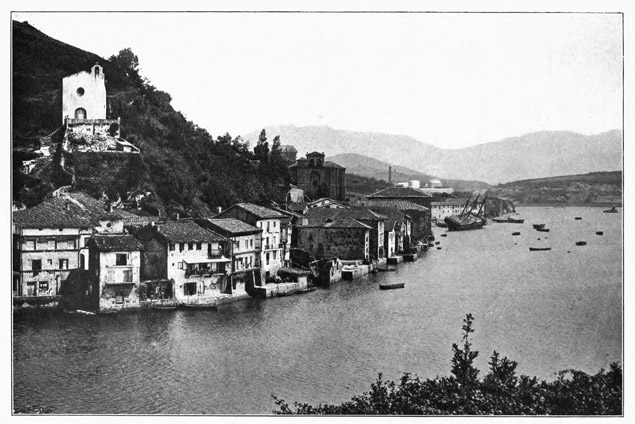
Pasajes
All his wearing occupations do not dull that fine sense of
courtesy inherent in a Spanish gentleman. The sun itself
had hardly risen when we departed from San Sebastian, yet
we found Don Angel at the station, muffled in the inevitable
Spanish capa, to say good-by once more and assure us that,
come what might, we had always "a house and a friend in
Spain." We laid down the local journal, hard reading that
it was with its denunciations of "the inhuman barbarities of
the North Americans toward the Filipinos," and ventured to
ask for his own view of the matter.
"The United States," he answered, speaking modestly and
very gently, "means well and has, in the main, done well.
When I say this in the Casino, men get angry and call me a
Yankee filibuster. But in truth the Philippines are very dear
to me and I carry a sad heart. It was the protocol that did
the mischief. It is not easy for simple islanders to understand
that words may say one thing and mean another. Philippine
faith in American promises is broken. And red is a
hard color to wash out. Yet I still hope that, when the days
of slaughter are over, peace and life may finally come to my
unhappy birthplace from your great nation. The Tagalos
are not so worthless as Americans seem to think, though the
climate of the Philippines, like that of Andalusia, tempts to
indolence. But strong motives make good workers everywhere."
II
A CONTINUOUS CARNIVAL
"This periodical explosion of freedom and folly."—Becquer: El Carnaval.
Having re-formed our concept of a Spaniard to admit
the elements of natural vigor and determined diligence,
we were surprised again to find this tragic
nation, whose fresh grief and shame had almost deterred us
from the indelicacy of intrusion, entering with eager zest into
the wild fun of Carnival. Sorrow was still fresh for the eighty
thousand dead in Cuba, the hapless prisoners in the Philippines,
the wretched repatriados landed, cargo after cargo, at
ports where some were suffered to perish in the streets.
Every household had its tale of loss; yet, notwithstanding
all the troubles of the time, Spain must keep her Carnival.
"It is one of the saddest and most disheartening features of
the situation," said a Spaniard to us. "There is no earnestness
here, no realization of the national crisis. The politicians
care for nothing but to enrich themselves, and the
people, as you see, care for nothing but to divert themselves."
Yet we looked from the madcap crowd to the closed
shutters, keeping their secrets of heartbreak, and remembered
the words of Zorrilla, "Where there is one who laughs,
there is ever another who weeps in the great Carnival of our
life."
The parks of San Sebastian were gay with maskers and
music, tickling brushes and showers of confetti, on our last
day there, but the peculiar feature of the festivity in this
Basque city is "the baiting of the ox." On that Carnival-Sunday
afternoon we found ourselves looking down, from a
safe balcony, upon the old Plaza de la Constitución, with its
arcaded sides. The genuine bull-fights, which used to take
place here, have now a handsome amphitheatre of their own,
where, when the summer has brought the court to San Sebastian,
the choicest Andalusian bulls crimson the sand of the
arena. But the Plaza de la Constitución, mindful of its pristine
glory, still furnishes what cheap suggestions it can of the
terrible play. The square below was crowded with men and
boys, and even some hoydenish girls, many in fantastic masks
and gaudy dominos, while the tiers of balconies were thronged
with eager spectators. A strange and savage peal of music
announced that "the bull" was coming. That music was
enough to make the hereditary barbarian beat in any heart,
but "the bull"! At the further corner of the plaza, pulled
by a long rope and driven by a yelling rabble, came in, at a
clumsy gallop, an astonished and scandalized old ox. Never
did living creature bear a meeker and less resentful temper.
At first, beaten and pricked by his tormentors, he tore
blindly round and round the plaza, the long rope by which
he was held dragging behind him, and sometimes, as he
wheeled about, tripping up and overturning a bunch of the
merrymakers. This was a joy to the balconies, but did not
often happen, as the people below showed a marvellous dexterity
in skipping over the rope just in time to escape its swinging
blow. Sometimes the poor, stupid beast entangled his own legs,
and that, too, was a source of noisy glee. But, on the whole, he
was a disappointing and inglorious ox. He caused no serious
accident. Nothing could ruffle his disposition. The scarlet
cloaks waved in his eyes he regarded with courteous interest;
he wore only a look of grieved surprise when he was slapped
across the face with red and yellow banners; tweaks of the
tail he endured like a Socrates, but now and then a cruel
prod from a sharp stick would make him lower his horns and
rush, for an instant, upon the nearest offender. The balconies
would shout with the hope of something vicious and
violent at last, but the mobile crowd beneath would close in
between the ox and his assailant, a hundred fresh insults
would divert his attention, and indeed, his own impulses of
wrath were of the shortest. To the end he was hardly an
angry ox—only a puzzled, baffled, weary old creature who
could not make out, for the life of him, into what sort of red
and yellow pasture and among what kind of buzzing hornets
his unlucky hoofs had strayed.
Finally he gave the enigma up and stood wrapped in a
brown study among his emboldened enemies, who clung to his
horns and tail, tossed children upon his back, tickled his nostrils
with their hat brims, and showered him with indignities. The
balconies joined in hooting him out of the plaza, but he was
so pleased to go that I doubt if human scorn of his beastly
gentleness really interfered with his appetite for supper. He
trotted away to that rude clang of music, the babies who were
dancing to it on their nurses' arms not more harmless than
he. And although that worrying half hour may have told
upon his nerves, and his legs may have ached for the unaccustomed
exercise, no blood was to be seen upon him. It
was all a rough-and-tumble romp, nothing worse, but the
balconies would have liked it better had it been flavored with
a broken leg or two. A few sprawlings over the rope really
amounted to so little. But the toro de fuego was to come
there Tuesday evening, and when this blazing pasteboard bull,
with fireworks spluttering all over him from horns to tail, is
dragged about among the throng, there is always a fine chance
of explosions, burnings, and even of blindings for life.
But Carnival Tuesday found us no longer in sunny San
Sebastian. We were shivering over a brasero in storied
Burgos, a city chill as if with the very breath of the past.
And the Spanish brasero, a great brass pan holding a pudding
of ashes, plummed with sparks, under a wire screen, is the
coldest comfort, the most hypocritical heater, that has yet
come my way.
Our Monday had been spent in a marvellous journey
through the Pyrenees, whose rugged sublimities were bathed
in the very blue of Velázquez, a cold, clear, glorious blue
expanding all the soul. These are haunted mountains, with
wild legends of lonely castles, where fierce old chieftains,
beaten back by the Franks, shut themselves in with their
treasure and died like wounded lions in their lairs. We
passed fallen towers from whose summits mediæval heralds
had trumpeted the signal for war, ruined convents whence
the sound of woman's chanting was wont to startle the
wolves of the forest, mysterious lakes deep in whose waters
are said to shine golden crowns set with nine precious pearls—those
ducal coronets that Rome bestowed upon her vassals—craggy
paths once trod by pilgrims, hermits, jugglers,
minstrels, and knights-errant, and shadowy pine groves where,
when the wind is high, the shepherds still hear the weeping
ghost of the cruel princess, whose beauty and disdain slew
dozens of men a day until her love was won and scorned, so
that she died of longing.
We had reached Burgos at dusk and, without pausing for
rest or food, had sallied out for our first awe-stricken gaze up
at the far-famed cathedral towers, then had ignominiously
lost our way over and over in the narrow, crooked streets and
been finally marched back to our hotel by a compassionate,
though contemptuous, policeman. My artist comrade was
fairly ill by morning with a heavy cold, but she would not
hear of missing the cathedral and sneezed three or four
enraptured hours away in its chill magnificence. As we
came to know Spanish and Spaniards better, they would
exclaim "Jesús, Maria y José!" when we sneezed, that
the evil spirit given to tickling noses might take flight; but
the Burgos sacristan was too keen to waste these amenities
on stammering heretics. What we thought of the cathedral
is little to the purpose of this chapter. In a word, however,
we thought nothing at all; we only felt. It was our first
introduction to one of the monster churches of Spain, and its
very greatness, the terrible weight of all that antiquity,
sanctity, and beauty, crushed our understanding. Like sleepwalkers
we followed our guide down the frozen length of
nave and aisles and cloisters; we went the round of the
fifteen chapels, splendid presence-chambers where the dead
keep sculptured state; we looked, as we were bidden, on the
worm-eaten treasure-chest of the Cid, on the clock whose
life-sized tenant, Papa-Moscas, used to scream the hours to
the embarrassment of long-winded pulpiteers, on the cathedral's
crown of fretted spires whose marvellous tracery was
chiselled by the angels, and on the "Most Holy Christ of
Burgos," the crucified image that bleeds every Friday.
Fulfilled with amazement, we searched our way back to the
hotel through the sleety rain, ate a shivering luncheon at the
"mesa redonda," that "round table" which is never round,
and agreed to postpone our anticipated visits to the haunts
of the Cid until a less inclement season. For of course we
should come back to Burgos. The proud old city seemed to
fill all the horizon of thought. How had we lived so long
without it? That the stormy afternoon was not favorable
to exploration mattered little. We peeped down from our
balconies into the ancient streets, half expecting the exiled
Cid to come spurring up, seeking the welcome which we, like
all the craven folk of Burgos, must refuse him.
"With sixty lances in his train my Cid rode up the town,
The burghers and their dames from all the windows looking down;
And there were tears in every eye, and on each lip one word:
'A worthy vassal—would to God he served a worthy lord!'
Fain would they shelter him, but none durst yield to his desire.
Great was the fear through Burgos town of King Alphonso's ire.
Sealed with his royal seal hath come his letter to forbid
All men to offer harborage or succor to my Cid.
And he that dared to disobey, well did he know the cost—
His goods, his eyes, stood forfeited, his soul and body lost.
A hard and grievous word was that to men of Christian race;
And since they might not greet my Cid, they hid them from his face."
Meanwhile the streets were a living picture-book. Muffled
cavaliers, with cloaks drawn up and hats drawn down till
only the dance of coal-black eyes, full of fire and fun, was
visible between, saluted our balcony with Carnival impertinence.
Beggars of both sexes, equally wound about with
tattered shawls, reached up expectant hands as if we were
made of Spanish pennies. A funeral procession passed, with
the pale light of tapers, the chanting of priests, with purple-draped
coffin, and mourners trooping on foot—men only,
for in Spain women never accompany their dead either to
church or grave. A troop of infantry, whose dapper costume
outwent itself in the last touch of bright green gloves,
dazzled by, and then came a miscellany of maskers. It
was rather a rag-tag show, take it all in all—red devils
with horns, friars extremely fat, caricatures of English tourists
with tall hats and perky blue eye-glasses, giants, dwarfs, tumblers,
and even a sorry Cid mounted on a sorrier Bavieca.
But the climax of excitement was reached when a novel bull-fight
wheeled into view. It was a stuffed calf this time, set
on wheels and propelled by a merry fellow of the tribe of
Joseph, if one might judge by his multi-colored attire. With
white hood, black mask, blue domino, garnet arms, and yellow
legs, he was as cheery as a bit of rainbow out of that sombre
sky. All the people in sight hastened to flock about him,
policemen left their beats, and servant maids their doorways,
an itinerant band of gypsy girls ceased clashing their tambourines,
the blind beggar opened his eyes, and the small boys
were in ecstasies. For over an hour the populace played
with that mimic bull in this one spot under our windows,
good-humored caballeros lending their scarfs and cloaks to
delighted urchins, who would thrust these stimulating objects
into the calf's bland face and then run for their lives, while the
motley Mask trundled his precious image in hot pursuit behind
them. We were reminded of the scene months after by an
old painting in the Escorial, depicting an almost identical
performance. Spain is not a land of change.
But that teeth-chattering cold, "un frio de todos los demonios,"
eased our farewells to Burgos, and night found us dividing the
privileges of a second-class carriage with two black-bearded
Castilians, who slept foot to foot along the leather-cushioned
seat on the one side, while we copied their example on the
other. I started from my first doze at some hubbub of arrival
to ask drowsily, "Is this Madrid?" "Be at peace, señora!"
cooed one of these sable-headed neighbors, in that tone of
humorous indulgence characteristic of the dons when addressing
women and children. "It is twelve hours yet to Madrid.
Slumber on with tranquil heart." So we lay like warriors
taking our rest, with our travelling rugs, in lieu of martial
cloaks, about us, until the east began to glow with
rose and fire, revealing a bleak extent of treeless, tawny
steppe.
We had only a few days to give to "the crowned city"
then, but those sufficed for business, for a first acquaintance
with the Puerta del Sol and its radiating avenues, a first joy in
the peerless Museo del Prado, and a brilliant glimpse of Carnival.
We found the great drive of the Prado, on Ash Wednesday
afternoon, reserved for carriages and maskers. Stages
were erected along one side of the way, and on the other the
park was closely set with chairs. Stages and chairs were
filled with a well-clad, joyous multitude, diverted awhile from
their pretty labors of shooting roses and showering confetti by
the fascinating panorama before their eyes. The privileged
landaus that held the middle of the road were laden with the
loveliest women of Castile. Carriages, horses, and coachmen
were all adorned, but these showy equipages only served as
setting to the high-bred beauty of the occupants. The cream
of Madrid society was there. The adults were elegantly
dressed, but not as masqueraders. The children in the carriages,
however, were often costumed in the picturesque
habits of the provinces—the scarlet cap and striped shawl of
the Catalan peasant, the open velvet waistcoat, puffed trousers,
and blue or red sash of the Valencian, the gayly embroidered
mantle of the Andalusian mountaineer, the cocked
hat and tasselled jacket of the gypsy. Moors, flower girls,
fairies, French lords and ladies of the old régime, even court
fools with cap and bells, were brightly imaged by these little
people, to whom the maskers on foot seemed to have left the
monopoly of beauty. The figures darting among the landaus,
in and out of which they leaped with confident impudence,
were almost invariably grotesques—smirking fishwives, staring
chimney-sweeps, pucker-mouthed babies, and scarecrows
of every variety. Political satires are sternly forbidden, and
among the few national burlesques, we saw nowhere any
representation of Uncle Sam. He was hardly a subject of
the King of Nonsense then.
Squeaking and gibbering, the maskers, unrebuked, took all
manner of saucy liberties. A stately old gentleman rose from
his cushion in a crested carriage to observe how gallantly a
bevy of ladies were beating off with a hail of confetti and bonbons
an imploring cavalier who ran by their wheels, and when
he would have resumed his seat he found himself dandled on
the knees of a grinning Chinaman. Sometimes a swarm of
maskers would beset a favorite carriage, climbing up beside
the coachman and snatching his reins, standing on the steps
and throwing kisses, lying along the back and twitting the
proudest beauty in the ear or making love to the haughtiest.
This all-licensed masker, with his monstrous disguise and
affected squeal, may be a duke or a doorkeeper. Carnival is
democracy.
Meanwhile the inevitable small boy, whose Spanish variety
is exceptionally light of heart and heels, gets his own fun out
of the occasion by whisking under the ropes into this reserved
avenue and dodging hither and thither among the vehicles, to
the fury of the mounted police, whose duty it is to keep the
public out. One resplendent rider devoted his full energies
for nearly an hour to the unavailing chase of a nimble little
rogue who risked ten of his nine lives under coaches and in
front of horses' hoofs, but always turned up laughing with a
finger at the nose.
Yet this jocund day did not set without its tragedy. A
hot-tempered Madrileño, abroad with his wife, resented the
attentions paid her by one of the maskers and shot him
down. The mortally wounded man was found to be a physician
of high repute. This was not the only misadventure
of the afternoon, a lady losing one eye by the blow of a flying
sugar-plum.
Our next night journey was less fortunate than our first,
though it should be remembered that our discomforts were
partly due to our persistency in travelling second-class. The
carriage had its full complement of passengers, and each of
our eight companions brought with him an unlawful excess of
small luggage. Valises, boxes, bundles, sacks, cans, canes,
umbrellas wedged us in on every side, while our own accumulation
of grips, shawl-straps, hold-alls, and sketching kit
denied us even the relief of indignation. We all sat bolt upright
the night through in an atmosphere that sickens memory.
Not a chink of window air would those sensitive
caballeros endure, while the smoke of their ever puffing cigarettes
clouded the compartment with an uncanny haze that
grew heavier hour by hour. Conversation, which seldom
flagged, became a violent chorus at those intervals when the
conductor burst in for another chapter of his serial wrangle
with a fiery gentleman who refused to pay full fare. Every
don in the carriage, even to the chubby priest nodding in the
coziest corner, had an unalterable conviction as to the rights
and wrongs of that question, and men we had supposed, from
their swaying and snoring, fast asleep, would leap to their
feet when the conductor entered, fling out their hands in
vehement gestures, and dash into the midst of the vociferous
dispute. Lazy Spaniards, indeed! We began to wish that
the Peninsula would cultivate repose of manner. Our tempers
were sorely shaken, and when, in the pale chill of dawn,
we arrived at Cordova, sleepless, nauseated, and out of love
with humanity, we had every prospect of passing a wretched
forenoon.
Thus it is I am inclined to believe we lay down under an
orange tree and dreamed a dream of the "Arabian Nights."
Or perhaps it was only another freak of the Carnival. At all
events, a cup of coffee, and the world was changed. Cordova!
A midsummer heat, a land of vineyards and olive groves,
palms and aloes, a white, unearthly city, with narrow, silent,
deathlike streets, peopled only by drowsy beggars and by gliding
maskers that seemed more real than this Oriental picture
in which they moved, high walls with grated, harem-like
windows, and an occasional glimpse, through some arched
doorway, into a marble-floored, rose-waving, fountain-playing
patio, enchanted and mysterious, a dream within a dream.
Cordova is more than haunted. It is itself a ghost. The
court of the Spanish caliphs, at once the Mecca and the
Athens of the West, a holy city which counted its baths
and mosques by hundreds, a seat of learning whose universities
were renowned for mathematics and philosophy, chemistry,
astronomy, and medicine, and within whose libraries were
treasured manuscripts by hundreds of thousands, a star of art
and poetry, it ever reproaches, by this lovely, empty shadow,
the Christian barbarism that spurned away the Moors.
The insulted Mosque of Cordova well-nigh makes Mohammedans
of us all. Entering by the studded Door of Pardon
into the spacious Court of Oranges, with its ancient trees and
sparkling quintette of fountains, one passes onward under the
Arch of Blessings into a marble forest of slender, sculptured
pillars. The wide world, from Carthage to Damascus, from
Jerusalem to Ephesus and Rome, was searched for the choicest
shafts of jasper, breccia, alabaster, porphyry, until one thousand
four hundred precious columns bore the glory of rose-red
arches and wonder-roof of gilded and enamelled cedar. More
than seven thousand hanging lamps of bronze, filled with perfumed
oil, flashed out the mosaic tints,—golds, greens, violets,
vermilions,—of ceiling, walls, and pavement. All this shining
sanctity culminated in the Mihrâb, or Prayer-Niche, an
octagonal recess whose shell-shaped ceiling is hollowed from
a single block of pure white marble. This Holy of Holies
held the Koran, bound in gold and pearls, around which the
Faithful were wont to make seven turns upon their knees, an
act of devotion that has left indisputable grooves in the marble
of the pavement.
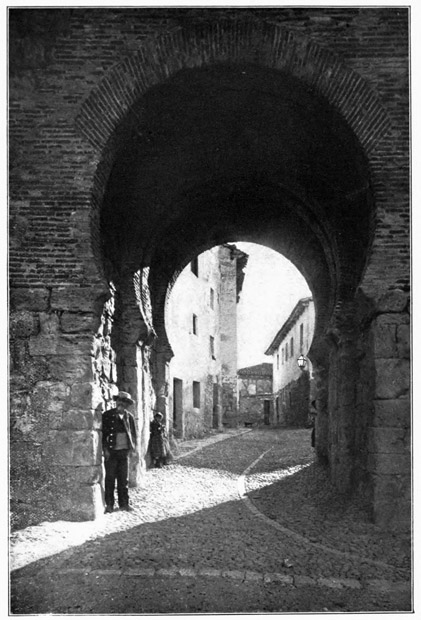
An Arab Gateway in Burgos
The Christian conquerors splashed whitewash over the
exquisite ceiling, hewed down the pillars of the outer aisles to
give space for a fringe of garish chapels, and even chopped
away threescore glistening columns in the centre to make
room for an incongruous Renaissance choir, with an altar of
silver gilt and a big pink retablo. We could have wandered
for endless hours among the strange half-lights and colored
shadows of that petrified faith of Islam, marvelling on the
processes of time. It is claimed that the Arab mosque rose
on the site of a Roman temple, whence Mahomet drove forth
Janus, to be in his own turn expelled by Christ. The race of
those who bowed themselves in this gleaming labyrinth has
fared ill at Spanish hands. Even now a Moor, however courteous
and cultured, is refused admission to certain Castilian
churches, as the Escorial.
How did we ever part from Cordova, from her resplendent,
desecrated mosque, her stone lanes of streets, her hinted
patios, the Moorish mills and Roman bridge of her yellow
Guadalquivír? It must all have been a morning dream, for
the early afternoon saw us tucked away in another second-class
carriage speeding toward Granada.
We were in beautiful Andalusia, la tierra de Maria Santisima.
The green slopes of the Sierra Morena, planted to
the top with olive groves, watched the beginnings of our
journey, and banks of strange, sweet flowers, with glimpses
of Moorish minarets and groups of dark-faced, bright-sashed
peasants, looking as if they had just stepped down from an
artist's easel, beguiled us of all physical discomforts save heat
and thirst. When the sun was at its sorest, the train drew
up at a tumble-down station, and we looked eagerly for the
customary water seller, with his cry of "Water! Fresh
water! Water cooler than snow!" But it was too warm
for this worthy to venture out, and our hopes fastened on a
picturesque old merchant seated in a shaft of cypress shade
beside a heap of golden oranges. Those juicy globes were a
sight to madden all the parched mouths in the train, and
imploring voices hailed the proprietor from window after
window. But our venerable hidalgo smoked his cigarette
in tranquil ease, disdaining the vulgarities of barter. At the
very last moment we persuaded a ragged boy in the throng
of bystanders to fetch us a hatful of the fruit. Then the
peasant languidly arose, followed the lad to our window,
named an infinitesimal price, and received his coin with the
bow of a grandee. He was no hustler in business, this
Andalusian patriarch, but his dignity was epic and his oranges
were nectar.
We shall never know whether or not we had an adventure
that evening. A wild-eyed tatterdemalion swung himself
suddenly into our compartment and demanded our tickets,
but as all the Andalusians looked to our unaccustomed view
like brigands, we did not discriminate against this abrupt
individual, but yielded up our strips of pasteboard without
demur. A swarthy young Moor of Tangier, the only other
occupant of the carriage, sharply refused to surrender his own
until the intruder should produce a conductor's badge, whereupon
the stranger swore in gypsy, or "words to that effect,"
wrenched open the door and fled, like Judas, into the outer
dark. The Moor excitedly declared to us that our tickets
would be called for at the station in Granada, that we should
have to pay their price to the gate-keeper, and that our
irregular collector, hiding somewhere along the train, would
be admitted by that corrupt official to a share in the spoils.
Moved by our dismay, this son of the desert thrust his head
through the window at the next stop, and roared so lustily
for the conductor and the civil guard that, in a twinkling, the
robber, if he was a robber, popped up in the doorway again,
like a Jack-in-the-box, and rudely flung us back the tickets.
Thereupon our benefactor, if he was a benefactor, solemnly
charged us never, on the Granada road, to give up anything
to anybody who wore no gilt on his cap.
More and more the purple mountains were folding us
about, until at last we arrived at Granada, too tired for a
thrill. Mr. Gulick's constant care, which had secured us
harborage in Madrid, had provided welcome here. Content
in mere well-being, it was not until the following afternoon
that tourist enterprise revived within us. Then we somewhat
recklessly wandered down from the Alhambra hill into the
heart of the People's Carnival, a second Sunday of festival
given over to the enjoyment of the lower classes. The
grotesque costumes were coarser than ever and the fun was
rougher. The maskers cracked whips at the other promenaders,
blew horns, shook rattles, and struck about them
with painted bladders, but the balconies were bright with the
bewitching looks of Andalusian beauties, each vying with the
rest in throwing the many-colored serpentinas, curly lengths
of paper that crisp themselves in gaudy fetters about their
captives. A single business house in Granada claimed to
have sold over a million of these, representing a value of
some ten thousand dollars, during Carnival week. Southern
Spain was grumbling bitterly against the Government and
the war taxes, and in Seville, where a tax is put on masks,
the Carnival had been given up this year as last; but Granada
would not be cheated of her frolic. Our study of this closing
phase of the Carnival was cut short by the recollection that it
was, above all, the fiesta of pickpockets. Finding ourselves,
on the superb Paseo del Salón, in the midst of a hooting,
jostling, half-gypsy mob, rained upon with confetti, called
upon in broken French and English, pressed upon by boys
and beggars, and happening to catch sight of the stately
bronze statue of Columbus which the women of Granada
had recently stoned because, by discovering America, he
brought all the Cuban troubles upon Spain, we took the hint
of the wise navigator's eye and decided that we two stray
Yankees might be as well off somewhere else. "Feet, why
do I love you?" say the Spaniards; and so said we, suiting
the action to the word.
III
WITHIN THE ALHAMBRA
"The Sierra Nevada, an enormous dove which shelters under its most spotless
wings Saracen Granada."—Alarcón: Los Seis Velos.
Our surprises were by no means over. We had
come to Granada to bask in the quintessence of
earthly sunshine, and we found bleak rains, dark
skies, and influenza. The Moorish palace was indeed as
wonderful as our lifelong dream of it,—arched and columned
halls of exquisite fretwork, walls of arabesque where flushes
and glints of color linger yet, ceilings crusted with stalactite
figures of tapering caprice, but all too chill, even if the guides
would cease from troubling, for tarrying revery. We tarried,
nevertheless, were enraptured, and caught cold. We were
dwelling in the village on the Alhambra hill, within the circuit
of the ruined fortress, in a villa kept by descendants of the
Moors, but the insolent grippe microbe respected neither
ancient blood nor republican. During the month of our
residence, every member of the household was brought low in
turn, and there were days when even the stubborn Yankees
retreated to their pillows, lulled by the howling of as wild
March winds as ever whirled the grasshopper vane on Faneuil
Hall. From beyond the partition sounded the groans of our
fever-smitten hostess, and from the kitchen below arose the
noise of battle between our sturdy host and the rebel spoons
and sauce-pans. If we could not always swallow his bold
experiments in gruel and porridge, we could always enjoy the
roars of laughter with which that merry silversmith plied his
unaccustomed labors. It is said that there are only three
months of the year when Granada is fit to live in, and certainly
February and March are not of these. But our delighted
spirits had no thought of surrender to our discomfited bodies.
We would not go away. It is better to ache in beautiful
Granada than to be at ease elsewhere.
At the first peep of convalescence, we fled out of doors in
search of a sunbeam and discovered, again to our surprise,
this immemorial Alhambra hill as young as springtime. The
famous fragments of towers, with their dim legends of enchantment,
all those tumbled masses of time-worn, saffron-lichened
masonry, are tragically old, yet the tender petals of peach blossoms,
drifting through the fragrant air, lay pink as baby touches
against those hoary piles. We rested beside many an ancient
ruin overclambered by red rosebuds or by branches laden
with the fresh gold of oranges, where thrushes practised songs
of welcome for the nightingales. We were too early for
these sweetest minstrels of the Alhambra, who, like the Moors
of long ago, were yearning on the edge of Africa for the Vega
of Granada.
One expects, shut in by the crumbling walls of the Alhambra,
in shadow of the ruddy towers, in sound of the Moslem
fountains, to live with dreams and visions for one's company,
to have no associates less dignified than the moonlight cavalcades
of shadowy Arabian warriors, whom the mountain
caverns cast forth at stated seasons to troop once more in
their remembered ways, or lustrous-eyed, lute-playing sultanas,
or, at least, a crook-backed, snow-bearded magician, with a
wallet full of talismans, and footsteps that clink like the gold
of buried treasure. But here again the eternal fact of youth
in the world disconcerts all venerable calculations. The
Alhambra dances and laughs with children—ragamuffins,
most of them, but none the less radiant with the precious joy
of the morning.
They are gentle little people, too. It became well known
on the hill that we were Americans, yet not a pebble or rude
word followed us from the groups of unkempt boys among
whom we daily passed. Once a mimic regiment, with a
deafening variety of unmusical instruments and a genuine
Spanish flag, charged on me roguishly and drew up in battle
square about their prisoner, but it was only to troll the staple
song of Spanish adolescence: "I want to be a soldier," and
when I had munificently rewarded the captain with a copper,
the youngsters doffed their varied headgear, dipped their banner
in martial salute, and contentedly re-formed their ranks. It
was seldom that we gave money, but we usually carried dulces
for the little ones, who, even the dirtiest, have their own pretty
standard of manners.
Some half-dozen pequeñitos, not one of whom was clearly
out of petticoats, were scampering off one day, for instance,
their thanks duly spoken, and their bits of candy just between
hand and mouth, when they turned with one accord, as if
suddenly aware of an abruptness in their leave-taking, and
trotted back to bow them low, their tatters of cap sweeping
the ground, and lisp with all Spanish gravity, "Good afternoon,
señora." One chubby hidalgo tipped over with the
profundity of his obeisance, but the others righted him so
solemnly that the dignity of the ceremonial was unimpaired.
The habit of begging, that plague of tourist resorts, is an
incessant nuisance on the Alhambra hill. Half-grown girls
and young women were the most shameless and persistent of
our tormentors. Age can be discouraged, and babyhood
diverted, while the Spanish boy, if his importunities are met
by smile and jest, will break into a laugh in the midst of his
most pathetic appeals and let you off till next time.
"A little money for our Blessed Lady's sake, señora. I
am starving."
"Wouldn't you rather have a cigarette?"
"And that I would."
"Then you are not starving, little brother. Run away.
I have no cigarettes."
"But you have money for me, señora."
"No, nor enough for myself, not enough to buy one tile
of the Alhambra."
"Then may God take care of you!"
"And of you!"
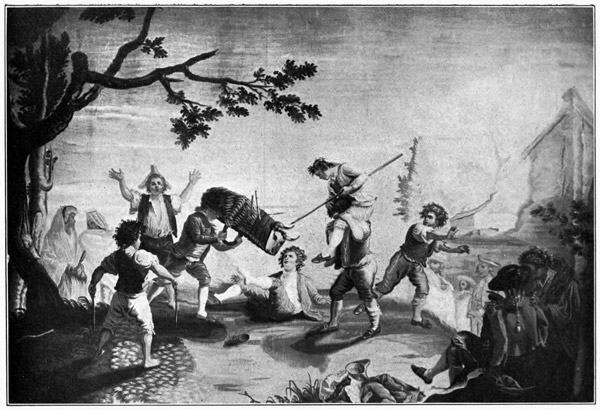
Playing at Bull-Fight
But the wild-haired, jet-eyed gypsy girl from the Albaicín
is impervious to mirth and untouched by courtesy. She
would not do us the honor of believing our word, even when
we were telling the truth.
"Five centimos to buy me a scarlet ribbon! Five centimos!"
"Not to-day, excuse me. I have no change."
"Hoh! You have change enough. Look in your little
brown bag and see."
"I have no change."
"Then give me a peseta. Come, now, a whole peseta!"
"But why should I give you a peseta?"
The girl stares like an angry hawk.
"But why shouldn't you?" Darting away, she hustles
together a group of toddlers, hardly able to lisp, and drives
them on to the attack.
"Beg, Isabelita! Beg of the lady, little Conception! Beg,
Alfonsito! Beg, beg, beg! Beg five centimos, ten centimos!
Beg a peseta for us all!"
And out pop the tiny palms, and the babble of baby voices
makes a pleading music in the air. It is for such as these
that the little brown bag has learned to carry dulces.
Before the month was over we had, in a slow, grippe-chastened
fashion, "done our Baedeker." We had our
favorite courts and corridors in the magical maze of the
Moorish palace; we knew the gardens and fountains of the
Generalife, even to that many-centuried cypress beneath whose
shade the Sultana Zoraya was wont to meet her Abencerrage
lover; our fortunes had been told in the gypsy caves of the
Albaicín; we had visited the stately Renaissance cathedral
where, in a dim vault, the "Catholic Kings," Ferdinand and
Isabella, take their royal rest; we had made a first acquaintance
with the paintings of the fire-tempered Granadine,
Alonso Cano, and paid our dubious respects to the convent
of Cartuja, with its over-gorgeous ornament and its horrible
pictures of Spanish martyrdoms inflicted by that "devil's
bride," Elizabeth of England. We had explored the parks
and streets of the strange old city, where we possessed,
according to the terms of Spanish hospitality, several houses;
but better than the clamorous town we liked our own wall-girdled
height, with its songful wood of English elms, planted
by the Duke of Wellington, its ever murmuring runlets of
clear water, its jessamines and myrtles, its Arabian Nights
of mosque and tower, and its far outlook over what is perhaps
the most entrancing prospect any hill of earth can show.
The sunset often found us leaning over the ivied wall beneath
the Torre de la Vela, that bell-tower where the first cross was
raised after the Christian conquest, gazing forth from our
trellised garden-nook on a vast panorama of gray city all
quaintly set with arch and cupola, of sweeping plain with
wealth of olive groves, vineyards, orange orchards, pomegranates,
aloes, and cypresses, bounded by glistening ranks of
snow-cloaked mountains. From the other side of the Alhambra
plateau, the fall is sheer to the silver line of the
Darro. Across the river rises the slope of the Albaicín, once
the chosen residence of Moorish aristocracy, but now dotted
over, amid the thickets of cactus and prickly pear, with whitewashed
entrances to gypsy caves. Beyond all shine the
resplendent summits of the great Sierras.
Yet it is strange how homely are many of the memories
that spring to life in me at the name of the Alhambra,—decorous
donkeys, laden with water-jars, trooping up the narrow
footpath to the old Fountain of Tears, herds of goats clinging
like flies to the upright precipice, a lurking peasant darting
out on his wife as she passes with a day's earnings hidden
in her stocking and holding her close, with laughter and coaxing,
while he persistently searches her clothing until he finds
and appropriates that copper hoard, and our own cheery little
house-drudge washing our linen in a wayside rivulet and singing
like a bird as she rubs and pounds an unfortunate handkerchief
between two haphazard stones:—
"I like to live in Granada,
It pleases me so well
When I am falling asleep at night
To hear the Vela bell."
There is the proud young mother, too, whom we came upon
by chance over behind the Tower of the Princesses, where
her pot of puchero was bubbling above a miniature bonfire, while
the velvet-eyed baby boy sucked his thumb in joyous expectation.
She often made us welcome, after that, to her home,—a
dingy stone kitchen and bedroom, unfurnished save for
pallet, a few cooking-utensils, a chest or two, and, fastened to
the wall, a gaudy print of La Virgen de las Angustias, the venerated
Patrona of Granada. But this wretched abode, the
remains of what may once have been a palace, opened on a
lordly pleasure-garden with walls inlaid with patterns of rainbow
tiles, whose broken edges were hidden by rose bushes.
There were pedestals and even fragments of images in this
wild Eden, jets of sparkling water and walks of variegated
marble. In the course of the month, English and Spanish
callers climbed the hill to us and encompassed us with kindness,
but we still maintained our incorrigible taste for low
society and used to hold informal receptions on sunny benches
for all the tatterdemalions within sight. Swarthy boys,
wearied with much loafing, would thriftily lay aside their
cigarettes to favor us with conversation, asking many questions
about America, for whose recent action they gallantly
declined to hold us responsible. "It was not the ladies that
made the war," said these modern cavaliers of the Alhambra.
Their especial spokesman was a shambling orphan lad of
some fifteen summers, with shrewd and merry eyes. Nothing
pleased him better than to give an ornamental hitch to the
shabby, bright-colored scarf about his thin, brown throat, and
proceed to expound the political situation.
"You admire the Alhambra? I suppose you have no
palaces in America because your Government is a republic.
That is a very good thing. Our Government is the worst
possible. All the loss falls on the poor. All the gain goes to
the rich. But there are few rich in Spain. America is the
richest country of all the world. When America fought us
it was as a rich man, fed and clothed, fighting a poor man
weak from famine. And the rich man took from the poor
man all that he had. Spain has nothing left—nothing."
"Oh, don't say that! Spain has the Alhambra, and beautiful
churches, beautiful pictures."
"Can one eat churches and pictures, my lady?"
"And a fertile soil. What country outblooms Andalusia?"
His half-shod foot kicked the battle-trampled earth of the
immortal hill contemptuously.
"Soil! Yes. All the world has soil. It serves to be
buried in."
This budding politician graced us with his company one
Sunday afternoon, when we went down into Granada to see
a religious procession. Our Lady of Lourdes, escorted by a
distinguished train of ecclesiastical and civic dignitaries, with
pomp of many shining lights and sonorous instruments, with
peal of church bells and incongruous popping of fireworks,
passed through extended ranks of candle-bearing worshippers,
along thronged streets, where every balcony was hung with
the national red and yellow, to the Church of Mary Magdalene.
There the sacred guest was entertained with a concert,
and thence conducted, with the same processional state, amid
the same reverent salutations of the multitude, back to her
own niche. Our youthful guide showed himself so devout
on this occasion, kneeling whenever the image, borne aloft in
a glory of flowers and tapers, passed us, and gazing on every
feature of the pageant with large-eyed adoration, that we
asked him, as we climbed the hill again, if he would like to
be a priest. But he shrugged his shoulders. "There are
better Christians in Spain than the priests," he answered.
The son of the house, Don Pepe, a young man of five and
twenty, who usually attended us on any difficult excursion,
was also frankly outspoken in his disapproval of the clergy.
He could hardly hold his countenance in passing a Franciscan
friar. "There walks the ruin of Spain," he muttered once,
with bitter accent, turning to scowl after the bareheaded,
brown-frocked figure so common in Granada streets. We
had, indeed, our own little grudge against the friars, for they
were the only men of the city who forced us off the narrow
sidewalks out into the rough and dirty road. All other Granadines,
from dandies to gypsies, yielded us the strip of pavement
with ready courtesy, but the friars, three or four in
Indian file, would press on their way like graven images and
drive us to take refuge among the donkeys.
This escort of ours, formally a Catholic, was no more a
lover of State than of Church. He was eager to get to work
in the world and, finding no foothold, charged up his grievance
against the Government. He was firmly persuaded that
Madrid had sold the Santiago and Manila victories to Washington
for sums of money down,—deep down in official
pockets. But his talk, however angry, would always end in
throwing out the hands with a gesture of despair.
"But what use in revolutions? Spain is tired—tired of
tumult, tired of bloodshed, tired of deceit and disappointment.
A new government would only mean the old dogs with new
collars. We, the people, are always the bone to be gnawed
bare. What use in anything? Let it go as God wills."
The Silvela and Polavieja ministry came in during our stay
at Granada, and the Liberal and Republican chorus against
what was known as the Reactionary Government swelled loud.
"It means the yoke of the Jesuits," growled our burly host.
Our Alhambra dream suffered frequent jars from these ignoble
confusions of to-day. When we were musing comfortably
on the melancholy fortunes of Boabdil, a cheap newspaper
would be thrust before our eyes with an editorial headed
"Boabdil Sagasta." It is always best to do what one must.
Since we could not be left in peace to the imagination of
plumy cavaliers, stars of Moslem and Christian chivalry, who
sowed this mount so thick with glorious memories, we turned
our thoughts to the poor soldiers from Cuba, especially during
the week throughout which they paraded the cities of Spain in
rag-tag companies under rude flags with the ruder motto:
"Hungry Repatriados." Their appearance was so woful that
it became a by-word. A child, picking up from a gutter one
day a mud-stained, dog-eared notebook, cried gleefully, "It's
a repatriado." There was no glamour here, but the courage
and sacrifice, the love and anguish, held good.
Granada had borne her share in Spain's last war sorrow.
So many of her sons were drafted for the Antilles that her
anger against America waxed hot. A few months before our
arrival every star-spangled banner that could be hunted out
in shop or residence was trampled and burned in the public
squares. The Washington Irving Hotel hastened to take
down its sign, and even the driver of its omnibus was sternly
warned by the people to erase those offensive American names
from his vehicle on pain of seeing it transformed into a chariot
of fire. A shot, possibly accidental, whistled through the
office of the English consul, who was given to understand, in
more ways than one, that Spain made little difference between
"the cloaked enemy" and the foe in the field. Meanwhile,
month after month, the recruits were marched to the station,
and the City Fathers, who came in all municipal dignity to
bid the lads godspeed, were so overwhelmed by the weeping
of the women that they forgot the cream of their speeches.
Among the new tales of Spanish valor told us on the
Alhambra hill was this:—
When lots were drawn for military service, one blithe
young scapegrace found in his hand a fortunate high number,
but, walking away in fine feather over his luck, he met the
mother of a friend of his, sobbing wildly as she went. Her
son had been drafted, and the two hundred dollars of redemption
money was as far beyond her reach as those dazzling
crests of the Sierra Nevada are above the lame beggar at the
Alhambra gate. Then the kindly fellow, troubled by her
grief and mindful of the fact that, orphan as he was, his own
parting would be at no such cost of tears, offered to serve in
her boy's stead. Her passion of gratitude could not let his
service go all unrecompensed. Poorest of the poor, she went
about among her humble friends, lauding his deed, until she
had collected, peseta by peseta, the sum of sixteen dollars,
which she thrust into his hands to buy comforts for the campaign.
But another sobbing mother sought him out. He
had saved her neighbor's son; would he not save hers?
Laughing at her logic and moved by her faith in him, he
answered: "I am only one man, señora. I cannot go in
place of two. But here are sixteen dollars. If you can find
a substitute at such a price, the money is yours."
Sixteen dollars is a fortune to hunger and nakedness, and
the substitute was found. As the year wore on those two
mothers did not let the city forget its light-hearted hero, and
a great assembly gathered at the station to honor his return.
A remnant of his comrades descended from the train, but as
for him, they said, he had died in Cuba of the fever months
before.
His was no poetic death like that of the Abencerrages.
Happy Abencerrages! They knew the Alhambra in the
freshness of her beauty. Their last uplifted glances looked
upon the most exquisite ceilings in the world. Their blood
left immortal stains on the marble base of the fountain.
But this young Spaniard, in his obscure Cuban grave, only
one out of the eighty thousand, will promptly be forgotten.
No importa. There must be something better than glory for
the man who does more than his duty.
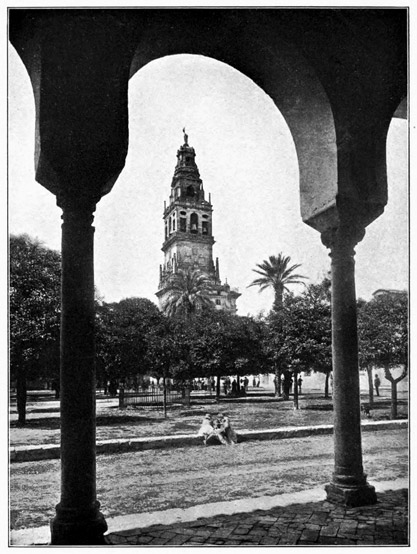
The Mosque of Cordova
IV
A FUNCTION IN GRANADA
"O Love Divine, Celestial Purity,
Pity my cries!
My soul is prone before a clouded throne.
Let thy keen light arise,
Pierce this obscurity
And free my dream-bound eyes!"
—Ganivet's Last Poem.
The civilization of Spain, streaked as it is with
Oriental barbarisms, belated and discouraged as the
end of the nineteenth century finds it, is still in
many respects finer than our own. In everything that
relates to grace and charm of social intercourse, to the dignified
expression of reverence, compassion, and acknowledgment,
Spain puts us to the blush. I was especially touched
in Granada by the whole-souled sympathy and veneration
with which the city rendered public honors to one of its sons,
Angel Ganivet, who died in the preceding winter, a poet
hardly thirty.
Although I had glanced over obituary notices of this
Spanish writer in the Paris papers, I had but a vague idea
of his work and life, and sought, before the night of the
memorial ceremonies, for further information. I appealed,
first of all, to our table waiter, whose keen black eyes instantly
turned sad and tender.
"Pobre! Pobre! He threw himself into the river at Riga,
in Russia, where he was consul. It was at the close of
the war. And he such a genius! So young! So true a
Spaniard! But all Granada will be at the theatre. He left
his play to Granada, asking that it be seen here first of all.
I have never read his books, but I have met him in the streets,
and lifted my hat to him for a wise caballero who cared greatly
for Spain."
My next appeal was to our kind neighbor, the English
consul, who assured me laughingly that he, like myself, was
vainly ransacking the few bookstores of Granada for Ganivet's
works.
"The first time I ever heard the name," he added, "was
some three or four years ago, when I noticed an old gentleman
standing often in front of my house, and gazing at the
British coat-of-arms above my door. He told me one day
when I drew him into talk that he had a nephew, Angel Ganivet,
roaming in foreign lands. 'But he does not forget his
old uncle,' said he. 'I always receive my little pension
prompt to the day, and so I like to look at the foreign shields
about the city, and remember my nephew, far away, who
remembers me.' That was a trifle, of course, but it gave me
a kindly feeling for the young fellow, and I'm sorry he came
to such an end. They found him in the river, you know.
I dare say it was suicide, and likely enough the defeat of
Spain had its share in causing his despondency; but nobody
knows. He was a zealous patriot, I understand, and all
Granada seems to take his death to heart."
My next authority was an aged Granadine, a man of letters;
but he had not read Ganivet's books.
"I have heard of him often," he said, "but I never met
him. He was not much in Granada, although he seems to
have had a romantic affection for the place. Bueno! Its
pomegranates are worth remembering. But Ganivet liked
to live in foreign countries, with the idea of understanding
his own better by comparison. He was young; he still had
hopes for Spain. Eighty years are on my head, and I have
long done with hoping. I have served in my country's
armies, I have served in her Government, I have seen much
of Church and State, and since the night when they murdered
General Prim I have seen nothing good. But Ganivet had
faith in the national future, and the people, without waiting
to ask on what that faith was founded, love him for it,
and mourn his loss as if he had been their benefactor. They
are all going to pour into the theatre to-morrow night to
hear his symbolic drama, that not one in a hundred of them
will try to understand, and the hundredth will get it all
wrong."
The "function" took place in the Gran Teatro de Isabel
la Católica, a name to conjure with throughout all Spain, and
especially in Granada. The day set for the performance,
and widely advertised by newspapers and posters for a
month in advance, was a Wednesday. On Tuesday, in
a fever lest we be too late, we arrived at the ticket office.
We had our hurry all to ourselves. Apparently nobody else
had as yet taken a seat. The office was empty, save for us
and our attendant train of boys and beggars.
The official in charge, deaf, slow, and courteous, invited
us into a private room and gave us rocking-chairs by the
brasero, while he, with paper and pencil, laboriously added the
price of our entradas to the price of our modest box, and
spent five minutes in subtracting the amount from the figure
of the small bill we handed him. The counting out of the
change was another strain on his arithmetic, and, after all
these toils, we were still without tickets. He said he would
"write them out at home," and we might send some one for
them the next day. But he affably offered to show us the
theatre, and led us through black passages to a great dusky
space, where, while he struck match after match, we could
catch glimpses of pit and balconies, and even a far-off stage,
with a group of actors gathered about a lamp, rehearsing the
play. In Wednesday morning's paper, however, they announced
with entire nonchalance that they were not ready
yet, and would postpone the representation until Thursday.
On Thursday evening the theatre, choking full though it
was, hardly presented a brilliant appearance. Granada is not
Madrid, nor Seville, and the best the Granadines had to offer
their dead poet was the tribute of their presence in such guise
as they could command. The big, barnlike theatre, with its
rows of broken lamp-chimneys, looked shabby, and the rag-tag
proportion of the audience was so great that it overflowed
the Paraiso into the aisles and doorways and all conceivable
corners. People were so jumbled and crumpled together
that, with reminiscences of my traveller's hold-all, I found
myself wondering if they would ever shake out smooth again.
Whole families were there, from the infant in arms that
invariably screamed when the actors were reciting any passage
of peculiar delicacy, to the dozing old grandfather, who kept
dropping his cigarette out of his mouth in a way that threatened
to set us all on fire. The gentlemen, even in the boxes
and the stalls, were generally ungloved, and we did not see
a dress suit in the house. Cloaks and neckties were ablaze
with color as usual, but the masculine toilets eluded our
stricter observation; for when the curtain was up, our eyes
were all for the stage, and between acts your Spaniard sits
with hat on head, enveloped in a cloud of tobacco smoke.
But the Andalusian ladies made amends for everything.
By some prehistoric agreement, Spanish women have yielded
the rainbow to the men, reserving for their own attire the
quiet elegance of black or the festive beauty of pure white.
The dress that evening, even in the principal boxes, was
conspicuously simple. But the clear brunette complexions,
the delicate contours, the rich black hair worn high and
crowned with natural flowers, the waving fans and flashing
glances, cast a glamour over the whole scene.
The memorial rites themselves made up in quantity whatever
they might lack in quality, continuing from eight o'clock
till two. An orchestra, organized from Granada musicians
for this occasion, opened the programme. The bust of
Ganivet, wrought by a young Granada sculptor, was reverently
unveiled. The star actor, Fuentes of Granada, who
had undertaken with his troupe to present his fellow-townsman's
drama purely as a labor of love, read an interpretation
written by one of Granada's leading critics. The orchestra
was in evidence again, introducing the first act, entitled
"Faith." After this the orchestra played Bretón's serenade,
"In the Alhambra," and the curtain rose for the second act
on so natural a scene-painting of the famous fortress that the
audience went wild with enthusiasm, and the blushing artist,
also a Granadine, had to be literally shoved from the wings
upon the stage to receive his plaudits.
Between the second act, "Love," and the last act, "Death,"
came an andante elegiaco, "written expressly for this artistic
solemnity" by a Granada composer. Here, again, the appreciation
of the audience was unbounded, and nothing would
do but the reluctant master must leave his box, struggle
through the packed multitude to the conductor's stand, and
take the baton himself for a second rendering from the first
chord to the last. At the close of the third act the orchestra
did its part once more, and the celebration ended, somewhat
incongruously, with a lively bit of modern comedy.
There was imperfection enough, had one been disposed to
look for it. The fifty members of the impromptu orchestra
had hardly brought themselves into accord, the acting was not
of the best Spanish quality, and the players had not half
learned their parts. Every long declamation was a duet, the
prompter's rapid undertone charging along beneath the actor's
voice like a horse beneath its rider. But the audience understood,
forgave, were grateful, and sat with sublime patience
through the long pauses between the acts, repeating one to
another, "They say Fuentes is studying his speeches." As
the caustic old scholar had predicted, most of them, apparently,
did not try to understand the allegory. They applauded the
obviously poetic touches, the palpably dramatic situations, and
when, in the Alhambra act, a gypsy air was sung, the galleries
delightedly caught it up and chorused it over again.
But in general that nondescript assembly looked on in
passive gravity while El Escultor de su Alma was rendered,
as their poet had bidden, in their own theatre and for them.
They may have gathered hints and snatches of that mystical
message from the dead, whose lofty look, fixed in shining
marble, dominated all the house.
The restless Spirit of Man, seeking the perfect Truth,
tears himself loose from the bride of his youth, Heavenly
Faith, and wanders in beggary through the world. Yet
Truth for him can only be the child of his union with Faith,
and in parting from one he has parted from both. In old age,
almost maddened by his wanderings and woes, he meets his
Truth again, full-grown and beautiful, but is so fierce and
wild in his desire to possess her that only Death can reconcile
them—Death and that Heavenly Faith who could not
abandon him, though he had forsaken her.
Ganivet's mother, who, with his brothers, witnessed the
play from behind the scenes, is said to have rejoiced in it as
a last solemn assurance from her son of his secure repose in
the Catholic faith of his fathers. It may not have meant so
much to that great audience, many of whom could neither
read nor write, but those tiers upon tiers of dark Spanish faces
were full of earnestness and of a proud content. However
it may have baffled their heads, this legacy of a play, in its
Alhambra setting, spoke clearly to their hearts. One ragamuffin
said to another, as an all-sufficient criticism, "He was
thinking of Granada when he wrote it."
A few days later, I found and eagerly read Angel Ganivet's
most significant booklet, Idearium, published in the autumn
of 1896, in which he sets forth his dream for the future of
his beloved country.
Ganivet claims that the deepest moral element in Spanish
character is stoicism, "not the brutal and heroic stoicism of
Cato, nor the serene and majestic stoicism of Marcus Aurelius,
nor the rigid and extreme stoicism of Epictetus, but the
natural and humane stoicism of Seneca." He holds that
Seneca, himself a Spaniard, found his philosophy in the inherent
genius of the country, and only gave voice to the
indwelling soul of Spain. The Spanish church, cherishing
this element, became a thing apart from the general Catholicism
of Europe. The long warfare and incidental intercourse
with the Moors stamped Spanish Christianity with its two
other characteristic features of mysticism and fanaticism.
"Mysticism was like a sanctification of African sensuality,
and fanaticism was a turning against ourselves, when the
Reconquest ended, of the fury accumulated during eight
centuries of combat."
The author, muy español, is naturally muy católico, yet he
protests against violence in the repression of other forms of
religion. "Liberty should bring with it no fear." He
believes that Spain is, above all, sui generis, independent and
individual. The representative Spaniard is a free lance, striving
and conquering by his own impulse and under his own
direction, like the Cid of old or Cortes in the field of arms,
like Loyola in the church, like Cervantes in letters. He lays
stress on the achievements of Spanish art—the master paintings
of Velázquez and Murillo, the master dramas of Lope de
Vega and Calderon, as expressing, better than political history
has expressed, that intensification of Spanish life resulting
from the struggle against the Arabs "and making of our
nation a Christian Greece."
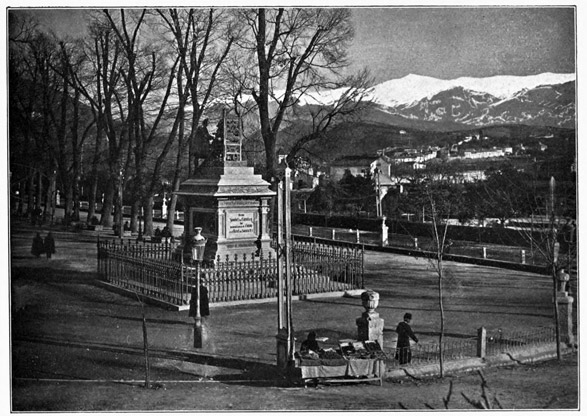
The Columbus Monument in Granada
He finds it logical and right that Spain, after her successive
periods of Roman influence, Visigothic influence, Arab influence,
and her modern era of colonial expansion, should now
abandon foreign policies and concentrate all her vitality within
her own borders. Not by the sword, but by the spirit, would
he have Spain henceforth hold sway over mankind, and especially
over the Spanish-descended peoples of South America.
He winces under the monopoly of the term "American"
by the citizens of the United States—"a formidable nation,"
he admits, "very populous, very rich, and apparently very
well governed." He notes, in contrast, the poverty and
comparative anarchy of the South American republics, but
he urges still that the Spanish character, shaped through such
eventful centuries, is an entity, clear and firm, with qualities
well defined, whereas the Yankees are yet in the fusing pot.
He would have all the peoples of Hispanian descent recognize
and realize in themselves this Spanish individuality, effecting
not a political union, but a "confederation, intellectual and
spiritual," whose first aim should be the preservation of Spanish
ideas and ideals, and the second, the free gift of these to all
the nations of the earth.
The ancient glory of Spain, he says, has vanished like a
dream; let a new and whiter glory dawn. Her career of
material conquest is ended. Those savage struggles have left
her faint and spent. Let her now seek to attain, through
purification and discipline, such fresh fulness of life as shall
insure the triumph of her spiritual forces—her fervent faith
and her unworldly wisdom. "Our Ulysses is Don Quixote."
V
IN SIGHT OF THE GIRALDA
"We were nearing Seville. I felt the eager throbbing of my heart. Seville had
ever been for me the symbol of light, the city of love and joy."—Valdés: La Hermana San Sulpicio.
One of the wise sayings of Andalusia runs, "Do
not squeeze the orange till the juice is bitter."
And so we said good-by to Granada before we
were ready to go, and persuaded ourselves, in defiance of
maps and time-tables, that our shortest route to Seville led by
Ronda. The weather did its very best to dampen our enthusiasm
for this wildest of crag aeries, equally famed for romantic
beauty of outlook and salubrity of air. Men live long in
Ronda, unless, indeed, they hit against a bullet while practising
their hereditary trade of contrabandista. They have a
saying that octogenarians there are only chickens, but one
should not believe all that they say in Ronda. Did we not
clamber, slipping on wet stones, down a precipitous path to
peer, from under dripping umbrellas, at what our guide declared
was an old Roman bridge? "It doesn't look old and
it doesn't look Roman," was the artist's dubious comment,
but our highly recommended conductor, a Gib, as the English-Spanish
natives of Gibraltar Rock are called, assured us that
it was built in the days of Julius Cæsar, but had been wonderfully
well preserved. We eyed him thoughtfully, bearing
in mind that he had already pointed out the statue of a long-dead
poet as a living politician; but we meekly continued
through the lashing rain to follow his long footsteps over the
breakneck ways of that natural fortress where race after race
has left its autograph. The Roman columns of the church
make the Arab cupolas look young, and put the Gothic choir
altogether out of countenance. A bright-shawled peasant
woman, who we fondly hoped might be a smuggler's wife,
drew us delicious water from a Roman well in a Moorish
patio, where a mediæval king of gentle memory used to drink
his wine from cups wrought of the skulls of those enemies
whom he had beheaded with his own sword. But not all this,
and more, could efface our doubts of that Roman bridge, which,
indeed, we found, on a belated perusal of our guide-books, had
been erected by a Malaga architect in the last century.
The street rabble of Ronda was the rudest and fiercest we
encountered anywhere in Spain. Several times our guide
wheeled suddenly to confront some gypsyish lad, creeping up
behind us with stone all ready to throw, and when, at a glint
of sunset through the stormy clouds, we tried to slip out unattended
to the neighboring alameda, with its far-sweeping prospect
of folded mountain ranges and its vertical view of gorge
and rushing river, the children actually hounded us back to the
hotel. Their leader was a scrofulous boy, with one cheek eaten
away, who had been taught to press his face so closely upon
strangers that, in fear of his open sore, they would hastily give
money to keep him back. He was a merry scamp and got a
world of sport out of his sickening business, laughing at the
top of his voice to see himself "avoided like the sun."
Although the tempest had lulled by evening, Ronda, still
inhospitable, would not let us sleep. All up and down the
window-grated street sounded, from midnight to morning, a
tinkling of guitars. It was, forsooth, St. Joseph's Day, and
every Don José, every Doña Josefa, every little Pepe, every
pretty Pepita, must be saluted by a serenade. All Andalusians
are musical, taking much pleasure, moreover, in one of
their own bits of philosophy, "The poorest player has his
uses, for he can at least drive the rats out of the house."
Rats or no, we left Ronda by the morning train.
Our carriage was crowded with several Spaniards and a
"Jew-Gib," who, without saying "oxte ni moxte," assumed
full charge of us and our belongings for the journey. This
unceremonious but really helpful escort put every one of
his fellow-travellers through a sharp catechism as to birthplace,
business, destination, and the like. Our turn came first
of all. "You are English?" "We speak English."
"Ha!" He fell into our own vernacular. "Came about
three thousand miles to Spain?" "Across the channel."
He chuckled with prompt appreciation of the situation and
mendaciously translated to the carriage at large, "The
ladies are distinguished Londoners, on their way to visit relatives
in Seville," whereat the Andalusians smiled sleepily
upon us and asked permission to smoke. We consented
cheerfully, as our Spanish sisters had taught us that we
should. "I like it," one pallid señora had said on an earlier
trip. "It makes me sick, yes, but men ought to be
men."
We were journeying toward the very palace of the sun,
with gray ranks of olive trees standing guard on either hand.
"And posted among them, like white doves, could be seen
now and again a few mills where the bitter olive is wont to
pour its juice." Orange plantations and hedges of the bluish
aloe, fig trees, palms, and all manner of strange, tropical flowers
gladdened our approach to Seville. And when, at last, we
saw from afar the world-praised Giralda, the Moorish bell-tower
of the cathedral, soaring pink into a purple sky, we felt
as if we were really arrived in fairyland.
Our friendly Gib put his tall figure between us and the
howling press of swarthy porters and cab-drivers, scolded,
expostulated, threatened, picked out his men, beat down their
prices, called up a policeman to witness the bargain and take
the number of our cab, raised his hat, and vanished into
grateful memory.
Six weeks in Seville! And six weeks in a Seville home,
where evening after evening the gay youth of Andalusia
laughed and sang, danced and rattled the castanets, and
cast about our wondering Western souls strange witcheries
from which we shall never more go free. It was all as
Oriental as a dream. The Sultana of the South lifted her
gleaming coronet of domes and pinnacles above such a
kingdom of idle, delicious mirth as has permanently unfitted
us for considering it important to do our duty. Our hereditary
bits of Plymouth Rock were melted up in that fervent
heat. Right or wrong? "Where there is music, there can
be no harm." True or false?
"In this world, my masters,
There's neither truth nor lie,
But all things take the color
Of the glass before the eye."
Only six weeks, and yet we shall ever go homesick for
Seville, for her palm trees and orange gardens, her narrow
streets like lanes of shadow, her tiled and statued patios, with
caged birds singing answer to the ripple of the fountain, the
musical midnight cry of her serenos, "her black and burning
eyes like beacons in the dark," her sighing serenaders, "lyrical
mosquitoes," outside the grated window or beneath the
balcony, her fragrances of rose and jessamine, her poetic
sense of values. A homeless Andalusian, dinnerless and in
rags, strums on his guitar, a necessity which he would not
dream of selling for such a mere luxury as bread, and is
happy. There is always sun to sleep in. There are always
piquant faces and gliding forms to gaze after. What more
does a mortal want? Exquisite Seville! No wonder that
her exiled sons still sing, after years of "comfortable living"
in foreign cities:—
"When I am missing, hunt me down
In Andalusia's purple light,
Where all the beauties are so brown,
And all the wits so bright."
Yet the old Arabian enchantment casts a glamour which
the Anglo-Saxon vision dimly recognizes as such and faintly
strives against. To the clear survey all is not charm. Grace,
mirth, and music, on the one hand, are offset by ignorance,
suffering, and vice on the other. Many evil things were told
us, and some ugly things we saw, but to look on Andalusia is
to love her, even while realizing that to live with her would
put that love to a very stringent test.
The lordly Guadalquivír, for instance, so fair to see from
the picture-making summit of the Giralda, as he lingers through
his blooming Paradise, forgetful of the ocean, is not altogether
goodly.
"Ay, ay, the black and stinging flies he breeds
To plague the decent body of mankind!"
The Andalusian leisure was a perpetual delight to us. A
typical Seville shop reaches far along the street front, with
many open doors, and a counter running the full length.
Here ladies sit in pairs and groups, never singly, to cheapen
fans and mantillas, while the smiling salesmen, cigarette in
hand, shrug and gesticulate and give back banter for banter as
gayly as if it were all a holiday frolic. Scraps of the graceful
bargaining would float to our ears.
"Is the quality good?"
"As good as God's blessing."
Among the tempting wares of Seville are Albacete knives,
with gorgeous handles of inlaid ebony, tortoise, or ivory.
The peasant women of Andalusia so resent the charge of
carrying these knives in their garters that the Seville gamin
dodges offence by asking them in an unnecessarily loud voice
if they carry garters in their knives. The irascible dames
do not stand upon fine points of rhetoric, however, and when
the small boy has delivered his shot, he does well to take to
his heels. We once saw one of these sturdy women, while a
line of soldiers, bristling with steel, was holding a street, seize
a gallant son of Mars by the shoulder and swing him, amid
the laughter of his comrades, out of her path as if he were a
cabbage. Nobody knew how to stop her, and she trudged
serenely on, her broad back to those helpless bayonets, down
the forbidden way.
The beggars of Seville are gentler than those of Ronda and
Granada, but hardly less numerous. Mendicant figures are
thick as Guadalquivír mosquitoes in my memory of Andalusia.
Some of those pitiful children will haunt me till I die.
There was a forlorn urchin, with filmy, frightful eyes, to be
seen in all weathers crouching on one side of the road leading
up to the Alhambra, so dull and dreary a little fellow that he
hardly grasped the coppers when they were thrust into his
weakly groping hands, and hardly stayed his monotonous formula
of entreaty for his other monotonous formula of thanks.
There was an idiot child in Seville—a mere lump of deformity—that
would rush out upon the startled stranger with
an inarticulate, fierce little yell, clutching at charity with a
tiny, twisted claw. He seemed the very incarnation of
childish woe and wrong. Almost every hand dived into
pocket for him, and he was probably worth far more to his
proprietors than his rival on the street, a crafty little girl,
with the most lustrous eyes that painter ever dreamed. They
were not blue nor gray, but a living light in which both those
colors had been melted.
The economists, who say so firmly that "nothing should
ever be given to mendicant children," can hardly have had
the experience of seeing Murillo's own cherubs, their wings
hidden under the dirt, fluttering about the car windows at
Andalusian stations. I have it still on my conscience that I
occasionally gave away my comrade's share of our luncheon
as well as my own. She was too young and too polite to
reproach me, but too hungry to be comforted by the assurance
that I reproached myself. Sometimes a foreign traveller, very
sure of his Spanish, would attempt remonstrance with these
small nuisances. I remember one kindly Teuton in particular.
Commerce had claimed him for its own, but the predestined
German professor shone out of his mild blue eyes.
A ragamuffin had mounted the car steps to beg at the window,
and Mein Herr delivered him such a lecture that the youngster
clung to his perch, fascinated with astonishment at the
novel doctrine, until the train was in alarmingly swift motion.
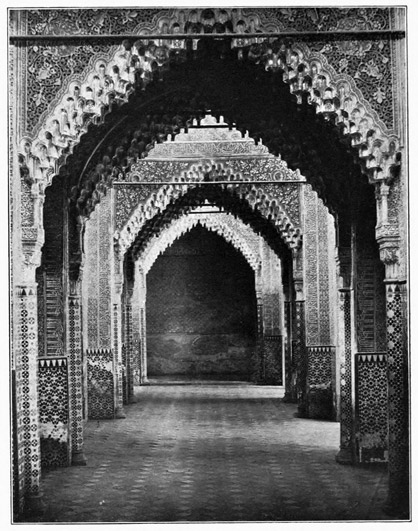
The Alhambra. Hall of Justice
"This is a very bad habit of thine. I told thee so a month
ago."
"Me, sir?"
"Thee, boy. When I passed over this road last, thou
wert begging at the windows, to my shame if not to thine.
Tut, tut! Go thy ways. Look for work, work, work."
"Work, sir?"
"Work, boy. And when thou hast found it, love it, and
do it with a will. Learn to read and write. Wash thy face
and change thy customs, and when thou art richer than I,
then will I give thee a peseta."
Mendicancy is bred of ignorance, and in the seventeen and
a half millions that make up the population of Spain, more
than twelve millions do not read nor write.
Seville sight-seeing is no brief matter. You must climb
the Giralda, walk in the parks, view the yellowed fragments
of the ancient city wall, visit the tobacco factory, shop in
Las Sierpes, buy pottery in Triana, see the gypsy dances in
the cafés, attend the Thursday rag-fair, do reverence to the
Columbus manuscripts in the Biblioteca Columbina, look up the
haunts of Don Juan, Figaro, Pedro the Cruel, and explore the
curious "House of Pilate," which, tradition says, was built by
a pilgrim noble after the Jerusalem pattern. You must lose
your heart to the Alcázar, the Alhambra of Seville, a storied
palace embowered in fountain-freshened gardens of palm and
magnolia, oranges and cypresses, rose and myrtle, with shadowy
arcades leading to marble baths and arabesqued pavilions.
You must follow Murillo from gallery to gallery, from
church to church, above all, from the Hospital de la Caridad,
where hang six of his greatest compositions, to the Museo Provincial,
where over a score of the Master's sacred works,
lovely Virgins, longing saints, deep-eyed Christ-Childs, rain
their sweet influence. And first, last, and always, there is
the cathedral. We had been stunned at Burgos, blind to all
save the Moorish features of Cordova, almost untouched by
the cold splendors of Granada, but to Seville, as later to Toledo,
we surrendered utterly. Beauty, mystery, sublimity—these
are Seville cathedral. Five centuries have gone to the
rearing and enriching of those solemn aisles and awful choir.
The colossal structure, second in size only to St. Peter's, is
a majesty before which Luther himself might well have trembled.
Within a Spanish cathedral one begins to understand
the mighty hold of Roman Catholicism on Spain. "I love,"
says Alarcón, whose jest and earnest are as closely twined
as fibres of the same heart, "the clouds of incense which rise
to the cupola of the Catholic temple, amid the harmonies of
the holy organ. (For this I am not a Protestant.)" And
elsewhere, writing of his childhood, he speaks of receiving in
the cathedral of Guadix all his first impressions of artistic
beauty,—beauty of architecture, music, painting, processional
splendors, tissue of gold and silver, cunning embroideries
and jewel-work, his first sense, in short, of poetry.
And all these impressions were inextricably blent with his
first yearnings of holy aspiration, his first passion of mystical
devotion. But not even Seville cathedral could win over our
full sympathy. Too heavy were the faces of the priests who
"sang the gori gori," too selfish that wigged and jointed doll,
"Our Lady of Kings," with her sixty gorgeous mantles, a few
of which would have clothed all the poor of Andalusia.
Who shall draw the line between faith and superstition?
But let not the tourist suppose he can escape his tyrant
Baedeker even at the top of the Giralda. There are excursions
that must be taken to points of interest outside the city.
Most imperative of all is the trip to the ruined Roman
amphitheatre of Italica, guarded by the mighty names of
Scipio Africanus, Trajan, Hadrian, and Theodosius. Off
we start, a dozen strong, in a great, open carriage, all the
women-folk with fans and veils and with flowers in the hair.
We rattle past the cathedral, over the bridge to Triana and
out into the sweet-breathed country, passing many a picturesque
group on the road,—these two peasants, for example,
with their yellow-handled knives thrust into scarlet girdles,
tossing dice under a fig tree. Our meditations among the
crumbling blocks of that savage play-house would perhaps
interest the reader less than our luncheon. Such Andalusian
dainties as we swallowed,—cold soups like melted salads,
home-made fig marmalade, cinnamon pastes of which the
gypsies know the secret, and sugared chestnuts overflowed
by a marvellous syrup wherein could be detected flavors of
lemon peel, orange peel, and a medley of spices! In that
scene of ancient bloodshed, of the lion's wrath and the martyr's
anguish, we ate, drank, and were merry, but our banquet tasted
of ghosts.
VI
PASSION WEEK IN SEVILLE
"All that was gracious was bestowed by the Virgin, and she was the giver of all
that human creatures could ask for. God frowned, while she smiled; God chastised,
but she forgave; this last notion was by no means a strange one. It is accepted with
almost absolute faith among the laboring classes of the rural parts of Spain."—Galdós:
Marianela.
Holy week throngs Seville to overflowing. The
devout no longer scourge themselves in public,
sprinkling the pavements with their blood, but
Spaniards flock from all Andalusia, from Madrid, and even
from the northern provinces to the sunny city on the storied
Guadalquivír. Hotel charges run from twelve dollars a day
up to incredible figures; a mere bed in a lodging house costs
its three dollars, four dollars, or five dollars a night, and
fortunate are those who enjoy the hospitality of a private
home.
The ceremonies opened Sunday morning with the procession
of palms. We had been told by our cathedral guide the
day before that this procession would take place at seven or
half-past seven at the latest, and had asked the maid to call
us at half-past six. As the chiming bells should have warned
us, her knock was an hour tardy, but when, breakfastless and
eager, we reached the cathedral a few minutes after eight,
there was as yet no sign of a procession. Mass was being
said in the Sagrario and in several chapels, and the morning
light poured in through the rich-colored windows upon groups
of kneeling figures before every shrine. The women wore
black mantillas, for, although this most graceful of headdresses
is losing credit on the fashionable promenades of
Seville, and is almost never seen in open carriages, Holy
Week demands it of all the faithful.
We asked a white-robed young chorister when the procession
would form. He answered with encouraging precision,
"In twenty minutes." We roamed about for a half hour or
more through those majestic spaces, beneath those soaring
arches, aspiration wrought in stone, until by chance in that
shifting multitude we came face to face with our guide of the
day before. We asked how soon the procession would form.
He said, "In twenty minutes," and we went home for
coffee.
When we returned the procession was streaming out of the
cathedral into the street of the Gran Capitán. It was simple
and all the more attractive for that simplicity. The colors
of standards and vestments were mainly purple and gold, and
the long, yellow fronds of palm, blown by the fresh breeze
from the river, gleamed brighter than the sheen of candle or
of mitre. Turning the corner, the procession, now facing
the beautiful Giralda, entered by the ample Door of Pardon,
still incrusted with its Arabic decorations, into the Court of
Oranges, whose ripe fruit gave new touches of gold to the
picture.
Venders of palm were stationed in every sheltered corner,
selling their wares, more than twice the height of a man, at
fifteen cents the frond, while boys, darting about with armfuls
of olive, were glad to take a cent the branch, and not have
the best of their leafy store filched from them by sly old
women, more intent, like the rest of us, on getting a blessing
than deserving it.
Through the multitude the glittering palms and purple
robes swept on back into the cathedral, where the silent and
remote archbishop, an image of gold in his splendid apparel,
shed his benediction not only over the proud palms, but over
every spray of "little gray leaves," like those of Gethsemane.
These blessed palms, sprinkled with holy water and wafting
strange fragrances of incense, would be carried home and
kept in myriad balconies all the year through, to protect the
house from "the all-dreaded thunder-stone."
That Sunday afternoon at five o'clock we were leaning out
expectantly from our host's best balcony. With the constant
Spanish courtesy, he had betaken himself, with the children
of the household, to a less commanding balcony below, and
his eldest son had considerately withdrawn, accompanied by
his fiancée, to a mere speck of a balcony above. This left a
dozen of us, Spanish, English, and American, to enjoy as
good a view as the city afforded of the processional tableaux.
The oblong Plaza de la Constitución, the scene in days gone
by of many a tournament, auto de fe, and bull-fight, is bounded
on one side by the ornate Renaissance façade of the city hall,
and on the other, in part, by the plain front of the court-house,
before which criminals used to be done to death. Private
dwellings, with their tiers of balconies, one of which had
fallen to our happy lot, cross the wider end of the plaza,
while the other opens into the brilliant street of Las Sierpes,
too narrow for carriages, but boasting the gayest shop windows
and merriest cafés of all the town.
The plaza, always animated, fairly rippled with excitement
this Palm Sunday afternoon. The grand stand, erected in
front of the city hall, was filled, although many of the camp-chairs
and benches placed in thick-set rows on the farther
side of the line of march were not yet rented. Thursday and
Friday are the days that draw the multitudes. The crowd
was bright with uniforms, most conspicuous being the spruce
white-edged, three-cornered hats and dark-blue, red-faced coats
of the civil guard. Venders of peanuts, peanut candy, macaroons,
caramels, and all manner of dulces swung their baskets
from one sweet-toothed Spaniard to another, while wisely the
water-seller went in their wake, with the artistic yellow jar
over his shoulder. One young pedler was doing a flourishing
business in crabs, the customers receiving these delicacies
in outstretched pocket handkerchiefs.
Busy as our eyes were kept, we were able to lend ear
to the explanations of our Spanish friends, who told us that
the church dignitaries, after the procession of palms, took
no official part in the shows of Passion Week, although
many of the clergy belonged, as individuals, to the religious
brotherhoods concerned. The church reserves its street displays
for Corpus Christi. These brotherhoods, societies of
ancient origin, and connected with some church or chapel,
own dramatic properties often of great intrinsic value and
considerable antiquity.
For days before Holy Week one may see the members
busy in the churches at the task of arranging groups of sacred
figures, vested as richly as possible in garments of silk and
velvet, with ornaments of jewels and gold, on platforms so
heavy that twenty-five men, at the least, are needed to carry
each. These litters are escorted through the principal streets
and squares of the city by their respective societies, each
brotherhood having its distinctive dress. It is customary for
every cofradia to present two pageants—the first in honor of
Christ; the second, and more important, in honor of Mary,
to whom chivalrous Spain has always rendered supreme homage;
but sometimes the two tableaux are combined into one.
After long watching and waiting we saw, far down Las
Sierpes, the coming of the first procession. A line of police
marched in advance to clear the road. Then appeared a
loosely ordered company of fantastic figures in blue capes
and blue peaked caps, absurdly high and reaching down to
the shoulder, with holes cut for the eyes. From beneath the
capes flowed white frocks, and the gloves and sandals were
white. These "Nazarenes," who looked like a survival of
the Carnival, conducted in silence a litter upon which was
erected an image of the crucified Christ, with face uplifted
as if in prayer.
The pageant halted before the doors of the city hall to
greet the Alcalde, who rose from his red velvet chair and
bared his head. Men uncovered, and people stood all along
the route, but acclamations were reserved for Our Lady of
the Star. Her attendant troop was dressed like the preceding,
with a star embroidered in white on the shoulder of the blue
tunic. Her litter was ablaze with candles and laden with
flowers; her outsweeping train was upborne by four little
pages, and a brass band followed her with unceasing music.
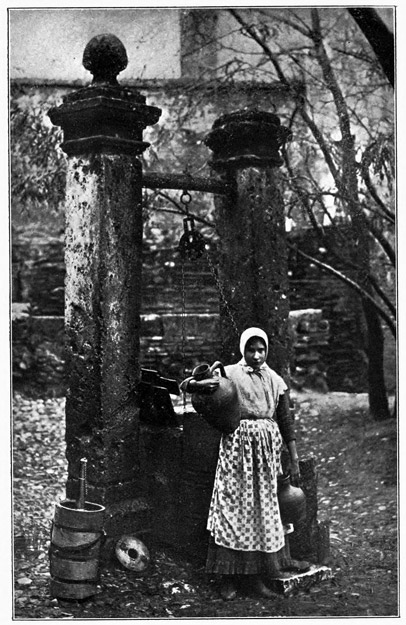
Filling the Water-Jars
Sunset colors were in the sky before the procession of the
second brotherhood arrived. At last, far down the Sierpes,
the dusk was dotted with the gleam of many tapers, and above
these, most impressive in the dim distance, glimmered a white
figure high upon the cross. As the pageant drew near, waves
of incense rolled out upon the air. The crash of trumpets
and deep boom of drums announced that Our Lady of the
Angels was advancing upon the same platform with her Son,
for music in these Passion Week processions is always a sign
of the presence of the Virgin. The brothers of this retinue
wore black, save that their peaked caps were purple.
As twilight gathered, a company of strange dark shapes
bore past in solemn hush the Most Holy Christ of the Waters.
The Saviour hung upon the cross, an angel receiving in a
golden cup the blood from his wounded side. Then her
great banner of white and blue heralded the approach of Our
Lady of the Utter Grief, who passed with her accustomed
pomp of lights and music, holding to her eyes a handkerchief
said to be of the most exquisite lace.
Night had fallen when, at eight o'clock, a maid left on vigil
called us all from the dinner table to see the beautiful procession
of white-robed figures conducting Our Father Jesus of
the Silence. The figure of Christ, resplendent in gold and
purple, stood before Herod, whose mail-clad soldiers guarded
the prisoner. The Roman costumes were so well copied,
and all the postures and groupings so startlingly natural, that
vivas went up all along the crowded square. As the banner
of the Virgin saluted the Alcalde, her attendants let fall their
long white trains, which swept out quite six yards behind,
reaching from one brother to the next and yielding a wonderfully
fine effect in the slow march. Our Lady of the Bitterness,
toward whom leaned the tender look of St. John, was
robed in superb brocade, so precious that her train, which
stood stiffly out behind, was guarded by a soldier with drawn
sword.
This closed the ceremonies of Palm Sunday, and the
throng, catching one from another the blithe, sweet Andalusian
melodies, went singing softly through the darkness on
their various ways.
After Palm Sunday a secular quiet fell upon Seville, not
broken until Wednesday. At five o'clock this March afternoon
it was still so hot that few people were rash enough to
move about without the shelter of parasols. Sevillian priests,
sombre-robed as they were, sauntered cheerily across the plaza
under sunshades of the gayest hues, orange, green, azure, red,
and usually all at once, but the shamefaced Englishmen
flapped up broad umbrellas of an uncompromising black.
There was a breezy flutter of fans on the grand stand, the
water-sellers had to fill their jars again and again, and the
multitude of smokers, puffing at their paper cigarettes to cool
themselves, really brought on a premature twilight.
It was nearly seven before a score of gendarmes, marching
abreast, cleared the way for the procession. Then appeared,
in the usual guise, some twenty feet apart, two files of those
strange shapes, with high, peaked caps, whose visors descended
to the breast, slowly advancing, with an interval of about six
feet from man to man. Their caps and frocks were black,
but the long capes glowed a vivid red. They carried the
customary lighted tapers, so tall that, when rested on the
ground, they reach to the shoulder. Midway between
the files walked a cross-bearer, followed by a Nazarene, who
uplifted the standard of St. Andrew's Cross in red on a black
ground. Bearers of other insignia of the order preceded the
great litter, on which, under a golden palm tree, was represented
by life-size effigies the arrest of Christ among His
Disciples, St. Andrew having the foremost place. The
second pageant presented by this brotherhood was accompanied
by bevies of white-robed boys swinging censers and
chanting anthems. Then came, in effulgence of light, the
Most Holy Virgin, escorted, as if she were the earthly Queen
of Spain, by a detachment of the Civil Guard, whose white
trimmings and gold belts gleamed in the candle rays.
The remaining three cofradias that had part in the Wednesday
ceremonies exhibited but one pageant each. A troop
in black and gold conducted a Calvary, with Mary Mother
and Mary Magdalene both kneeling at the foot of the cross,
robed in the richest velvet. Figures in white, with stripes of
red, came after, with a yet more costly Calvary. The well-carved
crucifix rose from a gilded mound, and Our Mother
of Healing wore a gold crown of exceeding price. But the
third Calvary, all wrought in black and gold, the colors of
the brotherhood, which were repeated in standard and
costume, won the plaudits of the evening. Here Longinus,
the Roman centurion, mounted on a spirited horse, was in the
act of piercing with his lance the Saviour's side. Amid vivas
and bravos this Passion picture passed, like its predecessors,
in clouds of incense and peals of solemn music.
On Thursday the wearing of black was almost universal.
We rummaged our shawl straps for some poor equivalent of
the Spanish black silks and black mantillas. The Civil
Guard was more superb than ever in full-dress uniform, with
red vests and white trousers. No sound of wheels was
suffered within the city limits, and late arrivals had to
commit their luggage to a porter and follow him on foot.
At three o'clock, in the Sagrario of the cathedral, the archbishop
washed the feet of thirteen old paupers, who sat in
two confronting rows, looking neat as wax and happy as
honey, each dressed in a brand-new suit, with a long-fringed
damask towel over his shoulder. Their old blood had been
warmed by the archbishop's own wine, for they had just
come from luncheon in the ecclesiastical palace, where they
had been served by the highest dignitaries of the church and
the proudest nobles of the city. The function of foot washing
was not taken too seriously. The fat canons smiled
good-humoredly on their archbishop, as his group of attendants
lowered him to his knees and lifted him again before
every old man in turn, and the acolytes nudged one another
with boyish mirth over the rheumatic, embarrassed efforts of
the beneficiaries to put on their stockings.
A Franciscan friar mounted the pulpit, however, and
turned the congregation, thickly sprinkled with English
visitors, serious enough by a succinct and fiery sermon, saying,
in a nutshell, that love is the glory of the religious life,
but is the fruit only of Catholicism, for nowhere, though one
searches the world over, can there be found a work of mercy—hospital,
asylum, endowed school, charity of any sort or
kind—due to Protestantism. And the old paupers, glancing
down at their new suits and feeling the glow of their banquet,
were glad to the tips of their purified toes that their lots had
been cast in Catholic Spain.
By six o'clock the squares and streets along the processional
route were thronged again, although our Spanish
friends assured us that the numbers were less than usual.
The war feeling kept the Americans and, to some extent, the
English away, while many of the Spanish of the provinces,
who were accustomed to take their annual outing in Seville
during the Semana Santa, were held at home this year by
poverty or mourning.
The first two pageants of the afternoon, those of the bull-fighters
and the cigarette-makers, were awaited with especial
eagerness. For these Seville brotherhoods, more than thirty
in all, still maintain something of the mediæval structure of
the guilds. Just as in England and France, from the
eleventh to the fifteenth century, or thereabouts, organized
companies of craftsmen used to present in Passion Week
successive scenes from the life of Christ, these Spanish
cofradias to-day maintain such general lines of division in
performing a similar function. Yet any Catholic Sevillian
may, if he chooses, secure admission to any of these societies,
irrespective of his occupation. The young caballero who
chanced to be our prime source of information this Thursday
afternoon was himself of a prominent family, a protégé of
the archbishop, and a student of law, yet he belonged to the
brotherhood of Fruit Venders, although his devotion seemed a
little languid, and he had excused himself on this occasion
from the long march in the breathless Nazarene garb.
Not all the brothers feel bound to perform this penitential
service every Passion Week, and, indeed, not all the brotherhoods.
Several of the most elaborate pageants were missing
from the ranks this year. Such omissions are not as disastrous
to the processional effect as they would have been in
England, for example, some six centuries ago. Then the
gilded and tapestried platforms, set on wheels, which the
processions conducted through the streets, were really stages,
and at the halting places the best actors of each guild played
upon its particular platform an appointed scene from the
sacred drama. The sequence of events was duly observed,
and the spectator, standing in market-place or at street corner,
while one theatre after another rolled by him, saw acted out
with much finery of wardrobe and ingenuity of machinery,
with tragic dialogue and declamation, relieved by comic interludes,
all the Bible story, from the revolt of Lucifer to the
Day of Judgment. But modern Spain, abandoning the acting
and recitation and substituting puppets for living men,
has let slip the dramatic sequence, so that a few pageants less
means only so much abatement in the general splendor of the
spectacle.
The bull-fighters of Andalusia are eminently religious and
are said, likewise, to be remarkable for their domestic virtues.
All their manly fury is launched against the bull, and they
have only gentleness left for wives and children. I have
heard no better argument for the bull ring. At all events,
these toreros, marching soberly in black, with yellow belts,
escorted with well-ordered solemnity an image of the crucified
Christ, followed by a queenly effigy of Our Lady of
Refuge, erect behind terraced ranks of candles on a flower-strewn
litter, under a costly canopy of black velvet embroidered
with gold. The cigarette-makers came after with their
two pageants, Christ fastened to the pillar, and Our Lady of
Victory.
It was, as usual, the second upon which the main expense
had been lavished. A great company of acolytes, richly clad
and swinging censers of pure silver, went in advance of the
Virgin, and three bands of music followed her with continuous
acclaim, while a regiment of soldiers attended as a guard
of honor. Immediately in front of the paso went, surrounded
by officers and aides, General Ochando, his head uncovered
and his breast glittering with decorations, for the young king
of Spain is a member of this cofradia, and had sent the distinguished
military governor of the Provinces, who has a palace
in Seville, to represent him. Especial enthusiasm was called
out by this image of Mary, for the cigarette-makers had just
presented her with a new mantle at a cost of nine thousand
dollars. The brothers were willingly aided by the seven
thousand women who work in the immense tobacco factory,
the average contribution of each donor being two centimos
(two-fifths of a cent) a week during the preceding year. No
wonder that the Virgin seemed to stand proudly upon her silvered
pedestal, her gorgeous new mantle streaming out until
it almost touched the head of a white-vested girl who walked
barefoot close behind the litter, so fulfilling a vow made in
extremity of illness.
Black and white were the banners and costumes of the
third procession, very effective through the deepening dusk.
Their leading pageant was a Gethsemane, famous for the
beauty of the carving. Christ is represented in prayer before
an angel, who bears in one hand the cross and in the other
the cup of bitterness, while Peter, James, and John are sleeping
near their Master. These Passion groups are, with a few
exceptions of still earlier date, works of the seventeenth century,
the glorious period of Spanish art, the day of Murillo and
Velázquez. The most and best are from the hand of the
Sevillian Montañés, of chief repute in the Spanish school of
polychrome sculpture, but this Gethsemane was carved by his
imitator, Roldan, whose daughter, La Roldana, is accredited
with the figure of the angel and with the reliefs that adorn the
pedestal.
Another Virgin, who, like all the rest, seemed a scintillation
of gold and jewels, swept by, and a new troop of Nazarenes,
this time in purple and white, passed with two august pageants,—the
Descent from the Cross and the Fifth Anguish of Mary.
Then came two files of ash-colored figures, who marshalled,
between their rows of starry tapers, each taper bending toward
its opposite, a vivid presentation of the Crowning with Thorns;
and, after this, their Mary of the Valley, noted for the gracious
sweetness of her countenance. This image is held to be one
of Montañés's masterpieces in wood-carving.
Five processions had now passed, with their two pageants
each, and the hour was late, but we could not leave the balcony
for anything so commonplace as dinner. Far down the
street of Las Sierpes waved a river of lights, announcing the
advent of the most ancient of all the Sevillian brotherhoods,
Jesus of the Passion. The crowded plaza rose in reverence
as the Crucifixion paso was borne by, and Our Lady of Mercy,
too magnificent for her name, was greeted with rapturous outcries.
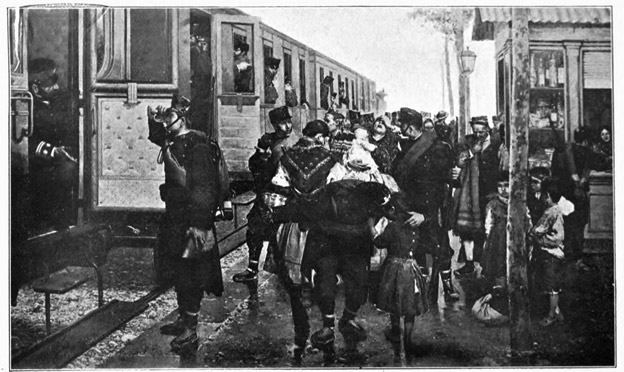
Off for the War
Just how and when and where something in the way
of food was taken, I hardly know, but as this, the last of
the Thursday evening processions, passed in music out of the
plaza, a few of us made speed by a deserted side street to the
cathedral. We were too late for the Miserere, which was just
closing in that surprising hubbub, the stamping of feet and
beating of canes and chairs against the floor, by which Spanish
piety is wont to "punish Judas." But we took our station
near by the entrance to the Royal Chapel, wherein had been
erected the grand Holy Week monument, in white and gold,
shaped like a temple, and shining with innumerable silver
lamps and taper lights. Within this monument the Host,
commonly spoken of in Spain as Su Majestad, had been solemnly
placed the night before, much as the mediæval church
used to lay the crucifix, with requiems, under the High Altar
on Good Friday, and joyously bring it forth again Easter
morning. But Spanish Catholicism is strangely indifferent to
dates, burying the Host on Wednesday and celebrating the
Resurrection Saturday.
All day long the Royal Chapel had been filled with relays
upon relays of kneeling worshippers, and the hush there had
been so profound that the hum of the tourist-haunted nave
and the tumult of the streets seemed faint and foreign to the
hearing, like sounds a universe away. Before this chapel
entrance all the pageants, as they were borne in silence
through the cathedral, paused and did homage to the Host.
Having outstripped the procession, we had arrived in season
to witness three of these salutations. The Nazarenes, in
passing, fell upon their knees in the light of the great, gleaming
monument, and each of the heavy platforms was slowly
swung about so that it faced this symbol of Christ's
sepulchre.
Yet there was something besides devotion in the cathedral.
As the crowd pressed close, we felt, more than once, a fumbling
at our pockets, and the little artist lost her purse. The
rest of us comforted her by saying over and over that she
ought to have known better than to bring it, and by severally
relating how cautious we had been on our own accounts.
It was hard upon eleven when we returned to the house,
but the streets were all alive with people. I went to the balcony
at midnight, and again at the stroke of one, and both
times looked down upon a plaza crossed and recrossed in all
directions by talkative, eager groups. Many of these restless
promenaders had been able to get no lodgings, and were walking
to keep warm. The pressure upon the hotels was so
great that one desperate stranger this Thursday night paid
twenty dollars for a cot from ten o'clock till two, and private
hospitality was taxed to a degree that nothing but Spanish
courtesy and good-nature could ever have endured. In the
house which harbored us, for instance, we were all fitted in
as compactly as the pieces of a puzzle, when the unexpected
friends began to arrive.
On Wednesday there appeared from the far north a man
and wife, acquaintances of ten years back. Our host and
hostess greeted this surprise party with Andalusian sunshine
in their faces, and yielded up their own room. Thursday
morning there walked gayly in one of the son's university
classmates from Madrid. Don Pepe embraced him like a
brother, and surrendered the sofa, which was all he had left to
give. And this Thursday midnight, as a crowning touch,
three more chums of college days came clattering at the bell.
Their welcome was as cordial as if the household were pining
for society. The tired maids, laughing gleefully over the
predicament, contributed their own mattresses and pillows,
and made up beds on the study floor, where Don Pepe camped
out with his comrades, to rise with a headache that lasted for
days after.
By two o'clock I had taken my station on the balcony for
an all-night vigil. The most of the family bore me company
for the cogent reason that they had nowhere to sleep, but the
other guests of the house held out for only an hour or two,
and then went blinking to their repose. My memory of the
night is strangely divided between the dreamlike, unearthly
pomps and splendors streaming through the square below and
the kindly, cheery people who came and went about me. The
señora, still fresh and charming, although she has wept the
deaths of fourteen out of her nineteen children, was merrily
relating, with weary head against her husband's shoulder, her
almost insuperable difficulties in the way of furnishing her
table. The milkman roundly declared that if she wanted a
double quantity of the precious fluid (and goat's milk at that),
she must make it up with water. There was no meat to be
had in the Catholic city during these holy days, and even her
baker had forsaken his oven and gone off to see the sights.
And the black-bearded señor, who, like his wife, had not been
in bed for forty odd hours, laughed at her and comforted her,
puffed harder than ever at his cigarette, and roguishly quoted
the saying, "He whom God loves has a house in Seville."
By two o'clock the seats on the grand stand were filling
fast, the plaza hummed with excitement, the balconies resounded
with song and laughter, and the strong electric lights
in front of the city hall cast a hard, white brilliance over all
the scene. The frying of calientes, an Andalusian version of
twisted doughnuts, was in savory progress here and there on
the outskirts of the throng, and our ever thoughtful hostess
did not fail to keep her balcony well supplied with these
crisp dainties.
The twinkling of taper lights, so warm and yellow under
those pallid globes of electric glare, appeared while people
were still hurrying to their places; but hundreds upon hundreds
of black and gold figures had paced by before the first
of their pasos came into view. For these processions of the
dawn, de madrugada, call out great numbers of the devout,
who would thus keep the last watch with their Lord. The
clocks struck three as the leading pageant, a very ancient
image of Christ, bearing a silver-mounted cross of tortoise-shell,
halted before the Alcalde. A white banner wrought
with gold heralded the Virgin, who rose, in glistening attire,
from a golden lake of lights.
The wealthy cofradia of San Lorenzo followed in their
costly habits of black velvet. They, too, conducted a
pageant of Christ bearing His cross, one of the most beautiful
groups of Montañés, the pedestal adorned with angels in
relief. To the Christ, falling on the Via Dolorosa, the
brotherhood, with the usual disregard of historic propriety,
had given a royal mantle of ermine, embroidered with gold and
pearls. A large company of black-clad women, carrying
candles, walked behind the paso, on their penitential march
of some eight hours. Many of them were ladies delicately
bred, whose diamonds sparkled on the breast of the approaching
Mary. For the Sevillian señoras are accustomed to lend
their most valuable gems to their favorite Virgins for the
Semana Santa, and San Lorenzo's Lady of Grief is said to
have worn this night the worth of millions. She passed amid
a great attendant throng, in such clouds of incense that the
eye could barely catch the shimmer of her silver pedestal, the
gleam of the golden broideries that almost hid the velvet of
her mantle, and the flashes and jets of light that shot from
the incredible treasure of jewels that she wore.
The third troop of Nazarenes, robed in white and violet,
bore for banner a white cross upon a violet ground. Their
Christ-pageant pictured Pilate in his judgment seat in the act
of condemning the Son of God to death. Jesus, guarded by
armed soldiers, calmly confronts the troubled judge, at whose
knee wait two little pages with a basin of water and towels.
And now came one of the most gorgeous features of the
Holy Week processions—a legion of Roman soldiers, attired
as never Roman soldiers were, in gold greaves and crimson
tunics, with towering snow-white plumes. But a splendid show
they made as, marching to drum and fife, they filed down Las
Sierpes and stretched "in never ending line" across the plaza.
Our most Holy Mary of Hope, who followed, wearing a fair
white tunic and a gold-embroidered mantle of green, the color
of the hopeful season, drowned the memory of that stern
military music in a silver concert of flutes.
After this sumptuous display, the fourth band of Nazarenes,
gliding through the plaza between night and day in their garb
of black and white, could arouse but little enthusiasm, although
their Crucifixion was one of the most artistic, and their
Lady of the Presentation had her poorest garment of fine
satin.
A pearly lustre was stealing through the sky, and the chill
in the air was thinning the rows of spectators on the grand
stand, when mysterious, dim-white shapes, like ghosts, bore
by in utter silence a pageant of Christ fainting beneath the
burden of the cross. But soon the clamor of drums and fifes
ushered in another long array of Roman soldiers, a rainbow
host in red and pink and blue, crimson plumes alternating
with white, and golden shields with silver. The electric
lights, globed high overhead, took one look at this fantastic
cavalcade and went out with a gasp.
It was now clear day. Canaries began to sing in their
cages, and parrots to scream for chocolate. Sleepy-eyed servant-maids
appeared on the balconies, and market women,
leading green-laden donkeys, peered forth from the side streets
into the square. The morning light made havoc with the
glamour of the pageants. Something frank and practical in
the sunshine stripped those candle-lighted litters of their dignity.
Busy people dodged through the procession lines, and
one Nazarene after another might be seen slipping out of the
ranks and hurrying awkwardly, in his cumbersome dress, with
the half-burned taper under his arm, to the refuge of his
own mosquito-netting and orange tree. The tired crowd grew
critical and irreverent, and openly railed upon the Virgin of
this ghostly cofradia because her velvet mantle was comparatively
plain. "Bah! how poor it is! Are we to sit here all
the night for such stingy shows as that?"
But the last brotherhood in the madrugada processions had,
with their white frocks and blue caps and capes, suited themselves
to the colors of the day. The stumbling children,
blind with sleep, whom fathers were already leading off the
square, turned back for a drowsy gaze at the resplendent tunic
of the Christ in the Via Dolorosa paso, a tunic claimed to be
the richest of all the garments worn by the effigies of Jesus.
So lovely was this trooping company in their tints of sky and
cloud, bearing a great blue banner and a shining ivory cross,
that they brought order and decorum with them.
The division that escorted the Virgin marched on with
especial steadiness, not a peaked cap drooping, nor a boyish
acolyte faltering under the weight of his tall gilded censer.
This most Holy Mary of Anguish, whose litter and canopy
were all of white and gold, swept by in triumphal peals of
music while the clocks were striking six. In some mental
confusion, I said good night to the people I left on the balcony,
and good morning to the people I met on the stairs, and ate
my breakfast before I went to bed.
It seemed as if human nature could bear no more; the eyes
ached with seeing, and phantasmal processions went sweeping
through our dreams; yet Friday afternoon at five o'clock
found our balcony, like all the rest, full to overflowing.
Some twenty thousand people were massed in the plaza, and it
was estimated that over one hundred thousand waited along
the line of march. Our Spanish entertainers, still unrefreshed
by any chance for sleep, were as gayly and punctiliously attentive
to their guests as ever, from our gallant host, who presented
the ladies with fragrant bouquets of roses and orange
blossoms, to the little pet of the household, who at the most
engrossing moments in the ceremonial would slip away from
her privileged stand on a footstool against the railing to
summon any member of the party who might be missing the
spectacle.
The Spanish colors floated out from city hall and court-house,
but the great concourse below was all in hues of
mourning, the black mantillas often falling over dresses of
plain purple. The señoritas in the balconies had substituted
knots of black ribbon for the customary flowers in the hair.
Jet trimmings abounded, and the waving fans were black.
The coming procession, we were assured on every hand,
would be the most solemn of all and the most sumptuous.
The habits of the Nazarenes would be of satin, silk, and velvet.
The images of Christ and the Virgin would be attired
with all possible magnificence of damask and ermine, gold
and jewels. Brotherhood would vie with brotherhood in
splendor, and one prodigy of luxury would succeed another.
The leading company, whose far-trailing robes carpeted the
street with fine black velvet, stood for the olive industry.
This cofradia had been poor and unimportant for generations,
but in recent years a devoted brother, a manufacturer of olive
packing-barrels, had poured forth his accumulated fortune
upon the society, with the result that their pasos are now
second in ostentation and expense to none. The donor, long
since too feeble to bear his taper in the line, lives in humble
obscurity, but his old heart swells with joy this great day of
the year when he sees, following the elaborate carving of the
Crucifixion, the dazzling chariot of Our Lady of Solitude.
Upon her mantle, which enjoys the proud distinction of being
the very costliest of all, he has lavished twenty thousand dollars.
Longer by a yard than any of the others, it was yet unable
to find place for all the gold which the zealous Nazarene
had given for it, and the residue was bestowed about the pedestal
and canopy. The paso is so heavy with gold that it requires
a double force of men to carry it; but each of these hidden
bearers, getting air as best he can through a silver breathing-tube,
is sure of a dollar for his recompense as well as two
glasses of good wine.
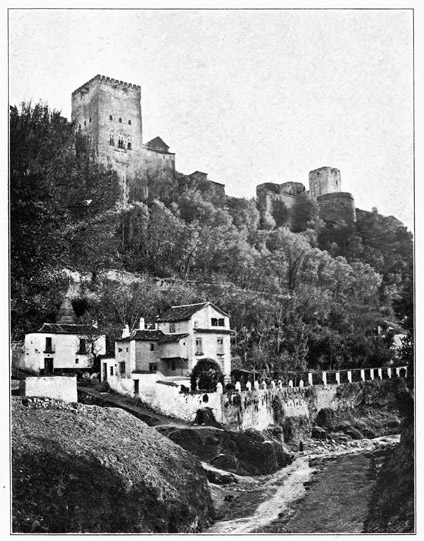
Granada. Looking toward the Darro
All the adornment of the litter is of pure gold, and such
wealth of jewels glinted from the Virgin's glorious raiment
that a triple force of Civil Guards was detailed for her protection.
Her ardent worshipper has denied her nothing.
The very columns that uphold her canopy are exquisite in
carving, and it is his yearly pride to see that her clouds of
incense are the thickest, and her train of musicians the most
extended, in all that glittering line.
The second cofradia exhibited but a single pageant, relying
for effect upon the beauty of the sculpture. The Mater Dolorosa
was bowed in her desolation at the foot of the Holy Rood,
from which hung only the white folds of the winding-sheet.
But the third brotherhood had bethought themselves to
introduce, between their austere Crucifixion and their shining
image of Mary, another preposterous parade of Roman soldiers—flower-colored,
plume-tossing, butterfly creatures far
too bright, if not too good, "for human nature's daily food."
One whiff from Cæsar's iron breast would have blown them
away like soap bubbles.
The silversmiths trooped by in graver, more majestic state,
their purple velvet habits girded with gold cords. Upon a
gilded pedestal, wrought with high relief, was seen their
Christ, bowed beneath a precious cross of tortoise-shell and
silver. Our Lady of Expectation gleamed with gold and gems,
and this haughty brotherhood received a full meed of applause.
Black from top to toe was the fifth procession. Their
Jesus of the Via Dolorosa bent beneath a sombre cross of
ebony embossed with gold, but the blithe young voices of the
countless choir-boys, singing like birds before the dawn, ushered
in a sun-bright image of Mary.
But something was amiss with the processional order.
Where were the stately ranks of Montserrat? Alas and
alas! Scarcely had this aristocratic cofradia gone a hundred
paces from their chapel when, in the narrow street of Murillo,
a leaning candle touched the lace skirt of the Virgin and
instantly all the front of the litter was in flames. It was
hardly a matter of minutes. From the balconies above were
dashed down pailfuls and pitcherfuls of water. The Nazarenes,
wrenching away the blue velvet mantle wondrously
embroidered in gold with castles, lions, and fleurs de lis, succeeded
in rescuing a ragged half of it, and the Civil Guards,
drawing their swords and forming a circle about the smoking
litter, saved the jewels from robbery. Perhaps the other
paso, too, Christ of the Conversion of the Penitent Thief,
had some protecting influence. But in all this ado about her
finery, the poor Virgin's face, beloved for its winsome look,
was completely burned away. In sorry plight Our Lady of
Montserrat was hurried back to her chapel, and the swift rumor
of the disaster sent a superstitious trouble through the city.
But more and more solemnly the taper-bearing troops of
Nazarenes poured by with the culminating pictures of the
Passion. These last three cofradias presented each a single
pageant. An escort in dark purple conducted an impressive
Descent from the Cross. The Virgin, her crowned head
bowed in anguish, clasps the drooping body of Christ to her
heart, while John and Mary Magdalene look on in hopeless
sorrow. Figures in black and white came after, with their
sixteenth-century carving, Christ of the Dying Breath, beneath
the cross standing Our Lady of Tears. And last of all,
in slow, sad movement, their white trains streaming like a line
of light along the stone-paved way, passed the second brotherhood
of San Lorenzo, bearing the Most Blessed Virgin in her
Solitude. The gold of her mantle seemed one with the gold of
the candle rays, and, for many a silent watcher, those gliding,
gleaming, spiritlike forms will move forever down a shining
path in memory. So closed the Holy Week processions.
"How sorry I am," said our host, with the Andalusian
twinkle in his eye. "It is almost eleven o'clock. Ladies
and gentlemen, will you please walk out to dinner?"
On Saturday morning we went early to the cathedral for
the closing rite. The Sagrario was thronged. Some of the
señoras had brought low folding chairs with them, others
sat upon the floor, but most of that innumerable congregation
knelt or stood. We were all facing the great purple veil
which concealed the high altar, with Roldan's retablo of the
Descent from the Cross. There was an hour or more of
expectation, during which rosaries slipped through the fingers
of many a veiled nun, and the soft murmur of prayer came
from strong men as well as from pale-faced women. Suddenly,
while a shock of thunder crashed from the organ, hidden
ministrants sharply drew on hidden cords, the purple
curtain parted in the midst, and the two folds rolled asunder,
revealing the high altar, with its carving of the accomplished
Passion. The organ poured forth jubilees of victory, all the
bells of the cathedral pealed together, Gloria in Excelsis soared
in choral chant, and amid the awe-stricken multitudes fallen
to their knees, Su Majestad was borne in priestly procession
from the tomb in the Royal Chapel to the candles and incense
which awaited at the high altar that triumphal coming.
Easter Sunday was celebrated by a bull-fight.
VII
TRACES OF THE INQUISITION
"I live a life more great than I.
The life I hope is life so high,
I die because I cannot die."
—Santa Teresa de Jesús.
All Spaniards venerate the name of Isabel la Católica,
nor is the impressionable De Amicis the only foreigner
who has trembled and wept at Granada
before the enshrined memorials, jewel box, mirror, missal, and
crown, of her royal womanhood. She is a precious figure in
Spain's sunset revery—a saint beneath a conquering standard,
a silken lady in a soldier's tent. Yet this peerless queen,
merciful, magnanimous, devout, "the shield of the innocent,"
caring supremely for the glory of God and the good of
her country, gave consent, albeit reluctant, to the establishment
of the Inquisition, Christianity's chief scandal and
Spain's most fatal blight. So ironic were the stars of Isabel.
The Inquisition, it is true, originated in Italy early in the
thirteenth century and followed the flight of some of the
Albigenses into Aragon, but its work in Spain had been comparatively
slight and merciful until the "Catholic Kings," in
the interests of religious reform, for the purification of the
national faith, let its horrors loose. Wherever one moves in
Spain the sickening breath of the auto de fe lingers in the air.
In such a square, we read, was once a mighty bonfire of Jews;
beneath our feet, we are told, is a mass of human bones and
cinders. This sunshiny Seville, with her parks and patios,
her palms and orange groves, a city seemingly fashioned only
for love and song, had her army of nearly twoscore thousand
martyrs, who, dressed in the hateful San Benitos, yellow coats
painted with flames and devils, were burned to death here in
our gay Plaza de la Constitución, then known as the Plaza de
San Francisco, and in the Quemadero beyond the walls. As
one mingles with some outdoor throng, all intent on pageant,
dance, or other spectacle, one shudders to remember that
just such dark, eager faces were ringed about the agonies of
those heroic victims. For there are two sides to the Spanish
Inquisition. If Spaniards were the inquisitors, Spaniards,
too, were the dauntless sufferers. The sombre gaze of the
torturer was met, as steel meets iron, by the unflinching eye
of the tortured. But "the unimaginable touch of Time"
transforms all tragedy to beauty, and red poppies, blowing on
the grassy plain of the Quemadero, translate into poetry to-day
that tale of blazing fagots.
Sometimes the victims were of foreign blood. Hakluyt
has preserved the simple narratives of two English sailors,
who were brought by their Spanish captors from the Indies as
a sacrifice to the Holy House of Seville. One, a happy-go-lucky
fellow, Miles Phillips, who had been too well acquainted
in Mexico with the dungeons of the Inquisition, slipped over
the ship's side at San Lúcar, made his way to shore, and boldly
went to Seville, where he lived a hidden life as a silk-weaver,
until he found his chance to steal away and board a Devon
merchantman. The other, Job Hortop, added to his two
years of Mexican imprisonment two more years in Seville.
Then "they brought us out in procession, every one of us
having a candle in his hand, and the coat with S. Andrew's
cross on our backs; they brought us up on an high scaffold,
that was set up in the place of S. Francis, which is in the
chief street of Seville; there they set us down upon benches,
every one in his degree, and against us on another scaffold
sate all the Judges and the Clergy on their benches. The
people wondered, and gazed on us, some pitying our case,
others said, burn those heretics. When we had sat there
two hours, we had a sermon made to us, after which one
called Bresinia, secretary to the Inquisition, went up into the
pulpit with the process, and called Robert Barret, ship-master,
and John Gilbert, whom two Familiars of the Inquisition
brought from the scaffold before the Judges, where the secretary
read the sentence, which was that they should be burnt,
and so they returned to the scaffold, and were burnt.
"Then I, Job Hortop, and John Bone, were called, and
brought to the place, as before, when we heard our sentence,
which was, that we should go to the Galleys, and there to
row at the oar's end ten years, and then to be brought back
to the Inquisition House, to have the coat with S. Andrew's
cross put on our backs, and from thence to go to the everlasting
prison remediless.
"I with the rest were sent to the Galleys, where we were
chained four and four together.... Hunger, thirst, cold,
and stripes we lacked none, till our several times expired, and
after the time of twelve years, for I served two years above
my sentence, I was sent back to the Inquisition House in
Seville, and there having put on the coat with S. Andrew's
cross, I was sent to the everlasting prison remediless, where
I wore the coat four years, and then upon great suit I had it
taken off for fifty duckets, which Hernando de Soria, treasurer
of the king's mint, lent me, whom I was to serve for it as a
drudge seven years."
But this victim, too, escaped in a fly-boat at last, and on
a certain Christmas Eve, about the time when people in
London were beginning to like the comedies of a certain poor
player, one Will Shakespeare, did Job Hortop, Powder-maker
and Gunner, walk quietly, after twenty-three years of martyrdom,
into the village of Redcliffe, where he had been a ruddy
English boy with no dream of the day when he should be
"prest forth" by Sir John Hawkins and compelled, sore
against his will, to embark for the West Indian adventure.
Religious liberty now exists under the laws of Spain,
although the administration of those laws leaves much to be
desired. In three old conventual churches of Seville gather
her three Protestant congregations. Beneath the pavements
of two of these heretic strongholds old inquisitors sleep what
uneasy sleep they may, while one of the Protestant pastors,
formerly a Catholic priest, has quietly collected and stored in
his church-study numerous mementos of the Holy Office. Here
may be seen two of those rare copies of the 1602 revision
of the Spanish Bible, by Cipriano de Valera, whom the
Inquisition could burn only in effigy, since the translator,
who had printed his book in Amsterdam, did not return to
accompany the Familiars to the Quemadero. Here are old
books with horrible woodcuts of the torments, and time-stained
manuscripts, several bearing the seal and signatures
of the "Catholic Kings," these last so ill written that it is
hard to tell the name of Ferdinand from that of Isabella.
Among these are royal commissions, or licenses, granted to
individual inquisitors, records of autos de fe, and wills of rich
inquisitors, the sources of whose wealth would hardly court
a strict examination. Here, too, is the standard of the Holy
Office, the very banner borne through Seville in those grim
processions. Its white silk is saffroned now, but the strange
seal of the Inquisition, a bleeding Christ upon the cross, is
clearly blazoned in the centre, while the four corners show
the seal of San Domingo.
The Inquisition prison, the dreaded Holy House of Seville,
is used as a factory at present, and heresy no longer secures
admission there; but I looked up at its grated windows, and
then, with a secret shiver, down on the ground, where the
Spanish pastor of antiquarian tastes was marking out with his
cane the directions of the far-branching subterranean cells.
We slipped into an outer court of the fabrica, where the two
gentlemen, effectively aided by a couple of sturdy lads, pried
up and flung back a sullen door in the pavement and invited
me to grope my darkling way down some twenty crumbling
steps, overgrown with a treacherous green mould. There was
no refusing, in face of the cloud of witnesses whose groans
these stones had heard, and I took a heart-breaking plunge
into the honeycomb of chill, foul-smelling, horror-haunted
dungeons, whose roofs let fall a constant drip of water and
from whose black recesses I was the unwilling means of
liberating a choice variety of insects.
"But even yet one cannot call one's self a Protestant in
Spain, you know," said an English diplomat to us in another
city of Andalusia. "It's not socially respectable. Spanish
Protestants are the very scum of the earth—illiterate, dirty,
boorish. You couldn't associate with them for a minute."
"But that Spanish pastor who called on us yesterday was
entirely a gentleman," we remonstrated. "He has studied
for seven years in Switzerland and Scotland, seems more
open-minded and intelligent than most Spaniards we have
met, and was so courteous and graceful in his bearing—not
to mention the whiteness of his linen—and so entertaining
in his talk, that the Spanish ladies in the room chorussed his
praises, after he had bowed himself out, and declared him
most delightful company."
The diplomat twirled his mustache and smiled, as only
diplomats can. "And you owned up that he was a Protestant?
And their faces darkened as if a storm-cloud had
blown over from the Sierras?"
"Precisely so," we admitted, "and after that the best they
could say for him was that they never would have thought it."
The diplomat claimed that he had made his point, while we
protested that the incident only went to show how unreasonable
was the prejudice of whose existence throughout Spain
there can be no manner of doubt.
Perez Galdós, for instance, the most popular novelist of
the day, stated to an American friend, who repeated it to us,
that he frankly could not afford to introduce the figure of a
Protestant into one of his stories. "It would not only kill
that book," he said, "but it would hurt the sale of everything
I have in the market and embarrass all my future undertakings.
I should simply be risking the loss of my reading
public." And yet Señor Galdós is the author of "Doña
Perfecta," that artistic study of the conflict between new
ideas and old in Spain. In this significant novel, a civil
engineer, a man of thirty, whose scientific education in the
large cities of Seville and Madrid has been supplemented by
study in Germany and England, comes to one of those mediæval
towns, or corpses of towns, that rise so spectre-like from the ash-colored
plains of Old Castile. Crumbling walls and blackened
towers jealously guard the life of ages since, that feudal life
of high and low, pride of station, pride of animal prowess,
pride of holiness, pride of idleness, pride of ignorance; the
life of superstition, of family exclusiveness resulting in intermarriage
to the point of insanity; of that fierce local bigotry,
peculiarly Spanish, which dreads and hates all foreign intrusion.
The streets, devoid of business activity, swarm with
vigorous mendicants, who have no better shift, when times
grow hard, than to deform the children who are born to them
like kittens in their mud-walled hovels. The casino, where
half the town smokes half its time away, hums with malicious
gossip. The university languidly pursues the studies of Latin,
scholastic divinity, Church history, and all that savors of the
past. Under the gray vault of the cathedral women kneel
before the image of the Christ Child, bringing Him a new
pair of embroidered pantalets and entreating of His rosy
simplicity what they would not dare ask from the "Ecce
Homo"; or they kiss the satin-slippered feet of the miracle-working
Virgin and vow her, if their prayer is granted, seven
bright new swords of the finest Toledo workmanship to pierce
her patient heart. The man of scientific training, fresh from the
modern world, is brought into sharp collision with this dim
old town. High principles and essential, spiritual Christianity
count him for nothing; he is speedily denounced as no
better than "a murderer, an atheist, or a Protestant," and
his strong young life is actually beaten out by that blind,
terrible force of Spanish fanaticism. So far the novelist can
go; such a hero he dares paint; but not a Protestant.
The notions of Protestantism prevalent among the people,
not the peasants only, but the gentry, are little short of ludicrous.
A black-eyed lady of Cadiz was amazed at our
assertion that Protestants prayed. A Madrid señorita asked
us, in friendly confidence, if it were true that Protestants
"denied Christ and spat on the Virgin." The popular
identification of Protestantism with all that is impious and
criminal we encountered as early as our second afternoon in
Spain. We were visiting, in the picturesque fishing-hamlet
of Pasajes, a gaunt Basque church, where the old dame who
served as caretaker showed us a waxen image of a sleeping
girl, said, not without probability, to have been brought from
Rome. Beneath the figure is a burial stone, whose inscription
would locate it in the Catacombs. When friends of
ours were at Pasajes some three years before, the grandam's
story ran that the image was the likeness of a Christian martyr,
slain by her pagan father at Rome in the time of the Imperial
persecutions; but the tale glibly recited to us was this:
"Ay de mi! The poor young lady! Her father was a
Protestant, and, of course, hated religion, and when his
daughter, so beautiful, was on her way to her first communion,
he hid behind a corner, with an axe, and of a sudden jumped
out on her and struck her dead."
It is such prejudice that goes far toward justifying the maintenance
by foreign societies of Protestant churches in Spain.
They cannot stand alone, in face of all this hostility, and yet
the country has need of them. No European nation can
nowadays be shut in to any single channel of religious life,
and doubtless, apart from all questions of creed, there are
Spanish temperaments to which the simpler culto is more natural
than the elaborate ritual of Rome; but, waiving discussion
as to the relative gifts and graces of these two great
divisions of Christ's fellowship, the new seems essential, not
for itself alone, but as a stimulus and corrective to the old.
Time may make it clear that a purified Roman Catholicism
is better suited to the Latin races in general than plainer rites
and less symbolic worship, but there are heavy counts against
the Roman Catholic Church as it exists in Spain. The private
lives of the clergy, as a class, have been so open to
reproach that even the finger-games and nonsense songs of
the little children, learned with their baby lispings, mock
priestly immorality. The Church, steward of untold wealth,
has endowed many charities, but the fundamental trust of
knowledge it has most sluggishly and inadequately dispensed.
Santiago de Compostela, for example, is a very nest of religious
foundations. Thirty-six Christian fraternities are gathered
there, yet we were told on good authority that not one
peasant in a hundred of those within hearing of Santiago's
fivescore and fourteen holy bells can read and write. In
matters of State, the Church has utterly lost the allegiance
of the progressive party and, to a large extent, the political
confidence of the nation. As Spaniards study the history of
their country, they realize more and more that her colossal
mistakes and misfortunes have been due in large measure to
Jesuit and Dominical policy—to the father confessor in the
royal chamber, the inquisitor in shadow of the throne. With
reference to the success of the Church in promoting spiritual
life, a beautiful young nun, her eyes glistening like happy
stars, assured us that there was more devotion in Catholic
Spain than in all the rest of Christendom. A scientist of
repute, his voice choking with grief and wrath, declared to
us that the fetters of superstition had become hopelessly
riveted, during these ages of Church control, on the Spanish
mind. But call it what you will, devotion or superstition,
and admitting, as the tourist must, that it is a most
conspicuous and impressive feature of Spanish life, there are
nevertheless thousands of Spaniards, especially the younger
men, over whom it has lost sway. These are the indiferentes,
many of whom might find, as some have found, in a
fresh presentation of Christianity, the Godward impetus
which they no longer gain from the Church of Rome.
The most cheerful indiferente I encountered in Spain was
a whimsical old philosopher, well on his way to the nineties,
yet so brisk and hardy as almost to vie with Borrow's Portuguese
dame whose hair "was becoming gray" after a life of
one hundred and ten years. His hair, indeed, is white, and
extreme age has written its deforming marks on face and
figure, yet he runs up the steepest stairs, reads the finest print,
fills his days with a close succession of labors and amusements,
and scoffs at religion as airily as if Death had passed
him on the crowded way and would never turn back to look
for him again.
At our first meeting he offered, with characteristic kindness,
to come and read Spanish with me. As I had invaded
Spain for the express purpose of studying the Spanish drama,
I took a volume of Calderon from my trunk and hopefully
awaited his visit. But it was a matter of several visits before
I could open my Calderon. The jaunty old cavalier arrived,
brimming over with chat and anecdote, and when at last I
hinted at the reading, produced with pride from his inner
coat pocket a little, paper-bound geografia that he had written
himself for use in the Spanish schools, and proceeded to regale
me with extracts from its pages. I looked severely at the little
artist, whose eyes were dancing in a demure face, and endeavored
to profit by this unexpected course of instruction. The
author chuckled much over his sagacity in having arranged
the subject-matter of his book in paragraphs and not by
question and answer. In the latter case, he explained, the
children would learn the answers without reading the questions,
a process bound to result in geographical confusion.
The little volume, as is the wont of school books in other
lands, tended to give to its students a disproportionate idea
of the importance of their own country. Spain and her
colonies were treated in seventy pages, Great Britain and
her colonies in three, France in four, while America, from
Greenland to Patagonia, was handled as a single entity, one
figure each, and those absurdly small, being set for "her
population, army, and navy." The Confederación de los Estados
Unidos was barely mentioned as one of the five "States"
of North America.
But the only feature of his book for which the author
felt called upon to apologize, was the catering to popular
superstition, as in stating, for instance, that in the Cathedral
of Santiago de Compostela is adored the veritable body of
St. James. He cast a quizzical glance at me in reading this,
and then laughed himself purple in the face. "One has to
say these things in this country," he gasped, still breathless
from his mirth. "Drops of water must run with the stream.
If only there were a shrine where people might be cured of
being fools!"
Quick-witted as the old gentleman was, he presently detected
a lack of geographical enthusiasm in his audience.
His literary vanity smarted for a moment and then he fell to
laughing, declaring that ladies always had a distaste for useful
information. "That old wife of mine" could not abide
arithmetic. He digressed into an explanation of the Roman
notation, making it quite clear to us wherein IX differs from
XI, and with antiquated courtliness of phrase, even for Spain,
asked our gracious permission to cause himself the pain of
departure.
He often reappeared. His wiry arm, reached through the
Moorish bars of the outer door, would give its own peculiarly
energetic twitch to the bell chain looped within. A maid,
leaning over the railing of an upper story, would call down
the challenge inherited from good old fighting times, "Who
comes here?" And his thin voice would chirp the Andalusian
answer, "Peace."
On his second visit he fairly gurgled with pleasure as he
placed another volume with his name on the title-page before
me. Since I did not incline to solid reading, behold him equally
ready to supply me with the sweets of literature! This, too,
was a school book, a somewhat haphazard collection of Castilian
poems, with brief biographies of the authors represented.
Its novel educational feature was the printing of each poem
in a different type. The result was a little startling to the
eye, but the editor was doubtless right in claiming that it
made the reading harder for the children, and so developed
their powers through exercise. Here, again, he was ashamed
of the fact that fully two-thirds of the poems were religious.
"But what can one do in this country?" he asked testily.
"All the reading books have to be like that. Bah! But we
will not read these pious verses. The others are much more
entertaining."
Determined not to wound him again by any lack of interest
in books of his own shaping, we sat patiently through
page after page of that juvenile school reader; but when, with
a pamphlet on spelling and punctuation, we had completed
the list of his works, I once more called his attention to
Calderon.
This struck him as a capital joke. He had never read
Calderon himself, he had hardly heard of Calderon, and that
a foreigner, a woman at that, should insist on reading Calderon,
was funny enough to make his old sides ache. There
were modern authors in plenty who must certainly write much
better than an out-of-date fellow like that. He had books that
he could lend me. He had friends from whom he could
borrow. But nothing would please me but Calderon! Why
under the fanciful moon should I set my heart on Calderon?
"Bueno!" he cried at last, whisking the mirthful tears
from his eyes. "Vamos á ver! Let us go on and see!"
We opened the classic volume at the Catholic Faust-drama,
El Mágico Prodigioso, and began to read, soon passing into the
great argument between Cipriano and Lucifer as to the nature
of God. Our guest, sensitive to all impressions as he was,
became immediately amazed and delighted.
"But this is lofty!" he exclaimed. "This is sublime!
Good, Cipriano, good! Now you have him! What will
the devil say to that? Vamos á ver!"
At the close of that tremendous scene he shut the book,
fairly panting with excitement. But nevertheless there was
a twinkle in his eye. He knew now why I craved this Calderon.
He was evidently a religious writer, and women were
all religious. It was an amiable feminine weakness, like the
aversion to geography and arithmetic. But his indulgent
chivalry rose to the occasion. Having learned my taste,
such as it was, he would gratify it to the utmost.
"If you would only come and see my library!" he proposed.
"I have exactly the book there that will please you.
I have not read it myself, but it is very large, with most
beautiful pictures, and it tells these old stories about Lucifer
and all that. I am sure it is just what you would like.
Will you not do your humble servant the honor of coming
to-morrow afternoon?"
I ran over in my mind our engagements for the morrow.
He mistook the cause of my hesitation.
"Indeed you need not be afraid to come," he urged.
"My house is as safe as a convent. That old wife of mine,
too, will be sure to be somewhere about. And you can bring
the silent señorita with you."
I was aware of a slight convulsion in "the silent señorita."
She could speak all the Spanish she chose, but she found the
eccentricities of this visitor so disconcerting that she affected
ignorance, and he supposed her mute presence at our interviews
to be purely in deference to the Spanish proprieties.
My youthful chaperon, much elated by this reversal of our
natural positions, duly attended me the next day to our
friend's surprisingly elegant home. He was forever crying
poverty and telling us, with the tears that came to his old
age as easily as the laughter, how the hardships of life had
beaten out of him every ambition save hope to "gain the
bread" until his death, but we found him luxuriously housed,
and I was afterward informed that he was one of the richest
men in the city.
He ran with that wonderful sprightliness of his across the
marbled court to meet us, and ceremoniously conducted us up
the handsome staircase. He led us through all "our house,"
typically Andalusian, with statues and urns of blossoming trees
set in the open patios, with Moorish arches and bright-hued
tiles, shaded balconies, tapestried and curtained beds, braseros,
and rocking-chairs, and in every room images and paintings
of the saints, at which he made irreverent grimaces.
There were family portraits, too, before three of which he
broke down into weeping—the son who had died in the
prime of manhood, the daughter lost in her fair maidenhood,
and, where the stormy sobs shook him from head to foot, the
Benjamin of his heart, a clear-eyed young officer who had
fallen in the Cuban war. The tears were still streaming
down the quivering old face when we turned silently away—for
what word of comfort would Americans dare to speak?—and
followed him to his study.
He was of extravagant repute in his locality as a scholar
and a man of letters, and his study was what a study ought
to be,—well furnished with desk, pigeon-holes, all the
tools of literary labor, and walled with books. Among these
was an encyclopædia in which, to his frank astonishment, he
found an article of fifteen pages on Calderon. The great
volume we had come to see lay open on a reading stand. It
was a Spanish Bible, with the Doré illustrations. I wanted
to look at the title-page, but our eager host, proud to exhibit
and explain, tossed over the leaves so fast that I had no
opportunity.
As he was racing through the Psalms, impatient because
of their dearth of pictures, my eye was caught by the familiar
passage, "As the hart panteth after the water brooks, so
panteth my soul after Thee, O God."
With prompt curiosity, he popped down his white head, in
its close-fitting skullcap, to see what I was noting, and
instantly went off into an immoderate gust of laughter.
"Muy bien!" he wheezed, as soon as he could recover
anything like a voice. "But that is very cleverly put. He
was a witty fellow who wrote that. Just so! Just so!
The deer goes to the water because he means to get something
for himself, and that is why the young men go into the
priesthood, and why the women go to mass. It's all selfishness,
is religion. But how well he says it!"
"No, no!" I exclaimed, for once startled into protest.
"He is saying that religion is the impulse of thirst."
The incorrigible old worldling took this for another jest,
and, as in gallantry bound, laughed harder at my sally than
at poor King David's.
"Excellent! Perfect! So it is! So it is! Religion is
the impulse to fill one's own stomach. Just what I have
always said! 'As the hart panteth after the water brooks'—ho,
ho! I must try to remember that."
His enthusiasm for Calderon soon kindled to a flame. As
the plot thickened he ceased to be of the slightest help in any
difficulties that the text might offer. In vain I would beseech
him to clear up some troublesome passage.
"Oh, never mind!" he would say, vexed at the interruption.
"They didn't write very well in those old days. And
I want to know which of her three suitors Justina took.
Three at once! What a situation! Vamos á ver! I hope
it will be Cipriano."
As the spell of Calderon's imagination passed more and
more strongly upon him, this most sympathetic of readers
quite accepted, for the time being, the poet's Catholic point
of view, trembling for Cipriano and almost choking with
agitated joy when Justina, calling in her extremity upon the
name of God, put Lucifer to flight. But after we had read
the drama to the end, through its final scene of triumphant
martyrdom, he sat silent for several minutes, and then shook
his head.
"Not true; it is not true. There is no devil but the evil
passions of humanity. And as for Cipriano's definition of
God—it is good, yes; it is great, yes; but who can shut
God into a definition? One might as well try to scoop up
the ocean in a cocoanut shell. No! All religions are human
fictions. We have come, nobody knows whence or why, into
this paltry, foolish, sordid life, for most of us only a fight to
gain the bread, and afterward—Bueno! I am on the brink
of the jump, and the priests have not frightened me yet.
Afterward? Vamos á ver!"
This man had heard of Protestantism simply as an ignorant
notion of the lower classes. For the typical Spanish Protestant
of to-day presents a striking contrast to the typical Spanish
Protestant of the Reformation. When heresy first entered
the Peninsula, it gained almost no footing among the common
people, who supposed Luther to be another sort of devil and
the Protestants a new variety of Jews or Moors; but the rank
and learning of Spain, the youthful nobility, illustrious preachers
and writers, officers and favorites of the Court, even men
and women in whose veins flowed the blood royal, welcomed
with ardor the wave that was surging over Europe. The very
eminence of these heretics sealed their doom. The Inquisition
could not miss such shining marks. The Holy Office
did its work with abominable thoroughness. Apart from the
countless multitudes whom it did to death in dungeon and
torture-chamber, it burned more than thirty thousand of the
most valuable citizens of Spain and drove forth from the
Peninsula some three millions of Jews and Moors. The autos
de fe were festivals. Among the wedding pomps for the French
bride of Philip II, a girl thirteen years old, was one of these
horrible spectacles at Toledo. The holiday fires of Seville
and Valladolid drank the most precious blood of Andalusia and
Castile. Though Saragossa had a mind to Huguenot fuel;
though Pamplona, on one festal day, heaped up a holocaust of
ten thousand Jews; though Granada, Murcia, and Valencia
whetted their cruel piety on the Moors who had made the
southern provinces a garden of delight; yet in all these cities,
as in Toledo, Logroño, and the rest, the Spanish stock itself
was drained of its finest and most highly cultivated intelligence,
its sincerest conscience, purest valor, its most original and independent
thought. Spain has been paying the penalty ever
since. Her history from Philip II has been a judgment day.
No root of the Lutheran heresy survived in the Peninsula.
The new Protestantism does not spring from the old. The
blood of the Spanish martyrs was not the seed of the Spanish
church. The Protestant of to-day is far removed, socially
and politically, from the courtiers, marquises, knights of Santiago—those
gallant cavaliers who were stripped upon the
scaffold of their honorable decorations and clad in the yellow
robe of infamy. This nineteenth-century Protestant may be
a lawyer or a journalist, but by exception. Ordinarily he is a
petty farmer, a small shop-keeper, mechanic, miner, day-laborer,
of humble calling and of lowly life. In politics he is almost
surely a republican. When the monarchy was overthrown,
in '68, Protestantism was, for the moment, in favor, and
hundreds of the triumphant party hastened to profess the
reformed faith. With the return of a Roman Catholic court
and perhaps upon the discovery that the new Christianity,
too, has its burden and its yoke, many fell away.
Yet Protestantism has now an assured footing in Spain.
Protestant churches may be found in most of the important
cities. There are some fifty foreign preachers and teachers in
the field, aided by nearly eighty Spanish pastors and colporteurs.
The number of Spanish communicants is between
three and four thousand, the church attendance is reckoned
at nine thousand, and there are five thousand Spanish children
in the Protestant schools. Several centres have been established
for the sale of Bibles and Protestant books, and six or
seven Protestant periodicals are published and circulated. In
answer to the continual Romish taunt that Protestantism is
a war of sects, a house divided against itself, a Protestant
Union was organized at Madrid in the spring of 1899. All,
save two, of the fifteen missions, supported by various societies
of Great Britain, Germany, Switzerland, and America,
joined hands in this. Only the Plymouth Brethren and the
Church of England held aloof.
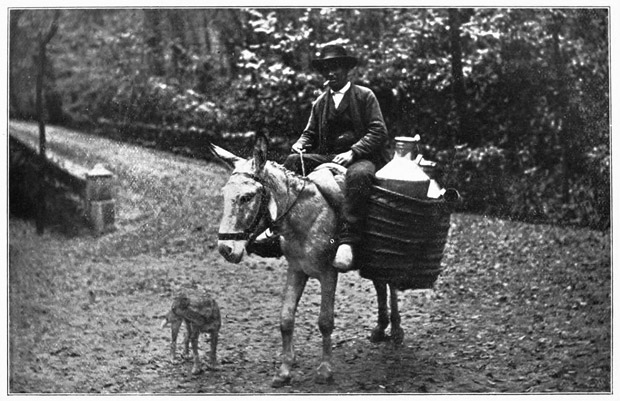
A Milkman of Granada
The Inquisition exists no longer. Religious liberty, even
in Spain, has the support of law. Yet still the Spanish Protestant,
this poor, plain Protestant of to-day, as obscure as
those Galilean fishermen whom the Master called, is harassed
by petty persecutions. Children sing insulting verses after
him in the street, especially that pious ditty:—
"Get away with you, Protestants,
Out of our Catholic Spain,
That the Sacred Heart, the Sacred Heart,
May love our land again."
He is jealously watched on the passing of "His Majesty
the Wafer" and pursued with mud and spittings if he fails to
do it homage. College boys rub charcoal over the front of
his chapel and stone his schoolroom windows; work is refused
him; promotion denied him; his rent is higher than his
neighbor's, yet not his neighbor's family nor his landlord's
cross his threshold. If scorn can burn, he feels the auto de fe.
VIII
AN ANDALUSIAN TYPE
"'True,' quoth Sancho: 'but I have heard say there are more friars in heaven
than knights-errant.' 'It may be so,' replied Don Quixote, 'because their number is
much greater than that of knights-errant.' 'And yet,' quoth Sancho, 'there are abundance
of the errant sort.' 'Abundance indeed,' answered Don Quixote, 'but few who
deserve the name of knights.'"—Cervantes: Don Quixote.
It might have been in Seville, though it was not, that I
met my most simpático example of the Andalusian. He
was of old Sierra stock, merry as the sunshine and
gracious as the shadows. Huge of build and black as the
blackest, he was as gentle as a great Newfoundland dog, until
some flying spark of a word set the dark fires blazing in his
eyes. This was no infrequent occurrence, for the travelling
Englishman, as frank as he is patriotic, cannot comprehend
the zest with which well-to-do Spaniards, even in time of
war, escape military service by a money payment. Not the
height and girth of our young giant, nor his cordial courtesy
and winning playfulness, shielded him from the blunt question,
"Why didn't you go over to Cuba, a great fellow like
you, and fight for your flag?" His usual rejoinder was the
eloquent Southern shrug of the shoulder, twist of the eyebrow,
and waving lift of the hand, with the not easily answerable
words, "And to what good?" But now and then the
query came from such a source or was delivered with so keen
a thrust that his guarded feeling outleaped reserve. The sarcasms
and mockeries that then surged from him in a bitter
torrent were directed chiefly against Spain, although the
American eagle rarely went scot-free. "Ah, yes, it is a
fine fowl, that! He has the far-seeing eye; he has the philanthropic
beak and claw!" But it was the golden lion of
Spain against which his harshest gibes were hurled—"un animal
doméstico, that does not bite."
No one of the party was a tithe as outspoken as our Spaniard
himself in condemning the errors of the Spanish campaign
or censuring the methods of the Spanish Government. If he
turned angrily toward a criticism from a foreigner, it was
only, in the second instant, to catch it up like a ball and toss
it himself from one hand to the other—like a ball that burns
the fingers.
Such wrath can easily be the seamy side of love, and, in a
way, the man's national pride was measured by his national
shame; but always over these outbursts there brooded that
something hopelessly resigned, drearily fatalistic, which seems
to vitiate the Spanish indignation for any purposes of practical
reform. To suggestions of sympathy he responded with a
pathetic weariness of manner, this handsome young Hercules,
so radiant with the joy of life, who, in his normal mood,
sprinkled mirth and mischief from him as a big dog shakes off
water drops.
"What can one do? I am a Spaniard. I say it to myself
a hundred times a day. I am a Spaniard, and I wish my
country were worth the fighting for, worth the dying for.
But is it? Is it worth the toothache? God knows the
truth, and let it rest there. Oh, you need not tell me of its
past. It was once the most glorious of nations. Spaniards
were lords of the West. But—ah, I know, I know—Spain
has never learned how to rule her colonies. He who
sows brambles reaps thorns. The Church, too, has done
much harm in Spain—not more harm than another. I am
a Catholic, but as I see it, priests differ from other men only
in this—in the café sit some bad men and many good, and in
the choir kneel some good priests and many bad. The devil
lurks behind the cross. But Spain will never give up her
Church. It is burned in. You are a heretic, and like my
figure, do you not? It is burned in. There is no hope for
Spain but to sink her deep under the earth, and build a new
Spain on top. And why do I not work for that new Spain?
How may a man work? There is talk enough in Spain as it
is. Most Spaniards talk and do no more. They go to the cafés
and, when they have emptied their cups, they draw figures on
the tables and they talk. That is all. The new Spain will
never come. What should it be? Oh, I know better what
it should not be. It should have no king. A republic—that
is right. Perhaps not a republic precisely like America.
It may be," and the melancholy sarcasm of the tone deepened,
"there could be found something even better. But
Spain will not find it. Spain will find nothing.
"What can one do? I know Spain too well. Now,
hear! I am acquainted with a caballero. I have been his
friend ten years and more. But he has had the luck, not I.
For, first, when we were at the university, he had a fortune
left to him. He became betrothed to a señorita whom he
loved better than his eyelashes. He travelled for his pleasure
to Monte Carlo, and played his fortune all away in one week.
He came back to Madrid, and went to one of the Ministers,
to whom his father had in former days done a great service.
My friend said: 'I am to marry. The lady expects to share
the fortune which I have lost. My position is not honorable.
I must have an opening, a chance to redeem myself,
or I shall stand disgraced before her.' The Minister sent him
to one of the Cuban custom-houses, and in two years he
returned with great wealth. On his wedding journey he
spent a night at Monte Carlo and gambled it away to the
last peseta. A stranger had to lend him money to get home
with his bride. Was he not ashamed and troubled?
Ashamed? I do not know. But troubled? Yes, for he
wanted to play longer. Every one is as God has made him,
and very often worse. Again he went to the Minister, whose
heart was softer than a ripe fig and who found him a post in
the Philippines. This time he made a fortune much quicker
than before, knowing better how to do unjustly, but a few
weeks before the war he came home and lost it all again at
Monte Carlo. And now he is horribly vexed, for it is another
Minister, and, besides, there are no colonies to enrich
him any more.
"What use to care for Spain? No, no, no, no, no! Spain
is a good country to leave—that is all. And you do well to
travel in Spain. American ladies like change, and Spain is
not America. Here you are not only in a different land, but
in a different century. You can say, when you come out,
that you have been journeying a hundred years ago."
On another occasion one of those pleasant individuals who
would, as the Spaniards say, "talk of a rope in the house of
one who had been hanged," saw fit to entertain the dinner-table
with anecdotes of Spanish cruelty.
"But Spaniards are not cruel," protested our young blackamoor
in his softest voice an hour later, stroking with one
great hand the head of a child who nestled against his knee.
"What did that English fellow mean? Why should any one
think that Spaniards are cruel?"
I ran over in mind a few of the frightful stories of Las
Casas, that good Dominican friar who would not hold his
peace when he saw the braining of Indian babies and roasting
of Indian chiefs. I remembered how De Soto tossed his
captives to the bloodhounds, and what atrocities were wrought
in the tranquil realm of the Incas; I recalled the horrors of
the Inquisition, but these things were of the past. So I
answered, "Perhaps the bull-fights have done something to
give foreigners that impression."
Unlike many educated Spaniards who would rather attend
the bull-fights than defend them, he squared his shoulders for
an oration.
"The bull-fights? But why? Bull-fights are not cruel—not
more cruel than other sports in other countries. I
have been told of prize-fights in America. I beg your
pardon. I see by your look that you do not like them.
And, in truth, I do not altogether like the bull-fights. The
horses! They are blindfolded, and it is short, but I have
seen—ah, yes! You would not wish to hear what I have
seen. I have been often sorry for the horses. Yet some
pain is necessary in everything, is it not? In nature, perhaps?
In society, perhaps? Even, if you will pardon the illustration,
in the deliverance of the Filipinos from Spanish tyranny?"
I briefly suggested that there was no element of necessity
in bull-fights.
The waving hand apologized gently for dissent.
"But, yes! The bulls are killed for food. That is what
foreigners do not seem to understand. It may be ugly, but it
is universal. To supply men with meat, to feed great cities
with the flesh of beasts—it is not pleasant to think of that
too closely. But how to help it? Do you not have slaughter-houses
in America? These also we have in Spain. I have
visited one. It seemed to me much worse than the bull-ring.
Faugh! I did not like it. The cattle stood trembling, one
behind another, waiting for the blow. I should not like to
die like that. I would rather die in the wrath of battle like a
toro bravo. Oh, it is not cruel. Do not think it. For these
bulls feel no fear. It is fear that degrades. They may feel
pain, but I doubt—I doubt. They feel the wildness of anger,
and they charge and charge again until the estocada, the death
stab. That is not so bad a way to die, is it? Any man
would choose it rather than to stand in terror, bound and
helpless, hearing the others fall under the axe and seeing his
turn draw near. Yes, yes! The bull-ring rather than the
slaughter-house for me!"
This was a novel view of the case to the auditor, who
ignominiously shifted her ground.
"But what country uses the slaughter-house as a spectacle
and a sport? It is one thing to take life for food, and another
to make a holiday of the death struggle."
Again that deprecatory waving of the hands.
"I beg your pardon. I do not know how it is in America.
Perhaps" [circumflex accent] "all is merciful and noble there.
But when I was in England I saw something of the chase
and of the autumn shooting. I saw a poor little fox hunted
to the death. It was not for food. The dogs tore him. I
saw wounded birds left in the cover to die. It was too much
trouble to gather them all up. And the deer? Does not the
stag suffer more in his flight than the bull in his struggle? I
believe it. To run and run and run, always growing weaker,
while the chase comes nearer—that is an agony. The
rage of combat has no terror in it. I would not die like the
deer, hunted down by packs of dogs and men—and ladies.
I would die like the bull, hearing the cheers of the multitude."
The big fellow bent over the baby that was dropping to
sleep against his knee, and slipped the drowsy little body,
deftly and tenderly, to a sofa. Such sweetness flooded the
soft black eyes, as they were lifted from the child, that it was
hard to imagine them sparkling with savage delight over the
bloody scenes of the corrida de toros. I asked impulsively
how long it was since he had seen a bull-fight. Brows and
hands and shoulders were swift to express their appreciation
of the bearings of the question, and the voice became
very music in courteous acquiescence.
"Ah, it is four years. Of course, I was much younger then.
Yes, yes! It might not please me now. Quien sabe? And
yet—I beg your pardon—I think I shall go next Sunday in
Madrid, on my way to Paris. It is so weary in London on
the Sundays. It was always colder Sunday, and there was
not even a café. There was nowhere to go. There was
nothing to do. Why is that good? At the bull-fight one
feels the joy of life. Is it more religious to sit dull and
dismal by the fire? I had no use for the churches. Walking
is not amusing, unless the sun shines and there is something
gay to see. I do not like tea, and I do not care for
reading. Spaniards like to laugh and be merry, and when
there is nothing to laugh for, life is a heaviness. There is
no laughter in a London Sunday. I hope Paris will be
better, though I believe there are no bull-fights there as yet.
You are not pleased with me, but let me tell you why I love
the corrida. It is not for the horses, you remember. I have
sometimes looked away. But why should I pity the bulls,
when they are mad with battle? They do not pity themselves.
They are glad in their fury, and I am glad in seeing
it. But I am more glad in the activity and daring of the
men. When they run risks, that is what makes me cheer.
It is not that I would have them hurt. I am proud to
find men brave. And I am excited and eager to see if
they escape. Do you not understand? If you would go
yourself—just once—no? Is it always no? Then let
me tell you what is the best of all. It is to stand near the
entrance and watch the people pass in, all dressed in their
holiday clothes, and all with holiday faces. It is good and
beautiful to see them—especially the ladies."
The most attractive qualities of our young Spaniard were
his mirth and courtesy. His merriment was so spontaneous
and so buoyant that his grace of manner, always tempered to
time and place and person, became the more apparent. His
humor dwelt, nevertheless, in the borderlands of irony, and it
was conceivable that the rubs of later life might enrich its
pungency at the cost of its kindliness. He was excellent at
games (not sports), especially the game of courtliness (not
helpfulness). The letter was not posted, the message slipped
his memory, the errand was done amiss, but his apologies
were poetry. He made a pretty play of the slightest social
intercourse. We would open our Baedeker at the map which
we had already, in crossing Spain, unfolded some hundred
times. He would spring as lightly to his feet as if his mighty
bulk were made of feathers, and stand, half bowing, arching
his eyebrows in appeal, spreading out his hands in offer of
assistance, but not venturing to approach them toward the
book until it was definitely tendered him. Then he would
receive it with elaborate delicacy of touch, unfold the creased
sheet with a score of varied little flourishes, and restore the
volume with a whole fresh series of gesticulatory airs and
graces. The next instant he would peep up from under his
black lashes to detect the alloy of amusement in our gratitude,
and drop his face flat upon the table in a boyish bubble of
laughter, saying:—
"Ah! But you think we Spaniards make much of little
things. It is true. We are best at what is least useful."
Light-hearted Andalusian though he was, he had full share
of the energy and enterprise of young manhood. Like the
dons of long ago, he was equipping himself for the great
Western adventure. Despite his Spanish wrath against
America, she had for him a persistent fascination. All his
ambitions were bent on a business career in New York, the
El Dorado of his imagination. But it was no longer, at the
end of the nineteenth century, a case of leaping aboard a
galleon and waving a Toledo blade in air. The commercial
career demands, so he fancied, that its knight go forth armed
cap-a-pie in the commercial tongues. Thus he had spent
four years of his youth and half of his patrimony in London
and Berlin, and now, after this hasty visit home, purposed to
go to Paris, for a year or two of French. This unsettled life
was little to his liking, but beyond gleamed the vision of a
Wall Street fortune.
Yet even now, at the outset of his task, a frequent lethargy
would steal over his young vigor. It was curious to see,
when the March wind blew chill or the French verbs waxed
crabbed, how all his bearing lost its beauty. There was a
central dignity that did not lapse, but the brightness and
effectiveness were gone. His big body drooped and looked
lumpish. His comely face was clouded by an animal sluggishness
of expression. Foreign grimaces twisted across it, and
something very like a grunt issued from beneath his cherished
first mustache. His sarcasm became a little savage. He
would sit for hours in a brooding fit, and, when an inexorable
call to action came, obey it with a look of dreary patience
older than his years. It was as if something inherent in his
nature, independent of his will, weighed upon him and dragged
him down. The Spain at which he gibed and from which he
would have cut himself away was yet a millstone about his
neck. He was in the heyday of his youth, progressive and
determined, but the torpid blood of an aged people clogged
his veins. Spain will never lose her hold on him, despite his
strongest efforts. His children may be citizens of the great
Republic, but he must be a foreigner to the end. He must
wander a stranger in strange cities, puzzling his Spanish wits
over alien phrases and fashions and ideals, unless, indeed, his
spirit loses edge, and he drifts into chill apathy of disappointment
on finding that his golden castles in America are wrought
of that same old dream-stuff which used to be the monopoly
of castles in Spain.
But it is best to leave ill-boding to the gypsies. Good luck
may take a liking to him, if only for the music of his laugh.
For even if blithe heart and courtly bearing bring no high
cash value in the modern business market, they may smooth
the road to simple happiness. Moreover, a Spaniard dearly
loves a game of chance, and at the worst, our fortune-seeker
will have thrown his dice. His may seem to the Yankee
onlooker but a losing play, and yet—who knows? "He who
sings frightens away his ills." God's blessing sails in summer
clouds as lightly as in costly pleasure yachts. Out of a shaft
of sunshine, a cup of chocolate, and a cigarette, this Andalusian
immigrant, though stranded in an East Side tenement, may
get more luxury than can be purchased by a multi-millionaire.
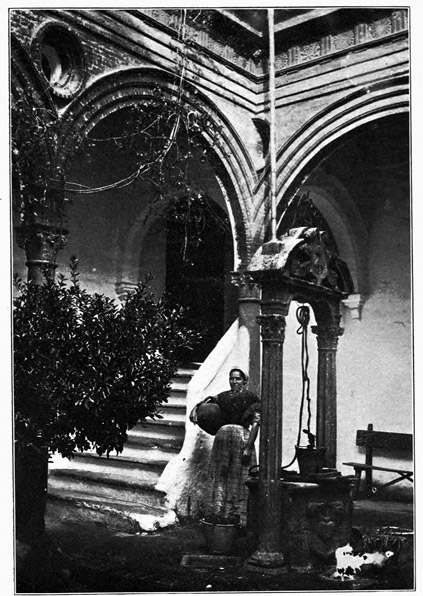
A Roman Well in Ronda
IX
A BULL-FIGHT
"I wish no living thing to suffer pain."—Shelley: Prometheus Unbound.
From our first crossing of the Pyrenees we were impressed,
even beyond our expectation, with the Spanish
passion for the bull-fight. The more cultivated Spaniards,
to be sure, are usually unwilling to admit to a foreigner
their pleasure in the pastime. "It is brutal," said a young
physician of Madrid, as we discussed it. "It is a very painful
thing to see, certainly. I go, myself, only two or three times
a year, when the proceeds are to be devoted to some religious
object—a charity or other holy work."
No sight is more common in streets and parks than that of
a group of boys playing al toro—one urchin charging about
with sticks fastened to his shoulders for horns, or with a
pasteboard bull's head pulled over his ears, and others waving
scarlet cloths and brandishing improvised swords and lances.
It is said that in fierce Valencia youths have sometimes carried
on this sport with knives for horns and swords, the spectators
relishing the bloodshed too well to interfere. Not easily
do such lads as these forgive the little king for crying, like
the sensitive child he is, the first time he was taken to the
bull-ring.
The corridas de toros, although denounced by some of the
chief voices in Spain, are held almost a national shibboleth.
Loyal supporters of the queen regent will add to their
praises the sigh, "If only she loved the bull-fight!" Cavaliers
and ladies fair reserve their choicest attire to grace these
barbarities. It is a common saying that a Spaniard will sell
his shirt to buy a ticket to the bull-ring, but whatever the
deficiencies of the inner costume, the dress that meets the eye
is brave in the extreme. It is recently becoming the fashion
for caballeros, especially in the north of Spain, to discard those
very fetching cloaks with the vivid linings—cloaks in which
Spaniards muffle their faces to the eyebrows as they tread the
echoing streets of cities founded some thousand or fifteen
hundred years ago. But for a good old Spanish bull-fight, the
good old Spanish costumes are out in force, the bright-hued
capas and broad sombreros, and for the ladies, who also are
beginning to discard the customary black mantilla for Parisian
headgear, the exquisite white mantillas of early times and the
largest and most richly decorated fans.
It is in such places as the grim Roman amphitheatre of
Italica, whose grass-grown arena has flowed so red with martyrdoms
of men and beasts, that one despairs most of Spanish
ability to give up the bull-fight. It is in the air, in the soil,
in the blood; a national institution, an hereditary rage. "But
it is the link that holds your country bound to barbarism.
The rest of the world is on the forward move. I tell you,
the continuance of the bull-fight means the ruin of Spain,"
urged a gigantic young German, in our hearing, on his Spanish
friend. The slight figure of the Madrileño shook with
anger. "And I tell you" he choked, "that Spain would
rather perish with the bull-fight than survive without it."
Isabel la Católica, who earnestly strove to put down these
savage contests, wrote at last to her Father Confessor that the
task was too hard for her. The "Catholic Kings" could
take Granada, unify Spain, establish the Inquisition, expel
Moors and Jews, and open the Americas; but they could not
abolish bull-fighting. Nor was Pius V, with his denial of
Christian burial to all who fell in the arena, and his excommunication
for princes who permitted corridas de toros in their
dominions, more successful. The papal bull, like the bulls of
flesh and blood, was inevitably overthrown.
Spanish legend likes to name the Cid as the first torero.
"Troth it goodly was and pleasant
To behold him at their head,
All in mail on Bavieca,
And to hear the words he said."
In mediæval times the sport was not without chivalric
features. Knights fought for honor, where professionals now
fight for pesetas. When the great Charles killed a bull with
his own lance in honor of the birth of Philip II, the favor
of the Austrian dynasty was secured. The Bourbons looked
on the sport more coldly, but as royalty and nobility withdrew,
the people pressed to the fore. Out of the hardy Spanish
multitude rose a series of masters,—Romero the shoemaker,
who, in general, gave to the art its modern form; Martincho
the shepherd, who, seated in a chair with his feet bound,
would await the charging brute; Cándido, who would face the
bull in full career and escape by leaping to its forehead and
over its back; Costillares, who invented an ingenious way of
getting in the death-stroke; the famous Pepe Hillo, who, like
Cándido, perished in the ring; a second Romero, said to have
killed five thousand six hundred bulls; Montés the brick-layer,
and a bloody band of followers. Andalusia is—alas!—the
classic soil of the bull-fight, as every peasant knows, and
Seville the top of Andalusia.
"I have a handsome lover,
Too bold to fear the Devil,
And he's the best torero
In all the town of Seville."
The extravagance of the popular enthusiasm for these
fiestas de toros is often ridiculed on the stage, where dramas
dealing with bull-fighting, especially if they bring in the
heroes of the arena, Pepe Hillo, Romero, Costillares, are
sure to take. One zarzuela represents a rheumatic old aficionado,
or devotee of the sport, trying, with ludicrous results,
to screw his courage to the point of facing the bull. Another
spends its fun on a Madrid barber, who is likewise a brain-turned
patron of the ring. Disregarding the shrill protests of
his wife, he lavishes all his time, love, and money on the
corridas and encourages his daughter's novio, an honest young
paper-hanger, to throw over his trade and learn to torear.
After two years of the provincial arenas, the aspirant, nicknamed
in the ring The Baby, has nothing but torn clothes
and bruises to show for his career, and his sweetheart, eager
to recall him from the hazardous profession, vows a waxen
bull, large as life, to the Virgin, in case he returns to papering,
with its humble security and its regularity of wages.
Mary hears. On that great occasion, The Baby's début at
Madrid, the barber, who has just been lucky in the lottery,
rents for him a gorgeous suit of second-hand finery, but in
the Plaza de Toros not even a rose-and-silver jacket can shield
a quaking heart. The Baby is a coward born, and from the
first rush of the first bull comes off with a bloody coxcomb,
crying out his shame on the shoulder of his Pilar, who shall
henceforth have him all her own.
The little artist and I went into Spain with the firm determination
not to patronize the bull-fight. Half our resolution
we kept,—her half. Wherever we turned we encountered
suggestions of the corrida. Spanish newspapers, even the
most serious, devote columns to Los Toros. Bull-fighting has
its special publications, as El Toril and El Toreo Cómico, and
its special dialect. On the morning after a holy day the
newspapers seem actually smeared with the blood of beasts.
In the bull-fight season, from Easter to All Saints, corridas are
held every Sunday in all the cities of southern and central
Spain, while the smaller towns and villages butcher as many
bulls as they can possibly afford. The May and June that I
passed in the capital gave me a peculiar abhorrence of the
Madrid Sunday,—that feverish excitement everywhere; the
rattle of all those extra omnibuses and cars with their red-tasselled
mules in full gallop for the Plaza de Toros; that sense
of furious struggle and mortal agony hanging over the city all
through the slow, hot afternoon; those gaping crowds pressing
to greet the toreros, a gaudy-suited company, on their triumphal
return in open carriages; that eager discussion of the
day's tragedy at every street-corner and from seat to seat
along the paseos, even at our own dainty dinner table and on
our own balconies under the rebuking stars. At this strange
Sabbath service the Infanta Isabel, whose mother's birth was
celebrated by the slaying of ninety-nine bulls, is a regular
attendant, occupying the royal box and wearing the national
colors. A French bull-fighter, visiting the Spanish capital,
was invited by the Infanta to an audience and presented with
a diamond pin. Not even the public mourning for Castelar
could induce Madrid to forego the corrida on that Sunday just
before his burial. Past the very senate-house where his body
lay in state rolled the aristocratic landaus, whose ladies displayed
the gala-wear of white mantillas.
But the Sundays were not enough. Every Catholic feast-day
called for its sacrifice. Granada could not do fitting
honor to Corpus Christi with less than three "magnificas
corridas." The royal saint of Aranjuez, Fernando, must have
his pious birthday kept by an orgy of blood. At the fiesta of
Christ's Ascension all Spain was busy staining his earth with
the life-stream of His creatures. Valladolid was, indeed,
ashamed to have torn to death only seven horses, but Segovia
rejoiced in an expert who sat at his work and killed his bulls
with drawing-room ease. Bordeaux improved the occasion,
with aid of two celebrated Spanish espadas, by opening a
French Plaza de Toros, and Valencia had the excitement of
sending to the infirmary one torero with a broken leg and
another with a crushed foot. Such accidents are by no
means uncommon. A matador was mortally wounded in
the Valencia ring that summer, a banderillero was trampled at
the Escorial, and those favorite stabbers, Reverte and Bombita,
were themselves stabbed by avenging horns.
If there is a temporary dearth of saint days, Spanish ingenuity
will nevertheless find excuse for corridas. Bulls must
bleed for holy charity,—for hospitals, foundling asylums, the
families of workmen out on strike. If the French squadron
is at Cadiz, hospitality demands a bull-fight. In the interests
of popular education, an historical corrida was arranged, with
instructed toreros to display the special styles of bull-killing
that have prevailed from the Cid to Guerrita. Again, as a
zoölogical by-play, an elephant was pitted against the bulls.
This, too, had precedent, for did not Philip IV once keep his
birthday by turning in among the horned herd a lion, a tiger,
a camel, and a bear, "all Noah's ark and Æsop's fables"?
A bull of Xarama vanquished them every one and received
the gracious reward of being shot dead by Philip himself.
It was on a Wednesday afternoon, at one of the three grand
corridas of the Seville Feria, that I became an accomplice in
this Spanish crime. Our friends in Seville, people of cultivation
and liberal views, had declared from the first that we
could have no conception of Spanish life and character without
sharing in the national fiesta. "We ourselves are not
enthusiasts," they said. "In fact, we disapprove the bull-fight.
We regard it as demoralizing to the community at large. It is,
nevertheless, a thing scientific, artistic, heroic, Spanish. Besides,
a large portion of the proceeds goes to charity. We do
not attend the corridas, except now and then, especially when
we have foreign guests who wish to see them. Before going
they all regard bull-fighting as you do, as an atrocity, a
barbarity, but invariably they return from the Plaza de
Toros filled with delight and admiration. They say their
previous ideas were all wrong, that it is a noble and splendid
spectacle, that they want to see it again and again, that
they cannot be too grateful to us for having delivered them
from prejudice."
I winced at the word. I have a prejudice against being
prejudiced, and to the bull-fight I went.
My yielding came too late for securing places in a box or
in any part of the house from which one can make exit during
the performance. Our gory-looking tickets admitted us to
the uppermost row of high, whitewashed, stone seats of the
circus proper, where we were soon inextricably wedged in by
the human mass that formed around and below us. The
hour of waiting passed merrily enough. The open amphitheatre,
jammed to its full capacity of fourteen thousand, lay
half in brilliant sunlight and half in creeping shadow. Above
us arched the glowing blue sky of Seville, pricked by the rosy
Giralda, and from time to time a strong-winged bird flew
over. The great arena, strewn with yellow sand, was enclosed
by a dark red barrier of wood, about the height of a
man. This was encircled, at a little distance, by a more
secure and higher wall of stone. The concourse was largely
composed of men, both roughs and gentles, but there was no
lack of ladies, elegantly dressed, nor of children. Two sweet
little girls in white-feathered hats were just in front of us,
dancing up and down to relieve the thrills of expectancy.
White mantillas, pinned with jewels, bent from the boxes,
while the daughters of the people dazzled the eye with their
festival display of Manila shawls, some pure white, some with
colored figures on a white ground or a black, and some a rainbow
maze of capricious needle-work. The rich-hued blossoms
of Andalusia were worn in the hair and on the breast.
The sunny side of the circus was brightly dotted by parasols,
orange, green, vermilion, and fans in all the cardinal colors
twinkled like a shivered kaleidoscope. The men's black eyes
glittered under those broad sombreros, white or drab, while
they puffed their cigarettes with unwonted energy, scattering
the ashes in soft gray showers over their neighbors on the
seats below. The tumult of voices had a keener note of
excitement than I had yet heard in Spain, and was so loud
and insistent as often to drown the clashing music of the
band. The cries of various venders swelled the mighty
volume of noise. Water-sellers in vivid blouses and
sashes, a red handkerchief twisted around the neck, on the
left shoulder a cushion of folded carpeting for the shapely,
yellow-brown jar, and a smart tin tray, holding two glasses,
corded to the belt, went pushing through the throng. Criers
of oranges, newspapers, crabs, and cockles, almond cakes,
fans, and photographs of the toreros, strove with all the might
of their lungs against the universal uproar.
"Crece el entusiasmo;
Crece la alegría;
Todo es algazara;
Todo es confusión."
A tempest of applause marked the entrance in a box above
of a popular prima donna, who draped a resplendent carmine
scarf over the railing before her seat. Immediately the complete
circuit of the rail was ablaze with color, cloaks and
shawls instantly converting themselves into tapestry.
At last two attendants entered the arena, walked up to a
hydrant in the centre, fastened on a hose, and watered the
great circle. They pulled out the hydrant and raked sand
over the hole. Simple as these actions were, a dreadful quiet
fell on all the circus.
A trumpet blared. Mounted alguaciles, or police, tricked
out in ancient Spanish costume, on blue saddles, and with tall
blue plumes in their hats, rode in and cleared the arena of all
stragglers. A door opened, and forth issued the full circus
troupe, making a fine show of filigree, and urging their
wretched old nags to a last moment of equine pride and
spirit. Amid roars of welcome, they flaunted across the
sanded enclosure and saluted the presiding officer. He
dropped the key of the toril, that dark series of cells into
which the bulls had been driven some hours before. An
alguacil caught the key and handed it to the torilero, who ran
with it toward a second door, ominously surmounted by a
great bull's head. Then there was a twinkling of the pink
stockings and black sandals. Most of the gay company
leaped the barrier, and even the chulos who remained in the
ring placed themselves within convenient distance of the rail.
Some of the picadores galloped out, but a few awaited the
coming charge, their long pikes in rest. The door on which
all eyes were bent flew open, and a bellowing red bull rushed
in. The fierce, bloodthirsty, horrible yell that greeted him
checked his impetuous onset. For a few seconds the creature
stood stock-still, glaring at the scene. Heaven knows
what he thought of us. He had had five perfect years of life
on the banks of the Guadalquivír,—one baby year by his
mother's side, one year of sportive roving with his mates,
and then had come the trial of his valor. He had found all
the herdsmen gathered at the ranch one morning, and, nevertheless,
flattered himself that he had evaded those hateful
pikes, garrochas, that were always goading him back when he
would sally out to explore the great green world. At all
events, here he was scampering alone across the plain. But
promptly two horsemen were at his heels, and one of these,
planting a blunt garrocha on his flank, rolled the youngster
over. Up again, panting with surprise and indignation, he felt
a homesick impulse to get back to the herd, but the second
horseman was full in his path. So much the worse for the
horseman! The mettlesome young bull lowered his horns
and charged the obstacle, only to be thrown back with a
smarting shoulder. If he had yielded then, his would have
been the quiet yoke and the long, dull life of labor, but he
justified his breed; he charged anew, and so proved himself
worthy of the arena. Three more years of the deep, green
river-reeds and the sweet Andalusian sunshine, three years of
free, far range and glad companionship, and then the end.
His days had been exempt from burden only to save his wild
young strength for the final tragedy. One summer morning
those traitors known as decoy-oxen, with bells about the
neck, came trotting into the herd. The noble bulls, now at
their best hour of life, the glory of their kind, welcomed these
cunning guests with frank delight and interest, and were easily
induced to follow them and their tinkling bells across the
rich pastures, along rough country roads, even to the city
itself and the fatal Plaza de Toros. The herdsmen with their
ready pikes galloped behind the drove, and everywhere along
the way peasants and townsfolk would fall in for a mile or
two to help in urging the excited animals onward to their
cruel doom.
In that strange, maddening sea of faces, that hubbub
of hostile voices, the bull, as soon as his blinking eyes
had effected the change from the darkness of the toril to the
glaring light and gaudy colors of the coliseum, caught sight of
a horseman with the familiar pike. Here was something
that he recognized and hated. Lowering his head, the fiery
brute dashed with a bellow at that tinselled figure. Ah, the
pike had never been so sharp before! It went deep into his
shoulder, but could not hold him back. He plunged his
horns, those mighty spears, into the body of the helpless,
blindfolded horse, which the picador, whose jacket was well
padded and whose legs were cased in iron, deliberately
offered to his wrath. The poor horse shrieked, plunged,
reeled, and fell, the chulos deftly dragging away the armored
rider, while the bull ripped and trampled that quivering carcass,
for whose torment no man cared, until it was a crimson,
formless heap.
Such sickness swept over me that I did not know what
followed. When I looked again, two bloody masses that
had once been horses disfigured the arena, and the bull, stuck
all over like a hedge-hog with derisive, many-colored darts,
had gone down under Guerrita's steel.
My friends, observing with concern that I was not enjoying
myself as much as they had promised, tried to divert my
attention to the technical features of their ghastly game.
It was really, they explained, a drama in three acts. It is
the part of the mounted picador to draw off the first rage and
vigor of the bull, weakening him, but not slaying him, by
successive wounds. Then the jaunty banderilleros, the streamers
of whose darts must correspond in color with their
costumes, supply a picturesque and amusing element, a comic
interlude. Finally an espada, or matador, advances alone to
despatch the tortured creature. The death-blow can be dealt
only in one of several fashions, established by rule and precedent,
and the espada who is startled into an unprofessional
thrust reaps a bitter harvest of scoffs and hisses.
A team of gayly-caparisoned mules with jingling bells had
meanwhile trundled away the mangled bodies of the slaughtered
animals, fresh sand had been thrown over the places
slippery with blood, and the band pealed the entrance of the
second bull. This was a demon, black as a coal, with a
marvellous pride and spirit that availed him nothing. Horse
after horse crashed down before his furious rushes, while the
circus, drunk with glee, shouted for more victims and more
and more. It was a massacre. At last our hideous greed
was glutted, and the banderilleros took their turn in baiting
the now enfeebled but undaunted bull. Wildly he shook
himself, the fore half of his body already a flood of crimson,
to throw off the ignominy of those stinging darts. The
chulos fretted and fooled him with their waving cloaks of red
and yellow, till at last the creature grew hushed and sullen.
A strain of music announced that the matador Fuentes was
asking beneath the president's box permission to kill the bull.
For my part, I gave the bull permission to kill the man.
Fuentes, all pranked out in gray and gold, holding his keen
blade behind him and flourishing a scarlet square of cloth,
swinging from a rod, the muleta, advanced upon the brute.
That bleeding body shook with a new access of rage, and the
other espadas drew near and stood at watch. But even before
a blow was struck the splendid, murdered creature sank to his
knees, staggered up once more, sank again with crimson foam
upon his mouth, and the music clashed jubilantly while Fuentes
drove the weapon home. And again the team of mules,
with foolish tossing of their bright-ribboned heads, jerked
and jolted their dead kindred off the scene.
The third bull galloped in with a roar that was heard far
beyond the Plaza and gored his first two horses so promptly
and so frightfully that, while the hapless beasts still struggled
in their agony, the amphitheatre howled with delirious joy.
Several capas were caught away on those swift, effective horns,
and one picador was hurt. But the rain of darts teased and
bewildered the bull to the point of stupidity, although he was
dangerous yet.
"Dark is his hide on either side, but the blood within doth boil;
And the dun hide glows, as if on fire, as he paws to the turmoil.
His eyes are jet, and they are set in crystal rings of snow;
But now they stare with one red glare of brass upon the foe."
It was the turn of Bombita, a dandy in dark-green suit
with silver trimmings; but his comrades, pale and intent, stood
not far off and from time to time, by irritating passes, drew
the bull's wrath upon themselves, wearying him ever more
and more, until at last Bombita had his chance to plant a
telling blow.
Would it never end? Again the fatal door swung open,
and the fourth bull bounded in to play his tragic rôle. He
was of choicest pedigree, but the utter strangeness of the
scene turned his taurine wits. He made distracted and aimless
rushes hither and thither, unheeding the provocations of
the horsemen, until he came upon the spot drenched with his
predecessor's life-blood. He pawed away the hasty covering
of sand, sniffed at that ominous stain, and then, throwing up
his head with a strange bellow, bolted back to the door by
which he had entered, and turned tail to the arena. The
fourteen thousand, crazy with rage, sprang to their feet, shook
their fists, called him cow. The chulos brandished their cloaks
about his horns; men leaned over from the barrier and
prodded him with staffs. Finally, in desperation, he turned
on the nearest horse, rent it and bore it down. The picador,
once set up by the chulos upon his stiff, iron-cased legs, his
yellow finery streaked with red from his lacerated horse,
tugged savagely at the bridle to force that dying creature to
a second stand. One attendant wrenched it by the tail,
another beat it viciously over the face; the all-enduring beast,
his entrails swinging from a crimson gash, struggled to his
feet. The picador mounted, drove in the spurs, and the horse,
rocking and pitching, accomplished a few blind paces toward
those dripping horns that horribly awaited him. But to the
amazement and scandal of the aficionados, the circus raised a
cry of protest, and the discomfited rider sprang down in
the very moment when his horse fell to rise no more. A
chulo, at his leisurely convenience, quieted those kicking hoofs
by a stab,—the one drop of mercy in that ocean of human
outrage.
Straw-colored darts, wine-colored darts, sky-colored darts,
were pricking the bull to frenzy. I wished he had any half-dozen
of his enemies in a clear pasture. Those glittering
dragon-flies were always just out of reach, but he stumbled
on the sodden shape of the unhappy horse and tossed it again
and again, making the poor carcass fling up its head and arch
its neck in ghastly mockery of life. Cowardice avails a bull
as little as courage. This sorry fighter had been deeply
pierced by the garrochas, and now, as he galloped clumsily
about the arena, in unavailing efforts to escape from his
tormentors, his violent, foolish plunges made the dark blood
flow the faster. It was Guerrita, Guerrita the adored, Guerrita
in gold-laced jacket and violet trousers, who struck the
ultimate blow, and so cleverly that sombreros and cigarettes,
oranges and pocket-flasks, came raining, amid furies of applause,
into the arena. This was such a proud moment as he had
dreamed of long ago in the Cordova slaughter-house, when,
the little son of the slaughter-house porter, he had stolen from
his bed at midnight to play al toro with the calves, and then and
there had solemnly dedicated himself to the glorious profession.
Now the master of his art and the idol of all Spain, easily making
his seventy-five thousand dollars a year, earning, in fact, three
thousand on that single afternoon, Guerrita little foresaw that
with the coming autumn he should go on pilgrimage to La
Virgen del Pilar, and before her beloved shrine at Saragossa
cut off his bull-fighter's pigtail and renounce the ring.
The fifth bull was black as ebony. He dashed fearlessly
into the arena, charged and wheeled and tossed his horns in
the splendor of his strength, sending every red-vested chulo
scrambling over the wall. Then he backed to the middle of
the sanded circle, snorting and pawing the earth. Another
instant, and the nearest horse and rider went crashing against
the barrier. The picador, with a bruised face, forced up the
gasping horse, mounted and rode it, the beast treading out its
entrails as it went, to meet a second charge. But the swaying
horse fell dead before it reached those lowered horns
again. The next picador, too, went down heavily under his
jade and received an awkward sprain. He mounted once
more, to show that he could, and the circus cheered him, but
his horse, torn to death, could not bear his weight. He gave
it an angry push with the foot as he left it writhing in its life-blood.
This whirlwind of a bull, who shook off all but one
of the banderillas, mortified even the matadores. Disregarding
the red rag, he rushed at Fuentes himself. The nimble torero
leapt aside, but the bull's horn struck his sword and sent it
spinning half across the arena. His comrades immediately
ran, with waving capas and bright steel, to his aid, but that
too intelligent bull, fighting for his life, kept his foes at bay
until the circus hissed with impatience. The toreros, visibly
nettled, gathered closer and closer, but had to play that death-game
cautiously. This bull was dangerous. The coliseum
found him tedious. He took too long in dying. Stabbed
again and again and again, he yet agonized to his feet and
shook those crimsoned horns at his tormentors, who still hung
back. It really was dull. The matadores buzzed about him,
worrying his dying sight, but he stood sullen in their midst,
refusing the charges to which they tempted him, guarding his
last drops of strength, and, cardinal offence in a toro, holding
his head too high for the professional stroke. His vital force
was ebbing. Red foam dripped from his mouth. That
weary hoof no longer pawed the earth. The people shouted
insults even to their pet Guerrita, but Guerrita, like the rest,
stood baffled. At last that formidable figure, no longer black,
but a red glaze of blood and sweat and foam, fell in a sudden
convulsion. Then his valiant murderers sprang upon him,
the stabs came thick and fast, and the jingling mule-team
pranced in to form his funeral cortège.
One more,—the sixth. I was long past indignation, past
any acuteness of pain, simply sickened through body and soul
and unutterably wearied with this hideous monotony of
slaughter. The last bull, a white star shining on his black
forehead, tore into the arena, raced all about the circle, and
struck with amazing rapidity wherever he saw a foe. Three
horses were down, were up again, and were forced, all with
trailing intestines, to a second charge. The bull flashed like
a thunderbolt from one to another, rending and digging with
his savage horns, until three mangled bodies writhed on the
reddened sand, and stabbers watched their chances to run
forward and quiet with the knife the horrible beating of those
hoofs in air. The circus yelled delight. It had all been the
work of a moment,—a brave bull, a great sensation! For
the performers it was rather too much of a good thing.
Those disembowelled carcasses cluttered up the arena. The
scattered entrails were slippery under foot. The dart-throwers
hastened to the next act of the tragedy. Theirs was a
subtlety too much for the fury-fuddled wits of that mighty,
blundering brute. He galloped to and fro, spending his
strength in useless charges and, a score of times, ignoring the
men to hook wildly at their brandished strips of colored cloth.
The darts had been planted and he was losing blood. The
matador went to his work, but the uncivil bull did not make
it easy for him. Bombita could not get in a handsome blow.
The house began to hoot and taunt. A stentorian voice
called to him to "kill that bull to-morrow." Exasperated by
the laughter that greeted this sally, Bombita drove his Toledo
blade to its mark. While the final scene of general stabbing
was going on, boys, men, even women vaulted into the arena,
played over again with one another the more memorable incidents,
ran to inspect those shapeless carcasses of what God
created horses, and escorted the funeral train of the bull, one
small boy riding in gleeful triumph on top of the great black
body, harmless and still at last. As we passed out by a hallway
where the dead animals had been dragged, we had to
pick our way through pools of blood and clots of entrails.
Thus by the road of the shambles we came forth from hell.
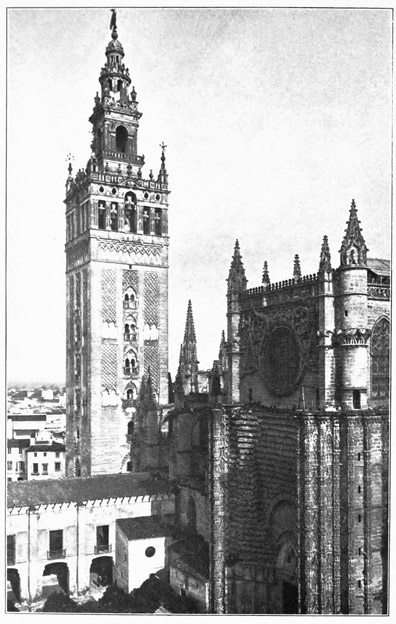
The Giralda
"I do not understand at all," sincerely protested my Spanish
host, disconcerted by the continued nausea and horror of
red dreams which, justly enough, pursued me for weeks after.
"It was a very favorable corrida for a beginner,—no serious
accident, no use of the fire-darts, no houghing of the
bull with the demi-lune, nothing objectionable. And, after
all, animals are only animals; they are not Christians."
"Who were the Christians in that circus?" I asked.
"How could devils have been worse than we?"
He half glanced toward the morning paper but was too
kindly to speak his thought. It was not necessary. I had
read the paper, which gave half a column to a detailed account
of a recent lynching, with torture, in the United States.
X
GYPSIES
"'Life is sweet, brother.'
"'Do you think so?'
"'Think so!—There's night and day, brother, both sweet things; sun, moon,
and stars, brother, all sweet things; there's likewise a wind on the heath. Life is
very sweet, brother; who would wish to die?'
"'I would wish to die.'
"'You talk like a gorgio—which is the same as talking like a fool—were you a
Rommany Chal you would talk wiser. Wish to die, indeed!—A Rommany Chal
would wish to live forever!'
"'In sickness, Jasper?'
"'There's the sun and stars, brother.'
"'In blindness, Jasper?'
"'There's the wind on the heath, brother; if I could only feel that, I would gladly
live forever. Dosta, we'll now go to the tents and put on the gloves; and I'll try
to make you feel what a sweet thing it is to be alive, brother!'"
—George Borrow.
No foreigner has known the Zingali better than
George Borrow, the linguistic Englishman, who
could speak Rommany so well that gypsies all
over Europe took him for a brother. In the employ of the
English Bible Society, he spent some five adventurous years
in Spain, wandering through the wilds and sharing the life of
shepherds, muleteers, even the fierce gitanos. As he found
the Spanish gypsies half a century ago, so, in essentials, are
they still—the men jockeys, tinkers, and blacksmiths, the
women fortune tellers and dancers, the children the most
shameless little beggars of all the Peninsula. Yet there has
been an improvement.
The gitanos are not such ruffians as of old, nor even such
arrant thieves, although it would still be unwise to trust them
within call of temptation.
"There runs a swine down yonder hill,
As fast as e'er he can,
And as he runs he crieth still,
'Come, steal me, Gypsyman.'"
Still more compromising is the Christmas carol:—
"Into the porch of Bethlehem
Have crept the gypsies wild,
And they have stolen the swaddling clothes
Of the new-born Holy Child.
"Oh, those swarthy gypsies!
What won't the rascals dare?
They have not left the Christ Child
A single shred to wear."
There are wealthy gypsies, whose wives and daughters
go arrayed with the utmost elegance of fashion, in several
Spanish cities. Seville has her gypsy lawyer, but her gypsy
bull-fighter, who died two years ago, was held to reflect even
greater credit on the parent stock.
By law the gypsies are now established as Spaniards,
with full claim to Spanish rights and privileges—Nuevos
Castellanos, as they have been called since the day when
Spain bethought her of these Ishmaels as "food for powder"
and subjected them to the regular military draft. Even in
Granada, where the gypsy community still lives in semi-barbarism,
there are hopeful signs. The gitanos drive a sharp
trade in donkeys, but their forge fires, gleaming far up the
Albaicín in the evening, testify to their industry. The
recent opening by the municipality of schools for the gypsy
children has already wrought a marked change for the better.
Some half-dozen dirty little palms, outstretched for cinco
centimos, pester the stranger to-day where scores used to torment
him, and the mothers take pride in the literary accomplishments
of their tawny broods. On one occasion, when,
having, as the Spanish say, "clean pockets," I firmly declined
to see a small gypsy girl dance or hear her sing, the mother
assured me, as a last greedy expedient, that "the child could
pray."
On the Alhambra hill the gypsies, who scent tourists from
afar and troop thither, on the track of newly arrived parties,
like wolves to their banquet, are picturesque figures enough,
the men in peaked hats, spangled jackets, and sashes of red
silk, the women with bright handkerchiefs bound over their
raven hair, large silver earrings, gay bodices, and short,
flounced petticoats.
There is one old gitano, in resplendent attire, who haunts
the Alhambra doors and introduces himself to visitors, with
bows queerly compounded of condescension and supplication,
as the King of the Gypsies, modestly offering his photograph
for a peseta. If you turn to your attendant Spaniard and ask,
sotto voce, "But is this truly the Gypsy King?" you will
receive a prompt affirmative, while the quick-witted old
masquerader strikes a royal attitude, rolls his eyes prodigiously,
and twirls his three-cornered hat at arm's length above his
head, until its tinsel ornaments sparkle like crown jewels.
But no sooner is his Majesty well out of hearing than your
guide hastens to eat his own words. "No, no, no! He is
not the King of the Gypsies, but he is a gypsy, yes, and it is
better not to have his ill will."
Whether this hardened pretender could cast the evil eye or
not, we never knew, for having bought two of his pictures at
the first onset, we suffered ever afterward the sunshine of his
favor. In fact we often made a wide detour rather than pass
him on the hill, for he would spring to his feet at our remotest
approach and stand bowing like an image of perpetual motion,
his hat brandished high in air, until our utmost in the way
of answering nods and smiles seemed by contrast sheer
democratic incivility.
The swarthy faces and glittering eyes of the gypsies meet
one everywhere in the Granada streets, but to see them in
their own precinct it is necessary to take off your watch,
empty your pockets of all but small silver and coppers, and
go to the Albaicín. This hill, parted from the Alhambra by
the deep ravine of the gold-bearing Darro, was in Moorish
times the chosen residence of the aristocracy. Still Arabian
arches span the gorge, and many of the toppling old houses
that lean over the swift, mountain-born current, shabby as
they look to the passer-by, are beautiful within with arabesque
and fretwork, carven niches, delicate columns and open
patios, where fountains still gush and orange blossoms still
shed fragrance. Such degenerate palaces are often occupied
by the better class of gypsies, those who traffic in horses, as
well as in donkeys, while their women, grouped in the courts
and doorways, embroider with rainbow wools, in all fantastic
patterns, the stout mantles of the Andalusian mountaineers.
As we climbed the Albaicín, fronting as it does the hill of
the Alhambra, the exceeding beauty of the view at first
claimed all our power of seeing. Below was the gray sweep
of the city and beyond the fruitful plain of Granada, its vivid
green shading into a far-off dimness like the sea. Just opposite
us rose the fortress of the Alhambra, a proud though
broken girdle of walls and towers, while in the background
soared the dazzling snow peaks of the Sierra Nevada, glistening
with unbearable splendor under the intense blue of the
Andalusian sky.
In the midst of our rhapsodies I became aware of a shrill
voice at my feet, a persistent tug at my skirts, and reluctantly
dropped my eyes on a comely little gypsy lass lying along a
sunny ledge and imperiously demanding cinco centimos.
"Now what would you do with cinco centimos if you had
them?"
With the universal beggar gesture she pointed to her
mouth. "Buy a rusk. I am starving. I am already dead
of hunger."
Crossing her hands upon her breast, she closed her eyes in
token of her mortal extremity, but instantly flashed them open
again to note the effect.
"Your cheeks are not the cheeks of famine."
At a breath the young sorceress sucked them in and succeeded,
plump little person though she was, in looking so
haggard and so woe-begone that our political economy broke
down in laughter, and we gave her the coveted cent in return
for her transformation act.
Off she darted, with her wild locks flying in the wind, and
was back in a twinkling, a circlet of bread suspended from
her arm. She tripped along beside us for the rest of the
afternoon, using the rusk sometimes as a hoop, sometimes as
a crown, sometimes as a peephole. She tossed it, sang
through it, dandled it, stroked it, and occasionally, while the
bread approximated more and more in hue to her own gypsy
complexion, took an artistic nibble, dotting the surface with a
symmetrical curve of bites. It was not mere food to her; it
was luxury, it was mirth—like a Lord Mayor's feast or a
Delmonico breakfast.
Following the Camino del Sacro Monte, marked by many
crosses, our attention was more and more withdrawn from
the majestic views spread out before us to the gypsies, whose
cave dwellings lined the way. Burrowing into the earth, from
the midst of thickets of prickly pear, are these strange abodes,
whose chimneys rise abruptly out of the green surface of the
hillside. Dens as they are, the best of them possess some
decencies. Flaps of cloth serve them for doors, their peering
fronts are whitewashed, they are furnished with a stool or
two, a box of tools or clothing, a few water-jars, a guitar, and,
in the farther end of the lair, a family bedstead, or more often
a heap of dirty sheepskins. Cooking tins, bottles, saddles,
and coils of rope hang on the rough walls; there may be a
shelf of amulets and toys for sale, and the indispensable pot
of puchero simmers over a handful of fire.
Out from these savage homes swarmed a whining, coaxing,
importunate horde of sly-eyed women and an impish rabble
of children. Young and old clutched at us with unclean
hands, clung to us with sinewy brown arms, begged, flattered,
demanded, and dragged us bodily into their hill. We felt as
if we had gone back to German fairy tales and had fallen into
the evil grip of the gnomes. Hardly could escort, carriage,
and a reckless rain of coppers break the spell. We were
forced to taste their repulsive messes, to cross witch palms
with silver, to buy even the roadside weeds the urchins
gathered before our eyes. We were birds for the plucking,
sheep for the shearing. Only when we had turned our
pockets inside out to show that we had not a "little dog"
left, were we suffered to go free, followed, doubtless, by the
curses of Egypt, because we had yielded such poor picking.
In Seville, too, the gypsies have their own quarter, but in proportion
as Seville is a gentler city than Granada, so are the looks
and manners of her gypsy population more attractive. Crossing
the yellow Guadalquivír by the bridge of Isabel Segunda,
we come immediately on the picturesque, dark-visaged figures,
with their uneffaced suggestion of wildness, of freedom, of
traditions apart from the common humdrum of humanity.
The boy, clad in one fluttering garment, who is perilously
balancing his slender brown body on the iron rail; the bright-kerchiefed
young mother, thrusting her tiny black bantling into
our faces; the silent, swarthy men who lean along the bridge
side, lithe even in their lounging;—all have a latent fierceness
in their look. Their eyes are keen as knives—strange eyes,
whose glitter masks the depth. But as we go on into the
potter's suburb of Triana, into the thick of the gypsy life, we
are not more seriously molested than by the continual begging,
nor is this the rough, imperious begging of Granada; a
flavor of Sevillian grace and fun has passed upon it. Offer
this bush-headed lad, pleading starvation, the orange he has
just tossed away, and he will double up over the joke and
take to his little bare heels. Give to the fawning sibyl who
insists on telling your fortune a red rose for her hair, and the
chances are that she will rest content. But the time to see
the gypsies in their glory is during the three days and nights
of the Feria.
On the eighteenth, nineteenth, and twentieth of April
Seville annually keeps, on the Prado de San Sebastian, where
the Inquisition used to light its fires, the blithest of spring
festivals. The Feria is a fair, but much more than a fair.
There are droves upon droves of horses, donkeys, cattle,
goats, sheep, and pigs. There are rows upon rows of booths
with toys, booths with nuts and candies, booths with the gay-handled
Albacete knives and daggers. There are baskets
upon baskets of rainbow fans, mimic fighting cocks, oranges,
and other cheap Sevillian specialties. Cooling drinks are on
sale at every turn, but there is no drunkenness. There are
thousands and tens of thousands of people in motion, but there
is no bustling, no elbowing, no rudeness of pressure. Dainty
little children wander alone in that tremendous throng. The
order and tranquillity that prevail by day and night in this
multitude of merrymakers render it possible for the Feria to
be what it is. For during these enchanted April hours even
the noblest families of Seville come forth from the proud
seclusion of their patios and live in casetas, little rustic houses
that are scarcely more than open tents, exposed to the gaze
of every passer-by.
A lofty bridge, crossed by two broad flights of stairs and
tapering to a tower, stands at the intersection of the three
chief Feria avenues. The bridge is brilliantly illuminated by
night, and close-set globes of gas, looped on running tubes
along both sides of these three festal streets, pour floods of
light into the casetas. Chinese lanterns in red and yellow
abound, and lines of banner-staffs flaunt the Spanish colors.
The casetas are usually constructed of white canvas on a
framework of light-brown fretwood, though the materials are
sometimes more durable.
Clubhouses are large and elaborate, and individual taste
varies the aspect of the private tents. The more important
families of Seville own their casetas, but in general these airy
abodes are rented from year to year, the price for the three
days of the Feria ranging from twenty-five dollars on the
central avenue to five dollars for the more remote houselets
on the two streets that branch off at right angles. The
numerous byways are occupied by cafés, booths, penny
shows, and the like, the gypsies having one side of a lane to
themselves. The other side is given over to circus-rings,
merry-go-rounds, cradle-swings marked "For Havana," "For
Manila," "For Madrid," dancing dwarfs, braying bands,
caged bulls, and tents provided with peepholes through which
one may see "The Glorious Victory of the Spanish Troops
at Santiago," and other surprising panoramas of the recent
war. These are in high favor with soldiers and small boys,
whose black heads bump together at every aperture.
Such attractions are especially potent over the country
folk, who come jogging into Seville during fair time, mounted
two or three together on jaded horses, sorry mules, and even on
indignant little donkeys. Their peasant costumes add richly
to the charm of the spectacle, and their simplicity makes
them an easy spoil for the canny folk of Egypt. You see
them especially in the cool of the early morning, when trade
in cattle is at its liveliest. Ten to one they have been fleeced
already by the gitanos, who, out in the great meadow where
the live-stock is exposed for sale, have their own corner for
"dead donkeys," as the Sevillians term the decrepit old beasts
that have been magically spruced up for the occasion. Cervantes
has his jest at "a gypsy's ass, with quicksilver in its
ears."
Then comes the turn of the gitanas, looking their prettiest,
with roses in hair, and over the shoulders those captivating
black silk shawls embroidered in many-colored patterns of
birds and flowers. The younger enchantresses keep watch,
each in front of her family tent, before whose parted curtains
the more ill-favored women of the household are busy frying
the crisp brown buñuelos, a species of doughnut dear to the
Spanish tooth.
As you loiter down the lane, be you wide-eyed shepherd
from the provinces, or elegant grandee from Madrid, or
haughty foreigner from London or Vienna, the sturdy sirens
rush upon you, seize you by arm or neck, and by main force
tug you into their tented prisons, from which you must gnaw
your way out through a heap of hot buñuelos. Or you may
compromise on a cup of Spanish chocolate, flavored with
cinnamon and thick as flannel, or perhaps win your liberty
by gulping down a cupful of warm goat's milk. The prices
shock the portliest purses, but at your first faint sign of protest
a gathering mob of gypsies presses close with jeers and hisses,
and even the frying-pan sputters contempt.
The Feria presents its most quiet aspect during the afternoon.
Some twenty or thirty thousand of the promenaders
have been drawn off by the superior attraction of the bull-fight,
and others have retired for their siestas. Yet there are
thousands left. This is a grand time for the children, who
disport themselves in the avenues with whistles, swords,
balls, kites, and other trophies from the toy booths. These
little people are exquisitely dressed, often in the old Andalusian
costumes, and tiny lad and tiny lass, of aristocratic look
and bearing, may be seen tripping together through one of the
graceful national dances in the midst of a sidewalk throng.
The toddlers, too, are out, under charge of happy nursemaids.
Even the babies have been brought to the fair, and lie,
contentedly sucking their rosy thumbs, in the doorways of
the casetas. The lords of these doll-houses are enjoying
peaceful smokes together in the background of the open parlors,
which are furnished with as many chairs as possible, a
piano, and a central stand of flowers; while semicircles of
silent ladies, languidly waving the most exquisite of fans, sit
nearer the front, watching the ceaseless stream of pedestrians,
and beyond these the double procession of carriages, which
keep close rank as they advance on one side of the avenue and
return on the other. It is bad form not to go to the Feria
once at least in a carriage. Large families of limited means
hire spacious vehicles resembling omnibuses, and, squeezed
together in two opposite rows, drive up and down the three
chief streets for hours.
There are crested landaus, with handsome horses, gay
donkey-carts, decked out with wreaths and tassels, shabby
cabs, sporting red and yellow ribbons on their whips, tooting
coaches—every sort and kind of contrivance for relieving
humanity of its own weight. There are mounted cavaliers in
plenty, and occasionally, under due masculine escort, a fair-haired
English girl rides by, or a group of Spanish señoras,
who have come into Seville on horseback from their country
homes. But all this movement is slow and dreamy, the play
of the children being as gentle as the waving of the fans.
Even Gypsy Lane shares in the tranquillity of the drowsy
afternoon. We were captured there almost without violence,
and, while we trifled with the slightest refreshment we could
find, a juvenile entertainment beguiled us of our coppers
with pleasurable ease. A coquettish midget of four summers
innocently danced for us the dances that are not innocent,
and a wee goblin of seven, who could not be induced to
perform without a cap, that he might pull it down over his
bashful eyes, stamped and kicked, made stealthy approaches
and fierce starts of attack through the savage hunting jigs inherited
from the ancient life of the wilderness. The women
swung their arms and shrilled wild tunes to urge the children
on, but a second youngster who attempted one of these barbaric
dances for us broke down in mid career, and, amid a
chorus of screaming laughter, buried his blushes in his mother's
lap. The tent had become crowded with stalwart, black
gitanos, but they were in a domestic mood, smiled on the
children's antics, and eyed us with grim amusement as the
women caught up from rough cradles and thrust into our
arms those elfish babies of theirs. Even the infant of five
days winked at us with trickery in its jet beads of vision.
But so inert was gypsy enterprise that we were suffered to
depart with a few pesetas yet in our possession.
In the evening, from eight till one, the Feria is perfect
Fairyland. Under the light of those clustered gas globes and
butterfly-colored lanterns pass and repass the loveliest women
of the world. Beautifully clad as the señoritas have been
during morning and afternoon, their evening toilets excel and
crown the rest. White-robed, white-sandalled, their brown,
bewitching faces peeping out from the lace folds of white mantillas,
with white shawls, embroidered in glowing hues, folded
over the arm, and delicate white fans in hand, they look the
very poetry of maidenhood. Months of saving, weeks of
stitching, these costumes may have cost, but the Feria is,
above all, a marriage mart, and the Andalusian girl, usually
so strictly guarded, so jealously secluded, never allowed to
walk or shop alone, is now on exhibition. As these radiant
forms glide along the avenues, the men who meet them coolly
bend and look full into their faces, scanning line and feature
with the critical air of connoisseurs. But well these cavaliers
illustrate the Andalusian catch:—
"Because I look thee in the face,
Set not for this thy hopes too high,
For many go to the market-place
To see and not to buy."
The girl's opportunity is in her dancing. Every Andalusian
woman, high or low, knows the Sevillana. Some have
been trained in it by accredited teachers of the art, but the
most learn the dance in childhood, as naturally as they learn to
speak and sing. They are never weary of dancing it, morning,
noon, and night, two girls together, or a girl and a lad, but
such dancing is confined to the Moorish privacy of the Spanish
home—except in Fair time. Then the whole world may
stand before the casetas and see the choicest daughters of
Seville dancing the dance that is very coquetry in motion.
Rows of girls awaiting their turn, and of matrons who are
chaperoning the spectacle, sit about the three sides of the
mimic drawing-room. A dense crowd of men, crying "Ole!
Ole!" and commenting as freely on the figures and postures
of the dancers as if they were ballet artistes in a café chantant,
is gathered close in front. For their view these rhythmic
maidens dance on, hour after hour, until their great, dusky
eyes are dim with sleep. The tassels of curly ribbon, tinted
to match the dainty touches of color in their costumes, seem
to droop in exhaustion from the tossing castanets. What
matter? For a Spanish girl to reach her twenty-fifth birthday
without a novio is a tragedy of failure, and these tired dancers
are well aware that caballeros are making the rounds from
caseta to caseta, on purpose to select a wife.
In Gypsy Lane there is no sugar coating. The Flamenco
dances are directly seductive. The life of the forest animal
seems reproduced in the fierceness, the fitfulness, the abandon,
of each strange series of abrupt gesticulations. Yet these
gypsy women, boldly as they play on the passions of the
spectators, care only for Gentile money, and fling off with
fiery scorn the addresses that their songs and dances court.
Many a flouted gallant could tell the tale of one who
"Like a right gypsy, hath, at fast and loose,
Beguiled me to the very heart of loss."
Husbands and lovers look on at the dancers' most extreme
poses, even caresses, in nonchalant security. While one
gitana after another takes the stage, a crescent of men and
women, seated behind, cheer her on with cries and clappings,
strummings of the guitar, and frenzied beatings of the floor
with staff and stool. Yet their excitement, even at its apparent
height, never sweeps them out of their crafty selves. Beyond
the dancer they see the audience. Disdain and dislike are in
the atmosphere, and never more than when the rain of silver
is at its richest. Still they follow the gypsy law, "To cheat
and rob the stranger always and ever, and be true only to our
own blood."
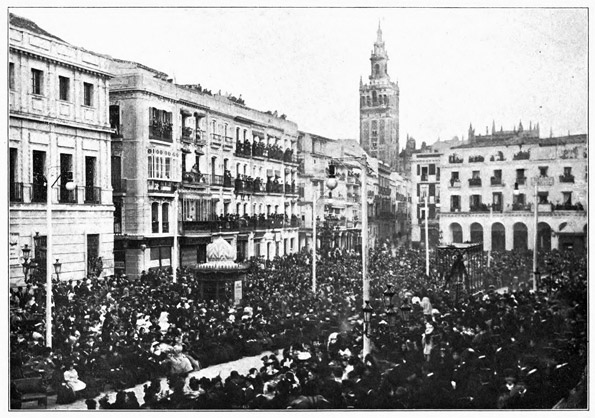
The Passing of the Pageants
XI
THE ROUTE OF THE SILVER FLEETS
"Paul, the Physician, to Cristobal Colombo, greeting. I perceive your magnificent
and great desire to find a way to where the spices grow."
"And thus leade they their lyves in fullfilling the holy hunger of golde. But the
more they fill their handes with finding, the more increaseth their covetous desire."
—Decades in the New Worlde.
I wanted to go from Seville to Cadiz by water. I
longed to sail by the "Silver Road" in the wake of the
silver fleets. The little artist, as befitted her youth,
preferred a Manila shawl to that historic pilgrimage. So I
proposed to make this trifling trip alone.
Don José was shocked. Merriest and most indulgent of
hosts, he was inclined at this point to play the tyrant. If I
must see Cadiz, well and good. He would take me to the
morning express and put me under charge of the conductor.
At Utrera, an hour farther on, his son would come to the
train and see that all was well. At Puerto de Santa Maria,
another hour distant, I should be met by a trusted friend of
the family, who would transfer me to another train and another
conductor, and so speed me for my third hour to Cadiz,
where I should be greeted by a relative of mine hostess and
conveyed in safety to his home.
I appreciated the kindness involved in this very Andalusian
programme, but otherwise it did not appeal to me. That was
not the way Columbus went, nor Cortés. And much as I
delighted in the Alhambra, and the Mosque of Cordova, and
the Alcázar of Seville, I did not feel called upon to bow a
New England bonnet beneath the Moorish yoke.
Thus Don José and I found ourselves quietly engaged in
an Hispano-American contest. He heartily disapproved of
my going, even by train. "Una señora sola! It is not the
custom in Andalusia." His plan of campaign consisted in
deferring the arrangements from day to day. "Mañana!"
Whenever I attempted to set a time for departure he blandly
assented, and presently projected some irresistibly attractive
excursion for that very date. His household were all with
him. His wife had not been able to procure the particular
dulces indispensable to a traveller's luncheon. Even my
faithless comrade, draped in her flower-garden shawl, practised
the steps of a seguidilla to the rattle of the castanets and
laughed at my defeats.
At last, grown desperate, I suavely announced at the Sunday
dinner table that I was going to Cadiz that week. My
host said, "Bueno!" and my hostess, "Muy bien!" But
there was no surrender in their tones. On Monday, instead
of writing the requisite notes to these relays of protectors
along the route, Don José took us himself, on a mimic steamboat,
for a judicious distance down the Guadalquivír. Tuesday
he put me off with Roman ruins, and Wednesday with a
private gallery of Murillos. By Thursday I grew insistent,
and, with shrug and sigh, he finally consented to my going by
train on Friday. I still urged the boat, but he heaped up a
thousand difficulties. There wasn't any; it would be overcrowded;
I should be seasick; the boat would arrive, wherever
it might arrive, too late for my train, whatever my train
might be. Compromise is always becoming, and I agreed to
take the nine o'clock express in the morning.
After the extended Spanish farewells, for to kiss on both
cheeks and be kissed on both cheeks down a long feminine line,
mother, daughters, and maid-servants, is no hasty ceremony,
I sallied forth at half-past eight with Don José in attendance.
He called a cab, but in Spain the cabbies are men and
brothers, and this one, on learning our destination, declared
that the train did not start until half-past nine and it was
much better for a lady to wait en casa than at the depot.
This additional guardianship goaded me to active remonstrance.
Why not take the cab for the hour and look up a procession
on our way to the station? There are always processions in
Seville. This appealed to both the pleasure-loving Spaniards,
and we drove into the palmy Plaza de San Fernando, where
an array of military bands was serenading some civic dignitary.
The music was of the best, and we fell in with the large
and varied retinue that escorted the musicians to the palace of
the archbishop. As they were rousing him from his reverend
slumbers with La Marcha de Cadiz, I caught a twinkle in Don
José's eye. Did he hope to keep me chasing after those
bands all the forenoon? I awakened the cabman, whom the
music had lulled into the easy Andalusian doze, and we clattered
off to the station. Of all silent and forsaken places! I
looked suspiciously at Don José, whose swarthy countenance
wore an overdone expression of innocent surprise. A solitary
official sauntered out.
"Good morning, señor! Is the express gone?" asked the
driver.
"Good morning, señor! There isn't any express to-day,"
was the reply. "The express runs only Tuesdays, Thursdays,
and Saturdays."
"What a pity," cooed Don José, contentedly. "You will
have to wait till to-morrow."
"Yes, you can go to-morrow," indulgently added the driver,
and the official chimed sweetly in, "Mañana por la mañana!"
"But is there no other train to-day?" I asked.
The official admitted that there was one at three o'clock.
Don José gave him a reproachful glance.
"But you do not want to go by train," said my ingenious
host. "Perhaps to-morrow you can go by steamboat."
"Perhaps I can go by steamboat now," I returned, seizing
my opportunity. "When does that boat start?"
Nobody knew. I asked the cabman to drive us to the
Golden Tower, off which sea-going vessels usually anchor.
Don José fell back in his seat, exhausted.
The cabman drove so fast, for Seville, that we ran into a
donkey and made a paralyzed beggar jump, but we reached the
river in time to see a small steamer just in the act of swinging
loose from the pier. In the excitement of the moment Don
José forgot everything save the necessity of properly presenting
me to the captain, and I, for my part, was absorbed in
the ecstasy of sailing from the foot of the Golden Tower
along the Silver Road.
It was not until a rod of water lay between boat and wharf
that the captain shouted to Don José, who struck an attitude
of utter consternation, that this craft went only to Bonanza,
and no connection could be made from there to Cadiz until
the following afternoon. And I, mindful of the austere
dignity that befitted these critical circumstances, could not
even laugh.
It was a dirty little boat, with a malodorous cargo of fish,
and for passengers two soldiers, two peasants, and a commercial
traveller. But what of that? I was sailing on a
treasure ship of the Indies, one of those lofty galleons of
Spain, "rowed by thrice one hundred slaves and gay with
streamers, banners, music," that had delivered at the Golden
Tower her tribute from the hoard of the Incas, and was
proudly bearing back to the open roads of Cadiz.
We dropped down past a noble line of deep-sea merchantmen,
from Marseilles, Hamburg, and far-away ports of Norway
and Sweden. We passed fishing boats casting their nets,
and met a stately Spanish bark, the Calderon. On the shores
we caught glimpses of orange grove and olive orchard, lines
of osiers and white poplars, and we paused at the little town
of Coria, famous for its earthen jars, to land one of our
peasants, while a jolly priest, whose plain black garb was
relieved by a vermilion parasol, tossed down cigars to his
friends among the sailors.
Then our galleon pursued her course into the flat and
desolate regions of the marismas. These great salt marshes
of the Guadalquivír, scarcely more than a bog in winter,
serve as pasture for herds of hardy sheep and for those droves
of mighty bulls bred in Andalusia to die in the arenas of all
Spain. For long stretches the green bank would be lined
with the glorious creatures, standing like ebony statues deep
amid the reeds, some entirely black, and many black with
slight markings of white. The Guadalquivír intersects in
triple channel this unpeopled waste, concerning whose profusion
of plant life and animal life English hunters tell
strange tales. They report flocks of rosy flamingoes, three
hundred or five hundred in a column, "glinting in the sunshine
like a pink cloud," and muddy islets studded thick with
colonies of flamingo nests. Most wonderful of all, the camel,
that ancient and serious beast of burden, a figure pertaining
in all imaginations to the arid, sandy desert, keeps holiday in
these huge swamps. It seems that, in 1829, a herd of
camels was brought into the province of Cadiz, from the
Canaries, for transport service in road-building and the like,
and for trial in agriculture. But the peculiar distaste of
horses for these humpy monsters spoiled the scheme, and the
camels, increased to some eighty in number, took merrily to
the marshes, where, in defiance of all caravan tradition, they
thrive in aquatic liberty. The fascination of this wilderness
reached even the dingy steamer deck. Gulls, ducks, and all
manner of wild fowl flashed in the sunshine, which often
made the winding river, as tawny as our James, sparkle like
liquid gold.
If only it had been gold indeed, and had kept the traceries
of the Roman keels that have traversed it, the Vandal swords
whose red it has washed away, the Moorish faces it has
mirrored, the Spanish—
"Usted come?"
It might have been Cortes who was offering that bowl of
puchero, but no! Cortes would have mixed it in his plumy
helmet and stirred it with that thin, keen sword one may see
in the Madrid Armería. This was a barefooted cabin boy, in blue
linen blouse and patched blue trousers, with a scarlet cloth cap
tied over his head by means of an orange-colored handkerchief.
The dancing eyes that lit his shy brown face had sea
blues in them. He was a winsome little fellow enough, but
I did not incline to his cookery. While I was watching
river, shores, and herds and chatting with the simpático sailor,
who, taking his cue from my look, expressed the deepest
abhorrence of the bull-fights, which, I make no doubt, he
would sell his dinner, jacket, bed, even his guitar, to see, I
had taken secret note of the cuisine. This child, who could
not have counted his twelfth birthday, kindled the fire in a
flimsy tin pail, lined with broken bricks. He cracked over
his knee a few pieces of driftwood, mixed the fragments
with bits of coal which he shook out of a sheepskin bottle,
doused oil over the whole, and cheerfully applied the match,
while the commercial traveller hastily drew up a bucket of
water to have on hand for emergencies. Then the boy,
with excellent intentions in the way of neatness, whisked his
blackened hands across the rough end of a rope and plunged
them into the pot of garbanzos, to which he added beans, cabbage,
remnants of fried fish, and other sundries at his young
discretion. And while the mess was simmering, he squatted
down on the deck, with his grimy little feet in his fists,
rocking himself back and forth to his own wild Malaga songs,
and occasionally disengaging one hand or the other to plunge
it into the pot after a tasty morsel.
"Will you eat?" he repeated manfully, reddening under
the scrutiny of stranger eyes.
"Many thanks! May it profit yourself!"
I opened my luncheon, and again we exchanged these fixed
phrases of Spanish etiquette, although after the refusals enjoined
by code of courtesy, the boy was finally induced to
relieve me of my more indigestible goodies.
"Did you ever hear of Columbus?" I asked, as we munched
chestnut cakes together, leaning on the rail.
"No, señora," he replied, with another blush, "I have
heard of nothing. I know little. I am of very small account.
I cook and sing. I am good for nothing more."
And is it to this those arrogant Spanish boasts, which
rang like trumpets up and down the Guadalquivír, have
come at last!
We were in the heart of a perfect sapphire day. The
river, often turbulent and unruly, was on this April afternoon,
the sailors said, buen muchacho, a good boy. The boat appeared
to navigate herself. The captain nodded on his lofty
perch, and the engineer was curled up in his own tiny hatchway,
trying to read a newspaper, which the fresh breeze blew
into horns and balloons. The rough cabin bunks were full
of sleeping forms, and the leather wine-bottles, flung down
carelessly in the stern, had cuddled each to each in cozy
shapes, and seemed to be sleeping, too. The two soldiers,
who had been gambling with coppers over innumerable games
of dominos, were listening grimly to the oratory of the commercial
traveller.
"No fighting for me!" this hero was declaiming. "In
strenuous times like these a man ought to cherish his life for
the sake of his country. Spain needs her sons right here at
home. It is sweet, as the poet says, to die for the patria, but
to live for the patria is, in my opinion, just as glorious."
"And more comfortable," grunted one of the soldiers,
while the other gave a hitch to those red infantry trousers
which look as if they had been wading in blood, and walked forward
to view from the bows the little white port of Bonanza.
As the boat went no farther, I had to stain my silver route
by a prosaic parenthesis of land. It was some comfort to
remember that Magellan waited here for that expedition from
Seville which was the first to sail around the globe. I think
I travelled the three miles from Bonanza, Good Weather, to
San Lúcar de Barrameda in Magellan's own carriage. It was
certainly old enough. As I sat on a tipsy chair in the middle
of a rude wagon frame mounted on two shrieking wooden
wheels, and hooded with broken arches of bamboo, from
which flapped shreds of russet oilcloth, I entered into poignant
sympathy with Magellan's ups and downs of hope and
fear. The jolting was such a torture that, to divert my
attention, I questioned the driver as to the uses of this and
that appliance in his rickety ark.
"And what are those ropes for, there in the corner?"
was my final query.
"Those are to tie the coffins down when I have a fare for
the cemetery," he replied, cracking his whip over the incredibly
lean mule that was sulkily jerking us along.
"Please let me get out and walk," I entreated. "You
may keep the valise and show me the way to the inn, and I
can go quite as fast as that mule."
"Now, don't!" he begged, with even intenser pathos.
"Strangers always want to walk before they get to the inn,
and then the people laugh at me. I know my carriage isn't
very handsome, but it's the only one in Bonanza. Just do
me the favor to keep your seat a little longer."
I had been lurched out of it only a minute before, but I
could not refuse to sacrifice mere bodily ease to the pride of
Spanish spirit.
Notwithstanding Don José's dark predictions, this was the
only trial of the trip. To realize to the full the honesty,
kindliness, and dignity of the everyday Spaniard, one needs
to turn off from the sight-seer's route. On the beaten tourist
track are exorbitant hotels, greedy guides, cheating merchants,
troops of beggars—everywhere "the itching palm." But
here in San Lúcar, for instance, where I had to spend twenty-four
hours at a genuine Spanish fonda, the proprietor took no
advantage of the facts that I was a foreigner, a woman, and
practically a prisoner in the place until the Saturday afternoon
train went out, but gave me excellent accommodations, most
respectful and considerate treatment, and the lowest hotel bill
that I had seen in Spain.
San Lúcar has, in early Spanish literature, a very ill name
for roguery, but, so far as my brief experience went, Boston
could not have been safer and would not have been so genial.
I strayed, for instance, into a modest little shop to buy a cake
of soap, which its owner declined to sell, insisting that I
ought to have a choicer variety than his, and sending his son,
a lad of sixteen, to point me out more fashionable counters.
This youth showed me the sights of the pleasant seashore
town, with its tiers of closely grated windows standing out
from the white fronts of the houses, and its sturdy packhorses
and orange-laden donkeys streaming along the rough stone
streets, and when, at the inn door, I hesitatingly offered him
a piece of silver, doffed his cap with smiling ease, and said
he did not take pay for a pleasure.
Once off the regular lines of travel, however, speed is out
of the question. I might have gone from Seville to Cadiz in
three hours; thanks to historic enthusiasms, it took me nearer
three days. After escaping from San Lúcar, I had to pass
four hours in Jerez, another whitewashed, palm-planted town,
whose famous sherry has made it the third city in Spain for
wealth. The thing to do at Jerez is to visit the great bodegas
and taste the rich white liquors treasured in those monster
casks, which bear all manner of names, from Christ and His
twelve disciples to Napoleon the Great; but mindful, in the
light of Don José's admonitions, that the weak feminine
estate is "as water unto wine," I contented myself with seeing
the strange storage basin of the mountain aqueduct—an
immense, immaculate cellar, where endless vistas of low stone
arches stretch away in the silent dusk above the glimmer of
a ghostly lake.
The train for Cadiz must needs be two hours late this
particular evening, but my cabman drove me to approved
shops for the purchase of bread and fruit, and then, of his own
motion, drew up our modest equipage in a shady nook opposite
the villa of the English consul, that I might enjoy my
Arcadian repast with a secure mind. Jehu accepted, after
due protestations, a share of the viands, and reciprocated the
attention by buying me a glass of water at the nearest stand,
much amused at my continued preference for Jerez water
over Jerez wine.
One of the Jerez wine merchants, German by birth, shared
the railway carriage with me for a while, and after the social
wont of Continental travel fell to discussing the war. "The
Spaniards deserved to be beaten," he declared, "but the Yankees
didn't deserve to beat. They were conceited enough
before, heaven knows, and now they expect all Europe to
black their shoddy shoes. Your own country was a bit to
blame in blocking every effort to keep them in their place."
I felt it time to explain that I was not English, but American.
Much disconcerted, he did his best to make amends.
"I wouldn't have said that for the world if I had known
you were an American—but it's every syllable true."
He thought over this remark in silence for a moment, his
Teutonic spirit sorely strained between kindliness and honesty,
and tried again.
"I would like to say something good about the United
States, I would indeed,—if there was anything to say."
It seemed to occur to him, after a little, that even this
apology left something to be desired, and he brightened up.
"Wouldn't you like some roses? They sell them here at
this station. There comes a boy now with a nice, big bunch.
One peseta! I think that's too dear, don't you?"
I hastened to assent.
"The lady says that's too dear. Seventy-five centimos?
No. The lady can't pay that. Sixty centimos? No.
The lady can't afford sixty centimos. Fifty centimos? No.
The lady says fifty centimos is too much. She will take
them at forty centimos. Here's a half peseta. And you
must give me back a fat dog."
The boy held back the penny and tried to substitute a
cent.
"Oh, sir, please, sir, forty-five centimos! There are two
dozen roses here, and all fresh as the dawn. Give me the
puppy-dog over."
But the German, who knew how to put even a sharper
edge on the inveterate Spanish bargaining, secured for the
value of eight cents, instead of twenty, his great bouquet of
really beautiful roses, and presented it with as much of a bow
as the carriage limits permitted.
"I meant to pay all the time, you know; but one can
always make a better trade, in Spain, if it is done in the name
of a lady." And he added, with that sudden tact which
innate goodness and delicacy give to the most blundering of
us mortals, "If you don't like to take them from a stranger for
yourself, you will take them as my peace-offering to your
country."
I was reminded again of my native land by another fellow-traveller—a
Spaniard of the Spaniards, this time, one of the
Conservative and Catholic leaders, greeted at the various
stations by priests and monks and friars, whose hands he
solemnly kissed. This distinguished personage was absorbed
in a voluminous type-written manuscript, from which he occasionally
read aloud to the band of political confidants who accompanied
him. It was an arraignment of the Liberal Party,
and, by way of exposing the errors of the Sagasta government,
included a merciless résumé of the Spanish naval and military
disasters, with elaborate comparisons of the American and
Spanish equipments. He was then on his way to join in a
consoling pilgrimage to a certain image of Christ, which had
been cudgelled by a grief-maddened priest whose dying mother
the image had failed to heal.
These surroundings more or less jostled my sixteenth-century
dream, but I held to it so stubbornly that, when
pyramids of salt began to glimmer like ghosts along the way,
and a sweeping curve of lights warned me of our approach to
Cadiz, I made a point of seeing as little as possible. It was
midnight, but Spanish hours are luckily so late that Don
José's friends were still at the height of evening sociability
and regaled me with alternate showers of sweetmeats and
questions. Finally, after many exclamations of horror at the
audacity of the trip, all the feminine hospitality of the household
lighted me to a chamber whose walls were hung with
pictures of martyrs and agonizing saints. Among these I
counted five colored representations of Christ opening his
breast to display the bleeding heart.
The next morning I promptly took boat to Puerto de Santa
Maria, embarked on the return steamer, and so at last found
myself once more on the Silver Road, entering Cadiz harbor
from the sea.
To be sure, the Montserrat was riding proudly in my view,
although the warships to which she had been used to curtsy in
the open roads of Cadiz would never cut those shining waves
again. The waters were as turquoise blue as if they had just
come from the brush of an old master, and the towered city
rose before us like a crystal castle in the air. Its limited
space, built as it is within great sea walls on an outlying rock,
which only a rope of sand moors to the mainland, has necessitated
narrow streets and high houses, whose miradores, lookouts
that everywhere crown the terraced roofs, give this
battlemented aspect to the town. One of the most ancient
and tragic cities known to time, claiming Hercules for its
founder, in turn Phœnician, Carthaginian, Roman, Gothic,
Moorish, Spanish, it yet looks fresh as a water-lily. I could
have spent another three days in gazing. And this sparkling
vision was Spain's Copa de Plata, the Silver Cup which has
brimmed with the gold and pearls of America, with blood and
flame and glory. Its riches have taken to themselves wings,
but its high, free spirit and frank gayety abide. Still the
Andalusians sing:—
"Viva Cadiz, Silver Cadiz,
Whose walls defy the sea,
Cadiz of the pretty girls,
Of courtesy and glee!
"Good luck to merry Cadiz,
As white as ocean spray,
And her five and twenty cannon
That point Gibraltar way!"
But I am bound to add that the cannon do not look
dangerous.
XII
MURILLO'S CHERUBS
"Angels o'er the palm trees flying,
Touch their waving fronds to rest.
Bid them give no wind replying.
Jesus sleeps on Mary's breast.
Blesséd angels, hold the peeping
Branches still as altar-place,
For the Holy Child is sleeping
Close beneath His Mother's face."
—Lope de Vega.
Spanish love for childhood, and the precocity and
winsomeness of Spanish children, impressed me from
my first hour in the Peninsula. "There is no road
so level as to be without rough places," and the initial days of
my Madrid residence, after my artist comrade had gone back to
Paris and the spring salons, might have been a trifle lonely save
for baby society. I was living in a delightful Spanish household,
but the very excess of courtesy reminded me continually
that I was a Yankee and a heretic. As time passed, friendship
ripened, and it is to-day no empty form of words when
I am assured that I have "my house in Madrid." But at
the outset I felt myself not only an American alien, but an
Andalusian exile. The "only Court" is such a prosaic contrast
to Seville that my impulse was to betake myself with
books to the great park of the Buen Retiro, the magnificent
gift of Olivares to his royal master, and let the Madrid world,
at least the adult portion of it, go by. For while the larger
Madrileños were busy with their own plays of politics,
bull-fights, and flirtation, the little ones had happy afternoons
in that historic park of many a tragedy, where
convents, palaces, and fortifications have all made way for
the children's romping ground. Resting on a rustic seat in
the leafy shade, with the rich, thrilling notes of the nightingale
answering the bell call of the cuckoo from the deeper
groves beyond, I could watch these budding Spaniards to
heart's content.
It was well to observe them from a distance, however, for
their young voices were of the shrillest. Among the boys,
an energetic few were developing muscle by tag and leap-frog;
more were flying kites, cracking whips, twirling slings,
and brandishing the terrors of pewter swords; while at every
turn, beside some flashing fountain or beneath some spreading
oak, I would come upon a group of urchins playing al toro
with the cheap, gaudy capes of red and yellow manufactured
for the children's sport. The girls were skipping rope, rolling
hoop, teaching one another the steps of endless dances,
and whispering momentous secrets in statue-guarded grottos,
or thickets of flowering shrubs, or whatsoever safe, mysterious
nook their fluttering search could find.
Here was a school out for its daily airing, a pretty procession
of rainbow-clad little damsels, marshalled by the black-veiled
figures of graceful nuns, and pacing with all decorum
down a crowded avenue; but the moment the troop turned into
some sequestered by-path, how it would break into a shimmering
confusion of butterflies, darting hither and thither
in those jewel-green lights and sea-green shadows, the nuns
casting their dignity to the winds and scampering with the
swiftest! Wandering after I would come, perhaps, upon
an open space where the smaller boys were gathered, delicate
little lads riding horse-headed sticks, digging with mimic
spades, and tossing big, soft, red and yellow balls, while
mothers and nurses sat about in circle on the stone benches,
calling out sharp-toned cautions to their respective charges.
And everywhere in the park were toddling babies, clasping
dolls, tugging at gay balloons, dragging wooden donkeys on
wheels, and tumbling over live puppies. They were pale,
engaging, persistent little creatures, with a true Spanish inability
to learn from experience. I saw one aristocratic
cherub, white as snow from feathered cap to ribboned shoes,
take ten successive slappings because he muddied his hands.
The angry nurse would make a snatch for the naughty
fingers, roughly beat off the dirt, and cuff the culprit soundly.
His proud little mouth would tremble; he would wink hard
and fast, but there was not a tear to be seen, not a cry to be
heard, and no sooner had her peasant clutch released him than
back went the baby hands, grubbing deep into the mire. A
gorgeous civil guard finally distracted her attention, and the
last view I had of the child showed him blissfully squatted in
the very middle of a puddle, splashing with arms and legs.
White is almost the universal wear of the prattling age in
the Buen Retiro, although now and then some lily fairy would
flit by with saffron sash and harmonious saffron stockings, or
costume similarly touched by pink or blue. The Scotch
plaids, too, were in favor as sashes, and at rare intervals I
encountered a tot sensibly attired in stout plaid frock. But
the white of this childish multitude was thickly flecked with
mourning suits, complete to bits of black gloves and even to
jet studs in the collars. Among the sad sights of the Retiro
was an epileptic boy, led and half supported between two
sweet-faced, youthful ladies, both in widow's crêpe, who
screened him with caresses as his fit took him and he foamed
and screamed in piteous helplessness. This pathetic trio, ever
seeking seclusion, was ever followed by a retinue of idlers,
who, for all their intrusive staring, were silent and sympathetic.
The nursemaids formed not the least attractive feature of the
kaleidoscopic picture. Most wore white caps, fastened with
gilded pins or knots of rose or russet; but the nurses counted
the best, from the mountain province of Santander, were
distinguished by bright-colored handkerchiefs twisted about
the head. Here, as in the Élysées, baby-wagons are seldom
seen. The nurses carry in arms the black-eyed infants, who
bite away at their coral necklaces quite like little Yankees.
But Spanish traits soon declare themselves. In the centre
of the park is an artificial pond, where lads in their first teens,
too old for play, lean languidly over the iron railings, and,
while they throw crumbs to the flock of forlorn-looking ducks
or watch the dip of the red oar-blades that impel the pleasure
boats, brag of their amorous adventures and exchange the
scandal of the Prado. Sometimes their love chat is of
sweeter tenor, for many of these schoolboys have already
spoken their betrothal vows, which the Church will not let
them lightly break. Spaniards often marry under twenty-one,
and even a recent wedding in Madrid, where neither bride
nor bridegroom had reached the fifteenth year, was hardly
thought amiss, in view of the fact that there was parental
money to maintain them.
And why had the stately city of Valladolid been under a
reign of terror for half the week just past, with shutters up,
doors barred, and women and children kept at home for
safety, while bands of young men swayed in bloody struggle
through her famous squares and streets, but because a cadet
and a student must needs lose heart to the same maid?
Cupid, not Santiago, is the patron saint of Spain. And
Cupid, for all his mischief, has some very winning ways.
Our boyish sentimentalists of the Buen Retiro, for instance,
easily fall into song, and the native melodies, always with
something wild and Oriental in their beat, ring across the
little lake into the woods beyond till the birds take up the
challenge and every tree grows vocal.
One afternoon, on my way to the park, I bought from a
roadside vender a handful of small, gaudily bound children's
books, and had no sooner found what I fondly supposed was
a sequestered seat than a tumult of little folks surrounded me,
coaxing to hear the stories. These tales, so taken at random,
may throw a little light on the literature of Spanish nurseries.
There was the life of the Madonna, which we passed over,
as the children said they had read it in school and knew it,
every word, already. So we turned to the astonishing career
of the great soldier, Kill-Bullet, who could easily stop a
cannon-ball against his palm, and to an account of that far-off
land where it rained gold in such profusion that nobody would
work, until finally all the people, weary of a wealth which
induced no tailor to stitch and no shoemaker to cobble, no
baker to bake and no dairy-maid to churn, rose by common
consent and shovelled the gold into the river. We read of
hot-tempered little Ambrose, who left the gate of his garden
open, so that a hen cackled in and began to scratch under a
rose bush, whereupon the angry boy chased her furiously all
over the garden-beds until his summer's work was trampled
into ruin, and his papa came and explained to him how disastrous
a thing is wrath. There was a companion moral tale
for little girls, telling how Inez used to make faces until her
mamma told her that she would grow up with a twisted
mouth and nobody would marry her, whereat did little Inez
promptly reform her manners. One favorite volume, with
a cover which displayed a wild-whiskered old ogre in a fiery
skullcap gloating over a platterful of very pink baby, told how
good little Violet saved her bad sisters, Rose and Daisy, from
his dreadful gullet, by aid of an ugly monkey, whom her
promised kiss transformed into a fairy prince. I was glad to
find, in that country where so little is done to train children
in the love of animals, the ancient tale of the four musicians,
the donkey, the dog, the cat, and the cock, who escaped in
their old age from the death that threatened them at the hands
of ungrateful masters and, by a free exercise of their musical
talents, captured the house of a robber-band, putting its inmates
to confusion and flight. Many of the stories, indeed,
would have been recognized by young Americans, but the
proportion of saint-lore was larger than that of fairy-lore, and,
now and then, some familiar property had suffered a Spanish
change, as the invisible cap which had become an invisible
cape of the sort used for playing bull-fight.
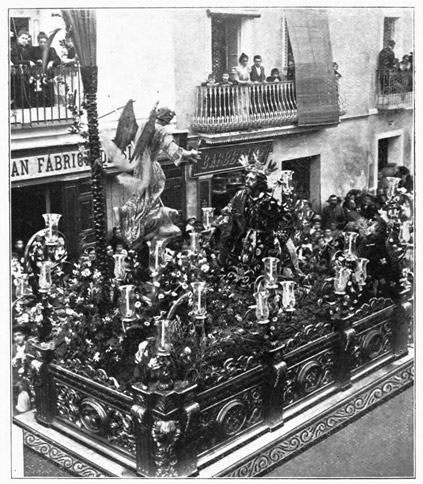
The Pageant of Gethsemane
The nursery rhymes, too, so far as I chanced upon them,
were of the universal type with Spanish variations. A Castilian
mother plays Peek-a-boo with her baby quite as an English
mother does, except that the syllables are Cú? Trás! The
father's foot trots the child to a Catholic market.
"Trot, little donkey! Donkey, trot!
We must buy honey to please the pet.
If San Francisco has it not,
We'll go to San Benet."
Baby's toes are counted as the eternal five little pigs, and
also thus, with a preliminary tickling of the rosy sole:—
"Here passed a little dove. This one caught it. This
one killed it. This one put it on to roast. This one took it
off again. And this teeny-teeny-teeny scamp ate it all up!"
Spanish patty-cakes are followed by a Spanish grace.
"Patty-cakes, oh! Patty-cakes, ah!
The sweetest cakes are for dear mama.
Patty-cakes, oh! Patty-cakes, ah!
The hardest pats are for poor papa,
"Bread, O God! Bread, dear God,
For this little child to-day!
Because he's such a baby
He cannot pay his way."
The Spanish nursery seems richer in rhymes than ours.
Nurse bends Baby's left hand into a rose-leaf purse, for example,
and gives it little taps with one finger after another of
Baby's right hand, singing:—
"A penny for Baby's purse
From papa, mama, and nurse.
A penny, a penny to pay!
Let no thief steal it away!"
And then the tiny fist is doubled tight.
When the child, again, is first dressed in short clothes, he
is propped up in a corner and coaxed to take his first step
with the rhyme:—
"One little step, Baby-boy mine!
Come, Little Man, step up!
And thou shalt have a taste of wine
From Godfather's silver cup."
This rhyming fashion the little ones take with them out of
babyhood into their later childhood. The urchin admonishes
his whistle:—
"Whistle, whistle, Margarita,
And you'll get a crust of bread,
But if you do not whistle
I'll cut off your little head."
The little girl learns the scales in process of rocking her
doll to sleep:—
Don't pin-prick my poor old dolly, Do
Respect my domestic matters. Re
Methinks she grows melancholy, Mi
Fast as her sawdust scatters. Fa
Sole rose of your mama's posy, Sol
Laugh at your mama, so! La
Seal up your eyes all cozy. Si
La Sol Fa Mi Re Do.
With Spanish children, as with ours, Christmas Eve, or
Noche Buena, is a season of gleeful excitement. They do not
hang up stockings for Santa Claus, but they put out their
shoes on the balcony for the Kings of the East, riding high
on camel-back, to fill with sweets and playthings. Considerate
children, too, put out a handful of straw for the tired
beasts who have journeyed so far over the Milky Way. On
some balconies the morning sun beholds rocking-horses and
rocking-donkeys, make-believe theatres and bull-rings, with
toy images of soldiers, bulls and Holy Families; but if the
child has been naughty and displeased the Magi, his poor little
shoes will stand empty and ashamed.
The dramatic instinct, so strong in Spaniards, is strikingly
manifested in the children's games. These little people are
devoted to the theatre, too, and may be seen in force at the
matinées in the Apolo, Lara, and Zarzuela. Afternoon performances
are given only on Sundays and the other Catholic
fiestas, which last, numerous enough, are well within reach of
the Puritan conscience. At these matinées more than half the
seats in the house are occupied by juvenile ticket-holders, from
rows of vociferous urchins in the galleries, to round-eyed
babies cooing over their nurses' shoulders. If the play is an
extravaganza, abounding in magic and misadventure, the rapture
of the childish audience is at its height.
The close attention with which mere three-year-olds follow
the action is astonishing. "Bonito!" lisping voices cry after
each fantastic ballet, and wee white hands twinkle up and down
in time with the merry music. When the clown divests himself,
one by one, of a score of waistcoats, or successively
pulls thirty or forty smiling dairy-maids out of a churn, little
arithmeticians all over the house call out the count and dispute
his numbers with him. When the dragon spits his
shower of sparks, when chairs sidle away from beneath the
unfortunates who would sit down or suddenly rise with
them toward the ceiling, when signboards whirl, and dinners
frisk up chimney, cigars puff out into tall hats, and umbrellas
fire off bullets, the hubbub of wonder and delight drowns the
voices of the actors.
The house is never still for one single instant. Babies cry
wearily, nurses murmur soothingly, mystified innocents pipe
out questions, papas rebuke and explain, exasperated old
bachelors hiss for silence, saucy boys hiss back for fun—all
together the Madrid matinée affords a far better opportunity
to study child life than to hear the comedy upon the
boards.
The boy king of Spain is, of course, a fascinating figure to
his child subjects. We were told at San Sebastian, where the
Queen Regent has a summer palace, that on those red-letter
days when the king takes a sea dip, children come running
from far and near to see him step into the surf, with two
stalwart soldiers gripping the royal little fists. And no sooner
has the Court returned to the sumptuous, anxious palace of
Madrid, than the boy bathers of San Sebastian delight themselves
in playing king, mincing down the beach under the
pompous military escort that they take turns in furnishing one
another.
In Madrid, too, the sightseeing crowds that gather before
the royal palace or at the doors of the Iglesia del Buen Suceso,
where the Queen Regent, with her "august children," sometimes
attends the Salve on Saturday afternoons, are thickly
peppered with little folks, eager to "see the king." They
are often disappointed, for the precious life is jealously
guarded, especially while the Carlist cloud still broods above
the throne. During my stay in Madrid, a man with a revolver
under his coat was arrested on suspicion in the vestibule
of the theatre known as La Comédia, where the queen
was passing the evening. Sceptical Madrid shrugged its
shoulders and said: "Stuff and nonsense! When the
Ministers want the queen to sign a paper that isn't to her
liking, they make a great show of devotion and pounce
down on some poor devil as an anarchist, to frighten her
into being meek and grateful." And, in fact, the prisoner
was almost immediately released for lack of any incriminating
evidence. For weeks after, nevertheless, the royal movements
were more difficult to forecast, and on the daily drives
the kinglet was often missing from the family group.
But, undiscouraged, every afternoon the children would
fringe the palace side of the Plaza de Oriente, hoping to see
the royal carriage go or come with their young sovereign,
whose portrait, a wistful, boyish face above a broad lace collar,
is printed in one of their school reading books over the
inscription, "To the Head of the State honor and obedience
are due." Expectant youngsters, in the all-enveloping black
pinafores that remind the eye of Paris, with book satchels
made of gay carpeting over the shoulder, would shake out
their smudgy handkerchiefs, often stamped with the likenesses
of famous toreros, and help themselves to one another's hats
in readiness to salute; but the elegant landau, preceded by an
escort of two horsemen, dashes by so swiftly that their long
waiting would be rewarded only by the briefest glimpse of
bowing bonnets and of a small gloved hand touching the military
cap that shades a childish face.
It is a pale and sober little face as I have seen it, but Madrileños
resent this impression and insist that his youthful
Majesty is "sturdy enough," and as merry as need be. They
say that the buoyancy which he inherits from his father is
crossed by strange fits of brooding, due to his mother's blood,
but that he is, in the main, a merry-hearted child. Although
he has masters for his studies now, his affection still
clings to his Austrian governess, whom, none the less, he
dearly loves to tease. When she is honored by an invitation
to drive with the Queen Regent, for example, Alphonsito
hastens to hide her hat and then joins most solicitously in her
fluttered search, until her suspicion darts upon him, and his
prank breaks down in peals of laughter. Madrid was especially
sensitive about him last year, for he, Alfonso XIII,
godson of Pope Leo XIII, was thirteen years of age—an
iteration of the unlucky omen that really ought to be satisfied
with the loss of the Spanish colonies. His mother, in honor
of his birthday, May seventeenth, distributed five thousand dollars
among orphan asylums and other charities, and held a
grand reception in the Hall of the Ambassadors, where the
slight lad in cadet uniform, enthroned beside the Queen Regent
between the two great lions of gilded bronze, received the
congratulations of a long procession of bowing ministers,
admirals, captain generals, prelates, and those haughty grandees
of Spain whose ancient privilege it is to wear their hats
in the royal presence; but the shrinkage of his realm since
his last birthday must have been uppermost in the mind of
even the young lord of the festival. Pobrecito! one wonders
what thoughts go on behind those serious brows of his, when,
for instance, he looks down from his palace windows at the
daily ceremony of guard-mounting in the courtyard. It is
such a gallant sight; the martial music is so stirring; the
cavalry in blue and silver sit their white steeds so proudly,
with the sun glistening on their drawn swords and the wind
tossing their long, white, horsehair plumes, that all these
tales of defeat and loss must puzzle the sore boy heart and
cast confusing shadows down the path before him.
Little as the Spaniards love the Queen Regent, to whom
they cannot pardon her two cardinal offences of being a
"foreigner" and of disliking the bull-fight, they have a certain
affection for Alfonso XIII, "the only child born a king since
Christ." Indeed, Spain seems to have been always sympathetic
toward childhood in palaces. Enter this wonderful Armería
of Madrid, where those plumed and armored kings, on richly
caparisoned chargers, whom we have come to know in the
paintings of the Museo del Prado, seem to have leapt from
the canvases to greet us here in still more lifelike guise, albeit
not over graciously, with horse reined back and mighty lance
at poise. Any fine morning they may all come clattering out
into the Plaza de Armas—and where will the United States
be then? Here stands a majestic row of them—Philip II,
in a resplendent suit of gold-inlaid plate-armor; Maximilian,
whose visor gives him the fierce hooked beak of an eagle;
Sebastian of Portugal, with nymphs embossed in cunning work
on his rich breastplate; and Charles V, three times over, in
varieties of imperial magnificence.
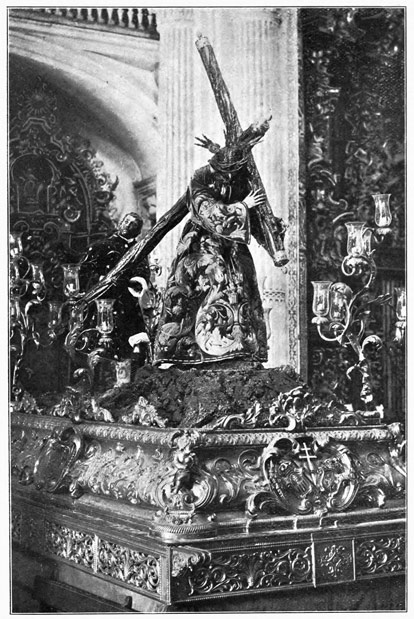
"Jesus of the Passion"
But opposite these stern warriors is a hollow square of boy
princes, and of noble niños whose visors hide their identities
in long oblivion. The armor of these childish figures is
daintily wrought, with tender touches of ruffs and cuffs, scallops
and flutings and rosettes. Often only the upper half of
the body is incased in steel, the slender legs playing the dandy
in puffed trousers of striped velvet—scarlet, green, and buff—silk
hose, and satin slippers. Little Philip III proudly
displays a diminutive round shield, with a relief of battle
scenes in gold. The plate armor of little Philip IV is
stamped with lions and castles, eagles and spears. And his
little son, Don Baltasar Carlos, bestrides a spirited pony and
wears at the back of his helmet a tuft of garnet feathers.
The Prado galleries abound in royal children. This same
infante, Don Baltasar, is seen here in the foreground of a
lonely landscape, with desolate blue hills beyond and driving
clouds above. But all the more bright and winsome glows
the form of the six-year-old horseman, the gold-fringed, pink
sash that crosses his breast streaming out far behind with the
speed of his fearless gallop. Supreme among the Prado children,
of course, is the little daughter of Philip IV, the central
figure of the world-renowned Las Meninas. All in vain does
her charming maid of honor kneel to her with the golden cup;
all in vain does the dwarf tease the drowsy dog. The solemn
puss, undiverted, will not stir from her pose nor alter the set
of her small features until the artist, standing half disdainfully
before his easel, gives the word. She has waited for it now
hard upon two hundred and fifty years, but the centuries beat
in vain against that inflexible bit of propriety.
Even the royal burial vaults beneath the grim Escorial have
in their chill grandeur of marble halls an especial Panteon for
babies, princely innocents whose lives are reckoned in months
more often than in years. Gold and blue and red brighten
their great white sepulchre, and above the altar smiles the
Christ Child, with the graven words, "Suffer the children
to come unto me." But for Alfonso XIII a sombre sarcophagus
waits in the haughtiest and gloomiest of all the Panteons,
where only kings, and queens who were mothers of kings,
may lie.
It is not royal childhood alone that is dear to this strange,
romantic, monstrously inconsistent heart of Spain. The cruelty
of Spaniards to horses and donkeys sickens even the roughest
Englishman, yet almost every voice softens in speaking to a
child, and during my six months in Spanish cities I saw
nothing of that street brutality toward the little ones which
forces itself upon daily notice in Liverpool and London.
Spanish children are too often ill-cared for, but despite the
abuses of ignorant motherhood and fatherhood, such vivid,
vivacious, bewitching little people as they are! Enter a
Spanish schoolroom and see how vehemently the small brown
hands are wagged in air, how the black eyes dance and the
dimples play, what a stir and bustle, what a young exuberance
of energy! They race to the blackboards like colts out at
pasture. They laugh at everything, these sons of "the grave
Spaniard," and even the teacher will duck his head behind
the desk for a half-hidden ecstasy over some dunce's blunder
or some rogue's detected trick.
But their high spirits never make them unmindful of those
courtesies of life in which they have been so carefully trained.
There is an old-fashioned exaggeration about their set phrases
of politeness. Just as the casual caller kisses the lady's feet,
in words, and she reciprocates by a verbal kissing of his hand,
so the school children respond to the roll call with a glib:
"Your servant, sir." Ask a well-bred boy his name, and he
rattles back, "Jesus Herrera y La-Chica, at the service of
God and yourself." They learn these amenities of speech
with their first lispings. I was much taken aback one day
in Seville by a child of eighteen months. Not in the least
expecting this infant, whose rosy face was bashfully snuggled
into his young aunt's neck, to understand, I said to her,
"What a fine little fellow!" Whereupon Master Roly-poly
suddenly sat up straight on her arm, ducked his head in my
direction, and gravely enunciated, "Es favor que Usted me hace"—"It
is a compliment you pay me." I could hardly recover
from the shock in time to make the stereotyped rejoinder,
"No es favor, es justicia"—"No compliment, but the truth."
To this Don Chubbykins sweetly returned, "Mil gracias"—"A
thousand thanks," and I closed this uncanny dialogue
with the due response, "No las merece"—"It does not merit
them."
Servants, neighbors, passers-by, beggars, all prompt the
children in these shibboleths of good manners, adorning the
precept with example. "Would you like to go with us to
the picture gallery this afternoon?" I once asked a laddie
of artistic tastes at a boarding-house table. "Si, señora," he
replied, whereupon several of the boarders, greatly scandalized,
hastened to remind him, but in the gentlest of tones, of the
essential addition, "con mucho gusto" to which we were bound
to reply, "The pleasure will be ours." The girls, even more
than the boys, are bred in these formal fashions of intercourse.
Every morning they ask if you have rested well, and express
grief or gratification, according to your response. In Mrs.
Gulick's school, mere midgets of six and eight, returning from
class, will not close the doors of their rooms if you are in
sight, though perhaps seated at a reading table in the farther
end of the corridor, lest they should appear inhospitable. On
our return from Italica, a thirsty child of seven, heated to
exhaustion with the sun and fun of that Andalusian picnic,
refused to touch the anise-seed water which some good Samaritan
had handed up to the dusty carriage, until the glass had
been offered to every one else, driver included, leaving, in the
sequel, little enough for her. On our midnight return from
the Feria, this same niña of gentle memory, staggering and
half crying with sleepiness, would nevertheless not precede
any of her elders in entering the home door. "After you,"
she sobbed, with hardly voice enough to add, "And may
you all rest well!" "The same to you," chorussed the
adults, trooping by, and her faint murmur followed, "Many
thanks."
"Shall I give you this fan when I go away," I asked her
once, "or would you rather have it now to take to the party?"
She wanted it then and there, but what she answered was,
"I shall be best pleased to take it when you like best to give
it."
You must beware of saying to a little Spanish maid, "What
a beautiful rosebud in your hair!" Instantly the hand is busy
with the pins. "It is at your disposal." You hastily protest,
"A thousand thanks, but no, no, no! It is very well placed
where it is." Off comes the flower, notwithstanding, and is
fastened into your belt. For when the elder sister has insisted
on giving you (until the next ball) those dancing slippers
which you so rashly admired, and the sister's novio went
home the night before without his cloak, because you had
approved its colors (although he sent his man around for it
before breakfast), what can the children do but follow suit?
Even their form of "Now I Lay Me" is touched with their
quaint politeness:—
"Jesus, Joseph, Mary,
Your little servant keep,
While, with your kind permission,
I lay me down to sleep."
The precocity of Spanish children is a recognized fact.
An educational expert, a Frenchman who holds a chair in an
English university, assured us that beyond a doubt Spanish
children, for the first dozen years of life, develop more
rapidly than any other children of Europe. Yet, although
these clever little Spaniards are so punctiliously taught to put
the pleasure of others before their own, they are treated with
universal indulgence. Soldiers lining the curbstones on occasion
of a royal progress will let the children press in beside
them and cling to their valorous legs, until the military array
seems variegated with a Kindergarten. My farewell glimpse
of Toledo, on Corpus Christi Day, makes a pretty picture in
memory. The red-robed cardinal, who had come to the
station to take his train, was fairly stormed by all the children
within sight, clamoring for his blessing. In vain the
attendant priests tried to scatter the throng, and ladies of high
degree, planting their chairs in a circle about the prelate,
acted as a laughing body-guard. It was all of no avail. The
little people danced up and down with eagerness, dodged
under arms, and slipped between elbows. They knelt upon
the cardinal's very feet, rapturously kissing his red-gloved
hand and clasping to their pinafores and blouses the sacred
trinkets he distributed. And he, patting the bobbing black
pates, wherever he could get a chance, smiled on the little
ones and forbade them not.
The affection lavished on children in the household circle
is often poetic and passionate. I observed one day a brusque
young fellow of twenty-four, whom we had thought rather a
hard, catch-penny sort of person, suddenly gather a four-year-old
nephew to his heart and cover the dimpled face with kisses,
while the look in his own black eyes was the look of a St.
Anthony. I stood once in a crowded cathedral and lost all
sense of the service in contemplation of an ugly manikin, with
coarse features and receding forehead, who held a frail baby
boy tight against his breast. This was a blue-eyed, fair-haired
wean, with a serious, far-away expression, and from time to
time, attracted by the gilt of the ceiling, he raised a tiny pink
fore-finger and pointed upward, while the father's animal face,
never turned away from the child, became transfigured with
love and worship. He took the baby out, when it had fallen
asleep upon his shoulder, and it was good to see that dense
throng open and make a lane for him, every man, however
brutal or frivolous his aspect, being careful not to jostle the
drooping, golden head.
But Spanish children, so caressed and so adored, are nevertheless
modest in their bearing, and fall shyly back before a
stranger. I remember a beaming grandfather displaying to us
two blushing little men, bidding them open their eyes wide
that we might contrast colors, turn back to back that we
might measure heights, and in various ways put their small
selves on show, all which they did in mute obedience, but at
the word of release flew together, flung their arms about each
other's necks, rolled under the nearest table, and curled up
into the least possible bunch of bashful agony.
The pictures, frescos, and carvings of Spanish churches
often reflect the looks of Spanish childhood. The Holy Family
gives a wide range of opportunity, especially in the ministering
cherubs. There is a crucifix in one of the twenty-two
aisle chapels of Toledo cathedral, where three broken-hearted
mites of angels, just three crying babies, are piteously striving
to draw out the nails from the Sufferer's hands and feet.
Many of the saint-groups admit of child figures, too, as the
St. Christopher, which almost invariably appears as a colossal
nave painting, "the Goliath of frescos."
It would be strange, indeed, if children were not beloved in
the country of Murillo. Spain has let the most of his beggar-boy
pictures go to foreign collections, but she has cherished
his Holy Families and cherub-peopled Annunciations. Such
ecstatic rogues as those Andalusian cherubs are! Their restless
ringlets catch azure shadows from the Virgin's mantle;
they perch tiptoe on the edges of her crescent moon; they
hold up a mirror to her glory and peep over the frame to
see themselves; they pelt St. Francis with roses; they play
bo-beep from behind the fleecy folds of cloud; they try all
manner of aerial gymnastics. But a charm transcending even
theirs dwells in those baby Christs that almost spring from
the Madonna's arms to ours, in those boy Christs that touch
all boyhood with divinity. The son of the Jewish carpenter,
happy in his father's workshop with bird and dog; the shepherd
lad whose earnest eyes look toward his waiting flock;
the lovely playmates, radiant with innocent beauty, who bend
together above the water of life—from these alone might
Catholic Spain have learned the sacredness of childhood.
But Spain first showed Murillo the vision that he rendered
back to her.
XIII
THE YOLK OF THE SPANISH EGG
"From Madrid to Heaven, and in Heaven a little window for looking back to
Madrid."—Popular Saying.
Few foreigners can understand the sentiment of Spaniards
for their capital. Madrid is the crown city of
Spain, not by manifest destiny, but by decree of Philip
II, who, as his nature was, better loved the harsh Castilian
steppe, baked by summer suns and chilled by treacherous winds,
than the romantic sierras and gracious river valleys where
earlier royal seats had been established. If in Madrid the
desert blossoms like the rose, it is a leafless rose, for the city
has no suburbs. It lacks both the charm of environment so
potent in Granada and Seville and the charm of ancient story,
which these share with those other bygone courts—Toledo,
Valladolid, Valencia, Saragossa. It is not a vital organ of
modern European civilization, like artistic Paris or strenuous
London. And yet it is more cosmopolitan, and hence less
distinctively Spanish than other cities of the Peninsula. It is
devoted to the bull-fight and the lottery, abounds in beggars
and prostitutes, does not take naturally to commerce, and is
sadly behindhand with popular education. Yet Madrileños
cannot be persuaded that the skies behold its equal, and even
over the Anglo-Saxon stranger its fascination gradually
steals.
In the first place, the mirth of the home life beguiles the
serious foreigner. Spanish households have a pleasantness
quite their own. All the natural vivacity and kindliness of
the people find free play at home, where servants sing and
children prattle, ladies chatter and gentlemen jest, all in an
atmosphere of ease, leisure, and spontaneous sociability. The
father is not preoccupied with business, the mother has never
dreamed of belonging to a woman's club, the children have
little taste for reading, and few books to read. So talking is
the order of the day, and, Sancho Panza! how they talk!
Lingering half the morning over the desayuno of thick, cinnamon-flavored
chocolate, into which are dipped strips of bread,
two-thirds of the afternoon over the almuerzo, a substantial
repast of meat and vegetables, fruit and dulces, and all the
evening over the comida, where soup and the national dish of
puchero are added to the noontide bill of fare, they chatter,
chatter, chatter, like the teeth of Harry Gill.
Still, as of old, Spaniards are temperate in food and drink.
"It's as rare to see a Spaniard a drunkard as a German sober,"
wrote Middleton three centuries ago. They use more water
than wine, and although they have a grand appetite for sweets,
they take them in comparatively simple forms. The national
lack of enterprise is conspicuous even here, for dearly as the
Spaniard dotes on chocolate and sugar, Madrid does not make
her own chocolate creams, but imports them from Paris to
sell, when they are too hard to eat, at a price too high to pay.
But smoking and talking are indulgences which Madrileños
carry to excess. Lounging on the balcony, a gayly painted
case of paper cigarettes at hand, they will pass hours in bantering
their wives, whom they worship much as they worship
the images of Mary, delighting to dress them in fine clothes
and glittering trinkets, and expecting in return, it is said,
their pardon for a multitude of sins. And when my lord
saunters forth to "rest" in one of the iron chairs that line
the promenades, or in a café window, or at an open-air table
before one of the frequent stalls of cooling beverages, the
women of the house flock together in some airy corner, stitching
away on their endless embroideries, and receiving, with
"a million kisses" and a chorus of shrill welcomes, the
mantilla-veiled ladies who come to call.
If the afternoon is frying hot, it is just possible that the
gallivanting don will bethink himself to send home a tray of
horchata, a snowy, chilly, puckery refreshment, eaten by aid
of wafers in the form of little tubes that look and taste much
like wrapping paper. This treat gives fresh animation to the
emulous tongues. The slightest neighborhood incident, as
recounted in such a group, takes on a poetic vividness and a
dramatic intensity, and when it is all told over again at the
dinner-table, excitement waxes so high that long after the
dishes and cloth have been removed the family may still be
found seated around the board, flashing a thousand lights of
suggestion and surmise on that dull bit of scandal. The
husband cannot cease from discussion long enough to read the
evening paper, nor the wife to send the little ones to bed, and
midnight may find the three generations, from grandfather to
four-year-old, still talking with might and main.
Accustomed guests come at once to the dining room, ready
to contribute their share to the lively clash of voices, or to
take part in one of the characteristic games of a Spanish family
circle, as lottery. In this favorite pastime, victory, including
a goodly handful of coppers, falls to him whose checked
and numbered square of pasteboard is most quickly filled with
beans. These are placed on the squares called by the bag-holder,
who draws numbers haphazard from his sibylline sack.
When the small hours come in, the company may adjourn to
the sala for dancing and music, but conversation under cover
of these gushes on more impetuously than ever—the Castilian
art of arts.
One of the chief graces of the tertulias consists in their
informality—their frank simplicity. Even on a saint day—a
day consecrated to the saint whose name some member of
the family bears—while all the nearer friends drop in for
congratulation, with perhaps a gift of flowers, in case of a
lady, or sweetmeats for a child, the tertulia requires no further
exercise of hospitality than an open door and a feast of words.
There is more blithesomeness, for hay santo en casa (there is a
saint in the house), but no more parade, with its preliminary
fret and fuss.
The streets of Madrid, too, have a curious fascination. In
the morning hours there is the picturesque confusion of the
market. The donkeys are unladen here, there, and everywhere,
and the sidewalks and squares promptly dotted over
with bright little heaps of delicious Toledo cherries, Valencian
apricots, Murcian lemons, and all the greens of the season.
The peasant women, squatted among their lettuces and cucumbers,
seem much more interested in gossiping with their
neighbors than in securing customers. Babies tumble about,
crushing the pinks and roses, and cabmen good-naturedly pick
their way as best they can among these various vegetable and
human obstacles. Venders of books, too, like to pave the
street with rows of open volumes, whose pages are soon
dimmed with dust, and artisans, especially cobblers, set up
their benches just outside their doors, and add the click of
their hammers to the general din.
In the early afternoon the shady side of the street is lined
with the outstretched forms of workingmen, taking the indispensable
siesta. Some rest their black pates on arm or folded
jacket or bag of tools, but plenty of bronzed laborers slumber
peacefully all prone on the hot paving, with not so much as a
cabbage leaf for a pillow. Beggars lie along the stone benches
of the paseos and parks, cabmen sleep on their cabs, porters
over their thresholds, and I once turned away from a church
I had come far to visit, not having the hardihood to waken
the verger, who, keys in hand, was snoring like an organ,
sprawled across half a dozen granite steps.
As the cool of evening approaches, the overcrowded houses
of the poor pour forth entire families into the street, where
supper is cooked and eaten, and all manner of domestic operations
carried on. Before every door is at least one black-eyed
baby, in a little wooden cage something like a churn, with rim
running under the armpits, so that the child, safe from straying
or falling, may be left to his own devices. As darkness deepens,
out come the stars and the serenos. These latter, in Madrid,
no longer cry fair weather, but they hold the keys of the houses—an
arrangement that I never learned to take seriously.
Returning from visit or theatre in the evening, I found it
difficult to say with requisite solemnity to the driver, "Would
you be so kind as to shout for Celestino?" The driver
promptly roars, "Celestino!" and twinkling lights come bobbing
toward us from far and near, but no Celestino. "He's
in the wineshop," suggests Isidro, whose charge begins three
houses above. "He's eating iron," asserts Pedro, in the
phrase describing those colloquies which a Spanish suitor carries
on with his divinity through the grating. Then we all
chorus, "Celestino!" and again, "Celestino!" and again,
"Celestino!"
At this a cloaked figure comes running across the square,
waving a lantern over his head and vociferating jocund apologies:
"I regret it extremely. I am stricken with sorrow.
But at the first call I was wetting my lips at the fountain, and
at the second I was pausing to exchange four words only with
the lady of my soul, and at the third I said Vamos! and at the
fourth—look you, I am here." So he unlocks the door and
lights the stairway with his lantern until I have ascended the
first flight, when he cheerily calls out, "Adios!" and shuts
me into darkness which I am expected to illuminate for my
further climb by striking matches.
Madrid streets are by no means altogether delectable. Some
are broad and well kept, but others are narrow, dirty, and malodorous.
Worst of all, to my own thinking, is the Madrid
stare, which, hardly less offensive than the Paris stare, is
more universal. It is amusing to see how fearlessly a matron
of eighteen sallies forth alone, while many Madrid spinsters
of fifty would not go a block unattended. Nor are annoyances
confined to staring. Even in reputable shops a woman
soon learns to be on her guard, when her attention is especially
called to book or picture, lest it prove "a silliness."
Madrid is better than the cities of Andalusia, and worse
than the cities of northern Spain, in its treatment of women.
A young Spanish girl cannot walk alone, however sedately, in
Seville, without a running fire of salutations—"Oh, the
pretty face!" "What cheeks of rose!" "Blessed be thy
mother!" "Give me a little smile!" And even in Madrid,
Spanish girls of my acquaintance have broken their fans across
the faces of men who tried to catch a kiss in passing.
In Madrid, as almost everywhere in Spain, begging is a
leading industry. So many beg from laziness or greed that
it is easy to lose patience, the most essential part of a
traveller's Spanish outfit. The ear is wearied by the everlasting
drone and whine: "Oh, dear lady, for the love of God!
All day my children have had no bread. Give me five
centimos, only five centimos, and Heaven will pay you back.
Lady! lady! lady! lady! Five centimos, in the name of all
the saints!" And the eye is offended by the continual obtrusion
of ulcers, cripplings, and deformities. No less than
Seville and Granada, Madrid abounds with child beggars.
There were two jolly little cripples on the Prado, who used
to race, each on his one leg, to overtake me before I should
reach the Museo steps. Another boy, on whose face I never
saw a smile, sat at the corner of a street I daily passed, holding
out two shapeless blocks of hands. By the gate of the
Buen Retiro was stationed a blind man, with a girl wean on
his knee. It was pathetic and amusing to see him feeding
her the supper of bread and milk, for the spoon in his groping
hand and the pout of her baby mouth often failed to make
connection.
The prevalence of eye disease in Spain is probably due to
sun, to dust, and to generations of poverty. The pounding
of a blind man's stick upon the pavement is one of the most
common city sounds. The charitable may often be seen
leading the blind across the streets. I tried it myself once
with an imperious old woman, who clung to the curbstone
some twenty minutes before she could muster courage for
the plunge, lecturing me fluently all the time on the dangers
of a rash disposition. There are, of course, many cases of
fraud—cases where, when the day's work is over, the blind
see and the lame walk. One of the popular coplas has its
fling at these:—
"The armless man has written a letter;
The blind man finds the writing clear;
The mute is reading it aloud,
And the deaf man runs to hear."
Yet it is certain that among the beggars of Madrid is a
heartrending amount of genuine misery. One day I passed
an aged ciego, sitting on a doorstep, in the Alcalá, his white
head bowed upon his breast in such utter weariness of dejection
that I paused to find him a copper. But better charity
than mine came to comfort that worn heart. A lame old
peanut woman limped up to him, with the pity of the wretched
for the wretched. She drew from her apron pocket a coin
which I had rarely seen—dos centimos, two-fifths of a cent in
value. An Austrian, who had lived in Spain four years, told
me he had never once encountered that paltry piece of money.
But she could not spare it all. "Hast thou one centimo for
change, brother mine?" she asked. And the blind man's
sensitive fingers actually found in his lean leather purse that
tiny metal bit, which only the poorest of the poor ever see
in circulation. He gravely kissed the coin she gave and made
with it the sign of the cross on brow and breast, saying,
"Blessed be this gift, my sister, which thy mercy has bestowed
on a man of many troubles! May our Mother Mary keep
for thee a thornless rose!"
"And may God, who sends the cold according to our rags,
lighten all thy griefs! Rest thou in peace," she replied.
"Go thou with God," was his answer.
Begging was a recognized and licensed industry in Madrid a
year ago, though a bill of reform, whose fate I have failed to
learn, was then under consideration. A mother would gather
her brood about her and go forth for her day's work. They
beg up and down their accustomed beat during the morning,
eat as their gains allow, lie down in the dust together for the
afternoon siesta, and rise to be diligent in business during the
hours of fashionable promenade. They stop pedestrians, chase
carriages, press into shops to torment the customers at the
counter, and reach beseeching palms through the open windows
of cafés. Gentlemen escorting ladies are their peculiar
victims, for well they know that many a man who never gives
under other circumstances is ashamed to seem ungenerous
under survey of starry eyes.
There is only one phrase that will shake off the professional
beggar, "May God aid you!" On hearing this he makes it
a point of religious honor to fall back. But as I could not
use that formula without feeling myself something between a
shirk and a hypocrite, I had to get on as best I could with the
ineffectual, "Pardon me, my brother," to which should properly
be added Por Dios (for God's sake).
The Spanish mendicant knows nothing of the Anglo-Saxon
feeling, "To beg I am ashamed." No Rare Ben Jonson
has thundered in his ears:—
"Art thou a man? and sham'st thou not to beg?
To practise such a servile kind of life?
Why, were thy education ne'er so mean,
Having thy limbs, a thousand fairer courses
Offer themselves to thy election.
Either the wars might still supply thy wants
Or service of some virtuous gentleman,
Or honest labor: nay, what can I name,
But would become thee better than to beg?"
From the Spanish point of view, on the contrary, it is
manual labor, not beggary, that stains the escutcheon. A
German lady of my acquaintance said to a strongly built man
who was pleading for alms, "If you will carry my bag up
these stairs, I will gladly pay you." Deeply insulted, he
folded his cloak about him with hidalgo dignity, saying,
"Madame, I am a beggar, not a laborer." Certain monasteries
send out brothers, with plates and bags, on a daily begging
round—brothers who may belong to the first families
of Spain. The Church is often cited as indorsing mendicancy.
Extolling almsgiving as a prime virtue, and itself maintaining
a vast number of charitable institutions, it has not yet assimilated
modern methods of relief.
A favorite story for children, used as supplementary reading
in the schools, is called "The Medal of the Virgin."
This is, in fact, a Roman Catholic version of "Fortunatus's
Purse." Its small heroine, Mary of the Angels, is an orphan,
defrauded by a miser of her rich inheritance and treated with
barbarity by the uncle and aunt for whom she is an uncomplaining
drudge. But once, in festive hour, they give her five
centimos, which this generous innocent promptly bestows on
a beggar woman, who holds a baby in her ragged arms. In
return, the beggar gives the child a queer, old-fashioned mite
of a coin, which turns out to have the Wall Street quality
of heaving up a little mountain of gold above itself every hour
or two.
Mary of the Angels sallies forth for a tour of the country,
pouring handfuls of gold into the laps of the beggars who sit
at the church doors and city gates, until she is escorted wherever
she goes by an army of the halt and blind singing her
praises. At last, having given away such Pyrenees of gold that
not a beggar could be found in all the land for a century to
come, the footsore little philanthropist begs the Virgin to relieve
her of the coin. The Madonna descends in a beam of
light, the Christ Child smiling from her arms, yet in the radiant
group Mary of the Angels recognizes the objects of her earliest
charity. "For I," explains the Madonna, "am the holy beggar
from heaven. The poor of the earth give me their tears
and prayers, and for such alms do I hold out my hand to all
the sorrowful."
Yet the progressive element in Spain is all the more ashamed
of the beggars because they are not ashamed of themselves, and
a few years may see Madrid swept as clear of mendicancy as
is San Sebastian to-day.
Madrid is such an easy-going city that one hardly realizes
at first how well it performs certain of its functions. Its
water supply, for instance, is excellent, although when one
sees the picturesque groups, with those same clay water-jars
over which Rebecca smiled on Jacob, lingering about the gray
stone fountains, one expects a patriarchal flavor in the liquid.
The tramway service of Madrid, everything radiating from
the Puerta del Sol, is most convenient, although electricity is a
little slow in coming to the relief of horse-flesh. The shops,
fairly well stocked, gild commerce with Spanish graces. You
accept a chair, you pass the courtesies of the day, the gentleman
who serves you, often with cigar in mouth, is seldom
sure as to just what goods he has on hand, and is still more
rarely dogmatic as to their price.
The tug of war, however, comes in getting them delivered.
Ten days before quitting Madrid I bought at one of the best
of the librerias a number of books, including several illustrated
catalogues of the Velázquez sala. These last were pretty
trifles bound in white parchment, and as I intended them for
gifts, I wanted fresh copies. "You wish them clean, all of
them?" asked the proprietor, with an accent of surprise. I
replied that I did, and would moreover be obliged if he could
fit them with envelopes ready for mailing. Envelopes he had
none, but he promised to tie them up in separate parcels.
"And books and bill will come without fail this afternoon?"
He looked pained to the heart. "This very morning, señora.
You will find them awaiting you on your return." On the
third day I sent a note, and on the fifth a boy arrived with
the bulk of my purchase, but no catalogues nor bill. I explained
to the lad, who smilingly besought me to give myself
no concern, that I was on the point of leaving the city for
good, and preferred not to go away in debt; but the days
passed, and my inability to extort that reckoning became the
jest of the household. At last, driven to desperate measures,
I went through noonday heat to the store, and actually found
that procrastinating bookseller scattering cigar ashes over a
little heap of catalogues, while he contemplated the pictures
of each copy in turn. "Behold, señora," he exclaimed, as
serenely as if not ten minutes had elapsed since our parting,
"here I have for you immaculate booklets, stainless, faultless,
such as will rejoice those fortunate friends to whom you have
the amiability to send them. And I am this instant about to
prepare them for the post with inviolate security."
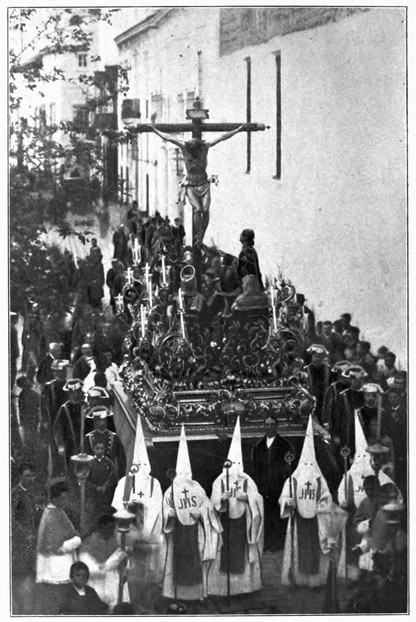
"Christ of the Seven Words"
I expressed my obligations, but entreated him to draw up
the account and let me settle it then and there, as I was
within twenty-four hours of departure. "And in travelling,"
I added apologetically, "it is difficult to send back money."
At the obnoxious word he flung up hands and eyebrows.
"Señora!" I left the shop, feeling vaguely that I had been
guilty of a flagrant indelicacy, as well as black ingratitude.
The catalogues, very slightly wrapped, arrived on the morrow,
just in time to be thrust into my shawl strap, and I paid the
bill amid the final agitation, so unfavorable to arithmetic, of
porters and farewells.
I had worse fortune in trying to subscribe for a certain
popular periodical. I went to the office in the designated
business hours, to find that, of the three men who should have
been there, one had already gone, one had not arrived, and the
third had "stepped out for a little rest." The janitor left
in charge, a sympathetic person who could not read nor write,
thought if I would return on Sunday at my luncheon hour,
there might be somebody there qualified to receive my subscription
and address, but, he sagely added, "in this world we
are sure of nothing."
Madrid possesses the Biblioteca Nacional with valuable
manuscripts and something like one million books, handsomely
housed, where arrangements are made for over three
hundred readers, but here, as in the other Spanish cities,
public libraries in the American sense of libraries largely used
by the general public are practically non-existent. The bookstores,
too, except for the latest Spanish publications, leave
much to be desired. As a rule, one can get only the most
meagre information concerning texts and editions of the
national classics, and the supply of new French novels or
new German plays is far less complete than the stock of
Paris gloves and German cutlery. This last, so canny have
the honest Teutons grown, is usually engraved Toledo.
In variety of weather, however, Madrid surpasses all expectations,
furnishing the sultriest heat, the chilliest cold, the
dustiest dust, and the most prodigious crashes of thunder and
lumps of hail to be found in the meteorological market, and
all these within a few hours of one another. But what with
fans, braseros, balconies, horchaterias, an army of street waterers,
and, most essential of all, an inexhaustible fund of good
humor, the Madrileño contrives to live on friendly terms with
his climate, although he dares not lay aside his cloak before
"the fortieth of May."
Apart from bull-fights and riots, those rages of excitement
that seem to indicate a periodical fevering of the southern
blood, the Madrileño takes his pleasures with a dignified simplicity.
The city is exceedingly rich in open squares, well-shaded
parks, and long reaches of green promenade, and here,
with several dozen cigarettes and a few coppers for water and
agráz, he wiles the hours away, chatting with friends and
admiring the ladies who roll past in spruce landaus. Over
the gate of the social paradise of Madrid it must be written,
"No admittance except in coaches," for a carriage seems
essential to high life. Liveried coachman, rather than powdered
butler, is the sine qua non. During the hot season this
outdoor parade is in gay career at midnight, and whole families,
babies and nurses included, may be seen gathered in
festive knots around small refreshment tables, within sound
of fountain spray and garden music. There are open-air
concerts, and concerts in smoke-beclouded halls, greensward
dances, and dances stepped on café tables among disordered
clusters of bottles and glasses, and there is always the theatre,
on which your Spaniard dotes.
In the winter season there is opportunity to enjoy classic
drama at the Teatro Español, where the Bernhardt of Spain,
"La Guerrero," supported by her grandee husband, Mendoza,
holds sway. When I saw them they were using short
farces of Cervantes and Lope de Rueda for curtain raisers to
a romantic drama by Tirso de Molina and a modern society
play by Echegaray. I saw them, too, in Zorrilla's singular
dramatic version of "Don Juan," the only play allowed in
Spanish theatres on the night of All Saints.
From March to November, however, the Teatro Español is
closed, and there is little doing at the Teatro Real, an aristocratic
temple of Italian opera. During the summer season
the theatrical opportunities of Madrid are mainly limited to
the popular zarzuelas, or operettas, four of which are usually
given in an evening. Each theatre offers a new programme of
these every night, but there is little of literary interest except,
now and then, a taking trifle from the pen of Hartzenbusch
or Echegaray.
The Madrid theatre recks naught of early risers. The
opening vaudeville is seldom under way before nine o'clock;
the house is cleared after each performance, and often the
encores and repetitions prolong a popular zarzuela quite beyond
the hour limit. On the other hand, if the audience is small,
the opening piece may be cut down to the merest outline. I
remember one such occasion when the boxes were so empty
and the farce so familiar that the orchestra fairly chaffed the
actors off the stage. "Enough, enough! Thou mayst withdraw!"
chanted the lyric lover to an intruding servant. "And
so mayst thou," called out a voice from among the violins.
"I've told my passion to the stars," continued the actor in
his most mellifluous tenor, making the distant love of the
Spanish stage to a lady who was smiling frankly on the audacious
fiddler. "Poor stars!" interpolated this worthy so
sympathetically that everybody laughed, the singer wound up
his transports in the shortest possible order, and the remaining
scenes were hardly more than pantomime. But such was
the universal good nature and indifference to business exactitudes,
that neither artists nor ticket-holders took this curtailment
of their rights in umbrage.
Among the excellences of Madrid must be counted her
museos. The Armería, with its plumed and steel-clad warriors,
all at tourney, is no mere lumber room of wicked old iron, as
might have been expected, but a new canto of the "Faery
Queene." The Museo Naval still smells of the boundless brine
and Isles of Spicery. The Museo Arqueológico Nacional sweeps
one, as on the magic carpet of Alhambra legend, through the
entire tragedy of Spain. Here are the successive leaves of
her strange picture-book—scratched, prehistoric flints, grass-woven
Iberian sandals, rudely sculptured shapes in sandstone
grasping wine cups that suggest whole Rubaiyats, Phœnician
anchors, bronze tables of Roman laws, Moorish arabesques,
mediæval altars, modern wares and fineries, while barbaric
spoils of Peruvian idols, Mexican feather-shields, sacrificial
stones, and figures of forest lords speak to the imagination
of that vast colonial empire which rose out of a dream to
melt again like very dreamstuff, leaving "not a rack behind."
These I have seen, but there are twice as many more Madrid
museums which I had not time to see, and which, I am told,
are no less rich in rarities and no less effective in pictorial
beauty of arrangement.
Of the art galleries, who can say enough? The supreme
Museo del Prado so magnetizes pilgrim feet that it is hard to
spare even a few hours for the Académia de Bellas Artes, with
its grand Murillos and calm Zurbaráns, or the Museo de Arte
Moderno, with its succession of canvases depicting scene upon
scene of death, decay, murder, execution, starvation, battle,
torture, frenzy. Whatever is most horrible in the story of
the Peninsula—Juana the Mad staring at her husband's
coffin, the bloody fall of the betrayed Torrijos and his band,
the nobles of Portugal doing shuddering homage to the exhumed
corpse of Inez de Castro, all that moves disgust, distress,
dismay, seems flaunted here. The technique is French, but
the subjects are Spanish. Many of the pictures have historical
dignity and faithfulness, a few reproduce the modern national
types, with a preference for bull-fighters and anarchists over
fishermen and peasants, but one misses the spiritual beauty
that went hand in hand with the spiritual terror of the older
art. Do the Spanish painters of to-day derive only from
Goya and Ribera?
The old-time popular ceremonies are fast fading out of
Europeanized Madrid. Even the Christmas mirth is waning,
though still on Noche Buena the Plaza Mayor is close set with
booths, and the Infanta Isabel, muy Madrileña that she is,
makes a point of driving through and heaping her carriage
with fairings. On Twelfth Night, too, there are a few small
boys to be seen scampering about the streets, looking for the
arrival of the Magi. Every year drops something of the
mediæval heritage, and it has fallen to my lot to chronicle
the passing of one of Madrid's most ancient and comfortable
rites. The principal saint days of June, July, and August
are preceded by verbenas, or evening fairs, chief among these
being the Verbena de San Juan, on Midsummer Night. Many
a baby has a grand frolic this evening, rocked back and forth
on his mamma's knees, laughing eyes to laughing eyes, while
she dips her head to his and tickles his little neck with kisses
in time to the ancient ditty:—
"Recotín, recotón!
The bells of St. John!
There's a festival on.
Recotín, recotín, recotón!"
Far along the Prado gleam the busy fires over which are
merrily bubbling the oiliest and brownest of buñuelos. The
rows of lighted stalls, which have sprung up like mushrooms
on either side of the promenade, present to the revelling,
roving, shifting throng an amazing variety of tawdry
knickknacks, ingeniously devised to meet no human want.
As we drove slowly up and down, enjoying the scene, while
beggars ran beside the carriage and hawkers darted out upon
us with shrill cries, the "American girl" of our little group
strove earnestly to find "something to buy."
The most useful and convenient article for a traveller that
could be discovered was a pasteboard bull's head on a long
stick, but her chaperon, mindful of trunk dimensions, discouraged
this purchase so effectively that Little Boston
gracefully made herself amends by presenting us all with
images of St. John. These scandalously represented the
Baptist as a ballet girl in short cotton-wool skirts and gilt
ribbons, waving a banner with one hand and leading a two-legged
lamb with the other.
As midnight drew near, carriages and foot-folk all pressed
toward the stately Cybele fountain. It seems that there was
once, in the Puerta del Sol, a magic spring whose waters,
sprinkled at Midsummer Midnight on the most unlikely
head, insured a wedding within the year. Trams and cabs,
riots and bloodshed, drove the precious charm away to the Prado,
even to this same Cybele fountain, which for many generations
has continued to work bridal miracles. So recently as
1898, as soon as the clock in the tower of the stately Bank
of Spain struck midnight, with wedding cadences lingering in
its peal, eager feet went splashing through the broad marble
basin, and the enchanted water, thrown by handfuls and cupfuls
far out over the crowd, sparkled even on bald pates and wigs.
But alas for Madrid and her Midsummer Night's Dream!
Some prosaic person got wet and tattled to the Alcalde. So
when in natural agitation, on our only Verbena of St. John,
we had persuaded the compassionate coachman to drive as
close as close might be to the fountain, we encountered a
bristling, unromantic railing, and outside of this a grim circle
of police, frowning menace on that disconcerted host. Every
moment more carriages, with veiled ladies and rheumatic gentlemen,
dashed up, and the indignant crowd surged forward to
the very buttons of authority. But midnight chimed in vain.
One desperate graybeard vaulted over the railing, only to be
hustled back with contumely. In general, however, that
great press of people remained as meek as the lions of Cybele's
chariot—a lack of spirit only to be accounted for by
remembering that this midnight company was made up of the
shamefaced and rejected, such an assemblage of blighted
beings as, now that the last spell is snapped, earth will never
see again. Even the decorous Cybele laughed in her marble
sleeve.
So passes the old Madrid; but there is a new Madrid, of
which a word still waits to be said.
XIV
A STUDY IN CONTRASTS
"Here you have them, the two Spains, unlike, antagonistic, squared for conflict."
—Vida Nueva.
The world-old struggle between conservatism and
advance is at its most dramatic point in Spain.
The united forces of clericalism and militarism
work for the continuance of ancient institutions, methods,
ideas, and those leaders who do battle in the name of liberalism
are too often nothing more than selfish politicians.
But with all these odds against progress, it is making way.
The mass of the people, kept so long in the darkness of
ignorance and superstition, are looking toward the light.
During my last week in Madrid I chanced upon two extreme
expressions of these warring principles. The first was a
royal and religious ceremony, the second a monster mass
meeting,—the one intent on cherishing the past, the other
clamoring at the gates of the future.
I was looking over the Imparcial as I took my coffee one
morning, when my eye fell on an item to the effect that there
would be capilla publica en Palacio at ten o'clock. A traveller
learns to jump at opportunity. Public service in the royal
chapel promised to be of interest, and half-past nine found me
waiting, with a miscellaneous company of gentles and tatterdemalions,
natives and foreigners, on the palace side of the
Plaza de Armas, the expectant throng streaming far down the
paved and covered way. We were well marshalled by soldiers,
who kept the crowd in form of a long troop, and banded
this by military lines, with gleaming bayonets. These bands,
but a few feet apart, were effectual in preventing crowding
and disorder, and when at last the doors were thrown open,
a double rank of soldiers closed in before the portal as often
as the entering file showed any tendency to press and hurry,
and thus passed us through by small divisions, so that there
was no unseemly struggling on the succession of bare, plain
stairways that led to the upper galleries.
For "public service in the royal chapel," I was now to
discover, does not mean that the public is admitted to the
chapel itself. This is small, but very Spanish, with profusion
of gilding, imposing altar, and frescoed saints, the characteristic
splendor being tempered with a no less characteristic
gloom, an effect enhanced by austere columns of gray marble.
On days of public service, which are usually high feast days,
three long galleries, forming three sides of a great quadrangle,
are traversed by the court in passing from the royal rooms to
the chapel door, and it is to these galleries only that the public
is admitted. On such occasions the gallery walls are hung
with richly colored tapestries from the magnificent collection
of eight hundred pieces that enriches the royal Tapiceria.
The instant I crossed the threshold these tapestries blazed
upon the eye, so dazzling in their beauty that it was difficult
to grasp the general situation. Civil Guards, in gala uniform,
each armed with a pike taller than himself, were stationed at
intervals of about six feet all along these tapestried walls,
holding the carpeted way open for the passage of the royal
and ecclesiastical party. The public hastened to fill in the
spaces left between the guards, so that when the dignitaries
paced the length of the three galleries, they walked between
continuous human lines of mingled soldiery and spectators.
We were of various ages, sizes, colors, and quite as picturesque,
take it all in all, as the slowly stepping group on
which our eyes were focussed.
A division of the royal escort, marching with drawn swords,
preceded the Queen Regent, a slight and elegant figure in
white and heliotrope, her mantilla pinned with diamonds.
She walked in royal solitude, with a bearing of majesty and
grace, but her face had a hard and almost sour look, which of
itself might account for her unpopularity. The King and the
younger Infanta did not take part in the day's ceremony, but
the Princess of Asturias followed her mother, a fresh-faced
girl, charmingly dressed in white and blue, with pearls and
turquoises. A respectful step or two in the rear of her niece,
yet at her side rather than behind, came in rich green silk
adorned with emeralds the stout, gray-puffed, easy-going Infanta
Isabel, her broad, florid face beaming with affability.
The guards had passed stern word down the line for all hats
to be off, but there was no sign of greeting, so far as I saw,
from the spectators to the royal party, except as now and then
some happy Spaniard bowed him to the dust in acknowledgment
of a nod, as familiar as a wink, from this popular
Infanta.
The occasion of this stately function was the elevation of
the Papal Nuncio to the rank of cardinal. He passed in all
priestly magnificence of vestments and jewels, his red hat
borne before him on a cushion. He was attended by the
chief clerics of Court and capital, but even these gorgeous
personages were outshone by the military and naval officers,
whose breasts were a mosaic of medals, and whose headgear
such erections of vainglory as to hush the crested cockatoo
with shame. The Gentlemen of the Palace, too, were such
peacocks in their glittering coats of many colors, their plumes
and sashes, gold lace and silver lace, that the plump Ladies in
Waiting, for all their pride of velvet, satin, and brocade, looked
like mere hens in the wake of strutting chanticleers.
The American mind is ill prepared to do homage to the
dress parades of European courts, and I laid by the memory
to laugh over when I should have reached a place and hour
where laughter would be inoffensive. As the Diplomatic
Corps, in its varied costumes, came trooping on, twice a
whisper ran along the gazing lines. "The Turk!" and the
traditional enemy of Spain limped smilingly past, a bent,
shrewd-faced old Mussulman, whose Oriental finery was
topped by the red fez. "The Yankee!" and Spain's latest
adversary strode by in the person of the newly arrived United
States Minister, decorously arrayed in dress suit and a Catholic
expression.
The chapel doors closed on this haughty train, and we, the
invited public, cheerily proceeded to pass a social hour or two
in chat and promenade and in contemplation of the tapestries.
Even the Civil Guards unbent, dancing their babies, lending
their pikes to delighted urchins, and raising forbidden curtains
to give their womenkind furtive peeps into the royal
apartments. Most astonishing was the maltreatment of those
priceless tapestries. Small boys, unrebuked, played at hide
and seek under the heavy folds, old men traced the patterns
with horny fingers, and the roughest fellows from the streets
lounged stupidly against them, rubbing dirty-jacketed shoulders
over the superb coloring. The most splendid series displayed
was from a master-loom of the Netherlands, illustrating the
conquest of Tunis by Charles V—marvellously vivid scenes,
where one beholds the spread of mighty camps, the battle
shock of great armies and navies, and, like shrill chords of pain
in some wild harmony, the countless individual tragedies of
war. The scimitar of the Turk flashes down on the Spanish
neck, while the upturned eyes are still too fierce for terror;
the turbaned chief leans from his gold-wrought saddle to scan
the severed heads that two blood-stained sons of the prophet
are emulously holding up to his survey, hoping to recognize
in those ghastly faces enemies of rank; white-robed women
on the strand, their little ones clinging to their knees, reach
arms of helpless anguish toward the smitten galley of their
lords, who are leaping into the waves for refuge from the
Christian cannonade.
I wondered how the Turkish Minister liked those tapestries,
as his stooped-back Excellency passed in conference with a
Chinese mandarin, who must have studied his costume from a
teacup. For we had all been hustled into rows again to make
that human lane through which the Royalties and the Reverends
returned from their devotions. I was facing a quaint
old tapestry of Christ enthroned in glory, with the beasts of
the Apocalypse climbing over Him like pet kittens, and this
so distracted my attention that I omitted to ask the amiable
Infanta Isabel, who would, I am sure, have told anybody anything,
what had taken place. But I read it all in the Epocha
that evening—how her Majesty with her own august hands
had fitted the red hat to the Nuncio's tonsured head, and how
the new-made cardinal had addressed her in a grateful oration,
praising her virtues as manifested in "the double character of
queen and mother, an example rich in those peculiar gifts by
which your Royal Grace has won the veneration and love
of the noble and chivalrous Spanish people, the especial
affection of the Father of the Faithful, and the respect and
sympathy of all the world." For her and for the youthful
monarch of Spain he invoked the favor of Heaven, and uttered
a fervent hope that the cup of bitterness which this most
Catholic nation had bowed herself to drink might be blessed
to her in a renewal of strength and a reconquest of her ancient
preëminence among the peoples of the earth.
The most significant expression of "new Spain" that I
encountered in Madrid was a mass meeting—a rare and
novel feature in Spanish public life. I blundered upon it as
foolishly as one well could. The second day of July was the
first anniversary of the founding of a daring Madrid weekly,
the Vida Nueva, to which, attracted by its literary values, as
well as its political courage, I had subscribed. The sheet is
usually issued Sunday, but as I was on the point of going out
one Saturday afternoon my Vida Nueva arrived, accompanied
by two non-committal tickets. They gave entrance to the
Frontón Central, "only that and nothing more." I called one
of the pretty señoritas of the household into council, and she
sagely decided that these were tickets to pelota, the Basque ball
game, played in one or another of the various Madrid halls
almost every summer afternoon. It seemed a little too considerate
in the Vida Nueva to provide for the recreation of its
subscribers, but I was growing accustomed to surprises of
Spanish courtesy, and tucked the tickets away in a safe corner.
The folded newspaper rustled and whispered, and finally fluttered
to my feet, but I was eager to be off, and, after the
blind fashion of mortals, put it by.
It was my privilege to dine that day with two compatriots,
and one of these, who knows and loves Spain
better than many Spaniards do, began at once to tell me
of that most unusual occurrence, a Madrid mass meeting, to
take place this very evening. Of course we resolved to go,
although my friend's husband was not in the city, and no
other escort would countenance so harebrained an expedition.
For the street to which this valiant lady led the way was
choked with a flood of men surging toward an open door.
The hall for the "meeting," a word which the Spanish language
has fully adopted, was the Frontón Central, and admission
was by ticket. Light dawned on my dim wits, and,
while my two companions, with dignified and tranquil mien,
stood themselves up against the outer wall, I besought a leisurely
cabman, who insisted on waiting to pick up a little
ragamuffin clamoring for a ride, to drive me in hot haste to
my domicile. Here I searched out the tickets, put away only
too carefully, and took a fleeting glance at the Vida Nueva,
which urged all "men of heart" to celebrate the eve of its
anniversary by their presence at this mass meeting.
I had not realized that there were so many men of heart in
Madrid. The street on my return was worse than before.
The cabman objected strenuously to leaving us in these tempestuous
surroundings, and, since there were only two tickets,
we two elders of the trio agreed that the American girl was all
too young for such an escapade, and forthwith despatched her,
under his fatherly care, to the hotel. Then came the tug of
war. We saw men fighting fiercely about the door, we heard
the loud bandying of angry words, we were warned again and
again that we could never get through the jam, we were told
that, tickets or no tickets, ladies would not, could not, and
should not be admitted; it was darkly hinted that, before the
evening was over, there would be wild and bloody work within
those walls. But we noticed a few other women in the throng,
and decided, from moment to moment, to wait a little longer,
and see what happened next. Meanwhile, we were almost
unjostled in the midst of that excited, struggling crowd, often
catching the words: "Stand back there! Don't press on the
ladies! Leave room!" And when it came to the final dash
we had well-nigh a clear passage. Our tickets gave access
only to the floor of a big, oblong hall, closely packed with a
standing mass of some ten thousand men; but a debonair personage
in authority conducted us, with more chivalry than
justice, to the reserved boxes in the gallery, where we occupied
perfect seats,—for which other people probably held
tickets,—in the front row, overlooking all the house.
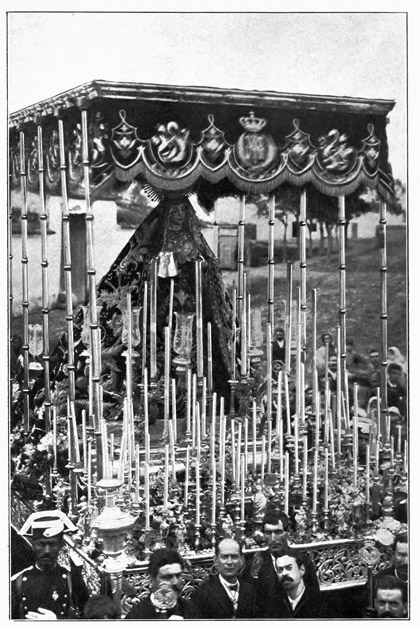
Maria Santisima
So much for Spanish indulgence to audacious womenfolk.
But as to the meeting itself, what was it all about? In Spain
one word suffices for an answer. Montjuich has become a
Liberal rallying cry, although the movement is not bound in
by party lines. It is the Dreyfus affaire in a Spanish edition.
The Castello de Montjuich is a strong fortress, with large magazines
and quarters for ten thousand soldiers. It is built on a
commanding height, the old Mountain of the Jews, just outside
Barcelona, and has again and again suffered bombardment
and storm. But in this latest assault on Montjuich the
weapons are words that burn and pens keener than swords.
It was on the seventh of June, 1896, that the famous bomb
was exploded in Barcelona. It was taken for an Anarchist
outrage, and over two hundred men, including teachers, writers,
and labor leaders, were arrested on suspicion. Nearly
two months passed, and, despite the offer of tempting rewards,
no trace of the culprits had been found. In the Fortress of
Montjuich the guards deputed to watch the prisoners, acting
more or less under superior authority, which itself may have
been influenced by Jesuit suggestion, began on the fourth of
August to inflict tortures upon the accused for the purpose of
extracting evidence. The trials were by military procedure,
power sat in the seat of justice, and innocent men, it is believed,
were condemned on the strength of those forced confessions—mere
assents, wrung from them by bodily agony,
to whatever their guards might dictate. But many persisted
in denial, and in course of time a number were released,
maimed, in certain cases, for life. Others were shot, and a
score still lay in prison. The fortress dungeons are deep and
dark, but little by little the cries and groans of the "martyrs
of Montjuich" penetrated the dull stone and sounded throughout
Spain.
On the fourteenth of May, last year, the Vida Nueva, this
bold young periodical in the van of the Liberal cause, brought
out an illustrated number devoted to "The Torments of Montjuich."
Other periodicals sprang to its support and kept the
Government busy with denunciations, while they vehemently
called for a revision of the judicial process, with the hope of
releasing the men still under sentence and clearing the names
of those who had perished. Mass meetings to urge such
revision, which could be accorded only by vote of the Cortes,
were held in Barcelona, Saragossa, Valencia, Santander, and
other principal cities, all demanding revision in the sacred
names of patriotism, humanity, and justice.
Our Madrid mass meeting was of chief consequence in
impressing the Government with the weight of popular
opinion. The swaying multitude was called to order at
quarter of ten by Señor Canalejas, who introduced a notable
array of speakers. There were representatives of labor, of
republicanism, of the press, a Catalan charged with a greeting
from Barcelona, the champion of Spanish Socialism, Pablo
Iglesias by name, and great men of the nation, Azcárate,
Moret, and Salmeron. Spanish eloquence at its best thrills
the blood to wine, and the swift succession of orators, fourteen
all told, played on the vast audience like master artists
on a murmurous organ. Yet there was no disorder. A generous
and grateful hearing was accorded the Count of Las
Almenas, who frankly declared himself a conservative in politics
and an apostolic Roman Catholic in religion, but in the
name of both these creeds a lover of justice and humanity.
Since for these he ever held himself ready to do battle in the
Cortes, he gave the meeting his pledge that he would support
Azcárate in the motion for revision.
But the wrath and grief of the audience could hardly be
controlled when one of the released prisoners took the platform
to recount the horrors of Montjuich. He told of
dungeons with earth floor and one grated window, of savage
guards determined to gain the crosses and pensions promised
to those who should extract evidence. He told how the helpless
captives, weakened by confinement, were tortured with
cords, whips, sleeplessness, hunger, and thirst. Bound as they
were, water was held before their parched mouths, with the
sinister words, "Confess what we bid you, and you shall
drink." When the famished men begged for food, they were
answered with the lash, or, more fiendishly, with shreds of
salt codfish, which increased their thirst a hundred fold. One
man in his desperation sprang to the lamp and quaffed the
dirty oil. They licked the moisture from their dungeon walls.
They thrust white tongues through the grating to catch the
drops of rain. Soon the guards proceeded to more violent
torments, wrenching, burning, and probing the quivering flesh
with a devilish ingenuity of torture, making a derisive sport
of their atrocious work. One of the victims went mad while
undergoing torture by compression of the head. Others, on
hearing the coming steps of the guards, strove to escape their
cruel hands by suicide. One drank a bowl of disinfectant
found in his cell, one beat his forehead against the wall, one
strove to drive a rusted nail into his heart.
It was a frightful tale to hear. I looked across the hall to
where a Spanish flag was hung. Yellow wax is funeral wax,
and Alarcón, who sees in yellow a symbol of death and of
decay, laments that it is the color of half the Spanish banner.
"Ay de la bandera española!" But surely there is hope for
Spain, while she has sons who, in grasp of a military tyranny
which has rendered such crimes possible, contend in open
field for the overthrow of the "black Spain" of the Inquisition,
and still bear heart of hope for a white, regenerated Spain,
where religion shall include the love of man.
XV
THE PATRON SAINT OF MADRID
"Labré, cultivé, cogí
Con piedad, con fe, con celo,
Tierras, virtudes y cielo."
Spain seems actually skied over with the wings of
guardian angels. The traditional tutelar of the nation,
Santiago, counts for less, especially in the south and
centre of the Peninsula, than might be expected, and was
long since officially superseded by the Virgin; but cities, hamlets,
families, individuals, all have their protecting saints. Some
are martyrs, some bishops, some apostles, while Cordova
rests secure beneath the shining plumes of the angel Raphael.
Towns and townlets hold festivals for their celestial patrons,
honoring them with fairs, horse-races, processions, dances,
and whatsoever else may be appropriate to the season and
characteristic of the locality, as ball games, bull-fights, or even
a miracle play. Only Seville, mirth-loving Seville, who
makes holiday on the slightest provocation, can never invite
her two beautiful guardians, Santa Justa and Santa Rufina,
to a jubilee. These holy maidens used to keep a pottery
booth in Triana, now the gypsy quarter of the city, where,
refusing to worship the Roman Venus, they won the crown
of martyrdom. But their industrious habits cling to them
still, and, by night and by day, while the centuries pass, they
uphold the Giralda. An anointed vision, like Murillo's,
may see their graceful forms hovering in mid-air on either
side of the famous tower, which their strong brown arms hold
firm even in tempests. If the ladies should let go, the
Giralda would fall, and so the Sevillians are driven to the
ungallant course of ignoring these really useful patrons and
gadding off to adjacent towns whose saints are at leisure to be
entertained.
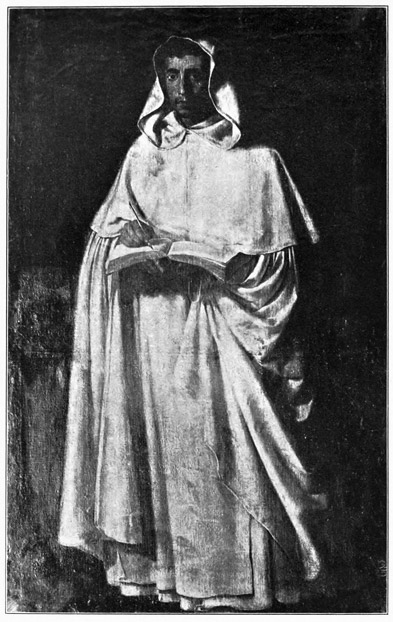
A Spanish Monk
By the eternal contradiction that prevails in all things Spanish,
it has come to pass that Madrid, the elegant capital and
royal residence, is under the guardianship of a peasant saint.
Here, in the eleventh century, Isidro was born, say the priests,
of poor but Catholic parents. If not precisely a hewer of
wood and a drawer of water, he was next door to that humble
estate, being a digger of wells and cellars. He dug with such
piety that God aided him by miracles, causing troublesome
rocks to melt like wax at the touch of his spade, and springs
of healing water to leap in the pits of his fashioning. He
was a tiller of the ground, besides, a hireling farm servant,
whose agricultural methods, though seemingly irregular, caused
his master's granaries to overflow. As he went to the fields
in the fresh spring mornings, the young Isidro would scatter
handfuls of seed for the birds, saying, "Eat, God's little
birds, for when our Lord looks forth in dawn, He looks upon
us all." And as he dropped the wheat and barley in the furrows,
ever he murmured, "This for God, and this for us;
this for the birds, and this for the ants." "For the ants,
too?" mockingly asked the rustics who planted beside him,
but Isidro steadfastly replied, "For the ants, too, since they
are God's ants, and His royal bounty is for all His household."
No wonder that the Almighty had Isidro's fields in
special charge, sending sun and rain in due season that the
harvest might suffice for every claimant. Such divine care
was the more necessary, because this dreamy plough-boy spent
most of his time in the churches, or on his knees in the
shadow of the fruit trees, until his profane companions called
him Lazybones.
Isidro was no effective patron of Madrid as yet, but ran
away from the Moors, when they invaded the city, finding
farm service in a neighboring village. Here he married a
maiden whose lovely soul, according to Lope de Vega, shone
through her guileless face like a painting through its glass.
She was no less devout than her husband, and went every
evening to trim the altar in a lonely shrine of the Virgin.
There was a stream to be crossed on the way, and in times
of freshet Our Lady would appear in person and lead her by
the hand over the tops of the waves. Such dainty stepping
as it must have been! And once, when Isidro accompanied
his wife, they both crossed in a boat suddenly improvised
from her mantilla, which was not a thread the worse for the
experience.
The miracle-working power that developed in San Isidro
was first exercised, as became a farmer, on suffering beasts
and bad weather. His early influence over water grew more
and more pronounced, rain refreshing the thirsty fields at his
bidding, and medicinal fountains gushing from rocks at the
stroke of his hoe. And when, one sunshiny morning, his
wife let their baby boy slip from her arms into the depths of
the well and ran in distress to her husband, the saint, who for
once was working on the farm, did not scold her, as the
priestly authors seem to think would have been the natural
course, but calmly said, "My sister, what is there to cry
about?" And when, after a season of prayer, these exemplary
parents proceeded to the well, its waters had risen to
the brink, lifting the little John, as on a silver-tissue cushion,
safe to their embrace. Isidro still retained his youthful peculiarities
as a laborer, often praying all day long in the churches,
while his yoke of oxen did the ploughing just as well without
him. On one occasion, when he arrived too late for mass,
the gates of heaven opened to his vision, as he knelt before
the closed church door, and he was permitted to witness a
celestial mass, where Christ was both priest and wafer, with
choirs of angels chanting the holy service. Even his charities
cost him little, for when the olla of vegetables and fish, that
his wife made every Saturday for the poor, had all been eaten,
a word from Isidro was enough to replenish the pot. If he
emptied his sack of corn on the snow for a flock of hungry
pigeons, the sack was full when he reached the mill;
and when he threshed his master's wheat a second and a
third time for the beggars, the very chaff turned into golden
grain.
His best quality, which almost makes his cult desirable in
Spain, continued to be his love for animals, especially for
birds. These sang their sweetest songs as he passed by, and
often flew down from the poplar branches to brush their little
wings against his blouse. And he, who had raised his
master's daughter from the dead, did not disdain to work
miracles of healing and of life on maltreated horses. Madrid
would do well to give her guardian saint a season ticket to
the bull-ring. Even the despised and cudgelled ass had a
share in his protection. A sacrilegious wolf that thought to
make a meal of Isidro's donkey, left to graze outside a church
where the saint had gone to pray, was struck dead—perhaps
by the donkey's heels. This kindly rustic, who had separated
from his wife for greater sanctity, died on St. Andrew's Day
and was buried in the cemetery of St. Andrew's Church in
Madrid. Such sepulture was not to his liking, and twice his
ghost appeared to ask that the body might be removed to the
church, as was presently done, all the bells of St. Andrew's
ringing of their own accord to give it welcome. The tomb
immediately began to work miracles, and Isidro became such
a favorite with the people that when, in 1212, a shepherd
guided Alfonso VIII, lost with his vanguard in the wild
passes of the Sierra Morena, to the great battle of Las Navas
de Tolosa, where the armies of the Holy Cross broke forever
the dominion of the Moors in Central Spain, nothing would
do but the story that this shepherd was Isidro himself.
Above the tomb of the saint a chapel was erected, perhaps
by Alfonso, perhaps by Isabel la Católica. There seems to
be a conflict of authorities here, but all testimonies agree that
the angels used to come down and sing in the chapel Saturday
afternoons.
Madrid formally accepted Isidro as patron in the summer
of 1232, when the labors of the husbandmen, on the point of
perishing from drought, were saved by the body of the Holy
Peasant, which, borne in priestly procession, called down
floods of rain; but it was not until the times of Philip III,
some four centuries later, that the actual canonization of
Isidro was granted by Rome. On May 15, 1620, the Plaza
Mayor, that handsome square which has been the theatre of
so many tournaments, executions, and autos de fe, the scene,
two years later, of the beatification of Loyola, was inaugurated
by a splendid festival in honor of San Isidro. From that day
to this his worship has not waned. The miracle-working
bones, which were carried to the bitter death-bed of Philip
III, and comforted the passing of the great and generous
spirit of Charles III, are still held to be more potent than
physicians. Churches, oratories, and chapels have been built
to him all over the Peninsula, the Franciscan Friars founded
a convent of San Isidro in Rome, and his name is a part of
our new geography lesson in the Antilles and the Philippines.
Only four years ago his urn was borne in penitential procession
through Madrid, with double supplications for rain on
the parched country, and for a swift and happy ending of the
Cuban war. All priestly, military, civic, and governmental
pomp went to make up that stately escort, the ladies of
Madrid showering the train as it passed beneath their balconies
with flowers, poems, and confetti. The saint did
what he could. The procession had been so skilfully timed
that the rains began that very night, but the Cuban war was
a matter out of his province. His dealings had always been
with water, not with blood.
There is significance in this devotion of proud Castile to
San Isidro. Spain is essentially as democratic as America.
Her proverbs tell the story: "Many a man gets to heaven in
tow breeches;" "Do what your master bids you, and sit
down with him at table;" "Nobody is born learned, and
even bishops are made of men;" "Since I am a man I may
come to be Pope;" "The corpse of the Pope takes no more
ground than that of the sacristan;" "Every man is the son
of his own works."
"Said the leaf to the flower: 'O fie!
You put on airs indeed!
But we sprang, both you and I,
From the selfsame little brown seed.'"
Pedler, porter, beggar treat you as social equals and expect
a full return of courtesy. It is told in Madrid how a great
diplomatic personage not long ago was eating his picnic
luncheon in a hired carriage. The driver, lunching also,
leaned back from his seat, clinked glasses, and drank the
gentleman's health. The dignitary glared with astonishment
and wrath. "Man! I am the Imperial Ambassador of
Nation So-and-So." "What of it?" returned the driver,
taking another bite of his peppery Spanish sausage; "I am
the Head Hostler of Stables Such-and-Such."
Again and again, in recent times as in ancient, have the
rank and file of the Spanish nation asserted their dignity of
manhood. An edict of Charles III, forbidding the Madrileños
to muffle themselves in their beloved long cloaks and hide
their faces under their big slouch hats, raised a furious riot in
the capital. Should a king dictate the fashion of a man's
garments? And when the stupid weakness of Charles IV
and the baseness of his son Fernando had delivered Spain over
to Napoleon, when French armies held her fortresses, and
Murat, with twenty-five thousand troops, ruled Madrid by
logic of steel and iron, it was the Spanish people who, from
Asturias to Andalusia, sprang to the defence of a country
abandoned by princes, councils, and grandees. The Spanish
people, not the Spanish nobles, preserved the independence of
the nation and actually broke the career of the Corsican conqueror.
The Italian king, Amadeo, so much better than his
fortunes, was welcomed at Valencia in 1871 with simple
verses, spoken by a child, that breathe even from their opening
stanza this native spirit of democracy:—
"The High Lord of the Heavens
Created men one day,
All mortal and all equal,
All shapen out of clay;
For God recked not of nations,
Of white and black and brown,
But on His human children
Impartially looked down."
It is not then so strange as it appears at first hearing that
a Piers Plowman should be patron of Madrid.
From Alfonso VIII to Alfonso XIII, a matter of some
seven centuries, Isidro has been in high repute with royalty.
The "Catholic Kings" made him rich gifts; Philip II,
bigot of bigots, cherished an especial veneration for the
ghostly protector who had brought his delicate childhood
safely through smallpox and epileptic seizures; the passion-wasted
Philip IV did him public homage; Charles the
Bewitched made a solemn progress to his shrine to thank him
for recovery from illness; even the bright young Bourbon,
Philip V, had scarcely arrived in Madrid before he hastened
to worship the efficacious body of San Isidro. The urn has
been opened at intervals to give their successive Majesties of
Spain the grewsome joy of gazing on the bones, and it has
been the peculiar privilege of Spanish queens, on such occasions,
to renew the costly cerements. The devotion of the
present regent to these relics keeps pace with that of her
predecessors.
Where royalty leads, aristocracy is swift to follow, and
Isidro has a gorgeous wardrobe of embroidered standards,
palls, canopies, burial cloths, and everything that a skeleton
could require, but "for a' that and a' that" the laboring
people of Castile never forget that the Canonized Farmer
especially belongs to them. His fortnight-long fiesta is the
May outing of the rustic population all about Madrid.
We will start on this pilgrimage from the Puerta del Sol,
because everything in Madrid starts from the Puerta del Sol.
From this great open parallelogram in the centre of the city,
surrounded by lofty hotels and Government buildings,
bordered with shops and cafés, brightened with fountains,
thronged with trams, carriages, people, always humming with
voices, always surging with movement, run ten of the principal
streets of the capital. The Alcalá, most fashionable of
promenades, and San Jerónimo, beloved of wealthy shoppers,
conduct to the noble reaches of parks and paseos in the east;
the handsome Arenal and historic Calle Mayor lead west to
the royal palace, with its extensive gardens known as the
Campo del Moro; Montera, with two less elegant avenues,
points to the north, where one may find the university, the
Protestant churches, and the tragic site of the Quemadero; and
three corresponding streets open the way to the south, with
its factories, hospitals, old churches, and world-famed Rastro,
or rag fair.
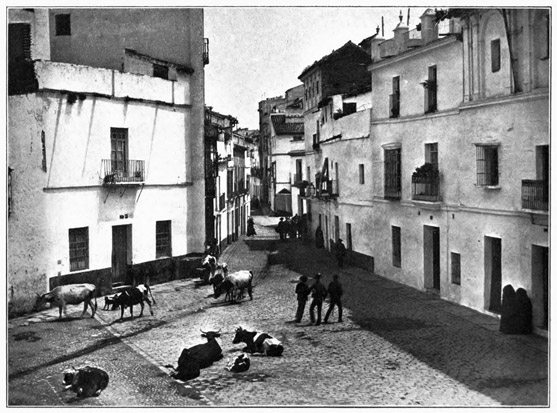
A Seville Street
But during the early days of the Romeria, which begins on
May 15, all the throbbing tide of life pours toward the
southwest, for the goal of the pilgrimage, the Hermitage of
San Isidro, built over one of his miraculous wells by the
empress of Charles I, in gratitude for a cure experienced by
her august husband after drinking of the waters, stands on the
farther bank of the Manzanares. The trams, literally heaped
with clinging humanity, pass out by the Calle Mayor and
cross the Plaza Mayor. The innumerable 'buses and cabs
make a shorter cut, but all varieties of vehicle are soon
wedged together in the broad thoroughfare of Toledo. Here
we pass the big granite church of San Isidro el Real, once in
possession of the Jesuits, but on their expulsion from Spain,
in 1767, consecrated to the Santo Labrador. His body was
borne thither, with all solemn ceremonial, from the chapel in
St. Andrew's; and his poor wife, who had also been sainted,
by a courteous Spanish afterthought, under the attractive title
of Maria de la Cabeza, Mary of the Head, was allowed to lay
her celebrated skull beneath the same roof,—a greater liberty
than he had permitted her during the latter half of their earthly
lives. The Madrid Cathedral, hard by the royal palace, is
still in slow process of building, the work being hampered and
delayed for lack of funds, although her Majesty sets a devout
example by contributing $300 a month. Meanwhile, San
Isidro el Real serves as the cathedral church of the diocese.
This Calle de Toledo, where Isidro dug several of his medicinal
wells, is always gay with arcades and booths and drapers'
shops; but now, during the Romeria, it is a veritable curbstone
market, where oranges, sashes, brooms, mantles, picture frames,
saucepans, fiddles, mantillas, china, jackets, umbrellas, fans,
dolls, bird-cages, paintings of saints, and photographs of ballet
dancers are all cried and exhibited, hawked and held under
nose, in one continuous tumult.
As we approach the bare mass of masonry known as the
Gate of Toledo, we cast, for all our festival mood, a clouded
glance in the direction of the barbarous slaughter-houses of
Madrid. Here the stronger beasts are blinded by the thrust
of darts, and also hamstrung, to render them helpless under
the deliberate butchery of their tormentors, who often amuse
themselves by a little bull-fight practice with the agonized
creatures before striking the final blow—a place of such atrocious
cruelties that even the seasoned nerves of an Austrian
surgeon recently visiting it gave way, and he fainted as he
looked. There is work for San Isidro here.
The jam of equipages on the Bridge of Toledo gives us
abundant time to observe the statue of the Holy Peasant, in a
stone niche, lifting his baby from the well, and the companion
statue of Mary of the Skull. And there is the Manzanares
to look at, that sandy channel along which dribble a few
threads of water—threads that the washerwomen of Madrid
seek after like veins of silver. Small boys are wading from
one bank to the other, hardly troubling themselves to roll up
their trousers. It is said that Philip IV, surveying his pompous
bridge across the Manzanares, was wickedly advised by
one of his courtiers to sell the bridge or else buy a river. It
is a curious bit of irony to hold the festival of the Water
Saint beside a river bed almost as dry as his bones.
But the crowd has now become so mad and merry that it
distracts attention alike from architecture and physical geography.
Will all the dexterity of foot-police and mounted
guards ever succeed in disentangling this snarl of equipages?
Who cares? Everybody is laughing. Everybody, too, is
helping, so far as lungs can help. A daring Aragonese, with
a blue and white checked handkerchief knotted about his
head and a scarlet blanket over his shoulders, tries to dash
across the bridge and rejoin his screaming children. He
stumbles before a jovial omnibus, whose four horses, adorned
with beribboned straw hats, gaze coyly out from under the
torn brims like so many metamorphosed Maud Mullers. A
distant guard roars a warning. The crowd bellows in sympathy.
A liveried coachman rears his spirited pair of bays.
A cock-hatted gypsy, with half his tribe packed into his cart,
tries to follow suit, and tugs savagely at the stubborn mouths
of mules whose heads are liberally festooned with red and
green tassels. In front of these safely passes the Aragonese,
only to bring up against the great wheel of a picnic wagon,
whose occupants, mostly señoritas in the sunrise Philippine
shawls, thrust out their pretty heads, all crowned with flowers
instead of hats, and rain down saucy salutations. The crowd
chimes in with every variety of voluble impudence. He catches
at the long gold fringe of the nearest shawl, saves himself from
falling at the price of a shriek of wrath from the señorita,
plunges desperately on, is struck by a cab horse, the poor
beast being half blinded by the tickling plumes that droop
over eyes and nose, and amid volleys of ridicule and encouragement
reels to the shelter of the sidewalk. But a very
precarious shelter it is, so narrow that the lads are positively
obliged to fling their arms about the lasses to hold the fluttering
skirts back from peril of wheels and hoofs. Everywhere
what audacity, what fun, what color, and what noise! Troops
on troops of foot travellers, usually in family groups, and often
stained with the dust of an all-day tramp! The wives generally
carry the hampers, and the husbands sometimes shoulder
the babies. Squads of young fellows frolic along, each with
his supply of provisions tied up in a gaudy handkerchief.
The closer the nudging the better they like it; a slap from a
girlish hand is almost as good as a kiss. Isidro knew all
about it in his day. But this clownish jollity grows rougher
and rougher, and the crack and sting from a coachman's whip
tempt a reply with the pilgrim's staff. The guards, hoarse
and purple, wipe their dripping brows. It is early afternoon
yet, too, and the larking and license are as nothing to what
may be expected before midnight.
It is a little better when, at last, the bridge is left behind.
Turning to the northwest, the dusty road runs on beside the
river and beneath the bluffs lined with rowdyish folk, who
shout down greetings to their acquaintances and compliments
to the ladies, toward the ermita. A certain Juan de Vargas,
riding over this same route one day, lifted his eyes to the
uplands to see how his farm-hand, Isidro, was getting on with
the ploughing. Blessed Isidro! Before and after went two
stalwart young angels, still in shining white, each driving a
celestial yoke of oxen.
Times have changed. The sight that greets our eyes is
emphatically human—a great country fair, a pandemonium
of rude, good-natured revelry. The beggars who have been
chasing the carriage, the cripples outstripping the rest, thrust
withered arms, ulcerous legs, and all manner of profitable deformities
into our very faces as we alight, even clutching at the
coins with which we pay the coachman. We make our way,
as best we can in the rough press, between two rows of booths
toward the church. There is the usual Spanish variety of
penny toys on sale—balls, baskets, whips, kites, jumping-jacks,
balloons, and every other conceivable trifle admitting
of the colors red and yellow. But the great traffic is in those
articles especially consecrate to San Isidro—frosted cakes,
probably made after the recipe of Maria de la Cabeza, clay
vessels of every shape and size for carrying away the healing
waters, and, first and foremost, pitos, or whistles. The priests
would have us believe that San Isidro was forever droning
psalms, but ploughmen know a ploughman's music, and the
sacred whistles lead the sales in the Romeria. It is impiety
not to purchase at least one of these, and the more devout
you are, the more pitos will you buy. The Infanta Isabel,
aunt of his Little Majesty, fills her emblazoned coach every
year with these shrill pipes in all their variety of queer disguises—fans,
birds, puffing grotesques, and, above all, paper
flowers. He is no lover worth the having who does not bring
his sweetheart a San Isidro rose with a pito for a stem. The
ear-torture of an immense fair-ground delighting in an infinity
of whistles may be left to the sympathetic imagination.
We cling to the memory of Burns, and bear for his bonny
sake what we could hardly endure for any such sham laborer
as Isidro.
The hearing is not the only sense to do penance in this
pilgrimage. The Water Saint has never thought to work
a miracle of cleanliness upon his peasant votaries, and the
smell that bursts out upon us from the opening doors of the
church might put us to flight, were flight still possible. But,
caught in the human current, we are swept on into the gilded,
candle-lighted, foul-aired oratory, with its effigies of Santo
Labrador and Santa Labradora. All day long the imperious
ringing of the bell at the shortest of intervals has been calling
one company of the faithful after another up the bare brown
hill to that unventilated temple. When there is no squeezing
room left for even a dwarf from the pygmy show, the doors
are closed, the bell is silenced, and the rustics are marshalled
in rapid procession before the altar, where they pay a penny
each, receive a cheap print of San Isidro, and kiss the mysterious,
glass-cased relic which a businesslike young ecclesiastic
touches hastily to their lips. The frank sound of the kissing
within is accompanied by the tooting of pitos without. We
stand at one side, looking at the priests and wondering how
their consciences are put together, but half ashamed to watch
with heretic eyes the tears of joy, the fervors of prayer, the
ecstasies of faith, that are to be seen in many of these simple,
passionate faces filing by. Here comes a little girl treading
as if on air and clasping her picture of the saint to her lips,
brows, and heart with such abandon of delighted adoration
as one must go to Spain to see.
Released from the Hermitage, we fill our lungs with sweeter
breath, give skirts a vigorous shake in the vain hope that we
may not carry away too many deserters from the insect retinue
of our recent associates, and turn down toward the river.
Our short cut leads us among heaps and heaps of bales packed
with the graceful clay jars. How many an anxious mother
will trudge her weary miles across this dry Castilian steppe,
bearing with all her other burdens a botija of the healing water
to some little sufferer at home! Wonderful water, warranted
to make whole the lame, the blind, the deaf, the dumb, and
put to rout all ills that flesh is heir to, especially fevers, tumors,
erysipelas, paralysis, and consumption! It is as potent to-day
as when it first gushed from the earth at the bidding of the
young Isidro, for did it not work a notable cure, as late
as 1884, on the Infanta Doña Paz de Bourbon, sister of
Alphonso XII?
We linger a few minutes at the edge of the bluff, looking
down upon the animated scene below, from which rises the
hum as of an exaggerated beehive. The long green stretch
of valley meadow is one wave of restless color. Thickly
dotted with booths for refreshment, for sale of the San Isidro
wares, for penny shows, farces, wax figures, and all manner
of cheap entertainments, it still has space for dancers, wrestlers,
pelota players, for swings, stilts, and merry-go-rounds,
and, above all, for the multitude of promenaders, sleepers, and
feasters. The bright May sunshine gleams and dazzles on
the soldiers' helmets, flashes out all the hues and tints of the
varied costumes, and even lends a grace to the brown patches
on the browner tents. The tossing of limbs in the wild, free
dances, the flutter of the red and yellow flags, the picturesque
grouping on the grass of families, complete to dog and donkey,
around the platter of homely fare and the skin bottle of wine—all
this makes a panorama on which one would gladly gaze
for hours.
Going down into the heart of the festivity, the interest still
grows. We enter one of the cleanest cantinas and invest a
peseta in a bottle of sarsaparilla, not for our own drinking,
having seen the water in which the glasses are washed, but
as a protection against the horde of beggars and the gypsy
fortune tellers. It works like a charm. As we respond to
the whining appeals with the civilities of social greeting and
an offered glass of our innocent beverage, the ragged petitioners
are straightway transformed into ladies and gentlemen.
They draw themselves erect, quaff the cup to our
long life and happiness, discuss in self-respecting tones the
weather and the fête, and then, without another hint of
solicitation, bid us courteous farewells. We mean to take
out a patent on the sarsaparilla treatment of Spanish
mendicancy.
The tent itself is, like the rest, shabby and tumbledown,
furnished with rough tables and benches, where cadets are
playing dominos as they drink, and two country sweethearts
are delectably eating what appears to be a sardine omelette
off the same cracked plate. A clumsy lantern hangs overhead,
racks of bottles are fastened up along the canvas walls, and
all about the trampled earth floor stand water jars, great bowls
of greens, and baskets of the crusty Spanish bread. A pale
young Madrileño drops in for a glass of wine, but before
indulging has the shy little rustic who serves him take a sip,
languidly begging her, "Do me the favor to sweeten my
drink." The yellow cigarette-stains show on his white
fingers as he pats her plump bare arm. The child, for she
is scarcely more, and as brown as an acorn, responds to
these amenities by giving the smiling exquisite alternate bites
of her hunk of goat's-milk cheese, while her mother keeps a
sharp eye on them both.
Comedy and tragedy are busy all about us. A newly
arrived family plods wearily by in ludicrous procession,
headed by a tall father carrying a baby and closed by a short
child carrying a cat. A showy man of middle age, playing
the gallant to an overdressed brunette, is suddenly confronted
by his furious wife in boy's attire, so unluckily well disguised
that, before recognizing her, he has replied to her
rush of invective with a blow which bids fair to make one of
her eyes, at least, blacker than those of her rival. Traditional
ballads are trolled, popular songs are echoed from group
to group, and, despite bad odors, fleas, and whistles, we are
reluctant to leave. But the afternoon grows late, the
Arganda and Valdepeñas are beginning to burn in the
southern blood, an occasional flourish of cudgels or of fists
sends the police scurrying across the field, and, being nothing
if not discreet, we pay our parting respects to San Isidro.
Coming home by way of the Prado and passing the proud
shaft of yellow-brown granite that towers far above its
enclosing cypress trees, as glory above death, we are reminded
that this gala month has brought another fiesta to
Madrid. Every second of May the capital commemorates
with solemn masses, with stately civic processions, and a
magnificent military review, the patriots who fell fighting in
the streets on that terrible Monday of 1808, El Dos de Mayo,
which brought to pass the war of independence. One may
read of that fierce carnage in the vivid pages of Galdós or
behold it in the lurid paintings of Goya. To see once is to
see forever that line of French soldiery, with steady musket
at shoulder, but with eyes bent on the ground, while they
shoot down squad after squad of their defenceless victims.
In pools of blood lie the contorted bodies, with heads and
breasts horribly torn by crimson wounds, while of those who
wait their turn to fall beside them some cover the eyes, one
stupidly gnaws his hands, one kneels and wildly peers from
under his shaggy hair into the very muzzle of the gun before
him, one flings back his head with a savage grin, half of
fright and half of courage, one desperately strips bare his
breast and in agony of horror glares upon the guns, but the
most are crouching, shuddering, sinking—and all only an item
in the awful cost that the Spanish people have paid for
Spanish liberties. The celebration of 1899 was no less
brilliant than usual, although many of the Madrid papers
spoke bitterly of the shadow that the disastrous first of May
must henceforth cast on the glorious Second. It is indeed
gall and wormwood to all Spain that the Manila defeat so
nearly coincides with the proudest day in Spanish annals.
The saint of El Dos de Mayo is Saint Revolution, as democratic
in one way as Saint Agriculture in another. When
these two patrons of Madrid understand how to work in
fellowship, when there comes a Government in Spain that
cares chiefly to promote the welfare of the laboring people,
the world may discover anew the vitality and noble quality
of this long-suffering nation.
We saw the Romeria once more, driving through late in
the evening, when the closed booths glimmered white on the
silent meadow.
"Yes, it is all a pack of lies," said a thoughtful Catholic,
"but what is one to do? A man cannot believe in religion—and
yet how to live without it? The more I stay away from
mass the more I want and need it. Think of the comfort
these peasants take with their San Isidro!"
The moonlight shone serene and beautiful on those patched,
shabby tents, transforming them to silver.
XVI
THE FUNERAL OF CASTELAR
"The death of the Republic will be, for you, for us, and for all, the death of liberty.
The death of liberty will be the death of the Republic, and as liberty is the only
thing in the world that rises from the dead, with liberty shall rise again, in good time,
the Republic."—Emilio Castelar: Inaugural Address, 1873.
The present state of Spanish politics was amusingly
expounded to me by a spirited young philosopher
of Cadiz.
"In the north," he said, "the prevailing sentiment is for
Don Carlos. Nocedal is doing all he can to fan it in Andalusia,
but it finds its natural home in the northern provinces.
To be sure, there is San Sebastian, where the Court summers,
which consequently upholds the Queen, and there are Republican
groups; but the north of Spain, broadly speaking, is
Carlist. The centre favors the reigning family. Possession
is a strong argument, and the royal forces hold Madrid.
Barcelona is Republican. Those Catalans are always thirsty
for a fight. But the middle tract of Spain, as a whole, accepts
the existing monarchy. Castilians are too gallant to strike
against a woman and a child. The south is Republican.
For the best part of the century Cadiz and Malaga have stood
for revolution. Where was the army of Isabel II defeated?
And why has the Queen never seen the Alhambra?
"But, let me tell you, these Carlists, these Royalists, these
Republicans are all fools. If there is anything hopeless in this
world, it's Spanish politics. All the uproar of the Revolution
ended in murdering our best man and driving out our best
king. For myself, I mean to work hard and marry soon, and
have a little Spain in my own house that shall express my
own convictions. My children shall be good Catholics, but
not superstitious bigots. They shall be well educated, if I
have to send them to France or England for it. They shall
be disciplined, but under the law of liberty. And with that
I propose to be content. All my politics are to be kept under
my own roof, where I can work my ideas into permanent
form. I am sick of the way in which Spain boils with ideas
that only destroy one another."
This Sir Oracle was two-and-twenty, with the prettiest
of girlish photographs in his vest pocket, and the smallest of
savings in the bank, but I remembered his words in the days
of mourning for Emilio Castelar.
The illustrious tribune, heavy-hearted with the troubles of
his country, had gone to the home of friends, at a village in
sunny Murcia, for the rest and comfort that nature always
gave him. His almost boyish optimism, "niño grande y grande
niño" that he was, had kept him assured of peace even after
the destruction of the Maine, and assured of victory even
after the battle of Manila. Hence the pressure of fact told
on him all the more cruelly. "I die a victim of Spain's
agony," he wrote in a personal letter shortly before the end,
and his last article for publication, finished on the day of his
death, a gloomy discussion of the outlook for the Peace Conference,
contains bitter references to the national disasters and
to the ravages of the "criminal troop of pirates in the
Philippines."
He died on Thursday, the twenty-fifth of May, within hearing
of the Mediterranean waves he loved so well, with tender
faces bent over him, and the crucifix at his lips. The news
of his death aroused this grief-weary nation to a fresh outburst
of sorrow. Some lamented him as one of the chief
orators of modern Europe, recalling his eloquence in the
tempestuous times of the Revolution, when he "intoned
mighty hymns in praise of liberty, democracy, and the sacred
Fatherland!" Some mourned the patriot, pointing proudly to
the honorable poverty in which this holder of many offices, at
one time almost absolute dictator, had lived and died. Some
wept for the cordial, generous, noble-hearted man, the joy of
his friends and idol of his household. His political sympathizers
bewailed the loss of the Spanish apostle of democracy,
the lifelong champion of liberty. And many not of his following
nor of his faith felt that a towering national figure had
disappeared and another glory of Spain vanished away.
The first wreath received was from a Republican club that
sent the pansies of memory. Among the five hundred telegrams
and cablegrams that arrived within a few hours at the
country-seat where he had died was one from over seas, which
read: "To Castelar: In thy death it seems as if we had lost
the last treasure left to us, the voice of the Spanish race. In
thy death Spain has become mute. Yet let me believe that
thou respondest, 'She will speak again.'"
The coming of the body to the capital was a triumphal
progress. A large escort of friends, who had made speed to
Murcia from all parts of the Peninsula, accompanied it, and
there were crowds at the stations, even in the mid-hours of
the night, with tears, handfuls of roses, wreaths, and poems
of farewell. There was often something very touching about
these offerings. At one of the smaller towns a young girl
hastily gathered flowers from the garden attached to the station,
broke off a spray from a blossoming tree, tied these with the
bright ribbon from her hair, and, clambering up, hung this
simple nosegay among the costly tributes that already nearly
covered the outer sides of the funeral car. In another crowded
station the village priest came hurrying forward, bared his head
with deepest reverence before the garlanded coach, as if before
the altar, and chanted the prayers for the dead. Again, a
group of workmen, allowed to enter the car, fell on their
knees before the bier and prayed.
The train was met on its arrival in Madrid by an immense
concourse of people. Señor Silvela and other distinguished
representatives of the Government were there, church dignitaries,
presidents of political societies and literary academies,
but, above all, the people. It was the great, surging multitude
that gave the Republican leader his grandest welcome.
This poor shell of Castelar, the man said to bear "the soul
of a Don Quixote in the body of a Sancho Panza," lay in
state through Sunday and a part of Monday in the Palacio del
Congreso. The vestibule had been converted into a capilla
ardiente. Masses were chanted ceaselessly at the two candle-laden
altars, the perfume from the ever increasing heaps of
flowers was so oppressive that the guards had to be relieved
at short intervals, and the procession of people that filed
rapidly past the bier, often weeping as they went, reached out
from the Morocco lions of the doorway to the Prado and the
Fountain of Neptune. Many of the humblest clad, waiting
half the day in line, held pinks or lilies, fast withering in the
sun, to drop at the feet of the people's friend. Early on
Monday afternoon the doors were closed, and by half-past
three the funeral cortège began to form in the Prado for its
four-hour march by way of the Calle de Alcalá, Puerta del
Sol, Calle Mayor, and Cuesta de la Vega, to the cemetery of
San Isidro.
By the never failing Spanish courtesy, I was invited to see
the procession from the balcony of a private house in the
Alcalá. I found my hostess, a vivacious little old lady, whose
daughter had crowned her with glory and honor by marrying
into the nobility, much perturbed over the failure of the Queen
Regent to show sympathy with the popular grief.
"There were one hundred and forty-nine wreaths sent in.
The very number shows that the royal wreath was lacking.
I am a Conservative, of course. Canovas was my friend, and
has dined here often and often. You see his portrait there
beside that of my daughter, la Marquesa. But Canovas loved
Castelar, and would not, like Silvela, have grudged him the
military honors of a national funeral. As if the dead were
Republicans! The dead are Spaniards, and Castelar is a
great Spaniard, as this tremendous throng of people proves.
There were not nearly so many for Canovas, though the aristocracy
made an elegant display; there were not so many for
Alfonso XII, though all that Court and State and army could
do was done, and the Queen rode in the splendid ebony coach
in which Juana the Mad used to carry about the body of that
handsome husband of hers.
"But the people know their losses. Never in my life have
I seen the Alcalá so full as this. Silvela has had to give way,
and the troops will come—at least a few of them. But not
a word, not a flower, from the Queen! She sent a magnificent
wreath for Canovas, and a beautiful letter to his widow.
But for Castelar, her people's hero, nothing. Ah, she is not
simpática. She does not know her opportunities. She does
not understand the art of winning love. Only a year ago she
sent a wreath to the funeral of Frascuelo, the torero. And
everybody knows how she hates the bull-fight. But if she
could drop her prejudices then to be at one with the feeling
of her capital, why not now? They say she has a neuralgic
headache to-day. Ay, Dios mio! I should think she might."
Listening to this frank chatter and watching that mighty
multitude, I was reminded of one of the Andalusian coplas:—
"The Republic is dead and gone;
Bury her out of the rain.
But see! There is never a Panteón
Can hold the funeral train."
And this, in turn, suggested another of those popular refrains:—
"The moon is a Republican,
And the sun with open eye;
The earth she is Republican,
And Republican am I."
But who can understand this ever baffling Spain? After
all, what was the significance of that assembled host? How
far was it drawn by devotion to the man, and how far by
devotion to the idea for which he stood? How far by idle
curiosity, by the Spanish passion for pomps and shows, and,
above all, for a crowd, by that strange Spanish delight in
mucha gente? So far as eye could tell, this might have
been the merriest of fêtes. The wide street was a sea of
restless color. Uniforms, liveries, parasols, hats, frocks,
pinafores, kerchiefs, blouses, sashes, fans, flecked the sunshine
with a thousand hues. Here loitered a messenger boy in
vivid scarlet; there passed a waiter with a silver tray gleaming
on his head; here a market woman bent beneath her
burden of russet sacks bursting with greens; there stood a
priest in shovel hat and cassock, smelling a great red rose;
here a gallant in violet cape escorted a lady flaming in saffron;
there a beaming old peasant, with an azure scarf tied over
his white head, threw an orange to attract the attention of a
plodding porter, whose forehead was protected from the cords
binding the boxes to his back by several folds of purplish
carpeting.
Streets and sidewalks, balconies and windows, all were full,
and everywhere such eagerness, such animation, and such
stir! The children sitting on the curbstone rocked their
little bodies back and forth in excitement. Young mothers
danced their crying infants, and young fathers shifted the
babies of a size or two larger from one shoulder to the
other. A boy in a red cap climbed a small locust tree, from
whose foliage his head peeped out like an overgrown cherry.
The crowd indignantly called the attention of authority to
this violation of the city laws. A glittering member of the
Civil Guard sonorously ordered the culprit down. The
laughing lad refused to budge, inviting this embarrassed arm
of the law to reach up and get him. The Guard darkly surveyed
the slender stem already swaying with the boy's slight
weight. The fickle crowd, whose every face seemed to be
upturned toward that defiant cherry, cheered the rebel and
tossed him cigarettes and matches, wherewith he proceeded to
enjoy a smoke. The Guard caught a few cigarettes in mid-career,
pocketed them, smiled benevolently, and walked away.
The lad saucily saluted, and the multitude, suddenly impartial,
pelted them both with peanuts.
Thus it was that the Madrid populace awaited the last
coming of Castelar. Even when the funeral train was passing,
the crowd showed scant respect. Not half the men
uncovered for the bier, although I was glad to see the cherry
cap whisked off. And one picturesque gentleman stood
throughout with his back to the procession, making eyes at
his novia in the gallery above our own.
The Government, which had finally assumed the charges
and care of the obsequies, had been remiss in not providing
lines of soldiers to hold an open way for the cortège. As it
was, the procession could hardly struggle through the mass
of humanity that choked the street. A solitary rider, mounted,
like Death, on a white horse, went in advance, threatening
the people with his sword. A division of the Civil Guard
followed, erect and magnificent as ever, their gold bands
glittering across their breasts, but their utmost efforts could
not effectually beat back the crowd. Men scoffed at the
drawn blades and pushed against the horses with both hands.
The empty "coach of respect," black as night, its sable
horses tossing high white plumes, pressed after, and then
came some half dozen carriages overflowing with wreaths and
palms, and all that wealth of floral gifts. The crowd caught
at the floating purple ribbons, and called aloud the names
upon the cards; a monster design, with velvet canopy, from
the well-known daily, El Liberal, a beautiful crown from the
widow of Canovas, and, later in the procession, alone upon
the coffin, a nosegay of roses and lilies, brought in the morning
by a child of four, a little "daughter of the people," and
bearing the roughly written words, "Glory to Castelar!—A
workingman."
The train of mourners, impeded as it was by the multitude,
seemed endless. After the representatives of certain charities
there walked, in gala uniform, white-headed veterans of war.
A great company of students followed, their young faces
serious and calm in that tempting hurly-burly of the street,
and after them an overwhelming throng of delegates from
all manner of commercial and craft unions. Even the
press wondered that Castelar's death should move so profoundly
the trading and laboring classes, almost every store
and workshop in Madrid closing for the afternoon. Then
came the Republican committees, and behind them the
representatives of countless literary, scientific, and artistic
associations.
At this point in the procession a place had been made for
all or any who might wish, as individuals, to follow Castelar
to the tomb. Some fifteen hundred had availed themselves
of the opportunity—a motley fellowship. The gentlemen
preceding, those who had come as delegates from the industrial
and learned bodies of all Spain, wore almost without exception
the correct black coat and tall silk hat, and paced, when they
could, with a steady dignity, or halted, when they must, with
a grave patience, that did more to quiet the unruly host of
spectators than all the angry charges of the police. But the
fifteen hundred showed the popular variety of costume—capes
and blouses, broad white hats and the artisan's colored
cap. Some of them were smoking, an indecorum which, by
a self-denial that counts for much with Spaniards, nowhere
else appeared in the long array.
But whatever might be the deficiencies of dress or bearing,
here, one felt, was the genuine sorrow, here were the men
who believed in Castelar and longed to do him honor. The
impulsive onlookers responded to this impression, and more
than one rude fellow, who had been skylarking a minute
before, elbowed his way into the troop and fell soberly into
such step as there was. Music would have worked wonders
with that disorderly scene, but the bugles and cornets were
all in the far rear. The representatives of the provinces, as
they struggled by, were hailed with jokes and personalities.
The chanting group of clergy, uplifting the same ebony cross
that they had borne for Canovas, did not entirely hush the
crowd, nor did even the black-plumed hearse itself, with its
solemn burden. For close after came, bearing tapers, a group
of political note, closed by Sagasta and Campos, and then the
chiefs of army and navy, including Blanco and Weyler.
Behind these walked the city fathers, the senators, the diplomats,
ex-ministers,—among them Romero, Robledo,—then
the archbishop, and, finally, Silvela, with his colleagues.
The procession was closed by a military display and a line
of empty coaches, sent, according to Spanish custom, as a
mark of respect. The coach sent by Congress, a patriotic
blaze of red and yellow, with coachman and footman in red
coats and yellow trousers, and horses decked with red and
yellow plumes, looked as if it had started for the circus and
had missed its way.
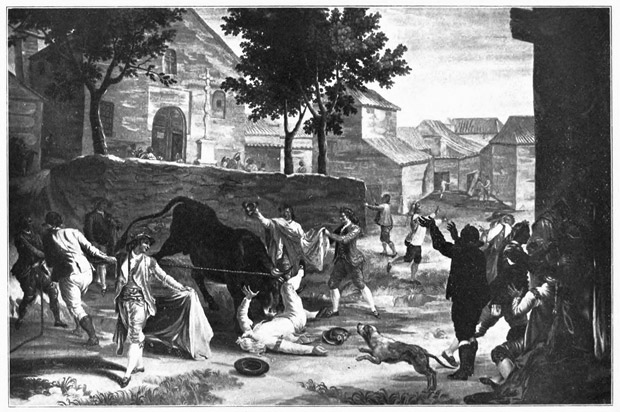
An Old-fashioned Bull-Fight
The sight of the politicians seemed to serve as spark to the
Republican fuel. Even while the hearse was passing somebody
shouted, "Long live Castelar!" but the crowd corrected
the cry to "Long live the glorious memory of Castelar!"
Then came a heterogeneous uproar: "Death to the friars!"
"Long live the Republican Union!" "Down with Reaction!"
"Down with the Jesuits!" "Down with Polavieja!"
"Down with the Government!" "Up with the
Republic!" "Long live Spain!" "Long live the army!"
"Long live Weyler!"
A woman was run over in the confusion and a man was
trampled, but the procession, aided as much as possible by the
Civil Guards and the police, slowly worked its way through
the Alcalá to the Puerta del Sol, where the people poured upon it
like an avalanche, with ever louder cries against ministry and
clergy, until the scene in front of the Government Building
suggested something very like a mob. Silvela bore his silvered
head erect and exerted a prudent forbearance. But few arrests
were made, and the military force that sallied out from
the Government Building merely stood in the gates to awe
the rioters. After an hour and a quarter the transit of the
square was effected. The disturbances were renewed in
the Calle Mayor with such violence that the ministers were
advised to withdraw, but they only entered the funeral coaches,
and, the Guards exerting themselves to the utmost, a degree
of order was at last secured. While the cortège was descending
the difficult hill of La Vega, the Queen, standing in one
of the palace balconies, opera glass in hand, sent a messenger
for a report of the state of affairs in her capital, and was
visited and reassured by a member of the Government.
After this stormy journey the cemetery of San Isidro was
reached at nightfall, and the silent orator laid to rest in the
patio of Santa Maria de la Cabeza, beside his beloved sister,
Concha Castelar. Even here Republican vivas were raised,
and again, later in the evening, before the house of Weyler,
who appeared upon the balcony in answer to repeated calls.
This general, more popular with Spaniards than with us,
discreetly absented himself on Tuesday from the high mass
chanted for Castelar in the Church of San Francisco el
Grande, where there was an imposing display of uniforms
and decorations.
While the people still talked of their lost leader and proposed
monuments and medals in his honor, the Government
held firmly on its course. The Royal Progress for the opening
of the Cortes on the following Friday was a suggestive
contrast to the procession of Monday. Soldiers lined the
curbstones all the way from the Royal Palace to the Congress
Hall, bands were posted at intervals, the royal escort, splendidly
mounted and equipped, was in itself a formidable force,
while additional troops, in gala dress, paraded all the city.
The balconies along the royal route were handsomely draped,
but the people looked on at the gorgeous array of coaches,
gilded and emblazoned, each drawn by six or eight choice
horses, with sumptuous plumes and trappings, and attended
by a story-book pomp of quaintly attired postilions, coachmen,
and outriders, in a silence that was variously explained to me
as indicating respect, hostility, indifference.
I heard no vivas and saw no hats raised even for the affable
Infanta Isabel, riding alone in the tortoise-shell carriage, nor
for the Princess of Asturias, girlishly attractive in rose color
and white, nor for the bright-faced young King, ready with
his military salute as he passed the foreign embassies, nor for
the stately Regent, robed as richly as if she were on her way
to read a gladder message than that which the opposition
journals indignantly declared "no message, but a pious prayer
of resignation."
And while Madrid jarred and wrangled, the flowers brought
by the little daughter of the workingman drooped on the
marble slab above Castelar's repose.
XVII
THE IMMEMORIAL FASHION
"For as many auchours affirme (and mannes accions declare) that man is but his
mynde; so it is to bee daily tride, that the bodie is but a mixture of compoundes, knitte
together like a fardell of fleashe, and bondell of bones, and united as a heavie lumpe of
Leade (without the mynde) in the sillie substance of a shadowe."—Thomas Churchill,
Gentleman.
My Spanish hostess, brightest and prettiest of little
ladies despite the weight of sorrow upon sorrow,
came tripping into my room one afternoon with
her black eyes starry bright under the lace mantilla.
"And where have you been to get so nicely rested?"
"To a duelo."
I turned the word over in my mind. Duelo? Surely that
must mean the mourning at a house of death, when the men
have gone forth to church and the burial, and the women
remain behind to weep together, or one of those tearful At
Homes kept, day after day, until the mass, by the ladies of the
afflicted household for their condoling friends. But such a
smiling little señora! I hardly knew what degree of sympathy
befitted the occasion.
"Were you acquainted with the—the person?"
"No, I had never seen him. He had been an officer in
the Philippines many years, and came home very ill, fifteen
days since. I wept because I knew his mother, but I wept
much. Women, at least here in Spain, have always cause
enough for tears. I thought of my own matters, and had a
long, long cry. That is why I feel better. There is so little
time to cry at home. I must see about the dinner now."
And she rustled out again, leaving me to meditate on Spanish
originality, even in grief.
In any country the usages of death are no less significant
than the usages of life. That grim necropolis of Glasgow,
with its few shy gowans under its lowering sky, those tender,
turf-folded, church-shadowed graveyards of rural England,
those trains of mourners, men by themselves and women by
themselves, walking behind the bier in mid-street through the
mud and rain of wintry Paris to the bedizened Père Lachaise
or Montparnasse—such sights interpret a nation as truly as
its art and history; but the burial customs of Spain, especially
distinctive, are, like most things Spanish, contradictory and
baffling to the tourist view. "La Tierra de Vice Versa" is
not a country that he who runs may read.
The popular verses and maxims treat of death with due
Castilian solemnity and an always unflinching, if often ironic,
recognition of the mortal fact. "When the house is finished,"
says the proverb, "the hearse is at the door." Yet this Spanish
hearse is one of the gayest vehicles since Cinderella's
coach. If the groundwork is black, there is abundant relief
in mountings of brilliant yellow, but the funeral carriage is
often cream-white, flourished over with fantastic designs in
the bluest of blue or the pinkest of pink. Coffins, too, may
be gaudy as candy-boxes. The first coffin we saw in Spain
was bright lilac, a baby's casket, placed on gilt trestles in the
centre of a great chill church, with chanting priests sprinkling
holy water about it to frighten off the demons, and a crowd
of black-bearded men waiting to follow it to the grave. Such
a little coffin and not a woman near! The poor mother was
decently at home, weeping in the midst of a circle of relatives
and neighbors, and counting it among her comforts that the
family had so many masculine friends to walk in the funeral
procession and show sympathy with the household grief.
There would be, on the ninth day after and, for several years
to come, on the anniversary of the death, as many masses as
could be afforded said in the parish church, when, again, the
friends would make it a point of duty to attend.
The daily papers abound in these notices, printed in a
variety of types, so as to cover from two to ten square inches,
heavily bordered with black, and surmounted, in case of adults,
with crosses, and with cherubs' heads for children. I take up
a copy of La Epocha and read the following, under a cross:
"Third Anniversary. Señorita Doña Francisca Fulana y
Tal died the twenty-sixth of June, 1896, at twenty-one years
of age. R. I. P. Her disconsolate mother and the rest of the
family ask their friends and all pious persons to be so good as
to commend her to God. All the masses celebrated to-morrow
morning in the Church of San Pascual will be applied to the
everlasting rest of the soul of the said señorita. Indulgences
are granted in the usual form." It is the third anniversary,
too, of a titled lady, whose "husband, brothers, brothers-in-law,
nephews, uncles, cousins, and all who inherit under her
will" have ordered masses in two churches for the entire day
to-morrow, and announce, moreover, that the ecclesiastical
authorities grant "one hundred and forty days of indulgence
to all the faithful for each mass that they hear, sacred communion
that they devote, or portion of a rosary that they pray
for the soul of this most noble lady."
In the case of another lady of high degree, who died yesterday,
"having received the Blessed Sacraments and the
benediction of his Holiness," the Nuncio concedes one hundred
days of indulgence, the Archbishop of Burgos eighty,
and the Bishops of Madrid, Alcalá, Cartagena, Leon, and
Santander forty each; while a marquis who died a year ago,
"Knight of the Illustrious Order of the Golden Fleece," is
to have masses said for his soul in seven churches, not only
all through to-morrow, but for the two days following.
May all these rest in peace, and all who mourn for them
be comforted! Yet thought drifts away to the poor and lowly,
whose grief cannot find solace in procuring this costly intercession
of the Church for the souls they love. It seems hard
that the inequalities of life should thus reach out into death
and purgatory. We used, during our sojourn in Granada, to
meet many pathetic little processions on "The Way of the
Dead." Over this hollow road, almost a ravine, the fortress
walls, with their crumbling towers, keep guard on the one
side, and the terraced gardens of the Generalife, with their
grand old cypresses, on the other. And here, almost every
hour of the day, is climbing a company of four rough men,
carrying on their shoulders a cheap coffin, which perhaps a
husband follows, or a white-haired father, or, hand in hand,
bewildered orphan boys. The road is so steep that often the
bearers set their burden down in the shadow of the bank-side,
and fling themselves at full length on the ground beside it,
thriftily passing from man to man the slow-burning wax match
for their paper cigarettes. I remember more than one such
smoking group, with a solitary mourner, hat in hand and eyes
on the coffin, yet he, too, with cigarette in mouth, standing
patiently by. All who pass make the sign of the cross, and
even the rudest peasant uncovers his head. Very shortly the
bearers may be seen again, coming down the hill at a merry
pace, the empty box, with its loose, rattling lid, tilted over
the shoulder now of one, now of another; for the children
of poverty, who had not chambers of their own nor the dignity
of solitude in life, lie huddled in a common pit after death,
without coffin-planks to sever dust from dust.
A century ago it was usual to robe the dead in monastic
garb, especially in the habit of St. Francis or of the Virgin of
Carmen, and within the present generation bodies were borne
to the grave on open biers, the bystanders saluting, and bidding
them farewell and quiet rest:—
"'Duerme in paz!' dicen los buenos.
'Adios!' dicen los demás."
But now the closed coffin of many colors is in vogue. In
the Santiago market we met a cheerful dame with one of
these balanced on her head, crying for a purchaser, and up
the broad flights of steps to the Bilbao cemetery we saw a
stolid-faced young peasant-woman swinging along with a
child's white coffin, apparently heavy with the weight of
death, poised on the glossy black coils of hair, about which
she had twisted a carmine handkerchief.
Very strange is the look of a Spanish cemetery, with its
ranges of high, deep walls, wherein the coffins are thrust end-wise,
each above each, to the altitude of perhaps a dozen
layers. These cells are sometimes purchased outright, sometimes
rented for ten years, or five, or one. When the friends
of the quiet tenant pay his dues no longer, forth he goes to
the general ditch, osario común, and leaves his room for another.
Such wall graves are characteristically Spanish, this mode of
burial in the Peninsula being of long antiquity. Yet the rich
prefer their own pantheons, sculptured like little chapels, or
their own vaults, over which rise tall marbles of every device,
the shaft, the pyramid, the broken column; while a poor
family, or two or three neighboring households, often make
shift to pay for one large earth grave, in which their dead
may at least find themselves among kith and kin. Spanish
cemeteries are truly silent cities, with streets upon streets
enclosed between these solemn walls, which open out, at intervals,
now for the ornamented patios of the rich, now for the
dreary squares peopled by the poor. Here in a most aristocratic
quarter, shaded by willows, set with marbles, paved with
flower beds, sleeps a duke in stately pantheon, which is carved
all over with angels, texts, and sacred symbols, still leaving
room for medallions boasting his ancestral dignities. A double
row of lamps, with gilded, fantastically moulded stands, and
with dangling crystals of all colors, leads to the massive iron
door. What enemy has he now to guard against with that
array of bolts and bars? Here are a poet's palms petrified
to granite, and here a monument all muffled in fresh flowers.
Here the magnificent bronze figure of a knight, with sword
half drawn, keeps watch beside a tomb, while the grave beyond
a rose bush guards as well. And here an imaged Sandalphon
holds out open hands, this legend written across his marble
scarf, "The tear falleth; the flower fadeth; but God treasureth
the prayer."
There is a certain high-bred reserve about these costly
sepulchres, but turning to the walls one comes so face to face
with grief as to experience a sense of intrusion. Each cell
shows on its sealed door of slate or other stone the name and
age of its occupant, and perhaps a sentiment, lettered in gilt or
black, as these: "We bear our loss—God knows how
heavily." "Son of my soul." "For thee, that land of larger
love; for me, until I find thee there, only the valley of sorrow
and the hard hill of hope."
Most of the cells have, too, a glassed or grated recess in
front of this inscription wall, holding tributes or memorials—dried
flowers, colored images of saints and angels, crucifixes,
and the like. Sometimes the resurrection symbol of the
butterfly appears. In the little cemetery at Vigo we noticed
that the flower-vases were in form of great blue butterflies
with scarlet splashes on their wings. Sometimes there are
locks of hair, personal trinkets, and often card or cabinet
photographs, whose living look startles the beholder. Out
from a wreath of yellow immortelles peeps the plump smile
of an old gentleman in modern dress coat; a coquettish lady
in tiara and earrings laughs from behind her fan; and a grove
of paper shrubbery, where tissue fairies dressed in rose petals
dance on the blossoms, half hides the eager face of a Spanish
midshipman. Where the photographs have faded and dimmed
with time, the effect is less incongruous, if not less pathetic.
The niches of children contain the gayest possible little
figures. Here are china angels in blue frocks, with pink
sleeves and saffron pantalets, pink-tipped plumes, and even
pink bows in their goldy hair. Here is a company of tiny
Hamlets, quaint dollikins set up in a circle about a small
green grave, each with finger on lip, "The rest is silence."
Here are two elegant and lazy cherubs, their alabaster chubbiness
comfortably bestowed in toy chairs of crimson velvet on
each side of an ivory crucifix. And here is a Bethlehem,
and here a Calvary, and here the Good Shepherd bearing the
lamb in His bosom; and here, in simple, but artistic wood
carving, the Christ with open arms, calling to a child on sick-bed
to come unto Him, while the mother, prostrate before the
holy feet, kisses their shadow. One cannot look for long.
It is well to lift the eyes from the niche graves of Granada to
the glory of the Sierra Nevada that soars beyond, and turn
from the patios of San Isidro to the cheerful picture of Madrid
across the Manzanares, even though, prominent in the vista,
rises the cupola of San Francisco el Grande. This is the
National Pantheon, and within, beneath the frescoed dome,
all aglow with blue and gold, masses are chanted for
the dead whom Spain decrees to honor, as, so recently, for
Castelar.
Near this church a viaduct, seventy-five feet high, crosses
the Calle de Segovia; and, despite the tall crooked railings and
a constant police patrol, Madrileños bent on suicide often
succeed in leaping over and bruising out their breath on the
stones of the street below. It is a desperate exit. The Seine
and Thames lure their daily victims with murmuring sound
and the soft, enfolding look of water, but Spaniards who
spring from this fatal viaduct see beneath them only the cruel
pavement. That life should be harder than stone! And yet
the best vigilance of Madrid cannot prevent fresh bloodstains
on the Calle de Segovia.
Near the cemetery of San Isidro, across the Manzanares,
are two other large Catholic burial grounds, and the Cementério
Inglés.
"But murderers, atheists, and Protestants are buried way
off in the east," said the pretty Spanish girl beside me.
"Oh, let's go there!" I responded, with heretic enthusiasm;
but I had reckoned without the cabman, who promptly and
emphatically protested.
"That's not a pleasant place for ladies to see. You would
better drive in the Prado and Recoletos, or in the Buen Retiro."
We told him laughingly that he was speaking against his
own interests, for the Civil Cemetery was much farther off
than the parks. He consulted his dignity and decided to
laugh in return.
"It is not of the pesetas I think first when I am driving
ladies. But" (with suave indulgence) "you shall go just
where you like."
So in kindness he gathered up his reins and away we
clattered sheer across the city. Presently we had left the
fountain-cooled squares and animated streets behind, had
passed even the ugly, sinister Plaza de Toros, and outstripped
the trolley track; but still the road stretched on, enlivened
only by herds of goats and an occasional venta, where drivers
of mule trains were pausing to wet their dusty throats. We
met few vehicles now save the gay-colored hearses, and few
people except groups of returning mourners, walking in bewildered
wise, with stumbling feet.
"The Cemetery of the Poor is opposite the Civil Cemetery,"
said our cabman, "and they have from thirty to fifty burials
a day. The keeper is a friend of mine. He shall show
you all about."
A bare Castilian ridge rose before us, where a farmer, leaning
on his scythe, was outlined against the sky like a silhouette
of Death. And at last our cheery driver, humming bars from
a popular light opera, checked his mettlesome old mare,—who
plunged down hills and scrambled up as if she were
running away from the bull-ring, where she must soon fulfil
her martyrdom,—between two dismal graveyards. From
the larger, on our right, tiptoed out a furtive man and peered
into the cab as if he thought we had a coffin under the seat.
He proved a blood-curdling conductor, always speaking in
a hoarse whisper and glancing over his shoulder in a way to
make the stoutest nerves feel ghosts, but he showed us, under
that sunset sky, memorable sights—ranks upon ranks of
gritty mounds marked with black, wooden crosses, a scanty
grace for which the living often pay the price of their own
bread that the dead they love may pass a year or two out of
that hideous general fosse. Then the sexton reluctantly led
us to the unblessed, untended hollow across the way, where
rows of brick sepulchres await the poor babies who die before
the holy water touches them, where recumbent marbles press
upon the dead who knew no upward reach of hope, and where
defiant monuments, erected by popular subscription and often
bearing the blazonry of a giant quill, denote the resting-places
of freethinkers and the agitators of new ideas. There were
some Christian inscriptions, whether for Protestants or not
I do not know, but to my two companions there was no
distinction of persons in this unhallowed limbo.
Our dusty guide led us hurriedly from plot to plot.
"They say the mothers cheat the priests, and there are
babies over yonder that ought to be here, for the breath was
out of them before ever they were baptized. They say the
priests had this man done to death one night, because he
wrote against religion. He was only twenty-two. The club
he belonged to put up that stone. They say there are evil
words on it. But I don't know myself. I can't read, thanks
to God. They say it was through reading and writing that
most of these came here."
"But those are not evil words," I answered. "They are,
'Believe in Jesus and thou shalt be saved.'"
He hastily crossed himself, "Do me the favor not to read
such words out loud. Here is another, where they say the
words are words of hell."
I held my peace this time, musing on that broad marble
with its one deep-cut line, "The Death of God."
"And over there," he croaked, pointing with his clay-colored
thumb, "is Whiskers."
The señorita, whose black eyes had been getting larger
and larger, gave a little scream and fairly ran for the gate.
Spaniards have usually great sympathy for criminals, newspaper
accounts of executions often closing with an entreaty
for God's mercy on "this poor man's soul," but Whiskers,
the Madrid sensation of a fortnight since, was a threefold
murderer. Passion-mad, he had shot dead in the open street
a neighbor's youthful wife, held the public at bay with his
revolver, and mortally wounded two Civil Guards, before he
turned the fatal barrel on himself.
"His family wanted him laid over the way," continued that
scared undertone at my ear, "but the bishop said no. A
murderer like that was just as bad as infidels and Protestants,
and should be buried out of grace."
I felt as if Superstition incarnate were walking by my side,
and after one more look at that strangely peopled patch of
unconsecrated ground, with its few untrimmed cypresses
and straggling rose bushes, hillside slopes about and glory-flooded
skies above, I gave Superstition a peseta, which he
devoutly kissed, and returned to the cab, followed by the
carol of a solitary bird.
I remember a similar experience in Cadiz. I had driven
out with one of my Spanish hostesses to the large seaside
cemetery, a mile beyond the gate. This is arranged in nine
successive patios, planted with palms and cypresses. In the
niches, seashells play a prominent part. The little angel
images, as gay as ever, with their pink girdles and their
purple wings, may be seen swinging in shells, sleeping in
shells, and balancing on the edge of shells to play their
golden flutes. Near by is an English and German cemetery,
with green-turfed mounds and a profusion of blossoming
shrubs and flower beds. Not sure of the direction, as we
were leaving the Catholic enclosure I asked a bandy-legged,
leather-visaged old sexton, who might have been the very one
that dug Ophelia's grave, if the "Protestant cemetery" was
at our right. He laid down his mattock, peered about among
the mausolea to see if we were quite alone, winked prodigiously,
and, drawing a bunch of keys from the folds of his
black sash, started briskly down a by-path and signed to us
to follow. He led us through stony passages out beyond
the sanctified ground into a dreary, oblong space, a patch of
weeds and sand, enclosed by the lofty sepulchral walls, but
with a blessed strip of blue sky overhead.
"Here they are!" he chuckled. "They wouldn't confess,
they died without the sacraments, and here they
are."
Some names lettered on the wall seemed to be those of
Dutch and Norwegian sailors, who had perhaps died friendless
in this foreign port. There were pebble-strewn graves
of Jews, and upright marbles from which the dead still
seemed to utter voice: "I refuse the prayers of all the
saints, and ask the prayers of honest human souls. I believe
in God." And another, "God is knowledge." And
another, "God is All that works for Wisdom and for
Love."
"Are there burial services for these?" I inquired.
If the Church of England could have seen that crooked
old sexton go through his gleeful pantomime!
"There's one that comes with some, and they call him
Pastor! And he scrapes up a handful of dirt—so! And
he flings it at the coffin—so! And then he stands up
straight and says, 'Dust to dust!' I've heard him say it
myself."
"God of my soul!" cried the Spanish lady in horror, and
to express her detestation of such a heathenish rite, she spat
upon the ground.
The monarchs of Spain do not mingle their ashes. Who
knows where Roderick sleeps? Or does that deathless
culprit still lurk in mountain caverns, as tradition has it,
wringing his wasted hands and tearing his white beard in
unavailing penitence? The "Catholic kings," Ferdinand
and Isabella, lie, not where they had planned, in that beautiful
Gothic church of Toledo, San Juan de los Reyes, on
whose outer walls yet hang the Moorish chains struck from
the limbs of Christian captives, but in Granada, the city
of their conquest, where they slumber proudly, although
their coffins are of plainest lead and their last royal chamber a
small and dusky vault. Pedro the Cruel is thrust away in a
narrow wall-grave beneath the Capilla Real of Seville cathedral.
His brother, the Master of Santiago, whom he treacherously
slew in one of the loveliest halls of the Alcázar, is
packed closely in on his left, and Maria de Padilla, for whose
sake he cut short the hapless life of Queen Blanche, on his
right. Pleasant family discussions they must have at the
witching hour of night, when they drag their numb bones
out of those pigeon-holes for a brief respite of elbow room!
San Fernando, the Castilian conqueror of Castile, canonized
"because he carried fagots with his own hands for the
burning of heretics," is more commodiously accommodated in
a silver sarcophagus in the chapel above, where Alfonso the
Learned also has long leisure for thought. Another Alfonso
and another Fernando, with another wife of Pedro the Cruel,
keep their state in Santiago de Compostela, and still another
Alfonso and two Sanchos have their splendid tombs in the
Capilla Mayor of Toledo cathedral, while in its Capilla de
los Reyes Nuevos, a line descended from that brother whom
Pedro murdered, sleeps the first John, with the second and
third Henrys.
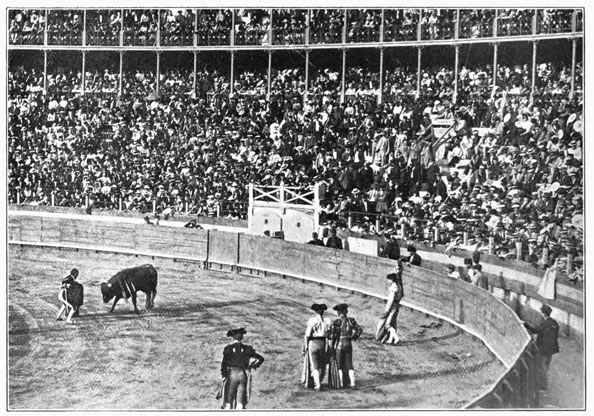
Bull-Fight of To-Day
Cordova cathedral, although this lovely mosque recks little
of Christian majesties, has the ordinary equipment of an
Alfonso and a Fernando, and the Royal Monastery of Las
Huelgas in Burgos shelters Alfonso VIII, with his queen,
Eleanor of England. In less noted churches, one continually
chances on them, rey or reina, infante or infanta, dreaming
the centuries away in rich recesses of fretted marble and alabaster,
with the shadow of great arches over them and the
deep-voiced chant around.
But since Philip II created, in his own sombre likeness,
the monastery of the Escorial, rising in angular austerity
from a spur of the bleak Guadarrama Mountains, the royal
houses of Austria and Bourbon have sought burial there.
The first and chief in the dank series of sepulchral vaults,
the celebrated Panteón de los Reyes, is an octagon of black
marble, placed precisely under the high altar, and gloomily
magnificent with jasper, porphyry, and gold. It has an altar
of its own, on whose left are three recesses, each with four
long shelves placed one above another for the sarcophagi of
the kings of Spain, and on whose right are corresponding
recesses for the queens. As the guide holds his torch, we
read the successive names of the great Charles I, founder of
the Austrian line; the three Philips, in whom his genius
dwindled more and more; and the half-witted Charles II, in
whom it ignobly perished. The coffin lid of Charles I has
twice been lifted, once as late as 1871, in compliment to the
visiting Emperor of Brazil, and even then that imperial body
lay intact, with blackened face and open, staring eyes. The
gilded bronze coffin of Philip II was brought to his bedside
for his inspection in his last hour of life. After a critical
survey he ordered a white satin lining and more gilt nails—a
remarkable sense of detail in a man who had sent some ten
thousand heretics to the torture.
Looking for the Bourbons, we miss the first of them all,
the melancholy Philip V, who would not lay him down among
these Austrians, but sleeps with his second queen, the strong-willed
Elizabeth Farnese, in his cloudy retreat of San Ildefonso,
within hearing of the fountains of La Granja. His eldest
son, Luis the Well-Beloved, who died after a reign of seven
months, rests here in the Escorial, but Fernando VI, also the
son of Philip's first queen—that gallant little Savoyarde who
died so young—was buried in Madrid. Charles III, best
and greatest of the Spanish Bourbons, is here, the weak
Charles IV, Fernando VII, "The Desired" and the Disgraceful,
and Alfonso XII, while a stately sarcophagus is
already reserved for Alfonso XIII.
To the cold society of these five Austrian and five Bourbon
sovereigns are admitted nine royal ladies. Of these, the first
three are in good and regular standing—the queen of Charles I
and mother of Philip II, the fourth queen of Philip II and
mother of Philip III, the queen of Philip III and mother of
Philip IV. But here is an intruder. Philip IV, who had an
especial liking for this grewsome vault, and used often to
clamber into his own niche to hear mass, insisted on having
both his French and Austrian queens interred here, although
the first, Isabel of Bourbon, is not the mother of a Spanish
king, the promising little Baltasar having died in boyhood.
The brave girl-queen of Philip V is here, in double right as
mother both of Luis and Fernando VI, and here is the wife
of Charles III and mother of Charles IV. But of sorry
repute are the last two queens, the wife of Charles IV and
mother of Fernando VII, she who came hurrying down those
slippery marble stairs in feverish delirium to scratch Luisa
with scissors on her selected coffin, and this other, Maria
Cristina, wife of Fernando VII and mother of the dethroned
Isabel, a daughter who did not mend the story. It will not
be long before she returns from her French exile to enter into
possession of the sarcophagus that expects her here, even as
another sumptuous coffin awaits the present regent. Pity it
is for Isabel, whose name is still a byword in the Madrid
cafés! But she always enjoyed hearing midnight mass in this
dim and dreadful crypt, and will doubtless be glad to come
back to her ancestors, such as they were, and take up her
royal residence with them in "dust of human nullity and
ashes of mortality."
XVIII
CORPUS CHRISTI IN TOLEDO
"A blackened ruin, lonely and forsaken,
Already wrapt in winding-sheets of sand,
So lies Toledo till the dead awaken,
A royal spoil of Time's resistless hand."
—Zorrilla: Toledo.
In the thirteenth century the doctrine of transubstantiation
assumed especial importance. Miracle plays and
cathedral glass told thrilling stories of attacks made by
Jews on the sacred Wafer, which bled under their poniards or
sprang from their caldrons and ovens in complete figure of
the Christ. The festival of Corpus Christi, then established
by Rome, was devoutly accepted in Spain and used to be
celebrated with supreme magnificence in Madrid. Early in
the reign of Philip IV, Prince Charles of England, who, with
the adventurous Buckingham, had come in romantic fashion
to the Spanish capital, hoping to carry by storm the heart of
the Infanta, stood for hours in a balcony of the Alcázar,
gazing silently on the glittering procession. How they swept
by through the herb-strewn, tapestried streets—musicians,
standard-bearers, cross-bearers, files of orphans from the
asylums, six and thirty religious brotherhoods, monks of all
the orders, barefoot friars, ranks of secular clergy and brothers
of charity, the proud military orders of Alcántara, Calatrava,
and Santiago, the Councils of the Indies, of Aragon, of
Portugal, the Supreme Council of Castile, the City Fathers of
Madrid, the Governmental Ministers of Spain and Spanish
Italy, the Tribunal of the Holy Office, preceded by a long
array of cloaked and hooded Familiars, bishops upon bishops
in splendid, gold-enwoven vestments, priests of the royal
chapel displaying the royal banner, bearers of the crosier
and the sacramental vessels, the Archbishop of Santiago,
royal chaplains and royal majordomos, royal pages with tall
wax tapers, incense burners, the canopied mystery of the
Eucharist, the king, the prince, cardinals, nuncio, the
inquisitor general, the Catholic ambassadors, the patriarch
of the Indies, the all-powerful Count-Duke Olivares, grandees,
lesser nobility, gentlemen, and a display of Spanish and
German troops, closed by a great company of archers.
So overwhelming was that solemn progress, with its brilliant
variety of sacerdotal vestments, knightly habits, robes of
state and military trappings, its maces, standards, crosses, the
flash of steel, gold, jewels, and finally the sheen of candles,
the clouds of incense, the tinkling of silver bells before the
Santisimo Corpus, that the heretic prince and his reckless
companion fell to their knees. One Spanish author pauses to
remark that for these, who could even then reject the open
arms of the Mother Church, the assassin's blow and the
Whitehall block were naturally waiting.
Such a pomp would have been worth the seeing, but we
had arrived at Madrid almost three centuries too late. Catholic
friends shrugged shoulder at mention of the Corpus
procession, "Vale poco." And as for the famous autos sacramentales,
which used to be celebrated at various times during
the eight days of the Corpus solemnity, they may be read in
musty volumes, but can be seen in the city squares no more.
Calderon is said to have written the trifling number of seventy-two,
and Lope de Vega, whose fingers must have been tipped
with pens, some four hundred.
If only our train, which then would not have been a train,
had brought us, who then would not have come, to Madrid
in season for a Corpus celebration under the Austrian dynasty,
we could have attended an open-air theatre of a very curious
sort. All the way to the Plaza, we would have seen festivity
at its height, pantomimic dances, merry music, struttings of
giants and antics of dwarfs, and perhaps groups of boys insulting
cheap effigies of snakes, modelled after the monstrous
Tarasca, carried in the Corpus parade in token of Christ's
victory over the Devil. At intervals along the route, adorned
with flowers and draperies, and reserved for the procession and
the dramatic cars, would have been altars hung with rich
stuffs from the Alcázar and the aristocratic palaces; silks and
cloth of gold, brocades, velvets, and shimmering wefts of the
Indies. The one-act play itself might be after the general
fashion of the mediæval Miracles,—verse dialogue, tuned to
piety with chords of fun, for the setting forth of Biblical
stories. Abraham's sacrifice of Isaac, Moses feeding the
Israelites with manna, the patience of Job, the trials of
Joseph, David, and Daniel, were thus represented.
More frequently, the auto sacramental belonged to the so-called
Morality type of early Christian drama, being an allegorical
presentation of human experience or exposition of church
doctrine. Such were "The Fountain of Grace," "The
Journey of the Soul," "The Dance of Death," "The
Pilgrim." Sometimes a Gospel parable, as the "Lost Sheep"
or the "Prodigal Son," gave the dramatic suggestion. But
these Spanish spectacles sought to associate themselves, as
closely as might be, with the Corpus worship, and many of
them bear directly, in one way or another, upon this sacrament.
If, for instance, we had chanced on the Madrid festival in
1681, we could have witnessed in the decorated Plaza, with
its thronged balconies, the entrance of four scenic platforms
or cars. The first, painted over with battles, bears a Gothic
castle; the second, with pictures of the sea, a gallant ship;
the third, a starry globe; the fourth, a grove and garden,
whose central fountain is so shaped as to form, above, the
semblance of an altar. In the complicated action of the play,
when the Soul, besieged in her fortress by the Devil, whose
allies are the World and the Flesh, calls upon Christ for succor,
the hollow sphere of the third car opens, revealing the
Lord enthroned in glory amid cherubim and seraphim; but
the climax of the triumph is not yet. That stout old general,
the Devil, rallies fresh forces to the attack, such subtle foes
as Atheism, Judaism, and Apostasy, and whereas, before, the
Senses bore the brunt of the conflict, it is the Understanding
that girds on armor now. Yet in the final outcome not the
Understanding, but Faith draws the veil from before the
altar of the fourth car, and there, in the consecrated vessel for
the holding of the Wafer, appears the "Passion Child," the
white bread from Heaven, "very flesh and very blood that are
the price of the soul's salvation."
That is the way Spain kept her Corpus fiesta in the good
old times of Charles the Bewitched; but not now. After
the procession, the bull-fight; and after the bull-fight, the
latest vaudeville or ballet. Last year it rained on Corpus
Thursday, which fell on the first of June, and Madrid gave
up the procession altogether. Some of the Opposition papers
started the cry that this was shockingly irreligious in Silvela,
but when the Government organs haughtily explained that
it was the decision of the archbishop and Señor Silvela
was not even consulted, the righteous indignation of the
Liberals straightway subsided. The procession, which was
to have been a matter of kettledrums and clarionets, soldiery,
"coaches of respect" from the palace and the city corporation,
and a full showing of the parochial clergy, did not seem
to be missed by the people. Corpus has long ceased to be a
chief event in the Capital.
There are a few cities in Spain, however, where the Corpus
fête is maintained with something of the old gayety and
splendor. Bustling Barcelona, never too busy for a frolic,
keeps it merrily with an elaborate parade from the cathedral
all about the city, and—delightful feature!—the distribution
of flowers and sweetmeats among the ladies. The procession
in Valencia resembles those of Holy Week in Seville. On
litters strewn with flowers and thick-set with candle-lights are
borne carved groups of sacred figures and richly attired images
of Christ and the Virgin. But it is in lyric Andalusia that
these pageantries are most at home. Among her popular
coplas is one that runs:—
"Thursdays three in the year there be,
That shine more bright than the sun's own ray—
Holy Thursday, Corpus Christi,
And our Lord's Ascension Day."
Cadiz, like Valencia, carries the pasos in the Corpus procession.
In Seville, where the street displays of Holy Week
are under the charge of the religious brotherhoods, or cofradias,
Corpus Christi gives opportunity for the clergy and
aristocracy to present a rival exhibition of sanctified luxury
and magnificence.
But it is in beautiful belated Granada that the Corpus fête
is now at its best. A brilliantly illustrated programme, whose
many-hued cover significantly groups a gamboge cathedral
very much in the background, and a flower-crowned Andalusian
maiden, draped in a Manila shawl, with a prodigious
guitar at her feet, very much in the foreground, announces a
medley of festivities extending over eleven days. This cheerful
booklet promises, together with a constant supply of
military music, balcony decorations, and city illuminations,
an assortment of pleasures warranted to suit every taste—infantry
reviews, cavalry reviews, cadet reviews, masses under
roof and masses in the open, claustral processions, parades of
giants, dwarfs, and La Tarasca, a charity raffle in the park
under the patronage of Granada's most distinguished ladies,
the erection of out-of-door altars, the dispensing of six thousand
loaves of bread among the poor (from my experience of
Granada beggars I should say the supply was insufficient), a
solemn Corpus procession passing along white-canopied streets
under a rain of flowers, three regular bull-fights with the
grand masters Guerrita, Lagartijillo, and Fuentes, followed by a
gloriously brutal corrida, with young beasts and inexperienced
fighters, cattle fair, booths, puppet shows, climbing of greased
poles, exhibition of fine arts and industries, horse racing, polo,
pigeon shoot, trapeze, balloon ascensions, gypsy dances, and
fireworks galore.
But even faithful Granada shared in the strange catalogue
of misfortunes which attended Corpus last year. The rains
descended on her Chinese lanterns, and the winds beat against
her Arabic arches with their thousands of gas-lights. On the
sacred Thursday itself, the Andalusian weather made a most
unusual demonstration of hurricane and cloudburst, with interludes
of thunder and lightning. Great was the damage in field,
vineyard, and orchard, and as for processions, they were
in many places out of the question. Even Seville and Cordova
had to postpone both parades and bull-fights. But this was not
the worst. In Ecija, one of the quaintest cities of Andalusia,
an image of the Virgin as the Divine Shepherdess, lovingly
arrayed and adorned with no little outlay by the nuns of the
Conception, caught fire in the procession from a taper, like
Seville's Virgin of Montserrat in the last Semana Santa. The
Divina Pastora barely escaped with her jewels. Her elaborate
garments, the herbage and foliage of her pasture, and
one of her woolly sheep were burned to ashes. In Palma de
Mallorca, a romantic town of the Balearic Isles, a balcony,
whose occupants were leaning out to watch the procession,
broke away, and crashed down into the midst of the throng.
A young girl fell upon the bayonet of a soldier marching
beneath, and was grievously hurt. Others suffered wounds
which, in one case at least, proved fatal. The Opposition
journals did not fail to make capital out of these untoward
events, serving them up in satiric verse with the irreverent
suggestion that, if this was all the favor a reactionary and
ultra-Catholic government could secure from Heaven, it was
time to go back to Sagasta.
The ecclesiastical Toledo, seat of the Primate of all Spain,
is one of the Spanish cities which still observe Corpus Christi
as a high solemnity, and Toledo is within easy pilgrimage
distance of Madrid. I had already passed two days in that
ancient capital of the Visigoths, ridding my conscience of the
sightseers' burden, and I both longed and dreaded to return.
The longing overcame the dread, and I dropped in at the
Estacion del Mediodía for preliminary inquiries. I could discover
no bureau of information and no official authorized to
instruct the public, but in this lotus-eating land what is nobody's
business is everybody's business. There could not be
a better-humored people. The keeper of the bookstand abandoned
his counter, his would-be customers lighting cigarettes
and leaning up against trucks and stacks of luggage to wait
for his return, and escorted me the length of the station to
find a big yellow poster, which gave the special time-table for
Corpus Thursday. The poster was so high upon the wall
that our combined efforts could not make it out; whereupon
a nimble little porter dropped the trunk he was carrying, and
climbed on top of it for a better view. In that commanding
position he could see clearly enough, but just when my hopes
were at the brightest, he regretfully explained that he had
never learned to read. As he clambered down the proprietor
of the trunk, who had been looking on with as much serenity
as if trains never went and starting bells never rang, mounted
in turn. This gentleman, all smiles and bows and tobacco
smoke, read off the desired items, which the keeper of the
bookstand copied for me in a leisurely, conversational manner,
with a pencil lent by one bystander on a card donated by
another.
There is really something to be said for the Spanish way
of doing business. It takes time, but if time is filled with
human kindliness and social courtesies, why not? What is
time for? Whenever I observed that I was the only person
in a hurry on a Madrid street, I revised my opinion as to the
importance of my errand.
As I entered the station again on the first of June at the
penitential hour of quarter past six in the morning, I was
reflecting complacently on my sagacity as a traveller. Had I
not bethought me that, even in the ecclesiastical centre of
Spain and on this solemn festival, there might be peril for a
stranger's purse? What financial acumen I had shown in
calculating that, since my round-trip ticket to Toledo before
had cost three dollars, second class, I could probably go first
class on this excursion for the same sum, while two dollars
more would be ample allowance for balcony hire and extras!
And yet how prudent in me to have tucked away a reserve
fund in a secret pocket inaccessible even to myself! But
why was the station so jammed and crammed with broad-hatted
Spaniards? And what was the meaning of that long
line of roughs, stretching far out from the third-class ticket
office? Bull-fight explained it all. Even reverend Toledo
must keep the Corpus holy by the public slaughter of six
choice bulls and as many hapless horses as their blind rage
might rend. Worse than the pagan altars that reeked with
the blood of beasts, Spain's Christian festivals demand torture
in addition to butchery.
There were no first-class carriages, it appeared, upon the
Corpus train, and my round-trip ticket, second class, cost only
a dollar, leaving me with an embarrassment of riches. Pursing
the slip of pasteboard which, to my disgust, was stamped
in vermilion letters Corrida de Toros, I sped me to the train,
where every seat appeared to be taken, although it lacked
twenty minutes of the advertised time for departure; but a
bald-headed philanthropist called out from a carriage window
that they still had room for one. Gratefully climbing up, I
found myself in the society of a family party, off for Toledo
to celebrate the saint-day of their hazel-eyed eight-year-old
by that treat of treats, a child's first bull-fight. When they
learned that I was tamely proposing to keep Corpus Christi
by seeing the procession and not by "assisting at the function
of bulls," their faces clouded; but they decided to make
allowance for my foreign idiosyncrasies.
The train, besieged by a multitude of ticket-holders for
whom there were no places, was nearly an hour late in getting
off. The ladies dozed and chattered; the gentlemen smoked
and dozed; little Hazel-eyes constantly drew pictures of
bulls with a wet finger on the window glass. Reminded
again by my handbag literature that Toledo is a nest of
thieves, I would gladly have put away my extra money, but
there was never a moment when all the gentlemen were asleep
at once.
It was after ten when we reached our destination, the boy
wild with rapture because we had actually seen a pasture of
grazing bulls. A swarm of noisy, scrambling, savage-looking
humanity hailed the arrival of the train, and I had hardly
made my way even to the platform before I felt an ominous
twitch at my pocket. The light-fingered art must have
degenerated in Toledo since the day of that clever cutpurse
of the "Exemplary Tales." Turning sharply, I confronted
a group of my fellow-worshippers, who, shawled and sashed
and daggered, looked as if they had been expressly gotten up
for stage bandits. From the shaggy pates, topped by gaudy,
twisted handkerchiefs—a headdress not so strange in a city
whose stone walls looked for centuries on Moorish turbans—to
the bright-edged, stealthy hemp sandals, these were pickpockets
to rejoice a kodak. Their black eyes twinkled at me
with wicked triumph, while it flashed across my mind that my
old hero, the Cid, was probably much of their aspect, and certainly
gained his living in very similar ways. There were a
full score of these picturesque plunderers, and not a person of
the nineteenth century in sight. Since there was nothing to
do, I did it, and giving them a parting glance of moral disapproval,
to which several of the sauciest responded by blithely
touching their forelocks, I pursued my pilgrim course, purged
of vainglory. At all events, I was delivered from temptation
as to a questionable peseta in my purse—my pretty Paris
purse!—and I should not be obliged to travel again on that
odious bull-fight ticket.
We were having "fool weather," blowing now hot, now
cold, but as at this moment the air was cool, and every possible
vehicle seemed packed, thatched, fringed with clinging
passengers, I decided, not seeking further reasons, to walk up
to the town. And what a town it is! Who could remember
dollars? So far from being decently depressed, I was almost
glad to have lost something in this colossal monument of
losses. It seemed to make connection.
Between deep, rocky, precipitous banks, strongly flows the
golden "king of rivers, the venerable Tajo," almost encircling
the granite pedestal of the city and spanned by ancient bridges
of massy stone, with battlemented, Virgin-niched, fierce old
gates. And above, upon its rugged height, crumbling hourly
into the gritty dust that stings the eye and scrapes beneath the
foot, lies in swirls on floor and pavement, blows on every
breeze and sifts through hair and clothing, is the proud, sullen,
forsaken fortress of "imperial Toledo." Still it is a vision
of turrets, domes, and spires, fretwork, buttresses, façades,
but all so desolate, so dreary, isolated in that parched landscape
as it is isolated in the living world, that one approaches
with strangely blended feelings of awe, repugnance, and
delight.
On we go over the Bridge of Alcántara, wrought æons
since by a gang of angry Titans—the guidebooks erroneously
attribute it to the Moors and Alfonso the Learned—with
a shuddering glance out toward the ruins of feudal
castles, here a battlemented keep set with mighty towers,
there a great, squat, frowning mass of stone, the very sight
of which might have crushed a prisoner's heart. Up, straight
up, into the grim, gray, labyrinthine city, whose zigzag streets,
often narrowing until two laden donkeys, meeting, cannot pass,
so twist and turn that it is impossible on entering one to guess
at what point of the compass we will come out. These
crooked ways, paved with "agony stones," are lined with
tall, dark, inhospitable house fronts, whose few windows are
heavily grated, and whose huge doors, bristling with iron
bosses, are furnished with fantastic knockers and a whole
arsenal of bolts and chains.
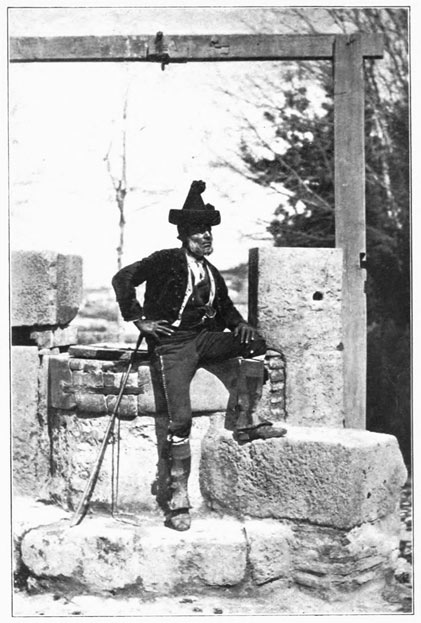
The King of the Gypsies
Gloomy as these ponderous structures are, every step discloses
a novelty of beauty,—a chiselled angel, poised for
flight, chased escutcheons, bas-reliefs, toothed arches, medallions,
weather-eaten groups of saints and apostles gossiping
in their scalloped niches about the degeneracy of the times.
The Moors, whose architecture, says Becquer, seems the
dream of a Moslem warrior sleeping after battle in the shadow
of a palm, have left their mark throughout Toledo in the airy
elegance of the traceries magically copied from cobwebs and
the Milky Way. That tragic race, the Jews, have stamped on
the walls of long-desecrated synagogues their own mysterious
emblems. And Goths and Christian knights have wrought
their very likenesses into the stern, helmeted heads that peer
out from the capitals of marvellous columns amid the stone
grapes and pomegranates most fit for their heroic nourishment.
But all is in decay. Here stands a broken-sceptred
statue turning its royal back on a ragged vender of toasted
garbanzos. Even the image of Wamba has lost its royal nose.
You may traverse whispering cloisters heaped with fallen
crosses, with truant tombstones, and severed heads and limbs
of august prophets. Cast aside in dusky vaults lie broken
shafts of rose-tinted marbles and fragments of rare carving in
whose hollows the birds of the air once built their nests.
Through the tangle of flowers and shrubbery that chokes the
patios gleam the rims of alabaster urns and basins of jasper
fountains. Such radiant wings and faces as still flash out
from frieze and arch and column, such laughing looks, fresh
with a dewy brightness, as if youth and springtime were
enchanted in the stone! And what supreme grace and truth
of artistry in all this bewildering detail! On some far-off
day of the golden age, when ivory and agate were as wax,
when cedar and larch wood yielded like their own soft leaves,
the magician must have pressed upon them the olive leaf, the
acacia spray, the baby's foot, that have left these perfect traces.
And how did mortal hand ever achieve the intricate, curling,
unfolding, blossoming marvel of those capitals? And who
save kings, Wambas and Rodericks, Sanchos, Alfonsos, and
Fernandos, should mount these magnificent stairways? And
what have those staring stone faces above that antique doorway
looked upon to turn them haggard with horror? City of
ghosts! The flesh begins to creep. But here, happily, we
are arrived in the Plaza de Zocodovér, where Lazarillo de
Tormes used to display his talents as town crier, and in
this long-memoried market-place, with its arcaded sides and
trampled green, may pause to take our bearings.
Evidently the procession is to pass here, for the balconies,
still displaying the yellow fronds of Palm Sunday, are hung
with all manner of draperies—clear blue, orange with silver
fringes, red with violet bars, white with saffron scallops.
Freed from sordid cares about my pocket, I give myself for
a little to the spell of that strange scene. Beyond rise the
rich-hued towers of the Alcázar, on the site where Romans,
Visigoths, Arabs, the Cid, and an illustrious line of Spanish
monarchs have fortified themselves in turn; but Time at last
is conqueror, and one visits the dismantled castle only to forget
all about it in the grandeur of the view. From the east
side of the Zocodovér soars the arch on whose summit used to
stand the Santisimo Cristo del Sangre, before whom the Corpus
train did reverence. And here in the centre blazed that
momentous bonfire which was to settle the strife between the
old Toledan liturgy and the new ritual of Rome; but the
impartial elements honored both the Prayer Books placed
upon the fagots, the wind wafting to a place of safety the
Roman breviary, while the flames drew back from the other,
with the result that the primitive rite is still preserved in an
especial chapel of the cathedral.
A glorious plaza, famed by Cervantes, loved by Lope de
Vega, but now how dim and shabby! On the house-fronts
once so gayly colored, the greens have faded to yellows, the
reds to pinks, and the pinks to browns. The awning spread
along the route of the procession is fairly checkered with a
miscellany of patches. I pass the compliments of the day
with a smiling peasant woman, whose husband, a striking
color-scheme in maroon blanket, azure trousers, russet stockings,
and soiled gray sandals, offers me his seat on the stone
bench beside her. But I am bound on my errand, and they
bid me "Go with God." I select a trusty face in a shop
doorway and ask if I can rent standing room in the balcony
above. Mine honest friend puts his price a trifle high to give
him a margin for the expected bargaining, but I scorn to
haggle on a day when I am short of money, and merely
stipulate, with true Spanish propriety, that no gentlemen shall
be admitted. This makes an excellent impression on the
proprietor, who shows me up a winding stair with almost
oppressive politeness. A little company of ladies, with lace
mantillas drooping from their graceful heads, welcome me
with that courteous cordiality which imparts to the slightest
intercourse with the Spanish people (barring pickpockets) a
flavor of fine pleasure. Because I am the last arrival and
have the least claim, they insist on giving me the best place
on the best balcony and are untiring in their explanations of
all there is to be seen.
The procession is already passing—civil guards, buglers,
drummers, flower wreaths borne aloft, crosses of silver and
crosses of gold, silken standards wrought with cunning embroideries.
But now there come a sudden darkness, a gust
of wind, and dash of rain. The ranks of cofradias try in
vain to keep their candles burning, the pupils from the colleges
of the friars, with shining medals hung by green cords about
their necks, peep roguishly back at the purple-stoled dignitary
in a white wig, over whom an anxious friend from the street
is trying to hold an umbrella. The Jesuit seminaristas bear
themselves more decorously, the tonsures gleaming like silver
coins on their young heads. The canons lift their red robes
from the wet, and even bishops make some furtive efforts
to protect their gold-threaded chasubles. Meanwhile the
people, that spectral throng of witches, serfs, feudal retainers,
and left-overs from the Arabian Nights, press closer and
closer, audaciously wrapping themselves from the rain in the
rich old tapestries of France and Flanders, which have been
hung along both sides of the route from a queer framework
of emerald-bright poles and bars. The dark, wild, superstitious
faces, massed and huddled together, peer out more uncannywise
than ever from under these precious stuffs which
brisk soldiers, with green feather brushes in their caps, as if
to enable them to dust themselves off at short notice, are
already taking down.
All the church bells of the city are chiming solemnly, and
the splendid custodia, "the most beautiful piece of plate in the
world," a treasure of filigree gold and jewels, enshrining the
Host, draws near. It is preceded by a bevy of lovely children,
not dressed, as at Granada, to represent angels, but as knights
of chivalry. Their dainty suits of red and blue, slashed and
puffed and trimmed with lace, flash through the silvery mist
of rain. Motherly voices from the balconies call to them to
carry their creamy caps upside down to shield the clustered
plumes. Their little white sandals and gaiters splash merrily
through the mud.
A flamingo gleam across the slanting rain announces
Cardinal Sancha, behind whom acolytes uplift a thronelike
chair of crimson velvet and gold. Then follow ranks of
taper-bearing soldiers, and my friends in the balcony call
proudly down to different officers, a son, a husband, a blushing
novio, whom they present to me then and there. The officers
bow up and I bow down, while at this very moment comes
that tinkling of silver bells which would, I had supposed,
strike all Catholic Spaniards to their knees. It is perhaps too
much to expect the people below to kneel in the puddles, but
the vivacious chatter in the balconies never ceases, and the
ladies beside me do not even cross themselves.
The parade proceeds, a gorgeous group in wine-colored
costume carrying great silver maces before the civic representation.
The governor of the province is pointed out to me
as a count of high degree, but in the instant when my awed
glance falls upon him he gives a monstrous gape unbecoming
even to nobility. The last of the spruce cadets, who close the
line, have hardly passed when the thrifty housewife beseeches
our aid in taking in out of the rain her scarlet balcony hanging,
which proves to be the canopy of her best bed. But the
sun is shining forth again when I return to the street to
follow the procession into the cathedral.
Already this gleam of fair weather has filled the Calle de
Comercio with festive señoritas, arrayed in white mantillas and
Manila shawls in honor of the bull-fight. Shops have been
promptly opened for a holiday sale of the Toledo specialties—arabesqued
swords and daggers, every variety of Damascened
wares, and marchpane in form of mimic hams, fish,
and serpents. The Toledo steel was famous in Shakespeare's
day, even in the mouths of rustic dandies, whose geographical
education had been neglected. When the clever rogue,
Brainworm, in one of Jonson's comedies, would sell Stephen,
the "country gull," a cheap rapier, he urges, "'Tis a most
pure Toledo," and Stephen replies according to his folly, "I
had rather it were a Spaniard." But onward is the glorious
church, with its symmetric tower, whose spire wears a threefold
crown of thorns. The exterior walls are hung, on this
one day of the year, with wondrous tapestries that Queen
Isabella knew. An army of beggars obstructs the crowd,
which presses in, wave upon wave, through the deep, rich
portals in whose ornamentation whole lifetimes have carved
themselves away.
Within this sublime temple, unsurpassed in Gothic art,
where every pavement slab is worn by knees more than by
footsteps, where every starry window has thrown its jewel
lights on generations of believers, one would almost choose to
dwell forever. One looks half enviously at recumbent alabaster
bishops and kneeling marble knights, even at dim grotesques,
who have rested in the heart of that grave beauty, in
that atmosphere of prayer and chant, so long. Let these
stone figures troop out into the troubled streets and toil awhile,
and give the rest of us a chance to dream. But the multitude,
which has knelt devoutly while Su Majestad was being borne
into the Capilla Mayor, comes pouring down the nave to
salute the stone on which—ah me!—on which the Virgin
set her blessed foot December 18, 666, when she alighted in
Toledo cathedral to present the champion of the Immaculate
Conception, St. Ildefonso, with a chasuble of celestial tissue.
The gilded, turreted shrine containing that consecrated block
towers almost to the height of the nave. A grating guards it
from the devout, who can only touch it with their finger tips,
which then they kiss. Hundreds, with reverend looks, stand
waiting their turn—children, peasants, bull-fighters, decorated
officers, refined ladies, men of cultured faces. The sound of
kissing comes thick and fast. Heresy begins to beat in my
blood.
Not all that heavenward reach of columns and arches, not
that multitudinous charm of art, can rid the imagination of a
granite weight. I escape for a while to the purer church
without, with its window-gold of sunshine and lapis-lazuli
roof. When the mighty magnet draws me back again, those
majestic aisles are empty, save for a tired sacristan or two,
and the silence is broken only by a monotone of alternate
chanting, from where, in the Capilla Mayor, two priests
keep watch with El Señor.
"He will be here all the afternoon," says the sacristan,
"and nothing can be shown; but if you will come back to-morrow
I will arrange for you to see even Our Lady's robes
and gems."
Come back! I felt myself graying to a shadow already.
Of course I longed to see again that marvellous woodwork of
the choir stalls, with all the conquest of Granada carved amid
columns of jasper and under alabaster canopies, but I was
smothered in a multitude of ghosts. They crowded from every
side,—nuns, monks, soldiers, tyrants, magnificent archbishops,
the martyred Leocadia, passionate Roderick, weeping
Florinda, grim Count Julian, "my Cid," Pedro the Cruel,
those five thousand Christian nobles and burghers of Toledo,
slain, one by one, at the treacherous feast of Abderrahman,
those hordes of flaming Jews writhing amid the Inquisition
fagots. I had kept my Corpus. I had seen the greatest of
all autos sacramentales, Calderon's masterpiece, "Life is a
Dream."
"On a single one of the Virgin's gold-wrought mantles,"
coaxed the sacristan, "are eighty-five thousand large pearls
and as many sapphires, amethysts, and diamonds. I will
arrange for you to see everything, when Our Lord is gone
away."
But no. I am a little particular about treasures. Since
Toledo has lost the emerald table of King Solomon and that
wondrous copy of the Psalms written upon gold leaf in a fluid
made of melted rubies, I will not trouble the seven canons to
unlock the seven doors of the cathedral sacristy. Let the
Madonna enjoy her wealth alone. I have pesetas enough for
my ticket to Madrid.
XIX
THE TERCENTENARY OF VELÁZQUEZ
"It is a sombre and a weeping sky
That lowers above thee now, unhappy Spain;
Thy 'scutcheon proud is dashed with dimming rain;
Uncertain is thy path and deep thy sigh.
All that is mortal passes; glories die;
This hour thy destiny allots thee pain;
But for the worker of thy woes remain
Those retributions slowly forged on high.
"Put thou thy hope in God; what once thou wert
Thou yet shalt be by labor of thy sons
Patient and true, with purpose to atone;
And though the laurels of the loud-voiced guns
Are not with us to-day, this balms our hurt—
Cervantes and Velázquez are our own."
—Duke of Rivas: For the Tercentenary.
The celebration, as planned, was comparatively simple,
but enthusiasm grew with what it fed upon. The
Knights of Santiago held the first place upon the
programme, for into that high and exclusive order the artist
had won entry by special grace of Philip IV. Even Spain
has been affected by the modern movement for the destruction
of traditions, and certain erudite meddlers, who have been
delving in the State archives, declare that there is no truth
in the following story, which, nevertheless, everybody has
to tell.
The legend runs that Velázquez became a knight of
St. James by a royal compliment to the painter of Las
Meninas. This picture, which seems no picture, but life
itself, eternizes a single instant of time in the palace of
Philip IV, that one instant before the fingers of the little
Infanta have curved about the cup presented by her kneeling
maid, before the great, tawny, half-awakened hound has
decided to growl remonstrance under the teasing foot of the
dwarf, before the reflected faces of king and queen have
glided from the mirror, that fleeting instant while yet the
courtier, passing down the gallery into the garden, turns on
the threshold for a farewell smile, while yet the green velvet
sleeve of the second dwarf, ugliest of all pet monsters, brushes
the fair silken skirts of the daintiest of ladies-in-waiting, while
yet the artist, so much more royal than royalty, flashes his
dark-eyed glance upon the charming group.
But if Velázquez looks prouder than a king, Philip proved
himself here no uninspired painter. Asked if he found the
work complete, the monarch shook his head, and, catching up
the brush, marked the red cross of St. James on the pictured
breast of the artist. So says the old wives' tale. At all
events, in this way or another, the honor was conferred, with
the result that on the three hundredth birthday of Velázquez,
June 6, 1899, dukes and counts and marquises flocked to the
Church of Las Señoras Comendadoras, where the antique Gregorian
mass was chanted for the repose of their comrade's soul.
By the latest theology, the "Master of all Good Workmen"
would not have waited for this illustrious requiem
before admitting the painter to "an æon or two" of rest, but
the Knights of Santiago have not yet accepted Kipling as
their Pope.
On the afternoon of the same day the Sala de Velázquez
was inaugurated in the Museo del Prado, taking, with additions,
the room formerly known as the Sala de la Reina Isabel, long the
Salon Carré of Madrid, where Raphaels, Titians, Del Sartos,
Dürers, Van Dycks, Correggios, and Rembrandts kept the
Spanish Masters company. Portico and halls were adorned
in honor of the occasion; the bust of Velázquez, embowered
in laurels, myrtles, and roses, was placed midway in the Long
Gallery, fronting the door of his own demesne; but the crown
of the fiesta consisted in the new and far superior arrangement
of his pictures. The royal family and chief nobility,
the Ministers of Government, the Diplomatic Corps, and
delegations of foreign artists made a brilliant gathering. The
address, pronounced by an eminent critic, reviewed what are
known as the three styles of Velázquez. Never was art lecture
more fortunate, for this Museo, holding as it does more than
half the extant works of the great realist, with nearly all his
masterpieces, enabled the speaker to illustrate every point
from the original paintings. A rain of aristocratic poems
followed, for a Spaniard is a lyrist born, and turns from prose
to verse as easily as he changes his cuffs. As Monipodio says,
in one of Cervantes' "Exemplary Tales": "A man has but to
roll up his shirt-sleeves, set well to work, and he may turn off
a couple of thousand verses in the snapping of a pair of scissors."
These Dukes of Parnassus and Counts of Helicon did
homage to the painter in graceful stanzas, not without many an
allusion to Spain's troubled present. If only, as one sonneteer
suggested, the soldiers of Las Lanzas had marched out from
their great gilt frame and gone against the foe! A programme
of old-time music was rendered, and therewith the
Sala de Velázquez was declared open.
To this, as to all galleries and monuments under State
control, the public was invited free of charge for the week to
come. The response was appreciative, gentility, soldiery,
ragamuffins, bevies of schoolgirls with notebooks, and families
of foreigners with opera glasses grouping themselves in
picturesque variety, day after day, before the art treasures of
Madrid, while beggars sat in joyful squads on the steps of the
museums, collecting the fees which the doorkeepers refused.
During these seven days, artistic and social festivals in
honor of Velázquez abounded, not only in Madrid, but
throughout Spain. Palma must needs get up, with photographs
and the like, a Velázquez exposition, and Seville,
insisting on her mother rights, must arrange a belated funeral,
with mass and sermon and a tomb of laurels and flowers,
surmounted by brushes, palette, and the cloak and helmet of
the Order of Santiago. In the capital the Circulo de Bellas
Artes sumptuously breakfasted the artists from abroad. The
dainties were spiced with speeches, guitars, ballet, gypsy
songs and dances, congratulatory telegrams, and a letter posted
from Parnassus by Don Diego himself. Two valuable new
books on Velázquez suddenly appeared in the shop windows,
and such periodicals as La Ilustración, Blanco y Negro, La Vida
Literaria, and El Nuevo Mundo vied with one another in
illustrated numbers, while even the one-cent dailies came
out with specials devoted to Velázquez biography and criticism.
The Academy of San Fernando rendered a musical
programme of Velázquez date, the Queen Regent issued five
hundred invitations to an orchestral concert in the Royal
Palace, and there was talk, which failed to fructify, of a
grand masquerade ball, where the costumes should be copied
from the Velázquez paintings and the dances should be those
stepped by the court of Philip IV.
The closing ceremony of the week was the unveiling of
the new statue of Velázquez. Paris owes to Fremiot an
equestrian statue of the painter, who, like Shakespeare in his
Paris statue, is made to look very like a Frenchman, but the
horse is of the most spirited Spanish type. A younger Velázquez
may be seen in Seville, at home among the orange trees,
and the Palacio de la Biblioteca y Museos Nacionales in Madrid
shows a statue from the hand of Garcia. Still another, an
arrogant, striding figure, was standing in the studio of Benlliure,
ready for its journey to the Paris exposition. The
tercentenary statue, by Marinas, is also true to that haughty
look of Velázquez. It represents him seated, brush and
palette in hand, the winds lifting from his ears those long,
clustering falls of hair, as if to let him hear the praises of
posterity. Little he cares for praises! That artist's look
sees nothing but his task.
The unveiling took place late on Wednesday afternoon,
in front of the Museo del Prado, where the statue stands.
A turquoise sky and a light breeze put all the world in happy
humor. The long façade of the Museo was hung with beautiful
tapestries. Handsome medallions bore the names of painters
associated in one way or another with Velázquez—Herrera
el Viejo, his first master in Seville; Pacheco, his second
Sevillian teacher and his father-in-law; Luis Tristan of
Toledo, for whom he had an enthusiastic admiration; El
Greco, that startling mannerist, whose penetrating portraiture
of faces, even whose extraordinary effects in coloring were
not without influence on the younger man; Zurbarán, his
almost exact contemporary, enamored no less than Velázquez
himself of the new realism emanating from the great and
terrible Ribera; Murillo, whose developing genius the favored
Court painter, too high-hearted for envy, protected and encouraged,
and Alonzo Cano, the impetuous artist of Granada,
to whom, too, Velázquez was friend and benefactor.
Spanish colors and escutcheons were everywhere. In
decorated tribunes sat the royal family and the choicest of
Madrid society, with the members of the Circulo de Bellas
Artes, who were the hosts of the day, and with distinguished
guests from the provinces and abroad. Romero Robledo, as
President of the Society of Fine Arts, welcomed the Queen,
closing his brief address with the following words: "Never,
señora, will your exalted sentiments be able to blend with
those of the Spanish people in nobler hour than this, commemorating
him who is forever a living national glory
and who receives enthusiastic testimony of admiration from all
the civilized world." Their Majesties drew upon the cords,
the two silken banners parted, and the statue was revealed to the
applauding multitude. While the royal group congratulated
the sculptor, the ambassadors of Austria and Germany laid
magnificent wreaths, fashioned with a due regard to the
colors of their respective nations, at the feet of Velázquez.
The eminent French artists, Carolus Duran and Jean Paul
Laurens, bore a crown from France and delighted the
audience by declaring that "the painter of the Spanish king
was himself the king of painters." Nothing since the war
had gladdened Spain more than the presence and praises of
these two famous Parisians; the reverence of Madrid for
Paris is profound. The tributes of Rome and London excited
far less enthusiasm. Still more wreaths, and more and more,
were deposited by a procession of delegates from the art
societies of all Spain, headed by Seville, the bands playing
merrily meanwhile, until that stately form of bronze seemed
to rise from out a hill of laurels, ribbons, and flowers.
This is the first Velázquez celebration which has had universal
recognition. The painter was hardly known to Europe
at large until the day of Fernando VII, who was induced by
his art-loving wife, Isabel of Braganza, to send the pictures
from the royal palaces, all those accumulated treasures of the
Austrian monarchs, to the empty building, designed for a natural
history museum, in the Prado. This long, low edifice is
now one of the most glorious shrines of art in the world. It
is a collection of masterpieces, showing the splendors that are
rather than the processes by which they came to be. There
is only one Fra Angelico, but there are ten Raphaels and four
times as many Titians. In the Netherlands, no less than in
Italy, the Spanish sway gathered rich spoils. There are a
score of Van Dycks, threescore of those precious little canvases
by Teniers, while as for Rubens, he blazes in some
sixty-four Christian saints, heathen goddesses, and human sinners,
all with a strong family resemblance. But although the
Italian and Flemish schools are so magnificently represented,
the wealth of Spanish painting is what overwhelms the visitor.
Here are four rooms filled with the works of Goya—whose
bones, by the way, arrived in Madrid from France for final
sepulture a few days before the celebration. Little more heed
was paid to this advent than to that of the United States
ambassador, who, it may be noted, was not presented to the
Queen until the Velázquez jubilee was well over. But as for
Goya, this unnoised entry was appropriate enough, for he,
whom De Amicis has called "the last flame-colored flash of
Spanish genius," used, during his later life, to make the long
journey from Bordeaux to Madrid every week for no other
purpose than to gloat upon the Sunday bull-fight, coming and
going without speech or handshake, only a pair of fierce,
bloodthirsty eyes. This fiery Aragonese painted bull-fights,
battles, executions, and Inquisition tortures with blacks that
make one shudder and reds that make one sick. He painted
the brutal side of pleasure as well as of pain, filling broad canvases
with dancing, feasting peasants—canvases that smell
of wine and garlic, and all but send out a roar of drunken song
and laughter.
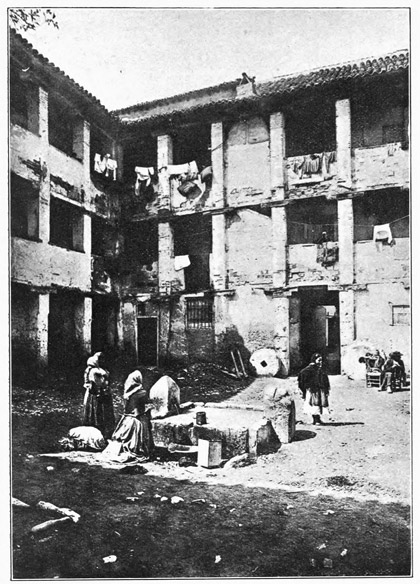
Gypsy Tenants of an Arab Palace
Goya lived in the day of Charles IV, whose court painter
he was, and against whom this natural caricaturist must have
borne a special grudge, so sarcastic are his portraits of the
royal family; but his genius is allied to that of Velázquez's
powerful contemporary, Ribera. The Museo del Prado has
abundant material for a Ribera sala, since it possesses no less
than fifty-eight of his works, but the official put in charge of
it would probably go mad. The paintings are mercifully
scattered and, well for such of us as may be disposed to
flight, can be recognized from afar by their dusks and pallors—ascetic
faces gleaming out from sable backgrounds,
wasted limbs of naked saints tracing livid lines in the gloom
of caverns, and, against an atmosphere dark as the frown of
God, the ghastly flesh of tortured martyrs, and dead Christs
drooping stiffly to the linen winding-sheet. One is appalled
at the entrance of the Long Gallery by the two vast, confronting
canvases of Prometheus, less a Titan than a convulsion
of Titanic agony, and of Ixion, crushed not only beneath the
wheel, but under that cold, tremendous blackness of hell made
actual. Far down one side of the hall they stretch, those
paintings upon paintings of torment, emaciation, the half-crazed
visionary, and the revolting corpse. But there is no
escape from Ribera, he who
"tainted
His brush with all the blood of all the sainted."
Turning back to the Spanish cabinets that open from the
vestibule we come upon a piteous San Sebastian, the blanched
young form bound fast and already nailed by arrows to the
ebon-hued trunk of a leafless tree. Descending the staircase
to the Sala de Alfonso XII, we must pass an attenuated old
anchoress, whose sunken face and praying hands have the
very tint of the skulls that form the only ornaments, almost
the only furniture, of her dreary cave. We may as well
brave the terrors of this first half of the Long Gallery, where
El Greco's livid greens will at least divert attention, and
where, opposite the collection of Riberas, wait the gracious
Murillos to comfort and uplift.
Yet Ribera, ruffian though he was, is not solely and exclusively
a nightmare artist. He could give sweetest and
most tranquil color when he chose, as his "Jacob's Dream"
here testifies, with the dim gold of its angel-peopled ladder;
and for all the spirit of bigotry that clouds his work, there is
Catholic fervor in these pictures and masterly truthfulness up
to the point where the senses need the interpretation of the
soul. There is more than anatomy, too, in these starved
old saints; there is the dread of judgment. Ribera depicts
supernatural terror, where Goya shows the animal shock of
death.
Another Spanish phase appears in Zurbarán. In his most
effective work we have not Goya's blood color, nor Ribera's
blacks, nor the celestial violets of Juan de Joanes, but the
grays of the monastic renunciation, the twilight that is as far
from rapture as from anguish. His gowned, cowled, corded
figures pass before the eye in the pale tints of the cloister.
The shadow of cathedral walls is over them. The Prado has
been strangely indifferent to Zurbarán, who is far more fully
represented in the galleries of Andalusia; but it has in its
baker's dozen two important and characteristic works, both
visions of San Pedro Nolasco. In one the entranced saint,
whose figure might be carved in stone,—stone on which ray
from stained-glass window never fell,—gazes upon an angel,
whose vesture, crossed by a dark green scarf, is flushed with
the faintest rose. In the second the sombre cell is illuminated
for an instant by the apparition of St. Peter the Apostle,
head downward, as in his crucifixion, his naked form dazzling
against a vague redness of light like a memory of pain.
One glance at a wall aglow with Madonna blues reminds
us that Spanish sacred art does not culminate in Ribera nor in
Zurbarán. The Christian faith has had almost as pure,
poetic, and spiritual an utterance in the land of the Inquisition
as in Italy itself. This is not Murillo's hour; it is the
triumph of Velázquez and the realists that Spain is celebrating
to-day; but none the less it is a joy of joys to walk
by the Murillos on the way to the laurelled bust and the
crowded sala. These are the pictures that are rather in
heaven than earth. Where Mary, divine in her virginal
loveliness, is not upborne among the golden clouds, the radiant-plumed
angel kneels on her cottage floor and the wings of the
descending dove beat whiteness through the air. Here is
realism and more. The Mater Dolorosa has those luminous
sea-blue eyes of Andalusia, but they tell of holy tears. The
Crucified is no mere sufferer, but the suffering Son of God,
and the crown of thorns, while dripping blood, haloes his
brows with the redemption of the world.
The genius of Velázquez dwelt not above the earth, but
upon it, in the heart of its most brilliant life. He was no
dreamer of dreams; he "painted the thing as he saw it,"
and with what sure eyes he saw, and with what a firm and
glowing brush he painted! His sala surrounds us at once
with an atmosphere of brightness, beauty, elegance, variety,
delight. His work is so superb, so supreme, that, like perfect
manners, it puts even the humblest of us at our ease. We
are not artists, but we seem to understand Velázquez.
Of course we don't. No knight of the palette would
admit it for an instant. What can the rabble know of the
mysterious compoundings and touchings from which sprang
these splendors of color that outshine the centuries? Young
men with streaming hair are continually escorting awed-looking
señoras about the room, discoursing with dramatic
vehemence on the "periods" of the Master's work. As a
youth at Seville, they explain, Velázquez had of necessity
taken religious subjects, for the Church was the chief patron
of art in Andalusia; but his natural bent even then displayed
itself in tavern studies and sketches of popular types, as the
"Water-seller of Seville" and the "Old Woman Frying
Eggs." Of his early religious pieces the archbishop's palace
of Seville keeps "San Ildefonso Receiving the Chasuble from
the Hands of the Virgin," and the National Gallery of London
secured "Christ in the House of Martha," but "The Adoration
of the Kings" hangs here at our right as we enter the
Velázquez sala. A little stiff, say these accomplished critics,
with a suggestion of the dry manner of his master, Pacheco,
but bear you in mind that this is the production of a youth
of twenty. It is obvious, too, that Andalusians, not celestial
visions, served him as models.
A longing to see the Tintorets and Titians, those starry
treasures of the dark Escorial, drew him to Madrid at twenty-three.
Here he was fortunate in finding friends, who brought
his portraits to the notice of Philip IV, a dissolute boy ruled
by the Count-Duke Olivares. Youth inclines to youth.
Velázquez was appointed painter to the king at the same
salary as that paid to the royal barber, and henceforth he had
no care in life but to paint. And how he painted! His first
portraits of Philip show a blond young face, with high brow,
curled mustache, the long Hapsburg chin, and eyes that hint
strange secrets. Again and again and again Velázquez traced
those Austrian features, while the years stamped them ever
more deeply with lines of pride and sin—a tragic face in the
end as it was ill-omened in the beginning. But the masterpiece
of Velázquez's twenties is "The Drunkards," a scene
of peasant revelry where the young are gloriously tipsy and
the old are on the point of maudlin tears. Here it is, Los
Borrachos, farther to the right. In looking on it one remembers
that a contemporary realist, in the Protestant island
which has often been so sharp a thorn in Spain's side,
likewise crowned the achievement of his springtime by a
group of topers, Prince Hal and Falstaff and their immortal
crew.
Not the influence of Rubens, who spent nine months in
Spain in 1628-29, painting like the wind, nor a visit to the
Holy Land of Raphael and Michael Angelo could make
Velázquez other than he was. This "Vulcan's Forge,"
which we see here, painted in Italy, is mythological only in
the title. Back he came at the royal summons, to paint more
portraits—Philip over and over, on foot, on horseback, half
length, full length, all lengths; the winsome Infante Baltasar,
as a toddling baby with his dwarf, as a gallant little soldier,
hunter, horseman, and in the princely dignity of fourteen,
when he had but three more years to live; the sad French
queen, the king's brother, the magnificent Olivares, the
sculptor Montañes, counts, dukes, buffoons. Within these
twenty years Velázquez produced his two most famous works
of religious tenor—"Christ Bound to the Column," a "captain
jewel" of the London National Gallery, and that majestic
"Crucifixion" before which Spaniards in the Prado bare
their heads. But the crown of this period is Las Lanzas, or
"The Surrender of Breda," which holds the place of honor
on the wall fronting the door. It is vivid past all praise, and
nobler than any battle scene in its beauty of generosity. The
influence of Italy had told especially on Velázquez's backgrounds.
The bright, far landscapes opening out beyond his
portrayed figures, especially those on horseback,—and his
horses are as lifelike as his dogs,—give to the sala an exhilarating
effect of free space and wide horizons.
In 1650 he made his second visit to Rome, where he portrayed
Pope Innocent X. Nine years of glorious work in
Spain remained to him. Still he painted the king, even at
his royal prayers, for which there was full need, and the young
Austrian queen, who had succeeded the dead mother of the
dead Baltasar. On that happy left-hand wall of the sala
shines, in all its vigorous grace, the "Mercury and Argos,"
but if the hundred eyes of Argos are ready to close, their place
is supplied by the terrible scrutiny of a row of portraits,
embarrassing the boldest of us out of note-taking. How those
pairs of pursuing black eyes, sage and keen and mocking,
stare the starers out of countenance! The series of pet
dwarfs is here, old Æsop, and Menippus, and the sly buffoon,
"Don Juan of Austria." Of these two wonder-works, Las
Meninas, "The Maids of Honor," has a room to itself, and
thus Las Hilanderas, "The Weavers," becomes the central
magnet of this returning wall. A saint picture and even a
coronation of the Virgin cannot draw the crowds from before
this ultimate triumph of the actual—this factory interior,
where a group of peasant women fashion tapestries, while a
broad shaft of sunshine works miracles in color.
And this, too, is Spanish. Cervantes is as true a facet of
many-sided Spain as Calderon, and Velázquez as Murillo.
With all the national propensity to emotion and exaggeration,
Spaniards are a truth-seeing people. The popular coplas are
more often satiric than sentimental. They like to bite through
to the kernel of fact, even when it is bitter. Velázquez, with
his rich and noble realism, is of legitimate descent.
XX
CHORAL GAMES OF SPANISH CHILDREN
"Thought and affliction, passion, hell itself,
She turns to favor and to prettiness."
—Shakespeare: Hamlet.
On one of my last afternoons in Madrid, I visited again my
early haunts in the Buen Retiro, for a farewell sight of the
children there at play. After all, it is one of the prettiest
things to be seen in Spain, these graceful, passionate, dramatic
little creatures dancing in tireless circles, and piping those
songs that every niña knows, without being able to tell when
or where or from whom she learned them. Only very small
boys, as a rule, join the girls in these fairy rings, though occasionally
I found a troop of urchins marching to a lusty chorus
of their own. One, which I heard in Madrid, but whose
parrots are more suggestive of Seville, runs something like
this:—
"In the street they call Toledo
Is a famous school for boys,
Chundarata, chundarata,
Chundarata, chún-chún;
Where all we lads are going
With a most heroic noise,
Chundarata, chundarata,
Chundarata, chún-chún.
"And the parrots on their perches,
They mock us as we go,
Chundarata, chundarata,
Chundarata, chún-chún.
'I hate my school,' whines Polly,
'For my master beats me so,'
Chundarata, chundarata,
Chundarata, chún-chún."
Another, which came to me in fragments, is sung in playing
soldier.
"The Catalans are coming,
Marching two by two.
All who hear the drumming
Tiptoe for a view.
Ay, ay!
Tiptoe for a view.
Red and yellow banners,
Pennies very few.
Ay, ay!
Pennies very few.
"Red and yellow banners!
The Moon comes out to see.
If moons had better manners,
She'd take me on her knee.
Ay, ay!
Take me on her knee.
She peeps through purple shutters,
Would I were tall as she!
Ay, ay!
Would I were tall as she!
"Soldiers need not learn letters,
Nor any schooly thing,
But unless they mind their betters,
In golden chains they'll swing.
Ay, ay!
In golden chains they'll swing.
Or sit in silver fetters,
Presents from the King.
Ay, ay!
Presents from the King."
This ironic touch, so characteristically Spanish, reappears
in many of the games, as in A La Limón, known throughout
the Peninsula and the Antilles. I should expect to find it,
too, in corners of Mexico, South America, the Philippines,
wherever the Spanish oppressor has trod and the oppressor's
children have sported in the sun. The little players, ranged
in two rows, each row hand in hand, dance the one toward
the other and retreat, singing responsively. With their last
couplet, the children of the first line raise their arms, forming
arches, and the children of the second line, letting go hands,
dance under these arches as they respond.
1. "A la limón, á la limón!
All broken is our bright fountain.
2. "A la limón, á la limón!
Give orders to have it mended.
1. "A la limón, á la limón!
We haven't a bit of money.
2. "A la limón, á la limón!
But we have money in plenty.
1. "A la limón, á la limón!
What kind of money may yours be?
2. "A la limón, á la limón!
Oh, ours is money of eggshells.
1. "A la limón, á la limón!
An arch for the lords and ladies.
2. "A la limón, á la limón!
Right merrily we pass under."
Another lyric dialogue, whose fun is spent on the lean
purses of students and the happy-go-lucky life of Andalusia,
must have originated since the overthrow, in 1892, of the
leaning tower of Saragossa. The stanzas are sung alternately
by two rows of children, advancing toward each other and
retreating with a dancing step.
1. "In Saragossa
—Oh, what a pity!—
Has fallen the tower,
Pride of the city.
2. "Fell it by tempest,
Fairies or witches,
The students will raise it,
For students have riches.
1. "Call on the students,
Call louder and louder!
They've only two coppers
To buy them a chowder.
2. "Chowder of students
Is sweeter than honey,
But the gay Andalusians
Have plenty of money.
1. "The gay Andalusians
Have fiddle and ballad,
But only two coppers
To buy them a salad.
2. "In Saragossa
—Oh, what a pity!—
Has fallen the tower,
Pride of the city."
Unchildlike innuendoes pervade that curious game of
many variants in which the priest and abbess play a leading
part. Two children are chosen for these dignitaries, while
the others call out the names of such flowers, fruits, or vegetables
as each may decide to personate. "I'm a cabbage."
"I'm a jasmine." "I'm a cherry." Then the little sinners
kneel in a circle, crying:—
"Through the door, up the stairs,
On the floor, say your prayers!"
and chant some childish gibberish, during which no one must
laugh on pain of a forfeit. After this, all sing:—
"The house of the priest it cracked like a cup.
Half fell down and half stood up.
Sir Priest, Sir Priest, now tell us aright,
In whose house did you sleep last night?
Priest.With the rose slept I.
Rose.Fie, O fie!
I never saw your tonsured head.
Priest.
Then with whom did you make your bed?
Rose.
With the Pink.
Pink.
I should think!
I never saw your petals red.
Rose.
Then with whom did you make your bed?
Pink.
With the lily.
Lily.
Don't be silly!
I never heard your fragrant tread.
Pink.
Then with whom did you make your bed?
Lily.
With the priest.
Priest.
Little beast!
If I went near you, may I fall dead!
Lily.
Then with whom did you make your bed?
Priest.
With the abbess, I.
Abbess.
Oh, you lie!"
But this seems to be the conclusion of the game.
The most of these choral songs, however, are sweet and
innocent, concerned with the natural interests of childhood,
as this:—
"The shepherdess rose lightly
Larán—larán—larito,
The shepherdess rose lightly
From off her heather seat—O.
"Her goats went leaping homeward,
Larán—larán—larito,
Her goats went leaping homeward
On nimble little feet—O.
"With strong young hands she milked them,
Larán—larán—larito,
With strong young hands she milked them
And made a cheese for treat—O.
"The kitty watched and wondered,
Larán—larán—larito,
The kitty crept and pondered
If it were good to eat—O.
"The kitty sprang upon it,
Larán—larán—larito,
The kitty sprang upon it
And made a wreck complete—O.
"Scat, scat, you naughty kitty!
Larán—larán—larito,
Scat, scat, you naughty kitty!
Are stolen cheeses sweet—O?"
The baby girls have a song of their own, which, as a
blending of doll-play, gymnastics, music, mathematics, and
religion, leaves little to be desired.
"Oh, I have a dolly, and she is dressed in blue,
With a fluff of satin on her white silk shoe,
And a lace mantilla to make my dolly gay,
When I take her dancing this way, this way, this way.
[Dances Dolly in time to the music.
"2 and 2 are 4, 4 and 2 are 6,
6 and 2 are 8, and 8 is 16,
And 8 is 24, and 8 is 32!
Thirty-two! Thirty-two!
Blesséd souls, I kneel to you. [Kneels.
"When she goes out walking in her Manila shawl,
My Andalusian dolly is quite the queen of all.
Gypsies, dukes, and candy-men bow down in a row,
While my dolly fans herself so and so and so.
[Fans Dolly in time to the music.
"2 and 2 are 4, 4 and 2 are 6,
6 and 2 are 8, and 8 is 16,
And 8 is 24, and 8 is 24!
Twenty-four! Twenty-four!
Blesséd souls, I rise once more."
They have a number of bird-games, through which they
flit and flutter with an airy grace that wings could hardly
better. In one, the children form a circle, with "the little
bird Pinta" in the centre. The chorus, dancing lightly
around her, sings the first stanza, and Pinta, while passing
about the circle to make her choice, sings the rest, with the
suggested action. The child chosen becomes Pinta in turn.
Chorus. "The little bird Pinta was poising
On a scented green lemon-tree spray.
She picked the leaf and the blossom,
And chanted a roundelay.
Pinta. "Song in the land!
While April is yet a newcomer,
O mate of my summer,
Give to me a hand now,
Both hands I seek, O!
Take a Spanish kiss, now,
On the rosy cheek, O!"
Equally pretty and simple is the Andalusian play of "Little
White Pigeons." The children form in two rows, which face
each other some ten or twelve yards apart. One row sings
the first stanza, dancing forward and slipping under the
"golden arches" made by the lifted arms of the second row.
The second row sings and dances in turn, passing under the
"silver arches" to Granada.
1. "Little white pigeons
Are dreaming of Seville,
Sun in the palm tree,
Roses and revel.
Lift up the arches,
Gold as the weather.
Little white pigeons
Come flying together.
2. "Little white pigeons
Dream of Granada,
Glistening snows on
Sierra Nevada.
Lift up the arches,
Silver as fountains.
Little white pigeons
Fly to the mountains."
The Spanish form of "Blindman's Buff" begins with "giving
the pebble" to determine who shall be the Blind Hen. A
child shuts in one hand the pebble and then presents both little
fists to the other children passing in file. Each, while all sing
the first stanza given below, softly touches first one of the
hands, then the other, and finally slaps the one chosen. If
this is empty, she passes on. If it holds the pebble, she must
take it and be the one to offer the hands. The child who
finally remains with the pebble in her possession, after all
have passed, is the Blind Hen. As the game goes on, the
children tease the Blind Hen, who, of course, is trying to
catch them, by singing the second stanza given below.
1
"Pebble, O pebble!
Where may it be?
Pebble, O pebble!
Come not to me!
Tell me, my mother,
Which hand to choose.
This or the other?
That I refuse,
This hand I choose."
2
"She's lost her thimble,
Little Blind Hen.
Better be nimble!
Try it again!
Who'll bring a taper
For the Blind Hen?
Scamper and caper!
Try it again!
Try it again!"
Other games as well known to American children as
"Blindman's Buff" are played by little Spaniards. They understand
how to make the "hand-chair" and "drop the button,"
only their button is usually a ring. "Hide the Handkerchief"
carries with it the familiar cries of hot and cold, but our "Puss
in the Corner" becomes "A Cottage to Rent."
"'Cottage to rent?'
'Try the other side,
You see that this
Is occupied.'"
In religious Seville the dialogue runs:—
"'A candle here?'
'Over there.'
'A candle here?'
'Otherwhere.'
"'Candle, a candle!'
'Loss on loss.'
'Where is light?'
'In the Holy Cross.'"
For all these games, common to childhood the world over,
have a rhyming element in the Peninsula, where, indeed, the
ordinary intercourse of children often carries verses with it.
For instance, our youngsters are content with cries of "Tell-tale!"
and "Indian-giver!" but under similar provocation the
fierce little nurslings of Catholic Spain will sing:—
"Tell-tale! Tell-tale!
In hell you'll be served right,
All day fed on mouldy bread,
And pounded all the night!"
The other baby-curse is to the same effect:—
"He who gives and takes again,
Long in hell may he remain!
He who gives and takes once more,
May we hear him beat on the Devil's door!"
The Spanish form of tag has a touch of mythological grace.
One child, chosen by lot, is the Moon, and must keep within
the shadow. The others, Morning-stars, are safe only in the
lighted spaces. The game is for the Morning-stars to run
into the shadow, daring the Moon, who, if successful in catching
one, becomes a Morning-star in turn, and passes out into
the light, leaving the one caught to act the part of Moon.
As the Morning-stars run in and out of the Moon's domain,
they sing over and over the following stanza:—
"O the Moon and the Morning-stars!
O the Moon and the Morning-stars!
Who dares to tread—O
Within the shadow?"
Even in swinging, the little girls who push carry on a musical
dialogue with the happy holder of the seat.
"'Say good-day, say good-day
To Miss Fannie Fly-away!
At the door the guests are met,
But the table is not set.
Put the stew upon the fire.
Higher, higher, higher, higher!
Now come down, down, down, down,
Or the dinner will all burn brown.
Soup and bread! soup and bread!
I know a plot of roses red,
Red as any hero's sword,
Or the blood of our Holy Lord.
Where art thou, on the wing?'
'No, I'm sitting in the swing.'
'Who're thy playmates way up there?'
'Swallows skimming through the air.'
'Down, come down! The stew will burn.
Let the rest of us have a turn.'"
In playing "Hide and Seek," the seeker must first sit in a
drooping attitude with covered eyes, while the others stand
about and threaten to strike him if he peeps:—
"Oil-cruet! Don't do it! Ras con ras!
Pepper-pot? Peep not! Ras con ras!"
The menacing little fists are then suddenly withdrawn.
"No, no! Not a blow!
But a pinch on the arm will do no harm.
Now let the birdies take alarm!"
And off scamper the hiders to their chosen nooks. When
they are safely tucked away, the indispensable Mother,
standing by, sings to the seeker that stanza which is his signal
for the start:—
"My little birds of the mountain
Forth from the cage are flown.
My little birds of the mountain
Have left me all alone."
Spanish forfeit games are numerous and ingenious. In one
of these, called "The Toilet," the players take the names of
Mirror, Brush, Comb, Towel, Soap, and other essentials, including
Jesus, Devil, and Man Alive, these last for exclamatory
purposes. As each is mentioned by the leader of the game,
he must rise instantly, on pain of forfeit, no matter how fast
the speaker may be rattling on: "Jesus! When will that
devil of a maid bring me my powder and perfumes?" Characteristic
titles of other forfeit games are, "The Key of Rome,"
"The Fan," "The Fountain," "I Saw my Love Last Night."
The sentences vary from such gentle penalties as "The Caress
of Cadiz" to the predicament of putting three feet on the
wall at once.
The choral verses are often mere nonsense.
"Pipe away! pipe away!
Let us play a little play!
What will we play?
We'll cut our hands away.
Who cut them, who?
Rain from out the blue.
Where is the rain?
Hens drank it up again.
Hens? And where are they?
Gone their eggs to lay.
Who will eat them up?
Friars when they sup.
What do friars do?
Sing 'gori-gori-goo.'"
Watching Spanish children, one may see two little girls,
say White Rose and Sweetness, fly out into an open space,
where White Rose carefully places the tips of her small shoes
in touch with those of Sweetness. Then they clasp hands,
fling their little bodies as far back as these conditions permit,
and whirl round and round, singing lustily—until they are
overcome by giddiness—the following rigmarole, or one of
its variants:—
"Titirinela, if you please!
Titirinela, bread and cheese:
'What is your father's worshipful name?'
'Sir Red-pepper, who kisses your hands.'
'And how does he call his beautiful dame?'
'Lady Cinnamon, at your commands.'
Titirinela, toe to toe!
Titirinela, round we go!"
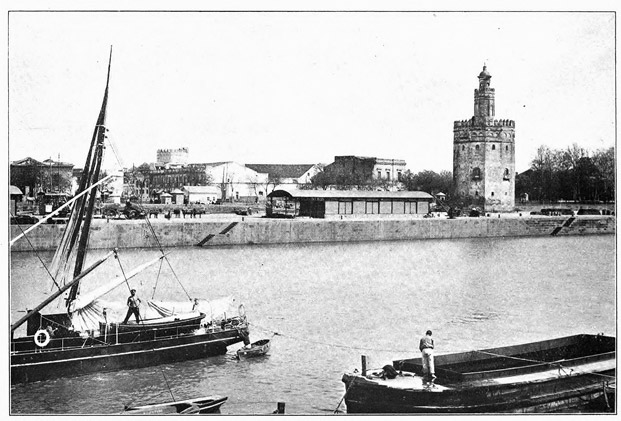
From the Tower of Gold Down the Guadalquivír
Even in some of their prettiest games the verses have a
childish incoherence. Some dozen little girls form a circle,
for instance, with the Butterfly in the centre. They lift her
dress-skirt by the border, and hold it outspread about her.
Another child, on the outside, runs around and around the
ring, singing:—
"Who are these chatterers?
Oh, such a number!
Not by day nor by night
Do they let me slumber.
They're daughters of the Moorish king,
Who search the garden-close
For lovely Lady Ana,
The sweetest thing that grows.
She's opening the jasmine
And shutting up the rose."
Then the children suddenly lift their hands, which are
holding Butterfly's frock, so as to envelop her head in the
folds. The little singer outside continues:—
"Butterfly, butterfly,
Dressed in rose-petals!
Is it on candle-flame
Butterfly settles?
How many shirts
Have you woven of rain?
Weave me another
Ere I call you again."
These songs are repeated seven times. Then comes another
stanza:—
"Now that Lady Ana
Walks in garden sweet,
Gathering the roses
Whose dew is on her feet,
Butterfly, butterfly,
Can you catch us? Try it, try!"
With this the circle breaks and scatters, while Butterfly,
blinded as she is by the folds of her own skirt wrapped about
her head, does her best to overtake some one, who shall then
become her successor.
Many of the games are simplicity itself. Often the play
is merely a circle dance, sometimes ending in a sudden kneeling
or sitting on the ground, One of the songs accompanying
this dance runs:—
"Potatoes and salt must little folks eat,
While the grown-up people dine
Off lemons and chestnuts and oranges sweet,
With cocoanut milk for wine.
On the ground do we take our seat,
We're at your feet, we're at your feet."
Sometimes a line of children will form across the street
and run, hand in hand, down its length, singing:—
"We have closed the street
And no one may pass,
Only my grandpa
Leading his ass
Laden with oranges
Fresh from the trees.
Tilín! Tilín!
Down on our knees!
Tilín! Tilín! Tilín! Tilín!
The holy bell of San Agustín!"
A play for four weans, training them early to the "eternal
Spanish contradiction," consists in holding a handkerchief by
its four corners, while one of them sings:—
"Pull and slacken!
I've lost my treasure store.
Pull and slacken!
I'm going to earn some more.
Slacken!"
And at this, the other three children must pull, on pain of
forfeit, whereas if the word is pull, their business is to slacken.
They have a grasshopper game, where they jump about
with their hands clasped under their knees, singing:—
"Grasshopper sent me an invitation
To come and share his occupation.
Grasshopper dear, how could I say no?
Grasshopper, grasshopper, here I go!"
In much the same fashion they play "Turkey," gobbling as
they hop.
I never found them "playing house" precisely after the
manner of our own little girls, but there are many variants
for the dialogue and songs in their game of "Washerwoman."
The Mother says: "Mariquilla, I'm going out
to the river to wash. While I am gone, you must sweep
and tidy up the house."
"Bueno, madre."
But no sooner is the Mother out of sight than naughty
Mariquilla begins to frisk for joy, singing:—
"Mother has gone to wash.
Mother'll be gone all day.
Now can Mariquilla
Laugh and dance and play."
But the Mother returns so suddenly that Mariquilla sees her
barely in time to begin a vigorous sweeping.
"'What hast been doing, Mary?'
'Sweeping with broom of brier.'
'A friar saw thee playing.'
'He was a lying friar.'
'A holy friar tell a lie!'
'He lied and so do you.'
'Come hither, Mary of my heart,
'And I'll beat thee black and blue.'"
After this lively exercise, the washerwoman goes away
again, charging Mariquilla to churn the butter, then to knead
the bread, then to set the table, but always with the same disastrous
results. The Mother finally condemns her to a dinner
of bread and bitters, but Mariquilla makes a point of understanding
her to say bread and honey, and shares this sweetness
with her sympathetic mates who form the circle. This time
the beating is so severe that the children of the ring raise
their arms and let Mariquilla dodge freely in and out, while
they do all they can to trip and hinder the irate washerwoman
in her pursuit.
There is another washing game of more romantic sort, the
chorus being:—
"'Bright is the fountain,
When skies are blue.
Who washed my handkerchief?
Tell me true!'
'Three mountain maidens
Of laughing look.
White went their feet
In the running brook.
One threw in roses,
And jasmine one.
One spread thy handkerchief
In the sun.'"
Spanish children "play store," of course, but they are such
dramatic little creatures that they need no broken ware for
their merchandise. A row of them will squat down in the
middle of the street, clasp their hands under the hollow
of their knees, and crook out their arms for "handles."
Then a customer wanders by, asking, "Who sells honey-jars?"
The merchant disrespectfully replies, "That do I,
Uncle of the Torn Trousers." The shabby customer answers
with Castilian dignity, "If my trousers are torn, my
wife will mend them." The merchant then opens negotiations.
"Will you buy a little jar of honey?" "What's
your price?" The merchant is not exorbitant. "A flea
and a louse." The probabilities are, unhappily, that the customer
has these commodities about him, and he inclines,
though cautiously, toward the bargain.
"Your little honey-jars are good?"
"Very good."
"Do they weigh much?"
"Let's see."
So they pick up an hilarious little honey-jar by its handles
and tug it away between them, not letting it touch the
ground, to the sidewalk. Here the merchant and customer
have designated four spaces as Heaven, Limbo, Purgatory,
and Hell, but on a preliminary paving-stone—let truth need
no apology!—they have done some artistic spitting, with the
result that four different figures in saliva are presented to the
little honey-jar. These four figures bear a secret relation
to the four spaces on the sidewalk, and the prisoner must
make his choice. "This!" he ventures. "Hell!" scream
the merchant and customer, and drag him, shrieking and
struggling, to his doom. The next, perhaps, will have the
luck to hit on Heaven, for every little honey-jar must take his
chance in this theological lottery.
Sometimes the market becomes a transformation scene.
The children hold up their forefingers for candles, but
embarrass the merchant by doubling these up whenever the
customer is on the point of buying. Just as the bargain is
about to be concluded, the little candles vanish and the children
roll themselves into bunches of grapes, some proving
sweet and others sour. Again, they make themselves over
into pitchers, cushions, and all variety of domestic articles,
becoming at last a pack of barking dogs which rush out on the
customer, snap at his legs, and drive him off the premises.
Again, it is a chicken-market on which the Uncle of the
Torn Trousers chances, where one by one he buys all the
hens and chickens, but forgets to buy the rooster, and when,
by and by, this lordly fowl, waxing lonely, cock-a-doodle-doos,
the hens and chickens come scurrying back to him, more to
the profit of the merchant than to the satisfaction of the
customer.
In another of the chicken games, the Mother leaves Mariquilla
in charge of the brood, with directions, if the wolf
comes, to fling him the smallest. But he comes so often
that, when the Mother returns, there are no chickens left.
Then she and Little Mary go hunting them, hop-hop-hop
through Flea Street, bow-wow-wow through Dog Street, and
so on without success, until it occurs to them to scatter corn.
Thereupon with peep-peep-peep and flip-flap-flutter all the
chickens appear, but only to fly at the negligent Mother, who
left them to the jaws of the wolf, and assail her with such
furious pecks that she must run for her life, the indignant
chicks racing in wild pursuit.
There is a market-garden game, where one acts as gardener,
others as vegetables, and others as customers. Others, still,
come creeping up as thieves, but are opposed by a barking
dog, which they kill. The gardener summons them before
the judge. A trial is held, with much fluent Spanish argument
pro and con, and the prisoners are condemned to execution
for the murder of the dog. But at the last thrilling
moment, when they have confessed their sins to the priests,
and been torn from the embraces of their weeping friends, the
dog trots cheerfully in, so very much alive that all the criminals
are pardoned in a general dance of joy.
The little girls have a favorite shopping game. In this the
children are seated, shoulder to shoulder, in two rows that face
each other. Every child takes the name of some cloth, silks
and satins being preferred. The leader of the game runs
around the two rows, singing:—
"Up the counter, down the counter!
How can I buy enough?
Down the counter, up the counter!
I choose this velvet stuff."
Little Velvet immediately jumps to her feet and follows the
leader, who continues choosing and calling, choosing and calling,
until the stock is exhausted and she can go home with all
her purchases most conveniently trooping at her heels.
But the plays dearest to the black-eyed niñas are love plays,
of which they have a countless number. Most of these consist
of the dancing, singing circle, with a child in the centre
who chooses a mate. Some are as simple as this:—
"Milk and rice!
I want to marry
A maiden nice.
I may not tarry.
It is not this,
Nor this, nor this.
'Tis only this
Whom I want to marry."
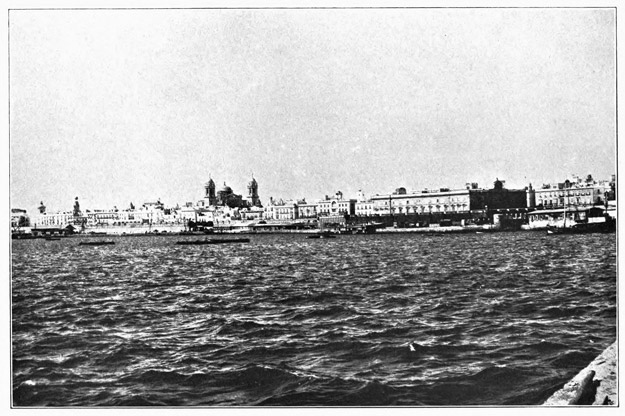
Cadiz from the Sea
Ambó, ató is hardly more elaborate. When in the exchange
of question and answer, the child would choose her page and
touches one of the circle, the mercenary mites dance on faster
than ever, until she offers whatever gift she has, a flower,
apple, or any trifle at hand. Then the page runs in and
kneels before her. The circle dances about the two, singing
the refrain, until the first child slips out and joins them,
leaving the second in the centre to begin the game over
again.
"Ambó, ató, matarile, rile, rile?
Ambó, ató, matarile, rile, ron?
1."What do you want, matarile, rile, rile?
What do you want, matarile, rile, ron?
2."I want a page, matarile, rile, rile.
I want a page, matarile, rile, ron.
1."Choose whom you will, matarile, rile, rile.
Choose whom you will, matarile, rile, ron.
2."I choose Pedro, matarile, rile, rile.
I choose Pedro, matarile, rile, ron.
1."What will you give him, matarile, rile, rile?
What will you give him, matarile, rile, ron?
2."I'll give him an orange, matarile, rile, rile.
I'll give him an orange, matarile, rile, ron.
1."He answers yes, matarile, rile, rile.
He answers yes, matarile, rile, ron."
"The Charcoal Woman" requires an odd number of players.
The circle dances about a little girl who stands all forlorn
in the centre. The chorus sings the first stanza, the
child sings the second, which has reference to the fact that
Spanish charcoal is often made from laurel wood, and the
chorus, in a comforting tone, the third. Then, while the
child runs about and about the circle as if seeking, the chorus
angrily sings the fourth stanza, accusing her of ambition, and
the little charcoal woman retorts with the fifth, making her
choice as she sings the last four words. At this the circle
breaks, the children quickly choosing mates and dancing by
pairs. The one who is left without a partner takes her place
in the centre as the next Charcoal Woman.
1.
Chorus."Who would say that the charcoal woman,
Sooty, sooty charcoal woman,
In all the city and all the land
Could find a lover to kiss her hand?
2.
Charcoal Woman.
"The little widow of good Count Laurel
Has no one left her for kiss or quarrel.
I want a sweetheart and find me none.
Charcoal women must bide alone.
3.
Chorus."Poor little widow, so sweet thou art,
If there's no other to claim thy heart,
Take thy pick of us who stand
Ready to kiss thy sooty hand.
4.
Chorus. "The charcoal woman, the charcoal woman,
Proud little black little charcoal woman,
Goes seeking up and seeking down
To find the Count of Cabratown.
5.
Charcoal Woman.
"I would not marry the Count of Cabra.
Never will marry the Count of Cabra.
Count of Cabra! Oh, deary me!
I'll not have him,—if you're not he!"
Just such coquettish touches of Spanish spirit and maiden
pride appear in many of the songs, as, for instance, in one of
their counting-out carols, "The Garden."
"The garden of our house it is
The funniest garden yet,
For when it rains and rains and rains,
The garden it is wet.
And now we bow,
Skip back and then advance,
For who know how to make a bow
Know how to dance.
AB—C—AB—C
DE—FG—HI—J.
If your worship does not love me,
Then a better body may.
AB—C—AB—C,
KL—MN—OP—Q.
If you think you do not love me,
I am sure I don't love you."
Sometimes these dancing midgets lisp a song of worldly
wisdom:—
"If any cadet
With thee would go,
Daughter, instantly
Answer no.
For how can cadet,
This side of Heaven,
Keep a wife
On his dollars seven?
"If any lieutenant
Asks a caress,
Daughter, instantly
Answer yes.
For the lieutenant
Who kisses thy hand
May come to be
A general grand."
And, again, these babies may be heard giving warning that
men betray.
"The daughters of Ceferino
Went to walk—alas!
A street above, a street below,
Street of San Tomás.
The least of all, they lost her.
Her father searched—alas!
A street above, a street below,
Street of San Tomás.
And there he found her talking
With a cavalier, who said,
'Come home with me, my darling,
'Tis you that I would wed.'
"Oh, have you seen the pear tree
Upon my grandpa's lawn?
Its pears are sweet as honey,
But when the pears are gone,
A turtle-dove sits moaning,
With blood upon her wings,
Amid the highest branches,
And this is what she sings:
'Ill fares the foolish maiden
Who trusts a stranger's fibs.
She'd better take a cudgel
And break his ugly ribs.'"
The dance for "Elisa of Mambrú" begins merrily, and
soon saddens to a funereal pace.
"In Madrid was born a maiden—carabí!
Daughter of a general—carabí, hurí, hurá!"
The song goes on to tell of Elisa's beautiful hair, which her
aunt dressed so gently for her with a golden comb and crystal
curling-pins, and how Elisa died and was carried to church in
an elegant coffin, and how a little bird used to perch upon her
grave and chirp, pio, pio.
Mambrú himself is the pathetic hero of Spanish childhood.
This Mambrú for whom the little ones from Aragon to Andalusia
pipe so many simple elegies, the Mambrú sung by Trilby,
is not the English Marlborough to them, but, be he lord or
peasant, one of their very own.
"Mambrú is gone to serve the king,
And comes no more by fall or spring.
"We've looked until our eyes are dim.
Will no one give us word of him?
"You'd know him for his mother's son
By peasant dress of Aragon.
"You'd know him for my husband dear
By broidered kerchief on his spear.
"The one I broider now is wet.
Oh, may I see him wear it yet!"
At the end of this song, as of the following, the little
dancers throw themselves on the ground, as if in despair.
"Mambrú went forth to battle.
Long live Love!
I listen still for his coming feet.
The rose on the rose bush blossoms sweet.
"He will come back by Easter.
Long live Love!
He will come back by Christmas-tide.
The rose on the bush has drooped and died.
"Down the road a page is riding.
Long live Love!
'Oh, what are the tidings that you bear?'
The rose on the bush is budding fair.
"'Woe is me for my tidings!'
Long live Love!
'Mambrú lies cold this many a morn.'
Ay, for a rose bush sharp with thorn!
"A little bird is chirping.
Long live Love!
In the withered bush where no more buds blow,
The bird is chirping a note of woe."
A game that I often watched blithe young Granadines playing
under the gray shadow of Alhambra walls, seems to be a
Spanish version of "London Bridge is Falling Down." Two
children are chosen to be Rose and Pink. These form an
arch with their uplifted arms, through which run the other
children in a line, headed by the Mother. A musical dialogue
is maintained throughout.
"Rose and Pink.
To the viper of love, that hides in flowers,
The only way lies here.
Mother.
Then here I pass and leave behind
One little daughter dear.
Rose and Pink.
Shall the first one or the last
Be captive of our chain?
Mother.
Oh, the first one runs too lightly.
'Tis the last that shall remain.
Chorus.
Pass on, oho! Pass on, aha!
By the gate of Alcalá!"
The last child is caught by the falling arms and is asked
whether she will go with Rose or Pink. She shyly whispers
her choice, taking her stand behind her elected leader, whom
she clasps about the waist. When all the children of the line
have been successively caught in the falling arch, and have
taken their places behind either Rose or Pink, the game ends
in a grand tugging match. Rose and Pink hold hands as long
as they can, while the two lines try to drag them apart. All
the while, until the very last, the music ripples on:—
"Rose and Pink.
Let the young mind make its choice,
As young minds chance to think.
Now is the Rose your leader,
Or go you with the Pink?
Let the young heart make its choice
By laws the young heart knows.
Now is the Pink your leader,
Or go you with the Rose?
Chorus.
Pass on, oho! Pass on, aha!
By the gate of Alcalá!"
Another favorite is "Golden Ear-rings." Here the
Mother, this time a Queen, sits in a chair, supposedly a
throne, and close before her, on the floor, sits the youngest
daughter; before this one, the next youngest, and so on, in
order of age. Two other children, holding a handkerchief by
the corners, walk up and down the line, one on one side and
one on the other, so passing the handkerchief above the heads
of the seated princesses. Then ensues the musical dialogue
between these two suitors and the Queen.
"'We've come from France, my lady,
And Portugal afar.
We've heard of your fair daughters,
And very fair they are.'
'Be they fair or no, señores,
It's none of your concern,
For God has given me bread for all,
And given me hands to earn.'
'Then we depart, proud lady,
To find us brides elsewhere.
The daughters of the Moorish king
Our wedding rings shall wear.'
'Come back, my sweet señores!
Bear not so high a crest.
You may take my eldest daughter,
But leave me all the rest.'"
The dialogue is transferred to one of the suitors and to the
princess at the farther end of the line, on whose head the
handkerchief now rests.
"'Will you come with me, my Onion?'
'Fie! that's a kitchen smell.'
'Will you come with me, my Rosebud?'
'Ay, gardens please me well.'"
In similar fashion all the daughters are coaxed away until
only the youngest remains, but she proves obdurate. They
may call her Parsley or Pink; it makes no difference. So the
suitors resort to bribes, the last proving irresistible.
"'We'll buy you a French missal.'
'I have a book in Latin.'
'In taffeta we'll dress you.'
'My clothes are all of satin.'
'You shall ride upon a donkey.'
'I ride in coaches here.'
'We'll give you golden ear-rings.'
'Farewell, my mother dear.'"
In some of the many variants of this game, the Queen herself,
adequate as she may be to earning her own living, is
wooed and won at last.
I have not met with fairy-lore among these children's
carols. The only fairy known to Spain appears to be a sort
of spiritualistic brownie, who tips over tables and rattles chairs
in empty rooms by night. The grown-up men who write of
him say he frightens women and children. He can haunt a
house as effectually as an old-time ghost, and a Casa del Duende
may go begging for other tenants. One poor lady, who went
to all the trouble of moving to escape from him, was leaning
over the balcony of her new home,—so the story goes,—to
see the last cartful of furniture drive up, when a tiny man in
scarlet waved a feathered cap to her from the very top of the
load and called, "Yes, señora, we are all here. We have
moved."
So the childish imagination of Spain, shut out from fairyland,
makes friends with the saints in such innocent, familiar
way as well might please even Ribera's anchorites. The
adventurous small boy about to take a high jump pauses to
pray:—
"Saint Magdalene,
Don't let me break my thigh!
Oh, Saint Thomas,
Help this birdie fly!"
The little girls express decided preferences for one saint
over another.
"Old San Antón,
What has he done?
Put us in the corner every one.
"San Sebastián
Is a nice young man.
He takes us to walk and gives us a fan."
Santa Rita is best at finding lost needles, and San Pantaleón
is a humorist.
"San Pantaleón,
Are twenty and one
Children enough for an hour of fun
Slippers of iron
Donkey must try on.
Moors with their pages
Ride in gold stages.
But if you want a
Girdle, Infanta,
Cucurucú,
'Bout-face with you!"
At this one of the children dancing in circle whirls around,
remaining in her place, but with back turned to the centre
and arms crossed over her breast, although her hands still
hold those of her nearest neighbors. The rhyme is sung over
and over, until all the little figures have thus turned about
and the circle is dancing under laughable difficulties.
But the dearest saint of all is San Serení. Two of the
best-known games are under his peculiar blessing. One of
these is of the genuine Kindergarten type, the children dancing
in a circle through the first two lines of each stanza, but then
loosing hands to imitate, in time to the music, the suggested
action.
"San Serení,
The holy—holy-hearted!
Thus for thee
The shoemakers are cobbling.
Thus, thus, thus!
Thus it pleases us."
Even so it pleases seamstresses to stitch, laundresses to wash,
carpenters to saw, silversmiths to tap, ironsmiths to pound,
and little folks to dance, all for "San Serení de la buena,
buena vida." In the second game, a gymnastic exercise, whose
four movements are indicated in the four stanzas, he is apostrophized
as "San Serení del Monte, San Serení cortés."
"San Serení of the Mountain,
Our saint of courtesy,
I, as a good Christian,
Will fall upon my knee.
"San Serení of the Mountain,
Where the strong winds pass,
I, as a good Christian,
Will seat me on the grass.
"San Serení of the Mountain,
Where the white clouds fly,
I, as a good Christian,
Upon the ground will lie.
"San Serení of the Mountain,
Where earth and heaven meet,
I, as a good Christian,
Will spring upon my feet."
With the legend of St. Katharine and her martyrdom
childish fancy has played queer caprices.
"In Cadiz was a wean—ah!
The gentlest ever seen—ah!
Her name was Catalina.
Ay, so!
Her name was Catalina.
"Her father, Moslem cruel,
He made her bring in fuel.
Her mother fed her gruel.
Ay, so!
Her mother fed her gruel.
"They beat her Tuesday, Wednesday,
They beat her Thursday, Friday,
They beat her Saturday, Monday.
Ay, so!
They beat her hardest Sunday.
"Once bade her wicked sire
She make a wheel most dire,
Of scissors, knives, and fire.
Ay, so!
Of scissors, knives, and fire.
"The noble Christian neighbors,
In pity of her labors,
Brought silver swords and sabres.
Ay, so!
Brought silver swords and sabres.
"By noon her task was ended,
And on that wheel all splendid
Her little knee she bended.
Ay, so!
Her little knee she bended.
"Then down a stair of amber
She saw the cherubs clamber:
'Come rest in our blue chamber.'
Ay, so!
She rests in their blue chamber."
Little Spaniards are not too intolerant to make a play-fellow
of the Devil. In one of their pet games, the children
form in line, with the invaluable Mother in charge. To each
child she secretly gives the name of a color. Then an Angel
comes in with a flying motion and calls, for instance, "Purple!"
But there is no Purple in the company. It is then
the Devil's turn, who rushes in, usually armed with a table-fork,
and roars for "Green." There is a Green in the line,
and she has to follow the Demon, while the Angel tries again.
All right-minded spectators hope that the Angel will have the
longer array at the last.
The Virgin's well-beloved name comes often into the
children's songs.
"For studying my lessons,
So as not to be a dunce,
Papa gave me eight dollars,
That I mean to spend at once.
Four for my dolly's necklace,
Two for a collar fine,
And one to buy a candle
For Our Lady's shrine."
Even the supreme solemnity of the Wafer borne through
the kneeling streets cannot abash the trustful gaze of childhood.
"'Where are you going, dear Jesus,
So gallant and so gay?'
'I am going to a dying man
To wash his sins away.
And if I find him sorry
For the evil he has done,
Though his sins are more than the sands of the sea,
I'll pardon every one.'
"'Where are you going, dear Jesus,
So gallant and so gay?'
'I'm coming back from a dying man
Whose sins are washed away.
Because I found him sorry
For the evil he had done,
Though his sins were more than the sands of the sea,
I've pardoned every one.'"
The affairs of State as well as of Church have left their
traces on the children's play. As the little ones dance in
circle, their piping music tells a confused tale of Spanish history
within these latter days.
"In Madrid there is a palace,
As bright as polished shell,
And in it lives a lady
They call Queen Isabel.
Not for count nor duke nor marquis
Her father would she sell,
For not all the gold in Spain could buy
The crown of Isabel.
"One day when she was feasting
Within this palace grand,
A lad of Aragon walked in
And seized her by the hand.
Through street and square he dragged her
To a dreary prison cell,
And all that weary way she wept,
The lady Isabel.
"'For whom art weeping, lady?
What gives thy spirit pain?
If thou weepest for thy brothers,
They will not come again.
If thou weepest for thy father,
He lies 'neath sheet of stone.'
'For these I am not weeping,
But for sorrows of mine own.
"'I want a golden dagger.'
'A golden dagger! Why?'
'To cut this juicy pear in two.
Of thirst I almost die.'
We gave the golden dagger.
She did not use it well.
Ah, no, it was not pears you cut,
My lady Isabel."
These dancing circles keep in memory the assassination of
Marshal Prim.
"As he came from the Cortes,
Men whispered to Prim,
'Be wary, be wary,
For life and for limb.'
Then answered the General,
'Come blessing, come bane,
I live or I die
In the service of Spain.'
"In the Calle del Turco,
Where the starlight was dim,
Nine cowardly bullets
Gave greeting to Prim.
The best of the Spaniards
Lay smitten and slain,
And the new King he died for
Came weeping to Spain."
This new king, Amadeo, is funnily commemorated in
another dancing ditty, "Four Sweethearts."
"Maiden, if they ask thee,
Maiden, if they ask thee,
If thou hast a sweetheart—ha, ha!
If thou hast a sweetheart,
Answer without blushing,
Answer without blushing,
'Four sweethearts are mine—ha, ha!
Four sweethearts are mine.
"'The first he is the son of—
The first he is the son of
A confectioner—ha, ha!
A confectioner.
Sugar-plums he gives me,
Sugar-plums he gives me,
Caramels and creams—ha, ha!
Caramels and creams.
"'The second is the son of—
The second is the son of
An apothecary—ha, ha!
An apothecary.
Syrups sweet he gives me,
Syrups sweet he gives me,
For my little cough—hack, hack!
For my little cough.
"'The third he is the son of—
The third he is the son of
The barber to the court—ha, ha!
The barber to the court.
Powders rare he gives me,
Powders rare he gives me,
And a yellow wig—ha, ha!
And a yellow wig.
"'The fourth? Oh, 'tis a secret,
The fourth? Oh, 'tis a secret.
Our new Italian king—ha, ha!
Our new Italian king.
He gives me silk and satin,
He gives me silk and satin,
Velvet, gold, and gems—ha, ha!
Velvet, gold, and gems.'"
Strangest of all is the dramatic little dialogue, which
one with an ear for children's voices may hear any day in
Madrid, telling of the death of Queen Mercedes.
"'Whither away, young King Alfonso?
(Oh, for pity!) Whither away?'
'I go seeking my queen Mercedes,
For I have not seen her since yesterday.'
"'But we have seen your queen Mercedes,
Seen the queen, though her eyes were hid,
While four dukes all gently bore her
Through the streets of sad Madrid.
"'Oh, how her face was calm as heaven!
Oh, how her hands were ivory white!
Oh, how she wore the satin slippers
That you kissed on the bridal night!
"'Dark are the lamps of the lonely palace.
Black are the suits the nobles don.
In letters of gold on the wall 'tis written:
Her Majesty is dead and gone.'
"He fainted to hear us, young Alfonso,
Drooped like an eagle with broken wing,
But the cannon thundered: 'Valor, valor!'
And the people shouted: 'Long live the king!'"
Spanish wiseheads say that the children's choral games are
already perishing, that the blight of schools and books is passing
upon the child-life of the Peninsula, and soon there will
be no more time for play. The complaint of the niñas is
much to the same effect, yet they wear their rue with a
difference:—
"Not even in the Prado
Can little maidens play,
Because those staring, teasing boys
Are always in the way.
"They might be romping with us,
For they're only children yet,
But they won't play at anything
Except a cigarette.
"Now let me tell you truly:
If things go on like this,
And midgets care for nothing
But to walk and talk and kiss,
"No plays will cheer the Prado
In future times, for then
The little boys of seven
Will all be married men."
XXI
"O LA SEÑORITA!"
"Since the English education came into fashion, there is not a maiden left who can
feel true love."—Alarcón.
During my stifling night journey from Madrid to
the north I had much chat with Castilian and
German ladies in the carriage about Spanish girls.
Our talk turned especially on their reading, so reminding
me of an incident of the past spring. On an Andalusian
balcony I once found a little girl curled up in the coolest
corner and poring over a shabby, paper-bound book. On
my expressing interest in the volume, she presented it at
once, according to the code of Spanish manners. "The
book is at the disposal of your worship." But as the bundle
of tattered leaves was not only so precious to her own small
worship, but also greatly in demand among her worshipful
young mates, whose constant borrowing seemed a strain even
on Andalusian courtesy, I retained it merely long enough to
note the title and general character. The next time I entered
a book-shop I expended ten cents for this specimen of juvenile
literature—"the best-selling book in Seville," if the clerk's
word may be taken—and have it before me as I write. On
the cover is stamped a picture of two graceful señoritas, perusing,
apparently, this very work, "The Book of the Enamored
and the Secretary of Lovers," and throughout the two hundred
pages are scattered cheap cuts, never indecent, but
suggesting violent ardors of passion—embracings, kissings,
gazings, pleadings, with hearts, arrows, torches, and other
ancient and honorable heraldry of Cupid. The title-page
announces that this is a fifth edition of ten thousand copies.
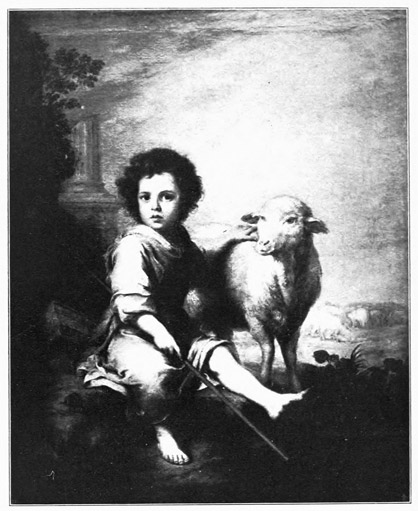
The Divine Shepherd
The opening section is on "Love and Beauty," enumerating,
by the way, the "thirty points" essential to a perfect
woman. "Three things white—skin, teeth, and hands.
Three black—eyes, eyebrows, and eyelashes. Three rosy—lips,
cheeks, and nails." But warning is duly given that
even the thirty points of beauty do not make up a sum total
of perfection without the mystic, all-harmonizing quality of
charm.
Next in order are the several sets of directions for winning
the affections of maid, wife, and widow, with a collection of
edifying sentiments from various saints and wits concerning
widows. Descriptions of wedding festivities follow, with a
glowing dissertation on kisses, "the banquet-cups of love."
After this stands a Castilian translation of an impassioned
Arab love-song with the burden, Todo es amor. Maxims on
love, culled chiefly from French authorities, are succeeded by
an eighteenth-century love-catechism:—
"Question. Art thou a lover?
Answer. Yes, by the grace of Cupid.
Question. What is a lover?
Answer. A lover is one who, having made true and faithful declaration
of his passion, seeks the means of gaining the love of her whom
he adores."
This is the first lesson. The second treats of the five
signs of love, the third of love's duties, the fourth gives the
orison of lovers—a startling adaptation of the Lord's Prayer—and
their creed: "I believe in Cupid, absolute Lord of
Love, who gives to lovers all their joys, and in her whom I
love most, for most lovable is she, on whom I think without
ceasing, and for whom I would sacrifice gladly my honor and
my life."
There is nothing here, it will be noticed, of the Englishman's
proud exception:—
"I could not love thee, Dear, so much,
Loved I not honor more."
Love has its own beatitudes, too. "Blessed are they who
love sincerely. Blessed are they of merry mood. Blessed are
lovers who have patience. Blessed are the rich, for love
delights to spend."
A "Divination of Dreams," "copied from an ancient
manuscript found in the ruins of the convent of San Prudencio,
in Clavijo," that famous battle-ground where St.
James first trampled the Moors, next engages attention.
To dream of a fan is sign of a coming flirtation; of a banner,
success in war; of a woman's singing, sorrow and loss;
of stars, fair fortune in love; of fire, good luck at cards; of
a black cat, trouble from the mother-in-law; of closed eyes,
your child in mortal peril; of birds, joy and sweet content;
of a ghost, ill health; of scissors, a lover's quarrel; of wine,
a cheating Frenchman; of shoes, long journeys; of angels,
good tidings from far away. Some of these omens are a
surprise to the uninitiated reader. It is bad luck to behold
in a dream images of Christ and the Virgin. A church, seen
from within, denotes alms; from without, death. To dream
of the altar arrayed for high mass betokens grave misfortune.
Other omens are significant of Spanish discontents. To
dream of a Jesuit brings miseries and betrayals; of a military
officer, tyranny and brutality; of a king, danger; of a republic,
"abundance, happiness, honors, and work well recompensed."
Often these divinations run into rhyme, as:—
"Dream of God at midnight dim,
And by day you'll follow Him."
The next section of this Complete Guide is given over to
snatches of love-song, which Andalusian children know by
heart. These five are fairly representative:—
"Mine is a lover well worth the loving.
Under my balcony he cries:
'You have maddened me with your grace of moving,
And the beaming of your soft black eyes.'"
"Though thou go to the highest heaven,
And God's hand draw thee near,
The saints will not love thee half so well
As I have loved thee here."
"If I had a blossom rare,
I would twine it in thy hair,
Though God should stoop and ask for it
To make His heaven more exquisite."
"Such love for thee, sent forth from me,
Bears on such iron gate
That I, used so, no longer know
Whether I love or hate."
"The learnéd are not wise,
The saints are not in bliss;
They have not looked into your eyes,
Nor felt your burning kiss."
Then comes a "New Dictionary of Love," defining some
two hundred doubtful terms in Cupid's lexicon, as forever, no,
unselfish. After this we are treated to the language of fan
flirtation, of handkerchief flirtation, of flower flirtation, and
"the clock of Flora," by which lovers easily make appointments,—one,
two, three, being numbered in rose, pink, tulip,
and so on. A cut of a youth toiling at a manuscript-laden
desk introduces some fifty pages of model love-letters, which
seem, to the casual eye, to cover all contingencies. A selection
of verses used for adding a grace to birthday and saint-day
gifts comes after, and this all-sufficient compendium
concludes with a "Lovers' Horoscope."
A single illustration of the sort of reading that Spanish
girls find in their way should not, of course, be pressed too
far, and yet any one who had seen the pretty group of heads
clustered for hours over these very pages on that shaded
balcony would not deny the book significance. A taste for
the best reading is not cultivated in Spanish girls, even where
the treasures of that great Castilian literature are accessible
to them. Convent education knows nothing of Calderon.
As for books especially adapted to girlhood, we have just
examined a sample.
Love and religion are the only subjects with which a
señorita is expected to concern herself, and the life of the
convent is often a second choice. Even when a Spanish girl
wins her crown of wifehood and motherhood, her ignorance
and poverty of thought tell heavily against the most essential
interests of family life. The Spanish bride is often a child
in years. Pacheco's direction for painting the Immaculate
Conception ran, "Our Lady is to be pictured in the flower
of her age, from twelve to thirteen." This was three centuries
ago, but Spain changes slowly. The girl of to-day, nevertheless,
marries later than her mother married. I remember
one weary woman of forty with eighteen children in their
graves and the three who were living physical and mental
weaklings. She told us of a friend who married at fourteen
and used to leave her household affairs in confusion while she
stole away to a corner to play with her dolls. Her husband,
a grave lawyer in middle life, would come home to dinner
and find his helpmeet romping with the other children in
the plaza.
The Spanish girl is every whit as fascinating as her
musical, cloaked gallant confides to her iron-grated lattice.
Indeed, these amorous serenades hardly do her justice, blending
as she does French animation with Italian fervor. In
Andalusia she dances with a grace that makes every other
use of life seem vain. And when she bargains, there is
nothing sordid about it. Her haggling is a social condescension
that at once puts the black-eyed young salesman at her
mercy.
"But the fan seems to me the least bit dear, señor."
He shrugs his shoulders and flings out his arm in protest.
"Ah, señorita! You see not how beautiful the work is.
I am giving it away at six pesetas."
She lifts her eyebrows half incredulously, all bewitchingly.
"At five pesetas, señor."
He runs his hand through his black hair in chivalrous
distress.
"But the peerless work, señorita! And this other, too!
I sacrifice it at four pesetas."
She touches both fans lightly.
"You will let us have the two at seven pesetas, señor?"
Her eyes dance over his confusion. He catches the gleam,
laughs back, throws up his hands.
"Bueno, señorita. At what you please."
It takes a Spaniard to depict a throng of Spanish ladies,—"fiery
carnations or starry jasmine in their hair, cheeks like
blush roses, eyes black or blue, with lashes quivering like
butterflies; cherry lips, a glance as fickle as the light nod of
a flower in the wind, and smiles that reveal teeth like pearls;
the all-pervading fan with its wordless telegraphy in a thousand
colors." In such a throng one sees not only the typical
"eyes of midnight," but those "emerald eyes" which Cervantes
knew, and veritable pansy-colored eyes dancing with
more than pansy mischief. But the voices! In curious
contrast to the tones of Spanish men, soft, coaxing, caressing,
the voices of the women are too often high and harsh, suggesting,
in moments of excitement, the scream of the Andalusian
parrot. "O Jesus, what a fetching hat! The feather, the
feather, see, see, see, see the feather! Mary Most Pure,
but it must have cost four or five pesetas! Ah, my God,
don't I wish it were mine!" The speaker who gets the lead
in a chattering knot of Spanish women is a prodigy not only
of volubility, but of general muscular action. She keeps time
to her shrill music with hands, fan, elbows, shoulders, eyebrows,
knees. She dashes her sentences with inarticulate
whirs and whistles, and countless pious interjections: Gracias
á Dios! Santa Maria! O Dios mio! The others, out-screamed
and out-gesticulated, clutch at her, shriek at her, fly
at her, and still, by some mysterious genius, maintain courtesy,
grace, and dignity through it all. Yet it is true that the vulgar-rich
variety is especially obnoxious among Spaniards. An
overdressed Spanish woman is frightfully overdressed, her
voice is maddening, her gusts of mirth and anger are painfully
uncontrolled. This, however, is the exception, and refinement
the rule.
The legendary Spanish lady is forever sitting at a barred
window, or leaning from a balcony, coquetting with a fan and
dropping arch responses to the "caramel phrases" of her
guitar-tinkling cavalier.
"You're always saying you'd die for me.
I doubt it nevertheless;
But prove it true by dying,
And then I'll answer yes."
For, loving as they are, Spanish sweethearts take naturally
to teasing. "When he calls me his Butterfly, I call him my
Elephant. Then his eyes are like black fire, for he is ashamed
to be so big, but in a twinkling I can make him smile again."
The scorn of these dainty creatures for the graces of the
ruling sex is not altogether affected. I shall not forget the
expression with which a Sevillian belle, an exquisite dancer,
watched her novio as, red and perspiring, he flung his stout
legs valiantly through the mazes of the jota. "Men are uglier
than ever when they are dancing, aren't they?" she remarked
to me with all the serenity in the world. And a bewitching
maiden in Madrid, as I passed some favorable comment upon
the photographs of her two brothers, gave a deprecatory shrug.
"Handsome? Ca!" (Which is no many times intensified.)
"But they are not so ugly, either,—for men."
The style of compliment addressed by caballeros to señoritas
is not like "the quality of mercy," but very much
strained indeed. "Your eyes are two runaway stars, that
would rather shine in your face than in heaven, but your
heart is harder than the columns of Solomon's temple. Your
father was a confectioner and rubbed your lips with honey-cakes."
Little Consuelo, or Lagrimas, or Milagros, or
Dolores, or Peligros laughs it off, "Ah, now you are throwing
flowers."
The coplas of the wooer below the balcony are usually
sentimental.
"By night I go to the patio,
And my tears in the fountain fall,
To think that I love you so much,
And you love me not at all."
"Sweetheart, little Sweetheart!
Love, my Love!
I can't see thy eyes
For the lashes above.
Eyes black as midnight,
Lashes black as grief!
O, my heart is thirsty
As a summer leaf."
"If I could but be buried
In the dimple of your chin,
I would wish, Dear, that dying
Might at once begin."
"If thou wilt be a white dove,
I will be a blue.
We'll put our bills together
And coo, coo, coo."
Sometimes the sentiment is relieved by a realistic touch.
"Very anxious is the flea,
Caught between finger and thumb.
More anxious I, on watch for thee,
Lest thou shouldst not come."
And occasionally the lover, flouted overmuch, retorts in
kind.
"Don't blame me that eyes are wet,
For I only pay my debt.
I've taught you to cry and fret,
But first you taught me to forget."
"I'll not have you, Little Torment,
I don't want you, Little Witch.
Let your mother light four candles
And stand you in a niche."
The average Spaniard is well satisfied with his señora as she
is. He did her extravagant homage as a suitor, he treats her
with kindly indulgence as a husband, but he expects of her a
life utterly bounded by the casa. "What is a woman?" we
heard one say. "A bottle of wine." And those few words
tell the story why, with all their charm, home-love, and piety,
the Spanish women have not availed to keep the social life of
the Peninsula sound and sweet.
"But to admire them as our gallants do,
'Oh, what an eye she hath! Oh, dainty hand!
Rare foot and leg!' and leave the mind respectless,
This is a plague that in both men and women
Makes such pollution of our earthly being."
The life of the convent is attractive to girls of mystic temperament,
like the Maria of Valdés, but many of these lively
daughters of the sun regard it with frank disfavor. One of
the songs found in the mouths of little girls all over the Peninsula
is amusingly expressive of the childish aversion to so
dull a destiny.
"I wanted to be married
To a sprightly barber-lad,
But my parents wished to put me
In the convent dim and sad.
"One afternoon of summer
They walked me out in state,
And as we turned a corner,
I saw the convent gate.
"Out poured all the solemn nuns
In black from toe to chin,
Each with a lighted candle,
And made me enter in.
"The file was like a funeral;
The door shut out the day;
They sat me on a marble stool
And cut my hair away.
"The pendants from my ears they took,
And the ring I loved to wear,
But the hardest loss of all to brook
Was my mat of raven hair.
"If I run out to the garden
And pluck the roses red,
I have to kneel in church until
Twice twenty prayers are said.
"If I steal up to the tower
And clang the convent bell,
The holy Abbess utters words
I do not choose to tell.
"My parents, O my parents,
Unkindly have you done,
For I was never meant to be
A dismal little nun."
I came but slightly in contact with Spanish nuns. Among
the figures that stand out clear in memory are a kindly old
sister, at Seville, in the Hospital de la Caridad, who paused
midway in her exhibition of the famous Murillos there to wipe
her eyes and grieve that we were Protestants, and an austere,
beautiful woman in La Cuna, or Foundling Asylum of Seville,
who caressed a crying baby with the passionate tenderness of
motherhood denied. The merriest Spanish hermana of our
acquaintance we encountered on the French side of the Pyrenees.
At Anglet, halfway between Biarritz and Bayonne, is
the Convent of the Bernardines, Silent Sisters. The visitor
sees them only from a distance, robed in white flannel, with
large white crosses gleaming on the back of their hooded
capes. These, too, were originally white, and the hoods so
deep that not even the profile of the features could be seen;
but the French Government, disturbed by the excessive death-rate
in this order, recently had the audacity to interfere and
give summary orders that the hoods be cut away, so that the
healthful sunshine might visit those pale faces. The mandate
was obeyed, but, perhaps in sign of mournful protest, the new
hoods and capes are black as night. These women Trappists
may recite their prayers aloud, as they work in field or garden,
or over their embroidery frames, but they speak for human
hearing only once a year, when their closest family friends
may visit them and listen through a grating to what their
disused voices may yet be able to utter. From all other contact
with the world they are shielded by an outpost guard of
a few of the Servants of Mary, an industrious, self-supporting
sisterhood, whose own convent, half a mile away, is a refuge
for unwedded mothers and a home for unfathered children.
Hither the pitying sisters brought, a few days before our visit,
a wild-eyed girl whom they had found lying on one of the sea
rocks, waiting for the rising tide to cover her and her shame
together. The chief treasure of this nunnery, one regrets to
add, is the polished skull of Mary Magdalene.
That one of the Servants of Mary who showed us over the
Trappist convent was a bright-eyed Spanish dame of many
winters, as natural a chatterbox as ever gossiped with the
neighbors in the sun. Her glee in this little opportunity for
conversation was enough to wring the heart of any lover of
old ladies. She walked as slowly as possible and detained us
on every conceivable pretext, reaching up on her rheumatic
tiptoes to pluck us red and white camellias, and pointing out,
with a lingering garrulity, the hardness of the cots in the bare,
cold little cells, the narrowness of the benches in the austere
chapel, and, in the cheerless dining room, the floor of deep
sand, in which the Bernardines kneel throughout their Friday
dinner of bread and water. Longest of all, she kept us in
the cemetery, all spick and span, with close-set rows of nameless
graves, each with a cross shaped upon it in white seashells.
The dear old soul, in her coarse blue gown, with tidy white
kerchief and neatly darned black hood and veil, showed us the
grave of her own sister, adding, proudly, that her four remaining
sisters were all cloistered in various convents of Spain.
"All six of us nuns," she said, "but my brother—no!
He has the dowries of us all and lives the life of the world.
Just think! I have two nephews in Toledo. I have never
seen them. My sister's grave is pretty, is it not? They let
me put flowers there. Oh, there are many families in Spain
like ours, where all the daughters are put into convents. Spain
is a very religious country. The sons? Not so often. Sometimes,
when there is a conscription, many young men become
priests to escape military service but it is the women who
are most devout in Spain."
And after the rustic gate was shut on the sleeping-place of
the Bernardines, scarcely more silent and more dead beneath
the sod than above it, she still detained us with whispered hints
of distinguished Spanish ladies among those ghostly, far-off
figures that, pitchfork or pruning knife in hand, would fall
instantly upon their knees at the ringing of the frequent bell
for prayers. Spanish ladies, too, had given this French convent
many of its most costly treasures. We said good-by to
our guide near an elaborate shrine of the Madonna, which a
bereaved Spanish mother had erected with the graven request
that the nuns pray for the soul of her beloved dead.
"Even we Servants of Mary are not allowed to talk much
here," said in parting this most sociable of saints, clinging to
us with a toil-roughened, brown old hand. "It is a holy life,
but quiet—very quiet. I have been here forty-four years
this winter. My name is Sister Solitude."
The nun whom I knew best was an exquisite little sister
just back from Manila. During several months I went to
her, in a Paris convent, twice or three times a week, for Spanish
lessons. The reception room in which I used to await
her coming shone not as with soap and water, but as with the
very essence of purity. The whiteness of the long, fine curtains
had something celestial about it. The only book in
sight, a bundle of well-worn leaves bound in crimson plush
and placed with precision in the centre of the gleaming
mahogany table, was a volume of classic French sermons,—the
first two being on Demons, and the next on Penance.
Further than this I never read; for very punctually the slight
figure, in violet skirt and bodice, with a white cross embroidered
upon the breast, swept softly down the hall. A heavy
purple cord and a large-beaded rosary depended from the waist.
In conversation she often raised her hand to press her ring,
sign of her sacred espousals, to her lips. Her type of face I
often afterward saw in Spain, but never again so perfect. Her
complexion was the richest southern brown, the eyes brightening
in excitement to vivid, flashing black. The eyebrows,
luxuriant even to heaviness, were nevertheless delicately outlined,
and the straight line of the white band emphasized their
graceful arch. The nose was massive for a woman's face,
and there was a slight shading of hair upon the upper lip.
The mouth and chin, though so daintily moulded, were strong.
Not the meek, religious droop of the eyelids could mask the
fire, vigor, vitality, intensity, that lay stored like so much
electricity behind the tranquil convent look.
We would go for the lesson to a severe little chamber,
whose only ornament was a crucifix of olive wood fastened
against the wall. Then how those velvet eyes would glow
and sparkle in the eagerness of rushing speech! The little
sister loved to tell of her Manila experience, almost a welcome
break, I fancied, in the monotonous peace of cloister life. All
that Sunday morning, when the battle was on, the nuns maintained
their customary services, hearing above their prayers
and chants and the solemn diapason of the organ, the boom,
boom, boom of our wicked American cannon. For, according
to this naive historian, Catholic Spain, best beloved of
Our Lady among the nations of the earth, had labored long
in the Philippines to Christianize the heathen, when suddenly,
in the midst of those pious labors with which she was too
preoccupied to think of fitting out men-of-war and drilling
gunners, a pirate fleet bore down upon her and overthrew at
once the Spanish banner and the Holy Cross. Tears sparkled
through flame as the hermanita told of her beautiful convent
home, now half demolished. The sisters did not abandon it
until six weeks after the battle, but as the nunnery stood outside
the city walls, their superior judged it no safe abode for
Spanish ladies, and ordered them away. The French consul
arranged for their transport to Hongkong on a dirty little vessel,
where they had to stay on deck, the twenty-seven of them,
during their week's voyage, suffering from lack of proper shelter
and especially from thirst, the water supply running short
the second day out. But all this was joy of martyrdom.
"Is not Hongkong a very strange city?" I asked.
"Did it seem to you more like Manila than like Paris and
Madrid?"
The little sister's voice was touched with prompt rebuke.
"You speak after the fashion of the world. All cities look
alike to us. Ours is the life of the convent. It matters
nothing where the convent stands."
Stimulated by reproof, I waxed impertinent. "Not even
if it stands within range of the guns? Now, truly, truly,
were you not the least bit frightened that morning of the
battle?"
The sunny southern smile was a fleeting one, and left a
reminiscent shadow in the eyes.
"Frightened? Oh, no! There were no guns between us
and Paradise. From early dawn we heard the firing, and hour
after hour we knelt before the altar and prayed to the Mother
of God to comfort the souls of the brave men who were dying
for la patria; but we were not frightened."
There were strange jostlings of ideas in that cloistered cell,
especially when the dusk had stolen in between our bending
faces and the Spanish page.
Once we talked of suicide. That morning it had been a
wealthy young Parisian who had paid its daily tribute to the
Seine.
"What a horror!" gasped the little sister, clasping her
slender hands against her breast. "It is a mortal sin. And
how foolish! For if life is hard to bear, surely perdition is
harder."
"It does not seem to me so strange in case of the poor,"
I responded, waiving theology. "But a rich man, though his
own happiness fails, has still the power of making others
happy."
"Ah, but I understand!" cried Little Manila, her eyes
like stars in the dimness. "The devil does not see truth as
the blessed spirits do, but sees falsehoods even as the world.
And so in his blindness he believes the soul of a rich man
more precious than the souls of the poor, and tempts the rich
man more than others. Yet when the devil has that soul,
will he find it made of gold?"
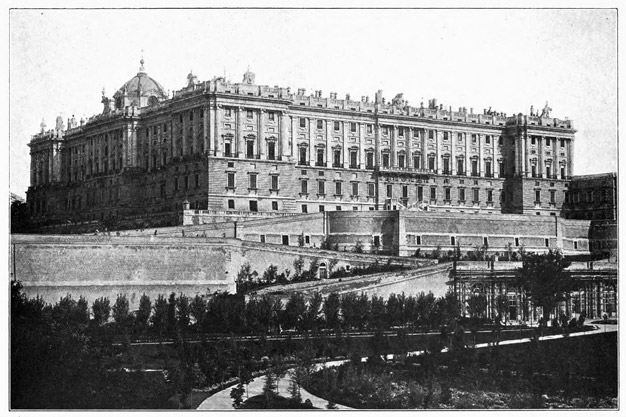
Madrid Royal Palace
One chilly November afternoon, gray with a fog that had
utterly swallowed the Eiffel Tower above its first huge uprights,
which straddled disconsolately like legs forsaken of
their giant, she explained in a sudden rush of words why Spain
had been worsted in the war with America.
"Whom the Lord loveth, He chasteneth. As with persons,
so with nations. Those that are not of His fold He
gives over to their fill of vainglory and greed and power, but
the Catholic nations He cleanses again and again in the bitter
waters of defeat—ah, in fire and blood! Yet the end is not
yet. The rod of His correction is upon Spain at this hour,
and the Faithful are glad in the very heart of sorrow, for even
so shall her sins be purged away, even so shall her coldness be
quickened, even so shall she be made ready for her everlasting
recompense."
"And the poor Protestant nations?" I asked, between a
smile and a sigh.
The little sister smiled back, but the Catholic eyes, for
all their courtly graciousness, were implacable.
She was of a titled family and had passed a petted childhood
in Madrid. There she had been taken, on her seventh
birthday, to a corrida de toros, but remembered it unpleasantly,
not because of the torture inflicted on the horses and bulls,
but because she had been frightened by the great beasts,
with their tossing horns and furious bellowing. Horns
always made her think of the devil, she said. From her
babyhood she had been afraid of horns.
One day a mischievous impulse led me to inquire, in
connection with a chat about the Escorial, "And how do
you like Philip II?"
The black eyes shot one ray of sympathetic merriment,
but the Spaniard and the nun were on their guard.
"He was a very good Catholic," she replied demurely.
"So was Isabel la Católica," I responded. "But don't
you think she may have been a trifle more agreeable?"
"Perhaps she was a little more simpática," admitted the
hermanita, but that was her utmost concession. She would
not even allow that Philip had a sorry end.
"If his body groaned, his soul was communing with the
Blessed Saints and paid no heed."
At the corner of the street which led under the great
garden wall to the heavily barred gate of the convent was a
flower-stand. The shrewd, swift-tongued Madame in charge
well knew the look of the unwary, and usually succeeded in selling
me a cluster of drooping blossoms at twice the value of
the fresh, throwing in an extra leaf or stem at the close of
the bargain with an air of prodigal benevolence. The handful
of flowers would be smilingly accepted by the little sister,
but instantly laid aside nor favored with glance or touch
until the close of the visit, when they would be lifted again
with a winsome word of acknowledgment and carried away,
probably to spend their sweetness at the marble feet of the
Virgin. In vain I tried to coax from this scorner of God's
earth some sign of pleasure in the flowers themselves.
"Don't you care for tea-roses?" "Ah, el mundo pasa.
But their color is exquisite."
Yet her eyes did not turn to the poor posy for the two
hours following.
"This mignonette has only the grace of sweetness."
"It is a delicate scent, but it will not last. El mundo
pasa."
She held the sprays at arm's length for a moment, and then
laid them down on a mantel at the farther end of the room.
"I am sorry these violets are not fresher."
"But no! The touch of Time has not yet found them.
Still, it is only a question of to-morrow. El mundo pasa."
"Yes, the world passes. But is it not good while it
lasts?"
"The world good! No, no, and a thousand times no.
Behold it now at the end of the nineteenth century,—wars
and sorrows and bitter discontents, evil deeds and evil passions
everywhere. Do you see the peace of Christ in the
faces on the Paris streets? The blossoms of this earth, the
pleasures of this world, the affections of this life, all have
the taste of death. But here in God's own garden we live even
now His everlasting life."
"You are always glad of your choice? You never miss
the friends of your childhood?"
"Glad, glad, glad. Glad of my choice. Glad to see no
more the faces of father and mother. And for them, too, it
is great joy. For Catholic parents it is supreme delight to
give up their children to the Holy Church. The ways of
the world are full of slippery places, but when they leave us
here, they know that our feet are set on the very threshold
of heaven."
Sometimes the slight form shivered in the violet habit, and
the dark foreign face looked out with touching weariness
from its frame of soft white folds.
"You are cold? You are tired? Will you take my
cloak? Were the children troublesome to-day?"
It was always the same answer: "No importa. No importa.
It matters not. Our life is not the life of flesh and
blood."
And indeed, as I saw her in the Christmas service among
the other Spanish sisters, those lovely figures in white and
violet making obeisance before the altar until their veiled
foreheads almost touched the pavement, bowing and rising
again with the music like a field of lilies swaying in the breeze,
I felt that she was already a being of another world, before
she had known this. Over her had been chanted the prayers
for the dead. The strange ceremony of taking the veil had
been her burial rite. The convent seemed a ghost land
between earth and heaven.
My hermanita belonged to one of the teaching orders, and
despite the strange blanks in her knowledge, for secular lore
had been, so far as possible, excluded from her education, she
was representative of the finer and more intelligent class of
Spanish nuns. In Granada I heard of the nuns chiefly as the
makers of those delicious dulces, sugared fruits, which were
indispensable to a child's saint-day, and there I was taught the
scoffing epitaph:—
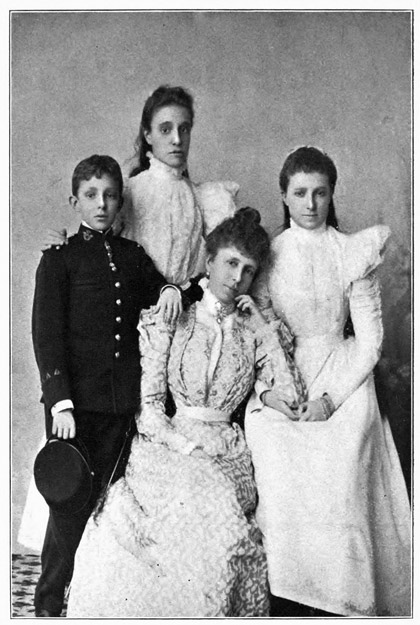
The Royal Family
"Here lies Sister Claribel,
Who made sweetmeats very well,
And passed her life in pious follies,
Such as dressing waxen dollies."
To the spinster outside the nunnery Spain has little to
offer. Small heed is paid to her except by St. Elias, who, on
one day of Holy Week, walks about all Seville with a pen in
his hand, peering up at the balconies and making note of the
old maids. Since Andalusia expresses the theory of counterparts
by saying, "Every one has somewhere in the world
his half orange," the spinster can hardly hope for a well-rounded
life. Careers are not open to her. There are
"advanced women" in Spain, the most eminent being Emelia
Pardo Bazan, novelist, lecturer, editor, who advocates for
women equal educational and political privileges with men,
but who has not yet succeeded in opening the doors. The
voice of Spanish women, nevertheless, is sometimes heard by
Spanish statesmen, as when delegation after delegation of
señoras who had relatives held as prisoners by the Filipinos
invaded the senate-house with petitions until they could no
longer be ignored.
A more thorough and liberal education for Spanish women
is the pressing need to-day. There is, of course, great lack
of primary schooling. A girl in her late teens, wearing the
prettiest of embroidered aprons and with the reddest of roses
in her hair, once appealed to me in Toledo for help. She
had been sent from a confectioner's to deliver a tray of
wheaten rolls at a given address, and she could read neither
the names of streets nor the numbers of houses. But the
higher education will carry the lower with it. Spain is degenerate
in this regard. The Moors used to have at Cordova
an academy for girls, where science, mathematics, and history
were taught. Schools for Spanish girls at present impart
little more than reading and writing, needle-work, the catechism,
the four rules of arithmetic, and some slight notion of
geography. French and music, recognized accomplishments,
are learned by daughters of the privileged class from their
governesses or in the convents. Missionary work in Spain
has largely concerned itself with the educational question,
and Mrs. Gulick's project for the establishment of a woman's
college in Madrid, a college without distinction of creed,
is the fruit of long experience. Little by little she has
proven the intellectual ability of Spanish girls. She established
the International Institute at San Sebastian, secured State
examination for her niñas and State recognition of their
eminent success, and even won for a few of them admission
to the University of Madrid, where they maintained the highest
rank throughout the course. All that Spanish girls need is
opportunity.
But if the señoritas are so charming now, with their roses
and their graces and their fans, why not leave them as they
are, a page of mediæval poetry in this strenuous modern
world? If only they were dolls outright and did not suffer
so! When life goes hard with these high-spirited, incapable
creatures, it goes terribly hard. I can see yet the tears scorch
in the proud eyes of three undowered sisters, slaving at their
one art of embroidery from early till late for the miserable
pittance that it brought them. "We shall rest when we
are dead," said the youngest. The absolute lack of future
for these brave, sensitive girls, well-born, well-bred, naturally
as keen as the keenest, but more ignorant, in matters
of common education, than the children of our lowest grammar
grade, is heart-breaking. If such girls were stupid,
shallow, coarse, it would be easier; but the Spanish type is
finely strung. Once I saw an impulsive beauty fly into that
gust of angry passion which Spaniards term the rabia española.
A clumsy, well-intentioned young Austrian had said a teasing
word, and in the fraction of a second the girl, overwrought
with secret toils and anxieties, was in a tempest of tears; but
the wrath that blazed across them burned the offender
crimson. The poor fellow sent for his case of choice
Asturian cider, cooling in the balcony, read the evening news
aloud and discoursed on the value of self-control, but not
even these tactful attentions could undo, for that evening at
least, the work of his blundering jest. The girl flashed away
to her chamber, her handkerchief bitten through and through,
and the quick fierce sound of her sobs came to me across the
hall deep into the night.
Wandering over Spain I found everywhere these winning,
vivid, helpless girls, versed in needlework and social graces,
but knowing next to nothing of history, literature, science, all
that pertains to intellectual culture. Some were hungry to
learn. More did not dream of the world of thought as a
possible world for them. Among these it was delightful to
meet, scattered like precious seed throughout the Peninsula,
the graduates of the International Institute. So far as a
stranger could see, education had enhanced in them the
Spanish radiance and charm, while arming these with wisdom,
power, and resource.
XXII
ACROSS THE BASQUE PROVINCES
"The Oak Tree of Guernica
Within its foliage green
Embraces the bright honor
Of all the Basque demesne.
For this we count thee holy,
Our ancient seal and sign;
The fibres of our freedom
Are interlaced with thine.
"Castile's most haughty tyrants
Beneath thy solemn shade
Have sworn to keep the charter
Our fearless fathers made;
For noble on our mountains
Is he who yokes the ox,
And equal to a monarch
The shepherd of the flocks."
—National Song of the Basques.
It did not seem to me historically respectful to take leave
of Spain without having made a pilgrimage to the shrine
of Santiago. A dauntless friend crossed the sea to bear
me company. Hygienic pilgrim that she is, she came equipped
not with cockle shells and sandal shoon, but with sleeping
bags, coffee, and cereals. Many a morning, in traversing those
northern provinces, where the scenery was better than the
breakfast, we blessed her boxes of "grape nuts," and many a
night, doomed to penitential beds, we were thankful to intrench
ourselves against the stings and arrows of outrageous insects
in those spacious linen bags, that gather close about the neck,
or, when dangers thicken, above the head, leaving only a
loophole for the breath.
Our point of departure was that city of nature's fancy-work,
San Sebastian. Then, in the early half of July, it was
all alive with expectancy, looking every day for the coming
of the Court. It is reputed to be the cleanest town of the
Peninsula, and is, in truth, as bright as a wave-washed pebble.
Nevertheless, it is a favorite waltz hall of the fleas, which
shamelessly obtrude themselves even into conversation.
The chief summer industry of San Sebastian is sea-bathing.
The soldiers begin it at six o'clock in the morning, marching
by regiments down to the Concha, clearing for action, and
striking out into the gentle surf, all in simultaneous obedience
to successive words of command. Some two hours later teams
of oxen draw scores of jaunty bathing cars down near the
white lip of this opalescent shell of water, and there the long
day through all ages, sizes, and ranks of humanity sport in the
curling foam or swim far out into the sparkling bay.
San Sebastian is the capital of Guipúzcoa, one of the three
Basque provinces. These lie among the Cantabrian mountains,
and are delightfully picturesque with wheat-growing
valleys and well-wooded heights. As the train wandered on,
in its pensive Spanish fashion, we found ourselves now in
Scotland, in a beautiful waste of heather and gorse, now amid
the English ivy and hawthorn, hearing the song of the English
robin, and now in our own New England, with the hilly
reaches of apple orchards and the fields upon fields of tasselled
Indian maize.
The Basques are a thrifty folk, and have cultivated their
scant acres to the utmost. The valleys are planted with
corn, the lower hills are ridged and terraced for a variety
of crops. Above are walnuts and chestnuts, and the flintiest
summits serve for pasturage. It was curious to see men at
work on those steep slopes that had been scooped out into a
succession of narrow shelves, and more strange yet to catch
glimpses of peasants ploughing the very mountain top, picturesque
figures against the sky.
The reaping is of the cleanest. The harvest fields have a
neat, scoured look, as if the women had been over them with
scrubbing brushes. Yet this utilitarian soil admits of oaks
and beeches, ferns and clover, morning glories, dandelions,
pimpernel, and daisies.
All that sunny morning the train swung us blithely on from
one charm of the eyes to another—from a ruined watch-tower,
where red-handed Carlists had crouched, to a bright-kerchiefed
maiden singing amid her beehives; from a range
of abrupt peaks, cleft by deep gorges, to sycamore-shaded byways
and poplar-bordered streams; from a village graveyard,
the pathetic little parallelogram enclosed in high gray walls
and dim with cypress shadows, to a tumbling, madcap torrent
spanned by a time-gnawed Roman arch. Shooting the heart
of some black hill, the train would run out on a mere ledge
above a valley hamlet, and from pure inquisitiveness, apparently,
ramble all around the circle, peering down from every
point of view on the cluster of great, patriarchal houses, sometimes
of timber and plaster, more often of stone, where whole
clans dwell together under the same red-tiled roof. Queer
old houses these, occasionally topped with blue chimneys,
and now and then with a fantastic coat of arms sculptured over
the door, or a fresco of saints and devils blazoned all across
the front. Sometimes freshly whitewashed, these Basque
houses have more often a weather-worn, dingy look, but, however
black the timbers, lines of clean linen flutter airily from
roofs and balconies.
They are a decent, self-respecting, prosperous people, these
Basque mountaineers, of whose history my companion told
me stirring tales. They are supposed, though not without
dispute, to be the oldest race in Europe, descendants of those
original Iberians whom the westward-trooping Aryans drove
into the fastnesses of the Pyrenees. They have their own
language, of Asiatic type. They themselves believe that it
was spoken in the Garden of Eden. There are some
twenty-five dialects of the Vascuense, and it is so difficult
for foreigners that even George Borrow spoke it "with
considerable hesitation," and one exhausted student, abandoning
the struggle, declared that the words were all "written
Solomon and pronounced Nebuchadnezzar." The Basques
attribute their hardy virtues to the crabbedness of their
speech, telling how the devil, after slaving over their
vocabulary for seven years, had succeeded in learning only
three words, and threw up his lesson in a pet, so that to this
day he remains unable to meddle with their peasant piety.
What little literature there is in the Basque language is
naturally of the popular cast—hero songs, dancing songs,
dirges, hymns, and folk-lore.
The Basques are noted for their passionate love of liberty.
The sturdy peasant is lord of his own rugged farm, and insists
on tilling it in his own primitive way, breaking the soil with
rude mattock more often than with plough. An English
engineer, laying a railroad through Alava, tried his best to
make his men abandon their slow, laborious method of
carrying the earth in baskets on their heads. He finally
had all the baskets removed by night, and wheelbarrows
left in their places. But the unalterable Basques set the
loaded wheelbarrows on their heads, and staggered about
beneath these awkward burdens until, for very shame, he
had to give them back their baskets.
The peasant drives over the mountain roads in a ponderous
ox-cart, with two clumsy disks of wood for wheels. The
platform is wrought of rough-hewn beams, five or seven, the
middle one running forward to serve as pole. All the structure,
except the iron tires and nails, is of wood, and the solid
wooden wheels, as the massive axle to which they are riveted
turns over and over, make a most horrible squeaking. It is a
sound dear to the peasantry, for they believe the oxen like it,
and, moreover, that it frightens away the devil; but once upon
a time a town of advanced views voted a fine of five dollars
for any man who should bring this musical abomination within
its limits. Thereupon a freeborn Basque rose with the dawn,
selected his best carved oaken yoke, draped the red-stained
sheepskin a trifle more carefully than usual above the patient
eyes of his great smooth oxen, and took his way, "squeakity-squeak,
squeakity-squeak," straight to the door of the Ayuntamiento,
city hall, where he paid his twenty-five pesetas, and
then devoted the rest of the day to driving all about the
streets, squeaking out his money's worth. This is no servile
temper, and it was not until our own generation that the dearly
cherished liberties of the Basques were wrested away.
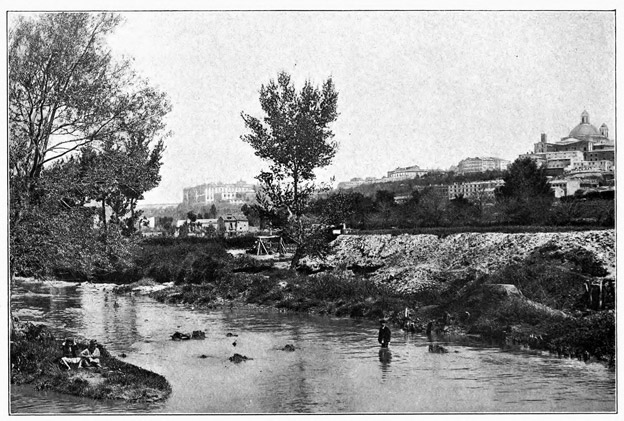
The Manzanares
These warders of the Pyrenees, for the Basques of Navarre
and those now known as French Basques must not be forgotten,
did good service in helping the Visigoths beat back the
northward-pressing Moors and the southward-pressing Franks;
but when the Basque provinces of Spain were incorporated
with Leon and Navarre, and later with Castile, the
mountaineers stood stubbornly for their fuéros, or peculiar
rights.
My comrade's lecture had reached this point, when, finding
ourselves at Amorebieta, in the Province of Vizcaya, or Biscay,
we suddenly descended from the train, and handed our
bags to an honest Basque porter, who deposited them on the
floor of an open waiting room, in full reach of an honest
Basque population. For ourselves, we turned our faces
toward the centre of Vizcayan glory, the famous Tree of
Guernica. We entered a rustic train, that seemed entirely
undecided which way to go. The station agent blew a little
tin horn, green meadows and wattled fences began to glide
past the car windows, and the interrupted discourse was resumed.
The lawmakers of Vizcaya were duly chosen by their
fellow-nobles, for every Basque held the rank of hidalgo, or
"son of somebody." The deputies met every two years in
the village of Guernica, sitting on stone benches in the open
air beneath the sacred oak, and there elected the Señores de
Vizcaya. Even the kings of Spain were allowed no grander
title, but had to come to the Tree of Guernica, at first in person,
later by deputy, and there swear to observe the fuéros.
To this green shadow came the peasant from his lonely
farm-house, high on the mountainside, to answer before his
peers to such charges as might be brought against him; for
within the sanctuary of his home the law could lay no hand
on him or his.
It was the Carlist wars that changed all this. The fuéros,
of which a list dating from 1342 is still extant, granted the
Basque provinces a Republican Constitution that almost realized
an ideal democracy, with immunity from taxes save for
their own needs, and from military service beyond their own
boundaries. But when the dynastic strife broke out, the
Basques put on the white cap of Don Carlos and bore the
brunt of the conflict. We had already passed through
Vergara, where, in 1839, Espartero ended the first Carlist
war by a treaty which compelled the Basques to lay down
their arms. But the cost of this rebellion was paid in blood.
Their political status was practically unaffected. At the
close of the second Carlist war, in 1876, Alfonso XII
signalized his victory by meting out to them a terrible
punishment, abrogating the precious fuéros that the Tree
of Guernica had guarded for so many centuries. The
Government imposed, moreover, its salt and tobacco monopolies,
and made the Basques subject to military conscription.
At every station we saw Spain's Vizcayan
soldiers, red-capped and red-trousered, with blue-belted frock
coats, under which beat hearts of doubtful loyalty. The
son of Alfonso XII will have to reckon with the Basques,
when the third Carlist war shall be declared, but it may be
doubted whether the fuéros, which Don Carlos, of course,
promises to restore, will ever come home to nest again in the
Guernica Oak.
My erudite fellow-vagabond was just pointing out the typical
shape of the Basque head, with its broad forehead, long,
narrowing face, curved nose, and pointed chin, when we
reached Guernica. Such a sweet and tranquil village as it is,
set in the beauty of the hills, with the dignity and pathos
of its history pervading every hushed, old-fashioned street!
The guide, whom two affable ladies, sharers of our carriage
in the little picnic train, had taken pains to look up for us at
the station, was not, we judged, a favorable specimen of the
haughty Basque hidalgo. He was a dull, mumbling, slouchy
lad, who sunk his voice to an awed whisper as we passed the
escutcheon-carved palace of a count. But he led us by
pleasant ways to the modern Casa de Juntas, or Senate House,
where we were shown the assembly room, with its altar for
mass, the library and other apartments, together with the portraits
of the twenty-six first Señores de Vizcaya, from Lope the
Pirate, who forced back the invading Galicians in 840, to the
Infante Don Juan, under whom the Basque provinces were
finally incorporated with Castile.
Close by the Casa de Juntas, which stands in a dreamy
bit of park as fresh and trim as an English cathedral close,
rises a pillared portico. There, where brown-eyed little
Basque girls, their brown braids blowing in the breeze, were
dangling green figs above their laughing mouths, used to sit,
on those seven stone seats, the grave Basque fathers, making
laws, meting out judgment, and regulating all the affairs of
this simple mountain republic. The portico, bearing as
joint devices the lion and castle of Spain and the three wolves
of Vizcaya, was formerly enveloped in the leafy shadow of
the Sacred Tree; but what rises behind it now is only the
gaunt stem of a patriarchal oak, a very Abraham of plants,
all enclosed in glass, as if embalmed in its casket. Before
the portico, however, grows a lusty scion, for the Tree of
Guernica is of unbroken lineage, shoots being always cherished
to succeed in case the centuried predecessor fail.
In presence of this despoiled old trunk, majestic with
memories, we felt an honest awe and longed to give it
adequate salute. My comrade levelled her kodak and took
front views, back views, and side views with such spendthrift
enthusiasm that the custodian, deeply impressed, presented
her with a dried leaf from the junior, cunningly
pricked out so as to suggest the figure of the tree. The
national song of the Basques, a matter of some dozen stanzas,
written principally in "j's," "rr's," and "tz's," takes
its theme, if one may trust the Castilian translation, from
this symbolic oak.
The historian wished to do nothing more in Guernica but
sit and gaze forever on that spectral trunk, but the reminder
that piety was a hardly less marked Basque characteristic
than political independence, finally induced her to follow our
guide to the church. A Basque church has its distinctive
features, including a belfry, a lofty, plain interior, with galleries,
and often a votive ship, gayly painted and fully rigged,
suspended from the ceiling. The lad bore himself with
simple-minded devotion, offering us on stubby finger tips the
holy water and making due obeisance before each gilded
shrine.
But my attention was soon fascinated by a foot-square
relief on a blue ground of Santiago—
"Good Saint James upon the milkwhite steed,
Who leaves his bliss to fight for chosen Spain."
I had hardly anticipated such a stalwart, vigorous, not to say
violent saint, with his white horse galloping, his gold-sandalled
feet gripping the great stirrups, his gold-fringed, crimson robe
and azure mantle streaming on the wind, his terrible sword
glittering high in air. This was clearly not a person to be
trifled with, and I looked about for the historian to tell her
that we must be pressing forward on our pilgrimage. But
she had stolen out, every sympathetic Basque image of the
sculptured doorway conspiring to keep a stony silence and
conceal her flight, and had sped back to the Tree of Guernica,
from whose contemplation she was torn away only by
a fairy-tale of supper.
Of the several Basque churches which we visited, including
the bridal church of Louis XIV, far-famed San
Juan de Luz, whose sides and west end are portioned off by
three tiers of galleries, fairest in memory is the sixteenth-century
church of Begoña in Bilbao. It abounds, as coast
churches should, in suggestions of that mighty, mysterious
neighbor, at once so cruel and so beneficent, the sea. Instead
of votive ships, the walls are hung with paintings
of vessels in scenes of appalling peril. One is scudding
madly before a tropical gale; one has her rigging ragged by
hurricane and her decks lashed with tempest; one, careened
upon her side, lies at the mercy of the billows, which are
sweeping over her and tumbling her crew like ninepins into the
deep. But the presence of the pictures, bold dashes of the
modern brush amid dim old paintings of saints and martyrs,
tells that Our Lady of Begoña succored her sailors in distress,
who, on their safe return, came hither to offer thanks for their
preservation and to leave these mementos of their danger and
her efficient aid.
"Is your Virgin so very powerful?" we asked of a chorister
boy while he drew the cords to part the curtains that
screened the jewelled image throned in a recess above the
high altar.
"I should rather think she was," answered the little fellow
in a glow. "Why, let me tell you! Robbers, the accursed
ones, came here on a dark midnight to steal her
precious stones. They entered by a window, those sons of
wretched mothers, and put up a long ladder against the altar
wall. The wickedest of them all, señoras, he climbed the
ladder and raised his hand to take Our Lady's crown. And
in that instant the great bells overhead began to ring, and all
the bells of all Bilbao pealed with them, and the people
waked and came running to the rescue of Our Lady, and the
robbers were put to death."
Our expression did not quite satisfy his boyish ardor, and
he pointed convincingly toward a handsome silver plaque.
"And this, too, witnesses Our Lady's power. It was given
in memory of the cholera time, when people were dying like
flies in all the towns about. But after Our Lady was carried
in procession through the streets of Bilbao, not one died here,
except a sinful man who would not turn his head to look
upon her."
"That is a painting of the procession, the large picture
over there on the wall?"
"No, no, señoras. That picture commemorates another
of Our Lady's wonderful deeds. The floods were threatening
the city, but Our Lady, with many censers and candles,
was borne down to the river bank, and she ordered the water
to go back, and it obeyed her, and all the town was saved."
We retreated to the cloisters, from which one has a superb
view of the valley of the Nervion, for Our Lady of Begoña
dwells high upon a hilltop. Only the afternoon before we
had been in serene Guernica, a strange contrast to this mining
capital of Vizcaya, this bustling, noisy, iron-grimed Bilbao,
in which the Basques take such delight. It is not a city
to gratify the mere tourist, who expects the people of the
lands through which he is pleased to pass to devote themselves
to looking picturesque. But even Spain is something more
than food for the kodak, and this sooty atmosphere of smelting
works and factories, traffic and commerce, means life to
Spanish lungs. It is little to my credit that I took more
interest in the fact that Bilbao used to supply Shakespeare's
cronies with rapiers, under the name of "bilboes," than in
statistics regarding those millions of tons of ore which its
iron mines are now annually exporting to Great Britain.
The many English in Bilbao, miners and artisans, with the
influence they shed around them, make the streets rougher
and uglier than in purely Spanish towns. On the other
hand, they bring a spirit of religious independence, so that
it is not strange to find the Spanish Protestants of Bilbao a
numerous and vigorous body, counting as a pronounced
element in the community.
From the idle peace of the Begoña cloisters, as from the
old-time world, we looked long on this Spanish city of to-day,
seething with manifold activities. We seemed to understand
how, to the middle-class Spaniard, hemmed in by all this
mediæval encumbrance of barracks, cathedrals, castles, and
thrones, such cities as Bilbao and Barcelona, pulsing with
industrial energy and enterprise, are "more beautiful than
Beauty's self." The Basques, like the Catalans, take readily
to business. They set their mountain cascades to turning
mill-wheels, they canal their little Nervion till it can give
passage to ships of four thousand tons burden, they paint the
night with the flare of mighty furnaces. Every year they are
building more wharves, more railroads, more electric tramways,
and they are so prodigiously proud of their new iron
bridge, with its flying ferry, which whisks passengers over
from Portugalete to Las Arenas at the rate of two hundred a
minute, that they stamp it on their characteristic jewelry.
That cunning Eibar work of the Basque provinces displays
again and again, on locket, bracelet, brooch, this incongruous
design of the Puente Vizcaya beaten on chased steel in
gold.
We looked regretfully out over those significant reaches
of land which we would have liked to explore to the last
hearthstone. The Basque provinces! We had not even
set foot in Vitoria, the capital of Alava, where is preserved
the grim old machete by which Basque governors were
sworn into office. "May my head be cut off with this
knife," ran the oath, "if I do not defend the fuéros of my
fatherland."
And we longed to attend one of the peasant festivals, to
see the lads play pelota and the lasses step Basque dances to
the music of the village pipers, to hear the wild old marches and
battle tunes that have roused the Roman and the Moor to
arms. The mystery plays of the Basques were famous once,
and although these naive dramas are now mainly confined to
Christmas and Easter, who could say that we might not
chance on some saint-day fragment? There was soon to
take place, too, in one of the Vizcayan hamlets a "blessing
of the fields," a processional harvest rite of pagan antiquity,
formerly universal in Spain, but now confined to a few rural
districts. We had a hundred reasons for lingering—but
what are reasons? Pilgrims of St. James must put fresh peas
in their shoes and be off for Compostela.
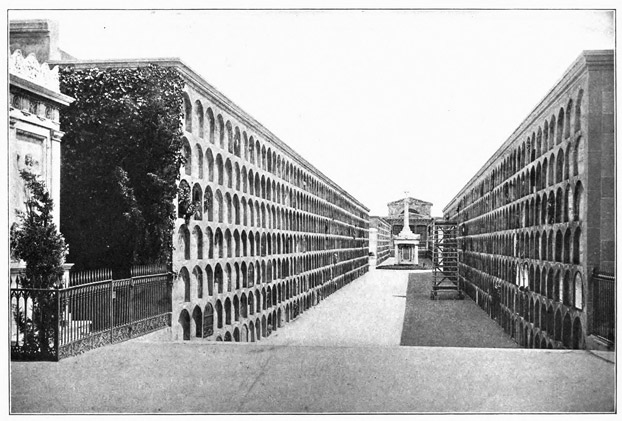
Spanish Cemetery
XXIII
IN OLD CASTILE
"With three thousand men of Leon from the city Bernard goes,
To protect the soil Hispanian from the spear of Frankish foes;
From the city which is planted in the midst between the seas,
To preserve the name and glory of old Pelayo's victories.
"The peasant hears upon his field the trumpet of the knight,—
He quits his team for spear and shield and garniture of might;
The shepherd hears it 'mid the mist,—he flingeth down his crook,
And rushes from the mountain like a tempest-troubled brook."
—Lockhart: Spanish Ballads.
The journey from Bilbao to Santander is a continuous
glory of mountain views. The train runs saucily
along under beetling crags, whence the gods of the
hills may well look down in wonder and displeasure on this
noisy invasion of their solitude. We almost saw those ancient
majesties folding themselves grandly in mantles of purple
shadow, but hardly less royal in bearing were the muffled
figures of the lonely shepherds tending their flocks on the
very summits.
The modern Province of Santander is the renowned Montaña,
the mountain lair which nourished the chivalry of Old
Castile, and from which they made wild sallies to the south,
troop after troop, generation after generation, until the Moorish
standards were beaten back from the plains about Toledo to
the Sierras of Andalusia. Its capital city, Santander, named
from St. Andrew, was one of the four coast towns which
rendered signal service to Fernando in the conquest of Seville.
These towns, lying as they did over against the Cinque Ports
of England, came into so frequent conflict with British
mariners as to be made in the days of Edward III the subject
of a special treaty.
A summer resort, however, is a summer resort the world
over, and we found the historic city, which has gracefully
fitted itself to the curve of its beautiful bay, crowded with
idle people, elaborately dressed, who sat long at the noonday
breakfast, and longer yet at the evening dinner, and then
longest of all on the benches in the park, where bands
clashed and fireworks flared, until the very stars began to
blink for sleepiness.
Spaniards have a veritable passion for pyrotechnics, and our
dreams until the dawn would be punctuated by the airy report
of rockets, as if, so Galdós suggests, "the angels were cracking
nuts in the sky." Every now and then in those soft warm
nights there rose a shout of song from the street, and
peeping down from the balcony, we would see half a dozen
lads and lasses leaping along through the middle of the road,
all abreast and hand in hand, in one of their boisterous peasant
dances.
There are no fewer dangers and sorrows for girls in Spain
than in the other Latin lands. In the low-vaulted, mighty-pillared,
deep-shadowed crypt under the old cathedral, a crypt
that is the very haunt of religious mystery and dread, we came
upon a penitent kneeling before the altar, a bit of written
paper pinned to her back. In a stir of the chill air this
fluttered to the ground, and as she, unconscious of its loss,
bowed herself before another shrine, we picked up the paper
with a half thought of restoring it; but seeing in the first
glance that it was a rudely written prayer, entreating the
Virgin's pity and pardon for her lover and herself, we let it
fall again at Mary's feet. All manner of thank-offerings,
waxen limbs, eyes, and ears, were hung in these candle-lit
recesses, little spaces of gold amid the gloom. We had grown
accustomed to such fragments of anatomy in the shop-windows,
where even votive stomachs are displayed for sale.
Although Santander is a dawdler's paradise, the residents
of the city to whom we had letters were no holiday makers,
but Spaniards of the earnest, thoughtful, liberal type, busy
with large tasks of their own, but never too busy, being
Spaniards, to show unstinted kindness to the strangers within
their gates. Our brief stay did not admit of a tithe of the
excursions they had in mind for us, but my comrade achieved
a trip to Santillana del Mar, birthplace of the doughty Gil
Blas.
In the latest version of her adventures, she set forth from
Santander under the bluest of skies, in company with the
most bewitching of señoritas. They left the train at Torrelavega,
where the shade of Garci Laso, one of King Pedro's
victims, would doubtless have welcomed them, had not their
attention been taken up with a picturesque coachman, who
was standing dreamily on the station platform. This Adonis
proved a complete paragon, who, as they took their romantic
course over the hills, delightedly pointed out ivied tower,
broken portcullis, and the like, as tidbits for the kodak.
Santillana is the shrine of Santa Juliana, a Roman martyr,
whose body is said to have been carried thither in the ninth
century. Her devotees among the mountain wilds built her
in this green valley, overhung by a rude old fortress, a precious
church, a jewel of the early Romanesque, about whose
walls a thriving community soon gathered. Santillana was
throughout the Middle Ages the most important place between
Burgos and Oviedo, and gave name to all that part of
the Montaña. The successive Marquises of Santillana were
then great personages in Spain, playing a leading part at
Court. One of the proudest families of Old Castile, they
claimed descent from the Cid, and cherished the memory of
another heroic ancestor, who, in 1385, sacrificed his life to
save his king.
"'Your horse is faint, my King, my Lord! your gallant horse is sick,—
His limbs are torn, his breast is gored, on his eye the film is thick;
Mount, mount on mine, O mount apace, I pray thee mount and fly!
Or in my arms I'll lift your Grace,—their trampling hoofs are nigh!
"'Nay, never speak; my sires, Lord King, received their land from yours,
And joyfully their blood shall spring, so be it thine secures;
If I should fly, and thou, my King, be found among the dead,
How could I stand 'mong gentlemen, such scorn on my gray head?'
"So spake the brave Montañez, Butrago's lord was he;
And turned him to the coming host in steadfastness and glee;
He flung himself among them, as they came down the hill,—
He died, God wot! but not before his sword had drunk its fill."
The city of Santillana, whose lords once laid claim to the
sovereignty of Santander, has shrunk to a forgotten village, and
the neglected church is dropping into ruins; but the inhabitants
have abated not a jot of that fierce local patriotism which
blinds the provincial Spaniard to all defects of his birthplace
and to all excellences of rival towns. A graybeard told the
stranger ladies that Santillana was the oldest city in Spain and
its cathedral the most beautiful. This latter statement they
were almost ready to accept, so richly carven was the yellow
stone and so harmonious the proportions of nave and aisle.
When they arrived at this miniature Durham they found it
closed and silent, with three little boys sleeping on the steps.
Through the benevolence of the ever present Spanish loafers,
the sacristan was sought out and a ragged escort formed for
their progress from chapel to chapel, where rare old pictures
and frescos glowed across the dusk. Best of all were the venerable
cloisters, weed-grown and tumble-down, but lovely as
a mediæval dream with mellow-tinted arch and column, and
with capitals of marvellous device. This crumbling church
still keeps a dazzling hoard of treasures. All the front of
the high altar is wrought of solid silver, the reredos is a
miracle of art, and the paintings of old masters that moulder
here unseen would long since in any other land than
Catholic Spain have been the spoils of gallery and museum.
The cathedral stands just outside the town, whose narrow,
crooked streets daunted the carriage; but these enthusiastic
sightseers were all the better pleased to foot the flagging that
many a clinking tread had worn and to touch on either side,
with their extended hands, the fortresslike houses built of
heavy stone and dimly emblazoned with fierce armorial bearings.
These grim dwellings were gladdened by the grace
of vine-clad balconies, where children frolicked and women
crooned quaint melodies over their needlework.
"Will no one tell me what she sings?
Perhaps the plaintive numbers flow
For old, unhappy, far-off things
And battles long ago."
The inn was merely the customary Spanish venta, rough
and poor, the darkness of whose long, low room clouds of
tobacco smoke from clumps of gambling muleteers were
making blacker yet; but lemonade was served to the ladies
in the open porch with a charm of cordial courtesy far
beyond Delmonico's.
As they quaffed this modest refreshment and watched the
shifting groups about the venta, which seemed the centre of
the social life, there suddenly appeared upon the scene a ghost
from the modern world, an everyday gentleman in a straw
hat, as citified and up to date as if he had that moment
stepped out of a Madrid café. All the loungers within and
without the venta sprang to their feet, bared their heads,
and bowed low to this anachronism with so profound a deference
that the tourists began to wonder if the irrepressible
Gil Blas had come alive again. Not he! This was the
Marquis of Santillana, bearing under his arm instead of a
sword a bundle of newspapers. The first Marquis of Santillana
had been a famous warrior and troubadour. This
latest "inheritor of old renown," seating himself in the midst
of his thronging vassals, graciously proceeded, much like a
University Extension lecturer, to read aloud, with simple
explanations, the news of the day. Such is the final form
of noblesse oblige in the feudal valley of Santillana.
We were tempted to hunt out other nooks and eyries in
the mountains of Santander, to see something of the famous
sardine fisheries, to drive along the many-storied coast all the
way to Gijon, paying our respects in passing to a noble oak
of Asturias, one of the three largest trees of Europe; but
always the uplifted sword of St. James drove us on. If we
would reach Compostela in season for the annual fiesta de
Santiago, there was no time to lose. So, in default of a nearer
railway connection, we started due south for Palencia. Our
route ran at first through a land of hills, maize, and stone
walls that might have been New England, except for the
women scratching away in the hay-fields, and politely saluting
the train with a flourish of their pitchforks.
Then more and more the landscape became Spanish. Little
stone hamlets dozed in ever shallower valleys, mule trains and
solitary horsemen moved slowly down poplar-bordered highways,
white as chalk; there was a slumbering peasant for
every speck of shade. But while the men took their siestas,
often sleeping where the drowsiness had befallen them, with
arm thrown about the wooden plough or with head pillowed on
the thrashing roller, there were always women at work—figures
clad in the very colors of the harvest, red and gold and
purple, binding sheaves, sweeping the fields with stout brush
brooms, tending flocks and herds by the rivers, following stray
sheep over the hills, with only a handkerchief at the most to
protect their heads from the terrible noonday sun. As the
afternoon wore on, we found ourselves in the melancholy
reaches of brown Castilian plain, with the adobe towns, the
miserable mud villages, open-air threshing floors, and arid,
silent, Oriental look.
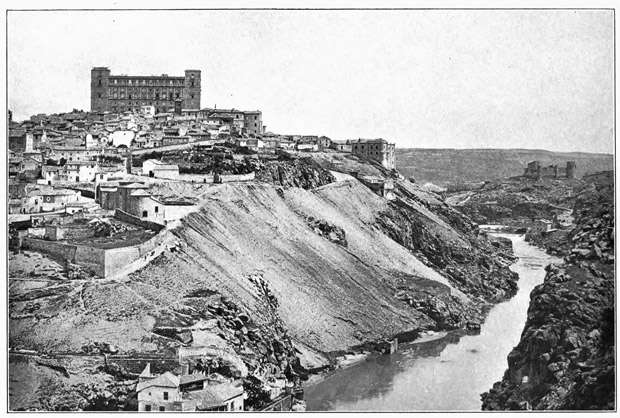
Toledo
The only cloud in sight was that which rested for a
moment on my comrade's face. She had so newly come
from our clean and wholesome fatherland that certain features
of the Spanish inns still shook her high serenity of soul,
and she had suddenly discovered that Baedeker significantly
characterized the Palencia hotel as "an indifferent Spanish
house." In the discreet language of our excellent guidebook
this was no less than a note of warning, a signal of alarm.
But even Baedeker is fallible, and on arriving at the Gran
Hotel Continental, we were met by all the Castilian dignity
and grave kindliness of greeting, and led to rooms whose
floors shone with oil and scrubbing, whose curtains, towels,
and sheeting were white as mountain snow, and whose furnishings
were resplendent with two dozen chairs upholstered
in orange satin. We seated ourselves in rapture on one
saffron throne after another, drank fresh milk from polished
glasses, and slept, for this only night of all our Santiago pilgrimage,
the sleep of the unbitten. A sweet-voiced sereno
intoning the hours set our dreams to music.
The following morning we spent in the cathedral, which,
though of plain exterior, except for the many-imaged "Door
of the Bishop," is all lightness, grace, and symmetry within.
The organ was pealing and women were kneeling for the
mass as we went softly down the high-vaulted nave, our spirits
played upon now by the dignity of pointed arches and of
clustered columns and now by delicate beauties in tracery and
carving. Only here and there were we aware of a jarring
note, as in chancing upon a great crucifix whose Christ was
decked out in two elegant lace petticoats and a white silk
crinoline embroidered over with silver thread.
When the chant had died away, an affectionate old sacristan,
in a curious red and black coat, delivered us with sundry farewell
pats and pinches over to the charge of a subordinate, who
proceeded to display the hidden treasures. These are far from
overwhelming, after the glittering hoards of Burgos, Seville,
and Toledo, but they are as odd an assortment as sacristy ever
sheltered. There was an absurd portrait of Charles I, a freak
of foreshortening. At first sight it seemed to be the skeleton
of a fish, but on viewing it through a peephole the creature
had become a human face. Even so, it was hardly a flattering
likeness of the founder of the Austrian line; but as it was
Charles I who stripped Palencia of her original powers and
dignities, one would not expect to find him complimented
here.
We turned our attention to the vestments, which, though
few, are peculiarly artistic, with devices, stitched in gold thread
and in jewel reds and greens, of pomegranates, roses, ecclesiastical
coats of arms, angels, Maries, Nativities, and Adorations.
These were appropriate enough, but even our reserved
conductor, a monastic youth who wore a white, openwork
tunic over his black suit, smiled disdainfully as he put before
us a time-yellowed ivory box arabesqued with men and lions, the
jewel casket of some pet sultana. "But why should it be
here?" He shrugged his shoulders. "In truth, it is not
holy—a woman's thing! Nor do I know how it came to
us, but what we have we keep."
The sacristy certainly seems to have kept more than its
share of custodias. Our guide first brought out a dainty
structure, where grieving angels uplift the cross, and the
Sufferer's halo is wrought of pearls and gems. This was
replaced by another, a marvel of goldsmith's craft, turreted
and crocketed with fine gold, while all about the base are
figured Annunciations, Visitations, and other mysteries. Rich
as they were, neither of these could compare with that famous
pyx of the Escorial, inlaid with ten thousand precious stones.
Then our conductor took us with a mighty turning of monster
keys, pulling of rusty bolts, and fall of clanging chains, to see
the supreme custodia of all, one great dazzle of silver from
fretted base to dome and pinnacle, save as among the Corinthian
columns of the first stage glisten golden forms of the
Apostles, and of the second, winged shapes of cherubim and
seraphim. This shining tower, some three or four centuries
old, is beheld by Palencia only on Corpus Christi Day, when,
holding at its heart the golden monstrance which holds the
Host, it passes as a triumphal car throughout the city. Priests
walking on either side make a feint of drawing it by tasselled
cords, but "little would it budge for that," said our guide, in
high disdain, opening a door in the frame beneath to reveal
the benches where strong men sit concealed and toil at a
motor crank. He had much more to show us, including
precious old tapestries of the Netherlands, and a St. Katharine
by Zurbarán, with a light on the kneeling figure as pure and
bright as a moonbeam; but we had to press the fee on his
Castilian pride, when at last the vulgarity of luncheon summoned
us away.
For the historian, basking in this last smile of civilization,
the afternoon passed blissfully among the orange chairs, but I
sallied forth once more, attended by our benignant landlady.
The rays of the sun flashed down like deadly arrows and I
had pleaded for a carriage, but longed to beg its pardon when
it came, so faded, rheumatic, and yet august was that fat old
chariot, groaning and tottering as it rolled, but lowering the
pomp of a velvet-carpeted staircase whenever we desired to
alight.
Our progress made a grand sensation in those drowsy streets
and squares, a retinue soon gathered, and nobody seemed surprised
when, after a round of Jesuit and Dominican churches,
we drew up before the madhouse. I had wished to look upon
this building, because it is reputed to have been a dwelling of
the Cid; but the hero of Castile was as unknown to my gentle
escort as to the medical priest whom she must needs call
forth to meet me, or to the hapless lunatics whom he, in turn,
insisted on my seeing. A town which had forgotten its chief
citizen naturally fails to keep on sale photographs of its cathedral,
so we packed our memories in default of anything more
substantial and took the evening train to the northwest.
Four hours of hushed, moonlit plain, and then Leon!
This is a name of thrilling memories, and we stepped out
into the midnight silence of that once royal capital whose
kingdom "stretched from the Atlantic Ocean to the Rhone,"
so awed that even a rickety 'bus, and a smuggler who tried to
hide his trunk behind our honest luggage, hardly broke the
spell. My comrade, still new to Spanish ways, had fears
that the illustrated card which I had forgotten to stamp would
not have reached the hotel. She asked me why I did not
telegraph; but some days later, when we sent a telegram
at noon, took a way-train at five, and reached our destination
at ten, simultaneously with the telegram which I might as
well have brought in my pocket, she was set free from New
World prejudices. The unstamped card went through without
question, a picture of a pretty mountain maid being quite
as acceptable to the postal clerks as the portrait of their young
king.
We were expected at the hotel, the best in town, but so
dirty and malodorous that we would better have camped
under the stars. There had been some attempt to sweep the
floor of our dingy chamber, as we could see by comparing it
with stairs and corridors. Sour milk and sour bread were
served with a compensating sweetness of manner, but the
experiences of that night belong to oblivion.
The joy of the morning! Guided by a shy little scullery
lad, smooched of face and ragged of raiment, but with all
the instincts of a cavalier, we stepped out into those stately
streets, with their haughty old houses, balconies, coats of
arms, arches, and battlements, as into an animated picture
book. It was Saturday, and the town was all astir with
peasants come to market, every peasant as good as a romance.
Such brightness of figured kerchiefs, homespun petticoats,
trunk hose, jackets, sashes! The little girls were quaintest
of all, dressed precisely like their mammas, even to those
brilliant skirts edged with one color and slashed with another.
Many of the women were carrying loads of greens, others
plucked fowls, and some had indignant chickens, in full possession
of chicken faculties, snuggled under the arm.
As the chief city in a far reach of luxuriant plain, Leon
becomes the focus, every Saturday, of flocks of sheep, droves
of pigs, and herds of cattle, together with innumerable mules
and donkeys bringing in grain, fruit, and all manner of garden
produce. We chanced upon the market itself in the arcaded
Plaza Mayor, under shadow of the towered court-house,
with the tapering spire of the cathedral overlooking all. The
great square hummed like a beehive and sparkled with shifting
color like a field of butterflies. We found ourselves first
in the bread market. Under wide umbrellas of canvas set on
poles women were perched high on wooden benches, with
their gayly shod feet supported on stools. Beside each
woman, on her rude seat, was a brightly woven basket heaped
with the horny Spanish loaves. Close by was the fruit
market, with its piles of red and purple plums, pears, grapes,
green peppers, lemons, and, beyond, patches of melons,
cucumbers, cabbages, potatoes, beans, and that staff of Spanish
life, chick pease, or garbanzos.
The meat market appeared to be itinerant. A man in
blue blouse, short brown breeches, and dove-colored hose
adorned with green tassels, was leading a cow by its crumpled
horn; an old woman, with giant silver hoops in her ears, a
lavender shawl knotted about her body, her scarlet skirt well
slashed so as to show the gamboge petticoat beneath, and so
short for all its purple frill as to display the clockwork of her
variegated stockings, was carrying a black lamb, nestled like a
baby in her arms; another walking rainbow bore a live turkey;
and a lad, whose rosy-hued kerchief, shawl, and sash floated
like sunrise clouds about him, balanced on his erect young
head an immense basket of eggs. There was a pottery section,
too,—square rods of cups, plates, and jars in all manner
of russet tints and graceful shapes.
The various divisions were intermingled and blent into
one great open-air market, the cheeriest sort of neighborhood
picnic, where gossip, jest, and laughter were accompanied by
the cackling of fowls, braying of donkeys, and cooing of
babies. Here fluttered a colony of bantams cast, their legs
well tied, down on the cobble-stones; there stood carts laden
with bunches of the yellowish dried heather; here two
patient oxen had laid themselves out for a snooze; there a
wicked little ass was blinking at the greens; here squatted a
damsel in gold kerchief, garnet bodice, and beryl skirt, weighing
out fresh figs; there sat a cobbler pegging away at his stall,
his patrons waiting with bare feet while he mended their
shoes; stands of cheeses, coops of chickens, children sleeping
among the sacks of grain, a boy waving a rod on which was
strung a gorgeous assortment of garters; loitering soldiers,
limping beggars, bargaining ladies attended by their maids, all
gave notes to the harmony. Yet with all that trampling,
small weeds were growing green amid the slippery stones
that pave the square.
The Leon peasantry is said to be the finest in all Spain, and
surely no concourse of people could have been more honest,
courteous, and dignified than this. The women wore ornamented
wallets beneath the skirt, and warned us gravely
against carrying money in exposed pockets; but we moved
freely among the press with notebook and kodak, always the
centre of curious groups, and our purses were not touched.
Indeed we found it difficult to spend even a peseta, so
modest were the prices. For as large a jar as our little
squire could well carry we paid the value of three cents.
The men often rebuked the children for staring and questioning,
but stood themselves at gaze, and asked us frankly
what we were about. When we replied that we had never
seen so beautiful a market, and were taking notes and photographs
that we might not forget, the peasants smilingly passed
the word from one side of the plaza to the other, and all,
even to the chief of police, who was strutting about waving
an unnecessary staff, were eager to offer information and to
point out picturesque subjects.
But the morning was slipping away, and we had almost
forgotten the oracle of a Spanish gentleman in Palencia:
"Leon has three sights for the visitor, and only three—the
Cathedral, San Isidoro, and San Marcos." We proceeded to
take these illustrious churches in order. The Leon Cathedral,
closely analogous to the Gothic masterpieces of northern
France, is far beyond all poor praises of mine. Now in process
of repair and stripped of the garish shrines of modern
worship, it may be enjoyed purely as architecture—a temple
of high beauty. Let artists tell of its towers and finials, flying
buttresses, gables, cornices, galleries, piers, façades. Yet
one need not be an artist to delight in the glow of its great
rose windows, or to spend fascinated hours poring over the
chiselled story book of portals, stalls, and cloisters. Such
inimitable glass, burning still with the fervors of the mediæval
faith! And such a world of divinity and humanity, even
down to childish mischief, in those multitudinous carvings!
The Passion scenes are repeated over and over, creation and
judgment are there, the life, death, and ascension of the
Virgin, hero legends, animal fables, and folk-lore. Gothic
energy is abundantly manifest. St. George smites the
dragon, St. Michael tramples the devil, Samson splits the
lion's jaws, and Santiago, carved in ebony on a door in
the mellow-hued old cloisters, is riding down the Moors with
such contagious fury that the very tail of his horse is twisted
into a ferocious quirk. On angel-guarded tombs pictures of
ancient battle, murder, vengeance, are graven in the long-remembering
stone. But marble birds peck at the marble
fruit, the ivory peasant drives his pigs, the alabaster shepherd
watches his flock, the lad leads his donkey, the monk feeds
the poor at the abbey gates, and plump stone priests,
stowed away in shadowy niches, make merry over the wine.
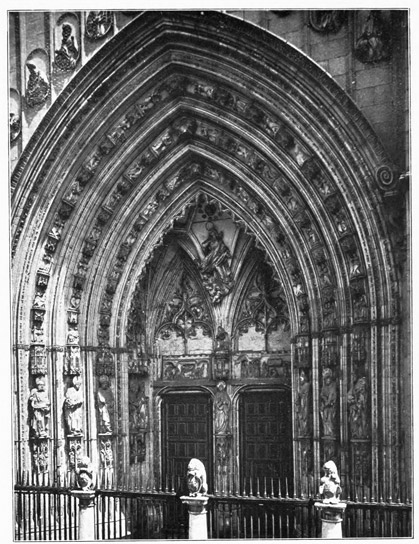
Toledo Cathedral. Door of Lions
If we had revelled overmuch in the art values of the cathedral,
San Isidoro administered a prompt corrective. This
Romanesque church, dating from the beginning of the
eleventh century and a forerunner of the Escorial in that it
was founded by the first Fernando of Castile as a royal
mausoleum, is excessively holy. Not merely are the bones of
the patron saint kept on the high altar, but the Host is on
constant exhibition there. Unaware of these especial sanctities,
we were quietly walking toward the choir, when an
angry clamor from behind caused us to turn, and there,
stretching their heads out over the railing of an upper gallery,
was a line of furious priests. In vain the sacristan strove to
excuse us, "foreigners and ladies," who did not know that
we were expected to fall upon our knees on first entering the
door. We had been guilty of no irreverence beyond this
omission, and even under the hail of priestly wrath did our
best to withdraw correctly without turning our backs to the
altar. But nothing would appease that scandalized row of
gargoyles, whose violent rudeness seemed to us the greater
desecration. Thus it was that we did not enter the frescoed
chambers of the actual Panteon, said to be imposing yet,
although the royal tombs were broken up by the French in
1808. Very wrong in the French, but unless the manners
of San Isidoro's bodyguard have degenerated, the soldiers of
Napoleon may have had their provocation.
It was now high noon, and the market-place had poured
all its peasants out upon the streets. Groups of them were
lying at luncheon under the trees, passing the pigskin bottle
of wine from mouth to mouth. Beggars were standing by
and blessing them in return for scraps of the coarse and
scanty fare. "May God repay! May the saints prosper thy
harvest!"
A woman riding home, sitting erect on the red-striped
donkey-bag, handed a plum to her husband, who trudged beside
her in gray linen trunks and green velveteen waistcoat, with
a white square of cloth set, for ornament, into the middle of
the back. He divided the fruit with a pleading cripple, who
called after them as devoutly as a man with half a plum in
his cheek well could, "May the Blessed Virgin ride forth
with you and gladden all your way!"
We had, because of the increasing heat, conjured up a
carriage, a species of invalid stage-coach, and were therefore
the envy of little schoolboys in blue pinafores. Their straw
satchels bobbed on their backs as they gave chase to our
clattering ark and clung to steps and door. This mode of
locomotion did not save us time, for our coachman had
domestic cares on his mind and drew up to bargain for a
chicken, which finally mounted with a squall to the box
seat; but in due Spanish season we stopped before the plateresque
façade of San Marcos.
This is a still unfinished convent, rich in artistic beauties
and historic memories. Here, for instance, is a marvellously
human head of St. Francis, a triumph of the polychrome
sculpture, and here is the little cell where the poet Quevedo,
"colossal genius of satire," was imprisoned for over three
years by Philip IV, the patron of Velázquez. It is not so
easy to cage a mocking-bird, though the satire-pencilled walls
have been well whitewashed.
But San Marcos was originally a hospital for pilgrims on
the road to Compostela, and conch shells are the central ornamentation
of arch and vault and frieze. We accepted the
rebuke; we would loiter no more. Early that afternoon we
took train for Coruña, after which some agency other than
steam must transport us to the mediæval city of St. James.
XXIV
PILGRIMS OF SAINT JAMES
"In Galice at Seint Jame, and at Coloigne,
She koude muchel of wandrynge by the weye."
—Chaucer: Canterbury Tales.
"Pilgrimes and palmers plihten hem to-gederes
For to seche Seint Jame."
—Langland: Piers Plowman.
"I am Saint Jaques' pilgrim, thither gone."
—Shakespeare: All's Well that Ends Well.
From Leon to Coruña is a journey of some eighteen
hours by rail. Degenerate pilgrims that we were,
we had taken a first-class carriage reserved for ladies,
not so comfortable as the average third-class carriage on an
English road. We hoped for space, at least, and solitude,
but people who choose to pry into out-of-the-way corners
of Spain need not expect to find any slavish deference
to rights of place and property. The conductor
had planned to dine and sleep in this particular compartment,
which was a shade cleaner than the rest, and removed
his kit from the rack with natural disappointment.
Why should ladies be going to Galicia? But the general
first-class compartment, next to ours, was unoccupied, and he
resignedly transferred his belongings thither. The numerous
third-class carriages were crowded with raw recruits, who had
all jumped down, boy fashion, on the Leon platforms, and
came scrambling back at the starting bell in noisiest confusion.
Just as the train was puffing out, a station official threw
open our door with a smiling, "Only to the next stop, ladies!"
and precipitated upon us three belated warriors. We groaned
inly with dark foreboding, for third-class occupancy of a first-class
carriage is apt to leave lively souvenirs behind. Our
three young soldiers, each with his personal effects bundled
up in an enormous red and yellow handkerchief, were of the
rudest peasant type, hardly lifted above animal and clod. Only
one was able to spell out anything of the newspaper we offered.
He labored over a large-lettered advertisement with grimy
thumb, twisting brows, and muttering lips, but soon gave it
up in sheer exhaustion. The hulking fellow beyond him was
continually on the point of spitting,—a regular Spanish pastime
in travel; but, determined that the carriage should not
suffer that offence, I kept strict watch on this chrysalis hero,
and embarrassed him into stark paralysis with questions on the
landscape whenever he was quite prepared to fire. The third
conscript was a ruddy, fair-haired boy of seventeen, who had
in rudimentary form the social instincts of a Spaniard, and in
his intervals of blue-eyed staring at the tawdry splendors about
him hammered our ears with some harsh dialect, his one theme
being the indignities and hardships of a Spanish soldier's lot.
Yet dull as they were, and ignorant of railway customs, they
knew enough to prefer broad cushions, whose variety of stains
did not trouble their enviable simplicity, to the rough and
narrow benches of the overcrowded third-class carriages,
and at the "first stop" they unanimously forgot to change.
But they were not unkindly lads, and after I had explained
to them a dozen times or so that my friend was suffering
from a headache and needed to lie down, and had, furthermore,
lawlessly suggested that they could make themselves
equally comfortable in the other first-class carriage, which
was not "reserved for ladies," they promised to leave us
at the second station; but their slow peasant hands fumbled
at the door so clumsily that the train was under way
again before the latch had yielded. It was not until we
had been fellow-travellers for two or three hours that they
finally stumbled into the neighboring compartment. From
this the conductor, who had been blind and deaf to past
proceedings, promptly ejected them, having no mind to let
them make acquaintance with his wine bottle, and our poor
exiles cast reproachful glances at us as they were hustled off
to their own place.
We have sometimes talked enthusiastically of democracy,
but we did not discuss such exalted subjects then. Indeed,
we had enough to do in guarding our doors, often by frank
exercise of muscle, from further intrusion, and in trying to
provide ourselves with food and water. A struggling mob of
soldier boys besieged the refreshment stalls at every station,
and drained the jars of the water-venders long before these
could arrive at the car windows. At last, by a union of silver
and violence, we succeeded in gaining from an astounded
little girl, who was racing after the departing carriages,
all her stock in trade, even the great russet jar itself,
with its treasure of cold spring water. The historian
possesses a special genius for cooking over an alcohol lamp
on a rocking mountain train, and having augmented our knapsack
stores with scalded milk and knobby bread from a tavern
near one of the depots, we lived like feudal barons "of our
own" for the rest of that memorable journey.
Reminders of the pilgrims were all along our route. Overflowing
as Santiago's young knights were with martial and romantic
spirit, when the brigands did not give their steel sufficient
sport they would break lances for the love of ladies or on any
other conceivable pretext. We passed the bridge of twenty
arches, where ten companions in arms once posted themselves
for ten successive days, and challenged to the tilt every cavalier
who came that way in journey to the Compostela jubilee.
All the afternoon we were climbing into the hill-country.
The waste slopes were starred with purple clumps of heather,
and crossed by light-footed maids, who balanced great bunches
of bracken on their heads. The patches of green valley,
walled in by those barren steeps, held each a few tumble-down
old houses, while elsewhere we noticed human dwellings that
seemed scarcely more than nests of mud plastered to the stone.
Yet the soil appeared to be cultivated with the most patient
thrift,—wheat and potatoes growing wherever wheat and
potatoes might. The view became a bewildering medley of
Scottish hills, Italian skies, and Gothic castles, with occasionally
a tawny and fantastic rock from the Garden of the Gods.
The city of Astorga, whose cathedral was founded, so the
pilgrims used to say, by St. James in his missionary tour,
greeted us from the midst of the flinty hills. These are the
home of a singular clan known as the Maragatos. They wear
a distinctive dress, marry only among themselves, and turn a
sullen look upon their neighbors.
As night came on, the road grew so rough that we had to
cork our precious water-jar with a plump lemon. The historian
was sleeping off her headache, except as I woke her at
the stations to aid in the defence of our ignoble luxury. We
remembered that queen of Portugal who made the pilgrimage
to Compostela on foot, begging her way. In the close-packed
third-class carriages it must have been a cramped and
weary night, and we did not wonder that young socialists
occasionally tried to raid our fortress. But we clung stoutly
to the door-handles, lustily sounding our war cry of "Ladies
only" in lieu of "Santiago," and early in the small hours had
the shamefaced pleasure of seeing the herd of drowsy conscripts,
with their red and yellow bundles, driven into
another train, where they were tumbled two or three deep,
the under layer struggling and protesting. One little fellow,
nearly smothered in the hurly-burly about the steps, cried out
pitifully; but the conductor silenced him with angry sarcasm:
"Dost mean to be a soldier, thou? Or shall we put thee in
a sugar-bowl and send thee back to mamma?"
There was less need of sentry duty after this, but the night
was too beautiful for sleep. We were crossing the wild
Asturian mountains, the Alps of Spain, and a full moon was
pouring down white lustre on crag, cascade, and gorge. By
these perilous ways had streamed the many-bannered pilgrim
hosts,—men and women of all countries and all tongues
seeking the Jerusalem of the West. Each nation had its own
hymn to Santiago, and these, sung to the mingled music of
bagpipes, timbrels, bugles, flutes, and harps, must have pealed
out strangely on many a silver night. The poor went begging
of the rich, and often a mounted crusader cast his purse of broad
gold pieces on the heather, trusting Santiago and his own good
sword to see him through. Up and down these sheer ravines
stumbled the blind and lame, sure of healing if only they could
reach the shrine. Deaf and dumb went in the pilgrim ranks,
the mad, the broken-hearted, the sin-oppressed; only the
troop of lepers held apart. Some of those foot-sore wayfarers,
most likely the raggedest of all, carried a secret treasure for
the saint. Some staggered under penitential weights of lead
and stone, and others bore loads of bars and fetters in token
of captivity from which St. James had set them free.
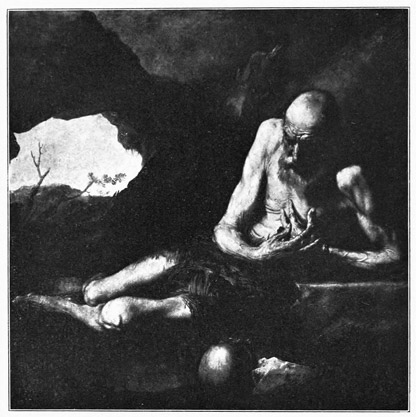
St. Paul, the First Hermit
But these pathetic shapes no longer peopled the moonlight.
Since it was the nineteenth century, a first-class passenger
might as well lie down and watch the gracious progress of the
moon across the heavens,—
"Oft, as if her head she bowed,
Stooping through a fleecy cloud."
But the clouds perversely made of themselves wayside
crosses, urns, cathedral towers; and just as one sky-creature,
"backed like a weasel" but with the face of Santiago, began
to puff a monstrous cigarette, I roused my dozing senses and
discovered that we were entering Lugo, the capital of Galicia,
and once, under Roman rule, of all Spain.
This city of tumultuous history, stormed by one wild race
after another, and twice sacked in our own century, first by
the French and then by the Carlists, lay very peacefully under
the white dawn. While the chivalrous Spanish sun rose
unobtrusively, so as not to divert attention from the fading
graces of the moon, the historian made sustaining coffee, and
we tried to look as if we liked Galicia. This far northwestern
province is the Bœotia of Spain; its stupid, patient
peasantry are the butt of all the Peninsula, and to be called a
Gallego is to be called a fool. The country, as we saw it
from the train, was broken and hilly, but the Alpine majesty
of Asturias was gone. In the misty drizzle of rain, which
soon hushed the pipings of the birds, all the region looked
wretchedly poor. It was a wooded, watered, well-tilled
land, with tufts of heather brightly fringing every bank; but
the houses were mere cabins, where great, gaunt, dark-colored
pigs pushed in and out among bedraggled hens and half-clad
children. Women were working in the fields by five o'clock
in the morning, their saffron and carmine kerchiefs twisted into
horns above the forehead. Women were serving as porters
at the stations, carrying heavy trunks and loads of valises on
their heads. Women were driving the plough, swinging the
pickaxe in the quarries, mending the railway tracks. Short,
stout, vigorous brownies they were, and most of them looked
old.
It was mid-forenoon when we reached Coruña, the seaport
whence sailed the Invincible Armada. We had meant to
rest there for the afternoon and night before undertaking the
forty-mile drive to Santiago, but the hotel was so filthy that,
tired as we were, there was nothing for it but to go on.
Tarrying only for bath and breakfast, we took our places in
a carriage which, setting out at one, promised to bring us
into Santiago in time for the eight o'clock dinner.
This conveyance was a species of narrow omnibus, which
an Andalusian, an Englishman, a son of Compostela returning
home after a long sojourn in foreign parts, his young
wife of Jewish features, and our weary selves filled to overflowing.
Our Jehu had agreed to transport the six of us,
with our effects, for the sum of sixteen dollars; but deep was
our disgust when he piled our handbags, shawl straps, and
all our lesser properties in upon our wedged and helpless
forms, and crammed six rough Gallegos, with a reeling load
of trunks and boxes, on the roof. Remonstrance would be
futile. The places in the regular diligence were not only
taken for the afternoon but engaged for several days ahead,
and carriages are rare birds in Galicia. The Spanish gentlemen
merely shrugged their shoulders, the Englishman had but
that morning landed in Spain and could not speak a word of
the vernacular, and feminine protest was clearly out of order.
The four puny horses took the top-heavy vehicle at a rattling
pace down the granite-paved streets of Coruña, but hardly
were we under way when our griefs began.
On our arrival that forenoon, a fluent porter had over-persuaded
us to leave our trunk at the station, letting him
retain the check in order to have the baggage ready for us
when we should pass the depot en route for Santiago. We
had been absent scarcely three hours, but meanwhile the
trunk had disappeared. A dozen tatterdemalions ran hither
and thither, making as much noise as possible, all the top
fares shouted contradictory suggestions, and our porter, heaping
Ossa-Pelions of execration upon the (absent) railroad
officials, declared that they in their most reprobate stupidity
had started the trunk on that eighteen-hour journey back to
Leon. They were dolts and asses, the sons of imbecile
mothers; but we had only to leave the check with him, and
in the course of an indefinite number of "to-morrows" he
would recover our property. We had grown sadder and
wiser during the last five minutes, however, and insisted on
taking that soiled inch of paper into our own keeping. At
this the porter flew into a Spanish rage, flung back his fee
into my lap, and so eloquently expressed himself that we left
Coruña with stinging ears.
It was the historian's trunk, stored with supplies for the
camera, as well as with sundry alleviations of our pilgrim lot,
but she put it in the category of spilled milk, and turned with
heroic cheerfulness to enjoy the scenery. The horses had
now drooped into the snail's pace which they consistently
maintained through the rest of their long, uphill way, for the
city of the Apostle stands on a high plateau. As we mounted
more and more, Coruña, lying between bay and sea, still shone
clear across the widening reach of smiling landscape. Maize
and vines were everywhere. So were peasants, who trudged
along in family troops toward Compostela. But whether
afoot or astride donkeys of antique countenance, they could
always outstrip our lumbering coach, and we were an easy
prey for the hordes of childish bandits who chase vehicles
for miles along the pilgrim road, shrieking for pennies in the
name of Santiago.
About two leagues out of Coruña we did pass something,—a
group composed of a young Gallego and the most diminutive
of donkeys. The peasant, walking beside his beast, was
trying to balance across its back an object unwonted to those
wilds.
"Strange to see a steamer trunk here!" I remarked, turning
to the historian; but she was already leaning out from the
window, inspecting that label-speckled box with an eagle gaze.
"It's mine!" she exclaimed, and in a twinkling had
startled the driver into pulling up his horses, had leapt from
the coach, and was running after the peasant, who, for his part,
swerving abruptly from the main road, urged his panting
donkey up a steep lane. Nobody believed her. Even I, her
fellow-pilgrim, thought her wits were addling with our penitential
fasts and vigils, and did not attempt to join in so mad a
chase. As for the scandalized Spaniards, inside and out, they
shouted angrily that the thing was impossible and the señora
was to come back. The coachman roared loudest of all.
But on she dashed, ran down her man, and bade him, in inspired
Galician, bring that trunk to the omnibus at once. He
scratched his head, smiled a child's innocent and trustful smile,
and, like a true Gallego, did as he was told. By this time
masculine curiosity had been too much for the driver and
most of the fares, and they had scrambled after, so that the
few of us who kept guard by the carriage presently beheld an
imposing procession advancing along the road, consisting of a
Galician peasant with a steamer trunk upon his head, a group
of crestfallen Spaniards, and a Yankee lady, slightly flushed,
attended by an applauding Englishman.
Beyond a doubt it was her trunk. Her name was there, a
New York hotel mark, which she had tried to obliterate with
a blot of Leon ink, and the number corresponding to the
number of our check. "By Jove!" said the Englishman.
As for the peasant, he said even less, but in some way gave
us to understand that he was taking the trunk to a gentleman
from Madrid. Thinking that there might have been a confusion
of checks in the station, we gave this childlike native a
peseta and a card with our Santiago address in case "the
Madrid gentleman" should suspect us of highway robbery.
Our fellow-passengers took the tale to Santiago, however; it
made a graphic column in the local paper, and none of the
several Spaniards who spoke to us of the matter there doubted
that the trunk was stolen by collusion between the porter and
the peasant.
Our next adventure was more startling yet. The coachman
had been heard, at intervals, vehemently expostulating
with a roof passenger who wanted to get down. "Man alive!
By the staff of Santiago! By your mother's head! By the
Virgin of the Pillar!" Whether the malcontent had taken
too much wine, whether he was under legal arrest, whether it
was merely a crossing of whims, we could not learn from any
of the impassioned actors in the drama; but, apparently, he
found his opportunity to slip unnoticed off the coach. For
suddenly the driver screamed to his horses, and, like a bolt
from the blue, a handsome, athletic fellow leapt to the ground
and rushed back along the dusty road, brandishing clenched
fists and stamping his feet in frenzy. In mid-career he paused,
struck a stage attitude, tore open his pink shirt, gasped, and
shook with rage. "Irving isn't in it," quoth the Englishman.
Then appeared, lurking by the roadside, a slouchy youth, on
whom our tragic hero sprang like a tiger, threw him down,
and stood panting over him with a gesture as if to stab. An
instant later he had seized his victim by the collar, dragged
him up, and was running him back to the coach. "You hurt
me," wailed the truant, "and I don't want to go." But go he
must, being bundled back in short order on the roof, where
harmony seemed to be immediately restored. While the men
were struggling, a lordly old peasant, stalking by, surveyed
them with a peasant's high disdain. We had already noted the
Irish look of the Galicians, but this magnificent patriarch, with
dark green waistcoat over a light green shirt, old gold knickerbockers
and crushed strawberry hose, had as Welsh a face, dark
and clean-cut, as Snowdon ever saw.
Long sunset shadows lay across the hills; we had shared
with our companions our slight stores of sweet chocolate,
bread, and wine, and still we were not halfway to Santiago.
It was nine o'clock before our groaning equipage drew up at
a wretched little inn, incredibly foul, where it was necessary
to bait the exhausted horses. Mine host welcomed the party
with pensive dignity, and served us, in the midst of all that
squalor, with the manners of a melancholy count. Shutting
eyes and noses as far as we could, and blessing eggs for shells
and fruit for rind, we ate and gathered strength to bear what
St. James might yet have in store for us.
The diligence had resumed its weary jog; we were all more
or less asleep, unconsciously using, in our crowded estate, one
another as pillows, when an uproar from the box and a wild
lurch of the coach brought us promptly to our waking senses.
One of the wheel horses was down, and the others, frightened
by the dragging harness, were rearing and plunging. Out we
tumbled into the misty night, wondering if we were destined,
after all, to foot it to Compostela in proper pilgrim fashion.
The poor beast was mad with terror, and his struggles soon
brought his mate to the ground beside him. The coachman,
so pompous and dictatorial at the outset, stood helplessly in
the road, at a safe distance, wringing his hands and crying like
a baby: "Alas, poor me! Poor little me! O holy Virgin!
Santiago!" The top fares, who had made good speed to terra
firma, were wailing in unison and shrieking senseless counsels.
"Kill thou the horse! Kill thou the horse!" one of them
chanted like a Keltic dirge. The coachman supplied the
antiphon: "Kill not my horse! Kill not my horse! Ave
Maria! Poor little me!" "Fools! Sit on his head,"
vociferated the Englishman in his vain vernacular. The
horses seemed to have as many legs as centipedes, kicking all
at once. The coach was toppling, the luggage pitching, and
catastrophe appeared inevitable, when Santiago, such an excellent
horseman himself, inspired one of the roof passengers to
unbuckle a few straps. The effect was magical. First one
nag, and then the other, struggled to its feet; the coachman
sobbed anew, this time for joy; the Spanish gentlemen, who
had been watching the scene with imperturbable passivity,
crawled back into the diligence, the silent wife followed with
the heavy bag which her husband had let her carry all the
way, and the Anglo-Saxon contingent walked on ahead for
half an hour to give the spent horses what little relief we
might.
The clocks were striking two when we reached the gates
of the sacred city, where fresh hindrance met us. The customs
officials were on the alert. Who were we that would
creep into Compostela de Santiago under cover of night, in
an irregular conveyance piled high with trunks and boxes?
Smugglers, beyond a doubt! But they would teach us a thing
or two. We might wait outside till morning.
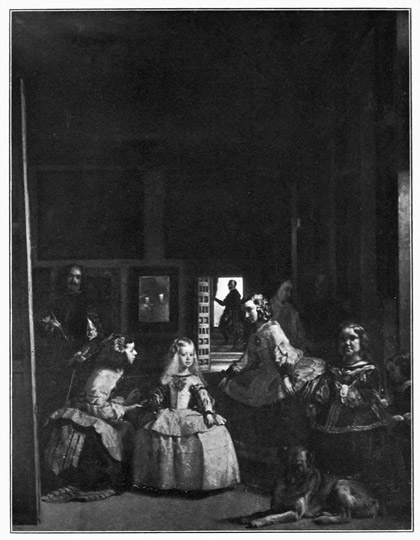
Maids of Honor
Delighted boys from a peasant camp beyond the walls ran
up to jeer at our predicament. Our coachman, reverting to
his dolorous chant, appealed to all the saints. The top fares
shrilled in on the chorus; the Spanish gentlemen lighted
cigarettes, and after some twenty minutes of dramatic altercation,
a soldier sprang on our top step and mounted guard,
while the coach rattled through the gates and on to the
aduana. Here we were deposited, bag and baggage, on
the pavement, and a drowsy, half-clad old dignitary was
brought forth to look at us. The coachman, all his social
graces restored, imaginatively presented the three Anglo-Saxons
as a French party travelling for pleasure. "But
what am I to do with them?" groaned the dignitary, and
went back to bed. An appalling group of serenos, in slouch
hats and long black capes, with lanterns and with staffs topped
by steel axes, escorted us into a sort of luggage room, and
told us to sit down on benches. We sat on them for half an
hour, which seemed to satisfy the ends of justice, for then
the serenos gave place to porters, who said they would bring
us our property, which nobody had examined or noticed in
the slightest, after daybreak, and would now show us the
way to our hotel. Our farewell to the coachman, who came
beaming up to shake hands and receive thanks, was cold.
We had engaged rooms by letter a week in advance, but
they had been surrendered to earlier arrivals, and we were
conducted to a private house next door to the hotel. After
the delays incident to waking an entire family, we were
taken into a large, untidy room, furnished with dining table,
sewing machine, and a half dozen decrepit chairs. There
was no water and no sign of toilet apparatus, but in an
adjoining dark closet were two narrow cots, from which the
four daughters of the house had just been routed. Of those
beds which these sleepy children were then, with unruffled
sweetness and cheeriness, making ready for us, the less said
the better. Our indoor hours in Compostela, an incessant
battle against dirt, bad smells, and a most instructive variety
of vermin, were a penance that must have met all pilgrim
requirements. And yet these people spared no pains to make
us comfortable, so far as they understood comfort. At our
slightest call, were it only for a match, in would troop the
mother, four daughters, maid, dog, and cat, with any of the
neighbors who might be visiting, all eager to be of service.
The girls were little models of sunny courtesy, and would
have been as pretty of face as they were charming in manner,
had not skin diseases and eye diseases told the tale of the
hideously unsanitary conditions in which their young lives
had been passed.
But we had come to the festival of Santiago, and it was
worth its price.
XXV
THE BUILDING OF A SHRINE
(A historical chapter, which should be skipped.)
That most Spanish of Spaniards, Alarcón, is pleased
in one of his roguish sketches to depict the waywardness
of a certain poetaster. "Alonso Alonso was
happy because he was thinking of many sad things,—of the
past centuries, vanished like smoke, ... of the little span of
life and of the absurdities with which it is filled, of the folly
of wisdom, of the nothingness of ambition, of all this comedy,
in short, which is played upon the earth."
Alonso Alonso would be in his very element in Santiago de
Compostela. The "unsubstantial pageant faded" of the
mediæval world is more than memory there. It is a ghost
that walks at certain seasons, notably from the twentieth to
the twenty-eighth of July. The story of the birth, growth,
and passing of that once so potent shrine, the Jerusalem of the
West, is too significant for oblivion.
The corner-stone of the strange history is priestly legend.
The Apostle James the Greater, so runs the tale, after preaching
in Damascus and along the Mediterranean coast, came in
a Greek ship to Galicia, then under Roman rule, and proclaimed
the gospel in its capital city, Iria-Flavia. Here the
Virgin appeared to him, veiled, like the mother of Æneas, in
a cloud, and bade him build a church. This he did, putting
a bishop in charge, and then pursued his mission, not only in
the remote parts of Galicia, but in Aragon, Castile, and Andalusia.
At Saragossa the Virgin again flashed upon his sight.
She was poised, this time, on a marble pillar, which she left
behind her to become, what it is to-day, the most sacred object
in all Spain. A chip of this columna immobilis is one of the
treasures of Toledo. The cathedral of the Virgen del Pilar,—affectionately
known as Pilarica,—which James then
founded at Saragossa, is still a popular goal of pilgrimage, the
marble of the holy column being hollowed, at one unshielded
spot, by countless millions of kisses. The Apostle, on his
return to Jerusalem after seven years in Spain, was beheaded
by Herod. Loyal disciples recovered the body and set sail
with it for the Spanish coast. Off Portugal occurred the
pointless "miracle of the shells." A gentleman was riding
on the shore, when all at once his horse, refusing to obey the
bit, leapt into the sea, walking on the crests of the waves
toward the boat. Steed and rider suddenly sank, but promptly
rose again, all crusted over with shells, which have been ever
since regarded as the emblem of St. James in particular, and
of pilgrim folk in general.
"How should I your true love know
From another one?
By his cockle hat and staff
And his sandal shoon."
The Santiago "cockle," which thus, as a general pilgrim
symbol, outstripped the keys of Rome and the cross of Jerusalem,
is otherwise accounted for by a story that the body of St.
James was borne overseas to Galicia in a shell of miraculous
size, but this is not the version that was told us at the shrine.
The two disciples, Theodore and Athanasius, temporarily
interred their master in Padron, two leagues from Iria, until
they should have obtained permission from the Roman dame
who governed that region to allow St. James the choice of a
resting-place. Her pagan heart was moved to graciousness,
and she lent the disciples an ox-cart, in which they placed the
body, leaving the beasts free to take the Apostle's course. It
is hardly miraculous that, under the circumstances, Lady
Lupa's oxen plodded straight back to Iria and came to a stop
before her summer villa. Since this was so clearly indicated
as the choice of the saint, she could do no less than put her
house at his disposal. In the villa was a chapel to the war-god
Janus, but when the body of Santiago was brought within
the doors, this heathen image fell with a crash into a hundred
fragments. Here the saint abode, guarded by his faithful disciples,
until, in process of time, they slept beside him. The
villa had been transformed into a little church, so little that,
when the Imperial persecutions stormed over the Spanish provinces,
the worshippers hid it under heaps of turf and tangles
of brier bushes. Those early Christians of Iria were slain or
scattered, and the burial place of St. James was forgotten of
all the world.
In the seventh century, a rumor went abroad that the
Apostle James had preached the gospel in Spain. The legend
grew until, in the year 813, a Galician anchorite beheld from
the mouth of his cavern a brilliant star, which shone persistently
above a certain bramble-wood in the outskirts of Iria.
Moving lights, as of processional tapers, twinkled through the
matted screen of shrubbery, and solemn chants arose from the
very heart of the boscage. Word of this mystery came to
the bishop, who saw with his own eyes "the glow of many
candles through the shadows of the night." After three days
of fasting, he led all the villagers in procession to the thicket
which had grown up, a protecting hedge, about the ruins of
the holy house. The three graves were found intact, and on
opening the chief of these the bishop looked upon the body
of St. James, as was proven not only by severed head and pilgrim
staff, but by a Latin scroll. The swiftest horsemen of
Galicia bore the glorious tidings to the court of the king, that
most Christian monarch, Alfonso II, "very Catholic, a great
almsgiver, defender of the Faith." So loved of heaven was
this pious king, that once, when he had collected a treasure
of gold and precious stones for the making of a cross, two
angels, disguised as pilgrims, undertook the work. When,
after a few hours, Alfonso came softly to the forge to make
sure of their honesty and skill, no artisans were there, but
from an exquisitely fashioned cross streamed a celestial glory.
So devout a king, on hearing the great tidings from Galicia,
lost no time in despatching couriers to his bishops and
grandees, and all the pomp and pride of Spain, headed by
majesty itself, flocked to the far-off hamlet beyond the Asturian
mountains to adore the relics of Santiago.
Now began grand doings in Iria, known henceforth as the
Field of the Star, Campus Stellæ, or Compostela. Alfonso had
a church of stone and clay built above the sepulchre, and
endowed it with an estate of three square miles. The Pope
announced the discovery to Christendom. A community of
twelve monks, with a presiding abbot, was installed at Compostela
to say masses before the shrine. For these beginnings
of homage the Apostle made a munificent return. A wild people,
living in a wild land at a wild time, these Spaniards of the
Middle Ages were shaped and swayed by two sovereign
impulses, piety and patriotism. These two were practically
one, for patriotism meant the expulsion of the Moor, and
piety, Cross above Koran. It was a life-and-death struggle.
The dispossessed Christians, beaten back from Andalusia and
Castile to the fastnesses of the northern mountains, were fighting
against fearful odds. They felt sore need of a leader, for
although, when their ranks were wavering, the Virgin had
sometimes appeared to cheer them on, hers, after all, was but
a woman's arm. It was in the battle of Clavijo, 846, that
Santiago first flashed into view, an invincible champion of the
cross.
Rameiro, successor to Alfonso II, had taken the field
against the terrible Abderrahman of Cordova, who had
already overrun Valencia and Barcelona and was demanding
from Galicia a yearly tribute of one hundred maidens. This
exceedingly Moorish tax, which now amuses Madrid as a rattling
farce in the summer theatre of the Buen Retiro, was no
jesting matter then. Not only the most famous warriors of
the realm, Bernardo del Carpio in their van, but shepherds
and ploughmen, priests, monks, even bishops, flocked to the
royal standard.
"A cry went through the mountains when the proud Moor drew near,
And trooping to Rameiro came every Christian spear;
The blesséd Saint Iago, they called upon his name:—
That day began our freedom, and wiped away our shame."
The hosts of Cross and Crescent met in battle-shock near
Logroño. Only nightfall saved the Christians from utter
rout, but in those dark hours of their respite the apparition
of Santiago bent above their sleeping king. "Fear not,
Rameiro," said the august lips. "The enemy, master of
the field, hems you in on every side, but God fights in your
ranks." At sunrise, in the very moment when the Moslem
host was bowed in prayer, the Christians, scandalized at the
spectacle, charged in orthodox fury. Their onset was led
by an unknown knight, gleaming in splendid panoply of war.
Far in advance, his left hand waving a snowy banner stamped
with a crimson cross, he spurred his fierce white horse full
on the infidel army. His brandished sword "hurled lightning
against the half-moon." At his every sweeping stroke,
turbaned heads rolled off by scores to be trampled, as turbaned
heads deserve, under the hoofs of that snorting steed.
The Son of Thunder had found his function, which was
nothing less than to inspirit the Reconquest. Henceforth
he could always be counted on to lead a desperate assault,
and "Santiago y Cierra España!" was the battle-cry of
every hard-fought field. So late as 1212, at the crucial
contest of Las Navas de Tolosa, the "Captain of the Spaniards"
saved the day.
Whatever may be thought of such bloody prowess on the
part of Christ's disciple, the fisherman of Galilee, he could
not have taken, in that stormy age, a surer course to make
himself respected. All Europe sprang to do honor to a
saint who could fight like that. Charlemagne, guided by the
Milky Way, visited the shrine, if the famous old Codex
Calixtinus may be believed, with its convincing print of the
Apostle sitting upright in his coffin and pointing the great
Karl to the starry trail. In process of time the Gran Capitan
came bustling from Granada. The king of Jerusalem did
not find the road too long, nor did the Pope of Rome count
it too arduous. England sent her first royal Edward, and
France more than one royal Louis. Counts and dukes, lords
and barons, rode hundreds of miles to Compostela, at the
head of feudal bands which sometimes clashed by the way.
Saints of every clime and temper made the glorious pilgrimage,—Gregory,
Bridget, Bernard, Francis of Assisi.
To the shrine of St. James came the Cid in radiant youth
to keep the vigil of arms and receive the honors of knighthood,
and again, mounted on his peerless Bavieca, to give
thanks for victory over the five Moorish kings. It was on
this second journey that he succored the leper, inviting him,
with heroic disdain of hygiene, to be his bedfellow "in a
great couch with linen very clean and costly."
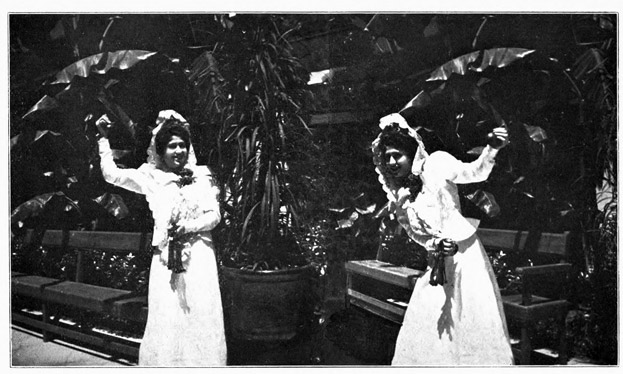
Dancing the Sevillana
Even in the ninth century such multitudes visited the
sepulchre that a society of hidalgos was formed to guard the
pilgrims from bandits along that savage route, serve them as
money-changers in Compostela, and in all possible ways protect
them from robbery and ill-usage. This brotherhood gave
birth to the famous Order of Santiago, whose two vows were
to defend the pilgrims and fight the Mussulmans. These
red-cross knights were as devout as they were valiant,
"lambs at the sound of the church-bells and lions at the call
of the trumpet." Kings and popes gave liberally to aid their
work. Roads were cut through Spain and France, even
Italy and Germany, "to Santiago." Forests were cleared,
morasses drained, bridges built, and rest-houses instituted, as
San Marcos at Leon and the celebrated hostelry of Roncesvalles.
Compostela had become a populous city, but a city
of inns, hospitals, and all variety of conventual and religious
establishments. Even to-day it can count nearly three hundred
altars. In the ninth century the modest church of
Alfonso II was replaced by an ornate edifice rich in treasures,
but in the gloomy tenth century, when Christian energies
were arrested by the dread expectation of the end of the
world, the Moors overran Galicia and laid the holy city
waste. The Moslem general, Almanzor, had meant to
shatter the urn of Santiago, but when he entered Compostela
with his triumphant troops, he found only one defender there,
an aged monk sitting silent on the Apostle's tomb. The
magnanimous Moor did not molest him, nor the ashes his
feebleness guarded better than strength, but took abundant
booty. When Almanzor marched to the south again, four
thousand Galician captives bore on their shoulders the treasures
of the Apostle, even the church-bells and sculptured
doors, to adorn the mosque of Cordova. The fresh courage
of the eleventh century began the great Romanesque cathedral
of Santiago. Donations poured in from all over Europe.
Pilgrims came bowed under the weight of marble and granite
blocks for the fabric. Young and old, men and women,
beggars and peasants, princes and prelates, had a hand in the
building, cutting short their prayers to mix mortar and hew
stone. Artists from far-off lands, who had come on pilgrimage,
lingered for years, often for lifetimes, in Compostela,
making beautiful the dwelling of the saint.
The great epoch of Santiago was the twelfth century, when
there succeeded to the bishopric the able and ambitious Diego
Gelmirez, who resolved that Compostela should be recognized
as the religious centre of Spain, and be joined with Jerusalem
and Rome in a trinity of the supreme shrines of Christendom.
He was a man of masterly resource, persistence, pluck. Not
too scrupulous for success, he found all means good that made
toward the accomplishment of his one splendid dream. The
clergy of Santiago, who had hitherto borne but dubious repute,
he subjected to instruction and to discipline, calling learned
priests from France to tutor them, and sending his own, as
they developed promise, to sojourn in foreign monasteries.
He zealously promoted the work on the cathedral, rearing
arches proud as his aspiration, and watch-towers strong as
his will. He invested the sacred ceremonies, especially the
ecclesiastical processions, with extraordinary pomp, so that
the figure of Alfonso VI, conqueror of Toledo, advancing
through the basilica in such a solemn progress, appeared less
imposing than the bishop himself, crowned with white mitre,
sceptred with ivory staff, and treading in his gold-embroidered
sandals upon the broad stones that pave the church as if on
an imperial palace floor. Gelmirez was indefatigable, too, in
building up the city. Eager to swell the flood of pilgrimage,
he founded in Compostela, already a cluster of shrines and
hostelries, still more churches, inns, asylums, hospitals, together
with convents, libraries, schools, and all other recognized
citadels of culture. He fought pestilence and dirt,
introducing an excellent water supply, and promoting, so far
as he knew how, decent and sanitary living. He was even
a patron of agriculture, bringing home from his foreign journeys,
which took him as far as Rome, packets of new seed
slipped in among parcels of jewels and no less precious budgets
of saintly molars and knuckle-bones. But these missions
abroad, having always for chief object the pressing of
his petition upon the Holy See, involved costly presents to
influential prelates, especially the red-capped cardinals. The
revenue for such bribes he wrung from the Galician peasantry,
who gave him a measure of hate with every measure of grain.
Gelmirez had so many uses for money that no wonder his
taxes cut down to the quick. The lavish offerings sent by
sea to the shrine of Santiago, ruby-crusted crucifixes of pure
gold, silver reliquaries sparkling with emeralds and jacinths,
pontifical vestments of richest tissue and of rarest artistry,
well-chased vessels of onyx, pearl, and jasper, all that constant
influx of glistening tribute from the length and breadth of
Christendom, had drawn Moorish pirates to the Galician waters.
To guard the treasure-ships, repel the infidels, and, incidentally,
return tit for tat by plundering their galleys, the warrior
bishop equipped a formidable fleet, and kept it on patrol off
the coast,—a strange development from the little fishing-boat
whence James and John trailed nets in the lake of Galilee.
The audacity of Gelmirez reached its height in his struggle
with the Queen Regent, Urraca of unlovely memory, for the
control of the child king, Alfonso VII. This boy was the
grandson of Alfonso VI, "Emperor of Spain," who survived
all his legitimate children except Urraca. The father of the
little Alfonso, Count Raymond of Burgundy, was dead, and
Urraca had taken a second husband, Alfonso the Battle-maker.
The situation was complicated. The Battle-maker wore the
crowns of Aragon and Navarre, Urraca was queen of Leon
and Castile, while the child, by his grandfather's will, inherited
the lordship of Galicia. The Bishop of Santiago, who
baptized the baby, had strenuously opposed Urraca's second
marriage. As that lady had, nevertheless, gone her own wilful
way, setting at naught the bishop's remonstrance and
inciting Galicia to revolt against his tyranny, Gelmirez had
kidnapped the royal child, a puzzled little majesty of four
summers, and solemnly crowned and anointed him before the
High Altar of St. James, declaring himself the protector of the
young sovereign. Urraca soon wearied of her Aragonese
bridegroom, and, casting him off, took up arms to defend her
territories against his invasion. The powerful bishop came
to her aid with men and money, but exacted in exchange an
oath of faithful friendship, which Urraca gave and broke and
gave again. Meanwhile the popular hatred swelled so high
against Gelmirez that an open insurrection, in which many
of his own clergy took part, drove him and the Queen to seek
refuge in one of the cathedral towers, while the rebels burned
and pillaged in the church below. The bishop barely escaped
with his life, fleeing in disguise from Compostela; but soon
the baffled conspirators saw him at his post again, punishing,
pardoning, rebuilding—as indomitable as St. James himself.
The election of Diego's friend, Calixtus II, to the papacy,
gave him his supreme opportunity. Money was the prime
requisite, and Gelmirez, not for the first nor second time,
borrowed of the Apostle, selling treasures from the sacristy.
The sums so raised were carried to the Pope, across the
bandit-peopled mountains, by a canon of Santiago masquerading
as a beggar, and by a trusty group of particularly ragged
pilgrims. This proof of ecclesiastical ripeness overcame all
papal scruples, and Calixtus, despite the clamor of enemies
and rivals, raised Santiago to the coveted archbishopric.
The first half of his great purpose effected, Gelmirez strove
with renewed energy to wrest from Toledo the primacy of
Spain. He fortified Galicia, hurled his fleet against Moorish
and English pirates, built himself an archiepiscopal palace
worthy of his hard-won dignities, stole from Portugal the
skeletons of four saints to enhance the potency of Santiago,
and made much of the skull of the Apostle James the Less,
which Urraca had presented in one of her fits of amity. But
this time the reverend robber was not destined to success.
The Archbishop of Toledo formed a powerful party against
him, Calixtus died, even the king, whom Gelmirez had armed
knight in the cathedral of Santiago and had crowned a second
time at Leon, grew restive under the dictation of his old tutor.
The smouldering hatred of Galicia again flamed out. The
aged archbishop once more had to see his church polluted, its
treasures plundered, its marvels of carved work, stained glass,
and gold-threaded vestments spoiled and wasted by that senseless
rabble which had twisted out from under his heavy foot.
Faint and bleeding from a wound in his head, too white a head,
for all its pride, to be battered with stones, Gelmirez had
almost fallen a victim to the mob, when two of his canons
snatched him back to the refuge of the High Altar, barring
the iron-latticed doors of the Capilla Major against those savage
sheep of his pasture. The outrage was so flagrant that, for very
shame, pope and king, though both had accepted the bribes of
his enemies, responded to his appeal, and assisted him to
resume that rigorous sway which lasted, all told, for something
like forty years.
Such was the man and such the process that made the
shrine of Santiago the third in rank of mediæval Christendom.
Under the rule of Gelmirez Compostela had become
one of the principal cities of the Peninsula, a seat of arts and
sciences where Spanish nobles were proud to build them
palaces and to educate their sons. The mighty influx of pilgrims,
which went on without abatement century after century,
nearly twenty-five hundred licenses being granted, in the single
year 1434, to cockle-hatted visitors from England alone, filled
the place with business. Inn-keepers, physicians, money-changers,
merchants were in flourishing estate, and a number
of special industries developed. One street was taken up by
booths for the sale of polished shells. Another bears still the
name of the jet-workers, whose rosaries, crucifixes, stars,
gourds, staffs, and amulets were in high demand. Souvenirs
of Santiago, little crosses delicately cut and chased, mimic
churches, towers, shrines gave employ to scores of artists in
silver and mother-of-pearl. The enormous revenue from the
sale of phials of healing oil and from the consecrated candles
must needs go to the Apostle, but the cunning craftsmen who
loaded their stalls with love-charms had a well-nigh equal
patronage.
The finished cathedral was consecrated in 1211, and in
1236 the royal saint, Fernando III, sent to Compostela a
train of Mohammedan captives, bringing back on their
shoulders the bells Almanzor had taken. These had been
hung, inverted, in the beautiful mosque of Cordova to serve
as lamps for the infidel worship, but at last St. James had his
own again. Thus Santiago trampled on the Moors, and his
ashes, or what had passed for his ashes, slept in peace, with
nothing to do but work miracles on blind and crippled
pilgrims, until, in 1589, an army of English heretics, led by
the horrible Drake, landed in Galicia. These Lutheran dogs
were not worthy of a miracle. The archbishop and his
canons, with the enemy hammering on the gates of Compostela,
hastily took up and reburied the three coffins of the
original shrine, so secretly that they could not be found again.
In 1879, however, a miscellany of brittle bits of bone was
brought to light by a party of determined seekers, and these
repulsive fragments, after scientific analysis conducted in an
ecclesiastical spirit, were declared to be portions of three
skeletons which might be ages old. Leo XIII clenched the
matter by "authenticating" one of them, apparently chosen
at random, as the body of Santiago. But although for us
of the perverse sects, the contents of that magnificent silver
casket, the centre of the Santiago faith, could arouse no thrill
of worship, the Pilgrim City itself and its storied, strange
cathedral were the most impressive sights of Spain.
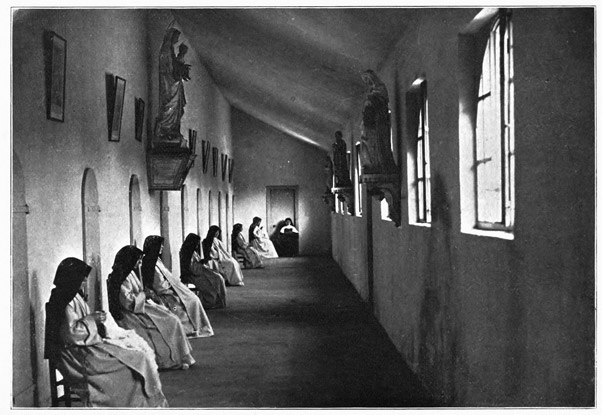
Within the Cloister
XXVI
THE SON OF THUNDER
"Thou shield of that faith which in Spain we revere,
Thou scourge of each foeman who dares to draw near,
Whom the Son of that God who the elements tames
Called child of the thunder, immortal Saint James."
—Hymn to Santiago, in George Borrow's translation.
Fatigues of the journey and discomforts of our
lodging melted from memory like shadows of the
night when we found ourselves, on the morning of
July twenty-fourth, before that rich, dark mass of fretted
granite, a majestic church standing solitary in the midst of
spreading plazas. These are surrounded by stately buildings,
the archiepiscopal palace with its memories of Gelmirez,
the royal hospital founded by Ferdinand and Isabella for
the succor of weary pilgrims, ancient colleges with sculptured
façades, marvellous old convents whose holy fathers were
long since driven out by royal decree into hungry, homesick
exile, and the columned city hall with its frontal relief of the
battle of Clavijo and its crowning statue of St. James. The
great, paved squares, the magnificent stairways and deeply
recessed portals were aglow with all Galicia. Peasants in
gala dress, bright as tropic birds, stood in deferential groups
about the pilgrims, for there were actual pilgrims on the
scene, men and women whose broad hats and round capes
were sewn over with scallop-shells, and whose long staffs
showed little gourds fastened to the upper end. They wore
rosaries and crucifixes in profusion, and their habit was spangled
with all manner of charms and amulets, especially the
tinsel medals with their favorite device of St. James riding
down the Moors. We bought at one of the stalls set up
before the doors for sale of holy wares a memento of the
famous old jet-work, a tiny black hand, warranted, if hung
about the neck, to cure disorders of the eyes. We fell to
chatting with a pilgrim who was shod in genuine sandal
shoon. A large gourd was tied to his belt, the rim of his
hat was turned up at one side and caught there with a rosy-tinted
shell, and his long, black ringlets fell loose upon his
shoulders, framing a romantic Dürer face. He talked with
us in German, saying that he was of Wittemberg, and once
a Lutheran, but had been converted to the true faith on a
previous visit to Spain. Since then he had footed his penitential
way to Jerusalem and other distant shrines. As his
simple speech ran on, we seemed to see the mountains round
about Santiago crossed by those converging streams of mediæval
pilgrims, all dropping on their knees at the first glimpse
of the cathedral towers. With that sight the fainting were
refreshed, the lame ran, and jubilant songs of praise to Santiago
rolled out in many languages upon the air.
"Primus ex apostolis,
Martir Jerusolinus,
Jacobus egregio,
Sacer est martirio."
In those Ages of Faith all the gates of the city were choked
with the incoming tide, the hostels and cure-houses overflowed,
and the broad plazas about the cathedral were filled with dense
throngs of pilgrims, massed nation by nation, flying their
national colors, singing their national hymns to the strangely
blended music of their national instruments, and watching for
the acolyte who summoned them, company by company, into
the august presence-chamber of St. James. His shrine they
approached only in posture of lowliest reverence. Even
now, at the end of the nineteenth century, our first glance, as
we entered the lofty, dim, and incense-perfumed nave, fell on
a woman-pilgrim dragging herself painfully on her knees up
the aisle toward the High Altar, and often falling prostrate to
kiss the pavement with groans and tears.
Mediæval pilgrims, when they had thus won their way to
the entrance of the Capilla Mayor, and there received three
light blows from a priestly rod in token of chastisement, were
granted the due indulgences and, in turn, laid their offerings
before the great white altar. Still there sits, in a niche above,
the thirteenth-century image of St. James, a colossal figure
wrought of red granite, with stiffly flowing vestments of elaborately
figured gilt. His left hand grasps a silver staff, with
gilded gourd atop, and his right, whose index finger points
downward to the burial vault, holds a scroll inscribed, "Hic
est corpus divi Jacobi Apostoli ac Hispaniarum Patroni."
Once he wore a broad-brimmed hat all of pure gold, but this
was melted down by Marshal Ney in the French invasion.
At that time the sacred vessels were heaped like market produce
into great ox-carts, until the cathedral had been plundered
of ten hundredweight of treasure. It was "the end of the
pilgrimage" to climb the steps behind this statue and kiss its
resplendent silver cape, studded with cockle-shells and besprinkled
with gems. But the pilgrims of the past had much
more to see and worship,—the jewelled crown of the Apostle
set upon the altar, his very hat and staff, the very axe that
beheaded him, and other relics to which the attention of the
modern tourist, at least, is not invited. Yet even we were
conducted to the Romanesque crypt beneath the High Altar,
where stands another altar of red marble, decorated by a
relief of two peacocks drinking from a cup. This altar is
surmounted by a bronze pedestal, which bears the sumptuous
ark-shaped casket with its enshrined handfuls of dubious dust.
Our latter-day pilgrims seemed well content with the measure
of wealth and sanctity which Moorish sack and English piracy,
French invasion and Carlist wars, had spared to the cathedral.
In the matter of general relics, nevertheless, Santiago suffers
by comparison with the neighbor cathedral of Oviedo, which
proudly shows a silver-plated old reliquary, believed by the
devout to have been brought in the earliest Christian times
from Rome. This chest contains, in addition to the usual
pieces of the true cross and thorns from the crown, such
remarkable mementos as St. Peter's leathern wallet, crumbs
left over from the Feeding of the Five Thousand, bits of
roast fish and honeycomb from Emmaus, bread from the
Last Supper, manna from the wilderness, a portion of Moses'
rod and the mantle of Elijah. Oviedo possesses, too, that
famous cross which the angels made for Alfonso II, and one
of the six water-jars of Cana. But the relic chapel of Santiago
makes up in quantity whatever it may lack in quality,
holding bones, garments, hair-tresses, and like memorials of a
veritable army of martyrs, even to what Ford disrespectfully
calls "sundry parcels of the eleven thousand Virgins." Special
stress is laid on a Calvary thorn which turns blood-red
every Good Friday, and a drop, forever fresh, of the Madonna's
milk. If pilgrims are not satisfied with these, they can walk
out to Los Angeles, an adjacent village, whose church was
built by the angels. Eccentric architects they were in choosing
to connect their edifice with the cathedral of Santiago by
an underground beam of pure gold, formerly one of the
rafters in God's own house.
We had speech of several pilgrims that first morning. One
was a middle-aged, sun-browned, stubby little man, whom
during the ensuing week we saw again and again in the cathedral,
but never begging, with the most of the pilgrims, at the
portals, nor taking his ease in the cloisters,—a social promenade
where the laity came to gossip and the clergy to puff
their cigarettes. This humble worshipper seemed to pass all
the days of the festival in enraptured adoration, on his knees
now before one shrine, now before another. We found him
first facing the supreme architectural feature of the cathedral,
that sublime and yet most lovely Portico de la Gloria. He
was gazing up at its paradise of sculptured saints and angels,
whose plumes and flowing robes still show traces of azure,
rose, and gold, with an expression of naive ecstasy. He told
us that he came from Astorga, and had been nine days on the
way. He spent most of his time upon the road, he added,
visiting especially the shrines of the Virgin. "Greatly it
pleases me to worship God," he said, with sparkling eyes, and
ran on eagerly, as long as we would listen, about the riches
and splendors of different cathedrals, and especially the robes
and jewels of the Virgen del Pilar. He seemed in his devout
affection to make her wealth his own. One of the most
touching effects of the scene was the childlike simplicity with
which the poor of Galicia, coming from such vile hovels, felt
themselves at home in the dwelling of their saint. Not even
their sins marred their sense of welcome. In the cloisters we
encountered an old woman in the pilgrim dress, her staff wound
with gay ribbons, limping from her long jaunt. She told us
frankly that she was "only a beggar" in her own village, and
had come for the outing as well as to please the priest, who,
objecting to certain misdemeanors which she had the discretion
not to specify, had prescribed this excursion as penance. She
was a lively old soul, and was amusing herself mightily with
the Goya tapestries, and others, that adorned the cloisters in
honor of the time. "You have a book and can read," she
said, "and you will understand it all, but what can I understand?
I can see that this is a queen, and she is very fine,
and that those are butchers who are killing a fat pig. But
we who are poor may understand little in this world except
the love of God." Others of the pilgrims were village folk
of Portugal, and, taken all together, these modern wearers of
the shell were but a sorry handful as representing those noble
multitudes who came, in ages past, to bow before the shrine.
The fourteen doors of the cathedral then stood open night
and day, and the grotesque lions leaning out over the lintels
could boast that there was no tongue of Europe which their
stone ears had not heard. Three open doors suffice in the
feast days now, but with the new flood of faith that has set
toward Lourdes, pilgrimages to Santiago, as to other Latin
shrines, are beginning to revive.
Mass was over at the late hour of our arrival, but nave and
aisles, transepts and cloisters, hummed with greetings of friends,
laughter of children, who sported unrebuked about those stately
columns, and the admiring exclamations of strangers. We
were often accosted in Spanish and in French and asked from
what country we came, and if we "loved the beautiful church
of the Apostle." When we were occasionally cornered, and
driven in truthfulness to say that we were Yankees, our more
intelligent interlocutors looked us over with roguish scrutiny,
but increased rather than abated their courtesies. As for the
peasants, their geography is safely limited. Noticing that our
Spanish differed from theirs, they said we must be from Castile,
or, at the most, from Portugal. At all events we were
strangers to Santiago, and they merrily vied with one another
in showing us about and giving us much graphic information
not to be found in guide-books.
Much of their lore appears to be of their own invention.
The superb Puerta de la Gloria, wrought by a then
famous architect sent from the king of Leon, but known
to us to-day only as Master Mateo, was the fruit of twenty
years' labor. This triple porch, which runs across the west
end of the nave, being finally completed, Master Mateo seems
to have symbolized the dedication of his service to the Apostle
in a kneeling statue of himself, facing the east, with back to
the richly sculptured pillar of the chief portal. The head of
this figure is worn almost as round and expressionless as a
stone ball by the caresses of generations of childish hands.
The little girls whom we watched that morning as they patted
and smoothed the much-enduring pate told us, kissing the
marble eyes, that this was a statue of St. Lucia, which it
certainly is not. In another moment these restless midgets
were assaulting, with fluent phrases of insult, the carven
faces of certain fantastic images which form the bases of the
clustered columns. The children derisively thrust their feet
down the yawning throats, kicked the grotesque ears and
noses, and in general so maltreated their Gothic victims that
we were moved to remonstrate.
"But why should you abuse them? What are these creatures,
to be punished so?"
"They are Jews," hissed our little Christians with an
emphasis that threw new light on the Dreyfus affaire. But
an instant more, and these vivacious, capricious bits of Spanish
womanhood were all absorbed in aiding a blind old peasant
who had groped her way to the sacred Portico for its especial
privilege of prayer. The central shaft, dividing into two the
chief of the three doorways, represents the Tree of Jesse, the
patriarchal figures half-enveloped in exquisitely sculptured
foliage. The chiselled capital shows the Trinity, Dove and
Son and Father, with adoring angels. Above sits a benignant
St. James, whose throne is guarded by lions, and over all, in
the central tympanum of the sublime doorway, is a colossal
figure of our Lord, uplifting His wounded hands. About
Him are grouped the four Evangelists, radiant with eternal
youth, and eight angels bearing the instruments of the Passion,
the pillar of the scourging, whips, the crown of thorns, the
nails, the scroll, the sponge, the spear, the cross. Other
angels burn incense before Him, and the archivolt above is
wrought with an ecstatic multitude of elders, martyrs, and
saints, so vivid after all these centuries that one can almost
hear the blithe music of their harps. It is the Christ of Paradise,
enthroned amid the blest, to whom His presence gives
fulness of joy forevermore. Above the lesser doors on either
side are figured Purgatory and Hell. The fresh and glowing
beauty, so piquant and yet so spiritual, the truly celestial
charm of this marvellous Portico which Street did not fear to
call "one of the greatest glories of Christian art," was never,
during this festal week, without its throng of reverent beholders,
the most waiting their turn, like our old blind peasant,
to fit thumb and finger into certain curious little hollows
on the central shaft, and thus offer prayer which was sure of
answer. Minute after minute for unbroken hours, the hands
succeeded one another there,—old, knotted, toilworn hands,
the small, brown hands of children, jewelled hands of delicate
ladies, and often, as now, the groping hand of blindness, with
childish fingers helping it to find those mystical depressions in
the agate. Some of the bystanders told us that St. James had
descended from his seat above the capital, and laid his hand
against the column, leaving these traces, but more would have
it that the Christ Himself had come down by night from the
great tympanum to place His wounded hand upon the shaft.
Street records that he observed several such petitioners, after
removing the hand, spit into the mouths of the winged dragons
that serve as base to the pillar; but that literally dare-devil
form of amen must now have gone out of fashion, for we did
not see it once.
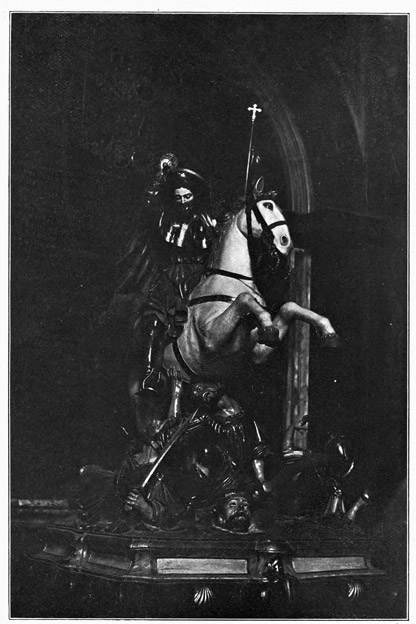
The Trampler of the Moors
Toward noon we strolled out into the grand plaza before
the west façade and found it a multitudinous jam of expectant
merrymakers. Even nuns were peeping down from a leaf-veiled
balcony. We seemed to have been precipitated out of
the Middle Ages into an exaggerated Fourth of July. All the
city bells were pealing, rockets and Roman candles were sputtering,
and grotesque fire-balloons, let off from a parapet of the
cathedral, flourished bandy legs and "Sagasta noses" in the
resigned old faces of the carven images. And then, amid
the acclamations of all the small boys in the square, sallied
forth the Santiago giants. These wickerwork monsters,
eight all told, are supposed to represent worshippers from
foreign lands. They go by couples, two being conventional
pilgrims with "cockle-shell and sandal shoon"; two apparently
Moors, with black complexions, feather crowns, and
much barbaric finery; two nondescripts, possibly the French
of feudal date; and two, the leaders and prime favorites,
regular Punch caricatures of modern English tourists. John
Bull is a stout old gentleman with gray side-whiskers, a vast
expanse of broadcloth back, and a single eye-glass secured by
a lavender ribbon. The British Matron, in a smart Dolly
Varden frock, glares with a shocked expression from under
flaxen puffs and an ostrich-feathered hat. The popular attitude
of mind toward these absurdities is past all finding out.
Not the children alone, but the entire assemblage greeted them
with affectionate hilarity. The giants, propelled by men who
walked inside them and grinned out on the world from a slit
in the enormous waistbands, trundled about the square, followed
by the antics of a rival group of dwarfs from the city
hall, and then made the round of the principal streets, executing
clumsy gambols before the public buildings.
On the morning after, July twenty-fifth, the great day
of the feast, anniversary of the Apostle's martyrdom, these
same overgrown dolls played a prominent part in the solemn
cathedral service. The Chapter passed in stately progress to
the archbishop's palace to fetch his Eminence, and later to
the ancient portals where the silver-workers once displayed
their wares, to greet the Royal Delegate. At their head
strutted this absurd array of giants. The High Mass was
superb with orchestral music and the most sumptuous robes
of the vestiary. The "King of Censers," the splendid botafumeiro
of fourteenth-century date, made so large, six feet high,
with the view of purifying the cathedral air vitiated by the
hordes of pilgrims who were wont to pass the night sleeping
and praying on the holy pavements, flashed its majestic curves,
a mighty fire bird, from roof to floor and from transept to transept.
It is swung from the ceiling by an ingenious iron
mechanism, and the leaping, roaring flames, as the huge censer
sweeps with ever augmenting speed from vault to vault,
tracing its path by a chain of perfumed wreaths, make the
spectacle uniquely beautiful. Knights of Santiago, their
white raiment marked by crimson sword and dagger, received
from the Royal Delegate "a thousand crowns of gold," the
annual state donation, instituted by Rameiro, to the patron
saint. The Delegate, kneeling before the image of Santiago,
prayed fervently that the Apostle would accept this offering
of the regent, a queen no less devout than the famous mother
of San Fernando, and would raise up Alfonso XIII to be
another Fernando, winning back for Spain her ocean isles
which the heretics had wrested away, even as Fernando restored
to Compostela the cathedral doors and bell which the
infidel Moors had stolen. His Eminence, who is said to
have accumulated a fortune during his previous archbishopric
in Cuba, in turn besought St. James to protect Catholic
Spain against "those who invoke no right save brute force,
and adore no deity except the golden calf." In most magnificent
procession the silver casket was borne around the
nave among the kneeling multitudes. And then, to crown
these august ceremonies, forth trotted our friends, the giants,
into the open space before the Capilla Mayor. Here the six
subordinate boobies paused, grouping themselves in a ludicrous
semicircle, while pompous John Bull and his ever scandalized
British Matron went up into the Holy of Holies and
danced, to the music of guitars and tambourines, in front of the
High Altar.
Every day of that festal week the cathedral services were
attended by devout throngs, yet there was something blithe
and social, well-nigh domestic, in the atmosphere of the scene
even at the most impressive moments. Kneeling groups of
peasant women caught the sunshine on their orange kerchiefs
and scarlet-broidered shawls. Here a praying father would
gather his little boy, sobbing with weariness, up against his
breast; there a tired pilgrim woman slumbered in a corner,
her broad hat with its cockle-shells lying on her knees. Rows
of kneeling figures waited at the wooden confessionals which
were thick set along both aisles and ambulatory. Several
times we saw a priest asleep in the confessional, those who
would pour out their hearts to him kneeling on in humble
patience, not venturing to arouse the holy father. Young
officers, leaning against the pillars, smiled upon a school of
Spanish girls, who, guarded by veiled nuns, knelt far along
the transept. Pilgrims, standing outside the door to gather
alms, vied with one another in stories of their travels and the
marvels they had seen.
But at night, walking in the illuminated alameda, where
thousands of Japanese lanterns and colored cups of flame
made a fantastic fairyland, or dancing their country dances,
singing their country songs, practising their country sports,
and gazing with tireless delight at the fireworks in the
spacious Plaza de Alfonso Doce, the worshippers gave themselves
up to frankest merriment. Through the days, indeed,
there was never any lack of noisy jollity. From dawn to
dawn again cannon were booming, drums beating, bagpipes
skirling, tambourines clattering, songs and cries resounding
through the streets. Four patients in the hospital died the year
before, we were told, from the direct effects of this continuous
uproar. But the thunder height of the fiesta is attained toward
midnight on the twenty-fourth, the "Eve of Santiago," when
rockets and fire-balloons are supplemented by such elaborate
devices as the burning of "capricious trees" and the destruction
of a Moorish façade built for the occasion out from the
west front of the cathedral. At the first ignition of the
powder there come such terrific crashes and reverberating
detonations, such leaps and bursts of flame, that the peasant
host sways back and the children scream. An Arabic doorway
with ornate columns, flanked on either side by a wall of
many arches and surmounted by a blood-red cross, dazzles
out into overwhelming brilliancy, all in greens and purples,
a glowing, scintillating, ever changing vision. Soon it is
lustrous white and then, in perishing, sends up a swift succession
of giant rockets. The façade itself is a very Alhambra
of fret and arabesque. This, too, with thunder bursts
reveals itself as a flame-colored, sky-colored, sea-colored
miracle, which pales to gleaming silver and, while we read
above it the resplendent words "The Patron of Spain," is
blown to atoms as a symbol of Santiago's victory over the
Moors. This makes an ideal Spanish holiday, but the cost,
borne by the city, is heavy, there is distinct and increasing
injury to the cathedral fabric, and all this jubilee for archaic
victories over the Moslem seems to be mocked by the hard
facts of to-day.
The Santiago festivities, of which the half has not been
told, closed on Thursday afternoon, July twenty-seventh, with
a procession through the streets. We waited a weary while
for it before the doors where the old jet-workers used to set
their booths, amusing ourselves meantime by watching the
house maids drawing water from the fountain in the square
below. These sturdy Galicians were armed with long tin
tubes which they dextrously applied to the spouting mouths
of the fountain griffins, so directing the stream into the
straight, iron-bound pails. Not far away the market women
covered the flags with red and golden fruit. A saucy beggar-wench,
with the blackest eyes in Spain, demanded alms, and
when we had yielded up the usual toll of coppers, loudly
prayed to Santiago to pardon us for not having given her
more on this his holy festival. At last out sallied the band,
followed by those inevitable giants, and amid mad ringing of
bells and fizzing of invisible rockets, forth from the venerable
portals issued standards, crosses, tapers, priests in white and
gold, and platformed effigies of pilgrims, saints, and deities.
Then came bishops, cardinals, and archbishop, ranks of
military bearing tapers, the alcalde and his associates in the
city government with antique escort of bedizened mace-bearers,
a sparkling statue of St. James on horseback busily
beheading his legions of Moors, a bodyguard of all the
pilgrims in attendance on his saintship, and finally the Virgen del Pilar,
at whose passing all the concourse fell upon their
knees. Churches in the line of march had their own images
decked and ready, waiting in the colonnaded porches to fall
into the procession. The market women and the maids at
the fountain threw kisses to the Christ Child, leaning in blue
silk frock and white lace tucker against a cross of roses, but
the boys waved their caps for St. Michael, debonair that
he was with blowing crimson robe, real feather wings fluttering
in the breeze, and his gold foot set on the greenest of
dragons.
The procession came home by way of the great west doors,
opened only this once in the round year. The setting sun,
bringing out all the carven beauty of that dark gray façade,
glittered on the golden balls and crosses that tip the noble
towers, and on the golden staff of St. James and the golden
quill of St. John, where the two sons of thunder stand colossal
in their lofty niches. A baby, in yellow kerchief and cherry
skirt, toddling alone across the centre of the square, pointed
with adoring little hand at the mounted image of Santiago,
which halted at the foot of the grand stairway, his lifted sword
a line of golden light, while the deep-voiced choir chanted his
old triumphal hymn. John Bull and the British Matron,
stationing themselves on either side as a guard of honor, stared
at him with insular contempt. As the chant ceased, St. James
chivalrously made way for the Virgen del Pilar, a slender figure
of pure gold poised on an azure tabernacle, to mount the steps
before him. The bells pealed out to welcome her as she
neared the portals, and an ear-splitting explosion of a monster
rocket, with a tempest-rain of sparks, announced the instant
of her entrance beneath the chiselled arch. Behind her went
the penitents, arduously climbing the long stone flights of that
quadruple stairway upon their knees. These, too, were but
shadows of those mediæval penitents who of old staggered
after this procession, bowed under the weight of crosses, or
scourging themselves until they fainted in their own trail of
blood. Yet it is still strange and touching to see, long after
the inner spaces of the cathedral are dim with evening, those
kneeling figures making their painful progress about aisles and
ambulatory, sobbing as they go, and falling forward on their
faces to kiss the pavement that is bruising them.
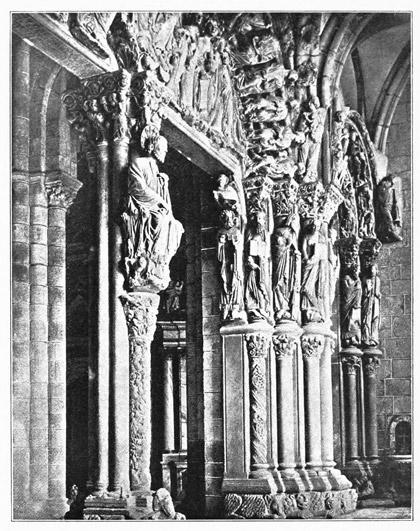
Santiago Cathedral
XXVII
VIGO AND AWAY
Hasta la Vista!
Our plan for the summer included a return trip
across Spain, via Valladolid, Salamanca, and Saragossa
to Barcelona and the Balearic Isles; but the
bad food and worse lodging of Galicia, the blazing heat and
the incessant, exhausting warfare against vermin, had begun to
tell. That Spanish fever with which so many foreigners make
too intimate acquaintance was at our doors, and we found ourselves
forced at last to sacrifice enthusiasm to hygiene. The
most eccentric train which it was ever my fortune to encounter
shunted and switched us across country to Vigo in
about the time it would have taken to make the journey donkeyback.
Here we tarried for a week or so, gathering strength
from the Atlantic breezes, and when, one sunny August day,
a stately steamboat called for an hour at Vigo harbor on her
way from Buenos Ayres to Southampton, we went up over the
side. Our shock of astonishment at the cleanliness around us
could not, however, divert our attention long from the receding
shores of Spain, toward which one of us, at least, still felt a
stubborn longing.
They lay bright in the midday sunshine, those green uplands
of Galicia, mysterious with that patient peasant life of
which we had caught fleeting, baffling glimpses. Still we
seemed to see the brown-legged women washing in the brook
and spreading their coarse-spun, gay-bordered garments on
the heather; children, with the faces of little Pats and little
Biddies, tugging a bleating sheep across the stepping-stones,
or boosting an indignant goat over the wall; lean pigs
poking their noses out of the low, stone doorways, where
babies slept on wisps of hay; girls in cream-colored kerchiefs,
starred with gold, bearing loads of fragrant brush or
corded fagots on their heads. As the evening should come
on, and the sea-breeze stir the tassels of the maize, we knew
how the fields would be dotted with impromptu groups of
dancers, leaping higher and higher and waving their arms in
ever wilder merriment,—a scene pastoral down to the pigs,
and poetic up to those gushes of song that delight the listener.
"I went to the meadow
Day after day,
To gather the blossoms
Of April and May,
And there was Mercedes,
Always there,
Sweetest white lily
That breathes the air."
"North-wind, North-wind,
Strong as wine!
Blow thou, North-wind,
Comrade mine!"
"The Virgin is spreading handkerchiefs
On the rosemary to dry.
The little birds are singing,
And the brook is running by.
"The Virgin washes handkerchiefs,
And spreads them in the sun,
But St. Joseph, out of mischief,
Has stolen every one."
It was only now and then that we had realized a touch of
genuine fellowship with these Galician peasants. I remember
a little thirteenth-century church, gray crosses topping its low
gray towers, one of which was broken off as if a giant hand
had snapped it. In the porch a white-headed woman, in a
gold-edged blue kerchief and poppy-red skirt, was holding a
dame-school. It took her all the morning session, she told
us, to get the fifty faces washed, but in the afternoon the
children learned to read and knit and play the choral games.
She had ten cents a month for every child, when the parents
were able to pay. From a convenient hollow in a pillar of
Arabic tradition she proudly drew her library,—a shabby
primer and a few loose leaves of a book of devotion. As
we talked, the midgets grew so restless and inquisitive that
she shook her long rod at them with a mighty show of fierceness,
and shooed them out of the porch like so many chickens.
Then she went on eagerly with the story of her life, telling
how she was married at fifteen, how her husband went "to
serve the king" in the second Carlist war, and never came
back, and how her only daughter had borne nine children, of
whom eight died in babyhood, "angelitos al cielo," having
known on earth "only the day and the night." The last
and youngest had been very ill with the fever, and the afflicted
grandmother had promised that noble Roman maiden, the
martyr saint of the little gray church, to go around the edifice
seven times upon her knees, if only the child might live. The
vow had been heard, as the presence of a thin-faced, wistful
tot by the old woman's side attested, but so far only three of
the seven circuits had been made. "It tires the knees much."
But even with the words she knelt again, kissing the sacred
threshold, and began the painful, heavy, shuffling journey
around the church, while the baby, with wondering gray eyes,
trotted beside her, clinging to the wrinkled hand. When at
last, with puffs and groanings, the old dame had reached the
carven doorway again, she rose wearily, rubbing her knees.
"A sweet saint!" she said, "but ay de mi! such gravel!"
We ought, of course, to have been impressed in Galicia
with its debasing ignorance and superstition, and so, to a certain
extent, we were. We went to see a romeria, a pilgrimage
to a hilltop shrine, on one of our last afternoons in Vigo,
and found a double line of dirty, impudent beggars, stripped
half naked, and displaying every sort of hideous deformity,—a
line that reached all the way from the carriage-road
up the rugged ascent to the crest. We had to run the gantlet,
and it was like traversing a demoniac sculpture-gallery
made up of human mockeries. We had to push our way,
moreover, through scene after scene of vulgar barter in things
divine, and when at last the summit was achieved, the shrine
of the Virgin seemed robbed of its glory by the ugliness,
vice, and misery it overlooked. Spain is mediæval, and the
modern age can teach her much. But with all her physical
foulness and mental folly, there still dwells in her that mediæval
grace for which happier countries may be searched in vain.
Yet Spain is far from unhappy. It is beautiful to see out
of what scant allowance of that which we call well-being, may
be evolved wisdom and joy, poetry and religion. Wearied as
we two bookish travellers were with lectures and libraries, we
rejoiced in this wild Galician lore that lives on the lips of the
people. The written Spanish literature, like other Spanish
arts, is of the richest, nor are its laurels limited to the dates
of Cervantes and Calderon. The modern Spanish novel, for
instance, as Mr. Howells so generously insists, all but leads
the line. But Spain herself is poetry. What does one want
of books in presence of her storied, haunted vistas,—warrior-trod
Asturian crags, opalescent reaches of Castilian plain,
orange-scented gardens of Andalusia? A circle of cultivated
Spaniards is one of the most charming groups on earth, but
Spaniards altogether innocent of formal education may be
walking anthologies of old ballads, spicy quatrains, riddles,
proverbs, fables, epigrams. The peasant quotes "Don Quixote"
without knowing it; the donkey-boy is as lyric as
Romeo; the devout shepherd tells a legend of the Madonna
that is half the dream of his own lonely days among the hills.
Where Spanish life is most stripped of material prosperity, it
seems most to abound in suggestions of romance. This despised
Galicia, the province of simpletons, is literary in its
own way. The hovel has no bookshelf, but the children's
ears drink in the grandmother's croon:—
"On a morning of St. John
Fell a sailor into the sea.
'What wilt thou give me, sailor, sailor,
If I rescue thee?'
"'I will give thee all my ships,
All my silver, every gem,
All my gold,—yea, wife and daughters,
I will give thee them.'
"'What care I for masted ships,
What care I for gold or gem?
Keep thy wife and keep thy daughters,
What care I for them?
"'On the morning of St. John
Thou art drowning in the sea.
Promise me thy soul at dying,
And I'll rescue thee.'
"'I commend the sea to God,
And my body to the sea,
And my soul, Sweet Mother Mary,
I commit to thee.'"
And well it was for this bold mariner that he did not take
up the Devil's offer, for everybody knows that those who have
signed away their souls to the Devil turn black in the moment
of dying, and are borne, black and horrible, to the sepulchre.
In this northwestern corner of Spain are many mountain-songs
as well as sea-songs. One of the sweetest tells how
the blue-robed Virgin met a young shepherdess upon the hills
and was so pleased with the maiden's courtesy that she straightway
bore her thence to Paradise, not forgetting, this tender
Mary of Bethlehem, to lead the flock safely back to the
sheepfold. The love of the Galician peasantry for "Our
Lady" blends childlike familiarity with impassioned devotion.
"As I was telling my beads,
While the dawn was red,
The Virgin came to greet me
With her arms outspread."
Her rank in their affections is well suggested by another of
the popular coplas.
"In the porch of Bethlehem,
Sun, Moon, and Star,
The Virgin, St. Joseph,
And the Christ Child are."
With their saints these Spanish peasants seem almost on a
household footing, not afraid of a jest because so sure of the
love that underlies it.
"St. John and Mary Magdalen
Played hide and seek, the pair,
Till St. John threw a shoe at her,
Because she didn't play fair."
Yet there is no lack of fear in this rustic religion. There
is many a "shalt not" in the Galician decalogue. One must
not try to count the stars, lest he come to have as many wrinkles
as the number of stars he has counted. Never rock an
empty cradle, for the next baby who sleeps in it will die. So
often as you name the Devil in life, so often will he appear to
you in the hour of death. If you hear another name him,
call quickly, before the Devil has time to arrive, "Jesus is
here." It is ill to dance alone, casting your shadow on the
wall, because that is dancing with the Devil. But the Prince
of Darkness is not the only supernatural being whom Galicians
dread. There is a bleating demon who makes fun of
them, cloudy giants who stir up thunderstorms, and are
afraid only of St. Barbara, witches who cast the evil eye,
but most of all the "souls in pain." For oftentimes the dead
come back to earth for their purgatorial penance. You must
never slam a door, nor close a window roughly, nor kick the
smallest pebble from your path, because in door or stone or
window may be a suffering soul. To see one is to die within
the year. If you would not be haunted by your dead, kiss the
shoes which the body wears to the burial.
It is well to go early to bed, for at midnight all manner
of evil beings prowl up and down the streets. Who has
not heard of that unlucky woman, who, after spinning
late and long, stepped to the window for a breath of air
exactly at twelve o'clock? Far off across the open country
she saw a strange procession of shining candles drawing
nearer and nearer, although there were no hands to hold
them and no sound of holy song. Straight toward her house
came those uncanny lights, moving silently through the
meadow mists, and halted beneath her window. Then the
foremost one of all begged her to take it in and keep it carefully
until the midnight following. Scarcely knowing what
she did, she closed her fingers on the cold wax and, blowing
out the flame, laid away the taper in a trunk, but when, at
daybreak, after a sleepless night, she raised the lid, before her
lay a corpse. Aghast, she fled to the priest, who lent her all
the relics of the sacristy; but their united power only just
availed to save her from the fury of the spirits when they
returned at midnight to claim the taper, expecting, moreover,
to seize upon the woman and "turn her to fire and ashes."
Sometimes a poor soul is permitted to condense the slow ages
of Purgatory into one hour of uttermost torment. Galicians
tell how a young priest brought his serving-maid to sorrow
and how, to escape the latter burning, she shut herself, one
day when the priest was engaged in the ceremonial of High
Mass, into the red-hot oven. On his return, he called her
name and sought her high and low, and when, at last, he
opened the oven door, out flew a white dove that soared, a
purified and pardoned soul, into the blue of heaven. The
science of this simple folk is not divorced from poetry and
religion. The rainbow drinks, they say, in the sea and in the
rivers. The Milky Way, the Road to Santiago, is trodden
every night by pale, dim multitudes who failed to make that
blessed pilgrimage, from which no one of us will be excused,
in time of life. When the dust stirs in an empty house, good
St. Ana is sweeping there. When babies look upward and
laugh, they see the cherubs at play. Tuesday is the unlucky
day in Spain, whereas children born on Friday receive the gift
of second-sight, and those who enter the world on Good
Friday are marked by a cross in the roof of the mouth and
have the holy touch that cures diseases. It is a fortunate
house beneath whose eaves the swallow builds,
"For swallows on Mount Calvary
Plucked tenderly away
From the brows of Christ two thousand thorns,
Such gracious birds are they."
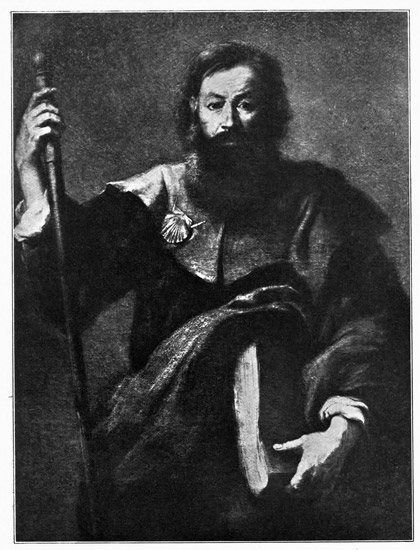
St. James
The Galicians, butt of all Spain for their dulness, are shrewd
enough in fact. It is said that those arrant knaves, the gypsies,
dare not pass through Galicia for fear of being cheated.
Like other unlettered peasants, Gallegos whet their wits on
rhyming riddles.
"Who is the little pigeon,
Black and white together,
That speaks so well without a tongue
And flies without a feather?"
"A tree with twelve boughs and four nests on a bough,
In each nest seven birdlings,—unriddle me now."
In many of their proverbial sayings one gets the Spanish
tang at its best. "A well-filled stomach praises God."
"Why to Castile
For your fortune go?
A man's Castile
Is under his hoe."
And I fear if my comrade were to speak, in Spanish phrase,
of our return to Galicia, she would bid St. James expect us
"on Judgment Day in the afternoon."
Works by Alice Morse Earle
CHILD LIFE IN COLONIAL DAYS
Profusely Illustrated
Crown 8vo. Cloth. Gilt top. $2.50
Commercial Advertiser:
"Once more Mrs. Earle has drawn on her apparently inexhaustible store
of colonial lore, and has produced another interesting book of the olden
days.... Mrs. Earle's interesting style, the accuracy of her statements,
and the attractive illustrations she always supplies for her books make the
volume one to be highly prized."
Buffalo Express:
"Mrs. Alice Morse Earle performs a real historical service, and writes an
interesting book. It is not a compilation from, or condensation of, previous
books, but the fruit of personal and original investigation into the
conditions of life in the American colonies."
HOME LIFE IN COLONIAL DAYS
Education:
"Mrs. Earle has made a very careful study of the details of domestic life
from the earliest days of the settlement of the country. The book is
sumptuously illustrated, and every famed article, such as the spinning-wheel,
the foot-stone, the brass knocker on the door, and the old-time
cider mill, is here presented to the eye, and faithfully pictured in words.
The volume is a fascinating one, and the vast army of admirers and students
of the olden days will be grateful to the author for gathering together
and putting into permanent form so much accurate information concerning
the homes of our ancestors."
Literature:
"Mrs. Earle's fidelity in study and her patient research are evident on
every page of this charming book, and her pleasantly colloquial style is
frequently assisted by very beautiful illustrations, both of the houses of the
colonists, from the primitive cave dug out of the hillside and made to
answer for warmth and shelter, to the more comfortable log cabin, the
farmstead with its adjacent buildings, and the stately mansion abiding to
our own day."
THE MACMILLAN COMPANY
66 FIFTH AVENUE NEW YORK
AMONG ENGLISH HEDGEROWS
By CLIFTON JOHNSON
With an Introduction by HAMILTON W. MABIE
Illustrated. Cr. 8vo. Cloth extra. Gilt top. $2.25
"'Among English Hedgerows' is one of the most beautiful of illustrated
books, containing, as it does, a great number of half-tone reproductions
of Mr. Johnson's admirable photographs.
"The author, as far as possible, lived the life of the people who figure in
these pages, and we have delightful accounts of village characters, and
glimpses of quaint old English homes.
"Hamilton W. Mabie, who furnishes the introduction, well summarizes
Mr. Johnson's merits as 'a friendly eye, a hearty sympathy, and a very
intelligent camera, and that love of his field and of his subject which is
the prime characteristic of the successful painter of rural life and country
folk.'"—Illustrated Buffalo Express.
ALONG FRENCH BYWAYS
By CLIFTON JOHNSON
Illustrated. Cr. 8vo. Cloth extra. Gilt top. $2.25
"A book of leisurely strolling through one of the most picturesque
countries of Europe, enlivened with description and anecdote, and profusely
illustrated.... Mr. Johnson is not only a delightful writer, but is
one of the best landscape photographers of whom we have knowledge."—Boston
Transcript.
"This book shares the merits of Mr. Johnson's 'Among English Hedgerows':
simplicity of theme and treatment, sympathy and love of nature."—The
Mail and Express.
"A book of strolling, a book of nature, a book of humble peasant life
intermingled with the chance experiences of the narrator."—The Worcester
Spy.
THE MACMILLAN COMPANY
66 FIFTH AVENUE, NEW YORK