In our travels throughout the very extensive and
varied regions dealt with in these pages, we shall
have remarked certain outstanding features of life
characteristic in perhaps peculiar degree of the
Latin American civilization. The marked division
of the classes into which the social life of the
Republics falls, the system of government, the distinctive
architecture, civil and ecclesiastical, the
peculiar mining industry—sui generis; the roads—or
absence of such—and the special atmosphere
surrounding travel in the wilds, the undeveloped
condition of enormous areas of territory and their
lack of population, the absence of manufacturing
industry and predominance of rural occupations,
the relations with foreigners, and the relations—or
lack of such—of an inter-American nature; whilst
there has always been before the observer interested
in the sociological development of the world,
the problems of the future here.
Despite eccentricities of character and difficulties
of environment, we shall remark that Spanish
American government and other institutions are,
in general, laid down upon excellent lines, and in
the future may be expected to develop in their
own way.
As to government, the constitutions—written
constitutions—of these States might be described
almost as counsels of perfection. Theoretically
they provide for all contingencies, and, were they
followed, little would be amiss. Unfortunately the
temperament of the Latin American people often
is, that the individual will lay down the most
excellent laws for the community, but apparently
reserving for himself the right to contravene them,
as far as he is concerned, if occasion so demand.
Herein is the difficulty of self-government under
the Iberian temperament.
The constitutions of the Republics are generally
modelled upon that of the United States; but
there is a slight difference between the associations
of the various provinces or departments in some
cases. Thus the Federal Republic Model, under
which the provinces enjoy a species of home
rule, has been adopted by Brazil, Mexico and
Venezuela, whilst the remainder have what is
termed the centralized form, the supreme head
being the capital, with prefects set over the
provinces.
The governing powers embody the executive,
the legislative and the judicial; the president and
his cabinet, national congress of two chambers,
and a supreme tribunal. Ministers with portfolios
are generally those of Foreign Affairs, Finance,
Agriculture, Industry and Commerce, Communications
and Public Works, War and Marine, to
which is frequently added a Ministro de Fomento,
after the Spanish model, a department which concerns
itself with the development of new industries
and means of transport, land concessions, and so
forth, the word meaning "encouragement" or
"fostering."
A considerable bureaucracy naturally exists
under this regimen, and there is a strong tendency
among the educated folk to seek Government employ.
On the whole, however, the system of
government, with its ramifications, must be
regarded as efficient and competent, and the
machinery works smoothly. It is not necessarily
thrown out of gear altogether by the sudden revolution
or golpe de estado, which so frequently
occurs, unless this be more than ordinarily severe.
But the caudillo, the political leader or "boss"
(to use an American equivalent) is often a corrupting
and disturbing element.
With regard to the religious system, the regimen
and machinery of the Romish Church is, too, well
organized, from arch-bishop down to village cura
or priest. But the education and character of
this last often leaves a good deal to be
desired.
As with government, so is it with education in
the Latin American countries. The theory is excellent,
and education is everywhere extolled, but
in practice the proportion of literates, indeed of
folk who can but read and write alone, is exceedingly
small, amounting perhaps to ten or fifteen
per cent. of the population, rising to fifty per cent.
in the most advanced land, Argentina. Education
is everywhere free and compulsory, and the Latin
American youth can reach the universities with
little cost.
The conditions of civic life in Spanish American
lands are often pleasing in some essentials, and
students of sociology and economics might well
find matters of utility here. It might not be an
exaggeration to say that there is more public spirit,
of a kind, in a small Spanish American town than
in its English or United States equivalent. More
interest is taken in local government; there is
more discussion in local matters. The inhabitant,
if he has any grade of education and knowledge,
thinks it natural to assert his opinion as a unit of
his habitat, and public opinion is a strong factor.
It is a good augury for the future.
Indeed, in the connection, it is to be noted that
Spanish American people—even in circles where
it would be supposed that such matters would be
beyond their ken—think much and talk profoundly
on questions of government, polity, economics and
so forth. They display a wider range of intelligence
than—for example—the lower middle-class
English folk in such matters.
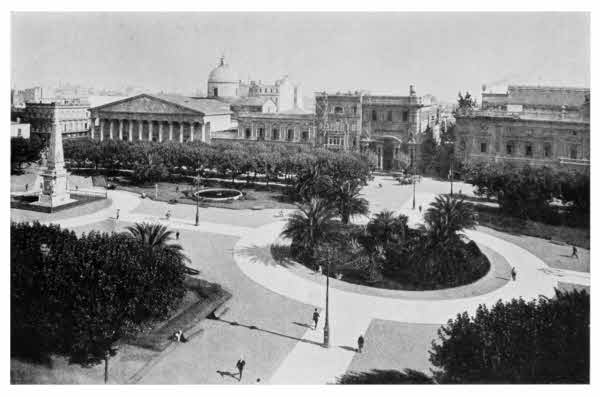
Useful and pleasing features in civic life are to
be found in the general "town-planning" of the
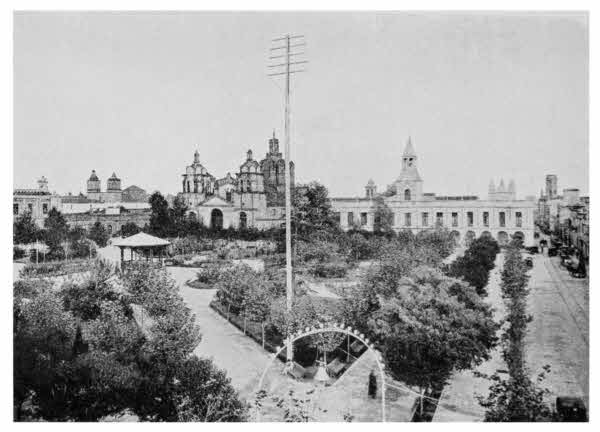
Latin American town or village. The Spaniards
inaugurated the general plan of a central plaza or
square, with streets radiating therefrom, and cross
streets—the well-known "chequer board" style.
It is quite possible to overdo this system, or to
adhere too rigidly thereto. But the central plaza,
with the church and municipal buildings, chief
shops and so forth around it, is a convenient
arrangement, whilst the institution of the serenata
or open-air concert here, on Sunday afternoon
and during week-day evenings, brings the people
together and creates a pleasing atmosphere, and
is, in fact, a social amenity of value. The plaza
is the pulse of the locality.
It is, of course, to be recollected that the climate
generally permits such amenities. Also, as the
roads cease on the outskirts of the place, there is
really nowhere else for the inhabitants to take exercise
on foot. We should not like to sacrifice our
typical English village, with its High Street and
church on the hill, to this more stereotyped plan,
but the amenities of the plaza might be much
more widely copied. It has its nucleus in the
village green, but the social atmosphere is
lacking in this last.
The traveller in the cities and towns of Spanish
America finds himself, often without knowing or
analysing the cause, in an atmosphere quaint, restful
and pleasing. He seems transplanted to an
old-world or semi-mediaeval environment, as of
some more ancient or remote place of European
lands where the vulgarizing hand of the commercial
age is as yet unknown. Looking around and
above him he finds the sensation is imparted by
the buildings, the façades of the streets, the
churches and the general disposition architecturally
of the place. It is the atmosphere and influence
of the old Spanish Colonial architecture.
Notwithstanding the very considerable extent
and interest of this field, few writers on Spanish
America appear to have made any broad study of
the subject, or at least to have set down much in
the way of description of what is so noteworthy
and important a feature of life in these widely-scattered
communities, but it is a matter worthy
of some study.
This type of architecture is, naturally, more
intensively represented in those parts of the
Spanish American Continent which were the principal
seats of viceregal rule, such as Mexico and
Peru, but the style predominates throughout the
whole of Central and South America, and in the
West Indian Islands, such as Cuba and Santo
Domingo, which were under Spanish sway. The
example set, the style was followed to a considerable
extent after the time of Independence, and
with some modification, subservient to modern
economic, domestic or commercial requirements,
is employed in modern erections. Here, however,
a new note has been introduced, an unpleasing
note, and the dignified and quaint "classic"
of the Colonial architecture has to some extent
given place to a cheaper-appearing "Gothic,"
which, beside the older style, often appears frivolous
or tawdry, although its exponents may derive
some satisfaction from their claim to be "modern"
and "progressive." The façades of the streets—and
the circumstance is notable especially in the
larger cities—has in some cases been vulgarized
by the erection of huge business premises or blocks,
in which the utilitarian has triumphed over the
dignified and chaste.
There is less call for comment on this last-named
condition in such centres as Buenos Ayres
and others, which have sprung to being in comparatively
recent times, and even Rio de Janeiro;
but even here, as in modern Rio de Janeiro, the
old chaste style has been widely reproduced and
perpetuated, side by side with the "commercial"
order and the somewhat riotous stucco architecture
of the plutocratic residence.
The principal features of the Colonial style of
street architecture are the square-headed windows
with their moulded architraves, and, more elaborately,
pediments, and the prominent cornices,
friezes and sills. The balcony to the upper
windows, and the rejas or iron grilles, to the lower—the
latter originally and indeed still a necessary
safeguard, from various causes—are the most prominent
features, together with the wide saguan
or principal doorway, high enough for a mounted
horseman to enter, giving access to the patio or
courtyard, around which, generally open to the
sky, the interior doors and windows are disposed—a
type, of course, inherited from the Moors through
Spain. The houses are built close against the
street. There is no garden or space in front, but
the patio is generally planted, often beautifully so,
with shrubs and flowers, often with the addition
of a fountain. Around the upper wall of the patio
a gallery runs, reached by an outside staircase,
giving access to the various apartments of the first
floor.
In the public buildings, and in the more elaborate
private mansions, such as the main residential
streets of the capitals display, the window-heads
are frequently arched. Much effect is gained by
the method of severity in the greater part of the
façade, with elaborate carving disposed where
needful. The material is generally of stone in the
older buildings, and in the newer—but with an
effect that does not deceive—the scheme is carried
out in plaster or stucco, whose appearance is sometimes
too artificial. The most notable feature of
the façades of those buildings which form the sides
of the plazas, or public squares, are the portales
or arcades, of arches supported on columns, a
covered footpath thus being formed, with the upper
stories of the buildings thereover. This type
of building is, of course, common to Latin
countries in Europe.
When we come to the church architecture of
the Spanish American towns, we enter a somewhat
different field. Enormous work has been lavished
upon them. Their façades are sometimes loaded
with the most ornate carvings, exciting admiration
for the beauty and dexterity of their individual
parts, but giving occasion for the criticism of being
overdone and overburdened.
The cathedrals and churches of the larger
Mexican cities are things to marvel at, in many
instances. So intricate, beautiful and elaborate is
the ornamentation which has been lavished upon
these and other ecclesiastical structures, even in
remote towns whose very name is unknown to the
ordinary European traveller, that words fail to
describe them, and they must be seen to be appreciated.
The work was performed mainly in the
time of the viceroys.
The temples of Peru are less noteworthy, but
nevertheless follow out in some degree the same
lavish style, as evidenced in the sacred edifices
of Lima and to a less extent those of Cuzco and
Arequipa. If Mexico was a "city of palaces"
(as Humboldt termed it), Lima has at least claims
to be considered a city of beautiful ecclesiastical
structures.
Other Spanish American capitals may also point
with pride to the beauty of their old public and
consecrated buildings, and, indeed, Spanish culture
in this respect, the fervour and piety of the Romish
Church in Iberian hands, has conferred a benefit
upon the New World for which it might well be
grateful. Throughout thousands of miles of savage
territory Spain caused to arise these oases of
religious and monastic culture, appreciation of
which the lapse of time, rather than diminishing,
should augment.
Let us consider in some brief detail a few
examples of the Colonial mural art. In Mexico
there is such lavish wealth that we must be content
with a few examples.
A building generally regarded by the Mexicans
as perhaps one of the most chaste and pleasing of
their public edifices, although not one of the oldest,
is that of the former Temple of San Augustin, of
which a picture is here given. It was erected in
1692, and, after the time of the Reform, when
ecclesiasticism was dispossessed, it became, by
mandate of President Juarez, the Biblioteca
Nacional, or Public Library of the city of Mexico.
The lower portion is Ionic, the upper partakes of
the Churrigueresque style, which predominated
in New Spain from the sixteenth century,
replacing the severer architecture prior to that
period.
Here, amid the two hundred thousand volumes
of the library, are documents, little known and
unprinted, containing valuable matter concerning
the early history of America.
In contrast with the moderately severe style of
the above is the façade of the principal entrance
of the Sagrario, or Basilica Metropolitana, intricately
sculptured portals of majestic character, a
network of carved pilasters and figures, a typical
work of Churriguera, which compels the admiration
of the visitor. It is built of the red tezontle
stone, compact and clear-hued, adding to its
ornate beauty.
The temple abuts upon the garden of the
cathedral. This splendid structure is the finest
from some points of view, of its nature, in the
whole of America, north or south. Its two great
towers, rising for two hundred feet from the pavement,
are landmarks far and wide throughout the
Valley of Mexico. It is four hundred feet long
and two hundred wide, in the form of a Greek
cross, with two naves and three aisles and twenty-two
side chapels. The vaulted roof is supported
by twenty Doric columns, and its great candelabra
of gold, silver and copper, altars, rare paintings
and other appointments, render it a notable
example of church architecture.
There are sixty massive churches in Mexico
City, and as many more old convents and monasteries,
or such was their original purpose before
they were turned over to secular uses by the
Reform. The domes—for many are domed—and
towers of the ancient buildings stand out finely
from the mass of the city, as beheld from the hills
which surround the valley, bearing witness to the
devout, the fanatic, the love of the beautiful which
inspired Mexico under the viceroys. The cathedral
was erected to face the great Zocalo or plaza
on whose site stood the Teocalli or pyramid of the
Aztec war god, a scene of bloody rites and barbarous
sacrifice, stormed by Cortes and his
Spaniards and razed to the ground.
The view here given of one of the side streets
of the Mexican capital serves to show the type of
severe street architecture before described, and
affords a glimpse of the towers of the cathedral.
Upon the street, face old residences of Spanish
nobles or viceroys, and one side of the Palacio
Nacional, formerly the residence of Cortes. The
solid blocks of red tezontle of which they are built,
so largely employed in the Viceregal period, give
a sombre aspect to this broad thoroughfare, lightened
somewhat by the white habit of the Indian
porters on the pavement.
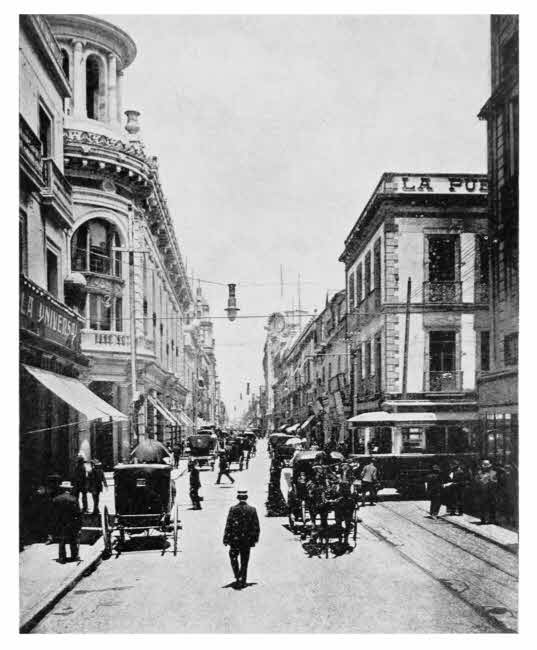
STREET IN MEXICO CITY. CATHEDRAL IN DISTANCE.
Vol. II. To face p. 264.
A beautiful edifice, open to the public by reason
of its use as the principal hotel of the city, is
the Hotel Iturbide, the former residence of that
short-lived and ill-fated emperor of Mexico. Its
interior patio, surrounded by colonnades, is typical
of this class of dwelling, and the slender column
and symmetry of its arches are such as arrest
the visitors' gaze.
Yet another type of public building, remarkable
in its solidity and massive beauty, is the great
Edificio de Mineria, as it is now termed, being
used as a school of engineers, an institution of
which Mexico has been justly proud. This fine
building dates from the end of the eighteenth
century, when the Colonial period was expiring,
and it is typical of the severe style of the period.
Tolsa, the architect of this and some other Mexican
buildings, took his inspiration from Rome and
Greece.
The wonders of Mexican Colonial architecture
are not monopolized by the capital. We may find
in the remote towns examples as remarkable,
whether in the great northern towns of the plateau,
whether in the States of Oaxaca and Vera Cruz,
places where the traveller might pass many pleasing
hours, but unknown to the outside world.
A feature of the architecture, or rather decorative
scheme, of Spanish American houses, which
the traveller will not fail to note, is that of the
use of colour on the exterior. This, however, is
not employed on the well-built or stone structures,
but mainly on those of the plastered adobe dwellings
of the lower middle and poorer classes,
although old Government palaces and public
buildings often have a wash or tint over their
faces. Architraves of painted blue or red, panelling
in orange, generous rose-tints over the whole
façade are to be seen, especially in the smaller
towns and the villages.
This custom of exterior house painting is, of
course, from Spain and the Moors. Whilst it may
be objected to as being gaudy, nevertheless it is
often pleasing and picturesque, relieving the
drab aspect of the streets. The adobe wall is,
naturally, plastered with some material, lime or in
some cases—as at Oruro—kaolin, thus presenting
a smooth surface for the colour. The colour
material may be paint, or, generally, a kind of
"distemper" or wash.
The effect is an unfamiliar one to the English
or North American traveller, accustomed to the
severe and colourless aspect of his own streets,
but looking along these Spanish American
thoroughfares or highways and byways of the
towns—which are often the framing for a distant
picture of a far-off Cordillera, blue in the distance,
or a snow-capped peak, or a piece of tawny
desert—the colour scheme is rather an added
element in the general effect.
We find this custom largely in Mexican towns,
in Central America, in Peru, Bolivia and the Cordillera
generally—in brief, almost everywhere.
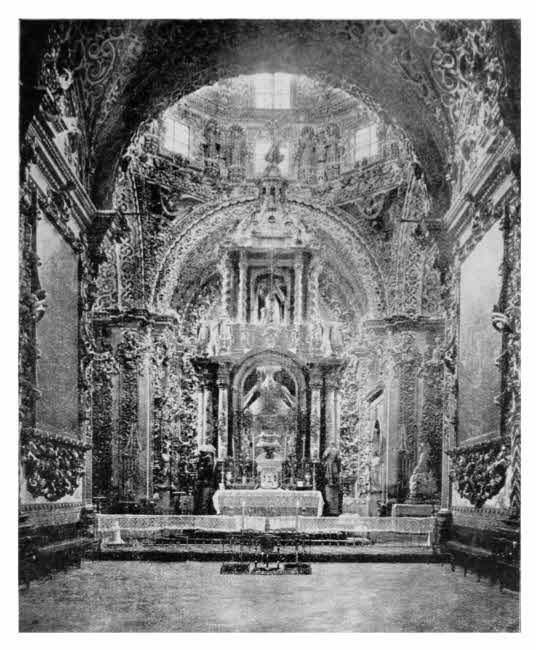
CHAPEL OF THE ROSARIO, MEXICO.
Vol. II. To face p. 266.
From the towns we come naturally to the roads.
Of the "philosophy of the road" in Spanish
America, I have spoken elsewhere.
It will be impressed upon us in our travels in
the wild regions of Spanish America that, however
fruitful Nature may be here, we cannot adequately
enjoy these fruits until means of transport and
communication are more plentiful and easier.
There are thousands of miles of territory where
the sound of the locomotive has never been heard,
where, indeed, neither road nor bypath exists.
The difficulties of railway and highway building
here are often immense. The topography of the
country is against it; the geological formation, the
climate offer serious obstacles. Precipitous hills
and unstable ground and torrential rainfall render
almost impossible in places either the construction
or maintenance of any form of highway.
Yet we shall doubt if the limit of human ingenuity
has been reached here, and greater
inventive and mechanical genius must be brought
to bear on the problem, in new types of road and
railway. The engineer is somewhat apathetic in
this connection, whether in America or Europe.
The people of Spanish America seem unable
to do much for themselves in the building of railways.
No line is ever built except by British
gold and foreign engineers. They could do much
more themselves, especially as regards roads.
Will air-navigation help to solve the problem
of transport in South America? Perhaps, to a
limited extent. Aeroplane services might be of
inestimable value in rendering communication possible
with the sequestered towns of the Cordillera,
for example. There are vast open spaces where
landing would be easy, given the overcoming of
atmospheric difficulties. Some investigation is
beginning. In Peru some study of the possible
routes among the mountains has been made. In
Chile the Andes have been crossed by an airman.
Flying, although possibly its "circus" attributes
are most attractive, appeals to the temperament
of the Spanish American. But a Peruvian
airman[43] strove to be the first to cross the Alps,
and gallantly perished in the attempt. Brazil also
furnished its pioneer airman.[44] Hydroplanes might
be of service, as they could alight on the rivers,
in crossing the Amazon forests.
A glance now at the mining industry, so largely
dependent upon means of transport here.
It cannot be said that gold plays a predominant
part in the mining of to-day in the Latin American
countries. More important is the winning of the
baser metals.
It is, in fact, somewhat remarkable that a land,
fabled earlier for its plenitude of gold, should
in modern times, yield so relatively small an
output. The value of the whole gold production
of the Latin American countries scarcely reaches
the annual amount of £8,000,000, which shrinks
into insignificance beside the £50,000,000 of a
single group of mines in another continent, the
South African Rand. Of this, Mexico produces
three-quarters, leaving the vast continent of
South America with the small sum, as contribution
to the world's stock of the yellow metal, of some
two million pounds' sterling only.
We may inquire as to the reason of this paucity,
and the reply, in the first instance undoubtedly
is that, although Nature has placed gold in the
rocks and soils of Central and South America in
almost every quarter, the metal is in a form that
does not always lend itself to the winning in large
bulk. The mines are rich, but often small and
scattered. There have not here been discovered
the enormous bodies of ore which, although of
low grade, as in South Africa, by their very extent
and compactness, render mining economically and
physically a more profitable undertaking. Further,
it may be said that, in more recent times, mining
enterprise and the attention of capital needful for
such has not been drawn so strongly to the possibilities
of gold-mining in the Latin American
countries, and, lastly, political unrest and revolution
in these States has in some cases rendered it
precarious.
This last condition need not be exaggerated.
It may be said that the Governments of the Latin
American Republics are, in the main, generous
in their treatment of foreign mining enterprise in
their territories, and that sporadic revolution does
not necessarily seriously affect the working of the
mines, though at times it may cause temporary
inconvenience and possible loss. The foreign
shareholders of the few considerable gold mines
of South America, and even of Mexico, have in
general reaped excellent returns on their investments.
Conditions in Mexico, however, of late
have been intolerable in some cases, with confiscation
and even murder attending them.
We have remarked the need of a greater
population in the Latin American States, and the
Governments of these in most cases strive to obtain
settlers and workers from Europe, offering often
what appear to be attractive conditions for immigrants.
In Argentina the modern life of the
Republic has in large part been built upon this
element, largely of Italians, and the national
character stands somewhat apart from the other
States from this reason. Brazil has also absorbed
many immigrants of the Latin race from the Old
World, and the Germans here, and in Chile, have
formed important communities.
But much remains to be done in this respect.
It is seen that a good deal of the immigrant
population in Argentina and Brazil remains as a
floating or unsettled element. Much of it does
not go out upon the land, but congregates in
poverty in the cities—a defect of all immigrant
systems, even in the British Dominions. In
Argentina and Brazil immigrants often cannot
obtain land, although the Governments are seeking
to modify the conditions of vast estate holding
and the rural proletariat.
It may be that the stream of emigrating
humanity from Europe will not flow so freely in
the future, in view of altering conditions on the
older continent. Of late, too, the larger South
American States are inclining towards the restriction
of immigration.
The opportunities for settlement, for taking up
land and establishing industry and reaping reward
and profit in Spanish America are, or rather might
be, attractive. They might be, in some respects,
more attractive than those offered by Britain's
colonies, for reasons which I will give.
Why are these opportunities not taken? Here
are enormous areas of territory full of natural
resources, with, in some cases, a mere handful
of folk to the square mile. Here are natural
pastures for cattle, lands which will produce fruits
and foods of every kind—figs, grapes and oranges,
cotton, coffee, cocoa, corn and wine and olives.
Not a variety of fruit, not a cereal, not a single
article of need for the comfort and use of the
settler is there that could not be produced. Here
are minerals of every kind known to commerce—gold,
silver, copper, lead and iron, and all the
non-metallic minerals—to be had for the working.
But above all, there are innumerable small
centres of population, of quiet and docile folk,
hungering for the presence of intelligent and
enterprising settlers who would look kindly upon
them, who would foster their local life, increase
the productivity of the neighbourhood, take part
in their civic and economic advancement.
Nowhere in the world is there such desire for
these things, nowhere is there such opportunity
for the settler for benefiting both himself and the
folk around him as is to be found in the innumerable
little villages and towns of Spanish America
hidden away in Cordillera, plain, valley and woodland.
There are literally myriads of such localities
scattered over the face of the Latin American
world, and I could give many instances from
personal experience.
The well-meaning foreigner in such places, with
some small capital, becomes one of the most
esteemed and predominant personages of the
locality. He could acquire and profit by flocks,
herds, plantations, mines. There is plenty of
labour, among the Indian and other folk, to be
obtained—labour, that is, in small local undertakings,
not for over-greedy or absorbent joint-stock
operations—under the relation of master and
servant. Here is an opportunity, then, for those
good English and other folk who complain so
hardly of heavy taxation and other burdens of life!
Any degree of climate may be chosen, from heat
to cold, including the "region of perpetual
spring," of which we have spoken elsewhere.
It is not intended here to advocate settlement
in Spanish America as against the British
colonies. The field is scarcely suitable for the
settler who has to depend upon his own labour,
without capital. He could not possibly compete
with the native. The difference is, that here are
innumerable old-established centres of population,
centres of civic life, and not, as in Canada or
Australia, vast areas of unsettled territory where
the lonely colonist is remote from social amenities.
Moreover, with every desire to people the British
Empire with settlers from Britain, it is also to
be recollected that British settlers in Spanish
America increase the prestige—and incidentally
the trade—of Britain in those lands—matters which
should be encouraged. In Mexico, in better times,
there was something about the atmosphere and
environment that very strongly attracted the
American settler, and large numbers of people
from the United States established themselves in
the country—conditions which unfortunately do
not now exist.
In this connection we might ask ourselves a
serious question as regards Mexico. Have we,
the more advanced nations of the world, who
mainly by reason of climate and geography have
been blessed with a different temperament, made
any particular effort to help that country, or tried
to influence its people? We have invested our
money there, with the hope of dividends. We
have maintained our more or less starchy diplomatic
representatives. We have issued Foreign
Office Reports abounding in figures and pointing
out the ways of trade and the resources of the
land. But have we tried to influence the country
to a better life?
It may be replied that we could not readily
do so, that one country cannot mix itself up in
the affairs of another. But that is not a sufficient
answer. We have been content to take profits
from railways and mines, but among the rude and
picturesque hordes of Mexican miners, an impressionable
and really industrious folk, there might
have been some good element at work maintained
by a little of the gold we won from them. Is
the mine manager or the book-keeper, busied
necessarily on the technical details of his post, the
only agent we might have kept there?
The same reflection may be made as regards
the other Latin American States, with a word of
warning to directors and shareholders. The native
miners are a hardy and often turbulent race. If
they were not hardy they would not be miners,
and if they were not headstrong they would not
be likely to undertake the onerous and dangerous
livelihood of the mines. These folk are, as
regards "labour" ideas, mostly ignorant and unorganized
at present. Directly they learn their
power, and directly some greater amount of education
filters in among them—accompanied, as is ever
the case, by socialistic or even anarchic ideas—they
will begin to demand their "rights." (The
nitrate-workers in Chile, for example). Such ideas
might spread very rapidly among these impressionable
folk, and they would be likely to stop
at nothing once the spark of disorder were
kindled, even to Bolshevism of the brown race.
Let us be wise in time and study the methods,
before too late, by which their lot may be improved
and their intelligence better directed under
a wider spirit of economic instruction and justice.
We may not like to face these eventualities, but
that will not influence the march of events.
The same holds good with every form of
foreign investment in Latin America—railways,
plantations and all else. So I would venture to
say, if we expect always to draw dividends from
our investments in Spanish America, let us wisely
have more regard to the social and economic
status of the worker. How, practically, that is to
be done is a question of our own intelligence.
Perhaps some advisory body might be instituted
in London, financed by the large British interests
in Latin America, such as would devote itself to
the study of the conditions of life surrounding
the workers in those lands, or at least as regards
their own employees. I offer this suggestion on
behalf of the poorer folk of these lands. They
generally look to the "Ingles" as a person of
influence—one, moreover, whose pockets are
always, they imagine, lined with silver! In their
way these folk believe that noblesse oblige (in
their own term for that concept) is a universal
axiom of the Englishman, and there is something
almost pathetic in this faith in a foreigner. Let
us beware that by negligence or greed we do not
forfeit this esteem. I offer the suggestion also
as a contributory safeguard to British investment
here.
Apart from the attitude of the individual worker
in these communities in relation to foreign capital,
we shall be well advised to keep in touch with
the attitude not only of the workers as a whole
but of the Governments which control national
affairs. Of late there have been certain indications
that a policy of antagonism towards foreign capital
and enterprises is growing up. It has been very
marked in Mexico, but in Argentina, a much more
advanced community, and in the Brazilian States
it is at times disquieting. It is not so much antagonism,
however, as a feeling of dissatisfaction
that the earnings from national or public works
should go to foreign shareholders. The Argentine
railways of late years have felt a good deal this
disturbing element; as also the burden of
numerous strikes. British capital was the pioneer
in building railways in the republic, and has conferred
enormous benefit upon it. More than
15,000 miles of line are owned by British companies,
or three times as much as the remaining
mileage, which is French and national mainly.
Whilst these railways are, it is generally conceded,
worked and controlled as economically and efficiently
as ever, it cannot be said that they are
undertakings so profitable as should cause
envious eyes to be cast upon them. For
the past few years the average net return of
these British-owned railways in Argentina has
not exceeded the modest amount of three and
a half per cent. This is a low return, especially
for Argentina, where two or three times
the yield is obtained on ordinary safe mortgages
on houses and land. The British-owned banks
in South America may yield twenty per cent.
profit. Yet voices arise in the land, asking why
the transport of the country should be conducted
for the interests of foreign shareholders, and
begin to demand a larger share. A cry of this
kind soon becomes general, and when a government
has come into power on the strength of
popular promises—and to obtain votes and power
this condition arises now in South America, as in
all other lands—it has to attempt to carry out its
promises, and the line of least resistance here is
sometimes the foreign corporation. There is one
simple remedy which discontented governments
and folk here could apply—in purchasing for themselves
the shares of the railway companies in the
open market, but it does not appear that this
legitimate operation is much indulged in.
With regard to the native labour, it is to be
recollected that there are few (or no) laws to safeguard
it from exploitation by the employer. It
is only just beginning to learn how to combine
in its own interest. As I have shown in these
pages, it is in many instances and throughout the
whole region often over-exploited. The upper-class
employer, the Spanish American, does not
lack kindliness and charity, but it is contrary to
his custom and outlook to think much of the
labourer. The Spaniard and the Portuguese have
been oppressive in this connexion throughout
history.
Strikes in Argentina and Uruguay have of late
become very bitter in character, and bloodshed
generally occurs. Trains have been derailed and
passengers and drivers fired upon. It is to be
recollected that labour is not necessarily all of
the native stock, but is supplemented by the flow
from turbulent Spanish and Italian sources. The
poor Iberian or Calabrian comes over with a sense
of wrong against society, which in his own lands
he often has good reason to nourish, and which
he cannot throw aside on this new soil as readily
as he may the picturesque native costume of his
fatherland. In this respect we might indeed say—Coelum
non animum mutant qui trans mare
currunt. The great estuary of the River Plate
receives in its haven many a discontented emigrant,
many an agitator from the Latin lands of
Europe, whose social defects, national and individual,
by a curious combination of circumstance,
many an English home—holder of shares in
Argentine and Brazilian railways—is, in a sense,
called upon to expiate!
There can be little doubt, moreover, that the
reins of power in certain South American States
tend to fall more and more into the hands of politicians
of a very democratic type—not to say
socialistic—and as the education of the "proletariat"
increases this element is likely to increase.
The Cabinet formed of "doctors," of
the upper and select strata of society, men of distinguished
type—but often out of touch and indeed
sympathy with the masses of their poorer countrymen—and
of military men, also of the upper strata,
is likely to be more and more diluted with the
ruder element who bears, sincerely or for political
purposes, the social wrongs of his constituents
as his creed. In brief, we may expect to see in
Latin America a wave of that unrest which now
has submerged Russia, perhaps Germany, and
which in some degree threatens every land. Let
us hope that, before it is too late, the channels of
human intelligence will flow with a true spirit of
humanity and the milk of human kindness and
order. But the general world-outlook is not encouraging,
and no doubt there is yet to be bitter
experience in these lands of Cancer and Capricorn,
of Central and South America, in the development
of their social affairs.
The relations of foreigners with the Latin
American people opens a wide field of discussion,
upon which we may lightly touch.
The social culture of these communities in the
past has been most greatly influenced by French
ideas, and France is still the ideal nation. It may
be that France, by reason of her apostasy and
her expulsion of the religious orders from her
shores in recent time, has lost prestige however.
The relations of the Americans of the United
States with the people of Latin America present
a number of interesting conditions and problems.
The two types of people and their civilizations
differ from each other in every respect, yet, neighbours
on the same continent and twin-continent,
they are and in the future will be more and more
thrown into contact with each other. The situation
is such as that which would arise if England
and Spain or England and France found themselves
with a common frontier, that of only a small
river, or the imaginary one of a parallel of latitude
between them. This is exemplified on the Mexico-United
States border, where the two races, the
Spanish American and the Anglo-Saxon American—if
that term may be correctly applied to the
people of the United States—come into contact
but do not assimilate.
The first problem is one of nomenclature. The
people of the United States have arrogated to
themselves the name of "Americans," although, of
course, this belongs equally to all inhabitants of
the New World. The Latin Americans do not
necessarily agree with the pretension, and have
among themselves applied the term Norteamericanos
to their northern neighbours—that is,
"North Americans." This alternates with the
term Yanquis, the hispanicized form of the soubriquet
"Yankee," of doubtful origin; not, however,
necessarily used in a derogatory fashion, but
familiarly. The word gringo is also a common
term applied to the Americans; not, however,
to them alone, but to any foreigner not of Latin
race. The origin of this term is obscure, and it
cannot be said to be a flattering designation. The
word is often meant, however, as describing a
person whose hair and eyes are not dark, contrasting
thus with the general type of the Latin
American. Blue eyes and blonde hair are
essentially gringo.
The Americans of the United States, as has
often been pointed out, are a people without a
distinctive or appropriate race name. The
Canadian, the Mexican, the Brazilian, the Peruvian
and all other units of America have their own
designation. So far no term for the American
has developed, and convenience warrants the usage
of that they have adopted, which is as if a single
nation of Europe were to take to itself the name
European. To the American aborigine, whether
in the Northern or Southern continent, ethnologists
have applied the term Amerind, a contraction
of "American Indian," and the word seems
to have been adopted, at least as a technical term.
(No one, however, has applied the name "Amersaxon"
to the people of the United States,
although it would be equally correct.)
The relation between the two races, or rather
the common possession of the New World by
them, has given rise to that peculiar and well-known
policy or system known as the Monroe
Doctrine. Washington recommended the policy that
the United States should refrain from entangling
itself in the politics of Europe. The converse,
that Europe should be prevented from meddling
in American affairs, grew as the importance of
the United States increased, and was enunciated—after
a hint from Canning—by President
Monroe, in a message to Congress in 1823, at the
time of the "Holy Alliance" of European Powers,
which it was feared would attempt to restore
the dominion of Spain to the Spanish American
colonies, which had asserted their independence.
"We should consider any attempt on their part
(the European Powers) to extend their system to
any portion of this hemisphere as dangerous to
our peace and safety. With the existing colonies
of any European Power we have not interfered
and shall not interfere. But with the Governments
who have declared their independence we could
not view any interposition for the purpose of
oppressing them or controlling their destiny by any
European Power in any other light than as the
manifestation of an unfriendly disposition towards
the United States." So ran the decree.
The Latin American States, whilst probably not
ungrateful for the Doctrine in general, resent any
assertion of hegemony upon the part of the
United States. They do not regard themselves
as in any way inferior thereto, except as concerns
the material development of the more mechanical
arts of civilization. Their own social culture, the
traditions of the caballero, or gentleman, they consider
as superior, and if truth must be told, it is
so in some respects. The people of the United
States—and Canada—have preferred the less-polished
and more practical outlook and social
port; the Spanish American the more reserved
and ceremonious. Indeed, the southern folk often
regard the northerner as uncultured. There is no
doubt that the two races have a good deal to
learn from each other, the southerner in the practical
things of life, the northerner in social amenities,
and each could well absorb some of the virtues
of the other.
Until very recent times there was a disposition
on the part of the Spanish American people to
imagine the northerner as disposed to overrun
them, and there was an element in the United
States which undoubtedly had such purpose before
it. But probably this is past, and the idea that
the Monroe Doctrine of "America for the
Americans" meant in reality "America for the
North Americans," may die out. The judicious
and generous attitude of the United States in Cuba
after the war between the United States and Spain
has been put against the methods employed, for
example, in the case of Panama and the Canal.
Mexico, however, remains a difficult question,
upon whose future relations with her neighbour
it would be impossible to dogmatize. The United
States at the present time are in the heyday of
their commercial life, and would appear to be
resolved to conquer the Latin American countries
commercially. This may or may not lead to strife
in the future. We shall not forget that the Great
War was, in large degree, the outcome of the
modern phase of commercial jealousy, and what
developments the future holds we cannot foresee.
We ought not to close our survey of the Latin
American nations without at least briefly recording
their attitude in the Great War, in the question
of right against might, of civilization against
German savagery. Far out of the beaten track
of European (and North American) affairs as are
these growing nations, their history in this connexion
might readily be forgotten, and its importance
overlooked.
It was not unnatural perhaps that the Latin
American Republics should have been tardy in
entering into the war, in view of the attitude of
the senior Republic of the Western Hemisphere—the
United States—which hung so long in the
balance. It did not at all follow that they would
imitate that country. In some respects they might
do so; in others they did not necessarily regard
their cousin of the north with entire confidence.
However, they were greatly influenced thereby.
The earlier attitude of the United States
towards the war must ever remain a source of
wonder to the historian, accompanied by regret.
It was largely, if not principally, the result of
the attitude of their President, Dr. Woodrow
Wilson. It will be recollected that the United
States did not enter the war against the German
barbarians until April, 1917—that is, over two and
a half years after the outbreak of the war. That
was the period necessary for the Republic to overcome
its own suspicion of Europe, and especially
England; to overcome its own self-interest, to
awaken to the truth; and this notwithstanding all
the horrors that had been visited upon Belgium.
Long after these dreadful occurrences had sunk
into the mind of the Allies, who, originally unprepared
for war, were fighting for their life in
support of humanity against the huge organized
army which Germany had for decades been building
up to carry out her ambitions, the American
President could send out his extraordinary Note
to all the belligerents (December, 1916) stating
that in his view "the objects on both sides appeared
to be the same." In plain words, the respective
merits of the combatants were as good or bad
as each other! In this view, however, to the credit
of the United States, it should be said that a
large body of Americans had a much clearer moral
perception of the issues at stake than their leader,
and among them was the vigorous ex-President,
Mr. Roosevelt. But it required a direct blow
in the face for the United States before the President
could shake off his pacifist attitude, and actual
injury to American property and life; and this
incentive was furnished by the German submarine
activity and the sinking of American ships. The
United States' interposition in the war had not
been asked for by England and the Allies at first,
but it had become evident long before that the
Republic should have ranged itself on the side of
law, order, and humanity; and America lost an
opportunity, which may never recur, of asserting
her moral influence in the world—a loss which, it
may be said, is hers as much as that of Europe.
The American interposition was of great value
when it did come, but the bulk of the work had
been done. America was almost too late to save
her prestige and to take efficient part in this
great adventure. When the Americans did enter
they displayed great energy and valour, and it
must also be recollected that the part the United
States had played in the supply of munitions of
war, foodstuffs, credit and so forth had been of
the utmost value, and there was more in this than
a mere business transaction.
The Latin American States did not necessarily
hasten to follow President Wilson's implied suggestion
of February, 1917, on severing diplomatic
relations with Germany, that the remaining neutral
States should follow suit, which no doubt was
largely aimed at the southern republics. There
were various reasons against it. Many of these
thought their own interests would best be served
by remaining neutral; some were afraid of Germany—it
was not unnatural. Some were angered
with France, for reasons later discussed; some
were—at least clerically—pro-German. On the
whole, however, it must be recorded that Latin
American sympathy as a whole was, and had been
from the beginning, on the side of the Allies.
It would indeed have augured ill for their moral
perception if the reverse had been the case, and
would have seriously injured them in the eyes of
historians.
Of these twenty independent Latin American
States, eight actually entered the war, on the side
of the Allies and the United States. They were
(in alphabetical order) Brazil, Costa Rica, Cuba,
Guatemala, Haiti, Honduras, Nicaragua and
Panama. Five broke off relations with Germany
but did not declare war. They were Bolivia,
Ecuador, Peru, San Domingo (the Dominican
Republic) and Uruguay. Peru and Uruguay were
practically belligerents, by their various acts
against Germany, but Germany did not appear so
to regard them. However, both these republics
were invited to the Peace Conference, and signed
the Peace Treaty. Seven republics remained
neutral. They were Argentina, Chile, Colombia,
Mexico, Paraguay, Salvador and Venezuela.
Putting the area of Latin America at nine
million square miles and the population at ninety
millions (of both these items various estimates are
given), it may be said that six million square
miles and fifty million people were at least non-neutral.
However, such figures must be taken for what
they were worth. Only Brazil and Cuba took any
active part. Argentina and Chile, the two most
important and powerful States after Brazil, carefully
preserved their neutral attitude. (It will be
recollected that the group of the three greatest
Powers of Latin America, which have been termed
the "A B C" Powers, are Argentina, Brazil and
Chile.) Mexico, the second largest State of Latin
America in point of population, was also neutral,
and at one time appeared to be strongly pro-German—an
attitude which was partly instrumental
in influencing the United States to take
up arms.
It must always be recollected, again, that the
official attitude of these States—as in the case
of the United States also, before it took part—did
not necessarily represent that of the majority
of the intelligent classes.
The actual entry of Brazil did not come until
October, 1917; that of Cuba came simultaneously
with that of the United States. Peru broke off
relations with Germany in October; Ecuador in
December; Bolivia in February (with the United
States); Uruguay in October; Panama at the
same period; Guatemala in April; Honduras and
Nicaragua in May; Costa Rica in September;
Haiti and San Domingo in July.
We may cast a glance at the various influences
at work in the respective attitudes of these States
towards the war.
Some of the States regarded with alarm the
possibilities of a German victory as such would
concern themselves. They had not forgotten that
their independence was largely a result of the
European outburst that followed the French
Revolution, nor yet the designs of Napoleon on
the Spanish American colonies and Brazil, which
England had helped to thwart, and those of Spain
and the Holy Alliance after Independence, which,
again, England and the United States had frustrated.
They knew Germany but for the Monroe
Doctrine—an Anglo-American creation—would
long ago have striven to help herself to South
American territory. On the other hand, German
propaganda had been especially active and sinister
among them during the war—business men and
professors—and the Germans had strong influence
there. Also Spanish and other clerical influences
were at work among them, often representing
France as the great atheist nation, due to her
anti-Church legislation and apostasy, and—for
example in Chile—it was even said that Germany
was the chosen instrument of heaven to punish
France on this account. Further, there was
always the smouldering distrust of the "Colossus
of the North," the Norteamericanos of the United
States, which it was often thought desired to exercise
an undue hegemony over Latin America.
Colombia retained an animus against the United
States as a result of the Panama affair.
The most active spirit in Brazil on the side
of the right was the eminent Brazilian statesman,
Ruy Barbosa, and it was soon seen where the
sympathies of Brazil lay. Submarine outrages
on her merchant marine and other motives
brought forth pronouncements against the German
assassins, and the seizure of the large German
vessels in Brazilian ports followed, and both public
and official opinion led to the rupture. The
Brazilian Navy co-operated with that of the Allies,
and Brazil even sent forces to the Western front,
and the republic assisted with supplies. As for
Argentina, the war brought her enormous prosperity
as a neutral, but here the neutrality was
far more official than popular, and was largely
motivated by the President. An episode in Argentina
was in the famous Spurlos Versenkt Notes of
the unspeakable Luxburg, the German Chargé
d'Affaires in the republic, of May and July, 1917.
"As regards Argentine steamers," he wrote to his
Government—through the medium of the Swedish
Minister at Buenos Ayres, be it noted!—"I
recommend either compelling them to turn back,
letting them through, or sinking them without
trace." This devilishly cynical pronouncement
goes down to history with that of the infamous
German "scrap of paper" argument. Argentine
neutral citizens were to be murdered in cold blood
for German ends! The Minister received his passports,
the German club in Buenos Ayres was burnt
by the mob, and there was a popular demand for
a break with Germany; and the Senate passed
resolutions. But it ended in nothing. It has
been said that President Irrigoyen's extraordinary
attitude in opposing the popular mind was due
to pro-German feeling—which, however, was
denied; to his aversion from merely following in
the wake of the United States; and from a desire
to preserve Argentina from war in order that his
deep-seated plans of social and economic reform
might not be disturbed. Be it as it may, Argentina
lost her chance.
With regard to Chile, neutrality also was profitable,
in the enormous demand for her nitrates.
German influence was very strong in the country,
both in matters military and educational; and the
clerical attribute—the Church is powerful in Chile—was
also a factor, as before remarked. But
a large element viewed Germany with detestation,
and the republic "reserved its right to act in the
event of hostility against her vessels." However,
Chile also lost her opportunity.
It is to be noted that it was the submarine
policy of Germany in the direct attack upon
vessels which was the determining factor in all
these principal republics, from the United States
downward.
The attitude of Uruguay was always pro-Ally.
The Government of that country issued a noteworthy
decree in defining its position: that "no
American country, which, in defence of its own
rights, should find itself in a state of war with
nations of other continents will be treated as a
belligerent." It may be said in general terms
that the attitude of all these States proclaimed
the principle of "American solidarity," or Pan-Americanism.
The considerable element of British whose
homes or occupations are in Latin America followed
the varying fortunes of the war with eagerness,
for the name and fame of England is dear
to these exiled sons. Their hearts were broken
with the Tarapacá disaster to the British squadron,
but resuscitated by the great victory of the
Falkland Isles. It must not be forgotten that
they, in considerable number, left their homes and
occupations and came to England as volunteers
early in the war. They were not grouped together
as a separate force, being of so scattered an origin.
But the King approved a special badge for them,
and England should be grateful for their noble
effort—we trust she was and is!
The effect of the war upon the Latin American
States—whilst it cut off supplies at first of
European manufactured goods and disorganized
exchange and currency—was to cause an enormous
demand for their raw materials, with corresponding
increase of wealth. Even the first-named condition
was a benefit in disguise, causing a development
of home manufacture.
German trade in South America, for the time
being, was ruined—a severe blow—a result of the
British blockade. British and French trade of
course suffered temporarily. The trade of the
United States, on the other hand, increased:
American goods replaced European, and it seemed
at one time that the change might be permanent;
but it was found that their goods were
inferior, or at any rate less acceptable, than those
of the older exporters. However, new horizons—trade,
banking and so forth—opened in Latin
America for the United States.
It cannot be said that the two American peoples
know very much of each other. The aloofness is
partly from geographical, partly from racial
causes. Enormous distances separate their respective
principal centres of life. New York and
the city of Mexico, for example, are several
thousand miles apart, although linked by more
than one railway system. Huge deserts intervene,
those dreadful wildernesses of Northern Mexico,
on whose existence, indeed, an early president of
Mexico, who distrusted the northern neighbour,
was wont to congratulate his country, summing up
the sentiment in his aphorism of "Between weakness
and strength—the Desert!" As for communication
by sea, it may be recollected that
Europe is more accessible to, for example, Brazil
and Argentina, than is New York. On the Pacific
side of the continent the greater part of a hemisphere
intervenes between the large centres of
population of North and South America. From
San Francisco, or other great seaports, to Callao
and Valparaiso the steamer voyage occupies far
more time than is necessary to cross the Atlantic.
The people of Peru and Chile or Ecuador, and
the people of California or Oregon are little more
than names to each other, inhabitants of another
world. Great stretches of undeveloped territory
intervene, and through communication by rail
has not yet been established, as the Pan-American
Railway remains still on the lap of
the future.
Among those nations which in the future may
be reckoned upon as likely to display a desire
for closer relations with Spanish America are the
Chinese and the Japanese. The Mongolians seem
to have—as before remarked—some affinity with
the American Indian race, possibly by reason of
some very ancient kinship or common ancestry,
for it is held by ethnologists that America may
have been very early peopled by Mongolians. In
Peru, for example, the Chinaman readily establishes
himself in business in the smaller villages
(and often surrounds himself with several wives
or female companions from among the Indian
women). The Japanese have long cast eyes upon
the upper reaches of the Amazon basin, or
Montaña, of Peru and Brazil, for purposes of
settlement and industry, and of late a company
from Nippon has acquired a large tract of land
there, with such an object. These folk are not unwelcome,
or not so far, by the South Americans,
who are desirous of seeing these vast and sparsely
inhabited regions brought to life.
This possibility of a modern Mongolian "invasion"
into the heart of South America is one
which may take on greater importance in the
future.
In general terms, however, it must be recollected
that the Pacific Ocean is vast and wide. There
is, nevertheless, a school of thought arising of late
which affects to believe that the Pacific Ocean is
destined to become the centre of the world's commercial
activity. As this centre changed, they say,
from the Mediterranean to the Atlantic, so will it
change from the Atlantic to the Pacific. They
regard the "basin" of the Pacific as a sort of
entity, and look for enormous developments in this
respect, of fleets bearing travellers and merchandise,
of great interchange of products and so
forth.
Whilst this view may be well-founded, I
venture to think that certain natural factors have
not been sufficiently taken into account. There is,
first, the condition of enormous width from the
Asiatic to the American shore; second, it is not
sufficiently understood that this American shore,
whether in North or South America, is in the
nature of a narrow strip of land greatly cut off
from the interior of the continents by vast
mountain ranges and deserts. In North America
the Sierra Nevadas and the Great American Desert
have to be crossed between California and the
eastern and central part of the United States, and
the Rocky Mountains in Oregon and British
Columbia, whilst in Mexico the Western Sierra
Madre offers a similar obstacle. In South
America, as we have seen, the Andes is a perfect
mountain wall, cutting off the interior absolutely
from the narrow and comparatively infertile Pacific
littoral. The natural outlet of the vast area of
South America is to the east; it falls to the
Atlantic, not to the Pacific. Where, then, are the
people and the products that would give rise to so
great a movement upon the Pacific Ocean?
Lastly, I am inclined to doubt (although I may
be in error) whether the future of the world is to
show a vast increase in overseas trade and trafficking
such as would change its centre of gravity in
this respect. There are factors against such—as
have been discussed in the chapter dealing with
trade; factors of the natural development of self-supply,
as against import of commodities, factors
of the huge and increasing cost of transport,
scarcity of fuel and so forth. Moreover, what
does Asia want from America, or America from
Asia? Both continents produce the things of the
temperate and the tropic zones; both are capable
of manufacturing the finished goods which they
require.
Taking all these matters into consideration, it
may be doubted if the Pacific Ocean is to attain
to the great importance which some have imagined
for it, although doubtless its traffic will increase.
A glance now towards the future of these great
lands beneath the Southern American sun, and
our task will be done. What is to be their future;
what part are they to play in the great scene-shifting
of the developing world?
First we shall have remarked that the Latin
American people are material in the making. They
are not a worn-out race; they are, rather,
unformed, plastic, with their life before them.
Second, they inhabit perhaps the richest portion
of the surface of the globe, which, so far from
being exhausted, has not been heavily drawn upon
in some respects. It is true that coal, that adjunct
of the civilization of the industrial age, is not
plentiful (except in certain districts). But the
future may not be so largely dependent upon this
mineral. Possibly, moreover, Nature had a purpose
in the absence of coal, ordaining that at least
one of the world's continents should not undergo
the terrors of the factory age!
Let us turn now to certain more general
conditions.
The growth of the Latin American republics
might seem to offer a future for the growth and
even regeneration (and some writers have said the
predominance again) of the Latin races in the
world generally. Here, at least, is an enormous
territory, some of the richest and most fertile on
the globe, at present but thinly inhabited. By
the close of the present century it might be that
South America would contain 250 million people.
A century ago there were but 15 millions. Of
course the enormous growth of the population in
Europe and the United States has been a result
of the machine, or industrial age—by no means an
unmixed good. This has depended upon the resources
of coal, iron and so forth in their soils,
and statistics and forecasts show that these resources,
under the present system of depletion and
waste, especially in England and the United
States, will tend to exhaustion in a few generations.
Whether that will lead to a corresponding
decline in population remains to be seen, but in
this and other respects it may be said that coming
events cast their shadows before. Probably the
greatest reproach that can be placed upon Anglo-Saxon
life to-day is that we are drawing heavily
upon the exhaustible resources of the earth without
establishing the basis of a permanent or adequate
civilization.
It should be urged that the time has come when
we should take a more comprehensive, judicious
and constructive outlook upon the world—its
natural resources and its folk. We are inclined to
think that Nature's resources, because partly unexplored
here and there, are "exhaustless." The
Spanish American people are fond of speaking
of their inagotable riqueza natural—their "inexhaustible
natural resources"; but these are not inexhaustible,
as I have elsewhere remarked. We
need a survey, a stocktaking, of the earth's
resources; we need to conserve, to economize
them. It is a remarkable fact, however, that the
latest pronouncement of the League of Nations
contains no idea or suggestion of a fundamental
policy of retrenchment, conservation, development
of these potentialities. The pronouncement, which
seems to be largely an echo of President Wilson's
original "Fourteen Points"—which doubtless had
among them certain merits at the time of their
enunciation—does not get beyond advocating "increased
production," the "entire removal of all
economic barriers," in this respect. In brief, it is
the old dreary doctrine, largely, of creating and
selling, of forcing goods on communities and folk
who do not necessarily need them, without any
scientific outlook upon the native potentialities and
requirements, or the world's natural divisions—a
dreadful "internationalism" which we hoped was
declining. The League of Nations, as regards
its economic knowledge and spirit, is a magnificent
opportunity wasted, or will be so unless it
develops into something far more fundamentally
intelligent. This matter of outlook by so important
a body is of vital importance to the Latin
American States, as to all others. The exploitation
of the great remaining natural resources of
these countries—as is the case with many others—cannot
be successfully done under the present relations
of labour and capital. Capital must have its
fair reward, labour must be fairly paid; but the two
things at present clash, and we shall have to find
the way out before the enormous, but not fruitless,
wilderness of South America and Mexico can yield
up what they contain. The cream of the earth's
resources has been skimmed everywhere; the
remainder calls for much more scientific consideration.
Indeed, it is impossible to forecast what the
future of the world—which has been shaken to
its foundations by recent events—is to be. Civilization
may advance or it might recede, or hang
fire for centuries. That depends upon the efforts
and the conscience of mankind. It may be that
a quieter, less strenuous life awaits it, with less of
material activity and more of moral and intellectual
growth. In fact, some of us who have studied the
world in its economic and political aspects, will
doubt if the present type of civilization has not
reached its apogee and is to enter on some other
phase, a phase which we believe and hope is to be
of the nature indicated.
If that be so, there is no reason why the Latin
American States should not acquire growing importance.
The character of their more thoughtful
and educated classes is towards such a life, whilst
the resources of Nature they command could afford
them everything needful for their existence. The
Spanish American lands have been dowered with
every variety of climate and product, and by going
up or down their valleys their folk can gather
every known food-product or thing of the animal,
vegetable and mineral world.
As to their character for national turbulence, it
has been shown in these pages that such disturbing
influences are but the activities of a relatively small
class. Their ideals are high, their aim is towards
a high civilization. Some of the nations of the
Old World that considered themselves foremost in
civilization—such as Germany and Austria—have
shown by their actions that they can fall lower
in barbarity than any of the most backward nations.
Moreover, all nations are restless, all their cultures
are in the melting-pot, all are at fault. There
must be regeneration and reconstruction everywhere.
The future of the world will be in the
exercise of true spiritual factors, interwoven
with or influencing what I have, elsewhere,
ventured to term ethical-economic constructive
principles.[45] From a wise consideration of these,
there must emerge a "science of corporate
life," or science of humanity, which will learn
to build up the true "economic structure" of
society, in conjunction with its intellectual and
spiritual activities—a constructive human geography,
which will aim at the true and final
reaction of mankind from its environment. Elemental
forces are at work, for good or ill, at the
present time, and elemental forces must be met
by fundamental principles. One nation to-day is
almost as far from such a philosophy as another,
although to-morrow might see the turning of a
page which should disclose its beginnings. In this
evolving book of life the Latin American
Republics have their opportunity, as far as the
possible exercise of principle goes, with all other
nations.
The problem for these nations is to bring on
their own culture, avoiding, if possible, the errors of
Europe and the United States: that is, avoiding
the factors of industrial unrest and economic waste
that have accompanied progress. They could
profit by example and experience gained by these
other lands: to bring on the education and economic
uplifting of the backward masses of their
people, not by crowding them into factories or
refusing them a living wage, not by drawing so
heavily on their fruitful soils as to begin to exhaust
these, but by methods more in accordance with
those principles which alone can ensure permanence
and nobility.
We have seen that the Latin American nations
have been dowered by Providence with everything
that could make a people prosperous and contented,
if wisely disposed. In some respects their
circumstances are superior to those of Europe and
Asia. They have no over-powerful or rapacious
neighbours, no chasms of race or religion to
divide them, no insensate trade rivalries—things
such as in the Old World have wrought such
havoc with mankind. To the traveller who has
sojourned in these lands it will always remain
a matter of interest to see how their lives develop,
what fortune or vicissitudes befall them. Under
any circumstances, they offer a field of abiding
interest—scenic, natural, antiquarian—and their
folk are likely ever to retain the traits which
attract us. Commerce and business will doubtless
grow and expand between them and the Old
World, or their neighbours of the United States,
with corresponding benefits, but there are many
features of the region which fortunately will never
fall under the domain of business. One thing,
again, which humanity needs is more intercourse,
and Latin America is too remote from us. Books
are useful, but there should be a greater interflow
of people. Unfortunately, it is a feature of life
now that travel becomes more rather than less
expensive, and we do not know what the future
may hold for or against the traveller in this
connexion.
This circumstance, also, is one of those which
await the more logical outlook and constructive
ability of mankind, concerning the things by
which we live and move and have our being.
Such, then, is the romance, reality and future of
these interesting lands of the Spanish American
world, as far as it has been possible to depict
them in these pages.