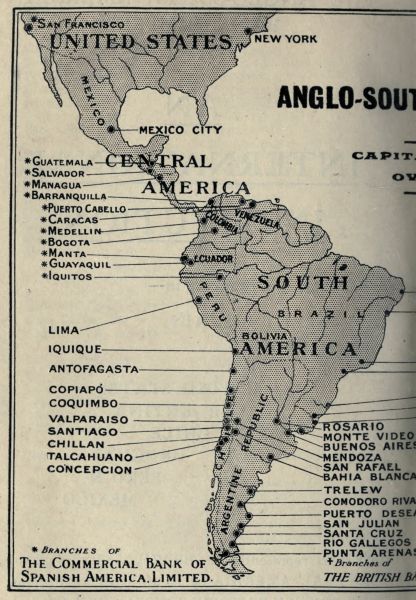
Of all the lands of the New World, none perhaps
has impressed itself more on the imagination than
the picturesque and enigmatical land of Mexico.
It seems to stand, in our thoughts of distant
countries, apart from all others, a riddle we cannot
read, surrounded by a halo or mist of unreality, a
region vague and shadowy as its Toltec ancestors.
Perhaps this view has in part arisen from the
description of the Conquest by famous writers,
which so greatly interested our forbears of the
Victorian period, and by the romantic story-writers
of the same era. But these matters alone would
not account for the hazy atmosphere surrounding
the old land of the Aztecs, which even the prosaic
matters of trade and finance do not seem to lift.
There are many English and American folk with
commercial interests in Mexico, who draw perhaps,
or in happier times there have drawn, dividends
from their investment in mine, or railway, or
other enterprise; but even this material standpoint
fades into intangibility before the endeavour to
form a true mental image of the land.
Who are the Mexicans, where does their country
lie, what language do they speak, what dress do
they wear? Geography and ethnology will furnish
us with the most exact replies; the books of
travellers will fill in abundant detail, but nevertheless,
Mexico remains for us an enigma.
We shall not hope here successfully to dispel this
mystery, even though we may have been there,
traversed its varied surface, and lived among its
people. To say that Mexico is the Egypt of the
New World, whilst it is not untrue, is to deepen
the atmosphere. The sandalled Indian creeps
across his desert sands and irrigates them with
his native torrents as he did in centuries past,
lives in his wattle or adobe hut, and, if he no
longer worships the sun, at least he stands before
its morning rays to embrace its warmth—el capa de
los pobres ("the poor man's cloak")—for poverty
denies him other comfort. The rich man is clothed
in fine textures of European model and may dwell
in a palace, but beneath his modernized exterior
are traits of the Orient, and the blood of the Moor,
the Goth, the Vandal, the Roman, the Celt, the
Semite, brought hither in the Spaniard, is mingled
with that of the Aztec, who lived upon the great
plateau and built his temples of strange and bloody
worship.
No other American nation constitutes so wide a
blending of original races. Spain itself was a
veritable crucible of languages, peoples and creeds,
whilst aboriginal Mexico contained a large number
of tribes, each with their particular culture, or lack
of such.[7] For Mexico, it is to be recollected,
was not a land like the United States or Canada,
which contained, relatively, but a few bands of
Indians, without any particular form of government
or developed institutions.
The grandees of Spain came out to rule this
diversified land, and they did not disdain to make
it their home. Spain gave it of her best often,
with capable legislators, laws; the Ley de Indias,
enacted for the benefit of the colonies, and erudite
professors and devout—over-devout—ecclesiastics;
and these often carried out their work with
patriotism and fervency. Although it is not yet,
the student of history will be fain to think that out
of this seed a good growth must in the future
come to being, and this we may say without any
unnecessary apologetics for Mexico.
But what, we may ask, is the influence here,
that throws back this fruitful land from time
to time to anarchy, and makes its name a
byword?
Disorder and treachery periodically arises, dictator
succeeds dictator, revolution follows revolution,
and the country's soil, whether in the streets
of its capital, whether upon its desert plains or in
its tropic valleys, is drenched with the blood of its
own sons. The results of thirty years of a constructive
national policy which Diaz gave, the hopes
and pretensions of a high civilization, laboriously
built up, sink down to nought, revert to the conditions
of that dreadful half-century that followed
upon Independence, from which stand forth the
names—noble and ignoble—of Iturbide, Maximilian,
Juarez, or Morelos. What ails this strange
land? Is it capable of no better life?
In reply, Mexico is a land following the inevitable
law of reaping what it has sown, and both the
sowing and the reaping are but exaggerated forms
of processes that are affecting the world at large.
Judgment must not be too heavily passed upon
Mexico as a whole, for, as I shall later show, a
whole nation must not be condemned by reason of
some of its nationals.
Mexico, like all Spanish American States, is at
the mercy, politically and economically, of certain
small sections of the people. Government is of an
oligarchy in normal times, which often abuses its
position. The bulk of the people have neither
art nor part in their own governance. The ballot
box is too often a delusion and a snare. A turbulent
or ambitious element can seize power at
any moment by a golpe de estado (a coup d'état).
The upper and refined class, which, be it said, is
the equivalent of and as well-informed often as that
in Europe, stand aloof from political revolution and
disturbance, and would be the last to commit the
excesses which bring execration upon the country's
name. The educated Mexican has all the traditions
of the caballero, the gentleman; the Mexican
lady is refined, devout, delicate and tenderhearted.
The peon and the Indian are not turbulent, but
well-meaning and generally industrious.
These matters we shall further consider; for the
moment let us pass on to survey the land itself,
to traverse its wide and diversified surface, with
its many elements of beauty, interest and utility.
Here, then, is a land of vast extent, in which
various European countries could be contained;
stretching from the borders of Central America
northward to those of the United States, two
thousand miles long upon its major axis, shaped
upon the map like a cornucopia, washed on one
side by the Atlantic, on the other by the Pacific,
and containing within itself every resource of Nature
which could make for plenty and progress. Its
southern half lies within the Tropics, but consisting
in great part of an elevated tableland, where the
diurnal range of temperature—from the heat of the
day to the cold of the night—is so considerable
that latitude we find is not a reliable guide to
climate.
This great plateau, whose escarpments, viewed
as we approach from either side present the
appearance of mountains, is in large part sterile,
treeless, and without rivers of importance or navigability.
But it is crossed by ranges of steely-blue
hills and intersected by fertile valleys, where agriculture
is carried on under irrigation—an ancient
art by means of canals fed from the intermittent
streams. Cacti, strange and gaunt, clothe it by
nature, but there are large coniferous forests upon
the mountain slopes in places.
Do we approach the country from the north, by
the railway lines from the United States border,
we traverse deserts among the most dreadful of
the New World, deserts yet with a certain cruel
beauty of their own, where once the Apache
roamed—cruellest and most horrible of all the
world's savage folk.
But Nature has disposed along this high plateau,
vast, fabulously vast mineral wealth, and from the
famous mines of Guanajuato, Zacatecas, Chihuahua,
Durango, Potosi, Aguascalientes, Pachuca;
and places—some of them noble towns, dowered
with royal charters before the Mayflower sailed for
New England—silver and gold poured forth to fill
the needy coffers of Spain. Later, the English
shareholder tried his hands upon the "mother-lode"
with varying fortune, and copper, iron and
other metals also came like magic from the rocks
of this great wilderness.
On the eastern and western versants of the
country, and in the south, we encounter a different
landscape. Here Nature smiles. In places it may
be hot and humid, perhaps malarious, with tangled
forests. But rich vegetation, gorgeous flora and
profuse animal life—bird, insect, reptile—abound.
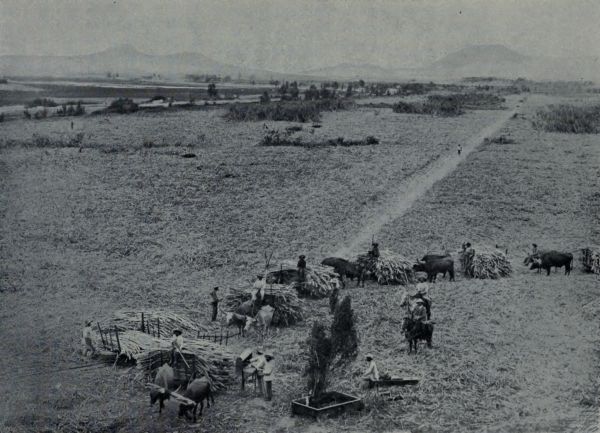
Here are fruitful plains and valleys, vast sugar-cane
plantations, luscious fruits of kinds unknown
to the world outside—among them the mamey, the
"fruit of the Aztec kings," with orange and banana
groves, coffee gardens, cocoa-trees, yielding the
chocolatl of the Aztecs, rubber-trees with elegant
foliage, whilst above, the graceful coco-palm rears
its stately column and feathery plume high against
the azure sky.
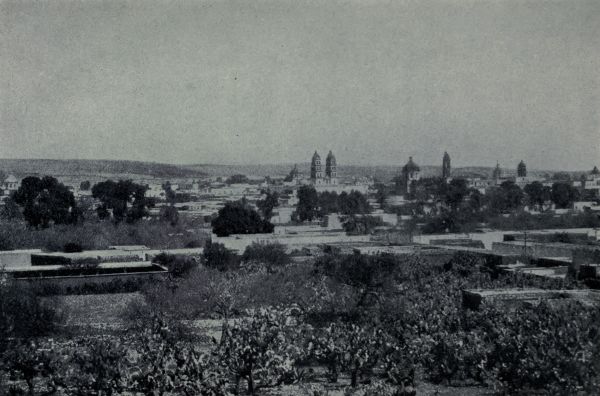
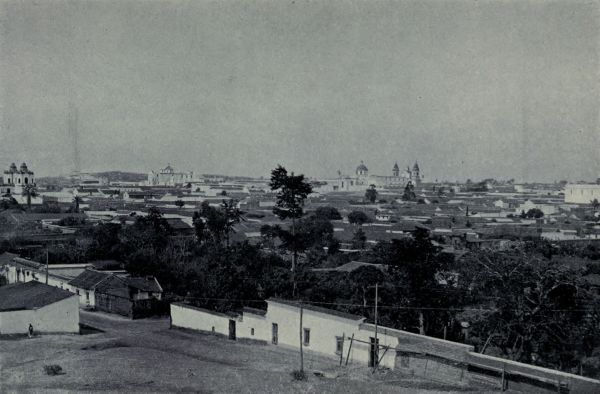
SCENE ON THE GREAT PLATEAU, MEXICO.
Vol. I. To face p. 104.
Here, indeed, is a region where it might have
been supposed that man could dwell in peace and
plenty, with a minimum of toil and ambition, of
care and evil.
The climatic zones of Mexico were named by
the Spaniards in accordance with the condition of
their varying temperatures respectively, as, the
Tierra Caliente, or hot lands, the Tierra Templada,
or temperate lands, and the Tierra Fria, or cold
lands: the first lying upon the coast, the second
midway up the slopes, and the last the higher
regions, reaching an elevation of 8,000 to 10,000
feet and more above the level of the sea.
In this intermediate zone of the Tierra Templada
lies a land which has been not unjustly termed a
region of perpetual spring, a truly desirable land,
where the fortunate inhabitant lives close to the
kindly earth as if in some mortal paradise—as far
as Nature is concerned. In the high zone, healthful
and invigorating, lies the beautiful city of Mexico
in its enclosed valley; and many a handsome town
is found throughout the three zones.
This city of Mexico was the coveted prize of
Cortes and his Spaniards, and through the varying
zones they passed after having, on that Good
Friday in 1519, landed on the shores to which
they gave the name of Vera Cruz—the place of the
True Cross. Across the waters of the Gulf as
they approached the unknown land was seen the
gleaming peak of Orizaba, called by the natives
Citlalteptl, or the Mountain of the Star, hanging
in mid-heaven, its point over thirteen thousand feet
above the sea.
From the shore, the native runners of Montezuma
bore swiftly upwards to the mountain city
news of the white man's arrival—long expected
of old, from the traditions of Quetzalcoatl, the
mystic god-man of white race. These messengers
made curious but faithful "picture-writings," on
Mexican paper, of the great "water-houses" or
caravels swinging in the bay, the dread "men-animals"
or horsemen, and the thunderous guns of
the Spaniards, and hastened thence to warn their
master.
Swiftly they returned from the mountains. "Go
back," the Aztec Emperor said, "come not hither,
the road is long and difficult," and he sent presents—a
huge wheel of gold and beautiful feather work
and other objects.
But Cortes, heeding not the message, burned
his boats; the customary Mass was rendered by
the Padre Olmedo—the Spaniards were always
devout, partly in sincerity, partly as a custom—and
the adventurers set forth on that remarkable
and adventurous journey which forms one of the
most thrilling episodes in early American history.
Let us briefly review it.
The Spaniards have allied themselves, in the
fruitful land of Tlascala—the "Land of Bread"
in the native tongue—with the Tlascalans, foes at
first but friends afterwards, and then began the
most stirring events of their march.
"The Tlascalans were a people who had developed
a remarkable civilization and social and
military organization, akin to that of the Aztecs.
On the arrival of the messengers of Cortes much
dissension had prevailed in their councils, some of
the chiefs—the community was ruled by a council
of four—maintaining that this was an opportunity
for vengeance against their hereditary enemies, the
hated Aztecs and their prince, Montezuma. 'Let
us ally ourselves with these terrible strangers,' they
urged, 'and march against the Mexicans.' For
the doings of the Spaniards had echoed through
the land already, with a tale of smitten tribes and
broken idols. But the wily old Xicotencatl thought
otherwise. 'What do we know of their purpose?'
was his counsel; so it was agreed that the army
of the Tlascalans and Otomies, who were in force
near the frontier, under the command of the fiery
young warrior—son of old Xicotencatl, and bearing
the same name—should attack them. 'If we
fail,' the old barbarian urged, 'we will disavow
the act of our general; if we win——'!
"The stone fortification at the valley's end had
been undefended, and with Cortes at their head
the Spaniards entered Tlascalan territory. Skirmishing
was followed by a pitched battle between
the Christians and the Tlascalans, in which the
firearms and lances of the Spaniards wrought
terrible havoc on their antagonists. Astounded at
the sight of the horses—those extraordinary beings,
whether of animal or demoniacal origin they knew
not—and appalled by the thundering of the guns,
which seemed to have some superhuman source,
the Tlascalans at first fell back. But they overcame
their fears, fell savagely upon the invaders,
and were with difficulty repulsed, having managed
to kill two of the horses. Greatly to Cortes's
regret was this, for the noble animals were few,
and—more serious still—their death removed that
semi-superstitious dread regarding them, which the
natives held. However, the Spaniards afterwards
buried them from sight.
"Night fell, a season when the Indians fought
not, but on the morrow the messengers which had
been sent to the Tlascalans arrived—having escaped—with
the news that the enemy was approaching
in great force. So indeed it befel, and upon the
plain in front of the Spaniards appeared a mighty
host, varyingly estimated between thirty and a
hundred thousand warriors. The Spaniards with
their allies numbered—fearful odds!—about three
thousand. 'The God of the Christians will bear
us through,' said the brave and beautiful Marina.
A frightful battle now ensued, the issue of which
hung in the scale for hours. Charging, volleying,
borne this way and that by the flood of the enemy's
numbers, the gallant band of the Spaniards
snatched victory from almost certain defeat, their
superior weapons and cavalry, together with the
bad tactics of the Indians, who knew not how to
employ their unwieldy army to best advantage, at
length decided the day for the Christians, who
inflicted terrible punishment upon their foes. The
Tlascalans' policy now showed signs of weakening,
but further assaults were necessary, and some
treachery, under the guise of friendship, having
been discovered on the part of the fifty Tlascalan
envoys to the Spanish camp, Cortes barbarously
cut off the hands of these and sent them back to
tell the tale.
"The upshot of these engagements was that
the Tlascalans capitulated, apologized for their
conduct, invited the strangers to take possession of
their capital, and assured them that they would
now be allies, not enemies, of the white men, who
were undoubtedly the representative of the great
and long-expected Quetzalcoatl. The joy in the
Spanish camp at this turn of affairs knew no
bounds; well did the Spaniards know that the
continued opposition of the Indians would have
been their ruin, whilst in their alliance was salvation
and the key to the Conquest.
"Behold the war-worn and hungry Spaniards,
lean and tattered from marching and privations
in the inclement uplands, now installed in comfort
in the centre of the powerful Tlascalan capital.
Forth had come to greet them young Xicotencatl,
who, to do him justice, took upon himself the
responsibility of the war; and as the Spaniards
entered the capital the streets were lined with
men, women and children, and decorated with
garlands of flowers as for a triumphal procession.
The old chief who had urged for opposition now
changed his tactics, and as Cortes entered he embraced
him, passing his hand over the face of the
Spaniard to see what manner of man he was, for
the aged Tlascalan was blind, having reached, it
has been said—probably with exaggeration—a
hundred and forty years of age! 'The city is
much larger than Granada,' wrote Cortes to
Carlos V, with a description of its markets, shops,
houses and intelligent and industrious population.
"Six weeks the Spaniards sojourned there, recuperating
their energies, living on the best the
plentiful land afforded—Tlascala signified in the
Indian tongue 'the land of bread'—taking wives
from among the maidens, the chiefs' daughters,
and endeavouring, first with the foolish haste of
Cortes and then with the slow prudence of Father
Olmedo, to instil some tenets of the Christian
religion into their hosts. But religious fervour had
to give way to material necessities, and the Tlascalan
idols remained unsmitten, although their
human sacrifices were somewhat stayed.
"Rested and mended, the Spaniards now set
impatient gaze upon the oak- and fir-clad mountain
slopes which bounded the valley. Above them
loomed upward the great Malinche, snow-capped
queen of the Tlascalan mountain fastnesses; and
still the friendly Tlascalans, stern foes but noble
allies, loaded them with every favour and bid them
tarry. When, however, they would stay no longer
they raised a great body of warriors to accompany
them, warning Cortes against the wiles of Montezuma.
'Beware of his presents and his promises;
he is false and seeks your destruction,' they urged,
and their implacable hatred of the Aztecs showed
itself in their words and mien.
"Contrary to the advice of their new allies, the
Spaniards decided to journey on to Mexico through
Cholula, the land of the great pyramid. Embassies
had arrived, both from Montezuma and from the
Cholulans, the latter inviting the Spaniards to go
that way; and the great Aztec monarch, swayed
now by the shadow of oncoming destiny, offering
the Spaniards a welcome to his capital. 'Trust not
the Tlascalans, those barbarous foes,' was the
burden of his message, 'but come through friendly
Cholula: a greeting received by the Tlascalans
with sneers and counter-advice. The purpose of the
Tlascalans was not a disinterested one. An attack
upon Montezuma was their desire, and preliminary
to this they hoped to embroil the Spaniards
with the perfidious Cholulans. Another embassy—and
this was an important event—had waited upon
Cortes. It was from the Ixtlilxochitl, one of the
rival claimants for the throne of Texcoco, which,
it will be remembered, was a powerful and
advanced community in confederation with the
Aztecs; and Cortes was not slow to fan the flame
of disaffection which this indicated, by an encouraging
message to the young prince.
"A farewell was taken of the staunch Tlascalans,
the invariable Mass was celebrated by Father
Olmedo, and, accompanied by a large body of
Tlascalan warriors, the Spaniards set out for
Cholula. What befel in this beautiful and populous
place—which, Bernal Diaz wrote, reminded him,
form its numerous towers, of Valladolid—was of
terrible and ruthless import. Cholula, with its
great teocalli, was the Mecca of Anahuac, and was
veritably a land flowing with milk and honey.
Well-built houses, numerous teocallis, or pyramidal
temples, well-dressed people with embroidered
cloaks, and numbers of censer-swinging priests
formed the ensemble which greeted the Spaniards'
eyes, whilst the intense cultivation of the ground
and the fields of maguey, maiz, and other products,
irrigated by canals from the mountain streams,
formed the environment of this advanced community.
'Not a palm's-breadth of land that is not
cultivated,' wrote Cortes in his dispatches to
Castile, 'and the city, as we approached, was more
beautiful than the cities of Spain.' Beautiful and
gay doubtless Cholula was when the Spaniards
entered; drenched with the blood of its inhabitants
and devastated by fire it lay before they left it!
There had been signs of treachery, even on the
road thither, work of the Cholulans; but, lodged
in the city, the Spaniards discovered, through the
agency of the intelligent Marina, a plot to annihilate
them later. Taking the Cholulans unawares
as they crowded the streets with—at the moment—harmless
curiosity, the Spaniards, with cannon,
musket and sabre, mowed down the unfortunate
and unprotected natives in one bloody massacre,
aided by the ferocious Tlascalans, who fell upon the
Cholulans from the rear. The appalling and unnecessary
slaughter at Cholula has called down
upon the heads of Cortes and the Spaniards the
execration of historians. Some have endeavoured
to excuse or palliate it, but it remains as one of
the indelible stains of the Spanish Conquistadores
upon the history they were making. Having
accomplished this 'punitive' act, an image of the
Virgin was set up on the summit of the great
pyramidal temple, and some order restored. 'They
are now your Highness's faithful vassals,' wrote
Cortes to the King of Spain!
"After this the way seemed clear. Far on the
horizon loomed the white, snow-capped cones of
Popocateptl and Ixtaccihuatl, beautiful and pure
above the deserts, the canyons, and the forests
beneath them—the gateway to Mexico. From the
foremost, above its snow-cap, there belched forth a
great column of smoke, for at that period Popocateptl
was an active volcano. Onwards the
Spaniards pressed with buoyant hearts and eager
feet, and when they stood upon the summit of the
range their eyes beheld the beautiful valley of
Mexico, the haven for which they had long toiled
and fought, stretched below. There, shimmering
in distance, lay the strange, unknown city of the
Aztecs, like a gem upon the borders of its lakes:
its towers and buildings gleaming white in the
brilliant sun of the tropic upland beneath the azure
firmament and brought to deceptive nearness by
the clear atmosphere of that high environment.
There at last was their longed-for goal, the
mysterious Tenochtitlan."[8]
The city of Mexico, notwithstanding its modern
attributes, is stamped with history and tradition,
and in this respect is perhaps the most noteworthy
metropolis on the American continents. It is, as
it were, a mediaeval city, transplanted from the
Old World to the New. The United States has,
naturally, no place which may compare with it,
and in happier times Mexico City has been a tourist
centre for Americans, who, escaping from the more
materialistic and commercial atmosphere of their
own busy towns, and the extremes of heat or cold
which alternate therein, have sought the equable
and healthful condition of the Mexican upland
capital—an easy journey comparatively, of a few
days in a Pullman car, amid landscapes attractive
from their novelty.
We are in a city of churches and convents.
Elsewhere I have described some of these remarkable
edifices, home of the Roman Catholic faith,
and as we view the city from the pleasing hills
surrounding the valley their domes and towers
stand up refreshingly.
The houses of Mexico are of a type unknown
to the Anglo-Saxon American; the social customs,
the aspects of the streets, the markets, the flower-market,
the old, massive public buildings, the
cotton-clad Indian folk in the plazas side by side
with beautifully dressed señoritas and correctly
attired, grave and ceremonious men—statesmen,
lawyers, doctors and men of many professions, the
serenatas or concerts in the alamedas, the lottery
ticket vendors thrusting their flimsy wares into
one's face, urging you to tempt fortune—for will
not the wheel be turned in the public square in
half an hour, and may you yourself not be the
winner of the sorteo?—all these features catch the
traveller's eye as in the genial sunshine, before
the midday heat renders the shade of the patio or
veranda advisable, we observe the life of the
Mexican city. In the market-place, at an early
hour or in the evening, the odour of the tortilla
or the frijoles, fried in the open for ready sale,
will greet our nostrils, and there are piquant chiles—a
favourite article of diet—and many luscious
and unknown fruits which we cannot resist.
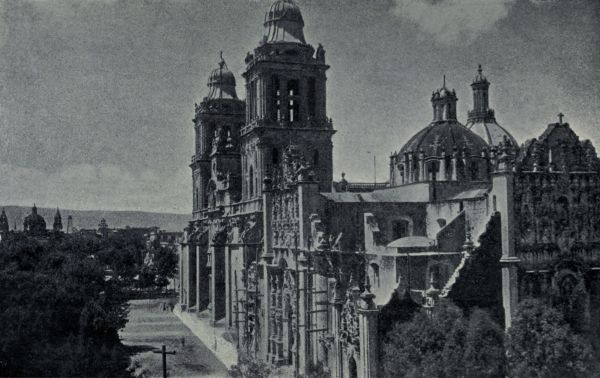
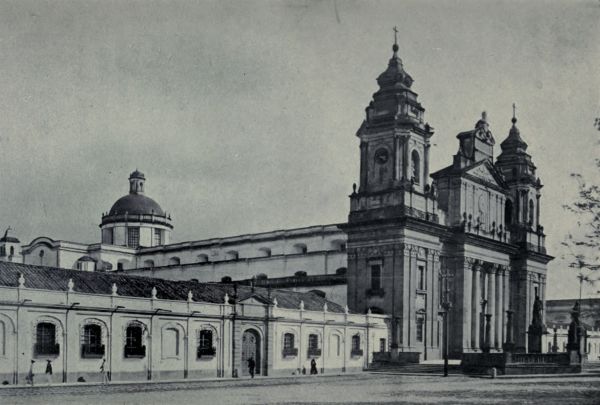
THE CATHEDRAL, CITY OF MEXICO.
Vol. I. To face p. 114.
Under the shade trees in the plaza or the
alameda, escorted by Indian maid-servant, or
perhaps entering or leaving the temples, are sweet-faced
girls of the upper class, pale oval-faced
señoritas with dark hair and expressive eyes, with
the mantilla drawn over the head, bent on their
early-morning orisons: but though their thoughts
are at the moment doubtless dwelling upon matters
spiritual, there are glances from expressive eyes—
Para que te miré, mujer divina?
Para que contemplé tu faz hermosa?
Sentiment and love, indeed, play a strong part in
the temperament of this southern race, with all
its reserve and seclusion.
The foreigner in Mexico will thus find a varied
local colour in the Mexican capital and in other
cities throughout the Republic, such as could long
occupy his pen, and indeed his brush, if he wield
such. To come into actual touch with the people in
their homes is more difficult, but if he is fortunate
enough to be the guest in an upper class Mexican
family, he will experience the most pleasing hospitality.
To penetrate such circles, however, there
must be the appropriate qualities and circumstances.
In this peaceful city there are few signs of
revolution, disorder or bloodshed. The walls here
and there may be pitted with bullet-marks, but
the things which caused them come and go, and
the populace lives its life with merely passing notice
of them.
We may wander somewhat farther afield in the
valley: to the suburbs where the palaces of the
wealthy lie embowered in flowers and orange-trees;
to Xochimilco, the Field of Flowers; to
Chalpultepec—the Aztec "Hill of the Grasshoppers,"
where stands the presidential castle; to
the shrine of Guadalupe, the Lourdes of Mexico,
where the Virgin, it is said, appeared in a vision
to Juan, the poor Indian.
The great lake of Texcoco, a dreary body of
water now—it is partly drained by a great canal,
to the far greater salubrity of the place—formerly
extended to the city, which, indeed, at the time of
the Conquest, was built upon it and reached by
stone causeways—a position which might have
been impregnable.
The first attempt by Cortes and the Spaniards
upon Tenochtitlan ended in disaster. They were
enjoying the Aztec hospitality, which, however,
they outraged. They attacked and massacred a
number of the people and took Montezuma
a prisoner in the stout palace which had been
assigned as their quarters. They stormed and
carried the great Teocalli, or pyramid-temple, and
threw down the great idol of the Mexicans.
Montezuma was killed, either by a missile from
without or treacherously by the Spaniards whilst
in their power. All seemed lost as a result of the
mad act of Alvarado in attacking the people. The
story of the disaster is a thrilling one.
"The bridges broken, the savages screaming
outside the walls, hope of victory gone, there was
now no counsel of war for the Spaniards save
that of escape. But how? At night and along
the great causeway was the only plan. A weird
scene it was on the beginning of that Noche Triste—the
sorrowful night—which stands forth so
unforgettably in the history of the Conquest.
Disorder everywhere; piles of gold and valuables
on the floor, each Spaniard, whether cavalier or
boor, loading himself with what he thought he
could carry. 'Pocket what you can,' Cortes said,
'but recollect that gold is heavy and we have to
travel swiftly'—grave advice, the neglect of which
cost some their lives upon that awful night.
"And then began the retreat along the fatal
causeway. It was known that there were three
openings in this, and a portable bridge had been
made and was borne along to enable passage to
be effected. Hurrying on in the hope of passing
the breaches before alarm might be given, the
Spaniards entered upon the causeway and placed
their portable bridge upon the first breach. Was
safety to be theirs? No! what was that appalling
sound, sonorous and melancholy, which rang over
the city and the waters amid the darkness? It
was the great drum on the teocalli; the tambor
of the war-god, sounded by vigilant priests, calling
the people to vengeance and battle. And in their
myriads the Aztecs poured forth and fell upon
the Christians, raining darts and stones upon them,
and making the night hideous with their war-cries.
Meanwhile Cortes and the advance guard had
passed over, and reached the second breach.
'Bring up the bridge!' was the repeated order,
as those behind crowded on. Useless; the bridge
was stuck fast in the first breach, wedged down
by the weight of guns and horses which had passed
over it, and as these dread tidings were heard the
mass of men upon the narrow causeway lost their
presence of mind. Those behind crowded on those
in front; men and horses rolled into the lake;
Spaniards and Tlascalans fell victims to the Aztecs,
who crowded the water in their canoes and leapt
upon the causeway; the shouts of vengeance and
triumph of the savages resounded all along the
dyke, silencing the muttered oath or prayer of
the Christians huddled at the breach. Down went
horse and man, artillery and treasure, until the
bodies of Christians and Indians and horses, and
bales of merchandise and chests of ammunition
the breach was almost filled, and a portion of the
fugitives passed over. And now the third breach
yawns before them—deep and wide. The morning
is dawning upon the fatal scene; the salt waters
of the lake have closed over many a gallant
Christian head; the frightful causeway is strewn
with wreck of man and merchandise. 'The rear
guard perishes!' and 'back and save them!' were
the words which rang out then, and Cortes and
his remaining cavaliers, who were in the lead, rode
back, even in that frightful hour—be it recorded
to their honour—and, swimming the breach once
more, strove to support their comrades. There
stood Alvarado unhorsed and battling, with the
savages pressing upon his rear. Escape there
seemed none. Canoes and spears teemed on every
side, and Cortes and his companions were forced
onward."[9]
The figure of Alvarado stood up against the
grey sky alone—a moment—and then he
measured the breach with his eye. Planting his
lance on the wreckage in the waters of the breach,
after the manner of a leaping-pole, the heroic
Spaniard, collecting his energies, leapt forward,
and passed the chasm at a bound. The Aztecs
paused in admiration of this feat of the "Son
of the Sun," as they had named Alvarado, from
his fair hair and ruddy countenance. To-day we
may still see the place where this part of the causeway
lay, known as the Puente de Alvarado.
Away off the causeway into the grey dawn
passed the remnant of the routed Spanish Army,
wounded, bleeding, starving, their comrades gone,
some to death, some to the dreadful sacrifices of
the Mexican priests, where their hearts would be
torn living from their breasts, and annihilation
threatening all. Baggage and artillery were gone,
not a carbine was left, and Cortes, seating himself
upon the steps of a ruined temple on the shore,
wept bitter tears of sorrow for the loss of his
comrades and his vanished fortunes.
So ended the Noche Triste, and to this day
may be seen an ancient tree under which it is
said Cortes wept.
The Spaniards, however, were not of such stuff
as easily gives in to difficulty and disaster. Had
it been otherwise, Mexico to-day might have
had a different destiny. It might have developed
a purely aboriginal or Indian state. But fate
seems not to have willed it that any such nation
should exist in the New World.
Cortes and the remnant of his army—there was
no other course for them—returned to their
Tlascalan allies, fighting their way even here, however,
for after passing the ancient pyramid of
Teotihuacan, even then standing ruined and
desolate a few miles north of the city—monument
of the shadowy Toltecs, who preceded the Aztec
hegemony, and which, restored by the Mexican
Government under President Diaz, is an object
of great interest to the traveller—they looked down
on the Plain of Otumba, and beheld the forces
of the Otomies drawn up in battle array against
them. These warriors wore armour of thick
quilted cotton, which formed a considerable protection
against the rude weapons of the country,
and the Spaniards were now without firearms.
They were so numerous that, it is recorded, the
plain "looked as if it were covered with snow,"
from the white armour.
But the Christians routed them, and thus the
Battle of Otumba was one of the turning-points in
New World history, as elsewhere remarked.
Reinforced by the Tlascalans, Cortes returned
to the siege of the city. Fresh supplies of arms
and ammunition had reached the Spaniards from
the coast, with horses and two hundred Spaniards
sent from Hispaniola. Cortes built a number of
brigantines, which were carried by the Indians to
the lake in order to attack Tenochtitlan by water
as well as land. But the whole enterprise would
have been hopeless had not the other Mexican
tribes, hating the Aztecs, joined forces with the
white men. The plan was to starve out the city
on the lake by laying waste the surroundings, for
it was dependent upon these for its food. To the
dead Montezuma's place had succeeded his nephew
Guahtemoc, a noble Aztec prince, animated by the
utmost spirit of patriotism in defending the heritage
of his forefathers.
"A series of severe struggles began then, both
by land and water—burning, slaughter and the
destruction of the lake towns. The Aztecs, with
their great number, raining darts and stones upon
the invaders at every engagement, attacked them
with unparalleled ferocity both by forces on shore
and their canoes on the lake. The Spaniards took
heavy toll of the enemy at every turn, assisted by
their allies the Tlascalans, as savage and implacable
as the Aztecs, whom they attacked with a singular
and persistent spirit of hatred, the result of long
years of oppression by the dominant power of
Anahuac. Cortes, on every occasion when it
seemed that the last chance of success might attend
it, offered terms to the Aztec capital, by no means
dishonourable, assuring them their liberty and self-government
in return for allegiance to the Crown
of Spain and the renouncing of their abominable
system of sacrificial religion. These advances were
invariably met by the most implacable negatives.
The Aztecs, far from offering to yield, swore they
would sacrifice, when the day was theirs, every
Spaniard and Tlascalan on the bloody altars of
their gods; and as for entering into any treaty,
the last man, woman and child would resist the
hated invaders until the last drop of blood was
shed and the last stone of their city thrown down.
This vaunt, as regards the latter part, was almost
literally carried out, and to some extent as regards
the former.
"The siege operations were conducted vigorously
both by land and water. Again before the
eyes of the Spaniards stretched that fatal causeway—path
of death amid the salt waters of Texcoco
for so many of their brave comrades upon the
Noche Triste of their terrible flight from Tenochtitlan.
And there loomed once more that
dreaded teocalli, whence the war-drum's mournful
notes were heard. Guarded now by the capable
and persistent Guatemoc, the city refused an offer
of treaty, and invited the destruction which was
to fall upon it. From the azoteas, or roofs of
their buildings and temples, the undaunted
Mexicans beheld the white-winged brigantines,
armed with those belching engines of thunder and
death whose sting they well knew: and saw the
ruthless hand of devastation laying waste their fair
towns of the lake shore, and cutting off their means
of life.
"But the Spaniards had yet to learn to their
cost the lengths of Aztec tenacity and ferocity. It
will be recollected that the city was connected
to the lake shores by means of four causeways,
built above the surface of the water; engineering
structures of stone and mortar and earth, which
had from the first aroused the admiration of the
Spaniards. These causeways, whilst they rendered
the city almost impregnable from attack, were a
source of weakness in the easy cutting-off of food
supplies, which they afforded to the enemy. A
simultaneous assault on all these approaches was
organized by the
Spaniards, under Sandoval,
Alvarado and Cortes himself, respectively, whilst
the brigantines, with their raking artillery, were to
support the attack by water, aided by the canoes
of the Tlascalan and Texcocan allies. A series of
attacks was made by this method, and at last the
various bodies of Spaniards advanced along the
causeways and gained the city walls. But frightful
disaster befel them. The comparative ease with
which they entered the city aroused Cortes's suspicions;
and at that moment, from the summit of
the great teocalli, rang out a fearful note—the
horn of Guatemoc, calling for vengeance and a
concerted attack. The notes of the horn struck
some ominous sense of chill in the Spaniards'
breasts, and the soldier-penman, Bernal Diaz, who
was fighting valiantly there, says that the noise
echoed and re-echoed, and rang in his ears
for days afterwards. The Spaniards, on this,
as on other occasions, had foolishly neglected
to secure the breaches in the causeways
as they passed, or at least the rash
Alvarado had not done so with his command, his
earlier lesson unheeded; and when the Christians
were hurled backwards—for their easy entrance
into the great square of the city had been in the
nature of a decoy—disaster befel them, which at
one moment seemed as if it would be a repetition
of that of the Noche Triste. 'The moment I
reached that fearful bridge,' Cortes wrote in his
dispatches, 'I saw the Spaniards returning in full
flight.' Remaining to hold the breech if possible,
and cover the retreat, the chivalrous Cortes almost
lost his life from a furious attack by the barbarians
in their canoes, and was only saved by the devotion
of his own men and Indian allies, who gave their
lives in his rescue. Word, nevertheless, had gone
forth among the men that Cortes had fallen; and
the savages, throwing before the faces of Alvarado
and Sandoval the bloody heads of decapitated
Spaniards, cried tauntingly the name 'Malintzin,'
which was that by which Cortes was known among
the Mexicans. Men and horses rolled into the
lake; dead bodies filled the breaches; the
Christians and their allies were beaten back, and
'as we were all wounded it was only the help
of God which saved us from destruction,' wrote
Bernal Diaz. Indeed, both Cortes and the
Spaniards only escaped, on these and other occasions,
from the Aztec's desire to take them alive
for sacrifice.
"Once more, after disastrous retreats and heavy
loss, the bleeding and discouraged Spaniards lay
in their camp, as evening fell. Of dead, wounded
and captured, the Spaniards missed more than a
hundred and twenty of their comrades, and the
Tlascalans a thousand, whilst valuable artillery,
guns and horses were lost. But listen! what
is that mournful, penetrating sound which smites
the Christians' ears? It is the war-god's drum,
and even from where the Spaniards stand there
is visible a procession ascending the steps of the
teocalli, and, to their horror, the forms of their
lost comrades are seen within it: whose hearts
are doomed to be torn out living from their breasts
to smoke before the shrine of Huitzilopochtli, the
war-devil of their enemies. From that high and
fearful place their comrades' eyes must be gazing
with despairing look towards the impotent Spanish
camp, glazing soon in death as the obsidian knives
of the priests performed their fiendish work. The
disastrous situation of the Spaniards was made
worse by the desertion, at this juncture, of the
Tlascalan and other allies. Awed by a prophecy
sent out confidently by the Aztec priests, that both
Christians and allies should be delivered into their
hands before eight days had passed (prophecy
or doom, which the priests said, was from the
mouth of the war-god, appeased by the late
victory), the superstitious Indians of Cortes's
forces sneaked off in the night.
"Continued reverses, in the face of long-continued
action and desire for the attaining a given
end, forges in the finer calibre of mind a spirit
of unremitting purpose. Blow after blow, which
would turn away the ordinary individual from his
endeavour, serves to steel the real hero to a dispassionate
and persistent patience, and the purpose
from its very intensity becomes almost a sacred
cause, and seems to obtain from the unseen powers
of circumstance success at last. So with Cortes
and others of the Spaniards. The period prescribed
by the somewhat rash prophecy of the
Aztec priests and their infernal oracle having
passed without anything remarkable having taken
place, the Tlascalan and Texcocan allies, upbraided
and warned by the Spaniards' messengers, now
sneaked back to resume the attack against the
city. The Aztecs had sought to cause disaffection
in outlying places by sending round the bloody
heads of decapitated Spaniards and horses, but
with little effect. Cortes then prepared for a
final effort. The plan adopted was to be
slower but surer than the former one of simple
slaughter. It was determined to raze the city to
the ground; to destroy the buildings step by step,
fill up the canals, and so lay waste the whole area
from the outside, so that unobstructed advance
might be maintained.
"The execution of this plan was begun. The
city ends of the causeways were captured and
held; street after street was demolished, and canal
after canal filled up amid scenes of incessant fighting
and slaughter. Day after day the Spaniards
returned to their work; day after day with
admirable tenacity the inhabitants of Tenochtitlan
disputed the ground inch by inch, watered with
the blood of themselves, their women and their
children. Their supplies cut off, famine and
pestilence wrought more terrible havoc among
them—crowded as they gradually became into one
quarter of the city—than the arms of the Spaniards
and the Tlascalans. At the termination of each
day's work the Spanish prepared an ambuscade
for the enemy, drawing them on by seeming to
retire, and massacring them with the artillery and
gun-fire and lances, to say nothing of the weapons
of their savage allies. On one of these occasions
'the enemy rushed out yelling as if they had
gained the greatest victory in the world,' Cortes
wrote in his dispatches, and 'more than five
hundred, all of the bravest and principal men, were
killed in this ambush.' He added, and it was a
common occurrence, 'our allies'—the Indians—'supped
well that night, cutting up and eating
their captives!' During the days of this terrible
siege the famous catapult was made, an extraordinary
engine to discharge great stones upon
the enemy. This was to enable the Spaniards to
husband their powder, which was getting low, and
the Aztecs watched the construction of this
machine with certain fear. It was completed and
set to work, but the builder, a Spanish soldier of
inventive faculty, nearly played the part of the
engineer hoist with his own petard, for the great
stone fired rose, it is true, but went straight
up and descended again upon the machine,
which was ever afterwards the laughing-stock of
the army.
"Further severe losses were now inflicted upon
the beleaguered inhabitants, as more ammunition
had been obtained. Peace had again been offered
by the Spaniards, and again refused by the Aztecs.
An Aztec chief of high rank had been captured,
and then returned to Guatemoc as a peace envoy.
The Mexicans' reply was to execute and sacrifice
the unfortunate emissary, and then collecting their
forces they poured out upon the causeways like a
furious tide, which seemed as if it would sweep
all before it. But the Spaniards were prepared.
The narrow causeways were commanded by the
artillery, which poured such a deadly hail upon
the enemy's numbers that they returned fleeing
to the city.
"And soon the end approaches. The division
led by Cortes made a fierce assault; and whilst
the battle raged the Spaniards observed that the
summit of one of the teocallis was in flames. It
was the work of Alvarado's men, who had penetrated
already to the plaza. Forces were joined,
and the inhabitants of the city, driven into one
quarter thereof, still made their stubborn and—now—suicidal
stand. For the streets were piled
up with corpses, the Aztecs refraining from
throwing the bodies of their slain into the lake,
or outside the city, in order not to show their weakness.
Pestilence and famine had made terrible
inroads upon the population. Miserable wretches,
men, women and children, were encountered
Wandering about careless of the enemy, only bent
upon finding some roots, bark or offal which might
appease the hunger at their vitals. The salt waters
of the lake, which they had been obliged to drink,
for the Spaniards had cut the aqueduct which
brought the fresh water from Chapultepec, had
caused many to sicken and die. Mothers had
devoured their dead children; the bodies of the
slain had been eaten, and the bark gnawed from
the trunks of trees. In their dire extremity some
of the chiefs of the beleaguered city called Cortes
to the barricade. He went, trusting that capitulation
was at hand, for, as both he and his historians
record, the slaughter was far from their choosing.
'Do but finish your work quickly,' was the burden
of their parley. 'Let us go and rest in the heaven
of our war-god; we are weary of life and suffering.
How is it that you, a son of the Sun, tarry
so long in finishing, when the Sun himself makes
circuit of the earth in a day, and so accomplishes
his work speedily?'
"This remarkable appeal struck renewed pity
to the heart of Cortes, and once more he begged
them to surrender and avoid further suffering, and
the Spaniards drew off their forces for a space.
But the inexorable Guatemoc, although he sent
an embassy to say he would hold parley, and the
Spaniards waited for him, did not fulfil the promise
at the last moment. Incensed at this behaviour,
the Spaniards and the Tlascalans renewed the
attack with overpowering energy on the one part
and barbaric savagery on the other. Contrary to
the orders of the Spaniards, their savage allies
gave no quarter, but murdered men, women and
children in fiendish exultation. The stench of the
dead in the beleaguered city was overpowering;
the soil was soaked with blood; the gutters ran
as in a rain-storm, say the chroniclers, and, wrote
Cortes to the King of Spain: 'Such slaughter
was done that day on land and water that killed
and prisoners numbered forty thousand; and such
were the shrieks and weeping of women and
children that there were none of us whose hearts
did not break.' He adds that it was impossible
to contain the savage killing and torturing by their
allies the Tlascalans, who practised such cruelty
as had never been seen, and 'out of all order
of nature.'
"At nightfall the attacking forces drew off,
leaving the remainder of the inhabitants of the
stricken city to consider their position. It is stated
that the Tlascalans made a great banquet of the
flesh of the fallen Aztecs, and that on this and
other occasions they fished up the bloated bodies
of their enemies from the lake and devoured them!
At sunrise on the following day Cortes and a few
followers entered the city, hoping to have a
supplication for terms from Guatemoc. The army
was stationed outside the walls, ready, in the event
of a refusal—the signal of which should be a
musket-shot—to pour in and strike the final blow.
A parley was entered into as before, which lasted
several hours. 'Do you surrender?' Cortes demanded.
The final reply of Guatemoc was, 'I
will not come: I prefer to die where I am: do
your worst.'
"A musket-shot rang out upon the air; the
Spaniards and their allies fell on to merciless
slaughter: cannons, muskets, arrows, slings, lances—all
told their tale upon the huddled mass of
panic-stricken people, who, after presenting a
feeble and momentary front, poured forth upon
the fatal causeways to escape. Drowned and
suffocated in the waters of the lake, mowed down
by the fire from the brigantines, and butchered
by the brutal Tlascalans, women, children and
men struggled and shrieked among that frightful
carnage; upon which it were almost impious to
dwell further. Guatemoc, with his wife and
children, strove to escape, and the canoe containing
them was already out upon the lake, when a
brigantine ran it down and captured him. All
resistance was at an end. No sign of life or
authority remained among the ruined walls; the
fair city by the lake was broken and tenantless,
its idols fallen, and its people fled. The Homeric
struggle was over; the conquest of Mexico was
accomplished."[10]
Under the long rule of the viceroys that
followed the Conquest, Mexico lived her life in
a mediaeval but often peaceful and not unhappy
state, and had Spain but understood her and developed
the resources of the land and protected
her simple Indian folk instead of exploiting them,
and at the same time antagonizing the colonists,
there is no reason why a magnificent and permanent
Spanish empire should not have grown to
being.
We have remarked elsewhere on the abundant
mineral wealth of the country. The great silver
deposits of Guanajuato were discovered as a result
of a camp-fire made on the rocks by some muleteers,
who found refined silver among the ashes,
which the heat had smelted from them. The great
"mother lode" here yielded up enormous wealth.
The pleasing city of Zacatecas to-day grew from
another discovery of silver ores, which produced
a value, up to the middle of last century, of nearly
eight hundred million dollars. The curious
archives of these mines, which still exist, show how
carefully the Spaniards worked them. The
Pachuca mines, which to-day are still worked,
yielded similar wealth, and it was here that the
well-known patio or amalgamation process was
discovered, with quicksilver from Peru.
There are other centres, scarcely less important,
well known to the mineralogist. The mineral-bearing
zone of Mexico is sixteen hundred miles
long, and yields nearly all the metals known to
commerce. Coal, however, is not a frequent
product. The country has been described as a
paradise for the prospector. The mines are innumerable:
almost every hill is pierced or perforated
by shafts and galleries, ancient or modern;
some are enormous tunnels, or socavones.
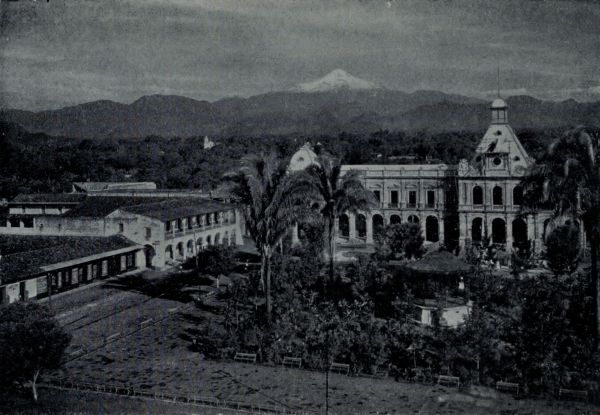
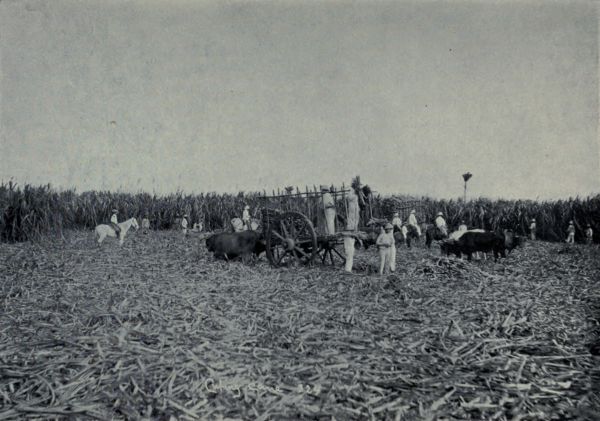
CORDOVA AND THE PEAK OF ORIZABA. STATE OF VERA CRUZ.
Vol. I. To face p. 132.
The Mexican native miner is, in his way, expert
and active, and with rude appliances performs
marvels in the work of ore extraction. Halt a
moment by yonder pit in the rocky slope. Look
down: a notched pole descends, upon which you
would hesitate to venture, giving access to the
workings beneath. Yet, in a moment, perhaps,
a peon, bearing on his back an enormous load of
rock in a hide or sack, will ascend from the bowels
of the earth, panting and groaning—we shall hear
the noise of his breathing before we see him.
He will cast his load at our feet, and from it will
roll the gleaming quartz and pyrites, with perhaps
the red of the rosicler, or rich oxide ore of silver,
or the yellow ochres of the decomposed gold-bearing
sulphides, more readily prepared by Nature
for treatment and winning of the yellow metal.
Or he may bear it to the stream-bed, there to
treat it in some primitive stone mill.
Otherwise we may visit huge modern mills
where hundreds of stamps are clanging and
engines are winding and furnaces are burning, for
a host of these exist throughout the land, though
disorder and revolution may have suspended
their operations.
Many curious products of the vegetable world
attract our eyes. Behold yonder stupendous
cactus-trees—the organo cactus, whose symmetrical
spiny branches like a giant candelabrum, weighing
perhaps tons, with their mass of sappy foliage,
arise from a single stem, which could be brought
down by a stroke of a machete, or wood-knife—that
formidable implement or weapon
(made perhaps in Birmingham) which the
Mexican peon loves to wield or use. Look at
the marvellous giant leaves of the juicy maguey,
or agave, as long as a man, and see the peon insert
his siphon to the heart of the plant to draw forth
its sap, which he blows into the goatskin on his
back, and from which he will presently make his
pulque. This plant, the great American aloe,
comes into flower and dies in a few years. It
exhausts itself in flowering. In England we call
it the century plant, for the exotic lingers long in
the unfavourable climate, and with difficulty puts
forth its blossoms at all. There, too, are hedges
and circas of prickly-pear, or nopal, which yield
the delicious wild fig—the cactus familiar to the
traveller in the Holy Land and Syria, whence it
was taken from Mexico.
In the coastal lands, as before remarked, the
feathery coconut-palm waves over the villages,
and the elegant leaves of the banana form refreshing
groves, and the cacao yields its stores of chocolate.
Lovers of this sweetmeat might hear the
name of Mexico in gratitude indeed, for is not
the very name and product of Aztec origin—the
chocolatl of the early folk here? In the tropic
forests and plantations the beautiful rubber, the
Castilloa elastica-tree, rears its stately foliage, and
here, again, are we not indebted to Mexico?
Remember it, ye lovers of lawn tennis. For when
the early Spaniards arrived they found the
Mexicans playing tennis, with balls of rubber, in
those curious courts whose ruins still remain in
the jungles of Yucatan.
Again, yonder flies the wild turkey. Was he
not the progenitor of that noble bird which comes
upon our Christmas tables? Here, too, is the
zenzontl; or mocking-bird, and a host of gorgeous
winged creatures besides.
Through many a desert range and over many
a chain of hills, violet in the distance, alluring and
remote; past many a sacred well or hill marked
by a cross, hard by the paths worn by the generations
of bare or sandalled feet we may pass;
and here, perchance, by some spring stands a
startled native maid, her olla, or great water-pitcher,
on her shoulder—stands in classic but unwitting
pose. Or through the heat a mounted vaquero
rides upon his attenuated mule or horse—for the
equine race works hard and eats little here, but
bit, spur and the bridle are his till the day he
leaves his bones upon the trail—and, "Buenos
dias, señor," with doffed hat the horseman gives
us as he passes, with ever-ready Mexican courtesy
to the foreigner; or he did so until of recent times,
when, for reasons we need not here dilate upon,
the foreigner has come to be regarded with anything
but friendship.
There was always a charm about this old land
of Mexico; there still is, despite its recent
turbulent history. Small wonder that foreigners
in increasing numbers loved to make their life
in its quaint towns, to take up land and industry
within it.
Of these towns we cannot speak here; Guadalajara,
Puebla, Oaxaca and many another invite us
to their pleasing streets and ancient buildings.
From the Atlantic to the Pacific, from north to
south, they are dispersed over the wide area of the
Republic.
The southern, or rather easternmost States of
Mexico are, as regards their landscape and life,
often of peculiar interest, mainly by reason of the
more tropical surroundings and the large rivers,
such as those that flow into the Gulf of Campeche,
in Vera Cruz and Tabasco.
Typical of these rivers are the Grijalva and
the Usumacinta. In places lined by dark forests,
the banks elsewhere open out to permit of plantations
of bananas, tobacco, maize, pineapples, rubber
and so forth, and an occasional village, its white
walls gleaming among the foliage, the roofs
thatched with palm, gives the human touch
thereto.
Ascending the river in a slow stern-wheel
steamer, we remark an occasional canoe, laden
with skins and other produce, or moored inshore
whilst its occupants are fishing in the plentifully
stocked waters. There are great trees festooned
with masses of moss and with trailing lianas, where
monkeys play by day and from whence at night
their howling falls on the ear. The white
heron and aigret, whose snowy plumage is so
valuable an article of commerce, startled by the
passage of the boat, sail gracefully away to the
bends of the river, and flocks of parrots, similarly
disturbed, scream their defiance, whilst wild ducks
and cranes and birds of the brightest plumage
are in sight at every moment. The alligators,
large and small, that throng the shoals project
their grotesque forms into the water, offering a
mark to the gun of the idle huntsman.
In the flower world Nature is often gorgeously
arrayed here. Pure white lilies lie at the base
of flowering trees that rise in a mass of bloom
for forty feet or more, of a profusion and beauty
almost inconceivable. The queen of the banks,
the stately coco-palm, carries its load of nuts,
waiting for nothing but the gatherer of a harvest
provided by Nature. Here, too, is the cinchona-tree,
with its bright, smooth red trunk and
branches and rich green leaves, offering its virtues
of quinine bark. The arnica plant, with its daisy-like
yellow flowers, and the morning glory of rich
and brilliant hue abound, and the orchids—"not
the dwarfed product of a northern hothouse, but
huge, entrancing, of the richest browns, the
tenderest greens, the most vivid reds and the
softest yellow, sometimes as many as half a dozen
upon one tree"—decorate the decayed trunks
of the trees. There are, too, natural plantations
of wild pineapples, and many fruits
besides.
A good deal of land in these regions is capable
of cultivation, and, extremely fertile, yields profitable
returns. But means of transport are, of
course, defective, although the rivers offer long
lines of communication. The Indians do not love
work, except inasmuch as such may fill their own
small requirements, for in so bountiful a region
Nature supplies them with many things necessary
for life, which a very few hours' labour will supplement
for a whole year. There is rivalry between
the established planters for the available labour,
and peonage is largely carried out.
In Yucatan, the labour system upon the plantations
of the Mexican millionaire hemp-growers of
the peninsula has been described as little more
than slavery by some writers. But great wealth
and some measure of progress have resulted from
this special Yucatan industry, and Merida, the
capital city, shows these elements in marked
degree.
The Yucatan peninsula is a curious limestone
plain, originally covered, and still covered in great
part, with tropical jungle, riverless, but with underground
streams. The water was used by the
ancient builders of the Maya cities here, whose
beautifully sculptured palaces and pyramid temples
are among the chief archæological wonders of
Spanish America. They constructed wells adjacent
to the buildings—the curious cenotes, or
sacred wells.
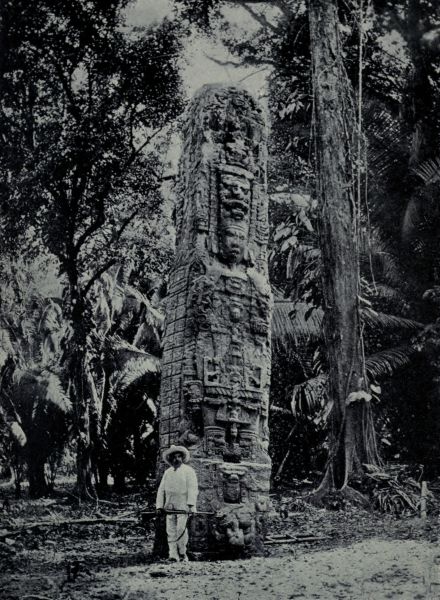
The lore of these silent, buried temples, over-run
by the jungle, the haunt now of wild creatures,
is fascinating in its mystery. Some observers have
likened their details of the façades of these structures
to Hindu temples, others to Egyptian, and so forth,
whilst others stoutly proclaim them to be of purely
autochthonous culture.[11] This culture area, we have
already seen, extended into Guatemala.
To turn for a moment now to the Pacific coast
of Mexico, this presents its own special points
of interest. From hence may have come the
Toltecs originally, with their wonderful native
knowledge and stone-shaping arts, among famous
objects of whose handiwork is the famous
Calendar Stone, to be seen in the Museum of
Mexico. This remarkable stone shows the early
Mexicans to have had a more exact division and
calculation of solar time than their contemporaries,
the cultured nations of Europe. However, the
principal Toltec remains are not upon the Pacific
coast, but at Tula, on the Plateau, which appears
to have been their ancient capital.
Upon the long Pacific coastline Mexico possesses
several important seaports, to some of which
access may be gained by railway, and many
picturesque places rarely heard of by the outside
world, together with vast areas of fruitful land
and valuable forests. This littoral, indeed; forms
a region which must some day take its place in
the economy of the globe. The long peninsula
of Lower California, forming an isolated part of
Mexico, is in many respects remarkable, and into
the head of the Gulf flows the Colorado River,
with many peculiar characteristics.
What we have here said as to the topography
of Mexico, with its beautiful mountains, rivers,
archæological remains, cities and so forth, is little
more than an index to a vast field of interest,
which, however, must be studied elsewhere. We
are now bidden to cast a further glance at the
people who have their being upon the diversified
surface of the Republic.
A small proportion only of the Mexicans are
white—perhaps ten per cent. The remainder are
of varying shades of brown. But there is no
"colour line," although, naturally, the purest
European blood is found among the upper and
governing classes.
However, the brown race has produced some
of the best of Mexico's people. The famous
Juarez, the lawyer-president who preceded Diaz,
and who was responsible for some of the most
important measures of reform, was a pure Indian
by birth, and Diaz himself was proud of his partly
aboriginal ancestry. In fact, it cannot be said
that there is any dividing line in the composition
of the Mexicans. The bulk of the people are
thus of mestizo or mixed race, but there are
various districts where only pure Indians
are found.
The working population of the country, perhaps
three-quarters of the total, are peones. Peonage is
a state of what might be termed debt-bondage.
They dwell upon the great landed estates, dependent
for their livelihood upon the owners of
these, unable to leave them, and are paid their
small wage largely in goods under a species of
"truck system." They are often purposely kept
in debt. Their economic condition is a low one.
They own nothing of the land upon which they
dwell; they carry on occupations which are not
profitable to themselves, and are subjected to
many abuses in this respect; they dwell in adobe,
or dried mud huts, generally of the poorest kind;
their food is of the most primitive, and often scanty—meat
is an article which rarely enters into their
diet; if a cow dies on the plain they cut it up
for food—but nevertheless they labour hard from
sunrise to sunset upon a diet of maize and beans.
This class is almost wholly illiterate, although there
has been some improvement of late years in this
respect.
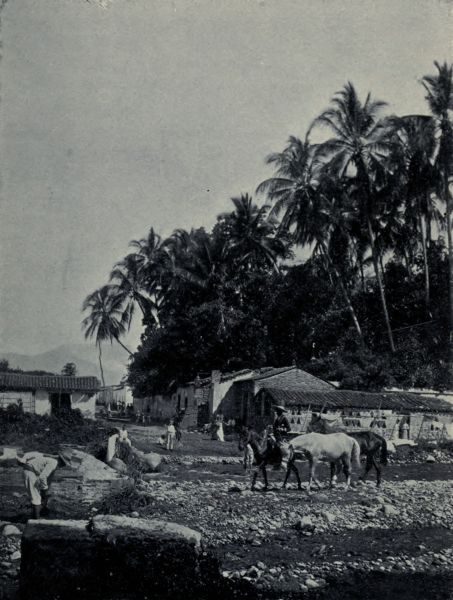
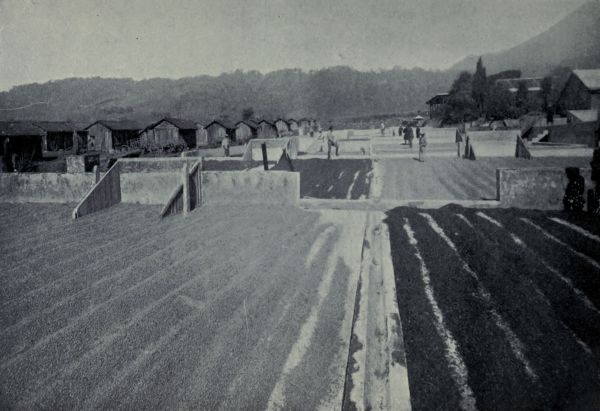
VILLAGE ON THE PACIFIC SLOPE, MEXICO.
Vol. I. To face p. 140.
It is not to be supposed that this numerous
class is an unworthy one. On the contrary, the
Mexican peon is industrious, faithful, courteous,
and deeply religious—religion, however, greatly
mixed with superstitions. As an agriculturist he
does not lack capabilities, and as a miner the
Mexican, as we have seen, is an excellent workman
in many respects.
In brief, the working class of Mexico is the
most important and homogeneous body of brown
labour in the world. The European or American
mine or plantation manager (who was until
recently plentifully established in the country)
may often express very diverse views in this connexion,
but from a more detached point of view
the above characterization is true.
As for the working class Mexican woman, she
has many good qualities, and is often of pleasing
appearance, whilst among some of the Indian tribes
the girls are handsome.
The upper class Mexican is generally well
educated, often having been sent to Europe or
the United States for his education. He has the
pleasing courtesy of the Spanish race, and is
frequently a well-informed man of the world.
However, it cannot be said that education in the
United States is necessarily an improvement.
There is something about the association which
is not pleasing. He becomes too "smart" and
cynical.
The educated Mexican class earnestly lays
claim to a "high civilization," and art, science
and literature are, at least in theory, greatly
esteemed. There may be, in some respects, an
element of superficiality about this refinement, and
about life in general, with this class. But to a
large extent it has its foundation in reality, and
the educated Mexican and the upper class man
of business has nothing to lose in point of culture
in comparison with, for example, the American
or other foreign business man. Indeed, it is the
latter that would often suffer by comparison in
this respect, especially the American.
The Mexican is much less dominated by the
money-getting spirit than is the man of the United
States, and has, perhaps, a wider vision, both in
domestic and international affairs. The upper
class Mexican woman is justly noted for her
beauty and vivacity, and becomes a devoted wife
and mother. She is extremely religious. Indeed,
the influence of the Church and the priest enter
too strongly into the life of the female population
of Mexico. The upper class man has often
thrown off religion and is acquiring an easy
materialism.
With a people of the above described characteristics,
it might well be asked from what source
does the revolutionary element and bloodthirsty
soldiery come? From what class do the ambitious
"generals," the would-be presidents, the ruthless
guerilla bands spring, whose doings have shocked
the civilized world? They do not come from the
ordinary class of educated Mexicans, who are
peaceful estate owners, lawyers, business men, and
so forth, who, in general, would be very loath
to risk their persons or property in the hazards of
revolution. As to the young man of this class,
he generally loves the ease and luxury of city life
too much to adventure himself far from his often
effiminate pleasures. Nor do they come from the
great peon class, which, so far, has asked little
more than to pursue its normal life, varied by
the not infrequent carousals of feast-days, the
pelea de gallos, or cock-fight, and the corrida de
toros, or bull-fight, as his Sunday diversions, and
to drown his sorrows in draughts of intoxicating
pulque or aguardiente.
The revolutionary element is, in fact, drawn
from a comparatively small class of ambitious or
disappointed politicians and the idle or dissatisfied
military element, in the main. It cannot
of course be denied that revolution at times springs
to being under patriotic or national motives, to
remedy the abuses laid on the country by dishonest
or oppressive rulers. In reality, disorder
is generally the result of a mixture of both these
elements. A revolutionary standard having been
raised, and a pronunciamiento made, there are
rarely lacking followers. The latent martial spirit
of the Mexican—a heritage from both his Aztec
and Spanish forbears—breaks out. The prospect
of place and office attracts the educated malcontent,
of booty and licence the lower element, and of
higher pay and free food the peon. Political
murders and ruthless cruelty attend these operations,
and a whole nation is terrorized and its
ordinary affairs brought almost to a standstill
thereby. Often, however, the revolution is little
more than a local affair, and is put down or dies
out, although it may have damaged the country's
reputation abroad in a measure far exceeding its
real importance.
Is there any remedy for this perennial turmoil,
and if so, what is the remedy? The reply is that
whilst the present economic conditions of Mexico
exist, stability will never be reached. A small
upper class practically monopolizes the wealth,
education, land and opportunity of the Republic—a
republic in little more than name. The main
bulk of the people, as has been shown, are poor,
landless and illiterate, and in consequence easily
throw off their settled habits at the bidding of
upstart leaders. They have little to lose and
perhaps—they think—the possibility of gain by
disorder.
The steadying element of a settled middle class
grows very slowly to being in Mexico. Industry
is in its infancy. Little is manufactured in the
country, except cotton, textiles, and even here
the wage of the operative is exceedingly low. Such
manufacturing industry is mainly represented by
the well-advanced cotton and textile factories of
Puebla and elsewhere, works of much importance,
generally actuated by water-power plant. This
is a highly profitable industry for the mill-owners,
who reap dividends often of thirty per cent.
Manufacturing industry here, as in the other Latin
American Republics, is accompanied in its growth
by the rise of the strike habit, which is rapidly
increasing. Jealousy of the foreign concessionaire—who
flourished so markedly under the Diaz
regimen—is a further element in disorder. The
advancement of the masses has been extremely
slow. A new spirit is needful if progress is to be
made, a recognition of the rights of the Mexican
"democracy," a better co-ordination of the
national resources and a constructive and equitable
economic policy, added to disinterested political
leadership.
Mexico in reality offers conditions for prosperous
and enlightened life. Its natural resources
are varied, abundant and well distributed. The
country does not, like some other Latin American
States, draw revenue from any great or special
article of export (sooner or later the economic
defect of a land), but can be more or less
self-contained and self-supplying. Innumerable
pleasing towns and picturesque villages are
scattered over its surface, which normally are
centres of peaceful life, and the population is
well distributed. There is much of beauty in
the architecture of these towns, and of refinement
and dignity among the people—elements largely,
a heritage of Spanish rule, added to the native
disposition.
The nation is not yet over-commercialized or
vulgarized, and if political and economic stability
can grow to being without becoming so, Mexico
might build up for itself a pleasing and durable
civilization, and become a permanent leader among
the republics of the New World.
The traveller who has sojourned in this picturesque
and romantic land, who has experienced
its pleasing hospitality and has understood the
character of its people, cannot but hope that such
future awaits it. In the coming settlement of the
world Mexico has a good deal to offer, but trading
must be accompanied in the future by statesmanship,
here as elsewhere. Mexico, indeed, is a subject
for a science of constructive economic
biology.
The history of Mexico after Independence shows
how resolutely the Mexicans threw off the method
of governance by Royalty, but it is a question
whether there might not have been a more sustained
and orderly development under that
system.
At this time, Mexico was the third largest
empire in the world, and included a large part
of what is now the Western United States, such
as California and Texas and the adjoining territories,
as well as Guatemala. She began her independent
history with an emperor—Iturbide, who
patriotically wished to strive against the "Holy
Alliance" which schemed to bring about the re-domination
of Spain, but he was executed by
Mexicans, and fell, serene, and disdainful of his
ungrateful compatriots.
The ill-fated figure of Maximilian stands out
in picturesque silhouette in Mexican history, well-meaning
but weak; as does the pathetic story of
the Empress Carlota, and her appeal to Napoleon
against his perhaps perfidious withdrawal of
French troops from Mexico. Maximilian was
"executed" at Queretaro. Two faithful Mexican
officers shared his fate—Miramon and Mejia.
"Take you the place of honour in the centre,"
said the ill-fated Hapsburg prince in turn to each
of them, as facing the file of soldiers they awaited
the volley. But each declined, the carbines rang
out, and so passed the dream of empire in Mexico.
An Austrian warship arrived to take his body;
the commander asking for the remains of "the
Emperor of Mexico." But he was informed that
"no such person had existed," although the body
of "Maximilian of Austria" was delivered to him.
In the Museum of Mexico to-day, all that remains
is his gilded coach and some other trappings.
The dream of empire in Mexico was largely
due to the Napoleon of the times, and was mainly
frustrated by the action of the United States and
the Monroe Doctrine. Imperial government was,
however, supported by a very large party of upper
class Mexicans.
The Mexicans, rightly or wrongly, have retained
to this day a certain animosity against the United
States by reason of the loss of their huge northern
territory of Texas, in what they called la guerra
injusta, the "unjust war," in which they declared
that American machinations were displayed in
order to deprive them of the land. One phase of
this history was in the filling up of Texas, in part,
by American filibusters, and in the upholding of
slavery there by the American Government, the
Mexicans having made a decree forbidding slavery;
and this must be recorded to the credit of Mexico.
Black slavery there brought a dreadful fruit, and
even in recent—and present—times race riots, including
the burning alive of negroes, have been a
result.
However, this is past history, and these territories
developed under American rule in a way
that would not have been possible under the
Mexicans. To-day we hear of constant antagonism
across the border. It is urged by some that the
United States might enter and control Mexico,
but it is to be hoped that Washington is wiser
than to embark upon such an adventure. It might
be a difficult and bloody undertaking, and, even
if successful militarily, would but perpetuate race-hatred
in the New World. The Mexicans, a people
of nearly twenty millions strong, must work out
their own destiny. The history of Mexico shows
the evils of forced and unnatural episodes
and conditions, and this would but add to the
series.
Many a battle has been fought between
Americans and Mexicans since the first conflict
in 1846, and both nations have had occasion to
test each other's bravery and capacity in war.
The Mexicans excel in guerilla warfare, and are
splendid horsemen, but the more solid tactics of
the Americans generally prevailed. Mexico was
invaded more than once by United States forces,
and, indeed, occupied. The storming of Chapultepec
Castle, near the city of Mexico, was one
of the heroic engagements, when a young Mexican,
rather than see his country's flag fall into the hands
of the—to them—"hated Yanquis," wrapped it
round his body and leapt from the turret, to be
dashed to pieces on the stones below.
All students of American matters will look for
that time when these two countries will dwell in
amicable relationship, such as seemed, in the time
of Diaz, to have been reached, but in which, in
reality, jealousy and rancour were but thinly veiled.
There is really nothing fundamental between the
two people against amicable relations and co-operation
in those matters of mutual interest on
their continent.
Thus we leave this interesting land of Mexico,
to make our way into another region, no less
attractive, in its own particular field.
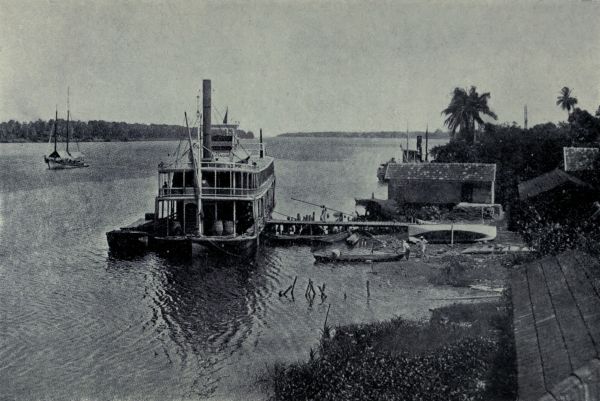
VIEW ON THE GRIJALVA AND USUMACINTA RIVER, MEXICO.
Vol. I. To face p. 150.