The journey from Malaga to Granada was the
most adventurous and unfortunate that I made in
Spain.
In order that my compassionate readers may pity
me as much as I desire, they must know (I am
ashamed to occupy people with these little details)
that at Malaga I had eaten only the lightest sort of
an Andalusian repast, of which at the moment of
departure I retained a very vague recollection.
But I started, feeling sure that I could alight at
some railway-station where there would be one of
those rooms or public choking-places where one
enters at a gallop, eats until one is out of breath,
pays as one scampers out to rush into a crowded
carriage, suffocated and robbed, to curse the schedule,
travel, and the minister of public works who
deceives the country. I departed, and for the first
hours it was delightful. The country was all gently
sloping hills and green fields, dotted with villages
crowned with palms and cypresses, and in the carriage,
between two old men who rode with their eyes
shut, there was a little Andalusian who kept looking
around with a roguish smile which seemed to say,
"Go on; your lovelorn glances do not offend me."
But the train crept along as slowly as a worn-out
diligence, and we stopped only a few moments at
the stations. By sunset my stomach began to cry
for help, and, to render the pangs of hunger even
more severe, I was obliged to make a good part of
the journey on foot. The train stopped at an unsafe
bridge, and all the passengers got out and filed
around, two by two, to meet the train on the other
side of the river. We were surrounded by the
rocks of the Sierra Nevada, in a wild, desert place,
which made it seem as if we were a company of
hostages led by a band of brigands. When we had
clambered into the carriage the train crawled along
no faster than before, and my stomach began to
complain more desperately than at first. After a
long time we arrived at a station all crowded with
trains, where a large part of the travellers hurried
out before I could reach the step.
"Where are you going?" asked a railroad official,
who had seen me alight.
"To dine," I replied.
"But aren't you going to Granada?"
"Yes."
"Then you won't have time; the train starts
immediately."
"But the others have gone."
"You will see them come back on the run in a
minute."
The freight-trains in front prevented me from
seeing the station; I thought it was a great way
off, and so stayed where I was. Two minutes
passed, five, eight; the tourists did not return and
the train did not start. I jumped out, ran to the
station, saw a café, and entered a large room.
Great heavens! Fifty starving people were standing
around a refreshment-table with their noses in
their plates, elbows in the air, and their eyes on the
clock, devouring and shouting; another fifty were
crowding around a counter seizing and pocketing
bread, fruit, and candies, while the proprietor and
the waiters, panting like horses and streaming with
sweat, ran about, tucked up their sleeves, howled,
tumbled over the seats and upset the customers,
and scattered here and there streams of soup and
drops of sauce; and one poor woman, who must
have been the mistress of the café, imprisoned in a
little niche behind the besieged counter, ran her
hands through her hair in desperation. At this
sight my arms hung down helplessly. But suddenly
I roused myself and made an onslaught. Driven
back by a feminine elbow in my chest, I rushed in
again; repulsed by a jab in the stomach, I gathered
all my strength to make a third attack. At this
point the bell rang. There was a burst of imprecations
and then a falling of seats, a scattering of
plates, a hurry-scurry, and a perfect pandemonium.
One man, choking in the fury of his last mouthfuls,
became livid and his eyes seemed bursting from
his head as though he were being hanged; another
in stretching out his hand to seize an orange, struck
by some one rushing past, plunged it into a bowl
of cream; another was running through the room in
search of his valise with a great smear of sauce on
his cheeks; another, who had tried to drink his
wine at one gulp, had strangled and coughed as if
he would tear open his stomach; the officials at the
door cried, "Hurry!" and the travellers called back
from the room, "Ahogate!" (choked), and the
waiters ran after those who had not paid, and those
who wanted to pay could not find the waiters; and
the ladies swooned, and the children cried, and
everything was upside down.
By good fortune I was able to get into my carriage
before the train started.
But there a new punishment awaited me. The
two old men and the little Andalusian, who must
have been the daughter of the one and niece of the
other, had been successful in securing a little booty
in the midst of that accursed crowd at the counter,
and they were eating right and left. I began to
watch them with sorrowful eyes like a dog beside
his master's table, counting the mouthfuls and the
number of times they chewed. The little Andalusian
noticed it, and, pointing to something which
looked like a croquet, made a gracious bow as if to
ask if I would take it.
"Oh no, thank you," I replied with the smile of
a dying man; "I have eaten."
My angel, I continued to myself, if you only knew
that at this moment I would prefer those two croquets
to the bitter apples—as Sir Niccolo Machiavelli
would generously say—even those bitter apples
from the famous garden of the Hesperides!
"Try a drop of liquor at least," said the old
uncle.
I do not know what childish pique against myself
or against those good people took possession of me,
but it was a feeling which other men experience on
similar occasions; however, I replied this time too,
"No, thank you; it would be bad for me."
The good old man looked me over from head to
foot as if to say that I did not appear like a man to
be the worse for a drop of liquor, and the Andalusian
smiled, and I blushed for shame.
Night settled down, and the train went on at the
pace of Sancho Panza's steed for I knew not how
many hours. That night I felt for the first time in
my life the pangs of hunger, which I thought I had
felt already on the famous day of the twenty-fourth
of June, 1866. To relieve these torments I obstinately
thought of all the dishes which filled me with
repugnance—raw tomatoes, snails in soup, roasted
crabs, and snails in salad. Alas! a voice of derision
told me, deep down in my vitals, that if I had any
of them I should eat them and lick my fingers.
Then I began to make imaginary messes of different
dishes, as cream and fish, with a dash of wine, with
a coat of pepper, and a layer of juniper preserves,
to see if I could thus hold my stomach in check.
Oh misery! my cowardly stomach did not repel
even those. Then I made a final effort and imagined
that I was at table in a Parisian hotel at the time of
the siege, and that I gently lifted a mouse by the
tail out of some pungent sauce, and the mouse, unexpectedly
regaining life, bit my thumb and transfixed
me with two wicked little eyes, and I, with
raised fork, hesitated whether to let it go or to spit
it without pity. But, thank Heaven! before I had
settled this horrible question, to perform such an act
as has never been recorded in the history of any
siege, the train stopped and a ray of hope revived
my drooping spirits.
We had reached some nameless village, and while
I was putting my head out of the window a voice
cried, "All out for Granada!" I rushed headlong
from the carriage and found myself face to face with
a huge bearded fellow, who took my valise, telling
me that he was going to put it in the diligence, for
from that village to I know not how many miles
from imperial Granada there is no railway.
"One moment!" I cried to the unknown man in
a supplicating voice: "how long before you start?"
"Two minutes," he replied.
"Is there an inn here?"
"There it is." I flew to the inn, bolted a hard-boiled
egg, and rushed back to the diligence, crying,
"How much time now?"
"Two minutes more," answered the same voice.
I flew back to the hotel, seized another egg, and
ran again to the diligence with the question, "Are
you off?"
"In a minute."
Back again to the inn, and a third egg, and then
to the diligence: "Are we going?"
"In half a minute."
This time I heaved a mighty sigh, ran to the inn,
swallowed a fourth egg and a glass of wine, and
rushed toward the diligence. But before I had
taken ten steps my breath gave out, and I stopped
with the egg halfway down my throat. At this
point the whip cracked.—"Wait!" I cried in a
hoarse voice, waving my hands like a drowning
man.
"Que hay?" (What's the matter?) demanded the
driver.
I could not reply.
"He has an egg stuck in his throat," some
stranger answered for me.
All the travellers burst into a laugh, the egg went
down; I laughed too, overtook the diligence, which
had already started, and, regaining my breath, gave
my companions an account of my troubles, and they
were much interested, and pitied me even more than
I had dared to hope after that cruel laugh at my
suffocation.
But my troubles were not ended. One of those
irresistible attacks of sleepiness which used to come
upon me treacherously in the long night-marches
among the soldiers seized me all at once, and tormented
me as far as the railway-station without my
being able to get a moment of sleep. I believe that
a cannon-ball suspended by a cord from the roof of
the diligence would have given less annoyance to
my unfortunate companions than my poor nodding
head gave as it bobbed on all sides as if it was attached
to my neck by a single tendon. On one side
of me sat a nun, on the other a boy, and opposite a
peasant-woman, and throughout the entire journey I
did nothing but strike my head against these three
victims with the monotonous motion of a bell-clapper.
The nun, poor creature! endured the strokes
in silence, perhaps in expiation for her sins of
thought; but the boy and peasant-woman muttered
from time to time, "He is a barbarian!"—"This
must stop!"—"His head is like lead!" Finally, a
witticism from one of the passengers released all four
of us from this suffering. The peasant-woman was
lamenting a little louder than usual, and a voice from
the end of the diligence exclaimed, "Be consoled; if
your head is not yet broken, you may be sure it will
not be, for it must certainly be proof against the
hammer." They all laughed; I awakened, excused
myself, and the three victims were so happy to
find themselves released from that cruel thumping
that, instead of taking revenge with bitter words,
they said, "Poor fellow! you have slept badly.
How you must have hurt your head!"
We finally arrived at the railway, and behold
what a perverse fate! Although I was alone in the
railway-carriage, where I might have slept like a
nabob, I could not close my eyes. A pang went
through my heart at the thought of having made
the journey by night when I could not see anything
nor enjoy the distant view of Granada. And I
remembered the lovely verses of Martinez de la
Rosa:
"O my dear fatherland! At last I see thee
again! I see thy fair soil, thy joyful teeming fields,
thy glorious sun, thy serene sky!
"Yes! I see the fabled Granada stretching along
the plain from hill to hill, her towers rising among
her gardens of eternal green, the crystal streams
kissing her walls, the noble mountains enclosing her
valleys, and the Sierra Nevada crowning the distant
horizon.
"Oh, thy memory haunted me wherever I went,
Granada! It destroyed my pleasures, my peace,
and my glory, and oppressed my heart and soul!
By the icy banks of the Seine and the Thames
I remembered with a sigh the happy waters of
the Darro and the Genil, and many times, as I carolled
a gay ballad, my bitter grief overcame me,
and weeping, not to be repressed, choked my
voice.
"In vain the delightful Arno displayed her
flower-strewn banks, sweet seats of love and peace!
'The plain watered by the gentle Genil,' said I, 'is
more flowery, the life of the lovely Granada is more
dear.' And I murmured these words as one disconsolate,
and, remembering the house of my fathers,
I raised my sad eyes to heaven.
"What is thy magic, what thy unspeakable spell,
O fatherland! O sweet name! that thou art so dear?
The swarthy African, far from his native desert,
looks with sad disdain on fields of green; the rude
Laplander, stolen from his mother-earth, sighs for
perpetual night and snow; and I—I, to whom a
kindly fate granted birth and nurture in thy bosom
blest by so many gifts of God—though far from thee,
could I forget thee, Granada?"
When I reached Granada it was quite dark, and
I could not see so much as the outlines of a house.
A diligence drawn by two horses,
"... anzi due cavallette
Di quella de Mosé lá dell' Egitto,"
landed me at a hotel, where I was kept waiting an
hour while my bed was being made, and finally, just
before three o'clock in the morning, I was at last
able to lay my head on the pillow. But my troubles
were not over: just as I was falling into a doze I
heard an indistinct murmur in the next room, and
then a masculine voice which said distinctly, "Oh,
what a little foot!" You who have bowels of compassion,
pity me. The pillow was torn a little; I
pulled out two tufts of wool, stuffed them in my
ears; and, rehearsing in thought the misfortunes
of my journey, I slept the sleep of the just.
In the morning I went out betimes and walked
about through the streets of Granada until it was a
decent hour to go and drag from his home a young
gentleman of Granada whom I had met at Madrid
at the house of Fernandez Guerra, Gongora by
name, the son of a distinguished archeologist and a
descendant of the famous Cordovan poet Luigi Gongora,
of whom I spoke in passing. That part of
the city which I saw in those few hours did not fulfil
my expectation. I had expected to find narrow
mysterious streets and white cottages like those of
Cordova and Seville, but I found instead spacious
squares and some handsome straight streets, and
others tortuous and narrow enough, it is true, but
flanked by high houses, for the most part painted in
false bas-reliefs with cupids and garlands and flourishes
and draperies, and hangings of a thousand
colors, without the Oriental appearance of the other
Andalusian cities.
The lowest part of Granada is almost all laid out
with the regularity of a modern city. As I passed
along those streets I was filled with contempt, and
should certainly have carried a gloomy face to
Señor Gongora if by chance as I walked at random
I had not come out into the famous Alameda, which
enjoys the reputation of being the most beautiful
promenade in the world, and it repaid me a thousand
times for the detestable regularity of the
streets which lead to it.
Imagine a long avenue of unusual width, along
which fifty carriages might pass abreast, flanked by
other smaller avenues, along which run rows of
measureless trees, which at a noble height form an
immense green arch, so dense that not a sunbeam
can penetrate it, and at the two ends of the central
avenue two monumental fountains throwing up the
water in two great streams which fall again in the
finest vaporous spray, and between the many
avenues crystal streams, and in the middle a garden
all roses and myrtle and jessamine and delicate
fountains; and on one side the river Genil,
which flows between banks covered with laurel-groves,
and in the distance the snowclad mountains,
upon whose sides distant palms raise their fantastic
fronds; and everywhere a brilliant green, dense
and luxuriant, through which one sees here and
there an enchanting strip of azure sky.
As I turned off of the Alameda I met a great
number of peasants going out of the city, two by
two and in groups, with their wives and children,
singing and jesting. Their dress did not seem to
me different from that of the peasants in the neighborhood
of Cordova and Seville. They wore velvet
hats, some with very broad brims, others with high
brims curved back; a little jacket made with bands
of many-colored cloth; a scarf of red or blue;
closely-fitting trousers buttoned along the hip;
and a pair of leathern gaiters open at the side,
so as to show the leg. The women were dressed
like those in the other provinces, and even in their
faces there was no noticeable difference.
I reached my friend's house and found him buried
in his archæological studies, sitting in front of a heap
of old medals and historic stones. He received me
with delight, with a charming Andalusian courtesy,
and, after exchanging the first greetings, we both
pronounced with one voice that magic word that in
every part of the world stirs a tumult of great recollections
in every heart and arouses a sense of secret
longing; that gives a final spur toward Spain to one
who has the desire to travel thither and has not yet
finally resolved to start; that name at which hearts
of poets and painters beat faster and the eyes of
women flash—"The Alhambra!"
We rushed out of the house.
The Alhambra is situated upon a high hill which
overlooks the city, and from a distance presents the
appearance of a fortress, like almost all Oriental
palaces. But when, with Gongora, I climbed the
street of Los Gomeles on our way toward the famous
edifice, I had not yet seen the least trace of a distant
wall, and I did not know in what part of the city we
should find it. The street of Los Gomeles slopes upward
and describes a slight curve, so that for a good
way one sees only houses ahead, and supposes the
Alhambra to be far away. Gongora did not speak,
but I read in his face that in his heart he was greatly
enjoying the thought of the surprise and delight that
I should experience. He looked at the ground with
a smile, answering all my questions with a sign
which seemed to say, "Wait a minute!" and now
and then raised his eyes almost furtively to measure
the remaining distance. And I so enjoyed his pleasure
that I could have thrown my arms around his
neck in gratitude.
We arrived before a great gate that closed the
street. "Here we are!" said Gongora. I entered.
I found myself in a great grove of enormously
high trees, leaning one toward another, on this side
and on that, along a great avenue which climbs the
hill and is lost in the shade: so close are the trees
that a man could scarcely pass among them, and
wherever one looks one sees only their trunks,
which close the way like a continuous wall. The
branches meet above the avenues; not a sunbeam
penetrates the wood; the shade is very dense;
on every side glide murmuring streams, and the
birds sing, and one feels a vernal freshness in the
air.
"We are now in the Alhambra," said Gongora:
"turn around, and you will see the towers and the
embattled barrier-wall."
"But where is the palace?" I demanded.
"That is a mystery," he answered; "let us go
forward at random."
We climbed an avenue running along beside the
great central avenue that winds up toward the summit.
The trees form overhead a green pavilion
through which not a particle of sky is visible, and
the grass, the shrubbery, and the flowers make on
either side a lovely border, bright and fragrant,
sloping slightly toward each other, as if they are
trying to unite, mutually attracted by the beauty of
their colors and the fragrance of their perfume.
"Let us rest a moment," I said: "I want to take
a great breath of this air; it seems to contain some
secret germs that if infused into the blood must
prolong one's life; it is air redolent of youth and
health."
"Behold the door!" exclaimed Gongora.
I turned as if I had been struck in the back, and
saw a few steps ahead a great square tower, of a
deep-red color, crowned with battlements, with an
arched door, above which one sees a key and a
hand cut in the stone.
I questioned my guide, and he told me that this
was the principal entrance of the Alhambra, and that
it was called the Gate of Justice, because the Moorish
kings used to pronounce sentence beneath that arch.
The key signifies that this door is the key to the
fortress, and the hand symbolizes the five cardinal
virtues of Islam—Prayer, Fasting, Beneficence, Holy
War, and the Pilgrimage to Mecca. The Arabian
inscription attests that the edifice was erected four
centuries ago by the Sultan Abul Hagag Yusuf, and
another inscription, which one sees everywhere on
the columns, says, "There is no God but Allah, and
Mohammed is his Prophet! and there is no power,
no strength, apart from Allah!"
We passed under the arch and continued the
ascent along an enclosed street until we found ourselves
at the top of the hill, in the middle of an
esplanade surrounded by a parapet and dotted with
shrubs and flowers. I turned at once toward the
valley to enjoy the view, but Gongora seized me
by the arm and made me look in the opposite direction.
I was standing in front of the great palace of
the Renaissance, partly in ruins and flanked by some
wretched little houses.
"Is this a joke?" I demanded. "Have you
brought me here to see a Moorish castle, for me to
find the way closed by a modern palace? Whose
abominable idea was it to run up this building in the
gardens of the caliphs?"
"Charles V.'s."
"He was a vandal. I have not yet forgiven him
for the Gothic church he planted in the middle of
the mosque of Cordova, and now these barracks
fill me with utter loathing of his crown and his
glory. But, in the name of Heaven, where is the
Alhambra?"
"There it is."
"Where?"
"Among those huts."
"Oh, fudge!"
"I pledge you my word of honor."
I folded my arms and looked at him, and he
laughed."
"Well, then," I exclaimed, "this great name of
the Alhambra is only another of those usual false
exaggerations of the poets. I, Europe, and the world
have been shamefully deceived. Was it worth while
to dream of the Alhambra for three hundred and
sixty-five nights in succession, and then to come to
see a group of ruins with some broken columns and
smoky inscriptions?"
"How I enjoy this!" answered Gongora with a
peal of laughter. "Cheer up now; come and be
persuaded that the world has not been deceived:
let us enter this rubbish-pile."
We entered by a little door, crossed a corridor,
and found ourselves in a court. With a sudden cry
I seized Gongora's hand, and he asked with a tone
of triumph,
"Are you persuaded?"
I did not answer, I did not see him: I was already
far away; the Alhambra had already begun to exercise
upon me that mysterious and powerful fascination
which no one can avoid nor any one express.
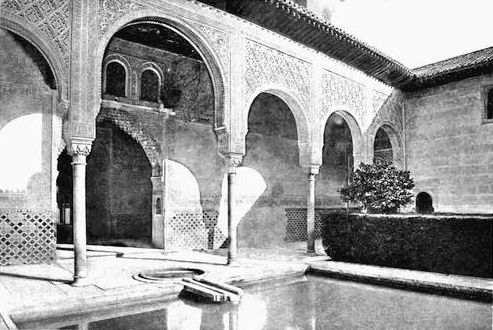
We were in the Patio de los Arrayanes, the Court
of the Myrtles, which is the largest in the edifice,
and presents at once the appearance of a room, a
courtyard, and a garden. A great rectangular basin
full of water, surrounded by a myrtle hedge, extends
from one side of the patio to the other, and like a
mirror reflects the arches, arabesques, and the mural
inscriptions.
To the right of the entrance there extend two
orders of Moorish arches, one above the other, supported
by slender columns, and on the opposite side
of the court rises a tower with a door through which
one sees the inner rooms in semi-darkness and the
mullioned windows, and through the windows the
blue sky and the summits of the distant mountains.
The walls are ornamented to a certain height from
the pavement with brilliant mosaics, and above the
mosaics with arabesques of very intricate design
that seem to tremble and change at every step, and
here and there among the arabesques and along the
arches they stretch and creep and intertwine, like
garlands, Moorish inscriptions containing greetings,
proverbs, and legends.
Court of Myrtles, Alhambra
Beside the door of entrance is written in Cufic characters:
Eternal Happiness!—Blessing!—Prosperity!—Felicity!—Praised
be God for the blessing
of Islam!
In another place it is written: I seek my refuge
in the Lord of the Morning.
In another place: O God! to thee belong eternal
thanksgiving and undying praise.
Elsewhere there are verses from the Koran and
entire poems in praise of the caliphs.
We stood some minutes in silent admiration; not
the buzz of a fly was heard; now and then Gongora
started toward the tower, but I clutched him by the
arm and felt that he was trembling with impatience.
"But we must make haste," said he, finally,
"or else we shall not get back to Granada before
evening."
"What do I know of Granada?" I answered;
"what do I know of morning or evening or of
myself? I am in the Orient!"
"But this is only the antechamber of the Alhambra,
my dear Arabian," said Gongora, urging me
forward. "Come, come with me where it will
really seem like being in the Orient."
And he led me, reluctant though I was, to the
very threshold of the tower-door. There I turned
to look once more at the Court of Myrtles and gave
a cry of surprise. Between two slender columns
of the arched gallery which faces the tower, on the
opposite side of the courtyard, stood a girl, a beautiful
dark Andalusian face, with a white mantle
wound around her head and falling over her shoulder:
she stood leaning upon the railing in a languid
attitude, with her eyes fixed upon us. I cannot
tell the fantastic effect produced by that figure
at that moment—the grace imparted by the arch
which curved above the girl's head and the two
columns which formed a frame around her, and the
beautiful harmony which she gave to the whole
court, as if she were an ornament necessary to its
architecture conceived in the mind of the architect
at the moment he imagined the whole design. She
seemed like a sultana awaiting her lord, thinking
of another sky and another love. She continued
looking at us, and my heart began to beat faster.
I questioned my friend with my eyes, as if to be
assured that I was not deceived. Suddenly the
sultana laughed, dropped her white mantle, and
disappeared.
"She is a servant," said Gongora.
Still I remained in the mist.
She was, in fact, a servant of the custodian of
the Alhambra who was in the habit of practising
that joke upon strangers.
We entered the tower called the Tower of Comares,
or, vulgarly, the Tower of the Ambassadors.
The interior forms two halls, the first of which is
called the Hall of the Barca, and takes its name
either from the fact that it is shaped like a boat or
because it was called by the Moors the Hall of
Baraka, or Blessing, a word which might have been
contracted by the people into barca (a boat.) This
hall hardly seems the work of human hands: it is
all a vast network of tracery in the form of garlands,
rosettes, boughs of trees, and leaves, covering
the vaulted ceiling, the arches, and the walls in
every part and in every way—closely twining,
checkered, climbing higher and higher, and yet
marvellously distinct and combined in such a manner
that the parts are presented to the eye altogether
at a single glance, affording a spectacle of
dazzling magnificence and enchanting grace. I
approached one of the walls, fixed my eyes upon
the extreme point of an arabesque, and tried to
follow its windings and turnings: it was impossible;
my eye was lost, my mind confused, and all the
arabesques from pavement to ceiling seemed to be
moving and blending, as if to conceal the thread of
their inextricable network. You may make an
effort not to look around, to centre your whole
attention upon a single spot of the wall, to scan
it closely and follow the thread with your finger:
it is futile; in a moment the tracery is a tangled
skein, a veil steals between you and the wall, and
your arm falls. The wall seems woven like a web,
wrought like brocade, netted like lace, and veined
like a leaf; one cannot look at it closely nor fix its
design in one's mind: it would be like trying to
count the ants in an anthill: one must be content
to look at the walls with a wandering glance, then
to rest and look again later, and then to think of
something else and talk. After I had looked around
a little with the air of a man overcome with vertigo
rather than admiration, I turned toward Gongora,
so that he might read in my face what I would have
spoken.
"Let us enter the other pile of ruins," he answered
with a smile as he drew me into the great
Hall of the Ambassadors, which fills all the interior
of the tower, for, really, the Hall of the Barca
belongs to a little building which does not form a
part of the tower, although it is joined to it. The
tower is square in form, spacious, and lighted with
nine great arched windows in the form of doors,
which present almost the appearance of so many
alcoves, so great is the thickness of the wall; each
one is divided down the middle toward the outside
by a little marble column that supports two beautiful
arches surmounted in their turn by two little
arched windows. The walls are covered with
mosaics and arabesques indescribably delicate and
multiform, and with innumerable inscriptions extending
like wide embroidered ribbons over the arches
of the windows, up the massive cornices, along the
friezes, and around the niches where once stood
vases full of flowers and perfumed water. The
ceiling, which rises to a great height, is inlaid with
cedar-wood, white, gold, and azure, joined together
in circles, stars, and crowns, and forming many
little arches, cells, and vaulted windows, through
which falls a wavering light, and from the cornice
which joins the ceiling to the walls hang tablets
of stucco-work cut in facets chiselled and moulded
like stalactites and bunches of flowers. The throne
stood at the central window on the side opposite the
door of entrance. From the windows on that side
one enjoys a stupendous view of the valley of the
Darro, deep and silent, as if it too felt the fascination
of the Alhambra's grandeur; from the windows
on the other two sides one sees the boundary-wall
and the towers of the fortress; and through the
entrance the light arches of the Court of the Myrtles
in the distance and the water of the basin, which
reflects the blue of the sky.
"Well!" Gongora demanded; "was it worth
dreaming of the Alhambra for three hundred and
sixty-five nights?"
"There is a strange thought passing through
my brain at this moment," I replied. "That court
as it looks from here, that hall, those windows, those
colors, everything that surrounds me, seems familiar;
it seems to correspond with a picture which I have
carried in my head I know not how long and I know
not in what manner, confused with a thousand other
things, perhaps born of a dream—how should I
know? When I was sixteen years old I was a
lover, and the young girl and I alone in a garden
in the shade of a summer-house, as we gazed in
each other's eyes, uttered unconsciously a cry of
joy that stirred our blood as if it had come from
the mouth of a third person who had discovered our
secret. Well, since that time I have often longed
to be a king and to have a palace; but in giving
form to that desire my imagination did not rest
merely in the grand gilded palaces of our country;
it flew to distant lands, and there on the summit of
a lofty mountain reared a castle of its own in which
everything was small and graceful and illumined by
a mysterious light; and there were long suites of
rooms adorned with a thousand fanciful and delicate
ornaments, with windows through which we two
alone might look, and little columns behind which
my little one might almost hide her face playfully
as she listened to my step approaching from hall to
hall, or heard my voice mingled with the murmur
of the fountains in the garden. All unconsciously,
in building that castle in fantasy, I was building
the Alhambra; in those moments I imagined something
like these halls, these windows, and this court
that we see before us—so similar, indeed, that the
more I look around the better I remember and seem
to recognize the place just as I have seen it a thousand
times. All lovers dream a little of the Alhambra,
and if they were able to reproduce all their
dreams in line and color, they would make pictures
that would amaze us by their likeness to all one sees
here. This architecture does not express power,
glory, and grandeur; it expresses love and passion—love
with its mysteries, its caprices, its fervor,
its bursts of God-given gratitude; passion with its
melancholy and its silences. There is, then, a close
connection, a harmony, between the beauty of this
Alhambra and the souls of those who have loved at
sixteen, when longings are but dreams and visions.
And hence arises the indescribable fascination exercised
by this beauty, and hence the Alhambra, although
deserted and ruined as it is, is still the most
enchanting castle in the world, and to the end of
time visitors will leave it with a tear. For in parting
with the Alhambra we bid a last adieu to the
most beautiful dreams of youth revived among these
walls for the last time. We bid adieu to faces unspeakably
dear that have broken the oblivion of
many years to stand beside us a last time by the
little columns of these windows. We bid adieu to
all the fancies of youth. We bid adieu to that love
which will never live again."
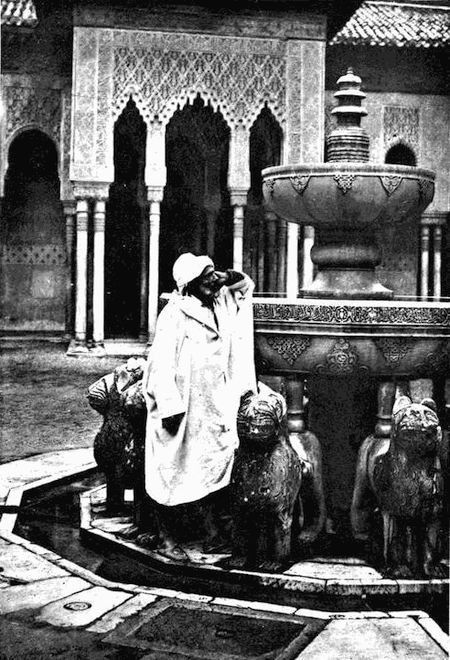
Fountain in the Court of Lions, Alhambra
"It is true," answered my friend, "but what will
you say when you have seen the Court of the Lions?
Come, let us hurry."
We left the tower with hasty steps, crossed the
Court of Myrtles, and came to a little door opposite
the door of entrance.
"Stop!" cried Gongora.
I stopped.
"Do me a favor?"
"A hundred."
"Only one: shut your eyes and don't open them
until I tell you."
"Well, they are shut."
"See that you keep them so; I sha'n't like it if
you open them."
"Never fear."
Gongora took me by the hand and led me forward:
I trembled like a leaf.
We took about fifteen steps and stopped.
"Look!" said Gongora in an agitated voice.
I looked, and I swear by the head of my reader I
felt two tears trickling down my cheeks.
We were in the Court of the Lions.
If at that moment I had been obliged to go out as
I had come in, I could not have told what I had seen.
A forest of columns, a vision of arches and tracery,
an indefinable elegance, an unimaginable delicacy,
prodigious wealth; an irrepressible sense of airiness,
transparency, and wavy motion like a great
pavilion of lace; an appearance as of an edifice
which must dissolve at a breath; a variety of lights
and mysterious shadows; a confusion, a capricious
disorder, of little things; the grandeur of a castle,
the gayety of a summer-house; an harmonious grace,
an extravagance, a delight; the fancy of an enamored
girl, the dream of an angel; a madness, a
nameless something,—such is the first effect of the
Court of the Lions.
The court is not larger than a great ball-room; it
is rectangular in form, with walls no higher than a
two-storied Andalusian cottage. A light portico
runs all around, supported by very slender white
marble columns grouped in symmetrical disorder, two
by two and three by three, almost without pedestals, so
that they are like the trunks of trees standing on the
ground: they have varied capitals, high and graceful,
in the form of little pilasters, above which bend
little arches of very graceful form, which do not
seem to rest upon the columns, but rather to be
suspended over them like curtains upholding the
columns themselves and resembling ribbons and
twining garlands. From the middle of the two
shortest sides advance two groups of columns forming
two little square temples of nine arches in the
form of stalactites, fringes, pendants, and tassels that
seem as though they ought to swing and become
tangled with the slightest breeze. Large Arabian
inscriptions run along the four walls, over the arches,
around the capitals, and along the walls of the little
temple. In the middle of the court rises a great
marble basin supported by twelve lions and surrounded
by a paved channel, from which flow four
other smaller channels that make a cross between
the four sides of the court, cross the portico, enter
the adjoining rooms, and join the other water-courses
which surround the entire edifice. Behind the two
two little temples and in the middle of the other two
sides there appear halls and suites of rooms with
great open doors, through which one can see the
dark background broken by the white columns,
gleaming as if they stood at the mouth of a grotto.
At every step the forest of columns seems to move
and rearrange itself in a new way; behind a
column that is apparently single spring up two,
three, a row of columns; some fade away, others
unite, and still others separate: on looking back
from the end of one of the halls everything appears
different; the arches on the opposite side seem very
far away; the columns appear out of place; the little
temples have changed their form; one sees new
arches rising beyond the walls, and new columns
gleaming here in the sunlight, there in the shadow,
yonder scarcely visible by the dim light which sifts
through the tracery of the stucco, and the farthest
lost in the darkness. There is a constant variety of
scene, distance, deceptive effects, mysteries, and
playful tricks of the eye, produced by the architecture,
the sun, and one's heightened imagination.
"What must this patio have been," said Gongora,
"when the inner walls of the portico were resplendent
with mosaics, the capitals of the columns flashed
with gold, the ceilings and vaults were painted in
a thousand colors, the doors hung with silken curtains,
the niches full of flowers, and under the little
temples and through the halls ran streams of perfumed
water, and from the nostrils of the lions
spurted twelve jets which fell into the basin, and
the air was heavy with the most delicious perfumes
of Arabia!"
We remained in the court over an hour, and the
time passed like a flash; and I too did what all have
done in that place—Spaniards and foreigners alike,
men and women, poets and those who are not poets.
I ran my hand along the walls, touched all the little
columns, clasped them one by one with my two hands
like the waist of a child, hid among them, counted
them, looked at them from a hundred directions,
crossed the court in a hundred ways; tried if it were
true that by speaking a word in a deep voice in the
mouth of one of the lions you could hear it distinctly
from the mouths of all the others; searched
along the marbles for the blood-spots of the romantic
legends, and wearied my eyes and brain in following
the arabesques. There were a number of ladies
present. In the Court of the Lions ladies show every
sort of childish delight: they look out between two
twin columns, hide in the dark corners, sit on the
floor, and stand for hours motionless, resting their
heads upon their hands, dreaming. These ladies did
likewise. There was one dressed in white who, as
she passed behind the distant columns, when she
thought no one saw her assumed a certain majestic
air, like a melancholy sultana, and then laughed
with one of her friends: it was enchanting.
"Let us go," said my friend.
"Let us go," I replied, and could not move a step.
I was experiencing not only a delightful sense of
surprise, but I was trembling with pleasure, and was
filled with a longing to touch, to probe, and in some
way to see behind those walls and those columns, as
if they were made of some secret material and ought
to disclose in their inmost part the first cause of the
fascination which the place exerts. In all my life I
have never thought or said, or shall ever say, so
many fond words, so many foolish expressions, so
many pretty, happy, senseless things, as I thought
and said at that hour.
"But one must come here at sunrise," said Gongora,
"one must come at sunset, or at night when
the moon is full, to see the miracles of color, light,
and shade. It is enough to make one lose one's
head."
We went to see the halls. On the eastern side is
the Hall of Justice, which is reached by passing
under three great arches, each of which corresponds
with a door opening into the court. It is a long, narrow
hall, with intricate arabesques and precious mosaics,
and its vaulted ceiling all points and hollows
and clusters of stucco that hang down from the
arches and run along the walls, clustered together
here and there, drooping, growing one out of the
other, crowding and overtopping each other, so that
they seem to dispute the space like the bubbles in boiling
water, and still presenting in many parts traces of
old colors that must have given the ceiling the appearance
of a pavilion covered with flowers and hanging
fruit. The hall has three little alcoves, in each of
which one may see a Moorish painting, to which
time and the extreme rarity of works remaining
from the brush of Moorish artists have given a very
high value. The paintings are on leather, and the
leather is fastened to the wall. In the central alcove
there are painted on a golden ground ten men, supposed
to be ten kings of Granada, clothed in white,
with cowls on their heads and scimitars in their
hands, sitting on embroidered cushions. The paintings
in the other two alcoves represent castles,
ladies and cavaliers, hunting scenes, and love episodes
whose significance it is difficult to understand.
But the faces of the ten kings are marvellously true
to the picture one has formed of their race: there is
the dark olive complexion, the sensuous lips, the
black eyes, with an intense mysterious glance that
seems always to be shining in the dark corners of
the halls of the Alhambra.
On the north side of the court there is another
hall, called the hall De las dos Hermanas (of the two
sisters), so called from two great marble slabs which
form the pavement. It is the most beautiful hall in
the Alhambra—a little square arched room, with one
of those ceilings in the form of a cupola which the
Spaniards call half oranges, supported by slender
columns and arches arranged in a circle, all adorned,
like a grotto full of stalactites, with an infinite number
of points and hollows, colored and gilded, and
so light to the view that it seems as if they are
suspended in the air, and would tremble at a touch
like a curtain or separate like a cloud or disappear
like a cluster of soap-bubbles. The walls, like those
of all the other halls, are bedecked with stucco and
carved with arabesques incredibly intricate and delicate,
forming one of the most marvellous works of
human patience and imagination. The more one
looks, the more numberless become the lines which
blend and cross, and from one figure springs another,
and from that a third, and all three produce a fourth
that has escaped the eye, and this divides suddenly
into ten other figures that have passed unnoticed,
and then they mingle again and are again transformed;
and one never ceases to discover new combinations,
for when the first reappear they are
already forgotten, and produce the same effect as at
the beginning. One would lose sight and reason in
trying to comprehend that labyrinth: it would require
an hour to study the outlines of a window, the
ornaments of a pilaster, and the arabesques of a
frieze; an hour would not be sufficient to fix upon
the mind the design of one of the stupendous cedar
doors. On either side of the hall there are two
little alcoves, and in the centre a little basin with a
pipe for a fountain that empties into the channel that
crosses the portico and flows to the Fountain of the
Lions.
Directly opposite the entrance there is another
door, through which one passes into another long,
narrow room called the Hall of the Oranges. And
from this hall, through a third door, one enters a
little chamber called the Cabinet of Lindaraja, very
richly ornamented, at the end of which there is a
graceful window with two arches overlooking a
garden.
To enjoy all the beauty of this magical architecture
one must leave the Hall of the Two Sisters,
cross the Court of the Lions, and enter a room called
the Hall of the Abencerrages, which lies on the
southern side, opposite the Hall of the Two Sisters, to
which it is very similar in form and ornamentation.
From the end of this hall one looks across the
Court of the Lions through the Hall of the Two
Sisters into the Hall of the Oranges and even into
the Cabinet of Lindaraja and the garden beyond,
where a mass of verdure appears under the arches
of that jewel of a window. The two sides of this
window, so diminutive and full of light when seen in
the distance from the end of that suite of darkened
rooms, look like two great open eyes, that look at
you and make you imagine that beyond them must
lie the unfathomable mysteries of paradise.
After seeing the Hall of the Abencerrages we
went to see the baths, which are situated between
the Hall of the Two Sisters and the Court of the
Myrtles. We descended a flight of stairs, passed a
long narrow corridor, and came out into a splendid
hall called the hall De las Divans, where the favorites
of the king came to rest on their Persian rugs
to the sound of the lyre after they had bathed in
the adjoining rooms. This hall was reconstructed
on the plans of the ancient ruins, and adorned with
arabesques, gilded and painted, by Spanish artists
after the ancient patterns; consequently one may
consider it a room of the Moorish period remaining
intact in every part. In the middle is a fountain,
and in the opposite walls are two alcoves where the
women reposed on divans, and overhead the galleries
where the musicians played. The walls are
laced, dotted, checkered, and mottled with a thousand
brilliant hues, presenting the appearance of a
tapestry of Chinese stuff shot with golden threads,
with an endless interweaving of figures that must
have maddened the most patient mosaic-worker on
earth.
Nevertheless, a painter was at work in the hall.
He was a German who had worked for three months
in copying the walls. Gongora knew him, and
asked, "It is wearisome work, is it not?"
And he answered with a smile, "I don't find it
so," and bent again over his picture.
I looked at him as if he had been a creature from
another world.
We entered the little bathing-chambers, vaulted
and lighted from above by some star-and flower-shaped
apertures in the wall. The bathing-tubs
are very large, single blocks of marble enclosed between
two walls. The corridors which lead from
one room to the other are low and narrow, so that
a man can scarcely pass through them; they are
delightfully cool. As I stood looking into one of
these little rooms I was suddenly impressed with
a sad thought.
"What makes you sad?" asked my friend.
"I was thinking," I replied, "of how we live,
summer and winter, in houses like barracks, in
rooms on the third floor, which are either dark or
else flooded with a torrent of light, without marble,
without water, without flowers, without columns; I
was thinking that we must live so all our lives and
die between those walls without once experiencing
the delights of these charmed palaces; I was thinking
that even in this wretched earthly life one may
enjoy vastly, and that I shall not share this enjoyment
at all; I was thinking that I might have been
born four centuries ago a king of Granada, and that
I was born instead a poor man."
My friend laughed, and, taking my arm between
his thumb and finger, as if to give me a pinch, he
said, "Don't think of that. Think of how much
beauty, grace, and mystery these tubs must have
seen; of the little feet that have played in their
perfumed waters; of the long hair which has fallen
over their rims; of the great languid eyes that have
looked at the sky through the openings in the
vaulted ceiling, while beneath the arches of the
Court of the Lions sounded the hastening step of
an impatient caliph, and the hundred fountains of
the castle sighed with a quickening murmur, 'Come!
come! come!' and in a perfumed hall a trembling
slave reverently closed the windows with the rose-colored
curtains."
"Ah! leave my soul in peace!" I replied, shrugging
my shoulders.
We crossed the garden of the Cabinet of Lindaraja
and a mysterious court called the Patio de la
Reja, and by a long gallery that commands a view
of the country reached the top of one of the
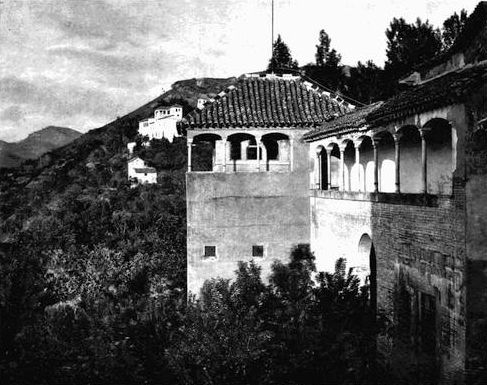
farthest towers of the Alhambra, called the Mirador
de la Reina (the Queen's toilet), shaded by a little
pavilion and open all round, hanging over an abyss
like an eagle's nest. The view one enjoys from
this point—one may say it without fear of contradiction—has
not its equal on the face of the
earth.
Queen's Boudoir, Alhambra
Imagine an immense plain, green as a meadow,
covered with young grass, crossed in all directions
by endless rows of cypresses, pines, oaks, and
poplars, dotted with dense orange-groves that in the
distance look no larger than shrubs, and with great
orchards and gardens so crowded with fruit trees
that they look like green hillocks; and the river
Xenil winding through this immense plain, gleaming
among the groves and gardens like a great silver
ribbon; and all around wooded hills, and beyond
the hills lofty rocks of fantastic form, which complete
the picture of a barrier-wall with gigantic
towers separating that earthly paradise from the
world; and there, just beneath one's eyes, the city
of Granada, partly extending to the plain and partly
on the slope of the hill, all interspersed with groups
of trees, shapeless masses of verdure which rise and
wave above the roofs of the houses like enormous
plumes, until it seems as if they were striving to expand
and unite and cover the entire city; and still
nearer the deep valley of the Darro more than
covered—yes, filled to overflowing and almost
heaped full—with its prodigious growth of vegetation,
rising like a mountain, and above it there rises
yet again a grove of gigantic poplars tossing their
topmost boughs so close under the windows of the
tower that one can almost touch them; and to the
right beyond the Darro, on a high hill towering
toward heaven, bold and rounded like a cupola, the
palace of the Generalife, encircled by its aërial
gardens and almost hidden in a grove of laurels,
poplars, and pomegranates; and in the opposite
direction a marvellous spectacle, a thing incredible,
a vision of a dream—the Sierra Nevada, after the
Alps, the highest mountain-range in Europe crowned
with snow, white even to a few miles from the gates
of Granada, white even to the hills on whose sides
spread the pomegranates and palms, and where a
vegetation almost tropical expands in all its splendid
pomp.
Imagine now over this vast paradise, containing
all the smiling graces of the Orient and all the severe
beauties of the North, wedding Europe to
Africa, and bringing to the nuptials all the choicest
marvels of nature, and exhaling to heaven all the
perfumes of the earth blended in one breath,—imagine
above this happy valley the sky and sun of
Andalusia, rolling on to its setting and tinting the
peaks with a divine rose-color, and painting the
mountain-sides of the Sierra with all the colors of
the rainbow, and clothing them with all the reflections
of the most limpid azure pearls, its rays breaking
in a thousand mists of gold, purple, and gray
upon the rocks encircling the plain, and, as it sinks
in a flame of fire, casting like a last good-night a
luminous crown about the gloomy towers of the Alhambra
and the flower-crowned pinnacles of the
Generalife, and tell me if this world can give anything
more solemn, more glorious, more intoxicating
than this love-feast of the earth and sky, before
which for nine centuries Granada has trembled with
delight and throbbed with pride?
The roof of the Mirador de la Reina is supported
by little Moorish columns, between which extend
flattened arches which give the pavilion an extremely
fanciful and graceful appearance. The
walls are frescoed, and one may see along the friezes
the initials of Isabella and Philip interwoven with
cupids and flowers. Close by the door there still remains
a stone of the ancient pavement, all perforated,
upon which it is said the sultanas sat to be enveloped
in the clouds of perfumed vapor which arose from
below.
Everything in this place tells of love and happiness.
There one breathes an air as pure as that on a
mountain-peak, there one perceives a mingled fragrance
of myrtles and roses, and no other sound
reaches the ear save the murmur of the Darro as it
dashes among the rocks of its stony bed, and the
singing of a thousand birds hidden in the dense
foliage of the valley; it is truly a nest of loves, a
hanging alcove where to go and dream of an aërial
balcony to which one might climb and thank God
for being happy.
"Ah, Gongora," I exclaimed after contemplating
for some moments that enchanting spectacle, "I
would give years of my life to be able to summon
here, with a stroke of a magic wand, all the dear
ones who are looking for me in Italy."
Gongora pointed out a large space on the wall, all
black with dates and names of visitors to the Alhambra,
written with crayon and charcoal and cut
with knives.
"What is this written here?" he demanded.
I approached and uttered a cry: "Chateaubriand!"
"And here?"
"Byron!"
"And here?"
"Victor Hugo!"
After descending from the Mirador de la Reina I
thought I had seen the Alhambra, and was so imprudent
as to tell my friend so. If he had had a stick
in his hand, I verily believe he would have struck
me; but, as he had not, he contented himself by
regarding me with the air of one demanding whether
or not I had lost my senses.
We returned to the Court of the Myrtles and
visited the rooms situated on the other side of the
Tower of Comares, the greater part in ruins, the rest
altered, some absolutely bare, without either pavement
or roof, but all worth seeing, both in remembrance
of what they had been and for the sake of
understanding the plan of the edifice. The ancient
mosque was converted into a chapel by Charles V., and
a great Moorish hall was changed into an oratory;
here and there one still sees the fragments of arabesques
and carved ceilings of cedar-wood; the galleries,
the courts, and the vestibules remind one of a
palace dismantled by fire.
After seeing that part of the Alhambra I really
thought there was nothing else left to see, and a
second time was imprudent enough to say so to Gongora:
this time he could no longer contain himself,
and, leading me into a vestibule of the Court of Myrtles
and pointing to a map of the building hanging on
the wall, he said, "Look, and you will see that all the
rooms of the courts and the towers that we have so
far visited do not occupy one-twentieth part of the
space embraced within the walls of the Alhambra;
you will see that we have not yet visited the remains
of the three other mosques, the ruins of the House of
Cadi, the water-tower, the tower of the Infantas, the
tower of the Prisoner, the tower of Candil, the tower
of the Picos, the tower of the Daggers, the tower of
the Siete Suelos, the tower of the Captain, the tower
of the Witch, the tower of the Heads, the tower of
Arms, the tower of the Hidalgos, the tower of the
Cocks, the tower of the Cube, the tower of Homage,
the tower of Vela, the Powder Tower, the remains
of the House of Mondejar, the military quarters,
the iron gate, the inner walls, the cisterns, the
promenades; for I would have you know that the
Alhambra is not a palace: it is a city, and one
could spend his life in studying its arabesques,
reading its inscriptions, and every day discovering
a new view of the hills and mountains, and going
into ecstasies regularly once every twenty-four
hours."
And I thought I had seen the Alhambra!
On that day I did not wish to learn anything
more, and the dear knows how my head ached when
I returned to the hotel. The day after, at the peep
of dawn, I was back at the Alhambra, and again in
the evening, and I continued to go there every day
so long as I remained at Granada, with Gongora,
with other friends, with guides, or alone; and the Alhambra
always seemed vaster and more beautiful
as I wandered through the courts and halls, and
passed hour after hour sitting among the columns or
gazing out of the windows with an ever-heightening
pleasure, every time discovering new beauties, and
ever abandoning myself to those vague and delightful
fancies among which my mind had strayed on the
first day. I cannot tell through which entrances my
friends led me into the Alhambra, but I remember
that every day on going there I saw walls and towers
and deserted streets that I had not seen before, and
the Alhambra seemed to me to have changed its site,
to have been transformed, and surrounded as if by
enchantment with new buildings that changed its
original appearance. Who could describe the beauty
of those sunset views; those fantastic groves flooded
with moonlight; the immense plain and the snow-covered
mountains on clear, serene nights; the imposing
outlines of those enormous walls, superb
towers, and those measureless trees under a starry
sky; the prolonged rustling of those vast masses of
verdure overflowing the valleys and climbing the
hillsides? It was a spectacle before which my companions
remained speechless, although they were
born in Granada and accustomed from infancy to
look upon these scenes. So we would walk along in
silence, each buried in his own thoughts, with hearts
oppressed by mild melancholy, and sometimes our
eyes were wet with tears, and we raised our faces to
heaven with a burst of gratitude and love.
On the day of my arrival at Granada, when I
entered the hotel at midnight, instead of finding
silence and quiet, I found the patio illuminated like
a ball-room, people sipping sherbet at the tables,
coming and going along the galleries, laughing and
talking, and I was obliged to wait an hour before
going to sleep. But I passed that hour very pleasantly.
While I stood looking at a map of Spain on
the wall a great burly fellow, with a face as red as a
beet and a great stomach extending nearly to his
knees, approached me and, touching his cap, asked
if I was an Italian. I replied that I was, and he
continued with a smile, "And so am I; I am the
proprietor of the hotel."
"I am delighted to hear it, the more so because
I see you are making money."
"Great Heavens!" he replied in a tone which he
wished to seem melancholy. "Yes, ... I cannot
complain; but, ... believe me, my dear sir, however
well things may go, when one is far from his
native land one always feels a void here;" and he
put his hand upon his enormous chest.
I looked at his stomach.
"A great void," repeated mine host; "one never
forgets one's country.... From what province are
you, sir?"
"From Liguria. And you?"
"From Piedmont. Liguria! Piedmont! Lombardy!
They are countries!"
"They are fine countries, there is no doubt of
that, but, after all, you cannot complain of Spain.
You are living in one of the most beautiful cities in
the world, and are proprietor of one of the finest
hotels in the city; you have a crowd of guests all
the year round, and then I see you enjoy enviable
health."
"But the void?"
I looked again at his stomach.
"Oh, I see, sir; but you are deceived, you know,
if you judge me by appearances. You cannot imagine
what a pleasure it is when an Italian comes here.
What you will? Weakness it may be.... I know
not, ... but I should like to see him every day at
table, and I believe that if my wife did not laugh at
me I should send him a dozen dishes on my own
account, as a foretaste."
"At what hour do you dine to-morrow?"
"At five. But, after all, ... one eats little
here, ... hot country, ... everybody lives lightly, ...
whatever their nationality may be.... That
is the rule.... But you have not seen the other
Italian who is here?"
So saying, he turned around, and a man came
forward from a corner of the court where he had
been watching us. The proprietor, after a few
words, left us alone. The stranger was a man of
about forty, miserably dressed, who spoke through
closed teeth, and kept continually clenching his
hands with a convulsive motion as if he was making
an effort to keep from using his fists. He told me
he was a chorus-singer from Lombardy, and that he
had arrived the day before at Granada with other
artists booked to sing at the opera for the summer
season.
"A beastly country!" he exclaimed without any
preamble, looking around as if he wished to make
a speech.
"Then you do not remain in Spain voluntarily?"
I asked.
"In Spain? I? Excuse me: it is just as if you
had asked me whether I was staying voluntarily in a
galley."
"But why?"
"Why? But can't you see what sort of people the
Spaniards are—ignorant, superstitious, proud, bloodthirsty,
impostors, thieves, charlatans, villains?"
And he stood a moment motionless in a questioning
attitude, with the veins of his neck so swollen that
they seemed ready to burst.
"Pardon me," I replied; "your judgment does
not seem favorable enough to admit of my agreeing
with you. When it comes to ignorance, excuse me,
it will not do for us Italians, for us who still have
cities where the schoolmasters are stoned and the
professors are stabbed if they give a zero to their
scholars,—it will not do for us, I say, to pick flaws
in others. As for superstition, alas for us again!
since we may still see in that city of Italy in which
popular instruction is most widely diffused an unspeakable
uproar over a miraculous image of the
Madonna found by a poor ignorant woman in the
middle of a street! As for crime, I frankly declare
that if I were obliged to draw a comparison between
the two countries before an audience of Spaniards,
with the statistics now in hand, without first proving
my data and conclusions, I should be very much
alarmed.... I do not wish to say by this that
we are not, on the whole, sailing in smoother water
than is Spain. I wish to say that an Italian in
judging the Spanish, if he would be just, must be
indulgent."
"Excuse me: I don't think so. A country without
political direction! a country a prey to anarchy!
a country—Come, now, cite me one great Spaniard
of the present day."
"I cannot, ... there are so few great men anywhere."
"Cite me a Galileo."
"Oh, there are no Galileos."
"Cite me a Ratazzi."
"Well, they have none."
"Cite me ... But, really, they have nothing.
And then, does the country seem beautiful to you?"
"Ah! excuse me; that point I will not yield:
Andalusia, to cite a single province, is a paradise;
Seville, Cadiz, and Granada are splendid cities."
"How? Do you like the houses of Seville and
Cadiz, with walls that whiten a poor devil from head
to foot whenever he happens to touch them? Do
you like those streets along which one can hardly
pass after a good dinner? And do you find the Andalusian
women beautiful with their devilish eyes?
Come, now, you are too indulgent. They are not a
serious people. They have summoned Don Amadeus,
and now they don't want him. They are not worthy
of being governed by a civilized man." (These were
his actual words.)
"Then you don't find any good in Spain?"
"Not the least."
"But why do you stay?"
"I stay ... because I make my living here."
"Well, that is something."
"But what a living! It is a dog's life! Everybody
knows what Spanish cooking is."
"Excuse me: instead of living like a dog in
Spain, why not go and live like a man in Italy?"
Here the poor artist seemed somewhat disconcerted,
and I, to relieve his annoyance, offered him a
cigar, which he took and lighted without a word.
And he was not the only Italian in Spain who had
spoken to me in those terms of the country and its
inhabitants, denying even the clearness of the sky
and the grace of the Andalusian women. I do not
know what enjoyment there can be in travelling
after this fashion, with the heart closed to every
kindly sentiment, and continually on the lookout to
censure and despise, as if everything good and
beautiful which one finds in a foreign country has
been stolen from our own, and as if we are of no
account unless we run down everybody else. The
people who travel in such a mental attitude make
me pity rather than condemn them, because they
voluntarily deprive themselves of many pleasures
and comforts. So it appears to me, at least, to
judge others by myself, for wherever I go the first
sentiment which the sights and the people inspire
in me is a feeling of sympathy; a desire not to find
anything which I shall be obliged to censure; an inclination
to imagine every beautiful thing more beautiful;
to conceal the unpleasant things, to excuse the
defects, to be able to say candidly to myself and
others that I am content with everything and everybody.
And to arrive at this end I do not have to make
any effort: everything presents itself almost spontaneously
in its most pleasing aspect, and my imagination
benignly paints the other aspects a delicate
rose-color. I know well that one cannot study a
country in this way, nor write sage essays, nor
acquire fame as a profound thinker; but I know
that one travels with a peaceful mind, and that such
travels are of unspeakable benefit.
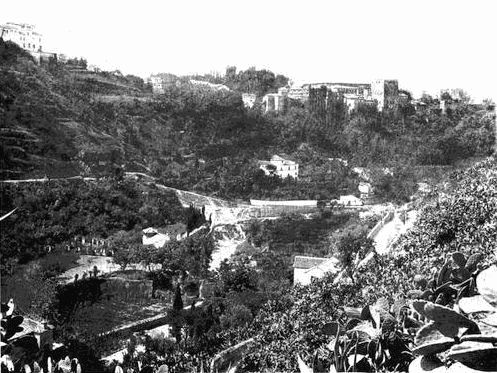
The next day I went to see the Generalife, which
was a sort of villa of the Moorish kings, and whose
name is linked to that of the Alhambra as is that
of the Alhambra to Granada; but now only a few
arches and arabesques remain of the ancient Generalife.
It is a small palace, simple and white, with
few windows, and an arched gallery surrounded with
a terrace, and half hidden in the midst of a grove
of laurel and myrtles, standing on the summit of a
mountain covered with flowers, rising upon the right
bank of the Darro opposite the hill of the Alhambra.
In front of the façade of the palace extends a little
garden, and other gardens rise one above another
almost in the form of a vast staircase to the very
top of the mountain, where there extends a very
high terrace that encloses the Generalife. The
avenues of the gardens and the wide staircases that
lead from one to another of the flower-beds are
flanked by high espaliers surmounted by arches and
divided by arbors of myrtle, curved and intertwined
with graceful designs, and at every landing-place
rise white summer-houses shaded by trellises and
picturesque groups of orange trees and cypresses.
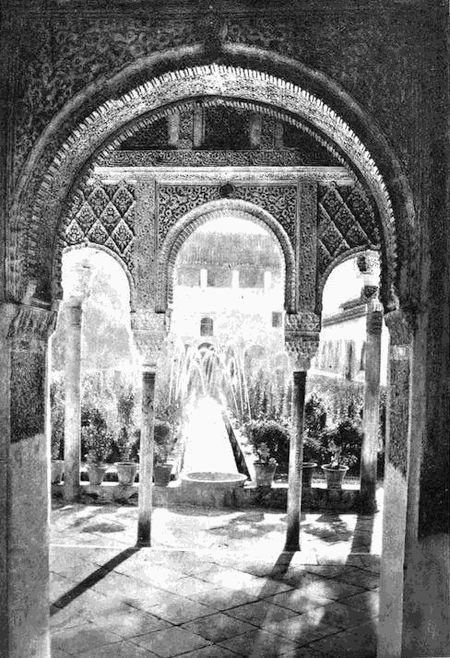
Water is still as abundant as in Moorish times,
and gives the place a grace, freshness, and luxuriance
impossible to describe. From every part
one hears the murmur of rivulets and fountains;
one turns down an avenue and finds a jet of water;
one approaches a window and sees a stream
reaching almost to the window-sill; one enters
a group of trees and the spray of a little waterfall
strikes one's face; one turns and sees water
leaping, running, and trickling through the grass
and shrubbery.
From the height of the terrace one commands
a view of all those gardens as they slope downward
in platforms and terraces; one peers down into
the abyss of vegetation which separates the two
mountains; one overlooks the whole enclosure of
the Alhambra, with the cupolas of its little temples,
its distant towers, and the paths winding among its
ruins; the view extends over the city of Granada
with its plain and its hills, and runs with a single
glance along all the summits of the Sierra Nevada,
that appear so near that one imagines they are not
an hour's walk distant. And while you contemplate
that spectacle your ear is soothed by the murmur
of a hundred fountains and the faint sound of the
bells of the city, which comes in waves scarcely
audible, bearing with it the mysterious fragrance of
this earthly paradise which makes you tremble and
grow pale with delight.
Court of the Generalife, Granada
Beyond the Generalife, on the summit of a
higher mountain, now bleak and bare, there rose
in Moorish times other royal palaces, with gardens
connected with each other by great avenues
lined with myrtle hedges. Now all these marvels
of architecture encircled by groves, fountains,
and flowers, those fabulous castles in the air, those
magnificent and fragrant nests of love and delight,
have disappeared, and scarcely a heap of rubbish or
a short stretch of wall remains to tell their story to
the passer-by. But these ruins, that elsewhere
would arouse a feeling of melancholy, do not have
such an influence in the presence of that glorious
nature whose enchantment not even the most marvellous
works of man have ever been able to equal.
On re-entering the city I stopped at one end of the
Carrera del Darro, in front of a house richly adorned
with bas-reliefs representing heraldic shields, armor,
cherubs, and lions, with a little balcony, over one
corner of which, partly on one wall and partly on
another, I read the following mysterious inscription
stamped in great letters:
"Esperando la del Cielo,"
which, literally translated, signifies "Awaiting her
in Heaven." Curious to learn the hidden meaning of
those words, I made a note of them, so that I might
ask the learned father of my friend about them. He
gave me two interpretations, the one almost certainly
correct, but not at all romantic; the other romantic,
but very doubtful. I give the last: The house
belonged to Don Fernando de Zafra, the secretary of
the Catholic kings. He had a very beautiful daughter.
A young hidalgo, of a family hostile or inferior in
rank to the house of Zafra, became enamored of the
daughter, and, as his love was returned, he asked for
her hand in marriage, but was refused. The refusal
of her father stirred the love of the two young hearts
to flame: the windows of the house were low; the
lover one night succeeded in making the ascent and
entered the maiden's room. Whether he upset a
chair on entering, or coughed, or uttered a low cry
of joy on seeing his beautiful love welcoming him
with open arms, the tradition does not tell, and no
one knows; but certain it is that Don Fernando de
Zafra heard a noise, ran in, saw, and, blind with
fury, rushed upon the ill-fated young man to put
him to death. But he succeeded in making his escape,
and Don Fernando in following him ran into
one of his own pages, a partisan of the lovers, who
had helped the hidalgo to enter the house: in his
haste his master mistook him for the betrayer, and,
without hearing his protests and prayers, he had him
bound and hanged from the balcony. The tradition
runs that while the poor victim kept crying, "Pity!
pity!" the outraged father responded as he pointed
toward the balcony, "Thou shalt stay there esperando
la del Cielo!" (awaiting her in heaven)—a reply
which he afterward had cut in the stone walls as
a perpetual warning to evil-doers.
I devoted the rest of the day to the churches and
monasteries.
The cathedral of Granada deserves to be described
part by part in an even higher degree than the cathedral
of Malaga, although it too is beautiful and
magnificent; but I have already described enough
churches. Its foundation was laid by the Catholic
kings in 1529 upon the ruins of the principal mosque
of the city, but it has never been finished. It has a
great façade with three doorways, adorned with
statues and bas-reliefs, and it consists of five naves,
divided by twenty measureless pilasters, each composed
of a bundle of slender columns. The chapels
contain paintings by Boccanegra, sculptures by Torrigiano,
and tombs and other precious ornaments.
Admirable above all is the great chapel, supported
by twenty Corinthian columns divided into two
orders, upon the first of which rise colossal statues
of the twelve apostles, and on the second an entablature
covered with garlands and heads of cherubs.
Overhead runs a circle of magnificent stained-glass
windows, which represent the Passion, and from the
frieze which crowns them leap ten bold arches forming
the vault of the chapel. Within the arches that
support the columns are six great paintings by
Alonzo Cano, which are said to be his most beautiful
and finished work.
And since I have spoken of Alonzo Cano, a native
of Granada, one of the strongest Spanish painters of
the seventeenth century, although a disciple of the
Sevillian school rather than the founder, as some
assert, of a school of his own, but less original than
his greatest contemporaries,—since I have spoken of
him, I wish here to record some traits of his genius
and anecdotes of his life little known outside of Spain,
although exceedingly remarkable. Alonzo Cano was
the most quarrelsome, the most irascible, and the
most violent of the Spanish painters. He spent his
life in contention. He was a priest. From 1652 to
1658, for six consecutive years, without a day's intermission,
he wrangled with the canons of the cathedral
of Granada, of which he was steward, because
he was not willing to become subdeacon in accordance
with the stipulated agreement; before leaving
Granada he broke into pieces with his own hands a
statue of Saint Anthony of Padua which he had
made to the order of an auditor of the chancery,
because the man allowed himself to observe that the
price demanded seemed a little dear. Chosen master
of design to the royal prince, who, as it appears,
was not born with a talent for painting, he so exasperated
his pupil that the boy was obliged to have
recourse to the king that he might be taken out of
his hands. Remanded to Granada, to the neighborhood
of the chapter of the cathedral, as an especial
favor, he bore such a deep rancor from his old litigations
with his canons that throughout his life he
would not do a stroke of work for them. But this
is a small matter. He nursed a blind, bestial, inextinguishable
hatred against the Hebrews, and was
firmly convinced that in any way to touch a Hebrew
or any object that a Hebrew had touched
would bring him misfortune. Owing to this conviction
he did some of the most extravagant feats in
the world. If in walking along the street he ran
against a Jew, he would strip off the infected garment
and return home in his shirt-sleeves. If by
chance he succeeded in discovering that in his absence
a servant had admitted a Jew into the house,
he discharged the servant, threw away the shoes
with which he had touched the pavement profaned
by the circumcised, and sometimes even had the
pavement torn up and reset. And he found something
to find fault with even as he was dying.
When he was approaching the end of life the confessor
handed him a clumsily-made crucifix that he
might kiss it, but he pushed it away with his hand,
saying, "Father, give me a naked cross, that I may
worship Jesus Christ as He Himself is and as I behold
Him in my mind." But, after all, his was a
rare, charitable nature which abhorred every vulgar
action, and loved with a deep and very pure love the
art in which he remains immortal.
On returning to the church after I had made the
round of all the chapels and was preparing to leave,
I was impressed by a suspicion that there was something
else still to be seen. I had not read the Guidebook
and had been told nothing, but I heard an
inner voice which said to me, "Seek!" and, in fact,
I sought with my eyes in every direction, without
knowing what I sought. A cicerone noticed me and
sidled up to me, as all of his kind do, like an assassin,
and asked me with an air of mystery, "Quiere
usted algo?" (Do you wish something, sir?)
"I should like to know," I replied, "if there is
anything to see in this cathedral besides that which
I have seen already?"
"How!" exclaimed the cicerone; "you have not
seen the royal chapel, have you, sir?"
"What is there in the royal chapel?"
"What is there? Caramba! Nothing less than
the tombs of Ferdinand and Isabella the Catholics."
I could have said so! I had in my mind a place
ready for this idea, and the idea was lacking! The
Catholic kings must certainly have been buried in
Granada, where they fought the last great chivalrous
war of the Middle Ages, and where they gave Christopher
Columbus a commission to fit out ships which
bore him to the New World. I ran rather than
walked to the royal chapel, preceded by the limping
cicerone; an old sacristan opened the door of the
sacristy, and before he allowed me to enter and see
the tombs he led me to a sort of glass cupboard full
of precious objects, and said to me, "You will remember
that Isabella the Catholic, to furnish Christopher
Columbus with the money that he needed to
supply the ships for the voyage, not knowing where
to turn because the coffers of the state were empty,
put her jewels in pawn."
"Yes: well?" I demanded impatiently; and, divining
the answer, felt my heart beat faster the
while.
"Well," replied the sacristan, "that is the box in
which the queen locked her jewels to send them to
be pawned."
And so saying he opened the cupboard and took
out the box and handed it to me.
Oh! brave men may say what they will; as for
me, there are things that make me tremble and
weep. I have touched the box that contained the
treasure by which Columbus was enabled to discover
America. Every time I repeat those words my
blood is stirred, and I add, "I have touched it with
these hands," and I look at my hands.
That cupboard contains also the sword of King
Ferdinand, the crown and sceptre of Isabella, a missal
and some other ornaments of the king and queen.
We entered the chapel. Between the altar and a
great iron chancel that separates it from the remaining
space stand two great mausoleums of marble
adorned with statuettes and bas-reliefs of great
value. Upon one of them lie the statues of Ferdinand
and Isabella in their royal robes, with crown,
sword, and sceptre; on the other the statues of the
other two princes of Spain, and around the statues
lions, angels, and arms, and various ornaments, presenting
a regal appearance, austere and magnificent.
The sacristan lighted a flambeau, and, pointing
out a sort of trap-door in the pavement between the
two mausoleums, asked me to open it and descend
into the subterranean chamber. With the cicerone's
aid I opened the trap-door; the sacristan descended,
and I followed him down a narrow little staircase
until we reached a little room. There were five
caskets of lead, bound with iron bands, each sealed
with two initials under a crown. The sacristan
lowered the torch, and, touching all five of them,
one after another, with his hand, said in a slow,
solemn voice,
"Here rests the great queen Isabella the Catholic.
"Here rests the great king Ferdinand V.
"Here rests the king Philip I.
"Here rests Queen Joanna the Mad.
"Here rests Lady Maria, her daughter, who died
at the age of nine years.
"God keep them all in his holy peace!"
And, placing the torch on the ground, he crossed
his arms and closed his eyes, as if to give me time
for meditation.
One would become a hunchback at his desk if he
were to describe all the religious monuments of
Granada—the stupendous Cartuja; the Monte Sacro,
containing the grottoes of the martyrs; the church
of San Geronimo, where the great leader Gonzalez
di Cordova is buried; the convent of Santo Domingo,
founded by Torquemada the Inquisitor; the
convent of the Angels, containing paintings by
Cano and Murillo and many others; but I suppose
that my readers may be even more weary than I am,
and will consequently pardon me for passing by a
mountain of description which probably would only
give them a confused idea of the things described.
But as I have mentioned the sepulchre of the
great commander, Gonzalez di Cordova, I cannot
forbear translating a curious document in reference
to him which was shown me in the church of San
Geronimo by a sacristan who was an admirer of the
deeds of that hero. The document, in the form of
an anecdote, is as follows:
"Every step of the great captain Don Gonzalez
di Cordova was an assault, and every assault a victory;
his sepulchre in the convent of the Geronomites
at Granada was adorned with two hundred
banners which he had taken. His envious rivals,
and the treasurers of the kingdom of Naples in particular,
induced the king in 1506 to demand a statement
from Gonzalez of the use he had made of the
great sums received from Spain for the conduct of
the war in Italy; and, in fact, the king was so small
as to consent, and even to be present on the occasion
of the conference.
"Gonzalez acceded to the demand with the
haughtiest disdain, and proposed to give a severe
lesson to the treasurers and the king upon the treatment
and consideration to be accorded a conqueror
of kingdoms.
"He replied with great indifference and calmness
that he would prepare his accounts for the following
day, and would let it appear which was the debtor,
himself or the exchequer, which demanded an account
of one hundred and thirty thousand ducats
delivered upon the first payment, eighty thousand
crowns upon the second, three millions upon the
third, eleven millions upon the fourth, thirteen millions
upon the fifth, and so on as the solemn, nasal,
foolish secretary who authorized so important an act
continued to enumerate the sums.
"The great Gonzalez kept his word, presented
himself at the second audience, and, bringing out a
voluminous book in which he had noted his justification,
he began with the following words in a deep,
sonorous voice:
"'Two hundred thousand seven hundred and
thirty-six ducats and nine reales to the fathers, the
nuns, and the poor, to the end that they might pray
God for the triumph of the Spanish arms.
"'One hundred thousand ducats for powder and
shot.
"'Ten thousand ducats for perfumed gloves to
protect the soldiers from the stench of the corpses
of the enemy left on the field of battle.
"'One hundred and seventy thousand ducats for
renewing bells worn out by continuous ringing for
constant new victories over the enemy.
"'Fifty thousand ducats for brandy for the soldiers
on the day of battle.
"'A million and a half ducats for the maintenance
of the prisoners and wounded.
"'A million for returning thanks and Te Deums
to the Omnipotent.
"'Three hundred millions in masses for the dead.
"'Seven hundred thousand four hundred and
ninety-four ducats for spies and ...
"'One hundred millions for the patience which I
showed yesterday on hearing that the king demanded
an account from the man who has given him his
kingdom.'
"These are the celebrated accounts of the great
captain, the originals of which are in the possession
of Count d'Altimira.
"One of the original accounts, with the autograph
seal of the great captain, exists in the Military
Museum of London, where it is guarded with great
care."
On reading this document I returned to the hotel,
making invidious comparisons between Gonzalez di
Cordova and the Spanish generals of our times,
which, for grave state reasons, as they say in the
tragedies, I dare not repeat.
In the hotel I saw something new every day.
There were many university students who had come
from Malaga and other Andalusian cities to take the
examination for the doctor's degree at Granada,
whether because they were a little easier there or
for what other reason I do not know. We all ate
at a round table. One morning at breakfast one of
the students, a young man of about twenty, announced
that at two o'clock he was to be examined
in canon law, and that, not feeling very sure of himself,
he had decided to take a glass of wine to refresh
the springs of eloquence. He was accustomed to
drink only wine weakened with water, and committed
the imprudence of emptying at a single
draught a glass of the vintage of Xerez. His face
changed in an instant in so strange a manner that if
I had not seen the transformation with my own eyes
I should not have believed that he was the same
person.
"There! that is enough!" cried his friends.
But the young man, who already felt that he had
become suddenly strong, keen, and confident, cast a
compassionate glance at his companions, and with
a lordly gesture ordered the waiter to fetch him
another glass.
"You will be drunk," they said.
His only response was to drain a second glass.
Then he became wonderfully talkative. There
was a score of persons at table: in a few minutes he
was conversing with them all, and he revealed a
thousand secrets of his past life and his plans for
the future. He said that he was from Cadiz, that he
had eight thousand francs a year to spend, and that
he wished to devote himself to a diplomatic career,
because with that revenue, added to something
which his uncle would leave him, he should be able
to cut a good figure wherever he might be; that he
had decided to take a wife at thirty, and to marry a
woman as tall as himself, because it was his opinion
that the wife should be of the same stature as her
husband, to keep either from getting the upper hand
of the other; that when he was a boy he was in
love with the daughter of an American consul as
beautiful as a flower and strong as a pine, but she
had a red birth-mark behind one ear, which looked
badly, although she knew how to cover it very well
with her scarf, and he showed us with his napkin
how she covered it; and that Don Amadeus was too
ingenuous a man to succeed in governing Spain;
that of the poets Zorilla and Espronceda, he had
always preferred Espronceda; that it would be folly
to cede Cuba to America; that the examination on
canon law made him laugh; and that he wished to
drink another four fingers of Xerez, the finest wine
in Europe.
He drank a third glass in spite of the good counsel
and disapprobation of his friends, and after prattling
a little longer amid the laughter of his audience,
he suddenly became silent, looked fixedly at a
lady sitting opposite to him, dropped his head, and
fell asleep. I thought that he could not present himself
for the examination that day, but was mistaken.
A short hour later they awakened him; he went up
stairs to wash his face, ran off to the university still
drowsy, took his examination, and was promoted, to
the greater glory of the wine of Xerez and Spanish
diplomacy.
I devoted the following days to visiting the monuments,
or, to be more accurate, the ruins of the
Moorish monuments which besides the Alhambra
and the Generalife attest the ancient splendor of
Granada. Insomuch as it was the last bulwark of
Islam, Granada is the city which presents the most
numerous relics of all the cities of Spain. On the
hill called the hill of Dinadamar (the Fountain of
Tears) one may still see the ruins of four towers
rising at the four corners of a great cistern into
which flowed the waters from the Sierra to supply
the highest part of the city. There were baths, gardens,
and villas of which not a trace remains: from
that point one overlooked the city with its minarets,
its terraces, and its mosques gleaming among the
palms and cypresses. Near there one sees a Moorish
gate called the gate of Elvira—a great arch
crowned with battlements—and beyond it are the
ruins of the palaces of the caliphs. Near the Alameda
promenade stands a square tower in which
there is a great hall ornamented with the usual Arabian
inscriptions. Near the convent of San Domingo
are the remains of gardens and palaces once
joined to the Alhambra by a subterranean passage.
Within the city is the Alcaiceria, a Moorish market
almost perfectly preserved, formed of a few little
streets as straight and narrow as corridors, lined
with two rows of shops, one adjoining the other, and
presenting the strange appearance of an Asiatic
bazaar. In short, one cannot take a step in Granada
without coming face to face with an arch, an
arabesque, a column, or a pile of stones which suggests
its fantastic, luxurious past.
What turns and windings have I not made through
those tortuous streets at the hottest hour of the day,
under a sun that shrivelled my brain, without meeting
a living soul! At Granada, as in the other
cities of Andalusia, the people are alive only at
night, and the night repays them for the imprisonment
of the day; the public promenades are crowded
and confused by the hurry and jostling of a multitude,
one half of which seems to be seeking the
other half upon urgent business. The crowd is
densest in the Alameda, but, for all that, I spent my
evenings on the Alameda with Gongora, who talked
to me of Moorish monuments, and with a journalist
who discoursed on politics, and also with another
young man who talked of women, and frequently
with all three of them together, to my infinite
pleasure, because those cheery meetings, like those of
school-boys, at odd times and places, refreshed my
mind, to steal a beautiful simile, like a summer
shower refreshes the grass as it falls faster and
faster, dancing for joy.
If I were obliged to say something about the
people of Granada, I should be embarrassed, because
I have not seen them. In the day-time I met no
one in the streets, and at night I could not see them.
The theatres were not open, and when I might have
found some one in the city I was wandering through
the halls or avenues of the Alhambra; and then I
had so much to do to see everything in the short
time which I had allowed myself that no unoccupied
moments remained for those chance conversations,
like the ones I had in the other cities, in the streets
and the cafés, with whomever I happened to meet.
But from what I learned from men who were in
a position to give me trustworthy information, the
people of Granada do not enjoy an enviable reputation
in Spain. They are said to be ill-tempered,
violent, vindictive, and bloodthirsty; and this arraignment
is not disproved by the pages of the city
newspapers. It is not publicly stated, but every one
knows it for a fact, that popular instruction in Granada
is at a lower ebb than even in Seville and the
other smaller Spanish cities, and, as a rule, everything
that cannot be produced by the sun and the
soil, which produce so bountifully, goes to the bad,
either through indolence or ignorance or shiftlessness.
Granada is not connected by railway with
any important city: she lives alone, surrounded by
her gardens, enclosed by her mountains, happy with
the fruits which Nature produces under her hand,
gently lulling herself to sleep in the vanity of her
beauty and the pride of her history—idle, drowsy,
and fanciful, content to answer with a yawn to any
one who reproves her for her condition: "I gave
Spain the painter Alonzo Cano, the poet Louis de
Leon, the historian Fernando de Castillo, the sacred
orator Luis di Grenada, and the minister Martinez
de la Rosas. I have paid my debt, leave me in
peace;" and this is the reply made by almost all the
southern cities of Spain, more beautiful, alas! than
wise and industrious, and proud rather than civilized.
Ah! one who has seen them can never have
done exclaiming, "What a pity!"
"Now that you have seen all the marvels of Moorish
art and tropical vegetation there remains the suburb
of the Albaicin to be seen before you can say
that you know Granada. Prepare your mind for a
new world, put your hand on your purse, and follow
me."
So said Gongora to me on the last evening of my
sojourn in Granada. A Republican journalist was
with us, Melchiorre Almago by name, the director
of the Idea, a congenial, affable young man, who to
accompany us sacrificed his dinner and a leading
article that he had been cogitating since morning.
We walked on until we came to the square of the
Audiencia. There Gongora pointed out an alley
winding up a hill, and said to me, "Here commences
the Albaicin;" and Señor Melchiorre, touching
a house with his cane, added, "Here commences
the territory of the republic."
We turned up the alley, passed from it into another,
and from that into a third, always ascending,
without my seeing anything extraordinary, although
I looked curiously in every direction. Narrow streets,
squalid houses, old women dozing on the doorsteps,
mothers carefully inspecting their children's heads,
gaping dogs, crowing cocks, ragged boys running
and shouting, and the other things that one always
sees in the suburbs; but in those streets nothing
more. But gradually, as we ascended, the appearance
of the houses and the people began to change;
the roofs became lower, the windows fewer, the doors
smaller, and the people more ragged. In the middle
of every street ran a little stream in a walled gutter,
in the Moorish style; here and there over the doors
and around the windows one saw the remains of arabesques
and fragments of columns, and in the corners
of the squares fountains and well-curbs of the
time of the Moorish dominion. At every hundred
steps it seemed as if we had gone back fifty years
toward the age of the caliphs. My two companions
touched me on the elbow from time to time, saying
as they did so, "Look at that old woman!"—"Look
at that little girl!"—"Look at that man!" and I
looked, and asked, "Who are these people?" If I
had unexpectedly found myself in that place, I
should have believed on seeing those men and
women that I was in an African village, so strange
were the faces, the dress, the manner of moving,
talking, and looking, at so short a distance from the
centre of Granada—so different were they from the
people that I had seen up to that time. At every
turn I stopped to look in the face of my companions,
and they answered, "That is nothing; we are now
in the civilized part of the Albaicin; this is the
Parisian quarter of the suburb; let us go on."
We went on, and the streets seemed like the bed
of a torrent—paths hollowed out among the rocks,
all banks and gullies, broken and stony—some so
steep that a mule could not climb them, others so
narrow that a man could scarcely pass; some
blocked by women and children sitting on the
ground, others grass-grown and deserted; and all so
squalid, wild, and uncouth that the most wretched of
our villages cannot give one an idea of them, because
this is a poverty that bears the impress of
another race and another continent. We turned
into a labyrinth of streets, passing from time to
time under a great Moorish arch or through a high
square from which one commanded a view of the
wide valleys, the snow-covered mountains, and a
part of the lower city, until finally we arrived at a
street rougher and narrower than any we had yet
seen; and there we stopped to take breath.
"Here commences the real Albaicin," said the
young archeologist. "Look at that house!"
I looked; it was a low, smoke-stained, ruinous
house, with a door that seemed like the mouth of a
cavern, before which one saw, under a mass of rags,
a group, or rather a heap, of old women and little
children, who upon our approach raised their eyes
heavy with sleep, and with bony hands removed
from the threshold some filth which impeded our
passage.
"Let us enter," said my friend.
"Enter?" I demanded.
If they had told me that beyond those walls there
was a facsimile of the famous Court of Miracles
which Victor Hugo has described, I should not have
doubted their word. No door has ever said more
emphatically than that, "Stand back!" I cannot
find a better comparison than the gaping mouth of
a gigantic witch breathing out pestilential vapors.
But I took courage and entered.
Oh, marvellous! It was the court of a Moorish
house surrounded by graceful little columns surmounted
by lovely arches, with those indescribable
traceries of the Alhambra along the porticoes and
around the mullioned windows, with the beams and
ceiling carved and enamelled with little niches for
vases of flowers and urns of perfume, with a pool
in the middle, and all the traces and memorials of
the delicate life of an opulent family. And in that
house lived those wretched people!
We went out and entered other houses, in all of
which I found some fragments of Moorish architecture
and sculpture. From time to time Gongora
would say to me, "This was a harem. Those were
the baths of the women; up yonder was the chamber
of a favorite;" and I fixed my eyes upon every
bit of the arabesqued wall and upon all the little
columns of the windows, as if to ask them for a revelation
of their secrets—only a name or a magic
word with which I might reconstruct in an instant
the ruined edifice and summon the beautiful Arabians
who had dwelt there. But, alas! amid the
columns and under the arches of the windows there
were only rags and wrinkled faces.
Among other houses, we entered one where we
found a group of girls sewing under the shade of a
tree in the courtyard, directed by an old woman.
They were all working upon a great piece of cloth
that seemed like a mat or a bed-spread, in black and
gray stripes. I approached and asked one of the
girls, "What is this?"
They all looked up and with a concerted movement
spread the cloth open, so that I could see their
work plainly. Almost before I had seen it I cried,
"I will buy it."
They all began to laugh. It was the mantle of an
Andalusian mountaineer, made to wear in the saddle,
rectangular in form, with an opening in the middle
to put one's head through, embroidered in bright-colored
worsteds along the two shortest sides and
around the opening. The design of the embroideries,
which represented birds and fantastic flowers,
green, blue, white, red, and yellow, all in a mass,
was as crude as a pattern a child might make: the
beauty of the work lay altogether in the harmony
of the colors, which was truly marvellous. I cannot
express the sensation produced by the sight of that
mantle, except by saying that it laughed and filled
one with its cheerfulness; and it seems to me impossible
to imagine anything gayer, more festive, or
more childishly and gracefully capricious. It was a
thing to look upon in order to bring yourself out of
a bad humor, or when you wish to write a pretty
verse in a lady's album, or when you are expecting
a person whom you wish to receive with your
brightest smile.
"When will you finish these embroideries?" I
asked one of the girls.
"Hoy mismo" (to-day), they all replied in chorus.
"And what is the mantle worth?"
"Cinco" (five), stammered one.
The old women pierced her with a glance which
seemed to say, "Blockhead!" and answered hastily,
"Six duros."
Six duros are thirty francs; it did not seem much
to me, and I put my hand in my pocket.
Gongora cast a withering glance at me which
seemed to say, "You simpleton!" and, drawing me
back by the arm, said, "One moment: six duros is
an exorbitant price."
The old woman shot him another glance which
seemed to say, "Brigand!" and replied, "I cannot
take less."
Gongora gave her another glance, which seemed
to say, "Liar!" and said, "Come, now; you can
take four duros; you would not ask more from the
country-people."
The old woman insisted, and for a while we continued
to exchange with our eyes the titles of simpleton,
swindler, marplot, liar, pinch-penny, spend-thrift,
until the mantle was sold to me for five duros,
and I paid and left my address, and we went out
blessed and commended to God by the old woman
and followed a good way by the black eyes of the
embroiderers.
We went on from street to street, among houses
increasingly wretched and growing blacker and
blacker, and more revolting rags and faces. But
we never came to the end, and I asked my companions,
"Will you have the goodness to tell me if Granada
has any limits, and if so where they are?
May one ask where we are going and how we shall
return home?" But they simply laughed and went
forward.
"Is there anything stranger than this to be seen?"
I asked at a certain point.
"Stranger?" they both replied. "This second
part of the suburb which you have seen still belongs
to civilization: if not the Parisian, it is at least the
Madrid, quarter of the Albaicin, and there is something
else; let us go on."
We passed through a very small street containing
some scantily-clothed women, who looked like people
fallen from the moon; crossed a little square full of
babies and pigs in friendly confusion; passed through
two or three other alleys, now climbing, now descending,
now in the midst of houses, now among piles of
rubbish, now between trees and now among rocks,
until we finally arrived at the solitary place on a
hillside from which we saw in front the Generalife,
to the right the Alhambra, and below a deep valley
filled with a dense wood.
It was growing dark; no one was in sight and not
a voice was heard.
"Is this the end of the suburb?" I asked.
My two companions laughed and said, "Look in
that direction."
The Alhambra and the Valley of
the Darro
I turned and saw along the street that was lost in
a distant grove an interminable row of houses. Of
houses? Rather of dens dug in the earth, with a
bit of wall in front, with holes for windows and crevices
for doors, and wild plants of every sort on top
and along the sides—veritable caves of beasts, in
which by the glow of faint lights, scarcely visible,
swarmed the gypsies by hundreds; a people multiplying
in the bowels of the mountain, poorer, blacker, and
more savage than any seen before; another city,
unknown to the greater part of Granada, inaccessible
to the police, closed to the census-officers, ignorant
of every law and of all government, living
one knows not how, how numerous no one knows,
foreign to the city, to Spain, and to modern civilization,
with a language and statutes and manners of
their own—superstitious, false, thieving, beggarly,
and fierce.
"Button up your coat and look out for your
watch," said Gongora to me, "and let us go forward."
We had not taken a hundred steps when a half-naked
boy, black as the walls of his hovel, ran out,
gave a cry, and, making a sign to the other boys
who followed him, dashed toward us; behind the
boys came the women; behind the women the men,
and then old men, old women, and more children;
and in less time than it takes to tell it we were surrounded
by a crowd. My two friends, recognized as
Granadines, succeeded in saving themselves; I was
left in the lurch. I can still see those horrid faces,
still hear those voices, and still feel the pressure of
those hands: gesticulating, shouting, saying a thousand
things which I did not understand; dragging at
my coat, my waistcoat, and my sleeves, they pressed
upon me like a pack of famished people, breathed in
my face, and cut off my very breath. They were,
for the most part, half naked and emaciated—their
garments falling in tatters, with unkempt hair, horrible
to see; I seemed to be like Don Roderick in
the midst of a crowd of the infected in that famous
dream of the August night.
"What do these people want?" I asked myself.
"Where have I been brought? How shall I get out
of this?" I felt almost a sense of fear, and looked
around uneasily. Little by little I began to understand.
"I have a sore on my shoulder," said one; "I
cannot work; give me a penny."
"I have a broken leg," said another.
"I have a palsied arm."
"I have had a long sickness."
"Un cuarto, Señorito!"
"Un real, caballero!"
"Una peseta para todos!"
This last request was received with a general cry
of approval: "Una peseta para todos!" (a peseta for
us all).
With some little trepidation I drew out my purse;
they all stood on tiptoe; the nearest poked their
chins into it; those behind put their chins on the
heads of those in front; the farthest stretched out
their arms.
"One moment," I cried. "Who has the most
authority among you all?"
They all replied with one voice, stretching out
their arms toward the same person, "That one."
It was a terrible old hag, all nose and chin, with a
great tuft of white hair standing straight above her
head like a bunch of feathers, and a mouth which
seemed like a letter-box, with little clothing save a
chemise—black, shrivelled, and mummified; she approached
me bowing and smiling, and held out her
hands to take mine.
"What do you want?" I demanded, taking a step
backward.
"Your fortune," they all cried.
"Tell my fortune, then," I replied, holding out my
hand.
The old woman took my poor hand between her
ten—I cannot say fingers, but shapeless bones—placed
her sharp nose on it, raised her head, looked
hard at me, pointed her finger toward me, and,
swaying and pausing at every sentence as if she
were reciting poetry, said to me in inspired accents,
"Thou wert born upon a famous day.
"Upon a famous day also shalt thou die.
"Thou art the possessor of amazing riches."
Here she muttered I know not what about sweethearts
and marriage and felicity, from which I
understood that she supposed I was married, and
then she continued: "On the day of thy marriage
there was great feasting in thy house; there were
many to give and take.
"And another woman wept.
"And when thou seest her the wings of thy heart
open."
And so on in this strain, saying that I had sweethearts
and friends and treasures and jewels in store
for me every day of the year, in every country of
the world. While the old woman was speaking
they were all silent, as if they believed she had
prophesied truly. She finally closed her prophecy
with a formula of dismissal, and ended the formula
by extending her arms and making a skip in a dancing
attitude. I gave her the peseta, and the crowd
broke into shouting, applause, and singing, making
a thousand uncanny hops and gestures around me,
saluting me with nudges and slaps of the hand on
my back, as if I were an old friend, until finally, by
dint of wriggling and striking now one and then
another, I succeeded in opening a passage and rejoined
my friends. But a new danger threatened
us. The news of the arrival of a foreigner had
spread, the tribes were in motion, the city of the
gypsies was all in an uproar; from the neighboring
houses and from the distant huts, from the top of the
hill and the bottom of the valley, ran boys, women
with babies about their necks, old men with canes,
cripples, and professional imposters, septuagenarian
prophetesses who wished to tell my fortune—an
army of beggars coming upon us from every direction.
It was night; there was no time for hesitation;
we broke into a run toward the city like
school-boys. Then a devilish cry broke out behind
us, and the nimblest began to chase us. Thanks to
Heaven! after a short race we found ourselves in
safety—tired and breathless, and covered with dust,
but safe.
"It was necessary to escape at any cost," said
Señor Melchiorre with a laugh; "otherwise we
should have gone home without our shirts."
"And take notice," added Gongora, "that we
have seen only the door of Gypsy-town, the civilized
part, not the Paris nor the Madrid, but at least
the Granada, of the Albaicin. If we could only have
gone on! if you could have seen the rest!"
"But how many thousand are there of those
people?" I demanded.
"No one knows."
"How do they live?"
"No one can imagine."
"What authority do they recognize?"
"One only—los reyes (the kings), the heads of families
or of houses, those who have the most money
and years. They never go out of their city; they
know nothing, they live in the dark as to all that
happens beyond the circle of their hovels. Dynasties
fall, governments change, armies clash, and
it is a miracle if the news ever reaches their ears.
Ask them if Isabella is still on the throne; they do
not know. Ask them who Amadeus is; they have
never heard his name. They are born and perish
like flies, and they live as they lived centuries ago,
multiplying without leaving their own boundaries,
ignorant and unknown, seeing nothing all their
lives beyond the valleys lying below their feet and
the Alhambra towering above their heads."
We passed again through all the streets that we
had traversed, now dark and deserted, and endless
as it seemed to me; and, climbing and descending,
turning and twisting, and turning again, we finally
arrived at the square of the Audiencia in the middle
of the city of Granada—in the civilized world. At
the sight of the brightly-lighted cafés and shops I
experienced a feeling of pleasure, as if I had just
returned to city-life after a year's sojourn in an
uninhabited wilderness.
On the evening of the next day I left for Valencia.
I remember that a few moments before starting, as I
was paying my hotel-bill, I observed to the proprietor
that there was an overcharge for one candle,
and playfully asked him, "Will you deduct it for
me?" The proprietor seized his pen, and, deducting
twenty centimes from the total charge, replied
in a voice which he wished to appear emotional,
"The devil! among Italians!"