For a long time past it has been assumed abroad that Carlism is dead in
Spain, and probably few even among diplomatists in other countries could
say off-book what the proscribed branch of the Spanish Bourbons now
consists of, where the different members of the family live, and what
relations they maintain with each other and with the country from which
they have been exiled since 1876. Even so careful an observer as Major
Martin Hume wrote in 1899 that Carlism as a political system was dead in
Spain, and the absolutism upon which that party pin their faith, past
revival.[12]
It is, therefore, hardly surprising that the Carlists have been left out
of account by those who observe Spanish political troubles from outside.
Indeed, the very existence of the old Pretender seemed to have been
forgotten by the generation which has grown up in England in the
thirty-four years which have elapsed since the close of the last civil
war. But the Spanish working classes have not forgotten Don Carlos, nor
have they for a moment lost sight of the continued existence of this
party in their own country.
The root of their long memory lies in their antipathy to the Religious
Orders. To the people the Carlists are indissolubly associated with the
Ultramontanes, and who says Jesuit says Carlist in their vocabulary of
distrust. And that the people have reason on their side has been proved
by the words and actions of the Ultramontanes themselves since the
events that took place in the summer of 1909.
The Catalonian question has been discussed at such length and with so
much confidence by writers living in other countries that I may be
forgiven if I add to their pronouncements on the causes and effects of
the “Red Week” certain information which is not common knowledge beyond
the Pyrenees, unless possibly at the Castle of Frohsdorf or in the
palaces of the proscribed branch in Venice or Trieste. The censorship
exercised over the press, and over telegrams and even letters addressed
to newspaper offices, was so severe while the country was under martial
law, and, indeed, right up to the fall of the Maura Cabinet in October,
1909, that representatives of foreign journals who tried to put the
facts before their leaders found it impossible to do so. Any man who had
once tried—and failed—to get off even the most cryptic telegram
relating to the part played by the Ultramontanes in the riots, was
thenceforth marked by the Intelligence Department of the Society of
Jesus, and if he continued his efforts to communicate what he knew, he
not only found his telegrams suppressed after they had been accepted and
paid for, but stood a good chance of having his personal liberty
interfered with. There was plenty of excitement about the work of a
foreign correspondent in Spain in the summer of 1909, wherever he
happened to be stationed. But it was not precisely the form of danger
suggested by the reports of revolution and anarchy which were supplied
to the foreign Press. Notices of that class could be procured and sent
through without the slightest difficulty. The newspaper correspondent
who was in danger was the man who crossed the frontier to telegraph the
facts as he saw them, and who was not unlikely to meet with an
“accident” as he made his way back to the scene of his labours.
The result of this regime of espionage was that all Europe was
hoodwinked as to the real crisis in Spain, for naturally as soon as
affairs in Cataluña ceased to be sensational, the foreign Press relapsed
into its usual indifference to what was going on in the Peninsula.
Foreign residents, living as quietly and comfortably as usual, were
considerably astonished when their home newspapers reached them, packed
with sensational tales of revolution, incendiarism, military sedition,
and wholesale executions, and asked what on earth the Spanish Government
was about that it allowed these slanders to be propagated all over the
world? Who was responsible for these perversions of the truth? What
advantage was hoped for by those who fostered so colossal a
misrepresentation of the conduct of the inarticulate proletariat of
Spain?[13]
The Censor handled the national Press even more sternly than the
foreign, for the suspension of the Constitution gave the Government a
perfectly free hand, and although the Constitutional rights were
nominally restored everywhere except in Cataluña a few weeks after the
rising, the Press was in reality gagged as long as Señor Maura remained
in office. The Opposition indeed was placed on the horns of an
impossible dilemma. So long as the party kept silence as to what they
knew, Spain would continue to be held up to foreign contumely for a
condition of affairs which did not exist. Yet if any Liberal dared to
criticise the Government, he was clapped into prison until such time as
it might suit the Government to release him.
The position was recognised by Señor Moret, the veteran
Liberal-Monarchist leader. He possesses the invaluable quality of
knowing when to speak and when to keep silence. And throughout the time
when the fair fame of his nation was being dragged in the dust, he urged
patience and submission upon his followers, pointing out that when the
time came to call the Ultramontanes to account for their conduct of the
Government, the strong men of his party must not be found in prison, for
it would be their business to speak: and the Liberal-Monarchist
statesmen, without exception, supported their leader in his patriotic
policy.
Only a very strong man could have controlled the rising tide of wrath
against the Religious Orders, whom the people hold responsible for
everything that goes wrong with the nation. Señor Maura, the leader of
the Ultramontane party, is supposed, by those who do not know the facts,
to be the only really strong man in Spain, and it appears to be honestly
believed abroad that he holds the Conservative party together by sheer
force of statesmanship. The truth is that Maura is a weak man who owes
his position as the leader of the party he is supposed to control only
to the unflagging energy and intrigue of the Ultramontanes—the richest
men and the subtlest intellects in the Peninsula; while Moret’s power,
on the other hand, is based upon unswerving political rectitude,
maintained against the onslaughts of corrupt politicians, and upon his
capacity for silence among men who spend half their lives in talking.
This is why he has obtained such a hold upon the people that the whole
forces of political immorality have laboured to bring about his
overthrow each time that he has taken office, lest he end by leading the
nation into paths where corruption will have no standing ground. Maura’s
policy of repression gave a great impetus to the revolutionary spirit
against which it professed to be directed. And yet Moret’s influence was
strong enough to keep the nation quiet, because the nation trusts him.
For once the low level of popular education, which Moret and his
followers are working hard to raise, was on the side of the Liberal
leader. Only some twenty-five per cent. or so of the nation can read,
and of that number few indeed know any language but their own. Had the
working classes realised that the Army, of which all Spain is so proud,
was being traduced by the foreigner, neither Moret nor Maura could have
controlled the storm of wrath that would have overwhelmed those held
responsible for the lie.
Happily for Spain, the syndicate of newspapers known as the Sociedad
Editorial de España, which is edited under the direction of the
Liberal-Monarchist party in Madrid, and read by thousands, as against
hundreds of readers of the journals which support a different policy,
never wavered for a day in upholding Moret’s recommendation of patience
and submission to the law, and refrained from increasing their sales by
pandering to popular excitement with allusions to what was going on
outside of Spain, notwithstanding the grossest insults from the
Ultramontane press. Those who control the organs of the party knew well
enough that if they had raised the cry of “Down with the Jesuits!” they
would have called up a tempest not easily or speedily to be allayed. But
they knew that their adversaries wished for nothing better, and they
kept on their own course and saved Spain from a violent revolution
against the Church. The syndicate of Liberal-Monarchist papers is
continually accused by the Ultramontane press of being responsible for
the attack on the religious houses in Cataluña, and is held up to
reprobation for “encouraging the destruction of the country by
maintaining the right of the people to have lay schools.” But the truth
is, and the Ultramontanes know it, that to the Liberal-Monarchist press
is due the present security of innumerable buildings belonging to the
Church, which, but for the influence of the Liberal party, would be in
smoke-blackened ruins to-day.
Many members of the educated middle classes of Barcelona assert that the
disturbances in Cataluña in July, 1909, were deliberately instigated by
the Jesuits. The object was, they say, by hook or by crook, to close the
lay schools, and that it had long been an open secret that the
Ultramontane party were determined to take the first excuse they could
find to destroy an educational movement which they find inimical to
their interests. And the link connecting the Jesuits of Barcelona with
Don Jaime, the son of the recently deceased Pretender, Don Carlos, was
provided by an indignant disclaimer of Carlist participation in the
affair, published by a Carlist organ edited in Paris, long before any
suggestion had been made that such participation was suspected. This was
so clearly a case of qui s’excuse s’accuse that no thoughtful
observer, unbiassed by political passion, could fail to put two and two
together.
The peasants had no doubt whatever as to the origin of the disturbances.
One of them gave me his view of the situation, as follows:
“The Carlists and the Jesuits plotted to turn out Isabel II., and now
they are trying to overthrow King Alfonso. They ruined Queen Isabel
because she loved the people and hated the priests, and now they are
trying to do the same with los Reyes because they are popular in the
country. But let them try! There are still many of us who remember what
we suffered in the last Carlist war, and we do not intend to have
another. Let them try to touch los Reyes! We will kill every priest in
the country before they shall put a hand to that work!”
“Well,” I objected, “this is very fine talk now that Don Carlos is dead
and buried, but if you did not want him for your king, why did so many
of you fight for him?”
“If you were ordered to fight and knew that you and your children would
be put in the street if you refused, would you not fight rather than let
your family starve? The men who paid our wages said: ‘You will go with
us to fight for Don Carlos or you will never have another day’s work
from us.’ What help had we against our masters? Do you think we wished
to take arms against Queen Isabel? If the Jesuits had not been in the
affair, no one would have taken notice of her little faults. The Jesuits
intended her to commit faults when they married her to a man who was no
man. If she had not been good to us they would have let her stay.”
The popular songs expressing loyalty to Queen Isabella have not been
forgotten in the forty odd years that have elapsed since she was
dethroned, for in 1909 they were revived, with such slight alterations
as were needed to bring them up to date. Here is a specimen:
“Si la Reina de España moriera
Y Don Carlos quisiera reinar,
Los arroyos de sangre correrian
Por el campo de la libertad.”
(“If the Queen of Spain were to die and Don Carlos wanted
to reign, the streams would run with blood on the field of
liberty.”)
The intricacies of succession being little understood by the people,
this song was modernised by substituting “Victoria” for “de España” and
“Don Jaime” for “Don Carlos.” During the suspension of the Constitution
the song was not sung aloud: the people said that “Maura had forbidden
it.” Directly the Liberals came in it was heard again everywhere.
Here is another:
“No reinará Don Jaime,
No reinará, no, no!
Mientras España tenga
Bayoneta y cañon.”
(“Don Jaime shall not reign while Spain has a bayonet and
a cannon.”)
And another, perhaps in some ways the most interesting of the three:
“Dicen de Barcelona
De un mitin clerical,
Que Don Jaime asistió
Provisto de un disfraz.
Al ver la bronca de palos y morral
Creyó que le tiraban bomba encima de nocedal!”
The literal translation is as follows: “They say from Barcelona, of a
clerical meeting, that Don Jaime attended it provided with a disguise.
When he saw the row with sticks and a nosebag, he thought they were
throwing a bomb on the top of a walnut-copse.” Taken in its literal
meaning it is of course nonsense, and the popularity of the song was
evidently due to the puns on “morral” and “nocedal.” By writing
these words with capitals we get the names of the man who threw the bomb
at the King’s wedding (Morral), and of a well-known Carlist leader
(Nocedal). This song was sung in Barcelona when the colonies were lost,
with another name in place of Morral’s, and was revived in 1909, brought
up to date as above, until with the suspension of the Constitution it
was severely repressed. It expresses the popular opinion as to the
authorship of the bomb of 1906 and the troubles in Cataluña.
It was curious to observe how constantly the Carlist and Cuban wars
seemed to be in the minds of the people during the regime of repression.
Frequent comparisons were drawn between the reign of Queen Isabella and
the rule of Señor Maura, all highly unfavourable to the latter. It was
always Maura and the Jesuits: never was the King blamed in Spain for the
sins of his ministers. The Carlist war seemed as fresh in the minds of
the unlettered masses as Mellila itself. Tales were raked up of shocking
cruelty to the rank and file, and of a callous disregard of their
sufferings in Cuba and the Philippines, and it seemed to be believed by
many of the speakers that similar abuses were being repeated in Morocco.
A nation which has been prevented from developing its intellectual life
is inevitably thrown back upon its recollections, and traditions of
class injury cannot fail to be more permanent among a people who have no
other occupation for their thoughts.
For nearly forty years the uneducated Spanish peasantry, and the artisan
classes, have nursed their wrath against the body whom their parents
believed to have dethroned, for their own ends and at the cost of a
bloody civil war, a Queen desirous of ameliorating the lot of her
people; and for ten years of that time their resentment has been
increased by the conviction that the same body plotted to sell the last
of the once world-wide Spanish colonies, and strewed the road to that
sale with the corpses of Spanish peasants, set to fight, without arms or
equipment, against the overwhelming forces of the enemy, while the
Jesuits appropriated to their own purposes the money wrung from the
nation for the expenses of the war.
How much of the indictment against the Jesuits is justified I do not
pretend to decide; but all the world knows that the Spanish Army again
and again went into action in Cuba and the Philippines so destitute of
munitions as to be practically unarmed, while the tragic loss of the
Spanish Navy at Santiago will never be forgotten by those whose friends
and relatives were sent to an inevitable death “by order of the
Government in Madrid.”
Had the people been allowed to educate themselves during the years that
have passed since those fatal adventures, the wound, though it will long
remain unhealed, would have been skinned over by consoling comparisons
drawn between these and the great disasters of other nations. But the
Religious Orders have always opposed the spread of popular education.
The people have been driven back upon tradition, old and new, for their
mental nourishment, while other nations have been forging ahead. Thus
the Religious Orders have sharpened a sword for their own undoing. The
longer the Spanish peasant is left to nurse the memory of his
grievances, the more bitter grows his resentment against those whom he
holds responsible for them.
To the Jesuits the people attribute the downfall of Isabel II. and the
years of internecine strife which followed; to the Jesuits they
attribute the fiasco of the Spanish-American War, with all the suffering
it entailed upon the poor; to the Jesuits they attribute the war in
Morocco, with its heavy account of bloodshed, sickness, and money-cost;
and to the Jesuits they impute the chronic unrest in Cataluña, which
they believe to be fostered in the interests of Don Jaime of Bourbon.
They are convinced that all these things were and are engineered by the
Carlist party, being well aware that, as the Pretender himself stated,
in a published document, the “Monarch” of the Ultramontanes has no hope
of entering Spain again, save on the waves of a national revolution,
which would bring misery and desolation to thousands of homes.
Let us now see what evidence may be found in incidents that have
occurred and statements that have been published since the regime of
repression was abolished, to support the popular theory of
Jesuit-Carlist intervention in the events of 1909.
The belief, industriously promulgated in Spain and abroad, that Ferrer
engineered and conducted the July outbreak, fell flat, generally
speaking, among the Spanish working people; always excepting, of course,
the more educated elements in the larger industrial cities.
“They are saying that this Ferrer, whoever he may be, paid Morral to
throw the bomb at the King and Queen. If that is true he deserved to be
shot. But others say that the Jesuits themselves paid Morral, and
others again say that Don Carlos employed him.[14] What do I know
about it? The only thing certain is that the Jesuits had a hand in this
Barcelona business, for they have a hand in everything that is bad for
the country. Where the Jesuits are, there are the Carlists also. As for
this Ferrer, who is he? We never heard of him till Maura shot him.”
This commentary on “the execution of an anarchist” or “the martyrdom of
an enthusiast” is, of course, that of the peasantry alone, not that of
the Republicans and Socialists, to whom he was well known long before
the Barcelona riots took place. But let it be remembered that the
unlettered peasant forms the great majority of the working classes in
Spain.
The calm with which the mass of the nation regarded the affair was,
however, shaken when a report got about that Ferrer was denounced by or
at the instigation of a Dominican monk—even a name being given—who,
having quarrelled with him some years before, had determined to contrive
his destruction. I do not say that there was any foundation for this
vague story. But its ready acceptance as exculpating
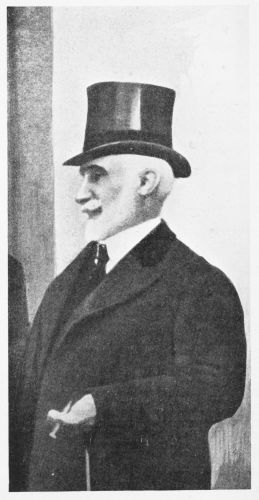
SEÑOR MAURA.
Leader of the Ultramontanes.
[To face page 149.
Ferrer, by those who had previously been indifferent or hostile to him,
shows how the people twist everything to the prejudice of the Religious
Orders, and believe all evil possible to them. Had the Liberal papers
lent themselves to agitation then, the result might have been serious.
No better incitement to riot could have been found than the story of the
Dominican. The death of Ferrer in itself left the mass of the people
unmoved, but the ease with which churches and monasteries were destroyed
in Barcelona had already set many aggrieved people thinking how easy it
would be to follow Barcelona’s example in other towns where the Jesuits
are numerous, and only a leader and a party-cry were needed to raise the
working classes against the Religious Orders.
The whole of the Opposition Press, however, in spite of great
provocation, as usual stuck to its guns and steadily, continued to
condemn violence and to point out that the duty of the nation, unjustly
deprived of its constitutional rights, was to prove by its
self-restraint and moderation how entirely it was worthy to be trusted.
“If we could only kill Maura without hurting the King,” a working man
said to me, “he would have been dead long ago, for he is the cause of
all our troubles. But the Jesuits would make out that any act of
violence on our part was directed, not against Maura himself, but
against the party which is supposed to support the King; they would
never admit that it was only their friend Maura whom we were attacking,
and it would be made to appear that we were trying to overthrow the
Monarchy. That is why Maura is still alive.” The conviction, and the
rancour expressed in these words, cannot be rendered in print.
The speaker could not read or write. He and some ten or twelve of his
friends were in the habit of meeting quietly together after nightfall,
when no priest or Jesuit was likely to see them. One of the better
instructed, generally a reservist who had “got education while serving
the King,” would read aloud to the rest, and all would discuss the
pronouncements of their chosen newspaper and form a collective opinion
on them. I have sat with many such groups, in small towns and country
villages, and have taken care to notice what newspaper they read. It was
invariably the Libéral. It often struck me, during the three months of
“repression,” that Señor Maura literally owed his life to the organs of
the so-called “Trust,” which he and his party accuse of working hand in
hand with the anarchists; for the sentiment recorded above was
expressed in my presence many times by members of the working classes in
connection with Barcelona, the war, the want of education, and all their
other grievances. Maura, the Jesuits, and the Carlists, are regarded as
one by the mass of the nation, and the three-fold hostility is
concentrated on each member of the trinity in turn.
When you have some twelve or thirteen million people brooding over their
grievances, and cherishing the conviction that a certain party in the
State refuses to recognise or redress those grievances because by
preserving the status quo they put money in their own pockets, the
situation becomes serious for the party to which such action, or
inaction, is attributed. And it must be remembered that though the
Spanish peasant can read but little of the literature disseminated by
revolutionaries—anarchists and such-like—across the Pyrenees, an echo
of their campaign can hardly fail to reach him sooner or later.
Several little incidents occurred about this time which, though trivial
in themselves, lend support to the popular view that the Carlists were
at the bottom of the trouble.
Thus we have the disclaimer of participation in the outbreak, by the
Correo Catalan, the official organ of the party, synchronising with
the publication of extracts from a “forthcoming” manifesto of Don
Jaime, suggesting the possible expulsion of the King by a revolution, to
which I have already alluded; while early in August the Ultramontane
journals said that a quantity of weapons, which they allege to have been
taken from the hands of the mob, were stored in the Carlist club in
Barcelona. Don Jaime’s full manifesto was not published till November,
when the equivocal passage did not appear. But it is worth observing
that some time before the expected death of the old Pretender his
supporters in the Press had been hinting that those who believed Carlism
to be dead in Spain “would presently see things that would surprise
them.”
Then we have the inexplicable favours accorded by the Government to
Señor Llorens, a Carlist Deputy to Cortes and one of the most prominent
of the “Court” of Don Jaime. This gentleman paid more than one visit to
the Army at Melilla, and was allowed privileges at the front which were
granted to no other civilian. The favours shown to him and his own
proceedings were so marked as to call forth outspoken comment from the
Ejército Español, a military paper professedly without political bias,
which, after recalling the fact that he is a well-known supporter of the
anti-dynastic party, and had
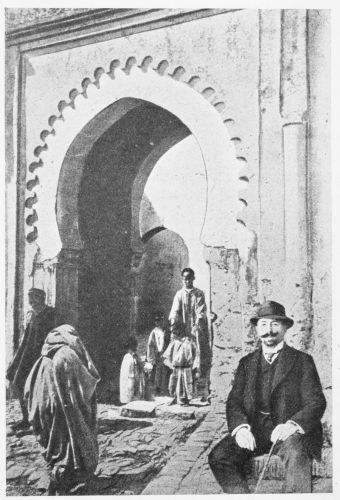
DON JAIME OF BOURBON IN MOROCCO.
[To face page 153.
taken part in the last Carlist war, plainly warned him that any attempt
to tamper with the loyalty of the Army would be in vain, and asked what
was the meaning of the exceptional privileges he enjoyed.
On July 24th a great meeting of the Carlists was held at Trieste on the
occasion of the funeral of Don Carlos, the most noteworthy feature of
which was that on the evening of the same day Don Jaime left his
followers to be entertained by his mother and sisters, and went himself,
it was said, to Frohsdorf. Why did he, on the very day of his father’s
funeral, abandon the delegates of his party when they travelled long
distances to see him and discuss the situation? The rioting at Barcelona
was just then at its height, having begun, it was said, some days sooner
than was intended.
About this time all sorts of reports were spread, calculated to alarm
the country and prejudice it against the Monarchy. The story of the
mutiny and execution of soldiers on their arrival at the front I have
already mentioned. The details of this varied with each telling:
sometimes two men were shot, sometimes nine, often a whole battalion,
once several of them. The immediate preparation of accommodation was
called for for the thousands of sick and wounded, who could not be
received in the already overflowing hospitals. Real sacrifices were made
by the poor to help in these preparations, for every one wished to do
his share for the sufferers; and when at length it became clear that no
wounded were coming, at any rate at that time, and that the demands made
on the public sympathy—for the moment at least—were a sham, much
indignation was naturally aroused. These alarmist reports circulated
with great rapidity, even in remote villages where no one received
newspapers. The people had no hesitation in attributing them to the
parish priests, “who have their own ways of spreading what Jesuits wish
them to make known,” and tales of all sorts of horrors for which they
had been held responsible in the past began to be raked up and repeated
as happenings of the moment. One such tale was of a walled-up nun found
in a convent in Barcelona during the July riots. I took some trouble to
track this story, and finally convinced myself that it was merely an
echo from the past—a tale of the Inquisition or of some monastic crime.
But it formed another instance of the hold that tradition has on the
Spanish peasant, and of the way in which it is combined with the events
of the day to pile up the indictment against the Religious Orders.
I asked some of my middle-class acquaintances on one occasion where was
to be found the “army” of Don Jaime, which I had seen mentioned in the
report of a Carlist meeting. One of them laughed and said it existed
only in the region of comic opera, but another proceeded to explain with
conviction that the Pretender had a strong following in Cataluña and the
Basque Provinces and a good many adherents in Andalusia, and expatiated
at length on the benefits the nation would derive from the autocracy and
the abolition of popular rights, which he seemed to think would bring
about a social millennium.
And while he was speaking I mentally recalled the commentary of one of
the people, to whom I had read aloud Don Jaime’s manifesto, asking
whether he would welcome the advent of the “Legitimist Monarch” in
Spain.
“Don Jaime? I? I would like to burn him and then blow his ashes to the
winds, and so would all my friends, both men and women. What dealings do
we desire with the seed of Don Carlos? There is no poor man in Spain who
liked Don Carlos or wishes ever to see his son.”
A Basque friend of mine, a highly educated man, whose position as a
large employer of labour enables him to judge fairly of the political
leanings of the people, made the following remark to me one day:
“The Carlists,” he said, “may think they have the Basque Provinces with
them, but they are completely mistaken. The working classes of my
country have no more desire for civil war than those of any other part
of Spain.”
This gentleman is not a man who would use illicit means to influence the
votes of his dependants, and his opinion may be taken as representing
the true state of public opinion in his district. On the other hand, he
said that among his wealthy clients there was no attempt to disguise the
desire for a dynastic change: the portrait of Don Jaime hangs in a place
of honour in many of the great houses which he visits in the course of
his business, and the general devotion of this class to Carlism is open
and avowed.
“But,” he said, “what can be done by a party which is all head and no
body? The army of Don Jaime may be well supplied with would-be officers
and with all the munitions of war, but they have no troops behind them,
in the Basque Provinces or anywhere else.”
His description of the Carlist “army” reminded me of the famous raid of
the Fhairshon:
“For he did resolve to extirpate the vipers
With four and twenty men and five and thirty pipers.”