I.
"Mandy's jest crazy to go to New York,"
said Mrs. Powell to her friend Mrs. Thomas,
who was spending the day with her.
The two elderly women were "kin" in that
wide-reaching term that in Virginia stretches
out over blood relationship to the remotest
degree of fortieth cousinship. Mr. Thomas'
mother had been a Powell, and it was from the
Powells, she was accustomed to say with ill-concealed
pride, that her son Vivian got his
high spirit and his splendid eyes.
Amanda Powell had the identical dark brown
eyes and apparently the same high spirit.
When she was six and Vivian twelve, the two
had been used to retire from family parties
anywhere from one to a dozen times in the
course of an afternoon to have it out, in the
back hallway, or in the garret, or even, when
the excitement was intense, in the "far barn,"
a dilapidated building a quarter of a mile away
from the house.
Vivian, even at the manly age of twelve, and
in the face of all the traditions of chivalry,
which to a Southern boy of that period exercised
a very real influence over his attitude toward
the softer sex, despite the vigilance of
his mother and aunts, who were perpetually
admonishing him to recollect that "Mandy
was little and a girl besides," Vivian was tormented
by a desire to subdue his spunky,
small cousin at any cost of time and ingenuity.
He had once made a great flourish with a hazel
switch and raised a welt on her slim bare arm,
which gave him immense satisfaction at the
moment, and haunted him remorsefully for
weeks afterwards. Amanda had promptly
pulled out a lock of his hair, and then, setting
her back against the side of the barn and gritting
her tiny white teeth, had bidden him
"come on" in a tone ringing with belligerent
probabilities.
After that day a new element was added to
the attraction the two children had for each
other. Their attitude was much like that of
two unfledged chickens who have had a fight
ending in a drawn battle, and have a thirst
for satisfaction. Whoever has watched a
pair of very young roosters in the act of
combat, knows how each one makes a peck
and then draws off and stands upon the defensive,
vigilant and defiant; another peck—then
another rest, neither one giving in
or running away until some intruder parts
them.
Vivian and Amanda had continued upon
these terms until increasing years rendered
actual fighting impossible, and left to their
antagonistic spirits only the resource of stinging
words, and to hours of repentance the mere
interchange of shy glances and softer speech,
added to a fierce absorption of one another's
society, which left the rest of the world completely
outside.
The Powell and Thomas tribe had come in
the course of time to accept the alliance between
the fighting cousins as one of the mysterious
results of the strange similarity of the
two children in looks and disposition, and all
the other young cousins had learned that these
two black-eyed friend-enemies belonged to one
another, and tolerated no interference in their
relation.
Both were fatherless, and so, in either case,
the young spirit that needed wise and loving
restraint, had broken through the feeble curb
of motherly fondness and gained freedom before
achieving the self-control that prevents
liberty from degenerating into license.
Amanda was now eighteen, and Vivian—just
home from a two-years' term at the College of
Virginia—was twenty-four. The two mothers,
sitting together that afternoon, a week after
Vivian's premature return from college, were
anxiously alive to all the possibilities smouldering
in such a period and fanned by recent
separation and the excitement of inquiry into
the changes a couple of years had wrought.
I should like to dwell for a moment upon
the scene of this little motherly conference.
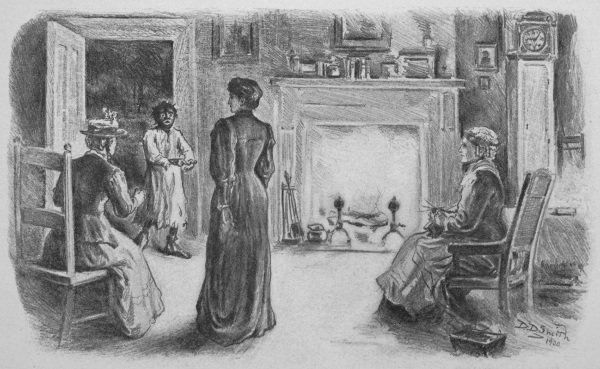
It was the "settin'-room" of a large, old-fashioned
mansion in central Virginia, and was one
of two ample square rooms lying on either side
of a great hall that ran straight through the
middle of the house and lost itself in a broad
porch in the rear.
Its newly white-washed walls were half
covered with dusky old family portraits interspersed
with bits of what Amanda called
"bric-a-brac," meaning wood-cuts from the
illustrated weeklies, brilliantly colored fans,
and bunches of ferns and grasses tied together
with ends of sash ribbon. The worn carpet
covering the middle of the floor was an ancient
and costly Axminster, and the few pieces of
furniture were of massive mahogany, the long
sofa and two armchairs covered with black
haircloth, but overlaid with so many knitted
tidies and scarfs that their dreariness was well
concealed. In the deep, wide fireplace a big
log burned slowly this chilly April day, and on
either side of a spider-legged table drawn up
before the blaze, sat and rocked the elderly
ladies, dividing their attention between a
small decanter of Madeira and a plate of Aunt
'Liza's delicious plum cake, and the subject of
Amanda's craze to go to New York.
"Mandy's always had her own way about
everything up to this," said Mrs. Thomas, her
cool, pale blue eyes turning their wavering
glance upon the plump, handsome face of her
hostess, whose blooming cheeks were framed
in snowy curls and set off by a lace fichu that
came up high around the neck of her gray
merino dress and was fastened in front by a
pin made of her husband's hair woven into
the form of a bunch of grapes. The term
"motherly" described her accurately; her
cheery smile, her ponderous but quick motions,
her rich-toned voice and large, soft hands,
all made up a personnel that drew hearts to her
in affectionate confidence. She laughed in
responding to her cousin's remark, a mellow,
rippling laugh, such as you might have expected
from her.
"I dunno what 'u'd happen if anybody wuz
to set 'emselves up against Mandy," she said,
shaking her beautiful white curls. "And I
dunno's her way is sech a bad way. She don't
like to have anybody say what she shall do and
what she sha'n't, but give her her head and she's
generous as the day, and good-hearted. The
Powell disposition always wuz to be a leetle
wilful, but the Major and I always got along
well, and Mandy's like her pa. She was always
wild to travel, and she's not had a great
opportunity to see the world. If I could leave
home—or had anybody to take her! But I
reckon it'll have to be managed some way.
Mandy's bound to go."
"There's one person 'u'd be glad enough to
take her," said Mrs. Thomas. "He'd take her
anywhere she wanted to go, shore."
"You mean Edgar Chamblin?"
"You know I mean Vivian, so what's the
use o' talkin' 'bout anybody else? I seen cl'ar
'nuff, Nellie, five year ago, how things wuz
goin' to be when them two growed up. It's
nater, and I dunno's we kin help it, even supposin'
we wuz to desire to."
A troubled look passed over Mrs. Powell's
face; passed and left no trace, as a cloud passes
over the sun. "Whatever is, is best," she had
been saying all her life, when persons about
her were complaining of fate and Providence
and ill-luck. But beneath her optimism was a
basis of sound judgment, and she always quietly
made herself sure that nothing better was
attainable before acquiescing in such arrangements
as Providence allotted.
"Edgar Chamblin is jest sech a young man
as I'd like to see Mandy marry," she observed
placidly. "I've nothin' ag'in Vivian—you
know I've always been as fond of him as if he
wuz my own—but put fire and tow together!
Now, Edgar's one of the kind that'd let Mandy
do jest what she pleased. He's easy-goin'.
Not but what he's sensible too, and steady.
I'd be proud to hev Mandy so well suited in a
husband as Ed'd suit her."
"I should think you'd know better'n to pick
out who Mandy's goin' to marry," said Vivian's
mother. "And I ain't so shore as it's the best
thing fur a woman to have a husband give in
to her every whip-stitch. Probably you dunno
what it is to have a shiftless, no-account, no-back-bone
sort o' creetur 'round under foot—"
"Lord knows, all I want's my child's happiness,"
sighed good Mrs. Powell. "If she and
Vivian air fond o' one another, I'm not the one
to oppose 'em. But I can't say now as I want
it so. It stands to reason two black-eyed, high-strung
people, both proud as Lucifer, must expect
to have a stormy life together. Why,
it'd make me tremble—the idee of 'em goin'
away on a weddin' tour!"
"Vivian's a good boy, Nellie," answered his
mother in a tone that trembled a little. "You
know, yourself, he's a gentleman. No woman
need be afeard of a man if he's a gentleman."
"My dear, the Major wuz a gentleman; no
man more so. But I dunno what'd happened
if I hadn't known how to manage him. You've
either got to manage a man or be managed,
and though there air women that need managin',
and some that like it, I've never seen the
man yet that's fit to be the head o' woman.
I ain't sayin' they don't exist. I haven't been
about much. But my mother had. She'd
been everywhere. Her father was Commander
in the Navy, as you know, and she said to me
once: 'Nellie, I never yet see the man that
was good enough for a good woman.' I don't
go as fur as that. Ma was ruther high in her
notions. But on the other hand it'd go mighty
hard with me to have to stand by and see a
man that married Mandy with his hand on top."
"Seems to me you needn't be afeard o' that
if she has Vivian. It's been all along with
them two that if one wuz ahead one day,
t'other was shore to git ahead the next. You
recollect the old saying: 'Pull Dick, pull
deevil,' I reckon, Nellie?"
"That's the worst on it. I'm mortal afeard
they'd kill one another. They ain't noways
suited, Jane, and I trust to mercy that the
thing's not to be."
Mrs. Powell pronounced her ultimatum with
unusual energy, and rising, began to stir about
the room, setting cushions and folding up
pieces of sewing in a manner that evinced a
wish to shake off a disagreeable impression.
Never before had she felt a wish to fight the
inevitable. She was not one of the thin-skinned,
superstitious beings who claim to be
intuitional, and she was content, ordinarily, to
recognize events when they actually took place,
and not spy them out beforehand in the clouds
of fancy. But mothers seem to have a special
sense that warns of coming danger, and this
good mother had felt within the last few
minutes a strange sinking at the heart in connection
with thoughts of Mandy which made
her very anxious and, as she put it, "fidgety," so
that to sit still longer and discuss the matter
of this undesired marriage was an impossibility.
"I sort o' hoped you wouldn't be averse to
the children's comin' together, Nellie," were
Mrs. Thomas's parting words as she settled
herself in the broad carryall while the sun was
still high, to drive the two miles to Bloomdale,
where, standing back a little way from Main
Street, was the modern brick house that her
father, the general storekeeper "in town," had
left her and to her eldest son George after her,
the entail taking no account of Vivian, to whom
she promptly gave up his father's farm the day
he came of age.
As she took up the reins after this plaintive
remark and turned her eyes reproachfully upon
Mrs. Powell's countenance, beaming upon the
parting guest from the broad doorway, another
vehicle whirled around the curve and stopped,
and two beautiful pairs of dark eyes smiled
upon her, as Vivian himself sprang out and put
his arm about Amanda with a zeal that was
totally unnecessary to the furthering of that
active damsel's descent to the ground.
"Where have you two been all this blessed
afternoon, when I needed Mandy to hem them
table-cloths?" said Mrs. Powell, her beaming
countenance contradicting her complaint, as
Amanda put both arms about her neck and
kissed her with an affection that was as genuine
as it was spontaneous.
"Been to Bear's Den," said Amanda, a rich
color mantling her opal-tinted cheeks, and a
shy, saucy smile curving a mouth formed for
the torment of men, in more senses than one.
Her voice was a modified edition of her
mother's, lazy, rich and sweet, but with keener
timbre. Under provocation it might become
scornful, which Mrs. Powell's could not. She
was tall and symmetrically built, her figure already
showing the luxurious development that
to girls of northern race comes only with an uncomfortable
embonpoint. But there was not
a trace of clumsiness in her make-up, which
united energy and languor in singularly equal
proportions.
A fair picture the little group made, when
Vivian had placed himself beside his young
kinswoman and stood, leaning against the pillar,
his soft hat dangling from one hand, while
the other surreptitiously held Amanda's under
cover of her shawl. He was her match in
beauty and very like her, but with lighter
coloring, his mother's blonde tints reappearing
in his ruddy skin and bronze-brown mustache.
With equal fire of glance, there was yet something
that was not present in her spirited countenance;
a hint of petulance and selfishness.
But it was counter-balanced by a wonderful
tenderness of expression that now spread over
his clear-cut features like a wave of moonlight,
bringing out the rare charm that made Vivian
at times irresistible.
His mother, watching him with all her heart
in her eyes, caught her breath and dropped
the reins on her lap as she met the significant
look he turned toward her for a second, before
bending his gaze, filled with its utmost persuasive
power, upon Mrs. Powell.
"I reckon," he said slowly, his tones cutting
the air decisively, yet quivering with a
certain plaintiveness that recalled "Cousin
Jane's" tremulous minor notes, "this is as
good a time as any to tell you both that
Amanda and I have made up our minds to try
housekeeping together at Benvenew."
"After we come back from New York," put
in Amanda with a saucy glance of reminder.
"Children," said Mrs. Powell, more solemnly
than she had ever spoken in her life. She took
a hand of each and looked from one to the
other, while Jane Thomas scarcely breathed as
she leaned out of the carryall toward them.
"Children, if ye've both made up your minds,
I've got no call to interfere with young folks'
happiness, and I sha'n't. What I say now, I
say once and for all, and I sha'n't harp on it.
But I know both on ye pretty nigh as well as
I know myself. I'm afeard my girl needs
somethin' you can't give her, Vivian. You
think you don't, honey," she added, squeezing
the soft palm laid in her own, and longing for
eloquence to express the meaning that was in
her heart; "but you ain't a woman yet;
you're only a child. And what you're a-goin'
to turn out depends more'n you can think now,
on the kind of marriage you make. I pity the
man that sets his heart on makin' you over to
suit himself. And you, my dear boy, air too
rash—you ain't settled enough. And it's my
duty to say, fur your own sake, that if you two
try gettin' along together, you'll be ridin' over
to your mother or to me some day with a
mouthful of complaints 'gainst Mandy. And
some of 'em 'll be just. There's a soft streak
in Mandy and there's a hard streak, and I'm
afeard you'll find the hard one."
"Why, mother!" said Amanda, astonished
and a little alarmed at her jolly mother's grave
discourse. The words meant nothing to her
then. She turned a laughing glance upon her
lover, who had listened with equal lack of
comprehension. Now they with one accord
drew closer together. Certainly, any advice
which does not harmonize with the wishes of
those matrimonially inclined is as the voice of
one crying in the wilderness.
"We always meant to be married, Aunt
Nellie," answered Vivian after a short pause.
"No other girl would suit me, and she is
satisfied with me. Arnt you, Mandy?"
"Yes," said Amanda without hesitation.
"Nellie," cried Mrs. Thomas, unable to contain
herself any longer, "don't you make 'em
feel you don't believe they'll be happy together.
They ain't children now, and because
they've always been sparrin' is all the more
reason they'll settle down tame enough."
"I should just hate a man I couldn't have a
good quarrel with, once in a while," the girl
made a pretense of whispering to her mother,
and giving Vivian a look which meant that he
was to understand they were to have things as
they wanted them.
"I've got no call to say any more," said
Mrs. Powell, to whom this slight opposition
had been an extraordinary effort. She felt
that conscience could demand no more of her.
So she kissed Amanda and then kissed Vivian,
and Jane Thomas kissed them both and cried
over them, as sentimental women cry when
they get their heart's desire, and they all stood
on the porch together for a few minutes, talking
eagerly, perhaps to cover a little feeling
that had been stirred up by the discussion; a
foreboding that could not quite be laid to rest,
whether, after all, this marriage was a wise one,
a prudent one, and one from which good was
to come.
Did Amanda feel this doubt? Perhaps the
odd little shiver that came over her and that
she shook off so lightly was a premonition she
would have done well to heed, instead of turning,
as she did, to lay her beautiful head on
her lover's shoulder in a manner that was
rather too deliberate to be altogether fond.
Did Vivian experience any fear of the future
in this instant of promised fulfilment of his
hopes? Not he. The time was as yet far
distant when that buoyant glance which seemed
to challenge fate was to be turned downward
in melancholy resignation, and the impetuous
outleaping of suggestion and comment that
was natural to his enthusiastic temperament
become hesitating appeal to one he feared to
displease.
And the two mothers, watching this adored
son and daughter and rejoicing in their joy,
sympathizing and admiring with that admiration
which is most perfectly free from envy,
did their knowledge of human nature and
their past experience not suggest that which
must make them tremble in regarding these
two heedless young creatures, both children
of one haughty race, bent upon gratifying
that impulse of mutual attraction which was
more than likely to have its source in animal
obstinacy than in reasonable, human affection?
But how limited is the outlook of elderly
women in these little southern villages, where
the history of a few lives constitutes their entire
equipment in sociology, and to whom the
idea of essential differences between sets of
conditions superficially alike, can never present
itself strongly. Mrs. Powell's motherly instinct
had had its spasm of alarm, but had been
quieted by the soothing reflection that marriage
tames high spirits, and that the Rubicon
of matrimony once passed, adjustment to circumstances
must follow. Nothing else was
conceivable. As for Jane Thomas, any picture
of a future into which trouble might come
to her son even from the "curse of a granted
prayer" was beyond her imagination. All she
had asked in life since Vivian was born was
that he might have whatever was necessary to
make him happy, and that spirited youth had
succeeded in convincing her that happiness
lay in having what he wanted. He wanted
Amanda, and now he had got her. Mrs.
Thomas rejoiced as far as her melancholy temperament
permitted, and trusted the future to
Providence. And in a month Amanda Powell
had become "young Mrs. Thomas." A month
is a short engagement in Virginia, but Vivian
was impatient to open up his closed homestead,
and start the farm going according to some new
theories of farming, which chiefly took shape
in patent fertilizer and an improved kind of
harrow; also, the introduction of white labor
to supersede the "lazy darkies."
And to Amanda marriage meant the pretty
pearl ring her lover had placed upon her finger,
the rustling white silk gown her mother
had made for her in Ryburg, and—the wedding
journey. Our wildest dreams are only
re-combinations of what we have experienced
or read of, and how could this girl of eighteen,
for all her rich and varied nature, dream of
the coming of responsibilities that would
shake her frail fancies of married life like an
earthquake, or of mental development that
would awaken critical faculties to the extent
of making her rebel against what she now
accepted as matters of course; nothing better
having presented itself to her mind?
She was satisfied that the wedding was conventionally
correct, according to Fauquier
County standards; that the day was bright;
that she looked her best, and that Vivian was
devoted without being uncomfortably demonstrative.
For without at all understanding why
it was so, the young girl, so full of ardor in all
her attachments, had a virginal coldness toward
her young lover that made her shrink with distaste
from caresses and put aside any suggestion
of an intimacy other than had always existed
between them, and of which she foresaw merely
an extension, not a transformation into anything
more exacting.
Reared by an old-fashioned southern mother,
watched and shielded as maidens once were
when maternal ideas of duty included an anxious
supervision over a daughter's reading,
amusements, and associations, Amanda was in
all essentials still a child, with only her natural
dignity and womanly instinct to protect
her amid the various perplexities and temptations
the future might hold for her.
New York burst upon her eager senses as the
first deafening crash of a full orchestra might
salute the ears of a music-mad boy who had
never heard anything more stimulating than
the wheezy strains of a second-rate melodeon.
Stunned but delighted, she gazed from the carriage
windows upon the crowds, the stores, and
the elevated railway, and thought that now she
was seeing the world.
Vivian went to the Windsor, and as the
youthful pair descended to the dining-room
about seven o'clock and told a servant at the
door that they wanted "supper," the lofty head
waiter in condescending admiration, swooped
down and led them to the extreme rear of the
room, where, ranged in close proximity, were
four other bridal couples as newly made as
themselves.
But Amanda had come down in a white lawn
gown profusely trimmed with pink satin ribbon,
and heavy gold bracelets on her arms, bare to
the elbow. The other brides wore walking
suits and bonnets, with the exception of one,
whose gown was of rich brocade, and whose
supercilious face was set off by the most unapproachable
coiffure Amanda had ever seen.
She had quick perceptions, and was keenly
alive to any defect in her own appearance, and
in ten minutes she suffered all the agony that
would be felt by a finished woman of the world
who had inadvertently worn full dress to a
reception demanding bonnets. Yet, to the
first test her metal rang true. With heightened
color she went through the form of dining,
and Vivian, whose sensibilities were as keen
as hers and whose self-love was greater, took
note of certain differences between his young
wife and the other women, and felt himself
aggrieved by her lack of taste. It was too
soon, and he was too tender toward her for him
to betray intentionally this slight annoyance.
But an admitted cause of irritation is like the
first rip in one's apparel; every movement that
touches the rent extends it until the garment
falls into rags.
Vivian had permitted himself the latitude of
secret fault-finding, and from this to the next
step it was easy.
Their first quarrel came within a week. The
wonder is not that it came so soon, but that it
was deferred so long. Yet, the immediate cause
was absurdly trivial. They had arranged to
drive to Clairmont and lunch in company with
some friends of Vivian. But when the morning
came he felt averse to carrying out the
program. Perhaps his head ached, or he had
slept ill, or the discovery that his trunk key was
missing annoyed him unduly. But anyway he
was out of tone.
One o'clock found him stretched out on
the couch in their room yawning discontentedly
over the Herald. Amanda, flitting about, suddenly
became aware when her toilet was half
made that he had not begun to get ready.
"If you don't hurry up I'll go off and leave
you—lazy fellow!" she cried. "They talk about
women being always the ones to keep people
waiting. I'm sure it's the other way. I'm always
ready for everything before you."
"I'm not going," said Vivian abruptly, directing
a scowl toward the wall paper.
They had now been married eight days. A
certain French author, renowned for his biting
epigrams, remarks: "I do not believe there
ever was a marriage in the world, even the
union of a tiger and a panther, which would
not pretend to perfect happiness for at least
fifteen days after the marriage ceremony."
In this case was neither tiger nor panther;
only a young man who had always lorded it
prettily over the women in his family, and a
girl who had been brought up to expect much
deference. Perhaps in France it might have
taken fifteen days for the glamour to wear off.
But in America emotions exhaust themselves
rapidly. Amanda, standing with one gloved
hand stretched out before her, seemingly intent
upon fastening the buttons, had begun to
reflect.
"You ain't well," she observed coldly.
"Probably you ate too much pie last night."
Now, among the trifles that grate upon the
masculine mind, is having an indisposition
referred to gastronomic indulgence. At such
times a man is apt to consider that a wife but
poorly replaces a mother.
"Amanda, I wish you would learn that all
varieties of pastry don't come under the head
of 'pie.' And I wish you wouldn't say 'ain't.'
It's deucedly countrified."
"Oh," said Amanda. She deliberately took
off her gloves and hat, and sat down upon an
ottoman near the couch. Her color had arisen,
and her black eyes had an ominous sparkle.
"Is there anything else you wish?" She asked
this aggressively. Her tone suggested that she
had not forgotten that episode of the fight in
the barn that lay a dozen years back. She
was quite as ready to stand upon the defensive
now as she had been then. But when
women stand sentinel their guns go off inadvertently.
"I should think you'd be ashamed of yourself,
Vivian Thomas!" then said Amanda. She
felt that he ought to be ashamed; that his display
of petulance had occurred at least a fortnight
too soon; that aside from the general
fact that she was in the right, as usual, he had put
himself in the exceptional attitude of ill-treating
a bride and trying to spoil her pleasure
during the tour avowedly taken to give her
pleasure.
"What of?" asked Vivian, shutting his eyes.
"Of the way you're acting," promptly answered
Amanda. "If you were a little boy
you'd deserve a whipping. As you're supposed
to be a man——"
"Only supposed to be?" sarcastically put in
the depreciated young gentleman.
"Well, act like a man, then!" said Amanda
in a biting tone.
"You're acting like a shrew," he returned,
not entirely without reason, for the girl-wife
had worked herself up to quite a pretty rage.
Yet, as is plain, the blame was his, and in his
heart he knew it. But since he had evoked a
display of temper he had a mind to bring her to
the stool of repentance. As well now as later.
Amanda, upon her side was reminded that
Vivian's mother had spoiled him, and she fancied
that the time had come for her to establish
the supremacy over him that was essential
to the happiness of both. So mixed are the
motives that direct any one of our actions that
it is possible there lay side by side with this
lofty determination of the spirited young
woman a wish to prove her husband; to find
out if he had strength of character sufficient to
hold his own against her and bring her to the
point he evidently aimed toward, of coaxing
him into good humor. There was no suggestion
of any such weakness in her next words.
"It's no use to talk sense to you," she remarked,
as if considering ways and means.
"Because you haven't got common sense. Ma
always said that."
One can pardon reproaches provoked by the
occasion, but a deliberate accusation delivered
at second hand has the weight of society behind
it. And the affront was the greater in
this instance, in that Vivian had considered
"Aunt Nellie" his firm friend. He turned a
trifle pale, and rising to his feet began walking
slowly up and down the floor. After a few
strides he paused in front of Amanda and
said:
"I guess your mother was right—if she
meant I hadn't good sense when I wanted to
marry you. I don't know as I've ever shown
myself much of a fool, otherwise."
And then—it was only eight days since the
ceremony, and they were both so young—somehow
the quarrel died out, and they
patched up a peace, and went to Clairmont
after all, in a great hurry, and with spirits
considerably ruffled. But neither of them
enjoyed the day.
After that a great many things went wrong.
There was money enough to pay their expenses
for a month or so, but none to waste;
and they wasted it. Accustomed to the use
of carriages, as a matter of course neither of
them thought of economizing in this line, until
confronted with an appalling livery-bill. They
did not know how to order a dinner à la carte,
until they learned by costly experience, and
the fees they bestowed upon the servants,
although seemingly a trifle at the time, were
matters of grave moment when the sum total
of their expenditures for the month came
under discussion.
It had been the plan to remain away six
weeks, but upon the thirtieth day Vivian came
up to his wife, who was talking with some
other ladies upon the porch of the Grand
Union Hotel—they were then at Saratoga—and
said abruptly:
"Dear, can I speak with you a minute?"
Rather alarmed, Amanda accompanied him
to a retired spot, and put herself in a listening
attitude. It was an awkward minute for Vivian.
He was the soul of generosity, and nothing
gratified him more than to give to others
pleasure, when it cost him no effort. Yet here
he was in a deuce of a hole, and under the
necessity of making a humiliating explanation
to the person whom of all others he found it
hard to confess to.
"Well?" said Amanda, rather impatiently,
as he fidgeted about without saying anything.
"Well, my—dearest," said poor Vivian, with
pathos, turning out an empty pocket, "we are
in a fix. We've spent money a little too fast,
and have only this left!" And he held up to
view a five-dollar bill, and two silver quarters.
Amanda gave a gasp, and then collected her
mental forces. She had a fund of practical
common sense in her nature, and now when
she summoned it for the first time it responded
to call. The first impression her husband's
confidence made upon her was to arouse a
slight contempt, not attended to at the instant,
but unconsciously stored away to be used on
other occasions. When our friends gracefully
ignore our blunders and follies is it to be supposed
that they have really been blind to what
they gave no evidence of perceiving? As well
hope that the stone we flung into the wayside
stream was totally lost when the ripples ceased,
and that it found no home in the bed beneath.
"I have some money," said Amanda, hastily.
"Do we owe for hotel bills?"
"No, I've just settled up everything. It
was that opened my eyes. I had no idea I
was so nearly broke."
"Then we can get home—I reckon—if we
start right off. I have fifty dollars that mother
gave me, the last thing. For 'extras,' she said.
Perhaps she meant this."
She could not help the little fling. It was
too hard to use this money, which she had reserved
for a special purpose.
Vivian bit his lip and turned his back for a
moment; but what was the use of making a
fuss now? He was thankful upon the whole
to get out of a bad scrape. It wouldn't be
Amanda if she didn't say something unpleasant.
Ah, Vivian, has it come to this already? It
seems the scars of certain little passages at
arms have not faded away.
Upon a warm, sunshiny day in June they
came home. Benvenew was in order, owing
to the efforts of the two mothers, and Mrs.
Powell's four-seated wagon was waiting at the
little station, and her genial face smiled a welcome
from the back seat.
"Darling mother!" murmured Amanda,
yielding to the clasp of her mother's arms, and
for one instant feeling as if the past month
with its bewildering experiences, was all a wild
dream, and she a child again, careless, irresponsible,
and light hearted. The familiar
sights, of which she had been weary not long
ago, were charming; the smiles and nods from
people they met warmed a heart that had been
chilled and affrighted many times since she
had left her Virginia home. Here, in her own
clime, she was a princess, with friends to love
her and listen to her with respect and sympathy.
They forded a stream and came to the old
mill, standing half-buried in the marsh. Part
of the roof was off and the rank, clambering
vine of the wild grape had reached up and
hung over the sides in graceful festoons.
Their appearance started up a number of yellow
butterflies that had been fluttering over
the stream, and now rose in the air like a
shower of golden sparks.
"How beautiful it all is," said Amanda. "I
am glad to be home again. But where is Alex
taking us?"
"To Benvenew, of course," Mrs. Powell answered.
"Why, Mandy, dear, didn't you want
to go right there, or would you ruther go
home fur to-night? We thought probably
you'd both prefer—but the laws knows I'd
be glad to have you both come back with
me."
"Why, ma, I forgot!" said Amanda. "And
so I'm to begin my housekeeping right off. I
don't know enough about it to take care of that
big place."
"You'll have Ellen Digby to cook," said
Mrs. Powell anxiously, "and little Admonia."
"Admonia!" exclaimed Vivian, looking
around in some indignation from the front
seat. "I can't have that harum-scarum creature
on the place."
"You know Ellen really is a good servant,"
Mrs. Powell explained, apologetically. "And
she won't come without the child. Admonia's
twelve now, and she's really not so bad. She
can be trained. There wasn't anybody else we
could lay hands on."
"Never mind, ma, Admonia 'll do well
enough," interposed Amanda. "She's a funny
little thing, and I rather like her."
"Ex—actly!" Vivian observed, with an accent
lately acquired. "I imagine Amanda
training anybody."
We all have our secret pet vanities which
undiscriminating persons, seeing only our
surface beauties, are perpetually wounding.
Amanda's vanity was a wish to be acknowledged
sensible and practical. Beautiful, she
knew herself to be, and to hear of that was an
old story; but her executive ability was not yet
proved, and she was very sensitive upon this
point. And herein Vivian blundered. It did
not occur to him that he hurt her feelings by
depreciating her executive powers. He had
been used to regarding her as a pretty play-thing,
something to be petted and disciplined
alternately. That she had an ambition to be
something more was what he had not yet discovered.
Perhaps the idea was one that he
would have to blindly grope his way toward;
for "we can only comprehend that of which
we have the beginnings in ourselves," and in
the handsome, suave, popular young Virginian
the germ of common sense and good judgment
was small; so very much smaller than his little
world believed it to be.
"Mandy is a leetle apt to spoil the young
niggers," said her peace-making mother. "But
then she wuz always so powerful fond o' children."
Amanda patted her mother's shoulder, while
a far-away look came into her eyes as she
fixed them on a distant hill, where the newly
plowed earth lay darkly red against the tender
sky-tints, and the sun swept down upon
one spot, covered with young wheat, and
spread over it like the caressing touch of a
golden hand.
She was passionately fond of children—this
fiery, tender-hearted woman, who showed so
many prickles to the grown people who approached
her incautiously. And Vivian was
not. So much the more diplomatic, so much
the more polished, so full of gentleness toward
women and forbearance toward their troublesome
little ones—was it possible that it was he
who failed in patience and kindness, and the
forward Amanda who must be credited with
the possession of both, when helpless hands
were stretched out toward her? Fauquier
County would have shaken its head over such
a question. Fauquier County said that Vivian
Thomas was the mildest and best humored
young man in the world except when things
happened that he had a right to be angry
about; but that Amanda Powell was rather
too spunky and high-strung for any man except
a saint to get along with peaceably. For
her mother's sake—and also, a little in spite
of its preternaturally wise judgment—for the
sake of certain winning ways of her own, the
county people liked her; but Vivian, they
adored.
And so, overshadowed by this disadvantage,
of which she was not quite unconscious, the
young wife descended from the wagon, helped
out as gracefully and tenderly as he had helped
her out of another vehicle the day we first saw
her, by her courteous husband, and entered
the door of her new home.
The first person they laid eyes upon was
the shock-headed, wild-eyed little creature
called Admonia, who dropped a flower-pot
she was carrying through the hall, and without
stopping to pick up the pieces, raced to
the kitchen, shouting:
"Mis' Mandy and Mr. Vivian done come
home, fur shore! Whoopy! Ain't I glad!
Now, we'uns gwine ter have times!"
Admonia was a prophet.
II.
"Admonia!" called a woman's voice, and in
a twinkling the owner followed and stopped in
the last one of the long row of outbuildings
that spread beyond the dining-room of Benvenew.
It was a mere shed, enclosed on three sides
and open at the end, the sky showing through
holes in the roof. The rough boarding that
answered for a floor was broken in many
places, and dirt and confusion reigned everywhere.
Upon a stool sat a shock-headed, wild-eyed
darkey girl of twenty or so, plucking the
feathers from a couple of fowls, and throwing
them upon the floor. Her heavy under-lip fell
and her eyes rolled as the imperative tones of
her mistress smote upon her ear, and she arose
quickly, a cloud of feathers falling from her
unspeakably dirty dress, and stood dangling a
half plucked fowl, her dark brown face so immersed
in gloom that all the features seemed
to have run together, the whites of her eyes
and her broad yellow teeth giving her the
appearance of a bank of much soiled and partly
melted snow.
"Admonia," said her mistress, pausing in
the doorway, "where is Nellie?"
"Laws, Mis' Mandy, I dunno. I hain't saw
de chile sence Mr. Thomas tuk her."
"When was that?" Amanda's voice had a
peculiar ring which the girl recognized, and
knew the cause of. Her dusky face softened
into an expression of sympathy, and with the
fluency of her race she uttered the first consoling
thought that came into her head.
"Now, Mis' Mandy, honey, don' yo' tak' on—li'le
Nellie she all safe 'nuff; her pa done
tak' her wid him up ter he room on'y lettle
bit ago. She was pesterin' him ter show her
de stuffed owl what he done brung home frum
Ryburg, an' he jes tuk her wid him ter show
her. He—he all right, Mis' Mandy."
The last sentence was spoken in a lower
tone, and the harum-scarum girl, whom everyone
except her mother and her mistress considered
irreclaimably rough and wild, averted
her eyes from Amanda's pale face, and sitting
down again began industriously plucking her
fowls.
Without another word, but with one sharply
indrawn breath that left her lips white,
Amanda entered the house and ascended the
stairs. As she drew near a rear room on the
second floor sounds reached her ear that
brought a flaming color into her cheeks and
made her hasten her steps. The frightened,
sobbing tones of a little child came from behind
the closed door of her husband's room,
mingled with a half articulate but apparently
angry growl of a deep masculine voice.
Amanda turned the handle of the door with
an expression that boded ill for the person
who had evoked it. The door resisted her
pressure. It was locked. Then, in a second,
all the smouldering anxiety of the mother's
heart leaped into furious flame.
"Open this door!" she commanded. There
was no answer. The sobbing ceased.
"Mother!" called the child.
Amanda shook the door and pushed against
it with all her strength. "Open this door, or
I'll break it down!" So her grandfather might
have thundered out an order to some refractory
sailor on board his own good ship. The
only reply was an oath. The man in his sober
senses addressed by any one, especially a
woman, in such a manner, must have been
mild indeed, had he refrained from swearing.
But a mother, maddened by such fears as
lacerated this woman's heart, takes nothing
into account but her own feelings. With swift
steps she turned into her own room, brought
thence a large and heavy hammer and gave
the door the strongest blow her arms were
capable of throwing against it. Another—and
another. The lock yielded, and Amanda, holding
the hammer under her left arm, flew into
the room.
Could anything excuse or justify such violence
in a wife? Would not the man who had
met force with force and turning upon her,
knocked her down, have been not only cleared
but applauded by any court in a Christian
country? And in Virginia, of all other places,
the laws are made for the protection of men;
and public sentiment is in harmony with the
State's code.
Vivian Thomas must then either be despised
by those of us who see him leaning against the
wardrobe in a passive attitude, while the
woman who had vowed to love, honor, and
obey him, ten years before, effected this headlong
entrance into his own sacred stronghold,
or he must be considered a saint, enduring
with superhuman patience the tantrums of a
domineering wife. The critic may take his
choice of opinions; only, let us note that the
handsome man now averting his eyes from
Amanda's scorching glance is not exactly the
frank, fresh-looking fellow who brought his
young bride to Benvenew. All the graceful
bearing, the nobility of outline, and that
indescribable beauty Nature confers upon her
favorite sons, are still here. The silky brown
mustache droops over sensitive red lips with
tender, downward curves; the white brow is
placid, and the nostrils delicate and fine. But
the entire effect is different. A slight alteration
of a few details has changed everything.
The dark eyes have faded to a dull hazel, and
the whites have taken on a yellowish tinge.
The cheeks have rather too much color, the
flush extending to the nose. In a word, Vivian's
countenance, while retaining the refinement
that seems a part of the very flesh of
some organisms and independent of those
shaping forces that ennoble or mar the faces
of most people, betrayed some deterioration of
the whole man.
He seemed rather embarrassed than enraged
as Amanda, panting from her exertions and
trembling from the terrible tension of her
nerves, swept past him and picked up a little
girl cowering in the corner.
Without staying for another look or word
she clasped the child in her arms and left the
room; the very atmosphere charged with the
contempt that emanated from her haughty
spirit and which Vivian felt, even in his dulled
condition, to the core of his being.
She carried the little girl to her own room,
and with hurried motions bathed her face,
changed her dress, and put on her hat and
cloak, all the while uttering low, endearing
words, and pressing tender kisses on the little
upturned face which was lovely as an angel's,
with great, dark eyes looking out from a
thicket of golden-brown curls.
"Are we going to grandma's, mother?"
Nellie asked, as Amanda changed her wrapper
for a black silk dress and took up her bonnet
and gloves. Once before, about a year ago,
after a scene between father and mother,
which had deeply impressed itself upon the
child's memory, she had been taken in the
carriage to her grandmother's, and had remained
there a week, her mother with her.
It had been a week of rare delight, shadowed
only by two things: her grandmother's remarkable
gravity, and the indisposition of her
adored mother.
"Yes, darling," Amanda answered hastily,
as she threw some things into a satchel and
arising from her kneeling posture before a
chest of drawers, left the room with her child,
locking the door behind her.
They went straight to the barn, where
Amanda hitched up old Queenie, her own horse,
to a rickety old phaeton, and drove out into
the yard, Admonia holding the gate open and
sniffling audibly as she muttered:
"Goo'bye, Mis' Mandy; goo'bye, li'le Nellie.
Wish't I wuz gwine wif ye, so I does."
"Be a good girl, Admonia," said her mistress,
bending down and giving the black
hand a cordial shake. "Look after things as
well as you can. You and your mother are
all I have to depend on now, you know, since
Pete is gone."
"Good-bye, Admonia!" called Nellie's liquid
tones. "Please take care of my Bantam hen!"
With the blessed elasticity of childhood she
had already partly recovered from the distress
of the morning, and was able to entertain
charming visions of the pleasure before her.
But although there is in a child a superficial
light-heartedness, so that we are led to flatter
ourselves that its woes are soon over, it is certain
that injuries inflicted in the spirit of injustice,
sink deeply into the soul, and not
through inability to forgive, but through inability
to forget, the young heart once wounded
in the tender spot of confidence, never
again can put forth vigorous shoots of affection
toward the person who has affronted it.
Strange as it seemed to the world that in after
years Vivian Thomas' fondness for his daughter
never evoked in her any corresponding
demonstration, valid reason might have been
found by one acquainted with the experience
of this and other mornings, why Nellie always
listened to the praises bestowed upon her popular
parent with a pensive smile, and why,
in her dutiful attention to him, there was a
reserve and hesitancy widely different from
the cordiality of a relation free from doubt
and fear.
Mrs. Powell met them on the front porch.
She had on her sun-bonnet and gardening-gloves,
and behind her stalked Alex, armed
with her rake and hoe, his features expressing
the contempt of his stronger nature
for the woman's tools he carried, tempered
with a respectful sort of indulgence toward
the fancies of the best woman in the
world.
Ten years had passed lightly over Mrs.
Powell's fair countenance. At sixty she was
a handsome and vigorous old lady, the wear
and tear of life, felt only through sympathy
with the troubles of others, showing mainly
in a thinning of the silver curls over her
temples, and a few lines about her true, mild,
blue eyes.
Her first look told her that something was
wrong with Amanda, and without any great
strain upon her reasoning powers she understood
that the trouble had reference to little
Nellie. Nothing else brought that tense expression
to the mouth of her beautiful daughter,
nor kindled deep in her black eyes the
glare that told of unendurable suffering and
unquenchable resentment.
"I wuz jes' goin' to pot a few roses afore
frost gits 'em," she said, after affectionate
greetings had been exchanged. "Will ye set
out hyar on the bench awhile, honey, an' we
kin talk whilst I wurk?"
She hoped that in the course of a little quiet
talk Amanda's fierce mood would give way to
soothing influences, and that the injudicious
things the impulsive woman was apt to utter
when excited might remain upon this occasion
unsaid. But now, as always, the conservative
policy of the good woman only modified, but
could not repress the burning indignation of
a spirit that could easier pardon great injuries
to itself, than the slightest wrong done to one
who was incapable of self-defense.
Leaning her head back against the trunk
of the ancient magnolia tree her grandfather
had planted here, Amanda watched her mother
dig and fuss among the roses and listened
with slight response to her cheerful sentences,
biding her time.
Nellie flitted about like a humming bird,
coming every now and then to lay her little
head against her mother's arm with a caressing
touch that spoke well for the relation
between the two. She stayed to carry water
in her own tiny watering pot, when at last
her grandmother could no longer make excuse
to stop out of doors, and with a secret sigh, led
her daughter into the house.
"Well, honey," she said, with an attempt at
treating matters lightly. "You're not feeling
jes' right to-day. Now, try to forgit all about
whatever's been plaguin' you, and res' yo'self
on the sofa, whilst I go an' see about somethin'
nice fur dinner."
"No, no, mother. You know well enough
Aunt Liza don't need any suggestions about
her dinner. And I want to talk to you. I
must. You'll be sorry if you don't listen to
me."
"Don't I always listen to you, Mandy?"
"Yes, mother, but you don't always listen
willingly. You seem to think that if things
are not spoken about that it's the same as if
they didn't exist. You think I'll stand things
better if I'm quiet about them."
"No, my dear child; dear knows I'm ready
an' willin' to hyar all you want to say if it
eases yo' mind any. But, honey, I do hate to
hyar yo' say sech hard things about yo' husband
as you've said to me before when you
wuz put out."
"Put out!" repeated Amanda, with scornful
emphasis. "Oh, mother, why won't you
see the thing as it is? A wife may bear with
her husband and not let anybody know what
she goes through, but a mother with a helpless
little child to defend, will be up in arms
against a brute, and if anybody says she is
wrong to take her child away from a father
that abuses her, why, they can say it. I know
in my own heart what's right, and I'll not take
it out in talk. I'll act."
"Mandy, darlin'," pleaded her mother.
"Shorely you're exaggeratin'. Vivian's got
his faults, and fur be it frum me to defend
'em. I said to Jane Thomas, only last week,
at the Bush Meetin', that if Vivian could only
be persuaded to come up to the bench then
an' thar an' promise to leave off it'd make me
happier'n I've been since you wuz married.
And she said—I ain't tellin' you to rile you
'gainst Vivian's ma; yo' know she feels fur
him, same's I feel most fur you—says Jane;
'If Mandy'd ashow'd a leetle more fondness
Vivian he'd a been different. He always wuz
dependent on affection, an' a lovin' woman
could hev done anythin' with him. Mandy's
been cold as a stun, an' it's no wonder'—I
mean t'say she said it wuz a wonder 't he
didn't go after other women."
A hot color rushed into Amanda's cheeks,
and she spread her hands widely, with a gesture
of repulsion. "Don't take the trouble to
try to hide it," she said in a low tone. "Do
you think I don't know what he races down to
Richmond for every month or two—and where
all the money goes to? Benvenew falling to
pieces, Nellie and I with no clothes excepting
what you give us, and he—gambler and libertine!"
"Mandy, Mandy, hush!" begged Mrs. Powell,
alarmed at a much more forcible expression
than Amanda had ever yet permitted herself.
"You know it's true, mother," Amanda
answered in a softer manner. "You and I
and his mother know all about it. Of course
Mrs. Thomas blames me, and upholds him.
If it hadn't been for her interference and continually
taking his part, I might have made
him behave himself better. I know all Fauquier
County believes he's the injured innocent.
I'm outspoken and he's deceitful. With his
soft, smooth manner outside it's not surprising
people think as they do; that my temper
drove him to drink. And then he never
gets so far gone in public as he does at
home."
"Honey, that's somethin' to be thankful fur,
shorely?"
"Oh, yes," said Amanda with a strange
look. "Appearances are so much. Why,
even our own minister took it upon himself,
not long ago, to read me a sort of veiled
lecture about the beauty of meekness in a
woman. I'm tired—tired, tired of being eternally
misunderstood, and of this sort of 'devil
and angel' game—such as the children play—where
he's the angel and I'm the devil."
Mrs. Powell rocked back and forth softly, her
placid face expressing more concern than had
ever appeared there before. There was a
sustained earnestness about Amanda's bitter
outpouring different from the hysterical anger
she was used to show upon the occasions when
she and her child appeared with their traveling
bag at the Powell homestead.
"Dearie," she said hesitatingly, "do you
pray about it?"
"We had better let that subject alone,"
Amanda answered quietly. "I might hurt
your feelings, and I don't want to do that,
mother dear. Poor ma! It isn't your fault.
You didn't want me to have him."
"No, honey, but now you're married thar
ain't nothin' else to do but to b'ar it. Fur the
child's sake, Mandy, live as peaceable as you
kin. Think how dretful it is fur her to see
you two on bad terms with one another."
"The child! Yes, I should think—for her
sake," cried Amanda, her wrath flashing forth
again. "It is of her I'm thinking more than
anything. Vivian Thomas hasn't any more
love for his child than he has for anything outside
of his own pleasure. He even abuses
her!" And then she told of the scene of the
morning.
"Poor little thing—poor little darling," said
the grandmother indignantly; but adding in a
soothing tone: "After all, Mandy, you
know he is the child's father, and he maybe
didn't hurt her much."
"What right had he to even go near her
when he was in that condition? But, mother,
I tell you, it's not only when he's the worse
for liquor. I've known him strike her at other
times. He's cruel. There was always a streak
of cruelty in his nature. You won't believe it—nobody'd
think it to see him, but I tell you
he is born to impose on weaker people.
Nellie is afraid of him, and he makes her little
life miserable. I can't stand it. People have
no right to bring a child into this world and
make it miserable. It's my duty to take her
away from such a father."
"Yo' can't do that," said Mrs. Powell.
"I can. I can go away and take her with
me."
"Dearie, now yo're talkin' wild. Leave yo'
husband?"
"Yes," said Amanda, vehemently. She
got up and began to pace the floor. It was
almost impossible for her to sit still, when excited,
and her mother had long since accustomed
herself to seeing her daughter moving
back and forth with hurried yet measured steps,
her hands clasped tightly in front of her, while
she talked in tones always growing lower and
clearer as her mind became more energetic.
"I've been thinking of this for a long time.
I took a resolution last time it—it happened,
that the next time he did anything to Nellie,
I'd shake the dust of his place from my feet.
It's not so much his drinking, mother—though
I believe any woman has a right to leave a
man that drinks, and that if there's danger of
having children by him, it's her duty to leave
him—but it's what he is altogether. I despise
Vivian Thomas."
"I wish I knowed what to say to you. I
know you ain't right, Mandy. It's a woman's
place to stay by the man she marries, through
thick and thin. 'Fur better or worse,' reck'lect."
"That was the old idea—the idea of people
who made up the form for the marriage ceremony.
It's a dead letter in our law to-day, and
it's a dead letter in society, too. Does anybody
expect men and women to stay tied all
their lives to what's horrible? These are
modern times, mother."
"I'm afeared this comes o' that visit o' yo'n
to Chicago, to Cousin Lois' folks," lamented
her good mother. "I dunno nothin' 'bout
sech notions. But I do know somethin' 'bout
what people think in Fauquier County. A
woman that leaves her husband puts herself in
the wrong, and no matter if she's innocent as
the driven snow there's always a shadow
hangin' to her. Jes' stop and think what
folks'd say, my dear!"
"Aye," assented Amanda, bitterly. "I
know what they'd say well enough. But Fauquier
County isn't the world. Why, mother,
out beyond these narrow boundaries of
Virginia there's free territory where women
own their own souls, and can think for themselves.
They can even obey their own conscience
if it leads them to go against the
minister and the church."
Mrs. Powell raised a hand that trembled and
put it up to her temple with a despairing
gesture. Tears, almost strangers to her gentle,
serene eyes, gathered and rolled down her
cheeks.
"Pore Mandy," she said in a choking voice.
"You's fur and away from any ground whar I
kin meet up with you. I've knowed fur a spell
back you ain't took no interest in the church,
and I'm gre'tly afeared that's at the bottom o'
your troubles. If you desert the Lord He'll
desert you, honey. It's shore as I'm settin'
hyar."
Amanda had kneeled down and pressed her
mother's head against her shoulder; but as the
good woman regarded her sadly, somewhat as
she might have regarded a sinner about to be
prayed for in her congregation, a melancholy,
half-mocking smile succeeded to the concern
on the worn, handsome face upon a level with
her own.
"Do you think if I had worked for the fair
last month, and had gone regularly to the
sewing society all this while that it might
have helped to make a different man of
Vivian?"
"Maybe not, dearie; though the Lord
wurks by means, an' we can't tell," answered
her mother, naïvely.
"Well, mother," Amanda said, "we can't
think just alike about some things. You're
good. You'd be good whether you were in
the Second Baptist Church or in Egypt squatting
before a hideous image. And I must be
myself. I must do what I think right, no matter
what other people think or say. And I
think it right to take my child away from a
father that ill-treats her, and who sets her a
frightful example in every way."
"Why, you wouldn't want to cast such a
slur as that on yo' daughter. People'd throw
it up to her always—that her father an'
mother didn't live together!"
"But if she was so much happier in other
ways that she could afford to stand the talk,
mother?"
"No, Mandy, no. Thar ain't no woman
that's come uv a good family and been raised
proper, an' to feel like a nice woman nat'rally
does feel, but what'd ruther suffer anything
else'n creation than to hev the finger o' scorn
pointed at her an' know she or any o' her
family'd done anything to desarve it."
Mrs. Powell had been wrought up to a point
where her feelings demanded expression,
and she continued with an earnestness and sincerity
that had the effect of the finest eloquence.
"Even if thar air what yo' call 'extenuatin'
circumstances,' you couldn't do this thing without
bringin' 'pon yo'self the very hardest trial
you could be set to endure. You couldn't be
in any company without thinkin' uneasily,
'Would these people be willin' I sh'd be
amongst 'em if they knowed how 'twas with
me?' In church you'd fancy every wurd the
preacher utters p'inted straight at you. And
let alone yo'self, what wouldn't you go through
thinkin' people wuz slightin' Nellie because o'
you?"
"Mother, mother!" Amanda cried, "you mistake
me. You're exaggerating the thing. I—I
didn't mean divorce!"
"No, you don't mean it now, but it'd come
to that. I feel it in my bones," said Mrs.
Powell, solemnly.
"Well, now, dear, dear mother, listen to
me," her daughter pleaded. "Suppose that—finally,
that was the only way to save myself—to—to
protect myself from—suppose we were
in another place, in a northern city, where nobody
knows me?"
"Thar ain't no place on the face of the 'arth
so remote but what talk'd find you out."
"Shall we be martyrs, then, to a few old
women's tongues? Am I to take the risk of"—Amanda
bent and finished her sentence in her
mother's ear.
"Honey, shorely ye kin leave that in the
good Lord's hands!"
"I'd have been in a nice fix if I'd have left
it in his hands all these years," said Amanda
Thomas, with a look so skeptical and full of
accusation against something seen only in her
mind's eye, that her mother's pink color faded
and left her pretty cheeks white. "That's
where our creeds differ, mother. I believe in
not leaving things to chance."
"I said leavin' 'em to the Lord," the old
lady amended.
"It's the same thing," said Amanda, recklessly.
"Oh, Mandy, Mandy, it gives me a cold chill
fur to hear you talk so."
"I won't talk so, then. Heaven knows I
don't want to worry you any more than can be
helped. But let's look at this thing reasonably.
First, about Nellie. The child must and shall
have a chance for a happy, peaceful life. She
mustn't be tyrannized over, and hampered, and
kept down; she ought to be well educated and
have a fair chance in the world. And for that
she must be away from here—and away from
her father."
"Why, I sh'd think her pa wuz the ve'y
one to help her to an eddication. Vivian's
smart enough, an' ain't he been to college?"
"Yes, he's been to college, and he can sing
sweetly, the girls say, and play the flute, and
read Horace's odes in the original, and dance
better than any other man in the county,"
said Amanda, despairingly. "But does all that
make him a good father, or fit him to supervise
Nellie's education?"
"I dunno what more you kin want, dear,"
answered her perplexed parent.
"Well! There are certain moral qualities.
We needn't go into it. To come to myself.
I'm a young woman yet, mother, only twenty-eight.
Is my whole life to be ruined for this
one mistake, made when I was a mere child,
and ignorant of the world as a baby?"
"You forgit. A woman's life's sp'iled if she
leaves her husband. Thar ain't no sech thing
as takin' a fresh start with a livin' husband in
the background o' your life. He'd be croppin'
up yar an' thar an' ev'ywhar, wors'n a field
o' nettles. Do you reckon Vivian's goin' to
lose sight o' you? And, moreover, Mandy, if
you sh'd go to the dretful pass o' seekin' a divorce,
wouldn't the law give him the child?"
Amanda started, and bent her black brows
fiercely. This was the first argument her
mother had used that she was unable to answer.
"Of course the laws are all in favor of the
men. Yes, they would give my innocent darling—my
baby that is part of my own flesh and
blood, that I've nourished at my breast, that
I've suffered for and lived for these nine years—to
a besotted, selfish, immoral man who would
never fulfill one duty toward her, and who
doesn't care for her the worth of his little finger.
The only thing is that I don't believe he'd
want her."
Mrs. Powell shook her head. "You can't
depend on that. Men always want the last
thing you might s'pose'd be any use to 'em.
They want their own way, you see."
"Then the only thing I can do is to keep
it a secret where I go. There are places
enough."
"An' how'd ye git along, poor child? How'd
ye do cooped up'n some mean leetle place
without no run fur Nellie, an' without horses,
nor anybody to do a han's turn fur ye? And,
dearie, you know, even though I'd ruther you'd
stay hyar by yo' duty, wharever you go my
lov'd foller you, an' I'd always do all in my
power. But money's the one thing we don't
hev. If you're somewhar 't you hev to put yo'
han' in yo' pocket fur ev'y livin' thing, even to
an egg, or a slip o' parsley, how 'pon 'arth'll
you do?"
"I mean to work, dear mother. I can sew,
and embroider, and do lots of things," said
Amanda, spreading her white hands and looking
at them meditatively; not dreaming, poor,
thing, of the thousands and thousands of other
defter and more experienced hands stretched
forth in the localities she thought abounding in
lucrative work, for the merest shadow of employment,
and the paltriest sort of recompense.
In Mrs. Powell's imagination Amanda was a
rarely talented and capable woman, able to
perform wonders, yet her shrewd common sense
suggested difficulties that Amanda could not
but recognize when they were pointed out,
averse as she was to consider any details made
against her plan.
They talked over the matter from every point
of view, the elder woman reiterating the same arguments
she had used already, and the younger
one meeting them continually with that free, liberal
interpretation of the gospel of individuality
which youth has always flourished in the face
of age and conservatism.
Mrs. Powell held out as stanchly as only a
good, bigoted Christian woman, devoutly living
up to the public opinion of an insular, mountain
village, can hold out against modern
heresies striking at the very foundation of her
social system, and her religious beliefs. But
Amanda had been for a very long time working
herself up to her present resolution, and
she stuck to her purpose with unflinching
steadfastness, and had by supper-time succeeded
in convincing her mother that she was in deadly
earnest and not to be dissuaded. And after
she had put Nellie into the great old-fashioned
bed and tucked the coverlet about her soft,
warm little throat, she only stayed by her long
enough to be sure that the child was sound
asleep, then kissing the curls floating out over
the pillow, with a fervent affection such as no
man had ever known from this woman with a
genius for motherhood, she stole away softly,
leaving the door ajar, and went back to the
sitting-room to talk to her mother more
definitely about the plans she had formed for
the future.
But hardly had the two settled down before
the fire when, with a rattle and a bang, very
unlike her old-time timidity, Jane Thomas flung
herself into the room.
"Sh—h!" said Amanda, as the heavy door
slammed shut. "You'll wake Nellie!" She
got up and set the door partly open again, then
resumed her seat, pushing the chair away from
the hearth to make room for her mother-in-law,
but saying no word of welcome, for she felt
that this visit was made with some special disciplinary
intention toward herself.
If ever a woman's face and mien conveyed
indignation and resentment of the splenetic
sort, Mrs. Thomas' meager visage and thin
figure manifested these sentiments as she fell
into the chair drawn forward for her, and
turned her watery-blue eyes upon her son's
wife.
"Nellie!—to be shore!" she uttered in a
spiteful whimper. "Pity but what yo'd hev
a leetle consideration for other folks 'sides
that child. Hyar yo've done pitched onter
Vivian and attackted him with hammers an'
druv him out'n his own house, an' made a
scandal that'll ring through Fauquier County,
and the saints above knows what it's all
about. I thank the Lord I ain't got yo' disposition!"
"You've a great deal to be thankful for in
the way of disposition," observed Amanda.
She had closed her lips tightly, resolving to
maintain absolute silence; but what woman
can suppress the witty retort when her antagonist
exposes a vulnerable point?
"Seems ter me I'd be a leetle mo' humble,
consider'n' what yo've done. It'd become
you ter be thankful 't yo' awful temper didn't
do no mo' harm 'n it done. Not but what it
done 'nuff an' mo'n I shu'd like ter hev 'pon
my conscience."
"If you'd take a few of your son's sins upon
your conscience it might give you something
to do."
"Oh, I don't look fur nothin' but sass from
you, 'Mandy Powell. Yo've a tongue the
devil hisself 'd fly frum."
"If Vivian Thomas has run from it you
must be right," answered Amanda.
Mrs. Thomas rocked back and forth till her
chair creaked with a spiteful sound that seemed
to her hearers to be an echo of her whining
voice. She expatiated upon the deplorable
effects of her daughter-in-law's fearful outbreak
of the morning, and warned her that no man
on earth was called on to put up with such
tantrums, and that if she was locked up in the
lunatic asylum it would be no more than she
had a right to expect.
Amanda put a severe break upon her imperious
spirit and said no more words in reply
until at last Mrs. Thomas brought out her
final taunt, that she had only run away for the
purpose of getting Vivian to come after her
and bring her back; and for this time she was
mistaken. She would have to stay away a
mighty long while if she waited for him to
fetch her, and she'd be glad to creep home
again by the time everybody cried shame upon
her.
Then Amanda arose and stood before her
adversary, tall and majestic, with her arms
folded across her swelling chest, and her black
brows bent in such a frown as made Jane
Thomas' cowardly heart flutter, until she
thought of the impossibility of a personal encounter
with this woman, whom she would
have given half her possessions to conquer
and humiliate.
"I say to you here and now," said Amanda,
using unconsciously an orotund quality of
voice that, together with her pose, rendered
her delivery so forceful that her words stamped
themselves upon the memory of both her
hearers: "I have left Vivian Thomas' roof
forever. Spread the fact as fast as you please;
gloat upon the scandal it will create in this
gossiping little place, and tear my reputation
to pieces as fast as you want to. No power
under Heaven can make me look upon that
man's face again, or pass a moment in his company!"
For a few seconds there was a hush in the
air, as if a missile had been thrown, and an effect
was looked for. People often experience
this momentary apprehension when some peculiarly
definite and emphatic stand has been
taken by anyone; as if definiteness, in this
changing world, was a crime to bring down
punishment.
But effects rarely follow so swiftly as those
that came upon the heels of Amanda's declaration.
Hardly had her voice died away when
her mother arose hastily, crying:
"Hark, what's that?"
There were sounds of dogs barking, voices
exclaiming, and the quick, irregular gallop of
a horse's feet coming up to the front porch.
The three women stood looking at each other,
when a wild figure with eyes starting out of
its head, wool standing on end, and gown half
torn from its back, burst into the room, and
Admonia cried out in a hoarse voice:
"Mis' Mandy, Mis' Mandy! Fur de Lawd's
sake, Mis' Mandy—Mr. Vivian done fell off'n
he's horse inter Mowbry Gulch an' b'oke he's
neck!"
III.
Mowbray Gulch was a danger-pit lying
midway between Sampson's Tavern and Benvenew.
The road narrowed after passing
Bloomdale, and wound around the spur of the
Blue Ridges known as Round Peak, in a manner
only a native could have understood.
Vivian had traversed the narrow bridle-path
thousands of times without a thought of danger,
galloping past at night in that spirit of
confidence characteristic of a Virginia boy, said
to be "born on horseback."
The accident must have occurred early in
the evening, for a passer-by on his way home
to supper found a hat and whip on the road
near the edge of the Gulch, and looking down,
discovered a man's form on the rocks, twenty
feet below, lying perfectly motionless, with a
white face upturned to the sky.
At least three hours had intervened between
that and Admonia's alarm, and when the three
women arrived in Jane Thomas' wagon (she
had wept, and abused her daughter-in-law all
the way) they had found many neighbors upon
the scene, and the doctor bending over something
stretched out on a mattress by the road-side.
"He is living," were the words they heard
as they came up, and Mrs. Thomas broke out
into wails of thankfulness, while Mrs. Powell
breathed more quietly a prayer as grateful.
Amanda said no word, but a deep sigh exhaled
from her burdened chest, and she tried to draw
nearer. A friendly hand held her back. Edgar
Chamblin's blue eyes glimmered anxiously in
the light of the lantern he was holding, and he
said with kindly insistence:
"I wouldn't go nigh him jes' yet, Mis'
Mandy. We're goin' ter tote him ovah t'
cousin Evy Smith's. Her'n is the nighest
house, an' Doctor Sowers says he must be
taken ter the ve'y nighest place."
"Can't he be taken home?" wailed Vivian's
mother. "I mean to my house whar he kin be
taken cyar uv?" with a spiteful look at her
daughter-in-law.
The doctor looked up anxiously. Vivian's
closed lids had quivered for a second and a
look of consciousness appeared, then faded
away. With tender hands he was laid on the
cot that now arrived and carried over the field
to Miss Eva Smith's cottage, where the little
bedroom off the parlor had been made ready
for him, and the best bed was spread with every
dainty piece of linen the spinster could draw
from her treasured store.
So it was upon a lace-trimmed, hemstitched
pillow-slip that the beautiful head of the injured
man reposed, and over him was spread
a silk quilt that had long been the pride of
Miss Evy's maiden heart, and which she now
brought forth with a solemn sense of consecration.
Miss Evy was a thin, fragile woman, with a
figure that had once been willowy, but was now
angular; blue eyes that once were like forget-me-nots,
contrasting with tender, coral lips and
baby blond hair; but tears shed in secret had
washed the blue from her eyes and the peachy
bloom from her oval cheeks, until only a faint
reminiscence remained of the beauty which
had captivated Vivian Thomas' boyish fancy.
One of the peculiarities of Vivian's fortune was
that the women he had wooed and forsaken
remained faithful to him till death, cherishing
no resentment and seeking no retaliation; but,
instead, biding the time when by some act of
service they could prove the strength of an
affection that always had in it an element of
maternal fondness.
Why some men whose paths through life
are marked by the broken hearts of women
should experience from those they injure the
tenderness and leniency seldom or never accorded
to better but rougher men is something
only to be explained by the waywardness of
feminine nature. The majority of women like
to be martyred, but resent frank abuse. The
weakly child of the flock easily converts his
mother into a slave, even though she perceives
through the veil of feebleness the force of
egotism. And in the same way the man of
soft manners, winning voice, and insinuating
tongue, may play the tyrant at his pleasure, and
be admired and adored by women whose slavishness
is a conscious concession to some
imagined delicacy that appeals to their maternal
instinct.
In the humble heart of Miss Evy her girlhood's
hero had maintained his place, notwithstanding
her conscientious efforts after
Vivian's marriage to think of him as something
entirely apart from her life. Thinking of him
was a privilege she allowed herself under certain
restrictions. She thought of him when
she prayed, when she sang in the choir on
Sunday and Wednesday nights, and when she
worked in her flower-garden. Most of all then,
for long ago he had been used to stop his
horse and stand outside the low stone fence,
with his arm through the bridle-rein, and talk
with her in a playfully sentimental way that
she had thought the prettiest sort of love-making.
And so, to keep him out of her mind
when she tended her spotted lilies and trained
the purple wistaria, was as impossible as it
would have been to avoid the connection between
the sky and the gracious heaven lying
beyond.
It was an innocent indulgence that did not
infringe upon the rights of Vivian's wife, and
did no harm to the gentle woman herself; for
it kept alive her faith in human nature and
trust in the compensations Providence has in
store for those who have been denied their
heart's desire in this world. And these are
feelings that die out in most of us under
the scourge of disappointment and leave
something worse than heartache in their
room.
There had been days when the loneliness of
her self-chosen, single lot had been too hard to
be borne, and sometimes then Miss Evy would
steal to the window of her little spare front
room, and peep guiltily through a slit in the
blue shade to watch for a sight of Vivian riding
past, and when the longed-for vision appeared,
she would start back with her hand on
her heart and a hot color in her delicate cheek,
but he never saw her, nor ever dreamed of her
observation. If he had he would have dismounted
and chatted with her for a few minutes
at the gate; for Vivian was ever tender
toward the women who worshiped him, and
he would have valued the eloquent if silent
appreciation of this faithful heart, and taken
comfort in the sympathy she would have expressed
at least in looks; rumor having carried
to her news of scenes at Benvenew, little to
Amanda's credit.
As she stood back behind the door, and
watched from this little distance hands that
had a better right than her own minister to
the man she loved, a pang of jealousy sent its
jarring quiver through all her nerves; but the
next instant it was succeeded by the thankful
feeling that it was hers to extend hospitality,
to furnish the means of comfort, and mayhap,
her privilege, while others rested, to help nurse
him back to health.
There was something for everyone to do
that night, for the country doctor worked with
the bustle that grows out of the necessity of
finding occupation for the officious onlookers
who must not be offended. Something for
everybody excepting Jane Thomas, whose
hysterical condition made her such a nuisance
that even Dr. Sowers could think of no more
diplomatic suggestion than that she should go
somewhere and lie down—and take some warm
water and brandy.
"And me a Blue Ribboner!" she moaned
resentfully.
Amanda was a born nurse; self-restrained,
level-headed, tender and strong, she won golden
laurels in the doctor's opinion as she quietly
took her place at his side, and intelligently
carried out his wishes without comment or
question. Her mother went home at nine
o'clock to take care of little Nellie, the doctor
having stated his opinion that although there
was concussion of the brain, Vivian's hurt
would not necessarily prove fatal. The state
of coma might be followed by brain fever, but
with good nursing his fine constitution would
bring him through.
"It's sartenly a special Providence," thought
Mrs. Powell, when Amanda told her that she
should stay at the cottage. "Don't you take a
mite o' fear 'bout Nellie; you know she'd stay
with me contented fur any length o' time," she
said, as she left.
"But you'll bring her over to see me for a
few minutes when you come to-morrow,"
Amanda urged, and her mother answered: "Uv
coas, honey, we'll come over right 'arly. Don't
you get wore out now; you and Miss Evy take
tu'ns settin' up."
It had required considerable effort to induce
Mrs. Thomas to see things in the light of her
uselessness, and it was the doctor himself who
finally carried her off and left the house to Miss
Evy and Amanda. It was late when they
found themselves alone in the little room where
lay the still form of the man who was dearer
than her heart's best blood to the one woman,
and to the other—who shall say whether dear,
or no?
Amanda had never been in love with the
all-conquering hero of Fauquier County. At
eighteen she had been in love with love; and
Vivian was nearer the embodiment of her ideal
than any other whom she knew. The highest
powers of our nature remain latent in most
of us for lack of opportunity to develop. It may
be a talent, it may be a virtue that stays in the
germ throughout all the ups and downs of our
career, and that we pass on to our children to
come out in them as practical capacity.
Although Amanda had in her nature a rare
power of wifely devotion, it was of the royal
order; it could not stoop, and so it died away.
And in its stead had grown to mighty proportions
the mother-love that extends in women
of a high type beyond the instinctive care of
her own young, to an all-embracing tenderness
toward feeble creatures of every degree. The
little ones, the helpless, the sick appealed to
this strong, self-poised woman in a way that
called out every capacity for self-sacrifice that
lay in her, and she would have wrestled with
death and all the evil powers to save from harm
anything which confided itself to her protection.
The vigorous, healthy Vivian, contemptuously
setting at naught her standards of duty,
and wounding her dignity in a hundred ways,
was so repulsive to her moral sense that she was
ready to fly from him as from a pestilence.
But Vivian cast down from his height of graceful
insolence and dependent upon her kind
offices, had claims before which every critical
faculty bowed itself. All she thought of now
was how to help him.
"Do you think he'll come to in his right
mind?" asked Miss Evy in a low murmur, after
half an hour had passed in silence. She could
not stand it any longer. She felt as if she must
say something. That handsome, calm woman
seated at the head of the bed awed her, and at
the same time irritated her. In some vague
way she felt that Amanda was to blame for
Vivian's accident. Like Mrs. Thomas she felt
that if the wife had fallen into spasms of self-reproach
it would have been more fitting than
this display of courage and energy. Yet she
was glad, too, for his sake that there was some
one at hand able to "take holt and do whatever
wuz needed."
Amanda looked over at the gentle spinster
pleasantly, but replied only by a faint shake of
the head. Her watch lay open upon the stand
beside a glass of medicine, covered with a hymn
book. Upon the book lay a thin silver spoon
marked with the initials of Miss Evy's grandmother.
It was one of six, and Miss Evy only
used them upon rare occasions.
Amanda still wore her black silk, and over it
she had tied one of her hostess' white aprons,
made of fine nainsook and trimmed with a deep
border of home-made lace. Aprons are the
least neutral of garments, for they have the
effect of bringing into view certain values in
their wearer. By this touchstone some women
are instantly proclaimed dowdies; others approved
as domestic, and still others marked out
as queens or fairies masquerading. The natural
servant wears her apron smartly; the born
chatelaine with an inimitable grace. Upon
Amanda's magnificent figure the garment assumed
the air of the imperial purple, and Miss
Evy, watching her meekly, acknowledged in
her successful rival some rare quality which she
could not name, but which seemed to account
for and justify the ascendancy she was said to
exercise over all her family.
At midnight Vivian opened his eyes.
"Whoa, Sultan!" he uttered in feeble tones,
and made a motion with his hand as if he
pulled upon the reins. Miss Evy started, but
Amanda laid her finger on her lips and bending
over him, said softly:
"Drink this, Vivian," putting a glass to his
lips. He drank all she gave him eagerly, then
his head fell back upon the pillow, and he slept
till dawn.
Miss Evy was persuaded to retire toward
morning. She would have preferred to sit there
and watch, but she could not say so, and she
was compelled to steal away upstairs, and leave
Vivian to his wife, who kept unwinking vigil
until the first glimmer of light shot through the
closed blinds of the east window. Then she
arose and put out the lamp, and noiselessly raising
the window let the pure, fresh mountain air
into the little room. During her watchful night
her mind had been entirely occupied with
Vivian's condition; she had not thought of
herself. But now, as the sun touched the tip
of Round Peak and crept downward till the
whole valley was illumined with the light of a
perfect October day, she became conscious, with
a thrill of pain, of that feeling of personal life
and identity which is so strong and vivid when,
in some beautiful spot isolated from the whirl
of cities, we open our eyes upon a new day.
There is no other joy so fine and none so
fleeting, perhaps, as this stirring of our individual
energies by the breath of that mighty
living force that recreates us each morning after
the apathy of night. At this instant of recognition
the day belongs to us and the air resounds
with a pæan of wonderful hopes and promises,
as if our single personality were the only concern
of nature. Soon the responsibilities of our
relations to others crowd out this sense of individual
life and the momentary Sabbath-peace
of the soul is broken up by the work-a-day hum
of jarring machinery. So, swift upon the exaltation
aroused in Amanda by the influence of
an unshared sunrise, came the disappointing
sense of check and defeat to her own purposes
and plans, which had been wrought within the
last few hours. None of the reasons that led to
her decision to go away and begin a new life
remote from these surroundings had altered.
Fauquier County was still limited, narrow, and
hostile to Nellie's mental development; Benvenew
was still poverty-stricken, and no new
resources suggested themselves. And Vivian
was still the old Vivian, with all his vices upon
his head, and likely with the first hour of returning
health to repel and disgust her, just as
he had been doing all along. Every condition
she had dwelt upon as urgent cause of flight
was unchanged; and yet, with lightning swiftness
was accomplished that resolution, paralleled
in the experience of every one of us, by
which the one whose offenses had banished him
from her consideration, was made through sudden
appeal to pity, the object of first importance
to her.
As Amanda turned from the window and
approached the bed where Vivian was now
opening eyes in which the light of reason was
absent, she turned her back upon all the rosy
hopes that had been dwelling in her imagination,
and took up the burden of a hard and
painful duty. For she was aware through the
prophetic insight that flashes through our acts
into the region of remote consequences, that
out of the immediate obligation of nursing her
husband back to health and strength, would
grow ties that would cramp and fetter all her
future. Her only defense against whatever his
will might impose upon her had been in her
feeling of antagonism. For, strong and self-poised
as she was, she had the woman's weak-point
of an intense susceptibility, and if she
had achieved the wish to be hard as nails, the
first touch from a beseeching hand would inevitably
break through the crust and betray
the lurking softness beneath.
It was with a quiver of fright that she realized,
as she raised Vivian's head upon her
arm and felt him weakly recline against it, that
the barriers would soon be broken down between
them, and that there might enter into
her heart, destitute of respect and esteem that
pitiful substitute for true affection, a self-immolating
tenderness that leads judgment into
abysses where poisonous plants grow, exhaling
odors detrimental to sanity and health.
The flash of fear came and went, and no one,
save her mother, ever knew what Amanda's
concession meant to her, and what it involved.
Miss Evy had passed a sleepless night, and
at six o'clock she crept softly down to the door
of Vivian's bedroom and stood for a moment
before she knocked, listening for sounds that
she dreaded to hear, the sound of incoherent
murmuring, in femininely sweet tones.
"Come in," Amanda called, and she entered,
with a scared, anxious face and timid step.
"He's out of his mind, ain't he?" she
queried pitifully, and Amanda made an assenting
movement of the head.
Vivian's delirium was not violent at first,
and he submitted to requirements with a gentleness
that was like his ordinary courtesy. But
he recognized no one for many days, showing
a preference, however, for Amanda and her
mother, over all the others who came in to
offer their services. His wife seemed to have
a peculiarly soothing effect upon him, and
with another variation from his attitude when
in health, he was impatient and fretful whenever
his mother appeared. Mrs. Thomas
took this hard, and in the parlor of the cottage,
where she sat most of the time seeing callers,
she bewailed the ingratitude of her son, and
whispered dark sayings against Amanda—"who wuz
tryin' now to throw dust in people's
eyes by makin' out she was dreadful fond o'
him, when if the truth wuz told—"
It seemed as if everybody within ten miles
around came with offers of help and utterances
of sympathy; the last delivered only to
Mrs. Thomas and Miss Evy, for few persons
saw Amanda. For ten days she watched by
Vivian's bedside with a devotion that completely
revolutionized all Miss Evy's ideas of
her, and astonished even her mother. And
when, from the very jaws of death, Vivian
came slowly back to life, he had become to
her like a dear child, whom it was her duty
to shield and minister to, and treat with a
tenderness unmingled with criticism. Whether
this mental attitude would continue was a
question. Mrs. Powell held counsel about it
with herself, and made it a subject of prayer:
"That Mandy would go on bein' forgivin' an'
lovin' an' that all'd go well betwixt her an' her
husband."
The exquisite season of Indian Summer,
the fifth season of the year in the mountain
region of Virginia, set in early, and one morning
when the air was so soft that it brought
to the surface all the gentle, kindly impulses
of hearts that stiffen and congeal under the
rough touch of frost, Amanda found herself
curiously moved as she stepped lightly about
Vivian's room, waiting for him to awake.
It often happens that a mental preparation
unconsciously takes place in us for events
about to happen. A letter is on its way to
us, and we think of the writer, sometimes
expressing a solicitude the letter's contents
justify. A friend visits us and we meet him
with the remark that we were at that moment
longing for his presence. Some catastrophe
takes place that we were anticipating, and if
a pleasure is in the air its approach is heralded
by a peculiar elation and excitement that our
occupations cannot account for.
These are more tangible things, and easier
to understand than the subtle atmospheric
changes that pass along from heart to heart.
How can we explain the power affection has
to send its prophet before to prepare for its
coming? In some unexpected hour a certain
something tugs at our heart-strings and tunes
them up so that when the right hand is extended
a melody is evoked that we did not
think of or intend.
Amanda was a practical woman, not an emotional
one, but she was not therefore any the
less alive to fine shades of feeling. She dusted
the bedroom with a piece of dampened cheese-cloth,
set carefully upon the stand the slender
necked Bohemian vase of flowers that were
Miss Evy's morning tribute, and laid out clean
towels beside the basin of fresh water upon
the chair by the bed, as methodically as usual.
Yet she was conscious of being in a state of
expectancy, as if she stood upon the eve of
something.
Vivian opened his eyes, larger and clearer
for his three weeks' illness, and looked in her
face with that solemn expression that accompanies
the return of consciousness after the
delirium of fever, and she trembled under the
rush of tenderness that his gaze awakened.
"Amanda!" he said feebly, "you in here!
Aren't you up early?"
"Not so very early, dear," she responded,
very gently. "It's you who have slept
late."
"Strange I don't feel more like getting up,"
he remarked. Then his gaze wandered over
the room, and came back in perplexity to her
face.
"Are you the genii?" he asked with a little
smile.
"Am I what?" She thought his wits were
wandering again.
"The genii. I must be Prince Camaralzaman.
I went to sleep in my own room last
night, and wake up in this, which I vow I
never saw before."
"You were indeed brought here, but not
from your own room. You have been here
three weeks, Vivian. You fell from your horse
into Mowbray Gulch and hurt your head, and
you have had brain fever."
She spoke slowly, and he followed her words
attentively, closing his eyes when she was
through, and lying perfectly quiet for a minute.
Then he said:
"Where is 'here?'"
"We are at Miss Evy Smith's. Her house
was the nearest place, you know, and you had
to be brought here."
"Evy Smith's!" he repeated, with a strange
little laugh. "That's singular." After an
interval, he added:
"Has she been nursing me?"
"She helped. She has been very, very kind.
A sister could not have done more."
"She was always sweet and obliging," he
observed. "But—Amanda, come sit down on
the bed, won't you? My voice seems mighty
weak, somehow."
"I mustn't let you talk," Amanda said. She
sat down on the edge of the bed, and as she
did so a flush settled upon her firm cheek and
stayed there. Not for three years had she
been so close to him. Perhaps he remembered,
too. What he said was:
"So it is you who have been taking care of
me? It was good of you, Amanda. I think
you must have grown rather fond of me while
I've been at your mercy here."
That unerring tact of his suggested exactly
the right thing to say. Not a word to jar the
delicate springs of feeling that had been set at
work in her, and not a sign that he meant to
take advantage of her changed attitude.
He was too weak to think such matters out.
He merely obeyed the keen instinct that belongs
to natures like his, in emphasizing by
this casual allusion the leniency and indulgence
she must naturally feel toward him under the
circumstances.
Some people have the faculty of making us
feel grateful to them for permitting us to serve
them. Vivian had it. Amanda was so delighted
to see him recovering that she almost
felt like thanking him for it. Perhaps one
reason for this humility was that she had not
been free throughout his illness from the sting
of self-reproach. Outwardly she had ignored
Jane Thomas' bitter charge that her violent
conduct had indirectly caused Vivian's accident.
But in secret her conscience had taken
her to task again and again for her severity
toward him. If it had led to this she felt that
blame should rightly fall upon her.
No faculty of our nature brings to us keener
suffering than our sense of justice. Suppressed,
it cries out continually; exercised, it leads to
acts too positive to be endured in retrospect;
and this relenting of a strong nature, this going
back upon itself and its principles, is a common
occurrence in daily life.
Great risk attends such changes of mental
attitude, for character is built upon a belief
in the correctness of our own judgment. If
we ever come to a point where it appears probable
that everything we have held to and believed
in is a mistake, God help us!
Now, the strong point in Amanda's character
was her unflinching uprightness. She
had always dared tell the truth to herself,
using no palliations. And in this way she felt
certain of her ground. But now, for the first
time, the demon of self-distrust had entered
into her mind, and all her ideas and opinions
became affected by it.
If she had been to blame in her attitude
toward Vivian, how far was she to blame? In
what respect was she right? Poor Amanda
was now in a condition where Jane Thomas'
stinging remarks could cause her discomfort.
Strangely enough, her greatest consolation
was in the attachment Miss Evy had formed
for her.
"I don't know how I could ever have let
myself think of you as I used to think, Mrs.
Thomas," the gentle spinster had said once,
when they were upon confidential terms. "I'm
shore you're anything but unfeeling."
"Am I called that?" Amanda asked, not
without a pang. She was no longer above
caring what people said about her.
"Well, you know some people must have
something to say about everybody," Miss Evy
said, apologetically. "But since I know you,
why, I think you're real good; even good
enough for Mr. Thomas."
Amanda looked at her when she said that.
Something occurred to her that she had heard
a long time ago and forgotten.
"Thank you," she said, quite gently, and
turned away.
Miss Evy's hospitality had not been worn
out by the severe test made of it. As a convalescent
Vivian had been endearing to the
last degree. It was congenial to him to be
waited upon, and the one severe and immitigable
suffering incidental to his illness (and
for which he secretly promised himself royal
amends) was almost made up for by the knowledge
that he had at last discovered Amanda's
weak point, and could hereafter, at least in a
measure, hold his own. Vivian did not put
it just this way to himself. He had as great a
genius for embroidering facts as Amanda had
for truth. What he said was that he was glad
to find that his wife was fond of him, after all.
And in a beautiful spirit he forgave her, and
took her to his heart.
This is what Fauquier County understood.
But it did not forgive Amanda.
A year later the county might have forgiven
her, if she had borne the misfortune that came
to her more meekly. But revolutions of character
are seldom permanent, and Amanda, after
compromising with her own judgment because
it found her consistently severe, entered into
that debatable territory where we are swayed
alternately by a desire to be gentle and an impulse
to be sharp.
"I don't mean to reproach ye, honey," her
mother said, one day when Amanda was spending
the day with her; "but somehow, yo' temper
ain't so even as it used to be. You wuz
always high—wantin' things yo' own way. It
ain't so much that now. But you's mo' easy
upset than you used to be."
Amanda turned her dark eyes upon her
mother. They were beautiful still. But that
crisis of a woman's life when her beauty begins
to fade had come to her early.
Upon her lap lay a three months' old baby.
It had a look of vigor, and a certain weird
beauty about its little face; but not for an
instant during her almost passionate care of
it had Amanda been able to forget something
that the flowing robes concealed from casual
glances. The child was hopelessly deformed.
"Yes, dearie, I know," said Mrs. Powell,
her gaze following Amanda's as it was bent
upon the sleeping infant. "I know it's a trial.
And I'm ashamed I said anything. Nobody
need t' wonder at yo' bein' a mite out o' gear.
But trust the good Laud, Mandy, and He'll
bring everything out right, yit."
"Will He straighten baby's back, do you
think, mother? Or do you mean that He will
make things right by letting it die?"
Mrs. Powell's color arose, and she did not
venture to reply. Could any one but a mother
wish the child to live?
"He will not die," said Amanda, laying her
hand softly on the baby's thick golden hair.
There was intense feeling in the low tone, but
with her next words her voice took on a hard
quality that Mrs. Powell had learned to associate
with acute distress. "He will live," she
cried, but not loudly; "live to reproach his
father for a sin so dark that no one can name
it. Aye, we must hush it up. This is a 'visitation
of Providence,' in the opinion of our
good friends. Well, I don't call it that. The
truth is that it's a visitation of liquor, of——"
"Hush, hush, Mandy!"
"Excuse my lack of delicacy," said Amanda,
with biting scorn. Not scorn of her mother,
but of the idea of the county as reflected in
her mother. She leaned back and drew a
fleecy white shawl carefully over the baby's
shoulders, then resumed sadly:
"I could stand it better, if I was free from
blame in my own eyes. I tell you, mother,
the only real hell is in knowing you're wrong,
and feeling, to the bottom of your heart that
you've brought suffering upon others by being
wrong."
"My dear child," quavered good Mrs. Powell,
"you's morbid. Yo' notion ain't the right
notion at all. How could you ahelped the
pore child's bein' so?"
"By standing to my colors. By obeying
my own conscience, no matter what the world
said."
"Mandy, yo' own sense must tell you't you
couldn't ahelped it, noway. Even if you'd
kept on thinkin' 's you done. It wuz took
out'n yo' hands. You done yo' duty in stayin'
by Vivian when he wuz laid low, an' nobody
kin do mo'n their duty."
"It was my duty to nurse him. And after
that—after he was well, I should have—gone."
"Now, I reely thought you got fond o' Vivian,
an' I wuz thankin' the Laud for it."
"Oh, women are mostly fools," answered
Amanda, sweepingly. "But don't thank the
Lord for it, mother. The fruits of folly are
more bitter than the fruits of wilful sins, I
think."
"Mandy," said Mrs. Powell, rising in all the
might of her sensible, hearty, well-balanced
nature; "it won't do to be furever dwellin'
'pon what we've failed to do, an' what we ought
to adone. This world ain't heaven, and we's
right to rejoice with tremblin'; but there's a
sayin' I want to recommend to yo' pore, worn
heart: 'Again I say unto ye, rejoice.' That's
it, honey. Stop worryin' an' frettin' an' leave
things you can't alter if you wuz to kill yo'self
tryin'.
"An' now I'm a-goin' to hev Liza make a
co'n pudden' an' whip up cream fur the peaches,
an' you must please me by puttin' away everything
else an' givin' yo' mind to enjoyin' a
right good dinner. Thar's miseries in the
world, to be shore, but thar's comfort too, an'
to my thinkin' it's mighty good common sense
to take our fill o' creature comforts as we go
along, fur we's only got a certain length o'
time to stay 'pon this 'arth, an' we might as
well make the best on it."
"There are some things that have no best
side," said Amanda; but she said it rather
faintly. After all, there was logic in what her
mother expressed. She knew that nothing in
the world now could alter her opinion of Vivian;
nothing should ever again alter her
attitude toward him. But was there any
comfort or happiness to be got out of life
still?
Mrs. Powell had left the room, after pressing
a kiss upon her daughter's cheek, and another
upon the hair of the sleeping baby.
Through the window came the sound of
Nellie's voice, exclaiming to her little colored
playmates in vivacious accents: "There's papa
coming! Grandma said he was coming to
dinner;" and in another moment she skipped
into the room with her hand in that of the
fine-looking man who appeared before his wife
hat in hand, wearing a gentle, deprecating smile.
Amanda arose quickly, pressing her baby to
her breast, and stood looking at him with fire
in her eyes. Am I never to be safe from your
intrusion? her look said. But her lips were
mute, and with a lately learned self-control she
remained silent, while he filled in the embarrassing
moment with the graceful, fluent phrases
ever at his command.
"What a magnificent woman she is," thought
Vivian, as he threw himself into a chair, and
began to entertain little Nellie with some funny
anecdote, intensely conscious all the while of
the stately, stern presence that ignored him.
Suddenly her gown brushed his knees as she
passed him on her way to the door, and he
glanced up rather uneasily.
"I'm only going to lay baby on the bed,"
she said in a low tone, not without the trace
of contempt she could never nowadays keep
out of her voice when speaking to him. But
in the other room, while she was bending over
her little one, there came to her one of those
humorous suggestions that visit us now and
then, to lighten our periods of depression.
"Man is, after all, only a kind of stomach,
and friendship but an eating together." The
sentence was from Carlyle, perhaps; anyway,
it was applicable to the situation. What was
the use of making such a serious affair out of
living?
"Oh, yes, it is easy enough to be upon
friendly terms 'if friendship is but an eating
together,'" Amanda said to herself, grimly.
Half an hour later Mrs. Powell, sitting,
flushed and anxious at the head of her hospitable
table, rejoiced at the amenities that
passed between her two guests, and whispered
to her own heart that everything was coming
out right, in the end. And to this determined
optimism Amanda, who interpreted her mother's
beaming looks perfectly, made no sign of
dissent. But Vivian, even with his facile acceptance
of all things in his favor, could not
help but realize to-day, very strongly, that
Amanda would never be to him, so long as she
lived, anything but an icicle. With her temper,
it might have been worse than that.