All round London, like beads upon a string, were dotted
Royal Houses, Palaces, and Hunting Places. On the north side
were Westminster, Whitehall, St. James's, Kensington, Shene,
Theobald's, Hatfield, Cheshunt, King's Langley, Hunsdon,
Havering-atte-Bower, Stepney, the Tower; on the south
side were Kennington, Eltham, Greenwich, Kew, Hampton,
Windsor, a tradition attaching to Streatham, and the House
of Nonesuch, built by Henry VIII. at Cheam. Most of these
royal houses are now clean forgotten. Eltham preserves
some ruins left of Edward IV.'s buildings; it still shows the
moat and the old bridge, and the line of its former wall; but
tradition, which has quite forgotten its memories of the
Edwards and the Tudors, describes it as the Palace of King
John. The sailors—now, alas! also gone—have deprived
Greenwich of Edward VI. and Elizabeth. Theobald's is gone
altogether, Nonesuch is wholly cleared away. Of Kennington,
of which I have to speak in this place, not one stone remains
upon another; not a vestige is above ground; the people on
the spot know of no remains underground; its very memory is
gone and forgotten: there is not even a tradition left, although
part of the ruins were still standing only a hundred years
ago.
The reason for this oblivion is not far to seek. The palace
was deserted; it was pulled down before 1607—Camden says
that even then there was not a stone remaining—there was
not a single house within half a mile in every direction. There
was no one, when the last stones had been carted away, left
to remember or to remind his children that there had been a
palace on this spot. Another house was built here, but no
tradition attached to it. Two hundred years passed, and then
came the destruction of the second house; in 1745 there was
not even a cottage near the spot. This being so, it is not
difficult to understand why the site was forgotten.
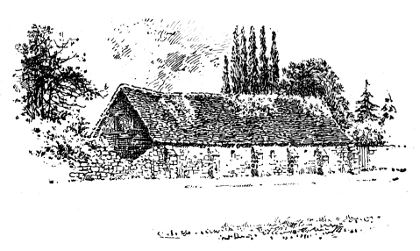 THE LONG BARN
The moat remained, however, and apparently some of the
substructures; a building of stone and thatch, part of the
offices of the palace, also stood. They called it the 'Long
Barn,' and when the distressed Protestants were brought over
here in 1700 as many as the place would hold were crammed
into the Long Barn. Market gardens lay all over the country
between Kennington Road and Lambeth, and on the site of
the palace there was not a single person left who could carry
on the tradition of the king's house that once stood here.
Roque, the map-maker of 1745, knew nothing about it. In
1795 the Long Barn was taken down. At the beginning of
the century houses began to rise here and there; streets
began to be formed: at least three streets cross the gardens
and the site of the palace; but there is not one tradition of a
place which, as we shall see, was full of history for six hundred
years. 'Is this fame?' might ask the king who crowned
himself here, the king who died here, the king who was brought
up here, the kings who kept their Christmas feast here, the
kings who here received their brides, held Parliament, and
went out a-hunting.
The king who crowned himself here was Harold Harefoot,
son of Cnut—that is to say, it was at 'Lambeth,' and there
was no other house at Lambeth.
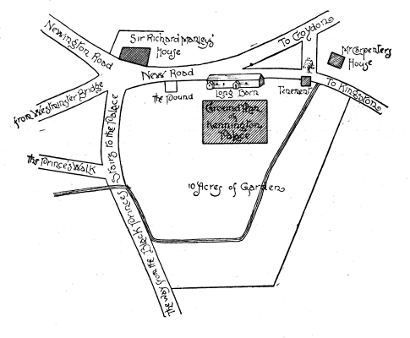 SKETCH MAP
The king who died in this house was that young Dane
who appears to have been an incarnation of the ideal Danish
brutality. He dragged his brother's body out of its grave and
flung it into the Thames; he massacred the people of Worcester
and ravaged the shire; and he did these brave deeds
and many others all in two short years. Then he went to his
own place. His departure was both fitting and dramatic.
For one so young it showed with what a yearning and
madness he had been drinking. He went across the river—there
was, I repeat, no other house in Lambeth except this,
so that it must have been here—to attend the wedding of his
standard-bearer, Tostig the Proud, with Goda, daughter of the
Thane Osgod Clapa, whose name survives in his former estate
of Clapham. A Danish wedding was always an occasion for
hard drinking, while the minstrels played and sang and the
mummers tumbled. When men were well drunken the pleasing
sport of bone throwing began: they threw the beef bones at
each other. The fun of the game consisted in the accident of a
man not being able to dodge the bone which struck him, and
probably killed him. Archbishop Alphege was thus killed.
The soldiers had no special desire to kill the old man: why
couldn't he enter into the spirit of the game and dodge the
bones? As he did not, of course he was hit, and as the bone
was a big and a heavy bone, hurled by a powerful hand, of
course it split open his skull. One may be permitted to think
that perhaps King Hardacnut, who is said to have fallen down
suddenly when he 'stood up to drink,' did actually intercept a
big beef bone which knocked him down; and as he remained
comatose until he died, the proud Tostig, unwilling to have it
said that even in sport his king had been killed at his wedding,
gave out that the king fell down in a fit. This, however, is
speculation.
Forty years after this event, when Domesday Book was
compiled, the place was in the possession of a London citizen,
Theodric by name and a goldsmith by trade. It was still a
royal manor, because the goldsmith held it of Edward the
Confessor. It was then valued at three pounds a year. It is
impossible to arrive at the meaning of this valuation. We
may compare it with that of other estates, with the rental and
price of other lands, with the cost of provisions, and with the
wages and pay of servants and officers; and when we have
done all, we are still very far from understanding the value of
money then or at any subsequent time. There are, you see,
so many points which the writers on the value of money do
not take into consideration. There is the price of bread;
but then there were so many kinds of bread—wheaten bread,
barley bread, oat bread, rye bread; and how much bread did
a family of the working class consume? Flesh, fish, fowl,
but how much of either did the working classes enjoy? Rent?
But on the farms the "villains" paid no rent. There is, in a
word, not only the market prices that have to be considered,
but the standard of comfort—always a little higher than the
practice—and the daily relations of the demand to the supply.
So that when we read that this manor of Kennington was
worth three pounds a year we are not advanced in the least.
As most of the land was still marshy and useless, we may
understand that the value was low.
We next hear of Kennington in 1189, when King
Richard granted it on lease, or for life, to Sir Robert Percy
with the title of Lord of the Manor. Henry III. came here
on several occasions; here he held his Lambeth Parliament.
He kept his Christmas here in 1231. Great was the feasting
and boundless the hospitality of this Christmas, at which this
king lavished the treasures of the State.
The site of the palace is indicated in the accompanying
map. If you walk along the Kennington Road from Bridge
Street, Westminster, you presently come to a place where
four roads meet, Upper Kennington Lane on the left, and
Lower Kennington Lane on the right; the road goes on to
the Horns Tavern and Kennington Park. On the right-hand
side stood the palace. In the year 1636 a plan of the house
and grounds was executed; but by that time the mediæval
character of the place was quite forgotten. It was a square
house, probably Elizabethan; the home of King Henry III.
at some time or other had been completely taken away. The
site of the moat, however, was left, and there was still standing
the 'Long Barn.' The only way to find out what the
palace really was in the thirteenth or fourteenth century is to
compare it with another palace built under much the same
conditions, and intended to serve the same purpose. Fortunately
there still stand, some miles to the east of Kennington,
at Eltham, important remains of such a contemporary
palace, with a description of the place as it was before it was
allowed to fall into ruins.
We are not at this moment concerned with the history of
Eltham. Sufficient to note that it was a great and stately
place for five hundred years and more; that it passed through
the hands of Bishop Odo; of the Mandevilles; of the De
Vescis; of Bishop Anthony Bec; and of Geoffrey le Scrope
of Masham. As a royal residence its history begins with
Henry III., who kept his Christmas here in 1270, and ends
with Elizabeth, who came over here occasionally from
Greenwich. Here Isabella, wife of Edward II., gave birth
to a son, John of Eltham. The greatest builder at Eltham
was Edward IV.
The house in 1649, fifty years after Elizabeth had visited
it, is said to have contained a chapel, a banqueting-hall, rooms
on the ground floor and first floor called the King's side and
the Queen's side. There were buildings and rooms of all
kinds round the courtyard. The number of chambers in all
was very great, and it is said, further, that the large courtyard
covered a whole acre in extent. Such an area
would give about two hundred and ten feet to each side of a
square. This would be large for a college at Oxford or
Cambridge. It would cover about the same area as that of
New Palace Yard. There were, however, other courts; four
courts in all are spoken of. The lesser courts were used for
the 'service,' the kitchens, butteries, pantries, stables, rooms
for the servants, the barracks for the men-at-arms who
accompanied the king, the grooms, armourers, makers and
menders, bakers and brewers, cooks and scullions, and the
women servants, and the wives and the children. A strong
stone wall, battlemented, with loopholed turrets, surrounded
the palace; a broad and deep moat defended the wall; the
bridge which crossed the moat had a drawbridge; the gate
had its portcullis. The palace, in a word, was a fortress, for
there was never a king in England who would have dared to
keep his court, or to sleep, in an unfortified manor house, or
outside a fortress—certainly not Henry III. or Edward IV.—unless,
of course, it was on the tented field in the midst of
his army.
The existing remains of the palace correspond to this
description. There is the moat, deep and broad; there is the
bridge, the drawbridge gone. Within, the most important
ruin is that of Edward IV.'s banqueting hall. This is a most
noble chamber, with a roof of oak as perfect as when it was
built; the two magnificent
bays remain, with
the double row of windows.
It would be
difficult to find a finer
banqueting hall in the
whole country than
that of Eltham. In the
grounds, the traces of
the wall and those of
other buildings ought
to make it possible,
with a very little excavation,
to trace a plan
of the whole house.
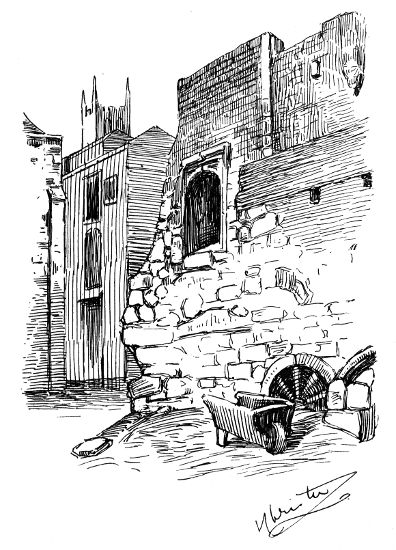
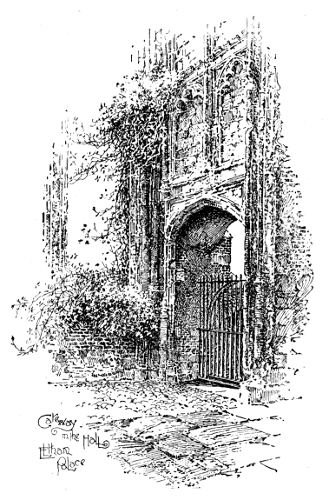 Gateway in the Hall, Eltham Palace
As was Eltham, so
was Kennington. Both
places were built for
the same purpose about
the same time. Both
were castles erected on a plain without the aid of hillock,
mound or running stream—unless the moat at Kennington was
fed by one of the many streams of South London. The plan
of 1636 shows approximately the line of the wall; the stream
or the ditch marks the course of the moat; the 'Long Barn'
on the east side of the palace belonged to the 'service'—it
was kitchens, stables, armoury, brewery, or granary. The
house itself had its principal entrance on the north. This is
certain, because all the supplies were brought by what is
now Kennington Road either from Westminster Ferry or
from Southwark. A gate on this side simplified the
transference which took place when the court moved from
one place to another; when everything—bedding, blankets,
utensils of all kinds, plate, batterie de cuisine, the workmen
with their tools, the wardrobe of king and queen—was packed
up and carried from Westminster over the ferry to Kennington,
or from Kennington to Woolwich. Provisions and goods
sent up from the City were also landed at Stangate, Lambeth,
so as to get as short a land journey as possible. For these
reasons I place the principal gate at the north.
I have seen it stated—I know not with what truth—that
the people of the streets now on the site have found substructures
beneath their houses. If so, one would expect,
what one cannot find, some tradition to account for the
existence of these stone vaults.
Such was the vanished Palace of Kennington: a fortress
of the Lambeth Marsh, a place for keeping Christmas, a royal
residence; now completely vanished.
Two other royal houses there were in South London,
neither of which can be compared with Kennington. Greenwich,
for instance, which appears in history from the time of
King Alfred. Edward I., Henry IV., Henry V., Edward IV.,
Henry VII., Henry VIII., Edward VI., and Elizabeth—all
had more or less to do with Greenwich. When Henry VIII.
completed his buildings here he deserted Eltham; he left,
that is, the mediæval fortress for the modern house. His
Greenwich was not fortified. The accompanying view of it
shows that it possessed none of the characteristics of the
ancient residence, half castle, half manor house. Greenwich,
however, before Henry rebuilt it, was a fortified castle. Had
we a plan of Greenwich of the fourteenth century it would
most certainly resemble those of Eltham and of Kennington,
with certain small differences, just as one Benedictine
monastery resembles in its general disposition another Benedictine
monastery, and one Norman castle in general terms,
and allowing for the site, resembles another.
The other house of which I have spoken is that of
Nonesuch. This house was not a reconstruction and an
adaptation with much of the ancient work: it was newly
built and furnished entirely by Henry VIII. There was no
suspicion of battlements, no pretence at a fortification; the
house stood open and unprotected save by the order maintained
by the strong
king. It was not beautiful
according to our
ideas; nor was it what
we now call a Tudor
house; it bears upon it every mark of the builder's interference
with the architect. The outside walls of Nonesuch were
decorated by certain bas-reliefs representing subjects from
the heathen mythology. The house was pulled down by
the Duchess of Cleveland, to whom Charles II. gave it.
Nonesuch, however, has nothing to do with Kennington, and
must not detain us.
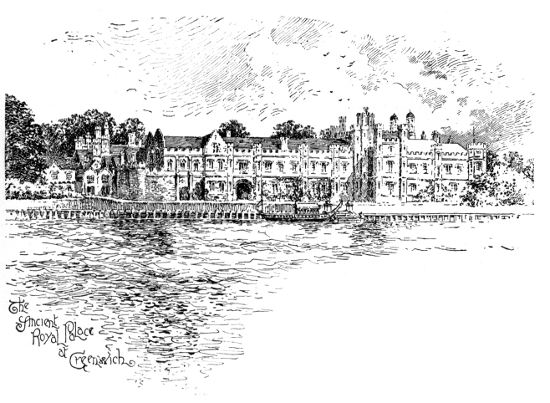 The Ancient Royal Palace at Greenwich
Let us next consider what it means when the king is said
to have kept his Christmas at a place.
During the festival—for twenty days—he kept open
house, nominally. That is to say, all comers received food
and drink: his guests, one supposes, were bidden. Every
day during the festival the king sat at the feast wearing his
crown and his robes of royal state. Richard II., the most
prodigal of all princes that ever lived, entertained every day
no fewer than ten thousand persons at his palace. What the
number was at Christmas no one knows. In addition to the
ordinary following of the court—a huge army of chaplains,
canons, scribes, secretaries, gentlemen archers, and servants—there
were the bishops and abbots, the peers and barons, who
came to the Christmas feast, each attended by his own following
of knights and esquires and men in livery. For the
entertainment of this enormous company what a huge establishment
would be needed! The organisation was complete;
everything was in departments, each under the yeomen: the
chambers, the wardrobe, the kitchens, the stables, the cellars.
Yet what an army in each department! Then, since at
Christmas time we look for amusement, there was the Master
of the Revels, and with him an extensive and variegated
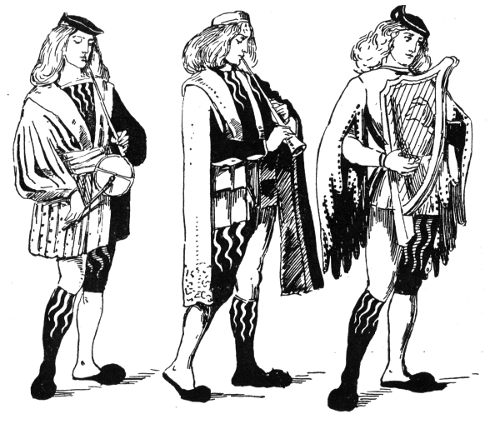
following; among them were all those who played on the
different instruments of music, those who sang, the buffoons,
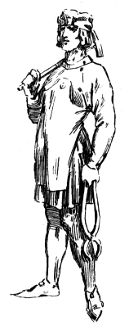
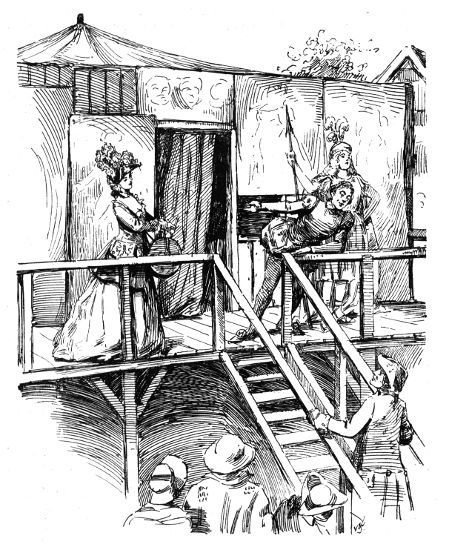
tumblers, and mummers, the dancing girls. It was in the
time of Henry III. that these performances were brought over
for the delectation of the English court—perhaps with the
pious intention of showing what joys and attractions awaited
the Crusaders in the Holy Land itself.
Hall's account of the festivities of a Christmas a hundred and
fifty years later than the time of Richard II. is as follows:—
'The Kyng this yere kept the feast of Christmas at
Grenewiche, wher was suche abundance of viands served to
all comers of any honest behaviour, as hath been few times
seen; and against New Yeres night was made, in the Hall,
a castle, gates, towers, and dungion, garnished with artilerie,
and weapon after the most warlike fashion: and on the
frount of the castle was written, Le Fortresse Dangerus, and
within the castle were six ladies clothed in russet satin laide
all over with leves of golde, and every owde knit with laces
of blewe silke and golde; on ther heddes, coyfes and cappes
all of golde. After this castle had been carried about the
hal, and the Quene had behelde it, in came the Kyng with
five other appareled in coates, the one half of russet satyn,
spangled with spangles of fine golde, the other halfe riche
cloth of gold; on their heddes cappes of russet satin embroudered
with workes of fine gold bullion. These six
assaulted the castle: the ladies seyng them so lustie and
coragious were content to solace with them, and upon farther
communication to yeld the castle, and so thei came
down and daunced a long space. And after the ladies led
the knightes into the castle, and then the castle sodainly
vanished out of their sight.
'On the daie of the Epiphanie at night, the Kyng with
XI other were disguised after the manner of Italie, called a
maske, a thing not seen afore in Englande; they were
apparelled in garments long and brode, wrought all with
gold, with visers and cappes of gold; and after the banket
doen, these maskers came in with six gentlemen disguised
in silke, bearing staffe torches, and desired the ladies to
daunce; some were content, and some that knew the fashion
of it refused, because it was not a thing commonly seen. And
after they daunced and commoned together as the fashion of
the maske is, thei tooke their leave and departed. And so
did the Quene and all the ladies.'
When the Christmas festivities ceased, the servants packed
up the gear: the napery, plate, gold and silver cups, dishes,
pillows, curtains, tapestry and carpets. They were all laid
upon waggons, the broad-wheeled creaking waggons which
were dragged slowly over the uneven and heavy lanes by
teams of horses or by bullocks. The queen and her ladies
were carried in chairs or carriages, or went on horseback; the
king and his followers rode; and so they went back to
Westminster. The ferry carried over the heavy goods and
the horses: the royal barges received the court. After them
marched the whole rout—the two thousand archers without
whom Richard never moved; the armies of servants; lastly,
when the last procurable cup had been drained, the musicians
and the mummers and the singers marched off sadly. A
whole twelvemonth before another Christmas! They marched
in the direction of the City, and that night, as they report,
there was strange revelry in the inns of Southwark. The
house was left in charge of a warden, who had with him the
principal officers of the palace, the yeomen of the wardrobe,
of the cellars, of the kitchens, and so forth; the organisation
being kept up in readiness, though the king might not come
back for years. This fact was illustrated a short time ago,
when I was interested in watching the progress of a certain
genealogy. About the year 1540 a certain younger son left
his house; it was necessary to connect him with his own
descendants. The link was found in the fact that this younger
son had been received by Carey, warden of Hunsdon House,
who made him one of his yeomen; a cheerless appointment,
like a college in perpetual vacation, the warden and yeomen,
representing the Master and Fellows, dining every day in the
dismantled hall, and wandering about the empty courts and
silent gardens. Palaces, like theatres, have their times of
emptiness, during which it is best to keep out of them. For
my own part, I think the true way of enjoying a palace is to
frequent it as Froissart did: to hear all that was said and to
put down all that was done, but not to be an actor in a drama
which reeks of blood; not even the splendid mounting can
destroy that dreadful reek. How many people are murdered
about the court of England from Richard II. to Henry VII.?
Richard murders his uncle, Henry IV. murders his cousin,
Henry V. murders his uncle; Henry VI., it is true, murders
no one, but then he lives in a time when there is a perpetual
series of murders. What an awful time! Froissart, who
looked on at part of the drama, achieved deathless renown for
his history, while in the whole of that court there was no one
whose head was safe on his shoulders except Froissart.
Unfortunately, he says little about this palace which we are
considering.
There are many names of kings and princes connected
with this house of Kennington. Edward I. was here occasionally.
During his reign it was the residence of John Earl
of Surrey, and of his son, John Plantagenet Earl of Warren
and Surrey. Plenty of histories could be made out of these
and other names, had the writer time or the reader patience.
In truth, the reader's patience is more to be considered than
the writer's time, for the writer, at least, has the joy of hunting
up names and notes and allusions, and of piecing together
what, after all, his reader may not find of interest enough to
carry him through. Edward III. made the manor part of the
Duchy of Cornwall. After the death of the Black Prince the
princess lived here with the young Prince Richard. I do not
find that Henry IV. was fond of a house which would certainly
be haunted—especially the room in which he was to sleep—by
the sorrowful shade of his murdered cousin. Nor did
Henry V. come here during his short reign. Henry VI.,
however, made use of Kennington Palace; so did Henry VII.;
and the last of the queens whose name can be connected with
the palace was Catherine of Arragon.
I do not know when the palace was destroyed. You have
seen the place as it was figured in 1636, when it was only an
ordinary square house. The plan was drawn when Charles I.
leased it to Sir Francis Cottington. The destruction of the
old house and the building of the new must have taken place
during the hundred years between 1530 and 1630. When
the new house was taken down I do not know.
The name that we especially associate with Kennington
Palace is that of Richard II. When the Black Prince died,
in 1376, Richard remained at Kennington under the care of
his mother and the tutorship of Sir Guiscard d'Angle, 'that
accomplished knight.' The young prince started with the
finest possible chances of popularity. His father was not only
the greatest captain of his age, but he was also, in the latter
years of his life, on the popular side against the old King and
his supporters; the boy was endowed with a singular beauty
of person, and, when he pleased, with a sweetness of manner
most unusual even among princes, with whom affability is the
first essential in princely manners. In addition to this he was
destined to show on two occasions courage which almost
amounted to insensibility—first, when he dispersed Wat
Tyler's mob, and next, when he seized the reins of government.
History shows how he threw away all his chances in
reckless extravagance.
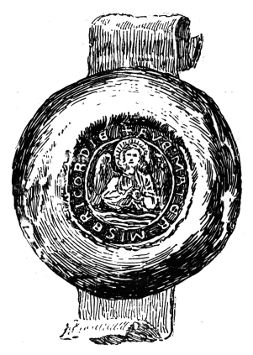
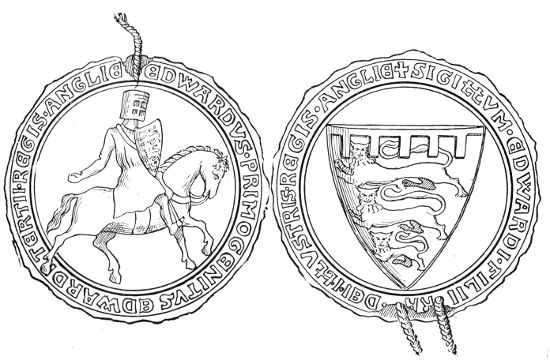 SEAL OF THE BLACK PRINCE
(From Allen's History of Lambeth)
After the death of the Black Prince it was resolved by the
Lord Mayor to pay a visit to Prince Richard at Kennington,
with a riding worthy of the City. The day chosen was the
Sunday before Candlemas (February 2). One has frequent
occasion to remark generally upon City pageants, that the
people in these processions and their pageants were entirely
regardless of winter cold or summer heat; they rode forth
upon a pageant as cheerfully in the cold of February as in the
sunshine of August. On this occasion, one hundred and
thirty-two citizens on horseback, with trumpets and other
musical instruments, and a vast number of flambeaux, assembled
at Newgate in the afternoon, and marched through
the City and over the bridge to Kennington Palace beyond
the Borough. First rode eight-and-forty men in the habits of
esquires—with red coats, say gowns, and vizards. Then followed
the same number apparelled as knights in the same
livery. Then rode one singly, a very majestic figure, who
represented the Pope, followed by his four-and-twenty cardinals.
They were followed by ten men dressed in black, with
black vizards, representing legates from the Pope of Hell.
This accounts for one hundred and thirty-two out of the whole
number. The last man is not described. To them must be
added pages and henchmen and whifflers, with men carrying
the presents. This cavalcade, which gave the greatest joy to
the citizens, all the way was followed by an enormous company
of 'prentices and craftsmen and children, crowding after
it and shouting. When it arrived at Kennington Palace they
all dismounted and entered the hall, where they found the
Princess of Wales, the young Prince, and their attendants,
together with the Duke of Lancaster and other great lords.
The court was first solemnly saluted by the masquers, who
then produced dice and invited the Prince to play with them.
Would you believe it?—every time the Prince threw, he won,
which was in itself a remarkable circumstance. He carried
off his winnings: a bowl of pure gold, chased and decorated;
a drinking cup also of gold, and a gold ring. They then
invited the Princess and the Duke of Lancaster and other
nobles present, each of whom also won and carried off a gold
ring. This done, the music played, and they were all invited
to supper in the hall with the Prince and the Princess his
mother. After supper, the tables were taken away—they were
only planks laid on trestles and covered with white cloths—and
the floor being cleared, the masquers had the honour of
dancing with the royal party. Finally, at a late hour, the
flambeaux were lighted, and the masquers rode home, well
pleased with the reception they had met and the courtesy of
the best behaved boy in the world.
In the same year occurred the great riot of London, which
arose out of Wyclyf's trial in St. Paul's and the quarrel between
the Bishop of London and John of Gaunt. The latter, after
the dismissal of Wyclyf, repaired to the house of John de
Ypres, close beside the river, where he was sitting at dinner
when one of his following ran hastily to warn him that the
people were flocking together with intent to murder him if
they could. The Duke therefore hastily ran down to the
nearest stairs, took a boat across the river, and fled as quickly
as possible to Kennington Palace, where he took shelter with
the young Prince Richard and his guardians. The mob,
finding that the Duke was gone, made their way to the Savoy,
his palace, threatening to burn and destroy all: they did
actually murder one poor priest because he resembled the
Duke in countenance; they were then persuaded by the
Bishop of London to go home without doing any more mischief.
What would have happened one knows not, but the
death of the old King gave an opportunity of patching up
the peace between the Duke of Lancaster and the citizens.
Hearing that Edward was in extremis, the Mayor and Aldermen
waited on the Princess of Wales and Prince Richard
informing them of the King's critical situation, and beseeching
the Prince's favour to the City; they also begged him to
interfere for the better accommodation of the Duke's differences
with them. It is pleasing to find that John of Gaunt freely
forgave the City and became reconciled to the citizens; a
reconciliation which paved the way to the subsequent popularity
of his son Henry.
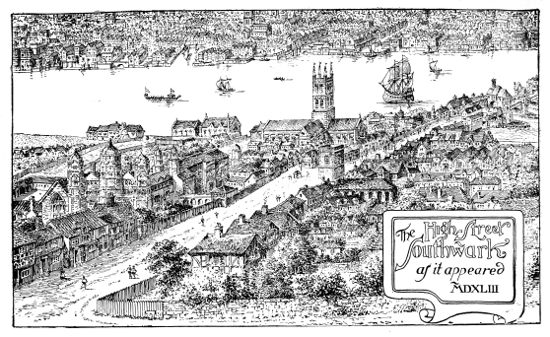 The High Street Southwark
as it appeared MDXLIII
It might be argued that the various impressions as regards
London produced on the mind of this prince explain his conduct
towards the citizens when he grew older. The first
experiment he had of the citizens was when they rode over in a
goodly company clad in red cloaks with gold chains and finely
appointed horses to visit him at Kennington: he remembered
that their appearance betokened great wealth; that they
tossed about gold cups as if they were of wood. This is a
kind of impression which does not easily die away.
His second impression of the City was when his uncle,
John of Gaunt, came flying from the City, having barely
escaped with his life, the people having gone on to wreck, if
they could, his palace of the Savoy. A turbulent and dangerous
people, then, as well as rich; a people to be kept down.
He next saw the City when he rode through it on his way
to be crowned at Westminster. All the way there was nothing
but rich tapestry, carpets, scarlet, cloth, masquers clad in velvet,
pageants with cloth of gold, and the streets filled with men
and women dressed in rich furs and silks, such as only great
barons could afford. This third impression confirmed the
first.
His next impression was that of the City lying prostrate
at the mercy of a large mob, unable to move or to help itself.
He went into the City almost alone; he, by one single act of
splendid courage, put an end to the insurrection. A City
cowardly, therefore, and unable to act together. It was his
City, moreover—the Camera Regis. Should not a prince do
what he pleases with his own?
When we read of his subsequent treatment of the City:
how he believed its treasures to be inexhaustible; how he believed
that it had no power to resist; how he made the way
easy for his cousin to supplant him, let us bear in mind the
lessons which the Londoners themselves provided for him in
his youth.
This King seizes on the imagination of all who think
about him. His is one of the strangest of all the strange figures
which crowd the National Portrait Gallery. Richly endowed
with artistic instincts; a lover of music and all the fine arts;
of singularly winning manners; the comeliest man in his
whole kingdom; splendid in raiment, magnificent in his
court, colossal in his personal pride, prodigal and extravagant
beyond compare; the King whom those who knew him in
his youth never ceased to love; for whose soul—not for the
soul of Henry IV.—Whittington, for instance, left money for
masses—this is a figure among our English kings which has
no parallel.
One more reminiscence of Kennington Palace. The last
occasion on which Richard lodged there was when he brought
home his little bride Isabel, the queen of eight years. They
brought her from Dover, resting on the way at Canterbury
and Rochester. At Blackheath they were met by the Mayor
and Aldermen, attired with great magnificence of costume to
do honour to the bride. After reverences due, they fell into
their place and rode on with the procession. When they
arrived at Newington, the King thanked the Mayor and permitted
him to leave the procession and return home. He
himself, with his company, rode by the cross-country lane
from Newington to Kennington Palace. I observe that this
proves the existence of a path or lane where is now Upper
Kennington Lane. At this palace the little queen rested a
night, and next day was carried in another procession to the
Tower. The knights rode before, and the French ladies came
after. It is pretty to read how Isabel, with her long fair hair
falling over her shoulders, and her sweet childish face, sat up
and smiled upon the people, playing and pretending to be
queen, which she had been practising ever since her betrothal.
Needless to say that all hearts were ravished. The good
people of London were ever ready to welcome one princess
after another, and to lose their hearts to them, whether it was
Isabel of France, or Katharine her sister, or Anne Boleyn, or
Queen Charlotte, or the fair Princess of Denmark. So great
a press was there that many were actually squeezed to death
on London Bridge, where the houses only left twelve feet in
breadth. Isabel's queenship proved a pretence: before she
was old enough to be queen, indeed, her husband was in confinement;
before she understood that he was a captive, he
was murdered, and the splendid extravagant reign was over.
The son of the usurper, young Harry of Monmouth himself,
desired to take the place of Richard; his father also desired
the match, for the sake of the dowry. Isabel, child as she
was still, had the heart of a woman; she had learned to love
her handsome, courteous, accomplished lord, who died before
he could claim her; she refused absolutely to marry the son
of his murderer. They tried to move her resolution by persuasion;
they did not dare to force her: let us believe that
Harry of Monmouth would not stoop to force the girl to
marry him. There was nothing therefore left to do, but to
send her home to what was certainly the most miserable
court or palace in the world—that of her mad father. In the
end, she married her cousin, the poet Charles of Orleans.
You may read the verses which he made upon her death.
Isabel died in childbirth in her twenty-second year. As for
Harry of Monmouth, as all the world knows, he was obliged
to content himself with Isabel's younger sister, Katharine;
we have just read about that queen, and how she stooped to
a suitor below her own degree. I think she was made of clay
not so fine as that of Isabel, her sister.
The second in our chain of suburban Palaces was the Royal
House of Eltham, already mentioned in connection with
Kennington. The place itself seems to have been a settlement
of some kind, a town or village, in very ancient times.
In the thirteenth century it was considered of importance
enough to receive the grant of a market day every Tuesday,
and a Fair for three days every year, namely, the day before
the Feast of the Trinity, the Feast itself, and the day after.
In the fourteenth century the market day was altered to
Monday, but the Fair remained; in the fifteenth century
the market day returned to Tuesday and the Fair was
changed to three days on the Eve of St. Peter and St. Paul,
on the Feast itself, and on the day after. The market and
the Fair have long since been discontinued. The importance
of both depended on the occasional presence of the Court,
and when that was removed altogether from the place there
was no longer any necessity for either market or Fair Day.
Eltham then became a small agricultural village lying in the
midst of woods, with nothing but scattered villages for many
miles round. So long as it contained one of the recognised
Palaces, even though years might pass by without a visit
from the sovereign, there was, attached to the house, the
permanent staff to a Governor or warder, with chiefs of the
various departments and the men or assistants under them.
The occupation of the Palace by such a staff gave the place a
kind of garrison, and created a demand for provisions and for
all sorts of things. On those rare occasions when the Court
was actually in Residence at Eltham, the market had to
furnish supplies, to which all the country round had to
contribute; nothing short of provisions for the maintenance
of thousands of people daily. At Eltham the difficulty may
have been very great; no doubt word would be sent long
beforehand if the King proposed to keep Christmas there.
The yeomen of the kitchen had the beef put in the pickling
tubs in November—vast quantities of beef, for, Christmas or
not, the staple food of everybody in the winter was salt beef.
At the Palace of Kennington things were easier. It lay
within easy reach of the London market; so was Westminster.
Greenwich was accessible by ships from the lower
reaches of the Thames as well as from London. Eltham, no
doubt, depended upon the rich and fruitful country in which
it stood. At eight miles from London, the markets there
were of very little use. The annals of the Palace are simple,
rather than scanty; in fact, there is plenty of mention made
of the Palace, yet very little of importance is recorded concerning
it. All that is recorded of it belongs to peace and
festivity and the season of Christmas. Eltham was given by
William the Conqueror to his half-brother Odo, Bishop of
Bayeux and Earl of Kent. After the disgrace of Odo, and
the confiscation of his estates, the manor belonged partly to
the Queen and partly to the Mandevilles. Thence it passed
into the hands of the De Vesci family. From them it
went to the Scropes, and from them to various holders in
succession.
There was a Palace, or House, here of some kind in very
ancient times. The historian says that he cannot ascertain
when the Palace was built (see p. 74). Since the origin of
the House is unknown, he argues that it must have been
ancient. Now, concerning its connections with our Kings and
Queens, there is quite a long list. All these lists would have
to be catalogued, and even then be forgotten. For instance,
the following list of visits I borrow from Lysons. But I cannot
pretend that it is of much interest.
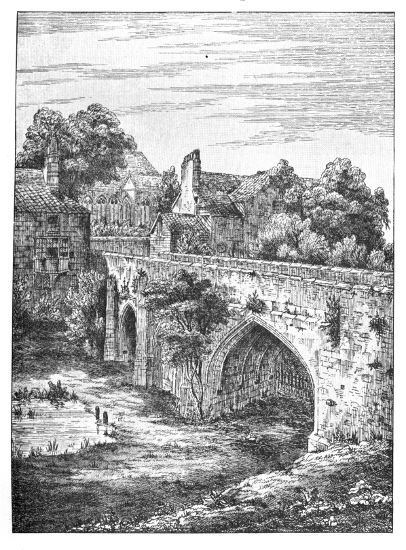 REMAINS OF ELTHAM PALACE, 1796
In the year 1270 Henry III. kept Christmas at his Palace
of Eltham with the Queen and his nobles. After this the
name of Anthony Bec, Bishop of Durham and Patriarch of
Jerusalem, is connected with the place. He built a great
deal, but I know not if any ruins of his yet remain. He
died at Eltham in 1311, presumably in the Palace, for there
seem to have been no other buildings. Now we come back
to the kings, and we find historical associations in plenty,
though not of a kind which is moving or interesting. It does
not excite our curiosity much to learn that this king or that
king kept Christmas here, and yet that is the kind of association
which I have to offer. Edward the Second was often here:
perhaps the seclusion of the place enabled him to play his
favourite games with his followers without being overseen.
One of his sons, John of Eltham, was born here. Edward
III., when still under age, had a Parliament at Eltham
in 1329. In 1347 his son Lionel kept Christmas for him at
Eltham. In 1364 he entertained here the French king John,
his prisoner. In 1375 he held another Parliament here,
when the Commons petitioned him to make Richard, his
grandson, Prince of Wales. Richard the Second, as we
should expect, regarded Eltham with a peculiar affection; it
was beautiful; the buildings were splendid. It was a long
way from the City which took upon itself to remonstrate with
his extravagance. Three times at least he kept Christmas
here: on the last he entertained Leo, King of Armenia, with
great splendour and profusion. Henry the Fourth kept
Christmas four times in the Palace. On the first, the Aldermen
of London and their children went down from the City
to perform a masque before the King, who received it well.
At that moment he was certain to receive everything well
that came from the City. On his last visit the disease broke
out which killed him. Henry the Fifth was here once, in
1414: Henry the Sixth once, in 1429. Edward the Fourth
was a second Founder, so much did he add to the buildings.
Among other things, he built a new front to the Palace and
is said to have built the Banqueting Hall itself. His festivities
rivalled those of Richard the Second. Here his
daughter Bridget, afterwards a nun of Dartford, was born.
Henry the Seventh was another builder: he stayed at Eltham
often. Henry the Eighth came here once at least, but he
preferred Greenwich as a residence as soon as that house
was built. Elizabeth also came here only once or twice, preferring
Greenwich, and James the First is only recorded to
have visited Eltham once. After this time Eltham ceased
to be a Palace. In 1646 Robert Earl of Essex died here[1];
the Manor was sold after Charles's death. After the Restoration
it reverted to the Crown; the rest of the history concerns
its occupancy by private families. On the death of Charles
the Palace was surveyed; it is described as being built of
brick, stone, and timber; it contained (see p. 74) one chapel, a
hall, 36 rooms and offices below stairs, with two large cellars;
and above stairs 17 lodging houses on the King's side, 12 on
the Queen's side, and 9 on the Prince's side; and 78 rooms
in the offices round the courtyard, which contained one acre
of ground: the house was out of repair and uninhabitable.
There were gardens attached to the house. A moat surrounded
the house, of width 60 feet, except in the forest, where it was
115 feet. The moat still exists on the north side, and can be
traced all round. Of the buildings little remains except the
old Banqueting Hall, a truly beautiful ruin; the roof, with its
fine woodwork, is happily still standing, but shored up and
supported. The windows are mostly blocked up; fragments
only remain of the other buildings; but it is said to be possible,
in the gardens at the back, to trace out the courts and the
foundations of the chapel and offices. The Palace is approached
by a bridge of about the same date as the Palace,
viz. the fourteenth century. It crosses the moat, and with its
picturesque ivy-clad arches and the Banqueting Hall on one
side, and the Court House on the other, it is as lovely an
approach to the ruin as could well be imagined or created.
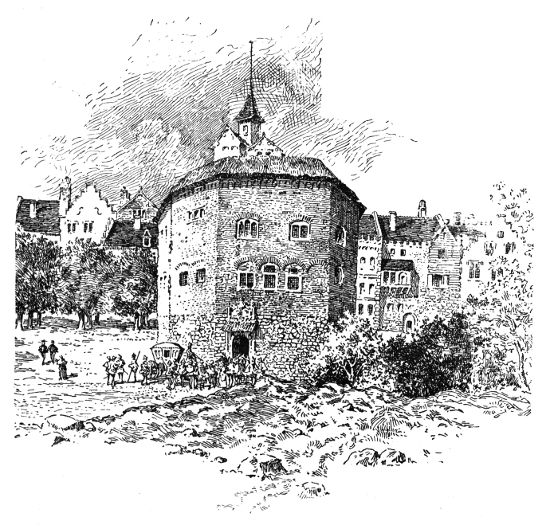
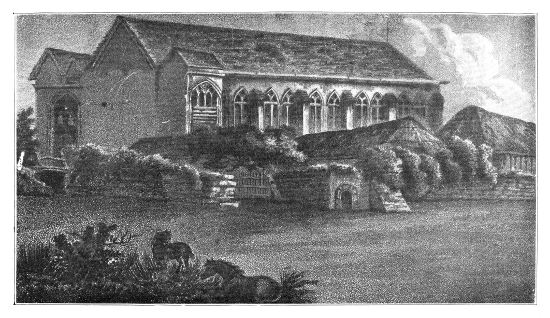 KING JOHN'S PALACE, KENT
(From a Drawing by J. Hassell, 1804)
One of the last visits of the King to Eltham was in the
year 1575, when Henry held one of the tournaments in which
in his early manhood he so much delighted. This is Holinshed's
account of it:—
'After the parlement was ended, the king kept a solemne
Christmasse at his manor of Eltham; and on the Twelfe
night in the hall was made a goodlie castell, woonderouslie
set out, and in it certeine ladies and knights; and when the
king and queene were set, in came other knights and assailed
the castell, where manie a good stripe was giuen; and at the
last the assailants were beaten awaie. And then issued out
knights and ladies out of the castell, which ladies were rich
and strangelie disguised; for all their apparell was in braids
of gold, fret with moouing spangls of siluer and gilt, set on
crimson sattin, loose and not fastned: the mens apparell of
the same sute made like Iulis of Hungarie; and the ladies
heads and bodies were after the fashion of Amsterdam. And
when the dansing was doone, the banket was serued in of two
hundred dishes, with great plentie to euerie bodie.'
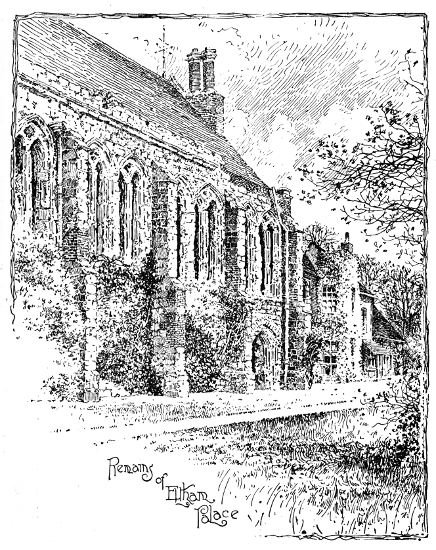 Remains of Eltham Palace
There is little more to be said about Eltham, which is a
place so beautiful that it ought to have a more interesting
history. Kings and Courts delight me not, nor do I take
pleasure in reading about tournaments and masques.
There is no figure in the history of Eltham so pleasant to
think upon as that of little Prince Richard, the lovely boy
who was going to become such an extravagant King. One
would like to have seen Edward entertaining his prisoner,
King John of France; and one wonders what sort of figure
was played by the Armenian Leo in the presence of Richard's
splendour: but perhaps he knew the Court of Constantinople,
and smiled at the splendour of the barbaric north.
Once more, how did they provide for the maintenance of so
many guests? To feed two thousand every day is a great
undertaking. We are accustomed to believe that the roads in
winter were so bad as to be impassable. Now, everything
had to be brought there, whatever the condition of the roads.
And they were bye-roads, not high roads. The guests, too,
and the nobles and their retainers, had to arrive by those roads.
As was stated above, due notice was certainly given: a vast
quantity of salt provisions was laid down in readiness:
for the rest, the country was fertile and well cultivated.
The Park contained deer—but they could not kill all; the
Thames, only three miles away—but then, the roads!—was full
of salmon and every kind of fish: the banks of the lower reaches
and those of the Ravensbourne—again, those roads!—were
the homes of myriads of wild birds. Still, one feels that the
inland communications of the fourteenth century must have
been a great deal better than those of the seventeenth century
in order to allow of Christmas being kept in magnificence and
profusion by two thousand people in a country village.
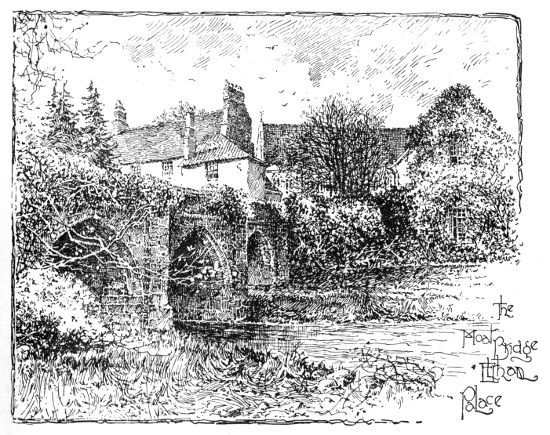 The Moat Bridge
Eltham Palace
The views which accompany this account are taken from
Lysons: they were engraved in the year 1796. There is not
much difference in the present aspect: the moat has been
opened again: the buildings represented on the south side of
the Hall have vanished: and the place itself which had been
used as a barn is now empty, and is only thrown open for
visitors or the drilling of Volunteers.
The Green Village lying on the slope of a gentle hill, with
marshes on either side of it—the marsh of the Ravensbourne
on one side, and the Woolwich or the Greenwich marsh on
the other side of it—is as old as history itself. Its position as
the landing-place, or point of approach, to the lands of Kent, a
place where ships might lie, pirates and invaders might seize
and hold as a base of operations, very early called attention to
its natural advantages. Here the Danes encamped in 1011;
here they brought the venerable Alphege and murdered him,
throwing beef bones at his head. As the throwing of bones
was a favourite evening pastime with the Danes, they probably
meant little at first beyond a friendly reminder or an invitation
to take part in the game: as the Archbishop made no
response they threw the bones in earnest (see p. 72). The
people of Greenwich have long since forgotten that the place
was once a Royal Residence, and that there are historical
memories connected with Greenwich of interest almost equal
to those of Westminster, and far more important and interesting
than those of Eltham.
Let us perform the perfunctory task of cataloguing some
of these memories.
In the year 1408, Henry IV. dates his will from Greenwich.
In 1417 Henry V. granted the manor for life to Thomas
Beaufort, Duke of Exeter, who afterwards died here.
In 1443 it was granted to Humphrey Duke of Gloucester,
with permission to fortify and embattle the manor house, and
to enclose a park of 200 acres. This was the true beginning
of Greenwich Palace. Humphrey rebuilt the house, which he
called Placentia, the House of Pleasance: he enclosed the
Park and he built a Tower on the spot where the Royal
Observatory now stands. On his death, in 1447, the place
reverted to the Crown. Edward the Fourth took great
pleasure in the place and beautified it at much cost. In 1466
he granted the Manor, Palace, and Park, to the Queen,
Elizabeth Woodville, for life. The marriage of Richard
Duke of York and Anne Mowbray was here solemnised with
the usual rejoicings.
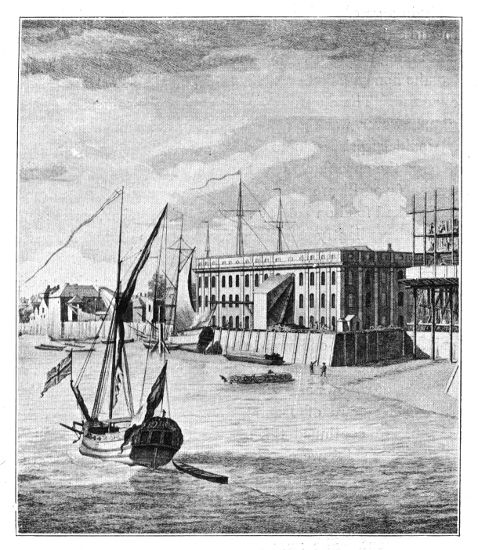
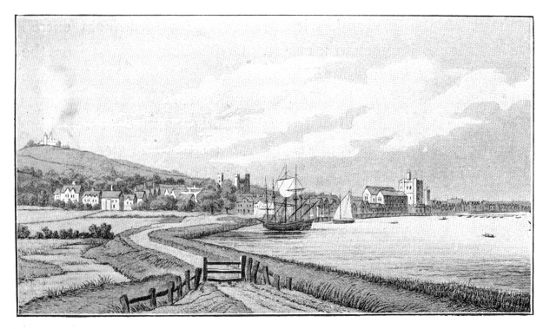 GREENWICH, 1662
(From a Drawing by Jonas Moore)
With Henry VII. also Greenwich was a favourite place of
residence. He added a brick front on the riverside (see p. 77).
Here Henry the Eighth was born on June 28, 1491. He was
baptised in the Parish Church, the predecessor of the present
church. He, too, loved Greenwich above all other Palaces,
and made it during the early years of his reign the scene of
the festivities and entertainments which he loved so much.
Here he married Katharine of Arragon on June 3, 1510.
Here he held the great tournament in which he himself, Sir
Edward Howard, Charles Brandon, and Edward Neville
challenged all comers. In 1512 and in 1513 he kept Christmas
here 'with great solemnity, dancing, disguisings, and mummers
in a most princely manner.' Holinshed gives an account of
two entertainments held by the King at Greenwich—one a
tournament in June, the other at Christmas:—
'This yeare also in Iune, the king kept a solemne iustes
at Greenewich, the king & sir Charles Brandon taking vpon
them to abide all commers. First came the ladies all in
white and red silke, set vpon coursers trapped in the same
sute, freated ouer with gold; after whom followed a founteine
curiouslie made of russet sattin, with eight gargils spowting
water: within the founteine sat a knight armed at all peeces.
After this founteine followed a ladie all in blacke silke
dropped with fine siluer, on a courser trapped in the same.
Then followed a knight in a horsselitter, the coursers & litter
apparelled in blacke with siluer drops. When the fountein
came to the tilt, the ladies rode round about, and so did the
founteine, and the knight within the litter. And after them
were brought twi goodlie coursers apparelled for the iusts:
and when they came to the tilts end, the two knights
mounted on the two courses abiding all commers. The king
was in the founteine, and sir Charles Brandon was in the
litter. Then suddenlie with great noise of trumpets entred
sir Thomas Kneuet in a castell of cole blacke, and ouer the
castell was written "The Dolorous Castell," and so he and the
earle of Essex, the lord Howard, and other ran their courses
with the king and sir Charles Brandon, and euer the king
brake most speares, and likelie was so to doo yer he began,
as in former time; the prise fell to his lot; so luckie was he
and fortunat in the proofe of his prowes in martiall actiuitie,
whereto from his yong yeers he was giuen....
'After this parlement was ended, the king kept a solemne
Christmasse at Greenwich, with danses and mummeries in
most princelie maner. And on the Twelfe daie at night
came into the hall a mount, called the rich mount. The
mount was set full of rich flowers of silke, and especiallie full
of broome slips full of cods, and branches were greene sattin,
and the flowers flat gold of damaske, which signified Plantagenet.
On the top stood a goodlie beacon giuing light,
round about the beacon sat the king and fiue other, all in
cotes and caps of right crimson veluet, embrodered with flat
gold of damaske, their cotes set full of spangles of gold.
And foure woodhouses drew the mount till it came before
the queene, and then the king and his companie descended
and dansed. Then suddenlie the mount opened, and out
came six ladies all in crimsin sattin and plunket, embrodered
with gold and pearle, with French hoods on their heads, and
they dansed alone. Then the lords of the mount tooke the
ladies and dansed togither: and the ladies reentered, and the
mount closed, and so was conueied out of the hall. Then
the king shifted him, and came to the queene, and sat at the
banket, which was verie sumptuous.'
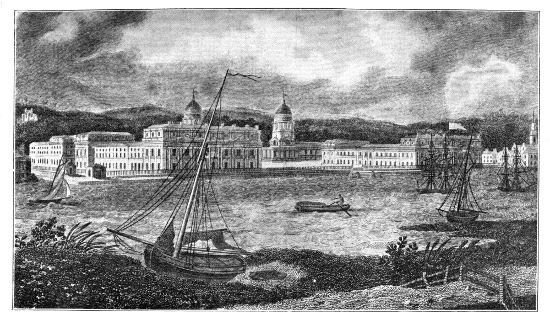 GREENWICH HOSPITAL
(From a Drawing by Schnebbelie)
Other tournaments were held here in 1517, 1526, and
1536.
Here Charles Brandon married Mary, Dowager Queen of
France. Six or seven times more Henry kept Christmas
at Greenwich. In 1543, the last occasion, he entertained
twenty-one Scottish gentlemen, taken prisoners, and released
them without a ransom, being to the end, whatever else he
was, a Prince of most Princely gifts and graces.
Queen Mary was born at Greenwich in 1515. Cardinal
Wolsey was her godfather.
King Edward the Sixth died here.
Queen Elizabeth was born here on September 7, 1533.
She, too, spent much of her time at Greenwich.
King James also much delighted in this place: he
added to the brickwork by the riverside: he also walled the
park and laid the foundations of the house afterwards called
the House of Delight. The Queen, who received the Palace
in jointure, carried on this House, which was afterwards
completed by Inigo Jones for Henrietta Maria. It was
called the King's House, the Queen's House, or the Ranger's
Lodge. It was not until 1807 that the house was granted to
the Commissioners of the Royal Naval Asylum.
Separated from town by five miles of road, and four of
river, it was thus easily accessible in all weathers and independent
of the condition of the roads. In other respects
the position of the place was unrivalled: it was on a slope
rising from the river in front, and from lowlands on either
side; it was swept night and day by the sharp fresh breeze
that came up with the tide from the sea; behind it, on a high
level, lay an expanse of heath, dry and wholesome; there
was no better air to be got than the air of Greenwich;
that of Eltham, with its stagnant marsh and thick woods, was
close and aguish in comparison: for view, the broad river
rolled along the Palace front and bent round to east and west,
so that one could see all the shipping in front; all in Limehouse
Reach; and all in Blackwall Reach. As the tide ebbed
and flowed, the navies and the trade of London passed up
and down, outward bound or homeward bound. Sitting at
her window, or walking on her terrace, Queen Elizabeth could
for herself learn what was meant by the foreign trade of
London: what was meant by the exports and imports: she
could see every kind of ship that floats come sailing up the
river, streamers flying, dipping the peak in salute: she could
understand the coasting trade and the Flemish trade: she could
ask what the hoys and ketches, the lighters, and the barges
carried up to the Port of London in such numbers: she could
herself, and often did, embark upon the stream in summer,
when the sun was sinking in the west, to see the ships more
closely and to enjoy the fresh, cool air of the river. Witness
the sad history of Thomas Appletree.
It was on the 17th day of July in the year 1579, about
nine o'clock of the evening, that an accident happened
which might have had fatal consequences. The Queen was
taking the air in her private barge, between Greenwich and
Deptford. With her were the French Ambassador, the Earl
of Lincoln, and other great persons, discoursing affairs of
state. Unfortunately for themselves, four young fellows were
out in a small boat at the same time, and on the same part of
the river. They were Thomas Appletree, a young servant of
Francis Carey, two singing boys of the Queen's choir, and
another. Thomas Appletree had possessed himself of a
'caliver' or arquebus, which he was so ill advised as to load
with ball and then fire it at random up and down the river.
One of these haphazard discharges carried the bullet straight
to the Queen's barge, where it passed through both arms of
the oarsman nearest Her Majesty. The man thus unexpectedly
wounded, finding himself bleeding like a pig—for
it was a flesh wound—threw himself down, bawling and
roaring out that he was murdered. The Queen comforted him
with the assurance that he should be properly cared for, and
ordered the barge to be taken back to the shore at once. The
man, being treated, speedily recovered. Meantime, who had
dared to fire a gun at the Queen's barge? The question was
very quickly answered, and the Lords in Council had the four
lads brought up before them. It appearing that the only
guilty person was Thomas Appletree, the other three were
suffered to depart, and Thomas was tried. It was ascertained
that there could be no question as to the loyalty of Thomas's
master, Francis Carey, therefore the whole guilt rested on the
shoulders of the unlucky serving man, whose only fault had
been foolhardiness in firing his gun at random. He was
therefore sentenced to be hanged, with the usual accompaniments,
for treason. Accordingly, on the 20th day of July he
was taken from Newgate and conducted on a hurdle with
great ceremony to Tower Hill, and so through the postern to
Ratcliff, where, opposite the place where the offence was
committed, they had put up a gibbet on which the unhappy
Thomas Appletree was to be hanged. He had made a
dolorous journey on his hurdle, weeping copiously all the way,
and many of the people weeping with him. Arrived at the
gallows, he mounted the ladder, and, if the chronicler repeats
faithfully, he made a most admirable use of the last moments
which remained to him. It is, indeed, truly remarkable to
observe how admirably all those who were taken out to die
acquitted themselves, whether it was a peer to be beheaded
for treason, or a Catholic priest to be hanged, drawn, and
quartered for being a priest. Appletree, for his part, spoke
so movingly that the people all wept with him. Then the
hangman put the rope round the condemned man's neck, and
the bitterness of death entered into his soul. But the people
cried, 'Stay! Stay!' and at that moment there came riding
up the Queen's Vice-Chamberlain, Sir Christopher Hatton.
But think not that the Vice-Chamberlain hastily proclaimed
the royal pardon. Not at all. He left Thomas on the ladder
for a while; he made an oration on the heinousness of the
offence: he made everybody kneel while he prayed for the
safety of the Queen: and then, when all hearts were softened
and all eyes bedewed, he pronounced the Queen's pardon,
which the prisoner acknowledged in suitable language.
Thomas Appletree was then taken back to the Marshalsea,
where he remained, one hopes, a very short time after this.
We may be quite sure that whatever destiny was in store for
this young man, shooting at random with a caliver or arquebus
would have nothing to do with it.
Another association of Greenwich is that of Sir John
Willoughby's departure for the Arctic seas. He was going
to endeavour to open a new way for trade round the N.E.
Arctic sea along the north coast of Asia. He embarked at
Ratcliff Stairs: you may take boat there to this day. As he
passed down the river, with flags and streamers flying, they
brought out the little King Edward, who was dying, to see
the sailing of the stout old sailor. So with firing of guns the
ships passed on their way, and they carried the dying King
back to his bed. In a day or two Edward was dead. In six
months, or it might be less, Willoughby was dead too, frozen
to death in his cabin, where the Russians found him, his dead
hand on his papers.
If you wish to know what state was kept by Queen
Elizabeth at Greenwich, you will find an account of it in
Hentzner, that excellent traveller who remarked so much,
and put all down on paper.
'We arrived at the Royal Palace of Greenwich, reported
to have been originally built by Humphrey, Duke of
Gloucester, and to have received very magnificent additions
from Henry VII. It was here Elizabeth, the present Queen,
was born, and here she generally resides; particularly in
Summer, for the Delightfulness of its Situation. We were
admitted by an Order Mr. Rogers had procured from the
Lord Chamberlain, into the Presence-Chamber, hung with
rich Tapestry, and the Floor, after the English fashion,
strewed with Hay,[1] through which the Queen commonly
passes in her way to chapel: At the Door stood a Gentleman
dressed in Velvet, with a Gold Chain, whose Office was to
introduce to the Queen any Person of Distinction, that came
to wait on her: It was Sunday, when there is usually the
greatest Attendance of Nobility. In the same Hall were the
Archbishop of Canterbury, the Bishop of London, a great
Number of Counsellors of State, Officers of the Crown, and
Gentlemen, who waited the Queen's coming out; which she
did from her own Apartment, when it was Time to go to
Prayers, attended in the following Manner:
'First went Gentlemen, Barons, Earls, Knights of the
Garter, all richly dressed and bare-headed; next came the
Chancellor, bearing the Seals in a red-silk Purse, between
Two: One of which carried the Royal Scepter, the other the
Sword of State, in a red Scabbard, studded with golden
Fleurs de Lis, the Point upwards: Next came the Queen, in
the Sixty-fifth Year of her Age, as we were told, very majestic;
her Face oblong, fair, but wrinkled; her Eyes small, yet
black and pleasant; her Nose a little hooked; her Lips
narrow, and her Teeth black (a Defect the English seem
subject to, from their too great Use of Sugar): she had in
her Ears two Pearls, with very rich Drops; she wore false
Hair, and that red; upon her Head she had a small Crown,
reported to be made of some of the Gold of the celebrated
Lunebourg Table:[2] Her Bosom was uncovered, as all the
English Ladies have it, till they marry; and she had on a
Necklace of exceeding fine Jewels; her Hands were small,
her Fingers long, and her Stature neither tall nor low; her
Air was stately, her Manner of Speaking mild and obliging.
That Day she was dressed in white Silk, bordered with Pearls
of the Size of Beans, and over it a Mantle of black Silk, shot
with Silver Threads; her Train was very long, the End of it
borne by a Marchioness; instead of a Chain, she had an
oblong Collar of Gold and Jewels. As she went along in all
this State and Magnificence, she spoke very graciously, first
to one, then to another, whether foreign Ministers, or those
who attended for different Reasons, in English, French and
Italian; for, besides being well skilled in Greek, Latin, and
the Languages I have mentioned, she is mistress of Spanish,
Scotch, and Dutch: Whoever speaks to her, it is kneeling;
now and then she raises some with her Hand. While we
were there, W. Slawata, a Bohemian Baron, had Letters to
present to her; and she, after pulling off her Glove, gave him
her right Hand to kiss, sparkling with Rings and Jewels,
a Mark of particular Favour: Where-ever she turned her
Face, as she was going along, everybody fell down on their
Knees.[3] The Ladies of the Court followed next to her, very
handsome and well-shaped, and for the most Part dressed in
white; she was guarded on each Side by the Gentlemen
Pensioners, fifty in Number, with gilt Battleaxes. In the
Antichapel next the Hall where we were, Petitions were
presented to her, and she received them most graciously,
which occasioned the Acclamation of, Long live Queen
ELIZABETH! She answered with, I thank you, my good
PEOPLE. In the Chapel was excellent Music; as soon as
it and the Service was over, which scarce exceeded half an
hour, the Queen returned in the same State and Order, and
prepared to go to Dinner. But while she was still at Prayers,
we saw her Table set out with the following Solemnity.
'A Gentleman entered the Room bearing a Rod, and
along with him another who had a Table-cloth, which, after
they had both kneeled three Times with the utmost Veneration,
he spread upon the Table, and after kneeling again they
both retired. Then came two others, one with the Rod
again, the other with a Salt-seller, a Plate and Bread; when
they had kneeled, as the others had done, and placed what
was brought upon the Table, they too retired with the same
Ceremonies performed by the first. At last came an unmarried
Lady (we were told she was a Countess), and along with
her a married one, bearing a Tasting-knife; the former was
dressed in white Silk, who, when she had prostrated herself three
Times, in the most graceful Manner, approached the Table,
and rubbed the Plates with Bread and Salt with as much
Awe as if the Queen had been present: When they had
waited there a little while, the Yeomen of the Guard entered,
bare-headed, cloathed in Scarlet, with a golden Rose upon
their Backs, bringing in at each Turn a Course of twenty-four
Dishes, served in plate, most of it Gilt; these Dishes were
received by a Gentleman in the same Order they were
brought, and placed upon the Table, while the Lady-taster
gave to each of the Guards a mouthful to eat, of the particular
dish he had brought, for Fear of any Poison. During the
Time that this Guard, which consists of the tallest and
stoutest Men that can be found in all England, being carefully
selected for this Service, were bringing Dinner, twelve
Trumpets and two Kettle-drums made the Hall ring for Half
an Hour together. At the end of this Ceremonial a Number
of unmarried Ladies appeared, who, with particular solemnity,
lifted the Meat off the Table, and conveyed it into the
Queen's inner and more private Chamber, where, after she
had chosen for herself, the rest goes to the Ladies of the
Court.
'The Queen dines and sups alone, with very few Attendants;
and it is very seldom that any Body, Foreigner or
Native, is admitted at that Time, and then only at the
Intercession of somebody in Power.'
On the Restoration, Charles at first resolved to pull down
the Palace and build it anew. For this purpose he consulted
various persons, and after many delays began the
building. He only succeeded, however, in erecting what is
now the west wing of the Hospital. But it never again
became a Royal Residence. In 1694, the Palace was converted
into a Hospital for the Royal Navy. This splendid
institution, one of the glories of Great Britain, and a standing
monument of the nation's gratitude to her sailors, and an ever
present invitation to enter the navy, was closed, with that
stupid indifference to sentiment which so often distinguishes
the acts of our Government, in the year 1870.
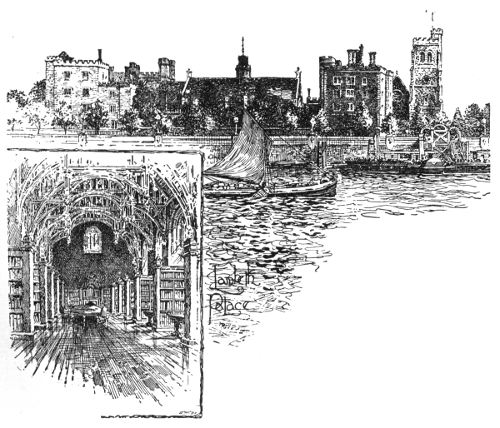 Lambeth Palace
The now
huge town of
Lambeth presents
few points of interest
either to the visitor
or to the historian.
There are no buildings of any
antiquity except the Palace and
the Church. There are no modern buildings at all worth
notice. There have been two or three memorable houses
which we shall do well to touch upon: but they are not so
memorable as to deserve long description. The Bishops of
Rochester had a house in the Marsh—the site is in Carlisle
Place, Westminster Road, at the back of St. Thomas's Hospital,
close to Lambeth Palace. It was in this house that, in 1531,
a wretched man named Robert Roose, in the Bishop's service
as cook, wilfully, as was alleged, poisoned a large number of
people, and was boiled to death in oil—the only instance, I
believe, of this dreadful punishment. The wretched man was
tied naked to a post and slowly lowered into the boiling fluid.
Fisher was the last Bishop of Rochester who lived in this
house. The buildings, with losses and additions, existed in some
form or other till 1827. The house, indeed, had a strangely
chequered history. The Bishop of Rochester exchanged it
with the Crown for a house thought more convenient in
Southwark, close to Winchester House. The Crown gave it
to the Bishop of Carlisle, who seems to have let it on lease:
thus it lost its ecclesiastical character altogether and became
given over to entirely secular uses. It was at one time a
pottery: then a tavern, and even a notorious and disorderly
house: then a dancing master taught his accomplishments in
the house: then it became a school. Finally, the gardens
were built over, the operations disclosing many interesting
gates and 'bits.'
Another house was that belonging to the Duke of Norfolk:
it was called Norfolk House, and it stood on the other side of
the Palace, on the site now marked by Paradise Street. Here
lived the old Duke whose life was saved by the death of
Henry the Eighth; here was brought up the accomplished
Earl of Surrey whose life would have been saved had Henry
died a few days earlier. Leland, the antiquary and scholar,
was the Earl's tutor. The widow of Dr. Parker, Archbishop
of Canterbury, obtained the house. Her heirs ceased to live
in it; the house was neglected, probably because no tenant
could be found for it. Finally, it was pulled down. It is
interesting to note the town houses which stood upon the
Bank from Rotherhithe to Battersea: that of the Prior of
Lewes; of Sir John Fastolfe; of the Augustines; the House
of St. Mary Overies; Winchester House; Rochester House;
Norfolk House; and later, the house of the St. Johns at Battersea.
There are none between Bankside and Lambeth;
that part of the Embankment which lies between Blackfriars
and Westminster Bridge has no history and no associations.
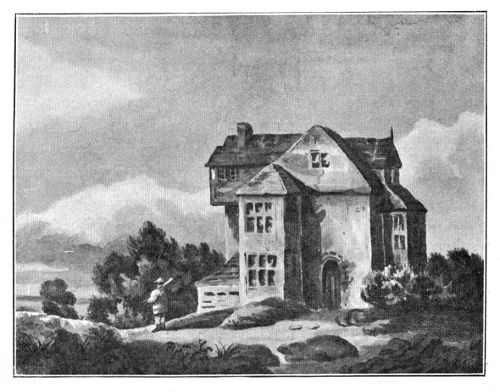 BONNER HALL, LAMBETH
Another noteworthy Lambeth house was that called Copt
Hall, afterwards Vauxhall, situated opposite to the gardens
afterwards called Vauxhall. In this house the unfortunate
Arabella Stuart lived for a time. A good deal might be
written about Copt Hall, but not in this place.
The houses of the Archbishop, the Bishop of Rochester,
and the Duke of Norfolk stood close together and clustered
round the church. The reason was the necessity of building
on or near to the Embankment. Exactly opposite the south
porch of the church may be observed a small and somewhat
decayed street grandly called the High. The name and the
situation close to the church indicate an individual and
separate existence of the town or village of Lambeth, of
which this was the principal street and the centre. The
village, in fact, did exist from very early times; its population
for the most part earned their livelihood as Thames fishermen.
They were the lineal successors of that fortunate Edric to
whom St. Peter appeared when he consecrated the Abbey.
There was another colony of Thames fishermen lower down
the river on Bermondsey Wall. When William the Conqueror
is said to have burned Southwark it was the fishermen's
cottages which he destroyed. None of these lived between
Bankside and Westminster, which is proved by the fact that
there is no church near the river wall at that place. The
Thames fishermen lingered on, though the fishery grew poorer,
until about 1820, when they were reduced to a single court in
Lambeth. The place is described as mean and rickety, with
neither paving nor lamps; the woodwork of the cottages
broken; the roofs burst and tottering; the windows stuffed
with rags or mended with paper; the children in rags; the
court a receptacle for everything.
Lambeth as it is has mostly sprung into existence in the
nineteenth century, during which its population has been
actually multiplied by ten, and more than ten, rising from
27,000 in 1801 to 295,000 in 1891, an enormous increase.
The principal reason of this development is the introduction
of a great many industries—potteries, vinegar factories, distilleries,
salt warehouses, bottle factories, and so forth.
Lambeth certainly cannot be called a beautiful town nor
a desirable place of residence. The perambulator looks about
in vain for streets noble, striking or picturesque; he looks in
vain for houses beautiful or ancient; there is nothing to
reward him. Old houses there were before the great increase
began, but they exist no more; the place is dull; in parts it
is dirty; everywhere it is without character or distinction. It
has, however, a pretty park called after the famous Vauxhall
Gardens, on whose site it stands. The park is new, but it is
well laid out and planted; already it is a pretty piece of
greenery, and, with Kennington and Battersea Parks, offers a
much wanted breathing place for the multitudes of that
quarter. It is adorned, or enriched, or ennobled, by a statue
of Henry Fawcett, who died in a house on this spot. The
statesman, attired in a costume strictly of the period, is sitting
in a chair, pretending not to be aware that behind him stands
an angel with outstretched wings, crowning him with laurel.
He is obviously embarrassed by the situation. He feels that
he ought to be dressed in some kind of Court costume—if he
knew what—in order to receive the angel; or the angel might
have assumed a frock coat in compliment to the statesman.
The wings were probably in the way.
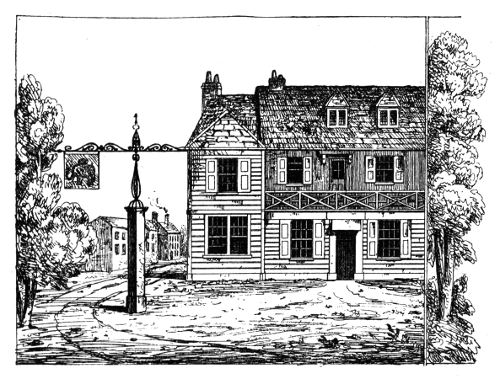
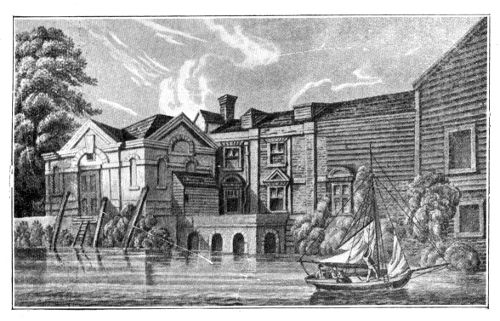 RESIDENCE OF GUY FAWKES, LAMBETH
(From 'La Belle Assemblée,' Nov. 1822)
Lambeth Palace, whose history I am not going to narrate,
plays a very considerable part in the History of England.
In 1232 and in 1234, Parliament was held here. In 1261
and 1280 Councils were held here. In 1412 Archbishop
Arundell, the kindly Christian who was so anxious to
burn heretics, issued from this Palace a condemnation as
heretical of a great many opinions, insomuch that it became
obviously dangerous to have any opinions at all. This,
however, was the condition of mind most desired by the
Church of Arundell's time and of his views. It is needless to
recount the many occasions when Kings and Queens were
entertained at Lambeth Palace. Cardinal Pole died here. It
was sometimes a prison. Queen Elizabeth entrusted to the
care of the Archbishop at Lambeth, Bishops Tonstal and
Thirlby, the Earl of Essex, the Earl of Southampton, Lord
Stourton, and many others, who were kept in honourable confinement,
not in dungeons or cells, but each in his own
chamber.
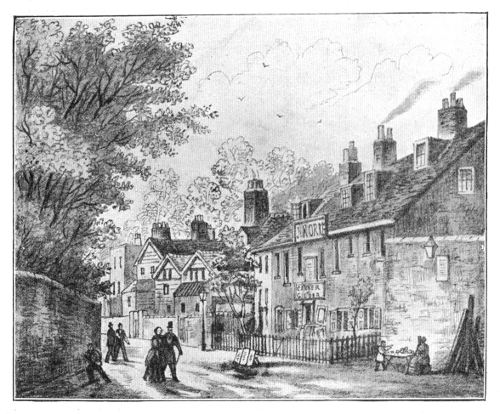 BISHOP'S WALK, LAMBETH
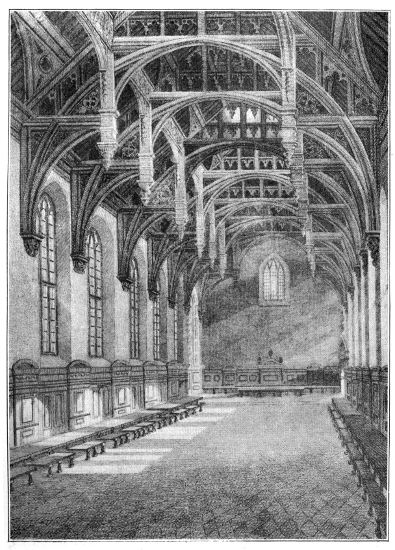 INTERIOR OF THE HALL, LAMBETH PALACE
(From an Engraving dated 1804)
That there were prisons in every Episcopal Palace was
necessary at a time when the clergy could only be tried in
Ecclesiastical Courts, so that the Bishops could not send their
criminous clerks to an ordinary prison. Hence it is that we
frequently read of a priest brought before an Ecclesiastical
Court, but we do not learn what became of him. He was
consigned to the prison of the House. When the Lollards
inveighed against the corruption of ecclesiastics they accused
the Bishops of too great leniency towards their delinquents
and prisoners. In some cases, no doubt, the ecclesiastical
prison was used to save a prisoner from the worst consequences
of his offence. For instance, a heretic handed over
to the secular arm had by law to be burned. Let us endeavour
to believe that in the Archbishop's prison cells of Lambeth
there were many who might have been burned but for the
humanity which sometimes overrode even Ecclesiastical ruthlessness.
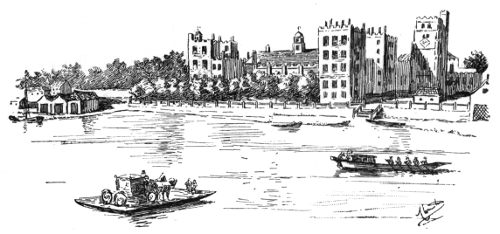 LAMBETH PALACE, FROM THE RIVER
It is recorded in Archbishop Arundell's Register (Cave-Browne,
'Lambeth Palace,' p. 710) that he sent for a Chaplain
out of his prisons below his manor house at Lambeth. The
Chaplain was a preacher licensed by the Archbishop who yet
carried about with him a concubine. No doubt the poor man
regarded her as his wife, and so called her, as thousands of the
clergy did, and were held blameless by the people for so doing.
The Palace either contains, or has at some time contained,
the work of nearly every Archbishop in succession. For a
full and complete history of the buildings, which would be
outside the limits of the present chapter, the reader is referred
to the pleasant pages of the Rev. J. Cave-Browne, called
'Lambeth and its Associations.'
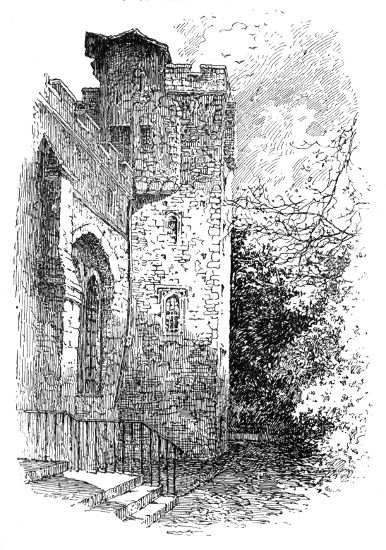 LOLLARDS' TOWER, LAMBETH PALACE
It is impossible to determine when the building of
Lambeth Palace began. One thing is certain, that it has
always been an Ecclesiastical Palace. The manor of Lambeth
belonged to the Lady Guda, sister of Edward the Confessor.
In Domesday Book the manor contained thirty-nine men,
who with their families probably represented a population of
about 200. They had a church, which stood on the site of
the present church. Observe how all the old churches
belonging to the Marsh stand on the Embankment—Rotherhithe;
St. Olave's; Lambeth; Battersea. Guda, wife
of Eustace, Count of Boulogne, gave the manor to the Bishop
and convent of Rochester, reserving the church. Harold, it
is said, took it from the Bishop; it was seized by William the
Conqueror. William Rufus restored it to Rochester and
added the patronage of the Church. In 1197 Hubert, Archbishop
of Canterbury, gave the manor of Dartford to the
Bishop and convent of Rochester, in exchange for Lambeth.
Having got possession of the place, Hubert set to work to
improve it. He obtained a weekly market and an annual
fair; the latter continued till the year 1757.
What Hubert built here is uncertain, but it is certain that
he did build some kind of residence. Stephen Langton added
other buildings; Boniface, A.D. 1260, found the buildings in great
need of repair or insufficient. He was the first considerable
builder of Lambeth. One may make a fair guess at the work
of Boniface. We may consider it by the light afforded by the
monastic Houses—this was not a monastery, but there was
certainly something of the monastic spirit about the House.
We may also take it for granted that certain essential parts
of the building, though they might be rebuilt with greater
splendour, would not change their position. For instance,
when in after years we find a chapel, a cloister, a water-tower,
or entrance from the river, and a gate-tower, or entrance
from the land—then these things existed from the first.
Boniface, therefore, found a chapel in the north-west corner
of the Palace, where it still stands; on the west side of the
chapel he found a water-tower with a gate opening upon a
creek of the river by which everything was received into the
House, the door of communication with the outer world,
while the Archbishop's barges and boats lay moored up the
creek. South of the chapel Boniface either built or rebuilt
the cloisters; south of the cloisters he built or rebuilt his
Hall. A Hall was absolutely necessary for a great house,
and for an Archbishop's Palace it must be a splendid Hall.
What is now called the Guard Room was probably at first
part of the Archbishop's private apartments.
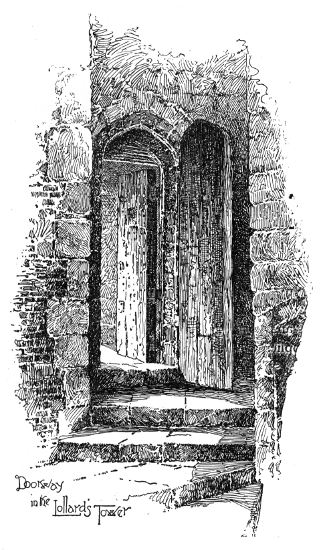 Doorway in the Lollard's Tower
A list of the rooms then in the Palace was made in 1321.
At that time there was the Archbishop's private Chapel, his
Chamber, his Hall, the Chancellor's Chambers, the Great
Chapel, the Great Gate, and certain minor apartments—a
modest list, but the dormitories and principal bedchambers are
not enumerated, nor is any mention made of the Library, the
offices, the cells, or the Main Gate, all of which must have
been there.
Then we come to the later works, of which there are more
than we need set down—are they not written in Ducarel the
Laborious and in Cave-Browne the Life-giver to the dust and
ashes of ancient facts? The principal gateway as we now see
it is the fifteenth century work of Cardinal Morton; it is built
in the same style as the gateway of St. John's College, Cambridge,
but is much larger and finer; with the Church, it forms
a most effective group of buildings. The present Water Tower
was built by Archbishop Chicheley, but on the site of an older
tower; it contained, as I have said, the water gate—that is to
say, the real gate of communication with the world. To this
gate came all the visitors—Kings and Cardinals, Legates,
Bishops and Ambassadors; and to this gate came the barges
with supplies for my Lord's table. Cranmer is said to have
built the small tower at the north-east of the Chapel. Cardinal
Pole, who died here, built the Long Gallery, and probably
the piazza that supported it. Laud built the smaller
tower on the south face of the Chicheley Tower. Let us remark
here that the Tower never had any connection with
Lollards, and that all the talk about the unhappy Lollard
prisoners is without foundation.
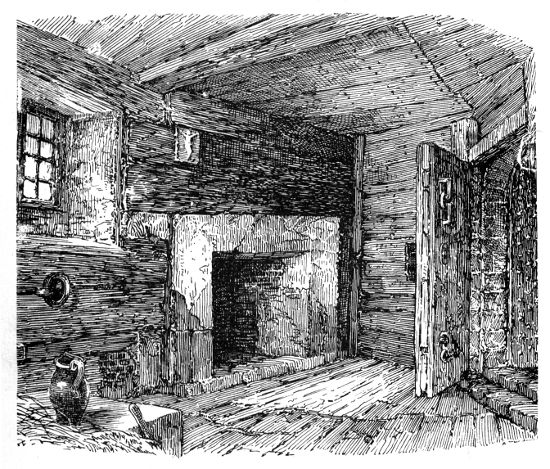 LOLLARDS' PRISON
Juxon, who found the Palace a 'heap of ruins,' spent his
three years of occupancy and 15,000l. of his own money in restoring
the place for the honour and splendour of the Church.
As for what has been done since that time, especially by
Archbishop Howley, it all belongs to the detailed history of
the Palace. It is sufficient here to note that the Palace is a
worthy House to-day, as it was five hundred years ago, for
the residence of the Primate. He belongs still, as his Roman
Catholic predecessors, to a Church whose members love some
splendour in their ecclesiastical Princes, just as they love
splendour in their churches and stateliness in their ritual.
They do not desire to make a Bishop rich: they do desire
that a Bishop should not be hampered by narrow circumstances:
they desire that he should be able to take the lead
in all good works. In ancient times, the Bishop rode or sat
in splendid state: he sat every day at a table loaded with
costly and luxurious food: outwardly he was clothed with
silken robes. But he touched nothing that was set before
him: he lived hardly and abstemiously: and he wore next
his skin a hair shirt: and for greater self-denial he suffered
his hair shirt to be full of vermin. That was the ideal
Bishop of mediæval times. Our own is much the same: a
simple life: a splendid house: modest wants: a large income:
for himself no luxuries: and an open hand. Such a
house: such an income: we have always given to an Archbishop,
whether of the old or of the Reformed Faith.
The Chapel has at least one memory which will always
cling to it. Within its dark and gloomy crypt Anne
Boleyn, brought from the Tower, stood to hear her sentence.
She was to be burned to death as an adulteress. I am not
qualified by study of the case or by education in the weighing
of evidence to pronounce an opinion as to her innocence. I
believe that those who have examined into the case are
of opinion that Anne Boleyn fell a victim to the King's
jealousy: to his change of mind towards her: and to her
own foolish frivolity. However, in the crypt she was persuaded
into making some sort of avowal of a previous betrothal, in
return for which she was spared the agonies of the stake. I
have sometimes thought that the King must have thought
her guilty, otherwise he would have divorced her on a charge
of adultery, and suffered her to live. If he did not believe
her guilty, how could he, being, above all things, a man of
human passions, have sentenced the woman whom he had once
loved to so horrible a death?
Let us note, however, that our ancestors did not regard
death by burning with quite the same horror as is now
common. There is a story of Rogers—or Bradford—the
martyr. Some one once begged his intercession to save a
woman from burning. 'It is a gentle mode of death,' he
replied. 'Then,' said the other, 'I hope that you yourself
will some day have your hands full of this gentle death.'
Punishment was meant to be painful: the least painful form
of death was that accorded to the noble—to be beheaded. If
a man died by the executioner, it was expected that he should
suffer. Death, in all forms, meant suffering. In disease and
in old age men suffered torture as bad as any inflicted by
the executioner.
I am not excusing Henry. I am only pleading that he
must have believed in Anne's guilt or he could not possibly
have allowed such a sentence; and that cruel as it seems to
us, it did not seem so cruel at that time. There is, however,
no more sorrowful story in the whole long History of
England, which is, alas! so full of sorrow and of tragedy,
than that of Anne Boleyn.
Lambeth Palace, the only palace in the whole of South
London, is a monument of English History from the twelfth
century downwards. Kennington appears at intervals;
Eltham is a holiday house; Greenwich practically begins
with the Tudors. Lambeth, like Westminster or St. Paul's,
belongs to the long history of the English people. It is a
place little known: of the millions now, in the circle of the
Greater London, how many, I should like to ask, have ever
seen the interior? Of the vast population of Lambeth,
Battersea, and Kennington, of which it is the centre, how
many, I wonder, know anything at all about its history or its
buildings?
Of those who daily go up and down the river, who come
and go across the Bridge, and suffer their careless and unobservant
eyes to rest for a moment on the grey walls and
Tower of the Palace, how many are there who know, or
inquire, or care for the wealth of history that clings to every
stone?