Before Walter Rossel was wholly awake, even before
he opened his eyes, he realized that the ship was unusually
quiet. There was only a slight rolling motion
from side to side, a dead roll. Was she caught in the
ice again, or had she reached Fort York at last? Could
it be that the long voyage was really over? Walter
hurried into the few clothes he had taken off, and ran
up on deck, hoping to see land close by.
He was disappointed. He could see nothing but gray
water, a line of white where waves were breaking on a
long bar, and the dim, shadowy forms of the other
ships, hulls, masts, and spars veiled in dense fog. There
was no ice in sight, yet all three vessels were riding at
anchor.
Eagerly the boy turned to a sailor who was scrubbing
the deck. Walter’s native tongue was French, but he
had picked up a little English during the voyage,
enough to ask why the ships were at anchor, and to
understand part of the man’s reply. They had crossed
the bar in the night, the sailor said, and were lying in
the shallow water of York Flats. Over there to the
south, hidden in the fog, was the shore.
[10]
The news that they had arrived off Fort York spread
rapidly among the passengers on the Lord Wellington.
Men, women, and children crowded on deck, gazed into
the fog, questioned one another and the sailors in
French, German, and broken English, and talked and
laughed excitedly. A little boy of seven and his older
sister, a bright-faced girl of thirteen with hazel eyes
and heavy braids of brown hair, joined Walter and
poured out eager questions.
“They say we are at the end of our voyage,” cried
the girl, “but where is the land?”
Walter pointed to the south. “We’ll see it when
the fog lifts. Does your father know we are almost at
Fort York?”
“Yes, he is coming on deck. There he is now.”
A middle aged man, thin and somewhat stooped, was
coming towards them, his pale face smiling and eager.
“Well, my boy,” he greeted Walter, “this is good
news indeed. We shall soon be settled on our own farm.
Think of that, children, our own farm, a far larger
one than we could ever dream of having in Switzerland.”
“Yes, Monsieur Perier,” replied Walter, “the
voyage is almost over, and——”
“Look, Walter,” Elise interrupted. “The fog is
thinner. See how red it is in the east. And look at
that dark line, like a shadow. Can that be the shore?”
[11]
The fog was certainly thinning. A wider stretch of
water had become visible, and the outlines of the other
ships were clearer. Though steam power was coming
into use for river navigation on both sides of the Atlantic,
there were no ocean-going steamships in 1821.
The Lord Wellington, the Prince of Wales, and the
Eddystone were sailing vessels, sturdily built craft with
extra heavy oak sheathing and iron-plated bows, suitable
for cruising ice-strewn, northern waters. That all
three had been in contact with the ice, their scraped and
battered hulls betrayed. From each mizzen peak fluttered
the British red ensign, and the mainmast head
bore a flag with a red cross and the letters H. B. C.,
the flag of the Hudson Bay Company.
The immigrants aboard the Lord Wellington wasted
scarcely a glance on the other ships. It was the land
they were interested in. As the rising sun drank up the
fog, and the shore line grew clearer, the eager faces of
Elise and Walter sobered with disappointment. A most
unattractive shore was revealed. It was low, swampy,
sparsely clad with stunted trees, a desolate land without
sign of human dwelling. Fort York could not be seen.
It was fifteen or twenty miles in the interior, on the
Hayes River.
Unpromising as the land appeared, it was land nevertheless,
and everyone longed to set foot upon it. To
the one hundred and sixty Swiss immigrants, the voyage
had seemed endless. On May 30 they had sailed from
Dordrecht in Holland. Now it was the last of August.
For nearly three months they had been on shipboard.
Delayed by stormy weather and crowding ice, they had
spent a whole month navigating Hudson Straits and
Bay. Luckily for them they did not realize what a long
and toilsome way they had yet to travel before they
reached their destination, the Selkirk Colony on the
Red River of the North.
[12]
Though many of the new colonists looked thin, worn,
and even ill from the hardships of the long voyage, they
appeared to be neat, self-respecting folk, intelligent and
fairly well to do. Some wore the peasant dress of their
native cantons, but the majority were townspeople,—shopkeepers
and skilled workmen. Mr. Perier was a
chemist and apothecary.
Walter Rossel had not one blood relation in the
whole company, but he considered himself one of the
Perier family. For the past two years, as an apprentice
in Mr. Perier’s shop, he had lived with them. When
his master had decided to emigrate, he had offered to
either release Walter from his apprenticeship or take
the boy with him. Walter had decided quickly, and his
father and stepmother had given their consent.
The Periers and Walter had breakfasted, packed
their personal belongings, and were on deck again, when
a small, open sailboat came in sight from the direction
of the shore. It headed for the Eddystone and disappeared
on the other side of that ship. Presently it reappeared,
visited the Prince of Wales, and finally came
on to the Lord Wellington.
As the little boat drew close, Elise, Walter, and Max
looked curiously down on the crew of sun-tanned,
bearded men, strangely dressed in hooded coats of
bright blue or of white blanketing, bound about the
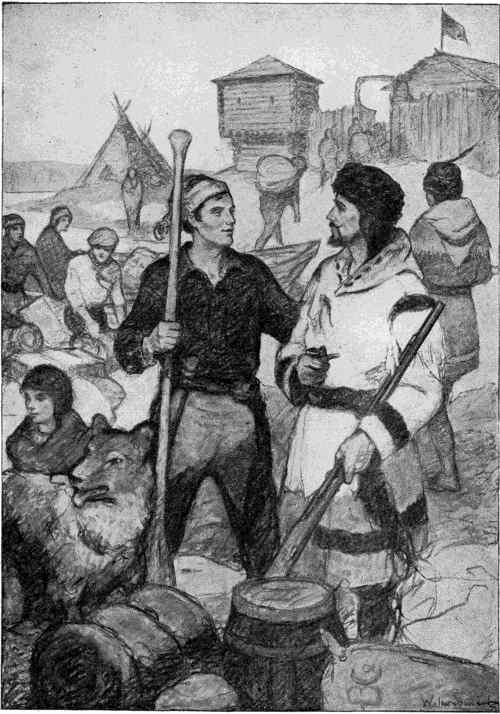
waists with colorful silk or woolen sashes. The man in
command came aboard, climbing the ladder up the side.
He was broad shouldered and strongly built, with reddish
hair, bristly beard, and skin burned red-brown.
With his blue coat and bright red sash, he wore buckskin
trousers fringed at the seams, and the queerest
footgear Walter had ever seen, slipper-like, heel-less
shoes of soft leather embroidered in colors. They were
Indian moccasins ornamented with dyed porcupine
quills.
[13]
After glancing about him and inclining his head
slightly in a general greeting, the newcomer shook hands
with the Master of the ship and with Captain Mai, the
man in charge of the Swiss immigrants, who had hurried
forward to greet him. He went below with them, but
remained only a few minutes.
As soon as the red-haired man was overside again,
the Swiss crowded around their conductor to ask when
they were to go ashore. Captain Mai pointed to the
other ships. Their sails were up and they were getting
under way.
“A pilot has just gone aboard the Eddystone,” he
said. “We are to follow her.”
Even before Captain Mai had finished speaking, the
Lord Wellington was waking to activity. The anchors
came up, the sails were set, and caught the breeze. In
a few moments the immigrant vessel was following the
supply ships towards the mouth of the Hayes River.
[14]
II FORT YORK
The first view of Fort York was as disappointing as
the first glimpse of shore. To Elise and Walter a fort
meant massive stone walls and towers, rising from some
high and commanding position. A stretch of log fencing
in a bog was not their idea of fortification. It had
the interest of novelty, however, for it was very different
from anything they had ever seen before. The logs
were set upright and close together, and above this
stockade rose the flat, leaded roofs of the buildings.
Near the fort stood a cluster of strange dwellings, quite
unlike the Eskimo summer huts of stones, sod, and
skins, with which the Swiss had become familiar since
reaching Arctic waters. These queer skin tents were
roughly cone-shaped, and the ends of the framework of
poles projected at the peak. They were Cree Indian
summer lodges. Up the wide board walk from the dock
to the fort gates, men were carrying sacks and boxes.
The unloading of the supply ships had begun.
The Perier family were among the last of the immigrants
to go ashore. Very much like a homeless wanderer,
motherless Elise Perier felt as she stood on the
river bank beside her father, with Max clinging to her
hand, and their scanty belongings piled around them.
It was good to be on land again of course, but this was
such a strange land. In spite of cramped quarters,
poor food, seasickness, and the other hardships of the
voyage, the Lord Wellington seemed almost homelike
compared to this wild, barren country. Elise tried
bravely to smile at her father and Walter, but she felt
as if she must cry instead.
[15]
Captain Mai was calling them. “Go right up to the
fort, Perier. I want to get you all together.”
Walter picked up as much of the luggage as he could
carry. Mr. Perier was looking doubtfully at a heavy
wooden chest, when a boyish voice at his shoulder said
in French, “Let me help, M’sieu. If you will put that
on my back, I will carry it for you.”
Walter dropped his own load, and he and Mr. Perier
lifted the chest and placed it so it rested on the portage
strap, as the young Canadian directed. Then the latter
led the way up the walk. He was a slender, supple lad,
not as tall as Walter, but he carried the heavy load
with apparent ease. The Swiss boy admired the young
fellow’s strength as much as he liked his face, with its
bright brown eyes and clean-cut features.
The log stockade proved to be more imposing and
fort-like than it had appeared from the river. It was
about twenty feet high, with bastions at the corners
pierced with openings for cannon. The massive entrance
gates stood open, and in front of them was a tall
flagstaff, bearing the Company flag with the letters
H. B. C. and the curious motto, “Pro pelle cutem,”—“Skin
for skin.” Entering the gates and passing
within the double row of stockades, their guide led the
Perier family among workshops and cabins to an inner
court, which was surrounded with substantial log structures
where the officers lived and where the merchandise
and furs were stored. In this court the Swiss were
gathered.
[16]
Mr. Perier tried to thank the friendly lad, but he
shook his head. “It is nothing, nothing, M’sieu,” he
replied, a quick smile displaying his even, white teeth.
“I must not linger. There is much to do.” And he
was off at a run.
When all of the Swiss were assembled, one of their
leaders suggested that it was fitting they should give
thanks to God that the dangerous ocean voyage was
over and they were safe on land once more. They stood
with bowed heads while he led the prayer. The lump in
Elise’s throat disappeared and she felt better.
In the meantime, Captain Mai had been arranging
with the Chief Factor,—as the Hudson Bay Company
officer in charge of the fort was called,—for quarters
for the immigrants. There was not room for all in the
buildings, so many of the men and boys would have to
sleep in tents. A place in one of the houses was found
for the Periers, but Walter was assigned to a tent with
Mr. Scheidecker and his sons, German Swiss from
Berne.
That first night on land was a miserable one for
Walter. Fort York stood in a veritable bog or muskeg,
firm and hard enough the greater part of the year,
when it was frozen, but wet and soft in the short summer
season. The ground was damp of course, and
Walter’s one blanket did not keep out the chill. To
make matters worse, he and his companions were pestered
by the bloodthirsty mosquitoes that bred in inconceivable
hordes in the swampy lowlands. But the
discomfort of the night was quickly forgotten the next
day.
[17]
A busy and interesting place the Swiss boy found
York Factory, as the Hudson Bay men called the fort.
It was not a factory in our common meaning of the
word,—not a manufactory,—for nothing was manufactured
there except boats for river traffic, dog sleds,
wooden kegs, and such articles of use and trade as an
ordinary carpenter, blacksmith, or tinsmith could make
with simple tools. Factory in the fur trade meant a
trading post in charge of an officer called a factor, a
commercial agent who bought and sold.
For more than a century York Factory had been the
principal port of entry for the Hudson Bay Company.
There the Company’s ships from England brought the
supplies and trade goods destined for all the widely
separated posts in the interior. To York Factory, in
bark canoes and wooden boats, down rivers and lakes,
from all parts of the Company’s great domain, came
the bales of costly furs to be sorted and repacked and
shipped. A considerable staff was employed at the
place, a Chief Factor, a Chief Trader, a surgeon, several
clerks and apprentice clerks, a steward, a shipwright,
a carpenter, a mason, a cooper, a blacksmith, a
tailor, laborers, cooks, and servants. The boatmen or
voyageurs who went to and fro into the interior were
hired independently for each trip.
[18]
Until he sailed for America, Walter had never even
heard of the Hudson Bay Company or the fur trade.
Everything in the fort was novel and interesting to
him. A good-natured apprentice clerk, who spoke
French readily, showed him the Indian store, a large
room well filled with all sorts of goods used in the Indian
trade, from bales of heavy blankets, blue and red
woolens, calicos of every color, long-barreled trading
guns, kegs of powder, and big iron and copper kettles,
to drawers of useful little things, gun flints, fire steels,
files, awls, needles, fish hooks, twine, beads of all imaginable
tints, and ochre, vermilion, and other dry
colors, used by the Indians to adorn both their handiwork
and themselves.
“I never saw so many different things in one shop,”
Walter commented.
The clerk laughed. “The worst of it is that we have
to keep the closest account of it all. We must know
what is in every package sent out and what post it goes
to. Being a fur trader isn’t all adventure I can tell
you. There is a lot of office drudgery, with all the
bookkeeping, invoicing, and checking of lists. We
can’t afford to make mistakes,” he added soberly.
“The very lives of the men in some far-away post may
depend on their getting the right supplies. Why, last
year——” He broke off suddenly, and switched to
English. “I spoke to the Chief Trader about your
proposal. He says it can’t be done. It’s not the policy
of the Company to send voyageurs out to trade, especially
on such long trips.”
[19]
Walter had turned to see to whom the clerk was
speaking. He had heard no footsteps, but there, close
behind him, was a tall man in blue coat, deerskin leggings,
and moccasins. In his surprise, the boy drew
back a little and stood staring. Of all the men he had
seen since coming ashore, this one was the strangest and
most striking. He was tall, powerfully built, and very
dark of skin, with high cheek bones and high-bridged
nose. His long, coarse black hair, slick and shining
with grease, was worn in what seemed to the Swiss boy
a curious fashion for a man, parted in the middle and
plaited in two braids bound with deerskin thongs and
hanging one over each shoulder.
“You not give me goods?” The man’s voice was
peculiarly deep, not unmusical but of a hard, metallic
quality. His small, dark eyes looked straight into the
clerk’s large blue ones.
The young man shook his head. “No, your plan is
too wild, too much risk in it. That sort of thing is
against the Company’s policy.”
The voyageur’s brown face stiffened. His hard eyes
seemed to catch fire as they rested first on the clerk
and then, for a moment, on Walter. Without a word
he turned and with long, soft-footed stride, left the
room as noiselessly as he had entered it.
“Pleasant manners,” commented the clerk. “He
needn’t have included you in his wrath.”
“What did he want?” asked Walter. He had understood
but little of the brief conversation.
“A lot of goods on credit. He claims to have great
influence with the Sioux, and he wants an outfit to go
and trade with them. Of course we can’t let him have
it.”
“You don’t trust him?”
[20]
“We don’t know anything about him, except that he
is a good voyageur. It’s against the Company’s policy
to send voyageurs out to trade. And his scheme is a
crazy one. The Sioux country is a thousand miles
away. He said he would bring all the furs back here
and take whatever commission we chose to give, but
probably we should never hear of him or the goods
again.”
“Is he an Indian?”
“Half-breed I imagine. Finely built fellow, isn’t
he? Has the strength of a moose, they say. He is an
expert voyageur.”
“I don’t like him,” Walter commented.
“Neither do I, and I suppose he has a grudge against
me now, though the refusal wasn’t my doing of course.
Well, I must stop talking and get to work checking
this new stuff that has come in.”
Thus dismissed, Walter wandered out into the court,
through the open gates and down to the shore. Everywhere
was bustle and activity. There was much to be
done, and done quickly. With the least possible delay
the ships must be unloaded and loaded again with the
furs waiting packed and ready for the voyage to England.
The little fleet must get away promptly while
Hudson Straits were still open. All the goods and
supplies received had to be checked, examined, and
sorted. The things to be sent to trading posts in the
interior were repacked for transport in open boats up
the rivers, and every package was invoiced and plainly
marked. Boats must be made ready and equipped and
provisioned, not only to carry the supplies and trade
goods, but the one hundred and sixty new settlers as
well. The twelve hours a day that the employees of the
Company were required to work in summer, if necessary,
were not enough. Most of the men were simply doing
all they possibly could each day until the rush should
be over.
[21]
Down by the river Walter found the young fellow
who had carried Mr. Perier’s chest. He was putting a
new seat in one of the large, heavily built boats ranged
along the bank. Looking up from his work, he greeted
the Swiss boy with a cheery “Bo jou,” which the latter
guessed to be the Canadian way of saying “Bon jour”
or “Good day.” Walter, who was handy with tools,
offered his help.
As they worked they talked. His new acquaintance’s
French was fluent, but Walter found it puzzling. To a
Swiss, the Canadian dialect seemed a strange sort of
French, differing considerably in pronunciation and in
many of its words from his own native tongue. Yet
Walter and Louis Brabant managed to understand each
other fairly well.
“I suppose this is your home, here at the fort,” said
Walter.
“My home? Non, I live at the Red River.”
“Why, that is where we are going!”
“You go to the Selkirk Colony at Fort Douglas. It
is not there that I live, but at Pembina, farther up the
river.”
“Is Pembina a town?”
[22]
“Not what you would call a town. It is a settlement
and there are trading posts there, a Hudson Bay
post and a Northwest Company post. Now the two
companies have united, one of the forts will be abandoned
I suppose. You may be glad the fighting between
them is over. There will be better times in the
Selkirk Colony now. They have had a hard time and
much trouble, those poor settlers!”
“What do you mean by fighting,—and trouble?”
asked the surprised Walter. “What is the Northwest
Company? Isn’t the Hudson Bay the only trading
company? Doesn’t it own all the country where the
Indians and the fur bearing animals are?”
“Oh no,” returned Louis with a smile and a shake
of his head. “Farther south there is fur country that
belongs to the United States. The Hudson Bay Company
has no power there. It is true that the Company
claims all the northern fur country, but the Northwest
Company said they had a right to trade and trap there
too, and that was how the trouble began. Have you
never heard of the Northwest Company, and how for
years they have fought the Hudson Bay men for the
furs, and how they drove the settlers from the Selkirk
Colony and captured Fort Douglas and killed the Governor?”
Walter shook his head in bewilderment, and Louis
went on to tell, briefly and vividly, something of the conflict
between the two great trading companies, and the
disasters that conflict had brought upon the settlers.
The Swiss boy listened in amazement, understanding
enough of the story to grasp its significance.
“But why didn’t Captain Mai tell us all that?” he
cried. “Why did he let us think that everything was
all right?”
[23]
“Perhaps he thought you would not come if you
knew. But those old troubles are all over. Last spring
the two companies became one.”
Louis’ story troubled Walter. He retold it to Mr.
Perier and Mr. Scheidecker, and they carried it to other
leading men of the prospective settlers. Several of them
sought out Captain Mai and demanded to know why
they had not been informed of all those wild doings in
the colony. Unsatisfied by their conductor’s explanations,
they asked for an interview with the Chief Factor,
and put their questions to him. He confirmed the statement
that the fur-traders’ rivalry and warfare were at
an end. About five months before the arrival of the
Swiss, the two great trading companies had united
under the Hudson Bay name. The colony on the Red
River would now have a chance to develop in peace.
In spite of this assurance, the Hudson Bay officer’s
replies to some of their queries left the Swiss in no
happy mood. Mr. Perier was stunned to learn that
they still had some seven hundred miles to travel, all the
way through untamed wilderness. But he had no
thought of turning back. He had signed an agreement
with Captain Mai, and had paid for his family’s
passage,—a moderate sum, but he could ill afford to
lose it. To pay their fare back again would leave him
penniless. Fertile land, one hundred acres of prairie,—that
would not have to be cleared,—had been promised
him rent free for a year. After that he was to pay a
rent of from twenty to fifty bushels of wheat from his
crop, or he might buy the land outright for five hundred
bushels. The offer was enticing, and he and Walter
had made many plans for the future.
[24]
III THE SELKIRK COLONY AND THE RIVAL FUR TRADERS
What was the Selkirk Colony, and how did it happen
that this party of Swiss had come so far to join it?
When Thomas Douglas, Earl of Selkirk, one of the
famous Douglas family of the Scottish border, planned
the settlement on the Red River of the North, his purpose
was to find homes and livelihood for the poverty-stricken
Scotch Highlanders. Hundreds of those unfortunate
people had been turned out of their homes
through changes in the system of management of the
great landed estates in Scotland, and there was little
opportunity in the old country for them to make a living.
Though a Lowlander himself, Lord Selkirk had
often visited the Highland glens. He knew the people,
and had learned their native Gaelic language. He sympathized
with them in their misfortunes. Seeking for
some way to help them, he realized that their only
chance for prosperity and success lay in emigration to
a country where land was cheap and plentiful. He had
heard of the rich soil of the Red River valley, and decided
that was the place to plant his colony.
[25]
The lower Red River valley was included in the vast
domain of the Hudson Bay Company. The charter
from King Charles II of England issued in 1670 had
given to Prince Rupert and the “Company of Adventurers
of England, trading into Hudson Bay”—“the
whole trade of all those seas, streights, and bays, rivers,
lakes, creeks, and sounds,—that lie within the entrance
of the streights commonly called Hudson’s Streights,
together with all the lands, countries, and territories
upon the coasts and confines of the seas, streights,
bays, lakes, rivers, creeks, and sounds aforesaid, which
are not now actually possessed by any of our subjects,
or by the subjects of any other Christian prince or
State.” Not only did the royal charter grant the
“Adventurers” the trade of that vast region,—which,
in the widest interpretation of the terms, included a
quarter or a third of the whole of North America,—but
it conferred upon the Company the right to hold
the land “in free and common socage” which means
absolute proprietorship. Whether King Charles really
had the right to give away this vast territory to anyone
may be questioned, but the Hudson Bay Company
claimed proprietorship under the charter.
The Red River empties into Lake Winnipeg, and the
northern end of the lake drains into the Nelson River
which flows to Hudson Bay. Accordingly the valley of
the Red was included in the territory claimed by the
Company. However, before the time of this story, the
purchase from France by the United States of a vast
extent of country west of the Mississippi River,—the
Louisiana Purchase—and the boundary treaties with
the British government, gave the greater part of the
Red River to the United States. Only the stretch from
what is now the northern limit of Minnesota and North
Dakota to Lake Winnipeg remained in English possession.
It was to this lower part of the valley that
Lord Selkirk wished to take his colonists. He knew
well enough that the Hudson Bay Company would not
be inclined to part with any of its domain for such a
purpose, but he had set his heart upon planting his
colony in that particular spot.
[26]
Accordingly he laid his plans to get possession of
the required land. Quietly, by buying shares himself
and persuading his friends to buy also, he obtained
control over a majority of the stock of the great trading
company. Then he offered to purchase a wide strip
of land on the Red and Assiniboine rivers. As he controlled
the majority of votes in the Company, he got
what he wanted, about one hundred and sixteen square
miles, of which he became absolute proprietor.
The first settlers he sent over were of course Scotch
Highlanders, with a few Irish. They arrived at Fort
York in the autumn of 1811, too late to go to the Red
River that year. The next summer they reached their
new home on the Red, and were followed within three
years by other parties, numbering in all a little more
than two hundred, most of them Scotch.
The troubles of the settlers were many and discouraging.
Had the Earl of Selkirk been a more practical
man he would scarcely have undertaken to plant a
farming colony in the midst of a wilderness, hundreds
of miles from any other settlement, and without communication
with the civilized world except by canoe and
rowboat over long and difficult river trails. Not all of
the colonists’ troubles were due to natural conditions
however.
[27]
The Hudson Bay Company had a strong trading
rival in the Northwest Fur Company. The latter was
a Canadian organization with headquarters at Montreal,
while the Hudson Bay Company was strictly
English, its chief offices in London. The Northwest
men had established trading posts along the Great
Lakes and far to the west and north beyond Lake Superior.
They had penetrated farther and farther into
the country claimed by the Hudson Bay Company.
The Hudson Bay men themselves had done almost
nothing to develop trade in the interior, until the Canadian
traders began to go among the Indians and secure
furs that might otherwise have been brought to the
posts on the Bay. Awakening to the realization that
the Northwest Company was actually taking away the
trade, the Hudson Bay men also sought the interior.
In this way began a race and a fight for the furs that
grew hotter and fiercer with each year. Everywhere
on the principal lakes and streams of the west and
northwest, rival posts were established, sometimes
within a few hundred rods of each other.
[28]
The rivalry between the fur traders was approaching
its height when Lord Selkirk founded his colony. From
the first, the Northwest Company opposed the scheme.
The fur trader never likes to see the country from
which the pelts come opened up to settlement. He
knows that as the land is settled the wild animals disappear.
Moreover Lord Selkirk was now the controlling
power in the Hudson Bay Company, and the Northwesters
suspected him of some deep laid plan to
interfere with and ruin their trade. Several years before,
they had established a post called Fort Gibraltar
at the junction of the Red and the Assiniboine, and
their route to the rich fur districts of the west lay up
the latter river. They believed that the settlement was
merely a scheme to cut off their trade. So they looked
with unfriendly eyes upon the colony, and even persuaded
a considerable number of the colonists to leave
and settle on lands farther east in Canada. Most of
the Northwest traders were of Scotch blood, many of
them of Highland descent, and doubtless they honestly
thought that their countrymen would find better homes
elsewhere. The chance that the Red River settlement
would ever succeed seemed, to practical-minded men,
very slender indeed.
The ill feeling between the two great trading companies
and between the Northwest Company and the
Selkirk settlement grew stronger and bitterer as time
went on. Mistakes and high handed acts on both sides,
in a land where there was no law, led at last to open
conflict. In 1815 the colonists were driven from their
homes and obliged to flee to the shelter of a Hudson
Bay post at the northern end of Lake Winnipeg. The
Hudson Bay men made reprisals by capturing the
Northwesters’ posts and interrupting their trade. The
settlers were rallied and taken back to their homes, only
to face a worse disaster the next year. An open fight
between the men of Governor Semple of the colony and
a party of half-breeds in the employ of the Northwest
Company resulted in the killing of the Governor and
his twenty followers, and the capture of their stronghold,
Fort Douglas.
[29]
Lord Selkirk was in America at the time seeking from
the Canadian government some means of protection for
his colonists. Failing to get satisfaction from a government
whose sympathies were with the Northwest
rather than with the Hudson Bay company, he had
hired, to guard his colony, one hundred men from two
regiments of mercenary soldiers that had been disbanded
after the War of 1812. While he was traversing
Lake Superior on his way west with these men, he
met canoes bringing word of the disastrous fight of
Seven Oaks, the death of Governor Semple, and the
capture of Fort Douglas. Skirting the shores of the
lake, Lord Selkirk went to Fort William, the headquarters
of the Northwest Company on Thunder Bay.
There he demanded the release of the prisoners who had
been brought from the Red River. The controversy
that followed finally led to his taking possession of the
fort. The fact that he had been appointed a magistrate
for the Indian country and sought the arrest of
the Northwesters who had taken part in or instigated
the troubles at Fort Douglas, gave his action some color
of legal right. From Fort William he went on to his
disordered and devastated colony, and gathered together
all the settlers who were willing to remain.
In spite of all the settlement had been through, Lord
Selkirk had no intention of giving up his plans. So
many of the colonists had been driven or enticed away
and would not return, that he sought to find others to
take their places. It was then that he hit upon the idea
of bringing over the steady, hard-working Swiss, who
would, he believed, make the very best of settlers.
[30]
Captain Mai or May,—the English spelling of his
name,—a Swiss who had served as a mercenary soldier
in the British army, and other agents were sent to
Switzerland to secure settlers. Throughout the cantons
of Neuchatel, Vaud, Geneva, and Berne, they traveled,
explaining the advantages of emigration to the Red
River country. The pamphlets they distributed,
printed in French and German, gave a highly colored
and alluring description of that country with its many
miles of fertile soil to be had for the asking. Like all
emigration agents, Captain Mai and his assistants told
all the good things about both country and colony and
left out the bad. About the civil war between the fur
companies and the troubles it had led to, they said
nothing.
[31]
Early in May 1821, about one hundred and sixty
emigrants were gathered together at a small village on
the Rhine near Basel. In great barges they were taken
down the Rhine, a delightful trip on that famous river
with its beautiful and striking scenery, to Dordrecht in
Holland. There they embarked on the Lord Wellington
for the trip to Hudson Bay. The voyage took far
longer than they had realized it would take, the food
provided was inferior to what they were used to, the
drinking water became bad, and storms and ice caused
delay. At Hudson Straits the Lord Wellington overtook
the two Hudson Bay Company supply ships, and
the three were held for three weeks in the ice with which
the Straits were filled. The heavy swell coming in from
the open ocean and rushing between the icebergs, caused
rapid tides and currents in which sailing ships were
almost helpless. Luckily the Lord Wellington escaped
serious injury, but one of the supply ships was nearly
wrecked and badly damaged by collision with a berg.
Not far away were two other vessels also caught in the
ice, the Fury and the Hecla carrying Captain Parry
and his Arctic exploring expedition. The Hecla had
one of her anchors broken and several hawsers carried
away.
The Swiss emigrants were a hopeful, cheerful folk.
They had been together so long they had become like a
large family party, and they made the best of their
hardships. When it was safe to do so, the young and
active climbed down from the ship to the solid ice field,
ran races, and even held a dance on a particularly
smooth stretch. At last the ships succeeded in entering
the bay. Skirting the barren shores, the three
vessels destined for the Hudson Bay post reached
anchorage off York Factory in safety.
[32]
IV THE START FROM FORT YORK
Finding transport for so large a party of settlers
taxed the resources of the Hudson Bay Company. Several
new boats had to be built, and every one of the
immigrants who could handle wood-working tools was
called upon to help.
The boats were to be despatched in two divisions or
brigades. Walter had taken for granted that he would
travel with the Periers, but he found himself assigned
to the first division, the Periers to the second. He
asked to be transferred to their boat, but Captain Mai
declared the change could not be made. Only young
people were to go in the first brigade which was expected
to make the best possible speed. Walter was
young and strong and without family. The boy protested
that he was one of the Perier family, he had
come with them, and was to live with them in the settlement,
but his protest was of no avail. Elise and Max
were as much distressed as he was at the arrangement,
and he had to comfort them with the assurance that
they would all be together soon at the Red River.
It was well after noon on the day appointed for departure,
when the start was made. The boat carrying
the guide, who was really the commanding officer of the
brigade, was propelled by oars out into the stream, and
the square sail raised. With shouts, cheers, and farewells,
the long, open craft, well laden with settlers, supplies,
and goods, was away up the river.
[33]
When Walter took his place he was pleased to find
himself in the same boat with Louis Brabant. In spite
of his disappointment at not traveling with the Periers,
the Swiss boy was in high spirits to be away at last,
headed for the wonderful Red River country where his
fortune, he felt sure, awaited him. He waved his hat
and shouted himself hoarse in farewells to those on
shore.
It was a picturesque crowd massed on the dock and
fringing the river bank. Mingled with the Swiss were
brown-skinned, long-haired post employees and voyageurs
with bright colored sashes, beaded garters tied
below the knees of their deerskin or homespun trousers,
caps of fur or cloth, or gaudy handkerchiefs bound
about their heads. A little to one side stood a group
of Indians from the wigwams, in buckskin, bright calicos,
blankets, feathers, and beadwork. One old Cree was
proudly clad in a discarded army coat of scarlet with
gold lace and a tall black hat adorned with feathers.
The dress of the Swiss, though in general more sober,
was brightened by the gay colors of shawls, aprons, and
kerchiefs, of short jackets or long-tailed coats with
metal buttons, and of home-knit stockings. As various
as the costumes were the shouts and farewells and words
of advice exchanged between boats and shore in a babel
of tongues, English, Scots English, Swiss French,
Canadian French, German, Gaelic, and Cree.
[34]
The sail was raised and caught the breeze. Sitting
at his ease, Walter turned his attention to what lay
ahead. The surrounding country was not very pleasing
in appearance. Scantily wooded with a scrub of willow,
poplar, tamarack, and swamp spruce, it was low and
flat, especially on the west, where the York Factory
stood between the Hayes and the Nelson rivers. The
Nelson, Louis said, was the larger stream, but the Hayes
was supposed to afford a better route into the interior.
Certainly the latter river was not attractive, with its
raw, ragged looking, clay banks, embedded with stones,
its muddy islands, and frequent bars and shallows that
interfered with navigation.
The immigrants were not suffered to sit in idleness
all that afternoon. There were two or more experienced
rivermen in each boat, but the new colonists were required
to help. When the wind went down before sunset,
Walter expected to be called upon to wield an oar.
But the current of the Hayes was too strong and rapid
to be stemmed with oars. The boat was brought close
to the bank, and the sail lowered. Standing in the stern,
the steersman surveyed his crew. Walter, in the other
end of the boat, had not noticed the steersman before.
Now, he recognized the tall man with the braided hair,
who had come up behind him so noiselessly in the Indian
trading room at the fort.
In his deep, metallic voice the steersman began to
speak, pointing first at one man, then at another. When
his bright, hard little eyes alighted on Walter, and his
long, brown forefinger pointed him out, the boy was
moved by the same strong, instinctive dislike, almost
akin to fear, he had felt when he first looked into
the half-breed’s face. The fellow’s French was so
strange that Walter could not grasp the meaning. With
a questioning glance, he turned to Louis Brabant.
[35]
“You are to go ashore,” Louis explained. “Murray
has chosen you in his crew. The tracking begins now.”
Walter had no idea what tracking might be, but he
rose to obey. With several others, including Louis, he
jumped from the boat to the muddy bit of beach. The
steersman handed each a leather strap, and Louis
showed Walter how to attach his to the tow-line and
pass the strap over his “inshore” shoulder. Like horses
on a tow-path, the men were to haul the boat, with the
rest of the party in it, up stream.
The steep, clay banks were slippery from recent rains.
Fallen trees, that had been undermined and had slid
part way down the incline, projected at all angles. The
willing, but inexperienced tracking crew slipped,
stumbled, scrambled, and struggled along, tugging at
the tow-line. With maddening ease the tall steersman,
in the lead, strode through and over the obstacles, turning
his head every minute or two to shout back orders
and abuse. He seemed to have the utmost contempt for
his greenhorn crew, but he tried to urge and threaten
them to a pace of which they were quite incapable.
Every time a man slipped or stumbled, jerking the
tow-line, Murray poured out a torrent of violent and
profane abuse, in such bad French and English, so
intermixed with Gaelic and Indian words, that, luckily,
the Swiss could not understand a quarter of it.
[36]
Walter understood the tone, if not the words. He
grew angrier and angrier, as he strained and tugged
at the rope and struggled to keep his footing on the
slippery bank. But he had the sense to realize that
he must not start a mutiny on the first day of the
journey. He held his tongue and labored on. The
boy was thin, not having filled out to his height, but
he was strong. He was mountain bred, with muscular
legs, good heart and lungs. Nevertheless when at last
Murray gave the order to halt, only pride kept Walter
from dropping to the ground to rest.
The second shift was led by a fair-haired, blue-eyed
man from the Orkney Islands, off the coast of Scotland,
where the Hudson Bay Company recruited many
of its employees. Before his crew were through with
their turn at the tow-line, they came in sight, on rounding
a bend, of the first two boats with bows drawn up
on a stretch of muddy beach. Farther back on higher
ground tents were going up and fires being kindled.
Murray ordered out the oars, and boat number three
was run in beside the others.
After the tent, bedding, and provisions for the night
were unloaded, the tall steersman, without troubling to
help with the camp making, took himself off. It was
young Louis Brabant who took charge. He selected
the spot for the one tent and helped to pitch it. Then
he sent a man and a boy to collect fuel, and Walter and
another into the woods to strip balsam fir branches for
beds. Louis himself started the cooking fire, between
two green logs spaced so that the big iron kettle rested
upon them. From a chunk of dried caribou meat,—so
hard and dry it looked a good deal like sole leather,—he
shaved off some shreds. After he had ground the
bits of meat between two stones, he put the partly
pulverized stuff to boil in a kettle of water. This soup,
thickened with flour, was the principal dish of the meal.
Several handfuls of dark blue saskatoon or service
berries, gathered near by, served as dessert. By the
time supper was ready, the young Canadian’s swift, deft
way of working, his skill and certainty, his good nature
and helpfulness, had won the good will of everyone.
[37]
Walter asked Louis how long it would be before the
second brigade left Fort York.
“That I cannot tell. As soon as all is ready. You
regret to be separated from your family?”
“They aren’t really my family. I am apprenticed
to Monsieur Perier.”
“The young Englishmen who come over to be clerks
for the Company,” Louis remarked, “sign a paper to
serve for five years. Is it so with you?”
“Something like that, and in return Monsieur Perier
agrees to give me a home and teach me the business.
When he decided to come to America, he really released
me from the agreement though. He offered to treat me
like his own son if I came with him.”
“If you are twenty-one you can get land of your
own in the Colony.”
“I’m not sixteen yet.”
“Is it so?” cried Louis. “Then we are the same
age, you and me. Fifteen years last Christmas day I
was born. So my mother told Père Provencher when
I was baptized.”
“My birthday is in February,” Walter replied. “I
thought you must be older than that. How long have
you been a voyageur for the Company?”
[38]
“For the Hudson Bay Company only this summer.
This is the first time I have come to Fort York. Last
year, after my father died, I went to the Kaministikwia
with the Northwest men. But always since I was big
enough I have known how to carry a pack and paddle
a canoe. The birch canoe,—ah, that is the right kind
of boat! These heavy affairs of wood,” Louis shrugged
contemptuously. “They are so slow, so heavy to
track and to portage. You have the birch canoe in
your country? No? Then you cannot understand.
When you have voyaged in a birch canoe, you will want
no more of these heavy things.”
“Why does the Company use them?”
Louis shrugged again as if the ways of the Hudson
Bay Company were past understanding. “The wooden
boats will carry greater loads,” he admitted, “and they
are stronger, yes. Sometimes you get a hole in a canoe
and you must stop to mend it. Yet I think you do not
lose so much time that way as in dragging these heavy
boats over portages.”
The wavering white bands of the aurora borealis were
mounting the northern sky before the camp was ready
for the night. The one tent carried by boat number
three was given up to the women and children. Walter
rolled himself in a blanket and lay down with the
other men on a bed of fir branches close to the fire.
The air was sharp and cold, and he would have been
glad of another blanket. But he had been well used to
cold weather in his native country, and had become
still more hardened to it during the long voyage in
northern waters.
[39]
V THE BLACK MURRAY
Louis’ voice, almost in Walter’s ear, was crying,
“Leve, leve,—rise, rise!”
Surely the night could not be over yet. Walter
threw off his blanket, scrambled up, shook himself, and
pulled out his cherished silver watch. It was ten minutes
to five.
In a few moments the whole camp was stirring.
Following the usual voyageur custom, the boats got off
at once, without delaying for breakfast. After a spell
of tracking, the Swiss boy was more than ready for
the pemmican and tea taken on a small island almost
in midstream. The Swiss lad had never tasted tea until
he sailed on an English ship, but after the drinking
water had turned bad, he had been driven to try the
strange beverage and had grown accustomed to it. Tea
was the universal drink of the northern fur country,
where coffee was practically unknown. He was amazed
at the quantity of scalding hot, black stuff the voyageurs
could drink.
[40]
Pemmican, the chief article of food used in the wilderness,
he had eaten for the first time at Fort York. The
mixture of shredded dried meat and grease did not look
very inviting, but its odor, when heated, was not unappetizing.
He tasted his portion gingerly, and decided
it was not bad. The little dark specks of which
he had been suspicious proved to be dried berries of
some kind. Walter had a healthy appetite, and the
portion served him looked small. He was surprised to
find, before he had eaten all of it, that he had had
enough. Pemmican was very hearty food indeed.
That was a day of back-breaking, heart-breaking
labor towing the heavy boats up the Hayes. The clay
banks grew steeper and steeper. Sometimes there was
a muddy beach at the base wide enough for the trackers
to walk on. Often there was no beach whatever, and
they were forced to scramble along slippery slopes,
through and over landslips, fallen trees, driftwood, and
brush. Where tiny streams trickled down to join the
river, the ground was soft, miry, almost impassable.
The forest crowning the bank had become thicker, the
trees larger and more flourishing. Poplars and willows
everywhere were flecked with autumn yellow. The
tamarack needles,—which fall in the autumn like the
foliage of broad leaved trees,—were turning bronze, and
contrasted with the dark green of the spruce. There
was more variety and beauty in the surroundings than
on the preceding day, but Walter, stumbling along the
difficult shore and tugging at the tow-line, paid little
attention to the scenery. With aching back and shoulders
and straining heart and lungs, he labored on.
Each time his shift was over and he was allowed to sit
in the boat while others did the tracking, he was
too weary to care for anything but rest.
[41]
The boats were strung out a long way, some crews
making better speed than others. Some of the leaders
were more considerate of their inexperienced followers,
though most of the voyageurs could scarcely understand
why the Swiss could not trot with the tow-line
and keep up the pace all day, as the Canadians and
half-breeds were accustomed to. The steersman of boat
number three drove his men mercilessly. When at the
tow-rope himself, he kept up a steady flow of profane
abuse in his bad French, almost equally bad English,
occasional Indian and Gaelic. Even when seated in the
boat, he grumbled at the slowness and lack of skill of
those on shore, and shouted orders and oaths at them.
At noon, when a short stop was made for a meal of
cold pemmican and hot tea, Walter said to Louis, “If
our steersman doesn’t take care he will have a mutiny
on his hands. You had better tell him so. We have
kept our tempers so far, but we can’t stand his abuse
forever.”
Louis shrugged. “I tell him? No, no. I tell le
Murrai Noir nothing, moi. It would but make more
trouble. With a crew of voyageurs he would not dare
act so. They will endure much, but not everything.
Someone would kill him. As a voyageur the Black Murray
is good. He is strong, he is swift, he knows how
to shoot a rapid, he is a fine steersman. But as a
man—bah! Being in charge of a boat has turned his
head.”
“He may get his head cracked if he does not change
his manners.”
“We would not grieve, you and me, eh, my friend?
But this is certain,” the Canadian boy added seriously.
“Le Murrai Noir can hurt no one with his tongue.
Heed him not, though he bawl his voice away. It is so
that I do.”
[42]
Of all the men in the boat, the one who found the
tracking hardest was a young weaver named Matthieu.
He was a lank, high-shouldered fellow, who looked
strong, but had been weakened by seasickness on the
way over, and had not regained his strength. Matthieu
did his best, he made no complaint, but he was
utterly exhausted at the end of his shift each time.
The weaver was next to Murray in line, and much of
the steersman’s ill temper was vented on the poor fellow.
Late in the afternoon, Murray’s crew were tracking
on a wet clay slope heavily wooded along the rim and
without beach at the base. In an especially steep place
Matthieu slipped. His feet went from under him. The
tow-rope jerked, and Walter barely saved himself from
going down too. Murray, his moccasins holding firm
on the slippery clay, seized the rope with both hands
and roared abuse at the weaver. Exhausted and panting,
the poor fellow tried to regain his footing. Walter
dug his heels into the bank, and leaned down to
reach Matthieu a hand, just as the enraged steersman
gave the fallen man a vicious and savage kick.
The boy’s anger flamed beyond control. He forgot
that he was attached by the left shoulder to the towline.
Fists doubled, he started for Murray. The rope
pulled him up short. As he struggled to free himself
and reach the steersman, one of his companions intervened.
He was a big, strong, intelligent Swiss, a tanner
by trade, who had assumed the leadership of the immigrants
in boat number three. His size, his authoritative
manner, his firm voice, had their effect on Murray.
The half-breed paused, his foot raised for another kick.
[43]
“There must be no fighting here,” said the tanner,
“and no brutality. Rossel, help Matthieu up. He
must go back to the boat.”
Murray began to protest that he would allow no man
to interfere with his orders. The Swiss was quiet, but
determined. The steersman had no right to work a
man to death, or to strike with hand or foot any member
of the party. The settlers were not his slaves.
Murray growled and muttered. His hard little eyes
glowed angrily. When Louis shouted to the Orkneyman
to bring the boat to shore to receive the worn-out
Matthieu, the steersman opened his mouth to countermand
the order, but thought better of it and merely
uttered an oath instead. He could recognize the voice
of authority,—when numbers were against him.
After Matthieu had been put aboard, the work was
resumed. Murray, very ugly, plodded sullenly ahead.
He seized every opportunity to abuse Walter, but the
boy, now that one victory had been scored over the
Black Murray, did not heed his words.
The sky had clouded over, and rain began to fall, a
chilly, sullen drizzle. Yet the trackers toiled on. The
oars were used only when crossing from one side of the
river to the other to find a possible tow-path.
As darkness gathered, camp was made in the rain.
The pemmican ration was eaten cold, but by using under
layers of birch bark shredded very fine, and chopping
into the dry heart of the stub of a lightning-killed
tree, Louis succeeded in starting a small blaze and keeping
it going long enough to boil water for tea.
[44]
After supper the tanner asked Walter to go with
him to talk to the voyageur in charge of the entire
brigade. Laroque, the guide, a middle-aged, steady-eyed
French Canadian, listened to the complaint in
silence, then shook his head gravely.
“Le Murrai Noir is not the best of men to be in
control of a boat,—that I know,” he admitted, “but
it was hard to find men enough. He can do the work,
and do it well,—and there is this to say for him. You
settlers know nothing of voyaging. You are so slow
and clumsy it is trying to the patience. I find it so
myself. Le Murrai Noir has little patience. It is you
who must be patient with him.”
“But he has no right to strike and abuse men who
are doing their best, men who are not even employees
of the Company,” protested the tanner.
Laroque nodded in agreement. “That is true.”
“Can’t you put someone else in as steersman of our
boat?”
“No, there is no man of experience to be spared.
Let the young man who is sick remain in the boat with
the women and children, until he is strong again. I
will speak to le Murrai in the morning, and I think
things will go better. These first few days, they are the
hardest for all.”
Wet, chilled, aching with weariness, and a bit discouraged,
Walter trudged back to his own camping
place. Louis and the Orkneyman had laid the mast
and oars across the boat and had covered them with
the sail and a tarpaulin. Under this shelter the men
spent the night, packed in so closely there was scarcely
room to turn over.
[45]
VI TOILING UP STREAM
Things did go better next day, as the guide had
foretold. What he had said to Murray in that early
morning talk, no one learned, but the steersman attempted
no more kicks and blows. He took his revenge
upon those who had complained of him by riding in the
boat all day, devoting his whole time and attention to
steering. Not once did he touch the tow-line, Louis
taking his place. All the men, except the two voyageurs,
were lame and muscle sore from the unaccustomed
work, but they were gradually learning the trick
of it. In comparison with trained rivermen, they made
slow time, but they got along better than on the day
before. To Walter it was a great relief to be freed
from Murray’s brutality. He was on his mettle to show
the steersman that just as good progress could be made
without him.
On the fourth day of the journey a fork in the stream
was reached, where the Shamattawa and the Steel
rivers came together to form the Hayes. There Murray
and Louis took down the mast and threw it overboard.
There would be no more sailing for a long
way, Louis explained.
[46]
Up the winding course of the Steel the boats were
hauled laboriously. The banks were higher than those
of the Hayes, but less steep, affording a better tow-path.
In appearance the country was far more attractive
than the low, flat desolation around Fort York,
and the woods were at their best in full autumn color.
Utterly wild and lonely was this savage land, but by
no means devoid of beauty. It seemed to the Swiss
immigrants, however, that they were but going farther
and farther from all civilization. Towns and farms, the
homelike dwellings of men, seemed almost as remote as
though on some other planet.
Walter was surprised to see so little game in the
wilderness, until he realized that the constant talking,
laughing, and shouting back and forth must frighten
every bird and beast. Wild creatures could not be expected
to show themselves to such noisy travelers. Only
the “whiskey-johneesh,” as Louis called the bold and
thievish Canada jays, dared to cry out at the passing
boats and come about the camps to watch for scraps.
Just as the Swiss were growing used to the labor of
the tow-rope, they were given a new task, portaging.
Below the first really bad rapid, the boat was beached,
everyone was ordered ashore, and the cargo unloaded.
The traders’ custom was to put all goods and supplies
in packages of from ninety to one hundred pounds’
weight. One such package was considered a light load.
An experienced voyageur usually carried two. That
the new settlers might help with the work, part of the
food, clothing, and other things had, for this trip,
been made into lighter parcels.
[47]
The Orkneyman was the first to receive a load. He
adjusted his portage strap, the broad band across his
forehead, the ends passing back over his shoulders to
support his pack. Picking up a hundred pound sack
of pemmican, Murray put it in position on the small
of the Orkneyman’s back, then placed another bulky
package on top of the sack. The load extended along
the man’s spine to the crown of his head, and weighed
nearly two hundred pounds, but the Orkneyman, his
body bent forward, trotted away with it. It was the
steersman’s work to place the packages, and the ease
with which Murray had swung the hundred pound sack
into position revealed one reason why he had been
chosen.
Walter’s pack of forty or fifty pounds did not seem
heavy. He felt confident that he could carry it easily
enough, and imitated the Orkneyman by starting off at
a trot. The portage trail was an unusually good one,
neither very rough nor very steep, yet the boy soon
found that he could not keep up the pace. He slowed
down to a walk. His burden grew heavier. The muscles
of his neck began to ache. He tried to ease them a
little, and his pack twisted, pulling his head back with
a wrench. He stumbled, went down, strove to straighten
his load and get up again. One of his companions,
plodding along, overtook him, stopped to laugh, tried
to help him, and succeeded only in dislocating his own
pack. Louis had to come to the rescue of both. Walter’s
confidence in his own strength had diminished, and
he had discovered several new muscles in his back and
neck. Moreover he had learned that balancing a pack
is an art not to be acquired in a moment.
[48]
Another forking of the streams had been reached,
where the Fox and the Hill rivers joined to form the
Steel. The Hill River proved shallower and more rapid
than the Steel. Ledges, rocks, and boulders obstructed
the current, and portages became so frequent that Walter
got plenty of practice in carrying a pack. Sometimes
the empty boats could be poled or tracked
through the rapids or warped up the channel by throwing
the line around a tree and pulling. In other places
the men, standing in the water, lifted the heavy craft
over the stones. Around the worst stretches they
dragged it over the portage trails.
At Rock Portage, where a ridge extends across the
river and the water rushes down in rapids and cascades
between small islands, each boat and its cargo had to
be carried clear over one of the islands. Then, to the
great relief of the crews, they were able to row a short
distance to Rock House, a storehouse for goods and
supplies for the Selkirk Colony. There more pemmican,
dried meat, flour, tea, and a little sugar were taken
aboard. To make room for the provisions, some of the
personal belongings of the settlers had to be unloaded,
but the man in charge of Rock House promised to send
the things to Fort Douglas at the first opportunity.
Traveling up stream had now become an almost continual
fight with rapid waters through rough and rocky
country. Walter’s muscles were hardening and he was
learning how to use his strength to the best advantage,
but each night when camp was made, he was ready to
roll in his blanket and sleep anywhere, on evergreen
branches, on the hard planks of the boat, or on the
bare ground.
[49]
How was Mr. Perier standing the tow-path and the
portage, the boy wondered. The apothecary was far
from robust. He had been so hopeful, too, looking forward
so eagerly to the rich land of the Red River. He
seemed to think of that land in the Bible terms, as
“flowing with milk and honey.” They would be too
late to do any real farming this year, he had said, but
they could plow their land and have it ready for seeding
in the spring. Of course they would be provided
with a house, fuel, and food for the winter. The contract
he and Captain Mai,—in Lord Selkirk’s name,—had
signed, promised him such things on credit. He
had brought with him some chemist’s supplies; dried
and powdered roots and other ingredients used in medicines.
He and Walter would set up a shop and earn
enough to buy whatever they needed during the cold
weather. Walter had shared his master’s hopefulness,
but now, after questioning Louis about affairs in the
Colony, he was beginning to doubt whether it would be
so easy to make a fortune there as Mr. Perier believed.
September was advancing. Most of the time the
weather held good, but the nights were chilly and the
mornings raw, often with fog on the river. One night,
after the boat had been dragged through several short
rapids, or “spouts,” and carried over two portages,—the
whole day’s progress less than two miles,—snow fell
heavily. When Walter, stiff with cold, crawled out
from under the tarpaulin in the morning, the ground
was white.
“This looks more like Christmas than September,”
he grumbled between chattering teeth. “I’m glad of
one thing, Louis, we’re headed south, not north.”
[50]
“Oh, the winter is not quite so long at the Red River
as in this country,” Louis returned with a cheerful
grin, “but it is long enough,—yes, quite long enough,—and
cold enough too, on the prairie.”
So the journey went slowly on, rowing, poling, tracking,
warping, and carrying the heavy boats up stream,
and there was little enough rowing compared with the
poling and portaging.
Five or six miles had become a fair day’s progress.
In the worst stretches only a mile or two could be
made by working from dawn to dark. The Swiss would
have been glad to rest on Sundays, and had expected
to observe the day as they were accustomed to, but the
guide and the voyageurs would not consent. It was
too late in the season, the journey was too long, the
food supply too scanty, to permit the losing of one
whole day each week. The immigrants had to be content
with a brief prayer service morning and evening.
The Swiss were Protestants, while all of the voyageurs,
except two or three Orkneymen, belonged to the Roman
Catholic church, so they worshiped separately. It surprised
Walter at first to see the wild-looking rivermen
kneeling with bowed heads repeating their “Aves” before
lying down to rest. He never saw le Murrai Noir
in that posture, however. He wondered if the steersman
was a heathen.
[51]
There were accidents in the brigade now and then.
Once when the Orkneyman’s shift were tracking, the rope
broke and boat number three began to swing broadside
to the current. At Murray’s fierce yell of command,
the men in the boat jumped into the water
nearly to their waists and held it headed straight, while
Louis, keeping his footing with difficulty in the swift
current, carried the remains of the line to shore.
The next day the boat ahead met with misfortune,
while it was being poled through rapids. To avoid a
great rock, the bowman turned too far out into the
strong current. The rushing water swung the clumsy
craft about and bore it down the rapids. It struck full
on its side on a rock that rose well out of water, and
was held there by the strength of the current. There
were but two men in the boat, and it was separated
from shore by a channel of rushing white water. The
crew of number three turned their own craft in to shore,
and ran to help. Walter, carrying the tow-line, reached
the spot first and attempted to throw the rope to the
imperiled boat. The end fell short. Then Louis tried
his hand, but succeeded no better. He was preparing
for another attempt, when the line was snatched from
his hands, and Murray sent the coiled end hurtling out
across the water and into the boat.
Growling and cursing, the half-breed took control of
the rescue. Under his leadership, the men on shore succeeded
in pulling the boat away from the rock, and
warping it, half full of water, up the rapids. Walter’s
fondness for the Black Murray had certainly not increased
as the days went by, but he had to admit that
the brutal steersman knew how to act in an emergency.
[52]
The toilsome ascent of Hill River was over at last
when camp was made late one afternoon on an island
which Louis called Sail Island. The reason for the
name became apparent when Murray, after carefully
examining the trees, selected a straight, sound spruce
and ordered Louis and the Orkneyman to cut it down.
The spruce was to be trimmed for a mast. If a mast
was needed, thought Walter, the worst of the journey
must be over. The night was cold and snow threatened,
but there was plenty of fuel, and the camp on Sail
Island was a cheerful one.
[53]
VII NORWAY HOUSE
The first thing Walter did when he woke the next
morning was to notice the direction of the wind.
Though light it was favorable. That made a day of
easy, restful sailing. The weary men sat and lay about
in as lazy positions as the well-filled boat would permit,
while the women busied themselves with knitting and
mending. The journey was a hard one on clothes, even
of the stoutest materials, but by mending and darning
whenever they had a chance, and by washing soiled
things out at night and hanging them around the fire
to dry, the Swiss managed to keep themselves fairly
neat and clean. They had not been in the wilds long
enough to grow careless.
The following day’s journey commenced with a portage.
The brigade was going up the Jack River, which
was short but full of rapids. All the rivers in this
country were made up of rapids, it seemed to Walter.
Then came another period of ease on Knee Lake, so
called from an angle like a bent knee. About twenty
miles were made that day, one of the best of the trip.
The hard work was not over by any means. On
Trout River were some of the worst portages of all.
A waterfall, plunging down fifteen or sixteen feet, obstructed
the passage. The boats were unloaded and
dragged and carried up a rugged trail, to be launched
again over steep rocks.
[54]
On Holey Lake,—named from a deep spot believed
by the Indians to be bottomless,—was Oxford House,
a Hudson Bay Company post. The boats made a short
stop there, then went on to pitch camp on one of the
islands. The waters abounded in fish. With trolling
lines Walter and his companions caught lake trout
enough for both supper and breakfast. The fish, broiled
over the coals, were a luxury after days of pemmican
and hard dried meat.
A narrow river, more portages, a little pond, a deep
stream flowing through flat, marshy land, followed
Holey Lake. In strong contrast was the passage called
Hell Gates, a narrow cut with sheer cliffs so close on
either hand that there was not always room to use the
oars.
A whole day was spent in passing the White Falls,
where everything had to be carried a long mile. Three
of the crews made the crossing at the same time, crowding
each other on the portage. The Swiss caught the
voyageurs’ spirit of good-natured rivalry and entered
heartily into the contest to see which crew would get
boat and cargo over in the shortest time. With a
ninety pound sack of pemmican, Walter trotted over
the slippery trail and won a grin from Louis.
“You will make a good voyageur when you have
gone two or three voyages,” said the young Canadian.
By the time Walter had helped to drag the heavy
boat across three rock ridges, which caused three separate
waterfalls, he felt that one voyage would be quite
enough. Yet he was not too tired to dance a jig when
he learned that his boat had won.
[55]
Small lakes, connected by narrow, grassy streams,
gave relief from portaging, tracking, and poling.
Muskrat houses, conical heaps of mud and débris, rose
above the grass in the swamps, and ducks flew up as the
boats approached. The sight of those ducks made
Walter’s mouth water. His regular portion of pemmican
or dried meat left him hungry enough to eat at
least twice as much. He had not had a really satisfying
meal since leaving Holey Lake. Yet he could do a
harder day’s work and be far less tired than at the beginning
of the trip. His muscles had hardened, and he
carried not one pound of extra weight. During the cold
nights he would have been glad of a layer of fat to
keep him warm.
The boat was sailing along a sluggish, marshy
stream, when Louis, who was in the bow picking the
channel, raised a shout. “The Painted Stone,” he
cried, pointing ahead.
“I don’t see any stone, painted or not,” Walter returned,
gazing in the same direction.
Louis laughed. “There used to be such a stone,—so
they say. The Indians worshiped it.”
“But why make such a fuss about a stone that isn’t
there?”
Again Louis laughed. “Do you see that flat rock?
Perhaps it was painted once, I do not know, but it
marks the Height of Land. All the way we have come
up and up, but from there we go down stream,—until
we come to Sea River, which is a part of the Nelson and
takes us to Lake Winnipeg. Isn’t that something to
make a fuss about?”
[56]
“It’s the best news I have heard in many a day,”
Walter agreed.
A short portage at the Height of Land brought the
boats to the Echemamis River, where they were headed
down stream into a rush-grown lake, connected by a
creek with the Sea River. This stream is a part of the
Nelson, which rises in Lake Winnipeg, so the brigade
had to go against the current to Lower Play Green
Lake and Little Jack River.
From a log cabin on the shore of Little Jack, a
bearded, buckskin-clad man came down to the water’s
edge. Louis called to ask if he had any fish. The man
shook his head. The first boat had taken all he could
spare. The fisherman, Louis explained, supplied trout
and sturgeon to Norway House.
Many a time during the trip Walter had heard of
Norway House, an important Hudson Bay Company
post. “Isn’t that on Lake Winnipeg?” he cried.
“Are we so near the lake?”
“We shall be there to-morrow.”
Before sunrise next morning, the voyageurs bathed
and scrubbed in Little Jack’s cold, muddy-looking
water. They appeared at starting time in clean, bright
calico shirts, and new moccasins elaborately embroidered.
Louis and the Orkneyman wore gaudy sashes.
A broad leather belt girt the steersman’s middle and
held his beaded deerskin pouch. Around his oily black
hair he had bound a scarlet silk handkerchief. The
Orkneyman had trimmed his yellow beard. No hair
seemed to grow on Murray’s face. Possibly it had been
plucked out, Indian fashion.
[57]
Little Jack River is merely a channel winding about
among the islands that separate Lower and Upper Play
Green lakes, extensions of Lake Winnipeg. Louis told
Walter that the “play green” was on one of the
islands, where two bands of Indians had been accustomed
to meet and hold feasts and games of strength
and skill.
Not a hundred yards behind the guide’s boat, number
three came in sight of Norway Point, the tip of the narrow
peninsula separating Upper Play Green Lake from
Lake Winnipeg proper. Shouts and cheers greeted the
log wall of Norway House and the flag of the Hudson
Bay Company. The Swiss were in high spirits. Once
more they were nearing a land where men dwelt. Their
journey would soon be over, they believed. Not yet
could they grasp the vastness of this new world.
As the boats drew near the post, dogs began to bark
and men came running down to the shore. Voices
shouted greetings in English and French, not merely to
the voyageurs, but to the immigrants as well. Though
the fur traders, trappers, and voyageurs were reluctant
to see their wilderness opened up to settlement, yet the
arrival of the white strangers, even though they were
settlers, was too important a break in the monotony of
life at the trading post for their welcome to be other
than cordial. Moreover the white men and half-breeds
at Norway House, and even the Indians camped outside
the walls, were curious to see these new immigrants.
So the Swiss were welcomed warmly by bronzed white
men and dusky-faced mixed bloods, while the full blood
Indians looked on with silent but intent curiosity.
[58]
The first boats to arrive made a stay of several hours
at the post, and Walter, conducted by Louis, had a
good chance to see the place. Like York Factory,
Norway House consisted of a group of log buildings
within a stockade, but it stood on dry ground, not in a
swamp, and its surroundings were far more attractive
than those of the Hudson Bay fort.
As the two boys were coming out of the big gate,
after their tour of inspection, Walter, who was ahead,
caught sight of a tall figure disappearing around one
corner of the stockade. He glanced towards the shore.
The boats were deserted. The voyageurs had sought
friends within the stockade or in the tents and cabins
outside the walls. The Swiss were visiting the fort or
wandering about the point.
“Do we take on more supplies here?” Walter asked
his companion.
“If we can get them,” Louis returned. “They can
spare little here, they say. Are you so starved that you
think of food all the time?” he questioned smilingly.
“No, I’m not quite so hungry as that. I just saw
Murray carrying a sack, and I wondered what he had.”
Louis looked towards the boats. “Where is he? I
don’t see him.”
“He didn’t go to the boat. He was coming the
other way. He went around the corner of the wall.”
“With an empty sack?”
“No, a full one.”
Louis stared at the corner bastion. “He was going
around there, carrying a full sack? You are sure it
was Murray?”
[59]
“I saw his back, but I’m sure. He has that red
handkerchief around his head, you know.”
“Well, it was not anything for us he was taking in
that direction,” Louis commented, “and we brought
nothing to be left at Norway House. It is some affair
of his own. He——”
“Ho, Louis Brabant! What is the news from the
north?”
Louis had swung about at the first word. Two
buckskin-clad men, one old, the other young, were
coming through the gate. Louis turned back to reply,
and Walter followed him to listen to the exchange of
news between the newly arrived voyageur and these two
employees of the post. The Swiss boy was growing
used to the Canadian French tongue, and during the
conversation he learned several things that surprised
him.
Walter had taken for granted that the journey would
be nearly over when Lake Winnipeg was reached. Now
he was amazed to learn that he had still more than three
hundred miles to go to Fort Douglas, the stronghold
of the Red River colony.
“But how far have we come?” he cried.
“About four hundred and thirty miles the way you
traveled,” the leather-faced old man answered promptly.
“The rest of the voyage will not be so hard though,”
Louis said reassuringly. “There are few portages. If
the wind is fair, we can sail most of the way. Of course
if there are storms on the lake——”
“There are always storms this time of year,” put in
the old voyageur discouragingly.
[60]
The prospect of bad weather on Lake Winnipeg did
not disturb Walter so much, however, as a piece of news
which the old man led up to with the question, “How
is it that settlers are still coming to the Colony on the
Red River now that Lord Selkirk is dead?”
“Lord Selkirk dead?” cried Walter and Louis together.
“But yes, that is what people say. I was at Fort
Douglas in June, and everyone there was talking about
it, and wondering what would happen to the settlement.”
“They did not tell us that at Fort York,” cried
Walter. “When did he die? Since we left Europe in
May?”
“No, no, the news could not come to the Red River
so quickly. It was last year some time he died.”
“You haven’t heard of this before, Louis?” Walter
turned to his companion.
“No, I heard nothing of it when I came down the
Red River in the spring. I left Pembina as soon as the
ice was out, and at Fort Douglas I took service with
the Company, but I did not stay there long. They sent
me on here to Norway House. I heard no such story.
Perhaps it is not true, but only a false rumor started
by someone who wishes to make trouble in the colony.”
“That must be it,” agreed Walter. “If Lord
Selkirk died last year they would surely have heard it at
Fort York. Captain Mai would have known it anyway
before we left Switzerland. No, it can’t be true.”
But the old voyageur shook his head. “Everyone at
Fort Douglas believed it,” he said.
[61]
VIII THE MISSING PEMMICAN
About the middle of the afternoon, Laroque the guide
began to round up crews and passengers. His shout of
“Embark, embark” was taken up by one man after
another, and the idle sled dogs, that wandered at will
about the post and the Indian village, added their
voices to the chorus.
Walter and Louis ran down to the shore at the first
call. Most of the Swiss obeyed the summons promptly.
Their fear of being left behind was too great to permit
taking risks. Several of the voyageurs, however,
were slow in appearing. When they did come, they gave
evidence of having been too generously treated to liquor
by their friends at the post. After everyone else was
ready to start, Laroque had to go in search of Murray.
Carrying a bundle wrapped in a piece of old
canvas, Black Murray came back with the guide, his
sullen face set and heavy, his small eyes shining with
a peculiar glitter. He showed no other sign of drunkenness,
but walked steadily to the boat, placed his bundle
in the stern, and stepped in.
[62]
Laroque sprang to his own place, oars were dipped,
sails raised, and the boats were off, amid shouts of farewell
and the howling of dogs. Leaving the handling of
the sail to the Orkneyman, Murray remained stolidly
silent in the stern. His steering was careless, even erratic,
but no one ventured to try to take the tiller.
Luckily the wind was light, the lake smooth, and the
boats had not far to go. Camp was pitched on a
beach of the long point, where the travelers had an unobstructed
view down the lake to the meeting place of
sky and water.
“It seems as if we had come to another ocean,”
Walter confided to Louis. “Why do they call this
Norway Point, and the trading post Norway House?
What has Norway to do with Lake Winnipeg?”
“I have heard,” Louis replied, “that some men from
a country called Norway were brought over by the Company
and stationed here. Then too I have heard that
the point was named from the pine trees that grow
here, because they look like the pines in that country of
Norway. Which story is true I know not. The post
has been here a long time, and always, I think, it has
been called Norway House. When the Selkirk colonists
were driven from the Red River by the Northwesters,
they came this way and camped on the Little Jack
River.”
That night’s camp was one of the most comfortable
of the whole journey. The evening was fine, there was
plenty of wood, and an abundance of fish for supper.
The Swiss sat about their fires later than usual, talking
of the journey, speculating on what was to come,
and planning for the future. Nearly three weeks they
had been on the way from Fort York. Now they looked
out over the star-lit waters stretching far away to the
south, and cheered their hearts with the hope and belief
that the worst was over. At least they would not have
to track up stream and portage around rapids for some
days to come.
[63]
“How long will it take us to reach the Red River?”
The question was asked over and over again, with varying
replies from the voyageurs. Walter asked it of
Louis, and the young Canadian shook his head doubtfully.
If the weather was good, the winds favorable,
they might go the whole length of Lake Winnipeg in a
week, but if the weather should be bad, no one could
tell how long they might be delayed.
The autumn weather showed its fickleness that very
night. The wind shifted, the sky clouded over, and the
morning dawned raw and threatening. The breeze was
almost directly east, however, a favorable direction for
the travelers, whose route lay along the north and west
shores. So the boats got away early, and, with sails
raised, held to the southwest, well out from land. They
made good progress before the brisk wind, but as it
grew stronger the lake roughened. Along the north
shore high cliffs towered, with narrow stretches of
beach here and there at the base. Safe landing places
were few, but the waves were growing dangerously high,
and the open boats were too heavily laden to ride such
rough water buoyantly.
Laroque changed his course, tacking in towards a bit
of beach. Murray’s boat was not far behind, and the
half-breed handled it with skill and judgment. At just
the right instant, he ordered the sail down, the oars out.
The boat was run up on the sand without shipping a
drop of water.
[64]
The rest of the brigade were some distance behind.
They were forced to put in close under the cliffs, but by
using the oars managed to reach the beach.
“We’ll have to open that last bag of pemmican,”
said Walter to Louis who was kindling a fire.
“Yes, but we must make it last through the voyage.”
Walter brought the rawhide sack, and Louis cut the
leather cord with which it was sewed. An exclamation
of surprise and anger escaped him. “What devil’s
trick is this? Look, Walter!”
Walter looked, in amazement. “Why, it’s not pemmican.
How on earth——”
“It is a fraud, a cheat.” Walter had never seen
Louis so angry. “Some fiend has filled this sack with
clay and leaves and sold it to the Company for good
pemmican.”
“See here, Louis.” Walter lowered his voice. “This
isn’t the bag I carried over the portage at the White
Falls.” He turned the sack over and examined the
other side. “There is no Company mark. Our pemmican
has been stolen and this trash left in its place.”
“No one from the other boats would steal our supplies.”
Louis was puzzled. “It must have been done
at Norway House. Yet I think the Indians would
hardly dare to steal from a Company boat under the
very walls of the post. And they did not take the tea.
The Indians like tea so well they can never get enough.”
“Murray had a sack on his shoulder when I saw
him dodge around the corner of the wall, and the sack
had the Company mark.” Walter’s voice had sunk to
a whisper. “But why in the world should he steal the
provisions from his own boat?”
[65]
Louis was thoughtful. “There might be a reason,
yes,” he said. “Le Murrai might sell that pemmican
for something he wanted. He has a bundle that he did
not have before.”
“But how could he?” Walter objected. “They
would know at Norway House that there was something
wrong if the steersman of one of the boats offered to
sell them a sack of pemmican.”
“That is true, but he might have traded it to the
Indians, or some Indian friend of his might have sold
it for him. I would like to know what is in that bundle.
He slept with his head on it last night.”
“Shall we tell Laroque about this?”
“That this sack is not good, yes, but not about le
Murrai, no, not yet. We can prove nothing. It may
not have been the pemmican he had.”
“I’m sure it was,” Walter insisted stubbornly.
Louis shrugged. “I am no coward, Walter, but I
will not accuse le Murrai of stealing and then voyage
in the same boat with him. We have yet far to go.”
Louis was right and Walter knew it. Together they
went to Laroque and told him of the fraud, but said
nothing about their suspicions of Murray.
The guide was much disturbed. He examined the
sack of clay, and questioned Murray and the Orkneyman.
Both disclaimed any responsibility. The Orkneyman
agreed with the boys that the sacks brought from
Fort York had all borne the Company mark. Murray
said he had not noticed. He had had nothing to do with
provisioning the boats. If the Company had been
cheated, that was no affair of his.
[66]
From his own supplies, Laroque lent boat number
three a little pemmican for supper. The Swiss were
indignant at the fraud. Some of them even wanted to
return to Norway House and seek for the culprit.
Before the scanty meal was over, rain began to fall.
The beach was not a good camping ground. If the
wind shifted to the south, the waves would wash over
the narrow margin of sand and break against the perpendicular
cliffs. To find a better place was impossible,
for the lake was far too stormy to venture out
upon. The boats were pulled well up, the tents pitched
with one wall almost against the cliff, and the sails,
masts, and oars converted into additional shelters.
Luckily the campers were protected from the strong
wind, which had become more northerly. But the water
came down the cliffs in cascades, digging pools and
channels in the sand and shingle.
Fortunately the worst of the storm did not last long.
The rain became fine and light like mist driven by the
wind, and before sundown ceased entirely. As the wind
shifted farther towards the north, the water receded
from the base of the cliff, leaving a wider stretch of
sand. The lake was still too rough for the boats to go
out, but as long as the wind remained in the north, the
beach was a safe camping place.
A little dry driftwood had been collected and put
under shelter before the rain began. So everyone was
able to warm and dry himself before creeping between
his blankets. Laroque assigned the voyageurs to
watches, and cautioned each man to walk the beach
while on guard and keep an eye on wind and waves.
[67]
IX HUNGER AND COLD
The guide aroused the camp before daylight. Wind
and waves had fallen, and the boats got away quickly.
All day they went ahead under sail or oars along the
north shore. Camp was made on a narrow ridge of
sand separating a large bay from the main body of
water. A contrary wind kept the boats at Limestone
Bay,—as it was called from the fragments of limestone
strewn along its shores,—until late the following day.
Among the reeds and wild rice ducks were feeding.
The voyageurs succeeded in shooting a number of the
birds, made a stew of some, and buried the rest, unplucked,
in ashes and hot sand. A fire was kept going
above them for several hours until they were well cooked.
When they were taken out and the skins stripped off,
Walter found his portion very good eating indeed.
Two days later the mouth of the Saskatchewan
River was reached. Walter was beginning to understand
why the length of time required to traverse Lake
Winnipeg could not be foretold. The lake is about two
hundred and sixty miles long in a direct course, but the
open boats were obliged to keep well in towards shore,
making the journey upwards of three hundred. When
the weather was favorable, sails were raised and good
speed made, but the autumn gales had set in, and contrary
winds were frequent. Skirting the shore in head
winds and high waves was both slow and dangerous.
Sometimes the boats had to be beached through surf,
the men jumping into the water and dragging them
above the danger line. By the time camp was pitched,
both voyageurs and settlers were not only tired and
hungry, but usually wet and chilled to the bone.
[68]
October came with unseasonable cold, even for that
northern country. With darkness the temperature sank
far below the freezing point. One night Matthieu the
unfortunate went to sleep without drying his wet shoes
and stockings, and frosted both feet so that they were
sore for the rest of the journey.
Whenever it was possible to go on, whether at daybreak,
noon, or midnight, the boats were away. Meals
were irregular and food scanty. Much of the time the
lake was too rough for fishing, but sometimes ducks
were shot. To Murray’s boat the loss of the sack of
pemmican was serious. The supplies were reduced to
tea and a little barley meal.
The boats did not always make the same camping
ground, though they tried to keep together. How far
behind the second brigade might be, no one could guess.
Walter worried about the Periers. Surely this must
be a hard experience for Elise and little Max, and for
Mr. Perier also.
For two days the guide’s boat and Murray’s were
windbound on an exposed beach where everything had
to be carried well above the water line.
[69]
Fishing was impossible in this open, wind-swept spot,
but Louis shot a white pelican. The clumsy looking
bird with its great pouched beak was a curiosity to
Walter. If he had not been so very hungry he could
not have eaten its fishy-tasting flesh.
Suddenly the weather changed for the better. In less
than eight hours after the boats got away from their
enforced camping ground, the lake looked as if it had
never been disturbed. There was not a breath of wind
to catch the sail, not a wave, or even a ripple. Plying
the oars, the crews held a course far out across the
mouth of a bay. On and on they rowed, watching the
sunset and the afterglow reflected in still water and the
stars coming out one by one.
The southern half of Lake Winnipeg is very broken
in outline, with many points and islands. One night,
reaching the sheltered head of a deep, sandy bay with a
high background of rocks and forest, the travelers
found the sands covered thick with the dead bodies of
insects.
“Grasshoppers!” exclaimed Louis. “They have
come again!”
Walter was gazing up and down the beach in amazement.
“I never knew there could be so many grasshoppers
in the world,” he said. “Where did they all
come from?”
“From the prairie to the south. They’re not ordinary
grasshoppers like the big green ones. These are
smaller and a different color, and their horns,”—Louis
meant their antennæ,—“are short. I never saw this
kind till three years ago, and then they came all of a
sudden. They ate up everything. Ugh, how they smell!
We can’t camp here.”
[70]
The place was indeed impossible as a camping
ground. The boats put off again to seek a spot where
the waves had washed the shores clean of the remains
of the dead insects. Louis was right when he said that
they were not ordinary grasshoppers. They were the
dread locust,—the Rocky Mountain locust. At the
camp fire that night, the Canadian boy told Walter
and his companions how the locusts had come to the
Red River valley.
“I was at Fort Douglas with my father,” he began.
“We had just come down from Pembina with some
carts. Everything looked well on the settlers’ farms.
The grain was in the ear and ripening. Then came the
grasshoppers. These short-horned grasshoppers fly
much higher than the ordinary kind. Their wings are
stronger. They came in great clouds that darkened
the air as if real clouds were passing across the sun.
Late in the afternoon they began to alight, such hordes
of them you can’t imagine. Men, women, and children
ran out into the fields, crushing grasshoppers at every
step, the flying creatures dashing against them like hailstones.
The poor settlers could do nothing against
such an army. They saved a few half ripe ears of
barley, the women hiding them under their aprons, but
that was all. By the next morning everything was
gone.”
“Do you mean that the grasshoppers ate the
crops?” asked Walter, scarcely able to believe what he
had heard.
“They ate everything green,” Louis replied impressively,
“not only the grain and the gardens, but every
green blade of grass on the prairie.”
[71]
“And they have come again this year,” said Matthieu
the weaver slowly, “and perhaps they have again
taken everything.” His voice sounded discouraged.
“I fear it,” was Louis’ grave response.
“What did the settlers do for food?” asked Walter.
“Did Lord Selkirk supply it?”
Louis shook his head. “That was a hard winter.
Most of the colonists went to Pembina, where they
could hunt the buffalo. They got some food from the
Company and some pemmican from the Indians. But
they had almost no seed for the next year. In the
spring they sowed the little barley they had saved, and
it came up and promised well. Then the young grasshoppers
hatched out from the eggs left in the ground
the year before, and ate it all. So again the settlers
were without meal for the winter. The Governor sent
M’sieu Laidlaw and other men into the Sioux country,
up the Red River and down the St. Peter to the great
Mississippi where there is a settlement called Prairie du
Chien. It was a hard journey in winter on snowshoes,
but they came back in June with more than three hundred
bushels of seed wheat, oats, and peas. The seeding
was too late for a good crop last year, but this
year they hoped for a big one.”
“And the grasshoppers have come again,” Matthieu
repeated dully.
Around points and among islands the boats threaded
their way, hugging the shore most of the time, risking
traverses across the mouths of bays when the weather
permitted.
[72]
No food was left in Murray’s boat, nothing but a little
tea. Fishing had to be resorted to, often with poor
luck. Few animals were seen, though the howling of
wolves had come to be a familiar sound at night.
Flocks of ducks and geese passed high overhead, but
to shoot them the hunters had to seek the marshy places
in bays or at stream mouths. Bad weather caused so
much delay that to take advantage of calm water or
favorable wind everyone was compelled, more than once,
to go breakfastless or supperless. Walter was reduced
to skin, muscle and bone. He felt a constant gnawing
hunger, was seldom warm except when exercising, and
found his hard-won muscular strength diminishing. An
hour’s pulling at the oar almost exhausted him. He
wondered at Murray, on whose strength and endurance
starvation seemed to have no effect. Even Louis
admitted weakness and had lost some of his cheery high
spirits.
At last the low shore at the south end of the lake, a
long point of shingle and sand, came in view. When
the water was high and the wind from the north, much
of the long sand bar was covered, but luckily the lake
was calm when the guide’s boat reached the point.
Murray’s craft followed Laroque’s closely.
Sharing one gun between them, Louis and Walter
went, with some of the others, hunting for their supper.
They rowed along the sand spit to the marsh which
was alive with birds,—ducks, geese, tall herons, and
many other smaller kinds. In a little pond several
graceful, long-necked swans were feeding. Walter did
not think of firing at swans, but Louis had no scruples.
He brought one down with his first shot.
[73]
At sunset the hunters returned to camp with four fat
geese, one of which Walter had killed, two swans, and
eighteen or twenty ducks. A party from one of the
other boats brought in almost as many. For the first
time in many days Walter had a chance to really satisfy
his appetite. Wrapped in his blanket, he slept soundly
on his bed of sand, untroubled by hunger dreams.
[74]
X THE RED RIVER AT LAST
The mouth of the Red River divides into several
channels that wind through the marsh. The guide chose
one of the main waterways, of good depth and gentle
current, and the oarsmen, eager to reach the settlement,
pulled with a will. They had some forty miles, by
water, yet to go.
“Why do they call it Red River?” Walter asked
Louis. “Not from the color of the water?”
“It is from the Indian name, Miscousipi,” was the
reply. “I have heard that when the Saulteux and the
Sioux fought a great battle on the banks, the water
ran red with blood. Both nations claim the valley as a
hunting ground.”
“Then it can hardly be a good place for settlers if
the Indians fight over it,” Walter said doubtfully.
“There are only Saulteux and Crees on the lower
river now. The Sioux no longer dare venture here. The
upper river is the dangerous country.”
Where the marsh gave way to firmer ground, in an
open space on the low bank of a creek coming in from
the west, stood a group of Indian lodges. As the boat
passed, the Swiss boy looked with interest at the low,
round topped structures of hides and rush mats.
“Those are Saulteur wigwams,” Louis explained.
“No one seems to be at home to-day.”
[75]
“No, but they intend to come back or they would
have taken down the lodges. There was a fight in this
place many years ago. A band of Crees came down
that stream, and the old people and children camped
here, while the young men went to Fort York with their
furs. That was before the Hudson Bay Company had
posts in this part of the country. While the braves
were all away, the Sioux came and killed the old people
and took the children captive. So the stream is called
Rivière aux Morts—the river of the dead.”
“What a fiendish thing to do,” Walter exclaimed,
“and cowardly.”
Louis shrugged expressively. “It is the Indian way
of fighting. The Sioux are not cowards, but fiends, yes.
And so are the Crees and the Saulteux in war. I say it
though my grandmother was an Ojibwa.”
“Have you Indian blood, Louis?” Walter asked in
surprise. “I supposed you were pure French.”
“I am bois brulé, as we mixed bloods are called from
our dark skins, and I am not ashamed of it. My father,
he was pure French, and my mother is half French, but
her mother was Ojibwa, Saulteur. Perhaps I do not
look so Indian as le Murrai Noir.” Louis lowered his
voice. “They say he is at least half Sioux.”
“Sioux! Well, he certainly doesn’t act like a white
man.”
“He has the worst of both the white man and the
Indian I think.”
[76]
As the boats went on up stream, the banks became
higher and covered with trees, not willows and aspens
only, but elms and oaks and maples. The frosty
weather had practically stripped the trees of what
leaves the locusts had left, yet no wide view was possible,
for the river ran through a narrow trench with
steep sides.
At the foot of a stretch of rapids camp was made,
and a number of small fish caught for supper. Early
in the morning the ascent was begun. The fall was
slight, but the current was strong, and the channel
sown with boulders and interrupted by ledges. After
the boats had been tracked through, the voyageurs delayed
for the scrubbing and hair trimming that preceded
their approach to the dwellings of men. Again
they put on their best and brightest shirts, sashes, and
moccasins, which they had carefully stowed away after
leaving Norway House.
After he was washed and dressed, Louis, with an
air of secrecy, drew Walter aside. “I have seen the
inside of Murray’s big package,” he whispered.
“You have? How did that happen?”
“He left the package in the boat. I opened it.”
“What did you find?”
“Little things,—awls, flints, fish hooks, net twine,
beads, all wrapped in red or blue handkerchiefs. I had
no time to unwrap them, but I could feel some of them.
I wonder what he wants of all those things.”
Walter remembered the conversation in the Indian
room at Fort York. “Can’t he sell them to the Indians
for furs?” he asked.
[77]
“The Company will not permit a voyageur to trade.
Sometimes, it is true, they may send a man out to buy
skins. Perhaps they might send Murray, but I do not
think so, and he would need more goods, a whole canoe
or cart or sled load.”
“But the Company refused to let him have them,”
Walter explained. “At Fort York he asked for a lot
of goods, on credit, so he could go trade with the
Sioux.”
“The Sioux?”
“Yes, I heard the clerk tell him that the Chief
Trader wouldn’t give him the goods. The clerk said it
was a crazy scheme. Murray must have stolen our pemmican
and exchanged it, or got someone else to do it for
him, at Norway House. He must have wanted those
things badly to be willing to go hungry for them.”
“He can endure hunger like an Indian,” Louis returned,
“and one of the voyageurs in Laroque’s boat
has been sharing his food with him. I saw him do it.
He is afraid of Murray for some reason. It may be
you are right about his selling the pemmican. The Indians
want all those little things. They are eager to
get them. He might begin——”
“Embark, embark!”
The two boys hurried towards the boat. As they
went, Walter whispered, “Are you going to tell about
that package?”
“I think so. Not to Laroque, but to the Chief
Trader at Fort Douglas.”
[78]
When Murray stepped into the boat, he stooped to
examine his bundle. Would he discover that it had been
opened? It was an anxious moment for Louis and
Walter, but the steersman took his place without even
looking in their direction. Walter would not have
thought of opening Murray’s package. But the
Canadian boy’s upbringing had been different.
The banks bordering the rapids were gravelly, the
growth thinner and smaller. Then came lower, muddy
shores, and Walter got his first glimpse of the prairie.
On the west side, only a few trees and bushes edged the
river. The country beyond stretched away flat and
open, but it was not the fertile, green land the Swiss
boy had heard about. The plain was yellow-gray,
desolate and dead looking. In one place a wide stretch
was burned black. Could this be the rich and beautiful
land Captain Mai had described?
Walter’s disappointment was too deep for expression.
All he said was, “I thought the prairie would be
like our meadows at home. It doesn’t look as if anything
could grow here.”
“Oh, things grow very fast, once the ground is
broken,” Louis assured him. “Wheat, barley and oats,
peas and potatoes, everything that is planted. And the
prairie grass is fine pasture. The buffalo eat nothing
else. It is as I feared though. The grasshoppers have
taken everything. But the grass will grow again. It
is coming now. Look at that low place. It is all green.
Wait until spring and then you will see. The prairie is
beautiful then, the fresh, new grass, and flowers everywhere.”
“And the grasshoppers come and eat it all up,”
Walter added dejectedly.
[79]
“They may never come again. No one at Fort
Douglas or Pembina had ever seen the short horned
grasshoppers till three years ago. And they didn’t
come last year. Perhaps we shall never see them
again.”
Walter knew that Louis was trying to cheer him, and
he felt a little ashamed of his discouragement. He put
aside his disappointment and forebodings, and tried to
share in his friend’s good spirits. In a few hours the
long journey would be over, and that was something to
be thankful for. He hoped it was nearly over for Elise
and Max and their father. The second brigade could
not be very far behind.
The current was not strong and there were no rocks,
so making their way up stream was not hard work for
the boat crews. The first person from the settlement
who came in sight was a sturdy, red-haired boy of about
Walter’s own age, fishing from a dugout canoe. He
raised a shout at the appearance of the brigade, and
snatching off his blue Scotch bonnet or Tam-o’-Shanter,
he waved it around his head. Then he paddled to
shore in haste to spread the news.
Log houses came in view on the west side of the
river at the place Louis called the Frog Pond. Lord
Selkirk himself, when he had visited the settlement four
years before, had named that part of his colony
Kildonan Parish, after the settlers’ old home in Scotland.
The little cabins were scattered along the bank
facing the stream, the narrow farms stretching back
two miles across the prairie. From the river there was
but little sign of cultivation and scarcely anything
green to be seen.
[80]
From nearly every house folk came out to watch the
brigade go by. Roughly clad, far from prosperous
looking they were, in every combination of homespun,
Hudson Bay cloth, and buckskin. Some of the men
wore kilts instead of trousers, and nearly all waved flat
Scotch bonnets. Walter’s heart warmed to these folk.
Like himself they were white and from across the ocean,
though their land and language were not his own. One
bent old woman in dark blue homespun dress, plaid
shawl, and white cap reminded him of his own grandmother.
All the Swiss were waving hats and kerchiefs, and
shouting “Bon jour” and “Guten Tag,” the women
smiling while the tears ran down their cheeks. The long
journey with all its suffering and hardships was over,—so
they believed. At last they had reached the “promised
land.” As yet it did not look very promising to be
sure, but they would soon make homes for themselves.
The thin face of Matthieu, the weaver, who had been so
disheartened when he heard about the grasshoppers, was
shining with happiness.
[81]
XI FORT DOUGLAS
“Where do we land, Louis?” asked Walter.
“At Fort Douglas, where Governor Sauterelle lives.”
“I thought the Governor’s name was Mc-something.”
“It is McDonnell, but people call him Governor
Grasshopper because, they say, he is as great a destroyer
as those pests.”
“What do they mean?”
“They do not like their Governor, these colonists.
You will soon hear all about him.”
A few cabins, set down hit or miss, less well kept than
those on the west bank, and interspersed with several
Indian lodges, came in view on the east shore. Black
haired, dark skinned men and women, and droves of
children and sharp nosed dogs were running down to
the river.
“Bois brulés,” Louis explained, using the name he
had given himself. It means “burnt wood” and is descriptive
of the dark color of the half-breed.
The boat made a turn to the east, following a big
bend in the river. “This is Point Douglas, and there
is the fort,” said Louis, pointing to the roofs of buildings,
the British flag and that of the Hudson Bay Company
flying over them. Point Douglas had been burned
over many years before, and was a barren looking place.
The fort, like York Factory and Norway House, was a
mere group of buildings enclosed within a stockade.
[82]
When Laroque’s boat reached the landing, the shore
was lined with people; Hudson Bay employees, white
settlers, and bois brulés. As each craft drew up to the
landing place, the boatmen sprang out to be embraced
and patted on the back by their friends. The new settlers’
warmest reception came from a group of bearded,
bold eyed, rough looking, white men. When one of
these men spoke to Walter in German, and another in
unmistakably Swiss French, the boy’s face betrayed his
astonishment.
The first man, a red-faced fellow with untrimmed,
sandy beard, laughed and switched from German to
French. “Oh, I am a Swiss like you,” he explained,
“though I have not seen Switzerland for many a year.
I am a soldier by trade, and I served the British king.
We DeMeurons are the pick of many countries.”
Walter did not like the man’s looks. He had seen
swaggering, mercenary soldiers of fortune before, and
he was not sorry when his bold-mannered countryman
turned from him to make the acquaintance of his companions.
The voyageurs were hastily unloading. They had
reached the end of the journey and were in a hurry to
be paid off. Murray did not even wait for the unloading.
Carrying his big bundle, he strode quickly
towards the fort. Louis looked after him, swung a bale
of goods to his back, and trotted up the slope.
[83]
Seeing no reason why he should stand idle when there
was work to do, Walter shouldered a package and followed.
As he reached the gate, three men came
through, and he stepped aside to let them pass. The
leading figure, a red-faced man of middle age and important
air, cast a sharp glance at the boy. Walter’s
clothes betrayed him.
“Ye’re na voyageur.” The man spoke peremptorily
in Scotch sounding English. “Put down that packet
and follow me. I’ve a few words to say to a’ of ye.”
Walter had learned enough English to understand,
and the tone warned him that obedience was expected.
He left his load lying on the ground, and followed down
the slope towards the river. From the red-faced man’s
dictatorial manner, the boy guessed him to be Alexander
McDonnell, the “Grasshopper Governor.” He was
obeyed promptly, but the sullen, even angry, looks on
the faces of the half-breeds and Scotch settlers who
made way for him, showed that he was not popular.
Only the ex-soldiers seemed boldly at their ease in his
presence.
[84]
The new colonists were quickly gathered together so
that the Governor might address them. To make his
meaning plain, he used both English and French. His
manner was abrupt, yet what he said was reasonable
enough, discouraging though it was to the newcomers.
After a few words of welcome to the Selkirk Colony and
an expression of hope that the Swiss would be industrious
and would prosper accordingly, he told them
frankly that they had come at an unfortunate time.
The settlement was ill prepared for them. The grasshoppers
had utterly destroyed the crops. The food
supply for the coming winter was inadequate. There
was not enough to feed the colonists already established.
Most of the settlers, old and new, must spend
the winter farther up the Red River at Fort Daer, the
Colony post at the mouth of the Pembina. Game animals,
especially the buffalo upon which the people must
depend for food until new crops could be grown, were
much more abundant and easily reached near Fort
Daer. Pemmican could be obtained there from the bois
brulés and the Indians. Some of the settlers had already
gone. Every one of the newcomers able to endure
the journey must leave on the morrow. They
might pitch their tents near Fort Douglas for the night.
Fuel for their fires would be supplied and food for the
evening meal and for the journey to the Pembina. More
than this the Governor could not promise. At the
Pembina they would find timber for cabin building,
game for the hunting. Some other necessaries might
be bought at Fort Daer. In the spring they could return,
and land for farming would be assigned to them.
The Swiss had arrived at a bad time when the Colony
could do little for them. They would have to do the
best they could for themselves.
[85]
It was a sober and depressed group of immigrants
who listened to Governor McDonnell’s speech. In spite
of what they had heard and seen of the ravages of the
locusts, they had clung to the hope that their worst
troubles would be over when they reached Fort Douglas.
They had expected to be housed and fed for a little
while at least, until they could make homes for themselves
on their own land. Now that dream was over.
They must go on,—all of them who could go on. And
when they reached a stopping place at last, it would be
only a temporary one, with the doubtful prospect of depending
on hunting for a living, and perhaps starving
before spring. No wonder discouragement and foreboding
rested heavily upon their hearts. Even Walter
Rossel, young and strong and hopeful, was dismayed at
the Governor’s words.
The Swiss were a steadfast and courageous people.
They soon roused themselves to make the best of a bad
situation. Food and fuel for the night at least had been
promised them. They left the future to Providence,
and set about pitching camp. Heretofore the voyageurs
had done part of that work. Now, having
reached the end of their journey, having unloaded the
boats and been paid off, they joined their own friends at
Fort Douglas or crossed the river to the bois brulé
settlement on the east bank. Only Louis Brabant
lingered to lend encouragement and help to those whom
the long journey had made his friends.
[86]
After their first curiosity, the old settlers showed
little interest in the new. To the Scotch and Irish, the
Swiss were foreigners in speech and ways. The colonists
knew from experience the hardships of the voyage
across the ocean and of the wilderness trip from Fort
York. They could understand the discouraging situation
in which the newcomers found themselves, but they
could do little or nothing for them. They were not hard
hearted, but, pinched for food themselves, they could
not be overjoyed at the coming of all these additional
hungry mouths to be fed. Had the Swiss been actually
starving, the old settlers would have shared with them
the last pint of meal and ounce of pemmican, yet they
could scarcely help resenting the arrival of the strangers.
Why did the heirs of Lord Selkirk keep on sending
settlers without providing for them even the barest
necessities? No wonder the old colonists grumbled and
growled. If their attitude towards the new was not
actually unfriendly, it was far from cordial or encouraging.
Only the ex-soldiers mingled freely with the
Swiss, and even invited certain families to their cabins.
Walter did not like the appearance and manner of
these men, but they aroused his curiosity. “Who are
the DeMeurons?” he asked Louis. “How did they
come here, and why do they call themselves by that
name?”
“They came with Lord Selkirk when he recaptured
Fort Douglas from the Northwesters. They were soldiers
brought over from Europe to fight for the King in
the last war with the Americans. After the war they
were discharged and Lord Selkirk engaged about a hundred
of them to protect his colony. Because most of
them had belonged to a regiment commanded by a man
named DeMeuron, the settlers call them all DeMeurons.
Lord Selkirk gave them land along the Rivière la Seine,
which comes into the Red about a mile above here, but
they do little farming, those DeMeurons. They would
rather hunt. I blame them not for that. The other
colonists have no love for them.”
“I don’t like their looks myself,” Walter replied,
“but they seem kinder to strangers than anyone else
here is.”
[87]
“The DeMeurons are all bachelors,” Louis explained
with a grin. “They seek wives to keep their houses and
to help them farm their lands, and perhaps they think
Swiss girls will work harder than bois brulés. So they
are kind to the fathers and brothers that they may
not be refused when they propose marriage to daughters
and sisters. Soon there will be weddings I think.”
“I should hate to see a sister of mine marry a
DeMeuron,” was Walter’s emphatic comment. He
changed the subject. “Have you found out,” he asked,
“if it is true that Lord Selkirk is dead?”
“Yes, it is true. He died, they say, a year ago last
spring.”
“Then who owns the Colony now, the Hudson Bay
Company?”
“I don’t quite understand about that,” was the
doubtful reply. “I asked one of the Company clerks
at the fort and he said that the land and everything
belong to Lord Selkirk’s heirs. But M’sieu Garry, the
Vice-Governor of the Company, as they call him, was
here during the summer, and with him was M’sieu
McGillivray, a big man among the Northwesters, and
now, since the two companies are one, of the Hudson
Bay also. They were much interested in the settlement,
the clerk said, and made plans about what should be
done.”
“Lord Selkirk was one of the owners of the Company,
wasn’t he?” Walter questioned. “Then his heirs
must own part of it. Perhaps the Company is going to
run the Colony for them. Does Governor McDonnell
belong to the Company?”
“That I don’t know. It was Lord Selkirk who made
McDonnell governor. Truly it is he who runs the Colony
now, with a high hand.”
[88]
Mention of Governor McDonnell brought Walter’s
own personal problem uppermost in his thoughts. “Do
you suppose they will really send us on up the river
to-morrow?” he asked.
“Yes, truly. It is the only place for you to go.
Here you would starve before spring. Perhaps a few
may stay, those the DeMeurons have taken into their
cabins. You, Walter, will go of course, and I am glad.
Pembina is my home, and we go together.”
“But I can’t go until the Periers come,” the Swiss
boy protested. “I intend to stay with them wherever
they are, and I ought to wait for them.”
Louis shook his head. “I think the Governor will
not let you. What good would it do? As soon as the
second brigade arrives, they will be sent on to Pembina.
You can wait for them there as well as here. Come
with me to-morrow. My mother will make you welcome,
and we will find a place for your friends. Perhaps we
can have a cabin all ready for them. They would be
glad of that.”
[89]
XII BY CART TRAIN TO PEMBINA
Louis slept with friends on the other side of the river,
Walter remaining with his country people. The weather
was sharp and cold, but Governor McDonnell’s promise
of fuel and food was fulfilled. After a hearty meal, the
newcomers, in spite of their disappointment, passed a
more comfortable night than many they had endured
during the long journey. They were somewhat disturbed,
however, by the sounds of revelry borne on the
wind from Fort Douglas. That the voyageurs and
their friends would celebrate hilariously, the Swiss had
expected, but not that such wild revels would take place
within the fort walls, where lived the Governor and his
household.
“The Colony is short of food, so they say,” Matthieu
the weaver complained bitterly, “but the folk in
the fort must have plenty to eat and drink and make
merry with.”
[90]
Walter clung to the hope that the departure for
Pembina might be delayed until after the arrival of
the second boat brigade. But early in the morning
word came from Fort Douglas that the Swiss must
make ready to leave at once. The boy resolved to ask
the Governor to let him remain. He went up to the
fort, and felt encouraged when he was admitted at the
gate without question, but his request to see the Governor
met with flat refusal. The Governor was busy
and could not be disturbed. He had given his orders
and those orders must be obeyed. Walter was well and
strong and able to travel. He had no friends in the
settlement to take him in. Well, then, he must go on
to Pembina.
Finding it useless to plead his cause to the Governor’s
underlings and impossible to get to McDonnell
himself, the angry, discouraged lad left the fort. He
found Louis Brabant at the Swiss camp, and poured
out his story wrathfully. “I have a notion to stay
here anyway,” he concluded stubbornly. “I can find
someone who will give me lodging for a few days.”
“Yes,” Louis admitted. “At St. Boniface, across
the river, I can ask my friends to take you in, but if
the Governor learns you have disobeyed his command
he will be most angry.”
“What can he do to me? I have a right to be here.”
“Perhaps, but when the Governor is angry, he does
not think of the rights of others. You would have to
go anyway, tied in a cart as a prisoner, or he would
shut you up in the fort, or send you out of the Colony.”
“Where could he send me except to Pembina?”
Walter questioned, still unconvinced.
“To Norway House,—to be taken to Fort York in
the spring and sent back to Europe in a ship,” was the
startling reply. “Oh, yes, as Governor of the Colony,
he could do all that.”
“But surely he wouldn’t do it, for such a little
thing?”
[91]
“Governor ‘Sauterelle’ does not think it a little
thing when he is disobeyed. He is not gentle to one who
opposes his will. No, no, Walter, you must not think
of it. At Pembina you will be far enough away to do
as you please, but not here. Come, you shall stay at
my home, and we will find a place for your friends and
make all ready for them. It won’t be long until they
join you.”
Reluctantly Walter yielded to the Canadian boy’s
advice. He did not want to yield, but, if what Louis
said of the Governor was true, the risk of disobedience
was too great. He himself had seen enough already of
Alexander McDonnell to realize that he was not the
kind of man to be lenient with anyone who disobeyed his
orders. So the Swiss boy set about getting his own
scanty belongings ready for the journey. He had taken
for granted that the party would travel by boat, but
he had returned to the camp on the river bank to find
his companions’ baggage being loaded into carts.
Clumsy looking things were those carts,—a box body
and two great wheels at least five feet tall, with strong
spokes, thick hubs, and wooden rims three inches wide
and without metal tires. Between the shafts, which
were straight, heavy beams, a small, shaggy, sinewy
pony, harnessed with rawhide straps, stood with lowered
head and tail and an air of dejection or sleepy indifference.
“What queer vehicles,” Walter exclaimed. “Are we
to travel overland?”
[92]
“Yes, the journey is much shorter that way. By
water, following the bends of the river, is almost twice
as far. You never saw carts like these before? No, I
think that is true. The bois brulés of the Red River
invented this sort of cart. It is made all of wood, not
a bit of metal anywhere. Every man makes his own
cart. All the tools he needs are an axe, a saw, and an
auger or an Indian drill. I have a cart at home I made
myself, and it is a good one. In this country you must
make things for yourself or you have nothing.”
Examining one of the queer contrivances, Walter
found that Louis had spoken the simple truth. No
metal had been used in its construction. Wooden pegs
and rawhide lashings took the place of nails and spikes.
Even the harness was guiltless of a buckle. The carts
were far from beautiful, but they were strong and serviceable.
The Swiss boy, who knew something of woodworking,
admired the ingenuity and skill that had gone
into their making. Enough vehicles had been supplied
to transport the few belongings of the Swiss and to
allow the women and children to ride. Now other
carts,—with the families and baggage of the Scotch settlers
who were leaving for Pembina,—began to arrive
at the rendezvous, the discordant squeaking and
screeching of their wooden axles announcing their approach
some time before they came in sight.
It took so long to gather the cart train together and
make everything ready for departure, that Walter kept
hoping for the appearance of the boat brigade. But
not a craft, except a canoe or two, came into view
around the bend of the river, and no songs or shouts of
voyageurs were heard in the distance. The boy, still
determined to plead his cause, kept a lookout for Governor
McDonnell, but he did not appear. He left the
carrying out of his commands to his assistants.
[93]
The start was made at last. At the sharp “Marche
donc!” of the drivers, the sleepy looking ponies woke
into life and were off at a brisk trot. The carts pitched
and wobbled, each with a gait of its own, over the
rough, hard ground, the ungreased axles groaning and
screeching in every key. The discord set Walter’s
teeth on edge, as he walked with Louis beside the vehicle
the latter was driving.
At the head of the column the guide in charge, Jean
Baptiste Lajimonière, rode horseback, followed closely
by the cart carrying his wife and younger children. The
whole family had come from Pembina a short time before
to have the newest baby christened by Father
Provencher, the priest. Behind the Lajimonières, the
train stretched out across the plain, the two wheeled
carts piled with baggage and household belongings or
occupied by the women and children sitting flat on the
bottom, their heels higher than their hips. The drivers
sat on the shafts or walked alongside. The Swiss men
and boys went afoot, but some of the Scotch and
Canadians rode wiry ponies and drove a few cattle.
The riders used deerskin pads for saddles and long stirrups
or none at all. Spare cart horses ran loose beside
their harnessed companions.
[94]
Not all of the Swiss were in the party. Several
families, taken into the cabins of the DeMeurons, had
been allowed to remain. Matthieu and his wife also
stayed behind. The baby was ill and Matthieu himself
scarce able to travel. The Colony had started a new
industry, the manufacture of cloth from buffalo hair,
and the weaver was to be given employment. When
Walter learned that Matthieu was to remain, the boy
entrusted to him a letter for Mr. Perier, explaining how
he had been forced to go on to Pembina.
Leaving Point Douglas, the cart train turned southeast,
traveling a little back from the west bank of the
river, along a worn track across open prairie. Beyond
the narrow valley, scattered cabins could be seen among
the trees on the east side.
“That is St. Boniface settlement,” Louis told his
companion. “Père Provencher is building a church
there.”
About a mile south of Point Douglas, the carts approached
the junction of the Assiniboine River with the
Red, the place Louis called Les Fourches, the Forks.
On the north bank of the Assiniboine stood a small
Hudson Bay post, and not far from it were piles of logs
for a new building or stockade.
“The Company is going to make a new fort,” Louis
explained. “M’sieu Garry and M’sieu McGillivray
chose this spot. There was an old Northwest post,
Fort Gibraltar, here, but five years ago M’sieu Colin
Robertson, a Hudson Bay man, seized it, and Governor
Semple had it pulled down. The logs and timber were
taken down river to Fort Douglas. Fort Gibraltar had
been here a long time, and so has this trading house.
Les Fourches is an old trading place. Men say there
was a fort here a hundred years ago, when all Canada
and the fur country were French, but nothing is left of
those old buildings now.”
[95]
The cart train halted near the trading post, as
some of the men had business there, and Louis asked
Walter to go with him to see the Chief Trader. “At
Fort Douglas I told a clerk how our pemmican disappeared
and about le Murrai’s package of trade goods.
Le Murrai had received his pay and had left the fort.
The clerk knew not where he had gone. He told me to
report the affair to M’sieu the Chief Trader here. Come
with me, and we will tell what we know.”
The men of the little post were busy outfitting boats
to go up the Assiniboine with goods and supplies for
stations farther west, but the two boys had a few minutes’
conversation with the Chief Trader. Louis told
the story and Walter corroborated it. The trader
looked grave and shook his head perplexedly. The
charge against Murray,—stealing supplies and exchanging
them for goods with which to trade on his
own account,—was a serious one. Could it be proved?
The trader did not doubt the story of the contents of
the bundle, but Murray might have come by the things
honestly and for a legitimate purpose.
“He is due here to-day to go with the Assiniboine
brigade,” the trader explained, “but I have seen nothing
of him. You have no proof that he took the pemmican
and substituted the bag of clay. If he denies it,
the only thing I can do is to report the matter to Norway
House at the first opportunity. They ought to
know whether anyone exchanged pemmican for goods
while your brigade was there. Of course Murray didn’t
make the bargain himself. Someone else did it for him.
It won’t be necessary to mention your names at present,
to Murray I mean. You would find the Black Murray
a bad enemy.”
[96]
“Yes,” Louis agreed. “He does not love either of
us now. I thank you, M’sieu.”
“The thanks are due to you, from the Company, for
reporting this matter. Don’t you want to sign for the
Assiniboine voyage? We can use you both.”
Walter shook his head. He had had quite enough
voyaging for the present. Louis answered simply,
“No, M’sieu. I go to my mother at Pembina.”
[97]
XIII THE RED-HEADED SCOTCH BOY
Instead of continuing on the west bank of the Red
River and crossing the Assiniboine, the cart train
turned to the east, followed a well-traveled track down
to the Red, and forded that river below the Forks. The
country just south of the Assiniboine was marshy and
thickly wooded with willows and small poplars. By
following the east bank of the Red the almost impassable
low ground was avoided.
The carts were now on the St. Boniface side, where
the stream that Louis called Rivière la Seine, and the
Scotch settlers, German Creek, entered the river. Some
of the DeMeuron cabins were near at hand, and the
Swiss who were to remain there were on the lookout for
a chance to say good-bye to their friends. Walter saw
again the red-faced ex-soldier who had boasted that he
and his comrades were the pick of many countries. He
carried a gun on his shoulder and looked as if he had
been drinking. The boy liked him even less than before.
The carts crossed the creek, which was narrow and
shallow where it joined the river. Ten or twelve miles
farther on, they forded the Red again, above the mouth
of the Rivière la Sale, a small, muddy stream coming
in from the west.
[98]
Their way now lay across the open prairie west of the
Red River; treeless plains such as the Swiss immigrants
had never seen before. Trees grew along the river bank
only. The few elevations in sight seemed scarcely high
enough to be called hills. This was the fertile, rich
soiled land of which the new settlers had been told. Its
grass ravaged by locusts, dried by the sun, withered by
frost, in some places consumed by sweeping fires; the
prairie showed little outward sign of its fertility. The
immigrants gazed across the yellow-gray expanse and
the unsightly black stretches, and shook their heads
wonderingly and doubtfully. Many a heart was heavy
with homesickness for native mountains and valleys.
Walter Rossel was not a little heartsick, as he walked
beside the loaded cart or took a turn at riding on the
shafts and driving the shaggy pony. He was trudging
along, absorbed in his own thoughts, when he was
startled by the sudden dash of a horse so close that he
instinctively jumped the other way. Looking up, he
saw a freckled, red-haired lad in a Tam-o’-Shanter,
grinning cheerfully down from the back of the wiry,
black pony he had pulled up so short it was standing
on its hind legs. Instantly Walter recognized the horseman.
This red-headed boy was the first of the settlers
he had seen when the brigade approached the Scotch
settlement of Kildonan. He was the fisherman who had
waved his blue bonnet to the boats.
The Scotch lad was greeting Louis as an old friend,
and the Canadian responded smilingly. “Bo’jou,
Neil MacKay,” he cried. “So your family goes again
to Pembina.”
[99]
“What else can we do?” was the question. “We
must eat, and there is sure to be more food at Pembina
this winter than at Kildonan. We will hunt together
again, Louis.”
“Yes, you and I and my other friend here, Walter
Rossel.”
Walter and Neil responded to this introduction by
exchanging nods and grins. The red-haired lad dismounted,
and, leading his pony, fell into step by Walter’s
side. The conversation of the three was carried
on principally in French. The Scotch boy had learned
that language during his first winter at the Red River.
That winter, and several of the succeeding ones, he had
spent at Pembina. Among the French and bois brulés
he had had plenty of practice in the Canadian tongue.
Indeed he spoke it far better than English, for his native
speech was the Gaelic of northern Scotland. Already
familiar with Louis’ Canadian French, Walter had little
difficulty in understanding Neil, except when he introduced
a Gaelic word or phrase.
The Scotch boy answered the newcomer’s questions
readily and told him much about the Colony. Neil had
come from Scotland with his father and mother, brothers
and sisters, before he was nine years old. He was just
fifteen now. When the MacKays and their companions
had reached the Red River, they had found the settlement
deserted, the houses burned. The settlers were
gathered together again and spent the winter at Pembina,
returning to Fort Douglas in the spring. Then
came Cuthbert Grant and his wild bois brulé followers.
Governor Semple was killed and Fort Douglas captured
for the Northwest Company. The colonists, including
the MacKays, were compelled to go to Norway House.
They had returned when Lord Selkirk and his DeMeurons
arrived and had gone on with their farming.
[100]
There were some two hundred settlers at Kildonan
now, Neil said, and about a hundred DeMeurons along
German Creek. How many Canadians and bois brulés
really belonged at St. Boniface it was hard to tell, they
came and went so constantly. “They do little farming
on the east side of the river,” the boy remarked.
“Hunting and fishing are more to their taste. I don’t
blame them. They can get enough to eat more easily
that way. Raising crops here is discouraging work.
You will learn that soon enough.”
“Isn’t the soil good?” asked Walter. “We were
told it was rich.”
“Oh, the soil is all right, after you get the ground
broken. Breaking is hard work though, when you have
nothing but a hoe and a spade. There is scarcely a
plow in the Colony. There hasn’t been an ox till just
lately. The Indian ponies aren’t trained for farm
work. Things grow fast once they are planted, but
what is the good of raising them when the grasshoppers
take them all? I would go to Canada, as so many have
done, or to the United States, but my father is stubborn.
He won’t leave Kildonan. He has worked hard
and he doesn’t want to give up his land. Yet if the
grasshoppers keep coming every year, they will drive
even him away.” Neil shook his red head, his face very
sober.
[101]
The settlers, he went on to say, had no sheep and few
pigs. Until a few weeks before, they had had no cattle.
Alexis Bailly, a bois brulé trader had come, during the
summer, clear from the Mississippi River with a herd
of about forty.
“He got a good price for the beasts,” Neil commented,
“but he deserved it, after bringing them hundreds
of miles through the Sioux country. Why the
Indians didn’t get every one of them I can’t understand.”
“It was a great feat truly,” Louis agreed. “But
most of those cattle will be killed for food this winter.”
“I’m afraid so. It will be hard times in the Colony,
and everyone is deep in debt to the store now.”
“The prices are high there I hear,” Louis remarked.
“High? Yes, and that’s not the worst of it. The
Colony store isn’t run honestly. So many of the settlers
can’t read or write, it is easy to cheat them. My father
can write and he keeps account of everything he buys,
but they won’t let him have anything more until he
settles the bill they have against him. Half of that bill
is for things he never had, and he swears he won’t pay
for what he didn’t buy.”
“I should think not,” cried Walter indignantly.
“Why doesn’t he appeal to the Governor?”
Neil laughed shortly. “He tried, but it did him no
good. If the Governor doesn’t do the cheating himself,
he winks at it. Governor ‘Grasshopper’ is one of the
Colony’s worst troubles. He thinks he is a little king,
with his high-handed ways, and the court he keeps at
Fort Douglas, and the revels he holds there.”
“We heard something of that last night.”
[102]
“Aye, it’s no uncommon thing. McDonnell is not
the man to be at the head of the Colony. We’re all
hoping he won’t last much longer. Many complaints
have been made to the Company, to Nicholas Garry and
Simon McGillivray when they were here in the summer,
and even by letter across the sea.”
The prairie track the carts followed ran well back
from the wooded river banks. As the sun was setting
behind a far distant rise of land across the plain, the
guide turned from the trail. The squeaking carts followed
his lead, bumping, pitching, and wobbling over
the untracked ground. Supposing that Lajimonière
was seeking the shelter of the woods, Walter was surprised
when the guide reined in his mount at a distance
of at least a half mile from the nearest trees. His cart
stopped also and the flag it bore was lowered, as a
signal to the rest of the train. Camp was to be made
on the prairie in the full sweep of the sharp northwest
wind.
“This is a poor place it seems to me,” the Swiss boy
commented. “Farther over, among the trees, there
would be shelter, and plenty of wood.”
“Lajimonière prefers the open. It is safer.”
“What is there to fear?”
“Nothing probably, but we can’t be sure.” Neil
MacKay spoke quietly but seriously. “Out here on the
prairie, we can see anyone approaching.”
“You mean Indians? I thought the Saulteux and
Crees were friendly.”
“They are. Lajimonière is thinking about Sioux.
Whether the Sioux are friendly or not is an open question
just now. Didn’t you hear what happened at Fort
Douglas a few weeks ago?”
[103]
“The visit of the Sioux?” questioned Louis. “I was
told of it last night at St. Boniface. It was a most
unfortunate affair.”
“What was it?” Walter asked. “I didn’t know the
Sioux ever came to Fort Douglas. Louis told me their
country was farther south.”
“So it is,” replied the Scotch lad. “A Sioux seldom
ventures this far down the Red River nowadays, but a
party of them did come clear to the fort a while ago.
They said they had heard how fine the Company’s goods
were and what generous presents the traders gave. So
they came to pay a visit to the Hudson Bay white men.
They were friendly, almost too friendly. They expected
drink and gifts. The Governor was away, and one of
the Company clerks was in charge. He didn’t know
just what to do with such dangerous guests. He told
them there wasn’t any rum in the fort, and gave them
tea instead. Then he fed them and distributed a few
trinkets and little things. If they would go back to
their own country, he said, the Company would send
traders to them with goods and more presents.”
“The Company will get into trouble with the American
traders if goods are sent to the Sioux country
beyond the border,” Louis commented.
[104]
“Yes, but he had to promise something to get rid
of the fellows. If they stayed around, he was afraid
of trouble with the Saulteux. The Sioux seemed satisfied
when they left the fort. But several Saulteux were
hiding in ambush in the fort garden. They fired on
the Sioux, killed two, and wounded another, then
escaped by swimming the river and dodging through
the willows. Of course the Sioux were furious. They
said the white men had given the Saulteux powder and
shot to kill friendly visitors. One of them boasted to a
bois brulé from St. Boniface,—who is part Sioux himself
and speaks their language,—that they were going
back to the fort to scalp the clerk. The half-breed went
right to the fort with the story. Things looked serious.
If the party of Sioux had been larger they might have
attacked the fort or massacred all of us, but they knew
they were far outnumbered. Somehow they learned
that the men in the fort had been warned of their plot.
They decamped suddenly, and nothing more has been
seen of them. Probably they have gone back to their
own country, but no one knows. They may be hiding
somewhere waiting for a chance to attack any Saulteur
or bois brulé or white man who comes along.”
Louis nodded soberly. “When an Indian seeks revenge
he is not always careful what man he strikes.
Lajimonière does well to camp in the open.”
Neil’s story had sent a chill up Walter’s spine.
Hardship he had become used to during the journey
from Fort York, hardship and danger from the forces
of Nature; water and wind, cold and storm. But this
was the first time in his life that real peril from enemy
human beings had ever confronted him. He had known
of course that there might be danger from Indians in
this wild land to which he had come, but he had never
actually sensed that danger before. He glanced towards
the woods, and saw, in imagination, half naked, copper
colored savages concealed in the shadows and watching
with fierce eyes the approaching carts.
[105]
Although camp was pitched out of musket range
from that belt of trees, the woods nevertheless must be
penetrated. The beasts must be taken to the river.
Water and fuel must be brought back. After listening
to Neil’s story, Walter was surprised at the apparent
light-hearted carelessness of the men and boys who
started riverward with the horses and cattle. Neil had
a cow and three ponies to water, and he offered one of
the latter to Walter.
“Ride the roan,” he advised, “if you’re not used to
our ponies. He is older and better broken.”
Neil took for granted that Walter wanted to go with
Louis and himself, and the Swiss boy, who was far from
being a coward, did not think of declining. He had not
been on a horse for several years, but before his apprenticeship
to Mr. Perier, he had been used to riding.
The roan was unusually well broken and sedate for a
prairie pony. Though obliged to ride bareback and
with only a halter instead of bridle and bit, Walter had
no trouble with the animal. The horse knew it was
being taken to water and needed no guidance to keep
with the other beasts.
[106]
The boy could not help a feeling of uneasiness as he
approached the woods, and he noticed that Louis, though
he seemed to ride carelessly, kept one hand on his gun.
The irregular cavalcade of mounted men and boys and
loose animals passed in among the trees,—sturdy oaks,
broad topped elms, great basswoods, which Louis called
bois blanc,—white wood,—and Walter lindens. All
were nearly leafless now, except the oaks, which retained
part of their dry, brown foliage, but the trunks
stood close enough together to furnish cover for any
lurking enemy. Without alarm, however, the animals
threaded their way through the belt of larger growth
to the river bank. The steep slopes and narrow bottom
were covered with smaller trees and bushes, aspen
poplar, wild plum and cherry, highbush cranberry, saskatoon
or service berry, prickly raspberry canes, and,
especially along the river margin, thick willows.
Following a track where wild animals had broken a
way through the bushes and undergrowth, dogs, cattle,
horses, and men made their way down the first slope,
along a shelf or terrace, and on down a yet steeper incline
to the river bottom. The sure-footed, thirsty
beasts made the descent in quick time, and crashed
eagerly through the willows to the water. The Red
River ran sluggishly here. It was smooth and deep,
with muddy shores. In the dried mud along the margin
were the old tracks of the animals that had broken
the trail down the slope.
When the boys had dismounted to water their horses,
Louis pointed out the prints, which resembled those of
naked feet. “Somewhere near here,” he said, “the
bears must cross. They have regular fords. Once in
the fall I watched a band of bears cross the Pembina.
I was up in a tree and I counted nineteen, old and
young, but I was too far away for a good shot.”
The bear tracks led up stream. Leaving the horses
to bathe and splash, Louis and Walter, who preferred
to drink at a less muddy spot, pushed their way among
the willows. A hundred yards up stream, they came to
a bend and shallows, caused by a limestone cliff.
[107]
“This is the bears’ fording place,” said Louis, “and
a good one too. Not only bears but men have been
here,” he added quickly, “and not long ago. Look.”
On the bit of beach at the base of the cliff lay a
little heap of charred wood and ashes. Near by, clearly
imprinted in the damp sand, were foot tracks and marks
that must have been made by the bow of a boat.
“Indians?” questioned Walter, the chill creeping up
his spine again.
“Or white men,” Louis returned. “These are moccasin
prints, but the color of the feet inside those
moccasins I know no way to tell. There were two men,
that is plain, and one is tall, I think, for his feet are
long. They were voyaging, those two, and stopped here
to boil their tea. They have not been gone many hours.
That fire was burning since last night’s frost.” The
Canadian boy’s tone was careless. His curiosity had in
it no suggestion of fear.
Walter was more concerned. “Those Sioux,” he
ventured. “Do you suppose——”
“No, no,” came the prompt reply. “The Sioux had
horses. They didn’t come by river. Sioux seldom
travel by water. These men were white, or bois brulés,
or Saulteux, or other Ojibwas. They had a birch canoe.
No clumsy wooden boat or dugout made that mark.”
Louis examined the footprints again. “That one man
is a big fellow truly. See how long his track is.” The
boy placed his own left foot in the most distinct of the
prints. “He must be as tall as le Murrai Noir.”
[108]
XIV PEMBINA
Without alarm or hint of lurking enemy, men and
beasts made their way slowly up the steep river bank
and through the woods to the prairie. The carts,
shafts out, had been arranged in a circle, and within
this defensive barricade camp had been pitched. Families
fortunate enough to have tents had set them up.
Others had devised shelters by stretching a buffalo
skin, a blanket, or a square of canvas over the box and
one wheel of a cart. The ponies, hobbled around the
fore legs or staked out with long rawhide ropes, were
left to feed on the short, dry prairie grass, and to take
care of themselves, but the few precious oxen and cows
were carefully watched and guarded against straying.
With the fuel brought from the woods fires were
kindled within the circle. Kettles were swung on tripods
of sticks or on stakes driven into the hard ground and
slanted over the blaze. Pemmican and tea had been
supplied to the Swiss. The older settlers had, in addition,
a little barley meal for porridge and a few potatoes
which they roasted in the ashes. Louis and Walter
eked out their scanty supper with a handful of hazelnuts
that had escaped the notice of the squirrels in the
woods. The autumn was too far advanced for berries
of any kind.
[109]
After the meal, Walter made the acquaintance of the
MacKay family, Neil’s burly, red-bearded father, his
mother, his two sisters, and next younger brother. The
eldest brother, who was married, had gone to Pembina
nearly a month earlier. Mrs. MacKay, a tall, thin
woman with a rather stern face, spoke little French, but
with true Highland hospitality she made Walter and
Louis welcome to the family fire. Wrapped in a blanket
and knitting a stocking, she sat on a three-legged stool
close to the blaze. At her right was her older daughter
patching, by firelight, the sleeve of a blue cloth
capote. On the other side, the father was mending a
piece of harness, cutting the ends of the rawhide straps
into fine strips and braiding them as if he were splicing
a rope. Neil too was busy cleaning and oiling his gun,
and his younger brother, a sandy-haired lad of ten, was
whittling a wooden arrow. The two little children had
been put to bed in a snug nest of blankets and robes
underneath the cart. The sight of this family gathering
around the fire gave Walter a feeling of homesickness
and loneliness that brought a lump to his
throat. The feeling deepened as he and his companion
strolled from cart to cart and fire to fire. Everyone
in the camp but Louis and himself had his own family
circle, and Louis was on the way to home and mother.
[110]
It was the Lajimonières who gave the two boys the
warmest welcome and made the Swiss lad forget his
homesickness. They were old friends of the Brabant
family, and Louis called Madame Lajimonière “marraine.”
She had acted as his godmother when Père
Provencher baptized him. Indeed she was godmother
to so many of the Canadian children at St. Boniface
and Pembina that the younger members of the two
settlements seldom called her by any other name.
There was no Indian blood in Marie Lajimonière, and
she had lived in the valley of the Red River longer than
any other white woman. Several years before the first
band of Selkirk settlers had reached the forks of the
Assiniboine and the Red, she had come with her husband
to the Red River country from Three Rivers on
the St. Lawrence. When, in 1818, the Roman Catholic
missionaries, Father Provencher and Father Dumoulin,
had arrived in the Selkirk Colony, Madame Lajimonière
had received them with warmth and enthusiasm. She
was a devout member of their church, and she gladly
stood sponsor for the Canadian and bois brulé children
brought to the priests for baptism. Louis had a warm
affection for his marraine, and Walter took an immediate
liking to her and her family.
One of the Lajimonière children was a girl of about
Elise Perier’s age, a slender, black-haired, red-cheeked
girl named Reine. When Reine, somewhat shyly, questioned
the Swiss boy about his long journey from Fort
York, he told her of Elise and Max and Mr. Perier, and
how anxious he was about their welfare.
“Oh, we will all help to make them comfortable and
happy when they come to Pembina,” Reine eagerly assured
him. “It will be delightful to have a new girl,
just my age, who speaks French. The Scotch girls are
so hard to talk to, when you don’t know their language
or they yours. I shall like your sister I know, and I
hope she will like me.”
[111]
At Louis’ urging, Jean Baptiste Lajimonière told
Walter of the greatest adventure of his adventurous
life. In the winter of 1815 and ’16 he had gone alone
from Red River to Montreal. He carried letters to
Lord Selkirk,—who had come over from England,—telling
how the Northwesters had driven away his colonists.
All alone, the plucky voyageur faced the perils
and hardships of the long wilderness journey. He came
through safely, to give the letters into Lord Selkirk’s
own hands and relate to his own ears the story of the
settlers’ troubles. Lajimonière told his tale well, and
the boy forgot his own perplexities as he listened. Not
until the story was finished did Walter realize how late
the hour was, long past time to seek his blanket.
Madame Lajimonière and the children had already disappeared
under their buffalo skin shelter, Louis had
stolen quietly away, and the whole camp was wrapped
in silence.
Walter thanked the guide, said good night, and hurried
back to his own camping place. The horses and
cattle had been brought within the circle and picketed
or tied to cart wheels. The settlers were taking no
chance of Indian horse thieves making away with their
beasts. Everyone in the camp, except the guards stationed
outside the barricade, was sleeping, and the fires
were burning low. The night was dark, without moon
or stars. How lonely and insignificant was this little
circle of carts, with the prairie stretching around it and
the vast arch of the sky overhead! The flickering light
of the fires, only partly revealing picketed beasts,
clumsy carts, and rude shelters, seemed merely to intensify
the darkness, the vastness, the loneliness beyond.
[112]
Not a wild animal, except a few gophers, had been
seen all day; the cart train was too noisy. But now
the wind that swept the prairie brought a chorus of
voices, the high-pitched barking of the small prairie
wolves, and the long-drawn howling of the big, gray
timber ones. The dogs answered, until their masters,
waking, belabored them into silence. The camps along
the rivers and the shores of Lake Winnipeg had seemed
remote enough from civilization, but not one had impressed
the mountain-bred lad with such an overwhelming
sense of loneliness as did this circle of carts on the
prairie.
He found Louis already asleep, and crawled in beside
him. There he lay, listening to the wolves and,
when their howlings ceased for a time, to the faint and
far-away cries of a flock of migrating birds passing
high overhead. Then he drifted away into sleep.
The approach of dawn was beginning to gray the
blackness in the east when every dog in the camp suddenly
began to growl. The horses grew restive, neighing
and moving about. Startled wide awake, Walter,
thrilling at the thought of a Sioux attack, asked his
comrade what the matter was. Louis did not know.
He had thrown aside his blanket and was crawling out
from under the cart. As Walter followed, he heard the
guide calling to the watchers beyond the barricade.
The guards replied that all was quiet on the prairie.
They could see nothing wrong, discern no moving form.
[113]
For a few minutes everyone in the camp was awake,
anxious, excited, but nothing happened, no war whoop
came out of the darkness. The dogs ceased growling,
the ponies neighing, and soon all was silence again.
What had caused the alarm, whether prowling wild
beast or skulking man, or the mere restlessness of some
sleepless dog or nervous horse, no one could tell.
The camp was astir before the sun was up, and the
first task was to water the horses and cattle. Louis
remained behind to get breakfast while Walter rode the
pony to the river.
The late start from Fort Douglas made getting to
Pembina that day impossible. After plodding along
the prairie track and crossing several small streams, the
cart train passed a cold and stormy night in the open
beyond the wooded bank of a muddy creek that Louis
called Rivière aux Marais. Pembina was reached next
day in a driving storm of rain, sleet and snow.
The Pembina River took its name from anepeminan,
the Ojibwa term for the shrub we call highbush cranberry.
The junction of the Pembina with the Red was
an old trading place. The Northwest men had established
themselves there before the close of the eighteenth
century, and in the early years of the nineteenth all
three rival companies, the Northwest, the Hudson Bay,
and the New Northwest or X. Y. Company, as it was
called by the old Northwesters, maintained posts a short
distance from one another. Those old posts were gone,—burned
or torn down,—long before the time of this
story. The two forts then standing had been built at
a later date. Fort Daer, the Selkirk Colony post, dated
from the autumn of 1812, when the first of the colonists,
under the leadership of Miles McDonnell, had come to
the Pembina to winter. It stood on the south bank of
that river near where it empties into the Red. Just
opposite, across the Pembina, was a former Northwest
fort, which had become, since the uniting of the companies,
a Hudson Bay trading post.
[114]
Some of the Scotch settlers and all of the Swiss except
Walter were to be lodged at Fort Daer until they
could build cabins of their own. Louis had asked Walter
to be his guest. The cart he was driving, which
was not his own, was loaded with the household goods
of some of the settlers, and had to be taken to Fort
Daer. After leaving the fort, the two boys, carrying
their scanty belongings in packs, made their way to
Louis’ home. The little village of log cabins was not
actually on the Pembina, but near the bank of the
Red a mile or more from the junction point. The arrival
at Fort Daer of a cart train from down river was
an important event, but the abominable weather curbed
curiosity, and the boys saw few people as they made
their way against the storm to the Brabant cabin.
Louis’ mother, hoping that he might have come with
the party from Fort Douglas, was on the lookout for
him. Before he could reach the door, it flew open. Followed
by the younger children and three shaggy-haired
sled dogs, Mrs. Brabant ran out into the sleet and
snow. Very heartily Louis hugged and kissed her.
When he presented his companion, she welcomed Walter
warmly. The children greeted him shyly. The dogs,
inclined at first to resent his presence, concluded, after
a curt command and a kick or two from the moccasined
toe of Louis’ younger brother, to accept the newcomer
as one of the family.
[115]
To the Swiss lad, weary, soaked, and chilled through,
the rude but snug cabin with a fire blazing in the rough
stone fireplace, promised a comfort that seemed almost
heavenly. He had not spent a night or even eaten a
meal inside a building for many weeks. The warmth
was so grateful, the smell from the steaming kettle that
hung above the blaze so appetizing, that for a few
minutes he could do nothing but stand before the fire,
speechless, half dazed by the sudden transition from
the wet and the bitter cold.
He was roused by Mrs. Brabant who offered him dry
moccasins and one of the shirts she had been making
for Louis during his absence. Walter had a dry shirt
in his pack, but he accepted the moccasins gratefully.
His shoes were not only soaked, but so worn from the
long journey that they scarcely held together. The
cabin, one of the best in the settlement, boasted two
rooms, and Louis’ mother and sisters retired to the
other one while the boys changed their clothes. As
soon as they were warm and partly dry, supper was
served.
The household sat on stools and floor in front of the
fire, each with his cup and wooden platter. From the
bubbling pot standing on the hearth Madame Brabant
ladled out generous portions. The rich and savory
stew was made up of buffalo meat, wild goose, potatoes,
carrots, onions, and other ingredients that Walter did
not recognize but enjoyed nevertheless. It was the best
meal he had tasted in months, and he ate until he could
hold no more.
[116]
The hunters had returned only a few days before
from the great fall buffalo chase, and there was abundance
of meat in the settlement. It was during the
autumn hunt two years before that Louis’ father had
been accidentally killed, and the Brabant family had
not accompanied the hunters since that time, but Mrs.
Brabant’s brother had brought her a supply of fresh
and dried meat and pemmican. The goose thirteen-year-old
Raoul had shot, and the potatoes and other
vegetables were from the Brabant garden. The grasshopper
hordes had missed Pembina. Mrs. Brabant expressed
sympathy for the poor Selkirk colonists who
had lost all their crops. She listened with lively interest
to the boys’ account of the trip from Fort York,
and asked the Swiss lad many questions about his own
people.
[117]
Walter was so grateful for shelter, warmth, food, and
the kindly welcome he was receiving that he could not
have been critical of the Brabant family whatever they
had been. As it happened, he liked them all heartily.
He was to discover, within the next few days, that this
household was considerably superior to most of those
in Pembina. The interior of the cabin was neat and
clean, differing markedly in this respect from many of
the bois brulé dwellings. Her straight black hair,
smoothly arranged in braids hanging over her shoulders,
her dark skin, and high cheek-bones betrayed the Ojibwa
in Louis’ mother, but in every other way, especially in
her ready smile, lively speech, and alert movements, she
seemed wholly French. She wore deerskin leggings with
moccasins, but her dark blue calico dress, belted with
a strip of bright beadwork, was fresh and clean. Her
little daughters were dressed in the same fashion, except
that Marie, the elder, who was about ten years old, wore
skirt and tunic of soft, fringed doeskin, instead of
calico. The dark eyes of both little girls sparkled when
Louis, unknotting a small bundle wrapped in a red
handkerchief, handed each one a length of bright-colored
ribbon, one red, the other orange, to tie in their long
black braids. For his mother he brought a silk handkerchief,
a gilt locket, and a packet of good tea, the
kind, he had been told, the Chief Factor at Fort York
drank. Raoul was made happy with a shiny new knife.
Louis and Walter were tired enough to take to their
blankets early. Mrs. Brabant and the girls slept in a
great box bed, made of hand-hewn boards painted
bright blue, that stood in the corner of the room where
the fireplace was. In the smaller room, which was nothing
but a lean-to shed with a dirt floor, was a curious
couch for the boys. It was made of strips of rawhide
stretched tightly on a frame of poles, and was covered
with buffalo robe and blankets. This cot Louis shared
with Walter, who found the rawhide straps not nearly
so hard as bare ground. Raoul rolled himself in a robe
and lay down in front of the fire.
[118]
XV THE OJIBWA HUNTER
Walter was anxious to get a place ready for the
Periers, but he found that every one of the fifty or sixty
log cabins in Pembina was full to overflowing. Indeed
he marveled at the number of men, women, and children
of all sizes that could be packed into a one-room cabin.
The houses were built of logs chinked with clay and
moss, and roofed with bark or grass thatch, and few
had more than one room.
A straggling, unkempt place was the settlement, the
cabins set down hit or miss, with cart tracks wandering
around among them. The tracks and dooryards were
deep in mud, which was stiff with frost when the boys
started out that morning. As the sun softened the
ground, Walter found walking in the sticky stuff
something like wading through thick glue, it clung to
his moccasins so. Gardens were rare. The surroundings
of most of the cabins were very untidy, cluttered
with broken-down carts, disorderly piles of firewood,
odds, ends, and rubbish of all sorts. Shaggy, unkempt
ponies, hobbled or staked out, and wolfish looking sled
dogs, running loose, were everywhere.
[119]
The people were most of them bois brulés whose hair,
skin, and features showed all degrees of mixed blood
from almost pure white to nearly pure Indian. They
seemed good-natured and very hospitable. The merrymaking
in celebration of the return of the hunt was not
yet at an end. Everywhere Louis and his companion
were urged to share in a feast of buffalo meat, to join
in a gambling game or in dancing to the scraping of a
fiddle. So pressing were the invitations that declining
was difficult.
The neatest, best kept buildings in the village were
the mission chapel and presbytery. Father Dumoulin
was setting a good example to his flock by cleaning up
his garden patch. Looking up from his work, he
greeted Louis by name. The priest was a striking looking
man, tall and strong of frame, his height emphasized
by his long, straight, black cassock. His face was
strong too. Walter, though not of Father Dumoulin’s
church, felt instantly that here was a man to command
the respect of white men, half-breeds, and savages.
When the priest learned that the boy was one of the
newly arrived immigrants, he asked a number of questions.
Near Fort Daer, in the edge of the woods bordering
the river, a cluster of better kept cabins housed some
of the more thrifty of the Scotch. In one of the largest
and best of the houses, the two lads found the MacKay
family settled for the winter. Neil was eager to arrange
for an immediate buffalo hunt, but Louis replied that
he could not go for a while. There were things he must
do for his mother, and Walter did not want to be away
when his friends arrived.
[120]
From the MacKay cabin the boys went on to Fort
Daer. Like all the forts in that part of the world,
Daer and Pembina House, the old Northwest post, consisted
of log stockades enclosing a few buildings. They
stood on opposite sides of the Pembina and the land
about each had been cleared of most of its trees and
bushes. The Pembina was a good-sized stream, deep,
sluggish, and like the Red, colored with the mud it
carried. At Fort Daer Walter talked with some of
his countrymen, who were feeling somewhat encouraged.
They had been well fed, and were grateful for warmth
and shelter. Real winter, the bitterly cold winter of this
northern country, might come at any moment now to
stay.
If Walter was to hunt to help supply himself and the
Periers with food, he needed a gun. With Louis he went
to the Company store at Pembina House to buy one.
He could not pay for it in money, but hoped that he
might get it on credit, paying later in buffalo skins
and other furs. The Hudson Bay Company frowned
on fur hunting as well as on Indian trading by the
colonists, but the settlers would be obliged to hunt that
winter if they wished to eat. Louis thought that if
Walter agreed to turn over to the Company the pelts
of the food animals he killed, and not to engage in
barter with the Indians, he might arrange for a gun
and ammunition.
[121]
The two were explaining Walter’s needs, when an
Indian burst suddenly into the room. His buckskin
clothing was covered with mud. Blood matted his black
hair and stained one dark cheek which was disfigured by
a great scar. His eyes glittered, and his manner was
wild and excited. The boys thought for a moment that
he was going to attack the trader. The Indian, however,
had no weapons,—no gun, hatchet, or knife. He
began to talk rapidly, angrily. Walter could not understand
a word of Ojibwa, but he could see that the
Indian’s speech startled both Louis and the trader.
The latter replied briefly in the same tongue, then darted
out of the door, the Ojibwa after him. Before Walter
could voice a question, Louis was gone too. The Swiss
boy turned to follow, hesitated, and decided to stay
where he was.
In a few moments Louis was back again. “What is
it? Are the Sioux coming?” Walter asked anxiously.
“No, unless this affair is the work of spies.”
“What affair? Could you understand what he
said?”
“Most of it. He was so wild it was hard to follow
him. He has been attacked. He was down at the river
loading his canoe. Two men came along. While one
was talking to him, the other stole up behind him,
knocked him over the head, and ‘put him to sleep.’
When he came to his senses, the goods he had just
bought and his gun and knife were gone. There was a
hole cut in his canoe. Of course he may be lying. He
may have hidden the things and made up the story.”
“Why would he do that?”
“To get a double supply of goods and ammunition.
The trader believes him though. He is sending men in
search of those two fellows.”
[122]
When the trader returned he added further details
to the story. The Ojibwa, he said, was an honest,
trustworthy hunter, who had been bringing his furs to
the Company for several years. He had come alone
from Red Lake to get his winter’s supplies and ammunition.
Having finished his bargaining, he was loading
his boat at the riverside when another canoe, with two
men, appeared, coming up stream. One of the men
shouted a greeting in Ojibwa, they turned their boat
in to shore, jumped out, and engaged him in talk. Entirely
unsuspicious of treachery, Scar Face was answering
one man’s questions, when the other struck him from
behind and knocked him senseless.
“Does he know the fellows?” questioned Louis.
“He never saw them before.”
“Could they be Sioux passing themselves off as
Ojibwa?”
“No, one was a white man, he says, and the other,—the
man who attacked him,—was in white man’s clothes,
but looked like an Indian. He wore his hair in braids,
had no beard, and spoke like a Cree. He was a very
tall man, strong and broad shouldered.”
“Do you think he is telling the truth?”
“I’m sure he is. Scar Face is a reliable fellow, always
pays his debts, and has never tried to deceive us
in any way. You saw the blood on his face. He has
a bad cut on the side of his head. One of our men is
dressing it for him. No, he isn’t lying. His description
of the men is good, and he was not in the fort when
they were here.”
“They have been here? You know who they are?”
[123]
“I think so; beyond doubt. Two fellows answering
to the description were here this morning and bought
some tobacco. They said they had just come from St.
Boniface with a letter for Father Dumoulin. The white
man is a DeMeuron, a red-faced fellow with a sandy
beard. I don’t know his name. The other one is a
bois brulé voyageur called Murray.”
“Not Black Murray?” cried Walter.
“That’s the name he goes by. You know him?”
“Vraiment, we know him,” put in Louis emphatically.
“So he did not go up the Assiniboine with the western
brigade, but came this way. He must have started before
we did, to get here by water so soon. We found
his tracks and those of his companion, where they had
landed to boil their kettle. They were ahead of us then.
He wasted little time at Fort Douglas, le Murrai Noir.”
“Whatever possessed him to attack that Ojibwa?”
queried the puzzled trader.
“I think I can guess,” replied Louis slowly, “though
I know not for sure. He wanted the Ojibwa’s supplies.
He plans, I think, to become a trader. To trade he
must have some goods to commence with. This is not
the first time he has obtained them dishonestly.” Louis
told the story of the missing sack of pemmican and
Murray’s bundle of trade articles.
The Hudson Bay man listened intently and nodded
thoughtfully. “That must be what the rascal is up to.
Well, I have sent men out on horseback, up and down
the Red River. The thieves haven’t come by here on the
Pembina. They’re not likely to show themselves in the
neighborhood of the forts. Perhaps they will be caught,
though I doubt it. They have a good start and there
is plenty of cover to hide in until the going is safe. It
is useless to try to overtake them by canoe.”
[124]
XVI LETTERS FROM FORT DOUGLAS
The white man and the half-breed were not caught.
Had the thieves trusted merely to speed in paddling,
the men sent out from the post must have overtaken
them. Even down stream, canoemen, obliged to follow
every bend and twist of the river, could not make as
good time as mounted men riding along the bank. Probably
the two had crossed to the other shore and had
concealed themselves and their canoe until the search
was over. There was little chance that Pembina settlement
would see or hear anything more of them for
a long time.
The Ojibwa being a skilful hunter whose goodwill
was worth retaining, he was supplied with another outfit.
He went away contented with his treatment at the
post, but seething with desire for vengeance on the
men who had robbed him.
When questioned, Father Dumoulin said that the
white man, Kolbach, had brought him a letter from his
superior, Father Provencher, at St. Boniface. “The
Father said in his letter,” Dumoulin explained, “that
Kolbach had just come to tell him that he was going
to Pembina. He asked if the Father had any message
to send me. So Père Provencher wrote hastily, while
Kolbach waited. Kolbach is a DeMeuron, a German
Swiss. He is a wild, unruly fellow who comes but seldom
to confession. I felt surprised that he had taken the
trouble to do Père Provencher and myself a kindness.”
[125]
Louis and Walter had failed to find an unoccupied
cabin that could be made ready for the Periers. When
Louis suggested that they set to work at once to build
one, his mother interposed. It would be better to wait,
she insisted, until the Periers arrived. They could stay
in her house for a few days. The cabin would be a
little crowded to be sure, but there would be room
enough to make three extra ones comfortable. “Then
M’sieu Perier can decide where he wishes his house and
can help to build it,” she concluded.
Walter rather doubted if the apothecary would prove
of much help in cabin building, but he yielded to Mrs.
Brabant’s decision. He knew she would do everything
in her power for the comfort of the homeless immigrants.
While he waited for the coming of his friends, Walter
helped Louis prepare the Brabant home for winter.
They put fresh mud chinking in the holes between the
logs, mended the bark roof, cut firewood and hauled it
in Louis’ cart. The cart itself had to have one new
wheel rim. The rim, which was about three inches thick,
was made in sections, and put together without nails.
Louis wanted a new dog sled, and Walter would need
snowshoes. For the sled, thin oak boards were bent at
one end by steaming them over the big kettle, and
lashed together. Louis called the affair a tabagane, the
French version of an Indian word. Nowadays we spell
it toboggan.
[126]
The snowshoe frames were of birch wood bent to
the required racket form, the toes turned up a little to
prevent tripping. The netting of sinew, Louis explained,
must be put in with the greatest care. Where
the weight of the foot would rest he used a fine mesh of
babiche or twisted sinew. The ankle and toe loops he
was careful to make just the right size to slip on and
off easily, yet not too loose to hold the foot in the proper
position. Walter had been trained to use his hands,
and he was deft and sure with them. He made one of
the shoes himself, and did a workmanlike job. Learning
to walk with the awkward things might be more
difficult than making them, he thought.
Louis examined his dog harness and shook his head.
“The beasts need a new harness truly,” he said, “but
that will have to wait until we can kill a buffalo, and
get fresh shaganappy.”
Though the buffalo hunt had been postponed, Walter
found plenty of opportunity to use his new gun.
Migrating flocks of water fowl passed every night, and
many of them stopped to rest and feed by day along
the rivers and in the marshes. It was the boys’ duty
to keep up the food supply by shooting as many ducks
and geese as possible. The weather was now cold
enough so the birds could be kept several days. Those
that the Brabant and MacKay families could not use
were disposed of at Fort Daer. Neil MacKay and
Raoul Brabant, who was almost as good a shot as his
elder brother, were included in the hunting party.
[127]
Every day Walter watched for the Periers. Whenever
he heard the creaking of a cart, he hoped that another
brigade was arriving from Fort Douglas. He
never went a mile from the settlement without wondering
if his friends would be there when he came back.
As the days passed, he grew more and more anxious.
Had disaster overtaken the boats of the second division?
One day, just at dusk, as the four hunters were returning
along the bank of the Pembina, there came to
their ears, faintly at first, from the prairie to the north,
the screeching of ungreased axles. As the noise grew
louder, the boys realized that such a squawking and
screaming could never come from two or three carts
only. A whole brigade must be approaching. Leaving
the woods along the river, the lads started across the
prairie to meet the cart train. They could hear it much
farther than they could see it in the gathering darkness.
Louis was the first to make out a line of black objects
against the sky. He and Walter were some distance
ahead of their companions when they met the guide of
the brigade riding in advance. Louis shouted a question
and the reply in Canadian French came promptly:
“We come from Fort Douglas. We bring some of
the new colonists.”
At the guide’s words, Walter dropped his gun and
his birds and ran towards the carts. He was too impatient
to wait for them to come to him. The first
vehicle belonged to the guide and his family, but walking
beside the second was someone Walter knew, Johan
Scheidecker. He and the Scheidecker boys had shared
the same tent at York Factory. As he greeted Johan,
Walter looked eagerly around for some sign of his
friends.
“Where is Monsieur Perier?” he demanded.
“He is not with us.”
[128]
“Not with you? Why, what has happened?”
“Nothing,—to the Periers,” was Johan’s reassuring
reply. “They remain at Fort Douglas. A man named
Kolbach has taken them into his house. I have a letter
for you that will explain it all.” He handed Walter a
folded packet of coarse paper.
The boy was dumbfounded. The possibility that the
Periers might not come on to Pembina had never occurred
to him. It was too dark to read his letter, so
he fell into step beside Johan and questioned him.
“Are they all right? How did they stand the trip?
Are they well?”
“About as well as any of us.”
Even in the darkness Walter could see that Johan
was very thin. His voice was husky, and he plodded
along with drooping shoulders and bent head. “We
were all nearly starved, and some of us were sick, when
we reached Fort Douglas,” he explained. “Elise and
Max were as well as any, but Perier himself had a bad
cough. One of the soldiers who live above the fort, a
Swiss, took them into his house. My sister Marianne
stays behind too. She was married to one of those
soldiers the morning we left. Tell me, can we get food
at Fort Daer?” he asked abruptly.
“Oh, yes. Wait a moment.” Walter had remembered
his gun and birds. He ran to where they lay, and,
returning, thrust the two fat geese into Johan’s hands.
“Take them,” he cried. “They are good eating and
we have more.”
[129]
Walter did not accompany the cart train to Fort
Daer. He and the Brabant boys made speed to the
cabin, where, by the light of a candle of buffalo tallow,
he read his letters. There were two, one from Mr.
Perier, the other from Elise. Mr. Perier’s was brief.
The trip had been a very hard one, but he and the
children had come through safely. Matthieu had given
him Walter’s note, and he appreciated the boy’s
thought for their comfort. It seemed best, however, for
them to remain at Fort Douglas. He was suffering
with a bad cold and was scarcely able to travel farther.
One of the DeMeurons had shown them great kindness.
He had offered to share his cabin with them and had
assured them that by hunting and fishing he could provide
food for all.
“I am disappointed,” Mr. Perier wrote, “that I
cannot open a shop. All my chemical and medical supplies
were lost when our boat was wrecked. I saved
only a few packages of herb seeds that I was carrying
in my pockets. I intend in the spring to plant an herb
garden. Through Matthieu I hope to obtain a place
in the buffalo wool factory for the winter. Do not
think that you must come back here to be with us. It
would not be wise. If you have found food and shelter,
remain where you are till spring. Then you can return
and we will begin cultivating our land. You need not
be concerned for us, for we have fallen among friends.
Our nearest neighbor will be Marianne Scheidecker who
is to be married to-morrow to one of the ex-soldiers.
Several of them have found wives among our Swiss
girls. I would not want a daughter of mine to marry
in such haste. I am glad Elise is still a little girl.”
[130]
Elise’s letter, dated November 4th, the day of arrival
at Fort Douglas, told more of the journey. The second
division had traveled slowly, and with many delays. On
September the twentieth another boat from Fort York,
carrying the Rev. John West, the English clergyman
of the Selkirk Colony, had overtaken the Swiss. The
first of October the weather had turned very cold, and
some nights the travelers had nearly frozen, especially
when everything was so wet or frost covered that the
fires would not burn. In a storm on Lake Winnipeg,
the boat the Periers were in was wrecked.
“No one was drowned,” wrote Elise, “but we were
all soaked, and we lost most of our food and blankets
and other things. The men had to cut down trees and
split them into boards to mend our boat, and that took
a long time. It rained and snowed, and the nights were
terribly cold. M. West gave Max and me one of his
blankets. We had plenty of wood for fires, but very
little food left, only some barley that we boiled. The
weather was so stormy the men could not catch fish, but
they shot a few birds. We ate a big owl and a raven
that M. West shot. It was a week before we could go
on. Then Samuel Scheidecker was taken sick and died,
and we stopped at an island to bury him. I feel so
sorry for the Scheideckers. By the time we came to the
mouth of the Red River we were starving, but there
were Indians there, and the chief, Peguis, gave us dried
fish.”
[131]
Elise went on to say that her father had a bad cough
and needed a warm place to stay. So Sergeant Kolbach
had kindly taken them in. “This house is only one room
with a loft above that has a floor of loose boards and a
ladder instead of a stairway. But there is a fireplace,
and it is warm and dry. M. Kolbach sleeps in the loft
and lets us have the room. It is rather dirty, but I
have cleaned it up a little and will do more to-morrow.
We shall be comfortable here and kind Mr. West wants
Max and me to go to his school and learn English. We
miss you very much, Walter, but Father says you must
not come back here till spring. We are going to be all
right now. It is so good to be warm and dry and have
enough to eat, and in the spring we can be together
again.”
Walter read this letter aloud to Louis and his mother.
“The poor child!” Mrs. Brabant exclaimed again and
again. At the close Louis said earnestly, “That is a
brave little girl, your little sister.”
Walter was disappointed that his friends were not
coming to Pembina, but relieved to know that they
were safe and comfortable. He was quite ready to go
back to Fort Douglas and share any hardships they
might have to undergo, but Mr. Perier had forbidden
him to do so. Apprentices in those days seldom thought
of disobeying their masters. Moreover Walter felt that
his return to Fort Douglas would probably do more
harm than good. There was no employment for him,
no way to earn a living, and very likely the Governor
would not let him stay. Louis was strongly against
his going back.
Walter was not wholly at ease about his friends.
“I wonder,” he pondered, “if that DeMeuron really
will provide for them. What will happen if he doesn’t
keep his promise?”
[132]
“If there is not food for them they will be sent on
here to Pembina later.”
“Could they make the trip when the snow is deep
and the weather very cold?”
“Oh, yes. By dog sled the journey is easier and, if
the trail is good, quicker than by cart. Dogs can
travel where ponies can not. Write to your friends
and tell them if all is not well to send word to you here,
and you and I will go get them. Ask someone at Fort
Daer to send your letter the first time anyone goes to
Fort Douglas. Every week or so someone comes and
goes between the two forts. What is the name of that
DeMeuron they live with?”
Walter glanced at Mr. Perier’s letter. “Kolbach,
Sergeant Kolbach. Louis,” he exclaimed, “that was
the name of the man with Murray!”
“Kolbach, yes, that was surely his name.”
“I wonder if he can be the same man who spoke to me
when we landed at Fort Douglas. He had a red face
and a sandy beard. I don’t like it, Louis, their living
with that fellow!”
“No,” the Canadian boy agreed thoughtfully. “We
must go to Père Dumoulin and ask him about that
Kolbach. He may be a wild fellow, and yet be good to
your friends. Oh, yes, that is quite possible.”
The two boys went to see the priest the next morning.
They found him at the mission in the little room that
served him as bedroom, living-room and study.
“Père Dumoulin,” Louis asked, “was the man who
brought you that letter from Fort Douglas Sergeant
Kolbach?”
[133]
“Sergeant Kolbach? Oh no,” came the prompt reply.
“It was Fritz Kolbach, the sergeant’s brother.”
Walter felt relieved. “What kind of a man is Sergeant
Kolbach?” he inquired.
“Why do you ask?” The priest looked at the boy
keenly.
Walter explained, and Father Dumoulin listened
with interest.
“Sergeant Kolbach,” he said thoughtfully, “is a very
different person from his younger brother. The sergeant
is a man of influence among the DeMeurons. I
do not know him well, but I should think him a somewhat
domineering man, used to authority and fond of
exercising it, but he is quieter, more self-controlled,
more steady going than most of the DeMeurons. He
has usually exercised his influence over his fellows in the
interest of law and order. I know no reason why you
should fear that he will not treat your friends well,
since he has chosen to take them into his house.”
“His brother lives with him?” asked Louis.
“I do not think so. Every DeMeuron has his own
land, and the Kolbachs are too unlike to live together
peaceably.”
Reassured by Father Dumoulin’s information, Walter
did not think of disobeying Mr. Perier’s instructions.
At Fort Daer the lad obtained a few sheets of
paper, and, borrowing quill pen and ink from a good-natured
apprentice clerk, he wrote a letter to Mr. Perier
and another to Elise, addressing them in Sergeant Kolbach’s
care. The clerk promised to send them at the
first opportunity.
[134]
XVII CHRISTMAS AT PEMBINA
There was no reason now why Walter should hesitate
to be away from the settlement, yet the proposed buffalo
hunt was postponed again. The animals were far from
Pembina that autumn. For miles to the south and west,
the prairie had been swept by fires started by careless
Indians or half-breeds who had allowed their camp fires
to spread. In that blackened desolation there was no
feed for buffalo. The boys had expected to go beyond
the burned country in search of the herds, but, before
they were ready to start, a heavy fall of snow made
horseback travel impossible. Storm winds swept the
prairie, and Louis shook his head at the prospect.
“This will drive the beasts yet farther away,” he
said. “They will go where the snow is not so deep and
where there are trees for shelter. We could travel with
dog sleds of course, but we might search for long to
find buffalo, and to hunt them on foot is much more
difficult than on horseback. But perhaps this snow will
not last.”
[135]
With the coming of deep snow Walter was given his
first lessons in snowshoeing and dog driving. Learning
to walk with the clumsy rackets was not easy, he
found. He got more than one tumble before he mastered
the art. Driving a dog sled looked simple enough, when
Louis hitched up his dogs and took his little sisters for
a ride. The three animals differed considerably in size,
appearance and breed, but worked well together.
Hitched tandem, they were off with a dash, the little
bells on their harness jingling merrily. They followed
a trail already broken by other sleds, and Louis ran
alongside shouting and flourishing his whip. After a
turn on the prairie, they were back again.
“Come, you shall have a ride now,” Louis said to
Walter, as the little girls,—cheeks red and black eyes
sparkling,—unrolled themselves from the fur robes.
Curious to try this new mode of travel, Walter seated
himself on the robes. “Marche donc,” cried Louis, and
the team was away, the toboggan slipping smoothly over
the well-packed trail. Running alongside or standing
behind Walter on the sled, Louis urged his dogs to their
best speed. When, after a first spurt, they slowed to
a steadier pace, he suggested that Walter try driving.
“Stay where you are. You don’t need to get up.
There must be weight to hold the tabagane down.”
Handing Walter the whip, Louis stepped off the sled.
Louis seemed to manage the team easily, and Walter
had no doubt of his own ability to drive. He shouted
to the dogs in imitation of his friend, and, waving the
long whip high in air, flicked the leader’s back with the
lash.
[136]
The dogs must have noticed the difference in the
voice. They must have sensed the awkwardness and
inexperience of the new driver. Without warning, the
leader,—a woolly haired, bushy tailed beast with fox-like
head and sharp pointed ears,—swerved from the
trail into untracked snow. In vain Walter tried to get
him back on the track. The dogs were out for a frolic
and they had it. They bounded and floundered through
the soft spots and raced across hard packed stretches.
The prairie, Walter discovered, was by no means so
smooth as it looked. The wind had swept the snow into
waves and billows. The toboggan mounted the windward
side of a snow wave, balanced on the crest, and
bumped down abruptly. Shouts and commands were of
no avail. Walter could but cling to the swaying, jouncing,
skidding sled, and let the dogs go where they would.
Suddenly the beasts concluded they had had about
enough of the sport. It was time for the grand climax.
With a quick turn, they swung about towards home.
The toboggan turned too, clear over, and Walter went
sprawling. When he picked himself up, the provoking
animals were sitting quietly in the snow, more or less
tangled up in their traces, tongues hanging out, laughing
at him. Louis, shouting hilariously, came running
up on his snowshoes to right the toboggan.
For a moment Walter was angry. “You knew what
would happen,” he cried accusingly. “What did you
do to make them act that way?”
“No, no,” laughed Louis. “I did nothing. Askimé
knew you had never driven before, and so he played you
a trick. He is a wise dog, Askimé, but he deserves a
beating.”
[137]
The leader of the team was a hardy, swift, intelligent
beast, almost pure Eskimo, as his name indicated.
The other dogs were of more mixed breed. Both had
sharp muzzles and thick, straight hair, brown with white
spots on one, dark wolf-gray on the other. Louis was
proud of the husky, whom he had raised from puppyhood.
Nevertheless he picked up his whip and started
towards Askimé.
Walter, his flash of anger past, intervened. “No,
don’t thrash him. He was just having a little fun. He
has taken the conceit out of me, but I’ll get even with
him yet. I’ll learn to drive those dogs and make them
behave.”
Louis was still grinning. “Truly you will learn,”
he hastened to say, “and—well—perhaps,” his grin
broadened, “I might have told you more before you
tried this first time. Next time it will go better.”
It did go better next time, and before the winter was
over, Walter could handle the dogs satisfactorily,
though they never obeyed him as well as their real
master.
The snow remained, and the buffalo did not return
to the neighborhood of Pembina. Winter had set in in
earnest, but Walter was used to cold winters and the
Brabant cabin was snug and comfortable. Even the
bitter winds that swept the prairie could not find an
entrance between the well chinked logs.
The Swiss lad cherished the hope of spending Christmas
with the Periers. He planned to go to the Selkirk
settlement with a dog train that expected to leave Fort
Daer December twenty-first or twenty-second, but he
was disappointed. A hard snowstorm, a genuine blizzard,
with a high wind out of the north, prevented the
sleds from getting away, and he was forced to remain in
Pembina.
[138]
On Christmas morning he went with the Brabant
family to Father Dumoulin’s mission. There was no
Protestant church in Pembina, he liked and respected
Father Dumoulin, and he did not want to hurt Mrs.
Brabant and Louis by refusing to go with them. The
boy was surprised to see how crowded the mission
chapel was with the Canadians and bois brulés, men,
women, and children. Very reverently and devoutly the
rough, half savage hunters and voyageurs joined in the
service and listened to the priest’s words.
The rest of the day the simple, light-hearted people
of Pembina celebrated in a very different fashion, feasting,
dancing, gaming, and drinking. Gambling and
fondness for liquor were the besetting sins of the half-breeds
as well as of the Indians, though Father Dumoulin
was trying hard to teach them to restrain these
passions.
Walter had come to know the rough, wild, but generous
and hospitable bois brulés well. He could not
decline all their invitations to join in the merrymaking.
Moreover he was young, and homesick, and he wanted
to share in the festivities. He went with Louis and
Neil MacKay to several of the cabins during the afternoon
and early evening, where the three ate as much
as they could manage of the food pressed upon them.
The gaming was carried on principally by the older
men, the younger ones preferring to dance. With a
little diplomacy, drinking could be avoided without giving
offence. Louis and Neil, as well as Walter, had
been brought up to be temperate. They did not hesitate
to take part in the dancing.
[139]
Never had Walter seen such lively, agile jigging as
some of the lithe, muscular, swarthy skinned half-breeds
were capable of. Men and women were arrayed in their
best, and the dark, smoke-blackened cabins were alive
with the gay colors of striped shirts and calico dresses,
fringed sashes, gaudy shawls, silk and cotton kerchiefs,
ribbons, and Indian beadwork.
After dancing until they were weary, the three boys
slipped away early, before the fun grew too fast and
furious. Walter found it good to be out in the clean,
cold air again, away from the heat and smoke and heavy
odors of the tightly closed cabins.
The night was a beautiful one, clear and windless.
To the north and northeast, from horizon to zenith,
wavering, flashing bands and masses of light flooded the
sky. Parting with Neil, Louis and Walter trudged
through the snow towards the Brabant cabin. Both
were absorbed in watching the aurora borealis, the ever
changing rays and columns and spreading masses of
white, green, and pale pink light, fading out in one spot
only to flash up in another, in constant motion and
never alike for two moments in succession. But when
he turned from the beauty of the night to enter the
cabin, there swept over Walter, in a great wave, the
homesickness he had been holding at arms’ length all
day. He thought of the Christmas of a year ago in
Switzerland, and he was heartsick for the mountains and
valleys and forests of his native land,—so different from
these flat, monotonous prairies,—heartsick for his own
people and their speech and ways. What kind of a
Christmas had this been for Elise and Max, he wondered.
Were they homesick too?
[140]
XVIII MIRAGE OF THE PRAIRIE
Early in the New Year, Louis, Neil and Walter set
out for the Pembina Mountains or the Hare Hills, as
that ridge of rough land was sometimes called. New
Year’s day, ushered in with the firing of muskets, was
another occasion for merrymaking and hilarity in the
settlement. Indeed the feasting, dancing, and gaiety
had scarcely ceased day or night since Christmas.
Many a bois brulé family had shared their winter supplies
so generously with their guests that they had
almost nothing left and would have to resort to hunting
and fishing through the ice. Though they might
starve before spring, the light-hearted, improvident
half-breeds did not grudge what had been consumed in
the festivities. They would do the same thing over
again at the first opportunity.
The rapid decrease of supplies in the village gave
Louis and Neil excuse for a hunting trip, and Walter
was ready and eager to go along. At the Pembina
Mountains they would be sure to find both game and
fur animals, Louis asserted. He had been there the
winter before and had found good hunting. On that
trip he and his companion had come across an old and
empty but snug log cabin that had been built by some
hunting or trading party. He proposed to return to
the old camp and stay several weeks.
[141]
Walter was the more ready to go because, on the
last day of the old year, he had received word from the
Periers that they were getting along all right. The
letter, from Elise, was brought by a half-breed who had
come from St. Boniface to be married on New Year’s
day to a Pembina girl. Her father’s cough was much
better, Elise wrote. He was working at the buffalo
wool factory with Matthieu. Max had been disappointed
to find that Mr. West’s school was a good two
miles from Sergeant Kolbach’s home, too far for the
little fellow to go and come in cold weather. “But we
are both of us learning some English without going to
school,” Elise added.
The cabin was warm, and they had enough to eat,
principally pemmican, and fish caught in nets set under
the ice in the rivers. “You know I did not like pemmican,”
wrote Elise, “but now I am used to it. For
Christmas we had a feast, a piece of fresh venison, and
a pudding made with some wheat flour M. Kolbach had
saved and with a sauce of melted sugar, the sugar the
Indians make from the sap of the maple tree. Have
you eaten any of that sugar, Walter? It is the best
thing I have tasted since we came to this new land.
You wrote to me that I must tell you if everything
here did not go well. Of course it is not like home in
Switzerland. We are not as comfortable or as happy
as we were there, and sometimes Max and I are very
lonely and homesick. Father does not complain of the
hardships and is always planning what we are going to
do when spring comes. We keep warm, we are well,
and we have enough to eat, though we long for bread
with butter, and milk, and cheese. I get the meals and
wash and mend our clothes and keep the house clean.
M. Kolbach says it is more comfortable than before we
came. I can’t really like M. Kolbach, though I know
I ought to, it is so good of him to have us here. He
is rather harsh to Max sometimes, but not to me, and
yet I feel a little afraid of him. Isn’t it strange that
we can’t like people by just trying to, no matter how
hard we try? But I am very grateful to M. Kolbach
for taking care of us.”
[142]
This part of the letter troubled Walter a little, but,
reading it over a second time, he concluded that Elise
was merely homesick. Kolbach was very likely a rough
sort of man, but he must have a kind heart or he would
not do so much for strangers. There was no mention of
the younger brother. Probably Elise knew nothing of
him. Father Dumoulin thought Fritz Kolbach might
not be on very good terms with the Sergeant. Perhaps
after the robbery of the Indian, Fritz had not returned
to St. Boniface. Undoubtedly the trader at Pembina
had sent an account of that affair to Fort Douglas.
Kolbach and Murray might not dare to show their faces
there.
The day of their start for the Pembina Mountains,
Louis and Walter were up before dawn. The morning
was still and very cold. After packing their few supplies
and belongings on the toboggan, the boys passed
a long rawhide rope, or shaganappy, back and forth
over the load and through the loops of the leather lashing
that ran along the edges of the sled. Before the
work was done their fingers were aching. They were
glad to go back into the cabin for a breakfast of hot
pemmican and tea.
[143]
As he went out again, Walter paused on the threshold
to stare in amazement. The sun was not yet above
the horizon, but the whole world had changed. He
seemed to be standing in the center of a vast bowl. On
every hand the country appeared to curve upward.
And the distance was no longer distant! Groves of
bare branched trees, streams, heights of land that he
knew to be miles away had moved in around the settlement
until they seemed only a few rods distant. To
the west the line of hills,—Pembina Mountains,—that
he had never glimpsed, even on the clearest day, as
more than a faint blue line on the horizon, loomed up
a mighty, flat-topped ridge. Once before, in December,
Walter had seen the landscape transformed, but it was
nothing to compare with this. Louis, familiar from
childhood with the mirage of the prairie, declared he had
never known such an extraordinary one.
Awed and wondering, the two lads stood gazing
about them. Turning to the east, they watched a
spreading ray of crimson light mount the sky from the
soft, low lying, rose and gold bordered clouds at the
horizon. The sun was coming up. As the horizon
clouds reddened and the rim of the glowing disk appeared,
an exclamation from his companion caused
Walter to wheel about.
[144]
Louis was pointing at two men and a dog team gliding
through the air,—upside down! Every detail was
startlingly clear, capotes with hoods pulled up, sashes,
buckskin leggings, snowshoes. The driver with the long
whip looked very tall. He belabored his dogs cruelly.
It seemed to Walter that he ought to hear the man’s
shouts and curses, the howls and whines of the abused
beasts. He could see their tracks in the snow, and a
fringe of trees beyond them,—everything inverted as if
he himself were standing on his head to watch men and
dogs moving across the prairie. As he watched, the
figures grew to gigantic stature, the outlines became indistinct.
They vanished altogether. The sun was
above the clouds now. The distance grew hazy. Only
part of the chain of hills was visible. Louis turned to
Walter, excitement in his voice.
“I think those men go to the mountain too,” he said.
“Do you know how far away they are?”
Walter shook his head. He felt quite incapable of
estimating distance in this fantastic world, where things
he knew to be miles away were almost hitting him in
the face.
“At least fifteen miles,” declared Louis impressively.
“Impossible. We couldn’t see them so plainly.”
“And yet we have seen them. The mirage is always
unbelievable.”
“What is it anyway, Louis? What causes it?”
The Canadian lad shrugged his shoulders. “The Indians
say the spirits of the air play tricks to bewilder
men and make them wander off the trail to seek things
that are not there. Once I asked Father Dumoulin and
he said the spirits had nothing to do with it. He called
it a false effect of light, but that does not explain it,
do you think?”
Again Walter shook his head.
[145]
“This I have noticed,” Louis went on. “I have
never seen the mirage in winter except at dawn or sunset.
In summer I have seen it in the middle of the day
when it was very hot and still. But why it comes, winter
or summer, I do not know.”
Neil’s arrival stirred the others to action. The dogs
were harnessed and good-byes said to Louis’ mother
and sisters and rather sulky younger brother. Raoul
wanted to go too, but one of the boys was needed at
home.
Fresh and full of spirits, the dogs set off at such a
pace that the boys had all they could do to keep up.
When they left the trail and took to the untracked
snow, speed slackened considerably. Louis now went
ahead of the team, though track breaking was hardly
necessary. Underneath an inch or more of dry, loose
stuff, almost like sand, the snow was well packed and
held up the dogs and sled. The line of hills had vanished,
but the mirage did not entirely disappear and
the landscape resume its natural appearance until the
sun had been up nearly two hours.
The day was cold, much colder than the lads realized
at first, for, when the start was made and for some time
thereafter, there was not a breath of wind. All three
wore fur caps and mittens, woolen capotes, and thick
knit stockings under their moccasins. Walter had
possessed none of these things when he came to Pembina,
but Mrs. Brabant had made him a capote from
a Hudson Bay blanket and a cap and mittens from a
rather well worn bearskin. She had knit warm, new
stockings for both boys from yarn bought at the trading
post. A prickling feeling in his nose was Walter’s
first warning that his flesh was freezing. Stooping for
a handful of snow, he rubbed the prickly spot to restore
circulation, and pulled the hood of his capote farther
around his face.
[146]
Their course at first lay to the north of the Pembina
River, over flat prairie without an elevation high
enough to be called a hill. On that January morning,
the whole plain was a stretch of dazzling white. In the
distance it appeared level, but it was actually made up
of rolling snow waves. It was, Walter thought, like a
great lake or sea, the waves of which had suddenly
frozen while in motion and turned to snow instead of
ice.
[147]
XIX BLIZZARD
As the sun rose higher the wind began to blow. The
loose surface snow was set in motion, crawling and
creeping up the frozen waves. The wind gained in
strength, and everywhere the plain seemed to be moving.
The glitter was less trying to the eyes now, for
the sun had grown hazy. Louis glanced up at the sky,
shouted to his dogs, sent his long whip flying through
the air and flicked the leader with the lash.
“A storm comes,” he called to his companions.
“We must make haste and reach the river where it
bends to the north.”
With the increase of speed, Walter, less experienced
in this sort of travel than his comrades, found keeping
up difficult. Neither with nor without snowshoes was
he the equal of the swift, tireless Louis. Neil too was
his superior on snowshoes, though on bare ground Walter
could outrun the Scotch boy. In spite of all his
efforts he fell behind. Seeing his difficulty, Louis suggested
that he ride for a while, standing on the rear
of the sled. Glad though he was of a few minutes’ rest,
Walter did not ride long. The northwest wind soon
chilled him through, and he was forced to run to warm
himself.
[148]
The dogs’ pace was slackening. The course was due
west, and the wind, striking them at an angle, slowed
their progress. The surface snow, caught up by the
gale, drove against and swirled about beasts and boys.
Walter plodded after the others, head lowered, capote
hood pulled down over his cap to his eyes. Suddenly
he realized that the fine, driving, blinding stuff that
struck against him with such force and stung wherever
it touched his bare skin, was not merely the fallen snow
whipped forward by the wind. Snow was falling,—or
being lashed down upon him,—from above. The sunshine
was gone. The distance, the sky were wholly
blotted out. He and his comrades were in the grip of a
hard northwest storm, a genuine prairie blizzard.
Louis was having his hands full trying to keep a
straight course. All landmarks blotted out, the wind
was the only guide, and the dogs were continually edging
away from the bitter blast. The French boy, of
a naturally kind disposition and brought up by a good
mother and a father who had no Indian blood, was far
more humane than most dog drivers. He never abused
his beasts, and he punished them only when discipline
was necessary. Now, however, he was compelled to use
the whip vigorously to keep them from swinging far to
the south. Shouts and commands, drowned out by the
roaring of the wind, were of little avail.
[149]
Dogs and boys struggled on in the driving wind, the
bitter cold, and the blinding snow; and the struggle
saved them from freezing. The snow was coming so
thick and fast they could see only a few feet in any
direction. Following behind the toboggan, Walter could
not make out Askimé or the second dog. The third
beast, next to the sled, was but a dim shape. Louis
and Neil took turns going ahead of Askimé. While one
was breaking trail, the other wielded the whip and
tried to keep the dogs in the track.
Plodding on through a white, swirling world, fighting
against wind and snow, his whole mind intent on keeping
the shadowy, moving forms in sight, his feet feeling
like clogs of wood, his ankles and calves aching with the
unaccustomed exercise of snowshoeing, Walter lost all
count of time. When the sled stopped, he kept on
blindly and nearly fell over it.
Louis seized him by the arm and shouted, “We can
go no farther. We can’t keep a straight course. We
must camp here.”
Walter tried to look about him. He could see nothing
but wind-driven snow, not a tree or hill or other
sign of shelter. “We’ll freeze to death,” he protested
huskily.
“No, no, we will be safe and warm. Kick off your
snowshoes and help Neil dig.”
Walter obeyed, slipping his feet from the thongs.
Following the Scotch lad’s example, he seized one of
the shoes and, using it as a shovel, began to scoop up
snow. Louis unharnessed the dogs and unlaced the
hide cover, almost freezing his fingers in the process.
Hastily dumping the supplies in a heap, he turned the
sled on its side, and joined the diggers. In the lee of
the toboggan, which kept the drifting snow from filling
the hole as fast as they dug it out, the three boys
worked for their lives. Down through the dry, loose
surface, through the firm packed layer below, to the
hard frozen ground, they dug. Scooping out the snow,
they tried to make a wall, though the wind swept it
away almost as rapidly as they piled it up.
[150]
Working steadily at their best speed, they succeeded
at last in excavating a hole large enough to hold all
three. The heap of supplies had been converted into a
mound, the toboggan into a drift. Burrowing into the
mound, the boys pulled out robes and blankets, hastily
spread them at the bottom of the hole, and threw in
their supplies. A long pole, that Louis had added to
the load just before starting, was laid across the hole,
one end resting on the toboggan. Clinging to the hide
cover to keep it from blowing away, they drew it over
the pole and weighted down the corners with a keg of
powder, a sack of bullets, and the steel traps. After
the edges of this tent roof had been banked with snow
to hold it more securely, the three lads crawled under it.
When he had recovered his breath, Walter asked,
“What has become of the dogs?” He had not noticed
them since Louis took off their harness.
“Do you think they are lost then?” said their master
with a grin. “No, they have buried themselves in the
snow to keep warm. They have earned a meal though,
and they shall have it.” Seizing three of the frozen
fish he had brought for the dogs, Louis crawled out into
the storm to find and feed them.
He was back in a few minutes, huddling among the
robes and blankets. The hole was none too large.
When they sat up straight, their heads nearly touched
the hide cover, and all three could not lie down at one
time. But in the snug burrow, with the snow-banked
sled to windward, they did not feel the wind at all.
[151]
Knowing that they might have to camp where there
was no fuel to be found, Louis had included a few small
sticks among their supplies. Shaving one of the sticks
into splinters, he struck his flint and steel and kindled a
tiny fire on the bare ground in the center of the shelter.
In the cover above he cut a little hole for the smoke
to escape. Small though the blaze was, it sent out heat
enough to thaw the boys’ stiff fingers and feet, and its
light was cheering in the dark burrow. Louis melted
snow, made tea, and thawed out a chunk of frozen pemmican.
By the time the meal was over, Walter found himself
surprisingly warm and comfortable. He had not
supposed he could be so comfortable in such a crude
shelter. He was drowsy and wanted to take a nap, but
one fear troubled him and made him reluctant to yield
to his sleepiness.
“If the snow covers us over, won’t we smother in this
hole?” he asked.
Louis shook his head. “There is no danger, I think.
Often men overtaken by storm camp in the snow like
this, and I never heard of anyone being smothered.
There is not much snow on our tent now. It banks up
against the toboggan and blows off our roof. But even
if we are buried in a drift, we can still breathe I think,
and we won’t freeze while we have food and a little wood
to make hot tea.”
“And the dogs?”
“They will sleep warm, covered by the snow.”
[152]
Reassured, Walter settled himself as comfortably as
he could manage in the cramped quarters, and went to
sleep. When he woke, he found the others both sleeping,
Neil curled up in his thick plaid, and Louis in a
sitting position with his head down on his knees. The
fire had gone out, and in spite of the blanket in which
he was wrapped and the buffalo robe spread over Neil
and himself, Walter felt chilled through. It was too
dark in the hole for him to see the figures on his watch.
Trying to rub some warmth into his cramped legs, he
roused Louis.
“How long have I been asleep? Is it night?”
“I think not yet,” replied Louis, answering the second
question. “It grows colder. I will make a fire
and we will have some hot tea.”
To clear a space for the fire, Louis unceremoniously
rolled Neil over and woke him. The Scotch lad growled
and grumbled at being disturbed, but the prospect of
hot tea restored his good humor. Looking at his watch
in the light of the tiny blaze, Walter discovered that it
was not yet five o’clock. The storm still raged over
them.
“Do we get something to eat with this?” Neil asked,
as Louis poured the steaming tea into his tin cup.
“Not now. We have only a little wood. We must
not keep the fire burning. Warm your fingers and your
feet well before it burns out.”
Louis was the leader of the expedition, and Neil did
not question his decree. The three drew their blankets
and robes closer about them, and made the most of the
hot drink and the tiny fire. They were not sleepy now,
so they talked, huddled together for warmth.
[153]
After a time conversation lagged. They grew silent,
then drowsy. Walter dropped off, and woke to find
Louis kindling another little blaze. It was after nine,
and the three made a scanty meal of thawed pemmican
before going to sleep again.
During the night Walter woke several times to rub
his chilly body and limbs and snuggle closer to his companions.
A buffalo robe and a blanket lay between him
and the ground, his capote hood was drawn over his
fur cap, he was wrapped in a blanket, and with his
companions, covered with another robe, yet in his
dreams he was conscious of the cold. He did not think
of complaining. He had slept cold many a night since
leaving Fort York. In the midst of this howling blizzard,
he was thankful to be as comfortable as he was
and in no immediate danger of freezing.
[154]
XX A NIGHT ATTACK
It must have been instinct that roused Louis and set
him to shaving kindlings from the last stick of wood, for
there was no change in the darkness of the hole to indicate
that morning had come. The smoke no longer
found a way out through the hide cover. Though the
wood was dry and the blaze small, Walter was half
choked and his eyes were smarting by the time the tea
and pemmican were ready.
“We are covered with snow,” said Louis as, in changing
his position, he struck his head against the sagging
roof. “But I think the storm is over.”
He was right. When the three crawled out from
under the hide and burrowed their way through the
drift that covered all but the wind-swept peak of their
shelter, they found that the flakes had ceased to fall.
The wind still blew, though not so hard, and swept the
dry, fallen snow up the wave-like drifts, but the sky
was clear and flushed with the red of sunrise. It was
a world of sky and snow, for the swirling clouds of
fine, icy particles blotted out the distance.
The boys did not stand gazing about them for long.
The morning was too bitterly cold for inaction, and
they wanted to be on their way. Floundering through
the drifts, they found the dogs buried in the snow, and
pulled them, whining piteously, out of their warm nests.
Each animal bolted his frozen fish, then burrowed for
another nap.
[155]
Dismantling the almost buried shelter, digging out
the toboggan and loading it took some time. To fasten
the cover over the load, Neil had to take off his fur
mittens to handle the stiffened lacings, and frosted
four fingers. He was, as he said, “ready to howl” with
the pain when the blood began to circulate in them. In
the meantime Louis and Walter had dug out the whining
dogs. Once in the harness, they ceased their protests.
At the crack of the whip and their master’s
shout of “Marche, marche,” they were off willingly
enough.
“I hope you know where we are and where we’re
going, Louis,” said Neil as he fell into line. “I don’t.”
“I think that must be the river over there where
those trees are,” Louis replied. “We cross it and go
on to the west and cross it again. It makes a great
bend to the north.”
The dogs were headed for the line of woods, dimly
visible through the blowing snow. The trees proved to
be on the bank of the Pembina, which was crossed without
difficulty. The ice was thick and solid beneath its
snow blanket. Beyond the river was open prairie again,
a succession of snow waves, up and down, across and
through which, boys and dogs made their way westward.
Both Louis and Neil went ahead to break the
track. Askimé, the intelligent leader of the team,
seemed to sense his responsibility and kept close behind
the snowshoes.
[156]
Walter brought up the rear. His ankles were lame,
the muscles of his calves strained and sore from the
snowshoeing of yesterday. He found the going quite
hard enough, even in the trail made by two pairs of
rackets, three dogs, and a loaded sled. The sky was
clear blue overhead, the blowing snow particles glittered
in the sunlight, but the sun seemed to give out
no warmth. The north wind was piercingly cold. The
strenuous exercise kept body and limbs warm, but in
spite of his capote hood Walter had to rub and slap
his face frequently. His hands grew numb in his fur
mittens.
Only one stop was made, about mid afternoon, when
they reached an île des bois, or wood island. The
thick clump of leafless small trees and bushes, though
broken and trampled by buffalo, furnished plenty of
fuel and some protection from the wind. The boys
kindled a fire, not a tiny flame but a big blaze that threw
out real heat. Close around it they crouched to drink
hot tea and eat a little pemmican.
Heartened by food and drink, they smothered their
fire with snow that there might be no danger of its
destroying the little grove, and resumed their march.
Higher land came into view through the blowing drift,
and Louis scanned it eagerly. He admitted that he did
not know just where he was.
“We should have crossed the river again before this,”
he said. “Without knowing it we have edged away
from the cold wind and gone too far south. I fear we
cannot find the old cabin to-night.”
“We must find fuel and shelter,” was Neil’s emphatic
reply.
[157]
It was after sunset when the cold and tired travelers
reached an abrupt rise of wooded ground. Skirting the
base of this tree-clad cliff, they came to a steep-sided
gully, where a small stream, now frozen over and snow
covered, broke through. The narrow cut was lined with
boulders, but trees and bushes bordered the stream and
grew wherever they could find foothold on the abrupt
sides among the stones. The gully was drifted with
snow, but it would provide protection from the bitter
wind.
Leaving his comrades with the sled, Louis explored
until he found a suitable spot, where the almost perpendicular
north slope cut off the wind. A huge boulder,
partly embedded in the bank, would serve as the east
wall of the shelter. He shouted to his companions, who
joined him with sled and dogs.
“We will dig out the snow behind this big stone,” he
explained, “and pile it up to make a wall on the other
two sides. When we have put the toboggan and the
hide cover over the top, we shall have a good warm
lodge.”
The three set to work at once, Walter almost forgetting
his lameness and weariness in his eagerness to
complete the queer hut. When it was all done but the
roof, Neil left the others to unload the sled, while he
took the ax and climbed the bank to cut firewood.
[158]
Before the shelter was finished, darkness had come,
and the howling of wolves echoed from the hills above.
On the narrow strip of frozen, sandy ground that had
been uncovered, a robe was spread. The fire was kindled
against the big boulder, which reflected the heat. To
the cold and tired boys, the hut seemed very snug.
Wrapped in blankets, they huddled before the blaze,
warm and comfortable, even though the heat did not
carry far enough to make much impression on the two
snow walls.
By the time Walter had eaten his portion of melted
pemmican and drunk two cups of hot tea, he was so
sleepy he could not keep his eyes open. Neil too was
nodding, and Louis was not much wider awake. They
replenished the fire, and stretched out side by side, feet
to the blaze, and heads wrapped in their capote hoods.
An excited barking and howling waked Walter suddenly.
How could three dogs make such an unearthly
racket? With a sharp exclamation, Louis freed himself
from his blanket. In a flash Walter realized that
the dogs were not guilty of all that noise.
Louis was gone, Neil was following. Walter sprang
up, felt for his gun, and could not find it. The fire was
still smouldering. Remembering that wild animals
were supposed to be afraid of fire, he seized a stick that
was alight at one end. As he crawled from the shelter,
he knew from the sounds that the wolves were attacking
the dogs.
The loud report of a gun drowned out for an instant
the snarls and growls. The dark forms of the beasts
could be seen against the white snow, but the light was
too dim down in the gully to show friends from foes.
Louis had fired into the air.
[159]
Before the echoes of the shot had died away, Walter
flung his blazing firebrand, with sure aim. It landed
among the dark shapes. There was a sharp snarl, a
quick backward leap of a long, thin body. Neil risked
a shot. The snarling creature made a convulsive
plunge forward, and fell in a heap. Black figures,
three or four of them, were moving swiftly up the gully.
Louis fired again, then called commandingly, “Askimé,
back!”
The brave husky had started in pursuit of the wolves.
At his master’s command, he paused, hesitated, turned.
Louis ran forward to seize the dog.
Askimé had been hurt, but not seriously. One of the
wolves had got him by the throat, but the Eskimo’s
heavy hair had protected him and the skin was only
slightly torn. The other dogs were uninjured. The
actual attack had but just begun, when Walter flung
his firebrand. The blazing stick had struck Askimé’s
attacker on the head, and had made him loose his hold.
It had frightened the rest of the beasts. Then Neil’s
quick and lucky shot had killed the one wolf almost
instantly. The dead animal proved,—as the voices of
the pack had already betrayed,—that the attackers
were not the small, cowardly prairie beasts, but big,
gray timber wolves.
“It was you, Walter, who saved Askimé’s life,”
Louis exclaimed gratefully. “I didn’t dare take aim.
I couldn’t tell which was wolf and which dog. I fired
over their heads, hoping to frighten the wicked brutes.
But you saved Askimé. Come, brave fellow,” he said
to the dog. “You shall sleep in the lodge with me the
rest of the night.”
“Will the wolves come back, do you think?” asked
Walter.
[160]
“If they do, the dogs will warn us. But I think
they will not trouble us again. They have lost their
leader, and they are well frightened.”
The boys were so thoroughly aroused that it was
some time before they could go to sleep again. But
they heard no more of the wolves, and finally dropped
off, first Neil, then Louis, and finally Walter. Between
his two companions, Walter slept more warmly than
on the night before, though he woke several times when
the fire had to be replenished.
[161]
XXI THE BURNED CABIN
Before sunrise Louis was stirring and woke the
others. When Walter tried to move, he found his ankles
and calves so stiff and sore that he wondered if he
could possibly go on with the march. Of course he
must go on. Louis and Neil seemed as spry as ever.
He would not hold them back. Pride helped him to set
his teeth and bear the pain of getting to his feet and
moving about. His first few minutes of snowshoeing
were agony. As he went on, some of the stiffness wore
off, but sharp darts of pain stabbed foot, ankle, or leg
at every step. Doggedly he trudged behind the toboggan,
thankful that trail breaking through the deep
snow prevented speed.
Keeping to open, level ground at the foot of the hills,
Louis watched for familiar landmarks. The day was
clear and cold. Going north and northwest, the party
traveled against the piercing wind. The boys walked
with heads lowered. The dogs, every now and then,
veered to one side or stopped and turned about in their
traces. Most drivers would have beaten and abused
the poor beasts for such behavior, but Louis was not
without sympathy for them. He himself had to turn
his back to the wind occasionally. With a fellow feeling
for the dogs, he encouraged rather than drove
them. Askimé did his best, and the others were usually
ready to follow him.
[162]
What he had seen so far of the Pembina Mountains
was a disappointment to Walter. He could not understand
why anyone should dignify mere low ridges and
irregular, rolling hills with the name of mountains.
Nevertheless, after weeks of open prairie, the rolling,
partly wooded land looked good to him. He felt more
at home in broken country.
The wind-driven surface snow obscured the distance,
so that landmarks were difficult to recognize. In a
momentary lull, a line of woods, winding out across the
plain, was revealed. Louis paused in his trail breaking,
and turned to call to his comrades.
“There is the river again,” he cried. “We came
too far to the south, as I thought.”
“Is the cabin on the river bank?” asked Walter,
hoping that the long tramp was almost over.
“No, it is in the hills about a mile beyond,” was the
rather discouraging reply.
Walter’s heart sank. He had been wondering at
every step how long he could go on. Could he keep
going to that line of trees and then on for another
mile or more? He must of course, no matter how
much it hurt.
Louis, sure of the way now, led to and across the
river, then turned to the northwest into the broken,
hilly country. There they were less exposed to the
sweep of the wind, but in other ways the going was
harder. It seemed to Walter that they must have gone
at least three miles beyond the river, when he heard
Louis, who had rounded a clump of leafless trees, give
a cry of dismay. Following their leader, Walter and
Neil entered a snug, tree-protected hollow, backed by
a steep, sandy slope. And all three stood staring at
a roofless, blackened ruin.
[163]
Louis was the first to recover himself. “This is
bad, yes, but the walls still stand, and the chimney has
not fallen.”
“We can rig up some sort of a roof,” Neil responded.
“It will be better than camping in the open.”
Walter said nothing. He had expected to find a
cabin all ready for occupancy, where they could make
themselves comfortable at once. Cold and suffering
sharply with the pain in his feet and legs, his bitter
disappointment quite overwhelmed his courage.
“Someone has camped here since the blizzard.
There are raquette and sled and dog tracks, but it is
strange,”—Louis, turning towards Walter, forgot
what he intended to say, seized a handful of snow, made
a lunge at his friend, and clapped the snow on his face.
“Your cheek is frozen. It is all white. Rub it,—not
so hard, you will take the skin off. Let me do it. Neil,
cut some wood, dry branches. We will make a fire the
first thing we do, even if we have no roof over our
heads.”
Neil took the ax from the sled, and started to obey
Louis’ order, while the latter skilfully rubbed and
slapped Walter’s stiff, white cheek, until it began to
tingle.
[164]
The log walls of the old cabin were intact. The
door, of heavy, ax-hewn planks, was only charred. It
stood ajar, and Louis pulled it wide open and went in,
Walter following. There was no snow within, but the
hard earth floor was strewn with the fallen remains of
the roof. Had there been a plank floor to catch fire,
the inside of the house would certainly have been
burned out, and the walls would probably have gone
too. As it was, the logs were merely blackened, the top
ones charred a little. Two bed frames, a stool made
of unbarked sticks, and the stone and clay fireplace
and chimney were unharmed.
“We will make a fire, warm ourselves and unload
the tabagane. Then we must build a new roof.”
Louis was not satisfied with the appearance of
Walter’s frozen cheek. As soon as the fire was kindled,
he melted some snow, removed the warm water from the
blaze and added more snow until it was like ice water.
He bade Walter bathe his cheek with the cold water
and keep on bathing it until the frost was drawn out.
Noticing the stiffness of his friend’s movements and the
signs of suffering in his face, Louis guessed his other
trouble.
“You have a pain in the legs?” he inquired. “It is
the mal de raquette. Everyone not used to snowshoeing
has it if he travels long. It is very painful. Take
off your moccasins. Warm your feet and legs and rub
them. That will help.”
Walter was glad to obey. He expected to do his
share in unloading the sled and roofing the cabin, but
when Louis saw how inflamed and swollen the Swiss
boy’s ankles and insteps were, he refused to let him
help. Walter must remain quiet. His work would be
to sit on a buffalo robe before the fire and keep the
blaze going.
[165]
The roof the others constructed was only a temporary
affair. It was almost flat, slanting a little towards
the rear, as the back wall was slightly lower
than the front. Poles and bark were the materials,
weighted with stones to keep them from blowing away.
Such a covering would not stand a strong wind, but
the cabin was well sheltered. In a hard rain the roof
would probably leak, and heavy snow might sag it or
break it. But it would serve for a while at least, and
it was the best the boys could do in haste and with
the materials at hand. By nightfall they had a cover
over their heads, flimsy though it was.
As they were eating their evening meal before a warm
blaze, Neil said thoughtfully, “I wonder how this
cabin caught fire. The fellows who camped here can’t
have been gone long, yet when we came the fire was
out and everything cold.”
“Yes,” agreed Louis. “Even the ashes on the
hearth were cold.”
“Probably it broke out in the night,” Neil suggested.
“Sparks from the chimney started it. But
how could they, with the roof covered with snow?”
“If there had been snow on it, it would not have
burned so easily,” Louis returned.
“This place is too sheltered for the wind to blow
the snow off the roof. Someone must have cleaned it
off. Perhaps the weight was breaking it down.”
“Well, it burned anyway,” Walter put in. “All we
know is that there was a fire, and that some other party
was here before we came. Do you remember those men
we saw in the mirage, Louis?”
[166]
“Yes, we thought they were coming to the mountain.
Whoever it was who camped here, we owe him a grudge.
He burned our roof and stole our beds. Antoine and I
made those beds last winter.” One of the first things
Louis had noticed on entering the house was that the
stretched hides, which had taken the place of springs
and mattress, were gone from the rustic cots. The hides
had been cut off with a knife.
The bed frames being of no use, the boys lay down
on the buffalo robe before the fire. Louis and Neil
slept soundly, but the pain in Walter’s feet and legs
and frosted cheek made him wakeful and restless.
His lameness and his sore face kept him at home the
next day when the others went out to seek for game
and signs of fur animals. That was a long day for
Walter. Enough wood had been cut to last until evening,
and he kept the fire going. He cleaned out the
remains of the burned roof which cluttered the floor,
arranged the scanty supplies and equipment more
neatly, drove some wooden pegs between the logs to
hang clothes and snowshoes on, mended a break in the
dog harness, and did everything he could find to do.
The cabin had one window covered with oiled deerskin
that let in a little light, and the open fire helped to
illuminate the dim interior.
Dusk had come when the hunters returned, bringing
two big white hares. Rabbit stew would be a welcome
change from pemmican. They had set traps and
snares, had seen elk tracks, and had found, among rocks
at the base of a tree, a partly snow-blocked hole Louis
thought might be a bear’s winter den.
[167]
XXII THE PAINTED BUFFALO SKULL
The life of the three boys in their lonely cabin in
the hills settled down to a regular routine. Louis and
Neil were out every day hunting and visiting their
traps, but it was nearly a week before Walter’s lameness
wore off so that he could tramp and climb with his
comrades. The skin peeled from his frosted cheek,
leaving it so tender that he had to keep it covered with
his capote hood when out in the cold.
The cabin was in need of furniture. Besides the bed
frames, Louis and his companion of the winter before
had made two rough stools, but one had been burned.
Before he was able to hunt, the Swiss boy, who was
handy at wood working, fashioned two more stools.
His only tools were an ax, a small saw, and a knife, but
the stools were strong and solid, if not ornamental.
A table the lads did not miss. At meal times they sat
before the fire, their plates on their knees, their cups
on the earth floor beside them, the cooking utensils on
the hearth.
[168]
The first day that Walter went any distance from
camp, he and Louis, entering a partly wooded hollow
among the hills, came suddenly upon a herd of six or
eight large, handsome deer. It was the first time
Walter had ever seen wapiti or elk. He was surprised
and excited, the trigger of his flintlock trade gun pulled
hard, and his shot went wide. Louis, cooler and more
experienced, fired just as the herd took fright at the
report of Walter’s gun. A yearling buck fell, and he
was jubilant at his happy shot. The pemmican was
almost gone, and the boys had been living on hares and
squirrels. Frozen and hung in a tree out of reach of
the dogs, the elk meat would keep until every eatable
scrap had been consumed.
It proved lucky for the lads that they had such a
good supply of fresh meat. That night a storm commenced
that lasted more than three days. It was worse
than the blizzard they had encountered on their way
to the hills. Even in the sheltered spot where the cabin
stood the wind howled and shrieked through the trees,
bending them low and beating and crashing the leafless
limbs against one another. It threatened to blow the
roof off, and whirled the snow in among the trees, to
drift it high against the windward side of the house.
Any attempt to reach the trap lines would have been
the wildest folly. Neil tried once to go to the near-by
creek for water, but the storm drove him back. He
decided that snow water was quite good enough for him.
When the supply of fuel ran low, a tree close to the
lee side of the house was felled. Cutting it up was a
troublesome and strenuous task even in the shelter of
the cabin.
[169]
While the wood pile was being replenished, the elk
carcass was blown from the tree where it hung. It
was brought inside. The corner farthest from the fire
proved quite cold enough to keep the meat fresh. The
dogs whined and scratched at the door, but Louis let
in Askimé only. He knew it would be almost impossible
to prevent the beasts from getting at the venison,
if all three were admitted. On the sheltered side of the
house, buried deep in the snow, the thick-haired dogs
would not freeze.
Preparing the pelts occupied part of the boys’ time.
At this task Louis was expert and Neil not unskilled.
The work did not appeal to Walter, though he was
ready to lend a hand when necessary. He had not been
brought up to the fur trade, and he had already concluded
that he had no wish to be a trapper. He was
willing enough to hunt, especially when food was needed,
but traps seemed to him mere instruments of torture.
He said nothing to his comrades of this feeling. Their
training and way of looking at life were in many ways
different from his. But he was resolved to find some
other way of making a living in this new land. He was
willing to do farming, tinkering, repair work, even to
act as a voyageur for the Company.
When time began to hang heavy on the boys’ hands,
Walter suggested that Neil give him some lessons in
English. They had no paper, pens, or pencils. With
a charred stick Neil wrote on the flat hearth stone such
common English words as he knew, explaining the
meaning. His father had taught him to read and write
a little English,—as much as he knew himself,—but
Neil’s education was very limited, his spelling erratic,
and his pronunciation that of the Highland Scot.
Louis watched and listened with keen interest. He had
even less education than the Scotch boy. Louis could
read only enough to make out the markings on bales
of goods and pelts. His writing consisted in copying
those marks and signing his name.
[170]
When Walter had written his letters to the Periers
and had read theirs aloud, Louis had admired and
envied his knowledge. Noticing the Canadian boy’s interest
in the lessons, Walter offered to teach him to
read his native tongue, French. Among the Swiss lad’s
few possessions was a small Bible that had belonged to
his mother, the only thing he owned that had been hers.
He had always carried it about with him, and now he
used it as a text-book. Louis entered into the new task
with enthusiasm and surprised Walter by learning
rapidly. In fact Louis proved quicker than Neil, whose
restless nature disinclined him to study of any kind.
In physical activity the Highland boy delighted, but
working his mind bored and wearied him. Louis, however,
grew so interested that even after the storm was
over, he spent a part of every evening in a reading
lesson by firelight.
A period of clear, cold weather followed the blizzard.
There was little wind, but more than once the stillness
of the night was shattered by a sharp crack, almost like
the report of a musket, when, in the intense cold, some
near-by tree split from freezing. In hunting and visiting
the traps the boys felt the cold far less than at a
higher temperature with wind. Fingers and faces became
frost-bitten quickly though, and Walter had to
be careful of his frosted cheek.
[171]
Following the trap lines necessitated long tramps,
sometimes of twelve or fifteen miles, through the hills.
Accompanying his comrades, Walter learned something
of the lay of the land. He found that the cabin was
located on what Louis called “the first mountain,” a
rough and partly wooded plateau that rises rather
abruptly from the prairie of the Red River valley;
which is really not a valley but a plain. This hilly
plateau is about eight miles across its widest part, and
reaches its greatest height a mile south of where the
Pembina River cuts a deep valley through it. On the
west of the plateau is the “second mountain,” an irregular
ridge. Though the second mountain rises nowhere
more than five hundred feet above the first, it is
wild and rugged. Walter was forced to admit that in
some places, especially where the streams that crossed
it had eroded steep-walled ravines, three or four hundred
feet deep, it was almost mountain-like on a small
scale. To a mountain-bred boy this was mere hill
country, but he felt more at home in it than he had felt
anywhere since coming to the strange new world.
Climbing was a real joy to him, and he loved to choose
the steepest rather than the easiest routes.
As game grew scarce in the vicinity of the cabin, the
boys pushed their trap lines farther and farther into
the hills, until whoever made the rounds was forced to
be away at least two, and sometimes three, nights. They
built two overnight shelters, one a lean-to against an
abrupt cliff, the other a roof of poles over a snug
hollow in the rocks. In one of these lodges Louis or
Neil, sometimes alone, sometimes accompanied by
Walter, would spend the night; with a blazing fire at
the entrance to keep away wolves and wildcats.
[172]
For several weeks a thievish wolverine annoyed the
trappers. The clever, bloodthirsty beast followed the
trails, broke into deadfalls, and skilfully extracted the
catch from traps and snares. What it could not
devour it carried away and hid, after mangling the
creature until the pelt was ruined. Louis swore vengeance
on the thief, and tried in every way to trap it.
At last, by going out at night to follow the wolverine’s
fresh track against the wind, he came upon the greedy
beast in the act of breaking into a deadfall from the
rear. A quick and lucky shot, and Louis triumphantly
carried home the robber. Walter had never seen a
wolverine, and Neil knew it from its tracks and skin
only. With its long body, short, strong legs, and big
feet armed with sharp, curved claws, it looked a most
formidable creature for its size.
February was a stormy month, until near the close,
when there came another period of clear, calm cold. In
this fine weather Louis laid a new trap line extending
seven miles or more north to Tête de Boeuf, Buffalo
Head, one of the highest points in the range. After
accompanying his friend over the new trail, Walter
climbed Buffalo Head for the first time one bright, windless
noonday. He found the view from the top impressive,
but the name puzzled him.
“Why do you call this hill Tête de Boeuf?” he asked
his companion. “I can’t see that it is shaped like a
bull’s head, looked at from below or from up here.”
“No,” Louis replied. “I think the name does not
come from the shape of the hill, but from a curious
custom of the Indians. Do you see those red things
over there?”
[173]
He pointed to an irregular line of objects in an exposed,
wind-blown spot at the very rim of an escarpment.
“Those queer looking stones? They look as if someone
had laid them there in a row, and then daubed
them with red paint. Did the Indians put them there?
What for?”
“You think they are stones? Go and look at them,”
returned Louis with a smile.
Walter walked to the edge of the bluff, looked down
at the objects, and exclaimed in astonishment,
“They’re skulls; skulls of some big animal.”
“Buffalo,” said Louis. “To the Assiniboins and
the Sioux this mountain is sacred. They bring buffalo
skulls, daub them with red earth, and place them as
you see, noses pointing to the east. The skulls are offerings
to some heathen god. There is another spot up
here where the Indians burn tobacco as a sacrifice.”
He stooped to examine one of the skulls. “This one
has not been here long. See how fresh the paint is.
It is trader’s vermilion mixed with grease.”
“That skull was put there since the last storm,”
Walter agreed. “There are little drifts of snow against
the others, but hardly any around that one.”
Louis had turned his attention to a shallow, snow-filled
hollow in the rock. “Here are tracks. Truly
someone has been here since the last snowfall.”
[174]
Although the weather had been unusually calm for
several days, every breath of breeze swept the exposed
spot. The prints in the snow were partly obliterated.
If the boys had not found the freshly painted skull,
they would scarcely have guessed that the tracks were
those of men. With some difficulty they traced the
footprints to the edge of a steep, bare, rock slope.
There they lost the trail. They were out after game
and did not care to waste time tracing a couple of
wandering Indians, so they gave up the search.
Nevertheless the recent offering of a buffalo skull on
Tête de Boeuf aroused the lads’ curiosity, and set them
wondering if there might be Indians camped somewhere
in the neighborhood. In all their wanderings heretofore
the three had seen no recent sign of human beings.
“We must keep a better watch of our things,” Louis
decided, as he sat by the fire that evening preparing
the pelt of a red fox. “The Assiniboins are great
thieves. Stealing horses is a feat they are proud of.
We have no horses, but we do not want to lose our
dogs.”
“Or our sled and blankets and all our furs,” Neil
added. “One of us must stay home after this to look
after things.”
“Yes.” Louis was silent for a moment considering.
“I think,” he said at last, “that you and I, Walter,
will try to follow that trail to-morrow. It may lead
to some camp. Neil will stay here to guard the cabin.”
“Why not let Walter stay?” demanded the Scotch
boy, who preferred a more active part.
“Because he cannot talk to the savages or understand
them, if any come this way. He knows no Assiniboin.”
“I don’t know much myself,” Neil protested.
[175]
“But you know a little, and you have dealt with
Indians. He has not. He does not even understand
their sign language.”
Neil could find no answer to that argument. He was
forced to consent to the arrangement, though he was
far from pleased.
[176]
XXIII UNWELCOME VISITORS
The period of bright, calm weather seemed to be
over. The next morning was dark and cloudy, with
a raw wind. In accordance with Louis’ plan, he and
Walter climbed Buffalo Head again. At the foot of
the bare rock slope, they succeeded in picking up the
trail from the painted skull. Two men, Louis concluded,
had come and gone that way. He traced the
trail easily enough for a short distance, but in the
woods it became confused with that of several wolves.
Probably the beasts had followed the men at a safe
distance. Where the snow lay deep the men had taken
to snowshoes.
By the time the lads had reached a puzzling spot,
where the tracks seemed to branch into two trails, the
threat of the morning had been fulfilled. Snow was falling.
Selecting the more distinct trail, Louis led on,
but the thick-falling flakes were rapidly obliterating
the tracks. He grew more and more doubtful of them,
until at last he was sure that he had lost the trail
entirely. After circling about, attempting in vain to
pick it up, he gave up the chase.
“It is of no use to go on,” he said to his companion.
“If this snow had waited a few hours,—but no, it
comes at just the wrong time.” With a resigned shrug
of his shoulders, he turned back.
[177]
For a time the snow came thick and fast, but before
the boys were half-way home, it had almost ceased.
When they reached the cabin, the wind had changed
and the sun was shining. The storm had lasted just
long enough to defeat their purpose. Their hard tramp
had been for nothing. The stay-at-home, however, had
news; news he was impatient to tell.
“I have had a visitor,” he burst out the moment
Louis opened the door.
“A visitor!”
“A visitor?” echoed Walter, entering close behind
his comrade.
“Yes, and I have found out about the new skull on
Buffalo Head.”
“That is more than we have done,” Louis admitted,
shaking the snow from his capote. “There have been
Indians here?”
“No, a white man.”
Louis and Walter were too amazed even to exclaim.
They stared unbelievingly at Neil.
“A white man,” the Scotch boy repeated. “He came
a little while after you left. I didn’t know he was anywhere
around till he knocked on the door. I was surprised,
I can tell you, when I heard that knock. An
Indian would have walked right in, so, even before I
opened the door, I knew there must be a white man
there. And there was,—a broad-shouldered fellow
with a shaggy beard. He said ‘Bo jou’ and I said
‘Bo jou, come in.’ Then we stood and looked at each
other. Just as I opened my mouth to ask him where
he came from, he began asking me questions.”
[178]
“What kind of questions?” Louis interrupted.
“Who I was, and what I was doing here, if I was
trapping or trading with the Indians. He could see the
pelts all around the room. He was so sharp about it,
I thought he might be a Hudson Bay man out on the
track of free traders. I told him we hadn’t seen an
Indian since we came and didn’t expect to see one.
Then he wanted to know what we were going to do with
our furs. Of course I said we were going to take them
to the Company at Pembina.”
“Did that satisfy him?”
“It seemed to. He isn’t a Company man, it appears.”
“A free trader?” questioned Louis.
“He didn’t say. He is on his way from Portage la
Prairie to Pembina.”
“Portage la Prairie is on the Assiniboine. Why did
he come this way?”
“He said it was shorter and he wanted to make
speed.”
Louis shook his head doubtfully. “Shorter? No,
I think not. He must be off his course. How many
are in his party?”
“No one but himself. He didn’t even have a sled,
only a pack and his snowshoes.”
“But that is strange. You are sure he had no
comrades?”
[179]
“I asked him if he had come all the way alone,”
Neil explained, “and he said that at first he had
traveled with two others. Yesterday or last night, he
left them. He had quarreled with them I think. When
he went away, he warned me to look out for them and
not to trust them. I asked if they were coming this
way. He didn’t know where they were going, he said,
but they were somewhere around here in the hills.”
“What about the painted skull?” inquired Walter.
“I told him about our finding it and the tracks. He
said the other fellows put the skull there. One of them
is an Assiniboin.”
Walter was puzzled. “If that is true,—if those men
really did that, they must have reached the hills two
or three days ago. We found the skull yesterday.”
“That’s so.” Neil rubbed his red head thoughtfully.
“That rather spoils his story of making speed
straight through from Portage la Prairie, doesn’t it?”
“He lied,” concluded Louis emphatically. “Somewhere
he lied, either about himself or about the placing
of the skull on the Tête de Boeuf. What was he like,
that fellow, and who is he? What is his name? Where
does he belong?”
“He didn’t tell me his name, but he is a DeMeuron
from St. Boniface. He asked so many questions that
I didn’t think till afterwards that he hadn’t mentioned
his name. He asked mine and yours.”
“He knew you were not here alone then?”
“Oh yes, I told him I expected you two back any
moment. He kept looking at our furs, and I thought
he had better know we were three to one.”
“Three to three perhaps,” said Louis thoughtfully,
“if the others are still near here. They may not have
parted at all.”
[180]
“I’m sure they have quarreled. He was telling the
truth about that. You should have seen his face when
he spoke of those other fellows, and he warned me
against them, you know.”
“That is true,” Louis conceded, “but his stories do
not agree and we had best not trust them too far.”
One of the trap lines had not been visited for two
days, so Neil went out to examine the nearer traps
while daylight lasted. Doubt of the white traveler’s
story made Louis decide to remain at the cabin. The
boys had a fairly good catch of furs, and Louis knew
that wandering trappers and free traders were not
always above robbing weaker parties. If the stranger
returned or his former companions happened along,
Louis wanted to be at home.
The sun was sinking behind the hills as Walter, accompanied
by Askimé, went down to the creek. He
found the water hole frozen and was chopping it out
when the dog began to growl uneasily. The boy paid
little attention, thinking Askimé had scented some wild
animal. Suddenly Askimé threw back his head and
howled. His fellows replied from near the cabin. Then,
as all three were silent for a moment, there came other
answers from farther away; up the creek somewhere.
In doubt whether the answering voices were those of
dogs or wolves, Walter filled his kettle and hastened
back to the cabin.
Outside the house, Louis was trying to quiet his
beasts. “We shall have visitors soon,” he announced.
“You heard?”
“Yes, but I wasn’t sure whether they were dogs or
wolves.”
[181]
“Dogs,” Louis asserted confidently. “Those men
have heard ours. They will come this way.”
Louis and Walter tied their dogs at the rear of the
cabin, and lingered outside, watching for the strangers.
It was not long before a howl from the opposite direction,
together with the voice of a man shouting, as
he belabored some unfortunate beast, announced the
arrival of the visitors.
Through an opening in the woods, into the cleared
space before the cabin, came a tall fellow in buckskin
leggings and blue capote, the hood pulled low over his
face. He was followed by two lean, shaggy dogs drawing
a toboggan. It flashed into Walter’s mind that
these were the very men and sled he had seen upside
down against the sky during the mirage.
“Bo jou,” called Louis in a friendly tone, as a second
man appeared and the sled came to a halt.
“Bo jou,” returned the tall fellow in a deep voice.
At the sound of that voice Walter started with surprise.
The newcomer pushed back his hood, and the
boy found himself gazing into the face of the half-breed
voyageur Murray. The sun was down behind the mountain,
but even in the waning light, there was no mistaking
that face; that dark, aquiline, beardless, hard,
cruel face, that he had seen day after day during the
long journey from Fort York to Fort Douglas.
[182]
If Murray recognized the two lads, and he must recognize
them Walter knew, he made no sign. He merely
stood impassive, looking at them, until Louis recovered
his wits sufficiently to act the host. Under the circumstances
he could do no less, even though the guest was
an unwelcome one. After all there had been no open
breach between Murray and the boys, and what had
happened at Pembina was not their business. It would
be better to show no knowledge of that affair.
At Louis’ invitation, the newcomers entered the cabin
and were given the stools by the fire. They had unhitched
their dogs from the sled and tied them to a tree
to keep them from Louis’ beasts, but Murray was
hardly seated when the noise of battle sounded from
without. Louis ran out and Murray followed to find
that one of his dogs had broken or gnawed off his rawhide
rope and was engaged in a fight with Askimé who
had broken his rope also. The beasts were separated,
Murray’s dog, after being well beaten by his far from
merciful master, was tied more securely, and Askimé
was taken into the cabin.
Walter was already getting the evening meal, which,
as a matter of course, the visitors would share. The
second man, it was evident, was not the one who had
been with Murray at Pembina. This fellow was an
Indian, a young man, slender, well built, but insignificant
beside the Black Murray. He understood scarcely
a word of French or English, and spoke only when addressed
in his native Assiniboin. It seemed to Walter,
as he covertly watched the two, that the young Indian
was completely under Murray’s domination, and stood
in fear or awe of him.
[183]
Before the meal was ready, Neil returned. He had
heard unfamiliar dog voices, as he approached the
cabin, and had seen the loaded sled before the door, so
he was not surprised to find strangers sitting by the
fire. He it was who first mentioned the visitor that had
come earlier in the day.
“I suppose,” he said, “you two are the ones that
fellow was traveling with.”
Murray grunted an assent. After a moment he
asked, “How long ago he here?” He grunted again
at Neil’s reply.
The warm meal, eaten for the most part in silence,
seemed to thaw Murray’s sullenness somewhat. Suddenly
he began to talk; his usual mixture of bad
English, worse French, Cree, and Dakota. Like the
DeMeuron, he asked questions about the boys’ trapping,
and inquired if they had seen any Indians and
had done any trading. Questioned in return, his replies
were brief and evasive. He and Kolbach had been to
the west. They had come back to the hills expecting
to meet a band of Assiniboins. “We waited,” he said,
“but the Assiniboins not come.”
Walter and Louis were not surprised to learn that
Murray’s former companion was Fritz Kolbach. They
had guessed that already.
“It was here at the mountain you expected to meet
the Assiniboins?” Louis inquired.
Murray shot a keen glance at him, and nodded.
“Then you camped near here for several days?”
persisted Louis.
“To the north, other side Tête de Boeuf.”
“You left the fresh buffalo skull on the mountain?”
put in Neil.
[184]
Murray silently pointed to his Assiniboin companion,
who apparently understood nothing of the conversation.
Then the half-breed asked abruptly, “Who told you
that? Kolbach?”
“We found the newly painted skull and your tracks,”
said Neil. “I spoke to him this morning about them
and he said you put the skull there.”
Le Murrai Noir’s face had darkened at every mention
of the DeMeuron. He demanded savagely, “What
else he tell you?” And, before Neil could answer,
added a string of violent abuse of his former companion.
“Kolbach told me nothing,” the boy hastened to
reply, “nothing except that he had been traveling with
you, but had left you and was going on alone. He
seemed to be in a hurry.”
Murray’s eyes were fastened on Neil’s honest, freckled
face. His only reply was an abrupt grunt, he turned
to Louis. “You stay here long? I sell you bag pemmican,
good pemmican, for furs.”
Louis ignored the question. “We thank you for
your offer,” he said, “but we have no need of pemmican.
We have plenty of food.” This was not strictly
true, but he wanted no dealings with Murray.
Murray cast a look about the cabin, dimly lighted
by the fire on the hearth. “We go now,” he said
abruptly.
“You’re not going on to-night?” Neil asked in surprise.
“You are welcome to spread your blankets here by
the fire,” Louis added, he would not break the rules
of hospitality even though he felt the guest to be an
enemy.
[185]
Murray did not even thank him. “The moon is
bright. We go on.”
The Indian had risen and moved towards the door.
Murray pulled on his capote and looked up at the bark
and pole roof. An evil smile showed his strong, yellow-white
teeth. “It burn?” he inquired.
“You set it on fire,” accused Louis.
Murray grinned mockingly. “Not me,—Kolbach.”
“But why did he want to burn the roof off?” cried
Walter.
“Why leave a cabin for other traders?” Murray
spoke contemptuously. Undoubtedly he felt contempt
for Walter’s innocence. “Only the roof burn well,”
he added. His left hand on the door latch, he turned
and held out the right to Walter.
The Swiss boy, surprised at this courtesy from the
man he had believed an enemy, could not refuse his own
hand. Murray’s sinewy fingers clasped it firmly for
an instant. A scratch in the palm,—a deep scratch
made by a rough splinter of wood when Walter was
renewing the fire before supper,—tingled sharply with
the pressure.
“Bo jou!” said Murray, and opened the door and
went out.
The Assiniboin repeated the words and followed. In
a moment both were arousing and harnessing their dogs.
The men’s shouts, the whines and howls of the tired
beasts, lashed and beaten to force them to speed, could
be heard long after men and sled had disappeared into
the woods and the night.
[186]
XXIV A SORE HAND
“Now we know it was Murray and Kolbach who
camped here the night before we came,” said Louis,
after the guests were gone. “Then they tried to burn
this old cabin so no one else could use it. That is a
trick of rival traders to make each other as much
trouble as they can.”
“The Northwest Company used to destroy Hudson
Bay houses whenever they got a chance,” put in Neil.
“Yes, and the Hudson Bay men did the same to the
Northwesters.”
“That was a queer way to try to burn a house
though,” Neil remarked, “to begin at the top. Kolbach
must have had to clean off the snow before he
could set the fire.”
“Perhaps it was Kolbach who cleaned away the snow,
but I think the plan to burn the cabin was as much
le Murrai’s as Kolbach’s,” Louis asserted. “I believe
they tried to start fire in other places as well as the
roof. At the back there is a place where a fire has
burned close to the wall. The logs are charred and
black. They started several fires, I think, but they
did not stay to watch them. As le Murrai said, only
the roof burned well. What do you think, Walter?”
[187]
Walter had scarcely been listening. He was examining
his right hand, which still smarted. Raising his
head at the question, he replied carelessly, “About the
fire? They set it, of course. Lucky for us it didn’t
burn better.” He looked again at his stinging palm.
“I wonder if Murray ever washes his hands. The dirt
came off on mine. It makes this scratch sting.”
“Let me see.” Louis seized his friend’s hand, turned
the palm to the firelight and bent over it. “That is
no dirt,” he exclaimed. “It is sticky, a gum of some
sort. You say it was not there before Murray shook
hands with you? And now it hurts?”
“My hands were clean. I washed them before we
began to get supper. That scratch certainly does
hurt; much more than it did at first.”
“Put some water on the fire, Neil, just a little, to
heat quickly. We must do something for this hand.”
Louis spoke anxiously. “Le Murrai has tried to poison
you, Walter. Perhaps I can suck it out like snake
venom.”
Without hesitation he put his lips to the scratch and
sucked. He spat in the fire, and wiped his mouth with
the end of his neck handkerchief. “The gum is too
sticky, and we have nothing to draw the poison out, no
salt pork for a poultice.”
“Make the scratch bleed,” suggested Neil. “Open
it with your knife.”
“This black stuff must be cleaned off first,” objected
Walter.
[188]
Cold water made no impression on the sticky substance
that smeared Walter’s palm. Louis tried to
scrape away the gum, then he sucked the scratch again.
But he had to wait for hot water to really dissolve the
gummy stuff and cleanse the hand. When every trace
of black had been washed off, Louis drew the sharp
point of his knife along the scratch, making a clean
cut, deep enough to bleed freely.
In those days little was known about antiseptics. All
three boys, however, were familiar enough with the
treatment of snake bites to understand that poison must
be drawn out as speedily as possible, either by sucking
the wound or letting it bleed freely. They knew also
that a clean wound was apt to heal more readily than
a dirty one. Even the Indians recognized that fact,
though their ideas of cleanliness were not much like
ours. Louis would have torn a strip from his handkerchief
to bandage the injury, but Walter felt that
a colored and not too clean cloth was not the best dressing.
He decided to leave his hand unbandaged, letting
it bleed as much as it would and the blood clot naturally.
At first Walter could scarcely believe that Murray
had deliberately tried to poison his hand, but Louis
had no doubts. “I have heard of such things among
the Indians,” he said, “and le Murrai Noir is more
Indian than white. He would not be above revenging
himself that way or any other. If he is really friendly
to us, why did he act as if he had never seen us before?
He knew us certainly, though our names were not
spoken. As he went towards the door, he put his
fingers in his fire bag. I saw him do it, but thought
nothing of it. He had seen you get that scratch. You
know it is not like Murray to shake anyone by the
hand.”
[189]
“That surprised me, I admit,” conceded Walter.
“Truly he had a reason. He hated you always after
that affair of poor M’sieu Matthieu.”
“Do you suppose he has learned that we reported
the loss of the pemmican and told about his bundle of
trade goods?” Walter asked thoughtfully.
“That may be. He did not go up the Assiniboin,
he was at Pembina too soon. At Fort Douglas or at
the Forks they may have asked him about that pemmican.
Even if they did not say we told them, he might
lay it to us. He never was fond of either of us. The
Black Murray is an evil man. He likes to do evil I
think. He takes pleasure in it.”
In spite of the prompt treatment, Walter’s hand
pained him all night and kept him restless. He was not
the only one of the three that was wakeful. Louis and
Neil, too, were uneasy. They were uncertain of Murray’s
intentions. He and his companion had gone
away, with sled and dogs, but how far had they gone?
Had they really set out for Pembina, or had they made
camp as soon as they were out of sight and hearing?
The Black Murray’s keen eyes had not failed to take
note of every pelt in the cabin. He had even offered to
trade pemmican for the furs. Louis had declined, but
did that settle the matter? Would Murray try in some
other way to get possession of the catch? That he was
not scrupulous in his methods was proved by his assault
and robbery of the Ojibwa at the Red River.
[190]
The boys were sure that Murray would not have hesitated
to take everything, if they had been away from
the cabin when he arrived. They did not doubt that he
would have been ready to use violence against any one
of them. But he had found Louis and Walter quite
prepared for him. Numbers had been equal and the
boys’ guns within reach. Before Murray could discover
an opening for strategy, Neil had arrived. With three
alert lads watching him, the free trader had no chance.
They were not at all sure, however, that he might not
return and attempt a surprise. So Neil and Walter
slept little, and Louis scarcely at all. Many times
during the night, the Canadian boy slipped out to look
and listen. Though he had turned the dogs loose, he
did not dare to trust entirely to them.
The night passed without an alarm, but the boys were
far from sure that they had seen the last of the Black
Murray. Before they dared go about their ordinary
work, they had to be certain that he was not anywhere
in the vicinity. Louis decided to follow his trail, while
the others remained at the cabin, alert and prepared
for a second visit.
Walter’s hand worried both himself and his comrades.
It was inflamed, swollen, and very sore. No one knew
what to do for it, except to open up the cut and make
it bleed again, a painful operation which Walter bore
without flinching.
[191]
Louis was away early. He returned late in the day
with the encouraging news that Murray had left the
hills. His track, distinct and easy to follow, ran
straight across the prairie in the direction of the Red
River. “I followed several miles over the plain,” said
Louis, “and could see the trail going on in the distance.
Yet I feared he might have turned farther on somewhere,
so I went north a long way, looking for a return
trail. Then I came back, crossed his track, and went
on to the south. I found nothing. Certainly le Murrai
has gone, unless he made a very wide circle to return.
I think he would not give himself the trouble to do that.
He had no reason to think we would doubt his story.
Yes, I am as sure he is gone as I can be without following
him clear to the Red River.”
Reassured, the boys took up their daily tasks of visiting
the traps and deadfalls, fishing through the ice,
and hunting. One of them, however, always remained
at home, his gun loaded and within reach.
For several days Walter’s hand was very sore and
painful. He was more than a little anxious about it.
He feared serious blood poisoning that might mean the
loss of hand, arm, and even life. But the inflammation
did not spread. The prompt sucking of the scratch,
the cleansing and free bleeding, and the healthy condition
of Walter’s blood saved him. Within a week the
soreness was almost gone and the cut healing properly.
In the meantime another misfortune had befallen the
boys. The dogs were taken sick. Askimé was the first
one to show the disease. One morning Louis found the
husky with a badly swollen neck. He took the dog into
the cabin and tended him anxiously, but the swelling
increased until Askimé could no longer eat. He was
scarcely able to swallow a little water. Walter proposed
piercing the lumps, and performed the operation
with an awl used in sewing skins. The swellings discharged
freely, and Askimé, able to swallow, began to
improve.
[192]
The other dogs had already shown signs of the same
trouble. Gray Wolf had only a slight attack, but the
brown animal was very sick. Lancing the lumps on his
neck did no lasting good, and in spite of the boys’
efforts to save him, the poor beast died. Luckily
Askimé and Gray Wolf recovered completely. How the
dogs got the disease was a mystery. Murray had had
no opportunity to poison them. Possibly the wolf-like
animal that had broken loose and attacked Askimé had
given the infection to him, or the husky and his fellows
might have caught it from some wild beast they had
killed and eaten.
[193]
XXV THE TRAVELERS WITHOUT SNOWSHOES
After the wolverine was killed trapping had improved
for a time. Then the catches began to dwindle,
growing smaller and smaller. Louis and Neil agreed
that they must either change their hunting grounds or
go back to Pembina. They had promised to return
early in March. Now March had come, with a thaw
that suggested an early spring. The ducks and geese
would soon be flying north, spring fishing would begin,
and food be plentiful again in the settlement. And perhaps
both boys were a bit homesick.
“We go back with less food than we came away
with,” said Louis, “but we have not been forced to eat
wolf yet. Not once have we been near starving, and
we have a good catch of pelts. We will make the rounds
of our traps once more, spend the night in the hut near
Tête de Boeuf, and start from there.”
The morning was fine and the sun already high, when
the boys left the overnight shelter in the rolling hills
below Buffalo Head. Neil went ahead to break trail.
The two dogs, fresh and eager, pulled willingly. The
sled was well loaded with a good store of skins: rabbit,
squirrel, raccoon, red fox, and mink, a few otter and
beaver, two wildcats, three wolves, a couple of marten,
the elk hide, and a fine and valuable silver fox pelt.
[194]
The weather was springlike, too springlike for good
traveling. The soft, sticky snow clung in sodden masses
to the snowshoes, making them heavy and unwieldy. It
formed wet balls on the dogs’ feet. Moccasins, warm
and comfortable in colder weather, became soaked.
The sun glare, reflected from the white expanse, was
almost unbearable. Before noon, Walter’s eyes,
squinted and screwed nearly shut to keep out the excess
of light, were smarting painfully. Neil’s were even
worse. He was so snow blind that he dropped behind,
following his comrades by hearing instead of by sight.
Louis, less troubled by the glare, had to do all the trail
breaking.
They had hoped to reach the Red River by night, but
the usual four miles an hour were impossible in the
sodden, soft snow. Having made a later start than
they intended, they permitted themselves no stop at
noon. At sundown they made a perilous crossing of a
prairie stream on water-covered, spongy ice, that
threatened at every step to go down under them, and
reached a clump of willows.
“We stop here and have a cup of tea and dry our
moccasins,” Louis announced.
The others, tired, hungry, with chilled feet, aching
legs, and smarting, swollen eyes, were only too glad of a
halt. A fire was soon burning and the kettle steaming
over it. The boys, seated on bales of furs, took off
their moccasins and held their feet to the blaze. The
tired dogs lay in the snow near by, tongues hanging
out and eager eyes watching the supper preparations.
[195]
The meal was a scanty one. For the boys there was
tea and a very small chunk of pemmican, saved for the
return trip. One little fish each remained for the dogs.
Yet everyone felt better for the food, so much better
that Louis proposed going on.
“It will be easier by night,” he asserted. “The snow
will freeze over the top.”
“I’m for keeping on,” Neil agreed, “if I can see to
find the way.” His reddened eyelids were swollen almost
shut. “How about you, Walter?”
When Walter had sunk down on the furs before the
fire, he had not dreamed of traveling farther that day.
If the question had been put to him then he would have
answered no. But now that his feet were warm and he
was fortified with food and hot tea, going on did not
seem so impossible. He felt strangely anxious to reach
Pembina. His thoughts, ever since morning, had been
turning to the Periers. It was more than two months
since he had heard from them. How had things been
going with them? Surely there were letters awaiting
him at the settlement. “Let’s go on by all means,” he
replied to Neil’s question, “as far as we can. It won’t
be so bad when the snow hardens and there isn’t any
sun glare.”
Louis nodded. “We will rest till darkness comes.
The wind has changed. It will soon be much colder, I
think.”
[196]
There was no doubt that the weather was turning
colder. Thawing had ceased with the setting of the
sun, and the wind came from the northwest. By the
time the journey was resumed, a crust had formed on
the snow. The going was much easier, but the dogs
were tired and footsore. Gray Wolf showed strong disinclination
to pull. Askimé, however, did his best, and
dragged his reluctant comrade along. The average
half-breed driver would have lashed and beaten the
weary beasts, but Louis used the whip sparingly. He
pulled with them or encouraged them by running ahead.
In spite of weariness the travelers made good progress.
After midnight they paused in a willow clump
for another cup of hot tea, and then went on again.
The night had turned bitterly cold, and there was no
sheltered spot nearer than the banks of the Red River.
The river was now only a few miles away, so they forced
themselves and the reluctant dogs forward. There was
no lack of light, for the moon was at the full in a clear
sky. The surface of the snow was frozen so hard that
no obscuring drift was carried before the wind. The
waves of the prairie were motionless. The three boys
and two dogs might have been at the north pole so
alone were they. Except for their own voices and the
slight noises of sled and snowshoes, as they sped forward
over the crust, there was not a sound of living
creature in a world of star-strewn sky and endless
snow.
A brisk pace was necessary for warmth, and, in spite
of their weariness, they kept it up. Reaching the woods
bordering the river, they made their way among scattering,
bare-limbed trees, creaking and clashing in the
wind. In search of a sheltered camping ground, they
descended a stretch of open slope to an almost level
terrace about a third of the way down to the stream.
And there they came upon the trail of human beings.
[197]
Stooping to examine the tracks, Louis gave a low
whistle of amazement. “Ma foi, but this is strange!
Those men had no snowshoes. Why should anyone
travel without them at this time of year?”
“Do you see any sled marks?” queried Neil. His
own eyes were hardly in condition to distinguish faint
traces by moonlight.
“I find none. Even on the crust a tabagane would
leave some marks. Those men without snowshoes broke
through the crust.”
“Perhaps it is nothing but an animal trail,” Walter
suggested.
“No, no. Men without snowshoes came this way.”
Louis followed the tracks a little distance, then returned
to his companions and the dogs, who had stopped
for a rest. “There were three people,” he said positively,
“two men; or a man and a boy,—and a woman.”
“How can you tell it was a woman?” demanded Neil
sceptically.
“Where she broke through into soft snow there are
the marks of her skirt.”
“Maybe it was a man wrapped in a blanket. They
were probably Indians,” the Scotch boy suggested.
Louis shook his head. “Why should Indians travel
without snowshoes?”
“Well, it’s no affair of ours how they traveled or
why. What we want is a camping place. The wind
strikes us here.”
“Yes,” Louis agreed, “we will go on and look for a
better place.”
[198]
Along the terrace the dogs needed no guidance. Nose
lowered, Askimé followed the human tracks. Where
the terrace dipped down a little, the husky paused,
raised his head, and howled. Louis ran forward and
almost stumbled over something lying in the snow in
the shadow of the slope. He uttered a sharp exclamation.
“What’s the matter?” called Neil.
“Have you found a good place?” asked Walter.
“I have found a man,” came the surprising reply.
“A man? Frozen?”
Neil hurried to join Louis, who was on his knees
trying to unroll the blanket that wrapped the motionless
form lying in the snow. Neil stooped to help.
“His heart beats. He still breathes,” Louis exclaimed.
“But he is cold, cold as ice. Make a fire,
you and Walter. I will rub him and try to keep the
life in.”
Neil snatched the ax from the sled. Walter kicked
off his snowshoes and set to work digging and scraping
away the snow. As soon as he had kindled some fine
shavings and added larger wood to make a good blaze,
he helped Louis to carry the unconscious man nearer
the fire. As they laid him down where the firelight
shone on his face, Walter gave a cry of surprise and
horror.
“Monsieur Perier! It is Monsieur Perier, Louis!”
He recalled Louis’ certainty that the tracks were
those of a man, a boy, and a woman. “Where are the
others?” he cried. “Where are Elise and Max?”
[199]
Without waiting for an answer, he sprang up and
began to search. In a hollow in the snow in the lee of
a leafless bush, completely hidden in deep shadow, he
found another huddled heap wrapped in blankets; Elise
and Max clasped in each other’s arms. Between them
and the place where their father had lain were the ashes
of a dead fire.
[200]
XXVI ELISE’S STORY
Both children were alive. When Walter and Neil
tried to separate them, they aroused Max. The little
fellow was stupid with cold and heavy sleep, but seemed
otherwise to be all right. Walter carried Elise nearer,
but not too near, to the fire. Kneeling beside her, he
rubbed her ice-cold feet, legs, and arms to restore
circulation. The rubbing brought her back to consciousness,
dazed and wondering, to find her big
brother—as she called Walter—bending over her. As
soon as the daze of her first awakening passed, she asked
for her father. Assuring her that Louis was looking
after him, Walter made her stay near the fire and drink
some of the strong, scalding tea.
Restoring Mr. Perier to consciousness was more difficult.
Louis’ unceasing efforts aroused him at last, but
his mind seemed confused and bewildered. He struggled
with Louis as if he thought the boy was trying to
do him some injury. He stared blankly at Walter and
did not appear to recognize him.
Throwing off the blanket Walter had wrapped around
her, Elise went to her father and put her arms about
his neck. “Father, Father, it is all right,” she cried.
“Walter found us, and we are all safe.”
[201]
The wild look left Mr. Perier’s eyes and he ceased
struggling. When Walter brought him a cup of strong
tea, he drank it obediently. The hot drink seemed to
clear his brain. After more rubbing, he was able to
sit up, nearer the fire. Elise and Max wrapped him
in most of the blankets. Attracted by the heat, the
tired dogs snuggled close to the children and added their
animal warmth.
Louis was anxious to find a less exposed spot in which
to spend the night. “Stay here and keep the fire going,”
he ordered his comrades. “I will find a better
camping place.”
In a few minutes he was back with word that he had
found a much better camping ground, a dry gully protected
from the bitter wind. “You and I, Neil,” he
said, “will go over there and prepare a place, while
Walter keeps the fire burning here. Then we will come
back and move our camp.”
Elise and Max were now wide awake and ready to
talk, but Mr. Perier seemed inert and drowsy. After
Walter had cut more wood and fed the fire, he crouched
at Elise’s side and began to question her.
“How did you come to be here all alone?” he asked.
“Why did you leave Fort Douglas?”
“We were on the way to Pembina,” she replied. “A
man with a sled was taking us. It was warm when we
started. Max and I rode on the sled, but we didn’t like
riding because the man abused the dogs and we were
sorry for them. Father tried to make him stop being
so cruel, but he just laughed. When Father tried to
reason with him, the man grew so angry and ugly that
Father didn’t dare say anything more. We stopped
once and had pemmican and tea, then we came on again.
It was hard for Father to keep up, he had no snowshoes.
He dropped behind. At sunset we stopped
again, and the man made a fire. Father caught up
with us, and we had some more tea.
[202]
“After that it turned cold. Max and I were very
cold riding on the sled. We wanted to walk a while
to warm up, but the man wouldn’t let us. He said we
were too slow. We got so cold we were afraid we should
freeze, and Father told our guide we must stop and
get warm. Father had promised him his watch——”
“His watch?” interrupted Walter.
“Yes. We have very little money left, and the man
didn’t want money anyway. He said he would take us
to Pembina for the watch.”
Walter grunted wrathfully, and Elise went on.
“When Father said we must stop and make a fire, we
weren’t far from the woods. Our guide said we could
go down to the river bank and camp, but that would
delay us. It would take longer to reach Pembina, and
he would have to have more pay. He wanted the chain
as well as the watch. Father agreed and we came into
the woods and stopped. Max and I ran around and
tried to get warm. Our eyes hurt and Father was
almost blind. The man made Father give him the
watch and chain at once. He put them in the pouch
where he carried his tobacco and flint and steel. Then
he whipped the dogs and jumped on the sled, and they
ran away and left us.”
“The miserable brute!” cried Walter.
[203]
“He ran away and left us,” Elise repeated, “without
any food or snowshoes. Everything we owned, except
the blankets Max and I had been wrapped in when
we were riding, was on the sled. It was a cruel way to
treat us.”
“Cruel? Why even the meanest Indian——” Walter’s
wrath choked him.
“He is an Indian. They call him a bois brulé, but
he looks just like an Indian. No one but a savage could
be so cruel.”
“He’s worse than a savage. He must be a fiend.
Why did Kolbach let you come with such a fellow?”
“Monsieur Kolbach didn’t know we were coming,”
Elise explained. “The Indian said he was a friend of
Monsieur Kolbach’s brother.”
“Fritz? That’s not much of a recommendation.”
“Do you know Monsieur Fritz? Has he been at
Pembina? I have never seen him.”
“I think I have seen him, and I have heard about
him. He and his brother aren’t very friendly, are
they?” Walter questioned. “I have been told that
they weren’t.”
Elise shook her head. “I know nothing about that.
Monsieur Kolbach has never said. He is not a man
who talks much anyway. Monsieur Fritz has been
away from Fort Douglas most of the winter. He has
been trading with the Indians.”
A sudden thought struck Walter, an unpleasant
thought that made him shudder. “What was that
fellow’s name, the one who deserted you?” he demanded.
“He has an English name,” Elise replied. “I’m not
sure I understood it right. Mauray or something like
that.”
[204]
“Murray? Elise, he is the very man I wrote you
about, the one who was steersman of our boat when we
came from Fort York. It was the Black Murray himself,
the fiend! If ever I——”
The voice of little Max interrupted. “I’m cold,” he
complained.
Walter had forgotten the fire. He sprang up to replenish
it. He found Mr. Perier dozing, roused him,
and warned him against dropping off to sleep. Then he
heaped on fuel until the blaze was so hot the others
were forced to move back from it. As for Walter
himself, he was so boiling with anger against the inhuman
Murray that he gave no heed to cold. He
wielded the ax savagely, and sent the chips flying far
and wide.
In a surprisingly short time Louis returned to guide
the rest of the party to the camping place. Mr. Perier
was unable to walk, so he was placed on the sled,
warmly wrapped. The dogs protested piteously at being
aroused and harnessed. Even Askimé refused to
pull until Louis took hold also. Elise and Max bravely
asserted that they were able to walk, and Walter knew
it would be better for them to do so if they could. He
gave his snowshoes to Elise,—she had learned during
the winter to use snowshoes,—and helped Max when the
little fellow broke through the crust.
[205]
The gully was only a short distance away. They
soon reached the camping place, to find Neil tending a
blazing fire. Between the fire and a steep, bare, clay
slope that reflected the heat, beds were made with bales
of pelts, blankets, and robes. The toboggan, turned
on its side, furnished additional shelter. There the
Periers could sleep safely and comfortably. The boys
had no intention of sleeping at all. Their task was to
keep the fire going until daylight, which was not far
away.
There was a little tea left, but no food. At dawn
Neil went down to the river, chopped a hole in the ice,
and with a hook baited with a bit of rawhide, caught
two small fish. The little fish made a scanty breakfast
for Elise and Max. Mr. Perier and the boys refused
to touch them. Their meal consisted of tea alone,
and they used the last of that.
Both of Mr. Perier’s feet had been badly frozen and
were swollen and very painful. He was placed on the
sled again, and Elise and Max took turns riding with
him. To make room for the passengers, part of the
furs were taken off and made into packs, which the boys
carried on their backs. Even then, the load on the sled
was a heavy one for two tired, hungry dogs. One, and
sometimes two, of the boys had to help pull.
By way of the gully they left the river bank and went
up to the prairie. There they found and followed a
well defined trail, the usual route between Pembina and
Fort Douglas. More than one dog train had traveled
that way since the last fall of snow. The morning was
cold and the crust firm, but the party had to make
the best possible speed before the sun softened the surface.
With one or the other of the children walking, it
was not possible to go very fast. Cold though the wind
was, even the beaten track grew soft under the direct
rays of the sun, as the day advanced.
[206]
With soaked moccasins, and red, swollen eyes, the
tired, half-starved travelers reached Pembina some
time after noon. Mr. Perier was the only one with
dry feet. He was not suffering so much from snow
blindness either as the others, for he had been able to
keep his eyes covered. But his feet and right hand and
arm were paining him severely.
The arrival caused much excitement in the little settlement,
but the boys did not linger to explain how it
happened that they returned from their hunting trip
bringing three strangers. They went at once to Louis’
home. His mother received the Periers with almost as
warm a welcome as she gave her own son. The little
cabin would be crowded indeed, but that did not disturb
her in the least. There was always room for travelers
in distress, and Elise and Max, cold, weary, hungry,
and motherless, appealed to her motherly heart.
Mrs. Brabant and her younger children were thin,
much thinner than when Walter had seen them last.
Food had been scarce in Pembina for weeks, but they
did not hesitate to share what little they had with the
newcomers. Kinder, more generous people never lived,
thought the Swiss boy, as he remembered all they had
done for him and saw how eager they were to share
their last bite with his friends. He could never do
enough to repay their kindness. That they neither expected
nor wanted repayment, he knew well. Their
hospitality was a matter of course with them.
[207]
XXVII WHY THE PERIERS CAME TO PEMBINA
Before starting for the hills, Walter had written
Elise that he expected to be back by the first of March.
So when Mr. Perier decided to leave Fort Douglas, he
felt very sure that he would find his apprentice at Pembina.
“I was anxious to get away,” he said when he
told his story. “The weather was mild and favorable
for the journey, and—well, I had other reasons. At
St. Boniface I learned of a man with a dog team who
was coming this way.”
Walter interrupted to ask if the man was really
Murray.
“Yes, that is his name,” Mr. Perier replied. “He
said he knew you and your friend Louis Brabant. Murray
had not intended to leave for another day or two.
He was waiting to see Sergeant Kolbach’s brother, who
had gone to Norway House.”
At first the half-breed had refused to take the
Periers to Pembina. While he was arguing his case,
Mr. Perier had taken out his watch and glanced at it;
a nervous habit of his when worried or distressed.
Murray pointed to the watch. He would go for that
he said. As nothing else would satisfy him, Mr. Perier
agreed. Murray furnished toboggan and dogs, and
they started early the next morning.
[208]
Before they had been out an hour, the Swiss began
to regret his bargain. Murray’s brutality and his insolent,
overbearing manner filled the quiet, gentle-natured
apothecary with apprehension. The trip
proved far from pleasant, but, knowing that the wild
bois brulés were apt to appear more savage than they
really were, he did not think his children and himself
in any real danger. What really happened Elise had
already told. Before the journey was over, Murray
demanded his pay. Mr. Perier had been forced to hand
over his watch and chain. As soon as the coveted
articles were in the half-breed’s possession, he had
whipped up his dogs, jumped on the sled, and left the
Periers to freeze or starve.
Mr. Perier knew that if they followed the river it
would lead them to Pembina. They tried to keep going
but they had no snowshoes and were continually breaking
through the crust. All three were very cold and
tired. When they came to a spot a little sheltered from
the wind, they camped, intending to go on in the morning.
With his pocket knife, the father hacked off a few
dead branches. He kindled a fire, and Elise and Max
lay down beside it, wrapped in one of the blankets.
They insisted that their father should use the other.
“I didn’t intend to go to sleep,” he confessed. “I
was utterly exhausted and had to rest a little. I lay
down, meaning to get up in a few minutes and cut more
wood. What happened was all my fault. I should
have kept awake and moving.
[209]
“Even now I am at a loss to understand,” he concluded,
“how Murray dared to desert us. To have
taken us on, as he promised, would have delayed him
but little. He must have known that, whether we ever
reached here alive or not, he was responsible for us.
He would be charged with the crime of deserting us and
stealing our belongings. Surely the Company cannot
overlook such a crime. He must suffer for it.”
Louis shrugged. “It is not at all certain that he
will suffer for it, though Walter and I will do our best
to see that he does. This is not le Murrai Noir’s first
crime, and always, so far, he seems to have escaped
punishment. He thinks he will always escape. He stole
the Company’s property, he and Fritz Kolbach attacked
and robbed one of the Company’s hunters, yet he has
not been punished, it seems, for either of those crimes.
He was bold to go to St. Boniface and stay there, after
that last affair.”
“Perhaps he lay low and did not let the Company
at Fort Douglas know he was there,” suggested Walter.
“Or he lied himself free of the charge,” Louis added,
“with witnesses bribed to say he spoke the truth. But
this last crime is more serious.” The boy rose from
the hearth, where he had been sitting cross legged.
There were not stools enough to go around. “I go
now,” he announced, “to learn whether le Murrai really
came to Pembina, and if he is still here.”
“I’ll go with you,” cried Walter springing up, tired
though he was. “The sooner we lay charges against
Murray the better. Already he has had time to take
warning from our coming, and be gone.”
[210]
A little questioning of the people of Pembina brought
the information that Murray had arrived at the settlement
before daybreak, had rested a few hours, and had
gone on, with a fresh team for which he had exchanged
his exhausted dogs. His only answer to the question
whither he was bound had been “Up river.”
At Fort Daer and Pembina House the boys learned
that Murray had avoided the posts. The clerks in
charge did not even know that the half-breed had been
in the neighborhood until the lads brought the news.
The man at the Company post listened gravely to the
story, but was inclined to blame Mr. Perier for leaving
Fort Douglas.
“Why didn’t the Swiss stay where he was?” he
asked impatiently. “He was better off there than he
will be here. What did he want to come to Pembina
now for? He will only have to go back again with the
rest of the colonists in a few weeks. It will soon be
time to break ground and sow crops.”
To this Walter had no good answer, for he himself
did not understand just why Mr. Perier had decided so
suddenly to make the change. Not until night, after
Madame Brabant and the girls were in bed in the main
room and Walter lay beside his master on a skin cot
in the lean-to, did the boy learn the real reason for the
journey to Pembina.
“Sergeant Kolbach turned us out,” said Mr. Perier.
“What?” exclaimed Walter. “I thought he had
been so kind to you.”
“He was until recently, but he and I had a disagreement.
He asked me for Elise’s hand in marriage.”
“Why she is a mere child!” Walter was both surprised
and distressed.
[211]
“So I told him. I said she was far too young to
marry. He replied that she was old enough to cook
his meals and keep his house, and that was what he
wanted a wife for.”
Walter grunted angrily.
“It is true,” Mr. Perier went on, “that some of our
girls not much older have married since coming to the
Colony. You know the Company encouraged young
women to come over because wives were needed in the
settlement, especially by the DeMeurons. But Elise
came to be with me, and I have other plans for her.
She shall not marry Kolbach or any other, now or ten
years from now, unless he is the right kind of a man
and she wants him.”
“I hope she’ll never want a DeMeuron.” The
thought of his little sister married to one of that wild
crew horrified Walter.
“I hope not indeed,” agreed the father. “I would
prefer one of our own people for her; when she is several
years older of course.” He paused a moment then
went on. “Elise never liked Kolbach. Even though
he was kind to us and she felt she ought to be grateful,
she disliked him and was a little afraid of him. I
could see it. If I had dreamed that he had any such
idea in his head, I would not have stayed in his house
a day.”
“Does she know he wants to marry her?” Walter
inquired.
“I think not. I told him I would not consent to his
speaking to her. He declared he would do as he thought
best about that, but he has had no chance. We left
his house that very day.”
[212]
“Did he really turn you out?”
“It amounted to that. He was angry at my refusal
to consider his suit. He said he was willing to wait a
year, if, at Easter, Elise was formally betrothed to
him. When I would consent to no betrothal, he said
that we could not stay in his house longer unless she
was promised to him. I have been working at the buffalo
cloth mill, and have been paying him what I could
for our lodging, and Elise has done all the housework.
Yet he spoke as if we were beggars. I answered that
we had no wish to remain in his house. We went to a
neighbor,—Marianne Scheidecker she was before she
married. I told her, as I told Elise, that Kolbach and
I had quarreled. The next day I found Murray and
hired him to bring us here.”
“Do you suppose Kolbach could have put him up to
deserting you?” Walter questioned suspiciously.
“Oh no. I doubt if Kolbach knew we were going.
The Sergeant would not do such a thing, however angry
he might be. He is a rough, domineering man, but not
bad at heart. No, no, he wouldn’t be capable of anything
like that. In his way he is really fond of Elise.
I think he would be as kind to her as he knows how
to be, but he is not good enough for her, and she is
far too young.”
“She certainly is,” Walter agreed emphatically.
[213]
It would be years yet before little Elise need think
of such things, the boy decided. Then perhaps he would
have something to say about the matter. The idea had
never occurred to him before, but why should he not
marry Elise himself some day? What other girl was
there in the new land or the old to equal her? Of
course it would be years from now, but in the meantime
he must keep guard over her and see that no DeMeuron,
or Scotchman, or French bois brulé tried to
take her away. None of them should bother Elise if he
could help it, and he thought he could. It was with
a new and not unpleasing sense of responsibility that,
the boy fell asleep that night.
[214]
XXVIII THE LAND TO THE SOUTH
Pembina seethed with indignation when the Periers’
story was told. The Swiss, who were all undergoing
their share of suffering, sympathized warmly with their
country folk. Though still prejudiced against the new
colonists, the Scotch and Irish settlers had nothing but
condemnation for the rascally half-breed Murray.
Many of the bois brulés of Pembina had bitterly opposed
the Selkirk settlement, and some had joined with
the Northwesters in driving out the colonists. Since
the union of the two companies, however, most of the
enmity had evaporated. Walter had received only the
kindest treatment from the French mixed bloods. Now
there was not one to defend Murray in his heartless
desertion of helpless travelers. So strong was the feeling
against the treacherous voyageur that if he had been
in Pembina when the Periers arrived, he would scarcely
have escaped with his life. Though he had been gone
several hours, a party of armed men went out to search
for him. Uncertain whether he had told the truth when
he had said he was going up river, they scoured the
country for miles to the east and west as well as to
the south. They did not overtake him. He had too
long a start.
[215]
Murray was not well known in Pembina. He had
never lived there nor at St. Boniface. No one in either
settlement knew much about him. The spring after the
killing of Governor Semple, the tall voyageur had come
down the Assiniboine from the west with a brigade
transporting furs to York Factory, and had remained
in Hudson Bay service. It was said at that time that
he was the son of a free trader of mixed Scotch and
Cree blood. The elder Murray had wandered far,—so
it was said,—and had taken a wife from among the
western Sioux. If this story was true, Murray could
not be more than one quarter white and was at least
half Sioux. The Indian blood in the Pembina half-breeds
was chiefly Ojibwa and Cree. The Sioux were
the traditional enemies of the Ojibwas and the Crees.
To the people of Pembina Murray’s Sioux blood did not
endear him. There was not a man to find excuse for
behavior of which few full-blooded Sioux would have
been guilty.
It was some time before the Perier family recovered
from their terrible experience. The frost bites Elise
and Max had suffered were so severe that the outer
skin of their cheeks, noses, hands, and feet peeled off
in patches, leaving sore, tender spots. Their father
was in a far worse condition. His feet and ankles, his
right hand and arm, were badly swollen and inflamed
and very painful. It was weeks before he was able
to walk or to use his right hand. Had the boys failed
to give him prompt treatment when they first found
him he would have frozen to death. Realizing what
might have happened if they had camped on the prairie
that night, instead of pushing on to the river, Walter
felt that he and his companions had indeed been guided
to the rescue.
[216]
The little settlement had passed through hard days
while the three boys were in the hills. Food had been
very scanty. The buffalo had been far away, and following
them in the deep snow next to impossible. Other
game had been exceedingly scarce. Even the nets set
under the ice of the two rivers had yielded little. The
bois brulés and the older settlers had fared better than
the Swiss. Though the rations had been slender, neither
the Brabants nor the MacKays had been entirely without
food. The Swiss had suffered severely. Johan
Scheidecker told Walter that at one time his family
had not had a morsel to eat for three days. At Fort
Douglas conditions had been even worse than at Pembina.
By February most of the settlers were on an
allowance of a pint of wheat or barley a day, which
they ground in hand mills or mortars. Soup made from
the grain and an occasional fish were all they had for
weeks at a time. Though their fare had been meager
enough, the Periers, in Sergeant Kolbach’s care, had
fared better than many of their country folk. They
had never been quite without food.
With the coming of spring matters improved at
Pembina. When the ice in the rivers began to break up,
wild fowl arrived in great flocks. Almost every night
they could be heard passing over. By day they alighted
to feed along the rivers and in the marshes. Every
man able to walk, every boy large enough to carry a
gun, shoot an arrow, or set a snare, and many of the
women and girls, hunted from daylight till dark for
ducks, geese, swans, pelicans, cranes, pigeons, any and
every bird, large or small, that could be eaten. The
buffalo also were drawing nearer the settlement. Following
the herds over the wet, sodden prairie was difficult,
even on horseback, but a skilful hunter brought
down a cow or calf now and then. The lucky men
shared generously with their neighbors.
[217]
Louis and Walter had no time for long hunting trips.
Both had obtained temporary employment at the Company
post. Indian and half-breed hunters were bringing
in the winter’s catch, and the two boys were engaged
to help with the cleaning, sorting, and packing
of the pelts.
The post was a busy and a merry place those spring
days. The men worked rapidly and well, but found
plenty of time for joking, laughing, singing, and challenging
one another to feats of strength and agility.
After the cold and hardships of the winter, the spring
fur-packing was a season of jollity for the voyageurs.
Walter and Louis enjoyed the bustle and merriment,
while they worked with a will.
The skins were thoroughly shaken and beaten to free
them from dust and dried mud. Then they were sorted,
folded to convenient size, and pressed into packs by
means of a wooden lever press that stood in the post
courtyard. Each bundle,—about ninety pounds
weight,—of assorted furs was wrapped in a strong hide.
In every package was a slip of paper with a list of the
contents. To the outside was attached a wooden stave,
with the number and weight of the pack, and the name
of the post. The numbers and lettering were burned
into the wood. Because he wrote a good hand, Walter
was able to help the overworked clerk with these invoices
and labels. He did a share of the harder physical
work as well.
[218]
The Swiss boy was heartily glad of employment. His
wages, in Hudson Bay Company paper money, were
exchanged for food and ammunition, and clothes for
Elise, Max and himself. The Periers needed his help
sorely. They had reached Pembina destitute. When
they had left Switzerland, they had been well supplied
with clothing. They had also brought with them the
apothecary’s herbs and powders and such household
goods as they were permitted to take aboard ship. In
the crowded open boat in which they had come from
Fort York, there had not been room for all their belongings,
so some had been left behind. Nearly everything
else had been lost in the wreck on Lake Winnipeg.
The little that remained had been on the toboggan that
Murray had run away with. Every cent of Mr.
Perier’s money, as well as the Hudson Bay paper he
had received for his work at the buffalo wool factory,
had gone for food and other expenses during the winter.
Even his silver watch and chain he had turned over to
Murray. Father and children had nothing left but the
worn clothes they were wearing, two blankets, and the
few packets of medicinal plant seeds the apothecary
carried in his pockets. He must begin all over again,
and on credit at that.
[219]
Mrs. Brabant’s sympathy for the unfortunate family
was genuine and warm. They crowded her house to
overflowing, but she would not hear of their going elsewhere.
Indeed there was no other place for them to go
but Fort Daer, and the fort was too well filled for
comfort. It was hardly worth while to attempt building
a new cabin, if they were to return to the Selkirk
settlement in a few weeks.
Were they going to return to the settlement? That
was the question that troubled Mr. Perier and Walter.
It led to many debates, as the two families sat around
the fire after the evening meal. There was that hundred
acres of land to be considered. A vast estate it
seemed to the Swiss apothecary. The promise of that
great tract of land had dazzled him when he first talked
with Captain Mai in Geneva. Since his coming to the
new country, however, the hundred acres of unbroken
prairie had grown less alluring. He had learned that
not one of the older colonists had been able to cultivate
more than a few acres. He had no farming tools and
he could obtain nothing but hoe and spade at the Colony
store. There was not a plough to be bought for credit
or cash. Breaking tough prairie sod with hoe and
spade would be slow and painful toil for Walter and
himself.
Because of the depredations of the locusts, seed grain
was very scarce. The little Mr. Perier might buy
would be high in price. From his first crop he would
have to pay for seed as well as rent for the land. If he
did not succeed in raising a crop, if the grasshoppers
came again and destroyed it, he would be far in debt
to the Colony, with no immediate hope of getting out.
Already he had learned to his cost that prices were
high at the Colony store, and that bills were sometimes
rendered for things that had not been bought. In the
end he might easily lose his land and have nothing to
show for his labor. The prospect was not bright.
Hopeful though he was by nature, he doubted his ability
to make a success of farming under such discouraging
conditions.
[220]
Walter was strongly against returning to Fort
Douglas. It would be better to remain where they were,
he argued, and trust to making a living, as the bois
brulés did, by hunting, fishing, and planting a small
garden. Perhaps the Company would let Mr. Perier
have his hundred acres in the neighborhood of Pembina.
Both Louis and Jean Lajimonière,—who was
consulted,—shook their heads at the latter suggestion.
Pembina was included in Lord Selkirk’s grant, but the
real Colony was established at and near Fort Douglas.
It was there that the land was allotted. They thought
it unlikely that Mr. Perier could obtain his anywhere
else. In any case there would be the same difficulty
about tools, seed, supplies, and rent. And so the argument
went on.
In the meantime spring had come in earnest. The ice
was gone from the rivers. Birds were nesting in the
woods, in the marshes, and on the prairie, according to
their habit. As the rivers subsided from flood stage,
fishing was resumed and yielded good results. The snow
had melted from the prairie, though it still lingered in
shaded places in the woods and along the river banks.
The burned stretches showed new green. The sun was
drying up the excess of moisture that had turned the
prairie into ponds and spongy expanses and had converted
the rambling paths and cart tracks of Pembina
into sticky mud.
[221]
In May the old colonists and most of the new began
to prepare for the return to Fort Douglas. Still Mr.
Perier and Walter were undecided. At last they came
to a decision suddenly and almost by accident.
Through Lajimonière, Mr. Perier met a man named
St. Antoine who had traveled more widely than most of
the Pembina mixed bloods. Two years before, he had
been far to the south and east with Laidlaw, the Colony
superintendent of farming, when the latter had
gone to Prairie du Chien on the Mississippi River for
seed grain. St. Antoine had many tales to tell of the
country along the Mississippi and the St. Peter rivers.
“That is a fine land,” he told Mr. Perier, “a land
with hills and forests,—not flat and bare like this,
though there is open country there too, good land for
farming. At Prairie du Chien now, there the soil is rich
and the crops grow well and ripen. It is not so cold as
here. The spring comes earlier and the frost later.”
“Are there grasshoppers there?” Mr. Perier inquired.
“The kind that eat up everything? No, no. Those
grasshoppers have never been seen in that country, the
people say. And where the two rivers come together,
where the Americans are building a fort, it is beautiful
there, with high hills and bluffs like mountains, and
woods and waterfalls.”
Mr. Perier’s brown eyes were wistful. St. Antoine’s
description sounded good to a Swiss homesick for his
mountains. “How does one go to that country?” he
asked. “Can land be bought or rented?”
[222]
“Oh,” replied St. Antoine confidently, “you do not
have to buy or rent it, that land. There is no Hudson
Bay Company to say where you shall live and where
you shall not, and to charge you so many bushels of
wheat a year. You find a place that you like and you
build a house and plant your crops and it is yours.
That is the way folk do on the east side of the Rivière
Mississippi. On the west side the American government
does not want people to settle. That is Indian
country. You may live there if you are a trader. But
there is plenty of land on the east side, fine land too.
Some time I am going back there to stay,—when I get
old and want to settle down.”
St. Antoine’s tales took hold of Mr. Perier’s imagination.
The more he thought of that country to the
south and east, the more he wanted to go there, and
the less he wanted to return to Fort Douglas. He told
Walter and Louis, and they too talked to St. Antoine,
who fired their imaginations as he had fired the older
man’s. It did not take Walter long to decide what he
wanted to do. The question was how were they to get
to the Mississippi. It would be a long journey, hundreds
of miles, by cart and horseback through the
country of the Sioux. But it could be done of course.
It had been done a number of times. The previous
summer’s threats of trouble with the Sioux had come to
nothing. Yet the trip might be a dangerous one for a
small party. At this point Louis had a suggestion to
offer.
[223]
“The summer buffalo hunt will start in June,” he
said. “It will go far to the south, perhaps near to the
Lake Traverse. We can travel with the hunters at
first. When we are near Lake Traverse,—or if the
hunters go too far to the west,—we can leave them and
make haste to the lake. There is a trading post there,
so St. Antoine says, and another at the Lake Big Stone.
Traders go back and forth along the Rivière St. Pierre
to the Mississippi. There will surely be some party we
can travel with.”
“You will go too, Louis?” Walter asked eagerly.
“But certainment. Do you think I would let you
and M’sieu Perier and Ma’amselle Elise and the little
Max go alone? No, no, I want to see that country too.
And I think Neil MacKay will go also.”
“His people would never let him.”
“I am not so sure of that. M’sieu MacKay is not
well pleased with the Selkirk Colony. He says if the
grasshoppers come again, he will go somewhere else. I
think he would not object to Neil’s going to see that
country to the south.”
So, gradually, the plan took shape. It was Mrs.
Brabant who made the strongest objections at first.
But when Mr. Perier and Walter finally decided to go,
and Louis insisted on going with them, she suddenly
made up her mind, much to Raoul’s delight, that she
and the children would go along. “And if we like that
country, Louis,” she said, “we will stay. It may be
there will be a better chance for you there. If we do
not like it, we can come back when some party comes
this way.”
[224]
Neil proved eager to go. After some argument, he
got his father’s consent, with the provision that he was
to return to the Red River colony at the first opportunity,
before winter if possible. He must learn all he
could about that Mississippi country, his father said.
If the crops should fail again, it might be that the
MacKay family would have to leave the Red River for
good. The Northwesters could not drive the stubborn
Scot to give up his land, but against the locusts he
could not contend forever.
[225]
XXIX THE COMING OF THE SIOUX
Early in May the Perier family said good-bye to
their countryfolk who were returning to Fort Douglas.
Some of the Swiss tried to dissuade Mr. Perier from
going farther into the interior. Others talked of following
later if things did not turn out well in the
Colony.
A short time after the Swiss left, something happened
that threatened to upset all Mr. Perier’s plans.
A party of men returning from a buffalo hunt brought
disquieting news. They had met an Ojibwa scout who
had told them that a large body of Sioux were on the
march towards the settlement. Remembering the unfortunate
affair at Fort Douglas the summer before,
the people of Pembina feared the worst. Scouts were
sent out to watch for the Sioux, guns were overhauled,
and bullets moulded.
[226]
In the midst of the preparations for defence, two
boats arrived from down river, bringing reenforcements.
Rumors of the approach of the Sioux had reached the
Governor, and he had sent a detachment of DeMeurons
and voyageurs to meet the Indians and prevent them
from going on to Fort Douglas. The Sioux were to be
stopped by diplomatic methods if possible. Force was
to be used only in case of necessity. With the party
were Sergeant Kolbach and the Rev. Mr. West, the
man who had befriended the Periers when their boat
was wrecked on Lake Winnipeg. The clergyman
greeted Mr. Perier cordially, but Kolbach favored his
former guest with the stiffest and slightest of nods.
Walter looked in vain for the red-faced DeMeuron with
the sandy beard. Inquiry brought the information that
Fritz Kolbach was not among the soldiers. Fritz was
not in favor with the Company just then, having been
accused of free trading with the Assiniboins, one DeMeuron
told Walter.
The relief force arrived on Friday, and Saturday
passed without alarm. Sunday morning Mr. West held
service at Fort Daer, and the Periers and Walter attended.
Just at the close of the service scouts came
hurrying in with word that the Sioux were approaching.
Armed men began to gather at the fort, the plan
being to make so strong a showing that the Indians
would not dare attack. The women and children were
to stay north of the Pembina, where carts and boats
were in readiness to carry them to Fort Douglas if
there should be trouble.
Walter took Elise and Max across the river to join
Mrs. Brabant. Then he returned to Fort Daer where
he found Louis just arrived. The MacKays had gone
to Kildonan with other colonists who had wintered at
Pembina. In June Neil was to return to go south with
his friends.
“They are in sight,” shouted a man who was watching
from the roof of one of the buildings.
[227]
The fort gates stood open, for the Company officers
intended to maintain a friendly attitude as long as possible.
With others, Louis and Walter ran out to watch
the coming of the Indians. There they were, a band of
mounted men approaching across the prairie from the
south. Walter’s heart beat fast, but he was surprised
to find that he was excited and eager rather than
frightened.
“There are no travois, only mounted men, no
women,” St. Antoine remarked. “That looks bad. Yet
they come openly, in the daytime. They raise no war
cry. But we cannot tell. The Dakota are treacherous.”
He used the name by which the Indians of the
prairies called themselves—Dakota. It was their
enemies, the Ojibwa, who named them Sioux.
The Indians came on at an easy pace until they were
a few hundred yards from the fort. There they halted,
as if waiting to see how they were to be received. A
small group of white men, among them Mr. West, went
out on foot to meet the strangers. Suddenly, out from
the fort gate darted a slender, bronze figure, a young
Indian stripped naked and without weapons. Straight
towards the Sioux he ran full speed.
“He has gone crazy,” gasped Walter. “They will
kill him.” He knew the fellow, an Ojibwa hunter who
had recently brought his furs to the post.
“He does it to prove his courage, to show that he is
not afraid of the Sioux,” explained Louis. “But what
use is it to a man to be called brave, after he is dead?”
[228]
As the young Indian drew near the enemies of his
people, Walter held his breath, expecting every moment
that a shower of musket balls or a cloud of arrows
would put an end to the rash Ojibwa. But nothing happened.
Whether from admiration for his reckless
bravery or because they scorned to kill an enemy so
easily, the Sioux let him come on uninjured. When he
was almost up to them he paused, stood still for a
moment, then turned and walked back towards the
white men.
How would the party from Fort Daer be received?
Was it to be peace or war? In silence, every nerve
tense, the watchers waited to learn. The white men
drew closer and closer, without pause or hesitation.
The Indians were dismounting. The two parties were
mingling. They were coming towards the fort, together.
Only a few of the Sioux remained behind to
watch the horses. Walter drew a long breath.
The Sioux were conducted straight to the open gates.
They were to be treated as guests. This was Walter’s
first glimpse of Sioux. He looked on with keen interest
as they were ushered into the fort. They were manly
looking fellows, these Dakotas. Most of them were
rather tall, taller than the majority of the bois brulés.
They were straight and slender, lithe and wiry rather
than muscular in appearance. Their faces were intelligent
for the most part, strong featured, and with a
look of pride and fierceness very different from the
stupid expression of the Crees he had seen at Fort
York. All wore fringed leggings and moccasins. The
bodies of some were bare to the waist, while others were
clothed in shirts of deerskin or calico, or wrapped in
blankets or buffalo robes. Their black hair, adorned
with feathers, hung in braids over their shoulders.
Every face and bare body was hideous with paint, in
streaks, patches, spots, circles, and zigzags, the favorite
colors being red, yellow, and black. They were all
tricked out in their best finery, beadwork, quill embroidery,
necklaces of animals’ teeth or birds’ claws,
and trinkets bought from the traders.
[229]
The Sioux proved restless and uncomfortable visitors.
They pried into every corner of the fort. They
appeared to be suspicious and acted as if they were
looking for trouble. The Company officers fed them
and treated them to tea, tobacco, and some liquor.
That was a dangerous thing to do, Walter thought,
to give them liquor, for all were armed with guns, bows,
knives, or tomahawks. But the refusal to give them
drink might have been taken as an insult. The Chief
insisted on crossing the river to the Company fort, and
the trader in charge thought it best to let him go. But
he managed things so that only a few of Chief Waneta’s
followers accompanied him. As soon as possible they
were conducted back to Fort Daer.
All the rest of that day the Sioux lingered at Fort
Daer. When night came they showed no intention of
leaving. They had brought nothing to trade, but they
expected all sorts of gifts. Most of the bois brulés had
gone back to their families, but Mr. Perier and Walter
were allowed to remain at the fort with Mr. West. It
was a night of anxiety and alarms. Drink had made
the savage guests touchy and quarrelsome. Several
times shots were fired in threat or sport, but luckily no
one was hurt. The arrival of three Assiniboins, who
said they had come to smoke the peace pipe with their
ancient enemies, did not help matters any.
[230]
About eleven o’clock shouts and war whoops from
outside the walls roused everyone. Thinking that the
attack had begun, Mr. Perier and Walter rushed out
of the house where they had withdrawn to keep out of
the way of quarrelsome Indians. They found that the
Sioux, instead of attacking, were leaving the fort in
haste. There had been a fight between a Dakota and
an Assiniboin. The Dakota had shot the Assiniboin
and scalped him, the fallen man’s two companions had
fled, and some of the Sioux had started in pursuit.
Chief Waneta had been overbearing and truculent
enough himself, but he apparently did not want a general
fight. Waneta was no fool. He probably realized
that the white men and bois brulés of Pembina were too
strong for him in numbers and too well prepared for
trouble. With unexpected promptness he gathered his
followers together, and started for home. Before midnight
the whole band had disappeared in the darkness,
riding south.
[231]
XXX WITH THE BUFFALO HUNTERS
If the visit of the Sioux had resulted in hostilities,
Mr. Perier would have been forced to give up the trip
to the Mississippi. As it was, the fact that the only
hostile act committed had been against the Assiniboins,
and that Waneta and his braves had departed at peace
with the white men, went far to convince the Swiss that
his little party would have no trouble with the Indians
unless they sought it. Louis did not wholly agree with
that idea, but he was young, eager for travel and adventure,
and willing to take what seemed a rather remote
risk. His mother was more doubtful, but if the
others were going, she did not intend to stay behind.
At first Elise had dreaded a new journey into strange
country, but when Mrs. Brabant decided to go, she no
longer felt afraid. She did not want to return to Fort
Douglas, and she had grown very fond of Mrs. Brabant.
Already the bois brulés of Pembina were growing
restless. The coming of spring had stirred the wild
blood in them. They were eager to be up and away.
Those who had not taken service with the Company to
go as voyageurs to Fort York, neglected their primitive
gardening to prepare for the great buffalo hunt.
They mended harness, repaired old carts by binding the
broken parts with rawhide, patched hide and canvas
tents, cleaned guns, moulded bullets, made stout new
moccasins, packed their wooden chests, and overhauled
gear of all kinds. The ground around every cabin was
strewn with odds and ends.
[232]
On the first day of June Neil arrived full of enthusiasm,
and the little party was complete. A spot on
the open prairie to the southwest of the junction of the
two rivers had been chosen as a gathering place for the
hunters. Early in the morning of the appointed day,
the people began to leave the settlement. Most of the
hunters were taking their entire families along. The
clumsy, squeaking, two-wheeled carts, drawn by wiry
ponies, were crowded with black-haired, dark-skinned
women and children or piled high with household gear
and equipment. Louis’ one horse and cart were not
enough for the Brabant-Perier party, so he and Walter
had built another vehicle. Neil furnished two ponies,
and Louis had traded his toboggan and Gray Wolf for
a fourth. Askimé was to go with him. He would not
part with the husky dog.
At the women’s suggestion, the Brabant, Perier, and
Lajimonière families selected a spot a little distance
from the main camp. There they unhitched their
ponies, and stretched their tent covers from cart to
cart.
“There will be much drinking in the camp to-night,”
Louis explained to Mr. Perier, “to celebrate the beginning
of the hunt, and much noise and gaming, and probably
fighting. Since we do not wish to take part in all
that, we will camp by ourselves. This is a better place
for the women and children.”
[233]
The wisdom of this plan soon became evident. Long
before midnight the big camp had grown uproarious.
When an unusually loud outburst of noise was followed
by the sound of shots and frantic yelling, Mr. Perier
raised himself on his elbow to listen. He was sleeping
on the ground underneath one of the carts.
“I’m afraid we have made a mistake,” he said anxiously
to Walter lying next him. “We cannot travel
with that wild crew. It will not be safe for the children.”
Louis, on the other side, overheard the words, and
hastened to reassure the Swiss. “You need not fear,
M’sieu Perier. They will be all right after the liquor is
gone. I think they will finish it to-night. They cannot
get more till they return. Our people are seldom quarrelsome
except when they have liquor. Once the hunt
makes a start, the leaders will keep good order. The
rules are very strict. They are rough and wild, my
people, but they are not unkind. Ma’amselle Elise and
my little sisters will be quite safe.”
The hilarity continued through most of the night, but
before sunrise quiet had descended on the circle of carts
and tents. Flasks and kegs were empty, and most of
the roisterers were sleeping. They remained in camp
all that day. By the time the caravan was in motion
the following morning, all were sober and more than
ordinarily quiet. Some had good reason to be morose,
having gambled away their guns, horses, and carts while
under the influence of liquor. Several had received
knife or gunshot wounds in the quarrels that resulted.
[234]
“It is always so that the hunt begins,” said the Canadian
Lajimonière, with a shake of his head. “Liquor
and gambling, they are the twin curses of the bois
brulé. Those two things are the cause of most of his
troubles.”
It was surprising how quickly camp was broken and
the long train got under way at the cries of “Marche
donc!” The guide rode ahead. His household cart,
following close behind, bore a flag made of a red handkerchief
attached to a pole. The lowering of that flag
was the signal to stop and make camp.
In single file the long line of creaking, jouncing carts
stretched far across the prairie. Where a man had to
drive two or more vehicles, he tied one horse to the tail
of the cart ahead. Loose ponies for buffalo hunting or
to replace those in the shafts, ran alongside. Most of
the men and some of the women rode horseback or went
afoot, while the children were now in, now out of the
carts, according to their inclination. The bright colors
of the bois brulés’ dress, and the red and yellow ochre
with which many of the carts were painted, gave a gay
appearance to the cavalcade, but the screeching and
groaning of the ungreased axles was anything but a
merry sound. The discordant rasping and squawking
tortured Elise’s ears and set her teeth on edge.
[235]
Because they had camped separately, the Brabant-Perier
party was at the very end of the train. Mr.
Perier was mounted on one of the four horses, while
Walter, Neil, and the two Brabant boys took turns riding
another. Most of the time Louis walked beside the
front cart or sat on the shafts, one of the other boys
accompanying the second. Mrs. Brabant, her two
daughters, Elise, and Max rode in the carts, getting
down now and then to walk for a while. The rate of
travel was slow, less than twelve miles being made the
first day. Thereafter the day’s march averaged nearly
twenty.
It was with some apprehension that Mr. Perier
watched Louis and Neil wheel the two carts into the
place assigned them in the circle that night. Walter,
who had lived longer among the bois brulés, was less
troubled. Louis had assured him that everything would
be all right, and Walter did not doubt his friend’s
judgment. Everything, but the mosquitoes, was all
right, that night and every night that the Brabants
and Periers camped with the hunt. Rough and noisy
the hunters and their families were, but good natured
and kindly enough. They shouted, laughed, and sang,
fiddled and danced, told stories, played cards and other
games by the light of their fires, but there was little
quarreling and no fighting. Within two hours after
sunset, all had settled down for the night, and the camp
lay quiet and sleeping.
[236]
The sun rose early those June mornings, but before
it appeared above the horizon, the camp was astir. In
an astonishingly short time the train was in motion
again. The route was to the west of the Red River in
what is now North Dakota. There were swampy
stretches to cross, still wet enough to make traveling
difficult, then drier ground and better going. On every
side lay flat, open country, broken here and there by
small groves or thin lines of trees along the streams.
The prairie was green with new grass, and dotted
everywhere with the pink and white and yellow and blue
of wild flowers growing singly or in masses. Elise and
the Brabant and Lajimonière girls delighted in picking
the sweet, pale pink wild roses and decorating themselves
and the carts. Mrs. Brabant warned them to
look out for snakes and Louis armed each with a stout
stick. At the warning rattle, Marie Brabant and Reine
Lajimonière would search for the snake and kill it. But
little Jeanne and Elise, who had not grown used to
prairie rattlesnakes, ran back to the carts in fright.
Snakes were not plentiful, however. Far more
troublesome were the mosquitoes that rose in clouds
after the sun went down. On still nights the buzzing,
stinging insects were a continual torment. Smudges
were kindled everywhere within the circle of carts, but
Elise and Max could find little choice between the stinging
pests and the choking smoke.
Mr. Perier and Walter marveled at the control the
leaders of the hunt exercised over the wild crew. The
hunters had chosen a chief and several captains, who
formed a governing council, and each captain had a
number of men under him to act as guards and police.
When the guide lowered his flag, every cart took the
place assigned it in the circle, shafts outward. The
captain and men on duty were responsible for the order
and good behavior, as well as the safety, of the camp.
[237]
The rules adopted by the council were much the same
on all the hunts. Scouts were sent out each day to
look for buffalo, but must not frighten them. No one
was allowed to separate from, or lag behind the main
party without permission, or to hunt buffalo independently.
The most serious offences were thievery and
fighting with guns or knives. Punishments ranged from
cutting up a man’s bridle or saddle, if he had one, to
driving the guilty person from camp. Knowing that
the penalty would be swift and severe, even the boldest
seldom ventured to break the laws.
For several days no buffalo but a few scattered individuals
were seen. When the beasts caught scent or
sound of the caravan, they were off at an awkward
gallop. They seemed to move slowly, but really made
good speed. It was Elise’s first sight of live buffalo,
and she thought them very ugly creatures, with their
great shaggy heads and clumsy movements.
Late one afternoon the line of carts wound down the
bank of the Turtle River to a ford. Long before the
rear of the caravan reached the stream, exciting news
had been carried back from mouth to mouth.
“There are buffalo ahead,” one of the Lajimonière
boys called to Neil, who was driving the first of the
Brabant-Perier carts. “A great band has been across
the ford, and not long ago, they say.”
A great band it must have been. The hunting party
had left a plain and well-trodden trail down the bank,
and roiled, muddy water at the crossing. But no cart-train
running wild could have so ravaged the country.
Far on either side of the ford, the willows and bushes
were torn and trampled. From many of the trees the
bark was rubbed off or hanging in shreds. The grass
was worn away. The mud along the margin was
trodden hard by thousands of hoofs. The devastation
was fresh.
[238]
Would the hunters chase the buffalo that night?
Walter hoped so, though the sun was setting when the
last cart crossed the ford. The chief of the hunt said
no, however. Any attempt to pursue buffalo in the
darkness would probably result merely in frightening
them away. Moreover the horses, even those that had
been running loose, were weary from a twenty-mile
march. Real buffalo country had been reached. If the
hunters missed this particular band, there would be
others.
So camp was made as usual, but the horses were
picketed within the circle, instead of being hobbled and
turned loose to feed. Time would be saved by having
the mounts handy in the morning. There was another
reason for keeping close watch of the ponies that night.
Where there were buffalo there were likely to be Indians.
South of the Turtle River was debatable ground between
Sioux and Ojibwa, and the Sioux were notorious
horse thieves.
It was plain that the buffalo were not many miles
away. All that night their lowing and bellowing could
be heard almost continuously.
“The country must be full of them,” Walter whispered
to Neil, as they lay side by side.
“Aye, it’s a big band. There’ll be grand sport in
the morning,” was the sleepy reply.
[239]
XXXI THE CHARGING BUFFALO
Scouts went out at dawn, and were back again before
the camp had finished breakfasting. Their report
made the hunters hasten preparations. Already the
question as to which ones of the Brabant-Perier party
should take part in the hunt had been settled. Only two
horses were available. Louis’ new one had gone lame,
and one of Neil’s was not a good buffalo pony, being
gun shy and easily frightened. Neither Mr. Perier nor
Walter had ever hunted buffalo, while Louis and Neil
were skilled in the sport. So it was right that the latter
two should go. Walter was disappointed of course.
He would have liked to take part in the hunt. But he
comforted himself with the thought that there would
be other opportunities.
The caravan was just south of the Turtle River, a
tributary of the Red, and a number of miles west of the
latter stream, in slightly rolling, though open country.
A low, irregular ridge shut off the view to the south
and hid the buffalo. After the hunters got away, the
women, children, and few men who had remained behind,
started on, with the carts. They wanted to be in readiness
to collect the meat before the hot sun spoiled it,
and they were eager to watch the sport. This time the
carts did not move single file, but jounced over the
prairie in any order their drivers saw fit.
[240]
Walter and Raoul were as anxious as anyone for a
view of the hunt. They hitched up Neil’s pony and got
away as quickly as possible, leaving Mr. Perier and
Mrs. Brabant to follow slowly with the other cart and
lame horse. Elise, Marie, and Max went with the two
boys, while Jeanne remained with her mother.
The boys’ cart was among the first to top the rise.
The sight revealed almost took Walter’s breath away.
The prairie beyond the ridge was covered with buffalo
in a dense, dark mass. They were feeding peacefully,
moving slowly along towards the southeast.
“Where are the hunters?” asked Walter.
Raoul pointed to the southwest. “Behind those
little hills,” he said confidently. “The wind is east.
They have gone around to approach from that way, so
the beasts will not get their scent. There they come!”
Figures of horsemen were appearing over the top of
one of the low hills. On they came, a long, irregular
line, riding easily down hill at a lope. As they reached
level ground they broke into a gallop. The buffalo
nearest the hunters were taking alarm. They were
crowding forward, the bulls on the outskirts of the herd
pawing the ground and tossing their great heads. The
horsemen broke into a run. They charged recklessly
across the prairie, regardless of gopher holes. Those
bois brulés could certainly ride, thought Walter in admiration.
He wondered whether Louis and Neil were
among the foremost. At that distance he could not
tell.
[241]
Suddenly the buffalo everywhere took fright. At a
clumsy, galloping gait they were away. They crowded,
wheeled, milled, stampeded, hoofs flying, shaggy heads
tossing. In a few moments the foremost of the hunters
were among them, shouting, yelling, firing, horses
plunging and shying. The whole mass was in wild
commotion, sweeping on towards the low ridge where
the carts waited and the excited spectators looked on.
With the thundering of hoofs, the bellowing of the
beasts, the shouts and yells of the hunters, the continuous
popping of guns, the clouds of smoke and dust
lit up by the flashes of firing, the prairie had become
pandemonium.
Never had Walter dreamed of such a sight. His
blood was tingling. He breathed fast and excitedly.
Elise stood beside him, her hands clasped tightly together,
frightened yet fascinated. Marie and Raoul
danced up and down, and little Max sat on the edge
of the cart and shrieked at the top of his voice in his
excitement.
The great band was breaking up into smaller droves
and groups. In every direction they wheeled and fled.
The hunters, riding recklessly, swaying in their saddles,
loading and firing at full speed, pursued them.
One group of six or eight frightened beasts was close
by, just at the foot of the low ridge. A horseman
dashed towards them. Walter had just time to recognize
that blue-bonneted red head, and then, as Neil
fired, the little band broke and scattered. One big bull
was pounding up the slope, straight towards the cart.
[242]
Walter was standing on one side, Raoul on the other
of the nervous, excited pony, which was pawing, snorting,
twisting about in the shafts, alarmed and uneasy
at the sight below. It had not occurred to either boy
that he would have a chance to do any shooting. Both
of the guns were in the cart.
When the buffalo charged up the slope, Walter
sprang back. As he seized his gun, the panic-stricken
pony jumped to one side, sending Raoul sprawling,
wheeled, overturned the cart, and was off. Walter saw
Max hurtle through the air, and land right in the path
of the oncoming buffalo. As the child struck the
ground, Elise darted towards him.
With shaking fingers Walter slipped a charge of
powder and ball into the muzzle of his gun and primed
it. His whole body was trembling. He must not miss.
A story Lajimonière had told of a fight with an infuriated
buffalo flashed through his mind. “I aimed
behind the ear,” the Canadian had said. Where was
the ear in that shaggy mass of hair?
The bull, at the crest of the ridge, paused for an
instant to paw the ground, shake its huge, ugly head,
and bellow defiance at the little group in its pathway.
Forcing himself to be steady, deliberate, Walter pulled
the trigger. It pulled hard. The flint struck the steel.
Sparks flew in every direction. There was a flash, a
roar, a bellow. The buffalo plunged forward, and went
down.
[243]
When Walter recovered from the shock of firing—his
primitive, flintlock musket kicked like a mule—the great,
dark, hairy bulk lay almost at his feet. Had he hit
behind the ear? He would take no chances. The
muscles of the big body were twitching. Hurriedly reloading,
he fired again, the gun muzzle almost against
the buffalo’s head. An instant later there came another
report. Raoul had picked himself up, seized his gun,
that had been thrown out of the cart, and fired at the
fallen beast. He missed it in his excitement, by a
wider margin than he missed Walter.
Walter took no heed of the wild shot. His only
thought was of Elise and Max. He turned to find
Elise stooped over her little brother, her arms around
him. When she realized that the danger was over, she
sank down in a heap in the grass. Max wriggled from
her arms and sat up.
“Elise,” cried Walter, “what were you trying to
do?”
“Drag Max out of the way,” she answered simply.
“Didn’t you see? That terrible beast was coming
straight towards him!”
“And straight towards you, too. Didn’t you think
of that?”
“She is the bravest girl I ever saw,” exclaimed Marie
Brabant. Marie, who had been on the other side of
Raoul, had fled to safety, and had not returned until
the danger was over.
“No, no,” Elise protested. “I was terribly frightened
when I saw that huge, ugly beast coming up the
hill. But when Max fell out of the cart, I thought he
was going to be killed. I have looked after him ever
since Mother died you know, Walter,” she added, as if
in excuse for her own bravery.
“You are the bravest girl I ever knew,” Marie repeated
emphatically, “even if you are afraid of
snakes.”
[244]
But Elise had turned to her little brother. “You
aren’t hurt, are you, Max?” she asked anxiously.
“Just my shoulder where I fell on it,” the lad replied
bravely. “I think——”
He was interrupted by Neil’s shout. Unnoticed by
the others, the Scotch boy had ridden up the hill. He
dismounted beside the dead buffalo.
“It was all my fault,” he said contritely. “I ought
not to have driven the beasts this way. I saw you, but
I was after a cow and didn’t notice that bull turning
towards you. I never thought of his charging up hill.
I didn’t know you were in any danger, till I heard the
shot and looked up here. You’ve made a good kill,
Walter. He’s a big fellow. And you certainly kept
your head. I’m not sure I wouldn’t have lost mine,
if I had been in your place.” This was a generous admission
from anyone as proud of his courage and
prowess as Neil MacKay was. At that moment, however,
Neil was not in the least proud of himself. His
carelessness had brought peril to his friends.
[245]
XXXII TO THE SHEYENNE RIVER
When Neil went in pursuit of the frightened pony,
he found it feeding on the prairie grass on the other
side of the ridge. Hindered by the cart, it had not
run far. He had righted the badly wrecked vehicle,
and was examining the breaks, when the rest of his
party, with the other cart and the lame pony, came up.
Mr. Perier was appalled when he heard of his children’s
peril, and Mrs. Brabant was warm in her praise of the
courage and coolness of Elise and Walter.
The hunt had swept away towards the Red River,
leaving the trampled prairie dotted with the dark bodies
of the fallen buffalo. Here and there a wounded beast
struggled to its feet and made off painfully. The sight
of the injured and slain was not a pleasant one for the
tender-hearted Elise, and she turned her back upon it.
“I wish,” she confided to Mrs. Brabant, “people
didn’t have to kill things for food. I hate buffalo.
They are ugly beasts. But I don’t like to see them
killed, except the one that would have killed Max. Of
course Walter had to shoot that one.”
[246]
The Canadian woman put an arm around her and
comforted her. “It is necessary, my dear, for people
to have meat to live, especially in this wild country
where we raise so little from the ground. I have always
told my boys not to be wasteful in their hunting, not
to kill for the sake of killing. If no one killed more
than could be eaten or kept for food, there would
always be plenty of animals in the world.”
As the carts descended the slope to the hunting
ground, the hunters began to straggle back from the
chase. By the place where the animal lay, the spot
where the bullet had entered, and sometimes by the
bullet itself, they identified the game they had slain.
Many of the hunters had marked their bullets so they
would know them.
Neil had killed two buffalo and Louis four. Their
party was well supplied with meat. The bull Walter
had shot was too old and tough for food. At that
season of the year the skin was not fit for a robe. The
summer coat of hair was short, and in many places
ragged and rubbed off. But Louis said that the tough
hide was just the thing for new harness. With Walter’s
permission the Canadian boy set to work. With sure
and skilful strokes of his sharp knife, he marked out
the harness on the body of the buffalo, and stripped
off the pieces. When dry,—with a thong or two in
place of buckles,—the harness would be ready for use.
One by one the carts returned to camp loaded with
meat and hides. Though of no use for robes, the short
haired summer skins were in the very best condition for
tanning. Buffalo leather was used by the bois brulés
for tents, cart covers, and other purposes.
[247]
The choicest cuts were soon broiling over the coals.
At the same time the rest of the meat was being prepared
for pemmican making. It was cut into large
lumps, then into thin slices, which were hung on lines
in the hot sun or placed on scaffolds over slow fires.
For the meat drying and pemmican making, the hunters
prepared to remain in camp three days. It was a very
busy time, yet a rest from traveling.
The Brabant family and Neil knew just how to go
about the work, but the Periers and Walter, though
willing and ready to help, had to be taught. After the
buffalo strips were well dried, they were placed on hides
and pounded with wooden flails or stones until the meat
was a thick, flaky pulp. In the meantime the fat and
suet were melting to liquid in huge kettles. Hide bags
were half filled with the flaked meat, the melted fat
poured in, the whole stirred with a long stick until thoroughly
mixed, and the bags sewed up tight while still
hot. So prepared, the pemmican would keep for
months, even years, if not subjected to dampness or
too high a temperature.
The skins selected for tanning were stretched and
staked down, and the flesh scraped off with an iron
scraper or a piece of sharp-edged bone. When the
hides had been well cleaned and partially cured by the
sun, they were folded and packed away in the carts to
receive a final dressing later.
On the second day in camp a small body of Indians
passed about a mile away in pursuit of a herd of buffalo.
A half dozen of the hunters, who were out scouting,
encountered some of the band. They reported that
the Indians were Sioux, Yankton Dakota from farther
west. They appeared friendly enough. The hunting
party felt no concern about them, except as possible
horse thieves. The men were especially careful that
night to see that every pony was safe within the circle
of carts. The camp guards were even more alert than
usual.
[248]
There was feasting and jollity, as well as busy work,
in the hunting camp. The bois brulés always had time
to fiddle and dance, to play games and race their ponies
over the prairie. Their capacity for fresh meat was
enormous. Walter marveled at the quantity of buffalo
tongues, humps, and ribs consumed. From dawn
to dark, it seemed to him, there was never a moment
when cooking and eating were not going on somewhere
in the camp. Even the lean dogs grew fat on what was
thrown away and what they managed to steal. The
wild creatures profited, too. The scene of the hunt
beyond the low ridge was frequented, night and day,
by birds of prey and wolves.
With high expectations of further sport, the hunters
resumed their march to the south. They were not disappointed,
for they were in true buffalo country. The
first time Walter joined in the chase, he was so excited
and confused by the wild ride across the prairie and
the charge into the band of stampeding beasts, that he
could do nothing but cling to his horse and try to avoid
being thrown or trampled. It was not until the herd
had scattered and the worst of the wild confusion was
over, that he managed to get a shot at one of the
animals, and missed it. Mortified by his failure, he
tried a different plan next time. He kept to the outskirts
of the herd, singled out a young bull, pursued
it, and brought it down.
[249]
Though some of the hunters, like Louis, killed only
what they could use and saved as much of the meat as
possible, the majority of the bois brulés were wasteful
and improvident. They ran buffalo for the mere excitement
of the chase, killed for sport, and frequently
took nothing but the tongue, leaving the rest for the
wolves and crows. Like white hunters of a later period,
they believed the herds of buffalo inexhaustible. Yet it
did not take many years of unwise slaughter almost to
exterminate the animals that, during the first half of
the nineteenth century, roamed the prairies in hundreds
of thousands.
Sometimes the hunters had accidents. Men thrown
from their horses suffered severe sprains and broken
bones. Occasionally too heavy a charge of powder
burst a gun. Raoul’s old musket was ruined in this
manner. He carried his left hand bandaged for weeks,
and was lucky to lose no more than the tip of his forefinger.
There were many maimed hands among the
hunters. Fortunately none of the injuries was fatal,
though one man was so badly hurt when he was thrown
and trampled that he would never hunt again. The
bois brulés were skilled in the rough and ready treatment
of wounds, sprains, and broken bones, but not
over particular about cleanliness. Their open air life,
however, helped most of the hurts to heal rapidly.
Day after day the caravan made its slow and creaking
way to the south. Now and then bands of Sioux,
out on the summer hunt, were seen. Sometimes Indians
visited the camp, with no apparent unfriendly intentions.
The savage blood in the Pembina half-breeds was
mostly Cree and Ojibwa. But the hunting party was
too large and well armed to fear hostility from small,
wandering bands of Sioux.
[250]
Nevertheless the Pembina men had no intention of
penetrating too far into Sioux country. They did not
wish to provoke the tribes to unite against them. When
camp was made one night on the bank of the Sheyenne
River, the chief of the hunt announced that they would
go south no farther. July had come. They had been
out nearly four weeks. The carts were well loaded
with fresh and dried meat, fat, pemmican, and hides.
On the morrow they would turn, circling to the west a
little, and, hunting as they went, make their way back
to Pembina. They should reach the settlement early in
August.
This decision meant that if the Brabants and Periers
were to go on to the St. Peter and Mississippi rivers,
they must part company with the hunters. That night
Mr. Perier and the boys consulted with Lajimonière,
St. Antoine, and others who knew something of the
country to the south and east. Lake Traverse, they
were told, was only three or four days’ march away.
At the lake were traders who would doubtless help them
on their journey.
[251]
Some of the hunters shook their heads at the idea of
such a small party traveling alone sixty or seventy
miles across Dakota country. There would be grave
danger in the attempt, they said, and advised against
it. But Mr. Perier, Walter, and Louis had not come
so far merely to turn back to Pembina. They were
bound for the Mississippi and intended to reach it
somehow. They might have hesitated to travel alone
farther to the southwest, but everyone said that the
route to the southeast was less dangerous. The Indians
who visited Lake Traverse were in the habit of dealing
with traders.
In truth the hunters had neither seen nor heard sign
of trouble anywhere. The Indians they had encountered
had seemed inoffensive enough. The boys had rather
lost their awe of the dread Sioux. They were beginning
to believe that the tales of the fierceness and
cruelty of those savages were greatly exaggerated. As
Neil expressed it, “Most of that sort of talk is just an
excuse for Saulteur and half-breed cowardice. They
have made bogies of the Sioux. I can’t see that they
are different from any other Indians. I don’t believe
they dare molest white men.”
The always hopeful Mr. Perier was quite sure there
would be no difficulty in reaching Traverse. “We are
not enemy Indians raiding the Sioux country,” he
argued. “We are peaceable white settlers going about
our own affairs. Probably we shall meet no Indians at
all. If we do, we will treat them in a polite and friendly
manner. They are reasonable human beings just like
ourselves. They have no reason to harm us and I don’t
believe they will try to.”
“We will take care to avoid them anyway,” added
Louis, not quite so sure of Sioux reasonableness, but
eager to go on.
[252]
Louis had hoped to persuade some of the hunters to
go to Lake Traverse with the little party. In fact St.
Antoine and another man had half promised. But both
suddenly changed their minds. The boys could find no
one else willing to leave the hunt for the trip to the
trading post. There was nothing to do but go on alone.
Before they rolled themselves in their blankets, they had
decided to part with the hunters on the following day.
[253]
XXXIII A LONELY CAMP
The Sheyenne River, where the night’s camp was
pitched, should not be confused with the Cheyenne,
which is a tributary of the Missouri. Both were named
after the same tribe of Indians, who once lived along
their banks. To distinguish the two, different spellings
of the name have been adopted. The Sheyenne is a
much smaller stream than the Cheyenne, and one of the
principal rivers that go to form the Red. After a general
course to the east, the Sheyenne turns north, and
runs almost parallel with the Red, to fall into it at last.
The spot where the hunters were camped was only about
ten miles from the Red, but another stream, the Wild
Rice, lay between.
St. Antoine advised against going directly east. “If
you go east,” he said, “you will reach the Rivière
Rouge many miles below the Lac Traverse. It is more
difficult to cross there. I cannot tell you whether there
is a ford or not. But if you keep to the southeast,
reaching the river where it is narrow and shallow, you
can cross easily. There it is not called Rivière Rouge,
but Bois des Sioux. A few miles above where the Bois
des Sioux joins the Ottertail, which comes from the east
to form the real Rivière Rouge, there is a good crossing
place. When you are across, turn south and follow
the river to the Lac Traverse.”
[254]
The caravan was slow in getting away that morning.
The good-natured bois brulés lingered to help the
Brabant-Perier party across the Sheyenne. At some
time hunters or traders had built a rude log bridge over
the deep, muddy stream. Part of the old bridge had
been carried away by flood waters, but skilled axmen
soon repaired it, so that the two carts could be taken
across.
By the time good-byes were said, last words of advice
and warning spoken, the river crossed, and the steep
bank climbed, the sun had passed its highest point. St.
Antoine, Lajimonière, and several others rode with the
little party through the thick woods that fringed the
stream bank. The woods passed, St. Antoine carefully
pointed out the route. The day was clear, and the
travelers could see far across the flat, open country.
“You see that île des bois?” questioned St. Antoine,
pointing to a tiny dark dot far away on the prairie.
“That is the only île des bois for many miles around.
Make straight for it. You can camp there to-night.
There is a spring, and wood to boil your kettle. To-morrow
go on in the same direction, and you will come
to the river the Sioux call Pse, the white men Folle
Avoine, from the wild rice that grows in its marshes.
If you keep a straight course you will reach that river
near a fording place. From there the Bois des Sioux
is less than a day’s journey. But do not try to take
your carts across either river until you are sure that
the water is not too deep or the current too strong.
The Bois des Sioux is a small stream and has many
shallow places. Go then, and the good God go with
you.”
[255]
The hunters turned back, waved a last farewell, and
disappeared among the trees. Louis set his face towards
the dark dot far across the prairie. “Marche donc!”
he cried, and slapped his pony’s flank, he was riding
ahead as guide, while Neil and Walter walked beside
the carts.
The stretch of flat prairie between the Sheyenne and
the Wild Rice looked easy to cross. The party expected
to make good time, but the very flatness of the
land proved a hindrance. The poorly drained plain
was marshy. The grass grew tall and coarse, the soil it
sprang from was spongy and frequently soft and wet.
Stretches of standing water or very soft ground, grown
thick with marsh grass and cattails, had to be skirted.
In spite of the travelers’ care in picking their way, the
cart wheels often sank far into the mud and water,
and the faithful ponies had to pull hard to haul them
through. In such places Mrs. Brabant and the children
got out and walked or rode the two saddle ponies.
Most of the time Louis or Neil rode ahead to select the
route.
The difficult going lengthened the ten or twelve miles
to that dark spot of woods. Sunset found the party
still a mile or more from the île des bois. It would be
better to go on, they decided, than to camp on the wet,
open ground, with no wood for a fire, and only stagnant
marsh water to drink.
[256]
Louis and Mr. Perier, with Max in front of him on
the saddle, were riding in advance. Then came the carts
with Mrs. Brabant and the girls, Neil beside the first
cart, Raoul accompanying the second. Walter plodded
along in the rear. Turning to look back at the sunset
sky, where the reds and golds were already fading away,
he noticed several dark forms loping along the trail
through the tall grass. They were prairie wolves.
Walter had often seen wolves following the cart train,
cleverly keeping just out of musket range, but ready
to close in on the remains of any game that might be
killed. He did not fear the cowardly scavengers. Yet
now they gave him a strange feeling he had never had
when with the long caravan. The sight of those wild
creatures, shadowy in the twilight, following so boldly
in the wake of the tiny party, brought to him a sudden
sense of loneliness and peril such as he had not known
before. He shivered, though the evening was warm.
Then he raised his gun, intending to frighten the beasts,
even if he could not hit them.
Before he had time to fire, an exclamation from Mrs.
Brabant caused him to lower his gun and turn towards
the cart. Both carts had stopped. A hundred feet
ahead Louis and Mr. Perier had reined in. Louis
jumped from his horse and stooped to examine the
ground.
“What is it? Why are we stopping?” Walter
asked Raoul.
“Louis signaled for a halt. I don’t know why.”
[257]
Moved by curiosity, Walter followed Neil and Raoul
to the spot where the horsemen had reined in. It did
not need the Scotch boy’s exclamation or Louis’ sober
face to make Walter understand the seriousness of what
they had found. They had come upon a trail, a clear,
distinct trail. It was not the wide, trampled track of
a buffalo herd, but the clearly defined, narrow trail of
horses single file.
“Indians?” asked Walter, though he knew well
enough that the question was unnecessary.
Neil answered with a grunt of assent. Louis, leading
his horse, had gone on a little farther. In a moment he
turned and summoned the others. He had come upon
a parallel trail, somewhat wider and more irregular than
the first and marked with lines resembling wheel tracks,
but not so wide as those made by the broad-rimmed cart
wheels.
“Travois,” he said briefly. “Heavily loaded.”
Walter had heard the word travois before in the sense
in which Louis used it. It was the name the French
Canadians had given to a primitive Indian conveyance,
two poles lashed to the sides of a horse or dog, the
front ends resting on the animal’s shoulders, the rear
ends trailing on the ground. Cross pieces were tied on,
and a hide or blanket stretched between the poles.
Travois were loaded with household goods, or carried
women too old and children too young to walk or ride
horseback. The crude vehicles were used everywhere by
the prairie Indians.
A little farther on was another similar trail, and
beyond it a fourth, a narrow horse track like the first.
“A whole band,” Louis concluded, “women and
children and all. When I saw that first trail I feared
it was a war party of mounted men only.”
“They are traveling as if in enemy country,” Neil
commented, “in four lines, instead of single file.”
[258]
“With the travois and women in the middle, and the
braves on the outside,” added Louis. “Yes, they must
be uneasy about something.”
“How long ago do you think they passed?” asked
Mr. Perier.
“Not many hours. Since last night. It must have
been before noon though. We could have seen them a
long way across the prairie.”
“They are far away by now.”
“Yes. It is good that we did not make an earlier
start.”
“And that our trail crosses theirs instead of going
the same way,” said Neil. “We’d better go on as fast
as we can to that clump of trees. Our camp will be
hidden there.” Somehow he did not feel quite so sure
now that Dakotas would not dare to attack white men,
especially when the white men had horses to be stolen.
Louis climbed on his pony again, and the other boys
turned back to bring up the carts. They made the best
speed they could through the tall grass and over the
marshy ground, but darkness had settled down before
they reached the île des bois.
Finding a camping place among the trees, Louis and
Walter unhitched and unsaddled the horses. Instead of
hobbling them and turning them loose to feed, they tied
the four ponies to trees close to the camp fire, where
they could browse on tufts of grass, leaves, and twigs.
Louis was taking no risk of losing them. In the meantime
Neil was cutting wood, Raoul had kindled a fire,
Mr. Perier had brought water from a rather brackish
pool, and Mrs. Brabant and the girls were preparing
supper.
[259]
To Walter the seclusion and shelter of the grove came
as a relief from the open prairie. The cheerful flames
of the camp fire lighting up the surrounding tree trunks
and the cottonwood leaves overhead, the appetizing smell
of pemmican heating in an iron pan, raised his spirits.
He forgot the following wolves and the Indian trail.
The rest of the party also seemed to have forgotten the
unpleasant things of the day’s journey. Elise hummed
to herself as she helped Mrs. Brabant with the simple
meal. Max ran about to find sticks for the fire. Raoul
teased Marie, as he often did, and she retorted in her
usual lively manner. Little Jeanne, with the dog Askimé
beside her, had fallen sound asleep on a blanket bed
between the carts. She had to be waked when supper
was ready.
The meal was as cheerful as if the little group had
still been part of the big hunting party. Yet the loneliness
of their situation had its effect upon them. Unconsciously
they lowered their voices. At the slightest
sound from beyond the circle of firelight, the stirring of
a horse, the breaking of a twig, the rustling of a bush,
the cry of a night bird, everyone glanced quickly around.
When a screech owl in a near-by tree wailed, they were
all startled, then, shamefaced, laughed at themselves.
After supper Mr. Perier drew Louis aside. “Do
you think we ought to stand guard to-night?” he asked
in a low voice.
“I think it most wise,” Louis replied promptly.
“We do not wish our horses stolen, if any Indians
have seen the smoke of our fire.”
[260]
Including Raoul, who was quite old enough to do
guard duty and would have been insulted if anyone
had suggested that he was not, there were five men in
the party. To make up an even number, Mrs. Brabant
insisted on taking her turn. It was arranged that
Walter and Raoul should keep first watch, Mr. Perier
and Neil second, and Louis and his mother the hours
just before dawn. Both the latter knew, though they
said nothing about it, that before dawn was the time
danger was most likely to come, if it came at all. Mrs.
Brabant confessed to Louis that she would not be sleeping
then anyway, and might just as well be standing
guard.
Though they had seen no sign of Indians except the
track across the prairie, and seemed to be in no real
danger, everyone but the two younger children slept
lightly and uneasily. The beasts seemed to catch their
masters’ uneasiness. Askimé, as if personally responsible
for the safety of the camp, padded back and forth
and round about through the grove, growling low in
his throat sometimes, but never making a loud sound.
The night was windy, and the mosquitoes were not
troublesome, but the ponies were restless. They crowded
as close to the carts as their lariats would permit. Now
and then one or another would jump and snort as if
in terror. Yet the guards could find nothing wrong, no
cause of disturbance except the howling of a wolf on
the prairie or the hooting of a hunting owl.
[261]
XXIV DANGER
The camp was stirring early, and the sheltering
grove was soon left behind. On every side the prairie,
empty and peaceful, stretched away into misty distance.
The fears and alarms of the night had been imaginary.
As on the day before, the route lay over flat, poorly
drained, often marshy country, where the grass grew
tall and rank. By going directly east, the travelers
might have reached the Wild Rice River in a few hours,
but far from the place where St. Antoine had advised
them to cross. Even if they succeeded in crossing,
they knew they would lose rather than gain time by
going that way. If they went straight east they would
come to the Red River a number of miles below the
Ottertail, where the Red was much larger and more
difficult to ford. St. Antoine had explained all that,
showing them how, by going southeast, instead of east
and then south, they would find better fording places
as well as save actual distance. So they continued to
the southeast.
By the position of the sun and the little grove behind
him, Louis strove to keep a straight course, a difficult
feat for anyone less experienced in prairie travel.
Louis himself found it far from easy, especially when
he had to make detours around impassable ground.
Many times that day he wished for St. Antoine or some
other older and more prairie-wise man.
[262]
As the sun rose higher, the day grew very hot.
Even the ponies felt the effect of the heat, as they
plodded steadily on. At noon the party halted for an
hour on the open prairie, to let the horses rest and feed.
There was not a stick of fuel anywhere, so the pemmican
was eaten cold, and washed down with a sip of
the warm, brackish water they had brought from the
île des bois.
In mid afternoon, hot and tired, the little caravan
reached the bank of a stream Louis knew must be the
Wild Rice. A narrow, crooked, muddy stream it
proved to be, like a deep ditch between high and scantily
wooded banks. At the top of the bank the carts halted,
while Louis and Neil scrambled down, leading their
horses, to look for a ford. After a half hour’s search
for a place that appeared safe, the two boys came upon
a trail. The slope was a little less steep in this spot,
and, winding down to the water’s edge, was the well-worn
track of men and animals. There was no mistaking
it.
“Here is a ford,” Louis announced confidently. “It
is here that the Indians cross.”
“It looks like it,” Neil agreed. “We might as well
go back for the carts. This is the easiest place we’ve
seen to bring them down.”
Louis shook his head. “Wait a bit,” he commanded.
“I must see if the crossing is safe. The trail is old.
There are no signs that anyone has crossed recently,
and the river is yet far from its lowest point. You
stay here, and I will try to trace the ford and make
sure it is not too deep.”
[263]
“All right,” consented Neil. “I’ll keep an eye on
you. If you get into trouble, I’ll go to your help.”
The water was so thick and muddy, Louis could
scarcely see whether it was deep or shallow. His pony
was sure footed, and picked its way carefully. So he
left the finding of the ford to the animal’s instinct and
intelligence. Slowly they made their way across. The
water rose to the horse’s sides, but did not carry it
off its feet, as the current was sluggish. There was
one deep place, however, where the pony was forced to
swim a few yards.
Neil, mounted and ready to go to the rescue, watched
anxiously. His help was not needed. The pony found
foothold, and was soon scrambling up the farther bank
to dry land. Dismounting, Louis patted the animal
and rubbed its nose. Unlike the bois brulés, he treated
his beasts kindly. He had brought this horse up from
colthood, and it had no fear of him. After resting
a few minutes, boy and pony made their way back again.
“Can we get the carts across?” asked Neil, as Louis,
wet to the waist, reached shore.
“Yes, if we pull them over with ropes. We can take
my mother and the children on the horses. There is
only the one deep place, and the current is not strong.
César knew the way. He took me out where the trail
goes up from the water. This is an old fording place.”
“St. Antoine said nothing about a trail.”
“No, I think this is not the place where he crossed.
We may be miles from that spot.”
“If we can get across here, that is all we care
about,” returned Neil.
[264]
The old trail was steep but not impossible for vehicles.
With the boys acting as brakes by hanging on to the
rear, the carts made their screeching, groaning way
down. The horses were unhitched, and rawhide ropes
attached to one of the carts. Then Louis and Walter
rode over the ford, wound the ropes around a willow
tree for greater security, and began to pull. The others
steadied the cart into the water. Neil, mounting hastily,
rode behind it to prevent disaster.
Part way across, the wheels stuck in the muddy bottom
and would not turn. Neil jumped off his horse,
and Raoul waded out to help him. They pushed and
heaved vigorously, while Louis and Walter pulled, and
got the cart moving again. In the deep place the box
body floated, and the boys succeeded in pulling it to
shore before it took in much water. Knowing that the
dry box would leak more or less, they had lined it with
hides. The load came through uninjured.
The same process was repeated with the second
cart, which was not so lucky and took in more water.
Then Mrs. Brabant and the girls, their skirts gathered
up under them on the horses’ backs, were brought
across, wetting no more than their feet and ankles.
Max, sitting cross legged in front of his father, did not
even get his feet wet. The older boys and Mr. Perier
were well soaked. The day was so warm they did not
mind a wetting.
[265]
The search for the ford and the crossing had taken
a long time. The sun was low when the weary little
party started up the old trail to seek a camping place.
It happened that Walter, leading one of the horses
along the steep track, was ahead. As he reached the
top, picking his way, he turned to look back at the
pony. After the horse was up, he continued to stand
looking down, watching the carts making their slow
way up, the ponies pulling steadily, the boys pushing.
He ought to be down there helping, he thought.
The neighing of a horse startled him. He swung
around, gave one gasp, and fairly tumbled down the
bank, dragging the surprised pony after him.
“Indians!” he gasped.
“Where?” Louis let go his hold on the first cart,
and scrambled up to join Walter.
“Coming across the prairie. A whole band of them.”
“How far away? Did they see you?”
“They must have seen me. There are no trees. I
stood right in the open.”
Louis dropped flat and wormed his way up the slope.
He raised his head cautiously, lowered it quickly, and
slid back.
“They certainly saw you. They are too close to
have missed you. We can’t avoid them. They come
straight to the ford. We have no time to get out of
the way. There is not enough cover to hide in. And
they must have seen you and the horse. We must put
on a bold front and not act afraid. That is the only
thing we can do.”
The rest of the party, alarmed by the two boys’
actions, had stopped in their tracks. Not many seconds
were spent in telling them what was happening. All
realized that Louis was right when he said there was
nothing to do but put on a bold front. In a few moments
the tiny caravan was moving again. Raoul held
Askimé by the collar to keep him from running ahead.
[266]
Louis and Walter went first, side by side, leading
their horses. When he came in view of the prairie,
Walter’s heart beat fast. He struggled to control his
trembling knees, and to appear cool and unconcerned.
A very short distance away, coming straight towards
the two lads, was a little group of mounted men, with
bare, black heads and feathers in their hair. Some wore
loose buckskin shirts. The bronze bodies of others were
bare. Beyond them more mounted men, men, women,
and children on foot, pack animals, and travois covered
the prairie in a wide, irregular, disorderly procession.
“A whole band out on the hunt,” said Louis. “Well,
that is less to be feared than a war party of braves
only.”
The advance group let out a yell, a wild, menacing
sound it seemed to the Swiss boy, hammered their
horses’ sides with their heels, and came on at a gallop.
Louis swung himself into the saddle, and advanced to
meet them, one arm raised in the friendship sign. Walter
mounted and followed, imitating the gesture.
The leading Indian responded with upraised arm, and
the group came on. Surrounding the lads, they reined
in their ponies. Walter’s heart was thumping against
his ribs, but the trembling had passed. He sat straight
and steady in the saddle, and kept a calm exterior.
“Bo jou,” said Louis pleasantly.
[267]
“How,” stolidly returned the leader of the advance
party. He was a well-built, broad-shouldered fellow in
the prime of life. A piece of buffalo robe was his only
saddle. He guided his horse with a cord of twisted
hair around the jaw, and rode with free and easy grace.
As Louis knew only four or five words of Dakota,
communication had to be carried on principally in sign
language. Recognizing the word for trader when the
Indian spoke again, Louis replied with a shake of his
head, then pointed to the carts just appearing over the
top of the bank. He interpreted the Indian’s next
gesture as a question about the size of the party, and
held up ten fingers in answer. Wishing to convey the
idea that the ten were only part of a much larger party,
he pointed across the river, and spread out his fingers,
closing and opening them several times.
The Indian nodded, stared fixedly at the carts, and
inquired, “Minnewakan?”
That was one of the few words Louis knew. “No
minnewakan, no liquor,” he replied. His questioner
looked disappointed, so Louis hastened to add, “We
can give you a little tobacco. Tabac,” he repeated
with emphasis.
Evidently the Indian had heard the word tabac in
intercourse with the traders. He repeated it with a nod
and held out his hand.
Louis pointed towards the carts, and said quickly to
Walter, “Go get some tobacco. It will be all right.
We’re safe enough for the present.”
The Indians made no move to hinder Walter’s return
to the carts. He was back in a few moments with the
tobacco, which Louis divided among the group of
braves, taking care to give the largest portion to the
leader.
[268]
The first of the main body of Indians had come on
almost to the river bank, a little way beyond where the
carts were standing, and had halted there. The boys’
new acquaintance pointed to the spot, then brought the
tips of his forefingers together to indicate the pointed
shape of a tipi. Walter guessed the man’s meaning to
be that the band would camp there for the night. His
heart sank. He had been hoping that the Indians would
go on across the river.
If Louis was troubled, he did not show it. He
pointed the other way,—up river,—and made the same
sign. Then he said “Bo jou” again and turned his
horse in that direction.
The Indian gave a little grunt which might have
meant either assent or protest. Neither he nor his companions
showed any wish to hinder the boys’ freedom
of movement. They remained motionless for a few
moments, then turned towards the camping place of
their own band.
“What are we going to do?” asked Walter, when
he and Louis had put a few yards between themselves
and the Indians.
“We will have to make camp,” Louis replied slowly.
“We will not be any safer if we go on. If they wish
to steal our horses or interfere with us in any way,
they will only follow. They can overtake us easily.
Those fellows’ horses are fresher than ours. I saw that
at once. We will camp farther up the river, as far as
we can without seeming to run away. I tried to make
them believe that we are an advance party. If we camp
here it will look as if we waited for the others to join us.
It is a bad situation, but I do not see what else we can
do.”
[269]
“If they want to take our horses, though, and everything
else we have, we are helpless. We are too few to
fight a whole band. I suppose you are right about
going on now. If they wished to harm us, some of them
would follow. But when they think we are all settled
for the night, can’t we steal away in the darkness?”
“I have thought of that,” Louis returned quietly.
“That is one reason I want to camp as far away as
we can, without making them suspicious. If they seem
perfectly friendly, it may be best to remain in camp till
morning. We can decide that later. The important
thing now is to keep our heads and act as if we had
no fear.”
[270]
XXXV IN THE CHIEF’S TIPI
The others of the party realized that Louis knew
more than they about Indians, so his view of what was
best to do prevailed. He chose a spot back from the
river bank on the brink of a narrow, steep sided ravine.
A coulee such a rift in the prairie was commonly called.
There, in the open, nearly a half mile up river from the
Indian encampment, camp was pitched.
The dangers of the situation were carefully concealed
from the younger children. Elise and Marie were old
enough to realize the peril, but they understood as well
as their elders that they must not appear afraid. Both
girls were frightened, but they tried pluckily not to
give way to their fears. Mrs. Brabant set them a good
example, going about the camp work in a cheerful,
matter-of-fact way. Not even Louis guessed how she
was suffering with anxiety and dread. While her lips
smiled bravely, she was repeating over and over in her
mind passionate prayers for her children’s safety.
Though he understood less of the danger, and was by
nature always hopeful that things would turn out all
right, Mr. Perier too was far from easy in his mind.
He regretted sincerely that he had brought Elise and
Max on this dangerous journey. Still, as always, he
hoped for the best. Of the four older boys, Raoul, the
youngest and most reckless, was the least frightened and
the most thrilled by the adventure. The feelings of the
others were of mingled fear, excitement, and manly
pride in the responsibility laid upon them. The red-headed
Highland lad, cleaning his gun carefully, was
almost hoping for a fight. Louis and Walter, though
determined to protect their camp at any cost to themselves
if that should be necessary, were racking their
brains for ways to avoid conflict of any kind. They
must avoid it or their little party would be wiped out.
[271]
At first the Indians left the white men to themselves.
Before the evening meal was over, however, visitors
arrived, announced by a warning growl from Askimé.
Into the firelight stalked the sturdy, strong-faced brave
who had led the advance party. He was followed by
two younger men. Both were slender, wiry fellows, and
one was distinctly handsome in a Roman-nosed, high-cheeked,
hawk-eyed style. The other was disfigured by
a broken and crooked nose.
The young men stood impassive, while the elder made
a sign of greeting and said “How” in his deep voice.
Louis, who had risen, returned the “How” and
motioned the visitors to seats by the fire, the others
moving closer together to make room. Foreseeing that
there might be guests, Mrs. Brabant had made more tea
and heated more pemmican than usual. She helped the
guests liberally, and they ate in silence. When each
was satisfied, he carefully placed his cup and plate
upside down on the ground.
“Minnewakan?” the elder warrior inquired, as if he
had not asked the question before.
[272]
Louis shook his head and passed out some tobacco.
There was silence, while each Indian gravely smelled of
his portion, and stowed it away in his beaded buckskin
fire bag.
Then the man with the crooked nose pointed to
Askimé, who lay at Louis’ feet, keeping a watchful eye
on the strangers. “Nitshunka?” he asked, looking at
Louis.
The boy had never heard the word before. He did
not know whether the fellow was inquiring if the dog
was his, or offering to buy it. In answer he laid one
hand on Askimé’s head, and touched his own breast with
the other. The young Indian promptly took off the
necklace of beasts’ and birds’ claws he wore, and held it
out. But Louis shook his head emphatically, saying
“Non, non.”
The broken-nosed man nodded gravely, and replaced
the necklace, but he continued to gaze at the dog. It
was plain that he was anxious to get Askimé by some
means or other.
The elder brave soon brought the call to a close.
Rising to his feet, he pointed first in the direction of
the Indian camp, and then to Louis and Walter in turn.
He said something in his own language, drew his forefinger
across his forehead, and pointed again towards
the camp. The drawing of the forefinger across the
forehead was the common sign for a hat-wearer or
white man.
Louis’ curiosity was aroused. He drew his finger
across his own head, then pointed to his breast.
[273]
The Indian shook his head. It was some other white
man he meant. Again he made the sign, with his left
hand, while he pointed towards the camp with his right.
At the same time he spoke the word for trader.
Louis nodded to show that he understood.
The Indian gave a little grunt, and once more pointed
to the boys in turn, then to the camp. He repeated
the hat-wearer sign and the word trader.
Louis turned to Walter. “There is a white man
with that band, a trader. I am sure that is what this
fellow means. And he wishes us to go to the camp and
see the man. Perhaps the white man has sent for us.”
“Shall we go?” asked Walter. “Do you think it is
safe?”
“I do not know if it is safe,” was the thoughtful
reply, “but I must go I think. If I do not he will think
I am afraid. And I want to discover if there really is
a white trader there, and talk with him. He may be
our one chance of safety. Sometimes the traders have
great influence. Yes, I must go.”
Louis indicated his willingness to accompany the Indians,
but the elder man was still unsatisfied. He kept
pointing at Walter.
“I am going too, Louis,” the latter decided. He
glanced around the little circle. “Do you suppose the
others will be all right while we are away?”
“There is risk to all of us, all the time, whatever we
do,” Louis returned gravely. “It is not good for our
party to be separated. Yet I do not think they try to
separate us. Why should they, when we are so few,
and they are so many? No, I think that white trader
has sent for us, and we had best go.” He turned to
Neil and Raoul. “Keep close watch,” he warned, “and
you, Raoul, make a big pile of dry grass and wood.
If anything happens to alarm you, light it, and we shall
see the flames, and come at once.”
[274]
“If we can,” Walter added to himself. He did not
voice his doubt. He knew they must take the risk; he
saw that quite clearly.
There was a frightened look in Elise’s eyes. She laid
her hand on Walter’s arm. “Don’t go,” she whispered.
“I must, little sister. I can’t let Louis go alone.
We will be back soon.”
Mrs. Brabant’s face had turned pale, but she made
no protest. As for Mr. Perier, the news that there was
a white man with the Indians had gone far to reassure
him of their friendliness and good intentions.
The three braves had come unarmed, so courtesy required
that Louis and Walter should not take their
guns, reluctant though they were to leave them behind.
The Indians were on foot, and all went back in the same
manner. The long twilight was deepening, as the five
took their silent way towards the firelit group of tipis
that had sprung up from the prairie like some strange
mushroom growth. The air was hot, still, and oppressive.
Dark clouds lay low on the western and southern
horizon.
[275]
The Indian camp was a noisy place. As the party
approached, their ears were assailed by a variety of
sounds; the neighing and squealing of ponies, the howling
and yelping of dogs, the shouting of children, the
voices of the women, the tones of the old squaws
cracked and shrill, calling, laughing, and scolding, the
toneless thumping of a drum and the clacking of rattles
accompanying the harsh monotone of some medicine
man’s chant, and a hundred other noises. Hobbled
horses fed on the prairie grass around the circle of
lodges. A whole pack of snarling, wolfish dogs rushed
out as if to devour the newcomers, but did not dare to
approach very close for fear of a beating. The buffalo
skin tipis were lit up with cooking fires without and
within. The mingled odors of wood smoke, boiling and
roasting meat, tobacco and kinnikinnick,—osier dogwood
or red willow bark shredded and added to tobacco
to form the Indian smoking mixture,—filled the air.
The little party were close to the tipis, when a man
came out to meet them. He spoke to the older brave,
and an argument followed. Unable to understand the
conversation, the boys stood waiting, and wondering
what was going on. Evidently the two Indians were
disagreeing, but the only words Louis recognized were
minnewakan and the term for trader.
It was the lads’ conductor who yielded at last. He
gave a grunt of sullen assent, gestured to the boys to
follow the other, turned on his heel, and stalked off.
The stranger led the way among the lodges.
[276]
Walter had never visited an Indian camp, and curiosity
was getting the better of his fears. The squaws
and children were quite as curious about the white men.
The women left their various occupations, and ceased
their gossiping and scolding, the children stopped their
play and quarreling, to stare at the strangers. Their
inquisitiveness was open and frank, but did not seem
unfriendly. The men, lounging about at their ease,
eating, smoking, polishing their weapons, or doing nothing
whatever, disdained to show interest in the newcomers.
Their casual glances were indifferent rather than
hostile. Walter noted that these people were in the
habit of dealing with traders. Many of the loose,
shapeless garments the women wore were of bright
colored cotton, instead of deerskin. Some of the men
had shirts or leggings of scarlet cloth. The boy’s courage
rose. So far there was nothing to fear.
The lodges were arranged in two irregular circles,
one within the other. In the center of the inner open
space, stood a solitary tipi of unusual size. From it,
apparently, came the sounds of drum, rattles, and
chant. Walter wondered if it was there that he and
Louis were being led. Surely a white man would
not—— But the guide had turned to the right, and
was pulling aside the skin curtain that covered the entrance
to one of the lodges in the circle. He motioned
to the boys to enter.
Walter followed Louis in, and looked about him. The
fire on the ground in the center of the tipi was smouldering
smokily, and the forms of the men beyond were but
dimly visible. Louis went forward unhesitatingly. At
the right of the fire, he paused, and Walter stepped to
his side.
[277]
Someone threw a piece of buffalo fat on the fire. The
flames leaped up, casting a strong light on the bronze
bodies of six or seven seated men. All were nearly
naked, except the slender young man in the center. He
wore scarlet leggings and a blue coat with scarlet facings;
an old uniform coat that must once have belonged
to some white officer. The young Indian’s chest was
bare and adorned with paint. A necklace of elk teeth,
with a silver coin as a pendant, was his principal ornament.
There were eagle feathers in his scarlet head
band, and his coarse, black hair, which hung in two
braids over his shoulders, glistened with grease. The
swarthy face of the young chief, as the firelight revealed
it, struck Walter with instant distrust and dislike.
The wide mouth was loose lipped. The dark
eyes—large for an Indian—that he fastened on the
boys were bloodshot and fierce.
Louis stood straight and motionless, steadily returning
the young chief’s gaze. Drawing himself up to his
full height, Walter tried to imitate his comrade’s bold
bearing. After a few minutes of this silent duel of
glances, during which the fire died down again, the chief
deigned to speak.
His first words were apparently an inquiry as to
whether the white men were traders. Louis shook his
head. Then came a request,—it sounded more like a demand,—for
minnewakan.
Again Louis shook his head. Stepping forward, he
offered the chief the gifts he had brought him, a twist
of tobacco, a paper of coarse pins, and a piece of scarlet
cloth. Though the boys had expected to be led directly
to the white trader, Louis had thought it best to go
provided with a few courtesy presents for the head man
of the band. The chief accepted the things in silence.
[278]
On the chance that the fellow or someone of his companions
might know a little French, Louis proceeded to
explain that he and his party were peaceful travelers
from the Selkirk Colony on their way to the trading
post at Lake Traverse. Whether anyone understood
what he said the boy could not tell.
When Louis had finished, the chief made a speech, a
long speech, delivered in an impressive, even pompous
manner, with frequent pauses for effect. At each pause,
his companions in chorus uttered an approving “Uho,
uho!” That was the way the exclamation sounded to
Walter. He could understand nothing of the chief’s
oration, of course, but he got the idea that the young
man liked to listen to his own voice.
Among the voices that cried out “Uho,” there was
one deep pitched one that affected the Swiss boy in a
peculiar manner. It sent a sudden chill of fear over
him. And there was something familiar about it. He
glanced around the group to see to which man that voice
belonged. The fire had nearly burned out, and the
lodge was so dark he could distinguish the figures but
dimly. At the third exclamation of approval, he made
up his mind that the voice that affected him so strangely
came from the man on the chief’s right. During the few
moments when the firelight had been bright enough to
reveal the Indians, Walter had noticed nothing about
that man except his size. He was a big fellow, broad
shouldered and tall, overtopping the chief by several
inches, though the latter was not short. The big man’s
features the boy had not seen, for they were in the
shadow of the scarlet blanket the fellow held up, apparently
to shield his face from the heat.
[279]
The speaker brought his oration to a sonorous close.
There was a chorus of loud “uhos.” As if for dramatic
effect, another chunk of fat was thrown upon the fire.
The flames shot up again, and cast their light upon the
chief and his courtiers.
Walter gasped. He felt Louis’ fingers close upon his
arm and grip it tight in warning. The blanket no
longer concealed the face of the big brave on the chief’s
right. The amazed boys were staring straight at the
glittering, bright eyes and thin-lipped, cruel mouth of
the Black Murray. It seemed incredible, impossible, but
it was so.
The big warrior, a Sioux Indian in every detail;
braided hair and feathers, big-muscled, bronze body
naked except for the breech cloth and the handsome
scarlet blanket about his shoulders, chest and arms
adorned with streaks and circles of red and black paint,
was the former Hudson Bay voyageur, Murray. If it
had been possible to mistake that regular featured,
sinister face, with its glittering eyes and scornful smile,
the silver chain around his neck, with Mr. Perier’s watch
hanging upon his chest, must have removed all doubts.
He was the Black Murray beyond question.
[280]
XXXVI THE WHITE TRADER
While Louis and Walter stared, amazed and apprehensive,
the Black Murray rose to his feet and turned to
the chief. He said a few words in Dakota; his all too
familiar voice sending another chill up Walter’s spine,
gathered his blanket about him, gave the boys one scornful
glance, and strode around the fire and out of the
tipi.
Louis drew a long breath to steady himself, and spoke
to the chief again. Still uncertain whether the Indians
understood any French, the boy thanked the young
chief for receiving his comrade and himself. They had
enjoyed the visit to the village, he said, but must return
to their own camp now, as the hour was growing late.
They hoped to see more of the chief and his people in
the morning. At the close of this speech, Louis bowed
slightly, and began to step backward around the fire.
Walter imitated his friend, carefully keeping his face
turned towards the chief. That young man waved his
hand in a gesture of dismissal. Not one of the Indians
made a move to hinder the two from leaving.
It was an enormous relief to be out of that tipi, yet
both boys knew they were far from being out of danger.
From the illuminated lodge in the center of the camp,
the thumping of the drum and the clacking of rattles
went on tirelessly. Fires had been kindled in a circle
around the big tipi, and about them men and women
were gathering.
[281]
“There is to be some kind of a dance,” Louis whispered.
“Look!” he exclaimed suddenly. He gripped
Walter’s arm and drew him back into the shadow of an
unlighted lodge.
Crossing the open space, in the full light of the blazing
fires, was the tall, stately form of Murray. A great,
hairy buffalo robe fell loosely from his broad shoulders.
His head was adorned with the strangest of headdresses,
the shaggy head of a buffalo bull, horns and
nose painted red. That stuffed buffalo head must have
been exceedingly heavy, but under its weight Murray
held his own head and neck proudly erect. Looking
neither to right nor left, he strode between the fires,
men and women making way for him. He stooped only
to enter the big tipi.
The two boys, in the protecting shadow of the dark
lodge, had stood apparently unnoticed through this
show. After Murray disappeared Louis led Walter
around to the side of the unlighted dwelling farthest
from the fire.
“We must be away,” he whispered. “This is no
place for us.”
Silently, cautiously, they made their way among the
tipis. The whole band seemed to have gathered in the
central space, yet the boys were not to escape notice.
They were passing through the outer circle of dwellings,
when a man suddenly appeared in front of them. It was
the broad-shouldered warrior who had brought them to
the camp. He spoke urgently, pointing again and again
towards the inner circle of lodges, and making the hat-wearer
sign.
[282]
Louis shook his head. “Non, non,” he replied emphatically.
“We have seen enough of your white
trader. A fine white man he is. Go on, Walter,” he
ordered, and Walter obeyed.
If the Dakota did not understand the words, he could
not mistake the boys’ actions. He tried to seize Louis
by the arm. Louis dodged, jumping to one side nimbly,
eluded the Indian, and ran after Walter, who also broke
into a run. To their surprise, the man did not attempt
to follow them. Perhaps the middle-aged, rather heavily
built brave despaired of catching the light-footed lads.
At any rate he let them go. There was no one else
near by to stop them.
As soon as the boys were sure they were not being
followed, they slowed to a walk.
“We are well out of that,” said Louis, drawing a long
breath of relief.
“Yes. I can’t understand why Murray let us go so
easily.”
“I fear we have not seen the last of le Murrai Noir
yet,” was the sober reply. “If he had abused us, cursed
us, threatened us, I should have less fear. I do not like
his silence, the way he allowed us to go without raising a
hand against us.”
“The Indians seem friendly. Perhaps they won’t let
him touch us.”
[283]
“That may be. They may be afraid that any trouble
with white men will bring vengeance upon them. Yet I
do not like the looks of that young chief. And he did
not offer us food. That is a bad sign, Walter. If he
had invited us to eat, to smoke the calumet, but he did
not.” Louis shook his head doubtfully.
“I can’t imagine,” Walter pondered, “why Murray
went out and left us, and then sent that man after us
again.”
Louis was equally puzzled. “It is all very strange.
Le Murrai sent him for us. Surely that was what he
meant. Then, when we reached the camp, another man
came and took us away from him. And when we were
leaving, the first fellow came again and wished us to go
back.”
“Perhaps Murray wanted to see us alone, and the
chief interfered,” Walter suggested.
“So he sent for us again? But we saw le Murrai
going to join in the dance. The dance will take a long
time, all night perhaps, and he is the chief figure in it
I think.”
“He certainly looked as if he was. Louis, is there
really any white blood in Murray at all?”
“That is another strange thing,” returned the
troubled Louis. “It is strange that those Indians
should speak of him as a hat-wearer, a white man.
Rather he seems one of themselves.”
[284]
Discussing and pondering the bewildering events of
the past few hours, the boys made their way across the
prairie towards their own camp. The moon had risen
and lighted their way. The camp fire, a flickering point
of light, guided them and assured them that all was
well with their companions. Had there been no spark of
fire at all, or had a great column of flame sprung up,
the two would have been running at full speed. Their
puzzlings led to no solution of their strange treatment
at the hands of Murray and the chief.
“I am certain of but one thing,” Louis asserted
finally. He spoke emphatically and in a louder tone
than he had been using. “There is mischief brewing in
that camp to-night, and le Murrai Noir is the center of
it.”
“Aye, you are right there.”
The words, in a strange voice, came from behind
them. With one impulse the boys sprang apart, and
turned. Louis’ hand was on the hilt of his hunting
knife.
Close to them, leading a horse, was a tall form, a very
tall form. Taller he seemed than Murray himself,
though perhaps that was because he was so gaunt and
thin. In the moonlight the boys could see that his buckskin
clothes hung loosely upon his long frame. He wore
a cap, and had a bushy beard.
“You were too busy with your talk,” the strange
man went on rebukingly. “The whole band might have
stolen up on you.” He spoke easy, fluent Canadian
French, but with a peculiar accent that reminded
Walter of Neil’s manner of speech.
“Who are you?” demanded Louis, his hand still on
his knife.
“I’m the hat-wearer that sent for you.”
“You are the white trader? Then it wasn’t le
Murrai?”
[285]
“It was not. But you’re right in thinking he’s the
center of the mischief over there. I sent Shahaka to
your camp. He was to bring you straight to my lodge,
but someone, Murray or Tatanka Wechacheta, interfered.
Then I told Shahaka to wait for you at the edge
of the village, but you wouldn’t go back with him. I
wanted to warn you of what was going on. I thought it
wiser not to go to your camp myself. My influence with
that young fool of a chief is not so strong as it was before
the big medicine man Murray came along.”
“He claims to be a medicine man?” asked Louis.
“Aye, a mighty one, with all sorts of wakan. He is
teaching a picked few rascals of them a new medicine
dance. They will dance and powwow till near the dawn,
then Murray will feast them and fill them full of rum.”
“But why?”
“Why? He’s a free trader, that Murray, a clever
one and not particular about his methods, his boasts
that he got his start by stealing pemmican from the
Hudson Bay Company and then selling it back to them,
through a friend, for trade goods. If he can make
those foolish savages look up to him and fear him as a
great witan wishasha, he can do anything he likes with
them in the way of trade. He has sold them a lot of
medicines already, charms against evil spirits and injury
in battle, charms to give them power over their
enemies and the beasts they hunt.” The tall man
changed the subject abruptly. “You have horses and
carts and goods with you?” he demanded.
“No trade goods, except a few little things for presents.
But we have two carts loaded with our personal
things, and four good horses, and an Eskimo dog.”
[286]
“You will have none of them by sunrise,” was the
grim response, “if you stay here. Murray is not the
man to let all that slip through his fingers.”
“Then why did he let us leave the camp?”
“And why not? He can put his hand on you whenever
he likes. In a few hours he will have plenty of
drunken savages to do his will.”
Walter shivered. He was thinking, not of himself,
but of Elise and Mrs. Brabant and the children.
As they drew near the camp, Neil, gun in hand,
sprang up from the ground, where he had been lying,
watching their approach. He had been worried because,
instead of two only, he could make out three men and a
horse.
Entering the circle around the fire, Louis introduced
the stranger. “This is the man who sent for us, the
trader.”
The tall man pulled off his fur cap and ducked his
head to Mrs. Brabant. “I’m Duncan McNab, at your
service, Madame,” he said. He caught sight of Neil’s
freckled face and blue bonnet. “Ye’re a Scot,” he said
accusingly in English.
“I am that, and sa are you,” Neil retorted promptly.
“Aye. Ye’ll be fra Kildonan na doot, but there’s na
time ta be talkin’ aboot that.” He turned to Louis and
spoke in French again. “You are camped on the edge
of a coulee. Did you pick this spot on purpose?”
The boy nodded.
“Then you know what to do. The coulee leads
towards the Bois des Sioux. Leave your fire burning.
The savages will think you’re still here.”
[287]
“Our carts make so much noise,” interposed Walter.
“If any of their scouts or camp guards should hear
that squeaking——”
“Leave the carts behind,” McNab interrupted. “I
doubt if you could take them up the coulee.”
“We can go faster without them anyway,” Louis
agreed, “and get more out of our horses.”
“Travel light, a little pemmican, your weapons and
ammunition, nothing else. It is hard to lose all your
things, Madame,” the trader said bluntly to Mrs.
Brabant, “but better than to run the risk of your children
falling into the hands of Tatanka Wechacheta and
the Black Murray.”
“Murray?” cried Mr. Perier.
“You know him?”
“We all know him. We have good cause to,” said
Walter.
“That makes it all the worse, if he has anything
against you. No, don’t tell me the story now. We have
no time to exchange tales.”
“If we must leave the carts behind,” Neil suggested,
“why not hide them in the coulee? Then the Indians
may think we have taken them along. Later we can
come back from Lake Traverse and get them.”
“It micht work oot that wa’,” returned McNab, falling
into Scots’ English again, “but I’m thinkin’ they’ll
find the cairts easy eneuch.”
“We’ll tak them doon the coulee a bit,” Neil insisted,
in the same tongue. “If Murray finds the tracks he’ll
maybe think we’ve gane doon ta the Wild Rice and back
across.”
[288]
The trader shook his head. “He’ll be findin’ your
trail all richt, but ye can maybe delay him for a bit.
Weel, do what you’re goin’ ta do quick, an’ be awa’ wi’
ye. I maun be gettin’ back or they’ll miss me.”
“You’re na comin’ wi’ us?” cried Neil.
“Na, na, I’m not rinnin’ awa’ yet.” He switched to
French and took his leave of the others. “Cross the
Bois des Sioux and make speed for Lake Traverse,” he
advised. “Tell Renville I’ll be back there in a few days.
It was Renville sent me to find out what that rascal
Murray was up to. Good speed and God go with you.”
[289]
XXXVII FLIGHT
Louis and Walter decided that Neil’s plan was worth
trying. They muffled the axles of the two carts with
strips torn from a ragged blanket, and carefully cased
the vehicles over the edge of the coulee. The moon,
shining into the rift, lighted them down the steep slope.
Along the bed of the shallow brook that ran through the
coulee to join the Wild Rice River, they pushed and
pulled the carts, and left them well hidden among willows
and cottonwoods where the ravine widened.
“There,” said Neil when the job was done, “if those
Indians follow straight up the coulee after us, they
won’t find the carts at all. If they come down here and
find them, they may think we have gone back across the
river.”
“Probably,” Louis returned, “they will divide into
two parties, one to go up, the other down the coulee.
But if they get all our things they may be content to
let us go.”
[290]
Hiding the carts had taken less than a half hour. In
the meantime Mrs. Brabant and the children had gone
down into the coulee, Jeanne and Max stumbling along,
scarcely awake enough to realize what was happening.
While the horses were being led down, Walter remained
behind as rear guard. As he threw a last armful of
fuel on the fire, a burst of hideous noise came across the
prairie from the Indian camp. Howls and yells, to the
thumping of many drums, proved that Murray’s medicine
dance was in full swing. A picture flashed through
the boy’s mind; a picture of that central space within
the circle of tipis as it must look now, with scores of
naked, painted, befeathered savages, stamping, leaping,
yelling around the blazing fires. There was no time to
lose.
Mrs. Brabant was impatient and anxious to be away.
She had made no protest at leaving the carts behind.
All her household belongings were in them, but what
were blankets and copper kettles, and the precious
wooden chest of clothing and little things, compared
with the safety of her children? She and little Jeanne
had been placed on one of the ponies. There were only
four horses for ten people. Mr. Perier took Max with
him on another, and the remaining two were given to
Elise and Marie. Marie could ride almost as well as
her brothers, and Elise had learned since leaving
Pembina.
It was very dark at the bottom of the coulee among
the willows that fringed the stream. Speed was not
possible, and the foot travelers could easily keep up with
the ponies. Yet there was no doubt in anyone’s mind
that this was the only route to take. On the open
prairie, in the moonlight, they would be plainly visible
from every direction. Here they were completely
hidden. They hoped to be miles away before the Indians
discovered that they had gone.
[291]
Progress seemed heart-breakingly slow, however, as
the little party picked their way up the bed of the brook
in the darkness. Louis, on foot, went ahead as guide.
Walter, Neil and Raoul brought up the rear. The
stream was not much over a foot deep at its deepest,
with a sticky mud bottom. Luckily the ponies were
sure-footed and almost cat-eyed. One or another
slipped or stumbled now and then, but recovered quickly
without unseating the rider. The night remained oppressively
warm. Not a breath of breeze stirred the
willows down below the level of the prairie. Pale flashes
lit up the narrow strip of sky overhead, and distant
thunder rumbled.
The coulee grew narrower and shallower. The brook
dwindled to a rivulet, the fringing willows were smaller
and met above the stream. It was difficult to push a
way through. At last Louis called a halt.
“Wait a little,” he said. “I will go on and find a
way.”
Strung out along the narrow streamlet, which
scarcely covered the hoofs of the horses, the rest waited
for his return. The mosquitoes were bad, and the tormented
horses twisted, turned, pawed the mud, and
slapped their tails about. Walter made his way among
the willows to Elise’s side to be at hand if her mount
should become unmanageable. But they exchanged only
a word or two. The oppression of the night and the
danger lay too heavy upon them both.
After what seemed a long time, Louis returned. “The
coulee ends a little way ahead,” he reported. “The
stream comes from a wet marsh that we must go
around. I have found a place where we can climb the
right bank.”
[292]
Without further words, he took hold of the bridle of
his mother’s horse and led it through the willows and up
a dry gully. The gully was one of the channels by
which the marsh waters, during spring floods and rainy
periods, found their way into the coulee. The prairie
at the head of the gully was dry in July, the marsh
being shrunken to dry weather proportions.
There was a certain relief in being up on the open
plain again. For one thing there was more light. The
western sky was banked with clouds. Over there lightning
flashed and thunder rumbled, but the moon remained
uncovered. Looking back to the northwest
across the flat prairie, Walter could see, against the
dark clouds, the glow of the fires in the Indian camp. A
flash of lightning showed the pointed tips of the tipis
black against the white light.
It seemed a long time since the fugitives had gone
down into the coulee. The boy was disappointed and
alarmed to find that they had not come farther. Had
the Indians discovered their absence yet? He scanned
the prairie for moving figures. To his great relief he
could see not one. Not even a buffalo or a wolf appeared
to be abroad on that wide, moonlit expanse.
Only an occasional puff of breeze stirred the tall grass.
The party were gathered together at the head of the
gully. Louis was speaking, and Walter turned to listen.
“We can go faster now, but one must go ahead to
keep the course and——”
“You must do that, Louis,” Neil interrupted. “You
are guide. It is your place. The two girls will have
to ride one horse.”
[293]
Louis hesitated. “It is not right for me to ride away
and leave you three to follow on foot.”
“It is the only way,” put in Walter. “The ponies
can’t carry us all. The others can’t go on without a
guide. You will have to do it, Louis. We won’t be far
behind.”
“Neil can guide as well as I can,” Louis began.
“I can’t and I won’t,” retorted the Scotch boy stubbornly.
“You have your mother and sisters to take
care of, and you are going on ahead.”
“One of you boys can take my horse,” Mr. Perier
proposed. “I am the least experienced and the least
useful of all.” He started to dismount.
“No, no,” cried Louis. “You will be too slow with
your crippled foot. You will hold the others back. You
must ride.”
“There are the children to think of,” Walter added
earnestly. “You must go with them. Neil and Raoul
and I can go much faster on foot than you could.”
“Stop talking and get away,” exclaimed Raoul impatiently.
“Marie, come off that horse.”
For once in her life Marie obeyed her next older
brother. She took his hand and slipped quickly to the
ground. Raoul helped her up in front of Elise. Louis,
without further argument, mounted and took the lead.
He knew as well as anyone that they had already wasted
too much time in argument.
As Raoul drew back from helping Marie up, his
mother bent down from her horse to throw her left arm
about his neck. “God guard you, my son,” she said
softly.
[294]
“And you,” muttered Raoul huskily.
At first the lads on foot kept almost at the heels of
the ponies. The prairie grass grew high and rank, and
there was no beaten path. The animals could not go
fast, and all three boys were good runners. But running
through tall grass is not like running on an open
road or even on a well-trodden cart track. They soon
tired, and had to slow their pace and fall behind. The
ponies were double burdened and far from fresh, but
they were tough, wiry beasts, capable of extraordinary
endurance. When they struck firmer ground beyond
the marsh, they made better speed. The rear guard
fell still farther behind. They tried to keep in the track
made by the horses, but it was not always easy to do so,
especially when flying clouds covered the moon and left
them in darkness.
No rain fell, however. The storm that had been
threatening for so long was working around to the
north. The rumblings of thunder grew fainter, the
lightning flashes less bright. Before dawn they had
ceased altogether. A fresh, cool breeze sprang up, billowing
the grass and putting new life into the tired boys,
as they plodded on, carrying their heavy muskets. They
no longer tried to run, but they kept up a steady walking
pace.
[295]
Dawn showed a line of trees ahead that did not appear
to be much over a half mile away. Those trees,
the boys felt sure, must mark the course of the Bois
des Sioux. It was from one of the groves on its bank
that the stream took its name. The foot travelers had
lost the horse track some time before, but Neil and
Raoul had managed, with the aid of the stars, to keep
a general course towards the east. The rest of the
party were nowhere in sight. Probably they had crossed
the river long ago.
Though the trees seemed such a short distance away,
the sun was rising above them before the lads reached
the river. Wet, marshy ground had forced a detour.
The stream, where they came out upon it, proved larger
and wider than they had expected.
“If we cross here we will have to swim,” said Neil, as
he looked down at the muddy water. “I think we are
too far down. See there.” He pointed to the opposite
shore up stream. “Either the river makes a sharp bend
there, or another one comes in.”
“It is the Ottertail,” suggested Raoul. “That must
be where the two come together to make the Red.”
“It looks like it,” Walter agreed. “Anyway this
doesn’t seem to be a good place to cross. We know
nothing about the current. We had better go on up
and look for a ford.”
The boys did not have to go far along the west bank
of the united rivers to convince themselves that the
stream coming in from the east was indeed the Ottertail.
They could see plainly enough that it was larger
than the branch from the south. Single file, with
Walter in the lead, they were making their way along
the bank opposite the mouth of the Ottertail, when from
the willows directly in front of them an Indian appeared.
“Bo jou,” he said, and added a few words in his own
language.
[296]
Walter, startled, had half raised his musket, but
Raoul, who was close behind him, seized his arm.
“That’s a Saulteur, not a Sioux,” the younger boy
whispered, then answered the man in his own tongue.
Neil pushed forward to join in the conversation. He
also knew a little of the Saulteur or Ojibwa language,
though he did not speak it so readily as Raoul, who had
played with Indian and half-breed lads since babyhood.
Walter, unable to understand more than an occasional
word or two—picked up at Pembina and among the
hunters—stood back and looked on.
The sudden appearance of this lone Saulteur near
the southern limits of the debatable ground surprised
him greatly. What puzzled him most, however, was the
man’s familiar face. Surely he had seen that scarred
cheek, where the skin drew tight over the bone, before,
but where? On the way from York Factory, at Fort
Douglas, at Pembina, at the Company post when the
hunters were bringing in their winter’s catch? Then he
remembered. It was at the post he had seen the Ojibwa;
not in the spring, but in the autumn. This was the
hunter who had been beaten and robbed, as he was loading
his canoe to return to his hunting grounds at Red
Lake. What was he doing here?
The Indian was speaking rapidly, in a low voice.
Walter caught two words he knew, “Murrai Noir.”
Neil swung around, excitement in his eyes.
“Walter,” he exclaimed, “this fellow says Murray
is his enemy. He is after Murray to get revenge. Is
he——”
[297]
“Yes.” Walter did not wait for Neil to finish the
question. “He is the man Murray and Fritz Kolbach
attacked. I know that scar on his cheek. At the post
they said a grizzly bear once clawed him in the face.
How did he learn that Murray was in this part of the
country? Ask him.”
Raoul put the question and translated the answer.
“He was at Pembina just after the hunt left. Fritz
Kolbach and two other DeMeurons were there at the
same time. Scar Face attacked Kolbach, but the other
fellows separated them. Then Kolbach declared it was
Murray who hit Scar Face over the head, and offered
to put him on Murray’s trail. He told Scar Face that
Murray was near Lake Traverse trading with the
Dakotas and pretending to be a medicine man. Some
men going from Traverse to Pembina with carts had
seen him. So Scar Face is trailing him.”
“Alone?” queried Walter.
“No, he has some young braves with him who want
to get a reputation by raiding enemy country. They
came down the Ottertail River.”
“Where are they?”
“Near here somewhere. I don’t know how he learned
that Murray was with Tatanka Wechacheta’s band,
but he knew it before I told him.”
“Did you tell him that we are running away from
them?”
“Yes. Wait a minute.”
The Indian was speaking. He pointed up the river
and his manner was earnest and emphatic. When Scar
Face paused, Raoul turned to the others again.
[298]
“He says he has heard that there is a good ford a
little way up the river. That is probably where our
people crossed. He thinks that Murray and the Sioux
will follow the horse tracks to the ford. If Scar Face
and his braves lie in wait there, they can get a shot at
Murray when he tries to cross. They will take us to the
ford in their canoes.”
Before Raoul had finished this explanation, the Indian
was showing signs of impatience. He turned now and
led the way in among the willows. There, where the
river current had taken a crescent-shaped bite out of
the mud bank, two birch canoes were pulled up. Five
young braves, arrayed in feathers and war paint, came
out from hiding places among the bushes, where they
had been waiting for their leader, who had been for a
look across the prairie west of the river.
They were a wild and fearsome looking little band.
Had the boys not known that they were, for the time
being at least, on the Saulteur side of the quarrel, they
might have hesitated to trust themselves with the war
party. But they had given Scar Face and his comrades
information of value, and had nothing to fear from
them.
[299]
XXXVIII THE FIGHT AT THE BOIS DES SIOUX
The Indians wasted few words and little time. Walter
and Raoul were assigned to one canoe, Neil to the
other. Riding as passengers, they took the opportunity
to munch the chunks of pemmican they had brought
with them, but had not paused to eat.
The Bois des Sioux, above the Ottertail, proved to be
an insignificant stream. It had no valley, but meandered
crookedly through a mere trench in the flat
prairie. Willows and other bushes fringed its muddy
waters. Its banks were sometimes open, sometimes
wooded with groves or thin lines of cottonwood, poplar,
wild cherry, and other trees. It would be possible
to ford the stream almost anywhere, Walter thought, if
one did not stick fast in the mud. He watched the
shores anxiously for signs that horses had recently been
across.
The Indians had been paddling for not more than a
half hour, when Scar Face, who was in the bow of the
canoe that carried Walter and Raoul, gave a little
grunt, and pointed with his paddle blade to the low west
bank. Undoubtedly animals had gone up or down there.
The willows were broken, the mud trampled. The Indians
swerved the canoe close in. The broken bushes
were still fresh.
“Mistatim,” said Scar Face, his keen eyes on the
tracks.
[300]
“That’s the Cree word for horse,” Raoul explained
to Walter, “but we can’t be sure. They may have been
buffalo.”
“If they were, there were only a few of them,”
Walter returned. “A big band would have done more
damage.”
“Yes. I believe myself our own people crossed here.”
The canoe was brought to the bank, and Scar Face
stepped lightly out. Walter and Raoul followed. The
Saulteur examined the trampled ground carefully. He
gave a low grunt of satisfaction. He had found the
print of a moccasined foot, where a rider had dismounted.
But he was not satisfied yet. He followed
the trail through the willows, examining it intently.
Presently he straightened up and spoke to Raoul who
was close behind.
“They came to the river,” he said.
“You mean,” the boy questioned, “that they came
from there,”—he nodded towards the west,—“and
went”—he pointed east across the stream.
Scar Face grunted assent.
“It must have been our people,” Raoul said to
Walter. “They are safe across the river.”
“That is where we had better be, as soon as we can
get there,” was Walter’s reply.
But the Saulteur was not quite ready to cross. He
went on through the belt of small trees beyond the willows.
Walter and Raoul hesitated an instant, then followed.
They too wanted a view of the open ground.
[301]
Their first glance across the prairie was reassuring.
Except for a few birds on the wing, the only living
creature in sight was one lone animal; a buffalo from its
size and humped shape.
“No Sioux yet,” exclaimed Raoul. “I don’t believe
they are coming after us at all. Nothing to be seen,
except that one old buffalo.”
Scar Face knew the French word boeuf, commonly
used by the Canadians for buffalo. “Not buffalo,” he
said, pointing to the creature moving through the tall
grass. “Man on horse.”
“What?” cried Raoul.
“Man on horse, buffalo skin over him,” the Indian
insisted. “See,” he added, pointing to the northwest.
“More come.”
Walter had understood the dialogue and gestures well
enough to guess that Scar Face found something wrong
with the distant buffalo and that he saw or thought he
saw something else beyond. Following the Indian’s
pointing finger, the boy strained his eyes. He believed he
could make out something,—moving objects.
“More buffalo,” said Raoul.
Scar Face shook his head doubtfully. The three
stood gazing across the prairie. The lone buffalo was
drawing nearer. There was something queer about it,
Walter concluded. Its head was too small. Its shape
was wrong.
“He is right,” exclaimed Raoul. “That is a man on
horseback, stooped over, a buffalo hide thrown over
him.”
Walter recalled Murray’s queer costume of the night
before. What about those far-away figures? Were
they buffalo?
[302]
The day was bright and clear. There was not a trace
of haze in the air, now that the sun was climbing higher.
And the land was so flat one could see for miles. There
was no longer any doubt in Walter’s mind that there
was something else coming from the northwest, far away
still, far beyond the lone buffalo or horseman, but drawing
nearer. Whether that something was a band of
buffalo or of mounted men he could not tell, though he
strained his eyes to make out.
Scar Face had made up his mind that this was no
place for him to stay longer. Abruptly he turned back
among the trees. Neil and Raoul asked no questions.
With Walter they heeded the silent warning and followed
the Indian back to the river.
With scarcely a word spoken, the Ojibwas paddled
across the stream to the spot where the party that had
taken the ford had left the water. Scar Face motioned
to the boys to get out. He spoke earnestly to Raoul
and Neil, and the latter translated to Walter.
“He wants us to go on, out of the way. He and his
braves are going back to that little island.” Neil
pointed to a low, willow-covered islet that parted the
current just above where they had crossed and nearer to
the west bank. “If it is Murray coming they will have
a good chance at him from there.”
[303]
Taking for granted that there could be no objection
to this manœuvre, Neil started along the trail, his comrades
after him. The Indians stepped back into their
canoes. Walter felt surprised that the hot-headed Neil
should be so willing to run away from a fight. In a
moment, however, he found that Neil had no intention of
running away. Instead of seeking the open, the Scotch
boy turned aside among the bushes. After searching a
little, he found a spot that suited him.
“This will do,” he said, crouching down behind a
spreading osier dogwood.
Joining Neil and looking between the red stems of the
bush, Walter had an almost clear view of the river. He
could see the lower end of the tiny islet and the spot on
the opposite shore where the trail came to the water.
“You’re going to stay and see what happens?” he
asked.
“Of course. We may have to take a hand in the
fight. Murray and his Dakotas must not cross the
river, Walter. We must see to that.”
Walter nodded. Even if the Periers and Brabants
had passed the Bois des Sioux before daybreak, they
could not have reached Lake Traverse yet. They had
a long way to go with tired horses. It was not impossible
for the Indians, riding hard on fresh ponies, to
overtake them. Murray and his savages must not cross.
The Ojibwas were concealed among the willows of the
low island. The lads could get no glimpse of them. The
canoes were visible in part from where the boys were,
but must be completely hidden from the opposite shore.
Crouched among the bushes, the three waited, silent and
almost motionless. Walter had about made up his
mind that the horseman with the buffalo robe,—if it
actually was a horseman,—was not coming to the ford,
when Neil laid a hand on his arm and pointed across the
river.
[304]
The willows were stirring,—not with wind. An animal
of some kind was coming through. It was a horse.
Walter could see its head, as it pushed through the
growth. Then the rider came into view; a tall man with
a buffalo hide wrapped about him. He was no longer
trying to conceal himself under the robe. He had let it
slip down as he straightened up in the saddle.
Neil uttered a low exclamation, and Walter started
up from his hiding place. The whole width of the Bois
des Sioux at this place was not fifty yards. The man
on the opposite shore was in full sunlight at the edge of
the water. He was tall, like Murray, but he was fully
clothed and he wore a beard.
Raoul pulled Walter down again. “Don’t yell,” he
warned in a whisper. “There may be others behind
him. Scar Face can see it is not Murray. I told him
how a white man warned us. He’ll let him cross. He
knows he will lose his chance if he fires before he sees
Murray himself.”
There was reason in what the younger boy said.
Walter and Neil kept silence, but they held their breaths
for fear the Ojibwas might make a mistake.
McNab’s horse took to the stream, picking its way
carefully. The water was shallow, the current sluggish,
and the rider was not obliged to dismount or the
horse to swim. Not a leaf moved on the willow-covered
islet. Not a sound, except the peaceful twittering of a
bird, came from it, as Duncan McNab, unconscious of
any peril from that direction, rode past the tip, and on
across the stream. Intent upon finding the ford, he
did not even glance back, so caught no glimpse of the
birch canoes.
[305]
Before McNab reached shore, Neil had left his post
and slipped through the bushes to meet him. In a few
moments he was back again, the trader, without his buffalo
robe and horse, following. He squatted down beside
Walter and looked at the island and the bark
canoes. Neil had told him of Scar Face and his companions.
“Are the Sioux after you?” Walter whispered.
“That I don’t know,” was the response in French.
“I suspect Murray would set them on me if he could.
When he and some of the young fools started for your
camp this morning, I thought it was time for me to be
away. So I took short leave of Chief Tatanka
Wechacheta. I struck your trail at the head of the
coulee.”
“But they are coming, aren’t they? We thought
that——”
“Aye, they’re coming, on your trail. It was no band
of buffalo you saw. I had a buffalo hide over me and
the hind quarters of my horse, but I don’t know whether
I fooled them or no.” His keen eyes were fastened on
the break in the bushes, watching.
[306]
Walter asked no more questions. Silence was best.
But while he waited he stole more than one glance at the
trader, whose strange appearance had aroused his curiosity
the night before. A queer figure indeed was this
tall, lank, big-boned man of almost skeleton thinness;
seeming to consist entirely of bone and gristle. His
name was Scotch and so was his tongue, but Walter
suspected that he was far from being wholly white. The
coarse, straight black hair that hung below his fur cap,
the dark bronze of his long face, the high-bridged nose,
and prominent cheek bones, betrayed the Indian. Yet
his beard was uneven in color, rusty in places, and the
eyes he turned on the Swiss boy were steel gray,
startlingly light in his dark face. A singular man
surely, with a grim, shrewd face, no longer young, as its
many lines and wrinkles betrayed. In spite of the suspense
of waiting, Walter found himself wondering about
Duncan McNab and his history.
The wait was not a long one. McNab suddenly raised
his head, like a hound listening. Then the ears of the
others caught the sounds too,—the crackling of twigs,
the clatter of accouterments, as mounted men came
through the strip of poplars and willows on the low opposite
bank of the stream. Duncan looked to the priming
of his musket and dropped a ball into the muzzle.
Walter felt for his own weapon. Even in the midst of
his excitement, the thought of shooting unwarned men
from ambush sickened him. But if Murray and his
Sioux were really on the trail, they must not cross.
Fear for Elise and for Louis’ mother and sisters steeled
the boy’s nerves.
The willows were moving. A horse’s head appeared,
then the rider, a slender, bronze figure, brave in red
paint and feathered head-dress. It was not Murray.
He halted at the edge of the water and turned his head
to look back. Another horse was coming, a white one.
“Himsel,” muttered McNab under his breath.
[307]
The rider came in view, tall, stately, his painted body
naked to the waist, his black head bare. There was
nothing about him except his size to distinguish him
from any other Indian. The two talked together for a
moment. The slender warrior seemed, from his gestures,
to object or protest.
The waving and rustling of the willows, the sounds
that came across the water, proved that other men were
following. But the track was narrow, and they were
obliged to check their horses until the leaders should
take to the water.
“How many?” Neil whispered to McNab.
“Eight or ten,” was the equally low reply.
The discussion ended in Murray’s going first. When
the white horse stepped into the water, a cold shudder
passed over Walter. He had every cause to hate and
fear the Black Murray. He hoped Scar Face would not
miss. Yet, quite unreasonably, he wished the rascally
mixed blood might have a chance to fight for his life.
He looked a fine figure of a man on his big, white horse.
He came deliberately enough, letting his horse pick
its way, as McNab had done. From the willows on the
islet there was no move, no sound. He was opposite the
tip now. He was past it. He was coming on. Had
Scar Face weakened? Had he lost his courage?
The silence was broken by a sudden menacing sound,
not loud but strangely blood-chilling; the Ojibwa war
whoop. On the near side of the islet a figure leaped into
view. At the same instant, it seemed, Murray swung
about on his horse’s back, musket raised. He was a
breath too late. Scar Face had fired.
[308]
The distance was too short, the target too good for
the Ojibwa hunter to miss. Even as his own gun went
off, Murray swayed forward. The white horse leaped
and plunged. More shots came from the island. Horse
and rider went down, and the muddy water flowed over
them.
On the farther bank, the slender Dakota’s horse was
hit. As it fell, the man leaped clear, and darted back
among the willows. There followed an exchange of
shots between shore and islet, without a man visible in
either place. Only the puffs of smoke betrayed the hiding
places.
Gray eyes gleaming, Duncan McNab turned to Neil.
“Get you awa’,” he ordered. “Ta Traverse as fast as
your legs can carry ye.”
“And you?” the boy asked.
“I’ll o’ertak ye. I’ll be seein’ the end o’ this, ta mak
sure there’s na followin’. On your wa’, all o’ ye.”
[309]
XXXIX SAFE
Not one of the three boys thought of disobeying
Duncan McNab’s stern command. On hands and knees,
for fear some Indian might catch a glimpse of them and
send a shot in their direction, they crawled through the
bushes. Not until they were out of sight as well as out
of range, did they stand upright.
They tried to follow McNab’s instructions and make
good speed towards Lake Traverse, but all three suddenly
found themselves very tired. The night before,
after a hard day’s journey, they had had not a wink of
sleep. It had been a night of continuous physical exertion
and intense strain. Then came the meeting with
Scar Face, and the anxious waiting for Murray and the
Dakotas, capped by the excitement of the brief fight.
The time had seemed long, yet in reality events had followed
one another so swiftly that the sun even now was
scarcely more than half-way up the sky.
“If I didn’t know we were going in the right direction,
I should think we were headed north, not south,”
said Walter, as he plodded wearily along. “It seems
as if the sun must be on the way down, instead of up.”
Neil nodded. “I’m dead sleepy,” he admitted, “but
we must try to keep on going till McNab overtakes us.”
“The firing has stopped,” put in Raoul. “The fight
must be over.”
[310]
“Or else the noise doesn’t reach us here.”
If the fight was over, who had won? The answer to
that question might mean life or death to the fugitives.
Murray had fallen, but if the Dakotas had destroyed
the Ojibwas, they might, even without his leadership,
cross the river and continue the pursuit. The boys felt
they must go on as long as they possibly could. They
trudged doggedly on, casting many a glance behind
them.
At last Neil, turning to look back, gave a cry of joy.
A single horseman was on their trail, coming at good
speed. He raised one long arm in the friendship sign.
The three stopped short and dropped down to rest and
let him overtake them. They were almost asleep when
he reached them.
McNab reined in his horse and looked down at the
weary figures with a grim smile. “Weel,” he said
slowly, in his peculiar Scots’ English with its guttural
suggestion of Dakota, “ye disappeart sa quick I thocht
the prairie had swallowed ye.”
“Did the Saulteux win?” Neil roused himself to ask.
“Aye, an’ withoot losin’ a man. Scar Face himsel
got a shot in the thigh, but it’s only a flesh wound. The
ither side didna ken the number o’ the enemy, an’ they
were mair nor a little upset by Murray’s fa’. When
they found they coudna drive the Ojubwas fra the wee
isle, they turnt tail theirsel an’ were awa’. If ye can
mak it, we’d best be gettin’ ta that bit île des bois ower
yon, where ye can be sleepin’ in the shade.”
[311]
The clump of small trees was only a short distance
away. There, shaded from the heat of midday, the boys
slept, utterly relaxed, until the sun was far on its downward
course. Duncan McNab kept watch. He had had
no more sleep than they the night before, but he was
more used to going without and needed less than growing
boys required.
Neil’s first words, when he woke to find the sun low in
the west, were, “How far have we got to go to Lake
Traverse?”
“Ta the post thirty mile or mair,” was the reply.
Neil groaned and stretched. “And we’ve got to walk
it,” he muttered.
“Weel, ye may be glad ye’ve got twa soond legs left
ta walk it wi’,” McNab returned with his grim smile.
There were no more complaints.
McNab, old campaigner that he was, carried cooking
utensils, pemmican, and a packet of tea in his saddle
bags. A hot meal put new courage into the lads. Before
the sun was down they were on their way again.
The night was clear and light, and they kept up a
steady pace till midnight. Then they stopped for a
brief rest and more tea.
Luckily for the boys they did not have to walk the
whole distance to the trading post. Dawn had not yet
come, when McNab made out a party of horsemen coming
towards them. The foremost rider waved his arms
and shouted. The boys knew that voice. Louis had
come back to seek them.
Unashamed to display his feelings, Louis sprang from
his pony to hug his brother and his friends. “Thank
the good God,” he cried. “I felt like a coward and a
traitor to leave you behind.”
[312]
“It was the only thing to do,” Walter and Neil exclaimed
together. “Are the others safe?”
“All safe, but we did not reach the fort till after sunset.
After we crossed the Bois des Sioux we had to rest
our horses a little, and the children slept. We dared
not stop long. The ponies did their best, but they could
not carry double all the time. My mother and M’sieu
Perier and I walked much of the way, and sometimes
Marie and Elise walked also.”
“And you started right back to find us?” cried
Walter.
“I rested a while first, but I could not sleep. M’sieu
Renville gave me a fresh horse, and these men offered to
come with me. I thought you would follow our trail.
If I kept to it, I would find you; if le Murrai had not
overtaken you.”
The bois brulés from the trading post gladly gave up
their horses to the weary boys, and went afoot. So
Lake Traverse and the shelter of the Columbia Fur
Company’s fort was reached at last. There, in one of
the log buildings within the stockade on the shore of the
lake, the rest of the little party were waiting anxiously.
The boys, almost dropping from their saddles with sleep
and weariness, were embraced and shaken by the hand,
and cried over, and questioned, until the trader, Joseph
Renville, intervened. He led them away to bunks where
they could sleep undisturbed for as many hours as they
cared to.
[313]
When the boys had had their sleep out, the two sections
of the party exchanged stories. Afterwards
Duncan McNab had something to add. He had returned
to the Indian camp two nights before to find the dance
in full swing. Within the medicine lodge, Murray was
instructing the chosen initiates in some sort of mystic
rites. From time to time one of them would come out to
chant or howl a few words or syllables and to go
through the steps and posturings of the new dance. The
men around the fires would repeat the lesson over and
over, until another of the chosen ones appeared to teach
them something new.
“As near as I could mak oot,” said Duncan, “it
was something like the medicine dance the Mdewakanton
Dakota on the Mississippi mak ta their god Unktahi,
that Murray was teachin’ yon Wahpetons, but he was
puttin’ in some stuff of his ain. Some o’ the words o’
the sangs soundit like Gaelic, but made na sense as far
as I could ken, an’ I hae a bit o’ the Gaelic mysel. I’m
thinkin’ he picked the words for their mysterious sound
like.”
When the excitement had reached the right pitch,
Murray began to serve out liquor. “I dinna ken where
he got sa mickle,”—McNab shook his head. “He had
a cairt loadit wi’ goods an’ kegs an’ what a’. He must
be in wi’ ither free traders, some o’ the men on the Missouri
most like, or mayhap he stole the stuff fra them.
It’s the wrang time o’ year ta be buyin’ furs. It was
the good will o’ the sauvages an’ power ower ’em he was
after, sa they’d be sure an’ bring him their next winter’s
catch.”
[314]
As the liquor flowed more freely, the performance
grew frenzied. It was a wild night in Tatanka
Wechacheta’s village, and McNab spared his listeners
the details. He feared every moment that the Indians
would raid the neighboring camp, and discover too soon
that the white men had gone. But the Black Murray
overdid the celebration. He supplied liquor so lavishly
that his followers were soon entirely overcome by it.
Perhaps he dared not try to withhold what they knew
he had. And he failed to curb his own immoderate
thirst, but overindulged until, inert in the medicine
lodge, he slept as heavily as they. “I’m thinkin’ it
was the rascal’s owerfondness for minnewakan that
saved a’ your lives,” said McNab. “If he hadna slept
sa late, he wad sure hae owertaken the lads on foot an’
maybe the rest o’ ye.”
When Murray finally roused himself, in ugly mood,
he gathered together eight or ten reckless young braves
who could still sit their horses, and started for the white
men’s camp. Up to that time McNab had not felt himself
in any great danger, as long as he kept to his own
lodge. He was a man of influence among the Dakotas,
and back of him was the authority of the Columbia Fur
Company and of Joseph Renville. Renville himself was
half Dakota and powerful and respected among his
mother’s people. But the young chief, still partially
drunk, was in almost as savage a mood as Murray that
morning, and McNab did not know what might happen.
[315]
As soon as Murray had gone, McNab took his leave.
On the other side of a tiny clump of trees, he threw his
buffalo robe over his horse and himself, hoping that,
seen from behind, horse and rider might be taken for a
lone bull. He made for the head of the coulee, intending
to follow the fugitives and lend his aid if they were
attacked. Finding that Murray and his men were coming,
he urged his horse to its best speed, to get across
the Bois des Sioux before them.
After he had sent the boys on their way, McNab remained
to watch the outcome of the fight. It was soon
over. The fall of Murray had struck panic into the
hearts of his followers. “There was reason for that,”
Duncan explained. “Yon Wahpetons are na cowards,
but Wechacheta’s chief medicine man was against Murray.
The auld fellow claimed Murray was na medicine
man at a’ an’ had na wakan or tonwan, na magic powers.
When Murray was gatherin’ men ta plunder the
white men, the auld man tauld ’em they’d gang ta destruction
sure. Murray’s time was come, he said. Afore
the sun gaed doon, he wad be deed, an’ likewise a’ that
followt him. Sa it was na wonder the young braves was
scairt when Murray was shot doon at the ford.”
“You’re sure he was killed?” questioned Renville.
“From what I have heard of the fellow, he seems to
have as many lives as a cat.”
“I made sure afore ever I left the Bois des Sioux,”
McNab replied quietly. “An’ there’s his medicine bag
ta prove it.” He handed Renville a curious looking
pouch made of rattlesnake skin. “An’ a fine lot o’ trash
there is in it,—birds’ claws, an’ dried roots, a copper
nugget, a snake’s fang, a man’s finger bone, an’ a wee
packet o’ black, sticky stuff. Do na handle that, it
micht be poison.”
“It is poison,” asserted Walter, and told the story of
his infected hand.
[316]
XL CONCLUSION — MYSTERY AND ADVENTURE BOOKS FOR BOYS — SORAK JUNGLE SERIES — TOP NOTCH DETECTIVE STORIES — NORTHWEST STORIES — THE BOMBA BOOKS
As guests of Joseph Renville, French bois brulé, and
Colonel Jeffries, Scotchman, partners of the Columbia
Fur Company, the Brabant-Perier party remained at
Lake Traverse for more than a week. Guided to the
spot by Louis, Renville himself went to find the abandoned
carts. The vehicles were where the boys had left
them, but empty and so badly wrecked that the remains
were good for nothing but firewood. Tatanka
Wechacheta’s band was gone. From the appearance of
the camp ground, the Wahpetons’ departure had been a
hurried one. Scar Face and his Ojibwas had vanished
also. No doubt they had returned full speed to their
own country, satisfied with their revenge and a scalp or
two.
Stripped of practically all of their belongings, the
Brabants and Periers were obliged to run in debt to the
traders for supplies and equipment for the rest of the
journey. The boys agreed,—if they could pay the
debt no other way,—to work it out the next winter.
With that arrangement the partners seemed satisfied.
[317]
Of the remainder of the long journey overland and
down the St. Peter,—as the Minnesota River was called
in those days,—to the Mississippi, there is no room here
to tell. The trip was not without hardship and adventure.
Fort St. Anthony,—later to be renamed Fort
Snelling,—at the junction of the St. Peter with the Mississippi,
was reached at last. There a disappointment
awaited the immigrants. St. Antoine, in his talks with
them, had not overstated the beauty and attractiveness
of the country, but his assurance that they might take
possession of whatever land they chose was an error.
The country was not yet open to settlement. They
might squat on or near the military reservation, they
found, but could not obtain title to the land or be sure
of undisturbed possession. They were treated with
kindness at the fort, but were not encouraged to settle
near by. Instead, they were advised to go on down the
Mississippi.
Neil had a chance to join a party just setting out
for the Red River. After parting with him, the others
went on again, traveling by river in an open boat not
unlike the York boats that had taken them from Fort
York to Fort Douglas. At Prairie du Chien, on the
east side of the river, they disembarked. Prairie du
Chien was in what was then Michigan Territory, but
later became Wisconsin. The little settlement resembled
Pembina in that many of its people were French Canadians
and bois brulés. There were, however, some
Americans who had come from farther east. There
were good farms and a military post. It was not necessary
at Prairie du Chien to depend entirely on hunting
for a living.
[318]
There the weary immigrants decided to try to make
homes for themselves. They made friends at once, who
helped them to get a start, and prospects seemed more
encouraging than in the Red River Colony. The
Brabants showed no desire to return, and certainly the
Periers and Walter did not want to. When, late in the
autumn, Louis and Walter left the settlement to work
out the family debts to the Columbia Fur Company,
they went well assured that those left behind would be
comfortable and well cared for. Other families of the
Swiss had already left the Red River and more followed,
including the Scheideckers, in the next and succeeding
years. Like the Periers, they took the long
journey to the Mississippi, and settled at the junction
of that river with the St. Peter or lower down its course
in what was to become Wisconsin and Illinois.
The Brabants and the Periers had their ups and
downs, but on the whole they prospered. In time Mr.
Perier’s dream of an apothecary shop in the new land
came true. He even had his herb garden, started from
the few packets of seeds he had carried in his pockets
during all his wanderings. Walter became a successful
farmer on his own land and married Elise, as he had
dreamed of doing. Little Max was ambitious to be a
physician. He helped in his father’s shop and went to
school, until he was old enough to go east to study
medicine.
Louis and his mother were land owners also, but
farming was less to Louis’ taste than following the
river. He found employment on a Mississippi steamboat,
became a skilled pilot, and in time owned the boat
he captained. Of all the boys Raoul was the only one
to follow the fur trade. As a clerk and trader with the
American Fur Company, he traveled and traded over
much of the northwest. The Brabant girls grew into
bright, attractive women. Marie married a Canadian
settler, Jeanne, a merchant and trader.
[319]
Of Neil the others heard nothing for several years.
Then, after the disastrous Red River flood of 1826 that
almost destroyed the Selkirk Colony, he appeared at
Prairie du Chien. His father still refused to leave
Kildonan, but Neil had decided to emigrate to the
United States. He took up land in Wisconsin, and
afterwards, when the Indian lands of Minnesota were
opened to settlement, moved to the Minnesota valley.
The bonds of friendship and understanding which had
been knit by the long journey together and the perils
and hardships undergone, remained firm and strong between
the Periers, and Rossels, and Brabants, and
MacKays. Even after all had their separate homes and
families, they enjoyed many a reunion when they recalled
the old days and told children and grandchildren
of the long and perilous journey from the Red River to
the Mississippi.
A thrilling tale of the coming of
settlers from France and Switzerland
to the wilderness of the Prairie
country of the Red River district,
and the adventures of three boys who
find themselves entangled in the fate
of the little colony.
THE SECRET CACHE, by E. C. Brill
The father of two boys, a fur hunter, has been seriously injured
by an Indian. Before he dies he succeeds in telling the
younger son about a secret cache of valuable furs. The directions
are incomplete but the boys start off to find the Cache, and with
the help of men from a nearby settlement capture the Indian and
bring him to justice.
THE ISLAND OF YELLOW SANDS, by E. C. Brill
An exciting story of Adventure in Colonial Days in the primitive
country around Lake Superior, when the forest and waters
were the hunting ground of Indians, hunters and trappers.
LOST CITY OF THE AZTECS, by J. A. Lath
Four chums find a secret code stuck inside the binding of an old
book written many years ago by a famous geologist. The boys
finally solve the code and learn of the existence of the remnant
of a civilized Aztec tribe inside an extinct crater in the southern
part of Arizona. How they find these Aztecs, and their many
stirring adventures makes a story of tremendous present-day scientific
interest that every boy will enjoy.
[321]
By HARVEY D. RICHARDS
The name Sorak means War Cry in
the Malay country. He grows up among
the most primitive of the Malay aborigines,
and learns to combat all the terrors
of the jungle with safety. The constant
battle with nature’s forces develop
Sorak’s abilities to such an extent that
he is acknowledged the chief warrior in
all his section of the jungle.
12mo. Cloth. Illustrated. Jacket in color. Price 50 cents per volume. Postage 10 cents additional.
1. SORAK OF THE MALAY JUNGLEor How Two Young Americans Face Death and Win a Friend
Two boys, Dick and Jack Preston are shipwrecked off the Malay Peninsula
and are rescued by Sorak. Their adventures in trying to get back
to civilization make an absorbing story.
2. SORAK AND THE CLOUDED TIGERor How the Terrible Ruler of the North Is Hunted and Destroyed
A huge clouded tiger, almost human, leads a pack of red dholes into
Sorak’s country, and it takes all of Sorak’s ingenuity, and the aid of his
friends to exterminate the pack.
3. SORAK AND THE SULTAN’S ANKUSor How a Perilous Journey Leads to a Kingdom of Giants
Sorak and his friends are trapped by a herd of elephants, and finally
run away with by the leader to an unknown valley where a remnant of Cro-Magnan
race still exists. Their exciting adventures will hold the reader
enthralled until the last word.
4. SORAK AND THE TREE-MENor the Rescue of the Prisoner Queen
Captured by a band of Malay slavers, Sorak and his friends are wrecked
on an island off the coast of Burma in the Mergui Archipelago. Their
escape from the island with the Prisoner Queen after a successful revolution
brings the fourth book of this series to an exciting and unusual conclusion.
[322]
By WILLIAM HALL
Each story complete in itself
A new group of detective stories carefully
written, with corking plots; modern,
exciting, full of adventure, good
police and detective work.
Large 12mo. Cloth. Illustrated. Jacket in color. Price 50 cents per volume. Postage 10 cents additional.
1. SLOW VENGEANCEor the Mystery of Pete Shine
A young newspaper man, whose brother is on the police force, becomes
strangely involved in the mysterious killing of an Italian bootblack. Suspicion
points to a well-known politician but he proves that it was impossible
for him to have done the deed. Then the reporter, who for a time
turns detective, gets a clue revolving about a startling, ancient method of
combat. He follows this up, watches a masked duelist and, with the help
of a girl, catches the murderer who justifies his deed on the plea of Slow
Vengeance. You will be interested in reading how the reporter got out
of a tight corner.
2. GREEN FIREor Mystery of the Indian Diamond
A golf caddy who has a leaning toward amateur detective work,
together with his younger cousin, are accidentally mixed up in the strange
loss, or theft, of a valuable diamond, known as Green Fire. It was once the
eye of an East Indian idol. To clear his young cousin of suspicion, the
older boy undertakes to solve the mystery which deepens when one man
disappears and another is found murdered on the golf course. But, by a
series of clever moves on the part of the young sleuth, the crime is solved
and the diamond found in a most unusual hiding place. A rapidly moving,
exciting tale. You will like it.
3. HIDDEN DANGERor The Secret of the Bank Vault
A young detective, who, in his private capacity, has solved several mysteries,
decides to open an office in another city. He meets a young bank
clerk and they become partners just when the clerk’s bank is mysteriously
bombed and the cashier is reported missing. It is not until next day that
it is discovered that the bank vault has been entered in some secret manner
and a large sum stolen. The regular detectives declared “spirits” must
have robbed the bank but the two young detectives prove that a clever gang
did it and also kidnapped the aged cashier. Not a dull page from first to
last. A clever story.
[323]
By LeROY W. SNELL
A new group of stories laid in the
Canadian Northwest by Mr. Snell, a
master writer of the glories and the
thrilling adventures of the Canadian
Northwest Mounted Police. Each book
is an individual story, well written,
beautifully bound, and contains a story
that all boys will enjoy.
Large 12mo. Cloth. Illustrated. Jacket in color. Price 50 cents per volume. Postage 10 cents additional.
1. THE LEAD DISK
Tom Baley, leaving college goes north into Canada, hoping to join the
Northwest Mounted Police. His application is turned down by his own
uncle, an officer on the force, but after many thrilling adventures and
encounters with the Disk Gang he is able to win the coveted uniform.
2. SHADOW PATROL
Luke Myers is sent into the Caribou Mountains to solve the mystery
of The Shadow, about whom many conflicting stories are told. There are
struggles with the outlaws, and finally a great running battle down the
fog-obscured mountain trails ... at the end of which the outlaws are
captured and the mystery of The Shadow is solved.
3. THE WOLF CRY
Donald Pierce is sent to solve the mystery of his father’s disappearance,
into the unmapped barrens where King Stively weaves his web of wickedness,
and rules a territory the size of a small empire with a ruthlessness
and cunning that baffles the best of the Mounted Police. Behind all is the
dread Wolf Cry which causes brave men to shudder....
4. THE SPELL OF THE NORTH
Sergeant David Stanlaw, stationed at Spirit River, is puzzled by a local
killing, the disappearance of the body, the finding of a code message, and
by the mystery of the “Listening Forest,” which casts a shadow of dread
over the little town of Wiggin’s Creek. With the help of Jerry Bartlett
they capture the leaders of the gang and solve the mystery of the “Listening
Forest.”
5. THE CHALLENGE OF THE YUKON
Robert Wade whose patrol runs from Skagway on Chattam Strait north
into the Yukon country follows in the wake of a stampede to a new
gold strike. With the aid of his friend, Jim MacPhail, Wade frustrates
the Outlaws, who try to trap the whole town behind the “Pass of the
Closing Door,” and then races them to and across the breaking ice floes
of the Yukon. A strong adventure story all boys will enjoy.
[324]
By ROY ROCKWOOD
12mo. Cloth. Illustrated. With Colored jacket. Price 50 cents per volume. Postage 10 cents additional.
Bomba lived far back in the jungles of
the Amazon with a half-demented naturalist
who told the lad nothing of his past.
The jungle boy was a lover of birds, and
hunted animals with a bow and arrow and
his trusty machete. He had only a primitive
education, and his daring adventures
will be followed with breathless interest
by thousands.
1. BOMBA THE JUNGLE BOY
2. BOMBA THE JUNGLE BOY AT THE MOVING MOUNTAIN
3. BOMBA THE JUNGLE BOY AT THE GIANT CATARACT
4. BOMBA THE JUNGLE BOY ON JAGUAR ISLAND
5. BOMBA THE JUNGLE BOY IN THE ABANDONED CITY
6. BOMBA THE JUNGLE BOY ON TERROR TRAIL
7. BOMBA THE JUNGLE BOY IN THE SWAMP OF DEATH
8. BOMBA THE JUNGLE BOY AMONG THE SLAVES
9. BOMBA THE JUNGLE BOY ON THE UNDERGROUND RIVER
10. BOMBA THE JUNGLE BOY AND THE LOST EXPLORERS
11. BOMBA THE JUNGLE BOY IN A STRANGE LAND
12. BOMBA THE JUNGLE BOY AMONG THE PYGMIES
13. BOMBA THE JUNGLE BOY AND THE CANNIBALS
14. BOMBA THE JUNGLE BOY AND THE PAINTED HUNTERS
15. BOMBA THE JUNGLE BOY AND THE RIVER DEMONS
16. BOMBA THE JUNGLE BOY AND THE HOSTILE CHIEFTAIN
These books may be purchased wherever books are sold
Send for Our Free Illustrated Catalogue CUPPLES & LEON COMPANY, Publishers New York
Transcriber’s Notes
Copyright notice provided as in the original—this e-text is public domain in the country of publication.
Research suggests that the copyright date in the printed text is not accurate.
Silently corrected palpable typos; left non-standard spellings and dialect unchanged.