THE TRANSVAAL OF TO-DAY
We have dealt with the exodus of the trekkers, and with the land that
subsequently became the Transvaal. It behoves us now to discuss the
difference between that primitive pastoral region of the early century
and the busy country that may, for distinction sake, be styled the
Transvaal of to-day.
Modern geographers apply the name of the Transvaal to the tract of
country between the Limpopo River on the north, and the Vaal River on
the south. It is bounded on the east by the Lobombo, and the Drakenberg
Mountains, which run parallel to the Natal coast, and on the west by
British Bechuanaland. On the east lie Portuguese Territory and British
Zululand, on the north Rhodesia, on the west British Bechuanaland, and
on the south the Orange Free State and Natal. The important rivers are
the Limpopo or Crocodile River, so named in compliment to its reptile
inhabitants, and the Vaal, a tributary of the Orange River. This rises
among the Drakenberg Mountains, and, curving, flows west as a boundary
between the Orange Free State and the Transvaal. The Limpopo rises
between Johannesburg and Pretoria, and sprays out north-east,
north-west, east, and south-east, reaching the sea in the neighbourhood
of Delagoa Bay. After leaving the Transvaal, owing to the presence of a
cataract, it is however unsuitable for purposes of navigation. The
district of the Transvaal varies in height from 2000 to 8000 feet above
the level of the sea. The Hooge Veld, the uplands of the Drakenberg
Mountains, rises from 4000 to 8000 feet above the sea, and between them
and the outer slopes of the Lobombo range is a vast tract of some 20,000
square miles of arable land, called the Banken Veld. It furnishes a
splendid grazing ground, and corn grows in profusion. The Bosch Veld or
Bush Country comprises the centre of the country, and runs west into
Bechuanaland. This district is largely infested with the tsetse fly, an
insect whose sting means death to almost all domestic animals. Besides
this, it is the home of malaria and other fevers. The Hooge Veld, which
has a drier, colder, and more healthy climate, is largely used for
breeding cattle, and as a grazing ground for sheep and oxen. It is here
that, in later days, the gold-mining activity proceeds, as almost
everywhere there are believed to be rich auriferous deposits. Its
mineral deposits have been the attraction of the Transvaal, for the
coal-fields invited the attention of some of the first speculators. In
fact, the first railway line of the district ran between Johannesburg
and a colliery.
Besides coal may be found silver, copper, and lead. But the great
attraction, Gold, has for the last ten years lured all the money from
the pockets of the enterprising. Other metals, such as cinnabar, iron,
and tin are, for the nonce, like Gray's violet, "born to blush unseen,"
until some ingenious person discovers in them a subtle attraction.
To show the financial changes which have come over the country within
the last ten years, Mr. Campbell, late Vice-President of the Chamber of
Mines, Johannesburg, has written a valuable article. In it he gives us
the following agrarian position in the Transvaal of the present by areas
and by values:—
Areas.
| | Per cent. |
| Boers' own land | 65 |
| British | 35 |
| | —— |
| | 100 |
But land is valuable not by area merely, but by intrinsic value, and the
Boers have sold much of their best land, and taken British gold for it,
and when we come to the figures in the Government Dues Office at
Pretoria, we have—
Value.
| | Per cent. |
| Boers' own land | 33 |
| British | 67 |
| | —— |
| | 100 |
The net deductions in the Dues Offices are, that the whole of the farms
and private lands in the Transvaal, under the mere Boer occupancy, are
valued by the outside world at £933,200, whereas to-day, by the addition
of the British buyer and holder, they are now valued by the world at ten
millions sterling! In figures given above, all land occupied for mining
or town sites is excluded.
The current yield of gold is computed at the rate of seventeen and a
half millions sterling per annum. This is the vitalising source of
African trade and African progress. It pays the interest on nearly all
South African Railways, is responsible for a large portion of the costs
of Government in the Cape Colony, Orange States, Natal as well as
Pretoria. And yet the working bees—the white British community of
Johannesburg—who have helped to enrich the hive containing the whole of
South African interests, have been neglected, if not betrayed, by the
Mother Country. They have been deprived of arms, of liberties,—they
have suffered insult and disdain, and Great Britain, until forced to do
so, has moved not a finger in their defence. The Transvaal, one of the
richest districts of the world, merely wants good and sustained
government—a government that will grant to all respectable white men
free and equal rights. When this shall come to pass, its splendid
resources will be developed. The Indian Ocean trade will be supplied
with steam coal. The country will sustain itself, and will also export
food stuffs, and trade in iron, hide, wool, tin, and quantities of other
things, whose value has hitherto been ignored. All that is needed is a
dignified acceptance of British responsibilities. South Africa was
bought by the paramount Power nearly an hundred years ago, and has since
then been administered—if not entirely wisely and well—at least
administered, by that Power. British sweat has rained on the country,
British muscle has toiled in the country, British blood has flowed in
streams over its face, and British bones are mixed with the shifting
grains of its sand. It now remains for British sovereignty to wield its
sceptre and make its presence felt.
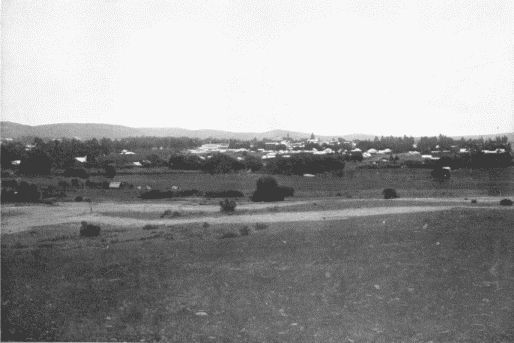
PRETORIA FROM THE EAST.
Photo by Wilson, Aberdeen.
ACCUMULATED AGGRAVATIONS
Since it is impossible to enter into all the intricacies of foreign
political relations with the Transvaal, we will return to the
Uitlanders. They became more and more unwelcome as their numbers
increased. Many Acts were passed, each serving to render more impossible
their chances of obtaining the franchise. The fact was that Mr. Kruger,
having brought his State to a condition of bankruptcy almost identical
with that which existed when Sir T. Shepstone annexed the Transvaal, was
struggling to carry on a divided scheme, that of grabbing with both
hands from the Uitlander financialists, while endeavouring to maintain
with close-fisted obstinacy the exclusiveness, irresponsibility, and
bigotry of the primitive trekker. He knew that if he granted full
political rights to the outsiders he would no longer be master of his
own misguided house. He said as much, and pointed out that were he to do
so there would be no alternative but to haul down his flag. This being
the case, there was no resource but to transform the so-called free
Republic into an absolute oligarchy. Much has been said of the "Russian
despot," but this century can present no more complete spectacle of
despotism than that of Mr. Kruger. The Emperor of Russia, autocrat as he
is, is guided by the traditions of his empire and the machinations of
his ministers, but Mr. Kruger has allowed himself to be reasoned with
and influenced by none, and his word has been in reality the only form
of law or justice on which the Uitlanders have had to rely. Such system
of government as there was was corrupt. Smuggling flourished under the
very eye of the officials, and the Field Cornets, whose business it was
to act as petty justices, collect taxes, and register arrivals of
new-comers, kept their books in a manner more in accord with their
personal convenience than with accuracy. Hence, when it came to the
question of the naturalisation of the Uitlanders, the books which should
have recorded their registration were either withheld or missing.
Settlers in the Transvaal between the years 1882 and 1890, owing to this
irregularity, were debarred from proving their registration as the law
required. Speaking of this period, Mr. Fitzpatrick, in "The Transvaal
from Within," says:—
"In the country districts justice was not a commodity intended for the
Britisher. Many cases of gross abuse, and several of actual murder
occurred, and in 1885 the case of Mr. Jas. Donaldson, then residing on a
farm in Lydenburg—lately one of the Reform prisoners—was mentioned in
the House of Commons, and became the subject of a demand by the Imperial
Government for reparation and punishment. He had been ordered by two
Boers (one of whom was in the habit of boasting that he had shot an
unarmed Englishman in Lydenburg since the war, and would shoot others)
to abstain from collecting hut taxes on his own farm; and on refusing
had been attacked by them. After beating them off single-handed, he was
later on again attacked by his former assailants, reinforced by three
others. They bound him with reims (thongs), kicked and beat him with
sjamboks (raw-hide whips) and clubs, stoned him, and left him
unconscious and so disfigured that he was thought to be dead when found
some hours later. On receipt of the Imperial Government's
representations, the men were arrested, tried, and fined. The fines were
stated to have been remitted at once by Government, but in the civil
action which followed Mr. Donaldson received £500 damages. The incident
had a distinctly beneficial effect, and nothing more was heard of the
maltreatment of defenceless men simply because they were Britishers."
Nevertheless the hostility between the two races was growing apace, and
every ambition of the Uitlanders was promptly nipped in the bud.
Reforms were at first mildly suggested. Bridges and roads were required,
also a remission of certain taxes, but suggestions, even agitations,
were in vain. In regard to the franchise question—the crying question
of the decade—Mr. Kruger turned an ear more and more deaf. There are
none so deaf as those whose ears are stopped up with the cotton-wool of
their own bigotry. This bigotry it is almost impossible for enlightened
persons to understand. As an instance of the almost fanatical ignorance
and prejudice with which the Uitlanders had to contend, we may quote the
letter of Mr. Kruger when requested to allow his name to be used as a
patron of a ball to be given in honour of her Majesty's birthday. He
replied:—
"Sir,—In reply to your favour of the 12th inst., requesting me
to ask his Honour the State President to consent to his name
being used as a patron of a ball to be given at Johannesburg on
the 26th inst., I have been instructed to inform you that his
Honour considers a ball as Baal's service, for which reason the
Lord ordered Moses to kill all offenders; and as it is
therefore contrary to his Honour's principles, his Honour
cannot consent to the misuse of his name in such connection.—I
have, &c.,
"F. Eloff,
Private Secretary."
On another occasion, when the question of locust extermination came
before the first Raad, the worthies to whom the conduct of the State was
confided showed a condition of benighted simplicity that can scarcely be
credited.
"July 21.—Mr. Roos said locusts were a plague, as in the days of King
Pharaoh, sent by God, and the country would assuredly be loaded with
shame and obloquy if it tried to raise its hand against the mighty hand
of the Almighty.
"Messrs. Declerq and Steenkamp spoke in the same strain, quoting largely
from the Scriptures.
"The Chairman related a true story of a man whose farm was always spared
by the locusts, until one day he caused some to be killed. His farm was
then devastated.
"Mr. Stoop conjured the members not to constitute themselves terrestrial
gods, and oppose the Almighty.
"Mr. Lucas Meyer raised a storm by ridiculing the arguments of the
former speakers, and comparing the locusts to beasts of prey, which they
destroyed.
"Mr. Labuschagne was violent. He said the locusts were different from
beasts of prey. They were a special plague sent by God for their
sinfulness."
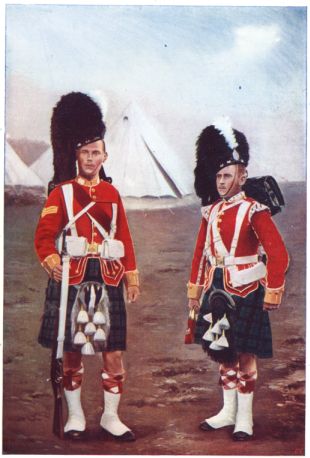
SERGEANT and BUGLER, 1st ARGYLE AND SUTHERLAND HIGHLANDERS.
Photo by Gregory & Co., London.
Their deliberate unenlightenment, had it not been so tragic for those
who suffered in consequence of it, must have been almost comical. On one
occasion the question of firing at the clouds to bring down rain was
discussed, and declared to be impious.
"August 5.—A memorial was read from Krugersdorp, praying that the
Raad would pass a law to prohibit the sending up of bombs into the
clouds to bring down rain, as it was a defiance of God, and would most
likely bring down a visitation from the Almighty.
"The Memorial Committee reported that they disapproved of such a thing,
but at the same time they did not consider that they could make a law on
the subject.
"Mr. A. D. Wolmarans said he was astonished at the advice, and he
expected better from the Commission. If one of their children fired
towards the clouds with a revolver they would thrash him. Why should
they permit people to mock at the Almighty in this manner? It was
terrible to contemplate. He hoped that the Raad would take steps to
prevent such things happening.
"The Chairman (who is also a member of the Memorial Commission) said the
Commission thought that such things were only done for a wager.
"Mr. Erasmus said they were not done for a wager, but in real earnest.
People at Johannesburg actually thought that they could bring down the
rain from the clouds by firing cannons at them."
These quotations are not offered in the spirit of ridicule. The
Uitlander question is too serious for joking. They are reproduced to
enable those who have no knowledge of the Boer—his petty tyrannies and
annoying and irritating habits, and the vexatious regulations from which
the Uitlander continually suffered—to form an idea of the terrible
mental gulf which existed between oppressor and oppressed. As the
constant dropping of water will wear away stone, so the constant fret of
Boer treatment wore out the patience of their victims!
It soon became very difficult for even sons of Uitlanders born in the
country to obtain the franchise. The naturalised subject resigned his
own nationality, and acquired the duties of the citizen and the
liability to be called on for military service, only to find out that he
could not even then enjoy the rights of the citizen. He felt much as the
dog in the fable, which let drop his piece of meat for the sake of a
reflection in the water. New laws and regulations continually came into
force for the ostensible purpose of improving the state of the
Uitlander—laws which in reality were created to bamboozle him still
further. What chicanery failed to accomplish the remissness of officials
successfully brought about, and the discomfort of the foreign
inhabitants was complete. Beside domestic there were economic
grievances. The position in a nutshell is given by one of the
unfortunates:—
"The one thing which we must have—not for its own sake, but for the
security it offers for obtaining and retaining other reforms—is the
franchise. No promise of reform, no reform itself will be worth an
hour's purchase unless we have the status of voters to make our
influence felt. But, if you want the chief economic grievances, they
are—the Netherland Railway concession, the dynamite monopoly, the
liquor traffic, and native labour, which, together, constitute an
unwarrantable burden of indirect taxation on the industry of over two
and a half millions sterling annually. We petitioned until we were
jeered at; we agitated until we—well—came here (Pretoria Gaol); and we
know that we shall get no remedy until we have the vote to enforce it.
We are not a political but a working community, and if we were honestly
and capably governed, the majority of us would be content to wait for
the franchise for a considerable time yet in recognition of the peculiar
circumstances and of the feelings of the older inhabitants."
Mrs. Lionel Phillips, as the wife of an Uitlander, has also written her
plaint. She says:—
"To show that the grievances of the Uitlanders are indeed real, let me
call your attention to a few facts. What would women residing in
peaceful England say to the fact that one cannot take a walk out of
sight of one's own house in the suburbs of Johannesburg with safety? The
Kaffirs, who in other parts of South Africa treat a white woman with
almost servile respect, there make it a most unpleasant ordeal to pass
them, and in a lonely part absolutely dangerous.
"Even little girls of the tenderest age are not safe from these
monsters. This is, of course, owing to the utterly inadequate police
protection afforded by the Government, the ridiculously lenient
sentences passed on horrible crimes, and to the adulterated drink sold
by licensed publicans to the Kaffirs on all sides. What would be said
if, when insulted by a cab-driver, it was found that the nearest
policeman was the owner of the cab in question, and refused to render
any assistance or listen to any complaint?
"The educational grievance has been so widely circulated that it is
needless to mention it now; but what is to be expected of a Government
composed of men barely able to write their own names?
"Of course I, as a woman, do not wish to enter into the larger questions
of franchise, monopolies, taxation, &c., but being myself an Africander,
and well able to recognise the many good qualities of the Boers, you
will quite understand that I do not take a prejudiced view of the
situation, and I am in a position better than that of most people to
understand the grave reality of the Uitlanders' grievances."
MONOPOLIES AND ABUSES
Of the scandals leading out of the Netherlands Railway concession and
the dynamite monopoly it is needless to speak. These monopolies were
little more than schemes having for object the diversion of money from
the pockets of the British into those either of the Boers or their
trusty satellites in the Hollander-German clique. As an instance of the
modus operandi, an article relative to the railway monopoly in the
Johannesburg Mining Journal may be quoted:
"Railway Monopoly
"This is another carefully designed burden upon the mines and
country. The issued capital and loans of the Netherlands
Company now total about £7,000,000, upon which an average
interest of about 51⁄3 per cent.—guaranteed by the State—is
paid, equal to £370,000 per annum. Naturally the bonds are at a
high premium. The company and its liabilities can be taken over
by the State at a year's notice, and the necessary funds for
this purpose can be raised at three per cent. An offer was
recently made to the Government to consolidate this and other
liabilities, but the National Bank, which is another
concession, has the monopoly of all State loan business, and
this circumstance effectually disposed of the proposal. At
three per cent. a saving of £160,000 per annum would be made in
this monopoly in interest alone. The value represented by the
custom dues on the Portuguese border we are not in a position
to estimate, but roughly these collections and the fifteen per
cent. of the profits paid to the management and shareholders
must, with other leakages, represent at least another £100,000
per annum which should be saved the country. As the revenue of
the corporation now exceeds £2,000,000 a year, of which only
half is expended in working costs, the estimate we have taken
does not err upon the side of extravagance. By its neglect of
its duties towards the commercial and mining community enormous
losses are involved. Thus in the coal traffic the rate, which
is now to be somewhat reduced, has been 3d. per ton per mile.
According to the returns of the Chamber of Mines, the coal
production of the Transvaal for 1895 was 1,045,121 tons. This
is carried an average distance of nearly thirty miles, but
taking the distance at twenty-four miles the charges are 6s.
per ton. At 1½d. per ton per mile—three times as much as
the Cape railways charge—a saving upon the coal rates of 3s.
per ton would follow, equal to £150,000 per annum. Again, by
the 'bagging' system an additional cost of 2s. 3d. per ton is
incurred—details of this item have been recently published in
this paper—and if this monopoly were run upon ordinary
business lines, a further saving of £110,000 would be made by
carrying coal in bulk. The interest upon the amount required to
construct the necessary sidings for handling the coal, and the
tram-lines required to transport it to the mines, would be a
mere fraction upon the amount; and as the coal trade in the
course of a short time is likely to see a fifty per cent.
increase, the estimate may be allowed to stand at this figure
without deduction. No data are available to fix the amount of
the tax laid upon the people generally by the vexatious delays
and losses following upon inefficient railway administration,
but the monthly meetings of the local Chamber of Commerce throw
some light upon these phases of a monopolistic management. The
savings to be made in dealing with the coal traffic must not be
taken as exhausting all possible reforms: the particulars given
as to this traffic only indicate and suggest the wide area
covered by this monopoly, which hitherto has made but halting
and feeble efforts to keep pace with the requirements of the
public. Dealing as it does with the imports of the whole
country, which now amount in value to £10,000,000, the figures
we have given must serve merely to illustrate its invertebrate
methods of handling traffic, as well as its grasping greed in
enforcing the rates fixed by the terms of its concession. Its
forty miles of Rand steam tram-line and thirty-five miles of
railway from the Vaal River, with some little assistance from
the Delagoa line and customs, brought in a revenue of about
£1,250,000 in 1895. Now that the Natal line is opened the
receipts will probably amount to nearly £3,000,000 per annum,
all of which should swell the ordinary revenue of the country
instead of remaining in the hands of foreigners as a reservoir
of wealth for indigent Hollanders to exploit. The total railway
earnings at the Cape and Natal together over all their lines
amounted to £3,916,566 in 1895, and the capital expenditure on
railways by these colonies amounts to £26,000,000. The greater
portion of these receipts come from the Rand trade, which is
compelled to pay an additional £2,500,000 carrying charges to
the Netherlands Company, which has £7,000,000 of capital. Thus,
railway receipts in South Africa amount now to £7,000,000 per
annum, of which the Rand contributes at least £5,000,000.
"The revenue of the company is now considerably over £3,000,000
per annum. The management claim that their expenses amount to
but forty per cent. of revenue, and this is regarded by them as
a matter for general congratulation. The Uitlanders contend
that the concern is grossly mismanaged, and that the low cost
of working is a fiction. It only appears low by contrast with a
revenue swollen by preposterously heavy rates and protected by
a monopoly. The tariff could be reduced by one-half, that is to
say, a remission of taxation to the tune of one and a half
million annually could be effected without depriving the
company of a legitimate and indeed very handsome profit."
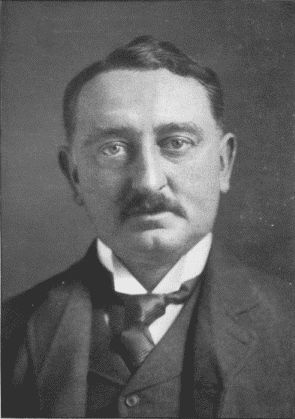
Rt. Hon. CECIL JOHN RHODES, P.C.
Photo by Elliott & Fry, London.
Perhaps the dynamite monopoly was even more aggravating than the railway
one. Mr. Fitzpatrick says it has always been "a very burning question
with the Uitlanders. This concession was granted soon after the
Barberton Fields were discovered, when the prospects of an industry in
the manufacture of explosives were not really very great. The
concessionaire himself has admitted that, had he foreseen to what
proportions this monopoly would eventually grow, he would not have had
the audacity to apply for it. Of course, this is merely a personal
question. The fact which concerned the industry was that the right was
granted to one man to manufacture explosives, and to sell them at a
price nearly 200 per cent. over that at which they could be imported.
It was found, upon investigation after some years of agitation, that the
factory at which this 'manufacture' took place was in reality merely a
depôt in which the already manufactured article was manipulated to a
moderate extent, so as to lend colour to the President's statement that
a local industry was being fostered. An investigation, held by order of
the Volksraad, exposed the imposition. The President himself stated that
he found he had been deceived, and that the terms of the concession had
been broken, and he urged the Raad to cancel it, which the Raad did. The
triumph was considerable for the mining industry, and it was the more
appreciated in that it was the solitary success to which the Uitlanders
could point in their long series of agitations for reform. But the
triumph was not destined to be a lasting one. Within a few months the
monopoly was revived in an infinitely more obnoxious form. It was now
called a Government monopoly, but 'the agency' was bestowed upon a
partner of the gentleman who had formerly owned the concession, the
President himself vigorously defending this course, and ignoring his own
judgment on the case uttered a few months previously. Land en Volk,
the Pretoria Dutch newspaper, exposed the whole of this transaction,
including the system of bribery by which the concessionaires secured
their renewal, and among other things made the charge which it has
continued to repeat ever since, that Mr. J. M. A. Wolmarans, member of
the Executive, received a commission of one shilling per case on every
case sold during the continuance of the agency as a consideration for
his support in the Executive Council, and that he continues to enjoy
this remuneration, which is estimated now to be not far short of £10,000
a year. Mr. Wolmarans, for reasons of pride or discretion, has declined
to take any notice of the charge, although frequently pressed to take
action in the matter. It is calculated that the burden imposed upon the
Witwatersrandt mines alone amounts to £600,000 per annum, and is, of
course, daily increasing."
Between the years 1890 and 1895 there were many negotiations over
Swaziland. The South African Republic, ever anxious to extend its
borders, longed to advance eastward to the sea. Negotiations were
started in regard to this arrangement. The Transvaal had recognised the
British occupation of Rhodesia, and the British in return agreed to
allow the Transvaal to make a railway through Amatongaland to Kosi Bay,
and acquire a seaport, if, within three years, it joined the South
African Customs Union.
But Mr. Kruger, luckily for Imperial interests, would not entertain the
idea. He did not want to come into confederation with the Cape. The
Orange Free State, however, joined the Cape system, and the South
African Customs Union was started. The advantages to the Free State of
this arrangement, though unforeseen, were many; the principal being the
privilege of importing, unmolested, arms and ammunition over the Cape
Government railway lines. Finally, in 1895, the administration of
Swaziland was transferred to the South African Republic on certain
conditions. It was not to be incorporated with the Republic, European
settlers were to have full burgher rights, monopolies were forbidden,
English and Dutch languages were to be on an equal footing, and no
duties higher than the maximum tariff rates imposed by the South African
Republic or by the Customs Union were to be allowed. The territory of
Amatongaland was annexed by the British in 1895, and the Transvaal thus
lost its one chance of an outlet towards the sea.
THE FRANCHISE
The much-vexed question of the Franchise continued to rankle in the
hearts of the Uitlanders. Its ramifications had grown so complicated
that even lawyers in discussing the matter continually found themselves
in error. We may therefore be excused from attempting to examine its
niceties, or rather its—well—the reverse. In 1893 a petition, signed
by upwards of 13,000 aliens in favour of granting the extension of the
Franchise, was received by the Raad with derision. In 1895 a monster
petition was got up by the National Union, an organisation formed for
the purpose of righting the wrongs of the Uitlanders. During the great
Franchise debate in August 1895, Mr. R. K. Loveday, one of the Loyalists
in the war, in the course of an address dealing with the subject,
expressed himself very definitely and concisely, and in a manner which
could not be refuted. He said—
"The President uses the argument that they should naturalise, and thus
give evidence of their desire to become citizens. I have used the same
argument, but what becomes of such arguments when met with the
objections that the law requires such persons to undergo a probationary
period extending from fourteen to twenty-four years before they are
admitted to full rights of citizenship, and even after one has undergone
that probationary period he can only be admitted to full rights by the
resolution of the First Raad? Law IV. of 1890, being the Act of the two
Volksraads, lays down clearly and distinctly that those who have been
eligible for ten years for the Second Raad can be admitted to full
citizenship. So that, in any case, the naturalised citizen cannot obtain
full rights until he reaches the age of forty years, he not being
eligible for the Second Raad until he is thirty years. The child born of
non-naturalised parents must therefore wait until he is forty years of
age, although at the age of sixteen he may be called upon to do military
service, and may fall in the defence of the land of his birth. When such
arguments are hurled at me by our own flesh and blood—our kinsmen from
all parts of South Africa—I must confess I am not surprised that these
persons indignantly refuse to accept citizenship upon such unreasonable
terms. The element I have just referred to—namely, the Africander
element—is very considerable, and numbers thousands, hundreds of whom,
at the time this country was struggling for its independence, accorded
it moral and financial support, and yet these very persons are subjected
to a term of probation extending from fourteen to twenty-four years. It
is useless for me to ask you whether such a policy is just and
reasonable or Republican, for there can be but one answer, and that is
'No!' Is there one man in this Raad who would accept the Franchise on
the same terms? Let me impress upon you the grave nature of this
question, and the absolute necessity of going to the burghers without a
moment's delay and consulting and advising them. Let us keep nothing
from them regarding the true position, and I am sure we shall have their
hearty co-operation in any reasonable scheme we may suggest. This is a
duty we owe them, for we must not leave them under the impression that
the Uitlanders are satisfied to remain aliens, as stated by some of the
journals. I move amongst these people, and learn to know their true
feelings, and when public journals tell you that these people are
satisfied with their lot they tell you that which they know to be false.
Such journals are amongst the greatest sources of danger that the
country has. We are informed by certain members that a proposition for
the extension of the Franchise must come from the burghers, but,
according to the Franchise Law, the proposition must come from the Raad,
and the public must consent. The member for Rustenberg says that there
are 9338 burghers who have declared that they are opposed to the
extension of the Franchise. Upon reference to the Report he will find
that there are only 1564 opposed to the extension. Members appear afraid
to touch upon the real question at issue, but try to discredit the
memorials by vague statements that some of the signatures are not
genuine, and the former member for Johannesburg, Mr. J. Meyer, seems
just as anxious to discredit the people of Johannesburg as formerly he
was to defend them."
In spite of all that was said and done, however, no progress was made.
The debate was closed on the third day, the request of the memorialists
was refused, and they were referred for satisfaction to the existing
laws.
About this time the Transvaal came very near to war with Great Britain.
As before stated, Mr. Kruger was much bound up with the affairs of the
Netherlands Railway Company and its Hollander-German promoters. He
attempted to divert the stream of Johannesburg traffic to Delagoa Bay,
for the purpose of keeping profit from the pockets of the British. The
freights, however, were evaded by unloading the goods at the frontier,
and taking them across the Vaal in waggons. It was easy thus to forward
goods—between Johannesburg and Viljoens Drift—direct by the Cape
Railway.
But Mr. Kruger was not to be defeated. In October 1895, he closed the
drifts or fords of the Vaal to all waggon loads of goods from Cape
Colony. Unfortunately the President had over-reached himself. The people
of Cape Colony and those of the Free State were indignant, and the High
Commissioner, Sir Hercules Robinson, and the Cape Premier, Mr. Rhodes,
both brought their influence to bear on the President. He was obdurate.
Mr. Chamberlain, the new Colonial Secretary, came to the rescue. He put
his foot down, and a determined foot it was. He sent an ultimatum to Mr.
Kruger announcing that closure of the drifts after the 15th of November
would be considered an act of war.
The drifts were reopened. But the Netherlands Railway Company still
stuck to their tariffs and their aim of depriving the British Colonies
of the custom dues and railway rates on the traffic of Johannesburg.
Consequently this thorn in the side of the British Colonists was left to
fester.
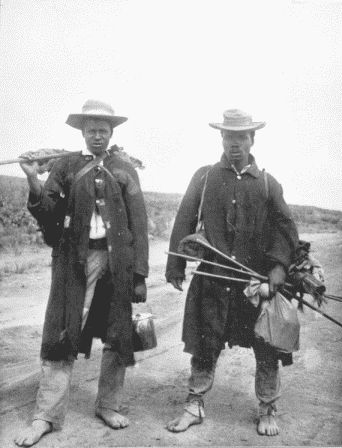
SOUTH AFRICAN NATIVES—BOUND FOR THE GOLD-FIELDS.
Photo by Wilson, Aberdeen.
Day by day the discontent grew, and the cry of "No taxation without
representation" became the Uitlanders' motto. They perceived that they
were deprived of rights, yet expected to serve as milch cows for the
fattening of a State that was arming itself at all points against them,
and they came to the conclusion that some strong measures must now be
taken for their protection. The Chamber of Mines and the Transvaal
National Union had spent some time in advocating purely constitutional
methods, the Chamber of Mines exploiting the grievances of the Gold
Mining industry, while the National Union struggled for general reforms
which should make the conditions of Uitlander life less intolerable than
they were. The Reformers, whose chairman was Mr. Charles Leonard, a
solicitor of good practice in Johannesburg, were mostly men of the
middle and professional classes. The capitalists, being anxious to keep
in with the Transvaal Government, were somewhat shy of the National
Unionists; while the working men on their side were suspicious of the
motives of the Reformers, and were chary of lending themselves to any
scheme which might conduce to the profit of the millionaires. The
National Union clearly expressed its aims in a manifesto which ended
with the exposition of the Charter which its members hoped to obtain. It
said:
"We want—
1. The establishment of this Republic as a true Republic.
2. A Grondwet, or Constitution, which shall be framed by competent
persons selected by representatives of the whole people, and framed on
lines laid down by them.
3. An equitable Franchise Law and fair representation.
4. Equality of the Dutch and English languages.
5. Responsibility to the Legislature of the heads of the great
departments.
6. Removal of religious disabilities.
7. Independence of the Courts of Justice with adequate and secured
remuneration of the Judges.
8. Liberal and comprehensive Education.
9. Efficient Civil Service, with adequate provision for pay and pension.
10. Free Trade in South African products."
The Manifesto wound up with the pertinent question, "How shall we get
it?"
The "how" was to have been decided at a public meeting fixed for the
27th of December 1895, and subsequently postponed till January 8th,
1896. But what the National Union proposed the Jameson Raid disposed.
The meeting was destined never to take place!
THE REFORM MOVEMENT
Before 1895 the wealthier members of the community refused to entertain
the suggestion of coercive measures, but after the Volksraad in session
revealed the real policy of the Government, even they began to perceive
that revolutionary action might become obligatory. Though the
capitalists were advised by those who knew to avoid spending money on
hopeless efforts at reform, and to steer clear, if possible, of the
political imbroglio, they eventually joined hands with the Reformers.
How the egg of the Jameson conspiracy came to be laid no one exactly
knew. Certain it was that those who looked for the hatching of a swan,
were confronted with a very ugly duckling indeed! Arms and ammunition
were purchased, and these, concealed as gold-mining impedimenta, were
smuggled into the country. Messrs. Leonard and Phillips, two prominent
Reformers, consulted Mr. Rhodes as to future affairs, but Mr. Rhodes was
in the awkward position of acting at one and the same time as Managing
Director of the Consolidated Gold Fields in the Transvaal, Prime
Minister of the Colony, and Managing Director of the Chartered Company,
and consequently was a little vague in his propositions. After some
conversation, he decided that he would, at his own expense, keep Dr.
Jameson and his troops on the frontier "as a moral support."
Later on in September Dr. Jameson visited Johannesburg, and made his
arrangements in person. It was agreed that he should maintain a force of
1500 mounted men, fully equipped, and that besides, having with him 1500
spare rifles, and some spare ammunition, there should be about 5000
rifles, three Maxims, and 1,000,000 rounds of ammunition smuggled into
Johannesburg. The idea was, that the Uitlanders would prepare their
revolt, and that should Dr. Jameson's services be needed, Johannesburg,
with 9000 armed men and a fair equipment of machine guns and cannon,
would be prepared to co-operate: at that time it seemed no difficult
matter to seize the fort and magazines at Pretoria for the time being.
It was in course of repair, and in charge merely of a hundred men, most
of whom could be relied on to be asleep or off duty after nine o'clock
at night. The plan of seizing the fort, capturing the ammunition, and
clearing it off so as to enforce their views without bloodshed seemed
perfectly feasible, and Dr. Jameson readily agreed to lend himself to
the scheme for giving such "moral support" as was required by the
Uitlander Reformers. Of their part in the affair it is difficult to
speak impartially. It appears on the surface that they induced this man,
for no personal motive either of financial gain or political power, to
lend himself willingly to be the tool of the aggrieved Uitlanders, who,
when the time came, were too vacillating between their fear of the
Republic and the desire for their own individual good, to support the
person whom they had chosen for their champion, and who so
disinterestedly was prepared to risk both life and position in their
service! It was decided, however, that the Reformers should arrange a
revolution, which would have the effect of forcing the hands of the
Transvaal Government. The High Commissioner, as they imagined, would
come on the scene as a final arbitrator. Dr. Jameson's troops, who had
acted so effectively in the Matabele campaign, were to be kept at
Pitsani on the Bechuana border, in order if necessary to come at a
given signal to the rescue of the Uitlanders. The idea was not without
precedent. Sir Henry Loch, two years before, in dread of a Johannesburg
rising, had considered the advisability of placing troops on the border.
So as to justify his action to the directors of the Chartered Company
and the Imperial authorities, the following undated letter was sent to
Dr. Jameson, Mafeking:—
"Dear Sir,—The position of matters in this State has become so
critical, that we are assured that at no distant period there will be a
conflict between the Government and the Uitlander population. It is
scarcely necessary for us to recapitulate what is now matter of history;
suffice it to say, that the position of thousands of Englishmen, and
others, is rapidly becoming intolerable. Not satisfied with making the
Uitlander population pay virtually the whole of the revenue of the
country while denying them representation, the policy of the Government
has been steadily to encroach upon the liberty of the subject, and to
undermine the security for property to such an extent as to cause a very
deep-seated sense of discontent and danger. A foreign corporation of
Hollanders is to a considerable extent controlling our destinies, and in
conjunction with the Boer leaders endeavouring to cast them in a mould
which is wholly foreign to the genius of the people. Every public act
betrays the most positive hostility, not only to everything English, but
to the neighbouring States.
"Well, in short, the internal policy of the Government is such as to
have roused into antagonism to it not only practically the whole body of
Uitlanders, but a large number of the Boers; while its external policy
has exasperated the neighbouring States, causing the possibility of
great danger to the peace and independence of this Republic. Public
feeling is in a condition of smouldering discontent. All the petitions
of the people have been refused with a greater or less degree of
contempt; and in the debate on the Franchise petition, signed by nearly
40,000 people, one member challenged the Uitlanders to fight for the
rights they asked for, and not a single member spoke against him. Not to
go into details, we may say that the Government has called into
existence all the elements necessary for armed conflict. The one desire
of the people here is for fair play, the maintenance of their
independence, and the preservation of those public liberties without
which life is not worth living. The Government denies these things, and
violates the national sense of Englishmen at every turn.
"What we have to consider is, what will be the condition of things here
in the event of a conflict? Thousands of unarmed men, women, and
children of our race will be at the mercy of well-armed Boers, while
property of enormous value will be in the greatest peril. We cannot
contemplate the future without the gravest apprehensions. All feel that
we are justified in taking any steps to prevent the shedding of blood,
and to ensure the protection of our rights.
"It is under these circumstances that we feel constrained to call upon
you to come to our aid should a disturbance arise here. The
circumstances are so extreme that we cannot but believe that you and the
men under you will not fail to come to the rescue of people who will be
so situated. We guarantee any expense that may reasonably be incurred by
you in helping us, and ask you to believe that nothing but the sternest
necessity has prompted this appeal.
"Charles Leonard.
Lionel Phillips.
Francis Rhodes.
John Hays Hammond.
George Farrar."
It was arranged that Dr. Jameson should start from camp on the night of
the outbreak at Johannesburg—either on the 28th of December or on the
4th of January—according to notice which would subsequently be given.
From this moment, however, doubts began to fill the minds of the
Reformers. They were dissatisfied with the quantity of arms they had
been able to smuggle into the town; there was a want of cohesion among
the different sections, of those interested; they went so far as to
disagree as to what flag they were going to revolt under. The Reformers
were evidently not all of Dr. Jameson's opinion, that the Union Jack was
the one and only flag under which they could hope for justice—they
were, as we know, only comrades in suffering but not compatriots, and
besides this, many declared that reform and not annexation was what they
were anxious to secure.
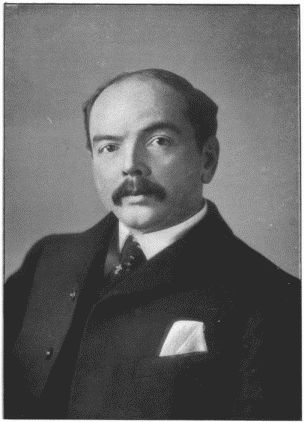
Dr Leander Starr Jameson.
Photo by Elliott & Fry, London.
Here we have before us what made the complicated riddle of the Raid.
Since it has defied all the Œdipuses of the century, we will not
endeavour to unravel it. Did the Reformers set all their grievances
aside before the paramount question, "Under which flag, Jameson?" or did
they make use of the flag argument to cover a series of vacillations
which prevented them from acting up to the rules of the conspiracy they
themselves had set on foot? Did Mr. Rhodes engage in the plot for the
sake of financial gain? Did he do so out of sympathy for the "cause," or
did he attempt a magnificent political coup? And lastly—Did that
unhappy scapegoat, the gallant Jameson, launch himself on the wild
mistaken escapade to rescue his fellow-countrymen from oppression, to
serve his private ends financial or political, or from the sheer spirit
of adventure which, in some degree, animates every British heart? Who
shall say?
THE CRITICAL MOMENT
It was arranged, as has been mentioned, that the rising at Johannesburg
should take place on the night of the 4th of January. The arsenal at
Pretoria was to be seized, and Dr. Jameson with his troops was to make
his appearance, assist the Reformers in urging their claims, and, if
necessary, save the women and children from possible violence.
"According to the original plan," says Mrs. Lionel Phillips in her
"South African Recollections," "what with the smuggled rifles, those in
private hands, the spare weapons to be brought by Jameson's men, and
those men (the Reformers) themselves, Johannesburg must have mustered a
little army of not less than 5000 men, to say nothing of the guns which
might possibly be captured in the arsenal. It was believed that with
this force the town could be held against any attack that might be made
by the Transvaal forces, and that, upon a failure in the first assault,
the Boers would have adopted their well-known tactics of cutting off
supplies, with a view to starving the town into submission. To meet this
contingency the town was provisioned for two months, and it was supposed
that the British Government would never sit still and allow the
Uitlanders to be forced into capitulation in the face of the wrongs
which they had suffered. In November, when Jameson came to Johannesburg,
the supporting force had dwindled to 800. The telegrams apprising the
Reformers of his advance spoke of 700, and in reality he started with
less than 500 men."
But by the time the plot should have neared completion, the
conspirators, as has been shown, had ceased to be of one accord on the
subject. On Christmas Day Mr. Leonard interviewed Mr. Rhodes in Cape
Town, and represented to him the divided state of affairs. Meanwhile the
Reformers in Johannesburg desired to make known to Dr. Jameson their
change of front, and, to prevent him starting on the expedition,
despatched two messengers to Pitsani Camp by different routes. These
messages were received on December the 28th, and with them other
telegraphic ones from Mr. Leonard and Mr. Rhodes explicitly directing
the expedition not to start.
The news that Dr. Jameson had started, in spite of these messages, came
on the Reformers like a thunderclap. They were not ready—they had not
sufficient arms to fight with, and they were not of one mind. The doing
had been easy enough, and they had fancied the undoing would be as
simple. They had laid their gunpowder train without thinking of the
number of firebrands that surrounded it! Amazement gave way to
indignation, and the Reformers were not slow to hint that Mr. Rhodes or
Dr. Jameson had disregarded the messages in order to further their
personal ends. The most charitable decided that the Doctor's starting
was due merely to misunderstanding. Many rumours of discontent and
disturbance were floating about, and it was believed that some of these
might have reached the Doctor's ears and influenced his actions. Anyway
the Reformers were at sea. All they could do was to arm as many men as
possible with a view to defence—to holding the town against any attack
that might be made by the Transvaal forces, and to decide to take no
initiative against the Boers. No uneasiness was felt regarding Jameson,
for it was believed that he was well supported by not less than 800 men,
and that the Boers would stand a poor chance against a body so well
equipped and trained as his was supposed to be. The position taken up is
explained in a notice of the Reform Committee in the Johannesburg
Star:—"Notice is hereby given, that this Committee adheres to the
National Union Manifesto, and reiterates its desire to maintain the
independence of the Republic. The fact that rumours are in course of
circulation to the effect that a force has crossed the Bechuanaland
border, renders it necessary to take active steps for the defence of
Johannesburg and the preservation of order. The Committee earnestly
desires that the inhabitants should refrain from taking any action which
can be considered as an overt act of hostility against the Government."
The High Commissioner and the Premier of Cape Colony were communicated
with and informed that Dr. Jameson, having started with an armed force,
Johannesburg was in peril which there was no means to avert. The High
Commissioner was further invited to come to Johannesburg to effect a
settlement and prevent civil war. Arrangements were then made for the
arming of some 2000 men. These preparations and others speedily became
known to the Government in Pretoria. No steps, it appears, had been
taken to preserve secrecy, as the Committee did not hold themselves
responsible for Dr. Jameson's action. The result was the publication of
the following Proclamation by the President:—
"Proclamation by his Honour the State President of the South African
Republic
"Whereas, it has appeared to the Government of the South African
Republic that there are rumours in circulation to the effect that
earnest endeavours are being made to endanger the public safety of
Johannesburg; and whereas the Government is convinced that, in case such
rumours may contain any truth, such endeavours can only emanate from a
small portion of the inhabitants, and that the greater portion of the
Johannesburg inhabitants are peaceful, and are prepared to support the
Government in its endeavours to maintain law and order.
"Now, know you that I, Stephanus Johannes Paulus Kruger, State President
of the South African Republic, with the advice and consent of the
Executive Council, according to Article 913 of its minutes, dated the
30th of December 1895, do hereby warn those evil-intentioned persons (as
I do hereby urge all such persons to do) to remain within the pale of
the law, and all such persons not heeding this warning shall do so on
their own responsibility; and I do further make known that life and
property shall be protected against which attempts may be made, and that
every peaceful inhabitant of Johannesburg, of whatsoever nationality he
may be, is called upon to support me herein, and to assist the officials
charged therewith; and further be it known, that the Government is still
prepared to take into consideration all grievances that may be laid
before it in a proper manner, and to submit the same to the people of
the land without delay for treatment."
The High Commissioner also issued a Proclamation calling on Dr. Jameson
to return to British territory at once, and this was forwarded to him at
different points in order that there might be no mistake and that the
invasion might yet be arrested. Meanwhile Mr. Marais (the editor of the
leading Dutch paper) and Mr. Malan (the son-in-law of Joubert) were
proceeding with a commando for the purpose of fighting for their
Government should Dr. Jameson disobey the Proclamation. They excused
themselves under the plea "that if from unreasonable action of
Johannesburg, fighting should take place between the Government forces
and a revolutionary force from Johannesburg, they were in duty bound to
fight, and that among their ranks would be found many who had been
active workers in the ranks of the Reformers."
It was subsequently decided that a deputation of Reformers should
negotiate with the Government for a peaceful settlement on the basis of
the Manifesto. Their programme was somewhat broad. They were to approach
the Government pacifically and at the same time insist on their rights
and the redress of their grievances—"to avow the association of Dr.
Jameson's forces so far as it had existed, and to include him in any
settlement that might be made."
They also, in answer to a telegram from the British Agent, refused to
repudiate Dr. Jameson, and said, "in order to avert bloodshed on grounds
of Dr. Jameson's action, if Government will allow Dr. Jameson to come in
unmolested, the Committee will guarantee with their persons if necessary
that he will leave again peacefully with as little delay as possible."
Meanwhile the committee remained in the most horrible doubt and
suspense. No word came from Jameson. That he had started they knew, and
that was the extent of their knowledge. They still trusted that, on
ascertaining that there was no necessity for intervention on behalf of
the Uitlanders, he and his troops would obey the orders of the High
Commissioner, and retire peacefully from the Transvaal.
THE RAID
From all accounts it appears that Dr. Jameson and his party gathered
together at Pitsani early in December. He drilled his troops and general
preparations were made, without sufficient secrecy however, for the
projected invasion. It was unfortunate for the scheme that these plans
were publicly spoken of in society in England at the same time as they
were merely being discussed in whispers in Johannesburg! On Sunday the
29th of December 1895, Dr. Jameson read aloud to his troops the letter
which has been printed, and which, simultaneously with his departure,
was sent by Dr. Rutherfoord Harris to the Times, to justify the action
which in a few hours would become world famous. This letter the
Reformers subsequently declared was treacherously made use of, as they
had not had occasion to send the appeal therein mentioned. It is evident
that at that time Dr. Jameson believed that his plans were so well
arranged that there would be no bloodshed, that, indeed, he would appear
in the nick of time to afford the "moral support" he had originally
engaged to provide. The troops were to go straight to Johannesburg
before the Boers had time to assemble their forces or to take any
measures to stop him. The Doctor explained that they were marching to
the rescue of the oppressed, and implied that they were going under the
auspices of the British flag. On hearing the latter statement a
considerable number of the troops refused to take part in the
enterprise, and this may account for the fact that while the Reformers
believed Dr. Jameson to be supported by some 800 men or more, he was in
reality accompanied by only 480. Here, in order to give the crude facts
of the Raid as known to the public, we may copy the report of the affair
made by Sir John Willoughby to the War Office:—
"Sir John Willoughby's Report to the War Office
"Official Report of the Expedition that left the Protectorate at the
urgent request of the leading citizens of Johannesburg, with the object
of standing by them and maintaining law and order whilst they were
demanding justice from the Transvaal authorities. By Sir John C.
Willoughby, Bart., Lieutenant-Colonel commanding Dr. Jameson's Forces.
"On Saturday, December 28, 1895, Dr. Jameson received a Reuter's
telegram, showing that the situation at Johannesburg had become acute.
At the same time reliable information was received that the Boers in the
Zeerust and Lichtenburg districts were assembling, and had been summoned
to march on Johannesburg.
"Preparations were at once made to act on the terms of the letter dated
December 20, and already published, and also in accordance with verbal
arrangements with the signatories of that letter—viz., that should Dr.
Jameson hear that the Boers were collecting, and that the intentions of
the Johannesburg people had become generally known, he was at once to
come to the aid of the latter with whatever force he had available, and
without further reference to them, the object being that such force
should reach Johannesburg without any conflict.
"At 3 p.m. on Sunday afternoon, December 29, everything was in readiness
at Pitsani Camp. The troops were paraded, and Dr. Jameson read the
letter of invitation from Johannesburg.
"He then explained to the force—(a) that no hostilities were
intended; (b) that we should only fight if forced to do so in self
defence; (c) that neither the persons nor property of inhabitants of
the Transvaal were to be molested; (d) that our sole object was to
help our fellow-men in their extremity, and to ensure their obtaining
attention to their just demands.
"Dr. Jameson's speech was received with the greatest enthusiasm by the
men, who cheered most heartily.
"The above programme was strictly adhered to until the column was fired
upon on the night of the 31st.
"Many Boers, singly and in small parties, were encountered on the line
of march; to one and all of these the pacific nature of the expedition
was carefully explained.
"The force left Pitsani Camp at 6.30 p.m., December 29, and marched
through the night. At 5.15 a.m., on the morning of the 30th, the column
reached the village of Malmani (thirty-nine miles distant from Pitsani).
Presently, at the same moment, the advanced guard of the Mafeking Column
(under Colonel Grey) reached the village, and the junction was effected
between the two bodies....
"From Malmani I pushed on as rapidly as possible in order to cross in
daylight the very dangerous defile at Lead Mines. This place, distant
seventy-one miles from Pitsani, was passed at 5.30 p.m., December 30.
"I was subsequently informed that a force of several hundred Boers, sent
from Lichtenburg to intercept the force at this point, missed doing so
by three hours only.
"At our next 'off-saddle' Dr. Jameson received a letter from the
Commandant-General of the Transvaal demanding to know the reason of our
advance, and ordering us to return immediately. A reply was sent to
this, explaining Dr. Jameson's reasons in the same terms as those used
to the force at Pitsani.
"At Doomport (ninety-one miles from Pitsani), during an 'off-saddle'
early on Tuesday morning, December 31, a mounted messenger overtook us,
and presented a letter from the High Commissioner, which contained an
order to Dr. Jameson and myself to return at once to Mafeking and
Pitsani.
"A retreat by now was out of the question, and to comply with these
instructions an impossibility. In the first place, there was absolutely
no food for men or horses along the road which we had recently followed;
secondly, three days at least would be necessary for our horses, jaded
with forced marching, to return; on the road ahead we were sure of
finding, at all events, some food for man and beast. Furthermore, we had
by now traversed almost two-thirds of the total distance; a large force
of Boers was known to be intercepting our retreat, and we were convinced
that any retrograde movement would bring on an attack of Boers from all
sides.
"It was felt, therefore, that to ensure the safety of our little force,
no alternative remained but to push on to Krugersdorp to our friends,
who, we were confident, would be awaiting our arrival there.
"Apart from the above considerations, even had it been possible to
effect a retreat from Doomport, we knew that Johannesburg had risen,
and felt that by turning back we should be shamefully deserting those
coming to meet us.
"Finally, it appeared to us impossible to turn back, in view of the fact
that we had been urgently called in to avert a massacre, which we had
been assured would be imminent in the event of a crisis such as had now
occurred.
"Near Boon's store, on the evening of the 31st, an advanced patrol fell
in with Lieutenant Eloff, of the Krugersdorp Volunteers. This officer,
in charge of a party of fifteen scouts, had come out to gain
intelligence of our movements. He was detained whilst our intentions
were fully explained to him, and then released at Dr. Jameson's request.
"At midnight (New Year's Eve), while the advanced scouts were crossing a
rocky, wooded ridge at right angles to and barring the line of advance,
they were fired on by a party of forty Boers, who had posted themselves
in this position. The scouts, reinforced by the advanced guard, under
Inspector Straker, drove off their assailants after a short skirmish,
during which one trooper of the M.M.P. was wounded.
"At Van Oudtshoorn's, early on the following morning (Jan. 1), Dr.
Jameson received a second letter from the High Commissioner, to which he
replied in writing. At 9.30 a.m. the march was resumed in the usual day
formation. After marching two miles the column got clear of the hills,
and emerged into open country.
"About this time Inspector Drury, in command of the rear guard, sent
word that a force of about one hundred Boers was following him about one
mile in rear. I thereupon reinforced the rear guard, hitherto consisting
of a troop and one Maxim, by an additional half troop and another Maxim.
"About five miles beyond Van Oudtshoorn's store the column was met by
two cyclists bearing letters from several leaders of the Johannesburg
Reform Committee. These letters expressed the liveliest approval and
delight at our speedy approach, and finally contained a renewal of their
promise to meet the column with a force at Krugersdorp. The messengers
also reported that only 300 armed Boers were in the town.
"This news was communicated to the troops, who received it with loud
cheers. When about two miles from Hind's store the column was delayed by
extensive wire fencing, which ran for one and a half miles on either
side of the road, and practically constituted a defile.
"While the column was halted and the wire being cut, the country for
some distance on both sides was carefully scouted.
"By this means it was ascertained that there was a considerable force
of Boers (1) on the left front, (2) in the immediate front (retreating
hastily on Krugersdorp), (3) a third party on the right flank.
"The force which had been following the column from Van Oudtshoorn's
continued to hover in the rear.
"Lieutenant-Colonel White, in command of the advanced guard, sent back a
request for guns to be pushed forward as a precaution in case of an
attack from the Boers in front. By the time these guns reached the
advanced guard, the Boers were still retreating some two miles off. A
few rounds were then fired in their direction. Had Colonel White, in the
first instance, opened fire with his Maxims on the Boers, whom he
surprised watering their horses close to Hind's store, considerable loss
would have been inflicted, but this was not our object, for with the
exception of the small skirmish on the previous night, the Boers had not
as yet molested the column, whose sole aim was to reach Johannesburg if
possible without fighting.
"At this hour Hind's store was reached. Here the troops rested for one
and a half hours. Unfortunately, hardly any provisions for men and
horses were available. An officer's patrol, consisting of Major Villiers
(Royal Horse Guards), and Lieutenant Grenfell (1st Life Guards), and six
men, moved off for the purpose of reconnoitring the left flank of the
Boer position, while Captain Lindsell, with his permanent force of
advanced scouts, pushed on as usual to reconnoitre the approach by the
main road. At the same time I forwarded a note to the Commandant of the
forces in Krugersdorp to the effect that, in the event of my friendly
force meeting with opposition on its approach, I should be forced to
shell the town, and that therefore I gave him this warning in order that
the women and children might be moved out of danger.
"To this note, which was despatched by a Boer who had been detained at
Van Oudtshoorn, I received no reply.
"At Hind's store we were informed that the force in our front had
increased during the forenoon to about 800 men, of whom a large number
were entrenched on the hillside.
"Four miles beyond Hind's store the column following the scouts, which
met with no opposition, ascended a steep rise of some 400 feet, and came
full in view of the Boer position on the opposite side of a deep valley,
traversed by a broad 'sluit' or muddy watercourse.
"Standing on the plateau or spur, on which our force was forming up for
action, the view to our front was as follows:—
"Passing through our position to the west ran Hind's store—Krugersdorp
Road traversing the valley and the Boer position almost at right angles
to both lines.
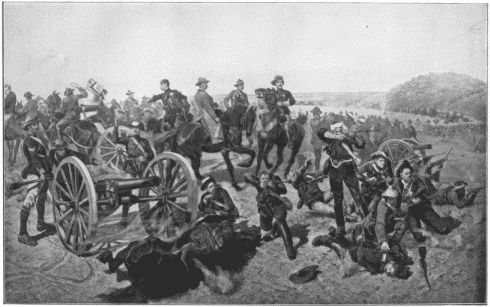
JAMESON'S LAST STAND—THE BATTLE OF DOORNKOP, 2nd JANUARY 1896.
Painting by R. Caton Woodville.
Reproduced by special arrangement with Henry Graves & Co., London.
"Immediately to the north of this road, at the point where it
disappeared over the sky-line on the opposite slope, lay the Queen's
Battery House and earthworks, completely commanding the valley on all
sides, and distant 1900 yards from our standpoint.
"Some 1000 yards down the valley to the north stood a farmhouse,
surrounded by a dense plantation, which flanked the valley.
"Half-way up the opposite slope, and adjacent to the road, stood an iron
house which commanded the drift where the road crossed the
above-mentioned watercourse.
"On the south side of the road, and immediately opposite the last-named
house, an extensive rectangular stone wall enclosure with high trees
formed an excellent advanced central defensive position. Further up the
slope, some 500 yards to the south of this enclosure, stretched a line
of rifle-pits, which were again flanked to the south by 'prospecting'
trenches. On the sky-line numbers of Boers were apparent to our front
and right front.
"Before reaching the plateau we had observed small parties of Boers
hurrying towards Krugersdorp, and immediately on reaching the high
ground the rear-guard was attacked by the Boer force which had followed
the column during the whole morning.
"I therefore had no further hesitation in opening fire on the
Krugersdorp position.
"The two 7-pounders and the 12½-pounder opened on the Boer line,
making good practice under Captain Kincaid-Smith and Captain Gosling at
1900 yards.
"This fire was kept up till 5 p.m. The Boers made practically no reply,
but lay quiet in the trenches and battery.
"Scouts having reported that most of the trenches were evacuated, the
first line, consisting of the advanced guard (a troop of 100 men), under
Colonel White, advanced. Two Maxims accompanied this force; a strong
troop with a Maxim formed the right and left support on either flank.
"Lieutenant-Colonel Grey, with one troop B.B.P. and one Maxim, had been
previously detailed to move round and attack the Boers' left.
"The remaining two troops, with three Maxims, formed the reserve and
rear-guard.
"The first line advance continued unopposed to within 200 yards of the
watercourse, when it was checked by an exceedingly heavy cross-fire from
all points of the defence.
"Colonel White then pushed his skirmishers forward into and beyond the
watercourse.
"The left support, under Inspector Dykes, then advanced to prolong the
first line to the left; but, diverging too much to his left, this
officer experienced a very hot flanking fire from the farmhouse and
plantation, and was driven back with some loss.
"Colonel Grey meanwhile had pushed round on the extreme right and come
into action.
"About this time Major Villiers' patrol returned and reported that the
country to our right was open, and that we could easily move round in
that direction.
"It was now evident that the Boers were in great force, and intended
holding their position.
"Without the arrival of the Johannesburg force in rear of the Boers—an
event which I had been momentarily expecting—I did not feel justified
in pushing a general attack, which would have certainly entailed heavy
losses on my small force.
"I accordingly left Inspector Drury with one troop and one Maxim to keep
in check the Boers who were now lining the edge of the plateau to our
left, and placed Colonel Grey with two troops B.B.P., one
12½-pounder, and one Maxim, to cover our left flank and continue
firing on the battery and trenches south of the road.
"I then made a general flank movement to the right with the remaining
troops.
"Colonel Grey succeeded in shelling the Boers out of their advanced
position during the next half-hour, and blew up the Battery House.
"Under this cover the column moved off as far as the first houses of the
Randfontein group of mines, the Boers making no attempt to intercept the
movement.
"Night was now fast approaching, and still there were no signs of the
promised help from Johannesburg. I determined, therefore, to push on
with all speed in the direction of that town, trusting in the darkness
to slip through any intervening opposition.
"Two guides were obtained, the column followed in the prescribed night
order of march, and we started off along a road leading direct to
Johannesburg.
"At this moment heavy rifle and Maxim fire was suddenly heard from the
direction of Krugersdorp, which lay one and a half miles to the left
rear.
"We at once concluded that this could only be the arrival of the
long-awaited reinforcements, for we knew that Johannesburg had Maxims,
and that the Staats-Artillerie were not expected to arrive until the
following morning. To leave our supposed friends in the lurch was out of
the question. I determined at once to move to their support.
"Leaving the carts escorted by one troop on the road, I advanced rapidly
across the plateau towards Krugersdorp in the direction of the firing,
in the formation shown in the accompanying sketch.
"After advancing thus for nearly a mile the firing ceased, and we
perceived the Boers moving in great force to meet the column. The
flankers on the right reported another force threatening that flank.
"Fearing that an attempt would be made to cut us off from the ammunition
carts, I ordered a retreat on them.
"It was now clear that the firing, whatever might have been the cause
thereof, was not occasioned by the arrival of any force from
Johannesburg.
"Precious moments had been lost in the attempt to stand by our friends
at all costs, under the mistaken supposition that they could not fail to
carry out their repeated promises, renewed to us by letter so lately as
11 a.m. this same day. It was now very nearly dark. In the dusk the
Boers could be seen closing in on three sides, viz., north, east, and
south. The road to Johannesburg appeared completely barred, and the last
opportunity of slipping through, which had presented itself an hour ago
when the renewed firing was heard, was gone not to return.
"Nothing remained but to bivouac in the best position available.
"But for the unfortunate circumstance of the firing, which we afterwards
heard was due to the exultation of the Boers at the arrival of large
reinforcements from Potchefstroom, the column would have been by this
time (7 p.m.), at least four or five miles further on the road to
Johannesburg, with an excellent chance of reaching that town without
further opposition.
"I moved the column to the edge of a wide valley to the right of the
road, and formed the horses in quarter column under cover of the slope.
The carts were formed up in the rear and on both flanks, and five Maxims
were placed along the front so as to sweep the plateau.
"The other three Maxims and the heavy guns were posted on the rear and
flank faces.
"The men were then directed to lie down between the guns and on the
side; sentries and Cossack posts were posted on each face.
"Meantime the Boers had occupied the numerous prospecting trenches and
cuttings on the plateau at distances from 400 to 800 yards.
"At 9 p.m. a heavy fire was opened on the bivouac, and a storm of
bullets swept over and around us, apparently directed from all sides
except the south-west.
"The troops were protected by their position on the slope below the
level of the plateau, so that the total loss from this fire, which
lasted about twenty minutes, was very inconsiderable.
"The men behaved with admirable coolness, and were as cheery as
possible, although very tired and hungry and without water.
"We were then left unmolested for two or three hours.
"About midnight another shower of bullets was poured into the camp, but
the firing was not kept up for long.
"Somewhat later a Maxim gun opened on the bivouac, but failed to get our
range.
"At 3.30 a.m. patrols were pushed out on all sides, while the force as
silently and rapidly as possible was got ready to move off.
"At 4 a.m. a heavy fire was opened by the Boers on the column, and the
patrols driven in from the north and east sides.
"Under the direction of Major R. White (assisted by Lieutenant
Jesser-Coope) the column was formed under cover of the slope.
"Soon after this the patrols which had been sent out to the south
returned, and reported that the ground was clear of the Boers in that
direction.
"The growing light enabled us to ascertain that the Boers in force were
occupying pits to our left and lining the railway embankment for a
distance of one and a half miles right across the direct road to
Johannesburg.
"I covered the movements of the main body with the B.B.P. and two Maxims
under Colonel Grey along the original left front of the bivouac, and two
troops M.M.P., under Major R. White, on the right front.
"During all this time the firing was excessively heavy; however, the
main body was partially sheltered by the slope.
"Colonel White then led the advance for a mile across the vley without
casualty, but on reaching the opposite rise near the Oceanic Mine, was
subjected to a very heavy long-range fire. Colonel White hereupon very
judiciously threw out one troop to the left to cover the further advance
of the main body.
"This was somewhat delayed, after crossing the rise, by the
disappearance of our volunteer guide of the previous night.
"Some little time elapsed before another guide could be obtained.
"In the meantime Lieutenant-Colonel Grey withdrew his force and the
covering Maxims out of action under the protection of the M.M.P.
covering troops, and rejoined the main body.
"At this juncture Colonel Grey was shot in the foot, but most gallantly
insisted on carrying on his duties until the close of the action.
"Sub-Inspector Cazalet was also wounded here, but continued in action
until he was shot again in the chest at Doornkop.
"While crossing the ridge the column was subjected to a very heavy fire,
and several men and horses were lost here.
"I detailed a rear-guard of one troop and two Maxims, under Major R.
White, to cover our rear and left flank, and moved the remainder of the
troops in the ordinary day formation as rapidly forward as possible.
"In this formation a running rear and flank guard fight was kept up for
ten miles. Wherever the features of the ground admitted, a stand was
made by various small detachments of the rear and flank guard. In this
manner the Boers were successfully kept at a distance of 500 yards, and
repulsed in all their efforts to reach the rear and flank of the main
body.
"In passing through the various mines and the village of Randfontein, we
met with hearty expressions of goodwill from the mining population, who
professed a desire to help if only they had arms.
"Ten miles from the start I received intelligence from Colonel Grey, at
the head of the column, that Doornkop, a hill near the Speitfontein
Mine, was held by 400 Boers, directly barring our line of advance.
"I repaired immediately to the front, Colonel White remaining with the
rear-guard.
"On arriving at the head of the column, I found the guns shelling a
ridge which our guide stated was Doornkop.
"The excellent dispositions for the attack made by Colonel Grey were
then carried out.
"The B.B.P., under Major Coventry, who, I regret to say, was severely
wounded and lost several of his men, attacked and cleared the ridge in
most gallant style, and pushed on beyond it.
"About this time Inspector Barry received the wound which, we have
learnt with grief, has subsequently proved fatal.
"Chief-Inspector Bodle at the same time, with two troops M.M.P., charged
and drove off the field a large force of Boers threatening our left
flank.
"The guide had informed us that the road to the right of the hill was
impassable, and that there was open and easy country to the left.
"This information was misleading. I afterwards ascertained that without
storming the Boer position there was no road open to Johannesburg,
except by a wide detour of many miles to the right.
"At this moment Dr. Jameson received a letter from the High Commissioner
again ordering us to desist in our advance. Dr. Jameson informed me at
the same time of the most disheartening news, viz. that he had received
a message stating that Johannesburg would not, or could not, come to our
assistance, and that we must fight our way through unaided.
"Thinking that the first ridge now in our hands was Doornkop, we again
pushed rapidly on, only to find that in rear of the ridge another steep
and stony kopje, some 400 feet in height, was held by hundreds of Boers
completely covered from our fire.
"This kopje effectually flanked the road over which the column must
advance at a distance of 400 yards. Scouting showed that there was no
way of getting round this hill.
"Surrounded on all sides by the Boers, men and horses wearied out,
outnumbered by at least six to one, our friends having failed to keep
their promises to meet us, and my force reduced numerically by
one-fourth, I no longer considered that I was justified in sacrificing
any more of the lives of the men under me.
"As previously explained, our object in coming had been to render
assistance, without bloodshed if possible, to the inhabitants of
Johannesburg. This object would in no way be furthered by a hopeless
attempt to cut our way through overwhelming numbers, an attempt,
moreover, which must without any doubt have entailed heavy and useless
slaughter.
"With Dr. Jameson's permission, I therefore sent word to the Commandant
that we would surrender provided that he would give a guarantee of safe
conduct out of the country to every member of the force.
"To this Commandant Cronjé replied by a guarantee of the lives of all,
provided that we would lay down our arms and pay all expenses.
"In spite of this guarantee of the lives of all, Commandant Malan
subsequently repudiated the guarantee in so far as to say that he would
not answer for the lives of the leaders, but this was not until our arms
had been given up and the force at the mercy of the Boers.
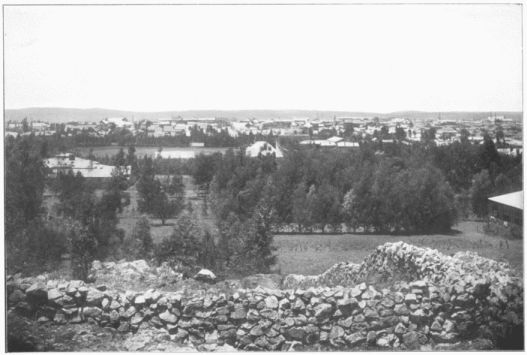
JOHANNESBURG FROM THE NORTH.
Photo by Wilson, Aberdeen.
"I attribute our failure to reach Johannesburg in a great measure to
loss of time from the following causes:—
"1. The delay occasioned by the demonstration in front of
Krugersdorp, which had been assigned as the place of junction with the
Johannesburg force.
"2. The non-arrival of that force at Krugersdorp, or of the guides to
the Krugersdorp-Johannesburg section of the road, as previously promised
by Johannesburg.
"3. The delay consequent on moving to the firing of the supposed
Johannesburg column just before dark on Wednesday evening.
"I append (1) a sketch-map of the route from Pitsani to Krugersdorp
marked A. This distance (154 miles) was covered in just under seventy
hours, the horses having been off-saddled ten times. The 169 miles
between Pitsani and Doornkop occupied eighty-six hours, during seventeen
of which the men were engaged with the Boers, and were practically
without food or water, having had their last meal at 8 a.m. on the
morning of the 1st January at Van Oudtshoorn's, seventeen miles from
Krugersdorp."
(The report concludes with a list of officers engaged in the
expedition.)
It will be noted that Sir John Willoughby does not attribute his failure
to the bungling of his employés that is said to have taken place. The
man that was despatched to cut the telegraph wires failed to do so, with
the result that the Boers were provided with the news of the invasion
eight hours before the Reform leaders were aware of it; while another
man, whose business it was to wrench away the rails between Johannesburg
and Krugersdorp, and thus interrupt communication from Pretoria, was
reposing in a clubhouse hopelessly drunk, while the train he should have
intercepted carried ammunition for use against the invaders.
In order to present a fair picture of the situation, it must be admitted
that many of the statements in this report were emphatically
contradicted by the Reformers, notably the opening paragraphs, which
scarcely tally with the fact that on the 28th (the day referred to) Dr.
Jameson received the letters from the Reformers telling him not to
start.
The following statement of the four Reform leaders, which was read at
their trial, will present the case from their point of view, and those
interested may judge for themselves of a question over which many
differences of opinion exist:—
"For a number of years endeavours have been made to obtain by
constitutional means the redress of the grievances under which the
Uitlander population labours. The new-comer asked for no more than is
conceded to emigrants by all the other Governments in South Africa,
under which every man may, on reasonable conditions, become a citizen of
the State; whilst here alone a policy is pursued by which the first
settlers retain the exclusive right of government.
"Petitions supported by the signatures of some forty thousand men were
ignored, and when it was found that we could not get a fair and
reasonable hearing, that provisions already deemed obnoxious and unfair
were being made more stringent, and that we were being debarred for ever
from obtaining the rights which in other countries are freely granted,
it was realised that we would never get redress until we should make a
demonstration of force to support our claims.
"Certain provision was made regarding arms and ammunition, and a letter
was written to Dr. Jameson, in which he was asked to come to our aid
under certain circumstances.
"On December 26 the Uitlanders' Manifesto was published, and it was then
our intention to make a final appeal for redress at the public meeting
which was to have been held on January 6. In consequence of matters that
came to our knowledge, we sent on December 26 Major Heany (by train
via Kimberley), and Captain Holden across country, to forbid any
movement on Dr. Jameson's part.
"On the afternoon of Monday, December 30, we learnt from Government
sources that Dr. Jameson had crossed the border. We assumed that he had
come in good faith to help us, probably misled by some of the
exaggerated rumours which were then in circulation. We were convinced,
however, that the Government and the burghers would not in the
excitement of the moment believe that we had not invited Dr. Jameson in,
and there was no course open to us but to prepare to defend ourselves if
we were attacked, and at the same time to spare no effort to effect a
peaceful settlement.
"It became necessary to form some organisation for the protection of the
town and the maintenance of order, since, in the excitement caused by
the news of Dr. Jameson's coming, serious disturbances would be likely
to occur, and it was evident that the Government organisation could not
deal with the people without serious risks of conflict.
"The Reform Committee was formed on Monday night, December 30, and it
was intended to include such men of influence as cared to associate
themselves with the movement. The object with which it was formed is
best shown by its first notice, namely:—
"'Notice is hereby given, that this Committee adheres to the National
Union Manifesto, and reiterates its desire to maintain the independence
of the Republic. The fact that rumours are in course of circulation to
the effect that a force has crossed the Bechuanaland border renders it
necessary to take active steps for the defence of Johannesburg and
preservation of order. The Committee earnestly desire that the
inhabitants should refrain from taking any action which can be construed
as an overt act of hostility against the Government. By order of the
Committee, J. Percy Fitzpatrick, Secretary.'
"The evidence taken at the preliminary examination will show that order
was maintained by this Committee during a time of intense excitement,
and through the action of the Committee no aggressive steps whatever
were taken against the Government, but on the contrary, the property of
the Government was protected, and its officials were not interfered
with.
"It is our firm belief that had no such Committee been formed, the
intense excitement caused by Dr. Jameson's entry would have brought
about utter chaos in Johannesburg.
"It has been alleged that we armed natives. This is absolutely untrue,
and is disposed of by the fact that during the crisis upwards of 20,000
white men applied to us for arms and were unable to get them.
"On Tuesday morning, December 31, we hoisted the flag of the Z. A. R.,
and every man bound himself to maintain the independence of the
Republic. On the same day the Government withdrew its police voluntarily
from the town, and we preserved perfect order.
"During the evening of that day, Messrs. Marais and Malan presented
themselves as delegates from the Executive Council. They came (to use
their own words) to 'offer us the olive branch,' and they told us that
if we would send a deputation to Pretoria to meet a Commission appointed
by the Government, we should probably obtain 'practically all that we
asked for in the Manifesto.'
"Our deputation met the Government Commission, consisting of
Chief-Justice Kotze, Judge Ameshof, and Mr. Kook, member of the
Executive.
"On our behalf our deputation frankly avowed knowledge of Jameson's
presence on the border, and of his intention, by written arrangement
with us, to assist us in case of extremity.
"With the full knowledge of this arrangement, with the knowledge that we
were in arms and agitating for our rights, the Government Commission
handed to us a resolution by the Executive Council, of which the
following is the purport:—
"'The High Commissioner has offered his services with a view to a
peaceful settlement. The Government of the South African Republic has
accepted his offer. Pending his arrival, no hostile step will be taken
against Johannesburg, provided Johannesburg takes no hostile action
against the Government. In terms of a certain proclamation recently
issued by the President, the grievances will be earnestly considered.'
"We acted in perfect good faith with the Government, believing it to be
their desire, as it was ours, to avert bloodshed, and believing it to be
their intention to give us the redress which was implied in the 'earnest
consideration of grievances.'
"There can be no better evidence of our earnest endeavour to repair what
we regarded as a mistake on the part of Dr. Jameson than the following
offer which our deputation, authorised by resolution of the Committee,
laid before the Government Commission:—
"'If the Government will permit Dr. Jameson to come into Johannesburg
unmolested the Committee will guarantee, with their persons if
necessary, that he will leave again peacefully as soon as possible.'
"We faithfully carried out the agreement that we should commit no act of
hostility against the Government; we ceased all active operations for
the defence of the town against any attack, and we did everything in our
power to prevent any collision with the burghers, an attempt in which
our efforts were happily successful.
"On the telegraphic advice of the result of the interview of the
deputation with the Government Commission, we despatched Mr. Lace, a
member of our Committee, as an escort to the courier carrying the High
Commissioner's despatch to Dr. Jameson, in order to assure ourselves
that the despatch would reach its destination.
"On the following Saturday, January 4, the High Commissioner arrived at
Pretoria. On Monday, the 6th, the following telegram was sent to us:—
From H.M.'s Agent to Reform Committee, Johannesburg.
"'Pretoria, January 6, 1896.
"'January 6.—I am directed to inform you that the High Commissioner
met the President, the Executive, and the Judges to-day. The President
announced the decision of the Government to be that Johannesburg must
lay down its arms unconditionally as a (condition) precedent to a
discussion and consideration of grievances. The High Commissioner
endeavoured to obtain some indication of the steps which would be taken
in the event of disarmament, but without success, it being intimated
that the Government had nothing more to say on the subject than had
already been embodied in the President's proclamation. The High
Commissioner inquired whether any decision had been come to as regards
the disposal of the prisoners, and received a reply in the negative.
The President said that as his burghers, to the number of 8000, had been
collected and could not be asked to remain indefinitely, he must request
a reply, "Yes" or "No," to this ultimatum within twenty-four hours.'
"On the following day, Sir Jacobus de Wet, her Majesty's Agent, met us
in committee, and handed to us the following wire from his Excellency
the High Commissioner:—
High Commissioner, Pretoria, to Sir J. de Wet, Johannesburg.
(Received Johannesburg 7.30 a.m., Jan. 7, 1896.)
"'Urgent. You should inform the Johannesburg people that I consider,
that if they lay down their arms, they will be acting loyally and
honourably, and that if they do not comply with my request, they forfeit
all claim to sympathy from her Majesty's Government, and from British
subjects throughout the world, as the lives of Jameson and prisoners are
practically in their hands.'
"On this, and the assurance given in the Executive Council resolution,
we laid down our arms on January 6th, 7th and 8th; on the 9th we were
arrested, and have since been under arrest at Pretoria, a period of
three and a half months.
"We admit responsibility for the action taken by us. We frankly avowed
it at the time of the negotiations with the Government, when we were
informed that the services of the High Commissioner had been accepted
with a view to a peaceful settlement.
"We submit that we kept faith in every detail in the arrangement with
the Government; that we did all that was humanly possible to protect
both the State and Dr. Jameson from the consequences of his action; that
we have committed no breach of the law which was not known to the
Government at the time that the earnest consideration of our grievances
was promised.
"We can only now lay the bare facts before the Court, and submit to the
judgment that may be passed upon us.
(Signed)
Lionel Phillips.
Francis Rhodes.
George Farrar.
"Pretoria, April 24, 1896."
"I entirely concur with the above statement.
(Signed)
John Hays Hammond.
"Pretoria, April 27, 1896."
AFTER DOORNKOP
The account given by Sir John Willoughby serves to explain the doings of
the Jameson troops. We all know how the raiders were surrounded by the
Boers, who had ample time to lay an excellent trap for them, and how,
after a plucky charge, they were forced to surrender. Before
surrendering, however, Dr. Jameson obtained from Commandant Cronjé, of
Potchefstroom notoriety, a guarantee that the lives of the force would
be spared.
During this exciting period, when the failure of Jameson became known,
the consternation that prevailed in Johannesburg was terrible.
Panic-stricken women and children fled to the railway stations, and the
Cornish miners scrambled with them for places in the departing trains.
In the heat of January the poor refugees started off provisionless,
leaving all their worldly goods behind them, their one care to be far
away from the horrors that might take place in a besieged town. In the
train they were packed like herrings in carriages or in cattle trucks,
that would barely accommodate them.
In addition to these miseries an awful accident took place on the Natal
line, when a train loaded with refugees ran off the rails. Thirty-eight
women and children were killed.
In Johannesburg the Reformers had a harassing time. Their offices were
besieged by people clamouring for arms. They had no rest night nor day,
and their anxiety for the safety of Jameson and his party was intense.
For themselves they were unconcerned, believing that their share in the
matter was unknown, and that the Government was without a particle of
evidence against them. And here we find that another blunder was made.
Major Robert White, one of the raiders, had brought with him a
despatch-box containing the key to a cypher, which had been used during
the whole of the negotiations, and with it the names of the principal
persons engaged in the conspiracy. Of course, this fell into the hands
of the enemy, who were not slow to take advantage of their good luck.
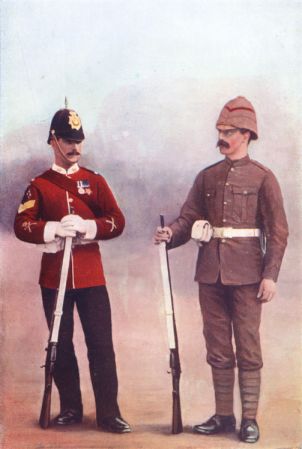
COLOUR-SERGEANT and PRIVATE (in KHAKI), GLOUCESTER REGIMENT.
Photo by Gregory & Co., London.
On the evening of Jameson's surrender (Thursday), Sir Hercules Robinson
(Lord Rosmead), left the Cape for the scene of the disturbance. The
train he travelled by met with an accident; he was infirm—his nerves
were shaken. The President refused to be interviewed on the Sabbath, and
the result of his journey was a single meeting with Mr. Kruger, but the
British Resident, Sir Jacobus de Wet, and Sir Sidney Shippard, were
deputed to address and pacify the perturbed multitude in
Johannesburg. The Uitlanders, they promised, should get their just
rights—that her Majesty's Government would ensure—but they must first
give up their arms: the fate of Jameson depended on it! The Reform
leaders at this time knew nothing of the terms of the surrender, and the
guarantee given by Commandant Cronjé, or, perhaps, they knew too well
what Cronjé's guarantees were likely to be worth; and much against their
better judgment, believing that their rights would be secured and the
safety of Jameson effected, they eventually consented to disarmament.
As we know, the conspirators had been short of arms—they had about 2500
guns in all. When these were given up the Boers were dissatisfied. They
had reason to believe that some 20,000 guns were to be supplied as part
of the scheme, and suspected that the Reformers were concealing the
existence of many weapons. The word of honour of the leaders produced no
effect, and energetic search through floors and in the mines was carried
on for some months afterwards.
Of course, this disarmament immediately threw the Reformers into the
clutches of the Pretoria Government. The authorities made haste to issue
warrants for the arrest of sixty-four of the most prominent men of the
movement; this in spite of the assurance made to the British agent that
"not a hair of their heads should be touched"! Mrs. Phillips has reason
to speak very bitterly of the mismanagement of the High Commissioner on
this occasion. Having done his gruesome work, she says, "he returned to
Cape Town, leaving Johannesburg absolutely at the mercy of the Boers. He
actually effected the disarmament of this large town without making one
single condition for its safety, and from that day the most signal acts
of tyranny and injustice were committed over and over again by the Boer
Oligarchy, and there was no one to say them nay. This was a critical
event for English supremacy in South Africa, this final act of supreme
weakness and folly! Many of her most loyal subjects from that moment
have wavered on the brink, and some have gone over to the side of the
Africander Bond. It is such actions as these which estrange the
Colonists, and which give a little reality to the bondsman's dream of a
United South Africa under a Republican flag."
For the benefit of those who may not be acquainted with the negotiations
which brought about this unfortunate disarmament, it may be as well to
repeat some of the correspondence that passed between Sir Hercules
Robinson and Mr. Chamberlain at this critical period.
Sir Hercules Robinson, Pretoria, to Mr. Chamberlain.
(Telegraphic. Received 1.8 a.m., 6th January 1896.)
"5th January, No. 3. Arrived here last night. Position of affairs very
critical. On side of Government of South African Republic and of Orange
Free State there is a desire to show moderation, but Boers show tendency
to get out of hand and to demand execution of Jameson. I am told that
Government of South African Republic will demand disarmament of
Johannesburg as a condition precedent to negotiations. Their military
preparations are now practically complete, and Johannesburg, if
besieged, could not hold out, as they are short of water and coal. On
side of Johannesburg leaders desire to be moderate, but men make safety
of Jameson and concession of items in manifesto issued conditions
precedent to disarmament. If these are refused, they assert they will
elect their own leaders and fight it out in their own way. As the matter
now stands, I see great difficulty in avoiding civil war, but I will do
my best, and telegraph result of my official interview to-morrow. It is
said that President of South African Republic intends to make some
demands with respect to Article No. 4 of the London Convention of 1884."
Mr. Chamberlain to Sir Hercules Robinson.
(Telegraphic. 6th January 1896.)
"6th January. No. 3. It is reported in the press telegrams the President
of the South African Republic on December 30 held out definite hopes
that concessions would be proposed in regard to education and the
franchise. No overt act of hostility appears to have been committed by
the Johannesburg people since the overthrow of Jameson. The statement
that arms and ammunition are stored in that town in large quantities may
be only one of many boasts without foundation. Under these
circumstances, active measures against the town do not seem to be
urgently required at the present moment, and I hope no step will be
taken by the President of the South African Republic liable to cause
more bloodshed and excite civil war in the Republic."
These are followed by further correspondence.
Sir Hercules Robinson, Pretoria, to Mr. Chamberlain.
(Telegraphic. Received 7th January 1896.)
"6th January. No. 2. Met President South African Republic and Executive
Council to-day. Before opening proceedings, I expressed on behalf of
her Majesty's Government my sincere regret at the unwarrantable raid
made by Jameson; also thanked Government of South African Republic for
the moderation shown under trying circumstances. With regard to
Johannesburg, President of South African Republic announced decision of
Government to be that Johannesburg must lay down its arms
unconditionally as a precedent to any discussion and consideration of
grievances. I endeavoured to obtain some indication of the steps that
would be taken in the event of disarmament, but without success, it
being intimated that Government of South African Republic had nothing
more to say on this subject than had been already embodied in
proclamation of President of South African Republic. I inquired as to
whether any decision had been come to as regards disposal of prisoners,
and received a reply in the negative. President of South African
Republic said that as his burghers, to number of 8000, had been
collected and could not be asked to remain indefinitely, he must request
a reply, 'Yes' or 'No,' to this ultimatum within twenty-four hours. I
have communicated decision of South African Republic to Reform Committee
at Johannesburg through British Agent in South African Republic.
"The burgher levies are in such an excited state over the invasion of
their country, that I believe President of South African Republic could
not control them except in the event of unconditional surrender. I have
privately recommended them to accept ultimatum. Proclamation of
President of South African Republic refers to promise to consider all
grievances which are properly submitted, and to lay the same before the
Legislature without delay."
On January 7, Mr. Chamberlain replied:—
"No. 1. I approve of your advice to Johannesburg. Kruger will be wise
not to proceed to extremities at Johannesburg or elsewhere: otherwise
the evil animosities already aroused may be dangerously excited."
And on the same day Sir Hercules Robinson telegraphed:—
"No. 1. Your telegram of January 6, No. 2. It would be most inexpedient
to send troops to Mafeking at this moment, and there is not the
slightest necessity for such a step, as there is no danger from
Kimberley Volunteer Corps or from Mafeking. I have sent De Wet with
ultimatum this morning to Johannesburg, and believe arms will be laid
down unconditionally. I understand in such case Jameson and all
prisoners will be handed over to me. Prospect now very hopeful if no
injudicious steps are taken. Please leave matter in my hands."
It is unnecessarily humiliating to dwell further on the astute manner
in which Mr. Kruger played with the British Government while he kept
Jameson and his party in durance vile, and in the agonies of mental
suspense—or to dilate upon the treacherous means he employed to induce
the Reformers and the town to lay down their arms. The British Agent
distinctly promised that "not one among you shall lose his personal
liberty for a single hour," and further declared "that the British
Government could not possibly allow such a thing."
Yet the British Government calmly looked on while the Reform leaders
were arrested and kept in Pretoria Gaol, at the mercy of a fiend in
human shape named Du Plessis, whose atrocious conduct and character
eventually caused him to be reported to the High Commissioner.
As an example of the way prisoners were treated, Mrs. Lionel Phillips
may again be quoted:—
"It is well known," she writes, "that one of Jameson's troopers on the
way down, falling ill, was taken prisoner by some Boers, and kept at
their farmhouse some days. He was tied up, and forced to submit to all
sorts of ill-treatment, being given dirty water to drink, for instance,
when half-dying of thirst. But his captor's wife had compassion on him,
and at the end of several days, to his surprise, he was told that he was
to be allowed to go free. The Boers gave him his horse, mounted him, and
informed him the one condition they made was that he was to ride away as
fast as he could. He naturally obeyed, and as he galloped off had
several bullets put into him, poor fellow. That is a very favourite and
well-known method of Transvaal Boer assassination. It gives them the
pretext that a prisoner had been trying to escape."
Mrs. Phillips relates also the horrible experiences of her husband, who
was one of the Uitlanders conspicuous in the Reform movement.
"Lionel (her husband), George Farrar, Colonel Rhodes, and J. H. Hammond
were put into one cell, twelve feet square, without windows, and were
locked up there the first three nights for thirteen hours. Then the
prison doctor insisted on more space being allotted to them, and the
door, which communicated with a courtyard twenty feet square, was left
open at night. This was the space in which they were permitted to take
exercise. They were not allowed to associate with their fellows at
first. In January, in Pretoria, the heat is intense, quite semi-tropical
indeed, the temperature varying from 90 to 105 degrees in the shade. As
the weather happened to be at its hottest, the sufferings of these men
were awful. The cells, hitherto devoted to the use of Kaffirs,
swarmed with vermin and smelt horribly; while to increase their
miseries, if that were possible, one of their number was suffering from
dysentery, and no conveniences of any kind were supplied. With these
facts in mind, any attempt to describe what the prisoners underwent
would be superfluous. Add to all these hardships their mental
sufferings, and then judge of their state."
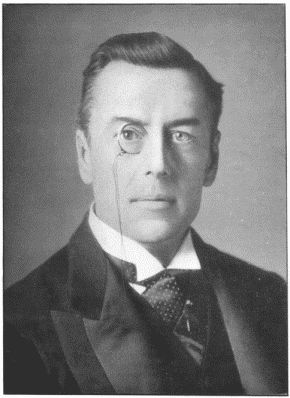
Rt. Hon. JOSEPH CHAMBERLAIN, M.P.,
Secretary for the Colonies.
Photo by Russell & Sons, London.
Can anything be more pathetic than the description of the state of these
men given by the wife of one of them—men who had been driven to hatred
and revolt by an inefficient, exclusive, and unscrupulous Government,
which was endeavouring to reduce the subjects of a suzerain power to the
level—to the, to them, despicable level—of the Kaffirs? Of the fate of
these unhappy sufferers we have yet to speak.
THE FATE OF RAIDERS AND REFORMERS
Dr. Jameson, as we all know, was sent with his comrades to England to be
dealt with by the laws of his country. He and his officers were tried
and convicted under the Foreign Enlistment Act. Much sympathy was shown
him by the vast British public, and little for the Reformers, who,
whatever their part in the affair, had to suffer most. They endured
mental torture, and bodily discomfort of all kinds—discomfort so acute
that it brought on some active illness, and caused one to commit
suicide. A Judge from the Orange Free State—Judge Gregorowski—who took
an unctious joy in the proceedings, was imported to try them, and he
revived or unearthed an old Roman Dutch law of treason for the purpose
of sentencing them to death. This sentence was fortunately not carried
out, but it served to keep the Reformers and all connected with them in
a state of agonised suspense. Besides these sufferers from the effects
of the Raid, there were others. Mr. Rhodes is said to have exclaimed, "I
have been the friend of Jameson for twenty years and now he has ruined
me!" The statement was somewhat exaggerated, but there is no doubt that
Mr. Rhodes, besides having to resign the posts he occupied, lost much of
the sympathy of the Cape Dutch. The Uitlanders, also, who had previously
enjoyed this sympathy now forfeited it, all the Dutch being inclined to
quote the impulsive act of Dr. Jameson as an example of British
treachery, and to look upon Mr. Kruger in the light of a hero. Indeed,
many of the British, who took merely an outsider's interest in the state
of affairs, laboured under the impression that Mr. Kruger was a
simple-minded, long-suffering, and magnanimous person. They did not
trouble themselves to go deeply into the incessant annoyances and
injustices that for many years had harried the lot of the Uitlanders and
caused them at last to lose patience and revolt against oppression. Even
now there are people who lean to the belief that the coarse nut of Boer
character may possess a sound kernel, people who prefer to hug that
belief rather than inform themselves by reading what Mr. Rider Haggard,
Mr. Fitzpatrick, and other well-informed men have to say on the subject.
When all efforts to work upon Mr. Kruger failed, the wives of the
unhappy men applied to "Tante Sanne," as the President's wife is called,
and begged her intervention. She said, "Yes, I will do all I can for
you; I am very sorry for you all, although I know that none of you
thought of me that night when we heard Jameson had crossed the border,
and we were afraid the President would have to go out and fight, and
when they went and caught his white horse that he has not ridden for
eight years. But all the same I am sorry for you all."
The wives of the Boers are very powerful, and it is possible that Mrs.
Kruger may have prevailed in some way over her husband, for at last,
after five weary months of imprisonment, after delays, suspenses, and
alarms too numerous to be here recounted, the prisoners, on the 11th of
June 1896, were released. They were required to pay a fine of £2000, and
to sign a pledge not to interfere with politics for three years. It was
owing to this pledge that the valuable book, "The Transvaal from
Within," which has here been quoted, was not published till affairs
therein set forth had come in 1899 to the painful climax of war! Mr.
Lionel Phillips, however, was not so wise as Mr. Fitzpatrick. When Sir
John Willoughby in 1897 attacked the Reform Leaders of Johannesburg in
the Nineteenth Century, Mr. Phillips replied to it in the same Review,
August 1897, defending himself and his comrades from the charges made.
In consequence of this action Mr. Phillips was considered to have broken
his pledge and was condemned by the Transvaal Government to banishment.
Doubtless it was without much regret that he shook the dust of that
ill-conditioned State from off his shoes.
THE ULTIMATUM
After the turmoil of 1896 affairs declined from bad to worse. The state
of tension between the oppressed Uitlanders and the now suspicious Boers
became from day to day and year to year more acute, till at last it was
almost unbearable. The incompetence of the police showed that robbery,
and even murder, might at any moment be perpetrated and go unpunished,
and alarm on this score was not allayed by the action of a constable in
shooting dead a Uitlander named Edgar for having met his insults with a
blow.
To thoroughly appreciate the misery and insecurity of the Uitlanders,
the atrocity of the Government, and the uncloaked hostility to Great
Britain that has existed till now, we may quote a description of the
situation given last year by Professor James Liebmann. He wrote:—
"In the Transvaal a state of things reigns supreme which cannot be
surpassed by the most corrupt of South American Republics. There the
Boer shows his character in its most unpleasant features. Low, sordid,
corrupt, his chief magistrate as well as his lowest official readily
listens to 'reasons that jingle,' and, like the gentleman in the
'Mikado,' is not averse to 'insults.' He calls his country a
republic—it is so in name only. The majority of the population,
representing the wealth and intelligence of the country—the
Uitlanders—are refused almost every civil right, except the privilege
of paying exorbitant taxes to swell an already overgorged treasury.
Under this ideal(?) government, which is really a sixteenth-century
oligarchy flourishing at the end of the nineteenth, and is, certainly
not a land where
'A man may speak the thing he will,'
you have a press censorship as tyrannical as in Russia, a State
supervision of telegrams, a veto on the right of public meeting, a most
unjust education law, and an Executive browbeating the Justiciary; and,
in order to accomplish so much, the Transvaal has closed its doors to
its kinsmen in Cape Colony—for you must not forget that the oldest
Transvaalers, from President Kruger downwards, are ex-Cape Colonists,
and quondam British subjects—and imported a bureaucracy of Hollanders
to plait a whip wherewith to castigate her children.
"On the Rand, at present, the Uitlanders are voiceless, voteless, and
leaderless, whilst, on the other hand, large quantities of arms have
been introduced into the country, and the burghers, every one of them,
trained in the use of these weapons. Fortifications have been raised at
Johannesburg and Pretoria, to cowe those who are putting money into the
State's purse, and for this purpose the President has acquired the
services of German military officers who will find congenial employment
in thus dragooning defenceless citizens.
"This is the state of affairs in the South African so-called Republic in
this year of grace (1898), which, according to the Convention, granted
equal rights to Briton and to Boer."
This being no exaggerated picture of the situation, it is small wonder
that at last the Uitlanders determined to bear the burden no longer, but
set their grievances before the Queen. Early in the new year the
following petition was forwarded to her Majesty:—
"Humble Petition of British Subjects resident on the Witwatersrandt
Gold Fields to her Britannic Majesty Queen Victoria.
"1. Your loyal subjects on these fields are by law denied the free right
of possessing such arms as may be necessary to protect their lives and
property, and such obstacles are placed in their way as to render the
obtaining of the necessary official permit almost impossible.
Consequently the Uitlander population of this State is to all intents
and purposes an unarmed community.
"2. On the other hand, the whole of the burgher section of the
community, irrespective of age, are permitted to possess and carry arms
without let or hindrance, and are, in fact, on application, supplied
with them by the Government free of charge.
"3. The police force of this State is exclusively recruited from the
burgher element, many of the police being youths fresh from rural
districts, without experience or tact, and in many instances without
general education or a knowledge of the English language; therefore, as
a whole, entirely out of sympathy with the British section of the
community, which forms the majority of the population.
"4. The foot police of Johannesburg, in whose appointment and control we
have no voice, is not a military force; yet its members not only carry
batons, but are also armed with six-chambered military revolvers,
invariably carried loaded.
"5. Under these circumstances, given an unarmed community policed by a
body of inexperienced rustics carrying weapons of precision and utterly
out of sympathy with the community they are supposed to protect, it is
not surprising that the power placed in the hands of this police force
should be constantly abused.
"6. For years past your subjects have in consequence had constantly to
complain of innumerable acts of petty tyranny at the hands of the
police.
"7. During the last few months, however, this antagonistic attitude of
the police has assumed a much more serious and aggressive aspect.
Without warrant they have invaded private houses and taken the occupants
into custody on frivolous and unfounded charges never proceeded with;
violently arrested British subjects in the streets on unintelligible
charges: and generally display towards your Majesty's subjects a temper
which undoubtedly tends to endanger the peace of the community. In
adopting this demeanour the police are supported, with but a few
honourable exceptions, by the higher officials, as instanced by the
continual persecution in the Courts of many of your Majesty's coloured
subjects at the very time when negotiations are proceeding between your
Majesty's Representative and the Transvaal Government with regard to
their status. This feeling is also strongly evidenced in the particular
case which we now bring to your Majesty's notice.
"8. The lamentable tragedy which has been the immediate cause of this
our humble Petition cannot, therefore, be regarded as incidental, but
symptomatic.
"9. This case is that of the shooting of Tom Jackson Edgar, a British
subject, by Police-Constable Barend Stephanus Jones, a member of the
Johannesburg Constabulary.
"10. From the accompanying affidavits, already published and sworn by
eye-witnesses of the tragedy, it would appear that the deceased, while
in the occupation of his own house, was shot dead by Police-Constable
Barend Stephanus Jones as the latter was in the act of unlawfully
breaking into the house of deceased without a warrant.
"11. Police-Constable Barend Stephanus Jones, though in the first
instance placed in custody on a charge of murder, was almost immediately
afterwards let out on bail by the Public Prosecutor, who, without
waiting for any Magisterial inquiry, reduced the charge, on his own
initiative, to that of culpable homicide.
"12. The bail on which the prisoner was released was the same in
amount—namely, £200—as that required a few days previously from an
Uitlander charged with a common assault on a Member of the Government
Secret Service, and the penalty for which was a fine of £20.
"13. The widow and orphan of the late Tom Jackson Edgar have been left
absolutely destitute through the death of their natural protector.
"14. To sum up: We humbly represent to your Majesty that we, your loyal
subjects resident here, are entirely defenceless since—(1) The police
are appointed by the Government, not by the Municipality; (2) We have no
voice in the Government of the country; (3) There is no longer an
independent Judiciary to which we can appeal; (4) There is, therefore,
no power within this State to which we can appeal with the least hope of
success; and as we are not allowed to arm and protect ourselves, our
last resource is to fall back on our status as British subjects.
"We therefore humbly pray: That your Majesty will instruct your
Representative to take such steps as will ensure (a) a full and
impartial trial, on a proper indictment, of prisoner Police-Constable
Barend Stephanus Jones, and adequate punishment for his offence, if
found guilty; (b) proper provision by the Transvaal Government for the
needs of the widow and orphan of the deceased Tom Jackson Edgar, killed
by their agent; (c) the extension of your Majesty's protection to the
lives, liberty, and property of your loyal subjects resident here, and
such other steps as may be necessary to terminate the existing
intolerable state of affairs.
"And your petitioners will ever pray, &c."
Of course, this move enraged the authorities of the Transvaal, who tried
to prove the existence of a plot against the Republic, and even to
represent that British military officers were implicated in it. But Sir
Alfred Milner exposed the little machinations of the "secret service"
people, so that their duplicit efforts were not crowned with the
hoped-for success. Mr. Steyn then succeeded Mr. Reitz as President of
the Orange Free State, and his appearance on the political scene was the
signal for an offensive and defensive alliance between the two
Republics. Following the example set by President Brand, Mr. Steyn—in
the character of umpire or peacemaker—assisted to promote a meeting at
Bloemfontein between Sir Alfred Milner and President Kruger. The
Uitlander Council drew up the following declaration:—
"The proposals submitted at the Bloemfontein Conference by his
Excellency the High Commissioner were briefly:
"1. That the Uitlanders possessing a certain property or wages
qualification, on proving that they had resided five years in the
country and on taking an oath of allegiance, be given full burgher
rights.
"2. That there should be such a distribution of seats as would give to
the new-comers a substantial representation in the First Volksraad, but
not such as would enable them to swamp the old burghers.
"All must admit that this scheme is most conservative, because—
"(a). It does not restore to the Uitlanders all the rights of which
they have been unjustly deprived since the retrocession.
"(b). Nearly the whole revenue of the country is derived from the
taxation of the Uitlanders.
"(c). The Uitlanders form at least two-thirds of the total white
population. (This was practically admitted by President Kruger at the
Conference.)
"(d). In most new countries one or two years' residence ensures full
voting power. There is no reason why there should be more stringent
conditions in operation in this State than in Natal or Cape Colony, or
than those which existed until quite recently in the Orange Free State,
and which were only changed from one to three years on account of the
unhealthy political conditions in the South African Republic.
"Notwithstanding, however, the conservative character of the scheme, the
Uitlander Council consider that the proposals of his Excellency the High
Commissioner are calculated in no small degree to bring about a
practical and permanent settlement. But in the opinion of the Uitlander
Council, it is essential at the outset to fix definitely the conditions
under which:
"1. All duly qualified persons can get the franchise without any
unnecessary expense, trouble, or delay, and without being subjected to
any kind of intimidation.
"2. Those who have got the franchise shall be able to use it
effectively.
"3. Redistribution of seats shall take place periodically by automatic
arrangement, and representation shall bear some definite relation to the
number of electors.
"Having regard to the recent history of the Government of this country,
and the facility with which even fundamental laws are and may be
changed, the Uitlander Council are convinced that no settlement will be
of any value unless its permanency is guaranteed by an understanding
between the Imperial Government and the Government of the South African
Republic.
"Further, knowing by past experience that every effort will be made by
means of the existing Government machinery to obstruct and pervert even
the smallest measure of reform, and bearing in mind the immense
discretionary power accorded by the laws to all Government officials,
the Uitlander Council are strongly of opinion that the understanding
between the two Governments should provide for such immediate changes in
the present laws of the country as would make it possible to carry out
Sir A. Milner's scheme, not only in the letter, but also in the spirit.
"The outcome of the understanding between the two Governments should be
the inclusion among the permanent and fundamental laws of the South
African Republic of a Reform Act embracing, in addition to the clauses
providing for naturalisation and redistribution on the lines already
indicated, the following among other provisions:
"1. No burgher or alien shall be granted privileges or immunities which
on the same terms shall not be granted to all burghers.
"2. No person shall, on account of creed or religious belief, be under
any disability whatever.
"3. The majority of the inhabitants being English-speaking, English
shall be recognised equally with Dutch as an official language of the
State.
"4. The independence of the High Court shall be established and duly
safeguarded.
"5. Legislation by simple resolution (besluit) of the Volksraad shall
be abolished.
"6. The free right of public meeting and of forming electoral committees
shall be recognised and established.
"7. The freedom of speech and of the press shall be assured.
"8. All persons shall be secured in their houses, persons, papers, and
effects against violation or illegal seizure.
"9. The existence of forts and the adoption of other measures intended
for the intimidation of the white inhabitants of the country, being a
menace to the exercise of the undoubted rights of a free people, shall
be declared unconstitutional.
"10. Existing monopolies shall be cancelled or expropriated on equitable
conditions.
"11. Raad members must be fully enfranchised burghers and over
twenty-one years of age. Any candidate for the Presidency must be a
fully enfranchised burgher over thirty years of age, and have been
resident in the country for ten years.
"12. All elections shall be by ballot and shall be adequately
safeguarded by stringent provisions against bribery and intimidation.
"13. All towns with a population of 1000 persons and upwards shall have
the right to manage their own local affairs under a general Municipal
Act. The registration of voters and the conduct of all elections shall
be regulated by local bodies.
"14. A full and comprehensive system of State Education shall be
established under the control of Local Boards.
"15. The Civil Service shall be completely reorganised, and all corrupt
officials shall be dismissed from office, and be ineligible for office
in the future.
"16. Payments from the public Treasury shall only be made in accordance
with the Budget proposals approved by the Raad, with full and open
publication of the accounts periodically.
"17. No person shall become a burgher, and no fresh constituency shall
be created except in accordance with the lines herein laid down, and
officials shall have no discretionary power in this or any other matter
affecting the civil rights of the inhabitants of the country."
The Conference was a complete failure. Mr. Kruger obstinately refused to
make the proposed concessions, and Sir Alfred Milner would be contented
with nothing less.
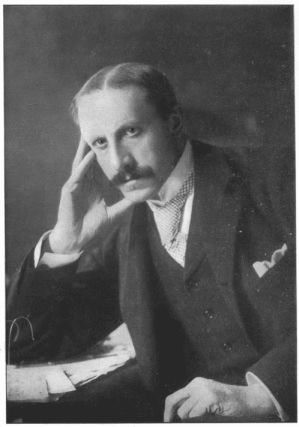
Sir ALFRED MILNER, K.C.B.,
High Commissioner for South Africa.
Photo by Elliott & Fry, London.
The President afterwards agreed to grant a "seven years' Franchise"
on terms that were scarcely practicable, while the Secretary of State
for the Colonies held out for the five years' Franchise at first
demanded. The bargaining was pursued for some weeks with considerable
animation, and in the end Mr. Kruger offered to allow the five years'
franchise on what he knew to be the impossible condition, that the
question of suzerainty should be entirely dropped.
The mobilisation of the burghers, which had been secretly on foot for
some time, was forthwith carried on apace, and later—much too
tardily—British patience gave way, and troops were despatched to South
Africa. Then followed, on the 9th of October, an insulting ultimatum
from President Kruger, demanding the immediate withdrawal of British
troops from the Transvaal border, and an assurance that no more should
be landed. In default of this assurance, he declared that at 5 p.m. on
the 11th of October a state of war would exist. To such an ultimatum
only one answer was possible. British troops at once started for the
Cape.
Naturally the whole of Great Britain was in a state of turmoil, and the
vast multitude of people—"the men in the street," so to say—were
inclined to express surprise that the question of two years' difference
in the terms of obtaining the franchise should have been made into a
casus belli. To all thinking men it was patent, however, that the
quibble about the franchise was merely a Boer ruse to obtain time for
the carrying out of a long-concerted scheme for the elimination of the
British from the Cape to the Zambezi. These were aware that the military
methods of the Transvaal were under process of reorganisation, and
indeed had been readjusted gradually ever since 1896, and that the
simple methods of 1881 had been superseded by newer and more modern
principles of warfare. It was known that great additions had been made
to the warlike resources of the Republic, and that the President of the
Free State was, if anything, more bitter than Mr. Kruger in his hatred
of Great Britain and all things British, and that the two Republics
would make common cause with each other against a mutual enemy. It was
also known that foreign experts were imported, and foreign stocks of war
material—material of the newest and most expensive kind—were prepared
in anticipation of war, and that even such a thing as tactical
instruction—a thing hitherto ignored among the Transvaalers—had been
acquired from accomplished German sources, and all this for one sole
purpose—war with Great Britain. In order that there may be no doubt
that the Boers were completely prepared and determined to fight long
before the insolent Ultimatum was published, it is desirable to read a
letter which appeared in the Times of the 14th of October 1899. This
epistle, which was appropriately headed "Boer Ignorance," emanated from
a Dutch writer, whose address was in a well-known part of Cape Colony.
It runs:—
"Sir,—In your paper you have often commented on what you are pleased to
call the ignorance of my countrymen, the Boers. We are not so ignorant
as the British statesmen and newspaper writers, nor are we such fools as
you British are. We know our policy, and we do not change it. We have no
opposition party to fear nor to truckle to. Your boasted Conservative
majority has been the obedient tool of the Radical minority, and the
Radical minority has been the blind tool of our far-seeing and
intelligent President. We have desired delay, and we have had it, and we
are now practically masters of Africa from the Zambezi to the Cape. All
the Afrikanders in Cape Colony have been working for years for this end,
for they and we know the facts.
"1. The actual value of gold in the Transvaal is at least 200,000
millions of pounds, and this fact is as well known to the Emperors of
Germany and Russia as it is to us. You estimate the value of gold at
only 700 millions of pounds, or at least that is what you pretend to
estimate it at. But Germany, Russia, and France do not desire you to get
possession of this vast mass of gold, and so, after encouraging you to
believe that they will not interfere in South Africa, they will
certainly do so, and very easily find a casus belli, and they will
assist us, directly and indirectly, to drive you out of Africa.
"2. We know that you dare not take any precautions in advance to prevent
the onslaught of the Great Powers, as the Opposition, the great peace
party, will raise the question of expense, and this will win over your
lazy, dirty, drunken working classes, who will never again permit
themselves to be taxed to support your Empire, or even to preserve your
existence as a nation.
"3. We know from all the military authorities of the European and
American continents that you exist as an independent Power merely on
sufferance, and that at any moment the great Emperor William can arrange
with France or Russia to wipe you off the face of the earth. They can at
any time starve you into surrender. You must yield in all things to the
United States also, or your supply of corn will be so reduced by the
Americans that your working classes would be compelled to pay high
prices for their food, and rather than do that they would have civil
war, and invite any foreign Power to assist them by invasion, for there
is no patriotism in the working classes of England, Wales, or Ireland.
"4. We know that your country has been more prosperous than any other
country during the last fifty years (you have had no civil war like the
Americans and French to tone up your nerves and strengthen your
manliness), and consequently your able-bodied men will not enlist in
your so-called voluntary army. Therefore you have to hire the dregs of
your population to do your fighting, and they are deficient in physique,
in moral and mental ability, and in all the qualities that make good
fighting men.
"5. Your military officers we know to be merely pedantic scholars or
frivolous society men, without any capacity for practical warfare with
white men. The Afridis were more than a match for you, and your victory
over the Soudanese was achieved because those poor people had not a
rifle amongst them.
"6. We know that your men, being the dregs of your people, are naturally
feeble, and that they are also saturated with the most horrible sexual
diseases, as all your Government returns plainly show, and that they
cannot endure the hardships of war.
"7. We know that the entire British race is rapidly decaying, your
birth-rate is rapidly falling, your children are born weak, diseased,
and deformed, and that the major part of your population consists of
females, cripples, epileptics, consumptives, cancerous people, invalids,
and lunatics of all kinds whom you carefully nourish and preserve.
"8. We know that nine-tenths of your statesmen and higher officials,
military and naval, are suffering from kidney diseases, which weaken
their courage and will-power, and make them shirk all responsibility as
far as possible.
"9. We know that your Navy is big, but we know that it is not powerful,
and that it is honeycombed with disloyalty—as witness the theft of the
signal-books, the assaults on officers, the desertions, and the wilful
injury of the boilers and machinery, which all the vigilance of the
officers is powerless to prevent.
"10. We know that the Conservative Government is a mere sham, and that
it largely reduced the strength of the British artillery in 1888-89. And
we know that it does not dare now to call out the Militia for training,
nor to mobilise the Fleet, nor to give sufficient grants to the Line and
Volunteers for ammunition to enable them to become good marksmen and
efficient soldiers. We know that British soldiers and sailors are
immensely inferior as marksmen, not only to Germans, French, and
Americans, but also to Japanese, Afridis, Chilians, Peruvians, Belgians,
and Russians.
"11. We know that no British Government dares to propose any form of
compulsory military or naval training, for the British people would
rather be invaded, conquered, and governed by Germans, Russians, or
Frenchmen, than be compelled to serve their own Government.
"12. We Boers know that we will not be governed by a set of British
curs, but that we will drive you out of Africa altogether, and the other
manly nations which have compulsory military service—the armed manhood
of Europe—will very quickly divide all your other possessions between
them.
"Talk no more of the ignorance of the Boers or Cape Dutch; a few days
more will prove your ignorance of the British position, and in a short
space of time you and your Queen will be imploring the good offices of
the great German Emperor to deliver you from your disasters, for your
humiliations are not yet complete.
"For thirty years the Cape Dutch have been waiting their chance, and now
their day has come; they will throw off their mask and your yoke at the
same instant, and 300,000 Dutch heroes will trample you underfoot.
"We can afford to tell you the truth now, and in this letter you have
got it.—Yours, &c.,
P. S.
"October 12."
This letter, though false in many particulars, certainly pointed out
some "home truths," which it was desirable for the British public to
read, mark, learn, and inwardly digest. It also served to cast aside the
thin veil which had covered our political relations with President
Kruger and his party, and to show the firm foundations on which the
hatred of the Boer for the Briton had been built for years. The question
of the franchise was a bagatelle: a soap-bubble would have been pretext
enough for war when the right hour and moment arrived. As allowed by
this candid writer, whose valuable avowals cannot afford to be ignored,
for many years treachery and disloyalty had existed, and the Boers had
only bided their time. They "desired delay, and had it," playing their
cards so skilfully as to deceive even the British Government, and imply
to them and the world that the franchise question and the discontent of
the Uitlanders was the main cause of the disagreement.
Before passing on to the terrible drama that, owing to the defiance of
Mr. Kruger, was afterwards enacted, we must assure ourselves that the
sad climax was bound to have come sooner or later. If the future of
South Africa is to be saved, the prestige of Great Britain must be
maintained; her citizens must be protected, and the betrayals of Downing
Street of 1881 and 1896 must be atoned for. Though darkness reigns at
the time of writing, the future of the Transvaal is a bright one.
Reactionaries of the Hofmeyer and Kruger stamp will pass away, and we
may look to the twentieth century for a happy settlement of the
terrible difficulties which stare us in the face. But the settlement can
never be effected by the policy of compromise. It can never be lasting
while Conventions are allowed to become the pawns of parties; it can
never be noble nor dignified until the petty ambitions of political
strife are subdued and the grand whole, Great Britain—not the
infinitesimal island, but the immense and populous Empire—is ordered
and laboured for with the courage and strength that comes of undoubted
unanimity! It remains, therefore, with each individual man and woman
among us so to work that the grand result is not unnecessarily delayed.
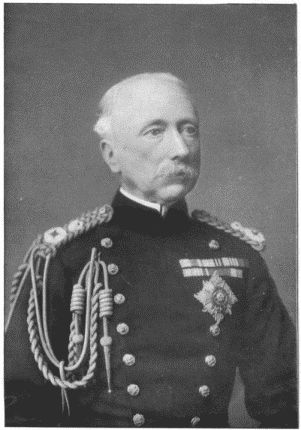
VISCOUNT WOLSELEY,
Commander-in-Chief of the British Army.
Photo by London Stereoscopic Co.