By F. T. NORRIS
The future prosperity of South Africa mainly depends upon
the development of her vast and indisputable gold wealth,
for, albeit she possesses other resources in undoubtedly
lavish abundance, the means for the utilisation of these
latter are dependent, in a large measure, upon the effective
exploitation of her auriferous reserves. This fact was explicitly
stated by Sir David Barbour, the financial expert appointed by the
Imperial Government to report in 1901 on the resources of the
Transvaal, and that this impartial official opinion is echoed by all
competent observers prior to and since his investigations only confirms
its correctness. As to the magnitude to which the mining
industries in the Transvaal may ultimately attain opinions differ,
but, says this authority, and this view is confirmed by experts, it is
certain that the production of gold will continue to increase largely
for some years at least; that there will be a corresponding growth
in the production of coal, and it is possible, and perhaps probable,
that valuable mines of other minerals, and especially of diamonds,
may be opened. He therefore opines that, from an economic point
of view, the prospects of the future for a considerable period are
quite satisfactory, and it is unnecessary to speculate as to what may
ultimately happen.
Public opinion on the Rand is unanimous that absolutely vital
questions for the mines’ future are, for the moment, labour and
taxation. A comprehensive and impartial view of the circumstances
of the mines must force the conclusion that such contentions are
perfectly sound. Naturally, however, the dimensions of the latter
factor have less weight since the reduction of the customs tariff
and the previous abolition of monopolies, and, with the pending
solution of the question of dynamite, the mining industry is now
not only in a vastly superior economic condition than it ever was,
but has been placed in a position to sustain, not without some difficulty
maybe at the outset, all the prospective burdens of projected
Imperial taxation. In saying “not without difficulty,” the crux of
the present economic situation, as looked at by the leading and
responsible section of the mining industry and competent individuals
at large, is touched. For the judiciousness or otherwise of the
immediately heavy incidence of the share of the cost of the war,
which it may be contemplated to place on the Transvaal, is what
causes the present misgivings; and, with the operative capacity
of 1898 still some ten to fifteen months ahead, the immediate
call for heavy contributions can only act as a drag upon progress.
It is with this consideration in view that the Chamber of Mines,
in a recent letter to Lord Milner, asked for a delay of five years
before making a first payment, in order to allow time for the industry
to recover its former level, and that other authorities have also
entered their protests.
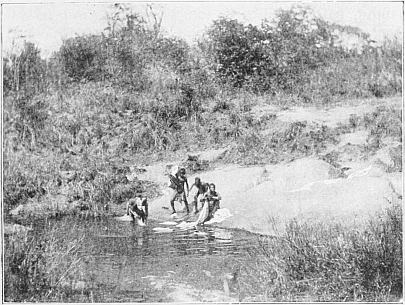
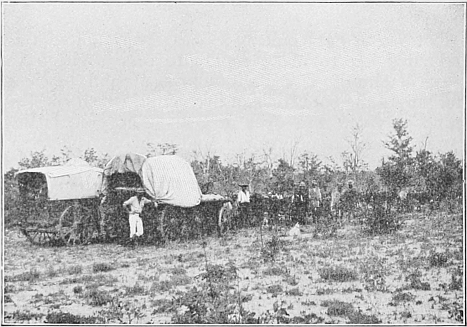
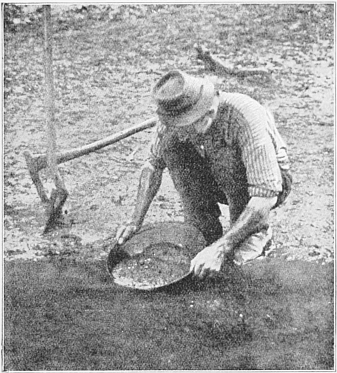 Prospecting for Gold: Panning a Sample
The inference that an immediate and heavy increase of taxation
is to be made to meet the war debt obligations may possibly be
gratuitous, and probabilities confirm this supposition, for it is at
issue with the Government expert’s special recommendations.
From this point of view, Sir David Barbour’s observations are
worth reciting for their direct bearing. He says: “The sound
policy for the Transvaal is to so frame its system of taxation as
not to increase unnecessarily the initial capital expenditure, or
enhance the cost of working. I shall take it for granted that it
is not intended to impose excessive or crushing taxation on either
of the Colonies, or to exact such a share of their revenue as
would cripple or starve the Administration. Subject to these
considerations, I shall assume that any surplus of revenue over
expenditure, or any special assets that the Colonies may possess,
can fairly be taken towards meeting a portion of the cost of the
war.” Further: “If the additional taxation which I recommend
... be imposed ... it may be anticipated that after two years
from the conclusion of peace that Colony will be in a position to
set aside a portion of its ordinary revenue towards meeting the
cost of the war. I am unable at present to form an estimate of
the amount which it may be possible to set aside in this way....
On the assumption that the contribution of the Orange River
Colony and the Transvaal towards the cost of the war is to be
limited to the amount which they can pay without imposing excessive
taxation or starving the Administration, it will be obvious
from what is said in the preceding portion of this report, and
especially in paragraph 62, that it is impossible at the present
time to specify any definite sum as that which ought to be paid. I
suggest that the Imperial Government should fix the maximum
sum which, under any circumstances, they would require to be paid.
Such portions of the total amount of contribution, so fixed as it
may be found from time to time that the Colonies can bear, should
be made a charge against them. If, in the course of time, it is
found that the Colonies are unable to pay the whole sum, under
the conditions as to taxation and cost of administration which I
have already specified, the balance should be written off.” So far
as the immediate incidence of war taxation is concerned, it is
therefore highly probable that the Government, who have adopted
their financial expert’s views almost in toto with regard to fiscal
reform, will do the same with regard to the levy of the war
contribution.
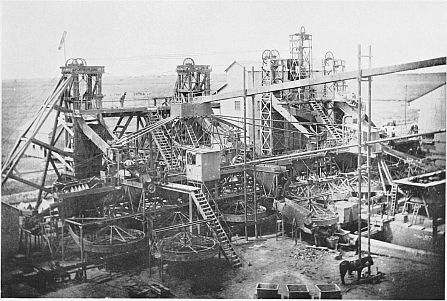 WASHING PLANT OF DE BEERS DIAMOND MINES AT KIMBERLEY
Photo by Wilson, Aberdeen
WASHING PLANT OF DE BEERS DIAMOND MINES AT KIMBERLEY
Photo by Wilson, Aberdeen
But another phase of the same subject is revealed in the extent
of the contribution which the Transvaal should be called to bear
compared with that of the other South African Colonies. In the
thoughts of some, tinctured still perhaps with a touch of the recent
bitterness of the war, the Transvaal should bear the heaviest share;
but it is to be observed that this is not the opinion of the responsible
heads of the mining industry, who, while admitting the justness of
assuming their proper proportion of the proposed burdens, appropriately
point out that both the Orange River Colony and the Cape
Colony (for a part of the latter’s population) were fellow-sharers in
the beginnings and the conduct of the war, and should bear a due
portion of the resultant financial burdens, while Natal, it is contended,
cannot fairly be allowed to escape contribution to the extent at least
of the valuable Transvaal territory which has been allotted to her.
Pending formal announcements of the Government’s intentions—and
it is to be observed a contribution from the Orange River Colony
is contemplated in Sir David Barbour’s report—many huge lump
sums have been mentioned, which it is proposed to levy on the
Transvaal alone. Such reports naturally have not only alarmed
the mining industry, but disturbed the confidence of international
capitalists, upon whom the future development of the wealth of the
goldfields in the first place rests. The extent of the alarm which is
felt is shown by the Johannesburg Chamber of Mines as a body
pleading in their recent communication to Lord Milner for a “reasonable
sum” to be fixed, and by the rough estimates of this sum propounded
by others, as, for instance, Mr. Freeman Cohen, chairman
of the Potchefstroom Exploration and Gold Mining Company, who
indicates £30,000,000 as the specific figure, while Mr. Bleloch adventures
the sum of £35,000,000. This last gentleman’s summing up
of the situation is that the mines can pay, and are willing and forward
to pay, provided the incidence at the first be made light, and that the
burden of the £55,000,000 estimate of the Government’s financial
expert be shared by the other Colonies in the proportion, say, of
£5,000,000 from each, to lessen the burden on the mining industry
as much as possible, especially the low-grade section, and also as a
matter of equity, and he advocates in addition—to augment the
disposable revenue—the levy of a 5 per cent. tax on the profits of
other industries (banks, &c.), the creation of death dues and of a land
tax; also the beneficial reservation to the Government of portions
of each new mining field to be opened.
That the whole weight of the taxation of the Transvaal should
not be made to fall upon one industry is, of course, consonant with
reason, policy, and equity. Pending the pronouncement of its actual
intentions, and in view of the alarmist rumours which are spread
about, it behoves the Government, to allay the very natural apprehensions
entertained, to give an early and explicit outline of its
proposals, and in this connection the projected visit of the Right
Hon. J. Chamberlain to the Colonies is of the best augury. From
his place in Parliament that statesman has already disclaimed, on
several occasions, proposals anent the immediate imposition of heavy
taxes attributed to the Imperial Government, and the probabilities
are that those recently published in London are as baseless as they
are vague.
The dependence, to a large extent, of the development of the
mining industry on the fostering and assistance, or otherwise, accorded
by the existing Government is a point too painfully brought home
to the Rand mining industry by past experience to need demonstration;
wherefore the sound common-sense statesmanship of those now
responsible for the prosperity of the Empire is a valuable guarantee
that the various problems now absorbing the attention of the industry
will be treated in a fair, just, and liberal manner.
The Rand mining industry, at the moment, is undoubtedly in
the throes of one of those periodic waves of depression incident to
all great gold-mining fields, though to the Rand in a less degree than
to the others, on account of the certain results which may be reckoned
upon from the stable nature of its geological formation. Capital
required for its development is in many cases being withheld,
investors looking askance at its demands with obvious misgivings.
This attitude is undoubtedly due to impatience, and disappointment
that progress has not been more rapid since peace has been declared.
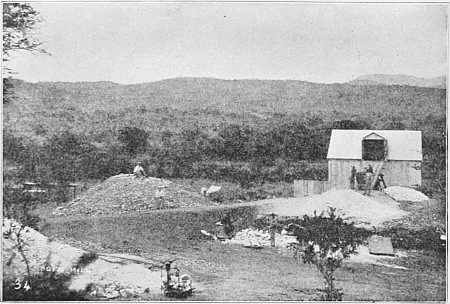
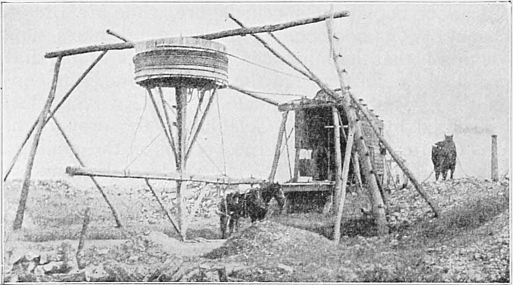 The Infancy of a Gold-Mine: Winding Quartz with a Whim
Apparently it was assumed that only a cessation of hostilities
was needed for the mines to hurry up and resume their old-time
rate of production and prosperity. Such an assumption ignores
the real difficulties of reconstituting a country and its industries,
devastated and disorganised for three years by war, and setting up
an entirely new order of things. As a matter of fact, the progress
actually achieved has been marvellous, and as much, or even more,
than could have been expected in like cases. It has apparently
been forgotten that civil government has only within a few weeks
replaced the military in the main administrative channels. The
railway network of the sub-continent has only been thrown open to
the free transport of merchants’ goods within the past month, and
the limitation of transit to the Rand, and the interior generally, is a
most serious matter, by reason of the fact that the trunk railways
from the coast are only single lines. For the clearance at the
ports of the accumulations of mining machinery, mining stores,
building materials, foodstuffs, and general merchandise, months are
required, and this clearance must take place ere the railway traffic
can fall back into its normal grooves. Abundance of labour, too—always
a crucial question with mining operations, whether they be
on the Rand, in Rhodesia, or elsewhere in the sub-continent—is, for
a variety of causes, not yet available, although measures have been
taken by the Government and the mining industry, acting in concert,
which have placed this subject on a more satisfactory footing than it
ever enjoyed. Other advances have been made in the improvement
of the status of the industry, such, for instance, as the reduction
of the customs duties, which enormously improve the industry’s
chances of future remunerative working. Some desiderata are
certainly unfulfilled, such as reduced railway rates; but the instalment
of reforms made affords a fair basis on which working can be
resumed with admirable chances of remuneration and profit. This
being so, the unreasonableness of the show of impatience that progress
has not been more rapid, and the undeservedness of the distrust
with which the industry is professed to be regarded in some quarters,
are obvious. A sober view of the situation of the Transvaal at
the present moment must undoubtedly force the confession that the
amount of solid work done in solving the many problems simultaneously
surging up for solution in a new colony besides mining,—repatriation,
resettlement, &c.—and in rebuilding generally the body
politic, is of substantial volume, and that the progress hitherto made,
in removing the difficulties which beset the mining industry, are
sufficient augury that whatever remains unalleviated will receive its
due and satisfactory attention in the near future.
In an old (1876) edition of “Chambers’s Encyclopædia,” under
the heading of “Africa—Productions,” is the statement that “It
would be hazardous to assert that Africa is deficient in mineral
wealth, though, judging from our present imperfect knowledge, it
does not seem to be extremely rich.” Little did the compilers of this
well-known work think that, in the space of less than twenty-five years,
a town of about 150,000 inhabitants would spring up as the centre
of a mining country which now takes rank as the first gold-producer
in the world. The gold production of the Rand to date is indeed
stated to equal one-ninth of the coined gold in circulation throughout
the world, while its potential reserves are probably fourfold this
amount. In 1887 the United States occupied first rank among
gold-producing countries, Australia being second, and Russia third,
the total gold production of the world being only £18,000,000. In
1898, South Africa occupied the premier position with 28 per cent.
of the aggregate world’s production, and her contribution, moreover,
represented only 3½ millions less than the world’s aggregate in the
first-named year. In 1899, owing to the war, it just managed to
fall short of the headship. Since its start, the Rand gold-fields have
produced gold to the handsome aggregate amount of £81,000,000
sterling. On the fortunes of South Africa, the influence exerted by
this stupendous accretion to its wealth is past question, for the output
of £20,000,000 of gold in 1898 formed 80 per cent. of the subcontinent’s
aggregate exports in that year, while 68 per cent. of it
was disbursed in labour, foodstuffs, mining stores, and material in
the course of its winning. It is only needful to glance back at the
modest proportions of South Africa’s trade movement before the
discovery, first of diamonds and then of gold, to recognise how much
it owes to its mineral wealth, and more particularly to that of gold,
for its present-day prosperity. Its populations, its cities and ports,
its railway network, its multifarious industries from agriculture upwards,
and its merchant firms and commercial activity have each
and all been stimulated and enlarged enormously by it. As in the
case of Australia and other older gold-producing countries, the output
of gold, primarily from the Witwatersrand fields, has acted like a
perennial stream, fructifying and rendering teemful the arid wastes,
and making the very wilderness to blossom as the rose.
The gold-bearing quartz-pebble conglomerate beds, called by the
Boers “banket”—the discovery of gold in the outcrops of which in
1883 started the Witwatersrand mining industry—form a series of
strata going down at an angle of about 30 degrees to hitherto
unknown depths—over 8000 feet have already been plumbed—and
extending over a tested lateral distance of more than 50 miles.
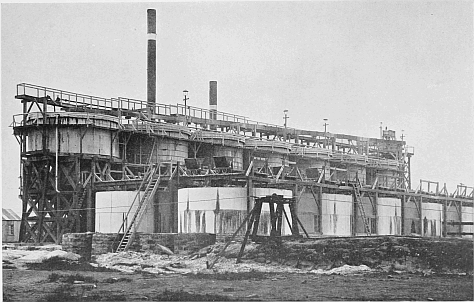 CYANIDE WORKS (NEW COMET MINE) AT JOHANNESBURG
The tailings are run into the huge vats, and the cyanide of potassium a deadly poison percolates
through, and carries off the gold in solution.
Photo by Barnett & Co., Johannesburg
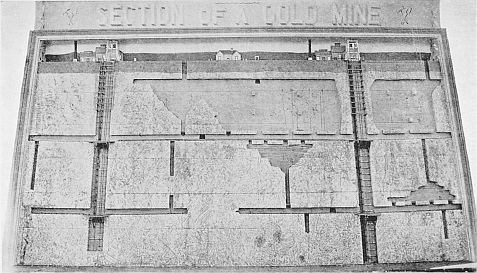 Section of a Gold Mine. (Photo by Horace W. Nicholls, Johannesburg)
These beds lie in series, that particular one which contains most
of the gold being called the Main Reef series, comprising the Main
Reef proper and a number of subordinate reefs or bands. The
thickness of the Main Reef is from 3 to 12 feet, that of the Main
Reef Leader 3 feet on the average, and the South Reef thinner
than the latter, but having a richer gold contents than either.
These are the beds chiefly worked, the gold being disseminated
throughout the matrix mainly in crystals, visible gold being only
occasionally seen, but in fairly regular quantities, so that the results
of working, whether in the richer or poorer reefs, are capable of
being accurately forecasted. The knowledge of the nature and extent
of the beds has only gradually been brought together, and is still
incomplete in parts even for the 15 miles section of the Rand which
has been longest under working, and discoveries are of almost daily
occurrence extending the sum of information regarding their composition
and incidence. In the section situated between the Langlaagte
Estate Mine in the west and the New Comet in the east, one profitable
mine after another follows almost without a break. The eastern
and western extensions are, for the main part, still terra incognita;
but the several mines scattered along their stretch have confirmed
the identity and value of the formation, which is held by experts to
warrant the belief in the existence of wealth even exceeding the
Rand proper.
Knowledge as to the depth to which the reefs descend has been
slowest in accumulating. When the outcrops were first worked in the
central section, it was believed that there was little or no gold in the
lower levels. Since 1898, however, deep and yet deeper depths
have been explored, especially in following the richer reefs, and
always with the similar result of meeting with the same, or a superior,
grade of ore contents peculiar to the higher sections of the particular
reef, so that the inference is strengthened to certainty that
profitable exploitation is only limited to the ultimate depth at which
modern mining can be carried on. The problem, therefore, is one
for the engineers; for, apart from the increased temperature in the
lower levels, which can be met by roomier shafts, and the occurrence
of water, which is likewise capable of being dealt with, the
only difficulty to be met with is that concerned with the hoisting
appliances for such enormous depths. So recently as May last the
London Chamber of Mines, and more recently the Johannesburg
Association of Mining Engineers, were engaged on the solution of
this question. It is needless to anticipate the results of their
deliberations, the point turning upon the choice betwixt two systems,
only so far as to state that means for solving the difficulties of the
task are considered to be available, at least, to such depths as
5565 feet on the slope, and that the results of mining at these great
depths can be made to show a substantial profit. It may be added,
however, that in consequence of the increased cost to reach the
ore, the need for the utmost reduction of working costs becomes
paramount.
The circumstances of gold-mining on the Rand have, therefore,
features quite distinct from those of quartz-reef, alluvial, or other
kinds of mining, and approximate to those of coal winning, especially
in the matter of the depth and regularity of the conglomerate formation.
Its peculiarities have created a method of mining, the outcome
of costly experiment, experience, and skill, which will remain a
lasting asset to future ages.
The future gold production of the Rand mining industry is a
subject which enchains the attention alike of the investor and the
curious. In approaching the subject of the unexploited gold contents
of the banket formation, figures are handled which simulate
the fabulous, and almost excuse the disbelief with which all such
estimates are received in some quarters. Confirmation of the
approximate correctness of the computations may, however, be
obtained in two ways: firstly, from the past yield of the gold-fields
in the seventeen years since their start; and secondly, from the
verification of former prognostications which subsequent outputs have
furnished. So far as regards the former, the fact of the production
of £81,000,000 of gold since the start of the industry up to now,
under well-known circumstances is, in the first place, proof positive
that the gold exists; and, in the second, affords inferential grounds
for assuming that, given at all similar circumstances, mining operations
will yield like results. This is, of course, taking the lowest
ground, for it is indubitable that the circumstances will not be alike,
but vastly improved, in which case the value of the results will be
proportionately enhanced. As to the confirmation which results from
the verification which later outputs have furnished, both of the trustworthiness
of the bases on which former forecasts were made and of
the prognostications themselves, there may be instanced the forecasts
of such early computators as Mr. Hamilton Smith, Mr. C. D. Rudd,
and others. The former, in 1892, in a report on the future production
of the Rand fields, made by request of Messrs. Rothschild,
adventured an opinion which is worth quoting textually. He said:
“With the active and energetic men who have this industry in hand,
and always supposing that the foregoing theories be correct, in three
or four years from now the producing power of the mines and their
reducing works will, I think, be increased to an output of five
or six million tons of ore per annum, worth a gross yield of over
£10,000,000. At this rate the available supply of ore, as conjectured
above, will last for more than thirty years.”
As an actual fact, in four years from the time of his writing the
above, the Rand gold yield from 69 companies working amounted
to 5,325,355 ozs., the total production being of the gross value of
£10,583,616; so that, far from his estimate being too sanguine or
exaggerated, it was a literal forecast of the actuality. He subsequently
expressed the opinion that the full producing power of the
Rand would be reached by the end of the century, when the output
might be expected to exceed £12,500,000 per annum. As a matter
of fact the total value of gold produced in the Transvaal in 1898
was over £15,000,000, most of which came from the Rand,
and, had mining operations in 1899 not been interrupted by
the war, the output in that year would have reached to over
£18,000,000. Mr. Smith based his estimate on a working depth
of 5200 feet, and on an area of the reef only 11 miles in extent,
but since his time deep mining has been successfully prosecuted to
7000 feet. Inference and analogy, therefore, both afford strong
support to the correctness of estimates, based on the results of past
working, of the future gold contents of the Witwatersrand reefs,
which estimates, as appears, are more likely to be under-reckoned
than otherwise, from the sheer immensity of the subject, and from
the necessarily imperfect knowledge of the potentialities of so huge
a problem.
The divergencies in the several estimates made from time to
time in the past of the total gold available from the Rand banket
beds have in part arisen from the sheer inability of those making
the estimates to anticipate the striking developments which have
successively been made. So far back as 1893, 325 millions, and
subsequently 450 millions and 700 millions, have been adventured
by various persons. The relative moderateness of these estimates,
compared with more recent ones, is due, as in the case of that of
Mr. Hamilton Smith, to the under-valuation of the potentialities of
deep-level mining, which are only now becoming fully apparent.
One of the more recent estimates—that of Mr. Bleloch—based on
working depths of 3000 to 7000 feet, and taken over an area of
fifty miles, embracing the district between Randfontein and Holfontein,
computes an available gold yield of £2,871,000,000 sterling,
or eight times as much as the estimate of 1893.
Although so enlarged, the total actually understates potentialities
by being exclusive of possible discoveries beyond these limits, and
also by the estimates being framed on the older ratios of gold recovery
to ore tonnage, thus ignoring the application of the latest
scientific methods to the treatment of the poorest ore, which would
tend to enhance the results considerably. Apart from these limitations,
this estimate of 2871 millions is made in the most systematic
manner, from careful calculations, area by area, according to the
thickness of the reefs, the tonnage per claim, and the value per ton
as they have been shown from past working. The total tonnage of
payable ore available is estimated at 1,378,000,000. The average gold
value per ton of ore in the figures works out at 41s. 7d., but in the
actuality this varies from 78s. in the richest mines down to actual
loss in the least paying of low-grade ores. In these stupendous
figures are included the contributions of the great deep-level mines,
the growing proportions of whose contributions to the aggregate
output is already becoming a noteworthy feature, while the extent
of their development cannot be foreseen. Mining engineers are
indeed already considering the specifications of equipments for
negotiating depths deeper than 7000 feet, and even in 1899 the
possibility of mining at 12,000 feet was considered. Certainly
the mining of minerals in other parts of the world has shown
the feasibility of operations at much greater depths than those
mentioned.
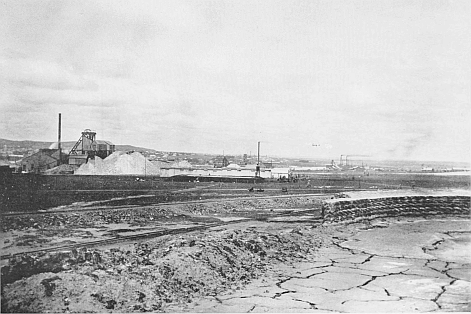 MINES ON THE LINE OF REEF AT JOHANNESBURG
Photo by Wilson, Aberdeen
MINES ON THE LINE OF REEF AT JOHANNESBURG
Photo by Wilson, Aberdeen
The ascertainment of the proximate gold contents of the
Transvaal mining area leads up to the question, How and when
is this stupendous wealth to be rendered available? In other
words, what is likely to be the gold production in the several years
from now on, and how long will this rate of production continue?
or what are the chances of the early exhaustion of the mining
industry? To take the last item first, it is the growing conviction
of Rand mining engineers that the amount of available gold is only
limited by the extent to which mining operations can be prosecuted
below the surface. Mining engineers had up till recently generally
agreed to fix a depth of 8000 feet as the utmost limit to which
mechanical appliances and other circumstances will allow them to
follow the descent of the reefs, and the available gold yield is
calculated on this basis. But there is no finality in this statement
of depth, and already, as we have remarked, engineers are calculating
for deeper delvings, and 9000 and even 12,000 feet have
been spoken of. This latter increase of 4000 feet—from 8000 to
12,000 feet—would alone augment the gold estimate by 50 per cent.
For the rest, and retaining the 8000 feet limit estimate as the
measure of the exhaustion of the present Rand, this is naturally
controlled by the rate of production per year, which itself is dependent
on the particular circumstances of the industry during the
period in question.
The yearly production of gold from now onwards offers no
insurmountable obstacle to a fairly exact appreciation. It is merely
a rule of three calculation: if in the past, under given circumstances,
working results have been as follows; in the future, with the same
or like circumstances, the results will be such. Various computations
from time to time have been made on these bases, among the
most recent being those of Mr. Cooper-Key and Dr. Hatch in
1899, Mr. Goldring and Mr. Bleloch in 1901, and quite recently
Messrs. Leggett and Hatch (on 47 miles of the Rand only, and
working to depths of 4000 to 7000 feet). Mr. Cooper-Key’s forecast,
which was made in 1899, was for the output of the three
following years, the war not having then been anticipated. The
basis of his calculation, like that of Mr. Goldring’s, was the
number of stamps or the milling power employed. If in 1898, he
argued, there were in work on the Central, Eastern, Far Eastern,
and Western sections of the Rand 6000 stamps, at the end of 1899
this number would probably be increased by 165, or to a total of
6165; at the end of 1900 the increase made would be 1730 and the
total 7895; at the end of 1901 the total would have risen to 9845;
and at the end of 1902 to 11,785. On the basis of 1800 tons milled
per stamp, of an average value of £2 per ton, and with an
average number of stamps of 7000, 9000, and 10,500 in the three
years, the output would have been: 1900, £25,200,000; 1901,
£32,400,000; and 1902, £37,800,000. Mr. Goldring, who is the
Secretary of the Johannesburg Chamber of Mines, likewise framing
his calculation on certain yearly increases in the milling power,
calculated that in the five years following the full resumption of
mining operations, 17,000 stamps would be at work, or an increase
of 11,000 on the number before the war. Allowing for a fall in the
grade of ore milled, in consequence of cheaper methods permitting
of a lower grade of ore to be dealt with, the 17,000 stamps, he
considered, would produce at least £50,000,000 sterling a year.
Writing before the war, and basing his estimate on observations
made by Mr. Eckstein that in five years the number of stamps in
working would be 12,000, Dr. Hatch, likewise following the milling
power basis, calculated for a yearly gold production of £36,000,000.
Mr. Bleloch’s opinion, taking the production in the nine working
months of 1899 of £20,000,000 as a basis, is that the rate of production
would probably double itself after the war. “If this be so,”
he adds, “in fifty years’ time the product of the Rand will have
reached over £2,000,000,000, and if such an accelerated progress is
made, the whole of the vast amount now estimated may be dug out
of the Rand within sixty or seventy years.” The latest estimate
published, that of Messrs. Leggett and Hatch, going on the basis
of the average increase of production of £4,000,000 per year in the
three years before the war, and that the production in 1899—a
broken year owing to the war—was £19,000,000, concludes that,
allowing eighteen months from January 1, 1902, for the industry to
be restored to the conditions existing in August 1899, a similar
increase of production will bring the output to at least £30,000,000
per annum by June 30, 1906, and if this rate of production were to
be maintained from then on, the total production of £1,233,560,700
would give a life from January 1, 1902, of forty-two years and a
half. But as the production will decline gradually, instead of
coming to a sudden stop, the life of the industry is likely to be
prolonged for some considerable number of years beyond the period
indicated. If, on the other hand, the annual output should exceed
£30,000,000 for any considerable period, as is, perhaps, within the
bounds of possibility, this would partially offset the extension of life
due to the gradual decline of production. It is to be added, in
explanation of Messrs. Leggett and Hatch’s estimate, that it
contemplates working along a strike of forty-seven miles only, and
to the restricted depth of from 4000 to 6000 feet.
The following tabulated comparison of these several estimates
will assist their comprehension, it being explained that Mr. Bleloch’s
estimate is reduced to the extent of 25 per cent. as a set-off for
probably barren sections, &c.:—
| Year. |
Mr. Cooper-Key (1899). |
Dr. Hatch (1899). |
Mr. Goldring (1901). |
Messrs. Leggett & Hatch (1902). |
Mr. Bleloch (1901). |
| |
£ |
£ |
£ |
£ |
£ |
| 1898 |
... |
... |
20,000,000 |
... |
... |
| 1899 |
... |
... |
... |
19,000,000 |
20,000,000 |
| 1900 |
25,200,000 |
... |
... |
... |
... |
| 1901 |
32,400,000 |
... |
... |
... |
... |
| 1902 |
37,800,000 |
... |
... |
... |
15,000,000 |
| 1903 |
... |
... |
|
|
50,000,000 each year |
|
|
30,000,000 each year |
20,000,000 |
| 1904 |
... |
36,000,000 |
25,000,000 |
| 1905 |
... |
... |
|
|
35,000,000 each year |
| 1906 |
... |
... |
| 1907 |
... |
... |
| 1908 |
... |
... |
... |
| 1909 |
... |
... |
... |
| 1910 |
... |
... |
... |
| 1911 |
... |
... |
... |
| 1912 |
... |
... |
... |
| 1913 |
... |
... |
... |
| 1914 |
... |
... |
... |
| 1915 |
... |
... |
... |
|
|
40,000,000 each year |
| 1924 |
... |
... |
... |
| 1925 |
... |
... |
... |
|
|
45,000,000 each year |
| 1934 |
... |
... |
... |
| 1935 |
... |
... |
... |
... |
|
|
40,000,000 each year |
| 1944 |
... |
... |
... |
... |
| 1945 |
... |
... |
... |
... |
|
|
30,000,000 each year |
| 1954 |
... |
... |
... |
... |
| 1955 |
... |
... |
... |
... |
|
|
30,000,000 each year |
| 1964 |
... |
... |
... |
... |
| 1965 |
... |
... |
... |
... |
|
|
15,000,000 each year |
| 1974 |
... |
... |
... |
... |
| |
|
|
|
|
|
These several estimates are of course to be looked upon merely
as approximations, and they are, moreover, not framed on exactly
the same bases. They, however, agree in the main that the 1899
output of roundly £20,000,000 will be increased to some point
between £30,000,000 and £50,000,000 within a few years’ time, and
maintained thereat, more or less continuously, for periods varying
over 45 and 65 years. The production of the several estimates
for the whole period gives an average of £37,000,000, which is only
slightly higher than that of Mr. Bleloch, which is £35,714,285. This,
consequently, is the handsome yearly output which the Rand mining
industry offers in the near future—an amount which alone equals the
total production of the whole world in 1897—if the circumstances are
at least equal to those which previously prevailed.
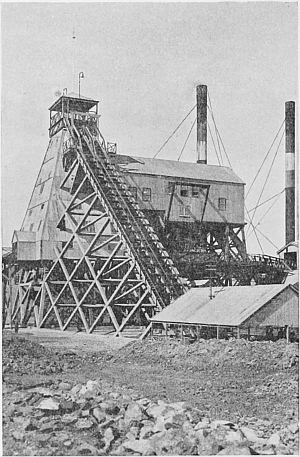 Head-Gear of the Witwatersrand Gold-Mining Co.
(Photo by Horace W. Nicholls, Johannesburg)
Head-Gear of the Witwatersrand Gold-Mining Co.
(Photo by Horace W. Nicholls, Johannesburg)
Having advanced the question of the future of the mining industry
to the extent of showing a possible gold yield of at least 2,871 millions,
spread over a period of seventy years at the rate of between 37 and
40 millions a year, at a moderate estimate, it is pertinent to inquire
somewhat into the efficacy of the means for securing this return, the
location of anything and its appropriation being two distinct matters.
As implied previously, the realisation of this huge prospective gold
yield depends upon the circumstances of the industry being at least
equal to those of the past. If found to be superior, the ultimate
realisation will only be made the more certain. These circumstances
may be conveniently classified as external and internal. So far back
as the Industrial Commission of 1897 it was recognised that the
essentials for the development of the Rand were reduction of taxes
and economy in working. The evidence of all the prominent heads
of mining groups, both English and foreign, then tendered, in the
sum amounted to this. Where the circumstances of a mine are such
that they can only be worked at a higher cost than their returns, or
with only an infinitesimal profit, either costs must be reduced or the
mine compelled to close down. In many cases a reduction of working
costs of so moderate an amount as 2s. per ton means the life of
a mine, and less than this spells bankruptcy. Where mines had
exhausted every effort to reduce working costs, it was also contended
with justice that they had established a claim for moral and material
assistance on the part of the Government, where it could be properly
accorded; indeed, a personal interest, so to say, attached
to Government interference, in that the national revenues were
jeopardised when mines failed of successful working. The assistances
asked for by the mining industry, and which the Government
were able to accord, are now notorious, but are worth reciting for
the bearing they have on our present subject. They were fiscal
reforms conducing to cheapening of labour by reducing the cost
of living both for whites and natives; increase in the effectiveness
of native labour by the proper enforcement of the Liquor Law, the
cancellation of the local spirit monopoly, and the withdrawal of the
right of free imports of spirits from Mozambique and the Orange
Free State; abolition of monopolies which tended to enhance the
cost of materials used in the mines, including those of dynamite,
cement, &c.; reduction of rail rates, and abrogation, by arrangement,
of the transit dues levied by the coast Colonies, thus lessening
first and working costs of mining equipments and materials;
promotion of large public works directly or indirectly affecting the
mines, such as provision of adequate water supplies, construction of
railways, &c.; finally, an equitable and sympathetic attitude of the
Governing Power to all and every question having relation to the
country’s staple industry. So far as these reforms were appraisable,
they were reckoned to be equivalent to a saving of not less than
6s. per ton in working costs. What practical chance there was of
gaining the relief sought under the old régime is shown by the futile
results of the Industrial Commission’s labours.
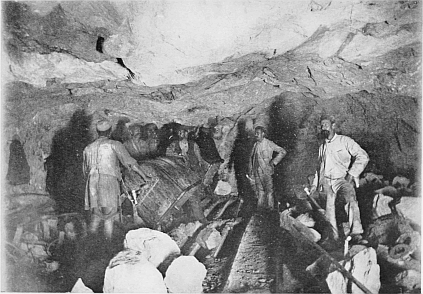 DRIVING AN “END” IN MAY CONSOLIDATED MINE, JOHANNESBURG
In some places the holes for blasting are bored by Kaffirs, but as a rule the drives are made with the use of boring machines driven by
compressed air. There are few accidents underground, as the rock is so hard that there is little fear of the “levels” falling in. The chief
danger is from the gas after blasting ...
DRIVING AN “END” IN MAY CONSOLIDATED MINE, JOHANNESBURG
In some places the holes for blasting are bored by Kaffirs, but as a rule the drives are made with the use of boring machines driven by
compressed air. There are few accidents underground, as the rock is so hard that there is little fear of the “levels” falling in. The chief
danger is from the gas after blasting ...
But the altered circumstances of the mining industry since the
war are evidenced by the reforms already consummated and under
weigh, comprising among them some of the leading demands of 1897.
This fact is conclusive that, so far as external circumstances are
concerned, the mining industry is not only in the enjoyment of
equally favourable circumstances with those existing previously, but
even greatly superior. By so much, therefore, is the perspective of
the gold yield to which we have made allusion assisted towards
becoming a reality.
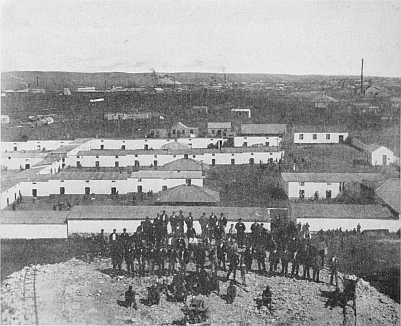 Kaffir Compound, New Primrose Gold Mine, Johannesburg
As regards the internal circumstances on which the progress
of the mining industry depends, these are the employment of the
most improved methods and means of production. They comprise
the most perfected machinery and appliances, and the latest processes
of metallurgical and chemical science. Speaking generally,
it may be said that on the Rand at the present time are employed
the most up-to-date skill and technical knowledge, and the latest
devised mechanical appliances. This, by the way, is only true
of individual mines however. The equipment of the mass varies
greatly, and necessarily so, since the conditions of one mine differ
vastly from those of its neighbour; and distant and even contiguous
localities require unlike treatment, according to the nature of the
ore or reef worked and other local conditions. The improvement
effected hitherto is evidence, however, of the initiation and energy
which have been displayed by the heads of the mining industry in
the past, and an earnest for the future, while the progress achieved
abides as an invaluable guide for all future mining operations in like
geological formations.
The knowledge of how best to treat the peculiarities of the
banket reef has, however, only been slowly gained, and at the cost
of much money and many unavoidable blunders. For instance, the
only metallurgical operation for the extraction of gold employed up
to 1889 was the stamping mill, and fine gold and amalgam were
necessarily abundant in the tailings which were cast away on the
spoil heap. The cyanide process, and that of the treatment of
slimes, were only applied in 1891 and 1898 respectively. Their use
has added millions to the yearly output of gold. The amalgamation
process, the chlorination treatment of concentrates, and the use
of frue vanners are other innovations gradually introduced as results
of experiment and experience, and which have likewise increased
the efficacy of the extractive operations. Similar progress has been
shown in the improvement effected in the mechanical equipment.
At first the mining operations were confined to the primitive digging
of a huge trench over the site of the outcrop, with the simplest
delver’s tools furnished by the locality. This method has advanced
to the stage of sinking shafts to the enormous depth of a mile into
the bowels of the earth, equipped with the most elaborate hoisting
plant, with underground equipment lit and worked by electricity,
and the complementary surface establishments, at a cost running into
hundreds of thousands of pounds. There yet lies before the industry
the general adoption, not only of these but of other improvements
which experience has shown to be desirable, such as the
practice of sorting of ore, the use of heavier batteries on the score
of greater economy, &c., and their utilisation is merely a question
of time. As, therefore, all these improvements and betterments
have been successively made, and the mining industry is only now
gradually—it is not yet, so far as a large number of them are concerned—entering
into the full use of them, it is obvious that future
mining operations must not only enjoy the same favouring circumstances
as those which enabled the huge mining output of the
past, but a very much better environment, through the more general
use of all those methods which experience and science have shown
to be advisable. As a consequence, and in the measure of the
value of these improvements, will the effective output be ameliorated
from now onwards.
The value of the improved circumstances of the mining industry
alluded to is convertible into figures in the terms of working costs
and divisible dividends. The former may be said to be the barometer
of the latter. In the past, in the early days of the mining
industry, when the problems of mine equipment and gold extraction
and winning were only imperfectly understood, the wasteful expenditure
of money on inefficient methods and appliances swallowed up in
many cases every vestige of profit.
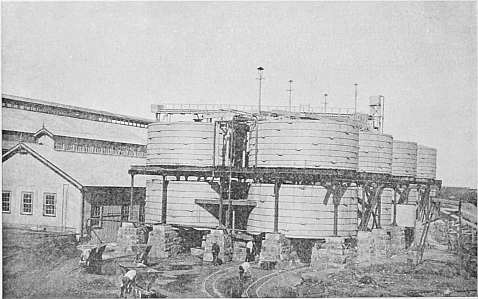 Cyanide Works. Witwatersrand Gold-Mining Co.
(Photo by Horace W. Nicholls, Johannesburg)
Cyanide Works. Witwatersrand Gold-Mining Co.
(Photo by Horace W. Nicholls, Johannesburg)
It was incidental to the first operations on the then unknown
geological formation of the Rand, when the very science of the goldfields
had to be created. Costs of working on the Rand are now,
through the excellent system devised by the Chamber of Mines,
tabulated so that the outlay of individual mines, or of the mining
industry in the aggregate, may be seen at any moment at a glance.
For instance, taking the record for the eight years from 1890 to
1898 inclusive, for example, the working costs ranged from 80.8
per cent. of the total value of the gold produced by eighty-five
companies in 1890 down to 68.1 per cent. in 1898, the last full year
before the war, the decrease showing the extent of the progress
made in reducing the working costs. Simultaneously the dividends
increased from 19.2 to 31.9 per cent., testifying to the close kinship
with the costs factor. These figures are a general average taken
over the aggregate of the mines working, and do not represent the
ratios of working costs of individual mines, which differ of course
according to the greater richness of the ore, the fewer difficulties to
be dealt with in winning it, and the methods employed to secure the
end in view. This is exemplified by the fact that in a few of the
best equipped mines costs have been brought down to as low as
17s. 6d. per ton, while on others they rise to 79s. 6d. and above.
The Robinson mine is a case where, despite adverse circumstances,
the enlightened employment of the latest appliances of science and
mechanics has resulted in reducing costs to an extremely low level.
In 1888 the working costs of the mine were 72s. 1d. per ton; in
1892 they were reduced to 46s. 5d., and in 1896 to 30s. 11d. They
have subsequently been reduced to a still lower figure, and this
despite the fact that the ore changed from an oxidised character to
a pyritic, involving greater difficulty and cost to treat. This mine
was the first to introduce frue vanners, the cyanide process and the
treatment of slimes, expending as much as £80,000 in the last
innovation. By means of these it raised its gold extraction from
65 to 90 per cent., and gave encouragement and impetus to all
mining on these fields. The latest costs published for the month of
September this year of thirty-six mines in working give an average
of 26s. 3d. per ton, which shows that operating charges are now at
about the same ratio as they were before the war. Although so
reduced, however, they are still relatively higher than they may be
expected to be when the mines settle back into their normal
grooves. The reason for this is that only a few mines are now
working up to their full battery power, and, while costs are on the
full scale, results are less, surface dumps are being drawn upon for
mill service instead of the mine itself, owing to lack of full supply
of labour, &c. When, however, the effects of the important fiscal
reductions just made have had time to exercise their effect in reducing
the cost of imported mining stores, foodstuffs, and the smaller
machinery and metal goods charged by the mines to the working
account, further reductions in the working costs will be possible.
Of the actual money value of this per ton of ore milled, various
opinions have been ventured. It has been estimated by experts
that it is possible under favouring circumstances to reduce the
expense of working by some 10s. per ton, at which rate ore yielding
over 5.6 dwt. per ton bullion could be made to yield a profit.
The importance of this not only in improving the present position
of all mining undertakings, but in stimulating the low-grade mines
to come into the working stage, can hardly be overestimated. With
the various difficulties besetting the mining industry removed, the
future working cost level should be lower than at any preceding
period, taking into account the benefit of the recent fiscal reductions
and other governmental assistance in prospect.
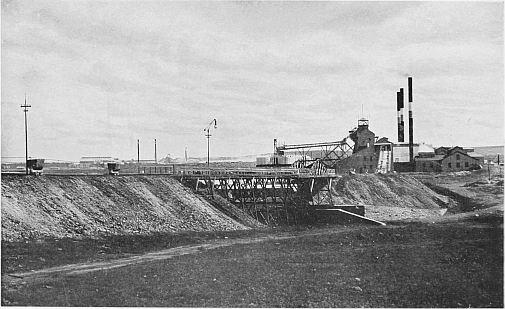 GENERAL VIEW OF THE SURFACE WORKS OF A RAND GOLD MINE (KNIGHT’S)
Showing the head-gear at top of the shaft, the stacks locating the engine-rooms. A sloping tramway will be seen leading down from the shaft-head,
and iron waggons bringing the crushed ore, and taking it away to the “battery” or “mill.” The waggons are driven by an endless wire
rope, and discharge automatically. Beyond, in the middle distance, may be seen the huge white heap of “tailings,” the waste débris after the gold has
been extracted. Each mine has its own electric-light plant.
Photo by Barnett & Co., Johannesburg
Allusion has been made to the probable continuation of the
Rand formation beyond its present area; but, as a matter of fact, the
Witwatersrand series of reefs, or an amplification of them, has been
more or less proved for a distance of nearly one hundred miles to
the north and south. The strike of the reefs is not uniformly continuous—in
fact, the reefs are intersected by quite a numerous series
of faults, and in many places they have been subjected to extensive
denudation, to the extent of complete obliteration of the outcrop in
places. Nevertheless at various points very remunerative mines
have been established, and although, on the whole, the character of
possessing a low-grade ore is attributed to these reefs, this is probably
due more to the very incomplete prospecting to which the
area has been subjected than to any actual lack contrasted with the
better known central section of the Rand. On this subject Mr.
Bleloch makes the apposite observation that “it is not reasonable
to think that only the richest portions of the Witwatersrand zones
have been laid open on the surface, and that the sections which
remain covered are poor. It is probable that many portions of
these hidden areas contain reefs, if not rich at least payable, and
this may especially be hoped for in that region where the reefs are
completely hidden, and at the two ends of which, where they are
exposed, they are found to be payable.”
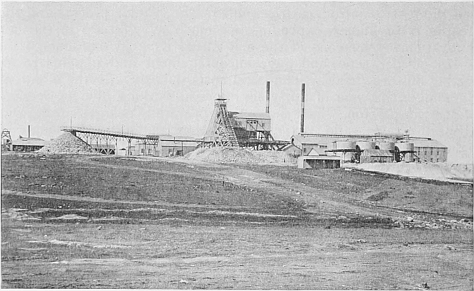 General View of Surface Works. Witwatersrand Gold-Mining Co.
(Photo by Horace W. Nicholls, Johannesburg)
General View of Surface Works. Witwatersrand Gold-Mining Co.
(Photo by Horace W. Nicholls, Johannesburg)
The eastern section of this greater Rand is about 30 miles in
extent, or 140 miles if the contours of the outcrops be followed.
In the western section the conglomerate may be followed for
90 miles as far as Klerksdorp, when the formation swerves back
to the Vaal River. So far back as 1890 gold-bearing reefs on
the banks of the Vaal River were known, and identified by experts
as the south-western rim of the Witwatersrand basin; but lack of
railway facilities and cheap coal then precluded their profitable
working. This district is now surrounded by railways, and the
circumstances are so improved that the possibility of creating a new
Rand in the locality is regarded as feasible by both experts and
capitalists, as, albeit only low-grade ore has as yet been met with,
this is properly held to be hardly a fair index of what lies below, for
experience in the Central Rand has shown that the reefs often
improve lower down. The recently reported “new discoveries” of
reefs actually refer to this particular district.
The prospect before these outlying areas of the Rand is
further authoritatively confirmed by a recent report of the Commissioner
of Mines, in which he observes: “While the expansion of the
Witwatersrand is certain, the future of mining in the outlying districts
will largely depend upon the introduction of a mining law which
will give greater facilities and hold out greater rewards to the individual
prospector and small capitalist.” This observation is true
regarding many other mining fields in the Transvaal besides that of
the Greater Rand.
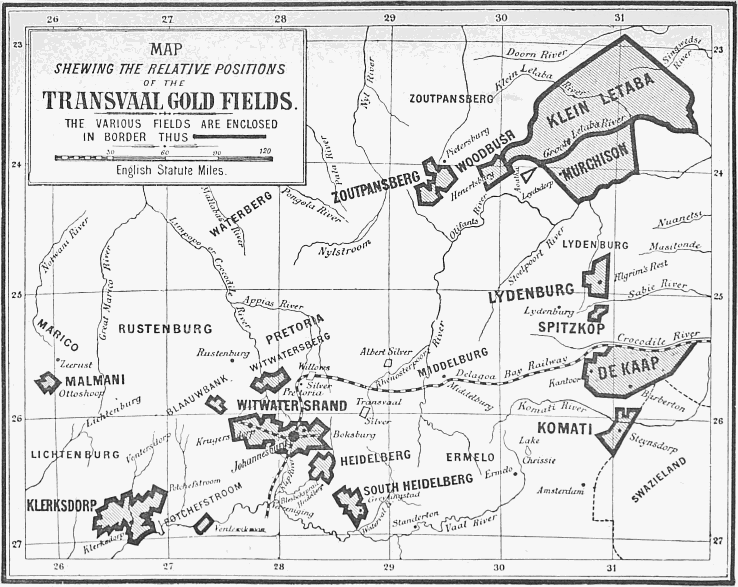
Although in speaking of gold-mining in the Transvaal the Witwatersrand
is usually meant, it must not be lost sight of that the
Transvaal possesses other gold-fields of great potentialities and of
older date. The De Kaap fields in the Barberton district were the
object of attention before those of the Witwatersrand were discovered,
and at one time bulked hugely in the public eye. Unknown
reserves, both of alluvial and quartz gold, exist, those reefs of the
latter which have been worked yielding in many cases a much higher
ratio of gold to the ton than do the famed banket beds of the Witwatersrand.
The Sheba mine in this district, a case in point, is one
of the most remarkable gold mines in the world, nearly 90 feet of ore
having been taken out of some stopes. The quartz reefs extend
over a distance of 30 miles, mainly in the hilly districts, while the
alluvium occurs in most of the river valleys. The development of
the district in the past has been hampered by a number of remediable
causes, chief among which are unscientific working, monopolist
concessions, excessive railway and customs burdens, and general
governmental neglect. With the removal of these, gold-mining here
is believed by experts to offer prospects not inferior, perhaps, to
those of the Rand. The recent Government proclamation throwing
open the district to pegging, with the contemplated modifications in
the Gold Law favouring prospectors, are earnests that this splendid
mineral reserve will at last have that justice done to it which is its
due. Next in importance to the De Kaap gold-fields come those of
the Lydenburg district. The gold exists here in a similar quartz
reef formation, with, also, unusually rich alluvial tracts; but not one-tenth
of its resources are known, although since the start of the
workings an output valued at £2,000,000 sterling has been achieved.
A number of paying companies are at work, but the drawbacks under
which the development of these fields labour are very much those
which prevail on the Barberton fields. The northern gold-beds, including
the Zoutpansberg, Klein Letaba, Murchison, Selati, &c., are
likewise of the quartz formation, and they have been worked to a
limited extent over a longer period than either of the two preceding
fields. The Murchison gold-belt is particularly noticeable among these
fields. The principal or southern reef, 18 inches in thickness, is said
to extend for 18 miles, and to be workable down to 1000 feet, and to
contain a gold contents of £25,000,000 sterling. The northern reef
is estimated to be capable of producing £20,000,000 of gold. Development
waits, in all these auriferous regions, primarily on the
provision of railway facilities to get up machinery and mining
requisites; and the extension of the Pietersburg line, which has been
promised, or the completion of the long-projected Selati railway from
where it left off, would be as the breath of life to the mining industry
here. Two other promising mining fields, generally separately
grouped but really a portion of the De Kaap system, are the Komati
or Steynsdorp and the Swazieland gold-fields. The former exists
on the Swazieland border, not far from Barberton, and is rightly
regarded as merely an outlier of the mineral formations of that
district. The numerous reefs have, however, only yielded as yet
low-grade and refractory ores. The Swazieland fields have only been
prospected in the north-west of that territory, but the results have
shown that a considerable body of ore exists. Its gold output in
1898 totalled 8256 oz. Minor fields are those of Malmani, on the
western border near Mafeking, the Pretoria quartz reefs, and the
banket beds of Vryheid (the last now incorporated into Natal). The
prospects of all these fields are very large, and their requirements
are alike. Conditions tending to lessen the cost of working, and
facilities to induce the advent of the prospector and to justify the
investment of capital, will reverse in their cases the dubious records
of the past, while adding immensely to the wealth of the Transvaal’s
gold production resources.
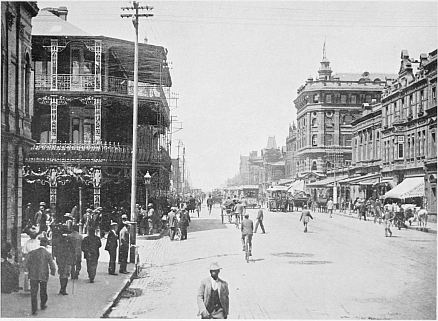
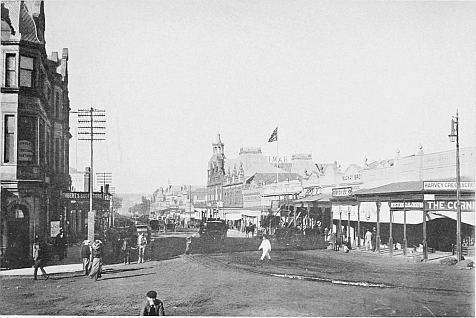
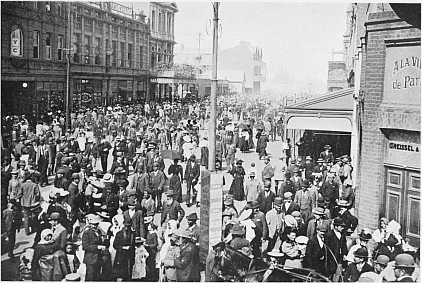 PRITCHARD STREET, JOHANNESBURG
Photo by Horace W. Nicholls, Johannesburg
PRITCHARD STREET, JOHANNESBURG
Photo by Horace W. Nicholls, Johannesburg
From “South Africa,” by permission.
The sum of the foregoing observations is that the future of the
Transvaal mining industry presents a vista of incalculable prosperity.
In the restricted area of the Central Rand alone there is a treasure
of at least £2,871,000,000 awaiting appropriation; and, beyond this
huge sum, there are reserves in the Greater Rand which, reckoned
on the basis of mileage alone, would sixfold this amount. Moreover,
as the confines of the Rand reef formation have not yet been
determined, should they be found to stretch into Natal and Zululand
on the one hand, or into Rhodesia on the other, as recent
discoveries would seem to indicate, the productive possibilities of
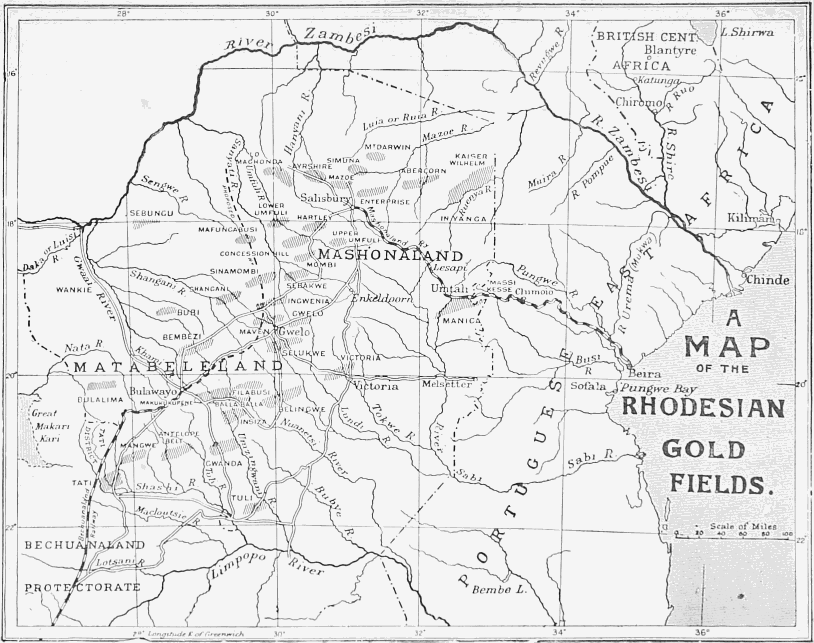
the future are enlarged proportionately. Apart from its banket
reefs the Transvaal likewise possesses huge gold reserves in its
quartz reef fields in the De Kaap, Lydenburg, Zoutpansberg, and
other districts to the south-east, east, and north, not to speak of the
already opened and promising grounds on the extreme west, which
await development when the Rand conglomerate beds are exhausted,
if they do not—as in all probability they will—receive attention
beforehand. The value of these resources is attested by the best
of all evidence—that of actual productive yield in the past. In the
matter of circumstances, means, and paying results from mining, it
has been shown, and it is incontestible, that the industry now
stands, in every particular, upon a much more advantageous basis
than it ever enjoyed. As regards processes and mechanical appliances,
the new era opens with the substantial asset in hand represented
by the accumulated skill and knowledge of past painful and
costly experience and experiment, so that new mines making a start
may lay down their equipments with the greatest practical certainty
and economy and assurance of successful results, even on low-grade
properties previously deemed unremunerative. In respect of external
circumstances, the conditions are already so improved, or in
course of improvement, that working costs have been—and will be
more so in the future, when all the beneficent proposals contemplated
by the Government, and the local advantages resulting from the new
order of things have had time to come into operation—lessened to
the extent of yielding substantial accretions to the dividends of the
already paying mines, while facilitating the development of the
deeper mines, and the multitude of minor low-grade concerns
hitherto incapable of profitable working. Estimates have been
adventured in the earlier part of this chapter of the amount of the
saving of working costs to the extent of 10s. per ton, but this is a
pure approximation, and the actual outcome is likely to be twofold
or more. Similarly the yield of gold per year from the Rand
central district of 37 to 40 millions is only a rough estimate,
the production in the future, as in the past, being likely to be much
above the forecasts, taking into view the beneficent circumstances
which will henceforth rule, the full appraisement of which is at
present impossible.
From “South Africa,” by permission.
[Pg 112]
Altogether, therefore, the outlook is one of undimmed brightness,
for the misgivings entertained in some quarters regarding new
taxation burdens to be imposed, calculated to hamper or hinder the
progress of the industry, must be allowed to have no shadow of
substance. The pronouncements of the Government hitherto, and
the recommendations of their Transvaal adviser, are clear on this
head. Taxation will naturally have to be borne, and the tax on
profits was accepted in principle by the mining industry before the
war. Its incidence, whatever be the amount, will only reduce to a
fractional extent that portion of the yield set apart for dividends,
which will bear the burden, whatever it be, with the greater
ease in view of the accretion of dividends rendered possible by the
new conditions. There are, indeed, grounds for assuming that a
part of the agitation on foot is lacking in singleness of aim, and
engineered by persons who have some secondary object to gain.
The rank and file of the mining industry, as well as the best sense
of the Anglo-Saxon community, has, however, confidence in the
Government that it will do nothing harmful to the best interests of
the new Colonies in general, and its staple industry in particular,
and, moreover, will be true to the English principle of inviting the
taxed to its councils. It is in this particular light that the visit of
the Secretary of State for the Colonies to South Africa has such
special interest at this juncture.
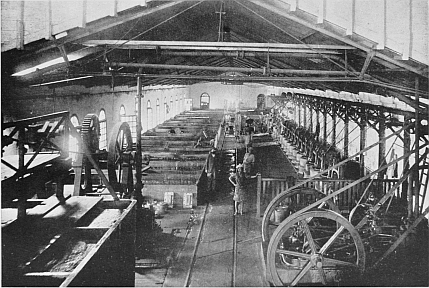
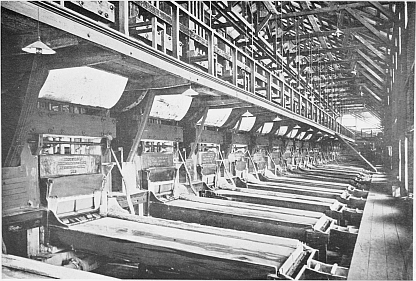 MILL (OR BATTERY) OF A GOLD MINE (SALISBURY AND JUBILEE, JOHANNESBURG)
The powdered ore is washed down over the plates. The deafening roar from the stamps sounds in quiet evenings, from a
distance, like the roar of the sea on a rocky coast.
Photo by Barnett & Co., Johannesburg
[Pg 113]