THE CLOSE OF 1901—PROGRESS IN NOVEMBER AND DECEMBER
The establishment of constabulary posts from the Valley of the Modder
towards Bultfontein and Boshof was being carried out simultaneously
with the completion of a blockhouse line from Kroonstad to Coal
Mine Drift on the Vaal. A blockhouse line from Kroonstad by Lindley,
Bethlehem to Harrismith, and another by Heilbron and Frankfort
towards Tafel Kop (a favourite Boer haunt and signalling station)
and beyond it by Botha’s Pass, promised to curtail the enemy’s scheme of
operations and push him into remote corners whence he would be unable to
interfere either with the proposed extension of the rail from Harrismith to
Bethlehem, or with another line working from Bloemfontein to the Waterworks
and thence to Ladybrand.
General Bruce-Hamilton at the end of October assumed the direction of
operations in the Eastern Transvaal, and the columns under his command were
those of Colonels Allenby and Campbell at Standerton, of Colonel Barter at
Leeukop (forty-six miles west of Bethel), of Colonel Mackenzie (late Benson’s)
at Brugspruit. Colonels Williams and the Hon. C. G. Fortescue were moving
west of Middelburg. Under the auspices of these troops and of those of
General Spens, the Standerton-Ermelo line of blockhouses was constructed,
and the constabulary posts to the line Brugspruit Station, Waterful Station,
were established. At the conclusion of these useful operations General Bruce-Hamilton,
having forced the enemy in a corner as it were and prepared for the
further advance of his columns to the east, made Bethel his headquarters.
A concentration was afterwards arranged for the purpose of hemming
the guerillas against the Eastern Transvaal Frontier, and consequently some
of these struggled to break through the sweeping columns and the constabulary
posts, while others, in knots, returned and pervaded the Delagoa
Railway. They had of course to be dealt with, and Colonel Wools-Sampson,
whose services had been invaluable to the lamented Colonel Benson, again
applied himself to the locating of the offensive intruders. His information was
brief and to the point. General B. Hamilton, with portions of General Spens’
and Colonel Sir H. Rawlinson’s columns, surprised the marauders at dawn on
the 4th of December at Oshoek, twenty miles south-west of Ermelo. Owing to
the dash and enterprise with which the 8th Battalion Mounted Infantry closed
with the enemy and prevented their escape, the captures amounted to 93
prisoners, 116 horses, 26 waggons, 29 Cape carts, besides ammunition and
telegraph and signalling apparatus.
While this exciting affair was going forward between Ermelo and Carolina,
Colonel Williams was chasing some Boer banditti under Viljoen, Prinsloo, and
Erasmus, who were fleeing westwards in the direction of Knapdaar. The
pursuit was carried to Welte-Vreden, where the enemy (in a strong position
and numbering some 500) commanded the passages over the Olifants River.
Colonel Williams’ small force was unequal to a decisive engagement, therefore
he drew off, having killed 5 and taken 12 Boers, 8 waggons, and 3500 rounds of
ammunition in the course of his westerly pursuit. On the 7th, Colonel Rawlinson
made a grand night march from Ermelo (General B. Hamilton’s headquarters),
and took 8 prisoners, while at the same time Colonel C. Mackenzie,
moving from Carolina to Waterval, vigorously chased the enemy towards the
Komati Valley, capturing 16, together with their horses, mules, and cattle.
While Botha’s bands were kept in hourly dread of being driven east against
the Swazi border, or west between the troops and constabulary posts, where
they would have been more than ever isolated and doomed to destruction,
Colonel Urmston, with a small column, played the Cerberus, watching the line
of constabulary posts in case of attack by such desperate Boers as might have
become wedged between the posts and the columns, and keeping General B.
Hamilton well informed as to their whereabouts.
Viljoen, hovering between Pilgrims’ Rest and Dullstroom, engaged the
attentions of Colonel Park, while on the northern line Colonels Dawkins and
Colenbrander hunted and hustled the enemy. By the 13th of November
Dawkins had secured 124 prisoners, and by the 19th (when he had returned
to Warmbaths by the Mafeking-Rhodesia route) Colenbrander had captured
54 prisoners of Beyer’s commando, including Field-Cornets Ross and Louw
and Adjutant Pretorius, with their horses, waggons, and stock.
Colonel Colenbrander then devoted himself to the chase of Badenhorst’s
commando, a spirited and an exhausting affair which lasted some days, during
which Kitchener’s Fighting Scouts pushed perseveringly, through an almost
waterless and decidedly uninviting region, on the tracks of the enemy. Eventually
the column, almost spent with their prodigious activities, came suddenly
on the quarry, and the 3rd of December found them in possession of all the
waggons of the commando, and fifteen prisoners. Badenhorst and sixty followers
tore into the jungle fringing the Poer Zyn Loop River, and thus escaped;
but not for long. A large quantity of stragglers were driven up into the hills,
and there seized by the 12th Mounted Infantry of Colonel Dawkins’ column,
who displayed considerable prowess in the achievement. The total results of
these “well-planned and carefully-executed operations were 104 prisoners, 50
horses, 50 mules, 500 cattle, 6 waggons, 6000 rounds of small arm ammunition,
and the serious discomfiture of the enemy in a district in which he had long
considered himself immune.”
Lord Methuen and Colonel Kekewich continued with unabating zeal their
co-operations in the Rustenberg-Zeerust region, capturing many prisoners
during their various marches. On the 13th of November, owing to a squadron
of Imperial Yeomanry of Colonel Hickie’s force having been surrounded near
Brakspruit, both officers moved by different routes to Klerksdorp to disperse
the commandos threatening Colonel Hickie. But these rovers had quickly made
off to the west. Still hunting them, Lord Methuen, with Hickie and Kekewich
on his right, left Klerksdorp to operate to west of Hartebeestefontein and Kaffirs
Kraal. He got in touch with the foe, chased him towards Wolmaranstad, and
“doubled him up” at Rooiport. Liebenberg’s adjutant, his horses, stock,
waggons, and twenty-six prisoners were the rewards of a fatiguing excursion.
Lord Methuen returned to Klerksdorp on the 4th of December. Thus Colonel
Hickie, whose column was covering the construction of the Schoonspruit
blockhouse line, was relieved of the unwelcome attentions of the Boers, and the
work on hand terminated without further interruption.
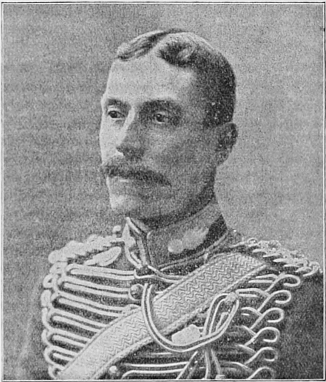
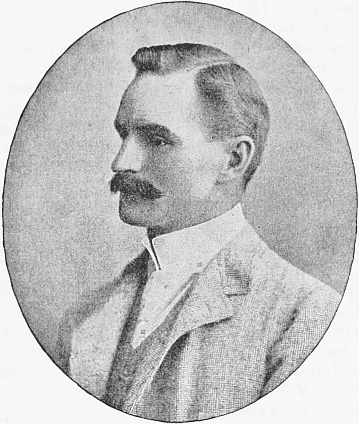
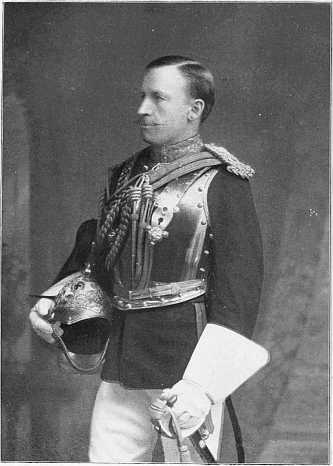
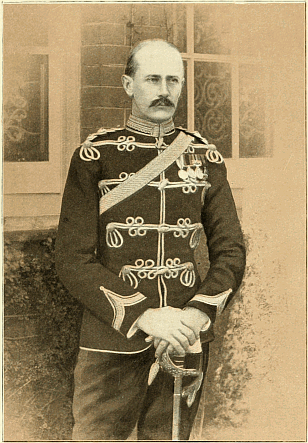
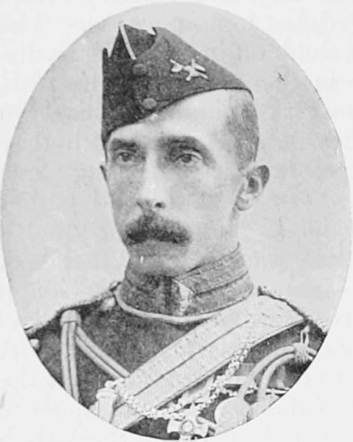
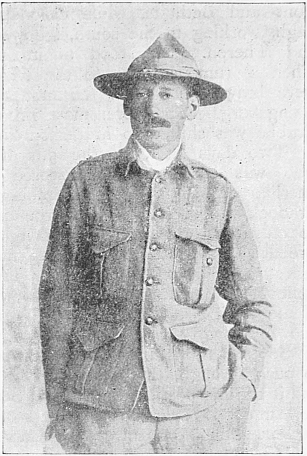
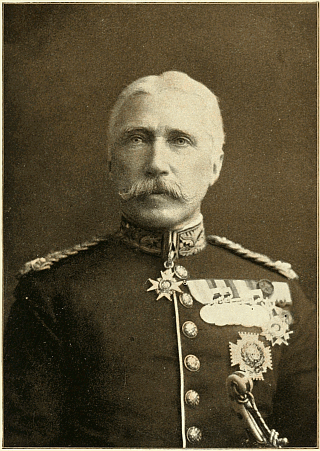
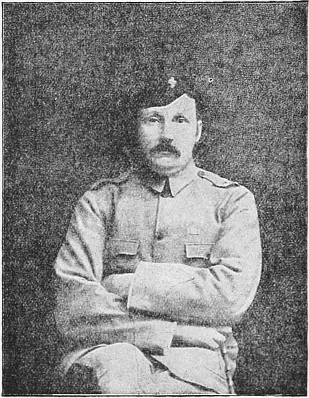
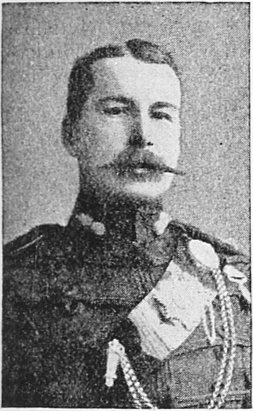
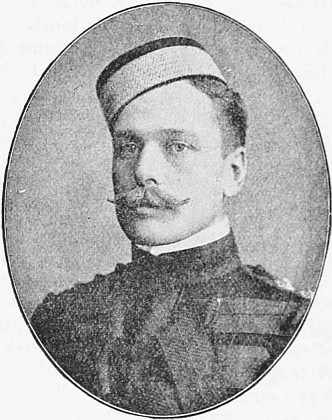
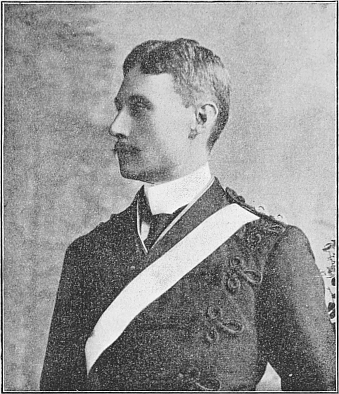 Colonel Pilcher
(Photo by Robinson, Dublin)
Colonel Pilcher
(Photo by Robinson, Dublin)
A magnificent programme for the sweeping up of infesting marauders in the
region of Vrede and Reitz was planned out early in November. The difficulty
and the extent of its plan may be gauged by the fact that the rendezvous and
starting-points of the outermost columns engaged upon it were roughly at the
angles of a parallelogram, whose diagonal was 175 miles in length, and of which
no side was less than 100 miles, marked by the points Standerton, Harrismith,
Winburg, and Heilbron; but of the details of this enormous movement, the
energy and precision with which it was carried forth, nothing can here be said.
It was arranged like an enormous and intricate game of chess, with tortuous and
well-designed curves to keep the enemy from detecting the object of the manœuvres,
but the whole thing was a failure. The weather, firstly, was atrocious,
and highly favourable to such Boers who might wish to straggle and draggle to
cover; secondly, the immensity of the converging movement rendered it impossible
to entirely fill all gaps, and these gaps the Boers were naturally “slim”
enough to discover and to make use of. Thus, when all the splendidly
managed and patiently executed marches concluded by the arrival of the
columns at their objective, they found most of the birds flown. But the Boer
stock and transport had to be left behind, and there was some consolation in
knowing that the machinations of the marauders would be hampered for want
of supplies for some time to come. Ninety-eight prisoners were taken and
twenty-two of the enemy were killed, and horses and cattle in large quantities
were secured. The troops returned to their original points of departure without
incident, save in the case of Colonels Byng and Wilson. On the 14th of November
a party of 400 Boers, who had evaded the cordon before it was drawn,
attacked the troops near Heilbron. Two hours of stiff fighting ensued, and
the enemy, said to be commanded by De Wet, was successfully repulsed on
all sides by Colonel Byng’s rearguard, which was brilliantly handled by
Colonel Wilson of Kitchener’s Fighting Scouts. The Boers left eight dead
on the field. Lieutenant Hughes was killed and three other officers of
Kitchener’s Fighting Scouts were wounded.
Colonel Rimington and Major Damant continued to pursue their special
guerilla tactics from Frankfort to the Valley of the Vaal with a diamond-cut-diamond
agility which was highly disconcerting to the Boers. Many captures
they made, the most satisfactory of all being that of Commandant Buys, who,
wounded in a skirmish with the “Railway Pioneers,” fell afterwards into the
hands of Colonel Rimington, who had gone to their assistance. The skirmish
took place near Villiersdorp. Major Fisher’s small patrol was attacked north
and south by some 350 of the enemy. The British were overpowered; Major
Fisher was killed, and Captain Langmore was dangerously wounded.
General Dartnell and the Imperial Light Horse Brigade—real veterans by
now—were perpetually on the move in the Bethlehem and Harrismith region,
but the Boers were wary, and, at the rumour of their coming, seemed to
evaporate! The 2nd Imperial Light Horse, however, caught them napping on
the 24th of November between Elands River Bridge and Bethlehem. In the
attack they killed two of the enemy and captured twelve more. The bag was
furthered replenished on the 27th by the addition of 24 prisoners, 150 horses,
and 800 cattle, which were the prizes of a dashing raid of the combined force
of the 1st and 2nd Imperial Light Horse under Colonel Mackenzie.
The end of November was spent in sweeping and hunting, surprising and
night-raiding by General Elliot, who with three columns (Broadwood, De Lisle,
and Lowe) moved gradually upward from Harrismith to Kroonstad. Here he
arrived on the 1st of December with 15 prisoners, 89 carts, 2470 cattle, and 1280
horses (most of them worn-out). Colonel Barker from Bethlehem engaged
the enemy frequently, thus protecting Broadwood’s left flank and inflicting
considerable damage. Colonel Rimington having effected a junction
with Colonel Wilson (Kitchener’s Fighting Scouts), south-west of Frankfort,
on the 28th had some exciting experiences with the enemy, who pursued
certain buzzing tactics for the purpose of drawing off attention to a proposed
lunge by De Wet on the baggage and rearguard. The attack when delivered
was brilliantly repulsed. The troops made a dashing charge on the enemy,
during which Lieutenant Oliver (Inniskilling Dragoons) lost his life. Field-Cornet
Klopper and 2 burghers were killed and 4 wounded, and 13 prisoners
captured. Colonel Rimington then returned to Heilbron.
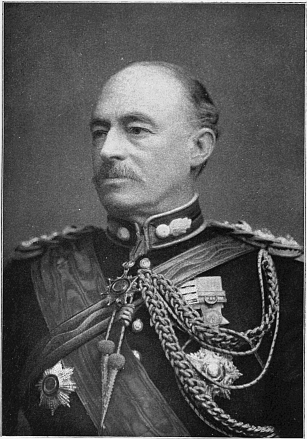
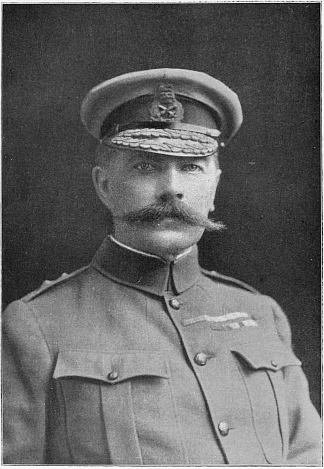
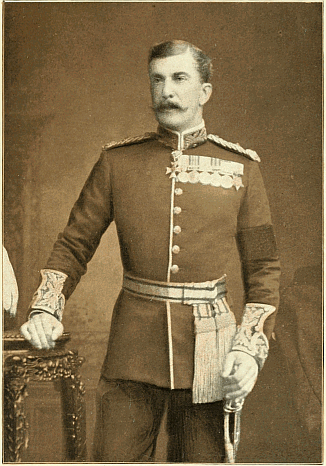 MAJOR-GENERAL ARTHUR PAGET.
Photo J. Russell & Sons, London.
MAJOR-GENERAL ARTHUR PAGET.
Photo J. Russell & Sons, London.
Various groups of columns under General Knox and Colonel Rochfort
harassed and hunted the remnants of the commandos of Brand, Ackerman,
and Loetzee, which still hung and clung to their ancient haunts. The
work was fatiguing and monotonous in the extreme, but the clearance of that
part of the country was accomplished. One hundred and seventy prisoners
were swept up in the course of the month.
West of the rail the establishment of constabulary posts between Boshof
and Bultfontein went on apace, while Colonel Henry watched the country and
kept the Boers at a distance.
The troops clearing the east in the Piet Retief region and on the Swazi
border were hard at work to press back the desperate and almost refugeless
Boers. Major Wiggin, with a detached force of the 26th Mounted Infantry
Battalion (Colville’s column), surrounded a laager at a farm eight miles south
of Mahamba (near Piet Retief), and captured Landdrost Kelly and Field-Cornet
Van Rooijen, with fourteen of their party; and then this same officer,
with another detached force, proceeded on the 16th to repeat his success. At
Plat Nek (within the Swazi border) he pounced again on the foe, caught twelve
of them, and secured nineteen waggons with teams and a number of Krupp
cartridges.
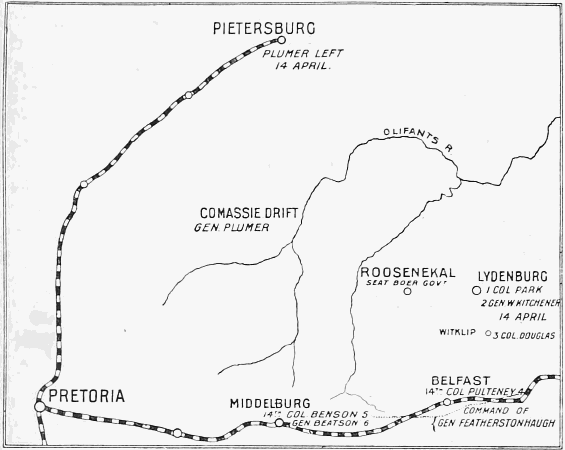
General Plumer meanwhile worked considerable havoc among the scattered
bands that hung south of the Wakkerstroom-Piet Retief blockhouses. After
the 20th he was joined by Colonel Pulteney, and together they scoured the
Randberg neighbourhood till the torrents should subside, and General Bruce-Hamilton,
in his advance on Ermelo, could be assisted by them.
As before said, General French’s operations in Cape Colony were making
substantial progress, and small commandos only continued to rove about
the south-east and south-west fringe of the colony. These were harried and
worried by the troops, but their presence was now described as a serious
inconvenience rather than as a menace of vital consequence. They confined
their annoyance to the Barkley East district and the country to the west
and north of the Cape Town-De Aar line. In the former area Monro and
Scobell continued their hunts after Myburg, Fouché, and Wessels, who now
and then skirmished, but who, owing to their losses, preferred to give the
British a wide berth. The astute and indefatigable Hunter-Weston spent his
time in chasing a gang of Boers under Naude, who, after shifting and doubling,
finally burrowed into the Karee Kloof hills north-west of Philipstown.
More columns under General Stephenson had the wearisome task of chasing
dispersed gangs over a vast tract of country; and December found Colonel
Crabbe at Lambert’s Bay, General Stephenson with Colonel Kavanagh at Clanwilliam,
Colonel Capper at Piquetberg, Captain Wormald at Wagon Drift
(north of Ceres), Major Lund south of Sutherland, and Colonel Doran between
the last place and Matjesfontein. As a result of the month’s united operations
of these forces, 29 of the enemy were killed, 21 wounded, and 45 captured.
The rinderpest continued to work havoc, but the process of inoculation and the
care taken to prevent the spread of the disease prevented the movements of the
troops from being seriously impeded. As regards the troops, despite the
heavy rains, the incessant marching, the harassing and ticklish nature of
outpost work in exposed and isolated positions, the perpetual calls on their
patience, their pluck, their sagacity, and their cheerfulness; despite the wet
bivouacs and the monotonous food, and sometimes the scarcity of it, the dangers
they ran and the meagre amount of publicity their heroism received—despite
all these inconveniences, they remained true as steel and full of grim
determination “to see the thing through,” or, as the Commander-in-Chief
expressed it, “to relax no effort until the campaign had been brought to a
successful issue.”
The Boers now, at the end of 1901, found themselves cooped by blockhouse
lines into four definite areas: Botha’s attenuated force hovered on the borders
of Swaziland and the Brugspruit-Waterval line. Delarey and Kemp hung
around the difficult country between the Mafeking Railway line and the
Magaliesberg range. Steyn and De Wet with some dauntless desperadoes
did their worst in the north-east districts of Orange River Colony, and various
bands of rebels and adventurers clung to the north-west regions of the Cape
Colony. Elsewhere were only insignificant knots of worn-out and listless
stragglers. There was a gratifying increase of voluntary surrenders, and
during the month three of the most trusted leaders—Kruitzinger, Opperman,
and Haasbroek—disappeared from the fighting scene.
General Bruce-Hamilton, for the purpose of protecting the constabulary
posts, was now operating in the country that had been so effectively cleared by
General French in the beginning of the year. On the 9th of December he
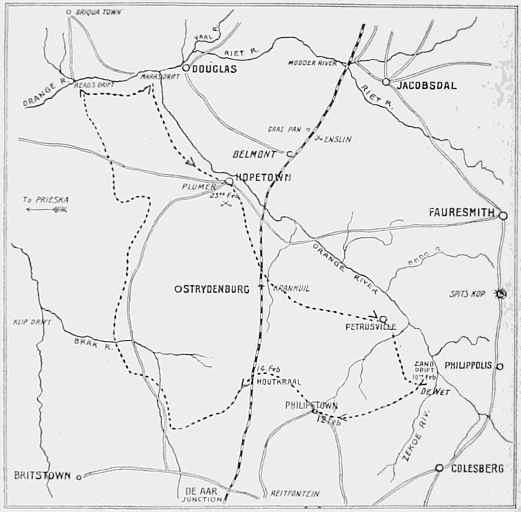
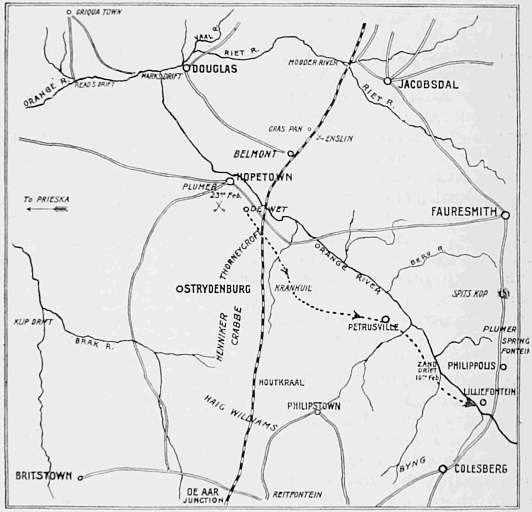
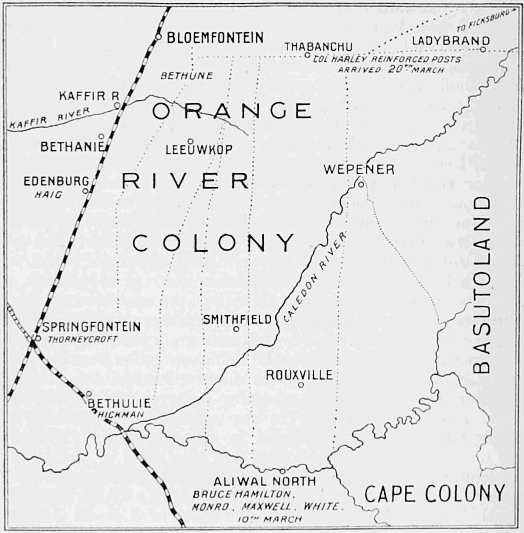
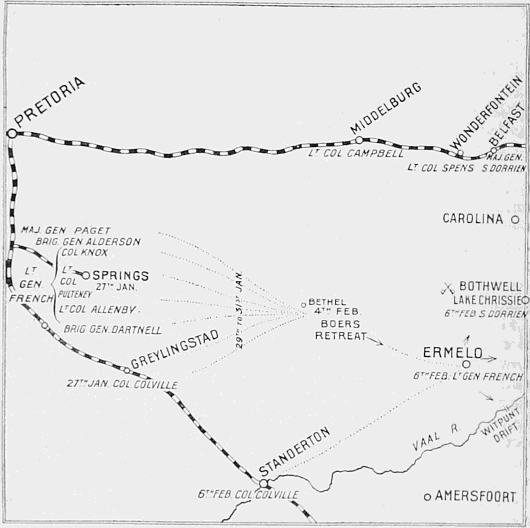
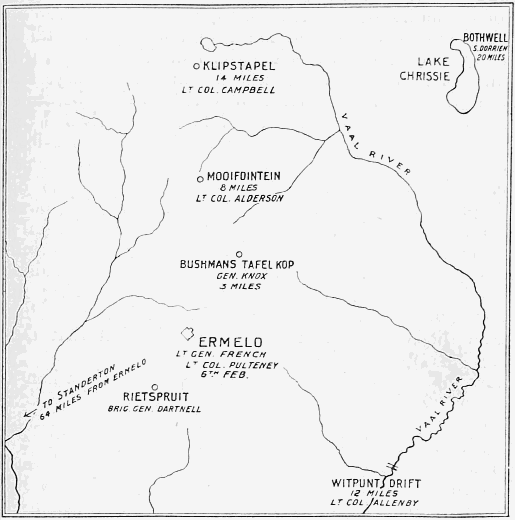
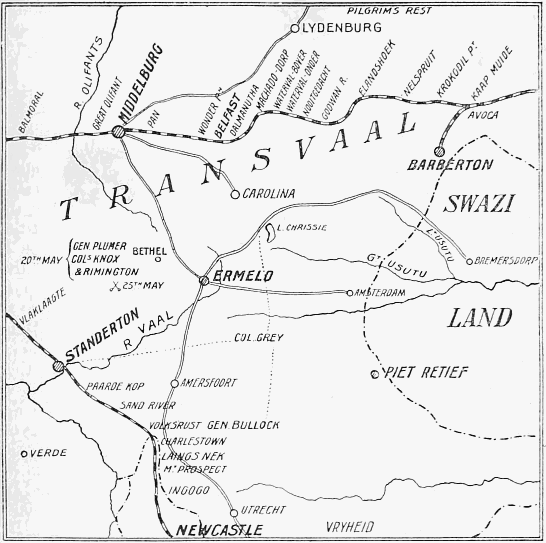
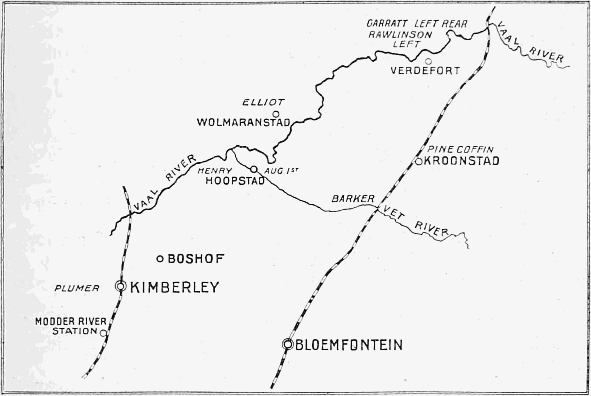
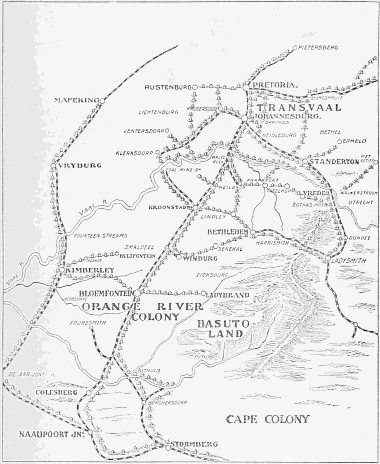
engaged in a brilliant converging movement over the old ground (see map, p. 20),
with the result that 130 prisoners, 4000 cattle, and a large convoy fell into his
hands. Briefly the tale is this: the General discovered that a large force of
Boers had collected north of Bethel, and were moving south with a view to
escaping round his left flank. Quickly, he summoned Colonels Wing and
Williams (who were moving upon Kalabasfontein) to join him at Spioenkop,
and by night the whole force made a secret march on the lair of the enemy at
Trigaardtsfontein. The movement was magnificently carried out, and the laager
was rushed by the troops at dawn. In the scrimmage seven Boers were killed,
and many who escaped pursuit were mopped up by Colonel Allenby, who was
moving from Middelkraal to Onverwacht. General Hamilton’s force after
this successful action marched into Bethel, having covered sixty miles in the
previous forty-eight hours.
His repose was short-lived. The Boers who had escaped from the pursuit
of his force gathered now, under Viljoen, twenty-five miles north-east of Bethel.
He determined to secure them. With the troops under Colonels Sir H.
Rawlinson, Wing, and Williams, he started on the 12th on another exciting
march. He neared his destination in darkness, and then in the dim dusk of
the morn galloped upon the objective. It was a splendid achievement, and
seventy Boers, including Field-Cornets Badenhorst and Swanepool, closed their
military career. Sixteen were killed in the engagement, and one of the two
15-pounder guns taken from Benson’s force at Brakenlaagte was recovered.
The other gun had been disabled by the enemy. The scattered remnants of
this commando fled north, and were tackled by Colonels Mackenzie and Fortescue,
who were operating in that direction. These officers captured more
prisoners and stock.
On the 19th of December General Bruce-Hamilton left Ermelo, marching
towards the east, while Colonel Mackenzie simultaneously moved from Carolina
upon Lake Banagher (twenty-two miles north-east of Ermelo). Colonel Mackenzie
on the night of the 19th made a forced march and attacked, at Schalk
Meyer’s farm, Smits’ laager, and inflicted upon the enemy a loss of six killed.
He took sixteen prisoners. He afterwards moved on Bothwell, and pursued
for thirty miles a convoy which turned out to be Smits, and after a stiff engagement
(on the 21st) secured 17 prisoners, 44 vehicles, and 2000 cattle. General
Plumer and Colonel Pulteney co-operated in the vicinity of Spitzkop, and near
there at dawn on the 23rd these officers engaged a gang of 500, and captured
6 prisoners.
On the same day General Bruce-Hamilton’s troops attacked Grobelaar’s
laager at Maryvale (fifteen miles north of Amsterdam). Owing to the denseness
of the morning mist the majority of the Boers got off scot free, and only four
were killed and eleven captured, but 700 cattle and a number of waggons fell
into British hands. The captures were mainly due to the leading of
Lieutenants Rendall and Huddleston, who, in spite of every obstruction,
dashed in among the enemy before they could gather themselves together for
more than flight. General Hamilton returned to Ermelo, and on the 29th
pushed again to Maryvale. Again he repeated his manœuvres, again he
pounced on the Boers and thinned their numbers by twenty-two (taken
prisoners), capturing also their waggons and cattle. This was on the 1st of
January. On the following day, with the columns under Colonels Simpson and
Scott, General Hamilton followed the spoor of the Pretoria commando up hill
and down dale, over circuitous bridle-paths and into deep kloofs in the sides
of the hills north-east of Amsterdam, hunting, and chasing, and burrowing.
As reward of his dogged patience and perseverance forty-nine Boers were
hemmed in and taken (among this number General Erasmus and Mr. Custer,
late J.P. of Amsterdam). Colonel Wing, who was at the same time engaged
in identical exploits, brought in twenty prisoners and five waggons.
While these activities were going forward in the east, Generals Spens and
Plumer, and Colonel Colville, on a line Beginderlyn-Rotterdam-Derby,
watched the surrounding districts, and here on the 3rd of January Plumer’s
New Zealanders encountered the enemy at Twyfelaar. Fighting fast and
furious, during which the commanding officer and twenty Colonials were
wounded, resulted in the discomfiture of the foe and a loss to them of 300
cattle and a waggon-load of ammunition.
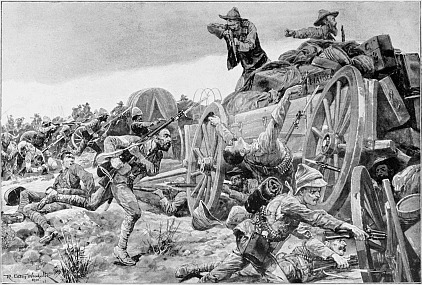
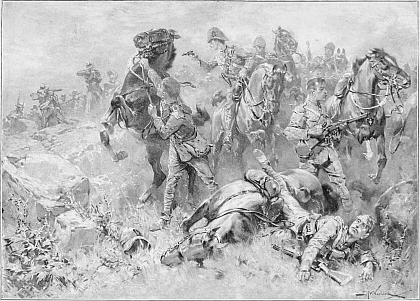
Another fierce engagement took place on the following day, when Major
Vallentin with fifty mounted men were following up the band which had
attacked the New Zealanders. Suddenly, upon the small party rushed some
hundreds of the enemy, galloping at full speed. There were about a hundred
in the first line, while about fifty were thrown back on each flank, the movement
being covered by heavy fire from a crowd of dismounted riflemen in the background.
Thus outnumbered, the British band realised that there was nothing
for it but to sell life dearly, and in the desperate hand-to-hand conflict Major
Vallentin and 18 men fell, 5 officers and 28 men were wounded, and indeed the
small company would have been utterly annihilated but for the timely arrival
of reinforcements under Colonel Pulteney, who forced the enemy to retire.
But the Boer loss was considerable, for General Opperman, the leader of
the eastern group of commandos, perished, together with nine others. Three
wounded were left on our hands.
The enemy also had given considerable trouble to General Spens, who
spent December working between Standerton and Ermelo. On the night of
the 18th, the General detached the 14th Mounted Infantry under Major Bridgford
to search the farms dotted around the junction of the Vaal with the Kaffir
Spruit. After a long night’s march he encountered at dawn a gang of Boers.
These he chased with the utmost zeal, but while, as result of the pursuit, the
troops were scattered on a wide front, they were assailed by a vastly superior
force under Commandant Britz. The engagement was desperate and our losses
were lamentable, many men being taken prisoners. These were fortunately
recovered later, but the enemy escaped punishment. Lieutenant Stirling, Dublin
Fusiliers, and the remainder of the party fought their way doggedly through
the enemy, and returned to the nearest point on the Standerton-Ermelo blockhouse
line. Among the wounded were Captain G. F. W. Brindley, 2nd
Manchester Regiment (since dead); Captain B. H. H. Cooke, Rifle Brigade;
Lieutenant P. S. Fryer, 2nd West Yorks Regiment; Lieutenant B. A. W. C.
Moeller, 2nd Middlesex Regiment; Second Lieutenant L. P. Russell, 2nd
West Yorks Regiment (since dead).
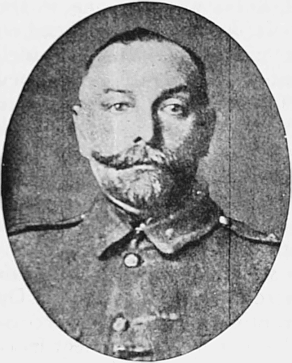
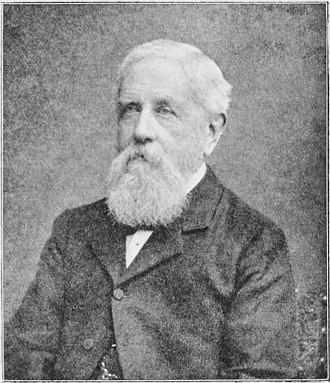 General Beatson
(Photo by Russell & Sons, London)
General Beatson
(Photo by Russell & Sons, London)
At the end of the month combined action was taken to dispose of Commandant
Britz’s guerillas, and to commence the pursuit the troops of General
Plumer, Spens, and Colonel Pulteney assembled at Amersfoort on the 28th.
Promptly some seven prisoners were captured near Schuilplaats, and Britz
sent scurrying towards Platrand. Here General Spens came upon him again,
and relieved him of twenty-four of his followers. The rest broke up into small
knots running the gauntlet of the blockhouses, and some of them dropping
wounded from their fire, while others sought shelter in the north along the
Vaal River.
Some Boers at this time had succeeded in bursting into the protected area to
the east of Springs, and the pursuit of them occupied Colonel Allenby’s troops
and General G. Hamilton’s Cavalry Brigade. These succeeded in capturing sixty,
while others surrendered to the Constabulary. In the securing of these interlopers
some very exciting and interesting adventures are related. Major Butler
and the Carabineers on the 18th accounted for thirty-four who were running
riot south-west of Brugspruit, and on the 5th of January, north of Bethel, the
13th Hussars, under Major Williams, brilliantly effected the surprise of Breytenbach’s
laager, taking 11 prisoners, 200 horses, 600 cattle, 50 mules, and 6
carts. The Commandant himself in the midst of the scrimmage made off with
true Boer velocity, but Captain Tremayne (13th Hussars), who was better
mounted than his men, spied the fugitive and engaged in a neck and neck race
with the Dutchman and, single-handed, secured him.
Colonels Park and Urmston, in the midst of atrocious weather, made
vigorous efforts to locate the so-called Boer Government, which was reported
to be hidden north of the Delagoa line. Colonel Park on the night of the 19th
was attacked in his camp at Elandspruit by a strong force under Muller,
Trichardt, and Krieger. A tremendous amount of hard fighting took place
before the guerillas were repulsed, and the losses on both sides were heavy.
Of the British one officer and seven men were killed, and five officers and
twenty-four non-commissioned officers and men were wounded. Of the Boers
eight dead and three wounded were left on the ground. The number of those
removed could not be ascertained. Among the slain were Commandant
Krieger and Field-Cornet Malan. From the 21st to Christmas Day the two
columns co-operated, skirmishing with and chasing the foe, who in small bodies
flitted hither and thither in the dense mists that hung around Dullstroom. On
the 22nd Colonel Urmston’s efforts were almost crowned with success. He
occupied a Boer laager some miles north of Dullstroom from whence the Boer
Government in a Cape cart some hours previously had fled.
To west of the Pietersburg line Colonels Colenbrander and Dawkins’
co-operative system worked splendidly. Boers who evaded the one fled into
the open arms of the other! In this way Commandant Badenhorst with
twenty-two of his party was secured on the 11th December. Fleeing hot foot
from the Fighting Scouts he dropped into the maw of the Mounted Infantry,
who had been vigilantly preparing to “welcome the coming guest.” Later in
the month Colonel Dawkins started for Harrismith to reinforce General Rundle’s
command, while Colonel Colenbrander moved to Rooiberg, and from thence
pursued Boers to Jericho, a place near the Crocodile River, where sixty
prisoners and much stock were secured. Early in the year he passed on
towards the neighbourhood of Waterval, made a brilliant night march on the
Magato’s Nek in the small hours of the 4th of January, and surprised the enemy
at dawn. A stiff engagement ensued, in which five of the enemy were killed
and twenty-nine made prisoners. Not many days after Colonel Colenbrander
was fortunate enough in delivering from the hand of the native Chief,
Linchwe, a number of Boer women and children. The Chief with a following
of 2000 had started forth vowing vengeance on the Boers for having stolen his
stock, and determining to recapture his property. He was prevailed on by the
Colonel, however, to retire to Pilansberg, and thus, much to the relief of the
families of the enemy throughout the district, an awkward and probably
disastrous complication was averted.
Lord Methuen and Colonel Kekewich continued operations from Klerksdorp.
The former on the 13th December sighted a Boer convoy, gave chase
with all available mounted troops, and after covering seven miles as hard as
they could go, secured all the waggons. These were the property of Van
Rensburg’s men, and there was grim satisfaction in the knowledge that for a
few days at least the marauders would be on short commons. A dash was
made on the 16th for Potgieter’s laager, which was comfortably posted on the
southern slopes of the Makwassie range (near Wolmaranstad). The night
march was splendidly managed, and dawn found Lord Methuen in possession
of a tremendous haul of prisoners, horses, and cattle. His success was materially
assisted by the operations of Colonel Kekewich at Korannafontein, who
kept the commandos of Celliers and Vermaas engaged, prevented them going
to the assistance of the captured laager, and blocked the roads to the north.
Further operations were continued south-west of Klerksdorp at the end of
the month. Early in the year Lord Methuen’s force engaged in an animated
chase westwards after a convoy which unfortunately had had a long start of
them. The chase appeared to be a failure, but subsequently it was discovered
that Lord Methuen’s tactics had caused the convoy to seek safety by a sudden
double to the south, with the result that it ran straight upon the Kimberley
column of Major Paris, who joyously took possession of 40 waggons and over
1000 head of cattle. Thus did one man sow and another reap!
Colonel Kekewich ended the month in keen pursuit of Potgieter’s men.
He had some exciting adventures, and made many small but useful captures.
Colonel Hickie’s column covered the extension of the new blockhouse line from
Ventersdorp to Tafelkop, which point was occupied, much to the discomfiture of
the Boers, who had made it a pied-à-terre for some time past.
The Orange Colony was gradually becoming too peaceable for De Wet’s
liking. The great chief, after some deliberations at a Kriegsraad held on the
11th December, determined on a new plan. Finding that the system of scattering
his forces resolved itself into a steady decrease of their numbers in consequence
of the energy of our mobile columns, and discovering also that evasive
and defensive tactics ended in his gang becoming hemmed in by the advancing
blockhouse lines, he decided on concentration. He meant with his force to
avoid direct collision with British columns, but decided to choose his own
times and seasons for pouncing on and overpowering odd detachments on duty
bound, whom he might chance to entrap. This new system brought about
some unfortunate surprises and defeats of the British, but as our small but
gallant little parties were not overpowered without deadly cost, there was every
chance that the system would ensure an earlier collapse of the enemy’s power
to prolong the struggle.
A clever combined movement of the division under General Elliot, with the
columns of Rimington, Byng, Damant, and Wilson, began on the 8th December.
The enemy were given the impression that the six columns were bound
for the east, consequently they made an attempt to break back through the
columns in small parties to the west. But a complete countermarch of the
British troops on a given date (the 11th) ended in their being driven to the
west quicker than they intended, and hemmed into the angle marked by the
main line of railway and the Wolvenhoek-Frankfort line of blockhouses. Of
course many of them were “slim” enough to see in time the threatened danger
and evade the bristles of the British broom, but the troops captured 43 prisoners,
780 horses, 3000 cattle, and 187 vehicles.
It was now evident that a concentration of Boers was taking place at
Kaffir Kop, north-west of Bethlehem. General Elliot’s division from Kroonstad,
General Dartnell’s men from Elands River Bridge, and Colonel Barker’s
men from Winburg co-operated so as to close in on the Kop from west, north-west,
and north-east. But unfortunately the Boers, smelling menace in the
air, dispersed even as the troops approached. Still the action was not without
results, for Colonel Barker at Vaalbank, in an engagement with 500 Boers on
the 16th (Dingaan’s Day), killed the Boer leader Haasbroek, and disposed of a
formidable foe.
General Dartnell on the 18th, in the last stage of his return journey to
Elands River Bridge, came into collision with De Wet, who, from a strong
position along the Tygerkloop Spruit, disputed his further advance. Furious
fighting followed, the Boers assailing General Dartnell’s flank and rearguard,
the Imperial Light Horse, spirited as ever, holding their own gloriously.
Finally to their succour came General B. Campbell from Bethlehem (he had
established signalling communication during the fight), and the Boers were
forced to beat a hurried retreat in the direction of Reitz.
Nothing daunted, De Wet made a new effort, and, alas! a successful one.
On the 25th, in the direction of Tweefontein (nine miles west of Elands River
Bridge), he turned up again where a covering force was watching the construction
of the Harrismith-Bethlehem blockhouse line.
This force, temporarily commanded by Major G. A. Williams, 1st South
Staffordshire Regiment, consisted of the 34th, 35th, 36th, and 53rd Companies
Imperial Yeomanry, and one gun of the 79th Battery and a pom-pom. It lay
that night on the slope of a lonely kopje; the outpost line held the crest, the
camp being situated on a gentle slope to north. The south side was steep.
From this steep and apparently unprotected side the Boers by night, at 2 A.M.
on the 25th, delivered their attack, scrambling up the heights exactly in the
swift and silent way they had mounted Wagon Hill on the 6th of January
1900, and rushed the piquets in overwhelming numbers. The ridge secured,
there followed a dash through the camp, and so swift was the movement that
many of our officers and men were shot down before they had become aware
of what had happened. It was a deplorable affair, and Major Williams paid
for what mistakes he may have made with his life. Five other officers were
killed and also 51 men; 8 officers and 81 men were wounded. Lieutenant
Harwich himself fired with the pom-pom, and was shot through the heart in
the act. Lieutenant Watney (Imperial Yeomanry) was killed as he headed
the gallant charge on the enemy. A Boer prisoner gave the following account
of the fight: Commandant Mears on the previous day spied round the camp,
noting the exact positions of the guns. After sunset De Wet assembled over
six hundred men and moved on Colonel Firman’s camp, arriving within a
thousand yards at two o’clock on Christmas morning unobserved. The Boers
marched to the foot of the hill on which the camp was. There they left their
horses, and scaled the precipitous height. When the sentry challenged them
the Boers yelled madly, hoping thus to create confusion, and rushed into the
British camp, shooting our men down point-blank as they came out of their
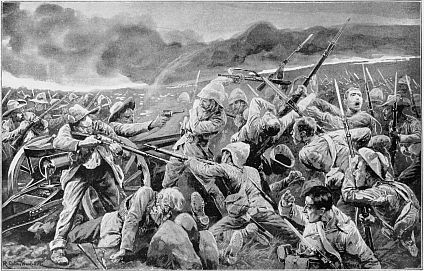
tents. Our gunners, who were firing the guns at a range of forty yards, were
overpowered, and the camp was captured after a fierce hand-to-hand conflict.
Some Boers who lagged behind when the enemy charged the hill were
sjamboked along by De Wet and Brand. The official casualty list of the
Boers was fourteen killed, including Commandant Oliver, of Bethlehem, and
Field-Cornet Lawrence, and thirty-two wounded.
At this time General Rundle, with a small column, was encamped some 2½
miles to the east of this lonely hill. Hearing the firing he despatched Colonel
Tudway, D.A.A.G., and his Mounted Infantry to ascertain the cause, and at
the same time summoned two regiments of Imperial Light Horse from the
neighbourhood of Elands River Bridge. Quickly the Boers discovered their
peril, and made off into the Langeberg, carrying with them the gun and pom-pom
they had captured in their attack on the camp.
General Elliot, on hearing of this unfortunate affair, promptly started off on
a series of chases after De Wet, which chases were fraught with much fatigue
and considerable danger; but they failed in their main object, though many
captures of more insignificant kind were made. As an idea of the distances
covered in a week by General Elliot’s columns, the following table was given
by Lord Kitchener:—On December 29, marched seventy miles in close pursuit
of De Wet; on 31st December, twenty miles; on 4th January, sixty miles.
Before De Wet enjoyed the short-lived triumph of Christmas day, Wessels,
in the neighbourhood of Tafel Kop, had distinguished himself on the 19th.
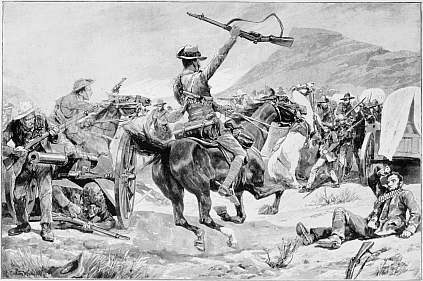
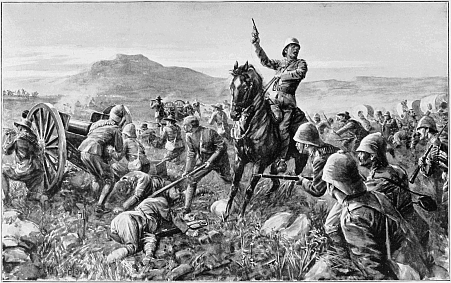
The troops of Colonels Rimington and Damant were moving by night in a
fierce thunderstorm by parallel roads three miles apart to cover an extension
of the blockhouse line. Damant’s advance guard beheld suddenly a force
approaching. This force was kharki clad, and affected the formation usual
with regular mounted troops. They also, as they advanced, fired volleys in
the direction of some Boers who were escaping across the front of two
British forces. Naturally our men were deceived, and this clever ruse
enabled the Dutchmen to seize the crest of a kopje which commanded the
whole field and also the guns and the main body of our troops. But even
in their inferior position Damant’s gallant fellows fought nobly and
tenaciously to save the guns which accompanied the advance guard—so
nobly, indeed, that every officer and man, except four, of the leading troops
were shot down before reinforcements from the main body and Colonel
Rimington’s column came to the rescue. When these loomed in the distance
the Boers wisely relinquished their attack, and fled over the Wilge pursued for
many miles by Colonel Rimington’s troops. Colonel Damant himself was
wounded in four places, and many of his staff were killed and wounded as
they fought gallantly with their revolvers till shot down. The casualties
among officers were: Lieutenant R. G. Maturin, 39th Battery Royal Field
Artillery (wounded); Captain H. J. P. Jeffcoat, Royal Field Artillery Pompoms
(killed); Captain C. L. Gaussen, 91st Company Imperial Yeomanry
(killed); Captain G. A. C. Webb, Royal Munster Fusiliers (attached Damant’s
Horse) (wounded); Lieutenant C. H. A. Wilson, Damant’s Horse (wounded);
Lieutenant W. J. Shand, Cameron Highlanders (attached Damant’s Horse)
(wounded, since dead); Lieutenant L. W. Armstrong, 91st Company Imperial
Yeomanry (wounded). Out of a total force of ninety-five in action, we had
seventy-five killed and wounded, while of three officers and forty-two men of
the 91st Yeomanry, one officer and fourteen men were killed, and one officer
and sixteen men wounded. Some truly heroic deeds were performed. Captain
Jeffcoat, D.S.O., continued gallantly to work his gun under close and heavy
fire till he dropped dead. Lieutenant Maturin, although wounded, collected
some men and got the limbers out of fire; while Captain Webb and Lieutenant
Shand charged boldly forward to a ridge, which they held till all save two of
their men were killed or wounded. Captain Gaussen (91st Company Imperial
Yeomanry) and Lieutenant Diving, who commanded the escort to the guns,
displayed almost reckless gallantry, and the same may be said of Lieutenant
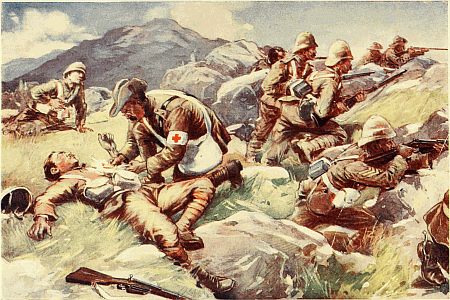
Clive Wilson. Dr. Wedderburn pursued his deeds of mercy to the wounded,
regardless of the rain of bullets that overtook him.
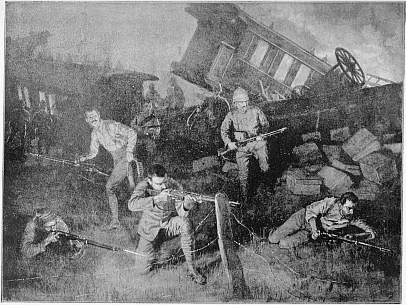
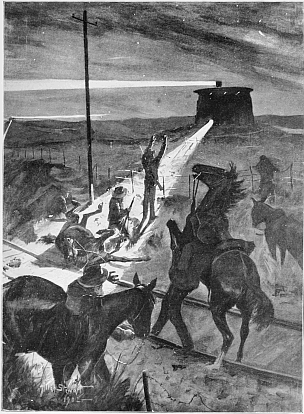
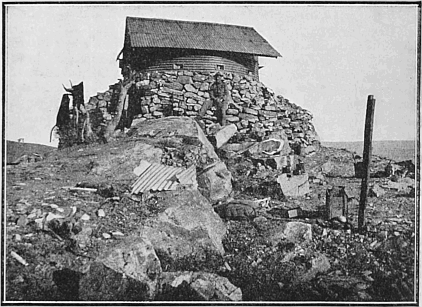
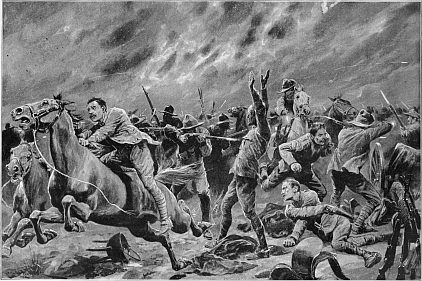
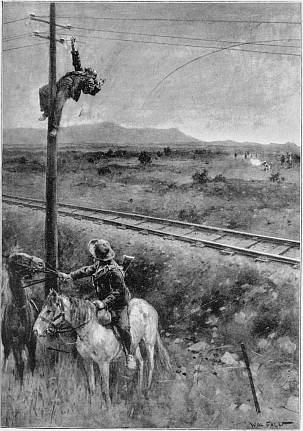
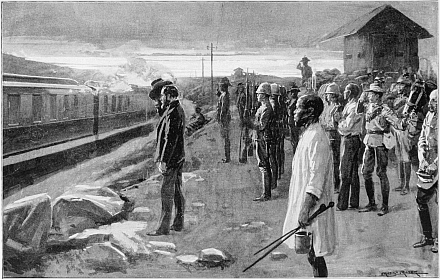
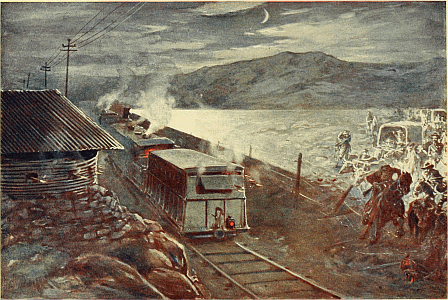 DE WET’S ATTEMPT TO CROSS THE RAILWAY.
Blockhouse and Armoured Train at work.
DE WET’S ATTEMPT TO CROSS THE RAILWAY.
Blockhouse and Armoured Train at work.
The following particulars of this gallant fight were obtained from the men
engaged in it by the correspondent of the Central News:—
“The columns under Colonel Damant and Colonel Rimington left Frankfort on the 19th
inst. and proceeded in the direction of Vrede. The force trekked all night through a most
severe thunderstorm, during which three of our men were struck by lightning and killed.
“On reaching the neighbourhood of Tafelkop, Damant rushed a Boer piquet, killing
one man and capturing Commandant Gyter.
“At daybreak the transport waggons were laagered, and were left behind in charge of
a small escort, while Damant with two guns of the 39th Battery, and one pom-pom and
ninety-five men all told, rushed forward. The little force deviated on the left flank, where
a number of Boers had been located.
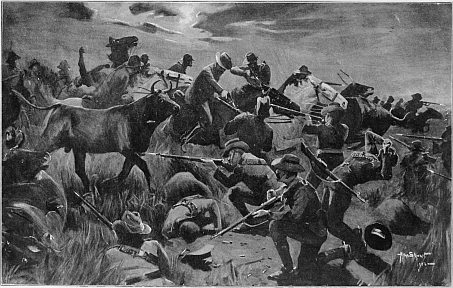
“On reaching a ridge Colonel Damant observed a party of seventy men dressed in
British uniform busily engaged driving cattle in his direction. The strangers were at first
taken to be a part of Rimington’s column which had gone out on the right flank. The
mistake was soon discovered, however, and almost immediately another body of the enemy
was located further to the left of the British laager.
“Our guns were speedily unlimbered, and quickly came into action. We had only been
able to fire two shots when the Boers in charge of the cattle abandoned them and galloped
boldly forward towards the British position.
“The enemy opened a galling fire on the gunners at a range of two hundred yards, and
simultaneously another party of 150 Boers who had remained carefully concealed in ambush
in the long grass at the foot of the ridge enfiladed the position.
“A large number of the gallant defenders fell at the first few volleys, but the survivors
fought tenaciously, and the enemy were only able to rush and capture the position after all
the men on the ridge had been either killed or wounded except three.
“Previous to this, however, some of the gallant gunners and the escort had succeeded
in getting away the limbers of the guns, notwithstanding the heavy fire. The only gunner
who had escaped the bullets then effectually destroyed the breech-blocks of the guns and
rendered them utterly useless to the enemy. Out of a total force of 95 in action we had 75
killed and wounded, while of the 91st Yeomanry, one officer and 14 men were killed and
one officer and 10 men wounded.
“The Boers, who were under Commandants Wessels, Ross, and M. Botha—the latter
the son of the Commandant-General—also lost heavily. They had Commandant Vandermerwe
and 30 men killed. Three of the Boer dead were buried by our men, and the
remainder were carried away.
“Later in the day a Boer came in under a flag of truce and asked for an armistice in
order to allow the enemy to attend to their wounded and bury their dead.
“The survivors on our side state that the Boers behaved badly to our wounded on the
ridge after the position had been rushed. Every one who made a movement while lying on
the ground was fired at. An officer of the Yeomanry asked permission from a Boer dressed
in kharki to get water for our wounded. For reply the Boer discharged his Mauser point
blank at the officer’s head, but fortunately missed him.
“Several more of the enemy robbed and stripped our wounded and dead, and were only
restrained from perpetrating further outrages by their commandants, who used sjamboks
freely.
“The Boers were terribly angry when they discovered they were unable to move or use
the guns which they had captured.
“Meanwhile Captain Scott had got together a small force and came up to the assistance
of Damant’s men.
“Scott prepared to charge the position, when the enemy, mistaking his men for
Rimington’s column, hastily retreated. The fleeing Boers, however, fell right into the arms
of Rimington’s force, which was coming up to Damant’s support. Rimington opened fire,
and the enemy lost a few killed, while five were captured.
“Rimington, with the remainder of Damant’s force, chased the flying enemy across the
Wilge River.
“There appears to have been lately a large concentration of the enemy under De Wet
at Tafelkop. Large parties of determined fighters under the immediate command of M.
Botha, Meintjes, Tallvaard, Steenkamp, and Bucknill are now laying in ambush about the
district, waiting to attack small columns.”
In the south-western parts of the Orange Colony the process of clearance
continued, the troops bringing to the monotonous labour the utmost patience
and cheeriness. In the north-western portion the troops under Major Pack
Beresford (South African Constabulary) did a remarkable amount of work. At
the end of December they made a dashing raid on Bothaville, which led to the
capture of 36 prisoners, 80 horses, and 29 vehicles; and early in the new
year, in Ukenaimer, they secured the whole of Field-Cornet Theron’s laager
and transport, with 35 prisoners, among them Field-Cornet Le Roux.
In the Cape Colony Major-General Sir H. H. Settle assumed command in
succession to Major-General Wynne, who returned to England. Affairs otherwise
remained as before, though the bands of Fouché and Myburg were
disorganised and broken up by the excellent and continuous work of Colonel
Munro and Scobell, and Lovat’s invaluable Scouts. The guerillas were now
fewer and farther between, spending their time lurking in the hills around
Dordrecht, Jamestown, and Ladygrey, and indulging in acts of brigandage
according to the state of their appetites. The great incident of the month was
the capture of Kruitzinger. This was effected on the 16th of December. The
raider, returning to the Cape Colony with an escort of one hundred men, came
into contact near Hanover with the blockhouses held by the Grenadier Guards
on the Naauwpoort-De Aar line of railway. The collision was sharp and
short, and the commander and twelve of his men were wounded and finally
captured. The rest of the escort escaped to the south, and were pursued into
the Aberdeen district by troops under Colonel B. Doran and Major Lord W.
Cavendish Bentinck.
A gradually widening line of blockhouses running 200 miles (from Lambert’s
Bay to Calvinia and Victoria West) threatened shortly to limit the
raiders’ sphere of operation, but till this was complete the chases continued.
Colonel Doran, on the 9th, surprised and buffeted Nesser’s rebels near Brandwagt,
thirty miles east-north-east of Calvinia. One Boer was killed and eight
were captured. The rest scuttled in small parties to the Clanwilliam district, in
hope to reassemble and pounce on the next convoy coming their way. This
much-desired prize at last appeared, and was attacked with intense energy at
dawn on the 22nd. It was escorted by columns under Colonels Crabbe and
Wyndham, who, despite the strength and desperate determination of the foe,
managed to repulse them. But the next day the enemy, hungering after the
tantalising supplies, betook themselves to a high ridge commanding the line of
advance and there lay ensconced awaiting the precious convoy. But after all
they went empty away, for the 16th Lancers, with tremendous dash, rushed
the entrenchments and drove them at full gallop into space.
 The Blockhouse System
Over a year had passed since Lord Kitchener had embarked on the duties of
Commander-in-Chief, and it was now possible to examine the system on which
the war had been conducted, and the extent of progress made. The great and
most important part of the work, which was still continuing, was the dividing
of the settled from the unsettled portions of the country. The development
of the blockhouse system, which effectually blocked the inroads of the
marauders, went on apace, and already some 14,700 square miles of the
Transvaal, and 17,000 square miles of the Orange River Colony were entirely
shut off from their incursions. The area protected in the Transvaal was
bounded on the north by a line from Zeerust to Middelburg, on the east from
Middelburg to Standerton, on the south from Standerton to Klerksdorp, on
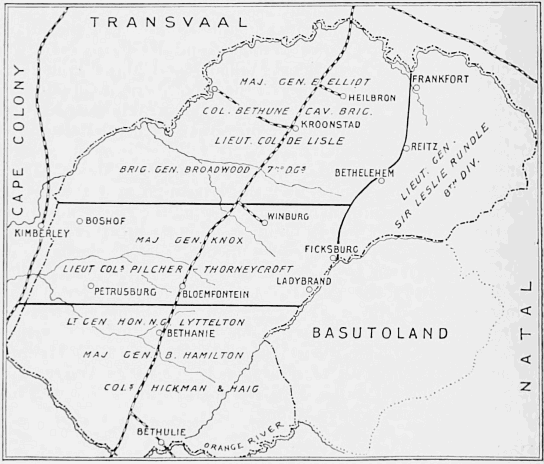
the west from Klerksdorp to Zeerust. The Orange River Colony protected
area went right across the colony south of the line from Kimberley to Winburg,
Winburg to Bloemfontein, and Bloemfontein to Ladybrand. Within these
boundaries the Boer could not exist, and beyond them the task of clearing the
country and hunting down the enemy was pursued by means of small mobile
columns.
The work and activity of these columns throughout the year had been
enormous. Though about 10,000 Boers remained sprinkled in the field, some
53,000 (half of which number had been accounted for during the last year) had
been either killed, wounded, imprisoned, or protected in concentration camps. In
regard to these camps a great deal had been said by the enemies of the Government
for the purpose of raising a cry of inhumanity against the Ministers, but
in a speech made by Mr. Brodrick he lucidly and concisely examined and
disposed of these charges. “So long,” he said, “as every house in the Transvaal
and Orange River Colony was used at once as a telegraph station, a
recruiting office, and a refectory for the enemy, it became impossible for Lord
Kitchener to ignore the necessity of relieving the country of the population
which was rendering futile the exertions of our troops. Under these circumstances
you have to consider not what their condition is now as compared with
what it would be in time of peace, but what their condition is now as compared
with what it would have been if they had been left on their farms. You have
not got to consider the difference between luxury and privation, but between
starvation and great suffering, and the less suffering we can arrange for.” He
further showed that to a large extent the disease in the camp was due to the fact
that the majority of persons who came in (some compulsorily, but the greater
number voluntarily) were already half-starved, their resources being at an
end, and half-clothed, with their bodies in a condition fitted for the reception
of disease. Under those circumstances a large death-rate was certain.
But, he asked, what nation engaged in war has at any time, in any country,
or under any conditions, endeavoured to feed, clothe, house, nurse, doctor, and
educate 150,000 persons, who have been left on their hands by the enemy,
whom they had called on—as Lord Roberts did on two occasions—to take
over and maintain their own belongings, but who said they would leave them
on our hands. And again, he explained that far from any inhumanity being
shown the enemy, many of the troubles had been prolonged by excessive
leniency to men who, on many occasions, had violated the rules of civilised
warfare. For the last year and before it there had been instances of firing on
ambulances, professing to surrender and opening fire again, or firing on the
wounded, breaches of parole and treachery, which had provoked no retaliation,
no deviation from the usages of the civilised warfare on our part. He put
forth reasons which accounted for the abnormal death-rate in the concentration
camps, showing in the first place that a death-rate in a camp whence all the
healthy males have been removed, cannot be looked on as an ordinary death-rate.
He said: “If you look only at infants, it has been pointed out that in
the thirty-three great towns of the Kingdom the mortality is 248 per 1000.
Birkenhead goes up even to 362 per 1000. Therefore, those who compare the
death-rate in these camps with the ordinary death-rate of the great towns are,
of course, speaking wrongly. I have heard of people who think that measles
cannot have much effect on the death-rate. But what of the gardes mobiles of
Paris during the siege, whose death-rate was 40 per cent. in measles cases?”
The critics who had discussed the camps had not taken the trouble to acquaint
themselves with the ordinary statistics of Boer farm life, for, had they done so,
they might have taken into consideration the fact that though many Boers had
families of twenty children, as a rule, owing to the neglect, ignorance, or
apathy of the parents, only two to a family survived. For this reason their
population has not been equal to that of other nations in the same conditions.
It is only by a study of the habits of life of these people prior to the English
rule that it is possible to judge whether they had in the camps the comfort they
were accustomed to. Luxury is but comparative, and, as has been shown, the
luxury of soap and other sanitary precautions were ignored by the lower
classes of Boers from earliest times. In regard to the matter of diet, that these
persons received food at all was a marvel, considering that every convoy had
to be protected from their marauding relatives by the lives of our own valiant
men, men who themselves were not without anxiety as to how their own wives,
mothers, and babes were faring at home in their absence, and who themselves,
after a long career of hazard and usefulness, might share a less enviable fate.
In addition to the accusations regarding the concentration camps, invented
by traitors to the country that housed and sheltered them, there were other
arguments to be met. “How is it, if you send this vast number of horses—if
you have your columns—if you have good leaders who are well equipped—that
our men cannot catch the enemy? Is your intelligence defective; is
your system at fault?” The explanation given by Mr. Brodrick, one which
showed a serious development of the war, was this: “The system of our
country and people with regard to the Kaffir is different from the Boer system.
The Boer columns have only too frequently in the last few months eluded our
columns by hiding their tracks, by murdering the Kaffirs behind them. It is a
serious charge, and I make it only for this reason, that I had occasion to notice
that in the secret intelligence reports so many cases were mentioned of the
murder of Kaffirs that I telegraphed to Lord Kitchener to ask whether this was
a general practice, or whether it was the occasion of isolated persons. His reply
was: ‘Cold-blooded murders by the Boers have been frequent of late. It was
only on the 10th inst. two dead infants were found with their hands tied behind
them down a main shaft at Freylingstadt.’ The leader of a column, whose
letter I saw not long ago, mentioned that he was within two or three hours of a
column of the enemy whom he had been pursuing for a considerable number of
hours—that was at a Kaffir kraal—and he found the place deserted, but in one
of the houses he found four little Kaffir boys, all under twelve, all with their
heads battered in two or three hours before.” Mr. Brodrick proceeded to
explain that he did not bring this forward with the intention of making an
impeachment against the whole Boer nation. Indeed, the statement was forced
from him by friends of the enemy who at one time jeered at the Government
and our Military Commanders for not beating the Boers, and at another complained
that negotiations and blandishments were not substituted for the slow
system of physical pressure that was found by the Commander-in-Chief to be
the surest means to the end—the peaceable end.
Both Lord Kitchener and Lord Milner decided that it was of no use either
to threaten or to wheedle, the one and only thing was imperturbably to squeeze,
reserving the policy of clemency for the proper season, when the surrendered
Boers should have become our fellow-subjects. Accordingly we still continued
to pour fresh regiments into the country. Four thousand trained mounted troops
were now on their way out to replace those that needed rest, and India was
providing four battalions and two more cavalry regiments in return for other
troops which would take their place there. Some militia regiments were also
being sent to the front, and further Colonial contingents, so that thus reinforced
the tired veterans would receive a fillip for future operations.
For reference in the future, when the resources of the Empire are studied,
the following return of troops and horses sent out to South Africa between
January 1, 1900, and December 31, 1901, may be found interesting:—
| During |
From Home and India. |
| Officers. |
Warrant Officers. |
N.C.O.’s and Men. |
Horses |
| 1900. |
|
|
|
|
| January |
1,099 |
45 |
28,072 |
10,229 |
| February |
1,362 |
47 |
32,356 |
5,701 |
| March |
1,130 |
63 |
26,539 |
5,501 |
| April |
480 |
18 |
11,692 |
4,522 |
| May |
321 |
4 |
7,020 |
2,481 |
| June |
271 |
7 |
10,092 |
2,649 |
| July |
120 |
6 |
2,107 |
1,277 |
| August |
93 |
7 |
3,137 |
832 |
| September |
128 |
3 |
4,644 |
1,187 |
| October |
113 |
4 |
2,337 |
2 |
| November |
125 |
18 |
2,331 |
895 |
| December |
106 |
9 |
1,080 |
591 |
| Total for 1900 |
5,348 |
231 |
131,407 |
35,867 |
| 1901. |
|
|
|
|
| January |
288 |
12 |
3,333 |
2,471 |
| February |
275 |
3 |
5,225 |
1,495 |
| March |
782 |
9 |
21,591 |
2,328 |
| April |
366 |
12 |
4,498 |
2,724 |
| May |
304 |
15 |
3,509 |
2,801 |
| June |
287 |
11 |
5,532 |
2,481 |
| July |
99 |
3 |
2,055 |
2,314 |
| August |
179 |
13 |
3,546 |
1,672 |
| September |
197 |
4 |
1,958 |
2,128 |
| October |
191 |
13 |
1,466 |
2,401 |
| November |
270 |
7 |
5,350 |
2,856 |
| December |
619 |
16 |
11,686 |
5,024 |
| Total for 1901 |
3,857 |
118 |
69,749 |
30,695 |
| Grand Total |
9,205 |
349 |
201,156 |
66,562 |
[Pg 167]
| During |
Colonial Contingents. |
Remounts from Abroad. |
| Officers. |
Warrant Officers. |
N.C.O.’s and Men. |
Horses. |
| 1900. |
|
|
|
|
|
| January |
134 |
2 |
2,080 |
2,145 |
840 |
| February |
69 |
3 |
1,313 |
1,384 |
2,703 |
| March |
149 |
1 |
2,739 |
3,065 |
10,341 |
| April |
45 |
|
834 |
880 |
7,879 |
| May |
81 |
1 |
1,349 |
1,690 |
7,761 |
| June |
|
|
|
|
12,551 |
| July |
|
|
|
|
3,305 |
| August |
|
|
|
|
5,293 |
| September |
|
|
|
|
8,680 |
| October |
|
|
|
|
2,213 |
| November |
|
|
|
|
1,120 |
| December |
|
|
|
|
5,272 |
| Total for 1900 |
478 |
7 |
8,315 |
9,164 |
67,958 |
| 1901. |
|
|
|
|
|
| January |
17 |
|
567 |
580 |
4,224 |
| February |
77 |
1 |
1,424 |
1,391 |
5,991 |
| March |
162 |
6 |
3,806 |
2,722 |
9,022 |
| April |
86 |
3 |
1,672 |
1,951 |
4,850 |
| May |
3 |
|
2 |
|
4,384 |
| June |
|
|
|
|
4,742 |
| July |
9 |
|
7 |
|
9,130 |
| August |
21 |
2 |
324 |
|
7,800 |
| September |
|
|
|
|
7,550 |
| October |
|
|
|
|
10,728 |
| November |
|
|
|
|
8,099 |
| December |
|
|
|
|
15,463 |
| Total for 1901 |
375 |
12 |
7,802 |
6,644 |
91,983 |
| Grand Total |
853 |
19 |
16,117 |
15,808 |
159,941 |
| During |
Totals. |
| Officers. |
Warrant Officers. |
N.C.O.’s and Men. |
Horses. |
| 1900. |
|
|
|
|
| January |
1,233 |
47 |
30,152 |
13,214 |
| February |
1,431 |
50 |
33,669 |
9,788 |
| March |
1,279 |
64 |
29,278 |
18,907 |
| April |
525 |
18 |
12,526 |
13,281 |
| May |
402 |
5 |
8,369 |
11,932 |
| June |
271 |
7 |
10,092 |
15,200 |
| July |
120 |
6 |
2,107 |
4,582 |
| August |
93 |
7 |
3,137 |
6,125 |
| September |
128 |
3 |
4,644 |
9,867 |
| October |
113 |
4 |
2,337 |
2,215 |
| November |
125 |
18 |
2,331 |
2,015 |
| December |
106 |
9 |
1,080 |
5,863 |
| Total for 1900 |
5,826 |
238 |
139,722 |
112,989 |
| 1901. |
|
|
|
|
| January |
305 |
12 |
3,900 |
7,275 |
| February |
352 |
4 |
6,649 |
8,877 |
| March |
944 |
15 |
25,397 |
14,072 |
| April |
452 |
15 |
6,170 |
9,525 |
| May |
307 |
15 |
3,511 |
7,185 |
| June |
287 |
11 |
5,532 |
7,223 |
| July |
108 |
3 |
2,062 |
11,444 |
| August |
200 |
15 |
3,870 |
9,472 |
| September |
197 |
4 |
1,958 |
9,678 |
| October |
191 |
13 |
1,466 |
13,129 |
| November |
270 |
7 |
5,350 |
10,955 |
| December |
619 |
16 |
11,686 |
20,487 |
| Total for 1901 |
4,232 |
130 |
77,551 |
129,322 |
| Grand Total |
10,058 |
368 |
217,273 |
242,311 |
[Pg 168]
Owing to the efficacy of Lord Kitchener’s slow but sure efforts the railway
disasters became fewer. In October 1900 the railway was cut thirty-two
times, or more than once per day. In November thirty times, in December
twenty-one times, in January sixteen, in February (after De Wet’s incursion
into Cape Colony) thirty, in March eighteen, in April eighteen, in May twelve,
in June eight, in July four, in August four, in September two, and in October
not at all. Thus it became possible for more than a hundred refugees per week
to resume work at Johannesburg.
The supreme authority throughout the Transvaal rested with Lord Kitchener.
Civil considerations had of necessity to give way to military exigency. The
work of the civil authorities was naturally restricted and subject to limitations
from which on the return to normal conditions it would be freed. Nevertheless
they acted with foresight, preparing such seeds as would ensure a good harvest
in time to come. In a report made to Mr. Chamberlain in December, Lord
Milner spoke hopefully of this happy era: “We have come into possession
of a magnificent estate, which has been woefully mismanaged. As far as local
administration is concerned—I am not speaking of the political development of
South Africa as a whole—it requires no extraordinary statesmanship, it simply
requires ordinary decent government and reasonable liberality in public finance
to ensure not only a great advance in material prosperity, but in all the
essentials of civilisation.” Lord Milner also expressed the opinion that,
terrible as had been the ravages of the war, the great fact remained that the
Transvaal possesses an amount of mineral wealth virtually unaffected by the
war which will ensure the prosperity of South Africa for the next fifty years,
and other resources, both industrial and agricultural, which, properly developed,
should make it a rich country, humanly speaking, for ever.
Before constructing the blockhouse lines Lord Kitchener determined that the
enemy must be deprived of his guns. His efforts in that direction were speedily
rewarded. By June 1901 nearly the whole Boer artillery was captured or had
been destroyed by the Boers themselves. General French was responsible for
the capture of guns in the Eastern Transvaal, and we know how effectively his
work was carried out. General Babington deprived Delarey of nine guns, two
were taken by Rawlinson and more by Dartnell and others. In all twenty-seven
guns were reported to have been taken during the year; twenty-six
of them during the months of February, March, April, and May. They included
half-a-dozen pom-poms, seven or eight Maxims, several 15-pounders, Krupp
guns of varying calibre, Creusot, Hotchkiss, and quick-firing guns. In addition
to these armaments, more than half-a-dozen of our own guns taken from British
positions at various times were recovered. Of rifles 7993 were captured, and
during the year it was estimated that 8589 vehicles had been taken by the
British. In fact the process of the gradual depletion of the enemy’s resources
had been most effective. The number of prisoners taken was about 27,000.
The surrenders prior to Lord Kitchener’s proclamation in August had averaged
about 500 a month. During the later months the surrenders decreased, while
the number of prisoners captured increased. Naturally at the close of the year
there was a decline in the number of Boer casualties, for the continued
attrition of the Boer resistance necessarily reduced the number of antagonists
accounted for.
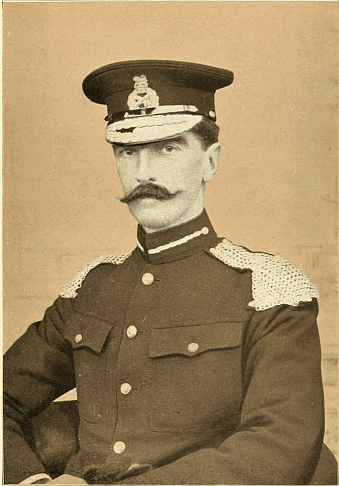 GENERAL BABINGTON.
Photo Charles Knight, London.
GENERAL BABINGTON.
Photo Charles Knight, London.
In an intercepted letter from Mr. Schalk Burger to Mr. Steyn, dated
Tautesberg, March 21, 1901, stating that the condition of the Boers at that
time was becoming very serious, the Acting President said:—
“The question is, what must we, what shall we do? May we, can we,
continue the struggle further? I pray the Lord day and night to give us
wisdom and light hereon, and cause us not to sin against His will, but also not
to fall into disbelief. If we are convinced that our last resources are exhausted,
our last strength broken, we must bow down and surrender ourselves to the
power of the enemy, no matter how bitter this cup may be to us. I can, however,
not yet decide upon this latter course. My hope and trust is still that
we shall be delivered and saved; the sacrifices of lives, prayers, and misery, are
too great not to be crowned with our hopes and expectations, according to our
belief. As you will see for yourself, from the correspondence between Lord
Kitchener and Commandant-General Botha, there is no mention of terms which
meet us in any way, therefore I keep to the decision to surrender unconditionally
if this must happen, which I trust God forbid. No, let us keep our nation
unsullied, to receive no favour from our enemy, that the gulf which exists through
former years and this cruel war remains and still widens. ‘Where there is
a will there’s a way,’ and if we are not exiled, we can, by exerting our strength,
form committees, and supported by loving gifts from Europe, again build up
our country and people, to advance our language and religion, to educate our
children, and to keep alive our oppressed national spirit and cause it to come to
life again. This is my ideal.”
Many months had now elapsed since the penning of that letter, and the condition
of the Boers had gone from bad to worse. Their hitherto stubborn
resistance was now little more than suicidal lunacy. A rough estimate of their
losses for the year, so far as could be judged, is shown in the following table:—
| 1901. |
Killed. |
Wounded. |
Prisoners. |
Surrenders. |
Total. |
| January |
{ |
Killed and wounded, 670 |
Prisoners and surrenders, 2,174 |
} |
2,844 |
| February |
| March |
| April |
| May |
153 |
90 |
1,512 |
535 |
2,290 |
| June |
223 |
109 |
1,074 |
504 |
1,910 |
| July |
147 |
111 |
1,045 |
367 |
1,670 |
| August |
202 |
86 |
1,504 |
549 |
2,341 |
| September |
170 |
114 |
1,379 |
393 |
2,056 |
| October |
425 |
368 |
980 |
197 |
1,970 |
| November |
233 |
269 |
1,156 |
93 |
1,751 |
| December |
164 |
97 |
1,106 |
121 |
1,488 |
| Total |
1,717 |
1,244 |
9,756 |
2,759 |
18,320 |
Lord Milner, in reviewing the situation at the end of the year, commended
the marked change which had come to pass:—
“Six months ago the enemy were everywhere, outside the principal towns.
It is true they held nothing, but they raided wherever they pleased, and, though
mostly in small bodies, which made little or no attempt at resistance when
seriously pressed, they almost invariably returned to their old haunts when the
pressure was over. It looked as though the process might go on indefinitely. I
had every opportunity of watching it, for during the first two months of my
residence here it was in full swing in the immediate neighbourhood. There
were half-a-dozen Boer strongholds, or rather trysting-places, quite close to
Pretoria and Johannesburg, and the country round was quite useless to us for
any purpose but that of marching through it, while the enemy seemed to find
no difficulty in subsisting there. To-day, on the other hand, a great quadrilateral,
bounded roughly as follows: on the east by the Wilge River and a line
drawn from its head-waters to Villiersdorp on the Vaal River; on the south, by
the Vaal River from Villiersdorp to about Klerksdorp; on the west, by an
irregular line drawn from Klerksdorp to the centre of the Magaliesberg Range;
and on the north, by that range and the Pretoria-Delagoa Bay Railway, is
virtually denied to the enemy. This area is more important, economically,
politically, and strategically than all the rest of the Transvaal. It contains not
only Pretoria and the whole of the Rand mining area, but one of the most important
coalfields and a large extent of the best agricultural land. Similarly, a
great improvement is manifest in the southern part of the Orange River
Colony—the districts lying south of a line drawn from Ladybrand to Bloemfontein,
and thence westward through Boshof to the colonial border. It would
not be true to say that this region is entirely clear of the enemy, but great
progress has recently been made in clearing it. Strategically this is a
very important region owing to its central position, and to the fact that it
connects the northern states with the ‘friendly and allied’ districts of Cape
Colony.”
In discussing the Cape rebels he declared that—
“If the enemy now find this region difficult to live in, and impossible to
traverse in any considerable numbers, the circumstance is both militarily and
politically important, for it means that their dwindling numbers in the late
Republics are now deprived of that reinforcement from the south, which has
all along been of such immense assistance to them. For even holding, as I do
(though competent opinions differ on the subject), that the number of colonial
rebels who have actually crossed the border during the past twelve months has
not been large, it would be hard to overestimate the moral support which
Colonial information, sympathy, and encouragement, and the touch with the
outside world maintained by free communication with Cape Colony, has hitherto
afforded to the enemy. Such communication is now greatly hampered, and
may soon become absolutely impossible.”
On the 25th of January a Peace Movement was made by the Dutch
Government, in which it was proposed that the British Government should
give safe conducts to three Boer delegates in order that they might go from
Europe to induce their fighting compatriots to conclude a treaty of peace.
Since a treaty is a compact between two Governments, and since one of the
Governments—the Boer Government—ceased, with the annexation of the
Boer territories, to exist, there was only one reply possible to the British
Government, and this reply was given. The following is the text of the
document:—
“The Marquess of Lansdowne to Baron Gericke.
“Foreign Office, January 29, 1902.
“Sir,—You were good enough to lay before me on the 25th instant a communication
from the Netherland Government, in which it was proposed that, with the object of
bringing the war to an end, his Majesty’s Government might grant a safe conduct to the
Boer delegates now in Holland for the purpose of enabling them to confer with the Boer
leaders in South Africa. It is suggested that after the conference the delegates might
return to Europe with power to conclude a Treaty of Peace with this country, and the
Netherland Government intimate that, in this event, they might at a later stage be
instrumental in placing the Boer Plenipotentiaries in relation with the Plenipotentiaries
who might be appointed by his Majesty’s Government.
“The Netherland Government intimate that if this project commends itself to his
Majesty’s Government, they will inquire of the delegates whether they are prepared to
make the suggested visit to South Africa.
“It may therefore be inferred that the communication which I received from you was
made on the responsibility of the Netherland Government alone, and without authority
from the Boer delegates or leaders.
“His Majesty’s Government have given it their best consideration, and, whilst they
entirely appreciate the motives of humanity which have led the Netherland Government
to make this proposal, they feel that they must adhere to the decision, adopted and
publicly announced by them some months after the commencement of hostilities by the
Boers, that it is not their intention to accept the intervention of any foreign Power in the
South African War.
“Should the Boer delegates themselves desire to lay a request for safe conduct before
his Majesty’s Government, there is no reason why they should not do so. But his
Majesty’s Government are obviously not in a position to express an opinion on any such
application until they have received it and are aware of its precise nature, and the grounds
on which the request is made.
“I may, however, point out that it is not at present clear to his Majesty’s Government
that the delegates retain any influence over the representatives of the Boers in South
Africa, or have any voice in their councils. They are stated by the Netherland Government
to have no letters of credence or instructions later in date than March 1900. His
Majesty’s Government had, on the other hand, understood that all powers of government,
including those of negotiation, were now completely vested in Mr. Steyn for the Boers of
the Orange River Colony, and in Mr. Schalk Burger for those of the Transvaal.
“If this be so, it is evident that the quickest and most satisfactory means of arranging a
settlement would be by direct communication between the leaders of the Boer forces in
South Africa and the Commander-in-Chief of his Majesty’s forces, who has already been
instructed to forward immediately any offers he may receive for the consideration of his
Majesty’s Government.
“In these circumstances his Majesty’s Government have decided that if the Boer leaders
should desire to enter into negotiations for the purpose of bringing the war to an end, those
negotiations must take place, not in Europe, but in South Africa.
“It should, moreover, be borne in mind that if the Boer delegates are to occupy time in
visiting South Africa, in consulting with the Boer leaders in the field, and in returning to
Europe for the purpose of making known the results of their errand, a period of at least
three months would elapse, during which hostilities would be prolonged, and much human
suffering, perhaps needlessly, occasioned.
“I have, &c.,
(Signed) “Lansdowne.”
Thus the situation remained much the same as before, save that the British
more than ever realised the necessity of bringing home to the Boers the
fact that the death-blow to their independence had been struck by Kruger’s
insolent ultimatum of October 1899.
Regarding this remarkable and long-suffering set of men, it would be possible
to write a volume. Space limits us to a few lines. Yet, after all, deeds like
theirs are best sung in the finest song of all—the song that has no sound.
Some one has asked, What constitutes a State? The answer applies to
those, the loyal and true, who have fought and suffered in the cause of home
and country.
“Men who their duties know
But know their rights, and knowing, dare maintain,
Prevent the long-aimed blow
And crush the Tyrant while they rend the chain:
These constitute a State.”
And these bulwarks of Great Britain’s might were to be found in great strength
in South Africa. Other colonies had contributed most generously in men and
money, but no other colony had been called on to endure what the Cape
Colony had endured, and thus enduring, to act and to pay as this colony had
acted and paid. Almost from the commencement of hostilities the Colonial
forces—the Cape Mounted Rifles, Cape Police, South Rhodesian Volunteers,
and others[10]—had shown their grit and usefulness in the field and covered
themselves with imperishable glory. If the burden of their maintenance had
fallen hard on the resources of the country, the laurels they had won had clothed
the harshness with an evergreen beauty, for the country must be eternally
proud of the men who saved Wepener and of those who struggled and
helped to save Mafeking. The outlines of Wepener’s story have been given,
and a little has been said of the Rhodesia Regiment that was raised by Colonel
Plumer to protect the border in case of war, and in looking back over their
operations it is difficult to say whether by their usefulness or their dash the
Colonial “Irregulars” rendered themselves most conspicuous. During the war,
of the Rhodesians Colonel Spreckley, Captain Crewe, Captain Butters, and
Lieutenant Anderson lost their lives, but the borders of Rhodesia were
protected. During the siege of Wepener the Cape Mounted Rifles fought in
more engagements than an ordinary General will count in a lifetime—yet
they saved the place and came out of it to fight a renewed set of battles!
It must be admitted that all the Colonial troops entered into their work with
the same cheeriness and military ardour, though all had not the same chance to
win fame. The Tabaksberg engagement on 29th January afforded the Kaffrarian
Rifles an opportunity of distinguishing themselves, and the following quotation
from a letter from Colonel Crewe (commanding the Colonial Division in the
Field) to the Mayor of East London serves to show how they availed themselves
of it:—
“I am sure you will be pleased to hear of the gallant conduct of the
Kaffrarian Rifles at the recent engagement at Tabaksberg on 29th January last,
when the force under my command, some 700 in all, were engaged by the
forces of De Wet and Steyn. With odds of 2500 to 700 against us, we were
able to successfully maintain our position owing to the extreme bravery of the
men I have the honour to command. Where all did well, the Kaffrarian Rifles
did especially fine service. To Major Price and Captain Fairweather much of this
success is due, and amongst the non-commissioned officers and men it is difficult
to pick out names for special mention where all did so well. I am sure East
London will be prouder than ever of her gallant sons. Both General C. Knox
and Lord Kitchener have expressed their admiration of the behaviour of all
ranks on that day.”
It seems unfair to make special mention of any single branch of the Colonial
Volunteer Service, when all the Cape loyalists behaved in some way like
“trumps” or veterans. The permanent forces of the Cape Government
were grandly supported almost from the very first by the Cape Garrison
Artillery, the Duke of Edinburgh’s Own, and the Cape Town Highlanders,
and these, when the “call to arms” came, were finally backed up by
the Town Guards, the Peninsula Horse, and other irregular forces that had
been raised practically at a moment’s notice—drawn straight from the hearth
and home to throw in their lot with the soldiers in the field. It was thanks
to these that the colony was saved, and thanks to the Town Guard
that the regular and irregular forces and volunteers were freed to push
on to the front. Indeed, at one period of the war, the Cape Town Guard
(which enrolled for three months and hung on to the end) were left almost
entirely alone for the protection of the towns.
Lord Milner, who was greatly impressed by the conduct of the volunteers,
thus expressed himself on the subject: “It is indeed calculated to exercise a
most important and, I believe, beneficial influence upon the South African
politics of the future. Among the principal causes of the trouble of the past
and present was the contempt felt by the Africander countryman, used to riding
and shooting, and generally in possession of a good rifle and plenty of cartridges,
for other white men less habituated to arms than he was himself. That feeling
can hardly survive the experience of the past twelve months, and especially
of the last six weeks. The splendid fighting of the despised Johannesburgers,
of the Imperial Light Horse, and of the other South African Colonial Corps has
become a matter of history, and the present levee en masse of the British
people, including the townsmen, of this Colony, is proof positive that when the
necessity is really felt they are equal to the best in courage and public spirit.
In this respect the events of the past few months, unfortunate as they have
been in many ways, have undoubtedly their brighter side. The mutual
respect of the two principal white races is the first condition of a healthy
political life in the South Africa of the future. It is possible that if the extreme
strain of the most recent developments of the war had never been felt throughout
Cape Colony the British inhabitants would never have had the opportunity
of showing that they were inferior to none in their willingness to bear all the
burdens of citizenship, including that of personal service.”
It may be remembered that on the 6th of February 1901 Brigadier-General
Brabant was appointed to the command of the force which was then being raised
for the defence of the Cape Colony, with Colonel Girouard as his chief staff
officer. His headquarters were at East London, where the organisation proceeded,
expanding eventually northward and westward, taking in district after
district, so as to enable the Imperial military forces ultimately to concentrate in
the Orange River and Transvaal Colonies. Colonel H. Cooper, C.M.G., A.D.C.,
commanded the Cape Town District, and Major Coke took a prominent part
in the organisation of the irregular corps. The towns which provided guards
were mentioned in a previous volume, but particulars were not then available.
The Stellenbosch Town Guard contained some of the smartest members of
the Colonial Defence Force. Like one man they enrolled themselves, only
too proud to assist in the national cause. Very soon there were collected
over a hundred of them under the following officers: Captain Harry Beyers,
Lieutenant H. P. Shepherd, Lieutenant J. L. Scott, Hon. Surgeon-Captain
J. W. C. Macpherson.
On the 15th January 1901 the Commandant read the proclamation of
Martial Law in the Stellenbosch Court-house. From that date, thirty
members of the Town Guard were called out to do permanent duty. At
first some difficulty arose as to where the men were to be housed, &c., but
eventually the Masonic Building was placed at the disposal of the Permanent
Guard. “In this building,” wrote a colonial correspondent, “Captain Harry
Beyers, the officer in command of the Guard, has his office, where all permits
and passes are issued; the Commandant of the District, who, by the way, lives
at the Remount Station about five miles out of the town, comes in three times
a week to transact any military business. The barrack-room is a fine and
large hall where the men have their meals and also sleep. The rifles are all
in racks at the further end of the hall; these racks are all numbered, and every
man knows his number. The place and its surroundings are kept scrupulously
clean, and a sentry, who is always to be seen at the gate, stops any loiterer
from entering the parade ground, where every morning at seven o’clock and
every afternoon at six o’clock the men are properly drilled by the popular
‘Jimmy’ Hills, the Colour-Sergeant Major, who is, like his captain, an old hand
at the game.”
In the beginning of July, when the Commandant of No. 7 Area, Colonel
Helme, inspected the Guards, he was surprised to note the efficiency and
smartness of the men. In an address to them he complimented the commanding
officer for the work done; he also mentioned that the Stellenbosch
Town Guard was the best turned out Guard in his area.
A brief description of the Civil Service Company of the Cape Town Guards
serves to give a general idea of the nature of these valuable protectors of the
city. The Company was under the command of Captain Callcott Stevens, of
the Civil Commissioner’s Office, Cape Town, who had previously seen active
service with the Duke of Edinburgh’s Own Volunteer Rifles in the Basuto
Campaign of 1880-81. The section commanders of the Company were Lieutenant
Frank W. Waldron, A.M.I.C.E., of the Department of the Commissioner for
Public Works; Lieutenant William A. Collard, Deputy-Assistant Treasurer,
Treasury Department; Lieutenant Arthur A. Beck, of the Colonial Secretary’s
Department; Lieutenant Bertram E. Shepperson, of the Treasury; and Lieutenant
Charles Murray, of the Department of Public Education. The nominal
strength of the Company was 142 members. It was raised in one afternoon—immediately
the ministerial authority for its enrolment was obtained. A similar
degree of rapidity was manifested in many other companies of the Guards at
the time of the crisis, and this martial impetuosity reflected immense credit on
the manhood of the city—on its patriotism, its disinterestedness, and its pluck.
The Civil Service Company consisted of five sections, and was fully representative
of the Departments of the Prime Minister, the Commissioner for
Public Works, the Treasury, the Colonial Office, and the Attorney-General,
together with all the offices and sub-departments controlled by these ministerial
divisions. An excellent spirit was manifested throughout by all ranks; and
much laborious work was done in the way of guards mounted over important
arsenals, magazines, and valuable stores. The original period of three months
for which the Guards enrolled passed only too quickly, but their services were
still urgently required, and they continued to be called upon for further periods
of service, to which an excellent response was made—thus the military authorities
were enabled to release many men of the regular forces for service in the
fighting line, where they were much needed.
Among the various companies of the Town Guard were many prominent
Government officials and business and professional men, whose names are
familiar in the colony. It would be impossible to reprint the rolls of all the
companies, but a list of names of some of the well-known persons who
appeared in the new character of defenders of the Empire is here quoted:—
A. Allen, G. T. Amphlett, Kitchener Andersen, H. J. Andrews, H. Arderne, Robert
Armour, R. H. Atwell, R. J. Austin, R. E. Ball, F. C. Berrangé, F. L. Bishop, J. J. Bisset,
G. Bolus, W. H. Bond, J. Brydone, W. P. Buchanan, J. C. Carstens, J. D. Cartwright,
M.L.A., J. H. Clark, Wm. Cleghorn, W. F. Colman, Sydney Cowper, C.M.G., Peter
Davidson, A. Dawson, Theo. De Marillac, R. Dickson, Dennis Edwards, E. J. Edwards,
W. A. Fairbridge, Dr. E. B. Fuller, J. Garlick, C. M. Gibbs, J. Gillett, C. G. Goodison, C.
R. Goodspeed, W. Hanson, W. Hare, A. T. Hennessy, J. W. Herbert, T. Herbert, Dr. J.
Hewat, J. J. Hill, Norman Hilliard, J. Hodgson, C. F. Hoffman, B. Hogsett, J. W. Honey,
Alf. S. Hosking, J. W. Irwin, W. H. Johnstone, Howel Jones, Sir H. H. Juta, K.C., J. M.
King, J. R. Lancaster, R. A. Lambart, H. G. Legg, E. B. Lewis, Alex. Lipp, J. E. Lloyd,
W. B. Low, D. A. MacDonald, Walter Marshall, A. H. Mathew, Rob. M. Maxwell, D. E.
McConnell, A. M’Corkindale, D. McKee, C. S. Meechan, Donald Menzies, Stavros Mitchel,
R. H. C. Montague, E. J. Moore, W. E. Moore, J. Barry Munnik, C. S. Neave, E. T. M.
Notcutt, A. Palmer, D. S. Pargiter, J. Parker, Dr. T. L. Parry, J. O. Paterson, W. I. Perrott,
F. Plant, A. Plint, R. H. Pritchard, A. Ransome, P. Raphael, A. B. Reid, J. Richards,
H. P. B. Rigby, A. J. Robb, H. D. Robertson, G. Crosland Robinson, D. D. Ross, Pierce
Ryan, J. Sandersen, P. J. Savage, A. D. Scott, G. Scott, M. W. Searle, K.C., Fred. Wm.
Smith, J. H. Smithers, C. E. Solomon, Will. G. Sprigg, W. Stableford, James M. Stephen,
Calcott M. Stevens, P. Stewart, F. L. St. Leger, R. Stultaford, D. Tennant, N. P. Thesen,
A. W. Townshend, Geo. Trill, T. Upington, E. H. Von Witt, Joseph Walker, G. B. Williams,
J. Wilson, G. Lavibond Windsor, M. Woodhead, T. J. Woodhead, J. Wyllie, R. O. Wynne-Roberts,
J. A. Yallop.
Among the number were many men of independent means who were contented
to fill any place assigned to them, to take their share of duty as
mere privates, and go through the same drudgery of drill as the ordinary raw
recruit.
In February 1901 it was computed that 11,000 South African irregulars
had been raised during the foregoing three months, and that of these Cape
Town itself had contributed 5000, but finally, when, owing to the extension of
the area of rebellion and the invasion of the Boers, a large augmentation of
the defence force became necessary, further assistance was cheerfully given,
the number of District Mounted troops and Town Guards amounting in a short
time to over 18,000 men. This number out of a male (white) population of
114,000 speaks for itself.
It is impossible in a few lines to do justice to all the 18,000 members of this
remarkable Colonial army, this goodly band of loyalists, English and Dutch,
who stood at attention, ready, every man of them, to shed his heart’s blood in
the defence of his home and the maintenance of the prestige of the Empire.
Noble work was done by them in various districts, work sometimes of the quiet
and unostentatious kind that looks for and meets with no reward. But for these
men various small towns in different parts of the Colony must have fallen into
the enemy’s hands, and have made stepping-stones to still further conquest:
but for them the country might have become chaos—looting and ruin would
have spread wider and wider afield—but for them the idea of driving the
British into the sea might have been more than an empty boast. They helped
to turn the scale at a critical moment—the weight of their unanimous loyalty
proved to the Boers the vanity of their dream!
British supremacy has been well maintained. The period of warfare
is nearing an end, and all are thankful that a policy of generosity will be
extended to the Boers. But there is an old proverb which advises us to “be
just before we are generous,” and it is hoped that in the coming by-and-by
the great debt that the Empire owes her Cape loyalists may not only be ever
remembered but adequately rewarded.
The work done by the Soldiers’ Christian Association in South Africa has
been so incessant and far-reaching that it deserves special recognition. In no
previous war has so much interest and sympathy been manifested in its multifarious
operations, and it is difficult to define exactly how far the ramifications of
this commendable undertaking extended. Innumerable War Funds, Comforts’
Committees, Soldiers’ Work Committees, Soldiers’ Home Committees, and
various bodies of a similar nature were organised and set to work with the best
results, whilst officers and men were united in their praise and gratitude for
the splendid efforts which were made in order to ameliorate their lot in the
field, in camp, and in hospital.
The Soldiers’ Christian Association—the Military Department of the Young
Men’s Christian Association—was one of the first organisations in the field, and
on the 9th of November 1899 the following notice appeared in “Orders”:—
Lines of Communications.
Notice.
Permission has been given to the Soldiers’ Christian Association to send
out tents and writing materials for the troops.
Facilities are to be accorded to the Association to put up tents at fixed
stations as far as military requirement will permit.
The Castle, Cape Town,
November 9, 1899.
About the middle of December 1899 a fully-equipped and specially-qualified
band of eight workers was sent to South Africa from the head office in London,
Mr. A. H. Wheeler (who has since died) being in charge, and during the
campaign thirty workers were employed on the staff of the Association, many
of these signing on in South Africa.
 A DUTCH VILLAGE NEAR EDENBURG.
From “War Impressions” by Mortimer Menpes, by arrangement with Messrs A. & C. Black.
A DUTCH VILLAGE NEAR EDENBURG.
From “War Impressions” by Mortimer Menpes, by arrangement with Messrs A. & C. Black.
As far as was possible and practicable, workers were attached to the main
columns, having with them large green canvas marquees, each capable of
seating 250 men. In the daytime the marquees were utilised for reading,
correspondence, and recreative purposes, and in the evening gospel meetings
were conducted by the representatives of the Association, many of the soldiers
taking an active part in the proceedings. Reading matter and stationery, and
goods of that nature, were at all times freely supplied to the troops, it being an
object of the Association to grant everything to the men free of cost. In
addition to the eight marquees in the country, there were also four wood and
iron buildings, with a seating capacity for 300 men. These were placed at fixed
camps along the lines of communication. The building at the Woodstock
Hospital Camp proved of immense benefit to the multitudes of invalided troops
at that large and well-known military depot.
During the campaign several thousands of pounds sterling were contributed
towards the work, whilst the Soldiers’ Christian Association was directly
represented at the following camps:—Cape Town, Stellenbosch, Orange River,
Enslin, Kimberley, Dronfield, Sterkstroom, Dordrecht, Arundel, Boshof,
Hoopstad, Bloemfontein, Kroonstad, Pretoria, Eerste Fabriken, Estcourt,
Frere, Dewdrop, Ladysmith, Elandslaagte, Ingagane, and Newcastle, where
active operations were carried on by the staff of thirty workers. The main
base of operations was Cape Town, whence supplies to the numerous representatives
were despatched all over South Africa by the officials at headquarters,
supplies being sent from the London office at Exeter Hall at
regular intervals to the Cape Town depot, and thus throughout the many
months of the Association’s work in the field every camp where the work
has been conducted was kept fully supplied with goods for the troops.
Gratifying expressions of appreciation were received from several of the
Generals and many of the officers regarding the good work of the Association,
while the men were at all times profoundly grateful for all the pains expended
for their comfort and welfare by Mr. W. Gordon Sprigg and his devoted
colleagues.
Before leaving South Africa for England, the Commander-in-Chief, Field-Marshal
Earl Roberts, sent the following letter to Mr. Will Gordon Sprigg,
F.R.G.S., General Secretary of the Cape Town Young Men’s Christian
Association, and Honorary Secretary in South Africa of the Soldiers’ Christian
Association, expressive of his lordship’s interest in, and appreciation of, the
work:—
“Cape Town, 11th December 1900.
“I am desired by Field-Marshal Lord Roberts to assure you of his lordship’s
high appreciation of the good work done by the Soldiers’ Christian Association
in South Africa. Lord Roberts has watched your work with much
interest, and feels sure that the success which has attended your efforts in the
past will continue in the future.
“His lordship wishes me to ask you to tender to all the members of your
staff and co-workers his best thanks for their excellent services, and, in leaving
South Africa to-day, he wishes you all good-bye and God-speed.
(Signed) “W. V. Cowan, Lieut.-Colonel,
Military Secretary.”