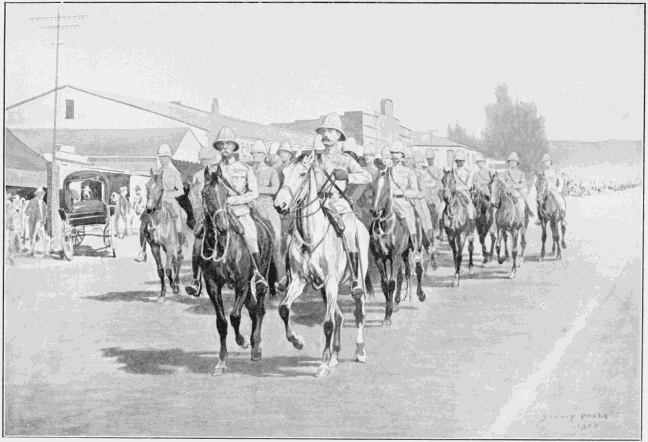
MAFEKING, 18TH MAY 1900
Shout for the desperate host,
Handful of Britain’s race,
Holding the lonely post
Under God’s grace;
Guarding our England’s fame
Over the open grave,
Shielding the Flag from shame—
Shout for the brave!
Ringed by a ruthless foe
Dared they the night attack,
Answered him blow for blow,
Hurling him back;
Cheering, the charge was pressed,
More than they held they hold,
Won bayonet at the breast—
Shout for the bold!
Long, long the days and nights;
Bitter the tales that came,
What of the distant fights?
Rumours of shame?
Scorning the doubts that swell,
Nursing the hope anew,
They did their duty well—
Shout for the true!
Shout for the glory won,
Empire of East and West!
Shout for each valiant son
Nursed at thy breast!
Fear could not find them out,
Death stalked there iron-shod,
Help found them Victors—shout
Praises to God!
—
Harold Begbie.The last volume closed with an account of Colonel
Plumer’s desperate effort to relieve Mafeking on the
31st of March. On that unlucky day events of a tragic,
if heroical, nature were taking place elsewhere. These
have now to be chronicled. On the 18th of March
a force was moved out under the command of Colonel Broadwood
to the east of Bloemfontein. The troops were sent to
garrison Thabanchu, to issue proclamations, and to contribute to
the pacification of the outlying districts. They were also to
secure a valuable consignment of flour from the Leeuw Mills.
The enemy was prowling about, and two commandos hovered
north of the small detached post at the mills. Reinforcements were
prayed for, and a strong patrol was sent off for the protection of the
post, or to cover its withdrawal in the event of attack. Meanwhile
the enemy was “lying low,” as the phrase is. Whereupon Colonel
Pilcher pushed on to Ladybrand, made a prisoner of the Landdrost,
but, hearing of the advance of an overwhelming number of the foe,
retired with all promptness to Thabanchu. The Boers, with the
mobility characteristic of them, were gathering together their
numbers, determining if possible to prevent any onward move of
the forces, and bent at all costs on securing for their own comfort
and convenience the southern corner of the Free State, whence the
provender and forage of the future might be expected to come.
Without this portion of the grain country to fall back on, they knew
their activities would be crippled indeed.
In consequence, therefore, of the close proximity of these Federal
hordes, Colonel Broadwood made an application to head-quarters
for reinforcements, and decided to remove from Thabanchu. On
Friday the 30th he marched to Bloemfontein Waterworks, south of
the Modder. His force consisted of the 2nd Cavalry Brigade (10th
Hussars and the composite regiment of Household Cavalry), “Q,”
“T,” and “U” Batteries R.H.A. (formed into two six-gun batteries,
“Q” and “U”), Rimington’s Scouts, Roberts’s Horse, Queensland
and Burma Mounted Infantry. The baggage crossed the river, and
outspanned the same evening. On the following morning at 2 A.M.
the force, having fought a rearguard action throughout the night,
arrived in safety at Sanna’s Post. Here for a short time they
bivouacked, and here for a moment let us leave them.
At this time a mounted infantry patrol was scouring the country.
They were seen by some Boers who were scuttling across country
from the Ladybrand region, and these promptly hid in a convenient
spruit, whence, in the time that remained to them, they planned the
ambush that was so disastrous to our forces and so exhilarating to
themselves. There are differences of opinion regarding this story.
Some believe that the ambush was planned earlier by a skilful
arrangement in concert with the Boer hordes—the hornets of Ladybrand,
whose nest had been disturbed by the invasion of Colonel
Pilcher—who owed Colonel Broadwood a debt. They declare that the
hiding-place was carefully sought out, so that those sheltered therein
should, on a given signal from De Wet, act in accord with others
of their tribe, and blockade the passage of the British, who were
known—everything was known—to be returning to Bloemfontein.
According to Boer reports, the plans for the cutting off and surrounding
of Colonel Broadwood were carefully made out, but only at
the last moment, and if, for once, Boer reports can be believed, the
successful scheme may be looked upon as one of the finest pieces of
strategy with which De Wet may be accredited. The Boer tale runs
thus: The Dutchman on the 28th, with a commando of 1400 and
four guns and a Maxim-Nordenfeldt, was moving towards Thabanchu
for the purpose of attacking Sanna’s Post, where he believed a force
of 200 of the British to be. He did all his travelling by night, and
found himself on the evening of the 30th at Jan Staal’s farm, on the
Modder River, to the north of Sanna’s Post. Then, in the very
nick of time, he was informed by a Boer runner that Colonel Broadwood’s
convoy was moving from Thabanchu. Quickly a council of
war was gathered together. It was a matter of life or death. De
Wet, with Piet de Wet, Piet Cronje, Wessel, Nell, and Fourie, put
their heads together and schemed. They were doubtless assisted
by the foreign attachés who were present. The result of the
hurried meeting was the division of the Boer force into three commandos.
The General himself, with 400 men, decided to strain
every nerve to reach Koorn Spruit and ensconce himself before the
arrival of the convoy. Being well acquainted with the topography
of the country, the race was possible—400 picked horsemen against
slow-moving, drowsy cattle! The thing was inviting. Success
rides but on the wings of opportunity, and De Wet saw the opportunity
and grabbed it! The rest of the Boers were to dispose
themselves in two batches—500 of them, with the artillery, to plant
themselves N.N.E. of Sanna’s Post, while the remainder took up a
position on the left of their comrades, and extended in the direction
of the Thabanchu road.
It was wisely argued that Broadwood’s transport must cross
Koorn Spruit, and that if the Boers were posted so as to shell the
British camp at daybreak, the convoy would be hurried on, while
the bulk of the force remained to guard the rear.
Accordingly, the conspirators, with amazing promptitude, got
under way, the four guns with the commando being double-horsed
and despatched to the point arranged on the N.N.E. of Sanna’s
Post, while the other galloped as designed. Fortune favoured them,
for they reached their destinations undiscovered; and the scheme,
admirable in conception, was executed with signal success.
Day had scarcely dawned before the Boers near the region of
the waterworks apprised the convoy of their existence. The British
kettles were boiling, preparations for breakfast were briskly going
forward, when, plump!—a shell dropped in their midst. Consternation
prevailed. Something must be done. The artillery? No;
the British guns were useless at so long a range. As well have
directed a penny squirt at a garden hose! All that was to be
thought of was removal—and that with all possible despatch.
Scurry and turmoil followed. Mules fought and squealed and
kicked, horses careered and plunged, but at last the convoy and two
horse batteries were got under way, while the mounted infantry
sprayed out to screen the retreat. All this time shells continued to
burst and bang with alarming persistency. They came from across
the river, and consequently it was imagined that every mile gained
brought the convoy nearer to Bloemfontein and farther from the
enemy. They had some twenty miles to go. Still, the officers who
had charge of the party believed the coast to be clear. After moving
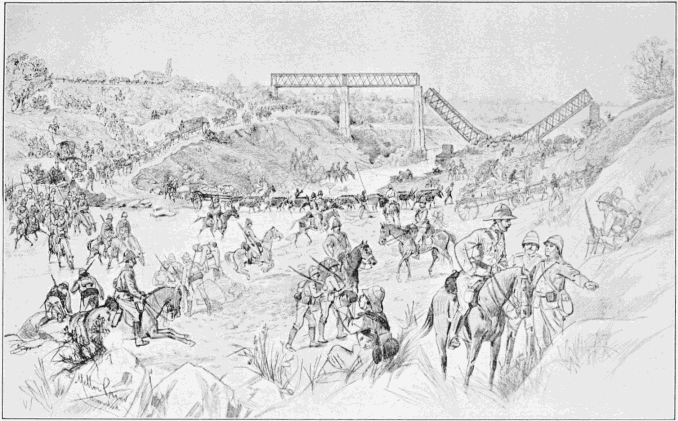
on about a mile they approached a deep spruit—a branch of the
Modder, more morass than stream. It was there that De Wet and
his smart 400 had artfully concealed themselves.
The spruit offered every facility for the formation of an ingenious
trap. The ground rose on one side toward a grassy knoll, on the
slopes of which was a stony cave from which a hidden foe could
command the drifts. So admirably concealed was this enclosure and
all that it enclosed, that the leading scouts passed over the drift
without suspecting the presence of the enemy. These latter, true to
their talent of slimness, made no sign till waggons and guns had safely
entered the drift, and were, so to speak, inextricably in their clutches.
Their manœuvre was entirely successful. Some one said the
waggons were driven into the drift exactly as partridges are driven
to the gun. Another gave a version of very much the same kind.
He said, “It was just like walking into a cloak-room—the Boers
politely took your rifle and asked you kindly to step on one side,
and there was nothing else you could do!”
The nicety of the situation from the Boer point of view was
described by a correspondent of The Times:—
“The camp was about three miles from the drift, which lay
in the point of a rough angle made by an embankment under construction
and the bush-grown sluit which converged towards it.
Thus when the Boers were in position, lining the sluit and the
embankment, the position became like the base of a horse’s foot.
The Boers were the metal shoe, our own troops the frog. At the
point where the drift cuts the sluit the nullah is broad and extensive.
The Boers stationed at this spot realised that the baggage was
moving without an advanced guard. They were equal to the situation.
As each waggon dropped below the sky-line into the drift the
teamsters were directed to take their teams to right or left as the
case might be, and the guards were disarmed under threat of
violence. No shot was fired. Each waggon in turn was captured
and placed along the sluit, so that those in rear had no knowledge
of what was taking place to their front until it became their turn to
surrender. To all intents and purposes the convoy was proceeding
forward. The scrub and high ground beyond the drift was sufficient
to mask the clever contrivance of the enemy. Thus all the waggons
except nine passed into the hands of the enemy.”
The waggons, numbering some hundred, had no sooner
descended to the spruit and got bogged there than, from all sides
sprung up as from the earth, Boers with rifles at the present,
shouting—“Hands up. Give up your bandoliers.” A scene of
appalling confusion followed. Some cocked their revolvers. Others
were weaponless. So unsuspecting of danger had they been that
their rifles, for comfort’s sake, had been stowed on the waggons, the
better to allow of freedom to assist in other operations of transport.
Some men of the baggage guard shouldered their rifles; others,
from under the medley of waggons, still strove ineffectually to show
fight. The Boers were unavoidably in the ascendant. The hour
and the opportunity were theirs.
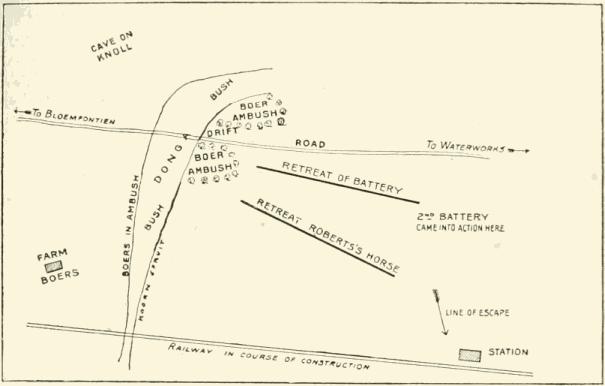
Plan—Disaster at Koorn Spruit.
At this time up came U Battery, with Roberts’s Horse on their
left. The battery was surrounded, armed Boers roared—“You
must surrender!” and then, sharp and clear, the first shot rang
through the air. This was said to have been fired by Sergeant
Green, Army Service Corps, who, refusing to surrender, had shot his
antagonist, and had instantly fallen victim to his grand temerity. The
drivers of the batteries were ordered to dismount, but as gunners
don’t dismount graciously to order of the foe, the tragedy pursued
its course. Major Taylor, commanding the battery, however, succeeded
in galloping off to warn the officer commanding Q Battery of
the catastrophe. Meanwhile, in that serene and pastoral spruit
reigned fire and fury and the clash of frenzied men. Down went
a horse—another, another. Then man after man—groaning and
reeling in their agony. Many in the spruit lay dead. At this
time the troop of Roberts’s Horse had appeared on the scene, and
were called on to surrender. Realising the disaster, they wheeled
about, and galloped to report and bring assistance. This was the
signal for more volleys from the enemy in the spruit, and the horsemen
thus sped between two fires—that of the Mausers below them
and of the shells which had continued to harry the troops. Nevertheless
the gallant fellows rode furiously for dear life on their
journey. Men dropped from their saddles like ripe fruit from a shaken
tree. Still they sped on. They must bring help at any price.
Meanwhile the scene in the spruit was one of horror, for the Boers
were sweeping every nook and corner with their Mausers. Cascades
of fire played on the unfortunate mass therein entangled, on waggons
overturned and squealing mules, on guns and horses hopelessly heaped
together, on men and oxen sweating and plunging in death-agony.
The heaving, struggling, horrific picture was too grievous for description.
Only a part of their terrible experience was known by even
the actors themselves. Luckily, a merciful Providence allows each
human intelligence to gauge only a certain amount of the awful in
tragic experience. There are some who told of wounded men lying
blood-bathed and helpless beneath baggage that weighed like the
stone of Sisyphus; of horses that uttered weird screams of agonised
despair, which petrified the veins of hearers and sent the current of
blood to their hearts; of oxen and mules that stamped and kicked,
dealing ugly wounds, so that those who might have crawled out
from under them could crawl no more. Some guns were overturned—a
hopeless bulk of iron, that resisted all efforts at removal;
others, bereft of their drivers, were dragged wildly into space by
maddened teams, whose happy instinct had caused them to
stampede. Seeing the disaster, they had pulled out to left and
struggled to get back to camp, yet even as they struggled they
were disabled and thus left at the mercy of the foe.
Major Burnham, the famous scout, who having been taken a
prisoner earlier and at this juncture remained powerless in the
hands of the Boers, thus described the terrible sight which he was
forced to witness:—
“One of the batteries (Q), which was upon the outside of the
three-banked rows of waggons, halted at the spruit, dashed off,
following Roberts’s Horse to the rear and south. Yet most of them
got clear, although horses and men fell at every step, and the guns
were being dragged off with only part of their teams, animals
falling wounded by the way. Then I saw the battery, when but
1200 yards from the spruit, wheel round into firing position, unlimber,
and go into action at that range, so as to save comrades and
waggons from capture. Who gave the order for that deed of self-sacrifice
I don’t know. It may have been a sergeant or lieutenant,
for their commanding officer had been left behind at the time. One
of the guns upset in wheeling, caused by the downfall of wounded
horses. There it lay afterwards, whilst three steeds for a long time
fought madly to free themselves from the traces and the presence
of their dead stable companions.”
Those of the unfortunate men who were uninjured struggled
grandly to save the guns, to drag them free from the scene of
destruction, but several of the guns whose teams were shot fell
into the hands of the enemy. Some gallant fellows of Rimington’s
Scouts made a superb effort to rush through the fire of the Federals
and save them, but five guns only were rescued. These were all guns
of Q Battery, which, when the first alarm was given, were within 300
yards of the spruit. When the officer who commanded the battery
strove to wheel about, though the Boers took up a second position
and poured a heavy fire on the galloping teams, a wheel horse was
shot, over went a gun, more beasts dropped, a waggon was rendered
useless, but still the teams that remained were galloped through the
confusion to the shelter of some tin buildings, part of an unfinished
railway station, some 1150 yards from the disastrous scene. Here
a new era began. Much to the amazement of the Boers, the guns
came into action, and continued, in the face of horrible carnage, to
make heroic efforts at retaliation, the officers themselves assisting in
serving the guns till ordered to retire. At this time Q Battery was
assailed by a terrific cross fire, and gradually the numbers of the
gunners and horses became thinned, till the ground, covered with
riderless steeds and dismounted and disabled men, presented a
picture of writhing agony and stern heroism that has seldom been
equalled. But the splendid effort had grand results.
No sooner were the British guns in action than the whole force
rallied: the situation was saved. The Household Cavalry and the
10th Hussars were off in one direction, Rimington’s Scouts and the
mounted infantry in another, making for some rising ground on
the left where their position would be defensible and a line of
retreat found. Meanwhile Q Battery from six till noon pounded
away at the Dutchmen, while Lieutenant Chester-Master, K.R.R.,
found a passage farther down the spruit unoccupied by the enemy,
by which it was possible to effect a crossing. Major Burnham’s
account of the artillery duelling at this time is inspiriting:—
“As soon as the gunners manning the five guns opened with shrapnel,
the Boers hiding in Koorn Spruit slackened their fire, preferring to keep under
cover as much as possible. In that way many others escaped. The mounted
infantry deployed and engaged the Boer gunners and skirmishers to the east,
and the cavalry with Roberts’s Horse dismounted and rallied to cover the guns
from the fire. A small body was also despatched to strike south and fight
north. My captors directed their attention to Q Battery. They got the range,
1700 yards, by one of the Boers firing at contiguous bare ground, until he saw
by the dust puffs he had got the distance, whereupon he gave the others the
exact range, which they at once adopted. The gunners gave us nearly forty-eight
shrapnel, for they were firing very rapidly, but although they had the
range of our kraal, they only managed to kill one horse. I noticed that the
Boers, though they dodged and took every advantage of cover, fired most
carefully, and yet rapidly. It was the same with those in the spruit as inside
the kraal where I sat. That day the Boers said to me they had but three men
killed in the spruit, and only a half-dozen or so wounded. Those artillerymen,
how I admired and felt proud of them! and the Boers, too, were astonished at
their courage and endurance. Fired at from three sides, they never betrayed
the least alarm or haste, but coolly laid their guns and went through their drill
as if it had been a sham-fight, and men and horses were not dropping on all
sides. There was a little bit of cover a hundred yards or so behind the
battery, around the siding and station buildings of the projected railway and
embankment. Thither the living horses from the limbers and guns were
taken, and the wounded were conveyed. When, three hours later, their
ammunition for the 12-pounders was scarce, and the Boer rifle fire from the
gulch, the waggons, and ridge opened heavy and deadly, the gunners would
crawl back and forward for powder and shell. Had it not been for those
terrible cannon, the Boers told me that they would have charged, closing in on
all sides upon Broadwood’s men.”
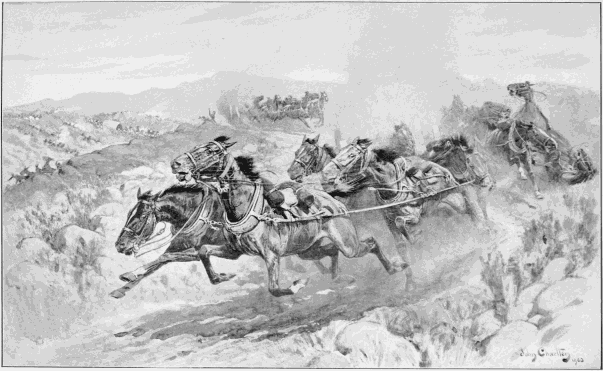
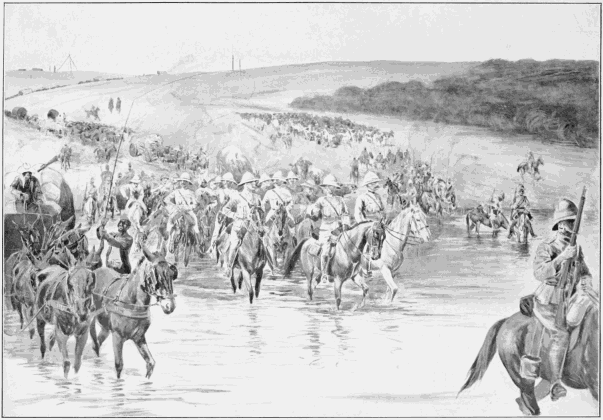
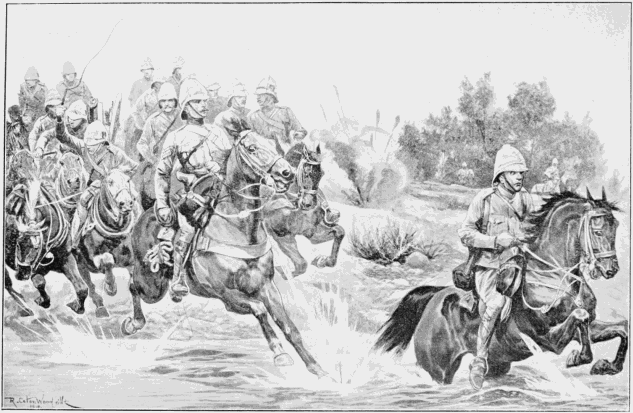
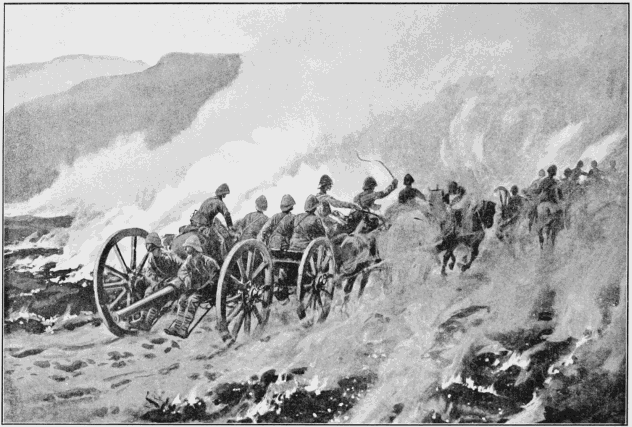
THE DISASTER AT KOORNSPRUIT: DRIVERLESS TEAMS STAMPEDING
Drawing by John Charlton
When the order to retire was received, Major Phipps Hornby
ordered the guns and their limbers to be run back by hand to where
the teams of uninjured horses stood behind the station buildings.
Then such gunners as remained, assisted by the officers and men of
the Burma Mounted Infantry, and directed by Major Phipps
Hornby and Captain Humphreys (the sole remaining officers of the
battery), succeeded in running back four of the guns under shelter.
It is said the guns would never have been saved but for the gallant
action of the officers and men of the Burma Mounted Infantry, who,
when nearly every gunner was killed, volunteered, and succeeded,
under the heaviest fire, in dragging the guns back by hand to a
place of safety. It was while doing this that Lieutenant P. C. Grover,
of the Burma Mounted Infantry, was killed. Though one or two of
the limbers were thus valiantly withdrawn under a perfect cyclone
of shot and shell, the exhausted men found it impossible to drag
in the remaining limbers or the fifth gun. Human beings failing,
the horses had also to be risked, and presently several gallant
drivers volunteered to plunge straight into the hellish vortex.
They got to work grandly, though horses dropped in death
agony and man after man, hero after hero, was picked off by the
unerring and copious fire of the Dutchmen. It is difficult to get
the names of all the glorious fellows who carried their lives in
their hands on that great but dreadful day, but Gunner Lodge
and Driver Glasock were chosen as the representatives of those
who immortalised themselves and earned the Victoria Cross. Of
Bombardier Gudgeon’s magnificent energy enough cannot be said.
One after another teams were shot, but he persisted in his work of
getting fresh teams. Three times he strove to roll a gun to a place
of safety, and on the third occasion was wounded. The splendid
discipline of the gunners was extolled by every eye-witness, and the
way the noble fellows, surrounded with Boer sharpshooters, stood
to the guns was so marvellous, so inspiriting, that even the men who
were covering the retirement, at risk of their lives were impelled
to rise and cheer the splendid action of the glorious remnant. The
correspondent of The Times declared that “When the order came
for the guns to retire, ten men and one officer alone remained upon
their feet, and they were not all unwounded. The teams were as
shattered as the gun groups. Solitary drivers brought up teams of
four—in one case a solitary pair of wheelers was all that could be
found to take a piece away. The last gun was dragged away by
hand until a team could be patched up from the horses that
remained. As the mutilated remnant of two batteries of Horse
Artillery tottered through the line of prone mounted infantry covering
its withdrawal, the men could not restrain their admiration.
Though it was to court death to show a hand, men leaped to their
feet and cheered the gunners as they passed. Seven guns and a
baggage train were lost, but the prestige and honour of the country
were saved. Five guns had been extricated. The mounted infantry
had found a line of retreat, and total disaster was avoided. But the
fighting was not over. The extrication of a rearguard in the front
of a victorious and exultant enemy has been a difficult and a delicate
task in the history of all war. In the face of modern weapons it is
fraught with increased difficulties. For two hours Rimington’s
Scouts, the New Zealand Mounted Infantry, Roberts’s Horse, and
the 3rd Regiment of Mounted Infantry covered each other in
retreat, while the enemy galloped forward and, dismounting, engaged
them, often at ranges up to 300 yards.”
The force was surrounded by the enemy on all sides, and there
was no resource but to fight through—the cavalry and mounted
infantry taking a line towards a drift on the south. Roberts’s Horse
made a gallant and desperate effort to outflank the Dutchmen, and
lost heavily; and Aldersen’s Brigade, with magnificent dash and
considerable skill, succeeded in holding back the hostile horde.
This retirement was no easy matter, for the position taken up by the
Federals was exceptionally favourable to them. To the north the
spruit twisted in a convenient hoop, which sheltered them; to the
south was the embankment of the railway in course of construction;
from these points and from front and rear the enemy was able,
in comparative security, to batter and harass the discomfited troops.
Fortunately, in the end, Colvile’s Division, which had been
making its way from Bloemfontein, arrived in time to check the
Boers in their jubilant advance, though some hours too late to prevent
the enemy from capturing and removing the waggons and
guns.
While the retreat was being effected more valorous work was
going on elsewhere. The members of the Army Medical Corps,
with the coolness peculiar to them, were exposing themselves and
rushing to the assistance of the wounded, many being stricken
down in the midst of their splendid labours. Roberts’s Horse made
themselves worthy of the noble soldier who godfathered them, and
one—a trooper of the name of Tod—a prodigy of valour, rode
deliberately into the mêlée in search of the wounded, and returned
with the dead weight of a helpless man in his arms, under the fierce
fire of the foe. If disaster does nothing more, it breeds heroes.
The melancholy affair of Koorn Spruit brought to light the superb
qualities that lie dormant in many who live their lives in the matter
of fact way and give no sign.
Splendid actions followed one another with amazing persistence,
man after man and officer after officer attempting deeds of daring,
each of which in themselves would form the foundation of an heroic
tale. Lieutenant Maxwell of Roberts’s Horse, from the very teeth of
the enemy dragged off a wounded man—a lad who, by the time
he was rescued, had fainted. But the young subaltern promptly
got him in the saddle, and the pair sped forth from the fiery zone
alive. The Duke of Teck also rushed to the succour of Lieutenant
Meade, who was wounded (a bullet cutting off his finger and piercing
his thigh), gave up to him his horse and removed him from the scene
of danger. At the same time Colonel Pilcher was gallantly rescuing
Corporal Packer of the 1st Life Guards. Major Booth (Northumberland
Fusiliers) lost his life through doggedly holding a position
with four others, in order to cover the retreat.
When the Queenslanders arrived they too showed the stuff they
were made of, the best British thews combined with the doughtiest
British hearts. They plunged into action—so dashingly indeed that
the Boers very nearly mopped them up. But Colonel Henry was
equal even to the skittish foe, and contrived to entertain the Dutchmen
by leading them so active a dance that eventually the Colonials
were able to fight out their own salvation.
At last the guns got away and followed the line of retreat taken
by the cavalry. The troops then conducted their retirement by
alternate companies, each company taking up its duties without
fluster, and covering the other company’s retirement with great
steadiness until they reached Bushman’s Kop. The marvellous coolness
of the force was particularly amazing, as every man, with the
Boers still at his heels, believed himself to be cut off, yet in spite of
this belief showed no signs of concern. In one regiment, consisting
of 11 officers and 200 men, two officers were killed, four wounded,
and sixty-six men killed and wounded.
Strange scenes took place during those awful hours in the donga,
and wonderful escapes were made. One trooper was seized on by
a Boer. “Surrender,” cried the Dutchman, but before another word
could be uttered, the trooper’s sabre whistled from its sheath and
the Boer was dead. Another who was wounded got off, as he said,
“by the skin of his teeth.” He had become jammed under a
waggon in company with a Boer—who had crept there for cover—and
the hindquarters of a dying mule. Over the cart poured a
rattling rain of bullets, to which he longed to respond. The Boer,
believing the wounded man to be his prisoner, made himself known.
“Hot work this,” he said. The next instant the Boer was caught
by the throat and knocked insensible, while the Briton promptly
extricated himself and vanished from the seething, fighting mass.
Another of the Household Cavalry, when summoned to surrender
his rifle, threw it with such force at the head of his would-be captor
that he was able to make good his escape.
The following interesting account was given from the point of
view of an officer of the Life Guards who was present:—
“We heard firing at 6.30, and while we were saddling bang
came two shells a little short, followed by three others. The firing
went on for half-an-hour incessantly. The convoys got under way
very quickly, followed by Mounted Infantry and Life Guards.
Luckily only two shells burst, and only one mule was killed. We
moved on to the spruit and were shot at by Mausers from our
right flank. The convoys were on the brink of the drift. Some
of the waggons were actually crossing, and our artillery close on to
them, when a terrific fire came from the spruit. The U Battery
was captured—the men and officers being killed, wounded, or
prisoners. We went about and retired in good order in a hail of
shot, being within 120 yards of the enemy. It is wonderful how
we escaped. Two of our men were shot—one in the thigh and
the other in the shoulder—and we had altogether 32 missing.
Our leading horses and baggage were within nine feet of the fire;
yet many of them got off, including my servant and horse. I lost,
however, my saddlebags, with change of clothes, trousers, shoes,
iron kettle, and letters which I grudge the Boers reading. We
got out of fire and lined the river banks, firing shots at the Boers,
who were, however, too distant. We were well hid in a position
like what the Boers had held themselves, and we hoped to enfilade
them, but the river twisted too much, and it is impossible to locate
fire with smokeless powder. We then followed the 10th Hussars
for four miles towards Bushman’s Kopje. The Ninth Division
Infantry, under Colvile, came over the ridge with eighteen guns,
and we heard a lot of heavy firing.”
He went on to say: “Why we are alive I can’t say. Many of
the bullets were explosive, as I heard them burst when they hit the
ground. The shelling was most trying, as we had to stand quite
still for twenty minutes a living target.”
A laughing philosopher, a Democritus of the nineteenth century,
gave to the world, viâ the Pall Mall Gazette, his curious experiences.
Among other things he said:—
“Roberts’s Horse was ordered to trot off to the right of the convoy.
‘Oh! those are our men, you fool,’ said everybody. Two men
came up to the Colonel. ‘We’ve got you surrounded, you’d better
surrender,’ say they; and heads popped up in the grass forty yards
from us. Boers appeared all along the ridge a hundred yards
ahead. ‘Files about, gallop!’ yells the adjutant. (They dropped
him immediately.)
“I was carrying a fence-post to cook the breakfast of my section
(of four men). I turned my horse; there came a crackling in the
air, on the ground, everywhere; the whole world was crackling, a
noise as of thorns crackling or the cracks of a heavy whip. My
gee-gee (usually slow) went well, stimulated by the horses round it,
and actually took a water-jump; I had to hold my helmet on with
my right hand, which still held the fence-post, and I thought my
knuckles would surely get grazed by a bullet. They were pouring
in a cross-fire now as well, and once or twice I heard the s-s-s-s-s
of the Mauser bullet (the crackle is explosives, you know). It was
very exhilarating; the gallop and the fire made me shout and sing
and whistle. I jumped a dead man, and almost immediately caught
up B., who is one of my section.
“The fire was slackening, and we were half a mile away by then,
and we looked round to see whether anybody was forming up. The
plain was dotted with men and many riderless horses. Everybody
was yelling, ‘When do we form up?’ You feel rather foolish when
running away. At about one mile we formed up again. From the
rear, and from the place we had come from, and from the river bed,
there came a noise as of thousands of shipwrights hammering.
Nine (?) of our guns were captured; the remaining three fired at
intervals. My squadron was sent into a depression on the left of
the New Zealanders. Here we dismounted (No. 3 of each section
holding the horses), and went up as a firing line, range 1200, 1400,
and 1600 yards. The General passed. ‘Ever been in such a
warm corner?’ says he to the bugler. ‘Oh yes,’ says the little
chap, quite cheerfully and untruthfully. The General remarked,
laughing, that he hadn’t. I felt sorry for him, and heard the newsboys
shouting, ‘Another British disaster!’ and the Continental
papers, ‘Nouvelle défaite des Anglais! Yah!’ It was the greatest
fun out, barring the loss of the guns and men. For we were not
losing a situation of strategic importance or anything of that kind.
The Boers had collared our blankets and things, but we chuckled
at the thought of what they would suffer if they ever slept in ’em.”
Sergeant-Major Martin, who, with Major Taylor (commanding
U Battery), was incidental in warning Colonel Rochfort and Major
Phipps Hornby of their danger, and thus assisting to save Q
Battery, described his experiences:—
“A Boer commander stepped out and confronted the Major with
fixed bayonet; all his (the Boer’s) men stood up in the spruit ready
to shoot us down if we had attempted to fight, ordered the Major to
surrender, and also the battery. The battery had no chance whatever
to do anything. As the trap was laid, so we fell into it. Now,
as the Major was talking to the Boer commander, I turned my horse
round (I was then three yards from him) and walked quietly to the
rear of our battery. When I got there, putting spurs to my horse,
I galloped for all I was worth to tell the Colonel to stop the other
battery, as U Battery were all prisoners. I then looked towards the
battery; the Boers were busy disarming them. I went a little distance
in that direction to have a last look. By this time the Household
Cavalry had come up, and the 14th Hussars; they halted, soon
found out what had happened, and turned round to retire. As they
did so the Boers opened fire on us. The bullets came like hailstones.
It was a terrible sight. One gun and its team of horses
galloped away; by some means or other it was pulled up. I took
possession of it, still under this heavy fire, and, finding one of our
drivers, I put him in the wheel, and drove the leaders myself. We
had between us 14 horses. I drove in the lead for about six miles,
following the cavalry, who had gone on to see if we could get
through. Eventually, after several hours, I got into safe quarters.”
The list of loss was terrible:—
Brevet-Major A. W. C. Booth, Northumberland Fusiliers; Lieutenant P.
Crowle, Roberts’s Horse; Lieutenant Irvine, Army Medical Service (attached to
Royal Horse Artillery), were killed. Among the wounded were: Brevet-Colonel
A. N. Rochfort, Royal Horse Artillery, Staff. Q Battery Royal Horse Artillery.—Captain
G. Humphreys, Lieutenant E. B. Ashmore, Lieutenant H. R.
Peck, Lieutenant D. J. Murch, Lieutenant J. K. Walch, Tasmanian Artillery
(attached). Royal Horse Guards.—Lieutenant the Hon. A. V. Meade.
Roberts’s Horse.—Major A. W. Pack Beresford, Captain Carrington Smith,
Lieutenant H. A. A. Darley, Lieutenant W. H. M. Kirkwood. Mounted
Infantry.—Major D. T. Cruickshank, 2nd Essex Regiment; Lieutenant F.
Russell-Brown, Royal Munster Fusiliers; Lieutenant P. C. Grover, Shropshire
Light Infantry (since dead); Lieutenant H. C. Hall, Northumberland Fusiliers.
Wounded and Missing.—Captain P. D. Dray, Lieutenant and Quartermaster
Hawkins. Missing.—Lieutenant H. R. Horne. Royal Horse Artillery.—Captain
H. Rouse, Lieutenant G. H. A. White, Lieutenant F. H. G. Stanton,
Lieutenant F. L. C. Livingstone-Learmonth. 1st Northumberland Fusiliers.—Lieutenant
H. S. Toppin. 2nd Duke of Cornwall’s Light Infantry.—Lieutenant
H. T. Cantan. 1st Yorkshire Light Infantry.—Captain G. G.
Ottley. Royal West Kent Regiment.—Lieutenant R. J. T. Hildyard. Captain
Wray, Royal Horse Artillery, Staff; Captain Dray, Roberts’s Horse; Lieutenant
the Hon. D. R. H. Anderson-Pelham, 10th Hussars; Lieutenant
C. W. H. Crichton, 10th Hussars.
The casualties all told numbered some 350, including 200
missing. Reports differ regarding the strength of the enemy.
Lord Roberts estimated it at 8000 to 10,000, while De Wet
declared he had only about 1400 men.
All that remained of U Battery was one gun, Major Taylor, a
sergeant-major, a shoeing-smith, and a driver!
In Q Battery, Captain Humphreys, Lieutenants Peck, Ashmore,
Murch were wounded, and the latter two reported missing.
The whole of the grievous Saturday afternoon was spent by the
gallant doctors in tending the ninety or more of our brave wounded
who lay helpless in the spruit. They were carried to the shelter of
the tin houses, and the work of bandaging and extracting bullets
was pursued without a moment’s relaxation. The removal of the
sufferers from the neighbourhood of the spruit on the day following
was a sorry task, and the sight that presented itself to the ambulance
party was one which was too shocking to be ever forgotten. In the
spruit itself the wreckage of waggons which had been looted by the
Boers covered most of the scene, and, interspersed with them were
horses and cattle, maimed, mutilated, and dead. With these, in
ghastly companionship, were the bodies of slain soldiers and black
waggon-drivers. The living wounded were conveyed from the
disastrous vicinity in ambulances and waggons brought for them
under the covering fire of the guns, which swept the length of the
river and deterred the enemy from attempting to block the passage
of the melancholy party. The Republicans, however, fired
viciously from adjacent kopjes, but without disturbing the progress
of the operations.
At noon General French’s cavalry, with Wavell’s Brigade, had
left Bloemfontein to occupy a position on the Modder between Glen
and Sanna’s Post, and keep an eye on further encroachments of the
Boers. The enemy, on the fatal Saturday night, had destroyed the
waterworks, thus forcing the inhabitants of Bloemfontein to fall
back on some insanitary wells, as a substitute for which the waterworks
had been erected. Here, on their departure for Ladybrand,
they left 12 officers and 70 men, who had been wounded in the
fray, and whom they doubtless considered might be an encumbrance
to their future movements. These were conveyed by ambulance to
Bloemfontein.
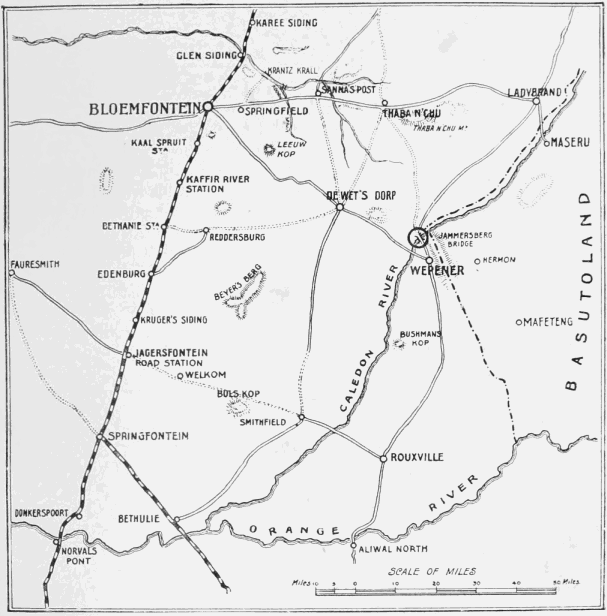
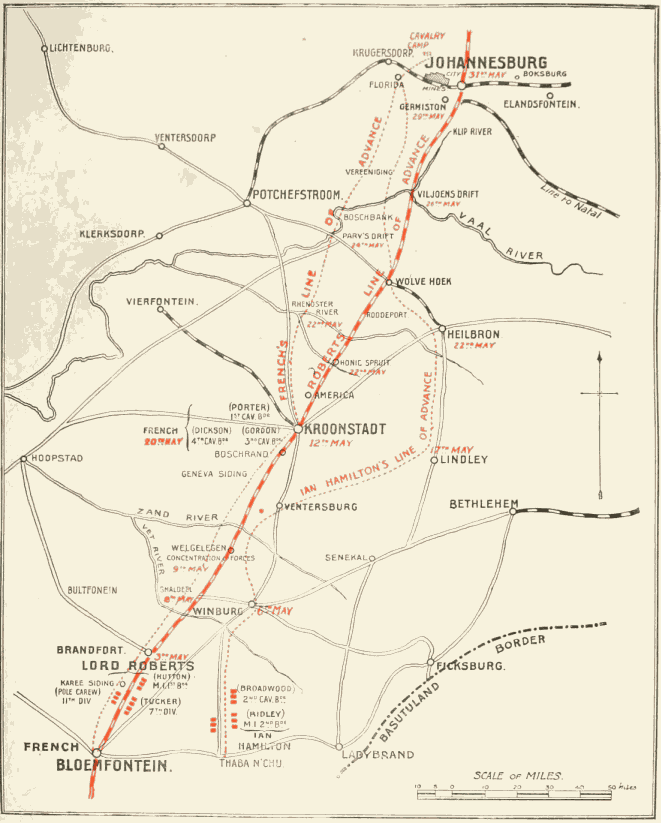
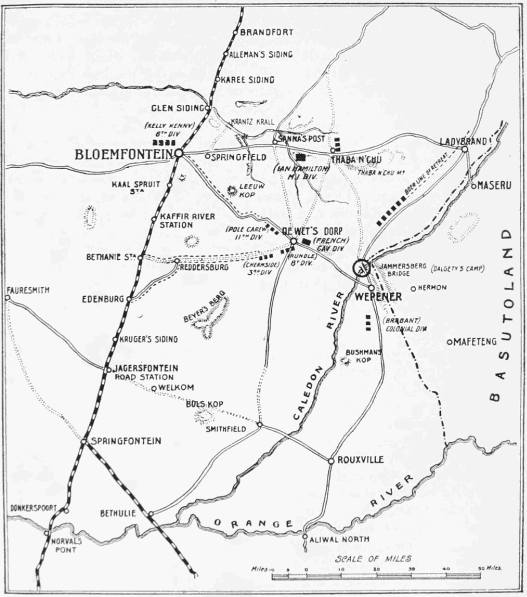
Map Illustrating the Military Operations to the S. and E. of Bloemfontein.
As an instance of Boer treachery, it was stated that the Free
State commandant Pretorius, whose farm overlooked the spruit
wherein the ambuscade was arranged, had given up arms and taken
the oath to retire to his farm. Yet on the day of the disaster
he led the Boers to the attack, while the members of his family
were prominent among the looters of the wrecked waggons. Other
tales of cruelty and ill-treatment and treachery on the part of the
Boers were well authenticated. It is useless to repeat them, but the
circumstances are merely noted to give an explanation for a change
of policy which was necessitated by the actions of the enemy—a
change which was, unfortunately, adopted only when many martyrs
had been made in the cause of forbearance.
The Boers, triumphant with their success at Koorn Spruit, scurried
to Dewetsdorp, drove out the British detachment which had
been posted there by General Gatacre, and on the 4th of April
came in for another piece of luck, for which we had to pay by the
loss of three companies of Royal Irish Rifles and two companies of
the Northumberland Fusiliers.
The unfortunate occurrence took place near Reddersburg,
somewhat to the east of Bethanie Railway Station. A party of
infantry, consisting of three companies of Royal Irish Rifles and
two companies of the Northumberland Fusiliers, who had been in
occupation of Dewetsdorp, and engaged on a pacification mission on
the east of the Free State, were ordered on the 3rd to retire to
Reddersburg, a place situated some thirty-seven miles from Bloemfontein
and fifty miles from Springfontein, where General Gatacre
had taken up his head-quarters. In their retirement the troops, it is
said, took a somewhat unusual detour, and thus, if they did not
court, ran risk of disaster. Anyway, they had travelled about
four miles to the east of their destination when, at Mosterts Hok,
they were surprised to discover a strong force of some 2500
Boers. They were still more surprised to find that, while they
themselves were unaccompanied by artillery, and were possessed
of little reserve ammunition, the Dutchmen were provided with
three or four formidable guns. Thus, the situation from the first
was alarming. Our men, comparatively defenceless, saw themselves
hedged in by an overmastering horde. They quickly occupied a
position on a peaked hill rising in the centre of ground sliced and
seamed with dry nullahs. These popular havens of refuge were at
once seized by the Boers and deftly made use of. The Dutchmen,
under cover of the dongas, crept cautiously up on all sides of the
kopje, surrounding it and pouring cascades of rifle-fire on the small
exposed force. In no time the chance of retreat was barred on all
sides, and there was no resource but to fight through. But unfortunately,
as British ammunition was limited and the Boers warily
kept well out of range, all that could be done was to prolong hostilities
in the hope that delay would enable reinforcements from
Bethanie to come to the rescue. But these did not arrive. The
Boers, grasping the situation, gathered courage and approached
nearer and nearer. With the dusk coming on and some 2500 of
the foe enfilading them from three sides, the British position, as
may be imagined, was not a hopeful one. Nevertheless, the Royal
Irish Rifles displayed the national spirit of dare-devilry—“fought
like bricks,” some one said—never losing heart under the persistent
attacks of shot and shell that continued till nightfall.
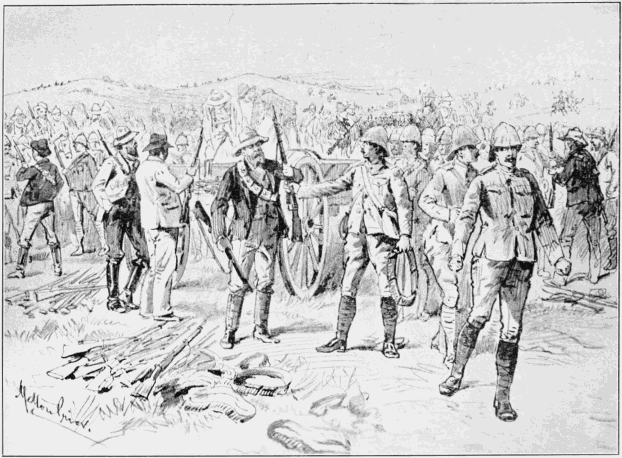
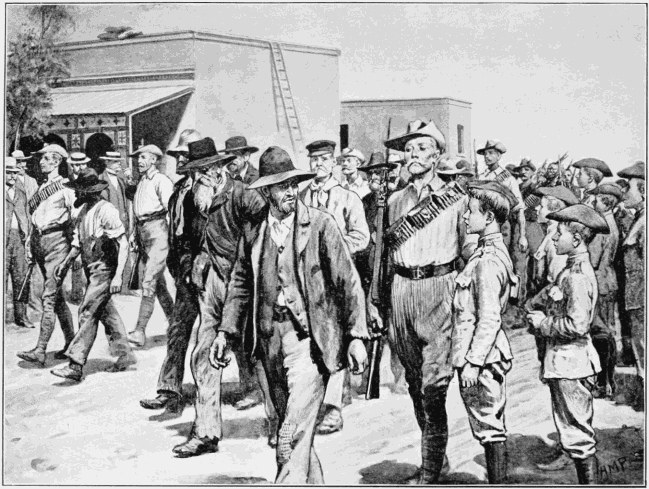
THE REDDERSBURG MISHAP: MEN OF THE IRISH RIFLES AND MOUNTED INFANTRY
DELIVERING UP THEIR ARMS
Facsimile of a Sketch by Melton Prior, War Artist
Hoping and waiting and fighting; so passed the dreadful hours
of dark. Then, with the dawn, the enemy, flushed with triumph,
commenced to pound their prey with redoubled vigour, while our
parched and almost ammunitionless troops, in a ghastly quandary,
alternately fought and prayed for relief!
Meanwhile the news of the affair having reached Lord Roberts,
General Gatacre, on the afternoon of the 3rd, was ordered to proceed
from Springfontein to the spot, while the Cameron Highlanders
were despatched from Bloemfontein to Bethanie.
General Gatacre, with his main body and an advance guard of
mounted infantry under Colonel Sitwell, then marched viâ Edenburg
to the succour of the detachment. On the morning of the
4th, Colonel Sitwell having arrived at Bethanie, some fifteen miles
from Mosterts Hok, heard sounds of artillery in the distance, and
believing that the engagement was going on, prepared to rush to
the rescue. But with the small force at his disposal, he deemed it
impossible to try a frontal attack, and decided to make an attempt
to get round the enemy’s right flank. The manœuvre was unsuccessful,
for a party of hidden Boers, from a kopje north-west of
Reddersburg, assailed him and forced him to retire and wait till the
main column should come to his assistance. But by the time General
Gatacre had reached the scene (10.30 A.M. on the 4th) the drama
had been enacted, the curtain had descended on the tragedy. The
small and valorous party on Mosterts Hok, which for thirty hours
had been fighting and were at last sans water, sans ammunition, sans
everything in fact, had been forced to surrender. No sign of them
was to be seen. The unfortunate band—many of them the survivors
of the fatal exploit at Stormberg—were now on their way to that
aristocratical prison-house—the Model School at Pretoria.
General Gatacre, finding further effort useless, then occupied the
town of Reddersburg. There, the Boers had hoisted the Free State
flag, and were making themselves generally objectionable. Quickly
the Boer banner was torn down and the Union Jack run up, though
during the operations the General narrowly escaped assassination.
He was fired at from a house, but fortunately escaped with only a
scratch on the shoulder.
By evening, acting on instructions from Bloemfontein, and owing
to the fact that the enemy was massed in all directions and
surrounding the town, the force and its prisoners returned to
Bethanie, and there encamped to mount guard over the rail.
Details regarding the movements of the troops on this grievous day
were given by a correspondent, in the Daily Telegraph, whose
version throws a somewhat depressing light on the sufficiently depressing
affair. The writer declared that:—
“A large British force, with a brigade division of artillery
(eighteen guns), on the march to Bloemfontein, was at Bethanie,
about eleven miles from Reddersburg, on the night of April 3, and
got the news of the above-mentioned infantry being surrounded
about 11 P.M. The men immediately saddled up, got under arms,
and remained all night ready to move off in relief, but did not
receive orders to do so until 8 A.M. on April 4, and then were only
permitted to proceed at a walk, constantly halting to water the
horses. The result of the delay was that the column arrived just
too late, and was then not even allowed to pursue the enemy and
release the prisoners, who were dead beat and could not possibly
have been hurried along. The relief column was manœuvred outside
the town of Reddersburg during most of the day, and then was
ordered to return to Bethanie, but, when within a few miles of camp,
with the horses and men tired out, a complete change of instructions
were issued, and the column was wheeled about and told to march
back and take the town of Reddersburg. The Cameron Highlanders,
who had just come off a troopship from Egypt, and were,
consequently, quite unfit, could hardly move, but all had to turn, for
no apparent reason, and march to the ground they had left. The
mounted infantry and artillery trotted back and occupied Reddersburg
about dusk, with only one casualty, viz. an officer of mounted
infantry, and the force bivouacked, with very little food, just outside
the town.
“About midnight, the order was given to return to Bethanie
again, and the men, who could hardly crawl, were awakened, the
march resumed, and Bethanie was reached about 7 A.M. on April 5,
after great and unnecessary distress both to men and animals, while
no object was gained, the whole expedition being a miserable fiasco,
disheartening and humiliating to every one present.
“To whom blame is attributable it is difficult to say, as the
officer in command seemed not to have a free hand, but to be
directed by wires received at intervals, which must have taken five
or six hours to reach him. Either the relief ought never to have
been attempted, or it ought to have been carried out expeditiously
and with determination.”
Mr. Purves, who, as a lance-corporal with one of the Ambulance
Corps, was in the thick of the fray, gave a graphic description of the
unhappy affair:—
“Reaching Dewetsdorp on the morning of Sunday, April 1st, we first
became aware that our progress was being watched by the Boers. Just as we
were about to camp outside the dorp, our scouts exchanged a few shots with
those of the enemy. Beyond a temporary disarrangement of our plans, nothing
happened, as the main body of the enemy did not show at all, and things quieted
down till nightfall, when another alarm was caused by the arrival of the Mounted
Infantry (Royal Irish Rifles and Northumberland Fusiliers), who were mistaken
by our people for Boers, as their arrival was unexpected, and our presence in
the position occupied by us was a surprise to them. The Mounted Infantry
actually dismounted to prepare for business, when fortunately a mutual recognition
took place, and a hearty greeting to the brave fellows who were to bear the
brunt of the coming action was extended by our force. Captain Casson
(one of the first to fall at Mosterts Hock) commanded the new-comers. After
a night’s rest, we started again on the march, which continued without event till
Tuesday, 3rd, when our scouts at 11.30 came back with the news that the
enemy were upon us, making for two kopjes in front of us. Both of these were
immediately crowned by our little force of 440—the above-mentioned Mounted
Infantry, with some of the Royal Irish Rifles taking the northern kopje, and
the remainder of the Royal Irish Rifles that to the south. Rifle firing opened
at once, and gradually grew hotter till about 2 P.M., when the Boers opened
with artillery, four guns being brought into play in positions that enabled them
to sweep our two lines. Fortunately, the firing was most erratic, and little or
no damage was done by the shells. Volley fire from the Royal Irish Rifles
soon put one of the guns out of action. We had no artillery, and the wonder
is that we held the position, extended as it was far beyond what seemed tenable
to so small a force, for the long time we did. The bearers of C Company,
Cape Medical Staff Corps, had a particularly warm time of it. Sent as they
were at the commencement of the action right on to the fighting line, they stuck
to their posts till the very last without any cover, and only retired with the last
line of straggling defenders, who worked their way back through a deadly hail
of bullets, explosive and otherwise, to their own camp, after the Boers had won
the day. The first day’s fight lasted till darkness, when we tried to snatch
some rest—a luxury that came to few. Next morning at 5.30 found us sniping
at one another prior to the forenoon fire that soon kept every one busy at all
points. At 8 the artillery commenced firing, and the fight became fiercer till
about 9, when our men on the north kopje, unable to contend against the fearful
odds, hoisted the white flag, and the Boers on that side rushed the position,
and were thus able to pour a murderous fire into the unfortunate Royal Irish
Rifles on the southern height, who, while their attention was riveted on the
enemy on their front, were in ignorance of what was going on in their rear for
a while. When they turned to reply to the rear attack, their position was
taken, and the poor fellows, accompanied by nine of the stretcher-bearers, had
to run for the hospital, distant 600 yards, under a fearful cross-fire. Several of
the Rifles were killed, but the bearers escaped marvellously. The hospital,
which was pitched between the two kopjes, suffered from the shelling, and was
in itself dangerous; while, to add to the risk, a trench thrown up to protect the
sick was mistaken by the Boers for a rifle-trench, and became a mark for their
special attention. One shell burst near the operating-tent while the surgeons
were at work on a wounded man, and riddled the tent, fortunately hitting no
one. Another banged into a buck waggon. A third cut a mule in halves. A
slight bruise on the knee was the only hurt suffered by any of the Hospital
Corps. Our dead numbered ten, whom we buried on the battle-field, placing
over the grave a neatly dressed and lettered stone, executed by Private Buckland,
C Medical Staff Corps. Two of the wounded died afterwards in the temporary
hospital at Reddersburg, and are buried in the cemetery there. The
wounded, thirty-two in number, were sent down from Bethanie to one of the
base hospitals, for treatment in the convalescent stage. Enough praise cannot
be given to the warm-hearted people of the Dutch village of Reddersburg. It
mattered not that we were British. Their all was placed at our disposal, and
to their generosity much of our success with the wounded is to be attributed.”
The casualties were as follows:—
Killed—Captain F. G. Casson, Northumberland Fusiliers; 2nd Lieut. C.
R. Barclay, Northumberland Fusiliers. Dangerously Wounded—Captain W.
P. Dimsdale, Royal Irish Rifles. Slightly Wounded—Lieut. E. C. Bradford,
Royal Irish Rifles. Captured—Captain Tennant, Royal Artillery; 2nd Lieut.
Butler, Durham Light Infantry, attached to Northumberland Fusiliers; Captain
W. J. McWhinnie, Royal Irish Rifles; Captain A. C. D. Spencer, Royal Irish
Rifles; Captain Kelly, Royal Irish Rifles; 2nd Lieut. E. H. Saunders, Royal
Irish Rifles; 2nd Lieut. Bowen-Colthurst, Royal Irish Rifles; 2nd Lieut.
Soutry, Royal Irish Rifles, and all remaining rank and file.
Lieut. Stacpole (Northumberland Fusiliers) was also wounded
on the 4th. He was riding for reinforcements, and as he approached
Reddersburg, unknowing the place was in the hands of the Boers, he
was greeted with shots which killed his horse, wounded him, and
placed him at the mercy of the enemy, by whom he was captured.
The Boers in their retreat, however, left their prisoners behind.
The total of killed and wounded numbered between 50 and
150. The strength of the British was 167 mounted infantry, 424
infantry. The enemy were said to be 3200 strong.
The unlucky termination of the affair completed the eastern
flanking movement of the Boers, who were now trickling over the
country from Sanna’s Post on the south to a point east of Jagersfontein
road. They soon held the Free State east of the railway
beyond Bethulie, and considerable numbers went south towards
Smithfield and Rouxville, their determination, after their recent
successes, being to harass the British force as much as possible. It
was now becoming evident that all the present trouble was due to
over-leniency, and it began to be urged that some measures must
be adopted which would ensure for the conquerors of the enemy’s
country the respect that was due to them. The humanitarian
attitude of Lord Roberts had produced an unlooked-for result. The
Commander-in-Chief had attempted to administer justice for a seventeenth-century
people on the ethics of those of the nineteenth, and
the experiment had proved disastrous. The enemy, far from being
impressed by the show of magnanimity, was laughing in his sleeve at
his immunity from pains and penalties. Our troops were forced now
to move in a country where nearly every man was a foe or a spy,
and one who, moreover, thought meanly of us for the concessions
which had been made. As an instance of contrast between our own
and the Dutchman’s mode of dealing with those considered as rebels,
an instructive story was told. A Free State burgher at the outset of
hostilities entered the Imperial service as a conductor of transport.
It was a non-combatant’s occupation, and one for which he was fitted,
owing to his knowledge of the Kaffir and Dutch languages. This
man was captured by the Boers, who, declaring him to be a rebel,
instantly shot him dead. We, on the other hand, accepted an
obsolete rifle, a flint-lock elephant gun belonging to the days of the
Great Trek perhaps, as a peace-offering and then told the rebel to
go away and turn over a new leaf. His new leaf resolved itself into
unearthing Mausers and Martinis, and popping at us from the first
convenient kopje—if not from the windows of his farm!
To this cause may be attributed the sudden return of so-called
ill-luck, which seemed epidemic. April had brought with it an
alarming list of losses at Sanna’s Post, which was followed by a
grievous total of killed, wounded, and missing—five companies lost
to us—at Reddersburg. We had, moreover, disquieting days
around Thabanchu, Ladybrand, and Rouxville, and were being
forced gradually, and not always gracefully, to retreat. For instance,
in the retirement from Rouxville, four companies of the Royal Irish,
some Queenstown and Kaffrarian Rifles, had merely escaped by
what in vulgar phrase we term “the skin of their teeth.” It was
merely owing to the smartness of General Brabant, who sent two
squadrons of Border Horse from Aliwal North to the rescue, that
the small force escaped being cut off. This officer’s little band
garrisoning Wepener was meanwhile beginning to test the Boer force
in earnest.
At this time great excitement prevailed owing to the escape
from Pretoria of Captain Haldane, D.S.O. (Gordon Highlanders),
who was captured after the disaster to the armoured train at Chieveley;
of Lieutenant Le Mesurier (Dublin Fusiliers), who was taken prisoner
with Colonel Moeller’s force after the battle of Glencoe; and of
Sergeant Brockie, a Colonial volunteer. These officers had a more
adventurous task than even that of Mr. Churchill, for since the war
correspondent’s escape the Boers had naturally taken additional
precautions, and had mounted extra guard over their prisoners.
The officers most ingeniously contrived to dig a trench underneath
the floor of the prison, and here they hid themselves. For eighteen
long days they remained cramped in this small underground hole, in
the daily expectation that the other officers and their guards were
about to be transferred to new quarters, when a chance of escape
would be offered.
Captain Haldane gave exciting details of his adventures in
Blackwood’s Magazine; but, before dealing with them, it is interesting
to consider the position of the vast congregation of British
officers that had gradually been collected within the confines of the
Model School. Curiously enough, after all the fighting, the sum
total of prisoners of war on both sides was now nearly equal. By
the 23rd of March the Boer prisoners in our hands were 5000,
while the British prisoners in Pretoria numbered some 3466. Since
that date, through various unlucky accidents, the Boers had captured
some 1000 more of our troops, and thus early in April the enemy
almost equalled us in the matter of capture!
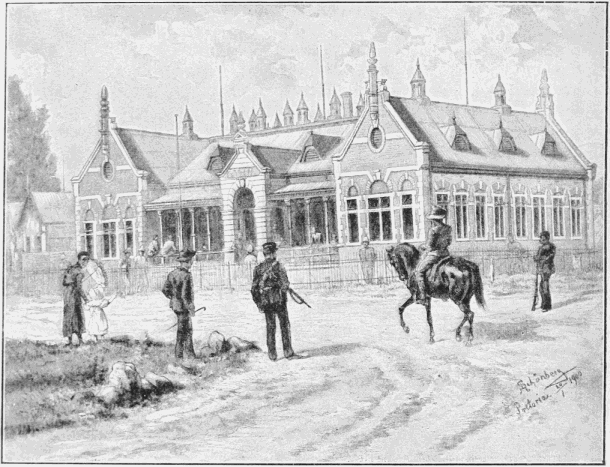
The Model School, Pretoria.
The Model School stands in the centre of the town. It is
commodious, though devoid of privacy (on the principle of a
boys’ dormitory) well ventilated, lighted with electricity, and roofed
with corrugated iron. At the time of the escape there was a
gymnasium, and also a scaling-ladder against the wall, which
suggested infinite possibilities to such men as Captain Haldane,
who had all the exciting histories of “Latude,” “Jack Sheppard,”
and “Monte Christo” at his fingers’ ends. There were rough
screens to enclose some of the cubicles, and the walls in some
cases were decorated with cuttings from the illustrated papers,
or with humorous sketches made by talented amateurs. Two of
these were especially admired, a chase after President Steyn personally
conducted by Lord Roberts, and a caricature of President
Kruger, which latter was highly appreciated even by the Boers
when it came under their notice.
The special nook of the Rev. Adrian Hofmeyer, who had made
himself into a general favourite, and was laconically declared to be
a “regular brick,” was the most decorative of all, being made gay
with various scraps of colour and design to cheer the weary eye.
By this time the reverend gentleman, having had a more trying
experience of incarceration than most, had got to look upon the
Model School in the light of residential chambers, and consoled
others with the account of his own experiences. His story was not
an enlivening one:—
“I was lodged in the common jail, Cronje’s law adviser having informed
him it would not be legal to shoot me. Cronje consequently thought the best
thing to do would be another illegality, namely, imprison a non-combatant and
correspondent. Mr. Cronje has ample time to-day in St. Helena to meditate
upon this and other illegal acts of his. I was locked up in a cell eighteen feet
by nine feet, and for the first few days was allowed to have my meals at
the hotel. Soon, however, this liberty was taken away, for it proved too
much for the Christian charity of the Zeerust burghers to see a despised
prisoner of war marched up and down from the hotel to the jail under police
escort. Other restrictions were soon imposed also, and after a little while
I was locked up day and night, the door of the unventilated cell being open
only three times a day for fifteen minutes at a time. No books nor papers
were allowed me, no visitors, and the few loyal friends who tried to supply me
with luxuries were cruelly forbidden to do so by the authorities. I cannot
help thinking to-day of the strange irony of fate. The commanders who practised
this cruelty upon me were Cronje and Snyman. The one is to-day a
prisoner of war, and can, perhaps, put himself in my place. He is an old
personal acquaintance, too.”
The worthy padre was afterwards removed, and gave a further
description of his experiences.
“After eight weeks of such life I was taken to Pretoria, and there quartered
in the Staats Model School with the British officers. Here everything was
better, and I quickly recovered my health and strength. The building was a
magnificent one, and the surroundings very pleasant, but our jailer, a Landdrost,
and our guards, the Zarps, never forgot to remind us of the fact that we
were prisoners. The food we got from Government sufficed for one meal; the
rest we had to buy, being charged most exorbitant prices. When I left, the
officers’ mess amounted to £1600 per month for 144 officers. On my arrival,
I was asked by the officers to conduct service for them every Sunday, in
addition to that held by an Anglican clergyman. For two Sundays, therefore,
we had two services a day, and then Winston Churchill escaped, and the
following extraordinary letter was sent the officers by the Anglican clergyman:—
“‘Gentlemen,—By the kind courtesy of the Government, I have been permitted
to hold services for you in connection with the Church of England,
which services I have felt it a privilege on my part to conduct. After what has
recently occurred—viz. the escape of Mr. Churchill from confinement—I exceedingly
regret that, in consideration of my duty to the Government, I must
discontinue such regular ministrations, as I desire to maintain the honour due
to my position. Of course I shall always be glad to minister to you in any
emergency, with the special permission of the authorities, who will, with their
usual kindness, duly inform me.—With my best wishes, I am, gentlemen, yours
sincerely, ——.’
“Out of charity, I do not publish the reverend gentleman’s name,[2] but I
can add that ‘the emergency’ referred to never presented itself. Since that
time, I had the pleasure and honour of conducting the services every Sunday,
and they were the pleasantest hours I spent in prison. Our singing was so
hearty and good, that many of the townsfolk strolled up of a Sunday morning
to hear us.”
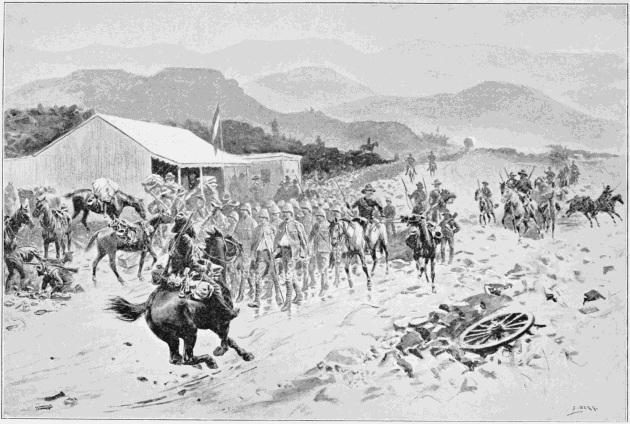
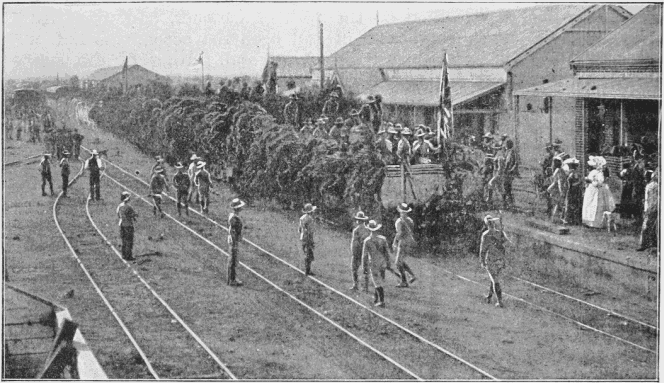
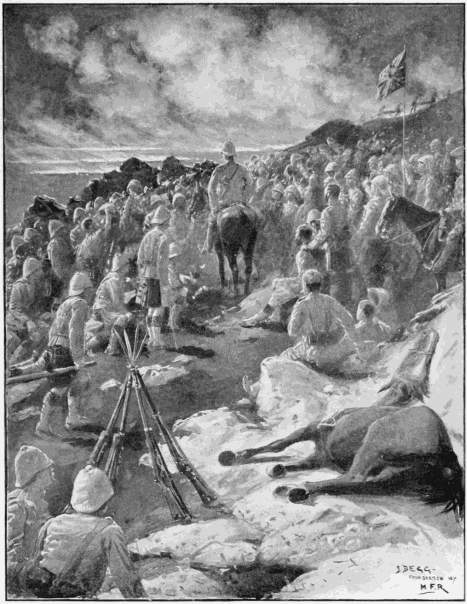
BRITISH PRISONERS ON THEIR WAY TO PRETORIA: THE FIRST HALT
Drawing by S. Begg
As may be imagined, all manner of devices were invented for the
purpose of securing news, the only intelligence of outside events
coming to the unhappy prisoners through the Standard and Diggers’
News, which journal, of course, dwelt gloatingly on British disasters.
But the authorities were suspicious. One day a harmonium was
removed, owing to the treasonable practice of performing “God
save the Queen”; on another, a cherished terrier was banished, as
he was declared to be a smuggler, and charged with the crime of
carrying notes in his tail! But at last, an ingenious ruse was successfully
perpetrated. A man, accompanied by a dog, came to the
railings and there engaged in a private dialogue, which savoured of
the maniacal, till the eagerly listening officers discovered that there
might be method in the strange man’s madness. A sample of the
scene was given by the correspondent of the Standard:—
“‘Would you like a swim?’ asked the master, and the dog,
with a wag of his tail, answered ‘Yes.’ ‘Ladysmith is all right,’
continued the man, and the tail wagged assent. ‘We will come
again,’ said the master, and the dog agreed. For a time the
prisoners thought him mad, this man with the dog who talked in his
beard, and mixed his dog talk with such names as ‘Ladysmith,’
‘Mafeking,’ ‘Cronje,’ ‘Roberts.’ Then the truth dawned on them,
and the ‘Dog Man’ became a hero, whose coming was watched
with longing, and whose mutterings in his beard were ‘as cool
waters to the thirsty soul,’ or as ‘good news from a far country.’
One day the ‘Dog Man’ was missing, and there was lamentation,
until, looking towards the house opposite, the prisoners saw him
standing well back in the passage, at the entrance to which two girls
kept watch. The ‘Dog Man’ was waving his hat in eccentric
fashion, and the waving was found to be legible to those who understand
signalling. Next morning a tiny flag was substituted for the
hat, and communication between the officers and the Director of
Telegraphs was established by flag signal.”
The prisoners endeavoured to keep up an air of jocosity, though,
as one confessed, their tempers were “very short and inclined to be
captious.” Naturally their occupations were limited, and it was not
unusual to see gallant commanders engaged in darning their socks,
or washing their clothes under the pump. Their attire, too, was not
of the choicest, some of them having been accommodated when sick
with suits technically known as “slops,” purchased for a low price
in Johannesburg. Hence one officer disported himself in choice
pea-green, while another figured in rich yellow. These prison suits
were scarcely becoming, particularly as many of the smartest of the
smart were growing beards, or, if not beards, the ungainly chin tuft
or “Charley,” which destroyed their martial aspect. Sometimes
they engaged in games, bumble puppy and the like, and occasionally
expanded to other sports. A letter from a sprightly member of the
band to the Eton College Chronicle described the humorous side of
their daily life:—
“Model School, Pretoria.
“Dear Mr. Editor,—Whilst following the fortunes of old Etonians in
South Africa, perhaps it may have escaped your notice that a small and unhappy
band has already reached Pretoria. Mr. Rawlins’s House is represented
by Captain Ricardo (Royal Horse Guards), and H. A. Chandos-Pole-Gell
(Coldstream Guards); Mr. Carter’s by Major Foster (Royal Artillery); the late
Mr. Dalton’s, Mr. Ainger’s, and Mr. Luxmore’s respectively by M. Tristram
(12th Lancers), G. Smyth-Osbourne (Devonshire Regiment), and G. L. Butler
(Royal Artillery); and Mr. Cornish’s by G. R. Wake (Northumberland Fusiliers).
The histories of their separate captures would take up too much of
your valuable space. Some have been here but a short time, some many
weeks; and during their captivity their thoughts turned to old Eton days, and
the game of fives recommended itself to them as a means of passing some of
the many weary hours. There was no “pepper-box,” or “dead man’s hole”;
but a room, two of whose walls mainly consisted of windows, with the aid of
three cupboards and a piece of chalk, was quickly converted into a fives court.
Entries for a Public Schools’ tournament were numerous, Eton sending three
pairs. Tristram and Gell unanimously elected themselves to represent Eton’s
first pair, closely followed by Eton II., Ricardo and Osbourne, Eton III. being
Wake and Butler. The facts that Tristram had recently been perforated with
Mauser bullets, and Gell had spent Christmas and the three preceding weeks
in the various jails between Modder River and Bloemfontein, were no doubt
responsible for their not carrying off the coveted trophy. Alas! they were
badly beaten in the first round by Marlborough. Not so Eton II. and III.,
who carried the Light Blue successfully into the second round, both having
drawn byes. This good fortune could not last, and they fell heavily at the
second venture, being beaten by Wellington and Rugby respectively. The
ultimate winners proved to be Wellington, after a desperate encounter with
Charterhouse.
“So much for our pleasures; our troubles are legion, but we will not
burden you with them. We daily expect to hear of the E.C.R.V. sharing the
hardships of the campaign, and covering themselves with glory to the tune of
“Floreat Etona.
“P.S.—We all hope to be at Eton on the 4th of June.
“Feb. 14, 1900.”
(Curiously enough, the 4th of June brought to a close the deadly
period of durance vile. On that date the gallant crew spent their
last night as prisoners!)
To return to Captain Haldane and his partners in adventure.
Ever since Mr. Churchill’s escape he had racked his brains to
discover a means of escape, and had made multifarious plans, many
of which were rejected as absolutely hopeless, while many others
failed after efforts which testified to the perseverance and ingenuity
of their inventors. It was no easy matter after Mr. Churchill’s
exploit to hit on a means of evading the wily and now alert Boer.
The guard were armed with rifles, revolvers, and whistles, and as
these consisted of some thirty men, who furnished nine sentries in
reliefs of four hours, there was little hope of escaping their vigilance.
Fortunately the prisoners, such as had plain clothes in their possession,
were permitted to wear them, otherwise the dream of freedom
could scarcely have been indulged in. Bribery was not to be
thought of, and a repetition of Mr. Churchill’s desperate dash for freedom
was impossible. It remained, therefore, for Captain Haldane
and his colleagues to invent a new and ingenious method of bursting
their bonds. An effort to cut the electric wires to throw the place
in darkness while they scaled the walls, proved a sorry failure, and
at last, having tried the roof and other points of egress and found
them wanting, the companions hit on the happy idea of burrowing
a subterranean place of concealment. Here they thought to scrape
on and on till they bored a tunnel into the open! The discovery of
a trap-door in the planks under one of the beds lent impetus to their
designs, and they arranged to excavate a route diagonally under the
street, and so pass into the gardens of the neighbouring houses.
Marvellous was the patience and perseverance with which they,
almost toolless—with only scraps of biscuit tins and screwdrivers—toiled
daily in the accomplishment of their plan, and pathetic their
dismay when their tunnel finished up by landing them in several
feet of water with a promise of more to come. But they were indefatigable.
Captain Haldane, like the great Napoleon, argued that
the word impossible was only to be found in the dictionary of fools.
Rumours that the prisoners were to be removed to a new building
in two or three days only contrived to render the conspirators more
desperate in their craving to be at large, and again the trap-door
system was discussed. The young men determined on
revised operations, and hit on the plan of living underground in
the cave they should dig, thus disappearing from Boer ken and
conveying the idea that they had already bolted, leaving as evidence
of flight their three empty beds! Here they proposed to wait
till, the hue-and-cry after them having ceased, and the prison doors
having been opened for the removal of the other officers, they could
slink forth at their leisure. But the change of prison did not come
to pass as soon as expected. The empty beds told their tale; the
place was searched, the crouching creatures in their burrow heard
the tramp of armed men above them, voices in close conference, and
afterwards the departing footsteps of the discomfited Boer detectives.
It was decided that the prisoners were gone, and further report,
amplified by Kaffir imagination, declared that they were already
on their way to Mafeking! Still, though safe from discovery, the
plotters were far from comfortable. Food in very meagre quantities
was smuggled through the trap-door, till at last, famine being the
mother of resource, by a process of what they called “signalgrams,”
their wants and intentions were conveyed to those above. Then
when the appointed raps gave notice of the opening of the mysterious
portal, potted meats and other luxuries were liberally passed
down. And here, in this ventilationless, miry hole, in darkness and
dank-smelling atmosphere, they groped a weary existence, daring
neither to cough, nor sneeze, nor whisper, lest discovery should rob
them of success. They were unwashed—so grimy as to be unrecognisable
even to themselves—they were cramped and covered with
bruises, brought about by bumping their heads against the dome of
their low dwelling; they were often hungry and sleepless, but they
were buoyed up with a vast amount of hope and pluck.
Day after day sped on with unvarying monotony, and gradually
hope began to exude at the pores. Six days passed, and they
thought patience had come to the end of her tether. They longed
to hold themselves upright, to see daylight, to eat their quantum of
food, and, above all, to hear the sound of their own voices. But
still they held on—longer, longer. Every day they knew made
their chance of escape more secure, for the authorities in Pretoria,
assured of their departure, had now ceased even from the habitual
nine days of wonderment regarding their fate. Then they began
to dig and burrow still further, this time with the assistance of a
bayonet and a skewer, and for days and days pursued their silent,
secret work, in hope to dig a channel some thirty feet long to
reach the hospital yard beyond the Model School. Meanwhile
they stored food in preparation for the great journey, and listened
acutely for news of the proposed transfer of the prisoners to other
quarters. At last they had their reward. A note was passed
down to say that the officers were to be removed on the morrow.
Then all was excitement. The curtain was drawing up on the play
of which the prologue had promised so much. The trap-door was
carefully fastened down, false screws being put into the screwholes
so as to render the hiding-place as inconspicuous as possible.
At last came the looked-for hour. Sounds of packing-up and
the shuffling passage of footsteps betokened activities. The commandant
went his rounds, and then a cheery voice was heard to
say, “All’s well. Good-bye.” They knew that was a signal—the
end had come! So in time the whole party of prisoners disappeared,
and with them their custodians! The coast was clear. Peeping
forth from their ventilator the joyous hidden trio could view the
street, the moving of baggage, and all the bustling preparations
for a general exodus. Their rapture knew no bounds. But escape
was even then deferred. Sightseers and police tramped through
the vacated rooms all day, moving perilously near the trap-door,
and laughing and jesting, unsuspicious of the precious haul that
might have been theirs. It was late in the afternoon before the last
visitors departed. Then, after collecting maps of their proposed route,
taking a final meal, packing their meat lozenges, chocolate, &c., and
money, they dressed and waited anxiously for the kindly cloak of
night....
Meanwhile the other prisoners were removed to a camp from
which escape was almost impossible. The place was enclosed with
barbed wire fencing standing as high as a man. It measured about
one hundred and fifty yards in length, and in width at the ends
might have measured fifty yards. From this pen it was possible to
gaze out over the hills to see life with the eye of Tantalus, so near
and yet so far—men and women passing, trees and houses and
cattle, all giving pictures of the free life without, that it was impossible
for them to share. No efforts now to evade the guard could
be made, for the enclosure was dotted thickly with electric lights,
and was so thoroughly illuminated in every corner that there was
no spot where a man could not have read. The dwelling-house
was walled, and roofed with zinc, bare within and comfortless, and
in the dormitory one hundred and forty cots were ranged side by
side. A few screens, as in the Model School, were arranged at
some of the bedheads, but of privacy there was none. The exchange
was a sorry one, and Captain Haldane and his companions,
Mr. Le Mesurier and Mr. Brockie, were wise in making a vigorous
bid to get clear of the fate that overtook their comrades.
Already a whiff of coming liberty seemed to reward these conspirators
for their dark days of anticipation. Their meal and their
preparations completed, they reconnoitred and discovered that all
was clear. Then, joyously, the intending fugitives emerged from their
terrible lair. With some difficulty they stood upright, their limbs
refused their office, they felt old, rheumatic stricken, incapable of
movement. But at last, boots in hand, creeping, as the French say,
on pattes de velours, they dragged themselves to a broken window,
and, passing through the gap made by the shattered pane, gained the
yard. Climbing over the railings—luckily unnoticed in spite of the
brilliant rays of the full moon—they made for the nearest road
leading to the Delagoa Bay Railway. Fortunately for them young
Brockie, who was a Colonial and up to the “tricks of the trade,”
donned the Transvaal colours round his hat. Added to this he
wore his arm in a sling, to give the impression that he was a
wounded Boer. Thus they got through the somewhat deserted
street to the outskirts of the town unchallenged. Once a policeman
almost spoke to them, his suspicion was on the eve of being aroused,
but the solitary myrmidon of the law, inquisitive yet discreet, found
himself face to face with three desperate men whose expression was
not reassuring! He wisely slunk off. Towards the railway line
they now went, experiencing a series of hairbreadth ’scapes, for
there were orders to shoot any one seen wandering on the railway
track. But they dodged in holes and round corners, in rank
grass and in ditches and dongas, traversing river and spruit,
and plodding along the highway, now losing their bearings, now
retracing their steps, ever striving to reach Elands River station,
twenty miles east of Pretoria.
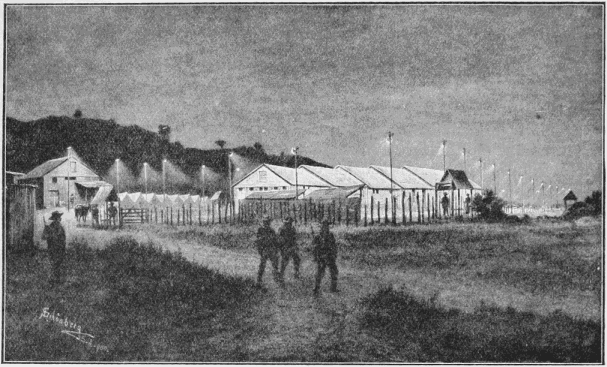
New Camp for British Prisoners at Pretoria.
(Drawing by J. Schönberg.)
On the left of the railway line ran the river, and as they toiled on—the
silver of the stream and the glint of the railway lines shimmering
in the ray of the moon—they descried tents, heard voices, and,
worse still, a dog’s bark, inquisitive, suspicious. Quickly to earth
they went, hiding and dodging in the long grass between river and
line. This, the critical moment of their journey, forms one of the
most exciting phases of Captain Haldane’s altogether interesting
narrative.
“After lying in the grass about twenty minutes, for we did not
care to move so long as the dogs remained on the alert, we heard
voices coming in our direction, and the barking of the dogs became
more distinct. A whispered conference was held, and then we
dragged ourselves like snakes diagonally back towards the river.
Reaching a ditch, Le Mesurier, who was following me, came alongside
and asked me if I had seen Brockie, who had been following
him. I had not, so we waited a few moments; but seeing nothing
of him, and the enemy drawing near, we crossed the obstacle, and
found ourselves at the edge of the stream. Again we paused, this
time for several minutes, and the searchers came in view, following
our track.
“The crisis had come: to stay where we were meant probably
recapture. I whispered to Le Mesurier to follow me quietly, and
not to splash. The next minute I was in the river, which was out
of my depth, and Le Mesurier dropped in beside me. Holding on
to the roots of the reeds which lined the bank, we carefully pulled
ourselves some distance down-stream, and then paused. The
searchers and their dogs were evidently now at fault, and showed
no signs of coming our way, so we continued our downward course,
and ultimately swam across and into a ditch on the other side.
“We had been a good half-hour in the stream, which seemed to
us intensely cold, and our teeth were chattering so that we could
scarcely speak. My wrist-watch had stopped; but Le Mesurier’s,
a Waterbury, was still going, for it had been provided by his care
with a waterproof case. We now crept along the ditch up-stream
again, and then turned off towards the hillside, which was dotted
with large boulders. Coming round the corner of one of these, we
found a tent in front of us, and not caring to pass it, we tried to
climb up the steep face of the hill. Failing at one point, we found a
kind of “chimney,” up which we climbed, pulling and pushing each
other till the top was gained. A few minutes’ rest was necessary,
for our clothes were heavy with water and the climb had made us
breathless. Le Mesurier had done wonders with his ankle—the
cold water had been most efficacious. Next we walked along the
rocky face of the hill, parallel to the direction we had followed below,
and gradually descended to the level and struck a path. Brockie
was irretrievably lost, and it was useless to attempt to find him. He
had with him a water-bottle and sufficient food, and knew both the
Dutch and the Kaffir languages. Following the path, we passed
several clumps of bracken, one of which we selected as a suitable
hiding-place. To have walked farther in our wet and clinging garments
might have been wiser, but we decided that we had had sufficient
excitement for one night without trying to add to it.”
So there they remained—wet, frigid, excited, aching—all through
the long sleepless hours, with nothing to vary the monotony save the
nip of the musquitoes. When morning came, their jaded limbs, like
the joints of wooden dolls, almost threatened to creak; and only
with the warmth of sunrise did they regain some of their pristine
elasticity. For food they now became anxious; their supplies were
waterlogged, their chocolate was a thirst-creating mash, and their
precious whisky bottle in the course of recent adventures had lost
cork and contents. A miserable day passed hiding in a swamp, and
crouching out of the light of day till again at night, and in a
thunder-storm, they thought it advisable to resume their journey.
Then, by the mercy of Providence, footsore, throatsore, heartsore,
and hungry they came on a field of water melons. Though ravenously
they took their fill, their joy was not of long duration. The
inevitable bark of the Boer dog warned them to be off. After this
they again lost their bearings, making needless detours, and only reaching
Elands River station—worn, weary, and down-hearted—before
daybreak. Then making their way to some gum trees that offered
welcome shelter, they again sought to sleep, but it was not to be.
Imagination had made molehills into mountains and footsteps into
cracks of doom. A Dutch youth passed by, his dog growled and
sniffed; discovery seemed imminent, but the hand of fate intervened,
they remained safe. Two nights, three nights were passed
on the veldt in anticipation of a train that might be on its way to
Balmoral. Their sufferings, their anxieties, and risks make many a
tale with a tale. Hiding continued during the day, now in an antbear
hole, now among grasses sodden with dew, the fugitives, from
caution, fatigue, and other causes, covering to that time only thirty-six
miles in four days. Finally, to make a long story short, the unhappy
wayfarers, their spirits and constitutions at the lowest ebb,
were led by the kindness of a Kaffir into the safe keeping of a
British subject, the manager of the Douglas Colliery Store, who
then nourished them and helped them to repair the terrible havoc
wrought by the past days of anxiety and starvation, and assisted
them to make plans for getting over the border. Here, newly
arrayed in decent clothing, washed and trimmed—for they had
originally presented the effect of veritable scarecrows—they began
to regain energy and hope. They were then initiated in the first
moves of a scheme to carry them to safety. With the assistance of
Dr. Gillespie, the doctor of the miners—a “rare guid” fellow from
all accounts—they got, on the 24th of March, to the Transvaal
Delagoa Bay Colliery; and here for some days following a conspiracy
was set on foot to buy some bales of wool, sufficient to make
a truck load, and forward the bales, plus the escaped prisoners, to a
firm at Lorenço Marques. The scheme succeeded, though only after
some smart and sympathetic manœuvring on the part of the newly
found British friends, and many hours of terrible risk and suspense.
Finally, to the intense joy of the two adventurous ones, they found
themselves on Portuguese territory. On Sunday the 1st of April
they were free men! From that time their ways were fairly smooth.
They were the heroes of the hour, for every one had heard of their
story and was expecting them, Sergeant Brockie having preceded
them after some equally exciting experiences.
On the 6th of April the gallant pair left Lorenço Marques for
Durban, Captain Aylmer Haldane hastening to rejoin his regiment,
the 2nd Battalion Gordon Highlanders, at Ladysmith, and Mr. Le
Mesurier (Dublin Fusiliers) going round to join General Hunter’s
Division in the Free State. Thus the two enterprising officers, after
enduring almost unequalled tortures of body and mind, found themselves
free to return to duty and fight again for the honour and glory
of the Empire.
Bloemfontein meanwhile was a strange mixture of pastoral simplicity
and martial magnificence, and curious, almost wonderful, was
the view from a distance of the landscape in the vicinity. The
whole earth, as though blossoming, seemed to have thrown up mushrooms
far and wide—mushrooms grey, and white, and green. Dotted
among them were strange forms, like the shapes of antediluvian
reptiles—grasshoppers, locusts of mammoth size. Coming nearer
the town it was possible to recognise both mushrooms and reptiles
for what they really were, namely, the tents and the guns of the
largest army that England has put into one camp since the Crimea!
In and out and round about wandered horses and mules innumerable,
so numberless, indeed, that the casual onlooker wondered at the outcry
for equine reinforcements. Yet these were urgently needed, and
none but those “in the know” could comprehend how much the
strategical problem relied for solution on their arrival, and how
paralysed were the movements of the generals for want of them.
Some people opined that the Commander-in-chief would start off for
Pretoria at express speed, others hinted that his plan of campaign
would be altered to meet the complications that had arisen owing
to the renewed activity of the Boers in the south-eastern corner
of the Free State. But Lord Roberts was unmoved by either impatience
or disaster. He evidently determined to fritter his
resources on no operations that could not be concerted and rapidly
effective.
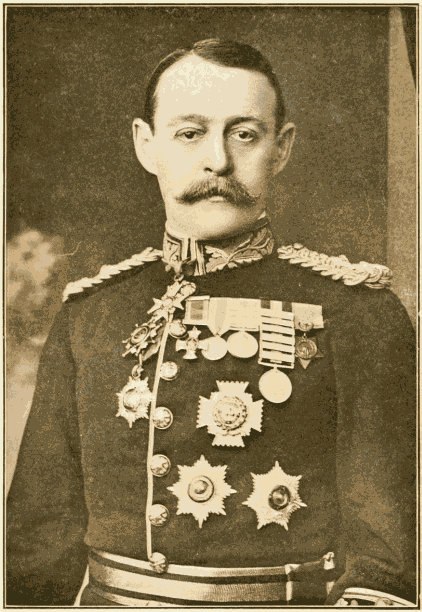
LIEUT.-GENERAL SIR ARCHIBALD HUNTER, K.C.B.
Photo by Bassano, London
Meanwhile stores, ammunition, warm clothing (for the wintry
weather was setting in), and boots were being brought in enormous
quantities from the Cape. The wardrobes of the hard-fighting
multitude were in sad need of repair, and some wag declared that
certain tatterdemalions could only venture abroad after dark, for fear
of shocking the Mother Grundys of Bloemfontein. Horses, too,
were being gradually collected, for it was felt that until there was
a sufficiency of remounts, General French’s dashing evolutions would
be too costly to be appreciable. The great gallop to Kimberley
had cost an immense amount in horse-flesh—about 1500 out of
5000, some said—and, in consequence, the splendid cavalry was
again reduced to impotence, just when the Boers, though demoralised
by the surrender of Cronje, might have been pursued
and punished as they deserved. According to later computation,
it was decided that the army must wear out at the rate of 5000
horses a month, and therefore no move could be set on foot till the
incoming supply was organised to meet the demand.
But for the state of horses and men the Field-Marshal could
have stuck to his well-known principle, one acquired from the great
Napoleon himself, namely, that a commander-in-chief should never
give rest either to the victor or to the vanquished. As it was, he
was stuck fast, and the Boers were not slow to take advantage of
the opportunity thus given them to recuperate.
Up to the time of the Koorn Spruit and Reddersburg disasters
things seemed to be ranging themselves satisfactorily, but little by
little the authorities began to discover that the entire attitude of the
apparently pacified burghers was decidedly false. By degrees they
learnt that, instead of disturbing a hornet’s nest and clearing it, they
had, as it were, got into the midst of it themselves. It became
evident that within the town there existed a conspiracy for the
purpose not only of supplying the enemy with information, but
keeping him ready equipped for hostility. Under the mask of neutrality,
certain Germans and others incited the burghers who had
laid down their arms to take them up again. This, in the true
sense of the word, for it was found that upwards of some 3000
weapons had been buried for use in emergency. But once General
Pretyman obtained a true grasp of the situation, and could prove
the duplicit nature of the persons with whom he had to deal, the
work of weeding and deportation of the obnoxious element of
Bloemfontein society was taken in hand.
Early in the month a prominent figure was removed from
the fighting scene. The death was announced of Colonel the
Hon. G. H. Gough[3] at Norval’s Pont. This distinguished officer
till the time of his death had been acting as Assistant Adjutant-General
to General French’s Cavalry Division. His services had
been many and brilliant, and his loss was deeply deplored.
The occupation of pacifying the disturbed western districts continued.
General Settle and his forces had been operating between
De Aar, Prieska, Kenhardt, and Upington, and General Parsons
had occupied Kenhardt, and in a few days all traces of rebellion
in the district between Van Wyks Vlei and Kenhardt had disappeared.
As a matter of fact, it was discovered that many of the
rebels were ignorant of why they were fighting at all. Some one
addressed them and said, “What are you fighting for?” and they
answered, “Equal rights for all white men in South Africa.” “Then,”
said the speaker, “go and fight Paul Kruger. He alone refuses
white men equal rights!” Still more ignorant were many of the
subsidised sympathisers, while other foreigners who were forced to
fight were evidently apathetic regarding the issue of the struggle.
The following story was told of a Pole, who was not sorry when
taken prisoner. When asked why he fought, he said, “Vat could I
do? Dey give me musket and bandolier, and say, ‘You must
fight.’ The captain say to me, ‘You take that mountain,’ and I ask,
‘Vare shall I take it?’” If the tale was not absolutely accurate, it
was still typical of the nonchalance of many who were engaged
in the Transvaal cause.
Of changes there were many. On the 10th, it was announced in
general orders that Major-General Sir H. Chermside had been
appointed to the command of the Third Division vice Lieutenant-General
Sir W. F. Gatacre “ordered to England.” There was a
good deal of sympathy expressed by all who knew the difficulties
with which General Gatacre had had to contend. But, as an old
campaigner remarked, luck counts for as much as merit in actual
warfare. “Give me a man who is lucky, and I ask nothing
more.” Luck was at the bottom of it all, and luck is all-important
where multitudes of men have to follow, heart in hand, blindly rushing
to glory in the footsteps of faith. General Gatacre’s name now
spelt disaster, and as men had to be marched to ticklish work that
wanted nerve and confidence of the best, a luckier commander was
chosen. Accordingly, a much-tried officer—a soldier to the marrow—was
sacrificed on the altar of necessity.
An Infantry Division from the Natal side was formed under the
command of Sir Archibald Hunter, and called the Tenth Division,
while the Eleventh Division was commanded by General Pole-Carew.
General Ian Hamilton commanded a division of mounted infantry,
ten thousand strong, formed of South African and other mounted
Colonial contingents, and divided into two brigades under Generals
Hutton and Ridley. As this division came in for a considerable
amount of exercise in course of Lord Roberts’s great advance, it is
particularly interesting to examine and remember its component
parts.
General Hutton’s brigade comprised the Canadians, the New
Zealanders, and all the Australians except the cavalry. The staff
was as follows:—
Colonel Martyr, Chief Staff Officer; Lord Rosmead, Aide-de-Camp;
Colonel Hoad (Victoria), Assistant Adjutant-General; Major Bridges (New
South Wales), Deputy Assistant Adjutant-General; Major Cartwright (Canada),
Deputy Assistant Adjutant-General; Colonel Gordon (Adelaide), officer on the
line of communication; Major Rankin (Queensland), Staff Officer; Major
Vandeleur (Scots Guards), advanced base transport officer; Captain Lex, Army
Service Corps, supply officer.
The brigade consisted of four corps of mounted infantry, under
Colonels Alderson, De Lisle, Pilcher, and Henry.
The first corps consisted of a 1st Battalion of Canadians, under
Colonel Lessard; a 2nd Battalion, under Colonel Herchmer; and
Strathcona’s Horse, under Colonel Steel.
The second corps consisted of the New South Wales Mounted
Infantry, under Colonel Knight, and the West Australians, under
Captain Moor.
The third corps was formed of the Queenslanders, under Colonel
Ricardo, and the New Zealanders, under Major Robin.
The fourth corps consisted of the Victorians, under Colonel
Price; the South Australians, under Captain Reade; and the
Tasmanians, under Captain Cameron.
Each corps had a battalion of Imperial Mounted Infantry
attached to it, except the New South Wales Corps. A battery
joined the division, as well as the Canadian Battery and a number
of Vickers-Maxims. The New South Wales Army Medical Corps,
under Colonel Williams, were the medical troops of the division.
General Ridley’s brigade consisted entirely of South African
troops.
Lord Roberts, always appreciative of the Colonials, ordered the
body of Colonel Umphelby of the Victorian Contingent, who was
killed at Driefontein, to be removed to Bloemfontein, there to be
buried with honours appropriate to the distinction of that gallant
officer’s services.
Rearrangements of all kinds were taking place, the better to
meet the peculiarities of the situation. Sir Redvers Buller was asked
to co-operate by forcing Van Reenen’s Pass, and threatening the
enemy’s line of retreat; but the task was one bristling with difficulties,
as until Northern Natal should be cleared of the enemy he
considered it unsafe to move westward. Accordingly, to meet the
necessity for strong action in the east of the Free State, it was
decided the Natal Field Army should continue its work in its own
ground, minus the Tenth Division (Hunter’s), which should be
moved by sea to East London, one brigade (Barton’s) to replace
the Eighth Division (Rundle’s), diverted from Kimberley to
Springfontein, and one brigade (Hart’s) to operate in the neighbourhood
of Bethulie. It must here be noted that the country
south of a line drawn from Kimberley to Bloemfontein seemed to
be almost under control, but the pacification of the angle south-east
of Bloemfontein had, as yet, to be accomplished.
Meanwhile, President Kruger made a tour of the positions of
his army, in order to stimulate the Free Staters to further efforts;
but very many of these began to show symptoms of unbelief, and
refused any longer to swallow the assertions that Russia had taken
London and that America was coming to the aid of the Boers, which
the President and other kinsmen of Ananias in the Transvaal took
the trouble to repeat. Daily, various Free Staters surrendered—some
of them genuinely, while others merely gave up an old rifle for convenience’
sake, burying some four others for use in emergency—took
to their farms, and there developed from fine fighting-men into mean
and despicable spies. With these slippery fish it was difficult to
cope, and the problem of how to manage them took some little time
to solve. Still, the task of remodelling and improving the army continued,
all working to bring the long halt to a conclusion as speedily
as possible.
Efforts wonderful and successful were made to increase the
mobility, particularly of the mounted portions of the troops. One
section of the Vickers-Maxim guns (1-inch guns) was attached to
each cavalry brigade, and two sections to each brigade of mounted
infantry. To add to the mobility of the horse artillery the waggons
of each battery were reduced to three, spare teams being allowed for
each gun.
The Eighth Division (Rundle) which, as we know, had been
diverted from Kimberley to Springfontein, and the Third Division
(Gatacre’s, now Chermside’s) which was concentrated at Bethanie,
were fulfilling a part of Lord Roberts’s scheme for sweeping the
right-hand bottom corner of the Free State clear of the enemy.
Assisting them was General Hart, with a brigade of Hunter’s Division,
and engaged also in the operation were the mounted infantry,
under General Brabazon, and part of the Colonial Brigade under
General Brabant. Another part of this Brigade, which had moved
towards Wepener at the beginning of the month, had there been
blockaded by the enemy, and though their position was not regarded
as serious, Lord Roberts was forming plans for a general converging
movement which would have the effect of routing the Boers
from the end of the Free State altogether.
Energetic measures of every kind were adopted for the control
of the Free State. General Pretyman, who had been appointed
Military Governor of Bloemfontein, developed a scheme for the protection
of those who had taken the oaths of submission, and who
were hourly in dread of the reprisals of the Boers. Though
some of the Free Staters for long had been entirely sick of
the war, and were only forced into fighting in fear of ill-treatment
by the Boers, others, as we are aware, had merely hidden
their arms in the determination to take up fighting whenever
a good chance offered. In order to secure the interests of
the pacific, and keep an eye on the treacherous, General Pretyman
began to organise a corps of Mounted Police for service
in the Free State, at the same time dividing the conquered radius
into sections. Each section was to be administered by a Commissioner
chosen for his experience in Colonial matters. Colonel Girouard,
R.E., also formed a railway corps, employing some ten volunteers
from each regiment to help in the enormous operations now being
set on foot. A change was also made in the postage stamp of the
country. The existing issues of stamps of President Steyn’s Republic
were marked V.R.I. in black ink, and also with figures denoting
their value as recognised by the Imperial Government. The threepenny
stamps were marked with the nominal value of 2½d., to agree
with the twenty-five centimes of the Postal Union. Naturally the
philatelists were all on the alert, and stamps as well as trophies were
fetching absurd prices in the town.
Of recreation there was also a little. On the 18th of April a
somewhat original concert was organised by the war correspondents,
on behalf of the Widows’ and Orphans’ Funds of London and
Bloemfontein. The originality of the scheme and the interest
thereof lay in the fact that conquerors and conquered met together
on the common ground of charity, and mutually contributed to make
the undertaking a success. £300 were realised. Mr. Rudyard
Kipling put forth his quota. He did honour to the Colonials in
verse, and this ditty, to the tune of “Auld Lang Syne,” was sung
by Miss Fraser, the daughter of Mr. Steyn’s former opponent for
the Presidency. Among the marketables were portraits of Lord
Roberts and Mr. Kruger. These were the work of some of the
artist journalists. “Bobs” was “knocked down” for a big figure,
and became the property of Lord Stanley, a valuable trophy that
may well become an historical heirloom. This concert was only
one of the many efforts at harmony made by Lord Roberts, who,
as diplomatist and statesman as much as soldier and conqueror,
foresaw a future wherein the people of the Free State, originally
actuated by no animosity towards the British, would become reconciled
to the beneficent rule of the British Empire, as contrasting
with the despotic rule of the Boer Republics, and live side by side
with us in the true spirit of liberty, fraternity, and equality enjoyed
by British subjects.
Against the misfortunes of Koorn Spruit and Reddersburg we
would place one brilliant victory—a victory gained by Lord Methuen
at Boshof, mainly through the smartness, bravery, and unspeakable
steadiness of the Imperial Yeomanry, who were under fire for the
first time, and the splendid dash of the Kimberley Corps, whose
experiences during the siege had lifted them almost to the rank of
veterans.
It may be remembered that Lord Methuen at the end of
February took up the post of Administrator of the Kimberley
district, which extends as far south as the Orange River, subsequently
leaving Colonel Kekewich in command of the local forces.
The General commenced active operations on the western frontier,
for the purpose of clearing the country of rebellious obstructions,
and protecting the lines of communication with the north.
At Boshof there was concentrated a comparatively large army,
composed of two batteries of artillery, about 6000 infantry, and
1000 mounted infantry, which were massing together to march to
Kroonstadt, where they expected eventually to take their place
as the left wing of the main army. The town itself presented
a desolate aspect, all the Dutchmen being absent on commando
under Commandant Duplessis, and being in force on the Vaal
River, some miles distant.
Lord Methuen hearing that a detachment of the enemy was
moving along the Jacobsdal road, and threatening his communications,
ordered Colonel Peakman to effect its capture. As a result
of this order a most successful fight took place, some five miles east
of Boshof, on the 5th of April.
Taking part in the action were two companies of the Bucks
Yeomanry, one of the Berks Yeomanry, one of the Oxford Yeomanry,
one company of the
Sherwood Rangers, one of the
Yorkshire Yeomanry, and also
the Kimberley Mounted Volunteers.
With these was the
Fourth Battery R.F.A.
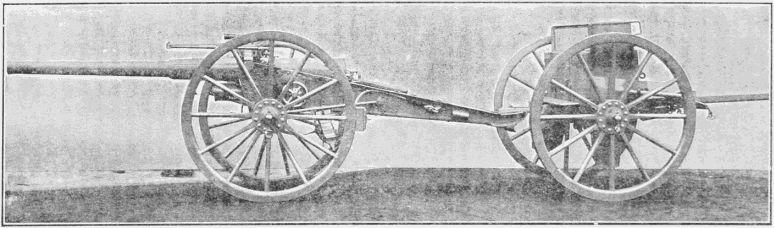
Types of Arms.—12-lb. Field Gun of the Elswick (Northumberland Service) Battery. By permission of Messrs. Armstrong,
Whitworth & Co., the makers.
The Imperial Yeomanry
under Lord Chesham on this
occasion had their first chance
of distinguishing themselves
and seized it, behaving, as
some one who looked on said,
“like veteran troops.” The
affair began in haste. A
Yeomanry patrol suddenly discovered
the enemy and announced
his near approach.
There was a rush. “To horse!
to horse!” sang out the troopers
keen for action. Their steeds
were grazing, but in less than
thirty minutes every man was
careering off to duty. The
Boers, some sixty-eight in number,
were tenanting a kopje,
and round their lair the troops
disposed themselves, Lord Scarborough’s
Squadron of Yeomanry
to left, and the Kimberley
Mounted Corps to right. The
rest of the Yeomanry attacked
from the front, occupying two
small kopjes some fourteen hundred
yards distant from the
enemy. These promptly greeted
them with a persistent fusillade.
Then the right flank slowly
began to creep up, taking advantage
of cover as nature had
provided, while the front
marched across the open. This
advance of the troops was
masterly, though no cover was
available till the base of the kopje occupied by the enemy was
reached. Method and coolness were displayed to a great extent,
and to these qualities was due the day’s success. For three and a
half hours the operations lasted, the men closing gradually in, and
finally surrounding the kopje and storming it. The surrounding
process, both by the Yeomanry and the Kimberley force, was carried
on with amazing skill and coolness till the moment came for which all
were panting. The Yeomanry then fixed bayonets and charged.
A rush, a flash of steel, and then—surrender. The Boers hoisted
a white flag! but even as they did so their comrades poured
deadly bullets on our advancing men. Captain Williams of the
“Imperials,” who was gallantly in advance of his comrades, dropped,
shot dead in the very hour of victory. There was small consolation
in the fact that the murderer was instantly slain by an avenging
hand.
At this time the men had gained the hill and were within seventy
yards of the Boer trenches. But the Boers, notwithstanding their
display of the white flag, continued to blaze with their rifles till a
Yeomanry officer shouted that he would continue to fire unless the
enemy threw down their rifles and put up their hands. This threat
brought the cowards to their senses. They obeyed, and the position
was gained with a rousing, ringing cheer. Then came the sad
part of triumph, the collection of the gallant dead and the succour of
the wounded. Among the first were three, Captains Williams and
Boyle, and Sergeant Patrick Campbell. The enemy’s dead and
wounded numbered fourteen, while our wounded numbered seven.
Captain Cecil Boyle was shot through the temple within eighty
yards of the Boer position while gallantly leading his men. He was
a soldier to the core, one who, merely from a sense of patriotic
responsibility, was among the first to leap to his country’s call, and
who threw into his work so much energy, zeal, and grave purpose
that the atmosphere of the camp made him feel at the end of a week
as if, to use his own words, “I had done nothing but soldiering all
my life.” He, at the invitation of his old chum, Colonel Douglas
Haig, began work at Colesberg “to watch the cavalry operations.”
There he had what he thought the supreme good luck to be appointed
galloper to General French. After the relief of Kimberley
and the capture of Cronje he went to the Cape to meet the Oxfordshire
Yeomanry, and with them gallantly advanced to meet his fate—the
first Yeomanry officer in this history of ours to fall in action.
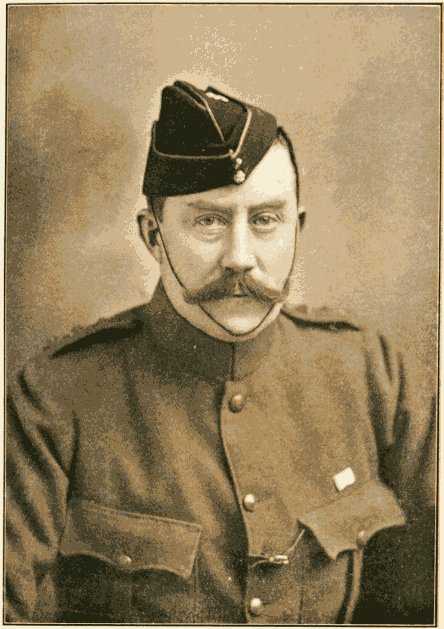
COLONEL LORD CHESHAM, Imperial Yeomanry
Photo by Russell & Sons, London
At the close of the fight the clouds which had been lowering
over the position like a pall of purple suddenly burst. Torrents
descended, saturating the heated troops and sopping the ground
whereon lay the maimed and slain. With thunder bellowing and
lightning splitting the skies, with an accompaniment of deluge and
darkness, the troops and their prisoners found their way to camp.
Under cover of the obscurity some of the latter made a wild endeavour
to escape, but the Yeomanry were too proud of their “bag”
to allow a single one to get free, and finally had the satisfaction of
seeing their bedraggled prize lodged in jail.
Lord Methuen commanded, and expressed himself much
gratified with the success of the operations, with the courage and
coolness and method with which all his orders were carried out.
Colonel Peakman, of Kimberley fame, who had already accomplished
a quite unusual record of fighting, displayed an immense
amount of talent in the field, and his corps, in every way worthy of
him, cut off the enemy’s retreat with remarkable skill. So much indeed,
that the Boers complained of the slimness of the troops who, by apparently
retiring hurriedly, drew them within range of the British volleys!
Our troops were pitting themselves now against no unruly or uninitiated
barbarians, for the hostile force was under the command of
the notable Frenchman, Colonel de Villebois-Mareuil. This gallant
officer was killed by shrapnel from the 4th Field Battery Royal
Field Artillery before the display of the white flag by the Boers.
He was accompanied by many of his compatriots, who were taken
prisoners. The force indeed was mainly cosmopolitan, it being
composed of Hollanders, Frenchmen, Germans, and Russians, three
Boers only belonging to the commando. Not a man of the enemy
escaped. Eight were killed, six wounded, and fifty-four polyglot
prisoners, with sixty horses and their baggage, were brought into
camp. Two guns were also captured.
The courage and dash of the Imperial Yeomanry was eulogised
on all sides, even by the Colonials, who hitherto had been somewhat
disposed to look down on their brother Volunteers from civilised and
inexperienced England. The magnificent spirit which inspired one
and all, the grit displayed by the wounded, and their self-abnegation
were the subject of much comment. A Colonial trooper, writing
home his applause, said: “Where all behaved so well it is almost
invidious to mention any one in particular, but as an instance of the
fine spirit which animated them, I would mention two whose names
I have ascertained, Sergeant-Major Coles, of the Bucks Yeomanry,
and Throgmorton, a trooper in the Oxfords. These two continued
in action after being wounded, the former with a bullet through the
shoulder, and the latter with a gunshot wound in the head, and
sooner than crowd the ambulance they rode in afterwards, twelve
miles in the darkness, through one of the worst thunder-storms it has
been my lot to witness. What they must have suffered in the state
they were in they alone know.”
From all accounts the French colonel who fell was entirely confident
of success. Before the engagements he sent an invitation to
his compatriots to join his force. He thought he had discovered the
flaws in the Boer armour, and was bent on giving the Federals an
object lesson in how to defeat and scatter the British. He also
issued a manifesto addressed to the French legions, the translation
of which ran thus:—
“To the Legionaries, who have known me as their comrade.—Officers, Non-commissioned
Officers, and Men,—I know that you have not forgotten me, and
we understand each other, and therefore I appeal to you. There is here in
front of the Vaal a people whom it is desired to rob of its rights, its properties,
and its liberty in order to satisfy some capitalists by its downfall. The blood
that runs in the veins of this people is in part French blood. France, therefore,
owes to it some striking manifestation of help. Ah, well! You are the
men whom a soldier’s temperament, apart from all the great obligations of
nationality, has gathered under this people’s flag, and may that flag bring
with it the best of fortune! To me you are the finished type of a troop that
attacks and knows not retreat.”
He also wrote to the Parisians:—
“The Dutch are splendid at defence, but they cannot follow up a defeat and
crush the enemy, which the French legionaries would be able to do.... Come
and I will receive you here; and I promise you that very few days shall elapse
before we will show the world the mettle of which the French legionaries are
made.”
The display to unprejudiced onlookers was distinctly poor, however,
and the example of strategy set by the gallant Gaul scarcely
served to demonstrate astounding military genius.
The Colonel’s plan of campaign was nevertheless most carefully
made out, as a document which subsequently fell into Lord
Methuen’s hands served to show. Very dramatic sounds the
orders for the movements on April 4, as translated by the correspondent
of the Daily Telegraph:—
“To-night the detachment of the raid will attack Boshof and follow its
route, under the favour of a surprise and the prevailing darkness. For this
purpose, the following dispositions will be observed: The column will set off at
four o’clock in the afternoon, with the detachment of Boers under Field-Cornet
Daniell, in such a manner as just to reach Boshof by night. At a certain point
the detachment will divide, and will reach their respective places of assembly to
the east and west of the town. Boshof is situated in a plain, and is flanked by
certain kopjes, of which the importance and distance from the town are reported
as follows: to the north, two naked kopjes, weakly guarded, and a good distance
from the town. Between them passes the Hoopstadt-Boshof road. To
the east, on the road to Kimberley, which it commands, one kopje, which is not
guarded by the enemy. Upon this the Boers will take up their position.
Finally, to the south-east of the town, and exactly opposite to it, there is a
kopje, where the English have an outpost of fifty men. On the summit of this
is formed a small parapet of stones, about half the height of a man. This will
form part of the attack reserved for the detachment of the raid.
“The Hoopstadt and Kimberley roads cross in the interior of the town.
“The plan of attack will be carried out under the following conditions: At
eleven o’clock in the evening, the Boers under Field-Cornet Daniell will be in
position on the Kopje C, and the telegraph wire on the Kimberley road will be cut
by them. At the same time, the raiding party will assemble behind the Kopje
E, situated two kilometres from the town. The horses and the Scotch cart will
there await the final operations, as well as the native servants, if there are any.
One man will be left behind with each team of six horses. Commandant
Saeremburg and Lieutenant de Breda will, before the departure, choose these
men, the importance of whose mission will be readily understood, since upon
their vigilance will depend the safety of the expedition in the event of retreat.
The group left behind will be under the orders of Nicollet. The men will remain
standing at the head of the horses, which will be saddled and bridled, the cart
boys at the head of the mules, all ready harnessed.
“At half-past eleven, the attacking party will march in three échelons,
twenty mètres apart, the centre in the van. The centre échelon, under the
special direction of the General, will be formed by the French platoon. The
centre échelon, commanded by Commandant Saeremburg, will consist of one-half
of the Dutch, and the left, under Lieutenant Bock, of the other half.
Furthermore, the men who have been in the habit of messing together in
groups will appoint a leader, from whom they will on no account separate nor get
out of touch. When these groups do not exist, or exceed ten in number, the
leaders of the party will break them up and form parties of six or eight, and
appoint a head of the group. The General will see these heads of groups at
three o’clock in his camp, to give them instructions further than can be detailed
here.
“In the approaching march the commandants will give their orders in a low
voice, and the men will be ranged in line, so that they can see the heads of
groups and lie down instantly. It is of importance, also, to watch the investigations
of the search-light, if the English have one at Boshof, which has not yet
been ascertained. The moment the ray is turned towards the échelon, the leader
will make his group lie down, and the march will not be resumed until the light
is turned away. At the rise of Kopje D, a halt will be made behind the
cemetery, and the Saeremburg échelon will carry the kopje by assault and will
occupy it. From there it will hold ... the two kraals Z Z, where the English
encamped in the market-place in Boshof itself could make the first attempt at
resistance. In no case, for an easily understood reason, will it fire upon the
town. Firing, moreover, can only be carried out by volleys discharged by word
of command given by the head of each group.
“Continuing their march, the two other échelons will pass a well behind the
kraals, and will attack the English camp outside the town. In this effect, the
French échelon, after firing two volleys, will advance at the charge, with the cry,
‘Transvaal and Free State!’ and will thus complete the panic. As there are
no bayonets, the rifles will be kept loaded and carried under the arms at the
position of the charge. After having crossed the camp from the east to the
south, the rout will be accomplished by firing. Lieutenant Bock’s échelon will
remain under the orders of the General, as a reserve, should the Boers placed
on the Kimberley road on the Kopje C have to deal with the fugitives. He
could also render assistance, if the enemy issuing from Boshof should endeavour
to turn the attack. He would then be informed of this eventuality by
Field-Cornet Coleman, who will cover the left of the attack in such a manner as
to observe all that may be menaced. For this purpose, the Afrikanders will
conform to the general movement of the march of approach, and retire as soon
as the attack begins on the west of the English camp to a distance suitable for
observation.
“To facilitate recognition the brim of the hats will be covered with a white
handkerchief.
“The meagreness of our information does not permit of even an approximate
estimate of the English force. The forces in Boshof seem, however, to be
between 300 and 400 men. Whatever happens, the assailants should remember
that their moral superiority is overwhelming, and even in the event of
retreat, they can easily, covered by the darkness, regain their horses and retire
from Boshof without risk.”
In view of these magnificent preliminaries, one may look without
vanity at the celerity and completeness of the British operations
which were rewarded with victory. The Frenchman’s programme
makes a quaint contrast to the terse description of a
quartermaster-sergeant of the Imperial Yeomanry, who thus sketched
the events of the 5th of April:—
“We received orders to turn out as soon as possible; we were soon all
bustle, caught and saddled our horses, and off we went post-haste. One of
our patrols had been shot in the night by a foraging party of Boers. We
trotted off for about two hours, and then caught them out-spanned at the
bottom of a kopje. We dismounted and got on some more kopjes close by
and began exchanging shots. Then we mounted again, and half of us went
round to their right and half to the left to cut off their retreat; and our
artillery, of which three guns had followed us, began to shell them in front.
When we had got well round them we dismounted again and advanced
to the attack, taking cover. Then, after a few volleys, ran up about
twenty yards; then a few more volleys, and up again until we were within
about a hundred and fifty yards, when we made a rush for it with fixed
bayonets. About seventy yards from the top there was a large wire fence.
We had to clamber through, and then, when we were about fifty yards away,
they came out and surrendered. There were thirteen of them killed, and we
had fifty-four prisoners, amongst them General de Villebois-Mareuil and four
or five more Frenchmen. They had a cart with them full of ammunition and
dynamite, so they were evidently on some foray to blow some bridge or other
up. They were stationed on two kopjes. The one our own lot went against
was on the right. Most of their bullets fell short whilst we were advancing,
and when we made our final rush they went over us. About twenty of them
escaped before we reached them. It was about five o’clock when the fight
was over, and we commenced a twelve-mile march to camp about 5.45.
After going about two miles it came on dark, and we had a very heavy
thunder-storm all the way to camp, which we reached about ten o’clock last
night, wet to the skin.”
The blow so deftly and quickly struck at the marauding parties
of the Boers was valuable from many points of view. It served to
restore confidence in Lord Methuen’s leadership—confidence which
had been considerably shattered by the disaster of Majersfontein—and
it helped to suppress a tendency to raiding in the west of Cape
Colony. So complete a success could not but have a sobering
effect on the rebels, and give them pause in their mad career of
hostility.
On the 7th of April, at dawn, Lord Methuen marched ten miles
on the Hoopstadt Road to Zwartkopjesfontein Farm without opposition.
On the 8th he proceeded further, but finally, by Lord
Roberts’s orders, retraced his steps to Zwartkopjes. On the 10th,
at daybreak, two flying columns started forth—General Douglas
to south-east and east of the camp, Colonel Mahon (commanding
Kimberley Mounted Corps) from Boshof towards Kimberley.
Colonel Mahon’s movements, on which the relief of Mafeking was
depending, must be taken in detail later on. Lord Methuen
operated in this district till the 17th of May, when he moved to
Hoopstadt and brought his force within the zone of the main
operations. On the 21st he proceeded to Kroonstadt.
In the Kimberley district the First Division had been rearranged
as follows:—
Lieutenant-General Lord Methuen. 9th Brigade (Major-General C. W. H.
Douglas).—1st Northumberland Fusiliers, 1st Loyal North Lancashire, 2nd
Northamptonshire, 2nd Yorkshire Light Infantry. 20th Brigade (Major-General
A. H. Paget).—Composed of Militia Battalions, 4th, 20th, and 44th
Field Batteries; 37th Howitzer Battery. Brigade Imperial Yeomanry (Colonel
Lord Chesham).—1st Battalion, 3rd Battalion, 5th Battalion, 10th Battalion.
Cape Police, Diamond Fields Horse, Part Kimberley Light Horse, Diamond
Fields Artillery.