February 27, 1900.
“Storm, strong with all the bitter heart of hate,
Smote England, now nineteen dark years ago,
As when the tide’s full wrath in seaward flow
Smites and bears back the swimmer. Fraud and fate
Were leagued against her: fear was fain to prate
Of honour in dishonour, pride brought low,
And humbleness whence holiness must grow,
And greatness born of shame to be so great.
The winter day that withered hope and pride
Shines now triumphal on the turning tide
That sets once more our trust in freedom free,
That leaves a ruthless and a truthless foe
And all base hopes that hailed his cause laid low,
And England’s name a light on land and sea.”
—Algernon Charles Swinburne.
The terrible events of the month of December had produced
a disquieting effect upon the public mind. Agitated questions
were asked on all subjects connected with the series
of catastrophes, and the replies were so unsatisfactory that
one and all became sensible that the actions of those in
power were not sufficiently in unison with public sentiment, and
even the keenest supporters of the Government numbly experienced
a loss of confidence in those at the helm. It was felt that some one
must be to blame for the miserable condition of affairs, the hideous
series of defeats that had made Great Britain an object of ridicule
on the Continent. For the forwarding of our troops “in driblets,”
for the ineffectiveness of our guns in comparison with Boer weapons,
for the uselessness of the carbine in competition with the Mauser,
for the scarcity of horses, for the preparedness of the Boers, for the
unpreparedness of the British, for the under-estimation of the strength
of the enemy, and for many other things which tended to bring about
the national disaster, various members of the Government were
blamed. Charges of incapacity were levelled at the Secretary of
State for War, the War Office, and the Committee of National
Defence. Even the stoutest Tories were found declaiming against
the attitude of lethargy—flippancy, some said—adopted by those in
whose hands the fate of the nation rested. Mr. Balfour, in certain
speeches somewhat ill-advisedly delivered at a critical moment, had
contrived almost to wound people who were already deeply wounded
by humiliation and anxiety. His mood had not been in sympathy
with the public mood. He had endeavoured to brush away the
stern problems facing him by minimising their seriousness, by affecting
to believe that the Government was, like Cæsar’s wife, beyond
reproach. His attitude implied that the Cabinet could do no wrong,
and that the misfortunes and errors (if errors there were) were due to
a concatenation of circumstances for which neither the Government
at home nor the generals abroad could be held responsible. In
consequence of this attitude, on one side Mr. Balfour was blamed,
on another, Mr. Chamberlain. The Colonial Secretary was accused
of the policy of “bluffing with a weak hand,” while the Chancellor
of the Exchequer, as was inevitable, came in for his share of obloquy.
It was the cheeseparing principle that was at the bottom of it all;
cheeseparing and red-tape were responsible for debility and delay
of all kinds, and political inertia had undoubtedly spelt defeat.
The clamour was reasonable and just. It was felt that prudence
and energy should have served as fuel to stoke the engine of public
affairs, not as a brake to be put on in the face of disaster. On all
hands the public of one consent cried for a new broom and “a great
co-ordinating guiding mind,” and the universal clamour awoke the
Government to a consciousness that there are times and seasons
in the history of nations when party recriminations and crystallised
party etiquette must give way before the stress of a great national
need—the need to preserve at all costs the honour and the reputation
of the Empire in face of the whole world.
Accordingly, the opening debate of the Session was one which
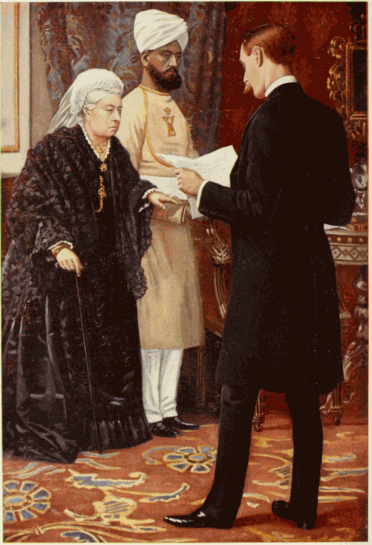
cannot be passed over. The Queen’s Speech struck a note of decision
that was at once comforting and in sympathy with her people.
Thus it ran: “I have witnessed with pride and the heartiest gratification
the patriotism, eagerness, and spontaneous loyalty with which
my subjects in all parts of my dominions have come forward to
share in the common defence of their Imperial interests. I am
confident that I shall not look to them in vain when I exhort them
to sustain and renew their exertions until they have brought this
struggle for the maintenance of the Empire and the assertion of its
supremacy in South Africa to a victorious conclusion.”
The Earl of Kimberley commented on the ignorance of the
Government regarding the military preparations that for years had
been going on in the Transvaal, and indulged in criticisms which
might have been weighty had his hearers not been tickled by the
strange irony of fate which converted into critic one of the authors
of the humiliating drama which had been left to shape itself from
the disastrous scena of 1881.
To these criticisms the Prime Minister—somewhat broken by
domestic bereavement—offered but a weak and depressing reply.
“How,” he asked, in regard to the Boer preparations, “could the
Government know what was going on?”
“I believe, as a matter of fact, though this must not be taken as official, that
the guns were generally introduced in the boilers of locomotives, and that the
munitions of war were introduced in piano-cases and tubs. But we had no
power of search, we had no power of knowing what munitions of war were sent
out. We certainly had no power of supervising their importation into the
Transvaal. It is a very remarkable peculiarity of the public opinion of this
country that people always desire to eat their cake and have it. They rejoice
very much with a spirit of complacency that we have a very small Secret Service
Fund. Information is a matter of money and nothing else. If you want much
information you must give much money; if you give little money you will get
little information; and considering the enormous sums which are spent by
other Powers, not least by the Transvaal Republic, in secret service—which I
was told on high diplomatic authority has been £800,000 in one year—and
comparing this with the ludicrously small sums which have for a great number
of years been habitually spent by English Governments, it is impossible for us
to have the omniscience which the noble Earl seems to regard as a necessary
attribute of Her Majesty’s Government.”
Further on he said:
“We must all join together to exercise all the power that we can give in
order to extricate ourselves from a situation that is full of humiliation and not
free from danger, though I do not say the danger may not be easily exaggerated.
Many a country has commenced a great war with difficulties of this
kind. We have only to look back at what the Northern States of America
went through at the opening of the Civil War to see how easy it would be to
draw a mistaken inference from the reverses which we have met at the opening
of this war. We have every ground to think that if we set ourselves heartily
to work and exert all the instruments of power we possess we shall bring this
war to a satisfactory conclusion. I think we must defer the pleasing task of
quarrelling among ourselves until that result has been obtained. We have a
work that now appeals to us as subjects of the Queen, as Englishmen, and it
must throw into shadow the ancient claims which party expediency has on the
action of all our statesmen.”
This speech concluded, Lord Rosebery suddenly sprang up, and
delivered himself with thrilling emphasis of sentiments which went
at once to the heart of the nation. Deeply he deplored the Prime
Minister’s speech, which made it hard for “the man in the street”
to support the policy of the Government.
The country, he insisted, had a right to know if there was adequate
information given to the Government before the crisis of the
Transvaal affair, or even sufficient to guide them in their diplomacy
or their negotiation. “That is a point which the nation will insist on
knowing, whether in this House or the other. If you had not sufficient
information, dismiss your Intelligence Department, dismiss Mr.
Conyngham Greene and your consular agents wherever they had
touch with this matter—at Lourenço Marques or elsewhere. If you
did know of it, you have a heavy responsibility to bear. The noble
Marquis asks, ‘How could we see through a deal board?’ I
suppose he meant by that to allude to the pianoforte cases in which,
with more knowledge than he gave himself credit for, he unofficially
states that the ammunition was brought into Pretoria.”
Passing on to the question of Secret Service money, he declared
that the Government was in possession of a very commanding majority
in the House, and that if they had the responsibility of Government
they were bound to ask for what funds, whether Secret Service
or other, which they might think necessary for the safety of the
Empire.
“They cannot,” he pursued, “devolve that responsibility on others by speaking
of the working of the British Constitution. I ask noble Lords to analyse the
speech of the noble Marquis, which is still ringing in their ears. It is the
speech of a Minister explaining a disastrous position. He practically has only
given two explanations of that situation. They are, first, that the Government
had not enough Secret Service money to obtain information, and, secondly, the
mysterious working of the British Constitution. I suppose that there are
foreign representatives in the gallery listening to this debate, and I suppose
that the speech of the Prime Minister will be flashed to-night all over Europe,
and Europe, which is watching with a keen and not a benevolent interest the
proceedings of our armies in South Africa, will learn that the causes of our
disasters are one avoidable and the other inevitable. The avoidable one is the
inadequate amount of the Secret Service Fund, and the inevitable one the
secular working of the British Constitution.”
Leaving the question of unpreparedness, he came to the great
point, and asked what the Government intended to do.
“There is a paragraph in the Queen’s Speech which I rejoice to see, of a
somewhat didactic character in its first sentence, but not without interest in its
second. ‘The experience of a great war must necessarily afford lessons of the
greatest importance to the military administration of the country. You will
not, I am convinced, shrink from any outlay that may be required to place our
defensive preparations on a level with the responsibilities which the possession
of so great an Empire has laid on us.’ The noble Marquis made no reference
to that paragraph, except to say that he does not think we shall see compulsory
service in the life of the youngest peer present. I do not affirm or question
that proposition, but I can say I do not think it is so immeasurably remote as
the noble Marquis considers that some form of compulsory service may have to
be introduced to meet the growing exigencies of the Empire. I am sure that
neither from this nor from any other sacrifice will the nation recoil to preserve
the predominance of our Empire. We have sent away from our island a
vast mass of troops which usually garrison it. Situated as we are in the
centre of a universe by no means friendly to us, that we should not have a
hint from the First Minister of the Crown what military measures the Government
propose to take in face of the disasters we have met with, and what
sacrifices we must inevitably be called on to make to redress them, is one of
the most extraordinary features of the working of the British Constitution on
which the noble Marquis has laid such great stress. I agree with him
in saying that the country will carry this thing through. It will carry
it through in spite of all the impediments, both of men and of methods, that
have shackled it in the past; but I venture to say that it will have to be
inspired by a loftier tone and by a truer patriotism than we have heard from
the Prime Minister to-night.”
Mr. Balfour, in the House of Commons, was as damping to
popular hopes as the Prime Minister in the House of Lords.
Regarding the all-important subject of the under-estimation of
the Boer strength, he somewhat airily said:
“It will be asked, How comes it, then, that this great under-estimate of the
Boer strength was made if we knew approximately what the Boer armaments
were, and what Boers were likely to take the field? I do not know that I have
got any very satisfactory answer to give to that question. It is a purely and
strictly military problem, and, as history shows, it is a kind of problem very
difficult to answer satisfactorily. You can gauge the military strength of a
European nation with a fixed army, with all their modern military apparatus, and
with all their military statistics at your disposal; but when you come to problems
of States whose military organisation is not of that elaborate kind,
great mistakes have been made in the past, and I doubt not great mistakes
will be made in the future. They certainly have been made by almost
every military nation of whom we have any record. But if this is regarded as
an attack upon the military experts of the War Office, it is surely an unfair
attack, because soldiers, who are not especially given to agreeing with one
another, were absolutely unanimous upon this point. I do not believe you will
be able to quote the opinion of a single soldier of any position whatever, or of
no position, delivered before, say, July 31 or August 31 last, indicating any
opinion which will show that the force which we in the first instance sent out
would not be amply sufficient, or more than amply sufficient, for all purposes.
(Cries of “What about Butler?”) The right hon. gentlemen put a question to
me about Sir W. Butler. We had not the slightest trace at the War Office in
any communication, public, semi-public, or private—no communication of any
sort, kind, or description, which indicated that in Sir W. Butler’s opinion the
force we sent out was not sufficient—I was going to say doubly sufficient—for
any work that it might be called upon to perform.”
Indeed, the whole tenor of the speech was generally regarded
as unsatisfactory and dispiriting. It was felt that, as Lord Rosebery
expressed it, the Government must be left to “muddle through”
somehow. People who hung anxiously on the lips of the Government
for definite statements regarding future resolute action were
disappointed, and waited wearily the conclusion of the debate.
On February 1, Sir Charles Dilke drew vigorous comparisons
between the present and former campaigns. In regard to our lack
of artillery he said:
“All our generals had told us that direct artillery fire had failed against the
Boer entrenchments. It had been known for years past that direct artillery
fire would be likely to fail against strong entrenchments; yet we sent twenty-one
batteries of field-artillery to South Africa before the first one of the three
howitzer batteries was despatched. It was one of the strongest charges which
he and others had brought against the War Office for some years, that our
army was more badly supplied with field-artillery than any other army in the
world. It was not even comparable with the field-artillery of Switzerland and
Roumania. In regard to our guns, the Leader of the House had stated in a
speech at Manchester that we had guns in South Africa sufficient for three
army corps of regular troops. He should like to know on whose authority the
right hon. gentleman made that statement. The first force sent to South
Africa from India was supplied with guns, not on that scale, but still in fairly
decent and respectable measure. The forces of Lord Methuen and Sir Redvers
Buller fell altogether short of even the scale adopted for the Indian Contingent.
Both these generals had themselves called attention to their deficiency in
this respect. We had not even now got artillery on anything like the scale
laid down by the right hon. gentleman, and we could not have it in South
Africa, because we had not got it in the world. In these circumstances
he could only characterise the statement of the Leader of the House as entirely
erroneous and misleading, and altogether a blunder. With regard to the
batteries which were even now being sent out, many of them were manned
by reservists and by garrison artillerymen, who had had no experience in the
handling of modern field-guns.”
Proceeding to the question of lack of cavalry, he argued:
“With regard to cavalry as with regard to artillery, the first force was well
supplied, but the forces of Lord Methuen and General Buller were very
deficient in that respect. In that connection the First Lord had made an
attack on the critics of the War Office. He said they had not seen, or if they
had seen had not insisted on, a novel fact in the present war, namely, that for
the first time in the history of the world they had seen an army composed
entirely of mounted infantry. The right hon. gentleman had only
to read Sir William Butler’s ‘Life of General Colley,’ where he would
find very marked attention drawn to that matter. As to the Defence Committee
of the Cabinet, of which the right hon. gentleman was a member, though he
himself had been spoken of as the author of that body, he must admit that it
had failed. It was instituted after a correspondence in which he himself, his
hon. friend (Mr. Arnold Foster), and Mr. Spenser Wilkinson took part, and it
was not new to the present Government. It was instituted in the time of Lord
Rosebery’s Government as a Committee of the Cabinet, but it had been proclaimed
to the world in the time of the present Government. It had
failed on account of the slackness of those who attended the deliberations
of the Committee. It had not been worked as the authors of the proposal
thought it might have been worked in the interests of the Empire. The
Committee ought to have foreseen these difficulties with respect to mounted
men; they were foreseen by military men. Though political differences
occurred between Sir A. Milner and Sir W. Butler, Sir A. Milner consulted
General Butler on the military aspect of the situation, and General Butler’s
opinions were known to the Government, or should have been. They were
known to Sir A. Milner at any rate and were not concealed by him when
he was in this country a year ago. According to his (Sir C. Dilke’s) information,
which reached him immediately after the statement had been made to
Sir A. Milner, General Sir W. Butler declared that 60,000 men would be
required in Cape Colony and 25,000 men in Natal. Leaving that, however,
what was the attitude of the Cabinet with regard to the need for cavalry?
They telegraphed to the Colonies to refuse mounted men. They gave
their reasons in the telegram of October 3: ‘In view of the numbers
already available, infantry most and cavalry least serviceable.’ On December
16 they telegraphed to the Colonies, ‘Mounted men preferred.’ After all
the loss of life that had taken place, and the months of checks and reverses,
they had discovered what competent soldiers had discovered before the war,
and must have told them, that mounted men were essential for a campaign
of this kind.”
In reply, the Under-Secretary of State for War made the first
telling and apposite statement which had been furnished for the
Government during the course of the proceedings. His exposition
was straightforwardness itself. Though merely the mouthpiece
of the Government, Mr. Wyndham gave utterance to definite statements
which created a very favourable impression throughout the
country, and served at once to wipe away the taste of foregone
pronouncements. He said:
“Every one to his dying day would look back with regret on the great
many disasters which had followed, but no one could ever know what would
have happened if the other course had been adopted. It was very easy to
conceive that if Sir G. White had not stayed at Ladysmith and Sir R. Buller
had not gone to his relief disaster might have been developed in another line,
and that there might have been that universal rising of the Cape Dutch which,
thank Heaven, had not occurred. When it was stated that Lord Methuen had
not sufficient cavalry and artillery with him, it must be remembered that Lord
Methuen was hurried off to the Orange River, and, as a matter of fact, he
arrived on the frontier in fewer days than the German army reached the
French frontier, and he had not with him the cavalry, which had been
diverted for the relief of Ladysmith and other purposes. On the morrow after
Nicholson’s Nek three more battalions were sent from home, though none had
been asked for, and Lord Landsowne offered a sixth division. In reply, he
was told that preparation was desirable, but that there was no immediate
need for its despatch. The situation was again changed by the reverses at
Stormberg and Magersfontein and the check at Colenso. Thereupon the
sixth division was ordered to embark without any communication from South
Africa, and at the same time the seventh division was ordered to be mobilised.
On December 15, the day after his check at Colenso, Sir R. Buller asked for
the seventh division, the mobilisation of which had already been ordered, and for
8000 mounted irregulars from this country. Lord Landsowne replied that the
seventh division would embark on January 4, which it did. Next day the
first step was taken in connection with the raising of the Imperial Yeomanry,
and volunteers were invited to come forward in order to fill the places left
vacant by the raising from each battalion of one company of mounted infantry.
The patriotism of the Militia was also appealed to, and fourteen battalions
were now serving in South Africa, while others were on the way. A great
military authority once said, ‘When a battalion is asked for, send a brigade.’
That had been the course pursued by Lord Landsowne.”
In regard to the number of our guns, Mr. Wyndham continued
his argument in the following terms:—
“As the right hon. baronet had pressed for information with regard to
the number of guns which had been despatched to South Africa, it would not
be out of place to tell the House that we had sent and were sending 36 siege
train heavy guns; there were already there 38 mobile naval guns, and in
addition to these there were 36 5-inch howitzers carrying a heavy shell charged
with 50 lbs. of lyddite, in all 110 guns, some of them with a range of 10,000
yards, and all capable of throwing heavy shells. Besides these there were 54
horse-artillery guns and 234 field-artillery guns, in all, counting the howitzers,
324 guns capable of accompanying troops in the field. Including the two
mountain batteries, there were altogether 410 guns in South Africa, without
reckoning the guns that were going out with the Volunteers and the Colonials,
which would bring the number up to 452.”
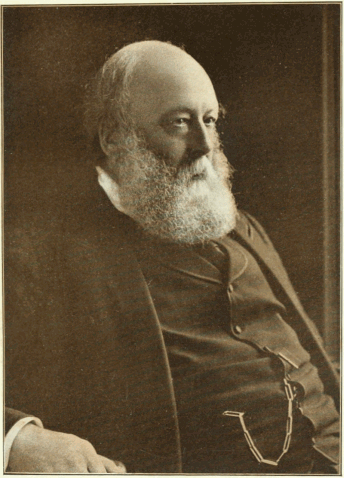
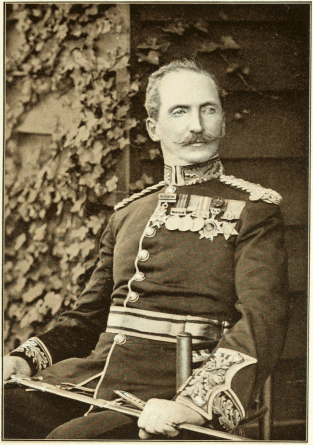
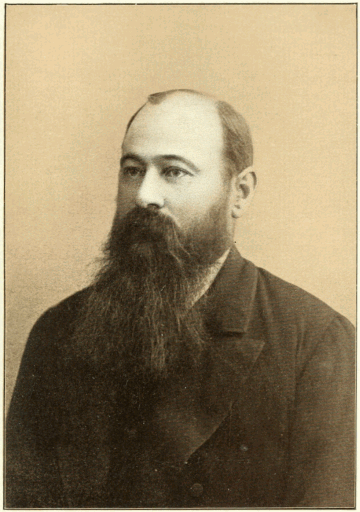
THE MARQUIS OF SALISBURY, K.G.
PRIME MINISTER AND FOREIGN SECRETARY.
Photo by Russell & Sons, London.
Then taking the subject of mounted troops, he went on:—
“On the question of mounted troops, it had been said that the Government
announced to the world their conviction that unmounted troops were the kind
of troops most suitable to South African warfare. The word ‘mounted’ was
never used. However, he would not insist on that, but he did think that those
who had quoted this opinion so often should consider when they were used,
because then they would see that they gave no indication that the Government
held the opinion attributed to them. As a matter of fact, since the outbreak
of the war the Government had sent out a larger proportion of mounted troops
than was usually contemplated, because they believed that mounted troops were
especially suited to go to Africa. The time at which the phrase was used that
infantry was most wanted and cavalry least wanted was on October 3, before
the ultimatum was sent, before the war began, and at a time when Sir R.
Buller was satisfied that an army corps, a cavalry division, and the necessary
troops for the line of communication, giving 50,000 men in addition to the
25,000 already in South Africa, was an adequate force. When the question
of the Colonial Contingents was first raised, Queensland offered 250 and New
Zealand 200 mounted infantry, and the 108 New South Wales Lancers then in
this country volunteered, making in all 558 mounted men. No specific offer
was received from the other Colonies, but they expressed a wish that they
might be allowed to take some part in the campaign. He thereon consulted
Sir R. Buller as to the number that should be asked for in order that each
Colony might be represented more or less in proportion to their respective
populations. Sir Redvers stated that it would be easier to give the Colonial
troops an immediate place at the front if they were invited to contribute
manageable units of 125 men each. If the original offers of the Colonies
had been accepted, there would have been 1375 more mounted men at the
front at an earlier date, when no one contemplated that the force sent out
would be insufficient for its task. The Colonial Legislatures have not changed
their note in consequence of the disappointments and reverses which have
been experienced, but have made further offers—an example which might well
have been followed nearer home. Altogether there had been accepted from the
Colonies 2075 unmounted and 4678 mounted men. The proportion of mounted
to unmounted troops in South Africa at four different periods were: In the
original garrison, 7600 unmounted and 2000 mounted; on October 9, the day
of the ultimatum, 12,600 unmounted and 3400 mounted; on January 1, 83,600
unmounted and 19,800 mounted; while the total number of troops in South
Africa, not including the Fourth Cavalry Brigade, were 142,800 unmounted
and 37,800 mounted, and in the next fortnight or three weeks there would be
out there 180,600 of all arms.”
Sir Edward Grey said:—
“He was giving the right hon. gentleman some instances of the value of
the support from his side. The primary object of the policy which had ended
in the war was not to drive the Boers from British territory, as they were not
then on it. The primary object was not to plant the British flag at Pretoria
and Johannesburg. These two things might be the result of the war, but they
were not the primary objects of the Government policy. The objects which he
wished to see attained, and which he would pledge himself to give the utmost
support to the Government in attaining, were, first, equal rights between all
white men in South Africa, and by that he meant that never again should a
situation arise in any part of the British sphere in which a modern industrial
community should be placed under the heel of an antiquated minority which
was dominated by prejudice and governed by corruption. The second object
was that never again in South Africa should it be possible for arsenals to be
formed or an accumulation of military material under any control except British
control. That was the end to be attained, and to that end the Government
would have support.”
On the 3rd of February Mr. Bryce expressed his opinions. He
affected to disbelieve that there had been any Dutch conspiracy to
drive the British from South Africa, and considered that, owing to
the menace of the Government in the arrangement of negotiations,
the meek Boer had no resource but to prepare for war.
Mr. Goschen admitted the gravity of the situation and the responsibility
of the Government en masse. The Cabinet, he decided,
must stand or fall together. The Admiralty, in acceptation of its
responsibility, had assisted the army with heavy guns without weakening
its resources. Lastly, he touched enthusiastically on the
exhibition of Colonial loyalty:—
“Before concluding I must say a word with reference to the Colonists.
They have been supporting us with unstinted loyalty and unstinted generosity.
There has been a spirit shown by the Colonies of affection to the mother
country which has been the admiration of the world. May we not suggest
that that unstinted loyalty and that unstinted generosity is to some extent
a reward for the consideration which has been shown the Colonies for some
time past; and is it not right to remember that for years there has not been a
Secretary for the Colonies who has so endeavoured to win the affection of the
Colonies as the right hon. gentleman who now holds that office? You tax us
with not having shown foresight and judgment. At all events our treatment
of the Colonies has ensured, not their loyalty—that will always be there—but
the enthusiastic impulse of the Colonies to come to the assistance of the mother
country. We have a great work to do; we want to do that work, and now
hon. gentlemen opposite move an amendment the only object of which could be
to damage and weaken the Government, who are the instruments of the national
will. If hon. gentlemen opposite do not wish to take our places and to bear
the burden which rests on our shoulders, is it wise to endeavour to shake the
confidence of the country in the men who must continue this war, and gather
together all the forces of the Empire to bring it to a successful conclusion?
Supposing there should be a division which could be called a bad division for
the Government, what would the cheers which would greet that division mean?
They would mean, ‘We have succeeded in damaging and weakening the
Government.’ The time may come when we will be damaged. If the war is
not successful, sweep us away as men who have no judgment, but do not lame
the arm of the Executive Government when they have such a work on hand as
we have got to do. There has been patriotic co-operation between us and some
of the Liberal Party. We thank them for it. I believe this is a Parliamentary
bad dream—an interlude between the patriotic attitude of these gentlemen a
few weeks ago and the patriotic attitude which I hope we may look forward to
when this debate closes. They have assured the country they will support us
in going forward. I thank them for that, for it is more important than the
petty criticisms to which we have been treated. We are the trustees of the
nation for the work that has to be done. The nation will support us, I believe;
and so long as we receive that support, God willing, we will fulfil our task.”
Sir E. Clarke, among other things, said:—
“He did not believe the annexation of the Transvaal and the Orange Free
State would be of the slightest benefit to the country. The annexation of the
two Republics would compel us to very greatly increase our already enormous
military expenditure, and it would not give us any advantage commensurate
with the difficulties of administration. He had no desire to press his own
views, which were singular, and certainly not popular, on that side of the
House. He only pleaded that this question might be left open, and that
Ministers might not pledge themselves to a course which would involve so
great a sacrifice. While he agreed generally with the doctrine of Cabinet
responsibility, he considered that the real responsibility for the war lay with
the Colonial Secretary. The Prime Minister, in whom all England put the
greatest confidence, having many other things to deal with, and being distressed
by domestic anxieties, might not have been able to attend so closely as he
otherwise would have done to South African affairs; but it could not be gainsaid
that there were two men, one in this country and the other in South Africa,
who must be associated with the beginning of the war. He wished that the
highest sentiments of patriotism would induce those two men to leave to others
the positions they now occupied. He believed that the difficulties involved in
a solution of the questions arising out of the war would be increased by the fact
that the lines of communication and action in South Africa were in the hands
of the Colonial Secretary and Sir A. Milner. He had not a word to say about
the honesty of these two gentlemen; but if, for a few weeks or a few months,
in this grave national crisis and time of deep anxiety, others could take their
places—if the Prime Minister himself would take under his own control the
communications of the Colonial Office with South Africa, and if Lord Rosebery
would give his services to the country, and go out to South Africa to assist in
a solution of the difficulties, it would be a sacrifice not too great to ask even
from the greatest men among us, and one for which the country would be very
grateful. He had said that he was not going to make a controversial speech.
He did not think he had. If he had, it had been with no intention of personal
attack or party bitterness, but with the deep conviction that in deciding on the
great issues with which Parliament had to deal we had to consider not only the
things of to-day but the things of the future.”
Mr. Chamberlain’s speech on the 5th of February was an
advance on former proceedings. Sir William Harcourt dilated on
the indomitable energy of a free people fighting for their independence,
praised the gallantry of the troops, and blamed the Government
for being led by the opinions of the authors of the Jameson
Raid, to which the Colonial Secretary made dignified reply. Finally
he questioned—
“How do we meet the charge of mistakes? Not by denying the mistakes,
but by saying what we have done and what we are doing to repair them. You
say we sent too few troops. We are pouring troops into South Africa, and, as
you have been told, in a few weeks you will have an army of 200,000. You
said we were forgetful of the need for mounted men. We have been increasing
the number of horse infantry until in a very short time the number of
mounted men in the British forces will be almost as great, if not as great, as
the total number of mounted men in the Boer army. You say our artillery is
deficient and not heavy enough. We have sent battery after battery, until now
you have an unexampled force of that arm. We have at the same time added
a number of heavier guns. When the war began, no doubt the needs of the
war were under-estimated at that time; it is part of the same mistake. We
failed to respond as we ought to have done to the splendid offers that came from
our Colonies. We accepted enough to show how much we valued their assistance,
but we hesitated to put on them any greater strain than necessary. But
what is happening now? They are multiplying their forces, and every offer
is gratefully and promptly appreciated and accepted. And we shall have
in this war before it is over an army of Colonials called to the aid of Her
Majesty who will outnumber the British army at Waterloo and nearly equal to
the total British force in the Crimea.”
In conclusion he said:—
“In Africa these two races, so interesting, so admirable, each in its own
way, though different in some things, will now, at any rate, have learned to
respect one another. I hear a great deal about the animosity which will remain
after the war, but I hope I am not too sanguine when I say that I do not believe
in it. When matters have settled down, when equal rights are assured to both
the white races, I believe that both will enjoy the land together in settled peace
and prosperity. Meanwhile, we are finding out the weak spots in our armour,
and trying to remedy them. We are finding out the infinite potential resources
of the Empire; we are advancing steadily, if slowly, to the realisation of that
great federation of our race which will inevitably make for peace, liberty, and
justice.”
On the following night Mr. Asquith, on Talleyrand’s principle—that
speech is given us to hide our thoughts—dilated interestingly
on the position, his sympathies oscillating between the Opposition,
the Government, and Mr. Kruger. Sir Henry Campbell Bannerman
declared it to be the duty of the Opposition to press Lord
Edmond Fitzmaurice’s amendment to a division. He inferred that
the conspiracy of the Cape Dutch was a chimera, and went so far
as to suggest that when our military supremacy was asserted in
South Africa the question of settlement might be left to decide itself
sine die! Said he: “Provided that our territories are free and our
military supremacy asserted, what matters it at what time or what
place a settlement is arrived at?”
In his reply Mr. Balfour distinguished himself. He said that it
was discovered that the War Office has more than fulfilled its promises,
and appealed to the members of the Opposition who sympathised
with the justice of the war to reflect before voting for the
amendment. It was necessary to help the soldiers at the front by
proving to them that they were supported by a united country, and
that every hostile vote might induce or encourage our opponents to
prolong the contest. He concluded by saying:—
“Can they contemplate with equanimity that their first action in a session
of Parliament meeting under such circumstances should be a weakening of the
Government, whose hands they profess to desire to strengthen—whose hands I
believe they genuinely desire to strengthen—in every succeeding operation connected
with this war? Can they contemplate with equanimity the reflection
that possibly their votes may lengthen the war, and, by lengthening it, may
increase that tragic list of losses with which we are already too familiar? If
in giving their vote they add one fraction to the chances of a European complication,
one fraction of a chance that an unnecessary life may be lost or a
family thrown into mourning, can they easily reconcile that with their duty
towards their own principles and to that country of which they are, I believe,
as devoted servants as we on this side of the House? I think it is a violation
of every Parliamentary tradition that men who desire to keep in office a
Government should vote for an amendment which, if carried, will turn out that
Government, and that it is contrary to every patriotic instinct to vote in a
minority against the Government. The size of that minority will affect the
whole course of European policy, the whole course of the war. I have stated
the problem as it presents itself to my mind. I know that you are men of
conscience and honour, and I must leave it to you to decide the problem, each
man in his own case as his conscience and honour dictate. To the House at
large I can only make one appeal. It is that we, who are the representatives of
the country, may rise to the height reached by those whom we represent. I ask
no more, and I can ask no more, of the House than that they should imitate, for
they cannot exceed, the courage, steadfastness, resolution, and firmness under
adversity, and the calmness of temper with which our countrymen all over the
world have dealt with the situation in its entirety. If the House of Commons
do, as no doubt they will, imitate, for they cannot better, the conduct of those
who have sent them here, then who can doubt that the clouds by which we
are at present surrounded will in a short time be dissipated and the Empire will
issue from the struggle in which it is now engaged stronger, not only in its own
consciousness of strength, but in the eyes of the civilised world.”
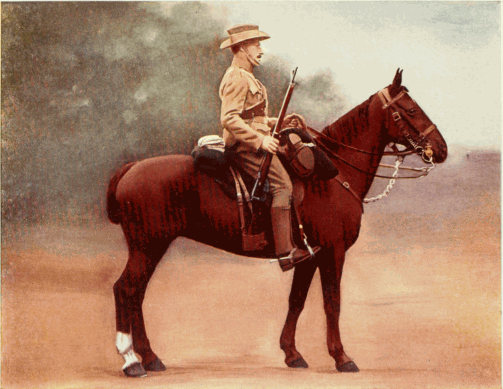
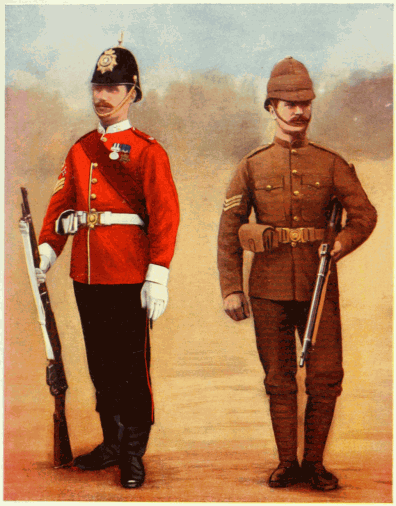
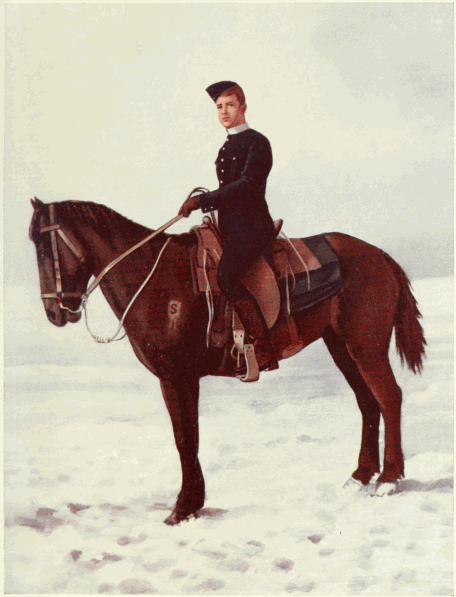
SERGEANT OF THE IMPERIAL YEOMANRY.
Photo by Gregory & Co., London.
In the end, by 352 to 139—a majority of 213—the vote of
censure on the Government moved by Lord Edmond Fitzmaurice
was defeated. The decision adequately expressed the feelings of
the country. It must be remembered that many of the Government
supporters were in South Africa, consequently a total poll of 491
represented a heavy vote. The following list serves to show the
number of members of both Houses who had sacrificed party spirit
to patriotic convictions, and had proceeded to the front:—
House of Lords.—Earl of Airlie, commanding 12th Lancers; Earl of
Albemarle, lieutenant-colonel, City of London Imperial Volunteers; Lord
Basing, major, 1st Dragoons; Lord Castletown, special service, South Africa;
Lord Chesham, commanding a battalion of Imperial Yeomanry; Earl Cowley,
lieutenant, Imperial Yeomanry; Lord Denman, lieutenant, Imperial Yeomanry;
Earl of Dudley, D.A.A.G. for Imperial Yeomanry; Earl of Dundonald, C.B.,
major-general, commanding 3rd Brigade (Natal) Cavalry Division; Earl of
Dunraven, captain, Imperial Yeomanry; Earl of Erroll, special service, South
Africa; Earl of Essex, second in command of battalion of Imperial Yeomanry;
Earl of Fingal, lieutenant, Imperial Yeomanry; Lord Kitchener of Khartoum,
G.C.B., K.C.M.G., Chief of the Staff; Earl of Leitrim, lieutenant, Imperial
Yeomanry; Earl of Longford, captain, Imperial Yeomanry; Lord Lovat,
captain, Lord Lovat’s Corps; Duke of Marlborough, staff captain for Imperial
Yeomanry; Lord Methuen, K.C.V.O., C.B., commanding 1st Division in South
Africa; Duke of Norfolk, K.G., captain, Imperial Yeomanry; Lord Roberts of
Kandahar, K.P., G.C.B., G.C.I.E., G.C.S.I., V.C., Field Marshal Commanding-in-Chief;
Lord Romilly, special service, South Africa; Lord Rosmead, major,
6th Battalion Lancashire Fusiliers; Duke of Roxburghe, lieutenant, Royal
Horse Guards; Earl of Scarborough, second in command of battalion of
Imperial Yeomanry; Earl Sondes, lieutenant, Imperial Yeomanry; Duke of
Westminster, A.D.C. to Governor; Lord Wolverton, second lieutenant,
Somersetshire Yeomanry Cavalry; Lord Zouche, lieutenant, Imperial Yeomanry.
House of Commons.—Mr. W. Allen, trooper, Imperial Yeomanry;
Hon. A. B. Bathurst, captain, 4th Battalion Gloucester Regiment; Colonel
A. M. Brookfield, commanding battalion of Imperial Yeomanry; Lieutenant-Colonel
R. G. W. Chaloner, commanding battalion of Imperial Yeomanry;
Hon. T. H. Cochrane, captain, 4th Battalion Argyll and Sutherland Highlanders;
Lord A. F. Compton, captain, Imperial Yeomanry; Viscount Cranborne,
commanding 4th Battalion Bedford Regiment; Mr. W. Bromley-Davenport,
captain, Imperial Yeomanry; Sir J. Dickson-Poynder, lieutenant,
Imperial Yeomanry; Viscount Folkestone, major, 1st Wilts Volunteer Rifle
Corps; Mr. W. R. Greene, lieutenant, Imperial Yeomanry; Hon. J. Guest,
lieutenant, Imperial Yeomanry; Mr. G. Kemp, captain, Imperial Yeomanry;
Mr. E. H. Llewellyn, major, 4th battalion Somerset Light Infantry; Mr.
H. L. B. McCalmont, commanding 6th battalion Royal Warwick Regiment;
Mr. F. B. Mildmay, lieutenant, Imperial Yeomanry; Viscount Milton, lieutenant,
Imperial Yeomanry; Mr. D. V. Pirie, with Remounts Department, South
Africa; Lord Stanley, special service, South Africa; Lord Edmund Talbot,
special service, South Africa; Viscount Valentia, A.A.G. for Imperial Yeomanry;
Major W. H. Wyndham-Quin, captain, Imperial Yeomanry; Major
the Hon. H. V. Duncombe, adjutant, Imperial Yeomanry; Sir Elliott Lees,
captain, Imperial Yeomanry; Sir S. Scott, lieutenant, Imperial Yeomanry.
There was little bombardment after the 25th of November, and
though not living on the fat of the land, the garrison was not
short of provisions. Mr. Rhodes, with characteristic forethought,
now caused the formation of a committee to inquire into the resources
of those dependent on the men killed, with a view to compensating
them for their loss, and in other ways exerted himself for the
welfare of sufferers in the town.
Considerable friction occurred between the civil and military
authorities. The clashing of wills was inevitable in so small an
area, for Colonel Kekewich represented military power, while Mr.
Rhodes could be no other than he is, and ever has been—a power in
himself. It was unfortunate that two such forces should have been
placed in collision, but it remains to the credit of both that, in spite
of the tension of the situation, they should have co-operated to the
end to save the town from the common enemy, and protect the
interests and lives of all who, but for this co-operation, might have
suffered much more intensely than they did.
Early on the morning of the 9th of December a force with a
battery under Colonel Chamier—to whom the efficient and mobile
condition of the artillery was due—made a reconnaissance to the
north. The Lancashire’s Mounted Infantry and two guns were
posted on Otto’s Kopje while the Cape Police protected the Dam
Wall. The Kimberley Light Horse in the centre extemporised some
rifle-pits out of some prospectors’ huts in order to cover retreat when
necessary.
The enemy were screened by the debris of a wall at Kamfeens,
but when the boom of the British gun burst out and a shell roared
in their midst, they hurriedly sought cover in their foremost rifle-pits,
whence with great energy they “sniped” in the direction of the
officers who were superintending the operations. Meanwhile tremendous
barking of cannon and pinging of rifles continued, the
Boers having got the range of Otto Kopje to perfection. The
troops had an exceedingly hard time, but continued their operations
till dusk. They lost only one killed and four wounded.
On the wise principle that it is safer to act early on the aggressive
if you do not want to have to act late on the defensive, the
smart little force indulged in more military movements.
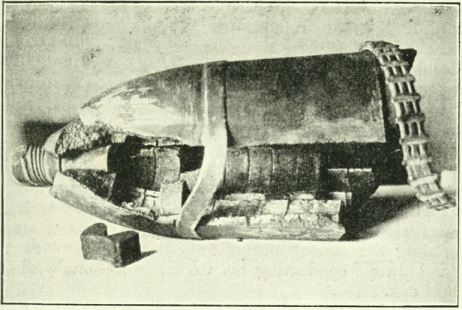
Shell Picked up in Kimberley Streets.
Photo by Alf. S. Hosking, Cape Town.
Colonel Kekewich’s general plan for the defence of Kimberley was
based on the principle of always keeping the enemy on the move and
constantly in fear of attack from an unexpected quarter, but the immediate
object of the numerous sorties and demonstrations in force now
made by the garrison was to assist the operations of Lord Methuen.
The Colonel explained that, “when the advance of the Relief Column
from the Orange River commenced, and I was put in possession of information
concerning the probable date of its arrival at Kimberley,
I adopted such measures as I hoped would cause the retention of a
large force of the enemy in my immediate neighbourhood, and thus
enable the Relief Column to deal with the Boer force in detail.”
As the portions of mounted corps were continually employed, the
work which fell on the detachment, 1st Batt. Loyal North Lancashire
Regiment, Cape Police, Diamond Fields Horse, Kimberley Light
Horse, and the Diamond Fields Artillery, was very arduous; but
the bravery and dash of these troops was unending. Colonel
Murray, of the Loyal North Lancashire, was invaluable in many
capacities, and Captain O’Brien of the same regiment, in command
of a section of the defences, was unfailing in energy and zeal. Cool
as the proverbial cucumber were Major Rodger of the Diamond
Fields Horse and Major May of the Diamond Fields Artillery.
The motto of these officers was the reverse of that of the notable
gens d’armes, for they were “always there when wanted,” and generally
in the fore-front. The officers of the Kimberley Regiment, too,
were conspicuous for courage, coolness, and sagacity. They knew
as by intuition what was wanted and did it. From Colonel Finlayson,
who commanded the regiment, to Surgeon-Major Smith, who tended
the wounded in the field, there was none who did not contribute to the
stock of efficiency which was placed at the disposal of the Colonel.
On the 20th of December, the mounted detachments under
Colonel Peakman, with maxims and 7-pounders under Colonel May,
started off in the pitch darkness of 2 A.M., and marched through
Kenilworth in the direction of the wreck of Webster’s Farm, and on
towards Tollpan in the Free State. British cannonading then took
place, the Kimberley guns shelling Tollpan Homestead at 2500
yards’ range, and the Boer gun on Klippiespan ridge returning the
compliment with interest. Fortunately the hostile shells burrowed
deep in the sandy soil, and consequently little damage was done.
The Boers were found to be very comfortably situated at the three
corners of a six-mile triangle—at Coetgie, Scholtz, and Alexandersfontein—commanding
three separate sources of water supply.
This reconnaissance was of importance, as the positions of the
enemy’s guns and outposts were determined, and the garrison was
enabled to be on guard against raiders and snipers, and to protect
itself, its patrols, and cattle from the fire of the enemy. In the
matter of protecting the cattle from the tricks of the Dutchmen, as
in many other ways, Mr. Fynn, manager of the De Beers farms,
did splendid service. This gentleman was Mr. Rhodes’s right-hand
man, and as a natural consequence of the honour he enjoyed rose
to every occasion that offered, now managing a corps of scouts, now
superintending the conveyance of food, now dealing with truculent
natives, and always conducting his varied avocations with immense
energy and tact.
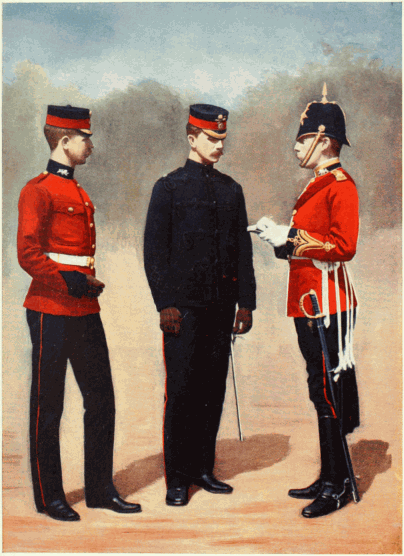
| Lieutenant. |
Captain. |
Adjutant. |
THE ROYAL LANCASTERS.
Photo by Gregory & Co., London.
On the 22nd of December a good deal of martial activity took
place. At cockcrow a detachment of mounted forces, with artillery
and infantry, went west for the purpose of reconnoitring Voornitzright
and part of Weldermstkuil. On the right were the Diamond
Fields Horse under Major Rodger, supported by a company of the
North Lancashire Regiment under Lieutenant de Putron. Presently
an animated cannonade began between the enemy’s artillery from
Kamferdam and the Diamond Fields Artillery guns on Otto’s Kopje.
In the centre Colonel Peakman, with the Kimberley Light Horse
and Cape Police, proceeded along Lazaretto Ridge. There, before
retreating, he made the necessary discoveries—firstly, that the Boer
patrols were then the only occupants of the place, and secondly,
that the enemy’s reinforcements were advancing behind Wimbledon
Ridge. Meanwhile Colonel Chamier on the left, with R.A. guns
and an escort under Major Snow, was exchanging salutations with
the Boer guns posted in the earthwork in the centre of Wimbledon
Ridge. This occupation was pursued for some time, during which
the enemy were found to be rapidly approaching. Directly the guns
were limbered up some 500 Boers came on the scene, and began to
pour a fierce fire from the earthworks at the foot of the Ridge upon
the Kimberley troops, who retired to cover. The object of the
reconnaissance was gained, however, for it proved in what an
inconceivably short space of time the enemy could summon his
reinforcements, and, moreover, that three of his guns were yet in
the neighbourhood of the town.
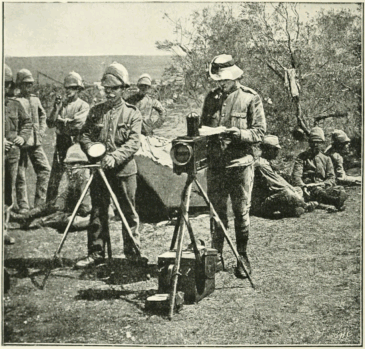
On Christmas Eve congratulations were received by flashlight
signals from the Military Secretary at Cape Town:—
“Convey to Colonel Kekewich and all the garrison and inhabitants of
Kimberley his Excellency’s best wishes for their good luck on Christmas Day
and in the coming New Year.”
Colonel Kekewich replied:—
“Kindly inform the Military Secretary that I and the garrison and inhabitants
of Kimberley thank his Excellency for his kind message. We also wish respectfully
to offer our very best wishes for Christmas and New Year.”
This little interchange of compliments caused infinite pleasure to
those whose days were one unvarying round of trial and suspense. The
weather was exceedingly hot; at times the thermometer registered
105° in the shade, and life without absolute necessities in torrid
weather is trying even to the patience of the active. To those whose
intercourse with the world was confined to flashlight signals, it was
barren in the extreme. But with much pluck they thus announced
their sentiments in a journal called the Diamond Fields Advertiser,
which still maintained a languishing existence: “Excepting two or
three of our inhabitants who shared the terrible privations of the siege
of Paris, few of us have ever spent such a Christmas before, and few
will ever care to spend such a Christmas again. The scarcity of
turkeys and plum-pudding at this time of traditional plenty need
only distress the gourmand. The majority of the people of Kimberley
are happily made of sterner stuff, and do not look for luxuries
in a time of siege.” They were nevertheless not utterly plum-puddingless.
Mr. Rhodes, with characteristic forethought, had caused
to be cooked in the Sanatorium some two score of these bombshells
to digestion, and had distributed them in each of the camps. Here
they were devoured with much merrymaking and a general interchange
of felicitations, which went on by telephone from one camp
to another. From the Mounted Camp to the Royal Artillery:
“Best wishes and longer range to your guns.” From the gunners,
in return, while they kept one ear open for movement in the
direction of the Boers’ “Susannah:” “May our range be always
long enough for us to be guardian-angels to the Mounted Corps.”
On the following day the artillery was at work responding to the
salutes of the Boers, who commenced to fire with great activity
after their Christmas rest. They dropped some thirty-five shells
in the direction of the fort, and received nineteen well-directed
replies. Two of the mines were fired by the thunderstorm of the
previous night, but no one was injured. Food now was becoming
more and more scarce, and those connected with the distribution of
provisions had to exercise much forethought and economy.
The task of arranging for the victualling and supply of the
garrison and 40,000 people in the town was undertaken by Major
Gorle, Army Service Corps, and the zeal and resource which he
brought to bear on his onerous duties were applauded on all sides.
Of course there were found persons who, on the take-everything-from-everybody-else-and-give-it-all-to-me
principle, thought they were
badly treated, but these were the exception rather than the rule.
The arrangements for milk were made by a special civil committee,
consisting of Mr. Oliver, the Mayor, whose courage and energy in
keeping up the spirits of the people were wonderful, Mr. Judge,
and four visiting surgeons of Kimberley Hospital, Doctors Ashe,
Watkins, Mackenzie, and Stoney. These made themselves notable
for the untiring energy with which they devoted themselves to their
incessant duties. They kept a sharp eye on the milk, serving it out
cautiously at the depôt, and only to those who had a medical certificate
that they required it. The Colonel was very appreciative of the help
given by most of his civilian coadjutors, for, in reference to the difficulties
of his position, he stated in his despatch: “It will be realised
that, under the peculiar circumstances in which the defence of the
scattered town, containing over 40,000 inhabitants and much valuable
machinery, was entrusted in the first instance to a force consisting
of about 570 Imperial troops and 630 Colonial troops, my efforts
would have been of no avail had it not been for the valuable assistance
and advice which many citizens afforded me in a military as
well as a civil capacity.”
Mr. Henderson, Captain Tyson of the Kimberley Club, and
Dr. Smart collaborated with the ruling spirit of the place, organising
relief committees, distributing thousands of pints of soup per diem,
and apportioning such fruit and vegetables as were to be had for the
good of those who were most sorely in need. That green stuffs were
scarce may be gathered from the fact that the allowance for nine
people for half a week was a bunch of five carrots, four liliputian
parsnips, and several beets (duodecimo editions). The garrison,
later on, were glad of mangel-wurzels, when quantity rather than
quality came to be appreciated.
The Boers were now beginning to build redoubts on Dronfield
Kopjes, about a mile east of the railway and in a northerly direction,
showing that whatever withdrawals might be going on from besieged
places elsewhere, the City of Mines would receive its due of attention
up to the last. The Boer prisoners inside the town presented
quite a rejuvenated appearance, owing to the delicate attentions of
Mr. Rhodes. Christmas saw them provided with new outfits, and a
general air of cleanliness and health pervaded them. The invalids
in hospital, both British and Boers, were visited frequently by the
Colossus, whose generosity in the matter of delicacies, which were
now very scarce, was highly appreciated.
Much of the Kimberley news was obtained through the energy
and acuteness, almost amounting to genius, of the despatch-runners.
Of these, Mr. Lumming of Douglas succeeded in getting in and out
of the town with missives for and from Mr. Rhodes, always at
tremendous risk. The Boers had offered a large reward for his
capture. On one occasion, so as to evade observation in a district
swarming with the enemy, he had to travel quadruped fashion on
hands and knees for some thirty miles. Tales of the despatch-runners’
ingenuity in all parts of the Colony were many. One Kaffir
boy, though caught by the Boers and stripped by them, carried his
despatch safely, it having been packed in a quill and hid in his
nostril, while another—a canny Scot—concealed his treasure in the
inmost recesses of a hard-boiled egg.
On the morning of the 27th of January the mounted troops under
the indefatigable Colonel Peakman at an early hour reconnoitred the
Boer position near the Premier mine. The Boers were indulging
in a last little doze, when some shells were neatly dropped into their
laager. The alarum was effective. They were up and doing in no
time, and set to work firing with the utmost vigour, but their shots
were not accurate and much waste of ammunition took place. It
may be remembered that Colonel Peakman, Kimberley Light
Horse, after the death of Colonel Turner was selected for the
command of the mounted troops in Kimberley. A tower of strength
of himself, he was surrounded by a gallant crew, among whom
were Major Scott, V.C., Captains Ap-Bowen and Mahoney (both
severely wounded on the 25th of November), Captains Robertson
and Rickman. There were also in the corps several lieutenants
conspicuous for dash and daring, notably Lieutenants Hawker
(wounded 22nd November), Harris, and Chatfield. Of the Colonel
an amusing tale was told, which, if not vero, was certainly bentrovato,
and served to cheer up those who needed to salt the monotonous
flavour of daily life. It fell to the duty of Colonel Peakman to introduce
horse-flesh at the officers’ mess, a ticklish task, and one that
required considerable tact. When the dish was served, the Colonel
said, “Gentlemen, as I was unable to get the whole of our ration in
beef, a part of it had to be taken in horse-flesh. Here is the beef,”
said he, carving at the joint opposite him, “that at the other end of
the table is the horse. Any one who prefers it may help himself.”
No one accepted the invitation, and after there had been a great run
on the beef, the Colonel suddenly said, “By Jove, I’m mistaken; of
course this joint is the horse, the other is the beef!” Thus the
palates of the heroes of the Kimberley Light Horse were educated
to the fare that was shortly to become unvaried.
Later on, a chunk of donkey occasionally replaced the equine
morsel, and cats, it was noticed, began to be less in evidence. There
were whispers—hints—— But to proceed to facts.
On the 29th a tussle took place between the foe and a man named
Sheppy, who, with twelve mounted natives, was herding a thousand
De Beers horses and mules. The cattle-drivers were at work when
out from the bushes rushed a hundred Boers. These at once opened
fire, but the herdsmen managed to return it and effect their escape.
The transformation of diamond-diggers into warriors was an
entire novelty, of which Kimberley boasted not a little. The entire
community of the De Beers Company were now soldiers of the Queen,
receiving the same rate of pay as before, with food in addition. The
total white population in the town was 14,000, and of these 6000
were employés of the mine, men from Natal. The Company worked
wonders—of course under the auspices of the ruling genius of
Kimberley. They stuck at nothing, from assisting with food supplies—distributing
soup in gallons—to providing for the employment of
upwards of 4000 natives in making improvements in the town.
Sanitation too they undertook when contractors failed, and, when the
supply of water was cut off at the main reservoir by the enemy, they
came to the rescue by providing another source of water supply.
Owing to the excellent management and regulation of stores, the
community had hitherto been enabled to live at normal prices, and
food had been within the reach of all. But now the pinch of the
siege began to be felt. Luxuries such as eggs, vegetables, &c.,
were naturally scarce, but horse-flesh even grew to be limited, for
there was little forage left. The tramcars ceased to work, and Dr.
Ashe predicted that presently there would be “no carts save military
ones and the doctors’ and the hearse!”
People had to take their meat allowance half in beef and half in
horse-flesh, and the over-fastidious were but meagrely nourished.
These, however, soon came to “take their whack” of horse-flesh
gladly, and some even declared that horse, by any other name,
would be quite appetising! Conversation largely consisted of speculations
regarding food or its absence, and once or twice there was a
rub with the military. Dr. Ashe expressed himself frankly when
confronted with red-tape difficulties, addressed the Colonel—of course,
minding p’s and q’s, for people had to look to the dotting of i’s and
crossing of t’s in those days—and suggested that, “in matters which
affected the health and feeding of the people,” the doctors thought
that, in virtue of their knowledge of town, climate, and people, they
might be consulted. The objection to the red-tape difficulty being
proved sound, the Colonel at once altered the routine, but, said Dr.
Ashe, “he flatly declined to ask any opinion from the general body
of doctors, as they might have ideas which would affect the military
situation.”
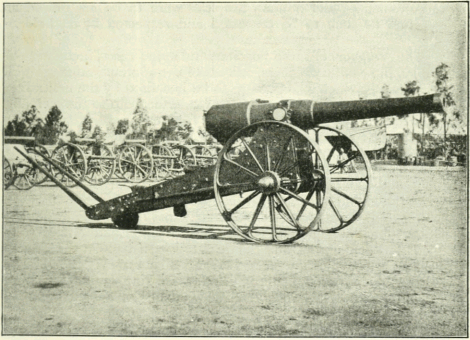
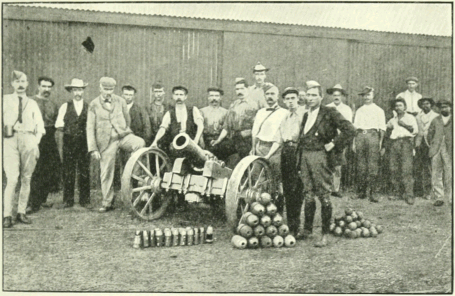
“Long Cecil,” made at the De Beers Mines.
Photo by D. Barnett, War Correspondent.
The new gun, “Long Cecil,” manufactured in De Beers, was
greatly prized. It distinguished itself on its début by plumping a
shell in the centre of the Kamfersdam head-laager exactly over the
position of the Dutchmen’s gun. Bombardment continued spasmodically,
sometimes at night, the shells entering several houses and
“making hay” of the furniture; but wantonly barbarous was the
attack on the laager containing the women and children, which took
place on the 23rd of January. One of the little innocents was killed
and another probably maimed for life. On the 24th more bombardment
began as early as four in the morning, and firing continued
all day. The worst feature in the affair was the attack—deliberate
and premeditated it appeared—on the hospital, which caused general
grief and indignation. There was no excuse for such inhumanity,
as the place was distinguished by two Red Cross flags.
Very lamentable was this habit of the Boers to violate the
sacred rules of the Geneva Convention, for it alienated even those
who were in sympathy with their cause. They could not plead
ignorance of the rules of warfare, for at one time they ignored these
rules to play the barbarian, while at another they utilised them to act
the poltroon. The history of the Convention may not be generally
known. It was promoted in 1864 and subsequently signed by all the
Continental Powers. It was decided that—
1. Ambulances and military hospitals were to be recognised as
neutral, and as such to be protected and respected by all belligerents.
2. The personnel of these hospitals and ambulances, including the
intendance, the sanitary officers, officers of the administration, as well
as military and civil chaplains, were to be benefited by the neutrality.
3. The inhabitants of the country rendering help to the sick and
wounded were to be respected and free from capture.
4. The sick and wounded were to be attended to without distinction
of nation.
5. A flag and a uniform were to be adopted for the hospitals, ambulances,
and convoys of invalids; an armlet or badge for the personnel
of the ambulances and hospitals.
6. The badge was to consist of a red cross on a white ground.
Committees were formed throughout Europe and America to
carry out this convention, and the Society worked under the title of
the “International Society of Aid for the Sick and Wounded.” It
played its first important part in 1870 in the Franco-German War,
before which time battlefields had been scenes of almost inhuman
torture.
Now, in consequence of the brutal disregard of a world-appreciated
agreement, the Boers—in many ways men of fine character—were
placing themselves beneath contempt. Their conduct also to
the loyalists and non-belligerents was also causing exasperation.
The ministers of all denominations—Wesleyan, Presbyterian,
Baptist, Congregational, and Jewish—all united in condemning the
Boer Government and its methods. They were especially scandalised
at the inhumanity of the Dutch commandoes, who intermittently
poured shells not only into the heart of the town, but into the suburbs,
where women and children were known to congregate, while leaving
for the most part unmolested the forts occupied by the citizen-soldiers.
Homes were destroyed mothers and children stricken
down, and some killed. These might have been looked upon as
the accidents of war had it not been confessed in Boer papers that
such acts were deliberately committed and vaunted.
Spasmodic bombardment took place during the evening of the
24th, and continued through the night, striking some buildings—the
hospital and other defenceless positions—and maiming a woman
and her child. Another child was killed. Profound admiration
was expressed by all in the achievements of “Long Cecil,” and the
utility of the new long-range weapon was highly appreciated. Indeed,
Mr. Rhodes viewed this Kimberley masterpiece with quite a paternal
eye, and his pleasure in firing it was considerable.
Enough could not be said of the splendid valour and pertinacity
of the townspeople, who co-operated in the warlike proceedings
as though they had been to the manner born. Though
the fortification belt was some twelve miles in circumference, at all
points it was protected by these amateurs of the sword, who, under
no military obligations whatever till sworn in on the immediate
emergency, rose to the occasion with a chivalric warmth that was as
perfectly amazing as it was admirable. Devotion to the Sovereign
Lady who rules the Empire was never more steadfastly shown and
more ardently maintained.
The zeal and the “go” of the Cape Police was notable. Among
the most prominent of the corps were Colonel Robinson, gallant
Major Elliot and Major Ayliff (wounded on December 3), who was
brave as he was tactful. Perpetually useful and conspicuously
gallant were Captains Colvin, Crozier, White, and Cummings.
Their duties, most difficult, were almost interminable.
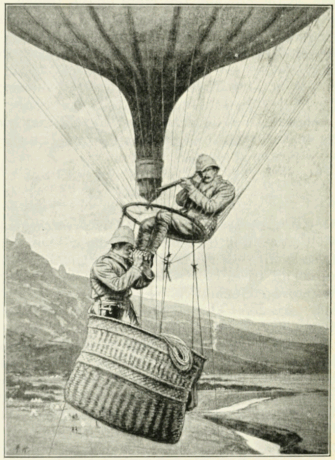
Life was monotonous in the extreme. From the town it was
possible on clear days to view the Modder River balloon, and the
occasional sight of it afforded a stimulus to the drooping spirits
of the inhabitants. Its rotund form floating so peacefully high in
air seemed like a harbinger of hope promising and consoling, and
teaching the lesson of patience and perseverance that overcome
all things! Of course, it was only the sentimentalists of the community
who thus interpreted the language of the aërial monster,
but these, like the people who find sermons in stones, promptly
took heart, and bore their trials with renewed dignity and pluck.
Both these qualities were in great demand, for the Boers and
their tactics were exhausting to the patience of the most forbearing.
Their pertinacity was great. At one moment they would pour
shells into the town, making hearts palpitate or stand still in horror
at the gruesome fracas; at others they would persistently “snipe”
from hidden corners and bushes, and render movements in the
open, to say the least of it—inconvenient.
Sniping always continued, though, for a day or two, no serious
bombardment took place. Indeed, there was reason to believe that
a Boer gun was hors de combat. The report came in that “Susannah”
had burst. There was general jubilation. Later on it filtered out
that “Susannah” was “all serene,” but this was doubted. The sanguine
hoped against hope. We are ready enough to believe what
we wish to be true, and finally, for want of something to discuss,
the question of “Has she burst, or has she not burst?” was
bandied about in the tone of a popular riddle. Unfortunately
“Susannah” was intact, as subsequent experience proved. Not only
was “Susannah” herself again, but it was reported that a considerable
Boer reinforcement had arrived in the neighbourhood, and that three
guns from Spyfontein were being ranged in attitude to defy “Long
Cecil,” whose prowess was more decided than pleasant. Still the
inhabitants bore up very creditably, and enlivened themselves continually
with concerts or entertainments of some kind. The programmes,
it must be noted, were always marked “weather and Boers
permitting”—a modern adaptation of the customary D.V.
The Boer spies took a lively interest in all that concerned Mr.
Rhodes, and hopes were entertained that before long some one
would receive the price of his capture. But this gentleman pursued
his avocations in the town and its suburbs with unabated interest,
arranging for the comfort of the refugees, and evincing paternal
solicitude in the laying out of new suburbs, and the construction of a
regular row of bomb-proof shelters, which were being excavated at
Kenilworth. People now became great connoisseurs on the virtue
of brick, old and new, and began to mistrust corrugated iron as
affording less protection from the artillery fire of the enemy. They
became judges also of shell—of the peculiarities of shrapnel and
ring shells—and sapiently discussed the merits of time fuses and
percussion fuses. Food, however, was the prime subject of conversation—a
subject of “devouring” interest, some one said. The
refugee fund now amounted to £3000, owing to the united subscriptions
of Mr. Rhodes and the De Beers Company. It was none
too much, as the demand on its resources was some £600 weekly.
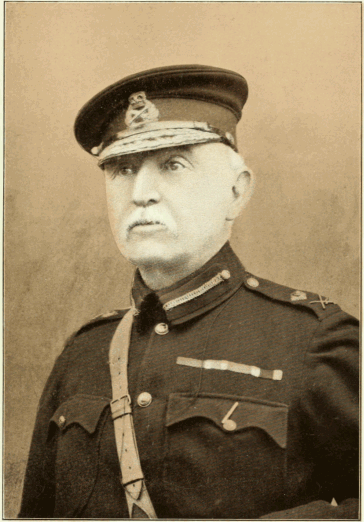
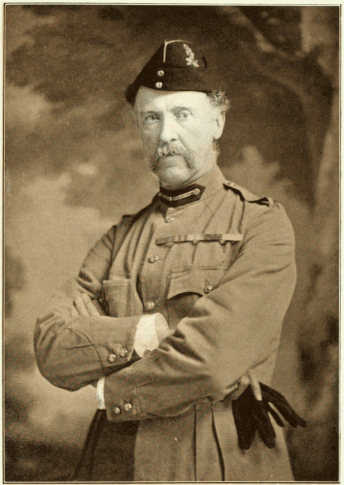
LIEUT.-GENERAL THOMAS KELLY-KENNY, C.B.
Photo by C. Knight, Aldershot.
The Colossus, regardless of the fate that hung over the town,
continued to make plans and projects for the development of the
place. On a high plateau he purposed to create a new suburb, and
the name will doubtless bear a relationship to the great events of
1900. A column was in course of erection to commemorate the
siege, but the tale of bombardment, writ large on many of the buildings,
is one that will scarcely be forgotten, and forms memorial
enough. Some curious damage was done, a shrapnel shell electing
to penetrate the wall of a draper’s shop and wound a feminine
dummy and smash a wax effigy of a boy used as a clothes model.
Fortunately few human beings suffered. Great precautions were
taken for the safety of the inhabitants, and a look-out was kept, so
as to give warning by whistle whenever the smoke of the enemy’s
guns breathed a hint of coming destruction. A calculation was made
as to the sum total expended by guns, British and Dutch, and it was
discovered that Kimberley had fired 1005 shells, while the besiegers
had spent three times that number. The total loss of life attributable
to shell fire amounted at this date to about twelve killed.
Affairs within the town were now growing almost as bellicose as
affairs without it. Continued friction generates heat, and of this
throughout the siege there had been more and more as time went
on. It was quite evident that Kimberley was not sufficiently large
to afford an arena for the combat of brains versus military discipline,
and that the patience of the besieged was nearing the snapping-point.
Indeed there was doubt as to whether operations for the relief of
Kimberley would be pursued, and it is averred that the Commander-in-Chief
sent a message to Mr. Rhodes, saying, “Hope I shall not
be compelled to leave you in the lurch.” Naturally the Kimberley
barometer fell to zero. Then came rumours of the coming of Lord
Roberts, but these scarcely served to allay the general impatience.
A curious incident occurred on the 29th. Some thirty-five Zulus
took their departure. They had been ordered by their chief to leave
the town, but when they obeyed they had promptly to return, as
they encountered the Boers, who threatened to shoot them.
At this time food was becoming more and more scarce; even
horse-flesh was distributed with caution. Milk was obtainable only
by the invalids, and some four hundred babes died for want of proper
nourishment. It was pathetic to see people standing at the Town
Hall waiting eagerly to take their turn for the scanty portion of
meat that could be provided for them. The ceremony of the
drawing of meat rations had an aspect almost comic in its desperate
seriousness. Matutinally at 5.30 A.M. might be seen a
vast concourse of persons scampering in hot haste to gain a front
place. So animated was the early bird to catch its morning worm,
that it was up and doing before the regulated hour, 5.30 (fixed by
proclamation), before which time people were forbidden to leave
their houses. The police put a stop to this superactivity, and hungry
persons were seen from five to the half-hour waiting patiently at
their gates till the exact moment should arrive when they could
make a dash for a place in the tremendous crush which, two by two,
gathered outside the market.
Marvellous was the rapidity with which this vast crowd, at hint
of a shell, would drop to earth. As by some mechanical process
there would come a bang, and then, like a card castle, the whole
procession would drop flat. The Boers, knowing, most probably,
that this was an eventful period of the morning, would invariably
start off about six with a boisterous “good-morrow.”
Gradually the rations grew shorter and shorter and shorter. They
now consisted mainly of horse-meat, served out every second day,
mealie meal, stamped mealies, with a sparse allowance of tea, coffee,
and bread. For those who had children under three years of age one
tin of milk was allowed. With this strong children could get along
well, but there were many weakly ones, and these waned and waned
till the baby funerals became pathetically frequent.
The Dutchmen were exceedingly ingenious in the invention of
tricks and traps. One of these was to move a waggon with sixteen
fat oxen in charge of but two men into the open Vlei below Tarantaal
Ridge, and there to leave it, apparently unguarded, for two hours.
They thought that this bait would lure forth the cattle-guard, but
they were disappointed, for the authorities were too acute to allow
them to get “a bite.” They knew that in rear of the Vlei was a
deep sand-drift, behind which a large body of men might be comfortably
concealed, and consequently left waggon and cattle severely
alone.
After this began the bombardment by a new Boer gun—a diabolical
instrument, whose perfections were hymned by an artillery
expert, who declared it to be one of the most perfect pieces of ordnance
ever made! A correspondent in the Daily Telegraph described the
terrifying effect produced on the nerves of the sick and the weakly. He
went on: “The shock caused by the firing of this gun was distinctly
perceptible five feet under ground at a distance of five miles, and
the miniature earthquake thus created was clearly registered by the
new seismograph at Kenilworth, the pendulum of which remained
perfectly stationary during the firing of the smaller guns, or the
passage of the most heavily laden trains or vehicles at very close
quarters.”
The 9th of February was a terrible day. There was crashing and
booming from morning till night, and no one dared venture abroad.
One inhabitant had his child killed under his very eyes and his wife
mortally stricken down. Towards sundown a shell struck the Grand
Hotel, killing Mr. Labram, the De Beers chief engineer, whose
valuable brains had been the salvation of the place. He had constructed
armoured engines, armoured trains, and had completed his
ingenious labours by constructing the huge 4.1-inch gun, with carriage
and shells complete—a triumph of science considering the conditions
under which the achievement was attempted. Now he was gone,
and Kimberley was vastly the poorer.
The bombardment was growing daily more severe. Each time
the Boers fired their 100-pounder gun a bugle was blown from the
conning tower and all ran to cover. There would be an interval
of seven minutes between every shell, and the bombardment would
last for about two hours. Then the Boers would take a rest, and,
after a breathing spell, begin again. By the kindness of Mr. Rhodes
the mines now became harbours of refuge for thousands of women
and children, who, huddled together in the 1200-feet level, were thus
protected from the shells which were launched in the midst of
the town. Those days in dark diamondiferous caverns were full
of strange experiences. There, over a thousand shrinking beings
found asylum, bedding, food, and such comfort as could be secured
for them. There, babes were born into the world—human diamonds
brought into the daylight from the grottoes of the millionaires—babes
which surely should take some strange part in the
drama of the century. It was an underground village swarming
with the weak and the distressed, a feminine populace, kept from
panic and despair by the man who, large enough to make empires,
yet proved himself capable of sympathy with the small sorrows and
quakings of the sick and the fearful.
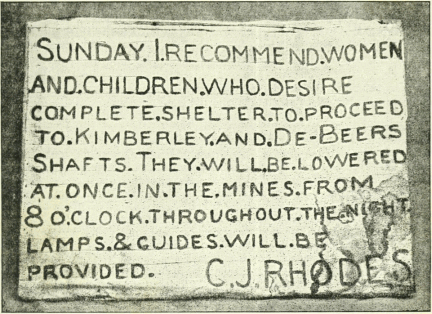
Placard Erected by Mr. Rhodes.
Photo by F. H. Hancox, Kimberley.
The experiences of a lady who enjoyed the hospitality of the
mine were scarcely exhilarating. She said: “We went down the
mine, but only stayed one day. Of course, one felt safe, but it was
so miserable; still, it was another siege experience, the crowds of
people down there. On the 1000-feet level were 500 persons alone,
and the buzz of tongues, and the children crying, and the noises
altogether, besides the damp, were horrible; although Mr. Rhodes
and those working under him did all in their power to make things
as comfortable as possible. Hot coffee, soup, bread, milk for the
children, everything obtainable was sent down; and some thousands
of people were fed free of charge from the Saturday night till the
following Friday morning.... Those people who run down Mr.
Rhodes should have been here during the four months of the
siege. The soup-kitchen was another of his institutions, threepence
a pint for good soup, and those who had no money got it free.”
Now that the nerve-destroying capabilities of the Boers’ 100-pounder
gun were proved, and Mr. Rhodes and other citizens were
conscious of the immense amount of danger to town and life that
must result from the bombardment, the Colossus, in conjunction with
the Mayor and others, forwarded to Colonel Kekewich a letter which
he begged might be heliographed to headquarters. The letter ran:—
“Kimberley, February 10.
“On behalf of the inhabitants of this town, we respectfully desire to be
informed whether there is an intention on your part to make an immediate
effort for our relief. Your troops have been for more than two months within
a distance of little over twenty miles from Kimberley, and if the Spytfontein
hills are too strong for them, there is an easy approach over a level flat. This
town, with a population of over 45,000 people, has been besieged for 120 days,
and a large portion of the inhabitants has been enduring great hardships.
Scurvy is rampant among the natives; children, owing to lack of proper food,
are dying in great numbers, and dysentery and typhoid are very prevalent.
The chief food of the whites have been bread and horse-flesh for a long time
past, and of the blacks meal and malt only. These hardships, we think you
will agree, have been borne patiently and without complaint by the people.
During the last few days the enemy have brought into action from a position
within three miles of us a 6-inch gun throwing a 100-lb. shell, which is setting
fire to our buildings and is daily causing death among the population. As you
are aware, the military guns here are totally inadequate to cope with this new
gun. The only weapon which gives any help is one of local manufacture.
Under these circumstances, as representing this community, we feel that we
are justified in asking whether you have any immediate intention of instructing
your troops to advance to our relief. We understand large reinforcements
have recently arrived in Cape Town, and we feel sure that your men at Modder
River have at the outside 10,000 Boers opposed to them. You must be the
judge as to what number of British troops would be required to deal with this
body of men, but it is absolutely necessary that relief should be afforded to
this place.”
To this Lord Roberts replied:—
“I beg you represent to the Mayor and Mr. Rhodes as strongly as you
possibly can the disastrous and humiliating effect of surrender after so prolonged
and glorious a defence. Many days cannot possibly pass before Kimberley
will be relieved, as we commence active operations to-morrow. Future
military operations depend in a large measure on your maintaining your position
a very short time longer.”
A great deal of gossip hung round the suppression of the
Diamond Fields Advertiser, but the whole affair was merely a storm
in the ink-pot resulting from the clashing of opinions civil and military.
After the publication of a leading article on the 10th of
February, an article with which Mr. Rhodes was entirely in accord,
the military censor addressed the following letter to the editor:—
“Army Headquarters,
Kimberley, February 10, 1900.
“Sir,—Since the Diamond Fields Advertiser has now on two occasions
printed leading articles on the military situation which are extremely injurious
to the interests of the army and the defence of this town, without previously
submitting the same to the military censor, I am directed to inform you that
from this date the proof of the Diamond Fields Advertiser must be submitted
to me before the copies of any daily number, leaflet, or other form of publication
is issued to the public.
“I am further requested to inform you, in your own interests, that on the
two occasions referred to you have committed the most serious offences dealt
with by the Army Act, under which Act you are liable to be tried.—Yours
faithfully, W. A. O’Meara, Major, Military Censor.”
The military censor was within his rights. The editor, after the
manner of editors, did not care to be muzzled, so the Diamond
Fields Advertiser was temporarily suspended.
The editorial chair at the time was not an enviable berth, owing
to the invasion of shells from the 100-pounder gun, therefore the
holiday may have been beneficial in more ways than one.
The new gun, mounted on the kopje at Kamferdam, was determined
to make life hideous, and so incessantly swept the
neighbourhood that a state of panic began to prevail even among
those who had hitherto borne themselves with unconcerned front.
In addition to this perpetual tornado of horror the pinch of famine
was becoming sharper, and the question of relief seemed to be
growing into one of “now or never.” Despair seized on many.
They began to count the days, and wonder when it would all end,
and whether indeed it would ever end at all! Two days—three
days—five days—the 15th of February! Then, dramatically, as in
a fairy tale or a stage play, came the rumour of help, the whisper
that French, the gallant, the energetic, the invincible, was coming,
as on the wings of the wind—coming to restore freedom to those
who, in their tedious imprisonment, were fainting with hope deferred.
In an instant all was changed. The rumour became reality. Colonel
Kekewich and his staff rode forth, and it was as though the good
fairy had waved a wand. In an instant the dismal streets seemed
to grow gaudy with flags, to flutter and flare as with the hues of the
butterfly. Panic ceased, and gave way to almost hysterical joy.
People laughed, chaffed, threw up their hats. The mines disgorged
their human wealth—some thousand of women and children, who
came forth alacrious, with swinging step and loudly babbling—babbling
like mountain torrents let loose from the ice of winter! It
was a scene for painter, not for penman; for who shall describe
wrinkles of anxiety swept suddenly away, pangs of hunger allayed
by thrills of glad excitation, nervous exhaustion magically forgotten,
and all this simply because there was dust in the distance—the dust
of coming feet—the dust of the British cavalry sweeping nearer and
nearer on a glorious errand of deliverance!
Five minutes later the looked-for moment had arrived. Anticipation
had given way to fact—the 124 days’ siege was at an end.
Yet there were some who could scarce believe their ears. A man,
hearing that General French had arrived, approached a trooper who
was holding a horse outside the Club, and asked if the good news
was true. “Yes,” was the reply; “I’m ’is horderly; this is ’is ’at,
and over there is ’is ’orse!” And the Kimberley man stared at the
three objects before him as though he could never take his fill of
satisfaction.
And now, as the conjuror says, to explain how it was all done.
The object of the combined movements was to turn Cronje’s position,
which extended west and east from Majersfontein to Koodoesberg
Drift on the one side towards Klip Drift on the Modder on
the other, to relieve Kimberley, and, if possible, cut off the retreat
of the Boers to Bloemfontein and invest the whole force. This
stupendous programme was unfolded to General French and his
A.A.G. Colonel Douglas Haig at the time already mentioned,
when the great cavalry leader mysteriously ran down from Colesberg
to the Cape. Here the plans for the future campaign were
discussed, and here General French agreed to embark on an enterprise
which had it failed in a single particular might have brought
about “such a disaster as would have shaken England’s dominion
in South Africa to its very foundation.” This is the opinion of
Captain Cecil Boyle, a splendid young officer, who, when asked to
join General French’s staff as galloper, was almost overcome with
joy. But the plan did not fail: indeed it succeeded beyond expectation,
and the relief of Kimberley, accomplished solely by the mounted
troops—said to be the largest force ever commanded by a British
General—was a feat scarcely to be excelled in the annals of warfare.
This feat was performed between the 11th and the 15th of
February, during which the Division experienced hardships of
every kind. Horses and men were worked incessantly, without
a day’s rest and in a broiling sun, which literally baked every
portion of the human frame exposed to it, and grilled the eyeballs,
causing the most acute suffering to man and beast. Supplies
and forage ran short, and the horses were reduced to 1½ lb. of corn
a day, while the men lived finally from hand to mouth, killing and
eating as they went along, now a sheep, now a goat, and presently
nothing but boiled mealie cobs. Water was so scarce, and the
sufferings of the animals so terrible, that when a stream was once
encountered, the brutes, wild with an anguish of delight, tore towards
it in their frantic career, becoming absolutely beyond control,
and carrying their riders straight into the river. Some in this way
were drowned. Many horses died of exhaustion. At the end, out
of 8000, only 5400 remained. But all discomforts were forgotten in
the success of the achievement, which from first to last was conducted
with admirable finesse and consummate dash. Indeed this
marvellous ride is looked upon by those who could technically
criticise the difficulty and daring of the enterprise as one of the
finest achievements of British arms.
On the 11th of February the great cavalry division under
General French started. With marvellous rapidity, and with a vast
amount of mystery, the troops had gathered together in the neighbourhood
of Enslin or Graspan, and commenced to move south-east
on the now celebrated march for the relief of Kimberley. So
swiftly was everything planned, and so dexterously was it accomplished,
that even the wary Cronje, whose spies were everywhere,
was incapable of believing that the detested rooineks were advancing
with the rapidity of a cyclone for the purpose of sweeping him and
his burghers from their comfortable positions. But a clean sweep
they made nevertheless. Before the British advance Dutchmen
fled precipitately from their farms, leaving their sweet mealie pap in
statu quo, and all their effects exactly as they had been using them.
They carried to Cronje wild rumours of British multitudes
approaching, and preparing to make a last frontal attack upon
Majersfontein, rumours which exactly suited Lord Roberts’ strategic
plan. Cronje instantly primed himself for the reception of the
British, strengthening his fortifications and keeping his eye on the
west, where he knew the Highland Brigade was operating. This
again was precisely what Lord Roberts had intended him to do.
Meanwhile, in the light of the stars, the great cavalry division
with its batteries of artillery was on the move, rumbling cautiously
through the mysterious, Boer-haunted regions under the guidance
of the Hon. Major Lawrence, Chief of the Intelligence Department,
and travelling many miles before sunrise on its important journey to
Ramdam. Here horses were watered, men rested, details and remounts
from Orange River picked up. On the morning of Monday the
12th, the troops were again on the move, starting at 3 A.M., and
endeavouring to cover as many miles as possible before the sun should
rise and make the whole earth into a scorching, blistering wilderness.
But now, in return for the cool night air, they had to contend with
jetty obscurity. Very slow, therefore, was their progress. When
helped by the dawn they got along faster, and soon the whole division
reached Waterval. Here extra precautions were taken, for none
knew how many Dutchmen might be ensconced in the surrounding
kopjes or whether the drift might be swarming with Boers. But
they were not long left in doubt. A Boer shell greeted the troops
with such nicety of range that the General and his staff barely
escaped. Colonel Eustace, R.H.A., immediately turned his attention
to the hostile gun, and shortly silenced it, but the enemy still
held on.
Dekiel’s Drift is commanded by kopjes, having on the bank an
octopus-armed donga which cuts deeply into the soil. At this drift
the Boers endeavoured to make a stand, but the Mounted Infantry
and Roberts’ Horse were too much for them. Unfortunately, Captain
Majendie, second in command of the latter regiment, was shot
from Drift Kopje, in the shadow of which his remains were interred.
There was no time for expression of mourning and regret; the Boers
had to be routed, and presently, finding their rear threatened, they
went streaming away from their strong position, taking with them
their guns. After this the drift was taken possession of, and in the
rays of the setting sun the disciplined hosts—brigade after brigade—crossed
the Riet River, keeping possession of both banks.
Horses and men were wearied out, scorched, and famishing, and
there was a general sense of relief when at last they were joined by
Lord Kitchener and staff and the Sixth Division, with convoys of
provisions and fodder. At dawn on Tuesday a great deal had to
be done—breakfast finished, nose-bags filled, &c., before it was
possible to order the advance. Day was well developed by the time
the brigades had started, and now came the exceeding trials of their
march. The level veldt was like a mirror to a brazen sky, and all
through the sweltering hours when the sun blazed its strongest, men
and horses, shadeless, parched, and sparsely fed, moved on mile after
mile on their imperative errand without pause and without relief.
Even a beautiful well of water, which tempted them to distraction,
had to be passed by untouched. It was necessary to reserve it for the
infantry, who were following on the morrow. So dry, dejected, yet
determined, they went on and on, crossed the districts of Poortje,
Zwart Kopjes, Kromkuil, and made a brief halt at Wegdraai.
From thence they swung along past pans and kopjes and plains,
due north to Klip Drift.
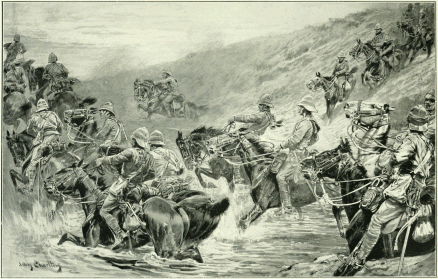
THE DASH FOR KIMBERLEY—THE 10th HUSSARS CROSSING KLIP DRIFT.
Drawing by John Charlton, from a Sketch by G. D. Giles, War Artist.
Captain Boyle, in the Nineteenth Century, gave a fresh and
spirited account of their movements on this important and critical
march.
“The distance covered in extended order was great, and to save
the artillery horses Major Lawrence directed the columns by a slight
détour north-easterly, leaving Jacobsdal some seven or eight miles
to our left. The heat was now intense, and was further increased
by the accidental burning of the veldt over a large area, thereby
destroying our field-cable, as we learnt afterwards. From flank to
flank the distance was so great that at times the General’s gallopers
could not move their horses out of a walk, though the message was
important, and everywhere men and horses alike suffered from sun
and thirst.
“General Gordon’s brigade, far away on the left, was ordered to
bring up its left shoulders to meet what looked like an attack on the
right, but the guns of the 1st Brigade put the enemy to flight, and
the march was resumed in slightly different order. The left brigade,
under General Gordon, was ordered to advance; the centre brigade,
under General Broadwood, was deployed to the right; and the right
brigade, under Colonel Alexander, was ordered to follow in the rear.
From a little stone-covered knoll the General and his staff scanned
the distant river and its banks eight miles off, and instantly determined
to push on for the drift. ‘Move up the whole division,’ and
the three gallopers started back with the order to the brigades,
which had been halted meanwhile. General Gordon on the left,
with the 9th and 16th Lancers and his guns, and General Broadwood
on the right, with the 12th Lancers, Household Composite, and 10th
Hussars, moved off at once; but Colonel Alexander’s brigade was
far in the rear—he had already lost sixty horses, and the rest could
move but slowly. The artillery horses could scarcely drag their
guns and waggons, but still the General determined to force the
drift; and I believe this decision was one of the most critical in the
relief of Kimberley, for, had we not gained the drift directly our
presence was known, the enemy would most certainly have fortified
a very strong natural position. But the General’s mind was made
up, and he was quick to act. Throwing Gordon on to the left to
effect a crossing, and Broadwood some five miles away on his right,
the advance to the river was made so swiftly that the enemy were
absolutely surprised. After shelling for some time, Gordon crossed
and went in pursuit. Only four guns out of twelve could come into
action in the centre, but with such effect that the enemy shortly
retreated over the hills. By this time General Broadwood had
crossed on the right, and his brigade trumpeter sounded the
‘pursue.’ The general rout was now complete—camp, waggons,
everything was in our hands. New bread was lying about on the
veldt and dough-tins ready to be placed on the fire, with such haste
had the Boers left their position.
“My horse had died with my last message to the 1st Brigade,
and I trudged on over the level veldt partly on foot, partly on
ammunition waggons, over the last five miles, crossed the Modder
River with the four guns of P and G Batteries, and went to congratulate
the General, who was sitting on the north bank, on his
splendid achievement; for by this last forced march of nearly ten
miles he had won half his way to Kimberley. Little incidents after
the rout were full of the humour that hangs around everything
grave. One of the staff plunged into the river and caught some
geese, but some one else ate them; a pig ran the gauntlet through
the camp—amidst roars of laughter, even from the serious General—of
lances, bayonets, knives, sticks, boots, water-bottles, anything
to hand, and at length was caught by a lucky trooper, who shared
his feast that night with his friends. A waggon of fresh fruit was
taken, sufficient to make thirsty men’s mouths water, but some
thought the grapes were sour. Why the Boers retreated in such a
hurry is difficult to understand, for the position and drift were very
strong and easy to defend, especially against a spent foe; and, but
for the quickness of the advance over the open veldt, which took
the Boers completely by surprise, the division would have encountered
a very nasty opposition.”
The Dutchmen were pursued with splendid animation by
General Gordon’s jaded brigade, who succeeded, worn out as
they were, in capturing some ambulance waggons and some Boer
doctors; while General Broadwood’s brigade, also worn out, chased
the Boers into the far distance till absolute exhaustion forced the
abandonment of the pursuit. So at the drift the cavalry division
enjoyed its terribly needed repose. They had gone through an
appalling ordeal, but it had been wonderfully surmounted, and the
command of river both at Klip Drift and Klip Kraal, some miles to
the east, had been secured.
On the 14th the Boers still continued to buzz about after the
fashion of mosquitoes—now advancing, now retiring, worrying and
annoying, but never coming boldly to the attack.
They made strong efforts to fathom the movements and designs
of the British, but without success. Colonel Gorringe, Chief of
Lord Kitchener’s Staff, now arrived, and announced that Lord
Kitchener and General Kelly-Kenny were advancing by night from
Dekiel Drift, whereupon Captain Laycock, A.D.C., rode out and
succeeded by midnight in conducting these officers safely to camp.
In the small hours the Sixth Division, after a hard and really
glorious march, which must be described anon, arrived. Thus his
left flank being secured, General French was free to pursue his
impetuous ride. This he did after handing over to the infantry the
positions he had gained. While the cavalry division moved out,
Kelly-Kenny’s division—as in the game of “general post”—quickly
shifted to the vacant place, thus making any return of the fleeing
Boers impossible.
The three cavalry brigades then drew up in columns of brigade
masses, with the seven batteries of horse-artillery on their left,
where the strongest attack from the laager near Kimberley was
expected. How far the Boers were aware and prepared for the
British move was uncertain, but it was decided that at all costs the
cavalry would cut through them.
Operations began with the shelling and capture of two laagers on
the north side of the river, and the way being thus cleared of the
enemy, the division made its way to a point where it was met by the
contingent from the Modder River. The force, now increased by
Scots Greys, Household Cavalry, and two Lancer Regiments, numbered
some 10,000 men, seven batteries of horse-artillery and three
field-batteries.
Scarcely had the brigades proceeded before the Boers opened
fire, and soon men and gunners fell, and horses riderless and pairs
devoid of drivers were seen rushing madly over the plain. From a
kopje on the right came the rattle and roar of musketry, which was
replied to by the guns of the horse-artillery. There was no
doubt now that a horde of Boers were hiding in front, and that the
way forward was only to be gained by a desperate plunge. There
was no hesitation. General Gordon and his gallant men were ordered
to charge and clear the right front, and the thing was done. Away
went the 9th and 12th Lancers, galloping for all they were worth,
on and on like a flash of avenging lightning. At sight of the human
avalanche the Boers, who had been “raining hell” from their
trenches, suddenly threw up Mausers and hands; but it was too
late, the whirlwind was upon them, and over a hundred Dutchmen
bit the dust. Others ran helter-skelter, a whimpering and shouting
rabble!
Now came the greatest sight that military men have witnessed
for years—the rush of the legions across the great plain of Alexandersfontein.
This vast area, about three to five miles square, is
surrounded by menacing kopjes, which harboured Boers rendered
desperate by surprise and consternation. Across the open the
Lancer regiments and Scots Greys as advance guard, with the
rest of the force deployed at ten yards’ intervals, rushed like a
hurricane, a sirocco in the desert. Boers still showered down their
lead, but the cavalry, heedless, thundered along, throwing up a
volume of dust, while kopje after kopje was swept by the mounted
infantry. The enemy was dispersed on every side.
Five long miles the race of the centaurs continued—centaurs
galloping as if for dear life—Carabineers and Greys leading the
main body, the 12th Lancers on the left, the Household Composite
Regiment with the 9th Lancers on the right—a regal show,
and one worth a lifetime to have witnessed.
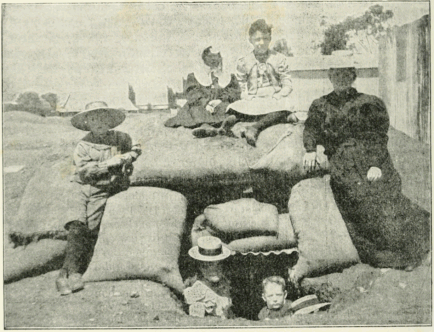
Typical Underground Dwelling at Kimberley.
At De Villiers the exhausted warriors watered their horses and
strove to gather together the poor brutes for a final effort. Many
were sun-stricken, others had simply used themselves up. The
speed that was to outwit Cronje had to be paid for in horse-flesh.
But, owing to that speed, much loss of human life was spared.
Lieutenant Sweet Escott (16th Lancers) had fallen early in the
day, but considering the fire of the enemy it was a marvel that only
one officer had been killed. One man was also slain, and there were
about thirty wounded.
Kopje held by the Boers.
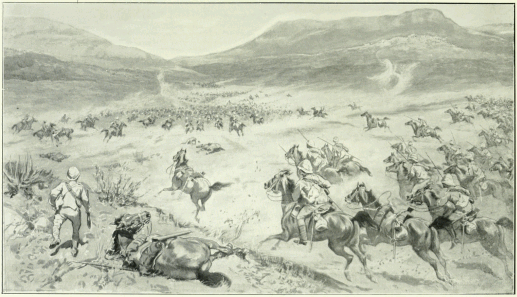
| 16th Lancers. |
9th Lancers. |
Household Cavalry. |
THE LAST STAND MADE BY THE BOERS BEFORE KIMBERLEY—CHARGE OF BRITISH CAVALRY IN
THE ENGAGEMENT AT KLIP DRIFT.
Drawing by W. S. Small, from a Sketch by G. D. Giles, War Artist.
At two o’clock the troops were halted at the base of a small
kopje, from the crown of which it was possible to descry the chimneys
of Kimberley in the distance. It was as though they had sighted
the Promised Land. Up went a mighty cheer from a thousand
throats, ringing almost against the vault of the burnished heaven,
and echoing far and wide among the threatening Boer-haunted
kopjes! Kimberley was on the eve of relief. The trial, the trouble,
the turmoil were over! The triumph was won! On went the
Division, riding now with all their might, and at sight of them the
enemy, hot-foot, commenced to gallop into space. Soon the Division
was within sight of the suburbs, and their guns were addressing
themselves to a Boer laager on the east of the town. The extra
uproar struck fresh alarm in the people of Kimberley, who had
been driven distraught by the Boer’s 100-pounders, and a message
was flashed out, “The Boers are shelling the town.” Then came
the answer—the glorious answer—“It is General French coming to
the relief of Kimberley.” The news to the imprisoned multitude
seemed incredible. They dreaded lest it might be a new wile of
the Dutchman, and, to make assurance doubly sure, flashed out a
fresh query. But by sunset the British troops had appeared: the
whole force, battered, bronzed, but jubilant, was galloping into
Beaconsfield.
Some one has said that strategy is a permanent science whose
principles are immutable, while tactics vary with the variations of
weapons and modes of warfare. The first example of this permanent
science was presented only when Lord Roberts came to
South Africa, but so complete and skilful, and withal so subtle, was
the initial demonstration, that its fruits within ten days of his arrival
at the front were ready to drop to his hand. Looking back, the
plan of Lord Roberts’ operations appears simple in the extreme, but
at the time only masterly conception and accuracy of execution could
have ensured success for so complicated a programme. To appreciate
its subtlety and its neat execution, it becomes necessary to
follow the other portions of the programme, beginning from the
entry into the Free State of the enormous army that was massed on
its borders by Monday the 12th. On that day three divisions of
infantry, the 6th, 7th, and 9th, General French’s division, two
brigades of mounted infantry under Colonels Hannay and Ridley
respectively, the artillery under General Marshall, consisting of
three brigade divisions of horse-artillery, two brigade divisions of
field-artillery, one howitzer battery, and a Naval Contingent of
four 4.7-inch and four 12-pounders, marched from Graspan and
Honeynest Kloof through Ramdam. The total field force
amounted to 23,000 infantry and 11,000 mounted men, with 98
guns, and a transport of over 700 waggons drawn by nearly 9000
mules and oxen. Later on the artillery was reinforced by the
arrival of a battery of 6-inch howitzers, throwing 100-lb. shells, and
three Vickers-Maxim quick-firers and the Brigade of Guards, which
had remained opposite the Boer trenches at Majersfontein.
The following table serves to show roughly the disposition of
the troops:—
FIELD-MARSHAL LORD ROBERTS’ FORCE
First Division.—(Lieutenant-General Lord Methuen).—1st (Pole-Carew’s)
Brigade—3rd Grenadier Guards; 1st Coldstream Guards; 2nd Coldstream
Guards; 1st Scots Guards. 9th (Douglas’s) Brigade—1st Northumberland
Fusiliers; 1st Loyal North Lancashire (half); 2nd Northamptonshire; 2nd
Yorkshire Light Infantry; 18th, 62nd, 75th Field Batteries.
Sixth Division.—(Lieutenant-General Kelly-Kenny).—12th Brigade—2nd
Worcestershire, 1st Royal Irish, 2nd Bedfordshire, 2nd Wiltshire (half battalions).
13th Brigade (Knox’s)—2nd East Kent; 1st Oxfordshire Light
Infantry; 1st West Riding; 2nd Gloucester; 76th, 81st, and 82nd Field
Batteries; 38th Company Royal Engineers.
Seventh Division.—(Lieutenant-General Tucker).—14th Brigade—2nd
Norfolk; 2nd Lincoln; 1st King’s Own Scottish Borderers; 2nd Hants. 15th
Brigade—2nd Cheshire; 1st East Lancashire; 2nd South Wales Borderers;
2nd North Stafford; 83rd, 84th, and 85th Field Batteries; 9th Company Royal
Engineers.
Ninth Division.—(Major-General Sir H. Colvile).—3rd (Highland) Brigade
(MacDonald’s)—1st Argyll and Sutherland; 1st Highland Light Infantry; 2nd
Seaforth Highlanders; 2nd Royal Highlanders (Black Watch). 18th Brigade—1st
Essex; 1st Yorkshire; 1st Welsh; 2nd Royal Warwick.
Cavalry Division.—(Major-General (Local Lieutenant-General) French).—1st
Brigade (Broadwood)—10th Hussars; 12th Lancers; Household Cavalry.
2nd Brigade (Porter)—6th Dragoon Guards; 6th Dragoons (two squadrons);
2nd Dragoons; New Zealanders; Australians. 3rd Brigade (Gordon)—9th
Lancers; 16th Lancers; Horse Artillery; G, P, O, R, Q, T, U Batteries.
Troops with Lord Roberts.—Gordon Highlanders; 2nd Duke of Cornwall’s
Light Infantry; 2nd Shropshire Light Infantry; Canadian Regiment;
Roberts’ Horse; Kitchener’s Horse; City of London Imperial Volunteers
(Mounted Infantry Company); 2nd, 38th, 39th, 44th, and 88th Field Batteries;
A Battery R.H.A.; 37th and 65th Howitzer Batteries; three Naval 4.7-in. guns;
part of Siege Train.
It will be seen by the above that General Colvile had been
appointed to the command of the Ninth Division, while Colonel
Pole-Carew was transferred from the command of the Ninth Brigade
to that of the Guards Brigade, and was succeeded in the former post
by Colonel Douglas, late Chief of the Staff to Lord Methuen.
Having viewed this force, it becomes somewhat interesting to
note how smoothly wheel turned within wheel. The movement
began by the concentration of General French’s division at Ramdam.
On the morning of the 12th the infantry appeared, and General
French moved on, crossed Dekiel’s Drift on Tuesday the 13th, and
captured Klip Drift and Drieput Drift, on the Modder River. Following
him closely on the 12th came the divisions of General Tucker and
General Kelly-Kenny. The latter division was accompanied by Lord
Kitchener and his staff. The negotiation of the first drift, which was
almost impassable for transport, next occupied the ingenuity and tested
the perseverance of the troops. The drifts, like the kopjes, are the
almost unconquerable bogies of South Africa. They are the natural
defences of the country, offering obstruction on every hand, and,
however boldly you may storm the kopje, you must with infinite
patience negotiate the drift. This is no small undertaking, for drifts,
in a way, partake of the paradoxical character of individuals—the
weaker the person, the more difficult is he to manage; the more insignificant
the river, the greater the perverseness of the drift. It
resolves itself in both cases into a question of narrowness. Small
streams and small minds are banked up too high to allow moving
room in their midst. The result of an attempt to advance is congestion
of a painful kind. At this particular drift it was found impossible
for the team of mules to lug the formidable waggon-loads up the
north bank, and at last the feat had to be accomplished by adding
relays of oxen to assist in the tremendous labour. Finally, by 4 A.M.
the next morning the troops got across, General Tucker’s division
marching to within some three miles of Jacobsdal, and hugging
the river all the way, so as to run no risk of being without water.
General Kelly-Kenny followed, marching from Waterval Drift to
Wegdraai on the morning of the 14th, and proceeding thence at
5 P.M. on the same day to Klip Drift, which was reached in the
middle of the night. The rapidity with which this rush on his heels
was accomplished enabled General French, who had been awaiting
the arrival of the infantry, to proceed on his flying swoop for the
relief of Kimberley. This, as we know, was accomplished on
Thursday the 15th of February. Meanwhile the wheels of the
strategic machinery were going round. A small cavalry patrol had
entered Jacobsdal, which town was found to be full of wounded, including
many of our own invalids from Rensburg. On the way back
the mounted infantry were attacked, and Colonel Henry was fired
on by a party of Dutchmen who were concealed in the vicinity of
the river, and so sudden was the attack that nine men were wounded.
Colonel Henry, Major Hatchell, and ten men were missing. A
battery of artillery shelled the environs of the place, and put to flight
such Boers as were hanging about, whereupon the British remained
masters of the situation. Thus it will be seen that while the Dutchmen
were fleeing from Jacobsdal, from Alexandersfontein, and from
the neighbourhood of Kimberley, for fear of being cut off, they had
surrounding them Lord Methuen at Majersfontein, General Tucker
at Jacobsdal, General Kelly-Kenny at the Klip and Rondeval Drifts,
General French on the north, and General Colvile wheeling around,
ready to suit his movements to any emergency. In this manner
Cronje found the teeth of a trap preparing to close on him, and
recognised that there was no alternative but to “make a bolt for it.”
Thus the first part of the programme was accomplished. Kimberley
was automatically relieved; Cronje was on the run. But his
running was no easy matter. Since Lord Roberts’ strategy had
come into play, there was a prospect of a neck-and-neck race between
the mobile Boer and the mobile Briton, and success depended on
General French’s ability not only to rout but to head off the retreat
of the Dutchman. That the British cavalry commander should outmatch
him in celerity was a contingency which had not occurred to
Cronje; that he should advance independently of the rail, and start
off across the Riet to trek to the Modder, was described by one of
his countrymen as distinctly “un-British.” Whether this epithet
was used to denote admiration or contempt we cannot say. Certain
it was that the wily persecutor of Mafeking and Kimberley thought
that the secret of the art of trekking was confined to himself and
his rabble, until he discovered, too late, that the equally wily French
with his disciplined legions was ready to ride over him. On the
16th of February the astonished commandant, with a horde of 10,000
Boers, was scudding in full retreat towards Bloemfontein. On all
sides were Boer laagers in a state of abandonment—stores, tents,
food, Bibles, raiment—everything had been left by the amazed
and panic-stricken Dutchmen. Dronfield, Saltpan, Scholtz Nek,
and Spyfontein were now evacuated. Under cover of darkness
the investing hordes had taken to their heels, leaving behind them
even herds of cattle and ammunition, in their desire to gain a loophole
of escape. But they soon found that, wherever they might go,
there was the rumour of British opposition, an armed and avenging
race advancing!
The fact was that the trekking of the Boer hordes had been
adroitly discovered by Lord Kitchener, who, having detected an
unusual haze of dust in the distance, at once gave orders for the
mounted infantry not to follow French, but to pursue the enemy.
Accordingly, to quote the Times correspondent, who was present:—
“The mounted infantry rode in pursuit across the plain, endeavouring
to get to the north of the convoy, while General Knox’s
Brigade was pushed along the north bank of the river, which makes
a large bend to the north between Klip Drift and Klipkraal Drift,
to strike the convoy on its southern flank. Cronje sent on his
waggons to Drieputs Farm, at the north-eastern end of the bend,
where they laagered at about eleven, and maintained a running
fight with our troops all day. The skill with which the Boers
conducted this rear-guard action extorted unqualified praise from all
our officers. As the detachments on the extreme right of the Boer
line were driven back by our mounted infantry, they rode round
behind their centre and took up fresh positions on their left against
the 81st Battery and Knox’s Brigade, which were advancing along
the north bank of the river. At midday the Boers attempted to
hold three low kopjes two miles north-east of Klip Drift, but were
driven back to a stronger position at Drieputs.”
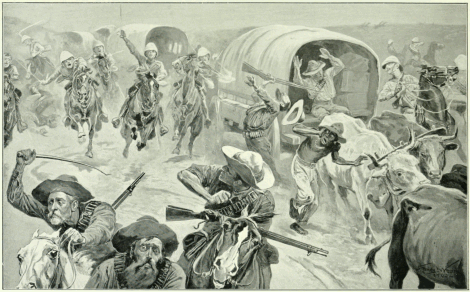
CAPTURE OF A BOER CONVOY BY GENERAL FRENCH’S TROOPS NEAR KIMBERLEY.
Drawing by Stanley L. Wood, from a Sketch by an Officer.
Fighting went on throughout the day. At seven o’clock on the
evening of the 16th it became almost possible to see the end; the
artillery had commenced the vigorous shelling of the laager, and all
the divisions moving on the great axis were now aware that Lord
Roberts’ strategic plan was likely—how soon they knew not—to be
crowned with success.
But we must here break off to eulogise the wonderful activity of
Kelly-Kenny’s division, which acquitted itself so honourably. The
march from Graspan to Brandvallei beyond Klip Drift, a distance
55¾ miles, was accomplished in five marching days. The Light
Brigade on the eve of the battle of Talavera did sixty-two English
miles in twenty-six hours, losing only seventeen stragglers by the way.
They accomplished this feat by adopting the peculiar step invented
by Sir John Moore, three paces walking alternating with three paces
running, which enabled them, when tracks were suitable, to cover
six miles an hour! No such evolutions as these were possible, owing
to the torrid weather and the necessity to take precautions against
exposure in the open veldt during midday. The temperature may
be imagined when it is stated that in one day about sixty-six soldiers
sun-stricken fell out of the ranks. On the morning of the 12th
of February the infantry marched some nine and a half miles from
Graspan to Ramdam, and from thence on the 13th moved to
Waterval Drift. On the 14th they proceeded to Wegdraai, and on
to Klip Drift, which was reached in the small hours of the 15th.
Here, notwithstanding their fatigues, the 13th Brigade at once
engaged with the enemy’s rearguard, and exhibited splendid fighting
qualities, which in the circumstances were remarkable even for
Englishmen. The West Riding, Gloucesters, Buffs, and Oxfords
had a warm time during the whole of the 16th, as the enemy from
kopjes beyond the river in the region of Klipkraal assailed them
for nearly eight hours, assisted by a pom-pom which caused considerable
loss. Though a furious sandstorm later on permitted the
Boers under cover of night to get away, abandoning seventy-eight
waggons, the next morning the invincible Sixth Division started in
pursuit. Captain Trevor (1st East Kent Regiment), Lieutenant Shipway
(2nd Gloucester Regiment), and Colonel M’Donnell, R.A., were
wounded in the course of the engagement. Major Evelegh, Oxford
Light Infantry, while proceeding to join his battalion in the Sixth
Division with a small convoy and escort, was surrounded by a large
party of Boers, and after a gallant defence was forced to surrender.
Fighting and marching without ceasing, the infantry went to
Brandvallei and thence to Paardeberg, where they arrived at
9.30 P.M. on the 17th, in time to take a brief rest prior to the
operations which have yet to be described, and in which they took
such a prominent part. The marching, considering the tremendous
heat and the difficulty of obtaining water, was a feat of which
General Kelly-Kenny might justly have felt proud. Though plodding
along incessantly through the heavy burning sand under a
sun which baked and frizzled even through their uniforms, these
men maintained patience and cheerfulness in a rare degree. The
whole force was animated by complete faith in their commander,
and moved unanimously like some magnificent piece of machinery,
scarce taking time to eat or sleep in the zest of their persistent
pursuit of the enemy. And they were not alone in their zealous
performance of their share in the great scheme. The nicety and
precision of the transport arrangements may be imagined when
we remember that at one time four divisions were moving independently
of their base, making marches across the arid waterless
tracks, and carrying with them the necessaries of life for a healthy
working multitude. A new regime had begun, and the mobility of
our columns had grown equal to that of the Boers, while the railway
had been relegated to a subordinate place in the strategical plan.
Colonel Graham, in his “Art of War,” declares that “to organise
the means of transport for an army acting at a long distance from
its principal magazines, in a country where it is entirely dependent
on its own supplies, is a problem difficult of solution.” Now,
the solution of this problem was due to the wonderful talent of
Lord Kitchener, who was earning his right to be looked upon as
the greatest military organiser of his generation. But his gigantic
effort did not increase the popularity of the late Sirdar. He ran
counter to too many private interests. The army is too intersected
with grooves to be crossed without a few nasty jars, and it was
scarcely possible for so young and successful a general and a peer—one
possessed of almost criminal good luck and amazing moral as
well as physical courage—to be looked upon by his contemporaries-in-arms
with excessive approval. The secret of discord was given
in a nutshell by Mr. Ralph of the Daily Mail. He wrote:—“His
first conspicuous act when in South Africa was the withdrawal of
the transport service from separated commands in order that it
should be managed by the Army Service Corps. Thus it came
about that every brigadier and colonel saw a certain amount of his
power shifted to what he considered a subordinate branch of the
service. A goodish degree of latitude in the enjoyment of comforts
and extras, which had been made possible when these officers controlled
the waggons, was also curtailed. The army wailed and
gnashed its teeth, but I confess I always thought that reason and
right were on Lord Kitchener’s side in this matter. Lord Kitchener’s
plan was the only one by which an insufficient number of waggons
and teams could be utilised for all that they were worth.”
The mobility of an army depends on the reduction of transport,
and to the task of organising transport sufficient to ensure the
mobility of 100,000 men the hero of Omdurman applied himself
with his customary thoroughness. He conceived the gigantic ambition
of doing away with all distinctions of transport, regimental,
departmental, ammunition, or ambulance, and merging them in an immense
whole, thus creating a single general corps, and it was doubtless
to this conception and the able way that the scheme—with the assistance
of Colonel Richardson—was carried out, that Lord Roberts
owed the expedition of his march to Bloemfontein and the further success
which resulted from his sure and swift rushes onward. Ordinarily
speaking, in the army each unit is allowed its own transport. For instance,
colonel, adjutant, and orderly-room are allotted by regulation
a tent apiece. Every three officers share a tent, every fourteen men
another. Staff-sergeants, batmen, and other details are proportionately
provided for. Mounted officers are allowed 80 lbs. baggage,
double the amount allowed for “smaller fry.” Without going
into minute particulars, we may reckon that a brigade would move
with 70 waggons and a division with about 180. To reduce the
huge encumbrance of say some 2000 waggons, with their complement
of oxen and drivers, was a stupendous labour, from which, with its
consequences, this military Hercules did not shrink. Each unit
was taken in hand, and its excrescences—regulation excrescences, we
may call them—were cut down, peeled of all superfluities, much to
the disgust of the staff officers and various other personages who
stickle for their rights, and resent any innovation that threatens to
dock off an iota of the creature comforts that belong to them by the
divine right of red-tape and red-book regulations.
Not only were the rules of transport revised, but special hints
tending to the development of the initiative of the private soldier
were issued to the troops. Herewith is appended the notable document
which may be said to have marked the beginning of the new
era:—
Cape Town, February 5, 1900.
The following notes by the Field-Marshal Commanding-in-Chief are communicated
for the guidance of all concerned.—By order,
Kitchener of Khartoum, Chief of Staff.
Notes for Guidance in South African Warfare
Cavalry
1. On reconnaissances or patrols not likely to be prolonged beyond one
day, the cavalry soldier’s equipment should be lightened as much as possible,
nothing being taken that can possibly be dispensed with.
2. It has been brought to my notice that our cavalry move too slowly when
on reconnaissance duty, and that unnecessary long halts are made, the result
being that the enemy, although starting after the cavalry, are able to get ahead
of it. I could understand this if the country were close and difficult, but between
the Modder and the Orange Rivers its general features are such as to
admit of small parties of cavalry, accompanied by field-guns, being employed
with impunity.
Artillery
3. If the enemy’s guns have, in some instances, the advantage of ours
in range, we have the advantage of theirs in mobility, and we should make
use of them by not remaining in position the precise distance of which from
the enemy’s batteries has evidently been fixed beforehand. Moreover, it has
been proved that the Boers’ fire is far less accurate at unknown distances. In
taking up positions, compact battery formations should be avoided, the guns
should be opened out, or it may be desirable to advance by sections or batteries.
Similarly retirements should be carried out, at considerably increased intervals,
by alternate batteries or sections, if necessary, and care should be taken to
travel quickly through the dangerous zone of hostile artillery fire.
The following plan, frequently adopted by the Boers, has succeeded in
deceiving our artillery on several occasions.
Suppose A to be a gun emplacement, the gun firing smokeless powder.
Simultaneously with the discharge of the gun at A a powder flash of black
powder will be exploded at B, a hill in rear, leading us to direct our projectile
on B. Careful calculation with a watch, however, will defeat this plan.
Infantry
4. The present open formation renders it difficult for officers to exercise
command over their men, except such as may be in their immediate vicinity.
A remedy for this would appear to be a system of whistle calls, by which a
company lying in extended order could obey orders as readily as if in quarter
column. I invite suggestions for such a system of whistle calls as would be
useful.
5. It is difficult to recognise officers as equipped at present, and it seems
desirable they should wear a distinguishing mark of some kind, either on the
collar at the back of the neck or on the back of the coat.
6. Soldiers, when under fire, do not take sufficient advantage of the sandy
nature of the soil to construct cover for themselves. If such soil is scraped,
even with a canteen tin, a certain amount of cover from rifle fire can be obtained
in a short time.
7. The distribution of ammunition to the firing line is one of the most
difficult problems of modern warfare. One solution, which has been suggested
to me, is for a portion of the supports gradually to creep forward until a regular
chain of men is established from the supports (where the ammunition carts
should be) right up to the firing line. The ammunition could then be gradually
worked up by hand till it reached the firing line, where it could be passed along
as required. This would, no doubt, be a slow method of distributing ammunition,
but it appears to be an improvement on the present method, which is
almost impossible to carry out under fire.
8. Reports received suggest that the Boers are less likely to hold entrenchments
on the plain with the same tenacity and courage as they display when
defending kopjes, and it is stated that this applies especially to night-time, if
they know that British infantry are within easy striking distance from them.
How far this is true time only can show.
Roberts, Field-Marshal Commanding-in-Chief, South Africa.
To return, however, to the great advance. Much of the travelling
was done by night, in order to save the oxen from the trying
temperature of the day, though even during the night the heat was
equal to that of an ordinary British midsummer. In addition to the
painful toil of motion over the heavy, sandy, rugged leagues, there
was the hourly danger of attack. Cronje had made known his need
for reinforcements, and at the time, from the south, Andries Cronje
was moving, and from the north, Commandants Snyman and Fournie,
while from other quarters and in the direction of Ladysmith there was
the belief that Boer hordes might be advancing. There was only
one encounter with the Dutchmen, but it ended in a mishap that was
a serious one, for the results were felt for days afterwards, and
helped to try the heroism of the troops who engaged in the movement
to the uttermost. A convoy of 180 waggons, one-quarter of
the total transport, containing forage and provisions, was lost at
Waterval Drift. An interesting picture of the terrible passage of
the drift was given by a sapper who accompanied the convoy:—
“It was a pitiful sight to see the poor infantry fellows played
out, some dropping with a slight sunstroke, and the cattle dropping
dead in all directions. We moved sometimes by day and sometimes
by night. Night-time was the best on account of the oxen working
much better in the cool of night. Nothing occurred of note with us—but
our fellows were fighting every day in front on their way to
Kimberley—till we got to Riet River or Drift, which was a terrible
pass in the river. Miles and miles of transport had to pass through
a narrow passage across the drift, and it took a terrible time for one
waggon to pass over, let alone the hundreds that had to pass. We
were lucky to get across and encamp below a hill for the night.
Next day they still continued to pass the drift, in fact they had been
at it all night, and still hundreds of waggons to come on. The Boers
evidently knew of this obstacle, and a party came up from the south
and had vengeance on the column, as they couldn’t on the fighting
line. It was a lucky thing for us we were clear, or else we might
have found our baggage gone and ourselves put over the border (i.e.
sent to Pretoria or shot). The Boers took up position in the hills
and shelled the waggon convoy. The nigger drivers are terrible
cowards, and all fled to the hills or kopjes near at hand, leaving the
waggons and oxen to the mercy of the Boers. Some of the oxen
we succeeded in driving back into our camp on the other side of the
river. The good old New Zealanders (who have proved of great
use and very daring in this campaign) rode over to where the nigger
drivers were, and threatened to blow their brains out if they didn’t
return to the waggons, which they did after the Boers had left off
shelling for a bit, after doing a terrible lot of damage. Lord Bobs
came up just as they were going to try and get some of the
waggons away, and said ‘Let them go.’ Our loss proved to be
over £100,000, which I am glad to say we recovered later. The
Boers thought this convoy was lost purposely, and when we arrived
here we found the whole of it except what had been sent to our
prisoners at Pretoria.”
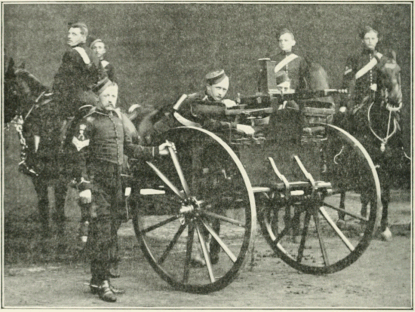
Troop of the 10th Hussars with Nordenfeldt Gun.
Photo by H. Johnston, London.
The unpleasant adventures of E Squadron of Kitchener’s Light
Horse, who were taken as prisoners to Pretoria, make a separate
narrative of themselves, as they took place while the main body
was moving on to the relief of Kimberley.
The squadron was attached to General French’s column, and
took part in the engagement at Riet River. On its way to the
relief of Kimberley, a halt was made at a farm a short distance from
Modder River, and part of E squadron was detached to hold a well
of water until the arrival of another column, expected in four
hours, and then to advance along with them. The relieving column
never arrived. Squadron E held the position for four days without
food against a large force of Boers. They (E Squadron) occupied
an old farmhouse. They loopholed the walls, and although continuously
harassed by the Boer fire, they managed to maintain their
position and the post they were placed in charge of. During that
time they had to subsist on water only, and that brackish. Their
horses were dying daily, as there was not a blade of grass on the
veldt, and the stench was abominable. On the third day of the
siege a poor goat that had wandered near the besieged was immediately
captured and devoured. On the fourth day they commandeered
one of the enemy’s horses, which they intended to
slaughter, their own being too emaciated for that purpose. But
the Boers, having been reinforced, gave them no time to do the
butchering. On the evening of the fourth day a messenger bearing
a letter from General de Wet arrived, demanding surrender within
ten minutes. The Boer force consisted of 500 men and two
12-pounders. The officers consulted together, and decided, in
view of the hopeless condition of their little garrison of fifty all
told, worn out and starving and their horses dead, to accept the
inevitable.
While all this was going on, and Cronje was making the discovery
that he might be completely outflanked, and that the
position of the Boer army at Spyfontein must become untenable,
Lord Roberts was entering into Jacobsdal. The place was orderly
and quiet. The three churches were full of patients, the town having
been used mainly as an hospital. The invalids, for the most part,
were sufferers from enteric, the result of too much Modder River.
After a long and painful intimacy with the grilling veldt, the sight
of houses and civilised dwellings struck gratefully on the eyes of
the incoming troops. A store was hailed as a veritable godsend.
Some one bought a tin of oatmeal, and walked off with it as one
who had secured a prize; some one else gave a goodly price for
a pot of pickles, and came away licking his lips like a modern
Eliogabalus. The rejoicing was no mean emotion, for the unfortunate
men, with the appetites of athletes, had been existing on
lovers’ fare. One of the famished but cheery fellows wrote: “We
marched into Jacobsdal, and as soon as we arrived we thronged
the stores for provisions. I made the following purchases for three
of us:—
| |
s. |
d. |
| Three two-pound loaves at 1s. each |
3 |
0 |
| Three tins of condensed milk at 1s. each |
3 |
0 |
| Two tins of syrup at 1s. 3d. each |
2 |
6 |
| One small packet of cocoa |
0 |
9 |
| One tin of Quaker oats |
1 |
3 |
| One pound of sugar |
0 |
6 |
| |
11 |
0 |
Then we gorged ourselves to make up for three weeks’ semi-starvation.
The most prominent building of Jacobsdal is the church,
which stands in the centre of the town. The town itself lies in a
hollow—Sleepy Hollow would be an apt title for the place just now.
Most of the houses, including the church, are at present converted
into hospitals, and the female population are acting as nurses. Most
of them are in mourning for relatives lost during the campaign.”
Later, the troops moved on and encamped at a farm which had
also been used as an hospital. Sights pathetic were only too common—our
own sick and wounded in various stages of suffering,
and outside, to use a “Tommy’s” description, “some poor devils
wrapped in sheets ready to be put to bed for the last time!”
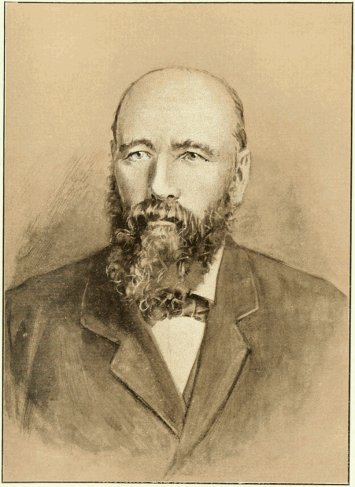
GENERAL CRONJE.
From a Photo by M. Plumbe.
Lord Roberts visited the large German hospital, and expressed
himself well pleased with the splendid cleanliness of the place and
the general evidences of good management. Among the sufferers
was found Colonel Henry, who had been taken prisoner on the 14th.
Strangely enough, all the inhabitants of the place evinced satisfaction
at the arrival of the British, particularly on making the discovery
that it was not the habit of the British troops to loot and
destroy, as they had been led by the Burghers to believe was the
case. They were now made acquainted with the proclamation which
Lord Roberts issued to the Burghers of the Orange Free State
when his force invaded their territory. It was printed both in
English and Dutch:—
“The British troops under my command having entered the Orange Free
State, I feel it my duty to make known to all Burghers the cause of our coming,
as well as to do all in my power to put an end to the devastation caused by
this war, so that, should they continue the war, the inhabitants of the Orange
Free State may not do so ignorantly, but with full knowledge of their responsibility
before God for the lives lost in the campaign.
“Before the war began the British Government, which had always desired
and cultivated peace and friendship with the people of the Orange Free State,
gave a solemn assurance to President Steyn that, if the Orange Free State
remained neutral, its territory would not be invaded, and its independence
would be at all times fully respected by Her Majesty’s Government.
“In spite of that declaration, the Government of the Orange Free State
was guilty of a wanton and unjustifiable invasion of British territory.
“The British Government believes that this act of aggression was not committed
with the general approval and free will of a people with whom it has
lived in complete amity for so many years. It believes that the responsibility
rests wholly with the Government of the Orange Free State, acting, not in the
interests of the country, but under mischievous influences from without. The
British Government, therefore, wishes the people of the Orange Free State to
understand that it bears them no ill-will, and, so far as is compatible with the
successful conduct of the war and the re-establishment of peace in South
Africa, it is anxious to preserve them from the evils brought upon them by the
wrongful action of their Government.
“I therefore warn all Burghers to desist from any further hostility towards
Her Majesty’s Government and the troops under my command, and I undertake
that any of them who may so desist, and who are found staying in their homes
and quietly pursuing their ordinary occupations, will not be made to suffer in
their persons or property on account of their having taken up arms in obedience
to the order of their Government. Those, however, who oppose the forces
under my command, or furnish the enemy with supplies or information, will be
dealt with according to the customs of war.
“Requisitions for food, forage, fuel, or shelter made on the authority of the
officers in command of Her Majesty’s troops, must be at once complied with;
but everything will be paid for on the spot, prices being regulated by the local
market rates. If the inhabitants of any district refuse to comply with the
demands made on them, the supplies will be taken by force, a full receipt being
given.
“Should any inhabitant of the country consider that he or any member of
his household has been unjustly treated by any officer, soldier, or civilian
attached to the British army, he should submit his complaint, either personally
or in writing, to my headquarters or to the headquarters of the nearest general
officer. Should the complaint on inquiry be substantiated, redress will
be given.
“Orders have been issued by me prohibiting soldiers from entering private
houses or molesting the civil population on any pretext whatever, and every
precaution has been taken against injury to property on the part of any person
belonging to or connected with the army.
“Roberts, Field-Marshal, Commanding-in-Chief, South Africa.”
To return to General French. The cavalry division bivouacked
outside the town of Kimberley, but their repose was limited. At
3 A.M. on the morning of the 16th they were up and doing. The
enemy in the north was giving trouble. Some sharp fighting took
place, during which Lieutenants Brassey (9th Lancers) and P. Bunbury
were killed. This early activity was tough work for the already
weary troops, who had been fifteen hours without a meal. Indeed,
it was generally remarked that the relievers looked sorrier specimens
of humanity than the relieved. The Colonial troops, the Queensland
and New Zealand Contingents, and the New South Wales
Lancers, considering all things, were wonderfully fit after having
played a conspicuous part in the operations. These troops had
joined General French’s column from the regions of the Orange and
Modder Rivers. The New South Wales Lancers rode on the
extreme right flank of the first brigade, and their ambulance corps,
under Lieutenant Edwards, kept up with the column, and was
complimented on being the first ambulance to cross the Modder
River. Like the rest of the troops, they had taken their share of
small rations, merely nominal rest, sun-scorching, and maddening
thirst, and yet were full of zeal—“keen as mustard,” as some one
said—to engage in the herding of Cronje and effect his capture.
Worn out as they were, they had sprung to attention on a rumour
brought in by a despatch-rider to the effect that Cronje had evacuated
Majersfontein and was in full retreat.
At midnight on the 16th, no confirmation of this news had been
received. The jaded troops, and still more jaded horses—mere
skeletons in horse’s skins—were preparing for real repose, when all
was changed! A telegram arrived from Lord Kitchener saying
that Cronje, with 10,000 men, was in full retreat from Majersfontein,
with all his waggons and equipment and four guns, along the
north bank of the Modder River towards Bloemfontein; that he had
already fought a rearguard action with him; and that if French, with
all available horses and guns, could head him and prevent his
crossing the river, the infantry from Klip Drift would press on
and annihilate or take the whole force prisoners.
Here was a surprise! Pleasant yet unpleasant, for shattered
men in the last stage of fatigue. But General French—whom
some one has described as possessing the shape of a brick, with all
the solid and excellent qualities of one—rose to the occasion. He
was on the point of going to sleep, but there was no thought of
rest now. Arrangements had to be made, horses weeded—out of a
division of 5000 only one brigade was fit to move!—more borrowed
from the Kimberley Light Horse, whose holiday-time had come, and
other preparations hurriedly set on foot to ensure an immediate rush—a
swoop that should be as swift and successful as it was startling!
One may imagine the midnight picture. The dark immensity of
veldt—the dust-driven, sweltering veldt—and Cronje, miles ahead
with his horde, the remnant of his convoy, his women and children,
fleeing along the north bank of the Modder, harassed by the
Sixth Division, threatened by the Seventh and Ninth, and yet
longing to cross the river, to get safely to Koodoosrand Drift,
where he hourly expected reinforcements would come to his succour.
French, dead beat after glorious work accomplished, rising from
the first hospitable pillow he had seen for days—springing suddenly
to action, ordering, organising, deciding how to effect the great
swoop on Koodoosrand Drift and head off the fugitive. There was
no time for the buckling on of mental and moral armour; only the
warrior at soul could have been ready for such a situation. But
such an one was here. He gave swift orders. In three hours’ time
General Broadwood and his brigade and three batteries of artillery—the
only ones available out of seven—sallied forth towards the
east, in the dusk of the morning. Their destination—Koodoosrand
Drift—was some forty miles off, and once here Cronje’s last loophole
of escape would be gone! The General and his staff followed
at 4.15 A.M., riding at full speed, and catching up the brigade about
fifteen miles off.
The whole nature of their errand and the proposed movement
was a surprise, for this manœuvre had not entered into General
French’s original calculations.
When the General had seen the Sixth Division safely at Klip
Drift and secured his left flank, he proceeded on his rush to
Kimberley. Of other movements save his own he was ignorant.
Even as he and the troops were riding into the town, Cronje,
who had discovered the futility of his position at Majersfontein
and the danger of it, was trekking madly across the front of
the Sixth Division. On the morning of the 16th Lord Kitchener,
hearing that the Majersfontein laager and the Modder River camp
were deserted, and seeing a cloud of dust in the distance, had
guessed what was happening, and immediately altered his plans
to meet the emergency. As we are aware, he instantly gave
orders for the mounted infantry not to follow French, but to
pursue and attack the Boer convoy, while he telegraphed later
to French, with the results just described. General French grasped
the position at a glance. He knew no time was to be lost,
and soon Broadwood’s brigade, with horses that could barely
move, was pushing on as fast as spurs could insist. The early
morning dusk broke into the green and grey and gold of dawn;
birds flew frightened hither and thither; foxes rushed to their holes;
springbok and hares tempted the sportsmen, but never a glance to
right or left was wasted. All eyes were strained to the east, to the
momentous east, and the wooded banks of the distant river. Nearer
and ever nearer they came—specks were seen on the horizon—men?—horses?—the
enemy moving?—scudding away before he could be
cornered? No—Yes? A moment of excitement, anguish—joy! The
General had mounted a kopje, reconnoitred, and discovered the
truth. It was Cronje’s force—the remnants of his convoy some
4000 yards off—the convoy streaming down into the drifts that lead
to Petrusberg and thence to Bloemfontein! They must never
reach that destination! Kitchener’s words—“Head him and prevent
his crossing the river”—so simple in sound, so complex in
execution, thrilled every heart. Quickly the guns were got into
action—grandly—almost magically—the first shot plumped—bang!
in front of the leading waggon just as the convoy was preparing
to descend the drift! What a reveillé! Cronje, as we know, was
rushing from the clutches of the Sixth Division at Drieputs. Breathless,
he gathered himself together. Suddenly he found himself
assailed by a new force—a new terror! He divined in a moment
what had happened. It was French, the ubiquitous French—French
redivivus, as it were—who was putting the finishing touch to the
chapter of disaster. Poor Captain Boyle, in his letter to the Nineteenth
Century, thus described the great Dutchman’s plight:—
“His only chance now was to sacrifice his guns and convoy, and
cut his way across the river under the heavy fire of our guns.
Immediately on the first shell bursting in the laager, about thirty
Boers galloped out to seize a kopje on our right, afterwards called
Roberts’ Hill; but the 10th Hussars in a neck-and-neck race had
the legs of them, and seizing the hill in advance, beat them off with
their carbine and Maxim fire. The Boers from their laager answered
our shell fire for a short time with great accuracy from two or three
guns. But these were quickly silenced, and shell after shell from
Artillery Hill fell plump into the laager. Finally, our second battery
was moved to a little distance from Roberts’ Hill and opened fire
from the southern slope on to a kopje to which the Boers had retired.
All that afternoon at intervals our guns poured shells into the laager,
but no response came, and we spent our time watching the Boers,
now 3000 yards away, entrenching themselves in the open and
along the river-bank. Their waggons caught fire and the ammunition
exploded, and as they realised their position more and more, so
must their hearts have sunk. Anxiously must they have waited for
the first sign of the infantry gathering round, as anxiously as we did
in our turn watching from the high kopjes.
“The cavalry, worn out as they were and without food, had to
hold the kopjes and water their horses in turn some five miles off.
They got what grazing they could in the kopjes as they lay there,
for no corn had come on from Kimberley, and neither men nor
horses had had any food except the three days’ rations with which
they originally started from Klip Drift the Thursday before, a good
deal of which had been shaken off the saddles or lost in the long
gallop up the plain to Kimberley. The General, the men, the
horses, all alike had to live on what was found at Kamilfontein—a
few mealies, a few onions, and the crumbs of biscuits in our pockets
were all we had until some Free Staters’ sheep and cattle were
rounded and killed. Had it not been for this plentiful supply of
meat, the men must have fared very badly for the next three days.
No transport came in until Monday night, and the horses had but
1½ lb. of corn in three days. The men were put on half rations of
biscuits even after the transport arrived.
“Meanwhile, on Saturday afternoon about 5 P.M. Broadwood sent
word to French that in the far distance he observed the dust rising,
which he took for Kelly-Kenny’s division. French returned to
Roberts’ Hill, and, until the sun set, anxiously awaited the arrival
of the infantry—but they marched but slowly. From 6 P.M. till
7 P.M. we opened fire again from our batteries to show Lord Kitchener
our exact positions.” The splendid work done by the Royal Horse
Artillery was described by another eye-witness. He said: “I will
give you an idea of what good gunners we have in the Artillery.
General French said to one of the gunners, ‘See those three waggons
over there? (a distance of about 3½ miles); see what you can do with
them.’ The gunner fired three shell, and the waggons were no
more.”
We must now watch the progress of the other portions of the
force who were actively engaged in taking their share in the huge
undertaking. Colonel Stephenson’s brigade, on the night of the
16th (while General French was learning the great news), had
re-crossed the river at Klip Drift, and on the morning of the 17th
(at the same hour as Broadwood’s brigade was moving from Kimberley)
had marched to the south of the river with the same intention—that
of heading off Cronje at Paardeberg and Koodoosrand
Drift. Thus, with Broadwood’s brigade on one side, and Stephenson’s
on the other, Cronje’s prospects of escape were scarcely worth
a dime. The Times’ correspondent, talking of Colonel Stephenson’s
troops on the morning of the fateful 17th, said:—
“They were joined about ten at Klipkraal Drift by Knox’s
brigade, which marched along the northern bank. The mounted
infantry, pushing on, reached Paardeberg Drift that evening, and
encamped on rising ground close to the south bank. The infantry,
leaving Klipkraal at six in the evening, made a night march for
Paardeberg Drift, but, missing their way, slightly passed the Drift
and bivouacked on some rising ground nearly two miles beyond,
separated from the river by a smooth plain shelving gently down
to it. The mistake was a fortunate one, as it brought the infantry
almost opposite to the place where Cronje had determined to cross.
Cronje had left Drieputs during the night after the battle, abandoning
seventy-eight waggons, and pushed on along the north bank of
the river during Saturday for Koodoosrand Drift. Soon after passing
north of Paardeberg Drift he heard that French had already
returned from Kimberley, and was holding a line of high kopjes
running north-west from Koodoosrand Drift, and completely
commanding the drift. Wheeling his waggons to the right
across the plain, he laagered on the north bank of the river at
Wolveskraal Farm. This was opposite to a drift of the same name,
about half-way between Paardeberg and Koodoosrand Drifts, being
about four miles in a straight line from each. Here he intended to
cross on Sunday morning. But already, during the night, he became
aware of the presence of the mounted infantry south of Paardeberg
Drift, and decided that he could not get his convoy away without
fighting. Probably Cronje did not realise that Kelly-Kenny’s
infantry could have already marched up and occupied the rising
ground not three thousand yards south of Wolveskraal Drift; still
less could he know that General Colvile’s division (whose endurance
had been extraordinary) was but a few miles behind, and was
to reach Paardeberg Drift before daybreak. If Cronje had known
this, there is little doubt that he would have promptly sacrificed all
his transport and all his guns in order to get his men away and
escape from the trap into which he was now caught. As it was,
he sent a great part of his force to line the river-bed all the way
down to Paardeberg Drift, in order to act as a rear-guard and check
any attempt to interfere with his crossing Wolveskraal Drift at his
leisure.”
Later on, the Ninth Division, with the Highland Brigade, who had
made a forced march from Jacobsdal, arrived on the scene just in time
to see the Boers sending up rockets to show their position to expected
reinforcements. And there is little doubt that Cronje, unable to
realise the expeditious advance of “lumbering Britons,” mistook
General Colvile’s troops for the longed-for relief.
Among the missing from near Paardeberg were Lieutenants
Romilly (Duke of Cornwall’s Light Infantry) and Metge (Welsh
Regiment), and Captains Arnold and Vaughan of Kitchener’s Horse.
Here we have the position of affairs as they stood on the night
of the 17th and on the morning of the 18th, when the trap so
ingeniously set for Cronje commenced to close little by little—north,
south, east, and west. Everywhere he turned the detestable rooineks
menaced him, and he who so lately had eaten his breakfast to the
tune of his 100-pounder gun, that belched ruin and mutilation over
the whole region of Kimberley, was now constrained to breakfast
to a new and disagreeable inversion of an identical melody!
On Sunday, the 18th of February, the most exciting action of the
war took place. It was costly as it was momentous, for it served to
decide the fate of the fleeing Dutchman. The scene of the drama was
not unpicturesque. From the Paardeberg to the Koodoosrand Drift
the Modder flowed along a deep hollow from thirty to a hundred
yards in depth. To either side the forks of small dongas radiated,
while the high banks were fringed with the feathery foliage of the
mimosa and willow. Donga and tree stump afforded excellent cover
for the slim adversary, sniper or scout. The river travelled from
Koodoosrand Drift west-south-west, deviating southwards on either
side of the Wolveskraal Drift. A vast expanse of veldt, some two
thousand yards wide, shelved down towards the south bank of the
river, fringed by higher ground; and this grassy plain extending
eastwards joined a circle of kopjes now known as Kitchener’s Hill.
On the opposite, the north bank of the river, was another similar
plain, dotted with minor kopjes to within a thousand yards of the
river, and beyond them was the higher hump of Paardeberg Hill.
The action began at dawn. Firing grew hotter and hotter with
the growth of the morning, and soon pandemonium was let loose.
While part of the mounted infantry was forcing the rearguard up the
river another part was manœuvring on the right front and flank of
the enemy. The Dutchmen meanwhile from King’s Kop turned on
a quick-firing Hotchkiss gun, which swept the flat country from the
kop to the southern bank of the river. The antagonists had both
posted themselves on the north bank of the river—both banks of
which were level, and this expanse afforded no cover for movements.
Over this expanse the Ninth Brigade had to move, struggling
through a zone of fire towards the concealed enemy.
Cronje by this time had realised that his position was critical—almost
hopeless. Bringing his fine military qualities to bear on the
situation, he decided to make the best of a bad job, and entrench
himself with all the skill possible. He held about one square mile
of the river-bed on either side of Wolveskraal Drift, and beyond
that he knew were encircling kopjes, each one concealing its multitude
of rooineks. On the east, slowly creeping up, were the
menacing numbers of Tucker’s Division; on the west the vast crowds
of the mounted infantry and the Sixth Division; on the south were
field-guns little more than a mile off, threatening to shower destruction
from Gun Hill, while on the north were Naval guns and howitzers.
Indeed, everywhere was fate frowning, obdurate, vengeful. But the
Dutchman retained his pluck and his wits. He even believed that
with everything against him he might yet employ the same tactics
which had nonplussed Lord Methuen at Modder River. He still
retained a poor opinion of his adversary, and his delusion lent him
confidence. He hurriedly built trenches, that in themselves were
masterpieces of defensive art, and took up his headquarters in the
centre, in a red brick house—a species of travellers’ hostelry, which
may be found near all drifts in South Africa. Here at night Mrs.
Cronje joined him. During the day she was placed in the women’s
shelter at the east side of the area, which shelter was protected by
waggons and trenches all along the bed of the river. Talking of
these trenches, the correspondent of the Times declared that “the
skill with which they were constructed as defences against both rifle
and shell fire was worthy of the highest praise. All except those of
the outer lines of pickets were made so narrow and deep that it
seems as though they were in many cases entered from one end
rather than the top, as any such ingress must even in a week’s time
have considerably widened the neck of the excavation. At the top
they were perhaps eighteen inches wide, at the bottom about three
feet, and by crouching down the most complete protection was
afforded from bursting shell.
“Every natural protection, such as the ramifications of the dongas
which eat into the banks on both sides of the river, had been utilised,
though the bombardment from both sides compelled them to abandon
their first hasty breastworks cut into the actual top of the bank,
which was here from about fifty to a hundred yards from the river
itself, and thirty feet in height.
“For the first time here the ‘T’ trenches, of which much has
been said during the present campaign, were used. They did not
seem to present the least advantage over the ordinary shapes, except
that in an exposed angle they may have provided additional protection
against an enfilading fire.”
Cronje’s first object in entrenching himself in the bed of the
river was to arrest the further advance of the mounted infantry, who
had taken possession of the bed of the river west of his position.
In this he was successful. Worn, harassed, and almost helpless, he
determined to make a desperate stand, hoping against hope to gain
time till some help from without should arrive. But this help never
reached him. A grand enveloping movement commenced, and
Cronje, brought to bay, found himself face to face with what proved
to be his Sedan.
By this time he and his followers were snugly ensconced in bush
and donga and scrub round the laager, and from the trees around
they vigorously sniped and poured volleys at the advancing troops.
In the advance to the attack the Highland Brigade was on the left,
General Knox’s brigade in the centre and on the right, while General
Smith Dorrien’s brigade, after crossing the river by Paardeberg Drift,
moved along the north bank. The Highland Brigade had a terrific
duty. The Boers, from their position in the bed of the river and
on both sides of it, commanded the left of the Brigade, and as
the kilted mass moved forward in the open poured upon them a
deadly fire, which forced them to lie prone for the rest of the day.
Here at noon, when bullets were humming their loudest, General
Hector Macdonald was wounded. He had dismounted, and was
directing the movements of the brigade, when overtaken by a shot
which penetrated thigh and foot. Despite this unlucky accident and
a tremendous spell of hard fighting, the brigade exhibited splendid
pluck and tenacity. They were destitute of cover, but maintained
their position with astonishing fortitude, and this after the long
forced march they had made from Jacobsdal, and while enduring
the tortures of maddening thirst, which could not be assuaged. A
heavy thunderstorm mercifully overtook them in the course of the
afternoon and raindrops large as gooseberries clattered down their
relieving moisture on the parched and exhausted troops.
| British Guns. |
Laager in Flames |
French's Cavalry |
6th Division |
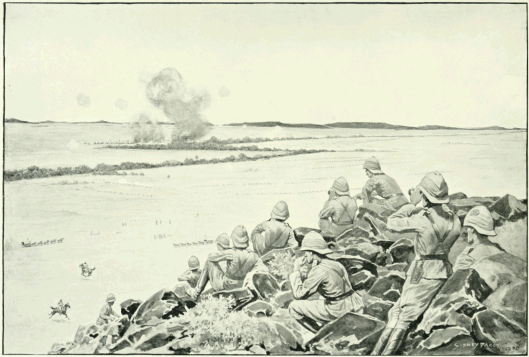
THE BATTLE OF PAARDEBERG.
Drawing by Sidney Paget from a Sketch by W. B. Wollen, R.I.
On the north bank of the river was Cronje’s laager, an environment
of waggons, carts, ammunition, and stores. While General
Smith Dorrien’s force, among which were the Canadians, Gordons,
and Shropshires, attempted to charge into the laager, they too
were vigorously shelled by the enemy, who, undefeatable, held on
valiantly to a kopje on the south bank of the river. Here they
posted a Vickers-Maxim and other deadly weapons, and in a
measure divided our force in two. The Seaforths and the Cornwall
Regiment made a splendid charge with the bayonet, and drove
the Boers from their cover round the drift, but in the glorious
rush both the Colonel and Adjutant of the Cornwalls were stricken
down. Ninety-six of the men were wounded, but they now held the
north-west side of the enemy’s position.
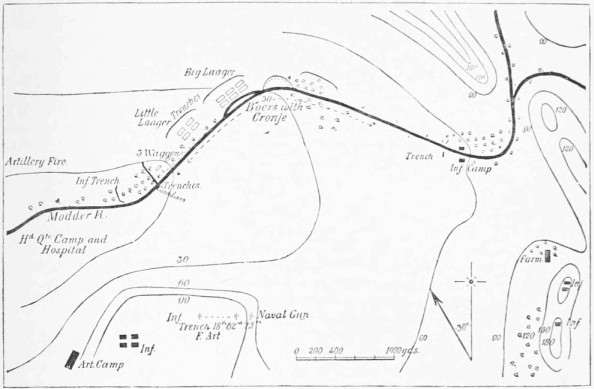 Plan of the Boer Laagers and Trenches and the British Positions at Paardeberg.
(By an Officer of the Royal Field Artillery.)
Plan of the Boer Laagers and Trenches and the British Positions at Paardeberg.
(By an Officer of the Royal Field Artillery.)
On the east the Sixth Division was hard at work tackling a
horde of Boers, who made a last despairing lunge in order to burst
through the entangling forces and push for the south bank of the
river. The effort was stubborn as it was desperate, but they were
defeated by the dash of the West Riding Regiment, who pressed
forward with the bayonet and succeeded in seizing the drift. Many
splendid fellows were wounded and slain in the collision. Meanwhile
the artillery continued to direct their incessant thunder against
the laager, pouring in a deluge of destruction from all quarters, and
forcing the Dutchmen to shrink within the space, little more than
a mile square, into which they had so hurriedly scrambled.
General Kelly-Kenny having possessed himself of both Klip
Drift and Koodoosrand Drift, the Boers were now enclosed east
and west. But here, crunched in a veritable death-trap, they
fought tenaciously. Worn, harassed, and weakened by their hurried
march, they yet held a stubborn front to our assaulting troops, and
from the cramped region of their laager did as much damage as it
was possible to do. The Canadians, who had behaved with conspicuous
gallantry in the attack on the laager, lost nineteen killed
and sixty-three wounded. A description of the fight as seen from
their point of view was given by a private in the 1st Contingent:—
“We left Klip Drift on the Modder River at 6 P.M. Saturday, and marched
all night until seven on Sunday morning, covering 23 miles. During the march
we could hear the guns ahead. I was orderly man for Sunday, so, removing
my pack, I went to the river for water. Just a little way up the river a brisk
fire opened up. When I got back to our lines I found them issuing a ration
of rum. I had mine, and it just braced me up.
“By this time the engagement was pretty brisk. Our brigade was ordered
on the left of the river, which we crossed at a ford just in rear of the camp.
The Shropshires crossed first, then followed the Canadians and Gordons.
The water was up to our necks. Some went deeper and had to swim. We
crossed in fours, holding on to each other, formed up in column and advanced
a short distance, when we extended to seven paces in skirmishing order.
C Company formed to support A Company.
“By this time the bullets were coming pretty thickly, and we had some
very narrow squeaks. We reinforced A Company at 500 yards and opened
fire. The Boer fire was heavy, and some of our boys had been hit, but we
soon subdued the fire. Their position was in the river, and we were lying out
in the open, no cover of any kind except a few anthills. We could see very
little to fire at except the fire from their guns. Our line was in a crescent
shape, the right on the river, and the left extended along about 500 yards. In
the afternoon our troops were ordered to cease fire. As soon as we stopped
they started sniping, which made us hug the ground.
“Shortly after joining the firing line Captain Arnold of A Company was
struck. The Boers started a murderous fire on the stretcher-bearers who
carried him away, a trick they did all day long. Towards evening the left
was ordered to reinforce the right. It was a daring move, but we did it by
running down in threes and fours. At dark all the forces retired, and quite
a few men volunteered to search for the wounded. I was out all night until
four the next morning, when I laid down played out. I never want to witness
such terrible sights as I saw that night again. Whenever we showed ourselves
in the moonlight the sharpshooters would fire at us. We were all
up early next morning, but the Boers had retired farther up the river. So we
collected our wounded and buried the dead. I was helping a hospital sergeant,
and he sent two of us up the river to search for wounded. We found a
few, and also came across a wounded Boer, whom we bandaged and took
back to camp. We also came across a few dead. We questioned the Boer,
and he said that they had retired during the night, carrying their wounded and
throwing the dead into the river. After dinner, which we had about four, we
went out on outpost duty. During the night there was quite a little firing
going on. This morning we advanced towards the position again, and about
ten o’clock retired for some breakfast and advanced again. Although under
fire all day we did not fire, but the artillery certainly played Cain with them.”
Captain Arnold’s wound was mortal, but Lieutenant Mason, who
was also shot, was not dangerously hurt.
A Colonial, writing from the front at Paardeberg, said that
fighting “went on during the day until about five o’clock, when the
Cornwalls arrived in support. The officer commanding this battalion
seemed to think that too much time had already been spent in
fighting the Boers, so ordered the charge. The result was fatal to the
Cornwalls, as they had to retire. The Canadians, acting under the
orders of the commanding officer of the Cornwalls as senior officer,
also charged, and with a like result; but the Canadians, in place of
retiring, simply lay down and remained. It was during this charge
that most of the fatalities occurred. The unfortunate commanding
officer of the Cornwalls was killed, and Captain Arnold and Lieutenant
Mason of the Canadians wounded. The Brigadier subsequently expressed
his regret that the charge took place, but at the same time
warmly congratulated the Canadians on their behaviour, as did Lord
Roberts also.”
Of gallantry and daring there was no end. From dawn till
sunset raged a battle of appalling fierceness, of magnificent persistency.
From drift to drift the hollows reverberated with the
perpetual roll of musketry, the brawling of multifarious guns, the
hoarse cheers of charging troops, the shouts of the unflinching enemy.
Curling smoke burst in wreaths and garlands from the sides of the
hills and rose against the purple of thunder-clouds; flaring tongues
of vengeful flame danced and forked their reflections of heaven’s
lightnings; spouts and torrents of water poured from the sky,
mingling with the heroical blood of Britain’s best, that trickled in
rivulets, north, south, east, and west of the scene, and traced far
and wide the history of sacrifice on the now sacred ground. For
all this, the position of the contending parties remained unchanged—Cronje
defiant and enclosed, the British lion crouching, watching.
At dusk the scene was weirdly, terrifically picturesque. From
the south and north sides of the river shells hurtled through the air,
falling and exploding along the river-bed, now setting fire to a
waggon, now a cart, and filling the gloom with lurid panoramas of
flame and an awe-striking, ceaseless din. Once an ammunition
waggon was struck. Then the blaze and crackling which followed,
intermingling as they did with the roar of artillery and the rattle
of rifles, made a fitting concert for Hades. And to the tune
of this demoniacal intermezzo the cordon round the enemy was
gradually closing, his last chances of escape were one by one
being sealed, the last links in Lord Roberts’ strategical chain
were being forged.
At night there was peace. The Modder might have been the
placid purling Thames winding along between fringed and sloping
banks to the bosom of the sea. But there was none to admire the
pretty scene. All were worn out, and glad to drop to sleep where
they had fought, while the bearer-parties—“body-snatchers,” as they
were jocosely styled—picked their way in the darkness, doing their
deeds of mercy with zealous, unflagging perseverance. During
this time many deserters from the enemy came in. They had seen
the hopelessness of their case, and had been urging, uselessly, the
implacable Cronje to surrender.
The following is the list of those who were killed and wounded
during the fight:—
Killed:—Mounted Infantry—Colonel Hannay.[1] 2nd Warwick—Lieutenant
Hankay. Duke of Cornwall’s Light Infantry—Lieutenant-Colonel Aldworth,[2]
Captain E. P. Wardlaw, Captain Newbury. Seaforth Highlanders—Second
Lieutenant M’Clure. Argyll and Sutherland Highlanders—Lieutenant Courtenay.
West Riding Regiment—Lieutenant Siordet. 1st Yorkshire—Second
Lieutenant Neave. Oxford Light Infantry—Lieutenant Bright, Second Lieutenant
Ball-Acton. Wounded:—Staff—Major-General Knox (13th Brigade),
Major-General Hector MacDonald (3rd Brigade). Duke of Cornwall’s Light
Infantry—Captain J. H. Maunder, Lieutenant H. W. Fife, Second Lieutenant
J. W. C. Fife, Second Lieutenant R. M. Grigg. Seaforth Highlanders—Captain
G. C. Fielden, Captain E. A. Cowans, Captain G. M. Lumsden, Lieutenant J.
P. Grant, Second Lieutenant D. P. Monypenny (died of wounds), Second Lieutenant
A. R. Moncrieff. 1st Gordon Highlanders—Second Lieutenant W. B. J.
Nutford. Argyll and Sutherland Highlanders—Lieutenant C. N. Macdonald,
Lieutenant G. Thorpe, Second Lieutenant G. A. Akers-Douglas, Second
Lieutenant F. G. S. Cunningham. Black Watch—Lieutenant-Colonel A. M.
Carthew-Yorkstoun, Major Hon. H. E. Maxwell, Major T. M. N. Berkeley,
Captain J. G. H. Hamilton, Lieutenant J. G. Grieve (N.S.W. forces attached).
West Riding Regiment—Captain F. J. de Gex, Captain H. D. E. Greenwood.
1st Yorkshire—Lieutenant-Colonel H. Bowles, Major Kirkpatrick, Lieutenant
C. V. Edwards, Captain A. C. Buckle (South Stafford attached). Oxford Light
Infantry—Major Day, Captain Watt, Lieutenant Hammich. East Kent Regiment—Captain
Geddes. Shropshire Light Infantry—Captain Gubbins, Captain
Smith, Lieutenant English, Second Lieutenant Kettlewell. Canadians—Captain
H. M. Arnold (since died of wounds), Lieutenant J. C. Mason, Lieutenant
Armstrong. R.A.M.C.—Captain J. E. C. Canter. Lieutenant G. H. Goddard.
East Surrey—Captain A. H. S. Hart. 2nd Lincoln—Second Lieutenant Dockray
Waterhouse. 1st Yorkshire—Second Lieutenant W. G. Turbet. 2nd Oxford
Light Infantry—Captain Fanshawe, Lieutenant Stapleton. 2nd Bedford—Captain
R. W. Waldy, Lieutenant Selous. 2nd Norfolk—Lieutenant Cramer-Roberts.
1st Welsh—Lieutenant-Colonel Banfield, Major Ball. 2nd East Kent—Captain
Godfrey-Faussett, accidentally shot (died February 21). 1st West
Riding—Captain Taylor, Captain Harris. Roberts’ Horse—Lieutenant A.
Grant. Argyll and Sutherland—Captain N. Malcolm, D.S.O. 1st Gordon
Highlanders—Lieutenant Ingilby. 1st Welsh Regiment—Major Harkness,
Lieutenant F. A. Jones, Lieutenant Veal. Mounted Infantry—Lieutenant-Colonel
Tudway (1st Essex). 1st Essex—Captain Milward, Second Lieutenant
Thomson. Missing:—Captain Lennox, 81st Field Battery R.A.
The following table gives the distribution of the losses among
officers:—
| |
Killed. |
Wounded. |
Missing. |
Total. |
| Staff |
— |
2 |
— |
2 |
| 2nd Duke of Cornwall’s Light Infantry |
3 |
4 |
— |
7 |
| 2nd Seaforth Highlanders |
1 |
6 |
— |
7 |
| 1st Argyll and Sutherland Highlanders |
1 |
4 |
— |
5 |
| 1st West Riding Regiment |
1 |
2 |
— |
3 |
| 1st Yorkshire Regiment |
1 |
4 |
— |
5 |
| 1st Oxfordshire Light Infantry |
2 |
3 |
— |
5 |
| 2nd East Kent Regiment |
— |
1 |
— |
1 |
| 1st Gordon Highlanders |
— |
1 |
— |
1 |
| 2nd Royal Highlanders |
— |
4 |
— |
4 |
| 2nd Shropshire Light Infantry |
— |
4 |
— |
4 |
| Royal Canadian Regiment |
— |
2 |
— |
2 |
| Royal Army Medical Corps |
— |
2 |
— |
2 |
| 81st Battery R.A. |
— |
— |
1 |
1 |
| Total |
9 |
39 |
1 |
49 |
The heaviness of this list and the evenness with which the casualties
were shared bear witness to the dash and daring displayed by all the
battalions engaged.
A good deal of comment subsequently took place regarding the
methods adopted during this day’s warfare, and many were of opinion
that the attempt to take the position by assault was unnecessarily wasteful
of life. Considering the positions of the various regiments on the
morning of the battle, it seemed as though the encircling of the
enemy and forcing him to submission by a slow process of pressure
would have served equally well to bring about the inevitable end.
But again it has been urged that there was at the time no knowing
how soon reinforcements might come to the assistance of Cronje,
or what results might accrue from permitting the Boers—at the
time breathless and weary—to gather themselves together for fresh
resistance. Delay was evidently the one thing that Cronje was
playing for, and Lord Kitchener, on his side, was averse from risks
which might bring about the failure of the vital undertaking.
The enemy had little rest. The small hours were spent in constructing
entrenchments round the laager. All owned that their
stubborn energy was admirable, but further active resistance on the
part of Cronje was now beginning to be regarded by all—even his
own people—as an act of suicide and murder. “It was magnificent,
but it was not war,” as the Frenchman said. The Mounted Infantry
and a battery of artillery next morning turned their attention to an
offending kopje, whence the Boers could yet pour their equivalent for
“cold water” on the British plans, and while circling round the
position were accosted with a morning salutation from the rifles of
the Federals on the summit of the hill. Fortunately the fusillade was
launched with more vigour than accuracy, and there were no casualties.
Pursuing their investigations, the troops discovered a good
defensive position and seized it.
Early in the morning Cronje sent a white flag, demanding twenty-four
hours’ armistice for the purpose of burying his dead. This most
probably being part of a wary plot to gain time for reinforcements
to come to the rescue, a reply was sent back from Lord Kitchener
to the effect that it was impossible to grant the request, which must
await the arrival of the Commander-in-Chief. Lord Roberts was
then on his way from Jacobsdal, and when the matter was referred to
him, he at once sent a message refusing to accede to the proposition.
General Cronje’s reply, being roughly translated, implied that he
wished to surrender, but when Lord Kitchener requested him to
surrender in person, it was discovered that he had no notion of
capitulation—unconditional surrender being the terms offered. Lord
Roberts then ordered the resumption of the bombardment.
About midday came the rumour that French was at hand, and
that he was taking his share of the great hemming-in movement,
but the cavalry division was then nowhere in view. Lord Roberts
arrived later, and addressed the troops, who welcomed him with
cheers. Meanwhile the 18th, 62nd, and 75th field-batteries and the
65th (howitzer) battery surrounded the laager, and commenced an
avalanche of destruction, the howitzers battering the river-bed with
an enfilading fire, the fumes of lyddite rendering the surrounding air
green with noxious vapour. Waggon after waggon of ammunition
exploded with infernal uproar, shrapnel and lyddite danced diabolically
over the river-bed and laager, yet there were no signs of surrender—not
the flutter of a white flag in the direction where remained
the obdurate man who, his last chance gone, refused to bow to the
inevitable. Prisoners now and then, worn out and disgusted, came
in, their rifles slung, and gave themselves up. In the laager were
sixty women and girls, they said, and Cronje, “disconsolate and
defiant, sat holding Mrs. Cronje’s hand and comforting her in the
river-bed.” Meanwhile Broadwood’s brigade had appeared, exhausted
and starving. The cavalry had come along the river-bank
to Paardeberg in order to reach the forage and the convoy which
was accompanying the infantry divisions from Klip Drift. Their
state was lamentable, for it must be remembered that General
Broadwood had galloped off during the night of the 16th almost
provisionless. His brigade had borne the brunt of the fray, for
General Gordon had only been able to follow later with some 120
horses out of his whole brigade. Colonel Porter’s brigade marched
later still, owing to some accident with the telegraph. The work of
relieving Kimberley and heading Cronje had cost the cavalry some
990 horses out of a total of 4800.
The loss of life, however, had not been excessive considering the
strain and the engagements that had taken place between the 14th
and 16th, but some goodly young officers were missing. Lieutenant
Carbutt (R.H.A.), Lieutenant Brassey (9th Lancers), Lieutenant
Hesketh (16th Lancers), and Lieutenant the Hon. M’Clintock Banbury
(Scots Greys), were among the killed. Among the wounded
were Captain Humfreys (Q Battery), Lieutenant Houston (P Battery),
Lieut. Barnes (Q Battery), Captain Gordon and Lieut. Durand
(9th Lancers), Captain Tuson (16th Lancers), Lieut. Fordyce and
Second Lieut. Long (Scots Greys), Lieut. Johnson (Inniskilling
Dragoons), Lieut. Gray (Roberts’ Horse). The fatigued remnant
of the cavalry division now engaged in tackling the reinforcements
that Cronje had so ardently expected.
In consequence of the huge circumference of the British circle, it
was almost impossible to chronicle the innumerable small but brilliant
actions which were continually taking place, and which in the
excitement of the investment were almost overlooked. On the
night of the 19th the Gloucesters performed a dashing though futile
feat. In the afternoon they neared a kopje in which the Dutchmen
were ensconced. They bided their time, and just as the shades
of night began to fall rushed on the enemy with bayonets and drove
them off with considerable loss. The positions taken were evacuated,
however, during the night.
On the 20th the Boers before dawn were again hard at work
increasing their entrenchments all round their laager, but their
plucky labours were impeded by continual shells which were
launched now and again to prevent the work from being carried to
completion. Meanwhile from the east came the echo of artillery,
a rumour of battle which proved that the untiring French was
actively engaged in standing between the Boer reinforcements
and Cronje, who still held out gallantly in the fond yet forlorn
hope of their ultimate arrival. He was humanely offered many
chances to give in, but since he stoutly refused them all, measures
were taken by Lord Roberts to bring the fighting to a speedy
conclusion.
But the doggedly valiant attitude of the enemy was not lost on
his assailants. It had been impossible to withhold from Cronje a
certain admiration for the masterful manœuvres which extricated him
from his impossible position at Majersfontein, or for the stubborn
resistance with which his force, outwitted, harassed by the mounted
infantry, and fighting a skilful rearguard action, had succeeded in
getting at least thirty-five miles to Koodoosrand Drift. It was now
equally impossible to overlook the magnificent energy of the man,
who, with his means of flight at an end, his 50,000 lbs. of ammunition
sacrificed, his stores captured, his oxen exhausted to the death,
with almost certain defeat staring him in the face, could turn and
fight an action both ferocious and sanguinary. Moreover, by the
sheer magnetism of his personality he forced his followers to show
a bold front and maintain a desperate, almost fatuous, courage in
the face of the most terrific shelling that the century has known.
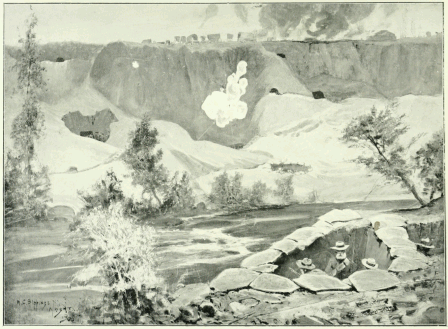
CRONJE’S STRONGHOLD ON THE MODDER RIVER.
Drawing by H. C. Seppings Wright, from a Sketch by Frederic Villiers, War Artist.
Little by little the enclosing circle began to grow narrower.
The infantry—the Cornwalls assisted by the Engineers—again
set to work to push the enemy still farther back into the river,
but otherwise little advance was made. The position was now
sufficiently terrible for the enemy. Cronje’s trap was about a mile
square, while commanding it in every direction were guns multifarious;
bushes and banks and ravines were swept by cataracts
of shrapnel, while volumes of greenish-yellow smoke from bursting
lyddite curved and twisted around the river-bed, then carried
their noxious vapour to the serene sapphire of the heavens. In
the clear atmosphere the reiterations of Maxims filled up the pauses
between the steady booming of artillery, while now and again the
impotent despairing splutter of rifles from the enemy’s laager mingled
with the stertorous rampage.
On the fourth day of Cronje’s resistance what might have been
an unfortunate incident occurred. The Gloucester and Essex regiments
by an accident had bivouacked on the north side of the river
too close to the enemy’s laager. The result was that on the first
gleam of daylight they were discovered by the Dutchmen, who
treated them to a volley by way of reveillé. Luckily the firing
was not at all up to the Boer mark and the regiments came off
scot-free.
During the day General Smith Dorrien’s force on the north
worked towards the doomed laager while General Knox’s brigade
held the containing lines on the south side of the river. In the
east General French was keeping an eye on a swarm of Boers
who were hoping to come to the rescue of Cronje. These held
a strong position on a kopje which seemed to be specially constructed
by nature for defensive purposes. Still, when General
Broadwood’s brigade and a battery of horse-artillery turned their
attention to the summit and scoured it thoroughly, the Dutchmen
helter-skelter fled. Unluckily for them, their precipitate action took
them straight into the arms of General French, who having headed
them towards the drift, now gave them so warm a reception that
numbers bit the dust. Some escaped, but fifty were taken prisoners.
Forage, provisions, and equipment were also seized, though the
corpses of the slain were carried off, so that the tale of loss could
not be told.
The capture of the kopje was an excellent move, as it was a
useful position whence to watch for and intercept reinforcements
that might be coming from Ladysmith or elsewhere to the succour
of the doomed. A message was sent to the obdurate Commandant
offering a safe conduct and a free pass anywhere for the women and
children. Lord Roberts also proffered medical attendance and
drugs. The offers were curtly rejected. Finding courteous overtures
of no avail, the bombardment of the position was resumed, and
the artillery continued to fire till dusk put an end to the operations.
While the firing was taking place the mules of the 82nd
Battery, while still hitched to the waggons, took it into their heads
to stampede, causing a scene of the wildest confusion. The next
day, however, all save one waggon were recovered.
During the night the Shropshire Regiment accomplished a fine
feat. They pressed forward some two hundred yards, captured
new ground, and there entrenched themselves. It was an excellent
finale to four days’ incessant work under a withering fire, and by
the 22nd they were fairly exhausted. They were then relieved by
the Gordons. Here be it noticed that the Gordons were now
incorporated with the Highland Brigade, which was thus composed
of four kilted regiments. The Highland Light Infantry, who wear
“trews,” had joined General Smith Dorrien’s force.
The exchange of positions between the Shropshires and Gordons
was effected in a manner worthy of the slim Boer himself, and
showed that the Britons had speedily taken practical lessons from
their adversaries. The Shropshires having, as said, seized 200
yards of new ground, they were relieved the following morning by
the Gordons. The Highlanders, snake-like, wormed themselves
forward to the trenches on their stomachs, while the Shropshire
men in like manner crawled over the bodies of the relieving force.
An officer who witnessed the evolution said, “I have often heard
of walking on an empty stomach, but I’m hanged if I’ve ever seen
the feat accomplished so well and so literally.”
Another tremendous thunderstorm broke over the position,
causing considerable discomfort to the troops, but still more to the
unhappy creatures who, through the stout resistance of Cronje,
were held to all the horrors of the trap into which he had fallen.
We were now closing in on every side.
A grand attempt was made on the morning of the 23rd to bring
help to the Dutchman. Commandant de Wet with a horde of some
1000 Boers, collected from the region of Ladysmith, appeared, and
made a desperate effort to thrust himself through the British lines.
Part of the force on its way towards its hoped-for destination was
luckily accosted from a kopje occupied by the Scottish Borderers.
The greeting, smart and accurate, was scarcely to the Dutchmen’s
liking, and they made off in another direction, but still with the
same result. From position to position they were hunted, and
in sheer despair they made for an unoccupied kopje, where they
hoped at last to make a stand. But they were disappointed.
The lively Scottish Borderers were “one too many for them.”
Seeing the Boers in act of seizing this point of vantage, the
Borderers promptly hurled themselves in the coveted direction.
There was an animated neck-and-neck race, and the Borderers,
who won by a nose, promptly took possession of the hill and
completely routed the Federals.
Finally the Boers found shelter in a kopje which was vis-à-vis
to a like eminence held by the Yorkshires. A passage at arms
followed, with the result that the fusillade of the enemy died a
natural death. Then the Yorkshires, who had so strenuously
brought about this result, were reinforced by the Buffs, lest some
more of the Boer hosts from Ladysmith should put in an appearance.
At this time the 75th and 62nd Batteries gave tongue from
an adjacent farm, but their vociferous notes produced little effect
upon the crown of the Boers’ stronghold.
So great was the silence that the Yorkshires moved on with
a view to prodding the enemy in his lair, but, in the attempt, they
were so furiously assailed by the shot of the enemy that they,
in default of cover, were unable to proceed. Meanwhile the Buffs
persevered, moving warily round the position till within 150 yards
of the Dutchmen, who were eventually driven off. More than
eighty—their horses having been shot—surrendered. On many of
these were discovered explosive bullets, and it became evident that
desperation was driving the Boers to disregard the rules of civilised
warfare. Many of our wounded were found injured by these unholy
missiles; and other tricks—barbarous tricks—were reported. On
one occasion a Vickers-Maxim gun was directed at an ambulance,
which at the time was fortunately unoccupied.
During the week our losses were fewer than on the opening
day. Captain Dewar and Lieutenant Percival, 4th King’s Royal
Rifles, and Lieutenant Angell, Welsh Regiment, were killed.
Among the wounded were:—
2nd Gloucester—Lieutenant-Colonel R. F. Lindsell; 2nd Derbyshire—Lieutenant
C. D. M. Harrington; 9th Lancers—Captain Campbell; P.R.H.A.—Lieutenant
Houston; Royal Engineers—Captain Crookshank; 1st Lincoln—Second
Lieutenant Wellesley; Argyll and Sutherland—Lieutenant and Adjutant
Glasford; 1st East Kent Regiment (attached 2nd Battalion)—Lieutenant
Hickman; 2nd Lincoln—Captain Gardner; King’s Own Scottish
Borderers—Captain Pratt; East Kent—Captain Marriott; Yorkshire—Captain
Pearson, Lieutenant Gunthorpe, 2nd Lieutenant Wardle.
Lieutenant Metge (1st Welsh Regiment) was missing.
Daily the enemy was squeezed into a smaller space. General
Smith Dorrien had now pushed up the river-bed to within two
hundred yards of Cronje’s entrenchments. The object lesson in
perseverance, both on the part of Boers and British, was becoming
almost awe-inspiring—the tension was veritably appalling. Soaked
with rain to the very skin—the fevered skin that had been scorched,
and toasted, and begrimed with dust—our men, grim and fierce, with
the storm-winds piping the pipe of death about their ears, held their
ground. Rations had been intermittent till the convoys began to
come in, and, almost fasting, they had been acutely conscious of the
foul, the nauseating atmosphere that now enveloped them like a
loathely vaporous entanglement. The river had swollen and bore
upon its turbid breast horrific revelations—thousands of rotting carcases
and festering loads of poisonous wreckage, that rendered the
act even of drawing breath almost a heroism. All along the great
march endurance had been put to supreme test, for the track had
been margined with the dead bodies of exhausted oxen and horses.
These lay littered about, unburied, disembowelled, and in various
stages of putrefaction. Everywhere vultures and flies and other
loathsome parasites of the veldt hovered and sidled and crawled,
glutting themselves at veritable orgies of destruction, and contesting
their prizes with the winds. These, taking their fill, hastened
to diffuse the remains of the grisly banquet far and wide. Thus
the foul dust, wantonly distributed, blew in the throats and eyes
and ears of gallant men, and contributed death more liberally, more
pitifully, than even the bullets of the Boers!
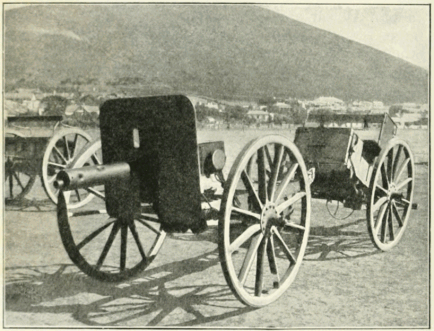
Guns Captured at Paardeberg.
Photo by Alf. S. Hosking, Cape Town.
Plentiful rain had fallen, saturating humanity, and causing the
heated ground to retract the fumes of a charnel-house. But in one
way better times had come. There was fuller fare. Large convoys
made a daily appearance, and the men were refreshed after their
labours with the promise of plenty. Food of a substantial kind was
indeed necessary, for it served to attune the stomach to the noxious
vapours that hourly grew almost tangible. Cronje, though he
knew it not, was sowing the seeds of a harvest of revenge! He
was killing his thousands! For many days our troops had been
enduring lenten fare; they had rung the changes on hardships,
fatigues, and self-abnegations of all kinds. They had been battered
on by storms. They had outstripped transport and supplies. They
had kept the inner man appeased and working on quarter rations.
They had marched like giants in ten-league boots, and meanwhile
fed like fairies; yet withal had borne countenances cheery and
noble, full of confidence and unquenchable pluck. But these splendid
creatures were but mortal. The foul fiends of enteric and malaria
were already sapping their buoyant constitutions, and marking them,
one after another, with the deadly seal of possession.
Every day of the Dutchman’s resistance was therefore full of
horror, full of anxiety. There were continual rumours that the
Boer reinforcements were in view, that the Federals were massing
for a desperate effort. Wearied and battered, the cavalry at
Koodoosrand were perpetually speeding on wild-goose chases, in
one of which both General French and Colonel Haig nearly lost
their lives. A reconnaissance in force had been ordered. The drift,
swollen by rains, was now a torrent, and in crossing the General
and his A.D.C. were thrown by their restive horses into the river,
whence they only emerged safe and sound in consequence of their
being fine swimmers and pneumonia-proof Britons.
Cronje, finding that the reinforcements failed to reach him,
decided on the night of the 26th to cut his way out and seize a kopje
before dawn. But his intention was frustrated by the Mounted
Infantry, who, in spite of the darkness, kept a watchful eye on the
slippery enemy.
Quite early on the morning of the 27th of February, the anniversary
of Majuba day, the splutter of musketry greeted the ears of
the dozing camp. Some one was up and doing early. It was the
Canadians. They were acting on the principle of the early bird that
catches the morning worm. Supported by the Gordons, Cornwalls,
and Shropshires, they were advancing, building a trench in
the very teeth of the enemy, and at fifty yards’ range were
saluting him with such deadly warmth as to render his position
untenable. How this energetic and gallant movement, the wonder
and admiration of all, was brought about was described by the
correspondent of the Times. “It appeared that Brigadier-General
MacDonald sent from his bed a note to Lord Roberts, reminding
him that Tuesday was the anniversary of that disaster which, we all
remembered, he had by example, order, and threat himself done his
best to avert, even while the panic had been at its height; Sir Henry
Colvile submitted a suggested attack backed by the same unanswerable
plea. For a moment Lord Roberts demurred to the plan; it
seemed likely to cost too heavily, but the insistance of Canada broke
down his reluctance, and the men of the oldest colony were sent out
in the small hours of Tuesday morning to redeem the blot on the
name of the mother-country.
“From the existing trench, some 700 yards long, on the northern
bank, held jointly by the Gordons and the Canadians, the latter were
ordered to advance in two lines—each, of course, in extended order—thirty
yards apart, the first with bayonets fixed, the second reinforced
by fifty Royal Engineers under Colonel Kincaid and Captain
Boileau.
“In dead silence, and covered by a darkness only faintly illuminated
by the merest rim of the dying moon, ‘with the old moon
in her lap,’ the three companies of Canadians moved on over the
bush-strewn ground. For over 400 yards the noiseless advance
continued, and when within eighty yards of the Boer trench the
trampling of the scrub betrayed the movement. Instantly the outer
trench of the Boers burst into fire, which was kept up almost without
intermission from five minutes to three o’clock to ten minutes past
the hour. Under this fire the courage and discipline of the Canadians
proved themselves. Flinging themselves on the ground, they
kept up an incessant fire on the trenches, guided only by the flashes
of their enemy’s rifles; and the Boers admit that they quickly reduced
them to the necessity of lifting their rifles over their heads to the
edge of the earthwork and pulling their triggers at random. Behind
this line the Engineers did magnificent work; careless of danger,
the trench was dug from the inner edge of the bank to the crest,
and then for fifty or sixty yards out through the scrub. The Canadians
retired three yards to this protection and waited for dawn,
confident in their new position, which had entered the protected
angle of the Boer position, and commanded alike the rifle-pits of the
banks and the trefoil-shaped embrasures on the north.”
For some time it seemed as though hostilities were suspended,
and then—a sign, a flutter of white, a signal of surrender caught
the straining eyes of the regiment nearest the crest of the hill. In
an instant the plains and the hollows, the kopjes, and even the dome
of heaven, seemed animated—lending themselves to repeat the ringing
cheer, to reiterate the cry of an immense joyous heart splitting a little
universe in twain. Ears languid, ears hard-working, ears occupied,
ears expectant, all caught the sound, echoed it and knew that at last
the looked-for hour had come, Cronje had surrendered! Many
Boers threw up their hands and dashed unarmed across the intervening
space; others waved white flags and exposed themselves
carelessly on their entrenchments, but not a shot was fired. Colonel
Otter and Colonel Kincaid held a hasty consultation, which was
disturbed by the sight of Sir Henry Colvile (commanding the Ninth
Division) quietly riding down within 500 yards of the northern Boer
trenches to bring the news that at that very moment a horseman
was hurrying in with a white flag and Cronje’s unconditional surrender,
to take effect at sunrise.
Then all was activity. A note was borne to Lord Roberts
stating that Cronje had given in, and General Pretyman thereupon
rode out to take his surrender. The scene was highly impressive.
Lord Roberts, in front of the cart in which he slept, walked up and
down awaiting his prisoner, while a guard of the Seaforth Highlanders
with drawn bayonets formed a line to either side. In the
distance a small group of horsemen was seen approaching, a silhouette
which gradually grew clearer in the golden light of the morning. It
was General Pretyman with the redoubtable Cronje riding a white
pony on his right and the escort of the 12th Lancers following. The
subsequent scene was a study in reserve. After all the tumultuous
passions, the ferocity of bloodshed, the diamond-cut-diamond activities
of death-dealing lyddite and Vickers-Maxims, the two leaders met
without the smallest sign of emotion. To Lord Roberts, who stood
with his staff awaiting him, Colonel Pretyman said, “Commandant
Cronje, sir!” The two great men looked at each other, the Dutchman
touched his hat, the Englishman returned the salute. The
group dismounted, and then, regretfully be it noted, Lord Roberts,
the blameless upright British soldier gave his hand to the tyrant of
Potchefstroom. “You have made a gallant defence, sir,” said the
British Commander-in-Chief; “I am glad to see you. I am glad to
get so brave a man!”
The picture of the redoubtable Cronje as he approached our
great little Field-Marshal was remarkable in its contrast. On
the one side you saw a burly square-jawed agriculturist, grizzly
of beard, tanned and battered of complexion, portly and cumbrous
of form. On the other, you had the lithe figured aristocratical
British soldier, trim in his kharki uniform, and wearing his sword
with the air of nameless distinction which belongs to the born ruler
of men. Cronje’s aspect was that of a substantial farmer, his heavy
cane, his slouch hat encircled by its orange leather band, his bottle-green
overcoat and tan boots were distinctly bucolic, but his rigid
implacable countenance, an utterly impenetrable façade, betrayed the
masterly and indomitable character of the man.
There is no doubt that by his fierce, his masterly resistance to
the British he won for himself the respect of all who trapped him.
His undoubted pluck, a quality which has such unending fascination
for the English, served in a great measure to wipe off the terrible
remembrance of his atrocious deeds in other years. Cronje spoke
scarcely a word. He said there were 3000 Boers in the laager—as
a matter of fact, there were over 3700—and also requested that his
wife, son, grandson, and secretary might be allowed to remain with
him. This request was acceded to; arrangements were made that
his relatives should accompany him into captivity. He then partook
of refreshment in Lord Roberts’ quarters with the staff. Though
he smoked, he said little and remained gloomy and preoccupied.
The prisoners trooped across the river like some patriarchal or
gipsy horde, with trousers turned up so as not to damp them in
the swollen drift. They splashed along, each armed with his household
effects, pots and pans, blankets and rifles, some jesting and
skipping in sheer exuberance of animal spirits that long had been
subdued, some stolid and serious in the full comprehension of the
grievous end of all their pluck and endurance. And they had
endured! From the hundreds of wounded that were brought in
the same tale of suspense, and misery, and horror was told in varying
keys. Always they had awaited reinforcement; they had even
invented a scheme for cutting a way out to meet the relieving force
which never came. But volunteers for this deed of daring were
few. About a hundred in all. This meagre array was not sufficient.
Others had pressed on the relentless Cronje the philosophy of
surrender. They urged that directly, if not annihilated by shell fire,
they would be laid low by fever; already eighty-seven men were
slain and a hundred and sixty wounded. These had no doctors
even to attend them. The surgeons had been left behind on the
Modder, and the offer of Lord Roberts of medicine and succour
had been refused. The suffering had indeed been terrible and now
was of no avail.
It was not pleasing to the vanity of the British army to find
themselves confronted with such a rabble of tatterdemalions, and to
remember how this nondescript mob had so long held them in check.
But there was no denying that the ruffians had qualities, and that
they, unkempt and undisciplined as they were, had proved themselves
foemen worthy of our steel and tacticians meriting study.
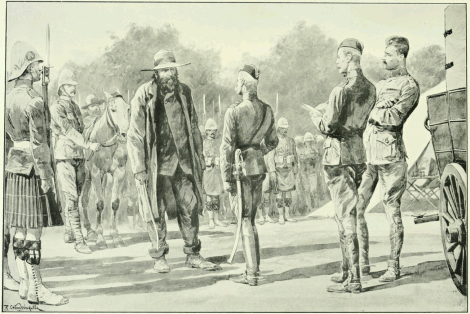
“MAJUBA DAY”—CRONJE SURRENDERS TO LORD ROBERTS AT PAARDEBERG.
Drawing by R. Caton Woodville, from a Sketch by Frederic Villiers, War Artist.
It was curious how much our troops had learnt both from the
undisciplined Boers and the inexperienced Colonials. From the
latter they picked up the art of taking cover, and from the
former the art of obtaining it. The Boer was not content merely
to crouch behind a stone and show a head only when about to
shoot. He cunningly arranged his sangar so that he should expose
no head at all. He built up his small stones to the necessary
height, taking care to leave a central loophole through which
he could take aim and yet remain invisible. An officer, in giving
his opinion of the Boer as a fighter, showed the lessons that had
been taught by him. “As a defender of defensive positions in
a mountainous country he is unequalled. He digs good trenches
and chooses good defensive positions, and he lies there quietly
and waits for his enemy to advance across the open. But he
never, hardly ever, dares to attack in the open, and if his flank
is turned or his rear threatened, he gets nervous, and retires to a
better position if he can. If our positions could be reversed—that
is, if Tommy Atkins had to defend the kopjes, and if the Boers had
to attack them in the open, there can be no doubt as to the result.
Tommy, perhaps, would not be quite so good as the Boer in defence,
but, on the other hand, the Boer would fail in the attack;
indeed, he could not be brought to attempt it. As a shooter the
Boer is no better than our own men. The only difference is that he
attempts to shoot at far longer ranges. The Boer has taught us to
dig big trenches and to use big guns as mobile artillery.”
The mobility of the big guns was at the moment more of a
puzzle than ever. The Boers were in possession of some Vickers-Maxims
in laager, two 15-pounders, and some big guns. We captured
the minor weapons, but the big ones were sedulously hidden,
and how they had vanished became a problem that was never solved.
It was supposed they were buried in the bed of the river, but search
failed to unearth them.
Trophies innumerable were picked up. Sir Howard Vincent
succeeded in securing a quaint seventeenth-century Bible, and
Roberts’ Horse possessed themselves of Cronje’s green bell-tent
and ox-waggon. One cavalry officer thought himself lucky to secure
a new pair of stays marked “11¾, waist 28 inches,” evidently the
property of a capacious vrow. Letters multifarious were found,
among them Cronje’s commission, signed by President Steyn.
Most of the prisoners, when interrogated, declared they were
sick of the war, and confessed that but for their fear of Cronje they
would long ago have surrendered. His was the powerful, the guiding
hand. Some of them expressed queer notions of the causes
of the trouble, giving forth at second and even third hand—and
in a very garbled condition—the sentiments poured into them by
“sympathisers.”
Said one, “The war is got up by the capitalists. The generals
arrange a victory or a reverse to suit their own interests on the
Stock Exchange!”
A private remonstrated, “You don’t include Lord Roberts?
You’ll admit that he is disinterested!”
“Not a bit of it! He is a shareholder along with Chamberlain
and Rhodes and the other millionaires. They all look after number
one.”
Against such prejudice and ignorance it was useless to argue.
Some of the Free Staters expressed their joy at being relieved
of the company of the Boers. They had been on bad terms with
them, and had scarcely dared to speak a word in English for fear of
their lives. One declared that he was not permitted even to address
his horse in the odious language!
There were great and astonishing contrasts in the groups of
prisoners that were gathered together. Many of them were youths
of sixteen to eighteen years of age. Some seemed in a hopeless
stage of sickness and despair, others attenuated by the amount of
vinegar consumed to cure the stupefying effects of our lyddite. Endurance,
it was plainly to be seen, had been carried to the last pitch.
Some, on the other hand, appeared as though already reviving with
the relaxation of the strain to which they had been subjected; some
even delighted to find themselves in British hands, no longer tormented
by “hell-scrapers,” as they called the shrapnel, and already clamouring
to partake of spirits and refreshment, for which they had longed in
vain. The rapture at their deliverance overcame all other sentiments;
they had no thought for the ups and downs of the war, and
many, indeed, were still unaware of the causes that had led them to
share in it. Cronje had evidently kept a tight hand on them, and but
for his unique influence many would long before have surrendered.
This peculiar despotism was marvellous when it is considered that
none of the younger commanders could induce more than a portion
of his commando to follow him from the Natal side to the scene of
operations. Cronje had the privilege of being the most admired and
well-detested person on the stage of the moment, and one Boer was
seen clenching his fist in the direction of the vanquished tyrant and
exclaiming, “You hard man! you deserve to be shot.” There were
many who heard him who endorsed the opinion.
A great deal of undue attention seemed to be bestowed on the
Dutch Commandant, and evidently it was his undisputed military
genius that earned for him the admiration of his conquerors. Only
to this final display of skill and pluck can be attributed the deference
paid to a man whose Anglophobia had made itself prominent for
many years, one who cut such a despicable figure in his relations
with us at Potchefstroom, and who was responsible in particular for
much of the brutality which has been accredited to the Boers in
general. It was certainly a case of turning the other cheek to the
smiter, for the captive was allowed to take with him his wife, and
retain in his possession his favourite horse, Wolmarens!
Accompanied by Mrs. Cronje, he was sent to Cape Town in a
covered waggon, guarded by a special convoy under the command
of Colonel Pretyman. There was considerable pathos in the scene
of departure, for many of the other prisoners had gone through the
ordeal of the bombardment with their wives by their sides, and these,
less fortunate than Mrs. Cronje, had to be left behind!
The majority of people, it must be owned, were horrorstruck at
the consideration shown to one to whom the word consideration was
an empty name. A Scottish Colonial, writing home, expressed his
irritation at the mode in which warfare was conducted. He said:
“Cronje is now a hero, housed in the Admiral’s cabin on board
the Doris. He is probably saying, ‘What fools the British are.’
For, give him a chance, and he would commit again the treacherous
murders for which he has been responsible in the past with as little
compunction as he would feel at putting his heel on a scorpion. I
wonder if we may take this bit of foolishness as an indication of the
way in which England is going to settle up finally with the Republics.
Her policy has so often before ended in weakness that one cannot
help feeling nervous.”
He was merely one of a thousand who argued that it was impossible
to go to war with kid-gloves on, and who regretted the
terms of the proclamation which had been made on the entry of
Lord Roberts to the Free State. This proclamation, which will be
discussed anon, was another of the nineteenth-century humanitarian
movements which were mistakenly applied to seventeenth-century
comprehension. To return to the events of Majuba day.
Lord Roberts subsequently visited the Boer laager, and testified
his admiration of the ingenuity and energy with which the position
was made almost impregnable to assault. In spite of ten days’
bombardment by over fifty guns and howitzers, the number of Boer
wounded was said to amount to only 160—a fact which went to
prove that the power of artillery can be broken by the ingenious use
of the spade. The entrenchments, when examined, proved to be
most skilfully contrived, with narrow mouths some eighteen inches
wide, and wide bases, some quite three feet broad, which rendered
them almost impregnable to shell fire.
The effect of the bombardment was terrific. The laager presented
an appearance of black chaos, varied only by streaks of
yellow, which told of the gambols of lyddite. Waggons were
wrecked with shrapnel; some had ceased to exist; rings and twists
and girandoles of distorted metal were all that was left of them.
Within the laager was a decaying, disordered mass of Boer belongings,
saddles innumerable, karosses and panniers, coats and feminine
apparel, fragments of old tin trunks, and 2,000,000 rounds of ammunition;
wreckage of all sorts, united by the super-evident, unavoidable,
and persistent bonds of stench, which permeated everything,
weaving visible and invisible in one noxious nightmare of the
senses.
Round this arena of pestilence sentries were posted. It was
necessary to prevent loot, though little of value remained save
munitions of war. Most of the Boer property had been left behind
in the hurried rush from Majersfontein and Spyfontein. Still the
locality had to be guarded, and the guards, as well as all who
approached, had to pocket their sensibilities. Indeed, it was a
marvel how the Boers had managed to exist in the pestilential
atmosphere that pervaded the river-bed. Dotted everywhere, or
collected in heaps, already rotting in the tropical heat, were the
remains of horses, mules, and cattle, some of which had been driven
to death, while others had been hurried there by the voice of our
howitzers or the rain of our rifle fire. In the fringe of this atmosphere
our troops had lived for some three days past, for nightly
they had advanced some fifty to an hundred yards nearer the laager,
and there dug trenches and located themselves, till, at the end, the
last three nights were passed almost within pistol-shot of the
enemy and in the thick of a stench whose opacity was well-nigh
suffocating.
An interesting account of his enforced stay in the laager was
given by a trooper in Kitchener’s Horse, who was taken prisoner
on the day previous to the great battle which settled Cronje’s fate.
He had become separated from the rest of his troop while scouting
along the Modder River. When he looked round for his friends,
he found himself surrounded by a party of Boers, who, jumping
from the bushes, fired upon him. His horse was shot and rolled
over upon the young trooper, carrying him with him into the river.
The Boers rescued him, relieved him of his bandolier, and made him
prisoner. Together they went to the laager. “There,” the trooper
said, “I was taken before Commandant Cronje, who asked me
our strength and movements. On my replying that I was only a
trooper, and did not know, he said, ‘Oh, never mind; if you don’t
want to tell me, I shall not try to make you.’ A guard was placed
over me, and we stayed the night in the laager. I should say
there were about 6000 Dutchmen all told, and forty women and
children. A great many among them were Irishmen, a few Scotchmen;
in short, almost every nation was more or less numerously
represented. All that night they were busy entrenching themselves,
employing a great deal of native labour to help them.”
Through the whole of the 18th of February the young man
endured the bombardment, which he described as so heavy that
it was impossible to remain in the laager, and consequently all,
even the women and children, took refuge in the trenches. The
Boers’ mode of firing he specially made a note of: “The Boers did
not in the least mind our attack, and laughed amongst themselves
as they saw the men advancing. They allowed them to come up
to about 600 yards from the trenches, and then opened a tremendous
fire from their rifles. It did not seem to be aimed at any
particular man, but more at a certain fixed distance. At that they
fired as fast as they could. The range was obtained by a few
fixed shots, who fired, watched the dust caused by the strike of the
bullets, and then gave out the range. Our men came up to within
150 yards and then retired. They fired volleys at the longer
distances, but all their fire seemed to me to be short.” Each day
there were losses, but comparatively few, as the bottle-shaped
trenches afforded excellent cover; those that fell, however, were
buried where they lay. He went on to say that “The shelling
of Monday night destroyed several waggons, two of which were on
either side of Cronje’s own. No one could have been braver than
he was. He stood upon the waggon-step, field-glasses in hand,
and did not seem to care in the least how thickly the shells and
bullets fell. Many of the Free Staters, however, were quite the
reverse, and were in a great state of terror when the bombardment
began. The ammunition waggons blew up, and several of the
provision waggons were burned. The shrapnel killed the majority
of the horses and cattle, which had no shelter but the banks of
the river. Beyond that the fire did little real damage.” The
prisoner declared his belief that “could they have kept their laager
out of fire they would never have surrendered. The loss of the
provision waggons was what caused them to give in. They had
only four days’ food left. Their ammunition was still plentiful.
After the explosion of the ammunition waggons by shell-fire on
February 19, all the remaining cartridges were distributed throughout
the trenches, and on the south side every trench was still full
of unused ammunition. Everything was done in the trenches,
even the cooking, each individual having with him a box of provisions
sunk into the ground. These boxes were replenished at
night as there was no possibility of reaching the laager during the
day.”
Lord Roberts addressed the Canadians, and expressed his satisfaction
and appreciation of the splendid work they had done and the
courage they had shown. To them he attributed the greater share
in the Boer surrender. All were delighted at the attention shown
the heroic Colonials, who had done splendid work, and at the
exhibition of Lord Roberts’ tact and kindliness in thus singling
out the Canadians for the position of honour. In the Jubilee of 1897
the Field-Marshal had told the Colonial Bodyguard that he would
like to have them with him if he were ever in another campaign,
and now the Canadians felt that the Chief’s cherished words had
been no mere formula, and that they had been given the chance to
distinguish themselves that they had so eagerly desired.
To General Colvile was given the credit of inventing the order of
attack which at last brought the Boers to their senses. He arranged
that the first rank should advance, bayonets fixed, till the enemy
opened fire. Then they were to lie down and continue to fire on
the Boers, while Engineers and the second line dug a trench. The
trench thus made was within eighty yards of those of the Boers, and
owing to its trefoil shape, the troops were able to enfilade both the
river and northern trenches of the enemy and make them untenable.
From their point in the original trench the Gordon Highlanders
kept up a brisk fire, while the Shropshire Light Infantry, who were
posted over a thousand yards to the north-west of the position, co-operated.
In the very successful attack on the enemy’s trenches the Royal
Canadian Contingent lost seven killed and twenty-nine wounded.
Major Pelletier, who commanded the French company, foremost
of the three companies, was wounded, and also Lieutenant Armstrong.
It is interesting to note that few of this gallant company of
Great Britain’s defenders could speak English!
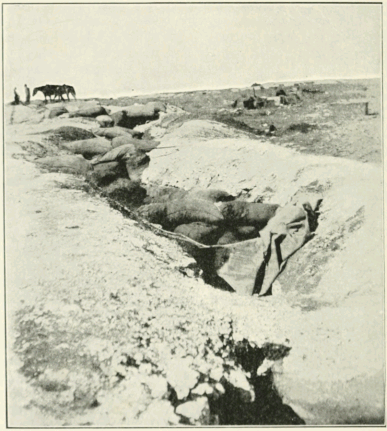
Boer Trenches at Paardeberg.
Photo by Alf. S. Hosking, Cape Town.
Colonel Otter, in command of the Canadians, had distinguished
himself on many occasions by rare coolness and display of great
talent in the field, and he now took pleasure in reporting excellently
of the various members of the battalion under his command who had
especially distinguished themselves. Among these were:—
Captain H. B. Stairs, 66th P. L. Fusiliers, and Lieutenant and Captain A.
H. Macdonell, Royal Canadian Regiment. E Company, No. 5130, Corporal
T. E. Baugh, R.C.R. F Company, No. 7782, Private O. Matheson, 12th Newcastle
Field Battery; No. 7803, Private A. Sutherland, D. of Y. R. C. Hrs.;
No. 7868, Sergeant W. Peppeatt, Royal Canadian Artillery; No. 7871, Corporal
R. D. M’Donald, Royal Canadian Artillery; No. 7822, Private C. Harrison,
2nd Montreal Regiment C.A.; No. 7841, Private A. Bagot, 65th Montreal
Rifles; No. 7778, Private Sievert, 93rd Cumberland Infantry; No. 7615, Private
A. T. Seriault, 9th Voltigeurs de Quebec.
But these were only a select few among the number who were
engaged in incomparable things done incomparably well.
[Pg 80]