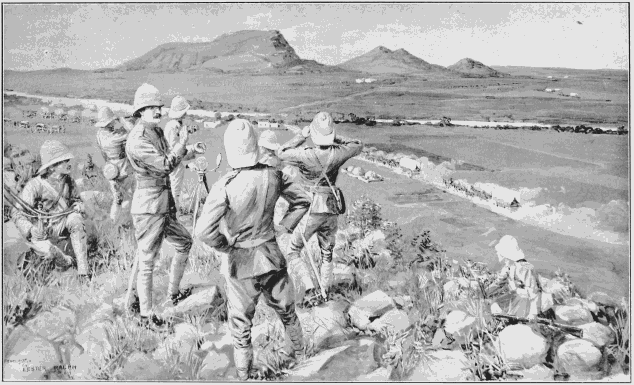
Early in the century the spirit of loyalty was developed in Canada. From
her first years, when Wolfe made Canada a colony of Great Britain, the
colonists began to recognise their debt to the British Crown. The feeling of
reverence and love for the Mother Country strengthened and grew with the
strength and growth of Canada itself, till the sentiment of Imperialism, always
silently existing, suddenly found almost passionate utterance in the month of
October 1899.
What came to pass a great man had foreseen. Sir John Macdonald, who
gauged aright the sentiment of the Canadians, described almost prophetically the
expansion of that sentiment, and pointed out the developments that might be
looked for in the future. In one of his pro-Confederation speeches he said:—
“Some are apprehensive that the fact of our forming this Confederation
will hasten the time when we shall be severed from the Mother Country. I
have no apprehension of that kind. I believe it will have the contrary effect.
I believe that as we grow stronger, as we become a people able, from our
union, our population, and the development of our resources, to take our
position among the nations of the world, she will be less willing to part with
us than now. I am strongly of opinion that year by year, as we grow in
population and strength, England will more see the advantage of maintaining
the alliance between British North America and herself. Does any one
imagine that when our population, instead of 3,500,000 will be 7,000,000, as it
will be ere many years pass, we would be one whit more willing than now to
sever the connection with England? The Colonies are now in a transition
state. Gradually a different colonial system is being developed, and it will become
year by year less a case of dependence on our part, and of overruling
protection on the part of the Mother Country, and more a case of healthy and
cordial alliance. Instead of looking upon us as a merely dependent colony,
England will have in us a friendly nation, a subordinate but still a powerful
people, to stand by her in North America in peace or in war.”
Many other prominent persons, Sir John Thompson, Sir Charles Tupper,
Sir Wilfred Laurier, shared the same opinion, and confidently asserted that
Great Britain had but to hold out her hand and the hand of Canada would go
out to meet it with firm and cordial grasp.
Then came the hour and the opportunity. Canada acted exactly as
Canada’s greatest men had expected her to act. She did not jump to action,
for the idea of participating in the active affairs of the Empire had scarcely
dawned upon her, but, the opening once made, Canada lost no time in availing
herself of it. Great things have small beginnings, and the grand movement
which has astonished the universe commenced in a simple manner.
While the possibility of war drifted like a small cloud on the horizon, a
certain Colonel Hughes, of Lindsay, Ontario, set to work to raise a volunteer
regiment for possible service in South Africa. In September 1899 he openly
expressed himself. In answer to energetic remonstrance he wrote, that
“unless the Government of the Dominion showed itself patriotic enough to do
its duty by the Imperial Government, he was justified in his action, the object
of which was to assist in upbuilding the British Empire and rendering justice
to one’s fellow-countrymen, even at great sacrifice, and that as little delay as
possible should result on the outbreak of hostilities in enrolling a corps.” The
idea, to use the popular phrase, “caught on.” All the notabilities of the
Dominion put their heads together, with the result that, early as October 3, the
Canadian Military Institute in Toronto proposed to offer a Canadian Contingent
to the British Imperial Government, in the event of a war breaking out with
the Boers. It was also suggested and carried unanimously, that whereas all
the expenses of the Canadian Contingent sent to the aid of the British troops
in the Crimean War had been borne by the British Government, the expenses
of the Contingent it was now proposed to send to South Africa, should be provided
by the Dominion of Canada, that the Canadian Government should train,
arm, equip, transport, and pay the force raised, and, if necessary, pension those
deserving it. The offer of a Canadian Contingent was accordingly made
through the Government to the British Government, who accepted it with two
reservations—First, that the force raised should consist of 1000 men only;
Second, that half the expenses of the Contingent should be met by the Imperial
Government. To this the Canadians consented under protest, declaring,
however, that should any further assistance be required during the course of
the war, they would be ready and glad to send it.
Thousands of volunteers offered their services, but only a limited number
could be accepted. It was decided to allow each locality to have the honour
of taking part in the patriotic movement, and the formation of companies was
authorised as follows:—A Company, Manitoba and the North-West; B, London,
Ontario; C, Toronto; D, Ottawa and Kingston; E, Montreal; F, Quebec;
G, Fredericton and Prince Edward Island; H, Halifax.
The men were thus gathered from all parts of Canada, the smaller towns
sending from three to seven representatives each, and the larger ones supplying
some regulars from the city regiments, in addition to volunteers. The enrolling
and equipping of these 1000 volunteers, scattered as they had been over 3500
miles of territory, was accomplished in little more than a fortnight—a wonderful
feat in view of the pacific times enjoyed by the Colonials.
It was quite inspiriting to note the general activity. All the Dominion displayed
its loyalty in deeds as well as words. Men living in idleness and comfort,
professional men of standing, family men with innumerable ties, came to
the fore and volunteered their services; while employers assisted the splendid
movement by offering facilities to those serving them who might care to enlist.
Every soul insisted on taking his share in the Imperial doings. Those who
could not volunteer united their efforts and showed their loyalty by showering
gifts on the battalion. The officers and men of every company were presented
at their own headquarters with a sum of money varying according to rank, but
in each case of substantial value, as a contribution to their warlike needs.
Every officer received from public subscriptions a field-glass, revolver, and
$125 in money. Privates were presented with a silver match-box and $25.
The Bank of Ottawa contributed $1000 for the purchase of delicacies for the
men on their sea-voyage. In addition to this generosity, firms of all kinds sent
in their own manufacture, life insurances were effected on special terms for
officers and men of the battalion covering compensation for partial disablement,
and the telegraph and telephonic companies liberally agreed to transmit private
messages for all connected with the Contingent free of charge.
The mobilisation and concentration at Quebec of the composite battalion was
no mean undertaking, but it was accomplished by the 27th of October. On the
following night a dinner to the officers was given, and later, a smoking concert.
On the 29th the special service battalion attended divine service, the
Catholics at the Cathedral, the Roman Catholics at the Basilica. The sermon
given at the Cathedral was a notable one, and served to mark the historical
nature of the occasion. Among other things, the Rev. J. G. Scott expressed
himself of sentiments that all might do well to read, mark, learn, and inwardly
digest. He said: “What is the Empire of which we are a part? It is not a
mere collection of subservient peoples adding to the revenue and importance of
a small island to the north-west of Europe. No; it is much more than that. It
is a vast federation of peoples of all nations, tongues, languages, and creeds
joined together in ‘liberty, equality, and fraternity,’ by common laws and a
common love to their real or their adopted mother. England and England’s flag
must remain the symbol of our common patriotism. But the British Empire,
the Empire of the future, the Empire rising with the sun of a new century, is
founded in deeper principles than mere sentimental devotion to the land of our
fathers. The principle underlying it is the liberty and brotherhood and welfare
of man. We conquer and advance. Wild lands come under our sway.
Savage races are subjugated or turn to us for protection. But all with what
result? With the result that the waste lands are cultivated, the hidden mines
of the earth yield up their treasures, continents are spanned by vast railways
and the bed of ocean by electric cables, with the result that the savage is
brought under the yoke of civilisation, and religion, education, and commerce
raise him almost to the level of a European. But this progress has not been,
nor can it be, unaccompanied by difficulties. At the present time our race in
its general advance is brought face to face with forces that retard, not merely
the growth of the British Empire, but the principles of freedom and humanity
which underlie it. The nineteenth century is confronted in South Africa with
a remnant of the seventeenth. Our brethren, oppressed by an intolerable
tyranny, cry to us for help, and we, a republic under a monarchical form, go to
crush a despotism under the form of a republic.”
This last phrase was a masterpiece, one that all who have enjoyed the
liberty, fraternity, and equality of our republican empire can fully appreciate.
Continuing, the preacher went on to say: “Surely, if we go forth firmly, fearlessly,
and mercifully to fight in such a cause, we can feel, like Israel of old, that
‘the Eternal God is our refuge, and underneath are the everlasting arms, and
that He will thrust out the enemy from before us.’ And you, my brethren, who
are privileged to go forth under the flag of our Queen and the Empire, are the
representatives of a great people, formed of various creeds, and nationalities,
and languages, but blended in a common law and a common love for the liberty
which makes men—men. The call to arms from the Motherland has sent a
thrill to the four corners of the earth. The Empire, which has been knit together
by community of race, by commerce, by railways and by cables, is to be drawn
now into an absolutely indissoluble bond by the voluntary sacrifice of blood and
life on a common battlefield. No ordinary departure of troops to the front is
yours. You are the pioneers of a new era in our history. The importance of
this day is not to be measured, any more than was the importance of the great
battle in the Plains hard by, according to numerical computation. We have
taken a step, a step on the threshold of another century, which is destined in
time to put an end to the distinction of Colony and Motherland, and will finally
give us a voice in the conduct of the Empire. Surely, to those going forth as
champions in a noble cause, I cannot do better than to commend to you individually
the watchword of Israel’s—nay, of England’s strength, ‘The Eternal God
is thy refuge, and underneath are the everlasting arms.’ There may come
moments to some of you, in the irksomeness of discipline, in the pause before
the battle-charge, in the silence of lonely picket duty, or during sleepless nights
on the hospital pallet, when the memory of the parting service in these hallowed
walls—walls which, during this century, have seen many heroes arm at the call
of duty—will come back to you with the comfort which even the bravest need,
and you will feel that in life and death ‘the Eternal God is your refuge, and
underneath are the everlasting arms.’ Then, like the knights of old, consecrate
to-day your hearts and swords to God’s service, and you who are communicants
draw near to the altar of God and receive the strength which comes from the
Body and Blood of Christ. You are not a wild horde let loose in savage warfare,
but Christian men armed for a great cause. Keep then your lives pure—pure
as the memories of your Canadian home. Be sober, as men who can face danger
without artificial courage. Let the talk at mess and in camp be clean, and above
all remember to pay regularly the daily homage of prayer to your Heavenly
Father. Do not be ashamed to confess Christ before men.”
These heart-stirring words found their echo in every breast—the great body
of patriotic volunteers was thrilled through with the ambition to do great deeds
in a great way, to go forth and write their names in blood, if need be, alongside
of those of their brothers of the Anglo-Saxon race whose records loomed large
and indelible upon the scrip of Time.
In the evening the Governor-General entertained the superior officers and
staff at dinner, and on the following morning the last parade was held. Major-General
Hutton, commanding the Canadian Militia, commenced his inspection
at 11.30. At noon the Governor-General, the Premier, Sir Wilfred Laurier, and
other members of the Cabinet arrived on the ground. His Excellency addressed
the men as follows: “Colonel Otter, officers, non-commissioned officers,
and men of the Canadian Contingent, I congratulate you on the splendid
appearance of your regiment on parade, and Canada may justly be proud
of her representative troops. But, Colonel Otter, the force you command
represents a great deal more than a serviceable regiment on parade. We
are standing here upon historic ground, under the ramparts of the old
city of Quebec, surrounded by celebrated battlefields, and in an atmosphere
full of the glorious traditions of two great nations—nations who, respecting
each other’s warlike qualities on many a hard-fought field, have now joined
in common loyalty to their Queen and Empress. Your companies have been
gathered from British Columbia to the Atlantic coast, from the settlers in the
Rocky Mountains and the Far West, from Ontario and the Maritime Provinces,
and from the old French families of Quebec. They represent the manhood of
the Dominion from the west to the east, but, above all, they represent the
spontaneous offer of the people of Canada, British born and French Canadian,
to the Mother Country. The people of Canada have shown no inclination to
discuss the quibbles of Colonial responsibility; they have only unmistakably
asked that their loyal offers should be made known, and they rejoice in their
gracious acceptance. In so doing surely they have opened a new chapter
in the history of our Empire; they have freely made their military gift to an
Imperial cause, to share the privations, and the dangers, and the glories of an
Imperial army. They have insisted on giving vent to the expression of that
sentimental Imperial unity which may, perhaps, hereafter prove more binding
than any written Imperial constitution. The embarkation of your force, Colonel
Otter, to-day will mark a memorable epoch in the history of Canada and the
Empire. Of the success of your future we have no doubt; we shall watch
your departure with very full hearts, and shall follow your movements with
eager enthusiasm. All Canada will long to see the Maple Leaf well to the
front, and to give her Contingent a glorious welcome home again. And now, as
the representative of Her Majesty, I wish you God speed and every success.”
Lord Minto then called on the men to give three cheers for the Queen,
which they did with all the zest of lusty Anglo-Saxon lungs.
Sir Wilfrid Laurier then addressed the regiment. He reminded them they
were going to obey the call of duty, that their cause was the cause of justice,
the cause of humanity and of civilisation. Men of our own race were
being unjustly oppressed, and the troops were going forth in the interests
of the Empire and of liberty. He rejoiced to see the alacrity with which
Canadians had responded to the call and rushed to the aid of the great Empire
of which all were so proud. He wished them God speed, and expressed his
confidence that they would be an honour to themselves and to their native land.
Major-General Hutton impressively assured the troops that their honour
was Canada’s honour, that their renown was Canada’s renown; and though
strain and hardships might be great, they would remember that in the far-off
Dominion thousands of men and women looked to the Royal Canadian Regiment
to uphold the honour of their native land. French Canadians and English
Canadians must recollect the responsibility that would rest upon their shoulders,
and he knew they would acquit themselves well of their duties.
Then followed an address by the Hon. S. Parent, Mayor of Quebec. He
read: “The citizens of Quebec offer you the most cordial welcome in this old
fortress, so often stormed by war and tempest, whose inhabitants, from their
earliest years, have been accustomed to the music of military bands, to the
smell of powder and the smoke of battles. We are proud of the honour that
has been done our city in its selection as the scene of the mobilisation of this
select regiment which the Canadian people send to the assistance of our Mother
Country. The presence in our midst of the representative of our Most Gracious
Sovereign, His Excellency the Governor-General, and other dignitaries of the
State, adds not only lustre and éclat to this day’s ceremony, but gives to our
proceedings a deeper and wider meaning. It was no vain appeal that was
made to our valour and our loyalty, for along the way from Victoria to Halifax,
a thousand picked men, representing the youth, physical strength, the discipline
and the courageous daring of our people, freely volunteered to serve under the
British flag. The people of various origin and different religious creeds that go
to make up the population of this country are represented in your regiment,
and now that we are, for the time being, assembled within the walls of the
most French city of the New World, let us claim for the French-Canadian
element a large share of the warm and spontaneous outburst of sentiments
of loyalty to England which marked your triumphal passage from your homes
to Quebec. No matter how diverse may be our origin and the languages that
we speak, who is there that will dare to affirm that we have not all the qualities
necessary for the making of a real nation? Who dare say, upon such an
occasion as the present, that we are not all sincerely united and loyal towards
the Canadian Dominion, and loyal to England which has given us so complete
a measure of liberty? We French-Canadians have loyally accepted the new
destinies that Providence provided for us upon the battlefield of 1759. Is it
possible that anybody can have forgotten 1775 and 1812? On the summit of
this proud rock of Quebec, rendered illustrious by Jacques Cartier and Champlain,
behold, but a few steps from this place, the superb monument erected
by an English Governor to the memory of Wolfe and of Montcalm! Why
may we not make it the emblem and the symbol of our national unity? Let
us leave to each individual amongst us the privilege to retain, as a sweet
souvenir worthy of a noble heart, the rose, the thistle, the fleur-de-lys, or
the shamrock, and even the pot of earth that the Irish immigrant brings
with him from under distant skies, and let us be united for the great and holy
cause that we have in hand: the foundation of a great nation and the development
of the boundless resources of a rich and immense country. Our best
wishes accompany you in the long journey, at the end of which you will,
no doubt, find glory as well as suffering, privations, and perhaps even heroic
sacrifices. When you will be under the burning sun of Africa, you may be
sure that our hearts will follow you everywhere, and that in our long winter
evenings you will be the principal object of our fireside talk and solicitude.
Be quite sure, too, that this Canada of ours will watch with a maternal care
over the loved ones that you leave behind you, and who, in parting with you,
are making so great and generous a sacrifice. May the God of battles crown
your efforts! May He preserve you in the midst of danger! And may He
bring you back safe and sound to the beloved shores of your fatherland!”
Never was more impressive scene, and even the stoutest warriors among the
audience were thrilled with the consciousness of the solemnity of the moment,
the sacredness of their future duty. Colonel Otter, who was much moved,
replied as a soldier—briefly, but to the point. He thanked all around for their
goodwill, and expressed his confidence that the Canadian Contingent would do
its duty and do honour to the land of its birth.
The list of the principal officers was as follows:—
To command—Lieut.-Colonel W. D. Otter, Canadian Staff, A.D.C. to His
Excellency the Governor-General. To be Major and second in command—Lieut.-Colonel
L. Buchan, Royal Canadian Regiment. To be Major—Lieut.-Colonel
O. C. C. Pelletier, Canadian Staff. To be Adjutant—Major J. C. M’Dougall,
Royal Canadian Regiment. To be Quartermaster—Capt. and Brevet-Major
S. J. A. Denison, Royal Canadian Regiment. To be Medical Officers—Surgeon-Major
C. A. Wilson, 3rd Field Battery, C.A.; Surgeon-Major E. Fiset, 89th
Batt. To be attached for Staff duty—Major L. G. Drummond, Scots Guards,
Military Secretary to His Excellency the Governor-General. A Company
(British Columbia and Manitoba).—To be Captain—Capt. M. G. Blanchard,
5th Regt. C.A. Major H. M. Arnold, 90th Batt.; Capt. A. E. Hodkins,
Nelson R. Co.; Lieut. S. P. Layborn, R.C.R.I. B Company (London)—Major
Duncan Stuart, 26th Batt.; Capt. J. C. Mason, 10th Batt.; Capt. J. M.
Ross, 22nd Batt.; Second Lieut. R. H. M. Temple, 48th Highlanders.
C Company (Toronto)—Capt. R. K. Barker, Q.O.R.; Lieut. J. C. Ogilvie,
R.C.A.; Lieut. W. R. Marshall, 13th Batt.; Lieut. G. S. Wilkie, 10th Batt.
D Company (Ottawa and Kingston)—Major S. M. Rogers, 43rd Batt.; Capt.
W. T. Lawless, G.G.F.G.; Lieut. R. G. Stewart, 43rd Batt.; Lieut. A. C.
Caldwell, 42nd Batt. E Company (Montreal)—Capt. A. H. Macdonell, R.C.R.I.;
Capt. C. K. Fraser, 53rd Batt.; Lieut. A. E. Swift, 8th Batt.; Lieut. A.
Laurie, P. of W. R. F Company (Quebec)—Capt. J. E. Pelletier, 65th Batt.;
Capt. H. A. Panet, R.C.A.; Lieut. L. Leduc, R.C.R.I.; Lieut. E. A. Pelletier,
55th Batt. G Company (New Brunswick and Prince Edward Island)—Major
W. A. Weeks, Charlottetown Engineers; Capt. F. C. Jones, 3rd Regt. C.A.;
Lieut. J. H. Kaye, R.C.R.I.; Second Lieut. C. W. W. M’Lean, 8th Hussars.
H Company (Halifax)—Capt H. B. Stairs, 66th Batt.; Capt. H. E. Burstall,
R.C.A.; Lieut. R. B. Willis, 66th Batt.; Second Lieut. J. C. Oland, 63rd Batt.
Machine-Gun Section—Lieut. and Capt. A. C. Bell, Scots Guards, A.D.C. to
the Major-General commanding the Canadian Militia.
The following officers were attached to the Royal Canadian Regiment for
whatever duty might be allotted to them in connection with the campaign:
Lieut.-Colonel F. L. Lessard, Royal Canadian Dragoons; Lieut.-Colonel C. W.
Drury, A.D.C., Royal Canadian Artillery; Major R. Cartwright, Royal Canadian
Regiment; Capt. W. Forester, Royal Canadian Dragoons. Medical officer—Capt.
A. B. Osborne, C.A.M.S. (provisional).
By five o’clock in the afternoon all was over. The great ship Sardinian,
with slow dignity, as though conscious of the gallant burden she was bearing
to battle, sailed out into the great immensity of sea and sky. Cheers rent the
air, tears—the tears not of personal grief, but of sympathetic patriotism—dimmed
every eye. Many sorrowed, but many more were overwhelmed with
sheer joy and pride to see this goodly throng going forth to do martial deeds,
and bring back laurels to crown the land that Wolfe had made glorious.
Slowly and with precision the minute guns boomed from the Citadel, loudly,
the bands played the well-loved tunes, the “Maple Leaf” and “God Save the
Queen.” Swiftly now sped the Sardinian, flaunting her gay decorations, and
bearing on the bosom of the water a thousand of Canada’s best, a thousand
brave hearts and true.
After the departure of the first Contingent the loyalty of Canada continued
to increase. Every incident of the war was carefully watched and discussed,
the great deeds that were on foot found lavish appreciation. At numerous
meetings which took place in various parts of Canada the spirit of the country
was described by such declarations as: “We, too, are loyal Britons, and our
patriotism is at its best when our country needs us most.”
On November 7th Canada made the offer to the British Government of a
second Contingent for South Africa, and on December 18th Sir Wilfred Laurier
received a cablegram from Mr. Joseph Chamberlain accepting the offer. As
one of the Canadian Ministry afterwards said, “It did not take much more
than five minutes for the Cabinet to decide that the Hon. F. W. Borden,
Minister of Militia, should immediately instruct his officers at the Militia
Department to go on with the preparations for sending the second Contingent.”
The fact was that most of the details had been ready for a month and more.
The Minister of Militia had early come to the conclusion that a second Contingent
of Canadians should be gathered together in the form of cavalry or
mounted infantry and artillery.
The first to be given a chance of enlisting for South Africa were the
Mounted Police. Forty-eight hours later steps were taken towards recruiting
200 Prairie Cowboys, men who could ride and shoot as well as any cavalrymen
in the world, and who are accustomed to subsisting on the scantiest of rations.
Next came the Royal Canadian Dragoons, regulars, who were mounted on
well-trained horses, and so well drilled as to make it possible for every man
of them to instruct the less trained recruits during the voyage. The Boers
having a healthy horror of the lance as a cavalry weapon, it was decided that
half at least of Canada’s cavalry should be given this arm.
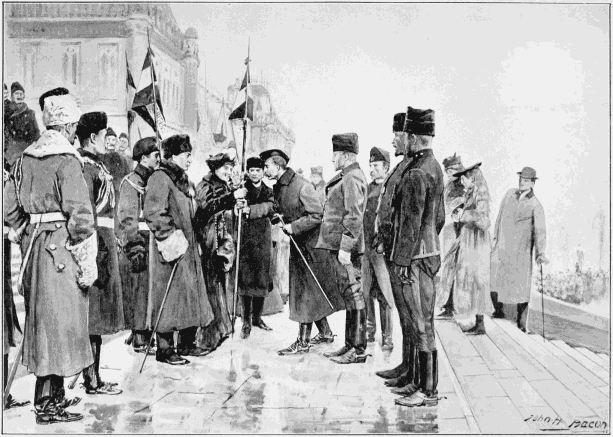
LADY MINTO PRESENTING COLOURS TO HERCHMER’S HORSE, ON LEAVING OTTAWA, 19th JAN. 1900.
Drawing by J. H. Bacon, from Photo by J. C. Hemment.
It was considered that the Cowboys, and such “Plainsmen of the West” as
Herchmer’s Horse, broncho busters who had never been conquered by man or
horse, would be specially valuable in the style of warfare affected by the Boers.
With nerves of steel and thews of wire, they could speak without boasting of
their capacity for putting in thirty-six hours consecutively in the saddle, and
for living “on the smell of an oiled rag.”
Ardent volunteers who had failed to get a place in the first Contingent now
rushed forward from every side. The sole disappointment was, that only a
limited number could be accepted, and those must all be mounted men or
artillery.
The wild enthusiasm aroused by the brave and splendid work of that portion
of the first Canadian Contingent which was with Colonel Pilcher in South
Africa, and the inspiring accounts given by the correspondent of the Toronto
Globe, resulted in more volunteering, and a third Contingent could easily have
been raised, even after the rigorous medical examination had rejected numbers.
The people of Canada responded nobly to the call for funds to provide for
the families of their volunteers on service in South Africa, the large amounts
subscribed by the Banks of Montreal and British North America, followed by
donations of 15,000 dollars by the Canadian Pacific Railway and 2000 dollars
by Holsen’s Bank, having served to stimulate action in this direction. The
City Council of Toronto insured for 1000 dollars the lives of all the 123 men
they had sent to form part of the second Contingent.
On January 19, the Dominion Government, in a house which cheered
itself hoarse in response to patriotic speeches, decided to offer, if required,
12,000 men to the Imperial Parliament for service in South Africa. Lord
Strathcona meantime, at his own expense, raised a mounted battalion for
service, which was to be ready to sail on February 10 for South Africa,
the War Office having given their consent to the formation of the corps. The
matter was placed in the hands of the Hon. Dr. Borden, Canadian Minister of
Militia and Defence, who was given a free hand to recommend officers, organise
and equip the corps, Lord Strathcona reserving only the right to reject or
confirm his decisions.
The following officers left for the front at the end of January: Officers of D
Battery—Major W. G. Hurdman, Capt. D. J. V. Eaton; Lieutenants, first section,
T. W. Vantuyl; second section, J. M’Crea; third section, E. W. B. Morrison.
Officers of E Battery—Major G. H. Ogilvie; Capt. R. Costigan; Lieutenants,
first section, W. F. Murray; second section, A. T. Ogilvie; third section, W. G.
Good. Officers attached for duty—Captain H. J. Uniacke; Adjutant, Captain
H. C. Thatcher; Medical Officer, Surgeon-Major A. Worthington; Veterinary
Officer, Veterinary-Major Massie. These were followed by Regimental Staff
Commander Lieut.-Colonel Herchmer; Adjutant Lieut. Montague Baker;
Transport Officer, Lieut. Eustace; Quartermaster, Captain Allan; Medical
Officer, Surg.-Capt. Devine; Veterinary Officer, Lieut. R. Riddell. In
command of squadrons, Majors Howe and Sanders; Captains Cuthbert and
Macdonnell; Lieutenants Begin, Davidson, Wroughton, Cosby, Chalmers,
Taylor, and Inglis.
When the mounted section of the second Canadian Contingent, numbering
eighty men, started, some twelve extra men were invited to volunteer. To
meet the demand no less than 400 applicants, many of them men of independent
means, instantly came forward. Here was a remarkable proof of
martial spirit, of devotion to the cause of the Mother Country. Vanity some
said it was. Any way, it was a vanity fringing on the sublime.
It is interesting to note, that before the gallant members of the second Contingent
left for Halifax they were presented with guidons by Lady Minto, the
gifts being inscribed with the motto of the Elliot clan—“Wha daur meddle wi’
me.” This delicate mark of attention was highly appreciated by the men.
Early in February the Mounted Bushmen’s Corps of 300 men and horses
started for the Cape. All the Canadians, volunteers it must be remembered,
were picked men from all parts of the Dominion, and with them were scouts
from British Columbia, who, for the most part, were recruited from the
Mounted Police of the North-West and from Cowboys. Being about the
smartest riders and best shots in the world, it was felt that they would
distinguish themselves in the war game as played by the Boers.
Among those at the front prominently connected with Canada was Captain
Kirkpatrick, Royal Engineers, who was attached to the staff of Sir Redvers
Buller. This officer is a graduate of the Royal Military College, Kingston,
and on leaving that institution received a commission in the Royal Engineers.
When the war broke out, Captain Kirkpatrick was ordered from Malta to South
Africa, where he commanded the Fortress Company of the Royal Engineers.
Major Denison, a prominent officer in the Royal Canadian Infantry, who had
personal charge of the recruiting for the first Canadian Contingent, and was
appointed quartermaster to the battalion at Quebec, had the honour in January
of being appointed aide-de-camp on the staff of Lord Roberts.
Another of the patriotic band was Colonel Girouard (the French Canadian
of Egyptian fame), who assisted Lord Kitchener and the Engineers in marvellous
operations along the line of rail. This officer has achieved a glorious
reputation, one which has been declared to be a closer bond between French
Canada and Great Britain than any words. Another honoured Canadian, who
was mortally wounded in the attack near Spearman’s Camp on the 20th
of January, was Captain Hensley (Dublin Fusiliers). This gallant officer was
born at Charlottetown and educated at King’s College, Windsor, whence he
passed into the Royal Military College.
Major-General Hutton, commanding the Canadian Militia, early in the year
was selected for special service in South Africa. No better officer could have
been chosen. He had ample experience of the subject in hand, as he himself
stated in speaking to the Canadian Contingent before their departure:
“It was my lot to have seen two campaigns in South Africa, including the
campaign against the Boers in 1882. It was also—I was going to say my
privilege—it was certainly not my pleasure—to have been at Pretoria at the
time the present Convention was made; and I therefore know their leaders,
and a little something—I may say almost too much—of South Africa and the
Transvaal, and therefore I recognise perhaps more clearly than many of you
do the very great difficulties and the dangers which our Contingent and the
Imperial troops in South Africa are exposed to.”
Strathcona’s Horse, consisting of 530 men and 560 horses, was commanded
by Colonel Steele of the North-West Mounted Police. He is regarded as an
ideal officer for a scouting force, and his men were all picked men, the cream
of the expert riders and riflemen of the Dominion. Morally and physically
they were declared to be the best soldiers that have ever been enrolled in Canada.
Their mounts were small shaggy bronchos, but sturdy long stayers. In regard
to Lord Strathcona’s timely generosity it is impossible to say enough—the
general appreciation of his splendid and patriotic act is expressed in the following
resolution, which was adopted by the Executive Committee of the
British Empire League in Canada: “That the Executive Committee of the
British Empire League in Canada has heard with unqualified satisfaction of the
magnificent undertaking of Lord Strathcona and Mount Royal, a Vice-President
of this League, to raise, equip, and support, at his entire expense, a corps
of mounted troops composed of Canadians for service for the Empire in the
South African war, and desires to place on record its enthusiastic appreciation
of his patriotic munificence, and is certain that his work will yet further convince
the rest of the Empire of Canada’s devotion to the cause.” Speaking of
this noble promoter of his country’s weal, Lieutenant Cooper, Q.V.R., said:
“Generously has the British Empire done by Lord Strathcona, and generously
and freely has Lord Strathcona done by the Empire. Under the ægis of the
Union Jack in Scotland, Donald Alexander Smith spent the first eighteen years
of his life. In 1838 he entered the service of the Hudson’s Bay Company, and
learned the intricacies of North American trade in Labrador and the North-West.
In later years he took a prominent part in the organisation of the
Canadian Government in the newly-acquired Rupert’s Land, and was intimately
connected with the early official days of Manitoba and the North-West Territories.
After representing Montreal for two terms in the Dominion Parliament,
he was appointed Canadian High Commissioner in London, England, a position
which he still fills to the satisfaction of the Canadian people. In 1897 he was
raised to the peerage as Baron Strathcona and Mount Royal of Glencoe and
Montreal.”
The force, equipped after the manner of other mounted troops, and not
armed with lances, was paid by Lord Strathcona until it landed in South
Africa, when it was taken over by the Imperial Government. As in the case
of the Contingents from the various Colonies, the officers of the corps were
appointed as follows: S. B. Steele, gent., Canadian North-West Mounted
Police, to be Lieut.-Colonel, with the temporary rank of Lieut.-Colonel in the
army. To be Majors, with the temporary rank of Major in the army: Lieut.
R. C. Laurie, Canadian Militia Reserve of Officers; R. Belcher, Inspector
Canadian North-West Mounted Police; A. M. Jarvis, Inspector Canadian
North-West Mounted Police; A. E. Synder, Inspector Canadian North-West
Mounted Police. D. M. Howards, Canadian North-West Mounted Police, to be
Captain, with the temporary rank of Captain in the army. To be Lieutenants,
with the temporary rank of Lieutenant in the army: Major G. W. Camden,
Canadian Militia; Captains R. M. Courtney, Canadian Militia; J. J. Macdonald,
Canadian Militia; E. F. Mackie, Canadian Militia; Lieutenants T. E. Pooley,
Canadian Militia; R. H. B. Magee, Canadian Militia Reserve of Officers; Second
Lieutenant P. Fall, Canadian Militia; F. L. Cartwright, Inspector Canadian
North-West Mounted Police; A. E. Christie, Inspector Canadian North-West
Mounted Police; J. E. Leckie, Graduate Royal Military College, Kingston,
Canada; A. W. Strange, gent., late Canadian Militia. Lieutenant M. P.
Cotton, Canadian Militia, to be Lieutenant for Machine-Gun Detachment,
with the temporary rank of Lieutenant in the Army. W. Parker,
Canadian North-West Mounted Police, to be Quartermaster, with the temporary
rank of Lieutenant in the army. C. B. Keenan, gent., M.D., to
be Medical Officer, with the temporary rank of Captain. Dr. M’Millan
of Brandon was appointed Veterinary Surgeon for the Strathcona Horse. His
assistant was Mr. Millican, of Rapid City, Manitoba.
The regiment was recruited from a territory covering a million square miles,
some men having travelled from Yukon and the Peace River district in order
to enlist. Many distinguished men were among them. In one troop were to
be found Mr. Beresford (formerly a Naval officer), cousin of the Marquis of
Waterford; Mr. Warren, son of Colonel Warren, R.H.A.; Mr. Shaw, son of a
Baronet; Mr. O’Brien, a kinsman of Lord Inchiquin; Hon. Mr. Cochrane, son
of the now notable Lord Dundonald; and Lord Seymour. Colonel Steele
(N.W.M.P.), in command of the corps, is a son of a Captain in the Royal
Navy. He was born in Canada, and is noted for his bravery and devotion to
duty. Major Belcher, a notable swordsman and lancer, was for some years in
the 9th Lancers. The troops received an enthusiastic send off, and multitudes
gathered together to do honour to the latest addition of Great Britain’s army.
Several beautiful guidons were presented to the corps by the ladies of Ottawa.
Each was made of crimson silk, with a broad white stripe through the centre,
on which was embroidered in crimson letters, “Strathcona’s Horse.” On the
upper crimson bar was Lord Strathcona’s motto, “Perseverance,” done in
crimson on a white garter. Above the garter was a Baron’s coronet and tiny
brown beaver on a green maple leaf. On the lower crimson bar was the
squadron’s designation.
New South Wales fell into line with the other Australasian Colonies, and
decided to send a military force for service with the Imperial army in South
Africa.
The New South Wales Lancers, who had been in training at Aldershot,
were the first to start. They were then about to return home, but were
stopped en route, and proceeded to the Cape. Of their number some few
refused to serve and went home, but on arrival many offered to return to the
front. The rest gave satisfactory reasons for being unable to do so. Subsequently
another Contingent was sent, and also the Bushmen Corps, at least
1000 strong. It was composed of men who could ride well, shoot splendidly,
and were accustomed to camping out and roughing it in pursuit of their usual
vocations. It must be noted that this was not the first time that New South
Wales had come to the assistance of the Mother Country. A force went to
Egypt in the earlier Soudan wars, when one man was wounded. Some discontent
at that time was shown owing to the troops not being allowed to go to
the front. On this occasion they were to serve and fare as the Imperial troops,
and to be considered as such while in the field.
Each Contingent was composed of—1st, N.S.W. Lancers; First Australian
Horse; N.S.W. Artillery; Mounted Rifles; Infantry, who, being good horsemen,
were subsequently mounted by the Imperial Government. 2nd Contingent
consisted of three Mounted Rifle units of 125 men each, one unit of
Australian Horse of 100 men (475), one Battery of Artillery—18 officers,
175 men, 140 horses (629). The total of the New South Wales troops at
the front in February amounted to 1331 men.
Though not at first very enthusiastic in expressions of patriotism, New
South Wales soon became strong in deeds. Enthusiasm became epidemical.
Mr. Lyne, the Premier, threw himself into the movement, and rapidly
pushed forward the arrangements, and did all in his power to move in sympathy
with the patriotic feelings of the Colony, which were daily growing more
ardent. As a practical expression of the intensity of their patriotism, the
citizens arranged and subscribed for the despatch of 500 expert roughriders
and Bush marksmen, while the New South Wales Government assisted by
supplying arms and ammunition.
The volunteers were all part, or had formed part, of the land forces. The
only actual regular regiment, as understood by us, was the artillery, a small
company of Submarine Mining Engineers, 27; Army Service Corps, 10; and
Army Medical Staff, 11. All the rest were partially paid or volunteers. The men
came from the whole country, and were men who were serving in the various
corps either as volunteers or partially paid troops. All the infantry corps were
volunteers—all cavalry regiments and some of the field and garrison artillery
were partially paid troops, and were called regulars, though not on the permanent
staff. The officers of the Contingents were—1. Captain C. F. Cox,
N.S.W. Lancers, Major Bridges, N.S.W. Artillery, Captain Legge, General
Staff N.S.W. Inf.; 2. Major and Brevet Lieut.-Colonel Thomas Samuel Parrott,
V. D. Corps of Engineers, an officer who served in 1885 with the Australian
Contingent in the Soudan. Colonel Sydenham Smith com. Artillery; Major
J. H. Plunkett Murray, com. 8th Inf. (Union Regiment); Captain and temporary
Major P. T. Owen, General Staff; Staff officer for Engineer services, Captain
L. H. Kyngdon, N.S.W. Regt. R.A.; Captain A. P. Popham Luscombe;
N.S.W. Regt. R.A.A., Captain Henry P. Ramsay Copeland. Reserve of
officers—Captain R. St. Julien Pearce; N.S.W. Art. (Field), Lieutenant R. S.
Hay Blake Jenkins; N.S.W. Regt. R.A.A., Lieutenant C. F. Bracen, N.S.W.
Art. (garrison). 1st Aus. (Vol.) Horse unit—1st Lieut. R. R. Thompson, Permanent
Staff, with rank Captain; 2nd Lieutenant J. F. Moore Wilkinson, 1st
Aus. Horse (Vol.), with rank 1st Lieutenant; 1st Lieutenant Keith Kinnaird
Mackellar, 5th Inf. (Vol.) Regt.; Lieutenant B. J. Newmarch, N.S.W.A.M.C.;
Lieutenant J. A. Dick, N.S.W.A.M.C.; Lieutenant A. H. Horsfall, N.S.W.A.M.C.
Additional officers—Dr. A. MacCormick, to be Consulting Surgeon,
hon. rank Major; Dr. R. Scot-Skirving, to be Consulting Surgeon, hon. rank
Major; Dr. W. R. Cortis, rank Captain; N. R. Howse, rank Lieutenant.
Chaplains—Church of England—Rev. H. J. Rose, hon. rank Major; Rev.
Patrick Fagan, hon. rank Captain.
The first Contingent reached Cape Town (from London) on November 2,
1899. The second Contingent started on January 17th and 18th in three transports;
these, while in dock, had to be watched, as some Boer sympathisers
were suspected of wishing to set fire to them. Nevertheless there were most
remarkable demonstrations of loyalty on all sides, and the troops went off in
high feather, having been previously addressed by Mr. Lyne in the following
stirring speech: “I wish to tell you that every man and woman in this country
is not so proud of anything as of you. You are not enlisting in the ordinary
sense of the term, in that you are volunteering to serve with the British troops
in the interests of the Empire. You are certain to meet a foe such as Great
Britain has not met for some considerable time, and I feel we shall all be
proud of your deeds. It is admitted that you are particularly useful, knowing
bush life and being able readily to seize commanding points. Great Britain is
finding that her Colonies form a valuable nursery ground, and we, on our part,
are prepared to supply Great Britain with a force which is rapidly becoming a
powerful adjunct of the British arms. You will be placed where you must
show energy and determination, and must manifest pluck and courage, and
we believe that you will bring back as a reward a wide recognition that
our arms have been of service to the Empire. You will make a name for us
such as rarely falls to the lot of a youthful country. You will show the
world that the Empire is united, and that we are prepared to defend her
and our homes if the necessity arises. We in Australia wish you God-speed,
and every heart here beats in accord with every loyal heart in South
Africa. I can only add, for those who may fall, that their memories will be
revered, and you depart knowing that the loved ones of those yielding their
lives will be tended by a generous Government and a generous public. Again
I wish you God-speed, and may you return covered with all honour.”
On the 19th of January the Premier received the following cable: “Her
Majesty’s Government learn with great satisfaction of the despatch of the Contingent
and the patriotic feeling in New South Wales. The Queen commands
me to express her thanks for these renewed expressions of loyalty.
“Chamberlain.”
The Victorian Contingent started off with the same flourish of trumpets and
the same outbursts of popular feeling which had accompanied all the Transvaal
Contingents. There was a mixture of song and shout, of sorrow and tears.
The weather was unchangeably splendid; the city of Melbourne was thronged
with visitors to witness the unusual sight, the crowd being augmented by
numerous Tasmanians who journeyed across the straits to get a last glimpse
at the brave band of warriors as they started on their voyage. Lord Brassey
gave a short address, and in the name of the Queen wished them God-speed.
First Victorian Contingent for South Africa.—Nominal Roll
of Officers of the Victorian Contingent for service in South Africa, sent in
accordance with the cablegram of the Right Honourable the Secretary of
State for the Colonies of 4th October 1899: Major G. A. Eddy, Captain
(Medical Staff) W. F. Hopkins, Lieutenant T. M. M’Inerney, Lieutenant H.
W. Pendlebury, Lieutenant A. J. N. Tremearne. Mounted Infantry Unit—Captain
M’Leish, Lieutenant and Adjutant Salmon, Lieutenant Thorn, Lieutenant
Chomley, Lieutenant Staughton, Lieutenant Roberts, Veterinary-Captain
Kendall.
The following officers were attached for instruction in accordance with the
cablegram of the Right Honourable the Secretary of State for the Colonies,
dated 27th October 1899: Colonel J. C. Hoad, Lieutenant-Colonel C. E. E.
Umphelby, Captain G. J. Johnston, Captain J. H. Bruche. Transport Officer
for service with troops for South Africa on board s.s. Medic—Lieutenant-Commander
W. J. Colquhoun.
Second Victorian Contingent for South Africa (two companies
of mounted infantry).—Nominal Roll of Officers who embarked on
s.s. Euryalus on 13th January 1900 for service in South Africa: Colonel T.
Price, Captain D. H. Jenkins, Lieutenant T. H. Sergeant, Lieutenant T. F.
Umphelby, Lieutenant G. O. Bruce, Lieutenant A. A. Holdsworth, Lieutenant
M. T. Kirby, Lieutenant E. O. Anderson, Lieutenant T. A. Umphelby, Lieutenant
E. S. Norton, Lieutenant R. S. R. S. Bree, Lieutenant and Adjutant J.
L. Lilley, Major (Medical Staff) A. Honman, Chaplain Rev. F. W. Wray,
Veterinary-Captain H. S. Rudduck. Officer attached for special service with
Army Service Corps: Lieutenant A. J. Christie.
In addition to these Contingents the Colony contributed 250 Bushmen,
making in all up to the month of April, 751; officers, 46.
Among the officers of the Victorian Contingent were some whose careers
were particularly interesting:—
Lieut.-Colonel Charles Edward Ernest Umphelby was forty-six years of
age, and a native of Victoria. He commanded the V.R.A.A. He joined the
Militia Garrison Artillery at Warrnambool on the 20th June 1884; in March
1885 was appointed lieutenant in the Permanent Artillery, being promoted to
be captain on the 1st January 1888. In August 1891 he was promoted to
be major, and in June 1897 to the rank of lieutenant-colonel. In addition to
commanding the artillery he also commanded the Western District Garrison
Artillery. He was sent to England by the Victorian Government in 1889
to undergo courses of instruction, and while there was attached to the staff
of Major-General Clarke. He passed through various artillery courses, including
the long course at Woolwich and Shoeburyness.
Captain George Jamieson Johnston is a Victorian native, and is thirty-one
years of age. He is an officer of the Field Artillery Brigade, which is commanded
by Lieutenant-Colonel Kelly. Captain Johnston was appointed lieutenant
on the 11th January 1889, and was promoted to be captain on the 1st
July 1895. He is well known as a straight and regular follower of the Melbourne
Hounds.
Captain Julius Henry Bruche was born on the 6th March 1873, and educated
at the Scotch College, Melbourne. His first experience of military work was
in the ranks, and as an officer in the cadet corps, under Major W. Whitehead.
After leaving the Scotch College cadets he was appointed to the senior cadets,
and from them was transferred to the 1st Battalion Infantry Brigade as a
lieutenant on 15th May 1891. Whilst in the 1st Battalion he passed the
examination for captain, “distinguished in all subjects.” He was appointed
permanent adjutant of the 1st and 2nd Battalions of the Infantry Brigade on
the 18th July 1898, and was promoted to the position of captain on the 17th
February 1899, after passing the examination for regular officers, and going
through a course of musketry and Maxim machine-gun, obtaining an officer’s
extra certificate, and a certificate as qualified as instructor of the Maxim machine-gun.
Captain Bruche is a barrister and solicitor, but gave up his profession to
join the permanent staff of the Victorian forces.
It may here be mentioned that Victoria has the distinction of being the
birthplace of Dr. Robert Andrew Buntine, who was mentioned for bravery at
the battle of Glencoe in Sir George White’s despatches. Dr. Buntine was born
on the 13th of November 1869. He matriculated in the Melbourne University
with honours, and at once entered upon his medical course, where he acquitted
himself with some distinction, for although close upon a hundred students
entered their curriculum with him, only five (and he was one of them) passed
consecutively all their examinations with honours. In 1890 he graduated with
honours, and took his M.B., Ch.M. degrees. He then became one of the resident
surgeons of the Melbourne Hospital for a year. After that, and the hard
work of the University, he decided upon a year’s travel. Accordingly, he travelled
first in South Africa, and then in Great Britain for some months, visiting many
interesting historical spots, and finally returning to South Africa, where he
bought a practice in partnership with Dr. Currie, of Pietermaritzburg, Natal.
Both are surgeons in the army, Dr. Buntine being surgeon to the Volunteers,
and Dr. Currie to the Carabineers.
On the 21st of October, the anniversary of Trafalgar, Wellington was
very early astir. Great were her preparations to commemorate the departure
of her Contingent—the first Contingent to embark from the Colonies. Bunting
began to break out before breakfast, and town and shipping were soon fluttering
with flags. In the streets groups were congregating at a time when people
are usually given up to business, and uniforms everywhere dotted the thoroughfare.
Large numbers of volunteers came in from the country, some travelling
all night, and there was a turn out of local forces amounting to 1500.
The march through the town began at 1.20 P.M. It was an inspiriting
sight, and one that all wished to bear in memory. The road at intervals was so
dotted with cameras, that one humourist in the ranks was heard to remark that
this was the “real original March of the Camera Men.” The crowds thickened
and enthusiasm increased. Jervois Quay, the broadest avenue in the city, as
well the open land abutting on it, was thronged from end to end. All the roofs
commanding a view were lined, the steamers at the wharves were packed even
to the rigging, and the long breastwork along the quay was crammed to
suffocation.
Here the passage for the Contingent was kept by a double row of
volunteers. The weather had been frowning and gusty, but no sooner had the
Contingent formed up in front of a temporary stand projecting from the breastwork,
on which Lord Ranfurly, the Governor, Lady Ranfurly and suite were
accommodated, than the sun burst forth resplendent while the wind gently
lulled. Speeches were made, followed by pathetic leave-takings of friends and
relatives. At the last moment so great was the crush that some of the men
were cut off from the rest, and had afterwards to struggle to the steamer as
best they could.
As the big vessel slowly steamed off, cries of farewell, shouts, cheers rent
the air, and continued unceasingly, till the Waiwera bearing New Zealand
“Soldiers of the Queen” to the scene of war, had passed from sight.
The first New Zealand Contingent was commanded by Major Robin, who is
a splendid example of the born warrior. Originally a gunner in the B Battery
New Zealand Artillery, he rose in the Otago Hussars through all the
grades of non-commissioned officers to command of the troop. This regiment
from that time was unsurpassed in efficiency by any in the Colony. As an
instance of the pluck and energy of the gallant major, a characteristic story
is told: When Sir John Richardson died he was accorded a military funeral,
and was interred in the Northern Cemetery. On the day of the funeral the
Leith was in high flood, and there was a general opinion that the Dundas
Street Bridge would not bear the weight of the gun-carriage bearing the
honoured remains. Major Robin at once volunteered to drive the gun-carriage
across, and accomplished the dangerous task without mishap.
Major Robin took charge of the New Zealand Contingent which attended
the Diamond Jubilee, and had the honour of commanding the mixed Colonial
escort which accompanied the Queen on her visit to London during the
celebrations.
Captain Madocks, who distinguished himself in the fight of the 15th of
January at Slingersfontein, is a Wellington man, full of pluck and resource,
and as we now know, admirably calculated to become a leader of men.
The second Contingent, under the command of Major Cradock and numbering
242 officers and men and 300 horses, left Wellington on the 20th of
January—upwards of 70,000 spectators congregating to witness the departure
of the fine fellows, whose appearance was alike martial and workmanly.
These two Contingents, equipped and sent over at the cost of the New Zealand
Government—the funds being raised among the settlers themselves—were not
by any means New Zealand’s entire contribution. Two more Contingents
followed, and afterwards a fifth, consisting of 500 rough riders; some of the
smartest men that could be gathered together! Indeed the whole force was
remarkable for its smartness, and before it had been long in the Transvaal was
highly praised by General French for its fine horsemanship and coolness under
fire.
An interesting feature belonging to the New Zealanders, and one which
must have struck consternation in the heart of the Boers, was the Maori war-cry
of the troops. This was composed by Trooper Galloway, one of the
Volunteer Contingent, and taught by him to his comrades. The war cry
in the Maori tongue is “Kia, Kaha, Niu Tireni. Whawhai maiea mo te
Kuini, to kaianga. Ake! ake! ake!” which interpreted means, “Be strong,
New Zealand. Fight bravely for your Queen, for your country. Ever! ever!
ever!” The interest of the Maoris in Great Britain was evinced in practical
form. They held carnival, danced native dances, and sang native songs,
devoting the proceeds to the Patriotic Fund. Their only regret was their
inability to be enrolled among the defenders of the country.
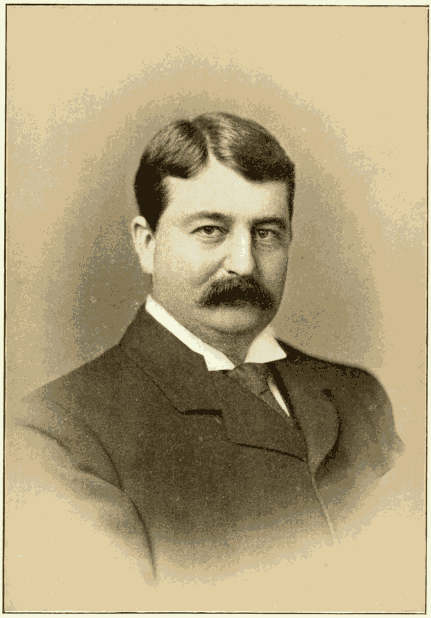
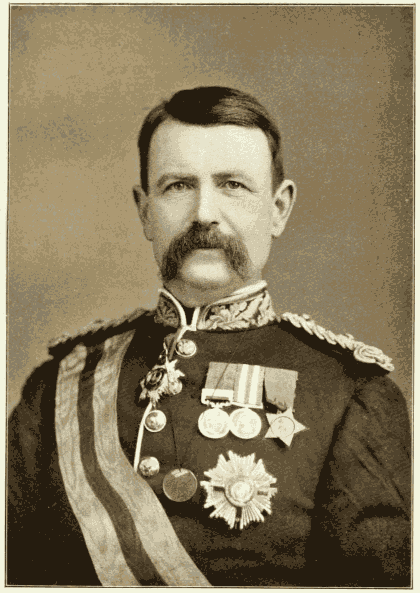
HON. W. P. SCHREINER, C.M.G.
Premier of the Cape Parliament, 1898-1900.
Photo by Elliott & Fry, London.
The Queenslanders, under the command of Colonel Ricardo, have, as before
said, the honour of being the first of Great Britain’s children to come forward
to her assistance. Their deeds are now familiar to us, for they are associated
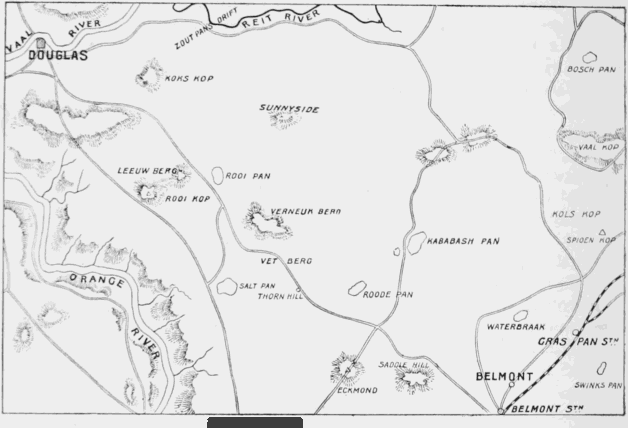
with Colonel Pilcher’s famous raid to Sunnyside and Douglas, and also with
the magnificent ride of General French for the relief of Kimberley. But before
July 1899 we were scarcely acquainted with our warlike brothers across the
ocean.
The prime mover in the patriotic scheme of assisting the Mother Country in
her need was the Hon. J. R. Dickson, the Premier. As we know, he lost not a
moment. He did not wait for the need of assistance to be recognised. In this
respect he followed the splendid example set in 1884 by the late Mr. Dalley,
who, while acting Premier for Sir A. Stuart, telegraphed independently the
wish of New South Wales to assist in the military undertakings of the Mother
Country. The Premier knew the spirit of loyalty and patriotism that pervaded
Queensland, and made haste to give it utterance. He was well supported by
all sections of the Government and of the people, and speedily his action was
imitated all over the world.
Queensland by degrees sent out two Contingents composed of mounted
infantry and one machine-gun section of Royal Australian Artillery; and
finally, a third Contingent, of which 75 per cent. were bushmen, all first-class
riders and splendid shots. They were men of grand physique, many of them
wealthy, and many sons of prominent citizens. The infantry were not
mounted when despatched, but all being good horsemen, and their services
being chiefly required as scouts or to assist cavalry, they had mounts provided
for them on arrival by the Imperial authorities. The Queensland Mounted
Infantry was organised in 1884 by Colonel Ricardo, who is styled the “father”
of mounted infantry in Queensland, and belongs to the Militia Division of the
Colonial Defence force. The force is organised on the basis of three years’
service, and ordinarily is recruited from the bushman and farmer class—a
sterling and hardy set of fellows, whose plain motto is “For God and the
right.” The uniform, a highly becoming one, is of kharki, with claret-coloured
facings. The hat is of the usual “brigand” shape, decorated at the side with
a smart tuft of emu plumes.
The whole of the expenses of transport, equipment, arms, and food for men
and horses during the voyage was defrayed by the Colony; pay on the field
was met by the Imperial Exchequer, the Colony only meeting the difference
between the Imperial and Colonial rates, the latter being higher.
The first Contingent consisted of 262 men and officers, who sailed in the
Cornwall on November 11, 1899, amid a wild display of patriotic enthusiasm.
Officers of the first Contingent—Staff—Major P. R. Ricardo, to rank as
Lieut.-Colonel; Sup. Captain R. S. Browne; Lieutenant C. H. A. Pelham;
Machine-Gun Section—Lieutenant C. H. Black, Royal Australian Artillery.
A Company Queensland Mounted Infantry—Captain H. G. Chauvel; Lieutenant
A. G. Adie (wounded at Sunnyside under Colonel Pilcher); Lieutenant C. A.
Cumming; Lieutenant T. W. Glasgow; Lieutenant D. E. Reid. B Company
Queensland Mounted Infantry—Captain P. W. G. Pinnock; Lieutenant H.
Bailey; Lieutenant R. Dowse; Lieutenant R. Gordon. The second Contingent
was composed of 148 men and 8 officers, with 5 additional officers for special
service in South Africa. Officers of second Contingent—Lieut.-Colonel Kenneth
Hutchison, Headquarters Staff, commanding; Captain W. G. Thompson,
Queensland Mounted Infantry; Lieutenant H. J. Imrie Harris, Queensland
Mounted Infantry; Lieutenant A. F. Crichton, Queensland Mounted Infantry;
Lieutenant James Walker, 3rd Queensland (Kennedy) Regiment; Lieutenant
R. M. Stodart, Queensland Mounted Infantry. Supernumeraries—Captain
Sir Edward Stewart-Richardson, Bart., 3rd Battalion Black Watch; Lieutenant
John H. Fox. Additional officers attached—Surgeon-Captain H. R. Nolan,
A.M.C. Queensland Defence; Major D. W. Rankin; Captain F. W. Toll,
special service; Captain A. E. Crichton, Camp Quartermaster; Captain W. T.
Deacon, Camp Adjutant.
The second Contingent sailed in the Maori King on January 20. The
night before they were to start it was discovered that the ship had been set on
fire, but the flames were extinguished before much damage was done. There
seemed to be no doubt it was the work of an incendiary, and the police kept a
close watch over the vessel till she was fairly away. It was regarded as significant
that the crew consisted mainly of Dutchmen and Germans.
The third Contingent, which sailed in the Duke of Portland on March 1,
was 300 strong, with 350 horses. In addition to the above, about 20 men and
50 horses had been sent to Sydney, and sailed with the New South Wales Contingent
on February 26. After accommodating men and horses, it was found
that the Duke of Portland had still 500 tons of space available for cargo; this
the Queensland Government offered to fill with forage for horses and men, and
present to the Imperial Government.
South Australia speedily sent two Contingents to the front, and offered more
should further help be required. The first Contingent was commanded by
Captain F. H. Howland. This officer was born in Kensington, London, 1863,
and served for three years in the Middlesex E.V. Royal Engineers. At the
expiration of that time he went to Australia, and in 1885 joined the volunteer
company which was being formed at Mount Gambier, in which he was appointed
lance-corporal. Since then he has passed through every rank, was
appointed captain in 1893, and made adjutant in June 1898. Captain Howland
then became senior captain in the second battalion, and—having passed his
examination for his majority—on the illness of his commanding officer, commanded
the battalion on several occasions.
The officers of the Contingent were as follows: Captain F. H. Howland,
D Company, Mount Gambier Infantry, C.O.; Captain G. R. Lascelles, Royal
Fusiliers, A.D.C. to Lord Tennyson (attached); Lieutenant J. H. Stapleton,
A Company, first battalion infantry; Lieutenant F. M. Blair, B Company, first
battalion infantry; Lieutenant J. W. Powell, D Company, Mount Gambier
Infantry; Major J. T. Toll, Medical Staff.
In regard to the payment of the troops the arrangement was simple. The
men received 5s. a day. That meant that the pay received through the South
Australian Government and the pay from the Imperial Government would
together amount to 5s. a day. Whatever amount the Imperial Government
gave their soldiers, members of the South Australian Contingent received the
same while on active service, and the balance paid to them by the South
Australian Government would bring the amount up to 5s. a day. They did
not propose to send any money from the Colony while the men were away, in
order that, while fighting side by side with the Imperial soldiers, they should
not receive more pay than their comrades. Their South Australian pay would
be left at home until their return. If the British rate of pay were 1s. 4d., that
arrangement would mean that 3s. 8d. per day would be due to them from the
Colonial Government. Before starting the men received one month’s pay,
amounting to £7, which was considered sufficient to supply their immediate
wants, and see them over the voyage. On arrival at Port Elizabeth they began
to receive the same pay as the British soldiers.
The officers of the second Contingent were: Captain J. Reade, commanding;
J. F. Humphries, senior subaltern; G. H. Lynch, second subaltern;
F. M. Rowell, third subaltern; G. J. Restall Walter, junior subaltern; W. J.
Press, warrant officer, in charge of the “Colt” automatic machine-gun; William
De Passy, warrant officer.
The first Contingent of infantry was afterwards turned into mounted
infantry. The second Contingent was composed of cavalry, and one machine-gun
section. The Australian Horse was drilled on exactly the same lines as
British cavalry, and was, in fact, under the instruction of British cavalrymen.
The men were either members of volunteer corps, or volunteered on the outbreak
of the war from all parts of the Colony.
When the news of British reverses reached the Colony, the patriotic fervour
of which the despatch of the first Contingent was a practical proof, was once
more fanned into flame. The desire for Australian representation on the
field of battle again translated itself into action, and the intimation that not
only would further assistance be welcomed but that it was really wanted met
with ready response. No lack of volunteers troubled the authorities, for
numerous offers to serve were received from all parts of the colony, from
persons of all classes and all ages. Among the youngest of those volunteering
was Allan O’Halloran Wright, who was but fourteen years of age, who accompanied
the Contingent as trumpeter. He is exceptionally well developed, and
considerably taller than many of the rank and file. Among others was Sergeant
Hanley, who was in the thick of the fight at Majuba Hill. He served with the
92nd Gordon Highlanders in the Afghan War, and received two decorations,
including medal with the Kabul, Kandahar, and Charasia bars, and a star for
the historical march from Kabul to Kandahar. He, with others, was mentioned
in despatches for his conduct in defending Lord Roberts from an attack of the
Ghilzais. He fought in twenty-seven engagements in Afghanistan, and was
the youngest man in the regiment. He stood side by side with “Fighting
Mac,” who was then a lance-corporal, and promoted to a commission for his
distinguished services. After the Afghan War he went to India, and though
he had completed seven years service, and need have done no more, he
volunteered for service with the 92nd Highlanders in South Africa. After the
miserable experiences of Majuba he went to South Australia, where he served
for nine years with the permanent force. He acted as warder in the Yatala
prison till, hearing of the war, he instantly volunteered.
On the 28th of October the Contingent dined at Government House, and
after the meal the men were received in the great hall and thus eloquently
addressed by Lord Tennyson: “Men of the South Australian Contingent
of the British army in South Africa—I am proud of being your Commander-in-Chief
because of your splendid patriotism, your alacrity in obeying
the summons of the old country, your self-sacrifice in leaving your
comfortable homes to fight for the United Empire, to maintain the Queen’s
position in South Africa, and to rescue the down-trodden Uitlanders from
the political and social serfdom imposed on them by the Boers. When I
was at home in 1897 I saw some of you in the Jubilee procession, and
you were vociferously cheered by the millions of people in the streets.
Why did they cheer you? Because they felt that you were our kith and
kin, and that you were not only taking part in a triumphal procession in
honour of the Queen, but that you were pledging yourselves that, if the needful
occasion should arise, you would fight for our Queen and for our Empire.
Your action now, and the action of all Australasia and of Canada, will make
the nations of the earth hesitate before they strike at our Empire in the future,
seeing our Imperial loyalty, our Imperial solidarity, our Imperial unity, our
Imperial strength. I believe from my experience as your Governor that there
is no man throughout South Australia who would not stand up in time of stress
in defence of the Queen, the Empire, and the Union Jack. You are a gallant
and stalwart body of men, and we rejoice in your soldierly appearance and
your loyal enthusiasm. We feel sure that you will do your duty nobly, and
return covered with honour and renown. Remember, my men, that obedience
to discipline, and patience in enduring hardship, and promptitude in the performance
of your military duties are the first steps towards the making of a
victorious army. You are to be joined in South Africa to highly organised
battalions of troops, some of the best in the world, commanded by highly
trained and scientific officers. Obey these officers and your own implicitly,
from the corporal to the Commander-in-Chief, whether on the field or in
garrison, or wherever you are; and I need not tell you that, if you keep your
eyes and ears open, you will learn a great deal that will be useful to you in the
future. May Australia never be visited by war! If this ever happens, the
British fleet will protect Australia in the first line of defence, but you must
have an efficiently trained army as a second line of defence. Knowing this,
the Federal Government of the future will, I am confident, put Australia in a
proper state of military preparedness; and that is one of the reasons why
I glory in our Federal Commonwealth to be. Remember always, my friends,
that you are the guardians of a magnificent heritage, of a country of which you
are justly proud, and that the experience which you Australians will gain in
South Africa will not only enable you to fight, if necessary, for this country,
but will also enable you to teach your comrades-in-arms, who are obliged to
stay at home, something of the needful requirements of modern warfare. I
know the General who is to lead you, Sir Redvers Buller. He is married to a
cousin of my wife’s, and I can tell you that a finer soldier could not be met with.
The motto he would wish to be given you would be: ‘Obedience and cheerful
courage on service are an army’s strength.’ I am glad to have allowed—though
it is personally a loss to myself—my A.D.C., Captain Lascelles, to accompany
you, with special leave from the War Office at home. As you are aware, in
him you have a thoroughly experienced and capable officer, and, like Captain
Howland and your other officers, he is fond of you and devoted to your welfare. If
I had to command a British army, I should know that, when you have had a little
more military experience, with your pluck, your good marksmanship, and your
loyalty, the standard of the Queen could well be intrusted to the keeping of the
Australian Contingent. It is my duty as well as my pleasure to tell you that,
on behalf of the British people, Her Majesty’s Government have sent me two
telegrams appreciative of the enthusiastic patriotism of yourselves, of the
Ministry, and of South Australia. It is also my duty as well as my pleasure
to read you the kindly and gracious message from the Queen, which has moved
us all very deeply: ‘Her Majesty the Queen desires to thank the people of
her Colonies in Australia for the striking manifestation of loyalty and patriotism
in their voluntary offer to send troops to co-operate with Her Majesty’s Imperial
forces in maintaining her position and the rights of British subjects in South
Africa. She wishes the troops God-speed and a safe return.’ The Boers have
forced war upon us and have invaded our territory. You are going to fight
for the cause of British freedom, for the honour of Great Britain, for the
honour of Australia. In the name, then, of our beloved Queen, of Great
Britain, and of South Australia, I bid you farewell, and I wish you, after your
work is accomplished, a safe and happy home-coming.”
On the 26th of January the second South Australian Contingent started for
the Transvaal amid scenes of great enthusiasm. The Governor, Lord Tennyson,
again made an inspiriting speech and wished them God-speed.
West Australia sent with the same energy of patriotism two Contingents
amounting to 230 officers and men, with offers of more if required. The
officers were: Capt. R. Moor, R.A.; Capt. H. S. Pilkington, late 21st Hussars;
Major M’Williams, Medical Officer; Lieut. J. Campbell; Lieut. H. F. Darling;
Lieut. F. W. M. Parker.
The Tasmanian Government were not behind the other Colonies of Australia
in their desire to show their loyalty and patriotism by offering troops for Imperial
service. There was, of course, some difference of opinion regarding the
policy of going to fight at all, as the following cutting from a local journal will
show: “In Tasmania, as elsewhere, there is a certain number, not many, of
the crawling tribe, who always find that their country is in the wrong, and are
never so happy as when they can hold up some foe as a model of virtue in
contrast with the brutal Briton. It is curious to find those who call themselves
friends of the working-classes indulging in this vein of oratory, but it is common
to all the Colonies, and may be said to account for the little influence that the
party has on general affairs. We have had here, of course, the inevitable
Catholic priest who has denounced the British, for he always appears when
Great Britain has any serious work to do, just as there is the usual meeting of
Irish in New York. In Hobart the Catholic priests spoke feeling and appropriate
words about the departure of the Contingent, but on the West Coast one
Father Murphy went on the rampage in the good old style, and proceeded to
denounce the country under the Government of which he lives, and which is
liberal enough to allow him to say such things with impunity. I wonder
whether these folk ever think about what would happen to them if they talked
in the same strain in France, Germany, or even in the United States. It does
not matter to Great Britain what these discontented ones say, but they might
learn from the liberty they use the value of the freedom which they enjoy.
On the whole, the people of Tasmania, while they deeply regret that war
should be necessary, are fully alive to the value of a united empire, and are
keenly anxious that she may vindicate her position in South Africa, and finally
get rid of the Boer incubus which has weighed upon the country ever since the
Gladstone Ministry adopted the policy of scuttle and palaver.”
This quotation shows the drift of popular sentiment, and in the end loyalty
everywhere prevailed, and some splendid fellows volunteered to go to the front.
These were not “raw material,” but intelligent, handy soldiers, accustomed to
the rough and tumble of bush life, and ready to provide for emergencies. Their
commander, Captain Cameron, had seen some service, and took part in the
famous march to Kandahar.
The first Contingent, sent in the Medic, consisted of eighty men, of which
the officers were: Capt. C. St. Clair Cameron, Erandale, commanding (who was
afterwards a prisoner in Pretoria); Lieut. W. Brown; Lieut. F. B. Heritage;
Lieut. G. E. Reid, 1st Regt., Hobart. Of the privates the following were
subsequently taken prisoners to Pretoria: M. H. Swan, V. J. Peers, A. Button.
J. H. Whitelaw, also a private, who has distinguished himself by gallantry in
the field and by saving a comrade’s life at the imminent risk of his own, will
probably receive the V.C.
The second Contingent, which consisted of forty-five men, was under the
command of Sergt. J. Stagg, of Deloraine.
Both Contingents were composed almost entirely of gentlemen.
Tasmania also contributed 100 men to the Imperial Australian Corps
which was raised at Mr. J. Chamberlain’s suggestion from all the Australasian
Colonies. The volunteering of the Tasmanian contingent to join hands with
Canada, Australia, and New Zealand, and shoulder to shoulder to support the
“flag of old renown” in South Africa, gave origin to the following lines written
by a Tasmanian poet:—
“War? We would rather peace; but, Mother, if fight we must,
There be none of your sons on whom you can lean with a surer trust;
Bone of your bone are we, and in death would be dust of your dust!”
There was immense excitement over the formation of the Imperial Bushmen
or Roughriders’ Corps. It consisted of over 2000 mounted men, selected from
those experienced in riding and looking after stock in country in its natural
rough state, unbroken by cultivation, fences or roads. In the first instance,
New Zealand made an offer to provide 500 such men, after which—as more
were required—Australia was asked to raise a further 2000, the Imperial Government
bearing the cost of forwarding them to the seat of war, and maintaining
and paying them there. Four thousand applications from Victoria and 2000
from Adelaide were received. The citizens of Rockhampton immediately
offered to provide and equip twenty-five Bushmen. New South Wales was
represented by a Contingent of 500 men, and Queensland decided to join with
the other Colonies in organising this smart and serviceable corps, whose value
was estimated as equal to twice the number of infantry.
The movement was a most popular one, and gifts of horses were sent in
from every direction. The public subscribed liberally, Captain Bridges alone
giving £1000 towards the expenses of the Victorian Bushmen.
The officers selected for the New South Wales Bushmen were Lieut.-Colonel
Airey in command, Major Onslow, three captains and fourteen subalterns.
The movement was so popular and subscriptions so liberal, that it was decided
that 100 men should be sent from South Australia instead of the fifty originally
proposed. Colonel Williams, of the New South Wales Contingent, was
appointed principal medical officer for all the Australian Contingents serving
in South Africa. The departure of the Bushmen on the 17th of January was a
magnificent climax to the many magnificent demonstrations of patriotism which
had been evidenced throughout the Colonies.
Between the Australasian and Canadian Colonies and the Volunteer
Contingent from India there is a certain difference which it is necessary to
recognise. In the Colonies, the movement to help the Mother Country in her
need, though prompted and encouraged by popular enthusiasm, patriotism,
and donations from private and public resources, was suggested, voiced, and
supported by the respective Governments, the Premiers of which acted very
prominently in the enterprise, whereas in India, the offer of military assistance
was a spontaneous impulse springing from individual patriotism and carried
out by private enterprise. India, being a Crown Colony, could display her
loyalty in no other way. Her position was somewhat similar to the Home
Establishment, and her regular British troops were under orders for South
Africa in exactly the same way as were the Home forces. Nevertheless, India
was not backward in independent demonstrations of loyalty. English officers
from various native corps, who, in ordinary circumstances, could serve only
in their respective Indian Contingents, now came forward and volunteered
for active service in aid of the Imperial cause in South Africa. The “men”
volunteered from all directions. Dapper young Calcutta merchants, sporting
tea-planters from Assam, gallant indigo-planters, and dashing roughriders from
Bombay, Assam, Bengal, Cawnpore, Mysore, and all manner of districts unknown
even by name to the Little Englander sent in their appeal, and pressed to be
allowed to play their part in the defence of the Empire; and thus the smart
regiments known as Lumsden’s Horse, the Railway Contingent, and the
Ceylon Mounted Contingent came to be recruited.
Colonel Lumsden, lately Commandant of the Assam Valley Light Horse,
generously assisted both financially and personally in raising and equipping the
force, and quantities of Calcutta men offered their services, their expenses
being guaranteed by the firms employing them. Gifts and subscriptions
poured in. Lord Curzon, the Viceroy, headed the subscription-list by a handsome
contribution, and so generous was the response of all India, that about
£30,000 was collected in connection with the Transvaal war, including the
equipment of volunteers.
The native princes offered troops and horses, and loyally expressed themselves
towards the Queen Empress. The troops were declined, it being
understood that the war was between white men alone. Their offers of
horses were, however, accepted. Nevertheless, the generosity of the princes
was not to be denied, and several among them, the Maharajah of Bikanir, the
Maharajah of Durbhanga, and the Nawab of Moorshedabad, subscribed liberally
to the expenses of Lumsden’s Horse, offering at the same time their best
wishes for the success of the Contingent and the complete triumph of the
British arms in South Africa.
The Nizam of Hyderabad, whose State is as large as France, and whose
relations with the sovereign have always been most cordial, assisted handsomely,
saying at the same time, with true Oriental grace, that his troops, his purse,
and his own sword were at the service of the Queen. The Maharajah of
Tanjore contributed 5000 rupees, while his son furnished a complete set of
X-ray apparatus. The Nawab of Bhavnagar State presented fifty fully
equipped Arab horses to the force, and quantities of other prominent Nawabs
displayed corresponding liberality. The Maharanee of Bettiah generously
presented to each volunteer from her district a horse, and Khwajah Mahomed
Khan forwarded from Mardan (on the Punjab frontier) the sum of 2000
rupees as an expression of loyalty, with his best wishes for the success of
Lumsden’s Horse. As an instance of the excitement and martial feeling in
regard to the Indian Transvaal Contingent, it may be noted that the
instant the scheme was proposed, two-thirds of the Light Horse of Behar
volunteered for service, promising to provide everything except means of
transport. They formed part of Lumsden’s Horse, who were all men under
forty years of age, many of them of independent means, with horses of
their own.
The following is the list of officers who were appointed to Colonel
Lumsden’s Corps:—
Lieut.-Colonel Dugald McT. Lumsden, Assam Valley Light Horse Volunteers,
to be Commandant, with the temporary rank of Lieut.-Colonel in the
army; Lieut.-Colonel Eden Showers, late Commandant Surma Valley Light
Horse Volunteers, to be second in command, with the temporary rank of
Major in the army; Captain J. H. B. Beresford, Indian Staff Corps, to be
Company Commander. To be Captains, with the temporary rank of Captain
in the army: Major Henry Chamney, Surma Valley Light Horse Volunteers;
Captain Francis Clifford, Coorg and Mysore Volunteer Rifles; Second Lieutenant
Bernard W. Holmes, East India Railway Volunteer Rifles; Second
Lieutenant John B. Rutherford, Behar Light Horse Volunteers. To be
Lieutenants, with the temporary rank of Lieutenant in the army: Lieutenant
Charles L. Sidey, Surma Valley Light Horse Volunteers; Herbert O. Pugh,
gent.; George A. Nevill, gent.; Charles E. Crane, gent. Captain Louis
H. Noblett, the Royal Irish Rifles, to be a Company Commander; Captain
Neville C. Taylor, Indian Staff Corps, to be Adjutant; Surgeon-Captain
Samuel A Powell, M.D., Surma Valley Light Horse Volunteers, to be Medical
Officer, with the temporary rank of Captain; William Stevenson, gent., to
be Veterinary Officer, with the temporary rank of Veterinary Lieutenant.
The Government provided free passages, and the railway authorities gave
free passes. With the force went Mrs. C. W. Park and Mrs. M. C. Curry,
wives of Lieut.-Colonel C. W. Park and Major M. C. Curry, of the 1st Devonshire
Regiment, to assist in the hospitals in Natal. This regiment, it may be
remembered, was with Sir George White, and had four officers severely
wounded in its first battle, Elandslaagte, and was shut up in Ladysmith for
over four months. Lumsden’s Horse sailed from India on February 6, much
envied by all who had not the good fortune to be of their number.
GENERAL BRABANT, C.M.G.
After Photo by S. B. Barnard, Cape Town.
Ceylon was not behind India in patriotic enthusiasm, though its powers
were more limited. Great demonstrations of loyalty prevailed everywhere in
the island, and volunteers were eager to be enrolled. Out of the numbers
applying 125 men were picked out and 5 officers. The force was armed with
Lee-Metford magazine rifles, 500 rounds of ammunition, and were nearly all
mounted on trained horses. Captain Rutherford, Royal Dublin Fusiliers, was
in command, and Captain Anderson, Royal Artillery, was second in command.
Captain Toogood (Warwickshire Regiment) also accompanied the force.
The planters and merchants of Ceylon presented upwards of 30,000 lbs. of
tea to be delivered free to the troops in South Africa, to be shipped with the
Contingent, and many private individuals were equally generous. The
Legislative Council unanimously agreed that all expenses connected with the
equipment, arming, transport, and, when necessary, mounting of the Ceylon
Contingent, should be borne by the Colony. This liberal decision was acknowledged
by Mr. Chamberlain in the following terms:—
Mr. Chamberlain to Governor the Right Hon. Sir J. West Ridgeway.
“Your telegrams of January 9 and January 10. Her Majesty’s Government
congratulate Ceylon on completion of Contingent, which they accept with
much pleasure, and highly appreciate patriotic and generous action of Legislative
Council.”
The Ceylon Mounted Contingent sailed on February 2 for active service in
South Africa, amid the prayers and good wishes of a huge concourse of people.
In addition to the above contingents from India and Ceylon, the Indian
Government sent the guns and equipment for three field-batteries of 15-pounders,
and also three corps of native transport drivers and muleteers—about
400 in all—under British officers.
It has been said that the whole course of the campaign might have been
changed had the Cape Colony forces been utilised sufficiently early. If the
Cape Ministry had begun at once by employing the splendid Colonial forces at
its disposal, not for purposes of defiance, but of defence, the tale of raid and
rebellion, which has been as harassing as the tale of war, would never have
been told. But as it is useless to talk of the might have been, or of things done
or left undone by the Cape Ministry, we must proceed to consider the services
of the Cape Colonial Force, of the ten thousand volunteers, when they were
eventually allowed to come into action. Of the splendid troops in Mafeking
and Kimberley the Colony must ever be proud, for on them fell the weight of
showing what worthy offshoots of the bold and the brave the sun of South
Africa has reared. These men, recruited for the most part from Cape Town,
Port Elizabeth, East London, Queenstown, Grahamstown, and Kimberley, consisted
largely of past and present Cape Colony Volunteers. They were bone
of our bone, and when the hour of stress arrived they proved themselves as
such. They were immensely proud to be included in the term British, and
right royally they acted up to the higher interpretation of that term. Though
they have borne years of insult and suffered in innumerable ways for their
fealty and devotion to the Mother Country, they rushed to arms joyfully in the
hope that Great Britain would reassert herself, annex the whole of South
Africa, and administer it under one Government. They longed to be quit of
Dutch intrigue. They pined for a strong rule, one that would be free of the
vacillations that had kept them on tenter-hooks for years, and prevented their
living in a sense of security enjoyed by other freeborn British subjects. By
these loyal fellows the towns of Mafeking and Kimberley were practically defended.
In those places there were very few Imperial troops, and little could
have been accomplished without the aptness and grit of the Colonials. The
reason why they appeared to be neglected is not far to seek. No man is a
prophet in his own country, and to this trite fact may be attributed the want
of instant appreciation accorded to the Cape Colonial Volunteers who so
spontaneously and with genuine zeal responded to the call of duty. While we
made much of the Colonials from over the seas—the “Visiting Colonials” as
they are called—we failed to see that at our elbows were the very men who
would leap forward at a word and check the onward career of the enemy and
put a stop to his annexations while our troops in England were getting into
shape. But later we jumped at them. Then the Cape Colonists began to be
vastly appreciated, and to receive the highest encomiums from all who had the
good fortune to serve with them.
The following is a table of some of the prominent Colonial forces of Cape
Colony, 1900:—
| CORPS |
Establishment |
Effective to Date |
Remarks |
OFFICERS |
| All Ranks |
Horses |
Officers |
N.C.O.’s and Men |
Horses |
| Irregulars raised before War |
|
|
|
|
|
|
|
| Rhodesian Regiment |
|
... |
|
... |
... |
... |
|
|
These numbers have been increased within the last few months by recruiting, Kitchener’s Horse
showing an increase of about 50. The figures, therefore, are only approximately correct |
... |
| Protectorate Regiment |
} |
650 |
... |
... |
|
... |
{ |
Col. Baden-Powell, 5th Dragoon Guards |
| Kimberley Regiment |
| Diamond Fields Horse |
|
100 |
... |
... |
... |
|
... |
| Bechuanaland Rifles |
|
100 |
... |
... |
... |
... |
... |
| Irregulars raised since War |
|
|
|
|
|
|
| Rimington’s Guides |
|
212 |
220 |
... |
... |
... |
{ |
Lieut.-Col. Hon. J. Byng, 10th Hussars
Capt. Villiers, Royal Horse Guards |
| 1st S.A.L. Horse |
|
599 |
580 |
... |
... |
... |
| Roberts’s Horse |
|
599 |
580 |
... |
... |
... |
| Kitchener’s Horse |
|
599 |
580 |
41 |
617 |
586 |
... |
| 1st Brabant’s Light Horse |
|
599 |
580 |
... |
... |
... |
... |
| 2nd Brabant’s Light Horse |
|
599 |
580 |
... |
... |
... |
... |
| Gatacre’s Scouts |
|
50 |
50 |
... |
... |
... |
... |
| Montmorency’s Cavalry Division Scouts |
|
100 |
100 |
... |
... |
... |
... |
| 6th Cavalry Division Scouts |
|
25 |
25 |
... |
... |
... |
... |
| Chief in Command’s Body Guard |
|
50 |
50 |
... |
... |
... |
... |
| Local Defence Corps |
|
|
|
|
|
|
| Nesbitt’s Mounted Local Defence Corps |
|
400 |
400 |
... |
... |
... |
... |
| Bayley’s Mounted Local Defence Corps |
|
500 |
500 |
... |
... |
... |
... |
| Orpen’s Horse |
|
300 |
300 |
... |
... |
... |
... |
| Railway Pioneer Regiment |
|
1008 |
8 |
34 |
959 |
15 |
... |
... |
| Volunteers |
|
|
|
|
|
|
|
| P.A.O. Cape Artillery |
|
... |
... |
... |
... |
... |
... |
... |
| Diamond Fields Artillery |
|
... |
... |
... |
... |
... |
... |
... |
| Cape Garrison Artillery |
|
... |
... |
... |
... |
... |
... |
... |
Strength of Volunteer Corps on Active Service
Prince Alfred’s Own Cape Artillery—officers, 5; other ranks, 117; total,
122. Diamond Fields Artillery—officers, 4; other ranks, 119; total, 123.
Cape Garrison Artillery—officers, 18; other ranks, 431; total, 449. Duke of
Edinburgh’s Own Volunteer Rifles—officers, 31; other ranks, 1027; total,
1058. Cape Town Highlanders—officers, 12; other ranks, 392; total, 404.
Prince Alfred’s Volunteer Guard—officers, 21; other ranks, 494; total, 515.
First City Volunteers—officers, 22; other ranks, 556; total, 578. Kaffrarian
Rifles (Colonel Cuming)—officers, 31; other ranks, 672; total, 703. Queenstown
Rifle Volunteers—officers, 18; other ranks, 299; total, 317. Frontier
Mounted Rifles—officers, 10; other ranks, 131; total, 141. Uitenhage Volunteer
Rifles—officers, 16; other ranks, 396; total, 412. Komgha Mounted
Rifles—officers, 5; other ranks, 41; total, 46. Stellenbosch Mounted Infantry—officers,
1; other ranks, 31; total, 32. Kimberley Regiment—officers,
25; other ranks, 541; total, 566. Bechuanaland Rifles—officers, 5; other
ranks, 61; total, 66. A Company Cape Medical Staff Corps—officers, 2; other
ranks, 55; total, 57. B Company Cape Medical Staff Corps—officers, 3; other
ranks, 71; total, 74. C Company Cape Medical Staff Corps—officers, 0; other
ranks, 13; total, 13. Transkei Mounted Rifles—officers, 5; other ranks, 66;
total, 71. No. 1 Xalanga Border Mounted Rifle Club—officers, 4; other ranks,
40; total, 44. No. 19 Tembuland Mounted Rifle Club—officers, 2; other
ranks, 21; total, 23. No. 23 Nqamakwe Mounted Rifle Club—officers, 1;
other ranks, 21; total, 22. No. 25 Engcobo Mounted Rifle Club—officers, 1;
other ranks, 28; total, 29. No. 29 Tsomo Mounted Rifle Club—officers, 1;
other ranks, 29; total, 30.
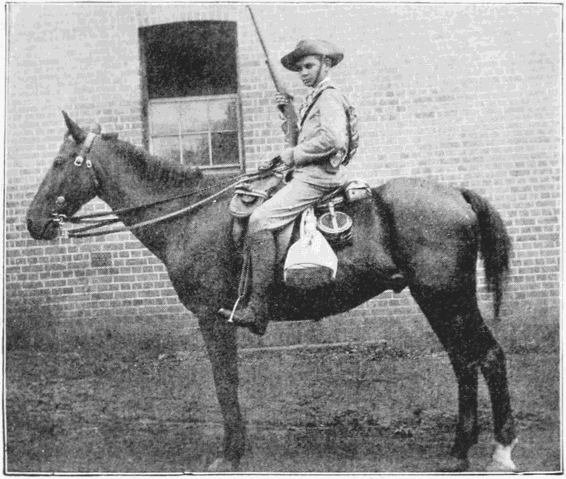
South African Scout. Full Equipment.
To prove his appreciation of the devotion and military prowess of the Cape
colonists Lord Roberts, on his arrival in South Africa, decided on raising a
Colonial Division. The official intimation of the formation of this division was
contained in the following announcement:—
“The Commander-in-Chief, recognising the value of the services rendered
by the Colonial troops, has authorised the formation of a division. Colonel
Brabant, M.L.A., C.M.G., has been given the local and temporary rank of a
Brigadier-General, and will be in command. Brabant’s Horse, with several
other irregular corps and mounted contingents, limited in number, from the
infantry volunteer regiments, will form the first portion of this force, and its
first object will be to drive the enemy out of the Colony, and to co-operate
with the Imperial troops. It has been decided to raise a further 1500 mounted
irregulars, so as to give all Colonials and men with Colonial experience a
chance of joining this division. Men who enrol in this Mounted Irregular
Corps, and who cannot afford to go on a long campaign, will be allowed to
register their names for service in the Colony only, but any portion of such
registered men can volunteer to take part in any further advance that may be
ordered beyond the Orange River. To raise this latter force recruiting stations
will be open in all parts of the Colony, and it is proposed to elect officers from
Colonial gentlemen or those with Colonial experience.”
As may be imagined, there was great jubilation among the thousands of
martial spirits at the Cape, who for long had been fretting at enforced inactivity.
Some very interesting particulars regarding raising of some of the Colonial
Corps were elicited from Mr. W. Hosken, who was chairman of the Uitlander
Council and the Chamber of Commerce at Johannesburg. He said: “I
was chairman of the committee which obtained permission from the Government
to raise Thorneycroft’s and Bethune’s Corps of mounted infantry and the
Imperial Light Horse, and all raised in Natal and mainly from refugee
Uitlanders from Johannesburg. From the Imperial officers with whom I was
brought into contact I received every consideration and the greatest cordiality.
But again it should be remembered that we got the permission only after pressure
had been brought to bear by public meetings at Durban and Maritzburg, and in
other ways. The response was most gratifying. Only when the Boers
were threatening to advance on Maritzburg were we allowed to form the
Imperial Light Horse. Intimation of the permission was given on the Friday.
By the following Wednesday we were able to report that 1300 men had
offered for service, and that the medical examination would be at once begun.
Thorneycroft’s Corps was the first to take the field, and was actually fighting
within six weeks from the date of its enrolment. The testimony from Boer
sources as to the value of these regiments has been most gratifying. In one
verbal statement by a Boer commandant they were described as ‘evidently
skilled sharpshooters.’ Then there are the Natal Volunteers, recruited in very
much the same way as your Volunteers at home, clerks and artisans from the
towns, with the mounted companies from the country districts. They took the
field possibly with some misgivings as to their capacity, just as the Volunteers
here might do; but they have proved themselves equal to any military duty
that is imposed on them. The soldiers of the regular army recognise them as
worthy comrades, and the greatest cordiality exists between the regular and
volunteer forces. Later on there was formed also in Natal a body of Colonial
scouts—750 strong—recruited from local men who knew the country. Those
who wished to serve together were placed in the same squad. Every section
of twenty-five men elects its own leader, and every four sections its commander.
They have already proved their efficiency in service with Sir Redvers Buller’s
army. Then there is the corps of ambulance bearers. When General Buller
was making arrangements for the attack on Colenso last month he asked for
1200 white bearers. On the first day the notice was posted in Durban 900
men volunteered. Far more than the required number offered, and a selection
was made of those who were considered the most fitted for the duty. These
men did excellent work, bringing out the wounded under fire during that
disastrous day at Colenso. Three were killed and several wounded, and every
one of the corps behaved splendidly.”
In regard to the apparent neglect of the Volunteers at the Cape, he went on
to say: “The delay in recruiting irregulars at the Cape was not in the least
due to the unwillingness of the Uitlanders there or of the British residents. It
was the result of political considerations which were then thought to be of
sufficient weight by well-advised men on the spot. The delay caused a great
deal of heart-burning among hundreds who were only too keen to take up
arms; and it is only quite recently that permission has been given to form
irregular corps and to accept the services of the Cape Volunteers already in
existence, who were eager to serve. Directly the permission was given men
flocked to the standard, and you have now Rimington’s Guides, the South
African Light Horse, and the Cape Volunteers, who have all promptly proceeded
to the front. Another most useful body is now being recruited both in
Natal and in Cape Colony—I mean the Railway Pioneer Corps. It is being
officered by the most eminent of the mining engineers of Johannesburg, and
the rank and file are made up of skilled mechanics, who are specially qualified
for the particular duties they will have to perform. They will be armed in the
ordinary way, drilled as an engineer corps, and will be expected to do the
ordinary work of the military engineer.”
The Imperial Light Horse, formed by Majors Sampson and Karri Davies, was
largely composed of Australians. Many Johannesburg people joined it, most
of them “all-round sportsmen, capital shots, and keen riders.” They joined
on the principle of not allowing the Mother Country to fight their battles for
them while they had a right arm with which to assert themselves.
The Cape Mounted Police, 1000 strong, who were also sent on active
service at the commencement of the war, were invaluable. They were remarkable,
not alone for gallantry, but efficiency. When Captain de Montmorency’s
Scouts were cut off near Labuschagnes Nek by some 800 Boers, Captain
Golsworthy on the last day of the year came to the rescue with a party of the
Cape Mounted Police, and put the enemy to flight.
Early in 1900, the Rhodesian Field Force, under the command of Lieut.-General
Sir Frederick Carrington, was organised to operate in Northern
Rhodesia, and stop any trekking of members of the Free State or Transvaal
or rebels of Cape Colony into Rhodesian territory.
The officers were:—Major C. D. Learoyd, Royal Engineers; Major A. V.
Jenner, D.S.O., Rifle Brigade; Major C. L. Josling, Royal Army Medical
Corps; Major G. A. R. Carew, 7th Hussars; Captain E. Peach, Indian Staff
Corps; Captain R. G. Partridge, Army Ordnance Department; Captain W. E.
Lawrence, South Wales Borderers; Second Lieutenant C. S. Rome, 11th
Hussars; Second Lieutenant C. H. Dillon, Rifle Brigade; Paymaster G. J. C.
Whittington, Hon. Colonel; Lieutenant Pemberton; Major P. Dalton, late
3rd V.B. Royal Fusiliers; Major C. D. Guise, 3rd Gloucester Regiment;
Brevet-Major P. Moir Byres, 1st Dragoon Guards; Captain C. W. Kennard,
3rd Gordon Highlanders; Second Lieutenant W. H. Longden, 4th East
Surrey Regiment; Chaplain Rev. F. P. Moreton, M.A.; Lieutenant R. Laing,
surgeon; Lieutenant E. A. Parsons, surgeon; Lieutenant H. Cardin, surgeon;
Lieutenant F. F. Bond, surgeon; Lieutenant G. H. Collard, surgeon; Lieutenant
F. R. Pullin, surgeon; Lieutenant H. D. Buss, surgeon; Colonel H. C.
Wood, late 10th Hussars; Lieut.-Colonel J. Leslie, 5th Royal Irish Fusiliers;
Lieutenant-Colonel B. G. Booth, late Scots Guards; Major J. W. Traill, late
4th Cheshire; Captain R. Gray, C.M.G., late 6th Dragoons; Captain E. C. P.
Curzon, late 18th Hussars; Captain F. C. P. Curzon, Royal Irish Rifles;
Captain H. F. F. Fisher, Army Service Corps; Veterinary-Captain H. T. W.
Mann; Lieutenant J. K. Rashleigh, late Artillery Militia; Lieutenant F. J.
Lawrence, late English Militia; Lieutenant C. A. Burgoyne, 3rd Dragoon
Guards; Lieutenant A. Wormald, surgeon; Major E. J. Tickell, D.S.O.,
14th Hussars; Captain J. Ponsonby, Coldstream Guards; Captain Pereira,
Coldstream Guards; Captain H. J. Haddock, Royal Welsh Fusiliers; Captain
R. K. Arbuthnot, Royal Irish Regiment; Lieutenant W. D. P. Watson, late
Scots Greys; Major G. Wright, R.G.A.; Major A. Paris, R.M.A.; Captain and
Hon. Major G. E. Giles, late R.A. In all, forty-four officers.
The following is a list of the names and numbers of the local forces which
the colony of Natal has put into the field: Natal Naval Volunteers, 150;
Natal Carabineers (Colonel Royston, since dead), 465; Natal Mounted Rifles,
200; Border Mounted Rifles, 270; Umvoti Mounted Rifles (Major Leuchars),
130; Natal Field Artillery, 120; Natal Royal Rifles, 145; Durban Light
Infantry, 400; Medical Staff, 7; Veterinary, 3; Staff, 19; Natal Mounted
Police (Europeans) at Ladysmith and other portions of the Colony (Colonel
Dartnell), 649; Thorneycroft’s Mounted Infantry (Colonel Thorneycroft, Royal
Scots Fusiliers, D.A.A.G.), 500; Bethune’s Mounted Infantry (Lieut.-Colonel
Bethune, 16th Lancers, Colonel Addison second in command), 500; Imperial
Light Infantry (Colonel Nash), 1000; Imperial Light Horse (Colonel Scott
Chisholm, killed 21st November 1899), 500; Colonial Scouts (Colonel Edwards,
Captain Sydney Osborne), 500; Ambulance Bearers (1st section), 1000;
Ambulance Bearers (2nd section), 600. Total, 7158.
The South African Light Horse is mentioned among the Cape Colonial
troops, though it has done notable work in Natal. The second and third regiments
of the corps became respectively Roberts’s and Kitchener’s Horse. In
the district of Kaffraria half the available men were embodied, men belonging
to the Duke of Edinburgh’s Own Volunteer Rifles—one of the corps of
“regulars” belonging to Cape Colony.
The South African Light Horse was started on the 12th of November. By
order of Sir Redvers Buller a recruiting office was opened in Cape Town,
whereupon the place was instantly invaded. Patriotic fervour ran high, and
every one desired to take a share in showing forth the might of Great Britain.
The officers, Major Byng (10th Hussars, with temporary rank of colonel)
and Captain Villiers (R.H.G., with temporary rank of major), set themselves
manfully to hurry the work of organisation. In no time men were picked—fine
riders and fine shots—mounted and equipped. Saddlery, tents, harness,
ammunition—all were gathered together with startling celerity. Among the
troopers were British-born subjects, Uitlanders, Colonials, Americans, farmers,
seamen, &c. The officers hailed from many regiments—the 10th Hussars,
Royal Horse Guards, Life Guards, 11th Hussars, 20th Hussars, Gordon
Highlanders, Yeomanry, Militia—all manner of men of distinction and wealth
and breeding uniting together in a common brotherhood for a common cause.
The following is a list of the officers: Colonel Byng, 10th Hussars,
commanding; Major Villiers, Royal Horse Guards, second in command; Captain
Fraser, 1st Life Guards, adjutant; Captain French, late L.G., Maxims;
Captain Harden, Transport; Captain Murray; Captain Anderson; Captain
Hull, paymaster; Vet.-Captain Walker; Vet.-Lieutenant Steele; Chaplain
Rev. G. Eales. Squadron Leaders—Captain Balfour, late 11th Hussars;
Major (Bimbash) Stewart, Gordon Highlanders; Captain Kirkwood; Captain
Gatacre; Captain Renton; Captain Whittaker; Captain Child; Captain Allgood.
Lieutenants Milne, Tucker, Brown, Jobling, De Rougemont, Tarbutt, Davis,
Bathurst, Shepherd; Second Lieutenants Warren, Carlton Smith, Hamilton,
Cock, Leith, Welstead, Robinson, Oates, Johnson, Vignelles, Vaughan, Carlisle,
Marsden, Overbeck, Newman, Penrose, Kuhlman, Horne, Cloete, Walker-Leigh,
Hon. de Saumarez, Thorold, Kitson, Vaghan.
Three squadrons under Captain Byng proceeded to the front to Natal, where
they immediately distinguished themselves, while the remainder of the regiment
went to the western border, and there took a full share of incessant
work.
The Natal Mounted Police under Colonel Dartnell, “a genius, planner, and
guide,” did wonderful deeds in relation to the defence of Ladysmith and during
the trying actions which preceded it. The gallant colonel, who has been
described in action as being “as good as a brigade,” placed his own horse at
the disposal of General Symons, who was wounded, and saw him safely off the
field at Glencoe.
The Natal Carabineers served splendidly both within and without Ladysmith,
some of the force, under Lord Dundonald, being the first to relieve the
town. Their fighting qualities are well known, and it is unnecessary to do
more than quote the words of General Hunter, who said, “I never wish to
serve with better men.”
First-rate work has been done by the Frontier Mounted Rifles, a well-trained
and excellently-equipped body of men, all in the prime of life, and
drawn from the eastern border towns of the Cape Colony. They held a
position of continual danger, being encamped nearest the enemy. Being born
and bred among the kopjes which afforded the Boers such cosy hiding-places,
they were acquainted with every nook and corner, and could find their way
about them both in daylight and dark. This force, with the Cape Police,
helped to keep General Gatacre informed regarding the seething mass of disloyalty
that surrounded him. It was difficult to choose between the honest
hostility of the Free Staters and the crafty antagonism of the rebel Dutchmen,
who had joined the enemy almost to a man. These were known to be in
active collusion with the foe, assisting them by spying, blowing up culverts,
wrecking railway lines, and generally assisting in the development of the plots
to sweep British rule from the soil of Africa. Loyal British subjects had much
to suffer at the hands of these people, who spent their time carrying off and
destroying furniture and valuables, smashing windows and doors, and damaging
all property other than their own that they could lay hands on, and with
these duplicit ruffians the British troops unaided by Colonials could never
have been even. Besides the valuable services of the Frontier Mounted Rifles
and the Cape Police, General Gatacre had under him four other regiments of
Cape Colonials, who were all trying to outrival each other in nobility, pluck,
and usefulness. Of many other regiments pages might be written, but space
does not permit. In regard to the Imperial Light Horse, one sentence expressed
by Sir George White speaks volumes. He said it was composed of
the finest fighting material that he had ever had under his command.
Early in the days of war Lord Lonsdale offered to take out to South Africa
200 men of the Westmoreland and Cumberland Yeomanry, of which he is
colonel, and to fully equip and clothe them. Lord Harris and his regiment,
the East Kent Mounted Rifles, also were among the first to volunteer for the
front, and before that the Middlesex Yeomanry (the Duke of Cambridge’s
Hussars) made a hurried application to go to the Transvaal, which impetuosity
of loyalty was met by the War Office with courteous refusal. At that time the
need for light cavalry in South Africa seemed scarcely to have dawned on the
authorities. It was true that October mists and November fogs had enveloped
London, and that no one between Downing Street and the Mansion House
could see an inch before his nose, and it was equally true that by the time
these mists had cleared away there was only one question, namely, “How
many men could be sent abroad out of the 10,000 who constituted the
Yeomanry Cavalry?”
Then, in December, the following announcement, with regulations to be
observed in the organisation of a Contingent of Yeomanry and Volunteers, was
published:—
Yeomanry.—1. Her Majesty’s Government have decided to raise for
service in South Africa a mounted infantry force, to be named “The Imperial
Yeomanry.” 2. The force will be recruited from the Yeomanry, but Volunteers
and civilians who may possess the requisite qualifications (as given
below) will be specially enrolled in the Yeomanry for this purpose. 3. The
force will be organised in companies of 115 rank and file, five officers being
allotted to each company, viz., one captain and four subalterns, preference
being given to Yeomanry officers. 4. The term of enlistment for officers
and men will be for one year, or for not less than the period of the war.
5. The officers and men will bring their own horses, clothing, saddlery,
and accoutrements. Arms and ammunition, camp equipment, and regimental
transport will be provided by Government. 6. The men will be dressed in
Norfolk jackets, of woollen material of neutral colour, breeches and gaiters,
lace boots, and felt hats. Strict uniformity of pattern will not be insisted upon.
7. The pay will be at cavalry rates, with a capitation grant for horses,
clothing, saddles, and accoutrements. All ranks will receive rations from date
of joining. Gratuities and allowances will be those laid down in special army
order of May 10, 1899. 8. Applications for enrolment should be addressed
to colonels commanding Yeomanry regiments, or to General Officers commanding
districts, to whom instructions will be immediately issued.
Qualifications.—(a) Candidates must be from twenty to thirty-five years of
age and of good character. (b) Volunteers or civilian candidates must satisfy
the colonel of the regiment through which they enlist that they are good riders
and marksmen, according to Yeomanry standard. (c) The standard of physique
to be that for cavalry of the line.
Volunteers.—Her Majesty’s Government have decided to accept offers
of service in South Africa from the Volunteers. A carefully selected company
of 110 rank and file, officered by one captain and three subalterns, will
be raised (one for each British line battalion serving in, or about to proceed
to, South Africa) from the Volunteer battalions of the territorial regiment.
These Volunteer companies will, as a general rule, take the place in the line
battalion of its company, serving as mounted infantry. The Volunteer
battalions from which a company is accepted will form and maintain a waiting
company in reserve at home. The selection of men from the Volunteer
battalions for service with the line battalion in the field, will devolve on the
commanding officers of Volunteer battalions. The terms of enlistment for
officers and men will be for one year, or for not less than the period of the
war. Full instructions for the information of all concerned will be issued
with the least possible delay through General Officers commanding districts.
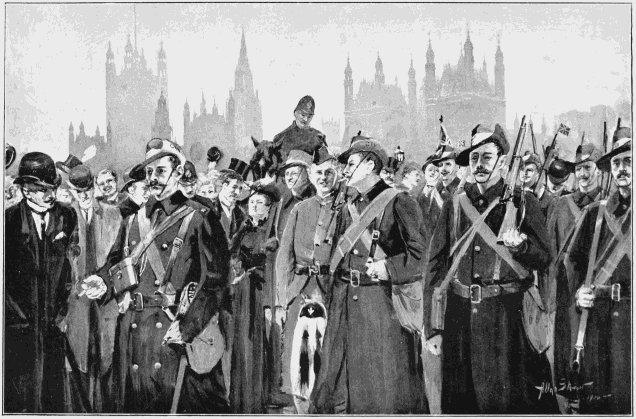
LONDON’S RESPONSE—THE CITY IMPERIAL VOLUNTEERS CROSSING WESTMINSTER BRIDGE.
Drawing by Allan Stewart.
A committee was formed to assist in organising the Yeomanry force, among
which were the following notable persons: Colonel Lord Chesham, Colonel A.
G. Lucas, Colonel Viscount Valentia, Colonel the Right Hon. W. H. Long,
M. P. Colonel the Earl of Lonsdale consented to assist the committee in the
obtaining of horses. The following Acting Staff Officers were nominated to
assist Colonel Lord Chesham: Captain the Hon. W. Bagot (late Scots
Guards), Captain L. Sandwith (8th Hussars), Adjutant of the 2nd Yeomanry
Brigade.
In a short, an almost incredibly short, space of time numerous battalions
were in readiness, and a strong contingent from Ireland was raised, composed
mainly of hunting men. The Under-Secretary for War wrote to correct the
impression which prevailed in some quarters that the raising of funds by
private subscriptions for the Volunteers and Imperial Yeomanry going to South
Africa was promoted by Government in order to do work which ought to be
done with Government money. He pointed out that the Government was
bearing the whole cost of those forces, providing them directly with their pay,
food, and arms, and, through their regiments, with clothing and equipments.
But the Government allowance for these things was calculated on the regular
army scale, and the public subscription would be serviceable in the way of
making better provision in those directions for the local Volunteers and Yeomanry,
of locally overcoming certain difficulties of organisation, and of decentralising
a great deal of contracting for horses, saddles, clothing, &c. Why,
they argued, should the man who volunteers his service in the field bear also
all the cost of making himself efficient, and all the cost entailed by his absence
from his trade or profession? Surely those who could not volunteer for the
front will be glad to assist him, or his corps in this case, as they have assisted
him or his corps in time of peace for forty years? Quantities of men of independent
means throughout the country, a great many of whom were acquainted
with each other, were ready and anxious to form a corps of the Imperial
Yeomanry, messing and fighting together, and enduring the hardships and
dangers of the trooper in emulation of the regular service man; and to this
body of men the corps specially appealed. Though at first some 5000 men
were called for, it was evident that 10,000 could have been recruited if needed.
The magnificent example set by thousands of young men in humble stations of
life, who left home and good employment courageously to serve their country,
acted as a powerful incentive to their more fortunate brethren of means and
leisure, and it was astonishing to find how readily all the members of the
“upper ten” sacrificed themselves rather than be “out of it.” Eventually the
Duke of Cambridge’s Own, the Special Corps, went to Africa, paying their own
expenses. In this corps every trooper, equally with every other member of
the Imperial Yeomanry, was entitled to a grant of £65 on joining, but all other
expenses were defrayed by themselves, and even the pay received during the
campaign was devoted to swell the Imperial War Fund for the widows and
orphans of soldiers who had fallen in action. The cost of equipment of each
recruit amounted to £170. The special purpose of the scheme was to attract
men of social standing and education, and enable groups of friends to serve
together in the same unit at the front. Among those who were enrolled was
Lord Elphinstone; Mr. Geoffrey Malcolm Gathorne-Hardy, grandson of the
Earl of Cranbrook; Captain Shaw; the Hon. Aubrey N. Molyneux Herbert
(brother of the Earl of Carnarvon); the Hon. A. Hill-Trevor. Lord Lovat
engaged himself actively in raising a corps of Highland gillies. In addition to
the Government grant, magnificent contributions poured in for the full equipment
of the corps. Lord Loch worked energetically in organising the South
African Contingent of the Imperial Yeomanry. These troops were formed only
of men who had South African experience, and had seen service there.
The following is a list of the various battalions:—
1st Battalion (Colonel Challoner)—1st and 2nd Co. Royal Wiltshire
Yeomanry; 4th Co. Glamorganshire Detachment; 3rd Co. Gloucestershire
Yeomanry. 2nd Battalion (Colonel Burke)—32nd Co. Lancashire Hussars;
21st and 22nd Co. Cheshire Yeomanry; 5th Co. Warwickshire Yeomanry.
3rd Battalion (Colonel Younghusband)—9th Co. Yorkshire Hussars; 11th Co.
Yorkshire Dragoons; 12th Co. South Notts; 10th Co. Notts (Sherwood
Rangers). 4th Battalion (Colonel Blair)—7th Co. Leicestershire Yeomanry;
8th Co. Derbyshire Yeomanry; 6th Co. Staffordshire Yeomanry; 28th Co.
Bedfordshire Detachment. 5th Battalion (Colonel Meyrick)—14th and 15th
Co. Northumberland; 13th Co. Shropshire; 16th Co. Worcestershire. 6th
Battalion (Colonel Burn)—17th Co. Ayrshire Yeomanry; 18th Co. Lanarkshire
Yeomanry; 19th Co. Lothian and Berwickshire; 20th Co. Fife Light
Horse. 7th Battalion (Colonel Helyar)—27th Co. Royal 1st Devon,
Royal North Devon; 48th Co. North Somerset; 25th Co. West Somerset;
26th Co. Dorsetshire. 8th Battalion (Colonel Crawley)—23rd Co. Duke of
Lancaster’s Own; 51st and 52nd Co. Mr. Paget’s Corps; 24th Co. Westmoreland
and Cumberland. 9th Battalion (Colonel Howard)—29th Co.
Denbighshire; 30th Co. Pembrokeshire; 31st and 49th Co. Montgomeryshire.
10th Battalion (Colonel Lord Chesham)—37th and 38th Co. Buckinghamshire;
39th Co. Berkshire; 40th Co. Oxfordshire, 11th Battalion (Colonel
Wilson)—42nd Co. Hertfordshire; 43rd and 44th Co. Suffolk; 41st Co.
Hampshire Carabineers. 12th Battalion (Colonel Mitford)—34th and 35th
Co. Middlesex; 33rd Co. Royal East Kent; 36th Co. West Kent. 13th
Battalion—54th and 56th Co. Irish (Belfast) Companies; 45th Co. Irish
(Dublin) Company; 47th Co. Lord Donoughmore’s Corps (Duke of Cambridge’s
Own). 14th Battalion (Lieut.-Colonel Brookfield)—55th Co. Northumberland;
53rd Co. Royal East Kent; 50th Co. Hampshire; 62nd Co. Middlesex.
15th Battalion (Lieut.-Colonel Sandwith)—56th and 57th Co. Bucks; 58th
Co. Berks; 59th Co. Oxford. 16th Battalion (Lieut.-Colonel Ridley)—63rd
Co. Wilts; 64th Co. Cheshire; 65th Co. Suffolk; 66th Co. York. 17th
Battalion (Lieut.-Colonel Moore ?)—60th Co. North Irish, Belfast; 61st Co.
South Irish, Dublin. 18th Battalion—67th, 70th, and 71st Co. Sharpshooters.
19th Battalion (Lieut.-Colonel Rodney ?)—69th Co. Sussex; 68th Co. Paget’s
Corps; 72nd Co. Rough Riders; 73rd Co. Paget’s Corps.
Each battalion consisted of four companies of 116 each.
Colonel Viscount Downe, who was serving on Lord Roberts’s staff in South
Africa, was elected to command a brigade of the Imperial Yeomanry, and
Lieutenant the Hon. R. F. Molyneux, Royal Horse Guards, was selected as his
aide-de-camp.
Lord Dunraven’s Battalion of Sharpshooters embarked for Africa to join
the Rhodesian Force on the 6th of April. It was composed of four companies.
The 67th, under the command of Captain Crum (late 52nd Regiment), was
accompanied by Lieutenants Langford, Jones, Curley, and Dyke. The 75th,
commanded by Major Warden (late Middlesex Regiment), was accompanied
by Lieutenants Gabbett, Power, Warde, and Bosanquet. The 70th Company,
comprising the Scottish Unit under Colonel Hill (late 12th Lancers), was
accompanied by Lieutenants Clark, Torrance, Hotchkiss, and Andrews. The
remaining company was commanded by Sir Savile Crossley.
The Earl of Dunraven, the founder of the corps, went to South Africa as
Supernumerary Captain on the Battalion Staff.
The announcement that the Government had decided to send to South
Africa a force of Volunteers, was received with general delight by our civilian
soldiers throughout the country. Here was a chance—a chance never before
offered to earn distinction in the field; and here was an opportunity—most
seasonable and appropriate, for the expression of public opinion, and for the
display, the universal and effervescent patriotism that had found little chance
of outlet in the prosaic walks of everyday life. The official intimation came
as a surprise, and surprise in a few moments developed into unrestrained joy.
The proposal to employ “a strong contingent of carefully selected Volunteers”
was no sooner published than the War Office was besieged with applicants
all eager to know what chance of being included in the great military movement
might be available. A few weeks before the opening of Parliament
Colonel Sir Howard Vincent volunteered “marksmen” for service in South
Africa, and other colonels of Volunteer regiments followed suit. General
Trotter (commanding the Home District) expressed a belief that the employment
of Volunteers in the present crisis would demonstrate for all who should
care to profit by the lesson the magnificent reserve force of civilian soldiers
possessed by our nation, a force utterly ignored by Continental nations. This
force was practically a force of picked men, selected marksmen who, unlike the
“Regulars,” were all first-rate shots, and fit to cope with the skilled sharpshooters
of the Boers. The marksmanship of many of the London corps of
Volunteers has for many years been phenomenal, and it was said that in one
company of the 13th Middlesex there were no less than sixty-three first-class
shots out of eighty. Finally, it was decided that the “C.I.V.’s,” as they were
called, should consist of 1400, and both corps sailed towards the end of
January. Prior to their departure the Freedom of the City was conferred upon
the officers of the regiment at the Guildhall, and later an impressive farewell
service was held at St. Paul’s Cathedral. Their departure through London
was somewhat difficult, owing to the dense and enthusiastic multitude that
thronged the streets to see the last of them.
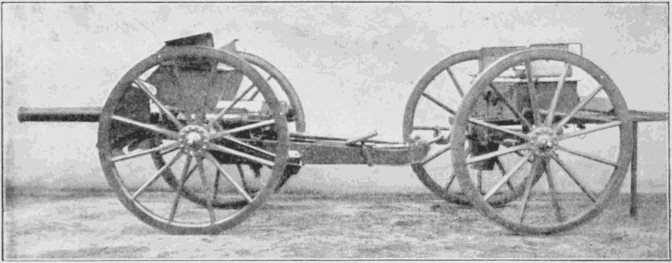
12½-Pounder Quick-Firing Field-Gun—City of London Field Battery.
(By permission of Messrs. Vickers, Sons & Maxim, and the publishers of the Engineer.)
The Lord Mayor, Mr. Newton (now Sir A. J. Newton, Bart.), who was
the moving spirit in the organisation of the corps, gave an excellent account
of the splendid work that had been accomplished and of the prompt equipment
and despatch of the regiment. This report concisely and modestly describes
the enormous undertaking, though it does not sufficiently enlarge on the keen
personal interest and magnificent services rendered by the prime mover in the
great scheme. The Lord Mayor said: “From the moment when the Commander-in-Chief
did me the honour of placing in my hands, as Chief Magistrate
of the City of London, the organisation of a regiment of thoroughly
qualified Volunteers for service in South Africa, I have been profoundly impressed
with the responsibility of the trust, and the importance of every promise
made on behalf of the Corporation and City of London being fulfilled in its
integrity. The original promise was 1000 Metropolitan Volunteers, all recommended
by their commanding officers, all between twenty and thirty-five years,
all bachelors, and that at least 250 should be mounted. That was on the
20th of December (1899), and now, on the 3rd of February (1900), the City
of London, with the approval of the military authorities, has completely equipped
and despatched to the seat of war upwards of 1550 selected Volunteers, of
whom 500 men and 17 officers are already in Cape Town—all approved by the
General Officer commanding the Home District. Of these, 400 are mounted
infantry, having their saddlery with them, and their horses ready at the
Cape. Four small Maxim guns, with 200,000 rounds of ammunition, have
also been shipped. A highly trained battery of field artillery, mainly provided
by the Honourable Artillery Company, through the zealous co-operation
of the Earl of Denbigh, composed of 140 men and officers, left the
Royal Albert Docks by the steamship Montfort. This section took with it
four 12½-pounder quick-firing guns and ample ammunition, together with
their full complement of 110 horses, purchased here, as they must be of a
stouter type than the Cape horses. The City has also—which was not
originally intended—provided the entire camp and tent equipment for the
whole force when it leaves Cape Town, and, at the request of the authorities,
done a good deal in the direction of land transport, without interfering with
the responsibility of the Headquarters Staff in South Africa in respect of
maintenance of the corps. The regiment constitutes a part of her Majesty’s
regular army. The officers and men are soldiers, and remain so during the
campaign. The time has been very brief, but there has been neither hurry
nor confusion, and the explanation of the successful results may be fairly
summed up as follows: As soon as Lord Wolseley accepted my offer, made
on behalf of the Corporation and City, I was in the position of an autocrat in
this business, and the power of the purse was promptly placed at my disposal—in
the first instance by the Corporation with its grant of £25,000, by the City
Livery Companies, the large shipowners, bankers, merchants, the Honourable
Artillery Companies, its members, and the citizens generally. The Metropolitan
Volunteer commanding officers vied with each other as to who could
send the most men, do the most work, and be the most useful. The result
is that, with the exception of a few staff officers from the regular army, the
officers of the City Imperial Volunteers are gentlemen engaged in civil pursuits,
but who have spent years in efficiently performing their duties. The non-commissioned
officers are most carefully picked from the vast band of qualified
men holding the same or higher rank in their own Volunteer regiments,
and every man of the rank and file has been expressly recommended by his
commanding officer for the particular duty allotted to him. Several committees
have dealt with sea and land transport, equipment, saddlery, and finance, and
Volunteer commanding officers have served on all these. A committee of the
Honourable Artillery Company and the battery officers arranged the details
of their own equipment without coming to the Mansion House for anything
but the inevitable cheque. The selection of Colonel Mackinnon, A.A.G., Home
District, as commandant was a very fortunate one for all concerned. Major-General
Turner, C.B., R.A., has been constant in his attendance at the Mansion
House, and always at hand when technical assistance was required. Major
Freemantle and Lieutenant Grantham have been indefatigable, while my son
as hon. secretary to, and Mr. A. D. Watson, a member of, the Equipment Committee,
have gone to Cape Town as the connecting link for a short time between
the regiment and its headquarters—the Mansion House. Colonel C. G. Boxall,
C.B., on whose initiative I took up this work, has thoroughly and loyally
fulfilled in every sense his promise to me to see this business completed, for
which his admittedly great technical knowledge and his indomitable zeal in the
Volunteer cause so eminently fit him. Mr. Abe Bailey, D.L. of the City, who
from the first placed his services at my disposal, is acting as honorary agent
of the regiment at Cape Town. He purchased over four hundred horses, and
arranged for their being put in training and ready for the arrival of the first
contingent, besides rendering other and invaluable aid. Several City firms
have furnished contingents of their expert employees, whose services at the
Guildhall in the preparation and distribution of “kits” have been of great
assistance. The payment of accounts is now progressing, and at the first
opportunity an audited statement of receipts and expenditure will be presented.
In conclusion, I would state that the whole force has gone to the
front with no burning desire for glory, but with a determination to do its duty,
and with an intense loyalty and devotion to their beloved Sovereign.”
Roll of the City of London Imperial Volunteers.
Officers.—Infantry—Colonel, Earl of Albemarle; second in command,
Lieutenant-Colonel A. G. Pawle; Adjutant, Captain the Hon. J. R. Bailey.
A Company—Captain A. Reid; Lieutenant F. R. Jeffrey; Lieutenant E. D.
Townroe. B Company—Captain C. W. Berkeley; Lieutenant B. W. Garnett;
Lieutenant J. W. Cohen. C Company—Captain C. Matthey; Lieutenant the
Hon. S. McDonnell, C.B.; Lieutenant E. Treffry. D Company—Captain F. J.
Cousens; Lieutenant J. H. Smith; Lieutenant F. R. Burnside. E Company—Captain
R. B. Shipley; Lieutenant W. J. P. Benson; Lieutenant F. B. Marsh.
F Company—Captain W. Edis; Lieutenant P. F. Brown; Lieutenant S. H.
Hole. G Company—Captain A. A. Howell; Lieutenant C. P. Grindle; Lieutenant
P. Croft. H Company—Captain C. A. Mortimer; Lieutenant W. B. I.
Alt; Lieutenant B. C. Green. Quartermaster, Captain S. Firth. Medical
Officer, Surgeon-Captain E. St. V. Ryan. Staff—Colonel W. H. Mackinnon;
Lieutenant E. H. Trotter; Transport Captain J. E. H. Orr; Paymaster Captain
Triggs (late A. P. D.); Medical Officer, Surgeon-Captain R. R. Sleman;
Veterinary Officer, W. S. Mulvey. Battery—Major G. McMicking; Captain
E. C. Budworth; Lieutenant A. C. Lowe; Lieutenant H. Bayley; Lieutenant
J. F. Duncan; Surgeon, Captain A. Thorne. Mounted Infantry—Colonel H.
C. Cholmondeley; Adjutant Captain E. Bell; Quartermaster J. Ridler. Machine-Gun
Section—Lieutenant E. V. Wellby. No. 1 Company—Captain J. W.
Reid; Lieutenant G. Berry; Lieutenant W. H. Brailey; Lieutenant B. Moeller;
Lieutenant C. H. W. Wilson. No. 2 Company—Captain J. F. Waterlow;
Lieutenant A. Bailey; Lieutenant E. G. Concanon; Lieutenant A. H. Henderson;
Lieutenant E. A. Manisty.