BALLOONS—NOTABLE ASCENTS AND RESULTS OBTAINED—CAPTIVE
BALLOONS
In the first chapter the invention of the hot-air
and the hydrogen balloon was chronicled, and it
was stated that on December 1, 1783, Charles rose
from Paris to a height of 9000 feet. Public
interest in France was greatly excited by this
wonderful extension of the realm of man, and
numerous ascensions with Montgolfières and
Charlières, as the hot-air and hydrogen balloons
were respectively called, took place in Paris and
the provinces. The uses of the balloon seemed
innumerable, and Lavoisier was instructed by the
Academy of Sciences to draw up a report on the
value of the new discovery. After having described
in detail the ascensions which he had witnessed,
the great chemist stopped, appalled at the multitude
of problems which the balloon could solve.
History has shown, however, that no commercial
application of the balloon was possible, and that
aside from its spectacular attractions, its chief use
has been for scientific observations.
The first persons in England who devoted themselves
to aërial navigation were foreigners. Two
of them were Italians, the philosopher Tiberius
Cavallo, who already in 1782 had showed to a
London assembly that soap-bubbles filled with
hydrogen will rise, and therefore had almost anticipated
the invention of the hydrogen balloon, and
the diplomatist Vincent Lunardi, who made some
daring balloon ascents in 1784. But the honour
of making the first scientific balloon voyage is due
to a Bostonian, Dr. John Jeffries. Dr. Jeffries
graduated at Harvard College in 1763 and then
practised medicine in England, where he became a
loyalist, and during the Revolution was with the
British troops. In London he interested himself
in aerostation, and, aided by the Royal Society,
ascended in a balloon because, he said, "I wished
to see the following points more clearly determined:
first, the power of ascending or descending
at pleasure, while suspended and floating in
the air; secondly, the effect which oars or wings
might be made to produce towards the purpose
and in directing the course of the balloon; thirdly,
the state and temperature of the atmosphere at
different heights from the earth; and fourthly, by
observing the varying course of the currents of
air, or winds, at certain elevations, to throw some
new light on the theory of winds in general." A
French professional aeronaut named Blanchard
had made three ascents in France and one in
England, and Dr. Jeffries paid one hundred guineas
to accompany Blanchard on his fifth ascent, which
was made from London November 30, 1784. He
took with him a thermometer, a barometer, a
hygrometer, an electrometer, and a mariner's compass,
also several numbered bottles, filled with water
and provided with glass stoppers, which were to
be emptied and corked up at different heights in
the atmosphere. It was arranged to record the
observations on ruled paper with a silver pen,
because the doctor would not trust a common pen
or pencil as liable to accident. He also had a
map of England to determine the direction which
the balloon took. Jeffries' English sentiments are
shown by this quotation from his narrative: "I had
provided a handsome British flag, invidiously represented
the next day in one of the public papers
to have been the flag of the American States."
The barometer and thermometer were observed
every few minutes, and the hygrometer occasionally.
The electrometer did not change its indications.
Samples of air were obtained and sent to the
Royal Society, but it does not appear that they
were ever analyzed. The balloon rose nearly
two miles, and descended safely in Kent after an
hour and a half. Jeffries' observations compare
favourably with those made until recently; indeed,
for nearly a century there was little improvement
in the apparatus. The decrease of temperature
which Jeffries found, viz. 1° for 360 feet rise, and
the decreasing humidity with height agree very
well with later observations.
Jeffries and Blanchard undertook a more perilous
voyage on January 7, 1785, from Dover across the
Channel, landing in the province of Artois, after, so
runs the announcement, "we were suspended and
floating in the atmosphere two hours over the sea
and forty-seven minutes over the land of France."
The voyagers were cordially welcomed, and were
entertained lavishly in Paris as being, Jeffries says,
"the first who passed across the sea from England
into France by the route of the air." No instruments
but a barometer and a compass were carried, and
the only scientific result worthy of notice was that
the balloon seemed to lose buoyancy over the sea,
due to what Jeffries thought might be "the power
of attraction over the water." The height of the
balloon was measured trigonometrically by French
officers in Calais, who found by angular measures,
when the balloon was midway across the Channel,
that its height was 4500 feet. Jeffries' voyages
have been described somewhat at length because
the first scientific balloon voyage is generally
attributed to the Belgian physicist, Robertson, who
ascended from Hamburg in 1803 to the improbable
height of 24,000 feet. Robertson made his third
ascent the next year from St. Petersburg, accompanied
by the Academician Sacharoff. This was a
scientific voyage, instituted at the request of the
Russian Academy, to ascertain the physical state
of the atmosphere and the component parts of it
at different heights, also the difference between the
results of vertical ascents and the observations of
Deluc, De Saussure, von Humboldt and others on
mountains, which it was rightly concluded could
not be so free from terrestrial influences as those
made in the open air. Among the experiments
which the Academy proposed were the following:
change of rate of evaporation of fluids, decrease or
increase in the magnetic force, inclination of the
magnetic needle, increase of heat of the solar rays,
fainter colours in the spectrum, influence of rarefaction
of the air on the human body, as well as
some other chemical and philosophical experiments.
A height of about two miles was reached,
and many interesting observations were made, but
since the instruments were not easily used in the
basket of the balloon, the results were unsatisfactory
and required repetition to be conclusive.
The Academy of Sciences of Paris now took up
the investigation with the special object of proving
whether the magnetic force decreased as Robertson
in a balloon and De Saussure in the Alps had
supposed. Two young physicists, Biot and Gay-Lussac,
were chosen to carry out the investigations.
They ascended from Paris on August 24, 1804,
provided with all necessary instruments, but the
balloon was too small to rise higher than 13,000
feet. Gay-Lussac ascended alone to a height of
23,000 feet on September 16, 1804, in a balloon
filled with hydrogen. His observations confirmed
those which he had made with Biot, that there was
no change in the magnetic force, and from samples
of air collected he proved that the chemical constitution
of the air is invariable. His observations
of temperature seemed to confirm the theory of a
decline of temperature of 1° in 300 feet of elevation.
The air was found to be very dry, and Gay-Lussac
noticed that at the highest altitude the clouds were
still far above him.
Passing over several notable ascents in other
countries, it was not until 1850 that scientific
ballooning was begun again in the land where the
balloon originated. Then MM. Barral and Bixio
made two ascents from Paris in rainy weather to
the heights of 19,000 and 23,000 feet respectively,
although they had expected to attain twice these
altitudes. Their most interesting observations were
the great thickness of the cloud mass, which in one
case amounted to 15,000 feet, and the sudden
fall of temperature in it from +15° to -39°.
Some curious optical phenomena were connected
with the floating ice crystals, and although the light
of the sky was found to be strongly polarized, the
light reflected from the clouds was not polarized.
The field of operations was now transferred to
England, where, under the auspices of the British
Association, four ascents were made by John
Welsh of the Kew Observatory in the great
Nassau balloon managed by Green, the veteran
aeronaut. The special object of these investigations,
like those in France, was the determination
of the temperature and hygrometric condition
of the air at different elevations. Besides this,
samples of air at different heights were collected
for analysis and the light reflected from clouds
was examined for polarization. Recognizing that
on account of the calm prevailing in the car of the
balloon and the great solar radiation, the readings
of the thermometer would be affected, Welsh enclosed
the thermometers in polished tubes through
which air was forced by bellows. This was the
first aspirated thermometer, which alone gives the
true temperature of the air with the conditions
prevailing in a balloon. The instrument fell into
oblivion until a few years ago, and to this fact is
due the fictitious temperatures generally obtained
by aeronauts. Welsh reached heights of from
12,500 to 23,000 feet, and his observations showed
that the temperature of the air decreased uniformly
with height until at a certain elevation, varying on
different days, the decrease is arrested, and for a
space of 2000 or 3000 feet the temperature remains
nearly constant, or even increases slightly; the
regular diminution being afterwards resumed and
generally maintained at a less rapid rate than in
the lower air, and commencing from a higher
temperature than would have existed but for the
interruption. The variation of the decrease with
the seasons was also demonstrated. The humidity
did not change much with height, and it was
nowhere very dry. Finally, the light of the clouds
was proved not to be polarized, and the permanent
composition of the atmosphere was confirmed.
In 1861 another grant of money was made by
the British Association for balloon experiments to
be performed, under the direction of a Committee,
by Mr. James Glaisher, then engaged in geodetic
and meteorological work in England. Between
1862 and 1868 Glaisher, accompanied by the aeronaut
Coxwell, made thirty ascents. They attained
three times a height exceeding 23,000 feet, and once
more than 29,000 feet, when they believed that the
balloon rose to 37,000 feet. The primary objects of
Glaisher's experiments were as follows: determination
of the temperature of the air and its
hygrometrical conditions up to five miles, comparisons
of an aneroid barometer with a mercurial one,
determination of the electrical state of the air and
of its oxygenic state by means of ozone papers,
time of vibration of a magnet at different distances
from the earth. Secondary objects of study were
the composition of the air, the form and thickness
of clouds, the atmospheric currents, acoustical
phenomena, etc. In order to obtain many observations
frequent ascents were necessary, as the
insular position of England precluded long voyages.
During 1869 ascents in a captive balloon up to
1700 feet supplemented the employment of the
free balloon, which from its rapid rise and fall made
observations in it near the earth impossible.
Glaisher was a good observer; his instruments
were excellent, and had been previously tested, but
their exposure in the basket of the balloon was
bad, and although the thermometer was provided
with an aspirator similar to Welsh's, Glaisher,
noticing that the readings agreed with those of a
freely exposed thermometer, hastily concluded
that the use of the aspirator was unnecessary, and
so discarded it.
Until quite recently Glaisher's results were
accepted as representing the conditions of the free
air up to the greatest height which it was possible
to reach. These results showed that the temperature
did not fall uniformly with height, but that it
fell most rapidly near the earth and much less
rapidly at great heights. In cloudy weather up to
the height of a mile the mean decrease of temperature
in the day-time differed little from the theory of
1° per 300 feet, but in clear or partly clear weather the
decrease was more rapid, commencing with 1° for
160 feet near the ground and diminishing to 1° for
1000 feet at an elevation exceeding six miles. The
observations in the captive balloon up to a third of a
mile indicated a daily range in the vertical decrease
of temperature. The observations of relative
humidity agreed with Welsh's in showing a slight
increase up to about half-a-mile, then a decrease
up to above five miles, where there seemed to be
an almost entire absence of water. The other
observations were inconclusive, except that the time
of vibration of a magnet was found to be somewhat
longer than on the earth, which was contrary to
Gay-Lussac's experience. The most remarkable of
Glaisher's ascents was made from Wolverhampton
on September 5, 1862, when in less than one hour
he had passed the altitude of five miles, exceeding
the greatest height hitherto reached. To quote
from Glaisher's narrative: "Up to this time I
had taken observations with comfort and experienced
no difficulty in breathing, whilst Mr. Coxwell,
in consequence of the exertion he had to
make, had breathed with difficulty for some time.
Having discharged sand, we ascended still higher;
the aspirator became troublesome to work, and I
also found a difficulty in seeing clearly….
About 1 hour 52 min., or later, I read the
dry-bulb thermometer as minus 5°; after this I
could not see the column of mercury in the wet-bulb
thermometer, nor the hands of the watch, nor
the fine divisions of any instrument. I asked Mr.
Coxwell to help me to read the instruments. In
consequence, however, of the rotatory motion of
the balloon, which had continued without ceasing
since leaving the earth, the valve-line had become
entangled, and he had to leave the car and mount
into the ring to readjust it. I then looked at the
barometer, and found its reading to be 9¾ inches,
still decreasing fast, and implying a height exceeding
29,000 feet. Shortly after, I laid my arm upon
the table, possessed of its full vigour, but on being
desirous of using it, I found it powerless…. Trying
to move the other arm, I found it powerless
also. Then I tried to shake myself and succeeded,
but I seemed to have no limbs…. I dimly
saw Mr. Coxwell, and endeavoured to speak, but
could not. In an instant intense darkness overcame
me, so that the optic nerve lost power
suddenly, but I was still conscious, with as active a
brain as at the present moment whilst writing this.
I thought I had been seized with asphyxia, and
believed I should experience nothing more, as
death would come unless we speedily descended;
other thoughts were entering my mind, when I
suddenly became unconscious…. I cannot
tell anything of the sense of hearing, as no sound
reaches the air to break the perfect stillness and
silence of the regions between six and seven
miles above the earth. My last observation was
made at 1 hour 54 min., above 29,000 feet….
Whilst powerless I heard the words, 'temperature'
and 'observation,' and I knew Mr. Coxwell
was in the car speaking to and endeavouring
to rouse me…. I then heard him speak
more emphatically, but could not see, speak,
or move. I heard him again say, 'Do try;
now do!' Then the instruments became dimly
visible, then Mr. Coxwell, and very shortly I saw
clearly…. Mr. Coxwell told me that while in
the ring he felt it piercingly cold, that hoarfrost
was all round the neck of the balloon, and that on
attempting to leave the ring he found his hands
frozen. He had, therefore, to place his arms on
the ring and drop down…. He wished to
approach me, but could not; and when he felt
insensibility coming over him too, he became
anxious to open the valve. But in consequence of
having lost the use of his hands he could not do
this; ultimately he succeeded, by seizing the cord
with his teeth, and dipping his head two or three
times, until the balloon took a decided turn downwards.
No inconvenience followed my insensibility;
and when we dropped, it was in a country
where no conveyance of any kind could be
obtained, so I had to walk between seven and
eight miles…. I have already said that my
last observation was made at a height of 29,000
feet; at this time (1 hour 54 min.) we were
ascending at the rate of 1000 feet per minute; and
when I resumed observations we were descending
at the rate of 2000 feet per minute. These two
positions must be connected, taking into account
the interval of time between, viz. 13 minutes, and
on these considerations the balloon must have
attained the altitude of 36,000 or 37,000 feet.
Again, a very delicate minimum thermometer read
minus 11°.9, and this would give a height of 37,000
feet. Mr. Coxwell, on coming from the ring,
noticed that the centre of the aneroid barometer,
its blue hand, and a rope attached to the car were
all in the same straight line, and this gave a reading
of seven inches and leads to the same result.
Therefore, these independent means all lead to
about the same elevation, viz. fully seven miles."
Mr. Glaisher's circumstantial evidence of the
height he reached has been assailed lately, partly
from his assumption that the velocity of the balloon
while rising and falling during the thirteen minutes
was uniform, but principally from the supposition
that men could have survived in that region of death,
without at least artificial means of respiration.
While it is certain that Berson's observations, which
are described later, were made at a greater height
than Glaisher's, yet all credit must be given to this
Nestor of aeronautical and meteorological science
in Great Britain, who is still living at the advanced
age of ninety.
The example of Glaisher was not followed in
England, but it stimulated interest in the balloon
again in France, where MM. Flammarion, de
Fonvielle, and Tissandier have made many ascents
for scientific purposes, and have presented the
results in a popular form to the public. Photography
in a balloon is generally a failure on
account of the intense reflection from the upper
cloud surfaces and the haze which masks the earth.
Consequently, for scenic effects we must rely upon
sketches, of which those in that interesting, but
now rather rare book, Travels in the Air, may be
referred to. The high atmosphere is often filled
with fine ice crystals which, though invisible from
below, occasion curious optical phenomena, and
some of these have been sketched by M. Albert
Tissandier, who has the advantage of being an
artist as well as an aeronaut.
Of the many narratives of balloon voyages, one
of the most thrilling is the tragedy of the Zenith.
In 1875, through the co-operation of the French
Academy of Sciences and other scientific bodies, it
was arranged to make two voyages, one of long
duration, the other to a great height, in the balloon
Zenith. The long voyage from Paris to Bordeaux
was successfully accomplished in twenty-four hours,
and on April 15 the Zenith again rose from
Paris, carrying MM. Gaston Tissandier and Crocé-Spinelli,
with Sivel as aeronaut. By the advice of
M. Paul Bert, the distinguished physiologist, three
small balloons of oxygen were provided to assist
respiration. The scientific apparatus was as
follows: a pump was arranged to draw air
through tubes filled with potash in which to store
the carbonic acid at different heights in the atmosphere,
in order that analysis might determine
if its proportion diminished at great heights; a
spectroscope was employed to examine the line of
water-vapour in the atmosphere, and two aneroid
barometers were provided, one giving the pressure
corresponding to heights up to 13,000 feet, the
other the pressure between 13,000 and 30,000 feet.
There were also two barometric tubes registering
the lowest pressure, as well as thermometers and
other scientific instruments. At 15,000 feet the
voyagers began to breathe oxygen, which had been
used beneficially by Sivel and Crocé-Spinelli in
a high ascent the previous year. At 24,000 feet
Tissandier wrote in his notes: "My hands are
freezing. I am well. We are all right. Haze on
horizon with small rounded cirrus. We are rising.
Crocé pants. We breathe oxygen. Sivel shuts
his eyes, Crocé does the same." Five minutes
later: "Sivel throws out ballast, temperature
-11° Cent., barometer 300 millimeters." After
this, Tissandier became so weak that he could not
turn his head to look at his companions. He tried
to seize the oxygen tube, but was unable to move
his arms. His mind was clear, and he saw the
barometer sink below 280 millimeters, indicating
a height of 27,000 feet. Then he fainted. After
a half-hour of unconsciousness he revived and
wrote: "We are falling, temperature -8°, barometer
315 millimeters. I discharge ballast. Crocé and
Sivel unconscious in bottom of basket. We fall
rapidly." Again he fell into a stupor, from which
he was roused by Crocé shaking his arm, saying,
"Throw out ballast!" which he did, together with
the pump, wraps, etc. What happened after this
is unknown, but probably the balloon, thus lightened
and the gas in it being warm, rose again nearly as
high as before. When Tissandier came to his
senses the balloon was falling with frightful speed,
and in the bottom of the basket, which was oscillating
violently from side to side, were crouched his
two companions with black faces and bloody
mouths. The shock of striking the ground was
terrific, but the anchor held, and the balloon soon
emptied. From the barometric data it appears
probable that the Zenith attained twice a height
of about 28,000 feet, and that asphyxiation from
the long deprivation of sufficient oxygen killed the
two companions of Tissandier and nearly proved
fatal to him.
This disaster discouraged further attempts to
reach high altitudes, and with the exception of the
ascent to 23,000 feet in France by MM. Jovis and
Mallet, no more were made until the past decade.
The results of the meteorological observations
were seen to be strangely discordant; for example,
the temperature of 40° below zero, observed by
Barral and Bixio at a height of 23,000 feet, and
80° above zero, noted by the American aeronaut
Wise, at 6000 feet. The prophecy "that the
balloon-basket would be the cradle of the young
science of meteorology" seemed unlikely to be
realized, but, nevertheless, observations in balloons
continued to be made in France, Italy, and Russia.
In the United States a series of balloon ascents
was conducted by the Signal Service, which then
included the Weather Bureau, and the height of
15,500 feet reached by Professor Hazen in 1887
is probably the greatest at which observations in
the free air have been made in America.
The difficulty of obtaining the true temperature
of the air from a balloon is great, and without
special precautions the observations give the conditions
of the free air even less well than do
observations on mountain summits. During a
rapid ascent the air is carried up in the balloon
basket like water in a well-bucket, and since the
balloon drifts with the wind it is relatively in a
calm, so that there is no circulation of air; the
thermometers, even when screened from direct
sunshine, are affected by radiation from the heated
gas-bag above, and moreover they are not sufficiently
sensitive to follow the changing temperature
of the air strata so quickly traversed by
the balloon. The aneroid barometer, from which
the height of the balloon is calculated, cannot
respond to rapid changes of pressure; consequently
there is a double source of error in determining
the height at which the temperature is measured.
Ordinarily, the temperature of the air may be
obtained quite accurately by slinging in a circle
a thermometer attached to a cord, even though
this is done in sunshine. During two balloon
ascents by the writer, a sling thermometer was
found in extreme cases to read 14° lower than was
recorded by automatic instruments, hung in their
usual position from the ring of the balloon. The
sling thermometer, however, is influenced by
intense insolation, and moreover cannot be swung
far enough outside the basket of a balloon to
insure good results. The standard instrument for
obtaining the temperature of the air under all
conditions, adopted for international use in 1898,
is a modification of that used by Welsh forty-five
years before. This instrument, which is the
invention of Dr. Assmann of Berlin, is called the
aspiration thermometer, and is designed to prevent
the casing surrounding the thermometer from being
heated by insolation or conduction, and to insure
a flow of air past the thermometer bulbs.
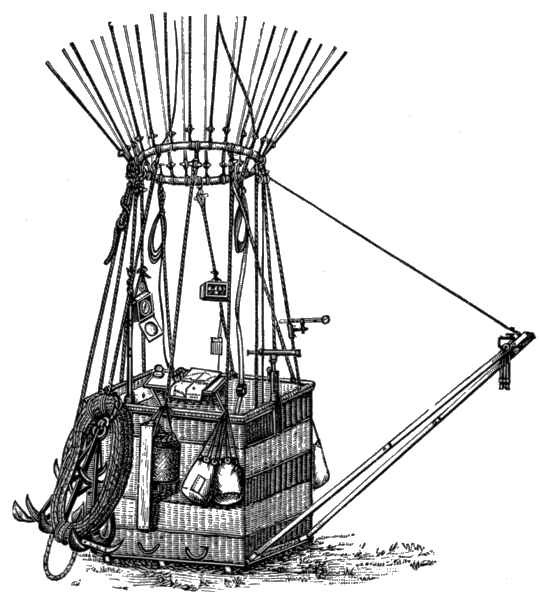 Fig. 3.
—German Balloon equipped for Meteorological Observations.
The reorganization of balloon observations was
accomplished by the German Society for the
Promotion of Aërial Navigation, which has been
assisted by the Prussian Meteorological Institute,
and by officers of the German Army Balloon
Corps. The German Emperor takes a personal
interest in the work, and has aided it by the gift of
a considerable sum of money. The first voyage
under the direction of the Society was made in
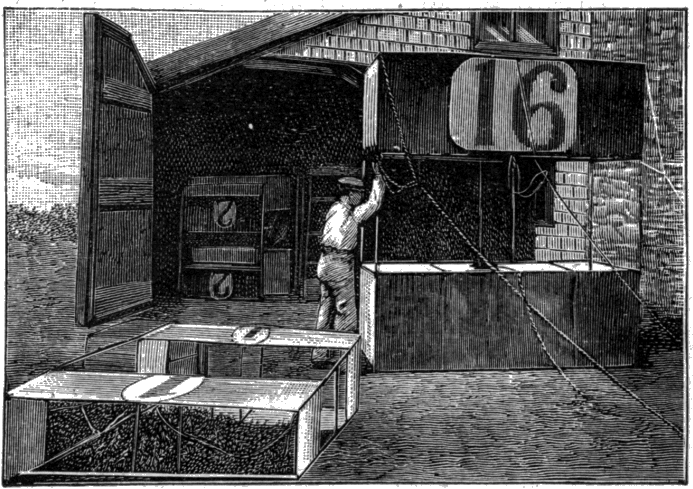
1888, and many notable ones followed. In 1891,
through the courtesy of the president, Dr. Assmann,
the writer made an ascent from Berlin in a balloon
equipped for accurate observations, with the special
purpose of comparing the sling with the aspiration
thermometer. The car of the balloon is shown in
Fig. 3. A companion was the now famous Dr.
Berson, who then made his second ascent, but who
has now become an expert aeronaut by reason of
more than fifty ascensions, some of them to great
heights. On December 4, 1894, he ascended alone
from Stassfurt, Prussia, in the Phœnix, to probably
the greatest height ever reached by man, at least
in a conscious state. By breathing oxygen he was
able to keep his senses and to read the barometer
at 9·1 inches, indicating approximately an altitude
of 30,000 feet, and the aspirated thermometer at
54° below zero. An ordinary thermometer read
11° below zero in the sun, showing its heat was
much diminished in consequence of the haze that
prevailed even at this enormous height. The
cirriform clouds which surrounded the balloon were
found to have the structure of snow-flakes rather
than that of ice-crystals. The chief result of this
record-breaking ascent was the extraordinarily low
temperatures recorded at great heights, as compared
with those observed by Glaisher, Tissandier,
and others. An inversion of temperature—that is
an increase of temperature with height—prevailed
up to a mile, but above that the temperature fell at
a rapid and accelerated rate which approached the
adiabatic fall above 26,000 feet. The wind, which
was almost calm at the earth's surface, increased
to a gale in the high atmosphere, and carried the
balloon along at an average speed of thirty-six
miles an hour. Wishing to demonstrate conclusively
whether the insular position of England
influenced the temperature of the high atmosphere,
as had been suggested, Dr. Berson determined to
execute a high ascension in England during the
prevalence of a barometric maximum in summer,
when the air column would be abnormally warmed
and the upper isothermal surfaces elevated. An
opportunity was afforded Berson to follow in
Glaisher's footsteps on September 14, 1898, when
abnormal heat prevailed in Europe. Berson, with
the aeronaut Spencer, in the balloon Excelsior, rose
from the Crystal Palace in London to the height
of 27,300 feet, where he observed a temperature of
-29°. The oxygen inhaled prevented harmful
physiological effects except for the discomfort
caused by the enormous reduction of temperature
from 80° at the ground only thirty-five minutes
before. The temperature decreased rapidly at first,
then moderately up to three miles, and above that
it fell almost at the adiabatic rate. Even in this hot
summer maximum of pressure and notwithstanding
the maritime climate and south-westerly currents,
a temperature about 29° below zero reigned at
27,000 feet, being only a few degrees warmer than
Berson had observed in winter at the same height
above Germany. Yet Glaisher, in all his ascents,
two of which exceeded 26,000 feet, never recorded
a temperature of less than 5° below zero.
These relatively high temperatures, obtained also
by Welsh, Tissandier, and Gay-Lussac, must be
attributed to the insufficient protection of the
thermometers against insolation, to the proximity
of the instruments to the heated basket and its
occupants, and lastly, to the sluggishness of the
thermometers themselves, from lack of ventilation,
during the rapid passage through air-strata of
different temperatures. Plate VI. indicates the
change of temperature with height observed during
the four highest balloon ascents in Europe and in
the United States. Dots indicate the observations
while ascending, and crosses the observations while
descending; these are connected by full and broken
lines respectively, an inclination upward to the left
showing a decrease of temperature with height and
vice versâ. The adiabatic lines, representing a fall
of temperature of 1° Fahrenheit per 183 feet of
ascent, serve for comparison.
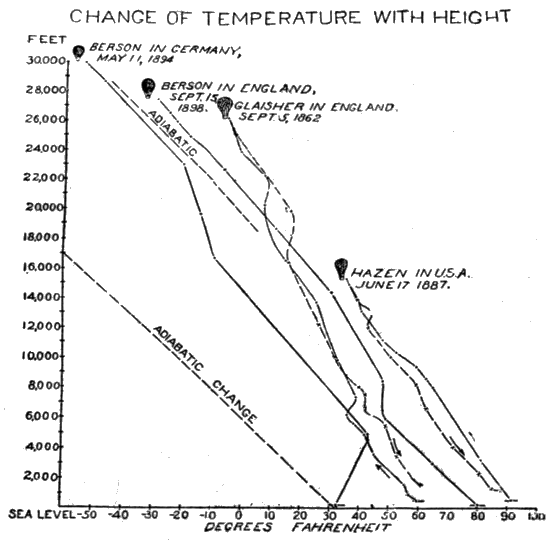 Plate VI.—Temperatures observed in Four High Balloon Ascents.
This account of notable balloon ascents should
not be closed without mentioning the most daring
and unique of all, the voyage of Mr. S. A. Andrée
towards the north pole in 1897. Although his was
a voyage of geographical discovery, and not one for
the exploration of the air, yet meteorological and
other observations were to be made, and Andrée
had familiarized himself with the instruments and
the management of a balloon during several
voyages in Sweden. The success of the polar
voyage depended primarily upon the prevalence
of southerly winds, and the ability of the balloon
to keep afloat long enough to profit by them, even
should they be light and variable at times. Therefore
the impermeability of the balloon to hydrogen
gas was of vital importance, and it was the conviction
that the Eagle, of 140,000 cubic feet, was
neither sufficiently large nor staunch to sustain
itself for thirty days, the time which might be
required to reach Behring Straits, that led Dr. Nils
Ekholm, the meteorologist and physicist, to withdraw
from the expedition. Unfortunately, his fears
seem to have been well founded, and it is probable
that we must now abandon hope of the safety of
the brave Andrée and his two companions.
A less perilous voyage northward across the
Alps was attempted in 1898 by Professor Heim,
the Swiss geologist, and two associates, conducted
by the Italian aeronaut, Spelterini. With an
automatic photographic camera, similar to one
described in the next chapter, it was hoped to get
views of the high Alps from above, which would
be alike valuable for geologic and topographic
study. Extensive meteorological observations were
made in connection with the sixth international
balloon ascent, but only the Jura was crossed, at
an altitude of 13,000 feet, because the balloon
travelled in a north-westerly direction, instead of
north-east as was expected.
Many years ago Wise and Donaldson, the
American aeronauts, proposed to cross the Atlantic
Ocean in a balloon. The difficulties which present
themselves in such an undertaking are purely
technical, and given a balloon which loses its gas
so slowly that its buoyancy can be maintained for
several days, there seems to be no reason why such
a balloon, at a height of four or five miles, could
not pass from San Francisco to New York, or from
the United States to Europe, since the motion of
the upper clouds proves that the high atmosphere
moves almost constantly with great velocity from
the west to the east. The dirigible balloon has not
been realized except in nearly calm weather, but
the aeronaut can often reverse his direction by
ascending or descending into a contrary wind to
that in which he has been travelling. Frequently
no clouds separate these opposing currents, which
become apparent only when a balloon enters them.
It has been mentioned that in 1869 Glaisher
made observations in a captive balloon in England
up to the height of 1700 feet in order to study the
conditions of the air within this distance of the
earth, which could not be done in a free and
rapidly moving balloon. Although captive balloons
are frequently used in the European cities to lift
people who wish to enjoy the view from a height
of 500 or 1000 feet, they appear to have been little
used by scientific observers since the time of
Glaisher. In 1890-91 the aeronautical society at
Berlin employed a captive balloon in connection
with the observations in free balloons which have
been described. This captive balloon had a
capacity of only 5000 cubic feet, but it sufficed to
lift an apparatus weighing sixteen pounds, designed
by Dr. Assmann to record atmospheric pressure, as
well as the temperature and relative humidity of
the air. The balloon, attached to a cable 2600 feet
long, was drawn down by a steam engine. It was
possible in this way to have simultaneous observations
at three levels, viz. near the ground, in the
free air at a height of about half-a-mile, and at the
highest level attained by a free balloon. But the
captive balloon is often at a disadvantage, for the
wind drives it down, and although the meteorograph
mentioned had ingenious devices to neutralize the
violent shocks caused by this and by the rebound
of the balloon after the gust of wind, yet these
impaired the automatic record. The height to
which the balloon rose was so much diminished
by the wind that instead of 2600 feet, which the
balloon attained in calm weather when the cable
was vertical, the average height of the twenty-four
ascents was but half this, and in very windy
weather the balloon could not rise at all.
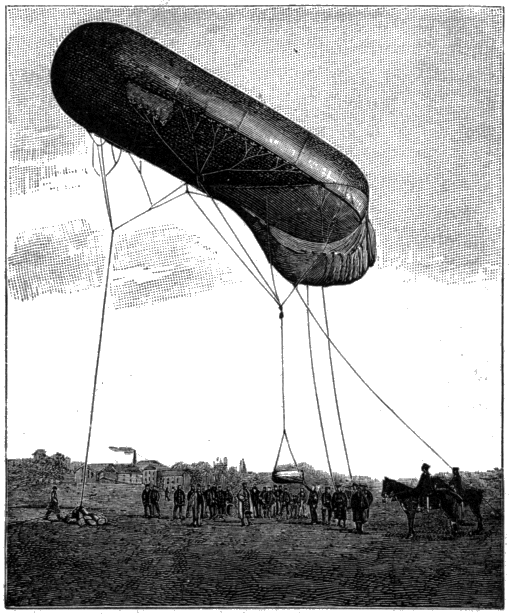 Fig. 4.
—German Kite-balloon.
To obviate these difficulties, a few years ago
there was invented by two officers of the German
army, Lieutenants von Siegsfeld and von Parseval,
a captive balloon capable of resisting strong
winds, called, from its action as a kite, the Drachen-Ballon
or kite-balloon, and which at the present
time is being successfully used in the German
Army and Navy for reconnoitring in all kinds
of weather. A smaller kite-balloon, of 7700 cubic
feet capacity, filled either with hydrogen or with
illuminating gas, was first used to lift meteorological
instruments at Strassburg in 1898, where
it remained at a height of several hundred feet
during twenty-four hours. As is seen from Fig. 4,
the balloon is cylindrical, with hemispherical ends,
and is attached to its cable like a kite, so that
the wind acts to lift and not to depress it.
The cylinder is divided by a diaphragm near its
lower end into two chambers, the upper and
larger one being filled with gas, while the lower
chamber, by means of a valve opening inwards,
receives the pressure of the wind which presses
against the diaphragm, and preserves the sausage-like
form of the balloon in spite of leakage of
gas. Another wind-bag encircling the bottom
of the air-chamber serves as a rudder, and lateral
fins or wings give stability to the balloon about
its longer axis. The instruments are placed in a
basket hung far below the balloon. In cases
where there is little or no wind at the ground,
captive balloons can render valuable service for
meteorological observations, but in all other cases
kites are preferable. The reasons for this assertion
will be given when we consider kites.
From what has been said it will be perceived
how much the Germans did to advance scientific
ballooning, yet their constant rivals, the French,
found a way to surpass them in the exploration of
the atmosphere. For several years the struggle for
supremacy in the attainment of the greatest heights
was keen between the scientific men of both
countries, but a truce was declared at Paris in 1896,
and since then both nations have worked together
harmoniously. The friendly meeting of French
and German physicists at Strassburg in 1898 to
agree upon the details of co-operation, typified the
union of nations through science, and while it is
true that the atmosphere has no boundaries and
cannot be pre-empted, let us hope that the common
aims of science will ultimately obliterate even
political boundaries.