"THE HEART OF MARYLAND" is quite as elusive,
geographically, as the phrase is trite. After being
lulled to sleep at Woodmont by the old wartime
song and awakened on a sunny morning by the carols
of thrush and mockingbird, we felt that the enchanted
land of romance in the old Cavalier commonwealth
must indeed be near at hand.
We made no haste to leave the hospitable dock at
Woodmont. The day was ideal and our camera was
chaffing under long idleness. I had passed this point
a score of times on daylight trains of the Baltimore and
Ohio railroad and longed for an opportunity to tarry
here. On our voyage in "Sometub" we realized the oft-repeated
wish and made the most of it.
A heartless motor, however, robbed the "heart of
Maryland" of much of its heartsomeness—for us. Leaving
Woodmont about the middle of the forenoon on
Wednesday, July 19, we ran past the ancient settlement
of Sir John's Run, proceeded on under the shadow of
Round Mountain, in Maryland, and picturesque Lover's
Leap, in West Virginia, and glided into the prosperous
looking town of Hancock shortly after 2 o'clock. Hancock
gained fame in the winter of 1861-62 when Stonewall
Jackson, from the hills south of the Potomac,
deigned to throw a few shells into this Maryland village.
It was not a sanguinary battle, but at that early
period in the war it was considered a bold thing for the
Confederate leader to do, and for the time being disturbed
the "alls-quiet-along-the-Potomac" that had become
stereotyped in the reports of the military situation
farther down the stream. At Hancock a short spur of
the Baltimore and Ohio runs up to Berkley Springs, a
watering place that boasts of patronage by Virginia
aristocrats back in George Washington's time.
Resolved that we would forego the luxury of luncheon
on board, we tied up under the highway bridge, left
"Sometub" in charge of the toll-keeper and strolled
into town. At the hotel we were too late for dinner
and were told that the dining room would not be open
for the service of supper until 6 o'clock. In desperation
we sought a restaurant—and in two minutes regretted
that we had not prepared our own luncheon on the
boat.
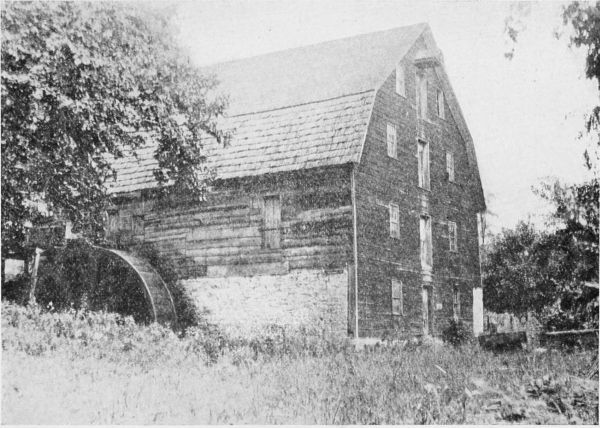
Picturesque Water Mill Beside the Potomac
Isn't it peculiar how the smallest trifles will alter
the most elaborate plans? A trifling ham sandwich
in a two by four restaurant caused us to evacuate
Hancock forthwith. We had intended to remain
here a day or longer, run over to Berkley Springs and
perhaps go fishing. Instead we left town so precipitately
that we forgot to stop at the postoffice and ask
if our mail had been forwarded.
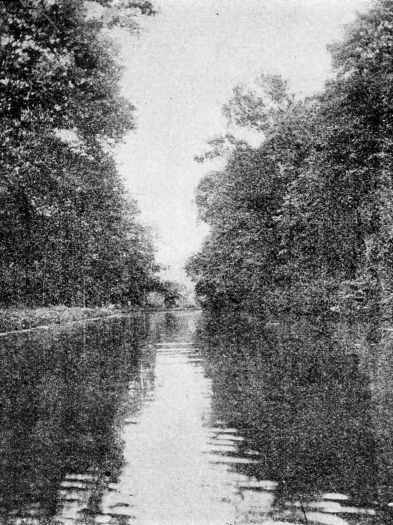
A FEW miles east of Hancock is a wide-water a mile
long in the canal known as Little Pool, the channel
being about the width of the Monongahela
river at the Smithfield street bridge. From Hancock to
this point we were obliged to stop frequently on account
of grass that clogged the propeller, and on entering
Little Pool the obstruction was so great that it was
necessary to get out and tow several hundred yards.
When clear water was regained the motor began to show
signs of balking, and after a heart-rending effort to
repair it on the towpath, we threw the thing into the
boat and paddled our way through the rural hamlet of
Millstone where housewives, milking their cows on the
bank of the canal, stared at us pityingly as we labored
by. Cow stables and pig stys on the berm bank offered
no mooring place in the town, and we plied the paddle
until we reached a secluded stretch of woodland where
we could be alone in our chagrin over the obstinacy of
the motor.
When we lighted our lantern we were annoyed for
the first time by a swarm of mosquitoes. We had been
warned before the trip that these insects on the canal
were related to the Jersey "man-eaters" and would
make life miserable on our cruise. We were prepared
for their ravages, but fortunately a little breeze sprang
up after nightfall and they gave us no more trouble.
They were the only militant mosquitoes that we saw
between Cumberland and Georgetown.
As if gloating over our discomfiture in having lost
our motive power, a double-bass bullfrog started in to
make the night hideous. His favorite singing dias was
in the pool right under the bow of the boat. When a
stone was thrown in his direction he retreated into
deep water, but invariably returned. Late in the night
I hit upon the expedient of pouring a pint of 30-cent
gasoline on the water. The croaker croaked no more.
In the morning a little tinkering was rewarded by
the motor showing signs of renewing operations and we
started in high hopes, but after a few hundred rods
it was apparent that we were making little speed and we
limped into the tiny hamlet of Ernestville where we
stopped for supplies and fresh water. Ernestville is
a poor shopping center and fresh water and kerosene
were about all we could obtain.
Along this stretch of the canal it is paralleled for
a considerable distance by the old National Pike, which
on this particular morning was thronged by automobile
tourists. As they sped by we knew that they would
be in Hagerstown in an hour. We wondered if we
would reach there in a day. It was apparent now that
we must take our crippled motor to a garage and
Hagerstown was the nearest point where we could obtain
the services of a mechanic skilled in repairing marine
engines. To reach Hagerstown from the canal we
decided to stop at Williamsport and this was now our
goal.
BIG POOL is a widewater where the canal broadens
into a beautiful lake nearly a mile wide and more
than a mile long. Our balky motor pushed us
into this big sheet of water and then stopped with a
derisive screech. It was the ultimatum of a dry bearing
and it was inexorable. While we were floundering
in the breeze and trying to paddle ashore, a motorboat
came alongside and its occupants inspected our equipment.
"Sometub" they liked immensely, but the engine
perplexed them. We were looking for neither advice
nor sympathy and the stranger who acted very superior
and said, "I have a Koban," didn't improve his favor in
our eyes.
Then into our lives came a heroic figure. Just at
that moment he appeared the greatest man in the world—philanthropist,
navigator, philosopher! He was the
skipper of Canal Boat No. 18 which swept majestically
down the pool. His boat appeared as big and formidable
as the new superdreadnaught Pennsylvania. Dexterous
work with the paddle enabled us to get in its lee.
Up there on his quarterdeck stood the skipper. I since
believe that he must have resembled Noah, but to we
two—we felt like castaways—he was indeed a mighty
admiral. But he was the admiral of a friendly power
and amid all his dignity there was a benign expression
also of stern consideration for a brother mariner in
distress. We gazed at him and his noble craft in mute
appeal.
"Ketch the line!"
Like spent swimmers grasping for a straw, we
seized the line and made it fast. For the second time
"Sometub" was humiliated by being towed by a prosaic
freight boat.
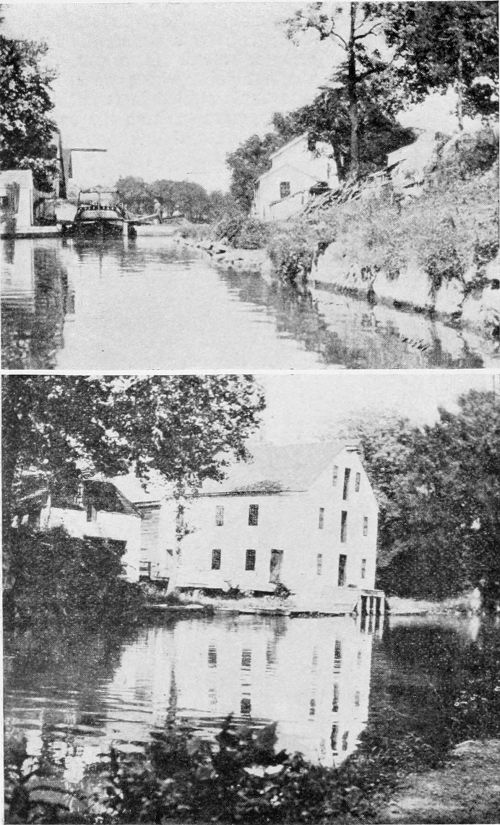
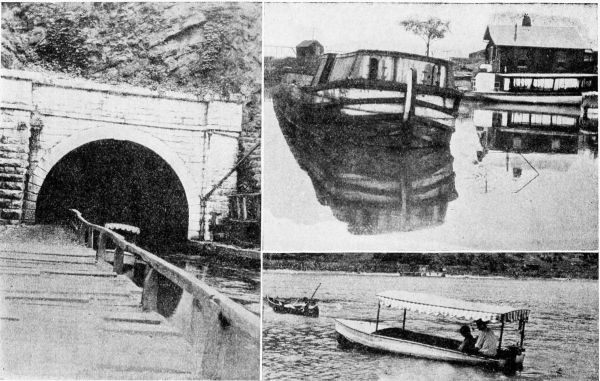
Above—Upper Level at Four Locks
Below—Old-Time Mill
Two miles an hour is top speed for a laden canal
boat and No. 18's tired mules kept well inside this limit.
At the end of the towline we nosed along in perfect
complacency. We chatted with the skipper, admired
the scenery, examined our maps of the route, chaffed
the villagers, ate our luncheon, jogged the motor, read
a little, took short naps and made ourselves absolutely
comfortable. Our only effort was to keep on the shady
side of the boat, for the weather was the hottest we
had endured. As a remedy for tired nerves I can testify
to the curative qualities of canalboating.
The skipper was a man of parts. He had run the
canal for more than 20 years. He had walked every
inch of the towpath from Cumberland to Washington
every hour of the day and night and he declared that
he could pace those 184 miles with his eyes blindfolded.
He recognized every hill and house and tree and could
tell their history. He knew all the neighborhood gossip,
and all the neighbors knew him.
Toward the end of the drowsy afternoon we floated
into the little village of Four Locks which takes its
name from the fact that a chain of four locks are here.
No. 18 cast us off and we prepared to paddle through.
To our surprise the motor condescended to run. At the
time I was ready to believe that it heard the mule
driver's sublime cussing and was frightened into obedience.
With the motor running again we soon passed No.
18 and snorted off around a sharp bend, through Two
Locks where we were lowered into the waters of the
Potomac. I say "snorted" advisedly. "Sometub" exhibited
colt-like behavior when unleashed from the
slow-moving canal craft. The towpath follows the
northern bank of the river and the boats hug the shore
closely, but we careened far out into the stream. "Sometub"
had found a nautical playground more spacious
than it had ever enjoyed before.
After a two-mile run on the river we entered another
lock and once more were confined to the comparatively
narrow channel of the canal. We found all conditions
favorable and at sunset we crossed the great
stone aqueduct over the winding Conococheague and
a few minutes later tied up at the Williamsport lock.
I was now on familiar ground. Eleven years before
I had visited historic Williamsport in quest of
newspaper "feature stories," and a decade had witnessed
but little change in the place. In the early days of the
Federal government Williamsport was a pretentious bidder
as the seat for the national capital. In the Civil
War it was a sort of Pryzmyl, having been taken and
retaken by the armies of both the north and the south,
but the town itself was of no importance except as the
key to strategic positions beyond. Here in June, 1863,
the vanguard of Lee's conquering legions crossed the
Potomac when they swept down the Shenandoah and
crossed triumphantly into Pennsylvania, and here less
than a month later their ragged columns made a bold
stand against Meade's victorious forces while the retreating
Confederates waited for the flood to subside
so that they could withdraw into Virginia. Along the
street that leads down to the river are many of the
old houses whose walls resounded with the tread
of those valiant armies—Union and Confederate. In
those houses, too, many a soldier suffered the agony of
wounds received in the desperate charges at Gettysburg.
Of those southern heroes who raced with death from
that immortal field, scores gave up their lives here in
sight of their native Virginia hills.
Williamsport today is another of those outposts for
supplying alcoholic drinks to bleary-eyed pilgrims from
West Virginia and in consequence does not afford hotel
accommodations for the ordinary traveler. After trying
in vain to get dinner, we boarded a trolley car and 40
minutes later reached Hagerstown where we stopped for
the night, enjoying the solid luxury of a "room with
bath connecting."
AMONG Hagerstown's well known business men is
Mr. Walter E. Pattison, a former Pittsburgher.
We sent him a grape-vine telegram of our advent
in town and on coming down from breakfast in the
morning he hailed us with a motorcar and an invitation
for a drive through Greater Hagerstown. We accepted
with alacrity, remembering the tedious hours of the previous
day, and made no objection when the chauffeur
cut up didoes with the Maryland speed limit.
Mr. Pattison accompanied us to Williamsport in
the afternoon to see "Sometub" and to join a little reunion
with Col. George W. McCardell, the veteran editor
of the Williamsport Leader. Editor McCardell had been
looking for me for eleven years and we were somewhat
in doubt as to the outcome of the interview. The reason
for his desire to lay hands on me was, as nearly as I
can remember, the following paragraph which was printed
over my name in the Pittsburgh Gazette in the summer
of 1905:
The Williamsport Leader is more than a
journalistic enterprise—it is a well founded
institution. It is the oracle of rockribbed Democracy,
the unflinching champion of pure Jeffersonism
and unfaltering Andyjacksonism....
The editor will take two pairs of Maryland
frying-size chickens on subscription, but of his
Virginia subscribers he requires three pairs in
advance because, he says, the Maryland pullets
are better and more tender.
I resolved to meet the editor and finish the argument.
Mr. Pattison led the way to a new and prosperously
attractive sanctum. It was publication day—Friday—and
Col. McCardell, after a strenuous week,
stood with folded arms beside an imposing stone with
type still wet from the day's "run." My wife, who embodies
the traditions of five generations of the editor's
brand of politics but who stood ready to defend the
quality of Virginia chicken against the world, was the
first to enter the den of the journalistic lion. It was a
clever ruse on Mr. Pattison's part, for first of all Col.
McCardell is a chivalrous southern gentleman. Why, of
course, Virginia fried chicken is the finest in the land.
And Virginia women compose the very flower of American
womanhood. Their presence here is welcomed
like the May-time sunshine. The Potomac ripples softly
when they cross the river and in the trees on the
Maryland shore the summer zephyrs sing sweet benisons
to the fair daughters of the Old Dominion.
And when I entered the feud of eleven years had
vanished. I could only blush and bow my acknowledgements.
With fond good-byes to Col. McCardell and Mr.
Pattison we departed in the mid-afternoon bound for
Mercerville by twilight in the hope that we would have
the following day to spend on Antietam battlefield. But
we had not reckoned with the elements. Four miles
below Williamsport a terrific storm burst upon us. So
sudden was the tempest that we were obliged to tie to
the towpath bank to prevent the furious gales of wind
from capsizing the boat. For a few minutes it seemed
that our canopy would be torn to tatters. Our lines
gave way and I climbed out to steady the heaving craft.
Then it rained in such torrents that it momentarily took
away my breath. Vivid flashes of lightning and deafening
thunder followed in instant succession. The wind
wrenched big sycamores from their roots and they
crashed across the miry towpath like jackstraws thrown
by an angry giant. The storm lasted more than an hour
but a steady patter of rain followed. Our supplies
stored under the deck and protected by the poncho were
dry, but our clothes were dripping and the temperature
had turned chill and raw. Darkness was coming on and
we prepared to tie up for the night. How bright and
warm looked the blue flame from the canned alcohol
while we boiled our coffee!
It was a gloomy outlook, but southern hospitality
which proved the silver lining to every dark cloud on
our cruise, once more intervened. A farmer rode down
the towpath and invited us to go to his house for the
night. Our good Samaritan was Mr. J. H. Wine, whose
home nestles snugly under the mountain beside the
canal. We accepted with haste that we hoped would indicate
our extreme gratitude and soon had our dripping
duds spread out on the backs of chairs before the range
in the spacious kitchen. Mr. and Mrs. Wine tendered us
the guest room and we sought slumber early. Only the
outdoor enthusiast would have been worthy of the frugal
breakfast in the morning. We thanked our good
hosts and prepared to depart. The question of remuneration
for favors invariably was spurned by the hospitable
people on the canal.
The sun came out gloriously and we hoped to reach
Mercerville by noon. We did, but there the motor balked
again and we spent two hours trying to fix it. We gave
up the thought of visiting Antietam and about the time
the shadows began to lengthen, started solemnly toward
Shepherdstown, five honest miles down the canal. We
paddled and towed alternately, making even slower
progress than in the wake of No. 18. Darkness came
on and we were still on the lonely path. About 9 o'clock
we reached a lock and were told that Shepherdstown was
still a mile beyond. A storm was gathering and the
lockmaster invited us to tie up and spend the night in his
house notwithstanding that it would place several members
of his large family at an inconvenience. We agreed
to leave the boat, but insisted on going to Shepherdstown
where we could find a hotel and a garage mechanic.
AGAINST the protests of the lockmaster and his wife
we lighted our lantern and started down the lonely
towpath. Black clouds obscured the sky and
we stumbled along at times having difficulty in keeping
on the path. Flashes of lightning and rumbling thunder
betokened a storm that would rival the one on the previous
night. Our lantern's flickering light only intensified
the darkness but the lightning frequently assisted us
when its glare illuminated the entire landscape.
In our race with the storm we were the first under
the wire. Fleeing across the bridge over the Potomac
we breathlessly climbed the hill and along a dark street
to the center of the town whither we had been directed
to the hotel. Suddenly we rounded a corner into an
electric-lighted thoroughfare and stood before the entrance
of the Rumsey House. Our clothes were wrinkled
and we were splashed with mud from head to foot. We
still carried our lighted lantern and the crowd at the
hotel gazed at us with expressions twixt curiosity and
amazement. The proprietor was moved to commiseration.
"Come in here, you-all, right away," he said.