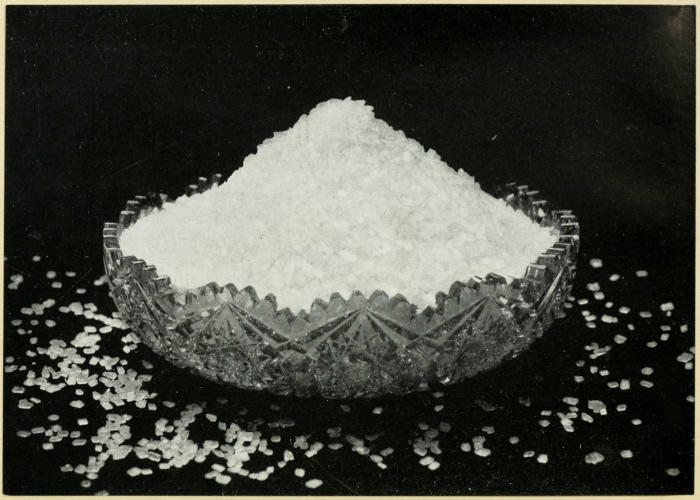
Sugar
is nothing more nor less
than concentrated
sunshine
SAN FRANCISCO
JOHN J. NEWBEGIN
PUBLISHER
1917
COPYRIGHT, 1917, BY GEORGE M. ROLPH
PRINTED BY TAYLOR & TAYLOR, SAN FRANCISCO
DEDICATION:
TO R. P. RITHET
FOREWORD
The purpose of this book is to tell in simple language
“Something About Sugar.” It gives a brief history
of the commodity and its production in different parts
of the world, and seeks to show, for the information,
especially, of the layman and the pupil in school, the
various steps by which sugar from cane and beets is
prepared for the consumer.
Among the many varieties of sugar the most important
are the sucroses and the glucoses. They form a natural
group of substances, chiefly of vegetable origin. Chemically
considered, all sugars are carbohydrates, that is to say,
bodies composed of three elements: carbon, hydrogen and oxygen.
Sucrose contains twelve atoms of carbon, twenty-two
atoms of hydrogen and eleven atoms of oxygen.
Apart from sucrose, which is usually cane and beet sugar, the
variety most generally met with is dextrose—one of the glucoses.
It possesses less sweetness than sucrose and differs from
the latter in chemical composition. As an example: dextrose is
found in the raisin in small grains. It also occurs in other fruits
and is the result of the inversion of sucrose.
Glucose enters largely into the manufacture of candy, being
particularly necessary in the preparation of soft filling for
creams, as a certain amount of it added to cane-sugar syrup prevents
crystallization.
Sucrose is derived from sugar cane, maple sap, sorghum and
the sugar beet. It is a solid, crystallizing in the form of monoclinic
prisms, generally with hemihedral faces, which are colorless,
transparent, have a sweet taste, a specific gravity of 1.6
and a melting point of about 320 degrees Fahrenheit. It is soluble
in about one-half its weight in cold water, and in boiling
water in almost all proportions. It is practically insoluble in
alcohol, turpentine, ether, chloroform and similar fluids.
The crop of 1914-15 showed a world’s production of 18,409,016
long tons of sugar, and in the chapters relating to the
history of sugar will be found a statement setting forth the
amount produced by each country. The total was derived about
one-half from cane and one-half from beets, produced as follows:
Sugar cane, described in botany as Saccharum officinarum, is
a giant-stemmed perennial grass that grows from eight to
twenty-four feet long. When ripe it produces at the top of its
stalk a large feathery plume of flowers of a gray inflorescence
called the “tassel,” which is from two to four feet in length.
There are many kinds of cane, all of which are regarded as
varieties of one species, although some botanists have raised a
few to the rank of distinct species. The cultivated types are distinguished
by the color of the internodes, yellow, red, purple or
striped, and by other general characteristics.
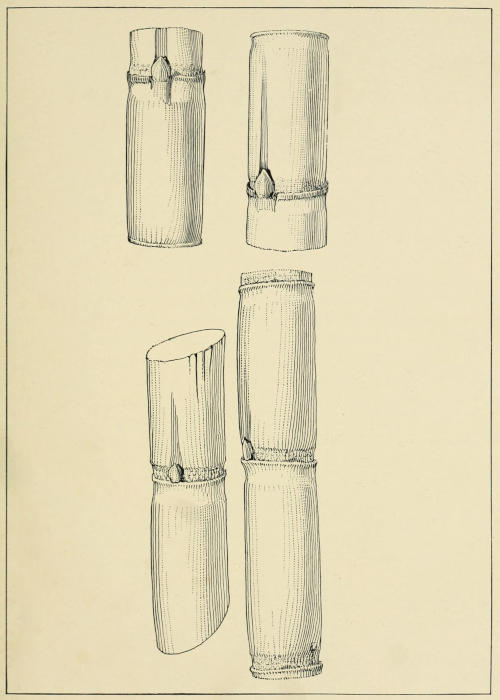
SUGAR CANE—SHOWING EYES OR BUDS
The stem of the cane is solid, with joints at intervals of three
to six inches. In diameter it ranges from one to two and a half
inches, and is unbranched, bearing in its upper part numerous
long, narrow grass-like leaves, arranged in two rows. The
leaves spring from large sheaths around the joints, and have a
more or less spreading blade from three to five feet in length
and two inches or more in width. The pith, of open cellular
structure, contains the sugary juice. The tops, which contain
but little sugar, are not crushed, but are used for seed, as the
plant germinates from the eyes, or buds, which grow on the
stem around the joints. Practically no cultivated cane is propagated
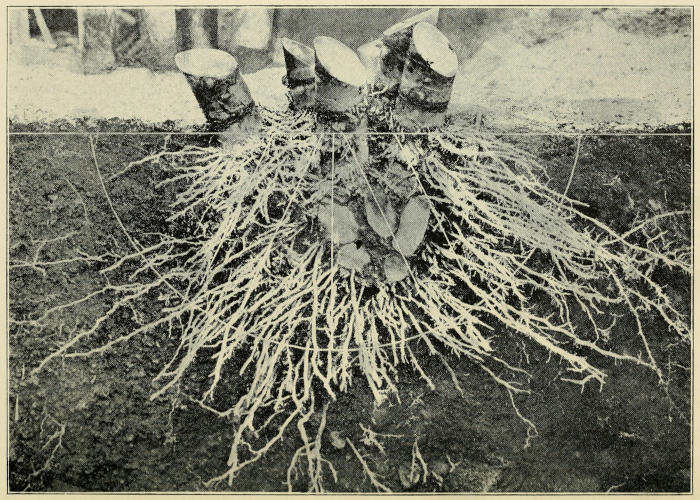
from its seed. The roots that remain in the ground after
the cane is harvested throw up fresh canes or ratoons for many
seasons, after which replanting is necessary. Hawaiian growers
do not count on ratoons for more than a few crops, whereas in
Cuba this process can be repeated for many years.
As a rule, sugar cane consists of about eighty-eight per cent
of juice and twelve per cent of fiber, the juice content varying
from time to time, both as regards quality and amount. The
quantity of the juice pressed from the cane determines the efficiency
of the extraction, while quality is the main factor when
the result of subsequent manufacture is under analysis.
It is difficult to arrive at a fair average of the composition of
the juice of the cane, as it varies in different countries, on different
plantations in the same country, and at different periods in
any one year. The following is an approximation:
Water
80.8
per cent
Sugar
16.4
”
Invert sugar
1.98
”
Organic non-sugar
.54
”
Ash (mineral matter)
.28
”
THE GROWING OF SUGAR CANE — 1. SOIL ANALYSIS — 2. ENTOMOLOGY — 3. PATHOLOGY
Sugar cane grows almost exclusively in the tropical
belt, extending from twenty-two degrees north to twenty-two
degrees south latitude, where the three essentials
for its successful culture, viz., fertile soil, hot sunshine and
plenty of moisture, are present. It flourishes in the islands of
the Pacific ocean, particularly in the Hawaiian group, in Cuba,
Mexico, Central America, the islands of the East and West
Indies, Australia, China, India, along the shores of the China
sea and the Indian ocean, and in certain parts of Africa and
South America. In the low latitudes of the temperate zone it is
grown with only fair success.
Owing to peculiar climatic conditions, sugar cane has been
raised in southern Spain for generations, notwithstanding the
fact that the provinces in which the sugar cane is grown lie,
roughly speaking, between thirty-six degrees and thirty-eight
degrees north latitude. The Gulf Stream is no doubt largely responsible
for this phenomenon. The quantity of sugar produced
in Spain, however, is small, the crop of 1914-15 amounting to
less than 8000 tons.
Sugar cane thrives best in a moist, warm climate, with moderate
intervals of dry, hot weather, and plenty of water for
irrigation. It requires marly soil, free from saline ingredients.
As a rule, it is raised on the lowlands, where the temperature
is highest and where it is easy to bring water for irrigation. In
Hawaii it takes eighteen months to ripen, and “tasseling” occurs
about thirty days before it is ready to be cut. In Louisiana
and Texas, because of the short seasons, cane is harvested in
from nine to ten months from the time of sprouting, and, consequently,
before it has attained maturity. In Cuba it is cut in
twelve months, whether it is ripe or not.
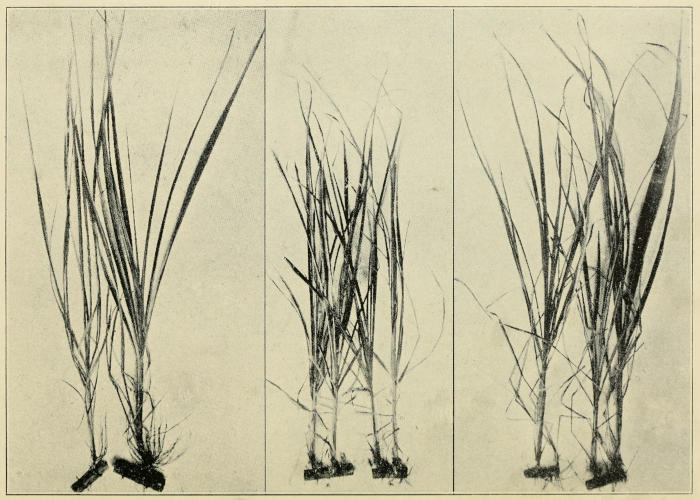
ROOTS OF SUGAR CANE
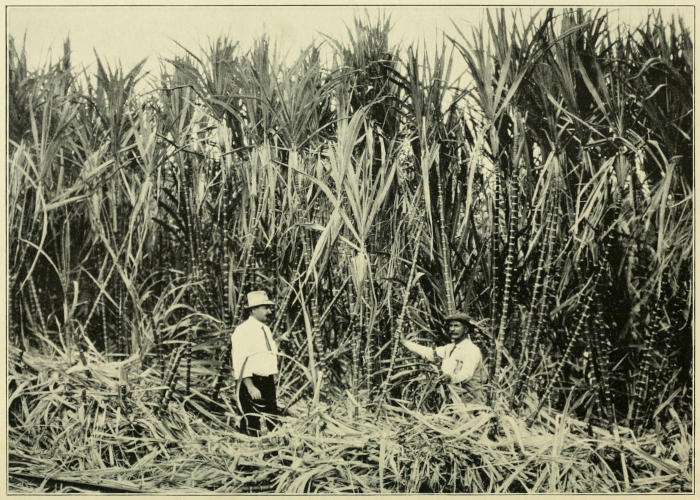
JUNGLE-LIKE VEGETATION OF CANE FIELD
As the scientific culture and manufacture of sugar is probably
further advanced in the Hawaiian islands than in any
other part of the world, a description of the industry as carried
on there will serve to illustrate the intensive cultivation and
scientific methods of the present day.
The Hawaiian islands are situated in the Pacific ocean, in
latitude nineteen degrees to twenty-two degrees north and in
longitude one hundred and fifty-four degrees to one hundred
and sixty-one degrees west, and are free from the destructive
hurricanes of the East and West Indies. They are of volcanic
formation and, as a rule, their centers are mountainous, in
some instances reaching an elevation of nearly fourteen thousand
feet. During the ages, torrential rains carried volcanic
ash from the mountains toward the sea, near which it was deposited,
thus forming alluvial areas of vast richness around
the circumference of the islands. Parts of some of the islands
are fringed with coral reefs, barriers that retain the washings
from the mountains. In these low-lying areas the soil is extraordinarily
fertile, and it is on such ground that the most
generous crops are raised.
The soft, warm trade winds that blow from the northeast become
laden with moisture as they sweep over the ocean; when
they strike the cold mountain peaks the moisture condenses immediately
into copious rains. The precipitation in some places
reaches the astounding total of three hundred inches per annum.
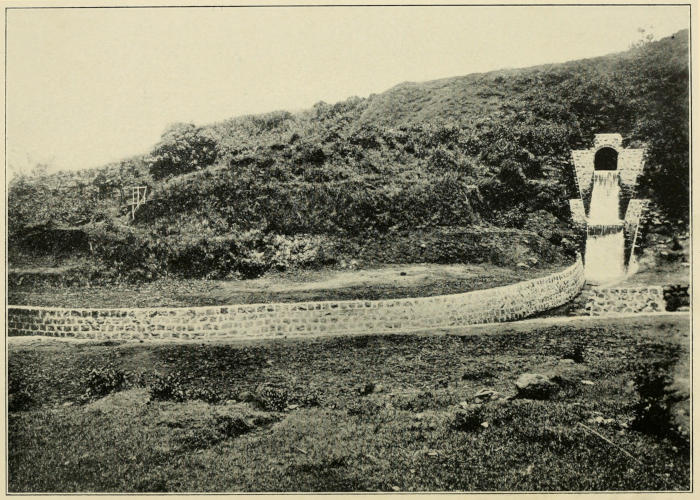
The rain water is conserved and, when needed, is carried
to the various plantations by immense irrigation ditches.
In this tropical region there is an abundance of sunshine, accompanied
by humid heat, exactly the conditions needed. It
required only man’s ingenuity to utilize what nature so lavishly
provided.
The commercial cultivation of sugar cane in these islands
began about 1850, when a few hundred tons of raw sugar were
produced, but the methods of husbandry and manufacture were
crude. Time and experience worked great changes, until in
1914-15 the crop of raw sugar totaled 646,448 tons of 2000
pounds each.
For many years past the sugar planters have maintained in
Honolulu an experimental station that is the marvel of the agricultural
world. The bulletins issued by it are recognized as
authoritative, and are read with interest in every sugar-producing
country.
The most important features of the work carried on at this
station are:
Skilled chemists examine the soils of the various plantations
and, when occasion demands, advise the planter what necessary
element is lacking, as well as how to obtain and apply it. A few
years ago this branch of the work was considered highly important.
Recently, however, the agriculturists have been depending
more upon well-defined systems of experimentation. Each plantation
has on its own lands plots of ground on which different
methods of culture are tried and on which various kinds of fertilizer
are used. Experiments are also made to determine the
exact amount of water needed for irrigation. Particular attention
is paid to seed cane, and a number of types of it are planted
in order to obtain seed that will produce stalks that grow rapidly,
yield a large tonnage per acre, contain a maximum amount
of sugar, and have a high resistant power against disease and
insect pests. The success attending this practical experimental
work is such that soil analysis is being relegated to second
place.
A staff of trained experts assiduously study the insect life and
eagerly watch for harmful, troublesome pests, which in the past
have wrought great damage. It is their duty to find the means
of eliminating these pests, and this they usually accomplish
through the skillful use of insect parasites.
The pathologists attached to the station supplement the scientific
labors of the chemists and the entomologists by prescribing
for any disease that may attack the cane. Plant life is subject
to as many ills as the human family, and the work of these
specialists in restoring health to ailing cane is of the highest
importance.
To fully illustrate the character and scope of their work, a
particular instance for each department may be cited:
A certain planter found that the amount of sugar obtained
from his cane was decreasing yearly, though he could see no
good reason for it. The land looked right; he ploughed deeply,
harrowed well, kept the weeds down, gave the cane plenty of
water, could find no reason to complain of climatic conditions,
but still did not get satisfactory results. Finally the head of the
experimental station was consulted and an agricultural chemist
was sent to the plantation. This chemist, after careful investigation,
took samples of the soil from various parts of the land;
these were analyzed and the source of the trouble was found to
be the lack of potash. Just here it may be explained that when
the same crop is taken from the land many years in succession,
without adequate fertilization, some of the essential properties
of the soil become exhausted. Speaking generally, these are
lime, soda, potash, phosphates and nitrogen. In this particular
instance, as has been said, the land had been gradually drained
of its potash. The experimental station recommended the planter
to scatter a certain fertilizer over his fields. This advice was
followed and the next crop showed remarkable improvement, the
yield of cane and sugar per acre being greater than ever before.
At one time the sugar industry of the Hawaiian islands was
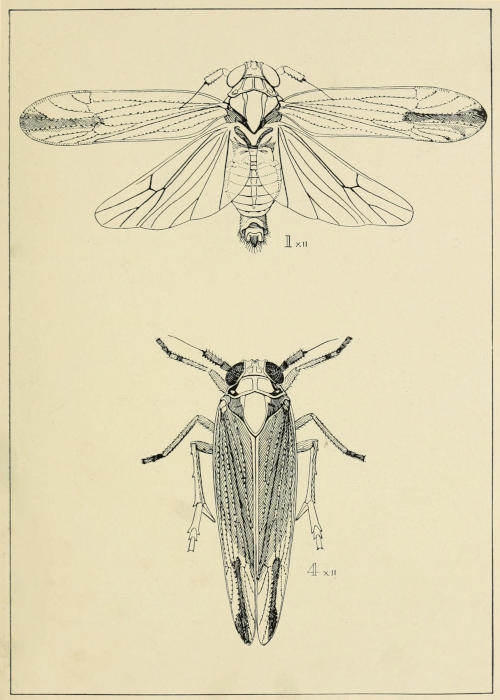
threatened with annihilation by a little insect called the “leaf-hopper.”
The harm done by this pest was so enormous that one
plantation having an average yearly crop of 19,000 tons was so
severely affected that the yield dropped from 19,000 to 12,000,
and then to 3000 tons in three successive crops. All the plantations
on the islands suffered to a greater or lesser extent, and
the entire sugar industry of Hawaii was jeopardized.
The hoppers punctured the stalks and leaves of the young
cane, and in the holes thus formed laid their eggs by thousands.
When the young hoppers hatched out, they fed on the juices in
the stalk and in the leaves, thus destroying the leaves and depriving
the cane of its protection and principal means of absorbing
nourishment from the air.
As soon as the leaf-hopper by its ravages made itself known
in the islands, the entomologists were consulted, and they
were confronted with the task of studying the life and habits of
the hopper for the purpose of finding, if possible, some other
insects that would attack and exterminate it. It is well known to
entomologists that every insect pest has natural enemies; the
vital question in this case was—what were the natural enemies
of the leaf-hopper and where were they to be found? Obviously,
too, the problem was to discover insectivorous enemies that
would not themselves attack the cane after they had destroyed
the hopper.
After careful investigation it was concluded that the leaf-hopper
had been introduced in Hawaii in new varieties of seed cane
imported from Australia, and, as the hopper was not doing material
damage on the plantations in Australia, the inference
was that it must be controlled there by its natural enemy. The
chief of the Department of Entomology was sent to London.
There in the archives of the British Museum he found a full description
of the leaf-hopper and that its native habitat was
Queensland, Australia. On his return to Hawaii, entomologists
were sent to Australia and the search for the enemy of the hopper
began.
LEAF-HOPPER (GREATLY MAGNIFIED)
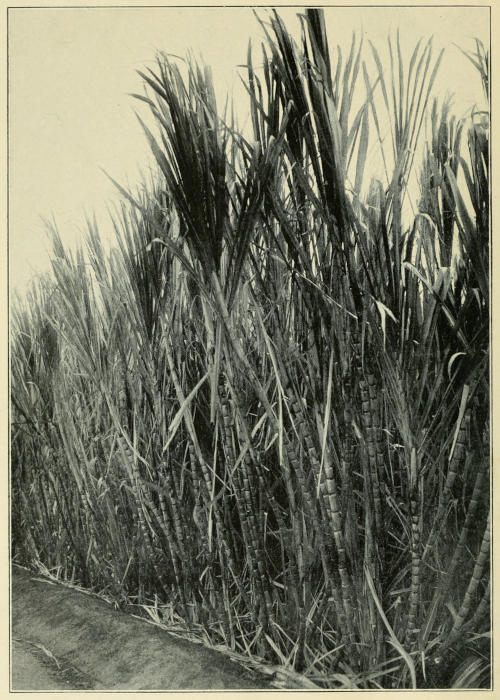
SUGAR CANE
For weeks the entomologists virtually lived in the cane fields,
undergoing extreme privations, but at last their faithfulness
was crowned with success. Several species of parasites that
kept the Queensland leaf-hopper in check were discovered, and
later on more were found in the islands of Fiji. These tiny creatures
as a rule were invisible to the naked eye and could only be
seen with the aid of a powerful magnifying glass. All of these
insects were parasites either of the leaf-hopper or its eggs. Two
of them were particularly efficacious. One, quicker in movement
than the hopper, caught it unawares and attached itself to the
hopper’s body much in the same way that a mosquito does to a
human being. After catching it, the parasite would sting the
hopper and lay an egg in its body. In a few days a young parasite
was hatched from the egg, and so ravenous was this young
insect that it devoured the hopper in a short time and then
sought a fresh victim in which to lay its eggs.
The other insect was even more effective. It liked the hoppers’
eggs and for a long time found plenty in Hawaii to stay
its appetite. As soon as the leaf-hopper laid its eggs in the cane,
this particular insect would appear and lay its eggs in the eggs
of the leaf-hopper. When the little enemies hatched out, they
fed on the hoppers’ eggs and in turn laid their eggs in the eggs
of the hopper. It came to pass that the hoppers, attacked by the
parasite on the one hand and by the enemy on the other, rapidly
dwindled in number until only a few remained, and these not
enough to do material damage. As the hoppers and their eggs
diminished, so did the parasite and the enemy, for the latter
could live on insect food only.
How the scientists collected these tiny animalcules, kept
them alive, transported them thousands of miles across the
ocean, bred them in Hawaii and saved the Hawaiian sugar industry,
reads like a romance.
The study of entomology is extremely interesting and the
every-day business man rarely understands its importance. The
finding, breeding and distribution of parasites of insect pests
vitally affects the world’s food supply. The entomological name
of the leaf-hopper family is Hemiptera, and Dr. Sharp, an authority
on the subject, has said: “There is probably no order of
insects that is so directly connected with the welfare of the human
race as the hemiptera; indeed if anything were to exterminate
the enemies of hemiptera, we ourselves should probably be
starved in the course of a few months.”
It has been estimated by competent authority that the damage
done in the world each year by the hemiptera, in spite of
all their parasites, is conservatively $600,000,000. Were it not
for the parasites, it would only be a year or two at most before
every green leaf and spear of grass would disappear from the
face of the earth. The direct influence of the practical application
of this science to the production of sugar is readily apparent.
Pathology is almost equally important. In former years when
cane failed to grow strong and sturdy and did not yield much
sugar, the planter usually attributed the difficulty either to lack
of water, poor soil, cool weather, too much rain or insufficient
cultivation of the field by his manager, when in fact the trouble
was due to none of these causes. He would personally oversee
the operations of the following year, but with no better results.
EXPERIMENT STATION
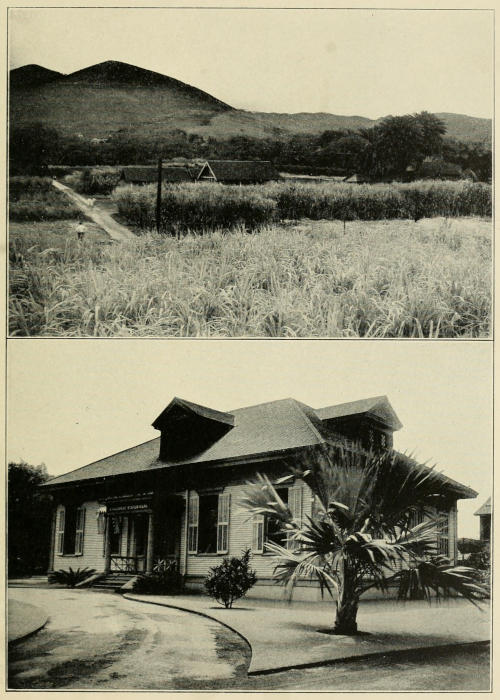
PLANTATION SCENE IN HAWAII—LIGHT-COLORED FOLIAGE IS SUGAR CANE
When the roots of the cane became matted, stuck together
and turned black, when a thick gum exuded from the stalk and
leaves, preventing the plant from drawing proper nourishment
from the air, it was thought that these troubles arose from climatic
or local conditions, while in reality the plant was sick and
needed a doctor. Today, under the new régime, whenever the
plant shows any symptoms of ill-health, the pathologists are
called in to eradicate the disease by scientific treatment.
Insect pests and plant diseases are generally brought into a
country through planters sending to other cane-raising countries
for new varieties of cane for seeding purposes that they
think may produce more sugar than their own. Great trouble
and heavy loss have been occasioned in this way and, as a consequence,
the United States government has established a strict
quarantine, allowing plant life to be landed only after rigid examination
and when it is clear that no danger exists.
Another example of the work of the entomologists may be of
interest:
During the visit of a well-known Hawaiian to Mexico many
years ago, his attention was attracted by a beautiful shrub that
he thought would make a splendid hedge around his home. It
grew about five feet in height and its foliage was of a rich
green, with a brown, red and yellow flower. The slips he
brought to Honolulu thrived wonderfully and cuttings of the
plant were taken to the other islands for a like purpose. Wherever
planted it grew amazingly fast. It quickly spread over the
hillsides and became so dense that cattle could not penetrate
the thickets formed by it. It made valueless large areas of land
that formerly had been used for the pasturing of cattle and
plantation stock, and reduced the grazing area at an alarming
rate. Land that adjoined the plantations and that in the course
of time became needed for plantation purposes was also over-run
by it.
The curtailment of the grazing lands and the increased cost
of clearing were so great that the entomologists were finally
sent for and asked if they could not eradicate the trouble. After
a careful investigation they went to Mexico, whence the lantana,
as the shrub is called, had come. On their return journey
they brought back with them a fly. The fly laid its eggs in the
bud of the lantana, and when the young flies were hatched they
fed upon the lantana seeds. The flies multiplied rapidly and
soon made away with the seeds, thus preventing the shrub from
spreading any further. When it was once cleared from the land
or the plantation it did not reappear.
These illustrations demonstrate the fact that the culture of
sugar cane involves a constant struggle between science and
unrestrained nature.
As a rule, Hawaiian sugar plantations are located close to the
seacoast, between it and the base of the mountains. The lands
slope gently toward the sea, thus insuring good drainage and
easy application of water for irrigation. Most of the cane is
grown on land less than five hundred feet above sea-level, although
in a few rare instances it is cultivated at an elevation as
great as three thousand feet. Parts of the leeward side of the
islands, where it is extremely dry and hot, and where the cane
thrives best, depend entirely on irrigation, the water being
brought to the plantations by ditches or pumped from wells.
On the windward side of the island of Hawaii, where the rainfall
is abundant, irrigation is unnecessary except during very
dry periods.
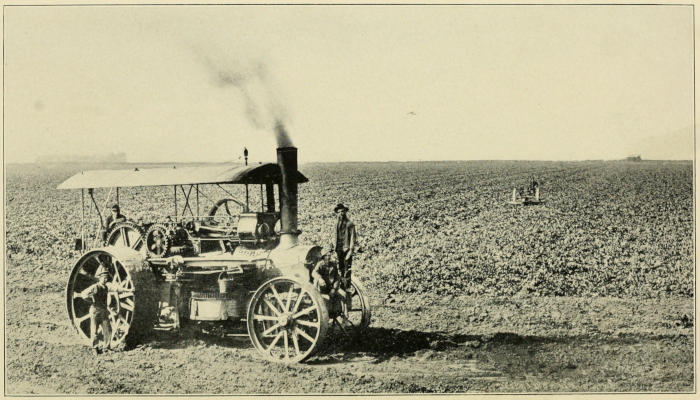
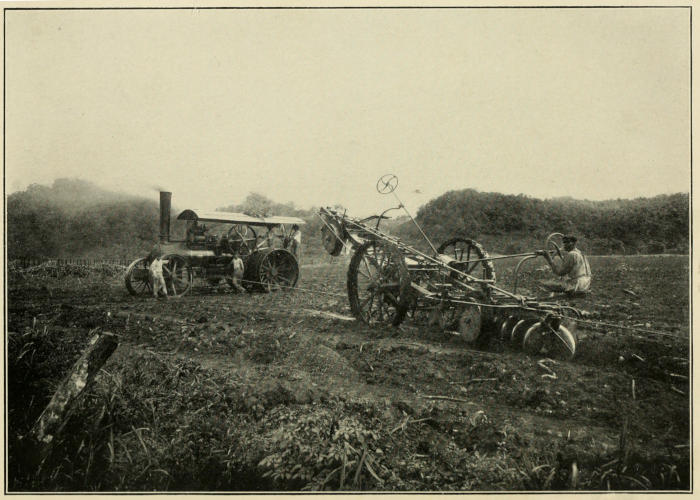
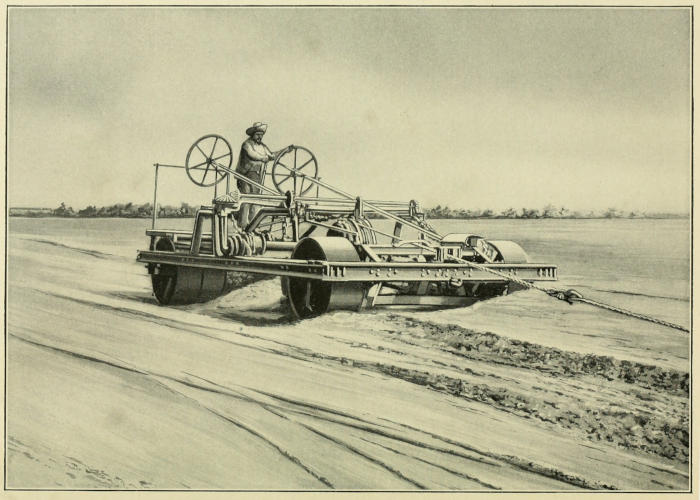
In cultivating, the ground is turned with steam ploughs to
depths up to twenty-four inches. These ploughs are operated by
powerful engines that work in pairs, one on each side of a
field, usually from one thousand to fifteen hundred feet apart.
One engine pulls a gang-plough across the field and the other
draws it back. By this method the rich soil is thoroughly loosened
and a wonderful vegetable growth results. Ordinarily in
California the farmer ploughs only from four to six inches deep.
STEAM PLOUGH
PLANTING CANE
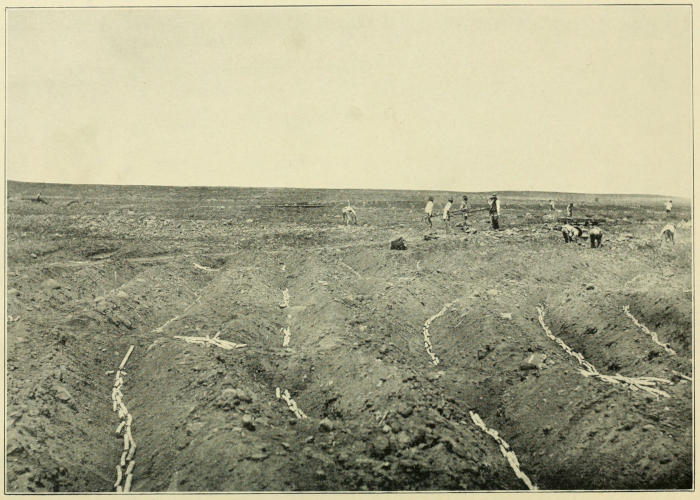
After the lands are ploughed and harrowed and all the weeds
turned under, double mould-board ploughs are used to make the
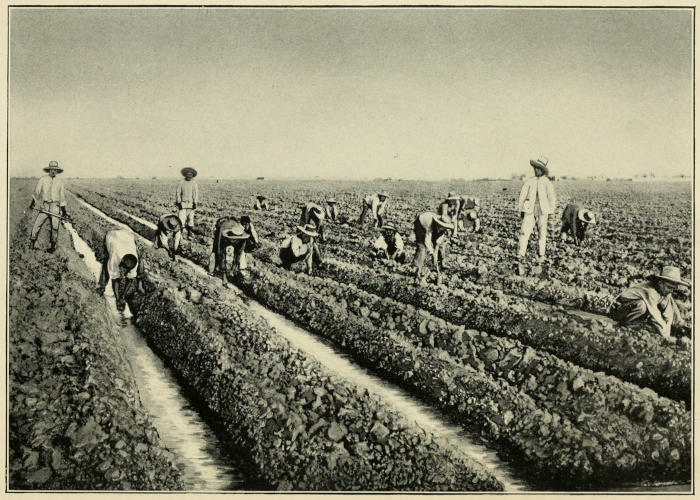
furrows in which the seed is planted. The furrows are not like
those made for planting potatoes, but are about five feet apart
and eighteen inches deep, each furrow and hill being symmetrical.
They follow the contour of the land so that the irrigation
water will fill the furrow and remain there until it is absorbed
by the soil and penetrates to the cane roots. At regular intervals
of about thirty-five feet, lateral ditches are cut, from which
there is an entrance into every furrow. These lateral ditches
deliver the water from the main ditches to the various parts of
the fields. The land is now ready for the seed.
Meanwhile, the harvesting of the ripened cane in other fields
is going on. As the laborers cut the cane, they top it, that is to
say, they cut off about twelve inches of the upper part of the
solid stalk. Sugar cane resembles bamboo, in that it is cylindrical
in shape and divided every few inches into sections by rings
or joints. In every joint there is a bud or eye, from which a
shoot of cane will sprout, if properly planted in the ground and
watered.
These tops, always cut from untasseled cane, contain very
little sugar. They are carried to the newly prepared field and
placed in rows in the furrows, end to end, lengthwise, the ends
overlapping a trifle in order to guard against blank spaces in
the growing cane. They are then covered, according to the season,
with one to one and a half inches of earth, and the water is
turned in until the furrow contains from three to four inches of
water. Between six and ten days afterward, the little green
cane shoots appear above the ground. From this time forward
continuous irrigation and cultivation, together with proper fertilization,
are required until the cane matures.
Planting usually begins in March and continues until September,
sometimes later, and the cane ripens one year from the
following December.
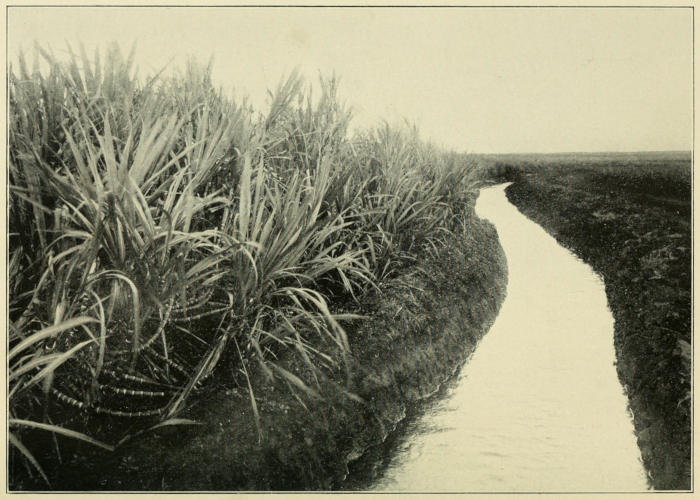
Growing cane should be watered every seven days, and the
amount of water used for this purpose is enormous. For example:
a plantation producing thirty-five thousand tons of sugar
per annum needs twice as much water per day as the city of
San Francisco.
The appearance of growing cane is much like that of Indian
corn. The whole field area is covered with a dense, jungle-like
vegetation of brilliant green. The leaves are long and narrow
and hang in graceful curves. The cane grows so thick that it
is almost impossible to crawl through it, and so seldom do the
sun’s rays penetrate to the ground that rapid evaporation of the
irrigation water cannot take place, hence the cane gets the full
benefit of the moisture.
In certain varieties of cane, the great weight of the juice
in the stalks causes them to bend, droop and take fantastic
shapes. Sometimes they lie on the ground with the ends turned
upward, and in fields where the stalks grow to a length of twenty-four
feet, the average height of the tops above the ground is
not over twelve feet. In other kinds the stalks stand straight up
to a height of from eight to fourteen feet.
The production of cane per acre varies in different countries
and in different parts of the same country, according to the
character of the soil, climatic conditions, care and attention,
use of fertilizer and amount of rainfall or irrigation. In Hawaii
it ranges from twenty to eighty-five tons, and the amount of
sugar obtained per acre runs from two and one-half tons to
twelve tons, the average being about five tons.
Broadly speaking, lack of a normal amount of cane per acre,
lack of sugar in the cane, or the prevalence of disease, is primarily
due to an unsanitary or unsuitable condition of the soil.
This can usually be corrected by proper cultural methods, such
as adequate aeration of the soil, the turning under of the cane
tops and leaves, application of lime and suitable combinations
of fertilizing ingredients. Fundamentally, cane requires a well-aerated,
moist, alkaline soil and a fertilizer in which the nitrogen
content is high and in excess of the potash and phosphoric
acid. It is found that nitrate of soda, when applied alone or in
combination with potash and phosphoric acid, produces a very
strong growth. The proper sanitation of the soil tends to promote
the beneficial bacterial action so essential to the growth
of the cane.
IRRIGATION DITCH—SHOWING TUNNEL
IRRIGATION DITCH
In December and January the cane tassels or flowers, which
indicates that it has about reached maturity and is ready for
cutting. Thenceforward very little irrigating is done, as additional
water applied at this time might retard ripening, which
would mean a reduced amount of sugar stored up in the cane.
It is interesting to note that while the cane is growing and in
an unripe state, there is no discernible sucrose or pure sugar in
it. As the ripening process goes on, the content of the cane juice
is changed by the action of the sun’s rays, and the amount of
sucrose as determined by polariscopic test shows when the time
for harvesting is at hand. Nature’s operation in thus changing
glucose or invert sugar into sucrose or pure sugar cannot be
accomplished by any human means.
The harvesting then begins and continues until the end of
July or August. Usually the field is set on fire before cutting.
On account of the great amount of moisture or juice in the
cane, the stalks do not burn, but the leaves are thoroughly consumed.
This operation eliminates a good deal of leaf material
that is not only useless, but which, if sent to the mill, would increase
the cost of crushing, besides absorbing a certain quantity
of the juice expressed from the cane.
Formerly men stripped the leaves from the cane in the fields,
but it was a difficult matter to accomplish such work, and the
cost was heavy. An accident changed the method of doing this
work. A field took fire and it was found that while all the leaves
were consumed, little or no damage was done to the stalks provided
they were cut promptly and sent to the mill to be crushed.
The practice of burning has since become general, although the
advisability of continuing it is now being given very careful
study.
Burning eliminates the arduous labor of stripping, and no
doubt does away with many harmful insects and fungi, but at
the same time it destroys the enemies and parasites of these insects
and this loss is severely felt. Another disadvantage of
burning is that the nitrogen contained in the cane leaves is liberated
and not returned to the soil as would be the case if the
leaves were stripped and ploughed under. In the latter case the
leaves rot rapidly, add humus to the soil, help aeration, and improve
the sanitary condition, all of which tends to increase the
yield of cane per acre. From recent experience it is not improbable
that burning will be discontinued in the near future.
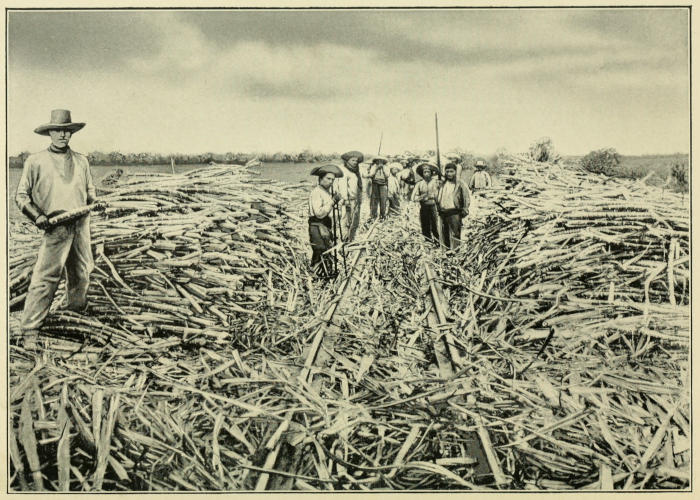
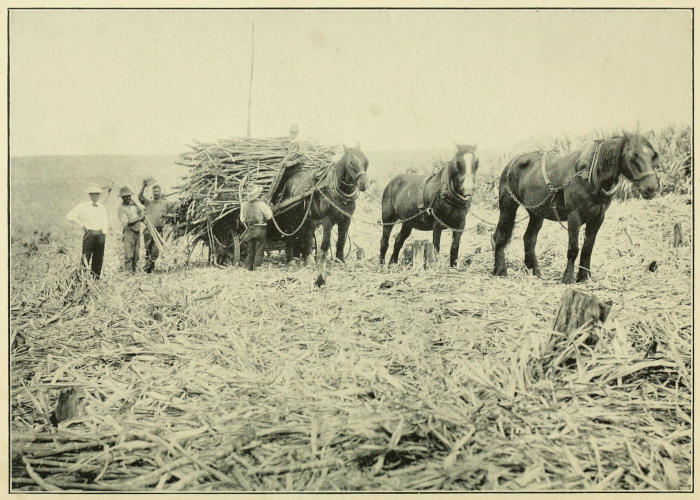
As soon as the field is ready, whether burned or not, the laborers
go in to cut the cane. A long, heavy knife is used. The
cutter grasps the stalk and drives the knife into it, severing it
just at the ground. He then tops it, that is, he cuts off the upper
part that contains no sugar, and, to aid in subsequent handling,
the long stalks are cut into convenient lengths.
As the burning destroys the eyes or buds, certain fields are
cut and topped for seed before the burning takes place.
There are two general methods of transporting the cane to
the mills. One is by rail and the other by flumes. On the irrigated
plantations where water is never overplentiful, railroad
tracks and locomotives are invariably employed, while on the
non-irrigated plantations, located in districts where there are
copious annual rains, V-shaped flumes are extensively used. In
some cases a combination of both systems is adopted to advantage.
From the upper lands where it is difficult to construct
railroads, the cane is flumed to a convenient point on the railroad
system, at a lower elevation, and delivered into cars, while
the water is conducted into ditches and used for irrigating the
lower cane lands.
YOUNG SUGAR CANE
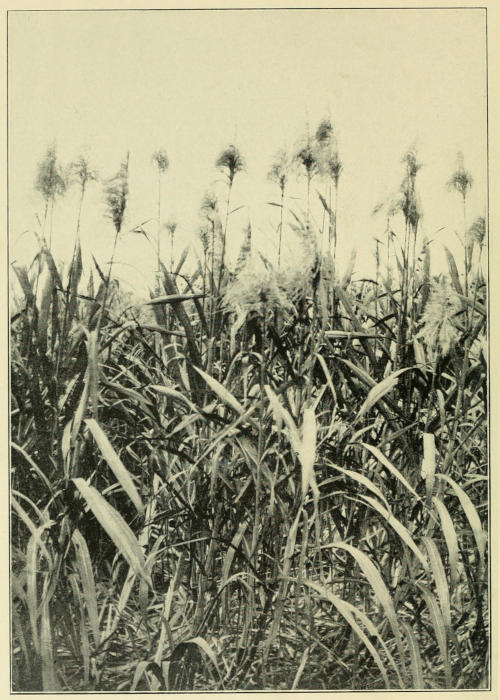
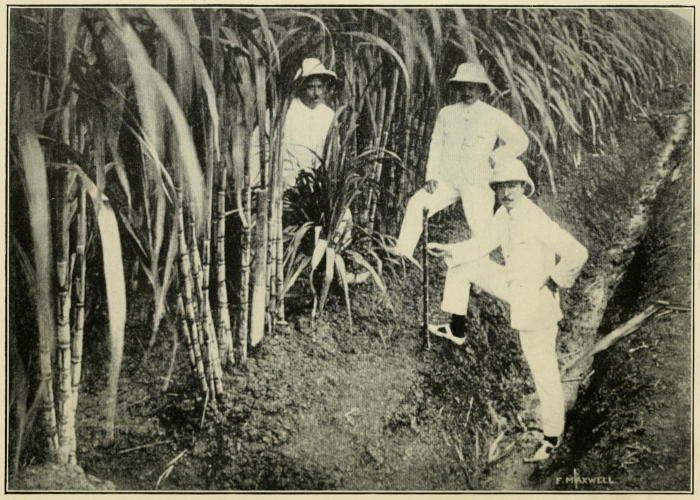
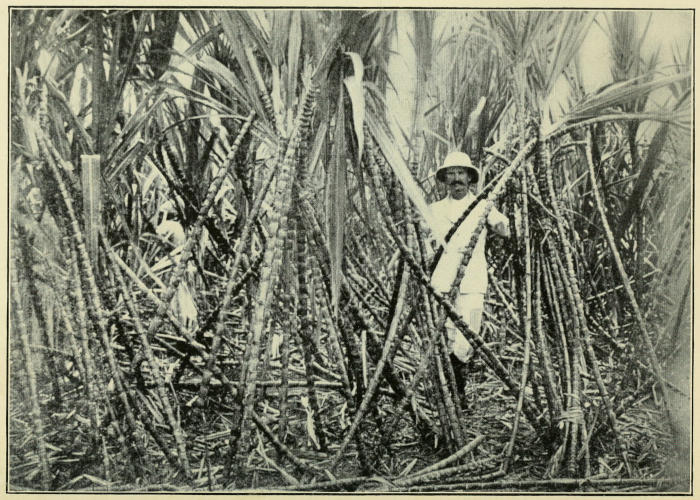
RIPE SUGAR CANE—SHOWING TASSELS
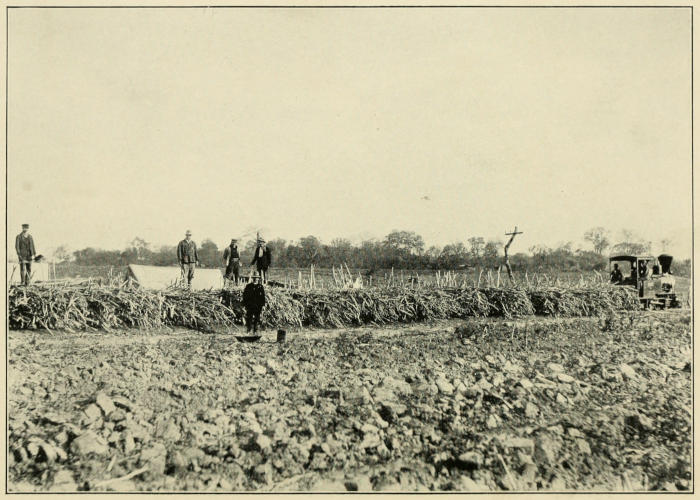
In the case of rail transportation, paths one hundred and fifty
feet apart are cut through the fields so that temporary railroad
tracks may be laid and cars run in and loaded on these tracks.
The whole field is then cut in the same way and the work continued
until the entire crop is harvested.
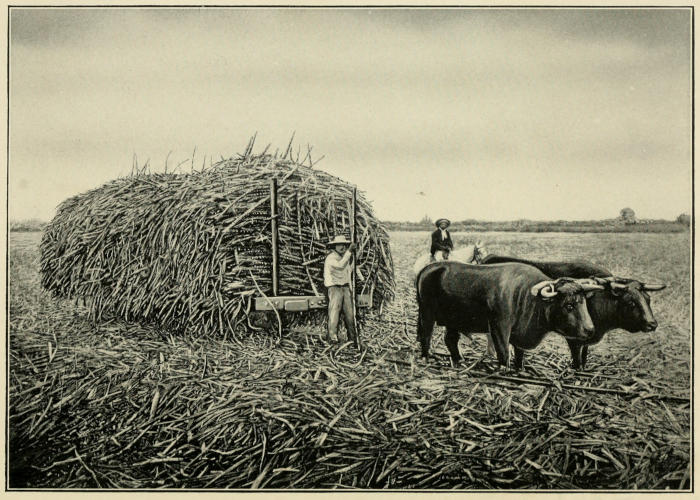
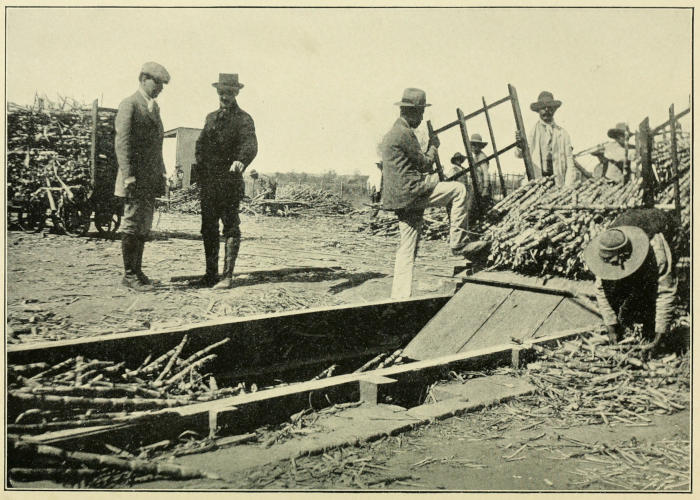
The loaders follow up the cutters. These men lay a strap on
the ground and pile the stalks on the strap until they have a
bundle of cane weighing from seventy-five to one hundred
pounds. With a dexterity born of long practice, they sling a
bundle upon their shoulders and carry it up an inclined runway
to a railroad car not over seventy-five feet away and dump it on
the car. The cutting and loading are usually done by contract,
at so much per ton, and it is remarkable how proficient the men
become.
When flumes are used exclusively, much the same methods
are adopted. Paths are cut through the fields and in these paths
are placed the flumes which, like the temporary railroad tracks,
are moved from time to time as necessity demands. The mill is
located at the lowest point on the plantation and the flumes are
placed so as to insure a good grade from the cane fields on the
uplands to the mill below. The flumes are either carried on low
trestles or run along the ground, but always at a height which
enables the laborers to throw the cane into them conveniently.
Water is turned into the upper end of the flume and, rushing
rapidly down, carries or floats the cane to the mill. Cane is
flumed in this way for distances up to seven miles at low cost
and with satisfactory results.
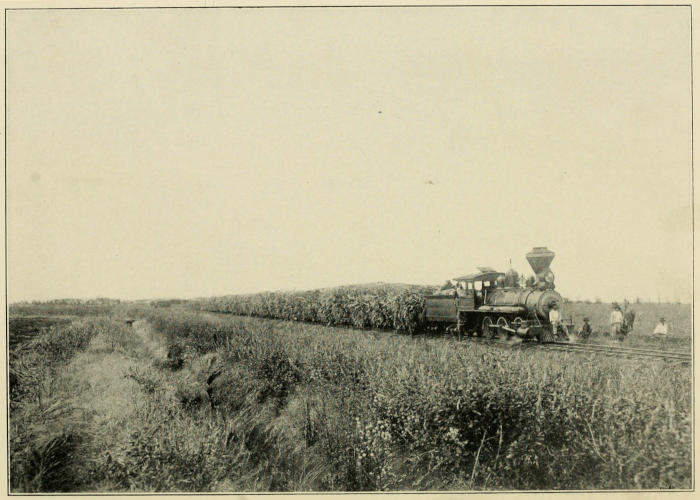
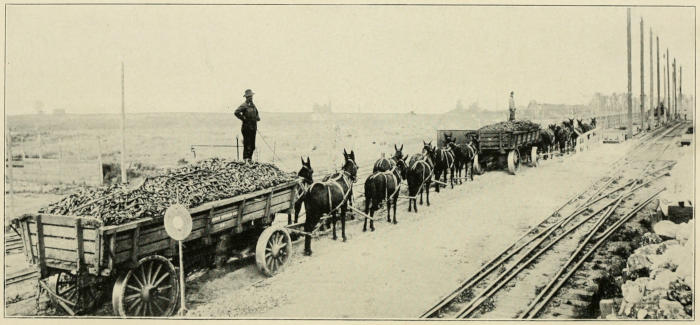
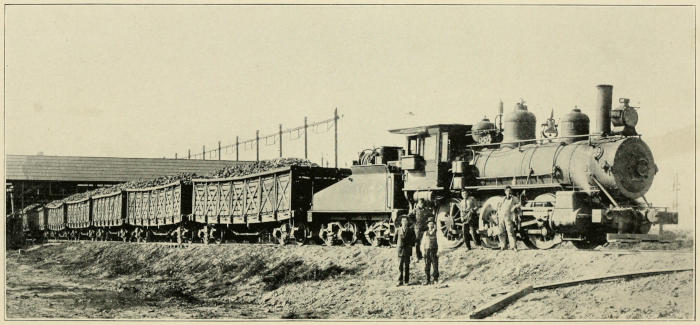
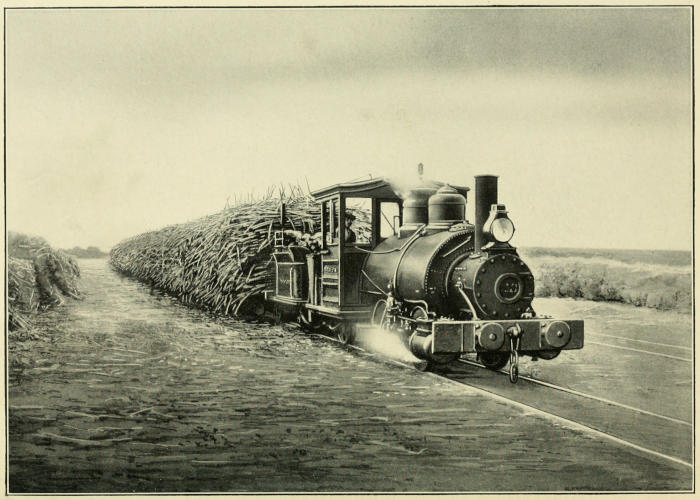
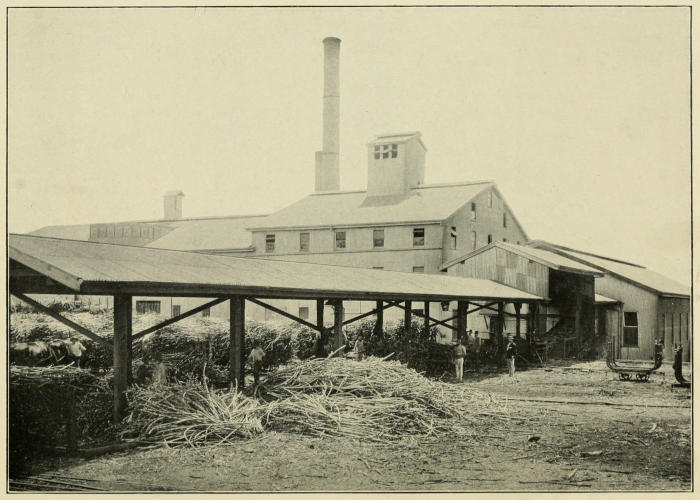
The cars when loaded in the fields are made up into trains
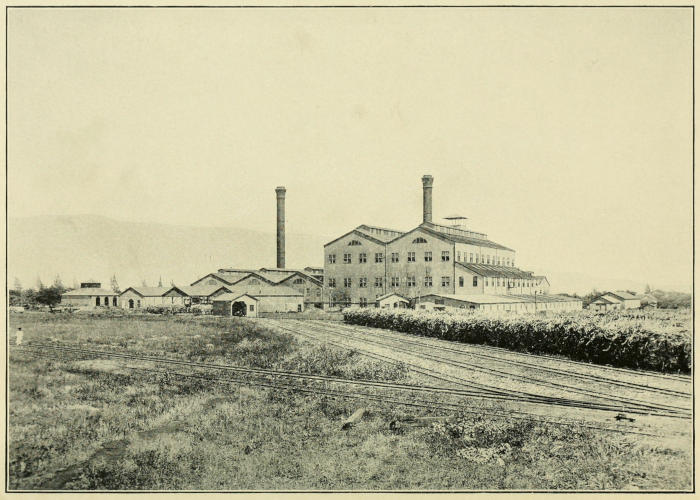
and hauled by locomotives to the mill, which is generally located
about the center of the plantation, or at a point where
most of the cane can be delivered on a downward grade. Each
car is carefully weighed on a track scale and the exact quantity
of its load of cane is ascertained and recorded.
For years past the planters have been offering large rewards
for the invention of a machine to cut and load the cane, but the
old hand method is still employed, although some experimental
loading machines are meeting with more or less success, but
none are in common use.
The problems involved in cutting cane by machinery seem
insurmountable, and, while many devices have been tried, not
one has proved successful.
After the cane is cut the first time, ploughs are sent through
the fields and a furrow is ploughed along each side of the stubs
of the cane which are left in place. This ploughing opens up the
ground, aerates the soil, and affords the irrigating or rain water
a means of easy access to the cane roots. The water tenders follow
up the ploughs and the furrows are filled with water, which
is gradually absorbed by the old cane roots left in the ground.
In time new sprouts spring up from buds on the old stalks of
the cane and another growth begins. The second crop is called
“first ratoons” and, when cultivated for a single year only, it is
designated “short ratoons.” As a rule it does not yield as much
sugar as plant cane, but the saving in seed, in the preparation
of the fields and in other labor frequently makes up for the reduced
amount of sugar. If allowed to grow for two years, as is
generally the case, it is called “long ratoons” and produces proportionately
more sugar. In the past a very large percentage of
the Hawaiian crop was planted with fresh seed every year and
but a small percentage ratooned. Nowadays, however, the tendency
is to ratoon the crop as long as the yield justifies, which
in many cases is from three to four times. In Cuba the cane
when once planted is ratooned for many years.
There have been specific instances in Hawaii where ratoons
that have been allowed to grow for two years (long ratoons)
have shown a better yield than the first planting. According to
the best information, this is due to the presence of poisonous
matter in the ground, turned up for the first time at the first
planting.
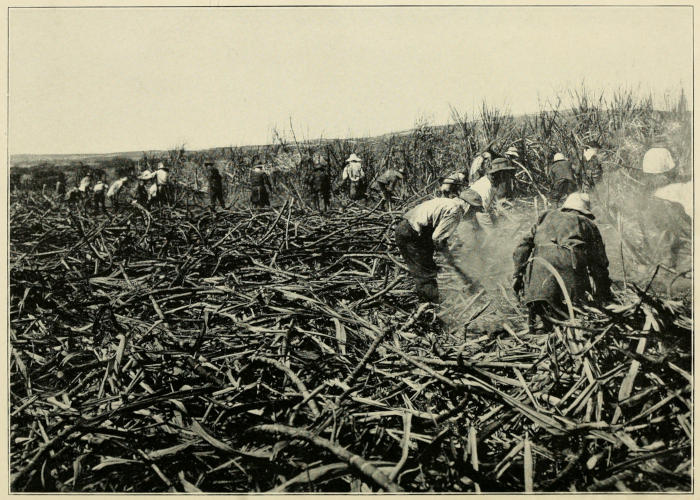
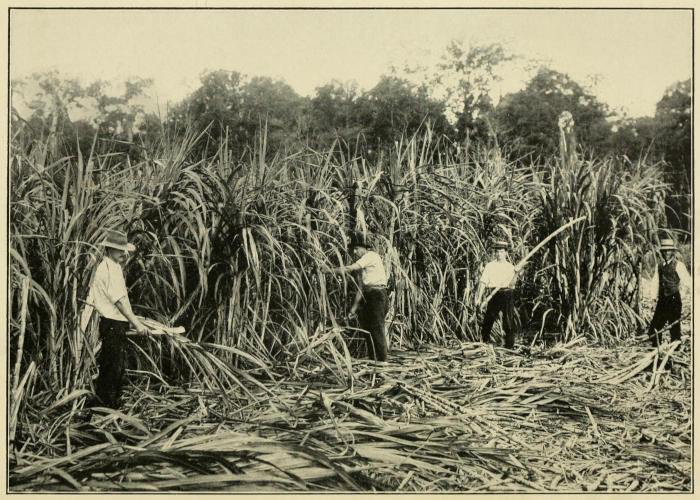
CUTTING CANE
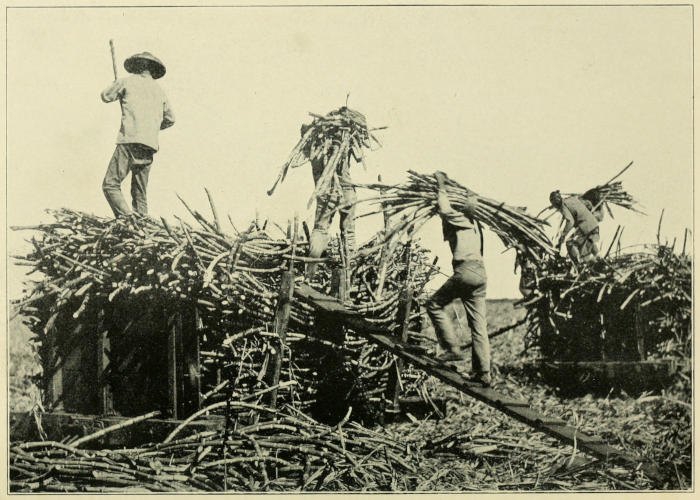
LOADING CANE
The object of all the ploughing, weeding, cultivating, fertilizing
and irrigating, is to produce a large number of strong, sturdy
stalks of cane, yielding a maximum amount of sugar. The
sugar is contained in solution in the sap or juice and the amount
can be materially increased by due care and attention.
As some of the elements which form the plant are absorbed
from the air through the leaves, favorable climatic conditions
are essential to its full growth and development. Proper fertilizers
must be added to the soil, and water applied regularly and
in sufficient quantity.
Commercial fertilizers are used in Hawaii probably to a
greater extent than in any other country in the world. It is
quite common for plantations to use half a ton of fertilizer per
acre per crop, and at times as much as two thousand pounds
per acre. The yearly fertilizer cost per acre will probably average
twenty-five dollars.
As it takes eighteen months for a crop to mature in Hawaii,
it will readily be seen that the plantation area must be at least
double that used for any one crop. While one crop is being harvested,
another crop is in the ground growing. As soon as the
cane is cut, the lands are immediately prepared for replanting
or ratooning, as the case may be. During certain periods each
year, usually in June and July, a visitor on an Hawaiian plantation
can see one crop growing, one being harvested and one
being planted.
From the foregoing it will be seen that the harvesting begins
in December and ends in July or August. The planting begins
from March to June and usually ends in September, according
to plantation conditions and whether or not the land is irrigated.
THE MANUFACTURE OF RAW SUGAR — EXTRACTION — PURIFICATION — EVAPORATION — CONCENTRATION AND CRYSTALLIZATION — PREPARATION OF CRYSTALS FOR THE MARKET
The details of the manufacture of raw sugar from cane
and of sugar from beet roots differ, but there are several
processes common to both. The operations necessary
for making raw cane sugar are as follows:
1. The extraction of the juice.
2. The purification of the juice.
3. The evaporation of the juice to syrup point.
4. The concentration and crystallization of the syrup.
5. The preparation of the crystals or grains for the market by separating them from the molasses.
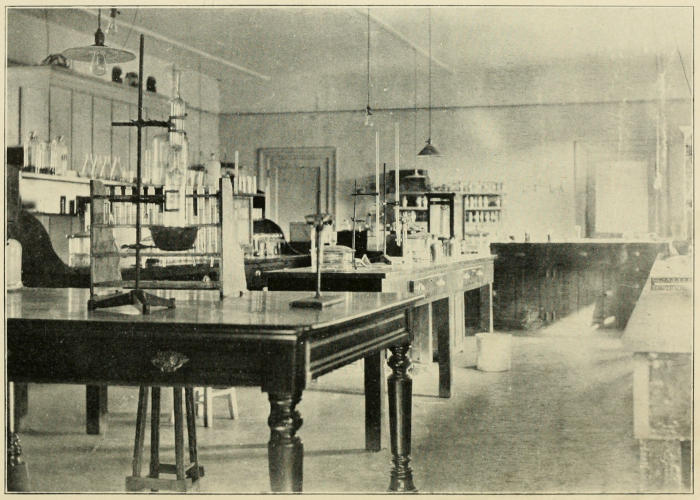
Every mill has an extensive laboratory where skilled chemists
are constantly engaged in sampling and analyzing cane,
raw juices, syrups, sugars and molasses. In fact the chemical
work is a most important feature in the raw-sugar house, beet-sugar
factory or refinery. The superintendent should be an expert
chemist, as the proper recovery of the sugar from the cane
and beet juices is wholly dependent upon the technical control
of manufacturing processes.
After passing the scales, the cars containing the cane are
switched alongside the carrier which feeds the cane into the
mills. Before the cane is unloaded, however, samples are taken
from each car and sent to the laboratory, where they are carefully
analyzed. The amount of sugar present is ascertained, as
well as the quantity and quality of the juice in the cane. It is,
however, impossible to get a fair average sample of the cane in
this way, and therefore the efficiency of the mill work is determined
on the basis of an analysis of the juice and the fiber after
it has passed through the crushers.
TRAIN-LOAD OF CANE READY FOR THE MILL
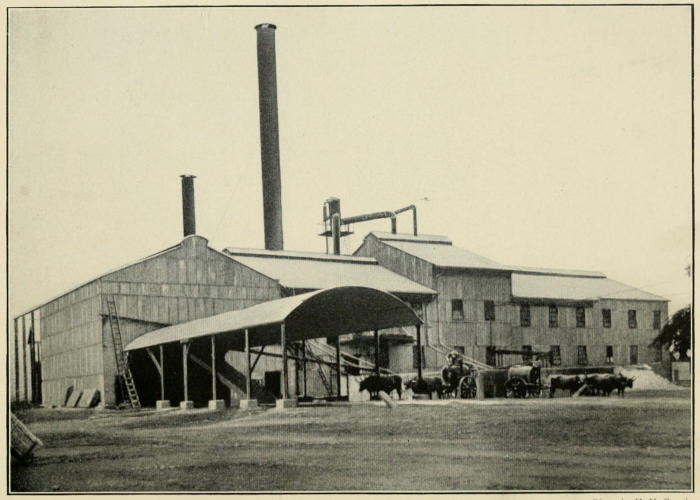
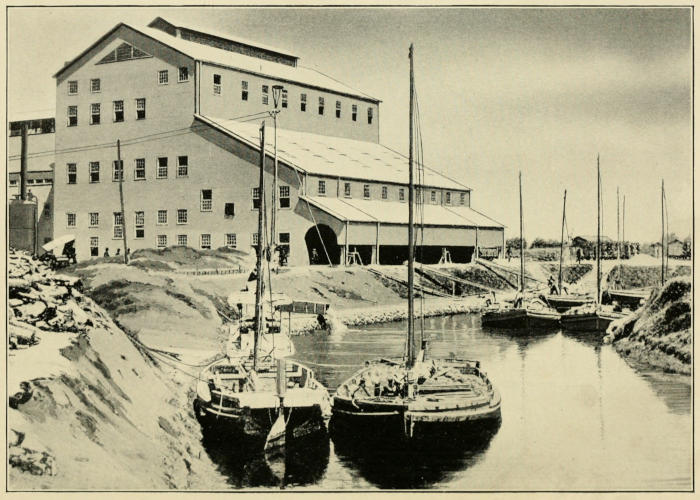
A MODERN MILL
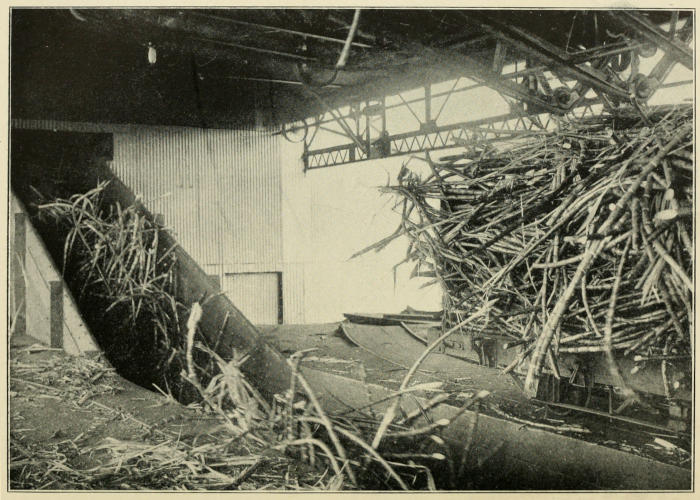
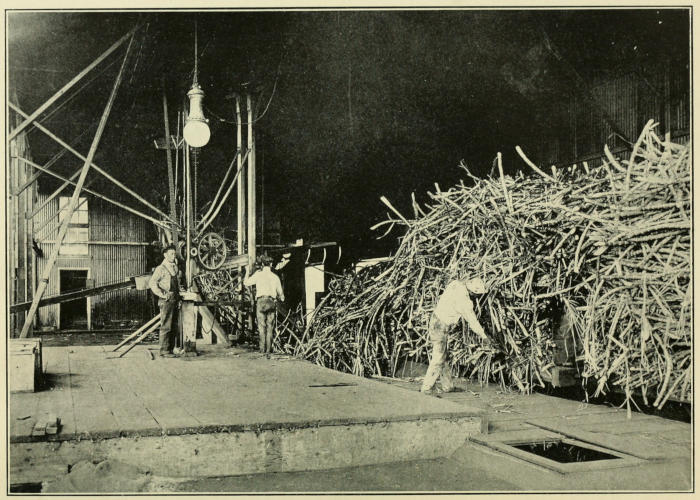
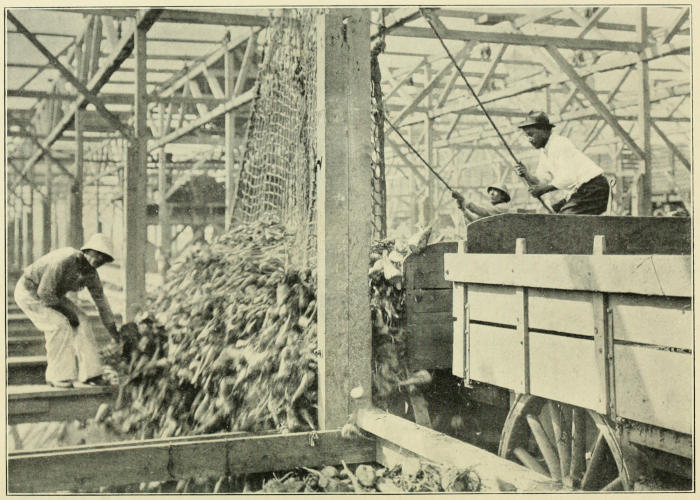
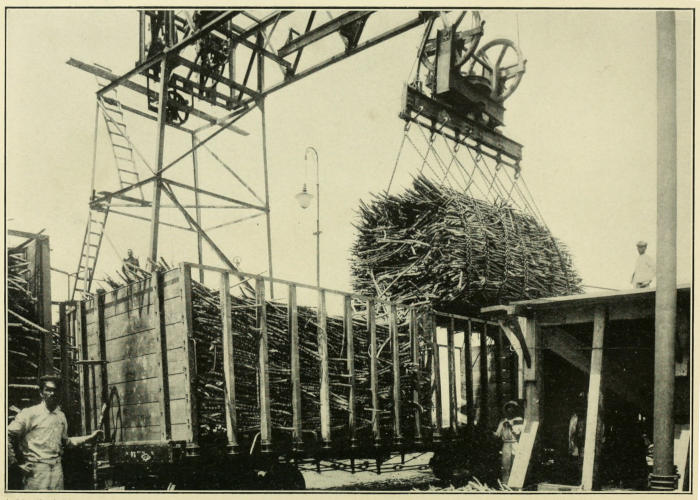
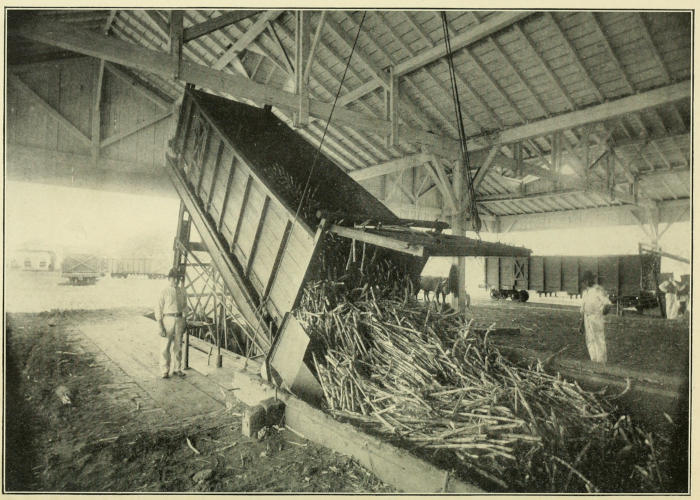
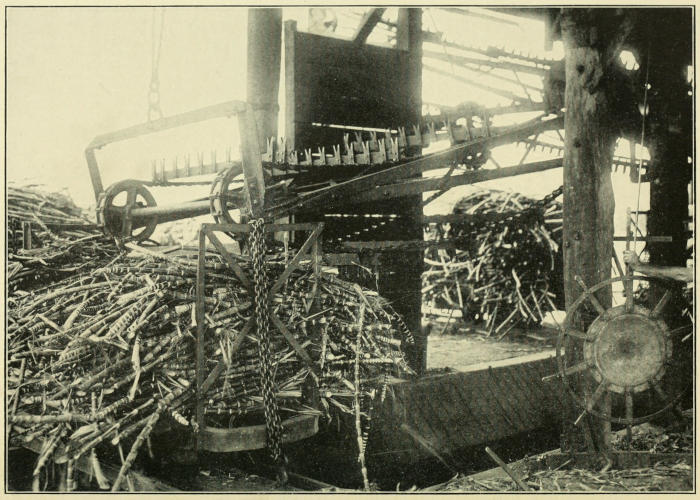
The carrier just referred to is a wide slat conveyor, running
alongside the railroad tracks in the yards to a point directly
over the first set of crushers. The cane is taken from the cars by
a mechanical unloader, the arms of which reach out and with
distended fingers pull the cane stalks off and land them on the
slow-moving carrier, which takes them onward and upward to
the crusher.
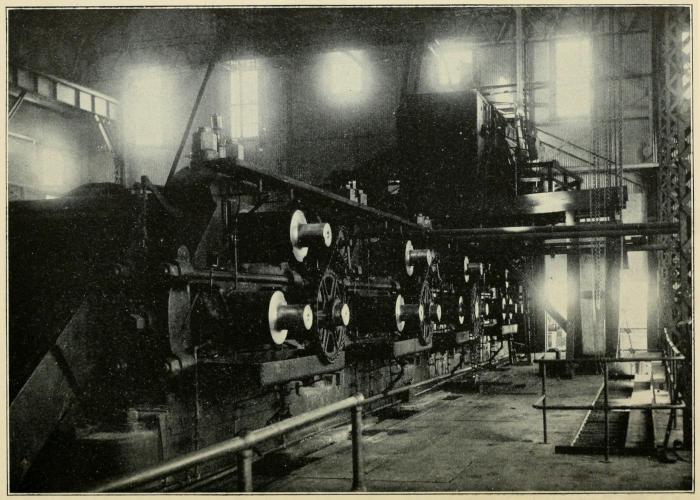
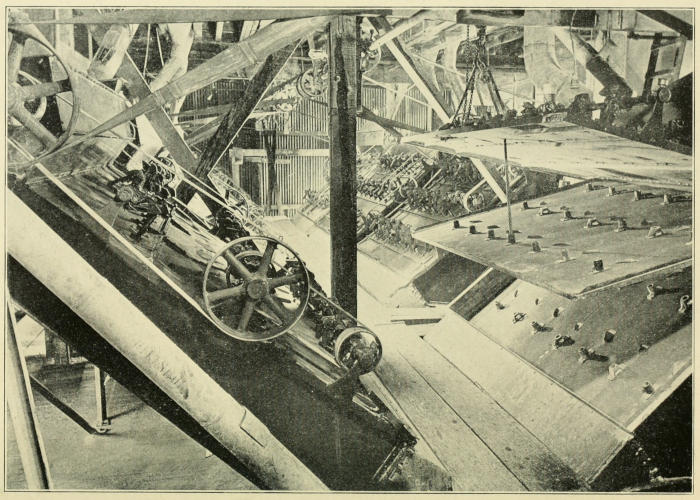
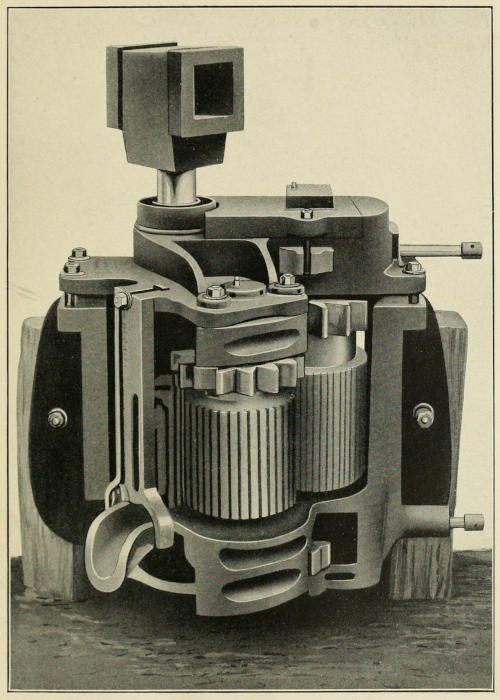
The crusher consists of two large rolls, with immense interlocking,
corrugated teeth on the circumference of each. These
rolls are set close together, and the cane passing through is
broken into short pieces and matted to an even layer. The juice
squeezed out by this preliminary crushing runs through a
metal trough into a large receptacle known as the juice tank.
From the crusher the mat of cane passes to the mills proper.
These mills consist of from nine to eighteen rolls, about thirty-four
inches in diameter and seventy-eight inches long, arranged
in groups of three, set in the form of an isosceles triangle, one
above and two below, one set following the other in a direct
line. The lower rolls are parted enough to allow the expressed
juice to fall through them, while the half-crushed cane is carried
over by means of an iron bar called the returner. The faces
of the rolls are more or less roughened, or grooved, so as to
draw the cane through and give a better crushing action. They
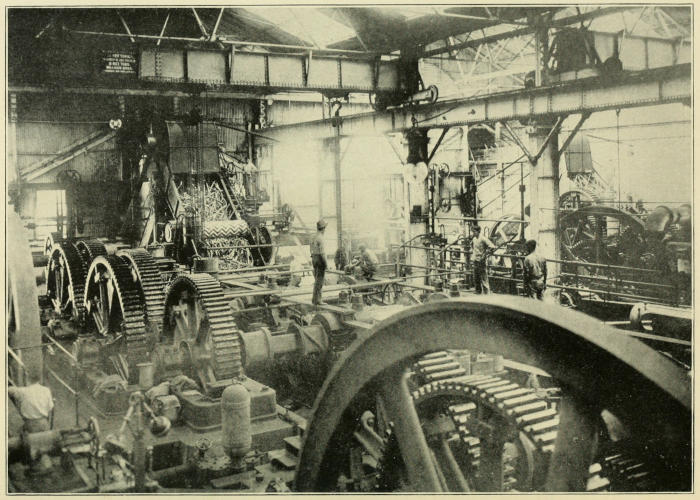
are turned slowly by powerful engines, which transmit the
power to each set of rolls through a system of gears. The rolls
are forced together by hydraulic rams exerting a pressure of
from four hundred to six hundred tons. It is this tremendous
pressure that squeezes the sugar-bearing juice out of the cane.
From the crusher the matted cane passes through the first set
of rolls, where a large percentage of the remaining juice is liberated.
This is caught in a metal trough and, after passing over
a fine screen to remove the small pieces of cane, runs to the
juice tank. The cane passes through the second set of rolls,
thence to the third set, and so on to the end of the mill. In front
of the last set of rolls, hot water is sprayed on the cane to soften
the fiber and dilute the remaining juice, thus aiding the
final extraction. The adding of hot water is termed maceration.
By the time the cane has passed through the last set of rolls, all
the economically recoverable juice is out of it and delivered into
the juice tank, with the exception of the juice and maceration
water from the last set of rolls, which is always returned to the
preceding set of rolls for maceration purposes. The juice or maceration
water coming from the last set of rolls contains very
little sugar, and the object is to secure greater concentration by
using it for double maceration instead of adding that much additional
water which would have to be evaporated later on in
the process.
In well-designed, modern mills, with cane carrying not over
twelve per cent of fiber, more than ninety-eight per cent of the
sugar in the cane is extracted, the remainder being left in the
fiber. This is almost perfection today. What it will be tomorrow
no one can say.
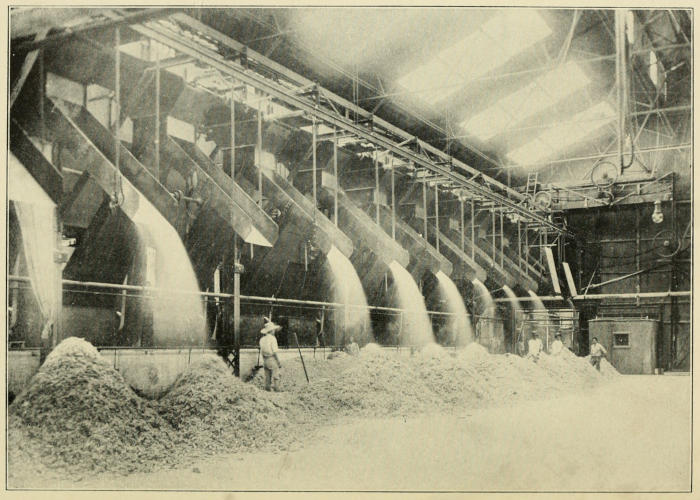
The fibrous, woody part of the cane, or bagasse as it is
called, is comparatively dry as it leaves the last rolls. It is conveyed
from the mills to the boiler house on a wide slat conveyor,
and fed directly into the furnaces under the boilers that generate
the steam for power and boiling purposes. A modern raw-sugar
mill requires practically no other fuel than that obtained
as a by-product from the crushing of the cane.
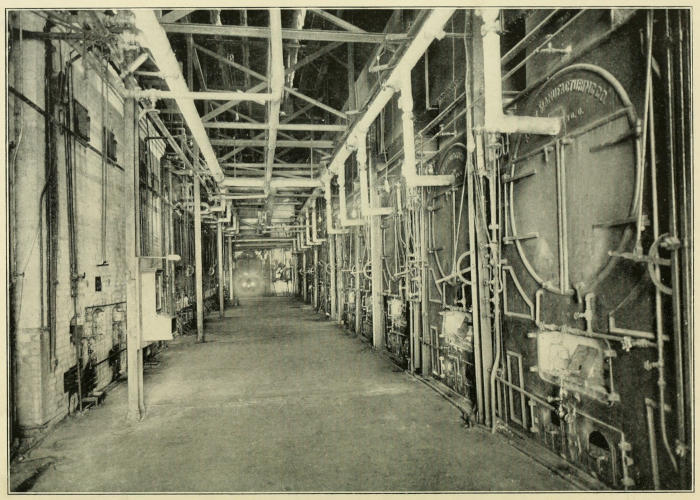
The boiler plant is usually of large capacity, as a great deal
of steam is required to drive the engines that run the crusher,
the rolls, the electric lighting system, the pumps and other machinery.
Besides, a large amount is needed to evaporate the water
in the juice and to boil and dry the sugar. The ashes from
the furnaces are returned to the fields as fertilizer, so that very
little is lost.
CANE CARRIER AND MECHANICAL UNLOADER
ANOTHER TYPE OF CANE UNLOADER
The juice as it comes from the mills contains impurities such
as dirt from the fields, small pieces of cane stalks and other foreign
matter, besides salts, gum, wax and albumen. It is necessary
to remove as many of these substances as possible, and
this is where the chemist’s work begins.
So long as the juice is confined in the living cells of the cane
it does not quickly ferment, but when liberated it rapidly undergoes
such change. Therefore no time is lost in arresting this
action. The juice is pumped to the top floor of the mill and there
a solution of milk of lime is added in sufficient proportions to
neutralize the acidity. The mixture is then heated in closed
tanks under pressure to 215 degrees Fahrenheit. The heat
causes the lime to combine rapidly with the gums and salts in
the juice, and the albumen to coagulate.
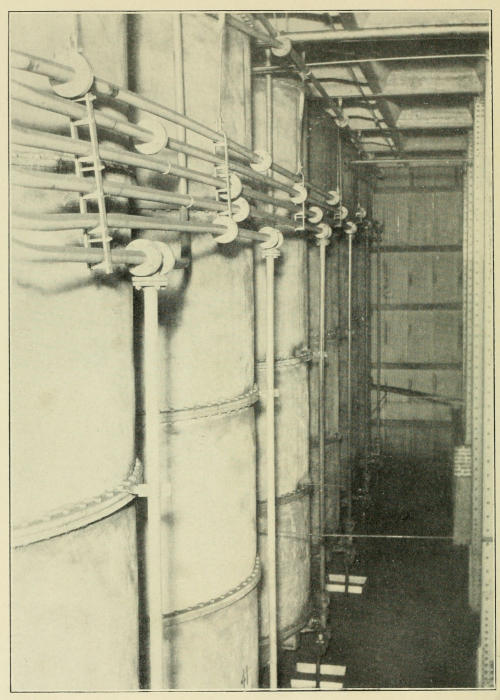
The hot juice is then run into large settling tanks, where the
insoluble solids and the albumen sink to the bottom, carrying
with them vegetable and other matter suspended in the juice.
Certain foreign substances of light specific gravity float to the
surface in the form of scum.
After settling for a time the clear juice is drawn off and the
scum, mud and cloudy liquor left in the tank. As a vast amount
of liquor must be handled every hour, it is not practicable to
have tank capacity great enough to admit of the liquor standing
a sufficient length of time for every particle of foreign matter
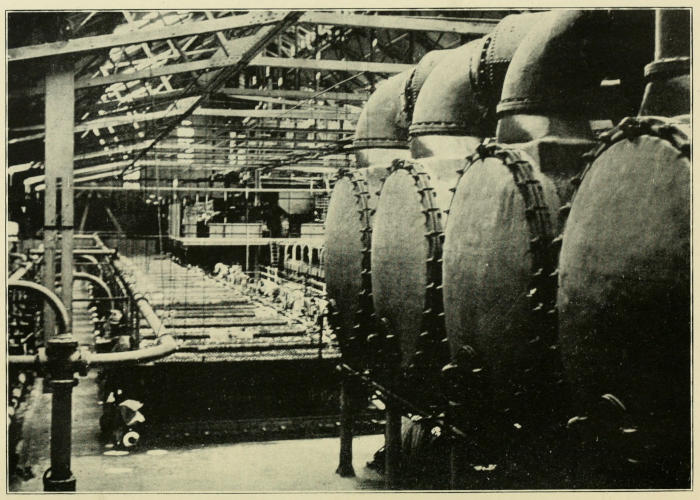
to settle, so as an adjunct to the settling tank, filters are
used. These are cylindrical iron tanks, packed tightly with ordinary
wood fiber, known as excelsior. The juice is conducted
to these filters, and as it percolates through the excelsior, practically
all of the remaining foreign matter is caught and retained
in the fiber. The clear juice is then run to the receiving
tanks for the evaporators and the mud and scum that remain
are drawn off into mud tanks, where more lime is added and
the mass stirred up. Finally it is delivered to the filter presses,
where the mud and other impurities are taken out and the clear
liquor containing sugar is sent to the evaporators.
Another method for cleaning, called “precipitation in motion,”
is to carefully lime the juice and then heat it in closed
vessels and under sufficient pressure to carry it through a pipe
to large insulated settling tanks.
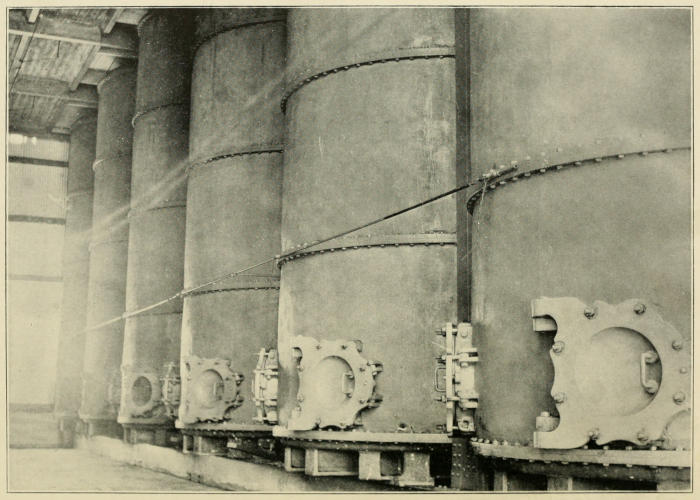
These settling tanks, usually of sheet steel, are made in the
form of truncated cones with conical bottoms, the small diameter
of the tank being at the top. Suspended in the center is a
vertical cylinder somewhat less in diameter than the upper part
of the tank. This cylinder extends downward about eight feet
to a point opposite the largest diameter, which makes the area
between the circumference of the suspended cylinder and the
tank at that point very much greater than the area of the cylinder
itself. This difference in area is necessary to retard the flow
of the juice and allow the sediment, mud and insoluble solids
to be deposited at the bottom of the tank.
The juice is delivered by a pipe into the top of the cylinder
which projects a few inches above the edge of the surrounding
settling tank. It passes slowly down the central passageway,
turns at the bottom, where its speed is materially slackened,
and goes out through a pipe line connected to the side of the
tank just below the upper edge.
There are several other methods in general use, but in all of
them the principle of settling, upon which the separation or
cleaning depends, is the difference in specific gravity between
the juice and the dirt. A high and even temperature should be
maintained by preventing radiation, as lowering the temperature
would increase the specific gravity and viscosity of the
juice without increasing that of the dirt in equal proportion.
TWELVE-ROLLER MILL
MODERN CRUSHING PLANT—TWO FIFTEEN-ROLLER MILLS AND
CRUSHERS. CAPACITY, ONE HUNDRED AND FIVE TONS PER HOUR
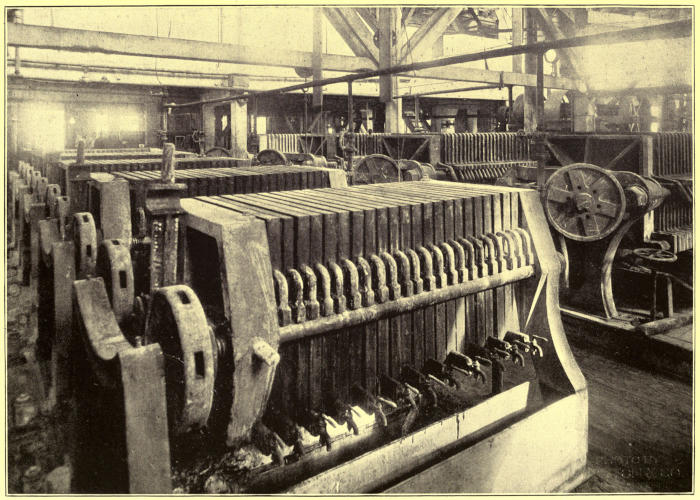
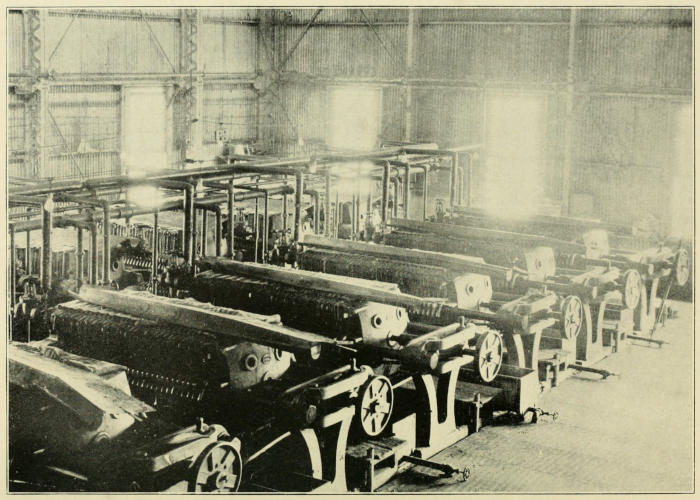
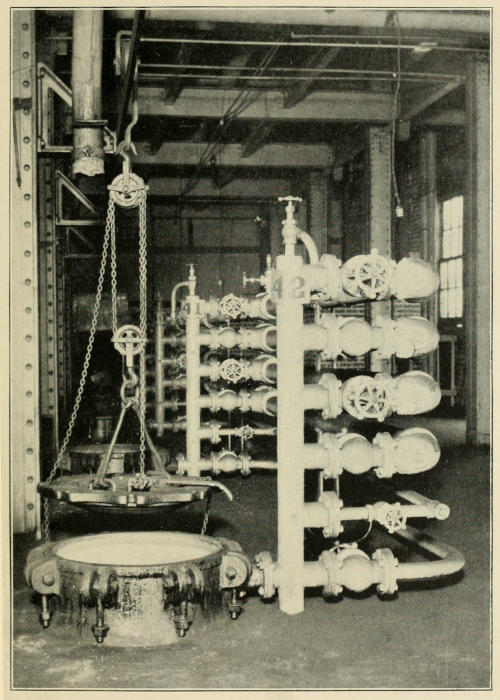
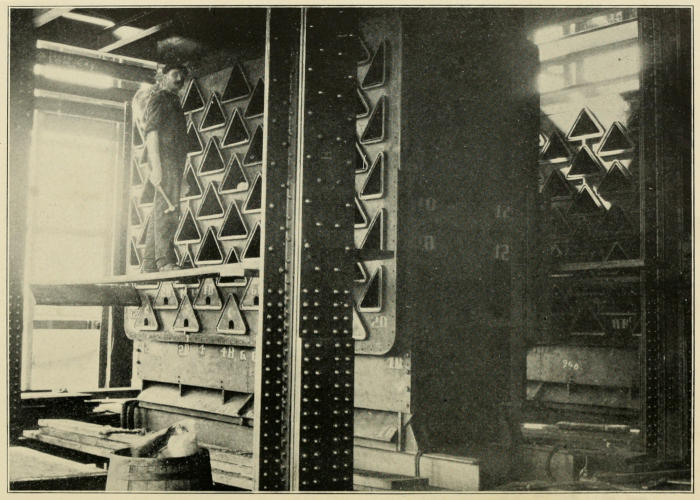
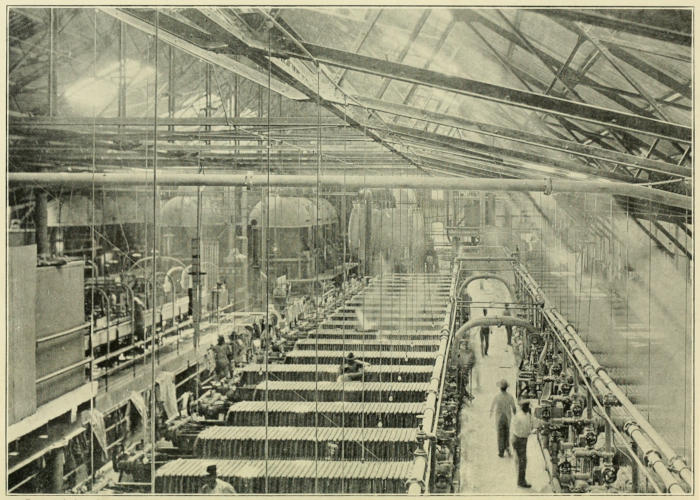
There are many different types of filter presses, but those at
present in general use are long, oblong machines, set horizontally
on the floors, with layers of corrugated iron plates, covered
with canvas sheets, between which are hollow frames so
arranged that the juice will pass from the hollow frames
through the canvas to the corrugations in the plates.
In passing through the presses under pressure the sediment,
scum and other impurities are caught on the canvas sheets and
the clear juice passes through the canvas, down the corrugations
and out through small holes in the plates controlled by
valves on the outside of the presses, from whence it runs to the
evaporator tanks. The sugar in the mud caught in the hollow
frames is washed out of the mud with water and is sent to the
evaporator, while the mud itself is finally returned to the field,
to be used as a fertilizer.
The clarified juice from the settling tanks, filters or presses,
is light brown in color, but is thin and watery, and must now be
reduced to syrup point. All the suspended impurities have been
removed, but some impurities in solution and the original coloring
matter still remain. Some of these foreign substances are
subsequently eliminated during the process of crystallization in
the vacuum pans described later on.
The object to be attained in a raw-sugar house is the production
of a sugar containing ninety-six per cent of sucrose, and
there is little or nothing to be gained by carrying the process of
manufacture beyond the stage that insures such result.
The final extraction of all the impurities and the conversion
of the impure raw into pure white granulated sugar is the work
of the refiner, which is dealt with in a subsequent chapter.
From the time the juice leaves the cane until it is crystallized
it is kept at a high temperature, as cold juices or syrups are viscous
and run slowly. High temperatures kill germs, prevent
fermentation and expedite manipulation.
Under ordinary atmospheric pressure at sea-level, water boils
at a temperature of 212 degrees Fahrenheit and sugar juice at
a few degrees higher, according to its density. This temperature
if long applied to sugar juice would tend to burn and destroy
the sugar, but the juice can be heated to 250 degrees for
a short time without deterioration.
The clarified juice contains about eighty-five per cent of water
and fifteen per cent of solid matter. A large proportion of
the water must be removed by evaporation. To accomplish this
under ordinary atmospheric conditions would require heat increasing
from 212 degrees Fahrenheit, as the solution increased
in specific gravity above the standard of pure water. This would
require a large amount of fuel, and the juice would also be more
or less adversely affected by long maintenance of comparatively
high temperature.
To obviate these conditions the juice is boiled in a multiple
evaporator, the invention of Norberto Rillieux, whose first construction
in New Orleans in 1840 was a double effect horizontal
submerged tube apparatus which has since undergone many
changes and improvements. The theory of evaporation in vacuo
was extended to two or more cells or vacuum bodies, using the
steam or vapor from the first to heat the juice or syrup in the
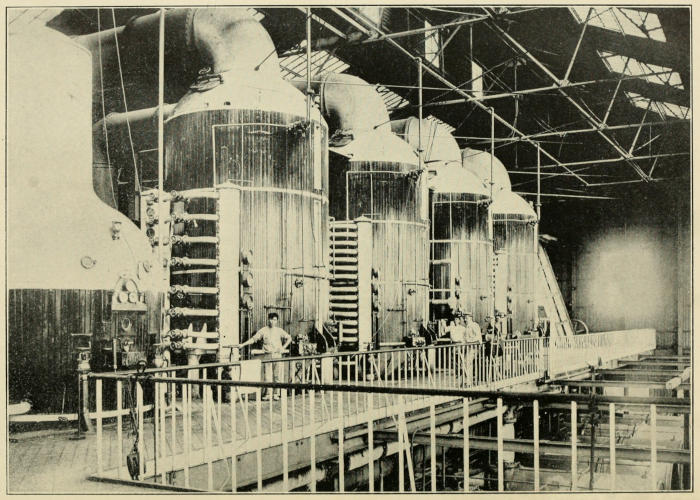
second and so on. At the present time the quadruple effect,
or four-cell evaporator, is most commonly in use, although
sextuple effects are not rare. The ordinary practice is as follows:
The juice enters cell No. 1 and covers the heating tubes, to
which is admitted sufficient steam—generally exhaust from the
engines—to cause the liquid to boil. The steam or vapor liberated
from this first boiling is conducted through the vapor pipe
directly into the heating tubes of cell No. 2, while the juice from
cell No. 1 is passed into the second, or cell No. 2, and surrounds
the heating surfaces which contain the hot vapor given off from
the same juice in cell No. 1.
DELIVERING BAGASSE TO FIRE-ROOM
GENERAL INTERIOR VIEW OF MODERN RAW-SUGAR MILL
As there is little or no pressure above the liquid in the first
cell, the juice boils at from 215 degrees to 220 degrees Fahrenheit.
By maintaining a vacuum of five inches in the second
cell, the temperature at which the liquid will boil is reduced to
203 degrees, and the vapor from cell No. 1 is hot enough to boil
the juice in cell No. 2 without any addition of heat. The vapor
from cell No. 2 in the same way enters the heating tubes of cell
No. 3, while the juice entering this cell is exposed to a vacuum
of fifteen inches, which reduces the boiling temperature to 180
degrees, so that the difference of 23 degrees between the conditions
of cell No. 2 and cell No. 3 causes a third boiling and evaporation
without any additional steam being added.
A vacuum of twenty-six inches in the last cell, No. 4, brings
the final boiling temperature down to about 150 degrees. The
vapor from this last cell enters a condenser, where it is exposed
to a spray of cold water, is condensed and passes down a pipe
not less than thirty-four feet long, terminating in a water seal,
and called the Torricellian tube, after Torricelli, who discovered
that mercury would rise thirty inches in a tube while water
would rise thirty-four feet with a perfect vacuum.
The juice in passing through these evaporating cells is boiled
to a syrup containing about thirty-five per cent of water and
sixty-five per cent of solid matter. It is pumped out of the fourth
cell into the receiving tank for the vacuum pan.
This quadruple system of boiling only requires about one-fourth
the amount of heat that would be necessary to do the
same work in a single vessel. As the evaporators operate continuously,
a constant level of the boiling liquid is maintained in
each cell, the juice being drawn from one to the other by increasing
vacuum and controlled or regulated by means of
valves.
A powerful vacuum pump draws the air and other incondensable
gases from the condenser and maintains the vacuum,
which is applied to the necessary extent in each cell. The heating
tubes are connected to drain pipes, which remove the condensed
vapors.
Vacuum, simply and concisely stated, is the absence of air
or gas. It is usually obtained by pumps which suck the air or
gas out of closed containers or pipes. No doubt many of the
readers in their younger days have sucked on the end of a bottle
and were amused to find the bottle hanging on the end of the
tongue. It was the vacuum, or lack of air in the bottle, which
caused it to hang thus. The outside atmospheric pressure
(which at sea-level is fifteen pounds per square inch) was doing
its best to gain an entrance through the tongue into the bottle
from which the air had been extracted.
The pumps simply suck the air out of the containers or pipes
and discharge it through valves, in much the same way that
the air was sucked out of the bottle. It must be remembered,
however, that in boiling water or juice, the vacuum is being
continually broken or reduced by the liberation of air and
gases from the juice, steam and condensing water. This action
must be overcome by the constant work of the vacuum pump.
To determine the amount of vacuum carried in any container,
a small mechanical contrivance, known as a vacuum gauge,
is used. This, in its simplest form, is a bowl of mercury with a
long glass tube leading from it. If the upper end of the glass
tube is attached to the container from which the air is to be
drawn, the mercury in the tube will rise in proportion to the
amount of air extracted. When an absolute vacuum has been
formed, the mercury in the glass will stand at a height of thirty
inches.
FILTER PRESSES
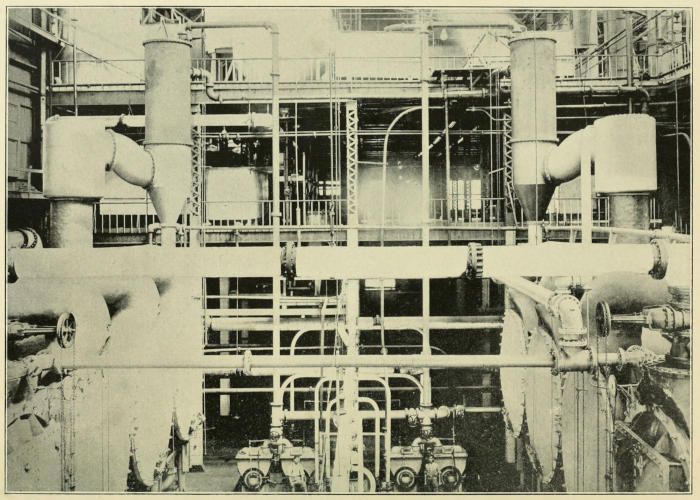
SET OF QUADRUPLE EVAPORATORS
In commercial operations a vacuum greater than twenty-eight
inches is seldom required, as this is sufficient for all practical
purposes. The degree of vacuum for any container can be
varied easily by mechanical manipulation, so that a vacuum
anywhere from one to twenty-eight inches may be maintained.
From the receiving tanks the syrup is drawn into the pans by a
vacuum ranging between twenty-five and twenty-seven inches.
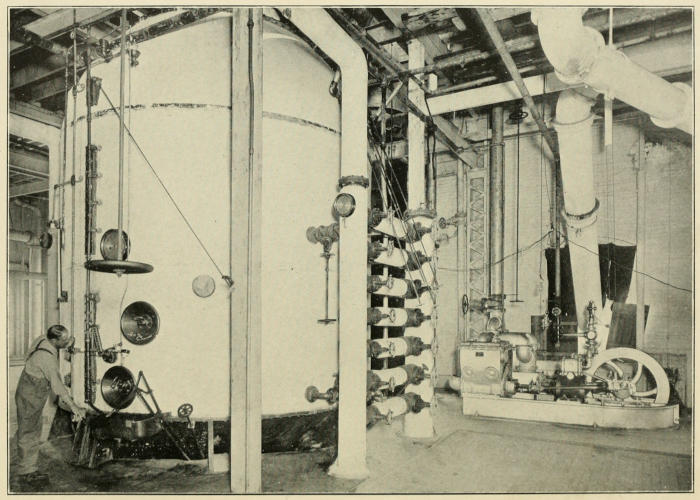
The pans are large cast-iron or copper cylinders, standing in a
vertical position, with dome-like tops and conical bottoms,
almost spherical in shape. Leading from the top is a large pipe
through which the vapors from the boiling are drawn off and
condensed. On the conical bottom is a large valve, which may
be opened when the boiling is finished to allow the massecuite
(a French term meaning cooked mass) to drop out.
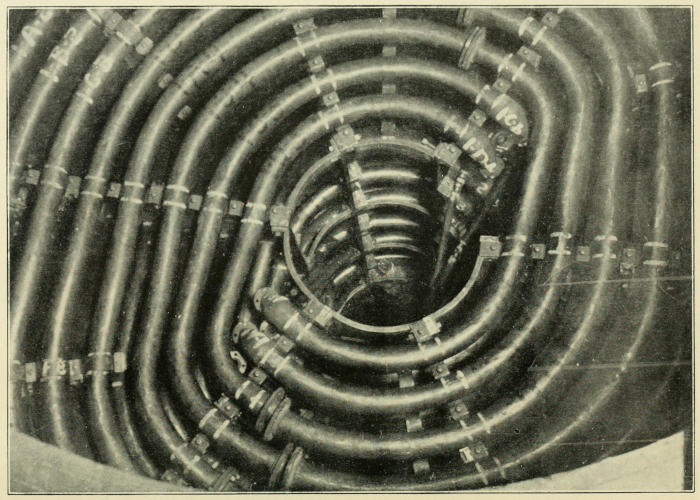
At regular intervals in the height of the pan there is a series
of copper coils, connected with a steam line at one end and a
drain line at the other.
The general principle involved in boiling sugar is the separation
of the sucrose contained in a solution from the impurities
present in that solution, and this is accomplished by evaporation
and concentration through the agency of heat. After the
sugar is once formed in definite crystals these crystals attract
and appropriate the sucrose in solution in the process of building
up the crystal structure, while repelling or excluding the
impurities, so that, as a consequence, the latter remain in solution.
The crystals thus formed are subsequently removed from
the solution by means of centrifugal machines. Crystallization,
whether in a pure or impure solution, will proceed to only a certain
extent, and will only partially remove the sucrose from the
solution in one boiling, the limit of crystallization being governed
by the amount and nature of impurities present.
The process of boiling is begun by drawing some of the concentrated
juice into the pan and turning steam into the coils,
which starts the boiling. This is continued until the supersaturation
is such that minute crystals of sugar form or “grain
out.” By properly timed admissions of fresh concentrated juice,
drawn into the pan by vacuum as before, the crystals grow in
size and at last the pan becomes filled with a mass of sugar crystals
of regular shape and size, immersed in a thick “mother
liquor” containing sugar and the impurities that were not removed
by the filters or settling tanks.
The size of the grain may be varied at will by the operator in
charge, who is known as the sugar boiler. After the grains are
once formed, their number (if the sugar boiler is an expert)
does not increase, but the size does, as the original grain continually
builds up on itself from the outside.
The question may be asked, why is all the moisture not
boiled out in the pan and the sugar dropped in a dry, crystallized
state? There are several reasons why such a course is impracticable;
first, because the impurities, which must be eliminated
by crystallization and which are carried off in the mother-liquor,
would be boiled into the sugar and make it unsalable;
second, because to aid crystallization and prevent scorching or
burning on the hot steam coils the mass must be kept in active
circulation during the boiling process, or, long before all the
moisture could be driven off, a large part of the contents of the
pan would be burned on the coils; and third, even if it were
practicable to boil the contents down to a solid state, the grains
would stick to each other and become one solid mass, which
would have to be removed from the pan with bars, picks or chisels.
Enough moisture, or rather liquor, is left in the mass to enable
it to flow from the pan by gravity. This liquor, with the impurities
it carries, is subsequently removed from the sugar by a
drying or separating process which will be explained later on.
Massecuite is a viscous, sticky, semi-fluid mass of the consistency
of half-formed ice.
VACUUM PANS
CENTRIFUGAL MACHINES
The reason sugar “grains” is because the water in the juice
has the power to hold in solution only so much sugar. As it goes
into the pan, the juice is almost a saturated solution, and as the
water is driven off by evaporation, the solids that up to this
point have been in solution must of necessity crystallize.
When the sugar boiler decides that the “strike,” that is, the
massecuite contained in the pan at one boiling, is satisfactorily
grained, he breaks the vacuum by opening a valve on the top of
the pan, thus allowing the air to enter. He then opens the valve
at the bottom of the pan and the mass drops into a long tank
with a rounded bottom, called the mixer, in which a shaft,
equipped with paddles, is revolving. The paddles are for the
purpose of keeping the mass agitated and in an even condition.
The agitation prevents the grains from dropping to the bottom
of the tank and forming a solid block, called concrete.
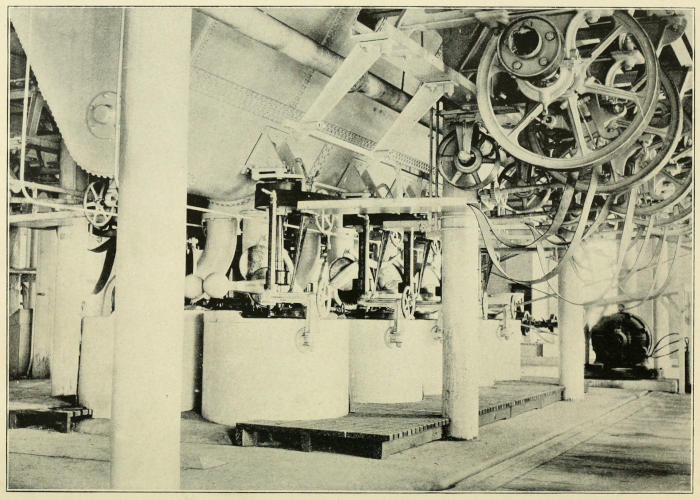
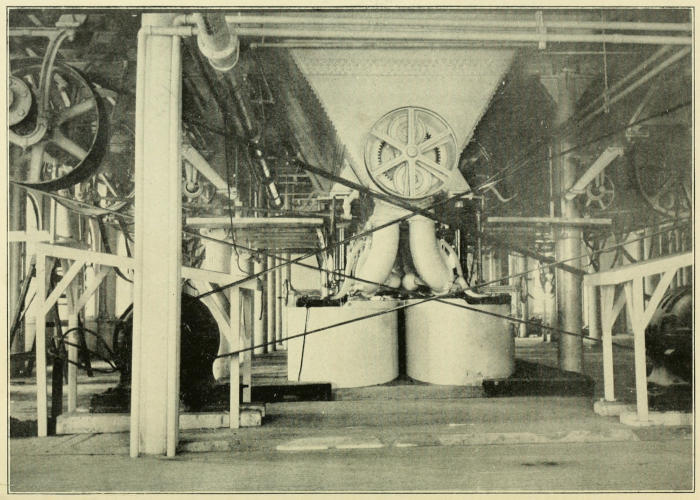
From the mixer the massecuite runs through spouts into the
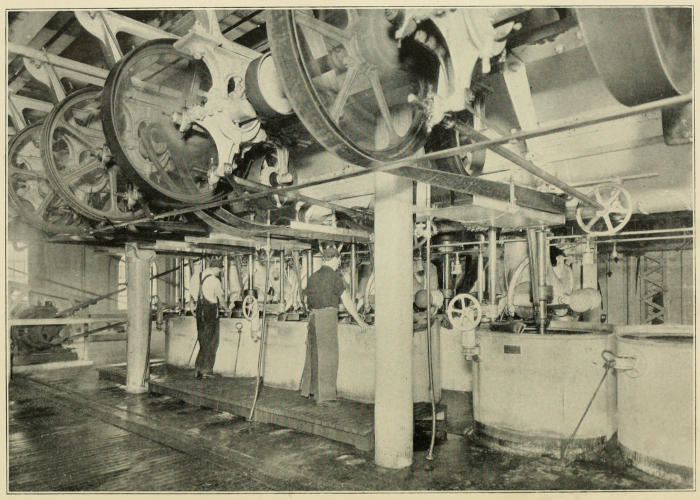
centrifugal machines. Centrifugal machines are cylindrical-shaped,
perforated brass baskets, usually forty inches in diameter
and twenty-four inches deep, hung on a central shaft suspended
from beams overhead, and surrounded by a solid outside
curb or casing.
On the shaft is a pulley, which is driven by a belt connected
with an engine or an electric motor. The inside of the basket is
lined with a fine-meshed brass screen, which retains the grains
of sugar, but allows the liquor to escape freely into the outer
casing.
As soon as the centrifugal machine is filled with massecuite
from the mixer above, the power is turned on and the machine
begins to spin around at an increasing speed until a velocity of
one thousand revolutions per minute is reached. The centrifugal
action forces practically all the liquor out through the screen
and leaves in the machine all the grains of sugar that were
formed in the pan. A little dry steam is sometimes turned in to
assist in reducing the moisture in the sugar.
The centrifugal is then stopped, a valve in the bottom is
opened, and the nearly dry crystallized raw sugar is dropped
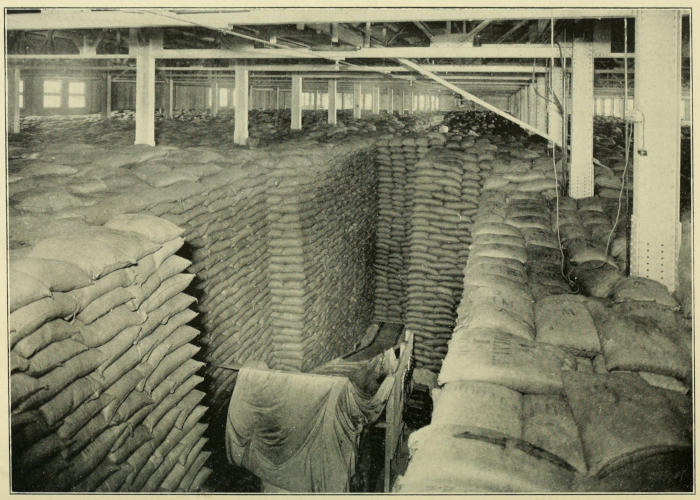
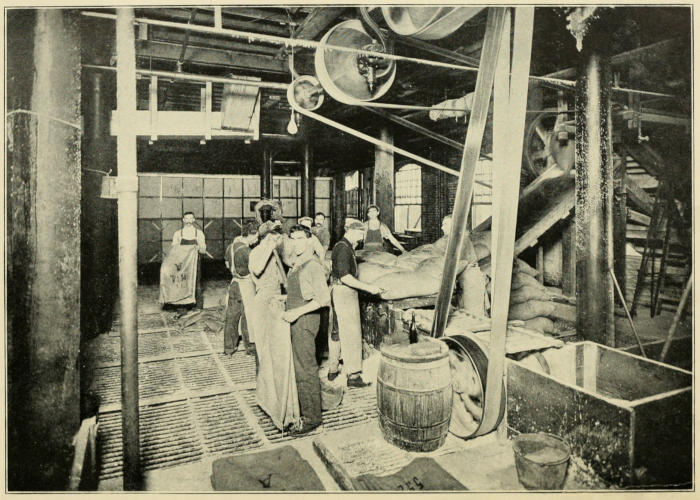
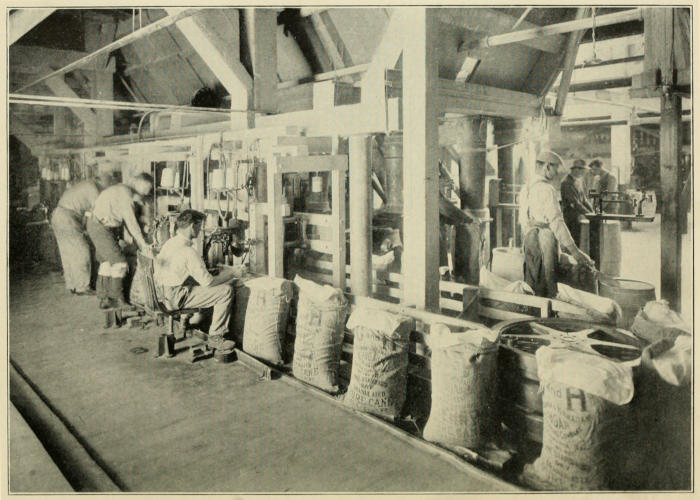
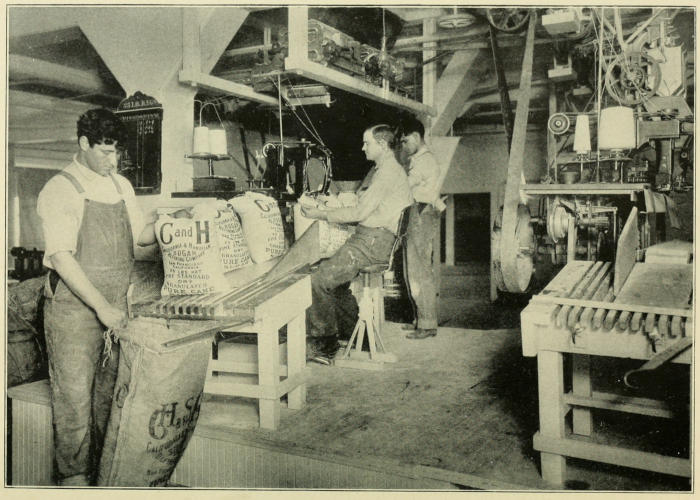
into bins. From the bins it is drawn off through spouts and
packed in sacks containing about one hundred and twenty-five
pounds each.
It has been demonstrated that raw sugar containing a large
amount of moisture inverts or deteriorates more rapidly than
that with a low-moisture content. It is apparent that as moisture
adds to the weight, the transportation charges, which are
based on tonnage, are greater in the case of wet sugar than in
the case of dry. In many of the modern mills, therefore, a further
treatment is given the sugar to reduce loss by inversion
and lessen freight charges.
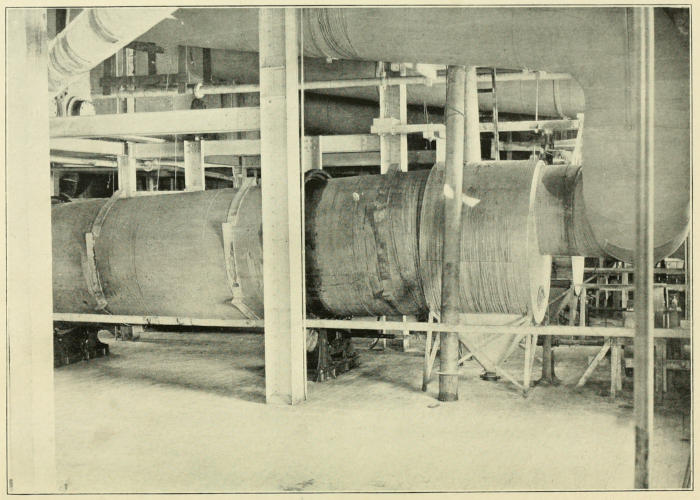
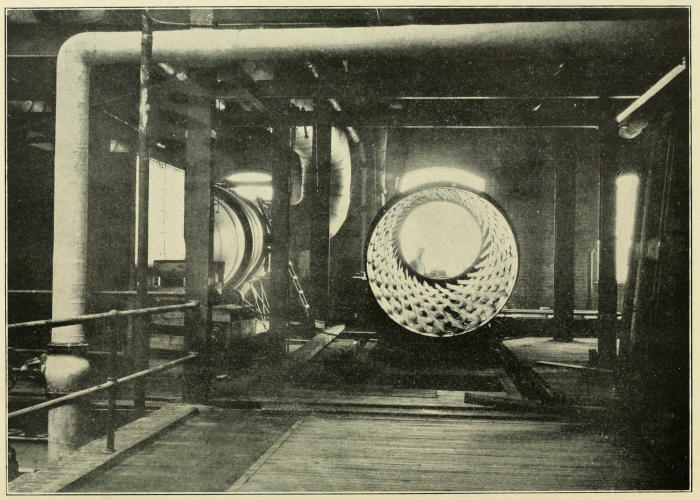
From the bins last mentioned the sugar is dropped into revolving
drums six feet in diameter and twenty-six feet long, set
at an incline so that as the drum revolves the sugar is carried
round to the highest point on the circumference of the drum
and dropped to the lower side, at the same time traveling from
the receiving to the discharging end. The shape, motion and inclined
position of the drum cause a perfect shower of sugar in
the drum for its entire length and breadth. While it is revolving
a current of hot, dry air is drawn through the drum by
means of suction fans, and as a result the moisture in the sugar
is absorbed by the air and carried out of the building. At this
stage the product has a good hard grain of a yellowish-brown
color; contains from ninety-six to ninety-seven per cent of pure
sugar and about one-half of one per cent of moisture.
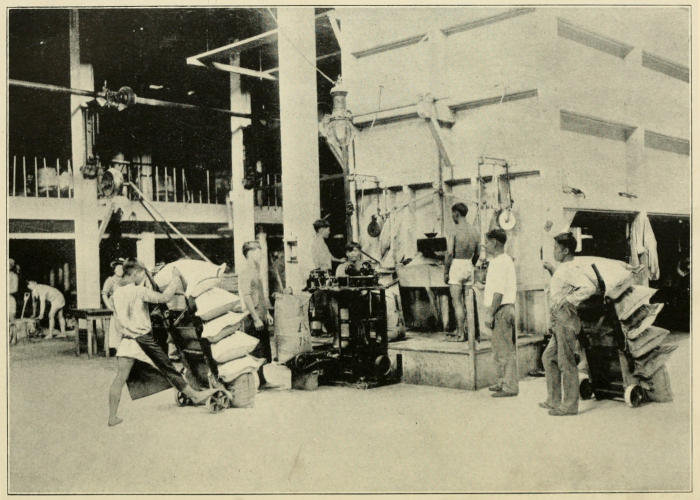
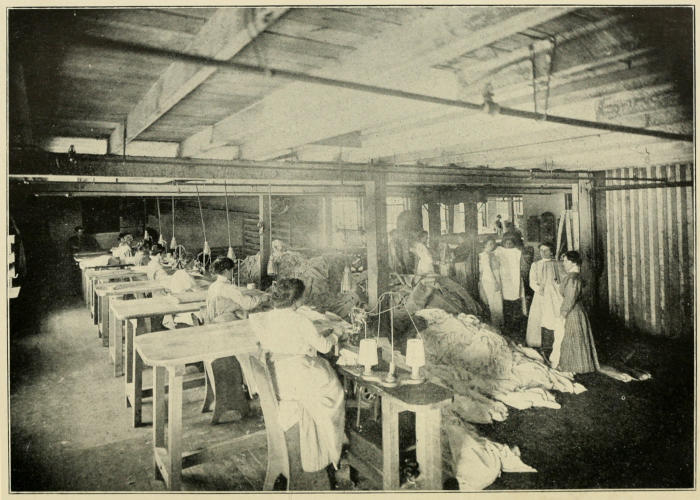
FILLING, WEIGHING AND SEWING SACKS
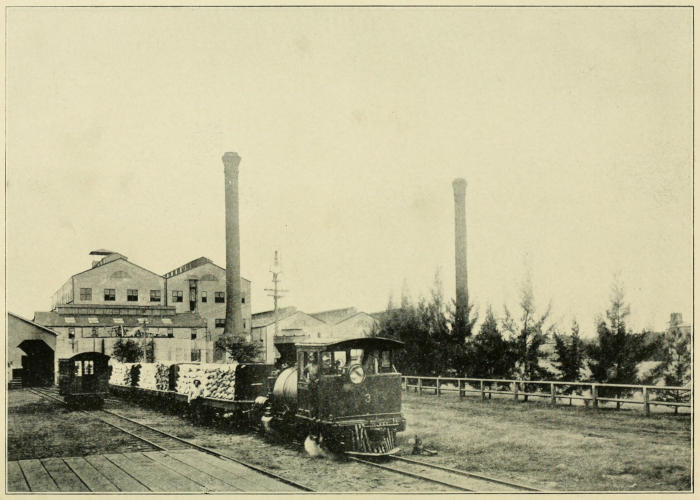
TRAIN-LOAD OF RAW SUGAR LEAVING MILL
From the end of the revolving drum the sugar is drawn off
into sacks holding about one hundred and twenty-five pounds
each. These sacks are sewed by machinery and put into railroad
cars to be hauled to the docks at the shipping port, where the
cars are switched under huge hoisting cranes or alongside
speedy conveyors which carry the sugar into large seagoing
steamers especially built for the trade. Some of these ships have
a cargo capacity of two hundred and twenty thousand sacks,
and they transport the sugar to the buyers on the mainland in
San Francisco, New York or Philadelphia, as the planter directs.
The liquor thrown off by the centrifugals is not lost; it is
taken back to the pans and reboiled. After this has been done
several times and most of the sugar extracted, the purity is so
low and the sugar content so small that it does not pay commercially
to reboil further, and the residue is sold as molasses.
It contains about thirty-five per cent of sugar and from twelve
to fourteen per cent of invert sugar, or glucose, as it is generally
called.
Some of the waste molasses is mixed with fodder and tender
cane tops and fed to cattle and plantation stock, the sugar content
proving of great value as a fattening agent and energy
builder. Part of the molasses is sprayed on the bagasse as it
leaves the crushers and serves, first, as a fuel under the boilers,
and, second, as a fertilizing agent in the form of ashes after it
has been burned. During the past few years much of it has been
shipped in tank steamers to the mainland, where it is used for
the manufacture of spirits and vinegar, and also as the principal
ingredient in prepared stock foods which are much in demand
today.
Every bag of sugar shipped from the plantation is marked to
indicate the plantation from which it came. The net weight of
the sugar in each bag is recorded, a sample of the sugar taken
and its sucrose content ascertained, for it is on the basis of
weight and sucrose content that raw sugar is bought and sold.
From the beginning to the end of the process of manufacture,
chemists are vigilantly alert sampling, testing, analyzing
and supervising the operations. Records are made of all analyses,
temperatures, purities, densities, extractions, etc., and the
results tabulated for future reference.
The average cost in Hawaii of preparing the fields, planting,
irrigating, fertilizing, cultivating and cutting the cane, manufacturing
the sugar and delivering it in the New York market,
is about $56.00 per ton of two thousand pounds.
TRANSPORTATION AND DELIVERY OF RAW SUGAR — POLARIZATION
It has been explained that in Hawaii sugar is packed in
one-hundred-and-twenty-five-pound sacks. Methods and
customs vary in different countries. For instance, in Cuba it
is put up in large gunny bags, each holding an average of three
hundred and twenty-five pounds. The same custom prevails in
Porto Rico. In Peru, and to a limited extent in Java, sacks containing
two hundred and twenty-four pounds are used. A large
part of the sugar in Java, however, is put up in bamboo baskets
of native make, containing from five hundred to eight hundred
pounds. They are about thirty inches in diameter, from thirty-six
to forty-eight inches high, and are lined with coarse leaves
to prevent the sugar from sifting out between the weavings of
the bamboo. Philippine sugar is packed in leaf-lined mats of
tough vegetable fiber, each holding about seventy pounds.
These various styles of containers necessitate different methods
of handling to and from the ships and by the buyers, but
Hawaii will again serve as an example of efficient, modern practice.
Outside of what is consumed locally, all Hawaiian sugars
are shipped to the mainland of the United States by steamers
or sailing vessels to San Francisco, or by steamers to New York
or Philadelphia, via the Panama canal.
As sailing vessels are rapidly disappearing from the seas so
far as the sugar trade is concerned, reference will be made to
steamer traffic only. The steamers are specially built for carrying
sugar, having a cargo capacity of from five thousand to
thirteen thousand tons, and the best loading and discharging
facilities.
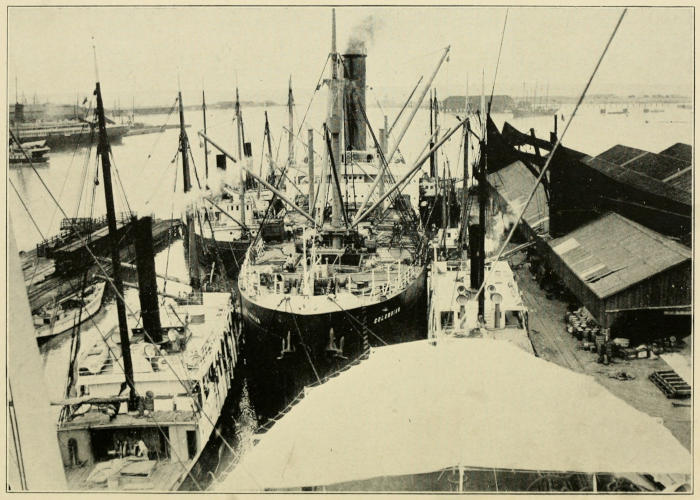
When loading in Honolulu, the steamers usually lie alongside
wharves covered with immense warehouses, where rapid-speed
conveyors carry the sacks of sugar to a point above the
ship’s hatches and drop them into chutes which guide them
down into the hold of the ship, where they are compactly
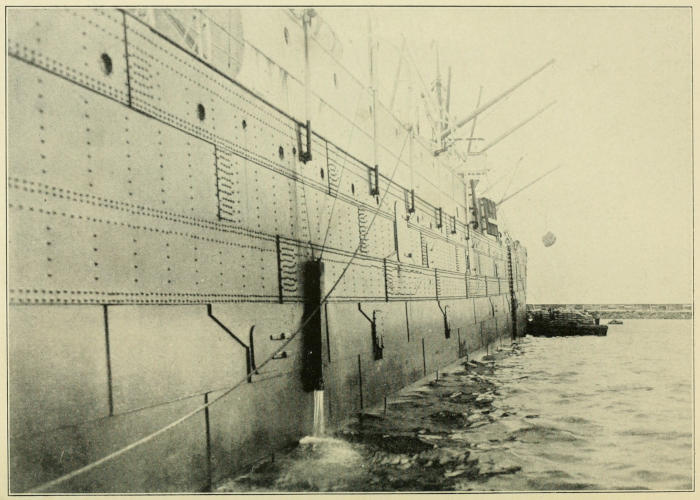
stowed. On the off-shore side of the vessel small steamers from
other island ports lie alongside and hoist the sacks by means of
steam winches to a point over the hatch and deposit them in
similar chutes. When steamers are loaded from both sides in
this manner, as much as three thousand tons, or forty-eight
thousand sacks, can be loaded in nine hours.
After a vessel is completely loaded and gets her clearance
from the custom house, she departs for San Francisco, twenty-one
hundred miles away, or for the Atlantic seaboard, via Panama,
as the planter may direct.
The voyage ended, and the quarantine and health regulations
complied with, she proceeds to the dock of the buyer, usually a
sugar refiner. The Hawaiian planter invariably sells his sugar
under contract prior to arrival of the vessel at destination.
Planters in other countries operate differently. Occasionally
sugar is sold on the plantation at an agreed price, and the buyer
arranges his own transportation. The planter sometimes ships
his sugar unsold and negotiates its sale while it is en route. If
so sold, it is delivered directly to the buyer on arrival; if not, it
must be stored in a warehouse at the planter’s expense pending
sale.
The practice of the Hawaiian planter is to sell his sugar to
refineries in San Francisco, New York or Philadelphia, under
contracts extending over a term of years. It is agreed that the
sugar shall be shipped as soon as made and that the refiner will
receive it immediately on arrival, the price for each cargo being
that quoted in the open New York market for ninety-six-degree
centrifugal sugar on the day preceding its arrival.
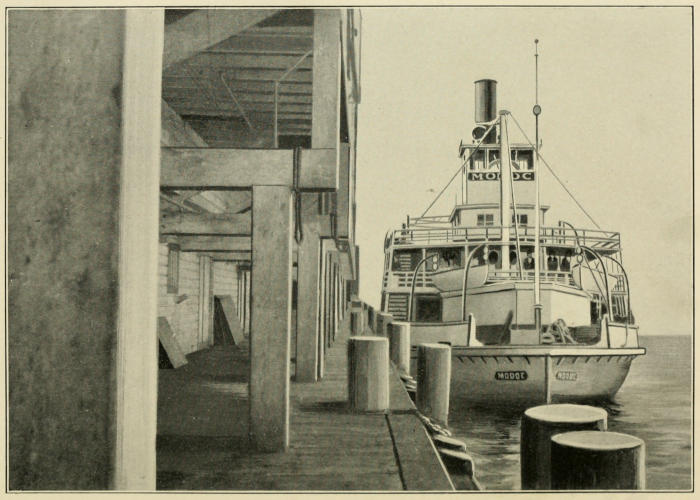
STEAMER LOADING SUGAR ALONGSIDE DOCK
LOADING SUGAR AT AN OUTPORT IN HAWAII
The value of raw sugar, like that of other staples, is based on
supply and demand, and the price fluctuates from day to day
according to the requirements of the refiners or the necessities
of the sellers.
There are certain rules or trade conditions governing all
sales, so that when one man buys and another sells at an agreed
price, each knows what he is bargaining for. For instance, raw
sugar is bought on the ninety-six-degree centrifugal basis, that
is, the price agreed to be paid is for centrifugal sugar containing
ninety-six per cent of sucrose. If it contains more sucrose,
a higher price is paid; if it contains less, a lower price is paid;
all according to an established scale of additions and deductions.
Then again, the time of payment for the sugar is well understood.
It is usually ten days after the sugar has been finally
discharged from the ship, as this allows a sufficient period in
which to determine the exact weight of the sugar and the percentage
of sucrose it contains. An instrument called a polariscope
is invariably employed to determine the amount of
sucrose present and the results obtained from its use are absolutely
accurate. A description of the operation will undoubtedly
prove interesting.
The practical working of the polariscope is based upon the
property of sucrose to rotate a ray of polarized light to the
right.
Ordinary light is the effect on the eye of vibrations of the
ether. These vibrations occur in all directions, but by certain
optical devices they may be confined to a single plane, and light
thus confined is called polarized. If rays of polarized light pass
through a layer of certain bodies, e. g., quartz, sugar and many
others, the plane in which the vibrations occur is rotated, and
the polariscope has been devised for the purpose of measuring
the rotation of the plane of polarization.
Polarized light, as used in the polariscope, is obtained from
the Nicol prism or some development of it. Ordinary light passing
through crystals of certain bodies, of which Iceland spar is
an example, is split into two rays, one of which is known as the
ordinary and the other as the extraordinary ray. A Nicol prism
is made of two wedge-shaped pieces of Iceland spar, cemented
together with a film of Canada balsam.
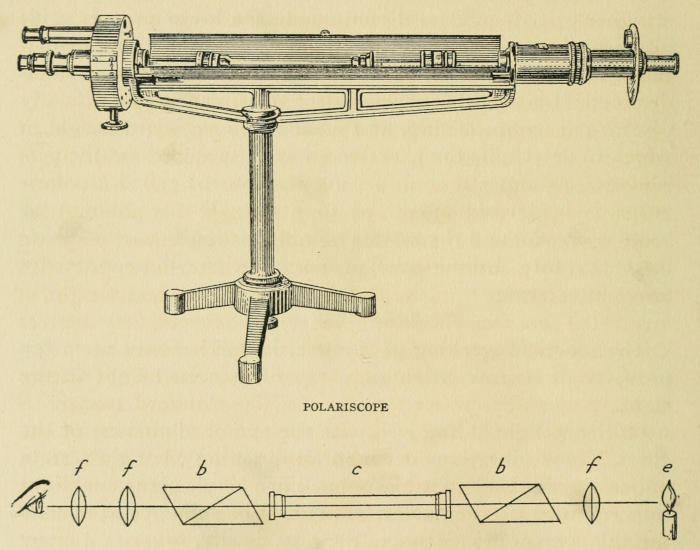
The accompanying sketch gives a good idea of the arrangement
of an ordinary polariscope.
POLARISCOPE
A strong white light, e, enters the instrument through a lens at
f, to the Nicol prism b, by which it is polarized. The ordinary
ray is dispersed, while the extraordinary or polarized ray passes
straight through and enters the sugar solution contained in the
tube c, which has glass ends. In passing through this solution it
is given a rotary motion to the right or to the left, according as
the sugar in the solution is sucrose or levulose. When it emerges
from the tube containing the sugar solution, the now rotated
polarized ray encounters a second Nicol prism, of which one of
the wedges is fixed and the other movable. This prism is called
the analyzer. A pointer, controlled by a thumb screw, is attached
to it, and when the correction of the polarized ray’s rotation
has been made with precision by adjustment of the wedges,
the pointer will indicate directly and accurately on a scale the
amount of sucrose in the solution under test, because the polarized
ray was rotated in exact proportion to the amount of sucrose
contained in the solution through which it passed.
The polariscope is made and set so that a standard weight of
pure sugar (C₁₂H₂₂O₁₁), dissolved in a standard quantity of
pure water, and placed in a tube of given length, will rotate
the ray of polarized light in passing through, to a point on the
scale marked one hundred degrees, the equivalent of per cent.
Also, that by using the same quantity of water, but twenty-five
per cent, fifty per cent, or seventy-five per cent less weight of
sugar, the rotation will show seventy-five degrees, fifty degrees
or twenty-five degrees of pure sugar, as the case may be.
A sample is drawn from each bag of sugar and all of these go
to make up a general average sample. The standard quantity is
carefully weighed, dissolved with the standard amount of water,
clarified, filtered and poured into a tube with glass ends,
which is then inserted in the polariscope between the eye of the
operator and a strong artificial light. When the operator making
the test applies his eye to the instrument, he sees a distinct
shadow on a lens in the line of vision, one side being light and
the other dark. He then turns the thumb screw which adjusts
the analyzer until the whole field of vision is neutral, which indicates
that the rotation of the polarized ray has been corrected.
The pointer on the scale now shows the exact percentage
of sucrose present in the raw sugar, ninety-four, ninety-five,
ninety-six degrees, or whatever it may be. This test determines
the real value of the sugar, based on the market quotation for
ninety-six-degree sugar. If the polarization should show exactly
ninety-six degrees, the price to be paid for the sugar and
the market quotation will be identical.
In most sugar-producing countries the government imposes
an import tax on all foreign sugars, in order to obtain revenue
to defray governmental expenses and to protect the domestic
industry, if any, against competition with other countries in
which cost of materials and labor may be lower. Commodities
produced in a country naturally add to its development and
wealth, and this explains the fostering of the sugar industry by
various governments.
The United States duty on foreign sugar is at present $1.256
per one hundred pounds of ninety-six-degree raw sugar. On
account of our treaties with Cuba, the Cuban planter is allowed
a deduction of twenty per cent, and, therefore, pays a duty of
$1.0048 per hundred pounds, which, owing to trade conditions,
is the duty effective today in the United States.
Sugars produced in the insular possessions, Porto Rico and
the Philippine islands, are admitted free of duty.
In 1898, the Hawaiian islands, through annexation, became
a part of the United States, consequently no duty is assessed on
sugar or any other Hawaiian product.
Every vessel coming into a port of the United States must be
entered at the custom house, where a record is kept of the port
whence she came and of what her cargo consists. If from a
domestic port, she is permitted to discharge her cargo without
delay; if from a foreign one, customs officials are immediately
sent on board to watch the cargo as it is discharged and supervise
the tallying, checking or weighing, according to the class of
merchandise. Besides being weighed, sugar is carefully sampled
and the percentage of sucrose ascertained by the polariscope,
for the customs duty is based upon the purity of the sugar, all
raws testing not above seventy-five degrees polarization paying
.71 cent per pound and .026 cent per pound for each additional
degree. This is equivalent to 1.256 cents per pound for ninety-six-degree
sugar.
The people of the United States used 4,257,714 short tons of
sugar in the year 1915. It was nearly all produced within the
United States or in countries enjoying tariff concessions, as
follows:
SHORT TONS
Hawaiian islands
(Cane)
570,375,
U. S. territory.
Louisiana
(Cane)
251,740,
U. S. territory.
Domestic production
(Beet)
861,568,
U. S. territory.
””
(Maple)
17,248,
U. S. territory.
Porto Rico
(Cane)
336,347,
insular possession.
Philippine islands
(Cane)
134,626,
insular possession.
Cuba
(Cane)
2,062,594,
reciprocity treaty.
Foreign sugar
(Cane)
23,216,
full duty-paying.
4,257,714
Aside from the small amount of full-duty-paying foreign
sugar imported, the only sugar in the above list that paid duty
came from Cuba. It is evident, therefore, that under ordinary
conditions an increase in the crops of any of the places mentioned
would result in a surplus of sugar in the American market.
In 1916, with the beet production of Continental Europe
locked up by the war, Cuba’s increased output has been absorbed
by Great Britain, France, Italy and Greece.
Steamers from Hawaiian ports, after arriving and entering
at the custom house and passing quarantine and health officers,
proceed immediately to refinery docks to discharge cargo.
REFINING OF RAW SUGAR — WASHING — MELTING — DEFECATION — BONE-CHAR FILTRATION — CRYSTALLIZATION — PARTIAL DRYING — FINAL DRYING OF CRYSTALS — SCREENING — PACKING — CUBE SUGAR — POWDERED AND BAR SUGAR — YELLOW SUGARS — MECHANICAL DEPARTMENT — LABORATORY — COST OF REFINING
Cane-sugar refineries are always located in great seaport
towns for the reason that, as practically all cane
sugar is grown in the tropics, it must be transported by
water to the world’s markets.
The refining operation is by no means as simple as may at
first appear. It is essential that the finished product be almost
chemically pure (99.8 per cent), and the greatest care must be
exercised to obtain a perfectly white color, as well as a hard,
lustrous grain.
The question naturally arises, why do not the planters of Hawaii,
Cuba, Java and other raw-sugar-producing countries carry
their process a few steps further and make a pure white sugar
as the refiners do? This has been attempted many times, but
has almost always been found impracticable, notwithstanding
the fact that there is no mechanical or chemical reason why.
Among the arguments in favor of a mainland seaport site,
the following may be mentioned:
1. The producing centers are generally far distant from consuming
markets. Refineries located in the tropics would be under
unusual expense for transporting and selling the refined article.
2. A refinery in the tropics would be out of direct and prompt
touch with the individual requirements of the buyers.
3. Refined sugar should be moved and sold as soon as possible
after its manufacture, so there follows the necessity for adequate
dock and rail facilities as means of quick communication
with the market.
4. An abundant supply of pure, soft water for refining purposes,
and salt or fresh water for condensing, as well as fuel for
the generating of steam, must be readily available. Another
most important requisite is skilled labor, which is more easily
obtained in populous seaport cities than in the small, isolated
towns of the tropics.
5. There are many commodities used in the refining of sugar
and in packing it for shipment that can be purchased more advantageously,
both as regards price and promptness of delivery,
in the great commercial ports than in the sugar-growing districts.
Among these are bone-char, lime, acids, cotton filter-bags,
burlap, cotton cloth, boxes, barrels, cartons, iron, steel
and machinery of all kinds.
6. A sugar refinery is operated the entire twelve months of
the year, while a raw-sugar mill must of necessity take care of
the crop of cane in about eight months. To refine sugar where
it is grown would require refining machinery capable of handling
the entire output in the eight-month period, and during
the remaining four months the plant would remain idle. This
would mean a larger investment proportionately than that
made in a refinery in a consuming center, running steadily the
year round.
7. Refined sugar very rapidly absorbs moisture, and while in
transit from the tropic to the temperate zone it is very apt to
become lumpy or caked, which would involve reprocessing at
great expense at the point of consumption. The unavoidable
damage to the packages in loading and discharging results in
heavy expense, as all packages must be delivered to the buyer
in first-class condition. To avoid hardening, refined sugar
should never be piled very high, and it is an unsolved problem
whether refined sugar will stand long ocean transportation in
cargo lots without caking and damage by breaking of the inside
cotton sacks. If shipped in barrels, the freight rate is proportionately
higher.
8. Larger capital would also be required, as refined sugar
must be carried on hand and must await the consumer’s demand,
while raw sugar generally has a prompt and ready market
and can be quickly converted into cash.
With these difficulties presenting themselves to a prospective
sugar refiner in a raw-sugar-producing country, the shipping of
raw sugar to refineries at great distances does not seem at all
unreasonable.
Raw sugars show considerable variance in their component
parts, and so it follows that some are less easily refined than
others. Such differences are generally due to diverse methods of
culture, amount of fertilizer used, the processes of manufacture
and the efficiency of extraction. If the extraction be high, a
large percentage of the salts in the cane is taken up, and these
salts prevent or retard the complete crystallization of the pure
sugar in refining. One part of ash prevents several times its
own weight of sugar from crystallizing, hence it is readily seen
that raw sugars with a low ash content are preferred by refiners.
A MODERN REFINERY—SHOWING WATER AND RAIL TRANSPORTATION FACILITIES
PLAN ELEVATION OF A MODERN REFINERY
Sugar refining is the production of pure white sugar in granular
form, after the removal of the impurities from the raw
product. Nine operations are necessary to bring about this result:
1. Washing:
Removal of superfluous impurities.
2. Melting:
Changing the solid raw sugar into liquid form by melting
with water.
3. Defecation:
Precipitation of suspended and insoluble impurities.
4. Bag and Bone-char Filtration:
Removal of suspended impurities, color and soluble impurities.
5. Crystallization:
Production of crystals by concentration.
6. Partial Drying:
Purging crystals from syrup in centrifugals.
7. Final Drying:
The driving off of all remaining moisture.
8. Sorting of Crystals:
Sorting of grains according to size to meet market demands.
9. Packing:
Putting in various forms of containers.
A refinery consists of a group of buildings, each of which has
been constructed for a special purpose and for convenience and
economy in operation. They are as follows:
1. The melt or wash house.
2. The char house.
3. The pan house.
4. The packing house.
5. The boiler house.
6. The pump and power house.
In addition there are offices, shops, laboratories, and last, but
by no means least, very extensive warehouses.
To begin at the beginning it will be necessary to start with
the steamer laden with raw sugar and made fast to the wharf
in front of the warehouse that forms part of the refining plant.
The sugar is hoisted out of the ships in sling-loads by powerful
winches, and landed on a platform on the dock alongside the
ship. Each sling-load consists of from twelve to twenty sacks,
or the equivalent weight in baskets or mats, as the case may be.
As soon as the sacks are landed, they are sorted according to
mark, put on trucks to be run over a scale set in the floor, and
their gross weight recorded.
As the truck leaves the scale, the samplers take a sample from
each sack. This is done with a tryer, a long, hollow steel tube,
open on one side and sharp at one end, with a handle on the
other for the sampler to grasp when forcing the tryer into the
sack. The individual sample from each sack of each different
mark is deposited in large closed cans until the cargo is completely
discharged, when an average sample of all the individual
samples of each mark is made up and used in the laboratory
to determine the polarization or sucrose content of the various
lots comprising the entire cargo. The value of the sugar is fixed
by this polarization.
The weights of the various truck-loads of sugar passing over
the scales are totaled and the weight of the sacks, baskets or
mats deducted, giving the net weight of the sugar.
Hawaiian sacks weigh exactly one pound; Cuban, Javan and
Peruvian sacks about three and one-half pounds. Javan baskets
weigh from twelve to fifteen pounds, and Philippine mats about
four pounds.
In order to facilitate the weighing and simplify the calculations,
in cases where the exact weight of the sacks is known,
every truck is made to weigh the same by ascertaining the
weight of the heaviest and then putting small iron nuts or
washers on the rods of the other trucks until each of them exactly
counterbalances the heaviest. One truck is then placed on
the scale and the scale is brought to a perfect balance, just as
though there were no truck on it. In this way the weight of the
truck is never recorded, which greatly simplifies the entire
weighing operation.
One crew of men will discharge from 1300 to 1500 sacks of
sugar per hour from each hatch of a steamer, or a minimum of
731 tons per day of nine hours. As three hatches are usually
worked at the same time, it will be seen that from 2200 to 2500
short tons are taken out every day.
STEAMER DISCHARGING RAW SUGAR AT REFINERY DOCK
SUGAR STORED IN WAREHOUSE—TWENTY-FIVE THOUSAND TONS SHOWN IN THIS PICTURE
From the scales the sugar is deposited on a depressed conveyor
in the floor and carried directly into the melt house of the
refinery, except the sugar that must of necessity be stored in
the warehouse for future use, in which case it is dumped from
the trucks on piling machines that elevate it to any height desired,
and it is arranged neatly and compactly by the piling
crew.
The wharves and docks of a sugar refinery are, as a rule,
scenes of unusual activity and interest. Besides the large number
of men engaged in hoisting, trucking, weighing, sampling
and piling the sugar, there are the sailors, whose calling always
possesses a certain fascination for the landsman. A motley
crew they are, bronzed by wind and sun, gathered from all
countries and climes. There is the simple, kindly native of Hawaii,
gentle-eyed, soft of speech and born with a love for the
sea; he prides himself upon his skill in swimming and diving,
and when the day’s work is done, entertains his shipmates by
singing the plaintive melodies of his native land, accompanying
himself on the ukulele, the stringed instrument of the South
Seas. Should there be a number of his fellow islanders among
the crew, the evening’s program is almost certain to be varied
by the native hula hula dance, which generally brings marked
applause from the onlookers. Presiding over the galley, or
ship’s kitchen, is the almond-eyed Chinaman, now shorn of his
queue; an excellent cook who loves to gamble after his pots and
pans are washed and put away in place; a shrewd gamester, but
scrupulously honest. Beside him stands a fierce-looking Malay,
sullen, morose and taciturn, whose sharp, white teeth carry a
sinister suggestion of the good old days of cannibalism. His
neighbor is a Filipino, short in stature, keen-eyed and alert,
while in the background are one or two individuals who from
their appearance might be direct descendants of the buccaneers
who ravaged the Spanish Main in Sir Henry Morgan’s time.
The average sailor is fond of pets, and here there is no lack of
them, parrots and monkeys for the most part, and the sayings
of the former clearly indicate a total absence of Sunday-school
training.
Sugar ships bring rare fruits and vegetables from the tropics,
and the employés of the refinery have plenty of opportunities
to enjoy such luxuries as fresh pineapples, bananas, guavas,
papaias, alligator pears, breadfruit and mangoes.
A visit to the docks of a sugar refinery during the time vessels
from foreign ports are lying there is well worth while, although
in these days of steam, the picturesque features are not
so pronounced as they were before the passing of the sailing
vessel.
REMOVAL OF SUPERFICIAL IMPURITIES
As a starting point in the refining process the melt house will
be first considered. It is so called because it is there that the
raw sugar enters the refining process by being melted or dissolved
in water.
The conveyor, upon which the bags were deposited in the
warehouse, delivers them on a platform on the top floor of the
building. As they come to this platform from the conveyor,
workmen with keen-edged knives seize them and, with a deft,
swift slash, cut the twine sewing at the top of the bag without
injuring the burlap fabric. The bag is then pulled off the platform,
mouth downward, so that the sugar falls out and passes
through an iron grating into a large bin beneath. If the sugar
should happen to be caked or lumpy, it is sent through crushers
and broken up.
CUT-IN STATION—SHOWING SUGAR FIRST ENTERING THE REFINING PROCESS
CENTRIFUGAL MACHINE—MOTOR DRIVEN
As a certain amount of sugar adheres to the inside of the
bags, they are washed in large revolving machines and in this
operation the sugar dissolves in the water (called sweet water),
from which it is extracted later. They are then partially
dried in centrifugal machines and hung on hooks on a traveling
chain conveyor that passes through the upper part of the
boiler house, where the waste heat thoroughly dries them. In
returning, the conveyor passes through the bag room and, by
means of an automatic device, the bags are dropped alongside
the printing presses. Here the name of the refinery, the kind of
sugar and the net weight they are to contain are printed upon
them. These burlap bags are then lined with a white cotton
bag, after which they are made into bundles and sent to the
packing room to be filled with sugar. It will be seen, therefore,
that the bags from Hawaii in which the raw sugar is received
are put to good use. This, however, does not apply to those that
come from Cuba or Java; they are too large to serve as containers
for the refined product, and after being washed and
dried are sold for what they will bring.
The white cotton bags are made at the refinery, and a plant
turning out one thousand tons of sugar each twenty-four hours
will use twenty-five thousand yards of cotton sheeting per day
if all the output is packed in one-hundred-pound bags.
The bin into which the raw sugar is dumped holds enough
sugar to keep the refinery supplied during the twenty-four hours
run, but the entire quantity is “cut in” during the day. The advantages
of this arrangement are that it avoids any delay in operation
due to mechanical troubles with conveyors and because
more efficient work is accomplished during the daylight hours.
The employés prefer to work on the day shift and, wherever
possible, night work is avoided.
From the bottom of the bin the sugar falls into a mixing
machine, called the mingler. This is an oblong tank with a semi-cylindrical
bottom, near which is a revolving horizontal shaft,
with arms or paddles attached which thoroughly stir and mix
the sugar with syrup that is added at this point. The reason for
using syrup instead of water is that the former, being a saturated
sugar solution, does not melt the sugar as water would.
The resultant mixture, called magma, looks a good deal like
a soft, brown mortar. It is, in fact, raw-sugar crystals swimming
in syrup. This consistency is needed to allow the magma
to work freely in the centrifugals, the next operation. Most of
the impurities contained in raw sugar are superficial, that is,
adhering to the outside of the grain. They may be more or less
readily removed by washing the surfaces of the crystals with
water.
From the mingler the magma drops to the floor below into
centrifugal machines running at the rate of 1100 revolutions
per minute. A “charge” consists of about nine hundred pounds
of magma. As the machine fills, the centrifugal force causes the
magma to rise in a vertical wall around the inside circumference
of the basket, at the same time throwing off the syrup that
was added on the floor above, and leaving in the machine about
five hundred pounds of the raw sugar as it came from the plantation.
Water is then sprayed into the machine under high
pressure, through a nozzle which divides it into very fine particles
and throws it against the wall of sugar in the machine. The
water, passing through the sugar by the centrifugal force,
washes each face of each crystal and carries off the impurities,
together with a certain amount of sugar. The quantity of water
used per machine in each filling is from one to two and a half
gallons, depending upon the quality of the sugar.
This water, now a syrup, with the impurities and sugar it
contains, is drawn from the machine, part of it being pumped to
the floor above to mix with new raw sugar coming in. The remainder
is treated, filtered, boiled and made into raw sugar,
which, in turn, goes direct to the melt or through the washing
process again. The result of this washing is that the purity of
Hawaiian raw sugar is raised from about 97.2 to 99.2 per cent,
and there now remains but 0.8 per cent of impurities to be removed.
The washed sugar is dropped from the centrifugal basket
through a large opening in the bottom of the machine with the
aid of a mechanical device called a discharger, which greatly
reduces the manual labor.
Until very recently the sugar was discharged from the centrifugals
by hand, the men digging it out with wooden paddles
in a difficult, laborious way. One day, a few years ago, a clear-brained,
observant American lad working in a beet-sugar factory,
conceived the idea that a centrifugal could be emptied by
mechanical means. He worked long and assiduously upon the
problem, and after much experimenting and many trials and
disappointments was granted a patent by the United States
government. Full of hope and confidence, he had several machines
constructed and took them to a sugar refiner, sure of being
favorably received. He met with rebuff and ridicule. The
refinery engineer was too busy with other matters to examine
or give any attention to the appliance. The next man to whom
he presented it was even more indifferent than the first; he
coldly informed the patentee that he had been in the sugar business
for thirty years, that no such machine would work, and
that the only way to take sugar out of a centrifugal was by
hand.
After months of effort and repeated failures, he induced the
superintendent of a beet-sugar factory to allow him to install
and test the device at his own expense. It was thrown out after
a few days’ trial, and the inventor became well-nigh desperate,
although still positive as to the merits of his discharger.
Finally he succeeded in gaining the ear of the manager of a
large refinery, who, after listening attentively to his earnest
argument, at length became convinced by it. As a result of the
interview, it was arranged between them that the machines
rejected by the beet-sugar factory should be installed in the refinery
and operated for a period of thirty days, under the direct
supervision of the inventor. The test was successful in every
particular and conclusively proved the efficiency of the discharger.
The refiner was gratified because on account of the saving in
time the capacity of the centrifugals was materially increased;
the men operating the centrifugals were hugely pleased, as the
arduous work of emptying by hand was entirely eliminated,
and the inventor was happy, for he had vindicated himself.
An order for a large number of the machines was placed at
once and every centrifugal in the refinery was equipped with
one. Today they are installed in nearly every refinery and factory
in the United States, and in many raw-sugar plantation
mills as well.
CHANGING THE SOLID RAW SUGAR INTO LIQUID FORM
From the centrifugals the washed sugar drops to the melter
pan on the floor below. This is a cylindrical tank in the center
of which is a revolving vertical shaft, to which are attached horizontal
paddles that serve to facilitate the dissolving of the
sugar with the hot water that is now added. Only enough water
is added to bring the resultant liquor to a density of 58.6 per
cent of solid matter.
The raw sugar having been washed and, to use a technical
term, melted, leaves the melt house at this point.
PRECIPITATION OF SUSPENDED AND INSOLUBLE IMPURITIES
From the “melt” the liquor is pumped to the top floor of the
char house, which is usually a structure of from twelve to fourteen
stories high. The reason for building to such a height is
the advantage gained by utilizing the force of gravity and by
this means handling the liquors and bone-char from floor to
floor without mechanical aid.
The liquor is delivered into a number of cylindrical tanks
equipped with a coil of pipe through which steam is passed for
heating the liquor, each tank being capable of holding 25,000
pounds of liquor. Around the bottoms of the tanks are perforated
pipes through which compressed air is forced to agitate
and thoroughly mix the solution. On account of this air being
blown in, these tanks are called blow-ups. By means of the
steam coil the temperature of the liquor is kept at 190 degrees,
which makes it less viscous than cold liquor, thus facilitating
subsequent filtration and hastening the reaction of the lime and
acid added at this point.
As the liquor comes into the blow-ups it varies in color from
a straw yellow to a dark brown, and contains a considerable
amount of suspended and insoluble impurities which must be
removed. Some of these impurities are present in the raw sugar,
and others, such as pieces of twine, lint from the bags, fine
particles of leaves from the Java baskets and Philippine mats,
are traceable to the opening of the containers in the melt house.
The process of removal is called defecation. In former years
this was accomplished by adding bullocks’ blood to the raw-sugar
liquor in the blow-ups and heating the mixture until
the scum which rose to the surface cracked, when the solution
below was found perfectly clear, or, in the language of the
refinery man, bright. Today, however, chemicals are the defecating
agents, those most commonly used being phosphoric acid
and lime. Phosphoric acid, neutralized with lime, throws down
a heavy, flocculent precipitate which, as it settles, sweeps the
solution and drags down all the suspended matter, gums, etc.,
leaving the liquor above clear and transparent.
The precipitate must now be removed, and this is accomplished
by running the liquor through the bag filters on the
floor below. These filters are tight iron boxes, about sixteen feet
long, six feet wide and seven feet high. The top of the box is depressed
about eight inches below the sides and ends, thus forming
a tank. This top is perforated with five hundred holes, one
and one-half inches in diameter. From the bottom of the iron
box is an outlet pipe leading into tanks below.
In each of the holes on the inside top of the box is screwed a
so-called “brass bottle,” conical in shape, to which is securely
attached a closely-woven cotton filter bag, about twenty-four
inches wide and seventy inches long. This filter bag is encased
in a heavier and stronger cotton sheath, or sleeve, about eight
inches wide, which adds strength and keeps the twenty-four-inch
bag in folds so as to give an effect similar to that of a folded
paper filter, frequently seen in drug stores. Each bag filter
contains five hundred of these bags, suspended vertically from
the top.
Before any liquor is run on the filters, the bags and the iron
box are heated by means of steam to bring the apparatus to a
temperature of about 190 degrees Fahrenheit. This prevents
the chilling of the sugar liquor by cold bags, which would cause
the bags to become “blocked,” as it is technically called. The
liquor from the blow-ups, at 190 degrees temperature, is now
turned into the depressed tank on the top of the filter and flows
through the perforations into the bags attached on the inside,
down through the bags, and finds an exit through the bottom
of the filter into the tanks below.
As the first liquor comes through the bags, it is a little cloudy,
but in a few minutes, as the pores of the bags fill with the insoluble
substances, it becomes perfectly bright, all the suspended
and insoluble impurities remaining in the bags, together with
the precipitates drawn over from the blow-ups. The cloudy
liquor is pumped to the top of the filter and clarified by being
run through a second time. It is interesting to know that it is
not really the bag that does the filtering, but the thin layer of
sediment that is deposited from the liquor itself on the inner
surface of the bag. The cotton bags are made in a particular
manner, and from a fabric especially adapted to catch the sediment
and to form, in conjunction with it, an excellent filtering
medium.
BAG FILTERS—SHOWING BAGS IN PLACE
FILTER PRESSES
The liquor, as it runs into the tanks, must be carefully
watched, for sometimes a bag inside the filter breaks, which
causes cloudy liquor by allowing the precipitates to gain entrance
into the clear liquor. As soon as this is noticed, samples
are taken from the outlet of each filter and the defective one
found and investigated.
When a bag is torn, or develops a hole, the liquor runs
through the opening on the top of the filter so fast that it forms
a little whirlpool, which shows the bag that is broken. A wooden
plug is immediately driven into the opening and that particular
bag cut out. The men on the bag filters soon become so expert
that they detect broken bags and plug them before the
cloudy liquor gets to the inspection station. It is essential that
the liquor be freed from all suspended impurities at this station
before the next step is taken, hence great care and watchfulness
must be exercised.
In time the coating of sediment, gums and precipitates on the
inside of the bag becomes so thick that the liquor runs very
slowly and finally stops. The refinery term for this condition is
“stuck-up.” Depending on the impurities in the original liquor,
the bag filters will continue to filter the liquor for from twelve
to twenty hours and sometimes longer.
After the bags are “stuck-up,” the liquor remaining in them
is sucked out by means of vacuum through a small pipe attached
to a long rubber hose and inserted in the bags through
the holes in the top of the filter. The liquor thus sucked out of
the “stuck-up” bags is sent to the blow-ups and reprocessed
with new liquor, thus beginning its journey anew.
As soon as the liquor is sucked out, hot water is run through
to reduce the sugar contents of the filter. This water is saved
and the sugar it takes up is subsequently recovered. The filter
is then opened by means of an electric hoist traveling on an
overhead track immediately above the filters. Chains are attached
to the top of the filter and the hoist elevates top, bags
and all, to a point sufficiently high for the bags attached to the
top to clear the adjoining filters. The top and bags are then
moved along the track to the washing station. Meanwhile another
hoist has delivered a duplicate top, with fresh bags attached,
to the filter, where it is lowered into place. In this way
the filter is again in operation within five minutes. At the washing
station the bags just taken from the filter are detached from
the top for washing, and the top is sent to a point where clean
bags are again attached. It is then ready to go into another
filter.
At the washing station the dirty bags are pulled out of the
sheaths and turned inside out in tanks containing water, thus
releasing a large quantity of the impurities. The bags and
sheaths are then thrown into washing machines, where all the
remaining impurities and sugar are washed out of them. From
the washers the bags are put into centrifugal machines, or
through powerful wringers, and dried sufficiently to permit being
rehandled. They are then resheathed and made ready to be
attached to another top.
The water from the washers contains a large amount of
sugar and is conducted to a tank similar to one of the blow-ups,
where it is treated with lime and diluted with water at 190 degrees
Fahrenheit until it contains only from ten to twelve per
cent of solid matter. This liquid is then pumped through filter
presses and the impurities removed. The “sweet water,” as it is
termed, which now contains practically all the sugar, is collected
in tanks and the sugar is ultimately extracted by evaporation,
filtration and boiling to grain.
MAKING NEW BAGS AND LINING THE WASHED BAGS
PRINTING THE EMPTY RAW-SUGAR BAGS
The impurities removed by the filter presses consist of sand,
portions of bags and baskets, phosphates, hair, lime, salts and
gums, in fact every kind of foreign matter that finds its way
into raw sugar either in the process of manufacture or in transportation.
A small amount of sugar accompanies this refuse,
but as its recovery would cost more than it is worth, it is allowed
to run to waste. The filter-press cake, as it is called, contains
valuable fertilizing agents, and when conditions permit
it is used for fertilizing purposes, otherwise it is run to waste.
REMOVAL OF COLOR
To resume the course of the bag-filtered liquor, from which the
superficial, the suspended and insoluble impurities have been removed
and which is now the color of clear amber, the next step
is bone-char filtration.
Bone-char, bone-coal or bone-black, as it is variously called,
is made from the bones of animals. After the fat and glue are
removed, the bones are subjected to a dry distillation which
carbonizes them. These charred bones are then broken into
very small pieces, or until they will pass through a ten-mesh
screen and remain on a thirty-mesh screen; in other words, the
size of the grains used in a sugar refinery vary from one-tenth
to one-thirtieth of an inch. If properly manufactured, the
grains are hard, porous, and have a great affinity for moisture.
Bone-char has the peculiar property of removing from the
sugar liquor, in some unknown mechanical way, not only the
soluble salts but the coloring matter as well. The elimination
of the salts and coloring matter facilitates the subsequent crystallization.
The char house is, therefore, by far the most important station
in a refinery, for failure in the char house means failure
throughout.
Contrary to the general practice in Europe, beet-sugar factories
in the United States do not use bone-char, and consequently
do not take all the coloring matter and salts out of the
liquor. They secure a white sugar by other methods, which will
be explained later on. In a cane-sugar refinery, however, the
coloring matter and impurities are entirely eliminated, and the
product is invariably pure and white.
The char filters are cast-iron cylinders, usually ten feet in
diameter and twenty feet high, with doors at the top for entrance
of the char and openings at the bottom through which it
is removed. There are also many pipe connections for the introduction
and outlet of liquors, steam, hot water and compressed
air. The filters are insulated on the outside with asbestos
or some other non-conductor of heat to prevent the temperature
of the liquor from being lowered as it passes through.
Each filter has a capacity of from sixty thousand to eighty
thousand pounds of bone-char.
At the bottom of the filter is a perforated iron plate. Over
this is placed a coarsely woven cotton blanket, through which
the liquor will pass, but which prevents the char from escaping
from the filter with the liquor or wash water. After the blanket
is set in place, the char is delivered by gravity through an overhead
pipe into the filter, until it is entirely full. The char, as it
goes in, has a temperature of from 170 to 180 degrees Fahrenheit,
and the bag-filtered liquor which is then run on has a
slightly higher temperature.
CHAR FILTERS
CHAR FILTERS—SHOWING OUTLET PIPES
When the liquor in the filter reaches the top and the char has
settled in a compact mass, the cover is put on and fastened securely
to prevent leakage. The liquor is again allowed to run
into the filter by gravity, from the tanks about fifteen feet overhead.
The valve on the bottom of the filter is then opened and
the liquor, as it filters slowly through the char, is led through
a copper pipe to the liquor gallery, to which station all the char-filtered
liquor is delivered. This pipe, instead of leading downward
from the filter, leads upward and nearly to the top, so that
the flow of liquor through the char will be slow and uniform
and the filter will always remain full of liquor. The diameter of
the filter is ten feet, while that of the outlet pipe is two inches,
so that the flow of liquor through the char is necessarily very
slow. The reason for this is that the liquor must remain in contact
with char a certain time to enable the char to absorb the
coloring matter and soluble salts.
The first liquor from the filter appears cloudy and is sent
back for refiltration, but it soon becomes bright, perfectly
colorless and transparent as plate glass. This white liquor is
pumped from the liquor gallery into the tanks on the top floor
in the pan house, ready for the next process, which will be dealt
with presently.
After a filter has been running for from twenty-four to thirty-six
hours, depending on the character of the sugar in the liquor,
the char becomes “tired” or spent. In other words, it has absorbed
so much of the impurities and coloring matter from the
liquor passing through it that its capacity to absorb more is
gone and the liquor begins to show a slight straw or canary
color. The inspector in the liquor gallery immediately notices
this and orders the liquor stopped. Immediately afterwards a
lower-grade liquor is turned into the filter, which forces the
first liquor out before it. In due time the man at the liquor gallery
notices the number two liquor coming from the filter and
turns it into separate tanks. In time a still lower grade of liquor
is turned on and the filter run until the bone-char is absolutely
exhausted, when it is ordered “sweetened off.”
Hot water is then turned in at the top of the filter to wash
out the remaining sugar liquor which gradually becomes more
and more dilute. When its density has been lowered to about
thirty-five per cent of solid matter, it is diverted to other tanks,
and this is continued until only three-tenths of one per cent
of sugar remains in the sweet water, as it is now called. The
washing of the char in the filter in this manner, by hot water, is
kept up for twelve hours, but as soon as the sugar content falls
below three-tenths of one per cent the solution is allowed to
run to waste, as the recovery of this small percentage of sugar
would cost more than its value.
The sweet water is sent to the evaporators, concentrated to
58.6 per cent of solid matter, and it then begins its refining journey
over again.
This long and continued washing of the filters is for the purpose
of removing as much as possible of the organic and mineral
impurities absorbed by the char.
The washing completed, compressed air is applied to the
filter to force out the remaining water. The bottom doors of the
filter are then opened and the char, containing about twenty
per cent of water, drops to the floor below. Here it passes
through mechanical driers and is delivered comparatively free
from moisture to the kilns. There it is revivified, that is, the organic
matter in the char which could not be removed by washing
is converted into carbon by being heated to a cherry red in
the absence of air. This is accomplished by allowing the char to
pass by gravity through the red-hot retorts of the kilns.
As the wet char leaves the filter, it drops on a moving belt
which carries it to large cast-iron hoppers leading to the driers
immediately beneath, where the greater part of the moisture is
expelled from the char prior to its being treated in the revivifying
kilns. The driers are made up of a number of thin, hollow,
cast-iron, triangular pipes, enclosed in a large, rectangular, outside
casing. The wet bone-char passes over these hollow pipes
as it falls slowly through the drier. The hot gases from the furnaces
of the kilns below pass through these cast-iron pipes,
giving off heat as they ascend, thus driving off the moisture in
the char as it falls down over the outer surface of the pipes. At
the same time, hot air obtained from cooling the char in the
cooling pipes below the retorts is drawn through the drier, coming
in direct contact with the char. The moisture given off by
the char is absorbed by this hot air and carried out of the drier
and building by fans or smokestacks. By this means the water
in the char is reduced to ten per cent, and in this comparatively
dry, hot state it runs freely by gravity from the bottom of
the drier into a second set of hoppers, through which it drops
into the retorts of the kiln. The hot gases, after drying the char,
pass out at the top of the drier through a flue leading to a stack
outside the building.
TOP OF CHAR FILTERS—SHOWING PIPE CONNECTIONS
EXTERIOR VIEW OF CHAR DRIER
The kilns are large square boxes of brick, built around a
strong supporting iron structure. On each side of these boxes
are a number of large flat pipes of cast iron, nine feet long and
twelve inches by three inches in section, the iron being three-quarters
of an inch thick. These pipes are called retorts and are
arranged vertically in the kilns, forty on each side. The space in
the center between the retorts is known as the furnace and extends
the entire length of the kiln, a distance of about sixteen
feet. Intense fires are maintained in this central space and the
flames playing around the retorts keep them red-hot. The upper
ends of the retorts lead into the hoppers above and the
lower ends to the cooling pipes below. As the char passes gradually
through the red-hot retorts, it becomes heated to 900 degrees
Fahrenheit and the organic matter it absorbed from the
sugar liquor is changed into carbon. In this way the char becomes
almost as good as new, or, as the term goes, revivified.
Each kiln has a capacity of revivifying sixty thousand pounds
of bone-char per day.
If the char in this red-hot state were suddenly exposed to the
air, the contact with oxygen would bring about combustion
and the char would be quickly reduced to ashes, so a cooling
process is necessary. It is, therefore, drawn from the cast-iron
retorts into cooling pipes located directly beneath. These pipes
are of thin sheet-iron and are about three by four and a half
inches in section. There are three under each retort, and a mechanical
device at the bottom allows only a small amount of
char to escape at a time. This amount can be regulated at will
by the operator, and in this way the char is held in the retorts
the exact time necessary for its revivification.
A current of cold air circulates continually around the cooling
pipes, taking up the heat from the char and delivering it
through pipes to the drier overhead, so that when the char
leaves the bottom of the pipes its temperature is about 180 degrees
Fahrenheit. From the cooling pipes, it drops on a belt
conveyor from which it is carried by endless belt or chain
bucket elevators to the top of the char filters to be used again.
The manipulation of the char filters varies in different refineries,
some running the liquor over the char for a longer
period than others, but a fair average of the time required for
filling, settling running liquors and syrups, sweetening off,
washing, applying air and emptying, is eighty-six hours, the
shortest time being seventy-two hours. Taking eighty-six
hours as a basis, it will be seen that the char is handled and revivified
eighty-one times each year after making due allowance
for Sundays, holidays and annual clean-up periods.
Each time the char is handled, a certain amount of it is
broken into dust, and this is taken out by passing it over fine
screens, and also by exhaust fans. Obviously, the amount of
dust taken out each day must be replaced by its equivalent in
new char. It is estimated that the original char put into the
filters will last from five to six years before it finally becomes
disintegrated and is taken out as dust.
INTERIOR ARRANGEMENT OF CHAR DRIER
EXTERIOR VIEW OF CHAR KILNS—SHOWING OIL-BURNING APPARATUS
As approximately one pound of char is required for every
pound of sugar melted, it will be seen that as the liquor is
in contact with the char for only twenty-four hours out of
seventy-two, a refinery turning out two million pounds of sugar
per day should have filter capacity for six million pounds of
char. The amount of the latter that is handled each year is,
therefore, very great and requires a large and costly plant to
take care of it properly.
PRODUCTION OF CRYSTALS BY CONCENTRATION
The refining process has been described up to and including the
purification and decolorizing of the sugar liquor, the last step
being the delivery of the pure white liquor into the receiving
tanks in the pan house.
After the white liquor leaves the char filters, the greatest
care must be exercised to keep all the machinery, piping and
apparatus scrupulously clean, for if any foreign matter becomes
mixed with the liquor or sugar it can only be removed by refiltering
or remelting.
By means of vacuum, the liquor is drawn from the tanks into
the vacuum pans, this being the last operation in which the
sugar is handled in a liquid state. From this point on it drops
by gravity from floor to floor in a solid or semi-solid form, until
it reaches the packing room as a finished product. In a first-class
refinery, the vacuum pans, as well as all the piping through
which the liquor passes, are made of copper instead of iron and
steel, which eliminates the possibility of rust or scale getting
into the sugar.
Refinery vacuum pans are usually from fourteen to sixteen
feet in diameter and from sixteen to seventeen feet high, while
in shape they appear almost spherical. The boiling takes from
one hour and twenty-five minutes to one hour and forty-five
minutes, and about forty-five tons of granulated sugar can be
made at each boiling in a fourteen-foot pan. Before the liquor
is drawn in, the pan is thoroughly cleansed with hot water and
steam. All openings are then closed and the vacuum pump
started. The air is quickly exhausted, a valve in the pipe line
leading from the receiving tank is opened and the pan is given a
charge of liquor. Steam is turned into the coils of the pan and
the boiling process begins. Soon sufficient moisture is driven off
to cause the sugar to “grain.” Shortly after the grain forms, another
charge of liquor is drawn into the pan and the operation
is repeated until the pan is full of a thick, white, mushy substance
called massecuite, that looks very much like half-formed
ice. The vapor driven off in the boiling passes out through a
large pipe at the top of the pan and is condensed by being
sprayed with cold water. On account of the high vacuum, the
liquor boils violently at temperatures ranging from 140 degrees
to 195 degrees Fahrenheit; thus the risk of scorching, discoloration
or caramelization of the sugar is minimized.
On the front of the pan is a vertical row of windows made of
heavy plate-glass, and through these the liquor is watched
during the boiling. The massecuite in the pan is sampled at intervals
by the sugar boiler, by means of a “proof stick,” a brass
rod about three feet long and one and one-quarter inches in
diameter, in the pan end of which there is a hollow space. This
stick is pushed through an opening in the side of the pan into
which it fits tightly, and then partly withdrawn. A small quantity
of the contents of the pan remains in the hollow space, and
this the sugar boiler removes and places on a piece of clear
glass. On holding it up to the light, he sees exactly how the
crystallization of the sugar is progressing, and by observing
and feeling the crystals, he is enabled to control the boiling perfectly.
When he concludes that the evaporation is complete and
the massecuite of the proper consistency, the pump is stopped
and the vacuum broken by opening a valve near the top of the
pan, admitting the outside air. The foot valve is then opened
and the massecuite drops from the pan into a mixer directly underneath.
There it is kept constantly in motion by a revolving
shaft with paddles, to prevent the crystals from sinking to the
bottom. From the mixer it is drawn into the centrifugals and
purged of the mother liquor, the pure crystals being left in the
machine. The liquor thus drawn off contains whatever impurities
may have remained in the original liquor. It is now pumped
back and run through the char filters again, after which it is
boiled in the vacuum pan and the granulated sugar taken out in
the centrifugals. This completes the process of producing crystallized
sugar by concentration.
A REFINERY VACUUM PAN AND PUMP
ARRANGEMENT OF STEAM COILS IN A VACUUM PAN
There are many interesting and intricate problems in connection
with the extraction of the sugar from the wash waters,
sweet waters and low-grade syrups that are constantly accumulating
in a sugar refinery, but space will not admit of their being
dealt with here. Suffice it to say that the process of extraction
is carried to a point where the sugar recovered barely pays
for the labor and fuel expended in the operation. The ultimate
result is white sugar, table syrup and molasses.
This molasses is used largely in the manufacture of vinegar
and alcohol. Mixed with grain and alfalfa meal, it makes an
excellent stock food that cattle take to readily and that possesses
high value as a fattening agent. The sucrose and glucose
content of molasses as it leaves the refinery is about fifty per
cent.
Naturally, in a process involving so much handling, filtering
and boiling, there must be some loss, and the efficiency of a
refinery is based upon the percentage of granulated sugar recovered
from the raw article delivered to the melt. It may be
stated for general guidance that, taking an average of the refineries
of the United States, one hundred pounds of refined
white sugar is made from each one hundred and seven pounds
of ninety-six-degree raw sugar melted. Some of the sugar lost
is accounted for in the molasses, in the sediment from the filter
presses, and in the wash waters from the char filters. The remainder
is the undetermined loss in handling, in sugar destroyed
by heating, and in sugar dust escaping during the
manufacturing operation. As has been said, the component
parts of raw sugars vary more or less, and the recovery in white
sugar from two lots of raws, each polarizing ninety-six degrees,
might differ considerably according to the refractory matter in
the original raw sugar.
The following figures give a fairly accurate idea of the disposition
of one hundred pounds of ninety-six-degree raw sugar
in refining:
Water, which is eliminated
.70
per cent
Non-sugar, which is eliminated
3.30
”
Sucrose loss, undetermined
.75
”
Sucrose left in molasses
1.75
”
Sucrose extracted in granulated form
93.50
”
Raw sugar melted
100.00
”
The undetermined loss includes every loss from the time the
raw sugar is weighed into the warehouse until the granulated
article is sold to the buyer. It is evident, therefore, that one of
the principal items of refining cost is the actual loss of weight
in converting raw into refined sugar. Assuming that the raw
sugar costs four cents per pound, the refiner has lost on each
one hundred pounds melted, four cents × 6½ pounds, or twenty-six
cents, less the small value of the resulting molasses. If
the raw sugar cost six cents, the loss would be thirty-nine cents.
At four cents, the loss is equivalent to $5.20 per ton, or, in the
case of a refinery melting two million pounds of raw sugar
daily, $5,200.00 for each working day. This does not include any
of the operating expenses, such as labor, fuel, bone-char, containers,
selling expense or administration—just the actual value
of the raw sugar lost in the process of refining.
REFINERY CENTRIFUGAL MACHINES
EXTERIOR VIEW OF SWEATER
PURGING CRYSTALS FROM THE SYRUP
Returning to the sugar left in the centrifugals, the force developed
in a machine forty inches in diameter, spinning at the
rate of eleven hundred revolutions per minute, is so great that
it quickly dispels all the liquor surrounding the crystals, leaving
them nearly dry, in a solid, vertical wall. Water, filtered to
insure its purity and cleanliness, is then sprayed on this spinning
wall of sugar, only to be immediately thrown off through
the sugar by the centrifugal motion. In passing through the
sugar it washes the last of the syrup from the grains and leaves
them perfectly white. Cold water, rather than hot, is used for
this purpose, as it dissolves less sugar.
In former years a small quantity of bluing was added to the
spraying water in order to enhance the whiteness of the sugar,
just as bluing is employed in washing fine linen fabrics. Since
the pure-food laws became effective, however, the practice has
been discontinued in all cane-sugar refineries.
After the sugar is thoroughly washed, the centrifugal machine
is stopped, a large valve in the bottom opened and the
mechanical discharger rapidly ejects the sugar (now containing
only about 1.2 per cent moisture) from the machine into a
storage bin beneath.
For some reason not well understood, the next step in refining
is called “granulation.” Actual granulation, or crystallization,
takes place in the pans, and the process about to be described
should properly be called drying. The manufacturing term,
however, is as given.
Drying is effected in an apparatus consisting of two large
cylindrical drums of wrought iron. These drums are about six
feet in diameter, thirty feet long and have a slight downward
pitch from the receiving to the discharging end. The first drum
rests on the floor, directly below the storage bin, and is called
the sweater. It turns slowly on revolving wheels, by means
of circular tracks bolted to it. The power that moves it is delivered
from an electric motor, through a pulley, shaft and pinion,
the latter working in a gear bolted to the outside circumference
of the drum. Fastened to the inner surface of this drum
is a series of short, narrow shelves with saw-tooth edges that
serve to carry the sugar to the top of the revolving cylinder,
whence it falls to the lower side, causing a continual shower of
sugar throughout the entire length and breadth of the drum.
The sugar is delivered through a pipe at the upper end of the
sweater, and the revolving motion together with the incline of
the cylinder gradually works it down to the lower end. Here it
drops through a chute to the granulator on the floor below,
where the process of drying is completed.
A strong current of hot air is drawn through the sweater by
a powerful fan connected to the upper end by a very large pipe.
The air introduced in this way is brought to a high temperature
by passing around a number of coils of pipe charged with
steam, which are placed directly in front of the sweater. The
hot air sweeping through the drum absorbs nearly all of the
moisture in the sugar, which carries 1.2 per cent of water when
it enters the drum and about 0.1 per cent as it leaves it.
The granulator, or lower drum, is the same size as the sweater
and is constructed in very much the same manner, having
shelves for carrying the sugar to the top and dropping it at the
proper point, and being equipped with a large fan to draw off
the hot, moist air. Instead of having steam coils in front, however,
it has in its center a steam-heated drum about twenty-four
inches in diameter that revolves with it. The sugar crystals,
as they fall in a shower from the shelves, come in contact
with the hot inner drum on their way through the granulator,
and in this manner become thoroughly dried. The moisture in
the sugar, as it emerges from the granulator, is less than four-hundredths
of one per cent, an amount too slight to determine
except with the most delicate apparatus.
FRONT VIEW OF SWEATER—SHOWING STEAM COILS FOR HEATING THE AIR
INTERIOR VIEW OF SWEATER
To insure perfect drying, the damp sugar must be fed to the
upper drum or sweater with unfailing regularity. This is accomplished
by the use of revolving screws located under the
storage bins. By turning a certain number of revolutions per
minute, they deliver an even and steady supply of sugar.
From the granulators the sugar is dropped on thin cotton
belts that, passing around highly magnetized pulleys, carry it
to the dry storage bins. The sugar is cooled to normal temperature
before being packed in containers, thus preventing subsequent
absorption of moisture and consequent caking.
Magnetic pulleys are used to extract any particles of iron
scale or rust that may drop into the sugar after the liquor leaves
the char filters. Rust sometimes forms in the pans, mixers, conveyors,
elevators, sweaters or granulators, and should it get into
the sugar the magnetic pulleys will surely remove it.
Storage bins and storage tanks are prominent accessories of
all sugar refineries, for if a breakdown should occur at any
point, there must always be a supply of material on hand to
keep the refining operations going while the trouble is being
remedied.
SEPARATING CRYSTALS INTO VARIOUS SIZES
The now thoroughly cold, dry and free-running granulated
sugar is drawn from the storage bins through galvanized metal
pipes and taken to the separators by screw conveyors, which
deliver it at an even, steady feed—a most essential feature. The
sugar as it comes from the pans is made up of crystals of various
sizes. It also contains a number of small lumps formed in
the centrifugal machines, or in some part of the process after
it leaves the pans. It is necessary to separate the crystals according
to size and to screen out the lumps, for the following
reason:
In some parts of the country, people have been educated to
use a coarse-grained sugar; in other sections, they are accustomed
to sugar of a fine grain. For example, on the Pacific
coast, the demand is for the fine-grained article; the consumers
of the Mississippi river valley like a fairly large grain; while
the Atlantic coast trade calls for a still coarser product. There
is a difference, too, as to containers. In the East the preference
is for the barrel package, while the Western buyer wants his
sugar put up in bags.
There are many different types of separators commonly in
use, but in all of them the governing principle is the same. It is
the elimination of lumps and dust from the final product and
the separation of the sugar crystals according to size. The
separator here specifically referred to will explain the principle
as well as any other type, and a glance at the accompanying
illustration will give the reader a good idea of its construction.
It is made up of a number of wire screens of various sizes, fixed
at a sharp incline, one above the other, and all enclosed in a
tight, dust-proof steel case. At the top of the case is a steel
screw conveyor by which the sugar is fed evenly and steadily
across the entire width of the top screen.
On the outside face of the case are a number of shafts to
which hammers are attached. As the shafts revolve, the hammers
tap the various screens below, lightly and at rapid intervals,
thus causing them to vibrate.
SEPARATOR—CLOSED, READY FOR OPERATION
SEPARATORS, ONE OF WHICH IS OPEN—SHOWING THREE SCREENS FOR SEPARATING THE SUGAR GRAINS
The upper screen, called the scalper, is quite coarse and allows
all the sugar to fall through except the lumps, which
run down the face of the screen into a pipe that carries them to
the melt, where they begin the refining process over again.
These lumps, however, represent a very small proportion of the
whole.
The second screen is finer than the scalper. It permits part of
the sugar to pass through, but retains a certain amount which
falls down on the face of the screen, whence it is led through a
pipe to a special bin. Sugar of this size is known as coarse
granulated.
The next screen lets the finer grains drop through, but
catches the standard granulated, which in turn is drawn off
to its special bin. The last screen, an extremely fine one, retains
the extra fine granulated, and this in turn is delivered to its
appointed bin. The sugar passing through the last screen is so
fine as to be classed as “dust,” which, not being marketable, is
usually remelted.
The amount of any one grade of sugar obtained from the
separator may be changed, within certain limits, by the boiling
in the vacuum pans. If a large proportion of fine-grained sugar
is required, the sugar boilers are instructed accordingly. It is
impossible, however, to boil all the grains in each strike a uniform
size, or to boil any two strikes exactly alike, so the separators
are necessary, especially for removing the lumps and dust.
The dust is caused by the constant falling of the dry sugar
crystals against each other in the driers and granulators, and
by the grinding action upon the sugar crystals in the screw conveyors.
FILLING VARIOUS KINDS AND SIZES OF CONTAINERS
When putting up his goods, a sugar refiner—like every other
manufacturer—must needs cater to the wishes and tastes of
the consuming buyer. The modern tendency in containers is in
favor of sealed air-tight and dust-proof packages. Some refiners
spend great sums of money every year in advertising the merits
of special sugars packed in dust-proof cartons. Their rivals generally
follow suit, as competition in the marketing of sugar is
probably far keener than in any other line of business.
The plain truth is that all refined granulated cane sugar
offered for sale in the markets of this country today is almost
identical, irrespective of the manner in which it may be packed.
The poorest quality of refined sugar made has, in all likelihood,
a purity not lower than 99.5 per cent, while the highest grade
cannot possibly exceed 99.9 per cent, a difference of only four-tenths
of one per cent, hence it is evident that all refined sugars
are practically pure, the fancy package simply meaning a fancy
price.
The methods of transporting and handling the sugar after
it leaves the refinery may justify the additional expense, but
this is subject to argument. However, it makes but little difference
to the manufacturer, as the cost of the package as well as
the extra handling is always included in the selling price.
A few years ago all sugar went out in barrels or bags, while
today a modern refinery turns out about twenty different styles
of container, and twenty-four kinds of sugar. It is obvious,
therefore, that the packing room of a refinery is an interesting
place, covering as it does a large area and including a great
amount of special, intricate machinery for filling, weighing and
sewing or sealing packages.
In the bottom of the bins into which the sugar is delivered
from the separators is a series of galvanized iron pipes, through
which the sugar runs to the various filling devices, the latter being
usually arranged in long rows. Under the end of each pipe
is an automatic weighing machine. In packing bags, a workman
hangs a bag on the weighing machine and presses a lever,
thus allowing the sugar to run into the bag. As soon as the exact
amount required is reached, the flow is automatically cut
off. These weighing machines are so accurate that they gauge
the amount to within a fraction of an ounce. The operative removes
the full bag, places it on a conveyor that runs in and
level with the floor and quickly adjusts an empty one on the
weighing machine. These men become so expert that a single
operative will fill two hundred and fifty one-hundred-pound
bags per hour. The weighing machines are designed to fill and
weigh four hundred and eighty one-hundred-pound bags per
hour, but the operative cannot handle them at this rate.
FILLING, WEIGHING AND SEWING 100-POUND SACKS
FILLING, WEIGHING AND SEWING 25-POUND SACKS
Four sewing machines, specially designed for sewing the
filled bags, are located immediately over the conveyor and in
direct line with it. As the bag passes along on the conveyor, the
operative at the first machine picks up the end of the inner cotton
sack and passes it through his machine, stitching it securely.
The bag then passes along to the third machine, where the operative
takes hold of the outer burlap bag and sews it in the same
manner. Each operative has a spare machine ready for instant
use in case the one he is running gets out of order. Continuing
its journey to the end of the conveyor, the bag is deposited on
the main belt conveyor, which takes it without manual aid to
the shipping floor or the storage warehouse. A sewing-machine
operative will sew as many as seventeen bags per minute, but it
is trying work and the men relieve each other at intervals during
the day. Both the one-hundred- and the forty-eight-pound
sacks are handled in this manner. Formerly the half sacks
weighed fifty pounds, but since the Parcel Post law went into
effect they have been changed to forty-eight pounds to permit
of their shipment by mail. Those containing twenty-five, ten,
five and two pounds are weighed and sewed in much the same
way, by the aid of specially designed, rapid-handling machinery.
The small package machines will accurately weigh and
fill five-pound bags at the rate of twenty-five packages per minute,
the others in proportion.
The paper boxes, or cartons as they are called, are weighed
and filled by special machinery. This machinery seems to possess
an intelligence almost human. One girl feeds the cartons
(the tops and bottoms of which are open) into the machine at
the rate of thirty-two per minute. The machine glues the bottom,
weighs the sugar to within one thirty-second of an ounce,
fills the carton, glues the top, seals it and passes it on to a
conveyor which delivers the finished package to a table, from
which it is packed into a box for shipment. Women are usually
employed in putting up the lighter packages.
A short distance from the bag-weighing machines, and running
parallel with them, is a line of pipes or spouts for filling
barrels. On the floor under each spout is a barrel shaker. This
is a heavy cast-iron plate that is lifted about one inch, first on
one side, then on the other, by the action of two cams or arms
attached to a revolving shaft underneath. The shaker drops
back violently on the supporting frame after each lift, causing
the sugar to settle compactly in the barrel as it is filled to an
average weight of three hundred and fifty pounds. Naturally,
the greater the amount of sugar packed in a barrel, the less the
container costs per unit of output, and as the average cost of
a sugar barrel in the United States is fifty cents, the container
cost per one hundred pounds of sugar is 14.3 cents.
Without the shaker, not more than three hundred and thirty
pounds of sugar could be put in a barrel, which would increase
the cost per one hundred pounds to 15.1 cents. This difference
on a single day’s output of two million pounds represents one
hundred and sixty dollars, an eloquent argument in favor of the
shaker.
FILLING BARRELS
METHOD OF HANDLING BARRELS
In packing barrels, the operative first lines the barrel with
heavy paper to prevent the sugar from coming in contact with
the rough wooden sides and to keep it from sifting out between
the staves. The barrel, thus lined, is placed on the shaker,
a valve on the spout opened and the shaking barrel filled to the
top. The barrel is then removed and turned over to the cooper,
who heads it up and rolls it on the scale for weighing.
Before an empty barrel reaches the packing room, it is
weighed and the weight (generally from nineteen to twenty-five
pounds) is stamped on its side. The gross weight of the
filled barrel is determined by the packing-room scales. The
weight of the empty barrel is deducted and the net weight of
the sugar stenciled on the head. The full barrel is then sent
down a chute to the waiting freight car or to the dock for
steamer shipment, or to a conveyor that automatically delivers
it to the storage warehouse.
In addition to the bags, barrels, half barrels, cartons and
boxes, tins of various sizes are used for the different sugars. All
of these are filled and weighed automatically, and taken from
the packing room by conveyors. Some of the boxes are lined
with paper and some with cotton cloth; some are nailed up in
the ordinary way, and others are strapped with iron at each
end. As a rule, the individual tins are cased with wood, but
sometimes there are a number of tins in a case. Cartons contain
two pounds, three pounds or five pounds of sugar. They are
packed in fiber cases holding thirty twos, twenty threes or
twelve fives and also in wooden cases which hold sixty twos,
forty threes or twenty-four fives each. The style of package depends
upon the demand of the trade catered to.
At this point a word or two about some of the specialties,
such as cube, powdered and bar sugars, as well as yellow or
soft sugars, may be of interest.
The sugar from which the cubes are made is of a rather fine
grain, boiled in special pans from liquor that has been filtered
over the char at least twice. From the centrifugals under the
pan it falls into a hopper in which there is a revolving screw.
Directly over the screw is a tank containing a warm, white
sugar liquor, very sticky and viscous by reason of its density.
A pipe leads from the bottom of this tank to a point over the
screw, and the liquor, which is controlled by a valve, is allowed
to drip upon the sugar. The action of the screw causes the sugar
and the liquor to become thoroughly mixed and feeds the damp
mass thus formed into a spout leading to the cube press, the
machine in which cube sugar is made.
At the top of this machine is another hopper, into which the
damp sugar drops from the spout overhead, and revolving in
the last-mentioned hopper are a number of small shafts with
brass pegs inserted at certain intervals along the length of the
shafts, like spokes in the hub of a wheel. These pegs are like
human fingers in their action and they press the sugar down
into the pockets of a large revolving drum placed directly under
the hopper. Each pocket is the size of a cube or half cube. Working
in these pockets are plungers, which fall back as the revolving
drum reaches the highest point directly under the mechanical
fingers in the hopper. The fingers fill the open pockets and,
as the drum turns, the plungers, at a certain point in its circumference
where a heavy bronze bar is placed across its face,
slowly enter the pockets and in so doing compress the sugar
into cube form.
Two belts run through the machine under the cylinder, carrying
galvanized iron plates about twenty-four inches wide, or
the same width as the cylinder, and thirty inches long. As the
line of pockets into which the sugar has been pressed reaches
the lowest point on the circumference of the drum, the plungers
drop down, forcing the pressed cubes out of the pockets onto
the galvanized iron plates which the moving belt carries along
out of the way of the next lot coming from the cylinder. Each
plate, as it leaves the cube press, contains five hundred and four
cubes and one hundred and sixty-eight half cubes, and the time
required to fill a plate is between six and seven seconds.
CUBE-SUGAR MACHINE
CARTON MACHINE
The belts carry the plates to a series of ovens, or driers, so
placed that a large number of plates with their contents may
be inserted through a door on the belt side. When the ovens
are filled with plates holding the soft, moist cubes, a current of
hot air is turned on at the top of the ovens, passing out at the
bottom. The hot air circulating in this manner dries the cubes
and carries off the moisture. Eight hours in the ovens suffice to
render the cubes thoroughly dry and hard. They are then removed
through doors opposite to those through which they
were put in. This arrangement prevents the men who are putting
the cubes into the ovens from interfering with those taking
them out, for the process is a continuous one and cubes are
placed in and removed from the ovens at the same time. As
the cubes are taken out of the ovens, they are deposited on
a belt conveyor which delivers them into bins in the packing
room, ready to be put into boxes, bags, barrels and other containers.
Powdered and bar sugars are made by grinding coarse granulated
sugar into fine particles and then separating these particles
by screening them through fine silk cloth. The bolting of
flour is a similar process. Powdered sugar has a decided tendency
to cake and become hard, and the coarse sugar from which
it is ground should be particularly free from moisture. After being
crushed or ground between corrugated rolls turning at high
speed, the ground sugar passes into a screening or sifting device,
of which there are many kinds in use, the most common
being the horizontal, revolving centrifugal screen. The crushed
sugar goes in at the head end, and, as it enters, a number of revolving
arms throw it against a silk screen on a circular frame,
revolving in an opposite direction, that permits the finest, or
powdered, sugar to pass through a silk cloth having over sixteen
thousand openings per square inch.
The powdered sugar extracted, the remainder drops into another
screen where a similar sifting action takes place, the silk
of the second screen being coarser than that of the first, and
bar sugar is the result. Such grains as are too large to pass
through the bar screen are carried back to the rolls and reground.
The bar screen has about five thousand openings per
square inch.
Bar sugar, as the name implies, is generally used in preparing
beverages. It dissolves almost instantly when dropped in
water. Singularly enough, the average housewife is not aware
of the advantages attending the use of this grade of sugar.
It does not become caked as readily as powdered sugar does,
and is the ideal sweetening for berries and cereals served at
the breakfast meal. It is far more desirable than powdered
sugar for most of the purposes for which the latter is commonly
used.
It is believed by many that all powdered sugar is adulterated
with chalk, starch, white corn meal or similar substances. Such
is not the case, and it is safe to assume that no mixing whatever
is done by any refiner in America. Powdered sugar has a strong
tendency to cake or become hard, and some manufacturers
who buy coarse granulated sugar from the refiners for grinding
purposes use starch to the extent of from two to three per
cent. Chalk is never used, nor are other non-edible or deleterious
substances. Starch is not introduced for the purpose of making
a greater profit, but to prevent the powdered sugar from caking.
The adding of starch, in all probability, increases the cost
of making powdered sugar, as starch costs almost as much as
sugar, and the expense of handling it and feeding it into the
grinding machinery is quite an item.
FILLING, WEIGHING AND SEWING 2-POUND, 5-POUND AND 10-POUND BAGS
Yellow sugars, or “softs” as they are usually called, comprise
fifteen grades, ranging in color from a creamy white to a dark
brown. These sugars are used chiefly by bakers in making gingerbread,
pies and cakes, although a small quantity finds its
way directly into households for ordinary domestic consumption.
The characteristics of yellow sugars are that they have a
small grain and contain a sufficient amount of molasses to
make them moist to the touch, properties brought about by a
radically different method of boiling from that applied to white
sugars. They also contain a certain amount of invert sugar
which preserves the softness of grain and prevents subsequent
caking or hardening.
To properly explain how yellow sugars are boiled, reference
must be made to the method of boiling white sugars, which
may be briefly summarized as follows:
The object to be attained in boiling white sugars is the separation
of the crystallizable sucrose contained in a given solution
from the impurities, moisture and non-crystallizable content
of that solution. The formation of sugar crystals is a natural
result of the evaporation of the moisture from the liquor
or solution. In order to obtain pure white crystals, it is vitally
essential that, as far as possible, all impurities and non-sugars,
except water, be removed from the liquor before the boiling
takes place, for if the coloring matter is not thoroughly taken
out, obviously the crystals will be colored. The purifying and
decolorizing operation is accomplished in the char filters. After
the grain is once formed in definite crystals, these crystals attract
and appropriate the sucrose in solution in the process of
building up their structure, while repelling or excluding the impurities,
so that in consequence the latter remain in solution.
Irrespective, however, of whether crystallization of sucrose takes
place in solutions of high or low purity, it will only partially remove
the sucrose from the solution in one operation, the limit
being fixed by the amount and nature of impurities present. In
order to bring about further crystallization of sucrose the solution
or mother liquor surrounding the crystals must be separated
from them and be again diluted, filtered and concentrated.
Briefly, the procedure in boiling white sugar in a vacuum pan
is to take liquors of the highest purity for the first boiling. After
the first crystals have been removed from the mother liquor in
the centrifugal machines, the liquor is again diluted, decolorized
by bone-char and boiled to grain. This operation is continued
a number of times, the purity of the liquor decreasing
each time. Finally, when the purity of the liquor falls to a certain
point, the boiling is discontinued, for at this point conditions
do not admit of further formation of pure sucrose crystals,
and, if the process were pursued further, the resulting
sugar would not be white. Therefore, when this state is reached,
these low-grade liquors are boiled into a semi-refined sugar,
commonly called “refinery raw,” which corresponds fairly
closely in test with the original raw sugar, or they are used for
making soft yellow sugars as explained later on. This refinery
raw is then washed, melted and put through the whole process
all over again. The liquor, from which the crystals formed in
repeated boilings have been removed as made, at length becomes
so charged with impurities that further crystallization
of sucrose is impossible and this residue, or final waste, is
known as blackstrap molasses.
This manner of boiling white sugar has been called the
“out and out” method, in contradistinction to the “in and in”
method employed in boiling soft yellow sugars, of which a few
words of explanation now follow.
In boiling soft yellow sugars, the aim is to produce a large
number of small sucrose crystals having the property of attracting
and combining with the molasses content of the liquor
and that will retain some of the molasses after they are purged
of mother liquor in the centrifugal machines. This process gives
a sugar that may be described as a mechanical mixture of sucrose,
invert sugar and the non-sugars in the molasses.
In the case of yellow sugars, the lighter the color the better
price they bring. The greatest profit, therefore, is derived from
the manufacture of sugars of the lightest color and carrying a
reduced percentage of sucrose. In boiling such sugars, low-purity
liquors from which the coloring matter has been removed
as far as practicable by bone-char filtration are required.
For the purpose, it is generally found most advantageous to use
the liquors taken from white sugar massecuite at the point
when, owing to repeated boilings, its purity has fallen so low that
further extraction of pure white sucrose crystals is impossible.
As a result of the numerous filtrations through bone-char
preparatory to reboiling in the manufacture of white sugar,
these liquors are usually lighter in color than any of corresponding
purity obtained in the refining process. Nevertheless,
they are not necessarily the only liquors suitable for the purpose,
and this particularly applies to the making of the lower
grades of yellow sugars. It is, however, beyond the scope of
this book to elaborate upon that phase of sugar refining. The
object sought here is to give a general idea of how yellow
sugars are boiled, without going into all the details.
As is the case with white sugars, yellow sugars are made by
a succession of boilings in vacuum pans, the liquor used for
each boiling or strike being that obtained from the massecuite
of the previous strike. The operation is continued until the
liquor becomes too low in purity and dark in color. Each successive
strike boiled is lower in test than the preceding one, due
to the fact that the sucrose crystals represent the purest part of
the massecuite, and, consequently, each time they are removed
the quality of the liquor is lowered. This accounts for the various
grades of yellow sugar that are made, fifteen in all, starting
with a creamy white and ending with a dark brown. The sucrose
content of the best is about 92 per cent and that of the
poorest about 80 per cent.
In making white sugars, the aim is to produce from liquors of
high purity sucrose crystals that are pure white, hard and absolutely
free from molasses.
In making yellow sugars, the object is to boil from low-purity
liquors soft sucrose crystals that possess the property of
attracting and retaining the molasses and to make this combination
of crystals and molasses as complete as possible.
The essential difference between the two methods, as well as
the appropriateness of the descriptive terms “out and out” and
“in and in,” will be readily apparent.
The impurities in yellow sugars are natural and consist of invert
sugar, glucose, organic non-sugars and salts, all of which
were originally present in the raws or were formed in the process
of refining.
It is not unusual to hear it said that yellow sugars are
sweeter than granulated. To the average palate this is apparently
so, but, as has been shown, granulated sugar contains
99.8 per cent of sucrose or sweetening matter, while the highest
grade of yellow carries only 92 per cent. Soft sugars dissolve
more readily on the tongue than granulated, and the
syrup or molasses in them accentuates their sweet taste.
There are several other grades of sugar prepared for the consuming
market, but lack of space precludes a description of
them or the methods by which they are produced.
It is needless to say that the conveying, melting, filtering, boiling,
drying, screening, weighing and packing of one thousand
tons of sugar in twenty-four hours necessitates a great amount
of steam and a multiplicity of machinery.
The boilers generate steam to drive huge pumps that deliver
cold salt water to the condensers throughout the refinery, to
drive vacuum pumps that make boiling and evaporation in
vacuo possible, and to drive large turbine or reciprocating engines
that supply the electric power. The exhaust steam as it
leaves the cylinders has a pressure of about fifteen pounds per
square inch. It is conducted through pipes to the evaporators,
pans, driers and tanks, where it is again used for concentrating
the liquors, boiling in the pans, drying the sugar and keeping
the liquors hot throughout the process. It leaves the various
heating coils and tubes as hot water and is returned to the boilers
for the generation of more steam.
Live steam, that is to say, steam just as it comes from the
boilers, is used extensively in the vacuum pans for boiling the
liquor to grain.
A refinery melting one thousand tons of raw sugar each day
requires about 5500 boiler horse power. On the Atlantic coast
coal is the fuel used, while on the Pacific coast oil is burned.
The amount of fuel consumed in different refineries varies to
some extent, but a fair average per ton of raw sugar melted is
one and one-third barrels of oil, or one-third of a ton of coal.
In modern plants all the moving machinery, except the
pumps and main engines, is usually driven by electric motors.
This does away with many dangerous belts, as well as expensive
transmission machinery. The motor drive is simple and
efficient and therefore used extensively.
The mechanical department is under the general supervision
of the superintendent, but in direct charge of a mechanical-electrical
engineer. This man is known as the chief engineer, and he
is directly responsible, not only for the operation of all the machinery
in the plant together with its upkeep and repair, but
he has also to cope with engineering problems that are constantly
arising. Under his direction, a corps of draughtsmen
is always busily engaged in planning and designing improvements
and additions. He also maintains a force of mechanics,
watching, operating and repairing the machinery. These
men represent almost every trade, including machinists, blacksmiths,
coppersmiths, tinsmiths, millwrights, boilermakers, riggers,
masons, painters and many others.
The diversity of the mechanical work around a refinery is
remarkable, and the engineer in charge must be a man of exceptional
mechanical ability, as his duties include not only
steam, electrical and civil engineering, but construction engineering
of an advanced character. As refineries are always built
on sites bordering on deep water, harbor engineering problems
are also constantly before him.
In connection with every refinery there are many shops,
where mechanical work incidental to repairs and construction
is carried on. These shops are equipped with the necessary tools
and implements for quick repairs and are under the supervision
of the chief engineer. In addition, there is the cooper shop
where many thousands of barrels are turned out daily, and the
bag factory where twenty cotton bags and twenty burlap bags
must be made for each and every ton of output packed in that
manner.
The mechanical department of a modern refinery is as important
as it is extensive, for failure in any one of its branches
means costly delays. The machinery is run twenty-four hours
each day, except Sundays, during about eleven months in the
year. The plant is closed down the remaining thirty days for
annual cleaning and repairs.
Intelligence and ability, tempered with good judgment,
bring about the esprit de corps that gives the necessary results.
The mechanical is almost as important as the chemical department
and, as before stated, it is subject to the general supervision
of the chemical engineer.
LABORATORY
OIL-BURNING BOILER PLANT
The chemical laboratory is really the heart of the institution,
for upon it depends the success of every manufacturing operation.
The superintendent of a refinery must possess a thorough
knowledge of chemical engineering, for the process of sugar
refining is largely chemical from beginning to end.
Competent chemical engineers, as distinguished from chemists,
are rare, and yet their calling offers more promising prospects
to young men than most other professions do today. It is
clear to the intelligent observer that in these times of intensely
keen competition, the manufacturer will, sooner or later, inevitably
be driven to seek a considerable percentage of his
profits in the utilization of by-products that now go to waste or
bring but little return. The men to solve the manufacturing
problems of the future will be chemical engineers. Broadly
speaking, comparatively little has been done in this field in the
United States, and its possibilities are incalculable.
In the laboratory, day and night, a corps of chemists is constantly
engaged in the study of questions that arise in connection
with the operation of the various departments. Polarizations
for account of buyers and sellers of all raw sugars purchased,
are made and checked there; hundreds of samples of
liquors and syrups are tested daily for control work, as the
purity of both must be known at all times and a record kept of
their temperatures and densities. Samples of all the sugars entering
the refining process, as well as of the finished product,
are carefully analyzed, and upon these analyses are based elaborate
calculations regarding yield and efficiency. The wash
waters from the char filters are examined and tested frequently,
the bone-char is tested every twenty-four hours as a check upon
the process of revivification in the kilns, and once a month the
bone-char is completely analyzed to determine the deterioration
that has taken place in it.
Tests are made of materials used in the refining process, such
as lime, soda, acids and lubricating oils; of the feed water for
the steam boilers; of the fresh water used throughout the plant;
and of the fuel, whether coal or oil. Even the gases from the
fires under the boilers are tested as they pass through the
smokestack, in order to determine whether or not the firemen
perform their duties properly.
Taking all this in conjunction with frequent tests and experimental
work on driers, condensers, evaporators and other apparatus,
it will be seen that there is plenty to keep a large staff
of chemists fully occupied.
In refinery work, what is to be feared more than anything is
the house becoming “sour.” Raw sugars and sugar liquors, and
particularly the sweet waters, have a tendency to ferment, and
fermentation, like fire, if not checked and brought under control
before it gains much headway, soon pervades the entire establishment,
affecting all the liquors and syrups, thus turning the
sucrose or sugar into glucose, which cannot be recrystallized.
In a refinery of two million pounds daily capacity, there is
double this quantity of sugar in the house in the form of liquors,
syrups, sweet water, massecuite and raws. If all of this four million
pounds turned “sour,” the money loss, with raw sugar
worth four cents a pound, would be about one hundred and sixty
thousand dollars. Such a contingency, while remote, clearly
demonstrates that chemical control is an absolute necessity.
In concluding that part of the story that deals with refining,
some reference may be made to the refining cost and to the
price at which refined sugar is sold.
The cost of refining sugar varies in different parts of the
United States on account of the difference in the cost of commodities
entering into the refining process, such as labor, fuel,
cotton, burlap, containers, bone-char, etc. On the Pacific coast
nearly all these items are higher than in New York, and consequently
the cost of refining is probably greater.
In 1911 nearly all the sugar refiners of the United States appeared
before the Hardwick Congressional committee at Washington
and the testimony given by them before that body
showed that the cost of refining ranged from 60 cents to 65
cents per 100 pounds.
On the day the Congressional committee began its investigation,
raw sugar was selling in New York for 3.86 cents per
pound, and the testimony regarding the cost of refining was no
doubt based on this price for the raw sugar entering the refining
operations.
It is therefore fair to assume that under normal conditions,
with raw sugar at about 3¾ cents, the average cost of refining
in the United States is 62½ cents per 100 pounds. This includes
every item from the time the raw sugar is landed on the dock
until the refined is loaded on the cars or boats for shipment. It
includes the selling and overhead expenses, but not the transportation
charges after the sugar leaves the refinery.
During the last six years (1909-14 inclusive) the actual differential
in the United States between the purchase price of raw
sugar and the selling price of refined has been 82½ cents per
100 pounds. The difference between this figure and the cost of
refining represents the refiner’s gross profit; in other words,
about 20 cents per 100 pounds, out of which he must pay for all
additions and improvements to his plant. The remainder is
available for returns on capital invested. This difference varies
with the time of year and in different localities, but the average
will probably hold good.
A refiner of cane sugar buys his raw product in the open
market and must pay for all his operating and administration
expenses and obtain his profit from the margin between the
buying price of raw and the selling price of refined sugar. The
cost of refining is not constant, as it varies with the fluctuating
values of fuel, containers, labor, and particularly the cost of
raw sugar. If it costs 62½ cents per 100 pounds to refine sugar
with raws at 3.86 cents per pound, it will cost about 82½ cents
per 100 pounds with raw sugars at 6 cents, assuming that such
items as fuel, containers, labor, etc., remain constant. This is
due to the greater value of the raw sugar lost in refining, to the
heavier insurance premiums and higher interest charges. With
high-priced raws, the margin between raws and refined must
be proportionately greater to offset the increased cost of refining.
The refiner, like the consumer, would prefer to see sugar
selling on a low basis, while the producer always hopes for the
opposite.
SHIPPING DEPARTMENT
Here will be found every modern convenience for the
rapid loading of cars and steamers. Adequate railway
trackage is provided for the handling of shipments
moving by rail, and on the waterfront side of the warehouses
there is ample berth room for steamers that carry the sugar to
cities and towns on the inland waterways and the seacoast, together
with points tributary thereto. Facilities are also at hand
for local delivery by drays.
Railroad cars are sometimes sent to refineries by water, on
car barges, to be loaded with sugar and then towed to what are
known as railroad terminals, where the cars are taken from the
barges and started on their journey to destination. The capacity
of a car varies from twenty-four thousand to one hundred
thousand pounds. If an amount of sugar equal to that consumed
in the United States in 1915 were loaded into cars containing
1000 sacks of 100 pounds each, it would require 81,087
cars, which would make up a train 768 miles long.
A large part of the product is delivered direct from the packing-room
conveyors into the waiting cars and steamers, thus
avoiding unnecessary handling. A single shipment frequently
includes a number of different styles of package, and great care
must be exercised to insure accuracy in count and description.
As dry granulated sugar readily absorbs moisture, every
precaution must be taken to make the storage rooms thoroughly
damp-proof, so that the sugar may always be in good
condition when shipped from the refinery.
Shipments are made only on written orders from the sales
department to the head of the shipping department. These orders
set forth the name of the buyer, the kinds and quantity of
sugar desired, the point to which the sugar is to go, the route
by which it is to travel, the date on which it is to be shipped,
and the terms of sale. At the proper time the sugar is loaded,
shipped, and in due course delivered to the buyer.
INLAND-WATERWAY STEAMER LOADING SUGAR AT REFINERY DOCK
CAR-FLOAT ARRIVING AT REFINERY DOCK
MARKETING
The amount of sugar used in the United States in 1915
was 4,257,714 short tons. Of this, 3,389,175 tons were
raw cane, the remainder consisting of 861,568 tons of
domestic beet and 6,971 tons of foreign refined cane and beet.
Of the 3,389,175 tons of raw cane, 150,000 tons were consumed
in the raw state, and from the remainder, 3,239,175 tons, about
3,044,825 tons of refined sugar were produced. The per capita
consumption was 83.83 pounds, and was made up of:
SHORT TONS
PER CENT
Refined made from raw cane
3,044,825
74.94
Domestic and foreign beet
862,694
21.23
Foreign refined cane
5,845
.14
Consumed in the raw state
150,000
3.69
4,063,364
100.00
Among articles of food that contain a large percentage of
sugar are jams, jellies, chocolate, canned fruits, condensed
milk, confectionery, chewing gum and cordials. It is estimated
by Willett & Gray that in 1915 the direct per capita consumption
was 31.43 pounds, and that the remaining 52.40 pounds
were used in various prepared or manufactured foodstuffs.
Over ninety-nine per cent of all the cane sugar consumed in the
United States is refined in New York, Boston, Philadelphia,
New Orleans and San Francisco. The beet comes chiefly from
California, Colorado, Michigan, Utah and Idaho; the maple
from the New England states, Ohio and Canada; and the small
amount of full duty-paying foreign cane from Java, Peru,
Mexico, Central America and Santo Domingo.
During the past eleven years the consumption in the United
States has grown at an average rate of 3.57 per cent per annum.
In 1911, on account of the abnormally high prices, the increase
was practically nil.
The annual per capita consumption of sugar in some of the
other countries of the world is as follows:
1914
Servia
4.60
lbs.
Greece
8.99
”
Bulgaria
9.94
”
Italy
10.45
”
Portugal
13.60
”
Spain
15.91
”
Roumania
17.12
”
Turkey
20.33
”
Russia
29.26
”
Finland
32.54
”
Austria-Hungary
37.38
”
France
39.01
”
Belgium
42.79
”
Holland
53.44
”
Norway
60.37
”
Sweden
60.48
”
Switzerland
74.87
”
Germany
74.95
”
England
89.69
”
Denmark
93.48
”
The sale and distribution of large quantities of refined sugar
is a serious problem and just as important as the production
and the refining of the raw product. Competition is so keen,
and the questions involved so complex, that the sale of the
product really results in commercial warfare.
To dispose of the output of a large plant successfully requires
great intelligence, a broad grasp of business principles,
strict honor and integrity, and prompt, decisive action in times
of fluctuating markets.
Sales managers of the sugar-refining companies of the United
States command high salaries, for the success of the business
depends to no small extent upon their ability and judgment.
Their knowledge of human nature must be broad and sound
and it is tested to the utmost in their selection of assistants and
brokers, for representatives always reflect the ideals, principles
and methods of the parent authority.
The selling of sugar by the refiner direct to the consumer
has not been found practicable, as an organization complete
enough to keep in touch with consumers in every city, town
and village of the country would be so top-heavy and costly
to maintain that the price of the commodity to the consumer
would be needlessly increased.
As matters stand, people living in the frozen valleys of
Alaska, in the scarcely accessible regions of the Rocky mountains
and in the lumber and mining settlements of the West,
many miles from railroads, can obtain their supply of sugar
with almost the same facility as the residents of New York or
San Francisco. A system of distribution that makes this possible
leaves little to be desired, and a word or two concerning
it will be timely at this point.
Sugar is sold by the refiner to the wholesale grocer through
the medium of the refinery’s broker. From the wholesaler it
goes to the retailer, who in turn delivers it to the consumer.
Brokers are important factors in distribution. In every large
city and consuming center, each refinery is represented by its
own brokers, who keep in constant touch with all the wholesale
grocers and manufacturers of their district.
A thorough knowledge of men and methods, sound business
principles, diplomatic talents of no mean order and the capacity
to act rapidly, but coolly, in business crises are found combined
in the successful broker. He occupies a position between
the seller and buyer, and it is just as much his prime duty to see
that in all transactions full justice is accorded to both as it is
to sell the sugar.
Every refinery having its own broker in each consuming
center, it follows that the competition for business among the
brokers is very keen. When a broker obtains an order from a
jobber or manufacturer, he telegraphs it to his principal. The
order is usually confirmed and the goods shipped promptly.
For his services the broker receives three cents for every one
hundred pounds of sugar sold. This compensates him for the
services of his salesmen and himself, his office expenses and
cost of telegrams, which is heavy.
Manufacturers of foodstuffs of which sugar is an ingredient,
buy their supplies through brokers. They do not resell the
sugar as such, but use it only in the manufacture of their own
special products.
Wholesale grocery jobbers, of whom there are about twenty-five
hundred in the United States, are also very important factors
in the distribution of sugar. As a rule, they are located in
the large centers of population, and have efficient organizations
for the purchase and resale of all kinds of foodstuffs.
They deal in as many as three thousand different commodities,
and their expense of doing business is apportioned over all of
these items, thus reducing to a minimum the expense of handling
any one of them. Generally speaking, they have large establishments
where stocks of all kinds of goods are carried
ready for immediate distribution. The aggregate capital tied
up in these stocks throughout the country is enormous, but
necessary, as the jobber must at all times be ready to deliver to
the retailer whatever is wanted in any of his lines. Wholesale
jobbers occupy a unique position in the scheme of things. They
are to the commerce of the country what the bankers are to its
finances. In other words, they are the bankers of commodities.
Their operating staff consists, first, of the buyers, and, second,
of the salesmen.
The buyers are men possessing special knowledge concerning
the various articles handled by the house. For instance, in
the grocery line one will buy nothing but teas and coffees, another
canned goods, another sugar, and so on. These men as a
rule have devoted years of study to the particular commodity
which they are delegated to buy. They are shrewd, keenly alert
and always ready to take advantage of market fluctuations in
their favor. The margin of profit between the buying and selling
price of any commodity is usually so small that the acumen
of the buyer is an important factor in the final results.
The salesmen are trained, tactful, tireless and efficient. They
travel from town to town and place to place, visiting every nook
and corner where human beings congregate, in order to sell the
goods carried by the firm. While his calling is a most useful
one, the life of a “knight of the grip” is not always pleasant, as
he meets with many deprivations and discomforts.
To compensate him for capital invested, for the expense of
doing business and for the losses he incurs in bad debts and declining
markets, the jobber probably obtains a gross return of
fifteen cents on each one hundred pounds of sugar he sells.
The next important link in the chain is the retailer. It is
roughly estimated that there are three hundred thousand retail
grocers in the United States, many of whom handle and
distribute almost as many articles as the jobber. Their lot on
the whole is not cast in pleasant places, because of the severe
competition they meet in selling their goods.
Competition is a word regarded almost with affection by the
buyer, but for the seller of goods it is probably the most unpleasant
one in the English language. There is an old axiom
which reads: “Competition is the life of trade.” It may be so,
but the expression was no doubt coined by a buyer.
Among sellers, competition is in direct proportion to the
number engaged in any particular business. It therefore follows
that as there are three hundred thousand retailers in the
United States, and hundreds in each of all the large cities, the
struggle to keep on their feet and continue their various enterprises
must be severe. The number of failures occurring every
year amply substantiates this assertion. Reckless and unscrupulous
men engage in every business, and the competition thus
forced on all others in their line is not only unfair, but positively
dishonest. Any individual can break a price or introduce new
and expensive experiments in selling terms, which must be followed
with equally attractive terms by the other sellers, thus
resulting in great loss to all. It is no satisfaction that such men
finally fail and go out of business, for the losses sustained in the
interim can never be recovered.
Another grave difficulty with which the retailer has to contend
is the fact that the average individual to whom he delivers
his wares is apt to be rather callous when pay-day comes
around. It is sad, but true, that those best able to pay are sometimes
the most unsatisfactory customers of the retail grocer.
A retailer’s expense of doing business is proportionately much
greater than that of the wholesaler, and his losses, due to bad
or uncollectible accounts, are much heavier. The cost of delivering
goods to the consumer’s door is high, and a fact that
should be remembered, but which is frequently overlooked, is
that it costs the grocer just as much to deliver a five-pound
package of sugar as a wagon-load. Householders are proverbially
careless, and telephone calls for late and urgent deliveries
are a source of great annoyance and expense.
To create a pleasing impression, the grocer must keep a
clean, sanitary store, and the expense incident to attractive
window and shelf displays to invite attention is an important
item. Department and other stores in his town or neighborhood
often advertise “leaders” to attract the buying public, in
the hope of selling with these leaders other goods at a profit, or
because they are overstocked with a particular commodity.
Every retailer must, as a rule, meet this unfair competition or
lose his trade.
Sugar more than any other staple article is used as a leader,
and, as a result, the retail grocer’s profit on it is very small.
What remains to him out of the selling price of one hundred
pounds of sugar does not exceed thirty-five cents, and more
than likely it has cost him twenty-five cents to sell it. It is the
retail grocer’s employé who delivers sugar in the quantity desired
to the housewife at her door, and through her hands the
pure, glistening crystals reach the family table.
BEET SUGAR — SHORT REVIEW OF THE HISTORY OF BEET SUGAR — THE SUGAR BEET — SELECTION OF THE SOIL — PLANTING — THINNING — CULTIVATION — HARVESTING AND TOPPING — MANUFACTURE OF BEET SUGAR — TRANSPORTATION AND CLEANING — EXTRACTION OF JUICE, SLICING AND DIFFUSION — PURIFICATION OF JUICE, CARBONATION AND FILTRATION — CONCENTRATION OF JUICE — SULFITATION — FORMATION OF GRAIN — STEFFEN PROCESS
The extraction of sugar from beets dates back to 1747,
when Andreas Marggraf, professor of physics in the
Academy of Science of Berlin, discovered the existence
of a sugar in beets similar in its properties to that obtained
from cane.
The discovery was little utilized at first, however, and the
manufacture of sugar from beets did not attain commercial importance
for over half a century, when Franz Karl Achard, a
pupil of Marggraf, made discoveries which led to the construction
of the first beet-sugar factory in the world, in Silesia, in the
year 1799.
The work of Achard soon attracted the attention of Napoleon
Bonaparte, who appointed a commission of scientists to
go to Silesia to investigate Achard’s factory. Upon their return,
two small factories were constructed near Paris. Although
these two factories were not altogether a success, the
results attained greatly interested Napoleon, and in 1811 he issued
a decree appropriating one million francs ($200,000) for
the establishment of sugar schools, and compelling the farmers
to plant a large acreage to sugar beets the following year. He
also prohibited the further importation of sugar from the Indies
after January 1, 1813.
As a result of these and other drastic decrees, three hundred
and thirty-four factories were erected in France during the
years 1812 and 1813, and their production was seven million
seven hundred thousand pounds of sugar, or an average of
eleven and one-half tons to the factory.
By permission of Truman G. Palmer, Esq.
SUGAR BEET
By permission of Truman G. Palmer, Esq.
ANOTHER TYPE OF SUGAR BEET
With the fall of Napoleon Bonaparte, disaster came upon
this, one of his greatest achievements, and but one factory survived.
The industry was destined to flourish again, however,
under the reign of Louis Philippe. In 1836-37 there were five
hundred and forty-two factories in France, producing thirty-five
thousand tons of sugar, as compared with fourteen hundred
and eight tons in Germany, which country had only recently
begun the culture of beets.
When Napoleon III became emperor, he so stimulated the
industry that in 1853 the French output had doubled. Meanwhile
the Germans were making rapid strides, and in 1880 the
German output of sugar exceeded that of France. As a result
of legislative encouragement, Germany today is the largest
beet-sugar producer in the world.
The first successful beet-sugar factory in the United States
was constructed by E. H. Dyer, at Alvarado, California, in
1879. The next successful factory was erected at Watsonville,
California, in 1888, by Claus Spreckels. The Oxnard brothers
followed with the construction in 1890 of a factory at Grand
Island, Nebraska, one at Norfolk, Nebraska, and a third at
Chino, California, the last built in 1891.
From this it will be seen that the commercial production of
beet sugar in the United States really dates back to about 1890,
since only three factories of small capacity had been established
prior to that date. The development of the industry
since the year 1892 has been rapid, and the general results of
the beet industry in the United States in 1915 showed the following:
Factories in operation
67
Acres of beets harvested
611,301
Average yield of beets per acre
10.10
short tons
Beets worked
6,150,293
”
Sugar manufactured
874,220
”
The season of 1916 promises a notable increase in tonnage.
The botanical name of the sugar beet is Beta vulgaris. It grows
exclusively in the temperate zone, and with satisfactory soil
and climatic conditions a yield of thirty tons per acre has resulted.
The average yield in the United States, however, is
slightly over ten tons per acre. There are many varieties of
beets, some of which do better in one locality than another, so
that great care must be used in the selection of the seed.
The beet, unlike sugar cane, grows below the ground, is white
in color and shaped like the ordinary carrot, but larger. The
beets vary greatly in size, depending upon variety, soil and
climatic conditions, the average weight ranging between one
and two pounds.
The foliage has a rich, brilliant green color and grows to a
height of about fourteen inches. The leaves are numerous and
broad and grow in a tuft from the center or crown of the beet,
which is usually level with or just above the ground surface.
The average composition of a sugar beet is about as follows:
Sugar
17.3
per cent
Marc or pulp
4.4
”
Ash and organic non-sugar
.7
”
Water
77.6
”
The value of the beet to a factory depends on the amount
and purity of the sugar content. Factories as a rule decline to
purchase beets containing less than twelve per cent of sucrose,
as it is unprofitable to handle them. In order to induce the
farmer to devote particular care and attention to the culture of
his fields and thus increase the sugar content, the factories pay
a premium for beets containing over fifteen per cent of sugar.
The premium is usually twenty-five cents per ton of beets for
each additional one per cent of sugar. Encouraged by this bonus,
the California grower has improved the quality of his beets,
until today they contain on an average about eighteen per cent
of sugar of a purity from eighty to eighty-four.
By permission of Truman G. Palmer, Esq.
PLOUGHING WITH CATERPILLAR ENGINE
By permission of Truman G. Palmer, Esq.
PLANTING BEET SEED
The sugar beet, like sugar cane, needs a peculiar soil and climate
for its successful cultivation. The most important requirement
is that the soil shall contain a large supply of plant food, be
rich in humus and have the property of retaining a great deal
of moisture. A certain amount of alkali is not necessarily detrimental,
as sugar beets are not especially susceptible to injury
from this salt. The ground should be fairly level and well
drained, especially where irrigation is practiced.
While the physical character is of secondary importance, as
generous crops are grown in sandy soil as well as in heavy
loams, still the ideal soil is a sandy loam, i. e., a mixture of organic
matter, clay and sand. A subsoil of gravel, or the presence
of hard-pan, is not desirable, as cultivation to a depth of
from twelve to fifteen inches is necessary to produce the best
results.
Climatic conditions, temperature, sunshine, rainfall and
winds have an important bearing upon the success of beet culture.
A temperature ranging from 60 degrees to 70 degrees
Fahrenheit during the growing months is most favorable. Sixteen
inches of rainfall are necessary to raise an average crop
of beets without irrigation. High winds are very harmful, as
they generally crust the land and prevent the young beets
from coming through the ground. The best results are obtained
along the coast of southern California, where warm, sunny
days succeeded by cool, foggy nights seem to meet every requirement.
Sunshine of long duration but not of great intensity
is the most important factor in the successful cultivation of
sugar beets. The nearer the equator is approached, the poorer
the beets become in sucrose because of the shorter days and the
greater heat of the sun. Beets have never been raised with success
in the hot interior valleys, as the hot days followed by
warm, dry nights sap the vitality of the plant. In the elevated
Rocky mountain region of Colorado and Utah, where the temperature
is high during the daytime but where the nights are
cool, the quality of the beet is excellent.
In Michigan the long summer days and the influence of the
great lakes result in satisfactory climatic conditions for sugar-beet
culture, and the crops raised in that state are large.
In order to cultivate beets successfully the land must be
properly prepared. Deep ploughing is the first principle of beet
culture. It allows the roots to penetrate the subsoil without
much obstruction, thereby preventing the beet from growing
out of the ground, besides enabling it to extract considerable
nourishment and moisture from the lower soil. If the latter is
too hard, the roots will not penetrate it readily and, as a result,
the plant will be pushed up and out of the earth during the
process of growth. A hard subsoil is impervious to water and
prevents proper drainage. It should not be too loose, however,
as this allows the water to pass through more freely than is
desirable.
The character of the surface soil is equally important. Careful
preparation by harrowing should be done to afford a finely
pulverized and clean bed for the seed.
To sum up, the soil should be deep, fairly fine and easily
penetrable by the roots. It should also be capable of retaining
moisture and at the same time admit of a free circulation of
air and good drainage.
The preliminary preparation of the ground finished, the seed
should be put in as soon as the soil is firm enough to allow it to
germinate readily and the young plants to grow normally. The
time of planting varies according to climatic conditions. In
California planting begins as a rule in December and ends in
March, while in Utah, Colorado and Michigan it ranges from
March until May.
By permission of Truman G. Palmer, Esq.
THINNING
By permission of Truman G. Palmer, Esq.
CULTIVATING
About twenty pounds of seed to the acre are required to produce
a satisfactory stand. The seed is planted in rows, about
eighteen inches apart, and is drilled in solidly to a depth of
from three-quarters to one and a half inches. The latter is the
maximum, as any greater depth than this weakens the plant
and should, therefore, be avoided. The soil around the seed is
well packed by the planter in order to draw the moisture necessary
for germination.
The production of beet seed presents many problems; the
chief one is to obtain the particular kind of seed that will bring
forth a hardy beet containing a large percentage of sugar of a
high purity. The beets from which the seed is produced are
selected with the greatest care, and for nearly a century the
Luther Burbanks of Europe have devoted their time and skill
to improving the quality. Until recently, practically all of the
beet seed used in the United States was imported from Europe.
Since the outbreak of the great war in 1914, however, the difficulties
attendant upon securing a supply have caused the beet
growers to turn their attention to raising seed in this country.
Their efforts have been rewarded with a fair measure of success,
and while the cost is greater than that of European seed,
the germinating properties have proven to be excellent. The
best results have been obtained in Idaho. Owing to the fact that
the culture of the beets and the picking and sorting of the seed
are done chiefly by hand, labor enters largely into the cost of
production, and consequently, under normal conditions, the
growers in the densely populated countries of Europe have a
great advantage over those in the United States, where the
main difficulty is securing labor for the field work.
Like sugar cane, beets are subject to plant diseases of various
kinds, as well as to injury by insect pests, and great care has
to be exercised to ward off these dangers.
Probably no other crop exhausts the soil so rapidly as beets,
and, if they are planted for many years in succession, they deteriorate
year by year. On the other hand, if crops are rotated
so that beets are grown in the same ground every third year,
peas, beans or grain being raised the other two years, it is a remarkable
fact that all of these crops will improve each year.
This is due to the intensive cultivation of the beets and to the
humus left in the ground in the form of rootlets. Experience
has taught the farmer that no other crop is so beneficial to the
soil as beets grown in the right rotation and with proper care.
As soon as the beets are up and the rows clearly defined,
thinning becomes necessary. This is one of the most important
features of beet culture and is a tedious and expensive operation.
It consists of cutting out the plants so that individual
roots remain, spaced about eight inches apart. The work is
done by hand, a hoe being used to block out the spaces, and the
roots surrounding the one which it is desired to retain are
pulled up. Due partly to faulty germination, but principally to
defective thinning of the beets, in which operation a great
many of the small, tender beet plants are injured or killed, very
much less than the theoretical number of mature beets are secured
per acre. With rows eighteen inches apart and a plant
every eight inches in the row, 43,000 beets per acre should be
obtained, which, at an average weight of one and one-half
pounds per beet, would mean 32.25 tons. Owing, however, to
the facts just mentioned and to other causes, the actual yield is
always much less. The average in California for a number of
years past has been only 10.68 tons per acre.
By permission of Truman G. Palmer, Esq.
FIELD OF RIPE BEETS
By permission of Truman G. Palmer, Esq.
TOPPING BEETS
The purpose of cultivation is two-fold; first, to retain the moisture
in the soil, and, second, to destroy the weeds and grass, as
in the early stages of the growth of the beets weeds might spoil
the stand by choking the plants.
Cultivation should be continued until the plants have attained
such a size that the leaves cover the ground. It increases
the fertility of the soil by opening the land to the atmosphere,
thus facilitating the penetration of oxygen and absorption of
air moisture and the resulting decomposition and assimilation
of nutritious elements.
The time when harvesting takes place depends on the many
factors that influence the growth and maturing of the beet. In
the colder countries the harvesting lasts from September until
the ground becomes frozen, while in warmer climates like that
of California, where the seed is planted early, harvesting begins
about July first and lasts for a period of from seventy-five
to ninety days.
The beets are first loosened by means of a specially shaped
plough, called the “puller,” which lifts them from the ground.
They are then picked up by hand and the crown of each beet,
together with the leaves, is cut off with a large knife. The leaves
contain no sugar, and are, therefore, not taken into the factory,
but are utilized for stock feeding, being quite valuable for this
purpose. The sugar contained in the crown is accompanied by
so many organic salts that it does not pay to extract it.
The topped beets are then loaded into wagons or railroad
cars and transported to the factory, at which point they are
carefully weighed. In this country most of the beets are raised
by farmers and sold under contract to the factories, at so much
per ton, so that the determination of the exact weight and
sucrose content is important. For the season of 1915 the average
price paid to the farmers for beets was $5.67 per ton.
On arrival at the factory a certain number of beets are taken
from every wagon- or car-load, and these represent a fair average
of all the beets of that particular delivery. They are sent to
the laboratory and their exact weight ascertained, after which
they are trimmed of all adhering roots, leaves and parts of the
crown, if not properly topped in the field. Any remaining soil
is carefully brushed off and the beets thoroughly cleaned. They
are then reweighed and the difference between this and the
first weight is the tare. This difference represents a certain percentage
of the total of the sample beets weighed, and that small
percentage is deducted from the gross weight of the total load.
In this way the exact net weight of beets delivered by the
farmer is determined and he is paid according to this net
weight.
The sugar content of the beet and the purity of the juice
must now be ascertained, for the price paid the farmer varies
according to the amount of sugar the beet contains. As in the
case of weighing, sampling and polarizing raw cane sugar,
representatives of both parties—the farmer and the factory—are
present when all weights are taken and tests made. There
are several different methods for determining the percentage of
sugar in the beet and the purity of the juice, but the following
gives a fair idea of the general practice.
The sample beets having been cleaned, are cut into quarters,
one-quarter of each beet being taken for the general sample.
This general sample is placed in a grinding or shredding machine,
the beets are disintegrated to a fine pulp and thoroughly
mixed. A specific amount of this fine pulp is then accurately
weighed and placed in a copper pan or dish called a capsule. A
small quantity of dilute lead solution is introduced to assist in
clarifying, and sufficient water added to bring the volume up
to 200 cubic centimeters. It is then heated for about twenty
minutes and vigorously agitated, so that the sugar-bearing
juice of the beet will mix evenly with the water that was added.
The mixture, after being allowed to stand for several minutes,
is filtered through paper and a certain amount placed in the
observation tube of a polariscope. The instrument will show
the amount of sugar in the solution, and by multiplying the
reading by two the per cent of sugar in the beets will be found.
If in preparing the sample only sufficient water had been added
to bring it to a volume of 100 cubic centimeters, the polariscope
would give a direct reading of the percentage of sugar in the
beets. Practice has demonstrated, however, that the method
described is the more accurate.
By permission of Truman G. Palmer, Esq.
HAULING BEETS
By permission of Truman G. Palmer, Esq.
DELIVERING BEETS TO THE FACTORY BY WAGON
To ascertain the purity of the juice, the procedure is as follows:
A part of the shredded sample is taken and the juice is
squeezed out of it. The amount of sugar in this juice is determined
by aid of the polariscope, and a Brix spindle shows the
amount of solids it contains. By dividing the polarization by
the Brix and multiplying by 100 the purity is obtained, which
means the percentage of pure sugar in the total amount of
solids contained in the solution.
The purity of the juice has an important bearing on the subsequent
manufacture of the sugar. It is difficult and costly to
extract sugar from low-purity juices, and the loss of sugar in
the process is very high. The reverse is naturally true if the
juices have a high purity. The purity of the juice in the beet is
materially affected during the growing period by climatic conditions,
rainfall, irrigation, fertilization, state of soil and cultivation.
Great care and attention must be given the beet to insure
high purity and heavy content of sugar.
From the above it will be seen how the net weight and the
percentage of sugar in any particular wagon- or car-load of
beets are ascertained, as well as the purity of all the beets that
enter a factory. The efficiency of the work in a factory is based
on the figures thus obtained.
The process of making sugar from the beet is highly technical
in its details and cannot be fully discussed within the scope of
this work. A brief description, however, will give an idea of the
general methods followed.
The process of manufacture may be classified under seven
headings:
1. Transportation and cleaning of beets.
2. Extraction of juice, slicing and diffusion.
3. Purification, carbonation, filtration, concentration and sulfitation.
4. Formation of grain.
5. Partial drying, purging crystals from syrup in centrifugals.
6. Final drying.
7. Packing.
The beets, after delivery to the factory, are stored in V-shaped
bins, in the bottom of which is a flume covered by removable
boards. By removing the boards, one at a time, the beets are
fed into the flume, where a swift current of water floats them
into the factory. From this flume the beets are lifted by means
of a large wheel, a helical screw or any other suitable device,
and discharged into a washer.
The common form of washer consists of a horizontal, semi-cylindrical
tank provided with rotating, kicking or stirring
arms for keeping the beets in motion. In this tank the beet is
completely cleaned and separated from adhering earth, weeds
and pebbles.
By permission of Truman G. Palmer, Esq.
DELIVERING BEETS TO THE FACTORY BY TRAIN
By permission of Truman G. Palmer, Esq.
GENERAL INTERIOR VIEW OF BEET-SUGAR FACTORY—SHOWING FILTER PRESSES IN
FOREGROUND; PANS AND EVAPORATORS IN REAR
The beets are delivered from the washer into an elevator,
which takes them to a point near the top of the factory and discharges
them into automatic weighing and recording scales.
From the scales the beets fall by gravity into the slicing machines.
The slices are made in various shapes and forms. The slicing
machines consist of revolving, corrugated knives which cut the
beets into long, thin slices or “cossettes.” The object is to produce
slices which expose the greatest amount of surface, and
yet sufficiently firm to lie not too closely together when placed
in the diffusion battery, thereby preventing the circulation of
the diffusion liquors. The cossettes are conveyed on an endless
belt, or through a hopper, to the cells of the diffusion battery.
As the term implies, the juice in the beet is extracted by diffusion,
and not by crushing, as in the case of cane. When two
liquids, separated by a membrane, are brought in direct contact
with each other and allowed to stand for a time, they mix
uniformly without the assistance of mechanical or other force.
Beets are made up of a great number of plant cells, the walls
of which are porous membranes. These cells are placed in contact
with water or juice of lesser sugar content than the juice
in the plant cell, in consequence of which the juice is gradually
diffused from the beet and carried away in the circulating water
which is added. When this water, or rather juice, has reached a
certain stage of concentration, it is drawn out of the cells and
sent to the next stage in the process of manufacture.
A diffusion battery, or the apparatus in which the process of
diffusion is carried on, consists of a number of tanks or cells,
usually from ten to fourteen, cylindrical in shape and terminating
in truncated cones provided with covers. There are two
ways of arranging the cells of a diffusion battery; in the one
case the cells are placed in a straight line; in the other they are
grouped in a circle. These cells are filled with cossettes in rotation,
and water is introduced into the one in which the cossettes
were first placed.
Thus the water enters the tank in which the cossettes are
nearly exhausted of their sugar, and it flows successively
through the other cells that contain cossettes of greater sugar
content until the last cell, or the one containing fresh cossettes,
is reached. The juice passing through this cell is alternately
sent to the measuring tank or to the next cell, which has just
been filled with fresh cossettes. The process is continuous, one
cell being emptied of exhausted cossettes while another is being
filled with fresh ones, and the juice flowing either to the
measuring tank or to the freshly filled cell.
The exhausted cossettes, now called pulp, are dropped from
the bottom of the diffusion tanks into a large bin, from which
they are conveyed or pumped to pulp separators and presses for
the separation of the surplus water. This pressed pulp is usually
stored in large bins or silos, where it is allowed to ferment before
being fed to cattle.
Recently the practice of drying the pulp has been carried on
to a large extent. In this process the moisture in the pulp is reduced
to ten per cent, the same proportion as in cured hay.
Dried to this point, it is packed in bags and may be stored for
an indefinite period without deteriorating. After being treated
thus it forms an excellent stock food, particularly if waste
molasses is sprayed on it before drying.
The diffusion juice obtained as above described is quite dark in
color, and after passing through the measuring tanks it is conveyed
to carbonation tanks where it is treated with from three
to four per cent of caustic lime in the form of a thick milk.
By permission of Truman G. Palmer, Esq.
DIFFUSION BATTERY—SHOWING DIFFUSION CELLS IN CIRCULAR ARRANGEMENT
By permission of Truman G. Palmer, Esq.
DIFFUSION BATTERY—SHOWING DIFFUSION CELLS IN STRAIGHT LINES
After being thoroughly agitated, the mixture is treated with
carbonic acid gas obtained from the lime-kilns, as the result of
the decomposition of limestone and the combustion of the fuel
used for burning it.
By this process some of the impurities in the juice are removed
and the color reduced to a brilliant amber. As is the case
in the cane mills and refineries, it is essential to keep the juice
hot throughout the process. The carbonation is continued until
the juice is only slightly alkaline, when it is passed through
filter presses for the removal of the precipitated lime carbonate
and other solid matter. The solid matter in suspension is retained
in the frame of the press, and, as soon as the frame is full,
the cake is washed by passing water through it. When the
sugar content of the cake has been sufficiently reduced, the press
is opened and the cake discharged and sent to the fields to be
used as a fertilizer.
As a rule, the filtration is repeated for the elimination of any
solids that may have passed through the first filtration. This
double filtration is usually practiced in all the filtrations in the
course of the juice through the factory.
The juice after being filtered a second time is again treated
with carbonic acid gas for the further reduction of the caustic
lime and then undergoes a third filtration, following which it is
sent to the evaporators for concentration.
When the juice reaches the evaporators it contains about
eighty-two per cent of water, which, by concentration, must be
reduced to about forty per cent. As already explained, the removal
of water is generally accomplished in multiple-effects.
The apparatus consists of a number of boiling bodies connected
in such a manner as to secure a progressive decrease in atmospheric
pressure.
The thin juice enters the first body where evaporation takes
place under a slight pressure. The steam for this evaporation is
usually the waste or exhaust from the engines and pumps. The
vapors generated by the evaporation of water from the juice
in the first body enter the heating tubes of the second body
and are used in further concentrating the somewhat concentrated
juice from the first body. The evaporation in this second
body is conducted at a higher vacuum and corresponding
lower temperature than in the first body. This proceeding is
continued until five or even six bodies are used in the series.
The last body is usually under a vacuum of about twenty-six
inches of mercury.
It is obvious that by this arrangement the concentration of
the thin juice is effected with the maximum of economy, direct
steam being admitted into the first body only and the rest of
the operation accomplished by the steam generated in the boiling
of the juice.
The thickened liquor leaving the last body of the evaporators
is sent to the sulphur station and treated with sulphur fumes,
in order to further precipitate the soluble impurities and reduce
the color of the liquor. It is then heated to boiling point
in closed tanks and passed through a double set of cloth filters.
This is the final process in the purification of the beet juice,
and it is then ready for graining.
In a cane-sugar refinery no sulfitation of the liquor takes
place, and in a beet factory there is no char filtration for removal
of color and impurities in the liquor. These two points
constitute the main difference in the methods of making white
sugar from the cane and the beet in the United States. In
Europe, however, many factories make a raw beet sugar, which
is subsequently refined with the aid of bone-char.
By permission of Truman G. Palmer, Esq.
WEIGHING, FILLING AND SEWING BAGS IN A BEET FACTORY
By permission of Truman G. Palmer, Esq.
CATTLE FEEDING ON BEET PULP
The formation of the crystallized grain and its progress
through the vacuum pans, centrifugals, driers, granulators and
screens, and into the bags in the packing room, is identical with
the process in a cane refinery, which has already been described.
In some of the beet factories the sugar left in the final molasses
is extracted by what is known as the Steffen process. The final
low-purity molasses is diluted with water and cooled to a very
low temperature, after which finely powdered lime is constantly
added to the solution at a uniform and slow rate. The
sugar combines with the lime and a saccharate of lime is formed
which is insoluble in the liquid. The suspended matter or saccharate
is then separated and washed in filter presses.
The cake from these filter presses, which is the saccharate of
lime, is mixed with sweet water to a consistency of cream and
takes the place of milk of lime in the carbonation process.
When the Steffen process is employed, about ninety per cent
of the sugar originally in the beet is extracted. The loss of
sugar that does take place is accounted for in the exhausted
cossettes or pulp, in the pulp water which surrounds them
when they are dumped from the diffusion cells, in the cake and
wash waters from the carbonation presses and in the waste
and wash waters from the Steffen process. As the water used
in washing the saccharate press cake is rich in fertilizing qualities,
it is used for irrigating the lands adjoining the factory.
The 6,511,274 tons of beets harvested in the United States
during the season of 1915 contained an average of 16.49 per
cent of sucrose, of which 14.21 per cent found its way into
the sacks as white sugar. The difference, 2.28 per cent, represented
the loss in working up the beets. As only a few factories,
however, were using the Steffen process, a considerable
amount of sugar was left in the waste molasses. For the same
period, the beets produced in California contained 17.82 per
cent of sugar, of which 15.64 per cent found its way into the
sacks, showing a loss of only 2.18 per cent. This may be accounted
for by the fact that probably more of the California factories
were equipped with the Steffen process than the average
for the United States, and that the purity of the juices of California
beets was higher than the average for the United States.
A factory equipped with the Steffen process and running on
beets containing 17.82 per cent sugar, with a purity of 82,
should lose not over 1.9 per cent of the sugar in the beet. The
same factory without the Steffen process would probably lose
5.04 per cent of the sugar.
It is interesting to know that, according to the testimony
given before the Hardwick committee, the average cost of producing
and selling one hundred pounds of white beet sugar in
the United States today is about three dollars and fifty cents.
The selling price, which is from ten to twenty cents per one
hundred pounds less than the selling price of refined cane
sugar, fluctuates with the value of raw cane sugar. For instance,
if raw cane sugar is selling in New York at four dollars
per one hundred pounds, the selling price of refined cane will
probably be four dollars and eighty cents. Beet sugar, therefore,
would be four dollars and seventy cents or four dollars
and sixty cents. On the other hand, if raw cane were selling for
three dollars per one hundred pounds, refined would probably be
three dollars and eighty cents and beet sugar three dollars and
seventy or three dollars and sixty cents. In the one case the beet
factory makes a large profit; in the other a very small profit.
As the value of raw sugar is determined absolutely by the
law of supply and demand in the world’s markets, it is clear
that the fortune or misfortune of the beet-sugar producer is
beyond his control.
By permission of Truman G. Palmer, Esq.
THE FIRST SUCCESSFUL BEET-SUGAR FACTORY IN AMERICA—ALVARADO, CALIFORNIA
By permission of Truman G. Palmer, Esq.
A MODERN BEET-SUGAR FACTORY
Part II History of the Industry
EARLY HISTORY
India, the land that Kipling has called “the grim stepmother
of mankind,” is, according to the best authorities, the original
habitat of the sugar cane; and there is but little doubt
that the properties of the plant were known to the Hindustani
many centuries before the Christian era. Nothing concerning it
is found in the Old Testament, the Talmud or in the oldest
Hindu literature; and even in Buddha’s time (500 B. C.) it was
little known.
The legend runs that sugar cane was created by the famous
hermit Vishva Mitra to serve as heavenly food in the temporary
paradise arranged by him for the sake of Raja Trishanku.
It was the desire of this prince to be translated to heaven during
his lifetime, but Indra, the ruler of the celestial realms, had
refused to admit him. In order to gratify Trishanku’s wish,
Vishva Mitra prepared a temporary paradise for him. When a
reconciliation between Indra and Trishanku was brought
about, the paradise was demolished and all its luxuries destroyed
save a few, among which was sugar cane. This subsequently
spread over the land of mortals as a lasting token of
Vishva Mitra’s miraculous deeds.
Among the Chinese the first historical mention occurs in
writings of the eighth century B. C., where the fact is recorded
that their knowledge of sugar cane was derived from India.
That it was considered of great value by the Chinese is shown
by manuscripts of 200 B. C., wherein it is stated that the kingdom
of Funan paid its tribute to China in sugar cane. From this
it may be inferred that the secret of extracting crystals from the
sugar-cane juice had not been discovered.
More than three centuries before Christ, the triumphant
progress of Alexander the Great was halted upon the banks of
the river Indus by the refusal of his troops to venture farther
eastward. On their return journey, the Macedonian soldiers
carried the “honey-bearing reed” to Europe.
A number of classical writers of the first century allude to the
sweet sap of the Indian reed and to the granulated, salt-like
product imported from India under the name of saccharum, or
σάκχαρι, from the Sanskrit çarkarā, gravel, sugar. The names of
sugar in modern European languages are derived through the
Arabic from the Persian shakar.
The people dwelling in the valleys of the Ganges possessed a
knowledge of boiling sugar juice, and this spread from there to
China in the first half of the seventh century. Sugar refining,
however, could not then have been known, for Marco Polo[5]
states that the Chinese learned this from Egyptian travelers
only during the Mongol period, some five hundred years later.
Von Lippmann says that solid sugar began to be known in
India somewhere between 300 and 600 A. D., probably nearer
the latter date.[6] In the Middle Ages, the best sugar came from
Egypt[7]; and in India today, coarse sugar is still called “Chinese”
and fine sugar “Cairene” or “Egyptian.”
The Nestorians, a Christian religious sect in Gondisāpūr,
India, planted sugar cane in Persia about 500 A.D. When Heraclius,[8]
the Byzantine emperor, pillaged the palace of Dastargerd,
Persia, in 627 A. D., solid sugar was taken among the
other loot.[9] This is the first authentic evidence of crystallization.
At the time of the Arabian conquest in the year 639, sugar
was “prepared with art” in Gondisāpūr; and its manufacture on
a large scale was carried on at Shuster, Sūs[10] and Askar-Makram[11]
through the Middle Ages. Thaálibí, a writer of the
eleventh century, says that Askar-Makram had no equal for the
quality and quantity of its sugar, “notwithstanding the great
production in Irāk, Jarjān and India.” It used to pay fifty
thousand pounds of sugar to the Sultan in annual tribute.[12] Persian
physicians of the time attributed extraordinary healing
powers to sugar, and used it freely in the practice of their art.
Mohammed’s[13] religious wars carried the knowledge of sugar
throughout the cities of the then civilized world. The Arabs
first learned of it when they overran Persia. They took to it
eagerly, and under their rule a great number of plantations
were started. Artificial irrigation was employed in the growing
of the cane, and the juice was expressed by means of millstones.
At this period, however, sugar was looked upon as a rare and
costly luxury, to be indulged in only by the wealthy, and sparingly
even by them.
Arabian doctors who were well advanced in learning gave
sugar an important place in their pharmacopœia. The Moslem
armies took it westward with them; and when Amru[14] conquered
Egypt (640-646 A. D.), it was introduced in that country. Careful
methods of cultivation, coupled with the Egyptians’ intimate
knowledge of chemistry, brought about excellent results.
This cultured people had a simple process for purifying and recrystallizing
saltpeter, and they soon found that sugar could be
similarly treated.
The first crystals were remelted; and to the liquor so obtained
albumen and lime were added. The precipitated impurities
were removed by filtration, and the clear syrup boiled down
to a grain once more. The syrup, or mother-liquor in which
these grains remained after boiling, was eliminated by washing,
leaving the white sugar crystals, which in point of quality
far surpassed any product then known.
From this time forward, the traffic in sugar began to gain in
importance and volume. Nasiri Khosrau, in his account of his
travels in Egypt in the eleventh century, narrates that at the
celebration of the great Ramazán feast, the Sultan’s table was
decorated with sweetmeats consisting entirely of marzipan[15]
modeled into shapes of orange trees and statues.
The continuation of the movement of the Arabs toward the
west carried the cultivation of sugar over the entire northern
coast of Africa and thence into Spain in the year of the conquest
of Granada by the Moors (715 A. D.). It made its way to
Sicily in 703; it was found growing at Assuan, on the Nile, in
766, and the Crusaders discovered important sugar plantations
in Tripoli, Mesopotamia, Syria, Palestine, Antioch and other
places in the Levant. Commercial relations between these
points and the principal Italian cities were established during
the Crusades, and a considerable trade in sugar followed.
Sugar-cane cultivation seems to have appealed to the Crusaders
as a profitable venture—so much so that they actively
interested themselves in it, making Tyre an important center
of the traffic. King Baldwin and various orders of knighthood
established large cane plantations in Antioch, Syria and Cyprus
and did much to advance sugar production in those countries.
The Crusaders who had acquired a taste for sugar when in
the Far east naturally wished to continue its use after their return
home; thus, a trade sprung up between northern Europe
and Venice, Genoa and Pisa.
After the fall of Acre in 1291, the Crusaders lost their foothold
in Asia Minor; but Tyre, Beirut, Antioch and the valley
of the Jordan continued to produce good crops of sugar, while
Damascus and Tripoli became refining centers. Cyprus, still
under Venetian rule, extended its trade in sugar, and sent considerable
quantities annually to the mother city. All this time
the production in Egypt went steadily forward.
This prosperity was rudely interrupted by the aggression of
the Turks. Constantinople was captured in 1453 and Trebizond
fell in 1461. The other commercial towns of Asia Minor and
all of Genoa’s Black Sea colonies followed in quick succession.
Trade between Europe and Asia Minor decreased as a matter
of course and the manufacture of sugar languished under
Turkish rule.
In 1517 Cairo was taken by the Turks, and Egypt became a
province of the Ottoman empire, with disastrous results to the
sugar industry there. In 1522 Rhodes, and in 1571 Cyprus,
passed under the sway of the Turk; but by that time sugar cultivation
in these islands had fallen off greatly, while in Sicily
it had completely died out.
Other causes militated to bring about the decline of the
sugar trade in these countries. The Portuguese took sugar
cane to Madeira in 1419. In 1432 they captured and colonized
the Azores; and between 1456 and 1462 they acquired the Cape
Verde islands. São Thomé, Principe and Annobon were annexed
in 1496; and in that same year the Spaniards colonized
the Canaries. Sugar cane grew luxuriantly in the mild, moist
climate of these islands, and the cost of production by slave
labor was so low that neither Cyprus nor Sicily could compete;
consequently, the once large and prosperous sugar trade of the
Mediterranean became a thing of the past.
During the Middle Ages, Venice was the chief sugar-distributing
center in Europe. One of the earliest references to
sugar in Great Britain is that concerning one hundred thousand
pounds shipped to London in 1319 by Tomasso Loredano, a
Venetian merchant. Wool, which at that time constituted the
most important staple of English products, was exchanged for
sugar. In the same year, an entry appears in the accounts of the
Chamberlain of Scotland, showing a payment for sugar at the
rate of one shilling and nine pence halfpenny per pound. It is
said that at the end of the fifteenth century a citizen of Venice
received a reward of 100,000 crowns ($111,940) for having invented
the process of making loaf sugar. Vasco da Gama’s exploit
in finding the way to Calicut by sea in 1498 deprived
Venice of her position as a dominant commercial center; and
new routes for the world’s trade were opened up. The discovery
of America exercised a still greater influence upon the production
and distribution of sugar.
Christopher Columbus’ first attempt to establish sugar growing
in Santo Domingo in 1493[16] was not a success; but when
negro slaves were brought to the West Indies by the Portuguese
and the Spaniards, the industry took a new lease of life,
and with slave labor, ideal climate and fertile soil, it increased
abundantly. As illustrative of the extensive development in
Santo Domingo, it is interesting to note that Charles V of
Spain obtained from import taxes on Santo Domingan sugar
the vast sums of money expended in the building of the royal
palaces at Madrid and Toledo.[17]
Brazil was discovered by Pinzon in 1499[18] and sugar cane was
taken there from Madeira. About thirty-three years later plantations
had been laid out and the first sugar factory built. The
year 1590 saw one hundred and two mills in operation in the
provinces of Bahia and Pernambuco; and in 1600 the quantity
of sugar exported from Brazil was 15,000 tons. At that time
Brazil belonged to Spain, which had annexed Portugal and her
colonies in 1580. It was conquered by the Dutch in 1629, and a
great many sugar plantations and factories were destroyed;
but these were subsequently restored by the new rulers. The
Dutch, in turn, were expelled in 1655; and in 1661 Brazil was
acknowledged to be a Portuguese possession. The sugar trade
suffered, however, on account of the banishment of twenty
thousand Dutch in 1655, and also through the discovery of gold
in 1725, which drew the laborers from the sugar fields and
mills; and the production fell off to a large extent.
Christopher Columbus
Fra Sebastiano Del Piombo
Copyright, 1906. Braun, Clément et Cie., Braun et
Cie., Successeurs
The island of St. Christopher (now St. Kitts) was occupied
in 1625 by both the English and the French. Ten years later the
French took Guadeloupe and Martinique; Barbados became a
British possession in 1627, and Jamaica was annexed in 1656.
Sugar cane was planted in all these colonies, but through lack
of knowledge and experience the product obtained was of indifferent
quality. A decided improvement was brought about
when the Dutch, who were expelled from Brazil, came to the
islands in 1655.
Santo Domingo was taken over permanently by the French
in 1697 after it had previously been occupied and abandoned
by them. From this date the industry throve there and for upward
of one hundred years Santo Domingo ranked among the
foremost of the sugar-producing islands of the West Indies.
Tyranny and cruel treatment caused the slaves to revolt in
1791; the whites who failed to escape were exterminated and
the sugar plantations and mills were destroyed.
Santo Domingo has never recovered the prestige in the sugar
world that she lost in this way. Her misfortune gave a great
opportunity to Jamaica, whose production increased so rapidly
that at the close of the eighteenth century she outstripped all
the other West Indian islands. The falling off in Santo Domingo
stimulated the industry in Cuba as well. As a dependency
of Spain, Cuba was hampered by a number of restrictions; these
were repealed in 1772, after which the sugar tonnage grew apace.
St. Eustatius and Curaçao belonging to the Dutch, and St.
Croix, St. John and St. Thomas to Denmark, also came in for
their share of the benefit growing out of the impetus given to
the sugar trade at this time. It must be borne in mind, however,
that they were conveniently situated for sugar smuggling, of
which there was not a little during the American Revolutionary
war.
In the countries of South America, Brazil excepted, the sugar
trade had become well established. French planters settled in
Cayenne in 1634 and in Surinam six years later, but production
was handicapped by the difficulty attendant upon securing
labor, and this condition continued to exist even after the taking
of Surinam, Essequibo, Demerara and Berbice by the
Dutch. Finally the trouble was overcome by bringing in slaves,
and with the end of the French war the sugar industry began
to prosper, especially in Surinam. During subsequent hostilities
these colonies were taken by France, afterwards by England,
and later still they reverted to the Dutch. Today they are
all British with the exception of Surinam and Cayenne.
Sugar cane was not known in Peru at the time of Pizarro’s
first expedition to that country (1527), but it was brought there
shortly afterward. In Chile and the Argentine its introduction
was comparatively recent. The Jesuits took it from Santo Domingo
to Louisiana in 1751, and in Mexico it dates back to the
time of Cortés.
The rapidity of the increase in the production of the Americas
threatened the plantations of Madeira, the Cape Verde
islands and the Canaries with extinction and drove them from
the world’s markets.
Sugar cane was planted by the French in the Ile de France
(Mauritius) in 1747, and some years later in Bourbon (Réunion)
and sugar made in these islands was sent to Europe
about the end of the eighteenth century.
In Java sugar cane has been grown since a very remote period.
It was probably brought there by Chinese traders and
there is evidence that the Chinese introduced it in the Philippine
islands, as the names of the implements and methods used
there distinctly point to Chinese origin.
The cultivation of sugar cane in Australia was begun only
fifty years ago; it was started in the Fiji islands in 1880, while
Captain Cook found cane growing luxuriantly in the Hawaiian
islands when he discovered them in 1778.
The wars between Great Britain and France during the latter
part of the eighteenth century and the beginning of the
nineteenth had a very bad effect on the cane-sugar trade and
its development. There was constant fighting in West Indian
waters and many merchant vessels were taken as prizes; a disastrous
state of affairs for planters and merchants alike. After
the battle of Trafalgar had definitely established British supremacy
on the seas, Napoleon put into effect his “Continental
System,” which dealt a severe blow to cane sugar. This opens
up a new and interesting chapter in the history of the industry.
BEET SUGAR IN EUROPE
The destruction of the French fleet by Nelson in 1805
thwarted Napoleon’s long-cherished plans for the invasion
of England. Nothing daunted, however, he immediately
bent his efforts toward isolating Great Britain and cutting
commercial communications between her and the continent
of Europe. The Berlin edict of 1806 prohibited all trade
relations with England and made her goods and those of her
colonies subject to seizure. England’s reply was to forbid ships
of all nationalities to enter French ports under penalty of confiscation.
Napoleon followed this with the Milan decree which
made any vessel that had submitted to English examination or
paid dues in English ports subject to confiscation. The one government
vied with the other in preying on commerce. The interference
with the importation of sugar due to this condition
drove prices upward to a point where only a few could afford
its use.
Napoleon was fully cognizant of what a privation this was
to his people, but he felt confident that means would be found
to bring sugar from the Far east to western Europe by way of
Constantinople and Vienna; besides, he had strong hopes that
a substitute for cane sugar could be produced in Europe itself.
He encouraged experimental and research work, keeping thoroughly
informed as to progress made, and on March 25, 1811,
he issued the famous decree that set in motion the beet industry
of the world.
DAN SWEENEY
Olivier de Serres
DAN SWEENEY
Andreas Marggraf
The original home of the sugar beet (Beta vulgaris) is not
definitely known. The plant was found in a wild state in southern
and middle Asia and it is said to have been cultivated in
southern Europe and northern Africa in olden times. According
to Professor Griffin,[19] Herodotus mentions the sugar beet as one
of the plants that served to nourish the builders of the pyramids.
Dr. von Lippmann cites the same instance and also quotes Voltz
as authority for the statement that the Romans first brought
the beet into Gaul.
When the beet was originally grown in southern latitudes it
was an annual, but when it was taken north it became a biennial,
storing sugar the first year and not developing its seed
until the second.
Jules Hélot, an eminent French authority, in his “Histoire
Centennale du Sucre de Betterave,” says:
“A great French agronomist, called the father of agriculture,
Olivier de Serres (1539-1619), was able to find out that the
beet-root contained sugar, long before Marggraf set about to
extract sugar from this root. Olivier de Serres wrote: ‘The
beet-root, when being boiled, yields a juice similar to syrup of
sugar, which is beautiful to look at on account of its vermilion
color’.”
Dr. von Lippmann, however, contends that Olivier de Serres
never claimed in his writings that he discovered the sugar content
in the beet, and that the statement “that the boiled juice
of the red beet was similar in appearance to sugar syrup” cannot
be construed as evidence that de Serres actually recognized
the presence of sugar in the beet-root.
In the year 1747 Andreas Marggraf, a chemist and a member
of the Royal Academy of Science and Literature of Berlin, demonstrated
that various kinds of beet-root contained sugar and
that the sugar could be extracted and crystallized. This discovery,
however, was regarded for many years as being merely
a laboratory determination and without practical value. In 1786
Franz Karl Achard, a pupil of Marggraf, attacked the problem
of beet-root cultivation and succeeded in extracting sugar from
beets on a scale hitherto unknown. He issued a report of the
methods employed and the results obtained and stated that a
good muscavado sugar should be made from beets for six cents
per pound. His claims met with incredulity and no little ridicule,
but the French Institute made a careful investigation of
what he had done and found that the sugar content of the
beets was over 6 per cent. From a number of tests of Achard’s
process, they estimated that the cost of producing refined sugar
from beet-roots on a commercial basis would be eighteen cents
per pound.
Frederick William III, king of Prussia, took a keen interest
in the making of sugar from beets, and, after having convinced
himself that Achard was on the right track, he bought the
crown land at Cunern, Silesia, for exploitation on a large scale.
He provided Achard with funds for the erection of the first
real sugar factory built in Germany, at which operations were
begun in 1802. The king also supplied money for the construction
of other factories in Brandenburg, Silesia, and Pomerania,
and lent his support to the growers of beets as well as to the
manufacturers of sugar. Despite the reverses in war suffered by
the Prussians, the progress in sugar making was so manifest
that in 1810 it was clear that the industry was bound to succeed
under intelligent management.
DAN SWEENEY
FRANZ CARL ACHARD
FIRST BEET-SUGAR FACTORY IN THE WORLD—BUILT AT CUNERN, SILESIA, 1802
Achard, who was of French extraction, had corresponded
with a number of scientific men in France and through them
reports of his work reached the French Institute. The verdict
of this body was favorable and two sugar factories were built,
one at St. Ouen and the other at Chelles. Both of these enterprises
failed through lack of practical knowledge and the inferior
quality of the beet-roots. Although this setback brought
the manufacture of beet sugar to a standstill for a time, there
is plenty of evidence to show that hope of ultimate success was
never abandoned. The effect of the closing down of these two
beet factories was to divert the attention of scientists to making
sugar from grapes. Proust and Parmentier, both chemists of
note, demonstrated that it could be obtained from this source
and the French government issued instructions for the preparation
of sugar and syrup from the vine. Parmentier published
a bulletin advising against the attempt to make beet sugar in
France as the soil of the country would not produce beet-roots
containing sugar. In 1810 Napoleon ordered an appropriation of
200,000 francs to be divided as a premium among the factories
recovering the highest percentage of sugar from grapes. Meanwhile
the friends of the beet movement had not been idle, and
early in March, 1811, the Society for the Encouragement of
National Industry submitted to the emperor a report of what
had been accomplished in the manipulation of beets, together
with samples of the sugar obtained, and on the 25th of that
month Napoleon issued the edict that established the manufacture
of beet sugar in France. The decree provided that 79,000
acres of land in various parts of the empire should be devoted
to the raising of beets and directed that all the acreage named
should be under cultivation the first year, or at latest the second.
It created six experimental stations for the instruction of
the farmers and land owners in cultivation and also for the furtherance
of the interests of the manufacturer.
Delessert had established a factory at Passy in 1801 and by
dogged perseverance, despite many failures, obtained excellent
results by a new method of clarification and the use of charcoal.
Napoleon visited his plant in 1812 and ordered the construction
of ten new factories at once. On January 1, 1813, all further imports
of sugar from the East and West Indies were prohibited.
In 1812 and 1813 the output of sugar in France was 2200 tons
and the factories of Germany and Austria gave promise of soon
supplying the wants of their respective countries. During the
following two years there were unusually heavy rains and the
beet fields of France were occupied by hostile troops. The defeat
of Napoleon at Waterloo and the consequent abolition of
the blockade caused a decline in the price of sugar to a point
where the new beet industry was unable to compete and only
one factory succeeded in avoiding the general disaster.
From 1816 to 1821 the average yearly output of beet sugar
was 1000 tons. The domestic product had a great advantage
over the foreign article, as all sugars coming into France from
abroad were subject to a heavy duty, while no tax was levied on
home-grown sugar. In 1821, a duty of 49.5 francs was imposed
upon every 100 kilograms (220.4622 lbs.) of raw sugar coming
from French colonies and 70 francs on white sugar. The tax on
sugar from foreign countries was 90 francs per 100 kilograms,
and this was increased to 125 francs in 1829.
Shortly afterward the surtax[20] on foreign sugar was increased
and an extra duty was exacted on sugar brought into France
in foreign bottoms. Even with this protection the domestic
producers were not satisfied. French colonial sugar, when
exported, received the benefit of customs drawback of 120
francs per 100 kilograms, and the same privilege was accorded
home-grown sugar upon which no duty whatever had been paid.
This was tantamount to an export premium of 120 francs per
100 kilograms, and it may well be imagined that under this paternal
arrangement old factories came back to life and new ones
sprang into being. Under this régime by 1836 nearly one-third
of the sugar refined in France was beet. The payment of this
premium was so great a drain on the government treasury that
in 1840 the authorities seriously considered the buying up of all
the beet-root sugar factories then in operation for forty million
francs and the equalizing of the tax on foreign and domestic
sugar. The scheme was not carried out, but in 1843 beet-root
sugar and cane sugar were placed on the same basis. This hurt
the domestic industry severely, and if it had not been for the setback
to the cane production by the abolition of slavery, the beet
interests might have met with ruin. Nevertheless, in spite of
many adverse turns of fortune, the general trend was forward.
NAPOLEON I
Beginning with the year 1836, the beet-sugar industry in Germany,
which had been paralyzed by the raising of the Continental
blockade, went ahead rapidly. The German manufacturers
gradually succeeded in obtaining a higher extraction of
sugar from the beet and consequently their operations showed
an increased profit. Krause of Austria and Schubarth of Prussia,
both of whom had studied beet-sugar making in France,
did much by their efforts to rehabilitate the industry in Germany,
where it has steadily grown in importance ever since.
The manufacture of beet sugar was revived by Austria in
1831 and by 1840 there were many factories in operation. In
1854 the output of domestic sugar equaled the tonnage brought
in from foreign countries and beet sugar had established itself
throughout Europe as a strong competitor of the cane sugar of
the colonies.
The European consumption, however, had grown at such a
rate that the domestic beet-sugar production did not keep pace
with it, hence the cane manufacturer was scarcely sensible of
the competition for some years; in fact Europe took rather
more than less cane from the tropics for a time.
During the nineteenth century Europe became less and less
dependent upon the cane countries of the New world for its
supplies. The abolition of slavery in most of the European
possessions (1825-50), the development of the cultivation of
cane in India and Java, and the expansion of the bounty-fed
beet-sugar industry in Europe all contributed to bring this
about and many colonial cane growers found themselves on the
brink of ruin.
Slavery, upon which cane sugar raising so greatly depended,
was entirely abolished in British possessions in 1834, in France
in 1848 during the Second Republic, in the Dutch West Indies
in 1863, in Porto Rico in 1873, in St. Thomas in 1876, and in
Cuba in 1880. Great Britain appropriated the sum of £20,000,000
sterling as an indemnity, and of this £16,500,000 went to
West Indian planters, the remainder going to Mauritius and
the Cape, but indemnification, while most welcome, did not restore
the supply of labor. Many of the freed slaves refused to
work and great numbers of them left the plantations. British
colonists were at a serious disadvantage, too, as after their
slaves were liberated slavery still existed in other West Indian
islands, and to offset this a special import tax was imposed on
sugar produced by slave labor.
Strenuous efforts were made to secure an adequate labor supply.
Chinese coolies, free negroes and Hindus were tried, but
the cost was great and the number available was insufficient for
the proper cultivation and upkeep of the plantations. This condition
obtained in the British West Indies, Cuba, Louisiana,
Peru, Brazil, the Guianas, Mauritius, Réunion and other places,
and the cane growers had hard work to keep from going under
during the adjustment period, when they were learning how to
operate their plantations with a limited number of hands. Importation
of labor, subdivision of cane lands into small tracts,
to be rented or sold to farmers—many plans were tried—but
naturally under such circumstances development was impossible,
and beet sugar, which had been steadily increasing, finally
outstripped cane in 1883-84, while in 1899-1900 cane only furnished
34.7 per cent of the world’s crop. In 1912-13 the cane
tonnage exceeded that of beet by 211,082 tons of 2240 pounds.
The great war in Europe has curtailed the production of beet
sugar in that country to such an extent that of the world’s output
for 1915-16 the proportion of cane to beet was roughly as
two-thirds to one-third in favor of the former. The actual
figures are:
Cane
10,533,039
tons
Beet
5,986,404
”
Excess of cane over beet
4,546,635
tons
The following table giving the world’s production of cane
and beet from 1852 to 1916 will be of interest, but it should be
borne in mind that this comparison between beet and cane is
not a fair one, because the figures are incomplete as far as cane
is concerned.
In some instances in former years, only the quantity exported
from a country was included in the world’s statistics
and the amount consumed at home was left out of the calculations.
This is particularly noticeable in the case of India, whose
production of over two million tons of sugar annually was
omitted from the older estimates as it all went into domestic
consumption—while the beet figures were invariably given in
full.
The world’s crop figures as furnished by Willett & Gray for
the period from 1852 to 1916 include British India’s production
for the last eleven years only:
YEAR
BEET-ROOT SUGAR TONS
CANE SUGAR TONS
TOTAL TONS
PER CENT CANE SUGAR
1852-53
202,810
1,260,404
1,463,214
86.0
1859-60
451,584
1,340,980
1,792,564
74.3
1864-65
529,793
1,446,934
1,996,727
73.5
1869-70
846,422
1,740,793
2,586,915
67.3
1874-75
1,302,999
1,903,222
3,206,221
59.4
1880-81
1,820,734
2,027,052
3,847,786
52.7
1883-84
2,485,300
2,210,000
4,695,300
47.0
1884-85
2,679,400
2,225,000
4,904,400
45.4
1885-86
2,172,200
2,300,000
4,472,200
51.4
1886-87
2,686,700
2,400,000
5,086,700
47.1
1887-88
2,367,200
2,541,000
4,908,200
51.7
1888-89
3,555,900
2,359,000
5,914,900
40.0
1889-90
3,536,700
2,138,000
5,674,700
37.7
1890-91
3,679,800
2,597,000
6,276,800
41.2
1891-92
3,480,800
3,501,900
6,982,700
51.6
1892-93
3,380,700
3,040,500
6,421,200
47.3
1893-94
3,833,000
3,561,000
7,394,000
48.2
1894-95
4,725,800
3,531,400
8,257,200
42.7
1895-96
4,220,500
2,839,500
7,160,000
39.6
1896-97
4,801,500
2,841,900
7,643,400
37.2
1897-98
4,695,300
2,868,900
7,564,200
38.0
1898-99
4,689,600
2,995,400
7,785,000
38.5
1899-00
5,410,900
2,880,900
8,291,800
34.7
1900-01
5,943,700
3,646,000
9,589,700
38.0
1901-02
6,800,500
4,079,000
10,880,500
37.5
1902-03
5,208,700
4,163,900
9,372,600
44.4
1903-04
6,089,468
4,244,206
10,333,674
41.0
1904-05
4,918,480
4,613,540
9,532,020
48.4
1905-06
7,217,366
6,733,626
13,950,992
48.2
1906-07
7,143,818
7,334,207
14,478,025
50.6
1907-08
7,002,474
6,912,520
13,914,994
49.6
1908-09
6,927,875
7,634,125
14,562,000
52.4
1909-10
6,587,506
8,339,888
13,927,394
59.8
1910-11
8,560,346
8,421,534
16,981,880
49.5
1911-12
6,820,266
9,066,964
15,887,230
57.0
1912-13
8,976,271
9,232,543
18,208,814
50.7
1913-14
8,908,470
9,879,275
18,787,745
54.3
1914-15
8,241,974
10,165,565
18,407,539
55.2
1915-16
5,986,404
10,533,039
16,519,443
63.7
France held the first place in output of beet sugar until 1880,
when Germany took the lead and has maintained it ever since.
The beet industry assumed important proportions in Austria-Hungary,
Russia, Holland and Belgium shortly after 1850, but
it was not established in Sweden, Spain and Italy until comparatively
recent times.
The laws that were passed by the various European countries
for the encouragement and protection of beet sugar were so
beneficial in their effect that these countries not only were able
to supply their own domestic demand, but found themselves
able to export sugar. This stimulation finally led to abuses, as a
result of which the Brussels convention was brought about and
the bounties abolished.
Apart from certain details, the various regulations in European
countries for the purpose of building up the manufacture
of beet sugar and making it a revenue producer were very much
alike. The essential features were a prohibitive import duty
and a slightly lower excise tax. The latter provided revenue for
the government, and the difference between the import duty and
the excise shut out foreign competition and fixed the amount of
profit the domestic beet-sugar producer could make. Still worse,
it created pools or combinations for the control of both output
and price.
With increased production, which was more than sufficient
to supply the home demand, these countries were in a position
to export sugar, and in order to enable their manufacturers to
compete in outside markets, a drawback of the excise was allowed
on all exported sugar. A peculiar condition of the law
affecting this drawback was that it really, though not directly,
provided for a bounty on export sugar, and while this was not
the original intent of the law, the improvements that it encouraged
accomplished the purpose.
In Germany the principle was that the excise was levied upon
the quantity of beet-root sliced, while the export drawback was
allowed on the actual sugar produced.[21] At the time of the passing
of the law that was in operation from September, 1869, to
July, 1886, the assumption was that the yield in sugar would
be 8.51 per cent of the weight of the beets, allowing 11.75 tons
of beets for one ton of sugar, and on all raw sugar exported the
manufacturer was given $2.03 per hundredweight drawback,
the exact equivalent of the excise tax, which was 17 cents per
hundredweight of beets.
For some years after this law became effective it took twelve
tons of beets to make a ton of sugar, consequently the drawback
allowed the exporter did not represent all of the excise.
Thus it became the aim of the manufacturers to raise the sugar
content of the beets and to improve the extraction. By 1882
they had succeeded so well that a ton of sugar was produced
from 10.46 tons of beet-roots instead of 11.75 tons, as predicated
when the law was drawn up. The drawback, however, was still
allowed at the rate of $2.03 per hundredweight, which netted
the producer a clear gain of 22 cents.[22]
In France from 1864 to 1875 the calculations were made from
the quantity and purity of the juice. In other words, a certain
arbitrary rendement[23] of sugar from the beet-root was the basis
of taxation, while any excess recovery was exempt. This was
equivalent to an indirect bounty, but the French government
saw to it that the estimates and the actual outturn did not get
too far apart. No bounty whatever was paid on French sugar
from 1875 to 1884.
About 1880 the sugar production of Germany exceeded that
of France, so that in 1884 the French authorities revived the indirect
bounty system to put new life into the industry, and the
effect of this action was soon apparent.
Sugar legislation in other sugar-producing countries of
Europe was similar in general principles and gave practically
the same results. Amendments were made from time to time
with a view to bringing the basis provided for in the law closer
to what was actually attained in production, but the manufacturers
by constantly improving their processes managed to
keep the advantage and consequently to receive a secret indirect
bounty or rebate.
The payment of these drawbacks taxed the treasuries of the
different countries concerned and in the case of Austria-Hungary
amounted to more than the entire revenue from sugar.
This brought new regulations and the payment of direct bounties
instead of hidden or indirect. Furthermore, a limit was set
upon the total that could be paid in any one year.
Nevertheless, the producers in all the sugar-raising countries
used their utmost efforts to send as much sugar as they possibly
could to foreign markets in order to secure the drawback. It
naturally followed that the production was stimulated to an abnormal
degree, and toward the end of 1883 there was a slump
in prices that affected all raisers of sugar, both beet and cane,
throughout the world.
The governments of Europe came to find these bounties a
serious burden, and when Lord Salisbury arranged for a convention
to be held in London in 1886, the proposal to do away
with all bounties met with a good deal of favor. France, however,
opposed the idea, as she wished to discontinue the direct
bounty only and to leave the indirect still in force, while the
British themselves, who used prodigious quantities of sugar
and who, under the bounty plan, got all they needed at a price
below the actual cost of production, did not wish to forfeit this
advantage. So the interests of the British colonists were sacrificed
and the London conference accomplished nothing.
In 1890 Germany resolved to divest sugar of all its privileges
in order that the treasury should receive the entire amount of
the taxes. A measure was proposed in 1891 providing for direct
export bounty. This was to be reduced in 1895 and entirely
abolished by 1897.
Owing, however, to a severe agricultural crisis at this time,
American cereals were brought into Europe at such low prices
that the home grower could not compete. It therefore became
necessary to find another crop for the land that had been sown
to corn and the beet-root was the logical substitute. The increase
in beet production from this cause was followed by a
crash in sugar prices. With such a condition confronting it, the
German government could not do away with, or even reduce,
the bounty, especially as none of its neighbors seemed to have
any intention of doing anything in this direction. In the interests
of the beet growers, the output of beets in 1895, instead of
being restricted as proposed, was doubled, and the export
bounty on raw sugar was raised from 1.25[24] marks to 2.50 marks
per 100 kilograms and on refined from 2 marks to 3.55 marks
per 100 kilograms.
This legislation was meant to foster the export trade and
bring the sugar business of foreign countries to German manufacturers,
and the framers of the law were confident that other
countries would not venture to follow suit. In this they were
utterly mistaken. Germany’s competitors simply raised their
bounties to her figures, thus nullifying her plans for expansion
of her export sugar trade.
In 1897 the United States levied a countervailing duty on all
bounty-nourished sugar, in addition to the regular protective
tariff, so that the bounty paid by European countries on sugar
exported to the United States simply went to enrich the United
States treasury.
The manufacturers of Germany and Austria enjoyed a profit
over and above the bounty by the adoption of what was termed
a cartel, or pool, a plan borrowed from Russia.
In Russia the government fixes the amount of sugar required
each year for domestic consumption and this quantity may be
sold by the manufacturer. Then it determines what quantity
shall be kept in reserve, to be sold when the price exceeds that
named by the government commission (4.30 rubles[25] per pood[26]
in winter, or 4.45 rubles in summer). Should the production exceed
the amounts fixed for domestic consumption and reserve,
exportation is permitted and the exporter gets back the excise,
1.75 rubles per pood, or if he elects to sell this excess at home, he
may do so by paying double tax, or 3.50 rubles per pood. Of the
alternatives, exporting the surplus is the more advantageous to
the owner of the sugar, as the fixed price for domestic sugar is a
profitable one. He therefore can afford to take a loss on the
sugar he sells for export and still make money on the total
operation. The stipulation that the contingent interest in the
profitable home market shall keep pace with the growth of the
output of the factory is also a substantial encouragement to
manufacturers to increase their production. Regulations like
these naturally have the effect of supplying foreign markets
with cheap sugar. The manufacturer makes an excellent profit
and the domestic consumer pays the entire bill.
Primarily, the intent may have been to keep the price of domestic
sugar at one level and to enable the manufacturer to fill
the home demand without having to go outside the country for
his raw-sugar supply. But the plan in its actual working fosters
exportation at the expense of the home consumer.
While in Russia the cartel was a government measure, the
pooling of interests by German and Austrian manufacturers in
their respective countries accomplished the same end. A cartel
formed in Russia in 1890 came to grief after four years
through the individual greed of its members. In 1898 a new
combination of raw-sugar producers and refiners was formed,
with the express proviso that the manufacturers of raws were
to sell their product only to refiners who were members of the
cartel. The domestic trade in white sugar was prorated among
the refiners, in consideration of which they had to allow the
producer a fixed price of 30 kronen ($6.08) per 100 kilograms
(220.4622 lbs.) for raw sugar, the market price of which was
paid by the buyer and the difference by the cartel, which got
the money by notching up the price of domestic refined sugar.
With the cartel the only seller of refined, and sugar from
foreign countries shut out by the high surtax (the difference
between the impost on imported and domestic sugars), the
consumer had to pay the price demanded by the cartel as long
as the difference between the world’s price and that established
by the cartel was less than the surtax.
The profit thus obtained constituted a working fund to be
used in forcing into line such factory owners as remained outside
the pool, either by reducing the price when a factory was
about to begin to make white sugar, or by buying stock in the
corporations that still held out. Out of the rest of the fund was
paid the difference between the market price (with 22 kronen
per 100 kilograms as a minimum) and the 30 kronen. Any
amount remaining was the cartel’s profit. To illustrate and estimating
that no kilograms of raw sugar produced 100 kilograms
of refined:
Price of refined sugar for domestic use per 220.4 lbs.
$17.25
Raw sugar 242.4 lbs. @ $4.46 per 220.4 lbs.
$4.91
Refining cost and profit
1.53
Revenue tax
7.71
14.15
Net profit of cartel
$3.10
With an open market price of $4.46 for raws, the difference
between that and the arbitrary figure of $6.08 is $1.62 per 220.4
lbs. on 242.4 lbs.
1.78
Net profit from cartel for refiners
$1.32
Reference has been made to the abortive results of the London
conference of 1886, when a deaf ear was turned to the appeal
of the planters of the British West Indies on account of
the advantage to the British manufacturer and consumer of
securing all the sugar they wanted at a figure lower than it cost
to produce.
In 1895, Joseph Chamberlain, then Colonial Secretary of
Great Britain, appointed a royal commission to investigate conditions
in the West Indian colonies. The facts brought out in
its report came as a surprise to the statesmen of the mother
country and remedial measures were undertaken.
The anxiety of the Austrian and German governments to
get rid of the bounty incubus led them to sound France as to
her views, and in 1898 the Belgian government invited representatives
of Great Britain, Germany, Austria, the Netherlands,
France, Russia, Spain and Sweden to meet in conference
in Brussels, but no definite agreement was arrived at, chiefly
because of France’s unwillingness to discontinue the giving of
indirect bounty. The meeting adjourned on June 1st with the
understanding that it would again convene at the call of Belgium,
when the preliminary negotiations through Belgium’s
good offices had progressed sufficiently to make unanimity
possible.
Meanwhile, public opinion in England with regard to the
West Indies had undergone a change, partly on account of the
report submitted by the Chamberlain commission and partly
owing to the fact that Britain, needing the support of her colonies
in her South African war, was anxious to shape her policy
to please them.
A third conference was held in Brussels in December, 1901.
In the discussion concerning the German and Austrian cartels,
it had developed that the heavy surtax permitted the Germans
and Austrians to realize such high prices in their home
markets that, even with the bounty repealed, their overproduction
was very great and the large tonnage exported by them
depressed values in foreign markets. Great Britain and Belgium,
therefore, demanded that the surtax be reduced to a
point where, while giving protection against foreign sugar, it
would afford no inducement for the formation of cartels. Austria
and Germany demurred to this and it looked as if a deadlock
would again be reached, when Great Britain declared that
if nothing came of the conference a measure would be introduced
in Parliament excluding bounty-fed sugars entirely, or
that some action equally drastic would be taken. It was further
pointed out that an extra duty of an amount equal to the cartel
profit had already been under consideration by the Indian government.
With a countervailing duty effective in the United States,
the market of Great Britain was the only important outlet left
for bountied export sugars from the Continent. Then again,
the British colonies had to be reckoned with, for if preferential
privileges were accorded to their sugars Continental beet would
suffer. Great Britain’s ultimatum, therefore, carried the day,
and on March 5, 1902, the convention was signed by the plenipotentiaries
of Great Britain, France, Germany, Austria, Belgium,
Spain, Italy, the Netherlands, Norway and Sweden.
The most important provisions of the convention were:
1. The suppression of all bounties, direct or indirect.
2. The limitation of the surtax, i. e., the excess of import
duty over domestic revenue tax, to 53 cents per 100 pounds on
refined and 48 cents per 100 pounds on raw sugar.[27]
3. Prohibition of importation of bounty-fed sugar from other
countries, unless a countervailing duty is imposed.
4. Great Britain and the Netherlands pledge themselves that
no preferential treatment will be given sugar from their colonies
during the life of the agreement.
5. The agreement to come into force September 1, 1903, and
to remain effective for five years from that date, and in case
none of the signatory powers notifies the Belgian government
of its intention to withdraw, it shall continue to remain in force
for one year and so on from year to year.
6. The appointment of a permanent commission charged
with supervising the execution of the provisions of the convention.
7. Spain, Italy and Sweden not to be bound by the principal
restrictions, so long as they do not export sugar.
Russia declined to come into the pact, stating as her reason
that she paid no bounty.
Great Britain’s action in joining the Brussels convention
aroused a good deal of feeling at home. The contention was
made that it worked an injury to the British consumer in causing
an advance in prices; it was also argued that the plea put
forth in behalf of the West Indies was really instigated by the
selfishness of British investors in colonial sugar plantations.
The rise in price that followed the convention was stimulated
by the shortage in the European beet crop in 1904, and provoked
much agitation and dissatisfaction in England, so that it
was not certain that Great Britain would be a party to a renewal
of the pact upon its expiration.
Subsequently Peru, Luxembourg and Switzerland joined the
convention, and the contracting parties were so well satisfied
with results obtained that they extended the agreement for
five years beginning September 1, 1908. The conditions were to
remain unchanged, except for an amendment that permitted
Great Britain to disregard the article that prohibited the importation
of bountied sugar, unless paying countervailing duty.
This prohibition directly affected Russian sugars, of which
England did not wish to be deprived.
Russia joined the convention in 1908, with the understanding
that her existing fiscal laws and excise regulations should
not be interfered with and that the method of fixing the price
of sugar for home consumption should rest undisturbed. On
her part, Russia undertook not to export more than one million
tons during the next five years outside of Finland, Persia
and neighboring Asiatic countries.
The convention with these modifications was thus extended
to September, 1913, and on March 15, 1912, it was agreed to
prolong it until August 31, 1918, on practically the same conditions
as the 1908 convention. Because of the great drought in
central Europe in the summer of 1911, there was a shortage of
2,000,000 tons in the beet-sugar crop of 1911-12, as compared
with the former year, and, on account of the consequent rise in
price, England demanded that the Russian exports be increased.
The other signatory powers agreed to this and the
amount that Russia was permitted to export in the seven years
beginning September 1, 1911, was fixed at 1,650,000 tons.
In August, 1912, Sir Edward Grey gave notice of Great
Britain’s intention to retire from the convention on September
1, 1913, and on that date she ceased to be a party to it. Nevertheless,
after her withdrawal she undertook to observe all the
obligations of the convention, and in return the signatory powers
agreed not to discriminate against her manufactures of
sugar.
The convention stopped exportation of beet sugar at abnormally
low prices. It was instrumental in lowering the revenue
tax, increasing the consumption and abolishing artificial
conditions.
The outbreak of the war in Europe in August, 1914, interrupted
the operations of the convention, and it remains to be
seen whether or not, when hostilities come to an end, it will be
renewed and its terms reaffirmed according to procedure customary
when peace is concluded between warring nations.
As soon as the industry got on a sound basis, cane began to
feel the benefit of the new order of things. Factories that had
been closed were put in operation again and new enterprises
were undertaken. Up to the year 1880 the manufacture of cane
sugar had been conducted in a slipshod manner. The planters
were lavishly extravagant and spent their incomes as they
made them, giving no thought to putting aside funds for extensions
and betterments. Hard times taught them a severe lesson,
by which they profited, and with admirable courage they bent
all their energies to the improvement of methods of cultivation
and cutting down the cost of production. This was particularly
true of Java; beginning with 1884, abundant new capital was
brought in, experimental stations and laboratories were built
and equipped and all that scientific knowledge, energy and
sound business judgment could do was done. At the same time
Hawaii, Mauritius, Porto Rico and Cuba made extraordinary
progress, but each of these countries deserves an individual
chapter.
BEET SUGAR IN THE UNITED STATES
While the manufacture of sugar from beet-roots is one
of the foremost industries in the United States today,
the early stages of its growth and development were
marked by numerous failures and setbacks. The first beginning
was made by a company headed by John Vaughn and James
Ronaldson, which built a small factory in Philadelphia in 1830,
where a few hundred pounds of sugar were produced. Owing to
lack of knowledge of beet culture and extraction of sugar from
the roots, the venture proved unsuccessful and no further attempt
has been made in Pennsylvania.
Northampton, Massachusetts, was the scene of the next experiment
in 1838 and 1839 by David Lee Child, who had studied
the growth and manufacture of beet sugar in Europe for a year
and a half. He succeeded in getting 6 per cent of sugar and 2½
per cent of molasses from the beets and his estimate of the cost
of the sugar per pound was eleven cents. After producing 1300
pounds of sugar he abandoned the enterprise.
A report made in 1838 by the Committee on Agriculture, a
government body, contains the following statement: “From all
the information which the committee have been able to obtain,
they are induced to believe that no country in the world is better
adapted for the production of sugar beets than most parts
of the United States, whether we consider the soil, the climate
or the people.”[28]
In 1851 John Taylor, who afterward succeeded Brigham
Young as president of the Mormon church, was carrying on
missionary work in England, and in September of that year he
met Elias Morris, whom he engaged to go to Utah to establish
a plant for the manufacture of beet sugar.
Machinery for the purpose was purchased in France and sent
to Liverpool, from where it was shipped to New Orleans in
charge of Morris in March, 1852. From New Orleans it was
taken up the Mississippi river to St. Louis, thence to Kanesville,
Ohio, where it was loaded on wagons for transportation
across the plains. The journey from the river was begun on
July 4th, with oxen as the motive power. It proved long and
arduous, but the members of the party reached Green river,
Wyoming, four months later, having suffered much from hunger
and cold. There they were met by a detachment sent out
from Salt Lake city by Brigham Young and they finally arrived
at their destination about the middle of November.
The original intention was to start operations at Provo, and
the sugar machinery was taken there, but the company that
John Taylor had organized was dissolved and the machinery
turned over to the church, under whose direction it was installed
in an adobe building still standing in Salt Lake city.
Once more lack of knowledge resulted in failure. Instead of
sugar, the Mormons only succeeded in making a massecuite
that was utterly inedible.[29]
In 1856, a coppersmith named Bepler erected a small beet-sugar
factory at Ocean View, near San Francisco, California,
but the enterprise was unsuccessful.[30]
The next noteworthy attempt was made at Chatsworth, Illinois,
in 1863 by the brothers Gennert, who came from Braunschweig,
Germany, and who were familiar with the methods of
beet-sugar making. They formed the Germania Beet Sugar
company, planted a thousand acres of land in beets and sent to
Europe for machinery, but their highest extraction of sugar
from the beet-roots was only 5.5 per cent. Weather conditions
were unfavorable and the soil they selected was not suited to
beet culture, so six years of effort ended in failure and the loss
of more than a quarter of a million dollars. The plant was removed
to Freeport, Illinois, where the final result was disaster.
Otto and Bonesteel, two Germans, established a factory at
Fond-du-lac, Wisconsin, in 1866,[31] and during the two following
years they achieved some measure of success. Subsequently,
they moved to Alvarado, California, where they began operations
in 1870. They managed to keep their factory running for a
few years, but finally gave up the struggle in 1876.
In 1872 the state of New Jersey passed a law providing that
all capital and property employed in the raising of sugar beets
should be free from taxation for ten years. New ventures were
undertaken in California, Delaware and Maine, and these states
stimulated the industry by bounties, or tax exemption, or both.
A factory was built at Hartford, Maryland, in 1879, but it was
afterward abandoned, and the only going concerns engaged in
the manufacture of beet sugar east of the Alleghanies during
recent years were the small plants in New York at Rome and
Lyons. Dismantled in 1905 and 1911, respectively, part of the
machinery of the former was moved to Visalia, California, and
the latter plant in its entirety to Anaheim, California.
All of these failures were traceable to the lack of practical
knowledge of beet culture and the making of sugar from beet-roots.
Then, too, the agricultural lands at first selected were
unsuited to the purpose and the seed used up to the year 1890
gave beets of a low sugar content, from 6 per cent to 8 per cent.
The development of the Western states gave the beet-sugar industry
a permanent place in California, and a little later in
Utah, Colorado, Idaho, Montana and Wyoming.
BUILDING IN SALT LAKE CITY, UTAH, IN WHICH THE FIRST
BEET-SUGAR MACHINERY BROUGHT TO THE WEST WAS INSTALLED
E. H. DYER. THE FATHER OF BEET SUGAR IN AMERICA
The California Beet Sugar Manufacturing company was organized
by E. H. Dyer and C. S. Hutchinson in 1869 with
$250,000 capital and a factory was erected at Alvarado on Mr.
Dyer’s ranch. Otto and Bonesteel were induced to leave Fond-du-lac,
Wisconsin, and come west to assume the management.
Operations were begun in 1870 and on November 17th of that
year the first beet sugar was made in California. The factory
and equipment cost $125,000; the daily capacity was fifty tons
of beets and one hundred and twenty-five men were employed.
Between one thousand and fifteen hundred acres were planted
in beets, the factory paying $3.50 per ton for them. The finished
product cost about ten cents a pound, while the market price
ranged from twelve to fifteen cents a pound. The first year’s
output was 250 tons, the second 400 tons, the third 562 tons
and the fourth 750 tons. Then financial troubles came and the
plant was closed. The machinery was sold to a new concern,
which built a factory at Soquel, Santa Cruz county. This enterprise
failed in 1876, but the plant was put in operation again in
1880, when 150 tons of sugar were produced. That was the end
of the Soquel venture.
In 1879 Mr. Dyer bought the buildings and land of the old
California Beet Sugar Manufacturing company, and, with O. F.
Giffin, formed the Standard Sugar Manufacturing company,
with a capital of $100,000. Subsequently a reorganization was
effected under the name of the Standard Sugar Refining company
and the capital was increased to $200,000. The machinery
and diffusion batteries of a plant built at Brighton by some
Sacramento people about eight years previous were purchased
and installed at Alvarado in buildings newly erected for the
purpose. While it is true that in the operation of this company
there was a constant struggle to overcome obstacles and difficulties,
it is nevertheless a fact that it achieved success from the
beginning. In 1884 the capacity of the mill was increased to
100 tons of beets per day, but disaster overtook the concern
toward the end of 1886. Two of the boilers exploded, making
it impossible to operate during the season of 1887-88.
Nothing daunted, Mr. Dyer grappled with the problem once
more and succeeded in floating a new corporation, the Pacific
Coast Sugar company, with $1,000,000 capital and headed by
John L. Howard as president. In 1887 and 1888 this company
built the middle part of the present factory at Alvarado, where
it installed most of the machinery from the old plant, together
with some new apparatus. The campaign of 1888 was barren of
results and in March of the following year the Pacific Coast
Sugar company sold its property to a new concern, the Alameda
Sugar company, whose first president was M. H. Hecht.
In 1890 two additions to the factory were built, one at each end.
From small beginnings, this Alvarado enterprise, the pioneer
of American success in the production of sugar from beets, continued
its yearly operations from 1879 until 1914, with the exception
of the year following the boiler explosion. In 1889 the
output was 872 tons, in 1911 it reached 9966 tons. At the beginning
of 1914, sugar prices were low and tariff prospects very
discouraging. Under such conditions, the owners of the plant
did not believe that they could make sugar at a profit, and the
factory remained closed during that season. The sharp advance
in sugar values, due to the war in Europe, completely changed
matters; beets were planted and 6363 tons of sugar were produced
in 1915.
For a long time Mr. Dyer was looked upon as an enthusiast
and a dreamer whose sincerity was unquestioned, but whose
energies were misdirected. In the midst of the gloomy forebodings
of those around him, he held tenaciously to his purpose
and devoted his brains and his money to the solution of the
problem confronting him. That the beet-sugar industry of the
United States proved a success when it did is due to his unfailing
courage and persistent effort.
A year before the Alvarado factory was built, a number of
moneyed men of Sacramento, head by Julius Wetzlar, then
president of the Capital savings bank, conceived the idea of
starting a beet-sugar plant there. After some experimenting
with local beets, the Sacramento Valley Sugar company was
organized and machinery for a seventy-ton plant was ordered
from Germany. Construction was delayed for a year, and thus
the Sacramentans lost the honor of being the first in the field.
In 1871 they built a factory at Brighton, six miles east of Sacramento,
near the American river. An expert was brought out
from Germany and work was begun on November 18th. The
first diffusion battery used in the United States was employed
in the extraction of sugar from the beets. The season of 1871
gave good results, but the following year the crop suffered
greatly from the ravages of the army worm. The campaign of
1873 opened on August 5th, lasting until November 22nd. The
yield of beets was ten tons per acre, the average sugar content
8 per cent and the total output 982,120 pounds of sugar, including
all grades.
This enterprise struggled along until 1875, in spite of troubles
from drought, army worm, grasshoppers and last, but not least,
lack of experience. The plant was then closed and the equipment
put up for sale. Briefly, it may be said that at the outset
very poor sugar was turned out, and later, when the quality was
improved, the cost of manufacture was found to be greater
than what the sugar would bring. The final outcome was that
the stockholders lost nearly all the money they had invested.
About 1874,[32] the California Sugar Manufacturing company
was formed. Sixty-eight acres of land at Isleton were bought,
a factory structure of brick was erected and machinery installed,
the total expenditure being about $250,000. Sugar of
good quality was made, but the financial result was disastrous.
Isleton land was ill suited to beet culture, as when the Sacramento
river was high the beet fields were covered with water.
One authority states that the original idea was to manufacture
sugar from watermelons, and when it was found that this was
not practicable, attention was turned to beets.
In 1876 numerous mechanics’ liens were filed against the
company. Later, the factory was leased to H. M. Ames of Oakland,
who operated it during the campaign of 1880. Two years
afterward the entire plant was sold at sheriff’s sale for $10,000.
The land and building were purchased by P. H. Gardiner of
Isleton and the machinery went to a San Francisco junk dealer.
This venture is said to have caused financial distress to many
of the farmers in the vicinity.
In 1888, Claus Spreckels, so long a prominent figure in the
sugar world, established a beet factory at Watsonville, Santa
Cruz county, in the rich Pajaro valley. At first its capacity was
300 tons of beets per day, and, the result of the operations being
favorable, this was increased from time to time until it reached
1000 tons of beets per day. The Watsonville factory developed
into the largest beet plant in America and remained so until
1898, in which year Mr. Spreckels erected a modern 3000-ton
plant at Salinas, fifteen miles distant. Since then the new factory
has sliced all of the beets grown in that territory and the
old one has been dismantled. The capacity of the Salinas plant
now is greater than that of any other beet factory in the United
States, being 4000 tons per day.
The Oxnard brothers, Henry T., Benjamin, James G. and
Robert, with J. G. Hamilton, W. Bayard Cutting and R. Fulton
Cutting, organized the Oxnard Beet Sugar company in 1889,
and in December of that year broke ground for a beet-sugar
factory of 350 tons slicing capacity at Grand Island, Nebraska.
In 1891 they built two more, one at Norfolk, Nebraska, and one
at Chino, California, both of the same size as the Grand Island
plant. The machinery for the first two factories was bought in
France and that for the last one came from Germany. Toward
the end of 1897, construction at Oxnard was begun, and in 1899
a consolidation of all these factories was effected under the
corporate title of the American Beet Sugar company.
At the close of 1890, sixty years after the first experiment at
Philadelphia, there were only three beet-sugar factories in
operation in America; those at Alvarado, Watsonville and
Grand Island. The total capacity of the three plants was eight
hundred tons of beets a day, or ten thousand tons of sugar a
year. France in the same period increased her production from
5000 to 770,000 tons a year through favorable legislation providing
for the payment of bounties.
In the United States, whenever beet-sugar enterprises have
been started, there has generally been some legal provision for
payment by the state of bounty on the quantity of sugar produced.
The story of how this responsibility was evaded is
hardly a pleasant one. In Nebraska, for example, three different
legislatures enacted laws providing for bounty on beet sugar,
but in each case the following legislature either repealed the act
or failed to make appropriations for the necessary funds. In the
early nineties, Michigan passed a bounty law which resulted in
several beet factories being established in that state, but when
the claims for bounty were presented for payment, the state
auditor refused to honor them, and his action was upheld by
the state supreme court on the ground of unconstitutionality.
A similar condition arose in Idaho. Minnesota paid bounties in
1890 and 1899, after which the law was declared unconstitutional.
The McKinley bill of April, 1891, was the first national legislation
to encourage the beet industry. It called for a bounty
of two cents on each pound of domestic sugar produced testing
over 90 degrees, and admitted beet seed and sugar machinery
free of duty. This encouraged the Oxnards to build the
factories at Norfolk, Nebraska, and Chino, California, of which
mention has already been made. At the same time Thomas R.
Cutler and his associates put up a beet factory at Lehi, Utah,
which state offered a bounty in addition to that granted by the
Federal government.
The tariff act of August 28, 1894, abolished the bounty on
sugar and fixed an ad valorem duty of 40 per cent. As a result
of the loss of the bounty and the financial stress that reigned
at that time, no beet factories were started except that at Menominee
Falls, Wisconsin, which was a flat failure.
The following résumé of the United States tariffs on sugar
since the year 1846 may be found useful for purposes of reference:
Tariff act July 30, 1846: All sugars 30 per cent ad valorem.
Tariff act March 3, 1857, to be effective from and after July 1,
1857: All sugars 24 per cent ad valorem.
Tariff act March 2, 1861, effective April 1, 1861: ¾c per pound
on raw, 2c per pound on refined.
Tariff act August 5, 1861: 2c per pound on raw. Sugars above
12 D. S. and not yet refined, 2½c per pound. 4c per pound on
refined.
Tariff act July 14, 1862, effective August 1, 1862: Sugars not
above 12 D. S., 2½c per pound. Sugars above 12 D. S., not
above 15 D. S., 3c per pound. Above 15 D. S., not above 20
D. S., and not stove dried, 3½c per pound. Refined and above
20 D. S., 4c.
Joint resolution of April 29, 1864, in effect for sixty days:
Sugars not above 12 D. S., 2½c per pound plus 50 per cent
equals 3¾c per pound. Sugars above 12 D. S. and not above
15 D. S., 3c plus 50 per cent equals 4½c per pound. Sugars
above 15 D. S. and not above 20 D. S., 3½c per pound plus 50
per cent equals 5¼c per pound. All refined sugars 4c per
pound plus 50 per cent equals 6c per pound.
Tariff act June 30, 1864, effective July 1, 1864: Sugars not
above 12 D. S., 3c per pound. Sugars above 12 D. S., not above
15 D. S., 3½c per pound. Sugars above 15 D. S., not above 20
D. S., and not stove dried, 4c per pound. All refined sugars
and all sugars over 20 D. S., 5c per pound.
Tariff act July 14, 1870, to be effective on and after December
31, 1870, which means January 1, 1871. Later amended by
tariff act of December 22, 1870, to be effective immediately:
Sugars not above 7 D. S., 1¾c per pound. Sugars above 7 D.
S., not above 10 D. S., 2c per pound. Sugars above 10 D. S.,
not above 13 D. S., 2¼c per pound. Sugars above 13 D. S., not
above 16 D. S., 2¾c per pound. Sugars above 16 D. S. and not
above 20 D. S., 3¼c per pound. All sugars above 20 D. S. and
all refined, 4c per pound.
Tariff act March 3, 1875: Sugars not above 7 D. S., 1¾c per
pound plus 25 per cent equals 2.19c per pound. Sugars above
7 D. S., not above 10 D. S., 2c per pound plus 25 per cent
equals 2.50c. Sugars above 10 D. S., not above 13 D. S., 2¼c
plus 25 per cent equals 2.81c per pound. Sugars above 13 D.
S., not above 16 D. S., 2¾c plus 25 per cent equals 3.44c per
pound. Sugars above 16 D. S., not above 20 D. S., 3¼c plus
25 per cent equals 4.06c per pound. All sugars above 20 D. S.
and all refined sugars, 4c per pound plus 25 per cent equals 5c
per pound.
Tariff act March 3, 1883, effective June 1, 1883: Sugars not
above 13 D. S. and not above 75-degree polarization, 1.40c per
pound and .04c additional per degree or fraction thereof.
Sugars above 13 D. S., not above 16 D. S., 2.75c per pound.
Sugars above 16 D. S., not above 20 D. S., 3c per pound.
Sugars above 20 D. S., 3½c per pound.
Tariff act October 1, 1890, effective April 1, 1891 (McKinley
bill): Bounties effective July 1, 1891. Bounties declared unconstitutional
by the United States supreme court: Bounty
on domestic productions, sugars testing 80 degrees to 90 degrees,
1¾c per pound. Bounty on domestic productions,
sugars testing at least 90 degrees, 2c per pound. All sugar not
above 16 D. S., free. All sugar above 16 D. S., duty ½c per
pound. All sugar above 16 D. S. from bounty-paying countries,
duty ⁶⁄₁₀c per pound.
Tariff act August 27, 1894, effective August 28, 1894 (Wilson
bill): Bounty on domestic production repealed. All
sugars 40 per cent ad valorem. All sugars above 16 D. S.
and all sugars discolored, 40 per cent and ⅛c per pound.
All sugars from bounty-paying countries, ¹⁄₁₀c per pound
additional.
Tariff act July 24, 1897 (Dingley bill): Raws not above 16 D.
S. and not above 75-degree polarization, .95c per pound. Each
additional degree or fraction thereof, .035c per pound additional.
Sugar above 16 D. S. and all refined, 1.95c. All sugars
from bounty-paying countries, countervailing duties equal to
bounties additional.
Tariff act August 5, 1909 (Payne-Aldrich bill): Raws not
above 16 D. S. and not above 75-degree polarization, .95c per
pound. Each additional degree or fraction thereof, .035c per
pound additional. Sugar above 16 D. S., and all refined, 1.90c
per pound. All sugars from bounty-paying countries countervailing
duties equal to bounties additional.
Tariff act October 3, 1913, effective March 1, 1914 (Underwood
bill): Raws testing not above 75-degree polarization,
.71c per pound. Each additional degree or fraction thereof,
.026c per pound additional. No. 16 D. S. clause repealed. All
Philippine sugars to be admitted free. After May 1, 1916, all
sugars to be admitted free of duty.
In April, 1916, a bill was passed by Congress repealing the
free-sugar clause of the tariff act of October 3, 1913. The President
signed the bill on April 27, 1916.
The Democratic party was defeated in 1896 and the following
year saw the passage of the Dingley bill, which levied a duty of
1.685 on 96-degree raw centrifugals under 16 D. S. in color and
1.95 on raws over 16 D. S. and on refined sugars. Under the
beneficial influence of this law the industry revived and within
a period of about two years from the enactment of the bill
twenty-four beet factories sprang into being. One-half of the
number were unsuccessful[33] because the stimulating provisions
of the new tariff caused ventures to be made hastily and without
regard to actual conditions. Of the twelve factories that
survived, nearly all were situated in California and Michigan.
From 1900 to 1902 the building of beet plants was not so
rapid, for the reason that the failures just mentioned and the
popular demand for preferential terms for Philippine and
Cuban sugars were not exactly encouraging. A 25 per cent
preferential was given to Philippine sugars March 8, 1902, and
a concession of 20 per cent of the duty was allowed Cuba December
27, 1903; still, notwithstanding the failures and the
political agitation, five or six beet factories were erected each
year during this period. The number of beet factories operating
in the United States in 1915 was sixty-seven and the total daily
slicing capacity was 73,320 tons. The acreage harvested was
611,301 acres, ninety-three per cent of which was worked by independent
farmers and seven per cent by the factories. The
total amount of beets sliced during that season was 6,150,293
short tons, which produced 874,220 short tons of sugar.
The following is a list of the factories themselves:
The Hawaiian islands lie in the north Pacific ocean, between
18 degrees 54 minutes and 22 degrees 15 minutes
north latitude and 154 degrees 50 minutes and 160 degrees
30 minutes west longitude. The group consists of eight
inhabited islands and a number of small barren islets extending
several hundred miles in a west-northwesterly direction.
The area of the various inhabited islands in square miles is as
follows:
Hawaii
4210
Maui
728
Oahu
600
Kauai
547
Molokai
261
Lanai
139
Niihau
97
Kahoolawe
69
Total
6651
All of them are of volcanic and comparatively recent origin,
and their age, or at least the time since the last eruptions on
them, decreases from west to east. On Hawaii, the largest and
most easterly of the group, the volcanic forces are still active
and its surface is covered with lava thrown up at no very remote
period. The principal port is Hilo and the highest mountain
peaks are Mauna Kea (White mountain), 13,823 feet, and
Mauna Loa (Great mountain), 13,675 feet.
Maui is formed by two mountains connected by an isthmus.
Mauna Haleakala, the higher of the two, rises to a height
of 10,032 feet.[35] Kahului is the most important town and
seaport.
Oahu is of irregular quadrangular shape. Two nearly parallel
mountain ranges traverse it from southeast to northwest and
between them is a plateau that slopes down to the sea both in
a northerly and southerly direction. The principal port is Honolulu,
the “cross-roads of the Pacific,” a flourishing city of about
60,000 inhabitants and the capital of the group. It is admirably
situated on a fine harbor and, in addition to its commercial importance,
is one of the most attractive spots in the world on
account of its balmy climate and wondrously beautiful surroundings.
It is strongly fortified and a considerable military
force is maintained there.
Pearl Harbor lies about seven miles from Honolulu in a westerly
direction. Here the United States government has established
a great naval station, one of the finest in existence. It has
the most improved apparatus for supplying coal or fuel oil to
vessels; there are machine shops, storehouses and barracks;
and the huge dry-dock when completed will accommodate the
largest dreadnaughts. The entrance from the sea has been
dredged to make it navigable for ships of the greatest draft and
the station is protected by powerful long-range guns of the
most modern type.
Kauai, the oldest island of the group, is irregularly circular
in shape, with a maximum diameter of about 25 miles. On the
northwest a precipice rises to a height of 2000 feet and beyond
that is a mountain plain, but the other portion of the island
consists of shore plains with the mountain peak, Waialeale,
5250 feet high, in their midst. The shore plains are broken by
ridges and broad, deep valleys and the island is well watered
on all sides by mountain streams. There are a number of ports,
but no large towns.
The climate of the Hawaiian islands near sea-level does not
vary greatly from one year’s end to the other. It is cooler than
other regions in the same latitude and extremely healthful. The
northeast trade winds blow with periodic variations from
March to December, or, as one writer says, 264 days out of 365
every year.[36] The leeward coast, protected by high mountains,
is refreshed by regular land and sea breezes. The heaviest rainfall
is from January to May, and naturally the greatest precipitation
takes place on the windward side of the principal islands.
The extremes of local rainfall in the larger islands have been
known to range from 12 inches to 300 inches for the year. In
Honolulu the average temperature runs from 72 degrees to 74
degrees, the maximum about 88 degrees and the minimum 52
degrees Fahrenheit. In ascending the mountains a lower temperature
will be encountered as a matter of course and some of
the highest mountain peaks are covered with snow nearly all
the year round. Winds seldom blow with extreme violence and
hurricanes are unknown.
Singular it is that so little should have been written upon a
subject so important as the history of the growth of the sugar
industry of the Hawaiian islands. Jarves and Thrum bring the
narrative down to 1875 and Mr. H. P. Baldwin, in his book entitled
“The Sugar Industry in Hawaii” (1895), contributes a
fund of valuable information which is freely drawn upon in this
chapter.
Tradition has it that a Japanese junk touched at the island
of Maui during the thirteenth century and a Spanish vessel is
said to have put in on the south coast of Hawaii during a voyage
from Mexico to the Philippines in 1550. Be this as it may,
our knowledge of these islands dates only from the time of their
discovery by Captain Cook in 1778. He found sugar cane growing
there when he landed and speaks of it in his description of
his first visit as being “of large size and good quality.” According
to the old natives, it grew wild and luxuriant in the valleys
and lowlands. As far back as 1837 Mr. D. D. Baldwin recalls
having seen fields of white cane on the edge of the woods at
Hana, Maui, at an elevation of 2000 to 3000 feet. The natives
made no attempt to use sugar cane except as an article of food,
although it is said that in ancient days it served as an offering
to their gods, particularly the god “Mano” (shark).
Cleveland[37] says that upon his first visit to the Sandwich
group in 1799 the natives came alongside the ship in canoes
bringing many fruits and vegetables, among which was sugar
cane.
L. L. Torbert, one of the early planters, in a paper read before
the Royal Agricultural Society in January, 1852, claims
that the earliest sugar factory was put up on the island of Lanai
in 1802 by a Chinaman who came to the islands in one of the
vessels trading for sandalwood. He brought with him a stone
mill and boilers, and after grinding one small crop and making
it into sugar, went away the next year taking his apparatus
with him.
Anderson[38] makes a statement that 257 tons of sugar were exported
from the islands in 1814, but cites no authority upon
which to base his assertion.
According to Jarves[39] the first instance of the manufacture of
sugar goes back beyond 1820, but the name of the pioneer
planter is unknown. It is certain that at first molasses was
manufactured and then sugar some time before 1820.
Don Francisco de Paula Marin made sugar in Honolulu in
1819, the year before the arrival of the first missionaries. Lavinia,
an Italian, did the same thing in 1823. His method was to
pound the cane with stone pestles on huge wooden trays (poi
boards) by native labor, collecting the juice and boiling it in a
small copper kettle.
Accounts from various sources agree that the making of
sugar and molasses was general in 1823-24. This undoubtedly
had direct connection with the manufacture of rum, which was
extensively carried on at that time.
In 1828 a considerable amount of cane was raised in the
neighborhood of Honolulu and mills were built in the Nuuanu
valley and Waikapu, Maui. A pioneer cane grower, Antonio
Silva by name, lived at the latter place, and some Chinamen
had a sugar mill near Hilo. In those days mills were made of
wood, very crudely put together and worked by oxen.
The first attempt at sugar cultivation on a large scale was
made at Koloa, Kauai, by Ladd & company, a Honolulu merchant
firm, in 1835. This was the beginning of what is now
known as the Koloa plantation, and the first breaking of the
soil for planting cane was done with a plough drawn by natives.
A mill was established here at the same time, and the enterprise
was managed by a Mr. Hooper.
As has been said, the general character of the mills was rude
and primitive and it continued to be so up to 1850. The
rollers were generally of wood and the kettles in which the juice
was boiled were whalers’ trypots. The buildings were adobe or
simple grass huts. Only one grade of sugar was made. The juice
was boiled to a thick syrup and put into coolers to grain, after
which the granulated mass was packed in mats, bags, boxes or
barrels with perforated bottoms for the molasses to drain off.
The mills were run by bullocks, horses and in some cases by
water power, and were fed by hand, one stalk at a time. The
whole process, both in the field and in the mill, was very crude
and imperfect.
The value of the sugar exported from the islands from 1836
to 1841 was $36,000 and that of the molasses for the same
period $17,130.
An article by the late William Ladd on the “Resources of the
Sandwich Islands,” published in the “Hawaiian Spectator” for
April, 1838, speaks thus prophetically of the manufacture of
sugar, then in its infancy:
“It is a very common opinion that sugar will become a leading
article of export. That this will become a sugar country is
quite evident, if we may judge from the varieties of sugar cane
now existing here, its adaptation to the soil, price of labor and a
ready market. From experiments hitherto made, it is believed
that sugar of a superior quality may be produced here. It may
not be amiss to state that there are now in operation, or soon
to be erected, twenty mills for crushing cane propelled by animal
power, and two by water power.”
Just here it may be remarked that at that time the price of
labor was a potent argument in favor of making the islands a
sugar-producing country, for native labor was available in
abundance and the current rate of wages was from 12½ cents
to 37½ cents per day, or $2.00 to $5.00 per month.
In an article on commercial development,[40] Thrum says:
“Hawaiian produce in the early days had to seek distant
markets, for we find shipments of sugar, hides, goat skins and
the first shipment of raw silk moving to New York per the bark
Flora in 1840. A trial shipment of sugar was sent to France,
but it did not offer sufficient encouragement for any renewals.
The Sydney market was also exploited with sugar, where it obtained
better figures than similar grades of Mauritius.”
Between the years 1840 and 1850 a cane field and rude mill in
Lahaina, Maui, were owned by David Malo, a well-known Hawaiian,
who made molasses and sold it for home consumption.
His apparatus consisted of three whaling-ship trypots set up
on adobe and stone mason work. The crushing was done with
wooden rollers, strengthened by iron bands.
In 1841, Kaukini, governor of Hawaii, planted about one hundred
acres of cane in Kohala and the crop when harvested was
ground under contract by a Chinese named Aiko.
In Wyllie’s “Notes” on the islands, published in the “Friend,”
December, 1844, the quantity of sugar exported from the island
of Kauai is estimated at about 200 tons, and the molasses at
20,000 gallons. Hilo, in the same year, exported 42 tons of
sugar. Maui had, at that time, two mills, but the amount of
sugar produced is not reported.
In 1851, D. M. Weston, then manager of what is now the
Honolulu Iron Works, invented the first centrifugal machine
for drying sugar, and this machine was installed on the East
Maui plantation in the same year. This, it is claimed, was the
first centrifugal to be used for the purpose anywhere.
Prominent among the early planters are the names of
Stephen Reynolds, William French, Ladd & company, Dr. R.
W. Wood, L. L. Torbert, W. H. Rice, and later on S. L. Austin,
A. H. Spencer and Captain Makee.
In the year 1854 or 1855, Captain Edwards of the American
whaler George Washington brought from Tahiti two varieties
of cane, one known as Cuban and the other as Lahaina. The
latter proved to be profitable to raise and fifteen or sixteen
years later began to displace other species throughout the
islands. Since then its popularity continued to increase and up
to twenty years ago it was the variety most in favor on all Hawaiian
plantations.
Twelve varieties of cane were imported from Queensland,
Australia, in 1880, but of these only one—the Rose Bamboo—compared
with the Lahaina in productiveness, and that only in
high altitudes.
In 1898 Lahaina and Rose Bamboo seemed to have outlived
their usefulness on the Hamakua coast of the island of Hawaii,
and while they continued to give excellent results in the low,
sheltered valleys, it became evident that they could not be
profitably grown on the uplands. The yields in the Hamakua
region were becoming smaller each year and the plantation
owners had to seek a new variety. A cane known as Yellow
Caledonia[41] solved the difficulty and wonderful crops of it have
been raised uninterruptedly in that section ever since.
In 1856 no fertilizers were used and practically nothing was
known of irrigation. The average yield of sugar at that time
was one ton per acre. The extraction of sugar from the cane
was less than 50 per cent, while today in the best mills it exceeds
98 per cent and the average result from all Hawaiian factories
shows over 90 per cent.
The industry struggled along under severe handicaps and
discouraging circumstances until 1857, when the number of
plantations on the islands had dwindled down to five: Koloa
and Lihue on Kauai, the East Maui and the Brewer on Maui
and a Chinese outfit near Hilo, Hawaii.
In 1858-59 steam was adopted as the motive power in the
mills; wooden mills were superseded by those built of iron and
in 1861 the first vacuum pans were introduced. The same year
saw the number of plantations increase to twenty-two, nine of
which employed steam for the grinding of the cane.
The outbreak of the Civil war in the United States cut off
the supply of sugar drawn from the Southern states and caused
the price of Hawaiian sugar in kegs to advance to ten cents a
pound. This gave the Hawaiian producers their first real start.
In 1863 the export tonnage was 2600, and this increased until
in 1860 it reached 8869 tons.
A small plantation was started at Paia, Maui, by a Captain
Bush in 1868 and in the following year he disposed of it to S. T.
Alexander and H. P. Baldwin. The former gentleman was then
manager of the Haiku plantation and the acquisition of his interest
in the Paia venture necessitated his going to Honolulu
to borrow the sum of $9000, which he managed to do, but not
without difficulty. Mr. Alexander was the father of irrigation
in Hawaii. He promoted and built the Haiku ditch, which was
the forerunner of the present magnificent water-distributing
system of the islands.
The period from 1869 to 1876 was one of arduous struggle
for the planters. Their very existence was at stake. The duty
levied on imports by the United States cut their margins down
to nothing, labor was scarce and the cost of obtaining it great,
the rate of interest was from ten to twelve per cent, agents’
commissions for buying and selling ran from five to ten per
cent; in short, many plantations were threatened with utter
ruin, and so seriously discouraged did the business men become
that the only gleam of hope for the salvation of the sugar industry
seemed to be annexation.
Repeated efforts were made to negotiate a reciprocity treaty
with the United States. Finally this was accomplished; the
treaty was consummated in 1876 and a new Hawaii was born.
The expansion that followed was more rapid than the finances
of the country could stand. Depression ensued, and as a
result the resources of the islands were taxed to the utmost.
The demand for labor during this period of expansion was so
great that the pay of the laborers in the fields was raised to one
dollar a day, with free rent, fuel and medical attendance. Laborers
were sought for in the far corners of the earth, and in consequence
the islands have a race mixture rarely found anywhere
else in the world.
In 1876 the annual crop of the islands could have been put in
one vessel of the capacity of those that are now engaged in
freighting Hawaiian raw sugars to the United States, the total
being in the neighborhood of 13,000 short tons. At that time,
however, this seemed an enormous amount to the planters with
their small acreage and mills. It is well known that one planter
was very much exercised as to how he was possibly going to
handle the extraordinary production of 1100 tons from his
plantation, which was then the largest in the islands.
The crop came on the market in such small quantities that it
was of no value to refiners, as they could not depend upon definite
deliveries. It was therefore put up in special containers,
known as “island kegs,” and sold directly to the wholesale
grocers on the Pacific coast.
Some plantations turned out sugars that found especial
favor with the trade, and these grades brought as high as 14
cents per pound.
Under the benefits of reciprocity the crop increased by leaps
and bounds and in a short time the planters ceased selling these
raw grocery sugars and turned their attention to supplying the
wants of refiners. The “island keg” became a thing of the past
and the small sailing vessels which had heretofore carried all
the island products to the mainland gave way to steamers. At
the present day there is only one sailing vessel plying regularly
between San Francisco and the islands, and she usually loads
at a port where the large freighting steamers do not care to
venture.
Annexation to the United States in 1898 was the next important
step in the development of Hawaii. Its immediate
effect was to create a feeling of security and confidence in every
direction, for while the reciprocity treaty had produced excellent
results, the danger of its being made the subject of attack
in Congress was ever present. The hoisting of the American flag
in the islands permanently dispelled any anxiety on that score.
Of all the early pioneers whose steadfastness and courage
kept the sugar industry alive through so many vicissitudes, but
few survive. Their descendants have succeeded to their possessions
and responsibilities, and today in Hawaii cane cultivation
and sugar manufacture have attained a higher degree of development
than has been reached by any other country in the
world. Crude methods and appliances have long since disappeared.
Scientific principles govern the treatment of the land
and the selection and care of the cane. The irrigation works are
marvels of engineering skill. The mills are modern steel-frame
structures, with concrete floors and equipped with machinery
of the most improved type. And the end is not yet. The minds
of many highly trained men are constantly at work upon the
various problems presented by the industry, and what the fruit
of their effort will be, who shall say?
Production of Hawaii since 1837 in tons of 2240 pounds:
1837
2
1838
40
1839
45
1840
161
1841
27
1842
...
1843
511
1844
229
1845
135
1846
134
1847
225
1848
223
1849
292
1850
335
1851
9
1852
312
1853
287
1854
257
1855
129
1856
248
1857
313
1858
538
1859
816
1860
645
1861
1,144
1862
1,342
1863
2,363
1864
4,649
1865
6,838
1866
7,915
1867
7,646
1868
8,175
1869
8,171
1870
8,386
1871
9,715
1872
7,587
1873
10,326
1874
10,967
1875
11,197
1876
11,640
1877
11,418
1878
17,157
1879
21,884
1880
28,386
1881
41,870
1882
50,572
1883
50,941
1884
63,685
1885
76,496
1886
96,528
1887
94,984
1888
105,307
1889
108,110
1890
115,977
1891
122,761
1892
109,178
1893
136,269
1894
148,600
1895
133,596
1896
201,632
1897
224,200
1898
204,834
1899
252,506
1900
258,522
1901
321,463
1902
317,510
1903
391,063
1904
328,103
1905
380,579
1906
383,226
1907
392,872
1908
465,288
1909
477,818
1910
461,687
1911
506,090
1912
531,480
1913
488,212
1914
550,926
1915
577,183
1916
545,000
LOUISIANA
The cane crop of Louisiana comes from the southern
part of the state, principally along the banks of the Mississippi,
the Bayou Teche and the Bayou Lafourche. As
this region is outside the tropics, being between 29 degrees and
31 degrees north latitude, frosts must be looked for in winter.
The sugar industry of Louisiana, therefore, as well as that of
Texas, Florida and Georgia, has to cope with climatic conditions
that are unknown in most other cane-producing countries.
All of the sugar plantations are situated in the low plains, the
highest elevation above sea-level not exceeding 83 feet. The
annual rainfall varies from 67 to 95 inches, and 80 inches may be
taken as a fair average, which amply suffices for the needs of the
growing cane. In December, January and February there is
always the danger of frost and planters must be constantly
alert to guard against this as far as possible. During the autumnal
equinox much damage to the cane is caused by hurricanes
that rush in from the Gulf of Mexico.
Sugar cane was brought to Louisiana in 1751. According to
Gayarré, two ships that were transporting troops from France
to Louisiana touched at a port in Hispaniola during the voyage
and the Jesuits of the island obtained permission to put some
sugar cane on board these vessels to be taken to Louisiana and
there delivered to their Jesuit brethren.
The same means were employed to send a number of negroes
to cultivate the cane, which was planted according to direction
on a piece of ground belonging to the order situated just above
the present course of Canal street, New Orleans. The cane
grew to maturity and was sold in the market as a luxury.
In 1759 a rich colonist, Dubreuil by name, built a mill and
attempted to make sugar, but his efforts were unsuccessful and
the idea was abandoned. Tafia, a kind of rum, was made from
sugar cane shortly afterward.
In 1791 Don António Mendez, an officer of the Spanish
crown who lived in St. Bernard parish, bought from a Spanish
refugee from Santo Domingo named Solis his land, crop of cane
and distilling outfit and attacked the problem with a firm determination
to conquer it. He called in a Cuban sugar maker
named Morin to assist him, but whether it was that he lacked
the means to erect a proper factory, or whether he became discouraged,
the fact remains that he only succeeded in turning
out a few small barrels of sugar. There is evidence that he did
something in the way of refining as well, but not in an appreciable
quantity.
The first crop of sugar sufficiently large and profitable to
serve as an incentive to others was raised by Etienne de Boré
about 1794. Of this achievement Gayarré says: “When the
whole agricultural interest of Louisiana was thus prostrated
and looking around for the discovery of some means to escape
from annihilation, and the eager and anxious inquiry of every
planter was ‘What shall I do to pay my debts and support my
family?’, the energy of one of the most spirited and respected
citizens of Louisiana suddenly saved her from utter ruin and
raised her to that state of prosperity which has increased with
each successive year.”[42]
In 1794 de Boré purchased seed cane from Mendez and Solis
and after planting it he went ahead with his preparations for
harvesting, crushing and manufacturing. The following year
the sugar he produced sold for $12,000, a considerable sum of
money in those days. The boiling of the sugar juice to grain
was done under the direction of Antoine Morin, the former associate
of Mendez. The method was naturally very primitive,
the mill being driven by animal power, and much sugar was lost
in the bagasse.
Following the example of de Boré, many planters set out cane
and built sugar mills. Their operations were highly successful
and they all became wealthy within a comparatively short
period.
The industry continued to flourish and prosper, and the year
1820 marked a decided step forward. Up to that time the only
two kinds of cane that had been grown in Louisiana were the
Creole (from Malabar or Bengal) and the Tahiti. The cane
originally planted by de Boré and from which he made his first
sugar was the Creole; the Tahiti variety was not introduced
from Santo Domingo until 1797. It became patent to the planters
that neither of these canes was suited to the Louisianan
climate, and they set about looking for a hardier plant. Toward
the middle of the eighteenth century the purple and
striped varieties were brought by the Dutch from Java to the
island of St. Eustatius, and from there a quantity of these canes
was taken to Savannah, Georgia, about 1814. They throve extremely
well and a former resident of Savannah who had moved
to Louisiana and become a planter there, having heard about
them, secured some for seed purposes. His experiment proved
wonderfully successful and from this single estate the cultivation
of the new canes spread over the entire sugar-producing
region. As these varieties could stand greater cold than the
Creole and the Tahiti, the planters were able to extend their
growing area northward and in this way greatly increase their
acreage. As recently as 1897 these canes still constituted the
crops of Louisiana with a few exceptions.
Of late years, however, seedling canes obtained from Demerara
have come into great favor in consequence of the researches
of the botanists at the experiment station. In addition
to an advantage both in cane and sugar over the varieties previously
used, the time of vegetation is shorter, so that the canes
mature earlier, and this, on account of the short season in which
Louisianan cane has to ripen, makes the Demeraran decidedly
desirable. It has also been proved that Demeraran cane is better
able to resist damage by storms, so that taking it all in all
it would appear that the newer varieties are quite likely to displace
the older kinds.
Cane is usually planted in the same ground every three years.
The crop of plant cane is followed by a crop of ratoons and then
maize is put in. As soon as the maize is cut the field is sown
with a species of large pea (Vigna sinensis) and when summer is
over the pea vines and the maize stubble are ploughed under. A
month after this is done, furrows are dug about six feet apart
and early in October cane is planted once more. In this operation
two rows of whole cane stalks are placed in the furrows
and covered with five or six inches of earth as a protection
against frost. Most of this layer of earth is removed in the
spring to help the growth of the young cane shoots. Stable
manure, cotton-seed meal, nitrates, phosphates and kainite are
used as fertilizers.
Harvesting begins at the end of November, and, weather permitting,
the cane is allowed to remain standing in the fields
until required for grinding. If, however, the Government
Weather Bureau should predict cold, the cane is cut without
delay, piled in the furrows and covered with dry cane leaves to
prevent it from freezing. Cane stored in this manner keeps well
so long as the weather remains cold, but as soon as warm
weather comes it rapidly deteriorates.
Labor in Louisiana is both scarce and costly, consequently
agricultural machinery is used in the fields as far as possible.
HAULING CANE IN THE FIELDS, LOUISIANA
HAULING CANE IN THE FIELDS, LOUISIANA
The steam engine was first employed in the crushing of cane
in the year 1822. About this time, when slavery was such a tremendous
factor in the South, sugar raising was marked by a
tendency toward the large plantation method. From 1830 to
1840 the number of plantations in Louisiana decreased, but the
number of slaves employed on them increased 40 per cent.
Later, however, the plantations began to grow in number and
by 1853 there were more than fifteen hundred of them, as
against 668 thirteen years previous. In those days, each plantation
had its own sugar mill, so that 1853 may be taken as close
to the high-water mark for the number of mills in the South.
With the outbreak of the Civil war, the industry was virtually
wiped out of existence, and when its rehabilitation was begun, it
was carried on along entirely different lines and the separation
of the raising of sugar from the manufacture was gradually
brought about. Year by year the small mills were abandoned and
the crops of cane raised by the planters, large and small, were
brought to the central factory to be worked up. Today, where
large plantations still exist, it is the practice to rent subdivisions
of land from twenty to fifty acres in size to tenants who grow
cane for the central mill.
In 1880 there were 1144 small sugar mills in Louisiana and
their output of sugar was 121,886 tons. In 1911, 187 mills handled
a crop of 5,930,000 tons of cane which gave 308,439 tons of
sugar, and this would have been considerably exceeded had it
not been for a disastrous freeze. In 1880, 273 factories used
horse power, in 1900 only 5, in 1905 none at all. The advent of
the vacuum pan and the consequent abolition of the open-kettle
method marked another great advance in manufacturing development.
In 1880 about 42 per cent of the sugar produced
in Louisiana was turned out by factories equipped with vacuum
pans. The government statistics for 1909 show a total of 316,829
tons of sugar boiled in vacuum pans and only 3,678 tons of
open-kettle sugar.
As has been said, the growing season for cane in Louisiana
is limited and the harvesting is done before the plant has attained
its full maturity. Whether or not this has any effect upon
the flavor of the sugar and molasses produced is a moot point.
It is none the less true, however, that the Louisiana “Clarifieds”
and the so-called New Orleans molasses possess a flavor
distinctively their own.
In the plantation fields, too, the scientists have worked wonders.
To illustrate the benefit resulting from the application of
modern methods to the cultivation of cane, in 1885 the average
yield of cane per acre in Louisiana was about three-quarters of
a ton, while in 1909 the average yield per acre in cane was about
20 tons, the recovery of sugar per ton of cane over 157 pounds,
or 3140 pounds of sugar per acre.
The Louisiana state experiment station was established by
the sugar planters at Audubon park, New Orleans, in 1885 and
endowed for a term of years. This institution has grown in importance
until at the present time it has ample grounds, well-equipped
laboratories and a sugar house with an installation of
the latest and best sugar-manufacturing machinery, all directed
and operated by the students of the institution. Here is carried
on the work of developing seedlings, improvement of cane varieties,
investigation of cane diseases, together with the study
of all questions of bettering plantation and factory methods.
The sugar production of Louisiana in long tons from 1860-61
to the present time is as follows:
1860-61
117,431
1861-62
235,856
1862-63
43,232
1863-64
39,690
1864-65
5,331
1865-66
9,287
1866-67
21,074
1867-68
19,289
1868-69
42,617
1869-70
44,382
1870-71
75,369
1871-72
65,635
1872-73
55,891
1873-74
46,078
1874-75
60,100
1875-76
72,958
1876-77
85,102
1877-78
65,835
1878-79
106,909
1879-80
88,836
1880-81
121,886
1881-82
71,304
1882-83
136,167
1883-84
128,318
1884-85
94,372
1885-86
127,958
1886-87
80,858
1887-88
157,970
1888-89
144,878
1889-90
128,343
1890-91
215,843
1891-92
160,937
1892-93
201,816
1893-94
265,836
1894-95
317,306
1895-96
237,720
1896-97
282,009
1897-98
310,447
1898-99
245,511
1899-00
147,164
1900-01
270,338
1901-02
321,676
1902-03
329,226
1903-04
228,476
1904-05
355,530
1905-06
336,751
1906-07
188,571
1907-08
302,855
1908-09
273,178
1909-10
269,431
1910-11
263,308
1911-12
315,066
1912-13
137,119
1913-14
261,337
1914-15
216,696
1915-16
122,768
PORTO RICO
Porto Rico, the most easterly and the fourth in size of
the Greater Antilles, lies at the entrance to the Caribbean
sea, between 17 degrees 50 minutes and 18 degrees
30 minutes north latitude and between 65 degrees 30 minutes
and 67 degrees 15 minutes west longitude. It is about 100 miles
long by 36 miles wide and has an area of 3606 square miles.
A range of mountains from 2000 feet to 3700 feet in height
runs from east to west. The south slope of the island rises abruptly
from the foothills, while on the north the ascent is more
gradual and broken to a great extent by rugged spurs and deep
ravines. There is but little coastal plain on the north, except at
the river mouths, but on the south a considerable stretch of
lowlands is found. Although many indentations occur in the
coast line, few of them afford safe shelter for ships. There are
thirty-nine rivers and a great number of smaller streams, but
none of the rivers is navigable for more than a mile or two from
the sea.
The climate is healthful and is tempered by the northeast
trade winds that, with certain modifications due to local conditions,
blow steadily the year round. The mean annual temperature
is about 80 degrees Fahrenheit. The rainy season begins
in May and ends in November and the average yearly precipitation
at the foot of Mount El Yunque on the northeast coast
is 120 inches. At San Juan it is 55 inches, while other sections
of the island are semi-arid or subject to severe droughts. Porto
Rico is particularly free from epidemics. The last case of yellow
fever was reported in 1897. Cholera and bubonic plague are unknown,
and dysentery diseases, formerly common, are steadily
decreasing. Like other West Indian islands, it is subject to hurricanes,
that of 1899 having been unusually disastrous. The
census of 1910 gave the population as 1,118,012.
A. Moscioni, Photo.
SUGAR PLANTATION SCENE IN PORTO RICO
A. Moscioni, Photo.
SUGAR-SHIPPING PORT, PORTO RICO
The soil is fertile and may be divided into three classes. First,
the red soil, generally found in the mountains; second, the
black soil, containing much humus, and third, the coral sand
soil of the coast plains. The black has proved to be the best for
sugar cane, although excellent yields have been obtained from
the coast lands. Notwithstanding the fact that both soil and
climate are well suited to cane cultivation, the extension of the
industry is checked by the formation of the country. The hilly
character of the island and the comparatively limited transportation
facilities do not admit of cane being grown in the interior.
All of the modern plantations are near the coast, where
sugar can be easily transported to steamers. In the north cane
may be raised without irrigation, but in the south, where the
greater part of the crop is produced, irrigation is necessary.
About 400,000 acres of the surface of Porto Rico are under cultivation
and half of this area is devoted to sugar. The cane
grows chiefly on the rich alluvial lowlands along the coast. On
the southern seaboard there is plenty of good land that has
never been planted, but to make this available for agriculture
means the construction of costly irrigation works with extensive
aqueducts and much tunneling.
Porto Rico was discovered by Columbus in 1493. The name
Puerto Rico dates from 1521, when gold was found in the
island. The natives suffered cruelly at the hands of their conquerors
up to the year 1544, when they were set free by the
order of King Charles I of Spain.[43] Out of a population originally
estimated at 600,000 only a few hundred remained. Great
numbers had died and many had fled to Mexico and Peru, but
the Spaniards soon filled their places with African negroes.
For three centuries the island was harried by the English,
attacked by pirates and freebooters, torn by rebellion among
the slaves or terrorized by the fleets of the Dutch, who were intent
upon its conquest, so that Spain was kept constantly on
her guard to prevent her colony from being wrested from her.
This state of affairs naturally did not encourage population.
The country could not meet the cost of its administration and
the deficit had to be paid out of the revenues of Mexico. Up to
1778 only Spaniards were allowed to settle there, but after that
date the privilege was granted to people of other countries, provided
they were of the Roman Catholic faith, and in 1815 all
restrictions were removed. Foreigners were welcomed to the
island and many inducements offered them. Trade with the
United States was permitted in 1815, but only in Spanish ships.
This liberal policy brought many planters from the British
and French islands, and as they had experience, capital and
slaves, they did much to develop the resources of the colony.
Subsequently many refugees came from Haiti, Santo Domingo
and Venezuela.
Slavery in Spanish possessions was abolished in 1873 and
34,000 slaves in Porto Rico received their freedom.
After Alphonso XII ascended the Spanish throne in 1875,
commercial conditions in the island showed a certain improvement,
but politically the situation was deplorable, reflecting as
it did all the bad features of an obsolete system of government,
complicated by a liberalism that was premature. By reason of
its arbitrary decrees and many acts of persecution, the administration
stirred up a feeling of bitter antagonism on the part of
the colonists. A step toward reform was taken in 1877, when
the provincial deputation was re-established, and eighteen
years afterward, the home government, in response to vigorous
demands from foreign nations, attempted to pass measures to
effectively remedy existing evils, but it was far too late. The
island received a grant of autonomy in November, 1897, and in
July of the following year it was taken over by the United
States.
A. Moscioni, Photo.
PLOUGHING CANE FIELD WITH STEAM PLOUGH, PORTO RICO
A. Moscioni, Photo.
UNLOADING SUGAR CANE AT A MILL, PORTO RICO
As soon as this became an accomplished fact, there was a
marked improvement in conditions, especially from a sugar
point of view. Up to this time much attention had been given to
the cultivation of coffee, and sugar production had suffered to a
certain extent in consequence. Spain had admitted Porto Rican
coffee free while protecting it by duties levied on foreign coffee,
but when the island passed into the hands of America, this advantage
to the coffee raiser disappeared. Besides, the hurricane
of 1899 had caused great damage to the coffee plantations and
the combination of circumstances proved a severe setback to
the coffee industry.
The sugar planters, on the other hand, benefited greatly by
annexation. In 1889 the government allowed a reduction of
85 per cent on the duty assessed on Porto Rican sugars entering
the United States. In 1901 they came in absolutely free and
Porto Rico has enjoyed the full protection of the tariff ever
since.
In 1900 Congress passed a law known as the Foraker act,
which provided that no corporation should be allowed to acquire
more than 500 acres of land in Porto Rico and that no
stockholder in any agricultural company operating there
should be permitted to hold shares in any other corporation of
the kind. The object of the law was, of course, to prevent capitalists
from buying up great tracts of land for the cultivation of
sugar on a large scale to the detriment of the native land owner.
The act, however, did not serve the interests of the small
Porto Rican farmer as its framers apparently intended it
should. The owners of large holdings were non-resident and the
small farmers lacked the money and enterprise to carry on the
industry in a proper manner. The law excluded that which was
most urgently needed, namely foreign capital, and when this
fact became apparent, the provisions of the measure were construed
liberally by the authorities, so that of late years extensive
sugar estates have been started in Porto Rico with American,
British and French backing, and the production has grown
from 85,000 tons in 1902 to 378,509 tons in 1916.
Formerly the Porto Rican planters used to harvest cane from
the same lands year after year, without using fertilizers of any
kind. When they planted new cane, the soil was only partially
prepared; the subsoil was never cleared of roots and rough
grasses and cultivation was only indifferently done. The result
is that many cane fields are now practically exhausted and
some planters find that their lands are becoming spoiled by
rapidly multiplying weeds.
Today the usual method is to plough the ground twice before
putting in the seed. Deep ploughing is taking the place of
scratching the surface and steam ploughs are being used on the
larger estates. Where the soil is heavy and the rainfall abundant,
the furrows are dug about eight feet apart and two feet
deep and the cane planted in double rows at four-foot intervals.
In dry, sandy soil the planting is in single rows and the distance
between the furrows ranges from four to six feet, according to
how rich the soil is. The fields are kept free from weeds and
manure is used but seldom.
The greater part of the cane is planted during the last four
months of the year and crushing is begun in the second January
following, which gives the cane a growing period of fourteen
months or more. Some planting is done in January, February
and March and this cane is cut in twelve months. Then a
certain amount is planted between March and June, and if the
sugar content proves satisfactory, it is ground the following
season; if not, it is allowed to remain standing for another year.
Planting is done every four years and the best results are obtained
from the first and second ratoon crops. The yield of cane
per acre averages about 18 long tons, although this has been
exceeded in good years. The cane is cut close to the ground
with a machete and loaded on ox-carts to be taken to the mill or
the railway station, according to the location of the field.
Almost all of the cane grown in Porto Rico is ground in the
large central factories, but it is only during the last ten or
twelve years that this has been done. The small mills have disappeared
for the most part, although a few have been able to
struggle along.
The centrals usually raise about one-half of the cane they
grind. The rest they buy from the colono, who grows cane either
on his own land or upon ground rented to him by the central
owner. As a rule the price paid to the colono for his cane is 5 per
cent of the weight of the cane in sugar, although this is subject
to modification at times. As the central factories are of recent
construction, they are equipped with the newest and best machinery
and the most scientific methods govern their operation.
In 1853 Porto Rico exported 112,000 tons of sugar; the following
year the amount was 70,000 tons and during the next
twenty years it remained nearly stationary. In 1871 the production
reached 105,000 tons, dropping back to 89,000 tons in 1885
and 65,000 tons in 1886. The crop of 1900 was very small—35,000
tons—owing to the havoc wrought by an unusually severe
hurricane, but from that time on it has increased year by
year.
As most of the diseases and pests that attack sugar cane are
met with in Porto Rico, it is obvious that the work of the
United States agricultural station at Mayaquez has been of inestimable
benefit to the planters. Experimenting with different
varieties of cane, importing seed cane from other countries,
analysis of soils, scientific advice upon the use of fertilizers and
instruction as to the best means to destroy or control harmful
parasites, these are but a few of the many important services
rendered by the station.
The outlook for Porto Rico’s sugar industry seems hopeful.
Labor is cheap and abundant, climatic and soil conditions are
favorable and an irrigation project at present under way promises
to convert lands now arid into productive cane fields.
Since 1900 the production of sugar in Porto Rico in tons of
2240 pounds has been:
1900
35,000
1901
80,000
1902
85,000
1903
85,000
1904
130,000
1905
145,000
1906
213,000
1907
210,000
1908
200,000
1909
245,000
1910
308,000
1911
295,000
1912
320,000
1913
350,323
1914
325,000
1915
308,178
1916
378,509
THE PHILIPPINES
This group of islands is situated about 500 miles off the
southeast coast of Asia, between 4 degrees 10 minutes
and 21 degrees 10 minutes north latitude and between
116 degrees 40 minutes and 126 degrees 34 minutes east longitude.
It is bounded on the west and north by the China sea, on
the east by the Pacific ocean and on the south by the Celebes
sea. It comprises 3141 islands, of which 2775 contain less than
one square mile each. According to the Philippine census of
1903 the total area is 115,026 square miles,[44] although some authorities
estimate it to be as much as 127,800 square miles.
Two-thirds of this is forest land and not more than 9½ per cent
of the entire archipelago was classified under Farms in 1903.
The area devoted to sugar cane the year previous was 177,628
acres, about 5 per cent of the cultivated land.
The islands are chiefly of volcanic origin and their surface is
much broken by hills, isolated volcanoes and mountain ranges
running north and south, northwest and southeast or northeast
and southwest. There are twelve active volcanoes in the
group and eight others with well-defined cones that are either
dormant or extinct. The highest elevation in the islands is
Mount Apo, an extinct volcano on Mindanao, 10,312 feet, with
Mount Mayon, an active volcano on Luzon, next, 8970 feet.
Earthquakes are frequent and occasionally violent.
The most important of the group are Mindanao, Luzon,
Samar, Palawan, Panay, Negros, Leyte, Mindoro, Cebú, Masbate
and Bohol. The coast line, which is over 11,000 miles in
length, is fringed with coral reefs and indented by many gulfs
and bays. There are plenty of good natural harbors, the principal
one being Manila in Luzon, which affords perfect shelter
for shipping, even in the severest storms. Next in importance
are the harbors of Iloilo and Cebú.
Climatic conditions vary widely. However, it may be said in
a general way that the climate is characterized by a uniformly
high temperature, excessive humidity, heavy rainfall and violent
tropical storms. Near the seacoast, it is moderate between
November and the first of March. The latter part of March and
the months of July, August and September are warm and very
hot weather comes in April, May and June. The nights, however,
are always cool. The temperature naturally changes as
the elevation above the sea increases, but at ordinary levels it
averages 77 degrees Fahrenheit in January, and 83 degrees in
May.
The annual rainfall is about 74 inches, and two-thirds of this
comes in July, August, September and October. Of course the
precipitation in certain localities is affected by mountain ranges
that cause condensation from moisture-laden trade winds. In
the lowlands that are not protected by mountains, the rainfall
is regular. Typhoons occur between April and October, but
they are not nearly so severe as the hurricanes that visit the
West Indies and Mauritius. In October, 1882, a typhoon did a
great deal of damage in Manila, and there was a serious loss of
life in the great storm that visited Samar and Leyte in 1897.
The well-appointed observatory in Manila sends out warnings
of the approach of typhoons and much life and property are
saved by this means.
The soil is generally reddish-brown in color and is largely
made up of disintegrated lava with an admixture of decayed
vegetable matter; sometimes decomposed coral limestone is
present.
PLOUGHING FIELD BEFORE PLANTING CANE, PHILIPPINES
PLOUGHING AT LA CARLOTA, OCCIDENTAL NEGROS, PHILIPPINES
John W. Dwinelle, in an address delivered in San Francisco
in 1866, said: “Previous to the discovery of America by Columbus
in 1492, the Portuguese had discovered the Azore islands
in longitude 31 W., and on the strength of that discovery
claimed that the countries discovered by Columbus belonged
to the crown of Portugal, and that the Spaniards should be
wholly excluded from them. But the Spaniards refused to admit
this pretension and referred the matter for decision to the
Pope, Alexander VI. It was then part of the law of nations, and
of the public law of the world, that the Pope was the ultimate
source of all temporal power; that he could make and unmake
kings, and dispose of all the kingdoms of the earth—powers
which he frequently exercised and against which it were vain
to contend. He was therefore, by general consent, the acknowledged
source of all lawful title to land. He assumed to decide
the case thus referred to his decision, and on May 3d, A. D.
1493, determined the matter in dispute between the crowns of
Portugal and Spain, by drawing an imaginary line of longitude
one hundred leagues west of the Azores, and granting to the
Spanish monarchs all countries inhabited by infidels, which
they had already discovered, or might afterwards discover,
lying to the west, and to the crown of Portugal all those lying
to the east of that line. This line was afterwards removed two
hundred and seventy leagues further to the west, by a treaty
subsequently made in the year 1494, between the kings of Portugal
and Spain; but so thoroughly was the title thus conceded
by the Pope respected by the civilized world, that when Henry
VII of England was afterwards about to intrude upon some of
the dominions thus granted to Spain, he abandoned his project
upon being warned by the Pope to desist.”
This division of the surface of the globe into two parts gave
to Portugal all the territory both known and unknown east of
the arbitrary meridian drawn 470 miles west of the Cape Verde
islands, and to Spain everything west of this line.
Ferdinand Magellan, the famous Portuguese navigator, in
the service of the Emperor Charles V of Spain, set out on a voyage
west-bound with the object of taking possession of the
Moluccas, as they lay west of the line of demarcation. Sailing
around Cape Horn, Magellan discovered the Philippine islands
in 1521, landing first on Malhou, between Samar and Dinagat.
Afterward, he touched at Mindanao, from which he sailed to
Cebú. Thence he went to the small island of Mactan, where he
was killed in a skirmish.
But little action was taken with regard to this territory until
after the accession of Philip II (hence “las Filipinas”—Philippines),
when an important expedition was fitted out at the
Mexican port of Navidad. It sailed in November, 1564, under
the command of Miguél Lopez de Legaspi, the distinguished
conquistador, who, in the following year established on the
island of Cebú the first permanent settlement in the Philippines.
The city of Manila was founded in 1571 and became the
capital of the group. Through his tact, courage and resourcefulness,
Legaspi won the confidence of the people and placed
the colony on a sound footing. At the same time he checked all
attempts at encroachment on the part of the Portuguese. Spanish
rule was undisturbed until 1762, when a British naval force
bombarded Manila and occupied it. At the conclusion of the
war between Great Britain and Spain in 1764, the British withdrew
and the domination of Spain endured until 1898, when the
Spanish fleet was destroyed by Dewey at Manila bay.
The title to the Philippines therefore passed through the
Pope to Spain and from Spain to the United States.
When Magellan reached these islands he found that sugar
was made in a primitive fashion. The methods employed were
very much like those in vogue in China, and the sugar, when
made, greatly resembled the Chinese product. This is very
strong presumptive evidence that cane and the knowledge of its
manufacture were originally brought to the Philippines by the
Chinese.
HAULING CANE, PHILIPPINES
CARABAO MILL, PHILIPPINES
The industry, however, amounted to very little prior to 1849,
in which year the island of Negros was placed under the jurisdiction
of the religious order of Recoletos, who did much to encourage
the manufacture of sugar, and this movement was
stimulated by the high prices resulting from the Crimean war.
In consequence, cane sugar was exported with profit from
Negros, Luzon and Cebú. Notwithstanding the lack of capital,
the rough, crude mills, the planters’ scant knowledge of manufacturing
methods and the wretched transportation facilities,
the sugar trade forged rapidly ahead until in 1893 the exports
totaled 257,550 long tons. A slump in the price of silver, however,
brought on a financial crisis, and subsequently internal
dissensions affected the crops so that in 1901 only 51,448 tons
were exported. Since then a change for the better has taken
place and the figures for 1915-16 indicate a production of 345,000
tons.
Sugar cane is used as a delicacy in all of the inhabited islands
of the Philippine group, but the growing and manufacture of it
as a regular industry are confined to Negros, Mindoro, Cebú,
Panay, Luzon and Leyte. In 1914-15 about 350,000 acres altogether
were planted in cane, and the quantity of sugar exported
during 1916 was about 300,000 tons.
The first care of the United States after its occupancy of the
Philippines was the bettering of conditions in sanitation, education,
banking methods, railway communication and deep water
terminals. Apart from the primitive character of the sugar mills
and the loss growing out of poor extraction of juice, open-kettle
boiling and curing in earthen pots, the sugar producer was generally
in debt to the buyer for advances that carried a high rate
of interest. The government has taken steps to correct this evil
and has made it possible for the farmer to get credit on reasonable
terms, limiting its loans, however, to those who have Torrens
titles to their property,[45] but the Filipino has been under
the influence of the money-lenders too long for him to break his
bonds entirely. Besides, his instinctive dislike for anything new
is a hindrance to progress in this direction.
In addition to the measures just alluded to, a special law was
passed in 1902, under which all Philippine sugars entering the
United States paid 25 per cent less than the regular customs
tariff. The Payne-Aldrich bill of August 5, 1909, provided for
free admission of Philippine sugars up to 300,000 gross tons,
and it stipulated that the small producer (less than 500 tons per
annum) was to receive first consideration in the event of the
importation exceeding 300,000 tons. Any excess coming into
the United States would have been assessed the full tariff. During
the life of this legislation, however, the largest production
of the islands was that of 1913-14, which amounted to 265,000
tons, of which 225,000 tons were exported.[46] The tariff act of
1913, which became effective March 1, 1914, admits all Philippine
sugars free of duty without any restriction as to quantity.
The religious orders were formerly large land owners in the
Philippines, and the feeling of discontent that ultimately led to
the insurrection of the Filipinos against Spain in 1896 was
largely due to agrarian difficulties between the friars and their
tenants. When the revolution came, the friars had to flee for
their lives, and after peace was restored by the United States,
the insular government felt that if they returned to their possessions
they would be in constant danger from the hostility of
the natives. It was, therefore, decided to acquire these lands
and to that end Congress passed an act authorizing the Philippine
government to issue bonds to the amount of $7,000,000
and to purchase the lands of the various orders with the money
so raised. With one or two minor exceptions, all of these lands,
amounting to something over 600,000 acres, were bought by the
government and are being resold on long-term payments at a
price that will reimburse the government. In disposing of this
property preference is always given to the resident tenants.
A measure was carried through the Philippine legislature approving
the sale of the unoccupied portions of these friar estates
to individuals without restriction as to acreage, and it was
under the provisions of this act that large tracts of land were
acquired by the interests connected with the Mindoro company
in the San José estate in Mindoro and by the people associated
with the Calamba estate in the Calamba, Santa Rosa and Biñan
districts of Laguna province, Luzon.
Apart from these so-called friar lands, the public lands in the
Philippine islands are held for sale or lease subject to the following
conditions: Corporations can purchase or lease up to
1024 hectares, or 2500 acres, and individuals up to 64 hectares,
or 158 acres. The terms of sale are a minimum of 10 pesos, or
$5 per hectare, 25 per cent of which must be paid at the time the
contract is entered into and the remainder within five years,
with interest at 6 per cent, or leased at a minimum rental of 50
centavos, or 25 cents, per hectare per annum, leases running for
fifty years.
The Mindoro and Calamba companies, controlling 55,000 and
20,000 acres respectively, and the San Cárlos Milling company
of San Cárlos, Negros, have erected the first and only modern
sugar mills in the Philippines, and they have gone into cane cultivation
and sugar manufacture in a scientific way. The management
of these three enterprises has been entrusted to men
who have had thorough field and factory experience in Hawaii.
Unlike the other two large companies, the San Cárlos Milling
company operates a central pure and simple. The company
owns no land except the site for the mill and the outbuildings
connected with it. It has, however, acquired leases of a certain
amount of railway trackage. The capacity of the mill is 1000
tons of cane per day, which means about 125 tons of centrifugal
sugar. It was completed at the end of 1913 at a cost of about one
million dollars, and the first cane ground was from the 1914
crop.
In the Philippines cane is not planted every year. Herbert S.
Walker, in his work “The Sugar Industry in the Island of Negros”
(Manila, 1910), says: “A decidedly large proportion of
the total land under cultivation in Negros is not replanted
every year, but is allowed to ratoon, from two to eight crops
being taken off without replanting. This is especially true in the
rich soils of the districts around Ilog-Cabancalan, Binalbagan-Isabela,
San Cárlos and Bais. Theoretically, cane planted in
some of these alluvial soils, which are flooded and fertilized
each year by silt brought down from the mountains by the overflow
of a river, might go on ratooning indefinitely. Practically,
the period between plantings is limited strictly by financial considerations.
“Much time and expense are saved by not being obliged to replant.
On the other hand, the yield from plant cane is, as a rule,
greater than even from first ratoons, and with each successive
ratoon crop the total amount of sugar produced per hectare of
land is decidedly diminished. This is partially due to the shorter
time in which the cane is allowed to ripen. Owing to excessive
rains prevalent in this country, canes must be cut every year,
and the practice so common in Hawaii of allowing ratoons to
ripen for eighteen months or more, is here out of the question.
A further obstacle, especially when canes are planted closely in
rows, is the tendency of ratoons to spread out in every direction
from the original plant so that in the course of a few years the
cane rows lose all semblance of regularity, and proper tillage of
the soil is rendered very difficult; thus many young ratoons are
stunted in their growth by weeds.”
OLD WATER-DRIVEN MILL, ISLAND OF NEGROS, PHILIPPINES
MILL DRIVEN BY WATER POWER, OCCIDENTAL NEGROS, PHILIPPINES
The time of planting in most parts of the islands is usually
from December until April, but in Negros, where the soil is
good and the rainfall well distributed, planting can be done at
almost any time, except during the period of very heavy rains,
i. e., from July to October.
The yield of sugar per acre may be approximated as follows:
Plant cane
2.5
tons
First ratoons
2.0
”
Second ratoons
1.75
”
Third ratoons
1.50
”
Fourth ratoons
1.25
”
When the yield drops as low as eight-tenths of a ton of sugar
per acre, replanting is necessary, and allowing for the reduced
yield of first and second ratoons, it may be reckoned that one-half
of the production is from plant cane and the other half
from ratoon crops.
The length of time during which the cane is allowed to remain
in the ground varies from nine to fourteen months and
will probably average between eleven and twelve.[47]
The labor problem is present in the Philippines as in all cane-sugar
countries. The natives are willing enough to work, but
shrink at the idea of leaving their homes to take employment
at any considerable distance away.
Apart from the three modern factories previously mentioned,
sugar-making facilities are greatly behind the times, although
there are a few minor exceptions. Over one thousand small
mills were in operation in the islands in 1907 and of these 528
were driven by steam, 470 by carabao (water oxen) or natives,
and 77 by water power. The carabao mills, however, are rapidly
disappearing. The capacity of most of these small mills is from
50 to 60 tons of cane per day, and, as the cane is only crushed
once, there is a considerable loss in recovery. A little lime is
added to the juice to clarify it and it is then boiled to grain in
a series of five or six open pans. The general arrangement is
shown by the accompanying sketch, which is taken from Herbert
S. Walker’s “Sugar Industry in the Island of Negros.”
The drawing shows two sets of pans, each set being built
over a separate furnace. The number 5 pan, into which the juice
from the crusher flows, is connected to both sets. The furnaces
are fed directly under number 1 pan, where the final boiling is
done and where the greatest heat is required. The two furnaces
converge when they reach the boiler, which may be fired separately,
so that grinding and boiling may, if necessary, be done
independently of each other. As the juice leaves the crusher
through an open wooden trough, particles of cane and other
matter are removed by straining through a cloth or a close-meshed
wire screen. It runs into the receiving pan—number 5—and
is heated to between 160 and 175 degrees Fahrenheit,
which brings certain impurities to the surface in the form of
froth. This is skimmed off and thrown into the scum tank; the
juice is then ladled by hand as required into the smaller pans
(number 4) where lime is added for clarification. Violent agitation
takes place in pans numbers 3 and 2, and as fast as scum
forms it is skimmed off. The clarified juices are then concentrated
in pans number 2 and number 1, after which the massecuite
is put into wooden trays and stirred with a spade until it
granulates. It is then ready to be taken to market.
As has been pointed out, the loss in this primitive method of
manufacture is very heavy. Notwithstanding the fact that all
of the molasses is retained in the sugar, the amount of sucrose
that is lost or wasted is 44 per cent, and over one-half of this is
left in the bagasse.
Apart from centrifugals, Philippine sugars consist of the following
grades: Superior, Humedo (wet) and Corriente (current).
Sugars polarizing from 87 to 88.9 degrees are called Superior
No. 1, those testing from 85 to 86.9 degrees, Superior
No. 2, and those running from 80 to 84.9 degrees, Superior No.
3. Humedo sugars polarize from 76 to 79.9 degrees and Corriente
from 70 to 75.9 degrees. Roughly speaking, the proportions
are about 85 per cent of Superior of 84 degrees purity and
15 per cent of wet sugar testing somewhere near 75 degrees.
The Bureau of Agriculture of the Philippines maintains experiment
stations at La Granja, near La Carlota, Occidental
Negros, and at Calamba, Luzon, for the study of cane, soil
analysis and the solving of fertilization problems. This work
of scientific investigation is sure to be of great benefit to the industry.
Some experimental work with sugar cane is also carried
on at the station at Alabang, Laguna province, Luzon.
American control in the Philippines promises much for the
future of the sugar industry of these islands, for when it is remembered
that for many years, in spite of the handicap of
crude, uneconomic methods, export duties at home and import
duties abroad, sugar was made and sold at a profit in the markets
of the world, it is not unreasonable to look for a considerable
stimulus to be given to production by advanced scientific
management and free admission of the commodity to the markets
of the United States.
Quantity of sugar exported from the Philippine islands from
1895 to 1916, in tons of 2240 pounds:
1895
227,279
1896
226,279
1897
198,899
1898
177,962
1899
91,583
1900
61,752
1901
51,448
1902
90,617
1903
88,144
1904
82,656
1905
103,334
1906
122,417
1907
120,050
1908
140,197
1909
125,276
1910
114,506
1911
203,394
1912
190,702
1913
155,201
1914
232,761
1915
207,679
1916
300,000
LUZON SUGAR REFINERY, MALABON, RIZAL, PHILIPPINES
LOADING SUGAR ON LORCHAS, PHILIPPINES
CUBA
The island of Cuba lies between 74 degrees and 85 degrees
west longitude and 19 degrees 40 minutes and 23
degrees 33 minutes north latitude; its length is about
730 miles, running nearly east and west, and its width varies
from 25 to 100 miles. In area it comprises about 45,883 square
miles, or 29,365,120 acres, which is approximately that of Pennsylvania
or Louisiana. Habana, the capital, is almost on the
same parallel as Honolulu and the City of Mexico.
With the exception of a strip of the central-southern coast,
Cuba rises boldly out of the sea and presents a rugged appearance
to the eye on approach. About one-quarter of its surface
is mountainous; three-fifths consists of gently sloping country,
valleys and rolling plains; the rest is swampy.
A variety of topographic and climatic characteristics divides
the island naturally into three distinct parts. The eastern end
is high and broken, with tall commanding peaks; the wide central
region, lying well above sea-level, is made up of excellently
drained, undulating plains, interrupted at intervals by low,
wooded hills; the western portion is a picturesque country of
mountain and valley, but of lower altitude than the eastern
end. The entire island is covered with a mantle of luxuriant
verdure, kept always green by warm mists and generous rains.
A coral reef extends around the greater part of the coast, but
between the forbidding rocks and the marshes there are a number
of good harbors, chiefest among which is that of Habana,
one of the finest in the world. The distance from Cuba to Key
West, Florida, is one hundred miles. The census of 1908 placed
the population at 2,048,890.
The prevailing winds are the northeast trades, but these are
interrupted at frequent intervals by variable winds from other
directions which bring changes in temperature and rainfall.
Compared with those of Hawaii, the mountains are low, usually
not over 2000 feet, and do not produce the effect of a wet side
and a dry side to the island, as the trades sweep it from end to
end and not transversely. To give an idea of climatic conditions,
the average maximum temperature in Habana in 1914
was 90 degrees Fahrenheit, the minimum 53 degrees and the
mean average 77 degrees. The total rainfall was 46.15 inches.
Seventy-five per cent of the rain occurs in the summer months,
between the first of May and the first of October, and the precipitation
is greater in the eastern part of the island than in
the western. The winters are comparatively dry. This combination
of dry winters and wet summers is extremely favorable to
the growing and harvesting of sugar cane.
The low plains along the coast are of coral formation and the
soil overlying the coral is often found to be shallow. The richest
and most productive soil is that of the uplands some distance
from the sea. In Cuba the soils may be said to consist of
two kinds—the red and the black. The red is generally of great
depth, from 30 to 50 feet, and rests on a stratum of free limestone.
The black soil, varying in color from a mulatto to a
“gumbo” black, overlies a clay formation, and as a general rule
is not so deep as the red soil. Owing to the fact that the black
soil retains such a large percentage of water during the extremely
rainy period, the cost of cultivation is double that of
working the red soil.
American Photo Co., Habana.
CENTRAL FACTORY, GENERAL VIEW, CUBA
American Photo Co., Habana.
CUBAN CENTRAL—GENERAL VIEW
The date of the introduction of sugar into Cuba is uncertain.
Different authorities place it anywhere from shortly after the
discovery of the island in 1492 to 1580. Von Humboldt is silent
on the point, but says that Cuba did not participate in the sugar
industry to any extent in the sixteenth century, so that its importance
in that respect belongs to a later period.[48] Up to 1772
sugar cultivation was greatly hampered by restrictions of the
Spanish government; after that date special privileges were
canceled and the right to grow sugar was given to all Spaniards.
This naturally encouraged production, which from 4390
tons in 1760 increased to 14,000 tons in 1790. The revolution
which destroyed the sugar plantations and mills of Santo
Domingo in 1791 stimulated the development in Cuba still further.
During the ten years that followed, the number of mills
increased from 473 to 870, and by 1802 the output of sugar
reached 40,800 tons. In those days mills were very small, crude
affairs and were worked by oxen.
Cuba, in common with all sugar-raising countries, felt the
effects of the European wars very severely, but her sugar
trade revived after the overthrow of Napoleon and the resumption
of commerce through normal channels.
With increased production the question of labor became a
serious one. The number of slaves on the island had been sufficient
as long as the sugar crop was limited, but with expansion
came the need for more African negroes, so in 1834 the
governor, Miguél Tacon, caused many new slaves to be
brought in. He did much to help the industry in other directions,
particularly by suppressing abuses, and under his administration
the planters enjoyed prosperity such as had never
been known. Fresh lands were brought under cultivation and
the shipping ports grew in importance and activity.
While figures showing the annual production of Cuba were
tabulated, beginning with 1850, their accuracy was open to
question until 1882, in which year an export duty was imposed,
and the records kept by the authorities from that time forward
are reasonably correct. Nevertheless, it is known beyond any
doubt that 610,000 tons were produced in 1870 from 1200 small
mills.
The first war with Spain (1868-78) and the abolition of
slavery worked havoc with the industry. All children born of
slaves were proclaimed free in 1872 and slavery was entirely
abolished in 1880, without any indemnification to the slave
owners. Sugar producers found freeman labor both costly and
hard to obtain, the island was ravaged by fire and sword, and
in the markets of the world beet-root sugar, protected by bounties,
was proving a powerful competitor. These were dark days
for the planter.
With the restoration of peace, conditions improved. By 1890,
470 mills were in operation and their production in that year
was 625,000 tons. In Cuba a change in methods came about,
just as had been the case in Louisiana; the cultivation of sugar
was gradually dissociated from its manufacture, and as mills
became fewer in number, plantings increased. The manufacturers
leased tracts of land to farmers, from whom they bought
the cane raised on it. Independent planters, too, sold their cane
to the central mills, and the plan was adopted so generally
throughout the island that but little cane was grown by the
owners of the centrals. During this period of peace and development,
the tonnage mounted steadily upward and in 1894 it
totaled 1,054,214 tons.
American Photo Co., Habana.
CANE FIELD, CUBA
American Photo Co., Habana.
LOADING CANE ON OX-CARTS, CUBA
The following year saw the renewal of hostilities with Spain,
which dragged along with brutality and devastation until May,
1898, when the United States declared war against Spain and
finally established the Cuban republic. The period of this second
rebellion against Spain was marked by ruthless destruction
of property, the burning of mills and cane in the fields, and
the killing of the cattle that were used for transport purposes.
In 1897 the output of sugar had shrunk to 212,051 tons. The
work of reconstruction after the expulsion of the Spaniards
was slow, involving as it did a tremendous amount of effort
and the investment of a great deal of new capital. Manufacturers
who were unable to raise money to rebuild or re-equip
their mills turned planters and grew cane for the nearest
centrals. Some, more fortunate, succeeded in securing the
money they needed and restored and extended their property.
Far the greatest number, however, being unable to command
the ready cash for immediately necessary repairs, incorporated
or sold their holdings outright to newcomers. The many small,
old-fashioned mills have given way to a limited number of
large plants, or centrals, that are under corporate ownership
and governed by scientific business principles. This process of
consolidating several small factories into one big one is constantly
going on, and in addition American capital and enterprise
are opening up new lands to cultivation in many parts of
the island. To a great extent the old-time planter has had to
make room for the corporation, with its powerful resources
and modern methods, and while the individual has suffered in
many instances, the industry has greatly benefited.
Cuban plantations may be divided into two classes, the ingenios
and the centrals. The ingenio is a small plantation whose
lands lie in the neighborhood of the mill, while the central, in
addition to its own cane, handles the crops of a number of ingenios.
The ingenio hauls all of its cane to the factory by ox-carts;
the central is served by railroads, both privately and
publicly owned, and its equipment and machinery are of the
most modern type.
Approximately 90 per cent of the cane grown in Cuba comes
from what are termed colonias, i. e., farms varying in size from
a few acres up to several hundred.
Colonos, or farmers, may be classified in three groups: in the
first is the man with his small estancia, or farm, on which he
raises foodstuffs and cattle, and who takes his few hundred
arrobas[49] of cane to the central when the price is good, or feeds
it to his animals when the pasturage is short. In this class, too,
is the man who has a hundred or two hundred caballerías[50] of
land, but whose chief interests are in other channels and whose
operations in cane growing are merely an adjunct to his regular
business.
In the second group is the independent farmer, who owns
his land and cane and sells his crop to whom he pleases.
The third and most numerous group comprises those who
plant cane on lands belonging to the central. These people
either pay rent, or receive a certain fixed amount for their cane,
or both. Their work is at all times subject to inspection by the
central administration and under such circumstances they may
be likened to contractors or employés, whose compensation is
based upon the success of their own efforts.
The average size of a colonia, exclusive of those owned by
colonos of the first-mentioned class, who are independent of
cane growing, doubtless depends upon what would afford a
man a decent living with a few luxuries. H. C. Prinsen Geerligs,
in his book “The World’s Cane Sugar Industry,” states
that one hundred arrobas (2500 pounds) of cane costs the
Cuban farmer $2.07 at the mill. If 2½ cents be taken as an
average price for sugar and $900 per annum as a fair living
wage, then the colono who gets an average yield of 50,000
arrobas per caballería and is paid for it at the rate of 5 per cent,
receives $1560 per caballería for cane that has cost him $1035
to produce. According to this reasoning, a colonia should not
be less than 1.75 caballerías in size, but of course this is purely
speculative.
The farmer who owns his land is paid about six per cent[51] of
the weight of the cane he furnishes in centrifugal sugar of 96
degrees, sacked and ready for shipment, and occasionally delivered
at the nearest shipping port. Sometimes settlement is
made in cash, based upon the value of the agreed percentage of
sugar at the Habana quotation on the day the cane is delivered.
In other words, for every one hundred pounds of clean cane in
bundles, delivered on board the cars, the plantation pays the
grower about six per cent of 96-degree centrifugal sugar, or its
equivalent in money.[52]
Where the land is furnished by the plantation, the farmer is
paid from four to five per cent of the weight of the cane in
sugar. He is given a house free of rent and an acre or two of
garden land as well. All material, labor or stores supplied to
him are debited to him to be accounted for when final settlement
is effected.
Planting cane in Cuba is a simple matter. In preparing virgin
forest land for seed, no ploughing whatever is done; the trees
and shrubs are cut down and allowed to dry, the valuable timber
is carried away, and the remainder is burned. When this is done
the land is found to be smooth and level, as a rule. Planting
consists in making holes in the ground with a heavy pole shod
with iron that is driven obliquely into the earth at regular intervals,
the seed is then dropped in these holes and covered
with earth, completing the operation. Grassy ground, however,
must be ploughed, in which case furrows are made six feet
apart. The seed cane is planted in them at intervals of from six
inches to twelve inches, covered with earth and left to grow.
There are the spring plantings and the autumn plantings, the
first from April to June and the second in October and November,
that is to say, one at the beginning and one at the end of the
rainy season. In the case of the former, if the rains come soon
after planting, the cane can be cut in the following March or
April, i. e., after a growing period from nine to twelve months.
If, however, the rains are late the cane cannot mature before
the advent of the new rains and therefore cannot be ground
until the following December. Cane planted in the fall ripens in
December of the next year or sometimes a month later.[53]
Notwithstanding the little care given to the planting, the
cane once started yields a generous crop, which is followed by
profitable ratoon crops for a number of years without fertilization
or a great amount of tillage. Finally, when through age
the cane ceases to produce a paying crop of ratoons, the old
roots are taken up,[54] and the same soil reseeded brings forth excellent
results for another period of years without any rotation
of crops being necessary. Not more than ten per cent[55] of the
total area of Cuba is devoted to the growing of cane. In addition
to the ground on which cane is actually planted, large
tracts are needed as pasture for draft cattle. Besides, there is
much forest land and many barren spaces that are undoubtedly
included in the acreage classified as being under cane cultivation.
According to Dr. W. D. Horne,[56] the average yield is from
fifteen to twenty tons of cane per acre[57] and the crops are
usually allowed to ratoon for ten years.
American Photo Co., Habana.
TRAIN-LOAD OF SUGAR CANE, CUBA
American Photo Co., Habana.
SELF-DUMPING CANE CAR, CUBA
In Cuba, cane diseases are of rare occurrence, but in dry
years swarms of mice invade the fields and cause great damage
by gnawing the cane. They rapidly disappear, however, as soon
as the wet season sets in. It is the weather that brings success
or failure to the sugar crop, for the growth of the cane is entirely
dependent upon rainfall and a long period of drought is
extremely hurtful. Hurricanes that sweep in from the Caribbean
sea work havoc in the plantations, beating the cane flat
to the ground or uprooting it altogether, which results in heavy
damage both to the growing crop and the one following it.
Harvesting is generally begun in December and over in May,
although one or two centrals continue in operation practically
all the year round. Weather conditions determine when the
grinding starts and ends, for, as a rule, the cane has to be
hauled from the fields to the weighing station in huge carts
drawn by oxen. When the roads are dry, three pairs of oxen can
pull a load of 7500 pounds of cane with ease, but as soon as the
heavy rains set in the ground quickly softens, the roads become
impassable and the movement of cane by carts is out of
the question.
The cane is cut close to the ground with a long, heavy knife,
called a machete. It is “topped,” cut into two- or three-foot
lengths, tied in bundles and loaded on the ox carts to be hauled
to the scales and thence by rail to the mill. The stumps that remain
in the ground are covered over with dry leaves to conserve
the moisture in them. Nourished by occasional showers,
the roots quickly sprout and a year afterward a crop of ratoons
is ripe and ready to be harvested.
Wages in Cuba are higher than in most important cane-producing
countries in the tropics, and Dr. V. S. Clark quotes a
number of authorities to show that inefficiency makes Cuban
labor costs in most lines of work relatively higher than in the
United States and other countries on the American continent,
although he says that American supervision has in some instances
increased efficiency greatly.[58] (Bureau of Labor, Bull.
[L. of C.] 41, pp. 712, 778.)
Complete, reliable and up-to-date information and statistics
concerning Cuba’s sugar industry are not obtainable at the
moment, nevertheless it is well known that the Cuban plantations
and mills that are operated by modern scientific methods
can produce sugar at lower costs than Germany or any of the
beet-raising countries, while as regards cane-growing countries,
Java is the only possible rival. And yet, despite the optimistic
views of Cuba’s supporters, the fact remains that the
full development of her resources is still a matter of uncertainty,
though the possibilities for expansion are enormous,
provided that certain obstacles, notably the labor problem, can
be overcome. At the present time it is doubtful whether the
production of sugar could be largely increased, chiefly because
of the growing difficulty of securing adequate help in the
fields.
During the season ending midsummer, 1915, Cuba’s output
of sugar was 2,592,667 long tons, the largest crop raised in any
country in the world, and the vast amount of cane from which
it was manufactured was ground by 176 central factories. It
is estimated that the production for 1916 will reach 3,000,000
tons.
When it comes to the marketing of her sugar the United
States is Cuba’s best customer, only a comparatively small
amount being taken by Europe.[59] The 20-per-cent preferential
allowed on Cuban sugar duty under the reciprocity treaty,
however, does not always go to the Cuban manufacturer. The
real beneficiary is the consumer in the United States, for this
reason: when the grinding of the Cuban crop is in full swing,
the weekly production of raw sugar is approximately 150,000
tons, which speedily exhausts the available storage capacity of
the island, so that movement of the sugar is imperative; besides
this, the natural anxiety of the planter to realize in order to
meet his current expenses causes a strong pressure to sell. It
becomes with him a question of whether he can net better
figures in New York or the United Kingdom, and owing to
difference in port charges and dispatch, the New York results
are generally more satisfactory, even with the concession of a
part, or at times all of, or even more than, the 20-per-cent preferential.
Inversely, it follows that when raw sugars are in keen
demand, the planter pursues his advantage to the limit.
The total production of sugar in Cuba from 1850 to the present
year is as follows, but the figures prior to 1882 are not entirely
dependable, as has been previously explained:
Jamaica lies 80 miles south of the eastern end of Cuba, between
17 degrees 43 minutes and 18 degrees 32 minutes
north latitude and 76 degrees 10 minutes and 78 degrees 20
minutes west longitude. It is 144 miles long and 50 miles across
at its widest part, with a total area of 4207 square miles.
The island is traversed from east to west by a mountain
range from which a number of spurs run out to the northwest
or southeast. This range is more sharply defined in the eastern
end, where the highest point is Blue Mountain Peak, 7360 feet
above sea-level. The mountains gradually slope westward
down to the hills of the western plateau, which is of limestone
formation and comprises two-thirds of the island’s surface. As
a rule the highlands terminate abruptly in steep bluffs, a strip
of level land lying between them and the sea. On the south
coast there are extensive plains. Fully one hundred rivers and
streams empty themselves into the Caribbean, but the greater
number of them are not navigable and in flood time they become
raging torrents. In 1911 the population, of whom only
2 per cent are white, was estimated at 831,123. It is made up of
Maroons, descendants of the slaves of the Spanish; descendants
of African negro slaves; a mixture of British and negro;
laborers from India; a sprinkling of Chinese, and the white
settlers.
On the coast the climate is hot and humid, but at the higher
elevations it is mild and delightful. The temperature at Kingston
and the low sea-level region generally ranges between 70.7
degrees and 87.8 degrees Fahrenheit. At Cinchona, which is
4907 feet high, it runs from 57.5 degrees to 68.5 degrees. With
rare exceptions, rain falls during every month in the year, and
there are two wet seasons, each of about three weeks duration,
one in May and one in October. The amount varies considerably;
the yearly average for Kingston is 32.6 inches, for Cinchona
105.5 inches and for the entire island 66.3 inches. Hurricanes,
which were of frequent occurrence during the early part
of last century, have not visited the island so often of late years.
Earthquakes take place from time to time, that of 1907 having
been particularly violent and destructive.
Transportation facilities are excellent, the roads are good
and a railway 180 miles long connects Port Antonio, Kingston
and Montego bay.
Jamaica was discovered by Columbus on May 3, 1494, and
was called Santiago by him, but this never supplanted the original
Indian name Jaymaca, “the island of springs,” modified
into its present form, Jamaica. Columbus put in at the island
for shelter in 1505, and four years later his son Diego sent out
Don Juan d’Esquivel to take possession of it in the name of the
Spanish crown. Sant’ Iago de la Vega, now Spanish Town,
founded in 1523, was destroyed by the British in 1596 and was
rebuilt after their departure. The British raided the island
again in 1635, and twenty years later they occupied it permanently,
expelling the Spaniards entirely by 1658. During the
three years that followed, Jamaica was under military rule and
then a constitution modeled upon that of the mother country
was established.
About this time the island became a rendezvous for the buccaneers.
These gentry quite often combined the roles of merchants
or planters and pirates or sea-rovers. In 1670 the treaty
of Madrid confirmed the British in their possession of the
island and the buccaneers were suppressed. Jamaica then became
a great slave market, and the growing of sugar cane and
the manufacture of sugar on an extensive scale were begun.
Civil disturbances retarded the progress of the colony until
1728. The town of Port Royal was destroyed by a great earthquake
in 1692, while in 1712 and 1722 hurricanes of extreme
violence carried destruction throughout the island.
When the Dutch were driven from Brazil by the Portuguese
in 1655 many of them settled in Jamaica, Barbados and other
West Indian islands. They brought their slaves with them, and,
besides, they had a good knowledge of sugar and the necessary
capital, so that the industry entered a new phase of development
after their arrival. The keenest competitors of the British
islands were the French sugar producers of Saint Dominique,
Guadeloupe and Martinique, as they were more skilled in
manufacturing methods and made sugar at a lower cost. A
heavy export tax affected the sugar trade of Jamaica and her
sister colonies adversely. The refining of sugar was prohibited
and heavy import duties placed upon sugar and syrup entering
British North American possessions closed that market to the
Jamaican product. Notwithstanding these drawbacks the industry
continued to grow and in 1791 the destruction of the
plantations of Saint Dominique removed a formidable rival.
Since the passage of the emancipation act in 1834 and the
granting of £16,500,000 as partial indemnity to the planters
for the loss of their slaves, there has been persistent agitation
by the planters, both in Parliament and outside of it. It became
very loud when the protection afforded West Indian sugars
as against sugars raised in slave-owning countries was lessened
and finally withdrawn. It subsided somewhat with the
abolition of slavery in the colonies of other European nations,
and it was renewed with added vigor when the competition of
bounty-nourished beet-root sugar manufactured on the continent
of Europe made itself felt. As has been shown, bounties
and cartels enabled the European beet-sugar manufacturers to
sell their product in foreign markets below actual cost, while
realizing a handsome profit in the quantity sold for home consumption.
Jamaica and the other cane-producing colonies which
had no domestic trade to fall back upon found themselves in a
grievous plight.
By 1895 matters had reached such a pass that a royal commission
was appointed to make a thorough investigation of
conditions and report to the home government. The main features
of the remedial measures adopted as a result of the work
of this body were:
First: The establishing of the farmers as owners of land,
that is to say, parcels of land were sold to small farmers, who
were assisted by money advances in the cultivation of their
crops, with the understanding that they were to grow cane at
their own risk and sell it to the mills.
Second: Planters were encouraged to raise crops other than
sugar.
Third: Agricultural experiment stations were built and
equipped in Barbados, Trinidad and Jamaica with sub-stations
in a number of the smaller islands.
Fourth: A direct steamship service to Canada was established.
The service between Jamaica and England was improved
and regular steamer communication between the islands
was provided.
It was stipulated that the cost of building and maintaining
the experiment stations was to be borne by the home government
until the results obtained justified their being supported
by the colonies. In addition, a grant of money was authorized
by Parliament to take care of the pressing needs of the planters
during the year before the Brussels convention became effective.
With improved steamship facilities between Jamaica and
the mother country, the volume of the trade in fresh fruit was
greatly increased.
Photo by H. H. Cousins
MORELANDS SUGAR MILL, VERE, JAMAICA
THE FLEET, MORELANDS, VERE, JAMAICA
In 1907 the value of the fruit shipments in pounds sterling
was as follows:
Bananas
£842,689
Citrus fruits
90,468
as against
Sugar
122,328
Rum
98,923
On January 14, 1907, an appalling earthquake occurred. The
buildings in Kingston and Port Royal were destroyed or badly
damaged and about one thousand people were killed.
In 1906 the area under cultivation in Jamaica was 750,000
acres and of this only 26,000 were devoted to cane. Sugar planting
has been in a stagnant condition for years and only a
limited number of the estates that still carry on the industry
are making money. Many have stopped growing cane entirely
and have turned to bananas, cocoanuts, coffee or cattle raising.
In certain districts there is plenty of fertile alluvial land, ample
water and cheap labor, but proper cultivation is lacking, so that
the results are far from what they should be. Planting simply
consists of sticking a piece of cane stalk in a hole in the ground
and very little ploughing is done, consequently the weeds are
never under control. It takes about twelve months for the cane
to ripen and the yield per acre varies widely, ranging from ten
to forty-five tons. The average may be taken as about twenty
tons per acre.
The island boasts of three central factories and eighty-two
small mills, only twelve of the latter having vacuum pans. The
others make muscavado sugar and rum. In the operation of
boiling by no means all of the sugar is extracted, as a pure
liquor is needed for the manufacture of good rum and quite a
large amount of cane juice is made into rum direct.
In the process of making muscavado sugar in Jamaica, the
cane juice after being brought to boiling point in an open kettle
is transferred into a second kettle, where it is treated and the
heavy impurities allowed to settle. The clear juice then goes
into copper walls, a series of three or more large open copper
pans, called teaches. These pans rest above an open fire fed by
bagasse, cane trash and wood. After the juice has been boiled to
a certain density in the first pan it is transferred to the second
and the final concentration takes place in the third or fourth,
as the case may be. In some mills the last boiling is done with
steam in what is called an Aspinall pan, instead of over an open
fire. When the mass becomes sufficiently thick, it is put into
large tanks and left to crystallize. Sometimes it is kept in
motion during crystallization, but usually no stirring whatever
is done. Crystallization completed, the mass is packed in hogsheads
with perforated bottoms. These hogsheads are allowed
to stand over drainage troughs for two or three weeks so that
the molasses may run off. The holes are then plugged up and
the sugar is ready to be shipped.
The percentage of sugar, glucose and water in Jamaica muscavados
is approximately:
No.
1
Sucrose
88.6
Glucose
5.30
Water
3.42
2
86.2
4.40
3.72
3
83.9
5.92
4.66
4
83.0
6.98
3.84
Management is slipshod and the extraction is poor. It takes
fifteen tons of cane and sometimes more to produce a ton of
sugar.
As for the future of the sugar industry in Jamaica, much in
the way of improvement could be done by the introduction of
systematic management, proper cultivation, adequate fertilization
and scientific methods of manufacture. Labor is plentiful
and cheap, and it would seem that sugar could be produced
in Jamaica at as low cost as in Cuba. Thus far, however, there
have been no signs of a real awakening.
As regards production, the following figures are taken from
Willett & Gray:
Barbados, the most easterly of the Windward islands,
lies seventy-eight miles east of St. Vincent in 13 degrees
4 minutes north latitude and 59 degrees 37 minutes west
longitude. It is twenty-one miles long, fourteen and one-half
miles at its greatest breadth and its area is 166 square miles. It
is of coral origin and at certain points the coral reefs extend
out to sea as far as three miles and are a menace to navigation.
The island is low and flat, except in the central and northeastern
part. Mount Hillaby, the highest peak, rises 1148 feet above
sea-level and from it the land slopes in terraces in every direction.
Carlisle bay on the southwest is a natural harbor, but only
available for vessels of light draft. Barbados is densely populated.
In 1906 the number of inhabitants was 196,287, of whom
by far the greater number were negroes, who, in proportion to
the whites, are as nine to one.
The climate is agreeable, with well-defined wet and dry seasons,
and for eight months in the year the heat is modified by
the northeast trade winds. The dry, or cold, period is from December
to May. The temperature ranges from 70 degrees to 86
degrees Fahrenheit, seldom falling below 65. There is a plentiful
rainfall, the annual average being sixty inches, and September
is the wettest month. Moisture readily penetrates the coral
subsoil and collects in subterranean reservoirs. Porous soil,
thorough cultivation and the absence of swamps give miasma
no opportunity and fever is unknown, but hurricanes are the
scourge of the colony. The soil is thin, but extremely fertile,
and there is a theory that it was originally formed of volcanic
ash, carried by the winds from St. Vincent during times when
La Soufrière was in eruption.
It is said that the Portuguese were the first Europeans to
visit the island; be this as it may, they never took possession of
it. A British ship touched there in 1605, and, finding no inhabitants,
annexed it in the name of King James I. Since that time
British ownership has continued without interruption. An actual
settlement was established in 1625, in which year the king
made a grant of the island to Lord Leigh, afterward the Earl
of Marlborough. Bridgetown, the present capital, was founded
in 1628.
Barbados was the first of Great Britain’s island colonies to
grow sugar cane. The plant was brought there in 1642 during
Philip Bell’s governorship, and slaves were imported at the
same time. A number of Dutch who were expelled from Brazil
in 1655 took refuge in the island, and their knowledge of sugar
and experience in its manufacture did much to stimulate the industry.
Beginning with the middle of the seventeenth century,
Barbados became an important sugar-producing center.
Following emancipation in 1834, the Barbados planters received
£1,720,000 to indemnify them for the loss of over 83,000
slaves. At the same time a large number of the freed blacks continued
to work on the sugar plantations as before, but under
pay; hence abolition did not bring on the same hardships in
Barbados as it did in some of the other West Indian colonies.
Labor is plentiful and cheap, so that cultivation is done carefully
and in a thorough manner. The naturally rich soil is
treated with fertilizers of various kinds, and planting is done
every year as a rule, although ratoon crops are often raised on
the uplands. Formerly Bourbon cane was grown exclusively,
but owing to the falling off in the yield, it was discontinued
and the varieties now in favor are White Transparent and seedling
canes raised locally. The crops suffer from time to time
through hurricanes and droughts, as well as from the common
run of cane diseases. Of the entire area of 106,470 acres, about
100,000 acres are cultivated; between 60,000 and 70,000 acres of
this are in sugar cane.
In 1902 there were 440 estates on the island, the average area
being 168 acres. Of these, 23 exceeded 500 acres and 139 contained
less than 100 acres; 19, comprising 6707 acres, were
owned by corporations. Each estate had its own mill, and 432
of them made muscavado and eight of them centrifugal sugar.
Today the number of factories is estimated at 335, of which 221
are driven by windmills. A few plants are equipped with vacuum
pans and modern machinery, but muscavado sugar and
molasses still represent nearly all of the production. The molasses
obtained in the open-kettle process has a higher value
and finds a much readier sale than that resulting from boiling in
vacuum pans. Therefore in making comparisons between the
yield in sugar from the open-kettle process with that from the
vacuum-pan method, the increased price brought by the rich-flavored
molasses made in the old-fashioned way must be taken
into account.
On an average, the sugar content of the cane is 13.5 per cent
and the recovery is about 7.5 per cent muscavado sugar and 3.5
per cent molasses. It is evident that imperfect crushing and
crude manufacturing methods cause a considerable loss in
sugar on most of the estates.
In 1898 the Imperial Department of Agriculture established
its chief West Indian station in Barbados. This station has rendered
great service to the planters in improving cane varieties,
giving expert advice concerning fertilizing and fighting cane
pests.
Undoubtedly much could still be done to better conditions,
but the small estates are generally mortgaged and their owners
are in no position to borrow more money to enable them to
operate on a more extended scale. On the other hand, they are
extremely tenacious of their holdings and will not part with
them to capitalists who might establish large central factories.
It therefore seems altogether improbable that there will be any
expansion in the sugar industry of the colony in the near future.
The production of Barbados during the last twenty years in
long tons has been as follows:
Trinidad lies six miles off the northeastern coast of
Venezuela, between 10 degrees 3 minutes and 10 degrees
50 minutes north latitude and 60 degrees 39 minutes and
62 degrees west longitude. Its average length is forty-eight
miles, it is thirty-five miles in width and has an area of 1754
square miles. It is the largest of the British West Indian
islands, with the exception of Jamaica, and the population in
1914 was estimated to be 255,148, one-third of whom were East
Indians.
The surface is level or rolling, with a mountain range in the
north, which rises to 3100 feet at its highest point, Tucuche
Peak. In the south there is a ridge of hills about 600 feet high,
and in the central part an upland belt runs from east to west by
south. There are a number of small rivers, none of them navigable.
The island enjoys an equable climate, the temperature varying
from 70 degrees to 87 degrees Fahrenheit, the mean being
78.6 degrees. The seasons are regular, rainy from May to January,
with a four weeks’ interval of fine weather in October, and
dry from the end of January until May. The average rainfall is
66.26 inches, but in the cane-growing region it is about 80
inches. Hurricanes, earthquakes and long spells of drought are
unknown.
Christopher Columbus discovered Trinidad in 1496 and the
Spaniards occupied it ninety years later. It remained in their
hands until 1797, when it was taken by the British, to whom it
was formally ceded in 1802.
As was the case in other West Indian islands, the aborigines
were quickly exterminated by the Spanish conquerors and their
places filled with negro slaves. A number of French and Creole
settlers came to Trinidad in 1780, and about the middle of the
following century Portuguese refugees from Madeira joined
the colony. After the abolition of slavery by Great Britain in
1834, many Hindus were brought in under contract.
The soil of the island is very rich and well adapted to the
growing of sugar cane and other tropical products. The sugar
plantations are found in the level country bordering on the Gulf
of Paria, where the soil is a dark clay, and which has been described
as one of the finest stretches of sugar land in the West
Indies.
As a result of the financial distress of 1895, which caused the
home government to pass relief measures, a number of plantation
owners were compelled to dispose of a portion of their land
to farmers, who grew cane upon it and sold the crop to the
sugar factories. It is estimated that today about twenty-five
per cent of the cane worked up by the factories is furnished by
these small growers, the remainder being raised by the owners
of the estates. Grinding begins in January and is finished in
May or June.
Trinidad has its own agricultural station, which is chiefly
devoted to the study of sugar-cane culture. It has been of great
service to the industry in determining the kinds of cane that
can be most profitably grown, in fighting cane diseases and
pests and in working out fertilization problems.
From 1855 to 1887 an average crop of 59,774 tons was turned
out by ninety estates. Of this total, 28,500 tons were vacuum-pan
sugar and the rest muscavado. In 1896, 62,975 tons of
sugar were made by thirty-nine estates. Seven of these made
2000 tons of common muscavado, six made 5500 tons of
centrifugal muscavado, and the remaining twenty-six made
vacuum-pan sugar. A report made in that year concerning
sugar estates in Trinidad sets forth that advantage has been
taken of the most modern improvements in boilers, furnaces,
multiple evaporators, crushing mills and other machinery.
Trinidad produces a large amount of what are known as “yellow
crystals,” which are sold in the British market for direct
consumption and command a premium over the ordinary raw
sugar.
Statistics compiled in 1909 show that the colony then had
sixteen sugar factories, which turned out 52,972 tons of sugar,
and the recovery represented 8.74 per cent of the weight of the
cane; 451,801 tons of this cane were grown by the estates and
154,663 tons by the small farmers. There were 11,401 of the
latter, 6077 of whom were East Indians and 5324 West Indians.
Trinidad is the only West Indian colony where the attempt to
fill the places of negro laborers with coolies from India has been
successful. The production of sugar since 1900 has been as follows:
Haiti is divided into two unequal parts, the republic
of Haiti (République d’Haiti), comprising 10,204
square miles, and the republic of Santo Domingo
(República Dominicana), with an area of 19,325 square miles.
It is one of the four large islands of the West Indies and lies
between 17 degrees 37 minutes and 20 degrees north latitude
and 68 degrees 20 minutes and 74 degrees 28 minutes west
longitude. Its length from east to west is about 407 miles
and its greatest width is 160 miles. The total population is
2,737,700.
The surface of the island is exceedingly mountainous, three
distinct ranges traversing it from east to west. The loftiest
peak, Loma Tina, near the city of Santo Domingo, reaches a
height of 10,300 feet. The extensive intervening valleys are fertile
and watered by numerous rivers, none of which, however,
are deep enough to be navigable.
The climate is hot and humid. An average temperature for
the month of January would be about 75.4 degrees Fahrenheit,
for July 84 degrees, and for the year 79.2 degrees. There are
no active volcanoes, but great damage is done from time to
time by earthquakes and hurricanes. The yearly rainfall is
abundant, averaging about 120 inches. In San Pedro de Macoris,
however, where the greater part of the sugar crop of the
island is grown, the annual precipitation is in the neighborhood
of 60 inches. As this is not sufficient for the needs of the growing
cane, the planters have to do a certain amount of irrigating,
and the water for this purpose is obtained from artesian wells.
The soil of the sugar-growing territory is of porous limestone
formation, which shows evidence of disturbances and upheavals
due to volcanic agency. Overlying this is a deposit of
decomposed vegetable matter from three to twelve inches in
thickness, and there are areas where a rich black or red soil,
varying from one to two feet in depth, is found.
On December 5, 1492, Columbus sighted the northern coast
of Haiti and found safe anchorage there. The newly discovered
island was named Española, which was afterward latinized to
Hispaniola. Later still, the settlement founded by the Spaniards
in the southern part under the name of Santo Domingo gave its
name to the entire island. When Columbus set foot on its
shores, Haiti had 2,000,000 inhabitants, who were governed by
five caciques, each holding both religious and political sway
over the separate kingdoms. At the outset the newcomers were
received with welcome and honor, but it was not long before
their tyranny caused a rupture between them and the natives.
A war of extermination followed, and by 1506 the entire island
had fallen into the hands of the invaders.
Left in possession of a depopulated country, the Spaniards restocked
it with African negro slaves. Meanwhile the interior of
the island had been explored, settlements had been established,
mines opened up and progress made in agriculture. In 1506
sugar was brought in and its cultivation soon assumed important
proportions. About 1625 the French and English began to
give trouble to Spain in the western archipelago, and a few
years later a number of Englishmen and Frenchmen, who had
been expelled from St. Kitts by the Spaniards, took refuge on
Tortuga island and became famous under the name of Buccaneers.
They succeeded in establishing themselves in a part of
Haiti, and in 1697 their right of possession was acknowledged
and the territory occupied by them was ceded by Spain to
France by the treaty of Ryswick. The new colony was called
Saint Dominique, and it entered immediately into an era of
prosperity in which the expansion of the sugar industry was the
principal factor. When the French revolution broke out, the exportations
of sugar amounted to 80,000 tons, and this large production
necessitated the employment of a great number of
slaves. The whites were few and the unequal proportion led to
disaster. The population consisted of whites, free colored people
(most of whom were mulattoes) and negro slaves. The mulattoes
demanded the same civil rights as the white people and
these privileges were accorded them in 1791. Incensed beyond
measure, the whites clamored loudly for a reversal of this decree
and finally obtained it. On August 23, 1791, a violent insurrection
of the blacks broke out; the plantation slaves were
joined by the mulattoes and a massacre of the whites followed.
Those who escaped the slaughter fled, leaving all their possessions
behind; the sugar plantations were destroyed and the
entire sugar industry came to an abrupt end.
In 1793 Saint Dominique was attacked by England and
Spain, whereupon the French government, in order to conciliate
the blacks and retain its dominion over the colony, proclaimed
all the slaves free. By the terms of the Peace of Bâle in
1795, the whole island passed into the hands of the French.
Toussaint Louverture, a negro of marked military ability,
was appointed commander-in-chief by the directory, and by
1801 he succeeded in restoring order. Unfortunately, the measures
that he endeavored to put into effect aroused the suspicions
of Napoleon, who sent out an army to subdue him and
to restore slavery. This expedition met with such determined
resistance that the commander, General Leclerc, opened negotiations
and Toussaint was induced by solemn promises to lay
down his arms. He was treacherously seized and taken to
France, where he died in 1803. The blacks immediately renewed
hostilities under Jean Jacques Dessalines, and in November,
1803, the French withdrew completely. In the following
year the independence of the island was declared and its
ancient name of Haiti was restored. Dessalines was first made
governor for life and in October, 1804, he proclaimed himself
emperor. He was assassinated in 1806. From that time to the
present the country has been in a state of turmoil and the end
is not yet. In 1844 the people of the eastern end of the island
seceded and formed the republic of Santo Domingo. Ever since
then there have been two distinct governments in the island,
with the strongest political antipathy existing between them.
But little sugar cane is raised in Haiti, and the most of this
small quantity is either consumed as cane or made into a beverage
called tafia.
The sugar plantations of Santo Domingo are found on the
southern coast, in the level stretches of Arua and Romana, in
the valleys near the city of Santo Domingo and in the region
near San Pedro de Macoris. No sugar is grown in the interior.
While most of the factories are land owners and cultivate cane,
they do not grow all that they grind. A good deal is raised by
colonos under the following conditions: The factories assign
parcels of land to the colonos rent-free and in addition allow
them the use of draft cattle and farming implements. When
necessary a certain amount of actual cash is advanced. The
colonos plant and till the land, furnish their own labor and
deliver the cane at the point where it is loaded on the railway
cars. The field hands are either natives or negroes brought from
nearby islands, and their pay ranges from 50 to 75 cents gold
per day.
The ground is tilled in an indifferent fashion and no fertilizing
whatever is done. When virgin soil is planted, the seed is
put in at seven-foot intervals, sometimes greater, without any
holes or furrows having been made; the cuttings are simply
stuck in the ground and partly covered with earth. The cane
ripens in fourteen months or more. Ratooning follows until the
yield gets so small that replanting is necessary. When this time
comes, the old roots are ploughed up and furrows from four to
six inches in depth are made about five or six feet apart. The
seed cane is planted in these furrows at four- or five-foot intervals.
The yield from virgin soil is very heavy and has been
known to reach ninety tons to the acre, but the sugar content
of such crops is low, whereas the subsequent ratoons with a
decreased tonnage of cane per acre give juice of a better quality.
A fair average production on a plantation having 4000
acres in cane would be about twenty-four tons to the acre.
Naturally this estimate would be affected by the relative proportions
of plant cane and ratoons, as well as by the character
of the soil. Planting is generally done in June and October,
while the harvesting begins in December and continues until
April.
Manufacturing methods in Santo Domingo admit of much
improvement. Single crushing is the method employed for the
most part, so that the loss in extraction is considerable. The
juices are treated and the suspended impurities allowed to settle
at the bottom of the tanks. Filter presses are the exception
rather than the rule, and for want of them the sugar in the resultant
mud is lost. The clear juices are then concentrated and
boiled to grain in vacuum pans. First sugars generally polarize
between 95 degrees and 97 degrees, seconds about 86 degrees.
The molasses is either made into rum or permitted to run to
waste. Notwithstanding the crude character of the factories
and machinery, the recovery of sugar is generally good, the
average being between 9 per cent and 11 per cent of the weight
of the cane, with single crushing.
Almost all of the factories are managed by Americans, but,
as has been said, the equipment they have to work with is by
no means modern, and under the extremely uncertain political
conditions that prevail there is scant encouragement for outside
capital to come in and improve matters. Just when a
change for the better will come is impossible to say.
Messrs. Willett & Gray give the yearly figures since 1903 in
long tons, as follows:
1903-04
47,000
1904-05
47,000
1905-06
55,000
1906-07
60,000
1907-08
62,235
1908-09
69,483
1909-10
93,003
1910-11
89,979
1911-12
96,046
1912-13
84,661
1913-14
105,778
1914-15
108,267
1915-16
120,000
GUADELOUPE AND MARTINIQUE — GUADELOUPE — MARTINIQUE — GUADELOUPE AND MARTINIQUE
The French West Indian colony of Guadeloupe consists
of two islands that lie in the middle of the Leeward
group between 15 degrees 57 minutes and 16 degrees 31
minutes north latitude and 61 degrees 10 minutes and 61 degrees
49 minutes west longitude. They are separated by a channel
from one hundred feet to four hundred feet wide, called
Rivière Salée.
Basse-Terre, the western island, is twenty-eight miles long,
from twelve to fifteen miles wide and its area is 364 square
miles. It presents a rugged surface, broken by hills and highlands,
and a backbone of mountains runs through it from north
to south. It is of volcanic origin, having been thrown up by
four volcanic centers, Grosse Montagne (2590 feet), Les Mamelles
(2536 feet and 2368 feet), Morne sans Toucher (4855
feet), and La Soufrière (4868 feet). The last-named volcano
was in eruption in 1797, and in 1843 its disturbances wrecked
several towns; today, however, the only evidences of life are a
few hot springs and the emission of sulphurous vapors at certain
points.
Basse-Terre is watered by a number of streams that become
swollen and turbulent during the rainy season.
Grande-Terre, the eastern island, is low and level, the greatest
elevation being only 450 feet. It consists of a plain of limestone
formation with a conglomerate of sand and broken shells.
It is about twenty-two miles long from north to south and its
area is 255 square miles. The population is 190,273, chiefly
negroes and mulattoes. For water supply it is dependent upon
ponds and cisterns, as, owing to the porosity of the soil, no
rivers or streams exist.
The climate is warm and humid. The mean yearly temperature
is 78 degrees Fahrenheit, the minimum 61 degrees and the
maximum 101 degrees. The wet season is from July to November,
and on the coast the annual rainfall is about eighty-six
inches, with a great deal more in the interior. Terrific storms
visit the island and hurricanes have wrought much destruction.
The soil is fertile and rich and the principal crop is sugar
cane, which is grown on over half the total cultivated area. The
principal sugar centers are Point-à-Pitre, St. Anne and Le
Moule in Grande-Terre, all of which have well-appointed usines.
There is also a large usine in Basse-Terre.
Guadeloupe was discovered by Columbus in 1493. One hundred
and forty-two years afterward l’Olive and Duplessis took
possession in the name of a French company called the Compagnie
des Iles d’Amérique. The native Caribs did not long survive
the cruel treatment accorded them by l’Olive, and efforts
at colonization were the reverse of successful, in fact four chartered
companies were ruined in the attempt. In 1674 the islands
passed into the possession of the French crown and they were
governed from Martinique for a long time. In 1759 they were
captured by the British, in whose hands they remained for four
years. The British again occupied them in 1794, but were
driven out the following summer by Victor Hugues with the
help of liberated slaves. The last British occupation took place
during the Hundred Days of 1815, and they finally withdrew in
1816. Slavery in Guadeloupe was abolished in 1848.
The French colony of Martinique is the most northerly of the
Windward islands. It is situated between 14 degrees 55 minutes
and 14 degrees 23 minutes north latitude and 60 degrees
48 minutes and 61 degrees 16 minutes west longitude. Its area
is 381 square miles, its greatest length from northwest to
southeast 36 miles, and its extreme width 18 miles. The population,
negroes and half-castes for the most part, numbered
190,000 in 1913.
The surface is mountainous, the highest peak being Mt.
Pelée, which rises 4428 feet above sea-level. The appalling
eruption of this volcano in May, 1902, was one of the greatest
disasters of modern times and cost the lives of 40,000 people.
About one-third of the island’s surface consists of extensive
plains, most of them occurring in the south. The soil of the
northern part is of volcanic formation, while in the south it is
composed of clay. There are a number of streams, some of
them of considerable size.
Near the coast the average temperature for June is 83 degrees,
and for January 77 degrees, the mean for the year being
about 80 degrees Fahrenheit. The wet season extends from
June to October and the total yearly rainfall approximates 87
inches. August is the wettest month and March the driest. In
the low region of the sea coast the climate is not healthful for
Europeans during the hot period, but a more salubrious atmosphere
and a temperature 10 degrees lower is found in the
wooded uplands, 1500 feet above the sea. Fresh, dry northerly
winds prevail from November to February, easterly winds from
March to June, and damp, warm southerly winds from July to
October. Earthquakes are frequent, but hurricanes seldom visit
the island.
Martinique was discovered by Columbus on June 15, 1492,
and the French Compagnie des Iles d’Amérique took possession
of it in 1635. It was settled in the same year by Pierre Belain,
captain-general of the island of St. Christopher, and in
1674 it became the property of the crown.
Sugar culture was begun in 1650, and a few years later the
aboriginal Caribs were exterminated, their place being filled
by negro slaves, of whom there were 60,000 in the island by
1736. Slavery was abolished in 1848.[71]
During the seventeenth century Martinique was attacked
several times by the British and the Dutch. It was captured in
1762 by the British under Admiral Rodney, but restored to the
French in the following year. It was held by the British from
1793 to 1801 and also between 1809 and 1814.
The capital of the island is Fort de France, on the west coast.
It is situated upon a fine harbor and has 18,000 inhabitants. Besides
the chief product, sugar, the colony raises coffee, cocoa,
tobacco and cotton.
Sugar planting in these islands dates from 1635, the year in
which they were first occupied by the French, and the industry
grew apace, so that much sugar was exported to France during
the latter half of the seventeenth century. The import
duties levied by France in 1664 shut out foreign raw sugars
from that country, while protecting raw sugars from her colonies;
but at the same time the tariff laws excluded white sugar
produced in the colonies. This was a death blow to the refineries
of Martinique. A decree entirely prohibiting the refining
of sugar in the colonies and the exportation of raw sugar to
foreign countries was issued in 1669, while an export duty was
imposed upon the raw sugar shipped to France. The tax upon
raw sugar was removed in 1682, but the duty on refined was increased.
The colonial planters then turned their attention to
the manufacture of clayed sugars, which they sold in North
America and southern Europe.
In 1717 France established relations with her colonies that
were almost tantamount to free trade. No duties were assessed
upon French goods going into the colonies, and commodities
produced in the colonies entered the mother country without
duty. As a result of this policy, the sugar industry grew until
the production of Guadeloupe, Martinique and Saint Dominique
was more than France could consume, and a law was
passed permitting the sale of the surplus in other countries.
During the closing years of the eighteenth century, the war
between England and France crippled the trade of the French
West Indies, but when peace was finally restored the sugar industry
revived and continued to flourish until the abolition of
slavery in 1848.
When the slaves were freed, the planters cast about them to
find laborers, and India was one of the first sources of supply.
Over ten thousand Hindus were brought to Martinique between
1852 and 1862, and with very few exceptions they remained
in the island after their five-year contract expired. During
the twenty-two years that followed 1862, 25,500 laborers
came to Martinique from Pondicherry, Yanaon, Karikal and
Calcutta with the permission of the Indian authorities, but
emigration from that country under government auspices was
discontinued in 1885. In addition to Hindus, free African
negroes, Chinese and Annamese were brought in.
The sugar plantations of Guadeloupe and Martinique are
situated on the low, alluvial lands around the coast, although
some are found in the interior. The hilly character of the latter,
however, is not favorable to cane culture, as the heavy rains
wash the arable soil down the slopes, thus interfering with the
growth of the cane.
The ground to be planted in cane is first cleared and then
ploughed. Furrows about two feet deep and four and one-half
feet apart are then made and the seed cane is planted in holes
five inches deep. Three weeks afterward the cane is banked
and fertilizer applied. The soil between the canes is loosened
from time to time and the crop is cut after a year’s growth. As a
rule, ratooning is limited to two years, one crop being produced
each year. The land is then allowed to rest for a time, after
which planting is begun anew.
Bourbon cane is the variety principally grown, although
seedling canes have been brought in from Barbados and British
Guiana of late years. The average yield per acre of plant cane
is twenty-four tons; first ratoons give sixteen tons and second
ratoons about eight tons. After the cane is cut it is loaded on
large carts and taken to the factories. Some estates are equipped
with field railways, the cars being drawn by mules or locomotives.
As mentioned in the chapter on Jamaica, the early sugar producers
of Saint Dominique, Guadeloupe and Martinique excelled
the manufacturers of the other West Indian islands in
the preparation of the commodity. The result was that their
lead was gradually followed by the others, and a brief description
of the methods they employed will be of interest.
The cane juice was boiled in a series of five or six copper kettles
placed over a furnace fed by bagasse and wood. These kettles
were of different sizes, the largest being farthest from the
fire and the size of each decreased as the furnace door was approached,
the smallest being directly above the fire. The kettle
next to the largest was set a little higher than the largest one,
the third higher than the second and so on until the last and
smallest, which was the highest of the series. Clarification was
done with lime and wood ashes, and sometimes a little crude
antimony. As soon as the raw juice reached the first and largest
kettle the clarifying material was thrown in and the boiling began.
The scum was removed as soon as it formed, and when the
juice became sufficiently clear it was quickly transferred to the
second kettle; a small amount of alkali was mixed with it and
further boiling and skimming was done. The liquor was then
ladled into kettle number three, potash lye and an extract of
herbs were added, and after being boiled for a time it was
passed to kettle number four, and finally concentrated in the
last and smallest kettle immediately above the fire. When the
required consistency was reached, the massecuite was put into
vessels to cool, at the same time being kept in motion by stirring
until the grains began to form. It was then placed in moulds,
and after having become thoroughly cool it was dumped into
hogsheads that had perforated bottoms. These hogsheads
stood on racks, beneath which there was a receptacle to catch
the molasses as it drained on through the holes in the bottom.
The draining was allowed to continue until about one-half the
weight of the contents of the hogshead was crystallized sugar.
The holes were then plugged up and the sugar was ready for
shipment. The molasses was manufactured into rum.
A superior grade, called sucre terré, or clayed sugar, was also
made. In its preparation, juice from the best and ripest cane
was taken and as little lime as possible was used in clarification.
Antimony was excluded entirely, on account of its tendency to
darken the color of the juice. As the juice was transferred from
kettle to kettle during the various boilings, it was strained
through a cloth each time, instead of being ladled direct from
one kettle to the next. When the syrup was concentrated it was
put into earthenware sugar-loaf moulds that held between
thirty and thirty-five pounds of massecuite apiece. These
moulds had perforations in the bottom that were stopped up
before the mass was put in. In filling a mould, one quarter of its
capacity was put in at one time, making four operations. Fifteen
minutes after the last lot of massecuite was put in the
mould, a layer of crystals formed on the surface, and this was
thoroughly stirred into the mass, which was then left to cool.
A couple of days later the plugs were removed so that the molasses
might drain from the mould. In case it did not run off
properly, the massecuite was remelted, but if the drainage was
satisfactory, the next step was the claying of the sugar. If the
top of the loaves was uneven or dark-colored, it was scraped
smooth and covered with a layer of crushed sugar. The surface
was then hammered level and even. A special kind of clay
brought from Rouen was mixed with water and the mould was
filled to the top with this mixture. Windows and doors were
shut to prevent evaporation of the moisture, and the water
draining from the clay gradually passed down through the
sugar crystals, washing the syrup from them. After ten days
had elapsed, the clay, then thoroughly dried, was removed, the
surface of the sugar-loaf was cleaned, another layer of wet clay
was applied and allowed to remain as long as the first. When
this second layer was taken off, the loaves were removed from
the moulds and allowed to dry in the air for a time. Further
drying was done in a drying room, heated for the purpose, and
the sugar, when all the moisture had been driven from it, was
crushed by wooden pestles. Refined sugar was packed for shipment
in casks containing between 600 and 700 pounds. The first
molasses was made into rum or boiled into second sugar, and
the syrup washed from the loaves was made into a sugar called
cassonade.
This primitive method of manufacture has been entirely supplanted
by newer processes and appliances. As a rule, today
cane is crushed twice and maceration is often employed. The
juice is treated with sulphur while still cold, and it is then
pumped into defecation tanks, where powdered lime is added;
after this is done heat is applied. As soon as the scum cracks,
the steam is turned off and the clear juice is separated from the
sediment by a siphon and run to the evaporators, while the
muddy precipitate goes to the filter presses.
Concentration of the juice takes place in double, triple or
quadruple effects of rather an old type, which means lack of
economy in steam and consequent large fuel consumption. As
the quantity of bagasse available does not afford sufficient fuel
to generate all the steam that is required, a considerable
amount of wood and coal is used in addition for the purpose.
The unwise and short-sighted policy of denuding the hillsides
of their timber has had the effect of lessening the rainfall, a
condition that has brought great injury to the planter.
The vacuum pans are small and of old style; the centrifugal
machines, too, are of obsolete design and slow to operate. After
the liquor has been boiled to grain in the pans and the sugar
crystals have been separated from the mother liquor in the centrifugals,
the sugar is dried and packed for the market in barrels
or bags. The first molasses is reboiled and the resulting
massecuite sent through the centrifugals. After this operation
has been repeated three or four times, the final molasses is made
into rum.
Today there are eighteen factories in Guadeloupe and fifteen
in Martinique. The average extraction of sugar is 9.70 per cent
of the weight of the cane, the loss of sugar in the bagasse is
2.15 per cent, the mechanical loss in manufacture is .90 per cent,
and the percentage of sugar not recovered from the molasses is
1.75. This gives an average total of 14.50 per cent of sugar in
the cane.
The manufacturers are dependent upon the small farmers
for their raw material, and the price paid for the cane is determined
by a very complex agreement, which nevertheless seems
to be entirely satisfactory to both buyer and seller.
The outlook for the sugar industry in Guadeloupe and Martinique
is far from bright. There is labor in abundance, but the
natives are averse to working steadily, and consequently are
unreliable. There are great possibilities for improvement, but
little can be expected under the circumstances that prevail at
the present time.
Since 1894 the production of the two islands in long tons has
been as follows:
MARTINIQUE
GUADELOUPE
1894
36,353
42,395
1895
28,777
29,394
1896
33,886
42,616
1897
34,185
39,493
1898
30,971
36,550
1899
31,165
39,259
1900
33,234
27,895
1901
39,121
38,086
1902
38,905
39,995
1903
28,578
37,891
1904
23,561
35,348
1905
29,986
26,905
1906
42,231
42,535
1907
36,764
38,345
1908
35,943
35,485
1909
37,757
24,812
1910
39,950
44,289
1911
35,438
38,384
1912
39,433
39,368
1913
40,000
32,000
1914
38,730
39,920
1915
40,000
40,000
1916
40,000
40,000
MEXICO
The United States of Mexico lie between 14 degrees 30
minutes and 32 degrees 42 minutes north latitude and 86
degrees 46 minutes and 117 degrees 7 minutes west
longitude. On the north the boundary is the United States of
America; on the east the Gulf of Mexico, the Caribbean sea,
British Honduras and Guatemala; on the south British Honduras
and the Pacific ocean, and on the west the Pacific ocean.
The superficial area of the country is 765,537 square miles. Its
greatest length is 1942 miles and its greatest width is 762 miles.
It has a coast line of 5486 miles, of which 1603 miles are on the
Gulf of Mexico and the Caribbean sea and 3883 miles on the
Pacific ocean and the Gulf of California.
The surface of Mexico rises sharply from the seacoast levels
by a series of terraces to a central plateau, that varies in height
from 4000 to 8000 feet and runs northwest and southeast. This
tableland has been formed by the material deposited during the
gradual erosion of the mountains and by matter thrown up
by a great number of volcanoes. In this manner the original
valleys became completely filled up and those that now exist
are of later formation. To illustrate this filling process, buried
mountains whose peaks appear above the surrounding mass are
found in the higher parts of the plateau, while elsewhere they
are met with as continuous ridges. The eastern coast is low
and sandy, except in a few places where the mountains come
down close to the shore. The Pacific coast lands are also low,
but occasionally broken by mountain spurs. Owing to the terraced
character of the country, very little river navigation is
possible, but on the other hand an enormous amount of power
can be developed from the numerous waterfalls. Two high
mountain ranges, one on each coast, run parallel to the sea the
entire length of Mexico. The eastern chain is about ten miles
inland, while on the west there is only a narrow shelf of land
between the sea and the cordilleras. This western range has
several branches that run in different directions, the most important
being the Sierra Madre Occidental. In Mexico the highest
mountains are volcanoes. On the Pacific side and west of
the plateau are found the Volcán de Colima (12,750 ft.) and
the Nevado de Colima (14,354 ft.). Southwest of the City of
Mexico is the Nevado de Toluca (16,610 ft.) and to the south
and east are the snow-crowned giants Popocatepetl (17,540 ft.)
and Ixtaccihuatl (15,705 ft.). Still farther east are Orizaba
(16,176 ft.) and Cofre de Perote (14,309 ft.). Popocatepetl and
Orizaba may be classified as dormant cones, for the reason that
aqueous and sulphurous vapors are constantly being emitted
from their perfectly formed craters. One of the highest lakes
in the world is found in the crater of the Nevado de Toluca.
Colima has been in eruption continuously for many years and
is still active. The snow never leaves the summits of Orizaba,
Popocatepetl and Ixtaccihuatl, and on the last the ice cap attains
a development sufficient to form true glaciers.
On the western coast the principal ports are Guaymas, Mazatlan,
Topolobampo, Acapulco, La Paz and Salina Cruz; on
the eastern seaboard, Tampico, Vera Cruz, Puerto Mexico,
Campeche and Merida. Of the numerous rivers, the most important
is the Rio Grande, 1550 miles long, which forms a
natural boundary between Mexico and the United States from
El Paso to the Gulf. However, the conformation of the country
does not admit of river navigation to any extent.
According to the census of 1910, the population was 15,063,207,
of which 20 per cent were whites, 43 per cent of mixed
blood and the remainder of Indian extraction.
In Mexico there are three distinct climates and a wide range
of temperature. The hot country, tierra caliente, extends from
the seacoast inland to an altitude of about 3000 feet. Here the
mean annual temperature is between 80 degrees and 88 degrees,
and the highest between 100 degrees and 105 degrees Fahrenheit.
In this region the winter climate is delightful, except when
severe gales sweep down from the north. In summer the extreme
heat is not so great as in New York, because of the moderating
effect of cool breezes.
The temperate region, tierra templada, extends from 3000
to 6500 feet above sea-level, and it is here that the ideal climate
of Mexico is found, the mean annual temperature being between
73 and 77 degrees Fahrenheit, with a total variation of
possibly not over 6 or 8 degrees during a season. In this dry,
clear atmosphere the hygienic disadvantages of the seacoast,
the sharp, cold winds of the upper altitudes, sudden changes in
temperature, heavy frosts, extreme humidity and harmful insects
are unknown, and in the dry season there is no malaria.
Tropical and semi-tropical growths flourish side by side, and
there are estates on which wheat and sugar cane are raised
almost in touch of each other.
The cold country, tierra fria, extends from the 6500-foot
level to the snow line, but here the term cold is used in a comparative
sense, as distinguished from the heat of the seacoast.
The average temperature runs between 59 degrees and 62 degrees
Fahrenheit, with slight variations. At times, however, a
norther will drive the mercury down to 40 degrees or 35 degrees
and sprinkle the streets of Mexico City with white.
As a rule, in Mexico the rainy season begins in May or June
and ends in October. The annual rainfall varies greatly according
to locality, ranging all the way from fifteen to fifty inches.
Earthquakes are of common occurrence, especially on the western
coast.
Sugar cane was brought to Mexico by the Spanish conquistadors.
Prescott, in his “Conquest of Mexico,”[72] says that the
sugar cane was transplanted from the neighboring islands to
the lower level of the country, and that, together with indigo,
cotton and cochineal, it formed a more desirable staple for the
colony than its precious metals. He also states that it was Hernan
Cortés himself who introduced the cane from Cuba. This
famous soldier established the Atlacomulco plantation, which
lies an easy hour’s ride distant from Cuernavaca in the state of
Morelos, and there, in 1520, a hundred years before the landing
of the Pilgrim Fathers at Plymouth, he erected the first sugar
mill in Mexico. This mill is owned by the descendants of Cortés
and is still in operation.
Thirty years later sugar was shipped from Mexico to Peru
and Spain, and the production of the commodity was maintained
steadily until 1791. In that year all the cane-growing
countries of western America received a stimulus from the
wholesale destruction of the plantations and mills of Santo
Domingo.
In Mexico natural conditions are very favorable to sugar culture,
but the growth of the industry has been retarded by the
primitive methods in vogue, the inadequacy of transportation
facilities and political disturbances. In the seaboard states the
sugar plantations are found chiefly in the rich lowlands bordering
on the Pacific ocean and the Gulf of Mexico. In the Gulf
states the rainfall is ample to insure good crops. The largest
sugar producer, however, is the inland state of Morelos, and
there, as well as on the west coast, irrigation is necessary. The
higher levels do not give such good crops as the lowlands; on
the latter the yield is between forty and sixty tons to the acre,
and on the former it runs between twenty-five and forty-five
tons to the acre. Sugar beets have been grown on the plateau
with marked success. In the low, tropical regions seven or eight
crops of ratoons can be raised, but on the higher lands replanting
must be done every two or three years. The best-known
plantations are situated on large estates that have been owned
by the same families for many generations. For instance, in
Morelos, where about sixty per cent of Mexico’s crop is produced,
the estates are owned by non-resident families and, as a
rule, managed by Spaniards. Labor is cheap and abundant, the
cane is rich in juice and the sugar content is high, but the extraction
in the small, crude mills is poor, the recovery of sugar,
as a rule, not exceeding six per cent of the weight of the cane.
There are a few large factories in Mexico where the methods
and results should be more closely in accordance with modern
practice.
The nineteenth century saw the industry maintained on a
fairly even basis, but about 1900 an improvement was noted, as
the following table will show:
1899-1900
75,000
tons
1900-1901
95,000
”
1901-1902
103,000
”
1902-1903
112,000
”
1903-1904
107,000
”
1904-1905
107,000
”
1905-1906
107,500
”
1906-1907
119,000
”
1907-1908
123,000
”
1908-1909
143,000
”
1909-1910
148,000
”
1910-1911
161,602
”
1911-1912
151,735
”
1912-1913
148,672
”
1913-1914
130,000
”
1914-1915
110,000
”
1915-1916
75,000
”
The effects of the internal disturbances in Mexico are plainly
reflected in the crop figures. In addition to the sugar tonnage
shown, about 50,000 tons of piloncillo or panela (concrete
sugar) are turned out annually by the small mills and the production
of molasses is large. A considerable amount of the latter
is used in the manufacture of rum and alcohol.
As regards the future of sugar in Mexico, there is much to
justify belief in ultimate expansion and prosperity. Labor is
cheap and plentiful, there are vast tracts of rich virgin land
awaiting cultivation, irrigation possibilities are great, and
when the present political disorders shall have been quieted
and stable conditions established, a movement forward will
surely follow.
PERU
Peru is situated on the west coast of South America and
extends from 3 degrees 21 minutes to 18 degrees south
latitude and from 70 degrees to 81 degrees 40 minutes
west longitude. Its area, including certain disputed territory,
is 676,638 square miles. Physically, it is divided into three distinct
regions, the coast, the sierra and the montaña. In the first,
or the dry side of the Andean slope, spurs run out from the main
range of mountains toward the ocean, forming extensive valleys,
some of which are well watered and very fertile. The
spaces that lie beyond the life-giving influence of the rivers
have the appearance of sandy deserts, but they only need water
to make them productive. The Andes proper occupy the sierra
region, which abounds in plateaus, deep ravines, rich sheltered
valleys and snow-capped mountains of stupendous height. East
of the Andes lies the montaña, or wet side. It is traversed by
broad navigable rivers and embraces the sub-tropical forests
in the ravines and on the eastern slopes of the Andes, as well as
the dense tropical forests of the wide valley of the Amazon.
According to the 1915 edition of the Century atlas, the population
is 4,609,999. About 57 per cent of the inhabitants are
Indians, 13 per cent whites, 2 per cent Asiatics, 2 per cent
negroes, the remainder being mixed races.
The sugar plantations are found on the west or dry side in
the coast region.
The valleys of this coast country have been upraised from
the ocean at a comparatively recent geological period, and the
fertile soils of these valleys are the result of erosion and deposit
through the agency of mountain torrents.
The most important cane-growing districts lie seven or eight
degrees south of the equator, and yet the climate of that section
cannot be called really tropical. It is influenced by the cold
antarctic currents and the steady winds that sweep northward.
Observations on the Cartavio plantation during the period
1904-1907 showed the highest maximum temperature to be
95.5 degrees and the lowest minimum to be 52 degrees Fahrenheit.
In the coast territory the rainfall is limited and the cane
crops depend upon irrigation.
The soils of the coast valleys range from silt to an extremely
fine sandy loam, and vary in thickness. As a rule they are deep,
retentive of moisture, well drained, rich in plant food, easy to
cultivate and, with intelligent treatment, very productive.
Ricardo Palma, in his work, “Tradiciónes Peruanas,” sets
forth that sugar cane was not known in Peru when Francisco
Pizarro and his followers first landed there in 1527, but that it
was brought in a short time afterward. The first plantation
was established in 1570 and the first factory was erected on an
estate in the valley of Huanuco. Meanwhile, the sugar used in
Lima came from Mexico, and the owner of the Huanuco mill,
realizing that his product could not compete with Mexican
sugar, had recourse to a clever stratagem. He loaded a vessel
with sugar and sent her to Mexico. The ruse was successful, for
the Mexican manufacturers at once concluded that if sugar
could be shipped from Peru to Mexico, the production must be
large and the cost very low. Consequently, they discontinued
their shipments from Acapulco to Peru, much to the advantage
of the astute factor of the Huanuco valley. In the beginning,
the estates were worked by slaves, and, as happened in other
sugar countries, after the abolition of slavery the plantation
owners were compelled to look abroad for their laborers. As
many as 90,000 Chinese were imported from Macao[73] between
1849 and 1874, but so many of them succumbed to the severe
treatment they received that the Macao authorities put a stop
to the labor traffic altogether. The Chinese living in Peru at the
present time are tradespeople and the work on the sugar plantations
and in the mills is done by the native Indians.
LEVELING A CANE FIELD, PERU
LEVELING GROUND BY STEAM, PERU
The year 1860 marked an important change in the industry,
which up to that time had been carried on in a very primitive
manner. A large amount of fresh capital was put into sugar enterprises,
new mills were built, the most approved machinery
was installed and the factories were equipped with the best appliances
that money could buy. The apparatus for some of the
plants was brought from the United States, while that for
others was supplied by European countries, so that the methods
and workmanship of various nationalities are found in the
Peruvian factories. No expense was spared in any department
and all went well so long as the price of sugar kept up; what
was easily made was liberally administered, but when in 1875
the market dropped, severe competition drove many operators
into difficulties and a number of them went under entirely. The
war with Chile in 1878 and the subsequent revolutionary disturbances
impeded the progress of the industry, but a restoration
of tranquillity came in 1895, and since then the sugar business
of Peru has prospered and increased in volume.
An experiment station was established near Lima in 1906
for the study of cane cultivation, irrigation problems and the
improvement of yield and quality by the introduction of new
varieties of cane. The manufacturing side of the question has
also been gone into with great care, and much is being done to
increase efficiency in that direction.
Today there are 47 modern factories in Peru and 125,000
acres planted in sugar cane. Outside of these modern plants,
crushing is also done in a crude manner in wooden-roller mills
on small plantations that are scattered throughout the interior.
The juice obtained in this way is worked up to chancaca[74] or
panela or made into an alcoholic beverage called cañaso or
chacta.
As the plantations do not depend upon any special season of
rainy or dry weather, planting and harvesting may be done at
any time. In Peru the land upon which sugar cane is grown is
generally gently sloping. On the large haciendas, when preparing
virgin soil for planting, the brush is first cleared away
and the holes filled. The ground is then ploughed and cross-ploughed
by steam-ploughs and broken fine by clod-crushers;
roadways and drainage ditches are laid out, forming squares or
rectangles, and furrows are made at intervals of three to four
feet. This done, the ground is ready for planting. The cane tops
used for seed are cut during harvesting, loaded on cars and sent
to the field that is to be planted. The seed cane is placed horizontally
in the furrow and covered with a few inches of earth, and
as soon as the whole field is planted in this manner, water from
the irrigation ditch is turned in and the cane left to grow. The
first weeding is done when the cane shoots are a foot high, and
it is continued at intervals until the cane leaves become large
enough to shade the ground and prevent weed growth. The
cane matures in from eighteen to twenty-four months, according
to location, soil and weather conditions. Some weeks before
harvesting, irrigation is discontinued in order to allow the cane
to ripen.
In cultivating the first ratoons, when the cane gets to be a
few feet high the crest of the furrow is thrown down into
the furrow so that the irrigation water passes between the
rows of cane instead of along the furrows, as in the case of
plant cane.
Ratooning is kept up until it ceases to be profitable. At the
Hacienda Cartavio, four ratoon crops have been grown in some
places, and as many as seven in others, with good results.
PLANTING CANE, PERU
PORTABLE BRANCH LINE OF FIELD RAILWAY AND CANE CUTTERS, PERU
The principal ingredient of the fertilizer used is guano, which
is mixed with lime, nitrate of soda, potassium sulphate, or ashes
from the bagasse furnaces, and it is applied in various ways.
Some planters throw it in the furrows with the seed cane and
allow it to remain there a time before turning on the water;
others place it in the furrows a few months after the planting
and cover it immediately, while still another method is to apply
it and turn on the water at the same time. On certain plantations
the fertilizer is ground and spread over the entire field
just before replanting.
Water for irrigating is obtained from the mountain streams,
which are dammed at certain points, and but little is pumped
from wells. The quantity needed is far less than in Hawaii,
owing to the nature of the soil and the presence of underground
moisture close to the surface. A fixed amount is assigned to
each estate by the government and this is never exceeded during
the dry season. In flood time, however, the regulations are
somewhat relaxed, as there is then enough for all and to spare.
The water is brought on the land by large ditches, and thence
to the cane fields through smaller ones. From these field ditches
it flows directly into the cane rows at the upper end of the field
or section, and, owing to the slight slope of the land, it passes
freely through the parallel rows from the upper to the lower end
of the section. It is retained in the furrow by means of a dam
at the lower end. Other ditches are made at the lower ends of
the sections for drainage purposes. The amount of irrigating
done varies according to the nature of the land; in some cases
water is applied only once during the season, in others as many
as twenty-four times. The average number of waterings is five.
When the cane is ripe it is cut by laborers with heavy knives,
or machetes, and loaded by hand into cars that run through the
fields on portable tracks. These cars, which hold from two to
ten tons each, are made up into trains and drawn by a locomotive
to the mill. The average yield per acre in 1912 was about
34 tons, but the planters are seeking for better results through
improved field methods and new varieties of cane. Pests and
disease do little damage in Peru, although the borer gives
some trouble. Owing to the long period of growth in a dry
climate, Peruvian cane is high in fiber and low in juice, but the
juice is rich and very pure; this combination of high fiber content
and high percentage of sugar in the juice, however, brings
about an unusual loss of sugar in the bagasse.
Nearly all of the sugar manufactured is a coarse-grained
centrifugal raw, polarizing about 96.5 degrees and known to
the trade as “Peruvian crystals.” Part of it is marketed in the
United States and the rest goes to Great Britain, while the
second and third sugars are sent to Chile to be refined there. A
certain amount of white sugar for home consumption is made
by washing the brown centrifugal sugar.
HAULING CANE-LADEN CARS WITH OX-TEAM, PERU
TRAIN-LOAD OF CANE EN ROUTE TO THE FACTORY, PERU
At the beginning of the Chilean war the output was approximately
80,000 tons. In 1905 the production of sugar and molasses
was 159,294 long tons, and 132,222 tons of this were exported.
The following table gives the outturn in long tons since 1905:
YEAR
CONSUMPTION
EXPORTS
TOTAL
1905
27,077
132,136
159,213
1906
32,178
134,592
166,770
1907
30,110
108,886
138,986
1908
31,895
122,940
154,836
1909
29,173
123,393
152,567
1910
29,189
119,744
148,933
1911
31,988
121,758
153,745
1912
36,129
145,106
181,236
1913
34,976
140,669
175,645
1914
32,555
173,910
206,465
1915
40,000
208,487
248,487
The possibilities for expansion in Peru’s sugar industry are
large. Further impounding and conservation of the flood waters
from the mountains would bring under cultivation many thousands
of acres that are now unproductive. Good flowing wells
have been sunk on some estates, and it is likely that many more
will be found, thus adding substantially to the present water
supply. As to cost, it would seem that Peru should be able to
compete successfully with other cane-growing countries. The
plantation lands are level or slightly sloping, so that cultivating
machinery may be used to good advantage. Grinding can be
carried on without interruption throughout the year, which
means economical factory capacity and an even distribution of
labor. The cost of labor, too, is reasonable, and great quantities
of fertilizers lie close at hand. In short, Peru enjoys many advantages,
and if her planters and refiners keep pace with scientific
development, she will take a prominent place among the
cane-sugar countries of the world.
BRAZIL
Brazil is the largest political division of South America.
Its area is 3,270,000 square miles, or slightly greater than
that of the United States, excluding Alaska. From Cape
Orange, in 4 degrees 21 minutes north latitude, it extends 2629
miles southward to the river Chuy, in 33 degrees 45 minutes
south latitude, and from Olinda 2691 miles west to the Peruvian
border, between 34 degrees 50 minutes and 73 degrees
50 minutes west longitude. According to the latest census returns
at hand, the population numbers 20,515,000.
Speaking generally, Brazil is a tropical country with sub-tropical
and temperate regions in the south and in a large part
of the high central plateau. The sugar-producing states are
Maranhão, Rio Grande do Norte, Parahyba, Pernambuco, Alagoas,
Sergipe, Bahia, Minas Geraes, Rio de Janeiro and São
Paulo. The plantations themselves lie between 4 degrees and
21 degrees south latitude, and being swept by the moisture-laden
eastern trade winds, they receive a fair amount of rain
during the wet season, that is, from January to May.
Traces of a vanished civilization had already given rise to the
belief that the history of Brazil, like that of Mexico and Peru,
extended far into remote ages, when, in 1845, the discovery in
the interior of the country of the ruins of a large and very
ancient city, with magnificent buildings bearing inscriptions in
unknown characters, confirmed this opinion.
Nevertheless, the known history of Brazil dates only from the
end of the fifteenth century. It was discovered in February,
1499, by Vicente Yañez Pinzon, a companion of Columbus.
The following year it was annexed to Portugal by Pedro Alvares
Cabral, but the new territory received little attention
from the Portuguese monarchs until 1531, when an attempt at
colonization was made. Shortly afterward a sugar mill was
erected in São Vicente Piratininga, now São Paulo, and as the
soil and climate of that part of the country were well adapted
to cane culture, the industry grew and other factories were
built. In 1580 there were 120 mills, the greater number being in
Bahia and Pernambuco. That same year Philip II of Spain
usurped the crown of Portugal, and Brazil, with the rest of the
Portuguese possessions, came under Spanish rule. Under the
new régime she was exposed to attack by powerful foes. Dutch
forces occupied Bahia in 1624, only to be expelled by the Spaniards
a year later; in 1629, however, they obtained a foothold
in Pernambuco. They took Olinda and its port, but were unable
to extend their influence beyond the borders of the town until
the arrival of the newly appointed governor, Count John
Maurice of Nassau-Siegen, in 1636. This able executive carried
the Dutch dominion along the coast from the mouth of the São
Francisco to Maranhão, and an expedition sent out by him captured
Angola and São Thomé on the west African coast, thus
securing a supply of negro slaves, while depriving the enemy
of them. He did much to build up the sugar industry, so severely
crippled by the war, and when in 1644 he resigned his
post, the importance of Brazil as a sugar-producing country
had been re-established. The Portuguese threw off the yoke of
Spain in 1640 and immediately set about to retake their former
colony, Brazil. After years of fighting, the Dutch were finally
overcome and in 1655 a government decree drove them from
the country. This banishment deprived Brazil of the Dutch
sugar planters, with their slaves, their capital, their practical
knowledge and skill. From the time of their exodus the Brazilian
sugar industry began to decline. The greater number
of these refugees established themselves in the West Indies,
where they again engaged in sugar planting with marked success.
Brazil became an independent power in 1825 as an empire,
with Dom Pedro I, son of the Portuguese king, on the throne.
This monarch abdicated in 1831 in favor of the five-year-old
heir apparent, who took the name of Dom Pedro II and reigned
until 1889, when the empire gave way to a republic. The wars
carried on by Brazil against her neighbors between 1851 and
1870 brought her provinces into touch with each other, as well
as with the outside world.
In 1826 she pledged herself to Great Britain that, beginning
with 1830, she would suppress the traffic in African negro
slaves. This promise, however, she failed to keep, so the British
parliament passed an act directing the seizure of all slave ships
found in Brazilian waters. In every instance the slaves were
liberated and the slave dealers brought before British tribunals.
Complete suppression of the importation of slaves was the result.
In 1871 children born of slave parents were declared free
by law, and the movement in favor of emancipation continued
until 1888, when slavery was entirely abolished without any
indemnity to the slave owners.
The long reign of Dom Pedro II was marked by progress
and prosperity. The emperor had the best interests of his people
always at heart and concerned himself more with economic
development than with political activities. Broad and liberal
in his views, he made no attempt to prevent the spread of socialistic
doctrines, which, about the year 1880, began to seriously
affect the thought of the educated classes. The feeling of
unrest and the desire for change engendered in this way culminated
in the military conspiracy of 1889, and, as was only
natural, the former slave owners, smarting under their losses,
took sides against the emperor. The monarchy fell and was replaced
by a republican form of government, which, despite
several attempts to restore the empire, has endured to the
present day.
In the sugar-growing regions of the north and center
methods of cultivation do not show much improvement over
the practice of early times. Cane is planted in holes about nine
inches deep and five feet apart, no fertilizer being used. Some
five weeks later the soil is turned up and after fifteen months’
growth the cane matures. In São Paulo, however, the planters
work on more scientific lines, and ploughing, furrowing, tilling,
fertilizing and weeding are done in a thorough manner. The
crop depends upon rainfall entirely, and in a normal season
ripens in from fourteen to sixteen months. As soon as the cane
is cut the dry cane leaves are burned and ploughing begins. The
plough passes close enough to the cane roots to tear them more
or less, thus helping the new growth. Shortly after the new
cane shoots appear, the ground is spaded up or ploughed, just
as in the case of plant cane. Ratoons ripen in twelve or fourteen
months, and as a rule four to six ratoon crops are grown before
replanting is done.
The yield of cane varies with the rainfall and the richness of
the soil, and ranges from 20 to 30 tons per acre for first ratoons,
diminishing with succeeding crops. The sugar content frequently
reaches 18 per cent.
Cane is grown either by colonos or by indentured laborers.
In the colono system a tract of land from 9 to 36 acres in size
and planted to cane is assigned by the estate to a group of
colonos according to their number. The colonos care for the
cane during its period of growth and harvest it when ripe. For
this they receive the equivalent of $12.50 American gold per
acre. Assuming that the yield per acre is 20 tons, the cost to the
owner of the estate of cultivating and harvesting a ton of cane
is 62½ cents. The colono is given pasture land for his cattle,
fuel and house rent free.
The indentured laborers are allotted a certain amount of untilled
ground, which they prepare, plant and cultivate. Seed
cane, houses and pasturage are furnished gratis, and when the
cane is ripe they harvest it. The amount paid the indentured
laborers for cane raised in this way fluctuates according to the
market value of sugar. For example, in São Paulo when the
price of sugar is $4.41 gold per hundredweight, the laborer gets
$2.23 per ton for his cane; when the price exceeds $4.41 and is
less than $5.90 per hundredweight, he receives $2.55 per ton;
when sugar sells between $5.90 and $8.60 per hundredweight,
his share is $3.18 per ton; should the price go over $8.60, he gets
$3.82 per ton.
The practice in Bahia is somewhat different. Taking as a
basis a price of $2.939 gold per hundredweight for sugar, the
cane brings $1.646 per long ton, and for every .147 cent (⅐
cent) per pound fluctuation in the price of sugar, the value of
cane changes 9.88 cents per ton up or down as the case may be.[75]
In the small factories the methods of manufacture are very
old-fashioned. The cane is crushed between rolls of hard wood,
and the juice, after being strained to remove the suspended impurities,
is boiled to grain in copper kettles. The magma is then
run into large wooden moulds having cone-shaped, perforated
bottoms. The holes in the bottom of these moulds are closed
when the hot massecuite is dumped in, but as soon as it cools
the plugs are taken out and the molasses allowed to drain off. A
layer of very wet clay is then spread over the top of the sugar,
and as the water slowly drains from the clay it passes through
the sugar crystals, carrying the mother liquor with it. After this
washing process has gone on for some time, the sugar is removed
from the moulds, and the upper portion is found to be
white, or nearly so, while underneath the color deepens into yellow
and from that to brown as the bottom is reached. The sugars
are carefully separated according to their color, then dried
and packed in bags containing 60 kilograms or about 132
pounds each.
SUGAR PLANTATION BETWEEN RIO DE JANEIRO AND SÃO PAULO, BRAZIL
It will readily be seen that the loss in extraction by such
means is very great. In fact, from cane having a sugar content
of 15 per cent, sometimes not more than between 5 per cent and
6 per cent of sugar is recovered. The best results are naturally
obtained in the large factories, or usines, but even there, owing
to poor crushing, 9 per cent of the weight of the cane in sugar
is considered satisfactory.
In the usines the juices are treated with sulphur and neutralized
with lime. They are then allowed to settle, after which
they are boiled to grain and the crystals separated from the
mother liquor in centrifugal machines. The sugar is dried and
the remaining liquor is returned to the pans for reboiling.
The various grades produced are:
Cristaes blancos
(white washed sugar)
Cristaes amarellos
(first yellow, termed Demerara)
Mascavinhos
(second yellow, fine grain)
Mascavos
(dark brown sugar, final product)
The greater portion of the sugars made in Brazil is refined,
but a certain amount goes directly into consumption in its raw
state. Refining on a large scale according to European methods
has been tried at various times, but, owing to the high cost of
labor, fuel and transportation, all these attempts have proved
unsuccessful. Then again, the demand for sugar prepared in
the European way is not great, the Brazilians preferring the
moist fine-grained sugar made in the small refineries. This
sugar has a molasses taste, polarizes about 91 degrees and carries
about 2 per cent of glucose. In manufacturing the white
grade, a liquor of 31 degrees Baumé[76] is first made from raw
sugar. This is clarified with ox-blood and filtered through bone-char,
after which the clear liquor is boiled at a temperature of
266 degrees Fahrenheit over an open fire until only about 4 per
cent of water remains. It is then removed from the fire, a small
quantity of dry granulated sugar is added and the mass is
stirred with a wooden paddle. Cool, dry, fine-grained sugar is
the result. The yellow grade, or terzira, as it is called, is made
in exactly the same manner, except that no clarifying or filtering
is done. The rich molasses odor and taste of this sugar
please the popular palate to such an extent that it commands a
higher price than white granulated sugar refined by the most
modern processes. In fact nearly 75 per cent of the sugar consumed
in Rio de Janeiro is terzira. Its manufacture does not require
expensive equipment or any great amount of technical
skill, hence it appeals to the native merchants and confectioners.
Recently the government has put forth some effort to encourage
and improve the sugar industry, but so far without
much success. A law was passed in 1875 guaranteeing a return
of 7 per cent upon the money expended in constructing central
factories, a given number being allowed each state. This act
was modified some years later and the rate of interest reduced
to 6 per cent, but as the refunding period was longer it met with
more favor than the first and a number of concessions were
granted. In 1889 the state of Pernambuco appropriated a sum
equal to $135,000.00 gold to be divided among forty factories,
with the understanding that repayment was to be begun after
the harvesting of the third crop and extended over a period of
twenty years. All this legislation had no definite result.
A few years ago, a combination of the producers was formed
for the purpose of maintaining a high price for domestic sugar
by setting aside a certain fixed amount for export. At first this
was 20 per cent, but it was afterward increased to 40 per cent.
The plan, however, was ineffectual. A heavy import duty (about
5.86 cents per pound) prohibits the bringing in of foreign
sugars, so that Brazil must provide for her requirements within
her own borders.
Accurate information concerning production, distribution
and prices is hard to obtain. Bad transportation facilities, diversity
of customs regulations between the states, and the
vast number of small producers who sell to the consumer direct,
make the compilation of dependable data almost an impossibility.
The statistics that are submitted, therefore, are approximative.
Brazil’s sugar exports grow less and less. The United States
no longer depends upon her for supplies, so that the outlook for
the industry in Brazil is not bright at the present time. Modern
refining methods are not regarded with favor by the people and
any considerable extension in production seems remote.
PRODUCTION IN BRAZIL
1891
185,000
tons
1892
200,000
”
1893
275,000
”
1894
275,000
”
1895
225,000
”
1896
210,000
”
1897
205,000
”
1898
151,500
”
1899
175,000
”
1900
256,460
”
1901
312,957
”
1902
254,693
”
1903
187,500
”
1904
197,000
”
1905
195,000
”
1906
275,000
”
1907
215,000
”
1908
180,000
”
1909
248,000
”
1910
253,000
”
1911
287,000
”
1912
235,000
”
1913
204,000
”
1914
203,394
”
1915
240,000
”
1916
194,000
”
BRITISH GUIANA
Guiana, in its widest meaning, is the name given to that
part of South America that lies between 8 degrees 40
minutes north and 3 degrees 30 minutes south latitude
and 50 degrees and 68 degrees 30 minutes west longitude. This
vast territory, about 690,000 square miles in area, comprises
Venezuelan Guiana, British Guiana, Dutch Guiana (Surinam),
French Guiana (Cayenne), and Brazilian Guiana. The first of
these divisions is now part of Venezuela and the last is included
in Brazil.
The coast of British Guiana is fringed by low, alluvial flats,
the result of deposit by the rivers. Beginning at three feet below
high-water mark, these flats extend inland 25 or 30 miles,
rising imperceptibly about 15 feet. Beyond is a broad, rolling
region of sandy clay formation, 150 feet above sea-level, which
runs back to the forest-covered hills. Two ranges of mountains
traverse the country from west to east and a third chain forms
the southern boundary and the watershed between the Essequibo
and the Amazon. The highest mountain peak is Roraima
on the western border, 8635 feet.
The rivers of British Guiana and their tributaries form a network
of waterways throughout the country and they are practically
the only transportation routes from the coast into the
interior. The most important are the Essequibo, the Demerara,
the Berbice and the Corentyn. The Essequibo has its source in
the Acari mountains near the equator at 850 feet above the
sea, and it flows north about 600 miles, reaching the Atlantic by
an estuary 15 miles wide, in which there are a number of large
and fertile islands. At one time sugar cane was grown on four
of these islands, but today only one, Wakenaam, has a sugar
mill.
For the ten months beginning with October and ending in
July, the temperature on the coast is even, as the northeast
trade winds keep it down to 80 degrees Fahrenheit on an average,
but the cessation of the trades in August and September
makes the heat oppressive. Hurricanes are unknown and but
little damage is caused in the coast regions by earthquakes, owing
to the character of the soil. In the interior the year is divided
into one wet and one dry season, but in the low-lying coast
country, where the sugar plantations are, there are two wet and
two dry periods. The long wet season begins about the middle
of April and lasts until August; the long dry period is from September
to the end of November. The rainfall varies greatly according
to locality; on the coast the yearly average is 80 inches.
In 1914 the population was estimated to be 304,089; of these
120,000 were negroes, 124,000 East Indians, 11,600 Portuguese,
4300 Europeans of other nationalities, 6500 aborigines and over
30,000 of mixed race.
Guiana was sighted by Columbus in 1498 and by Alonzo de
Ojeda and Amerigo Vespucci in the year following. Vicente
Yañez Pinzon is credited with having sailed up some of the
rivers in 1500 and Sir Walter Raleigh ascended the Orinoco in
1595 in quest of the mythical city El Dorado. Dutch traders
reached Guiana in 1598 and by 1613 they had established
several settlements on the coast of Demerara and Essequibo.
Meanwhile English and French adventurers were endeavoring
to obtain a foothold in Surinam and Cayenne, which they succeeded
in doing in 1652. The colony of Essequibo was under the
administration of the Dutch West India company from 1621
until 1791, when the company was dissolved. A Dutch settlement
established on the Berbice river in 1624 was the beginning
of the colony of that name, which was taken under the protection
of the States-general of Holland in 1732. Demerara, formerly
a dependency of Essequibo, became a separate colony in
1773. In 1781 the three colonies, Essequibo, Demerara and Berbice,
were captured by British privateers. The following year
they were taken by France, and restored to Holland in 1783.
The British took possession a second time in 1796, retaining
them for about six years, at the end of which period they
passed back into the hands of Holland once more. The British
occupied them in 1803 and they were formally ceded to Great
Britain in 1815. The three colonies were consolidated into one
under the name of British Guiana in 1831.
Essequibo, Berbice and Demerara all produced a considerable
amount of sugar during the Dutch régime. The plantations
were on coast and river lands that had been diked and drained.
Like all sugar-growing countries, this colony was adversely
affected by the abolition of slavery, but owing to the success that
attended the introduction of coolies from Hindustan, the labor
situation never became so acute as it did in many islands of the
West Indies. Traffic in African negro slaves was forbidden in
1808. After 1834 the sugar planters sought free laborers in the
neighboring islands and in Madeira. Many people who had
been deprived of their means of livelihood by the destruction
of the vineyards of Madeira by disease settled in British
Guiana. The importation of free negroes from British African
possessions was sanctioned by the home government in 1840,
and between that year and 1865 a large number of slaves taken
by British war ships from Cuban and Brazilian slavers were
landed in British Guiana, where they found employment as free
laborers. This source of labor supply was cut off by the abolition
of slavery in Brazil and other countries. In 1867 the importation
of free blacks from British Africa was prohibited and the
movement to supply laborers from China came to an end. The
Chinese experiment was repeated in 1874 and 1878, but never
since. The bringing in of British Indians, however, proved a
success ever since the time it was first done in 1838. These
laborers are indentured for five years, and five years after the
expiration of their contract they have the privilege of being
taken back to their homes, without charge. During the five
years following their contract term they can obtain work as
free hands and they may acquire small parcels of land. In fact
many of them have become land owners and have settled permanently
in the colony. There are also a considerable number
who, after having gone back to India, return to British Guiana
of their own volition and at their own expense to work as free
laborers.
Most of the sugar plantations are found on the seacoast on
lands formerly marshy that have been diked and drained either
by sluices or by pumping. The plantations along the river
banks, too, are on reclaimed lands that have been drained by
sluices. In 1911 there were 160,000 acres of reclaimed land in
the colony, and 81,000 acres of it were devoted to sugar cane.
The plantations are oblong in shape, one end fronting on the
sea or the river, as the case may be. Originally they varied in
size from 500 to 1000 acres, but in many instances consolidation
has taken place. The dike next to the sea is naturally the
strongest and most carefully built, while those at the sides and
rear are less substantial. As a rule, there is a broad road that
runs through the middle of the plantation, with a navigable
canal on either side. These canals contain fresh water, salt water
and flood waters being kept out by a gate through which excess
fresh water may run off at low tide. Short feeder canals run
at right angles, and as they are not connected with the drainage
canals they may contain salt water if necessary. In crossing
a transportation canal, the waters of drainage canals pass
underneath through a siphon. Between these transportation
canals are the cane fields, from ten to twenty acres in size, and
separated from one another by small drainage ditches. The
largest transportation canals are between sixteen and twenty
feet wide at the top, between twelve and sixteen feet wide at the
bottom and four to five feet deep. The smaller transportation
canals are twelve feet wide at the top, nine feet wide at the bottom
and four to five feet deep. The large drainage canals are
fifteen feet wide and four feet deep, and the irrigation ditches
are from two to three feet wide and three feet deep.
Before planting cane in virgin soil the trees are cut down, the
ground is cleared of grass and weeds, canals are dug, furrows
are made at intervals of from six to seven feet, and then the
planting is done. A month later weeds are removed, the young
shoots are banked and the ground between the furrows is loosened.
When five months old the cane is trashed[77] and weeding
is done if necessary. After an interval of three months this
operation is repeated, and when the cane is a year old the final
trashing is done, the harvesting following two weeks afterward.
When the cane has been cut, the ground is loosened once
more, the dry leaves are put in the spaces between the furrows
and covered with earth, the young cane shoots come up, and in
another year the ratoons are ready for harvesting. Two or three
ratoon crops are grown on the same land, but as soon as the
yield gets too small the ground is left fallow and planting is
done elsewhere. Until recently Bourbon cane was the only variety
raised in British Guiana. Of late, however, many kinds of
seedling cane have been introduced, and today it is estimated
that more than one-half of the crop comes from seedling stock.
Fertilizing is done with phosphates, guano, potash, sulphate of
ammonia and stable manure.
The cane is brought from the fields to the mills by canal in
flat-bottomed boats. The equipment in the factories is good, as a
whole; crushing is efficiently done and the juices are boiled to
grain in vacuum pans.
In addition to 96-degree centrifugals and second sugars, the
celebrated “Demerara crystals” are produced. In making the
latter the juice is kept acid throughout the process, from one to
five per cent being lost through inversion. Chloride of tin is
added in the vacuum pan to heighten the yellow color. The
greater part of the molasses goes into the manufacture of rum,
and a certain quantity, mixed with ground bagasse, finds a
market in England as cattle food.
While on virgin soil the yield of cane runs as high as sixty to
seventy tons to the acre, the average is about twenty tons per
acre, and the extraction of sugar equals 8½ per cent of the
weight of the cane. In late years the number of sugar mills has
grown less, owing to the merging of many small plants into a
few large ones. In 1908 the area planted in cane was 73,471
acres, and there were forty-two plantations, six of them less
than 1000 acres, twenty-five over 1000 acres, six over 2000
acres, four over 3000 acres, and one over 7000 acres in size.
Over half of the sugar exported goes to Canada, the remainder
being taken by Great Britain and the United States.
As to the future of British Guiana’s sugar industry, early in
1915 a letter was sent by the government secretary of the colony
to the West India committee in London in which it is
stated that the possible annual crop on suitable sugar lands eastward
of the Pomeroon river is not less than 1,000,000 tons, while,
if the large virgin alluvial areas to the east of the Pomeroon
river and between there and the Venezuelan boundary were
brought under cultivation, the maximum total output might
reach 2,500,000 tons per annum. This letter was in reply to a
communication addressed by the West India committee to the
governors of all of the British sugar-growing possessions for
the purpose of securing information regarding the possibilities
of development of the industry. Hitherto the United Kingdom
has been largely dependent upon foreign countries for its sugar
supply, and the movement thus set on foot by the West India
committee is to urge upon the home government the importance
of drawing the entire sugar requirements of the country
from its colonies. This of course would mean the establishment
of a preferential tariff.
Exports from British Guiana since 1895, in tons of 2240
pounds:
TRAIN-LOAD OF CANE EN ROUTE TO THE INGENIO LA MENDIETA, ARGENTINA
UNLOADING A CAR OF CANE, TUCUMÁN, ARGENTINA
ARGENTINA
The Argentine republic occupies the southeastern extremity
of South America, and extends from 21 degrees
55 minutes to 55 degrees 2 minutes south latitude, and
from 53 degrees 40 minutes to 73 degrees 17 minutes west
longitude. From north to south its length is 2285 miles, and its
greatest width is 930 miles. Its area is 1,135,840[79] square miles,
and the population, including the nomadic peoples, numbers
about 8,000,000.
Physically, the surface of the country comprises three great
divisions: the Andes and the high plateaus to the west, the vast
plains of the east and the desolate, barren wastes of Patagonia.
Only the northern part lies within the latitudes where sugar
cane can be grown, and owing to the mountainous character of
that region the area available for cane culture is limited. The
provinces of Tucumán, Jujuy, Salta, Santa Fé and Corrientes,
and the territories of Formosa, Chaco and Missiones produce
the entire sugar crop.
Argentina’s great length and the range of altitude within her
borders, from the lofty, snow-clad peaks of the Andes eastward
to sea-level, give a widely varied climate, upon which the prevailing
winds and the mountain barriers exert a further influence.
In the extreme north there is a stretch of country extending
about ninety miles into the torrid zone and running from
the Pilcomayo river, five hundred miles west, to the Chilean
border. The eastern part of this region consists of a low, wooded
plain where the mean annual temperature is 73 degrees Fahrenheit
and the average annual rainfall is 63 inches. The western
end is a dry plateau where the temperature drops below 57
degrees Fahrenheit and the rainfall is only about two inches
during the year. In the cane-growing district the rainy season
is from October to March. At times during the winter the frost
is severe enough to partially wither the cane leaves, but it never
wholly kills the cane.
Sugar cane was brought to the La Plata region by the Jesuits,
and it appears in the records of the Santo Domingo monastery
that sugar was manufactured in Tucumán as early as 1670.
After the banishment of the Jesuits nearly one hundred years
later, the industry quickly declined, in fact as late as 1871 the
total production of Argentina did not exceed 1000 tons. Development
in Tucumán followed the completion of the railway,
which opened outside markets to the planters of the province in
1876. Railway transportation facilities brought in modern factory
equipment and machinery. As a result numerous small
primitive mills were eliminated and their owners turned to
sugar-cane growing.
Stimulated by a heavy protective tariff, the cane-producing
area in Tucumán increased from 12,000 to 104,000 acres between
1881 and 1896, and in other provinces the industry made
substantial progress. By 1894 the output exceeded the country’s
requirements. This led the government to concede an export
bounty in 1896, and a syndicate called the Unión Azucarera
was formed by the producers, who agreed to deliver to it
60 per cent of their product. From 1896 to 1904 exports of sugar
varied from 15,000 to 50,000 tons per annum. Conditions
changed, however. The other South American countries would
not buy Argentine sugar, the United States had fixed a countervailing
duty on all bounty-fed sugars, and Great Britain
was contemplating their exclusion entirely. To save the situation,
therefore, it was decided to curtail the output, and the following
plan was adopted:
BATTERY OF BOILERS, INGENIO LA TRINIDAD, TUCUMÁN, ARGENTINA
HOME OF SUPERINTENDENT OF A SUGAR PLANTATION, TUCUMÁN, ARGENTINA
An arbitrary amount was fixed as the total production of the
factories in operation, and this tonnage was prorated among
them according to their capacity. Upon every 100 kilograms
(220.46 lbs.) produced in excess of the allotment, a tax equivalent
to 48¾ cents[80] was levied, and factories where operations
were not started until after the passage of the law were taxed
at this rate upon 25 per cent of their output. The fund raised in
this way furnished the compensation for the growers who destroyed
their cane crops or left them unharvested. A certain
sum was applied to the payment of export bounty[81] and the remainder
went into the national treasury.
The Brussels convention, by its provision for countervailing
duties, nullified the effect of the export bounty and in 1905 the
export privileges were withdrawn.
In 1912 the import duty was established at 3.85 cents gold per
pound for 96-degree sugars and 2.977 cents per pound for sugars
testing under 96 degrees. A yearly reduction of about one-tenth
of a cent per pound was provided for until the rate of 96-degree
sugars shall reach 3.0645 cents per pound, and that for
those under 96 degrees 2.19 cents. Countervailing duties were
also imposed on foreign bounty-fed sugars.
Tucumán produces between 80 per cent and 85 per cent of
Argentina’s total crop, the remainder coming largely from
Jujuy.
From the “Boletin Mensual de Estadistica Agricola,” Buenos
Aires, August, 1913, the following figures are taken:
PROVINCES
NO. OF FACTORIES
RAW SUGAR TONS
YIELD PER CENT
Tucumán
28
121,551
6.8
Salta
1
1,290
8.9
Jujuy
3
20,052
7.9
Chaco
3
2,762
5.9
Formosa
1
231
6.0
Santa Fé
2
838
6.3
Corrientes
1
525
6.6
39
147,249
6.9
At the present time, Argentina has over 200,000 acres in
sugar cane, and this area can be considerably increased. The
present production about takes care of the country’s needs, although
a round amount of American refined sugar was imported
in the latter part of 1916.
Field methods admit of great improvement. Little care is exercised
in the selection of seed cane and disinfection is never
practiced. Planting is done in September and October, when the
rainy season sets in. Irrigation from rivers and streams is the
rule; fertilizers are seldom used, and no preventive measures
are adopted to combat diseases of the cane. The yield of cane
per acre in poor soil is from nine to fifteen tons, in average soil
from eleven to seventeen tons, while on the best lands it is
eighteen tons.
Ratoon crops are raised fifteen or more years in succession
without replanting, and the period between frosts is too short
to admit of the cane reaching maturity.
Grinding is begun about June 1st and usually takes one hundred
days, depending, naturally, upon the amount of cane to be
crushed.
INGENIO NUEVA BAVIERA, TUCUMÁN, ARGENTINA
INGENIO NUEVA BAVIERA, TUCUMÁN, ARGENTINA
The factories are modern and equipped with machinery and
apparatus of the latest type, but notwithstanding this the recovery
of sugar is poor, owing to the quality of the cane. In
1911 the average extraction obtained by the factories of Tucumán
was 7.65 per cent. A few factories make white sugar for
direct consumption, but the great part of the output consists of
raw centrifugal sugar, which is subsequently refined. Most of
Argentina’s refined sugar is produced by the Refineria Argentina
of Rosario.
Argentina’s sugar industry could not live without a protective
tariff, on account of the high cost of production, which
even in the best factories is about 4⅓ cents gold per pound.
There is no chance to build up an export business now, so, unless
conditions change, the production must adjust itself to take
care of the consumption and no more.
The statistics from 1906 to 1915 are in long tons:
PRODUCTION
RAW
IMPORTS
RAW
REFINED
1906
114,426
646
1,260
1907
107,694
31,434
11,391
1908
157,845
10,648
24,271
1909
121,891
13,546
5,898
1910
146,472
33,542
22,342
1911
177,211
17,866
33,206
1912
147,731
18,728
10,866
1913
275,834
25,081
49,094
1914
330,460
154
6,250
1915
149,864
1
22
FORMOSA
The Japanese island of Formosa (Taiwan) lies off the
coast of China, about two hundred miles north of the
Philippines, between 21 degrees 45 minutes and 25 degrees
38 minutes north latitude and 120 degrees 10 minutes
and 122 degrees east longitude. It is about two hundred and
twenty-five miles long and narrow in shape; its width is
seventy-seven miles and its total area 13,504 square miles. A
range of mountains runs from north to south, and the highest
peak is 13,600 feet. The mountainous region is rugged and well
wooded, but in the southwestern part there is a fertile plain
which is very productive. Rice, tea and sugar are grown pretty
much all along the western portion of the island.
In the west, too, are found the best seaports and bays, also
the most important towns. In 1905 Formosa had about 3,000,000
inhabitants, nearly all of whom were Chinese.
The climate is tropical, and at sea-level the average temperature
in July, which is the hottest month, is about 72 degrees
Fahrenheit, while in February, the coldest month, the mean is
51.6 degrees.
Sugar has been known in the island for a great many years.
There is a record of a shipment having been made from there to
the Netherlands as far back as 1622, from which time the trade
was carried on until the competition of the West Indies closed
the European markets to Formosan sugars. Nevertheless, the
industry prospered and the production grew until during the
last years of Chinese rule it amounted to something between
60,000 and 80,000 tons annually. Nearly all of this was soft
brown sugar of fine grain, the remainder being a so-called white
sugar, made by purging the brown sugar crystals of their
syrup.
The island was seized by Japan in 1895, but the Formosans
made a stubborn resistance to the invaders, and it was not until
1898 that they were finally subdued and a stable government
established by the Japanese. An insurrection broke out in 1902,
but was quickly put down, and since then there has been no further
trouble.
In 1895 Formosa had something near one thousand small
mills, all driven by buffaloes. The product was a brown clayed
sugar, similar to that made in the Philippines, and one-half of
it was consumed locally, the other half going to China and
Japan.
After the subjugation of Formosa in 1898, the Japanese were
not immediately able to set about repairing the damage caused
by the war. Two years later, however, they took up the task
with characteristic energy and thoroughness, and the sugar industry
soon felt the effects of the movement. In 1902 measures
were passed providing for the establishment of a sugar station
at Tainan and for the investigation of all questions relating to
the industry. Young Japanese students were sent to Java, Hawaii
and Europe to look into methods employed in the cultivation
and manufacture of sugar in those countries and to determine
by careful observation and study what would be best suited
to Formosan conditions. Seed cane was brought in from
other countries and comparisons of results obtained from the
different plantings were made at an experiment station built by
the government at Daimokko. Striped Tanna and Lahaina
canes throve well, but they were rejected because they required
an extraordinary amount of irrigation and constant care. The
Rose Bamboo, on the other hand, was hardier and did not need
so much water, consequently the experts at the sugar station
did everything they possibly could to encourage its use.
At the same time the government offered companies starting
sugar refineries a bonus of six per cent per annum for five years
on the paid-up capital, or a single bonus of twenty per cent of
the value of the plant and equipment. Other enterprises were
supplied with machinery by the government for five years; in
other words, the machinery was bought with government
money and the sugar company was given five years in which to
reimburse the government. Cane lands could be acquired on
very favorable terms, and any planter who was willing to bind
himself to raise a crop of cane for five consecutive years was
supplied with fertilizer by the government, free of cost. These
privileges remained open until the early part of 1911, when they
were abrogated.
About the first enterprise to receive the benefit of this special
legislation was the Taiwan Sugar company, incorporated in
1900 with a paid-in capital of 500,000 yen, which carried a
bonus of 30,000 yen from the government. The company’s intention
was to buy the cane from the growers and make it into
sugar for the Japanese market. The factory was ready for
business by the fall of the following year, but as soon as grinding
was begun the Chinese farmers manifested a decided unwillingness
to furnish cane. As a consequence, the sugar company
determined to grow its own cane, and after increasing
its capital to 1,000,000 yen proceeded to carry out this plan.
Arrangements were made to turn out 30 tons of sugar per day
during the grinding period of 150 days, but the first year’s results
were only 1200 tons.
Two factories near Tainan owned by Chinese were started
about this time at the instigation of the government, and also
with its assistance. Unfortunately, the operators did not understand
how to use the modern equipment furnished them by
the authorities. Further trouble arose in connection with the
buying of the cane and there was constant friction between
the factories and the government experts at the sugar bureau.
So the venture proved far from profitable either to the factories
or the industry.
The Chinese growers continued to cling tenaciously to their
crude method of grinding cane in their buffalo-driven mills,
instead of selling it to the factories, and they obstinately refused
to plant the new and more productive variety of cane,
Rose Bamboo, imported from the Hawaiian islands by the government
for seed purposes—this in spite of the fact that cane
tops for planting could be obtained gratis at the sugar station,
and that the substitution of the better cane entitled the farmer
to free fertilizer, irrigation privileges and a money bonus.
It was plain that the government would have to take more
vigorous action to save its sugar program for Formosa from
complete failure, so in 1905 new regulations were framed and
made public. Under these rules no one could embark in the
business of manufacturing sugar without first securing the
official sanction of the director of the sugar bureau. A fixed
territory was assigned to the newcomer with the express understanding
that no other factory could be established there
and that all the cane growers in the territory were obligated
to sell their cane to the factory and forbidden to send it out of
the district or put it to any other use. The factory owner on his
side bound himself to take all the cane grown in his district,
even if the supply should be greater than his needs. In order to
stimulate modern methods of manufacture, the sugar bureau
prohibited the grinding of cane by the growers in their buffalo
mills, except by special permission.
In certain sections of the island where there was no cane
cultivation, large tracts of land might be granted outright to
persons engaging in sugar raising and manufacture. In such
cases the capacity of the factory and the period of operation
was agreed upon in advance, and as soon as the land was
planted to cane, the title to it passed to the factory. If, however,
the owners of the factory failed to act in good faith, the
undertaking was declared void and the factory dismantled.
By 1911 twenty-nine large factories were in operation and
nine others were being built. Every one of these establishments
was new and equipped with the latest and most improved
machinery.
It was officially announced in November, 1910, that no further
charters authorizing the forming of new sugar companies
or the extending of the operations of those already in existence
would be issued, the reason given being the desire to limit
the production to the requirements of Japan until such a time
as an outlet could be found in the markets of the world. The
measure was regarded as a temporary one.
The opposition of the native farmer to the new order of
things was not overcome at once. Cane plantings decreased at
first, but when the natives realized that cane paid them better
than other crops, they gradually resumed cultivating it on the
same scale as formerly, and the government bonus on Rose
Bamboo cane helped matters still further.
As long as the manufacturers are far-seeing enough to pay
the grower a fair figure for his cane, the supply will be forthcoming.
Conversely, if too low a price is offered, the farmer
will be driven to raise other crops, and, as the factory cannot
purchase cane outside of its own district, lack of material will
prevent it from running at full capacity, which means a heavy
loss. So there is an excellent reason for maintaining the price
of cane at a point which enables the grower to make a profit.
Another potent factor, too, is that the price must receive the
approval of the government. It is significant that the factories
built between 1907 and 1911 have all been put up without government
aid.
KOHEKIRIN MILL, FORMOSA
Irrigation in Formosa has not been developed to any extent
and the crop depends upon the rainfall. In the southern part of
the island the monsoons are fairly regular and plentiful rains
can be counted upon between June and September, with a dry
period from November to April. In the north climatic conditions
are not so good, and consequently all of the large sugar
enterprises are to be found in the south. Ploughing by the natives
is poorly done with wooden ploughs, but the modern plantations
use steam ploughs with excellent results. Cane is planted
every year and there are no ratoon crops. Grinding usually
takes 150 days, beginning in November and ending in May.
The old-fashioned mills turn out a soft brown or yellowish
white, open-pan sugar. The modern plants make centrifugal
sugar only, practically all of which goes to Japan, although
shipments have been made to China, Korea, Hong Kong and
even Canada. The molasses is consumed at home.
Just how much of the open-pan brown sugar is used in Formosa
itself it is impossible to determine, but Willett & Gray’s
figures for the crops, by years, since 1901 clearly show what
strides the industry has made:
The crop of 1911-12 suffered severely from prolonged
drought at planting time, and the typhoons of August, 1911,
devastated the cane fields. The effect of this disaster was to
deter the natives from planting cane the following year, and in
consequence the production for that season was cut down more
than fifty per cent.
It is obvious that the rapid development in Formosa has been
brought about by the paternal policy of the government, without
whose powerful aid the industry would in all probability
have made but slow progress. The total of Japan’s sugar consumption
is about 300,000 tons per annum, and it is perhaps
safe to hazard the guess that her statesmen will do everything
they can in reason to encourage production in her own territory
until this quantity shall have been reached.[83]
JAVA
Java, the seat of the colonial government of the Dutch
East Indies, lies in the Indian ocean south of Sumatra and
Borneo, between 105 degrees 12 minutes and 114 degrees
35 minutes east longitude, and between 5 degrees 52 minutes
and 8 degrees 46 minutes south latitude. It is 622 miles long
and 121 miles wide at its greatest breadth, and this narrows to
about 55 miles toward the middle of the island. The area of Java
proper is 48,504 square miles, Madura comprises 1732 square
miles and the smaller islands under Javan jurisdiction cover
1416 square miles.
Of the three general divisions of Java, the east, the middle
and the west, each has certain structural features of its own.
In west Java the highlands lie to the south and the lowlands to
the north. Middle Java takes in the isthmus and part of the
wide eastern portion. In the isthmus the mountain barrier on
the south is less regular and the northern plains are broken to a
certain extent. The eastern division is made up of an intricate
confusion of hills and valleys, except on the south coast, where
the mountain range forms a continuous barrier. The shore line
of the north coast is low everywhere, with morasses, sand
dunes and shifting river mouths, but it is of much greater importance
than the south coast, which is steep, at intervals rocky
and constantly battered by a violent surf.
Java is one of the most distinctly volcanic regions of the
world—it has fourteen active volcanoes and one hundred and
twenty-five recognized volcanic centers.
Both the north and south coast lines are broken by rivers,
the principal ones being on the north. In the dry season they
contain little water, but during the rainy monsoon[84] they frequently
become rushing torrents that burst their banks and
overflow the surrounding country. Such inundations carry with
them a considerable amount of disintegrated volcanic rock,
part of which is deposited on the plains and swept seaward. In
this manner the alluvial plains near the river courses are formed
and the shoals in the harbors and at the river mouths as well.
Java enjoys a comparatively even temperature the year
round. Ninety-six degrees Fahrenheit was recorded in Batavia
in 1877 and that is the highest mark known. The lowest was
66 degrees Fahrenheit, which was experienced in the same
place in the same year. The mean annual temperature is 79
degrees Fahrenheit, and the difference between the warmest
and the coldest months is 1.8 degrees Fahrenheit. The year is
divided into two seasons by the prevailing winds—the rainy
period, that of the wet monsoon, from November to March,
and the dry period the remainder of the year, when the dry
monsoon blows. There is no long unbroken rainfall and no long
spell of drought. The average rainfall is much greater on the
south coast than on the north: in Batavia it is 72.28 inches
yearly, while Majalenka has an annual fall of 175 inches. Wind-storms
are rare and hardly ever cyclonic, but thunderstorms
are of frequent occurrence. Under an almost vertical sun, the
day is of nearly uniform length throughout the year.
The plains vary in fertility according to their geological formation,
but with the exception of the regions abounding in
marshes, stretches of disintegrated coral, and lakes, they are
tillable and productive.
Sugar cane was brought to Java by the Chinese or Hindus
in very remote times. The Chinese pilgrim Fa Hien mentions
having found sugar there when he visited the island in 424,[85] and
as trading was constantly carried on between Arabia, India,
China and Java, there is but little doubt that when the secret
of boiling the sugar juice to a grain was discovered it became
known to all of them at once.
About 1520 the Portuguese established trade relations with
the natives and early in the seventeenth century the Dutch influence
began to make itself felt. The Dutch East India company
built forts and set up trading stations in the coast towns;
at first it acquired only small pieces of land in Jakatra (Batavia)
and it was some time before its holdings were increased.
Finally Jakatra was conquered and the Dutch power in Java
firmly established. But little was done at the outset to help the
sugar industry, as the policy of the Dutch East India company
was to foster trade in the products of the East rather than undertake
to raise any of the commodities itself. The sugars that
were sent by it to the mother country at the beginning of its
operations, therefore, came from China, Formosa, Siam and
Bengal, and no Javan sugars reached Holland until after 1637,
in which year the company decided to establish sugar mills on
its own land near Batavia.
It also parceled out land to Chinese sugar growers and
granted them special concessions in consideration of the entire
product of the land being sold to the company at an agreed
figure. Prices and terms changed from year to year, however,
and much confusion and dissatisfaction resulted. War, cane
pests, cattle diseases and labor troubles still further complicated
the situation. In 1648 the company’s plantations produced
124 tons and in 1652 the outturn was 723 tons. The increase
in West Indian production hurt the Javan factories and
the war in Bantam in 1660 stopped development. In 1652,
twenty mills were running, but in 1660 half of the number had
closed. Peace with Bantam was concluded in 1684 and matters
then began to improve. By 1710, one hundred and thirty mills
were in operation and the industry was extended to Bantam,
Cheribon and Japara. The policy of the company, however, was
to restrict production so as to keep up prices, and to this end
it prohibited the erection of any new mills and limited the output
of those that were running to eighteen tons per annum
each, thus fixing a maximum total of 2340 tons. This amount
was not realized, however, as the number of factories decreased
until in 1745 only sixty-five were in operation in the territory
near Batavia. The company then decided to raise the number to
seventy, and five years later it added ten more. As years went
on the number of factories diminished, but their capacity increased,
and in 1779 fifty-five mills furnished 6176 tons of sugar
to the company.
The Dutch East India company was dissolved in 1795 and
the Dutch interests in Java passed under the control of the
Batavian republic,[86] afterward the kingdom of Holland, which
was brought under French rule when Holland fell into the
hands of Napoleon. In 1811 it was seized by England and was
finally restored to Holland in 1816.
All this time the regulations governing the sugar industry
were being constantly changed. The producers had always been
at loggerheads with the company, for while they were bound to
deliver their entire output to the company, it did not consider
itself obligated to take delivery of any definite amount. This
left the planters in a very unsatisfactory position, as they could
never look ahead with any degree of certainty. At length a law
was passed in 1797 calling upon the factories near Batavia to
produce 2810 short tons yearly for the government, with the
privilege to them to dispose of any sugars made in excess of
this amount for their own account. A similar law affecting the
factories on the north and east coasts was proposed. In this territory
there were thirty-one factories in 1794 with a capacity of
1000 tons, which quantity it was proposed to increase to 2000
tons for delivery to the government and 500 tons for sales for
account of the producers. In furtherance of this plan, the mill
owners were to be granted tracts of new cane land and the
government was to make cash advances up to 50 per cent of the
estimated value of the growing crop. These propositions were
never carried into effect, and a production of 1000 tons per annum
remained the maximum for that section of the country.
In the vicinity of Batavia, however, the measure was a success,
especially as the government encouraged the manufacturers
by increased advances and by supporting prices. The result
was that during the early years of the nineteenth century the
production grew, but a sharp decline came in 1811-13, and in
the latter year the total production of Java fell to about 600
tons.
The causes were not hard to find. Holland was dominated by
France and sea traffic was blocked by the British, so that Java
had to keep her sugar in storage at home. Nevertheless, the
government continued to encourage the production in the hope
of an early peace and so that the industry might not die out.
Each year, therefore, added to the government’s stocks of
sugar until the amount became burdensome for financial reasons,
and the traditional policy of the government was abandoned.
Manufacturers were allowed to dispose of their sugars
freely and without restriction, but unfortunately the privilege
was granted at a time when it was impossible to sell and the
British occupation of Java did not mend matters.
When Java was restored to Holland in 1816, the new government
continued the freedom of the industry, but it had received
so severe a check that to revive it was a difficult matter. In 1826
the output was 1220 tons, and in this year the authorities renewed
the system of making advances and stimulated growth
and manufacture, so that in 1830 the production had increased
to 6700 tons.
That same year a new governor-general, van den Bosch, was
appointed. He was entrusted with the task of making the
island a producer of the commodities required by the mother
country and was given a free hand as to the means to be employed
in accomplishing his purpose. The plan he put into
effect was known as the “Cultural System” and its principal
features were as follows:
In the districts adapted to sugar cultivation, the natives were
to contribute one-third of their arable land to be planted in
cane as required. The natives were to till the fields, supply fuel
and cattle for ploughing and transportation, and in consideration
of this they were exempted from the free service due from
them by law to the state. Payment for labor was to be made out
of the proceeds of the crops after deducting the land tax.
The crushing of the cane and its manufacture into sugar was
done under contract by private individuals who were assisted
by government money in the building of factories. The contractors
turned over the sugar to the government at a fixed rate, at
the same time repaying the money advanced to them.
At the outset there was next to no profit for either the government
or the producers, in fact the first few years showed an
actual loss, so that it became a hard matter to induce anyone to
undertake the manufacture of sugar on a contract basis. This
led to a modification of the regulations and the manufacturers
were permitted to sell a part of their output on their own account.
In this way their interest was stimulated and there was
a change for the better, attended by a profit both for the producer
and the state. By 1870 the government, recognizing that
the sugar industry was established on a sound footing, decided
to withdraw from any participation in the manufacture and a
new set of rules was formulated, under which the government’s
direct connection with the industry was confined to the growing
of the cane. The government then had to dispose of a portion
of the land and the native labor at a just figure, and when
once the cane crop was turned over to the contractor he had to
take care of any further field work, together with the harvesting
and transportation of the cane, out of his own funds without
government help. Commencing with the year 1879, the government
was to reduce its interest in the original contract
plantations one-thirteenth annually, so that government participation
in both cultivation and manufacture of sugar should
terminate by 1891. It was stipulated that the manufacturers
could make whatever disposition of their output they wished,
and in lieu of rent for the land they planted to cane, they were
to pay a fixed price for the cane, and in addition a premium
based on the yield of the years 1864-69. On privately owned
plantations the government exacted a tax of $10.00 for every
1.74 acres. This tax on privately grown cane was abolished in
1886 in order to stimulate the then languishing industry, and
the premium on state plantations was cut down one-half between
1887 and 1891, with the proviso that the payment of the
other half should be deferred until 1892-96.
Unfortunately for the producers in Java, there was a disastrous
slump in sugar prices just about the time these new measures
were formulated. The tremendous output of beet sugar
sent the price below cost in 1882-84, and besides this a strange
disease, called sereh, worked havoc with the cane in the fields
and caused serious loss. This disease made its appearance in
western Java in 1884 and spread rapidly, affecting the production
everywhere. After carrying on a hard but losing fight for
some years, the sugar men summoned science to their aid in
this difficulty. H. C. Prinsen Geerligs was called to Java in
1891 and three experimental stations were established to fight
the sereh. Through the efforts of the officials in charge of the
experiment stations, specimens of cane were brought from all
parts of the cane-producing world, the object being to find a
cane that would be as rich in sugar as the Black Cheribon (the
most popular variety then grown in Java) and yet able to withstand
the sereh. Fresh healthy cane was planted for seed purposes
in the mountains, far from the disease-infected region,
and much care was taken in the way of disinfection and quarantine
precaution to prevent the sereh from spreading into the
sections that were free from it. These measures were accompanied
by exhaustive scientific experiment work to find out the
cause and the nature of the disease and how it could be overcome.
These stations not only accomplished the purpose for which
they were built, but they were of great benefit to the industry
in all of its branches. As a result, planting, growing and manufacturing
methods have been vastly improved, chemical control
of factories has been introduced and economic scientific
methods govern every department of the work. By these means,
supported by the addition of fresh capital, the sugar industry
of Java was not only saved from extinction, but was lifted into
a very prominent world’s place, and for years past Java has furnished
an example of remarkable efficiency and low cost of
production.
Java’s sugar plantations are situated in the eastern and central
part of the island. The surface of much of the western end
is broken and mountainous, lacking uninterrupted stretches of
level land suitable for agriculture, and presenting obstacles to
transportation. The great drawback, however, even in the
vast plain of Krawang, is climatic. As has been said, the ideal
climate for sugar cane is one that combines abundant rain during
the period of growth with an uninterrupted dry season to
ripen the cane and admit of its being readily harvested and
transported to the mill. In west Java these conditions do not
obtain, as the wet and dry seasons are not sharply defined.
The plains along the north central coast, east of the river
Tjimanoek, between the sea and the foothills are, with the exception
of a few open stretches, devoted to cane growing. There
is also a considerable area in cane south of the central chain of
mountains.
In east Java the sugar estates are found in the wide valley
of the river Brantas, on the plateaus of the provinces of Madioen
and Kediri, in the fertile plains along the north coast and in the
lowlands bordering upon the Bali strait.
In 1912 Java had 184 sugar factories in operation, divided
among the various residencies as follows:
RESIDENCY
FACTORIES
ACREAGE IN CANE
SUGAR PRODUCED TONS OF 2240 LBS.
Cheribon
12
22,346
85,728
Pekalongan
15
29,847
124,322
Samarang
12
22,490
97,462
Banjoemas
5
}
18,640
82,142
Kedoe
2
}
Djokjakarta
18
27,785
120,384
Soerakarta
16
24,122
97,706
Madioen
6
13,376
47,463
Kediri
20
48,005
195,232
Sourabaya
38
65,633
275,920
Pasoeroean
29
57,684
199,390
Bezoeki
11
16,763
58,493
Total
184
346,691
1,384,242
While these figures show the acreage actually under cane,
the total amount of land used in the production of the crop is
much greater. It takes over twelve months for the cane to mature,
and as some fields are being cut others are being planted.
The ground required for factory buildings, dwellings, roads
and other purposes connected with the industry must also be
taken into account, and it has been estimated that altogether
1,200,000 acres are tributary to cane culture. The annual plantings
cover about 350,000 acres and the portion of the remainder
that is not devoted to roads, buildings and so forth is sown
with other crops or allowed to lie fallow for a time.
The general plan of crop rotation on an average is:
First year
May-October, sugar-cane crop is cut.
”
October-November, soya beans, maize, etc.
”
November-April, rice.
Second year
April-November, indigo, tobacco, beans, fallow.
”
November-April, rice.
Third year
April until May-October of the fourth year, sugar-cane crop.
Sometimes tapioca is planted instead of rice immediately
after the cane crop is harvested, but cane invariably follows a
rice crop. The European planter confines his operations to
sugar cane, and the other products are raised by the native
farmer exclusively by his own efforts and on his own account.
The terms under which plantation land is held in Java differ
widely from those that govern in other cane-growing countries.
Between 1830 and 1879, when the compulsory cultural plan was
in effect, the government determined what lands were to be
planted in cane. It compelled the natives to cultivate and harvest
the crop, but allowed them compensation for their labor
and the use of their fields. The wages thus paid were ultimately
accounted for when the sugar was sold by the government.
Each district, or group of districts, delivered the cane product
to the mill agreed upon and the grinding was done under a
contract with the government.
When, at a later period, the sugar estates had to produce
their own cane, they gradually took over the land on a rental
basis and grew cane upon it by paid native labor. In 1879, when
cultivation was free, the government factories had 7531 acres
leased from the natives, in addition to 64,470 acres of cane that
they ground under contract with the government. At this time
the independent factories had 16,824 acres rented and were
growing cane upon it under their own management and for
their own account.
During the gradual abolition of the cultural system, the
fields first given up by the government were those situated at
a considerable distance from the factories and those to which
it was difficult to bring water for irrigation. It came about
naturally that when the factories had the selecting of the lands
they were to rent, they picked out the best in their neighborhood
for their purposes. In this way an exchange of the tilled
fields was effected. Subsequently, estates were extended and
new tracts of land occupied, but in increasing the acreage, each
factory was careful to confine its operations to its own district
and thus avoid competing with other factories in renting new
ground. The old-established factories already had their acreage,
and when the compulsory cultivation plan was abandoned,
they mutually agreed upon the territory in which each factory
should rent land without interference on the part of any of the
others. Whenever a new plantation was established, its district
was clearly defined, so it will be seen that under this plan there
could be no competitive bidding on land rents. There have been
instances of newcomers having disregarded this convention,
but in every case they have sooner or later acknowledged their
error, and today there is perfect harmony among the factors as
to the territory in which each interest rents its land.
In Java, cane is almost always grown on lands irrigated by
the same means that are employed in irrigating rice, the privilege
of using these works being included in the rent of the land.
Under the compulsory régime it was the rule that in the dry
season irrigation water should be utilized for the cane fields
during the day and for native agriculture during the night, and
this regulation remained effective after the withdrawal of the
government from the industry.
As the water supply was controlled by private enterprises, it
frequently happened that in a time of scarcity it was not impartially
distributed. After 1890, when the acreage of the cane
plantations was being constantly extended, the authorities
found themselves obliged to prevent encroachment by the cane
growers on the land required to produce the necessities of life
for the natives, and also to see to it that the new extensions of
cane land should not be allowed to appropriate an undue proportion
of the available water to the detriment of both the established
plantations and the native agriculture. Accordingly,
in 1894, legislation touching the renting of land and the use of
water was begun, the principal features being as follows:
All new sugar enterprises, or any addition to an existing enterprise,
to apply to the director of the civil service for his sanction
of the undertaking, and the applicant to declare the maximum
area of land to be planted with cane each year, as well as
the names of the districts in which it is desired to rent cane
lands.
The authorities investigate conditions in order to determine
whether or not the proposed increase will conform to the rules
governing the “Lease under contract with the native population.”
They are also careful to satisfy themselves that the
granting of the request will not produce unfair disparity between
the amount of land and water used for cane cultivation
and that devoted to the raising of foods for the natives.
The permit to rent the necessary amount of ground provides
that, while the length of the lease may vary according to conditions,
the land cannot be held by the sugar factory any longer
than is necessary to grow and harvest one crop of cane. This
takes between fifteen and seventeen months, and the land must
be in the hands of the native farmer directly before and after
that period. Leases to be valid must be drawn up before a civil-service
official and have his approval.
No permits for the establishment of new factories or the extension
of existing enterprises will be issued for the time being
in districts where important changes in the irrigating system,
either new construction or additions, are contemplated. As a
rule, the period during which the natives are prohibited from
renting lands that have been opened up to irrigation for the
first time is fixed at five years. This is done in order to afford
the natives an opportunity to realize what the land is worth
before leasing it. The amount of water to be used in the growing
of rice and other crops as well as cane has also been clearly
agreed upon and great care is taken to see that full justice is
done to all concerned.
As the water brought by canal is not sufficient to irrigate
the entire cane acreage, the government has allowed the factories
to install a number of large pumping plants by which
water is raised from rivers. In such cases, whenever the factories
have pumped water enough for their own requirements,
they are generally willing to operate the pump free of cost to
supply water to the native farmer.
In the principalities or semi-independent states of Java,
where the native princes have made grants of land to their
nobles as appanage, another rental system prevails. Both
princes and nobles lease large tracts of land for long periods to
European agriculturists, and such leases include not only the
fertile portion with the irrigation facilities and the water, but
the rocky, barren spaces as well. Here the tenant has to make
the most of the possibilities of the property and determine what
part of it is best suited for cane culture and what part for other
purposes.
Besides the two plans of tenure just described, certain lands
are held under absolute title or perpetual lease. Over a hundred
years ago large tracts were sold outright at times, the title
carrying all the seignioral rights, and consequently the owners
are free to plant and irrigate without restriction. In later years
European farmers were no longer permitted to purchase, but
much jungle land was leased for seventy-five-year periods. Such
leases were made for the most part in mountainous or sparsely
settled territory, and as sugar culture thrives best in the low
plains where labor is plentiful, sugar has not been benefited as
much by the long-term leases as have tea and cinchona bark.
Still there are sugar plantations that hold land under perpetual
lease with unrestricted rights and water for irrigation.
Plantations situated in the thickly populated lowlands have
no trouble in securing labor, but it is another matter in districts
that have been newly opened up or on perpetual-lease
holdings where the population is small. In the last two cases
labor must be brought in from other districts, and sometimes
there is difficulty in doing this, especially during the rice
harvest or when large public works are under construction.
However, such conditions are unusual, and, as compared
with other sugar-producing countries, Java is in a peculiarly
fortunate position with respect to a steady supply of good labor
at low cost. All of the arduous work is done by men, but women
cut cane tops, plant seed and do watering and weeding, while
children are employed in destroying insects and other light
work.
In April or May, as soon as the rice crop has been cut, the
field is prepared for planting sugar cane. The soil is first
drained of its superfluous moisture, and, if the ground be loose,
it is generally ploughed several times. Heavy soils, instead of
being ploughed, are treated by the Reynoso method. This consists
of digging deep ditches to carry off the subsoil water and
to supply irrigation water later on. The plot is then divided by
cross ditches into pieces about one-sixth of an acre in size and
finally the furrows for the seed are dug. These furrows are generally
thirty feet long, from twelve to eighteen inches wide,
twelve or fifteen inches deep and four or five feet apart. The
earth displaced in digging is piled up between the furrows.
Thus prepared, the field is left exposed to wind and sun for
about six weeks and at the end of this period the heavy wet
clods have crumbled into a gray or light-brown powder. During
the drying-out process the grass has to be removed repeatedly,
and in case of rain, the soil that is washed down into
the furrows is thrown back upon the ridges to prevent the furrows
from silting up. The hard bottom of the furrow is
loosened or square holes are dug in it and filled with loose soil.
Part of the earth on the ridges is thrown into the furrow and
the field is then ready for planting.
SUGAR CANE AFFECTED BY THE SEREH, JAVA
SEEDLING CANES, JAVA
Before the outbreak of the sereh, seed for new plantations
was obtained exclusively from tops of ripe cane, but when the
disease became prevalent, it was found that cuttings taken from
sereh-infected cane gave diseased yields, while cuttings from
cane grown in districts not affected by the sereh produced cane
that did not suffer so greatly from the disease. At the beginning
of the trouble, cuttings from outside healthy districts
were used, but as the disease spread, the demand for sound
cuttings increased while the sources of supply became fewer.
Finally, plantations were established in remote districts free
from disease and they were carefully quarantined. Here seedlings
were grown from young cane cut at full length, and in this
way sound seed was obtainable at all times. Formerly, seed was
only to be had in the grinding season, which frequently occasioned
delays in planting. The new plan not only enabled the
cane growers to stamp out the sereh, but even after the disease
had been practically eradicated it was continued because of its
manifest advantages.
Seedlings used for planting are cut into lengths, each having
three eyes. Unhealthy stalks and any showing the presence of
insect pests or fungi are culled, while the sound pieces are carefully
disinfected. The seed thus prepared is placed horizontally
in the furrows end-to-end and covered with earth. At first
water is applied at four- or five-day intervals, afterward less
frequently, until the cane has attained a considerable height.
About this time the rainy monsoon sets in and further irrigation
is not needed. The stalks are banked several times during
the early period of growth and fertilizing accompanies the
second and third banking. Until comparatively recently the
fertilizer consisted of nitrogenous substances, while potash and
phosphoric acid were considered of no value. The first investigations
concerning fertilizers were made on rich lands that had
been irrigated with river water when the wet rice crop was being
grown, and the water brought with it sufficient potash and
phosphates for the needs of the cane. In such cases it was
shown that adding these substances to the soil was unnecessary
and that nitrogen was the only element that could increase the
yield of cane. Hence groundnut cakes and sulphate of ammonia
were used almost entirely. It has been proved, however, by
more thorough study that much ground is low in phosphates,
and this fertilizer has been added with excellent results. As regards
potash, the soil of Java seems to contain sufficient for
cane cultivation.
When the cane leaves become sufficiently thick to shade the
ground the weeds die. Borers, beetle larvae and termites are
caught during the early growing period, but all labor stops
with the last banking and the advent of the wet monsoon. When
the wet season is over, the cane is trashed and samples of the
growing cane are taken from the fields and tested in the laboratory
of the factory to determine the degree of ripeness. As soon
as the roads become dry enough to admit of cane-laden carts
passing over them, the harvesting of the ripest cane begins.
The cane is dug up by the roots, care being taken to leave as
little as possible of the roots in the ground. The roots and the
earth adhering to them are removed, together with the leaves
and tops, and the clean cane is loaded on cars to be taken to the
mill.
Formerly carts drawn by oxen and buffaloes were used to
transport the cane to the factory, but the crop has grown to
such proportions that cattle-drawn carts have had to give way
to the rail. Today nearly every plantation has its own railroad
with permanent and portable tracks, over which the cane moves
in cars hauled by cattle or locomotives.
Having been unloaded at the mill, the cane is taken to the
crushers on carriers. Three sets of rolls are generally used
and water is sprayed on the cane before the last crushing, after
which the bagasse is fed to the furnaces as fuel. The juice is
strained to free it from fragments of cane and leaves, then milk
of lime is added and heat applied. The heavy impurities settle
at the bottom, the clear juice is drawn off and the remaining
juice is separated from the foreign matter in the filter presses.
Another method is to treat the juice at a low temperature with
a large admixture of milk of lime, and afterward with carbonic
acid or sulphurous acid until all the lime is neutralized. Then
all the juice is clarified by filtration without the settling operation.
Next follow evaporation, refiltering, boiling to grain and
separation of the crystals from the mother liquor in centrifugal
machines.
In 1903 the Java manufacturers began to make a bid for the
British Indian trade. After some experimenting they succeeded
in producing an almost-white raw sugar, which at once found
favor in India, where sugar refined by the bone-char process
was objected to for religious reasons. Statistics compiled for
the year 1912 show that this so-called “Java white” represented
39.2 per cent of the entire output; 26.2 per cent was muscavado,
29.9 per cent European assortment and 4.7 per cent second
sugars.
Java, with her population of more than thirty millions, presents
altogether different conditions to the sugar grower than
other cane-producing countries. A large proportion of the agricultural
area is needed for crops of food to nourish the inhabitants.
The land available for sugar cane is rented at an equitable
figure and, as has been said, there is always an ample supply
of cheap and readily obtainable labor. The aim of the Javan
planter is to produce cane carrying a high sugar content and
to get as great a yield as possible. To this end, unceasing attention
is paid to cultivation, fertilizing and the general well-being
of the crop; in other words, the soil is worked for all there is
in it.
While the scientists of the country are absorbed in the task
of producing through cross-culture new species of cane that
will give a heavier yield per acre with a higher sugar content
and greater purity, the agriculturists are opening up extensive
fresh tracts of rice and cane land. New irrigation projects play
an important part in this development and everything points
to a steady growth of the industry.
The following table shows the annual output since 1840 in
tons of 2240 pounds:
The island-continent of Australia lies south of Asia, between
the Indian and Pacific oceans, and it extends
from 10 degrees 41 minutes to 39 degrees 8 minutes
south latitude and from 113 degrees to 153 degrees 30 minutes
east longitude. Its area is 2,974,581 square miles and the population,
not including aborigines, is 4,455,005, mainly of British
origin.
Dutch and Spanish explorers visited Australia in 1606. On
April 19, 1770, its eastern coast was first sighted by Cook, who,
nine days later, dropped anchor in Botany bay. Sailing north,
he touched at several points, and after having completed a survey
of the east coast, he took possession of the territory between
38 degrees south and 10 degrees 30 minutes south. He
reached Australia again in 1772 and in 1777 he landed on the
coasts of Tasmania and New Zealand. The first settlement was
established at Port Jackson in 1788 and gold was discovered in
1851. The commonwealth of Australia comprises the following
political divisions: Victoria, New South Wales, Queensland,
South Australia, Northern Territory, Western Australia and
Tasmania.
As over 90 per cent of Australia’s sugar crop comes from
Queensland, this article will deal with the growth and condition
of the industry in that state only. Queensland has an area
of 668,497 square miles, of which 920,010 acres were under cultivation
in 1913; of this, 147,743 acres were planted with sugar
cane.
CUTTING CANE, MAROOCHY RIVER, SOUTH QUEENSLAND
CARTING CANE TO MILL, INGHAM DISTRICT, NORTH QUEENSLAND
About one-half of Queensland lies in the tropics and the remaining
area stretches southward to the twenty-ninth parallel.
The temperature is affected in a marked degree by the
breezes that blow steadily from the sea and moderate what
otherwise would be excessive heat. It is warmer along the
coast than in the uplands of the interior, and in the northern
part the heat is very trying to people who have come from
temperate climes. At Rockhampton the winter temperature
averages 65 degrees Fahrenheit, and in summer the mean is
nearly 85 degrees. The annual rainfall on the seacoast is large,
particularly in the north, where it ranges between 60 and 70
inches. At Brisbane it is about 47 inches, while a large part of
the interior receives from 20 to 30 inches, but it falls below 20
inches in the west and south. There are no active volcanoes in
Australia and no violent earthquakes have occurred in recent
years.
The sugar plantations of Queensland are found in a strip of
territory running along the eastern coast between the sixteenth
parallel and the southern border. This stretch of land
has been divided into three districts, the southern, the central
and the northern, the last being the most important, as it furnishes
over 60 per cent of the total sugar production of the
state.
The cane lands are of two kinds—scrub land and forest land.
The scrub lands may be divided into two classes, true scrub and
bastard scrub, the former being characterized by a dense, almost
impenetrable vine growth and timber of soft wood. In
the bastard scrub there are both hard and soft woods, the former
predominating, and very little vine growth is met with.
The soil of true scrub lands is of two kinds, alluvial and volcanic.
The alluvial soil is composed of clay, fine sand, gravel
and vegetable and mineral matter brought from the high levels
by water action. The soil of forest lands is diversified and, for
sugar-cane culture, “blady grassed” bloodwood country with
a porous subsoil is selected. Here the yield of cane per acre is
not so heavy as on scrub lands, but the sugar content of the
juice is greater.
The growth of sugar cane and the manufacture of sugar in
Australia date back to 1823, but no substantial progress was
made for a number of years. The first cane to be raised in
Queensland was grown in the botanic gardens in Brisbane in
1847 and sugar was first manufactured in that state in 1862.
The following year Captain Louis Hope had twenty acres in
cane on a plantation near Brisbane and to him is due the credit
of establishing the sugar industry in Queensland. In 1867
there were nearly 2000 acres in cane and six mills in operation,
while the next year saw 5000 acres planted, with twenty-eight
mills at work. The industry grew and throve until 1875, when
the cane crop was almost completely destroyed by a disease
known as “rust,” which was really due to imperfect cultivation,
lack of proper drainage and the soft variety of the cane. As
over 60 per cent of the estates were being operated with borrowed
capital, the planters found themselves in serious financial
trouble and many mortgages were foreclosed. Up to this
time Bourbon cane was the variety generally grown, and when
the disease wrought such havoc with the crop, it was noticed
that the Rappoe cane did not suffer from rust. The hardiness
of this variety encouraged the growers to substitute it and
other sturdy species of cane for the Bourbon. The change
proved entirely successful and the planters enjoyed good times
once more.
The sugar industry of Queensland was carried on at the outset
under the plantation system, that is to say, the planter, besides
growing the cane, owned the mill and manufactured the
sugar. This method worked very well until 1884, when a
period of extreme depression came in the wake of the great
boom that began in 1879. In 1885 the industry appeared to be
in danger of extinction, and, as a remedial measure, the legislative
assembly voted £50,000 for the establishing of central factories.
Two mills were operated on the new plan as an experiment
with such marked success that an act was passed in 1893
to foster the development of the central-factory system. The act
enabled a number of planters to form a co-operative company
for the purpose of building and equipping a central mill. The
necessary funds were obtained from the government, the cane
lands being pledged as security for the loan, and the mills erected
by this means became the property of the companies upon
the payment of the loan. The large estates were gradually cut
up into tracts of from fifty to one hundred acres each and were
leased or sold on reasonable terms; in this way the land was settled
by a large number of farmers.
ISIS CENTRAL MILL, CHILDERS, SOUTH QUEENSLAND
CANE UNLOADER, MULGRAVE CENTRAL SUGAR MILL, CAIRNS
DISTRICT, NORTH QUEENSLAND
Nevertheless, there was grave danger that the benefit accomplished
by this new law would be more than offset by the
“white labor” agitation. As is well known, the labor party is
very strong in Australia, and probably no other branch of agriculture
in that country has been so beset with labor troubles
as the sugar industry. For nearly thirty years the supply of
laborers for the cane fields was drawn from the South Sea
islands and India, principally the former. The white laborers
were loud and insistent in their protests against the employment
of Kanakas, as the islanders were called, and finally, after
the formation of the commonwealth in 1900, an act excluding
colored labor entirely and providing for the deportation of the
Kanakas to their homes was passed by the federal government.
To afford the planter relief for the hardship worked upon him
by this measure by reason of the high wages they had to pay
in order to secure white laborers, a duty was placed upon foreign
sugar. A bounty upon sugar produced by white labor was
also provided for, but this, together with the excise tax on
sugar, was abolished in 1913. Today the industry is protected
by a customs tariff of one and three-tenth cents per pound.
When cane is to be planted in new ground, the scrub, stumps
and logs are first cleared away and the field is then ready for
the seed. Holes are made with a mattock at regular intervals,
the seed cane is placed therein, covered with earth and left to
grow. The ground is hoed from time to time to keep the weeds
under control, but the young cane does not require much attention
after the first five or six months. On cleared land, ploughing
is done two, three or four times, after which the surface is
harrowed, rolled and planted. Three or four weedings are necessary
during the growth of the crop.
From Mackay northward planting is done between February
and October, but in certain low-lying districts in the north
May, June and July are not considered good months for planting
on account of the possibility of frosts. The cane ripens in
from twelve to eighteen months. In the region south of the
tropic line, planting is done early, although much cane is set
out in August and September. The cane when cut is transported
to the mills by narrow-gauge railroads, some of these
lines being portable. In the north crushing begins in June and
ends in December, while in the south the greater part of it is
done from August to December. From two to four crops of
ratoons are raised, but usually not more than three, the land
lying fallow for one season. Fertilizing is not generally practiced,
although some growers make use of legumes or dry
manures as enrichers. The former consist of the Mauritius
bean, the cow-pea and vetches, which are ploughed into the land
after they have attained a certain growth.
Under ordinary conditions the rainfall is so evenly distributed
in the sugar-growing districts that irrigation is not
needed. Still, there are places where it has been found necessary
to irrigate freely, owing to the amount of rain being insufficient
for the crop needs. In such cases, wherever practicable,
water is obtained by damming rivers and streams and
is distributed over the cane fields through ditches by gravity.
Where, however, the topography of the country does not admit
of this being done, pumping is resorted to and large stations
have been established for this purpose. The yield of sugar per
acre since 1894 has been 1.688 tons and the amount of sugar
extracted since 1904 averaged 10.95 per cent of the weight of
the cane.
The federal government maintains an experiment station at
Mackay and experiment farms have been laid out in the important
sugar centers. The value of the work done at this station
cannot be too highly estimated. The scientists in charge
are constantly on the lookout for new varieties of cane and are
on the alert to fight diseases and pests. The chief enemies of
the cane in Queensland are cane grub, fungus pest, frosts and
floods.
Today Queensland has forty-eight sugar mills and two refineries.
Thirteen of the mills are centrals and four of these are
under state control. Additional factories are under construction.
Most of these plants are equipped with three sets of rollers
and modern machinery, the capacity ranging from 70 to 960
tons of cane per day.
The annual production of sugar in Queensland since 1894
in long tons has been as follows:
Great Britain’s island colony, Mauritius, lies in the
Indian ocean between 57 degrees 18 minutes east and
57 degrees 49 minutes east, and 19 degrees 58 minutes
and 20 degrees 32 minutes south, 550 miles from Madagascar.
Irregular in shape, it extends 36 miles from north-northeast to
south-southwest, and its greatest width is 23 miles. Its area is
710 square miles.
Mauritius is of volcanic origin, although signs of volcanic activity
no longer exist. It is encircled by a coral reef which is submerged
at high tide. The central part of the island is a tableland
that rises from 500 to 2700 feet above sea-level and occupies
more than half of the total surface. In the north and northeastern
coast regions there are extensive low plains, but the rest of
the coast territory is more or less broken by hills. The registrar-general’s
report for 1908 gives the population as 374,450.
The climate is agreeable during the cool season, but oppressively
hot in summer, which begins in December and ends
in March. The temperature falls from April to June and rises
again from June to December. In the elevated inland plains of
the interior the thermometer ranges from 70 to 80 degrees Fahrenheit
in summer, and in Port Louis and the coast region it
runs from 90 to 96 degrees during that season. The average
temperature at Port Louis is 78.6 degrees Fahrenheit throughout
the year.
The rainfall varies greatly in different parts, but an average
of ten years (1893-1902) gave 79 inches for the entire island.
Cyclones are frequent and generally occur between December
and April.
The soil consists chiefly of a very light clay formation, easily
penetrated by water. In some localities the clay is deep and
evenly deposited, while in others many large pieces of lava are
found in it, so that ploughing is impossible.
Mauritius was discovered by the Portuguese in 1505. From
1598 to 1710 it was in the hands of the Dutch, and in 1715 it was
taken by France, from whom it was wrested by the British in
1810.
The Dutch brought sugar cane from Java to Mauritius in
1650, but their efforts at cultivation were not successful.
When in 1741 de la Bourdonnais was appointed administrator
of Mauritius, or, as it was then called, l’Ile de France, it
was a crown colony under the control of the French East India
company. The island was without agriculture or commerce and
the inhabitants were sunk in indolence. The genius of the new
executive brought order out of chaos, and his example and assistance
aroused the people from their lethargy. Sugar cane
was again imported in 1747 and in 1750 a sugar estate was
established at Pamplemousses in the northern part of the island
by de la Villebague, the governor’s brother. The industry expanded
and was carried on with profit.
In 1769 an experiment station was established with a view
to furnishing planters with the knowledge of which they were
so sorely in need. Agricultural development, however, was not
carried forward to any great extent while Mauritius remained
under French rule. State interference with the planters had an
unfortunate effect, and besides this the greater number of the
inhabitants looked upon the colony not as a permanent home,
but as a means to acquire sufficient money to enable them to
return to France and live there in comfort. The authorities
deemed it essential that the colony should produce the greater
part of its foodstuffs, while the planter on his side was anxious
to grow crops that he believed would give him the best
results in money; for example, sugar, cotton, coffee, indigo and
spices.
In 1776 there were three small sugar factories on the island,
and in 1789 the production of sugar was 300 tons. Disaster
overtook the industry, owing to conditions that made the cost
of the mills abnormally great and the extravagance with which
they were operated. In consequence many of those who built
factories were ruined.
Shortly after the British occupation there was a change for
the better. In 1816 the production of sugar was 4430 tons, and
from that time forward the industry made continuous and
steady progress. The planters were encouraged and, as far as
could be, helped in their operations, while the policy of the
government developed the colony’s resources and established
for it trade relations on a firm basis with other countries.
The method of extraction of sugar from the cane employed
at the beginning of the last century was primitive indeed. The
apparatus consisted of a solid, heavy table made of thick planks
carefully finished and having a perfectly smooth top. It was
made in the shape of a parallelogram, with a groove or gutter
on each of its four sides and an opening in the middle of each
end gutter. Upon this table was a huge, heavy cylinder of hard
wood, slightly longer than the width of the table. Three, four,
or five stalks of cane were placed lengthwise on the table and
submitted to pressure by rolling the cylinder over them from
one end to the other and back again. The juice thus expressed
from the cane ran into the gutters at the sides and ends and
through the holes into two tubs placed to receive it. The cane
stalks were then removed, put in the sun to dry and afterward
used as fuel in the boiling of the sugar juice. This operation
was repeated until a sufficient quantity of juice was obtained.
From the tubs, or “bacs,” the juice was run through a series
of kettles, or open-fire caldrons, for concentration. The kettle
next in position to the bac into which the juice from the table
fell was called la grande, because it was really the largest of the
set. It was farthest from the fire and served as a defecator. As
soon as the juice contained in it became heated, a thick, creamy
substance formed on the surface and was immediately skimmed
off. The liquor was then ladled into the second kettle, where the
boiling became more lively on account of closer proximity to
the furnace. The juice bubbled up in foam and at this point the
cleansing process began. A long, flat piece of wood was passed
slowly over the surface of the liquor, thus removing certain impurities.
Here the mixture of lime begun in la grande was continued
until the liquor was found to be perfectly clear.
Passing to the third kettle, the liquor was reduced to syrup
by the increased heat. It was concentrated in the fourth and
boiled to grain in the fifth. Directly under the fifth and last
kettle of the set was the furnace, which was fed by bagasse and
cane trash.
The boiling process finished, the sugar was removed from
kettle number five and placed on tables, where it remained until
it had to be taken to larger tables farther on to make room for
a fresh batch. There it stood with other boilings until the following
morning. Then the crystallized mass was shoveled into
pots and carried to large bins constructed so that the liquor, or
syrup, could drain off. This usually took from fifteen to twenty
days, after which time the sugar was dug out by pick and shovel,
put into baskets and taken to be spread out in the sun to dry.
After two to three hours of this drying, according to the intensity
of the sun’s rays, the sugar was packed in a double sack
containing about 135 pounds.
By such means little more than one-third of the sugar in the
cane could have been recovered, and the product obtained was
heavy and dark in color.
From 1816 to 1845 a change was gradually made from the
clumsy apparatus just described to three-roller vertical mills,
and from wind- and water-driven mills to steam power, thus increasing
the extraction. No perceptible improvement was effected
in field methods during this period.
In 1852 a number of vacuum pans and centrifugal machines
were in use. Some eight or ten years later the efforts made to
combat the diseases of the cane began to bear fruit and the
planters of the coast and inland estates started to exchange
cane tops.
During the period of 1866 to 1875 single crushing was almost
universal. A few factories used double crushing with maceration,
but the mills were not powerful. Marked progress was
made in the chemical treatment of the juice. Shortly afterward
the planters began to appreciate the vital importance of chemical
control in their factories and scientific principles were applied
to the culture of the cane.
Up to 1835 the labor in the fields had been done by African
negro slaves. The emancipation of these slaves was declared
on February 1st of that year, and their final liberation took
place in March, 1839. In anticipation of this, the authorities
had arranged five years previously for the bringing in of a
number of immigrants from India, and from that time down to
the present virtually all the labor required in the cane fields has
been drawn from India. In 1834 the immigrants from India
numbered 75 and in 1908 the Hindu population was 263,419.
One of the most important events in connection with the
growth of the sugar industry of Mauritius was the formation
of the Chamber of Agriculture in 1853. This body fostered
mutual co-operation and interchange of ideas among the planters.
It exercised its influence in bringing about legislation affecting
agricultural and industrial questions and the development
of the resources of the colony. The Station Agronomique,
instituted in 1893, and the Bacteriological Station in 1908, came
into being as a result of the efforts of the Chamber of Agriculture,
to which credit is also due for the extension of the cane-raising
area to its present proportions.
During the last hundred years the island of Mauritius has
suffered from a series of disasters—epidemics of cholera, smallpox
and bubonic plague, hurricanes and droughts.
In 1892 a hurricane of extraordinary violence sowed frightful
devastation, destroying cane, wrecking houses and killing
numbers of people. Ten years later nearly all the draft animals
were carried off by surra, a deadly cattle disease, which made
its appearance just as the largest crop on record was about to
be harvested. In addition to the direct loss of horses, mules and
cattle, the difficulties of transportation delayed the work of
gathering and crushing the cane long after its maximum richness
had been reached. The yield for the 1903 crop was thus
appreciably reduced, and the growing period for the crop of the
following year greatly curtailed. The shortage in 1903 has
been placed at 11,000 tons, while that for 1904 amounted to
23,000 tons. These losses caused such distress that it became
necessary to invoke state aid, which was provided by the Mechanical
Transport loan of 1903.
All agricultural centers are subject to crises more or less
serious in character, and, as has just been shown, Mauritius is
no exception to the rule. Depressions resulting from crop shortages,
however, should not be confounded with the general
troubles that have seriously menaced the cane-sugar industry
during the last half century, almost all of which are attributable
to the competition of the beet. Over sixty years ago the
Mauritian planters began to feel apprehensive concerning the
future of their sugar trade, owing to the rivalry of beet-root
sugars in the markets of Europe, and between 1870 and 1880
the prospects were indeed gloomy. What chance had the cane-sugar-growing
dependencies of Great Britain against bounty-fed
beet sugars raised on the continent? If the increased production
had taken place in the cane industry, the disturbance
in trade conditions would have been gradually overcome by a
process of natural adjustment. But unfortunately for the cane
planters, the enormous extension of sugar-raising possibilities
by new means in territory not hitherto available found them
totally unprepared to cope successfully with this new competition.
In 1885 the Chamber of Agriculture instituted an inquiry
into the causes that had brought the cane trade to such a critical
state. The attention of the planters was called to the improved
methods employed by the beet-sugar manufacturers and
to the rapidity with which their trade was expanding. The
cane growers were earnestly urged to take steps to meet the
conditions that confronted them. Manifestly the cost in field
and factory was too high. The task of working out the problem
took considerable time and involved the outlay of vast sums
of money. It was all the more difficult because of the necessity
for finding new capital in the face of decreasing revenue, but it
was undertaken with courage and perseverance, and the results
have justified the efforts put forth and the sacrifices made.
The growers of sugar cane in Mauritius have adjusted themselves
to the new conditions. They have reduced plantation and
manufacturing costs, and scientific methods have enabled them
to grow cane profitably on land which could not possibly have
been cultivated in the old way without severe loss. Crude processes
have given way to the modern sugar factory with its
up-to-date roller mills, clarifiers, triple effects, vacuum pans
and centrifugal machines, and the chemical engineer has
changed the dark mixture of crystals and molasses into an almost
pure white granulated sugar.
The crop for the season of 1915-16 amounted to 215,528 tons.
A great deal in the way of improvement in cultivation still
remains to be done, but it may be truly said that the island has
fought its way into the front ranks of sugar-producing countries.
With its natural advantages of climate and soil, the enormous
possibilities of irrigation and development of water
power, the accessibility of an unlimited supply of Asiatic labor,
and the markets of India, Africa and Australia at its doors,
there is ample justification of high hopes for the future.
Yearly output of sugar, exclusive of local consumption, since
1895:
On Christmas day, 1497, Vasco da Gama, then on a voyage
to India, sighted the entrance to what is now Durban
harbor, and named the country Terra Natalis.
This maritime province of the British Union of South Africa
lies approximately between 27 degrees and 31 degrees south
latitude and 29 degrees and 33 degrees east longitude. On the
southeast it is bounded by the Indian ocean, on the southwest
by the Cape province and Basutoland, on the northwest by the
Orange Free State and on the north and northeast by the
Transvaal and Portuguese East Africa. Its coast line is 376
miles long and its area is 35,371 square miles. It is divided into
two parts, Natal proper and Zululand, the former comprising
24,910 square miles and the latter 10,461 square miles. In 1908
the population, including that of Zululand, was 1,206,386, of
whom 91,443 were European, 998,264 natives and 116,679
Asiatics.
The surface of the country is of terrace formation. The coast
strip south of Durban is quite narrow, but north of that point it
becomes wider and more level. Ranges of hills roll back to the
first plateau, which is about 2000 feet above the sea. The second
plateau rises sharply between 4000 and 5000 feet and extends to
the Drakensberg mountains, whose base is from 6000 to 7000
feet in elevation, and in which all the rivers of Natal, except the
coast streams, have their source.
Natal’s sugar plantations are situated in the low, moist regions
of the coast zone, between 28 degrees and 30 degrees
south latitude, i. e., quite a distance below the tropic of Capricorn.
The industry had its beginning in 1850, when the first
cane was brought from Mauritius. Operations did not amount
to much at the outset; a limited amount of cane was ground in
small mills and the juice was boiled into sugar. In 1878, however,
a factory with the newest equipment of that time was
erected at Mount Edgecombe by Mauritius people. Henceforward,
the production of sugar in the colony has shown a steady
growth, and today there are thirty-four factories in active operation
with an output of about 100,000 tons of sugar per annum.
The climate of the valleys and the coast belt is hot and humid.
Summer, beginning in October and ending in March, is the wet
season, while May, June and July are the driest months. At
Durban the temperature ranges from 42 degrees Fahrenheit in
winter to 98 degrees Fahrenheit in summer, the mean being
70 degrees, and both the temperature and the humidity are affected
by the Mozambique current that flows southward from
the equator. The annual rainfall at Durban is about 40 inches
and the average for the province is placed at 30 inches.
The kind of cane most generally grown in Natal at the present
time is the Uba, a hard, yellow variety that was brought
from Hindustan. For fertilization, stable manure, cane ash and
phosphates are employed. Owing to the geographical position
of the country, it takes longer than usual for the cane to ripen.
Plant cane matures in two years and first and second ratoons
in eighteen months for each crop. So five years’ time is necessary
to produce three crops, and at the end of this period replanting
is done. After the cane is cut, it is loaded on railway
cars for transportation to the mill. All of the raw sugar produced
in Natal is refined there, except what is consumed in a
raw state. In addition to the sugar made in the province, quite
a little is imported from foreign countries, as Natal distributes
a good deal of the commodity in adjoining states. The home
industry is protected by a duty of $1.215 per 112 pounds on foreign
sugar, while no duty is assessed on sugar going from one
province to another throughout the British Union of South
Africa.
Formerly the most desirable laborers came from India, but
recently the Indian government has stopped the exportation
of natives of that country as plantation laborers, so Natal, like
many other sugar-growing sections, has its labor problems.
The production in long tons since 1894 has been as follows:
Egypt, the northeastern corner of the African continent,
is bounded on the north by the Mediterranean sea, on
the northeast by Palestine, on the east by the Red sea
and on the west by Tripoli and the Sahara. The 22nd parallel
of north latitude is the dividing line between it and the Sudan
on the south. Its area is about 400,000 square miles, of which
by far the greater part is desert; it has been truly said that the
principal features of Egypt are the desert and the Nile.
In 1907 the entire population was 11,189,978, exclusive of
nomadic Bedouin tribes, who numbered about 97,000. Of these
10,366,046 were Egyptians, 735,012 settled Bedouins, 65,162
Nubians and 221,139 foreigners—British, Italians, Turks and
Greeks.
The wonderful fertility of the soil of the valley of the Nile
is due to the annual inundation caused by the melting of the
snows and the spring rains in the region in which the Blue Nile
has its source. The turbulent waters of the swollen stream
rush down the Nubian valley laden with rich loam from the
mountains of Abyssinia, and this is deposited upon the flat
plains on either side when the river overflows its banks. The
period of high water begins in June and lasts until the end of
September.
The rainfall is slight and there are years when there is none
whatever. Crops, therefore, depend upon irrigation, and powerful
pumping plants supply the needs of the large estates, while
the small native holdings depend upon water-wheels worked
by buffaloes or by the natives themselves. The irrigation possibilities
of the country were greatly extended by the huge dam
constructed by the government at Assuan in 1902. In the cane-raising
country, the average temperature in summer ranges between
82 degrees and 110 degrees Fahrenheit, and between 50
degrees and 86 degrees in winter. Cool nights are the rule and
occasionally there is a killing frost.
Sugar was introduced in Egypt by the Moslems when they
conquered the country, 640-646 A. D., and the Egyptians were
quick to apply their knowledge of chemistry to its preparation.
By remelting the first crystals, then treating the liquor with
lime and albumen, removing the suspended impurities by filtration,
boiling to grain once more and purging the crystals of
their syrup by washing, they succeeded in making a sugar far
superior to that produced elsewhere. The cultivation of cane
prospered and the excellence of the sugar manufactured in
Egypt was maintained throughout the Middle Ages, until the
conquest by the Turks in 1517. Ottoman dominion ruined
Egypt industrially. A little sugar cane continued to be raised
and some sugar was made, but on so unimportant a scale as to
be hardly deserving of mention. This state of affairs lasted
until 1850, when Ismail Pasha (afterward khedive, 1863-79,)
caused sugar cane to be brought from Jamaica and five years
later the government took steps to foster sugar manufacture.
In 1877 a change came about, through which the control of the
factories passed from the hands of the khedive to a government
committee, under whose auspices several new mills were
constructed. In 1896 the output of sugar reached 75,000 tons.
The factories operated by the government body were sold in
1903 to a French corporation, known as the “Société Générale
des Sucreries d’Egypte,” which some years previous had built
three factories of its own. By this purchase the French company
practically obtained a monopoly of the sugar business of the
country. The financial crisis of 1905 proved a setback, but after
the trouble arising from this had passed, the company formulated
plans for enlarging its plantations and grinding an increased
amount of cane.
Sugar cane is grown along the Nile banks from a short distance
above Cairo up to Assuan, or between 24 degrees and
30 degrees north latitude, a stretch of more than four hundred
miles. In width, however, this territory is confined to the valley
of the Nile, which is only twelve miles wide at the extreme
and narrowing to very much less. The agricultural possibilities
of the eastern or right bank are not so great as those of the left,
owing to the fact that it is mountainous in many places. Consequently
most of the cane and all of the sugar factories are to
be found on the left (western) bank.
Ploughing is done in autumn and the ground is further prepared
during the following February; the furrows are then
made; shortly afterward the cane is planted, covered with earth
and the water is turned in. Irrigation is kept up until the end
of October, when it is discontinued for two or three weeks to
allow the cane to ripen. Harvesting begins in December and
lasts until April. The cane when cut is transported by camels
to the railway and thence to the mill. The customary procedure
is to raise one crop of plant cane, one crop of ratoons and one
crop of cotton or beans in succession, allowing the land to lie
fallow the fourth year, and so on every four years.
The yield of cane per acre depends upon the soil, the adequacy
of the water supply and the temperature ruling during
the period of growth; the average from plant cane is twenty-four
tons and from ratoons sixteen tons.
The factories depend upon cane furnished by the growers,
either large plantation owners or small farmers who cultivate
a few acres of rented land, and one of the serious problems
which they have to face is the difficulty of obtaining an adequate
supply. The capacity of the factories is large, the machinery
is modern and they could easily take care of a much larger
cane tonnage than they have been able to secure. An improvement
is looked for as a result of more liberal terms recently
offered to growers. The bulk of the output is raw centrifugal
sugar, famous under the name of “Egyptian crystals,” and
much sought after for flavoring chewing tobacco. The vineyardists
of the Champagne district in France get from Egypt
the sugar used in making their sparkling wines, as they hold
that cane sugar is the only kind that will not hurt the flavor of
the champagne.
According to Willett & Gray the yearly crops in long tons
since 1903 were:
Spain lies in the extreme southwest of Europe and it embraces
about eleven-thirteenths of the Iberian peninsula.
Its total area is 194,700 square miles, and in 1914 the population
numbered 19,712,585.
It is said that Phoenician traders reached there as early as
the eleventh century before the Christian era. In 238 B. C., or
three years after the close of the first Punic war, Hamilcar
Barca, the famous Carthaginian general, crossed from Africa
into Spain, taking with him his son-in-law, Hasdrubal, and his
son Hannibal, both of whom were destined to play great parts
in the coming struggle between Carthage and Rome. From a
few trading posts, Hamilcar extended the Carthaginian dominion
in Spain to that of a great province, that not only proved a
source of immense revenue, but that also furnished a never-failing
supply of warlike troops for the armies of Carthage. The
second Punic war ended the sway of the Carthaginians in
Spain, and from 201 B. C. until 406 A. D. the country was under
Roman rule. Then came the barbarian invasion and the Visigothic
kings, whose power was shattered in turn when the Berber
Tarik defeated King Roderic in 711. For centuries afterward
the struggle of reconquest went on until Granada, the
only remaining Mohammedan stronghold, surrendered to Ferdinand
and Isabella on January 2, 1492. That same year, under
the auspices of these sovereigns, Columbus set out on his first
journey westward, and with his discovery of America came a
revolution in the sugar industry of the world.
Spain is the only cane-sugar-producing country in Europe.
Sugar cane was brought there by the Arabs when they conquered
Granada, and its cultivation had assumed important
proportions in that kingdom at the time of the expulsion of the
Moors. The introduction of the plant in America had a serious
effect upon sugar production in Spain and other countries of
the Old world, and over three hundred years later the Spanish
growers of cane had to meet the competition of the beet sugar
of central Europe. Finally the loss of her colonies in 1898 stimulated
the industry in the mother country by relieving the Spanish
planter from protected competition in his home market. In
1903 Spain had fifty beet-sugar factories, thirty-two cane-sugar
mills, fifteen syrup mills, eleven refineries and two factories that
turned out sorghum sugar and glucose. Shortly afterward,
however, prices in Spain dropped below the cost of production,
so that a period of profit was followed by a period of heavy loss.
As a result of this state of affairs, the Sociedad General Azucarera
de España was formed. This organization comprised forty-three
beet factories, thirteen cane factories and thirteen other
mills, and its object was to limit the number of mills in operation
and to introduce greater efficiency into cultivation methods.
The plan did not prove successful, and finally, after lengthy
discussions between the Sociedad General, the independent producers
and the government, it was decided to fix the excise tax
on sugar at thirty-five pesetas per 220.4 pounds, and it was
agreed that no new factory should be built within a fifty-mile
radius of any factory in operation. The output of each mill was
fixed every year between the owner and the government, and if
this amount should be exceeded the surplus was debited to the
factory for the following year.
Early in 1916 a royal decree authorized a reduction in the import
duty on sugar from 60 to 25 pesetas per 100 kilograms.
Since then there has been a heavy increase in imports, and the
government is now being importuned to restore the tariff protection,
lest the home industry be destroyed altogether.
The cultivation of sugar cane in Spain is decreasing year by
year on account of competition from the beet. The area devoted
to cane culture in 1913 was 9900 acres, while in 1915 it had
dwindled to 4069 acres. The plantations are situated in the
provinces that border on the Mediterranean coast between Gibraltar
and Almeria, or, roughly speaking, between 36 and 38
degrees north latitude, a long way outside of the tropics, but
where the climate is warm and free from frost nevertheless.
Three varieties of cane are grown: the white, the red and the
striped, and the kind selected is determined by the nature of the
soil. White cane requires a good soil with plenty of fertilization;
red cane needs a deep soil carrying a large amount of
moisture and also well manured. The striped cane calls for the
same conditions as the red and gives about the same weight of
cane per acre. The method of planting is similar with all three.
A cane crop is raised every fourth year on land that has previously
been planted in wheat, maize, barley or sweet potatoes.
The fields are ploughed deeply in January and February and
the ground is well fertilized. During March the furrows are
made three and one-half feet apart, one foot deep and eight
inches wide, and more manure is added when it is thought to be
necessary. Sulphate of ammonia, nitrates, basic slag, fish guano
and phosphates, as well as stable manure, are used for fertilizing.
Two rows of seed cane are placed in each furrow, so that the
amount of seed required is large, being about 9800 pounds to
the acre. The reason for this is that in the moderate climate
of Malaga, Granada and Almeria the formation of secondary
stalks is not certain, consequently there must be ample provision
for a sufficient number of primary stalks. As soon as the seed is
planted it is covered with a layer of earth and enough water to
moisten the ground effectually is turned into the furrows. These
waterings are continued as often as necessary while the crop is
growing, and the cane is banked from time to time. Finally the
land is leveled and the last banking done. The furrows now appear
raised above the surface instead of being below it as at
first. Water is turned on at the proper point and allowed to run
over the entire field, and this operation is repeated every ten or
fifteen days during the summer.
The crop is ready to be cut one year after planting, so that
harvesting and grinding begin in March and are finished in
May. As soon as the cane is cut it is stripped of its leaves and
taken to the mill. Part of the leaves is utilized as straw for the
cattle and the remainder is burnt. If it should be decided to follow
this crop by one of ratoon cane, the spaces between the
rows are then ploughed, fertilizer is added and the process of
irrigation and banking is kept up until the ratoons reach maturity.
In 1910 there were thirty-four cane mills in Spain, divided
into two classes: first, the trapiche, a small affair where the juice
obtained from the little cane that is ground is made into table
syrup, and, second, the fabrica, where white and yellow sugars
and molasses are manufactured. The average fabrica is well
equipped and managed. The diffusion method of extracting the
juice from the cane is employed to a large extent. At the beginning
of the refining process the juice is treated with sulphur
and lime, after which it is clarified in the usual way. The heavy
impurities are removed by bag filters and the clear juice is decolorized
by filtration through bone-char. The first liquor
is boiled to a fine-grained massecuite, which is purged of its
mother liquor in centrifugal machines and dried in large cones[92]
of white sugar, which are broken up into small pieces and used
in that form. A fine white granulated sugar is boiled from the
second liquor, while from the third and fourth liquors soft yellow
sugars are made. The final molasses is distilled into alcohol.
That the outlook for the cane-sugar industry is far from
promising is evidenced by the fact that the output has fallen off
from 34,548 tons in 1900 to 6,359 tons in 1915. The area available
for cane culture is limited and too far from the tropics to
give satisfactory crop results. Then again, a high surtax has
had the effect of restricting the consumption, which at the present
time is somewhere in the neighborhood of 150,000 tons per
annum, all told.
As the foregoing figures show, nearly all the country’s requirements
are served by beet sugar, concerning which a word
or two may be timely at this point.
In 1899, the year following the conclusion of the Spanish-American
war, which cost Spain her colonies, the duty upon
foreign sugar brought into that country was increased from
fifty pesetas to eighty-five pesetas per 220.4 pounds, and the excise
tax was fixed at twenty-five pesetas. This legislation effectually
barred out the foreign article and at the same time stimulated
the home industry. Much capital that was withdrawn
from the lost colonies was invested in the culture of sugar beets
and the manufacture of beet sugar. The profits realized from
these operations were very large at first, which naturally led to
expansion and finally overproduction.
During the year ending July 1, 1913, the total amount of beet
sugar turned out was 156,892 tons. In 1914 the production
amounted to 140,394 tons, representing the output of thirty-three
factories. The latest information obtainable gives the
number of factories as thirty-eight, and two-thirds of these are
said to be controlled by the so-called “Sugar Trust of Spain.”
To all intents and purposes, India is a continent rather
than a country. It is triangular in shape, with its base
resting upon the Himalayas and its apex running far
out into the ocean. To the east is the bay of Bengal and to the
west the Arabian sea. Its length from north to south and its
greatest width from east to west are both about 1900 miles. The
Indian empire, including Burma, comprises 1,766,000 square
miles, with 294,000,000 inhabitants. It extends from 8 degrees
to 37 degrees north latitude, which means from the hottest
tropical regions to a point well within the temperate zone, so
that it would be idle to attempt to describe here the variety of
formation and climate.
In this, the birthplace of sugar cane, accurate information
regarding the state of the industry is extremely hard to obtain,
for various reasons, among which may be mentioned—
First: In certain portions of the empire very indifferent attention
is paid to the compilation of reliable statistics concerning
production.
Second: The raising of sugar cane is not carried on by large
interests, but is divided among a vast number of small farmers,
so that it is doubly difficult to secure dependable data concerning
the yield and manufacture.
Third: By no means all of the cane that is grown goes to the
sugar mills to be ground. Much of it is chewed or eaten in the
stalk, and the manufacturing process itself is, in most instances,
very primitive. So it is clear that even where the acreage
planted to cane is accurately known, it would be a difficult
matter to determine the result in sugar.
SUGAR MILL, NAHAN FACTORY, INDIA
CENTRIFUGAL WORKED BY HAND, INDIA
The area devoted to cane varies year by year and runs between
2,500,000 and 3,000,000 acres, chiefly in the United Provinces,
Bengal and the Punjab, although the northwest provinces,
Madras, Bombay, central provinces, the Rajput states, and
Burma contribute. As the cane-sugar crop of India is estimated
to be between 2,225,000 and 2,500,000 tons, it would appear that
the sugar realized per acre is something near one ton on an
average, as against five and one-half tons in Hawaii. However,
there is a good deal of uncertainty regarding the figures, and
some authorities consider the total crop very much larger than
the amount just mentioned.
The general practice in India is to plant the cane each year,
and ratooning is seldom met with outside of the Poonah district.
For fertilization, stable manure, town refuse and crushed
oil cake are used. The cane is planted from February to April
and harvested from the middle of January to the middle of
March of the year following. Water for irrigation purposes is
taken from rivers and wells. Climatic conditions are frequently
unfavorable. There are long dry spells, the low-lying lands are
subject to floods in the rainy season, and in certain sections
frost plays havoc with the cane.
Not only was India the original home of sugar cane, but, according
to recognized authorities, the secret of preparing sugar
from cane juice, which dates from the seventh century, also
came from there. Today modern methods are employed to a
certain extent, but the original processes predominate, and a
word or two concerning the latter will no doubt prove interesting.
The cane is cut into short lengths, placed in a kind of mortar
and crushed with a large pestle, worked by oxen. The juice
runs through a hole in the side of the mortar into a vessel
placed to receive it. The practice in former days was to saw off
a good-sized tamarind tree about three feet above the ground
and then scoop out the stump. Later, logs were sunk deep in
the ground and hollowed out in the same manner. Stone mortars
followed, meeting with great favor, so that the advent of
iron roller mills was delayed for many years.
In the mortar-and-pestle operation of cane grinding, the
pestle consists of a lever with two arms. The crushing end of
the principal arm rests on the side of the mortar and the cane
is ground between the pestle and the mortar wall. The apparatus
is driven by oxen.
WOODEN MILL FROM GORAKHPUR, INDIA
This method was improved upon by the introduction of the
mill with two-geared wooden rolls set vertically, the core of
the taller one projecting upward through a frame and attached
to a horizontal lever to which the oxen are harnessed. When
the mill is started the cane is fed between the wooden gears and
the juice expressed in this manner. A further development
brought in geared iron cylinders or drums, in sets of two and
three. The extraction by these means is extremely poor, ranging
from 50 per cent to 62 per cent.
BOILING BY OLD METHOD, INDIA
FURNACE AND PANS FOR MAKING RAB, INDIA
Indian sugar makers treat the cane juice in many ways, but
all the various grades or kinds produced come under one of
two general heads, gur or rab.
STONE MILL, AGRA, INDIA
When making gur the juice is first freed from floating particles
of cane by straining. It is then run into a large earthen
vessel sunk in the ground. From there it is ladled into smaller
pans placed above a furnace, which is a very primitive affair,
generally with three pans and having side walls of tiles or brick.
Cane trash and bagasse are used as fuel. When the juice in the
first pan begins to boil, a thick scum forms on the top and is
skimmed off, and this operation is kept up until the liquor becomes
clear. It is then taken to the third pan for further boiling
and finally concentrated in the second. In many instances purification
is limited to skimming, but sometimes this is supplemented
by adding milk of lime or crude soda ash to the liquor.
The scum is set aside to be fed to cattle or very poor people.
When the yellowish-brown mass is boiled to a certain density
it is constantly kept in motion by stirring and its consistency
is tested at frequent intervals. As soon as it is found that
it can be rolled into a ball that upon cooling will remain fairly
soft, it is considered sufficiently cooked and the boiling operation
comes to an end. Sometimes the hot gur is put into earthen
moulds to cool and harden, sometimes it is worked with batons
in an earthen vessel and after cooling is made into balls by
hand, or flattened out and cut into triangles. The balls and triangles
are placed in baskets to dry, after which they are supposed
to be ready for consumption. Gur that is soft and of good
grain lends itself admirably to the process of refining. Gur that
has become solid and hard has to be eaten without further
treatment and burnt gur is totally unfit for refining.
Rab is made in nearly the same manner, but with more attention
paid to cleanliness. There are five iron pans, which are
thoroughly cleansed daily; the skimming and clarifying operations
are conducted with more care and the clear juice is filtered
through cloth before being concentrated. When the mass
of crystals and liquor is found to be of the proper consistency,
it is poured into earthen pots to cool and well stirred to help
crystallization. This process being finally complete, the moist
and somewhat soft sugar can only be removed by breaking the
pots containing it. Owing to its almost liquid condition, rab
cannot conveniently be transported any distance, so that it is
generally used near the place where it is made, chiefly for refining
purposes. Gur, on the other hand, being harder, can
readily be carried any distance.
SMALL LOCOMOTIVE USED TO DRAW CANE CARS, 2-FOOT GAUGE, INDIA
LOADING CANE CARRIER, MARHOURAH FACTORY, INDIA
Men are sometimes set to work tramping upon sacks filled
with rab, in order to separate the syrup from the sugar; again
sacks of rab are piled upon a floor with holes for drainage and
a well for the syrup that runs off. Weights are often placed
upon the bags in order to hasten the process. After the drainage
is fairly complete, the rab is dumped into vessels having
openings at the bottom and covered at the top by a layer of
wet water plants. The water as it passes through the mass of
sugar washes the syrup from the crystals and the liquor runs
off through the apertures in the bottom. Several days afterward
the operation is repeated, and so on until all the syrup
has been removed by washing. The resulting sugar is either
used in that form, or dried in the sun and worked by human feet
in order to lighten its color.
Saiyid Muhammad Hadi, assistant director of the Land
Records and Agriculture at Allahabad, has worked out an improved
method for making rab which is now widely adopted.
Under his plan the furnace heat can be readily controlled, so
that the danger of burning the juices during boiling is considerably
lessened; neither is there so much risk of decomposition
(souring). Besides, the cooled rab is purged of its syrup
in a centrifugal machine worked by hand instead of by drainage
from wet vegetation. At best, however, the production of
sugar by the natives of Hindustan is still at a very elementary
stage, and in that country new ideas gain ground very slowly,
so that it will be some time before modern machinery and
equipment are generally in use.
It would seem that in view of the small production of sugar
per acre and the enormous losses in manufacture, a modern
plant, with machinery of the latest and best type and large
financial resources, should be remarkably successful, but such
is not the case. It appears to be impossible to get a steady supply
of cane. In India, plantations like those found in other
countries do not exist. Instead, there are a great number of extremely
small pieces of land all under different ownership. The
cane has to be brought to the mill from considerable distances
in small quantities, and owing to lack of intelligence or initiative
on the part of the farmer it is of indifferent quality. Transportation
facilities are far from good and the manufacturers
have to make up the shortage in the supply of cane by using
rab and gur. If the latter should contain an excessive amount
of glucose or be caramelized, it does not lose its value as an
article for direct consumption; on the other hand, either of
these conditions unfit it for the purposes of refining, and as
there is but a slight difference in price between gur and the
white sugar into which it is made, the disadvantage to the refiner
is readily apparent. Another drawback is that the Hindus
do not take kindly to sugar manufactured by the European
process, consequently chini, or sugar made from rab by the
native method, commands a better price than, sugar made in a
modern refinery. Religious and caste prejudices exert a strong
influence also. In modern sugar refining, animal charcoal is the
principal purifying and decolorizing agent, and this, together
with the fact that ox-blood has been used for clarification,
causes the Hindus to reject sugar prepared by such means. Finally,
there is the apprehension on the part of the high-caste
natives that the sugar may have been produced by low-caste
labor and that to eat it would bring defilement.
The refiners of India have begun to recognize the advantage
to them in using raw European beet-root sugars and raw cane
from Java and Mauritius instead of the more costly preparations
of rab and gur. As a result, there is a considerable quantity
of foreign sugar imported into India which is consumed
ultimately by the high-caste native without his being aware of
its origin.
The imports during the period from 1908 to 1916 were as follows:
1908-09
535,664
tons of
2240
lbs.
1909-10
556,840
”
”
”
1910-11
608,785
”
”
”
1911-12
508,591
”
”
”
1912-13
675,017
”
”
”
1913-14
802,978
”
”
”
1914-15
428,595
”
”
”
1915-16
515,909
”
”
”
Of this tonnage, Austria supplied the greater amount of the
beet, Germany the remainder, while the cane came from Java
and Mauritius. In 1913 and 1914 the raw beet from Austria and
Germany was almost entirely displaced by washed Java raws,
the trade name for which is “Java white.” Some sugar is exported,
but the quantity is insignificant.
WATER-DRIVEN CENTRIFUGALS, MARHOURAH FACTORY, INDIA
CHAMPARAN SUGAR COMPANY, LTD., BARRAH CHAKIA, CHAMPARAN, INDIA
As to the future of the industry in India, the theory is held
by many that with modern scientific methods governing cultivation
and manufacture, that country would be able not only
to provide for its own requirements, but would be a competitor
for export trade in the markets of the world. If such a condition
is to be brought about, it will not be by improvement in the
cane fields and the manufacturing plants alone. There are other
problems to be overcome before there can be any great change
for the better,—the stubborn opposition of the natives to innovations,
the extreme smallness of individual holdings, poverty,
lack of initiative and co-operation,—these are the main obstacles
in the way of a material increase in the present enormous
production, and they will not be easily surmounted.
CONCLUSION
The sugar crops of the world for the year 1915-16 aggregated
16,558,863 long tons, of which 10,571,079 tons
were cane. The following table shows the production of
the various countries:
TONS
NORTH AMERICA
United States
Hawaii
545,000
Louisiana
122,768
Texas
1,000
Porto Rico
400,000
Cuba
3,000,000
British West Indies
Trinidad
55,000
Barbados
50,000
Jamaica
15,000
Other British West Indies
30,000
French West Indies
Martinique
40,000
Guadeloupe
40,000
Danish West Indies
St. Croix
11,000
Santo Domingo
120,000
Mexico
75,000
Central America
30,000
SOUTH AMERICA
British Guiana
110,000
Surinam
13,000
Venezuela
10,000
Peru
200,000
Argentina
155,000
Brazil
194,000
Total in America
5,216,768
ASIA
British India
2,636,875
Java
1,264,000
Formosa
391,549
Philippine islands
300,000
Total in Asia
4,592,424
AUSTRALIA AND POLYNESIA
Queensland
}
150,000
New South Wales
}
Fiji
90,000
Total in Australia and Polynesia
240,000
AFRICA
Egypt
110,000
Mauritius
215,528
Réunion
40,000
Natal
100,000
Mozambique
50,000
Total in Africa
515,528
EUROPE
Spain
6,359
Total Cane Sugar
10,571,079
BEET SUGAR
Europe
5,190,387
United States
779,756
Canada
17,641
Total Beet Sugar
5,987,784
Grand Total Cane and Beet Sugar
16,558,863
From the time when the soldiers of Alexander of Macedon
found sugar cane in India, over three hundred years before the
Christian era, knowledge of sugar and its cultivation has accompanied
great political movements.
In the sweep of the Saracen conquest from Persia to Egypt
and on through northern Africa into Spain, sugar followed
the footsteps of the invading armies. The Crusaders brought it
with them when they returned home from Palestine. Daring
Portuguese adventurers carried it to the Madeiras, the Azores,
the Cape Verde and other islands of the east Atlantic ocean
when they captured and colonized them in the fifteenth century.
The New world received sugar cane at the hands of Christopher
Columbus, who planted it in Santo Domingo in 1493. Shortly
after Pizarro’s first landing it was brought to Peru by the
Spanish conquerors. Cortés himself introduced it in Mexico,
erecting the first mill there in 1520; and when, during the
struggle between Great Britain and France, sugar was excluded
from Europe by the blockading British fleet, it was Napoleon
Bonaparte who called beet-sugar manufacture into
being.
Before the outbreak of the great war in 1914, the world’s
crops of sugar were pretty evenly divided between cane and
beet, with a preponderance in favor of the former. How this
titanic conflict has affected the European production is clearly
seen by the returns for 1915-16. During that season the world’s
output was 16,558,863 long tons, made up of 10,571,079 tons of
cane and 5,987,784 tons of beet, and Europe was short 2,392,828
tons as compared with the previous year. The conclusion is inevitable
that after the war shall be brought to an end a period
of poverty and distress will ensue and restriction of sugar consumption
in Europe will be one of the results of this condition.
Apart from countries where sugar production is fostered by
protecting tariffs, it seems certain that future development and
progress will take place in lands where favorable climate, rich
soil and adequate, cheap labor are found together. The natural
economic law will cause the industry to thrive best where such
conditions obtain in the fullest degree, and to fall off correspondingly
as they diminish.
FOOTNOTES
[1]This and seventeen illustrations immediately following
are reproduced by permission of Truman G. Palmer, Esq., Secretary of the
United States Beet Sugar Industry, Washington, D. C.
[2]This and the three illustrations immediately following
are after photographs by A. Moscioni, Esq.
[3]This and the five illustrations immediately following
are after photographs by the American Photo Co., Habana.
[9] See Greece under the Romans, by George Finlay, LL.D., page
338; “The sixth campaign opened with the Roman army in the plains of Assyria, and
after laying waste some of the largest provinces of the Persian empire, Heraclius
marched through the country to the east of the Tigris and captured the palace of Dastargerd,
where the Persian monarchs had accumulated the greater part of their enormous
treasure in a position always regarded as secure from any foreign enemy.”
[15]Marchpane, a sweetmeat made of sweet almonds and pounded sugar.
[16]Encyclopædia Britannica, Vol. XII, p. 826, gives 1506 as date of introduction of sugar
in Santo Domingo. Encyclopædia Britannica, Vol. XXVI, p. 44, says sugar carried to
Santo Domingo in 1494.
[41] From what Mr. Noël Deerr, the sugar technologist at the Honolulu experiment station,
writes on the subject, it would appear that Yellow Caledonia cane is identical with
White Tanna. The three varieties of Tanna cane, the Striped, the White and the Black,
are called after the island of that name, one of the Loyalty group, of which the most
important is New Caledonia. All of the Tanna canes are cultivated extensively in
Australia, and the White Tanna or Yellow Caledonia was brought to Hawaii from
Queensland.
Mr. W. P. Naquin, agriculturist of the H. S. P. A. experiment station, Honolulu,
says: “Yellow Caledonia cane was first grown in the Kau district by manager George C.
Hewitt of the Hutchinson Sugar company. The cane first came into prominence in the
early nineties when Rose Bamboo, which had replaced Lahaina cane, began to show
signs of deterioration. Yellow Caledonia, being a hardier cane than any of the varieties
then grown, and therefore less susceptible to attack of leaf-hoppers and to prevalent
diseases, soon gained favor in Kau, from which district it spread to Olaa and the
Honokaa district. The introduction of Yellow Caledonia cane was, no doubt, a great
help, if not the salvation of the Onomea Sugar company and the rest of the plantations
in the island of Hawaii, which suffered so severely from leaf-hoppers and the deterioration
of the Lahaina cane.”
[43] Elected emperor of the Roman empire as Charles V.
[44] U. S. War Department. Bureau of Insular Affairs, Washington, 12-16-14.
[45] A survey under the Cadastral survey act, passed by the Philippine legislature in
1913, i. e., a survey of the land and assessment of its value as a basis for taxation would
support a Torrens title.
[46] Harold M. Pitt in his treatise, Reciprocity and the Philippine
Islands, Manila, 1911, says that it is estimated that from 40,000 to 50,000 tons of
sugar are consumed in the islands.
[47] Walker, H. S. The Sugar Industry in the Island of Negros. Manila, 1910.
[48] Prescott, in his Conquest of Mexico, (Vol. I, pp. 220 et seq.), gives the following in
connection with the discovery of the new world by Columbus:
“Of the islands, Cuba was the second discovered; but no attempt had been made to
plant a colony there during the life of Columbus, who, indeed, after skirting the whole
extent of its southern coast, died in the conviction that it was part of the continent.
At length, in 1511, Diego, the son and successor of the ‘Admiral,’ who still maintained
the seat of government in Hispaniola, finding the mines much exhausted there, proposed
to occupy the neighboring island of Cuba, or Fernandina, as it was called in compliment
to the Spanish monarch. He prepared a small force for the conquest, which he
placed under the command of Don Diego Velasquez. The conquest was effected without
much bloodshed. After the conquest, Velasquez, now appointed governor, diligently
occupied himself with measures for promoting the prosperity of the island. He formed
a number of settlements and invited settlers by liberal grants of land and slaves. He
encouraged them to cultivate the soil and gave particular attention to the sugar cane.”
[50] A caballería is generally taken to mean 33⅓ acres.
[51] See Report of E. E. Paxton, Honolulu, T. H., 1905.
[52] Extremely high prices are
paid only in districts where the number of sugar mills is unusually large and the competition
for cane consequently very keen. For example, if a central needed 200,000 tons
of cane in order to grind at full capacity during the season, and if its own cane and that
which it had already purchased amounted to 175,000 tons, it might pay an excessive
price for the remaining 25,000 tons. There is, however, no such thing as uniformity in
the contracts made with colonos, except that the price is based on weight and not on
sugar content.
[53] A well-known authority on sugar culture states that ratoons constitute about 90 per
cent of the Cuban crop, and that it takes twelve months for ratoons to ripen. Primavera,
or cane planted in the spring, is cut when twelve months old, and caña fria, or cane
planted in the fall, is cut when it is between fourteen and eighteen months old. The industry
has been greatly extended during 1915 and 1916, and consequently much new
planting has been done. These plantings will be ratooned after the first crop is taken off.
[55] On December 16, 1914, Willett & Gray gave the average as between
2,250,000 and 2,500,000, to which the recent new plantings must be added.
[56] Journal, Society of Chemical Industry, Vol. XXV, pp. 161 et seq.
[57] Prinsen Geerligs says that the average yield is 50,000 arrobas per caballería, or 16.82 long tons per
acre, but that a good crop gives 80,000 arrobas (26.92 long tons per acre) and sometimes
100,000 arrobas per caballería (33.65 long tons per acre) or even more are obtained.
[58]The United States Beet Sugar Industry and the Tariff. Blakey, p. 179.
[59] This is not true of the years 1915 and 1916, when on account of the war Great Britain,
France and other European countries have been compelled to draw large quantities of
sugar from Cuba and the United States.
[72] Vol. III, pp. 356-318 (Dana Estes & Co.’s edition).
[73] Portuguese settlement at the mouth of the Canton river.
[74]Chancaca is made by boiling the cane juice in open pans to the consistency of massecuite,
then running it into moulds about six inches in diameter and allowing it to cool.
[75] These figures based upon Brazilian milreis, paper, being worth 1s. 4d. stg.
[76] A sugar solution of 31 degrees Baumé contains 56.2 per cent sucrose.
[77] Trashing is the stripping of dried leaves from the cane.