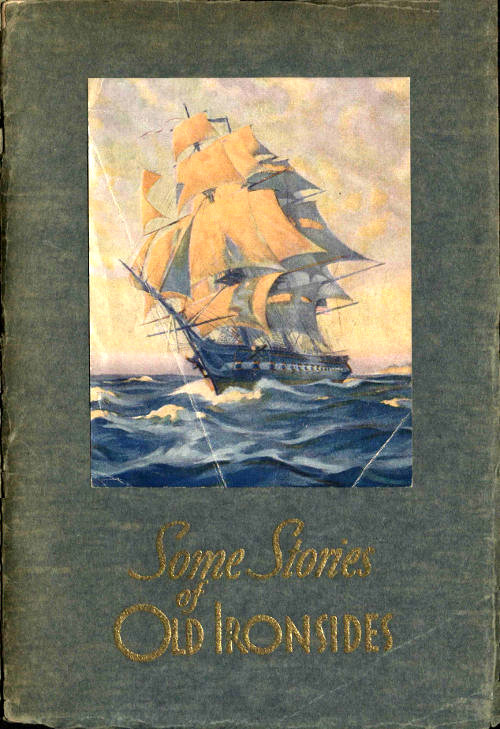
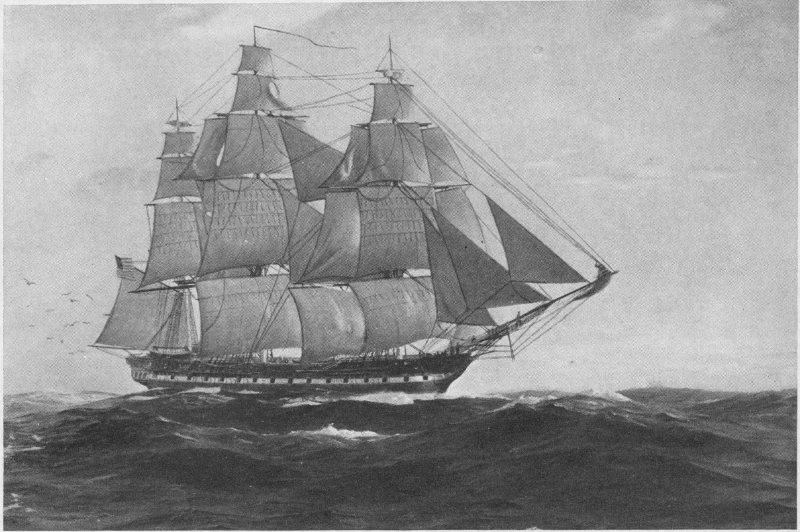
On a September day in 1803 an American frigate bowled
along the rocky Spanish coast toward Gibraltar. From
her bluff bows curled back a foamy wave. Above the blue
waters rose a gracefully proportioned black hull. Around
it, halfway up from the water line, ran a broad white
stripe. This was broken at regular intervals by the dark
squares of the gun ports. Spars tapered aloft. White rectangles
of billowing canvas completed a picture of beauty
unsurpassed on the Seven Seas. Such was the United
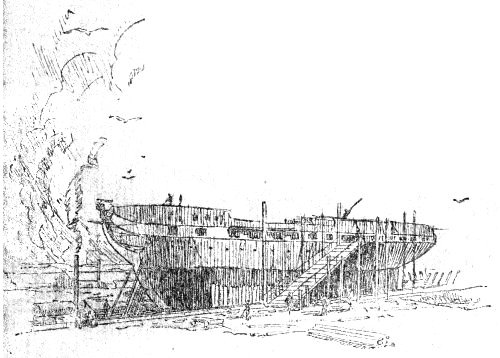
States ship Constitution. Joshua Humphreys, naval constructor,
had done his work well.
Watchers on the famous Rock might have noted, had
the beauty of this strange ship gained their full attention,
that from the mizzen truck flew the broad blue pennant
of a commodore. His name was then unknown. It is not
too well known even now. But as time passes the conviction
grows that Edward Preble should be classed in the
first rank of our naval commanders. He was soon to prove
that he was every inch a commodore. His pennant flew
from a splendid ship, but one which had as yet no tradition
of victory. Edward Preble was to begin that long
series of successful cruises and spectacular sea fights
which was to endear “Old Ironsides” to every American.
6
Countless ships for countless years had passed these
far-famed Pillars of Hercules. Some had sailed on errands
of peace, but most on the grim business of war. Phoenician
traders had sailed out northward to Britain for cargoes
of its precious tin. Carthaginian merchants under
Hanno had ventured far down the Atlantic coast of
Africa. Scipio Africanus with his legions had come this
way to complete the conquest of Spain. Moorish galleys
had ferried to Europe those fierce Moslem horsemen who
overran the Iberian Peninsula and fought for world empire
on the battlefields of France. Norse sea kings had
sailed on through to Sicily and Constantinople. Stout De
Ruyter and his Dutch seamen had followed in their track
to make his last campaign in the blue waters of the Mediterranean.
And only five years before the greatest sea
captain of them all, a certain Horatio Nelson, had hastened
by to match his wits with a General Bonaparte
and annihilate his fleet at the mouth of the Nile.
The entry of Edward Preble in a Yankee frigate into
the great sea which had supported so many war fleets
seemed doubtless at that time utterly devoid of historical
significance. But now, as we look back over a century and
a quarter, it takes on a new importance. It was to bring
our young Navy to a new plane of efficiency. It was to
demonstrate to Americans in a striking manner the value
of an efficient naval service. It was to establish our Navy
as a permanent American institution. And, what is more,
it signaled to watchful eyes abroad the rise of a new sea
power. It indicated, not only to African pirates, but also
to astute European statesmen, that this American Republic
7
had become a factor they would have to reckon with
in framing their diplomatic policies.
We believe that, as much as any other man of that era,
it was bold and forceful Edward Preble who gave the
United States that initial impulsion along the path of astounding
prosperity, unparalleled commercial power, and
world-wide influence.
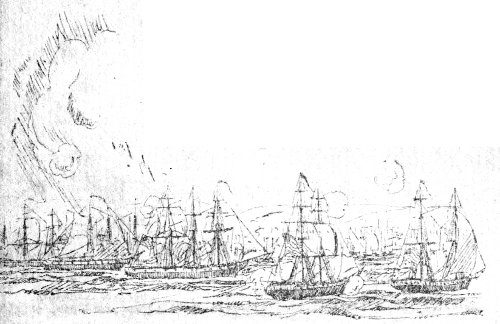
For two years we had been at war with the Moslem
principalities which lined the Mediterranean coast of Africa.
For many years before that, their piratical craft had
captured our merchant ships and sold their crews into
slavery. We had first begged and then bribed these pirates
to desist from piracy. And, finally, after all diplomatic
measures had failed, that task was given the Navy. That
service had been in existence only a few years. It was,
we must confess, not properly prepared to conduct a
difficult campaign so far from its home bases. So two years
of desultory fighting had accomplished little. In despair,
our statesmen had descended again to the artifices of
bribery. But, fortunately for us, the piratical chieftains
did not think our offers worth their while. So the Navy
was given a final chance and Edward Preble the command.
The backbone of his squadron were the fine frigates Constitution
and Philadelphia. For inshore work there were
the brigs Argus and Siren and the schooners Enterprise,
Nautilus, and Vixen. It is true that seven ships constituted
a small force to keep in good humor Morocco, Algiers,
and Tunis and bring to a favorable conclusion the
war with Tripoli. But the ships were all finely commanded,
well officered, and manned with the best sailors
8
in the world. The ships themselves were well built, adequately
equipped, and completely stored for a long campaign.
So it was with high hopes that Preble commenced
his difficult task—one, it may be added, which had baffled
Cardinal Ximenes, Charles V, Andrea Doria, Blake, De Ruyter,
and Duquesne.
An effective demonstration off Tangiers soon cooled
the ardor of the Sultan of Morocco. He reconfirmed the
old and highly favorable treaty of 1786. One potential
enemy had been removed. On now for Syracuse, the naval
base from which our campaign against Tripoli was being
conducted.
Off the coast of Sardinia the Constitution hailed H.M.S.
Amazon, a frigate attached to the squadron of Lord
Nelson. From her Preble received “the melancholy and
distressing intelligence of the loss of the U.S. ship Philadelphia.”
Here, Commodore, is a problem which will put
to the test all your intelligence and stoutness of heart.
At Syracuse Preble learned the full extent of the disaster.
The fine frigate had been run aground off Tripoli.
Captain Bainbridge, discouraged by his ill fortune, had
surrendered too quickly. Three hundred and fifteen of our
officers and men had been led ashore in triumph. In his
haste Bainbridge had not even taken effective measures to
destroy his own ship. She was floated and brought into
the harbor of Tripoli. Her guns were fished out of the
water and remounted. She was manned with a strong
Tripolitan crew. Thus she contributed to the strength of
9
the defenses, and constituted a threat to every merchant
vessel in the Mediterranean. Gloomy were the thoughts
of poor Bainbridge as he viewed these developments from
his prison window.
Preble was not the man to worry over past disasters.
He was concerned with future successes. How could he
counteract, in part at least, the loss of the Philadelphia?
There was no direct method for rescuing the crew. But
there might be a chance to regain the ship, or at least destroy
her so that the enemy could not use her. Bainbridge,
through the connivance of the Danish consul at Tripoli,
had suggested that she be attacked by a party of men secreted
in the hold of a merchant vessel. The capture of a
Tripolitan ketch provided the means of carrying through
this daring plan. The next essential item was a cool and
daring commander.
The commodore invited to this post of honor and danger
Lieutenant Stephen Decatur, then in command of the
Enterprise. To this young officer might well be applied a
sentence from Plutarch: “Being ever thirsty after honor,
and passionate for glory, if anything of a greater or extraordinary
nature was to be done, he was eager to be
the doer of it himself.” Decatur eagerly accepted his
commodore’s invitation.
Once the squadron got wind of the venture and of the
commander selected, there was no lack of volunteers.
Decatur naturally gave first choice to the people in his
own ship. Five of her officers and sixty-two of her sailors
shifted over to the ketch. This was formally commissioned
and appropriately renamed Intrepid. Five midshipmen
10
from the Constitution completed the complement. Last,
but by no means least, was a brave Sicilian pilot, Salvador
Catalano.
Edward Preble took upon himself full responsibility for
the hazardous enterprise. “It is my order,” he wrote Decatur,
“that you proceed to Tripoli, in company with the
Siren, Lieutenant Stewart; enter the harbor in the night;
board the Philadelphia; burn her; and make good your
escape.” The courage it requires to write such an order is
seldom appreciated. If the expedition had failed, as certainly
it looked very probable, all the blame would have
fallen on Preble. He would have been accused of sending
officers and men to their death while he remained in safety.
And, if the attack should succeed, the credit and honor
would belong to Decatur. But Preble was not guarding
his own interests. He was striving to further those of the
Navy and the country.
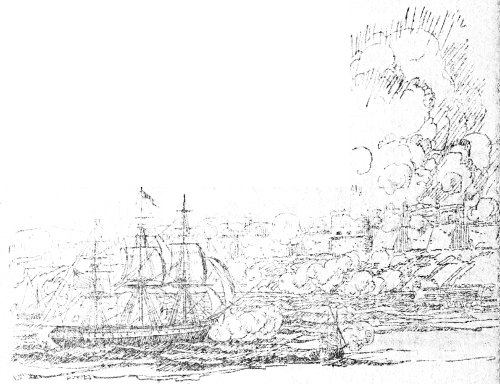
For two weeks the Intrepid was battered about by a
succession of storms. On this little craft, much smaller
than a submarine chaser, seventy-four men were crowded.
Their sufferings can scarcely be imagined. But at last the
weather moderated and the long-awaited opportunity was
at hand. As a reënforcement Midshipman Anderson and
nine sailors rowed over in one of the Siren’s cutters. This
was towed astern of the Intrepid. She started in.
The sea now was smooth. The wind lulled slowly to a
calm. As night came on, a young moon, the enemy’s emblem,
diffused a gentle light over the phosphorescent
waters. Wary Odysseus might have turned back his prow
at sight of such an unfavorable omen, but not all the gods
11
on Olympus could have turned back Stephen Decatur that
night.
Slowly and silently steals the Intrepid toward the harbor
entrance. This cold wintry night there are no vessels
on patrol. Only irregular ranks of jagged rocks keep watch.
The moonlight discloses these ever present sentinels. The
ship passes through.
Quietly there on deck stand Decatur, Catalano, and ten
seamen—all disguised as Sicilians. Close down behind the
bulwarks crouch the remainder of the crew. Ahead looms
up the great hulk of the Philadelphia. Her foremast has
not been replaced, but the main and mizzenmasts, with
their network of rigging, trace a spider web of black
against the dull red glare of the city’s lights. Fifteen gaping
gun ports are dotted with the muzzles of frowning 18-pounders,
loaded, shotted, and ready to be touched off.
High overhead towers the dark mass of the Bashaw’s
castle, its embrasures filled with one hundred and fifteen
cannon.
The frigate’s bell rings out the hour. It is ten-thirty in
the evening watch. Her sentinel hails. Catalano answers
with long-rehearsed lines. He has lost his anchors. May
he not secure alongside the frigate for the night? The answer
is, “Yes.” Lawrence lowers a small boat. With a line
from the Intrepid he pulls for the frigate’s bows. Quickly
he secures his end to the fore chains. At the other end
crouching seamen haul away.
Watchers on the frigate, if they had not been too
sleepy, might have wondered at the hidden power which
draws the little craft so steadily upon her prey. It is not
12
until she is almost alongside that they see the crowd of
men on her decks. “Americanos!” yells the sentinel. But
now it is too late. Another pull brings the Intrepid alongside.
Then rises a confused din as her crew begin a wild
scramble for the honor of being the first over the enemy’s
side. Decatur trips on his scabbard. Morris passes him.
Over the high bulwarks, sword in teeth, he disappears.
Lieutenants, midshipmen, sailors follow him. Here have
ceased the privileges of rank. Those of courage begin.
Surprise has won the day. There is no resistance on the
upper decks. The startled enemy dive over the side or
scuttle below. Wild Americanos or hungry sharks—what
a choice to have to make! Some twenty Tripolitans fall
before the former. How many succumb to the latter we
may only guess. In twenty minutes the ship is everywhere
ablaze. As the flames shoot up the guns ashore fire on the
clearly illuminated target. Back into the ketch our sailors
spring. Lines are cut with battle-axe and cutlass, just in
time to evade the outrushing flames. Out ring three good
American cheers above the crackling roar of fire and the
thunder of cannonade.
The flames now have mounted the frigate’s rigging
turning night into day. The Intrepid is clearly disclosed to
the enemy gunners. From every direction shot converge
on the little ship. Out are run sixteen great sweeps. Strong
men, willing galley slaves for an hour, double-bank their
handles. Their long blades churn the waters into foam.
Away she races through the shell splashes.
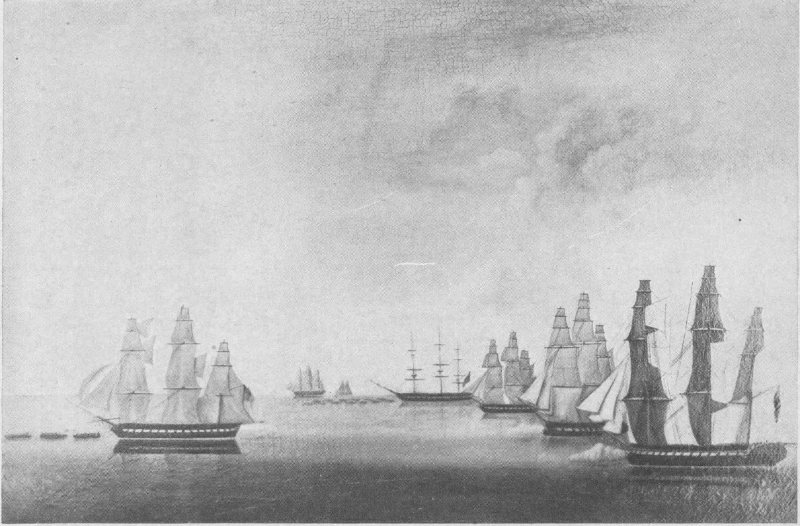
From an old painting
Chase of the Constitution
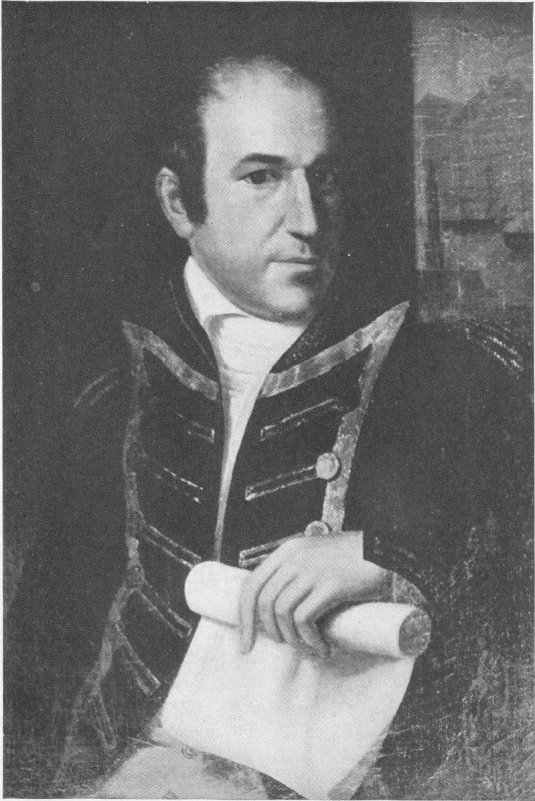
From the painting by John W. Jarvis
Edward Preble
13
Thus ended with complete success what Lord Nelson
called the most bold and daring act of the age. When,
three days later, the Intrepid sailed through the American
squadron in Syracuse, each ship gave Decatur and his
men a deafening salute of cheers. What music to a sailor’s
ears!
As spring came on the commodore pushed his preparations
for a naval attack on Tripoli. He now had only one
large ship, the Constitution. There were five brigs and
schooners. A captured Tripolitan brig, commissioned as
the Scourge, made a sixth. Preble knew that these ships
could not get in close enough to the enemy to win the decisive
results he was determined to have. So he borrowed
six gunboats, two bomb vessels, and ninety-six sailors
from the King of Naples. Even with this reënforcement,
Preble had but one thousand and sixty men to attack a
strongly fortified town defended by twenty-five thousand
soldiers and sailors. Still his hopes for success were high.
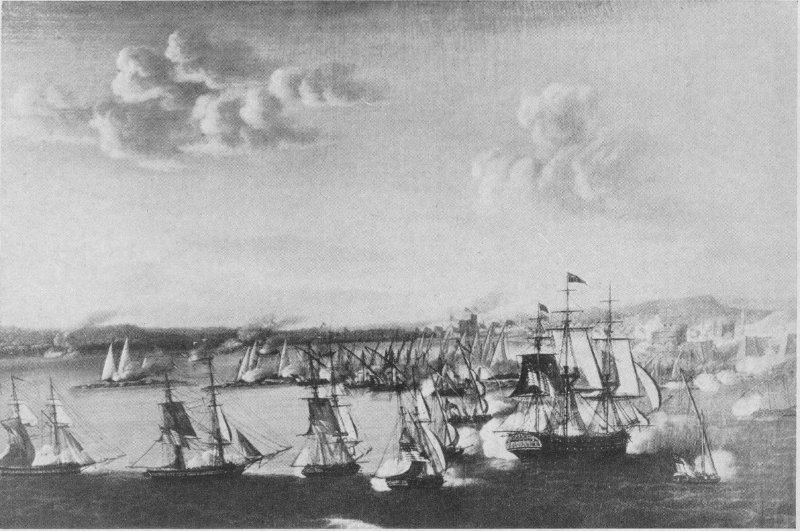
Early in August, 1804, the orders for a grand attack
were issued. This was to be no distant cannonade. The
Constitution was to attack the batteries at point-blank
range. The gunboats were to board the enemy flotilla.
The bomb vessels were to toss their 13-inch grenades into
the town.
The Bashaw, as the Tripolitan ruler was called, saw
that a storm was about to break over his head. In addition
to formidable batteries ashore, he had twenty-one gunboats.
These were manned by from twenty-four to forty
men. Each carried one large and two small guns. We must
not mistake these Tripolitans. They were splendid seamen
and fierce fighters. Boarding was their usual method
14
of attack. Nine of their gunboats were stationed outside
the reefs east of the harbor entrance. Five were under the
powerful batteries to the westward. The remainder lay
inside the harbor in reserve.
At two o’clock in the afternoon of August 3, the flagship
displayed the long-awaited signal for attack. Our six
gunboats, under Decatur, were to attack the nine Tripolitan
craft east of the harbor. Only three of his detachment,
for various reasons, reached the enemy. Now three against
nine were big odds. But, thought our young fellows, the
bigger the odds the greater the glory. And they had Stephen
Decatur—himself worth a couple of gunboats—to
lead them. He, like the Spartans, “was not wont to ask
how many but where, the enemy were!”
So Decatur led the charge. He made for a large gunboat
armed with a huge 29-pound cannon and two howitzers.
Her crew, as we learned later, numbered thirty-six.
Decatur also has one cannon, a long 24-pounder. He sails
in close until he can see the white of their eyes. Then he
fires. A hail of grapeshot sweeps the enemy’s deck. As
the two ships crash together our boarders are away. For
a few minutes the fight is furious. But American pikes
and cutlasses are irresistible. When only five of their
people remain unwounded the Moors cry for quarter.
Here is a victory, decided, as the old saying goes, by push
of pike.
Meanwhile Sailing Master Trippe is having a bad
quarter of an hour. He runs his gunboat alongside another
enemy ship. Boarding is the order of the day. That is a
good way for Americans, as well as Tripolitans, to fight.
15
Trippe springs into the enemy gunboat. Midshipman
Henley and nine sailors follow. Then the ships drift apart.
Here now is a situation. Trippe sees that, being too weak
for defense, it is necessary to attack. He lunges at the
enemy captain with his pike. The Tripolitan is a good
swordsman, and his scimitar is sharp. He rains blows on
Trippe’s chest and shoulders—wounds him eleven times
in all. But the sailing master gets in one effective thrust
with his pike, and this more than evens up matters. Another
Moor, whose cutlass is descending on Trippe’s
head from behind, is bayoneted by Marine Sergeant
Jonathan Meredith. Having lost their captain and twenty
of their comrades, the remaining Tripolitans now surrender.
To cap the climax, Decatur boarded a third enemy gunboat,
somewhat smaller than his first prize. Here occurred
that famous hand-to-hand combat between Decatur and
the gigantic Moorish captain. The devotion of Seaman
Daniel Frazier, and his own coolness gave Decatur victory.
All but three of the enemy were killed or wounded before
they would surrender. This was real schooling for a young
Navy.
Lieutenant Richard Somers, bravest of the brave, had
not been able to join Decatur. So single-handed he attacked
the five enemy craft west of the entrance. “They
still advanced to within pistol-shot,” Somers wrote,
“when they wore round and stood for the batteries. I
pursued them until in musket shot of the batteries, which
kept up a continued fire of round shot and grape.” That
was how Somers fought.
16
The Constitution’s heavy battery, reënforced by six
Neapolitan 29-pounders, had been engaging these same
batteries at point-blank range. Several times she was
brought within four hundred yards of the rocky coast of
which no chart was available. The bomb vessels had
launched a quantity of their huge 13-inch shells into the
city, but many of them did not explode. At four-thirty
the wind shifted and a withdrawal was signaled. Preble
covered it in great style. “Tacked ship,” he wrote, “and
fired two broadsides in stays, which drove the Tripolitans
out of the castle and brought down the steeple of a
mosque.”
This three-hour battle had proved highly successful.
But do you think the commodore was contented? Admiral
Gleaves tells how, after the battle, Decatur came on board
the Constitution to make his report. Approaching Preble
on the quarter-deck, he said: “Sir, I have the honor to report
that I have captured three of the enemy’s gunboats.”
“Three, Sir!” replied the commodore, “where are the rest
of them?” This incident well illustrates the inflexible character
of Edward Preble. In his official report, however, he
was careful to express complete satisfaction with the manner
in which his subordinates had conducted their attacks.
As the summer wore on four more attacks were made.
All were conducted with great gallantry. They were not
made without loss, for the Tripolitans always gave us a
good fight. Pirates though they were, we must give them
credit where due. The last attack, conducted at night, was
particularly effective. On that occasion, “to draw off the
enemy’s attention and amuse them while the bombardment
17
was being kept up,” the Constitution fired eleven
thunderous broadsides at point-blank range.
In the fall Preble returned home. During his year of
command not a court-martial had been ordered nor a duel
fought. Among the many letters of congratulation he received
was a unique tribute from the Pope: “The American
commander, with a small force and in a short space of
time, has done more for the cause of Christianity than
the most powerful nations of Christendom have done for
ages.” His countrymen received the returning commodore
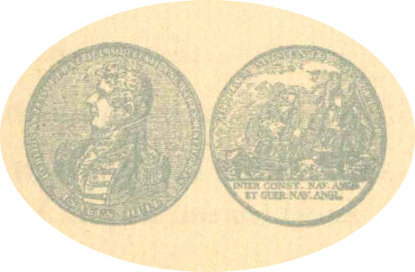
with every honor. Congress voted him a gold medal. The
Navy had again come into its own. And the Constitution,
now a veteran of five battles, had firmly established her
reputation as a lucky and successful ship.
Thus ends the first act of our drama. Eight years pass
before the second begins.
18
ACT II On the Ocean — SCENE I. THE FIGHT WITH THE GUERRIERE — SCENE II. AND NOW FOR THE “JAVA” — SCENE III. THE LAST FIGHT
At last the day has come. Long and eagerly awaited has
it been by American seamen. A tall-sparred frigate plows
through the purple waters of the Gulf Stream. From her
mastheads lookouts report a tiny speck upon the clear
horizon. Sharp eyes distinguish it from the far-distant
masses of cumulous clouds it counterfeits so well. Larger
and larger it grows. It becomes, in fact, another frigate,
equally large and beautiful. Across one of her topsails is
painted a cryptic phrase, “Not the Little Belt.” This may
have little meaning to us today. But in the year of our
Lord 1812 it was full of grim significance. From her peak
flutters a white ensign, barred with red, the proud emblem
of the Royal Navy.
On the first ship there is a muffled roll of drums, a brief
hurrying of men about the decks, a period of well-ordered
activity—then quiet. “Silent is the path of duty for every
well-drilled man.” Up to her mastheads creep balls of
bunting. These at a quiet word of command break out
into strips of red and white, stars of white against a blue
field—battle ensigns of the United States. Constitution
and Guerriere have met. A great moment of history is at
hand.
The famous duel between these two frigates cannot, of
19
course, be compared to the many sea battles between
great fleets which have made naval history. But often
small events have a far-reaching influence. This fight certainly
was one of the most important and decisive single
ship actions ever fought.
To show why this was so we must set the scene before
we begin the play. To Great Britain, engaged in a death
struggle with Napoleon, our little war was nothing more
than a side show—of even less importance than the entry
of a Balkan nation into the World War struggle. The chief
concern of the British statesmen was that it might interfere
with the supply of Wellington’s army in Spain—a
task performed almost exclusively by American merchant
vessels. It never occurred to them that our frigates would
put to sea, or, if they should, that they could last long
against the British cruisers which literally covered the
Seven Seas. Theodore Roosevelt has stated that during
the previous twenty years the Royal Navy had fought
two hundred single-ship actions where there was approximate
equality in power, i.e., neither ship had a superiority
of over three to two. In these actions only five British
ships had been captured. With such a record of success, it
was only natural that the British captains should give
scant consideration to our young and comparatively inexperienced
Navy.
It is true that the Constitution was about 7 per cent
larger than the Guerriere; that she carried 24-pounder
guns against the 18-pounders in the British frigate, thus
giving us a ten to seven superiority in weight of metal;
and that her sides were very thick, stouter in fact than
20
those of a British ship-of-the-line. But the British captains
showed not the slightest concern over these American
advantages, which at that time were not considered as
such. In fact, it was thought that we had overweighted
our ships with guns and timbers so that their speed and
handiness were decreased. Captain Dacres of the Guerriere
had challenged any American frigate to meet him in single
combat. He had bet Captain Isaac Hull, so the story goes,
a perfectly good hat that he would beat the Constitution.
Even after the fight Dacres said he would be happy to
fight him again with “a frigate of similar force to the
Guerriere.” All the propaganda of our frigates being disguised
ships-of-the-line was a much later concoction, disseminated
after we had proved in three battles the advantage
of our heavier guns and thicker sides, as well as
the efficiency of our officers and sailors.
But now let the fight begin. For some hours the Guerriere
kept away, trying to gain some advantage. But at
6:00 P.M. Dacres decided to end this useless maneuvering
and get to business. He headed directly before the wind,
decreased sail, and waited for the American frigate. Hull,
increasing his sail power, came swiftly down upon him.
Zero hour was about to strike. What could Yankee seamen
do against the might of Britannia?
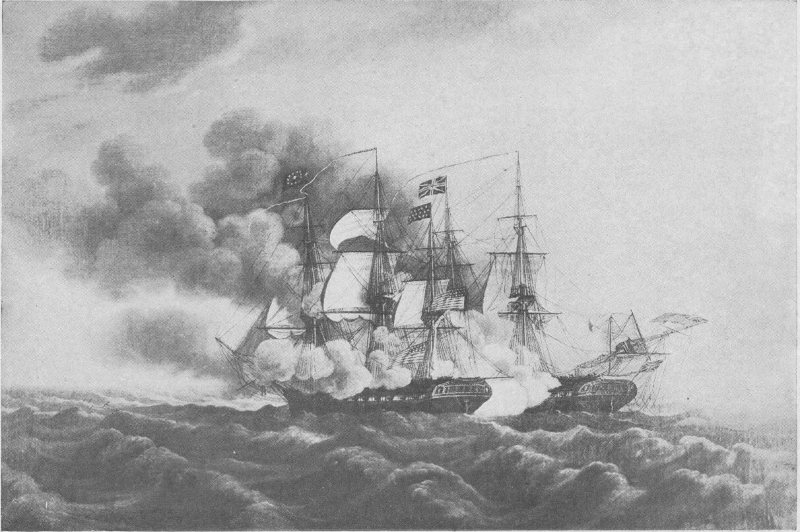
From the painting by Thomas Birch
Constitution AND Guerriere
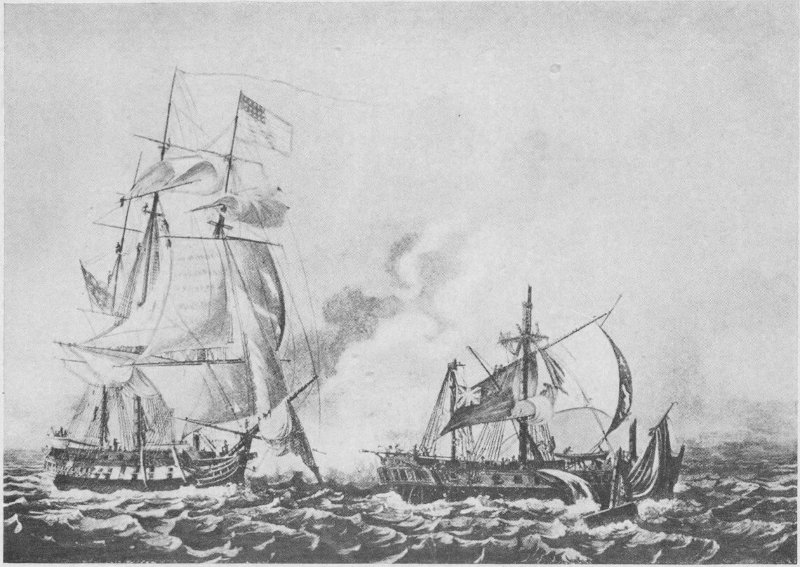
Macpherson Collection
Capture of the British Frigate Java by the U.S. Frigate Constitution off the Coast of Brazil, December 29, 1812
21
Moses Smith, sponger of No. 1 gun, describes how the
Constitution went into action. “Hull was now all animation.
He saw that the decisive moment had come. With
great energy, yet calmness of manner, he passed around
among the officers and men, addressing to them words of
confidence and encouragement. ‘Men,’ said he, ‘now do
your duty. Your officers cannot have entire control over
you now. Each man must do all in his power for his
country.’ The Stars and Stripes never floated more proudly
than they did at that moment. All was silent beneath
them, save the occasional order from an officer, or the low
sound of the movement of our implements of war. Every
man stood firm to his post.”
By 6:05 the Constitution was two hundred yards on the
Guerriere’s port quarter. Hull then yawed his ship’s head
slightly away from the enemy and threw his broadside
full upon her. As the guns bore on the target they fired in
rapid succession. “We instantly followed the thunder of
our cannon with three loud cheers, which rang along the
ship like the roar of waters, and floated away rapidly to
the ears of the enemy.”
The cannonading was terrific. Our gunners, in the heat
of battle, looked well to their aim. By 6:20 the Constitution
was abreast the British frigate, distant one hundred
yards. Then with a splintering crash came down Dacres’
mizzenmast. “Huzza, boys! We’ve made a brig of her!”
The mast, with its tangle of sails and rigging, dragged in
the water and checked the Guerriere’s headway. Here
was Hull’s chance, and he was not the man to miss it.
Spinning his wheel to the right, he charged across his
enemy’s bow. Those terrible 24’s raked her with great
effect. As the Constitution shot past and her guns would
no longer bear there was a brief lull in the fight. Seaman
Daniel Hogan climbed to the dizzy height of the fore
truck to replace the battle ensign which had been shot
away.
22
Hull wore his ship and again headed across the bow of
the almost unmanageable Guerriere. His gunners had
moved across the deck and cast loose the port guns. Again
they raked the British frigate. But this time Hull had come
a bit too close. The ships came together. Boarders were
called away. A storm of musketry broke out. Sharpshooters
in the tops fired down on the crowded decks. Lieutenant
William Bush of the Marines fell dead. Lieutenant
Charles Morris, who first had scaled the Philadelphia’s
side, was severely wounded. So also was Sailing Master
John Aylwin, a brave and skillful officer. At 6:30 the
ships came clear. And then the Guerriere’s foremasts and
mainmasts plunged over her side. Twenty-five minutes
had sufficed for Yankee gunners to dismast a British frigate.
Seeing that the fight was won, Hull hauled off to repair
his rigging. He must be prepared for another enemy if
one should appear. At 7:00 he returned to receive the
surrender of Captain Dacres. The prize was so completely
wrecked that there was no hope of bringing her into port.
After her crew had been taken off, she was set on fire.
From the Constitution’s quarter-deck Captain Dacres
watched. At length her magazine exploded and she disappeared
beneath the waters. A sad omen it must have
seemed to the British captain. A new sea power had arrived!
That this was fully appreciated is shown by an article
in the London Times. “It is not merely that an English
frigate has been taken, after, what we are free to confess
may be called a brave resistance, but that it has been taken
by a new enemy, an enemy unaccustomed to such triumphs,
23
and likely to be rendered insolent and confident
by them. He must be a weak politician who does not see
how important the first triumph is in giving a tone and
character to the war. Never before in the history of the
world did an English frigate strike to an American.”
In our country the effect was magical. Where before
political strife, sectional differences, and commercial rivalries
combined to bring our people to the verge of civil war
and secession, now a wave of wildest enthusiasm spread
like a forest fire. For here was a deed of which every man
and woman from Maine to Louisiana might be proud.
“Thank God for Hull’s victory” was a watchword which
passed from state to state. It gave impetus to naval operations
and fired our captains with impatience to get to sea
and bring the enemy under their guns. It encouraged
swarms of privateers to cover the Seven Seas and attack
the enemy’s vital trade routes.
Admiral Sir John Jervis is reported to have said to his
flag captain as he sighted the Spanish fleet off Cape St.
Vincent that a victory was very necessary to England at
that moment. With equal justice Isaac Hull might have
made a similar remark on sighting the Guerriere. Our
country needed a victory then as it never had before nor
has since. Napoleon said that in war the moral is to the
physical as three to one; in this case it was many times
more. The mere sinking of a frigate meant nothing to England.
But the fact that it was sunk by an American frigate
at the cost of only fourteen casualties meant a great deal
to England, and to our United States. What had been
done once could be done again!
24
While the Constitution was taking a little rest in Boston
Stephen Decatur in the sister-ship United States had
taken the sea. In the latter part of October he encountered
the British frigate Macedonian, likewise a sister-ship of
the Guerriere. So the scene was set exactly as in the previous
battle. But, whereas Hull had decided the issue by
sheer overpowering force at point-blank range, Decatur
fought a distant battle in an effort to capitalize to the full
his superiority in gunnery and seamanship. He won his
fight at the cost of only eleven casualties. In ninety minutes
his gunners had put a hundred shot into the Macedonian’s
hull and killed or wounded one hundred and four
of her crew. This time the prize was brought safely into
port. Here was a convincing confirmation of American
naval efficiency.
By the time this fight had been won the Constitution
was again at sea. This time she was commanded by William
Bainbridge, the unlucky officer who had lost the Philadelphia
off Tripoli. But now he was in a luckier ship. Soon
fortune sent a fine British frigate into his arms. This happened
on December 29 off Bahia on the coast of Brazil.
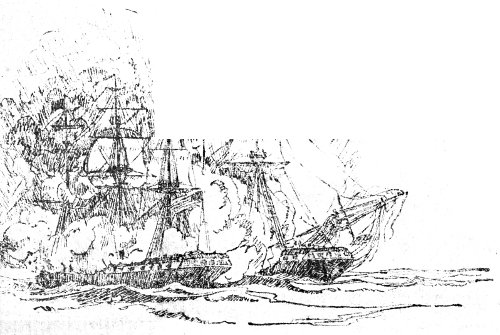
The Java was considerably more powerful than the
other British frigates previously captured. She was commanded
by an excellent officer, Captain Lambert. In
weight of metal she was inferior to the Constitution only
as nine to ten. Neither captain had any idea of dodging
the issue. Each made ready to fight to the finish. Fighting
topsails were spread. Battle ensigns decorated every masthead.
At 2:10 P.M. the battle began. At first the range
25
was long. But in a few minutes the ships were in to two
hundred yards. Then the real business of the day began.
It was as finely contested a frigate action as ever was
fought. Both Bainbridge and Lambert maneuvered their
ships with masterly skill. First one ship would gain an
advantageous position, then the other. Like two skilled
wrestlers, each in turn gained a hold, only to have it
broken by his opponent.
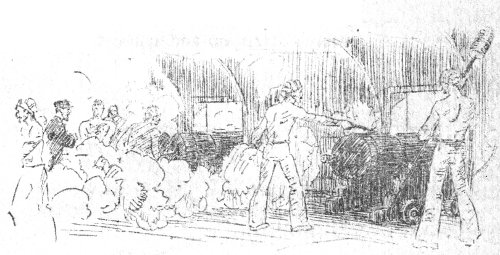
All this time the guns’ crews were fast at work, rushing
from one battery to the other as their captains tacked and
wore. It was work, hard and grim—hauling at the gun
tackles, ramming home powder and shot, and slewing
around the clumsy gun carriages to point the guns
squarely at the enemy. Acrid smoke clouds swept along
the decks and clouds of splinters flew around.
For a time the action is very closely fought. But, barring
a lucky accident, the issue is really never in doubt. For
Yankee gunners are incomparable and they have iron
sides to protect them—twenty inches of stout oak beams.
They cannot be beaten in such a ship. Slowly but surely
our superiority in gunnery wears down the enemy. One
after another the Java’s tall spars crash down. Heroic
Lambert fights well but is killed. Lieutenant Chads, already
wounded, takes command. Half his crew is killed
or wounded. Still he fights.
The Constitution also has her losses. Bainbridge himself
is severely wounded, but he still keeps the deck. Brave
Aylwin, who already wears a wound stripe for the Guerriere
battle, is again shot down. This will be the last fight
for him. Well, he will live long enough to see a second
26
British frigate lower her battle flags. Over thirty others
lie dead or wounded about the decks or under the surgeon’s
knife in the cockpit. British frigates cannot be
taken without losing men.
For two long hours the battle rages. Chads does well
but he cannot do the impossible. Finally the Java must
give in. Here is a fight in which there is honor enough for
all, vanquished as well as victor. And Bainbridge, after
such buffets of fate as few have received, at last has won
his well-deserved victory. A third British frigate had been
taken.
When “Old Ironsides” reached Boston a great reception
awaited the commodore. There he marched through
the streets, arm in arm with Rodgers and Hull—three
commodores of whom any country might be proud. Fifes
and drums played Yankee-Doodle as the procession moved
through the streets. It was a big Navy Day!
The Constitution took a long rest after this battle. The
Java’s shot had discovered some rotten spots in her sides.
A long overhaul was required to make her again ready for
sea. Meanwhile the Navy had won many a victory and
had suffered some defeats. Our little sloops-of-war won a
long succession of splendid successes. Gallant James Lawrence,
hero of the Hornet-Peacock fight, lost the Chesapeake
to the British frigate Shannon—crying, as he lay
dying, “Don’t give up the ship!” Sewing this motto on
his blue battle flag Perry annihilated the British squadron
on Lake Erie. Macdonough saved the northern frontier
27
with a complete victory on Lake Champlain, which a
British marine thought more desperately fought than
Trafalgar. Our privateers were gathering in their prizes
on every sea in constantly increasing numbers and sending
the insurance rates three times higher than all previous
levels.
But the war could not well end without a third victory
by the Constitution. Now she was commanded by Charles
Stewart, a worthy successor to Hull and Bainbridge. On
February 20, 1815, north of Madeira, the American frigate
came in contact with the British corvette Cyane,
thirty-four guns, and the sloop Levant, twenty-one. Their
fifty-five guns threw a slightly heavier weight of metal,
but their armament consisted mostly of short-range carronades
which could not be compared with the terrible
long 24’s which filled the Constitution’s gun-deck ports.
Still the two Britons formed column and accepted Stewart’s
challenge.
Stewart might have fought at long range where the
British carronades could not have reached him. But night
was coming on, and, if he were to take both ships, there
was no time to waste. “At five minutes past six,” he
wrote, “ranged up on the starboard side of the sternmost
ship, about three hundred yards distant, and commenced
the action by broadsides, both ships returning our fire
with the greatest spirit for about fifteen minutes.” Stewart’s
tactics have a lesson: When you are anxious to engage
and night is approaching, do not try to get all the
conditions in your favor. Take things as they are and fight
in the most decisive manner. Otherwise you will never
28
capture your Cyane and Levant. Perhaps we have here a
lesson for the battles of peace as well as those of war.
After this first engagement smoke clouds obscured the
range and fire ceased. But not for long, for now the Constitution
began a series of beautiful maneuvers—raking
each enemy ship in turn. They separated and made off.
Stewart hung close to the Cyane and soon forced her to
surrender. By eight o’clock she had been manned by a
prize crew. Stewart started in search of the Levant.
Captain Douglass of the Levant had now repaired his
damages. Instead of trying to escape, he sailed back to
assist his comrade. But he was too late. At eight-thirty
he ran into the Constitution. Attempts to escape proved
futile and at ten the second prize was made. “At 1:00
A.M.,” Stewart reported, “the damages to our rigging
had been repaired, sails shifted, and the ship in fighting
condition.” The price of this double victory was only
fifteen casualties.
The Cyane safely reached home. The Levant was recaptured
by a British squadron in a neutral port. The
Constitution received her last battle triumph in New
York many months after peace had been signed. She had
fought her last fight. But for many long years she served
her country well by showing the flag in every part of the
world. After that she trained many classes of midshipmen
at the Naval Academy. Now her useful labors are ended
but she serves a still more important purpose. For this
old hulk, whose iron sides protected iron men, is an inspiration
to every officer and man in the naval service—and
to every American.
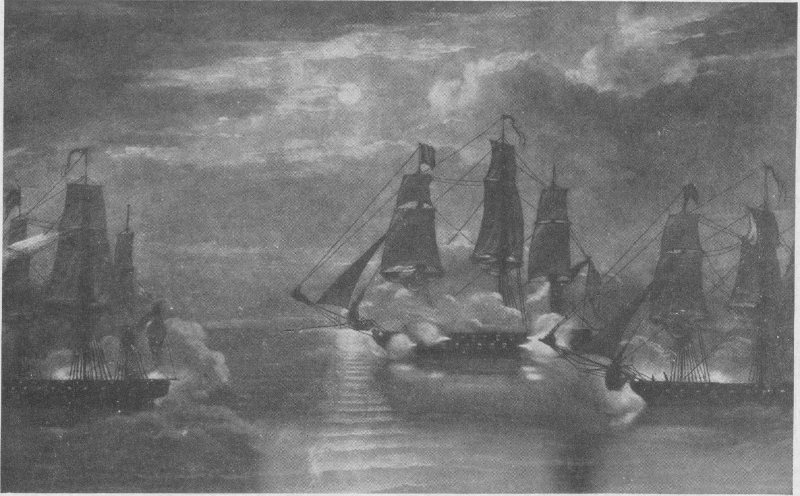
Courtesy U. S. Naval Academy
From an engraving by Sartain, after the original painting by Thomas Birch
The Night Battle Between the U.S.S. Constitution and H. M. Ships Cyane AND Levant
On the left is the corvette Cyane, in the center the frigate Constitution, and on the right the sloop Levant. The Constitution captured both vessels.
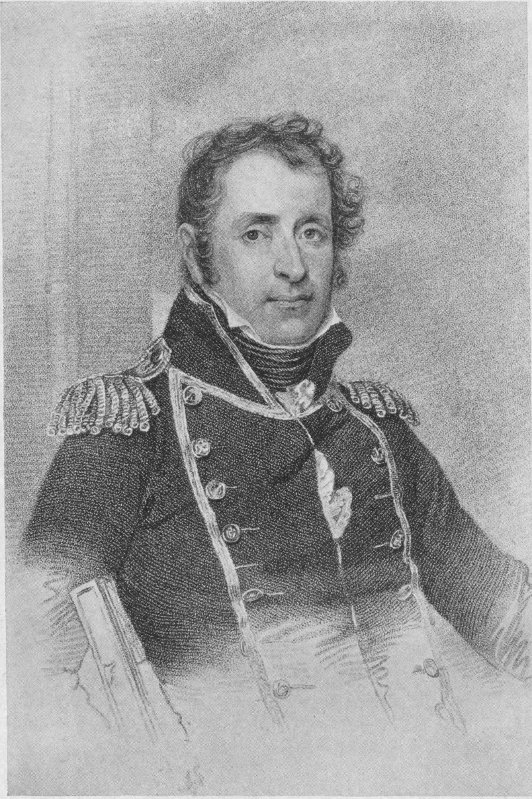
From an engraving by Henry Meyer after the original painting by John W. Jarvis
Stephen Decatur
29