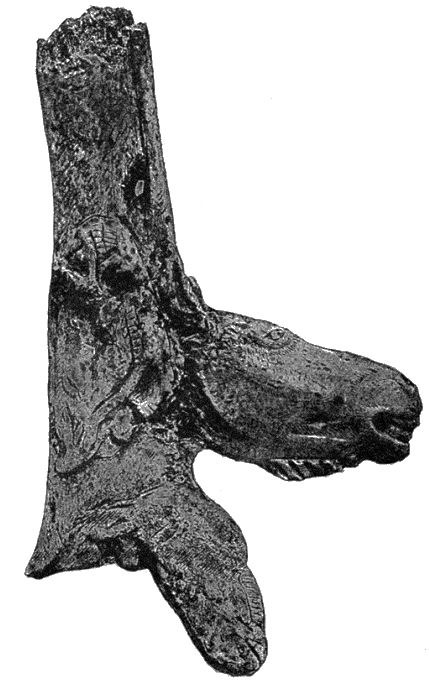
THE OLDEST AIR-BREATHERS.
A
Animal life had its beginning in the waters, and to
this day the waters are the chief habitat of animals,
especially of the lower forms. If we divide the animal kingdom
into great leading types, the lowest of these groups, the
Protozoa, includes only aquatic forms; the next, that of the
coral animals and their allies, is also aquatic. So are all the
species of the Sea Urchins and Star Fishes. Of the remaining
groups, the Mollusks, the Crustaceans, and the Worms are
dominantly aquatic, only a small proportion being air-breathers.
It is only in the two remaining groups, including the Insects
and Spiders on the one hand, and the Vertebrate animals on
the other, that we have terrestrial species in large proportion.
The same fact appears in geological time. The periods
represented by the older Palæozoic rocks have been termed
ages of invertebrates, and they might also be termed ages
of aquatic animals. It is only gradually, and as it were with
difficulty, that animals living in the less congenial element of
air are introduced—at first a few scorpions and insects, later,
land snails and amphibian reptiles, later still, the higher reptiles
and the birds, and last of all the higher mammalia.
We need not wonder at this, for the conditions of life with
reference to support, locomotion, and vicissitudes of temperature
are more complex and difficult in air, and require more
complicated and perfect machinery for their maintenance.
Thus it was that probably half of the whole history of our
earth had passed away before the land became the abode
of any large number and variety of animals; while it was only
about the same time that the development of the vegetable
kingdom became so complete as to afford food and shelter
for air-breathers.
It is also worthy of note that it is only in comparatively
recent times that we have been able to discover the oldest
air-breathing animals, and geologists long believed that the
time when animals had existed on the land was even shorter
than it had actually been. This arose in part from the infrequency
and rarity of preservation of the remains of the
earliest creatures of this kind, and perhaps partly from the
fact that collectors were not looking for them.
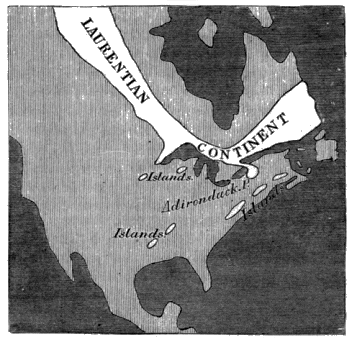
That there was dry land, even in the Cambro-Silurian
period, we know, and can even trace its former shores. In
Canada our old Laurentian coast extends for more than a
thousand miles, from Labrador to Lake Superior, marking the
southern border of the nucleus of the American continent in
the Cambrian and Cambro-Silurian periods. Along a great
part of this ancient coast we have the sand flats of the Potsdam
Sandstone, affording very favourable conditions for the imbedding
of land animals, did these exist; still, notwithstanding
the zealous explorations of the Geological Survey, and of many
amateurs, no trace of an air-breather has been found. I have
myself followed the oldest Palæozoic beds up to their ancient
limits in some localities, and collected the shells which the
waves had dashed on the beach, and have seen under the
Cambro-Silurian beds the old pre-Cambrian rocks pitted and
indented with weather marks, showing that this shore was then
gradually subsiding; yet the record of the rocks was totally
silent as to the animals that may have trod the shore, or the
trees that may have waved over it. All that can be said is
that the sun shone, the rain fell, and the wind blew as it does
now, and that the sea abounded in living creatures. The eyes
of Trilobites, the weathered Laurentian rocks, the wind ripples
in the Potsdam sandstone, the rich fossils of the limestones,
testify to these things. The existence of such conditions
would lead us to hope that land animals may yet be found in
these older formations. On the other hand, the gradual failure
of one form of life after another, as we descend in the geological
series, and the rarity of fishes and land plants in the
Silurian rocks and their absence from the Cambrian, might
induce us to believe that we have here reached the beginning
of animal life, and have left far behind us those forms that
inhabit the land.
Even in the Carboniferous period, though land plants
abound, air-breathers are not numerous, and most of them
have only been recently recognised. We know, however,
with certainty that the dark and luxuriant forests of the coal
period were not destitute of animal life. Reptiles[122] crept
under their shade, land snails and millipedes fed on the
rank leaves and decaying vegetable matter, and insects flitted
through the air of the sunnier spots. Great interest attaches
to these creatures; perhaps the first-born species in some of
their respective types, and certainly belonging to one of the
oldest land faunas, and presenting prototypes of future forms
equally interesting to the geologist and the zoologist.
It has happened to the writer of these pages to have had
some share in the finding of several of these ancient animals.
The coal formation of Nova Scotia, so full in its development,
so rich in fossil remains, and so well exposed in coast cliffs,
has afforded admirable opportunities for such discoveries,
which have been so far improved that at least twenty-five out
of the not very large number of known Carboniferous land
animals have been obtained from it.[123] The descriptions of
these creatures, found at various times and at various places,
are scattered through papers ranging in date from 1844 to
1891,[124] and are too fragmentary to give complete information
respecting the structures of the animals, and their conditions
of existence.
Footprints.
It has often happened to geologists, as to other explorers of
new regions, that footprints on the sand have guided them to
the inhabitants of unknown lands, and such footprints, proverbially
perishable, may be so preserved by being filled up
with matter deposited in them as to endure for ever. This we
may see to-day in the tracks of sandpipers and marks of rain-drops
preserved in the layers of alluvial mud deposited by the
tides of the Bay of Fundy, and which, if baked or hardened
by pressure, might become imperishable, like the inscriptions
of the old Chaldeans on their tablets of baked clay. The
first trace ever observed of reptiles in the Carboniferous
system consisted of a series of small but well-marked footprints
found by Sir W. E. Logan, in 1841, in the lower coal
measures of Horton Bluff, in Nova Scotia; and as the authors
of most of our general works on geology have hitherto, in so
far as I am aware, failed to do justice to this discovery, I shall
notice it here in detail. In the year above mentioned, Sir
William, then Mr. Logan, examined the coal fields of Pennsylvania
and Nova Scotia, with the view of studying their
structure, and extending the application of the discoveries as
to beds with roots, or Stigmaria underclays, which he had made
in the Welsh coal fields. On his return to England he read
a paper on these subjects before the Geological Society of
London, in which he noticed the subject of reptilian footprints
at Horton Bluff. The specimen was exhibited at the meeting
of the Society, and was, I believe, admitted, on the high
authority of Prof. Owen, to be probably reptilian. Unfortunately
Sir William's paper appeared only in abstract in the
Transactions; and in this abstract, though the footprints are
mentioned, no opinion is expressed as to their nature. Sir
William's own opinion is thus stated in a letter to me, dated
June, 1843, when he was on his way to Canada, to commence
the survey which has since developed so astonishing a mass
of geological facts.
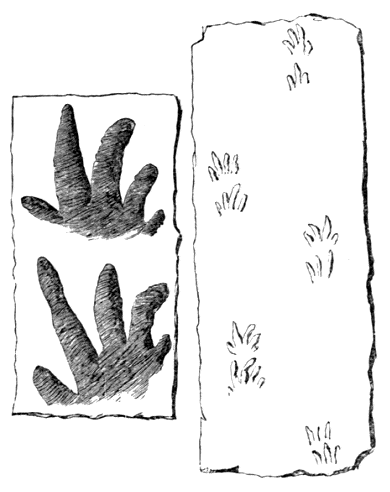
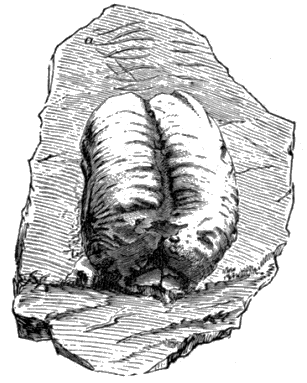
Footprints of Hylopus Logani, Dawson, Lower Carboniferous,
Nova Scotia.
Natural size and reduced.
These footprints were the first indications of Carboniferous land vertebrates
ever observed; they were probably made by a Microsaurian and one
of the earliest species of this type. They show a remarkable length of
stride and development of limb.
"Among the specimens which I carried from Horton Bluff,
one is of very high interest. It exhibits the footprints of some
reptilian animal. Owen has no doubt of the marks being
genuine footprints. The rocks of Horton Bluff are below the
gypsum of that neighbourhood; so that the specimen in question
(if Lyell's views are correct[125]) comes from the very bottom
of the coal series, or at any rate very low down in it, and
demonstrates the existence of reptiles at an earlier epoch than
has hitherto been determined; none having been previously
found below the magnesian limestone, or, to give it Murchison's
new name, the 'Permian era.'"
This extract is of interest, not merely as an item of evidence
in relation to the matter now in hand, but as a mark in the
progress of geological investigation. For the reasons above
stated, the important discovery thus made in 1841, and published
in 1842, was overlooked; and the discovery of reptilian
bones by Von Dechen, at Saarbruck, in 1844, and that of
footprints by Dr. King in the same year, in Pennsylvania,
have been uniformly referred to as the first observations of
this kind. Insects and Arachnidans, it may be observed, had
previously been discovered in the coal formation in Europe.
The original specimen of these footprints is still in the
collection of the Geological Survey of Canada, and a cast
which Logan kindly presented to me is exhibited in the Peter
Redpath Museum of McGill University. It is a slab of dark-coloured
sandstone, glazed with fine clay on the surface; and
having a series of seven footprints in two rows, distant about
three inches; the distance of the impressions in each row being
three or four inches, and the individual impressions about one
inch in length. They seem to have been made by the points
of the toes, which must have been armed with strong and
apparently blunt claws, and appear as if either the surface had
been somewhat firm, or the body of the animal had been
partly water-borne. In one place only is there a distinct mark
of the whole foot, as if the animal had exerted an unusual
pressure in turning or stopping suddenly. One pair of feet—the
fore feet, I presume—appear to have had four toes touching
the ground; the other pair show only three or four, and it is
to be observed that the outer toe, as in the larger footprints
discovered by Dr. King, projects in the manner of a thumb,
as in the cheirotherian tracks of the Trias. At a later date
another series of footprints, possibly of the same animal, was
obtained at the same place by Prof. Elder, and is now in the
Peter Redpath Museum. Each foot in this shows five toes,
and it is remarkable that the animal was digitigrade and took
a long step for its size, indicating a somewhat high grade
of quadrupedal organization. No mark of the tail or belly
appears. The impressions are such as may have been made
by animals similar to some of those to be described in the
sequel.
Shortly afterward, Dr. Harding, of Windsor, when examining
a cargo of sandstone which had been landed at that place from
Parrsboro', found on one of the slabs a very distinct series of
footprints, each with four toes, and a trace of the fifth. Dr.
Harding's specimen is now in the museum of King's College,
Windsor. Its impressions are more distinct, but not very
different otherwise from those above described, as found at
Horton Bluff. The rocks at that place are probably of nearly
the same age with those of Parrsboro'. I afterward examined
the place from which this slab had been quarried, and satisfied
myself that the beds are Carboniferous, and probably Lower
Carboniferous. They were ripple-marked and sun-cracked,
and I thought I could detect some footprints, though more
obscure than those in Dr. Harding's slab. Similar footprints
are also stated to have been found by Dr. Gesner, at Parrsboro'.
All of these were from the lowest beds of the Carboniferous
system.
I have since observed several instances of such impressions
at the Joggins, at Horton, and near Windsor, showing that
they are by no means rare, and that reptilian animals existed
in no inconsiderable numbers throughout the coal field of
Nova Scotia, and from the beginning to the end of the Carboniferous
period. Most of these, when well preserved, shew five
toes both on the anterior and posterior limb. On comparing
these earlier Carboniferous footprints with one another, it will
be observed that they are of similar general character, and
may have been made by one kind of animal, which must have
had the fore and hind feet nearly of equal size, and a digitigrade
mode of walking. Footprints of similar form are found
in the coal formation, as well as others of much larger size.
The latter are of two kinds. One of these shows short hind
feet of digitigrade character and a long stride, in this resembling
the smaller footprints of the Lower Carboniferous, which
are remarkable for the length of limb which they indicate by
the distance between the footprints. The other kind shows
long hind feet, as if the whole heel were brought down to the
ground in a plantigrade manner. These have also the outer
toe separated from the others, and sometimes provided with
a long claw. The fore foot is sometimes smaller than the
hind foot, and differently formed.[126] In these respects they
resemble the great Labyrinthodont Batrachians of the subsequent
Trias. Their stride also is comparatively short, and
the rows of impressions wide apart, as if the body of the
animal had been broad, and its limbs short.
We have thus two types of quadrupedal footprints, to the
first of which I have given the name Hylopus, and have
restricted the term Sauropus,[127] to the second. The first
apparently belongs to the usually small reptiles of the group
Microsauria, which had a well-marked lizard-like form, with
well-developed limbs, and perhaps also to some of the smaller
Labyrinthodonts, the second to the group of Labyrinthodontia,
which were often of large size and with stout and short limbs
and plantigrade hind feet. There are also some small and
uncertain tracks, which may have been made by newt-like
animals with short feet, and a singular trail of large size, and
with a row of impressions at each side (Diplichnites),[128] which,
if made by a vertebrate animal, would seem to indicate that
serpentiform shape which we know belonged to some Carboniferous
Batrachians.
The bones of these animals, however, hitherto found in
Nova Scotia, may all have belonged to the two groups first
named, the Labyrinthodontia and Microsauria, and I shall
proceed to give some examples of each of these.
In leaving the footprints, I may merely mention that the
animals which produced them may, in certain circumstances,
have left distinct impressions only of three or four toes,
when they actually possessed five, while in other circumstances
all may have left marks; and that, when wading in deep mud,
their footprints were altogether different from those made on
hard sand or clay. In some instances the impressions may
have been made by animals wading or swimming in water,
while in others the rain marks and sun cracks afford evidence
that the surface was a subaërial one. They are chiefly interesting
as indicating the wide diffusion and abundance of the
creatures producing them, and that they haunted tidal flats
and muddy shores, perhaps emerging from the water that they
might bask in the sun, or possibly searching for food among
the rejectamenta of the sea, or of lagunes and estuaries.
The Labyrinthodonts of the Coal Period, Baphetes
Planiceps and Dendrerpeton Acadianum.
In the summer of 1851 I had occasion to spend a day
at the Albion Mines in the eastern part of Nova Scotia, and
on arriving at the railway station in the afternoon, found myself
somewhat too early for the train. By way of improving
the time thus left on my hands, I betook myself to the examination
of a large pile of rubbish, consisting of shale and
ironstone from one of the pits, and in which I had previously
found scales and teeth of fishes. In the blocks of hard carbonaceous
shale and earthy coal, of which the pile chiefly
consisted, scales, teeth and coprolites often appeared on the
weathered ends and surfaces as whitish spots. In looking
for these, I observed one of much greater size than usual on
the edge of a block, and on splitting it open, found a large
flattened skull, about six inches broad, the cranial bones of
which remained entire on one side of the mass, while the palate
and teeth, in several fragments, came away with the other half.
Carefully trimming the larger specimen, and gathering all the
smaller fragments, I packed them up as safely as possible, and
returned from my little excursion much richer than I had
hoped.
The specimen, on further examination, proved somewhat
puzzling. I supposed it to be, most probably, the head of a
large ganoid fish; but it seemed different from anything of
this kind with which I could compare it; and at a distance
from comparative anatomists, and without sufficient means of
determination, I dared not refer it to anything higher in the
animal scale. Hoping for further light, I packed it up with
some other specimens, and sent it to the Secretary of the
Geological Society of London, with an explanatory note as to
its geological position, and requesting that it might be submitted
to some one versed in such fossils. For a year or
two, however, it remained as quietly in the Society's collection
as if in its original bed in the coal mine, until attention
having been attracted to such remains by the discoveries
made by Sir Charles Lyell and myself in 1852, at the South
Joggins, and published in 1853,[129] the Secretary or President of
the Society re-discovered the specimen, and handed it to Sir
Richard Owen, by whom it was described in December, 1853,[130]
under the name of Baphetes planiceps, which may be interpreted
the "flat-headed diving animal," in allusion to the
flatness of the creature's skull, and the possibility that it may
have been in the habit of diving.
The parts preserved in my specimen are the bones of the
anterior and upper part of the skull in one fragment, and
the teeth and palatal bones in others. These parts were
carefully examined and described by Owen, and the details
will be found in his papers referred to in the note. We
may merely observe here that the form and arrangement of
the bones showed batrachian affinities, that the surface of the
cranium was sculptured in the manner of the group of
Labyrinthodonts, and that the teeth possessed the peculiar
and complicated plication of the ivory and enamel seen in
creatures of this type. The whole of these characters are
regarded as allying the animal with the great crocodilian frogs
of the Trias of Europe, first known as Cheirotherians, owing
to the remarkable hand-like impressions of their feet, and
afterwards as Labyrinthodonts, from the beautifully complicated
convolutions of the ivory of their teeth.
Unfortunately the original specimen exhibited only the
head, and after much and frequent subsequent searching, the
only other bones found are a scapula, or shoulder bone, and
one of the surface scales which served for protection, and
which indicate at least that the creature possessed walking
limbs and was armed with bony scales sculptured in the
same manner with the skull bones.
Of the general form and dimensions of Baphetes, the facts
at present known do not enable us to say much. Its
formidable teeth and strong maxillary bones show that it must
have devoured animals of considerable size, probably the
fishes whose remains are found with it, or the smaller reptiles
of the coal. It must, in short, have been crocodilian, rather
than frog-like, in its mode of life; but whether, like the
Labyrinthodonts, it had strong limbs and a short body, or
like the crocodiles, an elongated form and a powerful
natatory tail, the remains do not decide. One of the limbs
or a vertebra of the tail would settle this question, but neither
has as yet been found. That there were large animals of
the labyrinthodontal form in the coal period is proved by
the footprints discovered by Dr. King in Pennsylvania, which
may have been produced by an animal of the type of Baphetes,
as well as by those of Sauropus unguifer from the Carboniferous
of Nova Scotia, and which would very well suit an
animal of this size and probable form. On the other hand,
that there were large swimming reptiles seems established
by the discovery of the vertebræ of Eosaurus Acadianus, at
the Joggins, by Marsh.[131] The locomotion of Baphetes must
have been vigorous and rapid, but it may have been effected
both on land and in water, and either by feet or tail, or both.
A jawbone found at the Joggins in Nova Scotia, and to
which I have attached the name Baphetes minor, may have
belonged to a second species. Great Batrachians allied to
Baphetes, but different specifically or generically, have since
been found in the coal formations of Great Britain, the continent
of Europe and the United States.
With the nature of the habitat of this formidable creature
we are better acquainted. The area of the Albion Mines coal
field was somewhat exceptional in its character. It seems to
have been a bay or indentation in the Silurian land, separated
from the remainder of the coal field by a high shingle beach,
now a bed of conglomerate. Owing to this circumstance,
while in the other portions of the Nova Scotia coal field the
beds of coal are thin, and alternate with sandstones and shales,
at the Albion Mines a vast thickness of almost unmixed vegetable
matter has been deposited, constituting the "main seam"
of thirty-eight feet thick, and the "deep seam," twenty-four feet
thick, as well as still thicker beds of highly carbonaceous
shale. But, though the area of the Albion coal measures was
thus separated, and preserved from marine incursions, it must
have been often submerged, and probably had connection
with the sea, through rivers or channels cutting the enclosing
beach. Hence beds of earthy matter occur in it, containing
remains of large fishes. One of the most important of these
is that known as the "Holing stone," a band of black highly
carbonaceous shale, coaly matter, and clay ironstone, occurring
in the main seam, about five feet below its roof, and varying
in thickness from two inches to nearly two feet. It was
from this band that the rubbish heap in which I found the
skull of Baphetes planiceps was derived. It is a laminated bed,
sometimes hard and containing much ironstone, in other
places soft and shaly, but always black and carbonaceous,
and often with layers of coarse coal, though with few fossil
plants retaining their forms. It contains large round flat
scales and flattened curved teeth, which I attribute to a fish of
the genus Rhizodus, resembling, if not identical with, R.
lancifer, Newberry. With these are double-pointed shark-like
teeth, and long cylindrical spines of a species of Diplodus,
which I have named D. acinaces.[132] There are also shells of
the minute Spirorbis, so common in the coal measures of
other parts of Nova Scotia, and abundance of fragments of
coprolitic matter, or fossil excrement, sometimes containing
bones and scales of fishes.
It is evident that the "Holing stone" indicates one of
those periods in which the Albion coal area, or a large part of
it, was under water, probably fresh or brackish, as there are no
properly marine shells in this, or any of the other beds of this
coal series. We may then imagine a large lake or lagune,
loaded with trunks of trees and decaying vegetable matter,
having in its shallow parts, and along its sides, dense brakes of
Calamites, and forests of Sigillaria, Lepidodendron, and other
trees of the period, extending far on every side as damp pestilential
swamps. In such a habitat, uninviting to us, but no
doubt suited to Baphetes, that creature crawled through
swamps and thickets, wallowed in flats of black mud, or swam
and dived in search of its finny prey. It was, in so far as we
know, the monarch of these swamps, though there is, as
already stated, evidence of the existence of similar creatures of
this type quite as large in other parts of the Nova Scotia coal
field. We must now notice a smaller animal belonging to the
same family of Labyrinthodonts.
The geology of Nova Scotia is largely indebted to the world-embracing
labours of Sir Charles Lyell. Though much had
previously been done by others, his personal explorations in
1842, and his paper on the gypsiferous formation, published in
the following year, first gave form and shape to some of the
more difficult features of the geology of the country, and
brought it into relation with that of other parts of the world.
In geological investigation, as in many other things, patient
plodding may accumulate large stores of fact, but the magic
wand of genius is required to bring out the true value and
significance of these stores of knowledge. It is scarcely too
much to say that the exploration of a few weeks, and subsequent
study of the subject by Sir Charles, with the impulse
and guidance given to the labours of others, did as much for
Nova Scotia as might have been effected by years of laborious
work under less competent heads.
Sir Charles naturally continued to take an interest in the
geology of Nova Scotia, and to entertain a desire to explore
more fully some of those magnificent coast sections which he
had but hastily examined; and when, in 1851, he had occasion
to revisit the United States, he made an appointment
with the writer of these pages to spend a few days in renewed
explorations of the cliffs of the South Joggins. The object
specially in view was the thorough examination of the beds of
the true coal measures, with reference to their contained
fossils, and the conditions of accumulation of the coal; and
the results were given to the world in a joint paper on "The
remains of a reptile and a land shell discovered in the interior
of an erect tree in the coal measures of Nova Scotia," and in
the writer's paper on the "Coal Measures of the South
Joggins";[133] while other important investigations grew out of
the following up of these researches, and much matter in
relation to the vegetable fossils still remains to be worked up.
It is with the more striking fact of the discovery of the remains
of a reptile in the coal measures that we have now to do.
The South Joggins Section is, among other things, remarkable
for the number of beds which contain remains of erect
trees imbedded in situ: these trees are for the most part
Sigillariæ, those great-ribbed pillar-like trees which seem to
have been so characteristic of the forests of the coal formation
flats and swamps, and so important contributors to the formation
of coal. They vary in diameter from six inches to five feet.
They have grown on underclays and wet soils, similar to those
on which the coal was accumulated; and these having been
submerged or buried by mud carried down by inundations,
the trees, killed by the accumulations around their stems,
have decayed, and their tops being broken off at the level of
the mud or sand, the cylindrical cavities left open by the disappearance
of the wood, and preserved in their form by the
greater durability of the bark, have been filled with sand and
clay. This, now hardened into stone, constitutes pillar-like
casts of the trees, which may often be seen exposed in the
cliffs, and which, as these waste away, fall upon the beach.
The sandstones enveloping these pillared trunks of the ancient
Sigillariæ of the coal, are laminated or bedded, and the
laminæ, when exposed, split apart with the weather, so that the
trees themselves become broken across; this being often
aided by the arrangement of the matter within the trunks, in
layers more or less corresponding to those without. Thus one
of these fossil trees usually falls to the beach in a series of
discs, somewhat resembling the grindstones which are extensively
manufactured on the coast. The surfaces of these
fragments often exhibit remains of plants which have been
washed into the hollow trunks, and have been imbedded
there; and in our explorations of the shore, we always carefully
scrutinized such specimens, both with the view of observing
whether they retained the superficial markings of Sigillariæ,
and with reference to the fossils contained in them. It was
while examining a pile of these "fossil grindstones" that we
were surprised by finding on one of them what seemed to be
fragments of bone. On careful search other bones appeared,
and they had the aspect, not of remains of fishes, of which
many species are found fossil in these coal measures, but
rather of limb bones of a quadruped. The fallen pieces of the
tree were carefully broken up, and other bones disengaged, and
at length a jaw with teeth made its appearance. We felt quite
confident, from the first, that these bones were reptilian; and
the whole, being carefully packed and labelled, were taken by
Sir Charles to the United States, and submitted to Prof. J.
Wyman of Cambridge; who recognised their reptilian character,
and prepared descriptive notes of the principal bones,
which appeared to have belonged to two species. He also
observed among the fragments an object of different character,
apparently a shell; which was recognised by Dr. Gould of
Boston, and afterward by M. Deshayes, as probably a land-snail,
and has since been named Pupa vetusta.
The specimens were subsequently taken to London and reexamined
by Prof. Owen, who confirmed Wyman's inferences,
added other characters to the description, and named the
larger and better preserved species Dendrerpeton Acadianum,
in allusion to its discovery in the interior of a tree, and to its
native country of Acadia or Nova Scotia. It is necessary to
state in explanation of the fragmentary character of the remains
obtained, that in the decay of the animals imbedded in the
erect trees at the Joggins, their skeletons have become disarticulated,
and the portions scattered, either by falling into the
interstices of the vegetable fragments in the bottom of the
hollow trunks, or by the water with which these may have
sometimes been partly filled. We thus usually obtain only
separate bones; and though all of these are no doubt present
in each case, it is often impossible in breaking up the hard
matrix to recover more than a portion of them. The original
description by Owen was therefore based on somewhat imperfect
material, but additional specimens subsequently found have
supplemented it in such a manner as to enable us somewhat
completely to restore in imagination the form of the animal,
which, though much smaller than Baphetes, agrees with it in its
sculptured bones, in its bony armature, especially beneath, and
in its plicated teeth.
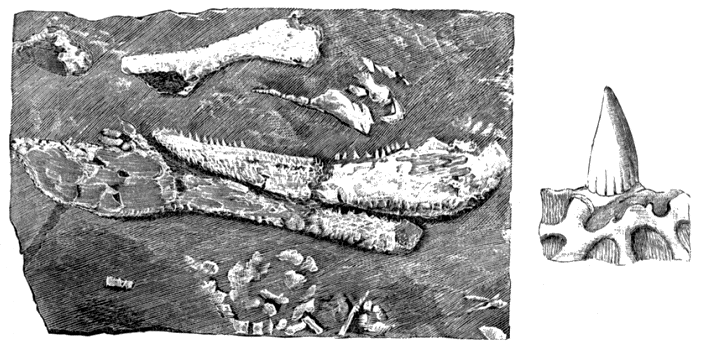
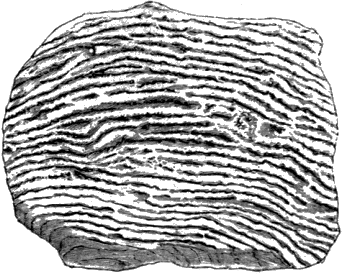
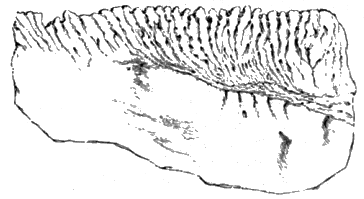
Humerus and Mandibles of Dendrerpeton Acadianum. Natural size, with one of the teeth
enlarged. (From a Photograph.)
The specimen illustrates the sculptured bones of Dendrerpeton and its plaited teeth, as well as large size
and massive development of the arm bone.
In form, Dendrerpeton Acadianum was probably lizard-like;
with a broad flat head, short stout limbs and an elongated tail;
and having its skin, and more particularly that of the belly,
protected by small bony plates closely overlapping each other,
and arranged en chevron, in oblique rows meeting on the
mesial line, where in front was a thoracic plate. It may have
attained the length of two feet. The form of the head is not
unlike that of Baphetes, but longer in proportion; and much
resembles that of the labyrinthodont reptiles of the Trias.
The bones of the skull are sculptured as in Baphetes, but in a
smaller pattern.
The fore limb of the adult animal, including the toes,
must have been four or five inches in length, and is of
massive proportions. The bones were hollow, and in the case
of the phalanges the bony walls were thin, so that they are
often crushed flat. The humerus, or arm bone, however, was
a strong bone, with thick walls and a cancellated structure
toward its extremities; still even these have sometimes yielded
to the great pressure to which they have been subjected. The
cavity of the interior of the limb bones is usually filled with
calc-spar stained with organic matter, but showing no structure;
and the inner side of the bony wall is smooth without
any indication of cartilaginous matter lining it.
The vertebræ, in the external aspect of their bodies, remind
one of those of fishes, expanding toward the extremities, and
being deeply hollowed by conical cavities, which appear even
to meet in the centre. There is, however, a large and flattened
neural spine. The vertebræ are usually much crushed, and it
is almost impossible to disengage them from the stone. The
ribs are long and curved, showing a reptilian style of chest.
The posterior limb seems to have been not larger than the
anterior, perhaps smaller. The tibia, or principal bone of the
fore leg is much flattened at the extremity, as in some Labyrinthodonts,
and the foot must have been broad, and probably
suited for swimming, or walking on soft mud, or both. That
the hind limb was adapted for walking is shown, not merely
by the form of the bones, but also by that of the pelvis.
The external scales are thin, oblique-rhomboidal or elongated-oval,
marked with slight concentric lines, but otherwise
smooth, and having a thickened ridge or margin, in which
they resemble those of Archegosaurus, and also those of Pholidogaster
pisciformis, described by Huxley from the Edinburgh
coal field,—an animal which indeed appears in most respects
to have a close affinity with Dendrerpeton. The microscopic
structure of the scales is quite similar to that of the other
bones, and different from that of the scales of ganoid fishes, the
shape of the cells being batrachian. For other particulars of
its structure reference may be made to the papers named at
the end of the chapter.
With respect to the affinities of the creature, I think it is
obvious that it is most nearly related to the group of Lahyrinthodonts,
and that it has the same singular mixture of batrachian
and reptilian characters which distinguish these ancient
animals, and which give them the appearance of prototypes of
the reptilian class. A second and smaller species of Dendrerpeton
was subsequently obtained at the Joggins, and others
have been found, more especially by Fritsch, in the Carboniferous
and Permian of Europe.
This ancient inhabitant of the coal swamps of Nova Scotia
was, in short, as we often find to be the case with the earliest
forms of life, the possessor of powers and structures not usually,
in the modern world, combined in a single species. It
was certainly not a fish, yet its bony scales and the form of its
vertebræ, and of its teeth, might, in the absence of other evidence,
cause it to be mistaken for one. We call it a Batrachian,
yet its dentition, the sculpturing of the bones of its skull,
which were certainly no more external plates than the similar
bones of a crocodile, its ribs, and the structure of its limbs,
remind us of the higher reptiles; and we do not know that it
ever possessed gills, or passed through a larval or fish-like
condition. Still, in a great many important characters, its
structures are undoubtedly batrachian. It stands, in short, in
the same position with the Lepidodendra and Sigillariæ under
whose shade it crept, which, though placed by palæobotanists
in alliance with certain modern groups of plants, manifestly
differed from these in many of their characters, and occupied
a different position in nature. In the coal period the distinctions
of physical and vital conditions were not well defined.
Dry land and water, terrestrial and aquatic plants and animals,
and lower and higher forms of animal and vegetable life, are
consequently not easily separated from each other. This is
no doubt a state of things characteristic of the earlier stages of
the earth's history, yet not necessarily so; for there are some
reasons, derived from fossil plants, for believing that in the
preceding Devonian period there was less of this, and consequently
that there may then have been a higher and more
varied animal life than in the coal period.[134]
The dentition of Dendrerpeton shows it to have been carnivorous
in a high degree. It may have captured fishes and
smaller reptiles, either on land or in water, and very probably
fed on dead carcases as well. If, as seems likely, any of the
footprints referred to previously belong to this animal, it
must have frequented the shores, either in search of garbage,
or on its way to and from the waters. The occurrence of its
remains in the stumps of Sigillaria, with land snails and millipedes,
shows also that it crept in the shade of the woods in
search of food; and in noticing coprolitic matter, in a subsequent
page, I shall show that remains of excrementitious
substances, probably of this species, contain fragments attributable
to smaller reptiles, and other animals of the land.
All the bones of Dendrerpeton hitherto found, as well as
those of the smaller reptilian species hereafter described, have
been obtained from the interior of erect Sigillariæ, and all of
these in one of the many beds, which, at the Joggins, contain
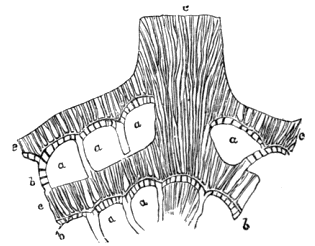
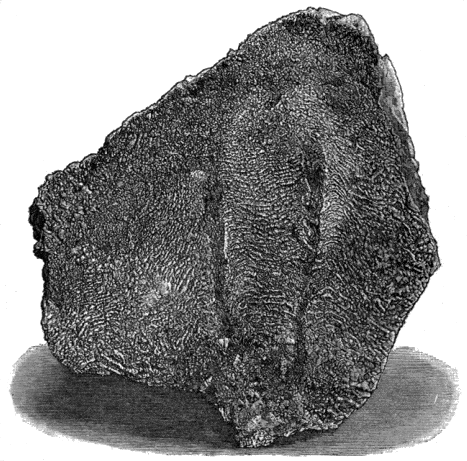
such remains. The thick cellular inner bark of Sigillaria was
very perishable; the slender woody axis was somewhat more
durable; but near the surface of the stem, in large trunks,
there was a layer of elongated cells, or bast tissue, of considerable
durability, and the outer bark was exceedingly dense and
indestructible.[135] Hence an erect tree, partly imbedded in
sediment, and subjected to the influence of the weather, became
a hollow shell of bark; in the bottom of which lay the
decaying remains of the woody axis, and shreds of the fibrous
bark. In ordinary circumstances such hollow stems would be
almost immediately filled with silt and sand, deposited in the
numerous inundations and subsidences of the coal swamps.
Where, however, they remained open for a considerable time,
they would constitute a series of pitfalls, into which animals
walking on the surface might be precipitated; and being probably
often partly covered by remains of prostrate trunks, or
by vegetation growing around their mouths, they would be
places of retreat and abode for land snails and such creatures.
When the surface was again inundated or submerged, all such
animals, with the remains of those which had fallen into the
deeper pits, would be imbedded in the sediment which would
then fill up the holes. These seem to have been the precise
conditions of the bed which has afforded all these remains.
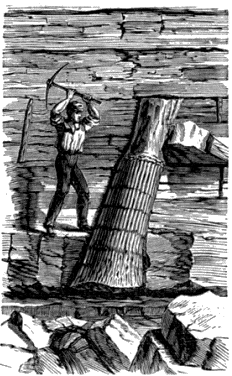
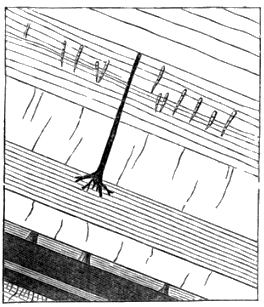
A reptiliferous Tree in situ, South Joggins, N. Scotia.
This is a sketch of a tree which afforded remains of Dendrerpeton,
Pupæ, etc.
The history of a bed containing reptiliferous erect trees
would thus be somewhat as follows:—
A forest or grove of the large-ribbed trees known as Sigillariæ,
was either submerged by subsidence, or, growing on low
ground, was invaded with the muddy waters of an inundation,
or successive inundations, so that the trunks were buried to
the depth of several feet. The projecting tops having been
removed by subaërial decay, the buried stumps became hollow,
while their hard outer bark remained intact. They thus became
hollow cylinders in a vertical position, and open at top.
The surface having then become dry land, covered with vegetation,
was haunted by small quadrupeds and other land animals,
which from time to time fell into the open holes, in some cases
nine feet deep, and could not extricate themselves. On their
death, and the decomposition of their soft parts, their bones
and other hard portions remained in the bottom of the tree
intermixed with any vegetable débris or soil washed in by rain,
and which formed thin layers separating successive animal
deposits from each other. Finally, the area was again submerged
or overflowed by water, bearing sand and mud. The
hollow trees were filled to the top, and their animal contents
thus sealed up. At length the material filling the trees was by
pressure and the access of cementing matter hardened into
stone, not infrequently harder than that of the containing beds,
and the whole being tilted to an angle of 20°, and elevated into
land exposed to the action of the tides and waves, these singular
coffins present themselves as stony cylinders projecting from
the cliff or reef, and can be extracted and their contents
studied.
The singular combination of accidents above detailed was,
of course, of very rare occurrence, and in point of fact we
know only one set of beds at the South Joggins in which such
remains so preserved occur; nor is there, so far as I am aware,
any other known instance elsewhere. Even in the beds in
question only a portion of the trees, about fifteen in thirty,
have afforded animal remains. We have, however, thus been
enabled to obtain specimens of a number of species which
would probably otherwise have been unknown, being less
likely than others to be preserved in properly aqueous deposits.
Such discoveries, on the one hand impress us with
the imperfection of the geological record; on the other, they
show us the singular provisions which have been made in the
course of geological time for preserving the relics of the ancient
world, and which await the industry and skill of collectors to
disclose their hidden treasures.
I may add that I believe all the trees, about thirty in number,
which have become exposed in this bed since its discovery,
have been ransacked for such remains; and that while
the majority have afforded some reward for the labour, some
have been far more rich than others in their contents. It is
also to be observed that owing to the mode of accumulation
of the mass filling the trees, the bones are usually found scattered
in every position, and those of different species intermingled;
and that being often much more friable than the
matrix, much labour is required for their development; while
after all has been done, the result is a congeries of fragments.
A few specimens only have been found, showing skeletons
complete, or nearly so, and I shall endeavour to figure one or
two of these by way of illustration in the present chapter.
The beds on a level with the top of the reptiliferous erect
trees are arenaceous sandstones, with numerous erect Calamites.
I have searched the surfaces of these beds in vain for
bones or footprints of the reptiles which must have traversed
them, and which, but for hollow erect trees," would apparently
have left no trace of their existence. On a surface of similar
character, sixty feet higher, and separated by three coals, with
their accompaniments, and a very thick compact sandstone, I
observed a series of footprints, which may be those of Dendrerpeton
or Hylonomus.
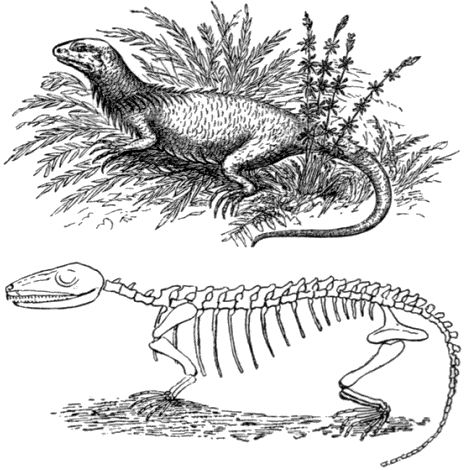
A typical Carboniferous Microsaurian, Hylonomus Lyelli Restoration
showing dermal armour and ornaments. Skeleton restored from
measurements of the bones of the type specimen figured at the beginning
of the chapter.
Species of Microsauria. Hylonomus Lyelli.
In the original reptiliferous tree discovered by Sir C. Lyell
and the writer, at the Joggins, in 1851, there were, beside the
bones of Dendrerpeton Acadianum, some small elongated
vertebræ, evidently of a different species. These were first
detected by Prof. Wyman, in his examination of these specimens,
and were figured, but not named, in the original notice
of the specimens. In a subsequent visit to the Joggins I
obtained from another erect stump many additional remains of
these smaller reptiles, and, on careful comparison of the specimens,
was induced to refer them to three species, all apparently
generically allied. I proposed for them the generic
name Hylonomus, "forest dweller." They were described in
the Proceedings of the Geological Society for 1859, with illustrations
of the teeth and other characteristic parts.[136] The smaller
species first described I named H. Wymani; the next in size,
that to which this article refers, and which was represented by
a larger number of specimens, I adopted as a type of the genus,
and dedicated to Sir Charles Lyell. The third and largest,
represented only by a few fragments of a single skeleton, was
named H. aciedentatus. This I had subsequently to remove
to a new genus, Smilerpeton.
Hylonomus Lyelli was an animal of small size. Its skull is
about an inch in length, and its whole body, including the tail,
could not have been more than six or seven inches, long. The
bones appear to have been thin and easily separable; and even
when they remain together, are so much crushed as to render
the shape of the skull not easily discernible. They are smooth
on the outer surface to the naked eye; and under a lens show
only delicate, uneven striæ and minute dots. They are more
dense and hard than those of Dendrerpeton, and the bone-cells
are more elongated in form. The bones of the snout would
seem to have been somewhat elongated and narrow. A specimen
in my possession shows the parietal and occipital bones,
or the greater part of them, united and retaining their form.
We learn from them that the brain case was rounded, and that
there was a parietal foramen. There would seem also to have
been two occipital condyles, as in modern Batrachians. Several
well-preserved specimens of the maxillary and mandibular
bones have been obtained. They are smooth, or nearly so,
like those of the skull, and are furnished with numerous sharp,
conical teeth, anchylosed to the jaw, in a partial groove
formed by the outer ridge of the bone. In the anterior part of
the lower jaw there is a group of teeth larger than the others.
The total number of teeth in each ramus of the lower jaw was
about forty, and the number in each maxillary bone about
thirty. The teeth are perfectly simple, hollow within, and
with very fine radiating tubes of ivory. The vertebras have
the bodies cylindrical or hour-glass shaped, covered with a
thin, hard, bony plate, and having within a cavity of the form
of two cones, attached by the apices. This cavity was completely
surrounded by bone, as it is filled with stained calc-spar
in the same manner as the cavities of the limb bones. It was
probably occupied by cartilage. The vertebræ were apparently
bi-concave, and are furnished with upper and lateral processes
similar to those of small lacertian animals. The ribs are long,
curved, and at the proximal end have a shoulder and neck.
They are hollow, with thin hard bony walls. The anterior
limb, judging from the fragment procured, seems to have been
slender, with long toes, four or possibly five in number. The
posterior limb was longer and stronger, and attached to a
pelvis so large and broad as to give the impression that the
creature enlarged considerably in size toward the posterior extremity
of the body, and that it may have been in the habit of
sitting erect. The thigh bone is large and well-formed, with a
distinct head and trochanter, and the lower extremity flattened
and moulded into two articulating surfaces for the tibia and
fibula, the fragments of which show that they were much
shorter. The toes of the hind feet have been seen only in
detached joints. They seem to have been thicker than those
of the fore foot. Detached vertebræ, which seem to be caudal,
have been found, and show that the tail was long and probably
not flattened. The limb bones are usually somewhat crushed
and flattened, especially at their articular extremities, and this
seems to have led to the error of supposing that this flattened
form was their normal condition; there can be no doubt, however,
that it is merely an effect of pressure. The limb bones
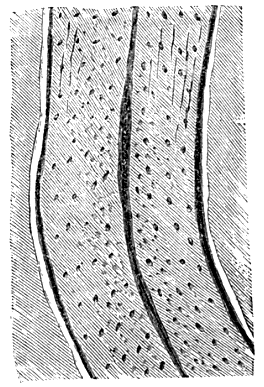
present in cross section a wall of dense bone with elongated bone-cells,
surrounding a cavity now filled with brown calc-spar, and
originally occupied with cartilage or marrow. I desire to specify
the above points because I believe that most of the creatures
referred by Fritsch, Credner, and other European naturalists
to the Microsauria are of inferior grade to Hylonomus, though
admitted to present points of approximation to the true reptiles.
Woodward has recently described the remains of a
Microsaurian from the English coal formation. Nothing is
more remarkable in the skeleton of this creature than the contrast
between the perfect and beautiful forms of its bones, and
their imperfectly ossified condition, a circumstance which raises
the question whether these specimens may not represent the
young of some reptile of larger size.
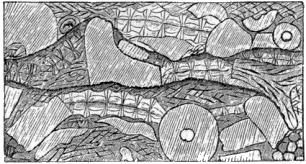
The dermal covering of this animal is represented in part by
oval bony scales, which are so constantly associated with its
bones that I can have no doubt that they belonged to it, being,
perhaps, the clothing of its lower or abdominal parts. But the
most remarkable and unexpected feature of this little creature
was the beautiful and ornate scaly covering of its back and
sides. Modern Batrachians are characteristically naked, and
though we know that some fossil species had coverings below
of bony scales, these seemed rather to ally them with bony
fishes. One of the specimens of Hylonomus had associated
with it a quantity of crumpled shining skin, black and carbonaceous,
and which may perhaps have been tanned and so
preserved by the water filling the hollow tree impregnated
with solution of tannin from the bark. This skin was covered
with minute overlapping scales, which, under the microscope,
showed the structure of horn rather than of bone. Besides
these ordinary scales there were bony prominences, like
those of the horned frog, on the back and shoulders, and a
species of epaulettes made of long horny bristles curved downward,
and apparently placed at the edges of the shoulders.
Besides these there were in front and at the side rows of pendants
or lappets, all no doubt ornamented with colouring,
though now perfectly black. It may be asked what was the
use of the ornate covering, and perhaps the question raises
that perplexing problem, of the use of beauty in a world where
there were no animals with higher æsthetic faculties than those
of Batrachians. Scudder suggests a somewhat prosaic use in
supposing them to be an armour against the venomous scorpions
which were the contemporaries of these little reptiles,
and some of them almost as large in size. But the word "venomous"
raises another question, for we only infer that the
scorpions were venomous from modern analogy and traces of
an inflated joint at the end of the tail in some specimens. We
have no absolute certainty that the subtle and complex organic
poison of the scorpion, and his beautiful injection syringe for
placing it under the skin, were perfected at this early time.
Thus we have in the far back Carboniferous age a creature as
elaborately ornamented and protected as any of the modern
lizards, and this, let it be observed, constitutes another and important
departure from that batrachian type to which these
animals are supposed to conform. I may add here that subsequently
portions of skin were found, which from their size
probably belonged to Dendrerpeton, and that these also were
scaly and had lappets, though they did not appear to have the
horny tubercles and fringes. It may be asked why such
advanced characters should be found in Nova Scotia alone.
The answer is that the circumstances of preservation in the
erect trees were peculiar, and that only animals of purely terrestrial
habits could find access to them, whereas the remains
of reptiles found in the Carboniferous elsewhere are in aqueous
beds in which aquatic forms were more likely to be preserved,
and in which all the soft parts were certain to perish.
It is evident from the remains thus described, that we have
in Hylonomus Lyelli an animal of lacertian form, with large
and stout hind limbs, and somewhat smaller fore limbs, capable
of walking and running on land; and though its vertebræ
were imperfectly ossified externally, yet the outer walls were
sufficiently strong, and their articulation sufficiently firm, to
have enabled the creature to erect itself on its hind legs, or to
leap. They were certainly proportionately larger and much
more firmly knit than those of Dendrerpeton. Further, the
ribs were long and much curved, and imply a respiration of a
higher character than that of modern Batrachians, and consequently
a more highly vitalized muscular system. If to these
structural points we add the somewhat rounded skull, indicating
a large brain, we have before us a creature which, however
puzzling in its affinities when anatomically considered, is clearly
not to be ranked as low in the scale of creation as modern
tailed Batrachians, or even as the frogs and toads. We must
add to these also, as important points of difference, the bony
scales with which it was armed below, and the ornate apparatus
of horny appendages, with which it was clad above.
These last, as described in the last section, show that this little
animal was not a squalid, slimy dweller in mud, like Menobranchus
and its allies, but rather a beautiful and sprightly
tenant of the coal-formation thickets, vying in brilliancy, and
perhaps in colouring, with the insects which it pursued and
devoured. Remains of as many as eight or ten individuals
have been obtained from three erect Sigillariæ, indicating that
these creatures were quite abundant, as well as active and terrestrial
in their mode of life.
With respect to the affinities of this species, I think it is
abundantly manifest that it presents no close relationship with
any reptile hitherto discovered in the Carboniferous system,
except perhaps some of the smaller forms in the Permian of
Europe, with which Credner and Fritsch have compared it. It
is scarcely necessary to say that the characters above described
entirely remove this animal from the Labyrinthodonts. Equal
difficulties attend the attempt to place it in any other group
of recent or extinct Batrachians or proper reptiles. The structures
of the skull, and of some points in the vertebræ, certainly
resemble those of Batrachians; but, on the other hand, the
well-developed ribs, evidently adapted to enlarge the chest in
respiration, the pelvis, and the cutaneous covering, are unexampled
in modern Batrachians, and assimilate the creature
to the true lizards. I have already, in my original description
of the animal in 1859, expressed my belief that Hylonomus
may have had lacertian affinities, but I do not desire to speak
too positively in this matter;[137] and shall content myself with
stating the following alternatives as to the probable relations
of these animals, (1) They may have been true reptiles of low
type, and with batrachian tendencies. (2) They may have
been representatives of a new family of Batrachians, exhibiting
in some points lacertian affinities. (3) They may have
been the young of some larger reptile, too large and vigorous
to be entrapped in the pitfalls presented by the hollow Sigillaria
stumps, and in its adult state losing the batrachian peculiarities
apparent in the young. Whichever of these views we
may adopt, the fact remains, that in the structure of this curious
little creature we have peculiarities both batrachian and
lacertian, in so far as our experience of modern animals is
concerned. It would, however, accord with observed facts in
relation to other groups of extinct animals, that the primitive
Batrachians of the coal period should embrace in their structures
points in after times restricted to the true reptiles. On
the other hand, it would equally accord with such facts that
the first-born of Lacertians should lean towards a lower type, by
which they may have been preceded. My present impression
is, that they may constitute a separate family or order, to which
I would give the name of Microsauria, and which may be
regarded as allied, on the one hand, to certain of the humbler
lizards, as the Gecko or Agama, and, on the other, to the
tailed Batrachians.
It is likely that Hylonomus Lyelli was less aquatic in its
habits than Dendrerpeton, Its food consisted, apparently, of
insects and similar creatures. The teeth would indicate this,
and near its bones there are portions of coprolite, containing
remains of insects and myriapods. It probably occasionally
fell a prey to Dendrerpeton, as bones, which may have belonged
either to young individuals of this species or to its smaller
congener H. Wymani, are found in larger coprolites, which
may be referred with probability to Dendrerpeton Acadianum.
This coprolitic matter, which is somewhat plentiful on some of
the surfaces in the erect trees, also informs us that the imprisoned
animals may in some cases have continued to live for
some time, feeding on such animals as may have fallen into
their place of confinement, which was destined also to be
their tomb. Some other points of interest appear on the
examination of this excrementitious matter. It contains much
carbonate of lime, indicating that snails or other mollusks
furnished a considerable part of the food of the smaller reptiles.
Some portions of it are filled with chitinous fragments,
parts of millipedes or insects, but usually so broken up as
scarcely to be distinguishable. One curious exception was a
part of the head of an insect containing a portion of one of its
eyes. The facets of this can be readily seen with the microscope,
and are similar to those of modern cockroaches. About
250 of these little eyes are discernible, and they must have
been much more numerous. Two points are of interest here:
First, the perfection of the compound eye for vision in air.
It had long before, in the case of the Trilobites, been used for
seeing under water. Secondly, the great age of the still ubiquitous
and aggressive family of the cockroaches. In point of
fact the oldest known insect, the Protoblattina of the Silurian,
is one of these creatures, and they are the most abundant insects
in the Carboniferous, so that if they now dispute with us
the possession of our food, they may at least put in the claim
of prior occupancy of the world. In one mass a quantity of
thickish crust or shell appears, which under the microscope
presents a minutely tubular and laminated appearance. It may
have belonged to some small crustacean or large scorpion on
which a Dendrerpeton may have been feeding before it fell into
the pit in which it was entombed.
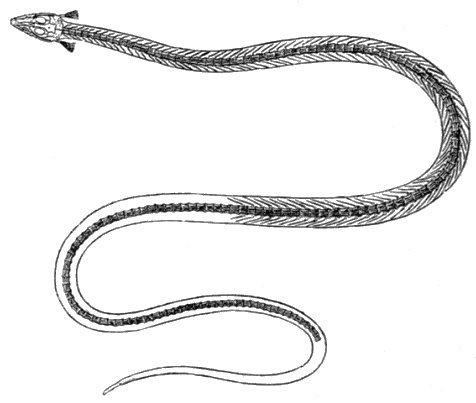
Dolichosoma longissimum, a serpentiform Permian Batrachian after
Fritsch. This and Hylonomus are opposite or extreme types in regard to
general form.
In addition to the reptilian species above noticed, the erect
trees of Coal Mine Point have afforded several others. There
is a second and smaller species of Dendrerpeton (D. Oweni)
and other forms belonging to the group of Microsauria of which
Hylonomus is the type. A second species of that genus (H.
Wymani) has already been mentioned. A similar creature, but
of larger size and with teeth of a wedge or chisel shape, has
been referred to a distinct genus, Smilerpeton. It seems to
have been rare, and the only skeleton found is very imperfect.
Its teeth are of a form that may have served even for
vegetable food, as their sharp edges must have had considerable
cutting power. Another curious form of tooth appears in the
genus Hylerpeton. It has the points worked into oblique
grooves separated by sharp edges, which must have greatly
aided in piercing tough integument. These creatures seem to
have been of stout and robust build, with large limbs. Still
another generic type (Fritschia) is represented by a species
near to Hylonomus in several respects, and with long and beautifully
formed limb bones, but with the belly protected with
rod-like bodies instead of scales. In this respect Hylerpeton
is somewhat intermediate, having long and narrow scales on
the belly instead of the oval or roundish scales of Hylonomus.
All these last-mentioned forms are Microsaurians, with simple
teeth and well-developed ribs and limbs, and smooth cranial
bones. Two other species are represented by portions of
single skeletons too imperfect to allow them to be certainly
determined.
I would emphasize here that the vertebrate animals found
in the erect trees are necessarily a selection from the most
exclusively terrestrial forms, and from the smaller species of
these. The numerous newt-like and serpentiform species found
in the shales of the coal formation could not find access to these
peculiar repositories, nor could the larger species of the Labyrinthodonts
and their allies, even if they were in the habit of
occasionally prowling in the forests in search of prey, and this
would scarcely be likely, more especially as the waters must
have afforded to them much more abundant supplies of food.
Of the numerous species figured by Fritsch, Cope and Huxley,
only a few approach very near to the forms entrapped in the
old hollow Sigillariæ, though several have characters half batrachian
and half reptilian.
Invertebrate Air-breathers.
The coal formation rocks have afforded Land Snails, Millipedes,
Spiders, Scorpions and Insects, so that all the great
types of invertebrate life which up to this day can live on land
already had representatives in this ancient period. Some of
them, indeed, we can trace further back, the land snails probably
to the Devonian, the Millipedes to the same period, and
the Scorpions and insects as far as the Silurian. No land vertebrate
is yet known, older than the Lower Carboniferous, but
there is nothing known to us in physical condition, to preclude
the existence of such creatures at least in the Devonian.
It would take us too far afield to attempt to notice the invertebrate
land life of the Palæozoic in general. This has been
done in great detail by Dr. Scudder. I shall here limit myself
to the animals found in our erect trees, and merely touch incidentally
on such others as may be connected with them.
I have already mentioned the occurrence of a land-snail,
a true pulmonate mollusk, in the first find by Lyell and myself
at Coal Mine Point, and this was the first animal of this
kind known in any rocks older than the Purbeck formation of
England. It is one of the groups of so-called Chrysalis-shells,
scarcely distinguishable at first sight from some modern West
Indian species, and distinctly referable to the modern genus
Pupa. It was named Pupa vetusta, and a second and smaller
species subsequently found was named P. Bigsbyi, and a third
of different form, and resembling the modern snails, bears the
name Zonites priscus. The only other Palæozoic land mollusks
known at present are a few species found in the coal
formation of Ohio, and a fragment supposed to indicate another
species from the Devonian plant-beds of St. John's, New
Brunswick. This last is the oldest known evidence of pulmonate
snails. If we ask the precise relations of these creatures to
modern snails, it may be answered that of the two leading subdivisions
of the group of air-breathing snails (Pulmonifera), the
Operculate, or those with a movable plate to close the mouth
of the shell, and the Inoperculate, or those that are destitute
of any such shelly lid or operculum to close the shell, the first
has been traced no farther back than the Eocene. The second
or inoperculate division, includes some genera that are aquatic
and some that are terrestrial. Of the aquatic genera no representatives
are known in formations older than the Wealden
and Purbeck, and these only in Europe. The terrestrial group,
or the family of the Helicidæ, which, singularly enough, is that
which diverges farthest from the ordinary gill-bearing Gasteropods,
is the one which has been traced farthest back, and
includes the Palæozoic species. It is further remarkable that
a very great gap exists in the geological history of this family.
No species are known between the Carboniferous and the early
Tertiary, though in the intervening formations there are many
fresh-water and estuarine deposits in which such remains
might be expected to occur. There is perhaps no reason to
doubt the continuance of the Helicidæ through this long portion
of geological time, though it is probable that during the
interval the family did not increase much in the numbers of
its species, more especially as it seems certain that it has its
culmination in the modern period, where it is represented by
very many and large species, which are dispersed over nearly
all parts of our continents.
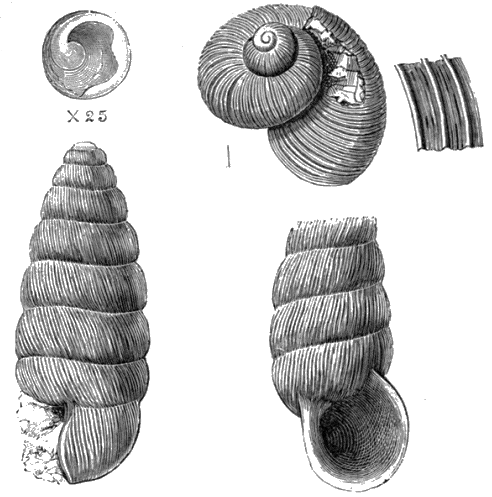
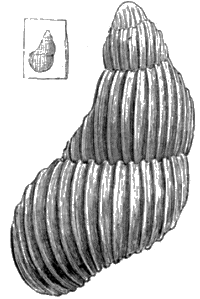
Carboniferous Land Snails.
Pupa vetusta, Dawson, and Conulus priscus, Carpenter, with egg of
Pupa vetusta—the whole considerably magnified.
I published in 1880, in the American
Journal of Science, a fragment of
what seemed to be a land-snail, from
the Middle Erian plant-beds of St.
John, New Brunswick (Strophia grandava,
figured here), but have mentioned
it with some doubt in the text. Mr. G.
F. Matthew has, however, recently
communicated to the Royal Society of
Canada a second species, found by Mr.
W. I. Wilson in the same beds, and
which he names Pupa primava. It is
accompanied with a scorpion and a
millipede. Thus the existence of Land
Snails of the Pupa type in the Devonian
may be considered as established.
The mode of occurrence of the Palæozoic Pulmonifera in
the few localities where they have been found is characteristic.
The earliest known species, Pupa vetusta, was found, as
already stated, in the material filling the once hollow stem of
a Sigillaria at the South Joggins in Nova Scotia, and many
additional specimens have subsequently been obtained from
similar repositories in the same locality, where they are associated
with bones of Batrachians and remains of Millipedes.
Other specimens, and also the species Zonites priscus, have
been found in a thin, shaly layer, containing débris of plants
and crusts of Cyprids, and which was probably deposited at
the outlet of a small stream flowing through the coal-formation
forest. The two species found in Illinois occur, according to
Bradley, in an underclay or fossil soil which may have been
the bed of a pond or estuary, and subsequently became a
forest subsoil. The Erian .species occurs in shales charged
with remains of land plants, and which must consequently
have received abundant drainage from neighbouring land. It
is only in such deposits that remains of true land snails can be
expected to occur; though, had fresh-water or brackish water
Pulmonates abounded in the Carboniferous age, their remains
should have occurred in those bituminous and calcareo-bituminous
shales which contain such vast quantities of débris of
Cyprids, Lamellibranchs and fishes of the period, mixed with
fossil plants.
The specimen first obtained in 1887 having been taken by
Sir Charles Lyell to the United States, and submitted to the
late Prof. Jeffries Wyman, the shell in question was recognised
by him and the late Dr. Gould, of Boston, as a land shell. It
was subsequently examined by M. Deshayes and Mr. Gwyn
Jeffries, who concurred in this determination; and its microscopic
structure was described by the late Prof. Quekett, of
London, as similar to that of modern land shells. The single
specimen obtained on this occasion was somewhat crushed,
and did not show the aperture. Hence the hesitation as to
its nature, and the delay in naming it, though it was figured
and described in the paper above cited in 1852. Better
specimens showing the aperture were afterward obtained by
the writer, and it was named and described by him in his
"Air-breathers of the Coal Period," in 1863. Owen, in his
"Palæontology," subsequently proposed the generic name
Dendropupa. This I have hesitated to accept, as expressing
a generic distinction not warranted by the facts; but should
the shell be considered to require a generic or sub-generic
distinction, Owen's name should be adopted for it. There
seems, however, nothing to prevent it from being placed in
one of the modern sub-genera of simple-lipped Pupæ. With
regard to the form of its aperture, I may explain that some
currency has been given to an incorrect representation of it,
through defective specimens. In the case of delicate shells
like this, imbedded in a hard matrix, it is of course difficult
to work out the aperture perfectly; and in my published
figure in the "Air-breathers," I had to restore somewhat the
broken specimens in my possession. This restoration, specimens
subsequently found have shown to be very exact.
As already stated, this shell seems closely allied to some
modern Pupæ. Perhaps the modern species which approaches
most nearly to it in form, markings and size, is Macrocheilus
Gossei from the West Indies, specimens of which were sent to
me some years ago by Mr. Bland, of New York, with the
remark that they must be very near to my Carboniferous
species. Such edentulous species as Pupa (Leucochila) fallax
of Eastern America very closely resemble it; and it was regarded
by the late Dr. Carpenter as probably a near ally of
those species which are placed by some European conchologists
in the genus Pupilla.
Pupa vetusta has been found at three distinct levels in the
coal formation of the South Joggins. The lowest is the shale
above referred to. The next, 1,217 feet higher, is that of the
original discovery. The third, 800 feet higher, is in an erect
Sigillaria holding no other remains. Thus, this shell has lived
in the locality at least during the accumulation of 2,000 feet
of beds, including a number of coals and erect forests, as well
as beds of bituminous shales and calcareo-bituminous shale,
the growth of which must have been very slow.
In the lowest of these three horizons the shells are found,
as already stated, in a thin bed of concretionary clay of dark
grey colour, though associated with reddish beds. It contains
Zonites priscus as well, though this is very rare, and there are
a few valves of Cythere and shells of Naiadites as well as
carbonaceous fragments, fronds of ferns, Trigonocarpa, etc.
The Pupæ are mostly adult, but many very young shells also
occur, as well as fragments of broken shells. The bed is
evidently a layer of mud deposited in a pond or creek, or at
the mouth of a small stream. In modern swamps multitudes
of fresh-water shells occur in such places, and it is remarkable
that in this case the only Gasteropods are land shells, and
these very plentiful, though only in one bed about an inch in
thickness. This would seem to imply an absence of fresh-water
Pulmonifera. In the erect Sigillariæ of the second
horizon the shells occur either in a sandy matrix, more or less
darkened with vegetable matter, or in a carbonaceous mass
composed mainly of vegetable débris. Except when crushed
or flattened, the shells in these repositories are usually filled
with brownish calcite. From this I infer that most of them
were alive when imbedded, or at least that they contained the
bodies of the animals; and it is not improbable that they
sheltered themselves in the hollow trees, as is the habit of
many similar animals in modern forests. Their residence in
these trees, as well as the characters of their embryology, are
illustrated by the occurrence of their mature ova. One of
those, which I have considered worth figuring, has been broken
in such a way as to show the embryo shell.
They may also have formed part of the food of the reptilian
animals whose remains occur with them. In illustration of
this I have elsewhere stated that I have found as many as
eleven unbroken shells of Physa heterostropha in the stomach
of a modern Menobranchus. I think it certain, however, that
both the shells and the reptiles occurring in these trees must
have been strictly terrestrial in their habits, as they could not
have found admission to the erect trees unless the ground had
been sufficiently dry to allow several feet of the imbedded
hollow trunks to be free from water. In the highest of the
three horizons the shells occurred in an erect tree, but without
any other fossils, and they had apparently been washed in
along with a greyish mud.[138]
If we exclude the alleged Palæorbis referred to below, all
the Palæozoic Pulmonifera hitherto found are American.
Since, however, in the Carboniferous age, Batrachians, Arachnidans,
Insects and Millipedes occur on both continents, it is
not unlikely that ere long European species of land snails will
be announced The species hitherto found in Eastern
America are in every way strangely isolated. In the plant
beds of St. John, about 9,000 feet in thickness, and in the
coal formation of the South Joggins, more than 7,000 feet in
thickness, no other Gasteropods occur, nor, I believe, do any
occur in the beds holding land snails in Illinois. Nor, as
already stated, are any of the aquatic Pulmonifera known in
the Palæozoic. Thus, in so far as at present known, these
Palæozoic snails are separated not only from any predecessors,
if there were any, or successors, but from any contemporary
animals allied to them.
It is probable that the land snails of the Erian and Carboniferous
were neither numerous nor important members of the
faunas of those periods. Had other species existed in any
considerable numbers, there is no reason why they should not
have been found in the erect trees, or in those shales which
contain land plants. More especially would the discovery of
any larger species, had they existed, been likely to have
occurred. Further, what we know of the vegetation of the
Palæozoic period would lead us to infer that it did not abound
in those succulent and nutritious leaves and fruits which are
most congenial to land snails. It is to be observed, however,
that we know little as yet of the upland life of the Erian or
Carboniferous. The animal life of the drier parts of the low
country is indeed as yet very little known; and but for the
revelations in this respect of the erect trees in one bed in the
coal formation of Nova Scotia, our knowledge of the land
snails and Millipedes, and also of an eminently terrestrial group
of reptiles, the Microsauria, would have been much more
imperfect than it is. We may hope for still further revelations
of this kind, and in the meantime it would be premature to
speculate as to the affinities of our little group of land snails
with animals either their contemporaries or belonging to
earlier or later formations, except to note the fact of the little
change of form or structure in this type of life in that vast
interval of time which separates the Erian period from the
present day.
It may be proper to mention here the alleged Pulmonifera
of the genus Palæorbis described by some German naturalists.
These I believe to be worm tubes of the genus Spirorbis, and
in fact to be nothing else than the common S. carbonarius or
S. pusillus of the coal formation. The history of this error
may be stated thus. The eminent palæobotanists Germar,
Goeppert and Geinitz have referred the Spirorbis, so common
in the Coal measures to the fungi, under the name Gyromyces,
and in this they have been followed by other naturalists,
though as long ago as 1868 I had shown that this little
organism is not only a calcareous shell, attached by one side
to vegetable matters and shells of mollusks, but that it has the
microscopic structure characteristic of modern shells of this
type.[139] More recently Van Beneden, Cænius, and Goldenberg,
perceiving that the fossil is really a calcareous shell, but
apparently unaware of the observations made in this country
by myself and Mr. Lesquereux, have held the Spirorbis to be a
pulmonate mollusk allied to Planorbis, and have supposed that
its presence on fossil plants is confirmatory of this view,
though the shells are attached by a flattened side to these
plants, and are also found attached to shells of bivalves of the
genus Naiadites. Mr. R. Etheridge, jun., of the Geological
Survey of Great Britain, has summed up the evidence as to the
true nature of these probably brackish-water shells, and has
revised and added to the species, in a series of articles in the
Geological Magazine of London, vol. viii.
The erect trees of Coal Mine Point are rich in remains of
Millipedes. The first of these (Xylobius Sigillariæ), which was
the first known Palæozoic Myriapod, was described by me
from specimens found in a tree extracted in 1852, and this,
with a number of other remains subsequently found, was afterwards
placed in the hands of Dr. Scudder, who has recognised
in the material submitted to him eight species belonging to
three genera (Xylobius, Archiulus, and Amynilyspes). These
animals in all probability haunted these trees to feed on the
decaying wood and other vegetable matter, and were undoubtedly
themselves the prey of the Microsaurians. Though
these were the earliest known, their discovery was followed by
that of many other species in Europe and America, and some
of them as old as the Devonian.[140]
The only other remains of Air-breathers found in the erect
trees belong to Scorpions, of which some fragments remain in
such a state as to make it probable that they have been
partially devoured by the imprisoned reptiles. No remains of
any aquatic animals have been found in these trees. The
Scorpions are referred by Scudder to three species belonging
to two genera.[141]
In the previous paper we have considered the mode of
accumulation of Coal, and it may be useful here to note the
light thrown on this subject by the Air-breathers of the coal
formation and their mode of occurrence.
In no part of the world are the coal measures better
developed, or more fully exposed, than in the coast sections of
Nova Scotia and Cape Breton; and in these, throughout their
whole thickness, no indication has been found of any of the
marine fossils of the Lower Carboniferous Limestone. Abundant
remains of fishes occur, but these may have frequented
estuaries, streams and ponds, and the greater part of them are
small ganoids which, like the modern Lepidosteus and Amia,
may have been specially fitted by their semi-reptilian respiration,
for the impure waters of swampy districts. Bivalve
mollusks also abound; but these are all of the kinds to which
I have given the generic name Naiadites, and Mr. Salter those
of Anthracomya and Anthracoptera. These shells are all
distinct from any known in the marine limestones. Their thin
edentulous valves, their structure consisting of a wrinkled
epidermis, a thin layer of prismatic shell and an inner layer of
imperfectly pearly shell, all remind us of the Anodons and
Unios. A slight notch in front concurs with their mode of
occurrence in rendering it probable that, like mussels in
modern estuaries, they attached themselves to floating or
sunken timber. They are thus removed, both in structure and
habit, from truly marine species; and may have been fresh-water
or brackish-water mussels closely allied to modern
Unios.
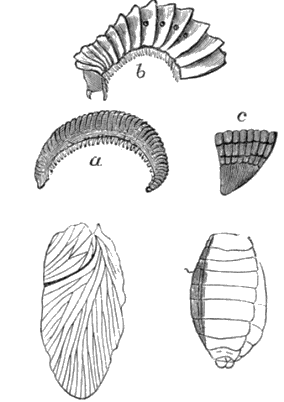
Carboniferous Millipedes, Xylobius Sigillariæ, Dawson (a, c), and
Archiulus xylobioides, Scudder (b).
Carboniferous Cockroach.—
Blattina Bretonensis, Sc.
Carboniferous Scorpion.—
Anthracomartus Carbonarius, abdominal
segments.
The crustaceans (Eurypterus, Diplostylus, Cyprids), and the
worm shell (Spirorbis) found with them, are not necessarily
marine, though some of them belonged probably to brackish
water, and they have not yet been found in those carboniferous
beds deposited in the open sea. There is thus in the whole
thickness of the middle coal measures of Nova Scotia a
remarkable absence at least of open sea animals; and if, as is
quite probable, the sea inundated at intervals the areas of coal
accumulation, the waters must have been shallow, and to a
great extent land-locked, so that brackish-water rather than
marine animals inhabited them.
On the other hand, there are in these coal measures
abundant evidences of land surfaces; and subaërial decay of
vegetable matter in large quantity is proved by the occurrence
of the mineral charcoal of the coal itself, as I have elsewhere
shown.[142] The erect trees which occur at so many levels also
imply subaërial decay. A tree imbedded in sediment and
remaining under water, could not decay so as to become
hollow and deposit the remains of its wood in the state of
mineral charcoal within the hollow bark. Yet this is the case
with the greater part of the erect Sigillariæ which occur at
more than twenty levels in the Joggins section. Nor could
such hollow trunks become repositories for millipedes, snails
and reptiles, if under water. On the other hand, if, as seems
necessary to explain the character of the reptiliferous erect
trees, these remained dry, or nearly so, in the interior, this
would imply not merely a soil out of water, but comparatively
well drained; as would indeed always be the case, when a flat
resting on a sandy subsoil was raised several feet above the
level of the water. Further, though the peculiar character of
the roots of Sigillariæ and Calamites may lend some countenance
to the supposition that they could grow under water, or in
water-soaked soils, this will not apply to coniferous trees, to
ferns, and other plants, which are found under circumstances
which show that they grew with the Sigillariæ.
In the coal measures of Nova Scotia, therefore, while marine
conditions are absent, there are ample evidences of fresh-water
or brackish-water conditions, and of land surfaces, suitable for
the air-breathing animals of the period. Nor do I believe that
the coal measures of Nova Scotia were exceptional in this
respect. It is true that in Great Britain evidences of marine
life do occur in the coal measures; but not, so far as I am
aware, in circumstances which justify the inference that the
coal is of marine origin. Alternations of marine and land
remains, and even mixtures of these, are frequent in modern
submarine forests. When we find, as at Fort Lawrence in
Nova Scotia, a modern forest rooted in upland soil forty feet
below high-water mark,[143] and covered with mud containing
living Tellinas and Myas, we are not justified in inferring that
this forest grew in the sea. We rather infer that subsidence
has occurred. In modern salt marshes it is not unusual to
find every little runnel or pool full of marine shell fish, while in
the higher parts of the marsh land plants are growing; and
in such places the deposit formed must contain a mixture of
land plants and marine animals with salt grasses and herbage—the
whole in situ.[144]
These considerations serve, I think, to explain all the
apparently anomalous associations of coal plants with marine
fossils; and I do not know any other arguments of apparent
weight that can be adduced in favour of the marine or even
aquatic origin of coal, except such as are based on misconceptions
of the structure and mode of growth of sigillaroid trees
and of the stratigraphical relations of the coal itself.[145] It is to
be observed, however, that while I must maintain the essentially
terrestrial character of the ordinary coal and of its plants,
I have elsewhere admitted that cannel coals and earthy
bitumen present evidences of subaquatic deposition; and
have also abundantly illustrated the facts that the coal plants
grew on swampy flats, liable not only to river inundations, but
also to subsidence and submergence.[146] In the oscillation of
these conditions it is evident that Sigillariæ and their contemporaries
must often have been placed in conditions unfavourable
or fatal to them, and when their remains are
preserved to us in these conditions, we may form very incorrect
inferences as to their mode of life. Further, it is to be
observed that the conditions of submergence and silting up
which were favourable to the preservation of specimens of
Sigillariæ as fossils, must have been precisely those which
were destructive to them as living plants; and on the contrary,
that the conditions in which these forests may have flourished
for centuries must have been those in which there was little
chance of their remains being preserved to us, in any other
condition at least than that of coal, which reveals only to
careful microscopic examination the circumstances, whether
aërial or aquatic, under which it was formed.
It is also noticeable that, in conditions such as those of the
coal formation, it would be likely that some plants would be
specially adapted to occupy newly emerged flats and places
liable to inundation and silting up. I believe that many of the
Sigillariæ, and still more eminently the Calamites, were suitable
to such stations. There is direct evidence that the nuts
named Trigonocarpa were drifted extensively by water over
submerged flats of mud. Many Cardiocarpa were winged
seeds which may have drifted in the air. The Calamites may,
like modern Equiseta, have produced spores with elaters capable
of floating them in the wind. One of the thinner coals
at the Joggins is filled with spores or spore cases that seem to
have carried hairs on their surfaces, and may have been suited
to such a mode of dissemination. I have elsewhere proved[147]
that at least some species of Calamites were, by their mode of
growth, admirably fitted for growing amid accumulating sediment,
and for promoting its accumulation.
The reptiles of the coal formation are probably the oldest
known to us, and possibly, though this we cannot affirm, the
highest products of creation in this period. Supposing, for
the moment, that they are the highest animals of their time,
and, what is perhaps less likely, that those which we know are a
fair average of the rest, we have the curious fact that they are
all carnivorous, and the greater part of them fitted to find food
in the water as well as on the land. The plant feeders of the
period, on the land at least, are all invertebrates, as snails,
millipedes, and perhaps insects. The air-breathing vertebrates
are not intended to consume the exuberant vegetable growth,
but to check the increase of its animal enemies. Plant life
would thus seem to have had in every way the advantage.
The millipedes probably fed only on roots and decaying substances,
the snails on the more juicy and succulent plants
growing in the shadow of the woods, and the great predominance
of the family of cockroaches among carboniferous insects
points to similar conclusions as to that class. While, moreover,
the vegetation of the coal swamps was most abundant, it was
not, on the whole, of a character to lead us to suppose that it
supported many animals. Our knowledge of the flora of the
coal swamps is sufficiently complete to exclude from them any
abundance of the higher phænogamous plants. We know
little, it is true, of the flora of the uplands of the period; but
when we speak of the coal-formation land, it is to the flats only
that we refer. The foliage of the plants on these flats with the
exception of that of the ferns, was harsh and meagre, and there
seem to have been no grasses or other nutritious herbaceous
plants. These are wants of themselves likely to exclude many
of the higher forms of herbivorous life. On the other hand,
there was a profusion of large nut-like seeds, which in a modern
forest would probably have afforded subsistence to squirrels
and similar animals. The pith and thick soft bark of many of
the trees must at certain seasons have contained much nutritive
matter, while there was certainly sufficient material for all
those insects whose larvæ feed on living and dead timber, as
well as for the creatures that in turn prey on them. It is remarkable
that there seem to have been no vertebrate animals
fitted to avail themselves of these vast stores of food. The
question: "What may have fed on all this vegetation?" was
never absent from my mind in all my explorations of the Nova
Scotia coal sections; but no trace of any creature other than
those already mentioned has ever rewarded my search. In
Nova Scotia it would seem that a few snails, gally-worms, and
insects were the sole links of connection between the plant
creation and air-breathing vertebrates. Is this due to the
paucity of the fauna, or the imperfection of the record? The
fact that a few erect stumps have revealed nearly all the air-breathers
yet found, argues strongly for the latter cause; but
there are some facts bearing on the other side.
A gally-worm, if, like its modern relatives, hiding in crevices
of wood in forests, was one of the least likely animals to be
found in aqueous deposits. The erect trees gave it its almost
sole chance of preservation. Pupa vetusta is a small species,
and its shell very thin and fragile, while it probably lived among
thick vegetation. Further, the measures 2,000 feet thick,
separating the lowest and highest beds in which it occurs, include
twenty-one coal seams, having an aggregate thickness of
about twenty feet, three beds of bituminous limestone of animal
origin, and perhaps twenty beds holding Stigmaria in situ, or
erect Sigillariæ and Calamites. The lapse of time implied by
this succession of beds, many of them necessarily of very slow
deposition, must be very great, though it would be mere guess
work to attempt to resolve it into years. Yet long though this
interval must have been, Pupa vetusta lasted without one iota
of change through it all; and, more remarkable still, was not
accompanied by more than two other species of its family.
Where so many specimens occur, and in situations so diverse,
without any additional species, the inference is strong that no
other of similar habits existed. If in any of those subtropical
islands, whose climate and productions somewhat resemble
those of the coal period, after searching in and about decaying
trees, and also on the bars upon which rivers and lakes drifted
their burdens of shells, we should find only three species, but
one of these in very great numbers, we would surely conclude
that other species, if present, were very rare.
Again, footprints referable to Dendrerpeton, or similar animals,
occur in the lower Carboniferous beds below the marine limestones,
in the middle coal measures, and in the upper coal
formation, separated by a thickness of beds which may be
estimated at 15,000 feet, and certainly representing a vast lapse
of time. Did we know the creature by these impressions
alone, we might infer its continued existence for all this great
length of time; but when we also find its bones in the principal
repositories of reptile remains, and in company with the
other creatures found with it, we satisfy ourselves that of them
all it was the most likely to have left its trail in the mud flats.
We thus have reason to conclude that it existed alone during
this period, in so far as its especial kind of habitat was concerned;
though there lived with it other reptiles, some of
which, haunting principally the woods, and others the water,
were less likely to leave impressions of their footprints. These
may be but slight indications of truth, but they convey strong
impressions of the persistence of species, and also of the paucity
of species belonging to these tribes at the time.
If we could affirm that the Air-breathers of the coal period
were really the first species of their families, they might acquire
additional interest by their bearing on this question of origin
of species. We cannot affirm this; but it may be a harmless
and not uninstructive play of fancy to suppose for a moment
that they actually are so, and to inquire on this supposition as
to the mode of their introduction. Looking at them from this
point of view, we shall first be struck with the fact that they
belong to all of the three great leading types of animals which
include our modern Air-breathers the Vertebrates, the Arthropods,
and the Mollusks. We have besides to consider in this
connection that the breathing organs of an insect are air tubes
opening laterally (tracheæ), those of a land snail merely a
modification of the chamber which in marine species holds the
gills, while those of the reptiles represent the air bladder of the
fishes. Thus, in the three groups the breathing organs are
quite distinct in their nature and affinities. This at once excludes
the supposition that they can all have been derived from
each other within the limits of the coal period. No transmutationist
can have the hardihood to assert the convertibility, by
any direct method, of a snail into a millipede or an insect, or
of either into a reptile. The plan of structure in these creatures
is not only different, but contrasted in its most essential
features. It would be far more natural to suppose that these
animals sprang from aquatic species of their respective types.
We should then seek for the ancestors of the snail in aquatic
Gasteropods, for those of the millipede in worms or Crustaceans,
and for those of the reptiles in the fishes of the period. It
would be easy to build up an imaginary series of stages, on
the principle of natural selection, whereby these results might
be effected; but the hypothesis would be destitute of any support
from fact, and would be beset by more difficulties than it
removes. Why should the result of the transformation of
water-snails breathing by gills be a Pupa ? Would it not much
more likely be an Auricula or a Limnea ? It will not solve
this difficulty to say that the intermediate forms became extinct,
and so are lost. On the contrary, they exist to this day,
though they were not, in so far as we know, introduced so
early. But negative evidence must not be relied on; the
record is very imperfect, and such creatures may have existed,
though unknown to us. It may be answered that they could
not have existed in any considerable numbers, else some of
their shells would have appeared in the coal-formation beds, so
rich in crustaceans and bivalve mollusks. Further, the little
Pupa remained unchanged during a very long time, and shows
no tendency to resolve itself into anything higher, or to descend
to anything lower, while in the lowest bed in which it occurs
it is associated with a round snail of quite different type.
Here, if anywhere, in what appears to be the first introduction
of air-breathing invertebrates, we should be able to find the
evidences of transition from the gills of the Prosobranchiate
and the Crustacean to the air sac of the Pulmonate and the
tracheæ of the millipede. It is also to be observed that many
other structural changes are involved, the aggregate of which
makes a Pulmonate or a millipede different in every particular
from its nearest allies among gill-bearing Gasteropods or
Crustaceans.
It may be said, however, that the links of connection between
the coal reptiles and fishes are better established. All
the known coal reptiles have leanings to the fishes in certain
characters; and in some, as in Archegosaurus, these are very
close. Still the interval to be bridged over is wide, and the
differences are by no means those which we should expect.
Were the problem given to convert a ganoid fish into an
Archegosaurus or Dendrerpeton, we should be disposed to
retain unchanged such characters as would be suited to the
new habits of the creature, and to change only those directly
related to the objects in view. We should probably give little
attention to differences in the arrangement of skull bones, in
the parts of the vertebræ, in the external clothing, in the microscopic
structure of the bone, and other peculiarities for serving
similar purposes by organs on a different plan, which are so
conspicuous so soon as we pass from the fish to the Batrachian.
It is not, in short, an improvement of the organs of the fish that
we witness so much as the introduction of new organs.[148] The
foot of the batrachian bears, perhaps, as close a relation to the
fin of the fish as the screw of one steamship to the paddle
wheel of another, or as the latter to a carriage wheel; and can
be just as rationally supposed to be not a new instrument, but
the old one changed. In this connection even a footprint in
the sand startles us as much as that of Friday did Robinson
Crusoe. We see five fingers and toes, and ask how this
numerical arrangement started at once from fin rays of fishes
all over the world; and how it has continued unchanged till
now, when it forms the basis of our decimal arithmetic.
Again, our reptiles of the coal do not constitute a continuous
series, and belong to a great number of distinct genera and
families, nor is it possible that they can all, except at widely
different times, have originated from the same source. It
either happened, for some unknown reason, that many kinds of
fishes put on the reptilian guise in the same period, or else the
vast lapse of ages required for the production of a reptile from
a fish must be indefinitely increased for the production of many
dissimilar reptiles from each other; or, on the other hand, we
must suppose that the limit between the fish and reptile being
once overpassed, a facility for comparatively rapid changes
became the property of the latter. Either supposition would,
I think, contradict such facts bearing on the subject as are
known to us.
We commenced with supposing that the reptiles of the Coal
might possibly be the first of their family, but it is evident
from the above considerations, that on the doctrine of natural
selection, the number and variety of reptiles in this period
would imply that their predecessors in this form must have
existed from a time as early as any in which even fishes are
known to exist; so that if we adopt any hypothesis of derivation,
it would probably be necessary to have recourse to that
which supposes at particular periods a sudden and as yet unaccountable
transmutation of one form into another; a view
which, in its remoteness from anything included under ordinary
natural laws, does not materially differ from that currently received
idea of creative intervention, with which, in so far as
our coal reptiles can inform us, we are for the present satisfied.
There is one other point which strikes the naturalist in considering
these animals, and which has a certain bearing on such
hypothesis. It is the combination of various grades of reptilian
types in these ancient creatures. It has been well remarked
by Hugh Miller, and more fully by Agassiz, that this is characteristic
of the first appearance of new groups of animals. Now
selection, as it acts in the hands of the breeder, tends to
specialization; and natural selection, if there is such a thing, is
supposed to tend in the same direction. But when some distinctly
new form is to be introduced, an opposite tendency
seems to prevail, a sort of aggregation in one species of characters
afterward to be separated and manifested in distinct
groups of creatures. The introduction of such new types also
tends to degrade and deprive of their higher properties previously
existing groups of lower rank. It is easy to perceive in
all this, law and order, in that higher sense in which these
terms express the will and plan of the Supreme Mind, but not
in that lower sense in which they represent the insensate
operation of blind natural forces.
References:—"Air-breathers of the Coal Period." Montreal, 1886.
Papers on Reptiles, etc., in South Joggins Coal Field, Journal of
Geological Society of London, vols. ix. x. xi. xvi. Remains of Animals
in Erect Trees in the Coal Formation of Nova Scotia, Trans.
Royal Society, 1881. "Acadian Geology," fourth edition, 1891. Revision
of Land Snails of the Palæozoic Era, Am. Journal of Science,
vol. xx., 1880. Supplementary Report to Royal Society of London,
Proceedings, 1892. Notice of additional Reptilian Remains, Geological
Magazine of London, 1891.