[Entered February 14, 1902, at Urbana, Illinois, as second-class matter
under Act of Congress of July 16, 1894.]
Department of Household Science
By
Charlotte M. Gibbs, M. A.
PUBLISHED BY THE UNIVERSITY
URBANA-CHAMPAIGN
SOME POINTS IN CHOOSING TEXTILES
In the past century a great change has come about in
the position of the woman in the home, which has very vitally
affected her relation to the textile industries. In the
early days in this country nearly every woman produced
the clothing for herself and family, also the household linens
from the raising of the sheep or flax to the finished
product. Now all is changed; with the introduction of
ready-made suits and other garments, even the sewing is
rapidly going from the home, while the manufacture of
cloth is a forgotten art.
In olden times the quality of home-spun and woven
material was the best possible to be obtained from the materials
and methods known. Woolen cloth was all wool,
and linen cloth was not adulterated with starch, or half
cotton. Honest and durable materials were the rule of the
day.
With the introduction of machinery and the factory system
came keen competition. Modern discoveries, chemical
and otherwise, have increased the possibilities of cotton,
linen, silk and wool so that now it is difficult to recognize
the original fiber in some of the materials sold.
Thus on the one hand the field of textile knowledge has
grown very much, while on the other hand the knowledge
of women concerning textile fabrics has decreased, since
they are no longer the makers of cloth, nor do they always
gain a knowledge of its characteristics through the making
of garments. The result has been that women depend
more and more on the word of clerks, who are often as
ignorant as themselves, until by painful experience the
buyers learn some of the things to be avoided.
As cost of living increases, and demands upon the
family purse increase, it is more and more important that
the woman of the household should know how to spend the
family income most economically. Since from ten to
twenty percent of this income is spent for clothing and house
furnishing, it is imperative that more thought and careful
study should be put upon this branch of household economy.
The object of this bulletin is to give some bits of information
about textile fibers, their manufacture and adulteration,
which may help in gaining that judgment in buying essential
to every woman.
Certain adulterations and devices of the modern manufacturer
are so skillfully concealed as to be detected only
by the use of chemical tests, or the high power microscope.
With these this bulletin will not deal, but only with those
qualities and adulterations which may be detected without
the aid of laboratory equipment. Much of course may be
learned by experience, but it seems better to save time and
money by knowing beforehand what is to be demanded,
what guarded against.
Each one of the common materials used for textile
fabrics, cotton, linen, wool and silk, has its characteristics,
each its definite uses. Certain peculiarities in physical or
chemical nature make each fiber peculiarly adapted to
certain uses, but so long as these general qualities are maintained
the variety of materials produced from these fibers
may be enormous. Combinations of fibers in one material,
adulteration with cheaper fibers, or with starches or metallic
salts, may serve to reduce the cost, and yet the purpose of
the material may be fulfilled. For certain purposes the
materials may be used interchangeably.
COTTON
Cotton is cheap and very plentiful. It has short, flat
fibers, with a spiral twist, thus giving elasticity and the
possibility of being spun into fine thread. Being in itself
very useful and inexpensive and capable of replacing, to a
certain extent, any other fiber, it is used in very large quantities
the world over, and is manufactured into a great
variety of materials. The quality of these materials depends
on the strength of the fibers, the fineness or coarseness of
material, the weave, the color and design, and the adulterations.
Cotton, being cheapest, is not adulterated with any of
the other fibers mentioned, when the material is to be sold
as cotton cloth, but it can be made to appear heavier by the
addition of mixtures called sizing. Starches, gums, dextrine,
glue, china clay, as well as other ingredients in varying proportions,
constitute this sizing which may add a large percent
to the weight of the cloth. The spaces between the
threads are filled up and a good finish is given to the cloth,
although the wearing quality is not increased. If present
in large quantities the cloth is greatly reduced in weight and
firmness after the first washing.
Adulterations of this kind can be detected by the feeling,
a large quantity imparting a harshness to the material. In
very thin fabrics the sizing may often be detected by holding
the cloth up to the light when the starch shows between
the threads. Washing or thorough boiling of a sample
will show the amount of sizing present.
Another method of adulterating cotton is shown in
certain kinds of dotted swiss. A good swiss has thread
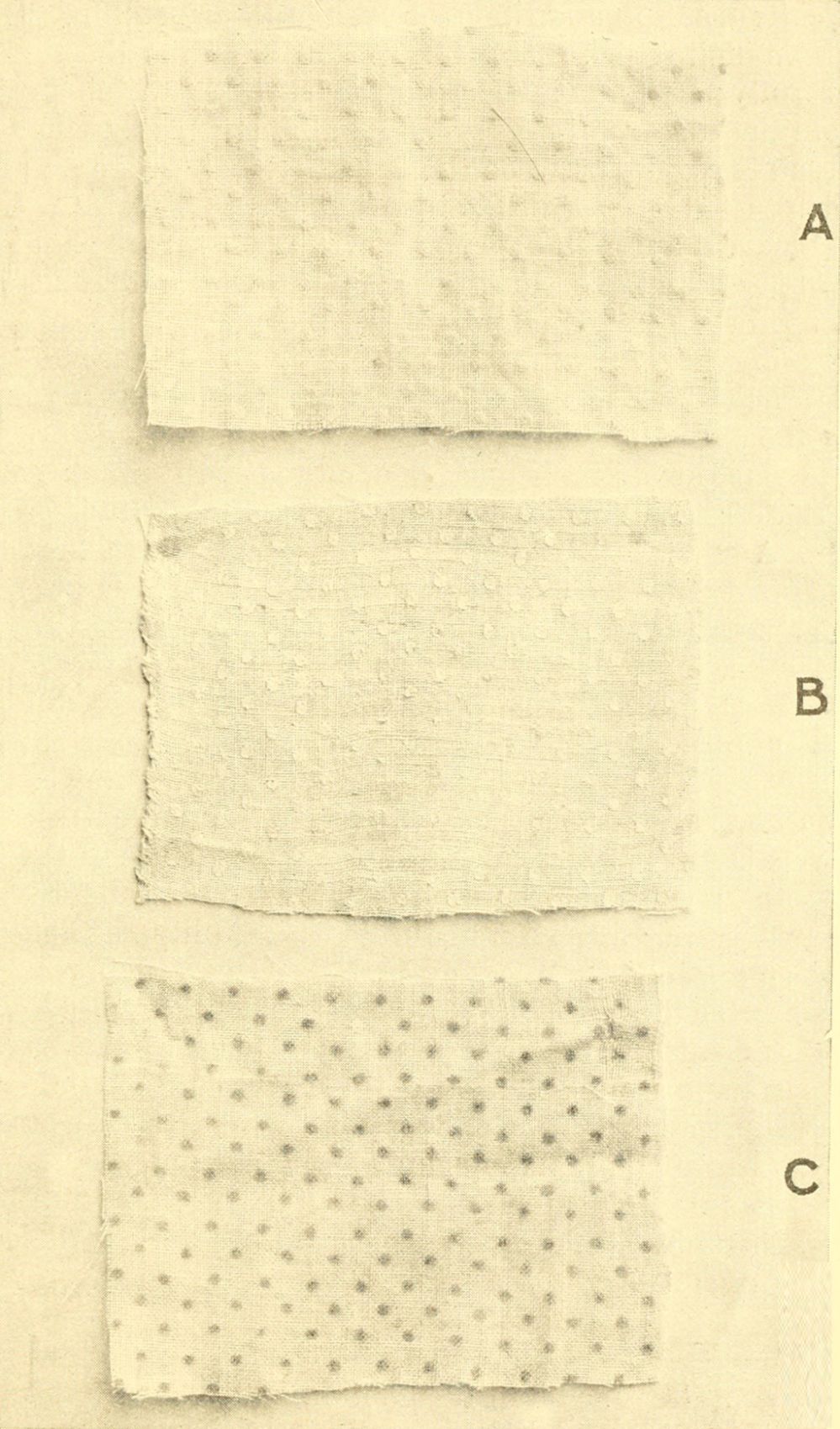
dots woven or embroidered in the cloth. Fig. 1A shows a
piece of material sold at the price of a good swiss, but in
this case the dots are merely a heavy paste, printed on the
cloth. Fig. 1B shows the result of continued washing,
where the dots have disappeared, and Fig. 1C, the result of
ironing with a hot iron, which turned the spots brown before
the cloth itself is harmed.
Mercerized cotton is a cloth produced by the action of a
strong alkali on cotton fiber rinsed under tension. It is a
strong, attractive material, with good wearing qualities. An
imitation of this may be made by the action of very heavy
and very hot cylinders on ordinary cotton cloth. The
mercerized cloth has a high luster which it retains after
many washings while the imitation loses its luster with the
first washing.
Sometimes cotton cloth which has been on the market
for some time is weakened by the action of the chemicals
used in bleaching, dyeing or in the sizing. This may be
easily detected by tearing the cloth.
Standard cotton materials such as muslins, organdies,
percales, calicoes and sheeting, differ only in the weight of
the material, fineness of thread, hardness of twist and method
of finish. Ginghams have the thread dyed before weaving
and fancy weaves are frequently used. Duck, denim and
some other heavy materials have very hard twisted threads
and are frequently woven with a twill. Silkolene is a trade
name for a fine cotton cloth with a silky finish given after
the cloth is woven.
Mercerized cottons make lustrous materials as poplin,
imitation pongee and numerous attractive house furnishing
materials.
India “linon” is entirely cotton, with a fleecy surface on
the wrong side, as is “outing flannel” and “canton flannel”.
Many “tussahs,” “voiles” and “economy linens” and
other materials with rather deceptive names are cotton
materials made to imitate silk, wool or linen.
LINEN
Linen was formerly the most important vegetable fiber,
and was commonly used for all household purposes. Of late
years it has been largely replaced by cotton with which it
may be compared although there are still uses for which we
demand linen, and others for which we prefer linen to cotton.
The linen fiber is long, smooth and quite lustrous, when
spun into a thread. It is very strong and there are not so
many fuzzy ends as are found in cotton. Cloth made from
it is not only lustrous and rich looking, but because of its
smoothness stays clean longer than cotton. The snowy
whiteness of linen obtained with some difficulty in bleaching
is quite permanent, and since the fiber takes dyes with
difficulty and parts with them quite readily, it also does not
retain stains as persistently as cotton does.
Linen is much more expensive than cotton, and when
linen prices are paid linen should be demanded. Since the
two fibers are rather hard to distinguish, especially when
heavily starched and given a good finish, it is quite easy to
deceive the buyer. “Linen” collars are frequently largely
cotton, “linen” handkerchiefs may not have a thread of
linen, as is apt to be the case with rather inexpensive embroidered
handkerchiefs, and table “linen” may be mercerized
cotton, cotton and linen, or even ordinary cotton.
A
B
C
FIG. 1
To distinguish linen from cotton, examine the threads
carefully; cotton is made up of short fibers which project
from the surface of the thread, and become fuzzy when the
thread is rubbed between the fingers; when broken, cotton
has a tufted end, while the linen fibers break more unevenly
and leave a more pointed end. The linen thread should be
stronger than the cotton; it has more luster and is usually
more uneven. Some kinds of linen have flat threads, but
cotton is frequently finished in imitation of flat thread linen.
The old test of moistening the finger and putting it under
the cloth is not always a sure one, as the moisture will
not come through a heavy linen, or one with much starch
in it, and it will come through a sheer, tightly twisted cotton.
A better test is to put a drop of olive oil on the cloth
and press between blotting papers. The linen becomes more
transparent than the cotton.
There is a peculiar leathery feel about good table linen,
which cotton will not give, and the luster is different
although the difference is hard to describe.
The typical weaves used for linens are as follows. The
damask, satin or sateen weave used for table linens and
towels is especially good for the former because of the very
smooth lustrous surface it affords, but not so good for towels
as it does not absorb moisture very readily, although it
is very attractive. Huck, an uneven weave, giving a good
surface for the absorption of water, makes splendid towels,
and decorated with designs in damask weave may be very
handsome. Many linens in plain weaves are available for
clothing, embroidery, etc., while the coarse Russian crashes
are becoming quite popular for decorative purposes.
The texture of linen is such that the heavier kinds hang
well in folds, lie flat on a table, and are very artistic for
many purposes.
WOOL
Wool, the second fiber in amount used for clothing, is
an animal fiber and differs greatly from the vegetable fibers
discussed. Wool from the sheep’s back differs from hair
of goats or other animals in several ways. Wool is very
curly, and possesses a scaly structure in a much more
marked degree than hair, in which the external scales
lie flat. The surface of wool has sometimes been compared
to a pine cone, or the scales of a fish, although these two
are quite different. The scales on the wool fiber when
moist and warm stand up, more as the pine cone, and when
cold and dry or cold and moist, lie flat. This peculiar
structure of the surface of the wool fibers gives them the
property of felting, or matting very closely together. Wool
is also quite elastic, although it has not great strength.
Since the demand for woolen cloth far exceeds the supply
of new wool there are many devices for making the
supply go a long way, and consequently many methods for
deceiving the buyer. In adulterating a material the manufacturer
seeks a material cheaper than the fiber he wishes
to adulterate, one which can be concealed readily. Wool
when combined with the cheaper cotton fiber makes a material
which wears well, but does not keep its shape as well
as all-wool cloth, is less warm, and should of course receive
a lower price than all-wool.
Because of the felting property of wool it is quite possible
to conceal a good deal of cotton under the surface of
the woolen cloth, and when the fibers are mixed before the
threads are spun the task of detecting them becomes doubly
difficult.
WOOLENS AND WORSTEDS
Two classes of cloth are manufactured from wool.
Woolens are made usually of short wool carded and spun
into yarn in which the threads lie in all directions. This is
woven into cloth which usually has the surface heavily
felted, so that all of the intersections of threads in weaving
are covered. Here then is splendid opportunity for adulteration,
since cotton or poor wool may be covered up by the
surface felting.
WORSTED
The other class is made from longer staple wool, combed,
and drawn until the fibers are parallel, then hard twisted.
When woven the ends of the threads do not project on
the surface, and the finish is not intended to cover the weave,
hence it is more difficult to adulterate unless entire cotton
threads were woven with the worsted, and these are more
easily detected than a mixture of cotton and wool, or shoddy
in woolen cloth. Common examples of woolens are flannels,
broadcloth and venetian cloth; of worsteds, serge, challie,
men’s suitings and voile. Mohair is a worsted cloth woven
of the wool of the Angora goat, with a warp usually of cotton
or silk.
A
B
C
D
FIG. 2
The most reliable tests for a mixture of cotton and wool
are chemical or microscopic ones, but as these are not practical
for the average buyer, others must be sought. Wool
has luster and “kinks;” the ends of the threads are stiff
and look rather wiry. When a sample is carried home,
burning will serve to distinguish between the two. Wool
burns slowly, chars, has an odor of burnt feather, goes out
easily and leaves a crisp ash; cotton burns quickly with a
flame, with little odor and leaves no ash.
A little practice in breaking the threads will help one to
distinguish between the two; the difference is not one that
can be easily explained, but the experienced housewife
knows it well.
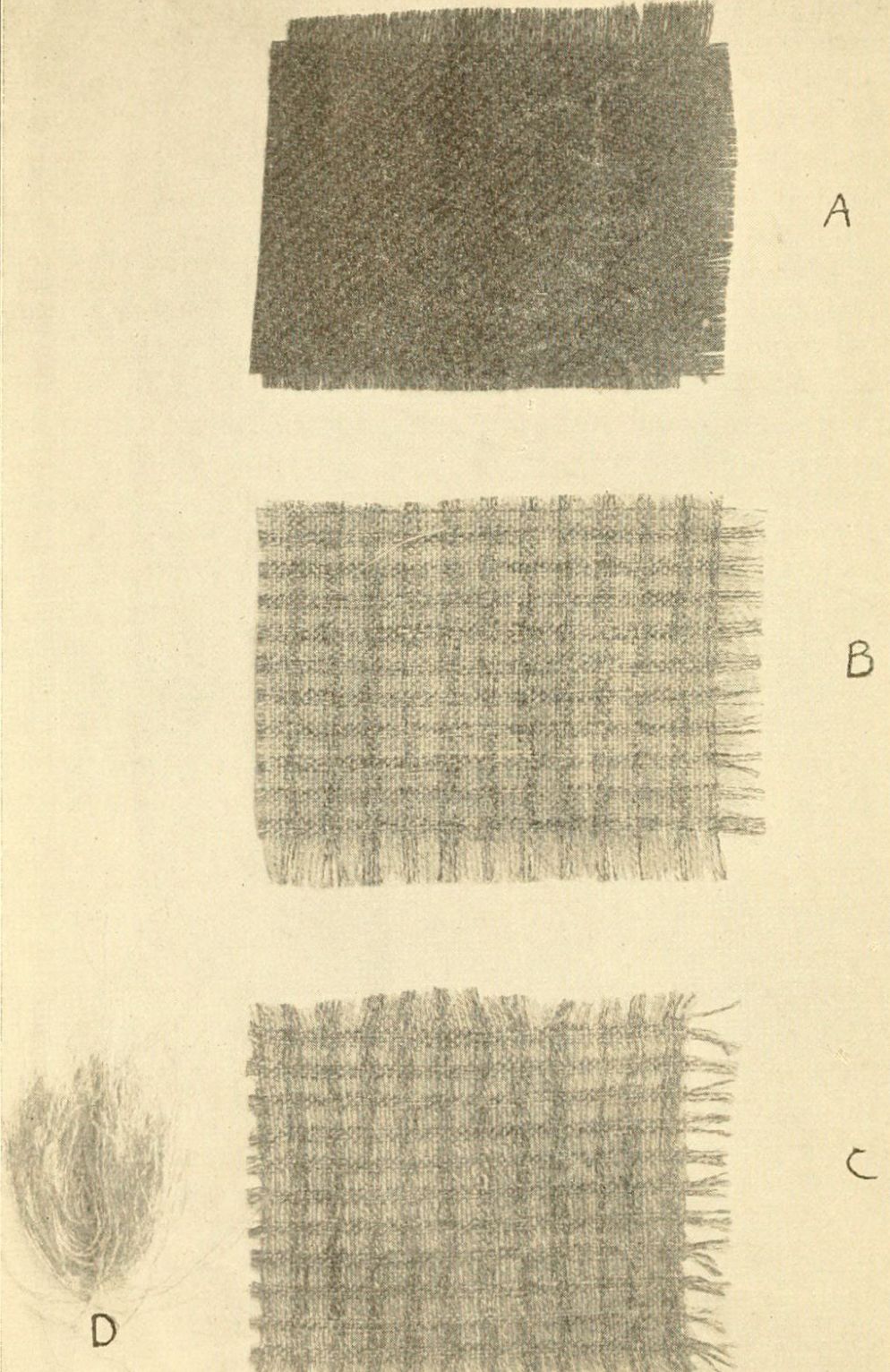
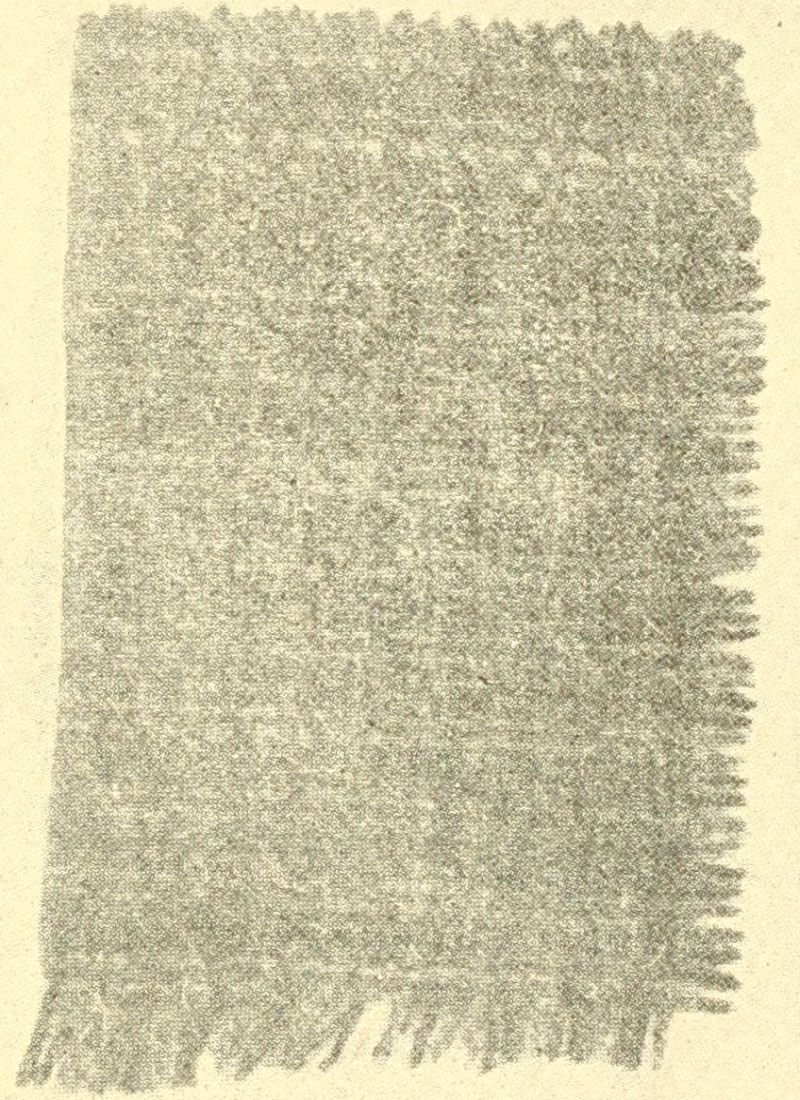
Fig. 2A shows a sample of all-wool cloth, of the class
of worsteds which cost seventy-five cents a yard. Fig. 2B
shows a sample of cloth of the same price, called by the
clerk, all-wool, but which on examination was found to
have only four threads of wool to every twelve threads of
cotton. Fig. 2C shows this same cloth with the wool removed
by strong alkali, caustic potash, leaving the cotton.
Fig. 2D shows the wool left when the cotton has been ravelled
out, or has been removed by a strong acid solution.
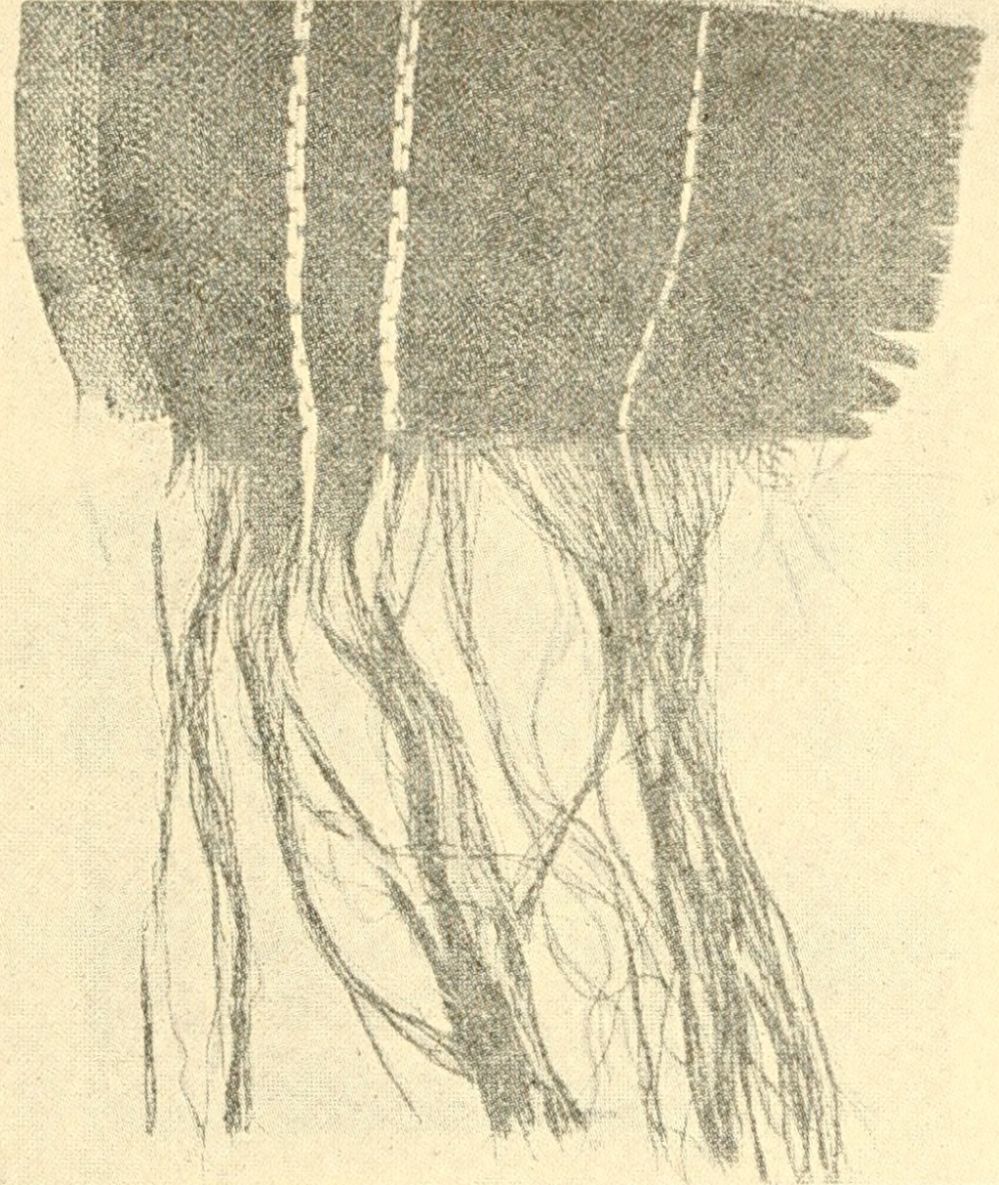
Fig. 3 shows a sample of mohair in which the wool has
been partly removed, and the cotton warp is left. In this
case the price is not high, and because of the character of
the cloth the mixture is a good one, light, smooth, and clean.
This cloth is not sold for all-wool, so is not considered adulterated.
FIG. 3
SHODDY
As has been said before, the demand for woolen goods is
so much greater than the supply that it is necessary to resort
to various measures to increase the supply of cloth.
One method is to use the wool over and over again. Rags
are bought up by the rag man, sold to the larger dealer,
again to the “shoddy” manufacturer who cleans them, sorts
them, tears them to pieces, using the best all-wool rags to
produce fibers, which are respun and again woven either
separately, if of very good quality, or mixed with new wool
or cotton. Such a material is warm, looks well for a time
and has its place, but must not be bought for new wool, or
demand the price of good woolen cloth. This industry is
enormous and shoddy is often found in expensive novelty
materials as well as in cheap “all-wool” cloth. Because of
the shortness of the fibers it may be detected readily, when
used alone, but in combination with good wool it is more
difficult.
One class of shoddy consists of very short fibers, clippings
from the mills, which are worked into the surface of
a felted cloth after it is woven. These short fibers after a
time work out, and are found in the bottoms of coats, inside
the linings, etc., leaving the surface of the cloth threadbare.
Fig. 4 shows a piece of shoddy cloth, sold for all wool
at fifty cents a yard. This cloth would be warm, but does
not look as well as more expensive cloth, and will not wear
as long as new wool. There is some cotton mixed with the
wool before spinning, therefore it is difficult to detect.
FIG. 4
SILK
Silk is frequently known as the fiber of luxury. It is the
most expensive to cultivate, the most beautiful and the
strongest fiber. Since it is the most expensive fiber to buy,
and the demand for it is so great, the temptations to adulterate
are also naturally very great. The long, strong, lustrous
silk fiber which bleaches and dyes beautifully and is
fine as a spider’s web, is not to be duplicated. The best grade
or “reeled silk” is taken from the cocoon in one continuous
thread which may be several hundred yards long. In manufacturing
reeled silk many defective cocoons are found in
which the fibers are not perfect, or are broken. The silk
from these cocoons may be treated like a short fiber and
spun into threads varying in strength according to the length
of the fibers. This so-called “spun” silk has not the high
luster nor strength of “reeled” silk, but is often used as
warp with reeled silk filling, or in imitation pongee, and
back of satins, velvets and in many other ways.
In olden times the price of silk was much greater than
now, but the material was much more durable. Silks which
have been laid away for a hundred years are still in fairly
good condition. Now our silks are much cheaper, but the
result is that when they are put away, even for a few months
they may fall into bits, and their wearing quality can not
be compared with the good old silks of long ago. The reason
for this change is not hard to find. The cost of raw silk is
about thirty times that of raw cotton and the waste at least
five times that of cotton. The manufacturer must make up
in some way if he is to sell silk at the prices demanded by
the public.
Silk has a very great ability to absorb dyes and metallic
salts without apparently changing the quality of the material,
and since dyes and metallic salts are much cheaper than
pure silk, the manufacturer makes great use of these materials.
Loading is the common name for this process of treating
silk and it is common practice to add thirty percent of
foreign material, just the percent lost by the silk when the
gum is removed, while it is possible to add two hundred
fifty or even three hundred percent.
When we buy novelties and do not care how short their
life is to be, these heavily weighted silks answer the purpose
very well, but when we wish for durability and the
silk begins to crack and split or to become shiny after a few
wearings we realize the disadvantage of our modern
methods. Practically no silk can be found on the market
entirely free from loading, but there is a great difference
in the amount present.
Burning is the simplest test for good silk; a thread of
pure silk will burn slowly leaving as it burns a very small
amount of crisp ash in a ball at the end of the thread.
Heavily weighted silk burns and leaves the ash in the form
of the original thread; this ash of course drops to pieces
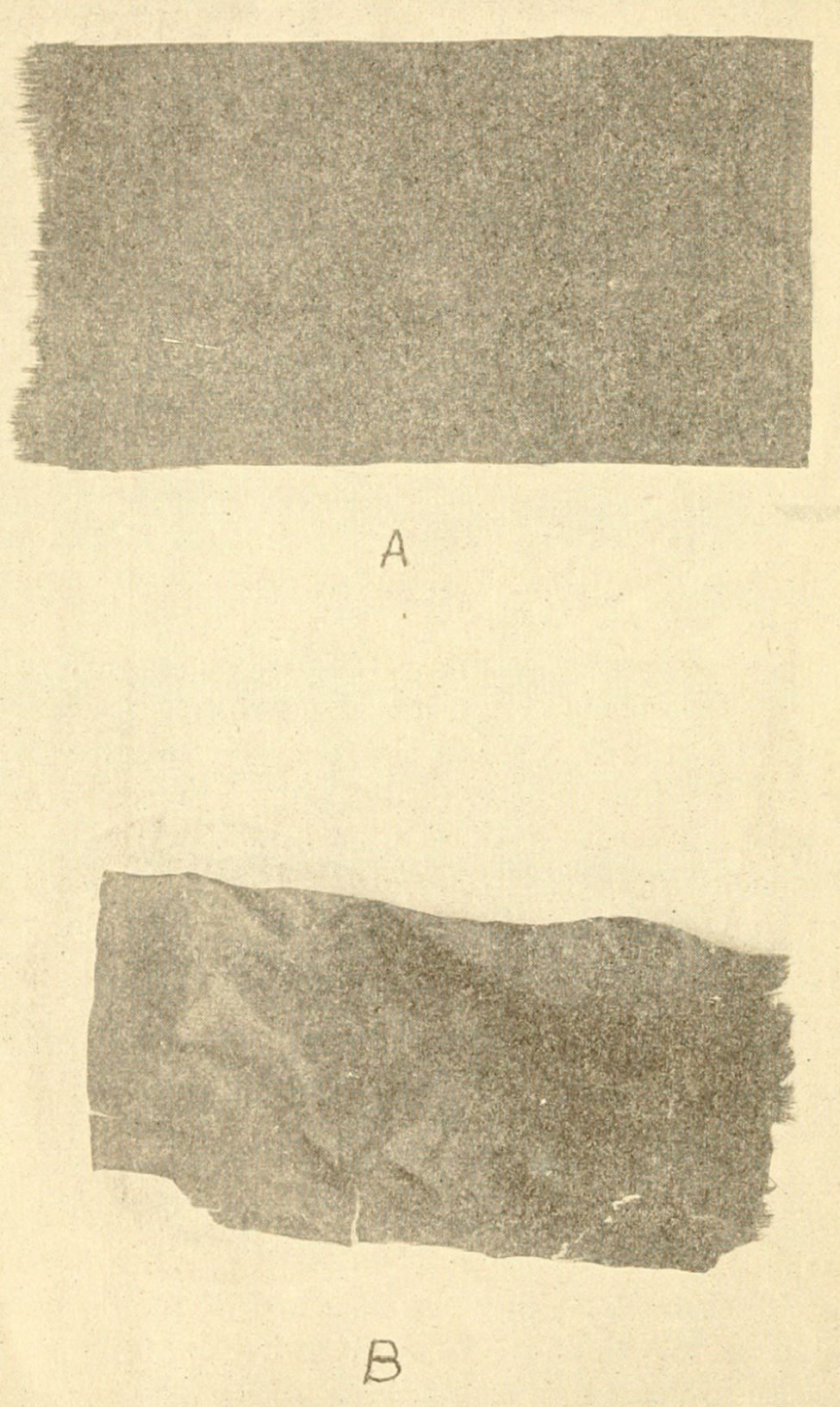
readily. Fig. 5A shows a piece of taffeta sold for one dollar
a yard. Fig. 5B shows the result of burning the silk. This
ash, left in the shape of the original sample, is made up of
metallic salts, dyestuffs, etc. A very small percent of ash
would be left from the silk itself.
Another method of adulterating silk is with cotton. The
fibers are not spun together here as the cotton and wool, but
the threads of the two materials are woven together. In
satins, velvets and brocades the cotton is entirely covered by
the silk threads on the surface, and appears as the back of
the cloth. In cheap silks a fine cotton thread sometimes
forms either warp or filling.
Pongee is a material made from the cocoon of the uncultivated
silk worm; rajah, tussah and other uneven, coarse
materials are from the same source. These silks are very
strong, but do not have a high luster. Mercerized cotton
looks quite silky and is sometimes mixed with these silks,
or a material of mercerized cotton and spun silk may be
sold for pongee, or even a material entirely of mercerized
cotton.
CONCLUSION
To sum up, the adulterations most likely to be found
and the tests for them are as follows:
METHOD OF ADULTERATION
1. By combination. Use of other fibers than the one
indicated by the name of the material. Example, cotton in
woolens, cotton in linens, etc.
2. By substitution. Selling one fiber under the name
of an entirely different one. Example, mercerized cotton
sold for silk or linen.
A
B
FIG. 5
3. By increasing the weight of a material. a, Cottons
and linens with starch; b, silks with metallic salts and dyes.
4. By giving a finish which is deceptive. a, Heavy
pressing or calendering an ordinary cotton to imitate mercerizing;
b, finishing cotton to look like linen; c, printing
paste dots on cotton to produce the effect of embroidered
dotted swiss.
5. By use of made-over yarns. Example, shoddy in
woolens, also addition of short wool, felted in surface.
TESTS FOR ADULTERATION
1. Examination of cloth to see if all threads are alike,
and to distinguish kind of thread.
2. Examination of individual threads.
Cotton: short fibers, ends appear fuzzy in thread.
Wool: short fibers, decidedly kinky and stiff.
Silk: long straight fibers with luster; if spun silk,
fibers short; thread looks more like cotton;
breaks more easily than reeled silk.
Linen: strong threads; high luster; when broken
ends very uneven and straight.
3. Burning tests: a, cotton burns quickly with flame;
b, wool burns slowly, chars, gives off odor of burnt feathers;
c, silk burns slowly, leaves small crisp ash, and when weighted
leaves more ash; d, linen, similar to cotton.
4. Linen if without much starch, becomes translucent
when treated with olive oil; cotton remains opaque.
5. A mixture of cotton and wool when wet, wrinkles
more than pure wool.
6. A careful examination of the finish of the material.
Observe if alike on both sides, if the apparent beauty of the
material is due to finish or to good quality of material.
Finally, the best grades of material are generally what
they seem to be; although this does not always hold true in
silks, nor in materials where the effect is more important
than the wearing quality. Expensive broadcloths, worsted
suitings, expensive table linens, good cottons, do not pose
for more than their true worth. It is when one turns to
novelties, to silks and to inexpensive materials that one needs
to be most vigilant. Be sure the inexpensive is not cheap,
unless you want a material, cheap in wearing quality and
appearance, as well as in cost.
OTHER POINTS IN BUYING
Aside from the question of whether the buyer is getting
the kind of material she pays for as to character of the fiber,
there are other things to be considered in choosing textile
fabrics.
The weave affects the appearance and often the wearing
quality of cloth. A close twill weave makes a firm, durable
material, while the loose basket weave gives quite a different
effect and is frequently lacking in firmness. The
satin or sateen weave makes a beautiful surface especially
in linens or silks, but may cover up defects in the hidden
threads. Fancy weaves in cotton novelties, in shirt waist
materials and in fancy mulls, etc., often leave loose threads
which become soiled easily and may not be as attractive
after washing. A cloth with a very heavy cross thread or
filling, and a very fine warp, or vice versa, may split because
of the great difference in the strength of the threads.
Sometimes figures are woven in such a way that when
the cloth is finished each figure has short ends of thread.
For example, in weaving madras curtain material, the filling
thread which makes the figure, jumps from one figure
to another, and after the material leaves the loom the loose
threads are cut off of the back of the material. Often
these short pieces wash out or the ends become rough and
fuzzy looking.
In choosing a material from the large variety on the
market the first thing to be determined is the use to which
it is to be put, then determine what is appropriate to that
use. The cloth which is suitable for a street suit is obviously
not suited to the party gown, neither are laces of dressy
waists appropriate for working clothes. Clothes that are to
be worn constantly need to be of material that will stand
frequent cleaning. In materials used in house furnishing
certain ones must be cleaned often, and unless one can afford
to pay frequent cleaner’s bills, washable materials are
better for curtains, bed-spreads, table-covers, etc. The cost
is the next point to be considered, and that must necessarily
be determined by one’s purse. It is not always economy,
however, to buy the inexpensive things, for, as we have
seen, the inexpensive articles are more likely to be the
cheap ones. With our desire for continual change, our love
of novelty and fad we have become very extravagant. So
long as the fashion demands new garments every few months
and women attempt to follow the styles, they must choose
inexpensive materials unless they have a large amount of
money, and care nothing for wearing quality. In the end,
however, the woman who buys carefully, makes use of conservative
styles which do not change every few months,
and chooses handsome material, is not only more economically,
but also usually better dressed.
The hygienic properties of materials should be carefully
considered. Those next the body should be able to care for
the perspiration and the excretions of the skin. Woolen
and silk are best suited by their physical structure to do this,
but wool is too warm and too irritating to many people,
and does not wash well, while silk is too expensive. Many
kinds of cotton underwear have been manufactured which
by their structure aid in absorbing moisture. Underwear
knitted or woven with meshes containing large enclosed air
spaces is more hygienic than closely woven cotton garments.
The air spaces in the mesh material are non-conductors
of heat, and also ventilators. The closely woven
garment does not allow a change of air next the skin and
becomes clammy when moist. Garments which come in
contact with the outside air must be more closely woven to
keep out the wind. Two layers of lighter weight material
are warmer than one layer of thick because of the non-conducting
air between. Heavy clothes are bad for the body
because of the extra load which must be carried about.
Finally, in choosing materials, if one is to have the
greatest pleasure from them and give one’s friends the
greatest pleasure, color and design are very important.
Colors should be suitable to the use, and to the person
who is to wear the material. Bright colors make one conspicuous,
and are exciting; dull ugly colors are depressing,
while soft rich colors are elegant, becoming, and in good
taste.
Designs should fit the place in which they are to be used.
Rugs should be so designed that they serve as a background
to the furniture of the room as well as add richness in color
and some variety. Materials which are to hang in folds
should have designs which do not depend on smoothness of
surface in order that they may be effective. For clothing,
designs should be inconspicuous, modest stripes, dots and
plaids being most successful, except on very soft thin materials
when larger and less conventional designs may be
used.
To be an intelligent buyer it is necessary then that the
woman knows before she purchases a piece of cloth just
where it is to be used, just what she can afford to pay for
it, what she should be able to get for that amount of money
and then be able to tell whether the piece of cloth she buys
is really what it is represented to be. At the present time
the rush to the bargain counter, the enormous amount of
cheap, poor material manufactured, and the great waste in
dress, all go to prove that there are many women who are
not intelligent buyers.
When women demand a better quality of materials and
refuse to buy the cheap things, the manufacturers will cease
to produce worthless things. Perhaps however, before that
day arrives, the thoughtful workers of the land will have
succeeded in passing a pure textile law, which shall do for
our cloth what the pure food act is doing for our food supplies;
then the honest though ignorant buyer will be protected,
but it will still be her part to demand good, artistic
and useful materials.
Transcriber’s note
Minor punctuation errors have been changed without notice.
Spelling was retained as in the original except for the following
changes: