Each Volume 12mo, cloth, 50c. net:
paper, 30c. net.
1. Under Our Flag
By Alice M. Guernsey
2. The Burden of the City
By Isabelle Horton
3. Indian and Spanish Neighbours
By Julia H. Johnston
4. The Incoming Millions
By Howard B. Grose, D.D.
5. Citizens of To-Morrow
By Alice M. Guernsey
6. The Call of the Waters
By Katharine R. Crowell
7. From Darkness to Light
By Mary Helm
8. Conservation of National Ideals
A Symposium
9. Mormonism, The Islam of America
By Bruce Kinney, D.D.
JUNIOR COURSE
Cloth, net 40c.; paper, net 25c.
Best Things in America
By Katharine R. Crowell
Some Immigrant Neighbours
By John R. Henry, D.D.
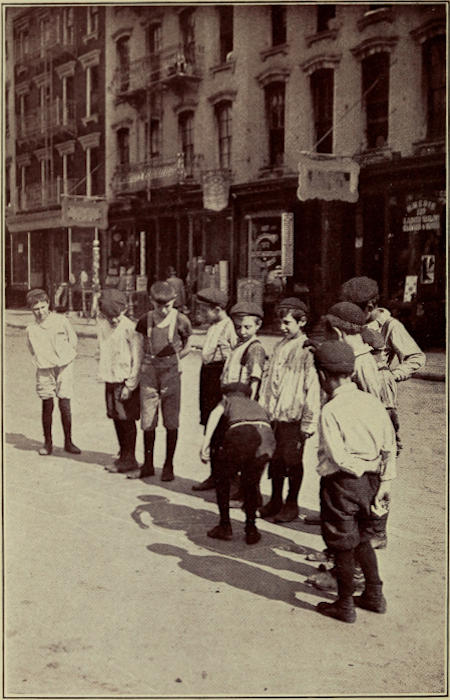
“Where Us Fellows Has to Play”
Copyright by Underwood & Underwood, New York City
Issued under the direction of the Council of Women for Home Missions
SOME IMMIGRANT
NEIGHBORS
BY
JOHN R. HENRY
ILLUSTRATED
New YorkChicagoToronto
Fleming H. Revell Company London and Edinburgh
Copyright, 1912, by
FLEMING H. REVELL COMPANY
New York: 158 Fifth Avenue
Chicago: 123 North Wabash Ave.
Toronto: 25 Richmond Street, W.
London: 21 Paternoster Square
Edinburgh: 100 Princes Street
To Eloise Elizabeth Henry
FOREWORD
This little book for Junior Home Mission Study
classes has been written from the point of view of
a New York City pastor. The races that have
been selected for study are so chosen because the writer
knows them at first hand through having labored
among them in institutional and church work.
The book is an invitation to become acquainted with
the immigrant and be his friend and good neighbor.
The thanks of the author are due the many writers
whose works he has freely used, the members of his
staff, and Miss Alice M. Guernsey for helpful suggestions,
and the Rev. F. Mason North, D.D., for reading the
manuscript and for valuable criticisms.
Since we are going to study about “Some Immigrant
Neighbors,” it is well to know just what we
mean by the words “Immigrant” and “Neighbor.”
Immigrant. The word Immigrant is confusing because
it looks and sounds so much like the word “Emigrant,”
but they are quite different. An Immigrant is one who
comes into a country, generally with the intention of settling
there. An Emigrant is one that goes out of a country,
with the intention of settling in some other land.
The people we are to study are the Immigrants who
have come, and are coming, into America.
Neighbor. Every one knows the meaning of the word
neighbor. A neighbor is one who lives near another,
across the street, or next door, or maybe in our own
village or town. If you live in a large city it is not so
easy to feel that the people who live near you are your
neighbors. It was much easier years ago, when all that
are now cities were only towns and villages, and many
cities now well known were simply prairie with waving
grass and flowers, roamed over by bands of Indians and
trampled by the hoofs of countless bison.
The word neighbor has a larger meaning than merely
one who lives near another. There is a wonderful description
of a neighbor, given by One who is the World’s
Good Neighbor. He tells of the traveler who found a
stranger lying by the roadside, wounded and helpless.
At personal inconvenience and expense the traveler cared
for the half dead man, and continued his aid until the
stranger was again able to care for himself.
We shall have gained a great deal from the study of
this book, if we learn not only to look on these immigrants
as neighbors, those who live near us, but if we
seriously ask ourselves how we may be Good Neighbors
to the strangers from across the sea.
The Neighbors to be Studied. We are not going to
talk about all of the thirty-nine races of immigrants that
are separately listed by our government, but only about
four of them. Some one says, “I hope you will tell
about the ones I like.” Well, we hope before we are
through you will like the ones we shall tell about, and
we are sure you will, for you will be better acquainted,
and it is wonderful how much more likable the immigrant
is when you know him.
Numbers. Although we are to study only Chinese,
Jews, Russians and Italians, 333,694 of these four classes
of immigrants landed in America in 1911; 920,299,
almost a million, landed in the three years last past, and
that is a large falling off as compared with some previous
periods. In 1911 the Jews and Italians numbered thirty-five
out of every hundred that came. You see that while
we discuss but four classes, two of these are more than
one-fourth of all that come.
These numbers may suggest very little to us, but how
they would have startled the fathers of our country. The
warlike Miles Standish, or, in later years, the peppery
Peter Stuyvesant, would have declared no such numbers
could be brought across the sea in a year. The only ships
our fathers knew were small wooden sailing vessels like
our coasting schooners; the giant, floating hotels that we
call steamships, that carry a big village every trip, were
not dreamed of in those days. The sailing vessel took
weeks and months to make the voyage; now we can
reckon, almost to the hour, the time of the arrival of a
great liner.
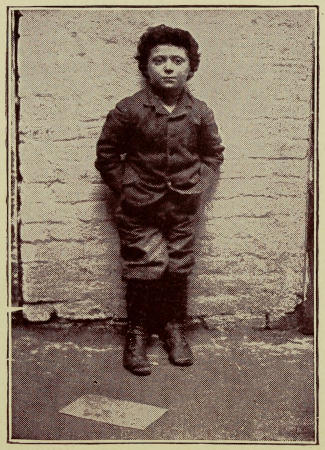
A Jewish Immigrant
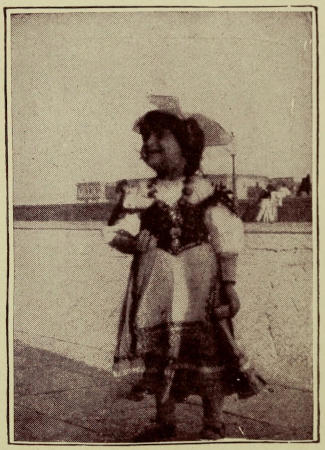
A Little Maid of Italy
It might be well if these numbers did startle us more
and if we better realized how great is this invading army
of strangers, friendly as it may be.
Dislike of Foreigners. Many people do not like the
immigrants simply because they are foreigners. This
prejudice is as old as the world, and its origin is a most
interesting study. Perhaps some high school boy or girl
can give a reason for this early dislike.
“The reasons for disliking the foreigner in early times
were that no one traveled much and there were no newspapers,
consequently neighboring tribes, or nations, did
not get to know each other. Nearby tribes were suspicious
of each other and were much at war, continually
robbing and killing. Every stranger was a possible
enemy.”
Yes, that is a good answer. Now, give a reason for
present dislike of the immigrant.
“I have a reason,” one boy says. “My father lost his
job because an ‘Eyetalian’ offered to work for less.”
Yes, I am sorry to say that is a very real cause of dislike.
That is also war, although it is now called by a
different name. To take a man’s position, by which he
earns his bread, or to steal a man’s cattle, from which
he and his family were fed, amounts to about the same
in the end. Give some other reasons for disliking immigrants.
“They talk such funny English.” “They don’t dress
like us.” “They don’t eat like us.” “They can’t play
ball.”
Yes, undoubtedly all these are reasons for feeling that
foreigners differ from Americans, but are they good
reasons for disliking the foreigner?
I saw a “grown-up” show this hostile feeling one
day as I was passing along a crowded street on the East
Side of New York. An American youth of about
eighteen years of age snatched some fruit from the push
cart of a young Italian of the same age. The Italian
grappled with the young thief and was giving him a sound
thrashing when a policeman, leisurely swinging his club,
turned the corner. With one glance he took in the scene
of the Italian-American war. Raising his club and shouting,
“You Dago,” he charged full at the Italian. The
young fellow saw him coming and took off down the
street as hard as he could run, dodging as he went the
flying club the policeman had hurled. When the tempest
had calmed I stepped up to the officer and said, “Officer,
what did the Italian do?” “Do?” said he with supreme
disgust, “he was a Dago.” Evidently the sole crime of
the Italian consisted in being a “Dago,” a foreigner.
To some people all Italians are either Dagos, or
Guineas, all Jews are Sheenies, all Chinese are Chinks
and all Russians are Owskies. They are foreigners, and
that is enough. Such people forget that while the language
of the immigrant sounds “funny” to us, ours
sounds just as strange to him. While we laugh at the
pig tail and queer shoes and strange clothes of the Chinese,
they follow the American in crowds through Chinese
cities and make fun of his absurd dress, and call
him names that are not wholly complimentary, all because
he is a stranger to them.
Our Debt to the Foreigner. It will help us to cultivate
the spirit of a Good Neighbor if we remember that we
are hopelessly in debt to all these foreigners.
Our Debt to the Chinese. The Chinese invented the
mariner’s compass that enables the sailor to strike boldly
out into the deep, sure of not losing his way across the
trackless ocean when stars and sun are gone. He is likewise
an example to all the world in his reverence and care
for old age, for father and mother. A traveler recently
returned from China says he has never seen old faces
more calm and kindly than those he met among elderly
Chinese farmers. They seemed to think of nothing but
the welfare of others. The rights of the parent are
such that any father or mother with sons or grandsons
living is assured in old age of the best care the children
can provide. Though the son may be fifty years of age
and have a family of his own he will yet give his own
salary into the hands of his father week by week. The
father need not worry about the future as do many
fathers of large families in our own land, hence the calm
eyes and care-free faces among old Chinese farmers.
The Chinese teach that it is an honor and a duty for the
young to toil for those who are old.
“Honor thy father and thy mother that thy days
may be long upon the land which the Lord thy God
giveth thee,” is an old command and promise. The
Chinese Empire is hoary with age. Can one reason for
its long life be its obedience to this command?
Our Debt to the Italians. An Italian, Columbus, discovered
the New World. Who, then, has a better right to
inhabit it than his own countrymen? An Italian captain,
Verrazano, was the first man to push the prow of his
ship into the harbor of what is now the greatest city of
the new world. Roman law rules the world and her
treasures of art and literature have enriched every nation
on earth. What school boy would like to be without the
story of Julius Caesar, or not to have heard of the cackling
of the geese high up in the Capitol the night the city
was in danger, and how that cackling awoke the citizens
and saved Rome?
Our Debt to the Russians. As to the Russian, it is
an ungrateful American who forgets the service rendered
this country in that saddest war of history, when brothers
of the North and South rose in arms against each other.
France had determined to found an empire in Mexico.
She knew that this could be done only after the American
Union had been destroyed. Russia refused to join with
France and England in the course that might have made
possible this division of our country. In the darkest
days of our struggle the Russian fleet appeared at
American ports as a pledge of her friendship and a
protest against the attitude of these European powers.
Our Debt to the Jew. If we said nothing more than
that through the Jew has come the Bible, that gift would
place all of us forever in his debt. No other sacred book
tells us so clearly of God; no other book shows us so
truly how we may obey Him and be useful, strong, and
holy. In no other place are we told the secret of that
“City builded by no hand,
And unapproachable by sea or shore,
And unassailable by any band
Of storming soldiery forever more.”
It is true some of the Jewish people did oppose
Christianity, but other Jews were the founders of the
Christian church.
Through the Jewish nation came our Lord. Upon
the streets of Jewish cities “walked those blessed feet
that nineteen hundred years ago were nailed, for our
advantage, to the bitter cross.”
Kind neighborliness to these strangers is one way of
repaying our debt.
II WHY DO THEY COME? — II WHY DO THEY COME? — WHY THEY BECOME OUR NEIGHBORS — OPPRESSION
Lo, the tyrant’s days are numbered,
Liberty no longer slumbers,
Error dark no longer cumbers;
Risen is the Sun.
—H. A. Clarke.
Migration. Why do such vast armies of human
beings leave their homes? Why do they travel
weary miles over land and sea and suffer such
hardships and privations? The causes would indeed be
urgent that would induce us to take a like journey and
leave behind our pleasant, comfortable homes. Can it be
that the home of the immigrant is not pleasant and comfortable?
As we continue our study we shall find at
least some of the reasons for this greatest migration in
history.
On a beautiful day in autumn you may have seen
large flocks of swallows wheeling around the steeple
of some old church—“a river of winged life.” Some one
has told you they are gathering before they migrate.
“Oh, yes,” you say, “they are going away because they
do not like the cold winter.” In the spring, you have
seen a great moving V in the sky all made of birds, and
some one has cried out, “There go the wild geese,” and
you are told that they are journeying to the far, desolate
North where the summer will soon be and where no one
will molest them while they rear their young. So when
great companies of people migrate there is a good reason.
No one wants to leave a comfortable home without good
cause.
You will be interested to study the causes of some of
the great migrations in the past. If you will turn to the
Book of Exodus you will find there the story of a vast
human river of slaves flowing out of Egypt, across the
Red Sea, into the wilderness. Why did they migrate?
What drove the Goths down into the pleasant valleys
of Italy? Did the richness of the Italian cities, the
fertility of the plains, and the indolence of the inhabitants
have anything to do with it? What brought the
Tartars into China where as Manchus they have ruled
300 years, and where their long rein is now ended? The
answer is simple. The Manchus were warlike Tartars,
soldiers of fortune of a barren country. The Chinese
were peace-loving dwellers in fertile valleys and plains.
The better soldier was the victor.
There is no great nation of ancient or modern times
but can tell its own story of migration. There once
crossed into England a company of many thousands of
splendid craftsmen bringing from France the secrets of
trades that have helped make England great. What
drove these Protestant families from their beloved land?
There rang in their ears the solemn tolling of a great
palace bell. That bell, sounding over the city of Paris,
was the signal for the death of over forty thousand of
the noblest Protestants of France. The St. Bartholomew
massacre caused the migration.
In recent years a great tide of Irish began to move
across the Atlantic. In ten years this mighty tide totaled
over one million and a quarter human beings. The reason
they came was the failure of the potato crop. The
potato was their great food staple, as bread is ours. Great
armies of Germans began to come after 1848. It would
be interesting for you to find the reason of their coming.
How hard it must be for the Southern Italian to leave
his beautiful home and exchange his blue skies and hills
and mountains for a dark, ill-smelling tenement, or for
toil far underground in a mine. Why does he migrate
and in numbers so great as to form every year a city
the size of Portland, Oregon? We may find the answer
farther along in our studies.
“If I were a Russian,” some one says, “I would
want to leave home. The winter is so long, there is so
much ice and snow, I would be glad to get to a warmer
country.” But the Russian loves his winter. He drives
his sankey with its hoop of tinkling bells arched high
over his horse’s back faster than any other horseman in
Europe. In his home is a great brick oven and on
top of this the family sleeps, no matter how the storm
blows, as warm as a Negro boy in a Southern cotton
field. The Russian does not leave his home because of
the winter.
Opportunity. Some one says another name for
America is “opportunity.” Amid weeping and “Il
Signore vi Benedica,” “God Bless You,” Giuseppe has
gone away. He has been earning as contadino (farmer)
20 cents per day and is like a serf tied to the land. He
earns in America $1.50 a day, or as much in one day as
he earned before in seven. Giuseppe is frugal. He rises
in his position to better pay, spends little money, and his
bank account goes up until he has a sum that would have
seemed a fortune in the little Sicilian village. Then,
work slacking, he returns home. His watch and ponderous
gold chain, his stylish American clothes, an exhibition
of lofty independence, all make him a marked man.
Wherever you meet him on the village street, an awed,
admiring group of friends is with him. He spreads the
glowing tale of the New World and you may be sure the
reality loses nothing in the telling. Every youthful heart
is fired to a like adventure, to seek the golden, western
world. As one returned immigrant said:—“It’s a land
where all wear shoes, where trains shoot through the air,
and shoot through the ground; even the poor ride, no
one needs an umbrella, the cars pass everywhere.” It is
little wonder they want to come. In America labor is
dear and materials are cheap; in Italy labor is cheap and
materials are expensive. There it pays a landlord to
hire a man to watch his cows, rather than to build a
fence, wood is so costly. In America no one would
think of hiring a man for such a purpose, labor is so
high.
The price paid in health and suffering for the money
they take back is often far more than its worth. Many a
poor fellow pale and haggard with that dread disease,
tuberculosis, goes home hopeful that his genial skies will
cure him of the death-blow the wet and cold and
exposure of America have given him. But the defeated
come home in the twilight, unattended and silent, while
the successful swagger in at noonday with the blare of
trumpet and beat of drums. As one Italian said to me no
later than yesterday, “My uncle never told me the hardships
I would have to face. I was far better off in Italy
than here, but I am ashamed to go back.” And yet, all
who come realize that the possibilities of success are far
greater here than at home. As another said, “In Italy
I wanted to do but could not. In America I want to
and can. I am sorry, but ‘Good-bye, Italy.’”
The same opportunity for riches attracts the Chinese.
He lives in a land that, labor as he will, is barely able to
feed its almost half a billion human mouths. His wages
at home are so meagre he can never hope for independence;
two cents per day is what the farm laborer in
Shantung earns. Since as a laborer he cannot legally
enter the United States, he comes in under cover of darkness
over the Mexican or Canadian borders, or any other
way he can devise. The same hope of wealth attracts
the Chinese.
Steamship Advertising. Many come because the
steamship companies are such good advertisers. These
companies paint beautiful pictures of the New World,
and the peasant sees great farms, busy factories, and
wealthy cities. The companies never show any views of
dark, unhealthful tenements.
Through this steamship advertising many unfit persons
sail for America, persons whom the agents might
have known would be rejected, while many of the lowest
class are induced to leave their country because their
country is glad to get rid of them. It is said that in one
small district in Austria two hundred and seventy
criminals were released from prison one year and one
hundred and eighty of them were in America within the
next twelve months.
The Commissioner of Immigration at New York
stated one year that 200,000 of the one million immigrants
of that year were a real injury to the best interests
of the country. Since the steamship company must be
at the expense of returning an immigrant who is sent
back, they make doubtful cases give a bond repaying
them the return fare if the immigrant fails to slip by the
“man at the gate.” Of course the only interest the company
has is to get the immigrant’s money.
One steamship line anxious to make money brought
over on one ship three hundred and eighty diseased
peasants that Ellis Island promptly sent back. Among
those peasants were many people of Montenegro. The
Montenegrins are great soldiers. Tennyson wrote of
them as
“Warriors beating back the swarm
Of Turkish Islam for five hundred years.”
For five hundred years they have stood as a bulwark
between the Turk and Europe. When they reached the
home port, they stormed the offices of the steamship
company, demanding the return of their fare, and after
one look at their determined faces the clerks promptly
locked themselves in and telephoned the authorities for
help.
Some are induced to part with all they own, selling
their little business and then, because of ill health or
other difficulties that the agent might easily have known,
are turned back broken-hearted and poverty-stricken to
the village whence they came. Sometimes they are even
sent to ports entirely different from those to which they
had planned to go. This, of course, is all wrong.
The Employer. The reason back of the coming of
many of these people is the employer, the man who manages
the railways, the mines, or large contracts. He
works through the padrones, and the Italian banks that
“direct two-thirds of the stream of Italian immigration.”
You may be surprised to know that the news of a
big railroad contract reaches Italy as soon as we hear it.
If we are to build subways or barge canals, or carry an
underground river into New York, or let great railroad
contracts, or make a garden of the desert with colossal
irrigation reservoirs and canals, the message flies under
the ocean to far-away Italy and there is spread through
a thousand villages.
The employer is constantly looking for cheaper labor.
Around his mine or factory are American homes, practising
the “American standard of living.” This is a valuable
term much in use and since it will occur again in
this book we stop here to explain what it means. The
American standard of living simply means the way most
Americans live. Do you know that we live better than
any other people in the world?
“I don’t think we live well,” one boy says, “we don’t
have an automobile, or a pony, or a piano, and the people
next door to us do.” But automobiles, and ponies and
pianos, while pleasant to own, are not real necessities.
Let us take a peep into the home of a Chinese boy. It is
breakfast time and he is busy with a bowl of rice and a
pair of chopsticks. Do you think you could eat rice with
chopsticks? No! I think you would do much better
with a spoon. “But doesn’t he like milk and sugar on
his rice?” Perhaps so, but neither milk nor sugar are in
sight. Now, let us look in at dinner. Here are the same
boy, and the same chopsticks, and the same bowl with
more rice. “Where are the bread and butter, the meat
and potatoes, and the dessert? We always have different
things like that for dinner,” you say. The Chinese boy
does not seem to miss them; what seems to be troubling
him is the small amount of rice left in the bowl.
Now take a look through this crack in the paper
window, (the father of this little man is too poor to
have glass windows in his home,) and see what our boy
has for supper. Why there are the identical bowl, and
the identical chopsticks, and what looks like the identical
rice, though of course it is not. “So that is all this boy
has had to eat for breakfast, dinner and supper—only
rice?” Yes, that is all, and let me tell you he is very
well satisfied, because he likes that much better than
eating millet seed and that is what so many really poor
Chinese live upon. As for shoes, our Chinese boy has
none. His clothes cost only a few cents where yours
cost dollars.
Nor is the Chinese boy so great an exception. The
standard of living among the peasants in Russia is also
very low; the same is true among the great mass of
peasants in Sicily, and remember these peasants form
the large majority of the population. That our standard
is not the standard of living of some nations may be
gathered from the question of the great Chinese viceroy,
Li Hung Chang, when visiting America. After seeing
the ever-present throngs of prosperous-looking people
on the streets, he asked in great surprise, “But where
are your working people?” He did not know that the
happy-faced, well-dressed people he was looking at were
working people practising the American standard of
living.
The immigrant provides the cheap, unskilled labor.
As he becomes influenced by American customs, he
requires better clothes, a room for himself instead of
sharing his room with ten other men, more pay as he
becomes more skilled. He wants shoes for his wife.
The American law compels him to send his children to
school instead of making them wage-earners while little
children. As his expenses increase he demands more
money that he may live as the people about him live.
Then the employer begins to replace him by labor costing
what he formerly cost. Herein is a remarkable
story that would fill many little books like this. It
accounts for the procession of the Welsh, Scotch, Irish,
Germans, and Huns in the coal regions. It accounts for
practically all the civil war, in the form of bloody strikes,
carried on in the Pennsylvania coal fields, and much of
that which occurs in other industries throughout the
country, this method of the employer seeking to replace
those demanding higher wages by those willing to work
more cheaply.
The Sicilian. Many come because of oppression in the
home land. The Sicilian lives in a beautiful country,
but while the sea and the mountains are good to look
upon, the people are very poor. The farm worker cannot
send his boy to school as boys go in America, for
the rural schools are few. He must pay such heavy
taxes he has little left for himself. Then, a few rich
people own almost all the land and he must work for
them, or starve. They pay him such small wages he
cannot buy good, nourishing food for his children and
they often suffer greatly in consequence. You draw a
long breath when you are told his wages are from eight
to thirty-two cents per day. Many of us use more each
day in car-fare than a laborer in Sicily receives though
he works from the time the top of Etna is crimson
with morning, until the birds go to sleep. Even salt, so
cheap with us, is taxed so heavily he cannot use it and
when he cooks his corn meal in the salt water from the
sea he is accused of smuggling. Oppression is what
makes many of these people our neighbors.
The Jew. Let us step in and visit an old Jewish tailor,
a saintly man who worships devoutly after the manner
of his fathers. I am very careful not to give him any
work on Saturday as it grieves him to disoblige his
friends, and yet he will not work on his Sabbath day. He
says, as do many others of the Jewish race: “I pray
every day; my son prays once a week; my grandson
does not pray at all.” This old tailor speaks such broken
English, we will let his daughter tell the story. “My
father is almost eighty years of age; he never worked
with his own hands until he came to America. He was
for many years the tailor of a Russian regiment, making
all the uniforms for the officers and having a number
of men employed under him; we were well-to-do, the
officers loved my father, but when the riots arose it was
all they could do to save his life and all we had was
destroyed. Now he is an old man, he should not toil any
more, but,” as she shrugs her shoulders, “who will give
us bread?”
A kindly-faced man is sitting in my office. He speaks
such good English you can tell he is a foreigner only by
the peculiar way he pronounces some words. He says
“dough” for though. Just imagine yourself sitting
quietly by and listening, then you will know why many
thousands come to us from one part of Europe. “We
were friendly with all the people of our town. My
ancestors had been in the same business for generations.
All the Russians trusted us and although we were Jews
they would rather deal with us than with their own
countrymen. One day there had been many murmurs
around us; the people had looked less friendly; they
were ignorant, superstitious people, and they were miserably
poor. Few of them could read or write. The
nobility had fleeced them for centuries, but the nobility
was too strong to be reached and so as scapegoats for the
nobles we were pointed out as the cause of their wretchedness.
We went to sleep that night, peaceful, prosperous
and unsuspecting. At midnight our house was in flames.
I never again saw father, mother, brothers, or sisters
alive. I escaped in the night and was hidden by some
friendly Russians. High above the roar of the flames
and the din and slaughter rose the hoarse cry of the
peasants—Our Daddy, the Tzar, wants it. Our Daddy,
the Tzar, wants it.” Multiply that scene by thousands and
you have a Russian pogrom. Oppression brings many
Jews.
The Russian. The Russian does not leave his land
because of the winter cold. He leaves it because he dare
not speak out against the wrong he sees. He is always
fearful of some police spy making charges against him,
shutting him up in prison, and sending him to Siberia.
No one is safe from these spies. The Russian comes to
America because here he can think aloud and here he
can worship according to the voice of his own conscience.
America is his hope.
One of our poets pictures America as she really is, a
refuge for these fleeing, hunted people. He shows how
the tyrant must give up the chase and return empty-handed
when once these poor people have reached our
friendly shores.
“There’s freedom at thy gate, and rest
For earth’s down-trodden and opprest,
A shelter for the hunted head,
For the starved laborer toil and bread,
Power, at thy bounds,
Stops, and calls back his baffled hounds.”
III OUR JEWISH NEIGHBOR — III OUR JEWISH NEIGHBOR
“O God-head, give me Truth!” the Hebrew cried.
His prayer was granted, he became the slave
Of “Truth,” a pilgrim far and wide.
Cursed, hated, spurned, and scourged, with none to save.
Seek him to-day, and find in every land.
No fire consumes him, neither floods devour;
Immortal through the lamp within his hand.
The Numbers that Come. So great has been the
volume of Jewish immigration that the eyes of
the country have been turned upon it in anxiety
and question. In the ten years last past 1,012,721 have
come. The largest number in any one year was in 1896,
when 154,748 passed through the various ports. In 1911,
94,556 arrived. To better understand the meaning of
these figures let us take a large map of the United States.
Now be ready with a blue pencil and draw a circle
around the cities I name. Perhaps I shall name the
place in which some of you live. We will start with a
city right on the Eastern coast of the United States,
where you could step on board a steamer and sail away
for Europe and see the homes of some of these people
we are studying. The first city is Bridgeport, Connecticut,
on Long Island Sound. The next is the capital of
New York State, the city of Albany. The third city to
get a blue circle is where a famous university stands,
Cambridge, Massachusetts. Then we will journey away
West and draw a blue pencil mark around the name of a
city that stands near a famous lake out of which no one
ever drinks. Yes, that is the name, Salt Lake City,
Utah. While we are West we will mark Spokane, Washington.
Then we will move South and place a circle
about San Antonio, Texas; then come East to Reading,
Pennsylvania, and Trenton, New Jersey. Michigan is a
big state with beautiful forests, and we will blue pencil
the city of Grand Rapids. One more city is needed to
make the ten. If none of you lives in the cities I have
named perhaps you may live in the last one we mark,
Kansas City, Kansas. I hear some one say, “Why do
you ask us to place a circle about these cities?” Because
I want you to know that in the last ten years enough
Jews entered the United States to make ten as populous
cities as the ones we have just marked.
From Where Does the Jew Come? Five-sixths of
the Jewish immigration comes from Russia. While the
Jews number probably 11,000,000 in the world, about
5,000,000 of them live in that empire, mostly in what is
called the Jewish Pale of Settlement. Why there are so
many in Russia needs a brief statement. Poland invited
the Jews to settle within her borders in order to build
up her cities. Here was gathered the largest population
of Jews since the destruction of Jerusalem. In some of
the provinces of Poland the Jews number one-sixth, and
in some of the cities one-half of the population. When
Poland was divided between Russia, Prussia and
Austria, fifteen provinces fell to the share of Russia.
These form the Pale of Settlement, for there the Jew
is allowed to dwell and there he is engaged in all forms
of industry, including farming.
Why They Come. We have learned some reasons
why the Jew leaves Russia. Other reasons are his
desire for a better education for his children, freedom
to engage in any business he may choose, and the privilege
of worshipping God and of saying what he thinks
without danger of arrest and imprisonment. Strange as
it seems to us, there are still many places in the world
where if a man thinks the judge or the ruler has done
wrong he dares not say so openly. If he were heard to
criticise them he would be in danger of prison. Sometimes
when we complain of our own country we forget
how fortunate we are to live in such a land of liberty.
Let us now find some of the reasons for the Russian
hatred of the Jew. There could be no such merciless
persecution of any race without some cause, and it is
pretty well understood that the Russian government
encourages and often provokes the attacks upon these
people. The Russians dislike the Jews because the Jews
are not Christians, and because they are much smarter
business men than the average Russian, and would soon
own all the land of the ignorant peasants if they were
allowed to live among them and loan them money; the
American Indian was cheated in this way by the smarter
and better educated white man. Then the government
does not like the Jew because the Russian government is
corrupt and does not want the people to have a voice
in governing themselves, and the Jew stands for the
rights of the common people. Thus we see that while
there is some just cause for dislike of the Jew, there are
other reasons why he should be praised and commended.
As a Good Citizen. The Jew, having no country of
his own has yet always been loyal to that of his adoption.
The records show that when war came the Jew was
willing to shed his blood for his adopted land. They are
good to their own poor, providing hospitals for their sick,
and homes for children who are without father or
mother. The Bible tells us of the love of David for
Absalom and the Hebrew king’s prayer for the recovery
of his little sick son. The Jew is no different to-day, he
is kind and affectionate in his home. We know the evil
the saloon does in every city and town and village in
America where it exists. The Jew is generally an enemy
of the saloon. The liquor business does not prosper
where he lives. The Jews are lovers of books and education,
and some of the greatest scholars, musicians, artists,
and writers of the world have been Jews. Some of the
noblest people who come to America are to be found
among the Hebrew immigrants.
Not All Money Lovers. Jewish people are often
accused of prizing money more highly than any other
race and of setting a greater value upon it than they do
upon either truth or justice. Some years ago a great
strike took place in New York among the garment
workers, who were mostly Jews. It lasted till the savings
of the workers were exhausted. I was talking with one
of the strike leaders one day and he produced a letter he
had just received from his former employer. It said,
“If you will come back I will make you foreman and
double your salary.” I knew the man was without any
money, and I asked, “What will you reply?” “There is
only one reply,” he said as he tore up the letter, “I
couldn’t accept because I couldn’t be a traitor.”
The cheerful suffering that goes on among many East
Side Jewish strikers is heroic, for they feel that they are
fighting for principle and these battles that mean less
food, thinner garments for the winter winds to pierce,
and less fire in the homes, are fought with astonishing
cheerfulness. In fact, it would be well for old as well as
young folks to remember that the great battles being
fought in these days are not with machine guns; these
settle no principle. But the right to live, the right to live
better than the brutes, the conviction that all one’s time
should not be required in the struggle for bread, for
shelter and for clothes, that the life is more than meat,
and the body than raiment,—for these things the Jews
fight by enduring hunger, sorrow and even death for the
sake of simple justice. They are the preachers of world
brotherhood.
We do not mean that all Jews can be placed in this
exalted class. Among them are the hardest and most
merciless task-masters. Just the other day I heard a
Russian complain bitterly because the Jews for whom he
had been expelled from Russia were paying him the
pitiful salary of $4.00 per week for his toil. But among
them are a great multitude of noble men and women
battling for a better day.
The Jew Intellectually. If I were to ask the question,
“Are Jewish boys and girls at the head or at the foot
of their classes in school?” I know the answer would be,
“They are at the head.” The Jew is delighted at the
boundless opportunities for education in America. He
is like one long locked out from a treasure which he
could see but could not touch.
As a Business Man. As a money getter the Jew is
without a peer in the world to-day; he seems to possess
the golden touch we read of in the Wonder Book. But
when we know how it is done there is little mystery
about it. A Jewish family sent their children to my
Sunday-school. They were poorly dressed and had
the appearance of being ill-fed. After a year or two
these signs of poverty disappeared and there was every
evidence of comfort. I wondered what the cause might
be and said to the children. “Your father is doing better,
is he not?” “Oh, yes,” they said, “he has gotten over
the hard times he had when he went into business. He
always used to get up at four o’clock in the morning and
go to the factory and get the work ready before the
tailors came. Then after they were gone he used to
work until eight or nine o’clock every night, but he has
a good business now and doesn’t work so hard.” Most
men would succeed if they worked such long hours.
The Jew Spiritually. The Jew is a religious man but
he seems to be losing his religion in America. In Europe
the synagogue was a rallying point, in America the
rallying place is the Labor Union, and many have turned
away from the old faith. Family life, once loyal and
beautiful, now shows many desertions, the father leaving
the family to care for itself. The streets at night are
trodden by too many Jewish girls, and the criminal
courts are thronged with too many Jewish boys. Contempt
for old age is one of the saddest products of
American life. I have frequently seen young Jewish
boys, twelve and fifteen years of age, mocking Jews as
venerable as Abraham, both by pulling their beards and
by sundry insults. The ignorance of Jewish children on
sacred things is widespread. It is a question if any
religious body has a more solemn festival than the Day
of Atonement. It is supposed to be a day of fasting and
prayer, but the restaurants are full, and numerous Jewish
organizations use the day to make money by hiring a hall
and selling the seats at a good profit to all who can be
induced to buy. Many Jews who are members of congregations
never attend service except on two or three of
the principal fast days.
And yet, careless as the Jew may be of his old time
religious faith, Christianity calls forth the bitterest
opposition. He cannot forget the many things he has
suffered in the name of the Christian church.
IV OUR RUSSIAN NEIGHBOR — IV OUR RUSSIAN NEIGHBOR
“Come, clear the way, then, clear the way:
Blind creeds and kings have had their day.
Break the dead branches from the path:
Our hope is in the aftermath;
Our hope is in heroic men,
Star-led, to build the world again.
To this event the ages ran:
Make way for Brotherhood—make way for man.”
I mention the Russian not because large immigration
has set in from Russia, but because I am personally
acquainted with work among these people and
because they are coming in increased numbers. When
the Russian wishes to change his home, he is usually
directed to some part of his own vast empire, and large
numbers are settling in what was one time thought to be
ice-bound Siberia, and are there successfully engaged in
farming. There is, however, a constantly rising tide of
immigration among the Russians. In 1901, 672 entered
the United States. In 1911, 20,121, the largest number
to date, was reported by the Commissioner of Immigration.
Intellectually. There is much ignorance among these
newcomers. Over thirty in every one hundred who
landed in 1911 did not know how either to read or write.
A number of the Russians in New York are revolutionists
of various classes; they are almost always led by the
Jew, who acts as public speaker and general leader in
most Russian affairs. About two-thirds of those who
come are unskilled farm laborers and common laborers.
Religiously. While a large number of those who land
are members of the Russian Greek Church, most of them
are members of groups hostile to the church, although
many of this latter class are unusually fine men. They
are exiles from their country for causes that would often
bring them honor in any really enlightened land. In fact,
America has little idea of the great riches in heroism,
sacrifice and splendid lives that are hidden away in the
forbidding tenements of its great cities. The Russians’
dislike of the church is deep seated and intense, for the
Church of Russia has been the judge that sentenced
them, the jailer that imprisoned them, the knout that
whipped them. The Greek Church in many ways is an
out-of-date church. It is an enemy of progress and free
thought, the greatest ally of a cruel government. These
men, knowing no other church than that of Russia, do
not understand the difference between the Christianity
found in America and this church of the Middle Ages in
Russia.
One of the best loved and most influential Russians
in New York City said to me recently, “My wish is to
elevate my countrymen. Too many of them hold their
club meetings in saloons and are given over to drinking
habits. But I cannot have anything to do with the
Christian church, for if I did I would be compelled to
forget how the church has injured me and I have suffered
too much from it to do that.” The Jews share in this
attitude of the Russian toward the church.
“Can any country afford to lose such men?” I put
that question to myself as I looked over an audience of
six hundred stalwart young Russians, their faces alight
with intelligence, their whole bearing showing sturdy
self-reliance, and yet lovable and teachable, withal. The
place was an East Side hall, and the occasion a gathering
to do honor to a Russian fellow countryman, and to
enjoy a Russian play. The countryman was an exile
because he wished to hasten the day of freedom for his
beloved land. He was a man with a noble, melancholy
face, and eyes that looked love and friendship. One
wondered what that scholarly man could have done to
have the sentence of death passed upon him.
The play when given in Russia was immediately suppressed,
and yet it is founded on an actual happening.
Imagine yourself with me at the Russian hall; let us take
a seat and hear what the play is about and maybe we shall
learn why it is that many Russians do not like the church.
The players will speak in Russian, but we shall understand
them for we shall have some one beside us to translate the
Russian into English.
Now all is quiet. Here enters a young student in a
red shirt and big top boots. He feels very important, for
he has just arrived home from the University at St.
Petersburg. His sister is with him. They are talking
about a monastery in their village. “You know how the
great monastery near us deceives the people,” says the
brother. “You know how the monks pretend the sacred
ikon (image) on the altar works miracles, and how the
poor peasants have to give the monks hard-earned money.
You know how these cheats tell the authorities of any one
who says he is dissatisfied with the government. And
you know, too, that these monks are not good men.”
“Yes,” the sister says, “I am sorry that what you say
is true. The monastery ought to be a great blessing to our
village, but instead it is a great curse.”
“Then,” cries the student, walking up and down and
much excited, “I am going to open the eyes of the people
and show them that the monastery is a wicked fraud.”
“How will you do it?” exclaims his sister, greatly
alarmed. “Please do nothing that will cause the police
to send you to prison.”
There comes a knock at the door; the brother opens it,
and in walks one of the monks from the monastery. He
is such an unclean, repulsive-looking man you would
want to run away from him if you met him on a lonely
road. He does not look at all like the priests, or
preachers, we know. He holds out a tin cup and whines,
“Please help a poor friar who is begging for holy
church.” All the Russians in the audience laugh in derision
when they hear the whining voice.
“Why is the church in need of money?” asks the
student.
“We need money,” whines the monk, “because the
people no longer visit us as in years past, and since they
do not bring money in we monks must collect it.”
“But,” persisted the questioner, “why have the
moujiks stopped visiting you?”
“They do not believe in holy church nor in the sacred
ikon as they once did.” (The ikon on the altar of this
monastery was believed to have worked many wonders.)
“What the church needs is some miracle to restore the
faith of the peasants,” and the monk seems very sad,
probably because he would rather sit down comfortably
at home than walk the muddy Russian roads begging
alms.
“Why do you deceive the peasants?” says the indignant
student. “You know your sacred ikon never cured
anybody, nor worked any miracle. I will give you the
dynamite if you will blow it up.” The monk admits the
ikon worship is a fraud and says finally after a long discussion,
“I will place the dynamite under the image and
blow it up.”
When the time comes to explode the dynamite, the
monk is afraid and confesses the plot to the Abbot.
“Let us blow up the altar,” says the Abbot; “we can
say the anarchists did it, but we will first remove the
ikon and then tell the people a miracle was wrought—the
altar was destroyed, but the image was saved.”
The Home of a Russian Peasant
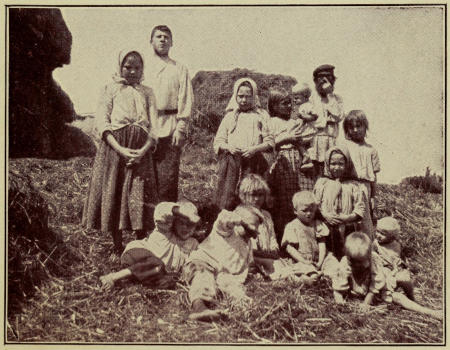
A Russian Moujik and His Family
So the altar is blown up after the priest has removed
the image. The people are told it is a marvelous miracle
and the church is crowded again, each peasant not forgetting
to leave his copeck, half a cent, as he departs.
After the explosion, the student says, “I will go to the
monastery and when the great crowds of peasants are
coming out of the chapel I will tell them just how great
a fraud the latest miracle is.” So he goes and tells the
people how grossly the monks are deceiving them and
that it was his plan that destroyed the altar. Do the
people believe him? Oh, no. They believe what the
priests tell them and they are so angry with the young
informer for saying he blew up the altar and for trying
to open their eyes that they kill him.
“But,” some one says, “we have been looking at and
hearing only a play.” Yes, that is true, but it is a true
play, for all you saw actually happened in Russia, and
it is the deception of such monks that has made so many
Russians hate the church and hate God.
You noticed how the audience leaned forward in their
seats, each seeing in that picture his own story, the
forces that drove him far from his fatherland. You also
remember what the interpreter said at a great burst of
applause, the greatest of the night, when we asked,
“What was that for?” “Why,” said the interpreter,
“you will be surprised to know what they are applauding.
In reply to the question as to who was his most
bitter enemy, the actor has just said, ‘My greatest enemy
is God; through God and the church come all my
troubles.’”
It is the duty and the privilege of the Christians of
America to introduce these Russians to a true church,
and to instruct them in the knowledge of the true God.
V OUR ITALIAN NEIGHBOR — V OUR ITALIAN NEIGHBOR
“Genoese boy of the level brow,
Lad of the lustrous, dreamy eyes
Astare at Manhattan’s pinnacles now
In the first, sweet shock of a hushed surprise;
I catch the glow of the wild surmise
That played on the Santa Maria’s prow
In that still gray dawn,
Four centuries gone,
When a world from the wave began to rise.”
—R. H. Schauffler.
Numbers. Our immigrant neighbor that has attracted
the most attention in the last decade has
been the Italian. He has attracted this notice,
first, because of his great numbers and, second, because
of the inferior quality as compared with much previous
immigration.
Over two millions have come from Italy in the past
ten years, and the numbers show little prospect of diminishing.
This stream that two decades ago was but a tiny
rivulet is now a human Amazon. The Amazon of South
America pours so vast a tide into the ocean that the
sailor while far from sight of land may yet dip his
bucket overboard and draw up fresh water. We may
well inquire about these people who are flowing in so
vast a flood into the sea of our American life.
In the year ending June 30, 1911, 213,360 Italian immigrants
entered. In 1910, 233,453 were admitted. The
largest number entering in any one year was in 1907,
when 294,061 passed through the various entry ports.
When we are dealing in millions figures suggest little
or nothing to us. Let us take another method to show
the large numbers of this one nationality that are pouring
in through all our gates.
Imagine the two millions of the last ten years drawn
up in a single line, each holding the hand of the fellow
countryman on his right and left. How far will this
human chain extend?
Suppose we step aboard a train at New York. We
pass along the Palisade-bordered Hudson, past Yonkers,
West Point, Poughkeepsie, Hudson and Albany, one hundred
and fifty miles. These black-eyed children of Italy
line the track all the way. At Albany we turn west and
go to Utica, Syracuse, Rochester and Buffalo. We have
come over four hundred miles and still the line is
unbroken. Here the porter makes up our sleeping berth,
and all through the night, past Detroit and into Chicago,
the metropolis of the Middle West, along a thousand
miles of railroad stretches our imaginary hand-clasped
line. From Chicago we journey still further toward the
sunset until we rumble across the Father of Waters and
into the station at St. Louis. Surely these endless faces
are no longer beside our train. But there they are; westward
still extends our immigrant line. From St. Louis
we travel right across the state of Missouri to Kansas
City, almost three hundred miles. Our train moves so
fast across the level country that the hand-clasped
strangers seem like closely placed pickets in an endless
fence, but still the line is there and we must travel one
hundred miles across Kansas before the last of that
endless chain waves us farewell. And all these have come
in ten years.
The Italian Compared with Former Immigrants. The
earliest immigration to America was not that of the
peasant class. “It was the middle class tradesman and
the stout, independent yeoman.” The immigration of a
few years ago, as is well known, was from Northern
Europe, bringing the German, the Scotch, the English,
the Irish, the Welsh and the Scandinavian. These were
races from the temperate zone who had gained culture
and the virtues of a Christian civilization, largely Protestant,
through long centuries of intelligent struggle.
The Italian immigrant of today is from Southern Italy.
The Northern Italian, more skilled and better educated,
does not come to the United States in any large numbers;
his goal is mainly Argentina and Brazil, in South
America.
The Italians from Sicily have lacked educational advantages.
If, when they land at the Battery from Ellis
Island, you asked them to read the name of the street
upon the lamp post, sixty out of every hundred would
shake their heads. In the public schools the Italian is by
no means so clever as some of the other immigrants, nor
is he employing his leisure time in so wise a manner as
is the Jew, for instance.
Thrift. The Italian is frugal and thrifty. Most of
them seem to have money. A poor woman exclaimed at
one of our free Saturday night concerts some time ago,
“O Signore, some one has robbed me.” I looked at
her and thought to myself, “She is so poorly dressed I
do not believe she has lost much,” but I said, “Come and
see me after the concert.” On talking with her I found
that the thief had been better informed than I, for he
had cut the skirt of her dress with a knife and had taken
$80 which was in an inside pocket. It is no unusual sight
for a laborer to draw from his wallet a roll of bills
amounting to $50 or more to pay for a ten cent spelling
book in our night school. The amount of real estate the
Italians own in New York is very large; some years ago
it was estimated at over sixty millions. It is probably
more than double that today. Some of them own tenements
and rent rooms that are slept in by day by one shift
of men and at night by another.
One must be careful that he is not an innocent party
to placing children in orphan asylums and other such
homes to be educated at the public’s expense when the
family is entirely able to support its own children. An
Italian woman wished me to place her two boys in “college.”
By “college” she meant an orphan asylum. When
I investigated I found that she was married, had a husband
who was in perfect health, and was herself worth
between three and four thousand dollars. The church
receives very little financial support from these people,
although they are lavish enough when it comes to a big
display at a wedding, a christening, or a funeral. The
money paid for bands to walk before the hearse must
amount to hundreds of thousands of dollars every year
in the Italian colony of New York City.
How They Are Misused. There is no question but that
the Italian earns the money that is paid him in America;
no better laborers ever came to these shores, and the way
they are sometimes misused is shameful. I saw once a
pitiful exhibition of this. It was an August day, one of
the most intensely hot I had ever experienced, and all the
worse because it was in a long succession of stifling days
and nights. Everywhere men were stopping their horses
and cooling them off with the hose, or with pails of water
and, despite it all, dead horses were lying in all the principal
thoroughfares.
An Irish boss was foreman of a gang of Italians that
was asphalting a city street. A line was drawn down the
middle of the street and the force divided, each gang
taking the part on either side of the line from the middle
of the street to the curb. The gang that asphalted their
half of the block first would receive as reward a keg of
beer that stood perched, temptingly, on an elevated platform
at the end of the street. I do not remember ever
seeing elsewhere human beings driven at such inhuman
speed; it was a cruel proof of what greed and a total disregard
of the welfare of the poor immigrants could furnish.
A writer in “Everybody’s Magazine” saw the statement
of the press agent of the Erie Railroad that no lives
had been lost in cutting the great open air rock entrance
of the Erie into Jersey City. He was interested enough
to investigate it, and he learned of twenty-five who were
killed and so many who were injured that a partial list
filled four newspaper columns, a year before the work
was completed. “Why,” he asked, “was it said that
no lives were lost?” “Because,” was the reply, “the
killed were only Wops (Huns) and Dagoes.”
Spiritually. The Italian is naturally religious, and
when converted he becomes an earnest, intelligent follower
of Christ. We must not fail to tell him the story
of “Jesus and his love.”
VI OUR CHINESE NEIGHBOR — VI OUR CHINESE NEIGHBOR — THE CHINESE IN AMERICA
“Dago,” and “Sheeney,” and “Chink,”
“Greaser,” and “Nigger,” and “Jap”;
From none of them doth Jehovah shrink.
He lifteth them all to His lap,
And the Christ, in His kingly grace,
When their sad, low sob He hears,
Puts His tender embrace around the race
As He kisses away its tears,
Saying, O “least of these,” I link
Thee to Me for whatever may hap,
“Dago,” and “Sheeney,” and “Chink,”
“Greaser,” and “Nigger,” and “Jap.”
—Bishop McIntyre.
The Misunderstood Chinese. The Chinese are
the most misunderstood people in America, and
the reason is probably found in the Celestials
themselves. No author in writing about this myriad
people feels that he can give an account of the Chinese
in one province, or city, or village, that he is sure will
hold good in another. The earliest bit of wisdom concerning
the Chinese that I remember acquiring was the
statement in an old geography that to write one’s name
in Chinese characters was a sure way of winning their
favor. I now know that I am no surer of winning the
favor of a Chinaman by writing my name in Chinese
characters than a Chinese would be of winning my favor
by writing his name in English letters. But the writer
of the old geography may have been acquainted with
some place in China where what he states was true.
In our short account of these people we can catch but
a fleeting glance, seeing little more than the curious Chinese
himself, who, “when he wants to get a peep inside
a house applies a wet finger to a paper window so that
when the digit is withdrawn there remains a tiny hole
through which an observant eye may at least see something.”
Unchanging China. What force was back of the movement
that reached its height in 1892, when almost 40,000
of these people landed in America? What caused the first
large migration from China to the United States? Today
very few come. In 1911 but 5,657 Chinese entered, while
7,065 went back to China.
That the Chinese would require some powerful force
to set this tide in motion, a few instances would indicate.
The Chinese do the same thing in the same way today
as their ancestors did it five hundred years ago. If a
village street is so crooked that one must walk an extra
mile, no one would think of straightening the street. If
the village well was the source of water supply in the
past centuries, the substitution of a pump would not be
thought of, as it would be an insult to the past. They
dislike even the most trivial changes; the altering of the
time of the regular hour of meetings; a re-arrangement
in the seating of their class rooms, or the transfer of a
teacher, all disturb them. Because things used to be done
in such and such a way is the reason that they ought to
be done so now.
Old customs are followed, although the life has long
since departed from them.
For example, “It is the custom in Mongolia for every
one who can afford it to use snuff and offer it to his
friends. Each man has a small snuff box which he produces
whenever he encounters a friend; if the person
with the snuff box happens to be out of snuff, that does
not prevent the passing of the box, from which each guest
takes a deliberate, though imaginary, pinch and returns it
to the owner. To seem to notice that the box was empty
would not be good form, and all is according to a well
settled precedent.”
“In a country like China, which stretches through some
twenty-five degrees of latitude, but in which furs are
taken off and straw hats are put on according to a fixed
rule for the whole Empire, in regions where the only heat
in the house during the winter comes from the stove bed
or k’ang, it is not uncommon for travelers who have
been caught in a ‘cold snap’ to find that no arguments
can induce the landlord of the inn to heat the k’ang, because
‘the season for heating the k’ang has not arrived.’”
American street car companies and apartment house
owners have at times taken a leaf from the Chinese in
this particular. What could move this people to leave
their home and seek a new world?
What Caused Their Coming? The first large migration
of the Chinese to America may be explained by two
words, War and Gold.
In 1850 the great Tai Ping rebellion broke out and soon
spread poverty and ruin through southeastern China; the
terrors of war with its ever present hand-maidens, famine
and plunder, ruined all business and paralyzed all
industry. The farmer class of the sea coast districts was
driven into Hong Kong and there they met the astonishing
stories of the fabulous wealth in the recently discovered
gold fields of California and Australia. That, in
brief, is the history of the first big wave of Chinese migration
to America.
The Sort of Chinese Who Came. Those who came
were largely from the farmer class. The Chinese farmer
is very different from the Sicilian farmer; the latter rents
his land at a ruinous price from the large land owner, or
works it for a meagre wage almost as a serf; the Chinese
farmer belongs to one of the most honored classes in
China. “He owns the land, has freedom of trade and
industry, local self-government, can appeal against official
misgovernment and has the opportunity to rise to
any social or political station.” The social system of
China is well worth keeping in mind. First in rank comes
the scholar, the man with the trained mind fitting him to
be a wise leader and guide; second, the farmer, the producer,
the creator of wealth; third, the artisan, who
changes the raw material into usable forms, makes furniture
of the timber, pots from the iron, dishes from the
clay; fourth, the merchant, the middleman, who sees to
the distribution of flour, rice, clothing, etc.; fifth, the
laborer; and last, the soldier or non-producer. In what
order do we rank these classes? The early type of immigration
from China was of a high grade.
How They Were Received. The Chinese were received
in California with open arms, so to speak. “Industrial
necessity” overlooked the visually present race prejudice,
and the Chinese turned their hands to anything
that would fill the gap the American gold-seeker had created.
They became cooks, restaurant keepers, laborers,
household servants—there were no women on the Pacific
Coast then, willing to do the last named work—carpenters,
farmers of neglected land. Governor McDougall, in
1852, recommended a series of land grants to induce their
further coming; editors praised their industry, their
cheerfulness, and personal cleanliness; the Chinamen
must have thought the Golden Age was come again.
The Rude Awakening. In 1854 came the collapse of
the California boom; placer mines gave out; men from
the mines seeking employment were coming to the city in
droves; the wage of $10 per day for skilled and $3.50
to $5 for unskilled labor was over; then came the cry of
America for Americans. The Chinese were ill-treated and
many lost their lives. Committees were formed by the
better class of Americans to protect them, but the cry
against them never ceased in California until the Chinese
exclusion law of 1888 was enacted, barring them from
the country.
The Chinese Intellectually. The Chinese rank high intellectually.
Their age-long reverence for learning—for
a knowledge of the Chinese classics opened the
door to the highest positions—has undoubtedly had
a marked effect upon the mental side of the nation.
The Chinese hero has been the one who passed successfully
through the various examinations in the classics and
finally, after many difficulties, attained the coveted degree.
Their “highways are spanned with arches erected,
not to great soldiers, but to great scholars.”
The nature of the outings that the average young
American of the East Side conducts is pretty well known
throughout the city of New York. They are usually
anything but orderly and thoughtful. But on a Christian
Chinese picnic I have gone from the bow to the stern of
the boat and found numerous games of Chinese chess
in progress, each game surrounded by an excited group
of advisers telling the players what move to make to
checkmate their opponents. The playing of a good game
of chess is not a childish task. The Chinese are a thoughtful
people.
Generosity. Few favors done the Chinese pass unrewarded.
I have seen many touching examples of sympathetic
helpfulness. A few years ago a beautiful Chinese
woman was helped to escape from worse than slavery.
To save her from the sworn vengeance of her master,
it was necessary to send her clear across the continent
in company with a missionary. This we did. Like
Nicodemus, who came to our Lord under cover of darkness,
there came to us later a woman from Chinatown.
Her husband is one of the most notorious gamblers in the
country, but his wife had a woman’s sympathy with the
kindly service rendered, and she left a hundred dollars as
her gift toward the safety of her unfortunate countrywoman.
Spiritually. I am repeatedly asked, “Do the Chinese
ever become Christians?” Their spiritual nature is as
keen as that of any foreign-speaking people that come to
us. The spirit that changes the life of a wicked, gambling,
drinking American performs a like office in a
wicked, gambling, opium-smoking Chinese. The Christ
that attracts little American boys and girls is a like magnet
to these little Chinese lads and lassies. We had in
our school for some years a little Chinese boy named
Guy. He was bright and courageous, and accompanied
our missionary on many of her visits among the Chinese.
He said one day, with great earnestness, “There
are three things I want. First, I want to become a Christian
and get my heart right; second, I want to be baptized
so that all the Chinese may know that I am separated
from paganism, and third, I want to be a preacher of the
Gospel so that many may hear the glad news.” You will
agree that these are good wishes for even an American
boy. One night he dreamed that his father, who was in
China, had returned to America and that he and Guy
stood together at the altar of a church while Guy was
being baptized.
Wong Sing came into our night school seven years ago.
He hated the name of “Jesus.” When he heard in
America that Christ was being preached in his native
village, he said, “Hot anger rose within me.” One reason
for this was that Wong Sing knew only the Christianity
of Mexico, and this is cruel and disdainful toward
the Chinese. It has taken the world many centuries to
learn that the Christianity of Jesus is best extended not
by sword or force, or even by argument, but by loving-kindness.
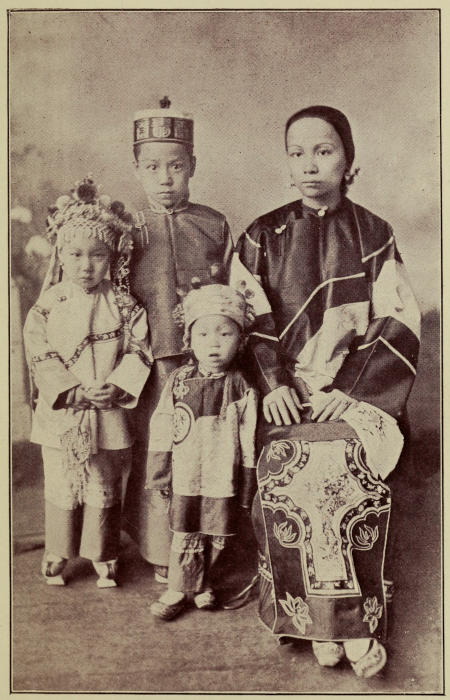
A Chinese Family
(Church of All Nations, New York City)
One day Wong Sing went home from our school with
a Chinese New Testament, and to him it was the Word
of God from heaven. He read it all night, getting an
hour’s sleep in the early morning before he went to
work. He was converted by the reading, and then he
threw himself, with all his soul, into the work of the
church. He was all for Christ. In the last four years
he was with us he did not miss one session of the school.
Finally, business called him home. His mother in
China was greatly grieved at his conversion. She said,
“My son has deserted the old faith. When I die, who
will worship at my tablet? My son went away a good boy,
he comes back possessed of a devil.” Wong was the
only Christian in the village. He tried to show his mother
the better way he had found in Christ, but without success,
and in great bitterness of heart over the loss of her
boy’s faith in the old religion, she ended her own life.
On this young Christian has fallen the curses and revilings
of the entire village, but he has “kept the faith.”
When You Toy, a little Chinese slave girl whom we
had rescued, told us her dream, we felt that there was a
relation between it and her own life and thinking. “Oh,”
she said, “I had such a wonderful dream; I saw God
and He had a great book, and He called me to Him
and said, ‘Here, You Toy, look in this book,’ and I looked
and there was my name, and after it in bright letters was
written, ‘You are my precious one.’” I believe that a
little orphan girl from a far country, trained in ancestor
worship, could never have had that dream if God were
not a known and near friend. What do you think
about it?
The Russians, Hebrews, Italians and Americans—none
of these people surpasses the Chinese in loyalty and in
labors, once they become followers of Christ.
VII MAKERS OF GOOD NEIGHBORS — VII MAKERS OF GOOD NEIGHBORS
“Fear not, we cannot fail:
The message must prevail;
Truth is the oath of God,
And sure and fast,
Through death and hell,
Holds, onward, to the last.”
To Begin With. Who and what are the good neighbors
in our country that are most powerful in
changing this many-tongued multitude into
Americans? Who are influencing them so that they understand
us and we understand them? What forces are
welding these many fragments into one nation?
To receive into one great common home millions of
sons and daughters strange to that home and to one
another in speech, custom and land, and to blend them
into one people, this seems an impossible task. And yet
it is being accomplished.
The Public School. Among the good neighbors that
are grappling with this great task most effectively I
place the public school first, because I believe it the
most useful neighbor in making young Americans. Frequently
the foreign-born parents see the New World
largely through the eyes of their children, so that the
school is a good neighbor to the whole family.
The public school makes different nationalities friendly.
All school boys know how by studying together, reciting
together and playing together they acquire respect
for one another, and learn to look over the barriers of
race. A public school near my church which is made
up almost wholly of Jews and Italians, elected one of my
Sunday-school scholars, a Japanese boy, president of the
class, simply because his ability and good manners had
won their respect.
Manual Training. By manual training classes the public
school promotes respect for work with the hands. We
cannot understand the foreigners’ contempt for this kind
of work, but it is very strong. I once took an Armenian,
who had come all the way to America in the hope of getting
an education, to the president of a preparatory school
in the hope that he might be admitted free of expense by
doing some work about the institution. The president
stated that the school was overcrowded, but he would
take him in if he would work in the field a couple of
hours a day. The Armenian, who was really an earnest
man, felt the work would too greatly degrade him, and
declined.
Teaching in the English Language. The English language
is of course another great help in Americanization.
The City and the Immigrant Child. The child of the
immigrant is in special need of the help and sympathy of
all American boys and girls. Frequently he is the sole
person in the home who speaks English, and so is called
upon for advice and is consulted in many things upon
which American fathers and mothers never need to consult
their children. This is unfortunate for him, as we
can readily see. He often despises the language and customs
of his parents and then ends by despising the
parents themselves. He cannot understand the love his
parents feel for their homeland; he cannot see the blue
skies and green hills and mountains so dear to them; he
cannot feel the home attachments.
“I recall a certain Italian girl,” writes Miss Jane
Addams, “who came every Saturday evening to a cooking
class in the same building in which her mother spun
in the Labor Museum Exhibit; and yet Angelina always
left her mother at the front door while she herself went
round to a side door, because she did not wish to be too
closely identified in the eyes of the rest of the cooking
class with an Italian woman who wore a kerchief over
her head, uncouth boots, and short petticoats. One
evening, however, Angelina saw her mother surrounded
by a group of visitors from the School of Education who
much admired her spinning ability, and she concluded
from their conversation that her mother was the ‘best
stick spindle spinner in America.’
“When she inquired from me as to the truth of this
deduction I took occasion to describe the Italian village
in which her mother had lived, something of her free life,
and how because of the opportunity she and other women
had had to drop their spindles over the edge of a precipice
they had developed a skill in spinning beyond that
of the neighboring towns. I dilated somewhat upon the
freedom and beauty of that life, how hard it must be to
exchange it all for a two-room tenement and to give up
a beautiful homespun kerchief for an ugly department
store hat. It was easy to see that the thought of the
mother with any other background than that of the tenement
was new to Angelina, and at least two things
resulted; she allowed her mother to pull out of the big
box under the bed the beautiful homespun garments
which had previously been hidden away as uncouth, and
she openly came into the Labor Museum by the same
door as did her mother, proud at least of the mastery
of the craft which had been so much admired.”
While it might seem that the child represents the most
precious future wealth of our cities, he evidently is not
so valued. Real estate is worth more than he is. Dirty,
disease-breeding blocks that should be parks and playgrounds
are worth more than he is. Even where grass
grows, big signs everywhere indicate that grass is sacred
and of more account than he is. In planning our American
cities the child seems to have been entirely left out.
When tenements became profitable, and the tenements
are the homes of the immigrant children, the backyard
playground disappeared. The street is the only playground
left and, cursed by drivers because the horses
stumble over them, and by chauffeurs because they limit
their speed, and chased by the police as a general
nuisance, the children of the tenements are surely to be
pitied.
A young Italian girl fifteen years of age was being
sworn in a Brooklyn court. Before swearing her the
Judge told the clerk to inquire if she knew the meaning
of an oath in court. He asked, “Do you know who
God is?” She replied, “God, who is he?” He said,
“Do you know anything about Christ?” She replied,
“Christ, where does he live?”
Here is a chance for the boys and girls of America to
be good neighbors.
The Settlement. Some one says, “I have often heard
about settlements, but what do they do?” The Church
of All Nations carries on a church and settlement work
on the lower East Side of New York. If you were to
pay it a visit during a week day this is what you might
see. By 8.30 o’clock in the morning there would be a
patter of little feet and a babel of children’s voices and
we would know the Italian boys and girls were coming
for the daily kindergarten. At nine o’clock the office bell
begins to ring; just sit in the office and listen to the people
who call. One says, “I need to go to the hospital”;
another, “I want to get a friend out of prison”; a big
able man says, “I want work”; some are in need of
clothes or food, or a lawyer, or are discouraged and have
come to talk over their troubles. These last keep coming
during the morning office hour and, in fact, all day and
into the night.
Italian Kindergarten (Penn.)
In the afternoon there is a mother’s meeting for
Italians, or Hebrews, or some other nationality, with
an address of a religious nature or a brief talk on some
topic that helps make the mothers better able to care for
their children. American boys and girls may think all
mothers know how to take care of children, because their
mothers took such good care of them. It would surprise
them to know that in the fall some of the immigrant
mothers sew a suit of clothes on their child and expect
that suit to stay on through the winter—it is not to come
off at night, either. Many Italian mothers wrap up their
little babies until they look like a mummy that you may
have seen in a museum. The baby can move its hands
but not its feet; it can also move its big black eyes, and
laugh or cry. We know better than these mothers, so we
try to teach them wiser ways of caring for their children.
At three o’clock there may be sessions of the sewing-school,
or game room, or gymnasium classes for the
younger boys who are not allowed to come at night. In
the evening there are club meetings under chosen leaders,
bowling contests, basket ball games, and night school for
Italians, Chinese, Hebrews or Russians. In other parts
of the building may be illustrated lectures or motion
pictures. So you see a Settlement has a very busy and
varied sort of day’s work, and is a good neighbor to the
immigrant.
Other Good Neighbors. In addition to the good
neighbors mentioned, many other forces assist in the
Americanizing of the foreigner. America itself, the
streets, the stores, the factories, the public institutions,
the work at which he is employed and the conditions
under which he toils, all have a marked effect upon the
stranger. Those who have studied the matter say that
the Jew is developing a better physical type than at home,
while the Italian, used to open air peasant life, is running
down in stature.
While the immigrant is a stranger in a strange land
he is by no means a stranger in a friendless land.
America is not only rich in dollars, it is rich in kindness
and sympathy. Our fathers were pilgrims and strangers;
some of us were ourselves strangers. We should, therefore,
try to carry out Christ’s story of the good neighbor,
and, if we find our immigrant brother in need of help or
protection, we should be among the first to have compassion
on him.
VIII GOOD NEIGHBORS AND BAD — VIII GOOD NEIGHBORS AND BAD — Bad Neighbors
“Lead on, O King eternal,
The day of march has come:
Henceforth in fields of conquest
Thy tents shall be our home.
Through days of preparation
Thy grace has made us strong,
And now, O King eternal,
We lift our battle song.”
The Church. The Protestant church in America
is a good neighbor to the immigrant. The
trouble is that many immigrants refuse to permit
it to be their friend.
We have seen that the chief reason that the church
cannot do what it would among the Jews, Russians,
Italians and Chinese, the people we are studying, is
because these people do not understand that the church
in America is different from the church in their home
countries. They do not know that American Christianity
is a friend of liberty, and is really trying to aid the
common people.
When the Irish immigrants came in such multitudes
to America they thronged the Catholic Churches. Their
church had been their loyal champion in Ireland, and they
knew it would be the same friend in America. The
same loyalty was shown by the Lutheran to his church
when he came from Germany to America.
But the million and more Jews that have flowed into
America want to have nothing to do with the church, and
the multitudes of Italians, when loyal to any church,
belong to the Church of Rome. The Russians are often
exiled from home because of the church.
To be the best of good neighbors to these people, it
is necessary, first, for the church to know their history.
Only in that way can church people understand how the
foreigner feels toward the church and how most wisely
to approach him.
The Jew and the Church. What does the Jew regard
as the cause of the sorrow which has sent him to
America? I have seen old Russian Jews stand in front
of a Christian church at night, when they thought no eye
saw them, and shake their fist at the cross over the door,
spit at it, curse it, and go their way. “If,” said a Jewish
woman, “the Christians want to be friends with the Jews
why do they forever preach that the Jews killed Jesus?
We know our nation was the cause of His death, but
how many Christians have died in the religious wars
between themselves?” She laid the persecution of her
race at the door of Christianity.
Speaking one day of the religious fervor of an old
Hebrew, his daughter said: “Yes, he is religious, but
none of the rest of us have any use for it. I think it is
through religion that most trouble comes into the world.”
“Now,” she continued, “the best friend I have in
America has just gone out angry because when she came
in she found a fire in my house, and this is a Jewish fast
day. Religion drove us out of Poland with the loss of
everything. I believe we would be better off if religion
was out of the world.” I tried to show her that true
Christianity was not guilty of these cruel persecutions of
her people, that it was the lack of true Christianity that
caused them; yet I doubt if I convinced her.
Even when Jewish children are allowed to attend
Christian religious institutions to get them off the streets
they are often forewarned. I noticed one day that a
boy who sang lustily some of the hymns stopped at the
word “Jesus,” or else substituted the word, “Moses.”
“Curley,” I said, “why don’t you sing the name Jesus?”
“My mother told me not to say it or my tongue would
turn black,” came the prompt reply. Another boy attending
our classes reached up and kissed a gold cross that
hung on a chain around the neck of one of our workers.
He had no sooner done so than he cried across the room
to his sister, “It never hurt me.” “What did you expect
would hurt you?” said the teacher. “My mother told
me I could come to class but if I said the name of
‘Jesus’ it would turn my tongue black, and if I touched
the cross, it would kill me, and I didn’t believe her.”
This was especially sad, for the boy said his mother had
told him a falsehood.
The Russian and the Church. The Russian dislikes the
church. He does not know the Protestant church of
America. All he knows is that the church of Russia
is at least no friend of liberty. He wants nothing to do
with what he considers a similar enemy in America.
The Chinese and the Church. The most devoted
Chinese we ever had in our work after he became a
Christian, had a similar feeling. His idea of Christianity
came from the Catholics of Mexico, who have treated the
Chinese very cruelly. He came to our school because he
hoped to learn English and not because he wanted to
hear of Christ.
The Italian and the Church. The church in Italy is
more or less a political machine. The Italian knows how
the Roman church opposed the liberty of Italy and this
makes him fear or hate all churches. Great churches in
Italy are often found with but a baker’s dozen in attendance.
The only times on which they are thronged are
when a “festa” is being held, a festival in honor of some
saint.
Brave Christians. Numbers of the immigrants who
become Christians are real heroes. The story of the persecutions
they suffer would be a surprise to most Christian
Americans. The Jewish daily papers sometimes
publish the names of the Jewish attendants at Christian
meetings that they may incite their Jewish neighbors
against them, and the tenement has so bitter a tongue that
it often drives the family out of the neighborhood.
Young people who are baptized are mourned for as
dead, cast out of their homes, and made practically
orphans, and Christian workers must find homes for them.
Spies are sent into Christian meetings to secure the
names and addresses of Hebrews present, and then
letters, or visits, or both, follow. Bibles of young converts
are taken from them and burned. While the
streets are filled with children with no religious instruction,
the whole Ghetto is stirred over one convert to
Christ.
One leading Russian revolutionist told me that if he
were to come out openly in favor of the Christian church
his business would be ruined.
The country founded by men who sought it for liberty
of conscience is not a free country to every one and men
who have found an asylum here from the oppressor of
Europe become in turn oppressors themselves.
The greatest need of all these people is Christ.
The Need of Christ. The non-Christian Chinese are at
times cruel and merciless beyond description. Slavery
is common among them, women being bought and sold
like merchandise. The treatment of little “servant”
girls is sometimes so inhuman that they commit suicide.
These little girls are bought by the Chinese and then frequently
sold by them when 12 or 15 years of age. The
picture of two of these little “servant” girls, rescued by
the Church of All Nations, appears opposite this page.
How Chinese Babies Ride
Copyright by Underwood & Underwood, New York City
Rescued Slave-Girls (New York City)
One Christmas night a great company of Chinese and
their friends had gathered to celebrate the birth of
Christ. Chinese women were there who had never before
been in a public gathering; bound-feet women were
there who are never seen on the streets. The platform
was thronged with Chinese children in their quaint, beautiful,
and becoming Oriental costumes. The first Christmas
was long, long ago. Scripture tells us that on that
night a song so full of joy that it startled the shepherds
rang through the wintry sky. Poets and other people
say that as Christmas time comes round again they can
still catch faint echoes of the angels’ song. Perhaps the
angels still sing it each glad Christmas Eve; anyway, at
no other time does a child seem so beautiful and so holy.
When the exercises were over I said a parting word
to our guests. One Chinese woman, carrying in her arms
a beautiful little baby girl, came up to say good night.
“Why, Mrs. Sun,” I exclaimed, “I did not know you
had a little girl.” “Oh,” she said, “I hadn’t, but Mrs.
Wu had one girl and when this baby was born she
didn’t want it because one girl was enough, so she gave
it to me.” This in New York on Christmas night, 1911.
Can you imagine a Christian mother glad to give away
her little girl? The Chinese need Christ.
The Russian needs something other than shorter hours
and larger wages. Many of them are seeking the higher
things. A Russian pastor told me of making an engagement
with one of his hearers at a Russian open air service
to discuss and explain Christianity to a Russian in
his home. When the night came this Russian revolutionist
had gathered a group of his fellows in his tenement
quarters and there pastor and men discussed the
Christian faith from 8 o’clock in the evening till midnight
and would have kept the discussion up all night,
could the pastor have remained. Christ and the church
are needed by the Russian.
You see that some people have misrepresented our
Lord and His church. We must try to right this wrong
done the foreigner and we must be patient and loving in
doing it. The immigrants are in need of many things—we
must endeavor to supply these needs. We must do it
for the sake of Christ. We must do it in the name of
Christ. We must do it as if our Lord Himself sat weary
and thirsty before us and it was given us to hand Him
the cup of water. How glad we would be for such an
honor!
The Saloon. It is sad to see so many bright Italian
boys with their fruit stands and shoe polishing chairs
hard by saloon doors. They do not know how great an
enemy is pretending to be their friend.
The saloon is a bad neighbor to the immigrant. It
wastes his money and his time. It unfits him for work,
starves his family and makes them feel ashamed of husband
and father. It leads to disease and often to prison,
for the saloon is the mother of innumerable crimes. It
helps make weak-minded and deformed children and is
an evil organization whose destruction has already been
determined upon by the truest and best Christian people
in our land. For the sake of the immigrant, for the sake
of the fair name of America, let us unite to shut its doors
and banish it from our country.
Ignorance. Ignorance keeps the immigrant un-American.
One who cannot read is at a serious disadvantage.
When it is remembered that of the Italians
sixty out of one hundred of all those over fourteen years
of age who come to America belong to this class, we see
the need of the work of night schools to overcome this
ignorance. The case is made still worse by the fact that
the immigrants crowd together into colonies, as “Little
Italy,” “Little Russia,” and “the Ghetto,” where
the English language is not spoken and there are no
broadening American influences.
Injurious Employment. The work in which the immigrant
is generally employed helps keep him un-American.
He has no opportunity to know America or to know
Americans. Much of the work is wearying and disheartening.
Men bound for the coal mines are packed
in cars and hurried away, often through the night, to the
distant coal fields; underground all day and sleeping in
wretched quarters above ground at night, they have little
opportunity to see or know anything of their adopted
land. I stepped up to a stone house alongside a railroad
excavation in the country part of Connecticut once to
have a look at the occupants. There were two floors in
the old tumble-down house and both were packed with
mattresses and makeshifts for beds until practically the
whole floor space was covered. It was a wet day and all
the men were crowded indoors. A handsome young
fellow lay sick on one of the mattresses. I put my head
in the door and said: “Io parlo un poco Italiano ma non
bene.” “I speak a little Italian, but not well.” Immediately
there was a laugh, probably at the “not well,”
and they rose to greet me as courteously as if all were
trained gentlemen. The sick boy began to talk and the
group was friendly with me in a moment.
The day will come when we shall find that these people
can do something other than dig ditches and mix concrete.
The Italians who are now employed as our
hewers of wood and drawers of water, are of the race
of painters and sculptors and silk makers of earlier days.
We must help the immigrant to overcome his bad
neighbors, and to know who are his true friends.
IX NEIGHBORS TO THE WORLD — IX NEIGHBORS TO THE WORLD
For lo, there breaks a yet more glorious day;
The saints triumphant rise in bright array;
The King of glory passes on His way.
From earth’s wide bounds, from ocean’s farthest coast,
Through gates of pearl streams in the countless host,
Singing to Father, Son and Holy Ghost,
“Hallelujah, Hallelujah!”
Those Who go Back. “Do these immigrants ever
go back home?” asks some one. “If I went
away from home and made my fortune I would
want to go back home to spend it.”
I am glad to hear that question and some of you may
be surprised at the answer.
We have all heard of the incoming immigrant army,
and small wonder when we know that in some years it
numbers over a million human beings. But we have
heard little about the returning army. How large is it?
How many of our immigrant neighbors prefer to spend
their savings at home? How many go home because
fortune has not smiled upon them in America, or because
their mothers write, “I am getting old and it is very
lonesome with my son far across the sea”?
Let us lay on the table nine, bright, new, copper pennies.
Now suppose each penny represents one hundred
thousand immigrants. Then the nine pennies would
represent nine times one hundred thousand, or the nine
hundred thousand immigrants that landed in 1911. Since
almost three hundred thousand immigrants went back
home in 1911 how many of these nine pennies shall we
have to remove to show the actual immigrant increase
for that year?
For 1908 we would have to use eight pennies to represent
those who came, and to remove six of these pennies
to represent the numbers that returned home that year.
I am sure this will surprise some of you. You did not
know so great a multitude returned to Italy, or Russia,
or elsewhere, yet every year anywhere from two hundred
thousand to six hundred thousand leave our shores
for home. That makes us feel the truth of the song we
all know,
“Be it ever so humble,
There’s no place like home.”
Influence of the Returned Immigrant. What effect
has this home-coming multitude upon towns and villages
all over the world?
When Stefano came to America he could neither read
nor write. One day a friend said, “I know a church where
Italians are taught to read free of all expense.” Stefano
was sending money home to his mother each month, so
he was glad to know of a free school. One night the
leader of the school said, “We shall have a short session
to-night because we are to have a prayer-meeting after
school.” Stefano and fifty other young Italians remained
for the prayer-meeting. At home Stefano
had ceased going to church after he had been confirmed,
except sometimes on feast days. He remained to the
prayer-meeting, not because he wanted to but because all
the others stayed. He listened with great attention to
the speaker; he had never heard such an earnest address
as the pastor gave that night. It seemed as if some one
must have told the preacher all about him. All through
the week he thought of the prayer-meeting and after he
had attended a few times more he came to the preaching
service on Sundays, and then Stefano became converted.
When he returned home he was on fire with the new
religion he had found. His heart was full of love for
everybody. But he was saddened when he saw how little
the people of his village knew about God. One night he
determined to tell them how he had found Christ in
America, and so he called them together in his mother’s
home and told his story. When he had finished what
was his surprise and delight to have three other men rise
and tell how they had found the same Christ in golden
America.
Every one was interested. The villagers said, “Some
of these men were bad men when they went away; they
are now good men.” You will be glad to know that
whole villages in Sicily have become Protestant and
Christian by the preaching of just such returned immigrants
as Stefano. Last year eighteen Protestant
Churches of one denomination were founded in Sicily
by returned immigrants converted in America.
This shows us the wonderful opportunity we have of
being a good neighbor to one part of the world by being
good neighbors to the Italians who live near us.
What has caused so old and conservative a nation as
China to change to a republic? The leaders of this revolution
are Christian men. If we asked them they would
say, “We saw that the cities and towns and schools and
churches and men and women and children of Christian
lands were different from those of China. We believe
the reason they are better is because they know Christ
and are following Him.”
We have helped China by being a good neighbor to
the Chinese who lived among us.
A few weeks ago a Russian school-teacher attended a
preaching service in my church. After the Russian
pastor had finished preaching the school-teacher sought
him out and said: “I had fifty young men in my class
in the Russian village where I taught. I told these
scholars all I knew about God but I could not tell them
much, I knew so little myself. I determined to know
more so I visited the most celebrated monasteries in
Russia in order to find out about God, but I didn’t find
God in the monasteries. At the great monastery of Kieff
after talking for hours with the abbot he said, ‘You
are too good a man to come in here. Go back into the
world, and somewhere there you will find God.’ I
found him this morning as I listened to the sermon.
Now I shall go back to Russia and tell the men of my
village of the God who now speaks to my heart.”
We shall help the Russian Empire by being a good
neighbor to these subjects of the Czar.
America is to-day the greatest mission field on earth.
It is not this because of the vast number of foreigners
who remain and make it their home; it is such because
of the vast human river that flows back to its source. In
a barren desert tract in the West, where sage brush and
cactus are the only vegetation, the desert blossoms when
the rivers of irrigation are let in. So does this returning
human flood bring hope and new life to wornout and
often hopeless civilizations.
Here lie the responsibility and privilege of America.
Through school and settlement and church and a myriad
other institutions and influences we must make these Old
World brothers and sisters feel that they have found in
the New World more tender and loving neighbors than
those they left behind; we must show them that accepting
our science and education, our ways of farming, and
mining and manufacturing, is not enough, although these
have had much to do with our greatness. Queen Victoria
when asked the source of England’s greatness, pointed
to the Bible. It was a true answer. It is being humble
followers of Christ that makes us fit leaders of these
foreigners, and sends them back fit to be leaders in their
turn.
If we are helpful, loving Christian neighbors to these
immigrants we shall set in motion waves of Christian
faith and hope and love that, like the tides, will sweep
around the world and break in benediction on every Old
World shore.