I find that I have wandered too far in advance of my time,
and also away from the North-Eastern Division. Some six
months after I had opened the new Station at Cape Nelson,
the Government Secretary, the Judge and Treasurer, and in
addition, my old enemies of the Government Store, all came down
upon me for irregularities in making and sending in Court and
Gaol returns, copies of the Station Journal, and receipts for stores
received: the Treasurer and Government Store-keeper complained
bitterly that I was seriously delaying the clerical work of their
Department in consequence. I reported that nothing else was to
be expected; that I had an enormous new district to bring into
order, the work in which necessitated frequent and long absences
from my Station, and that when I was away, my Station was
solely in charge of a Corporal of Native Constabulary, who could
neither read nor write, and I begged that a Malay or Manilla
man, like Lario or Basilio, might be sent to me to act as native
clerk and overseer. The Governor was away in Australia, and
the Judge in the Western Division; accordingly Mr. Musgrave
dealt with my request. In due course, a vessel came in bringing
a sallow, lank, unwholesome-looking youth of about twenty years
of age, a cockney, bearing a letter from Muzzy saying that he
was to act for me as clerk and overseer.
“Do you know anything about book-keeping?” I asked him.
“No, your worship,” he replied. “Don’t call me that, except in
Court, you fat-head; Sir is quite enough,” I said. “Do you
understand building? There is much of that going on at present.”
“No!” was the reply. “Agriculture, then? We grow most of
our food here.” “No!” ”Drill?” “No!” “Can you shoot?”
“No!” “What in Heaven’s name can you do?” I asked;
“surely something?” “I was a fishmonger’s boy in London; then
I got a job as steward on a tramp steamer; I left her at Thursday
Island, and learnt billiard marking in a pub there, while I was
employed as a waiter; then, hearing that there were some billiard
tables in Port Moresby, I went there to try for a job; I could
not get employment, and went to the Government Secretary to
apply for a free passage out of the country, and he sent me here.”
“Holy Moses!” I said to myself, “this is exactly what I
expected Muzzy to do; I suppose I am lucky that he did not
send me a mid-wife!” “You don’t seem very promising
material for me to work upon,” I remarked aloud, “but I will
see what we can make of you. First, I will render you able to
defend yourself. Sergeant, take away this man and teach him to
shoot; then tell off a couple of men to teach him to swim.”
“What will the police call me?” he asked; “Sir or Mister?”
“Hoity toity!” I said, “this is beginning early! What were
you called when you were a waiter?” “Bert.” “Very good.
Bert you will be to the constabulary, until we have made something
of you; and I shall call you by your surname without any
prefix at all.” “Shall I live with you or the constabulary?” he
next queried. “I don’t like niggers.” I saw my orderly, who
was standing stiffly at attention, watching for an opportunity to
tell me something, give a quick glance at the sergeant, who still
waited with a motionless face. “With neither,” I replied; “I
will send the gaoler into barracks and give you his house, until
we have one of your own built. But remember this: the term
nigger, as applied to a native of this country, is strictly forbidden;
it is an objectionable term of contempt, and especially so when
applied to men wearing the King’s uniform. You have already
done yourself harm by using it in the presence of men who are
at present in the position of your teachers.”
I was at my Station for about a month after that, endeavouring
to make the man useful, but he was exceedingly useless for anything
except copying letters and keeping check of the stores that
had been used. I then went away for a couple of weeks, and on
my return found that a blackguard, beach-combing trader, whom
I had once gaoled for four months and whom Sir Francis Winter
had also incarcerated for another period, had called at the Station
and fraternized with the agreeable “Bert”; the pair of them had
then scandalized the whole Station by going on a wild drunk for
three days and nights, during which period, the constabulary told
me, a large whaler had passed the Cape, filled, they believed, with
runaway carriers from the gold-fields. The police had not cared
to leave the Station while the drunken riot was going on, for fear
that the drunks should do some damage either to themselves or
the Station, therefore the whaler passed unchallenged. I was
exceedingly annoyed; the more so, that recently I had been
keeping a strict watch on large and strange canoes or boats passing,
on account of a habit miners’ carriers had developed of stealing
their employers’ fire-arms and goods, and making a bolt for their
homes in either stolen boats or canoes. They then, in some
instances, added to their crimes by shooting stray natives or
plundering the gardens of small, weak, outlying villages; on one
occasion the offenders had had impudence enough to refuse to
produce or surrender their stolen fire-arms, when they were overhauled
by my whaleboat, under command of my corporal; and it
was not until the corporal had ordered the police to load their
rifles, and had clearly shown that he meant fight, that they yielded
to the superior force. “Bert” begged hard to be let off this time,
and swore that he would be good in future; he wailed that he
had been lonely and miserable when the trader arrived, and, in his
joy at having a white man to talk to, had lost his head.
I overlooked his offence upon that occasion, at the same time
administering a severe reprimand; but his culminating act came
when, on my next absence, a large canoe was sighted, and he
went in the whaleboat with the police in pursuit. When they
got within a short distance of the canoe, the police hailed her
and found she was a Kaili Kaili canoe loaded with fish, which
her crew were in a great hurry to land and smoke; the
constabulary told “Bert” this, whereupon he demanded that
the canoe should stop and give him some fish. The Kaili
Kaili did not like him in the first instance, and, in the second,
they knew that he had no right to demand their fish so they
continued on their way; whereupon the jackass fired several shots
at them with a rifle, fortunately killing no one. Upon my return,
an indignant deputation of Kaili Kaili waited upon me to know
why “the man without either strength or sense” had fired at
them. I sent for “Bert” and demanded an explanation, which
he gave thus: “These natives don’t treat me with enough
respect; I must do something to show my authority.” Accordingly,
I showed my own authority by telling him to pack his
goods and get away next day to Samarai, by the s.s. President.
To that point I also went in the same vessel, with the
intention of trying to find a more suitable man. I did get one,
a splendid chap named William Mayne, a Scotch ex-ship’s
carpenter, who had gone broke at the gold-fields, got loaded up
with fever, and wanted to recuperate. He was, like most Scotsmen,
a man of good education. I made him acting gaoler and
overseer, pending the Governor’s approval. When the Merrie
England with Sir George arrived, some months afterwards, I sang
Mayne’s praises. “A really good man, sir; he can repair a boat
and build a house; he has taught some of my men blacksmithing
and armourers’ work; he keeps his books well and cleanly, and
only gets drunk on New Year’s Eve. He has an old certificate
of character from a Scotch minister, and all his ship’s discharges
are marked V.G.” “He seems to be the very man I require as
Head Gaoler and Overseer of Works at Samarai,” said his
Excellency; “I have had great difficulty in finding a suitable man
for the post.” “But, sir,” I wailed, “I found him, and really I
cannot get on with ex-billiard markers, waiters or tailors; they
are no use to me, and they get on my nerves the whole time.”
The Governor laughed. “I shall not ask you to,” he said; “I
will give you a full Assistant R.M., young, strong, competent,
and a gentleman. Barton, send Mr. Yaldwyn here.” Yaldwyn
came, was introduced to me, and then left the cabin. “He will
do, sir,” I said, “I like his cut.” Poor Yaldwyn! I did not
foresee, within a few months, firstly, his disgrace, and then his death.
Yaldwyn proved to be an uncommonly cheerful and bright
person; nothing ever made him down-hearted, and the more I
worked him the better he liked it. He became very popular on
the Station, both with the constabulary, prisoners, and natives at
large; he was perpetually doing them small kindnesses. A child
of the wife of one of my constabulary would be sick, Yaldwyn
would mix up condensed milk or meat lozenges for her, and show
her how to give them. Once, an elderly prisoner moped and
pined, and Yaldwyn came to me. “Old so-and-so is bad, I
think he should be let go.” “Do you, Mr. Yaldwyn? But
only the Governor has power to remit a sentence once passed,”
I remarked. “Yes, I know; but he won’t be here for months,
and the poor old blighter, who has only got six months, will die
unless he sees his home, he’s fretting awfully; do let him go for
a week or two.” “Can’t be done, my dear man, by the visiting
justice for gaols. I am here to administer and uphold the law, not
to break it,” I said. The first time he turned dolefully away;
then I called him back. “Mr. Yaldwyn, I am going to Cape
Vogel to-morrow, and shall be away for a fortnight; if so-and-so
should happen to spend that time in his village, and be safe in gaol
and in good health upon my return, of course I cannot be
expected to know of it, and it is no one else’s business.” “Yes,
but you would know; you always find out everything,” he said.
“Perhaps if you dropped a hint to my orderly that I did not wish
to know on this occasion, I might remain in ignorance; in fact,
I might be even as dense as you appear to be!” Yaldwyn
thought for a moment, then permitted himself the liberty of
winking at his superior officer before departing. Yaldwyn loved
to sing, and thought he had a singer’s voice. He had: it was as
bad as mine—only useful for scaring crows! As a general rule,
I forbade him to sing; but when I felt unusually cheerful and
strong, I would permit him a stave or two in the evening. He
would begin “Maid of Athens,” in a bass that shook the window,
and then wander into a rusty baritone, streaked with falsetto
screeches. On one occasion, after suffering in silence for quite
ten minutes, I broke in upon the melody. “Yaldwyn, did your
voice ever break when you were a boy?” I asked. “Yes, of
course it did. Why?” “Because I wondered why your parents
did not have it mended with giant cement or seccotine or
something,” I remarked, as I went off to the barracks, leaving
him thinking. When I returned, half an hour later, I found him
chuckling, having at last grasped my very feeble joke. “I’ve seen
it,” he said, “it is very clever; I’ve written it down to use on
some one else!”
Some time afterwards, Macdonnell, district surveyor, was
attached to the North-Eastern Division staff; he had a very nice
trained voice, and was in the habit of singing as he worked at his
plans. He came to me one day and said, “I say, R.M., is
Yaldwyn all there?” “Yes,” I answered, “a little slow in the
uptake, but he has plenty of brains. Why do you ask?” “Oh,”
replied the surveyor, “I was singing at my work just now, when he
came in and looked at a piece of paper; then he said to me, ‘Why
did your parents not have your voice mended with cement or
gum?’ and sat down and roared with laughter. When I said
that I could see no joke, and only thought the remark rude
and pointless, he said it was something very clever you had said to
him.” “I did say something of the sort, I remember now; but
you tell him a story and then hear him repeat it later, and you
will understand,” I replied.
Shortly after Yaldwyn’s arrival, I went to Samarai in search of
Mr. Macdonnell and his assistant, both of whom had been
appointed to the North-Eastern Division some time before, and
had failed to put in an appearance. I found them there, engaged
with a boat’s crew of six survey boys, superintending the
reclamation of land; they had a whaleboat and full camp equipment.
They had received instructions from the Chief Government
Surveyor to proceed by steamer to Samarai, do any little
thing that required doing there, and then come on to the North-Eastern
Division, where I had plenty of work for them. “What
the dickens are you doing here?” I asked Macdonnell. “You
are a charge upon my Division, the poorest in the Possession, and
here you are doing gratuitous work for the richest!” “The
fact is,” he answered, “there has not been an opportunity of
getting up to you.” “You had your whaler and crew,” I replied,
“and it’s a fair wind all the way at this time of year; trot out
another excuse.” “I can’t get Turner, my assistant, away; he
has fallen in love with the publican’s daughter, and spends all
his time spooning with her. He has got a couple of hundred a
year of his own, as well as his pay, and is deuced independent.”
“Oh, he is, is he!” I said; “well, we sail at midnight, with or
without him.”
Moreton, R.M., was away on leave, and Symons acting in his
place; accordingly, I went to him. “Mr. Symons, I want the
Siai to take the Survey party and myself to Cape Nelson.” “I
am very sorry, but I can’t let you have her without orders from
Headquarters,” he said. “I will give you a written requisition
for the vessel’s services,” I replied. Symons would not let me
have her, however; afterwards I heard that he had arranged a
picnic party on board her for the white women of Samarai, for
two days ahead; it was a case of while the cat, in the shape of the
R.M., was away, he—the mouse—was to play. I then chartered
a cutter for Cape Nelson, and sent Macdonnell a formal notice
that we left, as previously arranged, at midnight. He replied, that
Turner had said that he could not be ready, and would not come.
“Very good, Mr. Macdonnell,” I said, “he is your subordinate,
not mine; but you, your whaler and boat’s crew, come with me.
I shall report to Headquarters, that Mr. Turner having refused
duty, I shall act as your assistant myself until a substitute is sent
to you, or lend you Yaldwyn. I shall also report that I have
taken upon myself to suspend Mr. Turner, until the decision of
the Chief Government Surveyor be known.” Turner then
resigned himself to his fate and the missing of Symons’ picnic, and
sailed with us.
I had taken a strong liking to Macdonnell, who was a most
pleasant companion, and on one occasion, I flatter myself, I saved
his life. As we were very crowded and he was a much older
man than the others, I asked him to share my bedroom, for I had
a spare field bed and there was plenty of room for two. One
night, a beastly hot close night with a thunder-storm on the point
of bursting, we both woke up sweating from the heat, and
Macdonnell said he would go into the next room and get a
whisky; I declined, and he left to help himself; then, changing
my mind, I got up and followed him into the ante-room. He
always drank his whisky—Scotch custom—neat, and took the
water afterwards; he poured out a tot and waited a minute while
I did the same, then, just as I poured water into mine and started
with surprise at seeing it turn a milky white and hastily sniffed
at it, he tossed his off. I did not wait to look at him—he had got
hold of a whisky bottle full of pure carbolic acid, which I had
filled that day, and had never noticed the large red “Poison” I
had written across it—but I made one jump for the medicine
shelf, snatched down a pint bottle of olive oil, shoved him on to his
back, and poured the oil down his throat; then, yelling loudly for
Yaldwyn and Turner, I found and poured about half a pint of
Ipecacuanha wine after it. “Is it burning?” I asked. “No,”
gasped Macdonnell, “only my lips.” Yaldwyn and Turner
appeared. “Macdonnell’s poisoned by carbolic acid,” I said,
“bring me a pound of butter, and tell my cook to make a quart
of luke-warm salt and water, and tell him to jump like hell about
it, or I’ll murder him.”
The butter came, of course in a semi-melted state, as tinned
butter always was, there; then, with my fingers I began to cram
it into his mouth and throat. “I shall be sick,” groaned
Macdonnell, as he tried to shove me away. “You infernal idiot,”
I replied, “that is just what I want you to be.” Then came the
hastily prepared luke-warm salt and water. “Down with this,”
I told him. He took a gulp or two. “I can’t,” he gasped, “it’s
too beastly.” “If you don’t take it,” I said, “Yaldwyn and I
will belt the very life out of you.” He got it down, though, at
the finish, he was swelling like a bull frog. “Can you be sick
now?” I asked. “No,” he said. “Hell!” said Yaldwyn,
“either his guts are clean burnt out, or he has got an inside like
an ostrich!” “Get some cotton wool and some string,” I
ordered. “What are you going to do now?” asked the unfortunate
victim. “Shove the cotton wool down your gullet,
and haul it up and down, until that copper-lined still, you call
your stomach, rejects something,” I said. “Help me to the edge
of the verandah,” said Macdonnell. “Verandah be damned; be
sick here on the floor at once if you can,” I ordered. He
shoved two fingers down his throat, and then vomited like Jonah’s
whale. I retired hastily, and did a minor performance on my
own account, from sympathy. Macdonnell went on at intervals,
once he had begun, for quite two hours; then he got better
and complained of hunger. “As much milk as you like until
midday to-morrow, but nothing else,” I said. The sole
ill-effects Macdonnell suffered from half a gill of pure carbolic
acid were badly burnt lips, where the oil had not at first
touched, as it had been poured direct into his mouth from the
bottle.
I have mentioned an approaching thunder-storm as the reason
of Macdonnell and myself wandering from our room in search of
the drink that had such dire effects upon him. Well, Cape
Nelson, and in especial the point upon which our Station was
built, was very subject to thunder-storms; and, until I at length
induced the Government to give me a lightning conductor for my
house, it was our invariable custom, when a really bad one came
on, to bolt for the gaol or lower ground, where the lightning
apparently never struck. When Captain Barton was staying with
me after the first Doriri expedition, I had, stored in my house,
several cases of gelignite and dynamite, which I used for blasting
a road up a rocky precipice; when it first arrived I noticed that
the nitro-glycerine was oozing through the paper covers of the
cartridges, and that it was really unsafe; but, as it had been very
expensive, I did not like destroying it as my Station could not
afford a further supply, and I knew that the Government Store
people would swear it was quite good, and that I should get no
refund; accordingly, I found a place for it in my house, where I
could keep an eye on it, and watch whether it got worse.
One night there came on a most awful thunder-storm, and I
thought of the stuff and showed it to Barton. “You understand
high explosives,” I said; “there is enough gelignite here to blow
this house and ourselves into atoms so small that one would have
to search the universe at large with a fine tooth-comb to find any
remains. I am doubtful as to the effect of an electrical disturbance
upon it; have a look at it.” Barton looked. “The stuff
is fairly oozing nitro-glycerine; get rid of it, or put it in a safe
place at once, is my advice.” I called my orderly, Private Oia,
and told him to get a couple of men and remove the stuff with
great care to a safe place. “Where shall I put it, sir?” he
asked. “Oh, chuck it into the sea,” I replied. “Very good, sir,”
and he called a couple of men and removed the boxes. Twenty
minutes later there came a terrific flash of lightning; deafening
thunder and an awful sound on the iron roof of the house followed
instantaneously. My flagstaff, seventy feet high and three feet
thick at the base, situated only twenty feet away from the house,
had been struck and splintered into shivers, some as small as
wooden matches, which had fairly rained on the roof. “Thank
the Lord,” I remarked, as we gazed at the spot where once had
stood that lordly pole, “that we had first got rid of that gelignite.”
The next morning, I walked into the storeroom under the
house, and the first thing my eyes lighted upon was the gelignite!
My very blood froze! “Oia,” I yelled, “come here and be
killed!” “What is the matter, sir?” asked he. “I told you to
remove that stuff to a safe place, and you have put it here. Do
you call this a safe place?” I asked. “You told me, sir, to put it
in a safe place; there was nowhere else I could put it last night
without it getting wet; and when I asked you where I was to
put it, you told me with the double meaning you often use,
[i.e. irony] ‘to put it in the sea.’” Oia, poor man, had thought
I was being sarcastic at his expense, by way of impressing on his
mind the necessity of keeping the stuff extra dry.
The time came for me to go again to Samarai, a quinsy in my
throat forcing me to visit the nearest doctor—Vaughan, medical
officer at Samarai. Vaughan was not really a fully qualified
doctor, but was a man who had been for a length of time in the
Indian Medical Service, in which he had gained a considerable
amount of experience. He had come to the country as the
manager of a company, which he had formed himself in Australia,
to exploit the rubber lands of the Musa River, but his company
had gone bang, and Sir George Le Hunte had appointed him to
act as medical officer at Samarai; this appointment was afterwards
much questioned, but really at the time there was no duly qualified
man available. Moreton, R.M., was back, and accordingly—as
of old—I took up my quarters with him. In gossiping with
Vaughan, who, by the way, was a great friend of the Rev. Charles
Abel, he told me that the Mission had got hold of some serious
outrages perpetrated by miners in Milne Bay, and in which they
alleged Symons was concerned. “But Moreton is in entire
ignorance of all this,” I said. “Yes, Abel is going to spring it on
the Governor, upon his return from Australia,” said Vaughan.
“That is a nice Christian performance,” I thought, and then said
to Vaughan: “It is probably only some cock-and-bull Mission
yarn.” He answered, “It is nothing of the sort, I know the
evidence they have got.” “Pooh! Medical officers are like
missionaries, hardly competent to know what is evidence and
what is assertion or mere rumour.” Vaughan had a warm temper,
and I saw that I was working him the right way. “If I had not
promised Abel not to say anything definite about the charges, I
would soon shatter your self-conceited sufficiency,” he snapped.
“All right, don’t get warm, I am going to look at my men,” I
replied. “I’ll leave you sitting on your mare’s nest,” and off I
went, leaving Vaughan snorting.
I then strolled over to the house Moreton had allotted to my
men; they were sitting, chatting and smoking, on the verandah.
“I hear,” I said, after a little casual conversation, “that these
Samarai boys say, that we, of the North-Eastern Division, are
ignorant bushmen ‘with no knowledge,’ that we only come here
at rare intervals because the Samarai people are ashamed of our
being seen by strangers.” “They shall pay for that,” said my
men. “Yes, but how?” I asked; “I can’t let you fight them.”
“Can’t you put them in gaol, sir?” asked they. “No, not
without first finding out something they have done for which to
punish them.” “Perhaps we can find out something about
them,” said my men. “You are wise men,” I said, “not fools,
as these Samarai people say; that is the thing to do. Now, you
keep your mouths shut, put on your smartest uniforms and
swagger down the street and buy cigarettes, then go to the
ginger-beer shop, buy ginger beer and drink it there. Some of
them are bound to notice you, and follow to watch; offer any
that do so, cigarettes and ginger beer; then go to the stores and
buy sardines, salmon, and sweet biscuits, that will attract more
attention; they won’t miss a feed like that, if you give them the
slightest encouragement. Get them back here and, as you feed,
brag of all your fights and the arrests you have made; they will
almost certainly answer by telling you what they have done
lately, then keep your ears open and your mouths shut.” “Oh,
master, it is good. We go dig a pit for a pig, a deep pit. But
what about money?” questioned they. “You put in one
shilling each, and here is a sovereign. To-night my orderly will
bring me what news he can, to-morrow you will parade near
Mr. Moreton’s house, and each man will tell me what he has
learnt,” I answered. Then off I went to Moreton’s, where, later,
I heard sounds of laughter and revelry coming from my own
men’s house, and concluded the pig was in the pit.
Shortly afterwards, my orderly appeared. “Master, we have
a fence round the pig and it does not know it.” “Where is the
fence?” I asked. “In Milne Bay; some white men and the
Samarai boat boys caught some men there and killed many pigs,
and the white men killed some people.” “In fight?” I asked.
“No, murder. One man was led away into the bush by the
white men, with a rope round his hands, and was never seen alive
again.” “Was Mr. Symons there?” I inquired. “At the
killing, we do not know; at the capture, yes,” he returned, in
answer. “Phew!” I whistled, “the Mission have got a bomb
for Moreton! This sort of thing twenty miles from his Headquarters,
and he in ignorance of it!” Then, to my orderly, “Go
back to your house, and tell our men not to let the pig discover
the fence.” It was high time now that I sought Moreton.
“Did Symons tell you anything about trouble in Milne Bay?” I
asked him. “Yes, he said that there had been some gold stealing,
but that he had arrested the offenders and all was quiet again,” he
replied. “Well, Moreton, there have apparently been some
serious outrages there, in which Symons is alleged to be concerned;
the Mission have got hold of it and are waiting until his
Excellency returns to report direct to him, in order to get you
into grave trouble for being in ignorance of the matter,” I told
him. “How do you know this?” he asked. “A hint dropped
by Vaughan of knowledge possessed by Abel, in the first instance;
next, I have had my boys pumping Symons’ boat’s crew, and they
confirm it,” I replied.
“It is a bad business,” said Morton, “but I don’t see how I
can be held responsible. Symons has had charge of Milne Bay
for a considerable time. These things have also occurred during
my leave of absence, and while Symons was acting as R.M.” “I
see plainly how you will be held responsible,” I said; “Symons
was your subordinate, and if you choose to give him entire charge
of a district in your Division, you should have occasionally looked
in there, to see how things were going; you know perfectly well
that the R.M. is the person responsible for anything wrong in the
Division, whether his fault or not, and to plead ignorance is the
worst excuse you can make. It is clear to me, that you must
have lost entire touch with the village constables in Milne Bay,
for they are trotting in and out of Samarai every second day, and
yet you have heard nothing.” “I have allowed Symons control
of the Milne Bay village constables; they report to him and are
paid by him,” said Moreton. “What!” I exclaimed, “have you
been egregious ass enough deliberately to allow the control of a
district of village constables to pass out of your hands, the one
service that allows you to keep your hand on the pulse of the
district, and informed of what is going on? Moreton, if the
crimes have taken place in Milne Bay, that I believe have been
committed, then a fairly big scapegoat will be wanted by the
Governor, and you will about fill the bill.” “Symons had charge
of Milne Bay with the Governor’s consent and approval, and
Symons did not like to be interfered with there,” said Moreton.
“The fact remains that Symons was an officer subordinate to you,
he had not joint control with you, he had control subject to your
approval of his management of the district; anything he has done
there, unless expressly disapproved of by you, can only be held as
done with your approval,” I replied. “Symons reports direct to
Port Moresby,” said Moreton. “Don’t you ever read his reports,
or the copies?” I asked. “No,” said Moreton. “Then you are
in the soup up to your neck,” I remarked; “for, on your own
showing, you have entirely neglected and ignored one portion of
your Division, and that portion a district right under your nose.”
“What am I to do now?” said Moreton. “A little advice would
be better than a scolding.” “Do!” I said; “investigate at once,
and if there is anything in the charges, take immediate action
against all concerned; you will then have shown that you are
alive to what is going on in your Division, and that you are doing
your duty.” “Will you see Vaughan and the Mission, and first
find out for me what they know?” he asked. “Yes, I will do
it at once, though it is not my affair,” I replied.
Off to Vaughan I then went. “Doctor, I have been talking
over what you told me yesterday about Milne Bay with Moreton;
he has decided to make immediate and full inquiry, and has asked
me to ascertain what direct charges the Mission is prepared to
bring against any person or persons. Can you arrange that I see
the Rev. Charles Abel in the matter?” Vaughan arranged it,
and I saw Abel, who, after some demur, gave me a list of alleged
murders and outrages in Milne Bay, committed by three miners
attached to a Government party commanded by Symons. I took
the list to Moreton; and then, at his request, went to Milne Bay,
where I obtained sufficient evidence to show that one miner had
deliberately shot an unarmed native, and that another had shot a
woman: there was also evidence to the effect that a man arrested
by Symons’ boat’s crew had been handed over to the miners and
led away into the bush, after which he had never been seen alive
again, though there was no evidence of his death, other than that
the natives had found a body too far gone to identify. There
were a lot of other charges, in which the evidence was not clear.
“What is to be done now?” asked Moreton. “Arrest the miners,
charge them with murder, suspend Symons from magisterial duties,
and leave at once for Port Moresby to consult with Sir Francis
Winter,” was my advice.
On the top of everything else, there was a village constable
missing, named Lailai; he had been appointed by Symons some
nine months previously. Symons, by the way, had no authority
to appoint village constables; this could only be done by the
Governor, or by the Resident Magistrate by delegated authority.
Lailai belonged to a village named Daiogi, one of a group burned
by the miners accompanying Symons’ party. The following, an
extract taken from my notes at the time, is the sort of evidence
I elicited:—
“Lulubeiai, of the village of Daiogi, says, ‘I am the only
child and daughter of Lailai. Lailai is dead. I know he is dead
though I have not seen the body. He was a village constable.
He went one day to the camp of the white men; he never came
back. Gamadaudau, of my village, told me that he had seen my
father tied up and beaten by the white man, Steve Wolff. My
village is burnt and my people scattered. I know no more.’
Gamadaudau says, ‘I am a native labourer in the employ of
Robert Lindsay, a miner, and I knew Constable Lailai. He came
to the white men’s camp, and was tied up and beaten by Wolff
and Morley, and his uniform was taken away by Wolff. Lailai
was thrice flogged during the day by Wolff, and was left tied up
to a tree for two or three nights; he was then led away by Wolff,
Lindsay, and two other white men whom I do not know. He
was tied up with ropes, but in such a fashion that he could walk.
What happened after that I do not know.’ Two months later a
native of Buhutu found the skull and some portion of a human
skeleton in the bush, and from the fact that Lailai was the only
man dead and not accounted for, and from the fact that near the
remains were a pair of arm rings such as Lailai was in the habit
of wearing, he came to the conclusion that he had found Lailai’s
body, and so informed his fellow villagers. Then this. Charles
Ward, miner, sworn. ‘I remember going with Mr. Symons to
Wolff’s house, Wolff gave Mr. Symons Lailai’s uniform. Mr.
Symons asked where he had got them. Wolff said he had found
them in a deserted house.’”
This case afterwards broke down in the Central Court, for
though Moreton and I conclusively proved that Lailai was missing,
the evidence of his death was not strong enough; and even if we
could establish that, then the only thing that we could prove was,
that he had been maltreated by the miners, but not that they had
murdered him. I had listened to the dead Lailai’s daughter, and
seen her grief at losing her only relation; and I swore that, even
if Wolff escaped on technical grounds on the first charge, he
should not on a second, if effort on my part could prevent it.
There was a second charge. Wolff had shot a man, who was
running away, and a native with Wolff had seen the shot fired,
and knew the running man well, while others with him had seen
the killing, but could not swear to the identity of the dead man.
The dead man’s relations, however, were able to identify his body.
In this case there was no possible weak link. I arrested, upon
Moreton’s warrant, Lindsay and Morley in Samarai; they were
on their way to a new gold rush at Cloudy Bay, whither Wolff
had already gone.
There was now no doubt that very grave offences had taken
place in Milne Bay; and that if Symons had not condoned them,
he had at all events shown a lamentable ignorance of such things
as a missing village constable, a shot woman, and sundry other
strange events, such as the always strictly forbidden burning of
villages; and all these things had taken place in a locality in
which a village constable’s truncheon was the only force likely to
be required.
Moreton was frightfully distressed when he learnt the full
extent of the mischief done. “What am I to do, Monckton?”
he asked; “it is dreadful to think that these things have occurred
in my Division.” “If it were my Division,” I answered, “I
should arrest every one, however remotely concerned, Government
official, boat boy or miner, and send them for trial to the Central
Court; but as such a measure might appear too drastic a one,
and you would bear sole responsibility for it, up sticks and away
for Port Moresby and Sir Francis Winter is still my advice. You
have to go half-way there, in any case, to arrest Wolff at Cloudy
Bay. In the meantime, I will hie me back to my own Division
and work.” “For the Lord’s sake, don’t leave me now, laddie,”
said Moreton, using the old name by which he had called me
when first I came to the Possession; “I would not leave you in
the lurch.” “All right, I will stick by you, old man,” I said;
“but we must sail at once to Sir Francis, report, and get his
authority for me to remain with you until this matter is cleared
up.”
That night we sailed for Port Moresby in the Siai, reaching
there after a prolonged passage. Sir Francis Winter instructed
me to remain with Moreton, and that we were jointly to investigate
every criminal charge brought by either the Mission or others
against any person, but not to bother about vague assertions or
rumours unsubstantiated by some concrete evidence.
On our way back from Port Moresby to Samarai, we arrested
Wolff at Cloudy Bay: Moreton was rather bad at the time from
malaria, and asked me to do it; he also asked me to effect the
arrest personally and not to use the police, as the miners objected
to being arrested by natives. Accordingly I went ashore; and,
leaving the police in the boat, I walked up to Whitten Brothers’
store, which was crowded with newly arrived Australian diggers,
strangers to me. Robert Whitten was in charge of the store, and
I went to him at once. “Hello, stormy petrel!” he said, as
soon as he saw me. “There is no trouble here, what do you
want?” “I want a man named Wolff,” I answered; “point
him out, if here; or tell me where he is.” “There is your
man,” said Whitten, pointing to a black-bearded Russian Finn
with a villainous countenance, and plainly more than half drunk.
I went up to Wolff, while the whole crowd of diggers watched
me. “Your name is Stephen Wolff?” I asked. “Yes,” he
said, “and what the hell has it to do with you?” “Oh, nothing
to do with me personally,” I said; “but I happen to have a
warrant for your arrest upon charges of wilful murder, and sundry
other felonies.” “Where?” asked Wolff. “Milne Bay,” I
answered; “you must come with me.” He broke into a storm
of blasphemy and abuse of Moreton, Symons, and the Government,
and swore that he would not come; several sympathizers
among the miners also murmured.
I let Wolff blow off steam; then I said very quietly,
“Stephen Wolff, in the King’s name I command you to yield
yourself.” Wolff still cursed and raved. “Stephen Wolff,
twice in the King’s name.” Wolff made a grab at a bottle to
throw at me. I slipped my hand inside my jacket, grasped and
cocked my revolver, while Robert Whitten and a miner grabbed
Wolff. “Wolff, I mean to have you alive or dead; I don’t care
which. For the third and last time, in the King’s name,
chuck up your hands, quick!” Wolff was a wise man, he
surrendered promptly, the urging of Whitten and the miners
being hardly necessary; but he had gone very near to dying in
his boots.
We got back to Samarai to find our troubles only beginning.
Lindsay and Morley, who were awaiting trial in gaol, had made
up their minds that their present predicament was due to the
Mission and Vaughan; accordingly, in order to get even with
Vaughan, they made a sworn confession that they, with him, had
outraged certain native women, while they were in his employment
on the Musa River. Rape at that time was a capital
offence in New Guinea. Moreton and I had perforce to investigate
this charge; but could find no evidence to its truth, other
than the unsupported testimony of the men already under
commitment for murder, whose motive for charging Vaughan was
only too evident. We finished our cases; and the defendants
were all lodged in gaol pending the return of the Governor and
the sitting of the Central Court.
Unfortunately the hullaballoo and scandal over the whole
affair had thoroughly alarmed the Milne Bay natives. The trial
of Vaughan, whom they regarded as partly responsible for the
bringing to justice of the miscreants by whom they had been
maltreated, finally convinced them that no one who stood on
their side was safe, and accordingly they prepared to skip for the
bush; which, if they succeeded in doing, would deprive us of all
or most of our witnesses. Something had to be done to
reassure them, and that something at once. Moreton and I
discussed the matter and decided that an officer with police should
be stationed there. It was now imperatively necessary that I
should return for a time to my own Division; accordingly I
volunteered to lend Moreton, Yaldwyn and six good constabulary,
until such time as the Merrie England and the Governor returned;
assuring him that Yaldwyn’s happy disposition made him a
general favourite among natives, and that he was the very man to
undo the harm that Symons’ unhappy associations with the Milne
Bay outrages had caused.
Moreton gratefully accepted my offer: therefore, on my
return to Cape Nelson, I instructed Yaldwyn to proceed to Milne
Bay with a detail of the North-Eastern detachment of constabulary.
“I don’t want you to do any work, Yaldwyn,” I told
him, “I want you to sit down quietly in Milne Bay and smooth
down the natives. Do nothing there, and above all things avoid
any row or fuss with the Mission; Moreton has got a peck
of trouble already, and it does not need adding to.” The next
event was the arrival of the Merrie England at Cape Nelson with
Sir George and Sir Francis on board, and the first thing I was
told was, that they were going to take me to Samarai to hear—amongst
other cases—a charge laid by a missionary against
Yaldwyn of outraging a native girl attached to the Mission. I
was simply flabbergasted. “I can’t understand this at all,” I told
Sir Francis, “Yaldwyn is the last man in the Service to do anything
brutal or unkind; why, I can’t even order a recalcitrant
private half an hour’s pack drill without his trying to beg him off!
There is something damned fishy about this business.” “That is
exactly what I think,” said Sir Francis, “and that is why I want
you to take the case.”
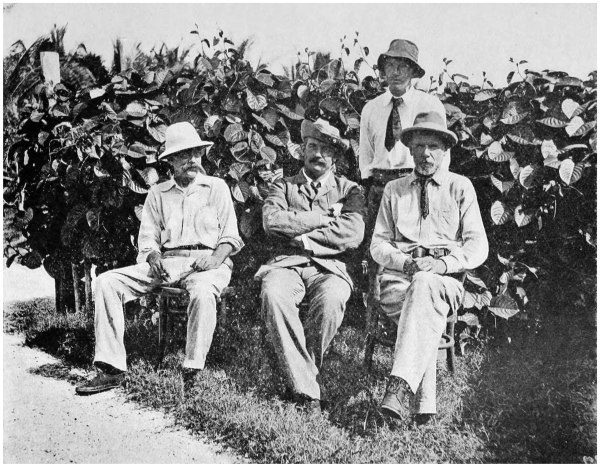
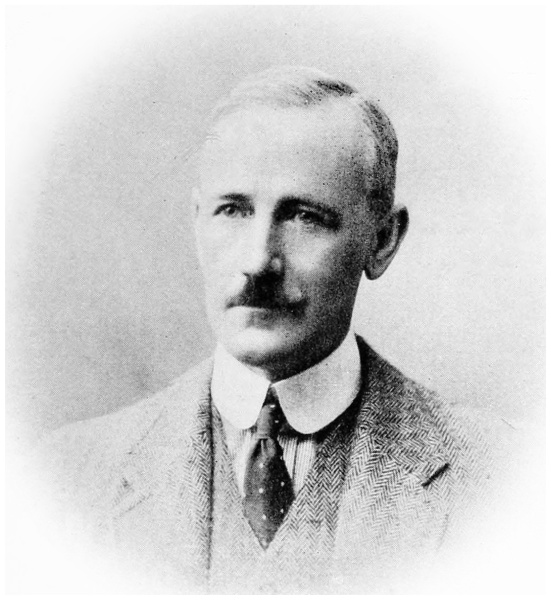
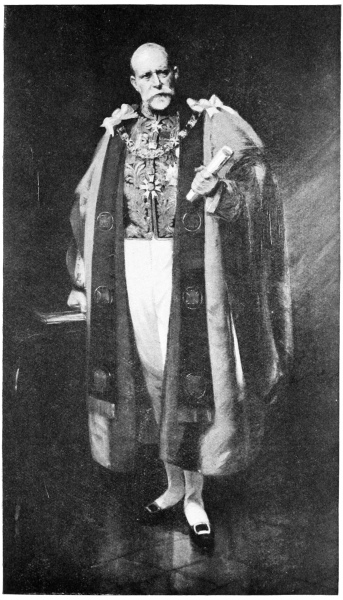
HONBLE. M. H. MORETON, R.M. MR. MANNING, P.S.
SIR GEORGE LE HUNTE, K.C.B. SIR FRANCIS WINTER, C.J.
The Merrie England brought me Mr. A. E. Oelrichs to take
Yaldwyn’s place as Assistant R.M. He was a very competent
man, and remained with me up to the time I left the country for
good and all; he had, however, one decided drawback in my
eyes, and that was his enormous size; he was an elephant of a
man, weighing, when in fine trim, nineteen stone, and plainly
only suited for Station or boat work. “What on earth did you
bring me that giant for?” I asked Captain Barton; “you know
what patrol work here is like, and this means that I shall have to
do the lot.” “He was due for promotion,” said Barton, “and so
I suggested to the Governor that he should be sent here.” “In
order to get him out of your own Division,” I suggested; “thank
you, Barton!” Barton was taking the Resident Magistrateship
of the Central Division. Oelrichs, however, turned out a good,
loyal assistant, a good drill instructor and disciplinarian, and very
competent generally.
He afterwards told me that his first impression of me was,
that I was the most callous brute in the Service, for he had
hardly been half an hour at the Station before he was seized with
violent colic and collapsed in a heap on the floor of my office,
groaning like a horse with gripes. “Here!” I yelled to the
police, “get some blankets and put them in a corner out of the
way; then put this man on top of them and undress him.” I
then gave the “fat man,” as he was ever after called in the
Division, a dose of opium and brandy. “How do you feel now?”
I asked. “I am dying,” groaned Oelrichs. “Well, I consider
it a most ungentlemanly thing, your coming here and choosing
my office as the most fitting place to die in: still, I suppose the
dying wishes of a man should be respected; die there, by all
means, but do it as quietly as possible,” I remarked. “What
is all this?” asked Macdonnell, as he came in and gazed
surprisedly at the quaking mountain of misery. “A dying
elephant, and a particularly noisy one,” I replied, looking up from
my papers; “see what you can do for him, I’ve no time. He
is grieved also at the lack of a coffin; I’ve told him such
luxuries as coffins are unknown north of Cape Vogel, but I will
allow him a blanket to be sewn up in, perhaps as he is extra
large, two blankets.” Off then I went to the Merrie England
and Samarai.
Arriving at Samarai, I went in search of Moreton, and found
him fairly broken up. “This last affair of Yaldwyn’s is the
finishing touch,” he said, “and the Judge has been giving me hell
for accepting the charge in its present form; also for allowing a
missionary to remove a female witness from my Court, and
adjourning the Court until your arrival, instead of fining or jugging
the man for contempt. The fact is, there is such a stew of
trouble already, that I didn’t want jugged missionary added to
it.” “Well,” I remarked, “we had better begin at once on
Yaldwyn’s case; you send for Yaldwyn and I will send a couple
of my own men for the missionary and the girl.”
We held and concluded our inquiry. The evidence showed
plainly that, though Yaldwyn had been with the girl in his own
camp, yet she was there of her own will and accord. Some
Mission natives knew of the affair and told the missionary, by
whom the girl was promptly taxed with her offence, and she
naturally said that she had been unwilling; whereupon the
missionary—not the girl or her father—had laid the charge.
The criminal charge against Yaldwyn was dismissed; and I
submitted the evidence to Sir Francis Winter, who noted, “The
magistrates were quite right in dismissing this case; there is not
the slightest criminal element in it.” The Governor’s minute
was short and sweet. “R.M., North-Eastern Division, dismiss
Yaldwyn at once.” I went to his Excellency and begged him to
permit Yaldwyn to resign; pointing out that, though his conduct
had been highly improper, he had been most unfairly charged
with a horrible crime of which he was not guilty, and that the
disgrace of that alone was a punishment he felt severely. It was
no use, however; Yaldwyn was dismissed. He then slunk away
to Milne Bay, where he moped and pined for a month, and then
died. Symons, the man responsible for the state the district had
got into, was reduced from magisterial rank, and sent as a clerk
to the Treasury; the fact of his being a married man with a
family being taken into consideration by Sir George. Moreton
was reduced and transferred to the South-Eastern Division, the
R.M. there being sent to Samarai in his stead. This was rough
luck on Moreton, who was innocent of all wrongdoing, and had
married in Australia during his last leave; for, when he was
transferred from pleasant Samarai to unpleasant Woodlark, his
wife refused to come up and live with him. The miners received
varying punishments, from fines up to sentences for manslaughter.
A man was now wanted for Milne Bay, pending the arrival
of Campbell, the new R.M.; and Turner, Macdonnell’s assistant—who
had consistently loafed ever since he had been in the Service—applied
for and got the job, he pointing out to his Excellency
that he intended to marry at once; that was enough for Sir
George, the domestic virtues always appealed to him, and so
Turner got the easiest job in New Guinea at fifty pounds a year
more salary than the sweating Assistants of the Northern and
North-Eastern Divisions. Macdonnell, his late chief, who had
toiled like a tiger, had his services dispensed with; mainly
because Turner’s supineness and laziness on the north-east coast
had prevented Macdonnell doing the amount of work his chief
expected. Turner’s appointment always struck me as a particularly
silly one: the reason that he received it was undoubtedly owing
to the fact that he was about to marry; but Turner was to marry
the daughter of Mrs. Mahony, a Samarai publican. Now, of all
things the natives were to be guarded against, it had always been
instilled into us that the chief one was any suspicion of their
obtaining liquor; and yet here, one of the watch-dogs appointed
was to have a direct and intimate connection with the liquor
trade in his own district: a man could hardly be expected to
watch, gaol, or heavily fine his own wife’s mother. My work in
Samarai was now done, and it behoved me to return to my
regular duties; accordingly, I went back to Cape Nelson.
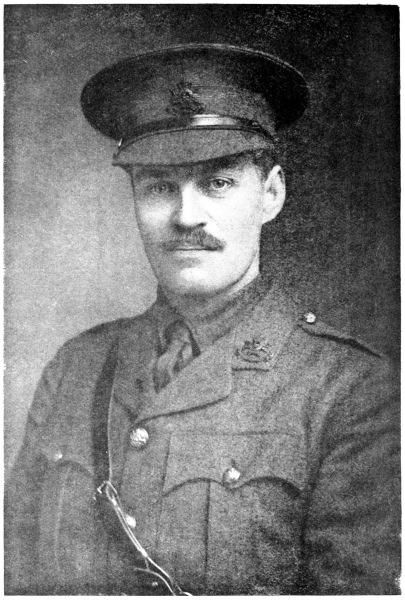
 MCMXXI

 down the throats of some of the people, and then
tore them up again. I caught the natives responsible for the
cutting open of the man, really by a great streak of luck. The
relations of the murdered man had complained to me about the
affair; but when I came with the police, the whole of the people
had run away from their villages to some bush refuge. We
searched and we hunted, but no sign of them could we find;
until at last we found a man crippled by elephantiasis, struggling
along a track. When we caught him, he was without food and
in a great fright, thinking that we should kill him; I questioned
him as to the whereabouts of his people, but could get no satisfaction.
Then, telling the police to leave him a supply of cooked
food, I gave him a stick of trade tobacco and a baubau or native
pipe, and marched on; a few minutes after we left him, we heard
yells, and sending back I found that he was willing to guide us to
the refuge of his people. “They left me,” he said, “to be killed
or to starve; you have given me food and tobacco, and if your men
will carry me, I’ll show you the hiding place.” Promptly he was
picked up and carried; and in two hours, we were marching for
the coast with the murderers on a chain.