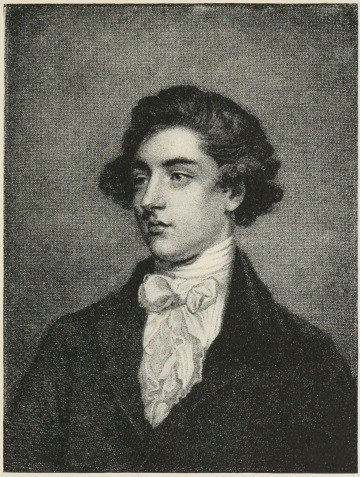
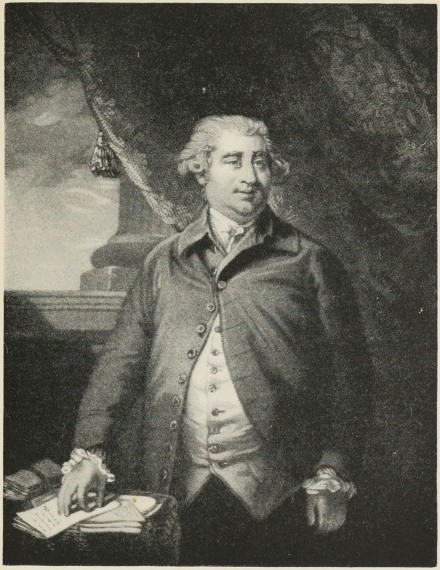
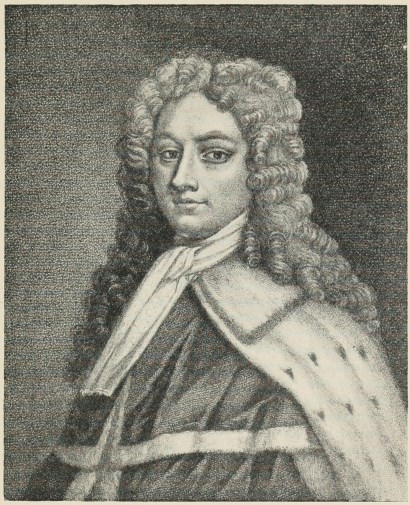
When Almack’s Club, composed of
all the travelled young men who
wore long curls and spying-glasses,
was in 1778 absorbed by Brooks’s, the day of the
Macaronis was past. Then, as Wraxall records,
Charles James Fox and his friends, who might
be said to lead the Town, affecting a style of
neglect about their persons and manifesting a contempt
of all the usages hitherto established, first
threw a sort of discredit on dress. “Fox lodged in
St James’s Street, and as soon as he rose, which
was very late, had a levée of his followers and of
the members of the gambling club at Brooks’s—all
his disciples,” Walpole wrote. “His bristly
black person, and shagged breast quite open and
rarely purified by any ablutions, was wrapped in a
foul linen nightgown, and his bushy hair dishevelled.
In these cynic weeds, and with epicurean
good humour, did he dictate his politics, and in
this school did the heir of the Crown attend his
lessons and imbibe them.”
The young Prince of Wales might study statecraft
under Fox; but in the matter of dress he
fell in line with the new race of beaux, bucks, or,
to use a word that came into general use at this
time, dandies. The most famous of the latter were
Lord Petersham, Lord Foley, Lord Hertford
(immortalised by Thackeray in “Vanity Fair”
as the Marquis of Steyne, and by Disraeli in
“Coningsby” as Lord Monmouth), the Duke
of Argyll, Lord Worcester, Henry Pierrepoint,
Henry de Ros, Colonel Dawson Darner, Daniel
Mackinnon, Lord Dudley and Ward, Hervey
Ashton, Gronow the memoirist, Sir Lumley
Skeffington, and Brummell.
These exquisites were disinclined to yield the
palm even to an heir-apparent with limitless resources.
The Prince of Wales, however, contrived
to hold his own. At his first appearance in society
he created a sensation. He wore a new shoe-buckle!
This was his own invention, and differed
from all previous articles of the same kind, insomuch
as it was an inch long and five inches
broad, reaching almost to the ground on either
side of the foot! This was good for an introduction
to the polite world, but it was not
until he attended his first Court ball that he did
himself full justice. Then his magnificence was
such that the arbiters of fashion were compelled
reluctantly to admit that a powerful rival had
come upon the scene. A contemporary was so
powerfully impressed by the splendour of the
Prince’s costume that he placed on record a
description: “His coat was pink silk, with
white cuffs; his waistcoat white silk, embroidered
with various coloured foil, and adorned
with a profusion of French paste; and his hat
was ornamented with two rows of steel beads,
five thousand in number, with a button and loop
of the same metal, and cocked in a new military
style.”
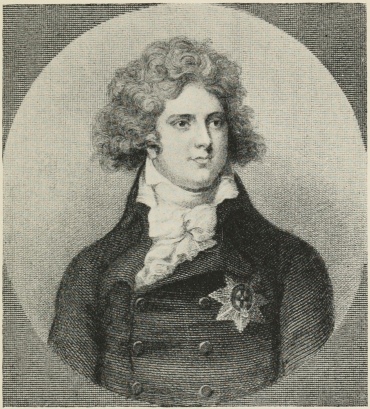
The laurels won in early youth he retained all
the days of his life. Expense was no object to him,
and, indeed, it must be confessed he spent money
in many worse ways than on his clothes. Batchelor,
his valet, who entered his service after the death
of the Duke of York, said that a plain coat, from
its repeated alterations and the consequent journeys
from London to Windsor to Davison the tailor,
would often cost three hundred pounds before it
met with his approbation! George had a mania
for hoarding, and at his death all the coats, vests,
breeches, boots, and other articles of attire which
had graced his person during half-a-century were
found in his wardrobe. It is said he carried the
catalogue in his head, and could call for any
costume he had ever worn. His executors, Lord
Gifford and Sir William Knighton, discovered
in the pockets of his coats, besides innumerable
women’s love letters, locks of hair, and other
trifles of his usually discreditable amours, no less
than five hundred pocket-books, each containing
small forgotten sums of money, amounting in all
to ten thousand pounds! His clothes sold for
fifteen thousand pounds; they cost probably ten
times that amount.
Lord Petersham was a Mæcenas among the
tailors, and the inventor of an overcoat called
after him. He was famous for his brown carriages,
horses, and liveries, all of the same shade; and his
devotion to this colour was popularly supposed
to be due to the love he had borne a widow of
the name. He never went out before six o’clock
in the evening, and had many other eccentricities.
Gronow has described a visit to his apartments:
“The room into which we were ushered was
more like a shop than a gentleman’s sitting-room.
All around the wall were shelves, upon which
were placed the canisters containing congou,
pekoe, souchong, bohea, gunpowder, Russian,
and many other teas, all the best of their kind;
on the other side of the room were beautiful
jars, with names in gilt letters of innumerable
kinds of snuff, and all the necessary apparatus
for moistening and mixing. Lord Petersham’s
mixture is still well known to all tobacconists.
Other shelves and many of the tables were
covered with a great number of magnificent
snuff-boxes; for Lord Petersham had perhaps
the finest collection in England, and was supposed
to have a fresh box for every day in the
year. I heard him, on the occasion of a delightful
old light-blue Sèvres box he was using being
admired, say in his lisping way, ‘Yes, it is a nice
summer box, but it would not do for winter
wear.’ ” Queen Charlotte had made snuff-taking
fashionable in England, but the habit began to
die out with the Regency. George IV. carried a
box, but he had no liking for it; and, conveying
it with a grand air between his right thumb and
forefinger, he was careful to drop it before it
reached his nose. He gave up the custom of
offering a pinch to his neighbours, and it was
recognised as a breach of good manners to dip
uninvited into a man’s box. When at the Pavilion
the Bishop of Winchester committed such an
infringement of etiquette, Brummell told a servant
to throw the rest of the snuff into the fire. When
Lord Petersham died, his snuff was sold by auction.
It took three men three days to weigh it, and
realised three thousand pounds.
Another eccentric was Lord Dudley and Ward,
sometime Secretary of State for Foreign Affairs,
who eventually lost his reason. His absence of
mind was notorious, and he had a habit of talking
aloud that frequently landed him in trouble.
Dining at the house of a gourmet, under the impression
he was at home, he apologised for the
badness of the entrées, and begged the company
to excuse them on account of the illness of his
cook! Similarly, when he was paying a visit he
imagined himself to be the entertainer, and when
his hostess had exhausted her hints concerning
the duration of his call, he murmured, “A very
pretty woman. But she stays a devilish long time.
I wish she’d go.” Still more amusing were his
remarks in the carriage of a brother peer who
had volunteered to drive him from the House of
Lords to Dudley House: “A deuce of a bore!
This tiresome man has taken me home, and will
expect me to ask him to dinner. I suppose I must
do so, but it is a horrid nuisance.” This was too
much for his good-natured companion, who, as
if to himself, droned in the same monotonous
tones, “What a bore! This good-natured fellow
Dudley will think himself obliged to invite me
to dinner, and I shall be forced to go. I hope he
won’t ask me, for he gives d——d bad dinners.”
These stories recall another related of an absent-minded
royal duke, who, when during the
service the parson proposed the prayer for rain,
said in a voice audible throughout the church,
“Yes, by all means let us pray, but it won’t be
any good. We sha’n’t get rain till the moon
changes.”
After Brummell left England, it was to William,
Lord Alvanley that all the witty sayings of the
day were attributed. The son of the famous
lawyer Sir Pepper Arden,5 he began life in the
Coldstream Guards, of which the colonel was
the Duke of York. He achieved his earliest
success as a wit at the expense of a brother
officer, Gunter, a scion of the famous catering-house.
Gunter’s horse was almost beyond the
control of the rider, who explained that his
horse was too hot to hold. “Ice him, Gunter;
ice him,” cried Alvanley. Thrown into such
company, it was not perhaps unnatural that
Alvanley should be extravagant; but his carelessness
in money matters was notorious. He
never paid ready money for anything, and
never knew the extent of his indebtedness. He
had no sympathy with those who devoted some
time and trouble to the management of their
affairs, and expressed the utmost contempt for a
friend who was so weak as to “muddle away his
fortune paying tradesmen’s bills.” Though very
wealthy, he soon became embarrassed in his
circumstances. He persuaded Charles Greville,
the author of the “Journals,” to put his affairs
in order. The two men spent a day over accounts,
and Greville found that the task he had undertaken
would not be so difficult as he had been
given to understand. His relief was not long-lived,
however, for on the following morning he
received a note from Alvanley saying he had
quite forgotten a debt of fifty thousand pounds!
Alvanley was famous for his dinners, and indulged
in the expensive taste of having an apricot
tart on his table every day throughout the year.
His dinners were generally acclaimed as the best
in England; certainly he spared no expense in
the endeavour to secure the blue ribbon of the
table. Even Abraham Hayward commented on
his extravagance. “He had his suprême de
volaille made of the oysters, or les sots, les-laissent
of fowls, instead of the fillet from the breast,”
he noted in “The Art of Dining,” “so that it
took a score of birds to complete a moderate
dish.” It was Alvanley who organised a
wonderful freak dinner at White’s Club, at
which the inventor of the most costly dish
should dine at the cost of the others; and he
won easily. His contribution to the feast was
a fricassée made of the noix, or small pieces at
each side of the back, taken from thirteen
different kinds of birds, among them being
a hundred snipe, forty woodcocks, twenty
pheasants—in all some three hundred birds.
The cost of this dish exceeded one hundred
pounds.
As he was beloved by his friends and vastly
popular, society was enraged when O’Connell in
the House of Commons spoke of him as “a
bloated buffoon.” A challenge was sent at once,
but the Liberator refused to go out. He had been
on the ground once, had killed his man, and had
vowed never to fight another duel. Alvanley would
not forgive the insult, however, and threatened
to thrash the aggressor; whereupon Morgan
O’Connell met him in place of his father, when
several shots were exchanged without result.
“What a clumsy fellow O’Connell must be, to
miss such a fat fellow as I!” said Alvanley
calmly. “He ought to practise at a haystack to
get his hand in.” Driven back to London, he
gave the hackney-coachman a sovereign. “It’s a
great deal,” said the man gratefully, “for having
taken your lordship to Wimbledon.” “No, my
good fellow,” the peer laughed; “I give it you,
not for taking me, but for bringing me back.”
Beyond all question the greatest dandy of his
day was George Bryan Brummell, generally
called Beau Brummell. This famous personage
dominated all his rivals, and even the Prince of
Wales accepted him at least as an equal. It is
not known with any certainty how his acquaintance
began with the heir-apparent. Brummell’s
aunt, Mrs Searle, who had a little cottage with
stables for cows at the entrance, opposite Clarges
Street, of the Green Park, in which she had been
installed by George III., related that it was one
day when the Prince of Wales, accompanied by
the beautiful Marchioness of Salisbury, stopped
to see the cows milked that he first met her
nephew, was attracted by him, and, hearing he
was intended for the army, offered him a commission
in his own regiment. Gronow gives
another story, which on the face of it is more
probable. Brummell made many friends among
the scions of good family while he was at Eton,
where he seems to have been regarded as an
Admirable Crichton: “the best scholar, the best
boatman, the best cricketer.” He was invited to
a ball at Devonshire House, became a great
favourite, and was asked everywhere. The Prince
sent for him, and, pleased by his manner and
appearance, gave him a commission. In his seventeenth
year he was gazetted to a cornetcy in the
Tenth Light Dragoons. He resigned soon after
because the regiment was ordered to Manchester!6
Brummell threw himself heart and soul into the
social life of the metropolis, and soon his reputation
extended far and wide, until no party was complete
without him, and his presence was regarded
as the hall-mark of fashion. He was the very man
for the part he had set himself. Tall, well made,
with a good figure, he affected an old-world air
of courtesy, picked up probably from the French
refugees, as he had never been out of England
until he left it for good. His affectation of vieille
cour showed itself in the use of powder, which
distinguished him in the days when the custom
was dying out among civilians. His grandfather
was a tradesman, and let lodgings in Bury Street,
St James’s. His father, by the influence of a lodger,
was presented to a clerkship in the Treasury,
became private secretary to Lord North, made
money by speculation, settled down at Donnington,
and became High Sheriff of Berkshire,
where he was visited by Fox and Sheridan.
Though of no rank, Brummell lived with the
highest in the land on terms of equality. His
acquaintance was sought, his intimacy desired;
and, so far from requiring a patron, it was he
who patronised. His influence was unbounded,
his fascination undeniable, his indifference to
public opinion reckless. He was good-natured
and rarely out of humour; neither a drunkard
nor a profligate. He had bright and amusing conversation,
some wit, and a considerable power of
persiflage, which, while it enabled him to laugh
some people out of bad habits, only too frequently
was exerted to laugh others out of good principles.
He revived the taste for dress. “Clean linen, and
plenty of it” was an important item of his creed.
His great triumph was in connection with the
cravat. Before he came into his own they were
worn without stiffening of any kind; as soon as
he ascended his throne he had them starched!7
A revolution would not have attracted more attention.
Thereafter his sway was undisputed, and his
word law in all matters of fashion. The Prince of
Wales used to call on him in the morning at his
house in Chesterfield Street, and, deeply engrossed
in the discussion of costume, would frequently remain
to dinner. “Brummell was always studiously
and remarkably well dressed, never outré; and,
though considerable time and attention were devoted
to his toilet, it never, when once accomplished,
seemed to occupy his attention,” said one
who knew him well. “His manners were easy,
polished, and gentleman-like, and regulated by
that same good taste which he displayed in most
things. No one was a more keen observer of vulgarity
in others, or more piquant in his criticisms,
or more despotic as an arbiter elegantarium; he
could decide the fate of a young man just launched
into the world with a single word.”8
The tastes of the Prince of Wales verged on the
florid, but Brummell’s efforts tended to simplicity
of costume. Under Brummell the dandy’s dress
consisted of a blue coat with brass buttons, leather
breeches, and top-boots; with, of course, the deep,
stiff white cravat which prevented you from seeing
your boots while standing. Gronow relates
that while he was in Paris after Waterloo trousers
and shoes were worn by young men, only old
fogies favouring knee-breeches. On his return to
England in 1816, receiving from Lady Hertford
an invitation to Manchester House “to have the
honour of meeting the Prince Regent,” he went
dressed à la Française—white neckcloth, waistcoat,
black trousers, shoes and silk stockings. He
made his bow, and almost immediately afterwards
Horace Seymour came to him: “The great man
is very much surprised that you should have ventured
to appear in his presence without knee-breeches.
He considers it as a want of proper
respect for him.” Gronow went away in high
dudgeon. A month later the Prince adopted the
dress he had censured!
All the world watched Brummell to imitate
him. He made the fortune of his tailor, Weston,
of Old Bond Street, and of his other tradesmen.
The most noteworthy of these was Hoby, the St
James’s Street bootmaker, an impertinent and
independent man who employed his leisure as a
Methodist preacher. Many good stories are told
of him. It was he who said to the Duke of Kent,
when the latter informed him of the issue of the
great battle at Vittoria, “If Lord Wellington had
had any other bootmaker than myself he would
never have had his great and constant successes,
for my boots and my prayers bring him out of all
his difficulties.” When Horace Churchill entered
his shop and complained in no moderate words of
a pair of boots, vowing he would never employ him
again, Hoby quickly turned the tables. “John,
close the shutters,” he cried to an assistant, affecting
a woebegone look. “It is all over with us. I
must shut up shop. Ensign Churchill withdraws
his custom from me.” Sir John Shelley once
showed him a pair of top-boots that had split in
several places. “How did that happen, Sir John?”
“Why, in walking to my stable,” the customer
explained. “Walking to your stable!” Hoby exclaimed,
not troubling to suppress a sneer. “I
made the boots for riding, not walking.”9
It is but a step from boots to blacking, an
article to which the dandies devoted much attention.
Lieutenant-Colonel Kelly, of the First Foot
Guards, was famous for his well-varnished boots.
After his death, which occurred in a fire owing to
his efforts to save his favourite boots, all the men
about town were anxious to secure the services of
his valet, who alone knew the secret of the blacking.
Brummell found the man and asked his wages.
The Colonel had given him a hundred and fifty
pounds a year, but now he required two hundred.
“Well, if you will make it guineas,” said the Beau,
“I shall be happy to attend upon you!” Lord
Petersham spent a great deal of time in making
a particular kind of blacking which he believed
would eventually supersede all others, and Brummell
declared, “My blacking ruins me; it is made
with the finest champagne.” But Brummell must
not be taken too seriously. He was a master poseur,
and many of his critics have fallen into the error
of taking him literally. Thus it has apparently
never occurred to his biographers to think he was
joking when, in reply to a lady who inquired what
allowance she should make her son who was about
to enter the world, he assured her that, with
economy, her son could dress on eight hundred a
year. They merely comment upon his terribly
extravagant ideas. Again, when the Beau, speaking
of a boy, said with apparent earnestness,
“Really, I did my best for the young man; I
once gave him my arm all the way from White’s
to Watier’s”—about a hundred yards—they discuss
his enormous conceit!
There are several accounts of the cause of the
rupture of the intimacy between Brummell and
the Prince. It is certain, however, that the story
of “Wales, ring the bell,” has no foundation. “I
was on such intimate terms with the Prince that
if we had been alone I could have asked him without
offence to ring the bell,” Brummell said; “but
with a third person in the room I should never
have done so. I knew the Regent too well.” The
story was true in so far as the order, “Wales,
ring the bell,” was given at the royal supper-table
by a lad who had taken too much to drink. The
Prince did ring the bell, and when the servants
came, told them, good-humouredly enough, to
“put that drunken boy to bed.” One authority
says the quarrel arose because Brummell spoke
sarcastically of Mrs Fitzherbert, another because
he spoke in her favour when the Prince was bestowing
his smiles in another quarter. The Beau
believed it was because of remarks concerning both
Mrs Fitzherbert and the Prince. There is no doubt
Brummell did allow himself considerable licence
of speech, and having a ready wit, was not inclined
to forego its use.
A curious tale was told by General Sir Arthur
Upton to Gronow. It seems that the first estrangement
did not last long. Brummell played whist at
White’s Club one night, and won from George
Harley Drummond10 the sum of twenty thousand
pounds. The Duke of York told the Prince of the
incident, and the Beau was again invited to Carlton
House. “At the commencement of the dinner
matters went off smoothly; but Brummell, in his
joy at finding himself with his old friend, became
excited, and drank too much wine. His Royal
Highness—who wanted to avenge himself for an
insult he had received at Lady Cholmondeley’s
ball, when the Beau, looking towards the Prince,
said to Lady Worcester, ‘Who is your fat friend?’—had
invited him to dinner merely out of a desire
for revenge. The Prince, therefore, pretended to
be affronted with Brummell’s hilarity, and said to
his brother, the Duke of York, who was present,
‘I think we had better order Mr Brummell’s
carriage before he gets drunk’; whereupon he
rang the bell, and Brummell left the royal
presence.” As Sir Arthur was present at the dinner,
there can be no doubt as to the facts; and, knowing
the character of the royal host as we do, there
is no reason to doubt that he invited a guest to
insult him. That is quite of a piece with his conduct
on other occasions; but it seems certain that
the motive that spurred the Prince on to revenge
was not that attributed to him. Of all the versions
of the “Who’s your fat friend?” episode, that
given by the General is the least likely. Inaccurate,
too, is Raikes when he tells of Brummell
asking the famous question of Jack Lee in St
James’s Street, after the latter had been seen speaking
to the Prince.
The true story is the following: A dandies’
ball was to be given by Lord Alvanley, Sir Henry
Mildmay, Henry Pierrepoint and Brummell to
celebrate a great run of luck at hazard. The question
of inviting the Prince was mooted, but it was
negatived because all felt sure it would be declined,
since he was not on friendly terms with Brummell.
The Prince, however, sent an intimation that he
desired to be present, and of course a formal invitation
was despatched. The four hosts assembled
at the door to do honour to their royal guest,
who shook hands with three of them, but looked
Brummell full in the face and passed on without
any sign of recognition. Then it was, before the
Prince was out of hearing, that Brummell turned
to his neighbour and asked with apparent nonchalance,
“Alvanley, who’s your fat friend?”
After this there was war to the death, and
Brummell, who was a good fighter, did not miss
any opportunity to wound his powerful antagonist.
He was passing down Pall Mall when the Regent’s
carriage drew up at a picture gallery. The sentries
saluted, and, keeping his back to the carriage,
Brummell took the salute as if to himself. The
Prince could not hide his anger from the bystanders,
for he looked upon any slight to his dignity as
rather worse than high treason. The foes met
again later on in the waiting-room at the opera.
An eye-witness has described the rencontre: “The
Prince of Wales, who always came out rather before
the performance concluded, was waiting for
his carriage. Presently Brummell came out, talking
eagerly to some friends, and, not seeing the
Prince or his party, he took up a position near the
checktaker’s bar. As the crowd flowed out, Brummell
was gradually pressed backwards, until he was
all but driven against the Regent, who distinctly
saw him, but of course would not move. In order
to stop him, therefore, and prevent actual collision,
one of the Prince’s suite tapped him on the
back, when Brummell immediately turned sharply
round, and saw there was not much more than a
foot between his nose and the Prince of Wales’s.
I watched him with intense curiosity, and observed
that his countenance did not change in the slightest
degree, nor did his head move; they looked straight
into each other’s eyes, the Prince evidently amazed
and annoyed. Brummell, however, did not quail,
or show the least embarrassment. He receded
quite quietly, and backed slowly step by step
till the crowd closed between them, never once
taking his eyes off those of the Prince.” Moore,
in the Twopenny Post Bag, commemorated the
quarrel in his parody of the letter from the
Prince of Wales to the Duke of York, in which
he says:
“I indulge in no hatred, and wish there may come ill
To no mortal, except, now I think on’t, Beau Brummell,
Who declared t’other day, in a superfine passion,
He’d cut me and bring the old King into fashion.”
Brummell contrived to hold his own until he
took to card-playing. His patrimony of thirty
thousand pounds was insufficient to justify him in
entering the lists with his companions. It was the
case of the earthenware pot and the iron pots. At
first he was unsuccessful, and as he was not then
addicted to games of chance, his depression was
very great. Walking home from a club with Tom
Raikes, he was lamenting his bad fortune, when
he saw something bright in the roadway. He
stooped and picked up a crooked sixpence. “This,”
he said to his companion with great cheerfulness,
“is the harbinger of good luck.” He drilled a hole
in it and fastened it to his watch-chain. The talisman
worked, and he won thirty thousand pounds
in the next two years.
Fortune deserted him; but he did not lose
even a third of his winnings, and Raikes, in his
“Memoirs,” remarks that he was never more
surprised than when in 1816, one morning, Brummell
confided to him that his situation had become
so desperate that he must fly the country that night,
and by stealth. He had lived above his income,
had got into debt, and then had fallen into the
hands of the notorious usurers, Howard and Gibbs.
Other money-lenders may have had claims upon
him; for when it was said to Alvanley that if
Brummell had remained in London something
might have been done for him by his friends, the
witty peer made a bon mot: “He has done quite
right to be off; it was Solomon’s judgment.”11
He went no farther than Calais. “Here I am
restant for the present, and God knows solitary
enough is my existence; of that, however, I should
not complain, for I can always employ resources
within myself, was there not a worm that will not
sleep, called conscience, which all my endeavours to
distract, all the strength of coffee, with which I
constantly fumigate my unhappy brains, and all
the native gaiety of the fellow who brings it to me,
cannot lull to indifference beyond the moment;
but I will not trouble you upon that subject.”
He wrote to Tom Raikes on 22nd May 1816, soon
after his arrival: “You would be surprised to find
the sudden change and transfiguration which one
week has accomplished in my life and propriâ
personâ. I am punctually off the pillow at half-past
seven in the morning. My first object—melancholy,
indeed, it may be in its nature—is
to walk to the pier-head, and take my distant look
at England. This you may call weakness; but I
am not yet sufficiently master of those feelings
which may be called indigenous to resist the
impulse. The rest of my day is filled up with
strolling an hour or two round the ramparts of
this dismal town, in reading, and the study of that
language which must hereafter be my own, for
never more shall I set foot in my own country. I
dine at five, and my evening has as yet been
occupied in writing letters. The English I have
seen here—and many of them known to me—I
have cautiously avoided; and with the exception
of Sir W. Bellingham and Lord Blessington, who
have departed, I have not exchanged a word.
Prince Esterhazy was here yesterday, and came
into my room unexpectedly without my knowing
he was here. He had the good nature to convey
several letters for me upon his return to London.
So much for my life hitherto on this side of the
water.”
At first he put up at the famous Dessein’s, but
soon he went into apartments at the house of
M. Leleux. His friends came to the rescue—Alvanley,
Worcester, Sefton, no doubt Raikes
too, and others—and sent him a good round sum
of money. But his habits had grown upon him,
and he could not live economically. If he saw
buhl or marqueterie or Sèvres china that he liked
he bought it; and he could not accustom himself
to the penny-wise economies of life. He would not
give way to despair, and, naturally high-spirited,
he fought bravely against depression. He wished
to be appointed consul at Calais, and his friends’
influence would have secured him the position,
but no vacancy occurred.
He had a gleam of hope on hearing of the accession
to the throne of his old companion. “He is
at length King,” he wrote; “will his past resentments
still attach themselves to his Crown? An
indulgent amnesty of former peccadilloes should
be the primary grace influencing newly throned
sovereignty; at least towards those who were once
distinguished by his more intimate protection.
From my experience, however, of the personage
in question, I must doubt any favourable relaxation
of those stubborn prejudices which have,
during so many years, operated to the total exclusion
of one of his élèves from the royal notice:
that unfortunate—I need not particularise. You
ask me how I am going on at Calais. Miserably!
I am exposed every hour to all the turmoil and
jeopardy that attended my latter days in England.
I bear up as well as I can; and when the mercy
and patience of my claimants are exhausted I
shall submit without resistance to bread and water
and straw. I cannot decamp a second time.”12
The new King made no sign. But soon came
the news that he was going abroad, and would
stay a night at Calais. The pulse of the exiled
dandy must have beat quickly. It was the time
for forgiveness; and, after all, his offence had
not been very rank. If there were generosity in
the heart of the monarch, surely, surely he would
hold out the right hand of fellowship to the
vanquished foe. The meeting came about unexpectedly.
Brummell went for a walk out of the
town in the opposite direction to that on which
the King would enter it. On his return he tried
to get across the street, but the crowd was so
great that he remained perforce on the opposite
side. The King’s carriage passed close to him.
“Good God, Brummell!” George cried in a loud
voice. Then Brummell, who was hat in hand
at the time, crossed the road, pale as death, and
entered his room.
George dined in the evening at Dessein’s, and
Brummell sent his valet to make the punch, giving
him to take over a bottle of rare old maraschino,
the King’s favourite liqueur. The next morning
all the suite called except Bloomfield, and each
man tried to persuade him to ask for an audience.
Brummell signed his name in the visitors’ book.
His pride would let him do no more. He had
taken the first steps; would the King send for
him? George left without a word. Afterwards he
actually boasted he had been to Calais without
seeing Brummell! So the men went their ways,
never to meet again. The King had won. He had
seen his old friend, his old foe—which you will—his
old comrade, beaten, bankrupt, humbled,
and he had passed him by. The King had won,
yet perhaps for once it was better to be the vanquished
than to win at such a price. Perhaps in
the last years of his life George thought once more
of Brummell, as himself half blind, half mad,
utterly friendless, he went down to the grave unwept
and unhonoured.
Others were more generous than the King.
The Duke of Wellington invited two successive
Ministers for Foreign Affairs to do something for
the exile. Both hesitated on the ground that his
Majesty might disapprove, whereupon Wellington
went to Windsor and spoke to the King, “who
had made objections, abusing Brummell—said he
was a damned fellow and had behaved very ill to
him (the old story—moi, moi, moi); but after having
let him run his tether, he had at last extracted
his consent.” Still, nothing was done until after
Charles Greville was at Calais in 1830: “There
I had a long conversation with Brummell about
his consulship, and was moved by his account of
his own distresses to write to the Duke of Wellington
and ask him to do what he could for him.
I found him in his old lodging, dressing—some
pretty pieces of old furniture in the room, an
entire toilet of silver, and a large green macaw
perched on the back of a tattered silk chair with
faded gilding—full of gaiety, impudence, and
misery.”
The consulate at Caen, to which a salary of
four hundred a year was attached, was secured for
him. Brummell arranged that part of his income
should be set aside to pay his debts (which
amounted to about a thousand pounds), and his
creditors allowed him to leave Calais. He had
not long been installed when he wrote a formal
letter to Lord Palmerston, then Foreign Secretary,
stating that the place was a sinecure and the duties
so trifling that he should recommend its abolition.
It has never been made clear why he took this
remarkable step. Was it in the hope of being
appointed to a better position? Was it in the
desire to evade the payment of his debts? Was
it honesty? Whatever the cause, his action recoiled
on himself. Lord Palmerston was regretfully
compelled to take the consul at his word,
and the place was reduced.
Brummell continued to live at Caen; but, being
without resources, he sank deeper into debt, and
in 1835 his creditors put him into prison. For the
last time his friends came to his assistance. William
IV. subscribed a hundred pounds. Palmerston
gave twice that amount from the public purse.
Enough was obtained to secure his liberation and
to settle upon him an annuity of one hundred
and twenty pounds. Soon he sank into a state
of imbecility, and he ended his days in the
asylum Bon Sauveur. He died on 30th March
1840.
A moral can easily be drawn from the story of
this unfortunate man, and many writers have
dwelt upon the lesson it furnishes. Yet there
were many worse than he in the circle of which
he was the arbiter. He lived his life: he paid the
price. Let him rest in peace.
With the departure from England of Brummell
the cult of the dandy began to decline.
Count D’Orsay the Magnificent, however, galvanised
it into fashion for a while. “He is a grand
creature,” Gronow described him; “beautiful as
the Apollo Belvedere in his outward form; full
of health, life, spirits, wit, and gaiety; radiant
and joyous; the admired of all admirers.”
He had an amusing naïveté in speaking of his
personal advantages. “You know, my dear friend,
I am not on a par with my antagonist,” he said
to his second on the eve of a duel. “He is a very
ugly man, and if I wound him in the face he
won’t look much the worse for it; but on my
side it ought to be agreed that he shall not aim
higher than my chest, for if my face should be
spoiled ce serait vraiment dommage.”
The dandies of a later day were but poor things—pinchbeck.
Captain Gronow, in his youth a
beau of no mean order, pours contempt upon
their pretensions in no measured terms. “How
unspeakably odious—with a few brilliant exceptions,
such as Alvanley and others—were the
dandies of forty years ago [1822]! They were
generally middle-aged, some even elderly, men,
had large appetites and weak digestions, gambled
freely, and had no luck. They hated everybody
and abused everybody, and would sit together in
White’s bay window or the pit-boxes at the opera
weaving tremendous crammers. They swore a
good deal, never laughed, had their own particular
slang, looked hazy after dinner, and had most of
them been patronised at one time or other by
Brummell and the Prince Regent.... They
gloried in their shame, and believed in nothing
good or noble or elevated. Thank Heaven, that
miserable race of used-up dandies has long been
extinct! May England never look upon their like
again!”
The prayer may well be echoed. The bad influence
of the dandies can scarcely be over-estimated;
and the effect upon their own class of society was
terrible. Their morals were contemptible, and
they were without principle. Prodigality was their
creed, gambling their religion. The list of those
who died beggared is not much longer than the
list of those who died by their own hands. They
indulged in no manly exercises, and devoted their
days to their personal decoration and to the card-table.
Extravagance of all kinds was fashionable.
Clothes, canes, snuff-boxes, must be expensive to
be worthy of such distinguished folk, whose sole
aim it was to outvie each other. A guinea was
the least that could be given to the butler when
dining out; but this was an improvement upon
the day when Pope, finding it cost him five
guineas in tips whenever he dined with the
Duke of Montagu, informed that nobleman he
could not dine with him in future unless he sent
him an order for the tribute-money.
There was Wellesley Pole, who, after the opera,
gave magnificent dinners at his home at Wanstead,
where rare dishes were served and the greatest
luxury obtained. He married Miss Tylney Pole,
who brought him fifty thousand a year; and
he died a beggar. There was “Golden Ball”
Hughes, with forty thousand a year, who, when
the excitements of the gaming-room were not
to be had, would play battledore and shuttlecock
through the whole night, backing himself
for immense sums. He married a beautiful
Spanish danseuse, Mercandotti, who appeared in
London in 1822. Whereupon Ainsworth made
an epigram:
“The fair damsel is gone, and no wonder at all
That, bred to the dance, she is gone to a Ball.”
The honeymoon was spent at Oatlands, purchased
from the Duke of York. It was thought to be a
foolish investment; but when Hughes fell upon
evil days he was able to sell the estate for a
large sum, as the new railway skirted it, and
speculative builders were anxious to acquire the
land, and so some of his old prosperity returned.
There was Lord Fife, an intimate friend of the
Regent’s, who spent forty thousand pounds on
Mademoiselle Noblet the dancer. A chapter
would not suffice for an account of the vicious
and foolish habits of these men.
The clubs were then a far more important
feature in social life than they are to-day. They
were accessible only to those who were in society,
which in those days was exclusive, and consisted
of a comparatively small body in which everyone
knew everyone else, if not personally, at
least by name. There were then no clubs for
professional men save those of the first rank, or
for merchants, or for the hoi polloi.
In more or less direct rivalry with the clubs
were some of the hotels, and men such as Wellington,
Nelson, Collingwood and Sir John Moore
used them as a meeting-place—at the beginning
of the eighteenth century about fifteen in number,
not including, of course, the large coaching inns,
coffee, eating, and the à la mode beef houses, most
of which had beds for customers. First and foremost
of these, kept by a French chef, Jacquiers,
who had served Louis XVIII. and Lord Darnley,
was the Clarendon, built upon a portion of the
gardens of Clarendon House, between Bond Street
and Albemarle Street, in each of which the hotel
had a frontage. This was the only place in England
where a French dinner was served that was worthy
of mention in the same breath with those obtainable
in Paris at the Maison Doré or Rocher de
Cancalle’s. The prices were very high. Dinner
cost three or four pounds a head, and a bottle of
claret or champagne was not obtainable under a
guinea. A suite of apartments was reserved for
banquets, and it was in these that the famous
dinner, ordered by Count D’Orsay, was given to
Lord Chesterfield when he resigned the office of
Master of the Buckhounds. Covers were laid for
thirty, and the bill, exclusive of wine, came to
one hundred and eighty guineas.
Limmer’s was another well-known hotel, the
resort of the sporting world and of rich country
squires. It was gloomy and ill-kept, but renowned
for its plain English cooking and world-famous
for gin-punch. The clergy went to Ibbetson’s,
naval men to Fladong’s in Oxford Street, and
army officers and men about town to Stephen’s
in Bond Street. Most of these hostelries had their
regular frequenters, and strangers were not, as a
rule, encouraged to use them as a house of call.
Clubs were few in number. There was “The
Club” of Johnson; the Cocoa-Tree, which arose
out of the Tory Chocolate House of Anne’s reign;
the Royal Naval Club, a favourite haunt of the
Duke of Clarence; and the Eccentrics, which
numbered among its members such well-known
men as Fox, Sheridan, Lord Petersham, Brougham,
Lord Melbourne, and Theodore Hook. Graham’s
was second rate; nor was Arthur’s in the first
flight. When Arthur died, his son-in-law,
Mackreth, became the proprietor. He prospered,
became a member of Parliament in 1774, and
was afterwards knighted. His name is preserved
in a very good epigram:
“When Mackreth served in Arthur’s crew,
He said to Rumbold, ‘Black my shoe’;
To which he answered, ‘Ay, Bob.’
But when return’d from India’s land,
And grown too proud to brook command,
He sternly answered, ‘Nay, Bob.’
”13
An institution of a somewhat different class
was the Beefsteak Society, which flourished so
long ago as the early years of the eighteenth
century. The Prince of Wales became a member
in 1785, when the number of the Steaks was increased
from twenty-four to twenty-five in order
to admit him; and subsequently the Dukes of
Clarence and Sussex were elected. The bill of
fare was restricted to beefsteaks, and the beverages
to port wine and punch; but the cuisine on at
least one occasion left something to be desired,
for when, in 1830, the English Opera House
was burnt down, Greville remarked in his diary:
“I trust the paraphernalia of the Beefsteak Club
perished with the rest, for the enmity I bear that
society for the dinner they gave me last year.”
Charles Morris was the bard of the Beefsteak
Society, and he has come down to posterity on
the strength of four lines:
“In town let me live then, in town let me die,
For in truth I can’t relish the country, not I.
If one must have a villa in summer to dwell,
Oh, give me the sweet, shady side of Pall Mall!”
In spite of his prayer, he spent the last years of
his life in the rural retreat of Brockham, in
Surrey, in a little place presented to him by his
fellow-Steak, the Duke of Norfolk. He lived to
the great age of ninety-two, and was so hale and
hearty and cheerful that, not long before his
death, Curran said to him, “Die when you will,
Charles, you will die in your youth.”
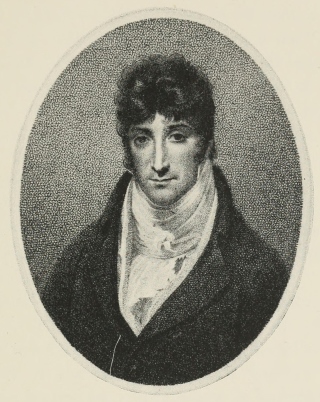
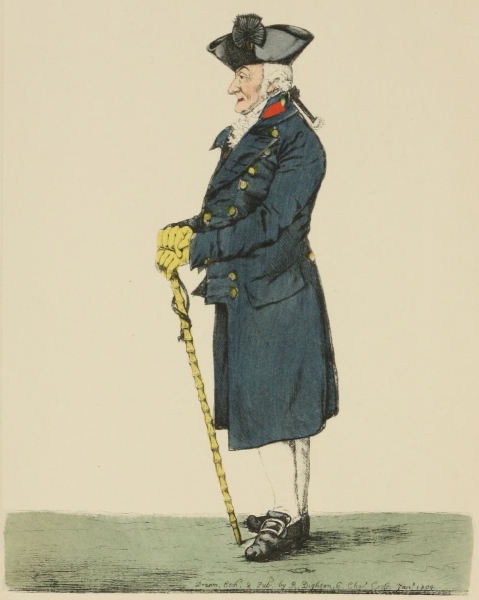
Lumley St. George Skeffington Esqr.
The greatest club of its day was Almack’s, at
5 Pall Mall, founded in 1740 by Macall, a Scotsman.
This institution was nicknamed the “Macaroni
Club,” owing to the fashion of its members;
and Gibbon remarked that “the style of living,
though somewhat expensive, is exceedingly pleasant,
and notwithstanding the rage of play, I have
found more entertainment and rational society
here than in any other club to which I belong.”
The high play, which was the bane of half the
English aristocracy, ruined many members. The
club fell upon evil days, and was absorbed by
Brooks’s.
White’s and Brooks’s took the place of Almack’s.
The former, established in 1698 as
“White’s Chocolate-House,” five doors from the
bottom of the west side of St James’s Street,
became a club in 1755, when it moved to No.
38, on the opposite side of the street. It was
owned successively by Arthur Mackreth, John
Martindale, and in 1812 by Raggett, whose son
eventually inherited it. Brooks’s was founded by
a wine merchant and money-lender of the name,
who has been described by Tickell in verses
addressed to Sheridan, when Charles James Fox
was to give a supper at his rooms near the club:
“Derby shall send, if not his plate, his cooks;
And know, I’ve bought the best champagne from Brooks,
From liberal Brooks, whose speculative skill
Is hasty credit and a distant bill;
Who, nursed in clubs, disdains a vulgar trade,
Exults to trust, and blushes to be paid.”
Both clubs, although more or less instituted for
the purpose of gambling, were at first political.
White’s, however, soon took down the Tory flag
and received members without reference to their
political opinions. Brooks’s, on the other hand,
remained true to its Whig traditions; and it was
to counterbalance the influence of this institution—the
“Reform” of that time—that the Carlton
Club was organised by Lord Clanwilliam and
others. These, with Boodles’, were the great
resorts of the dandies; and the bay window at
White’s, when Brummell was the lion, was one of
the sights of the town. The Prince of Wales was
a member of Brooks’s; but when his boon companions
Tarleton and Jack Payne were blackballed
he withdrew, and on his own account
founded a new club, of which the manager was
Weltzie, his house-steward.
Watier’s, the great macao gambling-house, was
founded in 1807; but play was very high, and
it lasted only for twelve years. According to
Gronow it came into existence in a somewhat
curious way. When some members of White’s
and Brooks’s were dining at Carlton House, the
Prince of Wales asked what sort of dinners
were served at these institutions. One of the
guests complained: “The eternal joints and
beefsteaks, the boiled fowl with oyster sauce,
and an apple-tart. This is what we have, sir, at
our clubs, and very monotonous fare it is.” The
Prince sent for Watier, his chef, and asked if he
would take a house and organise a club-dinner.
Watier was willing. The scheme was carried
out, and the club was famed for its exquisite
cuisine.
Another and more circumstantial account of the
founding of the club is given by Raikes. He says
it was originally instituted as a harmonic meeting
by the Maddochs, Calverts and Lord Headfort,
who took a house in Piccadilly, at the
corner of Bolton Street, and engaged Watier
as master of the revels. “This destination of the
club was soon changed. The dinners were so
recherché and so much talked of in town that
all the young men of fashion and fortune became
members of it. The catches and glees were then
superseded by cards and dice; the most luxurious
dinners were furnished at any price, as the deep
play at night rendered all charges a matter of
indifference. Macao was the constant game, and
thousands passed from one to another with as
much facility as marbles.”
The Duke of York was a member of Watier’s,
and so too was Byron, who christened it “The
Dandy Club.”
Another member was Robert Bligh, whose
eccentricities were already verging upon insanity.
One night, at the macao-table, Brummell was
losing heavily, and in an affected tone of tragedy
he called to a waiter to bring him a pistol.
Thereupon Bligh, who was his vis-à-vis, produced
from his coat pockets a pair of loaded
pistols, and laying them on the table, said,
“Mr Brummell, if you are really desirous to
put a period to your existence, I am extremely
happy to offer you the means without troubling
the waiter.” The feelings of the members may be
imagined when the knowledge was forced upon
them that in their midst was a madman who
carried loaded firearms.
Brummell, Raikes has recorded, was the
supreme dictator at Watier’s, “the club’s perpetual
president.” At the height of his prosperity,
one night when he entered, the macao-table was
full. Sheridan was there trying his luck with a few
pounds he could ill spare, for he had fallen upon
evil days. Brummell, whose good luck was
notorious at this time, offered to take Sheridan’s
seat and go shares in his deal. He added two
hundred pounds in counters to the ten pounds in
front of him, took the cards, dealt, and in a
quarter of an hour had won fifteen hundred
pounds. Then he left the table and divided his
gains with Sheridan. “Go home, Sheridan,” he
said quietly; “go home and give your wife and
brats a supper, and never play again.” It is good
to be able to record a generous act, delicately
done, of a much-abused man.
Of Brummell’s witty insolence mention has
already been made, but the laugh was once at
least against him. He was at the card-table playing
with Combe the brewer, an Alderman who
had passed the chair. “Come, Mashtub,” he
said, being the caster, “what do you set?”
“Twenty-five guineas.” “Well, then, have at the
mare’s pony” (twenty-five guineas). The game
progressed, and Brummell won twelve times in
succession. “Thank you, Alderman,” he said;
“for the future I shall never drink any porter
but yours.” “I wish, sir,” retorted Combe, “that
every other blackguard in London would say the
same.”
Everybody played cards in those days. Even
at the quiet Court of “Farmer” George the
tables were set out in the Queen’s drawing-rooms.
Ladies gambled with as much zest as their
husbands and brothers, and at the end of the
eighteenth century several held gaming-tables.
“Faro goes on as briskly as ever; those who
have not fortune enough of their own to live on
have recourse to this profitable game in order to
raise contributions on their friends,” wrote
Anthony Storer to Lord Auckland in 1791.
“The ladies are all embarked in banks. Mrs
Strutt, Lady Archer, Mrs Hobart, Lady Elizabeth
Luttrell (sister of the Duchess of Cumberland),
are avowed bankers; others, I suppose, are secretly
concerned.” Information was laid against Lady
Archer and Lady Buckinghamshire, who were
convicted and fined; and Lord Kenyon, delivering
judgment in another case, actually declared that
if any titled ladies were found guilty of the offence
before him they should stand in the pillory. No
one was bold enough to test the sincerity of the
threat. As The Morning Post put it in its issue for
15th January 1800: “Society has reason to rejoice
in the complete downfall of the Faro Dames who
were so long the disgrace of human nature. Their
die is cast, and their odd tricks avail no longer.
The game is up, and very few of them have cut
with honours.”
Play was taken very seriously, for the stakes
were always heavy, and conversation was resented.
Sir Philip Francis came to Brooks’s wearing for
the first time the ribbon of the Order of the
Bath, for which Fox had recommended him. “So
this is the way they have rewarded you at last,”
remarked Roger Wilbraham, coming up to the
whist-table. “They have given you a little bit of
red ribbon for your services, Sir Philip, have
they? A pretty bit of red ribbon to hang about
your neck; and that satisfies you, does it? Now,
I wonder what I shall have. What do you think
they will give me, Sir Philip?” “A halter, I trust
and hope!” roared the infuriated player.
It was at Almack’s, and later at White’s,
Brooks’s, Weltzie’s and Watier’s, that the heaviest
play prevailed. It is no exaggeration to say that
during the long sittings at macao, hazard and
faro many tens of thousands changed hands.
Nelson won three hundred pounds at a gaming-table
when he was seventeen; but he was so
horrified when he reflected if he had lost he could
not have paid that he never played again. Pitt
gambled, and George Selwyn, and Fox, who was
always unlucky.
“At Almack’s, of pigeons I’m told there are flocks,
But it’s thought the completest is one Mr Fox.
If he touches a card, if he rattles a box,
Away fly the guineas of this Mr Fox.”
Fox lost two hundred thousand pounds in a
night. Once he played for twenty-two hours
and lost five hundred pounds an hour. It was he
who said that the greatest pleasure in life, after
winning, was losing. His bad luck was notorious,
and Walpole wondered what he would do when
he had sold the estates of all his friends. How
Fox contrived to make a great reputation as a
statesman, considering his mode of life, is truly
remarkable. It was noticed that he did not
shine in the debate on the Thirty-Nine Articles
(6th February 1772). Walpole thought it could
not be wondered at. “He had sat up playing at
hazard at Almack’s from Tuesday evening, the
4th, till five in the afternoon of Wednesday, 5th.
An hour before, he had recovered twelve thousand
pounds that he had lost, and by dinner, which was
at five o’clock, he had ended losing eleven thousand
pounds. On the Thursday he spoke in the above
debate, went to dinner at half-past eleven at
night, from there to White’s, where he drank
till seven the next morning; thence to Almack’s,
where he won six thousand pounds, and between
three and four in the afternoon he set out for
Newmarket. His brother Stephen lost ten thousand
pounds two nights after, and Charles eleven
thousand pounds more on the 13th, so that in
three nights the two brothers, the eldest not
twenty-five, lost thirty-two thousand pounds.”
One night when Fox had been terribly unlucky,
Topham Beauclerk followed him to his rooms to
offer consolation, expecting to find him perhaps
stretched on the floor bewailing his losses, perhaps
plunged into moody despair. He was surprised
to find him reading Herodotus. “What would
you have me do?” he asked his astonished visitor.
“I have lost my last shilling.”
“But, hark! the voice of battle shouts from far,
The Jews and Macaronis are at war
The Jews prevail, and thund’ring from the stocks,
They seize, they bind, they circumcise Charles Fox.”
They were good losers in those days, and it
was a very necessary quality for the majority to
possess, since all played and most lost. Lord
Carlisle (who complained of cette lassitude de tout
et de moi-même, qu’on appelle ennui), General Fitzpatrick,
“Old Q.,” Lord Hertford, Lord Sefton,
the Duke of York, and many others squandered
vast sums in this amusement. There were not a
great many winners. The Duke of Portland was
one; and his and Canning’s father-in-law,
General Scott, won two hundred thousand
pounds. It was said the success of the latter
was due not only to his knowledge of the game
of whist, but also to his notorious sobriety.
General Fitzpatrick and Lord Robert Spencer
lost all their money at Brooks’s; but, the
members not objecting, with borrowed capital
they kept a faro bank. The bank won, and with
his share of one hundred thousand pounds Lord
Robert bought the estate of Woolbidding, in
Sussex. He had learnt his lesson, and he never
played again. There were few who had the sense
to make or the strength to keep such a resolution.
Mrs Delany, however, tells of a Mr Thynne “who
has won this year so considerably that he has
paid off all his debts, bought a house and furnished
it, disposed of all his horses, hounds, etc., and
struck his name out of all the expensive subscriptions.”
A fortunate man, too, was Colonel
Aubrey, who had the reputation of being the
best whist and piquet player of his day. He
made two fortunes in India and lost them both,
and made a third at play from a five-pound note
which he borrowed.
Another celebrated faro bank at Brooks’s was
that kept by Lord Cholmondeley, Mr Thompson
of Grosvenor Square, Tom Stepney, and a fourth.
It ruined half the town; and a Mr Paul, who
had come home with a fortune from India,
punting against the bank, lost ninety thousand
pounds in one night, and at once went Eastward
Ho! to make another. Lord Cholmondeley and
Mr Thompson realised between three and four
hundred thousand pounds apiece; but Stepney
so frequently played against his partners that
what he won on one side he lost on the
other, with the result that his gains were inconsiderable.
Foreigners were made honorary members of
the clubs. The Duke of Orleans (“Vile Égalité,”
Lady Sarah Bunbury wrote him down) carried
off vast sums. During the visit of the Allied
Sovereigns, Blücher, an inveterate gambler, lost
twenty thousand pounds. Count Montrond, on
the other hand, was a winner. “Who the deuce
is this Montrond?” the Duke of York asked
Upton. “They say, sir, that he is the most
agreeable scoundrel and the greatest reprobate
in France.” “Is he, by Jove?” cried the Duke.
“Then let us ask him to dinner immediately.”
Montrond was a witty fellow, and one of his
bon mots has been handed down. The Bailli de
Ferretti was always dressed in knee-breeches,
with a cocked hat and a Court sword, the slender
proportions of which resembled those of his legs.
“Do tell me, my dear Bailli,” said Montrond
one day, “have you got three legs or three
swords?”
Englishmen were not backward in playing
abroad, and they assembled in great numbers
at the Salon des Étrangers in Paris during the
stay of the army of occupation after Waterloo.
Gronow gives a long list of habitués: Henry
Baring, Tom Sowerby, Henry Broadwood, Bob
Arnold, Steer, Colonel Sowerby, were the most
reckless plungers. Lord Thanet, who had an
income of fifty thousand pounds, lost every
penny he had at the salon. He would not stop
playing when the public tables closed, and used
to invite those present to remain and play hazard
or écarté. One night he lost a hundred and twenty
thousand pounds. His friends told him he had
most probably been cheated. “Then,” he said
with great coolness, “I consider myself lucky
not to have lost twice as much.”
Prominent among gamblers, and as such deserving
of special mention, was William Douglas,
Earl of March and Ruglen, afterwards fourth and
last Duke of Queensberry.14 Even making liberal
allowance for the spirit of the age and for the
state of morality in the days when he was young,
he was one of the worst men of his generation;
and his rank and wealth made his vices only more
notorious. He was the “Degenerate Douglas” of
Wordsworth’s muse, and Burns damned him in
verse for all time:
“How shall I sing Drumlanrig’s Grace,
Discarded remnant of a race
Once great in martial story?
His forebears’ virtues all contrasted,
The very name of Douglas blasted—
His that inverted glory.
Hate, envy, oft the Douglas bore;
But he has superadded more,
And sunk them in contempt.
Follies and crimes have stained the name;
But, Queensberry, thine the virgin claim—
From aught that’s good exempt.”
He was appointed to the Household of
George III.; but when the King’s malady declared
itself in 1788, he, in common with many other
courtiers, veered round to the side of the Prince
of Wales. George recovered, and the Duke was
dismissed. His profligacy was a byword, and he
pursued pleasure to the end of his days. He built
a palace at Richmond, where many orgies took
place. But he tired of that residence, as he wearied
of most people and most things. “What is there
to make so much of in the Thames? I am quite
tired of it. There it goes, flow, flow, flow, always
the same.” At the end of his days he sat on the
balcony of a ground-floor room of his Piccadilly
mansion, and ogled the passers-by, while a footman
held a parasol over his head, and another
was ready to follow and find out the residence of
any pretty girl that passed. Yet “Old Q.” had wit
in plenty, loved music, and was not without appreciation
of letters and art. One of his greatest
friends was George Selwyn; and, while both
accredited themselves with the paternity, neither
knew which was the father of Maria Fagniani.
This young lady became Selwyn’s ward and the
inheritrix of the greater part of his fortune, while
the Duke left her his residence in Piccadilly, a
villa at Richmond, and a hundred and fifty
thousand pounds; and her husband, Lord Yarmouth,
afterwards third Marquis of Hertford,
as the Duke’s residuary legatee, came into about
two hundred thousand pounds.
“Old Q.” was a dangerous man at the card-table.
The turf had no mysteries for him. He was ever
ready to bet, and he preferred to bet on something
that was very nearly a certainty. He was full of
resource, and his success was due at least as much
to his cleverness as to his luck. His was the day of
wagers, and at White’s a betting-book was laid
upon a table for all bets made in the building to
be inserted. His name frequently occurs therein:
“June 1751.—Lord March wagers Captain
Richard Vernon fifty guineas to twenty that Mr
St Leger is married before him.” The bet requires
the explanatory note that “him” stands
for Captain Vernon.
“March 1784.—The Duke of Queensberry
bets Mr Grenville ten guineas to five that Mr
Fox does not stand a poll for Westminster if the
Parliament should be dissolved within a month
from the date hereof. N.B.—If a coalition takes
place between Mr Pitt and Mr Fox this bet is to
be off.” It is to be noticed that the Duke was
not convinced of the sincerity of politicians.
The Duke bet Sir John Lade a thousand guineas
as to which could produce a man to eat the most
at one sitting. The Duke could not be present at
the contest, but he received the result from a representative.
“I have not time to state particulars,
but merely to acquaint your Grace that your man
beat his antagonist by a pig and an apple-pie.”
What must they have eaten!
White’s betting-book is full of quaint wagers.
“Lord Northington bets Mr C. Fox, June 4, 1774,
that he (Mr. C. F.) is not called to the Bar before
this day four years.” On 11th March 1775 is an
interesting entry: “Lord Bolingbroke gives a
guinea to Mr Charles Fox, and is to receive a
thousand from him whenever the debt of this
country amounts to one hundred and seventy-one
millions. Mr Fox is not to pay the thousand
pounds till he is one of his Majesty’s Cabinet.”
The following is dated 7th April 1792: “Mr
Sheridan bets Lord Lauderdale and Lord Thanet
twenty-five guineas each that Parliament will
not consent to any more lotteries after the present
one voted to be drawn in February next.” Lotteries
were then a regular source of revenue to the State,
the average profit being about three hundred and
fifty thousand pounds a year, besides many
brokers’ annual licences at fifty pounds. Private
lotteries were forbidden by law, and required a
special Act of Parliament to enable them to be
drawn. The result was that the only two private
lotteries were the Pigot Diamond in 1800 and
Boydell’s pictures five years later. Lotteries were
first drawn at Guildhall and later at the Coopers’
Hall, and the tickets were taken from the wheels
by Bluecoat boys. The last public lottery took
place in October 1826, and so Mr Sheridan lost
his bet.
On 8th May 1809, “Mr G. Talbot bet Lord
Charles Manners ten guineas that the Duke of
Queensberry is not alive this day two years.”
Another entry records that “Mr C. H. Bouverie
bets Mr Blackford that the Duke of Queensberry
outlives the Duke of Grafton.” “Lord Mountford
bets Sir John Bland twenty guineas that Nash
outlives Cibber.” But the bet was cancelled, because
before either Nash or Cibber died the two
wagerers committed suicide!
Apparently no subject was thought unfit for a
bet. Wagers were made as to which of two
married ladies would first give birth to a live
child, and as to which of two men would marry
first. They bet with equal heartiness on the
duration of a Ministry or the life of a Minister,
on a horse, or a dog, or a prize-fight, or a cock-fight.
Walpole tells the story of a simple parson
entering White’s on the morning of a severe
earthquake, and hearing bets laid whether the
shock was caused by an earthquake or the blowing
up of powder mills, went away in horror,
protesting that they were such an impious set
that he believed if the Last Trump were to sound
they would bet puppet-show against Judgment!
All other English clubs where gaming took
place fade into insignificance before Crockford’s.
Crockford was originally a fishmonger at the old
Bulkshop next door to Temple Bar Without, and
later a “leg” at Newmarket. He became part-proprietor
of a gambling-house, and with his
partner, at a twenty-four hours’ sitting, he won
a hundred thousand pounds from five punters,
including Lord Thanet, Lord Granville and Ball
Hughes. He then built the famous palace in
St James’s Street opposite to White’s.
“No one can describe the splendour and excitement
of the early days of Crockford’s,” Gronow
relates. “A supper of the most exquisite kind,
prepared by the famous Ude, and accompanied by
the best wines in the world, together with every
luxury of the season, was provided gratis. The
members of the club included all the celebrities of
England, from the Duke of Wellington to the
youngest ensign of the Guards; and at the gay
and festive board, which was constantly replenished
from midnight till early dawn, the most brilliant
sallies of wit, the most agreeable conversation, the
most interesting anecdotes, interspersed with grave
political discussions and acute logical reasoning
on every conceivable subject, proceeded from the
soldiers, scholars, statesmen, poets, and men of
pleasure, who, when the House was ‘up’ and
balls and parties at an end, delighted to finish their
evenings with a little supper and a good deal of
hazard at old Crockey’s. The tone of the club was
excellent. A most gentleman-like feeling prevailed,
and none of the rudeness, familiarity, and
ill-breeding which disgrace some of the minor clubs
of the present day would have been tolerated for
a moment.”
The whole establishment was organised on a
scale of wonderful magnificence; and to keep it
select, the election of members was controlled by
a committee. Talleyrand, Pozzo di Borgo, General
Alava, Esterhazy, and other ambassadors belonged
to it; the Duke of Wellington, Lord Raglan,
Lord Anglesea, Sir Hussey Vivian, Disraeli,
Bulwer, Croker, Horace Twiss, and, as a matter
of course, Lord Alvanley and Count D’Orsay.
Though many members never touched a card,
Crockford with his hazard bank won a sum
estimated at between one million two hundred
thousand and two million pounds, or, as a contemporary
put it very neatly, “the whole of the
ready money of the then existing generation.”
He died worth seven hundred thousand pounds,
after having sustained heavy losses in mining and
other speculations. The retirement of Crockford
marks an epoch, for after that date the craze for
gambling on a vast scale slowly but surely died
out. By this time, however, it had done as much
harm to the aristocracy as the South Sea Bubble
did to the general public.