“Who hath not heard of Blandy’s fatal fame,
Deplored her fate, and sorrowed o’er her shame?”
—Henley, a poem, 1827.
During the reign of George II.—when the gallant
Young Pretender was leading Jenny Cameron toward
Derby, and flabby, gin-besotted England, dismayed by
a rabble of half-famished Highlanders, was ready to
take its thrashing lying-down—a prosperous attorney,
named Francis Blandy, was living at Henley-upon-Thames.
For nine years he had held the post of town
clerk, and was reckoned a person of skill in his
profession. A dour, needle-witted man of law, whose
social position was more considerable than his means
or his lineage, old Mr Blandy, like others wiser than
himself, had a foible. His pride was just great enough
to make him a tuft-hunter. In those times, a solicitor
in a country town had many chances of meeting his
betters on equal terms, and when the attorney of Henley
pretended that he had saved the large sum of ten
thousand pounds, county society esteemed him at his
supposed value. There lived with him—in an old-world
home surrounded by gardens and close to the
bridge on the London road—his wife and daughter, an
only child, who at this period was twenty-five years
of age.
Mrs Blandy, as consequential an old dame as ever
flaunted sacque or nodded her little bugle over a dish
of tea, seems to have spent a weary existence in wringing
from her tight-fisted lord the funds to support the
small frivolities which her social ambition deemed
essential to their prestige. A feminine mind seldom
appreciates the reputation without the utility of wealth,
and the lawyer’s wife had strong opinions with regard
to the propriety of living up to their ten-thousand-pound
celebrity. While he was content with the barren
honour that came to him by reason of the reputed dot
which his daughter one day must enjoy—pluming himself,
no doubt, that his Molly had as good a chance of winning
a coronet as the penniless daughter of an Irish squireen—his
lady, with more worldly wisdom, knew the value
of an occasional jaunt to town, and was fully alive to
the chances of rout or assembly hard-by at Reading.
Thus in the pretty little home near the beautiful reach
of river, domestic storms—sad object-lesson to an only
child—raged frequently over the parental truck and
barter at the booths of Vanity Fair.
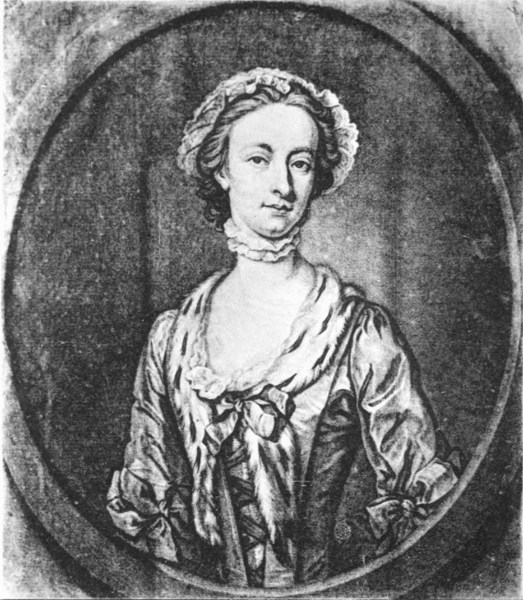
Though not a beauty—for the smallpox, that stole
the bloom from the cheeks of many a sparkling belle
in hoop and brocade, had set its seal upon her face—the
portrait of Mary Blandy shows that she was comely.
Still, it is a picture in which there is a full contrast
between the light and shadows. Those fine glistening
black eyes of hers—like the beam of sunshine that
illumines a sombre chamber—made one forget the
absence of winsome charm in her features; yet their
radiance appeared to come through dark unfathomable
depths rather than as the reflection of an unclouded
soul. With warmth all blood may glow, with softness
every heart can beat, but some, like hers, must be compelled
by reciprocal power. Such, in her empty home,
was not possible. Even the love and devotion of her
parents gave merely a portion of their own essence. From
a greedy father she acquired the sacred lust, and learnt
from infancy to dream, with morbid longing, of her
future dower; while her mother encouraged a hunger
for vain and giddy pleasure, teaching unwittingly that
these must be bought at the expense of peace, or by
the sacrifice of truth. To a girl of wit and intelligence
in whose heart nature had not sown the seeds of
kindness, these lessons came as a crop of tares upon
a fruitful soil. But, as in the case of all women, there
was one hope of salvation. Indeed, since the passion
of her soul cried out with imperious command that she
should fulfil the destiny of her sex, the love of husband
and children would have found her a strong but pliable
material that could be fashioned into more gentle
form. Without such influence she was one of those to
whom womanhood was insufferable—a mortal shape
where lay encaged one of the fiercest demons of discontent.
Molly Blandy did not lack admirers. Being pleasant
and vivacious—while her powers of attraction were
enhanced by the rumour of her fortune—not a few of
the beaux in the fashionable world of Bath, and county
society at Reading, gave homage and made her their
toast. In the eyes of her parents it was imperative
that a suitor should be able to offer to their daughter
a station of life befitting an heiress. On this account
two worthy swains, who were agreeable to the maiden
but could not provide the expected dower, received
a quick dismissal. Although there was nothing exorbitant
in the ambition of the attorney and his dame,
it is clear that the girl learnt an evil lesson from
these mercenary transactions. Still, her crosses in
love do not seem to have sunk very deeply into her
heart, but henceforth her conduct lost a little of its
maidenly reserve. The freedom of the coquette took
the place of the earnestness and sincerity that had
been the mark of her ardent nature, and her conduct
towards the officers of the regiment stationed
at Henley was deemed too forward. However, the
father, whose reception into military circles no doubt
made the desired impression upon his mayor and
aldermen, was well satisfied that his daughter should
be on familiar terms with her soldier friends. Even
when she became betrothed to a captain of no
great fortune, he offered small objection on account
of the position of the young man. Yet, although
the prospect of a son-in-law who held the king’s commission
had satisfied his vanity, the old lawyer, who
foolishly had allowed the world to believe him richer
than he was, could not, or (as he pretended) would not,
provide a sufficient dowry. Thus the engagement
promised to be a long one. Fate, however, decided
otherwise. Very soon her suitor was ordered abroad
on active service, and the hope of marriage faded
away for the third time.
In the summer of 1746, while no doubt she was sighing
for her soldier across the seas, the man destined to work
the tragic mischief of her life appeared on the scene.
William Henry Cranstoun, a younger son of the fifth
Lord Cranstoun, a Scottish baron, was a lieutenant of
marines, who, since his regiment had suffered severely
during the late Jacobite rebellion, had come to Henley
on a recruiting expedition. At first his attentions to
Miss Blandy bore no fruit, but he returned the following
summer, and while staying with his grand-uncle, General
Lord Mark Kerr, who was an acquaintance of the lawyer
and his family, he found that Mary was off with the old
love and willing to welcome him as the new. All were
amazed that the fastidious girl should forsake her gallant
captain for this little sprig from North Britain—an
undersized spindleshanks, built after Beau Diddapper
pattern—in whose weak eyes and pock-fretten features
love must vainly seek her mirror. Still greater was the
astonishment when ten-thousand-pound Blandy, swollen
with importance, began to babble of “my Lord of
Crailing,” and the little bugle cap of his dame quivered
with pride as she told her gossips of “my Lady Cranstoun,
my daughter’s new mamma.” For it was common
knowledge that the small Scot was the fifth son of a
needy house, with little more than his pay to support
his many vicious and extravagant habits. Such details
seem to have been overlooked by the vain parents
in their delight at the honour and glory of an alliance
with a family of title. In the late autumn of 1747 they
invited their prospective son-in-law to their home, where,
as no one was fonder of free quarters, he remained for
six months. But the cruel fate that presided over the
destinies of the unfortunate Mary intervened once more.
Honest Lord Mark Kerr (whose prowess as a duellist
is chronicled in many a page), perceiving the intentions
of his unscrupulous relative, made haste to give his
lawyer friend the startling news that Cranstoun was a
married man.
This information was correct. Yet, although wedded
since the year before the rebellion, the vicious little
Scot was seeking to put away the charming lady who
was his wife and the mother of his child. Plain enough
were the motives. A visit to England had taught him
that the title which courtesy permitted him to bear was
a commercial asset that, south of the Tweed, would
enable him to sell himself in a better market. As one
of his biographers tells us, “he saw young sparklers
every day running off with rich prizes,” for the chapels
of Wilkinson and Keith were always ready to assist the
abductor of an heiress. Indeed, before his arrival at
Henley, he had almost succeeded in capturing the
daughter of a Leicestershire squire, when the father,
who suddenly learnt his past history, sent him about
his business. Still, he persisted in his attempts to get
the Scotch marriage annulled, and his chances seemed
favourable. Most of the relatives of his wife, who
had espoused the losing side in the late rebellion, were
fled in exile to France or Flanders. Moreover, she
belonged to the Catholic Church, which at that time in
stern Presbyterian Scotland had fallen upon evil days.
Believing that she was alone and friendless, and relying,
no doubt, upon the sectarian prejudices of the law
courts, he set forth the base lie that he had promised to
marry her only on condition she became Protestant.
His explanation to the Blandys, in answer to Lord
Mark’s imputation, was the same as his defence before
the Scottish Commissaries. The lady was his mistress,
not his wife!
Miss Blandy took the same view of the case that
Sophy Western did under similar circumstances.
Human nature was little different in those days, but
men wore their hearts on their sleeve instead of exhibiting
them only in the Courts, and women preferred to be
deemed complacent rather than stupid. Doubtless old
lawyer Blandy grunted many Saxon sarcasms at the
expense of Scotch jurisprudence, and trembled lest son-in-law
Diddapper had been entangled beyond redemption.
Still, father, mother, and daughter believed the
word of their guest, waiting anxiously for the result of
the litigation that was to make him a free man. During
the year 1748 the Commissaries at Edinburgh decided
that Captain Cranstoun and the ill-used Miss Murray
were man and wife. Then the latter, being aware of the
flirtation at Henley, wrote to warn Miss Blandy, and
provided her with a copy of the Court’s decree. Great
was the consternation at the house on the London road.
Visions of tea-gossip over the best set of china in the
long parlour at Crailing with my Lady Cranstoun
vanished from the old mother’s eyes, while the town
clerk forgot his dreams of the baby whose two grand-fathers
were himself and a live lord. Nevertheless, the
young Scotsman protested that the marriage was invalid,
declared that he would appeal to the highest tribunal,
and swore eternal fidelity to his Mary. Alas, she
trusted him! Within the sombre depths of her soul
there dwelt a fierce resolve to make this man her own.
In her sight he was no graceless creature from the
barrack-room, but with a great impersonal love she
sought in him merely the fulfilment of her destiny.
“In her first passion, woman loves her lover:
In all the others, all she loves is love.”
At this time Cranstoun’s fortunes were in a parlous
state. More than half of his slender patrimony had
been sequestered for the maintenance of his wife and
child, and shortly after the peace of Aix-la-Chapelle, his
regiment being disbanded, he was left on half-pay.
Still, he did not waver in his purpose to win the heiress
of Henley.
On the 30th of September 1749, the poor frivolous old
head, which had sported its cap so bravely amidst the
worries of pretentious poverty, lay still upon the pillow,
and Mary Blandy looked upon the face of her dead mother.
It was the turning-point in her career. While his wife
was alive, the old lawyer had never lost all faith in his
would-be son-in-law during the two years that he had
been affianced to his daughter, in spite of the rude
shocks which had staggered his credulity. Cranstoun
had been allowed to sponge on him for another six
months in the previous summer, and had pursued his
womenfolk when they paid a visit to Mary’s uncle,
Serjeant Stevens, of Doctors’ Commons. However,
soon after the death of his wife the patience of Mr
Blandy, who must have perceived that the case of the
pretender was hopeless, seems to have become worn
out. All idea of the baron’s grandchild faded from his
mind; the blear-eyed lover was forbidden the house,
and for nearly twelve months did not meet his trusting
sweetheart.
Although a woman of her intelligence must have
perceived that, but for some untoward event, her
relationship with her betrothed could never be one of
honour, her fidelity remained unshaken. Having passed
her thirtieth birthday, the dreadful stigma of spinsterhood
was fast falling upon her. If the methods of
analogy are of any avail, it is clear that she had
become a creature of lust—not the lust of sensuality,
but that far more insatiable greed, the craving for conquest,
possession, the attainment of the unattainable,
calling forth not one but all the emotions of body and
soul. A sacrifice of honour—a paltry thing in the face
of such mighty passion—would have been no victory, for
such in itself was powerless to accomplish the essential
metamorphosis of her life. In mutual existence with a
lover and slave the destiny of this rare woman alone
could be achieved. Thus came the harvest of the
tempest. It was not the criminal negligence of the
father in encouraging for nearly three years the pretensions
of a suitor, who—so a trustworthy gentleman had
told him—was a married man, that had planted the seeds
of storm. Nor did the filial love of the daughter begin
to fade and wither because she had been taught that
the affections, like anything which has a price, should
be subject to barter and exchange. Deeper far lay the
roots of the malignant disease—growing as a portion of
her being—a part and principle of life itself. Environment
and education merely had inclined into its stunted
form the twig, which could never bear fruit unless grafted
upon a new stalk! And while the sombre girl brooded
over her strange impersonal passion, there rang in her
ears the voice of demon-conscience, unceasingly—a
taunting, frightful whisper, “When the old man is in his
grave you shall be happy.”
The esteem of posterity for the eighteenth century,
to which belong so many noble lives and great minds,
has been influenced by the well-deserved censure
bestowed upon a particular epoch. The year 1750
marks a period of transition when all the worst characteristics
of the Georgian era were predominant. For
nearly a quarter of a century the scornful glance that
the boorish little king threw at any book had been
reflected in the national taste for literature. Art had
hobbled along bravely on the crutches of caricature,
tolerated on account of its deformity, and not for its
worth. The drama, which had drifted to the lowest ebb
in the days of Rich and Heidegger, was just rising
from its mudbank, under the leadership of Garrick,
with the turn of the tide. Religion, outside the pale
of Methodism, was as dead as the influence of the
Church of England and its plurality divines. The prostitution
of the marriage laws in the Fleet and Savoy had
grown to be a menace to the social fabric. London
reeked of gin; and although the business of Jack Ketch
has been seldom more flourishing, property, until
magistrate Fielding came forward, was never less secure
from the thief and highwayman. Our second George,
who flaunted his mistresses before the public gaze, was
a worthy leader of a coarse and vicious society. Female
dress took its form from the vulgarity of the times, and
was never uglier and more indecent simultaneously.
Not only was the ‘modern fine lady,’ who wept when
a handsome thief was hung, a common type, but the
Boobys and Bellastons were fashionable women of the
day, quite as much alive as Elizabeth Chudleigh or
Caroline Fitzroy. Such was the age of Miss Blandy,
and she proved a worthy daughter of it.
In the late summer of 1750 the fickle attorney, who
had become weary of opposition, consented to withdraw
the sentence of banishment he had pronounced against
his daughter’s lover. Possibly he fancied that there
was a chance, after all, of the Scotch lieutenant’s success
in the curious law-courts of the North, and perhaps a
present of salmon, received from Lady Cranstoun,
appeared to him as a favourable augury. Consequently
the needy fortune-hunter, who was only too ready to
return to his free quarters, paid another lengthy visit to
Henley. As the weeks passed, it was evident that the
temper of the host and father, whose senile humours
were swayed by gravel and heartburn, could not support
the new ménage. Fearful lest the devotion of his Molly
had caused her to lose all regard for her fair fame, wroth
that the clumsy little soldier should have disturbed the
peace of his household, the old man received every
mention of “the tiresome affair in Scotland” with sneers
and gibes. Vanished was the flunkey-optimism that had
led him to welcome once more the pertinacious slip of
Scottish baronage. Naught would have appeased him
but prompt evidence that the suitor was free to lead his
daughter to the altar. Nothing could be plainer than
that the querulous widower had lost all confidence in his
unwelcome guest.
The faithful lovers were filled with dismay. A few
strokes of the pen might rob them for ever of their
ten thousand pounds. Their wishes were the same,
their minds worked as one. A deep, cruel soul-blot,
transmitted perhaps by some cut-throat borderer through
the blood of generations, would have led William
Cranstoun to commit, without scruple, the vilest of
crimes. Those base attempts to put away his wife, and
to cast the stigma of bastardy upon his child, added to
his endeavour to entrap one heiress after another into a
bigamous marriage, make him guilty of offences less
only than murder. In his present position he had cause
for desperation. Yet, although utterly broken in fortune,
there was a rich treasure at his hand if he dared to seize
it. Were her father dead, Molly Blandy, whether as
wife or mistress, would be his—body, soul, and wealth.
Within the veins of the woman a like heart-stain spread
its poison. All the lawless passion of her nature cried
out against her parent’s rule, which, to her mind, was
seeking to banish what had become more precious than
her life. Knowing that her own fierce will had its
mate in his, she believed that his obduracy could not be
conquered, and she lived in dread lest she should be
disinherited. And all this time, day after day, the
demon-tempter whispered, “When the old man is in his
grave you shall be happy.”
Which of the guilty pair was the first to suggest the
heartless crime it is impossible to ascertain, but there is
evidence, apart from Miss Blandy’s statement, that
Cranstoun was the leading spirit. Possibly, nay
probably, the deed was never mentioned in brutal
plainness in so many words. The history of crime
affords many indications that the blackest criminals are
obliged to soothe a neurotic conscience with the anodyne
of make-belief. It is quite credible that the two spoke
of the projected murder from the first (as indeed Miss
Blandy explained it later) as an attempt to conciliate
the old lawyer by administering a supernatural love
philtre, having magical qualities like Oberon’s flower in
A Midsummer Night’s Dream, which would make him
consent to their marriage. Presently a reign of mystic
terror seemed to invade the little house in the London
road. With fear ever present in her eyes, the figure
of the sombre woman glided from room to room,
whispering to the frightened servants ghostly tales of
things supernatural—of unearthly music that she had
heard during the misty autumn nights, of noises that
had awakened her from sleep, of the ghastly apparitions
that had appeared to her lover. And to all these
stories she had but one dismal interpretation—saying
it had come to her from a wizard-woman in Scotland—they
were signs and tokens that her father would die
within a year! Those who heard her listened and
trembled, and the words sank deep into their memory.
So the winter crept on; but while all slunk through the
house with bated breath, shrinking at each mysterious
sound, the old man, doomed by the sorceress, remained
unsuspicious of what was going on around him.
Not long before Christmas, to the great relief of his
churlish host, the little Scotsman’s clumsy legs passed
through the front door for the last time, and he set out
for his brother’s seat at Crailing in the shire of
Roxburgh. Yet, though his lengthy visit had come to
an end, his spirit remained to rule the brain of the
woman who loved him. Early in the year 1751 she
received a box, containing a present from Cranstoun,
a set of table linen, and some ‘Scotch pebbles.’ Lawyer
Blandy viewed the stones with suspicious eyes, for he
hated all things beyond the Cheviot Hills, but did not
make any comment. The relationship between father
and daughter had become cold and distant. Quarrels
were constant in the unhappy home. Often in the
midst of her passion she was heard to mutter deep
curses against the old man. Indeed, so banished was
her love that she talked without emotion to the servants
of the likelihood of his death, in fulfilment of the witch’s
prophecy.
Some weeks later, when another consignment of the
mysterious ‘Scotch pebbles’ had arrived for Miss
Blandy, it was noticed that her conduct became still
more dark and strange. Slinking through the house
with slow and stealthy tread, she appeared to shun all
eyes, as though bent upon some hidden purpose. A
glance within the box from the North would have
revealed the secret. When the crafty accomplice found
that she was unable to procure the means of taking
her father’s life, he had been forced to supply her with
the weapons. During the spring, the health of the old
lawyer, who suffered more or less from chronic ailments,
began to grow more feeble. His garments hung loosely
upon his shrunken limbs, while the teeth dropped from
his palsied jaws. The old witch’s curse seemed to have
fallen upon the home, and, to those who looked with
apprehension for every sign and portent, it was fulfilled
in many direful ways. Early in June, Ann Emmet, an
old charwoman employed about the house, was seized
with a violent illness after drinking from a half-emptied
cup left at Mr Blandy’s breakfast. A little later, Susan
Gunnel, one of the maid-servants, was affected in a
similar way through taking some tea prepared for her
master. One August morning, in the secrecy of her
own chamber, trembling at every footfall beyond the
locked door, Mary Blandy gazed with eager, awestruck
eyes upon a message sent by her lover.
“I am sorry there are such occasions to clean your
pebbles,” wrote the murderous little Scotsman. “You
must make use of the powder to them, by putting it into
anything of substance, wherein it will not swim a-top
of the water, of which I wrote to you in one of my last.
I am afraid it will be too weak to take off their rust, or
at least it will take too long a time.”
From the language of metaphor it is easy to translate
the ghastly meaning. She must have told Cranstoun
that the white arsenic, which he had sent to her under
the pseudonym of ‘powder to clean the pebbles,’
remained floating on the surface of the tea. Possibly
her father had noticed this phenomenon, and, not caring
to drink the liquid, had escaped the painful sickness
which had attacked the less cautious servants. But now
she had found a remedy—‘anything of substance!’—a
safe and sure vehicle that could not fail. Louder
still in the ears of the lost woman rang the mocking
words, “When the old man is dead you shall be
happy.”
During the forenoon of Monday, the 5th of August,
Susan Gunnel, the maid, met her young mistress coming
from the pantry.
“Oh, Susan,” she exclaimed, “I have been stirring
my papa’s water gruel”; and then, perceiving other
servants through the half-open door of the laundry, she
added gaily, “If I was ever to take to eating anything
in particular it would be oatmeal.”
No response came from the discreet Susan, but she
marvelled, calling to mind that Miss Blandy had said to
her some time previously, noticing that she appeared
unwell:
“Have you been eating any water gruel? for I am
told that water gruel hurts me, and it may hurt you.”
Later in the day, her wonder was increased when she
saw her mistress stirring the gruel in a half-pint mug,
putting her fingers into the spoon, and then rubbing
them together. In the evening the same mug was taken
as usual to the old man’s bedroom. On Tuesday night
Miss Blandy sent down in haste to order gruel for her
father, who had been indisposed all day, and such was
her solicitude that she met the footman on the stairs,
and taking the basin from his hands, carried it herself
into the parlour. Early the next morning, while Ann
Emmet, the old charwoman, was busy at her wash-tub,
Susan Gunnel came from upstairs.
“Dame,” she observed, “you used to be fond of
water gruel. Here is a very fine mess my master left
last night, and I believe it will do you good.”
Sitting down upon a bench, this most unfortunate old
lady proceeded to consume the contents of the basin, and
for a second time was seized with a strange and violent
illness. Soon afterwards Miss Blandy came into the
kitchen.
“Susan, as your master has taken physic, he may
want some more water gruel,” said she. “As there is
some in the house you need not make fresh, for you are
ironing.”
“Madam, it will be stale,” replied the servant. “It
will not hinder me much to make fresh.”
A little later, while tasting the stuff, Susan noticed
a white sediment at the bottom of the pan. Greatly
excited, she ran to show Betty Binfield, the cook, who
bore no good-will towards her young mistress.
“What oatmeal is this?” asked Betty, significantly.
“It looks like flour.”
“I have never seen oatmeal as white before,” said the
maid.
Carefully and thoroughly the suspicious servants
examined the contents of the saucepan, taking it out of
doors to view it in the light. And while they looked at
the white gritty sediment they told each other in low
whispers that this must be poison. Locking up the pan,
they showed it next day to the local apothecary, who,
as usual in those times, was the sick man’s medical
attendant.
Nothing occurred to alarm the guilty woman until
Saturday. On that morning, in the homely fashion of
middle-class manners, the lawyer, who wanted to shave,
came into the kitchen, where hot water and a good fire
were ready for him. Accustomed to his habits, the
servants went about their work as usual. Some trouble
seemed to be preying upon his mind.
“I was like to have been poisoned once,” piped the
feeble old man, turning his bloodshot eyes upon his
daughter, who was in the room.
“It was on this same day, the tenth of August,” he
continued, in his weak, trembling voice, for his frame
had become shattered during the last week. “It was
at the coffee-house or at the Lyon, and two other
gentlemen were like to have been poisoned by what
they drank.”
“Sir, I remember it very well,” replied the imperturbable
woman, and then fell to arguing with her
querulous father at which tavern the adventure had
taken place.
“One of the gentlemen died immediately,” he resumed,
looking at her with a long, reproachful glance.
“The other is dead now, and I have survived them
both. But”—his piteous gaze grew more intense—“it is
my fortune to be poisoned at last.”
A similar ordeal took place in a little while. At
breakfast Mr Blandy seemed in great pain, making
many complaints. As he sipped his tea, he declared
that it had a gritty, bad taste, and would not drink it.
“Have you not put too much of the black stuff into
it?” he demanded suddenly of his daughter, referring to
the canister of Bohea.
This time she was unable to meet his searching
eyes.
“It is as usual,” she stammered in confusion.
A moment later she rose, trembling and distressed, and
hurriedly left the room.
There was reason for the old man’s suspicion. Before
he had risen from his bed, the faithful Susan Gunnel
told him of the discovery in the pan of water gruel, and
both agreed that the mysterious powder had been sent
by Cranstoun. Yet, beyond what he had said at breakfast,
and in the kitchen, he questioned his daughter no
more! Still, although no direct charge had been made,
alarmed by her father’s hints she hastened to destroy
all evidence that could be used against her. During
the afternoon, stealing into the kitchen under pretence
of drying a letter before the fire, she crushed a paper
among the coals. As soon as she was gone the watchful
spies—servants Gunnel and Binfield—snatched it away
before it had been destroyed by the flames. This
paper contained a white substance, and on it was written
‘powder to clean the pebbles.’ Towards evening
famous Dr Addington arrived from Reading, summoned
by Miss Blandy, who was driven on account of her fears
to show a great concern. After seeing his patient the
shrewd old leech had no doubt as to the symptoms.
With habitual directness he told the daughter that her
father had been poisoned.
“It is impossible,” she replied.
On Sunday morning the doctor found the sick
man a little better, but ordered him to keep his bed.
Startling proofs of the accuracy of his diagnosis
were forthcoming. One of the maids put into his
hands the packet of arsenic found in the fire; while
Norton the apothecary produced the powder from the
pan of gruel. Addington at once took the guilty
woman to task.
“If your father dies,” he told her sternly, “you will
inevitably be ruined.”
Nevertheless she appears to have brazened the matter
out, but desired the doctor to come again the next day.
When she was alone, her first task was to scribble a
note to Cranstoun, which she gave to her father’s clerk
to “put into the post.” Having heard dark rumours
whispered by the servants that Mr Blandy had been
poisoned by his daughter, the man had no hesitation
in opening the letter, which he handed over to the
apothecary. It ran as follows:—
“Dear Willy,—My father is so bad that I have only
time to tell you that if you do not hear from me soon
again, don’t be frightened. I am better myself. Lest
any accident should happen to your letters be careful
what you write.
“My sincere compliments.—I am ever, yours.”
That evening Norton ordered Miss Blandy from her
father’s room, telling Susan Gunnel to remain on the
watch, and admit no one. At last the heartless daughter
must have seen that some other defence was needed than
blind denial. Still, the poor old sufferer persisted that
Cranstoun was the sole author of the mischief. On
Monday morning, although sick almost to death, he sent
the maid with a message to his daughter.
“Tell her,” said he, “that I will forgive her if she
will bring that villain to justice.”
In answer to his words, Miss Blandy came to her
father’s bedroom in tears, and a suppliant. Susan
Gunnel, who was present, thus reports the interview.
“Sir, how do you do?” said she.
“I am very ill,” he replied.
Falling upon her knees, she said to him:
“Banish me or send me to any remote part of the
world. As to Mr Cranstoun, I will never see him, speak
to him, as long as I live, so as you will forgive me.”
“I forgive thee, my dear,” he answered. “And I hope
God will forgive thee, but thee should have considered
better than to have attempted anything against thy
father. Thee shouldst have considered I was thy own
father.”
“Sir,” she protested, “as to your illness I am entirely
innocent.”
“Madam,” interrupted old Susan Gunnel, “I believe
you must not say you are entirely innocent, for the
powder that was taken out of the water gruel, and the
paper of powder that was taken out of the fire, are now
in such hands that they must be publicly produced. I
believe I had one dose prepared for my master in a dish
of tea about six weeks ago.”
“I have put no powder into tea,” replied Miss Blandy.
“I have put powder into water gruel, and if you are
injured,” she assured her father, “I am entirely innocent,
for it was given me with another intent.”
The dying man did not wait for further explanation,
but, turning in his bed, he cried:
“Oh, such a villain! To come to my house, eat of the
best, drink of the best that my house could afford—to take
away my life, and ruin my daughter! Oh, my dear,” he
continued, “thee must hate that man, thee must hate
the ground he treads on. Thee canst not help it.”
“Oh, sir, your tenderness towards me is like a sword
to my heart,” she answered. “Every word you say is like
swords piercing my heart—much worse than if you were
to be ever so angry. I must down on my knees and beg
you will not curse me.”
“I curse thee, my dear!” he replied. “How couldst
thou think I could curse thee? I bless thee, and hope
that God will bless thee and amend thy life. Go, my
dear, go out of my room.... Say no more, lest thou
shouldst say anything to thy own prejudice.... Go
to thy uncle Stevens; take him for thy friend. Poor
man,—I am sorry for him.”
The memory of the old servant, who repeated the
above conversation in her evidence at Miss Blandy’s
trial, would seem remarkable did we not bear in mind
that she went through various rehearsals before the
coroner and magistrates, and possibly with the lawyers
for the prosecution. Some embellishments also must
be credited to the taste and fancy of Mr Rivington’s
reporters. Still, the gist must be true, and certainly
has much pathos. Yet the father’s forgiveness of his
daughter, when he must have known that her conduct
was wilful, although piteous and noble, may not have
been the result of pure altruism. Naturally, the wish that
Cranstoun alone was guilty was parent to the thought.
Whether the approach of eternity brought a softening
influence upon him, and he saw his follies and errors in
the light of repentance, or whether the ruling passion
strong in death made the vain old man struggle to avert
the black disgrace that threatened his good name, and
the keen legal intellect, which could counsel his daughter
so well, foresaw the coming escheatment of his small
estate to the lord of the manor, are problems for the
student of psychology.
During the course of the day brother leech Lewis of
Oxford—a master-builder of pharmacopœia—was summoned
by the sturdy begetter of statesmen, and there
was much bobbing of learned wigs and nice conduct of
medical canes. Addington asked the dying man whom
he suspected to be the giver of the poison.
“A poor love-sick girl,” murmured the old lawyer,
smiling through his tears. “I forgive her—I always
thought there was mischief in those cursed Scotch
pebbles.”
In the evening a drastic step was taken. Acting on
the principle of ‘thorough,’ which made his son’s occupancy
of the Home Office so memorable at a later period,
the stern doctor accused Miss Blandy of the crime, and
secured her keys and papers. Conquered by fear, the
stealthy woman for a while lost all self-possession. In
an agony of shame and terror she sought to shield herself
by the pretence of superstitious folly. Wringing her
hands in a seeming agony of remorse, she declared that
her lover had ruined her.
“I received the powder from Mr Cranstoun,” she
cried, “with a present of Scotch pebbles. He had wrote
on the paper that held it, ‘The powder to clean the
pebbles with.’ He assured me that it was harmless, and
that if I would give my father some of it now and then,
a little and a little at a time, in any liquid, it would make
him kind to him and to me.”
In a few scathing questions the worldly-wise Addington
cast ridicule upon this weird story of a love philtre.
Taking the law into his own resolute hands, with the consent
of colleague Lewis he locked the wretched woman in
her room and placed a guard over her. Little could be
done to relieve the sufferings of poor ten-thousand-pound
Blandy—who proved to be a mere four-thousand-pound
attorney when it came to the test—and on Wednesday
afternoon, the 14th of August, he closed his proud old
eyes for ever. In her desperation the guilty daughter
could think of naught but escape. On the evening of her
fathers death, impelled by an irresistible frenzy to flee
from the scene of her butchery, she begged the footman
in vain to assist her to get away. During Thursday
morning—for it was not possible to keep her in custody
without legal warrant—a little group of children saw a
dishevelled figure coming swiftly along the High Street
towards the river. At once there arose the cry of
‘Murderess!’ and, surrounded by an angry mob, she was
driven to take refuge in a neighbouring inn. It was vain
to battle against fate. That same afternoon the coroner’s
inquest was held, and the verdict pronounced her a parricide.
On the following Saturday, in charge of two
constables, she was driven in her father’s carriage to
Oxford Castle. An enraged populace, thinking that she
was trying again to escape, surrounded the vehicle, and
sought to prevent her from leaving the town.
Owing to the social position of the accused, and the
enormity of her offence, the eyes of the whole nation
were turned to the tragedy at Henley. Gossips of the
day, such as Horace Walpole and Tate Wilkinson, tell
us that the story of Miss Blandy was upon every lip.
In spite of the noble irony of ‘Drawcansir’ Fielding,
journalists and pamphleteers had no scruple in referring
to the prisoner as a wicked murderess or a cruel parricide.
Yet the case of Henry Coleman, who, during the
August of this year, had been proved innocent of a
crime for which he had suffered death, should have
warned the public against hasty assumption. For six
months the dark woman was waiting for her trial.
Although it was the custom for a jailor to make an
exhibition of his captive to anyone who would pay the
entrance fee, nobody was allowed to see Miss Blandy
without her consent. Two comfortable rooms were set
apart for her in the keeper’s house; she was free to take
walks in the garden, and to have her own maid. At
last, when stories of a premeditated escape were noised
abroad, Secretary Newcastle, in a usual state of fuss,
fearing that she might repeat the achievement of Queen
Maud, gave orders that she must be put in irons. At
first Thomas Newell, who had succeeded her father as
town clerk of Henley four years previously, was employed
in her defence, but he offended her by speaking
of Cranstoun as “a mean-looking, little, ugly fellow,” and
so she dismissed him in favour of Mr Rives, a lawyer
from Woodstock. Her old invincible courage had returned,
and only once—when she learnt the paltry value
of her father’s fortune—did she lose self-possession. For
a dismal echo must have come back in the mocking words,
“When the old man is in his grave you shall be happy.”
At last the magistrates—Lords Cadogan and ‘New-Style’
Macclesfield, who had undertaken duties which
in later days Mr Newton or Mr Montagu Williams would
have shared with Scotland Yard—finish their much-praised
detective work, and on Tuesday, the 3rd of March
1752, Mary Blandy is brought to the bar. The Court
meets in the divinity school, since the town-hall is
in the hands of the British workman, and because the
University, so ‘Sir Alexander Drawcansir’ tells his
readers, will not allow the use of the Sheldonian Theatre.
Why the most beautiful room in Oxford should be
deemed a fitter place of desecration than the archbishop’s
monstrosity is not made clear. An accident
delays the trial—this second ‘Great Oyer of Poisoning!’
There is a small stone or other obstruction in the lock—can
some sentimental, wry-brained undergraduate
think to aid the gallows-heroine of his fancy?—and
while it is being removed, Judges Legge and Smythe
return to their lodgings.
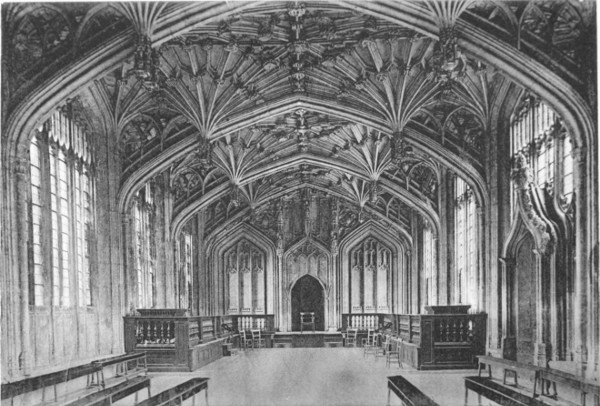
THE DIVINITY SCHOOL, OXFORD.
At eight o’clock, Mary Blandy, calm and stately,
stands beneath the graceful fretted ceiling, facing the
tribunal. From wall to wall an eager crowd has filled
the long chamber, surging through the doorway, flowing
in at the open windows, jostling even against the prisoner.
A chair is placed for her in case of fatigue, and her maid
is by her side. A plain and neat dress befits her serene
manner—a black bombazine short sacque (the garb of
mourning), white linen kerchief, and a thick crape shade
and hood. From the memory of those present her
countenance can never fade. A broad high forehead,
above which her thick jet hair is smoothed under a cap;
a pair of fine black sparkling eyes; the colouring almost
of a gipsy; cheeks with scarce a curve; mouth full, but
showing no softness; nose large, straight, determined—it
is the face of one of those rare women who command,
not the love, but the obedience of mankind. Still it is
intelligent, not unseductive, compelling; and yet, in
spite of the deep, flashing eyes, without radiance of soul—the
face of a sombre-hearted woman.
Black, indeed, is the indictment that Bathurst, a
venerable young barrister who represents the Crown,
unfolds against her, but only once during his burst of
carefully-matured eloquence is there any change in her
serenity. When the future Lord Chancellor declares
that the base Cranstoun “had fallen in love, not with
her, but with her fortune,” the woman’s instinct cannot
tolerate the reflection upon her charms, and she darts a
look of bitterest scorn upon the speaker. And only once
does she show a trace of human softness. When her
godmother, old Mrs Mountenay, is leaving the witness-box,
she repeats the curtsey which the prisoner had
previously disregarded, and then, in an impulse of pity,
presses forward, and, seizing Miss Blandy’s hand, exclaims,
“God bless you!” At last, and for the first
time, the tears gather in the accused woman’s eyes.
Many abuses, handed down from a previous century,
still render barbarous the procedure of criminal trials.
The case is hurried over in one day; counsel for the
prisoner can only examine witnesses, but not address the
jury; the prosecution is accustomed to put forward
evidence of which the defence has been kept in ignorance.
Yet no injustice is done to Mary Blandy. Thirteen
hours is enough to tear the veil from her sombre
heart; the tongue of Nestor would fail to show her
innocent; of all that her accusers can say of her she
is well aware. Never for one moment is the issue
in doubt. What can her scoffing, sceptic age, with its
cold-blooded sentiment and tame romance, think of a
credulity that employed a love-potion in the guise of
affection but with the result of death! How is it
possible to judge a daughter who persisted in her black
art, although its dire effects were visible, not once, but
many times! Her defence, when at last it comes, is
spoken bravely, but better had been left unsaid.
“My lords,” she begins, “it is morally impossible for
me to lay down the hardships I have received.
I have been aspersed in my character. In the first
place, it has been said that I have spoke ill of my
father; that I have cursed him and wished him at hell;
which is extremely false. Sometimes little family affairs
have happened, and he did not speak to me so kind as I
could wish. I own I am passionate, my lords, and in
those passions some hasty expressions might have dropt.
But great care has been taken to recollect every word
I have spoken at different times, and to apply them to
such particular purposes as my enemies knew would do
me the greatest injury. These are hardships, my lords,
extreme hardships!—such as you yourselves must allow
to be so. It was said, too, my lords, that I endeavoured
to make my escape. Your lordships will judge from the
difficulties I laboured under. I had lost my father—I
was accused of being his murderer—I was not permitted
to go near him—I was forsaken by my friends—affronted
by the mob—insulted by my servants. Although I
begged to have the liberty to listen at the door where he
died, I was not allowed it. My keys were taken from
me, my shoe-buckles and garters too—to prevent me
from making away with myself, as though I was the
most abandoned creature. What could I do, my lords?
I verily believe I was out of my senses. When I heard
my father was dead and the door open, I ran out of the
house, and over the bridge, and had nothing on but a half
sack and petticoat, without a hoop, my petticoats hanging
about me. The mob gathered about me. Was this
a condition, my lords, to make my escape in? A good
woman beyond the bridge, seeing me in this distress,
desired me to walk in till the mob was dispersed. The
town sergeant was there. I begged he would take me
under his protection to have me home. The woman said
it was not proper, the mob was very great, and that I
had better stay a little. When I came home they said
I used the constable ill. I was locked up for fifteen
hours, with only an old servant of the family to attend
me. I was not allowed a maid for the common decencies
of my sex. I was sent to gaol, and was in hopes, there,
at least, this usage would have ended, but was told it
was reported I was frequently drunk—that I attempted to
make my escape—that I never attended the chapel. A
more abstemious woman, my lords, I believe, does not live.
“Upon the report of my making my escape, the gentleman
who was High Sheriff last year (not the present)
came and told me, by order of the higher powers, he
must put an iron on me. I submitted, as I always do to
the higher powers. Some time after, he came again, and
said he must put a heavier upon me, which I have
worn, my lords, till I came hither. I asked the Sheriff
why I was so ironed? He said he did it by command
of some noble peer, on his hearing that I intended to
make my escape. I told them I never had such a
thought, and I would bear it with the other cruel usage
I had received on my character. The Rev. Mr.
Swinton, the worthy clergyman who attended me in
prison, can testify that I was very regular at the chapel
when I was well. Sometimes I really was not able to
come out, and then he attended me in my room. They
likewise published papers and depositions which ought
not to have been published, in order to represent me as
the most abandoned of my sex, and to prejudice the
world against me. I submit myself to your lordships,
and to the worthy jury. I can assure your lordships, as
I am to answer it before that Grand Tribunal where I
must appear, I am as innocent as the child unborn of the
death of my father. I would not endeavour to save my
life at the expense of truth. I really thought the powder
an innocent, inoffensive thing, and I gave it to procure
his love. It was mentioned, I should say, I was ruined.
My lords, when a young woman loses her character, is
not that her ruin? Why, then, should this expression
be construed in so wide a sense? Is it not ruining my
character to have such a thing laid to my charge? And
whatever may be the event of this trial, I am ruined
most effectually.”
A strange apology—amazing in its effrontery!
Gentle Heneage Legge speaks long and tenderly,
while the listeners shudder with horror as they hear the
dismal history unfolded in all entirety for the first time.
No innocent heart could have penned that last brief
warning to her lover—none but an accomplice would
have received his cryptic message. Every word in the
testimony of the stern doctor seems to hail her parricide—every
action of her stealthy career has been noted
by the watchful eyes of her servants. And, as if in
damning confirmation of her guilt, there is the black
record of her flight from the scene of crime. Eight
o’clock has sounded when the judge has finished. For
a few moments the jury converse in hurried whispers.
It is ominous that they make no attempt to leave the
court, but merely draw closer together. Then, after
the space of five minutes they turn, and the harsh
tones of the clerk of arraigns sound through the
chamber.
“Mary Blandy, hold up thy hand.... Gentlemen of
the jury, look upon the prisoner. How say you: Is
Mary Blandy guilty of the felony and murder whereof
she stands indicted, or not guilty?”
“Guilty!” comes the low, reluctant answer.
Never has more piteous drama been played within
the cold fair walls of the divinity school than that
revealed by the guttering candles on this chill March
night. Amidst the long black shadows, through which
gleam countless rows of pallid faces, in the deep silence,
broken at intervals by hushed sobs, the invincible
woman stands with unruffled mien to receive her
sentence. As the verdict is declared, a smile seems to
play upon her lips. While the judge, with tearful eyes
and broken voice, pronounces her doom, she listens
without a sign of fear. There is a brief, breathless
pause, while all wait with fierce-beating hearts for her
reply. No trace of terror impedes her utterance.
Thanking the judge for his candour and impartiality,
she turns to her counsel, among whom only Richard
Aston rose to eminence, and, with a touch of pretty
forethought, wishes them better success in their other
causes. Then, and her voice grows more solemn, she
begs for a little time to settle her affairs and to make
her peace with God. To which his lordship replies
with great emotion:
“To be sure, you shall have proper time allowed
you.”
When she is conducted from the court she steps
into her coach with the air of a belle whose chair is to
take her to a fashionable rout. The fatal news has
reached the prison before her arrival. As she enters
the keeper’s house, which for so long has been her
home, she finds the family overcome with grief and
the children all in tears.
“Don’t mind it,” she cries, cheerfully. “What does
it matter? I am very hungry. Pray let me have
something for supper as soon as possible.”
That sombre heart of hers is a brave one also.
All this time William Cranstoun, worthy brother in
all respects of Simon Tappertit, had been in hiding—in
Scotland perhaps, or, as some say, in Northumberland—watching
with fearful quakings for the result of the
trial. Shortly after the conviction of his accomplice he
managed to take ship to the Continent, and luckily for
his country he never polluted its soil again. There are
several contemporary accounts of his adventures in
France and in the Netherlands, to which the curious
may refer. All agree that he confessed his share in the
murder when he was safe from justice. With unaccustomed
propriety, our Lady Fate soon hastened to snap
the thread of his existence, and on the 3rd of December
of this same year, at the little town of Furnes in Flanders,
aged thirty-eight, he drew his last breath. A short
time before, being seized with remorse for his sins, he
had given the Catholic Church the honour of enrolling
him a proselyte. Indeed the conversion of so great a
ruffian was regarded as such a feather in their cap that
the good monks and friars advertised the event by
means of a sumptuous funeral.
Worthy Judge Legge fulfils his promise to the
unhappy Miss Blandy, and she is given six weeks in
which to prepare herself for death. Meek and more
softened is the sombre woman, who, like a devoted
penitent, submits herself day after day to the vulgar
gaze of a hundred eyes, while she bows in all humility
before the altar of her God. Yet her busy brain is
aware that those to whom she looks for intercession are
keeping a careful watch upon her demeanour. For she
has begged her godmother Mrs Mountenay to ask
one of the bishops to speak for her; she is said to
entertain the hope that the recently-bereaved Princess
will endeavour to obtain a reprieve. In the fierce war
of pamphleteers, inevitable in those days, she takes her
share, playing with incomparable tact to the folly of the
credulous. Although the majority, perhaps, believe her
guilty, she knows that a considerable party is in her
favour. On the 20th of March is published “A Letter
from a Clergyman to Miss Blandy, with her Answer,”
in which she tells the story of her share in the tragedy.
During the remainder of her imprisonment she extends
this narrative into a long account of the whole case—assisted,
it is believed, by her spiritual adviser, the
Rev. John Swinton, who, afflicted possibly by one of
his famous fits of woolgathering, seems convinced of
her innocence. No human effort, however, is of any
avail. Both the second and third George, knowing their
duty as public entertainers, seldom cheated the gallows
of a victim of distinction.
Originally the execution had been fixed for Saturday,
the 4th of April, but is postponed until the following
Monday, because the University authorities do not think
it seemly that the sentence shall be carried out during
Holy Week. A great crowd collects in the early
morning outside the prison walls before the announcement
of the short reprieve, and it speaks marvels for
the discipline of the gaol that Miss Blandy is allowed
to go up into rooms facing the Castle Green so that
she can view the throng. Gazing upon the assembly
without a tremor, she says merely that she will not
balk their expectations much longer. On Sunday she
takes sacrament for the last time, and signs a declaration
in which she denies once more all knowledge that the
powder was poisonous. In the evening, hearing that
the Sheriff has arrived in the town, she sends a request
that she may not be disturbed until eight o’clock the
next morning.
It was half-past the hour she had named when the
dismal procession reached the door of her chamber.
The Under-Sheriff was accompanied by the Rev. John
Swinton, and by her friend Mr Rives, the lawyer.
Although her courage did not falter, she appeared meek
and repentant, and spoke with anxiety of her future
state, in doubt whether she would obtain pardon for
her sins. This penitent mood encouraged the clergyman
to beg her declare the whole truth, to which she
replied that she must persist in asserting her innocence
to the end. No entreaty would induce her to retract
the solemn avowal.
At nine o’clock she was conducted from her room,
dressed in the same black gown that she had worn at
the trial, with her hands and arms tied by strong black
silk ribbons. A crowd of five thousand persons, hushed
and expectant, was waiting on the Castle Green to
witness her sufferings. Thirty yards from the door
of the gaol, whence she was led into the open air,
stood the gallows—a beam placed across the arms of
two trees. Against it lay a step-ladder covered with
black cloth. The horror of her crime must have been
forgotten by all who gazed upon the calm and brave
woman. For truly she died like a queen. Serene and
fearless she walked to the fatal spot, and joined most
fervently with the clergyman in prayer. After this
was ended they told her that if she wished she might
speak to the spectators.
“Good people,” she cried, in a clear, audible voice,
“give me leave to declare to you that I am perfectly
innocent as to any intention to destroy or even hurt
my dear father; that I did not know, or even suspect,
that there was any poisonous quality in the fatal powder
I gave him; though I can never be too much punished
for being the innocent cause of his death. As to my
mother’s and Mrs Pocock’s deaths, that have been
unjustly laid to my charge, I am not even the innocent
cause of them, nor did I in the least contribute to them.
So help me, God, in these my last moments. And may
I not meet with eternal salvation, nor be acquitted by
Almighty God, in whose awful presence I am instantly
to appear hereafter, if the whole of what is here asserted
is not true. I from the bottom of my soul forgive all
those concerned in my prosecution; and particularly the
jury, notwithstanding their fatal verdict.”
Then, having ascended five steps of the ladder, she
turned to the officials. “Gentlemen,” she requested,
with a show of modesty, “do not hang me high.”
The humanity of those whose task it was to put her
to death, forced them to ask her to go a little higher.
Climbing two steps more, she then looked round, and
trembling, said, “I am afraid I shall fall.” Still, her
invincible courage enabled her to address the crowd
once again. “Good people,” she said, “take warning
by me to be on your guard against the sallies of any
irregular passion, and pray for me that I may be
accepted at the Throne of Grace.” While the rope was
being placed around her neck it touched her face, and
she gave a deep sigh. Then with her own fingers
she moved it to one side. A white handkerchief had
been bound across her forehead, and she drew it over
her features. As it did not come low enough, a woman,
who had attended her and who had fixed the noose
around her throat, stepped up and pulled it down.
For a while she stood in prayer, and then gave the
signal by thrusting out a little book which she held
in her hand. The ladder was moved from under her
feet, and in obedience to the laws of her country she
was suspended in the air, swaying and convulsed, until
the grip of the rope choked the breath from her body.
Horrible! Yet only in degree are our own methods
different from those employed a hundred and fifty
years ago.
During the whole of the sad tragedy, the crowd, unlike
the howling mob at Tyburn, maintained an awestruck
silence. There were few dry eyes, though the sufferer
did not shed a tear, and hundreds of those who witnessed
her death went away convinced of her innocence. An
elegant young man named Edward Gibbon, with brain
wrapped in the mists of theology, who for three days
had been gentleman commoner at Magdalen, does not
appear to have been attracted to the scene. Surely
George Selwyn must be maligned, else he would have
posted to Oxford to witness this spectacle. It would
have been his only opportunity of seeing a gentlewoman
in the hands of the executioner.
After hanging for half an hour with the feet, in
consequence of her request, almost touching the ground,
the body was carried upon the shoulders of one of the
sheriff’s men to a neighbouring house. At five o’clock
in the afternoon the coffin containing her remains was
taken in a hearse to Henley, where, in the dead of night,
amidst a vast concourse, it was interred in the chancel
of the parish church between the graves of her father
and mother.
So died ‘the unfortunate Miss Blandy’ in the
thirty-second year of her age—with a grace and valour
which no scene on the scaffold has ever excelled. If, as
the authors of The Beggars Opera and The History of
Jonathan Wild have sought to show, in playful irony,
the greatness of the criminal is comparable with the
greatness of the statesman, then she must rank with
Mary of Scotland and Catherine of Russia among the
queens of crime. Hers was the soul of steel, theirs also
the opportunity.
In every period the enormity of a sin can be estimated
only by its relation to the spirit of the age; and in spite
of cant and sophistry, the contemporaries of Miss Blandy
made no legal distinction between the crimes of parricide
and petty larceny. Nay, the same rope that strangled the
brutal cut-throat in a few moments might prolong the
agony of a poor thief for a quarter of an hour. Had the
doctors succeeded in saving the life of the old attorney,
the strange law which in later times put to death
Elizabeth Fenning would have been powerless to
demand the life of Mary Blandy for a similar offence.
The protests of Johnson and Fielding against the
iniquity of the criminal code fell on idle ears.
Thus we may not judge Mary Blandy from the
standpoint of our own moral grandeur, for she is a
being of another world—one of the vain, wilful, selfish
children to whom an early Guelph was king—merely
one of the blackest sheep in a flock for the most part ill-favoured.
As we gaze upon her portrait there comes a
feeling that we do not know this sombre woman after all,
for though the artist has produced a faithful resemblance,
we perceive there is something lacking. We look into
part, not into her whole soul. None but one of the
immortals—Rembrandt, or his peer—could have shown
this queen among criminals as she was: an iron-hearted,
remorseless, demon-woman, her fair, cruel visage raised
mockingly amidst a chiaroscuro of crime and murkiness
unspeakable.
“a narrow, foxy face,
Heart-hiding smile, and gay persistent eye.”
In our own country the women of gentle birth who
have been convicted of murder since the beginning of
the eighteenth century may be counted on the fingers
of one hand. Mary Blandy, Constance Kent, Florence
Maybrick—for that unsavoury person, Elizabeth
Jefferies, has no claim to be numbered in the roll, and
the verdict against beautiful Madeleine Smith was ‘Not
proven’—these names exhaust the list. And of them,
the first alone paid the penalty at the gallows. The
annals of crime contain the records of many parricides,
some that have been premeditated with devilish art,
but scarce one that a daughter has wrought by the most
loathsome of coward’s weapons. In comparison with
the murderess of Henley, even Frances Howard and
Anne Turner were guilty of a venial crime. Mary
Blandy stands alone and incomparable—pilloried to all
ages among the basest of her sex.
Yet the world soon forgot her. “Since the two misses
were hanged,” chats Horace Walpole on the 23rd of
June, coupling irreverently the names of Blandy and
Jefferies with the beautiful Gunnings—“since the two
misses were hanged, and the two misses were married,
there is nothing at all talked of.” Society, however,
soon found a new thrill in the adventures of the young
woman Elizabeth Canning.
Miss MARY BLANDY
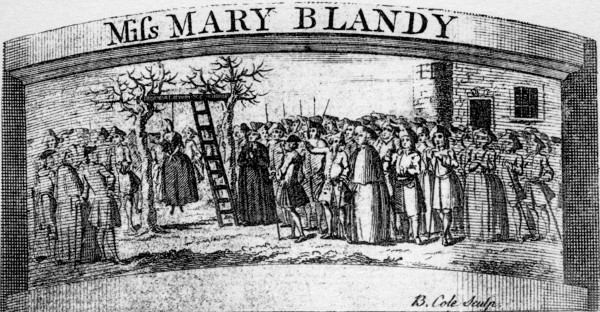
B. Cole Sculp
Aged 33 and Executed at Oxford
April 6, 1752, for poisoning her Father.
1. An Authentic Narrative of that Most Horrid Parricide. (Printed in the year
1751. Name of publisher in second edition, M. Cooper.)
2. A Genuine and Full Account of the Parricide committed by Mary Blandy,
Oxford; Printed for, and sold by C. Goddard in the High St, and sold by
R. Walker in the little Old Bailey, and by all booksellers and pamphlet Shops.
(Published November 9, 1751.)
3. A Letter from a Clergyman to Miss Mary Blandy with her Answer thereto....
As also Miss Blandy’s Own Narrative. London; Printed for M. Cooper at the
Globe in Paternoster Row. 1752. Price four pence. Brit. Mus. (March 20, 1752.)
4. An Answer to Miss Blandy’s Narrative. London; Printed for W. Owen,
near Temple Bar. 1752. Price 3d. Brit. Mus. (March 27, 1752.)
5. The Case of Miss Blandy considered as a Daughter, as a Gentlewoman, and as
a Christian. Oxford; Printed for R. Baldwin, at the Rose in Paternoster Row.
Brit. Mus. (April 6, 1752.)
6. Original Letters to and from Miss Blandy and C—— C——, London. Printed
for S. Johnson, near the Haymarket, Charing Cross. 1752. Brit. Mus. (April 8,
1752.)
7. A Genuine and Impartial Account of the Life of Miss M. Blandy. W. Jackson
and R. Walker. (April 9, 1752.)
8. Miss Mary Blandy’s Own Account. London; Printed for A. Millar in the
Strand. 1752 (price one shilling and sixpence). N.B. The Original Account
authenticated by Miss Blandy in a proper manner may be seen at the above A.
Millar’s. Brit. Mus. (April 10, 1752. The most famous apologia in criminal
literature.)
9. A Candid Appeal to the Public, by a Gentleman of Oxford. London. Printed
for J. Clifford in the Old Bailey, and sold at the Pamphleteer Shops. 1752.
Price 6d. Brit. Mus. (April 15, 1752.)
10. The Tryal of Mary Blandy. Published by Permission of the Judges.
London. Printed for John and James Rivington at the Bible and Crown and in
St Paul’s Churchyard. 1752. In folio price two shillings. 8vo. one shilling.
Brit. Mus. (April 24, 1752.)
11. The Genuine Histories of the Life and Transactions of John Swan and Eliz.
Jeffries, ... and Miss Mary Blandy, London. Printed and sold by T. Bailey
opposite the Pewter-Pot-Inn in Leadenhall Street. (Published after April 10, 1752.)
12. An Authentic and full History of all the Circumstances of the Cruel Poisoning
of Mr. Francis Blandy, printed only for Mr. Wm. Owen, Bookseller at Temple
Bar, London, and R. Goadby in Sherborne. Brit. Mus. (Without date. From
pp. 113-132 the pamphlet resembles the “Answer to Miss Blandy’s Narrative,”
published also by Wm. Owen.)
13. The Authentic Tryals of John Swan and Elizabeth Jeffryes.... With the
Tryal of Miss Mary Blandy, London. Printed by R. Walker for W. Richards, near
the East Gate, Oxford. 1752. Brit. Mus. (Published later than the “Candid
Appeal.”)
14. The Fair Parricide. A Tragedy in three acts. Founded on a late
melancholy event. London. Printed for T. Waller, opp. Fetter Lane. Fleet
Street (price 1/). Brit. Mus. (May 5, 1752.)
15. The Genuine Speech of the Hon. Mr ——, at the late Trial of Miss
Blandy, London; Printed for J. Roberts in Warwick Lane. 1752. (Price sixpence.)
Brit. Mus. (May 15, 1752.)
16. The x x x x Packet Broke Open, or a letter from Miss Blandy in the Shades
below to Capt. Cranstoun in his exile above. London. Printed for M. Cooper at
the Globe in Paternoster Row. 1752. Price 6d. Brit. Mus. (May 16, 1752.)
17. The Secret History of Miss Blandy. London. Printed for Henry Williams,
and sold by the booksellers at the Exchange, in Ludgate St, at Charing Cross, and
St. James. Price 1s. 6d. Brit. Mus. (June 11, 1752. A sane and well-written
account of the whole story.)
18. Memoires of the Life of Wm. Henry Cranstoun Esqre. London. Printed for
J. Bouquet, at the White Hart, in Paternoster Row; 1752. Price one shilling.
Brit. Mus. (June 18, 1752.)
19. The Genuine Lives of Capt. Cranstoun and Miss Mary Blandy. London.
Printed for M. Cooper, Paternoster Row, and C. Sympson at the Bible Warehouse,
Chancery Lane. 1753. Price one shilling. Brit. Mus.
20. Capt. Cranstoun’s Account of the poisoning of the Late Mr. Francis Blandy.
London. Printed for R. Richards, the Corner of Bernard’s-Inn, near the Black
Swan, Holborn. Brit. Mus. (March 1-3, 1753.)
21. Memories of the life and most remarkable transactions of Capt. William Henry
Cranstoun. Containing an account of his conduct in his younger years. His letter
to his wife to persuade her to disown him as her husband. His trial in Scotland, and
the Court’s decree thereto. His courtship of Miss Blandy; his success therein, and
the tragical issue of that affair. His voluntary exile abroad with the several accidents
that befel him from his flight to his death. His reconciliation to the Church of
Rome, with the Conversation he had with a Rev. Father of the Church at the time of
his conversion. His miserable death, and pompous funeral. Printed for M. Cooper
in Paternoster Row; W. Reeve in Fleet Street; and C. Sympson in Chancery Lane.
Price 6d. With a curious print of Capt. Cranstoun. Brit. Mus. (March 10-13,
1753. As the title-page of this pamphlet is torn out of the copy in the Brit. Mus., it
is given in full. From pp. 3-21 the tract is identical with “The Genuine Lives,”
also published by M. Cooper.)
22. Parricides! The trial of Philip Stansfield, Gt, for the murder of his father
in Scotland, 1688. Also the trial of Miss Mary Blandy, for the murder of her
Father, at Oxford 1752. London (1810). Printed by J. Dean, 57 Wardour St,
Soho for T. Brown, 154 Drury Lane and W. Evans, 14 Market St, St James’s.
Brit. Mus.
23. The Female Parricide, or the History of Mary-Margaret d’Aubray, Marchioness
of Brinvillier.... In which a parallel is drawn between the Marchioness and
Miss Blandy. C. Micklewright, Reading. Sold by J. Newbery. Price 1/.
(March 5, 1752.)
Lowndes mentions also:—
24. An Impartial Inquiry into the Case of Miss Blandy. With reflections on
her Trial, Defence, Repentance, Denial, Death. 1753. 8vo.
25. The Female Parricide. A Tragedy, by Edward Crane, of Manchester.
1761. 8vo.
26. A Letter from a Gentleman to Miss Blandy with her answer thereto. 1752.
8vo. (Possibly the same as “A Letter from a Clergyman.”)
The two following are advertised in the newspapers of the day:—
27. Case of Miss Blandy and Miss Jeffreys fairly stated, and compared....
R. Robinson, Golden Lion, Ludgate Street. (March 26, 1752.)
28. Genuine Letters between Miss Blandy and Miss Jeffries before and after their
Conviction. J. Scott Exchange Alley; W. Owen, Temple Bar; G. Woodfall,
Charing Cross. (April 21, 1752.)
29. Broadside. Execution of Miss Blandy. Pitts, Printer, Toy and Marble
Warehouse, 6 Great St. Andrew’s St. Seven Dials. Brit. Mus.
30. The Addl. MSS., 15930. Manuscript Department in the Brit. Mus.
1. Read’s Weekly Journal, March and April (1752), February 3 (1753).
2. The General Advertiser, August-November (1751), March and April (1752).
3. The London Evening Post, March and April (1752).
4. The Covent Garden Journal (Sir Alexander Drawcansir), February, March,
and April (1752).
5. The London Morning Penny Post, August and September (1751).
6. Gentleman’s Magazine, pp. 376, 486-88 (1751), pp. 108-17, 152, 188, 195
(1752), pp. 47, 151 (1753), p. 803, pt. II. (1783).
7. Universal Magazine, pp. 114-124, 187, 281 (1752).
8. London Magazine, pp. 379, 475, 512(1751), pp. 127, 180, 189(1752), p. 89
(1753).
Note I.—In recent years the guilt of Cranstoun has been questioned. Yet a
supposition that does not explain two damning circumstances must be baseless:
(a) In the first place, one of his letters to Miss Blandy, dated July 18, 1751,
was read by Bathurst in his opening speech. Although the reports of the trial
do not tell us that the note was produced in court, or that the handwriting was
verified, it cannot be presumed that the Crown lawyers were guilty of wilful
fabrication. However strange it may appear that this letter alone escaped
destruction, it is improbable that Miss Blandy invented it. Had she done so its
contents would have been more consistent with her defence. As it stands it is
most unfavourable to her. Therefore, in the absence of further evidence, we
must conclude that the letter is genuine, and if genuine Cranstoun was an
accomplice.
(b) In the second place, the paper containing the poison which was rescued
from the fire, is said by the prosecution to have borne the inscription in Cranstoun’s
handwriting, ‘Powder to clean the pebbles’ If this had been counterfeit,
Miss Blandy would have had no object in destroying it, but would have
kept it for her purpose.
At any cost Lord Cranstoun must have been anxious to remove the black stain
from his scutcheon. That this was impossible the fact that it was not done seems to
prove. Indeed, if Captain Cranstoun had been ignorant of the crime, he could have
proved his innocence as soon as Miss Blandy was arrested by producing her letters,
which, granting this hypothesis, would have contained no reference that would have
incriminated him. That she had written a great deal to him was shown in evidence
at the trial by the clerk Lyttleton.
For these reasons it is impossible to accept the conclusion of the writer of
Cranstoun’s life in the Dic. Nat. Biog. (who has adopted the assertion in Anderson’s
Scottish Nation, vol. i. p. 698), that “apart from Miss Blandy’s statement there is
nothing to convict him of the murder.”
Note II.—Anderson’s statement that “there does not appear to be any grounds
for supposing that Captain Cranstoun was in any way accessory to the murder,” shows
that he had not a complete knowledge of the facts at his disposal, or that he did not
weigh them with precision. Miss Blandy’s intercepted letter to her lover affords a
strong presumption of his connivance, and her destruction of his correspondence
suggests that it contained incriminating details. That these two actions were subtle
devices to cast suspicion upon Cranstoun cannot be maintained with any show of
plausibility, for in this case Miss Blandy, if dexterous enough to weave such a crafty
plot, must have foreseen its exposure, and with such exposure her own inevitable ruin,
when to prove that he was not an accomplice her lover had produced the letters she
had written to him. Thus to support such an assumption it must be shown that
Cranstoun had previously destroyed every particle of her handwriting, and that she
was aware of the fact. Of such an improbable circumstance there is, of course, no
evidence.
Note III.—“Old Benchers of the Middle Temple,” Essays of Elia. The relative
of Miss Blandy, with whom Mr Samuel Salt was dining when he made the unfortunate
remark which Lamb repeats, may have been Mr Serjeant Henry Stephens of Doctors’
Commons, who was her maternal uncle.
Note IV.—The date of Miss Blandy’s birth is not given in the Dic. Nat. Biog.
From the register of Henley Parish Church it appears that she was baptized on
July 15, 1720.
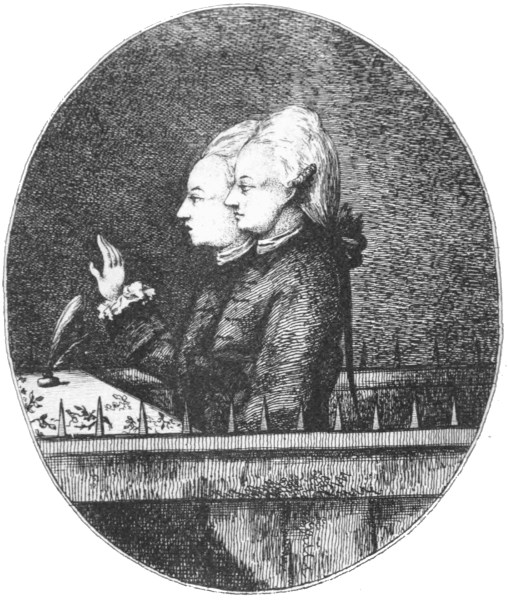
Mess. Robert and Daniel
Perreau.
London. Publish’d Jany 22d 1776. According to Act of Parliament.
THE UNFORTUNATE BROTHERS THE CASE OF ROBERT AND DANIEL PERREAU AND MRS MARGARET CAROLINE RUDD, 1775-6 — BIBLIOGRAPHY OF THE PERREAU CASE — I. Contemporary Tracts — II. Contemporary Newspapers and Magazines — THE SONG “ROBIN ADAIR”
“What’s this dull town to me?
Robin’s not near;
He whom I wish to see,
Wish for to hear.
Where’s all the joy and mirth,
Made life a heaven on earth?
Oh! they’re all fled with thee,
Robin Adair.”
When tenor Braham sent his plaintive air ringing
through the town, few were alive who could recall the
two previous occasions on which also the name of Adair
was upon every lip. One day in February 1758 all
London had been stirred by the elopement of Lady
Caroline Keppel, daughter of second Earl Albemarle,
with a rollicking Irish physician who may have been
the Robert of the ballad; while during the summer of
1775 the whole world was wondering whether a man or
a most beautiful woman must go to Tyburn for using
the signature of Mr William Adair, the rich army agent,
cousin to Dr Robin of wedding and song. In the first
romance the hero received the just title of ‘the fortunate
Irishman’: in the latter the chief personages were
‘the unfortunate brothers’ Messrs Robert and Daniel
Perreau. Their disaster happened thus:—
On a Tuesday morning, the 7th of March 1775, a
slender, middle-aged gentleman walked into the counting-house
of Messrs Drummond, the great bankers of
Charing Cross. Garbed in a trim snuff-coloured suit, and
betraying none of the macaroni eccentricities with the
exception of a gold-laced hat, his dress suited the rôle
that he played in life—a sleek and prosperous apothecary.
This Mr Robert Perreau of Golden Square was
welcomed cordially by Henry Drummond, one of the
partners in the firm, for an apothecary was almost as
eminent as a doctor, and the men had met and known
each other at such houses as my Lord Egmont’s or
that of my Lady Lyttelton. Producing as security a
bond for £7500, bearing a signature that should have
been honoured by any house in London, the visitor
requested a loan of £5000. However, strange to say,
banker Henry, who had been joined by his brother
Robert, seemed dissatisfied.
“This bond is made payable to you,” he remarked.
“Was you present when it was executed?”
“No, I was not present,” was Mr Perreau’s reply.
“It is not the signature of William Adair, the late
army agent of Pall Mall,” was the startling comment
of Robert Drummond. “I have seen his drafts many
a time!”
The prim countenance of the apothecary remained
unperturbed.
“There is no doubt but it is his hand,” he answered,
with perfect composure, “for it is witnessed by Mr Arthur
Jones, his solicitor, and by Thomas Stark, his servant.”
“It is very odd,” replied the incredulous Robert
Drummond. “I have seen his hand formerly, and this
does not appear to be the least like it.”
Brother Henry Drummond echoed the same sentiment,
whereupon Mr Robert Perreau waxed mysterious and
emphatic.
“Mr Adair is my particular friend,” he declared.
“There are family connections between us.... Mr
Adair has money of mine in his hands, and allows me
interest.”
“Come to-morrow, Mr Perreau,” said Henry Drummond,
“and we will give you an answer.”
Having received this promise the apothecary departed,
but after the lapse of two hours he returned, and
was seen by banker Henry once more. Without the
least reserve he confessed that he had been much
concerned by what the Messrs Drummond had told
him.
“I could not be easy in my mind till I had called
on Mr Adair,” he explained. “Luckily I catched him
in his boots before he went to take his ride.”
Naturally, the good banker listened with interest,
noting the words, for it seemed odd that Mr William
Adair, the rich squire of Flixton Hall in Suffolk, whose
son was carrying on the army agency, should raise
money in such a style.
“I produced the bond to Mr Adair,” Robert Perreau
continued. “It was his signature, he said, but he might
possibly have altered his hand from the time you had
seen him write.... You might let me have the
£5000, Mr Adair said, and he would pay the bond in
May, though it is not payable till June.”
The astute banker, who had talked the matter over
with his brother in the interim, did not express his
doubts so strongly.
“Leave the bond with me,” he suggested to his
visitor, “in order that we may get an assignment of it.”
Which proposal Mr Robert Perreau assented to
readily, believing, no doubt, that it was a preface to the
payment of his money. In the course of the day the
document was shown to a friend of Mr Adair, and finally
exhibited to the agent himself. Attentive to the hour
of his appointment, Mr Perreau left his gallipots in
Golden Square, and reached the Charing Cross bank
at eleven o’clock on the following morning. Both
partners were ready for him, and suggested that to
clear up all doubts it would be wise to call upon Mr
William Adair without delay. To this the apothecary
assented very readily—indeed, in any case a refusal
would have aroused the worst suspicions. As it was a
wet morning, he had come in his elegant town coach,
and he drove off immediately with one of the bankers
to the house of the late agent in Pall Mall. Upon
their entrance the squire of Flixton took Mr Henry
Drummond by the hand, but, to the surprise of the
worthy banker, made a bow merely to the man who
had boasted him as his ‘particular friend’ Then, the
bond being produced, Mr Adair at once repudiated the
signature. For the first time Robert Perreau betrayed
astonishment.
“Surely, sir,” cried he, “you are jocular!”
A haughty glance was the sole response of the
wealthy agent.
“It is no time to be jocular when a man’s life is
at stake,” retorted the indignant Henry Drummond.
“What can all this mean? The person you pretend to
be intimate with does not know you.”
“Why, ’tis evident this is not Mr Adair’s hand,”
added his brother, who had just arrived, with similar
warmth, pointing to the forged name.
“I know nothing at all of it,” protested the confused
apothecary.
“You are either the greatest fool or the greatest
knave I ever saw,” the angry banker continued. “I do
not know what to make of you.... You must account
for this.... How came you by the bond?”
Then there was a hint that a constable had been
summoned, and it would be best to name his accomplices.
“How came you by the bond?” repeated Mr
Drummond.
At last the bewildered Mr Perreau seemed to realise
the gravity of his position.
“That will appear,” he replied, in answer to the last
remark, “if you will send for my sister.”
“Who may she be?”
“Why, my brother Mr Daniel Perreau’s wife.”
Calling his servant, the apothecary bade him take the
coach for his sister-in-law, who, he said, might be at her
home in Harley Street, but most likely with his wife at
his own house in Golden Square. It was evident that
the carriage did not go farther than the latter direction,
for in a short time it brought back the lady, who was
ushered into the room. Then indeed the hearts of
those three hard-pated men of finance must have been
softened, for their eyes could have rested upon no more
dazzling vision of feminine loveliness within the British
Isles. Of medium height, her figure was shaped in the
robust lines of graceful womanhood, but the face, which
beamed with an expression of childish innocence, seemed
the daintiest of miniatures, with tiny, shell-like features,
and the clearest and fairest skin. In the fashion of the
time her hair was combed upward, revealing a high
forehead, and the ample curls which fell on either
side towards her neck nestled beneath the smallest of
ears. Without a tinge of colour, her complexion was
relieved only by her red lips, but the healthy pallor
served to heighten her radiant beauty. A thin tight
ribbon encircled her slender neck. Below the elbow
the close sleeves of her polonese terminated in little tufts
of lace, while long gloves concealed her round, plump
arms. Dress, under the influence of art, was beginning
to cast off its squalor.
Grasping the situation in a moment, this lovely Mrs
Daniel Perreau asked if she might speak with her
brother-in-law alone, but the request was refused. Then
the beauty, making full use of her shining blue eyes,
besought Mr Adair to grant her a private interview.
But the old man—not such a gay dog as kinsman
Robin—was proof against these blandishments.
“You are quite a stranger to me,” he answered, “and
you can have no conversation that does not pass before
these gentlemen.”
For a short time the beautiful woman appeared
incapable of reason. At last she seemed to make a
sudden decision.
“My brother Mr Perreau is innocent,” she cried, in
an agony of distress. “I gave him the bond.... I
forged it!... For God’s sake, have mercy on an
innocent man. Consider his wife and children....
Nobody was meant to be injured. All will be repaid.”
“It is a man’s signature,” objected one of the bankers.
“How could you forge it?”
Seizing a pen and sheet of paper, she imitated the
name on the bond with such amazing fidelity that all
were convinced. Then, according to promise, Robert
Drummond destroyed the writing, for he, at least, was
determined that no advantage should be taken of her
confidence.
Little information was gained from Daniel Perreau—twin
brother of the apothecary—who had been summoned
from his spacious home in Harley Street, save shrugs
of shoulders and words of surprise. Between him and
Robert there was a striking likeness. Both were handsome
and well-proportioned men, but a full flavour of
macaroni distinguished the newcomer—a ‘fine puss
gentleman’ of the adventurous type. To him dress was
as sacred as to his great predecessor, Mr John Rann of
the Sixteen Strings, who only a few months previously
had met with a fatal accident near the Tyburn turnpike.
Indeed, the macaroni was as great an autocrat as the
dandy of later days, and princes, parsons, and highwaymen
alike became members of his cult. So the gentleman
from Harley Street, flourishing his big stick, and
shaking the curled chignon at the back of his neck, tried
with success to look a great fool.
Quite appropriately, it was the woman who determined
the result. Less dour than the squire of Flixton, the
two bankers had no objection to accompany her into an
adjacent room, where they listened with sympathy to her
prayers. Being younger men than Mr Adair, they were
full of respect for her brave deed of self-accusation,
moved by the piteous spectacle of beauty in tears. In
the end, confident that she spoke the truth, they began
to regard Robert Perreau as her innocent dupe. So the
constable was sent away, for macaroni Daniel seemed
too great an idiot to arrest, and it was preposterous to
dream of locking up his lovely wife. Thus the three
grave financiers promised that the adventure should be
forgotten, and the Messrs Perreau drove away from the
house in Pall Mall in Robert’s coach, assured that they
had escaped from a position which might have cost them
their lives. Almost as clever as she was beautiful was
this charming Mrs Daniel Perreau.
Surely, all but a fool would have tried to blot the
incident from his mind, content that the gentlemen
concerned believed his honour to be unsullied, too
humane to betray a pretty sister into the bloody hands
of justice—all but a fool, or a criminal seeking to escape
by sacrificing an accomplice! Yet Mr Robert Perreau,
although anything but a fool, would not rest. Without
delay he sought advice from a barrister friend, one
Henry Dagge, with the amazing result that on the
following Saturday forenoon, the 11th of March, he
appeared before Messrs Wright and Addington at the
office in Bow Street to lay information against ‘the female
forger’ Luckily, the magistrates took the measure of
the treacherous apothecary, and committed him as well
as the lady to the Bridewell at Tothill Fields. On the
next day, fop Daniel—a base fellow, who had acted
as decoy while his brother was effecting the betrayal—was
sent to keep them company. It was a rueful hour
for the two Perreaus when they tried to pit their wits
against a woman.
On Wednesday morning, the 15th of March, in expectation
that the three distinguished prisoners would appear
before Sir John Fielding, the Bow Street court was
besieged by so large a crowd that it was deemed prudent
to adjourn to more commodious quarters in the Guildhall,
Westminster. Surprising revelations were forthcoming.
It was found that the forgery discovered
seven days ago was only one of many. Two other
persons—Dr Brooke and Admiral Sir Thomas Frankland—less
cautious than the Drummonds, came forward
to declare that they had obliged their friend Mr
Perreau by discounting similar bonds, all of which
bore the signature of William Adair! Plain indeed
was the motive of Robert’s betrayal. It was not
enough that the bankers should forgive him—it was
needful that the woman must answer as scapegoat for
much more.
Never had a fairer prisoner stood before the blind
magistrate than the intended victim. Above a striped
silk gown she wore a pink cloak trimmed with ermine,
and a small black bonnet—as usual, daintiest of the
dainty, in spite of her tears and shame. Hitherto,
she had given splendid proofs of courage and loyalty,
but treachery had changed her heart to stone, and
she lent herself to a cunning revenge. A youthful
barrister named Bailey, who was hovering around Bow
Street soon after her arrest, had been lucky enough
to be accepted as her counsel. Clever almost as his
client—in spite of contemporary libels from Grub Street,
that repute him more intimate with Ovid’s Art of
Love than Glanvill or Bracton—he came forward with
the naïve suggestion that she should be admitted as
evidence for the Crown! And a witness she was made
there and then, two days later being let loose on bail,
which created a very pretty legal causerie in a little
while. On the other hand, the unhappy brothers were
committed to the New Prison, Clerkenwell, on the
capital charge of forgery. All this was very welcome
entertainment for the fashionable mob that crushed
into the Westminster Guildhall.
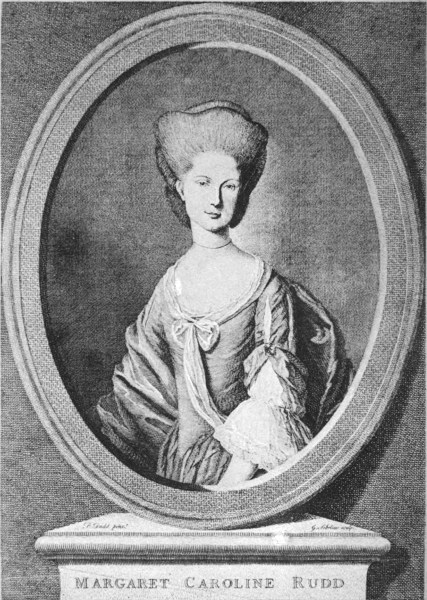
Margaret Caroline Rudd
The repartee of one of Sir John’s myrmidons, often
quoted by wags of the time as an excellent joke, is not
without its moral. One of the doorkeepers refused
entrance to a certain person on the ground that he had
been told to admit only gentlemen.
“That is Mr ——, the great apothecary,” quoth a
bystander.
“Oh!” returns the doorkeeper, “if that’s the case,
he must on no account go in, for my orders extend
only to gentlemen, and the whole room is filled with
apothecaries already.”
It would have been well for Robert Perreau had
he held no more exalted opinion of his station in life
than the Bow Street officer.
To the delight of all the bon ton, the scent of scandal
rose hot into the air. The charming lady who had
passed as the wife of Daniel Perreau proved to be
his mistress. Although she had lived with him for
five years, bearing him no less than three children, her
real name was Margaret Caroline Rudd, whose lawful
husband was still alive. Being the daughter of an
apothecary in the North of Ireland, by his marriage
with the love-child of a major of dragoons, who was
a member of the Scottish house of Galloway, her boast
that the blood of Bruce ran in her veins was strictly
true, in spite of the scoffs and jeers with which it was
hailed by her enemies. Early in the year 1762, when
only seventeen, she had married a dissolute lieutenant
of foot, named Valentine Rudd, the son of a grocer at
St Albans. Soon his society proved distasteful, and
the fair Margaret Caroline eloped with a more congenial
partner. During the next few years she lived
the life of a Kitty Fisher or a Fanny Murray—a gilt-edged
Cyprian—selling her favours, like Danae, for no
less than a shower of gold. Of all her patrons, the
most faithful and generous by far was a rich Jew moneylender
named Salvadore, whose name remains still as
a landmark in the purlieus of the metropolis. Good
Lord Granby is said to have visited her out of mere
affection. Among others, it was whispered that Henry
Frederick, a gentleman of easy virtue, like all Dukes
of Cumberland, became one of her intimate friends.
Possibly she may have listened to couplets from the
Essay on Women, for patriot Wilkes, the member of
Parliament for the county of Middlesex, is believed to
have cultivated her society, going to the extent of
finding her a home at Lambeth. Peers flocked to
Hollen Street or Meard’s Court to pay her homage.
A favourite device of hers was to impersonate a
boarding-school miss or a lady of quality. Few women
of pleasure have possessed the fertile imagination of
Mrs Margaret Caroline Rudd.
In May 1770 she met the foolish Daniel Perreau—not
stupid from the woman’s point of view, since
he was a dashing dog with a taste for all the pleasant
things in life—and in an unlucky moment she accepted
him as her protector. However, in other respects,
although he had travelled far over the world, his
intellect was no mate for hers. In business he had
been a failure both at home and abroad. Three times,
it is recorded, he was obliged to make composition with
his creditors. Only a fortnight before his alliance
with the bewitching Irishwoman his certificate of
bankruptcy had been signed. Still, he was a man
suited to the fair Margaret’s taste, handsome, gay, and
genteel, with a complacency that paid no regard to her
methods of raising money—a partner, in short, who
gave her back the status in society that she had
forfeited.
Naturally, Daniel was more than satisfied with his
beautiful companion, allowing her to pass as his lawful
wife, forming an establishment for her in Pall Mall
Court—the cost of which, since Salvadore and others
were as lavish as ever, she appears to have provided.
Golden dreams had captured his silly brain, and he
believed that Exchange Alley would bring a more
propitious fortune than vulgar trade. Funds could be
obtained from his dear Mrs Rudd. Secret news from
the French Embassy was furnished by his confederate,
one Colonel Kinder—an Irish soldier. It would be
easy to cut a brilliant figure at Jonathan’s, and restore
his shattered credit. Thus, relying upon certain information,
he insured the chances of war with Spain;
but the Falkland Island convention happened to bring
peace, and Daniel Perreau suffered his first big loss in
the Alley.
Still, this did not deter him, for the finances of Mrs
Rudd seemed inexhaustible, and sometimes he made
a lucky stroke himself. In addition to her pretended
fortune, which Daniel knew was not bequeathed by any
relative, she declared to her friends that a windfall had
come to her in the shape of an annuity of £800 a
year from Mr James Adair, the wealthy linen-factor of
Soho Square. This kinsman of the Pall Mall agent
chanced to be acquainted with the maternal uncle of
Margaret Caroline Youngson—a tenant farmer of Balimoran,
County Down, John Stewart by name, another
unlawful offspring, possibly, of the amorous major of
the house of Galloway—and, after the custom of a man
of the world, as he is described, he became even more
interested than the royal duke in the fortunes of the
pretty niece. It is doubtful whether his generosity
reached the sum named, but with so many sources of
income strict accuracy in detail may have been difficult
to Mrs Rudd. Indeed, the despicable Daniel Perreau
did not require them. It was a great thing to boast
at Jonathan’s that his wife was a connection of one of
the great Adairs. With such a surety funds might be
borrowed easily.
Apparently, being much attached to her protector,
Margaret Rudd was quite content to live with him in
their humble quarters in Pall Mall Court, and to
present him at appropriate intervals with pledges of
their mutual ardour. Probably she shared his golden
visions, hoping for future affluence. At all events, she
gained no monetary advantage from the connection.
Moreover, it was not until the beginning of the fatal year
that she was mistress even of a house of her own, for
the elegant residence on the west side of Harley Street
was purchased on the 31st of December 1774.
Brother Robert watched with amazement the progress
of the fortunes of his twin, for it was wonderful
that bankrupt Daniel should be able to live in decent
lodgings with a stylish lady, to pursue fashion in all
its vagaries, and to throw about money in the Alley.
A different man this Robert—solemn, laborious, and
intelligent, making a hard-earned income of a thousand
pounds a year. Nevertheless, his soul soared above
his gallipots. It was his ambition to make a figure
in the world, so that his wife could woo society with
drums, routs, hurricanes. When he looked around he
saw that fortunes were being won on every side. A
wave of prosperity was bearing the empire on its
crest. The Great Commoner had wrenched America
and India from the hereditary enemy. To these vast
markets British seamen were carrying the exports of
their country. At home, the clever inventors of the
North, Watt and Arkwright, Hargreaves and Brindley,
had increased the powers of production a thousandfold.
England was setting up shop on a scale undreamt of
hitherto in the world’s philosophy. Why spend one’s
life in dispensing pukes and boluses, thought apothecary
Robert, when the Alley is open to all who dare take
advantage of this golden age?
Since this was his character, brother Daniel and his
pretty chère amie soon tempted the misguided man to
share their fortunes, glad to seek the cover of his
reputable name to fashion new and more desperate
schemes. For earls and bishops were clients of the
apothecary, and ‘honest Perreau’ was one of his
appellations. Yet to preserve the co-operation of such
respectability a pleasant little piece of fiction had to be
maintained. Brother Robert, not a fool by any means,
was willing to assist their plans, but only in the
character of an ingenuous agent; a method—as, no
doubt, he pointed out—that must disarm all suspicion.
Thus, when he canvassed his friends to advance money
on bonds in pursuance of the new policy, he would
be able to pose as the emissary of his sister-in-law
Mrs Daniel Perreau and her doting relatives Messrs
James and William Adair. Indeed, there was a letter
in his pocket, authorising some such scheme, which,
not being penned by the Pall Mall agent, probably
was the work of the clever woman who could give
imitations of other people’s handwriting. Such a letter
would be useful in case his possession of an Adair bond
was questioned, but most useful of all—and this most
certainly Mr Robert Perreau would not point out to
his confederates—in making him appear a guileless dupe
in the hands of an artful woman. Very cleverly had
he arranged the saving of his own skin, this sly, precise
apothecary.
For no game could be more hazardous than the
one which the guilty trio continued to pursue. Forgery
was needful to cover forgery. As one bond became
payable another had to be discounted to provide the
money. A couple of bonds to the value of nearly
£8000 were cashed by banker Mills in the City. On
two others the large sums of £4000 and £5000 had
been advanced by Sir Thomas Frankland. In this
way more than a dozen were negotiated during the
twelve months that preceded the discovery. All
were signed with the name of the army agent—the
pretended benefactor of Daniel’s wife—and their total
value reached the huge sum of £70,000. Thus the
Perreaus had been able to continue their speculations
in Exchange Alley. Their sole chance of coming out
of the mischief scot free was a lucky stroke at Jonathan’s,
or the death of one of their victims.
Public interest in the case was aroused no less by the
personality of the prisoners than by the mystery surrounding
the actual criminal. For the brothers on one
side, and Mrs Rudd on the other, told two wonderful and
contradictory stories. This most artful of women, whined
the Messrs Perreau, using consummate guile, had revealed
to them gradually a dazzling and enticing prospect.
First Mr James and then Mr William Adair was represented
as the lavish benefactor of their beautiful
relative. Yet such was the modesty of these capitalists,
that although they declared their intention of procuring
a baronetcy for Daniel, and an estate in the country
for Robert, besides setting up the twins as West-End
bankers, they would communicate with Mrs Rudd alone!
Moreover, such was the impecuniosity of these wealthy
men that they were able to carry out their benevolent
intentions only by the aid of notes of hand! However,
the brothers protested that these assurances had been
given to them by the lady, and that all the forged bonds
had been received from the fair Margaret Caroline by
innocent Daniel or ingenuous Robert, in the belief that
the Messrs Adair, who had signed them, intended a
gratuitous present. A most happy stroke of luck,
coinciding fortunately with the period of their bold
speculations at Jonathan’s! Yet what was Mrs Rudd’s
motive in running these risks to provide funds from
which she received little benefit, was not made clear.
Even more wondrous was the other story. Although
her conduct at the house in Pall Mall—whether we deem
her guilty or innocent—showed something of nobility,
she had no mercy for her confederates after they had
played her false. While confessing once more that she
had forged the bond which the Drummonds had rejected,
she declared that her keeper Daniel had forced
her to do so by standing over her with an open knife,
threatening to cut her throat unless she obeyed. An
incredible story, but no more improbable than the other!
With the exception of this compulsory forgery, Mrs
Rudd avowed that she was innocent. Amidst all this
publicity it is likely that poor Mr James Adair, who
had been very much the lady’s friend in former days,
would have an unpleasant time with Mrs James Adair,
and with his son, young Mr Serjeant James, M.P., the
rising barrister!
Such an entertainment was a novel and delightful
experience for the British public. Since the wonderful
time (fourteen summers ago) when mad Earl Ferrers
had made his exit at Tyburn in a gorgeous wedding
dress, and amidst funereal pomp, the triple tree seldom
had been graced by the appearance of gentlefolk.
Broker Rice, whose shady tricks at the Alley made
him the victim of Jack Ketch three years after his
lordship, was almost the only respectable criminal
who had been hanged for more than a decade. Indeed,
except Mother Brownrigg and Jack of the Sixteen
Strings, no criminal of note had dangled from a
London scaffold since the days of Theodore Gardelle.
Yet a glorious era was dawning for the metropolitan
mob, when, in quick succession, Dodd, Hackman, and
Ryland were to journey down the Oxford Road—the
golden age of the gallows, when George III. was king!
On Friday, the Ist of June, Robert Perreau was put to
the bar at the Old Bailey. Owing to ill-health he had
been allowed to remain in the Clerkenwell prison, and
was not taken to Newgate until the morning of his trial—a
privilege shared also by his brother. The President
of the Court was Sir Richard Aston, who, as a junior
of the Oxford circuit, had helped to defend the unfortunate
Miss Blandy. By his side sat the Right
Honourable John Wilkes, Lord Mayor of London, a
quite tame City patriot now almost ready for the royal
embraces, very different from the Wilkes winged by
pistol-practising Martin, M.P., and hounded by renegade
Jemmy Twitcher. This same City patriot—if we may
credit one of Dame Rumour’s quite credible stories—whispered
into the ear of the judge the most important
words spoken during the trial:—“My lord, you can
convict these men without the woman’s evidence....
It is a shocking thing that she should escape unpunished,
as she must if you call her as a witness!” Which
advice—if the lady had been as kind to ‘squinting
Jacky’ as the world believed—shows that he was rising
on stepping stones of Medmenham Abbey to higher
things. At all events, instead of summoning Mrs Rudd
into the box, the judge startled the world by ordering
her to be detained in Newgate.
In spite of the efforts of his counsel and his friends,
the Court did not put the least faith in the wily
apothecary, refusing to believe that he had been
ignorant of his brother’s relationship to his mistress, or,
if this were true, that an innocent man would obtain
cash for a succession of huge bonds, drawn on the well-known
house of Adair, at the bidding of a woman
without making inquiries. Even granting that he was
so credulous as to remain silent when he saw that
suspicion was aroused, it was clear that no man of
honour would strive to stifle mistrust by telling lies.
Then there were other compromising circumstances.
It was apparent that the Perreaus needed money to
repay certain bonds that were falling due. Robert had
antedated the latest forgery to make it agree with one
of his falsehoods to the Messrs Drummond, for in the
previous January he had endeavoured to obtain money
from them by a fictitious story. Not only did the
employment of a scrivener have no weight in his favour,
but pointed to premeditation. In the face of these
facts his guilt seemed clear. Notwithstanding an
eloquent defence written for him by Hugh M’Auley
Boyd, in which he protested that he had received the
bonds from Mrs Rudd in good faith, the jury required
no more than five minutes to return a hostile verdict.
At nine o’clock on the following morning there were
similar dealings with brother Daniel. Seeing that his
case was hopeless, he did not deliver the elaborate
address that had been prepared, choosing to print it, like
Pope’s playwright. Naturally, his expectations were
fulfilled, and he was found guilty of forging one of the
bonds in the name of William Adair, on which his friend
Dr Brooke had lent him £1500. On the 6th of June, at
the close of the Old Bailey sessions, he was sentenced
to death along with Robert by Recorder Glynn, while
on the same day Mrs Rudd was told that as bail
could not be granted, she must remain in prison. In
spite of their dishonesty, and still baser treachery, it is
impossible to think of the cruel sentence of the unfortunate
Perreaus without a thrill of horror. Yet no
qualms disturbed the tranquil conscience of King George,
who believed he was doing the Lord’s work in hanging
men and women for a paltry theft.
The charming Mrs Rudd was not disposed of so
easily as her unlucky confederates. From April onwards
she had attracted more attention than the skirmishes
with our rebellious colonists at Bunker’s Hill and
Lexington. While she was at large and the brothers
were under lock and key, public sympathy had remained
on their side. Moreover, her tactics were not too reputable,
and until it was evident that she was struggling
in her prison with the valour of desperation against overwhelming
odds, popular compassion did not condone her
shifty methods. Still, whatever her guilt, she waged
her long battle with surpassing dexterity.
One of the foremost of her foes, and not the least
dangerous, was George Kinder, the Irish colonel—Daniel’s
emissary in the unlucky touting at the back
stairs of the French Embassy—a gentleman who had
sought vainly to win the good graces of Miss Polly
Wilkes. There was no false delicacy about this warrior,
as the letters in the Morning Post under pseudonyms
‘Jack Spry’ and ‘No Puffer’ bear ample testimony,
and soon he had made the whole world familiar with the
amatory history of Margaret Youngson. Yet Colonel
Kinder was too reckless in the delivery of his attacks, and,
like many another dashing soldier, he found himself often
outflanked. For Mrs Rudd wielded her pen brilliantly,
and her replies to critics of the press were not unworthy—both
in style and context—of a novelist of later
days. At all events, the vulgar diatribes of Colonel
Kinder helped to bring popular sympathy to the side of
his fair antagonist, and this is precisely what the clever
lady must have foreseen.
Another enemy, as inveterate as the Irishman
himself, appeared in the person of a rough-and-ready
sea-dog, ex-Admiral Sir Thomas Frankland—whom
the Perreaus had swindled out of thousands of
pounds—a lineal descendant of Protector Cromwell.
More truculent even than his great ancestor—for surely
Oliver never confiscated ruff or farthingale belonging
to Henrietta Maria—he pounced upon Mrs Rudd’s
clothes, and indeed upon all property that might help
to repay his loans. Remaining loyal to his old friend
the Golden Square apothecary—for the choleric gentleman
was convinced that he was an innocent instrument
in the hands of the woman—he seized anything that
Daniel and his mistress happened to possess. In consequence
of this brigandage there was a pitched battle
between the employees of the admiral and the sheriff’s
officers for the possession of the house in Harley Street,
in which the former got the worst of the tussle. Running
amuck at all who took the other side—Barrister
Bailey, Uncle Stewart, the Keeper of the Lyon
Records—each in turn received a broadside from the
fiery old salt. Shiver-me-timbers Frankland—this Paul
Pry of a lady’s wardrobe—wrought more good out of
evil to the cause of Margaret Rudd than any other man,
and his fair enemy was nothing loth to let him run to
the top of his bent.
Nowhere was the diplomacy of Daniel Perreau’s
mistress more remarkable than in the negotiations with
her old servant, Mrs Christian Hart. Early in July
there was an interview between the pair in Newgate: the
handmaid compassionate and pliable; the prisoner full
of subtle schemes against her enemies. Barrister Bailey
was present, and a lengthy document was drawn up—a
paper of instructions in the form of a narrative for the
guidance of the faithful ‘Christy’—wherein was set
forth the details of a wicked conspiracy, which the
servant was to pretend that she had overheard, between
old sea-dog Frankland and Mrs Robert Perreau to
swear away Mrs Rudd’s life. Promising to learn her
story and stick to the text, Mrs Hart went away with
her manuscript; but, frightened by her husband or
bribed by the admiral, in a little while she deserted to
the other side. In no wise dismayed, Margaret Rudd
retorted that ‘Christy’ had volunteered the story,
and that the instructive document was a faithful copy of
the woman’s narrative as dictated by herself, another
copy of which she produced, attested by the faithful
Bailey. Moreover, she alleged that the whole business
was a thing devised by the Perreaus for the purpose of
compromising their enemy, a most dexterous plot to
make it appear that Mrs Rudd was endeavouring to
create false evidence! Thus, even when the first scheme
failed, she gained the effect desired by its very failure.
Poor, persecuted woman, thought the big-hearted British
public, and what a shocking old admiral!
A little later, the fair captive in Newgate triumphed
over another enemy, one Hannah Dalboux, a second
domestic. This Hannah had been nurse to the youngest
of Daniel Perreau’s children since the mother had been
put in prison. One morning in August the newspapers
announced that the woman had refused to surrender the
child, and that the woman’s husband had tried to thrash
the inevitable Mr Bailey when he paid a visit with his
client’s request. “The baby shall be given up when I
am paid for its board and lodging,” was the sum and
substance of Hannah’s ultimatum. All the same the
child had to be delivered to its rightful owner, and
husband Dalboux was locked up for the assault. A
great opportunity, indeed, which Mrs Rudd did not
neglect. All the journals were full of hints concerning
the horrid old admiral, who had employed people to
steal the lady’s baby as well as her petticoats—about the
last two things in the world a swell mobsman would
choose, unless they were accompanied by the proprietress.
Yet the salient fact, remembered by the British public
in a little while, was that this inveterate sea-dog was the
prosecutor at Mrs Rudd’s trial.
The well-known anecdote told of her by Horace
Walpole, must, if true, have reference to an incident that
occurred during her imprisonment in Newgate.
“Preparatory to her trial, she sent for some brocaded
silks to a mercer. She pitched on a rich one, and
ordered him to cut off the proper quantity, but the
mercer, reflecting that if she was hanged, as was probable,
he should never be paid, pretended he had no scissors.
She saw his apprehensions, pulled out her pocket-book,
and giving him a bank-note for £20, said, ‘There is a
pair of scissors.’ Such quickness is worth a hundred
screams. We have no Joans of Arc nor Catherines de
Medici, but this age has heroines after its own fashion.”
Whenever a Gordian knot presented itself the undaunted
Mrs Rudd was always ready with a pair of
scissors!
Like all other popular entertainers, the fair Margaret
Caroline had rivals in the public favour. On the nineteenth
of August, “one of the prettiest young women in
England,” Jane Butterfield by name, was tried for her
life at Croydon on a charge of poisoning a foully-diseased
old man for whom she kept house. Paramour also to
this rotten William Scawen was Miss Jane, debauched
by him when a child. Although the poor girl was
acquitted amidst tears and huzzas, she lost the fortune
that should have come to her, for her protector, who had
listened to the accusations of his Dr Sanxy—the
instigator of all the proceedings against the innocent
Jane—lived long enough, unhappily, to cross her out of
his will. For a while all England forgot Margaret Rudd
in its generous sympathy for the beautiful heroine of
Croydon. Soon also the ubiquitous Elizabeth Chudleigh
monopolised public attention, to the exclusion of everyone
else, under her new rôle as Her Grace of Kingston;
while the sex of the mysterious Chevalier D’Eon continued
to be the subject of many wagers.
For six months Mrs Rudd remained a prisoner in
Newgate—from the day of Robert Perreau’s condemnation
on the 1st of June until the morning of her own
trial on the 8th of December—using every endeavour so
that she should not be brought to the judgment-seat. A
few weeks after the close of the summer sessions—on the
fourth day of July—she was summoned to Westminster
Hall to listen to the ruling of Chief-Justice Mansfield, an
unrivalled exponent of amazing decisions, with regard to
her status as king’s evidence. Superfine, indeed, was
the quality of Mansfield’s red tape:—“The woman did
not confess that she was an accomplice, but an assistant
by compulsion, therefore she may be presumed to be
innocent, consequently there is no reason why she should
not be tried! Only a guilty person can be admitted as
a witness for the Crown!” Yet the great Chief-Justice
had a more cogent reason still—one that is irrefutable:
“Since the lady did not disclose all she knew, she has
forfeited indulgence!” Quite proper, no doubt, in a
legal sense, but foreign to the eternal ethics of British
equity, that has permitted ‘burker’ Hare to escape the
halter, believing that it is monstrous to ask a jury to try
a prisoner from whom a confession has been extorted
under promise of pardon. There was no false delicacy
about the learned Mansfield’s interpretation of the law.
However, his lordship was the autocrat of all bigwigs,
and none but the most stout-hearted ventured to challenge
his decisions. When the case was argued by her counsel
before three judges, sitting as a Court of Gaol Delivery
in the middle of September, one Henry Gould, who
feared a Chief-Justice as little as a Gordon riot, appears
to have realised that the law must keep its faith. So he
gave a flat contradiction to the ruling of the King’s Bench.
“How can we know that the woman was cognisant of
any other forgery than the one to which she has confessed
unless we bring her to trial?” demanded this judge
Gould. “And if we bring her to trial we break our word!”
Nevertheless his two colleagues, remembering possibly
the Mansfield temper and the Mansfield tongue, maintained
the arguments of the Chief-Justice, and thus it was
decreed that Mrs Rudd must go before a jury. Early in
November twelve judges assented to this decision.
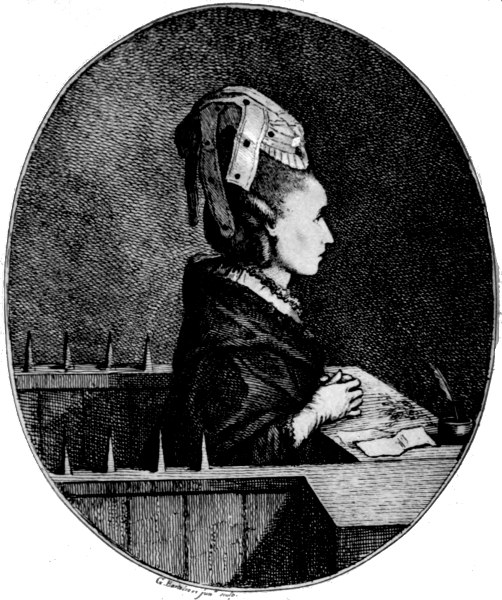
Mrs. Margaret Caroline Rudd
at the Bar of the Old Bailey
Published dec.r 15.th 1775 according to Act of Parliament
Confident that her long struggle had not been futile,
since this breach of faith must shock the public mind, the
beautiful prisoner prepared to face her terrible ordeal.
In a letter from Strawberry Hill we catch a glimpse of
her on the eve of her trial. “... She sent her lawyer
a brief of which he could not make head nor tail. He
went to her for one more clear. ‘And do you imagine’
said she, ‘that I will trust you or any attorney in England
with the truth of my story? Take your brief: meet me
in the Old Bailey, and I will ask you the necessary questions.’
...” And when the time came she kept her
promise to help him through.
On Friday, the 8th of December, she was placed in
the dock at the Old Bailey. During her long imprisonment
the popular sympathy had come over to her side,
and a friendly crowd filled the galleries before daybreak.
With much tenderness Judge Aston explained
to her the reason that she was put to the bar, his chief
argument being the elusive one that she had not spoken
the whole truth before the magistrates. No woman
could have been more dignified or composed. An air of
melancholy rested on her beautiful face, which appeared
more pale in contrast to her garb of mourning. A silk
polonese cloak, lined with white persian, was thrown
round her shoulders. Beneath, her gown was black satin,
appliquée with wreaths of broad silken ribbons, her skirt
draped upon the small hoop worn with an evening toilet.
Above the tall head-dress demanded by fashion, a white
gauze cap, dotted with small knots of black, rested
lightly upon her powdered curls. It was almost the same
costume that she had worn before the three judges.
Only for a short time were the spectators in doubt as
to the result of the trial. None of the evidence was
convincing; each witness seemed more feeble than his
predecessor. Serjeant Davy, rough and ready, tore their
statements to tatters. To the jury Mrs Robert Perreau
seemed eager to swear aught that might save the life of
her unhappy husband. Admiral Frankland, in the face of
his petticoat theft, appeared to have pressed the prosecution
out of greed and for the sake of revenge. John
Moody, a footman discharged by the prisoner, must have
been regarded, very properly, as a barefaced liar. The
famous Christian Hart, another old servant with a grudge,
who was answered on all points by the evidence of the
indefatigable Bailey, could prove nothing concerning the
forgery cited in the indictment.
All the while Mrs Rudd kept on passing notes to her
counsel—more than fifty in number—suggesting questions
to baffle the hostile witnesses. The trial lasted for nearly
twelve hours. When the jury returned into court, after
an absence of thirty minutes, Henry Angelo, the fencing-master,
saw the gay auctioneer who was the foreman
throw a meaning smile towards the beautiful prisoner.
“Not guilty according to the evidence before us!”
declared the jury, while the court thundered with
applause. At last her bitter ordeal was over, and
Margaret Rudd, smiling through her tears, stepped gaily
into a coach that was waiting at the door of Old Bailey.
Then she was driven, post haste, to her new home with
the wicked Lord Lyttelton. Certainly this charming
and clever woman was far from being too good to live.
Naturally, the acquittal of Mrs Rudd determined the
fate of the unfortunate twins, who had been kept alive
all this time pending the result of her trial. Only in
one way could Robert, deemed the less guilty, have been
spared. Had Daniel confessed that he was the forger,
exonerating his brother, probably a pardon would have
been granted. Not being built, however, after the
fashion of martyrs, he continued to make frantic protests
of innocence, thereby sealing the doom of both. For
arguments that were incredible merely in the case of
the apothecary became preposterous when applied to
Daniel. Yet the loyalty of Robert was admirable, as
although he knew that his one hope was to be dissociated
from his brother, he would not pretend that he
had been his dupe. Desperate efforts were made to
save the unhappy men. A petition, signed by more
than seventy bankers and influential men of business,
was presented to the King. Mrs Robert Perreau with
her three children, all in deep mourning, flung herself
at the feet of the Queen. But good King George III.
was a stranger to mercy, and Justice Mansfield was not
the sort of person to make the introduction.
On Wednesday, the 17th of January 1776—a bitter
morning, with keen frost in the air and deep snow on
the ground—the two poor brothers were led out to die.
When they were brought from the chapel into the day-room
within the Press Yard, to await the coming of the
hangmen, they found only a few faithful friends who
wished to say farewell. For, to prevent an unseemly
crowd, good Keeper Akerman stood himself at the
gate of the fatal quadrangle, denying entrance even
to his own acquaintances. Daniel Perreau, apparently
unmoved, gave a bow to his friends, and then sought
the warmth of the fire. Robert, less resolute than his
brother, was unmanned for an instant by the sight of
the cords and halters upon the table. In a few moments
their steps were ringing across the flags of the courtyard,
as with bound arms they followed the Sheriffs towards
the gate. Those who gazed upon these poor victims of
a merciless law testify that their tread was firm and
their faces hopeful and serene. For, save in that first
base betrayal of a woman, no one can accuse Daniel
and Robert Perreau of cowardice. Five others bore
them company to the grave.
Shortly after nine o’clock the City Marshals, attended
by the full panoply of sheriffdom, started the procession.
Next came an open cart, covered with black baize,
where sat three of the convicts, and then a hurdle,
dragged by four horses, on which rested a pair of
wretches condemned for coining. And last, there
followed the sombre mourning-coach—a special privilege—with
the unhappy brothers. All around lay a winding
sheet of snow, crusted thick on the housetops, piled in
deep billows against the walls. A piercing east wind
shot down the Old Bailey, while the prison gleamed in
the frosty mist like a monument of hard black ice.
Beyond Newgate Street the bell in St Sepulchre’s
high steeple rang fiercely over the frozen roofs, as
though pealing forth a pæan of exultation upon the
procession of death. Here there came a halt in the
march, while from the steps of the church, in time-honoured
fashion, the sexton delivered his solemn
exhortation to the condemned prisoners:—
“All good people, pray heartily unto God for these
poor sinners, who are now going to their death, for
whom this great bell doth toll....
“Lord have mercy upon you,
Christ have mercy upon you.”
Backwards and forwards around the mourning-coach
surged the mob, clamouring with ribald fury for a
glimpse of the celebrated forgers. Robert Perreau,
sitting with his back to the horses beside one of the
sheriff’s officers, pulled down the glass meekly, and
gazed out with calm, unruffled features. Then the long
journey was resumed. Over the heavy road the wheels
and hoofs slipped and crunched down the slopes of
Snow Hill, and toiled up the steep ascent into Holbourn.
Standing erect in the cart, George Lee, a handsome
boy highwayman, gorgeous in a crimson coat and ruffled
shirt, doffed his gold-laced hat with a parade of gallantry
to a young woman in a hackney coach. Then, while
a hundred eyes and a hundred loathsome jests were
turned upon her, the poor girl burst into a flood of
tears. In another moment her lover had passed away
for ever. Huddled in the same tumbril with the
swaggering youth, a couple of Jews, condemned for
housebreaking, shook and chattered with dread, their
yellow faces livid as death, a strange contrast to their
florid, bombastic companion. Shivering with cold, the
two tortured coiners were jolted over the snow, bound
fast to their hurdle, their limbs turned to ice by the
frost. Within the black coach, the brothers listened
calmly and reverently to the prayers with which Ordinary
Villette, who sat by the side of Daniel, supplicated the
Almighty to pardon these victims unworthy of human
mercy. And all the while, the mob—forty thousand
strong—shrieked, danced and hurled snowballs, maddened
like fierce animals by the scent of blood.
It was only half-past ten o’clock when the cortege
reached the triple tree. Two separate gallows had
been prepared, for it was not meet that Hebrew and
Christian should hang from the same branch. So the
tumbril was drawn under the smaller crossbar, and, their
halters being fixed, the two Jews were left to their
rabbi; while highwayman Lee, and the coiners Baker
and Ratcliffe, were placed in a second cart. Seated in
their coach a little distance away, the two brothers
watched these ghastly preparations with unruffled mien.
When all was ready Sheriff Newnham gave them a
signal, and they descended to the ground. A moment
later they were standing beside their three wretched
compatriots. Then the Rev. Villette came forward to
play his usual part. Holding the same prayer-book,
Daniel and Robert Perreau followed the services with
pious attention, their reverence forming a marked contrast
to the swagger of the boy highwayman. For
some time they were allowed to converse with the
Ordinary, and each gave him a paper containing a last
solemn declaration of their innocence. It was noticed
that Daniel raised his eyes to the sky, and boldly
asserted that he was guiltless.
At half-past eleven all was ready for the final scene.
Ordinary Villette offered a last shake of the hand;
Sheriffs Haley and Newnham bowed in solemn farewell.
Having been fee’d by his distinguished clients,
Jack Ketch gave a moment’s grace while the brothers
embraced tenderly. Faithful unto death, the brave
fellows exhibited more nobility in their last few hours
than during the whole of their lives. As the cart drew
away and their foothold slipped beneath them, their
hands were still clasped together. For a full half
minute their fingers remained linked as they dangled
in the air, and then fell apart as they passed into
oblivion beside their five dying companions. Four
days later, on Sunday, the 21st of January, they were
buried together in a vault within St Martin’s Church,
Ludgate Hill.
No mob could have behaved with more indecency
than the howling, laughing throng that gazed upon this
scene of death, increasing by their wanton rioting the
agony of the poor sufferers a thousandfold. With great
difficulty an army of constables—three hundred in
number—kept a clear space around the scaffold. After
the spectacle was over it was found that there had been
numerous accidents. A woman was beaten down and
pressed to death; a youth was killed by a fall from a
coach. One of the stands near the gallows collapsed
during the execution, and three or four persons lost
their lives.
In the history of crime the case of the unfortunate
brothers forms an important landmark. Although
many a forger had gone to the gallows before, they
were the first ‘distinguished victims’ of the merciless
code. Thus their fate served as a precedent. “If Dr
Dodd is pardoned, then the Perreaus have been
murdered!” quoth the crazy king, when he was asked to
forgive ‘the macaroni parson’ Henceforth, it was as
safe to blow out a man’s brains as to counterfeit his handwriting.
At last, when the first humane monarch for more
than a hundred years set his face against such butchery
the lawgivers were unable to preserve the bloody
statutes that had slaughtered thousands during the half
century which separated the deaths of Robert Perreau
and Henry Fauntleroy. By the side of Mackintosh,
Romilly, and Ewart, the fourth George is entitled to an
honourable place.
Public opinion changed once more with wonted inconsistency
after the acquittal of Mrs Rudd, and the apothecary
in particular, as the bankers’ petition indicates,
received the widest sympathy. Still, it seems strange
that his guilt could have been doubted by reasonable
persons. No other defence was open to him save the
one he used, old as human sin—it was the woman!—and
even this apology involved the most absurd
pretences. Clearly, the fable had been prearranged
between the conspirators. Treachery brought its own
reward, and Robert Perreau, forgetting that there should
be honour among thieves, was ruined because he did not
trust his fair accomplice to the full extent. No doubt
she would have soothed sea-dog Frankland just as she
pacified the bankers Drummond.
In all the sordid history the one bright spot is the
loyalty of charming, wicked Mrs Rudd to her grimy
confederates, for the scene in old William Adair’s parlour
on that stormy March morning might well have cost her
life. Had the bankers proved to be curmudgeons, the
Perreaus would not have raised a hand to save her from
the shambles. Since she must have known the men
who were her associates, she must have realised also
her own risk. Yet still she kept her faith, while perceiving
that safety lay in betrayal. Truly a noble act of
heroism, though based upon a mud-heap. Thus when
we bear in mind how the two brothers repaid her trust,
and reflect upon the breach of law-honour sanctioned by
James Mansfield, there comes the obvious suspicion that,
whatever her iniquity, the woman was more than repaid
in her own coin.
Little is remembered of her subsequent history. A
few days after her trial it is recorded that she visited the
play in Lord Lyttelton’s chariot. During the following
spring she was honoured by the polite attentions of
James Boswell. On the 15th of May of this year, great
Johnson himself declared that he would have visited her
at the same time as his fidus Achates were it not that
they had a trick of putting everything in the newspapers!
Possibly other references occur in ‘Bon Ton Magazines’
or similar chroniques scandaleuses, now treasured in tree
calf or crushed morocco, and vended at so many guineas
per ounce. There is a hint somewhere that her charms
had begun to wane, although she was only thirty at the
time of her trial, for a life and experiences such as hers
trace lines upon the face and dim the lustre of the eye.
Still, whatever the cause, we may conjecture that her
friendship with Lord Lyttelton did not last much longer
than a couple of years, as, while he succumbed to the
famous bad dreams on the 27th of November, she
died before June 1779 in very distressed circumstances.
Possibly she was supplanted by the famous Mrs Dawson.
In the testimony of her contemporaries there is
unanimity with regard to the beauty and wit of Margaret
Rudd—the sole grudge, even of the women, being that
she was clever enough to cheat the gallows. To pretend
sympathy with those who were saddened because she
received no punishment is superlative cant, for the
penalty would have been out of all proportion to the
offence. Thus the cheers that rang through the Old
Bailey on that December evening long ago find an echo
in our hearts to-day. Moreover, since it was needful
to offer up a propitiatory sacrifice to Mammon, it was a
shrewd common-sense that selected the brothers as the
more deserving of the awful atonement.
In the scarlet pages of the chronicles of crime there is
not another dazzling figure such as the mistress of poor
Daniel Perreau. Yet she walks across the dim stage in
the guise of no tragedy queen as Miss Blandy. If at
all, she compels our tears amidst our smiles, and such
tears are the most gentle and spontaneous. Light,
sparkling, joyous, she chases pleasure with reckless
laughter, meeting the fate of all who pursue the glittering
wisp, heedless of the deepening mire through which they
tread. It is wrong to watch her dainty person with
delight, but we cannot avert our eyes. Alas, transit
gloria mundi! One of the most excellent of modern
critics speaks truly of this immortal lady as a forgotten
heroine of the Newgate Calendar, and she—the idol
of princes and lord mayors—has not received a niche
among the national biographies!
1. The Female Forgery, Or Fatal Effects of Unlawful Love. J. Bew, No. 28
Paternoster Row. Price 1/6. “With a beautiful whole-length portrait of Mrs
Rudd resolving whether to sign the Bond or forfeit her life. From the capital
drawing of an eminent master.” (Published April 22, 1775.)
2. Forgery Unmasked, or Genuine Memoirs of the Two Unfortunate Brothers,
Rob. and Daniel Perreau, and Mrs Rudd. A. Grant, Bridges Street, Covent
Garden. Price 1/. “Illustrated with a New and Beautiful Engraving of Mr Dan.
Perreau in the act of threatening to Murder Mrs. Rudd, unless she would sign the
Fatal Bond.” (April 25, 1775. A pro-Rudd Tract, containing the case of Mrs
Rudd, as related by herself, which appeared originally as a series of letters in the
Morning Post from March 27 to April 10.)
3. Genuine Memoirs of Messieurs Perreau; (Now under Confinement.) With
many Curious Anecdotes relative to Mrs Rudd; G. Allen, No. 59 Paternoster Row.
Price 1/6. Brit. Mus. (April 26, 1775.)
4. The Genuine Memoirs of the Messers Perreau. G. Kearsley, 46 Fleet Street.
Price 1/6. (Published May 11, 1775. Second edition June 8, 1775.)
5. The Trials of Robert and Daniel Perreau. T. Bell, at (No. 26) the Top of
Bell-Yard, near Temple Bar. Taken down in shorthand by Joseph Gurney.
(June 6, 1775.)
6. Mr. Daniel Perreau’s Narrative of His Unhappy Case. T. Evans, No. 50 in
the Strand, near York Buildings. Price 2/. Brit. Mus. (June 9, 1775.)
7. A Letter to the Right Hon. Earl of Suffolk.... In which the Innocence of
Robert Perreau is demonstrated. T. Hookham, at his Circulating Library, the
Corner of Hanover Street, Hanover Square. Price 1/. Brit. Mus. (July 13, 1775.)
8. Facts, or a Plain and Explicit Narrative of the Case of Mrs. Rudd. T. Bell,
26 Bell-Yard, Temple Bar. Price 2/. Brit. Mus. (July 1775. This tract contains
the “Case of Mrs. Rudd as related by herself,” with the addition of her “Narrative,”
which appeared originally in the Morning Post. July 1, 3, 4, 7, 10, and 14.)
9. Observations on the Trial of Mr. Robert Perreau. With Mr. Perreau’s Defence,
as spoken on His Trial. S. Bladon, No. 16 Paternoster Row. Price 2/. Brit.
Mus. (July 17, 1775.)
10. The True Genuine Lives and Trials, etc. of the Two Unfortunate Brothers.
Illustrated with Two New and Beautiful Engravings, 1st. Daniel Perreau threatening
to Murder Mrs Rudd .... 2nd. The two Perreaus lamenting their unhappy fate.
J. Miller, White Lion Street, Goodman’s Fields. Brit. Mus. (1775.)
11. An Account of the Arguments of Counsel.... On Sat., Sept. 16.
1775, whether Mrs. Rudd ought to be tried, etc. By Joseph Gurney. Sold by
Martha Gurney, No. 34 Bell-Yard, Temple Bar. 1775. price 1/6. Brit. Mus.
12. The Case of Mrs. Margaret Caroline Rudd, from her first Commitment to
Newgate on Thursday, the 1st of June, last to her final acquittal at the Old Bailey,
Friday, December 8, 1775. J. Bew, No. 28 Paternoster Row. (December 15, 1775.)
13. The Whole Proceedings on the King’s Commission of the Peace, Oyer and
Terminer, and Gaol Delivery for the City of London; and also the Gaol Delivery for
the County of Middlesex; Held at Justice Hall in the Old Bailey, on Wednesday,
the 6th of December, 1775, and the following Days. Revised and published by John
Glynn, Serjeant at Law and Recorder of London. No. 1. Part I. Printed by
William Richardson for Edward and Charles Dilby, price 9d. (December 19, 1775.)
14. The Trial at Large of Mrs. Margaret Caroline Rudd. Elucidated by such
Matter as never before transpired. By Mr. Bailey, Barrister-at-Law. Sold at No. 26
Bell-Yard near Temple Bar. (1775.) London Library.
15. A Solemn Declaration of Mr. Daniel Perreau.... Written by himself and
Delivered to a Friend in the Cells of Newgate on Sunday, January 14. 1776.
T. Evans, near York Buildings in the Strand, price 1/. Brit. Mus. (January 22,
1776.)
16. A Genuine Account of the Behaviour and Dying Words of Daniel and Robert
Perreau. By the Reverend John Villette, Ordinary of Newgate. Printed for the
Author and sold at his house, No. 1 Newgate St. 1776. Brit. Mus. (1776.)
17. An Explicit Account of the Lives, Trials, Dying Words, and Burial of the
Twin Brothers. Brit. Mus. (1776. Without the publisher’s name.)
18. Mrs. Marg. Car. Rudd’s Case Considered, Respecting Robert Perreau. In an
Address to Henry Drummond Esquire, J. Wilkie, No. 71, In St Paul’s Churchyard.
Price 1/. (January 26, 1776.)
19. Mrs. M. C. Rudd’s Genuine Letter to Lord Weymouth.... Together with
An Explanation of the Conduct of a certain Great City Patriot. G. Kearsly in Fleet
St. Price 1/. Brit. Mus. (March 5, 1776. The original letter appeared in the
Morning Post, January 16, 1776.)
20. A Letter from Mrs. Christian Hart to Mrs. Margaret Caroline Rudd. J.
Williams. No. 46, opposite Fetter Lane, Fleet Street, price 1/. Brit. Mus.
(Published March 23, 1776.)
21. She is, and She is Not; A Fragment of the True History of Miss Caroline De
Grosberg, alias Mrs. Potter, etc. J. Bew, No. 28 Paternoster Row. Price 1/6
Brit. Mus. (Published April 24, 1776.)
22. Authentic Anecdotes of the Life and Transactions of Mrs. Margaret Rudd ...
in a series of letters to ... Miss Mary Lovell. “In two neat pocket volumes,
price 4/ sewed, or 5/ bound, embellished with a striking likeness taken from the life
and engraved by G. Bartolozzi.” J. Bew, No. 28 Paternoster Row. Brit. Mus.
(Published June 16, 1776.)
23. Prudence Triumphing over Vanity and Dissipation; or the History of the
Life, Character, and Conduct of Mr. Robert, and Mr. Daniel Perreau, and Mrs. Rudd.
J. Maling, Bookseller, the corner of Fleet Market, Ludgate-hill; J. Bradshaw, No.
40, St John Street, Clerkenwell; and J. Naples, Greenwich. Brit. Mus.
24. A Particular Account of the Dreadful and Shocking Apparitions of the two
unfortunate Perreaus. Brit. Mus. (Broadside. Published later than February 30,
1776.)
Lowndes mentions also:—
25. An Authentic Account of the Particulars which appeared on the Trials of
Robert and Daniel Perreau. Nassau, pt. ii. 746.
26. The History of the Life, Character, and Conduct of Mr. Daniel and Robert
Perreau and Mrs. Rudd. London 8. vo.
27. Law Observations on the Case of Mrs. Rudd. By a Gentleman of the Inner
Temple. 8. vo. 1/6.
| 1. |
The Public Advertiser, |
March 15- |
December 1775. |
January 1776. |
| 2. |
The Daily Advertiser, |
do. |
15 |
do. |
do. |
| 3. |
The Morning Chronicle, |
do. |
13 |
do. |
do. |
| 4. |
The London Chronicle, |
do. |
16 |
do. |
do. |
| 5. |
The Morning Post, |
do. |
16 |
do. |
do. |
| 6. |
The Gazetteer, |
do. |
15 |
do. |
do. |
| 7. |
Lloyd’s Evening Post, |
do. |
17 |
do. |
do. |
| 8. |
The Evening Post, |
do. |
17 |
do. |
do. |
| 9. |
The Craftsman, |
June 1775. |
|
|
The Morning Post of Thursday, January 18, 1776, contains a long account
of the execution of the Perreaus. There are full descriptions in the other
newspapers. |
| 10. |
Gentleman’s Magazine. |
1775.
“The Perreau Frauds,” pp. 148-150, 205.
“Trials of the Perreaus,” pp. 278-284, 300.
“The Case of Mrs. Rudd,” pp. 347, 349, 452, 603-5.
“Poems on Mrs. Rudd,” pp. 443, 492.
1776.
“Petitions on behalf of the Perreaus,” 22, 23, 44.
“Execution of the Perreaus,” 44, 45, 46.
“Pamphlets on the Case,” 176, 278.
1779.
“Reported death of Mrs Rudd,” p. 327.
1800.
“Reported death of Mrs Rudd,” pp. 188, 483.
1809.
“Death of Valentine Rudd,” p. 581.
1834.
Reference to the Perreau Case, vide obituary notice of Alex. Adair,
part ii. p. 318.
The report of the celebrated Mrs Rudd’s death in vol. lxx. is inaccurate,
as reference to the parish register of Hardingstone, Northampton, shows that
a Mrs William Rudd was buried on February 7, 1800. There is evidence that
she died in 1779.
|
| 11. |
The London Magazine. Published by R. Baldwin at the Rose, Paternoster Row. |
|
(1775), pp. 300-307, 356-7, 376, 429, 488, 602, 657.
(1775), pp. 53-54, 161, 327.
|
| 12. |
The Town and Country Magazine. Published by A. Hamilton Junior near St. John’s Gate. |
|
(1775), pp. 300, 482, 629.
(1776), p. 39.
|
| 13. |
The Westminster Magazine. Published by Richardson and Urquhart at the
Royal Exchange, and T. Wright, Essex St., Strand. |
|
(1775), pp. 119, 297, 304, 390, 475, 655.
(1776), pp. 41-43.
|
| 14. |
The Convivial Magazine. Published by T. Bell. Bell-Yard near Temple
Bar. |
|
(1775), pp. 33, 98.
(1776), pp. 171, 223, 247, 291.
|
| 15. |
The Annual Register, xviii. 229. |
V. Notes and Queries.
Third Series, v. 404, 442, 500; vi. 35, 96, 176, 254.
Fourth Series, viii. 548; ix. 99, 130, 197.
Fifth Series, v. 20.
Eighth Series, vii. 267; x. 196, 242, 426; xi. 32.
Although both words and music may have been plagiarised from old Irish
ballad and old Irish melody, it is probable that the story of Surgeon Robert
Adair and Lady Caroline Keppel suggested the later version of John Braham,
December 17, 1811.
Note.—We are indebted to Sir Thomas Frankland for one of the most charming
mezzotints by Wm. Ward, after Hoppner—a picture of his two daughters.
THE KING’S ENGRAVER THE CASE OF WILLIAM WYNNE RYLAND, 1783 — BIBLIOGRAPHY OF THE RYLAND CASE — I. Contemporary Authorities — II. Contemporary Newspapers and Magazines — Notes — A LIST OF WILLIAM WYNNE RYLAND’S ENGRAVINGS. (By Ruth Bleackley. ) — BOOK ILLUSTRATIONS
About the time that Miss Blandy was commencing her
ill-fated amour with Captain Cranstoun, a dark-eyed boy
with earnest, clear-cut features, often carrying a portfolio
of drawings under his arm, might have been met by any
one who strolled along Fleet Street or the Strand in the
early morning between Charing Cross and the Old Bailey.
From his home beneath the grim shadow of Newgate
prison, where his father, Edward Ryland, prints and
engraves in a house next door to that in which thief-taker
Wild levied blackmail, the young artist trudges each day
to the St Martin’s Lane Academy. And should one
meet him in the autumn of 1749, he will be wearing a
suit of solemn black; and his grave, eager face will
seem more sombre than wont, for his patron and godfather,
the good and kind Sir Watkin Williams-Wynne,
has been killed by a fall from his horse, to the unspeakable
grief of every son of gallant little Wales.
Guil.us Wynne Ryland,
Hist.æ Calcographus.
Around the school of drawing where young Ryland is
learning his craft, a new world is springing into life—a
world of fancy, grace, and colour, destined to free old
London from the sable sway of dulness. It is the world
of art, over which the deep black deluge has rested for
so long, soon to be peopled with the bright creations
of genius. William Wynne Ryland will see some of
these great ones ere he leaves St Martin’s Lane for the
studio of a new master. Often, as he passes the coffee-tavern
of Old Slaughter, he must catch sight of a placid,
round-faced young man, with a mild pair of eyes that
seem to need the aid of glasses, hurrying down Long
Acre, while he envies Mr Reynolds, the portrait-painter,
who has the entry to the Club that meets beneath the
roof where Pope has held his court. Or, when he
looks up at the house where the elegant Thornhill
lived and worked, now the residence of Beau Hayman,
more at home with the bottle than the brush, he may
observe a tall, sentimental youth springing through the
door, whose thoughts are far away amidst the woods
and dales of Sudbury, where dwells a pretty miss called
Peggy. And possibly, a little later, he will listen to
the romantic fable that Tom Gainsborough has married
a princess in disguise. Sometimes he may meet a
middle-aged compatriot, named Richard Wilson, whose
glowing scenes from Nature are to wrest the guerdon
from France, and to found the incomparable school of
British landscape.
Frequently a smile will steal over Wynne Ryland’s
grave, nervous lips, as a small boy with a big head and a
long, Punch-like body scampers down the lane, whirling
his crooked legs, and he will hail the truant with the
cry: “What, little Joey, have you been tolling for a
funeral?” But the breathless lad, who has wasted too
much time in his favourite game of assisting his friend
the sexton at St James’s Church, scuttles back to his
casts and models. Perhaps, one day, this little Joey
Nollekens, who in good time produces many a beautiful
bust and statue, will be allowed to take his friend into
the studio of the great good-natured Roubiliac. “Hush,
hush!” we can hear the volatile master cry, as he drags
his young admirer before the figure which his deft chisel
has caressed for a last time; “look, he vil speak in a
minute!” And as the youth gazes upon the noble work,
his quick Welsh blood, warmed by the infection of genius,
glows with like ambition to do and dare. Soon, also, he
becomes a pupil of the sculptor in St Peter’s Court, from
whom, whatever else he learns, he must acquire a boundless
self-confidence.
Shortly after the death of his godfather, young Wynne
Ryland, now about seventeen years old, is bound apprentice
to engraver Ravenet, who came over from France
to help Hogarth with his plates, and who has set up a
school south of the river in Lambeth Marsh. As the
crows flies, it is a short journey from the Old Bailey, but
one must turn up Ludgate Hill, wind round Black
Friars through Water Lane, holding one’s nose if the
wind comes north-west down the grimy Fleet, and
from the steps take wherry to the Surrey side. Across
the Thames, the wide, deep ditches, bordered by their
fringes of willows, have changed the moss into a fertile
plain.
Old Ryland is careful to conciliate the French artist
now and then by a judicious commission, which takes
the form of woolly book-plates after Sam Wale—classic
pictures according to Queen Anne traditions, filled with
urns and hose-pipe torches, wooden scrolls of parchment,
and busts on pillar-boxes, gentlemen in cotton dressing-gowns,
with stony beards, and demure ladies in flowing
nightshirts. We meet these curious plates in a rare
copy of the Book of Common Prayer, with the sign of
Edward Ryland of the Old Bailey, and similar ones in
Sir John Hawkins’ interpretation of Old Isaac. Young
Wynne takes his part in the work, and though Master
François gives him the lead, aided by fellow-countrymen
Canot and Scotin, while the senior prentices, Grignion
and Walker, also ply their gravers, a glance at ‘Luke
the Physician,’ or ‘St Matthew at the Receipt of
Custom’ will show that the youthful Welshman already
is the equal of the best of them. Thus for five years
he works under Ravenet.
It must have been a happy home in that dingy, sunless
house in the Old Bailey, where Wynne Ryland’s early
days were spent. The father, busy and prosperous,
devoted to his wife, eager to encourage the talents of his
boys, and observing proudly, with expert eye, the amazing
genius of his third son. Yet over all there broods
the sad shadow of the grim prison. Often in the night
the silence is broken by the hoarse voice of the bellman
chanting this refrain:—
“You prisoners that are within,
Who for wickedness and sin,
“After many Mercies shown you, are now appointed to Dye to Morrow
in the Forenoon: Give Ear and understand that to-morrow the Greatest
Bell of St Sepulchre’s shall toll for you, in Form and Manner of a
Passing Bell, as used to be tolled for those that are at the Point of
Death....”
It is the loathly knell of the unhappy wretches within
the deep black walls. And in the morning the awful
boom of St Sepulchre rolls over the housetops, while a
ribald, drunken mob chokes the street. Then comes
the clank and clatter of sheriffs officers, and, as the
procession moves from the iron portals of Newgate,
there follows an open cart, driven by a gruesome creature
astride a coffin, and in which, bound and quaking, lie
the poor passengers to Tyburn. Such scenes are a
portion of the boyhood of William Wynne Ryland, the
great engraver.
But, after the long years of his apprenticeship have
rolled away, a brighter and more glittering life than
dingy old London, or even the whole world, can show,
comes to the young genius. Since his youth Paris has
been whispering to him her enticing summons—Paris,
the Cyprus of art, where beauty, love, and colour walk
hand in hand, and where he whose fingers can fashion
their charms may become mightiest of the mighty.
Two friends and old school-fellows are eager to make
the same pilgrimage, and the indulgent parent, whose
foresight perceives whither the talents of his gifted son
will lead him, gives his consent. Although he knows
that if the lowering storm-clouds shall burst, a visit
to France may mean exile until the close of the war,
he resolves that the young man shall pursue his art
in the studios of the great French masters. So, early
one morning the three enthusiasts mount Christopher
Shaw’s stage-coach at the sign of the ‘Golden Cross’
and resting at Canterbury over night, reach Dover in
good time the next day. With a fair wind, a stout
smack will touch the opposite coast in a few hours,
where they must tolerate a much less speedy team and
a more shaky vehicle along the road to Paris.
It is the eve before the deluge, and a sunset, having
no part in the morrow, most brilliant and gorgeous
of aspect. To the eye of the poet or painter there is
no blemish in the fair landscape. His vision rests only
upon graceful palace or shining gardens. Around the
fountains, over the lawns, glide the creatures of Arcadia—beautiful
gentlemen in dazzling frocks and scented
ruffles, toying with bejewelled sword or flicking the lid
of a golden snuff-box, moving their satin limbs in obeisance
to their fair partners. Sweet ladies with snowy
ringlets falling upon bare shoulders, the bloom of roses
in their cheeks, and the sheen of pearls on their round
breasts, fluttering like butterflies amidst the flower-beds,
clad in shimmering draperies, flashing in a blaze of
colour. Or, in the twinkling of an eye, the picture
may dissolve, to become more entrancing. My lord
now trips the mead a dainty Strephon, tuning his pipes,
and shaking the ribbands at his knees, while his highborn
Phyllis, still wearing her powdered hair and disdainful
patches, twirls her silken ankles in the graceful
freedom of short frocks. What though these scenes
dwell only on the canvas of the painter of Valenciennes!
They are as real as were visions of angels to the dreamer
Blake! In the eyes of the artist the whole of laughing
France must be a fairy Arcadia such as this, for the
witching Pompadour, who fulfils the thoughts of prescient
Watteau, directs the dance.
Then from the thicket comes the tinkle of silvery
laughter, where the paths wind beneath the branches
to lonely dells, through which the sunlight streams in
floods of amber between the leaves. Here, amidst the
gold and olive shadows, which chase each other in
flickering play round some graven image of goat-faced
Pan, flits a wanton lady, flying from her persistent
lover, but laughing, tripping, and calling to him still,
as she draws him onward. Or, in the cool grove,
crowned by a wealth of ivy-tinged greenery, a sylph-like
figure sweeps through the air in her velvet swing,
and her shining arms, raised to grasp the ropes, throw
the contours of her form into shapely pose. From the
bushes beneath sounds a burst of raillery, as her swain
rises to his feet, gazing with rapture as the pretty girl
flies past him and returns, adoring the tiny slippers,
and the silken hose that vanish in dainty curves beneath
a fluttering screen of drapery. The fancy of Fragonard
has painted the spirit of his age—a world full of leaves,
and flowers, and sunshine, where life moves with the
rhythmic cadence of the swing, where every breath is
pleasure, recking naught of pain or death.
Each palace that crowns these fairy gardens, wherein
the splendour of man reaches its highest goal, is a
sanctuary dedicated to the worship of feminine beauty.
From every wall glows her picture, majestic in opulent
lines of dazzling flesh—Cytherea draped in creamy
foam, or languishing upon her couch with robes of
gossamer, the divinity of the shrine. All the fair
throng of lords and ladies, flashing with brilliants,
shining in silk attire, are her votaries, who bow in
idolatry beneath the spell. More than human are these
worshippers, for they have tasted the honey-dew upon
her lips, and have drunk the milk of Paradise. Yet
only half their life-story has been told by François
Boucher. As semi-divinities he has limned them,
sporting as children around their Venus-mother,
grovelling as satyrs before the throne of their queen.
We must turn to other pictures to view their destiny.
Their fate is that of all mortals who seek to share the
pleasures of the gods. Duped by the alluring smile of
the deity, they spread their tiny wings to invade her
home, and the outraged divinity turns upon them in
her wrath and smites them with death.
Not one of those who immortalise the romance of
that fairy age can read the writing on the wall. Boucher,
Fragonard, and their gay school, who are as blind to
the future as the dead painter of Valenciennes, depict
only what they see. The squalid little leech of Boudry
is still in his country home, or wandering, an enthusiastic
boy, in greedy pursuit of science to the sunny south;
the sea-green avocat of Arras has not yet looked upon
the light; the lion-hearted tamer of the Gironde also is
unborn. Even the surly, pock-fretten features of giant
Mirabeau have never passed through the streets of
Paris. A long, brilliant night is still before the giddy
capital.
None of the ominous hungry growls from squalid
purlieus can arrest the ears of young Wynne Ryland,
who has come to Paris to shake off the memory of sad
Old Bailey, who sees naught but the colour and romance.
Thus he breathes into his soul, with strong, eager lungs,
the perfume-scented air. With the enthusiasm of genius
he plunges into work at the seductive studio of the
inspector of the Gobelins. Sieur Boucher is at the
summit of his fame, petted by Madame de Pompadour,
commissioned by King Pan. Surely the handsome,
dark-faced Welshman, who can trace on copper the
gallant compositions of his master as finely as any pupil
of Le Bas, must have won the love of the gay, profligate
painter. And, should it be his humour, what a strange
world Monsieur Boucher can reveal to the pupil’s eyes!
One day, perhaps, he may hold before him a jewelled
fan, glowing with luscious pictures, which he has just
created for la belle Marquise. Or it will be a fancy
sketch of some lacquered tabouret that he has designed
for her private room at Versailles. Sometimes he may
grasp the young man’s arm, and, drawing him a little
aside, will open a secret portfolio, whispering, with a
smile upon his pleasure-worn face, and drooping his
dissolute eyelids, “Pour le boudoir de Madame dans
l’Hôtel de l’Arsenal.” Then, while Wynne Ryland gazes
upon the beautiful Anacreontic pictures, which no scene
within the cities of the plains can have excelled, his
black, thoughtful eyes will flash with admiration, and his
white teeth glitter between his parted lips. It is no
place for innocence, nor for narrow virtue, this glowing,
gilded salon of Sieur Boucher the incomparable.
Yet the young Welshman does not neglect his proper
craft. As the work of later years bears eloquent
testimony, none of the gifted pupils of Le Bas have
profited more from the instruction of that famous school.
Jacques Philippe, as might be expected, turns him on
to the plates of his Fables choisies, designs after
Oudry-interpretations of La Fontaine parables, spread
over four mighty tomes, beloved of the amateur who
collects the estampes galantes. Volume II., bearing date
1755, contains a couple of these—with signature in
Gallic orthography, ‘G. Riland’—portraits of peacock-feathered
jay and boastful mule, humanised in the text,
though strangely wooden in the picture.
Still, the line-engraver, with all his splendid art, is not
the master that moulds the destiny of William Wynne.
Among the numerous pupils of Le Bas is an ingenious
person named Gilles Demarteau, who is practising a new
method of working his copper plate with tiny dots which
make the finished print as smooth and soft as a drawing
in chalk. Out of this arises a vehement artistic causerie,
for it is a sure fact that a man of forty, one Jean Charles
François, has received a pension of 600 francs for this
same invention, which, some say, another before him
invented after all. Ryland, no doubt, learns everything
he can from both pioneers, without troubling to ascertain
the original discoverer, and, as this ‘stipple’ manner
takes his fancy, he soon becomes as dexterous as those
who teach him. Further, he finds that this same dotted
plate may be tinted by the engraver’s brush, giving an
almost perfect illusion of a picture in water-colours.
At last the young Welshman makes up his mind to
complete the grand tour, without which the education of
an artist is incomplete. Some say that the medal he
gained at the Académie Royale entitles him to free
tuition at Rome. At all events, he flies south to blunt
his pencil upon the gnarled contours of Michael Angelo,
and to shade the tender lines of Raphael—for the immortals
of Leyden and Seville have not yet thrown these
high priests from their altar. This same enterprise
proves of much service to him when, in a year or two, the
great lords at home wish him to transcribe, in the novel
‘Demarteau-after-Boucher’ fashion, their collections of
the great masters. Hitherto he has been true to his
first love, the line-engraving, in the dainty fashion of Le
Bas, and the Parisian connoisseurs of ’57, who glue
their glasses upon the rounded limbs of Leda toying with
her swan—a print after Boucher which Ryland has pulled
from his plate—acknowledge that some good has come
from Angleterre at last.
With this same work the Welsh engraver first woos
the British public, showing it at the Exhibition of the
Society of Artists in Spring Gardens in the May of ’61.
About this date, after an absence of five summers, when
he is in his twenty-ninth year, he returns home to
England. Chance has much in store for him. For a
long time the canny Prime Minister, known to most of
his fellow-countrymen as the Boot—an opprobrious, not a
popular term,—has been looking out for a cheap line in
engravings. Some time ago, courtly fellow-Scot Allan
Ramsay had painted wonderful portraits of the noble
favourite and royal Prince George; so, when the first
was Premier and the other Defender of the Faith, it
became necessary for the welfare of the nation that
their lineaments should be scattered broadcast through
the medium of a copper-plate.
“Robie Strange is my man,” thinks painter Allan, and
makes the mistake of telling his illustrious ex-sitters
before he has caught his engraver. There is a dreadful
contretemps. Stout-hearted Robie is acquainted with
Scottish truck—he will have none of them. “Off to
Rome to copy great masters,” is the excuse. “Cannot
waste four years over your pictures!” But in stout
Robie’s heart of hearts there may lurk another motive;
for Robie has whirled his claymore at Prestonpans, and
Charlie is his darling. Indeed, he might have gone the
way of wry-necked old Lovat had not a devoted damsel
allowed him to hide beneath her hoop—to whose skirts,
very properly, he remained attached ever after. Robie
snorts at the canny price they offer him. A hundred
pounds to engrave the cod-fish features of royal George!
when Rome and the great masters are calling loudly,
where he will kiss hands with his own King James III.
“No, thank you!” says Robie, and, packing up chalks
and drawing-board, takes himself off on his travels.
In this dilemma Mæcenas Bute, who, to do him justice,
keeps his eyes open for budding genius, hears of the
young Welsh engraver, the beater of Frenchmen on
their own soil. Being an art-collector, probably he has
seen an assortment of the fleshy prints after Boucher.
So, as Robie is with Charlie over the water, Bute
secures Ryland to copy his likeness by the polite Allan,
and, in due course, “the handsomest legs in England”—legs
literally fit for a boot—appear in a very creditable
line-engraving, emblazoned with a coat of arms.
Thus in this month of February 1763 William Wynne
has reached the top of the tree, happy and smiling, at
Ye Red Lamp, Russell Street, Covent Garden, close to
Button’s and Will’s. The portrait of the beautiful
legs, along with his red-chalk imitations—employed
industriously ever since his return from the Continent
in several sketches from the old masters,—convinces
‘Modern Mæcenas’ that Robie’s room is better than
his company. A word whispered in the ear of the
royal mother would be enough to persuade apron-string
George that the clever Welshman is the artist
for his features. At all events the great honour is
offered, and Taffy, very shrewdly keeping his head,
takes care that, from his point of view, it is a good deal.
It is a most amazing deal—£100 down for the drawings,
£50 a quarter as long as the work lasts, and the
proceeds of the copyright. However, thus it stands—Wynne
Ryland blazons himself with the fearsome title,
‘Calcographus Regis Britanniæ’ and, setting up in
the true manner of a master, begins to take pupils.
One of these, worthy James Strutt, who comes to him
the year after his achievement with the beautiful legs,
remains a trusted friend through life, and the tutor, in
turn, of his eldest son, who, alas, meets an early death.
During the next four years, being paid for time,
Ryland, like a true British workman, continues to pick
out slowly the salmon-lips and Gillray stare of his
royal master. A large number of the red-chalk engravings
from pictures of the great painters in the
possession of noble patrons belong to this period; and
when George is finished, he goes on to copy Cotes’
picture of the Queen with the infant Princess Royal in
her arms. While he is basking in smiles from the
throne, he is employed in other ways, visiting Paris
in the middle of his work to collect engravings for
the royal connoisseur, which prints, we are told by
the festive Wille, are “magnifiques épreuves ... fourniés
comme pour un roi.”
HIS MAJESTY KING GEORGE III.
ENGRAVED BY RYLAND.
These are the halcyon times of the artist’s life—these
are the days when we catch a glimpse of him swaggering
along Bow Street, with silver-hilted sword and
ample ruffles, by the side of a heavy-jowled brawler of
handsome person and agile, spiteful tongue, listening
with black, eager eyes and flashing teeth to the jibes
and sallies of his friend. Or, beneath the arm of this
same aggressive Charles Churchill, he turns into Will’s
coffee-house, and sits in easy deference on the fringe
of a little ring, while he hears a torrent of charming,
vicious diatribe, at the expense of poor patron Bute,
pouring from the wine-stained lips of the cross-eyed
apostle of liberty. Or perhaps poet Charles, who
wields the Twickenham rapier in the fashion of a
butcher with his cleaver, may take up this Dunciad of
peers, roaring out a gruesome fable—how poor John
Ayliffe was strung up at Tyburn to shut his lips concerning
the crimes of peculator Fox. Then, while they
talk of the forged deed that brought the luckless agent
to the gallows, a shudder may pass through the graceful
limbs of artist William as he thinks what a small matter
may take a man to the triple tree.
At other times two chairs will halt in Russell Street,
and Ryland and architect John Gwynn, gorgeous in
brocade frocks, satin knee-breeches, and silk stockings,
will step out gaily, giving the order to their bearers in
two significant monosyllables—‘Carlisle House’ And
among all the dazzling throng that crowds the salons of
fair Therese Imer, alas for the worth of poor human
nature! the one we know best—better, even, than the
old maid in knickerbockers from Strawberry Hill—is
a broad-limbed Italian, with frizzy hair and fierce nigger
eyes; which same African-tinged gentleman moves
through the company with much self-conscious play of
robust leg, and a truculent stare, ogling such a one as
half-draped Iphigenia Chudleigh, or making obeisance
to buxom Caroline Harrington, while the whisper follows,
keeping company the almost filial glance of pretty Sophy
Cornelys—“The famous Casanova—it is the Chevalier
de Seingalt.” Then, should Wynne Ryland draw close
while the splendid blackguard babbles French to Milord
Pembroke or Milord Baltimore, he will hear a dreadful
tale of a certain Mademoiselle la Charpillon, who, to
the eternal honour of her frail fame, has humiliated the
sooty rascal to his native gutter. Wynne Ryland and
companion John are very fond of these light and airy
assemblies in Soho Square.
For the clever engraver his connoisseur Majesty seems
to foster a great regard. Possibly, the proof prints of
Wille—‘fit for a king’—have been picked up for an old
song, and tickle his thrifty soul. At all events, he is
pleased to grant to the artist a most amazing royal boon;
for, at his intercession, he—the third George, by the
grace of God—actually pardons a capital felon. A
ne’er-do-weel rascal this same poor felon, so tradition
relates, but all the same he is Wynne Ryland’s own
brother. Near Brentford, or upon breezy Hounslow
Heath, or some such fashionable highwayman resort, in
a drunken frolic—after the fashion of Silas Told’s respited
friend David Morgan—he calls upon two unprotected
females to stand and deliver. And for this same
daring frolic the rash Richard Ryland is taken, tried, and
handed over to Jack Ketch. And Jack soon would have
made short work of Richard if the favourite engraver to
the King had not moved the royal bowels to compassion.
For, incredible though it may seem, his Majesty does
turn his thumb to the side of mercy, and brother Richard
receives pardon; after which exertion the royal bowels
remain obdurate for all time.
Charles Rogers Esqr.
At last the regal portrait is finished, hanging in state
upon the walls of the ‘Great Room’ belonging to the
excellent Incorporated Society, when it opens its exhibition
on the 22nd of April 1767. The artist is now
a resident in Stafford Row, close to the Green Park, or,
rather, as he prefers to particularise his address, ‘near
the Queen’s Palace,’ upon whose picture, with the
slumbering baby Princess in her arms, he is engaged.
His portrait by Pierre Falconet, drawn during the next
year, shows him a man in the prime of life, with clean-cut,
delicate profile and a neat bob-wig tied by black ribbon,
published by a dutiful pupil who trades as Bryer & Co.
in Cornhill. This kind of trade, unhappily, has much
allurement for Wynne Ryland, who, with his splendid
monopoly of plates—the royal George, her maternal
Majesty, the Modern Mæcenas with his shapely legs—seems
to scent appetising profits. So Bryer & Co.
becomes Ryland & Co., and any of the royal public who
desire these regal portraits must purchase them from the
proprietors at No. 27 Cornhill, near the Royal Exchange.
Unhappily for this same No. 27, the public—enamoured
of the Wilkes squint and disdaining the regal stare—do
not treat these prints in the manner of hot cakes, and
upon a fateful day in December 1771, No. 27 is in the
hands of the broker’s men.
Early in the same year a strange thing happens in
Ryland’s studio. A proud father brings along his fourteen-year-old
son, a boy of splendid and weird genius,
as the sequel shows—a sequel prolific in pictures of the
immortal sheik struggling against his environment of
sands and storms and improvidence, which, like his
interpreter Blake, sheik Job, overwhelmed by tree-trunk
legs and half a gale of beard, regards as the judgment
of his God. But this weird boy with the large head and
amazing eyes objects to the parental scheme of making
him a pupil of the great engraver. “Father, I do not
like the man’s face,” murmurs boy Blake, when the pair
have left Ryland’s studio. “It looks as if he will live to
be hanged!” “Prescience, intuition—all the things not
dreamt of in thy philosophy,” babble his legatee mystics,
bowing the knee to jaundiced mind as rapturously as
to portraits of human abortions, aping verbal harmony
of empty sound, plastering deformities with giraffe necks
and swollen limbs in a wealth of muddy hair and a
saffron skin—good and sedulous disciples. Boy Blake
can have heard nothing of the brother Richard hanging-escape!
Such a small affair has never been breathed by
fond parents who go to entrust a weird son to brother
Wynne! Prescience, intuition, are more potent physical
instincts than the throb of suggestion or empiric thought.
Thus clamour legatee mystics, spurning the simple
mental machinery put into motion by the association of
ideas.
It has been reserved for a lady of our own times,
whose graceful pen has been devoted to the radiant
prints of fair women of olden days, to tell the romantic
story of poor, crushed, bankrupt Ryland and sweet feminine
charity in the person of dove-eyed ‘Miss Angel’
A scene, alluring as any of the glowing old-world engravings,
is this dainty-coloured picture painted by
Mrs Frankau. Within the oak-panelled studio, through
which the winter twilight is stealing in flickering shadows,
the two ardent souls are wrapt in the communion of art.
And while coy, diaphanous Angelica listens to the fascinating
tongue of the virile, dark-skinned Welshman,
her quick southern fancy whispers that this man is the
knight-errant who shall write her fame amidst the stars.
Ryland has come with a heart of lead; he goes away
with a heart of gold. For one of the most famous of
unions in the annals of painting has been sealed, and in a
little while the prints after Kauffman will have captured
the imagination of the whole world.
In a house in Queen’s Row, Knightsbridge, the great
engraver commences one of those life-and-death struggles
that genius alone can wage successfully against malicious
fate. Gradually—for he is young and strong and
brave, while the trust of a sweet woman warms his
courage—he emerges from the choking atmosphere of
debt. One by one his creditors are paid, and at last,
free from his bankrupt chains, he is his own master. It
is a fine work, this proud, independent cancelling of
obligations—merely moral claims—a fair tribute to the
lady who has been his tutelar divinity. For it is through
his engravings of Miss Angel’s pictures, to which he
applies the ‘stipple method’ which he learnt in France,
that he wins his way back to fame and fortune. Soon
he is a contributor to the newly-formed Royal Academy
exhibition, sending very properly as his first works a
couple of drawings copied from the canvas of the sylph
Kauffman. Thus pass three sober years, while he
perfects his new art, living with his young wife far from
the delights of town and the old seductive companionship,
first at Knightsbridge, and then moving a couple
of miles further out into rural Hammersmith.
At last he resolves to tempt the grimy god of trade
once more. Better assets are in his store than a salmon-profile
king or maternal majesty, and he knows that the
marketing bourgeois will not be hindered by squint of
Wilkes from clamouring for his many pictures of Venus,
beaming with the soft, dove-like eyes of pretty Miss
Angel. So, in the third year after his bankruptcy, he
hangs out his sign once more as an honest print-seller at
No. 159 in the Strand, near Somerset House, by the
corner of Strand Lane, trading as William Wynne
Ryland, engraver to his Majesty. From the first the
enterprise flourishes. Angelica’s plump little Cupids,
drawn in rosy chalk, appeal in their suggestive resemblance
to the heart of the British matron; the dainty
Angelica Venus, with her large haunting eyes, becomes a
pattern of female loveliness; Angelica’s mild and chaste
interpretations of classic romance push aside all previous
readings. More than all, the Kauffman pinks and
yellows, transformed by the deft fingers of the wonderful
Welshman into soft, rainbow-tinged impressions—like
a delicate painting in water-colours—capture the
public fancy. Such engravings never have been seen
before, and never will be seen again. It is not strange
that No. 159 in the Strand becomes one of the most
popular print-shops in London.
During those nine years, from 1774 until the spring
of 1783, the trade venture of the engraver to his Majesty
continues to enjoy great prosperity. Profits reach the
sum of two thousand a year, while stock and plant swell
to a total of five figures. Few well-fobbed merchants,
no chair-sporting City dame, can resist the temptations
of that seductive window. A pleasant sight for Miss
Angel, that little knot of open-mouthed shop-gazers with
burning pockets, as she passes in hackney coach, a vision
of clinging drapery in her white Irish polonese. While,
if at that moment the happy proprietor steps out, bound
for the counting-house of Sir Charles Asgill and his
friend Mr Nightingale, with whom he is having some
considerable bill of exchange transactions—a glimpse of
those large eyes and crest of feathers at the coach
window will bring down his laced hat in a sweep of
obeisance, as he bows to the knees. Then, after the
bankers have discounted all he wants, he will hurry off
to Golden Square to show his Miss Angel the last
impressions of some of her pictures, glowing in colours,
or copied in the popular shade of red. Perhaps, one of
these days, as he comes near the studio, a chair may
stop as he passes, from which glides a beautiful lady,
wearing a crown of glorious hair, brushed from her
forehead, who rests her starry eyes upon him for a
moment with a slight motion of her tiny rosebud lips.
And his heart will beat more quickly as he recognises
the woman whose radiant face has brought poor Daniel
Perreau and his brother to a shameful death.
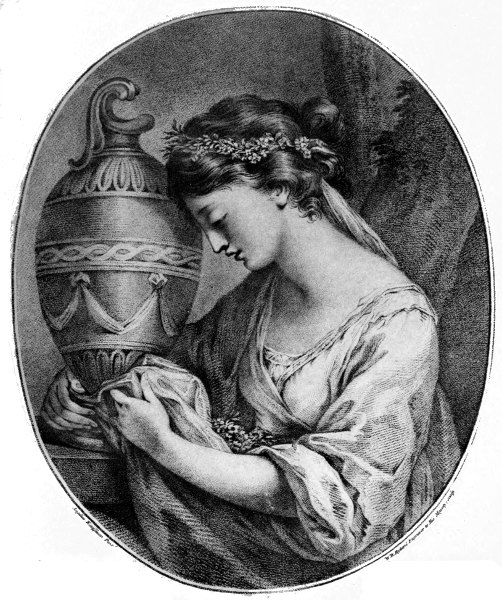
In Memory of General Stanwix’s Daughter who was Lost in her passage from Ireland.
Sold at No 159 near Somerset House, Strand May 10th, 1774.
For Wynne Ryland’s conscience is becoming a heavy
burden. In spite of his princely income, artistic improvidence
is beginning to weigh him down. Over his
soul the like spirit that swayed Sieur Boucher the incomparable
reigns absolute. Gilded rooms, where the
Eo. tables pave the road to ruin, swallow his guineas
in their rapacious maw. His open hand scatters gold
amidst his friends. Miss Angel, his patron saint, returns
to her native land. Although he remains the kind
husband and devoted father, the shadow of sin creeps
over his roof-tree. A pretty girl, whose fresh young
beauty has stolen his heart from the mother of his
children, becomes a mistress who squanders his earnings
faster than they are reaped. Those bill of exchange
transactions with bankers Asgill and Nightingale
grow more considerable. Friends and accommodators
Ransome and Moreland often receive him in their
counting-house, with his pockets full of crisp notes
drawn upon the Honourable the East India Company
of Leadenhall Street; for this clean, easy paper-credit is
always welcomed as deposit for current coin.
At last comes the fatal crash, bursting over the town
in a thunderclap, striking sorrow into the hearts of
thousands. On the 3rd of April 1783, when the
London merchant opens his newspaper—Morning
Chronicle or Daily Advertiser—he reads there that
William Wynne Ryland stands charged before the Right
Hon. the Lord Mayor on suspicion of forging the acceptance
of two bills of exchange for payment of £7114,
with intent to defraud the United East India Company.
Kind John Gwynn throws aside his plans of stately
edifices, walking the streets with streaming eyes, sorrowing
for his friend. Statuesque Domenico Angelo
hurries to condole with poor Mary Ryland, and the sight
of the agonised wife and children robs the good-hearted
Italian swordsman of sleep. But the engraver had left
his home at Knightsbridge on the first of the month,
and although the City Marshal searches for him in the
Old Bailey and in the Minories, nothing is heard of him
for fourteen days.
On the morning of the 15th of April, a drunken woman
reels into the ‘Brown Bear’ Bow Street, hiccupping an
exciting story that entices the runners even from their
pewter pots. She is the wife of a Stepney cobbler, who
for many days has been harbouring a strange lodger—a
man garbed in an old rusty coat, with green apron and
worsted nightcap, who poses as invalid Mr Jackson
who needs the country air; which same delicate invalid
rests indoors all day, only venturing out after nightfall
to enjoy the health-giving April east winds. But he
is not Mr Jackson at all, babbles tipsy Mrs Cobbler
Freeman, for, when taking one of his shoes to her
husband to mend, she noticed a bit of paper pasted on
the inside, and, tearing it away, she has seen written his
real name—William Wynne Ryland. This is great
news for the ‘Brown Bear’ runners, and Chief-officer
Daly, accompanied by a fellow robin-redbreast, takes
coach with Mrs Cobbler Freeman to Stepney Green.
From his garret window the guilty engraver beholds
the coming of the bloodhounds. With a brief prayer
for pardon he flies to his razor, and when the constables
burst through the door they find him stretched
upon the boards with a gash across his throat. Still, he
has not cheated cruel fate. A surgeon staunches his
wound, and watchers surround his bed lest he should
seek to meet death once more. In the agony of that
long night, while physical torture conquers even the
deep, black pain of unutterable despair, the wretched
sufferer atones for the sins of a lifetime. Yet on the
morrow they take him rudely from his couch, and while
the foul cobbler goes clamouring to the India House for
his blood-money, Ryland is brought before Sir Sampson
Wright, who sits in the place of blind John Fielding
in the office at Bow Street. There he is given over
to Governor Smith, who carries him to the Bridewell
at Tothill Fields, where he lies for weeks sick almost
unto death.
Newspaper canards spring up in wonted manner like
mushrooms from a dunghill. Mr Ryland, who cannot
recover—so they say—has confessed his crime to Sheriff
Robert Taylor, naming also a pair of accomplices, and
hints a third. As he cannot recover—so they say—Keeper
Smith has a couple of men to watch him always,
lest he should kill himself. Newspaper reason uses
these odd arguments and more. Among the feasts of
scandal crammed down the public gullet one fact is
readily digested—Ryland is guilty beyond all refutation!
Forged E.I.C. bills have been found in shoals—none
but the great engraver could have been their author—he
attempted self-murder because he was certain of
conviction. All true, possibly; nay, probably, but where
is the proof?
The trial of the poor sick artist skips a session. In
tender mercy those in power do not shut him up in fetid,
overcrowded Newgate, but allow him to remain under
the watchful care of good Keeper Smith. His kind
jailor does everything in his power to lighten his dreary
lot, making him a trusted friend, allowing him to take
walks with him in the open street, confident that he will
not break his parole. It is not until the eve of the
session that they drive him to the Old Bailey, around
whose bloodstained walls he used to play with his
brothers as a child.
On Saturday, the 26th of July, he is brought to face his
accusers. Not until the last moment do Crown lawyers
intimate the terms of indictment, for there are several
forged bills laid to his charge, and, conviction appearing
a matter of doubt, the Honourable E.I.C. wishes to be
certain of its prey. So Crown lawyers select a minor
charge—a small bill for £210—which they assert
Ryland has copied and engraved from a true document,
uttering it knowing it to be forged. Both bills have
been lately in the prisoner’s possession—this is made
clear—but which is the counterfeit? A hard nut for
Crown lawyers, since both are like as two peas. Unless
they show that the first which Ryland had received is
the true one, their case falls to the ground, for no man
can copy what he has not seen. A breathless crowd,
whose hearts are all for the man in the dock, watch the
ghastly duel of keen wits, for it is death to one if he is
vanquished. Witnesses come and go, but tierce and
parry keep the defendant unscathed. Witnesses advance
and retire, but Crown lawyers find them weak reeds.
Banker Ammersley swears to his signature on the first
bill, but this proves nothing, as Banker Ammersley’s
autograph is not the seal of Company John. One Holt,
late E.I.C. secretary, whose brain is not so clear as it
was, makes a dismal display in the box, while the
courage of Ryland’s friends mounts high. One Omer,
E.I.C. clerk, tries to spot the true bill, but counsel
Peckham involves him in a maze of legerdemain. All
the gallant little host of well-wishers, who have drunk
deeply of newspaper canards, and still more insidious
City gossip, are amazed that Hicks’s Hall should have
deemed such evidence worthy of a true bill—amazed,
moreover, that their friend seems to have a chance of
escape.
Suddenly the quick shadow of despair flits across
the face of the prisoner. For a moment the brave,
easy self-confidence leaves him naked to his enemies.
Crown counsel Sylvester—who lives in fame as the
judge of maiden Fenning—has played his last card,
calling to the witness-box a calm, unemotional man of
commerce, Mr Waterman of Maidstone, papermaker
for twenty years. Then the reason of the Hicks’s Hall
opinion is made clear. Papermaker Waterman brushes
aside all doubts—he made the sheet upon which one
of the bills is printed, recognising the marks of his
moulds, distinguishable only by expert eye. Since this
Maidstone Waterman is positive that the paper on
which one of the E.I.C. acceptances is stamped did
not reach London till May 1783, it is certain that the
first bill which came into the possession of Ryland
was the true one accepted by the Company. Thus
two counts of the indictment are decided—the last
bill is the spurious one, and it was uttered by the
prisoner.
Yet what is the whole significance of this carefully
accumulated evidence! Merely that an amazing forgery
has been wrought, and that Ryland alone, who had the
motive and the skill, possessed also the opportunity.
Every heart within the crowded court is filled with
pity for the accused man. Bankers Moreland and
Ammersley, though called by the Crown, have striven
to assist the defence. Prosecutors Sylvester, Rous,
and Graham have shown no vindictive spirit. Even
stripping Judge Buller—he who drew up a specification
of rod for the benefit of wife-beaters—strives to find a
“chasm in the evidence,” endeavouring to prove that the
honourable servants of the E.I.C. have made a mistake.
Finally, when this big-brained lady-whipping Buller
comes to instruct the jury, he specially commends the
prisoner’s defence—read by the clerk of arraigns, as poor
Ryland’s throat is too sore for the effort—for its matter
and good sense.
Then mercy hides her face, for the youthful judge
lays down calmly the most astounding of eighteenth-century
judicial dogmas. “It stands prisoner,” declares
this Buller, “to show how he came by the bill in order
to prove he did not know it to be forged.” So—musty
old twiners of red tape—they cannot fasten the guilt
upon the man, thus with impotent tu quoque they
demand that he shall prove his innocence. Since they
cannot rip him open in the witness-box, they shift their
own burden upon his shoulders. Since he cannot prove
his innocence, they deem him guilty, forgetting the good
British legal converse of this proposition. Bewildered
by judicial hair-splitting, the jury at last withdraw.
No direct evidence convicts him—circumstances, prejudice
rather, the whispered stories of numerous E.I.C.
bills (forgeries all) that have passed through the
hands of the engraver. If one indictment does not
draw, others will follow—he had the motive, means,
and opportunity, and he flew to his razor when the
runners came to take him. Half an hour of such
reasoning kneads the brains of jury into proper hanging
shape, and they decide that to Tyburn the prisoner
must go.
Quiet and brave, as he has been through his long
trial, the man in the dock rises to his feet when his
judges return. Courage is stamped on the strong, deep
lines of his face, though the face is white as his soft
ruffles, or as the snowy vest that lies beneath his russet
coat. Coming forward, he listens calmly while they
declare him guilty, bowing to the Bench. A thrill runs
through the court when the foreman pronounces the
dread word, but, though all hearts are throbbing with
pain, one fond hope rises in every breast—that the power
of a gracious king will rescue this erring genius from a
shameful death. Also, the poor servant himself thinks
first of his royal master; for as he is conducted back
to loathsome Newgate, he tells the friends around him
that, although he has been the victim of persecution, he
can perceive a beam of mercy. Alas, he could not know
his sovereign!
A week later the dreary session draws to a close,
and Ryland is brought up again, and alone, before the
rest of the convicts, to hear his sentence. Calmly and
bravely he bears this ordeal like the last. Already
two petitions have been presented at Windsor—one the
day after he was condemned, the other on the thirtieth
of the month. It is supposed that he will be kept alive
for a while, since he has begged that his life may be
preserved a little longer, not for his own sake, but that
he may finish some plates for the benefit of his wife and
children. Even the heart of royal George may have
been touched by the piteous request. So the prisoner
spends the gloomy days in toiling at his task, scraping
the copper sheets with his stipple-graver, literally dying
in harness. Nor is it inadequate work, for when his
printer is allowed to bring him the proofs he is able
to murmur with satisfaction, “Mr Haddrill, my task
is finished!” Yet two pictures after all are left
incomplete, one of which Bartolozzi, to whom he sends
to beg the favour, and who owes him as a master of his
craft so much, promises to take in hand, while jovial
William Sharp polishes the other. For King George,
when pressed once more to spare the poor artist because
of his great genius, replies sternly—“No; a man with
such ample means of providing for his wants could not
reasonably plead necessity as an excuse for his crime.”
Material logic, worthy of the man!
On Friday, the 29th of August, dawns the fatal morning.
Before nine o’clock the outer Press Yard is overflowing
with sight-seers; but because of Governor Akerman’s
humane order, none are allowed within the smaller court
to disturb the last moments of the unhappy sufferers.
Presently the iron-studded door of the lodge is flung
open, and Sheriff Taylor, bearing his wand of office,
enters the prison to demand the bodies of his victims.
Then through the expectant crowd the turnkeys slowly
force a path, and down this narrow lane the malefactors
walk one by one with hideous clank of fetters. On his
knees beside a block of stone a creature with punch and
hammer deftly rids them of their chains. Five times
the strident blows echo through the vaulted walls, while
as many unhappy wretches pass into the hands of the
hangman’s lacqueys, busy with their bonds and cords.
Last of all comes a slim, graceful figure, clad in a suit
of mourning with white ruffles and silver shoe-buckles,
unencumbered by chains, walking as unconcernedly as
though he were a spectator of the scene. A shudder
runs through the throng as all eyes rest upon the gifted
artist, who, as he passes on, quietly salutes those friends
whom he chances to recognise. With a respectful bow
the Sheriff advances and leads the prisoner to the
lodge, away from the crowded quadrangle.
“Don’t tie Mr Ryland too tight,” he commands the
attendants as they fasten the cords.
“Never mind, sir,” is the quiet answer; “they give
me no uneasiness.”
All the time he chats calmly to those around, bearing
himself in this, as through all other scenes to the end,
as a brave heart and a gentleman. Then the clatter of
arms is heard outside, for the City Marshal is bringing up
his troop. A moment later the door is thrown back,
and from the steps a stentorian voice bellows aloud, “Mr
Ryland’s coach.” With brisk, easy steps he passes out
into the street, closely followed by the attendant Ordinary.
Suddenly he springs forward, and in an instant a tiny
girl has thrown her little hands around his pinioned
arms, while he kisses her passionately—his own daughter,
the child of sin. Tenderly they induce him to hasten
the agonising farewell, but his steel-clad soul is steadfast
and unshaken. Tearing himself away, he hurries on with
a firm tread.
Then the procession moves forward. A strong
company of Sheriff’s men and City Marshal’s constables
leads the way, parting the dense surging mob for the
progress of the official chariots and the black mourning-coach
that follows next in line. Another carriage, in
which sits one Lloyd, an ex-housebreaker turned psalm-singing
penitent, comes after that of Ryland, and then
the pair of loathsome carts with four more miserable
victims. No cant or cowardice marks the bearing of
the poor artist. Unlike the conventional hypocrite of
such a time, his lips do not move in response to the
exhortations of white-banded Ordinary Villette. No
prayer-book rests in his fingers. Having made his
peace with God, he does not deign to humour the prejudices
of man. Unjustly, they are sending him to a
cruel death. Why should he appear to worship in the
fashion they have chosen? Thus, while the procession
moves onward, his calm, inscrutable face gazes upon
the scene that passes before his eyes.
An amazing spectacle, this eighteenth-century march
to Tyburn, revealing as completely as the roofless city of
romance the human animal taken unawares. No braver
picture of dauntless courage ever has been displayed in
battlefield than the serene victim, tied and bound,
who is drawn along slowly to his shameful death.
Though the deep toll of St Sepulchre’s passing bell
may beat in cruel blows against his heart, as he moves
past the old church at whose font his brothers and sisters
were given their Christian names, there is no tremor
visible to the thousands who gloat upon his form. Down
the slopes of Snow Hill runs the quick, eager whisper,
for the eyes of all seek but one man, “Which is Mr
Ryland?” And the careless murmur swells into a louder
key, “There he is in the coach—that is he—that is
Ryland”—the heartless babble of a multitude of savages.
Thicker and thicker teems the concourse, as the procession
crawls over the bridge and up Holbourn Hill,
swollen like a black, turgid river by streams that flow
from haunts of filth and foulness—the sweepings of
the slums. Thieves, cut-throats, hoarse drunkards, and
shrill strumpets join in the delirious march with the loud,
mad tread of a thousand clattering feet.
Thus they move onward. Within the sable coach
the smug Ordinary is mumbling scraps of Holy Writ
pertaining to the time and place, the valley of the
shadow of death. In response, a hundred ribald oaths
and loathsome jests are pealing all around. Within the
sable coach the poor ecstatic housebreaker is piping a
quavering hymn, his joints shaking in palsy, his eyes,
which gleam in horrible whiteness, raised to the skies.
All around, the hands of a hundred thieves are busy at
work as they tramp along in this march to the grave.
Beyond Chancery Lane the wide thoroughfare seems to
pass into a new world. Although the street echoes still
to the tread of ten thousand squalid footsteps, high up on
either side, at the windows or in the narrow balconies,
wealth and beauty take their part in the mighty spectacle.
Sweet, pale faces look down, while soft, heaving bosoms
press the casements. Beings who might soar amidst the
stars are sunk in the mire—all compelled by the haunting,
irresistible tramp rolling onward in the march of death.
Yet the footsteps never pause. Forward still, winding
through St Giles, the highroad to Tyburn opens to the
view. There is no halt now for the Lazar-house bowl,
nor would those fettered men in the carts wish to quaff
it. Huddled together in the first, the three are babbling
supplications; prone and fainting, a half-dying creature
is stretched within the last. In front, the hysterical
housebreaker is swaying like a drunkard on the seat of
his coach, still quavering forth his piteous hymn. Only
the artist, whose carriage leads the way to the shambles,
gazing calmly around with grave, stony face, will have no
truck with the cant of humanity. For his thoughts are
far distant, fleeing from the mighty roll of footsteps till
they soften to his ears like the murmur of muffled drums.
All around him are visions of bygone days. Yon
narrow road that is pouring forth its human torrent
leads to Soho, where, with the gentle Gwynn, he used
to visit the gilded palace of Therese Cornelys, or that
other Carlisle House, the fencing-school of splendid
Angelo. Down that long street is Golden Square, but
there is no pretty Miss Angel to weep for him. And
far away, beyond the distant horizon, lies the palace of
his king, but before it there is reared the gaunt, frightful
spectre of the triple tree.
Then the sound of voices swells louder while the
march is stayed. Through the windows of his coach he
can see the three bare posts close at hand, so that he
can almost touch them. Slowly the creaking carts roll
forward, halting beneath the wooden bars, and a sweeping
circle of soldiers spreads itself around. Perched upon
the park wall is a long mass of expectant faces. Here
and there rise huge stands, tier upon tier, choked to the
full with swaying humanity. As far as the eye can reach
is a dense, surging throng, crushing forward, ever crushing,
as though eager to press the victims to their doom.
Presently the black clouds that have been slowly
unfurling their shadows across the August sky burst in a
peal of thunder, and the tempest rushes through the air.
Amidst the flashes of lightning, a fierce rainstorm hurls
itself to earth. For a moment the bloody work must
pause, since it is impossible to stand against the blinding
torrents. Half an hour passes. Then the deluge ceases
as suddenly as it arose. Hastily the Sheriff gives his
orders, and soon expert hands have arranged the ropes
around the necks of the three rain-soaked wretches in
the cart. Swiftly the second tumbril, in which the
sick man is lying prostrate, backs to the coach where sits
the penitent housebreaker, and he is summoned to the
gallows. In a few moments the halters are placed upon
their heads, while the contrite thief entreats the multitude
to take warning from his fate. At last, when all
is ready, they call upon Mr Ryland. Springing lightly
down the steps, he mounts the cart, and stands beside
his two fellow-sufferers—a brave, graceful gentleman in
black, quiet and unflinching. Strange contrast indeed
to the swooning creature on the floor, or to the noisy
burglar, who shrieks to heaven, wringing his hands.
Ordinary Villette comes forward, pressing his holy attentions
upon the unhappy artist, who listens to him calmly
and respectfully, while close at hand his wretched companions
pray long and loud. Suddenly there is a shrill,
wailing sound, rising and falling in equal cadence with
the see-saw rhythm of a hymn, “The Sinner’s Lamentation,”
which four terror-stricken creatures, with their
heads thrown back, bellow loudly to the skies. And
all this time, firm, motionless, inscrutable, bearing even
the greatest ignominy—the contact of these foul ones—without
a tremor, Wynne Ryland stands silent, waiting
for the last cruel moment. Swiftly it comes. His face
is covered, the hangman lashes his horse, the foothold
sweeps from beneath, and he passes into oblivion. To
the other five who sway in the air at his elbow (save
one) death also is merciful.
A holiday of butchery, cries Mercy; yea, and more,
a holiday in which butchery alone has a part, giving
naught that chance or strength or valour might lend its
victim; butchery a thousand times more squalid than
that of the noble Roman. Ah, but it is the pious
retribution of majestic laws, declares the spirit of those
times; the just conclusion of the social contract;
butchery, alas! for these poor victims can have no
resemblance to the gladiators of the arena. Yes,
indeed, retorts Mercy; it is the vengeance of the
sacred majesty of commerce, whose garments have been
soiled by the hands of these malefactors, which cannot
be appeased by the code of savages, an eye for an eye,
a life for a life. Yet ’tis stern for the sake of utility,
pleads the spirit; harsh for the public good, so that
the evil-doer may be terrified to the advantage of all
innocence, and to the encouragement of a Christian life.
But what of that handsome youth, is the reply, whose
face is seared by vice, and whose hand is in the fob of
your sleek, well-fed City merchant: is this one dismayed
by these six dangling victims on the tree? No,
answers the spirit; but we must not adopt a universal
conclusion from a particular case, for how can we judge
how many of the tempted have been saved from crime
by the terrible example of the fatal rope? True in
logic, false in truth, Mercy well may thunder—a valid
deduction from conditional premiss, but the terms of
jurisprudence should not be qualified by an ‘if’ Thus,
surely, unless we admit the old Hebrew ‘eye for an
eye’ dogma, must we view all legal punishments that
deprive a fellow-creature of his life. Alas, that we are
controlled by the logic of other times!
The same coach that conveyed William Wynne
Ryland along the road to Tyburn brought back his
dead body to his friends. Five days later—on
Thursday, the 3rd of September—they took him to the
tiny churchyard of Feltham, beyond Hounslow, where
his father and mother had been laid to rest. For a long
time after his death Mrs Ryland continued to keep a
print-shop at the corner of Berners Street, where her
husband’s engravings commanded a large sale. Subsequently
she transferred her business to New Bond
Street. From contemporary newspapers we learn that
the Ryland plates were much sought after in Paris
when his untimely fate became known. Nine years
later, on the 20th of October 1792, the unhappy wife
went to join her husband in the little grass-plot of the
village by the Thames.
With the exception of that mighty scholar Eugene
Aram, the eighteenth century never suffered deeper
loss by the hangman’s rope than in the death of brave
and graceful Wynne Ryland. Just as the marvellous
usher is the greatest of schoolmen, so is the Strand
engraver incomparably the greatest artist that ended
his days upon the scaffold. With him the dissolute
and passionate Theodore Gardelle can no more be
contrasted than poet Gahagan with the former. Yet,
unlike the sombre Aram, poor Ryland did not bear the
stain of blood upon his hands. Nor was the evidence
of his guilt less open to doubt. Because he failed to
prove his innocence they sent him to his death. Still,
although there was no lack of tears and lamentation,
his cruel fate did not excite the same interest nor cause
the universal consternation that was aroused in similar
cases. Neither Horace Walpole, Mrs Delany, nor
George Selwyn speak his name, and gossip Tom
Smith merely mentions him incidentally in a list of
engravers. A reason is not far to seek. Not being a
man of fashion, how was it possible that an epoch which
had beheld so many stupendous melodramas should be
greatly shocked by his atonement? Preacher Dodd,
the pet of devout ladies; the unfortunate brothers
over whom the charms of Margaret Rudd cast the
halo of romance; soldier-parson Hackman, with his
love and madness; poisonous Captain Donellan of
Lawford Hall—all these magnificent criminals had lately
made the march to Tyburn, or elsewhere. Little wonder
that society, ennuyé by the sight of the gallows, had lost
its zest for convict-worship.
To say that William Wynne Ryland might have been
the greatest engraver that the world has seen would
be to state an equivocal proposition, since modern
print-science, to which the splendid art has given birth,
scarce realises comparative methods, and has no complete
list of precise terms. Yet the assertion that none
have ever excelled him as a creator of the coloured
stipple is a mere platitude. Also, it would be difficult
to name any other artist who has produced finer
work in all the three great branches of engraving—line,
dot, and mezzotint. Still, like every rolling stone, he
suggests rather than demonstrates the possession of
superlative powers. Although few surpass him as a
draughtsman, colourist, and craftsman, he shares the
fate of all who pursue unworthy models. While the
fair Kauffman sinks into insignificance in contrast to
Sir Joshua, the man who translated her pictures into
their popular form is worthy to take his place beside
all the masters who fashioned engravings after Reynolds.
Through the whole of his life it is the same. In careless
vigour he speeds along the difficult paths that lead to
the golden mountain-tops, but never reaches the summit.
To Wale or to Oudry he gives more than to François
Boucher. Smiling Ramsay and courtly Bute snatch
him from his allegiance to the mighty Italians. Always
opportunist, the pleasures of the world entangle him
amidst a stifling undergrowth, where his wings may not
expand to bear him aloft, free and unconfined.
Nor are his copies of Angelica the best that she
can offer. In humble servitude he seems to take all
that is given to him. The slave of popular taste, unlike
Bartolozzi he never casts off his shackles. A simpering
Venus, an over-fed Cupid, a Grecian warrior with a
feminine frame—these are the subjects upon which he
wastes his powers. Even when opportunity comes to
draw a human portrait in the person of a noble woman,
he has to struggle against the mockery of a burlesque
dress—furled Turkish trousers, or a Grecian turban.
Yet how different is the obvious ideal! Since he could
transform the work of ‘Miss Angel’ with such wondrous
art, conjecture may dream of entrancing pictures after
Gainsborough, in miniature, but in perfect semblance,
glowing with all the gorgeous tints of the great master.
An illustrious feather-pate, gazing with idolatry upon
his own modern photograph, has screamed, “Camera
beats the brush! Look upon that picture, and then
presume to tell me that Rembrandt or Velasquez has
fashioned its equal.” Obviously, for those painters never
had such a model as illustrious feather-pate. Yet
feather-pate but babbles the gibberish of his times.
All who inveigh against soulless lithograph or poll-parrot
photography, saying that monarchs of the brush
are with us still whose works are worthy of the
engraver’s steel, cry as prophets of the wilderness.
“Camera beats the print,” shrieks Cosmos; “magna
est vilitas, et prævalebit.” Thus poor Cinderella, who
never went to the ball with her more gorgeous sisters,
is driven even from her home in the kitchen.
Still, could some god transport Wynne Ryland from
the sunny plains, he would find work for his hand as
alluring as the canvas of Angelica Kauffman. In
the gossamer creations of such as Alma Tadema and
Blair Leighton, the soft-coloured print might begin a
new life. Is it too late to hope that ere he passed over
the dark river he left his mantle upon the shore?
1. Authentic Memoires of William Wynne Ryland. Printed for J. Ryall, No. 17
Lombard Street, 1784. Brit. Mus.
As these Authentic Memoires do not present a very lucid account, it is
necessary to place the principal events of Wynne Ryland’s career in chronological
order:—
Born November 2, 1733, in St John’s Street, Clerkenwell; the third son and
fifth child of Edward and Mary Ryland.
Baptized December 2, at St Martin’s Church, Ludgate, where his name
appears in the register as William Wynn.
Studied at St Martin’s Lane Academy—probably during the latter half of
the forties.
If, as is generally stated, he served an apprenticeship of five years with
Ravenet, he must have been bound to that engraver before 1750.
The second volume of Les Fables choisies de la Fontaine, with illustrations
after Oudry, shows that he was in Paris in 1755. Having studied for two years
under Le Bas, it would seem that he went to Boucher about 1757. According
to most accounts he remained abroad for five years.
Probably he was in England in 1761, for several of his red-chalk engravings
after the old master were finished during the next year.
In April 1762 he published at Lichfield Street, Soho, an engraving of
George III., after Ramsay.
In February 1763 his engraving of Lord Bute, after Ramsay, was finished.
From 1763-67 he was engaged upon the portrait of George III. in his
Coronation Robes, after Ramsay.
In the spring of 1765 he visited Paris on a commission for the King
(v. Journal of J. G. Wille).
In 1767 he was living in Stafford Row, Pimlico.
From 1767-69 he was engaged upon the portrait of the Queen, after Cotes.
In 1767 or 1768 he entered into partnership with his late pupil, Henry
Bryer, at 27 Cornhill. This firm became bankrupt in December 1771.
In 1772 he was living at Queen’s Row, Knightsbridge, and in 1773 near the
Hammersmith turnpike.
In 1774 he opened his print-shop, No. 159 in the Strand.
On November 4, 1782, he deposited the forged bill on the East India
Company with Messrs Ransome, Moreland & Ammersley, bankers.
On the 1st of April 1783 he fled from his home at Knightsbridge, and the
advertisement offering £300 for his arrest was published in the newspapers on
April 3.
2. A Catalogue of Mr Ryland’s Exhibition at Mr Pollard’s in Piccadilly. Brit.
Mus.
3. Exhibition Catalogue of Incorporated Society of Artists, 1761-69. “In their
Great Room in Spring Gardens, Charing Cross.” Brit. Mus.
The following were Ryland’s exhibits:—
| 1761. |
No. 215. |
A Print of “Jupiter and Leda,” after Boucher. |
| 1767. |
No. 217. |
A Print of his Majesty in his Coronation Robes after Ramsay. |
| 1769. |
No. 301. |
Two Drawings. |
|
No. 302. |
One Drawing. |
4. Catalogue of the Royal Academy. 1772-1775. Brit. Mus.
The exhibits of Ryland, with their dates, are as follows:—
| 1772. |
No. 227. |
Vortigern falling in love with Rowena—after A. Kauffman. |
|
No. 228. |
The interview between Edgar and Elfrida after her marriage with Athelwald—after A. Kauffman. |
|
No. 229. |
A Portrait of a child drawing. |
| 1773. |
No. 259. |
Domestic Employment—a drawing. |
| 1774. |
No. 255. |
A Frame with sundry Portraits. |
|
No. 256. |
” ” ” |
| 1775. |
No. 268. |
Juno borrowing the Cestus from Venus. A Drawing in red chalk, after A. Kauffman. |
5. Dodd’s Memoires of English Engravers, xi. pp. 104-110. Add. MSS.
33404. Brit. Mus.
6. Joseph Strutt’s Biog. Dic. of Engravers (1785-6), ii. 285. Brit. Mus.
7. A Collection of Prints in Imitation of Drawings. 2 vols. 1778. Edited by
Charles Rogers. Brit. Mus.
Ryland contributed fifty-seven plates. These two volumes should be
included in any collection of Ryland’s works.
8. Nichol’s Literary Anecdotes (1813). Vol. iii. 256, vol. v. 668, 681, 686.
9. Reminiscences of Henry Angelo. 2 vols. London, 1828-30. Vol. i. pp. 473-83.
New Edition by Joseph Grego and H. Lavers Smith. Kegan Paul. 1904.
Vol. i. pp. 366, 370-75.
Ryland was a frequent visitor at the fencing and riding school, which the
elder Angelo had established at Carlisle House, Carlisle Street, and which, oddly
enough, was the second building of that name in Soho Square.
10. Mémoires et Journal de J. G. Wille. 2 vols. Jules Renouard. Paris, 1857.
Vol. i. pp. 287, 288.
Wille met Ryland in Paris on April 17, April 18, and May 9, 1765. He
tells us that he had been acquainted with him when the English engraver was
in France seven or eight years previously (i.e. in 1757-1758), which dates fit in
with other known incidents of Ryland’s life.
| 1. |
The Gentleman’s Magazine (1771), p. 572; (1778), p. 594; (1783), part i.
pp. 359, 443; part ii. pp. 626, 710, 714; (1808), part i. p. 87. |
| 2. |
The European Magazine (1783), part ii. pp. 158, 172-173. |
| 3. |
The Morning Post, |
April-August 1783. |
| 4. |
The Morning Chronicle, |
do. |
| 5. |
The Morning Herald, |
do. |
| 6. |
The London Chronicle, |
do. |
| 7. |
The Public Advertiser, |
do. |
| 8. |
The Daily Advertiser, |
do. |
| 9. |
The General Advertiser, |
do. |
| 10. |
The Whitehall Evening Post, |
do. |
| 11. |
The London Recorder, |
do. |
| 12. |
Ayre’s Sunday London Gazette, |
do. |
| 13. |
The Gazetteer and New Daily Advertiser, |
do. |
| 14. |
Lloyds Evening Post, |
do. |
The most complete account of the trial will be found in the Morning Post,
Monday, July 28, 1783. Those who are interested in the much-debated
question whether the site of the ‘Tyburn Tree’ was in Connaught Square,
Bryanston Street, or Upper Seymour Street, would do well to remember that
on August 29, 1783 (so the papers tell us), the gallows were placed fifty yards
nearer the park wall than usual. Naturally, its position was changed from time
to time.
Note I.—Dic. Nat. Biog. The date of Ryland’s birth is given as July 1732!
Nor was he the eldest, but the third son of his father.
Note II.—Eighteenth Century Colour Prints. Mrs Julia Frankau. Macmillan
(1900).
Mrs Frankau’s explanation of the flight of Ryland is scarcely plausible. It is not
credible that a man who is engaged in a frantic search for a lost mistress would
remain in close hiding, posing as an invalid, only venturing abroad after dark. Nor
is it a tenable assumption that he attempted to commit suicide in a fit of despair
because he fancied that he was being arrested for debt, and thus might lose all chance
of finding his chère amie. One of the strongest pleas in his defence was that his
fortune was ‘princely’ and he protested that he fled because he could not find
the man from whom he had received the fatal bill. It is a strange coincidence that
the discovery of the fraud upon the East India Company should have taken place
on the eve of his disappearance. Moreover, he was not arrested for the forgery that
secured his conviction. The warrant charged him with counterfeiting two other bills
of exchange to the value of £7114 (as reference to the advertisement columns of the
daily papers of April 3 will show), and it was not until this publicity that Mr
Moreland, the banker, examined the bill for £210, which Ryland had deposited with
his house. Thus the accusation of one crime led to the discovery of another! And
it is still more strange that the artist should have cashed an East India Company bill
of the value of £210 on September 19, 1782, while on November 4 he should have
handed to his banker another bill—an exact copy of the first—bearing a similar date,
denomination, and acceptances. Although these two identical bills came into
Ryland’s possession within the space of a few weeks, he did not seek an explanation
of the remarkable coincidence. A careful survey of all the facts must convince
everyone of the guilt of the unfortunate engraver, but it is a pleasure to be able to
agree with Mrs Frankau—except in some minor details—in her contention that the
evidence was not conclusive. Ryland was convicted because he failed to show that
he had received the forged bill from another person, and to cast thus the burden
of proof from the prosecution to the defence is quite foreign to the methods of a
modern tribunal.
Since the Catholic has become the spoilt child of contemporary literature, it is not
surprising to find Wynne Ryland hailed as the victim of Protestant persecution. Yet
there appears to be no evidence to support this assumption. There is not a line in
the newspapers of the day to indicate that any anti-Romanist feeling was aroused,
and had such been the case, the Public Advertiser, at all events, whose animosity
towards ‘Popery’ is sufficiently evident, would have trumpeted loudly. It is
significant that the mob never behaved with greater propriety—very unusual conduct
in the howling Tyburn crowd—than on August 29, 1783. How different would it
have been if the word had been whispered that a Papist was going to the gallows!
Strutt and Angelo, who write so sympathetically of their friend, have nothing to say
on this subject, and, indeed, accept his guilt as proved. Although the former, who
wrote in 1785, might have reason for reticence, yet the latter, whose book was
published a year before the Emancipation Act, could have no reason to suppress
such evidence. Indeed, we have only the doubtful authority of the Authentic
Memoires for the statement that Ryland was a ‘supposed’ Catholic in his early
youth. With this very ambiguous suggestion we must reconcile the strange fact that
he was buried in a graveyard of the Established Church, and that the last rites were
performed by an Anglican clergyman. There are one or two slips of the pen in Mrs
Frankau’s interesting memoir. As the catalogue of the Royal Academy shows that
Ryland contributed his first drawing in 1772—four years after the institution was
established—he was not “one of the earliest exhibitors.” From the same catalogue
it appears that the print-shop in the Strand was opened in 1774. The date of the
publication of the Authentic Memoires, given as 1794, is, of course, a clerical error.
Owing to the footnote attached to Ryland’s letter to Francis Donaldson of Liverpool,
printed in the Morning Post, September 2, 1783, the document must be regarded
with suspicion. No trivial disagreement with the conclusions of Mrs Frankau can
diminish the interest of her delightful account of the great engraver, which must
remain the most valuable of recent monographs.
Note III.—There are references to W. W. Ryland in the innumerable dictionaries
of painters and engravers, French, German, and English, such as Basan, Le
Blanc, Portalis and Beraldi, Andreas Andrescen, Redgrave, Bryan, etc. One of
the best of modern notices will be found in the Print Collectors’ Handbook, by
Alfred Whitman.
| 1. |
Les Grâces au Bain, |
after Boucher. |
} |
| 2. |
La Belle Dormeuse, |
do. |
} |
| 3. |
Le Repose Champêtre, |
do. |
} |
| 4. |
Vue d’un pont, |
do. |
} |
| 5. |
Berger passant une rivière, |
do. |
} 1757-60 |
| 6. |
La petite Repose, |
do. |
} |
| 7. |
La Bonne Mère, |
do. |
} |
| 8. |
La Marchande d’Oiseaux, |
do. |
} |
| 9. |
I. and II. Vue de Fronville, |
do. |
} |
| 10. |
Jupiter and Leda, |
do. |
} |
| 11. |
George III., King of Great Britain. Published April 1762. |
| 12. |
John Stuart, 3rd Earl of Bute—after Allan Ramsay. Published February 1763. |
| 13. |
George III. in State Robes—after Allan Ramsay. Published 1767. |
| 14. |
George III. (bust). |
| 15. |
Queen Charlotte with infant (Princess Royal)—after Cotes. Published 1769. |
| 16. |
Diogenes—after Salvator Rosa. Published 1771. |
| 17. |
Antiochus and Stratonice—after P. da Cortona. Published 1772. |
| 18. |
General Stanwix’s Daughter—after Angelica Kauffman (called also “The Pensive Muse”). Published in colours 1774. |
| 19. |
Hope—after A. Kauffman—(a portrait of herself). Published in colours, February 7, 1775. |
| 20. |
A Lady in a Turkish Dress—after A. Kauffman. Oval in colours. Published May 1, 1775. |
| 21. |
A Lady in a Greek Dress—(the Duchess of Richmond)—after A. Kauffman. Published November 20, 1775. |
| 22. |
Narcissus. Drawn and engraved by Ryland. Published January 12, 1775. |
| 23. |
Domestick Employment. Drawn and engraved by Ryland, in colours. Published September 13, 1775. |
| 24. |
Faith—after A. Kauffman. Published 1776. |
| 25. |
Dormio Innocuus—after A. Kauffman. Circle in colours. Published May 21, 1776. |
| 26. |
Olim Truncus—after A. Kauffman. Circle in colours and red. Published, first state, April 3; second state, May 1, 1776. |
| 27. |
Juno cestum a Venere Postulat—after A. Kauffman. Circle in colours and red. Published January 1, 1777. |
| 28. |
Achilles lamenting the Death of his friend Patroclus—after A. Kauffman. Published December 4, 1777, in colours and red. |
| 29. |
Patience—after A. Kauffman. Published May 27, 1777. |
| 30. |
Perseverance—after A. Kauffman. Published June 24, 1777. |
| 31. |
Cupid Bound, with Nymphs breaking his Bow—after A. Kauffman. Published March 17, 1777. |
| 32. |
Telemachus returns to Penelope—after A. Kauffman, in colours. Published December 4, 1777. |
| 33. |
Venus in her Triumphal Chariot—after A. Kauffman, in colours and red. Published September 7, 1778. |
| 34. |
Charles Rogers—mezzotint after Sir Joshua Reynolds. Published 1778. |
| 35. |
Cleopatra decorating the Tomb of Mark Antony—after A. Kauffman. Published March 25, 1778, in colours. |
| 36. |
Telemachus at the Court of Sparta—after A. Kauffman, in colours. Published 1778. |
| 37. |
The Judgment of Paris—after A. Kauffman, in colours and red. Published January 17, 1778. |
| 38. |
Maria Moulins—after A. Kauffman. Published 1779, in colours and red. |
| 39. |
Eloisa—after A. Kauffman. Oval in colours and red. Published 1779. |
| 40. |
Britannia directing Painting, Sculpture and Architecture to address themselves to Royal Munificence, etc.—after Cipriani, in colours and red. Published August 18, 1779. |
| 41. |
Marianne. Drawn and engraved by Ryland. In colours and red. Published January 3, 1780.
|
| 42. |
Eleanor sucking the poison from the wound of King Edward—after A. Kauffman. Published March 1, 1780, in colours. |
| 43. |
Lady Elizabeth Grey imploring pardon for her husband—after A. Kauffman. Published 1780, in colours and red. |
| 44. |
The Flight of Paris and Helen—after A. Kauffman. Published 1781. |
| 45. |
Venus presenting Helen to Paris—after A. Kauffman. Published 1781. |
| 46. |
Cymon and Iphigenia—after A. Kauffman. Circle in colours. Published January 15, 1782. |
| 47. |
Morning Amusement—after A. Kauffman. Published March 1, 1784. |
| 48. |
King John signing the Magna Charta—after Mortimer. Published 1785. This plate was finished after Ryland’s death by Bartolozzi and published by the widow. |
| 49. |
Interview between Edgar and Elfrida—after A. Kauffman. Published 1786. According to Bryan’s Dictionary this plate was finished by W. Sharp and published by the widow. |
| 50. |
Donald MacLeod, aged 102—after W. R. Bigg. Published 1790. |
The following I am unable to date:—
|
| 51. |
John, Duke of Lauderdale. |
| 52. |
Henry, 7th Baron Digby. |
| 53. |
Churchill, Duke of Marlborough. |
| 54. |
Charity—after Van Dyck. |
| 55. |
The Muse Erato—after Joseph Zucchi. |
| 56. |
Les Muses (Urania, Clio, Thalia, and Erato)—after Cipriani. |
| 57. |
Sir John Falstaff raising Recruits—after F. Hayman. |
| 58. |
Interior of a Dutch Cabaret with peasants dancing—after R. Brackenberg. |
| 59. |
Penelope awakened by Euryclea—after A. Kauffman. |
| 60. |
Religion—after A. Kauffman. |
| 61. |
Ludit Amabiliter—after A. Kauffman. Circle in colours. |
| 62. |
Penelope hanging up the Bow of Ulysses—after A. Kauffman. |
| 63. |
Achilles discovered by Ulysses in the disguise of a Virgin—after A. Kauffman. |
| 64. |
Andromache weeping over the ashes of Hector—after A. Kauffman. |
| 65. |
Samma at Benoni’s Grave—after A. Kauffman. |
Note.—The Morning Herald, May 5, and the Morning Post, August 28, 1783,
state that Ryland left unfinished a plate of the Battle of Agincourt, after Mortimer.
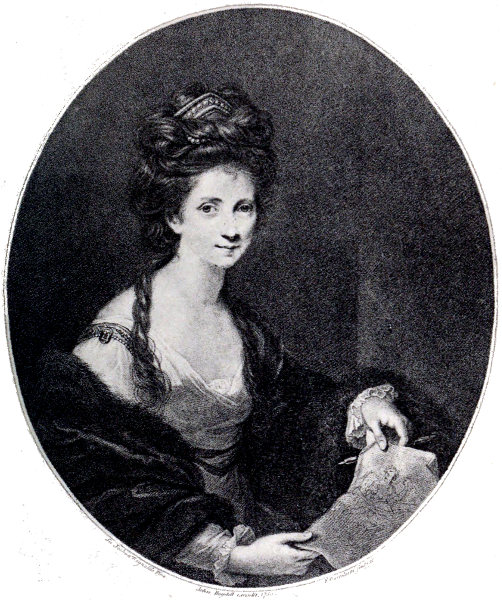
| Sir Joshua Reynolds Pinx. |
John Boydell excudit, 1780. |
F. Bartolozzi Sculpsit. |
Angelica Kauffman,
Ex. Academia Regali Artium Londini
Published Septr. 3; 1780 by John Boydell, London.
1. The Book of Common Prayer. Published by Edward Ryland, May 1, 1755.
Nine plates by Ryland—after S. Wale.
2. The Book of Common Prayer in Welsh (1770), with the same plates as in
former edition.
3. The Complete Angler, by Isaac Walton, edited by Sir John Hawkins. With
fourteen plates, dated 1759, by Ryland—after S. Wale. First edition 1760.
4. “Les Fables choisies de la Fontaine.” Illustrated by J. B. Oudry (1755-59).
Seven plates by Ryland in vols. ii., iii., and iv.
5. L’Ecole Des Armes. Par M. Angelo. A Londres: chez R. & J. Dodsley,
Pall Mall. February 1763. Second edition 1765. With forty-seven plates. A few
copies in colours. Ryland engraved fourteen of these plates. Hall, Grignion,
Elliot, and Chamber did the rest—all after drawings by John Gwynn. Thus Henry
Angelo’s account of this work is inaccurate.
6. A Collection of Prints in Imitation of Drawings. Edited by Charles Rogers.
Published London 1778. Contains fifty-seven plates by Ryland in addition to the
mezzotint portrait of Rogers.
7. The School of Fencing, by D. Angelo, edited by Henry Angelo. 1787. With
forty-seven plates, the same as in the first edition. This book is not well edited, as
the letterpress does not always agree with the pictures.
Note.—In every case the date of the engraving has been copied from an existing
impression. Possibly there are earlier and later states.
A SOP TO CERBERUS THE CASE OF GOVERNOR WALL, 1782-1802 — BIBLIOGRAPHY OF THE WALL CASE — I. Contemporary Tracts — II. Contemporary Newspapers and Magazines — NOTES
“He wandered here, he wandered there,
A fugitive like Cain,
And mourned, like him, in dark despair
A brother rashly slain.”
—A Tale without a Name. James Montgomery.
On the 26th of August 1782, a captain in the army,
named Joseph Wall, just come home from foreign
service, sat down to compose his report to the Secretary
of State. A glance would tell that he was one of those
chosen by destiny to rule man and enslave woman.
Although the swift, hot courage of the Celt shone in his
fearless eyes and slumbered in his rough-hewn features,
the beetling brow, resolute jaw, and fierce, mobile mouth
were softened by the gentle mesmeric charm that marks
all of his race. In stature he was a giant; while his
sweeping shoulders, which towered above the heads of
most, the thick, gnarled fingers and stalwart limbs,
indicated a mighty strength. For the rest, he was a
clean-looking man, with light brown hair and a fresh
complexion. Yet the dull grey lines in his face told
that the tropics had levied that tax upon his physique
which the British soldier is ever eager to pay.
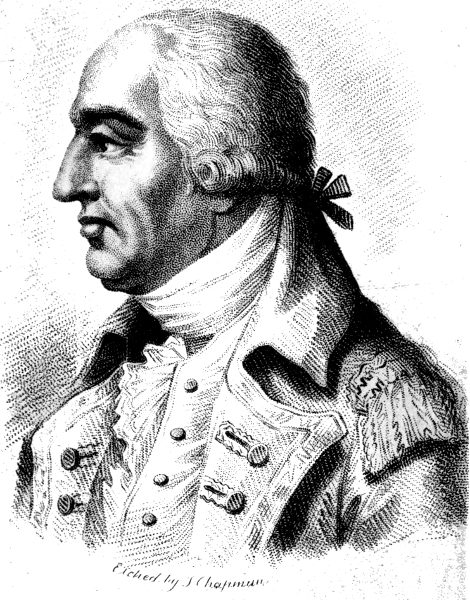
Etched by J. Chapman
Governor Wall.
Published by J. Cundee Ivy Lane Jany, 1804
There was nothing of moment in the officer’s report
to Secretary Townshend. It was merely a rough
account of the termination of his stewardship while
Governor for eighteen months at the island of Goree.
Mere chance had thrown this tiny sun-baked rock once
more into the possession of Great Britain. Three years
previously the French fleet under de Vaudreuil, en
route to the West Indies, sweeping down upon Senegal,
had seized the English posts at Fort Lewis and Fort
James. The victory of Sir Edward Hughes had
reversed the position. By the capture of the island of
Goree, which nestles south of Cape Verde scarcely three
miles from the mainland, the approach to the enemies’
settlements on the opposite shore was placed in the
hands of England. Being a station of some importance
for trading purposes, owing to its proximity to two
great rivers of West Africa, a British garrison remained
there during the course of the war. Though deemed
less unhealthy than the coast, its climate was deadly.
Not a mile in length, and scarcely more than a quarter
in breadth, the men had little scope for exercise. All
ranks detested the place. The regiment was composed
of the riff-raff of the army; the officers were those who
could get no other appointment.
Joseph Wall was worthy of better things. Nature
had made him one of those soldiers of fortune whom
his native land has sent forth unceasingly year by year
into the armies of every country in the world. About
the time of George III.’s accession he had flung aside
the religion of his fathers to obtain a commission, and
two years later, at the age of twenty-five, the young
Irishman saw his first fight in the West Indies. His
fiery valour during the storming of Fort Moro gained
him promotion, and he returned home from Havannah
in 1762 with the rank of captain. Fate, however,
robbed him of his birthright, for twelve years of weary
peace laid their rust upon his restless soul. Soon an
appointment under Company John took him to Bombay,
but opportunity never came to draw his sword in a war
of nations. At the close of his residence in India he
returned to his father’s home, Abbeyleix, in Queen’s
County, a sad example of him whom fortune welcomes
with a smile and then turns away her face for ever.
The keen spirit that could find no outlet under arms was
ill fitted for the civilian’s life. Joseph Wall, the soldier
of fortune, possessed none of the grace of humour which
might have softened his red, untamable temper. Broils
innumerable led to many a bloody duel, and on one
occasion—so tradition relates—he crossed swords with
‘Fighting Fitzgerald’ Rumour credits him also with
the death of a faithful friend, and, ’tis said, dux femina
facti. Indeed, several affairs of gallantry stain his
record, and once he was called upon to answer an insult
to a lady in a court of justice.
At last he sought active service once more. The
British colony that borders the river Gambia in
North-West Africa offered him employment, and Fort
James, a station on the estuary, became his home.
Unfortunately, Colonel Macnamara, the Lieutenant-Governor,
was a man of similar disposition to his young
officer, and during August 1776 the inevitable encounter
took place. Wall, on the plea of ill-health, happening
to disregard one of the orders of his superior, was cast
into prison without trial, and was immured for nine
months. An action at law, which appears to have been
heard during the year 1779, was the result, and the
jury, who, guided by Lord Mansfield, held the opinion
that Colonel Macnamara had acted with unnecessary
severity, ordered him to pay the sum of a thousand
pounds to the victim of his tyranny.
Previously, having returned to England, the Irishman
had become fortune-hunter, and cut a dash at Bath or
Harrogate, searching in vain for his rich heiress. Such
a precarious existence could not endure, and during the
year 1780, Joseph Wall, whose finances were at a low
ebb, again was compelled to seek employment. The
command of the recently captured island of Goree was
going a-begging—two Governors having succumbed to
the climate in a space of eighteen months—and he
accepted the post. Its perquisites were considerable;
for as the control of the vast trade along the coast of
Senegambia was in his hands, there were endless
chances of lucrative commissions and levying extortion
upon the native chiefs. Huge inflammable Wall was
just the man to tame and cow the rebellious gaol-birds
who formed his garrison, and he ruled them with a hand
of steel. Neither men nor officers loved his methods.
As ships touched but seldom at this far-distant port,
the soldiers were called upon often to submit to short
commons. A glance from the fiery Governor quelled
the murmurs, for a merciless flogging was the fate of
the unlucky one upon whom his eye rested for a second
time. Even the iron frame of Joseph Wall was soon
conquered by the deadly climate. In less than two years
he was compelled to send in his resignation. On the
11th of July 1782 he quitted the arid rock, and, his ship
being lucky enough to avoid the cruisers of France and
Spain, he landed safely at Portsmouth before the end
of August. Thus it came about that this soured and
disappointed man sent his report to Mr Townshend.
Joseph Wall was only in his forty-sixth year.
Although his health had broken down temporarily, he
was capable still of a long period of active service.
But the unkind fate that had offered his only chance at
the close of the Seven Years’ War, and had kept him styed
in Senegambia during the struggle with the American
colonies, was smoothing the way for the younger Pitt
and his ten years’ peace. Thus fortune sports with
nations, giving to one Frederick, to another Daun,
working miracles with Chatham, or assisting Choiseul
to open the flood-gates of a deluge. Lucky, indeed,
for humanity that every man has not his opportunity.
Valour was not lacking in the British officers who
fought at Lexington, at Bunker’s Hill or Saratoga, but
theirs was no mate to the courage of those who did
battle against them beneath the shadow of the rope.
During the early years of the American War a hundred
Joseph Wall might have erected a forest of gibbets
and have made the colony a second Poland, but the
United States never would have survived its birth. It
is far better as it is. Truly, there were giants in those
days—cruel, untamable giants, but capable of superhuman
achievements; and though from time to time we
cast off their chains, bidding them stalk through a world
of slaughter, yet, to the credit of our race, the spirit even
of that robust age kept them mostly in their dungeons
of obscurity.
For only ten months did the Irish soldier of fortune
enjoy his retirement undisturbed. Dark rumours had
been whispered of his bloody régime in West Africa,
and one Captain Roberts made grave accusations, of
which, however, a court-martial at the Horse Guards
took little heed—merely censuring the giant tenderly
in minor matters, as the beating of a sentry, with a
humorous rider that the man got what he deserved.
They are tedious complaints, such as rise to the lips of
the slack and spiteful when a strenuous commander
insists upon a rattle of bones. It was not until the
troopship Willington brought home the remainder of
the garrison of Goree—now ceded to the French—that
a more substantial charge was laid against the ex-Governor.
In a few days the newspapers announced
that the surgeon and a couple of officers, who had
been examined before the Privy Council, had presented
a terrible indictment of cruelty against their late
commander. Towards the end of February 1784, two
men set out for Bath to take Joseph Wall into custody.
Although distressed by the warrant, he submitted
quietly, merely asking that a lady friend should be
allowed to accompany him to London. The ‘Castle
Inn,’ Marlborough, was the first halting-place on the
journey along the most famous of coach-roads, and on
the 1st of March, the next evening, they rested at the old
‘Brown Bear’ in Reading. Here Captain Wall protested
that his custodians should not occupy the same bedroom
as himself; and to humour him, as ordinary mortals are
in the habit of humouring a restive giant, they agreed
to remain in an adjoining chamber. A drop to the
ground from a first-floor window was not the obstacle
to deter the untamable soldier, and the next morning
the police-officers found that their captive had vanished.
A reward of £200 was offered for his apprehension on
the 8th of March, the day on which he is believed to have
set foot on French soil. It is understood that he wrote
to a friend, stating he should surrender for trial as soon
as the popular clamour against him had died away, and
it is certain that he sent a letter containing a similar
promise to Secretary Townshend, now Lord Sydney, on
the 15th of October of the same year. This intention,
however, was not fulfilled, and gradually the case of
Governor Wall, whose cruelty had excited so much
indignation, faded from public memory.
The cause of his arrest was an incident that occurred
on the eve of his departure from Goree in 1782. For
some time the felon soldiers under his command had
been muttering low growls of discontent. Short allowance
had been their lot for a long period, and the fear
arose that the usual compensation would not be paid unless
they received it before the Governor left the island. On
the 10th of July preparations were hastened for Wall’s
departure. All was bustle at the storekeeper’s office,
where a servant was packing the commander’s luggage.
No doubt it was whispered among the men that the
home-bound vessel would carry a wealth of merchandise,
which by right should be left for the garrison. Early in
the morning the Governor observed a body of soldiers,
twenty or more, marching across the hot sand towards
his residence, where they had no right to intrude.
Though enraged at this evidence of insubordination, he
merely gave an order that they should retire. Two
hours later, a still larger number was seen approaching
Government House. Wall went out into the blazing
tropical sunlight to meet them. So determined were
they to vent their grievances that they did not pause
to consider that this act was flagrant mutiny. Since
their commanding officer had forbidden a similar gathering,
the right course was to send a deputation to the
Governor, explaining their demands through the proper
channels.
That Wall considered the situation was serious, is
proved by the fact that he temporised with the men,
dismissing them without any threat of serious punishment.
In later days he protested—which version was
endorsed by several eye-witnesses—that the conduct of
the soldiers who spoke to him was insolent and menacing,
and that he induced them to disperse by a promise to
consider their claims. At all events, he came to no
decision until he had taken counsel with his officers,
whom he met, as usual, at the two o’clock dinner. The
methods adopted show that elaborate precautions were
deemed necessary in order to avoid a grave disturbance.
Roll-call was sounded about an hour before the proper
time, and as the pink flush of evening was stealing
over the burning rock the soldiers assembled on parade.
Unaware that reprisals were contemplated, the corps
was drawn up in a half-circle within the ramparts, in the
centre of which stood the Governor and his four available
officers. As the men were falling in, or perhaps a little
while before, another case of insubordination arose.
Word was brought that there was a mutiny in the main
guard. Away hurried the intrepid commander to the
scene of the disturbance. Snatching a bayonet from the
hands of a drunken sentry, the angry giant belaboured
the man lustily, and thrust back an excited soldier named
George Paterson, one of the ringleaders of the morning,
who was about to break from the guard-room.
Having thus smothered this miniature rebellion, the
Governor, whose inflammable temper had burst its bonds,
hastened back to the parade ground. In those robust
times a commanding officer had rude methods of dealing
with disobedient soldiers, and Wall had no tender
scruples against straining to the utmost all the power
that martial law had given him. Yet in spite of his
bloody tyranny, it is impossible not to admire the
courage of the stout-hearted Irishman. The whole
regiment, two-thirds of which was composed of civil or
military convicts who had exchanged prison life for servitude
on the deadly island, loathed his authority. A few
miles off on the coast lay the French settlements, where
English rebels would be sure of an eager welcome.
There were but seven officers to support the Governor,
and one of these, who sympathised with the claims of the
soldiers, was under arrest. Except half a dozen artillery-men
and some blacks, the remainder of the garrison
belonged to the ill-conditioned African corps—a hundred
and fifty strong. One bold leader might have raised a
swift mutiny. There was a ship in the harbour, and in
a few hours the rebels would have been safe within Gallic
territory in Senegal.
But the courage of Joseph Wall, which had borne him
across the rocky slopes of Moro amidst the hail of
Spanish bullets, did not quail before the scowling faces
of his own men. Calling two of them from the ranks of
the circle—Benjamin Armstrong, sergeant, and George
Robinson, private—he charged them with disorderly
conduct during the morning, and commanded his officers
to try them by drumhead court-martial. As the penalty
had been decided previously, the proceedings were brief.
After a few moments’ discussion the little tribunal announced
the sentence—eight hundred lashes apiece for the
two mutineers. A gun-carriage having been dragged forward,
the men in turn were ordered to strip. The mode
of punishment struck terror into every heart. No cat-o’-nine-tails
could be found; nor was it thought safe to
trust a white man with the flogging. When the victim
was bound to the cannon, one of the blacks was called
up, a rope put into his hand, and he was ordered in
military formula to “do his duty.” After twenty-five
lashes a new operator took his turn in the usual way.
During the whole time the garrison surgeon looked on,
but made no comment. A thousand strokes of the ‘cat’
was a common punishment in those Draconic days, and
it seemed immaterial whether the flagellation was inflicted
with a bunch of knotted leathern thongs or with a
rope’s-end. When at last the long agony was over, the
two poor soldiers were taken to nurse their bruised and
swollen backs in the hospital.
On the following morning, the 11th of July, the bloody
work was continued. Drastic Wall thought fit to leave
an imperishable record of his mode of government. Beneath
the flaming blue sky the soldiers were marshalled
upon the parade ground once more, and four of their
number were selected for punishment in the same informal
manner. George Paterson, the guard-room rebel,
was sentenced to eight hundred lashes; Corporal Thomas
Upton, a ringleader of the deputation, and Private
William Evans, were condemned to receive three
hundred and fifty and eight hundred strokes respectively;
while Henry Fawcett, the drunken sentry, was
let off with forty-seven. Having thus vindicated his
authority, the terrible Governor proceeded to his ship,
which, to the great joy of the awestruck garrison,
weighed anchor the same day.
Soon after his departure the drama became a tragedy.
A poisonous climate and scanty rations had undermined
the physique of the soldiers; besides which, the sickly
season was at hand. The ignorance of the medical
attendants was supplemented by an immoderate use of
brandy. Since the first occupation of the island, men
had dropped like flies, while to the sick and wounded a
visit to the hospital was almost equivalent to a sentence
of death. Corporal Thomas Upton died two days after
his punishment; Sergeant Armstrong succumbed on the
15th of the month; George Paterson only survived until
the 19th of July. Meanwhile, Joseph Wall, on the high
seas, knew none of these things.
Cruel, wanton, reckless as was the deed of the
Governor of Goree, such things were of everyday
occurrence in the army of his time. Sir Charles Napier
has left record of the merciless floggings of which he was
an eye-witness a decade later. Forty years after the
Peace of Versailles a court-martial had no hesitation in
passing a sentence of a thousand lashes. Although the
rope’s-end employed in the punishment of Armstrong
and his fellows was probably a more formidable instrument
than the regimental ‘cat’ it was no more dangerous
than the bunch of knotted cords used in the navy. A
social system that permitted women and children to be
hanged for petty larceny had a Spartan code for its
soldiers on active service.
Moreover, any lack of firmness on the part of Joseph
Wall might have brought him face to face with a serious
mutiny. Riot was the sole means of expression of the
inarticulate mob, both civil and military. A few months
after the disturbance at Goree, General Conway,
Governor of Jersey, was called upon to quell a fierce
rebellion among his troops. About the same time wild
insubordination was rife in the regiments quartered at
Wakefield and Rotherham. The danger of a similar outbreak
in a far-off island, garrisoned for the most part
by gaol-birds, and close to the French possessions, was
multiplied a hundredfold. Severe as were the methods
of Wall, had such a man been in command at the Nore
the nation would have been spared the terror and ignominy
of ‘Admiral’ Parker. Unfortunately for himself,
the discipline of the Irish giant was exerted to punish a
personal affront. Had his soldiers refused to cheer the
birthday of some German princeling, he might have
flogged to death a whole company with impunity. Yet,
relatively, the ways and means of inflammable Wall were
tame. On the 4th of August 1782, Captain Kenneth
Mackenzie, who ruled over a similar regiment of convicts
at Fort Morea on the coast of Africa, blew to atoms a
mutinous fellow-Scot, a private under his command, from
the mouth of a cannon. For this deed, being brought to
trial two years later, he was condemned to death, but
subsequently granted a free pardon. At the time of his
escape from the ‘Brown Bear’ at Reading, there were
rumours (so Wall alleges) that the Governor of Goree
had put to death soldiers in Mackenzie fashion. In
which case he bore the stigma of another’s sin.
For twenty years after his flight from England
Joseph Wall remained a fugitive from justice, being an
exile for the greater proportion of the time. Paris
was his principal abode, where he was able to meet many
compatriots, who held commissions in the French army.
Yet, although poor and in disgrace, he was never tempted
to swerve from his allegiance to his king. To have
joined the colours of France would have raised him from
comparative poverty to affluence, but he kept loyal,
treasuring the hope that some day he would be able to
return to his country a free man. There is evidence of
his presence in Paris at the time of the flight to Varennes
in 1792; but previously he paid a visit to Scotland, and
had married the fifth daughter of Baron Fortrose, Frances
Mackenzie, who gave birth to a son in 1791. At one
time he resided in Italy, where he wandered as far as
Naples. All these years his crime lay heavy upon his
conscience, and it is said that several times he meditated
surrender. There is a legend that once he went as far
as Calais with this intention, but, his resolution failing at
the last moment, he remained on shore. By a strange
chance, the boat in which he should have reached the
packet was swamped in the harbour before his eyes—a
noteworthy fact, like the drowning-escape of immortal
Catherine Hayes, for all who credit the old adage.
About the year 1797—so the European Magazine tells
us, although the date seems premature by three years—he
came over to London incognito, where he lived with
his wife in Upper Thornhaugh Street, Bedford Square,
under the name of Thompson. One day, while some
workmen were painting the house, he happened to express
a few words of sympathy for a sickly apprentice lad,
who he had been told was in a decline. “Yes, poor
little fellow,” observed the foreman; “his father was
flogged to death by that inhuman scoundrel, Governor
Wall.” Sometimes in real life poetic justice will assert
its power.
For a long while the outlaw was undecided whether to
run the risk of surrender. Under the shield of oblivion
he might have continued to live in the metropolis without
danger, for his crime was almost forgotten. Yet there
were urgent reasons why he should vindicate his character,
as his wife was entitled to property which she
could not receive unless her husband appeared in person
in a court of law. Before such a step could be taken it
was necessary for him to stand his trial. In his dilemma
he consulted Mr Alley, the famous counsel, who, in the
face of his flight from justice, could give him only cold
comfort. However, Joseph Wall was not the man to
shirk risk in pursuit of a definite object. On the 5th of
October 1801 he sent a letter to Lord Pelham, Secretary
of State, announcing his presence in England; while on
the 2nd of November he appeared before the Privy
Council, and was committed to Newgate.
The Special Commission appointed to judge the case of
Governor Wall met on the 20th of January 1802. At
nine o’clock in the morning the Court assembled in all the
majesty of a State trial. Its president was Sir Archibald
Macdonald, Chief Baron of the Exchequer, a political
Scot who, like many of his betters, owed his position
to a wife. Sir Giles Rooke of Common Pleas, and Sir
Soulden Lawrence of King’s Bench, two merciful and
kind-hearted judges, sat on either side to give assistance.
Never was there a more formidable array of counsel
for the Crown. Grim and spiteful Attorney-General
Edward Law; the urbane and much-underrated Spencer
Perceval, Solicitor-General; Thomas Plumer, George
Wood, and Charles Abbott, all three destined to hold
distinguished positions on the Bench; and lastly, William
Fielding, who, like his more famous father, became a
London magistrate. Nor were the three barristers for
the defence less illustrious: Newman Knowlys was
appointed Recorder of London; John Gurney, one of
the greatest of criminal advocates, rose to be a judge;
and Alley, defender number three, was as astute a
lawyer as any of the rest.
No shudder of sympathy sweeps through the crowded
court as the figure of the crimson giant passes into the
dock. Outside swell the low growls of a gutter-wallowing
mob; within, every heart cries aloud for vengeance
upon the grim tyrant. Joseph Wall faces his accusers,
as he faced all enemies, with fearless eyes and undaunted
soul. From the firm, martial tread and high, unbent
brow, none would judge that this is an old man, who
has lived for sixty-five years. At the close of the
indictment the voice of the prisoner rings through the
court, to the surprise of all.
“My lord,” he exclaims, “I cannot hear in this
place. I hope your lordship will permit me to sit near
my counsel.”
“It is perfectly impossible,” stammers the scandalised
scion of the Lords of the Isles. “There is a regular place
appointed by law. I can make no invidious distinction.”
Jaundice-souled Law opens the attack in most persuasive
cut-throat manner, compelled to be fair in spite
of his opportunity by reason of instinctive tolerance for
all savouring of bloodthirsty tyranny. Pinning the
jury down to the first indictment, he bids them think
only of the fustigation of Armstrong. “Can the prisoner
prove a mutiny?” is Law’s reiterated demand. “You
cannot flay soldiers alive, unless they deserve it!”
Law-logic is a marvellous thing. “Wall left island
day after flogging,” it persists; “ergo, no mutiny.” The
jury suck in this eloquence open-mouthed—visions
of neatly-plaited halters hover before their retinas.
“Governors never turn their backs directly mutiny is
quelled,” argues Law, and the myriad black-and-white
sprites, who, invisible and in silence, weave their
gossamer threads of passion into the webs of poor human
nature, hear and tremble. Yet their handicraft still
sparkles with the hues of Iris, for not even British law-giver
can paint the spirits of the soul in the dull self-colour
of his own dreary brain. “Generals never desert
their beaten army,” we can hear Law thunder at Judges’
dinner ten years later; “Napoleon is still with his troops
on the Beresina!” Wonderful logic, wonderful Law!
Pity, for the sake of cocksuredom, that hearts do not beat
as he bade them.
“Prisoner did not report this rope’s-end business to
Secretary Townshend,” cries the logician. “Why not?
Because mutiny plea was an after-thought to cloak his
crime.” One wonders of what fashion were the accounts
of his stewardship, if any, that this stalwart pillar of
Church and State made in daily confession to his God.
Did he omit naught? Or did he report all cruel lashes
for which he had given sentence, and did he speak of his
savage opposition to a change of the bloody code? Kind
forgetfulness given by Providence to those who need it
most! “Prisoner did not report flogging, because he did
not know the man was dead.” Jury mouths open wider
upon this marvellous Law, for reason whispers in their
ears, “Then prisoner did not intend that the man should
die.” But reason is dinned out of their tradesmen
pates. “After-thought—after-thought!” clangs ding-dong
Law, and echo comes to the true and bewildered
twelve: “Away with him to the gallows!”
First witness appears—Evan Lewis—Cambrian bred;
a race of man for the most part having no mean, superlative,
or unspeakable. Lewis was, or says he was,
orderly sergeant on the day of the Goree flagellation;
now he is Bow Street runner, brave in scarlet waistcoat.
“No mutiny!” declares this Lewis. “Men were as good
as gold. They couldn’t have been bad if they’d tried.”
Perceval gently leads the witness along, and much is
communicated. “Flogged to death without trial”—such
is the meaning of Taffy’s testimony. In due course, other
soldiers of the precious garrison follow—one, two, three,
four, five—and the parrot cry, “No mutiny,” smites the
ears of the tradesmen in the jury-box. The Scotch lip
of the Lord-of-Isles grows more attenuated, and he sees
the man in the dock crowned with halo of crimson. His
busy pencil scribbles notes for the edification—at the
proper time—of the luckless twelve men, good and true.
“Witnesses each say different things,” writes Caledonian
pencil. “But what else can you expect? The thing
happened twenty years ago!” And this Caledonian
tongue repeats—at the great and proper time.
A gentleman and officer—for things are not what they
seem—is produced by Law in due course, one Thomas
Poplett, a lieutenant under untamable Wall. This
estimable Poplett confesses the Governor had him safely
under lock and key—for disobedience—on the day of
flagellation, which shows that the red Irishman was not
a bad judge of some men’s deserts. From his prison
Poplett witnessed the thrashing of Armstrong, and he
produces rope with which it was done, or rather someone
told him, who had it from one of its nigger wielders, that
this was the very same. The Caledonian pencil scribbles
industriously. Hearsay evidence? not a bit of it. Nor
proof of malice neither, for the nice Poplett may be a
collector of curios. But the nice Poplett had done some
odd things in his time; had been sacked from Lord
George Germaine’s office for telling tales out of school—a
dabbling-in-Funds speculation—such things as disgrace
men still. The name of Poplett, too, had been posted in
the Stock Exchange, with a footnote, ‘Lame-duck’
or some equivalent compliment. A most estimable witness,
indeed, this nice Poplett. Splendid material for
Caledonian pencil.
There was yet another of similar breed—Peter
Ferrick, surgeon of Goree. The rope’s-end business was
well in hand when he arrived. Peter takes much credit
for this unpunctuality, and the Lord of Isles jots it down
a black mark against the prisoner—the why is not clear.
“The Armstrong back-slashing did not seem more severe
than usual to Doctor Ferrick, but the man is dead.”
Doctor Ferrick was amazed at the time, but he knows
now that the rope’s-end killed him—a marvellous pair of
eyes in the skull of this Ferrick! “Brandy-drinking in
the tropics after such fustigation would not be wholesome,
and would be done contrary to leech-Ferrick’s
orders.” Corollary, note by Scotch pencil—if there was
brandy-drinking, the treatment was unskilful, and prisoner
must answer for the leech-folly. Query—“Why didn’t
Ferrick stop the flogging?” Great wrangling among
counsel on account of this same query. “Improper
question—the twelve honest tradesmen must not be
prejudiced against the man in the dock.” Still, innuendo
remains: i.e. leech-Ferrick did not interfere, because he
was afraid of Wall! The Scotch lip lengthens, and its
owner pats the timid leech on the back approvingly.
What a grim, bloodthirsty tyrant, this Governor Wall!
think the honest twelve. Leech-Ferrick steps down,
proud and satisfied that Caledonian pencil has wrote him
down an ass. To hang Wall is all he cares. Better a
live donkey than a dead giant. Going home, he comes
to the bad end of many fools—he writes a letter, which is
printed by The Times.
Then the tyrant is called upon for his defence. It is
simple and straightforward, for he knows nothing of
Law-logic. “The soldiers were turbulent; Armstrong
was disobedient; every cat-o’-nine-tails was destroyed,
so he did the thrashing with a rope; he had no intention
of killing the man, who might not have died but for
brandy-soaking in hospital; he ran away from Reading
twenty years ago, because the mob was howling for his
blood, believing that he, like Kenneth Mackenzie, had
blown men from cannons.” N.B.—The red soldier must
have remembered how successfully the ’57 mob had
howled for the death of kid-gloved Byng.
Witnesses for the crimson tyrant follow—a poor lot.
Number one, mincing Mrs Lacy, wife of late second in
command at Goree. This lady gets angry with magnificent
Law, to the great scandalisation of the Lord of
Isles, and tries to put everyone right, for they are all
wrong. Contradictions annoy the Court. When there
has been plain sailing—though close to the wind, no
matter—it is annoying to think out new and perplexing
tracks. “Welshman Lewis was not orderly-sergeant,”
persists Mrs Lacy. “The deputation to the Governor
was eighty strong. Her husband’s brain was turned by
the sun in 1784, so he would have been no use as witness
to the arrested Governor.” All this borders on the
superfluous, shocking the Chief Baron, upon whom the
honest twelve glue their round and honest eyes. “The
soldiers threatened the Governor—upon my oath, they
did,” vociferates Mrs Lacy, while the Lord-of-Isles,
no doubt, thinks sadly of another such shrill voice that
assails his ears at home. Then magnificent Law—a
naughty Attorney-General now—plies witness with
searching questions about solitary visits to imprisoned
giant, here in Old Bailey; and though the military widow
makes wrathful repudiation, this thin-ice skating exhibition
sinks deep into the pious souls of the virtuous
twelve. A wicked profligate also, think they, is this
cruel red Irishman!
Mary Faulkner, gunner’s wife, comes next, and says
similar things, and more; she even heard the men
discuss the killing of Governor Wall. Her husband,
gunner Faulkner, corroborates. Agrees with the two
last that Armstrong was mutinous and threatening.
Admits, however, he had little trial. Great excitement
among Crown counsel, and learned Plumer presses the
point. “Very little trial” is the conclusion sought,
and Caledonian pencil records it. No matter that consistent
Law has laid it down that if there was a mutiny
he will not press for proof of elaborate court-martial. A
prisoners witness has scored a point for the other side,
and they record it—“Scarcely any trial at all.”
What matters the rest, while the prim Scotsman,
in full-bottomed wig, brandishes his pencil! Peter
Williams, soldier, endorses all said by women Lacy and
Faulkner, but clever Plumer shows him up, on the word
of an officer, as “a lying, shuffling fellow.” Private
Charles Timbs swears that ‘cats’ were all destroyed by the
men, but no one heeds him. Deputy-Advocate Oldham
instructs the tribunal that drum-head court-martials are
never reported to Government Department. Thus, why
should Wall report his small explosion to Secretary
Townshend, why——? But what does this signify in face
of what Law had laid down—“Never mind trial! Can
prisoner prove the mutiny?” No need to press Deputy
Oldham, for there is no chance of scoring another
point at the expense of prisoner’s witness.
Then arrives the great and proper time. The pencil
has done its work, and Caledonian tongue now speaks,
and Caledonian lip, having arrived at full tension,
trembles. Important comments are delivered—a general
ripping-up of the Wall witnesses. Chief Baron reads
the report to Secretary Townshend, and adds footnote:
“No mention of mutiny”—suspicious. Again: “Two
officers returned from Goree at same time as the
Governor. This,” he echoes Law-logic, “does not
indicate existence of mutiny.” Further: “Prisoner
made his escape when all witnesses who could prove his
innocence were alive”—still more suspicious. Twelve
good and honest brows grow still darker and more
vengeful. The rope-ending is contrasted with the
birching of children; marvellous parallel—as though the
maternal heart bore resemblance to the provisions of
Mutiny Acts! Back-slapping of leech-Ferrick is long
and loud. “Be careful not to hurt a toss-pot,” declares
the Lord-of-Isles, “for if he drinks himself to death, you
are his murderer!” Wonderful Caledonian pencil that
is able to out-logic wonderful Law.
It is ten o’clock at night. For thirteen hours the
unfortunate twelve have been box-fast. Within twelve
honest waistcoats lies a dull and aching vacuum. The
Laws, Plumers, and Lords-of-Isles have similar sensations,
in spite of the adjournment-gorge in an upper
chamber. Yet, when they retire, the good tradesmen
debate this military cause sedulously for the space of
sixty minutes. They have sons and brothers in the
army, and doubtless much suppressed eloquence to
explode. At last, an hour before midnight, they return
into Court, faces stern and dark. The deaf giant receives
the verdict with a start of surprise, but without
tremor of limb. To him the proceedings have been a
long, dreary mumble, and he longs for repose. In good
set terms, for the benefit of reporters and the junior bar,
the Recorder passes sentence, and, as the curtain falls,
the gaol-bird mob outside growls forth its plaudits.
Till Friday morning, only thirty-two hours, has been
allowed the prisoner to prepare for death. Before trial,
Keeper Kirby had given him a spacious and comfortable
room, but a cell in the Press Yard wing must now be his
portion. With a cry of impotent rage the weary giant
flings himself upon his bed, and declares he will not rise
till the fatal hour. During the black winter night the
felons in other cells hear his voice, for the poor crushed
giant is singing hymns to his Maker. Next day there is
much wear and tear of good cloth in the seats of the
mighty. Government officials sit long over case, and a
respite till the Monday following is the result of their
labours. The love of the noble and devoted wife, given
long ago to him whom she knew as one of the world’s
pariahs, shines brighter and more beautiful amidst the
dreadful darkness, and she toils without ceasing for a
reprieve. All the influence of Clan Mackenzie—such as
it be—is summoned to the aid of the condemned soldier,
for the second daughter of the house had married Henry
Howard, and their kinsman, his scapegrace of Norfolk, is
induced to take up the cudgels on behalf of the chained
giant. Unfortunately, the senior peer is not a favourite
at headquarters. Still, Secretary Pelham gives heed so
far as to send down another respite to Newgate on
Sunday eve. Wall’s hanging-day is now settled for
Thursday, the 28th of January, and the Monday morning
mob of gallows-birds howls fiercely when discovery is
made that it has been baulked of its prey for a few dozen
of hours; which same howls, penetrating in ministerial
mind’s-ear to the purlieus of Whitehall, set ministerial
hearts palpitating with apprehension. For the Pilot
who weathered the Storm no longer has a home in
Downing Street, and the hearts of ministerial successors
lack tissue.
Not all the wealth of woman’s tears can move authority
to greater mercy on behalf of the red giant. The smug
and closet-petted doctor, who cares naught for military
matters, is bent on his French peace in spite of all that
patron Pitt may say, and it seems a small matter to hang
a mob-detested officer. “Soldiers a drug in the market—we
are going to be friends with the good Buonaparte,”
think Farmer George and his Council when they confabulate
on Wednesday afternoon. The Caledonian
pencil-notes are consulted, and cobwebs gather fast
around the bewildered royal brain. Kingly thoughts
dwell lovingly upon the royal prerogative of the gallows—a
truly English pastime, worthy of a British prince
whose blood has run itself clear of all Hanoverian coagulations.
Chancellor Eldon, being interrogated, finds
his load of learned lumber ill-digested for the moment,
and doubts, and doubts, and doubts. Then some brave
and discreet statesman—oblivion shrouds his illustrious
name—mentions the mutineers of the ‘Fighting Téméraire’
a dozen or so of whom a few days before had
ornamented the yard-arms at Spithead, and King and
Council ponder deeply. Newgate howls have been
ominous, Newgate cries have been eloquent, and the
time-honoured platitude, “One law for rich, another law
for poor,” has often ended in window—sometimes royal
window—smashing. Mercy seems a great risk, far greater
because of the ‘Téméraire’ yard-arm business than the
unpopular pardon of Kenneth Mackenzie. On the other
side there is the alluring picture of the great triumph of
British equity—the balance of justice—‘Téméraire’ rebels
hanging on one side of the scale, and mob-hated Joseph
Wall on the other. “Foreign nations please observe
and copy!” A notable triumph for an English-born
German prince. Like the peace that was to be, it
seemed an experiment worth the while. Farmer George
and Doctor Henry prove to have most forcible willpower
in the Council, and when his Gracious Majesty
posts off to Windsor at five o’clock, to drink tea with
his Princesses, the Governor of Goree has been left for
execution.
In the condemned cell that same evening the devoted
wife and husband hope still for the reprieve that never
comes. Keeper Kirby has promised the grief-stricken
woman that she shall remain in the gaol till the last
possible moment, and while the clock slowly beats its
march to the hour of eleven the heart-rending tragedy
unfolds its agonies.
“God bless you, my dear,” cries the giant in their
last embrace. “Take care of the children. Let them
think as well of me as you can.”
Then, while the Governor of the prison escorts the
poor lady along the cold, dark corridors, she sobs forth
her one piteous question for the hundredth time:
“Is there no hope?”
“Madam, I trust your wishes may be fulfilled,”
replies Kirby. “But it is now a late hour, and I have
received no orders.”
Sister Howard, who also has borne this terrible vigil,
supports the fainting woman from the portals of the
charnel-house, and their carriage rumbles away over
the stones of Old Bailey. Even these loving friends
have failed him, and the red giant must bear his last
dismal journey alone. Two turnkeys watch over him,
lest he may do himself injury, for he wears no fetters.
“It is a long night,” he exclaims about two o’clock,
as he tosses wearily upon his couch.
Still, his voice is strong and resonant with its military
ring, though his mighty form has sunk beneath a weight
of torture into a mere gaunt framework of bones.
Bread-and-water has been his diet since the sentence,
and Sheriff Cox, although assiduous in his visits to the
unhappy man, will not relax his stern rules. In a little
while, as if he looked for sleep, he asks whether the
scaffold will make a noise when it is dragged out into the
street. With compassionate lie, they answer that it will
not, but his thoughts dwell morbidly upon his destiny.
“I most earnestly request,” he tells his attendants,
“that I may not be pulled by the heels when I am
suffering.”
They attempt to appease him by the promise that
it shall be done as he wishes, but he has seen hangings
in plenty, and he knows what may happen.
“I hope that the fatal cord may be placed properly,”
he persists, “and that I may be allowed to depart as
fairly and easily as my sentence will allow.”
At last he falls asleep, and when the huge wooden
machine lumbers between the prison doors with a sound
that reverberates through the whole building, he is
unconscious of what has happened. Also, it is not
recorded that he heard the dread chaunt of the bellman
outside in the Old Bailey:
“You that in the condemned hole do lie,
Prepare you, for to-morrow you shall die;
Watch all, and pray, the hour is drawing near,
That you before the Almighty must appear.”
About half-past five he awakes with a start as a
mail-coach rumbles along Newgate Street.
“Is that the scaffold?” he demands, and they tell
him no.
Once more he makes anxious inquiries about the
methods of the hangman, and they satisfy him as well
as they can. Shortly before seven he is led to the
day-room of the Press Yard, where he is joined by
Ordinary Forde, who, robed in full canonicals, with
a great nosegay beneath his chin, seems prepared for
a wedding day. A fire is smouldering on the hearth,
and a nauseating smell of green twigs fills the chill stone
chamber. Gaunt and terrible is the aspect of the red,
untamable giant, who is meek and penitent, but with
soul still unbowed. A yellow parchment-like texture
is drawn tightly over his sunken features, and through
their hollow sockets the piercing eyes shine as though
in ghastly reflection to the glance of death—not the
triumphant glitter thrown back by Death Magnificent,
but the stony, frightful stare imparted by the Medusa
of Shame. A suit of threads and patches hangs loosely
upon his emaciated limbs—an old brown coat, swansdown
vest, and blue pantaloons—a sorry garb for one
who has worn a colonel’s uniform in his Majesty’s
army. For a moment his piercing gaze falls upon
Ordinary Forde.
“Is the morning fine?” is the strange, eager question.
“Time hangs heavily,” the hollow far-away voice continues.
“I am anxious for the close of this scene.”
As if in response to the wish, Jack Ketch’s lackey,
a dwarf with face of a demon, draws near with his
cords and binds the giant’s wrists.
“You have tied me very tight,” is the weary complaint.
“Loosen the knot,” commands absolute Forde, and
the sulky wretch obeys with low mutterings.
“Thank you, sir,” murmurs the giant. “It is of little
moment.” The green twigs upon the hearth crackle in a
shower of sparks up the wide chimney, and a shovelful
of coals is thrown upon the burning mass. Death’s
piercing glitter flashes from the eyes of the dying man
while his brain paints pictures in the flames. Then his
lips move slowly:
“Ay, in an hour that will be a blazing fire.”
Ay, and you are thinking that in an hour, you poor,
red, untamable giant will have finished your long torture,
and be lying cold and still—while that fire blazes merrily.
In an hour one loving, great-hearted woman will have
entered upon the agony-penance that she must endure
to the grave. In an hour your little ones will be
children of a father upon whom his country has seared
the brand of infamy—and these green twigs will have
become a blazing fire! Sad—yea, saddest of words that
could fall from human lips!
Then the demon of suspense torments the poor giant
once again, and he turns to the Ordinary appealingly:
“Do tell me, sir—I am informed that I shall go down
with great force; is that so?”
Ordinary’s thoughts cease for a moment to dwell
lovingly upon his breakfast-gorge with the Sheriff—the
epilogue to every hanging—and professional pride swells
his portly soul. With reverent unction he explains the
machinery of the gallows, speaking of ‘nooses and
knots’ with all the mastery of expert, for Jim Botting
and his second fiddle ‘Old Cheese’ are no better
handicraftsmen than Ordinary hangman Forde. Presently
he in his turn grows curious.
“Colonel Wall,” he inquires, “what kind of men were
those under you at Goree?”
The haunting glance of death-shame fades from the
piercing eyes, and through the portholes of his soul there
flashes the living spirit of defiance.
“Sir,” he cries, “they sent me the very riff-raff!”
Suddenly the reverend Ordinary bethinks himself of
his holy office, and plunges headlong into prayer; a
contrast that must compel the tear of recording angel—smoke-reeking,
unctuous, ale-fed Forde and contrite,
half-starved, but invincible giant. Sheriff Cox and his
myrmidons enter as the clock is striking eight. A look
of eagerness passes over the cadaverous lineaments, a
gaunt figure steps forward, and a firm, hollow voice
murmurs:
“I attend you, sir.”
Although his head is bowed, his tread is that of the
soldier on parade as they pass out into the keen winter
air. A crowd of felons, destined soon for the gallows,
is huddled in groups, here and there, within their courtyard
den, and as the procession passes through the
quadrangle they hurl forth curses of hell against the
man who is marching to his death. The giant head falls
lower, and the martial tread beats faster. “The clock
has struck,” he cries, as he quickens his step. There
is a halt in another chamber beyond the Press Yard.
An ingenious law-torment is demanded—the Sheriff’s
receipt for a living corpse. A legal wrangle follows;
the red giant’s body is not described in good set terms,
and there is much quill-scratching, while the giant gazes
calmly. Then the march is resumed down the loathsome
passages, and the soul of Greatheart warms as eternity
draws nearer.
In another moment, the most wondrous prospect of
his life opens before his eyes. High upon the stage,
with back turned to the towering wall, as befits a soldier,
his vision ranges over a tossing sea of savage faces, a
human torrent that fills the wide estuary, surging full
and fierce to the limits of its boundaries. Then a
mighty tumult rises from the depths of the living whirlpool,
the exultant roar of a myriad demons thirsting for
blood. At last the giant limbs tremble, as the shouts
swell fiercer and louder still—three distinct terrific huzzas—unmistakable
to trained ears; they come from the
angry throats of a thousand British soldiers, the fierce
war-cry learnt from the cruel Cossack long ago. The
red tyrant is delivered to the mob at last. Some say
it is the shout of punters delighted to have won their
bets, and loudly press the strange apology; but reason,
giving preference to comparative methods, calls to mind
the savage exultation that hailed the atonement of skipper
Lowry and Mother Brownrigg, of Burke and Palmer,
and muses thoughtfully upon this balance of justice.
The gnarled, bony fingers of the red giant grasp the
hand of Sheriff Cox, while the foul-odoured beast fumbles
with the halter around his neck, withdrawing the noose
and slipping it once more over his head. The victim
turns to the plump Ordinary with a last request:
“I do not wish to be pulled by the heels.”
The priest deftly draws the cap over the gleaming,
shrivelled face, and mumbles from his book. No
clanging bell disturbs the peace of the sufferer, for he
is a murderer, and this blessed torture is not for those
of his class. The bareheaded crowd gazes with rapture
upon the wooden scaffold, shorn of its appalling garb of
black—another mercy vouchsafed to him who dies guilty
of a brother’s blood. Suddenly there is a second
mighty shout of triumph. The rope hangs plump
between the two posts, and the tall, gaunt form is
swaying in empty air. In another moment there are
cries of horror, but of horror mingled with applause.
The noose has formed an even collar around the giant’s
neck, while the knot has slipped to the back of his head,
which is still upright and unbent. Horrible convulsions
seize the huge, struggling frame. It is a terrific scene—most
glorious spectacle of suffering that a delighted
crowd has ever gazed upon—Jack Ketch has bungled!
Minutes pass, and still the hanging man battles fiercely
for breath. Minutes pass, and not a hand is stretched
forth to give him relief. Sheriff’s eyes meet eyes of
Ordinary in mutual horror. Sheriff’s watch is dragged
from its fob, and when the little steel hands have
stretched to a right angle, at last a hasty signal is made
to the expectant hangman. Two butchers beneath the
scaffold seize upon the sufferer’s legs, and soon his agony
of more than a fourth of an hour is brought to a close.
A fierce shock, indeed, to reason and the balance of
justice argument—a fiercer shock still to those that cling
lovingly to the tenets of Hebrew mythology.
With a sigh of relief Sheriff and Ordinary hurry away
to coffee and grilled kidneys in Mr Kirby’s breakfast-room,
leaving the crowd to watch the victim hanging—which
crowd does with gusto, scrambling fiercely a little
later for a bit of the rope, which Rosy Emma, worthy helpmate
of Jack Ketch, retails at twelvepence an inch, and,
furthermore, gloating with delight upon the cart that
presently takes the wasted form of the dead giant to the
saws and cleavers of Surgeons’ Hall dissecting-room,
Saffron Hill. Tight hands at a bargain, these bloodletting,
clyster-loving old leeches! They demand fifty,
some say a hundred, guineas from the giant’s friends, and
they pocket the ransom before they surrender their
corpse. Devoted old leeches: sic vos non vobis—we are
the learned legatees of your dabblings in anatomy. A
few days later—it is a Thursday morning, numbered
the 4th of February in the calendar—a few merciful
friends bear the giant’s coffin to a resting-place in St
Pancras Churchyard. Epitaph does not appear, for cant
refuses to superscribe the true one—“England did not
expect him to do his duty!”
As we look back upon the glowing perspective of our
history, there are few scenes that stand out in fiercer
grandeur than the flogging of Goree. Foul-smelling,
Lilliputian picture, it shines, nevertheless, with the same
unconquerable spirit of genius that clapped a telescope
to the blind eye at Copenhagen. One untamable hero,
armed merely with a crimson rope, faces a hundred cut-throats,
and, within view of the ramparts of the enemy,
cows them into licking his shoes, declaring that an
insult to himself is an insult to his King. Truly a
David and Goliath picture.
“Wrong,” cry Farmer George and Doctor Henry,
glancing timidly, as with mystical prescience, down the
vista of ages to Board School days, and quaking at
swish of cat and clank of triangles, guilty of as deep
anachronism as he who hurled a shell at the tomb of the
Mahdi, to the great disturbance of bread-and-milk
nerves. For birch twigs and cat—essential forerunners
of Standards Six—had much Peninsular and Waterloo
work in front of them, and it was just as easy to chain
red giants as to hang them.
“Wrong,” cry Farmer Merciful and Doctor Justice,
busy with knife and steel, getting ready a keen edge
for the grey, gallant head of poor crazy Despard, and
eager to paste the town with balance of justice placards—“‘Téméraire’
insubordinates, and red giant of Goree—both
hanged. Let foreign nations please copy.” And,
doubtless, a burst of inordinate Gallic laughter hailed
this jeu d’esprit, for Gallic neighbours had other things
for the encouragement of red giants—a field-marshal’s
baton and the like.
There is no place for the musings of modern milksop.
The deeds of the parents of his grandfather are for him
merely a tale that is told, and as he closes the family
record his bread-and-milk soul must only give thanks
that his lot is cast in more pleasant places. Modern eye
can but discern the red giants of a bygone world
through a glass darkly. Cruel, crimson, unscrupulous—they
were all that: children of murkiness even as
we are children of light, and thus let comparison end.
One hundred years—as great a barrier as a million
miles of ether—has divided our ages, et nos mutamur.
A thousand pencils—Saxon and Caledonian—have
banished with Dunciad scorn the birchen wand that
used to betwig merrily the tender fifteen-year-old flesh of
ribald lad and saucy maiden. Triangle and cat, rope’s-end
and grating, ceased years ago to terrify the hearts
of rolling Jack and swaggering Tommy. Good Mr
Fairchild no longer takes little Harry and little Emily
to view the carrion of the gibbet, exempli gratiâ, for the
modern Mr Fairchild does not remember that such
instruments ever had their proper places in the land.
Red giants, too—only to be let loose when occasion
required—had their proper places in the good old times
of birch-rod and gibbet, of Farmer George and Doctor
Henry, who found much use for them in the taming
of the Corsican ogre. Modern milksop, however, will
scarcely concede that such times were good, or, at least,
most wrong when inconsistent! Be that as it may, the
cat and rope’s-end of the crimson giant were a portion
of Britain’s bulwarks, in spite of inconsistent headshakings
of Farmer George and Doctor Henry, of
Brother Bragge and Brother Hiley—all of which,
fortunately, is as repulsive to the soul of modern milksop
as the dice and women of Charles Fox, or the two-bottle
thirst of the Pilot who weathered the Storm.
Lucky, perhaps, for bread-and-milk gentleman that he
had fathers before him.
No other case bears the same resemblance to that
of Joseph Wall as the incident of Kenneth Mackenzie
and his cannon-ball execution. Some, indeed, have
a certain affinity, and exhibit the national conscience
overwhelmed by periodical fits of morality—a hysterical
turning-over of new leaves. A few days before the red
giant of Goree passed through the debtor’s door, Sir
Edward Hamilton of the ‘Trent’ frigate was dismissed
from the navy for an act of cruel tyranny, only to be
reinstated in a few months. Thomas Picton, England’s
“bravest of the brave,” was shaken by the same wave
of humanity. Yet, after all, the guilt of the Admiral or
the innocence of the hero of Waterloo were of little
moment to a nation that continued to mutilate its
enemies in the fashion of a dervish of the desert, under
the sacred name of high treason. For, years later, the
bloody heads of Brandreth and Thistlewood stained an
English scaffold. Luckily for their oppressors, the
victims of Hamilton and Picton—officers who did not
stand in the desperate position of the Governor of
Goree—survived their punishments, not having a leech-Ferrick
to reckon with, else Farmer George and
Doctor Henry, in the face of those dangling ‘Téméraire’
seamen, would have been in an awkward dilemma.
The case of George Robert Fitzgerald, often held
forth as a parallel by contemporary pressmen, has little
similarity to that of Wall. Both belonged to the 69th
Foot, they were antagonists in a Galway duel in ’69,
and both ended their days on the scaffold; but here
comparison ends. The retribution that overtook
‘Fighting Fitzgerald’ at Castlebar was the fitting
penalty of a vendetta murder, brutal and premeditated,
and wrought without a semblance of authority.
Fifty years before the death of Joseph Wall, the
London mob was able to indulge its fury in like fashion
against another black-beast of its own choosing, one
James Lowry, skipper of the merchant ship ‘Molly’
compared to whom the Governor of Goree appears to
have been a mild and merciful commander. At different
times, three sailors expired beneath the terrible
floggings of Captain Lowry, who was wont to salute
his dying victim with the cry, “He is only shamming
Abraham.” And as the cruel seaman was carried in
the cart to Execution Dock, the furious mob howled
forth this ghastly catchword, just as they saluted Wall
with the echo of the phrase which they supposed he
had uttered while Benjamim Armstrong was being
flogged to death, “Cut him to the heart—cut him to
the liver.”
Nor was the cruel tyrant only to be found in the
merchantman, or was Edward Hamilton a solitary exception.
Captain Oakham of the British navy is more
than a creature of fiction, as is shown by the trials of
Edward Harvey in August 1742, and of William Henry
Turton in August 1780, which cast a lurid light upon
the conditions of life in our ships of war. Midshipman
Turton was a butcherly young gentleman, who turned
his sword against a disobedient sailor in a sort of
Captain-Sutherland-and-negro-cabin-boy fashion, but,
owing to a Maidstone grand-jury petition and the
absence of ‘Téméraire’ mutineers, there was no hempen
collar for him.
The story of Joseph Wall has no exact parallel in
our history, for the Mackenzie incident differs in two
essential particulars—the dour Kenneth meant murder
from the first, and did not pay the penalty of his crime.
Lowry, Turton, and Sutherland were guilty, like ‘Fighting
Fitzgerald,’ of common homicide, and the malice
prepense, as law-givers understand the phrase, was
clear and unmistakable. Even the lax morality of
Doctor Henry’s days was compelled to take cognisance
of giant Wall’s offence, just as it punished very properly—or
tried to do—the sins of Picton and Hamilton; and
a verdict of manslaughter, though delivered by a tradesman
jury, would not have been an illogical conclusion.
However, it remains a judicial murder—one of the most
disgraceful that stains the pages of our history during
the reign of George III.
1. An Authentic Narrative of Joseph Wall Esqr. By a Military Gentleman.
J. Roach, Britannia Printing Office. Russell Court, Drury Lane (1802). Brit. Mus.
Except in the tract published by A. Young—a transparent plagiarism—there
is no corroboration of the statement that Wall flogged to death a man
named Paterson on the voyage out to Goree. As no reference is made in any
contemporary newspapers, it seems probable that the ‘Military Gentleman’ has
confused his materials. George Paterson, a soldier, received eight hundred lashes
the day after the punishment of Armstrong, and died soon afterwards, which may
have caused the mistake. If Wall had done another such deed in 1780, it is
probable that it would have obtained greater publicity.
2. The Life, Trial and Execution of Joseph Wall Esqre. By a Gentleman.
A. Young, Vera Street, Clare Market (1802). Brit. Mus.
3. The Trial at Large of Joseph Wall Esqre. Also an Account of his escape in
1784. John Fairburn, 146 Minories.
4. The Trial of Lieut. Col. Joseph Wall. Taken in shorthand by Messrs
Blanchard and Ramsey. London (1802). Brit. Mus.
5. Life, Trial and Execution of Joseph Wall Esqre. (with a full length portrait).
E. Lawrence, C. Chapple, and H. D. Symonds.
This tract is advertised in the Morning Chronicle, February 9, 1802.
6. The Trial of Governor Wall. With particulars of his escape at Reading in
1784 and his subsequent surrender in 1802. Fred Farrah, 282 Strand, (The Only
Edition Extant). Brit. Mus. Copied from earlier accounts.
| 1. |
The Public Advertiser, March 1784. |
| 2. |
The Gazetteer and New Advertiser, August 14, 1783, and March 1784. |
| 3. |
The General Evening Post, |
March 1784. |
|
| 4. |
The Bath Chronicle, |
do. |
|
| 5. |
The Bristol Journal, |
do. |
|
| 6. |
The London Gazette, March 9, 1784. |
| 7. |
The Times, March 1784, January 1802. |
| 8. |
Morning Post, July 21 and August 12 and 13, 1783, March 1784, January 1802. |
| 9. |
Morning Chronicle, |
March 1784, |
January 1802. |
| 10. |
Morning Herald, |
do. |
do. |
| 11. |
St James’ Chronicle, |
do. |
do. |
| 12. |
Lloyd’s Evening Post, |
do. |
| 13. |
The True Briton and Porcupine, |
do. |
| 14. |
The Star, |
|
do.
|
In the Morning Post of August 13, 1783, there appears the report of the
court-martial held at the Horse Guards on July 7 and following days, which
practically acquitted Wall of the charges brought against him by Captain Roberts.
The Gazette of March 9, 1784, contains the King’s Proclamation, dated
March 8, describing the personal appearance of the escaped prisoner, and
offering a reward of £200 for his apprehension. To those who consult contemporary
journals for a first time there will come a surprise, for they will learn
that Governor Wall on July 10 and 11, 1782, flogged to death not one man but
three. No account later than the Espriella Papers, and not one of the many
Newgate Calendars, gives this information. Surgeon Ferrick’s letter appeared
in The Times, February 5, 1802.
15. The Gentleman’s Magazine (1784), part i. p. 227; (1802), part i. p. 81.
The January number, 1802, endorses the statement that Augustine Wall,
the brother of the Governor of Goree, was “the first person, who presumed to
publish Parliamentary Reports with the real names of the speakers prefixed.”
This evidence is important, as Sylvanus Urban might have grudged such an
admission. His own claims, however, are set forth very modestly. “Dr
Johnston (in our magazine) dressed them (i.e. the speakers in Parliament) in
Roman characters. Others gave them as orators in the senate of Lilliput. Mr
Wall laid the foundation of a practice which, we trust for the sake of Parliament,
and the nation, will never be abandoned.”
16. The European Magazine (1802), pp. 74, 154-157.
17. The Annual Register. Appendix to Chronicle, pp. 560-568.
Note I.—Dict. Nat. Biog.
Although reference is made to the dubious case of the flogging of the man
Paterson during Wall’s outward voyage to Goree, there is no mention of the
fact that four other soldiers were flogged by the Governor’s order on the same
day and the day following the punishment of Benj. Armstrong, and that
two of these also died of their wounds. There seems to be no authority for
the statement that Wall “appears to have been in liquor” when he passed
sentence on the men, and as such a presumption, which was never put forward
by the prosecution, sweeps away all defence, and proves that the act was
murder, it should not be accepted without the most trustworthy evidence.
Mrs Wall’s father, Kenneth Mackenzie, Lord Fortrose, never became Lord
Seaforth; her brother did. Since Wall did not remain at Goree for more than
two years, and left the island on July 11, 1782, it is evident that he did not
become Governor in 1779. His letter to Lord Pelham, offering to stand
his trial, was written on October 5, 1801, not on October 28. State Trials,
vol. xxviii. p. 99.
Note II.—State Trials of the Nineteenth Century. By G. Latham Brown
(Sampson Low, 1882). Vol. i. pp. 28-42.
On page 31 the author states that he has searched the records of the
Privy Council in vain for a report of the charges brought against Wall by
Captain Roberts in 1783. As stated previously, he would have found what he
required in the columns of the Morning Post of August 13, or the Gazetteer,
August 14, 1783. It is strange that he is unaware that Wall flogged to
death two other soldiers besides Benj. Armstrong.
Note III.—Edinburgh Review, January 1883, vide criticism of G. L. Brown’s
book, p. 81.
To the writer of this review belongs the credit of being the first to hint a
doubt as to the justice of Wall’s conviction.
Note IV.—A Tale without a Name—a tribute to Joseph Wall’s noble wife—will
be found in the works of James Montgomery, Longman (1841), vol. iii. p. 278.
Vide also Life of Montgomery, by Holland and Everett. Longman (1855), vol. iii.
p. 253.
Note V.—Other contemporary authorities are Letters from England by Don
Alvarez Espriella, Robert Southey, vol. i. pp. 97, 108, and the familiar Book for
a Rainy Day, by J. T. Smith, pp. 165-173.
THE KESWICK IMPOSTOR THE CASE OF JOHN HADFIELD, 1802-3
“... a story drawn
From our own ground,—the Maid of Buttermere,—
And how, unfaithful to a virtuous wife
Deserted and deceived, the Spoiler came,
And woo’d the artless daughter of the hills,
And wedded her, in cruel mockery
Of love and marriage bonds....
Beside the mountain chapel, sleeps in earth
Her new-born infant....
... Happy are they both,
Mother and child!...”
—The Prelude, Book vii. Wordsworth.
During the late autumn of 1792, a retired military man
of amiable disposition and poetic temperament, who had
made a recent tour through Cumberland and Westmoreland,
published his impressions in a small volume
which bore the title A Fortnight’s Ramble to the Lakes.
The book displays the literary stamp of its period just
as clearly as a coin indicates the reign in which it
is moulded. Fashion had banished the rigour of the
pedant in favour of idyllic simplicity. The well-groomed
poet, who for so long had recited his marble-work epistle
to Belinda of satin brocade, now spoke to deaf ears;
while the unkempt bard, who sang a ballad of some
muslin-clad rustic maid, caught the newly-awakened
sympathies of the artistic world.
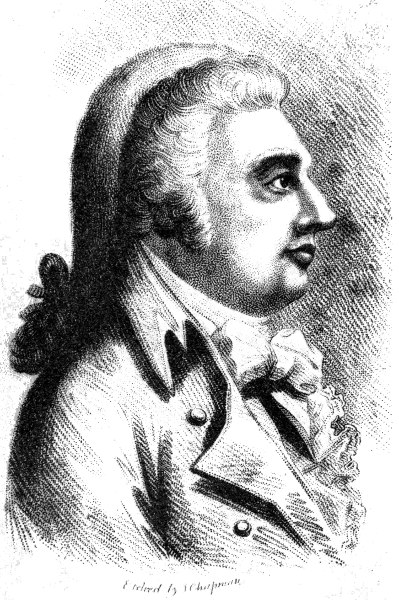
Etched by J. Chapman
John Hatfield.
Published J. Cundee Ivy Lane
The author of A Fortnight’s Ramble, having the
instinct of a good literary salesman, was not backward
in sentiment, and among his thumb-nail sketches of
rural life he was careful not to omit the portrait of a
village damsel. There is certainly much charm in the
impression of his humble heroine, whom he discovered
in a tiny hamlet on the shores of Lake Buttermere,
where, according to the laws of romance, she was the
maid of the inn. No doubt the child of fourteen was
as beautiful as he describes her—with her long brown
curls, big blue eyes, rosy lips, and clear complexion, and
with a grace of figure matured beyond her years. The
pity is that the picture was ever drawn.
Before the close of the year the charms of ‘Sally
of Buttermere’ had been quoted in a London magazine,
and henceforth the tourist was as eager to catch a
glimpse of the famous young beauty as to visit Scale
Force or Lodore. Very soon the inn where she lived—“a
poor little pot-house, with the sign of the Char”—became
a place of popular resort. Verses in her praise
began to cover the white-washed walls; and while she
was in the full bloom of youth, wandering artists, who
have handed down to us her likeness, took the opportunity
of persuading her to sit for them. That Mary
Robinson was a modest and attractive girl is shown by
the testimony of Wordsworth and Coleridge, and there
is evidence that she remained unspoilt in spite of her
celebrity.
Six years after the publication of A Fortnight’s
Ramble, its author, Joseph Budworth, paid a second
visit to the home of his ‘Sally of Buttermere’ Mary,
who was nineteen, and still charming, seemed destined
(after the fashion of village maidens) to become a buxom
beauty, and it is said, indeed, that she had been most
lovely at the age of sixteen. Budworth, however, saw
that she was quite pretty enough to attract hosts of
admirers, and conscience told him that he had not done
well in making her famous. There was Christmas
merrymaking at the little inn, and she reigned as queen
of the rustic ball. Next morning he confessed to her
that he had written the book which had brought her
into public notice.
“Strangers will come and have come,” said he,
“purposely to see you, and some of them with very bad
intentions. We hope you will never suffer from them,
but never cease to be on your guard.”
Mary listened quietly to this tardy advice, and thanked
him politely.
“You really are not so handsome as you promised
to be,” Budworth continued. “I have long wished
by conversation like this to do away what mischief the
flattering character I gave of you may expose you to.
Be merry and wise.”
Then, taking advantage of his seniority of twenty-three
years, the good-natured traveller “gave her a
hearty salute,” and bade her farewell. Unfortunately,
he repeated his previous indiscretion by publishing
another long account of the Buttermere Beauty in the
Gentleman’s Magazine, and, like Wordsworth, who in
similar manner paraded the charms of ‘little Barbara
Lewthwaite’ he lived to regret what he had written.
Two years later, a handsome middle-aged gentleman
of fine presence and gallant manners paid a visit to
the Lake District, bearing the name of Alexander
Augustus Hope (brother to the third Earl Hopetoun),
who, after a successful military career, had represented
the burgh of Dumfries, and now sat in Parliament as
member for Linlithgowshire. An active, strong-limbed
fellow, with courtly demeanour and an insinuating Irish
brogue, the contrast between his thick black brows
and his fair hair, between the patch of grey over his
right temple and the fresh colour of his face, added to
an appearance of singular attractiveness. These were
the days of the dandies, when young Mr George
Brummell was teaching the Prince of Wales how a
gentleman should be attired; and Colonel Hope was
distinguished by the neatness and simplicity of a well-dressed
man of fashion.
The new-comer reached Keswick about the third
week in July, travelling in his own carriage without
ostentation, having hired horses and no servant. Soon
after his arrival he went over to Buttermere, and
remained there for two or three days. Towards the
end of the month he visited Grassmere, where he
became acquainted with a genial merchant from Liverpool,
whose name was John Crump. Being a most
entertaining companion—for he was a great traveller,
had fought in the American War, and, as might
be expected of one so gallant and handsome, had been
engaged in numerous duels—Colonel Hope had the
knack of fascinating all whom he met. With Mr Crump,
who for some reason was not in favour with the young
poet at Greta Hall, he struck up a great friendship
during his three weeks’ stay at Grassmere, and a little
later the merchant showed his appreciation by christening
one of his children ‘Augustus Hope’ as a compliment
to his new acquaintance.
About the end of the third week in August the
member of Parliament, whose passion, we are told, was a
rod and fly, left Grassmere, and, for the sake of the char-fishing,
took up his quarters at the little inn at Buttermere.
So pleased was he with the district, that he
contemplated the purchase of an estate, and Mr Skelton,
a neighbouring landowner, went with him to inspect a
property near Loweswater. During his sojourn at the
Char Inn he paid frequent visits to Keswick to meet his
friend John Crump. Although wishing, for the sake of
quiet and seclusion, to travel incognito, Colonel Hope
seems to have been a gregarious person, and could not
help extending the number of his acquaintances. At the
‘Queen’s Head’ Keswick, where his Liverpool friend
was in the habit of stopping, he came across a kindred
spirit in Colonel Nathaniel Montgomery Moore, who had
represented the town of Strabane in the recently extinct
Irish Parliament.
Since the two had much in common, a close intimacy
ensued; but there was another reason for Colonel Hope’s
friendly advances. A pretty young lady of fortune, to
whom Mr Moore was guardian, was one of his party,
and the new acquaintance began to pay her the most
evident attention. Colonel Hope, in fact, always had
been remarkable for his insinuating behaviour in the
society of women, and since his arrival in the Lake
District he had been concerned in an affair of gallantry
with at least two local maidens far beneath him in station.
However, this was a pardonable weakness, for the Prince
himself, and his brothers of York and Clarence, did not
disdain to stoop to conquer. But on the present occasion
the gay Colonel apparently had fallen in love, and
when, before very long, he asked the lady to be his wife,
he was accepted.
It is not strange that a man of his power of fascination
and handsome appearance should have met with success
even on so short an acquaintance. The match seemed
a most suitable one in every respect, and Mr Moore
would have been well satisfied that his ward should be
engaged to a man of Alexander Hope’s rank and
position. Yet the lover did not hasten to take the
guardian into his confidence. Remaining at the little
inn on the shores of Buttermere, only occasionally he
made the fourteen miles’ drive to visit his fiancée at
Keswick. Colonel Moore, who could not remain blind to
the flirtation, became anxious lest his ward should place
herself in a false position. It was evident that the two
behaved to each other as lovers, and the Irishman was
impatient for the announcement of the betrothal. Still,
the love affair ran a smooth course until the close of the
third week in September; but as the time went on, and
the engagement remained a secret, the suspicions of the
lady’s guardian began to be aroused. Since it was
apparent that his friend had committed himself, his duty
was plain. There were only three explanations of his
reticence. Colonel Hope was not the man he pretended
to be, or he had quarrelled with his relatives, or else his
passion was beginning to cool.
The first proposition already had been whispered
among a few. Although his bonhomie and air of distinction
had made him a great favourite with his
inferiors, yet the fact that the reputed Colonel Hope was
travelling without servants, and had selected a woman
of fortune as his conquest, prejudiced critical minds.
Coleridge, who was engaged in basting the succulent
humour of the gentle Elia before a roasting fire, seems
to have cast the eye of a sceptic upon the popular
tourist from the day of his arrival. However, no open
rupture took place between the Irishman and Alexander
Hope, but towards the close of September they met less
frequently.
On Friday, the 1st of October, Colonel Hope sent
over a letter to his friend at Keswick, explaining that
business called him to Scotland, and enclosing a draft for
thirty pounds, drawn on Mr Crump of Liverpool, which
he asked him to cash. Pleased, no doubt, at this mark
of confidence, which may have appeared a favourable
augury of his ward’s happiness, Colonel Moore at once
obeyed the request, and forwarded ten pounds in addition,
so that his friend might not be short of funds on
his journey. On the next day, the sensation of a lifetime
burst upon the people of Keswick. At noon, the landlord
of the ‘Queen’s Head’ returning from the country,
brought with him the great intelligence that the Hon.
Colonel Hope had married the Beauty of Buttermere!
It was obvious to everyone—aye, even to the sceptic
of Greta Hall—that the mystery was at an end. Alexander
Hope was no impostor. Avarice had not led
him to attempt the capture of a lady of fortune. Torn
between love and honour, he had doubted whether to
give his hand when his heart was disposed elsewhere, or
to break his word. Thus, obeying the impulse of love,
he had married a girl of the people. Native pride in
the Beauty of Buttermere was strong in every breast,
and the next mail conveyed to London the news of her
great triumph.
But Colonel Moore, who had the right to be wroth and
suspicious, would not be appeased by the explanations
which satisfied the multitude. Since he could not believe
that a gentleman would behave in such a fashion, he
made haste to test the credentials of his late friend. The
bill of exchange was forwarded to Mr Crump, who,
delighted to be of service to Colonel Hope, from whom
he had received an affectionate note requesting the
favour, at once accepted it! Still the Irishman refused
to be convinced, and he sent a letter to the bridegroom,
informing him that he should write to his
brother, Lord Hopetoun. Moreover, he told all friends
of his intentions.
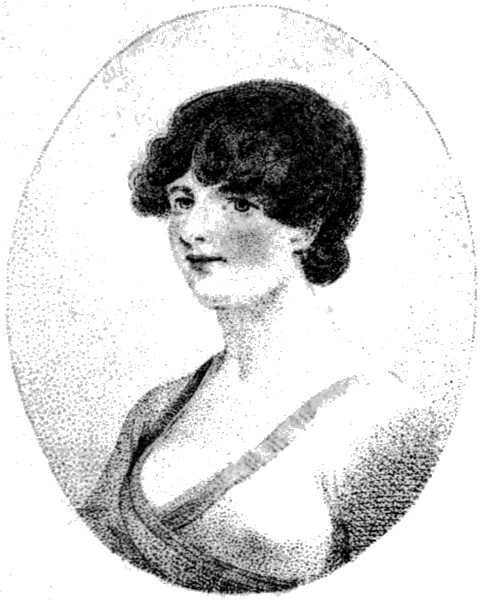
J. Smith, sculp.
The Beauty of Buttermere.
Published in the Act directs. June 25-1803.
During his five or six weeks’ residence at the Char
Inn, the amorous tourist must have had full opportunity
of forming a contrast between the Irish girl and Mary
Robinson. The Beauty of Buttermere was now in her
twenty-fifth year. A healthy outdoor life had matured
her robust physique, and her figure, though graceful still,
had lost the lines of perfect symmetry. The keen
mountain air had robbed her complexion of its former
delicacy, and with the advance of womanhood her
features had not retained their refined, girlish prettiness.
Still, her face was comely and pleasant to look upon.
The charm of her kind and modest nature was felt
by all who met her, and she seems to have possessed
culture and distinction far in advance of her lowly
station. Indeed, one of her most celebrated admirers
hints plainly that a mystery surrounded her parentage,
and that her breadth of mind and her polished manners
were the result of gentle birth. However, there appears
no warrant for such a surmise.
So, at last, Colonel Hope had begun to waver in his
ardour for the Irish girl. Naturally, she was not content
to remain under a secret engagement, and her inclinations
favoured a brilliant wedding, which her husband’s noble
relatives should honour with their presence. Such delay
had not pleased the lover, who wished the announcement
of the betrothal to be followed by a speedy marriage. In
this respect his other inamorata had been less exacting.
Poor Mary expected no pomp or ceremony, and had
never imagined that a peer and his people would come
to her wedding. All the odium that can attach to the
man who pays his addresses to two women at the same
time is certainly his, for it is stated on good authority
that he made his first proposal to the Cumberland girl
before he commenced the courtship of Colonel Moore’s
rich ward.
Then, when the heiress refused to fall in with his wishes,
he made the final choice. On the 25th of September he
went over to Whitehaven—about twelve miles as the
crow flies from Buttermere—with the Rev. John Nicholson,
chaplain of Loweswater, a friend of two weeks’
standing, to obtain a special licence for his marriage with
Mary Robinson. Naturally, no opposition was raised by
the parents; and although it has been said that the
reluctant girl was overruled by their persuasions, it is
certain—as far as any judgment of human nature can
be certain—that she was a willing bride. Nor—since
his record shows that each woman whom he cared to
fascinate was unable to resist him—is it difficult to
believe that Mary was in love with her handsome suitor.
On the morning of Saturday, the 2nd of October, the
wedding took place in the picturesque old church at
Loweswater, in the beautiful vale of Lorton, about seven
miles from Buttermere. The ceremony was performed
by Mr Nicholson, who had become as firm a friend of the
bridegroom as Crump himself. Immediately after the
service the newly married pair posted off north to visit
Colonel Hope’s Scotch estate. Their first day’s journey
was a remarkable one. Passing through Cockermouth
and Carlisle, they reached Longtown, near Gretna
Green, at eight o’clock in the evening, a distance
of over forty miles. The next day being Sunday, the
bridegroom, who on occasions could affect much religious
zeal, is careful to record, in a letter to the chaplain of
Loweswater, that they made two appearances in church.
On Tuesday or Wednesday they continued their tour
across the Border, but on the following Friday, owing to
Mary’s anxiety to receive news from her parents (so her
husband alleged), they retraced their steps to Longtown.
Here, two days later, important communications reached
Colonel Hope, which made him resolve to return to
Buttermere without delay.
Friend Nicholson wrote that scandalous reports concerning
his honour had been spread in the neighbourhood
since his departure, and that his wife’s parents had been
much disturbed by the rumours that had reached their
ears—informing him also of Colonel Moore’s opinion of
his behaviour. This latter news was superfluous, for
there was a letter from the Irishman himself. Its contents
may be gathered from the reply that the traveller
despatched to Nicholson on the 10th of October. With
amazing effrontery he tells his friend that his attentions
to the Irish heiress had never been serious, and expresses
his astonishment that Colonel Moore should censure his
conduct. Yet he shows his concern for the attacks on
his integrity, declaring that he will come back at once
to meet his calumniators face to face. Moreover, he
was as good as his word. Probably he left Longtown
for Carlisle, according to promise, the next morning,
and arrived at Buttermere on Tuesday, the 12th of
October. Thus Mary’s brief honeymoon came to an end.
As luck would have it, a somewhat remarkable person,
who happened to be acquainted with Colonel Hope, was
now staying at Keswick. This was George Hardinge,
senior justice of Brecon, the late Horace Walpole’s
friend and neighbour, the ‘waggish Welsh judge’ of
whom Lord Byron has sung. Having heard of the
romantic marriage, and being anxious to meet Colonel
Hope, he sent a letter to Buttermere requesting a visit.
Early on Wednesday morning the newly married man
drove over to Keswick in a carriage and four, accompanied
by his factotum, the Rev. John Nicholson, to
answer the summons in person. The meeting, which
took place at the ‘Queen’s Head’ Hotel, was an
embarrassing one. Pertinacious Nathaniel Moore, who
no doubt had kindled in Justice Hardinge’s mind the
suspicions which had caused him to solicit the interview,
was present at the encounter. The Welsh judge found
that Colonel Hope of Buttermere renown was an entire
stranger to him!
However, the other was in no way abashed, but pointed
out pleasantly that the mistake had arisen through the
coincidence of names. Mr Hardinge persisted that it
was remarkable that he should be Alexander Augustus
Hope, M.P. for Linlithgowshire, when the name
of the representative of that county was Alexander
Hope. The reply was a flat denial that these names
and titles had been assumed, and we are told that the
credulous clergyman bore witness to the truth of this
statement. Nevertheless, other testimony against the
accused man had more weight with the astute George
Hardinge. Not only was there Colonel Moore’s
declaration that the stranger had always passed as
Lord Hopetoun’s brother, but the Keswick postmaster
was able to prove that he had franked letters as a member
of Parliament. The result was an appeal for a warrant
of arrest to a neighbouring magistrate, and the suspected
Mr Hope was placed in charge of a constable.
Still, he did not appear disconcerted, but treated the
whole matter as a joke. Others, too, were of the same
opinion, for during the course of the day he presented a
bill of exchange for twenty pounds, drawn once more on
John Crump, to the landlord of the ‘Queen’s Head’
which that individual cashed without hesitation. The
stranger at once sent £10 to Colonel Moore to cancel the
gratuitous loan received before his departure to Scotland.
Faithful Nicholson, too, retained full confidence in his
genial friend, who ordered dinner to be prepared for both
at the hotel, and continued to bear him company.
Presently, the prisoner, chafing at the thought of being
kept in durance, asked permission to sail on the lake.
As this appeared a reasonable request, the wise constable
gave his consent. The clergyman accompanied his
companion to the water’s edge, while he made fervent
protests of innocence.
“If he were conscious of any crime,” he told his trusting
friend, “a hair would hold him.”
Since, however, he declared that he was guiltless, as a
natural corollary he had no intention of being held by
the whole force of the Keswick constabulary, and Nicholson
must have been aware of his design. For not only
did he give his friend a guinea to pay for the dinner
at the ‘Queen’s Head’ which was a plain hint that
he did not mean to return, but he told him that, as
his carriage had been seized by his accusers, his only
chance of rejoining his wife at Buttermere was by rowing
down the lake.
Luck favoured him. A fisherman named Burkett, who
had been his companion on many previous expeditions,
had a boat ready for him, and soon he was far across
Derwentwater. A crowd of sympathisers, full of wrath
against his enemies, for they were sure he was a great
man (as an impostor would have had no motive in marrying
poor Mary), stood on the shore with Nicholson and the
intelligent constable to watch his departure. Soon the
short October day drew to a close, and darkness fell upon
the waters, but ‘Colonel Hope’ did not return. Keswick
never saw his face again.
The conduct of the Rev. John Nicholson has been the
subject of keen censure. Although the province of a
parson is not that of the detective, it is unfortunate that
he did not suggest to the parents of Mary of Buttermere
that it would be wise to verify the statements of their
daughter’s suitor. On the other hand, it must be admitted
that everyone was infatuated by the splendid impostor,
and it is evident that the clergyman was not aware of
the flirtation with the Irish heiress. It is more difficult
to defend Nicholson’s conduct at the interview between
Judge Hardinge and the swindler; for although we have
no precise details of the conversation, it is plain that the
chaplain of Loweswater was guilty of a strange reticence.
Naturally, he knew that his mysterious friend had passed
under the name of Colonel Hope, and had franked letters
as a member of Parliament. Still, not only did he refrain
from exposing, but even continued to trust him, though
he must have perceived him to be a liar. However,
charity may suggest the conclusion that the clergyman
was full of compassion for Mary Robinson; and since he
believed that her husband would join her at the little
Char Inn, he was determined, whether felon or not, that
he should have the chance of escape.
The first announcement of the marriage of the celebrated
Buttermere Beauty with the brother of the Earl of
Hopetoun was printed in the Morning Post on the 11th
of October. Yet, three days later—the morning after the
remarkable escape at Derwentwater—a letter, written
on the highest authority, appeared in the same journal,
denying the previous report and stating that the real
Colonel Alexander Hope was travelling on the Continent.
Thus, by chance, London and Keswick became aware
almost simultaneously that Mary Robinson had been the
victim of a cruel fraud.
Although his flight had made it evident that the
pretended member of Parliament was an impostor, it was
not until the last day of October that his identity was
discovered. Meanwhile, the most strange rumours had
been aroused. The fact that all his plate and linen were
found packed in his travelling carriage, which was
retained by the landlord in pledge for his twenty pounds,
gave rise to the suspicion that he had meant to desert his
poor young bride. On the other hand, his admirers
persisted that he was an Irish gentleman, hiding from
the authorities because of his share in the recent rebellion.
A costly dressing-case, which he had left behind, was
examined under warrant from a magistrate, but nothing
turned up to reveal his true name. In the end this
discovery was made by Mary herself. While looking
over the dressing-box more carefully, she disclosed a
secret hiding-place containing a number of letters
addressed to him who had forsaken her. Alas for the
Beauty of Buttermere! No anticipation could have
exceeded the cruel reality. The handsome bridegroom
was a married man, and these letters had been written
by the heart-broken wife whom he had deserted.
‘Colonel Hope’ her supposed rich and noble husband,
was a notorious swindler—guilty of a capital felony—whose
real name was John Hadfield!
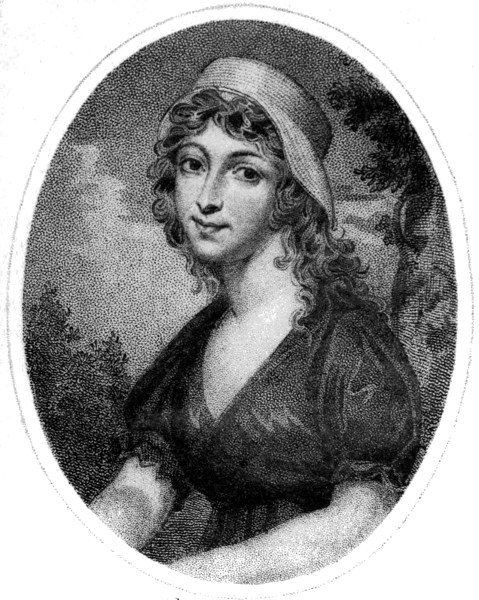
Mary of Buttermere.
Since the days of ‘Old Patch’ no impostor had
reached the eminence of Hadfield. Born of well-to-do
parents at Cradden-brook, Mottram-in-Longdendale,
Cheshire—where a neighbouring village may have lent
his family its surname—forty-three years before the
adventure at Keswick, his habits and disposition had
always been superior to his station in life. As a
youth he was apprenticed to the woollen trade, but
proved too fond of adventure to succeed in business.
Though much of his career is wrapped in mystery, we
know that he was in America between the years 1775-1781,
during the War of Independence, and that he
married a natural daughter of a younger brother of that
famous warrior the Marquis of Granby.
Having squandered the small fortune he had received
with her, the elegant Hadfield left his wife and their children
to take care of themselves, and by means of credit
managed for a short time to enjoy a career of dissipation
in London. By his favourite device of extortion—passing
drafts or bills of exchange upon persons of wealth, who
would be unlikely to prefer a charge against him—he was
enabled to continue his impositions without any more
serious consequence than an occasional visit to gaol.
The King’s Bench Prison, where in 1782 he was
confined for a debt of £160, appears as the next grim
landmark in his life. By a lucky chance he was able
to lay his case before the Duke of Rutland, who, having
discovered that the prisoner had married a daughter
of his late uncle, but being ignorant that the wife had
died of a broken heart in consequence of her husband’s
desertion, generously paid the sum necessary to obtain
his release. For many years the impostor’s dexterity
in obtaining money under false pretences from credulous
strangers, who believed him to be a connection of the
Manners family, made it possible for him to associate
with those far above his rank.
During 1784, after a brief career of fraud in Dublin,
where he posed as a relative of the Viceroy, and by
means of this falsehood contracted a host of fraudulent
debts, he was lodged in the Marshalsea Prison. With
unblushing impudence he appealed to the Lord
Lieutenant—his previous benefactor, the Duke of
Rutland—who agreed to pay his debts on the understanding
that he should leave Ireland immediately.
In the year 1792 Scarborough became the scene of
his depredations. Staying at one of the principal hotels,
he announced his intention of representing the town in
Parliament in the interest of the Manners family. A
portrait of poor Captain Lord Robert caused him to
burst into tears, which evidence of feeling won the
sympathy of all who witnessed it. As usual, his sparkling
conversation and distinguished appearance disarmed
suspicion, and for several weeks he lived in princely
style at the expense of his landlord. When pressed
for money he did not hesitate to offer bills of exchange,
which the local tradesmen accepted without demur.
Yet the day of reckoning, which this remarkable man
never seemed to anticipate, could not be postponed.
On the 25th of April he was arrested for the hotel debt,
and, not being able to find bail, was cast into prison.
Some weeks later, a detainer was lodged against him
by a London creditor, and for eight years he remained
an inmate of the Scarborough Gaol.
During his long confinement he maintained his
favourite pose as a luckless aristocrat, writing poetry,
and publishing much abuse against the authorities. At
last fortune smiled upon the interesting captive. Neither
Faublas nor Casanova ruled with more success over
the female heart, and it was to a woman that he owed
his release. A Devonshire lady, named Nation, who,
it is said, occupied rooms facing the prison, took compassion
upon him, and paid his debts. On the 13th of
September 1800 the impostor became a free man, and the
next morning, notwithstanding that hitherto they had
been strangers, he married his benefactress. The pair
made their home at Hele Bridge, near Dulverton, on
the borders of Somerset and Devon, where the bride’s
father was steward to a neighbouring landowner, and
before very long Hadfield plunged once more into a
career of fraud.
A marvellous aplomb, his previous commercial experience,
and a deposit of £3000 which he contributed
towards the firm, induced Messrs Dennis and Company,
merchants of repute in the neighbouring town of
Tiverton, to admit him as a partner. In consequence
of this new enterprise, he removed during the summer
of 1801 with his wife and child to a cottage at the
village of Washfield to be near his business. As before,
the utter lack of prescience and sagacity characteristic
of the man prevented him from reaping the fruits
of his perverted genius, as a less clever but more
prudent would have done. The whole transaction was
a smartly conceived but clumsily arranged swindle.
Since the money for the partnership had been obtained
by inducing a Mr Nucella, merchant of London, to
transfer Government stock, which soon would have to
be replaced, to the credit of Messrs Dennis, Hadfield
was compelled to realise his winnings without delay.
For the sake of a few hundred pounds of ready cash,
he seems to have been eager to sacrifice all that a man
usually holds dear, and to have become a lawless adventurer
once again.
In April 1802 he was obliged to decamp from Devonshire,
leaving his wife and children as before, while his
partners in Tiverton, who soon discovered that they had
been defrauded by a swindler, proceeded to strike his
name off the books of the firm. During the following
June he was declared a bankrupt. Meanwhile he had
proceeded to cut a dash in London, and it is said that he
came forward as candidate for Queenborough, with the
object of obtaining immunity from arrest as a member of
Parliament. Being still provided with funds, he made no
attempt to surrender to the commission issued against him;
but compelled, through fear of exposure, to relinquish his
political ambitions, he went on a leisurely tour through
Scotland and Ireland, and in the month of July appeared
at Keswick as ‘Colonel Hope’ to work the crowning
mischief of his life.
There has been much conjecture with regard to the
motives of Hadfield in his conduct to poor Mary Robinson.
The explanation that he was actuated by pure animalism
cannot be reconciled with our knowledge of his temperament
or his methods, setting aside the initial objection
that the sensualist, already cloyed by innumerable conquests,
does not usually play a heavy stake to gratify a
passing fancy. Nor is it credible that a man who had
the heart to forsake two wives and five children could
have been influenced by love. At first sight it seems
probable that, just as the most reckless speculator often
cuts a desperate loss, he wished to quit a hazardous
career of fraud, and to live a life of quiet and seclusion in
the humble home of the Beauty of Buttermere. Such
foresight, however, was wholly inconsistent with the
nature of the man; and even had he been capable of this
reasoning, a moment’s reflection must have taught him
that his recent ostentation had made retirement impossible.
No; like that of every gambler, John Hadfield’s
destiny was ruled by chance. Each stake he played was
determined by the exigency of the moment; win or lose,
he could not draw back nor rest, but must follow blindly
the fortunes of the day to cover the losses of the past.
Although not able to possess his Irish heiress, the tiny
dowry of Mary Robinson, the poor little inn at Buttermere,
seemed to lie at his mercy, and so he seized upon
it and threw it—as he would have thrown his winnings of
any shape or kind—into the pool. John Hadfield was a
fatalist, and his motto, Quam minimum credula postero.
After the interview with Judge Hardinge, the adventurer
became the sport of chance once more. When he
took boat from Keswick on the evening of his clever
escape, he steered his course to the southern extremity of
Derwentwater. The cluster of little islands soon must
have hid him from view, and no one thought of pursuit.
Whatever may have been his impulse, there was no time
to bid adieu to his bride. The path to safety lay far
ahead over the high mountains. Having left the lake
under the guidance of his faithful friend Burkett the
fisherman, his course for a few miles was a comparatively
easy one; but twilight must have fallen before he
had traversed the gorge of Borrowdale, and his flight up
the desolate Langstrath valley, which cleaves its way
between Glaramara and Langdale Pike, was made in the
darkness. By night the journey was a terrible one—over
rocks and boulders, along a broken path winding its course
beside the mountain torrent, up the face of the precipitous
crags, and across the Stake, a tremendous pass high up in
the hills, dividing northern lakeland from the south. From
Langdale he struck west towards the coast, and after a
journey of some fourteen miles reached the seaport of
Ravenglass, on the estuary of the Esk. In this place he
borrowed a seaman’s dress, and took refuge in a little
sloop moored near the shore, and here he was recognised
on the 25th of October. With a hue and cry against
him, it was not safe to remain near the scene of his latest
crime. Going by coach to Ulverstone, he continued his
flight thence to Chester, where early in November he was
seen at the theatre by an old acquaintance. Then he
appears to have walked on to Northwich, and there for
some time all trace of him was lost. An advertisement,
describing his appearance and offering a reward of fifty
pounds for his arrest, was published on the 8th of
November and scattered broadcast over the country.
The next tidings of him came from Builth in Wales,
where, on the 11th of November, he is said to have
swindled a friend, who had no knowledge that he was
the Keswick impostor, by the usual device of a bill of
exchange. On the day following this performance, the
London post brought the newspapers containing the
description of his person, and he hurried away from
the little town on the banks of the Wye in his flight
towards the south. For a time he still baffled capture,
but the pursuers steadily closed upon his track. On the
22nd of November the authorities at Swansea were informed
that a man resembling the published account of the
impostor had been seen in the mountains beyond Neath,
and the next day Hadfield was run to earth at the
‘Lamb and Flag’ an old coaching inn about seventeen
miles from the seaport town. At once he was lodged
in Brecon Gaol, and in about a fortnight’s time the newspapers
inform us that he was brought up to town by one
Pearkes, robin-redbreast.
The romance of the case attracted a great crowd to
Bow Street when the notorious swindler was brought up
for examination by Sir Richard Ford on the 6th of
December, and the investigation appears to have been
difficult and tedious, for he appeared before the magistrate
each Monday morning during the next three weeks. On
one of these occasions his attire is described as “respectable,
though he was quite en déshabillé,” his dress
being a black coat and waistcoat, fustian breeches, and
boots, while his hair was worn tied behind without
powder, and he was permitted to appear unfettered by
irons. Among other requests he asked for a private
room at Tothill Fields Prison, as he objected to herd
with common pickpockets, and he desired also to be
sent as soon as possible to Newgate. Although his
wishes were not granted, the solicitor for his bankruptcy
made him an allowance of a guinea a week.
Most pathetic was the loyalty of the wife and
benefactress whom he had used so cruelly. The poor
woman, who was the mother of two children, travelled
from Devonshire—a journey occupying a couple of days
and a night—to spend Christmas Day in prison with
her unfaithful husband. Numerous celebrities visited the
court during the examination of the impostor. Amongst
those who were noticed more than once was the Duke
of Cumberland, drawn possibly by a fellow-feeling for
the culprit, and Monk Lewis, on the look-out for fresh
melodrama. At last all the charges against him were
proved to the hilt—his offence against the law of bankruptcy,
his repeated frauds on the Post Office, the two
bills of exchange forged at Keswick. Still, although the
iniquities of his past were fully revealed, and although
a shoal of unpaid debts, fraudulently contracted, stood
against his name, one circumstance alone was responsible
for the great popular interest, and aroused also universal
abhorrence. John Hadfield had been damned to everlasting
fame as the seducer of Mary of Buttermere.
The extent of his baseness was disclosed in the course
of the proceedings at Bow Street. It was found that
the poor girl was destined to become the mother of his
child, and that he was in debt to her father for a sum
of £180. Indeed, the motive of his mock marriage
became apparent, for he had endeavoured to persuade
the trusting parents to allow him to sell the
little inn on their behalf, and possibly, but for the
interference of Justice Hardinge, he might have
succeeded. Mary refused to prosecute him for bigamy,
but she was induced to send a letter to Sir Richard
Ford, which was read in court at Hadfield’s fourth
examination.
“Sir,” she wrote, in the first agony of her cruel
disenchantment, “the man whom I had the misfortune
to marry, and who has ruined me and my aged and
unhappy parents, always told me that he was the
Honourable Colonel Hope, the next brother to the
Earl of Hopetoun.”
Contemporary newspapers show that the Beauty of
Buttermere became the heroine of the hour—she was
the theme of ballads in the streets; her sad story was
upon every lip; never was there so much sympathy for
one of her humble birth.
Early in the new year, Hadfield, who received as
much notice from the journals as Madame Récamier’s
wonderful new bed, was committed to Newgate. With
cool effrontery he dictated a letter to the press, asking the
public to reserve judgment until his case was heard, and,
as a wanton Tory newspaper declared, like Mr Fox and
Mr Windham, he complained bitterly of misrepresentation.
A long interval elapsed before he was sent north to
stand his trial, and he did not reach Carlisle Gaol until the
25th of May, whither he was conveyed by an officer from
Bow Street, who bore the appropriate name of Rivett.
At the next assizes, on the 15th of August, he was
arraigned before Sir Alexander Thomson, nicknamed
the ‘Staymaker’ owing to his habit of checking voluble
witnesses—a figure to be held in dread by law-breakers
of the northern counties, as the Luddite riots in a few
years were to show. Hadfield was not lucky in his
judge, for the man who, at a later date, could be harsh
enough to consign to the hangman the poor little cripple
boy Abraham Charlson, was not likely to extend mercy
to a forger.
The prisoner stood charged upon three indictments:—
(a) With having drawn a bill of exchange upon John
Gregory Crump for the sum of £20, under the false and
fictitious name of the Hon. Alexander Augustus Hope.
(b) With having forged a bill of exchange for £30,
drawn upon John Gregory Crump, and payable to
Colonel Nathaniel Montgomery Moore.
(c) With having defrauded the Post Office by franking
letters as a member of Parliament.
Only the first two were capital offences.
James Scarlett, afterwards Baron Abinger, was counsel
for the Crown, and Hadfield was defended by George
Holroyd, who, as a judge, displayed masterly strength
fourteen years later in directing the acquittal of Abraham
Thornton. It is recorded by some aggrieved journalist
that the crowd was so great it was difficult to take
notes. Such odium had been aroused against the betrayer
by the sad story of Mary of Buttermere, that ladies and
gentlemen are said to have travelled twenty miles to be
present at his condemnation. At eleven o’clock in the
morning the prisoner was placed in the dock. The
principal witnesses for the Crown were George Wood,
landlord of the ‘Queen’s Head’ Keswick; the Rev.
John Nicholson; and good-natured Mr Crump, who
proved conclusively that he had assumed a false name
and had forged a bill of exchange. A clerk in the house
of Heathfield, Lardner and Co. (late Dennis), of Tiverton,
called Quick, and a Colonel Parke, a friend of the
real Colonel Alexander Hope, supplied other necessary
evidence. One witness only—a lawyer named Newton,
who had been employed by Hadfield in the summer of
1800 to recover an estate worth £100 a year, which
he had inherited from his late wife—was summoned by
the defence.
The prisoner bore himself in a calm and dignified
manner, taking copious notes, and offering suggestions
to his counsel. But his speech to the jury—for still, and
for many years afterwards, a barrister was not allowed to
address the court on behalf of his client, except on some
technical point of law—shows that he anticipated his
doom. “I feel some degree of satisfaction,” he declared,
“in having my sufferings terminated, as I know they
must be, by your verdict. For the space of nine months
I have been dragged from prison to prison, and torn
from place to place, subject to all the misrepresentation
of calumny. Whatever will be my fate, I am content.
It is the award of justice, impartially and virtuously administered.
But I will solemnly declare that in all transactions
I never intended to defraud or injure those persons
whose names have appeared in the prosecution. This I
will maintain to the last of my life.”
Very properly the judge would not accept the plea
set up by the defence, that the financial position of the
prisoner was a guarantee that no fraud had been
meditated. At seven o’clock in the evening, after a
consultation of ten minutes, the jury returned a verdict
of guilty. Hadfield received the announcement with
composure, and when he was brought up for sentence
the next day—as was the barbarous custom of those
times—he displayed equal coolness. Kneeling down,
and looking steadily at the judge—who began to roll
out a stream of sonorous platitudes—he did not speak
a word.
From the first he seems to have been resigned to
his fate, and gave no trouble to his gaolers, but spent
his time quietly in writing letters and reading the Bible.
Indeed, his whole behaviour was that of one utterly
weary of existence, and he does not appear to have
desired or expected a reprieve. All his life he had
posed as a religious man, and he lent an eager ear to the
ministrations of two local clergymen who attended him.
Since there is no evidence that he was penitent, we
may adopt the more rational supposition that he was
playing for popular sympathy. It was seldom that he
spoke of himself, and the only reference he made to his
own case was that he had never sought to defraud
either John Crump or Colonel Moore. A contemporary
report states that “he was in considerable distress
before he received a supply of money from his father.
Afterwards he lived in great style, frequently making
presents to his fellow-felons. In the gaol he was
considered as a kind of emperor, being allowed to do
what he pleased, and no one took offence at the air of
superiority which he assumed.” Some days before his
death he sent for an undertaker to measure him for a
coffin, and gave his instructions to the man without any
signs of agitation.
On the day of his sentence, Wordsworth and Coleridge,
who were passing through Carlisle, sought an interview
with him. While he received the former, as he received
all who wished to see him, he denied himself to
Coleridge, which makes it clear that he had read and
resented the articles written by the latter to the
Morning Post. Neither his father (said to have been
an honest man in a small way of business) nor his
sisters visited him. Also his faithful wife, since probably
the state of her health or her poverty would not
allow her to make the long journey from Devonshire
to Carlisle, was unable to bid him farewell.
There has been much idle gossip concerning the
conduct of Mary of Buttermere after her betrayer was
condemned to die. Some have said that she was overwhelmed
with grief, that she supplied him with money
to make his prison life more comfortable, and that she
was dissuaded with difficulty from coming to see him.
Without accepting the alternative suggested, among
others, by De Quincey, that she was quite indifferent to
his fate, there are reasons for rejecting the other suppositions.
It is impossible that the most amiable of
women would continue to love a man who had shown
so little affection towards her, and whose hard heart did
not shrink from crowning her betrayal by the ruin of
her parents. The story of the gift of money, also, seems
unlikely, as her father had been impoverished by the
swindler, and the fund for his relief, raised by a subscription
in London—which did not receive too generous
support—had not yet been sent to Buttermere. And,
finally—alas! for romance—since the moral code even of
the dawn of the nineteenth century did not allow Mary
Robinson to usurp the duties, more than the name,
of wife to the prisoner, it is incredible that a modest
woman would wish to renew the memories of her unhallowed
union by an interview with the man whose
association with her had brought only dishonour.
The execution of John Hadfield took place on Saturday,
the 3rd of September. Rising at six, he spent half an
hour in the prison chapel. At ten o’clock his fetters
were removed, and he was occupied most of the morning
in prayer with the two clergymen, who, we are told,
drank coffee with him. The authorities do not seem to
have had any fear that he would attempt his life, for
they allowed him the use of a razor. About the hour
of three he made a hearty meal, at which his gaoler kept
him company. In those times there was a tradition in
Carlisle that a reprieve had once arrived in the afternoon
for a criminal who was hanged in the morning.
Thus, nearly three weeks had been allowed to elapse
between Hadfield’s trial and execution—in order that
there might be plenty of time for a communication from
London—and even on the last day the fatal hour was
postponed until the mail from the south was delivered.
Although it had been the opinion of the town that he
would not suffer the extreme penalty, the Saturday post,
which arrived early in the afternoon, brought no pardon.
At half-past three he was taken to the turnkey’s lodge,
where he was pinioned, his bonds being tied loosely at
his request. Here he showed a great desire to see the
executioner—who, oddly enough, hailed from Dumfries,
the town which the real Colonel Hope had represented in
Parliament—and gave him half a crown, the only money
he possessed. It was four o’clock when the procession
started from the prison, in the midst of an immense concourse
of spectators. Hadfield occupied a post-chaise,
ordered from a local inn, and a body of yeomanry surrounded
the carriage. Without avail he petitioned for
the windows to be closed. The gallows—two posts fixed
in the ground, about six feet apart, with a bar laid across
them—had been erected during the previous night on an
island, known locally as the Sands, formed by the river
Eden on the south side of the town beyond the Scotch
gate, and between the two bridges. A small dung-cart,
boarded over, stood beneath the cross-bar, Tyburn
fashion, in lieu of the new drop. As soon as it met his
eyes, the condemned man asked if this was where he was
to die, and upon being answered in the affirmative, he
exclaimed, “Oh, happy sight! I see it with pleasure!”
John Hadfield met his fate with the heroism which
great criminals invariably exhibit. Aged since his arrest,
for he had been in prison nearly ten months, he looked
at least fifty. In every respect he had become very
different from the sprightly ‘Colonel Hope’ of the previous
summer. When he alighted from the carriage
at the shambles he seemed faint and exhausted, but this
weakness was due to physical infirmity and not to fear.
A feeble and piteous smile occasionally played over
his white face. Yet none of the arrogance of pseudo-martyrdom
marked his bearing, but his quiet resignation
and reverent aspect won the pity of the vast crowd,
bitterly hostile to him a short while before. It was
remarked that he had still an air of distinction, and was
neatly dressed; his jacket and silk waistcoat were black,
and he wore fustian breeches and white thread stockings.
Just before he was turned off he was heard to murmur,
“My spirit is strong, though my body is weak.” We are
told that he seemed to die in a moment without any
struggle, and did not even raise his hands. An hour
and a half later he was lying in a grave in St Mary’s
Churchyard, for his request that he should be buried at
Burgh-on-Sands was disregarded out of consideration for
the pious memory of Edward I.
Were it not for his dastardly treatment of the women
who gave him their love, the fate of John Hadfield
would seem hard. He was not hanged for swindling
John Crump out of £50—which indeed the value of his
carriage and its contents, left behind at Keswick, would
have more than cancelled—but for attempting to swindle
him under the fictitious name of Colonel Hope. Thus by
assuming the character of another man he became entangled
in one of the fine-spun meshes of the law, and
was held guilty of an intention to defraud. Our great-grandfathers,
who, with the assistance of Sir Alexander
Thomson, could hang an old woman for stealing a few
potatoes in a bread riot, thought it expedient also to kill
a man who obtained £50 by telling a lie.
There is much truth in the proposition, which has
been stated with such inaccuracy by De Quincey, that,
but for his heartless conduct to Mary of Buttermere,
John Hadfield might have escaped the gallows. It is
probable that Mr Crump would have been loth to
advertise himself as a credulous dupe, unless he had
thought that it was his duty to give evidence against a
heartless seducer. Parson Nicholson, also, would have
had no reason to depart from the attitude he had taken
up before he was aware that he had officiated at a
bigamous marriage.
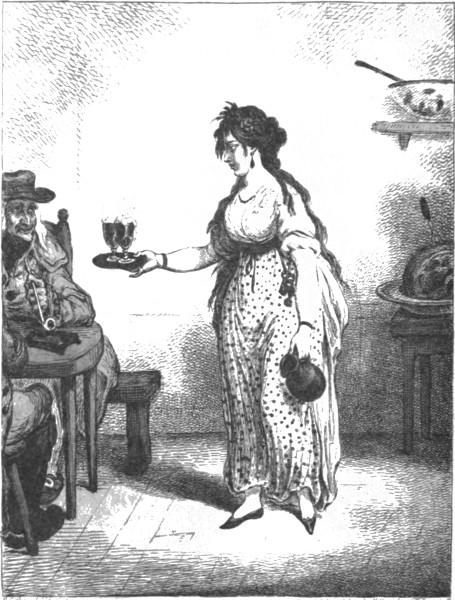
Mary of Buttermere.
Sketched from Life July 1800
Notwithstanding that his career was marked by so
many villainies, John Hadfield is in many respects an
admirable rascal. Setting aside his behaviour towards
women—if that is possible even for a moment—he played
a part which required infinite tact and magnificent
courage. Although occasionally he robbed a man who
was not rich, yet until the crime of Buttermere such an
occurrence was in the nature of an accident, and was
rather the fault of the wronged one for putting himself
in the path. Like Claude Duval, the Keswick impostor
was in the main merciful towards the impecunious; not
indeed for conscience sake, but because he believed that
his rightful place was among the wealthy. A hunter of
big game, dukes, members of Parliament, and prosperous
merchants were his proper prey! And the man who
could maintain a decent social position for twenty years,
in spite of the heavy handicaps of poverty and lowly
birth, and could compel those whom one of his class
should have met only as a lackey to receive him on
equal terms, was more than a common trickster. An
insatiable love of pleasure robbed him of all foresight
and prudence, or such a consummate liar might have
climbed high. Even as he was—had an earl been his
father—he might have gone down to posterity as one of
the greatest diplomats the world has ever seen.
The career of Samuel Denmore Hayward, hanged at
the Old Bailey for forgery on the 27th of November
1821, a picture of whom, dancing with ‘a lady of quality’
ornaments one version of the Newgate Calendar, is
similar to that of the Keswick impostor. Both men seem
to have had culture and address; each was distinguished
for his social ambition, and both were famous for gallantry.
With the exception of James Maclean, illustrious as the
friend of Lady Caroline Petersham and little Miss Ashe,
none of our rogues—not even William Parsons, the
baronet’s son—have been such fine gentlemen.
Mary Robinson’s child was born early in June 1803,
but did not survive its birth. Who can tell whether she
wept over it; or if the words that came from the lips
of her parents, when they heard of the death of her
betrayer, did not seem a fitting epitaph—“God be
thanked!” To avoid the gaze of curious travellers the
unhappy girl was obliged for a period to leave her
native place, and the shadow that had fallen upon her
young life was not lifted for many years. Yet, brighter
days were in store for the Maid of Buttermere. In the
course of time she was wooed and won by a Cumberland
‘statesman’ named Richard Harrison, to whom she was
married at Brigham Church in the May of 1808. Two
of her sons, born at Buttermere, where she resided for a
period after her marriage, died in infancy; but when her
husband took her to his farm at ‘Todcrofts’ Caldbeck,
beyond Skiddaw—where the Harrison family had been
‘statesmen’ for generations—she became the mother of
five more children, three daughters and two sons, all
of whom grew up and married. In later years it was
remarked that her girls were as pretty as Mary had been
herself when she was the Maid of the Inn. There is
reason to believe that the rest of her career was happy
and prosperous, and she lived tranquilly in her home at
‘Todcrofts’ where she died in her fifty-ninth year. The
tombstone records that she passed away on the 7th of
February 1837, while her husband survived her for sixteen
years. Both rest in the churchyard that holds the ashes
of immortal John Peel, who followed Richard Harrison
to ‘the happy hunting-fields’ within a few months.
(I am indebted to the kindness of Mr Richard
Greenup, of Beckstones, Caldbeck, one of Mary Robinson’s
few surviving grandchildren, for much interesting
information.)
A FAMOUS FORGERY THE CASE OF HENRY FAUNTLEROY, 1824 — Part I.—The Criminal and his Crime. — Part II.—Some Details of the Forgeries. — FAUNTLEROY AND THE NEWSPAPERS — NOTES ON THE FAUNTLEROY CASE
“Then, list, ingenuous youth....
And once forego your joy,
For your 176
instruction I display
The life of Fauntleroy.”
The Dirge of Fauntleroy, James Usher, 1824.
In the year 1792—not one of the least disastrous in
our annals of commerce—a small party of capitalists
established a private bank under the name of Marsh,
Sibbald & Company of Berners Street. The chief
promoters—William Marsh, a naval agent, and James
Sibbald of Sittwood Park, Berkshire, a retired official
of Company John—were gentlemen of substance and
position; while their managing partner, William
Fauntleroy (previously employed at the famous house
of Barclay), was a man of ability and business experience.
Four years later, a younger son of Sir Edward
Stracey, a Norfolk baronet, who married eventually the
niece of Sir James Sibbald, was admitted into the firm.
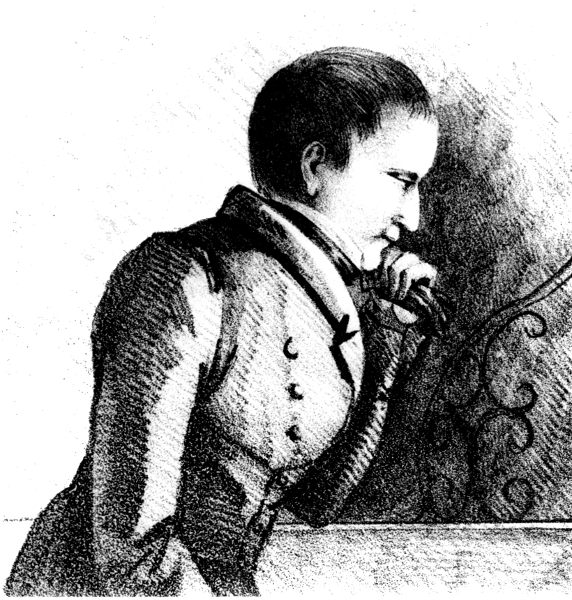
HENRY FAUNTLEROY.
Although never a bank of great resources, it appears
to have made a fair return to its proprietors, and because
of its connection with two baronets—one of whom
became Sheriff of his county—it was regarded as a
house of repute. In the spring of 1807 the firm received
a severe blow through the death, when only in
his fifty-eighth year, of the active partner, William
Fauntleroy, in whom his colleagues placed implicit trust.
Luckily, however, it was possible to fill his place, for his
second son Henry, who had been employed as a clerk for
seven years, although only twenty-two, was fit and eager
for the post. None of the members of the firm were able
to devote much attention to their bank, and thus, by a
strange chance, the sole control was left in the hands of
young Fauntleroy.
A remarkable man in every respect, this youthful
manager, who carried with ease the burden of a great
business on his shoulders. During the second decade
of last century no figure was better known to those
familiar with the west end of Oxford Street. Neat and
elegant as Brummell, grave and industrious as Henry
Addington, he seemed a model for all young men of
commerce. Each morning at the same hour, the front
door of No. 7 Berners Street, where he lived with his
mother and sister, was thrown open, and the banker
would step briskly into the adjoining premises—the
counting-house of Messrs Marsh, Stracey, Fauntleroy
& Graham. For he was a partner, also, as well as
absolute manager, this solemn young gentleman whose
air of ponderous respectability won the confidence
of all.
At first sight, his cleanly-chiselled features seemed
to express merely gentleness and simplicity, but a
second glance would reveal a picture of resolution and
strength. In fact, the massive brow, the broad cheekbones,
and the firm, bold contour of the chin suggested
a strange likeness—one that he sought to emphasise by
the close-cropped hair made to droop over his forehead.
It was his foible, this belief that he bore a resemblance
to the great Buonaparte—whose bust adorned his mantelpiece—and
the final catastrophe that overwhelmed him
should discourage any latter-day egoist who prides himself
upon a similar likeness.
Springing from an industrious Nonconformist stock
(for his father had been the architect of his own fortunes,
while his elder brother William, who fell a victim to
consumption at an early age, was a youth full of the
promise of genius), the temperament of Henry Fauntleroy
appears to have been as complex a piece of mechanism
as Nature ever enclosed within a human tenement. The
love of toil, and an indomitable perseverance, seemed to
be the guiding principles of his life. Not only did his
fine courage never waver amidst the terrors of the
financial tempest, through which he stood at the helm
of his frail bark, but he gave no sign to his colleagues
of the misgivings that must have lurked within his mind.
For commerce had fallen upon evil days. On every
side he beheld the crash and wreckage of his fellows,
but, inspired by the confidence which only the knowledge
of power can bestow, he resolved to continue his struggle
against the storm. With a brain capable of grappling
with huge balance-sheets, an almost superhuman dexterity
in figures being his natural gift, the work of three men
was the daily task of this Napoleon of commerce.
Although the members of his firm were compelled
to dive deeply into their pockets during these hazardous
years, to meet losses occasioned by the failure of clients
engaged in building speculations, the Berners Street
Bank was handled so skilfully that it managed to
weather the storm.
In spite of his vast abilities, there was nothing of
bombast in Fauntleroy’s nature, nor did external evidence
show that he was engaged in deadly warfare against the
unpropitious fates. A gentle, unassuming man, with a
quiet charm of address, he won universal regard from
all with whom he came into contact. The gift of friendship,
the infectious knack of social intercourse, was part
of his character. Naturally, the circle in which he
moved was composed of persons of refinement and,
in some cases, of eminence in the commercial world.
While his hand was ever open to the cry of distress,
his board always had a place for those who had gained
his esteem. All the leisure he could snatch seemed
devoted to simple pleasures—a choice little dinner to
a few kindred spirits, a holiday at his suburban
villa, or a week-end visit to his house in Brighton.
Though his earnest, florid face might be seen often
beneath the hood of his smart cabriolet, this carriage
was used principally in journeys between Berners Street
and the City. In short, few business men in London
were held in greater respect than this hard-working
young banker, who was so like the Emperor Napoleon.
Yet there was another side to the picture. Although
ostensibly he lived this simple and strenuous existence,
a few bosom companions knew him in another guise.
Unknown to the world, those week-end parties at his
villa in the suburbs were tainted and ungodly. The
sweet girl who sat at the head of his table as mistress
of his home had lost her maiden innocence while her
fresh young beauty was in its bud, lured by the sensuous
Fauntleroy almost from school. All her pretty friends
belonged to the same frail sisterhood, Cyprians beyond
question, though modest perhaps in demeanour and
speech. And with these ‘Kates and Sues’ of the
town came Fauntleroy’s intimates, ‘Toms and Jerries’
unmistakably, though possibly only in travesty, becoming
sober men once more in business hours.
Or one might have seen him driving past the fetid
Pavilion at Brighton in his smart carriage, with its
fawn-coloured lining, and have recognised in the shameless
features of the flashy lady at his side the notorious
‘Corinthian Kate’ herself—in real life Mrs ‘Bang’
most ‘slap-up of ladybirds’ Then, again, at his
luxurious seaside home in Western Place, with its
conservatories and sumptuous billiard-room-draped as
a facsimile of Napoleon’s travelling tent—his Kate’s dear
friend Harriet Wilson, or other illustrious fair ones,
would come to amuse his bachelor companions. Thus,
in his leisure moments, the industrious Fauntleroy
enjoyed secretly the life of an epicure and sensualist.
Deep-buried in his soul the love of vice was ever
present. “There only needed one thing to complete
your equipage,” he writes, in plain double entente that
indicates his ruling passion, to his friend Sheriff Parkins,
“instead of the man at your side, a beautiful angel!”
Marriage had meant no sowing of wild oats to Henry
Fauntleroy. A mystery surrounds his union to the
daughter of a naval captain named John Young. It
is known only that, although a son was born, the match
from the first was an unhappy one, and an early separation
took place. During the year of Waterloo a liaison
with a married lady, who had a complacent or shortsighted
husband, increased the habits of extravagance
which in the end brought the banker to ruin. Later,
the pretty young girl Maria Fox, who had been educated
at a convent in France, consented to become the mistress
of his suburban home. Thus the double life continued;
while to those who knew him only in Berners Street,
Mr Fauntleroy appeared the most righteous and
respectable of men.
What was the nominal income of the young bank
manager it is impossible to ascertain; but whatever the
sum, it is certain that before very long his expenditure
began to exceed his means. Probably he took the first
step on his downward march during the year of the
hejira to Elba. The strength and weakness of his
character combined to make the position of Tantalus
unendurable. Nothing seemed more certain than that
the Berners Street house, which had never recovered
from its unfortunate speculations, would return large
profits if its capital was sufficient to meet all claims.
Thus Fauntleroy decided not to take his colleagues
into his confidence. Such a step would have caused
the business to be wound up, and he would have lost
his handsome salary. As one of his most severe critics
has pointed out, “he had not enough moral courage to
face the world in honest, brave poverty.” On the contrary,
his courage took another form. Confident that
he must conquer evil fortune, the self-reliant man
resolved to commence a life-and-death battle with fate,
alone and unaided. And his choice was the frightful
expedient of forgery!
The methods of Fauntleroy were of unparalleled
audacity. Then, as now, clients were in the habit of
placing the certificates of their securities in the hands
of their bankers for safe custody. So, by boldly forging
the signature of the proprietor upon a power of
attorney, he was able to sell any particular investment
that he desired. Naturally, his depredations were confined
to Government securities—Consols, Long Annuities,
Exchequer Bills—and thus in effecting the
fraudulent transfers his negotiations were with the
Bank of England. For a period of almost ten years
this incomparable swindler maintained the credit of
his house in this manner, selling stocks belonging to
his clients to the value of hundreds of thousands of
pounds. As the proprietors received their dividends
as regularly as ever—for Fauntleroy took care that
their pass-books were credited with the half-yearly
payments—they never knew that their investments had
been abstracted. On the death of an owner the stolen
stock was replaced, and thus the trustees were unaware
of the theft. So the frauds went on, each forgery
being shrouded by another, until the total deficit of
the Berners Street Bank exceeded half a million!
Narrow escapes were inevitable. On one occasion
he was handing over a power of attorney for the
transfer of stock to one of the clerks in the Consols
Office at the Bank of England, when the person whose
name he had forged entered the room. Yet Fauntleroy’s
aplomb did not fail him. As soon as he perceived
the new-comer, he requested the clerk to return the
document, with the excuse that he wished to correct
an omission. Then, having secured the paper, he
went to greet the friend whom he was about to rob,
and they strolled out of the bank together. Another
day, one of his lady clients instructed a London broker
to sell some stock for her. Finding no such investment
registered in her name, the man called at Berners Street
to make inquiries. To his surprise the plausible banker
informed him that the lady had already desired him
to effect the sale. “And here,” continued the smiling
Fauntleroy, producing a number of Exchequer bills,
“are the proceeds.” Although his customer protested
that she had never authorised the transaction, the matter
was allowed to drop. While a friend was chatting
in his private office he is said to have been imitating
his signature, which he took out to the counting-house
before his companion had departed. One of the last
occasions when he visited the Bank of England was on
the 5th of January, the day on which Thurtell and Hunt
were tried for the Gillshill murder. While the clerk
was crediting the dividend warrants due to his firm, the
banker conversed about the crime. It was noted as a
strange coincidence that the same clerk was one of the
witnesses against him.
One day in September 1824, Mr J. D. Hulme, an
official of the Custom House, wishing to examine a list
of investments belonging to an estate of which he had
become a trustee, paid a visit to the Bank of England.
To his amazement he found that a sum of £10,000 in
Consols was missing, and inquiry proved that the stock
had been sold by the Berners Street manager under a
power of attorney. On the advice of Mr Freshfield,
solicitor of the bank, an application was made to Mr
Conant of Marlborough Street, who was induced to
grant a warrant for the arrest of the suspected man.
At last the wily Fauntleroy had been caught napping;
for although he was aware that there was a risk of
exposure, and had made preparations to reinvest the
stolen Consols, he had not yet been able to complete
the transaction.
During the whole of Thursday night, Samuel Plank,
chief-officer of Marlborough Street, finding that the
banker was away from home, paraded Berners Street
watching for his return. On the next morning, the 10th
of September, at his usual hour, the grave, neatly dressed
forger walked into his place of business. A mean trick
marked the arrest. Mr Goodchild, the other co-trustee
of the plundered estate, entered the counting-house a few
moments before Plank, and proceeded into the private
office, while the constable, pretending to cash a cheque,
remained at the counter. When through the half-closed
door of the inner room he saw that the victim and decoy
were closeted together, the police-officer pushed past the
astonished clerks, explaining that he wanted to speak
to their employer. As Fauntleroy raised his eyes from
his desk, and saw a warrant in the intruder’s hand, he
realised that the visit of his friend was merely a device
to place him in the hand of the law.
“Good God!” exclaimed the doomed man. “Cannot
this business be settled?”
And tradition relates that he offered Plank a bribe of
ten thousand pounds to allow him to escape. But the
officer proved incorruptible, and soon the banker was
standing in the presence of his astonished friend,
Magistrate John Conant, who, though sore distressed,
was compelled to commit him to Coldbath Fields
prison.
“I alone am guilty,” cried the wretched Fauntleroy,
in a burst of penitence. “My colleagues did not
know!”
Like the great model whom he had striven to emulate,
the vain man had found his Moscow. No longer was
he the dandy banker of Berners Street, whose friendship
had been sought by so many rich men from the City.
The days of the lavish Corinthian, the associate of
‘bang-up pinks and bloods’ had passed away for ever,
and he had become a criminal, standing beneath the
shadow of the gallows!
While Mr Freshfield, with the aid of the constable,
proceeded to execute his right of search, the members
of the firm were summoned to town. At first the
catastrophe was not appreciated to the full extent. On
the following morning the bank opened its doors, and
customers paid and drew their cheques as usual.
However, before the close of the day the proprietors
sent an announcement to the press that “in consequence
of the extraordinary conduct of their partner,” they had
determined for the present to suspend payment.
During the whole of Monday, the 13th of September,
an excited throng took possession of Berners Street—neighbouring
tradesmen trembling for their deposits;
men from the City dismayed by the wildest rumours.
A force of police was deemed necessary to prevent
a riot. “Arrest of Mr Fauntleroy, the well-known
banker!” The amazing tidings was upon every lip.
A similar sensation had not been experienced in the
memory of man. Since the days of Dr Dodd, half a
century before, none so high in the social scale had been
accused of such a crime. All the week, panic reigned in
business houses. It was whispered that the defalcations
would reach half a million pounds: that the greatest
commercial scandal of the age would be disclosed.
One day, it was said that Fauntleroy had arranged a
plan of escape; on another, that he had cut his throat
with a razor.
In the presence of a crowd of his creditors, the forger—crushed,
despairing, overwhelmed with the deepest
shame—was brought up for his first examination at
Marlborough Street on the following Saturday. Although
not more than forty, his hair, prematurely grey,
made him look much older. During ten long years of
torture the slow fires of suspense must have burnt deep
into his soul, and the reality of this fatal hour would
seem less cruel than the dreaded expectation. One
observer states that “his expression is of pure John
Bull good-nature”; another declares that he had “a
mild Roman contour of visage”; while his dress was
the inevitable blue tail-coat and trousers, with half-boots
and a light-coloured waistcoat—the morning attire
of all gentlemen of the period from Lord Alvanley and
Ball Hughes down to Corinthian Tom.
On the Friday week following his first examination,
the forger stood once more in the dock at Marlborough
Street. Two maiden ladies, Miss Frances and Miss
Elizabeth Young, whose small fortune had been stolen,
gave testimony against the prisoner. Pained to see
the man whom they had honoured and trusted in this
terrible position, the tender-hearted women were tearful
and distressed. Since the maiden name of Mrs Henry
Fauntleroy was the same as theirs, rumour leapt to the
conclusion that these witnesses were the sisters of the
prisoner’s wife. When the unfortunate banker was seen
to flush deeply as Miss Young appeared in the witness-box,
the error was confirmed.
It was not until the 19th of October that the accused
went through his third and last examination. Although
well-groomed and immaculate as ever, he was a mere
shadow of the placid, inscrutable man of business who had
borne his guilty secret so boldly and so long. There was
“rather a ghastly than a living hue upon his countenance,”
remarks the stylist who reports for The Times.
All the necessary charges being proved, he was committed
to Newgate, his removal being postponed until
Thursday, the 21st of October, on the application of
his solicitor.
Meanwhile the London press had revelled in the
case. Scarcely a day passed without a reference to the
forger or to the forgery, and there was the greatest strife
among the various newspapers to secure the most lurid
reports. Many times we have the amusing spectacle of
two journals belabouring each other like the envious
editors in Pickwick. Even the recent crime of John
Thurtell—for in this wonderful fourth year of his
Gracious Majesty King George IV. the lucky public
was satiated with melodrama, while Jemmy Catnach’s
pockets were overflowing with gold—did not offer such
chances of sensational reports. It was announced to
an amazed public that Fauntleroy had squandered
the proceeds of his forgeries in riot and dissipation.
One-half of his private life was disclosed to public ears;
and though some of the newspapers were merciful,
just as others were hostile to the prisoner, one and
all, with very few exceptions, probed deep into his
murky past.
Happily, there is no evidence to justify the supposition
that the partners in the Berners Street bank—and in
particular Mr J. H. Stracey, who thirty years later
succeeded to the baronetcy held in turn by his father
and his two brothers—were responsible for the dastardly
attacks upon the defenceless man. Even had he given
no public denial to the charge, such an assumption is
impossible in the case of an honourable man like the late
Sir Josias Stracey. Moreover, the identity of the person
who inspired the disgraceful accounts in The Times and
other journals is easy to discern.
This spiteful enemy bursts upon the stage of the sad
tragedy of Fauntleroy like the comic villain of melodrama—too
contemptible to hate, but with a humour too
crapulous for whole-hearted laughter. Joseph Wilfred
Parkins—elected Sheriff of London on the 24th of June
1819—appears to have been one of the most blatant
humbugs that ever belonged to the objectionable family of
Bumble. Tradition relates that he was the son of a
blacksmith who lived on the borders of Inglewood Forest
in Cumberland; but Parkins, too proud to know from
whence he came, preferred to pass as a bastard of the
Duke of Norfolk. In his early youth, we are told that
“he was apprenticed to a breeches-maker in Carlisle,
but his dexterity as a workman not being commensurate
with his powers of digestion, a separation took place.”
Afterwards he sailed to Calcutta, where, assisted by
letters of introduction from his patron the Duke,
he established a lucrative business. In other ways,
according to account, he was a success in India, where
he became famous for hunting tigers with English greyhounds,
and once shot a coolie for disobeying his orders,
two miles and a half distant, right through the head,
across the Ganges, and through an impenetrable jungle!
On another occasion he claimed to have ridden stark
naked in mid-day, on a barebacked horse without bridle,
fifty miles in six hours, for a wager, and to have trotted
back for pleasure without even a drink of water. When
he returned to his native land with the treasures of the
East, it was inevitable that such a man should win
notoriety. Having failed to gain the affections of Queen
Caroline, who preferred Alderman Wood for a beau, he
devoted himself to Olive Serres, ‘Princess of Cumberland’
and became her champion and literary collaborator.
One of the achievements on which he most prided
himself was the refusal to marry a daughter of Lord
Sidmouth, who was most eager to become his father-in-law.
Sometimes we behold him fawning upon Lord
Mayor Waithman and Orator Hunt. At others, no one
excels him in hurling abuse at these same celebrities.
During a portion of his career a charmer named
Hannah White caused him much trouble. Probably
he enjoys the unique honour of being the only Sheriff
of London upon whom the Court of Common Council
has passed a vote of censure for his conduct while
in office.
For some years this great Parkins was a familiar
friend of Henry Fauntleroy. “I have been looking out
for you in town these three or four days,” the banker
writes to him in May 1816, “as we have a dance this
evening, and lots of pretty girls, and I know you are an
admirer of them.” However, just after the arrest, the
ex-Sheriff suspected his former associate unjustly of a
breach of faith, and thus became his most deadly enemy,
placing his intimate knowledge of his friend’s habits at
the service of the hostile press. In order to exhibit the
bankers depravity, he published a communication from
the fair but frail Corinthian Kate, known in real life
as ‘Mother Bang’ but the context chiefly serves to
indicate that Parkins treasured a grudge because his
friend had never introduced him to the lady. Even
after the criminal had received sentence his animosity did
not cease. “The penalty for forgery should be the
gallows,” he declared at a meeting of the Berners Street
creditors, “until the law discovered a worse punishment.”
When the only son of the condemned man, a youth of
fifteen, wrote to the papers, pleading that mercy should
be shown to his father, the vindictive ex-Sheriff declared
in the columns of the Morning Chronicle (as it proved,
falsely) that the boy was not the author of the appeal.
Nor did he scruple to print private letters from Mrs
Fauntleroy to her husband in order to show that she was
an ill-used wife.
Great indulgence was shown to the banker—for a
forger always was treated with lenience—during his term
of imprisonment at the Old Bailey. The same consideration—which
aroused the ire of Parkins to boiling point—had
been paid to him while he was under the care
of Mr Vickery, ex-Bow Street runner, at that time
the Governor of Coldbath Fields bridewell. On this
account there arose a very pretty quarrel, at which, of
course, the newspapers assisted, between John Edward
Conant of Marlborough Street and an elderly magistrate
of Hammersmith named John Hanson. The latter
was accused of intruding into Fauntleroy’s room at the
House of Correction, when the following conversation
is said to have taken place:
“You are the banker from Berners Street, aren’t
you?” demanded the visitor.
“Yes, I am that unfortunate person, sir,” answered
the prisoner.
“Oh, then you’d better look to your soul,” was the
reply. “Look to your Bible. Read your Bible.”
Although poor old Hanson, who was struck off the
list of visiting justices in consequence of his officiousness,
made many earnest protests that he had been misrepresented,
and although Fauntleroy acquitted him of all
intent to offend, it would appear that his observations
were superfluous, whatever their precise form.
At Newgate the kind-hearted Mr Wontner—keeper
of the gaol from 1822 till his premature death at the age
of fifty in 1833—allowed the unfortunate banker every
privilege that lay in his power. Thus his prison was no
gloomy dungeon, but a large and well-furnished room,
occupied by a turnkey named Harris, who removed into
an adjacent apartment, and who, together with his wife,
watched over and attended to the wants of his charge.
Convinced that his case was hopeless, it is said that
Fauntleroy resolved to plead guilty; but, urged by his
friends, and by his solicitors, Messrs Forbes & Harmer,
he was induced at last to abandon the intention.
James Harmer, who conducted his defence, was the
great criminal lawyer of his day—a prototype of Mr
Jaggers—the prince of Old Bailey attorneys. Among
his clients were such diametrically opposite characters as
Joseph Hunt of Gillshill fame, and lusty Sam Bamford
of Middleton. The incidents of Mr Fauntleroy’s case
offered many opportunities for his versatile talents; and
although he failed to teach good manners to The Times
newspaper, he did much service to his age, by means
of a side issue, in getting Joseph Parkins indicted for
perjury. Yet the greatest abilities could do little to
extenuate the Berners Street forgeries. Still, whether or
not he had a weakness for scented soap, Harmer never
fought in kid gloves, as the unfortunate Messrs Marsh,
Stracey, & Graham—whom he was compelled to damage
in the interests of the man he defended—found to their
cost. Those inclined to accuse Charles Dickens of
exaggeration should bear in mind that murderer Hunt,
who chose Jaggers Harmer as his solicitor, escaped the
hangman’s rope, while Thurtell, who employed another
lawyer, was handed over to Thomas Cheshire.
The trial of Fauntleroy on Saturday, the 30th of
October, did not attract the mob of respectables that
officialdom had anticipated. A guinea entrance-fee
proved prohibitive. Press and law students alone
furnished their crowds, and the private galleries were
patronised but poorly. Joseph Parkins, eager to witness
the humiliation of the man whom he had chosen to
regard as an enemy, was an early arrival, taking his
place at the barristers’ table in front of the dock, where,
in full view of the prisoner, he could gloat over his misery.
Luckily, Sheriff Brown, whose humanity—like that of
his colleague John Key—was in advance of the age, witnessed
the manœuvre, and, appreciating the motive of
the truculent nabob, sent an officer of the court to tell
him that his seat was engaged. Parkins, whose fierce
eyes, glaring from beneath bushy, overhanging brows,
seemed to inflame his combative features and fiery locks,
turned in outraged dignity upon the official.
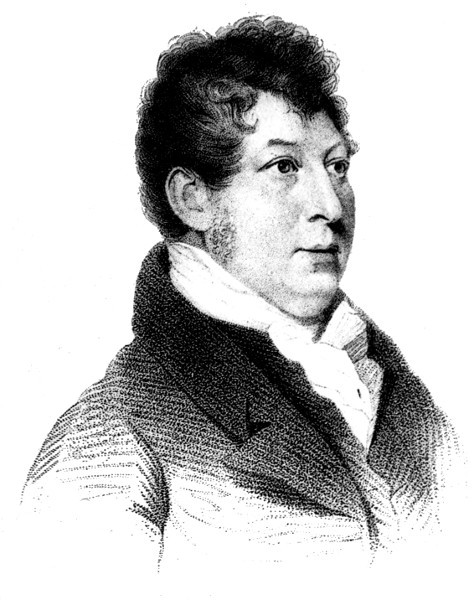
James Harmer, Esqr.
Solicitor.
Engraved by T. Wright from a Drawing by A. Wivell.
London, Published August 1st, 1820, by A. WIVELL, 105, Great Titchfield Street.
“Do you know to whom you speak, sir?” he
articulated.
“Know you?” was the reply. “To be sure I do.
Come, be off!”
So the ‘XXX Sheriff’ was forced to make his exit
by climbing ignominiously over seats and benches, to
the infinite mirth and advantage of the gentlemen of
the press.
At ten o’clock Justice Park and Baron Garrow come
into court, followed by the Attorney-General, the great
Sir John Copley, soon to be Lord Lyndhurst, who,
instructed by Mr Freshfield, solicitor to the bank, has
charge of the prosecution. John Gurney, afterwards a
judge, who, like Scarlett and Adolphus, is one of the
great criminal barristers of his day, defends the prisoner.
The buzz of many voices is hushed into silence as
Fauntleroy is placed at the bar. Jaggers Harmer
accompanies him. For a moment he is dazzled by the
glare from the inverted mirror above the dock. Making
a feeble attempt to bow to his judges, he almost falls back
into the arms of the attendants. With closed eyes and
bent head, shrinking from the universal gaze, he stands
with trembling fingers resting on the bar—a picture of
unutterable shame. Thin and worn are his features,
and his face is pale as death, while his hair, thrown into
contrast by his full suit of black, has become white as
though sprinkled with powder.
The Attorney-General proceeds with the first indictment,
that which charges the prisoner with transferring
under a forged deed £5450 Three per cent. Consols,
belonging to Miss Frances Young. During the speech
there comes a disclosure amazing to everyone in court
save the man in the dock and those who defend him.
In a private box found at Berners Street after his arrest,
a document has been discovered containing a list of
stolen securities. Upon this paper, written and signed
by the hand of Fauntleroy, and dated the 7th of May
1816, are these words, which, as Sir John Copley reads
them, bewilder all his hearers:—
“In order to keep up the credit of our house I have
forged powers of attorney, and have thereupon sold out
all these sums, without the knowledge of my partners.
I have given credit in the accounts for the interest
when it became due. The Bank (of England) began
first to refuse our acceptances, and thereby to destroy
the credit of our house; they shall smart for it.”
Attorney-General and rest of the world are much
puzzled, concluding that but for unaccountable negligence
the prisoner would have destroyed this seemingly incriminating
document; as though a forger would not
prefer that his frauds should be thought to have been
actuated rather by devotion to his business and revenge
against the unpopular Old Lady of Threadneedle Street
than merely for the sake of self-aggrandisement. “The
Bank of England shall smart for it!” Were the story
credible—were Fauntleroy, in fact, a small defaulter—we
may well believe that another fierce outcry would have
arisen against the wicked old harridan of the City.
There is little difficulty in proving the indictment,
while the poor wretch in the dock sits huddled in his
chair, trying vainly to conceal his face with his handkerchief.
A couple of his own clerks swear that the
signature to the deed is a forgery. Tear-stained Miss
Young, whom most regard as the sister-in-law of the
accused man, proves that her slender store of investments
has been pilfered. Officials of the Bank show that the
unhappy prisoner was the thief. There crops up a
curious instance of the naïveté of British jurisprudence.
For Threadneedle Street has been obliged to refund
the stocks belonging to Miss Young in order to make
her ‘a competent witness’ lest it might seem that she
has a motive in affirming or denying the forgery of the
power of attorney. Thus the Old Lady confesses that
she has bribed a witness in order that this witness may
not be suspected of trying to obtain a bribe!
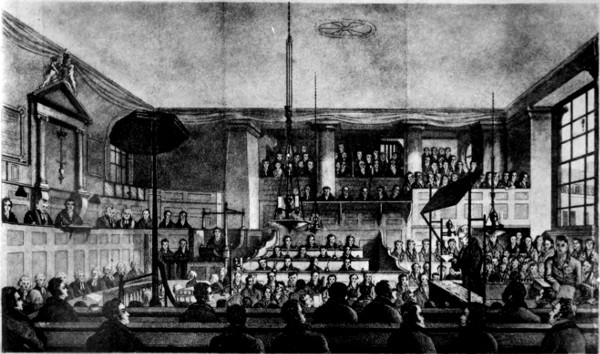
FAUNTLEROY’S TRIAL AT THE OLD BAILEY.
When Fauntleroy is called upon for his defence, he
manages to stagger to his feet. The law of England
will not allow his counsel to speak for him. Drawing a
paper from his bosom, and wiping away the tears that
stream from his eyes, he adjusts his glasses. Then, in
a clumsy, insincere manner, like a schoolboy’s recitation,
he begins to read a long apology. It is apparent that
he has not written the speech himself, and it makes no
impression. Commencing with a complaint against the
false and libellous accounts in the press, he sketches the
history of the Berners Street Bank in order to show
that it has received the benefit of the whole of his forgeries;
describing how he alone has borne the burden
of the business and the anxiety of perilous speculations,
while his partners have given him no assistance.
All his frauds were accomplished to cover commercial
losses, the withdrawal of borrowed capital, and the overdrafts
of two of his colleagues. To every one of the
charges of prodigality he offers an emphatic denial. In
conclusion, he makes a pathetic vindication of his conduct
towards his wife, declaring that not only are the statements
published in the newspapers false, but that she
has had always the best of feeling towards him.
Although just and merciful, the address of the judge
is hostile to the prisoner, and the jury, who retire at ten
minutes to three, return in less than a quarter of an hour
with a verdict of guilty. Exhausted with his long ordeal,
poor Fauntleroy is incapable of exhibiting emotion. A
vacant expression is stamped on his pallid features, and
when Justice Park tells him that the trial is over he
sinks listlessly into his chair. Raising him in his arms,
Governor Wontner supports him from the dock.
On the following Tuesday, when the convict is
brought up to hear his doom in the New Court, Messrs
Broderick and Alley move an arrest of judgment on
certain technical points of law. Justice Park, who is
said to have been acquainted with the prisoner, does
not attend, but neither Baron Garrow nor the Recorder
will accept the empty but ingenuous arguments of
counsel. The prisoner reads a paper, stating that when
he committed the forgeries he had expected to repay the
money when his house prospered. Thus he begs for
mercy from the Crown. Sentence of death is the reply.
After the publication of Fauntleroy’s defence, the
press attacks—as no doubt Jaggers Harmer had foreseen—are
turned against the unlucky partners. All
the statements of the condemned man find acceptance,
like the protests of every criminal, and it is believed that
his colleagues must be guilty of complicity in the frauds.
From The Times comes a demand that Messrs Marsh,
Stracey, and Graham shall be examined before the Privy
Council! A petition for reprieve is promoted by the
creditors of the Berners Street house, on the plea that
Fauntleroy’s evidence is necessary to elucidate the
intricate accounts. Another lies at the office of Harmer’s
paper, the Weekly Dispatch.
Condemned convicts are quartered still, and for many
years afterwards, in the part of the prison known as
the Press Yard—a walled quadrangle, where they are
allowed to herd together indiscriminately during certain
hours, adjacent to a three-storied building containing a
day-room and the cells in which they are locked at night.
Being a person of consequence, the miserable banker
does not share this ignominy, but returns to the same
apartment that he had occupied before his trial. Since
the use of fetters had been abolished in Newgate, he is
not required to endure even the ‘light manacles’ which
some of the papers state he is wearing.
Remaining faithful to the end, although so deeply
wronged, his poor wife is a constant visitor. His
brother John, a London solicitor, and his fifteen-year-old
son, reported variously as being educated at
Winchester and Westminster (afterwards at Skinner’s,
Tonbridge), come frequently to the prison. The beautiful
Maria Fox, a mere schoolgirl when first she became
his mistress, and who appears to be deeply attached to
her protector, brings her two baby daughters to Newgate.
Few men in their last hours have witnessed more terrible
examples of the ruin they have wrought than the weak
and self-indulgent Henry Fauntleroy.
Gentle Mr Baker, the white-haired layman of the
map office in the Tower, whose work in the foul dungeon
was scarcely less admirable than that of Elizabeth Fry,
seems to be more successful in winning the affections
of the condemned man than Ordinary Cotton; and the
efforts of this good Samaritan are aided by a clergyman
from Peckham, named Springett, to whom Fauntleroy had
been introduced by a friend. These two are his constant
companions during the remainder of his imprisonment.
Most of his old associates prove loyal, in spite of his
infamy and disgrace, for the fearful penalty of the forger
is thought to atone for the greatest of frauds.
Meanwhile, exertions for a reprieve continue. The
condemned banker is not included in the Recorder’s
report on the 20th of November at a meeting of the
Council, over which the King is said to have presided,
and the case is argued twice before the Judges on the
23rd and 24th of the month. George IV., the only one
of the four who was a gentleman, a scholar, or a man of
artistic taste, the only one whose foolish egotism did not
embroil the country in a costly and bloody war, was also
the only one with a merciful heart. His first great fault,
for which neither contemporaries nor posterity have
forgiven him, was infidelity to a dull, silly, uncleanly
wife, whom he was compelled to marry against his
will, and who was nothing loth to pay him back in his
own coin. His next, that, like the Duke of Wellington
and his brother William, he was a lion among the
ladies. George IV. is inclined to save Fauntleroy
from the scaffold, just as he wished to save all except
the murderer.
Every effort fails, however, and on Wednesday night,
after a meeting of the Privy Council, the Recorder sends
his report to Newgate. At half-past six the Rev.
Cotton, whose duty it is to break the news of their fate
to the prisoners, proceeds to Fauntleroy’s room. The
banker, who is reading, looks up as the Ordinary enters,
and, observing that he is deeply affected, “Ah, Mr
Cotton, I see how it is,” he exclaims. “I expected nothing
less than death, and, thank God, I am resigned to my
fate.” During the rest of the day he seems more
concerned for the doom of Joseph Harwood—a lad of
eighteen, condemned to die the next morning for stealing
half a crown from the pocket of a drunken Irishman—than
for his own dismal situation. Worn out with
suspense, he does not awake until a late hour on Thursday,
and thus sleep spares him the anguish of hearing the
awful bell that is added to the torments of those who
go to the scaffold innocent of murder.
On Friday, Miss Fox comes to bid him farewell,
bringing with her, so The Times reports, “two lovely
babes, both girls, of the ages of eighteen months and
three years, and both also in deep mourning.” Another
occasion, indeed, for the modern reader to exclaim—“Cruel,
like the grinding of human hearts under millstones.”
One of that time thinks so—Edmund Angelini,
a crazy teacher of languages, who the same day makes
application to the Lord Mayor that he may be allowed
to mount the scaffold instead of Fauntleroy.
On Saturday, the miserable wife pays her last visit.
Previously she has made a desperate attempt to reach
implacable Peel—fainting in his hall—which brings from
the Home Secretary “a kind message.” Afterwards
she strives to speak with Lady Conyngham, who pleads
inability to assist, conscious, no doubt, that although
she can mould divine right, her charms are powerless
against the incorruptible calico-printer. Angelini, still
filled with lust for the rope, but whose logic has made
no impression on the Lord Mayor, comes hammering
at Newgate door, and succeeds in gaining an interview
with Ordinary Cotton, whom, perhaps, he regards—judging
by appearances—as Jack Ketch’s commanding
officer.
With the Sabbath comes gala-day and the ‘condemned
sermon’ The partners of Jaggers Harmer, by
name Forbes and Mayhew, are humane enough to sit
with Fauntleroy in the ostentatious sable pew reserved
for doomed convicts, and the good Samaritans Baker and
Springett, supporting their charge with kind hands,
take their seats with the dismal company. Abductor
Wakefield has left a graphic picture of an entertainment
similar to this. The rude, unsightly chapel, near akin
in more than appearance to the dissecting-room in Old
Surgeons’ Hall, and with no more semblance of holiness
than the court at Bow Street, is packed with prisoners,
gay and careless sight-seers, the pomp of sheriffdom and
attendant lackeys. Hymns are bellowed, in hideous
blasphemy, beseeching divine mercy to show good
example to the creatures it has moulded in its own image.
Prayers are mumbled, and heeded as little by the gallows-gazing
throng as the showman’s horn by children who
pant eagerly for the puppet-show. The hangman’s
prologue—the sermon—is what all desire, and everything
else is of no account. At last the Rev. Cotton,
smug and resolute in white gown, mounts the lofty pulpit,
and the Sheriffs attempt to screw their courage to face
the ordeal. The Ordinary is in his finest form. On the
previous Sunday he had shattered the nerves of the boy
Harwood, and had sent ‘a female’—condemned to die
for a paltry theft—into hysterics a fortnight ago. Scenes
like these make the condemned sermon attractive. To-day
the discourse is a stupid plagiarism of the Jacobite
doctrine of passive resistance, but the bank’s charter,
and not divine right, is Cotton’s fetish. While lauding
the humanity of “the greatest commercial establishment
in the world,” he displays his want of accuracy and legal
knowledge by praising the directors for having replaced
the stolen investments, as they had not yet done, but
were bound by law to do. “I deprecate that feeling,”
he declaims, “which is artfully and improperly excited
in favour of those who have no extraordinary claim to
mercy. When monstrous crimes have been committed
we have a right to call for judgment on criminals, and to
consign them to the fate the law demands. Offences are
sometimes brought to light which require the most severe
chastisement the law can inflict, and discoveries of such
a nature have been made in reference to the unhappy
individual to whom I shall more particularly address
myself,” etc., etc. Upon the limp, shrinking figure in the
large black pew, whose poor throbbing brain is pierced
through and through by the barbed words of the holy
man, all eyes are turned, save a few blinded with tears,
or those wretches of both sexes who testify by sobs and
howls that a like fate is their portion. Even in the
leathern faces and soulless eyes of the grim turnkeys
there glimmers a tiny spark of emotion. It is pleasant
to remember that the Rev. Cotton, harmless and worthy
gentleman in other respects, received strong censure from
those in authority for his eloquence at the expense of
Fauntleroy, and was accused of “harrowing the feelings
of the prisoner unnecessarily.” Still, it would have
been wiser to have attacked the system rather than
the man.
Less gruesome even than the loathsome chapel is the
condemned cell on the fatal night. All day the doomed
banker has been calm and resigned, bidding adieu to his
brother and his son, and explaining to his solicitors
intricate details in the books of the bank. Late in the
evening Mr Wontner comes to visit him as usual, and
tries to persuade him to take something to eat, but the
wretched man protests he ‘loathed food’ For hours
he continues to pace the room, leaning on the arm of
Mr Springett. Although he declares that he shall never
sleep until after that ‘awful moment’ about three o’clock
he is induced to lie upon the bed. The clergyman, who
leaves the chamber for a few moments, finds him, when
he returns, sitting by the fire and greatly terrified.
Early in the morning he is able to accept a cup of
tea and a biscuit. Before six o’clock Baker has resumed
his work of mercy, and a little later conscientious
Ordinary Cotton joins the sad company. Neat and
precise as ever, the forger has made as careful a toilet
as if he was to attend a social gathering, attired in a
suit of black, with knee-breeches, silk stockings and
dress shoes, and a white handkerchief around his neck.
To Mr Baker he gives a few pounds to distribute
among the needy people in the prison, and leaves a
ring for Mrs Harris, the wife of the turnkey, to whom,
and also to her husband, he gives thanks for their
kindness.
Fauntleroy is spared a visit to the Press Yard, or to
the adjacent apartment, where the manacles of prisoners
are knocked off previous to the march to the scaffold.
About 7.30 they conduct him to the ‘Upper Condemned
Room’ and here his favourite hymn is sung—“God
moves in a mysterious way”—and he partakes of the
sacrament. From the numerous conflicting reports it
may be gathered that Sheriff Brown and his ghastly
train—for Alderman Key did not care to be present—attend
their victim at a quarter to eight. At the end of
the long stone chamber, dimly lighted by two candles,
a small group is huddled before the fire—the Rev.
Cotton administering platitudes, Baker and Springett
on each side of the prisoner with their arms linked
in his. Fauntleroy is standing firmly in easy pose,
although his senses seem benumbed as if under the
influence of a narcotic, and he bows slightly to the
Sheriff, who addresses him in a few kindly words. The
Ordinary—clever stage-manager—seizes the opportunity
to draw the criminal a pace or two apart, and the officers,
taking the signal, come behind, and commence to place
their ropes around his arms. For a moment he seems
terrified, and like a hunted animal shrinks for refuge
to his two faithful friends, who gently place his hands
across his breast, while the attendants pinion his elbows
with their cords.
The clock of St Sepulchre—ominous name!—strikes
the hour. With a solemn inclination of his head towards
the convict the Sheriff moves forward, followed by the
white-robed Cotton. Then comes the hapless banker,
supported by Baker and Springett. With tightly closed
eyes and mechanical steps, as though his nerves were
dead and his senses steeped in torpor, he moves almost
as an automaton. Through the long vaulted passages,
where the tread of footsteps seem to beat a funeral
march to the grave, down cold, steep stairs and along
damp, cavernous windings, amidst a gloom made more
fearful by the red glare of scanty lamps, the procession
crawls onward. As it reaches the gate of the long
corridor leading into the high, square lobby, from whence
the Debtors’ Door opens upon the street, the Ordinary
commences the service for the dead. At the sound of
the harsh words the wretched sufferer starts, and clasps
and unclasps his hands. No other sign of emotion
marks his bearing; and even when the boom of the
passing bell smites the startled ears of his companions,
and their footsteps, as though stayed, pause for a
moment involuntarily, he shows no sign of consciousness.
Across the lofty stone hall, and under the gate of the
slaughter-house, the Sheriff and the Ordinary pass
onward. There is a rush of chill, moist air through
the open door, the bare wooden stairs reverberate with
the tread of feet, and in another moment Fauntleroy,
still supported by his friends, is standing upon the
platform in the open street beneath the frowning wall
of Old Bailey. Instantly every head in the dense
crowd is uncovered. Yet this is not a token of respect
for a dying man, but a time-honoured custom, so that
the view of those in the rear may not be obscured.
With eyes still closed, and his face turned towards
Newgate Street, Fauntleroy moves under the cross-bar.
Physical exhaustion is fast conquering him, and the
officials hasten their task. In a moment the cap is
slipped over his head, while Baker, accustomed to these
scenes, speaks to him in earnest prayer. The halter is
placed round his neck, and the loathly creature, whose
expert hands have finished pawing their victim, glides
swiftly from the scaffold. The Rev. Cotton continues
to read from his book, but his eyes steal sideways
furtively, and he throws a glance of meaning upon
the man who has descended. An instant later, the
Ordinary passes a handkerchief across his lips. It is
the signal! There is a crash of falling timber, and to
those in the street Fauntleroy appears to drop through
the platform as far as his knees, and hangs swaying
from the strong black beam which holds the cord that
is gripping him by the throat. The bowstring of the
unspeakable Turk is a more artistic but not a more
cruel death.
The performance was an immense success, for a more
stupendous throng had never gathered round the black
walls of Newgate. Over one hundred thousand persons
were said to have witnessed the entertainment, and reserved
seats in the houses commanding a view of Debtors’
Door had been booked far in advance. At the ‘King
of Denmark’ in the Old Bailey the sum of fourteen
shillings was charged for a place; while at Wingrave’s
eating-house and at Luttman’s, which were exactly
opposite ‘the drop’ the price was as high as one pound.
“Many respectable-looking females,” says the Morning
Post, “were present at the windows, all attired in deep
black.” A line of large waggons, hackney-coaches
and cabriolets, all of which reaped a rich harvest,
stretched from the corner of Giltspur Street and Newgate
to Skinner’s Street, Snowhill, and every housetop
was overflowing with holiday-makers.
It was a bitterly cold morning, with icy rain-storms
and a chill mist, so the resolute thousands thoroughly
deserved the enjoyment for which they set at defiance
all the ills of the flesh. Most careful precautions were
taken to avoid a repetition of the Haggerty-Holloway
tragedy, when the mob saved James Botting—that
worthy soul whose latter days were distressed by visions
of ‘parties’ in nightcaps with their heads on one side—an
infinite deal of trouble by trampling to death some
fifty of its fellows. Six huge barriers stretched across
Newgate Street at the corner of the prison, and there
were two intermediate ones, to break the press, between
that place and the scaffold; more were erected at the
Ludgate Hill termination of Old Bailey, and within the
barricade around the fatal platform were four hundred
constables.
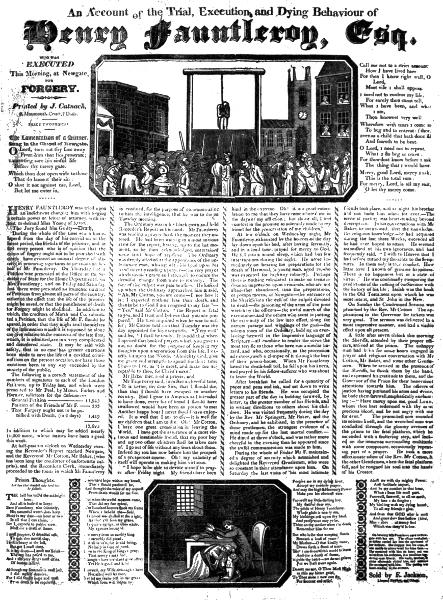
CATNACH’S BROADSIDE OF FAUNTLEROY’S EXECUTION.
Sad to relate, the object-lesson was a failure in one
instance, for Henry Norman, a fine-looking lad of fifteen,
was charged at the Guildhall the next morning with picking
a pocket, the owner of which was gloating over the
spectacle of the strangled banker. It speaks highly for
the integrity of our modern police force that, in these
days of exclusive hangings, a nimble-fingered Robert
has never tried to filch the watch of an impressionable
Under-Sheriff. Or if he has, the public has not heard
of it.
In these record-breaking times it is a common occurrence
for a trusted attorney to embezzle half a million
pounds, but before the achievements of Henry Fauntleroy
all previous forgeries sink into insignificance. Poor
Dodd surrendered all he stole, and Wynne Ryland’s
fraud was, in its way, as artistic a performance as those
of Thomas Chatterton, while a brief career of crime—as
in the case of Henry Savary of Bristol, who was lucky
enough to escape the gallows—ruined the brothers
Perreau. James Bolland and John Rouvelett were low-born
fellows; and although the public welcomed each as
a first-class criminal, neither gained the same prestige
as a forger of gentle birth. In a small way, Henry
Cock, the lawyer, anticipated the Berners Street frauds,
and two other cases bear some resemblance. Henry
Weston, a man of good family and social position, who
was hanged at the Old Bailey on the 6th of June 1796,
disposed of stocks amounting to twenty-five thousand
pounds in a similar manner to Fauntleroy; and
Joseph Blackburn, one of the most respected of
Leeds attorneys, who suffered a lingering death at
York on the 8th of April 1815, committed innumerable
frauds for a great number of years by transferring
and altering the denominations of the old familiar
blue stamps.
“Fauntleroy’s doom was so thoroughly recognised as
well merited,” writes Mr Thornbury, sternly, about forty
years after the event, “that although in 1832 every
other kind of forger was exempted by law from the
gallows, the hands of the hangman still hovered over the
forger of wills and powers of attorney to transfer stock.”
Yet, since the penalty was never inflicted, this argument
appears superfluous.
Fauntleroy certainly is the prince of forgers, as truly
as Jack Sheppard is the greatest of prison-breakers and
George Barrington the finest genius among pickpockets.
Although driven to crime in the first instance by moral
cowardice and craving for self-indulgence, he must have
possessed an almost Napoleonic confidence that his
abilities would conquer misfortune. Too proud to surrender
the terrible struggle, he refused to adopt the easy
alternative of flight to France with his ill-gotten gains.
When one tries to realise the stupendous task of manipulating
figures of such magnitude for so many years, the
brain reels. The regular payment of huge dividends lest
the victims should become aware of their loss, the constant
replacement of stock when discovery seemed to
threaten, the repeated buying and selling in order to rob
Peter to-day to pay Paul to-morrow, the daily juggling
with the books, and adjustment of balances, added to the
incessant vigilance lest the errors of a few figures should
mean betrayal to partners or clerks—all these wonderful
transactions show an example of mathematical legerdemain
such as the world has seldom seen. When it is
borne in mind that the man was playing for nearly ten
years with sums amounting in the aggregate to half a
million sterling, his title to the incomparable forger of all
time cannot be challenged. But like many another who
has contributed to the public amusement, his memory
soon faded from the minds of all save his creditors.
Scarcely had the curtain been rung down on the tragedy
of Fauntleroy, when it rose again upon the entrancing
drama of accommodating Miss Foote and wayward
Mr ‘Pea-green’ Hayne.
Occasionally, but not often, we hear mention of the
banker’s name, and there was a recent reference to it in
one of the delightful novels of Anthony Hope.
“It is no longer a capital offence,” declares ribald
Arty Kane, referring to forgery, and addressing charming
Peggy Ryle; “you won’t be hanged in silk knee-breeches
like Mr Fauntleroy.”
The Berners
Street bankruptcy.
No complete balance-sheet of the Marsh-Stracey bankruptcy
appears to exist. The books of the firm seem to
have baffled both the Commissioners and the assignees;
and so artfully had Fauntleroy concealed his frauds, that
even skilled accountants did not succeed in unravelling
the whole of their mysteries. Contemporary newspapers
furnish many important clues, but their statements, when
not conflicting, are neither lucid nor exhaustive. Yet,
although many details must remain obscure, it is possible
to form a rough conception of the result.
The position
of the
bankrupts.
Since we know that the first dividend of 3s. 4d. in the
pound (distributed to the creditors on the 7th of
February 1825) absorbed a sum of £92,486, it is clear
that Messrs Marsh, Stracey & Company required a grand
total of £554,916 to pay twenty shillings in the pound.
Practically these figures are substantiated by the preliminary
accounts presented at the meeting of the Commissioners
on the 18th of December 1824, which state
that the claims against the firm—excluding any liability
to the Bank of England—amount to £554,148.
This estimate, however, is the only one of any accuracy
made at the time, for the assets expected to be realised
fell very short of the original calculation. A second
dividend of 3s. 4d. was received by the creditors on the
30th of August 1825, and between that date and the
appointment of the official assignee a further sum of
£46,243 was distributed. Thus the total of the first
three dividends—which were equivalent to 8s. 4d. in
the pound—amounts to £231,215.
The bankruptcy return of Patrick Johnson (official
assignee), published in 1839, shows that assets were collected
subsequently amounting to £160,930, and thus
the creditor side of the Berners Street ledger appears to
have reached a total of £392,150.
From this balance of £160,930—realised by the
official assignee after the payment of the first three
dividends—further distributions of 5d. and 1s. (being 9s.
9d. in the pound in all) were made respectively on the
23rd of December 1833 and the 9th of September
1835, and absorbed further sums of £11,560, 15s. and
£27,745, 16s.
During September 1835 the claim of the Bank of
England against Messrs Marsh, Stracey & Company was
compromised for a payment of £95,000 in cash; and a
further sum of £11,000 for the expenses of working the
Commission of Bankruptcy from the 16th of September
1824 to the end of the year 1833 must also be deducted.
Therefore a balance of £15,628—less any further costs—appears
to have remained for payment of a final dividend.
Although many of the newspapers state that this
was made on the 7th of October 1837, unfortunately none
of them give any particulars. Yet it may be conjectured
that the unfortunate customers of the Berners Street
Bank, after waiting for thirteen years, could not have
received more than 10s. 6d. in the pound.
The following rough balance-sheet will explain the
above account:—
| Dr. |
Cr. |
| First div. 3s. 4d., Feb. 7, 1825, |
£92,486 |
0 |
First div., |
£92,486 |
0 |
| Second div. 3s. 4d., Aug. 30, 1825, |
92,486 |
0 |
Second div., |
92,486 |
0 |
| Third div. 1s. 8d., (paid before Dec. 28, 1832), |
46,243 |
0 |
Third div., |
46,243 |
0 |
| Fourth div. 5d., Dec. 23, 1833, |
11,560 |
15 |
Received by the official assignee at 84 Basinghall Street from Dec. 28, 1832, to Oct 7, 1837, |
160,930 |
0 |
| Fifth div. 1s., Sept. 9, 1835, |
27,745 16 |
0 |
|
|
|
| Bank of England, Sept. 1835, |
95,000 |
0 |
|
|
|
| Expenses of Administration up to Dec. 24, 1833, |
11,000 |
0 |
|
|
|
| Balance (including all costs from Dec. 24, 1833, to Oct. 7, 1837, and out of which the final dividend was made on Oct. 7, 1837,) |
15,628 |
9 |
|
|
|
|
——————— |
|
——————— |
|
£392,150 |
0 |
|
£392,150 |
0 |
|
——————— |
|
——————— |
The private
estates of the
partners.
The private estates of Messrs Stracey and Graham
paid twenty shillings in the pound before the end of
1833; and upon that of Mr Marsh, the senior partner,
who appears to have been indebted to the firm for a
loan of £73,000, excluding his overdraft on his private
account, a distribution of 17s. 6d. had been made before
1834. Little was received on Fauntleroy’s estate, as
it was claimed almost entirely by the creditors of the
Berners Street Bank.
Losses under
Fauntleroy’s
management.
It is now possible to form an estimate of the extent
to which Messrs Marsh, Stracey & Company were defaulters,
and what were the losses under the Fauntleroy
régime. The total receipts set against the claims of
the creditors and the money stolen from the Bank of
England, show a deficiency of £522,980. Thus:—
| Dr. |
Cr. |
| Claims of the creditors (to pay 20s. in the £) |
£554,916 |
Total receipts |
£392,150 |
| Gross loss of the Bank |
360,214 |
Deficiency |
522,980 |
|
———— |
|
———— |
|
£915,130 |
|
£915,130 |
|
———— |
|
———— |
How the
losses were
incurred.
Although it would be difficult, with any degree of
accuracy, to apportion under the separate charges this
adverse balance of over half a million pounds, and
although much must be left to conjecture, it is possible
to explain some of the ways in which this vast sum was
dissipated. At the outset, the suggestion—arising out
of one of the pleas of Fauntleroy, and believed at the
time—that the overdraft on loans to two of the partners
was responsible for a deficit of £100,000, is refuted by
the fact that both Messrs Marsh and Graham refunded
eventually their obligations to the full extent. In like
manner, the belief that large sums were lost owing to
the necessity of reinvesting constantly the various stocks
sold by Fauntleroy in order to avoid detection, overlooks
the fact that, on the other hand, these transactions must
have afforded similar opportunities for making a profit.
It is probable that many such losses did occur; but
since we may believe that the Berners Street Bank prior
to the forgeries was earning an income of £7000 a
year, it is likely that such an astute manager as Henry
Fauntleroy would be able to cancel many of these losses
through reinvestment by the profits he earned on the
immense capital he had secretly appropriated.
(a) Loss of
£160,000 in
building
speculations.
(b) £90,000
lost by
paying
dividends on
the stolen
stocks.
Although the forger’s estimate of the result of his
building speculations is extravagant, the newspapers of
the 20th of December 1824 make it clear that the Berners
Street house must have lost in this manner £160,000.
It is certain also that immense sums were absorbed by
the payment of dividends to the proprietors whose stocks
had been stolen. Nearly £7000 per annum must have
been required for this purpose from the year 1816, and
the sum would accumulate at compound interest, until,
as some say, an annual fund of £16,000 was required.
Setting aside all excessive calculations, we have the
great authority of the historian of the Bank of England
that £9000 to £10,000 a year was thus expended during
the progress of the forgeries. Further than this, notwithstanding
that the partners in the bankrupt firm
were not entitled to any fraction of profit, the testimony
of almost the entire press credits each of them with
receiving an income of over £3000. At the examination
of William Marsh, reported in the newspapers of the
1st of March 1825, it was proved that he was indebted
on his private account for an overdraft of £26,000. As
there is no reason to believe that Mr Stracey or Mr
Graham had enjoyed a smaller income, a further deficit
of nearly £80,000 is the result. And finally, as will be
shown, there is an overwhelming weight of evidence to
prove that the iniquitous Henry Fauntleroy, during the
nineteen years he was a partner, dissipated at least
£100,000. In addition, the repayment of the capital
of Sir James Sibbald (who died the 17th of September
1819), which formed a large portion of £64,000—the
capital of the firm in 1814—would swell the adverse
balance still further. Leaving this out of the question,
the facts stated above explain the deficit of £430,000;
and with the material at our disposal any further solution
would involve a more elaborate use of the methods
of conjecture.
(c) Loss of
£80,000
through payments
to
Messrs Marsh,
Stracey &
Graham.
(d) Fauntleroy
spent
£100,000.
To what extent
did
Fauntleroy
participate in
the proceeds
of his
forgeries?
When Fauntleroy made his famous declaration from
the dock, he was endeavouring to refute the extravagant
assertion that he had spent a sum of over four hundred
thousand pounds in riotous living; and thus, led to the
opposite extreme, he made the mistake of attempting to
convey an erroneous impression of his frugality. Thus
the statement that he had never enjoyed any advantage
beyond that in which all his partners had participated
seems to hint economy; but as Mr Marsh had overdrawn
his loan account by £70,000, the proposition is irrelevant
to the argument. Then, again, he confesses that the
Brighton villa cost £400, but he is not candid enough
to admit the expenses of his other establishments. The
stern reality—that a thief cannot justify the expenditure
of one pennyworth of stolen property—never entered
his mind. Utterly false, however, is his answer to the
charges of profligacy—outrageous though they were.
“It has been cruelly asserted,” he declares, “that I
fraudulently invested money in the Funds to answer the
payment of annuities amounting to £2200 settled upon
females. I never did make such investment.”
No single tenet in Father Garnet’s doctrine of equivocation
puts greater stress upon the truth. Whoever
made the necessary investments—and the forger was
shrewd enough not to let the transaction appear in his
own name—there is certain evidence that he provided
lavishly for his mistress Maria Fox. The lie is merely
concealed in subtle language.
“Neither at home nor abroad,” continues Fauntleroy,
“have I any investment, nor is there one shilling
secretly deposited by me in the hands of any human
being.”
Such an assertion goes far beyond the sophistry of
the most misguided seventeenth-century Jesuit, for the
Commissioners of Bankruptcy were soon to discover
that he had squandered thousands on his friend Mrs
Disney. His one denial in unequivocal terms is a
deliberate falsehood.
“Equally ungenerous and untrue it is,” the forger
proceeds, “to charge me with having lent to loose and
disorderly persons large sums of money which never
have and never will be repaid. I lent no sums but
to a very trifling amount, and those were advanced to
valued friends.”
No doubt this last declaration had reference to the
rumour that he had squandered money upon the
notorious Mary Ann Kent, ‘Mother Bang’—who
figures as ‘Corinthian Kate’ in Life in London—and
its truth or falsehood must depend upon the exact
definition of the term ‘large sums’ The criminal who
had dealings with huge balance-sheets, naturally had a
magnificent sense of proportion.
Fauntleroy’s
expenditure.
Fortunately, there is evidence of some of the ‘prodigal
extravagance’ that was laid at his door. The
total loss of the Bank of England owing to the forgeries
was £360,214, and the original claim of the directors
against the Berners Street establishment was £250,000.
So it seems that the balance was believed to have been
spent wholly by Fauntleroy, and not placed to the
credit of the partnership. The sworn testimony of Mr
Wilkinson, an accountant employed by the assignees to
examine the books of the bankrupts—although inclined
to favour Messrs Marsh, Stracey & Company—supports
this assumption in the most decisive manner. Thus,
in spite of his defence, it would appear that during
his management the forger appropriated for himself a
sum of over £100,000. These figures, moreover, are
endorsed by the fair-minded James Scarlett, who made
the same statement as Wilkinson in his speech for the
defendants in the case of Stone and Others v. Marsh,
Stracey & Company, which was heard on the 2nd of
March 1826. To disregard such unanimous testimony
is impossible.
How did
Fauntleroy
spend the
money?
(a) Domestic
expenditure
£2000 a year.
It is quite credible that for a period of seventeen
years (from 1807 to 1824) a man of Fauntleroy’s habits
should expend an average income of £5000. Had
each of his three establishments—in Berners Street, in
Brighton, and at Lambeth—cost him as much as his
moderate estimate of one—and none of them could have
been less expensive—the total reaches £1200 a year.
In addition to this, it is known that he allowed an
annuity of £400 to his wife. Thus, as he kept horses
and carriages both at London and the seaside, his
lowest annual domestic expenditure must have been at
least £2000, or £34,000 over the period. Although
the house at Fulham was one of his later extravagances,
there were others that had taken its place previously.
(b) Freehold
property
£10,000.
The villa, land and furniture at Brighton, sold after
his death, realised nearly £7000—the residence alone is
said to have cost him this amount; and since he was
the owner of a mews and six houses in Bryanston
Square, and two other houses in York Street, his freehold
property, on a moderate estimate, must have been worth
£10,000.
(c) Maria Fox
£10,000.
From the reports of the trial of Maria Fox at the
Lewes Assizes in April 1827, we gather that Fauntleroy
settled on his youthful mistress £6000, besides an
annuity of £150, “of which the assignees,” said John
Adolphus, her counsel, “through the advice of a worthy
gentleman, Mr Bolland, were not so cruel as to deprive
her.” Thus another £10,000 is added to the banker’s
debt.
(d) Mrs J. C.
Disney,
£10,000.
During the month of December 1824 the London
papers are full of insinuations with regard to Fauntleroy’s
improper connection with a Mrs James C. Disney, and
the letter from the lady’s husband, which appeared in
the New Times on the 24th of December, substantiates
unwittingly much of the truth of the story. It is certain
that the creditors of Marsh, Stracey & Company recovered
large sums from this Mrs Disney, who had been the
recipient of Fauntleroy’s bounty to an extent exceeding the
limits of platonic love, and according to The Times the
amount refunded was £10,000. Although many reports
state that she received twice this sum, it is sufficient for
the purpose to accept the lesser figures.
Thus there is almost complete evidence that
Fauntleroy’s expenditure under three heads—domestic
expenses, freehold property, and the two mistresses
above mentioned—absorbed a sum of £64,000. It is
not unreasonable to suppose that the man who could
squander this money in less than seventeen years, while
his firm was in so dire a plight, was capable of spending
double the amount. It is improbable that his various
establishments cost him no more than £2000 a year; and
if The Times of the 1st of December is to be believed, he
confessed that he had enjoyed a very much larger income.
The age of pinks and bloods was as extravagant as
our own, and many luxuries of life were more expensive.
Fauntleroy was a patron of ‘Corinthian Kate’; and if
Pierce Egan is an authority, we may conjecture—in spite
of her denial to Joseph Parkins—that the unfortunate
banker found her an expensive luxury. Like the great
man whom he took a pride in fancying he resembled,
it is notorious that the forger had a weakness for what
his contemporaries termed ‘ladybirds’ and was in this
respect a dissipated and worthless fellow. Moreover, he
was celebrated for his costly dinners and rare wines—there
is the grisly story of the friend who urged him as a last
request to tell where he purchased his exquisite curaçoa—and
he seems to have denied himself no luxury.
Although it is not possible to give a complete explanation
of Fauntleroy’s expenditure during the years of his
race to ruin, it is satisfactory to know some portion of
the details, and they show, through all possible coats
of whitewash, that he was guilty of the most prodigal
extravagance.
The conduct
of the
partners.
Since the partners of the Berners Street Bank were
censured for gross negligence in two courts of law, it is
not surprising that their creditors should have treated
them with intolerance. At first the public had regarded
them as unfortunate dupes, and it was not until Fauntleroy
had made his defence that a popular outcry arose.
It seemed incredible that three men of the world should
have thrown the heavy burden of managing a firm,
weighed down by embarrassments, upon the shoulders
of a youth of twenty-two, and equally preposterous that,
in the face of losses reaching into hundreds of thousands,
the young man’s colleagues should have remained easy,
trusting, asleep. Yet, in spite of the onslaught of the
London press, and the clamour of the noisy creditors,
headed by Joseph Parkins and his fellows, beneath the
roof of the ‘Boar and Castle’ and the ‘Freemasons’
Tavern,’ it is certain that Messrs Marsh, Stracey &
Graham were innocent of all guilty complicity in their
partner’s frauds. The statements that had aroused the
storm against them proved to be baseless or exaggerated.
It has been shown that the Berners Street Bank did not
lose £270,000 in building speculations between 1810 and
1816, as Fauntleroy suggested, and to meet the loss that
did occur a large sum was raised by the supporters of
the firm, to which William Marsh contributed £40,000.
Thus, considering the reticence of their manager, there
was good reason why the partners should believe that
they had weathered the financial panic which brought to
ruin so many of their contemporaries.
Modern commerce estimates more accurately the value
of youth than the age of Mr Walter the Second; and as
young Fauntleroy, who was one of the smartest bank
managers in London, accepted his responsibilities with
zest and cheerfulness, it is not surprising that he became
the autocrat of the firm. Moreover, the juggler who
could deceive the clerks working at his elbow day by
day would have no difficulty in satisfying the periodical
curiosity of sleeping-partners. Fat profits rolled into
their coffers, and, like many another good easy man, they
did not pause to look a gift horse in the mouth. Fools
they were, and must remain, but in the end the world
ceased to suspect their honour.
Still, their credulity was remarkable. All three of
them appear to have been the instruments of most of the
frauds, attending at the Bank of England to make the
transfer under the forged powers of attorney, and instructing
brokers to dispose of the stolen stocks and bonds.
In one particular, however, the conduct of Marsh and
Stracey appeared dubious. On the day of Fauntleroy’s
arrest the daughter of the former cashed a cheque for
£5000, while the latter drew out over £4000 in the name
of his father. The trick was discovered, and restitution
made to the creditors.
The Bank of
England’s
claim.
As might be supposed, the Bank of England received
little sympathy either from the press or from the
people. The directors never disputed their obligation—as
managers of the public debt—to refund to the rightful
proprietors the whole of the stocks that had been stolen,
but they made every effort to enforce their claim against
the Berners Street firm—amounting to a quarter of
a million—which they contended that Fauntleroy had
placed to the credit of his house. It was soon made
clear by law that Messrs Marsh, Stracey & Company were
responsible to the stockholders, who had been defrauded
by their managing partner, and thus were equally responsible
to the Bank, whose debt was similar to that of the
stockholders. The chief obstacle to the enforcement of
the Bank’s claim lay in the fact that the proprietors of the
stolen stocks were clients, and, as a natural consequence,
creditors also of Marsh, Stracey & Company. Being
aware that the directors were legally compelled to replace
their missing Consols and Exchequer Bills, they raised
a great clamour against the claim of the Bank, for
naturally they perceived that if it was enforced the cash
balances in their Berners Street pass-books would be
diminished. This difficulty compelled the Bank to seek
the consent of the Courts to permit them to claim from
the bankrupts the lump sum that had been restored to
the stockholders, so that it would not be necessary to
bring forward reluctant persons to prove each separate
debt. Lord Chancellor Lyndhurst ruled, however, that
each transaction must be established to the satisfaction
of the Commissioners of Bankruptcy in the usual way,
and thus the Bank was driven to depend upon the stockholders.
Since the claim of half a million was compromised
for a payment of £95,000, we may conclude
that the majority of the Berners Street creditors were
not disposed to assist the rival claimant to a share of
their dividends.
The transfer of
stock.
Much has been written of the lax methods of transferring
stock in vogue at the Bank of England. As
the frauds were so slovenly that Fauntleroy’s clerks
had no difficulty in detecting their employer’s handwriting
in the signature attached to the forged power of
attorney produced at the trial, it is plain that the crimes
could not have continued for so many years unless
a most careless system had prevailed. The Berners
Street swindle showed that it was possible for any
applicant with whom the clerks at the Consols Office
were acquainted to complete the transfer of another
person’s securities, provided only that he possessed a
knowledge of the exact value of the particular stock
he wished to appropriate. A power of attorney seems
to have been as readily acted upon as obtained, and no
comparison of the real owner’s signature appears to
have been made. This danger was pointed out subsequently
at a meeting of the Court of Proprietors, and
a shareholder made the wise suggestion that when any
transfer was made immediate notice should be sent to
the proprietor of the stock.
Yet checks and precautions did exist at the Bank
of England in the days of Henry Fauntleroy. The
purchasers of securities were recommended to protect
themselves from fraud by accepting themselves—that
is to say, by signing—all transfers of stock made to
them, thus giving the officials of the Bank the opportunity
of comparing the handwriting of the proprietor
whenever necessary. Still, the investing public rarely
complied with this regulation, and Fauntleroy must
have been aware that there was no danger of detection
on this account.
Although forgery of such a description is more
difficult in these days, yet prudence should neglect no
safeguard that does not impede the business of everyday
life. A signature, however much resemblance it
has to its original, may still be a forgery, and personal
attendance might be simulated by a bold and plausible
scoundrel. The most sure precaution is the one suggested
on the 17th of September 1824 by the nameless
proprietor, that whenever a transfer is lodged immediate
notice shall be sent to the holder of the stock.
1. The Morning Chronicle.
Under the leadership of the famous John Black, this paper had become a
somewhat fat and stodgy production, savouring of the ‘unco guid’ It is
fierce in its attacks upon Fauntleroy’s partners for their indolence and carelessness,
and pleads that mercy shall be shown to the offender. Special prominence
is given to the pious conversations alleged to have taken place in Newgate
between the prisoner and his spiritual advisers Messrs Springett and Baker.
Since this paper is not hostile to Fauntleroy, it is strange that it should publish
(November 11) a vile communication from his enemy J. W. Parkins, an
ex-Sheriff of London, in which the writer tries to show that the prisoner who is
awaiting his trial has been a brutal husband. The first announcement that the
Bank in Berners Street had suspended payment appears in the columns of the
Chronicle on Monday, September 13.
2. The Morning Post.
Although the Morning Post makes a point of pluming itself on its humanity
towards Fauntleroy, its attitude is wholly inconsistent and double-faced. Having
copied from The Times a column of disgraceful news concerning the private vices
of the dishonest banker, it turns round and upbraids its contemporary, a few
weeks later, for supplying the information. Foolish letters upon all kinds of
subjects from Fauntleroy’s bitter enemy, J. W. Parkins—Sheriff of London
1819-20—disfigure this paper constantly. The Post gloats over the scene at the
Debtors’ Door, and is glad that there was no pardon.
3. The Morning Herald.
This journal is opposed to the death penalty for forgery, and inserts several
letters, urging that the convict should be reprieved, but it admits, after the
execution, that while the law remained unaltered there were no special circumstances
in the case to warrant mercy. The report of the trial on November 1,
which holds up to ridicule the absurd and indecorous conduct of ex-Sheriff
Parkins previous to the meeting of the Court, furnishes a striking proof of his
malice against his former friend Henry Fauntleroy. During April 1823 the
notorious Parkins made a somewhat feeble attempt to assault Mr Thwaites of
the Morning Herald in his office, which is the reason, no doubt, why the editor
handles him so roughly.
4. The Times.
The attitude of the greatest paper in the world towards the unfortunate
banker is a black record in its history. Although the man was a sensualist and
a forger of the highest degree, it is not creditable to British journalism of those
days that a leading newspaper should take infinite pains to rake up every
scandal of his past life, and to prejudice the public mind against him before he
was brought to trial. A more deliberate attempt to condemn a man unheard
has never been made in the press. It is amazing that an editor of the calibre
of Thomas Barnes should have printed the article of September 24 and the
disgraceful letter signed “T.” of September 25, which compares Fauntleroy
to Thurtell, the cut-throat. The reproof administered by James Harmer on
September 27, although fully deserved, was not sufficient to restrain the
licence of Mr Walter’s reporters. The Times proceeds to wrangle with the
Brighton Gazette as to whether the banker had been a libertine, and on October 9
publishes a statement about his lenient treatment at Coldbath Fields prison, for
which it is compelled to apologise to Mr Vickery, the Governor. More
innuendoes follow concerning Fauntleroy’s moral character, and on October 19
(before his trial!) it is reported that the printers at the ‘One Tun’ tavern in
Covent Garden were making bets as to whether he would be hanged.
Almost as repulsive are the leaders written after the culprit’s execution.
“If forgery had not been capital before,” says this truculent journal, “the
most humane legislators would have doubted whether, if carried to a similar
extent, it should not be rendered capital in future.” Yet Samuel Romilly had
been in his grave only six years, and James Mackintosh and William Ewart
were left to continue his brave work. Finally, on December 4, comes a blast
of thunder that Dennis or the editor of the Eatanswill Gazette might have
envied. “We are not anxious to extend the narrative of Mr Fauntleroy’s life
by a description of his personal habits, but, if provoked, we can lay before the
public such a detail of low and disgusting sensuality, as would appear incredible
to those who were not as degraded in body and mind as he was. This narrative
would involve persons who hold themselves rather high, and who have presumed
to talk big with reference to our accounts of their wretched friend and associate.
Let them be quiet; if we find that in public or private (and we have channels of
information they dream not of) they have the impudence to disparage our
motives or deny our statements, we will hold up their names and actions to
public scorn and astonishment and disgust.”
5. The Morning Advertiser.
This journal, then as now the organ of the licensed victuallers, is hostile to
Fauntleroy, but moderate in the reports it publishes about him.
6. The New Times.
As might be expected, this paper deals some nasty raps at that from which
its editor seceded. It is very critical of the conduct of Fauntleroy’s partners,
with whose explanations before the Commissioners of Bankruptcy it is dissatisfied,
but does not make the reckless charges against them that appear in
some journals, such as the Sunday Times and Morning Chronicle.
7. The British Press.
Gives more complete information than any other paper of the details of
Marsh, Stracey & Company’s bankruptcy. The reports of the proceedings
before the Court of Commissioners, and of the meetings of the Berners Street
creditors, which are criticised at large, throw much light upon the endless
ramifications of the Fauntleroy forgeries. This journal alone makes an attempt
to ascertain whether the statement of the criminal banker was endorsed by the
books of his firm. “I declare,” says Fauntleroy in his defence, “that all the
monies temporarily raised by me were applied, not in one single instance for
my own separate purposes or expenses, but in every case they were immediately
placed to the credit of the house in Berners Street, and applied to the payments
of the pressing demands upon it.... The books will confirm the truth of my
statement ... the whole went to the general funds of the house.”
The value of this assertion may be tested by reference to the columns of the
British Press of the following dates:—September 20, 29, October 6, November
13, 15, 17, 22, 23, 30, December 10, 13, 17, 20, 28 (1824), January 17, 19,
20, February 2, March 1, 19, April 11, July 25, August 31 (1825).
For further particulars of the bankruptcy consult The Times, Morning Post,
and Morning Chronicle of December 24, 1833; and September 10 and 11,
1835. Also John Bull, September 20, 1835; the Weekly Dispatch, September
17, 1837; and The Times, October 7, 1837.
8. The Examiner.
The statements in Fauntleroy’s defence are received with incredulity.
“From what we hear and observe of the man,” says the Examiner, in a leading
article, “we do not believe he would have risked his life to preserve a trading
concern of which he had only a fourth share. We expect the truth will be that
he began to forge to get money for himself, and was obliged to go on because
bankruptcy would have led to his detection.” The leader proceeds to condemn
the law of banking, and to attack the monopoly of the Bank.
9. The Observer.
The veteran Sunday journal—which at this period was the property of
Wm. Clement, who owned also the Morning Chronicle, and afterwards Bell’s
Life—takes the bulk of its reports, like most of the weekly papers, from the
columns of the daily press.
10. The Sunday Times.
This hardy newspaper (which age cannot wither) condemns the criminal
code that makes forgery a capital offence, and charges Messrs Marsh,
Stracey and Graham with previous knowledge of their partner’s guilt. On
October 10 appeared the famous letter from malignant ex-Sheriff Parkins,
complaining that Fauntleroy or his partners had surrendered certain private
documents which he had left at their bank in safe custody. In those days the
Sunday Times was under the proprietorship of its founder, Daniel Harvey.
11. The Englishman.
A weekly paper, containing reports similar to those in the Observer.
12. Bell’s Weekly Messenger.
The leading article of December 5 expresses the hope that Mr Fauntleroy
will be the last person executed for forgery. As a matter of fact the Berners
Street frauds postponed this much-desired reform, and the illogical argument of
George III. was revived in another shape—“If Dr. Dodd is pardoned, then
the Perreaus have been murdered.” Captain John Montgomery would have been
hanged on July 4, 1828, for forging bank notes, had he not cheated the
gallows by the aid of prussic acid; Joseph Hunton, the Quaker, suffered death
at Newgate on December 8 following, for issuing counterfeit bills of exchange;
and Thomas Maynard, who had obtained money from the Custom House under
a fraudulent warrant, was executed in the same place on the last day of the year
1829. After this date, although the capital penalty was not finally abolished
until 1837, no other person was hanged for forgery in this country.
13. Bell’s Weekly Dispatch.
This newspaper, founded in 1801—five years after his Weekly Messenger—by
John Bell, the printer of the British Poets, had now become the property of
James Harmer the Old Bailey attorney, who was Fauntleroy’s solicitor. The
scathing attacks upon Joseph Wilfred Parkins, which appear in this journal
on October 3, October 10 and November 14, explain the reason of the
‘XXX Sheriff’s’ animosity towards the unfortunate banker. Some time before
the arrest of the forger, Parkins, who had a law-suit pending, requested
Fauntleroy to return a certain cheque for £6000 that he had drawn upon his
firm a few years previously. The reply was that, as it could not be found,
probably it had been destroyed. On the strength of this statement, Parkins
swore in the witness-box on September 13, when his action was being tried,
that the cheque in dispute had never been presented, but to his amazement and
consternation the missing piece of paper was produced in Court. In consequence,
he not only lost his case, but was called upon to stand his trial for
perjury on December 20 following. By some means or other wily James
Harmer, who happened to be solicitor for the defendants against whom Parkins
was bringing his action, had discovered the cheque at the Berners Street Bank
soon after Fauntleroy’s arrest, and perceiving its importance to his clients,
had appropriated it. Naturally, this amusing piece of strategy was not relished
by the choleric ex-Sheriff, who cast most of the blame upon the shoulders of
the unhappy banker, and pursued him to the death without mercy.
The Weekly Dispatch made a great effort to save the doomed man, and the
petition for reprieve which lay at its office received three thousand signatures.
The Rev. Cotton, Ordinary of Newgate, comes in for some well-deserved
censure for the tone of his ‘Condemned Sermon’
14. Pierce Egan’s Life in London.
This paper, started February 1, 1824, by the creator of Tom and Jerry,
gives extracts, copies for the most part from other sources, and similar information
to that contained in Pierce Egan’s account.
15. John Bull.
Naturally, Theodore Hook’s paper did not miss the opportunity of inveighing
against The Times for its cruelty towards Fauntleroy, or of ridiculing the
sanctimonious articles of the Morning Chronicle. Still, it is unjust to Mrs Fry’s
friend and helper, the humane Mr Baker, whose work among the prisoners at
Newgate merits the highest praise.
16. The Globe and Traveller.
Condemns the ‘mischievous law’ passed in 1708 to support the Bank of
England’s monopoly, which prevented a private banking establishment from being
controlled by more than six partners. The journal contends with truth that this
legislation “forces a business of great responsibility, which should be of entire
security, into the hands of small firms.” The law of 1825 altered all this.
17. The Courier.
Has a weakness for drawing attention to its own propriety, in comparison
with that of its contemporaries. Its leader on the evening of the execution declares
that, although it refrained from comment while there was a chance of mercy, it
applauds the firmness of justice in refusing a reprieve when there was nothing
in Fauntleroy’s case to merit such interference. The Courier was in the hands
of Daniel Stuart—a great name in journalism—who was proprietor also of the
Morning Post.
18. The Sun.
A somewhat feeble paper, though well printed and arranged, edited by John
Taylor. It prides itself on never printing anything about Fauntleroy except
the proceedings before the magistrates.
19. The Brighton Gazette.
Cudgels The Times lustily, and is indignant that a mere London paper
should presume to know more about Mr Fauntleroy’s seaside residence than a
journal published in Brighton. About two years later the Gazette has much to
say about the beautiful Maria Fox (alias Forbes, alias Forrest, alias Rose), who
had lived under the protection of the fraudulent banker. A retired lawyer
named Barrow, who resided next door to the lady on the New Stein, accused
her of keeping a disorderly house, and she was called upon to meet this charge
at the Lewes Assizes. Although the fine advocacy of John Adolphus obtained
a verdict of not guilty, the judge went out of his way to compliment the
author of the prosecution. (Vide the Brighton Gazette, April 5, 1827; also
September 14 and 21, 1826.)
20. The Rambler’s Magazine, or Frolicsome Companion. Printed and published
by William Dugdale, 23 Russell Court, Drury Lane. April 1, 1827, pp. 180-182
(vide Trial of Maria Fox).
The learned ‘Pisanus Fraxi’—H. S. Ashbee—whose knowledge of this class
of literature is unrivalled, gives no description of this particular publication. It
may be a plagiarism of a magazine of about the same date, and bearing an
almost similar title (which it appears to resemble), noticed in Catena
Librorum Tacendorum, p. 327. Periodicals of this name are almost as
numerous, between the years 1782-1829, as the Newgate Calendars. The
Rambler’s Magazine makes two things evident: first, that Fauntleroy’s chère
amie was a “fair and engaging woman”; and secondly, that Mr Barrow had
much cause of complaint.
21. The Gentleman’s Magazine, November 1824 (part ii. p. 461); December
1824 (part ii. p. 580).
In the December number there is a trenchant letter from the Earl of
Normanton, condemning the criminal code. “Philosophy would deem it an
abuse,” says he, “to punish the crime of a Fauntleroy in the same manner as
the crime of a Thurtell.” For the obituary notice of William Moore Fauntleroy,
the brother of the forger, see the Gentleman’s Magazine, part ii. p. 1092, 1803.
Note I.—Pierce Egan’s Account of the Trial of H. Fauntleroy. Knight and
Lacey, 1824.
No one excelled the historian of the Prize Ring in this style of literature,
and his two other similar works, the Life of Samuel Denmore Hayward (1822),
and the Account of the Trial of John Thurtell (1824), will remain text-books for
all time. Pierce Egan makes a note (p. 21) that Mr. Fauntleroy has never used
a ‘slang expression’ during his imprisonment. The surprise indicated by this
comment is natural, for, robbed of his italics, the author of Life in London
would have been left as naked to his enemies as Cardinal Wolsey.
Note II.—The Newgate Calendar. Knapp and Baldwin (1824-28). Vol. iv.
pp. 285-390.
Accepting the statement made by most of the daily newspapers, this account
declares that Fauntleroy was hanged for defrauding his wife’s family. Although
this statement was made by The Times on October 2, it was denied two days
later in that paper, and the contradiction was published also in Bell’s Weekly
Messenger, the Globe, and the Courier. Again, on December 4 The Times
repeats once more that “Miss Frances Young is no relation to Mrs Fauntleroy.”
Considering the bitter rivalry that existed between the various newspapers, and
the jealous criticism that each journal bestowed upon the information of its
contemporaries, it is certain that if the assertion made by The Times had been
untrue—and if false it could have been disproved easily—its rivals would have
exposed it with the greatest joy. Moreover, since Fauntleroy might have been
charged with twenty other indictments, the public mind would have been
shocked had his sister-in-law alone been selected as the instrument of vengeance.
Note III.—The Anatomy of Sleep. Edward Binns, M.D. Churchill (1842).
p. 282.
Although such an escape was a physical impossibility to Fauntleroy, there is
a rational explanation of the strange superstition—referred to in this book—that
he did not die on the scaffold, but was resuscitated, and lived abroad for many
years. At eight o’clock on the evening of his death the body was taken by the
undertakers, Gale and Barnard, to their premises opposite Newgate prison, where
the coffin was fastened down immediately by order of the relatives, who had
reason to fear that the morbid—attracted by the notoriety of the criminal—would
seek by means of a bribe to view the remains. The flames of rumour are set
ablaze by a tiny spark, and the fact that no one outside the prison saw the dead
body of the forger may have revived popular faith in a favourite belief. The
haste, too, in sealing up the shell may have excited suspicion. For in later
days it is certain that many persons cherished the idea that Fauntleroy, more
lucky than Jack Sheppard or Dr Dodd, whose friends tried in vain to restore
them to life, had survived his execution. Vide also Notes and Queries, First
Series, viii. 270, ix. 445, x. 114, 233. Possibly that prince of inkslingers,
G. W. M. Reynolds, may have had the Fauntleroy legend in his mind when he
drew the picture of the resuscitated forger in the first part of his obscene and
scurrilous romance, The Mysteries of the Court of London. Fauntleroy was
buried in the cemetery at Bunhill Fields on Thursday, Dec. 2.
Note IV.—Old Stories Retold. By George Walter Thornbury (1867), p. 290.
Mr Walter Thornbury makes a brave and ingenious attempt to explain
“the mystery still shrouding the great Fauntleroy swindle,” and “to conjecture
for what purpose the dishonest banker preserved in a private box so
carefully a suicidal statement of his own misdoings.” His conclusion is that
Fauntleroy invented the lie so it should not be thought that he had been
influenced by motives of greed, but that as time went on he began actually to
credit the untruth, and, treasuring the paper for conscience’ sake, was for years
“buoyed up by the secret excuse of an absurd and illogical revenge.” It is
only a want of lucidity that prevented Mr Thornbury from unshrouding the
mystery, for the explanation—the key of which he held in his hand—is a simple
one. There was method in Fauntleroy’s seeming madness. The document
found in his private box, which gave a list of his forgeries, and contained the
footnote explaining that his motive was revenge against the Bank, was dated
May 7, 1816. It is notorious that never in her history was the Old Lady of
Threadneedle Street so unpopular as at this time. For nearly twenty years
she had borne the odium caused by the suspension of cash payments, and by
the alarming depreciation of paper money. In like manner, the panic which
overthrew so many provincial houses in 1814, 1815, and 1816 was ascribed to
her envied monopoly; and her consequent prosperity, owing to the demand for
Bank of England notes, helped to increase the widespread jealousy. Never
had forger a more splendid shield than Henry Fauntleroy. Although he had
hoped and believed that the proceeds of his first frauds would enable his firm to
weather the financial storm, yet if Nemesis should overtake him before he had
struggled through the slough, he was justified in supposing that the Board of
Directors might hesitate to prosecute a man who would be hailed as a popular
champion. Indeed, had his crime been as paltry as that of Henry Savary, it is
quite probable that the public would have regarded him as an intrepid enemy of
the Bank’s monopoly, and that a like storm which compelled the financial
legislation of 1819 and 1825 might have saved him from the scaffold. Fate
compelled him to overreach himself, or the crafty story of revenge might have
been believed.
Note V.—The History of the Catnach Press. By Charles Hindley (1886), p. 73.
But for the indefatigable researches of this author we should know little of
the immortal Jemmy, who, it must be remembered, was the Alfred Harmsworth
of his day.
Note VI.—Dic. Nat. Biog.
Like Pierce Egan and Charles Hindley, the writer of this monograph states
that Fauntleroy was convicted for a fraud upon his sister-in-law, which is the
more remarkable as The Times is cited as an authority. The name of the
forger’s father was not Henry, but William; the arrest was made on September
10, not September 11; the warrant of commitment charged him with
embezzling, not a thousand, but ten thousand pounds; the Berners Street Bank
was not founded in 1782, but ten years later; the value of Miss Young’s stock
was £5450; and Fauntleroy was committed for trial on October 19. There
does not appear to be any authority for the assertion that the fraudulent transfers
first began in 1815, and it would be more correct to say that Messrs Marsh,
Stracey & Company announced the suspension of payment on September 13.
Note VII.—History of the Bank of England. By John Francis (1847). Vol. i.
pp. 339-345.
The author of this work, relying upon the evidence of J. H. Palmer before
a Committee of the House of Commons in 1832, estimates the loss of the Bank
of England through the Fauntleroy forgeries at £360,000. Although these
figures were correct at the time when the Governor made his statement, the
Bank received £95,000 from Messrs Marsh, Stracey & Company during
September 1835, in full discharge of their debt.1 Thus, as the gross loss to the
Bank, according to John Horsley Palmer, was £360,214, the actual loss appears
to have been reduced to £265,214.
Note VIII.—For particulars of the Berners Street Bankruptcy consult the
following:—
(a) The Bank of England’s Case under Marsh & Co.’s Commission. By
a Solicitor. (Lupton Relfe, 113 Cornhill. 1825.)
(b) The Bank of England’s Claim ... in reply to Mr Wilkinson’s
Report upon the Facts. (Lupton Relfe. 1825.)
(c) Ryan and Moody’s Law Reports from 1823-1826. “Stone and Another
v. Marsh, Stracey & Graham.” P. 364.
(d) Reports of Cases determined at Nisi Prius from 1823-1827. By Edward
Ryan and Wm. Moody. “Hume and Another v. Bolland and Others.” P. 371.
(e) Cases in Bankruptcy from 1821-1828. By Thomas Glynn and Robert
Jameson. “Governor and Company of the Bank of England in the matter of
Marsh, Stracey, Graham and Fauntleroy.” Vol. ii. pp. 363-368, 446.
(f) The Report of Committee of Secrecy on the Bank of England’s Charter
(1832). Vide Evidence of John Horsley Palmer (Governor). P. 9, and
Appendix, p. 55.
(g) Returns as to Bankruptcies previous to the Act of Parliament, 1831.
(1839.) Vol. xliii. p. 96.