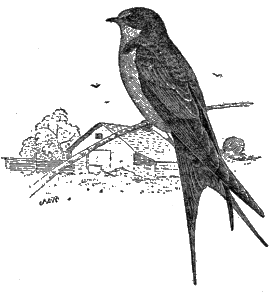
Among the early spring arrivals to their northern homes none is more welcome
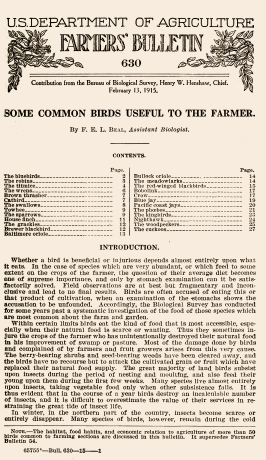
than the phœbe (fig. 18). The common phœbe[48] breeds throughout the
United States east of the Great Plains, and winters from the South Atlantic
and Gulf States southward. Its western relative, the black phœbe,[49] is found
from Texas west to the Pacific coast, which it occupies as far north as Washington,
replacing through most of this region the common or eastern form.
Though naturally building its nest under an overhanging cliff of rock or
earth, or in the mouth of a cave, the preference of the eastern species for the
vicinity of farm buildings is so marked that in the more thickly settled parts
of the country the bird is seldom seen at any great distance from a farmhouse,
except where a bridge spanning a stream affords a secure spot for a nest. Its
confiding disposition renders it a great favorite, and consequently it is seldom
disturbed.
The phœbe subsists almost exclusively upon insects, most of which are caught
upon the wing. An examination of 370 stomachs showed that over 89 per cent
of the year’s food consists of insects and spiders, while wild fruit constitutes
the remainder. The insects belong chiefly to noxious species, and include many
click beetles, May beetles, and weevils. Other beetles, belonging to 21 families
that were identified, make up 10.65 per cent. They appear to be eaten very
regularly in every month, but the most are taken in spring and early summer.
May is the month of maximum consumption, with 20.43 per cent. Beetles altogether
amount to 15.3 per cent, which places them second in rank of the items
of animal food. The notorious cotton-boll weevil was found in six stomachs
taken in the cotton fields of Texas and Louisiana, and five individuals of the
strawberry weevil were taken from one collected in Texas. Many other beetles
contained in the stomachs are equally harmful, but are not so widely known.
Such are the corn leaf-beetle, which feeds upon corn; the 12-spotted cucumber
beetle and the striped cucumber beetle, both of which seriously injure and
sometimes destroy cucumber and squash vines; and the locust leaf miner,
which is sometimes so numerous that all the locust trees over large areas are
blasted as by fire.
In the phœbe’s diet hymenopterous insects stand at the head, as in the case
with most of the flycatchers. They are eaten with great regularity and are
the largest item in nearly every month. A few are useful parasitic species,
but these are offset by a number of sawfly larvæ, which are very harmful
insects. Ants were found in 24 stomachs. No honeybees were identified. In
their season grasshoppers are much relished, while wasps of various forms,
many flies of species that annoy cattle, and a few bugs and spiders are also
eaten regularly. It is evident that a pair of phœbes must materially reduce
the number of insects near a garden or field, as the birds often, if not always,
raise two broods a year, and each brood numbers from four to six young.
There is hardly a more useful species, about the farm than the phœbe, and
it should receive every encouragement. To furnish nesting boxes is helpful,
but not necessary, as it usually prefers a more open situation, like a shed or
a nook under the eaves, but it
should be protected from cats and
other marauders.
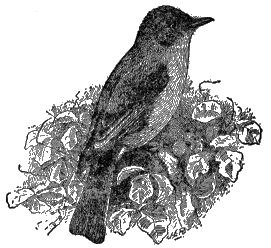
Fig. 18.—Phœbe. Length, about 6½ inches.
The black phœbe has the same
habits as its eastern relative, both
as to selection of food and nesting
sites, preferring for the latter purpose
some structure of man, as a
shed or, better still, a bridge over a
stream of water, and the preference
of the black phœbe for the vicinity
of water is very pronounced. One
may always be found at a stream
or pool and often at a watering
trough by the roadside.
Careful study of the habits of the
bird shows that it obtains a large
portion of its food about wet places.
While camping beside a stream in
California the writer took some
pains to observe the habits of the
black phœbe. The nesting season
was over, and the birds had nothing to do but eat. This they appeared to be
doing all the time. When first observed in the morning, at the first glimmer of
daylight, a phœbe was always found flitting from rock to rock, although it was
so dusky that the bird could hardly be seen. This activity was kept up all day.
Even in the evening, when it was so dark that notes were written by the aid of
the camp fire, the phœbe was still engaged in its work of collecting, though it
was difficult to understand how it could catch insects when there was scarcely
light enough to see the bird. Exploration of the stream showed that every
portion of it was patrolled by a phœbe, that each one apparently did not range
over more than 12 or 13 rods of water, and that sometimes two or three were in
close proximity.
The number of insects destroyed in a year by the black phœbe is enormous.
Fortunately, the examination of stomachs has supplemented observation in
the field, and we are enabled to give precise details. Of the 333 stomachs examined,
every one contained insects as the great bulk of the food. Only 15
contained any vegetable food at all, and in no case was it a considerable part
of the contents of the stomach. The insects eaten were mostly wasps, bugs,
and flies, but many beetles also were destroyed.
Useful beetles belonging to three families amount to 2.8 per cent of the
food. Other beetles of harmful or neutral species reach 10.5 per cent. Wasps,
the largest item of the food, were found in 252 stomachs and were the whole
contents of 15. The average for the year is 35 per cent. Parasitic species
were noted, but they were very few. Ants were found in 48 stomachs, and for
a short time in midsummer they constitute a notable part of the food. Various
wild bees and wasps make up the bulk of this item. No honeybees were found.
Bugs in various forms constitute 10.56 per cent and are eaten in every month
but May. Stinkbugs appear to be the favorites, as they were contained in 10
stomachs. Plant lice were found in one stomach. Flies, forming the second
largest item, were found in 97 stomachs and completely filled 3. They constitute
the most regular article in the black phœbe’s diet. The maximum consumption
occurs in April, 64.3 per cent. The black phœbe well merits its title
of flycatcher.
Moths and caterpillars amount to 8.2 per cent of the food. They were found
in 72 stomachs, of which 51 contained the adult moths and 28 the larvæ or
caterpillars. One stomach was entirely filled with adults. This is one of the
few birds studied by the writer that eats more moths than caterpillars, for as
a rule the caterpillars are largely in excess. Flycatchers, taking their food
upon the wing, would naturally prove exceptions to the rule. Crickets are
evidently not a favorite food of the black phœbe, as they amount to only 2.45
per cent. They were found in 39 stomachs, but usually the amount in each
was small, though one stomach was entirely filled with them. Grasshoppers did
not appear. Dragon flies were eaten to some extent, and these illustrate the
fondness of the species for the neighborhood of water.
The vegetable matter eaten consisted chiefly of small wild fruits of no
economic importance.
Another phœbe inhabiting the Western States and breeding as far north as
Alaska is the Say phœbe.[50] Investigation of its food was based on the examination
of 86 stomachs, and while none were available for the months when
insects are most numerous, the bird proved to be one of the most exclusively
insectivorous of the family. That it takes a few useful insects can not be
denied, but these are far outnumbered by the harmful ones it destroys, and the
balance is clearly in favor of the bird. Its vegetable food amounts to only 2
per cent and is made up of a little wild fruit, seeds, and rubbish.
THE WOODPECKERS.
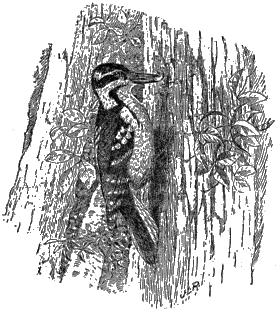
Fig. 20.—Hairy woodpecker. Length, about 9
inches.
Five or six species of woodpeckers
are familiarly known
throughout eastern United States,
and in the West are replaced by
others of similar habits. Several
species remain in the Northern
States through the entire year,
while others are more or less migratory.
Farmers are prone to look upon
woodpeckers with suspicion. When
the birds are seen scrambling over
fruit trees and pecking holes in
the bark, it is concluded that they
must be doing harm. Careful observers,
however, have noticed that,
excepting a single species, these
birds rarely leave any conspicuous
mark on a healthy tree, except
when it is affected by wood-boring
larvæ, which are accurately located,
dislodged, and devoured by
the woodpecker.
Two of the best-known woodpeckers,
the hairy woodpecker[55] (fig. 20) and the downy woodpecker,[56] including
their races, range over the greater part of the United States. They differ
chiefly in size, their colors being practically the same. The males, like those
of many other woodpeckers, are distinguished by a scarlet patch on the head.
An examination of many stomachs of these two species shows that from two-thirds
to three-fourths of the food consists of insects, chiefly noxious kinds.
Wood-boring beetles, both adults and larvæ are conspicuous, and with them are
associated many caterpillars, mostly species that burrow into trees. Next in
importance are the ants that live in decaying wood, all of which are sought by
woodpeckers and eaten in great quantities. Many ants are particularly harmful
to timber, for if they find a small spot of decay in the vacant burrow of a wood
borer, they enlarge the hole, and, as their colony is always on the increase,
continue to eat away the wood until the whole trunk is honeycombed. Moreover,
they are not accessible to birds generally, and could pursue their career of
destruction unmolested were it not that the woodpeckers, with beaks and
tongues especially fitted for such work, dig out and devour them. It is thus
evident that woodpeckers are great conservators of forests. To them more than
to any other agency we owe the preservation of timber from hordes of destructive
insects.
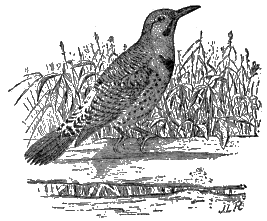
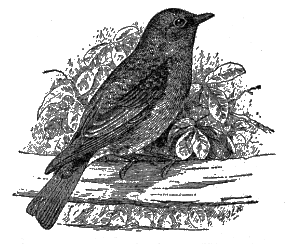
Fig. 21.—Flicker. Length, about 12½ inches.
One of the larger woodpeckers familiar to everyone is the flicker, or golden-winged
woodpecker[57] (fig. 21), which is generally distributed throughout the
United States from the Atlantic coast to the Rocky Mountains. There it is
replaced by the red-shafted flicker,[58] which extends westward to the Pacific.
The two species are as nearly identical
in food habits as their respective
environments will allow. The
flickers, while genuine woodpeckers,
differ somewhat in habits from the
rest of the family, and are frequently
seen searching for food upon the
ground. Like the downy and hairy
woodpeckers, they feed upon wood-boring
grubs and ants, but the number
of ants eaten is much greater
than that eaten by the other two
species. Of the flickers’ stomachs
examined, three were completely
filled with ants. Two of these contained
more than 3,000 individuals
each, while the third contained fully
5,000. These ants belong to species
which live in the ground. It is these
insects for which the flicker searches
when it runs about in the grass, although some grasshoppers also are then
taken. The flicker’s habit of pecking holes in buildings sometimes greatly
annoys his human friends, and it is particularly noticeable in the California
species. Observation has shown that the object of the work is to obtain shelter
for the winter. In the East most of the flickers are migratory, and only a few
remain North where shelter is necessary. These generally find a safe retreat
in the hollow tree in which they nested. In California, however, where the
birds do not migrate, trees are not so
abundant as in the East, and consequently
buildings are brought into
requisition, and in them holes are
drilled, usually under the eaves,
where snug nights’ lodgings are
found. Often a dozen holes may be
seen in one building. Barns or other
outbuildings are usually selected,
though churches sometimes have
been used.
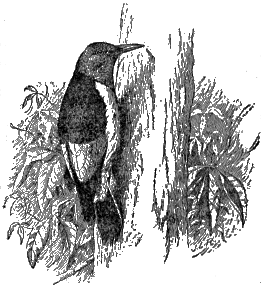
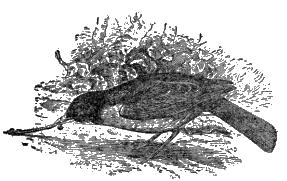
Fig. 22.—Red-headed woodpecker. Length, about 9½ inches.
The red-headed woodpecker[59] (fig. 22), is well known east of the Rocky
Mountains, but is rather rare in New
England. Unlike some of the other
species, it prefers fence posts and
telegraph poles to trees as a foraging
ground. Its food therefore naturally
differs from that of the preceding
species, and consists largely of
adult beetles and wasps which it
frequently captures on the wing after
the fashion of flycatchers. Grasshoppers
also form an important part
of the food. Among the beetles are a
number of predacious ground species
and some tiger beetles, which are
useful insects. The red-head has been accused of robbing nests of other birds, and
of pecking out the brains of young birds and poultry; but as the stomachs showed
little evidence to substantiate this charge, the habit probably is exceptional.
The vegetable food of woodpeckers is varied, but consists largely of small
fruits and berries. The downy and hairy woodpeckers eat such fruits as dogwood
and Virginia creeper and seeds of poison ivy, sumac, and a few other
shrubs. The flicker also eats a great many small fruits and the seeds of a considerable
number of shrubs and weeds. None of the three species is much
given to eating cultivated fruits or crops. The red-head has been accused of
eating the larger kinds of fruit, as apples, and also of taking considerable corn.
Stomach examinations show that to some extent these charges are substantiated,
but that the habit is not prevalent enough to cause much damage. The
bird is fond of mast, especially beechnuts, and when these nuts are plentiful
it remains north all winter.
Woodpeckers apparently are the only agents which can successfully cope
with certain insect enemies of the forest, and, to some extent, with those of
fruit trees also. For this reason, if for no other, they should be protected in
every possible way.