Five or six species of woodpeckers are familiarly known throughout
the eastern United States, and in the west are replaced by others of
similar habits. Several species remain in the northern States through
the entire year, while others are more or less migratory.
Farmers are prone to look upon woodpeckers with suspicion. When
the birds are seen scrambling over fruit trees and pecking at the bark,
and fresh holes are found in the tree, it is concluded that they are
doing harm. Careful observers, however, have noticed that, excepting
a single species, these birds rarely leave any important mark on a
healthy tree, but that when a tree is affected by wood-boring larvæ
the Insects are accurately located, dislodged, and devoured. In case
the holes from which the borers are taken are afterwards occupied by
colonies of ants, these ants in turn are drawn out and eaten.
Two of the best known woodpeckers, the hairy woodpecker (Dryobates
villosus) (fig. 2) and the downy woodpecker (D. pubescens), including
their races, range over the greater part of the United States, and
for the most part remain throughout the year in their usual haunts.
They differ chiefly in size, for their colors are practically the same, and
the males, like other woodpeckers, are distinguished by a scarlet patch
on the head.
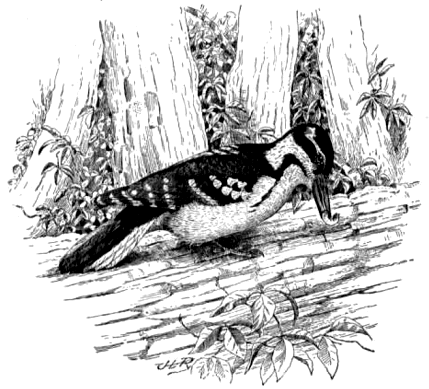
Fig. 2.—Hairy woodpecker.
An examination of many stomachs of these two birds shows that
from two-thirds to three-fourths of the food consists of insects, chiefly
noxious. Wood-boring beetles, both adults and larvæ, are conspicuous,
and with them are associated many caterpillars, mostly species
that burrow into trees. Next in importance are the ants that live in
decaying wood, all of which are sought by woodpeckers and eaten in
great quantities. Many ants are particularly harmful to limber, for if
they find a small spot of decay in the vacant burrow of some wood-borer,
they enlarge the hole, and as their colony is always on the
increase, continue to eat away the wood until the whole trunk is honey-combed.
Moreover, these insects are not accessible to other birds, and
could pursue their career of destruction unmolested were it not that
the woodpeckers, with beaks and tongues especially fitted for such
work, dig out and devour them. It is thus evident that woodpeckers
are great conservators of forests. To them, more than to any other
agency, we owe the preservation of timber from hordes of destructive
insects.
One of the larger woodpeckers familiar to everyone is the flicker, or
golden-winged woodpecker (Colaptes auratus) (fig. 3), which is generally
distributed throughout the United States from the Atlantic Coast to
the Rocky Mountain. It is there replaced by the red-shafted flicker
(C. cafer), which extends westward to the Pacific. The two species are
as nearly identical in food habits as their environment will allow. The
flickers, while genuine woodpeckers, differ somewhat in habits from the
rest of the family, and are frequently seen upon the ground searching
for food. Like the downy and hairy woodpeckers, they eat wood-boring
grubs and ants, but the number of ants eaten is much greater. Two of
the flickers' stomachs examined were completely filled with ants, each
stomach containing more than 3,000 individuals. These ants belonged
to species which live in the ground, and it is these insects for which the
flicker is searching when running about in the grass, although some
grasshoppers are also taken.
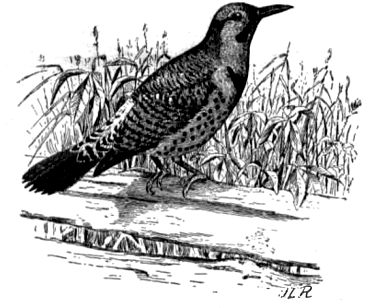
Fig. 3.—Flicker.
The red-headed woodpecker (Melanerpes erythrocephalus) (fig. 4) is well
known east of the Rocky Mountains, but is rather rare in New England.
Unlike some of the other species, it prefers fence posts and telegraph
poles to trees as a foraging ground. Its food therefore naturally differs
from that of the preceding species, and consists largely of adult
beetles and wasps, which it frequently captures on the wing, after the
fashion of flycatchers. Grasshoppers also form an important part of
the food. The red-head has a peculiar habit of selecting very large
beetles, as shown by the presence of fragments of several of the largest
species in the stomachs. Among the beetles were quite a number of
predaceous ground beetles, and unfortunately some tiger beetles, which
are useful insects. The red-head has been accused of robbing the nests
of other birds; also of attacking young birds and poultry and peeking
out their brains, but as the stomachs showed little evidence to substantiate
this charge it is probable that the habit is rather exceptional.
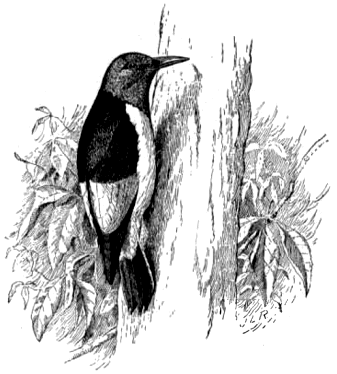
Fig. 4.—Red-headed woodpecker.
It has been customary to speak of the smaller woodpeckers as "sapsuckers,"
under the belief that they drill holes in the bark of trees for
the purpose of drinking the sap and eating the inner bark. Close observation,
however, has fixed this habit upon only one species, the yellow-bellied
woodpecker, or sapsucker (Sphyrapicus varius) (fig. 5). This bird
has been shown to be guilty of pecking holes in the bark of various forest
trees, and sometimes in that of apple trees, from which it drinks the sap
when the pits become filled. It has been proved, however, that besides
taking the gap the bird captures large numbers of insects which are
attracted by the sweet fluid, and that these form a very considerable
portion of its diet. In some cases the trees are injured by being thus
punctured, and die in a year or two, but since comparatively few are
touched the damage is not great. It is equally probable, moreover, that
the bird fully compensates for this injury by the insects it consumes.
The vegetable food of woodpeckers is varied, but consists largely of
small fruits and berries. The downy and hairy woodpeckers eat such
fruits as dogwood, Virginia creeper, and others, with the seeds of
poison ivy, sumac, and a few other shrubs. The flicker also eats a great
many small fruits and the seeds of a considerable number of shrubs
and weeds. None of the three species is much given to eating cultivated
fruits or crops.
The red-head has been accused of eating the larger kinds of fruit,
such as apples, and also of taking considerable corn. The stomach
examinations show that to some extent these charges are substantiated
but that the habit is not prevalent enough to cause much damage. It
is quite fond of mast, especially beechnuts, and when these nuts are
plentiful the birds remain north all winter, instead of migrating as is
their usual custom.
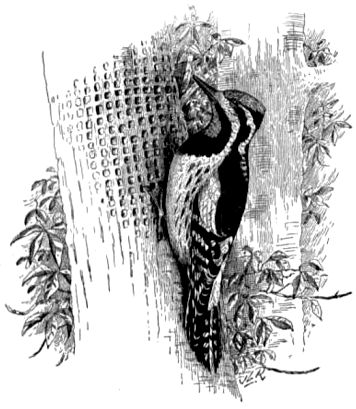
Fig. 5.—Yellow-bellied woodpecker.
Half the food of the sapsucker, aside from sap, consists of vegetable
matter, largely berries of the kinds already mentioned, and also a quantity
of the inner bark of trees, more of which is eaten by this species
than by any other.
Many other woodpeckers are found in America, but their food habits
agree in the main with those just described. Those birds are certainly
the only agents which can successfully cope with certain insect enemies
of the forests, and, to some extent, of fruit trees also. For this reason,
if for no other, they should be protected in every possible way.