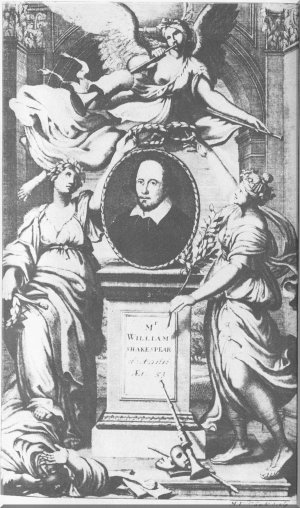
The Rowe-Tonson edition of Shakespeare's plays (1709) is an important
event in the history of both Shakespeare studies and English literary
criticism. Though based substantially on the Fourth Folio (1685), it is
the first, "edited" edition: Rowe modernized spelling and punctuation
and quietly made a number of sensible emendations. It is the first
edition to include dramatis personae, the first to attempt a
systematic division of all the plays into acts and scenes, and the first
to give to scenes their distinct locations. It is the first of many
illustrated editions. It is the first to abandon the clumsy folio format
and to attempt to bring the plays within reach of the understanding and
the pocketbooks of the average reader. Finally, it is the first to
include an extended life and critique of the author.
Shakespeare scholars from Pope to the present have not been kind to Rowe
either as editor or as critic; but all eighteenth-century editors
accepted many of his emendations, and the biographical material that he
and Betterton assembled remained the basis of all accounts of the
dramatist until the scepticism and scholarship of Steevens and Malone
proved most of it to be merely dubious tradition. Johnson, indeed, spoke
generously of the edition. In the Life of Rowe he said that as an
editor Howe "has done more than he promised; and that, without the pomp
of notes or the boast of criticism, many passages are happily restored."
The preface, in his opinion, "cannot be said to discover much profundity
or penetration." But he acknowledged Rowe's influence on Shakespeare's
reputation. In our own century, more justice has been done Rowe, at
least as an editor.[1]
The years 1709-14 were of great importance in the growth of
Shakespeare's reputation. As we shall see, the plays as well as the
poems, both authentic and spurious, were frequently printed and bought.
With the passing of the seventeenth-century folios and the occasional
quartos of acting versions of single plays, Shakespeare could find a
place in libraries and could be intimately known by hundreds who had
hitherto known him only in the theater. Tonson's business acumen made
Shakespeare available to the general reader in the reign of Anne; Rowe's
editorial, biographical, and critical work helped to make him
comprehensible within the framework of contemporary taste.
When Rowe's edition appeared twenty-four years had passed since the
publication of the Fourth Folio. As Allardyce Nicoll has shown, Tonson
owned certain rights in the publication of the plays, rights derived
ultimately from the printers of the First Folio. Precisely when he
decided to publish a revised octavo edition is not known, nor do we know
when Rowe accepted the commission and began his work. McKerrow has
plausibly suggested that Tonson may have been anxious to call attention
to his rights in Shakespeare on the eve of the passage of the copyright
law which went into effect in April, 1710.[2] Certainly Tonson must have
felt that he was adding to the prestige which his publishing house had
gained by the publication of Milton and Dryden's Virgil.
In March 1708/9 Tonson was advertising for materials "serviceable to
[the] Design" of publishing an edition of Shakespeare's works in six
volumes octavo, which would be ready "in a Month." There was a delay,
however, and it was on 2 June that Tonson finally announced: "There is
this day Publish'd ... the Works of Mr. William Shakespear, in six Vols.
8vo. adorn'd with Cuts, Revis'd and carefully Corrected: With an Account
of the Life and Writings of the Author, by N. Rowe, Esq; Price 30s."
Subscription copies on large paper, some few to be bound in nine
volumes, were to be had at his shop.[3]
The success of the venture must have been immediately apparent. By 1710
a second edition, identical in title page and typography with the first,
but differing in many details, had been printed,[4] followed in 1714 by
a third in duodecimo. This so-called second edition exists in three
issues, the first made up of eight volumes, the third of nine. In all
three editions the spurious plays were collected in the last volume,
except in the third issue of 1714, in which the ninth volume contains
the poems.
That other publishers sensed the profits in Shakespeare is evident from
the activities of Edmund Curll and Bernard Lintot. Curll acted with
imagination and promptness: within three weeks of the publication of
Tonson's edition, he advertised as Volume VII of the works of
Shakespeare his forthcoming volume of the poems. This volume, misdated
1710 on the title page, seems to have been published in September 1709.
A reprint with corrections and some emendations of the Cotes-Benson
Poems Written By Wil. Shake-speare. Gent., 1640, it contains Charles
Gildon's "Essay on the Art, Rise, and Progress of the Stage in Greece,
Rome, and England," his "Remarks" on the separate plays, his
"References to Classic Authors," and his glossary. With great shrewdness
Curll produced a volume uniform in size and format with Rowe's edition
and equipped with an essay which opens with an attack on Tonson for
printing doubtful plays and for attempting to disparage the poems
through envy of their publisher. This attack was certainly provoked by
the curious final paragraph of Rowe's introduction, in which he refused
to determine the genuineness of the 1640 poems. Obviously Tonson was
perturbed when he learned that Curll was publishing the poems as an
appendix to Rowe's edition.
Once again a Shakespearian publication was successful, and Tonson
incorporated the Curll volume into the third issue of the 1714 edition,
having apparently come to some agreement with Curll, since the title
page of Volume IX states that it was "Printed for J. Tonson, E. Curll,
J. Pemberton, and K. Sanger." In this edition Gildon omitted his
offensive remarks about Tonson, as well as the "References to Classic
Authors," in which he had suggested topics treated by both the ancients
and Shakespeare. This volume was revised by George Sewell and appeared
in appropriate format as an addition to Pope's Shakespeare, 1723-25.
Meanwhile, in July, 1709, Lintot had begun to advertise his edition of
the poems, which was expanded in 1710/11 to include the sonnets in a
second volume.[5] Thus within a year of the publication of Rowe's
edition, all of Shakespeare, as well as some spurious works, was on the
market. With the publication of these volumes, Shakespeare began to pass
rapidly into the literary consciousness of the race. And formal
criticism of his writings inevitably followed.
Rowe's "Some Account of the Life, &c. of Mr. William Shakespear,"
reprinted with a very few trifling typographical changes in 1714,
survived in all the important eighteenth-century editions, but it was
never reprinted in its original form. Pope re-arranged the material,
giving it a more orderly structure and omitting passages that were
obviously erroneous or that seemed outmoded.[6] It is odd that all later
eighteenth-century editors seem to have believed that Pope's revision
was actually Rowe's own re-writing of the Account for the 1714
edition. Theobald did not reprint the essay, but he used and amplified
Rowe's material in his biography of Shakespeare; Warburton, of course,
reprinted Pope's version, as did Johnson, Steevens, and Malone. Both
Steevens and Malone identified the Pope revision as Rowe's.[7]
Thus it came about that Rowe's preface in its original form was lost
from sight during the entire eighteenth century. Even in the twentieth,
Pope's revision has been printed with the statement that it is taken
"from the second edition (1714), slightly altered from the first edition
of 1709."[8] Only D. Nichol Smith has republished the original essay in
his Eighteenth Century Essays on Shakespeare, 1903.
The biographical part of Rowe's Account assembled the few facts and
most of the traditions still current about Shakespeare a century after
his death. It would be easy for any undergraduate to distinguish fact
from legend in Rowe's preface; and scholarship since Steevens and Malone
has demonstrated the unreliability of most of the local traditions that
Betterton reported from Warwickshire. Antiquarian research has added a
vast amount of detail about the world in which Shakespeare lived and has
raised and answered questions that never occurred to Rowe; but it has
recovered little more of the man himself than Rowe knew.
The critical portions of Rowe's account look backward and forward:
backward to the Restoration, among whose critical controversies the
eighteenth-century Shakespeare took shape; and forward to the long
succession of critical writings that, by the end of the century, had
secured for Shakespeare his position as the greatest of the English
poets. Until Dryden and Rymer, criticism of Shakespeare in the
seventeenth century had been occasional rather than systematic. Dryden,
by his own acknowledgement, derived his enthusiasm for Shakespeare from
Davenant, and thus, in a way, spoke for a man who had known the poet.
Shakespeare was constantly in his mind, and the critical problems that
the plays raised in the literary milieu of the Restoration constantly
fascinated him. Rymer's attack served to solidify opinion and to force
Shakespeare's admirers to examine the grounds of their faith. By 1700 a
conventional manner of regarding Shakespeare and the plays had been
achieved.
The growth of Shakespeare's reputation during the century after his
death is a familiar episode in English criticism. Bentley has
demonstrated the dominant position of Jonson up to the end of the
century.[9] But Jonson's reputation and authority worked for Shakespeare
and helped to shape, a critical attitude toward the plays. His official
praise in the first Folio had declared Shakespeare at least the equal of
the ancients and the very poet of nature. He had raised the issue of
Shakespeare's learning, thus helping to emphasize the idea of
Shakespeare as a natural genius; and in the Discoveries he had blamed
his friend for too great facility and for bombast.
In his commendatory sonnet in the Second Folio (1632), Milton took the
Jonsonian view of Shakespeare, whose "easy numbers" he contrasted with
"slow-endeavouring Art," and readers of the poems of 1645 found in
L'Allegro an early formulation of what was to become the stock
comparison of the two great Jacobean dramatists in the lines about
Jonson's "learned sock" and Shakespeare, "Fancy's child." This contrast
became a constant theme in Restoration allusions to the two poets.
Two other early critical ideas were to be elaborated in the last four
decades of the century. In the first Folio Leonard Digges had spoken of
Shakespeare's "fire and fancy," and I.M.S. had written in the Second
Folio of his ability to move the passions. Finally, throughout the last
half of the century, as Bentley has shown, Shakespeare was admired above
all English dramatists for his ability to create characters, of whom
Falstaff was the most frequently mentioned.
All of these opinions were developed in Dryden's frequent critical
remarks on his favorite dramatist. No one was more clearly aware than
he of the faults of the "divine Shakespeare" as they appeared in the new
era of letters that Dryden himself helped to shape. And no man ever
praised Shakespeare more generously. For Dryden Shakespeare was the
greatest of original geniuses, who, "taught by none," laid the
foundations of English drama; he was a poet of bold imagination,
especially gifted in "magick" or the supernatural, the poet of nature,
who could dispense with "art," the poet of the passions, of varied
characters and moods, the poet of large and comprehensive soul. To him,
as to most of his contemporaries, the contrast between Jonson and
Shakespeare was important: the one showed what poets ought to do; the
other what untutored genius can do. When Dryden praised Shakespeare, his
tone became warmer than when he judicially appraised Jonson.
Like most of his contemporaries Dryden did not heed Jonson's caveat
that, despite his lack of learning, Shakespeare did have art. He was too
obsessed with the idea that Shakespeare, ignorant of the health-giving
art of the ancients, was infected with the faults of his age, faults
that even Jonson did not always escape. Shakespeare was often incorrect
in grammar; he frequently sank to flatness or soared into bombast; his
wit could be coarse and low and too dependent on puns; his plot
structure was at times faulty, and he lacked the sense for order and
arrangement that the new taste valued. All this he could and did admit,
and he was impressed by the learning and critical standards of Rymer's
attack. But like Samuel Johnson he was not often prone to substitute
theory for experience, and like most of his contemporaries he felt
Shakespeare's power to move and to convince. Perhaps the most trenchant
expression of his final stand in regard to Shakespeare and to the whole
art of poetry is to be found in his letter to Dennis, dated 3 March,
1693/4. Shakespeare, he said, had genius, which is "alone a greater
Virtue ... than all the other Qualifications put together." He admitted
that all the faults pointed out by Rymer are real enough, but he added a
question that removed the discussion from theory to immediate
experience: "Yet who will read Mr. Rym[er] or not read Shakespear?" When
Dryden died in 1700, the age of Jonson had passed and the age of
Shakespeare was about to begin.
The Shakespeare of Rowe's Account is in most essentials the
Shakespeare of Restoration criticism, minus the consideration of his
faults. As Nichol Smith has observed, Dryden and Rymer were continually
in Rowe's mind as he wrote. It is likely that Smith is correct in
suspecting in the Account echoes of Dryden's conversation as well as
of his published writings;[10] and the respect in which Rymer was then
held is evident in Rowe's desire not to enter into controversy with that
redoubtable critic and in his inability to refrain from doing so.
If one reads the Account in Pope's neat and tidy revision and then as
Rowe published it, one is impressed with its Restoration quality. It
seems almost deliberately modelled on Dryden's prefaces, for it is
loosely organized, discursive, intimate, and it even has something of
Dryden's contagious enthusiasm. Rowe presents to his reader the
Restoration Shakespeare: the original genius, the antithesis of Jonson,
the exception to the rule and the instance that diminishes the
importance of the rules. Shakespeare "lived under a kind of mere light
of nature," and knowing nothing of the rules should not be judged by
them. Admitting the poor plot structure and the neglect of the unities,
except in an occasional play, Rowe concentrates on Shakespeare's
virtues: his images, "so lively, that the thing he would represent
stands full before you, and you possess every part of it;" his command
over the passions, especially terror; his magic; his characters and
their "manners."
Bentley has demonstrated statistically that the Restoration had little
appreciation of the romantic comedies. And yet Rowe, so thoroughly
saturated with Restoration criticism, lists character after character
from these plays as instances of Shakespeare's ability to depict the
manners. Have we perhaps here a response to Shakespeare read as opposed
to Shakespeare seen? Certainly the romantic comedies could not stand the
test of the critical canons so well as did the Merry Wives or even
Othello; and they were not much liked on the stage. But it seems
probable that a generation which read French romances would not have
felt especially hostile to the romantic comedies when read in the
closet. Rowe's criticism is so little original, so far from
idiosyncratic, that it is unnecessary to assume that his response to the
characters in the comedies is unique.
Be that as it may, it was well that at the moment when the reading
public began rapidly to expand in England, Tonson should have made
Shakespeare available in an attractive and convenient format; and it was
a happy choice that brought Rowe to the editorship of these six volumes.
As poet, playwright, and man of taste, Rowe was admirably fitted to
introduce Shakespeare to a multitude of new readers. Relatively innocent
of the technical duties of an editor though he was, he none the less was
capable of accomplishing what proved to be his historic mission: the
easy re-statement of a view of Shakespeare which Dryden had earlier
articulated and the demonstration that the plays could be read and
admired despite the objections of formal dramatic criticism. He is more
than a chronological predecessor of Pope, Johnson, and Morgann. The line
is direct from Shakespeare to Davenant, to Dryden, to Rowe; and he is an
organic link between this seventeenth-century tradition and the
increasingly rich Shakespeare scholarship and criticism that flowed
through the eighteenth century into the romantic era.
Notes
The writer wishes to express his appreciation of a Research Grant from
the University of Minnesota for the summer of 1948, during which this
introduction was written.
—Samuel Holt Monk
University of Minnesota
THE
WORKS
OF
Mr. William Shakespear;
IN
SIX VOLUMES.
ADORN'D with CUTS.
Revis'd and Corrected, with an Account of the Life and Writings of the
Author.
By N. ROWE, Esq;
L O N D O N:
Printed for Jacob Tonson, within Grays-Inn Gate, next Grays-Inn
Lane. MDCCIX.
SOME
ACCOUNT
OF THE
LIFE, &c.
OF
Mr. William Shakespear.
It seems to be a kind of Respect due to the Memory of Excellent Men,
especially of those whom their Wit and Learning have made Famous, to
deliver some Account of themselves, as well as their Works, to
Posterity. For this Reason, how fond do we see some People of
discovering any little Personal Story of the great Men of Antiquity,
their Families, the common Accidents of their Lives, and even their
Shape, Make and Features have been the Subject of critical Enquiries.
How trifling soever this Curiosity may seem to be, it is certainly very
Natural; and we are hardly satisfy'd with an Account of any remarkable
Person, 'till we have heard him describ'd even to the very Cloaths he
wears. As for what relates to Men of Letters, the knowledge of an Author
may sometimes conduce to the better understanding his Book: And tho' the
Works of Mr. Shakespear may seem to many not to want a Comment, yet I
fancy some little Account of the Man himself may not be thought improper
to go along with them.
He was the Son of Mr. John Shakespear, and was Born at Stratford
upon Avon, in Warwickshire, in April 1564. His Family, as appears
by the Register and Publick Writings relating to that Town, were of good
Figure and Fashion there, and are mention'd as Gentlemen. His Father,
who was a considerable Dealer in Wool, had so large a Family, ten
Children in all, that tho' he was his eldest Son, he could give him no
better Education than his own Employment. He had bred him, 'tis true,
for some time at a Free-School, where 'tis probable he acquir'd that
little Latin he was Master of: But the narrowness of his
Circumstances, and the want of his assistance at Home, forc'd his
Father to withdraw him from thence, and unhappily prevented his further
Proficiency in that Language. It is without Controversie, that he had no
knowledge of the Writings of the Antient Poets, not only from this
Reason, but from his Works themselves, where we find no traces of any
thing that looks like an Imitation of 'em; the Delicacy of his Taste,
and the natural Bent of his own Great Genius, equal, if not superior
to some of the best of theirs, would certainly have led him to Read and
Study 'em with so much Pleasure, that some of their fine Images would
naturally have insinuated themselves into, and been mix'd with his own
Writings; so that his not copying at least something from them, may be
an Argument of his never having read 'em. Whether his Ignorance of the
Antients were a disadvantage to him or no, may admit of a Dispute: For
tho' the knowledge of 'em might have made him more Correct, yet it is
not improbable but that the Regularity and Deference for them, which
would have attended that Correctness, might have restrain'd some of that
Fire, Impetuosity, and even beautiful Extravagance which we admire in
Shakespear: And I believe we are better pleas'd with those Thoughts,
altogether New and Uncommon, which his own Imagination supply'd him so
abundantly with, than if he had given us the most beautiful Passages out
of the Greek and Latin Poets, and that in the most agreeable manner
that it was possible for a Master of the English Language to deliver
'em. Some Latin without question he did know, and one may see up and
down in his Plays how far his Reading that way went: In Love's Labour
lost, the Pedant comes out with a Verse of Mantuan; and in Titus
Andronicus, one of the Gothick Princes, upon reading
Integer vitæ scelerisque purus
Non eget Mauri jaculis nec arcu—
says, 'Tis a Verse in Horace, but he remembers it out of his
Grammar: Which, I suppose, was the Author's Case. Whatever Latin he
had, 'tis certain he understood French, as may be observ'd from many
Words and Sentences scatter'd up and down his Plays in that Language;
and especially from one Scene in Henry the Fifth written wholly in it.
Upon his leaving School, he seems to have given intirely into that way
of Living which his Father propos'd to him; and in order to settle in
the World after a Family manner, he thought fit to marry while he was
yet very Young. His Wife was the Daughter of one Hathaway, said to
have been a substantial Yeoman in the Neighbourhood of Stratford. In
this kind of Settlement he continu'd for some time, 'till an
Extravagance that he was guilty of, forc'd him both out of his Country
and that way of Living which he had taken up; and tho' it seem'd at
first to be a Blemish upon his good Manners, and a Misfortune to him,
yet it afterwards happily prov'd the occasion of exerting one of the
greatest Genius's that ever was known in Dramatick Poetry. He had, by
a Misfortune common enough to young Fellows, fallen into ill Company;
and amongst them, some that made a frequent practice of Deer-stealing,
engag'd him with them more than once in robbing a Park that belong'd to
Sir Thomas Lucy of Cherlecot, near Stratford. For this he was
prosecuted by that Gentleman, as he thought somewhat too severely; and
in order to revenge that ill Usage, he made a Ballad upon him. And tho'
this, probably the first Essay of his Poetry, be lost, yet it is said to
have been so very bitter, that it redoubled the Prosecution against him
to that degree, that he was oblig'd to leave his Business and Family in
Warwickshire, for some time, and shelter himself in London.
It is at this Time, and upon this Accident, that he is said to have
made his first Acquaintance in the Play-house. He was receiv'd into the
Company then in being, at first in a very mean Rank; But his admirable
Wit, and the natural Turn of it to the Stage, soon distinguish'd him, if
not as an extraordinary Actor, yet as an excellent Writer. His Name is
Printed, as the Custom was in those Times, amongst those of the other
Players, before some old Plays, but without any particular Account of
what sort of Parts he us'd to play; and tho' I have inquir'd, I could
never meet with any further Account of him this way, than that the top
of his Performance was the Ghost in his own Hamlet. I should have been
much more pleas'd, to have learn'd from some certain Authority, which
was the first Play he wrote; it would be without doubt a pleasure to any
Man, curious in Things of this Kind, to see and know what was the first
Essay of a Fancy like Shakespear's. Perhaps we are not to look for his
Beginnings, like those of other Authors, among their least perfect
Writings; Art had so little, and Nature so large a Share in what he did,
that, for ought I know, the Performances of his Youth, as they were the
most vigorous, and had the most fire and strength of Imagination in 'em,
were the best. I would not be thought by this to mean, that his Fancy
was so loose and extravagant, as to be Independent on the Rule and
Government of Judgment; but that what he thought, was commonly so Great,
so justly and rightly Conceiv'd in it self, that it wanted little or no
Correction, and was immediately approv'd by an impartial Judgment at the
first sight. Mr. Dryden seems to think that Pericles is one of his
first Plays; but there is no judgment to be form'd on that, since there
is good Reason to believe that the greatest part of that Play was not
written by him; tho' it is own'd, some part of it certainly was,
particularly the last Act. But tho' the order of Time in which the
several Pieces were written be generally uncertain, yet there are
Passages in some few of them which seem to fix their Dates. So the
Chorus in the beginning of the fifth Act of Henry V. by a Compliment
very handsomly turn'd to the Earl of Essex, shews the Play to have
been written when that Lord was General for the Queen in Ireland: And
his Elogy upon Q. Elizabeth, and her Successor K. James, in the
latter end of his Henry VII, is a Proof of that Play's being written
after the Accession of the latter of those two Princes to the Crown of
England. Whatever the particular Times of his Writing were, the People
of his Age, who began to grow wonderfully fond of Diversions of this
kind, could not but be highly pleas'd to see a Genius arise amongst
'em of so pleasurable, so rich a Vein, and so plentifully capable of
furnishing their favourite Entertainments. Besides the advantages of his
Wit, he was in himself a good-natur'd Man, of great sweetness in his
Manners, and a most agreeable Companion; so that it is no wonder if with
so many good Qualities he made himself acquainted with the best
Conversations of those Times. Queen Elizabeth had several of his Plays
Acted before her, and without doubt gave him many gracious Marks of her
Favour: It is that Maiden Princess plainly, whom he intends by
—A fair Vestal, Throned by the West.
Midsummer Night's Dream,
Vol. 2. p. 480.
And that whole Passage is a Compliment very properly brought in, and
very handsomly apply'd to her. She was so well pleas'd with that
admirable Character of Falstaff, in the two Parts of Henry the
Fourth, that she commanded him to continue it for one Play more, and to
shew him in Love. This is said to be the Occasion of his Writing The
Merry Wives of Windsor. How well she was obey'd, the Play it self is an
admirable Proof. Upon this Occasion it may not be improper to observe,
that this Part of Falstaff is said to have been written originally
under the Name of Oldcastle; some of that Family being then remaining,
the Queen was pleas'd to command him to alter it; upon which he made use
of Falstaff. The present Offence was indeed avoided; but I don't know
whether the Author may not have been somewhat to blame in his second
Choice, since it is certain that Sir John Falstaff, who was a Knight
of the Garter, and a Lieutenant-General, was a Name of distinguish'd
Merit in the Wars in France in Henry the Fifth's and Henry the
Sixth's Times. What Grace soever the Queen confer'd upon him, it was not
to her only he ow'd the Fortune which the Reputation of his Wit made. He
had the Honour to meet with many great and uncommon Marks of Favour and
Friendship from the Earl of Southampton, famous in the Histories of
that Time for his Friendship to the unfortunate Earl of Essex. It was
to that Noble Lord that he Dedicated his Venus and Adonis, the only
Piece of his Poetry which he ever publish'd himself, tho' many of his
Plays were surrepticiously and lamely Printed in his Lifetime. There is
one Instance so singular in the Magnificence of this Patron of
Shakespear's, that if I had not been assur'd that the Story was handed
down by Sir William D'Avenant, who was probably very well acquainted
with his Affairs, I should not have ventur'd to have inserted, that my
Lord Southampton, at one time, gave him a thousand Pounds, to enable
him to go through with a Purchase which he heard he had a mind to. A
Bounty very great, and very rare at any time, and almost equal to that
profuse Generosity the present Age has shewn to French Dancers and
Italian Eunuchs.
What particular Habitude or Friendships he contracted with private Men,
I have not been able to learn, more than that every one who had a true
Taste of Merit, and could distinguish Men, had generally a just Value
and Esteem for him. His exceeding Candor and good Nature must certainly
have inclin'd all the gentler Part of the World to love him, as the
power of his Wit oblig'd the Men of the most delicate Knowledge and
polite Learning to admire him. Amongst these was the incomparable Mr.
Edmond Spencer, who speaks of him in his Tears of the Muses, not
only with the Praises due to a good Poet, but even lamenting his Absence
with the tenderness of a Friend. The Passage is in Thalia's Complaint
for the Decay of Dramatick Poetry, and the Contempt the Stage then lay
under, amongst his Miscellaneous Works, p. 147.
And he the Man, whom Nature's self had made
To mock her self, and Truth to imitate
With kindly Counter under mimick Shade,
Our pleasant Willy, ah! is dead of late:
With whom all Joy and jolly Merriment
Is also deaded, and in Dolour drent.
Instead thereof, scoffing Scurrility
And scorning Folly with Contempt is crept,
Rolling in Rhimes of shameless Ribaudry,
Without Regard or due Decorum kept;
Each idle Wit at will presumes to make,
And doth the Learned's Task upon him take.
But that same gentle Spirit, from whose Pen
Large Streams of Honey and sweet Nectar flow,
Scorning the Boldness such base-born Men,
Which dare their Follies forth so rashly throw;
Doth rather choose to sit in idle Cell,
Than so himself to Mockery to sell.
I know some People have been of Opinion, that Shakespear is not meant
by Willy in the first Stanza of these Verses, because Spencer's
Death happen'd twenty Years before Shakespear's. But, besides that the
Character is not applicable to any Man of that time but himself, it is
plain by the last Stanza that Mr. Spencer does not mean that he was
then really Dead, but only that he had with-drawn himself from the
Publick, or at least with-held his Hand from Writing, out of a disgust
he had taken at the then ill taste of the Town, and the mean Condition
of the Stage. Mr. Dryden was always of Opinion these Verses were meant
of Shakespear; and 'tis highly probable they were so, since he was
three and thirty Years old at Spencer's Death; and his Reputation in
Poetry must have been great enough before that Time to have deserv'd
what is here said of him. His Acquaintance with Ben Johnson began with
a remarkable piece of Humanity and good Nature; Mr. Johnson, who was
at that Time altogether unknown to the World, had offer'd one of his
Plays to the Players, in order to have it Acted; and the Persons into
whose Hands it was put, after having turn'd it carelessly and
superciliously over, were just upon returning it to him with an
ill-natur'd Answer, that it would be of no service to their Company,
when Shakespear luckily cast his Eye upon it, and found something so
well in it as to engage him first to read it through, and afterwards to
recommend Mr. Johnson and his Writings to the Publick. After this they
were profess'd Friends; tho' I don't know whether the other ever made
him an equal return of Gentleness and Sincerity. Ben was naturally
Proud and Insolent, and in the Days of his Reputation did so far take
upon him the Supremacy in Wit, that he could not but look with an evil
Eye upon any one that seem'd to stand in Competition with him. And if at
times he has affected to commend him, it has always been with some
Reserve, insinuating his Uncorrectness, a careless manner of Writing,
and want of Judgment; the Praise of seldom altering or blotting out what
he writ, which was given him by the Players who were the first
Publishers of his Works after his Death, was what Johnson could not
bear; he thought it impossible, perhaps, for another Man to strike out
the greatest Thoughts in the finest Expression, and to reach those
Excellencies of Poetry with the Ease of a first Imagination, which
himself with infinite Labour and Study could but hardly attain to.
Johnson was certainly a very good Scholar, and in that had the
advantage of Shakespear; tho' at the same time I believe it must be
allow'd, that what Nature gave the latter, was more than a Ballance for
what Books had given the former; and the Judgment of a great Man upon
this occasion was, I think, very just and proper. In a Conversation
between Sir John Suckling, Sir William D'Avenant, Endymion Porter,
Mr. Hales of Eaton, and Ben Johnson; Sir John Suckling, who was
a profess'd Admirer of Shakespear, had undertaken his Defence against
Ben Johnson with some warmth; Mr. Hales, who had sat still for some
time, hearing Ben frequently reproaching him with the want of
Learning, and Ignorance of the Antients, told him at last, That if Mr.
Shakespear had not read the Antients, he had likewise not stollen any
thing from 'em; (a Fault the other made no Confidence of) and that if
he would produce any one Topick finely treated by any of them, he would
undertake to shew something upon the same Subject at least as well
written by Shakespear. Johnson did indeed take a large liberty, even
to the transcribing and translating of whole Scenes together; and
sometimes, with all Deference to so great a Name as his, not altogether
for the advantage of the Authors of whom he borrow'd. And if Augustus
and Virgil were really what he has made 'em in a Scene of his
Poetaster, they are as odd an Emperor and a Poet as ever met.
Shakespear, on the other Hand, was beholding to no body farther than
the Foundation of the Tale, the Incidents were often his own, and the
Writing intirely so. There is one Play of his, indeed, The Comedy of
Errors, in a great measure taken from the Men[oe]chmi of Plautus.
How that happen'd, I cannot easily Divine, since, as I hinted before, I
do not take him to have been Master of Latin enough to read it in the
Original, and I know of no Translation of Plautus so Old as his Time.
As I have not propos'd to my self to enter into a Large and Compleat
Criticism upon Mr. Shakespear's Works, so I suppose it will neither be
expected that I should take notice of the severe Remarks that have been
formerly made upon him by Mr. Rhymer. I must confess, I can't very
well see what could be the Reason of his animadverting with so much
Sharpness, upon the Faults of a Man Excellent on most Occasions, and
whom all the World ever was and will be inclin'd to have an Esteem and
Veneration for. If it was to shew his own Knowledge in the Art of
Poetry, besides that there is a Vanity in making that only his Design, I
question if there be not many Imperfections as well in those Schemes and
Precepts he has given for the Direction of others, as well as in that
Sample of Tragedy which he has written to shew the Excellency of his own
Genius. If he had a Pique against the Man, and wrote on purpose to
ruin a Reputation so well establish'd, he has had the Mortification to
fail altogether in his Attempt, and to see the World at least as fond of
Shakespear as of his Critique. But I won't believe a Gentleman, and a
good-natur'd Man, capable of the last Intention. Whatever may have been
his Meaning, finding fault is certainly the easiest Task of Knowledge,
and commonly those Men of good Judgment, who are likewise of good and
gentle Dispositions, abandon this ungrateful Province to the Tyranny of
Pedants. If one would enter into the Beauties of Shakespear, there is
a much larger, as well as a more delightful Field; but as I won't
prescribe to the Tastes of other People, so I will only take the
liberty, with all due Submission to the Judgment of others, to observe
some of those Things I have been pleas'd with in looking him over.
His Plays are properly to be distinguish'd only into Comedies and
Tragedies. Those which are called Histories, and even some of his
Comedies, are really Tragedies, with a run or mixture of Comedy amongst
'em. That way of Trage-Comedy was the common Mistake of that Age, and is
indeed become so agreeable to the English Tast, that tho' the severer
Critiques among us cannot bear it, yet the generality of our Audiences
seem to be better pleas'd with it than with an exact Tragedy. The Merry
Wives of Windsor, The Comedy of Errors, and The Taming of the
Shrew, are all pure Comedy; the rest, however they are call'd, have
something of both Kinds. 'Tis not very easie to determine which way of
Writing he was most Excellent in. There is certainly a great deal of
Entertainment in his Comical Humours; and tho' they did not then strike
at all Ranks of People, as the Satyr of the present Age has taken the
Liberty to do, yet there is a pleasing and a well-distinguish'd Variety
in those Characters which he thought fit to meddle with. Falstaff is
allow'd by every body to be a Master-piece; the Character is always
well-sustain'd, tho' drawn out into the length of three Plays; and even
the Account of his Death, given by his Old Landlady Mrs. Quickly, in
the first Act of Henry V. tho' it be extremely Natural, is yet as
diverting as any Part of his Life. If there be any Fault in the Draught
he has made of this lewd old Fellow, it is, that tho' he has made him a
Thief, Lying, Cowardly, Vain-glorious, and in short every way Vicious,
yet he has given him so much Wit as to make him almost too agreeable;
and I don't know whether some People have not, in remembrance of the
Diversion he had formerly afforded 'em, been sorry to see his Friend
Hal use him so scurvily, when he comes to the Crown in the End of the
Second Part of Henry the Fourth. Amongst other Extravagances, in The
Merry Wives of Windsor, he has made him a Dear-stealer, that he might
at the same time remember his Warwickshire Prosecutor, under the Name
of Justice Shallow; he has given him very near the same Coat of Arms
which Dugdale, in his Antiquities of that County, describes for a
Family there, and makes the Welsh Parson descant very pleasantly upon
'em. That whole Play is admirable; the Humours are various and well
oppos'd; the main Design, which is to cure Ford his unreasonable
Jealousie, is extremely well conducted. Falstaff's Billet-doux, and
Master Slender's
are very good Expressions of Love in their Way. In Twelfth-Night there
is something singularly Ridiculous and Pleasant in the fantastical
Steward Malvolio. The Parasite and the Vain-glorious in Parolles, in
All's Well that ends Well is as good as any thing of that Kind in
Plautus or Terence. Petruchio, in The Taming of the Shrew, is an
uncommon Piece of Humour. The Conversation of Benedick and Beatrice
in Much ado about Nothing, and of Rosalind in As you like it, have
much Wit and Sprightliness all along. His Clowns, without which
Character there was hardly any Play writ in that Time, are all very
entertaining: And, I believe, Thersites in Troilus and Cressida,
and Apemantus in Timon, will be allow'd to be Master-Pieces of ill
Nature, and satyrical Snarling. To these I might add, that incomparable
Character of Shylock the Jew, in The Merchant of Venice; but tho'
we have seen that Play Receiv'd and Acted as a Comedy, and the Part of
the Jew perform'd by an Excellent Comedian, yet I cannot but think it
was design'd Tragically by the Author. There appears in it such a
deadly Spirit of Revenge, such a savage Fierceness and Fellness, and
such a bloody designation of Cruelty and Mischief, as cannot agree
either with the Stile or Characters of Comedy. The Play it self, take it
all together, seems to me to be one of the most finish'd of any of
Shakespear's. The Tale indeed, in that Part relating to the Caskets,
and the extravagant and unusual kind of Bond given by Antonio, is a
little too much remov'd from the Rules of Probability: But taking the
Fact for granted, we must allow it to be very beautifully written. There
is something in the Friendship of Antonio to Bassanio very Great,
Generous and Tender. The whole fourth Act, supposing, as I said, the
Fact to be probable, is extremely Fine. But there are two Passages that
deserve a particular Notice. The first is, what Portia says in praise
of Mercy, pag. 577; and the other on the Power of Musick, pag. 587.
The Melancholy of Jacques, in As you like it, is as singular and odd
as it is diverting. And if what Horace says
Difficile est proprie communia Dicere,
'Twill be a hard Task for any one to go beyond him in the Description
of the several Degrees and Ages of Man's Life, tho' the Thought be old,
and common enough.
—All the World's a Stage,
And all the Men and Women meerly Players;
They have their Exits and their Entrances,
And one Man in his time plays many Parts,
His Acts being seven Ages. At first the Infant
Mewling and puking in the Nurse's Arms:
And then, the whining School-boy with his Satchel,
And shining Morning-face, creeping like Snail
Unwillingly to School. And then the Lover
Sighing like Furnace, with a woful Ballad
Made to his Mistress' Eye-brow. Then a Soldier
Full of strange Oaths, and bearded like the Pard,
Jealous in Honour, sudden and quick in Quarrel,
Seeking the bubble Reputation
Ev'n in the Cannon's Mouth. And then the Justice
In fair round Belly, with good Capon lin'd,
With Eyes severe, and Beard of formal Cut,
Full of wise Saws and modern Instances;
And so he plays his Part. The sixth Age shifts
Into the lean and slipper'd Pantaloon,
With Spectacles on Nose, and Pouch on Side;
His youthful Hose, well sav'd, a world too wide
For his shrunk Shank; and his big manly Voice
Turning again tow'rd childish treble Pipes,
And Whistles in his Sound. Last Scene of all,
That ends this strange eventful History,
Is second Childishness and meer Oblivion,
Sans Teeth, sans Eyes, sans Tast, sans ev'rything.
p. 625.
His Images are indeed ev'ry where so lively, that the Thing he would
represent stands full before you, and you possess ev'ry Part of it. I
will venture to point out one more, which is, I think, as strong and as
uncommon as any thing I ever saw; 'tis an Image of Patience. Speaking of
a Maid in Love, he says,
—She never told her Love,
But let Concealment, like a Worm i' th' Bud
Feed on her Damask Cheek: She pin'd in Thought,
And sate like Patience on a Monument,
Smiling at Grief.
What an Image is here given! and what a Task would it have been for the
greatest Masters of Greece and Rome to have express'd the Passions
design'd by this Sketch of Statuary? The Stile of his Comedy is, in
general, Natural to the Characters, and easie in it self; and the Wit
most commonly sprightly and pleasing, except in those places where he
runs into Dogrel Rhymes, as in The Comedy of Errors, and a Passage or
two in some other Plays. As for his Jingling sometimes, and playing upon
Words, it was the common Vice of the Age he liv'd in: And if we find it
in the Pulpit, made use of as an Ornament to the Sermons of some of the
Gravest Divines of those Times; perhaps it may not be thought too light
for the Stage.
But certainly the greatness of this Author's Genius do's no where so
much appear, as where he gives his Imagination an entire Loose, and
raises his Fancy to a flight above Mankind and the Limits of the visible
World. Such are his Attempts in The Tempest, Midsummer-Night's
Dream, Macbeth and Hamlet. Of these, The Tempest, however it
comes to be plac'd the first by the former Publishers of his Works, can
never have been the first written by him: It seems to me as perfect in
its Kind, as almost any thing we have of his. One may observe, that the
Unities are kept here with an Exactness uncommon to the Liberties of his
Writing: Tho' that was what, I suppose, he valu'd himself least upon,
since his Excellencies were all of another Kind. I am very sensible that
he do's, in this Play, depart too much from that likeness to Truth which
ought to be observ'd in these sort of Writings; yet he do's it so very
finely, that one is easily drawn in to have more Faith for his sake,
than Reason does well allow of. His Magick has something in it very
Solemn and very Poetical: And that extravagant Character of Caliban is
mighty well sustain'd, shews a wonderful Invention in the Author, who
could strike out such a particular wild Image, and is certainly one of
the finest and most uncommon Grotesques that was ever seen. The
Observation, which I have been inform'd[A] three very great Men
concurr'd in making upon this Part, was extremely just. That
Shakespear had not only found out a new Character in his Caliban, but
had also devis'd and adapted a new manner of Language for that
Character. Among the particular Beauties of this Piece, I think one may
be allow'd to point out the Tale of Prospero in the First Act; his
Speech to Ferdinand in the Fourth, upon the breaking up the Masque of
Juno and Ceres; and that in the Fifth, where he dissolves his
Charms, and resolves to break his Magick Rod. This Play has been alter'd
by Sir William D'Avenant and Mr. Dryden; and tho' I won't Arraign
the Judgment of those two great Men, yet I think I may be allow'd to
say, that there are some things left out by them, that might, and even
ought to have been kept in. Mr. Dryden was an Admirer of our Author,
and, indeed, he owed him a great deal, as those who have read them both
may very easily observe. And, I think, in Justice to 'em both, I should
not on this Occasion omit what Mr. Dryden has said of him.
Shakespear, who, taught by none, did first impart
To Fletcher Wit, to lab'ring Johnson Art.
He, Monarch-like, gave those his Subjects Law,
And is that Nature which they Paint and Draw.
Fletcher reach'd that which on his heights did grow,
Whilst Johnson crept and gather'd all below:
This did his Love, and this his Mirth digest,
One imitates him most, the other best.
If they have since out-writ all other Men,
'Tis with the Drops which fell from Shakespear's Pen.
The[B]Storm
which vanish'd on the neighb'ring Shoar,
Was taught by Shakespear's Tempest to roar.
That Innocence and Beauty which did smile
In Fletcher, grew on this Enchanted Isle.
But Shakespear's Magick could not copied be,
Within that Circle none durst walk but he.
I must confess 'twas bold, nor would you now
That Liberty to vulgar Wits allow,
Which works by Magick supernatural things:
But Shakespear's Pow'r is Sacred as A King's.
Prologue to The Tempest, as it
is alter'd by Mr. Dryden.
It is the same Magick that raises the Fairies in Midsummer Night's
Dream, the Witches in Macbeth, and the Ghost in Hamlet, with
Thoughts and Language so proper to the Parts they sustain, and so
peculiar to the Talent of this Writer. But of the two last of these
Plays I shall have occasion to take notice, among the Tragedies of Mr.
Shakespear. If one undertook to examine the greatest part of these by
those Rules which are establish'd by Aristotle, and taken from the
Model of the Grecian Stage, it would be no very hard Task to find a
great many Faults: But as Shakespear liv'd under a kind of mere Light
of Nature, and had never been made acquainted with the Regularity of
those written Precepts, so it would be hard to judge him by a Law he
knew nothing of. We are to consider him as a Man that liv'd in a State
of almost universal License and Ignorance: There was no establish'd
Judge, but every one took the liberty to Write according to the Dictates
of his own Fancy. When one considers, that there is not one Play before
him of a Reputation good enough to entitle it to an Appearance on the
present Stage, it cannot but be a Matter of great Wonder that he should
advance Dramatick Poetry so far as he did. The Fable is what is
generally plac'd the first, among those that are reckon'd the
constituent Parts of a Tragick or Heroick Poem; not, perhaps, as it is
the most Difficult or Beautiful, but as it is the first properly to be
thought of in the Contrivance and Course of the whole; and with the
Fable ought to be consider'd, the fit Disposition, Order and Conduct of
its several Parts. As it is not in this Province of the Drama that the
Strength and Mastery of Shakespear lay, so I shall not undertake the
tedious and ill-natur'd Trouble to point out the several Faults he was
guilty of in it. His Tales were seldom invented, but rather taken either
from true History, or Novels and Romances: And he commonly made use of
'em in that Order, with those Incidents, and that extent of Time in
which he found 'em in the Authors from whence he borrow'd them. So The
Winter's Tale, which is taken from an old Book, call'd, The Delectable
History of Dorastus and Faunia, contains the space of sixteen or
seventeen Years, and the Scene is sometimes laid in Bohemia, and
sometimes in Sicily, according to the original Order of the Story.
Almost all his Historical Plays comprehend a great length of Time, and
very different and distinct Places: And in his Antony and Cleopatra,
the Scene travels over the greatest Part of the Roman Empire. But in
Recompence for his Carelessness in this Point, when he comes to another
Part of the Drama, The Manners of his Characters, in Acting or
Speaking what is proper for them, and fit to be shown by the Poet, he
may be generally justify'd, and in very many places greatly commended.
For those Plays which he has taken from the English or Roman
History, let any Man compare 'em, and he will find the Character as
exact in the Poet as the Historian. He seems indeed so far from
proposing to himself any one Action for a Subject, that the Title very
often tells you, 'tis The Life of King John, King Richard, &c.
What can be more agreeable to the Idea our Historians give of Henry
the Sixth, than the Picture Shakespear has drawn of him! His Manners
are every where exactly the same with the Story; one finds him still
describ'd with Simplicity, passive Sanctity, want of Courage, weakness
of Mind, and easie Submission to the Governance of an imperious Wife,
or prevailing Faction: Tho' at the same time the Poet do's Justice to
his good Qualities, and moves the Pity of his Audience for him, by
showing him Pious, Disinterested, a Contemner of the Things of this
World, and wholly resign'd to the severest Dispensations of God's
Providence. There is a short Scene in the Second Part of Henry VI.
Vol. III. pag. 1504. which I cannot but think admirable in its Kind.
Cardinal Beaufort, who had murder'd the Duke of Gloucester, is shewn
in the last Agonies on his Death-Bed, with the good King praying over
him. There is so much Terror in one, so much Tenderness and moving Piety
in the other, as must touch any one who is capable either of Fear or
Pity. In his Henry VIII. that Prince is drawn with that Greatness of
Mind, and all those good Qualities which are attributed to him in any
Account of his Reign. If his Faults are not shewn in an equal degree,
and the Shades in this Picture do not bear a just Proportion to the
Lights, it is not that the Artist wanted either Colours or Skill in the
Disposition of 'em; but the truth, I believe, might be, that he forbore
doing it out of regard to Queen Elizabeth, since it could have been no
very great Respect to the Memory of his Mistress, to have expos'd some
certain Parts of her Father's Life upon the Stage. He has dealt much
more freely with the Minister of that Great King, and certainly nothing
was ever more justly written, than the Character of Cardinal Wolsey.
He has shewn him Tyrannical, Cruel, and Insolent in his Prosperity; and
yet, by a wonderful Address, he makes his Fall and Ruin the Subject of
general Compassion. The whole Man, with his Vices and Virtues, is finely
and exactly describ'd in the second Scene of the fourth Act. The
Distresses likewise of Queen Katherine, in this Play, are very
movingly touch'd: and tho' the Art of the Poet has skreen'd King Henry
from any gross Imputation of Injustice, yet one is inclin'd to wish, the
Queen had met with a Fortune more worthy of her Birth and Virtue. Nor
are the Manners, proper to the Persons represented, less justly
observ'd, in those Characters taken from the Roman History; and of
this, the Fierceness and Impatience of Coriolanus, his Courage and
Disdain of the common People, the Virtue and Philosophical Temper of
Brutus, and the irregular Greatness of Mind in M. Antony, are
beautiful Proofs. For the two last especially, you find 'em exactly as
they are describ'd by Plutarch, from whom certainly Shakespear
copy'd 'em. He has indeed follow'd his Original pretty close, and taken
in several little Incidents that might have been spar'd in a Play. But,
as I hinted before, his Design seems most commonly rather to describe
those great Men in the several Fortunes and Accidents of their Lives,
than to take any single great Action, and form his Work simply upon
that. However, there are some of his Pieces, where the Fable is founded
upon one Action only. Such are more especially, Romeo and Juliet,
Hamlet, and Othello. The Design in Romeo and Juliet, is plainly
the Punishment of their two Families, for the unreasonable Feuds and
Animosities that had been so long kept up between 'em, and occasion'd
the Effusion of so much Blood. In the management of this Story, he has
shewn something wonderfully Tender and Passionate in the Love-part, and
vary Pitiful in the Distress. Hamlet is founded on much the same Tale
with the Electra of Sophocles. In each of 'em a young Prince is
engag'd to Revenge the Death of his Father, their Mothers are equally
Guilty, are both concern'd in the Murder of their Husbands, and are
afterwards married to the Murderers. There is in the first Part of the
Greek Trajedy, something very moving in the Grief of Electra; but as
Mr. D'Acier has observ'd, there is something very unnatural and
shocking in the Manners he has given that Princess and Orestes in the
latter Part. Orestes embrues his Hands in the Blood of his own Mother;
and that barbarous Action is perform'd, tho' not immediately upon the
Stage, yet so near, that the Audience hear Clytemnestra crying out to
Æghystus for Help, and to her Son for Mercy: While Electra, her
Daughter, and a Princess, both of them Characters that ought to have
appear'd with more Decency, stands upon the Stage and encourages her
Brother in the Parricide. What Horror does this not raise!
Clytemnestra was a wicked Woman, and had deserv'd to Die; nay, in the
truth of the Story, she was kill'd by her own Son; but to represent an
Action of this Kind on the Stage, is certainly an Offence against those
Rules of Manners proper to the Persons that ought to be observ'd there.
On the contrary, let us only look a little on the Conduct of
Shakespear. Hamlet is represented with the same Piety towards his
Father, and Resolution to Revenge his Death, as Orestes; he has the
same Abhorrence for his Mother's Guilt, which, to provoke him the more,
is heighten'd by Incest: But 'tis with wonderful Art and Justness of
Judgment, that the Poet restrains him from doing Violence to his Mother.
To prevent any thing of that Kind, he makes his Father's Ghost forbid
that part of his Vengeance.
But howsoever thou pursu'st this Act,
Taint not thy Mind; nor let thy Soul contrive
Against thy Mother ought; leave her to Heav'n,
And to those Thorns that in her Bosom lodge,
To prick and sting her. Vol. V. p. 2386.
This is to distinguish rightly between Horror and Terror. The latter
is a proper Passion of Tragedy, but the former ought always to be
carefully avoided. And certainly no Dramatick Writer ever succeeded
better in raising Terror in the Minds of an Audience than Shakespear
has done. The whole Tragedy of Macbeth, but more especially the Scene
where the King is murder'd, in the second Act, as well as this Play, is
a noble Proof of that manly Spirit with which he writ; and both shew how
powerful he was, in giving the strongest Motions to our Souls that they
are capable of. I cannot leave Hamlet, without taking notice of the
Advantage with which we have seen this Master-piece of Shakespear
distinguish it self upon the Stage, by Mr. Betterton's fine
Performance of that Part. A Man, who tho' he had no other good
Qualities, as he has a great many, must have made his way into the
Esteem of all Men of Letters, by this only Excellency. No Man is better
acquainted with Shakespear's manner of Expression, and indeed he has
study'd him so well, and is so much a Master of him, that whatever Part
of his he performs he does it as if it had been written on purpose for
him, and that the Author had exactly conceiv'd it as he plays it. I must
own a particular Obligation to him, for the most considerable part of
the Passages relating to his Life, which I have here transmitted to the
Publick; his Veneration for the Memory of Shakespear having engag'd
him to make a Journey into Warwickshire, on purpose to gather up what
Remains he could of a Name for which he had so great a Value. Since I
had at first resolv'd not to enter into any Critical Controversie, I
won't pretend to enquire into the Justness of Mr. Rhymer's Remarks on
Othello; he has certainly pointed out some Faults very judiciously;
and indeed they are such as most People will agree, with him, to be
Faults: But I wish he would likewise have observ'd some of the Beauties
too; as I think it became an Exact and Equal Critique to do. It seems
strange that he should allow nothing Good in the whole: If the Fable and
Incidents are not to his Taste, yet the Thoughts are almost every where
very Noble, and the Diction manly and proper. These last, indeed, are
Parts of Shakespear's Praise, which it would be very hard to Dispute
with him. His Sentiments and Images of Things are Great and Natural; and
his Expression (tho' perhaps in some Instances a little Irregular) just,
and rais'd in Proportion to his Subject and Occasion. It would be even
endless to mention the particular Instances that might be given of this
Kind: But his Book is in the Possession of the Publick, and 'twill be
hard to dip into any Part of it, without finding what I have said of him
made good.
The latter Part of his Life was spent, as all Men of good Sense will
wish theirs may be, in Ease, Retirement, and the Conversation of his
Friends. He had the good Fortune to gather an Estate equal to his
Occasion, and, in that, to his Wish; and is said to have spent some
Years before his Death at his native Stratford. His pleasurable Wit,
and good Nature, engag'd him in the Acquaintance, and entitled him to
the Friendship of the Gentlemen of the Neighbourhood. Amongst them, it
is a Story almost still remember'd in that Country, that he had a
particular Intimacy with Mr. Combe, an old Gentleman noted thereabouts
for his Wealth and Usury: It happen'd, that in a pleasant Conversation
amongst their common Friends, Mr. Combe told Shakespear in a
laughing manner, that he fancy'd, he intended to write his Epitaph, if
he happen'd to out-live him; and since he could not know what might be
said of him when he was dead, he desir'd it might be done immediately:
Upon which Shakespear gave him these four Verses.
Ten in the Hundred lies here ingrav'd,
'Tis a Hundred to Ten, his Soul is not sav'd:
If any Man ask, Who lies in this Tomb?
Oh! ho! quoth the Devil, 'tis my John-a-Combe.
But the Sharpness of the Satyr is said to have stung the Man so
severely, that he never forgave it.
He Dy'd in the 53d Year of his Age, and was bury'd on the North side of
the Chancel, in the Great Church at Stratford, where a Monument, as
engrav'd in the Plate, is plac'd in the Wall. On his Grave-Stone
underneath is,
Good Friend, for Jesus sake, forbear
To dig the Dust inclosed here.
Blest be the Man that spares these Stones,
And Curst be he that moves my Bones.
He had three Daughters, of which two liv'd to be marry'd; Judith, the
Elder, to one Mr. Thomas Quiney, by whom she had three Sons, who all
dy'd without Children; and Susannah, who was his Favourite, to Dr.
John Hall, a Physician of good Reputation in that Country. She left
one Child only, a Daughter, who was marry'd first to Thomas Nash, Esq;
and afterwards to Sir John Bernard of Abbington, but dy'd likewise
without Issue.
This is what I could learn of any Note, either relating to himself or
Family: The Character of the Man is best seen in his Writings. But since
Ben Johnson has made a sort of an Essay towards it in his
Discoveries, tho', as I have before hinted, he was not very Cordial in
his Friendship, I will venture to give it in his Words.
"I remember the Players have often mention'd it as an Honour to
Shakespear, that in Writing (whatsoever he penn'd) he never blotted
out a Line. My Answer hath been, Would he had blotted a thousand,
which they thought a malevolent Speech. I had not told Posterity this,
but for their Ignorance, who chose that Circumstance to commend their
Friend by, wherein he most faulted. And to justifie mine own Candor,
(for I lov'd the Man, and do honour his Memory, on this side Idolatry,
as much as any.) He was, indeed, Honest, and of an open and free Nature,
had an Excellent Fancy, brave Notions, and gentle Expressions, wherein
he flow'd with that Facility, that sometimes it was necessary he should
be stopp'd: Sufflaminandus erat, as Augustus said of Haterius. His
Wit was in his own Power, would the Rule of it had been so too. Many
times he fell into those things could not escape Laughter; as when he
said in the Person of Cæsar, one speaking to him,
"Cæsar thou dost me Wrong.
"He reply'd:
"Cæsar did never Wrong, but with just Cause.
and such like, which were ridiculous. But he redeem'd his Vices with
his Virtues: There was ever more in him to be Prais'd than to be
Pardon'd."
As for the Passage which he mentions out of Shakespear, there is
somewhat like it Julius Cæsar, Vol. V. p. 2260. but without the
Absurdity; nor did I ever meet with it in any Edition that I have seen,
as quoted by Mr. Johnson. Besides his Plays in this Edition, there are
two or three ascrib'd to him by Mr. Langbain, which I have never seen,
and know nothing of. He writ likewise, Venus and Adonis, and
Tarquin and Lucrece, in Stanza's, which have been printed in a late
Collection of Poems. As to the Character given of him by Ben Johnson,
there is a good deal true in it: But I believe it may be as well
express'd by what Horace says of the first Romans, who wrote Tragedy
upon the Greek Models, (or indeed translated 'em) in his Epistle to
Augustus.
—Naturâ sublimis & Acer
Nam spirat Tragicum satis & fæliciter Audet,
Sed turpem putat in Chartis metuitq; Lituram.
There is a Book of Poems, publish'd in 1640, under the Name of Mr.
William Shakespear, but as I have but very lately seen it, without an
Opportunity of making any Judgment upon it, I won't pretend to
determine, whether it be his or no.