[One of the most moving statements in the earlier official reports
dealing with the war was that about the fighting at Mons and
elsewhere, which cost us 6000 men, and no paragraph was more
stirring than that relating to Landrecies, a quiet little French
town on the Sambre. “In Landrecies alone,” the report said, “a
German infantry brigade advanced in the closest order into the
narrow street, which they completely filled. Our machine-guns were
brought to bear on this target from the end of the town. The head
of the column was swept away, a frightful panic ensued, and it is
estimated that no fewer than 800 to 900 dead and wounded Germans
were lying in this street alone.” The story of that furious combat
and the subsequent operations on the Marne is told by Corporal G.
Gilliam, of the Coldstream Guards. On September 6, in conjunction
with the French, the British assumed the offensive, and, after a
four days’ desperate struggle, which is known as the Battle of the
Marne, the Germans were driven back to Soissons, with enormous
losses.]
It was early on the afternoon of August 26 when we entered Landrecies,
which is a little garrison town, consisting mostly of a single street in
which there are three cross-roads. We were billeted in the people’s
houses, and for the first time in three days we had a drop of tea and a
bit of dinner in comfort, and to crown our satisfaction we were told we
could lie down and rest, but we were to have our bayonets fixed and
rifles by our sides and kits ready to put on.
We were soon down to it and sound asleep. It was about eight o’clock
when some of us woke, and after a smoke were off to sleep again, but not
for long, for almost immediately we heard the sound of a motor-cycle,
and knew that the rider was travelling at a terrific rate.
Nearer and nearer came the sound, and the rider himself swept round the
corner of the street. He never stopped nor slackened speed; he simply
shouted one word as he vanished, and that was “Germans!” Only one word,
but enough.
Rifles in hand, we rushed to the top of the street and lined the three
cross-roads, lying down. Our officer, who was standing up behind us,
said, “Lie still, men”; and we did—perfectly still, not a man moving.
All at once, out of the darkness, an officer came and cried in English
to our commander, “Surrender!”
“We don’t surrender here!” our officer answered. “Take that!”—and
instantly shot him through the head with his revolver.
Our officer’s shot had scarcely died away when crash went a German
artillery gun, and a lyddite shell burst right over us. This was our
first experience of lyddite, and the fumes nearly choked us.
“Lie still, boys—don’t move!” said our officer; and we lay low.
Just then, from the opposite direction, we heard the sound of horses and
a waggon, in the distance, it seemed; but soon it was very near, and to
our great joy there dashed up the street one of the guns of the 17th
Field Battery. There was a shout of “Into action! Left wheel!” And in
truly magnificent style that gun was almost instantly laid and ready for
action.
Shells now came upon us rapidly, wounding several of our men; but our
maxim gunners had got to work, and very soon enormous numbers of Germans
were put beyond the power of doing any further mischief.
Many splendid things were done that night at Landrecies; but there was
nothing finer than the work of our maxim-gunner Robson, who was on our
left. Our machine-guns were by now at our end of the town, and they had
a solid mass of Germans to go at. Robson was sitting on his stool, and
as soon as the officer ordered “Fire!” his maxim hailed death. It
literally was a hail of fire that met the packed Germans, and swept down
the head of the column, so that the street was choked in an instant with
the German dead. Those who lived behind pushed on in desperation—shoved
on by the masses still further behind, the darkness being made light by
the fire of the maxims and the enemy’s rifles. Those behind, I say,
pressed on, with fearful cries, but only to be mown down and shattered,
so that the street became more than ever glutted with the dead and
wounded. The Germans were thrown into frenzy, and if sheer weight of men
could have driven the head of the column on to us not a British soldier
could have lived that night at Landrecies.
Meanwhile, we had been ordered to hold our fire. There were only 600 of
us opposed to an immense body of Germans; but the maxims were doing
annihilating work, and the artillery had got into action.
When the gun of the 17th had got the order to fire we heard a gunner
shout: “Watch me put that gun out of action!”—meaning a German gun
which had been brought up and laid against us. He fired, and the most
marvellous thing happened, for the shell from it went right down the
muzzle of the German weapon and shattered it to pieces.
Then we heard a shout, and before we could look round about 4000 German
infantry were charging us, with horns blowing and drums beating—adding
to the fearful din.
“Don’t shoot, boys,” shouted our officer, “till I give the word!”
On the living mass of Germans came. They rushed up to within 80 yards of
us; then the order rang out: “Fire!”
Again the Germans got it—fifteen rounds to the minute from each rifle,
for the front rank men had their loading done for them. As soon as a
rifle was emptied it was handed to the rear and a fresh loaded rifle was
handed back. In this way the rifles were kept from getting too hot, and
an incessant fire was poured into the Germans.
In spite of this hail, a few Germans managed to break through their
walls of dead and wounded. One of them, disguised as a French officer,
and wanting us to think he had been a prisoner, but had just broken away
from the Germans, rushed up to Robson and patted him on the shoulder and
said: “Brave fellow!” And with that he whipped round his sword and
killed our maxim gunner on the spot; but he himself was instantly shot
down by our enraged fellows.
There was another case of treachery, this time, unhappily, from inside
our ranks. Our guide, a man claiming to be a Frenchman, at about one
o’clock in the morning, turned traitor, and went and told the Germans
how many there were of us, and by way of indicating our position he
fired a haystack; but he had no sooner done that than two bullets
settled him.
One of our corporals dashed away to put the fire out, but before he
reached the haystack he was killed. It was at this time that Private
Wyatt, of my company, rushed out—everything was done at a rush—and
brought in a wounded officer. The colonel, who was on his horse, and saw
what had happened, said: “Who is that brave man?” He was told, and
afterwards Wyatt was taken before the general and recommended for a
decoration.
Hour after hour, all through the time of darkness, and until daylight
came, that terrible fight went on. For seven long hours a few hundred
British Guards had kept at bay an enormous body of Germans—and at the
end of the firing we had killed far more than the whole of our force
numbered when the battle began. We had given them wholesale death from
our machine-guns, our rifles, and our artillery, and they had faced
it—they had been driven on to it. Now they were to have the bayonet.
We gave them two charges; but they didn’t stop long, for as soon as they
saw the cold steel on the ends of our rifles they were off like a shot,
throwing down a lot of rifles and equipment. When this happened it was
between five and six o’clock on the morning of the 27th, and we then got
the order to retire.
We were told that we had lost 126 in killed and wounded. That was a
heavy list, but not so big as we had expected, bearing in mind the
furious nature of the fight. The marvel was that we had not been wiped
out, and we should certainly have been in a very serious state if it had
not been for the 17th Field Battery. There is this to be said, too: if
the Germans had broken through our lines it would have meant that, in
all probability, the whole Second Division of our army would have been
cut up.
We fell in and were soon on the march again, retiring, and we marched as
fast as we could go till we halted at a rather large town about ten
miles from Landrecies. Here we were in clover, in a way of speaking,
because we sheltered in a clay-pit where the French had been making
bricks, and we all sat down and waited for our tea of German shells.
They soon came and we were on the move again, and we were constantly at
it, retiring and fighting, until we halted about thirty miles from
Paris; then we were told that after retiring another dozen miles it
would be our turn to advance.
Didn’t we cheer? It was glorious to hear we were going to chase the
Germans instead of their chasing us. At this time we had our first wash
for a fortnight, and it was as good as having a thousand pounds given to
us.
The fiercest fighting of the war has taken place on Sundays, and it was
on a Sunday that the Battle of the Marne began. The Germans had had the
biggest surprise of their lives on a Sunday, and that was at Mons.
Though we had been kept on the go because they outnumbered us so
hopelessly, we mauled them mercilessly on the retreat, teaching them
many bitter lessons. When we got to the Marne and were able to tackle
them on equal terms, they scarcely had a look in. The Germans had almost
reached the forts of Paris, and, I daresay, had their bands ready to
play them into the city. Soon, however, they were hurrying back on their
tracks a good deal faster than they had come. We heard the German bands
playing a good many times, but every time we heard the music it was
farther away from Paris.
We covered such big tracks of country, and saw so many great happenings,
that it is the most difficult thing in the world to know where to start
a story of the Marne; but I will come down to the time just before the
battle, when we were still retiring, and had got used to marching twenty
or twenty-five miles a day. We had left the Germans very sore for coming
too close to us, and we had gone through a small town and entered a
great wood.
While we were in the wood I had to fall out. Almost instantly I heard
the sound of talking which wasn’t English, and in the distance I saw six
Germans coming after me as hard as they could. I thought it was all up
with me, but I said “Come on, chum, let’s clear!”—“chum” being my
rifle, which I had placed on the ground. I snatched it up and sprang
behind a tree, and felt fairly safe. It’s wonderful what a feeling of
security a good rifle and plenty of ammunition give you. I waited till
the Germans got within a hundred yards of me; then with a good aim I
fetched down two; but my position was becoming very critical, as the
other four dodged from tree to tree, watching for a chance to pot me,
and it looked very much as if they wouldn’t have long to wait. I don’t
know what would have happened, but to my intense relief three men of the
17th Field Battery, which was passing, rushed up and shouted, “Don’t
move. We’ll have ’em!”
By this time the four Germans were within about fifty yards, continually
sniping at me—how I blessed them for being such bad shots!—and at last
they came out into the open and made straight in my direction. But they
only dashed about twenty yards, for my rescuers put “paid” to the four
of them, and saved me from being made a prisoner and worse, far worse,
for by that time we had seen proof enough of the monstrous things they
did to men they captured—things you might expect from savages, but
certainly not from soldiers of a nation that boasts so much of its
civilisation.
The last day of our retirement was September 4, and on that day we never
saw the enemy. We had crossed and recrossed the River Marne, and had
blown up bridges as we retired; but the Germans threw their own bridges
over the river with amazing speed, and kept up the pursuit. Sometimes
they overdid their zeal, and were a trifle too quick for their own
comfort.
We had blown up two bridges that crossed the Marne, one a railway bridge
and the other a fine stone structure. I was one of the last of our men
to cross the stone bridge before the engineers, who had made it ready
for destruction. The bridge ran between two high banks, so that it was a
considerable height above the water. When the explosion took place there
was a tremendous shattering roar, almost like a salvo of Black Marias,
then a crashing and grinding and thudding as the middle of the bridge
was utterly wrecked, and fell into the river, leaving an immense gap
between the banks. The work of months, costing thousands upon thousands
of pounds, had been smashed in a few seconds.
I was looking back at the ruins when I saw a motor-car, with several
Germans in it, tearing after us, meaning to cross the bridge as we had
done. The car came on at a tremendous speed, and the Germans in it must
have had eyes only for us and none for the road in front of them, for
they rushed on right into the blank space, and before they knew what was
happening, the car was in the river.
We had had battle after battle, each one in itself enough to make a long
story. We had fought and marched in the fearful August heat, and had
been thankful when we could lie down with a little heap of sand or a
sheaf of corn as a pillow. At last we were so near Paris that the forts
opened fire, and that was the beginning of what I’m sure will be the end
of the Germans.
Now at last we were in touch with the French, and we got the Germans in
a proper grip. The French got round the Germans and turned them towards
Coulommiers, a town on the Marne; then the British took the job on and
drove the Germans through the town. That part of the work fell largely
on the Guards, and what we were doing was being done, of course, over an
enormous stretch of country by other British and French troops.
We had got to the night of September 5 and were lying in trenches which
we had dug along a canal bank about Coulommiers. We waited for the
Germans to come, and they came in fine style. It was getting dark and we
could make out three of their aeroplanes sweeping in the air like big
birds. We had seen a good deal of the German aeroplanes by this time and
knew what to expect. These were trying to find out our positions, so
that they
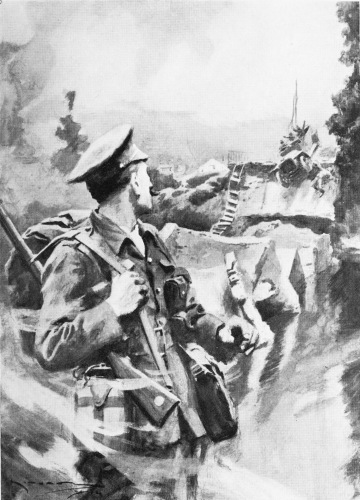 [To face p. 244.
“BEFORE THEY KNEW WHAT WAS HAPPENING THE CAR WAS IN THE RIVER.”
could signal to their gunners and give them the range.
Suddenly the aeroplanes dropped some balls of blue fire, and very pretty
the fireworks looked; but we hadn’t time to admire them, because the
German artillery instantly opened fire on us with such fury that we felt
the very ground shake as we lay in our trenches.
Under cover of their guns the Germans—the 32nd Infantry Brigade, I
think it was—dashed up to the other side of the canal bank and blazed
away at us; but we blazed harder at them. We gave them a fair hell of
rifle fire and very soon they were forced to clear out, leaving the
whole of the canal bank littered with their dead and wounded.
A fine little “tiffey” we had at the Marne was a rearguard action, in
which there was one of those British cavalry and infantry charges that
have shaken a lot of the Germans to pieces, especially the Uhlans, who
are a pretty poor crowd in spite of all their boasting.
Our scouts had returned with the news that the Germans were entrenched
about a mile and a half away, on the bank of the Marne. We got the order
to extend the usual three paces, and our advance guard went out, while
our main body lay down. Our advance guard had gone about 900 yards when
the German infantry opened fire. We took it up, and there was a
ceaseless rattle. We kept the Germans well employed, and our advance
guard were pouring in a proper good peppering. But there was a little
surprise in store for them. We had with us a couple of the magnificent
British cavalry regiments—the Scots Greys and the 16th Lancers, and
they swept on till they got to a little wood, where they had the
Germans on the left wing of their rearguard, fairly at their mercy. When
they were ready for the charge the signal was given to our advance
guard, and, with a perfect roar of cheering, the British cavalry and
infantry hurled themselves on the Germans, a tremendous weight of horse
and man. The Greys and the 16th fairly thundered over the earth, and the
Guards rushed up in splendid style, though we had our heavy packs, and
in such hot weather a big weight adds enormously to the terrific work of
charging. But you don’t think of heat or weight at such a time—you feel
only the thrill and excitement of the battle and have the joy of knowing
that you are settling the account of a suffering and outraged nation.
Cavalry and Guards got in amongst the Germans and fairly scattered them.
I got one German in the back and another sideways, and all around me
chums were doing the same, while the cavalry were cutting the Germans
down everywhere. Limbs literally flew about as they were lopped off with
the sword, and Germans in the open and in the trenches—for we routed
them out—fell to the bayonet.
That was a fierce and bloody “tiffey,” and there have been many like it.
At the end of it we had settled that particular German rearguard and had
a nice bag of prisoners. A lot of these prisoners were glad to be out of
the business; most of the Germans we captured seemed to feel like that,
and I remember hearing one of them—an officer—say, in good English,
“Thank God I’m caught! Now I shall not starve any more!”
Talking of charges, I might tell you that there is a great difference
between the British and the German ways of doing it. The Germans make as
much noise as possible—a perfect devil of a row, with drums thumping
and trumpets sounding, and, of course, their banners flying. We carry no
colours into action (we leave them at home), we have no drum-thumping
and no bugles sounding—often enough the signal for a charge is just
something like a hand wave or a word of command; but that answers all
practical purposes and starts us on the business as quickly and full of
fire as any amount of noise.
When we had got through our first rearguard action we thought we had
driven the Germans to the other side of the Marne and got them fairly on
the move back to Berlin; but to our surprise we were attacked by a
strong force of their cavalry, who had been in ambush not a thousand
yards away. The German horsemen came on us at a full gallop and swept on
until they were about two hundred yards away. At this particular spot
there were Guards, Worcesters, and Camerons, and it looked very much as
if the Germans would dash up and do a lot of mischief.
The commander of the Worcesters shouted, “Fix bayonets! Make sure of
your men.”
On came the German cavalry, with a roar and a rattle, until they were
less than a hundred yards away; then we let go and the troopers tumbled
out of their saddles like ninepins. The going was too hard for German
cavalry, and as one of their officers shouted an order, they wheeled
round and made off, rushing, as they supposed, for a safe place and a
way out; but they galloped straight up to a spot where some French
artillery were in position.
The Germans thundered on towards their fancied safety; then there were
crashes from the French artillery, and shells went plump into the
horsemen and practically annihilated them. Horses and men were
shattered, and of those who escaped the French took about one hundred
and fifty prisoners. It was a fine little performance, and helped us to
fix in our memories the first meeting with the Frenchmen on the Marne.
The artillery fire on the Marne was awful in its destructiveness and
earsplitting in its noise—sometimes the very air seemed to be solid
matter that was broken into chunks and knocked about you; but we soon
got used to it all, and laughed and smoked and joked in the trenches,
where, at the back, we had dug-outs which we called rabbit-hutches.
These were shelter-places, well covered at the top, and were most useful
protections against shells. When the enemy’s fire became too hot we
would go into our rabbit-hutches.
About noon on the 6th we had re-formed and advanced to the bank of the
river, and there we found that we were opposed to a large body of
Germans and that they had howitzer batteries with them. These howitzers
do deadly mischief, and the fumes from their lyddite shells are
perfectly poisonous—they spread through a good big patch of air and
suffocate the men. It was about four o’clock in the afternoon when the
Germans began to pour into us a fearful fire, and we were enfiladed; but
our trenches gave us some fine shelter, and the Germans did not have
their own way for long, nor did they do much damage at that point. Here
again the British had ready one more of the many surprises that the
Germans met with on the banks of the Marne. One of our batteries of
short howitzers, four guns, went along the river bank and hid in some
bushes on the right of the German howitzers, while a battery of our
field artillery dashed up and took a commanding position which got the
Germans between two fires. Then the command was given, “Ten rounds rapid
fire!”
But ten rounds were not needed—only four were fired before the German
battery was put to rest. But the crippling of the German howitzers did
not seem to have much effect on the enemy at that point, for they rushed
up more of the infantry, which, brought along by immense numbers of
trains and motors, literally swarmed over the countryside.
At this time we renewed our acquaintance with some of the Germans who
were known to us as the “drop-shots.” I believe there is only one
brigade of them in the German Army, and I will do them the justice to
say that they are very good at the game. They kneel down, and putting
the butt of the rifle on the thigh, fire in the air at an angle of about
forty-five degrees. The bullet makes a big arc and drops right on top of
you in such places as trenches. These “drop-shots” were about four
hundred yards away, but they hadn’t got just the right range of us and
the bullets plugged into the wrong places.
The “drop-shots” tried their queer game on us for about half an hour,
but finding that they could not damage us, they stopped, especially as
we were beginning to shift them out of their positions. There was some
furious rifle firing between the troops entrenched on both banks of the
Marne, and often enough the reddened water bore away many a dead
soldier.
The fighting was always most fierce when the Germans were in masses and
hurled their regiments against us in their attempt to hack their way
through to Paris. Any street fighting that came about was sure to be
terrific, and one of the most furious of the fights took place in the
streets of Coulommiers, a town similar to Reading.
Coulommiers, of course, was almost entirely given up to troops, for the
inhabitants had been warned by us to leave and get as far away from the
Germans as they could go. Poor souls, they did not need much persuading,
knowing what they did of German “culture,” and, carrying with them only
such few oddments as they could quickly collect, they fled, the roads
leading to Paris being thick with them. During this fighting in
Coulommiers there was such brilliant moonlight that you could see almost
well enough to shoot a rabbit.
It was about eight o’clock at night when we got to Coulommiers. We were
just going to stop to have some food when the Germans put two big shells
into us, killing four of our men, and wounding fourteen. We jumped up,
fixed bayonets, and rushed for the Germans; but we were brought up by
some more shells, and for a couple of hours the guns were banging at us.
Fortunately the shells had a bit too long a range, and instead of
hitting us they went over the back of us.
We lay down until ten o’clock, when the order was given to prepare to
charge. Up again we sprang—we were getting used to charging—and made
another rush, running as hard as we could down the street for a hundred
yards, then lying flat in the roadway.
All this time the Germans were pouring in on us a fire which, if it had
been accurate, would have swept us out of existence. But it was very
poor stuff, and we were lucky enough to escape with the loss of a very
few men. We were lying down for five minutes, then we were up and off
again, dashing along the main street.
It was a rousing bit of work, and we gloried in it, especially when,
from every doorway in the street, Germans dashed out and made a bolt for
their lives. They had been firing at us from bedroom windows, and tore
frantically downstairs and out of doorways when they saw that we were
fairly on the job and after them.
That bolting gave us just the chance we wanted. We drove after the
flying Germans as hard as we could go, and being big and powerful men,
with plenty of weight in us, we literally picked some of them up on the
bayonets. We rushed them through the town and out of it; then we came
across a gang of Germans who were no good at all. They had looted all
the wine-shops and soaked themselves with liquor. Many a German from
Mons to the Marne was drunk when he died or was made a prisoner.
When we had dashed through Coulommiers we had to halt, because the
Germans had four batteries of guns and a division of cavalry waiting for
us. So we retired to the cross-roads in the middle of the town, and had
to take up almost exactly the same position as we did at Landrecies,
where the Coldstreamers wiped out a strong German force in the street.
We waited at Coulommiers till our heavy howitzer batteries were fetched
up, then we lined the cross-roads, two howitzers were placed at the end
of each street and we were in at the finish of the fight.
It was about midnight when the Germans started shelling us again, and
the town blazed and boomed with the awful gunfire. We did not suffer
much damage, but the houses were wrecked, and bricks and stones and
pieces of timber were flying all about. A few of the bricks struck us,
but we paid no heed to trifles like that. The Germans kept up the firing
till about half-past two in the morning. Then, to our great surprise,
they charged down the street.
“Lie still, boys, and let them come!” our officers shouted.
We lay perfectly quiet, and let the Germans rush on till they were
almost upon us; then the sharp order came: “Ten rounds rapid fire!”
There was an absolute fusillade, and the ten rounds were fired in less
than a minute, and simply struck the Germans down. Their dead and
wounded were lying thick in the roadway and on the pavements when we
sprang up and were after the survivors with the bayonet. This time we
chased them up to the very muzzles of the guns, where we had a splendid
bit of luck. The German gunners flew when they saw us, and we were on
top of them and on top of the infantry. We dashed straight through the
batteries, the enemy flying before the bayonet, and there, in the
moonlight, which was almost as strong as daylight, I accounted for two
of them with my own steel.
For fully three miles that furious chase was kept up, the Germans flying
in all directions. It was a long and fierce fight in the moonlight, but
at the end of it Coulommiers was ours, and six batteries of German guns
and a thousand prisoners were ours, too, to say nothing of the killed
and wounded.
You might have thought that enough had been done, but we had scarcely
settled down to have a little drop of something hot to drink—and we
needed it badly—when the cry arose, “Come on, boys; let’s get after
them again!” We emptied our canteens, which were full of hot coffee and
rum, and were after the Germans again as hard as we could go. By
daylight we had put the finish on them at Coulommiers. We were well
pleased, too, with the fine haul of guns.
We had fought fiercely, and had not spared the Germans—no one could
have any mercy on them who saw the proofs, as we had seen them, of their
barbarities. When we advanced into Coulommiers we saw the bodies of two
little girls who had been murdered and mutilated in a shocking manner.
There were in that locality alone scores of such atrocities committed by
the brutes who came from the land of “culture” and are being driven back
to it.
I had a fair innings at the Marne, and saw a good deal of the beginning
of the fight which started the Germans on the run. I had two days and
nights of it; then I was bowled out by a piece of shell which struck me
on the thigh and went off with a piece of flesh. I felt as if a brick
had hit me, and when I saw the blood I thought it was all up with me.
The doctor told me that this might easily have happened if the wound had
been a little deeper. He was Lieutenant Huggin, of the Royal Army
Medical Corps, a kind and brave gentleman, who was soon afterwards
killed while doing his duty under fire. He was mentioned in despatches,
with other officers who did so much. I remember one of them, a field
officer of the Coldstreamers, during a very hot fight standing with his
hands in his pockets watching to see how things were going, and saying,
“Men, this is beautiful! We shall soon be on the other side of the
river.”
And we soon were—though to cross the Marne meant that we had at one
time to fight waist deep in its waters.
The Battle of the Marne was hard, long work, following a long and
terrible retreat; but it was a glorious victory. We had many privations,
but also many compensations, and we were always cheerful, and very often
singing. “Tipperary” was an easy first.
We often saw Sir John French and General Joffre, and I can tell you that
when our own great field-marshal appeared it was as good as a victory
for us, for we fairly worship him. Sir John is a thorough gentleman, and
the friend of every soldier. He used to come into the trenches with his
hands in his pockets and take no more notice of the German shells and
bullets which were bursting and flying about than if they were peas shot
by little boys.
One morning Sir John came round the trenches, and said, as usual, “Is
everything all right, men?”
“Well, sir,” he was told, “we want a drop of water, please.” And we did
want it, badly, because the weather was so fearfully hot, and we were
almost boiled in our uniforms and heavy kits.
“Certainly; I’ll see to that at once,” replied the field-marshal. He
immediately turned round, called to some men of the transport who were
at hand, and told them to bring us some water at once.
General Joffre, too, was a great favourite. He speaks English well. Once
when he came into the
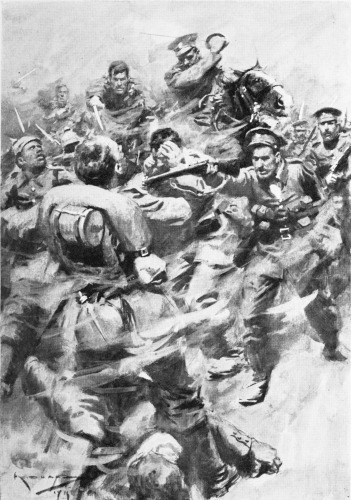 [To face p. 254.
“CAVALRY AND GUARDS GOT IN AMONGST THE GERMANS AND FAIRLY SCATTERED
THEM” (p. 246).
trenches he asked if there was anything we should like. Well, we wanted
some cigarettes badly, and told him so, and he promptly took a box of
about a hundred from his pocket, and handed them round. They went almost
as fast as the Germans.
I am now well enough to be back at the front, and I’m keen to get into
the firing line again, and rush along in some more bayonet charges—for
those are the swoops that roll the Germans up as much as anything we do.
I have been a Coldstreamer for more than a dozen years, and have always
been proud of it; but I never felt prouder than I do now, after reading
what our great chief has said about us in despatches.
We have sometimes been called feather-bed soldiers; but we’re known as
“Coldsteelers” now, and try to live up to the reputation of our
motto—“Second to none.”


