ENLISTMENT—DEPARTURE—THE VOYAGE—HATTERAS—UP
THE NEUSE—NEWBERN—AN ACCOUNT OF THE 17TH—ON
PICKET—DOING PROVOST DUTY IN NEWBERN, ETC.
It has been said that man is essentially a "fighting animal,"—that
in this "world's broad field of battle" his life, from the
cradle to the grave, is one continued struggle against want and
its attendant circumstances,—and that he is the greatest who,
be his position what it may, acts well his part. If this be true—and
I think it is—then the man who goes to the war only
exchanges one mode of strife for another—"the whips and
scorns of time," for interminable drilling, "hard tack and salt
horse,"—"the oppressor's wrong," for the hardships of the march
and the dangers of the battle,—"the proud man's contumely,"
for the murmurings at home that he does not "clean
out" the rebels in a week or two,—"the law's delay," for the
tedium of garrison and camp life,—"the insolence of office,"
for the rule (not always gentle or humane) of men placed over
him,—and the "bare bodkin," for the sword and the bayonet.
And yet—and yet—
"Ah me! what perils do environ
The man that meddles with cold iron!
What plaguy mischiefs and mishaps
Do dog him still with after claps!"
The severe checks and disasters experienced by the Union
arms in the Spring campaign of 1862, culminating in the "seven
days' fight" before Richmond, and the retreat of McClellan's
noble but suffering and crippled army to James river, while it
spread sorrow and mourning throughout the land, had the effect
of awakening those in power to a full sense of the nation's peril.
When the President called for more men, thereby giving effect
to the wishes of the loyal people, I was one of those who helped
to swell the volume of that mighty response which echoed back
from the hills and prairies, cities and villages, towns and hamlets:
"We are coming, father Abraham, three hundred thousand more!"
Like others, I had to mourn the loss of a friend,—a brave
young fellow, who was killed in the second of the "seven days'
fight," and determined to fill his place, if I could.
On the 4th of August, 1862, I entered my name as a "raw
recruit" for Co. F, 19th Mass. Reg't, as one of the quota of the
town of Malden. A friend, struck by my example, or, perhaps,
being in that state of mind which needs but little to turn one
way or the other, joined with me; but upon going to the office
in Boston where enlistments for the 19th were "done up," we
were told recruiting for it was stopped. How times have altered
since then,—now, I believe, it would take a battalion to fill it.
We were in a fix (at least I was, who wished to go in the 19th),
but there was a remedy at hand. A recruiting officer for the
17th, who had an office in Union street, received us willingly,
and after being examined and sworn in, we were packed off,
with some twenty other recruits, to Camp Cameron in North
Cambridge. It was late in the evening when we arrived there,
and no preparation being made for us—owing, I suppose, to the
constant and rapid influx of recruits, which taxed to their utmost
the various departments to fit out and provide for,—we had to
turn in, supperless, to a bunk of downy boards, with no covering
but our thin citizens' summer clothes. I thought it was a very
uncomfortable resting place at the time, but it was nothing to
what I have since known in the way of sleeping accommodation.
The next morning I had leisure to look around me and take a
survey of the mass of human nature that there commingled for
the first time. And truly it was a heterogeneous compound of
representatives of nearly every race of people in Europe, and
plentifully sprinkled among them was the leaven of the whole—smart,
shrewd, intelligent, quick-eyed and quick-witted Americans.
And such a confusing babble as prevailed I never heard
before. Wrangling and swearing, drinking and eating, talking
and laughing,—all combined to give me no very agreeable foretaste
of what I had to expect in my new vocation. I noticed
others, new, like myself, to such scenes, who seemed mentally
dumbfounded, or unconsciously comparing the quiet routine of
the life they led at home to the new one they had assumed, and,
no doubt, to the great advantage of the former and dislike for
the latter. But happily for us all, being the creatures of circumstances,
the pliability of our natures leads us to be quickly
reconciled to our lot, whatever it may be. The change of life
from a citizen to that of a soldier is so radical that few like it at
first; but by degrees it becomes endurable, and finally, often,
desirable. The recent re-enlistments prove this.
There were several "characters" among the recruits in camp,
to whom, if I could, I would devote a few pages, as well as to
management of the camp and the method of dovetailing a little
innocent private business into that of the public, as practiced by
some of the little-great men in authority there; but as paper
costs 22 cents per pound, I am warned that I must leave out
here and condense there, which is not so pleasant after all.
Men were arriving every day in squads of from twenty to
fifty, and leaving at intervals in detachments of from 100 to 500,
to be distributed among their respective regiments at the seat of
war. At length our turn came. It was on a Friday.—Now,
Friday, though generally considered by superstitious persons an
unlucky day, has often proved a lucky one for me. I was born
on Friday; was married on Friday; and now I started to go to
the war on Friday. I shouldn't wonder if on some Friday in
the future I would die—and that will be another great event in
my life. Well, we started on a Friday afternoon, and taking
the cars at the Old Colony depot in Boston and the boat at Fall
River, found ourselves next morning in the city of New York.
We were quartered in barracks on White street, furnished with
filthy beds, miserable "grub," and allowed free range of the city.
A lieutenant (from Haverhill, I believe) had charge of our
squad, which numbered about a hundred, and some of his enthusiastic
admirers in the crowd presented him with a sword.
There was, of course, a presentation speech, enthusiastic,
pathetic, patriotic and warlike, and a response suitable and
sentimental. It made a good impression on me at the time; but
then I had yet to learn the difference between what an Indian
would call "talk fight" and "fightem."
On the following Monday afternoon, with all "traps" snugly
bestowed and knapsacks strapped on, we were drawn up in
front of the barracks, when the lieutenant stepped out in front
and proposed three cheers for the barrack-master, which were
given; but I did not join in, even in dumb show, having too
much conscientiousness to outrage the finer feelings of my stomach
by cheering for an individual who had cheated and abused it.
We then took up our line of march for the transport, and went
along almost unnoticed save by a few patriotic individuals who
bade us a fervent God-speed and wished that good-fortune might
attend us wherever we went; but the great mass seemed hardened
to the sight of their fellow men going away from amongst
them to explore unknown fields of danger, and to purchase with
their life's blood a continuance and perpetuity of that nationality
which has made the United States of America the first among
nations. As these thoughts entered my mind, they suggested
the picture of the hundreds of thousands of devoted men who
passed through this great city, with all their hardest and most
bitter experiences—hardships and dangers, sickness and death—before
them, many, very many of them to return again no
more; and I began to realize that, though still in a land of peace
and plenty, a few days would bring me out upon far different
scenes and into circumstances that would require a bold heart
to meet as they ought to be met. Luckily for us all, the future
cannot be penetrated, or we should be mourning calamities
before they befall us; dreading dangers before they threaten,
and finally become unmanned at the awful prospect impending
over our future. Still there is in the expectancy of danger
something that is fascinating, and something, too, that even
while we dread we seek; and this feeling, the result of a strange
curiosity, enlivened by hope and the love of excitement, is what
often keeps up the spirit of the soldier and urges him on, even
when worn out with fatigue and well-nigh exhausted, to renewed
energy and more determined acts of bravery.
The transport we embarked upon was a dilapidated steamer
called the "Haze" (who that ever took passage in her to or from
Dixie can forget the old tub?), a miserably appointed vessel,
whose officers and crew seemed better fitted for the penitentiary
than for the station they held. It was in this vessel that
I first learnt some of the hardships and inconveniences of a
soldier's life. Just before the hawser was cast off, an Irish
apple-woman came on board, her basket well laden with fruit,
and said—"Come, me poor boys; it's not many of these ye'll get
in the place ye're goin' to—so help yerselves! 'Tis all I have to
give ye, except me blessin'—and may God bless ye all, and
bring ye safe back agin to the frinds ye have at home!"
She then proceeded to distribute the apples (and fine ones
they were) to the boys, many of whom, thinking more of the
apples than the blessing, rushed eagerly in saying, "bully for
you, old lady!" nearly overturning her in their desire to possess
as much of the fruit as possible. As for me, I was content to
let them have the fruit—the blessing and good wishes of the
warm-hearted old woman was all-sufficient for my desires. She
stepped ashore, and as she disappeared in the crowd on the
pier, I heard one of the lucky ones, who was luxuriating in the
fruits of his scramble, remark to another lucky one,—"D—d
good apples!—that's a bully old woman,—how did you like her
malediction?" "Big thing," was the response.
The hawser was finally cast off, and, backing slowly out of
the dock, the steamer was soon under full headway down the
bay. What my emotions were as I gazed (perhaps) for the last
time upon the surrounding scenes, I will not tire the reader by
giving expression to,—doubtless they resembled in a manner
those of thousands of others who had gone the same road before
me. My comrades, however, as a general thing, were merry,
and talked of the promised land (Dixie) in a tone that showed
how high their hopes ran; but presently, as we passed Sandy
Hook, and the regular and continuous swell of the ocean set in,
many who were before lively as kittens became tame and
wretched-looking enough. It was dark before we passed the
Highlands, and, though we could not see the Jersey shore we
heard of it from the breakers, here and there catching glimpses
of lights which told us that even among its barren sands many
had found homes. But let Jersey pass, and Delaware, and
Virginia's eastern shore—"away, away down South in Dixie"
we go. But how few, comparatively, of our detachment were
now so eager, after encountering one enemy, to meet another?
And yet, I verily believe, many of these poor fellows would
prefer at that time to run their chances in battle (if only on the
land) than be tossed about at the mercy of the waves and so
thoroughly sea-sick. As for me, whose somewhat eventful life
had often before sent me "down to the sea in ships," I had no
feelings of nausea, and consequently enjoyed the surroundings,
the fresh, bracing sea air seeming to instil new vigor into my
frame, which twenty years of toil in a printing office (with short
intermissions) had tended to impair. Thus situated I could
look about me, and I observed some who were formerly the
jolliest of our band now the saddest and most forlorn. One in
particular (a fine young fellow, whom we dubbed "the colonel")
who had been the life of our party, now, pale and sad, with not
a word to say, lay doubled up inside the coils of a hawser, as
forlorn as the Wandering Jew (by Eugene Sue). It was no
more, with him, "Away daown Saouth in a few days—hooray!"
We passed the Chesapeake, (Fortress Monroe,) Cape Henry
and the dismal coast beyond, and on the third evening neared
land to the north of Cape Hatteras.—But such land! A long,
low bar of sand, stretching away as far as the eye could reach,
relieved at intervals by huge hummocks covered with a stunted
growth of trees, whose ragged and forlorn limbs and inclined
position made them appear as if a fierce hurricane all the while
tore through their branches, threatening to uproot and cast them
away forever. "There," said I to the 'colonel,' who had come
upon deck when he heard we were near Hatteras, and stood
beside me grasping the rail,—"There is Dixie, my jolly 'colonel.'
We have come 'away daown Saouth in a few days,' haven't we;
and how do you like the lay of the land? What—can't you
even say 'hooray?'" But only a faint smile was the answer.
Shortly after dark we descried Hatteras light, which we neared
about ten o'clock; but the captain would not venture in, and so
we had to lay "off and on" till daylight, which was no pleasant
job, for "the wind rose and the rain fell," and gave those who
selected the deck for their sleeping place (myself among the
number), with the assistance of an occasional dash of salt water,
a pretty thorough soaking. As soon as it was clear day our
craft headed for the "swash," the wind blowing a small gale, the
rain coming in squalls as if some fretful genius presided over
this unhappy coast, and the waves running in shore like race-horses,
spreading their foam in a thin gray mist over the narrow
line of sand, which seemed endeavoring almost in vain to keep
its back above the water. To our right, and north of the inlet,
were the forts taken by Gen. Butler in his first Coast Expedition.
Only one of these, Fort Hatteras, is now used. The other has
either sunk into the sand or been almost wholly destroyed by
the action of the waves. Fort Hatteras is an earthwork, but so
admirably situated as to prove an almost impassible barrier to
anything but ironclads. Beyond and around the fort on the
land or sand side, were a few buildings used for quarters for the
garrison and for ordnance stores. Anchored in the Sound,
near by, were supply ships, transports, and old hulks; while
here and there rows of disconsolate timbers, lifting their dripping
heads above the tide, told the fate of many a noble ship of the
glorious Expedition of Gen. Burnside. We "hove to" after
entering the Sound to deliver the mails for the Fort; and the
change from the violent rolling, tossing and pitching was such
as to inspire even my old friend the 'colonel' with something
of the spirit he was wont to display ere old Neptune changed
his tune. After taking a look at the Fort and its surroundings,
I turned my eyes to the opposite shore of the inlet, when lo,
there stretched out in an almost straight line from the point into
the Sound a troop or flock of—what? That was the puzzle
to my mind. Were they huge gulls or windbags, cormorants
or cranes, devils or dogfish? Fowl, flesh, or fish? I watched
them with close attention while asking myself these questions;
but ere my cogitations were finished they separated, spread
their wings and took flight, apparently, but it seemed strange
they did not rise from the surface of the water. They neared
us presently, and I made them out to be, instead of birds, small
sail-boats. "Love launched a fairy boat," &c. No love for us
there, I guess, was my mental comment. "Pilots," I heard some
one say. They came fluking towards us, their comparatively
large sprit-sails hurrying them along at no contemptible rate of
speed. There were about fifteen of them, and it seemed evident
all could not get a job from our hazy skipper. "That's Jeff.'s
navy," remarked one.
"Hooray for the boat that's ahead!" sang out the 'colonel.'
"Bully for the little fellow with the big sail!" exclaimed
another.
"I'll bet on the cross-gaffed, giraffe-colored one!"
"Bully for the rip-staving roarer that wins!"
"Aint she a-ripping up the old salt water canvas, skearing
the sharks and astonishing the sea sarpints?"
"I'll bet Jeff.'s in that boat, and he's coming to ask us to dine
with him in Richmond!"
"Beauregard's in the second one!"
"No, sir, that's Stonewall Jackson!"
"D—n Stonewall Jackson, or any other man!" and remarks
of a like character attested the interest felt in this novel contest
by others as well as myself. The boats were pelting away in
fine style, each having a loose rein. Then hurrah, my hearties!
the lucky man wins, and "first come first served!" Two of the
number were distinctly ahead of all the rest, and one of these
slightly ahead of the other.
"But Cutty Sark, before the rest,
Hard upon noble Maggie prest—"
so that when they came up it was difficult to say which was first,
and both came aboard to dispute the point, while the remaining
unsuccessful ones kept on, as if philosophically resigned to a fate
they could not overcome. Our hazy skipper, who was not very
particular about expenses when Uncle Sam had to foot the bills,
and to end all disputes, took both pilots—a piece of diplomacy I
hardly expected his thick head capable of conceiving. The
anchor was hoisted, and away we sped over the dark, swampy
waters of Pamlico Sound. Roanoke Island lay to our right, and
ever and anon we caught glimpses of the low, swampy lands of
Hyde and Plymouth counties. To the left or south we beheld
a continuation of islands, and shortly after the main land of
Cartaret county became visible. It seemed almost wholly
unsettled, the wilderness appearance being only here and there
relieved by the small clearing of a turpentine plantation, fishing
establishment, or the twenty-acre field of a "poor white."
We soon made Neuse river—a noble stream, upon the banks
of which turpentine, pitch, rosin and tar enough might be made
to supply the markets of the North. As we ascended the
river the signs of habitation became more numerous although
seeming "few and far between" to the eye accustomed to the
more frequent settlements on Northern rivers, and the sombre
hues of the pine, cedar and cypress forests were occasionally
enlivened by the brighter foliage of persimmon, walnut and fig
trees, the last flourishing here in great luxuriance, bearing two
or rather a continuation of crops of delicious fruit in a season,
and may be seen on every farm or plantation in patches of from
a few trees to orchards of twenty-five acres in extent. We
could also trace the courses of the many "branches" or creeks
from the lighter foliage of the gum and other water-loving
trees.
In the afternoon we passed Slocum's Creek, where Burnside
landed his troops the evening before the battle of Newbern, and
soon the spires of this city, and the shipping, hove in sight; and
towards the close of the day, after a sail of ten hours, during
which time we steamed eighty or ninety miles, we drew up at
the pier and prepared to disembark, thankful that we could
again set foot on land and leave forever the accursed "Haze" and
her brutal captain and crew.
"Mind, I tell you," said one of the latter, "bad as you think
the old 'Haze' is, you will before long be glad to be on board of
her again—if you'd be let!"
He was laughed at; but I doubt not many of them, ere six
months elapsed, wished themselves anywhere else than where
they were. Still they could not see it then, but felt happy, like
young bears, with all their troubles before them.
The dilapidated and seedy condition of the wharves, and the
ruins of houses, mills and turpentine factories, impressed me
with a premonition of what I should yet witness of the ravages
of war in this fair land.
The city of Newbern bears the appearance of some age, is
regularly laid out, the streets intersecting each other at right
angles, and well protected from the merciless heat of summer
by fine old elm trees, intermixed here and there with the chaney
and other trees the names of which I do not recollect. The city
is located at a point of land formed by the junction of the Trent
river with the Neuse, and has altogether an imposing appearance
viewed from the approach by water.
The Mass. 23d Reg't, Col. Kurtz, (who was provost marshal,)
was then doing provost duty in the city.
When the order for landing was given, each scrambled ashore
with the whole of his household furniture upon his back. After
passing through a part of the city, we struck the railroad bridge,
(destroyed by the rebels after their defeat, but rebuilt by our
forces,) crossing which, and marching a mile or two, halted at
the encampment of the 17th on the Trent river, where we were
welcomed by the men of the various companies, many of whom
found friends and acquaintances among the 'raw recruits.' My
comrade had friends in the Malden Company (K), of which we
were henceforth to form a part, and we received a hearty welcome
from the members of mess 5, some of the good-natured ones
of which taxed themselves to the amount of nearly a dollar to
procure from the sutler something more palatable for our first
meal than 'hard tack and salt horse.'
After 'taps' the lights were put out, and we disposed ourselves
upon the tent-floor to sleep, in the manner of spokes of a cart-wheel,
our feet toward the hub, which consisted of the gun-rack
around the tent-pole, there to revolve in the circle of dreams of
home and friends far distant. Before closing our eyes, however,
and while inquiries were plied and answered thick and fast, one
of the mess startled the newcomers by exclaiming—
"A rat! A rat! I have him!"
"Pass him around!" was the general cry.
"Now I've got him!" another exclaimed. This was followed
by a gurgling noise, as in the first instance.
The 'rat' came nearer, and presently I smelt him. There
was no mistaking that 'rat,'—he came from Jersey and was
surnamed 'lightning,' and cost the fourth part of a soldier's pay
for one month. Being eagerly pressed to taste him, I did taste,
but that was all—the smell was enough, and I passed him over
to the next man.
Sleep at length overcome me, and I dreamed of rats made
of glass, squealing "Jersey lightning! Jersey lightning!" until
morning, when I awoke to find myself surrounded by comrades
busy eating breakfast. Beside me stood a dipper of smoking
hot coffee, some hard bread and salt beef, provided by one of
the most thoughtful of my new friends.
After guard-mounting (9 A.M.) the recruits were drawn up
in line, assigned to the various companies, examined by the
surgeon, and, after a few words of encouragement or advice
from their captains (and mayhap a glass of whisky), returned to
their quarters, feeling relieved, no doubt, that the affair was
over.
Thus, in the course of about an hour, the recruits were
disposed of, and duly incorporated with the regiment—to share
in its messes and marches, its skirmishes and scratches, its picket
duty and plunder, its whisky and quinine, its tents and hospitals,
its hard tack and salt horse, its pea soup and pea coffee, its
baked beans without brown bread, its pride and its perils, its
glory and its graveyards.
The following is a list of the principal staff and line officers
of the 17th, the companies and where they were raised, together
with an account—taken from a diary or journal of Mr. Wm.
Noble, of Saugus, (the first color sergeant)—of the doings of the
regiment from its inception down to the 5th of January, 1862:
Colonel—Thomas I. C. Amory.
[Mr. Amory was born in Boston, Nov. 27, 1828; entered
West Point in 1846, and graduated in 1851, when he was appointed
2d lieutenant in the 7th Infantry, ordered to Fort Smith
in Arkansas, and was promoted 1st lieutenant in 1855. In 1858
he was ordered to Utah, under the command of the late Gen.
Albert Sidney Johnson, who joined the rebels at the outbreak
of the Southern rebellion and was killed at Shiloh; was ordered
to Boston on recruiting service in 1860, and was promoted to a
captaincy May 7, 1861. When the war broke out, he obtained
leave of absence from the War Department, and accepted a
commission from Gov. Andrew as Colonel of the 17th Mass.
Vols., on Sept. 7th, 1861. Since the regiment has been in the
Department of North Carolina, he has acted as General of
Brigade; but whether his nomination for the brigadiership has
been confirmed or not, I am unable to say. Of this I am certain,
however, that there are few officers at this time serving in
our armies better capable of wearing the star or more fully deserving
of it than Thomas I. C. Amory.]
Lieut. Colonel—John F. Fellows.
[Mr. Fellows, of Chelsea, is well known in Boston, having
been for many years connected with its daily press. He was
also an active member of the State Militia. When the war
broke out he offered his services to Gov. Andrew, from whom
he received a commission as Lieut. Colonel of the 17th Reg't on
the 21st of August, 1861. He has proved himself a capable
officer and a thoroughly brave man. I shall have frequent
occasion to speak of him hereafter.]
Major—Jones Frankle. (Now, Luther Day.)
[Mr. Frankle is a Prussian by birth, and served in the war
of 1848 in Germany, at which time he did not "fight mit Sigel,"
but against him. He received his commission as Major of the
17th on the 1st of August, 1861; and proved himself a capable
and efficient officer. In June, 1863, he resigned his commission
in the 17th for the purpose of raising an artillery regiment (the
2d Mass. Heavy Artillery) which he now commands, and which
is doing duty in the field and in forts in the various parts of
North Carolina held by our forces. He was succeeded by senior
captain (Co. F) Luther Day, of Haverhill, a very good officer.]
Adjutant—B. N. Mann. (Now, H. A. Cheever.)
[Mr. Mann was, I believe, for many years connected with the
Boston Post Office. He is a brave man, and generous as he is
brave. He was succeeded by Mr. Cheever in the Fall of '62.]
Quartermaster—Capt. Harris was commissioned Quartermaster
of the 17th; but resigned in the Fall of '61, and was succeeded
by Lieut, (afterwards Capt.) Thompson, who died at
Newbern in October, '62. Lieut. Dexter succeeded, and is
the present incumbent.
Surgeon—Isaac F. Galloupe.
[Dr. Galloupe is a hard-working, skillful, efficient and humane
man, and discharges his duty in a manner that commands the
respect and gratitude of every man who comes under his treatment.
The Dr. is from Lynn.]
Assistant Surgeon—Wm. H. W. Hinds, of Boston.
[The men have no exalted opinion of this Dr.'s kindness or
capacity, though he seems attentive and a hard worker. Perhaps
his unpopularity arises from the fact that he unmercifully
doses all whom he considers 'bummers' (i. e., those who are too
lazy to do duty and 'play sick' to escape its performance) with
salts, jalap, blue pills, and especially quinine; but I think he
often punishes in this manner the deserving as well as the guilty.]
Co. A—Capt. Henry Splaine, of Haverhill—was raised principally
in Newburyport.
Co. B—Capt Enoch F. Tompkins, of Haverhill (vice Capt.
S. C. Bancroft, S. Danvers, resigned)—South Danvers.
Co. C—Capt. Nehemiah P. Fuller—Danvers.
Co. D—Capt. Ivory N. Richardson, of Malden (Capt. Levi
Thompson, of Cambridge, deceased)—Salisbury and Amesbury.
Co. E—Capt. Michael McNamara, of Haverhill—Stoneham
and Haverhill.
Co. F—Capt. Day (now Major)—Haverhill.
Co. G—Capt. G. W. Kenney, of Danvers—Rockport and
Salem.
Co. H—Capt. J. K. Lloyd—Boston and Fall River.
Co. I—Capt. Wm. W. Smith, of Danvers (vice Capt. Thos.
Weir)—Lawrence.
Co. K—Capt. Joseph R. Simonds, of Melrose—Malden,
Medford and Saugus.
"Recruiting for this regiment commenced as early as the fall
of Fort Sumter, but owing to the embarrassed condition of the
State, the hesitation of the General Government in regard to
accepting troops, and the want of authority on the part of the
Governor to act, this regiment was obliged to wait from week
to week without any decisive answer as to the intention of the
Government, concerning its organization. The companies were
formed on the militia basis, and were desirous of a regimental
organization, and to be mustered into the service, but every
effort which the company officers made in that direction, seemed
to be counteracted by the dominant political and monied influence
which was brought to bear in favor of other regimental
organizations, to the disparagement and detriment of the companies
comprising the 17th. While others were splendidly
provided for by private munificence, and hurried off to the seat
of war, this regiment was unprovided by the State with an
organization, clothing, arms, equipments or rations. An opinion
prevailed at one time, that all idea of a regimental organization
must be given up, and the companies enter the United States
service, through some other State organization. Captains
Fuller of Danvers, and Day of Haverhill, determined on bringing
the matter to a focus.
"They visited the Governor, and after several ineffectual
efforts to get an audience, at length succeeded, and informed
His Excellency that they were going into the army, and should
take their commands with them; that they wanted to go in a
Massachusetts Regiment, and unless accepted by the State,
should go into the Mozart Regiment of New York, as one or
two other companies from Massachusetts had already done.
Orders were given them by the Governor to go into the camp
at Lynnfield. The other companies of which this regiment is
composed, were ordered to the same place, and all arrived there
between the 10th and 12th of July. They were mustered into
the United States service on the 22d, remained in camp until
the 23d of August, when they were ordered to Baltimore, and
arrived in that city on the 25th, at 4 o'clock P.M. The principal
duty of the regiment thus far, had been of a police character,
and it was moved about either as a whole or a part, from one
portion of the city to another, as circumstances required.
"Nov. 15, Co.'s F, K, E, G, H, and C, with Captain Nims'
Battery, were detailed to form a part of the brigade under command
of General Lockwood, for an expedition into the counties
of Accomac and Northampton, Va., for the purpose of breaking
up a rebel force concentrating there. The expedition went
on board a steam transport, and on the 17th arrived at Newtown.
Here they pitched their tents for the night, and the next
day marched a distance of sixteen miles into the country. The
rebels had felled trees across the roads in many places to obstruct
the advance of the troops, but they were cleared away
with but little delay. One deserted rebel battery, pierced for
four guns, was found on this day's march.
"On the 19th, the regiment reached Oak Hall, and on the 20th
the men went out fowling, and were very successful, taking a
large amount of game, which was dressed and partaken of by
the men with double relish, as they were on short rations of
hard bread and salt junk, and were much exhausted by the
fatigues of their march. On the 21st marched to Drummondtown,
a distance of twenty-seven miles, performing the journey
in eight hours, notwithstanding the many obstructions thrown
across the road by the rebels, and the burned bridges which
required them to march round, following the bend of the
streams. On this march, between Oak Hall and Drummondtown,
another rebel battery was discovered, pierced for fourteen
guns. The stars and stripes were at once raised over it, and three
rousing cheers given.
"November 23, took from the rebels seven guns, 150 small
arms, one barrel of powder, besides some swords, shot and shell.
At the jail were stored 8,000 rounds of cartridges and 200
small arms, which were also taken. Two gun-carriages and
one brass howitzer were also found secreted in the woods, and
captured. On the 26th, marched to Pongoteague, a distance of
twelve miles, and found another deserted battery.
"November 27th, marched from Pongoteague to Franktown, a
distance of twelve miles; and on the 28th, marched to Eastville,
thirteen miles, taking on the way one brass cannon, seven
horses, some small arms and swords, besides several other articles
contraband of war. The rebels had an unfinished earthwork
here which they deserted on the approach of the Federal
troops.
"A very large proportion of the arms and military stores captured
were returned by Gen. Lockwood to the parties claiming
them, creating great dissatisfaction among the troops, and
rendering the General liable to the suspicion that he sympathized
with the rebels.
"The object of the expedition having been attained, the
brigade was broken up, and the Mass. 17th embarked at Cherrystone
on the 1st and 2d of Dec., and sailed on the 4th for
Baltimore, where they arrived the same evening, and went into
their old quarters. On the 18th they commenced building barracks
[on Stewart's Place] for winter quarters and moved into
them on the 5th of January." (These barracks are still standing,
and used as a general hospital.)
In February Co.'s F and H relieved the 6th Michigan at
McKim's Place, and K and G the 4th Wisconsin at Patterson's
Park, those regt's being destined to form part of Gen. Butler's
force then about to sail for New Orleans. On the 14th of
March four other Co.'s of the 17th were ordered to Fort Marshall,
East Baltimore, to assist in defending that fortification
from an attack by rebel sympathizers, who, emboldened by the
destructive raid of the Merrimac in Hampton Roads, meditated
a rising in Baltimore, if not throughout the State.
When the 17th arrived in Baltimore they found the people
of that city nearly all 'secesh' in sentiment, and seeming only
constrained from rising by the presence in, and passage through,
the city, of large numbers of troops. It will then be readily
inferred that the men of this regiment had no very enviable
task to perform in endeavoring to keep the peace and making
these disaffected people see the evil of their ways. In doing
this, however, they were not fools enough to use moral suasion
alone—that would be casting pearls before swine—No; they
used arguments that were far more convincing, such as street
drills, practicing at street firing, &c., all of which turned the
hate of the 'secesh' citizens into fear—and, finally, their fear
became a feeling of respect. What if the men were insulted
every time they walked the streets—the women (who were the
most outspoken) at length became weary of abusing them, and
the men who attempted to insult them never tried that game a
second time; for they found in the men of this regiment a spirit
that would brook no abuse—an indomitable, dare-devil disposition
that met them half way with a bowie knife as long and as
keen as their own, and a pistol as deadly. Thus they fought
their way to respect, and this latter feeling ripened into affection,
which is shown by the fact that when the regiment was
about to sail for North Carolina, the ladies of Baltimore presented
it with a magnificent silk flag, upon which was painted
a fine portrait of Washington.
On the 27th of March, '62, the regiment embarked at Baltimore
for Newbern, North Carolina, which place they reached
on the 1st of April, and encamped on a field to the west of the
city,—near where Fort Totten now stands, and which was
then in process of construction. On the 7th of April the regiment
was ordered out on picket duty—the left wing to Jackson's
place on the Trent road, and the right wing to a place
called the Red House on the Neuse road, relieving the 24th and
27th Mass. regt's. The regiment remained on picket until the
30th May, during which time they had frequent skirmishes with
the enemy, and made several raids and forays into the enemy's
country. Shortly after the regiment went to Jackson's place, a
few companies made a dash about nine miles up the Trent road
to a church, where they had a smart brush with the 'rebs,' two
of whom were killed and one wounded, and one taken prisoner.
It was here that one of those ludicrous incidents occurred which
often serve to relieve the dark outline of war's grim visage.
When the enemy were come up with, and firing became frequent,
Lt. Col. Fellows ordered the men to open right and left
to let the artillery pass to the front. One of the captains, mistaking
the full purport of the order, and thinking the ranks were
to be opened to allow the rebels a fair field and an open road to
come into close quarters with his men, sang out:
"Open right and left, and let the d—d scallywags through!"
Captain Weir, of Co. I, with his command, and as many
volunteers as wished to accompany them, made a raid to Pollockville
to capture cotton, and anything else that might prove
of value to the "rebs" in their belligerent character. Now, as
this was not the first time Tom Weir (as he was familiarly
called) had invaded the sanctity of that village, the rebs had a
special eye to his movements, and lay in wait for him.
He had a mule team loaded with cotton, corn and other
plunder preceding him on his return, which the rebs in ambush
allowed to pass; but just as the company got opposite to where
they were concealed, they poured in a volley which killed three
and wounded the same number—and put the men into such a
panic that they fled. The captain stood, and endeavored to
rally them, but to no purpose, and he had to follow and leave
those who had fallen to their fate (which was being stripped of
arms, equipments, clothes, and whatever valuables they had
upon them), until rescued by the reinforcement which came up
promptly—to find the rebels flown. For this Captain Weir
was court-martialed, and dismissed the service—a sentence
which was universally condemned by the men, who considered
him a brave officer, having done all a man could do under the circumstances.
Captain Lloyd of Company H, next tried his hand in
Pollocksville, but lost three men by the upsetting of a boat in
the Trent river on his outward march. He, however, took
some plunder and two prisoners.
The results of all these scouts and forays were the capture
of several thousand dollars' worth of cotton, corn, cattle, hens,
&c., (there must have been foul play somewhere).
The regiment returned to Newbern on the 30th of May,
and on the 26th of June were ordered to Swift Creek—upon
approaching the bridge leading across which they were
fired upon by the rebels (without sustaining any damage) who
had a battery masked by a breastwork or fort of shingles. The
17th charged across the bridge in fine style (the bridge was
a lightly built one, and swayed and shook under the combined
weight of 600 men in such a manner as to lead to the belief
that it would break down, but it didn't); but upon crossing they
found the enemy had flown. Three companies went up the
road in pursuit some distance, but the 'rebs' were nowhere to
be found. They halted near a dwelling house, when some of
the men went into an adjoining negro hut, where a pot of meat
and cabbage was in process of being cooked, which they proceeded
to confiscate; but just as they had commenced their
feast an officer came up and drove them off, saying:
"Dum thee, did thee coom here to ploonder."
At the same time, it was asserted, though I don't believe it,
that the officer who thus drove them from the feast had his pockets
filled with sweet potatoes and other "ploonder." Three
prisoners were taken. One of them a lad about 16 years
old, was thus interrogated by the Major:
"Vat for you be guerilla for?"
"I'm not a guerilla, sir; I'm in the regular Confederate
service."
"Vat for you lay in ambush, den?"
"I didn't lay in any bush, sir; I was standing behind a tree."
"Ha! You be von rascally guerilla, and we vill shtring you
up to a tree, ven we arrive in Newbern!"
But it is needless to say this threat was not carried out.
The reg't here received orders to rejoin the division (the 9th
army corps) which was about to leave the Department with
Gen. Burnside, and started of a Sunday morning 28th (without
breakfast) on their return. The weather was intensely hot, and
the sand on the road was ankle deep. The case, however, was
pressing, and the men were urged to their utmost; but the task
was too much for them,—and when the reg't arrived at the
landing about 4 P.M., after a march of 22 miles, it numbered
little more than a full company—the remaining 400 or 500
being distributed along the road for miles back. They, however,
kept coming in squads of from two to twenty during the
remaining part of the afternoon and evening—and a more tired
and thoroughly used up lot of men it would be difficult to find
anywhere. To make matters worse, when the reg't arrived at
the landing opposite Newbern, they found no transportation for
them, and nothing wherewith to satisfy the cravings of hunger.
It was not until about 12 o'clock at night that they received a
ration of hard bread and salt meat; but no vessels arrived to
transport them across, and they were forced to lay out upon the
sandy beach, without shelter, in a pelting, pitiless rain, which
had set in early in the evening. Next morning a couple of
scows or flat-boats arrived, and they were taken across; but
Gen. Burnside pitying their forlorn and used up condition, and
thinking it would be an act of cruelty to put men in such a state
on board transports, ordered the 6th New Hampshire reg't to
take their place. Thus the Seventeenth were cheated by fate
out of their share of the glory of South Mountain, Antietam,
Bull Run 2d, Fredericksburg, Chancellorsville, and Knoxville;
and were compelled to silently and doggedly face and fight
the most deadly of human foes in its own malarial fens and
swamps.
About the first of July the reg't was ordered to camp on the
south side of the Trent river near the county bridge, to do
picket and outpost duty, which consisted of sending a company
to Bray's Ferry and plantation about three miles out, and
another to Evans' Mills—seven miles down the railroad towards
Beaufort.
About July 25th the regiment went in an expedition to Pollocksville,
and constructed a bridge across the Trent river for
the entire column to cross upon, after reaching which place,
Col. Amory, who was in command, decided to push on to Trenton;
but upon approaching to within four miles of the latter
place he found the enemy too strong, and withdrew without
bringing on an engagement.
August 20th, six companies of the 17th went to Swift Creek,
again, accompanied by a section of the New York Marine Artillery
and four boat howitzers. Lt. Col. Fellows, who was in
command of the expedition, having missed the boat that conveyed
the reg't and artillery across the river, the command
devolved upon the Major, who marched them about a mile from
the landing, and halted to await the Colonel's coming. The
column halted opposite a dwelling, and, as is often the case
under like circumstances, there was a rush for the well to fill
canteens. Two of the men, however, strayed into a field and
were making a flank movement upon a pile of tumble-down log
outbuildings, supposed to abound in hens, chickens, eggs, &c.
One of these men, a very tall and large specimen of humanity
was named Gilman; the other was a small man, and, for my
purpose, nameless. The vigilant Major detected this unauthorized
flanking affair, and, being determined to put a stop to all such
unmilitary proceedings, sung out:
"Vat for you shtray off dat way? Come back, I say to you!
Dou-bel twit!" (quick)
The little man obeyed, and came back at a dog-trot. Gilman,
however, hastened back slowly—at much too slow a gait to suit
his impatient superior, who yelled out again:
"Dou-bel twit!—I say—dou-bel TWIT!"
But no faster came Gilman on, and the Major (who was a
little man) rushed to him, and seizing him by the coat collar as
he was crossing a fence, dragged him over,—then, drawing his
sword and flourishing it about the head of the still doggedly
defiant Gilman, exclaimed:
"You tink, because I am small, I'm be afraid of you? I will
let you know! Dou-bel twit! now, or I will make two Gilman
of you!"
There was a man called Tom Croke in Co. E—an extremely
hard ticket—quarrelsome, venomous, and altogether thoroughly
depraved. He had been a source of trouble and annoyance to
the officers of the company ever since he came into it. On this
expedition, I believe, he shot the top of one of his fingers off—an
accident, as he told the captain (McNamara)—
"Devil d—n you," replied the latter, "it's a pity it wasn't
your head!"
Tom Croke, for this or some other misdemeanor, was subsequently
court-martialed and sent to Fort Macon to serve out his
time, from which place he escaped to the rebels. On his way
from the Fort to rebeldom he met a deserter coming into our
lines, whom he directed as to the best route to pursue, and who
in turn gave him such information as he desired to facilitate his
escape.
When the expedition arrived at the bridge over Swift Creek
it was evening. Our cavalry, which had preceded them, were
bivouacked for the night on the other side, and our men at
first took them to be rebels, but were soon undeceived.
There was a store-house in the village of Swift Creek, containing
a variety of articles in the dry goods, grocery and
merchandise line. Some of the boys smelt the plunder, and
proceeded to confiscate. The wife of the owner of the store
suspecting what was going on, went to Col. Fellows and told
him the men were breaking in, and he immediately repaired to
the scene of operations to put a stop to such work. A member
of Co. K, who had been left on the watch, gave warning of the
colonel's approach, and the raiders hid.
"What ho! there,—what does all this mean? What are you
doing here?" (To Co. K man.)
"I'm on guard, sir."
"All right, madam," said the colonel; "you see there is a
guard on."
What plunder the boys obtained it would be bootless to
relate.
The expedition returned to Newbern, burning the bridge
after them.
The camp of the 17th was situated in what was formerly a
cotton field, on the banks of the river Trent, affording excellent
facilities for washing clothes and bathing, of which most of the
men availed themselves,—and at all hours of the day men could
be seen bathing in the river, or squatted along its margin washing
clothes. It seemed at first sight to one unacquainted with
the peculiarities of the climate, to be a well chosen and healthy
location (and indeed it was about the best in the vicinity); but
the hanging mosses that everywhere shrouded the few solitary
cedars which still survived the ravages of the pioneer's axe,
showed the unmistakeable presence of fever and ague—that
pest of new and warm countries. About a couple of hundred
yards up the river, close to the county bridge, a fort was in
process of completion,—the work of 'contrabands,' numbers of
whom I observed busily employed in and around it. Beyond
this were encamped some light batteries; while still further on,
and at the crossing of a deep, sluggish stream called Brice's
Creek, a number of detailed men were at work constructing a
block-house (a square-built fort, made of hewn logs, compactly
put together—and most conveniently constructed to be knocked
to pieces by a six-pounder about a poor devil's ears). Between
the artillery camp and the block-house was a brick dwelling-house,
once the property of Gov. Speight, the late owner and
family of which fled after the battle of Newbern. This house
was afterwards demolished to supply bricks for chimneys of
barracks built near by in the Fall. To the rear of this house,
about 75 yards distant, beautifully shaded by fine old trees, was
the tomb of Gen. Speight, a revolutionary hero, and one of the
early Governors of North Carolina.
The plain on which the 17th were encamped is about two
and a half miles long, and from one-half to two miles wide, and
had, evidently, before the rude hand of war obliterated their
boundaries and landmarks, consisted of two or three plantations.
This plain was an excellent place for drilling, and nearly all
reviews were held there.
The whole field gave evidence of having, at different times
and in different parts, been camped upon by infantry, artillery,
and cavalry—and everywhere evidences of military occupation
were visible in the shape of broken bottles, dilapidated canteens,
dippers and plates, and remnants of worn-out shoes, coats,
blouses, pants, and harness, forgotten tent-stakes, sink holes and
caved-in wells. While overhead and around, unnoticed and
unmolested, on lazy wing sailed the huge turkey-buzzard, scenting
the dead carcase and decayed garbage from afar, and
patiently biding the absence of man from its vicinity ere he
descended to gorge himself therewith.
I noticed a great variety of wild flowers in the fields, some of
which were very beautiful. A species of cactus grows wild
here; but is a very inferior kind. Wild garlic is also to be met
with everywhere. A coarse grass, called Bear's grass, grows in
bunches here, the leaves of which, when subjected to a roasting
process in hot ashes, are uncommonly strong, and take the place
of small ropes and cords with the natives, who apply it in a
variety of ways, from the suspension of a dead pig to the tying
of a shoe, or temporarily supplying the place of a lost button.
From the centre of these bunches of Bears grass a stem five or
six feet high shoots up in the spring-time, which is crowned with
a crest of yellow flowers very beautiful to behold at a distance.
A few days' experience of camp-life gave me a better knowledge
of its comforts and discomforts, its tribulations and my
philosophy. It was the middle of August, and the weather very
warm. The first night of my abode in my new quarters was
undisturbed from any cause, from the fact that I was tired after
the sea-voyage. But the second night I was destined to feel
some of the annoyances to be endured by campaigners in warm
climates. Mosquitoes revel in this congenial atmosphere, as do
also the blue-tail fly, and a species of biting insect like the common
house-fly, while gallinippers, gnats, ants, and biting sand-fleas,
(which play second fiddle to the old-fashioned iron-clad
chaps, their bites making one squirm as if twinged by a bad conscience,)
and grey-backs, all attack the hapless sleeper in
succession, in a body, by detail, in squads, battalion,—in brigades
drawn up in echelon—in front, flank and rear. They scale the
walls of his fortress in the very teeth of a fierce cannonade of
imprecations—burst the barriers of bedclothes—penetrate the
abatti of woolen socks and tightly-tied drawers—and though,
even after gaining the inside of your works, they are subjected
to a deadly cross-fire of small arms, yet they invariably "attain
the object of their reconnoissance." The bayonet is powerless
against them, and they never draw off from the attack till fairly
exhausted with the feast of blood.
What surprised me most was the utter indifference manifested
by the veterans to the petty annoyance of vermin and insects,
and the matter-of-fact way in which they overhauled their clothing
and disposed of the grey-backs when found.
For about a week the recruits had "fine times," as the soldiers
thought, having nothing to do but "bum around," and sleep—when
they could, which was mostly in the day time. The days
were excessively hot, as were the nights until about 11 or 12
o'clock, when it became uncomfortably cold.
During this week of leisure, I pretty thoroughly explored the
region in the vicinity of our camp, and visited Newbern on
'pass,' but found nothing special there to note, if I may except
the fact that there were many really cozy and comfortable-looking
dwellings, and numerous flower and fruit gardens—some
of which gave evidences of former tasteful ownership, but which
seemed of late to have come in for their share of the general
neglect and destruction. Those of the inhabitants who still
clung to their homes seemed to wear a sullen and discontented
look, with some exceptions, and these were of the mercantile
class, who, with the sutlers and others who follow the wake of
armies, seemed to fall in for their fair proportion of the trade.
About the greatest curiosity to me was what was called the
new cemetery, in the upper section or suburb of the city,—the
wall enclosing which is built of shell-rock—a curious fossil concrete
obtained in some part of the State—where I do not know.
There are many graves, and a few tasteful tombstones. Beyond
this in what has become an open field or common, are
several soldiers' graveyards consecrated by the poor fellows
whose bodies repose there, who for love of fatherland, left home
and kindred to return no more.
My first duty on picket was at Mr. Bray's plantation. "Old
Bray" the boys called him, and being on the outpost which was
near his house, I determined to give the old gentleman a call. I
found Mr. and Mrs. Bray at home, the former seated on the
piazza reading a newspaper, and the latter squatted on the doorstep
doing 'nothing in particular.' They were a lean pair, (but
their leaniny was not on our side, as I afterwards found), and
had a family of five or six lean boys and girls. They certainly
looked an unromantic enough realization of our ideal Southern
planter and his family. Mr. Bray was apparently about 45 years
of age, and his wife perhaps as old, although she seemed much
older. They both looked sour and cross enough to dispense
with the use of vinegar at meal-time. But they did not seem
indisposed to have a chat with the Yankee 'hirelings,' and
soon I was made acquainted with all their griefs—the husband
commencing the relation of them, but the wife invariably winding
up.
I then for the first time learnt how this benevolent planter and
his amiable wife had been abused—how, first of all, notwithstanding
a 'protection' from Gen. Burnside, their 'niggers' had
been enticed away, all efforts to get them back proving fruitless,
owing to the "abolition officers and soldiers."
"Niggers and pigs were the only things that ever paid any
ways well," put in Mrs. Bray.
They had only five pigs and three 'niggers' left now, and did
not know how soon they'd go off with the rest.
Some of the soldiers who had been on picket near their
plantation had behaved very bad, and had stolen and destroyed
much of their corn and all their water melons (melancholy to
relate); and Co. K of the 17th, was the worst of the lot—and
the lady wound up with the expression of a hope "that the
new recruits would be more of gentlemen than the old soldiers,
and not seek to injure her as they had done."
Mr. Bray then showed me his melon patch which, though
evincing some traces of the recent vandal act, still bore a goodly
number, which I made a note of. He also showed me a patch
of cotton, in full bloom,—and after another hour of desultory
conversation, I left with the impression that old Bray was a
'great man on a small scale,' but his wife was the greater of
the two.
About September 1st a storm came on, accompanied by rain,
which lasted that and the following day and night, giving us and
our traps a thorough soaking. During all this time I did not
sleep a wink. The third morning, wet, sleepless and weary, I
was detailed for guard, and was put on the third relief (from 1
to 3 P.M., and 1 to 3 A.M.), and during the first two hours of my
guard was refreshed by a 'jolly' shower of rain, which came in
at my coat collar and soon filled and overflowed my boots.
When the third relief turned in for the night, I lay down
with the rest, on the wet ground, and attempted to sleep; but it
was no go—so, lighting my pipe (sole comforter at times), I left
the tent, and sat under a tree near by, and smoked the hours
away (rain or no rain) until the third relief fell in, when taking
my musket and falling in to my place, I was soon on my post,
which extended from a tree (blown over by the wind) to the
river bank, about 85 paces distant. I felt drowsy, but paced
my beat rapidly to keep awake, until tired out, I leaned against
the inclined trunk of the fallen tree to rest awhile. My brain
was in a whirl, and everything about me seemed to reel and
oscillate unsteadily. It was moonlight, but cloudy. More than
once I thought I detected myself napping, and shook myself,
and pinched my nose and ears to keep awake. My comrade,
whose beat joined mine, came up occasionally, and we exchanged
a few words. I exhorted him if he caught me napping to rouse
me. He had left me, and was near the other end of his beat,
when, on looking after him, I beheld, about ten paces from me,
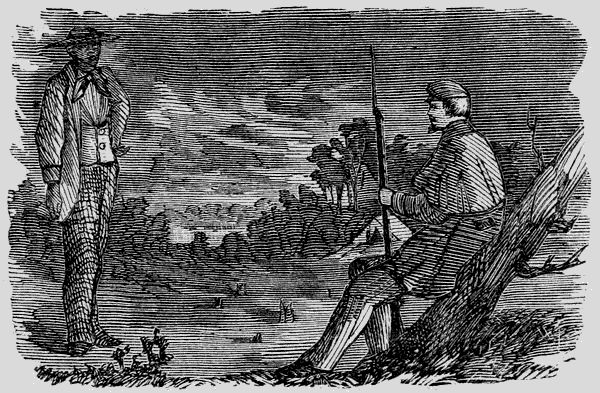
as plainly as if in daylight, the form of a huge negro. He wore
a broad-brimmed hat, a linen coat blue or dark striped, vest,
white shirt (seemingly of cotton,) open at the neck, around
which was a colored handkerchief tied sailor fashion, the ends
hanging down loose. His pants seemed of light fabric, checked.
I could see his countenance plainly. It seemed, if anything,
smiling, though there was something peculiar in its expression,
as well as the attitude, for the figure seemed leaning its weight
on one foot, its left hand resting on the hip, and the right arm
hanging loosely by its side. The expression of the darky was
so peculiar—jaunty, saucy—and he looked full at me, that for a
moment I was taken by surprise,—and, during that moment
made the observations just recorded—but quickly recovering, I
brought my piece to 'charge,' and called out—
"Who comes there?"
But no response was deigned by my darky visitor. I challenged
again, and again, with the same result, the object still
retaining its position, and regarding me with the same complacent
look—when my comrade, who heard my first challenge
came up, and inquired what the matter was, just as I was about
bringing my piece to 'present' to fire. I pointed to the object
of my challenging, who still kept his ground in the same position.
He laughed at what he supposed was a joke I was trying to
come on him—not being able to see anything in the spot I
pointed out,—and resumed his beat. The thought then occurred
to me for the first time that what I saw was not real. What
then was it? I asked myself. Surely I am not troubled with
that disease known as 'nigger on the brain!' And I again
leaned against the trunk of the fallen tree to think the subject
over, all the while keeping my eyes fixed upon the object of my
thoughts, which stood the scrutiny unmoved. Now, I am not
superstition by nature, and still less so by education and experience,—and
so I viewed the apparition without a particle of
fear or awe, and tried to account to myself for its appearance in
the most natural and rational manner. I came to the conclusion
there and then, that want of rest and the stimulation of
the coffee and tobacco I had been indulging in unduly excited
my brain, which produced the hallucination, on the same principle
that it is produced in certain stages of drunkenness, called
delirium tremens. This was a very fair deduction; but still
in front of me stood the grinning darky, as plainly as before. I
thought then I would test the unreality of the apparition in
another way. If it were an optical illusion, the figure must
recede as I advanced, or follow as I retreated. I accordingly
advanced towards it; but, strange to say, it remained in the
same spot, until I was within arm's length, when stretching forth
my hand I grasped—nothing. I walked over the exact spot
where the figure stood, and returned to my old stand, to be still
more puzzled to see the figure in the same spot, with the same
expression on its countenance, but with both arms hanging down
by its side this time. More puzzled still, I retreated to see if it
would follow; but no—there it stood still gazing after me. I
took three or four turns up and down my beat, and on each
return to the fallen tree beheld the figure in the same position
as last seen. I then halted, determined to watch if other changes
would manifest themselves in shadowy being before me. My
comrade came towards me again, and I reiterated my former
tale of the apparition. Still he couldn't see it. But, as I was
yet talking of it, and still persisting I saw it, the phantom darky
disappeared—not suddenly, but seeming to melt away gradually.
"He vanished in the darkness, like a beam
Of cold, gray moonlight in a wintry stream."
This is the first and only ghost I have ever had the pleasure
of seeing, or, more properly speaking, fancying I saw. What
caused its appearance I neither know nor care, and only relate
the fact (or fancy) because I think it singular.
On a Sunday morning, about 10 o'clock, we started for
Evans' Mills, to relieve Co. E, which had overstayed their time
one week—doubtless from the fact that a large orchard of apple
trees was upon the plantation, the fruit of which was a luxury
they were loth to leave—small blame to them.
After a march of about two hours, we came out upon a clearing
just beyond a continuation of the rebel line of defences to
the right of the Beaufort railroad. Here we saw deserted houses,
and a cotton gin; but no living creature of the human or brute
creation, and the place looked solitary and deserted enough—its
own sad elegy of war written plainly in the solitude which
brooded over the absence of those who once gave animation to
the scene, and made 'the wilderness blossom like the rose'
with fields of cotton and gardens of bright flowers.
About a mile further on, after passing through a narrow
belt of woods, we came out upon Evans' plantation. On our
right was a field of some eighty acres, about half of which was
covered with a young growth of apple trees. On the left was a
field of about twenty acres, at the further end of which was the
plantation house, with its negro huts, surrounded with the inevitable
grove of elegant shade trees. Just opposite the front gate
of the mansion, the road turned sharp to the right, and on looking
ahead, we beheld a block-house, nearly completed, in the
rear of which was the encampment, and our future abode.
Upon reaching the block-house, the road took a turn to the left,
down a short, steep hill, skirting the bank of a stream, which
it crossed on a rude plank bridge, still turning toward the left.
After crossing the bridge, a grist mill lay on the right, and about
60 yards on the left, on the dam of a magnificent pond of water
stood a large saw mill, which ran two sets of saws when in operation.
It was then idle, the dam having broke away. The
road, after crossing the flume of the grist mill led on to the
negro village—quite a collection of comfortable houses—built on
each side of the cross road, which led to Pollocksville. Just
before coming on to the Pollocksville road, in a field to the right
was a large cotton gin and press. At the intersection of these
roads was our outpost in the day time, the guard being drawn
in to the mills at night.
The army wagons which accompanied, (with tents, cooking
utensils, quartermasters' stores, company baggage, &c.,) arriving
a few minutes after, the men soon had plenty to do in erecting
tents, and fixing themselves as comfortably as circumstances
would permit. There was a little board shanty with two bunks,
lately occupied by the drummers of Co. E. To this my comrade
and I 'froze'; and, having got our traps snugly bestowed—our
guns and equipments slung up, and our blankets spread—we
sallied forth in quest of plunder.
Our first raid was upon the orchard near by; but it had been
picked bare. We, however, subjected every tree to a searching
examination, and as the reward of our toil returned with about
half a bushel of a apples. On our way back we passed through
a small field of sweet potatoes, to which we returned with a
sack, and soon were in possession of a bushel of very fine ones.
During our absence, foraging, the tents had all been put up,
and the men were busy arranging their traps. Charley (our
French cook) had not been idle meantime, and had a blazing
fire, and coffee ready. Procuring from him a pot, we soon had
the satisfaction of seeing some of the sweet potatoes, the fruits of
our late raid, smiling upon us, and welcoming us to the feast.
Giving the cook a couple of good ones for his accommodation,
we retired to our cabin with our coffee, sweet potatoes and 'salt
horse,' and made one of the most hearty and satisfactory meals
I have ever known. Appetite was our best sauce, exercise had
sharpened it, and the new and palatable food agreed so well
with the disposition of the stomach, that it had ample satisfaction
in embracing its best friend.
After eating, with pipe lit, I started forth to take a view of
the mansion house, and its surroundings. On entering the front
gate, I was struck with the size and beauty of an immense beech
tree, whose wide extending branches covered a circle of over
100 feet in diameter—and, Yankee fashion, I immediately computed
that if cut down it would make over five cords of firewood.
It must have proved a cool and inviting shade for the
planter and his family in the summer time. Approaching its
huge trunk, I observed that the Yankee jacknife had been at
work and covered it with the representative names of men from
nearly every United States regiment that had ever been
in the department. Besides the huge beech there were numerous
other trees—elm, cedar, chaney—and the beautiful flowering
althea.
The house was an ordinary two story one, containing about 7
rooms, set on brick blocks about three feet from the ground,
and serving as a cool place of resort for the pigs, fowl, and
youthful, curly-headed negroes, during the heat of the day.
This, together with the plantation attached of some 10,000 acres,
seven or eight hundred of which were cleared, together with the
mills, and about 120 'head of darkies' (all of which excepting
two old negroes and their wives, had been 'run up country'),
belonged to a Mr. Evans, a son-in-law of Ex-Gov. Morehead,
(after whom Morehead city had been named).
Evans was, as I afterwards found, a very influential man in
that part of the country, and had early become a convert to the
doctrine of secession. He raised a company of cavalry, and
equipped them at his own expense. He took part in the battle
of Newbern, and it must have been a bitter trial for him to
leave so fine a property, though I believe he had another plantation
in the upper part of the State. The regiment to which
his company was attached, remained for some time in the
State, and had more than one encounter with our cavalry.
They were, however, finally ordered to join the army of Virginia,
and were, no doubt, engaged in all its conflicts with our
army. At the battle of Gettysburg, Evans, who had become a
colonel, was wounded, taken prisoner, and died shortly after in
hospital at Baltimore.
Such has been the fate of an infatuated man, who, like thousands
of others, left a prosperous and comfortable home to plunge
in the suicidal fray against the Government under which he was
reared and had prospered. He may have repented his folly
when too late; but I doubt it. Such men are as little given to
repentance as they are to truth, justice and reason.
At the back of the mansion house were two negro huts, where
those who were domestics lodged. The body of the negroes
were lodged in the village before mentioned about a mile away.
Doubtless there was design in this—as the master of bondmen
must have lived as insecure amongst his slaves as the tyrant
in the midst of his vassals.
Adjoining the negro-huts attached to the mansion were the
various outhouses and stables, behind which the land sloped to
waters of the tortuous stream which emptied into the mill-pond
further down.
To my view Evans' Mills at first appeared a lonely place;
but a further acquaintance with it materially altered my opinion.
Were it not that the restraints which discipline imposes upon the
soldier, living in this place would be quite agreeable. There
was no lack of game of all kinds, from the red deer, the nocturnally
rambling coon and possum, to the partridge, wild pigeons,
grouse, waterfowl, and fish. The latter were the only legitimate
sport for the soldiers (and many a finny inhabitant of those
sluggish streams—though shy at times—graced his tin platter),
as the necessities of war forbid the use of fire-arms upon any
other game than men (butternuts—and some of them mighty
hard nuts at that). Occasionally, however, the negroes, and
such of the white inhabitants as were left behind 'when the
rush of war was past,' with their coon dogs, and well provided
with pine knots to guide them, would sally forth of a night and
traverse the banks of the numerous streams and branches,
and rarely would they proceed far until the peculiar bay of
the dogs denoted that they had lit upon the track of a wary
possum or coon, in the direction of which the hunters would
hasten, to find the 'critter treed,' and if the tree was too large
to cut down, one climbed, and with a club killed or dislodged
him. A coon hunt has rarely been unsuccessful, from the great
number of the 'animals' abounding, and the excellent training
of the dogs, which seem to take after this kind of game as naturally
as a cat takes after mice.
The streams are generally belted with fine groves of cedar,
gum, black walnut, locust, and ash trees, intermixed, the whole
bearing their proportion of parasites, some of which entwine
themselves so closely round the trees they select to climb on as
almost to become incorporated with them in the process of time,
and look like huge serpents endeavoring to crush out their life
but they look beautiful in the summer time, covered with leaves
and fruit (for they are not all poisonous or profitless), and many
a bunch of rich, purple grapes has the writer purloined from
the midst of those masses of tangled creepers. This intermingling
of hardwood trees with the evergreen pines had a pleasing
effect upon me, as it recalled the remembrance of the northern
forests where the pine, hemlock and spruce were often in the
minority.
Occasionally, however, the explorer of these Southern woods,
would suddenly come upon a cypress swamp, and he would
there behold the incarnation of all that is dismal in a landscape,—especially
if, as when I first beheld one, the time was just
before twilight, and the slanting rays of the sun had ceased to
penetrate the masses of the forest foliage. A picture, however
finely wrought, would fail to give an idea of the utter gloom and
funereal solemnity of such a scene; and if any lover or hater of
humanity should wish to seek a solitude where, unmolested, he
could mourn over the wickedness and folly of mankind, and
make himself thoroughly miserable, I would advise him to select
a spot in full view of a cypress swamp,—and if he will not
suffer enough, do enough penance, and weep enough to wash out
and atone for the world's sins—his own included,—in the space
of the twelve months, then it will not be the fault of the swamp,
I can vouch. I do not wonder that the ancients, even aside
from their superstitions, selected the cypress as an emblem of
death and mourning—for no one can behold that tree in its native
solitude and state without thinking of all the friends he had
lost, and would be likely to lose for the next hundred years.—Picture
to yourself, gentle reader, the bed of a sluggish stream,
enriched by the accumulations of vegetable mould for unknown
ages, until the water forced itself through a deep, narrow channel,
winding hither and thither; that at a former indefinite
period, the seeds deposited on this mould germinated, and there
arose from its slimy depths, like ghosts that had 'burst their cerements,'
the mighty cypress trees; that they continued to grow
slowly upward, but toward the base the trunks swelled to undue
proportions like the paunches of gluttons—and undoubtedly the
cypress is the glutton among trees, as its huge cone-shaped roots
are well adapted to the ravenous absorption of air, and the rich
liquified food that is forever in process of formation around and
above them. And thus they tower up in the midst of their
slimy abode, huge, bilious and bloated, and look like a grim
array of fallen spirits, which, having attempted to cross into
daylight, got stuck in the mud of their mythical Styx.
Such is a cypress swamp.
In nationality the men of Co. K comprised Americans, Canadians,
Provincials, English, Irish, Scotch, French and Germans.
In disposition and character, they were nearly as diverse as
their nationality; but taken as specimens of the countries they
represented, were about as intelligent and respectable a body of
men as could well be expected from such material.
The Captain, Joseph R. Simonds, (for many years a bookbinder
in Spring Lane, Boston,) was a thoroughly patriotic and
honest man, a good soldier, with many virtues, and a few faults
and foibles (and what man has not these to a greater or less extent.)
He took great pride in the well-being and efficiency of
his company; and its good name, and the praise of his superiors
for cleanliness, superiority in drill, or having a small sick-list,
were to him matters of just pride and gratulation,—and frequently,
after a creditable performance on drill or parade, he
would snap his fingers with delight, and, after dismissal, invite
them all to his quarters for a treat. He was careful about the
quality of their food, and whenever he could (which was not
often) would procure such articles of luxury and dietic change
as would be most likely to promote health. He was uniformly
kind, obliging and considerate, and did not look upon his men
as mere pieces of mechanism that moved when he pulled the
wires. He considered them men,—socially his equals, though in
reality under his command, and, to a certain extent at his mercy.
He rarely abused his authority—never maliciously; and though
he occasionally did injustice to some deserving men—it was, I
think, more from an error of judgment than through design.
Yet he was popular and unpopular with the men. Soldiers
like sailors will grumble, and it is a privilege they often abuse;
but, the fit over, they all invariably acknowledged his worth,
and disposition to treat them well.
The first Lieut (J. A. Greeley) was of a quiet disposition, a
strict (but not over strict) disciplinarian, and a man of considerable
genius in engineering (he subsequently had the planning
and superintendence of several fortifications near Newbern).
He was a strict temperance man, and wished the men to practice
this virtue also. He has since been detached from the regiment,
and commissioned captain in the 2d regiment of Heavy
Artillery.
But I cannot enumerate the names of all the company,—and
will content myself with mentioning a few of the 'characters'—and
the first that occurs to my mind is "old Jesse Hitchings"
(forgive me, Jesse, for putting your name in print; but you
need be no more ashamed of it than you were of your old cap
riddled by the enemy's bullets). Jesse was a character—a tall,
thin old bachelor of over fifty—of a pleasant, benevolent disposition,
a good soldier, an uncompromising patriot (no compromises
with the rebels, was his motto)—and a successful hand at
poker. It is related of Jesse, that when the company was doing
picket duty at the Deep Gully, he lit a fire one night at the
outpost, and when his time came to mount guard, leisurely
walked up and down in front of the fire, giving the enemy's
pickets a fair chance, if so disposed, to pick him off—and upon
being warned of his danger, coolly replied—
"Well, if I'm to be shot I'll be shot, I suppose—what's the
odds."
In camp, on guard, in the bivouac of the battle-field, wherever
there was a fire, Jesse could be seen at any hour of the
night bending over the same, his chin resting between his knees,
warming his long skinny hands—sometimes asleep; but mostly
half awake or dozing. Poor Jesse—he is one of the few sterling
men who act well their part without ostentation, and are rarely
noticed for their real worth.
Another character was "Billy Patterson" (he was called
"Billy," though his name was James). He was a hard-working,
rough-spoken fellow (his general salutation being "G' along till
haal wi' ye!") Billy, though a good soldier, and brave in action,
did not like guard or picket duty—and, being an excellent
cook, generally contrived by a species of finesse—not always of
an unexceptionable character—to work himself into a good
berth, with pots for his jolly companions. Charley (our French
cook) shortly after going to Evans' Mills fell sick, and Billy
took his place—which he held afterwards for a long time, and
flourished and bullied when sober, and when drunk abused
every one—and gave the mess very good dinners.
Sam Kenny was another whom I considered a character. He
was nicknamed 'Dickens,' being a great admirer of that author.
'Dickens' was an intelligent man, but fond of whiskey; and
whenever he imbibed too much was sure to get in to some scrape
or other, which generally ended in depositing him in the guardhouse.
It is related of him, that being one night in Newbern,
on a 'bender,' he applied for admission into a house (where he
was acquainted), but the lady noticing his condition, refused;
when, after repeated failures to get in, becoming convinced
of the uselessness of any further trial, and by way of revenge,
he put his mouth to the keyhole, and shouted—
"I say, madam, do you chew snuff?"
Now be it known that snuff chewing is quite a common practice
among the women in and around Newbern, and for aught I
know is a regular Southern institution; but those of any pretension
to refinement never use it, or if they do, it is on the sly—and
a greater insult could not be offered a woman than to ask
her if she chewed snuff. 'Dickens,' no doubt, had his revenge.
A young fellow, named J. E. Mills, had a mania for cutting
his autograph upon trees, walls, fences, and objects in every
place he visited. It is related that during a freshet, when a lot
of logs in the river above the dam broke loose, every one of
them contained one or more inscriptions of "J. E. M.," cut in
with an axe or knife.
William Stack 'was a soldier every inch of him.' He had
been in the British service over ten years, and served in India.
His peculiarities were numerous; but were redeemed by a strict
integrity, a love of duty and a thorough knowledge of his business.
I often wondered why men, his inferiors in many of the
most essential qualifications of a soldier, were promoted over
him, while he remained a private. He entertained a great veneration
for the British army—and thought the British soldier not
only superior, but better paid, better clothed, and better cared
for than the American soldier. He had a good memory, a rich
fund of anecdote, and many a weary hour has he beguiled by
the relation of scenes and adventures in 'the land of the palm
and the poppy.'
John Smith was another who had served in the British army.
He was a good soldier, an unpretending man, and the pertinacity
with which he defended the government, (there are two
parties in the army as well as here), his strong anti-slavery sentiments
when nearly all were down on the poor negro, and the
confidence he felt in the ultimate success of our cause, even in
the darkest hours when the general opinion prevailed that we
could never whip the South, might well put to shame many of
his American comrades, who often seemed to lose in their desire
for peace, the consciousness that it was theirs to dictate the
terms to a beaten foe. The poor fellow has been taken prisoner—and
is now in Dixie.
Smith had a brother who was nicknamed 'Ben-Doza.' 'Ben'
was discharged in March, 1863, and I gave him a curious stick
which I cut in one of the swamps to bring home for me. If this
should meet his eye, I wish he would hasten to 'fork it over.'
But lest I should become tedious and uninteresting, I will
drop the biographical and take up the chronological thread of
my yarn, noticing the different individuals as they may be
brought by circumstances into future scenes. It is true that in
speaking of the mere rank and file of the army, I do not write
of men known to fame. There is, indeed, little of romance
connected with the private soldier—that peculiar species of
flummery (which makes the heart of the dreamy damsel of sixteen
flutter so) being, as it were by right divine, the speciality
of the ideal mustached, lightning-eyed, and so forth young
men of the shoulder straps. Those I write of principally
occupy, many of them, the humblest (though the most useful)
position in our grand army. It is such men who do the real
fighting, and have to take and give the hardest knocks—and
if a score of those brave hearts are laid low by the hand of war,
it creates not half as much public sensation as the destruction of
an old barn by fire, or the escape of a negro from rebeldom.
Their biography is written by the orderly sergeant in a few
words, and their requiem sung by the turkey-buzzard out on a
foraging expedition. Their names, it is true, are on the rolls of
fame; but who cares for these, except it be their immediate
friends and relatives—and the clerks in the pension-bureau, who
mayhap think it particularly unkind in privates A. B. or C. to
die at all, and thus give them so much additional labor.
Two brothers, named Tibbetts, living about three miles beyond
our outpost, lost some hogs and cattle in a very mysterious way,
and came into our lines to inquire if we knew anything of them.
Of course we didn't, and Billy Patterson's pots never told tales.
I entered into conversation with one of the brothers, who appeared
to be a civil sort of a man, and who invited me among
others to visit his house, saying that he had plenty of eggs, &c.,
and could get up a very good dinner for us.
I remembered Tibbetts' invitation, and a few days after, accompanied
by a companion, started out to see him. He lived in
a miserable log cabin, about 20 feet square, without windows,
having shutters to supply their place at night, which were
opened in the day time to admit light and air. A field of about
25 acres surrounded the domicile, partly planted in corn and
peas, with about three acres of sweet potatoes. And these, with
a few pigs, and a small garden, constituted this family's whole
'visible means of support.' The family consisted of a sallow,
bilious-looking wife (all women thereabouts, as well as men, look
alike) and a half-dozen sallow, bilious-looking children. (Nearly
all the natives of that level, swampy region are thin, and have
a shaky appearance.)
I noticed, to my surprise, upon my first introduction to
Madam Tibbetts, that a small stick protruded about two inches
from her mouth, and that ever and anon she spat out what
seemed marvellously like tobacco juice. I watched her movements
for some time during our conversation, and I noticed that
she occasionally removed the stick from her mouth, and, one end
being made soft by chewing, dipped the same into a box of snuff,
replaced it again, and ran it around her gums and teeth in
the same manner as one would use a tooth-brush. I found that
neither Tibbetts or his wife, nor his brother or sister (the latter
a smiling old maid) who afterwards joined us, could read or
write—in fact it was considered quite out of their line altogether,
though they seemed to regret that their children could
not have some education. They were a fair specimen of that
class of settlers at the South known as 'poor whites.'
Being allowed, when off duty, a free range within the lines,
our visits were made in all directions—sometimes (often, I confess)
transgressing our orders, we went beyond, especially
towards the abodes of the Messrs. Tibbetts—and we frequently
stumbled upon a quiet household of 'poor whites,' who received
us civilly, though by no means graciously. All of these were,
however, strongly 'secesh' in feeling, having had their minds
pretty thoroughly poisoned with the false tales told them by their
late 'superiors' of Yankee injustice and cupidity.
In conversation with the elder Tibbetts, I learned that the
honey-bees often selected the trunks of hollow trees in which to
gather immense deposits of honey, and that in going up a creek
lately he had discovered a tree, which he intended visiting some
time. The idea of a 'bee hunt' was novel to me, and I determined
to join him; and, a few days after, with a comrade,
started for Tibbetts' house, who readily undertook to pilot us
upon our saccharine expedition.
We were successful in getting a considerable amount of
honey; but staid out so late that the officers became alarmed at
our absence, thinking we were 'gobbled up' by the 'rebs,' and
doubled the guard, served out extra ammunition, &c.,—and
when we did come in at last, reprimanded us for staying out so
long, and forbid any of the men going beyond the lines in
future.
Time wore on. At first we expected a recall at the end of
each week after our time had expired, but no such order came,
and as the season was beginning to wear the sear and yellow
leaf in its garments, and the indications of cold weather warned
us that the time was at hand when
"The wild deer and wolf to their covert" must "flee,"
we bethought us that the negro village might abound in material
of which shanties might be erected, and, as Billy Patterson
elegantly expressed it, "be a d—d sight more comfortable than
miserable." This bright thought was slow in spreading, and it
was not until three or four men of a mess erected a snug shanty,
that it took root and flourished—and then there was a rush for
the 'diggins.'
The shanties at the outpost, once the shelter of the humble
household gods of many a smoky descendant of Ham, were
threatened with disembowelment—until the fury of the onslaught
was turned upon the cotton gin, which soon presented a skeleton
appearance. The plundered boards and scantling had to be
carried by the men half a mile. But they set to work
with a will. For at least two weeks nothing could be heard
around the camp, from sunrise to the going down thereof, but
hammer and saw, and saw and hammer, and from the promiscuous
heaps of purloined boards and scantling there arose in
due time one of the most curious villages that could be met with
outside of negrodom; but they were as comfortable as could be
desired, and well laid out with bunks, gunracks, &c. Each had
a flue or chimney for a stove or fireplace, the bricks to build
which had to be carried on the back, or wheeled by hand from
a mile and a half to two miles; and as wood was plenty, we
never lacked for good fires. Thus comfortably situated, it was
no wonder that we became attached to Evans' Mills.
It being designed to erect permanent barracks in the vicinity
of Newbern, and the steam saw mill in that city proving insufficient
to supply enough lumber—workmen being plenty, a
detail from any of the New England regiments supplying any
number needed—it was resolved to repair the broken dam at
Evans' Mills. A detachment of about sixty contrabands, under
the superintendence of a sort of Baron Munchhausen chap, a
private in a New York artillery regiment—was sent to make the
necessary repairs.
The dam had broke away at the waste water gate—and the
genius who was sent to repair it, commenced by filling in the
waste gate with brushwood and earth—and, after a month's
labor, (costing the Government over $1,500), he succeeded in
partially stopping the water, so that a few thousand feet of
boards could be sawed; but the first rain-storm swelled the dam
so much that, having no proper outlet for the superabundant
water to escape, it gave way, and the blundering fool and his
work departed about the same time—the former to hospital
sick, and the latter to be distributed along the oozy bottom of the
tortuous creek which emptied into the Trent River.
When the rebels were defeated at Newbern, Evans, like
other large planters, sent all his slaves to a plantation which he
owned in the upper part of the State—that is, all who were
worth sending, for he left two old negroes and their wives behind
to 'take charge' of the plantation. These, in process of
time, and the occupation of the place by our forces, were joined
by others, until the negro population at the time our company
went there, amounted to about ten, including picaninnies. The
old negroes alluded to were called respectively, Old (Uncle)
George, and Indian Joe. The former venerable old patriarch
was "eighty-five, sar," communicative and religious, and the
latter a cross between the Negro and Indian—retaining a good
deal of the aboriginal physique and character—respectful, but
retiring in his manner; and, though said to be fully as old as
George, was spry and supple, a good hand at a tar-kiln, and a
keen sportsman, never going to the woods without being accompanied
by his dogs and an old Harper's Ferry musket—
"For you know de coons come out sometimes 'fore dark, and
de deer dey stray off up dar down here in de day, and dey's
good eatin', I reckon, is dem deers."
"I suppose you would not hesitate to pink a rebel if he should
come across you instead of a deer, Joe?"
"Lor, yes—no—reckon—(scratching his head). O yes—right
good day, sar—good morning, sar."
I think he'd shoot—if the alternative was to shoot or be
taken.
The other contrabands were mostly runaways. One of
them, a mulatto, was a good carpenter, a man of some intelligence,
and interested me much. His story was simple, and
illustrated the atrocious system, which subverts honor, and
makes conscience a tool to be used as interest may dictate. He
was 'raised' (that is the term, and sounds odd when applied to
human beings) up country, and when his old master died he
left him free; but the son and heir not liking to lose a 'right
smart boy' of his description, would not give him his freedom,
but kept him as a slave, treating him precisely like the other
bondmen. When the war broke out, his master, who resided
or did business at Wilmington, joined the navy, as captain of a
gunboat, and took this slave with him as his servant. After the
battle of Roanoke, when our gunboats followed up and destroyed
the rebel fleet, his master, when one of our gunboats ran into
the one he commanded, deserted him, jumping overboard, to
escape capture; but, while in the water, a stray shot struck him,
and he 'sank to rise no more.' The mulatto, glad of the change
that gave him his liberty, accompanied our forces to Newbern,
and there remained, entered the employ of the Government, and
performed his part in a skillful and faithful manner.
Another of the contrabands was a full-blooded African negro,
bearing the classical name of Nero. He was from Duplin
County, some ninety miles north of Newbern, and near the
Virginia line, and had run away from a cruel master, as numerous
scars on his person testified, travelling the entire distance
on foot through woods and swamps, and subsisting upon an
occasional ear of corn, for which he ventured into the fields
only at night, eluding the rebel patrols and pickets, and, finally,
almost exhausted and worn out, he arrived, with about five or
six others from the same place, inside our picket lines, and gave
himself up. He left behind him a wife and six children; but
notwithstanding this, and the stories he had heard of Yankee
barbarity to runaway negroes (the slaves being generally told
that the Yankees placed iron rigs through the shoulder-blades
of the darkies, and sold them off to Cuba), he was willing to
run all risks for the bare chance of obtaining his liberty; and,
he said, if the other slaves knew how well the contrabands were
treated, they would come in in greater numbers. His simple
story would fill an interesting volume. When Wild's brigade
was subsequently organized, he joined the first regiment, and, I
have no doubt, has proved himself a capital soldier. Wo to the
rebels that fell in his power. He had many wrongs to avenge,
and would avenge them, if opportunity offered.
Uncle George was a good specimen of the ideal negro—fat,
good-natured, and seemingly contented.
"Well, uncle," I said, "how do you like the Yankees?"
"Right well, sar—dey's bery fine people, sar!"
"Would you sooner be with the Yankees than the rebs?"
"O yes, sar; (my name's George, sar); 'cause I'se a free man
now, and dat's what I am now, sar."
"You think you are free now, and that the Yankees made you
free, do you?"
"O yes, sar," he replied, and then added, in a deeply impressive
voice—"and I tank de Lord and you Yankees for dat. De
ole man hab worked for many years—de good Lord he send
me and the ole woman six sons and five daughters, and massa,
he sell some off afore de war, take some away when de Yankees
come—and now, de poor ole man and de poor ole woman
am left all alone in de world; but de good Lord send de Yankees,
and dey make us free afore we die, and dat am payment
enough for all ole George's work—bress de Lord, amen."
George finding, I suppose, that I took an interest in him, and
did not treat him as it might be inferred many would from their
salutation of "Hello, old nig—how dye do," often visited our
shanty at dinner-time, and we had always plenty of crackers
and 'salt horse,' and an occasional pint of soup or coffee to spare
him; but the cook (Billy Patterson,) perhaps from pure good
nature, took a fancy to old George, and he soon forsook our
more humble board for the savory flesh-pots of Billy's cookhouse,
perfectly satisfied to be addressed as you 'd—d old nigger,'
so long as he had his revenge in the shape of a plentiful
supply of good grub.
I stated before that the outpost guard was drawn in at night
to the mills (the day-guard at the mills being camp-guard at
night). A few darkies, who worked for the government making
tar and cutting saw logs, lodged in the mill. Without education
enough to read, without the knowledge of the commonest
accessories of amusement, it cannot be wondered that the time
hung heavily upon their hands; but their naturally elastic temperaments
stood them in good need, and suggested a species of
amusement to pass away the time that was best suited to their
capacity, viz.: dancing and its promoter, 'jigging'—a species
of vocal and pantomimic music almost peculiar to the African
race. At first their levees were attended only by gents of color;
but, by and by, the spirit of their performances began to spread,
and soldiers from the relief guard and the camp visited them,
and enjoyed hugely the sight of the dancing, sweating darkies,
(encouraging and applauding the most expert—and there were
many supple legs and nimble feet among them), and the equally
sweating and nimble 'jiggers' or time-beaters. The 'jiggers'
did not always depend upon the voice, but used it as a sort of
auxiliary or flourish to their time-beating, which latter was performed
by striking the open hands upon the thighs, legs and
breast, and together in rapid succession, and in admirable measure,
so that the tune thus beat could be followed by the dancer
as precisely as if played upon a full band.
We had a Maryland negro in our company, who ran away
from his master, and became attached to the regiment in Baltimore.
He was called 'Pomp'—a lithe, supple fellow—and, with
a few months training, I have no doubt, would equal, if not
surpass, some of the clog-dancers of our friends the Morris
Bro's. It was amusing to note the patronizing airs he adopted
towards the North Carolina 'nigs,' and, I presume, the circumstances
of his having come from Maryland, and being so long
in the army, added not a little to obtain for him a certain kind
of prestige among his simple sable brethren. The soldiers for
amusement taught him the manual of arms, and so naturally
did he take to the business that it was a common remark among
the men that there were few better drilled men in the command
than Pomp. But Pomp became lazy and independent, and left
the company shortly after we went to Evans' Mills to work for
Government. But his mind was not in work, and after a few
weeks labor he went to Newbern, and there became attached to
a company of the 43d Mass. regiment, as Captain's servant.
This captain (I know not his name, or I should record it, to his
credit), taught him as well as some other negroes, to read and
write; and, when the policy of the Government, directing the
enlistment of the blacks, reached North Carolina, Wild's brigade
began to be formed, Pomp was among the first to enlist,
and, for his proficiency in drill, and quickness for military
duty, he was made a sergeant in the North Carolina colored
regiment.
"I've been made free by de President of my country," he said
to me, when I met and congratulated him upon joining the
army, "and I tink it is my duty to fight for de country dat
makes me a free man."
This regiment afterwards bore a prominent part in the unfortunate
battle of Olustee, Florida. I wonder if poor Joe (he
changed Pomp to Joseph) escaped.
On the 28th of August, the 17th reg't embarked on transports
for the purpose of capturing Plymouth; but upon arriving
opposite that town, found the place too well defended to warrant
a landing, and they returned without disembarking.
On the 30th of October, the 17th regiment left Newbern on
board steamers, and proceeded up the Neuse River about eight
miles, where they were joined by cavalry, artillery, and a large
baggage train, the whole under command of Colonel Amory.
They landed and marched to Swift Creek, a small settlement
eight miles distant, which was reached at sundown. Here they
were fired upon by the rebel cavalry picket, who had destroyed
the bridge over the creek. They fled upon our approach. The
following forenoon was employed by our forces in building the
bridge, and at noon the column was again in motion towards
Washington, N. C., which our forces reached on the evening of
November 1st, without molestation.
November 2d, the line of march was again continued, (our
forces being augmented by the addition of several thousand infantry,)
in the direction of Williamston. Towards sundown
the advance came up with the enemy; posted behind entrenchments,
at a place called Rawle's Mills, who disputed their passage;
but our forces soon compelled them to retreat, and the
following morning the advance again continued on to Williamston,
which place the column reached at noon, having marched a
distance of twenty-three miles from Washington. Leaving the
sick and foot-sore on board the gunboats in the river, the troops
marched out of the town about three miles, and bivouacked for
the night.
November 4th, they took up the line of march for Hamilton,
within two miles of which they were obliged to halt for several
hours to build a bridge, near which was a deserted breastwork,
leading from the woods across the main road to a fort on the
river bank. Hamilton was reached about sundown, and, like
Williamston, was found entirely deserted. The town being set
on fire by the troops, the sick were placed on board gunboats,
and the expedition marched out of Hamilton several miles, and
bivouacked for the night.
November 5th, they started early in the morning, taking the
road to Tarboro'—marched until night, when they came to a
halt, and bivouacked within nine miles of Tarboro'. The following
morning they commenced their return march, not having
met with the enemy in any force. A heavy rain having set in,
the roads were in a bad condition, and the marching much
harder than it had been previously. The expedition reached
Hamilton late in the afternoon, and took up their quarters for
the night in the deserted dwellings.
November 7th, a violent snow storm raged in the morning,
but it did not delay the march, which was continued for Williamston,
by a road leading near the river, and which they had
not travelled before. No force of the enemy appeared to interrupt
the march, and the expedition reached Williamston in the
afternoon, where it remained until the morning of the 9th,
when the line of march was taken up for Plymouth, N. C., a
distance of twenty-three miles. They reached the latter place
the next morning, 10th, and Newbern on the 11th, at noon,
having been absent thirteen days, and having marched about
150 miles. The expedition captured about 50 prisoners, 400
horses and mules, and about 100 teams.
The failure of this expedition, and the causes of its failure,
are pretty well known, and need no comment from me, save
that it caused much hardship to the troops comprising it, and
left Newbern in an almost defenceless state. The rebels, judging
that the garrison of the city had been largely drawn upon (but
never dreaming that this was the case to so great an extent), to
divert, perhaps, whatever after purposes our commanders had,
and to make them recall the troops as fast as possible, sent a
weak force to demonstrate in front of Newbern. This drove in
our pickets, and created the utmost apprehension in the city.
The case seemed critical, and every available man was called
inside the defences to await the onslaught of the enemy.
Our company (the remainder of the regiment being in the
expedition,) received hurried orders to report in Newbern, and
rumors coming in heralded the enemy as advancing upon the
city in large numbers. The order to pack up and be ready to
march at a minute's warning, was received by us just as we
were 'turning in,' and was not very welcome news you may be
sure, but to hear was to obey; and in half an hour we were
ready for the road, and some talked of the morrow, what the
'row' was all about, whether we should have a fight, and others
(myself among the number) went to bed and slept. About
three o'clock in the morning I was aroused from a pleasant sleep
by my comrades, and heard all around me the hurried tramp of
men. Hastily putting on my knapsack, I seized my gun, and
went forth to take my place in the line. The night was foggy,
and a feeble moon, while it brightened the obscurity a little, lent
to the half distinct scene a dreary and confused appearance. A
few men had been detailed to destroy the bridge; and the
strokes of the axe, the falling of the planks and beams into the
water, the hum of the camp—its lights glancing to and fro, contrasted
with the solemnity of the surrounding silence (which
only echoed noises of our hasty departure, or the hoot of the
owl) left a cheerless impression on my mind.
After a march of two hours, we reached our old camp tired
and exhausted, to be refreshed by a good dipper of coffee.
The morning advanced but the rebels came not; and as reinforcements
arrived by the railroad from Beaufort, all apprehensions
of the result of an attack upon the city died out, and the
day wore away without any demonstration being made against
any part of our lines. Indeed, word came in from our scouts,
that the rebels had fallen back, satisfied, no doubt, with having
carried out their design of creating a diversion, which would
serve to hasten the recall of the expedition.
In the evening we received orders to return to Evans' Mills,
which place we reached by nightfall.
What must have been the surprise and dismay of the darkies
to work on the mill-dam (who knew nothing of our departure
during the night, although we made noise enough to rouse the
'seven sleepers') upon waking in the morning to find the bridge
destroyed and the camp deserted. We were told that they no
sooner heard of our departure—and the reports, greatly exaggerated,
no doubt, of a rebel attack upon Newbern—than, considering
it was 'all up' with them, they scattered, and made for
the woods—'every man for himself, and the devil take the hindmost.'
Some of them turned up in the vicinity of Newbern,
others made their way to Morehead City and Beaufort, while
others were never heard from, and these, it was thought likely,
being too frightened to venture out in the clearings, supposing
the whole country again in possession of the rebels, were starved
to death, or lost their way, and came out somewhere in Dixie—no
doubt into the lion's mouth they were trying to avoid.
Poor unfortunates, the sport of every varying breeze of
fortune, good or ill. The best fortune for them is as yet but indifferent,
while ill fortune is death. They are, alas, no 'chosen
people of God.' They have no Moses to organize and lead them
out of their land of bondage; no cloud by day or pillar of
fire by night to guide them; no ark of their freedom's covenant
around which to rally [yes, the starry flag is their ark, and,
thank Heaven, wherever it waves over them they are free!]
No miracles are vouchsafed for their preservation; no manna
from heaven; no quails; no water gushing from the rock to
assauge their thirst. Alas! alas! that their pathway to freedom
should be beset with so many dangers—that its course should so
often lead them through the valley of the shadow of death!
Poor creatures! heaven help them through the fiery ordeal in
which they are passing!
The old darkies, however, belonging to the mill, together with
the others who had not been there when we came, did not skedaddle;
but, by turns, kept a good look-out on the Pollocksville
road, ready, of course, to leave at the approach of the rebels,
though determined not to do so until they hove in sight. Old
George took charge of our camp, closed every door, and when
we returned, every article we were forced to leave behind, even
to the smallest and most trivial, remained just as we had
left it.
Back once more in our comfortable quarters, and resuming
our old routine of duty, we began to think that we were as
good as settled for the winter. Our old pastimes were revived—rambling,
fishing, quoit pitching, playing cards, backgammon,
and draughts. The same huge fires were kindled and burned
brightly in front of our quarters, and at the outposts, for the
guards to warm themselves by in the dreary watches of the
chilly night, around which, before retiring to rest, groups of
smoking men assembled, and spun many a yarn of strange adventure
in all lands, from the orient to the Occident, and from
the frozen regions of the north to the trackless southern seas—mostly
true, I believe, but surely entertaining.
This state of affairs lasted a few weeks longer, when suddenly
we received orders to rejoin the regiment, which took the place
of the Mass. 23d in doing the provost duty at Newbern. This
was about the 20th of November. To some this change was
delightful, while to others (and I was one of these) it was not a
welcome change. But we packed up—this time with more
deliberation—and the next morning when Co. A, 23d regiment,
Captain Brewster, came to relieve us were ready to evacuate,
leaving everything connected with the camp to our successors,
in apple-pie order. I wish they could (or did) return the compliment;
but they did not, and were so 'put out' about being
put out of Newbern, that they vented their spleen upon the luckless
houses occupied by them as quarters, smashing up every
thing that might conduce to the comfort of their successors.
Our quarters were on Pollock street, near the market and
the office of the Provost Marshal. Co. B's quarters adjoined
ours, and F occupied quarters on the other side of the street
nearly opposite. After considerable labor in sweeping, scrubbing,
making bunks, &c., we became settled down once more,
comfortable enough. But our duty was no child's play. We
were on guard every second day—the intermediate one being
filled up (twice a week) by a march of six miles and a brigade
drill of three hours or more. This did not leave much time to
ourselves, after cleaning boots, polishing brasses and buttons,
and brushing clothes, for we had to appear neat and tidy while
on duty.
A provost guard is a kind of police-soldier, and his duties
are as multifarious as the character of his office and power
is indefinite. His instructions vary in detail from day to day;
and, before he goes on duty for the day has a string of orders
and regulations, as long as the laws of the Medes and Persians,
read to him, often couched in language that could be defined
to mean one thing or another, or nothing at all in particular.
For example, the guard is told to examine all passes and salute all
officers; to permit no fast driving; to allow no soldier or man-o'-war
sailor to go by him unless provided with passes properly
countersigned; to allow no citizen to pass after a certain hour,
without a special permit from the provost marshal; to 'jug'
every negro found out after 9 P.M.; to allow no citizen or negro
to be abused; to allow no breach of the peace; to permit no
horses to be tied to trees; to stop all disturbances whatever indoors
or out of doors; to, in fact, keep his eyes 'peeled,' and be
continually on the alert, and, if possible, do all the impossible
things required of him. Four hours on post (and twice posted)
performing this delightful duty, was required of the man detailed
for guard. The accommodations at the guard-houses were
abominable. The windows were broken, the bunks smashed up,
poor fires, and the floors so dirty, and the cricks and crevices
around so filled with vermin that one night's experience in the
endeavor to get rest in them was generally sufficient to deter
most of those who still retained the idea that cleanliness was a
virtue from ever attempting the like again.
Major Frankle of the 17th regiment was Provost Marshal,
and was a worthy successor of Col. Kurtz, of the 23d (now
Chief of Police in Boston.)
I cannot enter into a relation of all the incidents which enlivened
the monotony of our provost duty in Newbern, not from
lack of good material—that would, perhaps, make thirty or
forty pages of readable matter, but want of space admonishes
me that it will not pay. Suffice it to say that, with forty or fifty
thousand men in the department, a large proportion of whom
were in the vicinity of Newbern—the 17th had their hands full,
and the lock-up often became overcrowded, as did the jails in
time. We had drunken men to arrest—street rows to quell,
horse-racings, shootings and stabbings to look after—brawls in
bad houses to put a stop to, and arrest drunken and half-crazed
men armed to the teeth, and other duty of a no less dangerous
character to perform. But I believe we did things 'up to the
handle;' in fact I'm certain we did—notwithstanding there
were many complaints (as there always must be in such cases)
and criticisms of our method of procedure.
To add to our already heavy labor, shortly after we were in
the city, the marine battalion (which I have before incidentally
spoken of,) had refused to do further duty, and were placed in
our custody. These gallant fellows had been shamefully used.
When enlisted in New York city, they were promised $18 per
month for the privates, or sailors, and pay in proportion for the
petty officers. They had been in the service over a year, had
not received any pay, clothing, or allowances for the same, and
were informed that they would not be recognized in any other
capacity than soldiers, with whom they must consider themselves
on an equal footing in pay, as in all other respects. Considering
this a violation of agreement, they refused as a body to
shoulder a musket or do any kind of duty, and thus passively
mutinied. The men of the 17th pitied the poor fellows, and
showed them many acts of kindness. The Major, too, while he
had to enforce their imprisonment, sympathized with the marines,
and, I have reason to believe, did all in his power to have
their just claims considered, and their wrongs righted; but the
knot on the 'red tape' which bound the poor fellows could not
be opened, and it was not cut. So, after a two month's imprisonment,
they were given the choice of servitude in the forts as
criminals, or the alternative of enlisting in the navy, and they
wisely accepted the alternative. I think theirs was a case of
peculiar hardship. Some of those human kites which abound in
large cities started the project of their enlistment, without the
approval of the Government, made money out of the affair, and
left their victims to curse them for many a weary heartburn,
many an anxious, hopeless thought of home, and of a perhaps
destitute family.
One of Co. K's men, named Finn, at one time a guard over
the marines, allowed two of them to go out to purchase something
at the market, but the Major, somehow, discovered the
charitable error, and rushing up to the guard, said:
"Vat for you let ze marines go away?"
"But they'll come back again, sir."
"O—fool—fool—I vill have you put under arrest and court-marshal!"
Soon after the marines returned, and Finn, who caught sight
of the Major passing, sung out—
"They're back again, Major! The marines"—
But the Major, who was in a hurry, passed him by, angrily
exclaiming—
"O fool—fool—o-h block-head!"
"Be jabers," said Finn, looking after the Major, but taking
care he was not heard by that officer,—"ye're the first man that
ever called me so far out of my name that I didn't lay on the
broad of his back!"
There were four other Massachusetts regiments in the department,
viz:—the 23d, 24th, 25th, and 27th.
The 23d regiment, Col. Kurtz, was recruited in Lynnfield,
which place it left for Annapolis, Md., on the 11th of November,
1861, and reached there on the 16th; and on January 6th,
1862, embarked upon transports as a portion of Gen. Burnside's
Expedition to North Carolina.
The regiment, after encountering the fearful storms off Hatteras,
was among the first to land on Roanoke Island, and in the
engagements which followed bore a conspicuous and honorable
part. It then accompanied the expedition up the Neuse,
and took an active part in the battle of Newbern (March 14th,
1862), where it lost ten killed (including its Lieut. Colonel,
Merritt) and forty-one wounded.
The 23d afterwards did picket duty, and took part in nearly
all the expeditions into the interior and along the sea-coast.
On May 7th, the 23d relieved the 25th Mass. regiment doing
provost duty in Newbern, where it continued until Nov. 20th,
when it was in turn relieved by the 17th.
In January, the 23d formed part of the expedition to South
Carolina, but did nothing, owing to a misunderstanding between
Gens. Foster and Hunter, and returned, in April to North
Carolina, and encamped at a place called Carolina City, near
Morehead City.
Later it was transferred to Norfolk, and, I believe, is at present
in that portion of the department.
The 23d bears the reputation of being a good regiment, and
stands high on the roll of honor. Success to the old 23d.
The 24th Mass. regiment, Col. Stevenson, was recruited at
Readville, and formed part of the Burnside expedition to North
Carolina, and in the battles of Roanoke Island and Newbern,
acted a conspicuous and noble part. This regiment, in common
with others, had its share of marching on expeditions and doing
picket duty (in which it had several sanguinary engagements
with the enemy, who were invariably defeated). It accompanied
Gen. Foster to South Carolina, where it has added fresh
laurels to its name, as well as in Florida, where it remained until
April last. The 24th is a splendid regiment. It is now in the
army of the Potomac, and has shared in the triumphs which
have at length rewarded that long-suffering but noble and brave
army—that has at length came 'out of the wilderness.'
The 25th regiment, Col. Upton, was raised in the western
part of the State, and left Camp Lincoln, Worcester, to join
Burnside, and take part in his expedition. Little need be said,
save that this regiment has inscribed on its banners such names
as 'Roanoke Island,' 'Newbern,' 'Kinston,' 'Whitehall,' 'Goldsboro,'
&c., &c. This regiment did the first provost duty in North
Carolina. The 25th has taken part—together with the 23d and
27th—in the late brilliant advance of Gen. Butler on Richmond,
where it has come in for its share of glory and hard knocks.
The 27th, Col. Lee, was also raised in the western part of
the State, and left Springfield Jan. 6th, and joined Burnside's
troops at Annapolis, Md. The 27th shared in all the battles,
marches, and picket-skirmishes in North Carolina. In fact, the
history of one of these regiments is the history of the whole.
All, alike, have a glorious record, and have earned the same by
the hardest kind of fighting, marching and suffering.
In October, the first of the nine months regiments began to
arrive. The 44th was, I believe, the first of these—a fine-looking
body of men; but seeming more like a regiment of officers
than soldiers. Their style of dress, though about the same as
the 'regulation,' varied in being of a much finer texture, and
containing, at least, two more buttons on the tails of their dress
coats than the regulation allowed to privates. (Orders were
issued during our stay in the city to cut off the extra buttons,
and much ill-feeling was created by the remorseless cur-tail-ment
practiced by the men of the Seventeenth towards their fellow-soldiers
of the 44th.) Some of the men, too, seemed to
possess a consciousness of their superiority, induced, no doubt,
by their fancied higher social standing at home, and passed the
poor three-years men with the same patronizing and patrician
air, their eye-glasses clasped upon their noses in the same manner,
as when strutting amid their fathers' workmen in Massachusetts,
or when promenading the thoroughfares, and ogling the
girls (beg pardon, young ladies) at home. It is true they were
civil, and mostly well-behaved young men; but their civility,
though well intended, was bestowed with a hauteur which had an
opposite effect, and left rankling in the minds of their less
favored comrades (all soldiers are comrades) a feeling of envy
and, perhaps, disgust. Undoubtedly, there were men in this
regiment of a very high order of intellect; but there was a
class among them composed of puny clerks and school-boys,
whose notions of the world and what constituted a man were
about as crude as those of any apron-string hero could be;
and it was the influence of this class operating as the representative
of that better and really respectable one whose good sense
kept it in the background, which caused this regiment to be
unjustly criticised and hated—and by none more than its co-nine
months comrades of other organizations. To show how prejudice
will jump at conclusions, it was confidently predicted
they would never stand fire; but they did stand fire bravely,
and acted in many respects in a most creditable manner for so
new an organization. A story went the rounds, and which may
not be true, to this effect:—On the Tarboro expedition, the 44th
were in the advance, when the cavalry, after waking up the
rebs, and finding them in large force ahead, fell back, and their
lieutenant (Mix), seeing no one taking the necessary steps in
such an emergency, rode up to the captain of an advance company
of the 44th, and said:
"Deploy your men, captain; the rebs are close upon us!"
To which the captain replied—
"I don't know how!"
"Then," replied Mix, "right about, and run like hell, or you'll
be gobbled up!"
Again, at the battle of Kinston, it was said that the 44th who
were laying down, were ordered to charge the rebel line, which
had begun to waver and show signs of weakness; that they
refused, and the 10th Connecticut (three hundred strong) were
ordered up, charged upon the rebels, and, in charging, had to
walk over the prostrate 44th. I give this story without vouching
for its truth; for, being in another part of the field, I had
not an opportunity of witnessing the inception of the charge
referred to, though, arriving with our regiment near the bridge
by the flank ahead of the main charging column, I had an
opportunity of seeing the 44th come up at the double-quick
close on the heels of the flying rebels. But the story was told,
and told, too, on the battle-field.
At Whitehall, however, no envious tongue could say aught
against the conduct of this regiment; and I can here speak of
what I saw of them, and can say they acted well under the
murderous fire to which they were exposed.
Another anecdote of the 44th, and I have done with them;
and, lest I might be accused of harboring any of that feeling
towards them I have already alluded to as prevailing in the
department, and which I most heartily condemn, I will state
that I do not believe one word of it, and only give it a place here
to show how far human malignity and envy will make men forget
what is due to self-respect and to co-laborers in a good work.
During the siege of Little Washington, it was stated that the
rebels sent in a flag of truce, requesting the commander of the
post to send the women and children, and the 44th, to a place of
safety, as they were going to assault the town.
The 5th regiment came about the same time the 44th did.
They were a fine, hardy-looking set of men, and participated
with credit in all the expeditions undertaken during their term
of service in this portion of the department.
The 45th regiment was the next—a fine body of men; but
they, too, like the 44th seemed to assume too much importance,
and came in for their share of ill-will; but, speaking from my
own knowledge, I never knew of but one instance in their whole
career where they did not seem to be up to the mark, and this
time from no fault of the rank and file. The fault, if any, lay
with the officers. I allude to a little affair at a place called
Cole Creek, on the railroad towards Kinston, in May '63, where,
by the Colonel of the 45th outranking our Lt. Col., the regiment
had the advance, and when it came in sight of an earthwork
manned by a few rebs, the Colonel anxious for his men, and not
wishing to be precipitate, seemed to hesitate. Colonel Fellows
riding up, asked him why he did not advance on the enemy's
work, replied that he thought it too strong.
"Allow me," said Colonel Fellows, "and I will take it with my
two flank companies."
The consent was obtained, and companies A and F of the
17th walked into the works, which had been hastily abandoned
on their approach by the rebels. As I said before, this result
was no fault of the rank and file of the 45th, whom I have seen
marching in under fire, with ranks precisely dressed up, and
acting with coolness and intrepidity.
The 43d seemed the favorite regiment with the three-years
men, who regarded it as the best of the nine months men.
They were, indeed, a fine lot of men, and, I have no doubts if
circumstances placed them in the post of danger, they would
prove themselves fully as reliable as the three-years troops.
In saying this, it will, of course, be inferred, that I do not consider
the nine-months men as reliable in an emergency as the
three-years men; and, I do not think them so, generally speaking—not
because the men are inferior in regard to courage or
endurance; but because they are not really soldiers but militia,
and not so self-reliant as the three-years men.
Of the other nine months men I know but little, save that
they were a fine lot of men, and if they did not do anything
to distinguish themselves, it was no fault of theirs, but because
they lacked the opportunity.
A few words in regard to the feeling of the three-years men
towards the nine-months troops. The men of the old regiments,
almost to a man (but there were some exceptions) seemed to
regard them with a feeling of envy and dislike, and the
frequent salutations of 'how are you, three hundred dollars and
a bugle?' partly showed from whence the dislike came. I say
partly, for the other reason was, that, besides receiving so high a
bounty, they could return at the end of their time of service,—which
to men who had already served eighteen months, and
still had a year and a half to serve, seemed unfair. And certainly,
looking at the matter with their eyes, the thing did
not seem altogether right, though it might very properly be
argued that as the three-years men went into the service with
their eyes open, and agreeing to the terms of the Government,
they had no right to complain.