"'In Wakefield there lives a jolly pinder,
In Wakefield all on a green,
In Wakefield all on a green,—'
THERE, there, Damaris! Hushaby, hushaby! Go
to sleep, like a good lass."
Damaris gurgled at Miles with a provokingly
wide-awake crow. "I never saw such a bad baby,"
sighed the little boy. "Do go to sleep, honey.
'In Wakefield there lives a jolly pinder,—'"
"Oh, Miles," laughed Constance Hopkins, who,
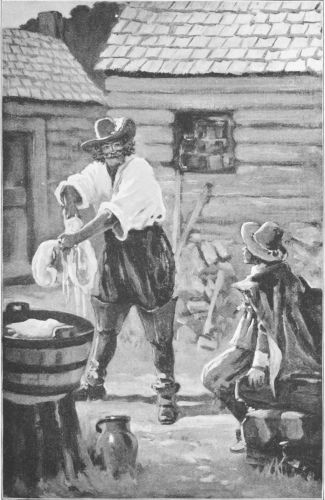
standing at the rude table, was scouring the biggest
kettle, "you have sung that half a score of times.
Is there no other song you know?"
"It is no time for the child to sleep now," interrupted
Mistress Hopkins. "I'll wrap her up, and,
since 'tis so mild a morning, you may take her forth
into the air."
"O dear!" thought Miles, "I'm a man, not a
nurse." He never considered that it was any kindness
on his new guardians' part when, instead of
putting him to heavy outdoor tasks, they set him
to minding the baby and helping about the house.
"Like a girl," Miles told himself, with an indignant
sniff. It was not two weeks since he left the sick-house,
and his legs were still a little uncertain, but
he was sure he was fit to work again, or, at any rate,
fit to run away and play with the other boys.
But he took the baby now and walked forth
meekly, because he lived in some dread of Mistress
Elizabeth Hopkins. She was a thin-lipped, energetic
young woman, who mended Miles's clothes
scrupulously, and, with equal conscientiousness,
boxed his ears whenever he tracked dirt on her
clean floors. Her sharp tongue, though, he feared
more than her hands, for Mistress Hopkins scolded
at everything and everybody; indeed, the only
members of the household whom her words never
troubled were Oceanus, who was so young he just
blinked his eyes when she talked, and Master Hopkins,
on whom people's fretting had as much effect
as it would have had upon the great rock at the
landing place.
After all, Miles was rather glad to get out into the
air, away from the living room, where Mistress Hopkins
was already chiding Constance. The morning
was fair and warm, with no wind stirring, and the
harbor sparkled invitingly, so, shouldering the unwelcome
Damaris, he started happily to the shore.
But his contentment speedily had an end, for, not
halfway to the landing, he was overtaken by Francis
Billington, Jack Cooke, and Joe Rogers, who at
once addressed him in disrespectful wise. "Ho,
Miles, that's brave work, tending a baby," jeered
Francis.
"You meddle with your own matters," Miles
replied sulkily.
"Come with us, Miles," Jack put in pacifically.
"We're going along shore to the first brook—"
"We do not want a baby with us," Joe interrupted.
"You might stay with me, Jack," Miles pleaded,
as the others turned away.
Jack, a freckled little fellow with merry eyes,
dug the heel of his shoe into the dirt. "The other
lads will be having sport," he said half-heartedly.
"Then go with them," cried Miles. "Only
you were very fain to play with me on shipboard."
Even this last thrust failed; Jack ran after the
others down the hill, and Miles, feeling cross and
ill-treated, was left to himself.
'Twould look too much as if he were following
his ungracious friends if he went on to the landing,
so he turned back to Elder Brewster's house. There
Priscilla Mullins, a girl orphaned by the winter's sickness,
who, because she was eighteen, was classed by
Miles as a woman, was sweeping the doorstone with
a broom of birch twigs. She paused in the labor
teasingly to throw him a kiss, and tell him his busy
sister and the lads were cooking by the brookside.
Sure enough, in the level space between the base
of the bluff on which the cottage stood and the
cove, Miles found Dolly, and Dolly's poppet Priscilla,
and Love, and Wrestling, and Solomon, and
Trug, who was not admitted to Mistress Hopkins's
house because his great paws dirtied her floor,—all
busied in making delectable pies of mud.
But when Miles joined them, Love withdrew from
the mud-pie game, and wished to play at holding a
council, such as his father and all the men were
holding that morning in the Common House to
regulate the military affairs of the colony. Dolly
insisted that she should be allowed to come to the
council too, for all Love urged that women never
were invited thither, and the argument was growing
bitter, when an unwonted tumult in the village street
drew Miles's attention. A confused sort of calling
and shrill shouting it seemed, that made his heart
quicken between curiosity and alarm; so, snatching
up Damaris, he scaled the bluff, while the rest of
the children scrambled close behind him.
On the doorstone Mistress Brewster and Priscilla
were gazing in silent wonder toward the street, and,
looking thither too, Miles saw a man stalk past to
the landing, very deliberately, as if he knew the
place and held he had the right to come there. It
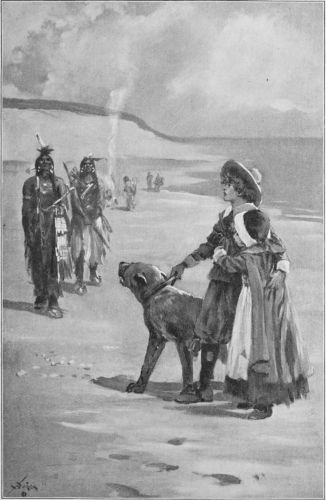
was no one of the settlers, though, but a great,
half-naked fellow with a coppery face—an Indian.
Dolly and Wrestling clutched Mistress Brewster's
skirts, the little boy fairly crying, and Miles himself,
it must be owned, held Damaris fast and drew a step
nearer the doorstone. But next moment he noted
the Indian carried for weapons only a bow and two
arrows, with which he could not kill all the settlement,
and, moreover, at his heels tagged venturously
Giles Hopkins and several of the other boys,
and even Goodwife Billington, very clamorous, and
the Governor's serving maid.
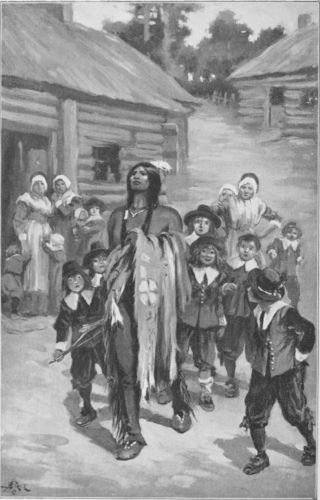
So Miles, not to be outdone by a petticoat, swaggered
into the roadway and joined himself to the
little group of curious folk, who, always ready to
flee if he should turn on them, followed close at
the savage's heels, down the steep hill, past Peter
Browne's cottage, even to the door of the Common
House.
The noise in the street had already disturbed the
men at their conference, and they came flocking
forth at the door, the Governor, the Elder, and the
Captain, with a score of other stout fighters crowding
behind them. But the Indian, never a whit
abashed, strode boldly up to them, would even have
pressed into the house, had not their ranks barred
his passage. Nothing chilled, he halted, and,
stretching forth his hands, spoke in a guttural
tone: "Welcome."
"Do Indians talk English?" Miles whispered to
Giles, who stood beside him. "Hush, hush, Damaris!
The black man won't hurt you."
But Damaris, quite unconvinced, clutched Miles
tightly round the neck and went on crying lustily,
till at last Goodwife Billington seized him by the
collar. "Thou good-for-naught lad!" she scolded.
"Wilt thou kill the poor babe? Take her back to
the house, thou runagate! Ay, ay, let her scream
herself ill, so thou mayest gape and gaze. I would
I had the up-bringing of thee!"
Some people besides himself liked to gape
and gaze, Miles thought, but, without reply, he
gathered the wailing Damaris into his arms and
trudged slowly up the hill. There, by the Governor's
house, it chanced he met with Francis and
Jack and Joe, who, scenting something unusual in
the village, had hastened back through the fields.
"What is it has happened, Miles?" cried Joe.
Miles, glancing over his shoulder, saw with unkind
satisfaction that the men had taken the savage
into the Common House, out of sight. "'Twas
naught," he said airily. "Just a great Indian came
into town."
"Did you see him?" urged Francis. "Tell us
about it."
"Humph! You've no wish to talk to me when
I'm tending a baby," sniffed Miles, and trudged on
to Master Hopkins's house, so elate at his triumph
that he forgot to be angry with Damaris for dragging
him away from the sport.
At the noon meal, indeed, he heard all and more
than he could have learned, had he lingered about
the door of the Common House, for Ned Lister
was bubbling over with talk of the Indian. As
Master Hopkins had stayed at the Common House
and Dotey had none of his fellow-servant's faculty
for gathering news, he proved the only tale-monger
of the household; so the whole family harked to him
respectfully, and even Mistress Hopkins forgot her
usual sarcasms on his galloping tongue.
"This is not a savage from these parts," Ned explained;
"he comes from the eastward, from Monhegan,
whither the ships out of England go to fish.
He has been on shipboard there and so has got a
smattering of the English tongue. One Captain
Dermer brought him to Cape Cod, and he has been
in these parts now some eight months. And he
told us a deal of the nations hereabout. This open
place where we have settled is called Patuxet. It
was a village of the savages once, but three or four
years back came a great plague, and all the people
died, so now we are undisputed masters of the soil.
Next unto us dwell the Massasoits, a tribe of some
sixty fighting men; and to the southeast, those
savages whom our men gave a brush to on their
explorations in December, are the Nausets, near a
hundred strong."
Ned paused to secure himself another slice of
cold mallard; then started on a new train: "You
should 'a' seen the Indian fellow eat. He asked
for beer, but we gave him strong water, and biscuit
and butter and cheese and pudding, and a piece of
mallard thereto, and he liked all very well, and ate
right heartily."
"He is not the only idler who looks for a full
meal," said Mistress Hopkins scathingly. "Where
have they put the vile creature now?"
"Vile creature, mistress?" Ned repeated. "Sure,
he says that in his own country he is a great lord of
land, a Sagamore—"
"I would he were back in his own country,"
Mistress Hopkins answered sharply. "The murderous
wretch! I shall not draw a breath in peace
till he be hence. Here, Ned, 'tis little enough work
you'll do if you go forth, do you stay this afternoon
in the house to protect us."
There was an instant of disappointed silence on
Lister's part, then, "'Tis you she means, Ned
Dotey," he cried, and, without staying to take his
cap, bolted out at the door.
Nor was this the only desertion which Mistress
Hopkins suffered; for, at their first opportunity,
Dotey and Giles also slipped away, and Miles
stayed behind only because he was so little that the
mistress shook him when he attempted to follow.
But speedily he had a bright thought, and asked
Mistress Hopkins if perhaps, since she was afraid
of the Indian, she would not like him to fetch Trug
to the house to guard them.
Thus Miles was allowed, at last, to bring his dog
home, and so grateful was he, that he remained
patiently tending Damaris all the long afternoon.
He found a certain enjoyment in his position, however;
he was sole man in the cottage, and he wondered,
should other Indians follow this first one, if
Mistress Hopkins wouldn't let him take one of the
muskets and fight for her. When it came dark at
last, he knowingly inspected the fastenings of the
door, and told Constance not to be afraid; he and
Trug could defend them.
Poor Constance needed more comfort than that,
for she was in a sorry fright. Her hands shook as
she laid the table, and, when a step sounded crisply
in the dooryard, she gave a nervous cry and dropped
the pile of trenchers. It was only Ned Lister,
however, who stamped in, bareheaded and whistling
cheerfully.
"You have come back, then, since 'tis suppertime?"
Mistress Hopkins greeted him sarcastically.
"Nay, I'm not hungry," Ned answered, as he
sauntered over to the fire where Miles sat with
Damaris, "'tis that the master sent me ahead to
bid you make ready the guest chamber and the bed
of state. Our Indian lord there, the Sagamore
Samoset, is to lodge here to-night."
For a moment Mistress Hopkins looked at the
speaker in dumb amazement. "If Master Hopkins
does not punish you roundly for such a lie,
Edward Lister," she said at last, deliberately, "it
will not be for want of my urging him."
"It's the truth, though," Ned answered indifferently.
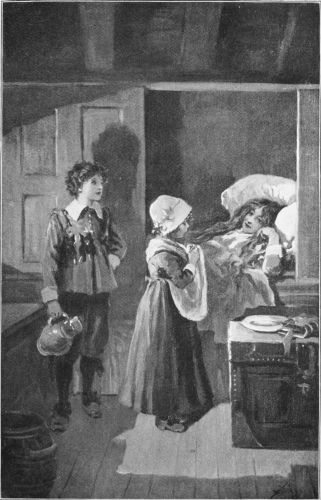
"O me!" Constance cried, with a sudden nervous
wail, "I know we'll all be slain ere daybreak.
O dear!" She turned to run into the bedroom,
when Lister caught her by the arm. "Don't cry,
Constance," he urged; "there's no need to fear.
Captain Standish and some of the others are coming
hither to spend the night and keep watch.
You'll be safe enough."
But the girl, breaking from him, vanished into
the chamber, whither Mistress Hopkins, snatching
up Damaris, followed her; so, for some moments,
Miles was free to ask questions and Ned to answer,
as it liked them best. But, so soon as Master
Hopkins's deliberate step sounded on the doorstone,
Mistress Hopkins came forth and, as he
entered the living room, confronted him: "Is that
savage to be lodged here to-night, Stephen? Among
us, where my children are?"
"He must go somewhere, Elizabeth," the master
of the house replied unruffled. "He is set to stay
among us for the night, and the tide is out so we
may not convey him on shipboard. We can lodge
him in the little closet next our chamber."
"He shall not come into the house!" said Mistress
Hopkins, with her thin lips set.
"Edward Lister, do you spread out the bed
within the closet," Master Hopkins went on unheedingly.
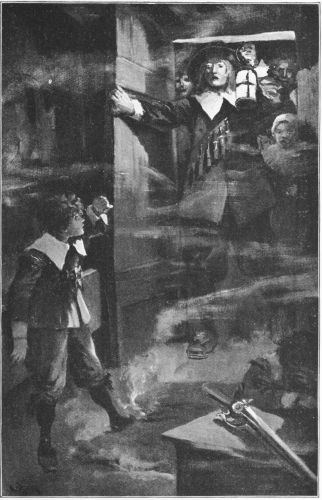
With a wink at Miles, Ned crossed the room in
unusual haste, and Miles, taking a candle, followed
after into the closet, a tiny room with one black
window, where stood an old chest and a hogshead
and a rolled-up mattress, which Ned began leisurely
to spread out. "What think you, Miles?" he
whispered, as the boy closed the door behind him.
"It's good there is one person in the house whom
the dame cannot rattle off as she list, eh?"
Miles nodded vaguely, his attention all fixed on
the least details of the commonplace room which
now had a fearful interest from the guest it was to
shelter. The thought of the savage stranger filled
the place with such awesome fancies that he could
not help going out from it very hastily ahead of
Lister, who grumbled a little that Miles was so
speedy to be off with the candle.
Once in the bright living room, however, he became
very brave indeed, and wondered to Giles
Hopkins when the Sagamore Samoset would come.
His mood grew the bolder when the elder lad
showed him a dirk knife he had placed under his
doublet. "For there's no being sure with these
treacherous savages," Giles said seriously.
But when the Sagamore came at last, the boys
found that the Hopkins household would be well
guarded, for with him were not only Master Hopkins
and Dotey, but big John Alden and Captain
Standish. The very sight of the latter reassured
Miles, so down he sat on the floor by the hearth,
with his arm round Trug, who, as soon as he spied
the Indian, bristled the hair on his back and uttered
a throaty growl.
Mistress Hopkins and Constance and the two
babies kept within the south chamber; but the
men by themselves were enough to fill the living
room. There were but two stools, besides the form
on the hearth and a chest against the wall, so long-legged
Giles must curl himself up on the floor by
Miles, while Ned Lister set himself upon the table.
They bade the Indian be seated on the form by the
fire, right over against Miles, who, be sure, stared
at him with eyes wide open.
The Sagamore Samoset, he saw, was a tall, straight
man, of complexion like an English gypsy, smooth-faced,
with coarse black hair that fell to his shoulders
behind, but was cut before. Since his coming into
the settlement, his English hosts had put upon him
a horseman's coat, which he wore with much pride
and dignity; indeed, all his gestures and carriage
were not only decent, but of a certain stateliness.
"Why, he is somewhat like other men," Miles
whispered softly to Giles, but Trug grumbled in
his throat.
Only one candle was burning in the room, but
the firelight cast a flickering brightness on the faces
of the men. Captain Standish and Lister and the
Indian had lighted pipes of tobacco, and the air
was so heavy with the smell of the smoke that
Miles half drowsed, but through his drooping eyelids
he watched his English comrades, and watched
the Indian. Captain Standish was sitting adventurously
right on the form beside the Sagamore, and
now and again they spoke together. Miles noted
that in the Indian's speech came strange words,
which the Captain seemed to try to understand, and
once or twice the Captain even sought to make use
of them himself.
Miles wondered at this, and then his only wonderment
was as to whether he had been asleep.
The logs on the hearth had broken into red embers;
the men had risen up; and, rubbing the heaviness
from his eyes, Miles saw Master Hopkins and the
Captain usher their Indian guest into the little closet
room.
Straightway a certain tension in the company
seemed to slacken; Giles rose stiffly from the floor,
and Trug put down his head upon his paws, though
he still kept one bright, half-opened eye fixed on the
door through which the Indian had gone. With a
great creaking of the trestles, Ned Lister dismounted
from the table. "If he come to kill us,"
he said in a low tone to Alden, "do you run in and
call me so I can have a share in the scuffle." Then,
stretching himself mightily, he disappeared into the
north bedroom, where the serving men and the boys
of the household slept.
"Since you have two others to keep watch with
you, Master Hopkins," spoke the Captain, as he
took down his hat from the wall, "I'll go walk a
turn about the hill. I'll be back ere the half-hour
is up."
He had put his hand to the latch, when Miles, on
the impulse, sprang to his feet and ran to him.
"May I come too, sir?" he whispered.
"You, Miles? Why, you were better in bed.
Nay, come if you like."
Out of doors the air was crispy and silent, and
pleasant smelling after the smoky atmosphere of the
crowded room. Overhead the stars were dense and
bright, but below, the lonely little settlement lay in
darkness, with never a spark of a candle showing.
"How late is it, Captain Standish?" Miles asked,
in a hushed voice.
"I should say it was near on to midnight," the
other replied, stepping along so briskly that Miles's
breath for talking was lost in the effort to keep pace
with him.
Up and up they toiled; past Goodman Billington's
cottage; past the black cabin where Alden
and the Captain lived; and then by the well-trodden
path up the sheer hillside, till the planking of the
broad platform sounded hollow beneath their feet,
and they stood among the guns. The spark in the
Captain's pipe gleamed red in the darkness, but
Miles could not see the Captain's features; he perceived
only that he turned his face from quarter to
quarter, and remained longest gazing into the black
west, where the ridge of hills ran jagged against the
starry sky.
He watched the Captain's movements, but he did
not venture to speak till Standish himself broke
out: "Well, there'll come no bands to frighten us
this night, I take it. We can march home, Miles.
We've a fair starlight to make the march under," he
added, and, as they stepped from the platform to the
yielding turf, lingered an instant to gaze skyward.
"Which is it that is the North Star, sir?" Miles
hesitated.
"Why, that one yonder, lad. You know it
well."
"I knew 'twas the North Star in England. I
knew not if 'twere the same here. It is such a long
ways from home."
"It's the same sky, Miles, and the same Heaven,
I take it, that we had over us in England."
Miles threw back his head and once more stared
up into the sky, that was so vast it made him shrink
and feel smaller even than before. He sighed a
little, he scarcely knew why, and put his hand on
the Captain's sleeve. Standish took Miles's hand
in his, and so kept hold on him as they came
down from the hill, and in that pressure was something
so comforting that Miles was sorry when they
reached the door of Master Hopkins's house.
Within was heavy air, and a dull fire, and sleepy
faces; Giles had gone to lie down on his bed, and
it did not need the Captain's bidding to send Miles
blinking after. Once, in the darkness, he was
wakened by hearing Lister protest inarticulately
that he would rather have his throat cut in his
sleep ten times over than rise and watch; and once
Miles guessed hazily that some one was shaking
him, and he tried to say he was getting up, and in
the midst dropped back on his pillow.
At the last the dazzle of warm sunlight on his
face, and the rattle, rattle of trenchers, brought him
staggering and blinking to his feet. Oh, yes, he
remembered; the Sagamore Samoset had been there
last night; but he was not afraid of him, especially
since 'twas daylight; indeed, he wanted to see him
again, so out he rushed into the living room.
"Well, sleepyhead!" Constance laughed at him,
and Mistress Hopkins was beginning to scold him
because he had not awakened, for all her efforts, till
mid-morning, when Ned Lister sauntered in. "His
Lordship the Indian is safe departed, Constance," he
said consolingly, as he made a slow business of
getting an axe from the chimney corner. "They
gave him a knife and a bracelet and a ring, and he
is gone away content."
"A good riddance, too!" snapped Mistress
Hopkins. "And now do you, Edward Lister,
fetch two buckets of water and wash out the place
where the creature lodged. To bring such heathen
under a Christian roof! I hope I never set eyes
on another of the coppery wretches again."
Ned shrugged his shoulders and said nothing till
his mistress was quite done; then he added meekly:
"I misremembered; he said he was coming back
again in a night or two, and next time he is going
to bring with him a goodly number from the tribe
of the Massasoits."