The So-called “Fuller Candy” for Queen Cages,
Transportation of Combless Colonies, Stimulative
and General Feeding.
The well-informed beekeeper has learned that it is unwise
and hazardous to feed under any circumstances honey in any
form, even though it be from his own apiary. There have
been many sad and general infections with bee diseases by
such unguarded feeding. Thus it has become almost an
axiom, “Feed no honey.” Consequently, substitutes have
necessarily been adopted and among these are sugar syrups
of various dilutions and compositions; “hard candy,” which
is virtually a taffy; and recently, the so-called “Fuller
candy,” which is a soft fondant, not dissimilar to the fondant
of chocolate creams.
For several years Mr. Fuller of Blackstone, Mass., as well
as others, has been experimenting with this modified English
candy, which should not harden beyond usefulness. Beekeepers
of Massachusetts and elsewhere about the country
have found it advantageous to use this as a substitute for
honey or syrup. So numerous are the inquiries and satisfactory
the results, that it seems desirable to prepare information
in printed form.
The soft candy has numerous advantages and possibilities.
It is found to be a most satisfactory stimulative feed; a food
for bees in transit, either full colonies on combs, in combless
packages, or for queens in mailing cages. It is also found
satisfactory and advantageous as winter stores. Colonies have
been observed to leave natural stores for the candy. This
has occurred in colonies out of doors or in the cellar during
winter, as well as with colonies which are flying. Some of
the advantages of the candy are the ease with which it is
handled or supplied; the fact that it may be made up in
quantities and stored until needed for use; its failure to
excite robbing; the ability to provision colonies with known
amounts or weights; and its freedom from bee disease infection.
It is furthermore found to be economical, there being
no waste by evaporation or spilling, as is the case with liquid
feeds. It is proving exceedingly practical in all feeding purposes
and methods.
The candy may be made in any degree of hardness or softness,
according to the preference of the individual or the
needs of the season. As is inferred above, it may be made
and stored for months and even years if properly handled.
It may be molded in pulp, or wooden pie-plates, shallow tins
or specially constructed feeders (see Figs. 1 and 2), “division-board
feeders,” overhead or super feeders, or boards may
be nailed to the side of a frame and the candy poured and
molded within the frame, allowing this to be hung in the hive
adjacent to the cluster. With the candy may be mixed pollen
substitutes, but these are as yet in the experimental stage,
and their efficiency or satisfactoriness is uncertain.
The latest formula or recipe for the cream, or soft candy,
fondant, which is practically a confectioner’s recipe, is as
follows:—
12 pounds granulated sugar.
1½ pounds liquid glucose.[1]
1¼ quarts water (equals 40 ounces, which equals 5 cupfuls).
¼ teaspoonful (about) cream of tartar, added when the temperature
reaches about 230° F. or 110° C.
Boil to 238° F. or 114.4° C.
The measurements should be accurate.
A wooden paddle whittled about a foot long, with a 2-inch
blade, is found to be superior to a spoon in stirring or beating
the candy.
A confectioner’s thermometer is an advantage. Those experienced
in making maple sugar may dispense with the
thermometer, although more accurate results are obtained by
using it.
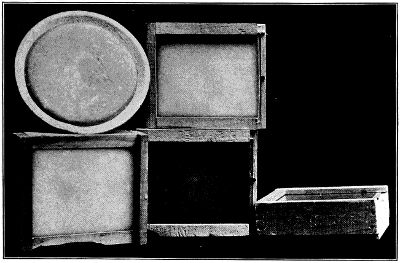
Fig. 1.—These are the usual and convenient types of candy box or feeder. The right-hand
one is placed as it would appear on the top of the frames. Notice that one end
is slightly elevated. To its left is a box of candy, which is darker, being made with
“Coffee A” sugar; the glass side of this faces out, as also in the upper box. The box
at the extreme left shows the surface of white candy, made with granulated sugar;
it also shows the projection which tilts the box. Upon it is a pie plate filled with the
candy, which may be inverted upon the frames. (Author’s illustration.)
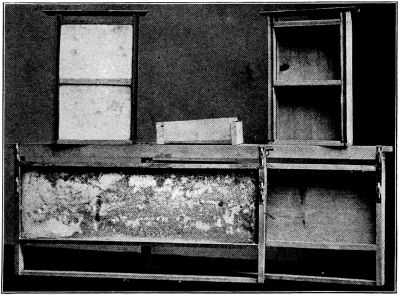
Fig. 2.—Molds in the form of division-board feeders (left-hand mold filled with candy;
right hand, empty). The lower frames are the standard Langstroth dimensions; the
upper are Benton nuclei frames. The central box shows the position of a feeder
on top of the frames. (Author’s illustration.)
As soon as the sugar has begun to dissolve, prior to boiling,
the spoon or paddle used in stirring should be removed
from the kettle. The candy should not be stirred while cooking;
to do it will cause a coarse grain. Remove from the
stove and cool to 125°-130° F. (or 51.6°-54.4° C.), when
the specified boiling point has been reached. While cooling,
in order to equalize the temperature, the mass may be
stirred; or preferably, when cooled to the specified degree,
it should be stirred until it commences to grain. Mr. Fuller’s
directions are to stir vigorously until the mass appears
in color and consistency like boiled starch or paste. At once
pour into molds or feeders and cool.
Fine-grain Fondant for Queen Cages.—Another way to
cool the candy is to prepare a marble slab 2 or 3 feet square
with bars of square iron, making a form. The candy may
be poured upon the marble, and with broad putty knives,
similar to those used by paper hangers, the mass may be
beaten or worked upon the marble. Experience teaches that
this, which is virtually a confectioner’s method, produces a
finer grain and usually a whiter fondant than when stirred
in the kettle. This is the process in preparing candy for
use in queen mailing cages, or the transportation of bees.
By it, a firmer consistency is usually obtained.
As a warning or explanation it may be said that the higher
the temperature at which the candy is boiled the harder it
will become; consequently, by varying the boiling point at
which the candy is removed from the stove, the hardness or
softness of the product may be governed. Furthermore, as
is the experience of confection makers, candy should be
boiled to one or two degrees higher on cloudy or humid days
than on a clear, dry day. By means of a thermometer and
a little experience, these features are readily learned.
Storing the Candy.—The fondant is best stored in
earthen crocks, either as a mass or in the feeders. These
preserve the normal moisture. Over the mass should be
placed a sheet of paraffin paper upon which is a moist cloth
or towel. The crock should be covered. Queen-cage candy
should always be kept in this way in order to preserve its
consistency. Similarly, candy molded in feeders may be
stored in large crocks or tins.
Remaking the Candy.—If at any time the candy hardens
from any cause, either in making, storage or in use, it may
be softened by the application of a few drops of water.
Furthermore, it may be removed from the molds and recooked
to the desired consistency. To recook, add a small
amount of water and boil as before.
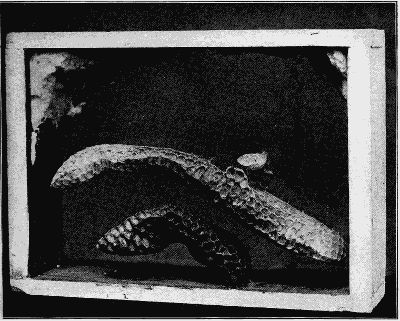
Fig. 3.—When the bees of a
strong colony eat up the candy almost entirely, they not infrequently
build combs, and have been known even to rear brood, in the box. This shows (upper part of the
picture, in corners) the remaining candy upon which the bees were still at work, also having attached
combs to the glass. Some beekeepers have removed such a box of combs and brood, starting there from
a new colony. In order to get the correct relation of the picture, hold it directly above your
head. The combs will then appear pendulous from the glass, and in their correct position, as if lifted
off from the tops of the frames.
Transcriber's notes:
The scans on which this e-book was based have been generously made available by the Internet Archive.
The original text has been preserved for this e-book, including inconsistencies.
The footnote has been moved to directly underneath the section it refers to.