Let me see if I can describe an old
Virginia home recalled from a
memory stamped with it when a virgin
page. It may, perhaps, be idealized by
the haze of time; but it will be as I
now remember it.
The mansion was a plain “weather-board”
house, one story and a half
above the half-basement ground floor,
set on a hill in a grove of primeval oaks
and hickories filled in with ash, maples,
and feathery-leafed locusts without number.
It was built of timber cut by the
“servants” (they were never termed
slaves except in legal documents) out
of the virgin forest, not long after the
Revolution, when that branch of the
family moved from Yorktown. It had
quaint dormer windows, with small
panes, poking out from its sloping upstairs
rooms, and long porches to shelter
its walls from the sun and allow house
life in the open air.
A number of magnificent oaks and
hickories (there had originally been a
dozen of the former, and the place from
them took its name, “Oakland”), under
which Totapottamoi children may have
played, spread their long arms about it,
sheltering nearly a half-acre apiece;
whilst in among them and all around
were ash and maples, an evergreen or
two, lilacs and syringas and roses, and
locusts of every age and size, which in
springtime filled the air with honeyed
perfume, and lulled with the “murmur
of innumerable bees.”
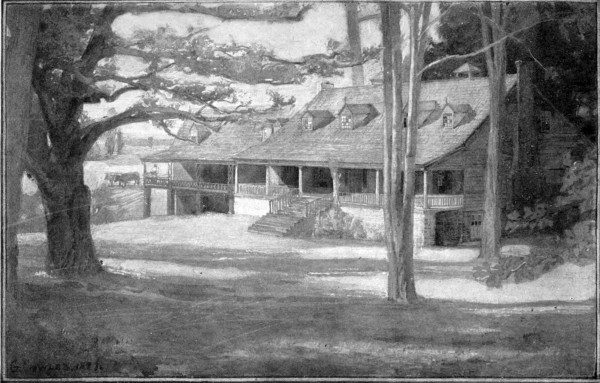
The Plantation House.
There was an “office” in the yard;
another house where the boys used to
stay, and the right to sleep in which was
as eagerly looked forward to and as
highly prized as was by the youth of
Rome the wearing of the toga virilis.
There the guns were kept; there the
dogs might sleep with their masters,
under, or in cold weather even on, the
beds; and there charming bits of masculine
gossip were retailed by the older
young gentlemen, and delicious tales of
early wickedness related, all the more
delightful because they were veiled in
chaste language phrased not merely to
meet the doctrine, maxima reverentia
pueris debetur, but to meet the higher
truth that no gentleman would use foul
language.
Off to one side was the orchard, in
springtime a bower of pink and snow,
and always making a pleasant spot in
the landscape; beyond which peeped
the ample barns and stables, and farther
yet lay the wide green fields.
Some of the fields that stretched
around were poor, and in places where
the rains had washed off the soil, red
“galls” showed through; but the tillage
was careful and systematic, and around
the house were rich hay-fields where
the cattle stood knee-deep in clover.
The brown worm fences ran in lateral
lines, and the ditches were kept clean
except for useful willows.
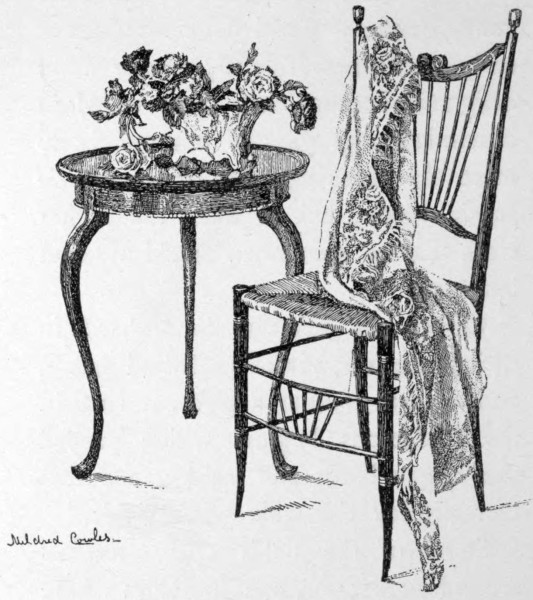
The furniture was old-timey and
plain,—mahogany and rosewood bedsteads
and dressers black with age, and
polished till they shone like mirrors,
hung with draperies white as snow;
straight-backed chairs generations old
interspersed with common
new ones; long sofas
with claw feet; old
shining tables with slender brass-tipped
legs, straight or fluted, holding some
fine old books, and in springtime a blue
or flowered bowl or two with glorious
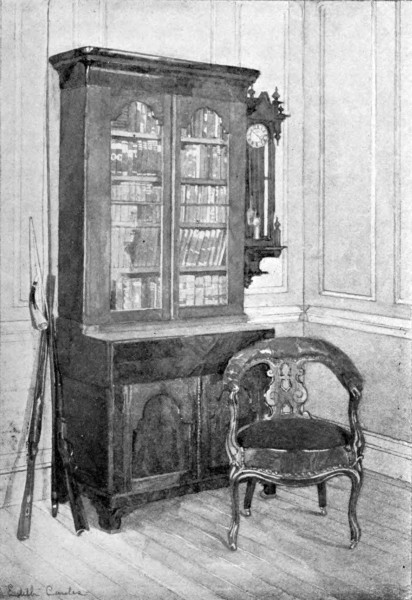
roses; bookcases filled with brown-backed,
much-read books. This was all.
The servants’ houses, smoke-house,
wash-house, and carpenter-shop were
set around the “back yard,” with
“mammy’s house” a little nicer than
the others; and farther off, upon and
beyond the quarters hill, “the quarters,”—whitewashed,
substantial buildings,
each for a family, with chicken-houses
hard by, and with yards closed in by
split palings, filled with fruit trees,
which somehow bore cherries, peaches,
and apples in a mysterious profusion
even when the orchard failed.
Beyond the yard were gardens.
There were two,—the vegetable garden
and the flower garden. The former
was the test of the mistress’s power;
for at the most critical times she took
the best hands on the place to work it.
The latter was the proof of her taste. It
was a strange affair: pyrocanthus hedged
it on the outside; honeysuckle ran riot
over its palings, perfuming the air;
yellow cowslips in well-regulated tufts
edged some borders, while sweet peas,
pinks, and violets spread out recklessly
over others; jonquilles yellow as gold,
and, once planted, blooming every spring
as certainly as the trees budded or the
birds nested, grew in thick bunches; and
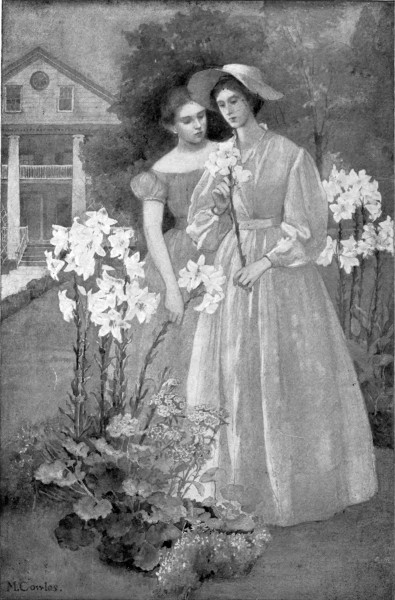
here and there were tall lilies, white as
angels’ wings and stately as the maidens
that walked among them; big snowball
bushes blooming with snow, lilacs purple
and white and sweet in the spring,
and always with birds’ nests in them
with the bluest of eggs; and in places
rosebushes, and tall hollyhock stems
filled with rich rosettes of every hue and
shade, made a delicious tangle. In the
autumn rich dahlias and pungent-odored
chrysanthemums ended the sweet procession
and closed the season.
But the flower of all others was the
rose. There were roses everywhere;
clambering roses over the porches and
windows, sending their fragrance into
the rooms; roses beside the walks;
roses around the yard and in the garden;
roses of every hue and delicate
refinement of perfume; rich yellow
roses thick on their briery bushes,
coming almost with the dandelions
and buttercups, before any others
dared face the April showers to learn
if March had truly gone, sweet as if
they had come from Paradise to be
worn upon young maidens’ bosoms,
as they might well have done—who
knows?—followed by the Giant of
Battles on their stout stems, glorious
enough to have been the worthy badge
of victorious Lancastrian kings; white
Yorks, hardly less royal; cloth-of-golds;
dainty teas; rich damasks;
old sweet hundred-leafs sifting down
their petals on the grass, and always
filling with two the place where one
had fallen. These and many more
whose names have faded made the air
fragrant, whilst the catbirds and mocking-birds
fluttered and sang among them,
and the robins foraged in the grass for
their greedy yellow-throats waiting in
the hidden nests.
Looking out over the fields was a
scene not to be forgotten.
Let me give it in the words of one
who knew and loved Virginia well, and
was her best interpreter:[1]—
“A scene not of enchantment,
though contrast often made it seem so,
met the eye. Wide, very wide fields
of waving grain, billowy seas of green
or gold as the season chanced to be,
over which the scudding shadows chased
and played, gladdened the heart with
wealth far spread. Upon lowlands
level as the floor the plumed and tasselled
corn stood tall and dense, rank
behind rank in military alignment—a
serried army lush and strong. The
rich, dark soil of the gently swelling
knolls could scarcely be seen under the
broad lapping leaves of the mottled
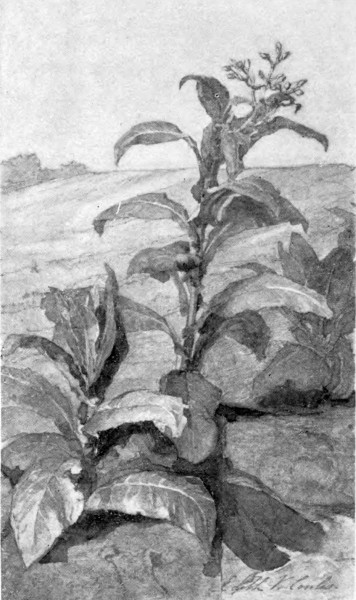
tobacco. The hills were carpeted with
clover. Beneath the tree-clumps fat
cattle chewed the cud, or peaceful
sheep reposed, grateful for the shade.
In the midst of this plenty, half hidden
in foliage, over which the graceful
shafts of the Lombard poplar towered,
with its bounteous garden and its orchards
heavy with fruit near at hand,
peered the old mansion, white, or dusky
red, or mellow gray by the storm and
shine of years.
“Seen by the tired horseman halting
at the woodland’s edge, this picture,
steeped in the intense quivering summer
moonlight, filled the soul with
unspeakable emotions of beauty, tenderness,
peace, home.
“How calm could we rest
In that bosom of shade with the friends we love best!
“Sorrows and care were there—where
do they not penetrate? But,
oh! dear God, one day in those sweet,
tranquil homes outweighed a fevered
lifetime in the gayest cities of the globe.
Tell me nothing; I undervalue naught
that man’s heart delights in. I dearly
love operas and great pageants; but I
do know—as I know nothing else—that
the first years of human life, and
the last, yea, if it be possible, all the
years, should be passed in the country.
The towns may do for a day, a week,
a month at most; but Nature, Mother
Nature, pure and clean, is for all time,—yes,
for eternity itself.”
The life about the place was amazing.
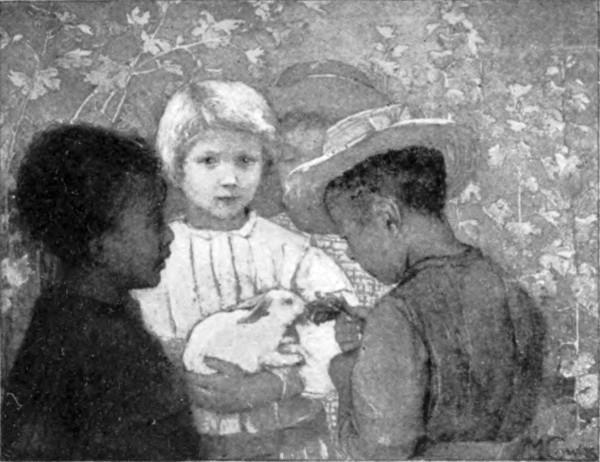
There were the busy children
playing in groups, the boys of the family
mingling with the little darkies as
freely as any other young animals, and
forming the associations which tempered
slavery and made the relation one
not to be understood save by those who
saw it. There they were, stooping
down and jumping up; turning and
twisting, their heads close together, like
chickens over an “invisible repast,”
their active bodies always in motion:
busy over their little matters with that
ceaseless energy of boyhood which
could move the world could it but be
concentrated and conserved. They
were all over the place; in the orchard
robbing birds’ nests, getting into wild
excitement over catbirds, which they
ruthlessly murdered because they “called
snakes”; in spring and summer fishing
or “washing” in the creek, riding the
plough-horses to and from the fields,
running the calves and colts, and being
as mischievous as the young mules they
chased.
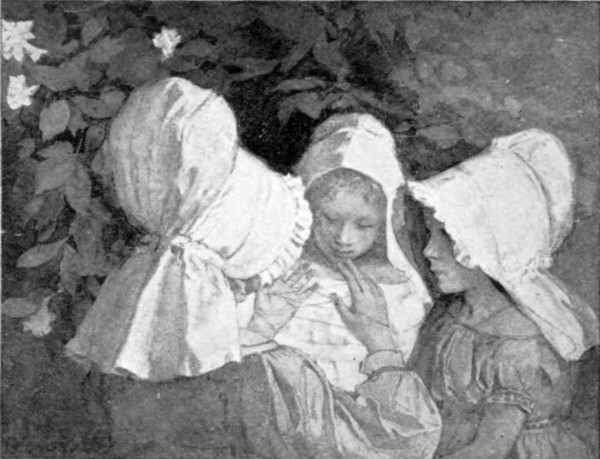
There were the little girls in their
great sunbonnets, often sewed on to
preserve the wonderful peach-blossom
complexions, with their small female
companions playing about the yard or
garden, running with and wishing they
were boys, and getting half scoldings
from mammy for being tomboys and
tearing their aprons and dresses. There,
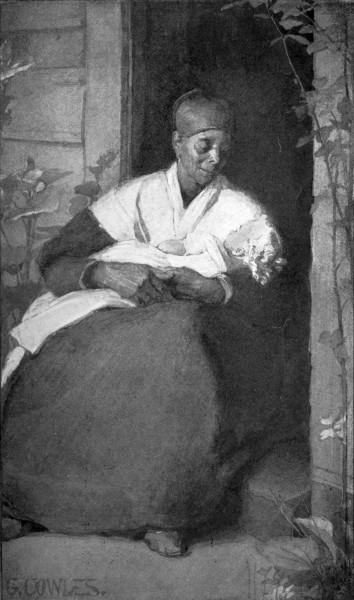
in the shade, near her “house,” was
the mammy with her assistants, her
little charge in her arms, sleeping in
her ample lap, or toddling about her,
with broken, half-formed phrases, better
understood than framed. There passed
young negro girls, blue-habited, running
about bearing messages; or older
women moving at a statelier pace, doing
with deliberation the little tasks which
were their “work;” whilst about the
office or smoke-house or dairy or
wood-pile there was always some
movement and life. The peace of it
all was only emphasized by the sounds
that broke upon it: the call of ploughers
to their teams; the shrill shouts of
children; the chant of women over
their work, and as a bass the recurrent
hum of spinning-wheels, like the drone
of some great insect, sounding from
cabins where the turbaned spinners spun
their fleecy rolls for the looms which
were clacking in the loom-rooms making
homespun for the plantation.
From the back yard and quarters the
laughter of women and the shrill, joyous
voices of children came. Far off, in
the fields, the white-shirted “ploughers”
followed singing their slow teams in the
fresh furrows, wagons rattled, and ox-carts
crawled along, or gangs of hands
in lines performed their work in the
corn or tobacco fields, loud shouts and
peals of laughter, mellowed by the distance,
floating up from time to time,
telling that the heart was light and the
toil not too heavy.
At special times there was special
activity: at ice-getting time, at corn-thinning
time, at fodder-pulling time, at
threshing-wheat time, but above all at
corn-shucking time, at hog-killing time,
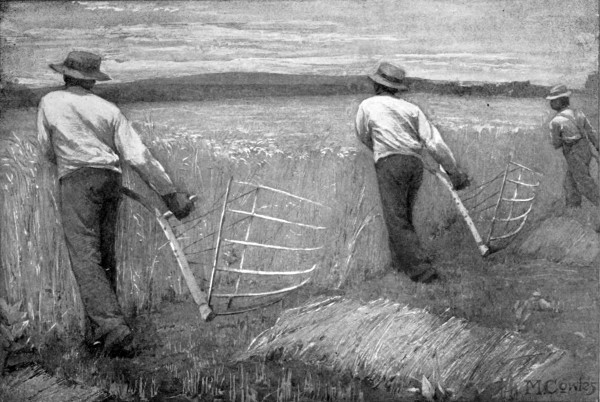
and at “harvest.” Harvest was spoken
of as a season. It was a festival. The
severest toil of the year was a frolic.
Every “hand” was eager for it. It
was the test of the men’s prowess and
the women’s skill. For it took a man to
swing his cradle through the long June
days and keep pace with the bare-necked,
knotted-armed leader as he strode and
swung his ringing cradle through the
heavy wheat. So it demanded a strong
back and nimble fingers in the binding
to “keep up” and bind the sheaves.
The young men looked forward to it
as young bucks look to the war-path.
How gay they seemed, moving in oblique
lines around the “great parallelograms,”
sweeping down the yellow grain, and,
as they neared the starting-point, chanting
with mellow voices the harvest song
“Cool Water”! How musical was the
cadence as, taking time to get their wind,
they whet in unison their ringing blades!
Though the plantations were large,
so large that one master could not
hear his neighbor’s dog bark, there was
never any loneliness: it was movement
and life without bustle; whilst somehow,
in the midst of it all, the house seemed
to sit enthroned in perpetual tranquillity,
with outstretched wings under its spreading
oaks, sheltering its children like a
great gray dove.
Even at night there was stirring
about: the ring of an axe, the infectious
music of the banjos, the laughter
of dancers, the festive noise and merriment
of the cabin, the distant, mellowed
shouts of ’coon or ’possum hunters, or
the dirge-like chant of some serious
and timid wayfarer passing along the
paths over the hills or through the
woods, and solacing his lonely walk
with religious song.
Such was the outward scene. What
was there within? That which has
been much misunderstood,—that which
was like the roses, wasteful beyond
measure in its unheeded growth and
blowing, but sweet beyond measure,
too, and filling with its fragrance not
only the region round about, but sending
it out unmeasuredly on every breeze
that wandered by.
The life within was of its own kind.
There were the master and the mistress:
the old master and old mistress,
the young masters and young mistresses,
and the children; besides some aunts
and cousins, and the relations or friends
who did not live there, but were only
always on visits.
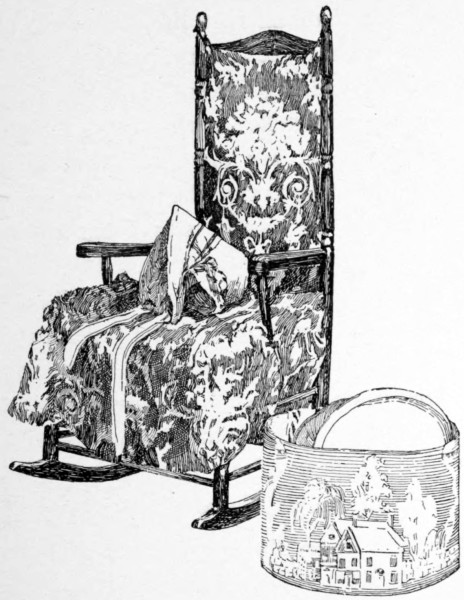
The Exclusive Property of the Mistress.
Properly, the mistress should be mentioned
first, as she was the most important
personage about the home, the
presence which pervaded the mansion,
the centre of all that life, the queen of
that realm; the master willingly and
proudly yielding her entire management
of all household matters and simply
carrying out her directions, confining
his ownership within the curtilage solely
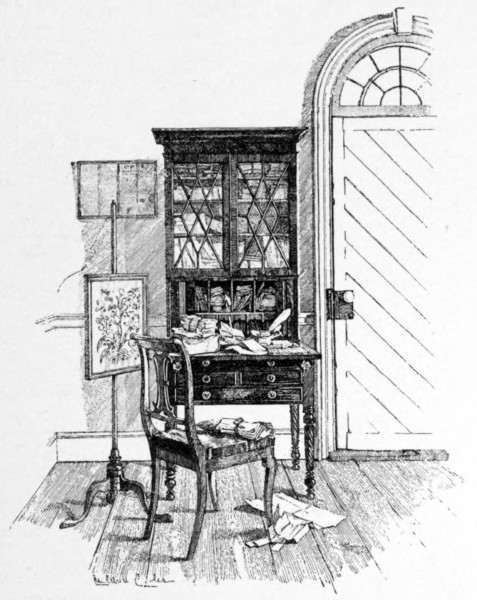
to his old “secretary,” which on the mistress’s
part was as sacred from her touch
as her bonnet was from his. There
were kept mysterious folded papers, and
equally mysterious parcels, frequently
brown with the stain of dust and age.
Had the papers been the lost sibylline
leaves instead of old receipts and bills,
and had the parcels contained diamonds
instead of long-dried melon-seed or old
flints, now out of date but once ready
to serve a useful purpose, they could
not have been more sacredly guarded by
the mistress. The master usually had to
hunt for a long period for any particular
paper, whilst the mistress could in a
half-hour have arranged everything in
perfect order; but the chaos was regarded
by her with veneration as real as
that with which she regarded the mystery
of the heavenly bodies.
On the other hand, outside of this
piece of furniture there was nothing in
the house of which the master even pretended
to know. It was all in her keeping.
Whatever he wanted he called for,
and she produced it with a certainty and
promptness which struck him as a perpetual
miracle. Her system appeared to
him as the result of a wisdom as profound
as that which fixed and held the
firmament. He would not have dared
to interfere, not because he was afraid,
but because he recognized her superiority.
It would no more have occurred
to him to make a suggestion about the
management of the house than about
that of one of his neighbors; simply
because he knew her and acknowledged
her infallibility. She was, indeed, a surprising
creature—often delicate in frame,
and of a nervous organization so sensitive
as perhaps to be a great sufferer;
but her force and character pervaded
and directed everything, as unseen yet as
unmistakably as the power of gravity controls
the particles that constitute the earth.
It has been assumed by the outside
world that our people lived a life of
idleness and ease, a kind of “hammock-swung,”
“sherbet-sipping” existence,
fanned by slaves, and, in their pride,
served on bended knees. No conception
could be further from the truth. The
ease of the master of a big plantation was
about that of the head of any great establishment
where numbers of operatives
are employed, and to the management
of which are added the responsibilities
of the care and complete mastership
of the liberty of his operatives and their
families. His work was generally sufficiently
systematized to admit of enough
personal independence to enable him to
participate in the duties of hospitality;
but any master who had a successfully
conducted plantation was sure to have
given it his personal supervision with an
unremitting attention which would not
have failed to secure success in any other
calling. If this was true of the master,
it was much more so of the mistress.
The master might, by having a good
overseer and reliable headmen, shift a
portion of the burden from his shoulders;
the mistress had no such means of
relief. She was the necessary and invariable
functionary; the keystone of
the domestic economy which bound all
the rest of the structure and gave it its
strength and beauty. From early morn
till morn again the most important and
delicate concerns of the plantation were
her charge and care. She gave out
and directed all the work of the
women. From superintending the setting
of the turkeys to fighting a
pestilence, there was nothing which
was not her work. She was mistress,
manager, doctor, nurse, counsellor,
seamstress, teacher, housekeeper, slave,
all at once. She was at the beck and
call of every one, especially of her husband,
to whom she was “guide, philosopher,
and friend.”
One of them, being told of a broken
gate by her husband, said, “Well, my
dear, if I could sew it with my needle
and thread, I would mend it for you.”
What she was, only her husband
divined, and even he stood before her
in dumb, half-amazed admiration, as
he might before the inscrutable vision of
a superior being. What she really was,
was known only to God. Her life was
one long act of devotion,—devotion to
God, devotion to her husband, devotion
to her children, devotion to her servants,
to her friends, to the poor, to humanity.
Nothing happened within the
range of her knowledge that her sympathy
did not reach and her charity and
wisdom did not ameliorate. She was
the head and front of the church; an
unmitred bishop in partibus, more effectual
than the vestry or deacons, more
earnest than the rector; she managed
her family, regulated her servants, fed
the poor, nursed the sick, consoled the
bereaved. Who knew of the visits
she paid to the cabins of her sick and
suffering servants! often, at the dead
of night, “slipping down” the last
thing to see that her directions were
carried out; with her own hands administering
medicines or food; ever
by her cheeriness inspiring new hope,
by her strength giving courage, by her
presence awaking faith; telling in her
soft voice to dying ears the story of
the suffering Saviour; with her hope
soothing the troubled spirit, and lighting
with her own faith the path down
into the valley of the dark shadow.
What poor person was there, however
inaccessible the cabin, that was sick
or destitute and knew not her charity!
Who that was bereaved that had not
her sympathy!
The training of her children was
her work. She watched over them,
inspired them, led them, governed
them; her will impelled them; her
word to them, as to her servants,
was law. She reaped the reward.
If she admired them, she was too
wise to let them know it; but her
sympathy and tenderness were theirs
always, and they worshipped her.
There was something in seeing the
master and mistress obeyed by the plantation
and looked up to by the neighborhood
which inspired the children with
a reverence akin to awe which is not
known at this present time. It was
not till the young people were grown
that this reverence lost the awe and
became based only upon affection and
admiration. Then, for the first time,
they dared to jest with her; then, for
the first time, they took in that she
had been like them once, young and
gay and pleasure-loving, with coquetries
and maidenly ways, with lovers
suing for her; and that she still took
pleasure in the recollection,—this gentle,
classic, serious mother among her
tall sons and radiant daughters. How
she blushed as they laughed at her and
teased her to tell of her conquests, her
confusion making her look younger and
prettier than they remembered her, and
opening their eyes to the truth of what
their father had told them so often, that
not one of them could be as beautiful
as she.
She became timid and dependent as
they grew up and she found them
adorned with new fashions and ways
which she did not know; she gave
herself up to their guidance with an
appealing kind of diffidence; was tremulous
over her ignorance of the novel
fashions which made them so charming.
Yet, when the exactions of her
position came upon her, she calmly
took the lead, and, by her instinctive
dignity, her wisdom, and her force,
eclipsed them all as naturally as the
full moon in heaven dims the stars.
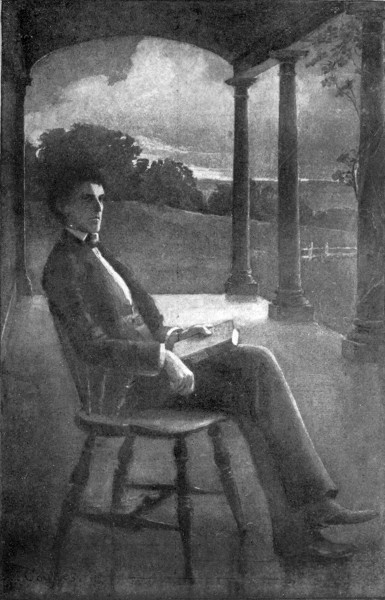
Such in part was the mistress. As
to the master himself, it is hard to
generalize. Yet there were indeed
certain generic characteristics, whether
he was grave and severe, or jovial and
easy. There was the foundation of a
certain pride based on self-respect and
consciousness of power. There were
nearly always the firm mouth with its
strong lines, the calm, placid, direct
gaze, the quiet speech of one who is
accustomed to command and have his
command obeyed; there was a contemplative
expression due to much communing
alone, with weighty responsibilities
resting upon him; there was absolute
self-confidence, and often a look caused
by tenacity of opinion. There was not
a doubtful line in the face nor a doubtful
tone in the voice; his opinions were
convictions; he was a partisan to the
backbone; and not infrequently he was
incapable of seeing more than one side.
This prevented breadth, but gave force.
He was proud, but rarely haughty except
to dishonor. To that he was inexorable.
He believed in God, he believed
in his wife, he believed in his blood.
He was chivalrous, he was generous,
he was usually incapable of fear or of
meanness. To be a Virginia gentleman
was the first duty; it embraced
being a Christian and all the virtues.
He lived as one; he left it as a heritage
to his children. He was fully
appreciative of both the honors and the
responsibilities of his position. He believed
in a democracy, but understood
that the absence of a titled aristocracy
had to be supplied by a class more
virtuous than he believed any aristocracy
to be. He purposed in his own
person to prove that this was practicable.
He established the fact that it
was. This and other responsibilities
made him grave. He had inherited
gravity from his father and grandfather.
The latter had been a performer in the
greatest work of modern times, with
the shadow of the scaffold over him if
he failed. The former had faced the
weighty problems of the new government,
with many unsolved questions
ever to answer. He himself faced problems
not less grave. The greatness
of the past, the time when Virginia
had been the mighty power of the New
World, loomed ever above him. It
increased his natural conservatism. He
saw the change that was steadily creeping
on. The conditions that had given
his class their power and prestige had
altered. The fields were worked down,
and agriculture that had made his class
rich no longer paid. The cloud was
already gathering in the horizon; the
shadow already was stretching towards
him. He could foresee the danger that
threatened Virginia. A peril ever sat
beside his door. He was “holding
the wolf by the ears.” Outside influences
hostile to his interest were being
brought to bear. Any movement must
work him injury. He sought the only
refuge that appeared. He fell back
behind the Constitution that his fathers
had helped to establish, and became a
strict constructionist for Virginia and
his rights. These things made him
grave. He reflected much. Out on
the long verandas in the dusk of the
summer nights, with his wide fields
stretching away into the gloom, and
“the woods” bounding the horizon,
his thoughts dwelt upon serious things;
he pondered causes and consequences;
he resolved everything to prime principles.
He communed with the Creator
and his first work, Nature.
This communion made him a wonderful
talker. He discoursed of philosophy,
politics, and religion. He read
much, generally on these subjects, and
read only the best. His bookcases
held the masters (in mellow Elzevirs
and Lintots) who had been his father’s
friends, and with whom he associated
and communed more intimately than
with his neighbors. Homer, Horace,
Virgil, Ovid, Shakespeare, Milton, Dryden,
Goldsmith, “Mr. Pope,” were his
poets; Plutarch, Bacon, Burke, and
Dr. Johnson were his philosophers.
He knew their teachings and tried to
pattern himself on them. These “new
fellows” that his sons raved over he
held in so much contempt that his mere
statement of their inferiority was to his
mind an all-convincing argument.
In religion he was as orthodox as
the parson. He might not be a professing
member of the church; but
he was one of its pillars: ready to
stand by, and, if need were, to fight to
the death for the Thirty-nine Articles,
or the Confession of Faith. Yet,
if he was generally grave, he was
at times, among his intimates and
guests, jovial, even gay. On festive
occasions no one surpassed him in
cheeriness. To a stranger he was
always a host, to a lady always a
courtier. When the house was full of
guests, he was the life of the company.
He led the prettiest girl out for the
dance. At Christmas he took her
under the mistletoe, and paid her gracious
compliments which made her
blush and courtesy with dimpling face
and dancing eyes. But whatever was
his mood, whatever his surroundings,
he was always the exponent of that
grave and knightly courtesy which under
all conditions has become associated
with the title “Virginia gentleman.”
Whether or not the sons were, as
young men, peculiarly admirable may
be a question. They possessed the
faults and the virtues of young men
of their kind and condition. They
were given to self-indulgence; they
were not broad in their limitations;
they were apt to contemn what did
not accord with their own established
views (for their views were established
before their mustaches); they were
wasteful of time and energies beyond
belief; they were addicted to the pursuit
of pleasure. They exhibited the
customary failings of their kind in a
society of an aristocratic character.
But they possessed in full measure the
corresponding virtues. They were
brave, they were generous, they were
high-spirited. Indulgence in pleasure
did not destroy them. It was the
young French noblesse who affected to
eschew exertion even to the point of
having themselves borne on litters on
their boar-hunts, and who yet, with
a hundred pounds of iron buckled on
their frames, charged like furies at
Fontenoy. So these same languid,
philandering young gentlemen, when
the crucial occasion came, suddenly
appeared as the most dashing and
indomitable soldiery of modern times.
It was the Norfolk company known
as the “Dandies” that was extirpated
in a single day.
But, whatever may be thought of
the sons, there can be no question as to
the daughters. They were like the
mother; made in her own image. They
filled a peculiar place in the civilization;
the key was set to them. They held by
a universal consent the first place in the
system, all social life revolving around
them. So generally did the life shape
itself about the young girl that it was
almost as if a bit of the age of chivalry
had been blown down the centuries and
lodged in the old State. She instinctively
adapted herself to it. In fact,
she was made for it. She was gently
bred: her people for generations (since
they had come to Virginia) were gentlefolk.
They were so well satisfied that
they had been the same in the mother
country that they had never taken the
trouble to investigate it. She was the
incontestable proof of their gentility.
In right of her blood (the beautiful
Saxon, tempered by the influences of
the genial Southern clime), she was exquisite,
fine, beautiful; a creature of
peach-blossom and snow; languid, delicate,
saucy; now imperious, now melting,
always bewitching. She was not
versed in the ways of the world, but she
had no need to be; she was better than
that; she was well bred. She had not
to learn to be a lady, because she was
born one. Generations had given her
that by heredity. She grew up apart
from the great world. But ignorance
of the world did not make her provincial.
Her instinct was an infallible
guide. When a child she had in her
sunbonnet and apron met the visitors at
the front steps and entertained them in
the parlor until her mother was ready
to appear. Thus she had grown up to
the duties of hostess. Her manners
were as perfectly formed as her mother’s,
with perhaps a shade more self-possession.
Her beauty was a title which
gave her a graciousness that well befitted
her. She never “came out,”
because she had never been “in;” and
the line between girlhood and young-ladyhood
was never known. She began
to have beaux certainly before she
reached the line; but it did her no
harm: she would herself long walk
“fancy free.” A protracted devotion
was required of her lovers, and they began
early. They were willing to serve
long, for she was a prize worth the service.
Her beauty, though it was often
dazzling, was not her chief attraction.
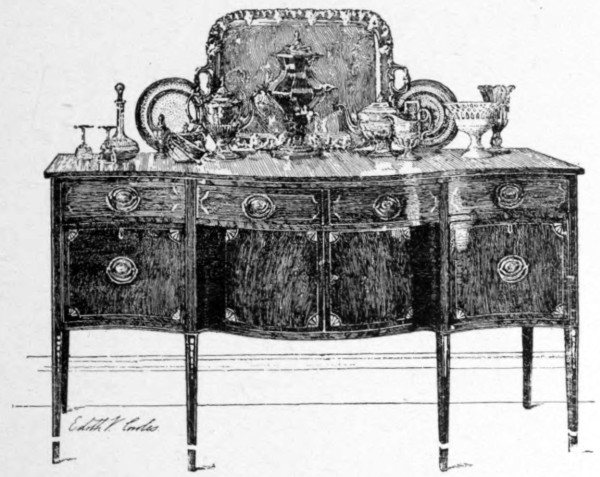
An Old Virginia Sideboard.
That was herself: that indefinable
charm; the result of many attractions, in
combination and perfect harmony, which
made her herself. She was delicate, she
was dainty, she was sweet. She lived
in an atmosphere created for her,—the
pure, clean, sweet atmosphere of her
country home. She made its sunshine.
She was generally a coquette, often an
outrageous flirt. It did not imply heartlessness.
It was said that the worst
flirts made the most devoted wives. It
was simply an instinct, an inheritance;
it was in the life. Her heart was tender
towards every living thing but her
lovers; even to them it was soft in
every way but one. Had they had a
finger-ache, she would have sympathized
with them. But in the matter of love
she was inexorable, remorseless. She
played upon every chord of the heart.
Perhaps it was because, when she gave
up, the surrender was to be absolute.
From the moment of marriage she was
the worshipper. Truly she was a strange
being. In her muslin and lawn; with
her delicious, low, slow, musical speech;
accustomed to be waited on at every
turn, with servants to do her every bidding;
unhabituated often even to putting
on her dainty slippers or combing
her soft hair,—she possessed a reserve
force which was astounding. She was
accustomed to have her wishes obeyed
as commands. It did not make her
imperious; it simply gave her the habit
of control. At marriage she was prepared
to assume the duties of mistress
of her establishment, whether it were
great or small.
Thus, when the time came, the class
at the South which had been deemed
the most supine suddenly appeared as
the most efficient and the most indomitable.
The courage which the men
displayed in battle was wonderful; but
it was nothing to what the Southern
women exemplified at home. There
was, perhaps, not a doubtful woman
within the limits of the Confederacy.
Whilst their lovers and husbands
fought in the field, they performed
the harder part of waiting at home.
With more than a soldier’s courage
they bore more than a soldier’s hardship.
For four long years they listened
to the noise of the guns, awaiting with
blanched faces but undaunted hearts the
news of battle after battle; buried their
beloved dead with tears, and still amid
their tears encouraged the survivors to
fight on. It was a force which has not
been duly estimated. It was in the blood.
She was indeed a strange creature,
that delicate, dainty, mischievous, tender,
God-fearing, inexplicable Southern
girl. With her fine grain, her silken
hair, her satiny skin, her musical
speech; pleasure-loving, saucy, bewitching—deep
down lay the bedrock
foundation of innate virtue, piety,
and womanliness, on which were
planted all for which human nature
can hope, and all to which it can aspire.
Words fail to convey an idea of what
she was; as well try to describe the
beauty of the rose or the perfume of
the violet. To appreciate her one must
have seen her, have known her, have
loved her.
There are certain other characters
without mention of which no picture of
the social life of the South would be
complete: the old mammies and family
servants about the house. These were
important, and helped to make the life.
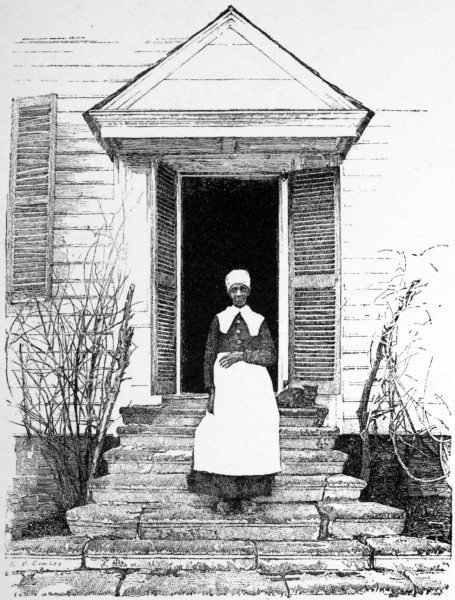
The Mammy was the zealous, faithful,
and efficient assistant of the mistress in
all that pertained to the care and training
of the children. Her authority was
recognized in all that related to them
directly or indirectly, second only to
that of the Mistress and Master. She
tended them, regulated them, disciplined
them: having authority indeed in cases
to administer correction; for her affection
was undoubted. Her régime extended
frequently through two generations,
occasionally through three. From
their infancy she was the careful and
faithful nurse, the affection between her
and the children she nursed being often
more marked than that between her
and her own offspring. She may have
been harsh to the latter; she was never
anything but tender with the others.
Her authority was, in a measure, recognized
through life, for her devotion was
unquestionable. The young masters and
mistresses were her “children” long
after they had children of their own.
When they parted from her or met with
her again after separation, they embraced
her with the same affection as when in
childhood she “led them smiling into
sleep.” She was worthy of the affection.
At all times she was their faithful ally
and champion, excusing them, shielding
them, petting them, aiding them, yet
holding them up too to a certain high
accountability. Her influence was always
for good. She received, as she gave, an
unqualified affection. If she was a slave,
she at least was not a servant, but was
an honored member of the family, universally
beloved, universally cared for—“the
Mammy.”
Next to her in importance and rank
were the Butler and the Carriage-driver.
These with the Mammy were the aristocrats
of the family, who trained the
children in good manners and other exercises;
and uncompromising aristocrats
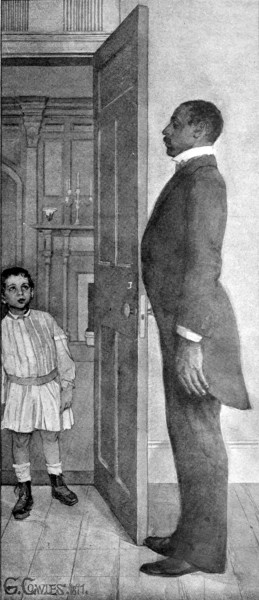
they were. The Butler was apt to be
severe, and was feared; the Driver was
genial and kindly, and was adored. I
recall a butler, “Uncle Tom,” an austere
gentleman, who was the terror of
the juniors of the connection. One of
the children, after watching him furtively
as he moved about with grand air, when
he had left the room and his footsteps
had died away, crept over and asked her
grandmother, his mistress, in an awed
whisper, “Grandma, are you ’fraid of
Unc’ Tom?”
The Driver was the ally of the boys,
the worshipper of the girls, and consequently
had an ally in their mother, the
mistress. As the head of the stable,
he was an important personage. This
comradeship was never forgotten; it
lasted through life. The years might
grow on him, his eyes might become
dim; but he was left in command even
when he was too feeble to hold the
horses; and though he might no longer
grasp the reins, he at least held the title,
and to the end was always “the Driver
of Mistiss’s carriage.”
Other servants too there were with
special places and privileges,—gardeners
and “boys about the house,” comrades
of the boys; and “own maids,” for
each girl had her “own maid.” They
all formed one great family in the social
structure now passed away, a structure
incredible by those who knew it
not, and now, under new conditions,
almost incredible by those who knew
it best.
The social life formed of these elements
combined was one of singular
sweetness and freedom from vice. If it
was not filled with excitement, it was
replete with happiness and content. It
is asserted that it was narrow. Perhaps
it was. It was so sweet, so charming,
that it is little wonder if it asked nothing
more than to be let alone.
They who lived it were a careless
and pleasure-loving people; but, as in
most rural communities, their festivities
were free from dissipation. There was
sometimes too great an indulgence on
the part of young men in the State
drink, the julep; but whether it was
that it killed early, or that it was usually
abandoned as the responsibilities of life
increased, an elderly man of dissipated
habits was almost unknown. They were
fond of sport, and excelled in it, being
generally fine riders, good shots, and
skilled hunters. Love of horses was a
race characteristic, and fine horsemanship
was a thing little considered only
because it was universal.
The life was gay. In addition to the
perpetual round of ordinary entertainment,
there was always on hand or in
prospect some more formal festivity,—a
club meeting, a fox-hunt, a party, a
tournament, a wedding. Little excuse
was needed to bring people together
where every one was social, and where
the great honor was to be the host.
Scientific horse-racing was confined to
the regular race-tracks, where the races
were not dashes, but four-mile heats
which tested speed and bottom alike.
But good blood was common, and
even a ride with a girl in an afternoon
meant generally a dash along the
level through the woods, where, truth
to tell, Miss Atalanta was very apt to
win. Occasionally there was even a
dash from the church. The high-swung
carriages, having received their
precious loads of lily-fingered, pink-faced,
laughing girls with teeth like
pearls and eyes like stars, helped in by
young men who would have thrown not
only their cloaks but their hearts into
the mud to keep those dainty feet from
being soiled, would go ahead; and then,
the restive saddle-horses being untied
from the swinging limbs, the young
gallants would mount, and, by an instinctive
common impulse, starting all
together, would make a dash to the
first hill, on top of which the dust still
lingered, a golden nimbus thrown from
the wheels that rolled their goddesses.
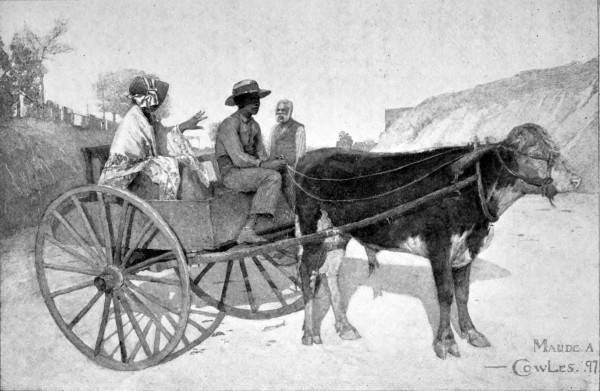
The Lady and the Ox-Cart.
The chief sport, however, was fox-hunting.
It was, in season, almost
universal. Who that lived in that time
does not remember the fox-hunts,—the
eager chase after “grays” or “old
reds”! The grays furnished more fun,
the reds more excitement. The grays
did not run so far, but usually kept near
home, going in a circuit of six or eight
miles. “An old red,” generally so
called irrespective of age, as a tribute to
his prowess, might lead the dogs all day,
and end by losing them as evening
fell, after taking them a dead stretch
for thirty miles. The capture of a gray
was what men boasted of; a chase
after “an old red” was what they
“yarned” about. Some old reds became
historical characters, and were as
well known and as much discussed in the
counties they inhabited as the leaders of
the bar or the crack speakers of the
circuit. The wiles and guiles of each
veteran were the pride of his neighbors
and hunters. Many of them had names.
Gentlemen discussed them at their club
dinners; lawyers told stories about
them in the “Lawyers’ Rooms” at the
court-houses; young men, while they
waited for the preacher to get well into
the service before going into church,
bragged about them in the churchyards
on Sundays. There was one such that
I remember: he was known as “Nat
Turner,” after the notorious leader of
“Nat Turner’s Rebellion,” who remained
in hiding for weeks after all
his followers were taken.
Great frolics these hunts were; for
there were the prettiest girls in the
world in the country houses round
about, and each young fellow was sure
to have in his heart some brown or
blue-eyed maiden to whom he had
promised the brush, and to whom, with
feigned indifference but with mantling
cheek and beating heart, he would carry
it if, as he counted on doing, he should
win it. Sometimes the girls came over
themselves and rode, or more likely
were already there visiting, and the
beaux simply followed them by a law
as immutable as that by which the
result follows the premises in a mathematical
proposition.
Even the boys had their lady-loves,
and rode for them on the colts or
mules: not the small girls of their own
age (no “little girls” for them!). Their
sweethearts were grown young ladies,
with smiling eyes and silken hair and
graceful mien, whom their grown
cousins courted, and whom they with
their boys’ hearts worshipped. Often
a half-dozen were in love with one—always
the prettiest one—and, with
the generous spirit of boys in whom the
selfish instinct has not yet awakened,
agreed among themselves that they
would all ride for her, and that whichever
got the brush should present it on
behalf of all.
What a gallant sight it was! The appearance
of the hunters on the far hill,
in the evening, with their packs surrounding
them! Who does not recall
the excitement at the house; the arrival
in the yard, with horns blowing, hounds
baying, horses prancing, and girls laughing;
the picture of the young ladies on
the front portico with their arms round
each other’s dainty waists,—the slender,
pretty figures, the bright faces, the
sparkling eyes, the gay laughter and
musical voices, as with coquettish merriment
they challenged the riders, demanding
to blow the horns themselves
or to ride some specially handsome
horse next morning! The way, the
challenge being accepted, they tripped
down the steps,—some with little
screams shrinking from the bounding
dogs; one or two with stouter hearts,
fixed upon higher game, bravely ignoring
them and leaving their management to
their masters, who at their approach
sprang to the ground to meet them, hat
in hand and the telltale blood mounting
to their sunburned faces, handsome with
the beauty and pride of youth!
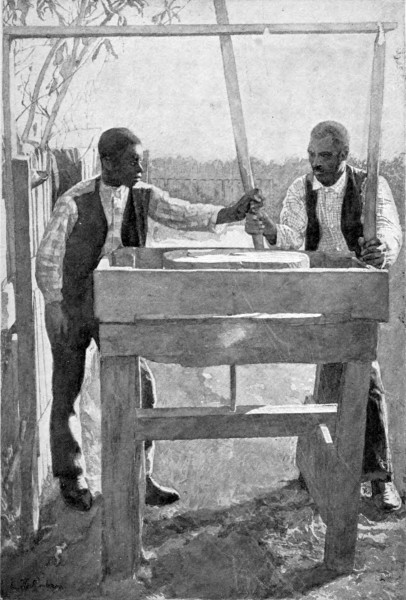
An Old-fashioned Grist-Mill.
I am painfully aware of the inadequacy
of my picture. But who could
do justice to the truth!
It was owing to all these and some
other characteristics that the life was
what it was. It was on a charming
key. It possessed an ampleness and
generosity which were not splendid
because they were too genuine and
refined.
Hospitality had become a recognized
race characteristic, and was practised as
a matter of course. It was universal;
it was spontaneous. It was one of the
distinguishing features of the civilization;
as much a part of the social life
as any other of the domestic relations.
Its generosity secured it a distinctive
title. The exactions it entailed were
engrossing. Its exercise occupied much
of the time, and exhausted much of the
means. The constant intercourse of
the neighborhood, with its perpetual
round of dinners, teas, and entertainments,
was supplemented by visits of
friends and relatives from other sections,
who came with their families, their
equipages, and personal servants, to
spend a month or two, or as long a
time as they pleased. A dinner invitation
was not so designated. It was,
with more exactitude, termed “spending
the day.” On Sundays every one
invited every one else from church, and
there would be long lines of carriages
passing in at the open gates.
It is a mystery how the house ever
held the visitors. Only the mistress
knew. Her resources were enormous.
The rooms, with their low ceilings,
were wide, and had a holding capacity
which was simply astounding. The
walls seemed to be made of india-rubber,
so great was their stretching power.
No one who came, whether friend or
stranger, was ever turned away. If the
beds were full—as when were they
not!—pallets were put down on the
floor in the parlor or the garret for
the younger members of the family,
sometimes even the passages being
utilized. Frequently at Christmas the
master and mistress were compelled to
resort to the same refuge.
It was this intercourse, following the
intermarriage and class feeling of the
old families, which made Virginians
clannish, and caused a single distinguishable
common strain of blood, however
distant, to be recognized and counted as
kinship.
Perhaps this universal entertainment
might not now be considered elegant.
Let us see.
It was based upon a sentiment as
pure and unselfish as can animate the
human mind,—upon kindness. It was
easy, generous, and refined. The manners
of entertainers and entertained
alike were gentle, cordial, simple, with,
to strangers, a slight trace of stateliness.
The best the hosts had was given; no
more was required.
The conversation was surprising; it
was of the crops, the roads, history, literature,
politics, mutual friends, including
the entire field of neighborhood
matters, related not as gossip, but as
affairs of common interest, which every
one knew or was expected and entitled
to know.
Among the ladies, the fashions came
in, of course, embracing particularly
“patterns.”
Politics took the place of honor
among the gentlemen, their range
embracing not only State and national
politics, but British as well, as to which
they possessed astonishing knowledge,
interest in English matters having been
handed down from father to son as a
class test. “My father’s” opinion
was quoted as conclusive authority on
this and all points, and in matters of
great importance historically “my grandfather,
sir,” was cited. The peculiarity
of the whole was that it was cast on a
high plane, and possessed a literary
flavor of a high order; for, as has been
said, the classics, Latin and English,
with a fair sprinkling of good old
French authors, were
in the bookcases, and
were there not for
show, but for companionship.
There
was nothing for show
in that life; it was all
genuine, real, true.
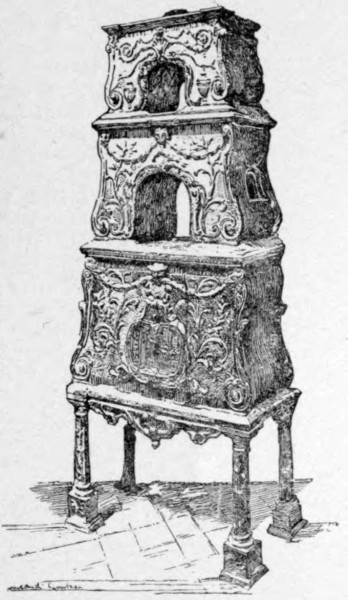
A Colonial Stove.
They had preserved
the old customs that
their fathers had brought
with them from the
mother country. The
great fête of the people
was Christmas. Spring
had its special delights,—horse-back
rides
through the budding
woods, with the birds singing; fishing
parties down on the little rivers, with
out-of-doors lunches and love-making;
parties of various kinds from house to
house. Summer had its pleasures,—handsome
dinners, and teas with moonlight
strolls and rides to follow; visits
to or from relatives, or even to the White
Sulphur Springs, called simply “the
White.” The Fall had its pleasures.
But all times and seasons paled and
dimmed before the festive joys of
Christmas. It had been handed down
for generations; it belonged to the race.
It had come over with their forefathers.
It had a peculiar significance. It was a
title. Religion had given it its benediction.
It was the time to “Shout
the glad tidings.” It was The Holidays.
There were other holidays for
the slaves, both of the school-room and
the plantation, such as Easter and
Whit-Monday but Christmas was distinctively
“The Holidays.” Then the
boys came home from school or college
with their friends; the members of the
family who had moved away returned;
pretty cousins came for the festivities;
the neighborhood grew merry. The
negroes were all to have holiday, the
house-servants taking turn and turn
about, and the plantation, long before
the time, made ready for Christmas
cheer. It was by all the younger
population looked back to half the
year, looked forward to the other
half. Time was measured by it: it
was either so long “since Christmas,”
or so long “before Christmas.” The
affairs of the plantation were set in
order against it. The corn was got in;
the hogs were killed; the lard “tried;”
sausage-meat made; mince-meat prepared;
turkeys fattened, with “the
big gobbler” specially devoted to the
“Christmas dinner;” the servants’
winter clothes and new shoes stored
away ready for distribution; and the
plantation began to be ready to prepare
for Christmas.
In the first place, there was generally
a cold spell which froze up everything
and enabled the ice-houses to be filled.
(The seasons, like a good many other
things, appear to have changed since
that old time before the war.) This
spell was the harbinger; and great fun
it was at the ice-pond, where the big
rafts of ice were floated along, with the
boys on them. The rusty skates with
their curled runners and stiff straps were
gotten out, and maybe tried for a day.
Then the stir began. The wagons all
were put to hauling wood—hickory.
Nothing but hickory now; other wood
might do for other times. But at
Christmas only hickory was used; and
the wood-pile was heaped high with the
logs; while to the ordinary wood-cutters
“for the house” were added three, four,
a half-dozen more, whose shining axes
rang around the wood-pile all day long.
With what a vim they cut, and how
telling was that earnest “Ha’nh!” as
they drove the ringing axes into the
hard wood, sending the big white chips
flying in all directions! It was always
the envy of the boys, that simultaneous,
ostentatious expulsion of the
breath, and they used to try vainly to
imitate it.
In the midst of it all came the
wagon or the ox-cart from “the depot,”
with the big white boxes of Christmas
things, the black driver feigning hypocritical
indifference as he drove through
the choppers to the storeroom. Then
came the rush of all the cutters to help
him unload; the jokes among themselves,
as they pretended to strain in
lifting, of what “master” or “mistis”
was going to give them out of those
boxes, uttered just loud enough to
reach their master’s or mistress’s ears
where they stood looking on, whilst the
driver took due advantage of his temporary
prestige to give many pompous
cautions and directions.
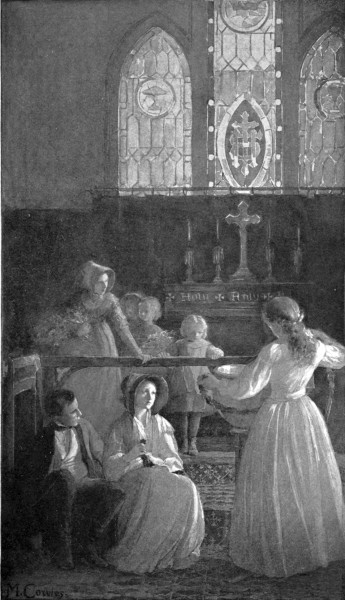
The getting the evergreens and mistletoe
was the sign that Christmas had
come, was really here. There were
the parlor and hall and dining-room to
be “dressed,” and, above all, the old
church. The last was the work of the
neighborhood; all united in it, and it
was one of the events of the year.
Young men rode thirty and forty miles
to “help” dress that church. They did
not go home again till after Christmas.
The return from the church was the
beginning of the festivities.
Then by “Christmas Eve’s eve” the
wood was all cut and stacked high in
the wood-house and on and under the
back porticos, so as to be handy, and
secure from the snow which was almost
certain to come. It seems that Christmas
was almost sure to bring it in old
times; at least it is closely associated
with it. The excitement increased;
the boxes were unpacked, some of them
openly, to the general delight; others
with a mysterious secrecy which stimulated
curiosity to its highest point and
added immeasurably to the charm of
the occasion. The kitchen filled up
with assistants famed for special skill in
particular branches of the cook’s art,
who bustled about with glistening faces
and shining teeth, proud of their elevation
and eager to prove their merits and
add to the general cheer.
It was now Christmas Eve. From
time to time the “hired out” servants
came home from Richmond or other
places where they had been hired or had
hired out themselves, their terms having
been by common custom framed, with
due regard to their rights to the holiday,
to expire in time for them to spend the
Christmas at home.[2] There was much
hilarity over their arrival, and they were
welcomed like members of the family as,
with their new winter clothes donned a
little ahead of time, they came to pay
“bespec’s to master and mistis.”
Then the vehicles went off to the distant
station for the visitors—the visitors
and the boys. Oh the excitement of
that! at first the drag of the long hours,
and then the eager expectancy as the
time approached for their return; the
“making up” of the fires in the visitors’
rooms (of the big fires; there had been
fires there all day “to air” them, but
now they must be made up afresh);
the hurrying backwards and forwards
of the servants; the feverish impatience
of every one, especially of the children,
who are sure the train is “late” or
that something has “happened,” and
who run and look up towards the big
gate every five minutes, notwithstanding
the mammy’s oft-repeated caution
that a “watch’ pot never b’iles.”
There was one exception to the general
excitement: the Mistress, calm,
deliberate, unperturbed, moved about
with her usual serene composure, her
watchful eye seeing that everything
was “ready.” Her orders had been
given and her arrangements made
days before, such was her system.
The young ladies, having finished
dressing the parlor and hall, had disappeared.
Satisfied at last with their
work, after innumerable final touches,
every one of which was an undeniable
improvement to that which had already
appeared perfect, they had suddenly
vanished—vanished as completely as
a dream—to appear again later on at
the parlor door, radiant visions of loveliness,
or, maybe, if certain visitors unexpectedly
arrived, to meet accidentally
in the less embarrassing and safer precincts
of the dimly lighted halls or
passages. When they appeared, what
a transformation had taken place! If
they were bewitching before, now they
were entrancing. The gay, laughing,
saucy creature who had been dressing
the parlors and hanging the mistletoe
with many jests and parries of the half-veiled
references was now a demure or
stately maiden in all the dignity of a new
gown and with all the graciousness of a
young countess.
But this is after the carriages return.
They have not yet arrived. They are
late—they are always late—and it is
dark before they come; the glow of
the fires and candles shines out through
the windows on the snow, often blackened
by the shadows of little figures
whose noses are pressed to the cold
panes, which grow blurred with their
warm breath. Meantime the carriages,
piled outside and in, are slowly making
their way homeward through the frozen
roads, followed by the creaking wagon
filled with trunks, on which are haply
perched small muffled figures, whose
places in the carriages are taken by
unexpected guests. The drivers still
keep up a running fire with their young
masters, though they have long since
been pumped dry as to every conceivable
matter connected with “home,”
in return for which they receive information
as to school and college pranks.
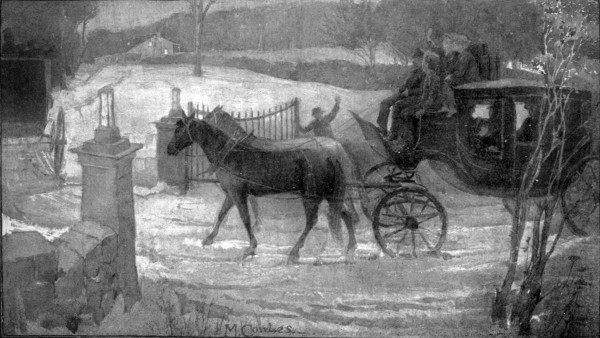
At last the “big gate” is reached; a
half-frozen figure rolls out and runs to
open it, flapping his arms in the darkness
like some strange, uncanny bird;
they pass through; the gleam of a light
shines away off on a far hill. The
shout goes up, “There she is; I see
her!” The light is lost, but a little
later appears again. It is the light in
the mother’s chamber, the curtains of
the windows of which have been left up
intentionally, that the welcoming gleam
may be seen afar off by her boys on the
first hill—a blessed beacon shining
from home and her mother’s heart.
Across the white fields the dark
vehicles move, then toil up the house
hill, filled with their eager occupants,
who can scarce restrain themselves;
approach the house, by this time glowing
with lighted windows, and enter
the yard just as the doors open and a
swarm rushes out with joyful cries of,
“Here they are!” “Yes, here we
are!” comes in cheery answer, and
one after another they roll or step out,
according to age and dignity, and run
up the steps, stamping their feet, the
boys to be taken fast into motherly
arms, and the visitors to be given
warm handclasps and cordial welcomes.
Later on the children were got to
bed, scarce able to keep in their pallets
for excitement; the stockings were all
hung up over the big fireplace; and
the grown people grew gay in the
crowded parlors. There was no splendor,
nor show, nor style as it would be
understood now. Had there been, it
could not have been so charming.
There were only profusion and sincerity,
heartiness and gayety, cordiality
and cheer, and withal genuineness and
refinement.
Next morning the stir began before
light. White-clad little figures stole
about in the gloom, with bulging stockings
clasped to their bosoms, opening
doors, shouting “Christmas gift!” into
dark rooms at sleeping elders, and then
scurrying away like so many white
mice, squeaking with delight, to rake
open the embers and inspect their treasures.
At prayers, “Shout the glad tidings”
was sung by fresh young voices
with due fervor.
How gay the scene was at breakfast!
What pranks had been performed in
the name of Santa Claus! Every
foible had been played on. What
lovely telltale blushes and glances and
laughter greeted the confessions! The
larger part of the day was spent in
going to and coming from the beautifully
dressed church, where the service
was read, and the anthems and hymns
were sung by every one, for every one
was happy.
But, as in the beginning of things,
“the evening and the morning were
the first day.” Dinner was the great
event. It was the test of the mistress
and the cook, or, rather, the cooks; for
the kitchen now was full of them. It
is impossible to describe it. The old
mahogany table, stretched diagonally
across the dining-room, groaned; the
big gobbler filled the place of honor;
a great round of beef held the second
place; an old ham, with every other
dish that ingenuity, backed by long
experience, could devise, was at the
side, and the shining sideboard, gleaming
with glass, scarcely held the dessert.
The butler and his assistants were supernaturally
serious and slow, which bespoke
plainly too frequent a recourse
to the apple-toddy bowl; but under
the stimulus of the mistress’s eye, they
got through all right, and their slight
unsteadiness was overlooked.
It was then that the fun began.
After dinner there were apple-toddy
and egg-nog, as there had been before.
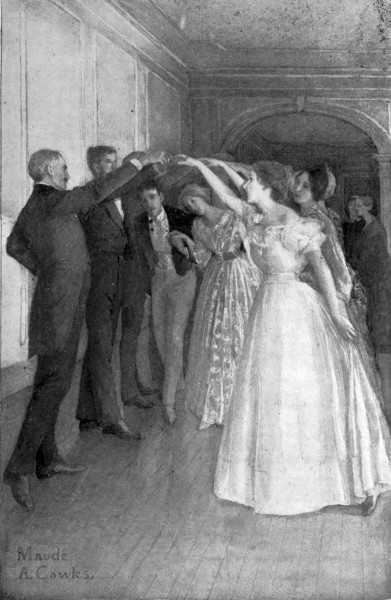
There were games and dances—country
dances, the lancers and quadrilles.
The top of the old piano was
lifted up, and the infectious dancing-tunes
rolled out under the flying fingers.
Haply there was some demur on the
part of the elder ladies, who were not
quite sure that it was right; but it was
overruled by the gentlemen, and the
master in his frock coat and high collar
started the ball by catching the prettiest
girl by the hand and leading her to the
head of the room right under the noses
of half a dozen bashful lovers, calling
to them meantime to “get their sweethearts
and come along.” Round dancing
was not yet introduced. It was
regarded as an innovation, if nothing
worse. It was held generally as highly
improper, by some as “disgusting.”
As to the german, why, had it been
known, the very name would have
been sufficient to damn it. Nothing
foreign in that civilization! There was
fun enough in the old-fashioned country
dances, and the “Virginia reel” at the
close. Whoever could not be satisfied
with that was hard to please.
But it was not only in the “great
house” that there was Christmas cheer.
Every cabin was full of it, and in
the wash-house or the carpenter-shop
there was preparation for a plantation
supper.
At this time, too, there were the
negro parties, where the ladies and
gentlemen went to look on, the supper
having been superintended by the
mistresses, and the tables being decorated
by their own white hands.
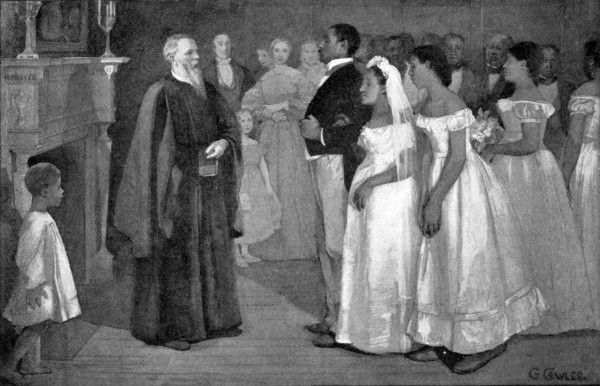
There was almost sure to be a negro
wedding during the holidays. The
ceremony might be performed in the
dining-room or in the hall by the
master, or in one of the quarters by a
colored preacher; but it was a gay occasion,
and the dusky bride’s trousseau
had been arranged by her young mistress,
and the family was on hand to
get fun out of the entertainment, and
to recognize by their presence the
solemnity of the tie.
Other weddings there were, too,
sometimes following these Christmas
gayeties, and sometimes occurring “just
so,” because the girls were the loveliest
in the world, and the men were lovers
almost from their boyhood. How
beautiful our mothers must have been
in their youth to have been so beautiful
in their age!
There were no long journeys for the
young married folk in those times; the
travelling was usually done before marriage.
When a wedding took place,
however, the entire neighborhood entertained
the young couple.
Truly it was a charming life. There
was a vast waste; but it was not loss.
Every one had food, every one had raiment,
every one had peace. There
was not wealth in the base sense in
which we know it and strive for it and
trample down others for it now. But
there was wealth in the good old sense
in which the litany of our fathers used
it. There was weal. There was the
best of all wealth; there was content,
and “a quiet mind is richer than a
crown.”
We have gained something by the
change. The South under her new
conditions will in time grow rich, will
wax fat; nevertheless we have lost
much. How much only those who
knew it can estimate; to them it was
inestimable.
That the social life of the Old South
had its faults I am far from denying.
What civilization has not? But its
virtues far outweighed them; its graces
were never equalled. For all its faults,
it was, I believe, the purest, sweetest
life ever lived. It has been claimed
that it was non-productive, that it fostered
sterility. Only ignorance or folly
could make the assertion. It largely
contributed to produce this nation; it
led its armies and its navies; it established
this government so firmly that
not even it could overthrow it; it
opened up the great West; it added
Louisiana and Texas, and more than
trebled our territory; it christianized
the negro race in a little over two centuries,
impressed upon it regard for
order, and gave it the only civilization
it has ever possessed since the dawn of
history. It has maintained the supremacy
of the Caucasian race, upon which
all civilization seems now to depend. It
produced a people whose heroic fight
against the forces of the world has enriched
the annals of the human race,—a
people whose fortitude in defeat has
been even more splendid than their
valor in war. It made men noble,
gentle, and brave, and women tender
and pure and true. It may have fallen
short in material development in its narrower
sense, but it abounded in spiritual
development; it made the domestic virtues
as common as light and air, and
filled homes with purity and peace.
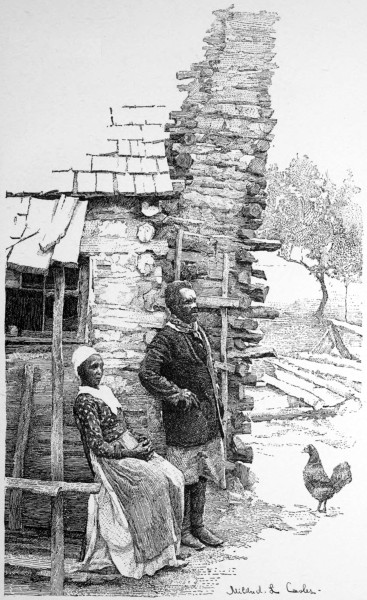
A Typical Negro Cabin.
It has passed from the earth, but it
has left its benignant influence behind
it to sweeten and sustain its children.
The ivory palaces have been destroyed,
but myrrh, aloes, and cassia still breathe
amid their dismantled ruins.
Transcriber’s Notes:
Punctuation and spelling inaccuracies were silently corrected.
Archaic and variable spelling has been preserved.
Variations in hyphenation and compound words have been preserved.
Added missing captions to the illustrations on pages 12, 18, 26
and 27, from the List of Illustrations.