NEW YORK AND LONDON
D. APPLETON AND COMPANY
MCMXII
Copyright, 1912, by
D. APPLETON AND COMPANY
Printed in the United States of America
To
MY CHILDREN and
MY CHILDREN’S CHILDREN and to
THEIR CHILDREN TO COME
FOREWORD
Far more vivid than the twilight of the days in
which I dwell, there rises before my inner eye the
vision, aglow in Southern sunshine, of the days that
are gone, never to return, but which formed the
early chapters of a life that has been lived, that can
never be lived again.
Many of the following stories are oft-told tales
at my fireside—others were written to record
phases of the patriarchal existence before the war
which has so utterly passed away.
They have been printed from time to time in the
pages of the New Orleans Times-Democrat, the
editor of which has very kindly consented to their
publication in this form.
SOCIAL LIFE IN OLD NEW ORLEANS — I NEW ORLEANS CHILDREN OF 1840
“Children should be seen and not heard.”
Children were neither seen nor heard in
the days of which I write, the days of
1840. They led the simple life, going and coming
in their own unobtrusive way, making no stir
in fashionable circles, with laces and flounces and
feathered hats. There were no ready-made garments
then for grown-ups, much less for children.
It was before California gold mines, before the
Mexican war, before money was so abundant that
we children could turn up our little noses at a
picayune. I recall the time when Alfred Munroe
descended from Boston upon the mercantile world
of New Orleans, and opened on Camp Street a
“one price” clothing store for men. Nobody had
ever heard of one price, and no deviation, for
anything, from a chicken to a plantation. The fun
of hectoring over price, and feeling, no matter how
the trade ended, you had a bargain after all, was denied
the customers of Mr. Alfred Munroe. The
innovation was startling, but Munroe retired with
a fortune in course of time.
Children’s clothes were home-made. A little wool
shawl for the shoulders did duty for common use.
A pelisse made out of an old one of mother’s, or
some remnant found in the house, was fine for Sunday wear.
Pantalettes of linen, straight and narrow
and untrimmed, fell over our modest little legs
to our very shoetops. Our dresses were equally
simple and equally “cut down and made over.”
Pantalettes were white, but I recall, with a dismal
smile, that when I was put into what might be
called unmitigated mourning for a brother, my pantalettes
matched my dresses, black bombazine or
black alpaca.
Our amusements were of the simplest. My
father’s house on Canal Street had a flat roof, well
protected by parapets, so it furnished a grand playground
for the children of the neighborhood.
Judge Story lived next door and Sid and Ben Story
enjoyed to the full the advantages of that roof,
where all could romp and jump rope to their heart’s
content. The neutral ground, that is now a center
for innumerable lines of street cars, was at that
time an open, ungarnished, untrimmed, untended
strip of waste land. An Italian banana and orange
man cleared a space among the bushes and rank
weeds and erected a rude fruit stall where later
Clay’s statue stood. A quadroon woman had a coffee
stand, in the early mornings, at the next corner,
opposite my father’s house. It could not have been
much beyond Claiborne Street that we children
went crawfishing in the ditches that bounded each
side of that neutral ground, for we walked, and it
was not considered far.
The Farmers’ and Traders’ Bank was on Canal
Street, and the family of Mr. Bell, the cashier, lived
over the bank. There were children there and a
governess, who went fishing with us. We rarely
caught anything and had no use for it when we did.
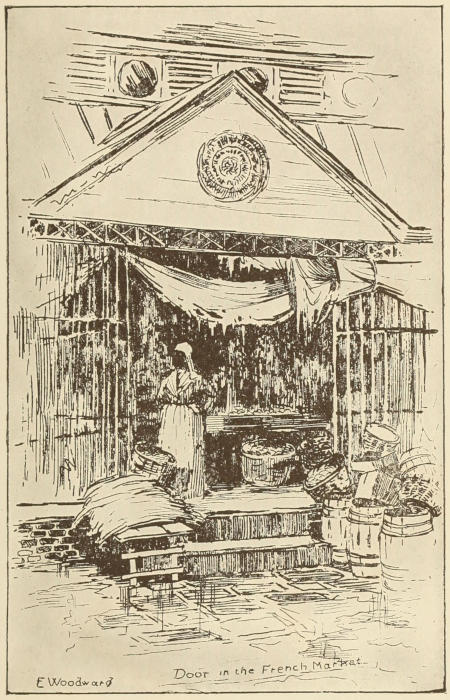
Sometimes I was permitted to go to market with
John, way down to the old French Market. We
had to start early, before the shops on Chartres
Street were open, and the boys busy with scoops
watered the roadway from brimming gutters. John
and I hurried past. Once at market we rushed
from stall to stall, filling our basket, John forgetting
nothing that had been ordered, and always carefully
remembering one most important item, the
saving of at least a picayune out of the market
money for a cup of coffee at Manette’s stall. I
drank half the coffee and took one of the little
cakes. John finished the repast and “dreened” the
cup, and with the remark, “We won’t say anything
about this,” we started toward home. We had to
stop, though, at a bird store, on the square above
the Cathedral, look at the birds, chaff the noisy parrots,
watch the antics of the monkeys, and see the
man hang up his strings of corals and fix his shells
in the window, ready for the day’s business. We
could scarcely tear ourselves away, it was so interesting;
but a reminder that the wax head at Dr.
De Leon’s dentist’s door would be “put out by this
time,” hurried me to see that wonderful bit of
mechanism open and shut its mouth, first with a row
of teeth, then revealing an empty cavern. How I
watched, wondered and admired that awfully artificial
wax face! These occasional market trips—and
walks with older members of the family—were
the sum of my or any other child’s recreation.
Once, and only once, there was a party! The
little Maybins had a party and every child I knew
was invited. The Maybins lived somewhere back
of Poydras Market. I recall we had to walk down
Poydras Street, beyond the market, and turn to
the right onto a street that perhaps had a name,
but I never heard it.
The home was detached, and surrounded by
ample grounds; quantities of fig trees, thickets of
running roses and in damp places clusters of
palmetto and blooming flags. We little invited
guests were promptly on the spot at 4 P. M., and as
promptly off the spot at early candlelight. I am
sure no débutantes ever had a better time than did
we little girls in pantalettes and pigtails. We
danced; Miss Sarah Strawbridge played for us, and
we all knew how to dance. Didn’t we belong to
Mme. Arraline Brooks’ dancing school?
The corner of Camp and Julia Streets, diagonally
across from the then fashionable 13 Buildings, was
occupied by Mme. Arraline Brooks, a teacher of
dancing. Her school (studio or parlor it would be
called now) was on the second floor of Armory
Hall, and there we children—she had an immense
class, too—learned all the fancy whirls and “heel
and toe” steps of the intricate polka, which was
danced in sets of eight, like old-time quadrilles.
Mme. Arraline wore in the classroom short skirts
and pantalettes, so we had a good sight of her
feet as she pirouetted about, as agile as a ballet
dancer.
By and by, at a signal from Miss Sarah, who
had been having a confidential and persuasive interview
with a little miss, we were all placed with our
backs to the wall and a space cleared. Miss Sarah
struck a few notes, and little Tenie Slocomb danced
the “Highland fling.” Very beautiful was the little
sylph in white muslin, her short sleeves tied with
blue ribbons, and she so graceful and lovely. It
comes to me to-day with a thrill, when I compare
the companion picture—of a pale, delicate, dainty
old lady, with silvered hair and tottering step, on
the bank of a foreign river. It is not easy to bridge
the seventy years (such a short span, too, it is) between
the two. Then the march from “Norma”
started us to the room for refreshments. It is full
forty years since I have heard that old familiar air,
but for thirty years after that date I did not hear
it that the impulse to march to lemonade and sponge
cake did not seize me.
Alack-a-day! Almost all of us have marched
away.
II NEW ORLEANS SCHOOLS AND TEACHERS IN THE FORTIES
Of course, seventy years ago, as in the ages
past and to come, convents were the places
for educating young girls in a Catholic
community. Nevertheless, there have always been
schools and schools, for those whom it was not expedient
or convenient to board in a convent. In New
Orleans the Ursuline Convent was too remote from
the majority of homes for these day scholars, so
there were a few schools among the many that come
to my mind to-day, not that I ever entered one of
them, but I had girl friends in all. In the thirties
St. Angelo had a school on Customhouse Street,
next door to the home of the Zacharies. His
method of teaching may have been all right, but his
discipline was objectionable; he had the delinquent
pupils kneel on brickdust and tacks and there study
aloud the neglected lesson. Now, brickdust isn’t so
very bad, and tacks only a trifle worse, when one’s
knees are protected by stockings or even pantalettes,
but stockings in those days did not extend over
the knee, and old St. Angelo was sure to see that
the pantalettes were well rolled up. This method
of discipline was not acceptable to parents whose
children came home with bruises and wounds. That
dominie retired from business before the forties.
Mme. Granet had a school for girls in the French
municipality. Elinor Longer, one of my most intimate
friends, attended it, and she used to tell us
stories that convulsed us with laughter about Madame’s
daughter. Lina had some eye trouble, and
was forbidden to “exercise the tear glands,” but her
tears flowed copiously when Madame refused to
submit to her freaks. Thus Lina managed, in a way,
to run the school, having half holidays and other
indulgences so dear to the schoolgirl, at her own
sweet will.
At the haunted house (I wonder if it is still
standing and still haunted?) on Royal Street, Mme.
Delarouelle had a school for demoiselles. Rosa,
daughter of Judge John M. Duncan, was a scholar
there. I don’t think the madame had any boarders,
though the house was large and commodious, even
if it was haunted by ghosts of maltreated negroes.
The school could not under those circumstances
have continued many years, for every child knew it
was dangerous to cross its portals. Our John told
me he “seed a skel’ton hand” clutching the grated
front door once, and he never walked on that side
of the street thereafter. He even knew a man “dat
seen eyes widout sockets or sockets widout eyes, he
dun know which, but dey could see, all de same, and
they was a looken out’en one of the upstairs winders.”
With such gruesome talk many a child was
put to bed in my young days.
Doctor, afterward Bishop Hawks, when he was
rector of Christ Church, then on Canal Street, had
a school on Girod Street. It was a temporary affair
and did not continue over a season or two. It
was entirely conducted by Mrs. Hawks and her
daughters, so far as I know, for, as before mentioned,
I attended none of the schools.
In 1842 there was a class in Spanish at Mr. Hennen’s
house, on Royal Street, near Canal. Señor
Marino Cubi y Soler was the teacher of that class;
a very prosaic and painstaking teacher he was, too,
notwithstanding his startlingly high flown cognomen.
Miss Anna Maria and young Alfred Hennen and a
Dr. Rhodes, from the Belize, as the mouth of the
Mississippi is called, with a few other grown-ups,
formed the señor’s class. I was ten years old, but
was allowed to join with some other members of
my family, though my mother protested it was nonsense
for a child like me and a waste of money.
Father did not agree with her, and after over sixty
years to think it over, I don’t either. When the
señor’s class dispersed I imagine the text-books, of
which, by the way, he was author, were laid aside.
But years and years thereafter, during the war, while
traveling in Mexico, some of the señor’s teaching
came miraculously back to me, bringing with it
enough Spanish to be of material help in that
stranger country.
Another teacher wandered from house to house
with his “Telemaque” and “colloquial phrases,” giving
lessons in French. Gimarchi, from the name,
may have been partly, at least, Italian, but he was a
fine teacher of the sister language. Por supuésto,
his itinerary was confined to the American district
of the city.
Is it any surprise that the miscellaneous education
we girls of seventy years ago in New Orleans had
access to, culminated by fitting us for housewives
and mothers, instead of writers and platform speakers,
doctors and lawyers—suffragettes? Everybody
was musical; every girl had music lessons and every
mother superintended the study and practice of the
one branch deemed absolutely indispensable to the
education of a demoiselle. The city was dotted all
over with music teachers, but Mme. Boyer was, par
excellence, the most popular. She did not wander
from house to house, but the demoiselles, music roll
in hand, repaired to her domicile, and received instruction
in a music room barely large enough to
contain a piano, a scholar and a madame who was,
to say the least, immense in bulk, the style of Creole
who appears best in a black silk blouse volante.
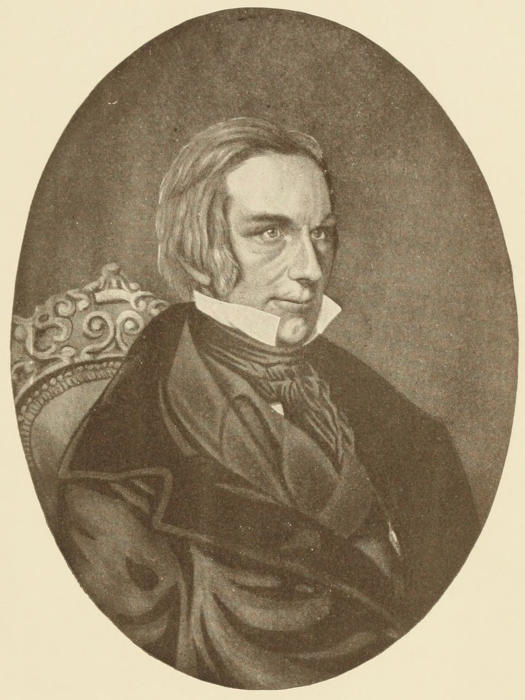
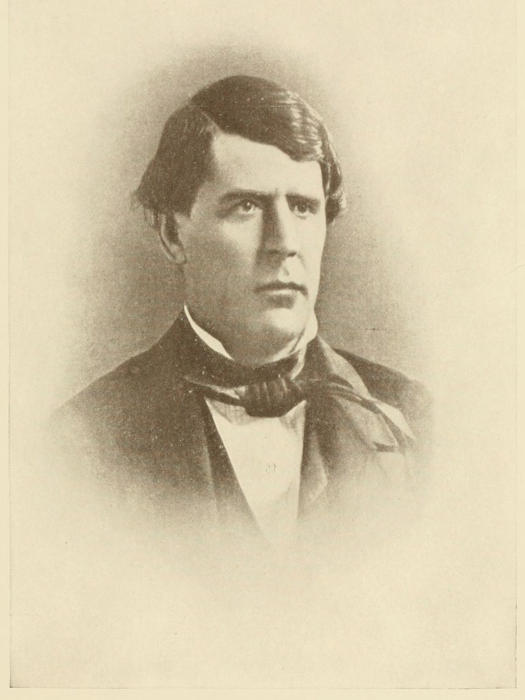
Richard Henry Chinn
Painted by Hardin
Art was not taught, art was not studied, art was
not appreciated. I mean by art the pencil and the
brush, so busily wielded in every school now. No
doubt there were stifled geniuses whose dormant
talent was never suspected, so utterly ignored were
the brush and the palette of the lover of art. I call
to mind the ability evinced by Miss Celestine Eustis
in the use of the pencil. She occasionally gave a
friend a glimpse of some of her work, of which, I
regret to say, she was almost ashamed, not of the
work, but of the doing it. I recall a sketch taken
of Judge Eustis’ balcony, and a group of young society
men; the likenesses, unmistakably those of
George Eustis and of Destour Foucher, were striking.
M. Devoti, with his violin in a green baize bag,
was a professor of deportment and dancing. He
undertook to train two gawky girls of the most awkward
age in my father’s parlor. M. Devoti wore
corsets! and laced, as the saying is, “within an inch
of his life.” He wore a long-tail coat, very full
at the spider waist-line, that hung all round him,
almost to the knees, so he used it like a woman’s
skirt, and could demonstrate to the awkward girls
the art of holding out their skirts with thumb and
forefinger, and all the other fingers sticking out stiff
and straight. Then curtsey! throw out the right
foot, draw up the left.
Another important branch of deportment was to
seat the awkwards stiffly on the extreme edge of a
chair, fold the hands on the very precarious lap,
droop the eyes in a pensive way. Then Devoti
would flourish up and present, with an astonishing
salaam, a book from the center table. The young
miss was instructed how to rise, bow and receive
the book, in the most affected and mechanical style.
Another exercise was to curtsey, accept old Devoti’s
arm and majestically parade round and round the
center table. The violin emerged from the baize
bag, Devoti made it screech a few notes while the
trio balanced up and down, changed partners and
promenaded, till the awkwards were completely bewildered
and tired out. He then replaced the violin,
made a profound bow to extended skirts and
curtseys, admonished the pupils to practice for next
lesson, and vanished. Thus ended the first lesson.
Dear me! Pock-marked, spider-waist Devoti is as
plain to my eye to-day as he was in the flesh, bowing,
smiling, dancing with flourishing steps as in the
days of long ago.
Were those shy girls benefited by that artificial
training? I opine not. This seems to modern eyes,
mayhap, a whimsical exaggeration; nevertheless, it is
a true picture. Devoti’s style was indeed the “end
of an era”; he had no successor. Turveydrop, the
immortal Turveydrop himself, was not even an imitator.
These old schools and teachers march before
my mind’s eye to-day; very vivid it all is to me,
though the last of them, and perhaps all those they
tried to teach, have passed away. Children who
went to Mme. Granet and Mme. Delarouelle and
Dr. Hawks and all the other schools of that day,
sent their daughters, a decade or two later, to
Mme. Desrayoux. Now she is gone and many of
the daughters gone also. And it is left to one old
lady to dig out the past, and recall, possibly to no
one but herself, New Orleans schools, teachers and
scholars of seventy years ago.
III BOARDING SCHOOL IN THE FORTIES
I wonder if the parents of the present do not
sometimes contrast the fashionable schools in
which their daughters are being educated with
the fashionable schools to which their aged mothers,
mayhap grandmothers, were sent sixty and more
years ago? Among my possessions that I keep—according
to the dictum of my grandchildren—“for
sentimental sake,” is a much-worn “Scholar’s Companion,”
which they scorn to look at when I bring
it forth, and explain it to be the best speller that
ever was; and a bent, much overworked crochet
needle of my schooldays, for we worked with our
hands as well as with our brains. The boarding
school to which I refer was not unique, but a typical
New England seminary of the forties. It was both
fashionable and popular, but the young ladies were
not, as now, expected to appear at a 6 o’clock dinner
in a low neck (oh, my!) gown.
Lately, passing through the now much expanded
city to which I was sent, such a young girl, on a
sailing ship from New Orleans to New York in the
early spring of 1847, I spent a half hour walking
on Crown Street looking for No. 111. It was not
there, not a trace of the building of my day left; nor
was one, so far as I know, of the girls, my old
schoolmates, left; all three of the dear, painstaking
teachers sleeping in the old cemetery, at rest at last
were they. Every blessed one lives in my memory,
bright and young, patient and middle-aged—all are
here to beguile my twilight hours....
The school routine was simple and precise, especially
the latter. We had duties outside the schoolroom,
the performance of which was made pleasant
and acceptable, as when the freshly laundered clothes
were stacked in neat little piles on the long table of
the yellow room on Thursdays, ready for each girl
to carry to her own room. There were also neat
little stacks on each girl’s desk, of personal articles
requiring repairs, buttons to replace, holes to patch,
stockings to darn, and in the schoolroom on
Thursday afternoons—how some of us hated the
work!—it was examined and passed upon before
we were dismissed. The long winter evenings we
were assembled in the library and one of the
teachers read to us. I remember one winter we
had “Guy Mannering” and “Quentin Durward,”
Sir Walter Scott’s lovely stories. We girls were expected
to bring some work to occupy our fingers
while listening to the readings, with the comments
and explanations that illuminated obscure portions
we might not comprehend.
There was an old-fashioned “high boy” (haut
bois) in the library, in the capacious drawers of
which were unmade garments for the missionary
box. Woe unto the young lady who had no knitting,
crocheting or hemstitching of her own to do!
She could sew on red flannel for the little Hottentots!
After hymn singing Sunday afternoons there
was reading from some suitably saintly book. We
had “Keith’s Evidences of Prophecy” (I have not
seen a copy of that much-read and laboriously explained
volume for more than sixty years). The
tension of our minds produced by “prophecy” was
mitigated once in a while by two goody-goody books,
“Lamton Parsonage” and “Amy Herbert,” both,
no doubt, long out of print.
There also were stately walks to be taken twice
a day for recreation; walks down on the “Strand,”
or some back street that led away from college
campus and flirtatious students. Our school happened
to be too near the college green, by the
way. We marched in couples, a teacher to lead
who had eyes both before and behind, and a teacher
similarly equipped to follow. With all these precautions
we—some of us were pretty—were often
convulsed beyond bounds when “we met by chance,
the only way,” on the very backest street, a procession
of college fellows on mischief bent, marching
two and two, just like us. In bad weather we were
shod with what were called “gums” and wrapped in
coats long and shaggy and weighing a ton. Waterproofs
were a later invention. Wet or dry, cold or
warm, those exercises had to be taken to keep us
in good physical condition. I must mention in this
connection that no matter what ailed us, in stomach
or back, head or foot, we were dosed with hot ginger
tea. I do not remember ever seeing a doctor
in the house, or knowing of one being summoned.
The girls hated that ginger tea, so no doubt many
an incipient headache was not reported.
With the four spinsters (we irreverently called
No. 111 Old Maids’ Hall) who lived in the house,
there were scraggly, baldheaded, spectacled teachers
from outside—a monsieur who read Racine and
Molière with us and taught us j’aime, tu aime,
which he could safely do, the snuffy old man; a
fatherly sort of Turveydrop dancing master, who
cracked our feet with his fiddle bow; a drawing
master, who, because he sometimes led his class
on sketching trips up Hillhouse Avenue, was
immensely popular, and every one of us wanted
to take drawing lessons. We did some water colors,
too; some of us had not one particle of artistic talent.
I was one of that sort, but I achieved a Baltimore
oriole, which, years after, my admiring husband,
who also had no artistic taste, had framed
and “hung on the line” in our hall. Perhaps some
Yankee may own it now, for during the war they
took everything else we had, and surely a brilliant
Baltimore oriole did not escape their rapacity!
Solid English branches were taught by the dear
spinsters. We did not skin cats and dissect them.
There was no class in anatomy, but there was a
botany class, and we dissected wild flowers, which
is a trifle more ladylike. Our drilling in chirography
was something to marvel at in these days when
the young people affect such complicated and involved
handwriting that is not easily decipherable.
And grammar! I now slip up in both grammar
and rhetoric, but I have arrived at the failing age.
We spent the greater part of a session parsing
Pope’s “Essay on Man,” and at the closing of that
book I think we knew the whole thing by heart.
Discipline was, so to say, honorary. There were
rules as to study and practice hours, and various
other things. Saturday morning, after the “Collect
of the day” and prayers, when we were presumed
to be in a celestial frame of mind, each girl reported
her infringement of rules—if she was delinquent,
and she generally was. That system served
to make us more truthful and conscientious than
some of us might have been under a different
training.
It was expressly stipulated that no money be furnished
the pupils. A teacher accompanied us to do
necessary shopping and used her discretion in the
selection. If one of us expressed the need of new
shoes her entire stock was inspected, and if a pair
could be repaired it was done and the purchase postponed.
Now, bear in mind, this was not a cheap,
second rate school, but one of the best known and
most fashionable. There were several young ladies
from the South among the twenty or so boarders.
The Northern girls were from the prominent New
York families—Shermans, Kirbys, Phalens, Pumpellys
and Thorns. This was before the fashionables
of to-day came to the fore.
Speaking of reporting our delinquencies, we knew
quite well that it was against the custom, at least,
to bring reading matter into the school. There was
a grand, large library of standard works of merit
at our free disposal. In some way “Jane Eyre”
(just published) was smuggled in and we were
secretly reading it by turns. How the spinsters
found it out we never knew, but they always found
out everything, so we were scarcely surprised one
Saturday morning to receive a lecture on the pernicious
character of the book “Jane Eyre,” so unlike
(and alas! so much more interesting than) Amy
Herbert, with her missionary basket, her coals and
her flannel petticoats. We were questioned, not by
wholesale, but individually, if we had the book?
If we had read the book? The first two or three in
the row could reply in the negative, but as interrogations
ran down the line toward the guilty ones
they were all greatly relieved when one brave girl
replied, “Yes, ma’am, I am almost through, please
let me finish it.” Then “Jane” vanished from our
possession.
When the Church Sewing Society met at our
house, certain girls who were sufficiently advanced in
music to afford entertainment to the guests were
summoned to the parlor to play and sing, and incidentally
have a lemonade and a jumble. I was the
star performer (had I not been a pupil of Cripps,
Dr. Clapp’s organist, since I was able to reach the
pedal with my foot?). My overture of “La Dame
Blanche” was quite a masterpiece, but my “Battle
of Prague” was simply stunning. The “advance,”
the “rattle of musketry,” the “beating of drums”
(did you ever see the music score?) I could render
with such force that the dear, busy ladies almost
jumped from their seats. There were two Kentucky
girls with fine voices also invited to entertain the
guests. Alas! our fun came to an end. On one
occasion when I ended the “Battle of Prague” with
a terrific bang, there was an awful moment of silence,
when one of the ladies sneezed with such
unexpected force that her false teeth careered clear
across the room! Not one of the guests saw it, or
was aware that she quietly walked over and replaced
them, but we naughty girls were so brimful of fun
that we exploded with laughter. Nothing was said
to us of the unfortunate contretemps, but the musical
programmes were discontinued.
College boys helped to make things lively for us,
though we did not have bowing acquaintance with
one of them. Valentines poured in to us; under
doors and over fences they rained. The dear
spinsters laughed over them with us. Thanksgiving
morning, when the front door was opened for the
first time, and we were assembled in the hall ready
to march to 11 o’clock church service, a gaunt,
skinny, starved-to-death turkey was found suspended
to the door knob, conspicuously tied by a broad red
ribbon, with a Thanksgiving greeting painted on,
so “one who ran could read.” No doubt a good
many had read and run, for there had been hours
allowed them. The dear spinsters were so mortified
and shocked that we girls had not the courage to
laugh.
By reason of my distance from home, reached by
a long voyage on a sailing ship—the first steamer
service between New York and New Orleans was in
the autumn of 1848, and the Crescent City was the
pioneer steamer—I spent the vacations under
the benign influence of the teachers, always the only
girl left, but busy and happy, enjoying all the privileges
of a parlor boarder. I still have a book full
of written directions for knitting and crocheting,
and making all sorts of old-timey needle books and
pincushions, the initial directions dated 1846, largely
the collection and record of more than one long
summer vacation at that New England school.
What girl of to-day would submit to such training
and routine? What boarding school, seminary or
college is to-day conducted on such lines? Not one
that you or I know. The changes in everything, in
every walk of life, from the simple in my day and
generation to the complicated of the present, sets
me to moralizing. Like all old people who are not
able to take an active interest in the present, I live
in the past, where the disappointments and heartaches,
for surely we must have had our share, are
forgotten. We old people live in the atmosphere
of a day dead—and gone—and glorified!
IV PICAYUNE DAYS
The first time I ever saw a penny was at
school in Yankeeland in 1847. It was
given me to pay the man for bringing me
a letter from the postoffice—10 cents postage, 1
cent delivery, in those days. People had to get their
mail at the office. There was no free delivery.
Certain neighborhoods of spinsters, however—the
college town was full of such—secured the services
of a lame, halt or blind man to bring their letters
from the office to their door once a day for the
stipend of a penny each.
There was no coin in circulation of less value than
a picayune where was my home. A picayune, which
represented so little value that a miser was called
picayunish, at the same time represented such a big
value that we children felt rich when we had one
tied in the corner of our handkerchief. At the corner
of Chartres and Canal Streets was a tiny soda
fountain, where one could get a glass of soda for a
picayune—or mead. We children liked mead. I
never see it now, but, as I recall, it was a thick,
honey, creamy drink. We must have preferred it
because it seemed so much more for a picayune than
the frothy, effervescent, palish soda water. It was
a great lark to go with Pa and take my glass of
mead, while he ordered ginger syrup (of all things!)
with his soda. The changing years bring gold
mines, greenbacks, tariffs, labor exactions and nouveaux
riches, and a penny now buys about what a
picayune did in my day. One pays a penny for
ever so big a newspaper to-day. A picayune was
the price of a small sheet in my time.
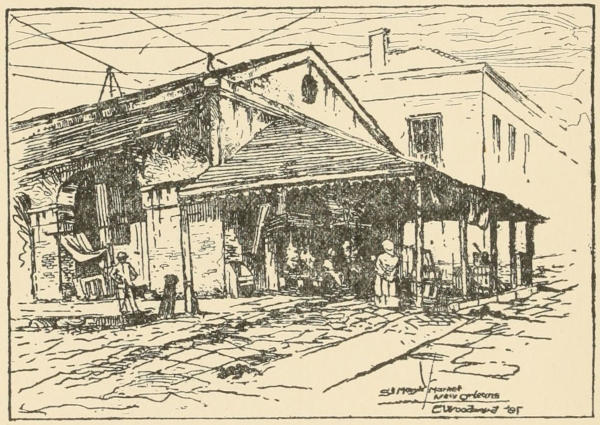
Market Doorway.
Many of us must remember the colored marchandes
who walked the street with trays, deftly
balanced on their heads, arms akimbo, calling out
their dainties, which were in picayune piles on the
trays—six small celesto figs, or five large blue ones,
nestling on fig leaves; lovely popcorn tic tac balls
made with that luscious “open kettle” sugar, that
dear, fragrant brown sugar no one sees now. Pralines
with the same sugar; why, we used it in our
coffee. A few years ago, visiting dear Mrs. Ida
Richardson, I reveled in our breakfast coffee. “I
hope you preserve your taste for brown sugar coffee?”
she said. I fairly jumped at the treat.
But a marchande is passing up the street, and if I
am a little girl, I beg a picayune for a praline; if I
am an old lady, I invest a picayune in a leaf with six
figues célestes. Mme. Chose—I don’t give any more
definite name, for it is a sub rosa venture on her
part—had a soirée last night. Madame buys her
chapeaux of Olympe, and her toilettes from Pluche
or Ferret, and if her home is way down, even below
Esplanade Street, where many Creoles live, she
is thrifty and frugal. So this morning a chocolate-colored
marchande, who usually vends picayune bouquets
of violets from madame’s parterre, has her
tray filled with picayune stacks of broken nougat
pyramid and candied orange and macaroons very
daintily arranged on bits of tissue paper. I vividly
recall encountering way down Royal Street, where
no one was loitering to see me, this chocolate marchande,
and recognizing the delicacies of a ball the
previous night. I was on my way to call on Mrs.
Garnet Duncan, the dear, delightful woman who
was such a gourmande, and I knew how delicious
were those sweets; no one could excel a Creole
madame in this confection. So I invested a few
picayunes in some of the most attractive, carrying
off to my sweet friend what I conveniently could.
How she did enjoy them! And how she complained
I had not brought more! The mesdames of that
date are gone; gone also, no doubt, are the marchandes
they sent forth. It was a very picayunish
sort of business, but labor did not count, for one
was not paying $20 a month for the reluctant services
of a chocolate lady.
Then again, in the early morning, when one, en
papilottes, came down to breakfast, listless and “out
of sorts,” the chant of the cream cheese woman
would be heard. A rush to the door with a saucer
for a cheese, a tiny, heart-shaped cheese, a dash of
cream poured from a claret bottle over it—all this
for a picayune! How nice and refreshing it was.
What a glorious addition to the breakfast that
promised to pall on one’s appetite.
Picayune was the standard coin at the market. I
wonder what is now? Soup bone was un escalin
(two picayunes), but one paid for the soup vegetables,
a bit of cabbage, a leek, a sprig of parsley, a
tiny carrot, a still tinier turnip, all tied in a slender
package. A cornet of fresh gumbo filé, a bunch of
horse-radish roots, a little sage, parsley, herbs of
every sort in packages and piles, a string of dried
grasshoppers for the mocking bird, “un picayun,”
the Indian or black woman squatting on the banquette
at the old French Market would tell you.
A picayune was the smallest coin the richly appareled
madame or the poor market negro could
put in the collection box as she paused on her way
at the Cathedral to tell her beads. There was no
occasion for the priest to rebuke his flock for niggardliness.
They may have been picayunish, but
not to the extent of the congregation of one of the
largest Catholic churches I wot of to-day, where the
fathers were so tired counting pennies that it was
announced from the pulpit: “No more pennies must
be put in the box. We spend hours every week
counting and stacking pennies, and it is a shocking
waste of time. If you are so destitute that you can’t
afford at least a nickel to your church, come to the
vestry, after mass, and we will look into your needs
and give you the relief the church always extends
to her poor.”
The shabby old negro, with her heavy market
basket, returning home, no doubt needing the prayers
of her patron saint or some other churchly office,
filched the picayune from the carefully counted market
money. I know, no matter how carefully my
mother doled the market fund to John, he always
contrived to secure a picayune out of it, and for no
saint, either, but for old Coffee-stand Palmyre.
Do not we old ladies remember the picayune
dolls of our childhood? The wooden jointed dolls,
the funny little things we had to play with, every
feature, even hair and yellow earrings, painted on
little, smooth bullet heads. They could be made to
sit down and to crook their arms, but no ingenuity
could make them stand a-loney. How we loved
those little wooden dolls! We do not see a pauper
child, not even a poor little blackie, with a picayune
doll nowadays. I really believe we—I am talking
of old ladies now—were happier, and had more fun
with our picayune family than the little girls of the
present day have with their $10 dolls, with glass
eyes that are sure to fall out and long curls that
are sure to tangle. We had no fears about the eyes
and hair of our picayunes.
The picayune, whose memory I invoke, was a
Spanish coin, generally worn pretty thin and often
having a small hole in it. I remember my ambition
was to accumulate enough picayunes to string on a
thread for an ornament. It is unnecessary to say
that in those thrifty days my ambition was not gratified.
It is more than fifty years since I have seen
one of those old 6¼ cent picayunes. I have a stiff,
wooden corset board that I sometimes take out to
show to my granddaughter when I find her “stooping,”
that she may see the instrument that made
grandma so straight. I would like to have a picayune
to add to my very limited collection of relics.
They flourished at the same era and have together
vanished from our homes and shops.
We all must have known some “picayune
people.” There was a family living near us who
owned and occupied a large, fine home on St. Joseph
Street, while we and the Grimshaws and Beins lived
in rented houses near by. They had, besides, a summer
home “over the lake” (and none of us had!).
Often, on Mondays, a fish, or a quart of shrimp, or
something else in the “over the lake” line, was sent
to one of us, for sale. We used to laugh over the
littleness of the thing. A quart of shrimp for a
picayune was cheap and tempting, but none of us
cared to buy of our rich neighbor. The climax
came when an umbrella went the rounds for inspection.
It was for raffle! Now, umbrellas, like pocket
handkerchiefs, are always useful and never go out
of fashion. With one accord, we declined chances
in the umbrella.
I feel I am, for the fun of the thing, dragging
forth a few skeletons from closets, but I do not
ticket them, so no harm is done. In fact, if I ever
knew, I have long since forgotten the name to tack
onto the umbrella skeleton. And the fashionable
madame who sent out on the streets what a lady
we knew called the “perquisites” of her soirée supper
has left too many well-known descendants. I
would scorn to ticket the skeleton of that frugal
and thrifty madame. There are no more umbrellas
for a picayunish skeleton to raffle, no more such
delicious sweets for the madame to stack into picayune
piles, and, alack-a-day! no more picayunes,
either.
V DOMESTIC SCIENCE SEVENTY YEARS AGO
Housekeeping is vastly simplified since
the days when my mother washed her
teacups and spoons every morning. I
love the old way; however, I do not practise it. If
my grandchildren were to see the little wooden piggin
brought me on a tray after breakfast, and see me
wash the silver and glass they would think grandma
has surely lost her mind. That purely domestic
housewifely habit lasted long after my mother had
passed away. It still is the vogue in many a New
England household, but no doubt is among the lost
virtues South. When I was a young lady and occasionally
(oh, happy times!) spent a few days with
the Slocombs, I always saw Mrs. Slocomb and her
aged mother, dear old Mrs. Cox, who tremblingly
loved to help, pass the tea things through their own
delicate hands every morning. So it was at Mrs.
Leonard Matthews’, and so it was in scores of
wealthy homes.
Though we had ever so many servants, our family
being a large one, my semi-invalid mother, who
rarely left her home and never made visits, did a
thousand little household duties that are now, even
in families where only one or two servants are kept,
entirely ignored by the ladies of the house. After
a dinner party or an evening entertainment, and
my father was hospitably inclined—much beyond his
means—my mother passed all the silver, glass and
china through her own delicate fingers, and we did
not, as I recall after all this lapse of years, have
anything of superlative value. It was not a matter
of thrift or economy on her part, but a matter of
course; everybody did the same.
After a visit to a New England family several
years ago I was telling a Creole friend of the lovely
old India china that had been in daily use over three
generations. The reply was: “Oh, but they did not
have a Christophe.” No doubt they had had several
Christophes, but they never had a chance to wash
those valuable cups. In the days of long ago housewives
did not have negligées with floating ribbons
and smart laces. They had calico gowns that a
splash of water could not ruin.
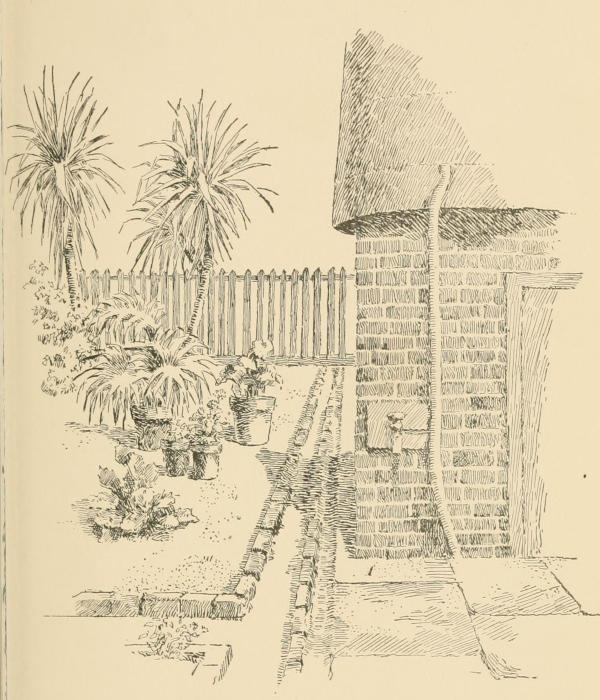
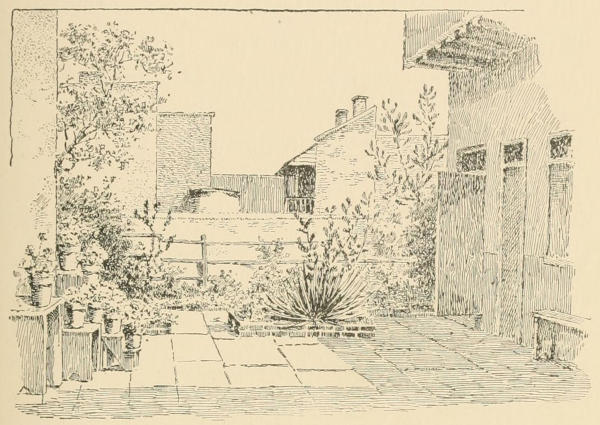
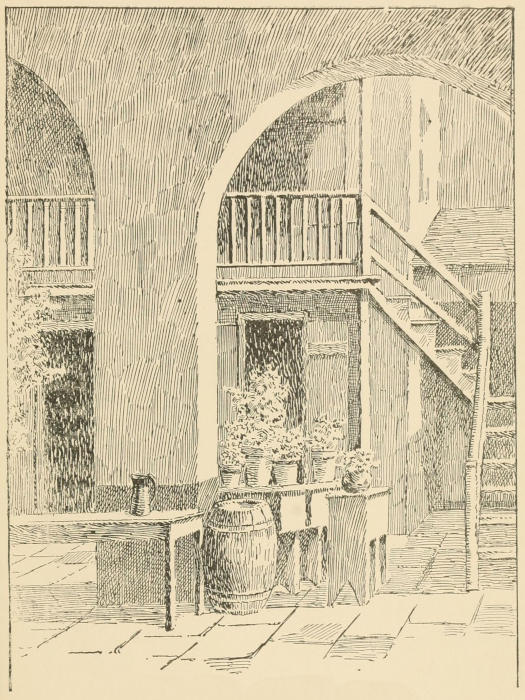
A New Orleans Yard and Cistern.
Household furniture—I go back full seventy
years—was simple and easily cared for. Carpets
were generally what was known as “three-ply.” I
don’t see them now, but in places, on humble
floors, I see imitation Brussels or some other counterfeit.
The first carpet I ever saw woven in one
piece, like all the rugs so plentiful now (and that
was at a much later date) was on the parlor floor of
the Goodman house, on Toulouse Street, the home
so full of bright young girls I so loved to visit.
There was no concern to take away carpets to be
cleaned and stored in the summer. Carpets were
taken to some vacant lot and well beaten. The
neutral green on Canal Street, green and weedy it
was, too, was a grand place to shake carpets; no
offense given if one carried them beyond Claiborne
Street where were no pretentious houses. Then
those carpets were thickly strewn with tobacco
leaves, rolled up and stored in the garret, if you
had one. Every house did not boast of that convenience.
Curtains were not satin damask. At the Mint
when Joe Kennedy was superintendent, and his
family were fashionable people, their parlor curtains
were some red cotton stuff, probably what
is known as turkey red; there was a white and
red-figured border; they were looped over
gilt rods meant to look like spears and muskets,
in deference, I suppose, to the military side of
that government building, for there were sentinels
and guards stationed around about that
gave the whole concern a most imposing and
military air.
I remember at the Breedloves’ home there were
net curtains (probably mosquito net), with a red
border. They were thought rather novel and
stylish. There were no madras, no Irish point, no
Nottingham curtains even, so one did not have a
large variety to choose from.
People had candelabras, and some elaborate affairs—they
called them girandoles—to hold candles;
they had heavy crystal drops that tinkled and
scintillated and were prismatic and on the whole
were rather fine. The candles in those gorgeous
stands and an oil lamp on the inevitable center-table
were supposed to furnish abundance of light for
any occasion. When my sister dressed for a function
she had two candles to dress by (so did I ten
years later!), and two dusky maids to follow her all
about, and hold them at proper points so the process
of the toilet could be satisfactorily accomplished.
Two candles without shades—nobody had heard of
shades—were sufficient for an ordinary tea table.
I was a grown girl, fresh from school, when I
saw the first gaslight in a private house, at
Mrs. Slocomb’s, on St. Charles Street. People
sewed, embroidered, read and wrote and played
chess evenings by candlelight, and except a few
near-sighted people and the aged no one used
glasses. There was not an oculist (a specialist, I
mean) in the whole city.
Every woman had to sew. There were well-trained
seamstresses in every house; no “ready-mades,”
no machines. Imagine the fine hand-sewing
on shirt bosoms, collars and cuffs. I can hear
my mother’s voice now, “Be careful in the stitching
of that bosom; take up two and skip four,” which I
early learned meant the threads of the linen. What
a time there was when the boys grew to tailor-cut
pantaloons! Cut by a tailor, sewed at home, what
a to-do there was when Charley had his first tail-coat;
he could not sit on the tails, they were too
short, so he made an uproar.
I recall also how I cried when sister’s old red
and black “shot silk” dress was made over for me,
and I thought I was going to be so fine (I was nine
years old then and was beginning to “take notice”).
The goods fell short, and I had to have a black, low
neck, short-sleeve waist. In vain I was told it
was velvet and ever so stylish and becoming. I
knew better. However, that abbreviated dress and
those abbreviated tails did duty at the dancing
school.
But we have wandered from house furnishings to
children’s clothes. We will go upstairs now and
take a look at the ponderous four-poster bed, with
its awful tester top, that covered it like a flat roof.
That tester was ornamented with a wall paper stuff,
a wreath of impossible red and yellow roses, big as
saucers, stamped on it, and four strands of same
roses reaching to the four corners of the monstrosity.
The idea of lying, with a raging fever or a
splitting headache, under such a canopy! However,
there were “swells” (there always are
“swells”) who had testers covered with silk.
I hear a rumor that furniture covered with horse-hair
cloth is about to come to the fore again. Everybody
in my early day had black haircloth furniture;
maybe that was one reason red curtains were preferred,
for furniture covered with black haircloth
was fearfully funereal. However, as no moth devoured
it, dust did not rest on its slick, shiny
surface, and it lasted forever, it had its advantages.
Every household possessed a haircloth sofa, with a
couple of hard, round pillows of the same, the one
too slippery to nap on and the others regular break-necks.
Door in the French Market.
Butler’s pantry! My stars! Who ever heard
of a butler’s pantry, and sinks, and running water,
and faucets inside houses? The only running water
was a hydrant in the yard; the only sink was the
gutter in the yard; the sewer was the gutter in the
street, so why a butler’s pantry? To be sure there
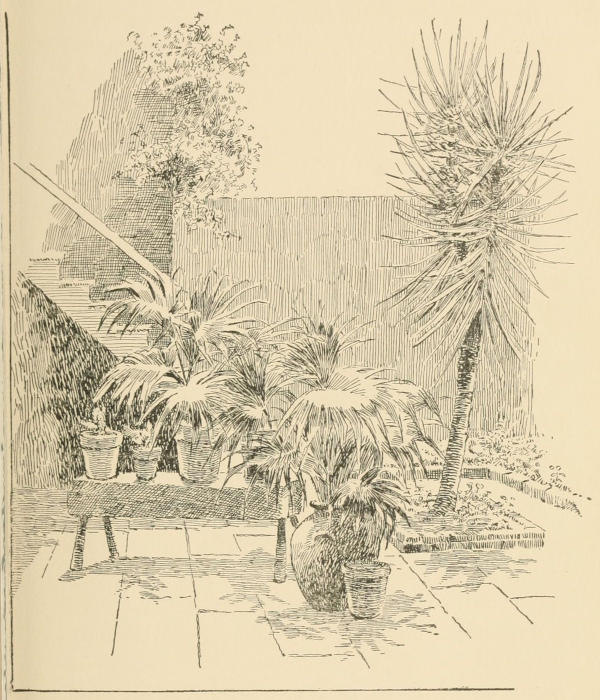
was a cistern for rainwater, and jars like those Ali
Baba’s forty thieves hid themselves in. Those
earthen jars were replenished from the hydrant, and
the muddy river water “settled” by the aid of almond
hulls or alum.
Of course, every house had a storeroom, called
pantry, to hold supplies. It was lined with shelves,
but the only light and air was afforded by a half-moon
aperture cut into a heavy batten door. We
had wire safes on the back porch and a zinc-lined
box for the ice—nothing else—wrapped in a gray
blanket, gray, I presume, on the same principle we
children preferred pink cocoanut cakes—they kept
clean longer than the white! Ice was in general
use but very expensive. It was brought by ship
from the North, in hogsheads.
For the kitchen there were open fireplaces with a
pot hanging from a crane, skillets and spiders. We
don’t even hear the names of those utensils now.
By and by an enterprising housewife ventured on a
cook stove. I have a letter written by one such,
dated in New Orleans in 1840, in which she descants
on the wonders achieved by her stove. “Why,
Susan, we baked three large cakes in it at one time.”
In the old way it required a spider for each cake.
There were no plated knives, but steel, and they
had to be daily scoured with “plenty brickdust on
your knife board,” but those knives cut like razors.
There was no bric-a-brac, few pictures, nothing ornamental
in the parlors. One house I remember
well had a Bunker Hill monument, made, I guess,
of stucco, and stuck all over with gay seashells; it
was perhaps 25 or 30 inches high; it made a most
commanding appearance on the center-table. When
my sister made a tiresomely long call at that house
it amused me to try to count the shells.
An old gentleman, called “Old Jimmie Dick”
when I remember him, a rich cotton broker (the
firm was Dick & Hill), made a voyage to Europe,
and brought home some Apollos, and Cupids, and
Mercuries, statues in the “altogether,” for his parlor.
Jimmie Dick was a bachelor, and lived on Canal
Street, near Carondelet or Baronne, and had a
charming spinster niece keeping house for him, who
was so shocked when she saw the figures mounted
on pedestals (they were glaring white marble and
only a trifle under life size) that she immediately
made slips of brown holland and enveloped them,
leaving only the heads exposed! I never went to
that house but the one time when we surprised her
in the act of robing her visitors!
I speak of houses that I visited with my grown
sister. It was not comme il faut for a young
lady to be seen too frequently on the street or to
make calls alone. Mother was an invalid and made
no visits. Father accompanied sister on ceremonious
occasions. I was pressed into service when no one
else was available. I feel I am going way back
beyond the recollection of my readers, but some
of the grandmothers, too old, mayhap, to do their
own reading, can recall just such a life, a life that
will never be lived again.
VI A FASHIONABLE FUNCTION IN 1842
It is hard to realize while we are surrounded by
so many housekeeping conveniences what an
amount of time, energy, and, above all, knowledge
of the craft were necessary to the giving of a
reception seventy years ago, when every preparation
had to be made in the house and under the watchful
supervision of the chatelaine.
There were no chefs to be hired, nor caterers to
be summoned, not even a postman to deliver invitations.
All that was done “by hand.” A darky was
sent forth with a basket of nicely “tied up with
white ribbons” notes of invitation, and he went from
house to house, sending the basket to the occupant,
where she not only subtracted her special note, but
had the privilege of seeing “who else was invited.”
And if the darky was bewildered as to his next
stopping-place she could enlighten him. This complicated
mode of delivering invitations prevailed
into the fifties.
The preparations for the supper involved so much
labor that many hosts offered only eau sucrée or
gumbo. There was no cut nor granulated nor pulverized
sugar, to be turned from the grocer’s bag
onto the scales. All sugar except the crude brown,
direct from plantations, was in cone-shaped loaves
as hard as a stone and weighing several pounds each.
These well-wrapped loaves were kept hung (like
hams in a smokehouse) from the closet ceiling.
They had to be cut into chips by aid of carving knife
and hammer, then pounded and rolled until reduced
to powder, before that necessary ingredient
was ready for use.
There were no fruit extracts, no essences for seasoning,
no baking powder to make a half-beaten
cake rise, no ground spices, no seedless raisins, no
washed (?) currants, no isinglass or gelatine, and to
wind up this imperfect list, no egg-beater! Still the
thrifty housewife made and served cakes fit for the
gods, with only Miss Leslie’s cook book to refer to,
and that was published in the twenties. Ice cream
was seasoned by boiling a whole vanilla bean in the
milk; it was frozen in a huge cylinder without any
inside fixtures to stir the mixture; it was whirled in
the ice tub by hand—and a stout one at that—and
required at least one hour, constant labor, to freeze
the cream.
For jelly, calves’ feet were secured days in
advance, and Madame superintended the making
of gelatine. Pink jelly was colored with a drop or
two of cochineal, yellow, doctored with lemon, and
a beautiful pale green, colored with the strained
juice of scalded spinach. These varieties were
served in various attractive shapes; and all, even the
green, were delicious. These preparations were also
complicated by the necessity of procuring all supplies
from the early morning market often a mile
or more away, and which, besides, closed at 10
o’clock. No stepping to the corner grocery for eggs
or butter in an unforeseen emergency, and to the
credit of the community the “borrowing habit” was
entirely unknown.
I remember a Mrs. Swiler, chiefly because when
I went to see her, with an older sister, she “passed
around” bananas. Cuban fruits were scarce in
those days, and highly prized.
There were no awnings to be used in bad weather;
no camp chairs for the invited guests if all came, and
all wanted to sit down at the same time; no waterproofs
for them to come in; no rubbers to protect
feet from rain-soaked sidewalks; no street cars;
no public conveyances that people ever hired for
such occasions; no private carriages to bump
you over rough cobblestones. So, there you
are!
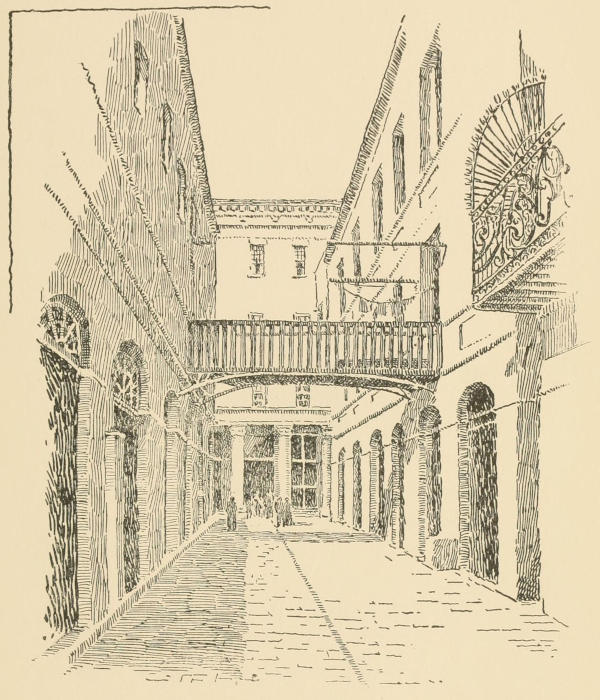
Courtyard on Carondelet Street
Arrived after all these tiresome preparations and
your own discomfort at my father’s house, on Canal
Street, to a reception given almost seventy years
ago, in honor of Commodore Moore of the Texas
navy, who brought to my father letters of introduction
from President Mirabeau B. Lamar, of the
Republic of Texas, and Gen. Sam Houston of the
Texas army!
I have reason to think at this late date, not hearing
to the contrary at the time, that the commodore’s
visit was quite amicable and friendly. If he
was escorted by Texas warships! or even arrived
in his own flagship! I never knew. With his imposing
uniform and a huge gilt star on his breast,
a sword at his side, and a rather fierce mustache
(mustaches were little worn then), he looked as if
he were capable of doing mighty deeds of daring,
for the enterprising new republic on our border. He
was accompanied by his aide, a callow youth, also
in resplendent attire, a sword so long and unwieldy
he was continually tripping, and therefore too embarrassingly
incommoded to circulate among the
ladies. I met that “aide,” a real fighter in Texas
during the late war. He proudly wore a lone star
under the lapel of his coat of Confederate gray,
and we had a merry laugh over his naval début.
He was Lieut. Fairfax Grey. His sister was the
wife of Temple Doswell, and many of her descendants
are identified with New Orleans to-day.
Mr. Clay, grand, serene, homely and affable; also
Gen. Gaines in his inevitable uniform. The two
military and naval officers commanded my admiration,
as I sat quietly and unobtrusively in a corner
in a way “becoming to a child of nine”—“a chiel
amang ye, takin’ notes”—but no one took note of
the chiel. We had also a jolly itinerant Irish
preacher, I think of the Methodist persuasion, whom
my father had met at country camp meetings. His
call was to travel, and incidentally preach where the
harvest was ripe. I remember how, laughingly, he
remarked to my father, anent the commodore’s visit,
that the chief inhabitants of Western Texas were
mesquite grass and buffaloes. He was father of
John L. Moffitt of Confederate fame, and a very attractive
daughter became the wife of President
Lamar.
There was dance music—a piano only—but the
room was too crowded for more than one attempt
at a quadrille. The notabilities, army, navy and
State, did not indulge in such frivolity. Life was
too serious with them.
These functions generally began at 8 and terminated
before the proverbial small hours. So by
midnight the last petticoat had fluttered away; and
then there followed the clearing up, and, as the old
lady said, the “reinstating of affairs,” which kept
the hostess and her sleepy helpers busy long after
the rest of the family had fluttered away also—to
the land of Nod.
VII NEW YEAR’S OF OLD
“When I was young, time had for me the lazy ox’s pace,
But now it’s like the blooded horse that means to win the race.”
Here it is New Year’s Day again. It seems
only yesterday when we had such a dull,
stupid New Year’s Day. Everybody who
was anybody was out of town, at country mansions
to flourish with the rich, or to old homesteads to
see their folks. Nobody walking the streets, no
shops were open. Those of us who had no rich
friends with country mansions, or no old homesteads
to welcome us, remained gloomily at home, with
shades down, servants off for the day, not even a
basket for cards tied to the doorknob.
Nobody calls now at New Year’s. It is out of
fashion, or, rather, the fashion has descended from
parlor to kitchen. When Bridget and Mary don
their finery and repair to Bridget’s cousin’s to “receive,”
and Sambo puts on a high shirt collar and
a stovepipe hat, and sallies out on his round of calls,
we have a pick-up dinner, and grandma tries to
enliven the family with reminiscences of the New
Year’s Days of seventy years ago, when her mother
and sister “received” in state, and father and
brother donned their “stovepipes” and proceeded to
fill the society rôle for the year.
In the forties and for years thereafter, New Year’s
Day was the visiting day for the men, and receiving
day for the ladies. All the fathers and grandfathers,
in their newest rig, stick in hand, trotted or
hobbled around, making the only calls they made
from year to year. Before noon, ladies were in their
parlors, prinked up, pomatumed up, powdered up,
to “receive.” Calling began as early as 11, for it
was a short winter day, and much to be accomplished.
A small stand in the hall held a card receiver,
into which a few cards left from last year’s
stock were placed, so the first caller might not be
embarrassed with the fact that he was the first. No
one cared to be the very first then, any more than
now.
A table of generous dimensions occupied a
conspicuous position in the parlor (we never said
“drawing room”), with silver tray, an immense and
elaborately decorated cake and a grand bowl of
foaming eggnog. That was chiefly designed for
the beaux. On the dining room sideboard (we did
not say “buffet,” either) a brandy straight or whisky
straight was to be found for those walking-stick ones
whose bones were stiff and whose digestion could
not brook the fifty different concoctions of eggnog
they were liable to find in the fifty different houses.
Those varied refreshments, which every caller was
expected to at least taste, often worked havoc on
the young and spry, to say nothing of the halt and
lame.
There were no flower decorations. It was the
dead season for plants, and Boston greenhouses
were not shipping carloads of roses and carnations
to New Orleans in the ’40s. Rooms were not darkened,
either, to be illuminated with gas or electricity,
but windows were thrown wide open to the blessed
light of a New Year’s Day. Little cornets of bonbons
and dragées were carelessly scattered about.
Those cornucopias, very slim and pointed, containing
about a spoonful of French confections,
were made of stiff, shiny paper, gaudily colored miniatures
of impossible French damsels ornamenting
them. I have not seen one of those pretty trifles
for sixty years. It was quite the style for a swain
to send his Dulcinea a cornet in the early morning.
If the Dulcinea did not happen to receive as many
as she wanted, she could buy a few more. One liked
to be a Belle!
Living in Canal Street, a little girl was unconsciously
taking notes that blossom now in a chronicle
of the doings and sayings of those New Year’s
Days of the early ’40s. She enjoyed looking through
the open window, onto the broad, unshaded street,
watching an endless procession of callers. There
were rows of fashionable residences in Canal Street
to be visited, and the darting in and out of open
doors, as though on earnest business bent, was a
sight. The men of that day wore skin-tight pantaloons
(we did not call them trousers), often made
of light-colored materials. I clearly remember a
pea green pair that my brother wore, flickering like
a chameleon in and out of open street doors. Those
tight-fitting pantaloons were drawn taut over the
shoe, a strong leather strap extending under the foot
buckled the garment down good and tight, giving
the wearer as mincing a gait as the girl in the present-day
hobble skirt. The narrow clawhammer
coat with tails that hung almost to the knees behind
and were scarcely visible in front, had to have the
corner of a white handkerchief flutter from the tail
pocket.
Military men like Gen. E. P. Gaines (he was
in his zenith at that date) and all such who
could sport a military record wore stiff stocks about
their long necks. Those stocks made the necks appear
abnormally long. They were made of buckram
(or sheet iron?), so broad that three straps
were required to buckle them at the back, covered
with black satin, tiny satin bows in front which were
utterly superfluous, for they tied nothing and were
not large enough to be ornamental. The stocks
must have been very trying to the wearers, for they
could not turn their heads when they were buckled
up, and, like the little boy with the broad collar,
could not spit over them. However, they did impart
a military air of rigidity and stiffness, as though
on dress parade all the time.
I remember Major Waters had a bald spot
on the top of his head and two long strands of
sandy hair on each side which he carefully gathered
up over the bald spot and secured in place by the
aid of a side comb! I used to wish the comb would
fall out, to see what the major would do, for I was
convinced he could not bend his head over that stiff,
formidable stock. The major won his title at the
battle of River Rasin (if you know where that is,
I don’t). My father was in the same battle, but
being only seventeen he did not win a title. I don’t
suppose that River Rasin engagement amounted to
much anyway, for dear pa did not wear a stock, nor
a military bearing, either. Gen. Persifor Smith was
another stock man who called always at New Year’s
and at no other time. And Major Messiah! Dear
me, how many of us remember him in the flesh, or
can forget the cockaded, epauletted portrait he left
behind when he fought his last life’s battle?
All the men wore tall silk hats that shone like patent
leather. Those hats have not been banished
so long ago that all of us have forgotten their monstrosity,
still to be seen now and then in old daguerreotypes
or cartes de visite. They flocked in pairs
to do their visiting. It would be a Mardi Gras
nowadays to see one of those old-time processions.
Men of business, men of prominence, no longer society
men, fulfilled their social duty once each year,
stepped into the dining room at a nod from mother,
who was as rarely in the parlor to “receive,” as the
men who, at the sideboard, with a flourish of the
hand and a cordial toast to the New Year, took a
brandy straight. They are long gone. Their sons,
the beaux of that day, quietly graduated from the
eggnog to the sideboard, become even older men
than their fathers, are gone, too.
I remember a very original, entertaining beau of
those days saying eggnog was good enough for him,
and when he felt he was arriving at the brandy-straight
age he meant to kill himself. How would
he know when the time for hari-kari came? “When
my nose gets spongy.” He had a very pronounced
Hebrew nose, by the way. Not so many years ago
I heard of him hobbling on crutches. Not only his
nose, but his legs were spongy, but he gave no indication
that life was not as dear to him as in his salad
days.
The younger element, beaux of my grown-up sister,
rambled in all day long, hat in hand, with “A
happy New Year,” a quaff of eggnog, “No cake,
thanks,” and away like a flash, to go into house
after house, do and say the same things, till night
would find they had finished their list of calls and
eggnog had about finished them. So the great day
of the year wore on.
After the house doors were closed at the flirt of
the last clawhammer coat tail, cards were counted
and comments made as to who had called and who
had failed to put in appearance, the wreck of glasses,
cake and tray removed, and it was as tired a set of
ladies to go to bed as of men to be put into bed.
As the beautiful custom of hospitality spread from
the centers of fashion to the outskirts of society the
demi mondaines, then the small tradesman, then the
negroes became infected with the fashion of “receiving”
at New Year’s, in their various shady abodes.
The bon tons gradually relinquished the hospitable
and friendly custom of years. Ladies suspended
tiny card receivers on the doorknob, and retired behind
closed blinds. Those of the old friends of tottering
steps and walking sticks, always the last to
relinquish a loved habit, wearily dropped cards into
the little basket and passed on to the next closed
door. Now the anniversary, instead of being one
of pleasant greetings, is as stupid and dull as any
day in the calendar, unless, as I have said, one has
a friend with a “cottage by the sea” or a château
on the hilltop and is also endowed with the spirit
of hospitality to ask one to spend the week-end and
take an eggnog or a brandy straight.
VIII NEW ORLEANS SHOPS AND SHOPPING IN THE FORTIES
The shopping region of New Orleans was
confined to Chartres and Royal Streets
seventy years ago. It was late in the fifties
when the first movement was made to more commodious
and less crowded locations on Canal Street,
and Olympe, the fashionable modiste, was the venturesome
pioneer.
Woodlief’s was the leading store on Chartres
Street and Barrière’s on Royal, where could be
found all the French nouveautés of the day, beautiful
barèges, Marcelines and chiné silks, organdies
stamped in gorgeous designs, to be made up with
wreathed and bouquet flounces, but, above and beyond
all for utility and beauty, were the imported
French calicoes, fine texture, fast colors. It was before
the day of aniline and diamond dyes; blues
were indigo, reds were cochineal pure and unadulterated;
so those lovely goods, printed in rich designs—often
the graceful palm-leaf pattern—could
be “made over,” turned upside down and hindpart
before, indefinitely, for they never wore out or lost
color, and were cheap at fifty cents a yard. None
but those in mourning wore black; even the men wore
blue or bottle green coats, gay flowered vests and
tan-colored pantaloons. I call to mind one ultra-fashionable
beau who delighted in a pair of sage
green “pants.”
The ladies’ toilets were still more gay; even the
elderly ones wore bright colors. The first black
silk dress worn on the street, and that was in ’49,
was proudly displayed by Miss Mathilde Eustis,
who had relatives in France who kept her en rapport
with the latest Parisian style. Hers was a
soft Marceline silk; even the name, much less the
article, is as extinct as the barège and crêpe lisse of
those far away days. It was at Woodlief’s or Barrière’s
these goods were displayed on shelves and
counters. There were no show windows, no dressed
and draped wax figures to tempt the passerby.
Mme. Pluche’s shop, on the corner of Royal and
Conti, had one window where a few trifles were occasionally
displayed on the sill or hung, carefully
draped on the side, so as not to intercept the light.
Madame was all French and dealt only in French
importations. Mme. Frey was on Chartres Street.
Her specialty (all had specialties; there was no shop
room for a miscellaneous stock of goods) was mantillas,
visites, cardinals and other confections to envelop
the graceful mesdames en flânant. I call
to mind a visite of thinnest muslin, heavily embroidered
(no Hamburg or machine embroidery in those
days), lined with blue silk, blue cords and tassels for
a finish. It was worn by a belle of the forties, and
Mme. Frey claimed to have imported it. The madame
was not French. She had a figure no French
woman would have submitted to, a fog-horn voice
and a well-defined mustache, but her taste was the
best and her dictum in her specialty was final.
The fashionable milliner was Olympe. Her specialty
was imported chapeaux. She did not—ostensibly,
at least—make or even trim chapeaux.
Olympe’s ways were persuasive beyond resistance.
She met her customer at the door with “Ah, madame”—she
had brought from Paris the very bonnet
for you! No one had seen it; it was yours! And
Mam’zelle Adèle was told to bring Mme. X’s chapeau.
It fit to a merveille! It was an inspiration!
And so Mme. X had her special bonnet sent home
in a fancy box by the hand of a dainty grisette.
Olympe was the first of her class to make a specialty
of delivering the goods. And Monsieur X, though
he may have called her “Old Imp,” paid the bill
with all the extras of specialty and delivery included,
though not itemized. Those were bonnets to shade
the face—a light blue satin shirred lengthwise;
crêpe lisse, same color, shirred crosswise over it,
forming indistinct blocks; and a tout aller, of raspberry
silk, shirred “every which way,” are two that
I recall.
Madame a-shopping went followed by a servant to
bring home the packages. Gloves, one button only,
were light colored, pink, lavender, lemon, rarely
white; and for ordinary wear bottle green gloves
were considered very comme il faut. They harmonized
with the green barège veil that every lady
had for shopping.
Our shopping trip would be incomplete if we
failed to call on an old Scotch couple who had a lace
store under Col. Winthrop’s residence on Royal
Street. The store had a door and a window, and
the nice old parties who had such a prodigious
Scotch brogue one would scarcely understand them,
could, by a little skill, entertain three customers at
one and the same time. If one extra shopper appeared,
Mr. Syme disappeared, leaving the old lady
to attend to business. She was almost blind from
cataract, a canny old soul and not anyways blind to
business advantages. I am pleased to add they
retired after a few busy years quite well-to-do.
There was Seibricht, on Royal Street, a furniture
dealer, and still further down Royal Seignoret, in
the same lucrative business, for I do not recall they
had any competitors. Memory does not go beyond
the time when Hyde and Goodrich were not the jewelers;
and Loveille, on the corner of Customhouse
and Royal, the grocer, for all foreign wines, cheeses,
etc. Never do I see such Parmesan as we got from
Loveille in my early days.
William McKean had a bookshop on Camp Street,
a few doors above Canal. Billy McKean, as the
irreverent called him, was a picture of Pickwick,
and a clever, kindly old man was he. There was a
round table in the rear of his shop, where one found
a comfortable chair and a few books to browse over.
In my childhood I was always a welcome visitor to
that round table, for I always “sat quiet and just
read,” as dear old Mr. McKean told me. As I
turn the pages of my book of memories not only the
names but the very faces of these shopkeepers of
seventy years ago come to me, all smiles and winning
ways, and way back I fly to my pantalette and
pigtail days, so happy in these dreams that will never
be reality to any place or people.
There were no restaurants, no lunch counters,
no tea rooms, and (bless their dear hearts, who
started it!) no woman’s exchange, no place in the
whole city where a lady could drop in, after all this
round of shopping, take a comfortable seat and
order even a sandwich, or any kind of refreshment.
One could take an éclair at Vincent’s, corner of
Royal and Orleans, but éclairs have no satisfying
quality.
There was a large hotel (there may be still—it
is sixty years since I saw it), mostly consisting
of spacious verandas, up and down and all around,
at the lake end of the shellroad, where parties could
have a fish dinner and enjoy the salt breezes, but
a dinner at “Lake End” was an occasion, not a climax
to a shopping trip. The old shellroad was a
long drive, Bayou St. John on one side, swamps on
the other, green with rushes and palmetto, clothed
with gay flowers of the swamp flag. The road terminated
at Lake Pontchartrain, and there the restful
piazza and well-served dinner refreshed the inner
woman.
I am speaking of the gentler sex. No doubt there
were myriads of cabarets and eating places for men
on pleasure or business bent. Three o’clock was the
universal dinner hour, so the discreet mesdames were
able to return to the city and be ready by early candlelight
for the inevitable “hand round” tea.
Then there was Carrollton Garden (I think it is
dead and buried now). There was a short railroad
leading to Carrollton; one could see open fields and
grazing cattle from the car windows as one crept
along. Except a still shorter railroad to the Lake,
connecting with the Lake boats, I think the rural
road to Carrollton was the only one leading out of
the city. The Carrollton hotel, like the Lake one,
was all verandas. I never knew of any guest staying
there, even one night, but there was a dear little
garden and lots of summer houses and pagodas,
covered with jasmines and honeysuckle vines. One
could get lemonade or orgeat or orange flower syrup,
and return to the city with a great bouquet of
monthly roses, to show one had been on an excursion.
A great monthly rose hedge, true to its name,
always in bloom, surrounded the premises. To see
a monthly rose now is to see old Carrollton gardens
in the forties.
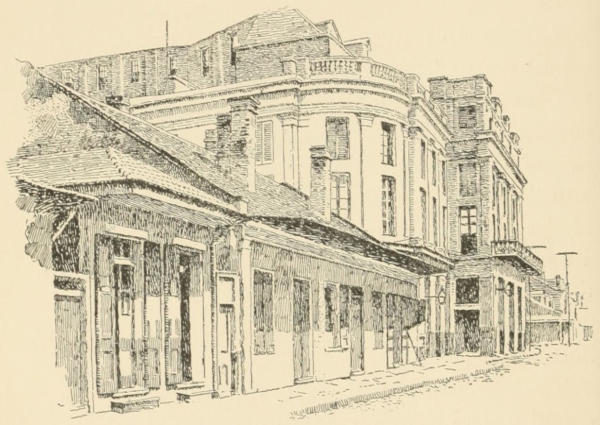
IX THE OLD FRENCH OPERA HOUSE
It was on Orleans Street, near Royal—I don’t
have to “shut my eyes and think very hard,”
as the Marchioness said to Dick Swiveller, to
see the old Opera House and all the dear people in
it, and hear its entrancing music. We had “Norma”
and “Lucia di Lammermoor” and “Robert le Diable”
and “La Dame Blanche,” “Huguenots,” “Le
Prophète,” just those dear old melodious operas,
the music so thrillingly catchy that half the young
men hummed or whistled snatches of it on their way
home.
There were no single seats for ladies, only four-seated
boxes. The pit, to all appearances, was for
elderly, bald gentlemen only, for the beaux, the
fashionable eligibles, wandered around in the intermissions
or “stood at attention” in the narrow lobbies
behind the boxes during the performances. Except
the two stage boxes, which were more ample,
and also afforded sly glimpses towards the wings
and flies, all were planned for four occupants. Also,
all were subscribed for by the season. There was
also a row of latticed boxes in the rear of the dress
circle, usually occupied by persons in mourning, or
the dear old messieurs et mesdames, who were not
chaperoning a mademoiselle. One stage box belonged,
by right of long-continued possession, to Mr.
and Mrs. Cuthbert Bullitt. The opposite box was
la loge des lions, and no less than a dozen lions
wandered in and out of it during an evening. Some
were blasé and looked dreadfully bored, a few were
young and frisky, but every mortal one of them
possessed a pompous and self-important mien.
The Old French Opera House.
If weather permitted (we had to consider the
weather, as everybody walked) and the opera a favorite,
every seat would be occupied at 8 o’clock,
and everybody quiet to enjoy the very first notes of
the overture. All the fashionable young folks, even
if they could not play or whistle “Yankee Doodle,”
felt the opera was absolutely necessary to their
social success and happiness. The box was only five
dollars a night, and pater-familias certainly could
afford that!
Think of five dollars for four seats at the most
fashionable Opera House in the land then, and compare
it with five dollars for one seat in the topmost
gallery of the most fashionable house in the land
to-day. Can one wonder we old people who sit by
our fire and pay the bills wag our heads and talk of
the degenerate times?
Toilets in our day were simple, too. French
muslins trimmed with real lace, pink and blue barèges
with ribbons. Who sees a barège now? No
need of jeweled stomachers, ropes of priceless pearls
or diamond tiaras to embellish those Creole ladies,
many of whom were direct descendants of French
nobles; not a few could claim a drop of even royal
blood.
Who were the beaux? And where are they now?
If any are living they are too old to hobble into
the pit and sit beside the old, bald men.
It was quite the vogue to saunter into Vincent’s, at
the corner, on the way home. Vincent’s was a great
place and he treated his customers with so much
“confidence.” One could browse about the glass
cases of pâtés, brioches, éclairs, meringues, and all
such toothsome delicacies, peck at this and peck at
that, lay a dime on the counter and walk out. A
large Broadway firm in New York attempted that
way of conducting a lunch counter and had such a
tremendous patronage that it promptly failed.
Men went for breakfast and shopping parties for
lunch, instead of dropping in en passant for an
éclair.
As I said, we walked. There were no street cars,
no ’buses and precious few people had carriages to
ride in. So we gaily walked from Vincent’s to our
respective homes, where a cup of hot coffee put us
in condition for bed and slumber.
Monday morning Mme. Casimir or Mam’zelle
Victorine comes to sew all day like wild for seventy-five
cents, and tells how splendidly Rosa de Vries
(the prima donna) sang “Robert, toi que j’aime”
last night. She always goes, “Oui, madame, toujours,”
to the opera Sunday. Later, dusky Henriette
Blondeau comes, with her tignon stuck full of
pins and the deep pockets of her apron bulging with
sticks of bandoline, pots of pomade, hairpins and a
bandeau comb, to dress the hair of mademoiselle.
She also had to tell how fine was “Robert,” but she
prefers De Vries in “Norma,” “moi.” The Casimirs
lived in a kind of cubby-hole way down Ste.
Anne Street. M. Casimir was assistant in a barber
shop near the French Market, but such were the
gallery gods Sunday nights, and no mean critics were
they. Our nights were Tuesday and Saturday.
Society loves a bit of gossip, and we had a delightful
dish of it about this time, furnished us by a denizen
of Canal Street. He was “horribly English,
you know.” As French was the fashion then, it
was an impertinence to swagger with English airs.
The John Bull in question, with his wife all decked
out in her Sunday war paint and feathers, found a
woman calmly seated in his pew at Christ Church, a
plainly dressed, common appearing woman, who
didn’t even have a flower in her bonnet. The pew
door was opened wide and a gesture accompanied it,
which the common-looking somebody did not fail
to comprehend. She promptly rose and retired into
the aisle; a seat was offered her nearer the door of
the church, which she graciously accepted. Lady
Mary Wortley Montagu had asked for a seat in
that pew, as she bore a letter of introduction to its
occupant. This incident gave us great merriment,
for the inhospitable Englishman had been boasting
of the coming of Lady Mary. I introduce it here,
for it has a moral which gives a Sunday school flavor
to my opera reminiscences. Now they have all
gone where they are happily singing, I hope, even
better than Rosa de Vries, and where there are no
doors to the pews.
X MURAL DECORATIONS AND PORTRAITS OF THE PAST
The pendulum is swinging. Landscape wall
papers, after a seventy years’ truce, are on
the warpath, to vanquish damask hangings
and other fabrics that are traps for moths and
dust and microbes, we old-time people aver. Now,
in view of the return to favor of landscape wall
papers, some elegant, expensive and striking specimens
rise in my memory, and clamor to be once
more displayed to the public.
I vividly remember a decorated wall at a school
under the charge of a superannuated Episcopal clergyman.
His aged wife must have possessed
considerable artistic ability, for she painted, on the
parlor walls, mythological subjects, as befits a school
teacher’s, if not a preacher’s, residence. There were
Diana and her nymphs (quite modestly wrapped
in floating draperies) on one side the room, and
opposite, was Aurora in her chariot, driving
her team of doves. They were up in the dawning
sky, and below was such greenery as I presume
old Mrs. Ward thought belonged to the period
of gods and goddesses, but it was strangely
like the bushes and trees in her own back yard. Various
other figures were floating or languishing about.
The colors, on the whole, were not brilliant; in fact,
artistically subdued. That bit of mural adornment
was a curiosity to all. I, a little child, thought it
most wonderful, and it was. All these landscape
walls had a three or four-foot base of a solid color,
surmounted by a band of wood, called in those days
“chair boarding.” So the figures came near the level
of the eye.
Years after the two old people had joined the
immortals, I had occasion to call at the house. It
was a great disappointment to find the parlor wall
covered with stiff paper, representing slabs of white
marble (marble, of all things, in that dingy red-brick
house!). Aurora and Diana, and perhaps
Calypso, for I imagine the scope was sufficiently
extensive to comprise such a picturesque immortal,
were buried under simulated marble. A weather-beaten
portrait of Major Morgan in full uniform
hung right over the spot where Aurora drove her
fluttering birds. I looked at the desecration in dismay,
when the voice of old black mammy was
heard. “Dat is Mars Major in his rag-gi-ments;
you never know’d him?” No, I didn’t. “And dat
odder portrait over dar” (pointing to a simpering
girl with curly hair) “is Miss Merriky ’fore she
married de major.” Where are those old portraits
now? The whirligig of time has doubtless whirled
them away to some obscure closet or garret, where,
with faces turned to the wall, they await a time
when there will be a general cleaning up or tearing
down—then where? Sic transit!
Typical Old New Orleans Dwelling.
I recall, in later life, a wonderful wall paper on
the broad hall of Judge Chinn’s house in West
Baton Rouge. That was very gay and brilliant,
somewhat after the Watteau style, swains playing
on impossible instruments to beauties in various listening
attitudes; lambs gamboling in the distance,
birds flying about amid lovely foliage, horsemen on
galloping steeds with extraordinary trappings. How
I did love that wall! It was never permitted the
family to cover all that glory with “pillars and
panels,” for the house, shortly after my visit, was
destroyed by fire, and the debonair ladies, prancing
steeds and all went up in one great holocaust.
The new house that rose over the ashes was aptly
called Whitehall. It was all white, inside and out,
broad, dead white walls, grand balconies all around
the mansion dead white; white steps led to the lawn,
and the trees surrounding had their trunks whitewashed
as high as could be reached by a long pole
and a brush. All the old portraits and some awful
prints (it was long before the chromo era) were
fished out of closets and other hiding places and
hung about on the white walls. One old man with
a tremendously long neck and a stiff black stock to
help hold up his head, and a fierce look, had a pair
of eyes that looked like great daubs of ink. His
portrait decorated the parlor. I was warned not
to handle the gilt-edged books and little trinkets on
the marble-top center-table, “for your Cousin Christopher
will see you; notice, whichever way you turn
his eyes will follow you.” I was mortally afraid
of that old spook till little black Comfort told me,
“Laws! if dem eyes could hurt we’d all be’n daid in
dis house.”
At “The Oaks,” Dr. Patrick’s plantation, the wall
paper illustrated scenes from China, in colors not
gorgeous, like the last mentioned, neither was the
house so pretentious. There was no broad, high
ceilinged hall to ornament with startling figures that
seemed to jump at you. The orderly processions of
pigtailed Chinamen in sepia tints could not by any
possibility get on one’s nerves. Whole processions
wended their way to impossible temples, wedding
processions, palanquins, and all that; funeral processions
dwindled away to a mere point in the distance,
all becomingly solemn, until some of the irrepressible
Patrick children, with black pencil, or charcoal, or
ink, put pipes into all the mouths and clouds of
smoke therefrom spotted the landscape. Moral
suasion was the discipline of the Patrick children,
so that freak was not probably followed by after-claps,
but the Chinese were promptly marched off,
and the inevitable white walls were the result.
Family portraits came forth to brighten the room.
One notable one that superseded the Chinese wall
paper was a full-length portrait of Gov. Poindexter’s
(everybody knows “Old Poins” was the first
Governor of the State of Mississippi) first wife,
who was a sister of Mrs. Patrick. She was a vision
of beauty, in full evening dress. Facing her was
the glum, “sandy complected” Governor, not one
bit fascinated by the sight of his wife’s smiling face.
The fashionable portrait painter of the time was
Moïse; it was he who painted the author’s portrait
shortly after her marriage. He was a dashing, improvident
genius, and many of his portraits were
executed to cancel debts. At one time he designed
and had made for my husband, in settlement for a
loan, a handsome silver lidded bowl with alcohol
lamp beneath. It was known as a pousse café and
was used to serve hot punch to after-dinner parties.
I am glad to say it has survived all the family vicissitudes,
and is an honored heirloom, in company
with a repoussé silver pitcher, which we won as a
prize for cattle at the Louisiana State Fair, described
in a later chapter.
At John C. Miller’s place the house was only one
story, but it spread over what seemed to be a half
acre of land. A square hall, which was a favorite
lounging place for everybody, had wall paper delineating
scenes from India. Women walked toward
the Ganges river, smilingly tripping along with
huge water jars on their shoulders, in full view of
another woman descending the steps of a temple,
with a naked baby, poised aloft, to be thrown into
the sacred Ganges. A crocodile ruffled the blue
(very blue) waters, with jaws distended, ready to
complete the sacrifice. That sacred river seemed to
course all around the hall, for on another side were
a number of bathers, who appeared to be utterly
oblivious of their vicinity to the mother and babe,
not to mention the awful crocodile.
The culmination of landscape wall paper must
have been reached in the Minor plantation dwelling
in Ascension parish. Mrs. Minor had received
this plantation as a legacy, and she was so loyal to
the donor that the entreaties of her children to
“cover that wall” did not prevail. It was after that
style of mural decoration was of the past, that I
visited the Minors. The hall was broad and long,
adorned with real jungle scenes from India. A
great tiger jumped out of dense thickets toward
savages, who were fleeing in terror. Tall trees
reached to the ceiling, with gaudily striped boa constrictors
wound around their trunks; hissing snakes
peered out of jungles; birds of gay plumage, paroquets,
parrots, peacocks everywhere, some way up,
almost out of sight in the greenery; monkeys swung
from limb to limb; ourang-outangs, and lots of almost
naked, dark-skinned natives wandered about.
To cap the climax, right close to the steps one had
to mount to the story above was a lair of ferocious
lions!
I spent hours studying that astonishing wall
paper, and I applauded Mrs. Minor’s decision, “The
old man put it there; it shall stay; he liked it, so do
I.” It was in 1849 I made that never-to-be-forgotten
trip to jungle land. The house may still be
there; I don’t know; but I warrant that decorated
hall has been “done over,” especially if little children
ever came to invade the premises. Upon the
departure of landscape wall paper, the pendulum
swung to depressing simplicity of dead white walls
or else “pillared and paneled,” which is scarcely one
degree better.
Old portraits and any kind of inartistic picture
or print were brought forth to gratify the eye unaccustomed
to such monotony. Only a few years
ago I asked: “What became of that military epauletted
portrait of old Major Messiah that always
hung in your mother’s hall when we were children?”
“Oh, it was hanging twenty or more years ago in
the office of a hardware concern down town. Don’t
know where it is now.”
After the war, inquiring for a lot of portraits of
various degrees of merit and demerit that disappeared
when the Yankees left, we heard that some
were in negro cabins in West Feliciana. So they
come and are appreciated, those images of loved
ones. So they often go, and are despised by those
who follow us, and who, perchance, never knew the
original. Now the questions arise, will landscape
wall papers really return? And in their pristine
splendor? Surely the scope in brilliancy and variety
could not be excelled. The limit was reached almost
seventy years ago, and naturally (I was a
child then) comes as vividly to my mind as the counterfeit
face of my ancestor with eyes following me
all around the room. The tigers and ourang-outangs,
even the den of lions and the crocodile of
the Ganges, never made my little soul quake like the
searching eyes of “my Cousin Christopher.”
XI THOUGHTS OF OLD
I shall begin to think I am in my second childhood
by and by. I have just been reading
of a fashionable wedding where the bride and
her attendants carried flat bouquets with lace paper
frills. I don’t doubt the revival of the porte bouquet
will come next, the slender bouquet holders
made of filigree silver with a dagger like a short
hatpin to stick clear through and secure the bouquet—a
chain and ring attached to the holder and
all could be hung from the finger. I used to think,
a childish looker-on, that it was pretty to see the
ladies in a quadrille “balancing to your partners,”
“ladies changing,” etc., each with a tight little bouquet
in a trim little holder swinging and banging
about from the chain.
Later the porte bouquets were abandoned, but
the stiff little posies, in their lacy frills, remained.
They were symmetrical, a camellia japonica, surrounded
by a tiny row of heliotrope, then a row of
Grand Duke jasmine, one of violets, finally a soupçon
of greenery, and the paper bed. James Pollock
had a fund of such rare flowers to draw from, for
though the Pollock home down on Royal street was
the simplest of old Creole houses, flush on the street,
only two steps from the banquette leading into a
modest parlor, there was a tiny parterre in the rear,
a vision of the most choice collection of plants. How
it was managed and cultivated I don’t know, for it
was hemmed in on all sides by buildings that intercepted
much of the air and almost all of the sun’s
rays. Still those camellias, Grand Dukes and violets
thrived and bloomed, and delighted the heart of any
girl to whom James, the best dancer in society, sent
them in one of those tight little bouquets on the eve
of a dance.
A Creole Parterre.
I have to-day a much larger parterre in my backyard,
open to sun and rain and wind, but no amount
of coddling brings anything better than dock-weed
and tie-grass. I leave it to the climate of my own
sunny Southland to explain the problem. The porte
bouquet will no doubt come in time. I for one will
hail an old friend, if I am “on deck” when it arrives.
Last Christmas what should my granddaughter
receive but a mob cap of gold lace! almost exactly
like one my mother wore before I can remember.
Caps! Every woman when she arrived at middle
age, and some who found them becoming at an
earlier age, wore caps. My mother was considered
very tasty and expert at cap-trimming. She had a
papier mâché, or soft wood dummy head—I know
she stuck pins into it—on which she fashioned her
caps.
Mechlin lace (one rarely sees it now) was
considered the fashionable cap lace. Remember
cotton laces and Italian laces and machine-made
laces were not in existence in those days, neither
were Hamburg embroideries and Nottingham curtains,
two awful products of to-day; and a thousand
other make-believes, cheap and tawdry now.
When mother’s fine Mechlin edgings became soiled
she “did them up” herself, clapping the damp lace
in her hands, pulling out and straightening the
delicate edges—drying them without heat; and she
had a deft way, too, of what she called “pinching”
with her dainty fingers; she knife pleated it. The
net foundation was fitted to the wooden head, the
lace was attached in folds and frills, and little pink
rosebuds or some other tiny flower scattered tastefully
here and there. Behold a dress cap! One
can imagine the care and taste and time and thought
consumed in its manufacture. And how the old lady
must have appeared when in full dress!
Many of those dames wore little bunches of black
curls to enhance the effect, those tight, stiff little
curls that looked like they had been wound on a
slate-pencil. Dear Mrs. Leonard Matthews always
wore the black curls. Even a few years after
the war I met the sweet old lady, curls and all, jet
black, tight little curls, and she looked scarcely older
than in my earliest recollection of her.
Well, I must return to cap trimmings to tell of
a bride. She must have been in the neighborhood
of seventy, for she made what her friends called
a suitable match with a widower long past that age.
They came to the St. Charles Hotel on a kind of
honeymoon trip. She decorated her head, oh, ye
cherubim and seraphim! with a fussy cap sprinkled
with sprays of orange flowers!
I, who revel in a towering white pompadour,
have just had the present of a soft silk cap, with
frills and bows. I presume it will be useful on the
breezy piazzas of the mountains a week hence;
but it looks to me now that the caps of our mothers
and grandmothers are on the march hitherward.
I possess a few “Moniteurs des Dames,” dated in
the late forties, that contain pictures and patterns
for “bonnets,” as they were called. Who knows
but they may be useful yet?
Now, “in regard to” (as a lady we all know prefaces
every remark)—“in regard to” frills, in my
young days we had to make our own frills. Nobody
had dreamed even of machine-made ruchings
any more than of vehicles that run all over the
streets without the aid of horses. We made our
frills of lawn, neatly gathered on to a band, and
what is more, they had to be fluted with hot irons.
The making was not beyond everybody’s skill, but
the “doing up” and fluting was way beyond me, as
beyond many others. How queer it is, when we
recall to mind the images of people so long absent
that they are almost forgotten, the image presents
itself, emphasized by some peculiarity of dress or
speech. When I think of Dr. Bein’s daughter Susanna,
whom I knew and loved so well, it is
with the beautifully fluted frill she always wore and
so excited my envy. Now, every Biddy in the kitchen
and every little darky one sees wandering around
wears handsomer frills than Susanna and I ever
dreamed of.
Parasols had heavy fringes; so, to show to advantage,
they were carried upside down, the ferule
end fitted with a ring to be, like the bouquet holders,
hung from the finger. My sister had a blue parasol,
with pink fringe, that I thought too beautiful for
words. How I should laugh at it now!
Best frocks, such as could be utilized for dinners
and parties, were made with short sleeves, “caps,”
they were called, and tapes sewed in the armholes;
long sleeves similarly equipped were tied in under
the “caps.” I used to see even party guests take off
their sleeves as they put on their gloves to descend
to the dancing room. Black, heelless slippers, with
narrow black ribbons, wound over the instep, and
crossed and recrossed from ankle, way up, over
white stockings, were the style; it was a pretty
fashion.
I recall the autumn of 1849, when I, a young
girl, was at the Astor House, in New York. Coming
downstairs one morning to breakfast, how surprised
I was at glaring notices posted on walls and
doors, “Hop to-night.” You may well believe I
was at the hop, though I had no suitable dress. I
was only a looker-on.
When I mentioned slippers I recalled that hotel
hop, for Mme. Le Vert wore a pink silk dress and
pink satin slippers, all laced up and tied up with
broad pink ribbons. Nobody had ever seen the like
before. Mme. Walton, her mother, was on hand,
and hopped, too, just as spry a hop as any young
girl. I contrived to sidle along and keep near to
Mme. Le Vert, for I was as fascinated as any one
of her numerous beaux. Dr. Le Vert, by the way,
had just started on a trip to Europe for his health.
Going to Europe then was like taking a trip to Mars
now.
I heard Mme. Le Vert talking to four different
swains in four different languages. I believe
she considered her linguistic versatility her strong
point. She surely was a most remarkable woman.
She was as tender and sweet to me, a very plain,
simple, unattractive girl, as to her swellest friends.
One does not easily forget such an episode of early
life. I never met Mme. Le Vert after that autumn.
We all returned South together on the Crescent City,
the pioneer steamer between New York and New
Orleans.
I will not moralize or sermonize over these reminiscences.
They are all of the dead past. Both
fashions and people are gone.
XII WEDDING CUSTOMS THEN AND NOW
We were lingering about the breakfast table
having such a comfortable, chatty review
of the last night’s party, when a familiar
voice was heard. “Oh! congratulate me; we have
captured him; they are engaged.” That was the
first time I had ever heard an “announcement” from
headquarters. It was made to Mrs. Slocomb, in
her library. There followed many amusing particulars,
audible to us, in the adjoining room, but
we were discreet young girls; perhaps that was one
reason we were among the very few invited to the
wedding, which so quickly followed the engagement
that it was a complete surprise to the whole community.
Sixty years ago only Catholics went to the sanctuary
for a wedding ceremony. Protestant weddings
were home affairs, necessarily confined to
family and nearest friends. Houses being limited
in space, company was limited in number. No city
house could boast of a ballroom; few had “double
parlors.”
At the wedding whose “announcement” was such
a surprise to us, I think our family and the Slocombs
were the only guests, except the families of
the groom’s business associates. The idea of having
a grand reception to announce a marriage engagement,
to which everybody who is anybody is invited,
was unheard of. The anxiety, too, of the parties
interested to get the news in a suitable form in the
daily papers, for the butcher boy and the sewing
girl, out of the social swim, to read, accompanied
by the genealogies of the engaged people, the
wealth of the girl and how she came by it, and the
numbers of clubs of which the young man is a member,
as though the money and the clubs were “the
chief end of man”, was unheard of, too. We did
things on a very different scale sixty years ago!
I recall my astonishment when Elèna Longer told
me her sister Héda was married the night before,
for Elèna and I (we were ten years old at the time)
had played together all that day of the wedding,
and not a hint was imparted to me of the impending
event. I had not even heard the name of Mr.
Charles Kock, the fiancé, mentioned. There were
already six married daughters, with hosts of children,
at that time in the Longer family, so there
could have been little room on such an occasion for
outsiders, even if their presence had been desired.
Wedding presents were not made, either. The first
time we saw a display of wedding gifts, how surprised
we were, and how we wondered as to how it
happened! There were not many, nor were they
expensive, so for ever so long I could have given
the list and the names of the donors. Dear Maria
Shute, who, as I remember, was the bridesmaid,
presented a pearl-handled paper cutter! That article
might have escaped my memory, along with the
others, but years after that wedding I met Maria,
then Mrs. Babcock, and we talked of it all, and had
a merry laugh over the paper cutter.
Fifty-eight years ago, when I married, I was surprised
by a solitary wedding present, a napkin ring!
From the most unexpected source it came. The
giver is long since dead and gone; dead and gone
also is the napkin ring.
At the wedding of Caroline Hennen to Mr. Muir,
the first I ever attended, there were not a dozen
guests, but the rooms were filled, indeed the Hennen
family easily filled one of them. At this wedding
we met Mr. William Babcock from New York,
a forty-niner en route to California (this was in
1849). The following day I went with him to call
on and introduce him to his young cousin, an intimate
friend of mine he was desirous of meeting.
She was of that handsome family of Smiths, a niece
of Mrs. Labouisse. I never saw either him or her
afterwards, for within the following fortnight they
quietly married and started “round the Horn” to
San Francisco. More than fifty years after I saw
their children and grandchildren in California.
Some of us must remember genial, gossipy Mrs.
Garnet Duncant, the bon vivant, so bright, so fat
and so entertaining? She it was who called one day
(sixty years ago) to tell us Amelia Zacharie had
married her invalid cousin, and sailed away with
him. Those two are the only cases I recall of wedding
trips, and both were permanent trips, for there
was no intention of a return to New Orleans of
either couple. It was the fashion for the newly-mated
to remain quietly in the home nest, until one
of their very own be made ready for their reception.
James Pollock, I recall to mind, made a late appearance
(in 1850) at a dance given by the Lanfears,
on Julia street, that old “13 Buildings.” The
Lanfears were the last to leave that once fashionable
row. Pollock swept in late, full of apologies. His
sister Mana had married that evening and he was
detained.
The only other wedding trip I can chronicle was
one where the bridegroom went alone. Do you remember
what an excitement there was, years ago,
when a wealthy young man disappeared from the
side of his bride the morning after the wedding?
There were no wires or wireless then to facilitate
the hunt, undertaken with frantic haste, and continuing
two mortally anxious weeks. He was eventually
discovered, in a semi-conscious, dazed condition,
on a wharfboat at Baton Rouge, or some
such river town. He recovered from that attack,
to be blown away by another “brain storm” a few
years later. It was twenty years after this second
disappearance that the courts pronounced him dead,
and the widow permitted to administer on the estate.
In those days old maids were rare. Every girl,
so to say, married. The few exceptions served to
emphasize the rarity of an unmated female.
Divorces were so rare when I was young that
they were practically unknown in polite circles. I
know of cases, and you would know of them, too,
if I mentioned names, where men sent their erring
or cast-off wives, not to Coventry, but to Paris, and
made them stay there. One such died in Paris
lately at the age of ninety-five, who was packed off,
under a cloud of suspicion. There was no divorce,
no open scandal. She simply went and stayed! He
simply stayed!
Last winter I was invited to a view (sounds like
a picture exhibit!) of the trousseau and wedding
gifts of a fashionable young lady. I was stunned
with amazement! A large room filled to overflowing
with glass, china, silver, mirrors, everything a
body could require, and a vast array of utterly useless
articles! and the trousseau which the tired
mother, who has had nervous prostration ever since,
spent months accumulating in Paris. My gracious!
the best blanchisseuse in the land could not cope successfully
with all that flimsy finery, laces and ribbons.
I could only look and wonder, “What can
all this lead to?” (I add here, anticipating events:
It led to an apartment and one maid servant.)
The young man was a salaried clerk, and the young
girl utterly unfit to care for even the superabundance
of china and silver, so much more than they
could possibly find use for in a three-story house,
not to mention a six-room apartment and “light
housekeeping.” I wonder if the whirligig of time
won’t bring back some of the simplicity of my day?
Already it is the style to “fire out of sight” the
useless bric-a-brac ornaments that twenty years ago
cluttered up drawing rooms till one had to pick her
way carefully lest she stumble over a blue china cat,
or tilt over a bandy-leg table covered with ivory
idols and Chinese mandarins with bobbing heads.
Some of the most fashionable drawing rooms to-day
are already so stripped of furniture one has to wander
around quite a bit to find a chair to sit on; not
even a pier mirror to prink before, nor a parlor
clock, flanked by “side pieces,” on the mantel. All
that banished for stunning simplicity. Not so, however,
the costumes and entertainments, which are
becoming, so it seems to a near-sighted old lady,
more and more luxurious. Perhaps this extreme
(we all dote on extremes) of simplicity will come
to take the place of many other equally absurd extremes
of the present day. Qui vivra verra.
XIII A COUNTRY WEDDING IN 1846
We missed the train! and here we were in
the old Bayou Sara Hotel, looking for
some kind of locomotion. We had eighteen
miles to make, and if the Belle Creole had made
the run we would have been all right, but the Belle
Creole was not a flier; it had no time for arrivals
or departures; it just jogged along at its own good
will, answering every call, running all sorts of antics
up and down the river. Dick started out to
see what he could do.
I sat on the dirty porch, looking through November
china trees towards the river. Is there anything
more depressing than a view of china trees in November?
The pretty, fragrant, blue flowers long
gone, and the mocking birds (nobody ever heard
of English sparrows then!) that had drunk their
fill of intoxicating liquor from the scattering china
berries were gone too. The train we had missed,
the dear old Belle Creole always missed, was a kind
of private affair. The whole outfit, about twenty
miles of track, the lumbering cars, the antiquated
engines, and I think, too, the scattering woods that
supplied the fuel were all the private property of
the McGehees. The McGehees had a cotton factory
in the neighborhood of Woodville, twenty
miles from the river. They had one train, cheap
and dirty, that made one trip a day, going with
freight very early in the morning, returning later,
with freight and one small passenger car for the
owner’s use. This concern stopped for wood and
water and nothing else, and was the only means of
transport for “casuals” like ourselves from the
river to Woodville. Ladies going back and forth
and gentlemen of leisure used their own conveyance,
a turtle-back affair that was entered by a row of
steps. The dear Belle Creole was too much of a
convenience to have a time table, so it was useless to
construct a time table and plan to “connect” with
that equally free and easy train. Some disgruntled
chap chalked on an unused car, left on the rails as
a depot, “We belong to the McGehees, and go when
we please.”
Well, to make the matter short, though it was
long to me, on that dirty porch by the china trees,
Dick found a man with a turtle-top coach, and a
harness mended by cords and stakes and bits of
rawhide. The man had a mended look, too, but he
was sober, and for a good, round sum agreed to
take us to Laurel Hill. Laurel Hill, where we proposed
to go, was a post office station, about ten
miles from Woodville and four miles across country.
We meandered along, tired and out of all patience.
At the date of this tramp I was a little girl and not
given to moralizing. When we arrived at Laurel
Hill we were told, “Creek is up; been a big rain
somewhere; not even a horseman has crossed all
day.” There was no accommodation for man or
beast at the queer little depot, no place to sit
and nothing to sit on. It was long after dark, and
there was no one to tell us the story of the high
water but a negro man, who was shutting up the
one door of the building. There was nothing left
us but to go to the nearest plantation house and ask
for lodgings.
I was so tired I felt we had gone ten miles further
when we reached Major Dick Haile’s, though it
really was only a few miles. The tired horses and
the sleepy driver made slow work. There was a
gate and an opening, but the house was pitch dark,
every door closed and everybody apparently asleep.
The nags were willing to stand, unhitched, beside
the fence; not an automobile or flying machine could
have scared them; they were asleep, too.
After much knocking and calling at what seemed
to be the door of entrance, an old gentleman, candle
in hand and very scantily dressed, demanded to
know what was wanted. My brother called that we
were on our way to the General’s, and we could not
cross the creek, so we begged the privilege of a lodging
for the night.
“General’s for the wedding? Come right in.”
A brighter light was procured, and before we were
seated in the reception room we heard the hospitable
voice, “Put your carriage under the shed, give those
horses a good feed, then come to the kitchen and
get a bite for yourself.” The two young daughters
came in, hurriedly dressed (people did not have
bathrobes and wrappers seventy years ago). I was
awfully tired and awfully sleepy, and I began to
think our lodgings were to be parlor chairs, long
before the dining room door was opened, and the
genial old gentleman, in night shirt and trousers,
led the way to the table. We had fried chicken,
hot cornbread, coffee, cakes, and I don’t know what
else. It would take me back forty years to see a
cook roused at midnight, to prepare such a meal.
I presume she even took herself to the roost and
caught her young chicken by the legs and wrung its
neck before she reached the newly-made fire. Major
Haile knew we had not broken our fast at the town
hotel.
It was late the following day when we all assembled
to just as fine a breakfast, and heard the
major say, “Your ‘turnout’ is gone. I sent to see
about the condition of the creek; it goes down about
as fast as it rises. When you are rested my carriage
is at your disposal. Your driver was not used
to these roads, but mine knows every crossing in the
creek.”
It was a four-mile drive, even after we had
crossed the waters. The wedding house we found
in commotion. There were no caterers or experts
even in New Orleans in 1846. The wedding supper
was in process of preparation, under the superintendence
of a noted old cakemaker from Woodville,
nine miles off. Everybody was busy; only General
McCausland, the dear old master of the house, was
quietly seated by his parlor window, a very old man,
but a soldier withal, who could rise to emergencies
when required. I drew up a chair and explained
our delay, and told him how grandly hospitable
his neighbor was. The two old men were the last
remaining ones of their company of the battle of
New Orleans. Their homes were in payment from
the Government for their services. The dear old
gentlemen said they were neither general nor major;
they were simple soldiers who had discharged their
services and accepted their pay. Both the men were
Irish, both poor boys. They worked hard, soon
exhausted the old red soil of their neighborhood.
Later the General moved his workmen to the river
bottoms, so that, while living for health’s sake in
the old home, the house of which he originally
helped to build, his income came from Bayou Fordoche,
many miles away.
Time flew; neighbors had arrived, the table was
spread in the long back porch. The guests, many
of them, lived miles and miles away, in common
country roads, often through dense woods—a long
drive under best circumstances, a perilous one at
night, everybody waiting, everybody in a hurry,
everybody getting tired and fretful. It was long
after the appointed time, and the New Orleans
preacher had missed the train! Old Dilsey in the
kitchen was mad because her pig was getting too
brown; Elfey in the porch worrying that her ice
cream was waiting too long; ladies in the parlor
trying to kill time; men wandering around the front
yard in restless groups. Carriages had been to the
depot; no appearance of Mr. Jahleel Woodbridge,
the New Orleans minister. He was endeared to the
family, had been for years their minister at Woodville.
Bride, in all her regal attire, upstairs in tears;
no Presbyterian preacher nearer than ten miles away.
So we waited and waited. At last the General sent
for his especial groom, ordered him to take the
buggy and go four miles through the woods, where
there was a Methodist itinerant, and tell him to
come without delay to marry the couple.
The accommodating preacher came, just as he
was. He had been plowing his field, and his wife,
off to see a sick child, had carried the keys with her.
He could not even get a clean handkerchief, but
he came in his workaday suit. The company hastily
assembled. He performed the ceremony, gave them
his blessings, and congratulated her on her “escape
from the quicksands and shoals of celibacy.” Recognizing
his own condition at the time, he begged
to be excused from refreshments, and took a rapid
and hurried departure. The kindly man was scarce
gone when Mr. Jahleel Woodbridge arrived in a
coach, most astonishingly like the one we had used
the previous day. Only a year or two later the hospitable
Major passed away; shortly after the General
followed him, and the dear old homes have
passed away also from the face of the earth.
XIV THE BELLES AND BEAUX OF FORTY
Do not think I mean to imply the belles and
beaux of which I am about to speak were
forty years old, but they had their butterfly
existence in the year 1840. Some, no doubt,
fluttered around before, and a few after that date,
but they all were of that era of simple life that,
alas! is of the distant past—a host, as Auctioneer
Beard used to say when parading his goods, “too
multitudinous to particularize.” In the first place,
the costumes, as well as the customs of society, were
so different from those of the present day that they
marshal before my mind’s eye almost like a fancy
dress parade.
Miss Ellen Johnson, who became later the wife
of William B. Walker (of the firm of Woodlief &
Walker), and her sister, Malvina, wife of our celebrated
Dr. Warren Stone, wore the most beautiful
curls—wore them long after that style ceased to
be haut ton. I have some “Moniteurs des Dames”
of that early date that afford insight into costumes
then worn. The long pointed waist, chuck full of
real, hard, stiff whalebones (all the whalebones
must have been used up then; nobody can find
one now), corset also whaleboned to the limit,
laced at the back and with literally a board
up the front, at least three inches wide—a
real board, apple tree wood preferred, hard
and stiff and unyielding. Ladies so girded up walked
and stood and sat, too, like drum majors; no round,
stooping shoulders; one just had to stand straight,
with an apple tree board as a constant reminder. I
used even to hear that in cases where the poise had
a tendency to lapse it was not unusual for the victim
to wear the corset night and day.
The tournure of 1840 was buried in such oblivion
that it requires one to be almost eighty years
old to drag it forth and display its hideousness, explain
its construction. The tournure, called “tchuny”
for short, was long and round, the size and shape
of the biggest kind of a rolling pin, such as your
cook uses for pastry. The ends, however, tapered
to points, which met and were secured in front of
the waist. It was stuffed with moss, or cotton, or
hair, I don’t know what, for the monstrosity “came
ready-made” from France. Over this awful precipice
the full gathered dress skirt fell in rippling cascades.
I remember a chiné silk, an indistinct,
plaided purple and green; it was ruffled to the waist,
and over the tchuny it hung in irregular folds. To
my childhood’s eye it was most graceful and beautiful.
Good-by, tchuny! I am sure you will never
resurrect. Your reign was disastrous to taste. You
lived one short decade; without a mourner when
you departed. Good-by, tchuny!
Whatever did become of chiné silks? Can it
be possible they are back on the counters masquerading
under another name? I never see a silk now
that bears any resemblance to the pretty chiné of
1840. Nor do I see tarletans of that date. It required
a whole piece (or bolt) of that goods for a
dress. It had to have at least three skirts, one over
the other, to give the diaphanous effect. Such sweet,
simple dresses they were, too. Miss Mary Jane
Matthews, a belle of the forties, wore a pink tarletan,
trimmed with wreaths of small white roses, that
was an inspiration. One very striking one comes to
mind, gold colored, garnished with red hollyhocks!
I think some Western girl must have sported that;
it was scarcely simple enough for Creole taste.
Emma Shields was a noted beauty. I recall a
plaster bust of Queen Victoria, idealized beyond all
reason or recognition, one of my brothers kept on
a shelf in his room. He adored it because he saw
a resemblance to beautiful Emma Shields. She,
poor girl, married unfortunately, and dropped suddenly
out of sight. About the same time an accidental
flourish of a feather duster knocked Queen
Victoria off the shelf—and smashed my brother’s
idol.
Don’t I recall as though he stood before me this
minute, on my father’s balcony, Mr. Peter Anderson?
Tall and thin and angular (he imagined he
looked like Henry Clay, and he was of similar
build), dressed in what was known as moleskin, a
tan-colored goods looking strangely like rough-finished
kid, the trousers so skin-tight and so firmly
strapped under the shoe that he had to assume a
sitting posture with considerable deliberation and
care.
Here comes Adolphus Hamilton, a quiet eligible,
more known in business than in social circles, but
the far-seeing mammas kept an eye on him, he was
such a bon parti. One fine day he surprised
these mammas by arriving with his bride from a
trip to Natchez. Henry Hollister, too, was a business
man who made few social calls, but was in
evidence at all the dances. A few years ago I
met his daughter at a summer resort. She was
prodigiously amused that papa, now hobbling about
with a gouty foot and stout cane, ever could have
been a dancing beau.
George W. Kendall went off one fine day, to what
he proposed would be a kind of picnic, in the wilds
of Western Texas. His Santa Fe expedition spun
out a longer and more varied experience than he
contemplated, of which his graphic account, now unhappily
out of print, is most entertaining. He married
in France, and in Texas during the war we met
him, after a lapse of many years. He had founded
the town of New Braunfels, near San Antonio, and
retired, full of years, and full of interest in the
rough life around him, so different from the New
Orleans of his earlier days and the Paris of his
gayer ones.
The Miltenberger brothers were never old. They
danced and made themselves admired through several
generations of belles. The “sere and yellow
leaf” could never be applied to a Miltenberger.
Evergreens were they, game to the last, for no
doubt they are all gone, and the places that knew
them will know them no more.
A. K. Josephs, a lawyer of some note and a very
acceptable visitor, was a replica in the way of
flowered waistcoat and dangling chains of a prominent
man of his race in England, Disraeli. Don’t I
see a bird of paradise waistcoat? Indeed I do.
And also a waistcoat of similar style sent to another
prominent beau of the period, a black satin confection,
with gorgeous peacocks embroidered on the
ample front. I don’t think the recipient of that
garment ever appeared in it. Flamboyant as were
the waistcoats of that day, a peacock with spread
tail was the limit. They are all dead, those belles
and beaux of the forties. The old lady chronicler
could expect nothing else of these folks she loves to
remember and talk of to children and grandchildren,
who listen with becoming patience, no doubt often
thinking, “Dear grandma must be nearing her
dotage.”
XV AS IT WAS IN MY DAY
I am like the deaf old lady who, when asked
why she took a box at the opera when she
could not hear, replied, “I can see.” So it is
on piazzas at summer hotels, I do not overhear remarks,
so perforce the pleasure of gossip is denied
me, but “I can see,” and no doubt do observe more
than those who have the other faculty to play upon;
also I see and moralize. Last summer in the mountains
didn’t I see young girls, young society girls,
educated girls who ought to have known better, with
bare heads and bare arms playing tennis in the hot
sun; and, worse still, racing over the golf links?
I could see them from my window, equally exposed,
chasing balls and flourishing clubs. The sun in
August is pitiless even on those breezy mountains,
so I was scarcely surprised when one young girl was
overcome by heat and exposure, and was brought
to her mother at the hotel in a passing grocer’s
cart or lumber wagon. I tell my grandchildren
who want to “do like other girls” that is
not the way “other girls” did in my day. Grandma
may be so old that she forgets, but she moralizes
all the same. These athletic girls come back to city
homes so sunburnt and with such coarse skin they
have to repair to a skin specialist, and have the
rough cuticle burnt off with horrid acids, and be
polished up before the society season opens.
There are, of course, extremes, but years ago
young ladies took more care of their complexions
and of their hair, too. Years back of years, I
don’t know how they did. In my day we girls
loved to visit the granddaughter of a voluble dame
and listen to the old lady’s talk, just like I am
talking now. She thought we were criminally careless
with our “skins,” as she called it. Why, when
she was young, her skin was so thin and clear that
“one saw little blue veins meandering her neck.”
We always heard something as reminiscent in that
house to laugh over till we saw the old lady again,
and heard something equally remarkable of her
youth. She was living in the past, as I am now, as
I return to my experiences. One young girl visited
me, ever so many years ago, who wore one of those
awful, long, scoop sunbonnets all the time she was
not at table or in bed. She looked like the proverbial
lily. I used to wish she would take off that
sunbonnet and say something, for she was dumb as
a lily. I have entirely forgotten her name, though
she was my guest for a whole stupid week; but I recall
she was a relative or friend of the Morses.
I don’t know Mr. Morse’s name; he was called
Guncotton Morse, for he invented an explosive of
that name, which the United States Government
appropriated during the war.
Years after this young girl’s visit to me I called
on the charming Morse family in Washington. He
was then urging his “claim.” Every Southerner in
Washington was after a “claim” at that time. I
nearly broke my neck falling over a green china dog
or a blue china cat in their dark parlor. Enterprising
Morse barricaded himself behind his explosive,
but I think he failed in his fight. I find I have
wandered from the girls having their skins burned
off to the Morses and their blue china cat!...
In my days there were no specialists except cancer
doctors. I think they always flourished—there were
no skin specialists. A doctor was a doctor, nothing
more nor less, and he was supposed to know all
that was necessary of the “human form divine.” He
did, too, for people did not have the new-fangled
diseases of to-day. A woman’s hospital! Oh,
heavens! Only last week I saw a friend, old
enough to know better, but we never are so old we
don’t want to rid our faces of pimples and warts
and wrinkles. This friend was a sight. I was really
alarmed for her. She had been to a specialist. Her
face was fiery red, all the skin removed by acid.
Yesterday I saw her again, cured of sunburn and all
the ills skin is heir to. Her complexion was that of
the lily girl who wore the scoop sunbonnet. I do
not advise you to try the experiment. It is shockingly
painful, and does not always prove a success.
When I was a little girl, more than seventy years
ago, mother made me, for summer romps in the
country, gloves of nankeen, that well covered
the wrist, had a hole for the thumb and a deep
flap to fall over the hand. It was lucky they were
easily made, and nankeen was not expensive, for I
hated them and had a way of losing them in the
currant bushes. Maybe you never saw nankeen?
Gentlemen’s waistcoats were often made of it, and
little boys’ trousers. If I lost my scoop sunbonnet
one day—and it was surprising how easily I lost it!—it
was sewed on the next. There were no such
things as hatpins—and we had pigtails anyway,
so they would have been of no use. Such tortures
were inflicted when we were running wild over the
blue grass farm, but no doubt the little Creole
girls on the lakeshore were similarly protected. The
hair specialist was not in evidence either.
St. Louis Cemetery, New Orleans.
Ladies had their hair done up with bandoline and
pomatums made of beef’s marrow and castor oil
and scented with patchouli; hair was done into marvelous
plaits and puffs. A very much admired style
which Henriette Blondeau, the fashionable hair
dresser, achieved, was a wide plait surrounding a
nest of stiff puffs. It was called the “basket of
fruit.” The front locks were tiny, fluffy curls each
side the face and long ringlets to float over the
shoulders. We all remember Henriette Blondeau.
She dressed my sister’s hair in the early forties, and
she dressed mine ten years later, and I met her in
the hall of the St. Charles Hotel, plying her trade,
twenty years later still, the same Henriette, with
the same ample apron, the tools of her trade sticking
out from her pockets. Now, almost forty years
later still, she walks the streets of New Orleans no
more. I hope she rests somewhere in the old French
cemetery, for she knew and gossiped with so many
who are taking their long sleep in that peaceful
spot.
Mother made—no doubt your grandmother did,
too—the pomade that was used on our hair. It
was used, too, very freely; our locks plastered down
good and smooth and flat. You may wonder how
long hair so treated could last; just as long as hair
ruffled the wrong way and marcelled with warm
irons lasts our girls to-day. Mother’s pomade was
made of beef’s marrow and castor oil. After the
marrow was rendered to a fluid state, oil was added,
then perfume, the whole beaten in a deep bowl until
perfectly cold and white. Mother would beat and
beat, add a few drops more of essence of bergamot,
smell and smell and beat and smell, until she had to
call a fresh nose to see if it was all right. I remember
being told to try my olfactories on the soft,
creamy stuff. A naughty brother gave my head a
blow that sent my little pug-nose to the bottom of the
bowl! My face was covered to the ears, and while
mother scraped it with a spoon and scolded Henry,
she was entreating me not to cry and have tears
spoil her pomade. Maybe I might have forgotten
how the stuff was made and how it looked, but for
that ridiculous prank of the dearest brother ever
was.
I have a sweet little miniature of that brother
Henry, namesake of my father’s dear friend, Henry
Clay, with the queer collared coat and flourishing
necktie of the day, and his long, straight hair
well plastered with mother’s good pomade. The
dear man went to Central America, on a pleasure
tour to the ruins of Uxmal in 1844. The vessel on
which he sailed for home from Campeache, in September
of that year, disappeared in the Gulf. We
never had any tidings of how, or when, or where.
I remember the firm of J. W. Zacharie was consignee
of that ill-fated Doric, and how tenderly Mr.
Zacharie came to my stricken mother, and how
much he did to obtain information, and how for
weeks after all hopes were abandoned my mother’s
heart refused to believe her boy was indeed lost.
Every night for months she placed with her own
trembling hands a lamp in the window of Henry’s
room, to light him when he came. She never gave
up some remnant of hope. So far as I know, only
one friend of that dear brother, one contemporary,
is living now, in New Orleans. She is the last of
her generation; I am the last of mine.
In those days there were few patent medicines,
washes and lotions. There was a Jayne’s hair tonic,
and somebody’s chologogue, that was a fever cure
much in evidence on plantations, for quinine and
blue mass pills—others, too—were made by hand.
I have made many a pill. We had an old negro
woman who was daft on the subject of medicine.
There was not an earthly thing the matter with
Hannah—she was just a chronic grumbler, begging
for “any kind of pill.” I doctored her successfully,
making for her bread pills, rolling them in a little
rhubarb dust to give them a nasty taste. They did
her a world of good. Mother made our lip salve
(didn’t your grandmother?) of white wax and sweet
oil. We did not have cold cream in those days.
When by accident, or some other way, our faces
tanned, a wash overnight of sour buttermilk was
all that was required. It was not very pleasant,
and nobody wanted to occupy the room with you on
sour buttermilk night. Reason obvious. Kentucky
belles, who were noted for their rosy cheeks, often
increased the bloom by a brisk rubbing of the
leaves of the wild mullein. Except rice powder
(and that is not a cosmetic) no cosmetics were in
use.
We can recall at a later date than my girlhood
a lady from somewhere up the coast married a
finicky cotton broker in New Orleans. They made a
wedding trip to Paris, and she returned with her
face enameled. I don’t think it could have been
very skillfully done, for she had to be so careful
about using the muscles of the face that she was
absolutely devoid of expression. Once, in a moment
of forgetfulness or carelessness, she “cracked
a smile,” which cracked the enamel. She returned
to Paris for repairs. I saw her on the eve of sailing,
and do not know if she ever returned.
XVI FANCY DRESS BALL AT THE MINT IN 1850
I have never heard of a society ball in a United
States mint building, before nor since, but the
Kennedys, who gave this one, were a power in
the social world at that time—and ambitious beyond
their means. Rose and Josephine, the two oldest
of quite a flock of daughters, were débutantes that
winter. Both were handsome and accomplished.
Rose was also a famous pianist, even in those days
when every woman strove to excel in music, and it
was customary to entertain even a casual caller with
a sonata. Gottschalk declared Rose Kennedy rendered
his famous “Bamboula” better than he did
himself, and to hear her was to rise and dance.
Who was at that fancy ball? Everybody who
was anybody in the fifties. The Eustises—George
and Mathilde, George as “a learned judge” (he
was son of Chief Justice Eustis), and Mathilde in
pure white and flowing veil was a bewitching nun.
George, years after, married the only child of the
banker-millionaire, W. C. Corcoran, in Washington.
Mathilde married Alan Johnson, an Englishman;
both are long since dead. There was Mrs. John
Slidell, of “Mason and Slidell” fame, a “marquise,”
in thread lace and velvet, her sisters, the Misses
Deslonde, “peasant girls of France.” Mathilde
Deslonde became the wife of Gen. Beauregard, and
her sister, Caroline, married Mr. R. W. Adams.
All three sisters are with the departed. Col. and
Mrs. John Winthrop, “gentleman and lady of the
nineteenth century,” the jolly colonel announced.
Who fails to recall, with a smile, the Winthrops,
who lived in Royal Street, near Conti; near neighbors
of the—long departed—Bonfords? The genial
colonel became a tottering old man, asking his devoted
wife “who and where are we?” before he
peacefully faded away. Young De Wolf of Rhode
Island, nephew of Col. Winthrop’s, “an Arab
sheik,” wore probably the only genuine costume
in the room—a flowing robe that was catching in
every girl’s coiffure, and every man’s sword and
spurs, in the dance.
All the gilded youth who wanted boisterous fun,
and no jury duty, were firemen, in those days of
voluntary service. Philippe De la Chaise wore his
uniform. He later married Victoria Gasquet, and
was relegated to a “back number” shortly after.
I make no special mention of the chaperons, but,
Creole like, they were present in force. Cuthbert
Slocomb was a mousquetaire, and Augusta, in red
and black, “Diablotan,” a vision of beauty and
grace. She married the Urquhart mentioned in
“Musical History of Louisiana,” as the father of
Cora Urquhart Potter. Mr. Urquhart died years
ago, but his widow survives. She lives with her
daughter at Staines on the Thames, in a stone house
that was a lodge of Windsor Castle in the time of
Henry VIII. Cuthbert Slocomb married a Miss Day;
his widow and daughter, Countess di Brazza, survive
him. Ida Slocomb was the noted philanthropist of
New Orleans, the widow of Dr. T. G. Richardson.
There was the stately Mrs. Martin Gordon
chaperoning her exceedingly pretty sister, Myrtle
Bringier, who became the wife of Gen. Dick Taylor,
and whose descendants are among the few of those
mentioned above still living and reigning in New
Orleans society.
The mint building was made ample for the gay
festivities by utilizing committee rooms, offices and
every apartment that could be diverted for the
crowd’s comfort—so, we wandered about corridors
and spacious rooms, but never beyond the touch of
a gendarme—officers, soldiers, policemen at every
step. These precautions gave a rather regal air to
the whole affair.
Augusta Slocomb Urquhart
Painted in Paris, in 1857
The belles retired to their boudoirs for a season,
but the beaux had to go to business, and what a
sight some of them were for a whole week after the
fancy dress ball! They had hired costumes from
members of the French opera troupe, and their faces
were “made up” with rouge that could not be
washed off; had to wear off in a purplish stain.
My brother represented Louis XIV on that occasion,
and I remember he scrubbed his cheeks until
he made them almost raw. Of no avail. In time
the pinkish, purplish tint gradually disappeared.
Shortly after that grandest and most unique entertainment
Mr. Joe Kennedy’s term expired and
he retired into private life. Beautiful Rose fell into
a decline and died early. What fortunes befell that
family I know not. They seem to have faded away.
The Kennedys were a large family in those days,
closely allied to the Pierce and Cenas families, all
of which were socially prominent. And now their
names are “writ in water.” I should like to know
how many of this old Creole society are living to-day!
I was eighteen, one of the youngest of the
group, in the fifties.
XVII DR. CLAPP’S CHURCH
It is quite sixty years since Dr. Clapp’s church
went up in smoke. It was as well known to the
denizens and visitors of New Orleans, in its
day, as Talmage’s Tabernacle in Brooklyn some
decades later was known far and wide. Dr. Clapp
called it “The First Congregational Church of New
Orleans.” Others designated it as “Clapp’s Church.”
It was, in reality, neither one nor the other, for it
was not an organized congregation, and its building
was the property of an eccentric Jew. In a
burst of admiration and generosity Judah Touro
gave the church rent free to Dr. Clapp. The structure
had quite the appearance of a “Friends’ Meeting
House.” It was of unpainted brick, entirely devoid
of any ornamentation. The little steeple was
only high enough and big enough to hold the inevitable
bell. One entered a narrow vestibule, with
two doors leading into the body of the church, and
two flights of stairs to respective galleries. It was
further furnished with two conspicuous tin signs—“Stranger’s
Gallery on the Right,” “Gallery for
Colored Persons on the Left.” (Dr. Clapp came
from Boston.)
On entering the sanctuary one faced the organ
loft, the pulpit being at the street end between the
two doors. It was a little rounded affair, with, to
all appearances, “standing room for one only.”
Back of it, to convey possibly an idea of space, and
also to relieve the intense white of the wall, was a
wonderful drapery, very high and very narrow, of
red serge, pleated, looped and convoluted in an
amazing way.
Dr. Clapp, a large, handsome, middle-aged man,
in a clerical black silk robe, entered the pulpit from
between the folds of that draped monstrosity. He
was dignified and reverential, preached without
notes, sometimes, but not always, using a Bible text.
The music of that church was rated as very fine, the
organ was the best in the city. (I wonder if old
Judah Touro furnished that, too?) And Thomas
Cripps, the organist, managed it, con amore. There
must have been a choir to furnish the chorus, but I
only call to mind Mrs. Renshaw and her sister, Miss
White, who sang solos and duets. Their finely
trained voices produced melody itself. Mr. James
I. Day, tall, and thin, and gaunt, with a hatchet face,
who looked as if a squeak was his vocal limit, had
a most powerful bass voice that filled the building
and floated out onto the street. The last time I
saw him he was in an open carriage with a red
velvet cushion on his lap, on which reposed the key
(as big as the famous Bastile key) of the city of
New Orleans. He was receiving Rex in an initial
Mardi Gras parade. That was years ago.
To return to church, I don’t recall any prayer
books or hymnals, nor hearing any congregational
singing. The choir, of course, was volunteer.
We had yet to know a church singer could be
salaried. There was no church organization, as
we know it to-day, or even at that day. There were
no officers, no deacons, no elders, far as I can think,
for my father was a devoted communicant and
constant attendant and naturally would have fitted
into some church office, if there had been any.
When Dr. Clapp announced the taking of a collection
he cast his eye over the congregation and
signaled from it those persons who were to “pass
the plates.”
“Mr. Smith will take the center aisle, Mr. Jones
the right aisle, Mr. Robinson the left aisle, Mr.
Dick right gallery, Mr. Harry left gallery,” whereupon
Messrs. Smith, Jones and Robinson and
Messrs. Dick and Harry would come forward, take
their plates from a table under the high pulpit and
proceed to their allotted tasks. Remembering this
confirms me in the belief there were no officers of
the church whose duty it would have been to discharge
such services.
There was only one service a week, a morning
service and sermon on Sundays, no night meetings,
as there was really no means of lighting the building.
No Bible class, no Sunday school, no prayer
meeting, no missionary band, no church committee,
no Donors’ Society, no sewing circle, no donation
party, no fairs, no organ recital, absolutely “no
nothing,” but Dr. Clapp and his weekly sermon.
The church was always filled to its utmost capacity.
I recall a host of pew holders whose names have
passed into oblivion with their bodies.
The old church stood on St. Charles Street, adjacent
to the St. Charles Hotel, so when one building
went up in flames the other did, too. The Veranda
Hotel, next in importance to its neighbor,
was across the way, and from these sources always
came strangers, more than enough to fill the gallery,
when they were wafted up the stairs by the conspicuous
tin sign.
Almost simultaneously with the destruction of
the building, disappeared both Dr. Clapp and Mr.
Touro from public notice. By the way, Mr. Judah
Touro never had been inside the church, nor had
he ever heard Dr. Clapp preach. Of course, they
are both as dead now as the unique old church, so
it matters not how, when or where they departed.
The congregation dissolved as completely. Probably
not one member, old enough at the time to
know what Dr. Clapp preached about or to be able
to criticise his utterances, is living to-day. Dr.
Clapp was a loyal citizen, a charitable, kindly man,
one of the few who voluntarily remained in the city
and ministered to the stricken and buried the dead
in the fearful epidemics that ravaged the land every
two or three years. His counsel reached the flotsam
of a great city, and his teachings bore fruit. He is
gone now where church organizations are not considered,
but the good works he wrought by his
simple methods are placed to his credit.
XVIII OLD DAGUERREOTYPES
I think I can safely say I possess the first
daguerreotype ever taken in New Orleans.
An artist came there about 1840 and opened
a studio (artist and studio sound rather grand when
one views the work to-day). That studio was at
the corner of Canal Street and Exchange Alley.
The artist needed some pictures of well-known men
for his showcase, so he applied to my father, who
was of the “helping hand” variety. And dear Pa
was rewarded with the gift of a picture of himself
all done up in a velvet-lined case, which he brought
home to the amazement and wonder of every member
of the family, white and black. I look at it
now with a grim smile. Dear Pa’s cravat ends
were pulled out and his coattail laid nicely over one
leg, and his hand spread so that one could see he
had five big fingers. His head had been steadied
straight up in a most unnatural position, with a kind
of callipers or steel braces, and he must have been
told to “look up and smile” for a full minute.
We prize that daguerreotype for its antiquity,
but I hope seventy years hence when another and another
generation opens my “war album” they will
not laugh at the quaint cartes de visite it contains,
though I confess some of them begin to look rather
queer already. They were all gifts of near and
dear friends, most of them with autograph attachments,
some of which were so flourishing that I
had to subscribe the names and dates on the backs.
There are Mr. and Mrs. Jeff Davis, dated 1860,
before he was President, you perceive. Though I
have letters from both, I never saw either after
that date. There’s Gen. J. Bankhead Magruder, in
full uniform, far and away the most picturesque
of my collection. The first time we ever met Gen.
Magruder was very soon after the capture of the
Harriet Lane in Galveston waters. The Texans
were wild and jubilant at the dashing feat, and
when we reached Houston, all travel-stained and
worn out, the city was in a ferment of excitement.
The General dearly loved to tell a good story,
and the impediment in his speech, a drawling lisp,
made him vastly amusing. In his office one day
one of his aides was tinkling a banjo. A travel-stained
individual called:
“Is the General in?”
“No,” tinkle, tinkle.
“When will he be in?”
“Don’t know,” tinkle, tinkle.
“Will you tell him I called?”
“What name?” tinkle, tinkle.
“Smith.”
“I think I have heard that name before,” tinkle,
tinkle. “What Smith?”
“Gen. E. Kirby Smith, young man!”
No tinkle followed that reply. The young aide
almost swooned away. Gen. Magruder surrounded
himself with Virginia gentlemen aides, who gave
him infinite trouble, he said.
In the early fifties “we met by chance, the usual
way,” Major F. Ducayet. A party driving down
the old Bayou road one Sunday heard that at
Ducayet’s there would be found a rare collection of
wonderful fowls and poultry, and the owner was
very gracious about showing his assortment to
visitors. After a bit of hesitation we ventured to
introduce ourselves. Mr. Ducayet received us most
hospitably, showed us through his lovely grounds
and gave us the history of his rarest feathered pets,
presented the two ladies with choice bouquets and
insisted upon our partaking of refreshments. During
the conversation that ensued Mr. Ducayet said
he would not be able to increase his fancy flock, all
of which had been brought him from foreign parts
by captains and sailors, as a change in the administration
would remove him from the position in the
Custom House he had held for years. One of the
party at once asked him to call on him at the St.
Charles Hotel the following day, that he, being a
Democrat and a politician of influence, might exert
himself in his behalf. Mr. Ducayet retained his
position. From that chance acquaintance sprung a
strong friendship. We saw much of Major Ducayet
in war times, hence the little carte de visite
which ornaments my war album.
By the side of Major Ducayet’s is the face of
ex-Governor Moore of Louisiana. He was an inmate
of our modest little home in Texas during the
expiring days of the Confederacy.
I have also similar small photos of Major Tom
Lee, General Preston, General Breckinridge, Commodore
John N. Maffit, General and Mrs. Robert
Toombs, General Early, Dr. Howard Smith and a
host of lesser lights, all of which were taken in
Havana after the war.
Dr. Howard Smith of New Orleans was surgeon
on somebody’s (perhaps Gen. Kirby Smith’s) staff,
and was our frequent guest in Texas, a very valuable
guest, too, for his skill carried some members
of my family out of the “valley of the shadow”
into the sunshine. One trip we made together from
the Rio Grande into the interior of Texas, quite a
caravan of us in the party.
The first day out from Laredo there was a terrible
sandstorm, cold almost to freezing point, and
never was a more disgusted party of travelers. In
a fit of despair Dr. Smith exclaimed: “I would give
a thousand dollars for a drink of brandy.” Now
brandy was a luxury a thousand dollars could not
always supply, but I promptly replied: “I will give
you a whole bottle of brandy, the cork of which
has not been drawn, if you will divide it with the
rest of the crowd.” Of course, the proposition was
accepted. From my carpetbag I produced a tiny
toy bottle, holding perhaps a half wine glass of the
coveted liquor. It was not easy to divide the contents
liberally, but the genial doctor appreciated the
joke and did his utmost to carry out its provisions.
Years after, walking uptown in New Orleans, my
escort said: “Look at the man on that gallery. See
if you know him.” I met the man’s eyes full in my
face, and passed on. It was Dr. Howard Smith,
neither of us recognizing the other. He was in ill-health,
old and haggard, and I guess I showed some
of time’s footprints, too.
XIX STEAMBOAT AND STAGE SEVENTY YEARS AGO
In the twilight of my days, seated in my favorite
chair, I rock away many a trip from my New
Orleans home to the blue grass region of my
ancestors. Dream trips they are, but dreams of
real trips in the old days when steamboats and
stages were the approved, in fact, the only, transportation
for travelers.
About the Fourth of July every year our family
migrated to the old Kentucky homestead. The
Fourth was not chosen with any patriotic motive,
but law courts were closed and legal business suspended,
and my father’s vacation at hand at that
date. Though the steamboats were called palatial,
viewed from my rocking-chair trip to-day I wonder
how people managed to stand the inconveniences and
discomforts they provided.
There was the famed Grey Eagle, “a No. 1 floating
palace” it was called. There was the Belle of
the West and the Fashion and the Henry Clay. One
time and another we churned up the muddy Mississippi
water in every one of them. Naturally the
boats catered in every way to the predilections of
the plantation owners, who were their main source
of profit. The picture of Arlington which illustrates
this book was originally made to decorate a
stateroom door on a fine new river boat built in the
’50’s and adorned in that way with views of homes
along the river.
Steamboat on the Mississippi.
(From “Forty Etchings, from Sketches Made with the Camera Lucida in
North America in 1827 and 1828,” by Captain Basil Hall, R. N.)
Grey Eagle was the finest and best, and therefore
most popular boat. I recall with amusement an
eight or ten days’ trip on that palace. The cabins
were divided by curtains, drawn at night for privacy.
The ladies’ cabin, at the stern, was equipped
with ten or twelve small staterooms. The gentlemen’s
cabin stretched on down to the officers’ quarters,
bar, barber shop, pantries, etc., ending in what
was called Social Hall, where the men sat about,
smoking and chewing (the latter as common a habit
as cigarette smoking is now) and talking—in other
words, making themselves sociable.
On that same Grey Eagle I was for the first time
promoted to the upper berth, in a stateroom shared
by an older sister. The berth was so narrow that
in attempting to turn over I fell out and landed in
the wash basin, on the opposite side of the room!
My sister had to sit on the lower berth to braid my
pigtails, then sent me forth so she could have room
to braid her own. Trunks and other baggage more
unwieldy than carpetbags were piled up in the
vicinity of Social Hall. A carpetbag, small enough
to be easily handled, was all there was room for in
the stateroom. There were no valises, suitcases or
steamer trunks in those days of little travel, and
unless you are three-quarters of a century old you
can’t imagine a more unwieldy article than a carpetbag
of seventy years ago. Only toilet articles and
things that could not muss and tumble could be
safely stored in one.
In the stateroom, where we had to sleep and dress,
and, if we could snatch a chance, take an afternoon
nap, there was a corner shelf for a basin and pitcher
and one chair; two doors, one leading out and the
other leading in, transoms over each for light and
ventilation—and there you are for over a week.
The cabin was lighted with swinging whale-oil lamps,
and one could light his stateroom if one had thought
to provide a candle.
Every family traveled with a man servant,
whose business it was to be constantly at beck
and call. Of course, there was always a colored
chambermaid, and, equally of course, she
frisked around and seemed to have very little responsibility—no
bells, no means of summoning her
from her little nodding naps if she happened to be
beyond the sound of one’s voice. The man servant’s
duties, therefore, were almost incessant. If an
article was needed from the trunks he was sent to
the baggage pile for it, and often he brought trunk
trays to the staterooms. When the boat stopped
“to wood” every man servant rushed to the woodman’s
cabin to get eggs, chickens, milk, what not.
And those men had the privilege of the kitchen to
prepare private dishes for their white folks. I wonder
how long a boat or hotel would stand that kind
of management to-day; but in the days where my
rocking-chair is transporting me, steamboat fare was
not up to the standard of any self-respecting pater
familias. There was no ice chest, no cold storage;
in a word, no way of preserving fresh foods for
any length of time, so passengers resorted to such
means as presented themselves for their own bodily
comfort. Those who had not the necessary appendage—a
man servant—foraged for themselves,
but the experienced and trusted servant, to use a
vulgarism, “was never left.”
The table for meals extended the length of the
gentlemen’s cabin, stretched out and out to its utmost
length, if need be, so that every passenger had a
seat. There was no second table, no second-class
passengers—anybody was the equal of anybody else.
If you could not possibly be that, you could find
accommodation on the lower deck and eat from a
tin plate.
It was quite customary, as I have mentioned, for
passengers to have private dishes, prepared by their
own servants. I recall with a smile, on one occasion,
a very respectable-looking stranger boarded
our boat at Helena or some such place. At dinner
he reached for a bottle of wine. Cuthbert Bullitt
touched the bottle with a fork, saying, “Private
wine.” The man, with a bow, withdrew his hand.
Presently he reached for a dish of eggs. My father
said, “Excuse me, private.” There was something
else he reached for, I forget what, and another
fellow-passenger touched the dish and said “Private.”
Presently dessert was served, and a fine,
large pie happened to be placed in front of the
Helena man. He promptly stuck his fork into it.
“By gracious! this is a private pie.” There was a
roar of laughter.
After dinner the others, finding him delightfully
congenial and entertaining, fraternized with him to
the extent of a few games at cards. He was wonderfully
lucky. He left the boat at an obscure
river town during the night, and the next day
our captain said he was a notorious gambler.
From his capers at table the captain saw he was
planning a way of winning attention to himself,
therefore under cover of darkness he had been put
ashore. My father, who did not play, was vastly
amused when he found the smart gambler had carried
off all the spare cash of those who had enjoyed
the innocent sport.
Flatboats floating all manner of freight down
stream were a common sight on the river. Arrived
at their destination, the boats, which were only huge
rafts with no propelling power, were broken up
and sold for lumber, and the boatmen traveled back
up stream in packets to repeat the process. Cousin
Eliza Patrick used to relate the trip her family
made in about 1820 on a flatboat from Kentucky
to Louisiana. The widowed mother wished to rejoin
a son practicing medicine in the latter state, so
she sold her land, and loaded her family and every
movable object she possessed—slaves, cattle, farm
implements, household effects—upon a huge “flat”
and they floated by day and tied up to the bank
by night, carrying on, during the weeks consumed
by the trip, an existence which must have been
somewhat like that of Noah’s family in the Ark.
There was not, as I have mentioned, any means
of keeping foods fresh, nor was there even ice
water to be had on those boats. We used entirely,
even for drinking, the muddy river water, which
was hauled up in buckets on the barber side of the
boat, while the steward was emptying refuse to the
fishes on the pantry side. The passengers became
more or less intimate, necessarily, on a trip such as
I am attempting to describe. There was no place
to sit but in the general cabin, the sleeping rooms
being so cramped. There was no library, very little
reading, but much fancy work, mostly on canvas,
footstools and bell-pulls. A bell-pull, you may want
to know, was a long band about three inches wide; it
was hung from the parlor cornice and connected
with a bell in the servant’s region; it was quite the
style to embroider them in gay vines and flower
designs.
The elderly ladies knit fine thread nightcaps, collars
and lace. Really some of the “old lady” work
was quite handsome. Thus fingers were kept busy,
while gossip and interchange of bread and cake
recipes entertained the housewives who had never
heard of cooking schools and domestic science. Our
trip necessarily embraced at least one Sunday. I
remember my father had a dear old relative of the
deepest dyed Presbyterian type (father of the late
Dr. T. G. Richardson), who always on his river
trips landed wherever he happened to be on Saturday
and on Monday boarded another boat (if one
came along), his scruples forbidding Sunday travel.
American Stagecoach.
(From “Forty Etchings, from Sketches Made with the Camera Lucida in
North America in 1827 and 1828,” by Captain Basil Hall, R. N.)
Arrived at the end of our river journey, father
chartered a whole stage to take his family a two
days’ trip into the heart of the blue grass region.
Nine passengers filled the interior of the coach,
and four or five, if need be, could ride on top. The
rumble (we always called it boot) was filled with
baggage. The vehicle had no springs, but was
swung on braces, which gave it a kind of swaying
motion that always made me sick. However, we
managed to start off in fine style, but every time
there was a stop to change horses all of us
alighted, stiff and tired and hot, to “stretch our
legs,” like Squeers in Dickens’ “Nicholas Nickleby.”
At noon we rejoiced to hear our coachman’s horn,
a grand, loud blast, followed by toot, toot!—one
toot for each passenger, so the tavern man would
know how many plates to lay, and his wife how
many biscuits and chicken legs to have ready. We
always made out to spend the one night of the journey
at Weissiger’s tavern in Frankfort, the best
tavern in all the land. We had a leisurely breakfast
the following morning and were refreshed in body
and soul for the last lap of our journey.
Late afternoon the stage winds up a hill, and in a
woods pasture and surrounded by blue grass meadows
the gable end of a red brick house can be
seen. My dear, tired mother puts her head out
of the window, “Driver, blow your horn.” A great
blast sounds over the waving grass and blossoming
fields, and we know that they know we are coming.
Tired as the horses are after the long, hard
pull; tired as the coachman must be, he cracks his
whip, and we gallop up the shady lane to the dear
old door as briskly as though we were fresh from
the stable. Long before we are fully there, and the
steps of the nine-passenger coach can be lowered;
long before the boys can jump off the top, a host
of dear faces, both white and black, is assembled
to greet us. As a little child I always wondered
why it was, when the occasion was so joyful, and
all of us tumbled from that stage so beaming and
happy, that as my aunt folded my mother in her
arms, they both wept such copious tears. Now I
know.
XX HOTEL AT PASS CHRISTIAN IN 1849
If there is a more restful spot on earth than a
comfortable rocking-chair on a deep veranda,
with a nearby view of the dancing waters of the
gulf through a grove of tall pines, commend me to
it. A whole month on the west coast of Florida, all
sand underfoot, pines and oaks overhead, is ideal
for fagged-out, tired-out, frayed-out humanity from
busy cities. This is not an advertisement, so I do
not propose to tell where six people from six different
and widely separated parts of the country
last year dropped down from the skies, as it were,
upon just such a delightful straight mile of gulf
coast.
One halts at a “turpentine depot” and takes
a queer little tram to the Gulf, seven miles away.
Tram is hauled over wooden rails by two tired nags
whose motions suggest the lazy air of the pines. It
is loaded with the baggage—crates of hunting dogs—(fine
hunting abounds), the mail bag, some miscellaneous
freight and finally the passengers.
The country hotel is pine; ceilings, floors, walls
are pine, the home-made and built-in furniture is
pine; a big fire, roaring in the open fireplace if the
day is chilly, is also made of pine—the rich, red
Florida pine, ever so much richer in color and in
turpentine than the boasted Georgia article. With
the fish swimming in front of this hotel and the birds
flying behind, and rabbits running in both directions,
it goes without saying the table is above the
average.
Here on the broad verandas, as we rock and
dream the lazy days away, visions visit me of
the old hotel at Pass Christian in the forties. The
oaks and three China trees in front of the veranda,
and the view of the nearby waters, the whistle of
mocking-birds among the china berries (thank heaven!
sparrows have not found this Elysium) lend
additional force to the semblance. One old lady,
who hunts not, neither does she fish, rocks on the
sunny veranda and dreams, as is the wont of those
who have lived beyond their day and generation.
She brings forth from a long-forgotten corner of
memory’s closet a picture covered with the dust of
years, and lovingly brushes away the dimness, when
behold! old Pass Christian, dear old Pass Christian,
before the day of railroads and summer cottages,
before the day of 6 o’clock dinners and trailing
skirts, of cotillion favors and abbreviated
bathing suits.
The old hotel was built with a wing or extension
at each end, which formed with the main building
three sides of a square. There was no attempt at
landscape gardening; not even a rosebush or an oleander
decorated the little court. No plaster Apollos
and Dianas such as were seen peeping about the
shrubbery of the various cottages (like the De
Blancs’ and Ducayets’) that dotted in those days
the old bayou road, and were considered so very
decorative, but plain sand and scrub such as
meet my eye to-day on this little frequented
part of the Florida Gulf Coast. There was no
beach driving or riding of gay people then—none
here now.
I fly back to the summer of ’49, and live again
with the young girls who made life one long summer’s
day. We walked the pier, the image of one
before my eyes now, to the bath-houses in muslin
dresses. Bathing suits were hideous, unsightly garments,
high neck, long sleeves, long skirts, intended
for water only! The young girls returned under
parasols and veils. How decorous! No baigneuse
decolletée to be seen on the beach. Our amusements
were simple and distinctly ladylike. There
was no golf or tennis, not even the innocent croquet,
to tempt the demoiselles to athletics, so they drifted
more to the “Lydia Languish” style.
There was no lack of beaux who came, more than
enough to “go round,” by the Saturday boats, in
time for the weekly hop—danced all Saturday night
and returned to weekly drudge (as they called it)
in the city. The bonbons and flowers they brought
vanished and faded long before the little boat with
its freight of waving hats and handkerchiefs faded
in the twilight of a summer Sunday.
Also there come to my dream two dainty Goodman
sisters, wonderful and most accommodating
musicians they were. One was already affianced to
her cousin, George Nathan. He was a prosperous
business man at that time. I doubt if even his name
is known among his thrifty race in New Orleans
to-day. He carried off his accomplished wife to
Rio Janeiro, and made his home in that country,
which was as far away to us then, as the North Pole
is to-day. The younger sister met that summer at
the Pass and eventually married E. C. Wharton, an
attaché of the Picayune, whose articles were signed
“Easy Doubleyou.” He was soon dancing attendance
on the pretty, curly haired girl. I remember
how he wandered around with pad and pencil, and
we girls were horribly afraid of being put in the
Picayune. No reason for fear, as it was before the
dawn of the society page and personal column. The
Whartons drifted to Texas during the war, and at
Houston they found already a host of stranded
Louisianians; but “Easy Doubleyou” had a government
appointment of some kind. The rest of us
were simply runaways.
There, too, was Dick Taylor, propelled in a
wheel chair over that hotel veranda, an interesting
convalescent from severe illness, or perhaps a
wound, I do not recall which, his valet so constant
in attendance that we wondered how the young man
ever got an opportunity to whisper sweet nothings
into the ear of lovely Myrtle Bringier—but he did!
And that was the fourth engagement of the season
that culminated in marriage, which signalizes the
superior advantages of a hotel veranda, and most
especially that of dear old Pass Christian. Dick
Taylor had a magnetic personality, which overshadowed
the fact (to paraphrase a Bible text) he
was the only son of his father, and he the President.
In New York some years ago “The Little Church
Around the Corner,” still garnished with its wealth
of Easter lilies and fragrant with spring bloom,
threw wide its portals for the last obsequies of this
loved and honored Confederate general. In that
throng of mourners was one who had known him
in his early manhood on the veranda of that old
Pass Christian hotel, and whose heart had followed
his career with ever-increasing admiration and veneration
even unto the end. I lay aside my old picture
forever. Alas! it remains “only a dream at the
best, but so sweet that I ask for no more.”
XXI OLD MUSIC BOOKS
I wonder how many old ladies start to go
through an unused hall closet, to make room
for an accumulation of pasteboard boxes too
good to throw away, and hampers too strong to discard,
and in that long-closed closet, which a junk
man with push-cart is waiting to help clear out, find
a treasure, long since buried under piles of trash,
mourned for, and, as in the case of many departed
things, at length given up for lost—then forgotten.
In just such a dark closet, from beneath a pile of old
magazines (what they were kept and stored for
goodness knows) and crazy bits of bric-a-brac, that
nobody but a junk man (not even Salvation Army
men, who are getting to be mighty choosy, by the
way) would cart off, I found two bruised music
books.
One dated back to 1847, when I was a
schoolgirl in New Haven, and played with great
éclat “La Fête au Couvent” quadrilles, purchased of
Skinner & Co., Chapel Street. Chapel Street still
exists, but Skinner & Co. are buried in the dust of
more than sixty years. I cannot play “La Fête au
Couvent” or any other fête now, but I can close
my eyes and see the lovely young girls in the school
music room whirling away to the music of the inspiring
cotillion. Alas! Alas! Time has whirled
every one of them away and stiffened the nimble
fingers that danced so merrily over the keys.
In those far away days that are as yesterday to my
dreaming there were “Variations” of every familiar
melody. Variations that started with the simple air
and branched off into all sorts of fantastic and involved
and intricate paths. “Oft in the Stilly
Night,” “’Tis Midnight Hour,” “Twilight Dews,”
“Low-Back’d Car,” “The Harp That Once Thro’
Tara’s Halls,” “Oh, Cast That Shadow From Thy
Brow,” and so on and on, whole pages of “Variations,”
now dim with age, but every blessed note
brings to me the faces and voices of those long
stilled in death. One sweet young girl played “The
Harp That Once Thro’ Tara’s Halls” and “’Tis
Midnight Hour” so charmingly that my eyes were
dimmed when I turned the leaves of the school-day
music book, for her fate was saddest of all—an inmate
for years of an insane asylum. Another who
sang as she played the “Low-Back’d Car” so delightfully
(she was half Irish) died suddenly of yellow
fever. Still another associated with “Oh, Cast That
Shadow From Thy Brow,” played the melody on a
guitar, accompanied by her sweet young voice.
Alas! She, too, is gone where they play on harps
and there are no shadowed brows. So, on and on
to the bitter end, and with a sigh I close the first
chapter of my musical reminiscences that have lain
dormant so many, many years.
The fashion of dedicating bits of music to some
well-known person—need not be a musician, either,
but a body of some note—has passed away with the
one-button glove and the green barège veil of sixty
years ago. In the ’50s it was quite common, and
my dear music book of that date holds ever so many
dedicated polkas and mazourkas. The very front
leaf has a picture of a wonderfully crocheted kind
of a serpent with a man’s head, rather a shocking
thing, “Sea Serpent Polka,” dedicated to Miss Rose
Kennedy, by M. Strakosch. Dear Rose used to play
it for us. It was not an inspiring bit of music, but
her wonderfully deft touch would make melody out
of anything that had crochets and quavers in it.
There is, a few pages further, another dedication
to the incomparable Rose, “Grande Polka de Concert,”
by Wallace. Miss Lou Gross, a most accomplished
musician, daughter of the noted surgeon, Dr.
Samuel Gross, was honored by Strakosch in the
“Kossuth Galop,” a galloping thing, much in the
Strakosch style, which predominated in those days.
Strakosch believed in a grand “send off” of his innumerable
productions. There’s “Carnival de
Paris,” dedicated to Mme. Caroline Arpin (I did
not know of her) and “Flirtation Polka,” to Mme.
Lavillebeuvre, who was a delightful pianist and
merited something more inspiring than that “Flirtation.”
Then Wallace dances on the pages with a
“Polka” adorned with the name of Mlle. Dumilatre,
and Ed Armant dedicates “La Rose Polka”
to Miss Augusta Slocomb. I don’t think Armant
wrote music; he “got it done,” as the saying is.
That was not an unusual feat; a valse was dedicated
to Miss Philomène Briant, by George McCausland,
and he was ignorant of a note in music—he “got it
done.” P. A. Frigerio honored Miss Sara Byrne
by the dedication of “La Chasse Polka.” Miss
Sara was a decided belle in the ’50s, so a bit of music
with her name attached found rapid disposal. Also,
a belle of the ’50s was Miss Estelle Tricou. Lehman,
chef d’orchestre at the opera house, wrote
“Souvenir de Paris” in her honor. Miss Estelle
was bright and sparkling and beautiful, so was much
in evidence. George W. Christy wrote more than
one of his “starry” verses to “E. T.,” and they were
printed in the Picayune. George was not noted for
self-effacement and modesty. His signature always
appeared in full to his sentimental effusions.
Lehman dedicated his “Clochettes Polka Mazourka,”
a fine, inspiring bit of dance music it was,
too, to Mme. Odile Ferrier, and “La Valentine
Polka,” another charming, catchy dance piece, to
Miss Anaïs Boudousquie. There was Mme. Angélina,
a new French importation, whose specialty was
the new dances that nobody else could teach. She
was immortalized by “L’Esmeralda Nouvelle Danse
de Salon.” We pupils had to learn some new steps
and flourishes to be able to make successful début,
after All Saints’ Day, for it was decreed “L’Esmeralda”
was to be most popular. Everybody, even
some stout old ladies that did not mean to be relegated
to back seats, and passé beaux who were fast
becoming clumsy and awfully hard to dance with,
took dancing lessons on the sly of Mme. Angélina,
not to mention the young girls, débutantes and such,
that went in small installments to her tiny room in
Royal Street....
After this seeming digression I turn a leaf in the
old music book to dedications to Mme. Boyer,
“Mazourka Sentimentale,” by the fertile Strakosch,
and here, too, “La Valse Autrichienne” by
a new name—E. Johns. Mme. Boyer was the
fashionable teacher of music. Both these dedicated
pieces we scholars had to learn, and both bits, besides
a dozen other bits a thousand times more difficult
and intricate, like Gottschalk’s “Bamboula,”
for instance, are so spotted with black pencil marks
they are a sight! For the madame did not make a
suggestion as to technique or expression or anything
else in the musical mind that was not emphasized
by a pencil mark on the page.
I find that most of this music was published by
Mayo, No. 5 Camp Street; by Lyler & Hewitt, 39
Camp Street. Lehman published his own work at
194 St. Anne Street.... I am not half through,
but I am weary of looking over these old music
books. So many memories cluster about every page—memories
of lovely dances with delightful partners.
Oh! That grand valse à cinq temps, the music
of which was never printed, and no band but Lehman’s
band could play it, and nobody taught the
whirling steps but Mme. Angélina. Memories of
sweet girls, now old and faded, or, better than that,
listening to the “Music of the Spheres.” Memories
of painstaking professors whose pencil marks are all
that is left to bring forcibly to mind their patient
personality. I turn the last leaf, and lo! here is a
unique bit of music and information—“The Monterey
Waltz,” by Eugene Wythe Dawson, a little
Texas boy, who dedicates it to the little musicians of
his own age (eight years) in the sister States! I do
not remember anyone who essayed to render the
“Monterey Waltz”—I never did—but Eugene
Dawson was still playing the piano in Texas during
the war, proving possibly our grandfather’s dictum,
“A man who plays the piano is mighty little account
for anything else.”
We don’t think so now. I would be glad for a
musician, male or female, in this house to render for
me the sweet musical numbers that once made my
young heart bound.
XXII THE SONGS OF LONG AGO
How the ballads of our youth are, in memory,
merged into the personality of those
who sang them! How, as we recall the
simple rhymes, the sweet voices of departed friends
clothe them in melody. The songs of my early
years come to me to-day with more freshness than
the songs I heard yesterday, and with them come
more vividly to mind the voices and faces of those
long-gone friends than come the faces of those of
to-day.
How many of us can recall “Blue-eyed Mary”?
the little ballad with which my mother always
quieted me to rest. The pitiful little song! And
in my childhood days, too, mammy rocked me
to sleep with “Ole Grimes is daid, dat good ole
man.” I never hear “Blue-eyed Mary” or “Old
Grimes” now, nor have I for more than threescore
years and ten, they are both so buried in oblivion,
though I can repeat every word of each, they were
so nestled and rocked into my baby life.
When my father’s home was on Customhouse
Street Duncan Hennen lived directly opposite. Mrs.
Hennen was a dashing beauty. She had a sister
from Tennessee visiting her, who had a powerful
voice, and she sang “Old Rosin the Beau” and “Life
on the Ocean Wave” with all the abandon of a professional.
My father admired her style prodigiously,
but my mother thought it too robust. “The
Carrier Dove—fly away to my native land, sweet
dove,” and “Twilight Dews,” she pronounced more
ladylike. (How often we used that word “ladylike.”
We rarely hear it now.) I must have been
a very small “little girl” when I heard Wallace, in
concert, sing “The Old Arm Chair.” No one since
Wallace ever sung that touching, homely ballad so
beautifully. Once having heard his sympathetic
rendering, one always associates the song with William
Wallace.
I think it has been full sixty years since that song
and “Farewell to Tom Moore,” by Byron, have
been heard. And “Twilight Dews,” oh, my! and
“Shells of the Ocean”—“One summer’s day in pensive
thought,” etc. Young girls played their accompaniments
and tossed their ringlets and sang those
ditties to enraptured swains, who often stood back
of them, holding the candle at the proper angle and
turning the leaves! How it all comes back to this
dreaming old lady, who never sang, but who dearly
loved to listen to her more gifted friends....
In the Cajin settlement on the border of which I
occasionally visited there was a family of Lafitons—I
boldly give the name, for the two sons, Lafiton
fils and Pete, never married, and all the family died
years and years ago, but there was a lovely sprig of
a girl, Amenaide, who possessed a fine voice and
no doubt would have made her mark if she had had
the necessary training, but she was one of the flowers
“born to blush unseen.” I don’t think she knew
one note of music. Of course, a guitar, much more
a piano, was beyond her reach. She sang the sweet
old French melody, “Fleuve du Tage,” delightfully.
I wonder now where she ever heard it. For years
after when I heard the song Amenaide rose before
me, and with her the impression that she was
not equaled.
There was another touching little ballad, in the
days that were, “We Have Been Friends Together,”
and that tender “Good-by,” who ever sings them
now? Nobody, unless it be some old lady with
quavering voice, who sings them in her heart while
she dreams of the sweet girls of “Long, long ago”
who have vanished.
“I Cannot Sing the Old Songs,” and “When Stars
Are in the Quiet Skies” were two of the songs we
loved to hear in the days before “Dixie” and “The
Volunteer” and “The Bonnie Blue Flag” captured
the voices of so many of our sweet singers.
Some of us remember Mollie Haynes, who became
the wife of Col. Charles D. Dreux, and none
can recall her charming personality without a
thought of the superb voice she possessed. “Ave
Maria, Ora Pro Nobis”—none that I knew could
render that prayerful melody with the pathos of
Mollie Dreux. We all remember that Col. Dreux
was the first Confederate officer from Louisiana
who fell in battle, and no subsequent funeral was
more largely attended than was Charles Dreux’s.
“Joys That We’ve Tasted” brings to mind a popular
singer in the “Long Time Ago,” Mrs. George D.
Prentice, of Kentucky. How the names and the very
people come thronging my mind as I recall these
old melodies in which they are associated.
A few years since, listening to the well-trained
voice of a professional, as she rendered some intricate,
superlative kind of music, that did not in the
least appeal to me, I ventured to ask if she would
favor us with “Ben Bolt.” She graciously consented.
And she rendered that simple old ballad that every
child whistled or hummed when I was a child, with
so many trills and bravuras, and I don’t know what
else in the vocal line, that I was lost in amazement.
Svengali himself could not have idealized to the
same extent. Poor “Sweet Alice” was buried under
such an avalanche of sound that one could not recognize
the “corner, obscure and alone,” where she
was supposed to rest under a “slab of granite so
gray.”
So, perhaps, in the march of improvement,
where none sing unless they possess a voice that
would electrify a whole opera house audience, it is
well the dear old songs of long ago are not resurrected
and amplified to suit the tastes and requirements
of to-day. I recall though, with a thrill of
tender memory, hearing Jenny Lind sing “Home,
Sweet Home”—just the simple ballad—without a
single flourish when she was in New Orleans in
1851. I was in deep mourning and did not dream
I would have the pleasure of hearing her, but a
friend secured a loge grillée, and insisted upon my
going, accompanied by my brother. It was all
arranged so courteously and so sympathetically and
so kindly that I could not refuse, and thus I heard
that incomparable artist sing “Home, Sweet Home.”
No longer can mother sit in her “old arm chair”
waving a turkey tail fan warm summer evenings,
and be comforted and soothed by sweet warblings
of her girls at the piano. No longer can the tired
father call for his favorite, “Oh! Would I Were a
Boy Again,” or “Rock Me to Sleep, Mother,” or
Mrs. Hemans’ “Bring Flowers, Fresh Flowers,”
the sweet old flowers that all girls were singing
sixty years ago. The old mothers and fathers, the
bright young daughters are scarce buried more
deeply or mourned more deeply than are the songs
of long ago.
XXIII A RAMBLE THROUGH THE OLD CITY
In the days of which I write New Orleans bore
a very different aspect from the present, and
it may be well for me to take my readers on a
gossipy ramble through the thoroughfares which I
so often traverse nowadays in my thoughts.
Canal Street in the early forties was, par excellence,
a resident street. From Camp and Chartres
Streets, way back as far as sidewalks were
flagged or bricked, which was only a few
blocks, Canal Street was lined with homes, side
by side, often without even an alley to separate
them, as though land was scarce and one
need economize space, whereas just beyond was land
in plenty, but no sidewalks or easy approaches to
speak of. From Camp Street to the levee were, as
I remember, large wholesale business houses, convenient
to the shoppers of large supplies, who arrived
at regular intervals from their plantations on
Belle Creole, or some other coast packet, frequently
retained their quarters on the boat the short time it
was in port, and so monsieur and madame could accomplish
their necessary shopping, untrammeled by
the elegancies and inconvenient hours of a hotel.
Things were conducted on a very liberal basis in
those days. I have a liking for that old way—it
was so debonair and generous, putting the captain
on the same social standing as his guests.
On the lower side of Canal Street, about where
Holmes’ store now stands, were more homes, in a
row, all the houses exactly alike, with narrow balconies
stretching clear across the fronts, in a most
confidentially neighborly way. The lower floors
were doctors’ or lawyers’ offices or exchange brokers’.
Fancy goods, dry goods, retail shops, in fact of
every kind, were on Chartres or Royal Street; none
on Canal. R. W. Montgomery had his home also
on that fashionable thoroughfare.
Christ Church was on the corner of Baronne and
Canal, and Dr. Laycock was the pastor at the date
of which I write, and, with few exceptions, all these
families were of his flock.
Lower Camp Street was occupied mostly by exchange
brokers’ and such offices. The Sun Mutual
Insurance Company had a conspicuous sign on a
modest two-story brick building which any insurance
structure to-day would put to shame.
If it is near Christmas time, when we are taking
this gossipy ramble, we might meet a flock of turkeys
marching up Camp Street, guided by a man and
boys with long poles. In those days fowls were
not offered for sale ready dressed or plucked, but
sold “on the hoof,” as we say of cattle. Camp and
the adjacent resident streets were, to use another
Westernism, a favorite “turkey trot.” Those
turkeys may have trotted miles. Goodness knows
whence they took up the line of march—presumably
at some boat landing—but they were docile as lambs
and in good condition. No roast turkey gobbler,
or, better still, boiled turkey hen with oyster dressing,
tastes now like the ones mother had on her
table when I was a child and clamored for the drum-stick.
What does taste as good to us old folks
to-day? Nothing! Absolutely nothing!...
In Exchange Alley (it may have a new name now,
since Triton Walk and Customhouse Street and
others of the old days have been rechristened) my
father and a number of other “attorneys at law,”
as their signs indicated, had offices. Mr. Wharton
was one, and I also recall two Hebrew beaux of
that date who were neighbors of my father’s, A. K.
Josephs and M. M. Cohen. Nobody knew their
given names. Beyond Camp Street, near Magazine,
Mme. Shall kept a boarding house. It was a popular
hostelry for gentlemen. Ladies did not board,
except (to use Susan Nippers’ language) as temporaries.
Exchange Alley.
Visitors to the city “put up” at the St. Charles
Hotel, in the hands of Colonel Mudge. St. Charles
was the best hotel even then, comparing favorably
with the Galt House, in Louisville, under the management
of that prince of hosts, Major Aris Throckmorton—which
is saying volumes for the St.
Charles. In the season flocks of Nashville, Louisville
and Cincinnati belles descended upon New Orleans,
sat in gorgeous attire and much chatter of
voices on the divans under the chandelier of the St.
Charles parlor, while the kindly fathers and insinuating
brothers, bent on giving the girls a good
time, foraged about the ample rotunda, captured,
escorted in and introduced many eligible beaux found
sauntering around that fascinating rendezvous.
Up Carondelet Street—one could not find the location
on a city map now, for, as I remember, the
streets were not named—were suburban homes, all
about, quite remote and countrified. Judge John N.
Duncan lived in one of those cottages. There was a
grand, big yard surrounding it, with fig trees, hedges,
rosebushes and vines, a perfect bower of delight to
us children. Rose, the only daughter, was a lifelong
friend of mine. She became the first wife of
Col. William Preston Johnston. Nearby lived the
Peter Conreys, who gave lovely lawn parties, that
the naughty uninvited dubbed “Feat sham peters.”
Not so very far away, in the neighborhood of
Constance and Robin Streets, there was erected in
1843 Quite a grand residence for the Slark family.
I do not remember much of them in those early
days, though they lived near enough to my father’s
to be neighbors. Later in life my acquaintance with
them was more intimate. I recall, though, quite
vividly Mrs. Slark’s visiting card, which I admired
prodigiously. Being a small collector of curios that
unique bit of pasteboard was one of my treasures
till I lost it! There seems to have been considerable
latitude in the style of visiting cards about that time—some
were highly glazed and had gilt edges;
some were even pink tinged, but I think Mrs. Slark’s
was the ne plus ultra—a bird’s beak holding a
waving pennant, and on its flowing folds was engraved
“Mrs.—Abigail—L.—Slark,” something
after the style of the eagle and E pluribus unum.
I find I am wandering away from that dear old
Canal Street of fragrant memories. Fragrant,
though the broad neutral ground was a wilderness
of weeds of dampy growth, and (so our John used
to tell me) snakes! There certainly were frogs
after a spring rain. I have heard their croaks.
Further back toward the swamps were deep ditches,
with crawfish sneaking about in them. Fine fishing
place for us little ones it was, too. After a heavy
downpour of rain the poorly paved street and the
low, marshy neutral ground was often flooded clear
across from sidewalk to sidewalk. It was great fun
to watch the men trying to cross the street after one
of these rains. Rubber shoes were unknown, so
men depended on high boots. Of course, ladies did
not venture forth at such times, when they required
more protection for the foot than a thin-soled slipper
afforded. There were goloshes, wooden soles
fastened with straps and buckles over the instep. A
golosh looked like a roller skate and was about as
easy to walk with. You never see one now.
I wonder if anyone under seventy-five years of
age passes old “Julia Street row” to-day and knows
that those “13 Buildings” between Camp and St.
Charles Streets have an aristocratic past, and were
once occupied by the leading social element of the
American colony residing in the early forties above
Canal Street? “13 Buildings” it was called, and
at that date, and a decade later, every one of them
was tenanted by prominent citizens of New Orleans.
There they lived and entertained a host of delightful
guests, whose names were a power then, but
whose descendants are perhaps little known to-day.
There lived Mr. Lanfear with his two daughters.
Louisa later became the wife of David Ogden.
There lived Mrs. Slocomb and her three children.
They became Mrs. T. G. Richardson, so well
known and honored to-day in the Crescent City;
Mrs. David Urquhart, now living in England, and
Capt. Cuthbert Slocomb. Late in the forties that
family went to Europe, and returned to occupy the
house, built in their absence, which is now the home
of Mr. Frank Howard, opposite Lafayette Square.
The Branders—Mr. Brander was a merchant of
some note and social standing. His daughter, Caledonia,
married Mr. Sager, an Englishman, and
eventually went to Europe. Virginia Brander became
the wife of Edward Matthews, a New York
man, who subsequently made a large fortune by speculating
in long leases of valuable business sites in
New York during a panic in commercial circles at
the time of the Civil War. Their son, Brander
Matthews, is a distinguished man of letters and professor
in Columbia College. The Smith family, a
host of handsome girls, occupied the house next to
the Camp street corner, and in that house the original
J. P. Labouisse married beautiful Dora Smith,
whose death, at the advanced age of ninety, occurred
a short time ago. Charles Cammack married Sarah
Smith in the same house, and Mary Smith married
Morris, the son of Beverly Chew, who was a defendant
in the noted Gaines case of that day.
H. S. Buckner’s home was midway of the row,
and there was born Ellen Buckner, who became
the wife of James B. Eustis, the first United States
ambassador to France. Those old friends who
visited Paris in her régime tell of her cordial and
gracious hospitality.
Leonard Mathews lived in one of the “13 Buildings.”
He was agent of the Sun Insurance Company.
There were young people in that house, too. Mary
Jane Mathews married Mr. Hugh Wilson, a prominent
business man, and their daughter married Lyman
Josephs of Rhode Island. There was also the
family of Dr. William Kennedy. Mrs. Kennedy
was sister of Mr. Levi Peirce and of Mrs. Hillary
Cenas. Their daughter, Charlotte, married a son
of the distinguished Sargent S. Prentiss of Mississippi.
Henry Clay
Diagonally across the corner of Julia and St.
Charles Streets was the home of Col. Maunsel
White, a veteran of Chalmette, who won his title
on the field. A genial Irishman, his serenity was
disturbed about the time of which I write by the
elopement of his oldest daughter, Eliza, with the
dashing Cuthbert Bullitt. She died many years ago,
but Mr. Bullitt lived and dashed many years after
dashing ceased to be becoming. A short time ago
he also passed away at a ripe old age, having survived
every contemporary.
My personal recollections of the guests who came
to my father’s house in “13 Buildings” are distinct.
Henry Clay, a lifelong friend of father’s, the only
one I ever heard call him “Dick” (even my mother
did not do that), was a frequent visitor whenever
he came to the Crescent City.
My father planned in 1844 to go to England,
and his old friend gave him the following letter. It
was never delivered, owing to the enforced abandonment
of the plan, and hangs now on my library
wall, framed, beside the Henry Clay portrait which
illustrates this book and which is by far the best
likeness I have ever seen of Kentucky’s gifted
son.
Ashland, 16th July, 1844.
My Lord:
Richard H. Chinn, Esq., who will deliver this
letter desiring the honor of your Lordship’s acquaintance,
I take pleasure in introducing him
(sic) to you as an eminent and highly respectable
councillor at law, now residing in New Orleans,
whom I have long known.
I avail myself of the opportunity to assure your
Lordship of the constant esteem and regard of
Your Lordship’s faithful and obedient servant,
H. Clay.
The Right Honorable Lord Ashburton,
London.
Gen. E. P. Gaines and his tiny, frisky wife, the
noted Myra Clark Gaines, were also frequent
guests. The General, a warrior, every inch
of him, very tall, erect and pompously stately, always
appeared at “functions” in full uniform, epaulettes,
sword and what not, while she, all smiles and
ringlets and flounces, hung upon his arm like a pink
silk reticule. There also came Charles Gayarré,
the Louisiana historian; John R. Grymes, the noted
lawyer; Pierre Soulé, diplomat; Alec Bullitt, Alec
Walker and George W. Kendall—all three editors
of the leading paper of the day, the Picayune. And
so on, including a host of others just as noted and
interesting in their day, whose names are never mentioned
now. I cannot omit mention of the famous
wit and beauty, Miss Sally Carneal, niece of the
original Nick Longworth, of Ohio, for, with her
superb voice, she frequently entertained and entranced
my father’s guests. I recall one occasion
when she sang, with inimitable pathos and wild passion,
a song I never wish to hear again, “The Maniac.”
The little audience, roused to a pitch bordering
on madness, was almost ready to shriek and
tear its hair. Glendy Burke (does anybody remember
him? He was an eligible parti then) fell in
desperate love with her that night, and subsequently
they married. All are gone now; and most of them
forgotten, except, possibly, by an old lady, who sits
at her fireside, and unfolds the book of memory....
In course of time a Mme. Peuch took possession
of the house on the St. Charles street corner, and,
horrors! opened a boarding house, whereupon the
aristocratic element gradually fluttered away. The
Smiths and Labouisses went, as we thought, into
the wilderness, up Carondelet Street to a kind of
country place, with lots of ground and fig trees.
The Buckners flew still further. I think they halted
at Jackson Street—I am not sure the street had as
yet a name. The Mathews moved to Annunciation
Street. My father took his lares et penates to Canal
Street, and Mrs. Slocomb still further away, to Europe.
The infection spread, and in a short time the
whole “13 Buildings” pimpled out into cheap boarding
houses or rented rooms. Sic transit! Where
are all those fine people now? And what of the
“13 Buildings”? Do they still stand and flaunt
their signs over the places once adorned with immaculately
shining brass name plates? or have they,
in the march of events, also silently departed, and
left places to be filled by a newer generation of buildings,
in imitation of the lords of the earth that knew
them and loved them and patronized them in their
heyday?
XXIV “OLD CREOLE DAYS” AND WAYS
It was in the autumn of 1846 La Belle Creole
carried me, a young girl, to Dr. Doussan’s
home, on the coast, above New Orleans. I
was sent there to learn to speak French, which I had
been fairly well taught to read and write. Both
Dr. and Mme. Doussan were past middle life. The
doctor was a native of France, madame a Creole,
and the few arpents they owned were her inheritance.
Their home was surrounded by a settlement of
Creoles, pure and simple Creoles, such as I doubt
exists to-day in the changed conditions that seventy
years bring.
The simple natives, who had little patches, some
of which amounted to little over an arpent (about
an acre), were domiciled so conveniently near that it
afforded an unending source of interest to a wide-awake
American girl to see, listen to, and talk with
them. They were not “poor folks” except possibly
in the one meaning of the term. There was a
family of Grandprés in that little settlement.
Hearing the name Grandpré would instantly call to
mind the Grandprés of Louisiana’s early days. Was
not a Grandpré Governor, or Captain General, or
something else as notable and commanding in Louisiana
history, in the French, or more likely Spanish,
occupancy of the country? This family descended
from the original proud stock. The children,
grown, half-grown, babies, at the time of which I
write actually had a resident tutor, M. Marr, a
man of no mean ability. I do not know how far
they advanced in other branches of education, but
their beautiful chirography would put to the blush
any college graduate who hovers around our young
girls to-day, and they signed themselves, too, with
a grand flourish, De Grandpré. My old red and
gilt album (every girl had an album and her friends
wrote fulsome nonsense in it) has a “Je suis très
flatté, mademoiselle, de pouvoir m’inscrire,” etc.
signed L. De Grandpré. Looks as if I had flattered
a nobleman of France! Doesn’t it?
That flock of children of all ages and sizes were
being educated well for their day and generation,
albeit Grandpré mère strolled about in a gingham
blouse volante, her frosty hair covered with a plaid
tignon; and Grandpré père sniffled around (he had
some catarrhal trouble, I guess) in carpet slippers.
I do not think he ever did anything but bear the
high-sounding name, and I never heard, after those
album days, that the sons did either.
A family of Lafitons lived so near that we heard
their parrot screaming for “mon déjeuner” every
morning, long before it was time for anybody’s
breakfast. I think the bond of friendship that existed
between le vieux Lafiton and Dr. Doussan
must have been that they came from the same province
in France. Most nights, Sundays as well,
“mon voisin,” as the doctor called him, came for
a game at cards. Long after my supper was served
on a tray, and I was safely tucked into bed, madame
presided at a banquet of gumbo, jumbalaya and
salad, with their beloved Bordeaux, which was
spread for the old gentlemen. Lafiton had straggling
locks of white hair, falling over the collar of
his great coat, reminding me of the picture of Little
Nell’s grandfather, and the home of the Lafitons
carried out the simile, for it was as melancholy
and cheerless as any “Old Curiosity Shop” could
be. There were two bright, capable girls in it,
though, who never knew or saw anything better
than the rickety old house, way up on stilts, that
they lived in. There they stitched and darned and
mended and patched all day (Creole women are
not lazy), and managed to make a creditable appearance
for an afternoon promenade on the levee.
The two grown sons caught driftwood and fish,
and when they tired of that exertion made crawfish
nets. (En parenthèse, when I had a fifteenth
birthday, Pete, the long-legged one, gave me a finger
ring he had made of the tooth of a shell comb.)
They did not own a skiff, much less a horse or voiture.
For ever so long I thought Mme. Lafiton
had chronic toothache, or some trouble in her jaws,
for she always wore a handkerchief over her head,
tied under the chin, and also a look of discomfort.
In time I discovered that style of headdress, and that
troubled smile, were peculiarly her own, and did
not signify anything in particular.
We had other neighbors less picturesque than
those I have mentioned. Madame had a cousin
living quite near, who had, as had all Creole women
in those days, a great flock of children. The Dubroca
family seemed to be fairly well-to-do. Mr.
Dubroca was sugar-maker for a nearby planter.
Madame and her daughter Alzire were thrifty, hospitable
and kindly. The sons, as they grew up, were
sent to schools and colleges. Madame was a sister
of Mrs. (Judge) Eustis of New Orleans, both being
daughters of Valèrie Allain, a planter of means,
whose property when divided among his children
did not amount to much for each.
That brings me to the Favrot family. Judge
Favrot was a prominent citizen of the parish, and
his son, a law student when I knew him, was much
above the average. I scarce should mention this
family that I saw almost daily and knew so well
in connection with the obscure Creoles of the simpler
life that I met and knew quite as intimately.
The judge, and his son, were violinists. It was
no unusual thing for him to play dance music for
us, accommodating old gentleman that he was! We
always had to adjourn to Lafiton’s to “trip the light
fantastic,” for there was a great barn of a room,
with bare floor, and no furniture to mention, which
they called le salon.
Mme. Doussan often visited friends, by rowboat,
on the opposite side of the river. She felt the responsibility
of the care of the young girls, so
strangely placed in her hands, so she never embarked
on her frequent visits by boat or voiture
without the company of one she might have esteemed
an incumbrance if I had not already been
received into the holy of holies of her loving heart.
There were two families of Choppins we saw
frequently. The daughter of one, quite a child
then, became at a later date wife of Dauphin. The
eldest son of the other Choppin family, a youth of
less than twenty, was already studying medicine in
the office of a country town doctor. We saw much
of him, the bright, attractive fellow! as he used to
row himself over to the impromptu dances in the
Lafiton salon. Later his ambition carried him to
Paris, and later still he returned, a distinguished
physician and surgeon, to New Orleans. He was
a devoted citizen also. None who heard his impassioned
address, and his rendering in thrilling
tones the inspiring “Aux Armes! Citoyens” of the
Marseillaise from the steps of Clay’s monument,
on Canal street, at the beginning of the war, ever
forgot it.
Madame and I often visited other families in
Baton Rouge, the Bonnecazes, Lanoues, Huguets
and so on. As I remember, all lived over or in the
rear of their shops. Very many families lived over
shops in those days, not always over their own shops
either. John Winthrop, a scion of the Massachusetts
John Winthrop, and his aristocratic family
lived over Symes’ lace store, on Royal street in
New Orleans. There was a shoemaker’s establishment
on the ground floor of the Miltenberger residence.
My father’s family lived over an exchange
broker’s office on Canal Street. In 1842, when a
mob raided, or threatened to raid, banks and exchange
brokers’ offices, the strong box of the firm
in our basement was conveyed to my mother for
safekeeping. But this was in New Orleans, and I
see I am wandering from my Creole friends on the
coast, where I delighted to visit with ma chère madame.
Twice during that lovely six months’ episode of
my life, escorted by the doctor, we boarded the fascinating
Belle Creole and made longer flights and
longer visits to relatives of madame living beyond
a voiture’s possibilities. Once it was to spend a few
days with the Valcour Aimes at their incomparable
home; at another time we had two never-to-be-forgotten
days at Sosthène Allain’s, where I met two
sweet girls of my own age. Then and there began
a friendship that continued through our young ladyhood.
We were three inseparable companions until
three weddings sent us (as is the nature of things)
on divergent paths. Celeste went to Paris, so remote
then that she was practically lost to us. I do
not suppose a single one of those who made those
six months of my girlhood so happy is living to-day.
Some have left no descendants; I do not know who
has or who has not, but I pay this tribute to the
Creole simple life, that seems in the retrospect almost
ideal, and no episode of my checkered life is
sweeter to recall.
Dr. Doussan was a botanist. His garden was
the mecca of all lovers of plant life. I imagine it
was excelled only by the noted grounds of the Valcour
Aimes. Fruit and vegetables were sent daily
in a skiff to the town market. Ma chère madame,
in her black silk blouse volante and her cap, with
stiff, fluted frill tied under the chin, often let me
help her make the formal little bouquets for the
market, the dear old stiff bouquets, flat as a plate
and nestling in a frill of lace paper! The doctor
spent hours in his cabinet with his botanical treasures.
Daily I was summoned to read to him his
Paris Journal, and to write a composition. No
teacher could have been more painstaking; no
scholar more appreciative.
Early in 1847 a nephew of the doctor’s arrived
from France, a dapper, Frenchified youth of eighteen.
The Doussans were childless, but they had
adopted a young girl. At the time of which I write
she was about my age, and was being educated at
Sacré Cœur Convent. She was home only for Easter
vacation. No one told me, no one even hinted
it, but I intuitively understood that a mariage de
convenance was planned for the dapper young
Frenchman and the pretty blonde girl, and the visit
was meant to introduce Marie to her prétendu; they
seemed to accept the arrangement complacently, but
I was most interested in watching the proceedings,
and, to say the least, much entertained.
It was fully fifty years after these events when
Doussan neveu and I met again, two old gray-haired
folks. When the first frost of astonishment melted,
and we could recognize each other, we had a grand
time recalling places and people. How we laughed
over the remembrance of the antics of the doctor’s
pet monkey; and, oh yes! the voluble Lafiton parrot!
For a brief hour we lived again the halcyon
days of fifteen and eighteen. The following year
Doussan passed away—severing for me the last
living link that bound me to the simple Creole life,
on the borders of which I had such a happy girlhood.
XXV A VISIT TO VALCOUR AIME PLANTATION
La Belle Creole! That name will bring
a smile, mayhap a tear, to your grandmother,
so many sweet reminiscences of
her young girlhood may be associated with the little
coast packet that carried her a-visiting from New
Orleans to plantation homes in “the days that were,”
those leisurely days when there were no rail cars
tearing and crashing over the land, no express companies
to forward packages, no common carriers of
any sort. A boat like La Belle Creole was a necessity.
On her trips she stopped at every little town
and country post office, like Brusle landing and
Lobdell’s store; answered every signal and every
hail, shuttling across the river, back and forth,
touching here for a keg of sirop de batterie,
a hamper of oranges; touching at the very next
plantation to take in somebody’s carpetbag or put
ashore somebody’s darky, Capt. Ure always at his
post on deck to expedite every move. La Belle
Creole was not a freight boat, but a passenger
packet, par excellence. There were boats galore to
handle freight, but only one Belle Creole! “Steamboat
ahoy!” We slow up, a gentleman rushes down
from his plantation house, followed by a darky,
carpetbag in hand. A plank is quickly run out,
touching the shore, steadied by deckhands; passenger
rushes aboard, has a handshake with Capt. Ure, and
away we go to perhaps another hail. In the cabin
the scene is like that of an “afternoon tea,” an “at
home,” a “reception,” whatever you will, for everybody
knows everybody, and everybody shakes hands
with everybody, and thus the newcomer is welcomed
to the social atmosphere of a circle of Creole
friends. “Comment ça va?” “Aye! quel chance!
c’est toi,” are heard on every side, for some of these
people rarely meet except in transit. And so, we
sail along; the simple little craft is glorified by the
magnetic influence of its passengers.
M. Champomier is on board. Everybody knows
le vieux Champomier. He mingles with all, conspicuously
carries his memorandum book and pencil,
and we all know he is “on business bent,” getting
from any and every available source statistics of the
year’s crop of sugar. Whether he acted for a corporation,
or it was his individual enterprise, I never
knew, but he visited the planters, traveled up and
down and all around the sugar region, and in the
spring compiled and computed and published in a
small, paper-covered book (price $5) the name and
address of every planter and the amount of sugar
made on each individual estate. “Champomier’s report”
was considered as authentic as need be for
the planter to know what his neighbor’s crop actually
amounted to, and the city merchant to adjust
his mortgages and loans on a safe basis.
It was after midnight when the plank was thrown
out to touch the levee of the Valcour Aime plantation;
midnight in late March, 1847. Deckhands
steadied the wabbling plank till three persons and
their little baggage were safely landed ashore. A
tram (as it is called to-day) was awaiting the doctor,
Tante Lise and myself, then a girl of fifteen. Darkies
with torches preceded and followed us to the
house, not so far away, only a short walk, but Tante
Lise must not be permitted to walk at that hour of
the night. The tram was nothing more than a flat
car, fitted for the occasion with seats, on a short
railroad leading to the sugar refinery, which I believe
was the first in the state. A dusky housekeeper
received us at the house. Not knowing at
what hour we might appear, the family had retired.
Belle Creole, as may be supposed, had no fixed
schedule of arrivals or departures. Fires were already
alight in our rooms, affording a cheery welcome.
Before we were ready for bed basins of hot
water were brought for the inevitable foot bath of
the Creole. Something warm to drink, a tisane
probably—I remember I thought it might be ambrosia,
fit for the gods, it was so deliciously refreshing.
Then I was tenderly tucked into bed, and told
to “dormez bien,” which I straightway proceeded
to do.
The sun was already proclaiming a bright spring
day when I inhaled the odor, and opened my eyes
to a full-blown rose on my pillow; and gracious,
how good! a steaming cup of café au lait. On our
descent to the breakfast room we received an effusive
and cordial greeting from M. and Mme. Valcour,
and their daughter Félicie, a girl of my own
age. The air was redolent of the delicious odor of
roses, the windows open to the floor upon the garden,
the floor of the room not one step higher than
the garden walks. The Valcour Aime house was a
two-story structure. The long, main building faced,
of course, the roadway and the river; there was a
long L at each end, running back, thus forming
three sides of a square court. A broad and partly
jalousied balcony extended entirely around the three
sides of the building, fronting the court. This balcony
afforded the entrances to a seemingly endless
series of living and sleeping rooms, the whole house
being, so to say, one room deep only. The first floor,
flush with the ground, was entirely paved with square
blocks of stone or brick. There were to be found
the small and the grand dining rooms, the master’s
office and den and the various and sundry domestic
departments. The salon opened on the second floor
balcony. The paved court below was protected by
the deep balconies and an awning. The assemblage
of all the family and the favorite resort of their
multitudinous guests, madame’s basket, mademoiselle’s
embroidery frame, the box of cigars, the comfortable
lounging chairs, were to be found in that
entrancing court.
M. Valcour, tall and graceful, was at that time in
the prime of life, and was my (romantic) ideal of
a French marquis; Mme. Valcour, inclined to embonpoint
and vivacious, kissed me and called me
“ma petite,” though I was quite her height. But
the charm of my visit to that incomparable mansion,
the like of which is not to be found on the Mississippi
River to-day, was the daughter, Félicie, who
at once took me under her wing and entertained
me as only a well-bred young girl can. She showed
me all over the premises, opening door after door,
that I could see how adequate the accommodations
for the guests who frequently filled the house; into
the salon that I might see and listen to the chimes of
the gilt clock Gabie had sent from Paris. Gabriel
Aime, the only son, was then in Europe. Sweet
Félicie never tired of talking of Gabie and showing
me the pretty trifles from abroad (so far away
then) he had sent home from time to time. She sent
for the key, and opened the door of Gabie’s room,
that I might see how he had left it, and, “Mamma
won’t have a thing changed; she wants him to find
his gun and boots and cap just where he left them.”
Girl-like, she confided to me that she would be a
young lady when Gabie came, and they would have a
house in the city and a box at the opera, for Gabie
loved music.
By this time a number of the Roman family arrived.
M. Valcour’s oldest daughter had married
Gov. Roman’s son, and a flock of Roman grandchildren
came with their parents to welcome the
doctor and Tante Lise, and incidentally the young
girl with them. The Valcours and Romans were
closely related, independent of the marriage of
their children. Both families being related to
Tante Lise also, there was a great reunion and rejoicing
when the tante made her annual visit. The
governess, a New England woman, was accorded a
holiday, in which Félicie participated. Years after,
perhaps as many as forty years, I met and renewed
acquaintance with that governess in her New England
town. Only recently she passed away, having
outlived, I understand, all the little pupils who
clustered around “Dear Miss Goddard.”
Félicie and I, with a whole escort of followers,
explored the spacious grounds, considered the finest
in Louisiana. There was a miniature river, meandering
in and out and around the beautifully kept
parterres, the tiny banks of which were an unbroken
mass of blooming violets. A long-legged man might
have been able to step across this tiny stream, but
it was spanned at intervals by bridges of various
designs, some rustic, some stone, but all furnished
with parapets, so one would not tumble in and
drown, as a little Roman remarked. If it had not
been before Perry’s expedition to Japan, at any rate
before his report was printed and circulated, one
might have supposed M. Valcour received his inspiration
in landscape gardening from the queer
little Eastern people. There were summer houses
draped with strange, foreign-looking vines; a pagoda
on a mound, the entrance of which was reached
by a flight of steps. It was an octagonal building,
with stained-glass windows, and it struck my inexperienced
eye as a very wonderful and surprising
bit of architecture. Further on was—a mountain!
covered from base to top with beds of blooming
violets. A narrow, winding path led to the summit,
from which a comprehensive view was obtained of
the extensive grounds, bounded by a series of conservatories.
It was enchanting. There I saw for
the first time the magnolia frascati, at that date a
real rarity.
Another day, doctor, Tante Lise, Félicie and I
were rowed in a skiff across the river to Sacré Cœur
Convent to see tante’s adopted daughter, Marie. I
recall spending the day there, the kindly nuns showing
the little heretic all through the building,
and being rowed back to the plantation at sunset.
Next morning the Belle Creole was due, and our
visit to fairyland was drawing to a close. The call,
“la Vapeur,” rushed us to the landing in the tram,
the “whole pack in full cry” of the Roman children
running by the side and calling adieu to dear
Tante Lise. We gingerly walked the plank, in single
file. The boat backed out to get her leeway,
and once more for a moment we were in full view
of the house. Two figures fluttered handkerchiefs
from the balcony, Mme. Valcour and Félicie waving
a last adieu—alas! a last. On entering the
cabin, behold the ubiquitous M. Champomier, with
his everlasting book and pencil. As he greeted the
doctor I heard (in French, of course), “Can you
tell me the exact amount of——?” I fled, and at
the rear end of the boat I had one more last glimpse
of Valcour Aime’s plantation. Alas! the last.
A month later I was on a clipper ship, the Silas
Holmes, bound for a New England school. That
Yankee, Silas Holmes, was a transport during the
war, and like many a war relic has long been out
of commission, if not out of existence. And the
dainty Belle Creole, gone too! like thousands of
Belles Creoles of her day and date.
Dear Félicie married Alfred Roman, adding another
link of relationship to the Roman and Valcour
Aime families, and the adored and only son,
Gabriel Aime, died (I think Tante Lise wrote me)
abroad.
I should like to know. No, I do not want to
know. I already know too many wrecked homes
and vanished fortunes and broken hearts. I want
always to think of the Valcour Aime home and its
charming hospitality, as I saw it and knew it, and
loved it more than sixty years ago, when I waved a
last adieu—alas! a last.
XXVI THE OLD PLANTATION LIFE
It is almost a half century since the old plantation
days. Only those who number threescore
years and ten have a personal remembrance
of the cares, duties and pleasures of the old
plantation life. Only those who bore the cares, discharged
the duties and prepared the way for the
pleasures really understand the life that died and
was buried fifty years ago. People who know so
much about that fanatic John Brown and the fantastic
“Uncle Tom’s Cabin” are asking what one
fought and bled for (did he bleed?) and what the
other was written for. Some of those inquiring
souls are over fifty years old, and what is more,
their fathers were slave owners. The few of us
tottering around who can tell of the old plantation
life are threescore years and ten, and if we do not
hasten to tell the story it may never be told. It is
well to leave a record of a life that has passed beyond
resurrection, a glorified record it may appear,
for as we stand beside the bier of a loved and lifelong
friend, we recall only his virtues. So as I
look back on the old plantation life only the comforts
and pleasures troop before me. It had its
duties, but they were not onerous; its cares, but they
were not burdensome, nor were its pleasures excessive.
What we planned and accomplished for our
slaves afforded us more satisfaction than any man
of the present day can feel for his grand stables
of hunters and roadsters and racers, that absorb
his time and means....
Booker Washington, in that very interesting volume,
“Up from Slavery,” tells of his early life when
his mother (he never knew his father, and thinks
he was a white man) was the slave of a well-to-do
Virginia farmer, and the slave quarters had dirt
floors. That may have been in the clay hills of Virginia,
but I never saw a cabin, unless it was a pig
pen, with a dirt floor. I am no apologist for slavery;
the whites suffered more from its demoralizing
influence than the blacks, but we were born to it,
grew up with it, lived with it, and it was our daily
life. We did well by it; no people could have done
better. It is past now. When I tell of my own
home it is to tell of the plantation homes of everybody
I knew. We did not differ or vary to any extent
in our modes of life and management.
Arlington Plantation on the Mississippi.
Slaves were comfortably housed. Their cabins
were elevated above the ground, two rooms in each
building, a chimney between, a porch in front and
windows on two sides. The slaves were well fed and
well clothed in osnaburgs and linseys cut and made
in the sewing room of the “big house.” Though the
hook worm theory was not at that time exploited
they were well shod. There were drones; I guess
there were hook worms too, but we did not know it.
The old and infirm had light tasks. Men pottered
around the woodpile, or tended the cows on their
promenades over the levee, and the women sewed
a little and quarreled, as idly disposed old folks
will, among themselves (we who visit almshouses
now know how that is) or fussed with the frolicking
children. I never saw in those days a negro with
spectacles, or one who seemed to need them.
There was an infirmary for the sick, and a day nursery
for the babies, under the charge of a granny, a
well-ventilated room with a spacious fireplace, where
pots and kettles were always on hand, mush and
herb teas always on tap; there the babies were deposited
in cribs all day while the mothers were at
work in the fields. No woman went to work until
her child was a month old. A large diary folio
record was kept by the overseer of all the incidents
of the plantation; when a woman was confined, when
she was sent again to the field, who was ill in the
hospital, if doctor was summoned, what part of the
canefield was being cultivated day by day, when
sugar-making began, when finished, what the yield of
the various “cuts,” how many hogsheads and barrels
of molasses shipped and by what boats; all these
items and ever so many more were recorded. A doctor
was employed at $600 per annum. He came
only in extreme cases. Headaches and stomach
aches, earaches, toothaches and backaches, all these
minor ills came under the care of the overseer and
“Gunn’s Domestic Medicine,” a formidable volume
of instruction. The lady, the “mistis” of the big
house, made frequent visits to the quarter lot, saw
that things were kept tidy and ministered to the
sick.
We did not have “made-over” dishes, cold meats
nor stale bread on our tables; little darkies were
sent by the half sick and aged for “left overs.”
Children were not bottlefed or spoonfed; they consumed
pot liquor and mush and molasses as soon as
they were weaned. Corn, cowpeas and turnips
were cultivated for the slaves, and when there was
an overplus of garden vegetables it was sent to the
quarter kitchen. Their meat was pickled pork—it
was called “clear sides”—shipped from Kentucky
or Missouri. All their cooking was done by two
cooks in a big kitchen, but every cabin had a fireplace,
with a pot or skillet, of course, for we all
know how the darky dotes on little messes of her
own doing. All the doors had locks, and the women
went to the field with the key hung around their
necks.
Each spring at house-cleaning, cabins were whitewashed
inside and out; also the stables and other
plantation buildings, the fences and trees as high
up as a long pole or brush could reach. From
Saturday noon till Monday was holiday, when the
enterprising men chopped wood, for which they
were paid, and the drones sunned themselves on
the porch steps, and the women washed their
clothes. I knew of only one planter who made his
negroes work on Sundays. He was an Englishman
who married into a plantation. The indignant
neighbors called the attention of the grand jury in
that case, with success, too. During sugar-making
everybody worked day and night, but the season was
short, terminating in December.
I cannot recall more than three deaths in ten
years. I have no record to refer to (I guess that
plantation folio afforded some information to the
Union army). There was a burial ground for the
slaves. One of them, the engineer, by the way,
and a mighty good negro, too, acted as preacher.
He married and buried and in all ways ministered
to the spiritual needs of his flock. I recall teaching
Lewis to sing “Canaan.” He wanted to learn a
hymn, and had a lusty bass voice, while I did not
have any at all. Lewis was not the only accomplished
negro. We did not have white labor.
There were slave carpenters, coopers, masons and
sugar makers; women who cut and made all clothing,
shirts, coats, pantaloons, dresses.
By law no child under ten years of age could
be sold from its mother. I suppose that law
is obsolete now! It happened a negro child born
in the penitentiary of a convict mother, named
Alroy, had to remain ten years in confinement; he
was taught reading and writing, probably all the
Rs, by the convicts, while he imbibed in such surroundings
a good many less desirable accomplishments.
Hon. Mr. Alroy represented his native parish
in the Louisiana Legislature of reconstruction
times. He was better fitted probably than some of
his dusky colleagues, for he could read the laws;
some of them could not. That is also of the dead
past, thank God, and has no bearing on the old plantation
life, except as an illustration of the law regarding
slaves.
The “big house” had no fastenings on the front
and back doors. In the absence of my husband one
time I was awakened, in the dead hour of night, by
a touch on my shoulder. “It’s me, mistis; de levee’s
broke.” A crevasse! Without taking time
to put on an extra gown, I was an hour giving orders
and dispatching men to the planters, even twenty
miles off, for assistance.
For a week thereafter, day and night, I fairly
lived on horseback at the levee, superintending the
repair work in place of my absent husband and our
inefficient overseer. Each planter affected by the
crevasse came, or sent an overseer with a force of
slaves, who worked in hour shifts, to their waists
in the water, driving piles and heaping sand bags.
As the shifts changed the men were given a dram
and hot soup or coffee, and sent to a huge bonfire
nearby to dry themselves.
Another time I landed from a boat at the witching
hour between midnight and dawn. The boat’s
bell and whistle sounded to attract some light
sleeper. By the time I was fairly ashore a glimmering
light of a lantern was seen. I was escorted
to the house by the coachman, but if any other
negro had responded I should have felt quite as
safe.
Mammy Charlotte was supreme in the domestic
department. The little cupbearers from the quarters
reported to her for the “dreenings” of the coffee
pot or the left-over soup. The visitor by the
library fire called to her for a glass of wine or a
“finger” of whisky. I called Charlotte to ask what
we were going to have for dinner. She was the
busy one, and every plantation had just such a
mammy. Charlotte and I belonged to the same
church. When there was a vacant seat in the carriage
Sunday morning she was called to occupy it.
One of our neighbors, that a New Englander
would call a “near” man, owned a few acres adjoining
ours, but too remote from his plantation to
be advantageously cultivated. He would not fence
his property nor work his road, nor keep his levee
in repair (it was just there we had the crevasse);
however, it afforded good pasturage for Uncle
Billy’s cow, and for us, a supply of mushrooms.
Billy’s nets and lines supplied us with shrimp and
fish, small catfish that William cooked à la pompano,
not a poor imitation of that delectable Gulf
dainty. I heard Charlotte berating Billy for not
bringing in some more of those fine shrimp, when he
knew, too, there was company in the house. Imagine
my consternation at Billy’s reply, “Dey done
gorn; dat ole drowned mule is floated away.”
Col. Hicky was our nearest neighbor, on Hope
estate. When the dear old man was eighty and I
was twenty-five we were great chums. He never
passed in his buggy if I was visible on the lawn
or porch without stopping for a chat. There was
frequent interchange of neighborly courtesies. He
had fine large pecans, and we didn’t; we had celery
and he didn’t, so there was much flitting back and
forth of baskets. If we were having an unusual
occasion, like the dinner my husband gave in honor
of Messrs. Slidell and Benjamin, when they were
elected to the United States Senate, a big basket
came from Hope estate. Didn’t the dear old gentleman
send a capon turkey which was too big for
any dish we had, and didn’t we have to borrow the
Hicky dish?
Col. Hicky had a birthday dinner, when he was
eighty-two, and a grand dinner it was, to be sure.
Sam Moore—I never knew just who he was, or
why he was so essential at every function—sat at
the host’s right. The Colonel was too deaf to hear
all the bon mots, and Sam interpreted for him, and
read in a loud voice all the toasts, some of which
were very original and bright. Anyone remembering
Col. Winthrop, or better still, Judge Avery, can
understand there was no lack of wit and sparkle in
any toast they might make.
XXVII PEOPLE I HAVE ENTERTAINED
I imagine all of us have read “People I Have
Smiled With,” or, “People I Have Known,”
but not many are writing about “People I
Have Entertained.” Rocking away the remnant of
a long and varied life, I find myself dreamingly entertaining
guests who are long since departed to
the “House of Many Mansions,” guests who came
and stayed, and went, some of whom I had never
seen before, and some I never heard from after,
but there are guests and guests, as every housewife
knows. Particularly country house guests come,
whose city houses are not open to what a neighbor of
mine calls “trunk visitors.” In the days of which
I write, every house, especially every plantation
house, had a conspicuous latch string outside the
door. I amuse my grandchildren with tales of the
varied assortment of visitors I had “befo’ de war,”
just as I had conjured to rest their mothers and
fathers when they clamored to be told again about
the gentleman who brought his own sheets and coffee
pot, or the lady who wanted to pray all the time.
I feel I am telling these tales for the last time.
They don’t point a moral, for no guest can
do to-day, nor will hereafter, the things some
of my guests did, let us think, in the innocence of
their hearts.
The first visitor I recall when I was a bride in
my new home, was a distinguished, eccentric, literary
man, a bachelor, and a Creole, brim full of
cranks and kinks, but a delightful conversationalist
withal. Before he arrived I knew he was coming
from a visit to an adjacent parish where his great
heart had been touched by the witchery of a young
girl. With his Sancho, the Don Quixote had been
storming the citadel, and to continue the simile he
struck a windmill, and so was put to flight. Now
he was accepting my husband’s invitation to rest,
and salve his wounds at our home. I was amazed
when my housemaid told me he had not only brought
his valet, but his own linen sheets and his coffee
pot! I understood then why he was not an acceptable
suitor. Linen sheets and the coffee pot would
scare any prospective housewife. When I knew
what a blunder he had committed, I confess to little
sympathy in his discomfort. That old gentleman
died full of honors and deeply lamented, in New
Orleans, a few years ago.
Mrs. Breckinridge was our guest, while her husband
was vice-president. The presidential candidates,
almost forgotten now, were Buchanan and
Breckinridge. She was active and eager to have
her husband mount to the top of the ladder of preferment,
and did no little engineering in his behalf
that winter. Mrs. Breckinridge was charming, a
delightful visitor, a relative by marriage to us, but
so remote, that if she had not been so lovely and the
vice-president so distinguished, the dim connection
would never have been thought of. Her aspirations
were not realized, and he was tail to another
presidential kite, that could not be made to fly. We
did not meet Mrs. Breckinridge after that long visit,
and the last time I saw her husband he was a fleeing
Confederate general in Havana, without incumbrance
of any kind, so he was not our “trunk visitor.”
During the early fifties a planter from Bayou
Lafourche bought a plantation on the Mississippi
River, fully five miles from us, and on the opposite
side of the river, as well. My husband, in his
grandiloquent flamboyant manner, invited him to
bring his family to our house to stay till their lares
et penates were settled in their new home. The
man, in the same grandiloquent, flamboyant style, accepted.
When I asked how many there were in the
family, my hospitable husband replied that he only
heard mention of a wife. In due time a little Lafourche
packet, with ever so much turning and backing,
blowing of whistle and ringing of bells, as if
to announce a surprise (which it certainly did), ran
out a plank at our levee, and a whole procession
walked that plank and filed up the path to the house.
I looked from an upper window, and counted the
guests as they marched up, in twos and threes: A
man and his wife, her aged mother and brother,
four boys, ranging from three to ten years, and a
darky with the baby in arms!
One guest room had been made ready, but three
additional chambers were at once put in commission.
By the time wraps had been removed and
fresh fires made all over the house—it was mid-winter—I
was ten times more breathless than my
unexpected crowd. Every day for over a week the
man and his wife were conveyed to their new home
in our carriage, and there they stayed from morn
to dewy eve. The aged grandmother was left in
my special care. She was unable to cope with the
untrained boys, as, indeed, all of us were. The uncle
had rheumatism or something that confined him to
his bed most of the time. So the boys were left to
their own devices, to gallop in and out of doors,
from the muddy garden to the Brussels carpets, all
hours of the day. The baby squalled, and the nurse
spanked it, and I didn’t care.
One stormy day the boys found occupation indoors
that was very diverting. They extracted
every button from a tufted, upholstered chair in
the library, the one their grandmother most affected,
and with hairpin and nail, scratched hieroglyphics
all over a newly-painted mantel, till it
looked like it had been taken from some buried city
of Egypt. Thank goodness! Visits don’t last forever.
In the course of time the family moved into
the new home, and gave a house-warming ball within
the next week—vive la bagatelle!
Reading with great interest a newly published
book, “The Circuit Rider’s Wife,” brings vividly
to mind a visitor we once had. She was one of the
sweetest and loveliest of women. She was a Methodist,
the only one in a wide acquaintance I ever met,
who claimed to have “the gift of sanctification.” I
do not believe one possesses the power within oneself
to resist sin, nor do I mean to inject religious
views and doctrines in these remarks about “People
I Have Entertained,” but I do say, if there ever
was a really sanctified woman it was this Mrs.
Abe Smith of Mississippi. She was our guest one
short, happy, glorified week. She read her Bible
chapter to us every morning, and prayed with and
for us all day long, if we wanted, and we generally
did, for surely she had the gift of prayer. I never
listened to such uplifting prayers as dear Mrs. Smith
could utter; her very voice was an inspiration. She
was highly connected and highly cultivated and had
a vocal training that comprised very intricate music,
but with “The Coming of the Lord” she confined
her voice entirely to psalms and hymns. Her mission
was to pray and sing, but no doubt when the harvest
was waiting, in some meeting house, she could
exhort with an eloquence equal to the most earnest
itinerant in the pulpit. We had one strange glorification
and sanctification, but it was interrupted by
the coming of a Methodist preacher, who claimed
to having sought, in vain, the gift of sanctification.
The last few days of lovely Sister Smith’s visit were
spent in the library with closed doors, wrestling with
the halting soul of Brother Camp.
These were the expiring days of the old “Peace
which passeth understanding.” After that came the
war, which sorely tried the heart of the glorified
woman, and she proved faithful to her gift of sanctification
even unto the bitter end....
One November day I entered my library with an
open letter of introduction in my hand, to say to
the young man, placidly warming himself at the fire,
that the letter was not meant for my husband, who
was not at home, but for his brother. He replied
he understood the brother was not in Louisiana, and
he took the liberty of transferring the introductory
epistle to the next of kin. He was a young doctor,
threatened with lung trouble, who had come South
to spend some time in somebody’s sugar house. I
frankly told him that our sugar house was not by
any means a suitable place for an invalid, but (I
glanced out of the door and saw his vehicle had departed
and his trunk was on the porch) I would be
pleased to have him remain my guest until my husband
returned to see what could be devised to further
the invalid’s plan. Northern and Western
people, who never had been in a sugar house and inhaled
the warm fumes of boiling cane juice, night
and day, and incidentally submitted to the discomforts
of an open building, not intended for sleeping
quarters, thought that the treatment, as they chose
to call it, was a cure for tuberculosis. My guest
found himself quite comfortable, and remained in
our home five months. Nothing more was said
about sugar house treatment. By spring, like
a butterfly, he emerged into the sunlight, strong
and well and ready to fly to pastures new,
which he did. We did not even hear from that
doctor again. He was a physician in good practice
in Galveston during the war, and told
Gen. Magruder he thought he had met us years
before!
Every planter in my day entertained strangers
who came and went, like a dream. Some were
grateful for their entertainment, some did not so
much as write “bread and butter” notes, after their
departure.
Queer, inquisitive folks lighted upon us now and
then. I recall a party of Philadelphians who arrived
at the adjacent town with a note of introduction
to the president of the bank. They said they
wanted to visit a plantation and see the working
thereof. That hospitable husband of mine happened
to be passing; he was called in and introduced
to the party, and he invited them for the whole of
the next day. They came, they saw, I don’t know
if they thought they conquered. We thought so,
for they were on a tour of observation. They were
delightfully informal and interesting people. We
accompanied them to the canefield—the negroes happened
to be at work quite near the house—into
some of the cabins, the infirmary, where they were
surprised to find not one inmate, into the nursery
where the babies were sleeping in cribs, and the older
children eating mush and molasses. They had to
taste the food, had to talk to the granny about her
babies, had to ask after her health. Meeting a negro
man, walking as brisk as anybody, with a hoe
over his shoulder, they had to inquire as to his condition,
and must have been surprised to hear what
an awful misery he had in his back. They had to
see where the plantation sewing, and the cooking,
were done. I began to think before it was all over
we were superintendents of some penal institution
and were enduring a visit from the committee of
inspection. However, they were very attractive,
naïve visitors, surprised at everything. After luncheon,
waited upon by a negro boy on a broad grin—it
was all so very funny to him—they took their departure,
and my husband and I had a merry laugh
over the incidents of the day. It was rather an
interesting interlude in our quiet life, and remoteness
from the abolition storm that was hovering over the
land.
All the people I entertained were not queer.
We had a house full always of gay, young people,
young girls from the North that were my schoolmates
in New Haven, girls who were my play-mates,
and the friends of my young ladyhood in
New Orleans, fresh, bright, happy girls, who rode
horseback, sang and danced and made merry all
through the house. All are gone now. Only the
sweet memory of them comes to me in my solitary
day-dreams.
XXVIII A MONUMENT TO MAMMIES
Let us have a memorial, before the last of
us who had a black mammy passes away.
We who still linger would love to see a
granite monument to the memory of the dear mammy
who fostered our childhood. Our grandchildren,
indeed our children, will never know the kind of
mammies their ancestors were blessed with.
I know of two only of the old stock of nurses and
housekeepers left. They were grown women when
Sherman marched through Georgia, destroying their
old homes, laying waste the land, and Butler sat
down in New Orleans, wreaking vengeance on their
hapless masters, and scattering their little bands of
servants to the four winds. These two mammies
I wot of remained with their own white folks. The
Georgia one lived in a family I visited, a faithful
old woman, doing her utmost to fill a gap (and gaps
were of constant occurrence) in any branch of household
duty. Mammy was a supernumerary after the
children grew up, but when the new-fangled housemaid
swept her trailing skirts out of the premises,
mammy filled her place till another of that same
half-educated sort came. When cook flared up and
refused to do her duty in the way to which she was
called, mammy descended into the deserted kitchen.
One day I overheard the son of that family, who
was about to start to a Northern college, say:
“Mammy, put on your Sunday black silk; I want
you to go down the street with me; I am going to
have your picture taken.” “What fur, son?” “I
want it with the rest of my family to put on my
bureau at college.” “Lord! son, you ought’en to
hav’ my black face to show to dem Yankees; den
you’ll tell ’em I’se your mammy.” However, the
pleased old darky, as black as her Sunday silk, had
her picture taken just like “son” wanted. I have
a copy of it now. God bless her!
A family from the extreme South comes every
summer to a quiet place in Connecticut and brings
mammy to take care of the little ones. I doubt
if they feel they could come without her. Mammy
is pure black; no adulterated blood under that skin—black,
flat-nosed and homely, but the children
adore her, and she “makes them mind, too,” she
proudly tells you. Every boarder in that big house
knows mammy, but I doubt if one of them knows
her name; I do not. It warms my heart to shake
hands with those two remnants of a dear past civilization,
the only two I ever met.
When a child I made frequent visits to my
cousin, Judge Chinn’s plantation, in West Baton
Rouge. I believe that hospitable house has long
since vanished into the river, with its store of
pleasant memories. How I always, when I arrived
there, had to run find mammy first thing, and
how she folded me in her warm embrace and delighted
my ears with, “How dis chile do grow.”
Every visitor at that grand, hospitable home knew
mammy. She always stood back of the judge’s
chair, and with signals directed the young girls how
to wait at table. She managed after the children
grew up, married and settled (some of them settled,
Creole fashion, in the home nest too) that
whole big and mixed household, where another generation
of babies came to claim a portion of her
love and care. Nobody thought to go to the judge
or his wife for anything. “All applications,” to use
an office phrase, “made to mammy.” She was
always ready to point the way or to help one
through it.
Casually meeting Mrs. Chinn and inquiring of
the various members of her family that from long
absence I had lost sight of, “And mammy,” I said.
The dear old lady burst into tears. Mammy had
died holding the hand of the sorrowing mistress,
her last words, “My work is done. I tried to do
my best,” and God knows she did.
We had a mammy in my mother’s house when I
was a wee little thing, and we children loved her
right along all the week till Saturday night, when
the ponderous woman brought the big washtub upstairs
and two pails of hot water. We hated mammy
then, for she had a heavy hand and a searching
eye, and a rough wash rag full of soapsuds. Not a
fold in the ear, nor a crease in the plump body escaped
her vigilance. I really think we were glad
when we outgrew need of her assistance at those
dreaded Saturday night’s baths, and she went to
other little lambs, in pastures new.
When I went a bride to my husband’s home,
Charlotte, his old mammy, met us and proudly escorted
us within doors, where were fresh flowers and
a blazing fire (it was long past midnight, and dreadfully
stormy too), and every comfort prepared and
ready for “the coming of the bride.” I felt then and
there mammy would be a comfort for me and a real
help, and so she proved, in all my sunny life in the
plantation home and in the dark days of the war,
too. My Mammy Charlotte had complete charge
of everything about the house. She had been thoroughly
trained by my husband’s mother. She made
the jellies and the pickles, the ice cream, the cakes,
doing a little of everything to make our home comfortable
and happy. And often she remarked that
no one in the house did more and had less to show
for it at night than she did. That is a truth about
many households, one does all the neglected things,
and picks up all the loose threads. Guests were made
to understand if they required anything, from a
riding horse to a fresh stick on the fire, from a mint
julep to a bedroom candle, they had only to call
Charlotte. She was never beyond the reach of a
summons, day or night. She was mammy to all the
children of the house, and all the other children that
floated in from other people’s houses. It was Mammy
Charlotte who hurriedly secreted the spoons (!)
when a Federal cavalry company came prancing
down the road toward our gates. It was mammy
who ran to my bedside to whisper, “Don’t you get
skeered, they does look like gentlemen;” and after
they had taken a drink of water and trotted off
again it was mammy back to say, “It’s all
right; they didn’t say nothin’ ’bout spoons.”
Even at that early date and that remote spot
from Butler’s headquarters the matter of spoons
had been so freely and laughingly discussed
that the sable crowd of witnesses that surrounded
every household must have taken the
idea that collecting spoons was “the chief end of
man.”
I pity the little ones of to-day with no black mammy
of their very own to cuddle them to her warm
bosom and comfort them, and tell them funny
rhymes about “The Monkey and the Baboon’s Sister,”
to make them forget their griefs in a merry
laugh. The high-falutin’ nurses they have now,
here to-day, gone to-morrow, without any anchorage
in our hearts and homes, are not and never
could be made mammies like we of threescore years
and ten were blessed with.
Who of us that lived within a day’s journey of
Col. Hicky but remembers his Milly, the mammy
of that grand, big household? The dear Colonel
lived to see great-grandchildren grow up, and Milly
mammied at least three generations at “Hope Estate.”
She was a famous nurse. Mind you, this
was decades before trained nurses arrived on the
stage. How many of us remember how tenderly
and untiringly Milly nursed some of our invalids
to health! Her services were tendered, and oh!
how gratefully accepted. With a sad heart I recall
a sick baby I nursed until Milly came and put me
to bed and took the ailing child in her tender arms.
For two days and nights unto the end she watched
the little flickering spark.
When Mr. Sidell removed his family to Washington
after his election to the United States Senate,
I traveled in their company several days. The
children had their colored mammy to care for them.
She had been raised in the Deslonde family, a trusted
servant. I was struck with the system and care with
which she managed her little charges from Mathilde,
a girl in her teens, down to baby Johnny. She lived
with them during those troublous times in Washington,
she accompanied the family to Paris, and
I presume died there. Always dressed in a neat
calico gown, a fichu and tignon, even in Paris she
did not alter her dress nor wear another headgear
than her own bandana. There’s a mammy to immortalize!
Then let us raise a monument to the mammies of
the days that were. Quickly, too, before the last
one of us who were crowned with such a blessing
shall have passed away “’mid the shadows that flee
in the night.”
XXIX MARY ANN AND MARTHA ANN
The story of Mary Ann and Martha Ann
and the red bonnet has been so often retold
to my children and grandchildren
that every detail has been retained, and in its completeness
as I give it here, it is a bit of authentic
family history “dressed up” as its hearers love it.
“What kin we do, Ma’y Ann? I dun hear Miss
Liza talkin’ ’bout it agin, and ’lowin’ it got to be
found.” The two little negroes sat under a wide-spreading
pecan tree that scattered its shade and
its late autumn nuts over the grassy lawn of a spacious
Southern mansion. They crouched closely together,
heads touching, voices whispering and faces
turned to the river road, their scanty linsey skirts
drawn tightly over little black legs, so that no
searching eye from the broad veranda could spy
them. Mary Ann looked anxiously around, and,
drawing her knotty, kinky head closer still to
Martha’s softer locks, whispered: “Marm Charlotte
gwine to clean out de L, and you know she’ll
go in dat room fust thing.”
Marthy sprang back with dilated eyes.
“Ma’y Ann, it carnt stay dar; it’s gotten to cum
outen dar, oh Lordy! What did you put it dar in
the fust place fur?”
“I didn’t put it dar.” Ma’y Ann’s eyes flashed.
“You fotch it dar your own self, unner your apern;
you sed it was yourn and Miss Ellen giv it to you.”
Marthy sprang to her feet. “Miss Ellen never
giv me nothin’ in her whole life.” She shook her
clenched fist in Ma’y Ann’s face, then burst into
tears. The stolen conference, like many another
that had preceded it, was opened in a spirit of mutual
conciliation, but as the interview progressed
and interest waxed, the poor little negroes became
fierce in their alarm, fast losing sight of the turpitude
of the deed committed in common in the over-mastering
anxiety of each one to shift the entire
blame on the other.
“Hush, gal, set down; I hear Marm Charlotte
dis bery minit; she mustn’t kotch me under dis here
pecon tree agin. I was down here yisterday, tryin’
to dig a hole where we’s settin’ now! I want ter
berry de rotten thing. Marm Charlotte kotch’d me
here, and she ax’d what I doin’ and I ’low’d I was
gitten pecons fur de turkeys, and she ’sponded she
low’d ter tell me when to feed de turkeys.”
Marthy Ann slowly resumed her seat, taking care
to get well behind the pecan tree. She was nervously
sobbing, “She’s kept me—a—lookin’ fur it—till
I feared to go in—our—room—feared to find
it—a settin’ on de baid—Oh, Ma’y Ann, what made
you take hit?”
Ma’y Ann’s eyes flashed fire. She was of the
heroic sort, and by no wise melted by Marthy’s
lamentations and tears.
“I didn’t take hit; you tuck hit, and you know
you did; you’s de biggest rascal on de place. You
does a thing, den you goes whinin’ and cryin’ ’bout
hit. I does a thing, I jist ’sponds fur hit and sticks
hit out.”
Marthy wiped her eyes on the linsey skirt and
tried to imbibe some of her companion’s courage.
“Well, Ma’y Ann, you put it whar tis and ghostes
cum out ev’ry night and ties me wid de long, red
strings.”
“No ghostes cum arter me,” said Ma’y Ann,
bridling up. “Dat shows you put it dar your own
self.”
“We ain’t got no time ter talk and fuss; we got
ter find a place to put hit now. God knows it
cums atter me ev’y night, and las’ night de debbel
had it on, Ma’y Ann. I seed him; he jist strutted
all around de room wid it on his haid and de ribbons
was tied to his horns.”
“Oh, Lordy, Marthy, is he got hit now?” The
terrified child sprang to her feet and gazed distractedly
up the tree. “Marthy, we kin fling hit
up in dis tree; won’t de debbil let hit stay in de
crotch?”
The strained eyes eagerly searched for a sheltering
limb that would catch and conceal the thing,
the ghost of which would not lay, day or night.
Marm Charlotte had never relaxed in her search,
in bureaus, and armchairs, behind hanging dresses,
in the big cedar chest, among the blankets, upon top
shelves, in old bandboxes, in trunks, over bed testers,
downstairs in china closets, among plates and dishes,
under parlor sofas and over library bookcases.
Ma’y Ann and Marthy Ann had no rest. They
made believe to search the garden, after the house
had been pulled to pieces, going down among the
artichoke bushes and the cherokee rose hedge that
smothered the orchard fence, wishing and praying
somebody might find it in one of those impossible
places all torn by squirrels or made into nests by
birds.
Christmas, with its turkeys and capons fattened
on pecan nuts, its dances and flirtations in the wide
halls of the big house, its weddings and breakdowns
in the negro quarters, had come and gone. The
whirr of the ponderous mill had ceased; the towering
chimney of the sugar house no longer waved its
plume of smoke by day nor scattered its showers of
sparks by night. Busy spiders spun nets over big,
dusty kettles, and hung filmy veils from the tall
rafters. Keen-eyed mice scampered over the floors
and scuffled in the walls of the deserted building
whence the last hogshead of sugar and barrel of
molasses had been removed, and the key turned in
the great door of the sugar house. Tiny spears of
cane were sprouting up all over the newly plowed
fields. Drain and ditches were bubbling over, and
young crawfish darting back and forth in their sparkling
waters. The balmy air of early summer,
freighted with odors of honeysuckle and cape
jessamine, and melodious with the whistle and
trill of mocking birds, floated into the open
windows and doors of the plantation dwelling.
The shadowy crepe myrtle tree scattered crimpy
pink blossoms over the lawn. Lady Banks
rose vines festooned the trellises and scrambled
in wild confusion over the roof of the
well house, waving its golden radiance in the
soft, sunny air. Cherokee and Chickasaw hedges,
with prodigal luxuriance, covered the rough
wooden fences, holding multitudes of pink and
white blossoms in thorny embrace, and sheltering
the secret nests of roaming turkey hens and their
wild-eyed broods.
“Well, Levi, you’se dun your job, and it wus
a big one, too.”
“Yes, William, I whitewashed as much as ten
miles o’ fencing, and all de trees in de stable lot,
besides de cabins and de chicken houses.”
“Ten miles o’ fencing,” replied William doubtfully.
“I didn’t ’low dere wuz dat much on de whole
plantation. Why, dey call hit ten miles from here
to Manchac, and ’bout ten from here to Cohite.”
“I mean ten miles in and out; about five miles
one side de fence and five miles de odder.”
“Oh! that-a-way,” said William dubiously.
“Charlotte, give Mr. Stucker another dodger.”
The speakers were two negro men, one in the
shirt sleeves and long apron that betokened the
household cook, the other in the shiny, shabby
“store clothes” of the town darky. They sat at the
kitchen table, in front of a window commanding
a view of newly whitewashed fences and trees. Etiquette
required that William should play the rôle of
host, on this, the last morning of the whitewasher’s
stay. Charlotte had laid the cloth and placed the
plates and knives for two, and served the fried bacon
and hot corn dodgers to Mr. Levi Stucker, a free
man, who had a house of his own and a wife to
wait on him and in view of this dignity and state was
deemed entitled to unusual consideration.
“Lemme ask you, Charlotte,” said Stucker, carefully
splitting his dodger, and sopping the hot
crumbs in the bacon gravy, “is you missed ary thing
outen de yard on dese premises? Caze I heard
dem two little gals havin’ a big talk in dat room
next to me last night; you knows dat’s a mighty
weaky boardin’ ’tween dose rooms and a pusson
don’t have to listen to hear. I bin hearin’ ’em
movin’ ’bout and a whisperin’ most ginerally every
night when dey ought most likely to be asleep. Las’
night a old owl was a squinchin’ on dat mulberry
tree by de winder, and de shutter hit slammed. Dat
woke dem gals up; it was atter midnight; dey was
skeert, one on ’em begin to blubber and sed de debbil
was dar to kotch ’em. From de way dey talked—(but
it was mystifyin’, I tell you)—I ’lowed in my
mind dem gals had stole somethin’, I couldn’t gather
what, fur dey didn’t name no specials, but sure’s you
born dey’s up to somethin’, and skeered to death
’bout its bein’ foun’ out.”
Charlotte stopped on her way to the frying pan
with widening eyes and uplifted fork, and listened
attentively, with an occasional jerk of the head toward
William.
“Jist tell me,” pursued Levi, “if you ’low dose
gals to have de run of de quarters, caze dey gits
mischief in dere heads if dey run wid quarter niggers.”
“No, sir,” responded the woman emphatically,
“dey never goes down dar; I’m keerful ’bout dat—onreason’ble
keerful; no, sir, if I was to let ’em
have the run o’ dat quarter lot dere would never be
a cold biskit nor a cup o’ clabber in dis house de
minit atter you put ’em outen your hands. No, sir,
Mr. Stucker, if old Hannah, or ary of de sick niggers
down dar wants anything from dis house dey
got to send one of their own little niggers wid de
cup or de pan, and I pintedly gives ’em what’s
needed; dere’s nuff work for Ma’y Ann and Marthy
Ann ’bout dis house ’dout dey visitin’ at de quarters
and waitin’ on quarter niggers. I bet, dough,
dey’s bin in some mischief I ain’t had time to ferret
out.”
After a pause she continued, “And you say you
think dey done stole somethin’?”
“Yes,” answered Stucker, pushing back his chair
and rising from the table; “yes, I understand somethin’
of dat natur’, if you has missed ary thing.”
“We did miss dat currycomb what William comb
his har wid; it was a bran new, kinder stiff one, and
he missed it last Sunday,” replied Charlotte.
“Dat jist fallen outen de winder, it warn’t lost,”
interrupted William, who had been watching for a
favorable opportunity to join the conversation.
“Yes, dem spawns foun’ hit outdoors, when I
tole ’em I’d skin ’em if it wasn’t perjuced,” said
Charlotte, turning to William, who thereupon relapsed
into acquiescent silence.
“It warn’t no currycomb dey was talkin’ ’bout
last night,” said Stucker, jerking first one leg then
the other to free his shaggy breeches of dodger
crumbs.
“Jist hold on a minit,” said Charlotte, stepping
to the kitchen door and shouting, “Ma’y Ann and
Marthy Ann, whar’s you?”
“Here I is, ma’am, I’s comin’, yes ’em,” was responded
from an upper porch, and the two little
darkies scuffled down the back stairs.
“Jist you two run down to de orchard whar I
kin see you all de time, hear me? All de time,
and look fur dat Dominiker hen’s nest. I hear her
cacklin’ down dar, and don’t neither of you dar’ cum
back till you find it. If you cum back ’fore I call
you, I’ll pickle you well. Run!”
Two little guinea blue cotton skirts whisked
through a gap in the rose hedge and emerged in
the deep grass of the orchard, before Charlotte
turned back into the kitchen, satisfied they were at
a distance, and still under her observation. Levi
Stucker meanwhile, having carefully tied his two
weeks’ earnings in the corner of his red cotton handkerchief,
and shared his last “chaw” of tobacco with
William, swung his bundle from the end of his long
whitewash pole and departed, with the shambling,
shuffling gait of the typical Southern negro.
“I’m gwine upstairs, William, and I’ll ramshackle
dat room till I find out what’s dar,” said the woman.
She slowly mounted the stairs, down which the two
culprits had so lately descended with flying feet,
and turned into a small room on the servants’ gallery.
She glanced around the bare apartment the
two little negroes called their own. There was a
battered trunk against the wall with a damaged
cover and no fastening of any kind, a rickety chair
and a bed. Charlotte tore the linsey dresses, homespun
petticoats and check aprons from nails behind
the door, shaking and critically examining each article.
In the trunk she found remnants of rag dolls
and broken toys and bits of quilt pieces that had been
their playthings for time out of mind. There were
no pockets to examine, no locks to pry open. “Dey
don’t need no pockets to carry dere money in, and no
locked up trunks fur dere jewelry,” Charlotte always
said. It was her habit to go in and out their
room freely, to see that it was kept in some kind
of order and the bed regularly made up. The door
of the room was always open, and no means afforded
for securing it on the inside. Notwithstanding
these precautions of Charlotte, who practically accepted
the doctrine of infant depravity, there was a mystery
concealed in that room that at intervals almost
throttled the two little negroes, and, strange
to say, with all the woman’s vigilance, had slumbered
months within sound of her voice. She rapidly
threw the clothes on the window sill, turned the
trunk inside out and pushed its battered frame into
the middle of the floor.
Nothing now remained to be searched but the
plain unpainted bed. It was neatly made up, the
coarse brown blankets securely tucked in all around.
Charlotte whisked that off and dragged after it the
cotton mattress which rested on a “sack bottom,”
secured by interlacing cords to the bed frame.
There was revealed the hidden secret! Crushed
quite flat and sticking to the sacking, long under
pressure of the cotton mattress and the tossing and
tumbling children, what trick of dainty beauty lay
before her? It was so crumpled and smothered,
torn and ragged, soiled with fleeces of cotton lint
that had sifted through the bed seams, and covered
with dust and grime that but for glimpses of its
original form and color here and there it would
never have been recognized. Charlotte snatched it
out and fled to the porch to see if Ma’y Ann and
Marthy Ann were still down in the orchard. There
they lay, prone in the soft grass, happy as only
children, and black ones at that, can be. Four little
ebony legs kicked up in the air, and the sound of
merry shouts reached Charlotte’s ear.
“You’ll fly dem laigs to sum purpose yit, fur
I lay I’ll git Marse Jim to giv you a breakdown
dat’ll make dem laigs tired,” she said to herself.
“You jist lay dar,” she muttered, as she descended
the steps. “You needn’t waste your time (it’s a
awful short one) lookin’ for aigs dat de ole Dominiker
ain’t never laid yit.”
The deep window of the library was wide open,
the sash thrown up and an easy lounging chair drawn
to the veranda, on which reposed the towering form
of the planter, lazily smoking a cigar, and looking
off upon the broad, swift river at a passing steamboat,
floating so high on its swelling waves that its
deck was almost on a line with the top of the grass-covered
levee. Its passengers, thronging the
“guards” in the fragrance of a fine morning, seemed
almost near enough to the spectator on shore to
respond to a friendly nod of the head. The delicate
lady of the mansion sat silently within, also watching
the passing boat.
“I see some one waving a paper from the Belle
Creole. I believe that’s Green. Yes, he has tied
a handkerchief to his crutch, and is waving that.”
The planter rose as he spoke and stood for a moment
for a better view. “Here, give me something,
quick, to wave back at him.”
At this critical moment Charlotte appeared on the
scene. “This will do,” he exclaimed, catching the
velvet wreck from the astonished woman’s grasp
and tossing it aloft, holding it by the long strings.
“Lord! jist see Marse Jim wid dat bonnet I dun
foun’, dat you lost ’fore grinding time, Miss Liza,
and whar you spec it was? Right onder Ma’y
Ann’s bed.”
“My bonnet! for pity’s sake, only look at it.
Look!”
“It don’t look much like a bonnet. It’s more like
a red rag to make the turkeys gobble,” replied the
master, disdainfully, throwing it to Charlotte.
“My bonnet I paid Olympe twenty dollars for,
and never wore it but once; see the satin strings!
And just look at the cape at the back! And the
feather poppies!”
Charlotte straightened herself up, holding the
crumpled bonnet and turning it around to show its
proportions. It was of the “skyscraper” shape,
made on stiff millinette, that is more easily broken
than bent. Mashed sideways, it showed in its flattened
state as much of the satin lining as of velvet
cover.
“Levi Stucker ain’t no fool. He tole me and
William he heard Ma’y Ann and Marthy Ann whisperin’
and plannin’ in dere room nights till he was
sure dey was a hatchin’ mischief, ef dey hadn’t already
hatched more snakes dan dey could kiver, so
I ’low’d I’d go and ramshackle dat room o’ theirn,
and onder de baid, Marse Jim, ’twixt de sackin’ and
de cotton baid, way onder de very middle, I found
dis bonnet what I bin lookin’ fur ever since grindin’
time. Now, Marse Jim, dere ain’t no use in talkin’
to dem gals; dere ain’t no use in readin’ no caterkism
to ’em, nor in Miss Liza telling no more tales
to ’em ’bout dat liar Anifera, or sum sich name.
No use in whippin’ ’em, nudder. If I’se whipped
dem two niggers once fur not lookin’ fur dis bonnet
when I sont ’em to, I’se whipped ’em forty times.
Dat didn’t make ’em find what they hid demselves,
and it ain’t going to do ’em no good now. Marse
Jim, you jist got to skeer de very life outen ’em,
and send ’em to de canefields. Dey is rascals and
rogues.”
“Well, Charlotte,” he responded, “put the bonnet
on this side, out of sight, and bring those children
here. I’ll see what I can do.”
As Charlotte left he turned to his tender-hearted
wife and told her, “It is important those little negroes
should have a lesson that would be of some
use. Charlotte is right on the subject of moral suasion
as far as those little imps are concerned, so
don’t let your kindness and sympathy interfere with
my conduct of the case. Keep in the background,
and I will give them a lesson they will not soon
forget.”
“I can’t imagine what could have induced those
children to make way with that bonnet,” said Miss
Liza, meditatively, as she looked at the crumpled
wreck on the floor.
“Perhaps mischief, perhaps accident. The thing
is to make them acknowledge the theft. Entrenched
as they are behind a whole barricade of lies and deceit,
the thing is to make them capitulate,” replied
the husband.
“Cum right in; don’t be modest now. Marse Jim
sont fur you,” was heard in Charlotte’s bantering
tone, as she appeared in the doorway, half-leading,
half-dragging the reluctant culprits, who already began
to sniff a coming battle. With some difficulty
she marshaled them before the master and
stood close at hand ready to offer moral support
if the court of inquiry gave any signs of
weakening, or to cut off retreat on the part of
the little darkies if they became too alarmed to
“stand fire.”
“Well, Mary and Martha, where have you
been?” inquired Marse Jim, in his blandest and most
conciliatory tone.
“Down in de orchard lookin’ for aigs fur Marm
Charlotte.” “And we was findin’ some when she
hollowed fur us to cum to de house.” “De Dominicker
hen got nest in de haige.” “She’s settin’,
too.”
“Hold on, hold on, don’t both of you talk at
once. I didn’t ask about the hen’s nest. Have you
been all over the orchard in the hot sun?”
“Yes, sir.” “Yes, sir, we goes anywhar fur
Marm Charlotte.” “She sont us.” “Yes, sir, she
sont us fur aigs.” “An’ we was findin’ sum too.”
“Dat Dominicker hen——”
With uplifted restraining hand he said: “Hush,
don’t both talk at once. Let me talk some. Did you
go away down there without your bonnet?”
“We ain’t got no bonnet.” “Me and Ma’y Ann
don’t wear bonnets, Marse Jim.”
“Yes, you have a bonnet. Isn’t this your bonnet?”
the master said, in his quiet, inquiring tone,
holding up before their bulging eyes the dilapidated
wreck that they had not dared look at in all
the months they had buried it out of sight. Ma’y
Ann steadfastly turned her face away from the ghost.
She bit her lips, but uttered not a word.
“No, Marse Jim—I—I—er, Marse Jim, I feel
sick, sick,” stammered Marthy, as she trembled so
she almost fell.
“Sick! Give me your hand.” She quickly recovered,
and clasped the tawny paws behind her
back. “Give me your hand; let me feel your pulse.”
Reluctantly she proffered the hand. “There, now,”
he said, letting the limp little hand fall to her side.
“You feel chilly, don’t you? Go sit down on that
step.” Marthy sidled slowly away, tears welling
her eyes and her whole frame shaken with suppressed
sobs.
“Stop dat cryin’; nobody ain’t doin’ nuthin’ to
you; stop dat foolishness and listen to what
Marse Jim is a sayin’ to you two onreasonable
rapscallions,” said Charlotte, in a severe tone.
She held Mary Ann (who was making ready
to fly at the first opportunity) by the back of
her neckband.
“Let Martha alone, Charlotte, she is weakening;
we’ll talk about the bonnet to Mary Ann, she
knows.”
“No, Marse Jim, I ’clar I never see dat bonnet
in all my life; I ’clar I never did. I ’clar——”
“Hush,” said the master in a stern voice, “let
me ask a question or two, and only answer what
I ask.”
“Tell de truth, too,” ejaculated Charlotte, “onless
you want de debbil to kotch you.”
“Give me your hand.” The child clutched at her
cotton skirt with both hands. He reached out,
quietly and forcibly took one skinny little black paw
in his firm grasp. Drawing the shrinking, reluctant
child toward him, he fixed his eyes upon her averted
face. “Now look me right in the eye; everybody
does that to people who are talking to them; look
me in the eye. What made you hide that bonnet?
Look at me when I am talking to you.”
“I didn’t neber see dat bonnet b’fore. I
’clar——”
“Stop, look at me; don’t look at Martha, she’s
better.” The child’s eyes dropped. “Don’t look
at the floor, look me in the eye.”
“Marse Jim, slap her; make her look at you.”
“Be quiet, Charlotte; she’s going to tell, I want
to help her,” replied the imperturbable inquisitor
in his blandest tones. Still holding the reluctant
hand and drawing the figure more closely to him,
he said, “You say you never saw this bonnet? How
came it in your bed?”
There was a long pause. The little negro at last
gathered herself up, and, with a gleam of inspiration,
exclaimed: “Marse Jim, de rats put it dar—de
rats runs all over dat floor nights. Me and
Marthy Ann jist hears ’em jist toting things all
around. Rats put it dar, Marse Jim, big rats.”
“Dat’s a lie,” said Charlotte, positively. “Nary
rat on dat floor. Marse Jim, you jist foolin’ way
your time on dese niggers.”
The baffled master turned toward the crouching
figure on the steps. She was still trembling, her face
buried in her hands. He saw she was ready to confess,
but he was determined Mary Ann should acknowledge
also.
“Have you a mammy, Mary Ann?” he inquired.
“No, Marse Jim; I ain’t got no mammy; I ain’t
never had no mammy, and my daddy, he’s daid,
and I ain’t——”
“Hush, I didn’t ask all that. If you haven’t
a mammy there’s no one to care if you die. I am
sure I don’t want little girls round the house that
steal and lie. Nobody else would have you; nobody
would buy you, and I can’t keep you here. It’s come
to a pretty pass when a lady can’t lay her bonnet
on the bed without you two little imps taking it and
hiding it for months, and lying about it right straight
along. You have no mammy to cry for you, and I
don’t want you, and Miss Liza don’t want you.
What can be done with you?”
Martha sobbed, on the veranda step, and Mary
looked defiant, but no response came to that repeated
inquiry. After a pause, Mary Ann bridled
up; the matter in question seemed to be taking a
broader range; the bonnet seemed to be merging in
generalities, and might in time sink into the other
question of what can be done with them. Martha’s
courage also revived, so she could respond to the
inquiry of her parentage.
“I ain’t neber had no daddy, and my mammy
she’s married to long Phil now.”
The planter shifted his legs, looked abroad in a
meditative way, then turned to the charge.
“Well, now, you girls want to tell us all you know
about this,” holding up again before them the battered
brim and crushed poppies and long, dingy ribbons.
Martha buried her face again, and Mary
was suddenly interested in the gambols of a squirrel
in the pecan tree. Neither culprit would look at
the evidence of their guilt. “What will become of
you? I can’t keep you and nobody will buy a rogue;
nobody wants you.”
“My mammy wants me, Marse Jim,” whimpered
the scared Martha.
“No, your mother is Nancy, isn’t she? She’s
a good woman and don’t want a rogue and a liar
tied to her all her days.” Another long pause.
“Come here, Martha, both of you stand by Charlotte
and hold her hands. I will give you one more
chance. Which—one—of—you—stole—that bonnet?
Did both of you do it together? Who hid
it? What made you do it?” There was a pause
between the questions, not one word of response.
Martha’s tears dropped on her little naked foot,
while Mary Ann looked vacantly at the nimble
squirrel in apparent indifference, not a muscle of her
face giving any evidence of emotion.
“Marse Jim,” said Charlotte, whose impatience
increased as she saw signs of action on the part of
the inquisitor. “Marse Jim, what you gwine to do?
It’s no use er whippin’ dese gals; dere hides is like
cowhide and whippin’ ain’t no good noways fur
liars. Killin’ is good for such.”
The planter rose from his chair, straightened his
tired limbs and kicked the bonnet out of his way.
“Bring them along, Charlotte. I’ll see what I
can do.”
Charlotte, with a firm grasp of each child, followed
the tall leader, who, as he turned into the hall,
tossed a nod and a significant wink to his wife. She
obediently rose and followed. In all the interview
the mistress had remained a passive but interested
spectator, feeling sure that at a critical moment a
signal from her husband would afford her an opportunity
to intervene. The master led his followers
straight to the well-house, under whose vine-clad arbor
reposed the dripping bucket, attached by a windlass
to an endless chain.
“I think it best to drown them,” he quietly remarked.
The little group filled the arbor. William
and Billy, the gardener; Delia, the laundress; Lucy,
the maid; Sawny, the “woodpile boy” and Oliver,
who “went wid de buggy,” attracted by the spectacle,
gathered around the outskirts. The story of the finding
of the long lost bonnet had spread over the
yard and premises; fragments had even wafted to
“the quarters,” with the mysterious rapidity and
certainty that always attended a household event in
the old plantation days.
“Mary Ann first,” said the master, as catching
her suddenly and firmly by the neckband of her
dress and imprisoning her struggling legs by wrapping
her skirts tightly around them, he held her over
the well-hole, head a little down. The struggles
and writhings of the child were of no avail in the
grasp of the strong man. “I want you to tell the
truth and promise never to tell another lie before
I drop you down this well.” The child squirmed
and screamed in the relentless clutch, swearing entire
ignorance of the whole matter. Charlotte felt
she must pile on the agony, so she saw “de debbil
down dar wid his pitchfork, ready to ketch her.”
That vision was too much for the now thoroughly
alarmed little darky.
“I tuck it, Marse Jim, I tuck it,” she screamed.
“Will you ever steal again?” still holding her
over the well, where in her own little reflection in
the placid water she was convinced to her dying
day she had seen “de debbil.”
“Neber, neber, ’fore God, neber agin.”
“Never tell another lie if I let you off?”
“Neber, Marse Jim; neber’s long as I lib. Please
the Lord and Miss Liza, I’ll be a good little nigger;
neber lie agin if you’ll lemme off dis time.”
While that harrowing scene was being enacted
with the most determined and refractory of the little
witches, and the spectators on the outskirts were
convulsed with laughter—every one of them had
at one time or another been suspected of the theft—Martha,
the tearful, was on her knees, holding despairingly
to Miss Liza’s skirts and imploring her
“Jist to save me dis time, I’ll be good, I’ll neber
tell anoder lie. I’se got a mammy dat will cry fur
me, and I don’t want ter die. Oh! save me frum
de debbil,” she screamed, when Charlotte’s voice
proclaimed him at the bottom of the well. “Don’t
let de debbil have your good little nigger.”
Confessions and promises being obtained, Mary
Ann was placed upon her feet. Four little black
legs flew down the backyard; two little guinea-blue
skirts flipped over the cowyard fence and two little
dusky spots vanished in the distance. William called
after them to “clip it ’fore de debbil gits outen dat
well.” Charlotte held her sides with outbursts of
laughter that had been held in painful restraint.
“De debbil done skeer ’em more en Marse Jim,”
Sawny remarked, as he shambled back to the woodpile.
“I think, my dear,” said the planter, linking his
arm into that of his wife and returning to the library
with her, “I think those children had a lesson
that may last them all their lives. They had to be
scared into a confession.”
“I hated to see them badgered,” she replied. “I
dropped a few tears over Martha myself—perhaps,”
with a smile, “she thought I was scared too.”
Charlotte came in and picked up the wreck.
“Miss Liza, I’se goin’ to take dis bonnet, jist as it
is, all tousled up and mashed and I’m gwine to
make Ma’y Ann war it one day and Marthy Ann
de next clean till dey gits sick o’ bonnets; dey shall
war it till de chillen come home Sat-day. I ’spose
dere’ll be sum laffin’ done when de chillen sees Ma’y
Ann wid dat bonnet tied on her haid.”
Another winter had come and gone, and June
was again filling the old plantation with its intoxicating
odors and delicious melody. The little room
on the back porch was darkened by a heavy curtain
at the only window. A table drawn up by the rough
wooden bed, made gay by a patchwork quilt, held
a few medicine bottles, a cup and spoon; also a
tumbler of pink and white roses. The quiet mistress
moved about noiselessly, occasionally putting her
cool hand upon the brow of the little sick negro,
or gently stroking the thin, black fingers that lay
listlessly upon the bright coverlet.
“Miss Liza, whar Ma’y Ann?” The lady turned
her face from the questioner. After a moment’s
hesitation she replied, cheerfully: “She’s all right,
Martha.”
“Miss Liza, whar is she? Whar Ma’y
Ann?”
“She’s down by the quarters now,” was the unsatisfactory
response. The weary patient closed
her eyes for a few moments, but it was evident that
with the first consciousness, following a severe illness,
the child’s thoughts turned to her old companion.
“She ain’t bin here sence I was tuk sick.” After
a pause, “I want ter talk to Ma’y Ann ’bout sumthin’.”
“Tell me,” said the mistress, soothingly, “what
it was you wanted to see Mary for.”
Both the little negroes had been ill of scarlet
fever. The children of the household had not
been allowed for weeks to come home for their
Saturday holidays. Martha fell ill first, and Mary
was removed into the room formerly occupied by
Levi Stucker, where she soon fell a victim to the
disease. The mistress and Charlotte only were
allowed to minister to the invalids. Mary, the robust
one of the two, the more mischievous, the one
apparently better equipped for a struggle with disease,
succumbed, after a few days of delirium. The
busy hands were stilled, the flying feet arrested, the
voluble tongue silenced, at the touch of the Angel
of Death. The little body was carried past the
“quarters” and beyond, to the negroes’ “burying
ground,” where it lay in peaceful shadows of the
trees the romping children loved so well. Martha
lingered long on the mysterious border, fitfully fighting
an apparently hopeless battle, the more tenderly
and faithfully nursed by Mammy Charlotte, as the
warm-hearted, childless woman realized the frail
tenure of life held by the little negro whom she
had ruled in varying moods of sternness and
tenderness, untempered with judgment. With
the fretful peevishness of convalescence, the sick
child whined repeated desires to know “Whar
Ma’y Ann?”
“What is it you want to tell Mary Ann to-day,
when she is not here? Can’t you tell me?” said
the patient watcher.
“I jist want ter see her; I’se gwine ter tell you
’bout dat bonnet, Miss Liza, and she ain’t here, and
I mout die; sometimes folkses dies of broke laigs,
and my laigs is broke. I want Ma’y Ann ter know
I ain’t goin’ outen dis world wid dat bonnet on my
soul.”
The mistress drew closer to the bedside, stroked
and patted the attenuated hand in a soothing way
to quiet and compose the restless invalid.
“Maybe it’s jist as good Ma’y Ann ain’t here,
Miss Liza. I kin tell de tale better’n when she is
here to jine in.” After a pause, apparently to marshal
her thoughts more clearly, the child proceeded:
“Dat time Miss Ellen cum here, she tuk outen her
trunk a red bonnet, and she sed she had two on ’em
jist alike, dat her chillen had wore out, and she
fotched ’em fur me and Ma’y Ann. I was in dar
and seed de bonnet, and you tuk hit, don’t you
’member, Miss Liza? You tuk hit and sed no, Ma’y
Ann and me had no use fur bonnets, and you know’d
two pore little white gals at your church dat didn’t
have none, and you was goin’ ter give ’em to dem.
I went out and tole Ma’y Ann all ’bout hit, and she
’low’d if we had bonnets we cud go to church too.
Well, we talked tergedder ’bout dose bonnets, and
we plan we’d take ’em ennyhow, fust time we seed
’em. Well, one night Ma’y Ann runned right in
here, in dat very door. I was in here den. I shet
de door and stood against it, and onder her apern
she had de bonnet. She didn’t find only one, but
she grabbed dat. I tole her dat was the bery one
Miss Ellen took outen her trunk, and me and Ma’y
Ann, we tried it on our haids, ’fore dat bery piece
o’ lookin’ glass stickin’ on de wall dere, and we
’greed ter watch till we kotch de udder one, so we
hid it in dat trunk dar, behind you, Miss Liza, and
ev’ry day we tried hit on. I want ter tell you all
’bout hit ’fore Ma’y Ann gits back frum de quarters.
I dun know how long we kep’ hit in dat trunk,
ontil one day dere was a awful fuss, eberybody
skeered up, lookin’ fur your bonnet, dat was
missin’. Me and Ma’y Ann was glad. We couldn’t
find one of our bonnets now your’n wuz gone, too.”
“Didn’t you know you had taken my bonnet?”
said the mistress, who was at last seeing through
the mystery.
“Jist let me tell you de whole thing, Miss Liza.
I bin layin’ here long time thinkin’ de straight uv
hit, so Ma’y Ann can’t bodder me when I telled it
to you. Ma’y Ann is dat sondacious she most make
you b’lieve anythin’. No, Miss Liza, we never
thought dat till one day I hear Miss Ellen say how
nice dem red bonnets she brung did look on de
Quiggins gals at church. Den Marm Charlotte,
she begun agin ’bout your bonnet bein’ missed and
she searchin’ fur hit all de time, and I hear her tell
Sawny it wuz red and had black flowers on hit. Me
and Ma’y Ann took de bonnet outen de trunk dat
night and dere wuz de black flowers, jist like she
sed, den we know’d you had give Miss Ellen’s bonnets
to the Quigginses, and Ma’y Ann had stole
your’n. We hefted dis baid and put de bonnet under
hit, and, please Gord, Miss Liza, I neber seed dat
bonnet agin till Marse Jim shuck hit at us dat day.”
“Why didn’t you come tell me what you had done,
and why you had done it, when you first found it
out?”
“Miss Liza, we was afeerd. Marm Charlotte
kep’ sayin’ whoever had dat bonnet wud be hung,
and de odder negroes talked back. Thank de Lord,
dey never seed hit, so Ma’y Ann and me didn’t dar
let on.”
“Didn’t you expect it would be found out some
day?”
“Yes’em, I ’spec we did.”
XXX WHEN LEXINGTON WON THE RACE
Every Kentucky woman loves a horse, and
when Lexington was entered in the great
State stake in 1854 a crowd of the crême
de la crême of the Blue Grass country clamored to
be present at the race. The St. Charles Hotel, then
in the hands of those genial hosts, Messrs. Hall and
Hildreth, was crowded for the event, beyond its
capacity, for when that Kentucky contingent of
women, unheralded and unexpected, swarmed into
its broad parlor and halls, even the servants’ quarters,
so near the roof that the only light admitted
was skylight, were put into requisition. There was
enough Blue Grass blood in my family to compel a
rush to the city, and we had a “sky parlor,” right
next to the one occupied by Gen. John H. Morgan
(simply “John” then. He won his spurs and title
a decade or so later) and his Kentucky wife. It
took us “forever and a day” to mount the stairs to
our roosts, and we were so tired when we arrived
that we actually found the quarters acceptable.
All the Breckinridges, Wards, Flournoys, Johnsons
and Hunts in Kentucky were more or less financially
interested in the superb racer. Those who
did not own one drop of Lexington’s blood, nor one
hair of his tail, “put their money” on the horse, and
therewith a financial interest was created. Every
man, it seemed, in the place, that could spare the
time, wanted to see the great race. “Lee Count,”
as a good many Kentuckians call Le Comte, was
the most prominent rival of their boasted and beloved
Lexington, and he showed mettle that astonished
even those blind partisans, and added zest to
the wagers. Ladies had never been in evidence at
a horse race in Louisiana. The bare idea was a
shock to the Creole mind, that dominated and controlled
all the fashionable, indeed, all the respectable,
minds in New Orleans at that day. But the
Kentucky belles had minds of their own. Every mortal
one of them felt a personal interest, and a personal
pride, and a personal ambition in that Kentucky
horse, though probably not ten out of the
scores who rushed to see him race had ever seen
him before, and when he did appear on the paddock
he had to be pointed out to those enthusiastic
admirers.
What a host of dashing, high-bred, blue-blooded
Kentucky women swarmed the parlors, halls, rotunda
of that, the finest hotel in all the land! How
they talked, in the soft, Southern accent, so peculiarly
their own! How they laughed! How they
moved about, seemingly knowing everybody they
met. How they bet! Gloves, fans, money, too,
on their horse, when they found any one in all the
crowd that was not a “Lexington horse” man. Those
bright women dominated everything in their enthusiasm.
I recall a host of them.
There was a lamentable scarcity of conveyances.
Those Kentucky people who had never felt the lack
of vehicles and horses, had apparently made small
provision for travel to the course, so at the moment
of departure, when a large party was almost driven
to despair, Messrs. Hall and Hildreth ordered out
the hotel stage, which was one of the “nine-passenger”
type. A nine-passenger coach, one of the kind
that was in vogue in the days of Pickwick, afforded
seats inside for nine persons, and could accommodate
as many outside as chose to pile on. The celerity
with which those Kentucky women filled that
coach and the Kentucky men covered the top was a
sight worth seeing. No doubt when that stage rattled
and bumped over the cobblestones, en route to
Metaire, many a cautious Creole mamma made her
innocent mam’zelles repair to the backyard while
she hastily closed the shutters. It was like a circus
van, though no circus had ever paraded those
decorous streets.
Richard Tenbroeck (also a Kentuckian), who
was associated in the management of the course,
was on hand to receive the merry crowd from his
own State, furnish it with grandstand seats and
make it welcome in every way. According to my
recollection the Kentucky women were the only females
present, so very unfashionable it was for
ladies to go to races in the extreme South. There
may have been some demi-mondaines scattered here
and there, in inconspicuous places.
The race, the only one I had ever witnessed, was
tremendously exciting, and as the gallant horses
swept round the last lap, Lexington, ever so little,
in the lead, the uproar became quite deafening. One
of the Johnson women, beautiful and enthusiastic,
sprang upon the bench and said to her equally excited
escort, “Hold me while I holler.” He threw
his strong arms about her and steadied her feet.
“Now, holler”—and never did I hear the full compass
of the female voice before, nor since. Such
excitement, as we all know, is contagious, and it continued
for days after the great achievement that
put dear old Lexington in the front rank, and filled
the pocketbooks of his owners, abettors and admirers.
Of course, this race was practically an all-day venture,
and, equally of course, people got hungry; and
throats, most particularly Kentucky throats, awfully
dry. Mr. Tenbroeck provided liberally for such a
contingency, so a luncheon was served al fresco, with
lots of champagne, which latter did not dampen the
ardor of those terribly dry throats. We assembled
in little groups around the viands, and there were
jokes and puns and stories that varied the monotony
of horse talk, that had dominated every other topic
for days. In all the circles there was fun and frolic.
Kentuckians can be very hilarious. The unique vehicle
that carried our party back to the hotel rocked
and tumbled tipsily along. The sprightly crowd
that departed in a somewhat steady condition in the
forenoon were sleepily tired when they gained their
sky parlors later in the day. A brief rest must have
revived them, for as we passed through the hall to
a rather late breakfast the following morning, trays
of empty glasses and bottles, flanked by freshly
blacked boots and shoes, afforded evidence that more
refreshments had been absorbed later, and the parties
had returned to the Land of Nod.
XXXI LOUISIANA STATE FAIR FIFTY YEARS AGO
It was in 1859 or 1860—I cannot fix the exact
dates of many events immediately prior to the
war, for the rush of an overwhelming waste
carried dates, as everything else, away, but it was
before the war that several enterprising and advanced
citizens of Louisiana planned and organized
and “resolved” themselves into a committee to stimulate
the indolent agricultural population to a more
active life, by inaugurating a series of State agricultural
and mechanical exhibitions, patterned as near
as might be on the annual State and county fairs of
Kentucky, Missouri and other enterprising agricultural
States. Mr. John A. Dougherty, Major Sam
Hart, George W. Ward, John Perkins, my husband,
Mr. James McHatton and his brother Charles,
Wm. A. Pike and others whose names escape
me now, secured from the United States government,
through the joint efforts of Hon. John
Slidell and J. P. Benjamin, United States Senators
from Louisiana, and Thomas Green Davidson, Representative
of the Sixth District, temporary use of
the then practically abandoned Barracks in Baton
Rouge, as being the most available site in the State
for the purpose of an experimental fair. Only a
corporal’s guard had been stationed there, to furl
and unfurl the flag and to fire the evening gun, as
evidence that the grounds were United States property.
In those precincts and under those auspices,
were held the first and the last and only “Louisiana
State Agricultural and Mechanical Fair.”
There came from New Orleans many exhibitors of
farming implements and products; from plantations,
whose owners happened to be “wide awake,” cattle,
horses, sugar, molasses, and all such; from the small
farmer who occasionally read the papers, and thereby
kept in touch with the march of events, pigs and
poultry; and from the homes of enterprising women,
all sorts of fancy work and domestic articles. There
were quite handsome prizes of silver, worth competing
for, offered by the managers. The parade ground
was ample to “show off” harness horses. An area
was fenced off for cattle, and side-show places assigned
for pigs and poultry. The Barrack buildings,
two stories in height, surrounding the enclosure, offered
abundant room for the exhibit of farming
utensils, harness, etc. Rooms were appropriated for
the luncheons and lounging places of friends and
guests.
The first two days were rather disappointing, so
few people understood just what was being attempted,
but the number of the exhibitors increased
day by day, so that, before the final day, the managers
had reason to be enthusiastic at the success
and consequent promise for future State fairs.
Old Mr. Kleinpeter, of the high lands, entered
a sow with a litter of nine pigs, whereupon Granville
Pierce “went one better” with a sow and fourteen
pigs. To be sure, the pigs varied in size, and
people made merry over the pig exhibit! From the
“Cottage” plantation (Cottage, by the way, was a
tremendous big house) came a hogshead of prize
open kettle brown sugar. Immediately “Whitehall”
plantation saw it could beat that—and next day a
hogshead of the “Whitehall” brand was entered. It
was thus the project expanded to creditable dimensions.
An enterprising lady who had won a silver
spoon prize at a similar fair in the West, entered
a dressy bonnet, made entirely of fine corn shucks;
bows, flowers, feathers and all! Whereupon, a
smart miss from Grosse Tête sent three home-made
sun bonnets. The domestic exhibit thus resolved itself
into a competitive show. A Jew in town had met
with indifferent success in a sewing machine venture
(sewing machines were in their immaturity then, and
not coveted by women who had domestics to order),
till the happy thought of a chance at the fair. Soon
there was a sewing machine on exhibition—a “Finkle
and Lyon”—I don’t forget the make, now
happily out of existence, for in an evil moment,
moved by the Jew’s persuasive eloquence, I invested
in a “Finkle and Lyon” which I quickly
found could only be made to “run” by copious
drenchings of olive oil, aided by the warm rays of
the sun!
All the citizens of Baton Rouge entertained
guests for the fair week, the Harney House and
other small hostelries being totally inadequate. Several
New Orleans merchants showed great interest
in the venture. Cuthbert Slocomb entered a fine
exhibit of plows, hoes and other farming tools, that
were in his line of trade. So, also, did the firm of
Slark, Day and Stauffer; Henderson & Gaines sent
of their stock, as also did many others whose business
brought them in contact with the agricultural
world. The cattle display was quite surprisingly
good, as were also the harness horses. The inexperienced
judges of such stock were often criticised
for their decisions, but the people were amiable and
in a mood to enjoy everything.
Such an outpouring from the “Cajin” settlements
on the river, and on Bayou Tête and Bayou Fordoche,
and such other communities of small pretensions,
and still smaller achievements, never, I am
sure, had invaded Baton Rouge before. It was as
“good as a play” to watch their interest and enthusiasm,
to see the greetings of families and friends,
who lived beyond the reach of a ramshackle voiture
and a worn-out horse. I do not recall the season of
the year that immortal fair occurred, but it must have
been in late winter, for I remember a small dish of
radishes on my lunch table, such a rarity that Col.
Sparks ate every one. How one does recall, after
a lapse of years, such insignificant things! Some of
the bon vivants, like Dr. French, Mr. Bonnecage,
and Dr. Harney, regretted that the enterprise was
not postponed till artichokes and river shrimp were
in season.
It seems almost immediately after that I accompanied
my delegate husband to that ill-starred Democratic
convention in Charleston, and almost the next
day that the Hon. J. P. Benjamin made his soul-stirring
speech in Congress, that magnificent burst
of impassioned oratory, whose prediction was never
verified; almost the next day that Hon. John Slidell
returned to Louisiana a sad, despondent man, and
old Tom Green Davidson hobbled back to Baton
Rouge on his crutches, so full of bitterness and hate—almost
the next day that the flag that waved so
gloriously over the parade ground where the hopes
and aspirations of those enterprising citizens took
flight, was hauled down.——
And after that—the Deluge!
XXXII THE LAST CHRISTMAS
Christmas before the war. There never
will be another in any land, with any peoples,
like the Christmas of 1859—on the
old plantation. Days beforehand preparations
were in progress for the wedding at the quarters,
and the ball at the “big house.” Children
coming home for the holidays were both amused
and delighted to learn that Nancy Brackenridge
was to be the quarter bride. “Nancy a bride! Oh,
la!” they exclaimed. “Why Nancy must be forty
years old.” And she was going to marry Aleck,
who, if he would wait a year or two, might marry
Nancy’s daughter. While the young schoolgirls
were busy “letting out” the white satin ball dress
that had descended from the parlor dance to the
quarter bride, and were picking out and freshening
up the wreath and corsage bouquet of lilies of the
valley that had been the wedding flowers of the mistress
of the big house, and while the boys were ransacking
the distant woods for holly branches and
magnolia boughs, enough for the ballroom as well
as the wedding supper table, the family were busy
with the multitudinous preparations for the annual
dance, for which Arlington, with its ample parlors
and halls, and its proverbial hospitality, was noted
far and wide.
The children made molasses gingerbread and
sweet potato pies, and one big bride’s cake, with
a real ring in it. They spread the table in the
big quarters nursery, and the boys decorated it
with greenery and a lot of cut paper fly catchers,
laid on the roast mutton and pig, and hot biscuits
from the big house kitchen, and the pies and cakes
of the girls’ own make. The girls proceeded to
dress Nancy Brackenridge, pulling together that refractory
satin waist which, though it had been “let
out” to its fullest extent, still showed a sad gap, to
be concealed by a dextrous arrangement of some discarded
hair ribbons. Nancy was black as a crow
and had rather a startling look in that dazzling
white satin dress and the pure white flowers pinned
to her kinks. At length the girls gave a finishing
pat to the toilet, and their brothers pronounced her
“bully,” and called Marthy Ann to see how fine her
mammy was.
As was the custom, the whole household went to
the quarters to witness the wedding. Lewis, the
plantation preacher, in a cast-off swallow-tail coat of
Marse Jim’s that was uncomfortably tight, especially
about the waist line, performed the ceremony.
Then my husband advanced and made some remarks,
to the effect that this marriage was a
solemn tie, and there must be no shirking of its duties;
they must behave and be faithful to each other;
he would have no foolishness. These remarks,
though by no means elegant, fitted the occasion to
a fraction. There were no high flights of eloquence
which the darky mind could not reach, it was plain,
unvarnished admonition.
The following morning, Christmas Day, the field
negroes were summoned to the back porch of the
big house, where Marse Jim, after a few preliminary
remarks, distributed the presents—a head
handkerchief, a pocketknife, a pipe, a dress for the
baby, shoes for the growing boy (his first pair,
maybe), etc., etc., down the list. Each gift was received
with a “Thankee, sir,” and, perhaps, also
a remark anent its usefulness. Then after Charlotte
brought forth the jug of whisky and the tin
cups, and everyone had a comforting dram, they
filed off to the quarters, with a week of holiday
before them and a trip to town to do their little
buying.
James Alexander McHatton
The very last Christmas on the old plantation
we had a tree. None of us had ever seen a Christmas
tree; there were no cedars or pines, so we
finally settled upon a tall althea bush, hung presents
on it, for all the house servants, as well as for the
family and a few guests. The tree had to be lighted
up, so it was postponed till evening. The idea of
the house servants having such a celebration quite
upset the little negroes. I heard one remark, “All
us house niggers is going to be hung on a tree.”
Before the dawn of another Christmas the negroes
had become discontented, demoralized and scattered,
freer than the whites, for the blacks recognized no
responsibilities whatever. The family had abandoned
the old plantation home. We could not stand
the changed condition of things any longer, and the
Federals had entered into possession and completed
the ruin. Very likely some reminiscent darky told
new-found friends, “All de house niggers was hung
on a tree last Christmas.” I have heard from
Northern lips even more astonishing stories of maltreated
slaves than a wholesale hanging.
Frequently before the holidays some of the negroes
were questioned as to what they would like
to have, and the planter would make notes and have
the order filled in the city. That, I think, was the
custom at Whitehall plantation. I was visiting there
on one occasion when a woman told Judge Chinn
she wanted a mourning veil. “A mourning veil!”
he replied. “I thought you were going to marry
Tom this Christmas?” “I is, marster, but you know
Jim died last grinding, and I ain’t never mourned
none for Jim. I want to mourn some ’fore I marries
ag’in.” I did not remain to see, but I do not
doubt she got the mourning veil and had the melancholy
satisfaction of wearing it around the quarter
lot a few days before she married Tom.
After the departure of our happy negroes, whose
voices and laughter could be heard long after the
yard gate was closed and they had vanished out of
sight, we rushed around like wild to complete preparations
for the coming ball guests. They began to
arrive in the afternoon from down the coast and
from the opposite side of the river. Miles and miles
some of them drove in carriages, with champagne
baskets, capital forerunners of the modern suit case,
tied on behind, and, like as not, a dusky maid
perched on top of it; poor thing, the carriage being
full, she had to travel in that precarious way, holding
on for dear life. Those old-time turtle-back vehicles
had outside a small single seat for the coachman
only. Parties came also in skiffs, with their
champagne baskets and maids. Long before time
for the guests from town to appear mammas and
maids were busy in the bedrooms, dressing their
young ladies for the occasion. Meanwhile the plantation
musicians were assembling, two violins, a
flute, a triangle, and a tambourine. A platform
had been erected at one end of the rooms, with
kitchen chairs and cuspidors, for their accommodation.
Our own negroes furnished the dance music,
but we borrowed Col. Hicky’s Washington for the
tambourine. He was more expert than any “end
man” you ever saw. He kicked it and butted it
and struck it with elbow and heel, and rattled it
in perfect unison with the other instruments, making
more noise, and being himself a more inspiring
sight, than all the rest of the band put together.
Col. Hicky always said it was the only thing
Washington was fit for, and he kept the worthless
negro simply because he was the image (in bronze)
of Gen. Lafayette. Col. Hicky was an octogenarian,
and had seen Gen. Lafayette, so he could not
have been mistaken. When Washington flagged, a
few drops of whisky was all he needed to refresh his
energies.
The whirl of the dance waxed as the night
waned. The tired paterfamiliases sat around the
rooms, too true to their mission to retire for a
little snooze. They were restored to consciousness
at intervals by liberal cups of strong coffee. Black
William, our first violin, called out the figures,
“Ladies to the right!” “Set to your partners!”—and
the young people whirled and swung around
in the giddy reel as though they would never have
such another opportunity to dance—as, indeed, many
of them never did. From the porch and lawn windows
black faces gazed at the inspiring scene. They
never saw the like again, either.
Laughing, wide-awake girls and tired fathers and
mothers started homeward at the first blush of
dawn, when they could plainly see their way over
the roads. I started too early from a party the
year before, and the buggy I was in ran over a dust-colored
cow lying asleep in the road. The nodding
maid again perilously perched on top the champagne
basket, and skiffs with similar freight plied
across the broad river as soon as there was sufficient
light to enable them to dodge a passing steamboat.
The last ball was a noble success. We danced on
and on, never thinking this was to be our last dance
in the big house. Clouds were hovering all about
us the following Christmas. No one had the heart
to dance then. The negroes had already become
restless and discontented. After that the Deluge!
The big house long ago slid into the voracious Mississippi.
The quarters where the wedding feast was
spread are fallen into ruins, the negroes scattered
or dead. The children, so happy and so busy then,
are now old people—the only ones left to look on
this imperfectly drawn picture with any personal
interest. We lived, indeed, a life never to be lived
again.
XXXIII A WEDDING IN WAR TIME
“Marse Green says cum right away; he’s
gwine to marry Miss Fanny to de Captain.”
“When?”
“Soon’s I kin git de preacher. I can’t wait for
you; I ain’t got no preacher yit.”
That was a summons I had one hot day in early
summer, in war times. Yankees in New Orleans;
gunboats almost hourly reported “jist ’round de
p’int”; and we people distractedly hanging on the
ragged edge of alarm and anxiety, did not pause
to think how impossible it was for us to know what
was happening “jist ’round de p’int,” for all information
about things beyond our physical eyesight
was questionable. In the rush of uncertain and
unlooked-for events, we could not plan any future,
even one day ahead, so overwhelmed were we in
mind and estate (not to mention body) with the
strenuousness of the pitiful present.
I hastily changed my dress and was ready when
my carriage was brought to the door. “Marse
Green” (I will not give the full name; everybody in
his old district knows who I mean), was a lawyer,
a politician, a man of family, while not a family
man, and his little cottage home in town was presided
over, the best they knew how, by his three
daughters, the eldest of whom was scarcely out of
her teens. The disturbed state of the country had
compelled me to stay quietly as I could at my plantation
home, and in the absorbing and frequent rumor
of Yankees coming, no real town news and gossip
sifted in. Thus I had not heard that Miss
Fanny’s fiancé, a wounded soldier, was at Marse
Green’s.
I was driven at a rapid pace up the road and
through the restless, crowded street throngs to the
home of these motherless girls, whose New England
governess had returned North. I had long
been their mother’s dearest friend, and a refuge for
her daughters in all their troubles and perplexities.
We were completely cut off from any reliable information
of the doings of the world, almost at our
doors. Everybody knew New Orleans had fallen
and Butler was treading the prostrate people with
hoofs of iron, and also it was only a matter of time
when his rule would reach our town only 130 miles
off. As a matter of course, under such circumstances,
we were alive to any startling rumor.
Marse Green, who did things by fits and
starts, and did them very thoroughly, too, when
he started, had announced to his daughters on the
morning of my visit that they must be ready by
early dawn the following day to move themselves
and everything else they might need to his plantation
on the Amite. Then the man of family
shook the dust of further assistance from his
feet and proceeded to his office for the day’s enlightenments.
Of course, all business of a legal
nature was suspended. The few able-bodied men
lingering outside the rank of fighters, who were facetiously
called “Druthers,” because they’d druther
not fight, or in other words, would druther stay at
home, had dropped in Marse Green’s office to while
pleasantly away their idle time. The old gentleman
hobbled on his crutches to his favorite chair and was
telling his lounging visitors that gunboats being “jist
’round de p’int,” he was sending his family out of
harm’s way, when some one casually remarked,
“What you going to do with the Captain? He
can’t stay here, a paroled soldier, and he can’t go
with those young girls that way.” “By gracious!”
Marse Green had not thought of that. The Captain
must marry Fanny right away, or run the risk
of being captured, for he had no place to go. In
pursuance of that sudden plan, an emissary was
dispatched to summon me, and to get the Methodist
preacher. Messengers were also sent with
flying feet among the few near neighbors, asking
their presence that afternoon, while Marse Green
himself rushed back home to announce the decision
to his family.
I arrived in a scene of confusion beyond words to
express. Already some kindly neighbors were there
helping the distracted girls to pack. Trunks, boxes,
bags, barrels, baskets, were in every room with piles
and piles of household and personal articles to be
stowed. Everybody was busy and everybody stumbling
and tearing about in every other body’s way.
Marse Green had already descended upon them with
his ultimatum, and worse became the confusion with
this new and unexpected element injected into it.
Dear Fanny must be married in white, so every one
declared. Then ensued a ransacking of trunks and
drawers for a pretty white lawn she had—somewhere!
At length it was brought to light in a very
crumpled condition, not having been worn since the
winter (the last Buchanan winter) Fanny spent in
Washington with her father. There was no time or
opportunity or place, apparently, to press the
wrinkles out and make the really handsome gown
presentable. Then there arose a clamor and frantic
search for white stockings. Nobody had the
temerity to mention white kid gloves. They were of
the past, as completely as a thousand other necessities
we had learned to do without. The black
dress was laid aside. Fanny looked very lovely in
her white gown, the most calm and composed of any
of us.
The dazed, bewildered and half-sick Captain meandered
around in his dingy Confederate gray, the
only suit he had. His skull had been fractured in
battle (I think at Shiloh), the hair had been shaved
off one side of his head and a silver plate covered
and protected the wound. Time was passing swifter
than the motions of the little party, fast as they were.
All the packing and loading of wagons had to be
completed for the early morning start. The rest
of us could stay in our homes and run our chances—which
we did, woe is me!—but Marse Green’s girls
must be off, in accordance with his dictum, and, of
course, a Confederate officer had to get out of the
enemy’s reach.
Meanwhile the other invited neighbors were arriving,
and also an Episcopal minister. Mr. Crenshaw,
the Methodist preacher, could not be found.
He had spent hours haranguing the few peace-loving
Jews, superannuated cripples and handful of
“Druthers” remaining in town, telling those incapables
or insufficients they were not patriotic to
stand aside and let the enemy’s gunboats land at
our wharf, but it appears when the latter really were
“just behind de p’int,” the voluble gentleman’s discretion
got the better of his valor, and he had ingloriously
fled.
One kindly neighbor, a late arrival, whispered to
another, who had been there all day helping, “Any
refreshments?” Not a soul had thought of refreshments;
we isolated housekeepers had not even heard
the name for so long that it had not occurred to us
to talk of furnishing what we could not procure.
The late comer rushed home and quickly returned
with the half of a cornmeal pound-cake and a pitcher
of brown sugar lemonade. Then the minister required
some one to give the bride away. That was
not in Marse Green’s Methodist service, and besides
Marse Green was getting mortally tired and
fractious, so, without my knowing it, Mr. McHatton
volunteered to perform that function. We guests
who had been behind the scenes, and were getting
to be mortally tired and fractious, too, assembled in
the hastily-cleared parlor to witness the ceremony.
I was struck with amazement to see my husband,
who had been the busiest man there all day, march
into the room with dear, pretty Fanny on his arm!
I never did know where the necessary ring came
from, but somebody produced a plain gold ring,
which, no doubt, was afterwards returned with appropriate
thanks. The Captain was a strikingly
handsome man, even with a bandaged head and
those ill-fitting clothes, not even store-made, and we
all agreed Fanny looked very placid and happy.
Their healths were drunk in tepid lemonade (did
you ever drink brown sugar lemonade? If your
grandmother is a Southern woman I’ll be bound
she has). There was a hurried “God bless you!”
and a kiss, and I had to rush home to two wounded
brothers needing my care.
Some near neighbors stayed to assist in the further
preparations for an early flight. I afterwards
heard the entire family, groom and all, were at
work all night, and at early dawn Marse Green was
able to start the loaded wagons to the piny, sandy
country. The bride and groom and two young
sisters piled into the ramshackle old family carriage,
and were driven off, a ten hours’ trip to Amite. I
trust they made it before night, but it was many
years thereafter before I knew anything further of
them.
I asked my husband, afterwards, when we talked
the wedding over, who paid the minister? We had
not seen yet a Confederate soldier with as much
money as a wedding fee in his pocket. “I don’t
think the Captain had a dollar,” he replied, “so I
whispered him to be easy; we would attend to the
minister.” No hat was passed around, but someone
produced a fifty-dollar Confederate bill—unless it
was parted with very promptly it was not worth
fifty cents to the preacher.
The gunboats the frantic negroes had so long
heralded, got “round de p’int” at last, and a battle
ensued in the very streets of our town. Marse
Green’s house happened to be in the thick of it,
and consequently was so riddled that it was put
permanently out of commission. The family never
returned to it, even to view the ruins.
At the time of the exposition I accidentally met
the Captain and his wife on a street car in New Orleans.
At Napoleon avenue the car stopped and the
passengers were leaving. I asked in a general way,
knowing no one, “Do we change cars here?” A
voice, whose owner was out of sight, promptly replied,
“Yes, madam, you wait for me.” I was thus
the last passenger to descend, and to my unspeakable
amazement I was received by the Captain and
Fanny! She said, though she did not see me, she
had recognized my voice, and she reminded me that
it was almost twenty-one years since we parted. It
was sweet to know that the marriage in haste had not
the proverbial sequel of repentance at leisure. They
were a happy couple.
The whole wedding affair was a painful and pitiful
episode, and for years I had thought of it with
a tinge of sadness; but a few years ago, on a later
visit to New Orleans, I had the happiness to meet
a dear old friend who was one of the busiest helpers
on the occasion, and we merrily laughed over the recalled
incidents that at the time were so pathetic.
The handsome Captain may be living; I have since
lost track of him, but every other soul that was at
that wedding has gone where there’s no marrying
or giving in marriage—I, only, am left to chronicle
this wedding in war-time.
XXXIV SUBSTITUTES
Mrs. Walker sent me a pan of flour!
It was the first time in months and almost
the last time in years that I saw
flour. These, you must know, were war times, and
flour was not the only necessary we lacked. Dear
Dr. Stone had a bluff, hearty way of arriving at
things. When the Federals were in New Orleans
he was often called for a surgical consultation, or
to administer to an officer, with headache or backache,
for they were mortally afraid of yellow fever,
and it was just the season for it; and their regimental
surgeons were not familiar with the scourge. Dr.
Stone frequently “made a bargain” before he would
act, and so I do not doubt in that way he obtained
permission to ship a barrel of flour—for which all
of us were famishing—to Mrs. Stone’s sister on the
coast. Mrs. Walker most generously shared it with
her neighbors.
Indians had lived on cornmeal and prospered
therewith. Negroes had lived on cornmeal and
prospered also. We were living on cornmeal and
not prospering, for we had been brought up on
(metaphorically speaking) nectar and ambrosia.
Our cakes even, everybody had to have cakes! were
made of cornmeal and molasses.... But I
want to tell more about our Dr. Stone. When one
Northern officer sent for him to consult about amputating
a leg the doctor told him, in his blunt, positive way,
he would not even examine the wounded
member until he had in his pocket a permit for
Mrs. Stone and the ladies associated with her to
visit the Parish Prison and minister to the Confederates
confined there. It was the only time any of
us ever heard of a body asking the privilege of
entering that dirty old calaboose down by Congo
Square.
Many such stories were wafted to us about Dr.
Stone. Some may not have been authentic, but we
loved to hear and to repeat them. However, after
the war, I did hear him tell of a Union officer offering
him the present of a fine horse in recognition of
some professional obligation. “I needed that
horse,” he said, “for I had none, and so I was going
my rounds a-foot, but it was branded U. S. and
I returned it.” Years after I met that Federal officer
in St. Paul, and, speaking of the doctor, whom he
admired greatly, he told of the horse he had tendered
him, which was promptly returned, accompanied
with a most amusing note, ending with “So
US don’t want that horse.”
Every blessed one of us was a coffee drinker,
and even before the secession of Louisiana we were
weighing and measuring what coffee we had on hand,
not knowing where we could replenish our diminishing
stock. Gov. Manning, of South Carolina,
and his wife were our guests at this crisis, and Mrs.
Manning showed me how to prepare a substitute
for coffee. Gracious me! that was the first, but we
had substitutes for almost every article, both to eat
and to wear, before we were whipped like naughty
children and dragged back into the Union, and made
to take our nauseous medicine, labeled “Reconstruction.”
And now we are all cured! and will never be
naughty again.
That first substitute, which was followed by a
score of others, was sweet potatoes, cut, dried,
toasted, ground and boiled. The concoction did not
taste so very bad, but it had no aroma, and, of
course, no exhilarating quality; it was simply a
sweety, hot drink. We had lots of Confederate
money, but it quickly lost any purchasing power it
ever had. There was nothing for sale, and we
could not have bought anything even if shops had
been stocked with goods and supplies. A pin! Why
to this day I always stoop to pick up a pin, I learned
so to value that insignificant necessary in the days
we could not buy a pin. A hairpin! Many women
in country towns used thorns to secure their “waterfalls.”
We wore waterfalls; chignons they were
called later. I saw many of them made of silk
strings, plaited or twisted. Women had to be in
the fashion, as Dr. Talmage once said, “though the
heavens fell.” If we had had anything to sew we
would have missed the usual needle supply.
I was visiting one day when one large and one
small needle were all there were in the house; if
they had been made entirely of gold, instead of
“gold-eyed” only, they could not have been more
cherished. I can hear the wailing voice now, inquiring,
“Where is the needle?”
You may smile now at the idea of a substitute
for a toothbrush, but, my dear, that oft-quoted
mother of invention taught us an althea switch made
a fairly good toothbrush; of course, it was both
scratchy and stiff, but we never found a better substitute
for the necessary article. As for tea, we
Southerners have never been addicted to the tea
habit; however, we soon became disgusted with the
various coffee substitutes. We tried to vary our beverages
with draughts of catnip tea, that the darkies
always give their babies for colic; and orange leaf
tea, that old ladies administered to induce perspiration
in cases of chills; and sassafras tea we had
drunk years gone by in the spring season to thin the
blood. We did not fancy posing as babies or ague
cases—the taste of each variety was highly suggestive.
I wonder if any lady of to-day ever saw
a saucer of home-made soft soap on her washstand?
After using it one had to grease (no use saying oil,
for it was generally mutton tallow) the hands to
prevent the skin cracking. I never used that soap,
but traveling in out-of-the-way roads I saw it on
many a stand. Clothes, too, wore out, as is their
nature, and the kind we were used to wearing
were not of the lasting variety like osnaburgs and
linseys.
Quite early in the war Cuthbert Slocomb and
De Choiseul stopped over a night with us on their
way to the front. With them was another young
man whose name escapes me now, who was suffering
from chills, so he remained a few days as our
guest. We dosed him with orange-leaf tea, which
was about the best we could do, having no quinine
on hand. In his kit he had a lot of chamois skins,
which he laid out before me with the modest request
I make a pair of pantaloons out of them. We
talked the project over and decided overalls were
the only thing in that line that could be made of
chamois skins, that, of course, had to be pieced
lengthways, crossways and sideways. The result
was satisfactory, and the young man proudly carried
off his overalls. I hoped, but did not expect,
that he would escape a rain or two on his expedition
clad in chamois skins! However, I was
amply repaid for my ingenuity and skill, for I
had scraps enough of the skins left me to supply tobacco
pouches and gloves to lots of soldier friends
thereafter.
At one time, in dire need, I paid one dollar a
yard for thin coarse muslin, white with black dots,
which looked distressingly bad after a wetting or
two, but my crowning extravagance was paying
thirty dollars a yard for common blue denim; that
was in Houston. Thus went the last of my Confederate
money. After that for a while we did
without things.
Mr. James Phelps of New Orleans—scores of us
must remember genial Jim Phelps—made a call on
me in Texas, introducing himself with the whimsical
remark that I must look at him from shoulder up
and not down, for he had on a brand new paper
collar, and had borrowed the use of a razor, and
was now out making ceremonious calls! Oh, dear
me! we lived through all of these privations, and
the few remaining survivors are not afflicted with
nervous prostration, or any of the fashionable ills
of the day. Their nerves were strengthened, their
spirits brightened. They bravely bore the fires of
trouble and privation that make them placidly content
with the comforts and solaces of their declining
years.
XXXV AN UNRECORDED BIT OF NEW ORLEANS HISTORY
Since there are still living descendants of the
persons concerned in this incident, I have
omitted names. The story is entirely true
and well known to many old residents of New
Orleans.
More than sixty-five years ago, a man I shall
not name, was tried and convicted of fraud
against the State Land office. He was in the prime
of life, educated, a West Point graduate, of good
parentage, splendid physique, gracious though a
trifle pompous and self-asserting in manner and
of presumed wealth. Of course, his case, when
it came to trial, was bravely contested inch by
inch. Rich relatives, influential friends, and the best
legal talent were enlisted, but it was too plain a case
of fraud. So, after tedious trial, conviction and sentence
to the Penitentiary at Baton Rouge resulted.
There were the usual delays, a stay of sentence, a
wrangle as to final commitment, a question of length
of sentence. His sureties were caught in the net,
and tremendous efforts they made to dodge liability
for the amount of the bond. Two of the sureties
did escape, but the third made good. In steamboat
parlance, he “went to the clerk’s office and settled.”
The Calaboose.
Meanwhile the convicted man—he was called
“Colonel,” not by courtesy only, for, unlike most
Southern Colonels of that date, he had had military
training and might have been even more if
he had waited till Generals were in dire demand
in Dixie—the Colonel was behind bars in the Parish
Prison. The horrid old calaboose down by Congo
Square, where more than one Confederate languished
two decades later, when the prison was
twenty years older and forty years dirtier. The Colonel’s
devoted wife, who had worn out the energies
of a dozen wives, and was still alert and active in
behalf of her unfortunate mate, never relaxed her
vigilance. When the coils of the law wrapped
tighter and tighter around the doomed man, she
rose to every emergency. No personal appeals,
nothing her fertile mind had suggested, had availed
to stay the process of the law. Now that worse had
come to the worst, and the Colonel was under lock
and key, awaiting the final decision as to length of
sentence, Madam and the Colonel’s oldest daughter
(her step-daughter, by the way) went daily to the
calaboose to visit the prisoner. Their visits were
made always in the afternoon. The two cloaked
and heavily veiled ladies remained till the closing
of the gates.
It was in the fall of the year, and election times,
when politics were rife. Madam was not only bright
and intelligent, but endowed with remarkable tact,
and brim full of schemes and resources. At every
visit she stopped at the gate and had converse with
the warden or turnkey, or whoever was on duty, and
related to him the latest news and political gossip
and bantered him on his political bias, no matter
what that bias was. This course she pursued daily and
vigorously. The daughter, still in her teens, was
a mere figurehead, always heavily veiled and enveloped
in a voluminous long coat. With the slightest
nod of recognition to “the powers that be,” she
proceeded rapidly to her father’s cell, leaving her
mother, so bursting with talk and information that
she could neither enter nor depart without first unburdening
herself of the latest political news.
One evening, when matters at court were nearing
the crisis, the two ladies rushed into prison, almost
breathless, they had hurried so! They had had all
sorts of detentions. They realized they were late,
and would only have a minute, but they could not
let the day pass without the customary visit to the
Colonel, etc., etc. While madam was endeavoring
to explain to the warden the cause of the
delay, and tell also some anecdote anent the election
which was too good to keep, the quiet young
girl proceeded at once to the cell of her father. The
turnkey came in sight, significantly rattling his keys,
which roused madam to the consciousness that she
had not been in to kiss the Colonel good-night, after
all. She had been so interested in Mr. Warden,
he was so entertaining, and had such queer
views and opinions of the candidates, etc., etc. So,
to the Colonel she rushed, returning immediately to
the gate, where her friend was impatiently waiting
to lock up, signal to do so having been given. The
dim lamps about Congo Square had been lighted
and a darkening November day was fast closing
around them. “Lavinia, come, the jailor is waiting
to lock up.” “Yes, ma,” was the reply from the
cell. A moment later: “Lavinia, it is getting too
dark for us to be out; come at once.” “Yes, ma, I’m
coming right now.” “That girl can’t bear to leave
her father.” As the madam said this, out rushed
Lavinia. Her mother caught her arm and both parties
darted through the closing gate, with a wave
from madam’s hand and a “Good-bye, we will be
early to-morrow and never keep you waiting again.”
The lock-up took his rounds at the usual time to
close the cells for the night. The Colonel seemed
to be quietly sleeping in his narrow cot, trousers
and stockings carelessly thrown upon the chair. The
door was securely fastened by the officer.
Next morning, when it was opened, a gruff voice
called to the sleeper, who seemed to be stupidly
half awake. Miss Lavinia rose from the bed, showing
her face to the attendant for the first time in all
these weeks. The Colonel, disguised in his daughter’s
cloak and veil, had flown!
There were no telegraphs, or wireless, nothing, in
fact, but nimble legs and more nimble horses to facilitate
the frantic search. The bird had flown
afar.
Long before the cage door was opened the prisoner
was beyond the reach of the long arm of the
law. Madam had for weeks been skillfully planning
escape, how skillfully, the result proved. She had
engaged the services of the captain of a fruit
schooner to take a lady passenger on his next trip
to Havana. To insure results, she had privately
conveyed provisions and necessary articles for the
passenger’s comfort to the vessel, bribed the captain
to secrecy, and it was planned he would give her
timely notice when the tides and winds were favorable
to raise sail, and put rapidly and silently to
sea from Lake Pontchartrain.
He fulfilled his promises so to do.
When the two (supposed) women rushed into the
hack awaiting them round the corner from the jail,
the driver whipped up his horses and trotted rather
faster than usual down the old shell road he had
conveyed these ladies more times than he could remember,
right from that old corner to the schooner
landing.
Years after these events had ceased to be talked
of, or even remembered, and the ladies who bore
the colonel’s name had vanished from Louisiana,
from the deck of an incoming steamer in the harbor
of Havana my husband was frantically hailed by
a stout old gentleman standing in a lighter. The
gray-haired man, who did not dare venture into an
American vessel, recognized my husband, whom he
had slightly known in the days of his prosperity.
He was now an exile, a runner for a Cuban hotel.
How eagerly and gladly he took possession of us
and our belongings; how he piloted us through the
narrow streets; how he domiciled us in the best
rooms, and how assiduous he was in attention to
our comfort, I cannot tell.
A few years thereafter the poor old man, who
had one daughter with him to solace his declining
years, passed sadly away, and I was summoned
from my plantation home to the stricken girl. She
tearfully told me the story of his flight, which had
never been revealed before, and, together, we turned
the leaves of the worn and faded diary he had kept
during that exciting voyage to the Spanish Dominion,
where there was no extradition treaty to compel
his deliverance to his country. In the early days,
when there were no telegraphs, no cables, he managed
to support his wife and daughters in New York
by acting as commercial correspondent for several
newspapers, both in New York and New Orleans,
and Charleston also, I think; but that business died
out, and he gradually became too infirm for any
active or sustained occupation.
His death was a blessed release.
XXXVI CUBAN DAYS IN WAR TIMES
Not a Confederate who was stranded in Havana
in the ’60’s but can recall with
grateful feelings the only hotel there kept
by an American woman and kept on American lines.
Every Confederate drifted under that roof-tree. If
he possessed the wherewithal he paid a round sum
for the privilege. If he was out of pocket, and I
could name a score who were not only penniless but
baggageless, he was quite welcome, well cared for
and in several instances clothed! Some, notwithstanding
her “positive orders,” exposed themselves
to night air, when mosquitoes were most in evidence,
and came in with headache and yellow fever. They
were cared for and nursed back to health. No one
knew better than Mrs. Brewer how to manage such
cases. I could call the roll of the guests who came—and
went, some to Canada, some to Mexico: Gen.
and Mrs. Toombs of Georgia, Gen. Magruder, Gen.
Fry and his beautiful wife, who was a Micou of Alabama;
Commodore Moffitt and Ex-Gov. Moore of
Louisiana; Major Bloomfield and his wife—some
of us still remember Bloomfield. He had for years
a blank-book and stationery shop in New Orleans.
I have one of his books now, a leather-bound
ledger. He was in service on somebody’s staff.
There were some not of the army, but on business
bent, blockade running and so on.
My gracious! I can’t begin to tell of the crowd
that promenaded the galleries and azotea of Hotel
Cubano toward the end of the war. They all talked
and talked fight, the ex-army men declaring they
would not return to their homes with sheathed
swords. Alas! They did, though. Before their
talks came to an end the Confederacy did. J. P.
Benjamin arrived on a sailboat with Gen. Breckinridge.
They were wise as owls and had nothing
to say. I remember the news came of the
assassination of President Lincoln while a large
party of the braves were dining at our house—on
the cerro of Havana. Some of them were jubilant,
but a quiet word from Gen. Breckinridge: “Gentlemen,
the South has lost its best friend,” and a
quieter word from Mr. Benjamin: “We will let the
painful subject drop,” acted as a quietus for our
boisterous guests....
But I must not wander from our hostess of Hotel
Cubano. A strange mixture was she of parsimony
and prodigality, vindictiveness and gratitude, a
grand woman withal, capable of doing heroic things.
She knew intimately and had entertained the family
of Pierre Soulé, who tarried at the Cubano en route
to Spain, when Soulé was minister. The Slidells
also were her friends, Jeff Davis’ family and scores
of other prominent people. She made the first donation
of $500 to the Jefferson Davis Monument
Association. With vigorous, watchful management
she accumulated a large fortune in Havana, though
she maintained a host of parasites, poor relatives
from the States. She had four girls at one time
belonging to her kindred who were too poor to
educate them. But her business methods were too
queer and unconventional for words. She had
leased the large hotel long before the war in the
United States, for what was, even in those dull days
in Havana, considered a low sum, for the chance of
making it pay was a trifle against her. She kept it
American style—had batter cakes and mince pies—so
that, though her prices were, as we say now, “the
limit,” every refugee and newspaper correspondent
who was sick of garlic and crude oil diet, felt he had
to live at the American hotel. Havana was then
the refuge of defaulters and others of lax business
methods, there being no extradition treaty between
the United States and Spain.
In Cuba when you rent a house, you pay by the
month, and so long as you meet the payments, you
cannot be dispossessed. (I do not know what the
law may be now; I write of forty years ago.) Not
long after Mrs. Brewer’s venture proved a success,
the owner tried every possible way to make her
throw up the lease. Anyone knowing Mrs. Brewer
as I did, could well understand there was no coercing
her. She maintained her rights, paying rent with utmost
promptness, and when paper currency made its
unwelcome advent and was legally declared of equal
value with gold, the payments were made in paper.
That currency depreciated steadily and so greatly,
too, that Mrs. Brewer told me the rent of her basement
to the German consulate for storage purposes,
which rent she exacted in gold, was, when exchanged
for paper currency, sufficient to pay the rent of her
entire building. When I remonstrated with her as
being unjust, she explained that all the years she
had occupied the building the owner refused to make
necessary repairs and alterations. She had been
compelled to put in modern plumbing, repairs, painting—in
fact, everything—at her own expense,
and now she was simply reimbursing herself.
When she amassed a fortune, tired of the life, she
threw up the lease, returned to the United States
and a few years ago died at an advanced age. Her
previous history is like a “story told by night.”
She was the wife of a United States army officer,
stationed at Charleston, who eloped with his wife’s
seamstress. She did not know nor did she take steps
to inform herself, where they fled. He had cashed
his bank account and gone. In her shameful abandonment
she took passage on the first vessel leaving
port for foreign lands. She arrived, a young, deserted
wife, in Havana, years before I knew her,
homeless and friendless, and was removed from the
schooner on which she made the voyage from
Charleston ill of yellow fever. When she was
ready to leave the hospital, it was found not only
the small amount of money in her purse, but her
jewelry as well, was barely sufficient to pay her expenses.
When she recovered, she speedily found
work in Havana, sewing in the house of a Spanish
marquesa, who became deeply interested in the case
of the forlorn woman, eventually assisting her in
getting an independent start at keeping a boarding
house for foreigners in the city who chafed at Cuban
cooking.
A proposition had been made to Mrs. Brewer
by two or three American refugees to keep house
for them, they to furnish everything, but the generous
marquesa vetoed the plan and offered to
finance a better scheme. So Mrs. Brewer rented
and furnished a small house, and the men came to
her as boarders, thereby placing herself in a more
independent position. From that small beginning
sprung the largest, best equipped and most expensive—for
her charges were exorbitant—hostelry in
the island. Meanwhile the kindly marquesa went
her way gaily in the fashionable wealthy society of
Havana, Mrs. Brewer working and managing, toiling
and accumulating in her own domain. They
rarely met.
When my family went to Cuba it was to escape
from war troubles at home. We sought for rest
and peace, but it was not long before we felt
we may have “jumped from the frying pan into
the fire.” Rebellion soon became rife on the island.
We, being neutrals, had occasional visits from both
parties of the guerilla type. The captains-general
sent at frequent intervals from the mother country
ruled with severity.
One morning while I was visiting Mrs. Brewer,
the marquesa called, in a terrible state of mind.
Her young son, an only child, had been arrested,
imprisoned and sentenced to be executed as a rebel
sympathizer. She declared to Mrs. Brewer that
she and her friends were powerless to do anything
in the case, and she implored Mrs. Brewer’s assistance.
It was grand to see how the American
woman responded. “Go to your home, possess
your soul in peace, if you can. I will intercede
with the Captain-general.” She did, too. As
I remember, Mr. Henry Hall was the American consul.
A messenger was sent with flying feet to summon
him. By the time she had dressed herself in
her finest finery and decked her person with all the
jewels she could muster and had her carriage and
liveried coachman ready, Mr. Hall had put on his
official dress, both knowing how important it was to
create an impression on the wily Spaniard. They
looked as if they might be more than count and
countess, marquis and marquesa themselves.
Arriving at the palace, our consul obtained immediate
access to the potentate. Mrs. Brewer was
introduced with a flourish, and she at once proceeded
to tell her story. She told of the extreme youth of
the prisoner, too immature to be a volunteer on
either side, too inexperienced to have any opinion,
and so on, imploring him to spare the life of “an
only son, and his mother a widow.” The stern old
man only shook his head and repeated that his orders
were absolute and unchangeable. Mrs. Brewer
fell upon her knees before him, declaring she would
not rise until he at least commuted the sentence to
banishment to Spain. She told him her own story;
how she, a friendless woman, had been succored and
comforted and assisted by the boy’s mother years
before. She had been grateful, but had never had
the opportunity to prove the depth of her gratitude.
I was still at Hotel Cubano, waiting, oh, so anxiously,
to know the result of the mission, when Mrs.
Brewer returned radiant. She had gone from the
palace with the sentence of banishment in her hand
to the marquesa’s home. The young boy sailed the
following day to Spain. Mr. Hall told me afterwards
he had never witnessed such a scene; had
never heard such an impassioned appeal. “It would,”
he said, “have moved an image of stone.”
XXXVII “WE SHALL KNOW EACH OTHER THERE”
Did you ever hear the old Methodist hymn,
“We Shall Know Each Other There”?
It appeals to me rather strongly now,
when I read a long list of the names of those already
“there,” who attended a meeting in New Orleans
over sixty years ago, in behalf of Gen. Zach Taylor’s
nomination for the United States Presidency.
Every name is familiar to me. Each one calls to
mind the features of a friend, and every blessed
one of them has long ago joined the immortals. I
trust they “know each other there.”
Here’s the name of Glendy Burke, who promised
me a gold thimble when I was a little girl making
my first attempt at cross-stitch, if I would finish the
footstool for him. I earned the gold thimble, large
enough for my finger, long after I was grown and
married.
Cuthbert Bullitt and Levi Peirce! It seemed to
require the presence of both to make a mass meeting
a complete success. They lived almost side by
side on St. Charles Street at that time. It was
only the other day dear Mrs. Peirce died. She
was born in 1812. I loved to visit the Peirces,
though the daughters, Cora and Caroline, were at
least ten years my senior. They never married, so
managed to “keep young,” though Caroline was
an invalid. She laughingly told me she had rheumatism
of the heart and inner coating of the ribs,
whatever that may mean.
In 1849 her doctor ordered her to Pass Christian,
so early that the hotel, which I have attempted to
describe in a previous chapter, was not open for the
season. I was invited to accompany the two sisters.
At first we were the only guests in the hotel,
but presently there arrived J. DeB. De Bow of
“Review” fame, and another bachelor, lacking the
giddy and frivolous elements, a Mr. De Saulles.
Mr. Pierce had sent us forth in style, with a mature maid,
as duenna, to look after the three frisky
misses, also a pack of cards and a bag of
picayunes, to play that elevating and refining
game of poker. I never enjoyed an outing more
than those two out-of-season weeks at the old hotel
at Pass Christian.
The two bachelors did not bother us with attentions,
but, strange to say, Mr. De Bow and
I actually felt congenial, and after our return
to the city he made me several calls, and as the forgetful
old lady remarked, “Might have been calling
till now,” but some busybody—I always had my suspicions
who—sent me at New Year’s, with Mr. De
Bow’s card, a gaudily bound volume of “Poems of
Amelia,” the silliest of love trash. I still have the
book; it’s of the kind you never can lose. I showed
it to him—so innocently, too, and thanked him the
best I could for the uncomplimentary present. My
old beau never called again. He was sensitive to
ridicule, and seemed to have taken it au sérieux....
However, all this is a sidetrack. Mr. De Bow
was not at that meeting, but Col. Christy and J. A.
Maybin were. They were not of the De Bow type,
but their familiar names are on the list before me.
Both the Christys and Maybins lived near the
Strawbridges, way off Poydras Street.
Here’s the name of Maunsel White, too. Both
he and Christy were colonels—I believe veterans
of the battle of New Orleans—the anniversary of
which, the 8th of January, is always celebrated on
the spot, and nowhere else I ever heard of. I never
heard of one of Gen. Jackson’s men that was just
a plain soldier in the ranks. They all had titles,
from Gen. McCausland, who lived near Laurel Hill,
down. I was a friend of Col. White’s daughter,
Clara, and recall a delightful visit I made to their
plantation, “Deer Range.” It must have been in
March, for the dear Irish gentleman had a holiday.
All the bells were ringing the day in, when I rose the
first morning, and the old gentleman, after singing
for our benefit “St. Patrick’s Day in the Morning,”
proclaimed a plantation holiday. It was all great
fun.
S. J. Peters I knew after my marriage. He was
a lifelong friend of my husband’s. As long as he
lived, and we were on our plantation, he sent us
every New Year’s a demijohn of fine Madeira, by
that universal express of the day, the Belle Creole.
I forget how Mr. Peters looked, or anything I ever
heard him say, but one does not easily forget a
yearly present of five gallons of choice old wine.
Now here’s the name of John Hagan. Isn’t he
the one who used to walk with two canes or a crutch?
When I was a little child, of the credulous type, one
of our darkies—the one that knew everything—told
me “Dat man (speaking of a beggar that hobbled
by) walks dat-away, caze he ain’t got no toes;
you cain’t walk lessen you got toes.” I visited the
Hagans once on their plantation and knew one of
the younger sons, James, quite well, but he was the
kind of beau that did not dance, and the dancing
girls of my day had little use for such. So it is, my
mind runs riot over this list, for I knew each name
and some incident in the life or doings of each, pops
up before me, and sends my thoughts wandering
afar.
T. G. Morgan and W. W. McMain must have
presented themselves as representing Baton Rouge.
Both hailed from there. Besides they may have
had a personal interest in the meeting, as Gen. Taylor
was temporarily a neighbor, being in command
at the Baton Rouge barracks. I wonder if those
same barracks was not the only United States military
station in Louisiana?
In the beginning of the war we Baton Rouge
folks seemed to talk as though it was the only one
in the South—talked of holding it against all odds—of
never furling that home-made Confederate flag
that floated over it. We delighted in those first
days in just such bombastic talk. When I say “we”
I mean those who remained at home, and fired remarks
back and forth anent our invincibility. Very
harmless shot, but it served to swell our breasts and
make us believe we could conquer the whole Yankee
land. However, when a few Yankees were good
and ready to march in and demand that United
States barracks, nobody said them nay.
My dear father, no doubt, would have helped
swell the crowd, but mercifully he had fought his
life’s battle and had joined a greater crowd where all
is peace and rest. Col. John Winthrop was a nomad
(doesn’t that word stand for a modern globe-trotter?),
a lawyer who practiced his profession part
of the time, but shut up his office, picked up his
amiable wife and skipped off at frequent intervals
to the enjoyment of travel and foreign life. They
lived when at home in a house on Royal Street, a
house with two rooms on each of two stories, which
was enough and to spare for two people in those
days. The Winthrops entertained a good deal too,
in a quiet, sociable way, musicales, card parties and
suppers. The last time I saw them was during one
of their trips. They were leisurely resting in a
quaint hotel in Havana. Now they are in the House
of Many Mansions, for the dear Winthrops years
ago took the long, final voyage....
But I find I have wandered, like any garrulous
old lady, into all the bypaths leading from the great
committee meeting. After the nomination of the
soldier for the Presidency, an office he neither sought
nor desired, and for which he was not fitted, he
made a farewell visit to Baton Rouge and his old
quarters at the United States barracks, to superintend
the removal of his family and personal belongings.
Of course, the little city that so loved the brave
man was alive with enthusiasm, and rose to the extraordinary
emergency of receiving a future President,
to the tune of a fine satin-lined coach, a kind of
chariot affair, and four horses! Such a sight was
never seen there before, for there were no circus
parades in those days, and if there had been they
would not have honored small communities only accessible
by river and boat. The modest, reluctant,
great man was transported in this gorgeous affair
back and forth, with the pomp and ceremony so
unwelcome to him.
I did not happen to witness that first turnout, but
I saw the same coach and four years after, a faded
thing; it had been in the old stable at the barracks
for years, where moth did corrupt, if the thieves did
not steal. It was a sight that set all the little negroes
flying to the gate to see this coach go lumbering
down our river road, William S. Pike, the big
man, the rich man, the banker with a capital B, on
the box. Mr. Pike was Kentucky bred and could
handle the reins of a four-in-hand as well as any
stage driver in the Blue Grass region. He was collecting
blankets for our soldiers, and made a
hurried call (the road being long and business
pressing) on us, just long enough to take
every blanket we had, and the “winter of our discontent”
at hand, too; proceeded with grand flourish
and crack of whip to Col. Hicky’s, Fred Conrad’s,
Gilbert Daigre’s, on down, down to William
Walker’s at Manchac, taking blankets everywhere.
At nightfall the loaded coach was driven again
through our gate, and the tired coachman told of
great success while refreshing himself with something
hot and strengthening. The Daily Comet had
published repeated appeals for blankets, which met
with meager results, but Mr. Pike in his one trip
in the old Gen. Taylor moth-eaten, rusty, rattling
coach swept up every blanket that could be spared,
and no doubt a good many that couldn’t. The next
call for blankets for our half-frozen men, busy in
the mountains of Virginia, found us so desperate
and demoralized that we gladly parted with our
carpets.
The next time—and I suppose the last—that the
coach and four were called into service was when
Gen. Breckinridge made the attempt to defeat the
Federals in Baton Rouge. Mr. Pike got secret information
of the impending assault. The Gen. Taylor
chariot—four mules this time, but Mr. Pike at
the helm—well packed, tight as blankets, with the
Pike family, was driven furiously out of town.
XXXVIII A RAMBLE THROUGH NEW ORLEANS WITH BRUSH AND EASEL
Several years ago I visited New Orleans
with my artist daughter. She had heard in
her New York home so many wonderful and
surprising stories of her mother’s child-life in the
Crescent City that she was possessed with the idea
such a fairyland must be a fine sketching field. We,
therefore, gladly accepted the hospitality of a dear
Creole friend, who let us go and come at all hours,
in deference to (I was going to say our, but—) my
little girl’s own free will. It was indeed a foreign
land to her when she opened her eyes to the Creole
life, the Creole home, the Creole street. Every old
gateway and every tumbledown iron railing was
an inspiration to her artistic mind. We spent happy
days with brush and easel, wandering about the old
French quarter, and the picturesquely dirty back
streets.
The very first day in the city happened to
be a Sunday. She was up and ready betimes to go
to the French Market, where I used to go once in a
great while and take coffee at Manette’s stall. It
was a shock to her to see the ramshackle old market
she had heard so much about, and whose praises
had been sung to her by her Southern mother. No
Manette. No stall where she could have been induced
to take a cup of coffee; but a few steps off
and a perspective view revealed to her cultivated
eye the very sketch she wanted, the very thing she
“came all the way to New Orleans for”—and a
plan was formulated to go another day when the
light would be more favorable.
In our rambles down Royal Street we passed an
open corridor, with a view beyond of a blooming
bit of parterre. She paused to look in. I saw only
the bright flowers and the vases covered with vines.
She saw only an iron fretwork lamp suspended from
the ceiling. Oh! that was too artistic for anything!
Did I think the people in that house would permit
her to sketch, from the entrance, that long corridor
and that wonderful lantern?
A Courtyard in the French Quarter.
At that moment a pretty young girl passed
through the shrubbery in the rear. I beckoned her.
“Oh, yes, she knew mamma would be so happy.”
The work was arranged for the following day, when
the light would be just right. While my little lady
worked I wandered around the corridor. The stairs
leading to the living rooms above seemed strangely
familiar. It dawned upon me that I had walked
years before up those very stairs. The little Creole
girl crossed the parterre again, and was called to see
the finished sketch. It was only a section of the
corridor and the wonderful iron lamp. I ventured
to inquire if the Bienvenues had not occupied that
house in the fifties.
“Yes, indeed, my mamma was a Bienvenue.”
The child flew upstairs to tell her mamma, and
quickly returned with an invitation for us. Mamma
desired to see the sketch, and to meet the lady who
had visited her elder sisters. My daughter, used to
the cold formality of the New York life, was overwhelmed
with the Creole cordiality, delighted to
hear that the lamp which had attracted her was a
real Spanish antique, and had been hanging in the
corridor almost a hundred years; delighted to be
shown the superb chandeliers in the parlors, almost
as old; and to have a cordial invitation to come another
day and make a sketch of the little parterres
and of the rambling balconies in the rear.
“Behold a Wrecked Fountain.”
We did mean to go again, but so many striking
exteriors and interiors caught the eager eye of the
maiden with the easel that we did not have time.
The very next day that roving eye stole a peep into
another enchanting corridor. Behold a wrecked
fountain, long out of commission, with a dilapidated
angel or sylph, or armless figure of some kind, clinging
to it. There was another artistic temptation,
but when she saw a pretty black-eyed girl washing
clothes and playing at the same time with a saucy
parrot it was simply irresistible. The girl was delighted
to pose beside the fountain with Jacko on her
finger. Her voluble mamma, en blouse volante,
stood on the upper gallery and watched the work
and commented, real Creole fashion. It was not a
satisfactory bit of painting, but the girl was enraptured
to accept it and could not have expressed
greater appreciation if it had been a life-size portrait
in a gilt frame.
Mamma would be hospitable, would have us see
the faded old house, which had been a grand mansion
in its day. We saw evidences of that in the very
large rooms, the tarnished gilding, and the ample
passages and old boudoirs. I think the blouse
volante woman must have had chambres garnies, but
we saw no evidence of that. She had the daughter
play on the one bit of furniture that amounted to
anything, the fine piano, which she did quite charmingly.
From the rear gallery we could see the top
of the Opera House, and she told us they were
abonnées, “so her daughter could hear the best
music.” This was a glimpse of the old Creole life
that I was glad my daughter should have.
Wandering down, what to her was “fascinating”
St. Anne Street, behold a narrow alleyway, revealing
in the rear sunlight a cistern, only a cistern, but that
atmospheric effect was alluring. Up went the easel,
out came the color box. The street was absolutely
deserted, and we felt quite secure of an uninterrupted
half hour; but a swarm of gamins came, apparently
from the bowels of the earth, and surrounded
us. At a critical moment a woman appeared,
also from nowhere, and began to sweep diligently
the little half-dark alley. She was transferred
to the sketch before she knew what was “going
on.” “Mais gar! c’est Pauline, oui, c’est Pauline
même,” the little imps declared, as they peered
over the artist’s shoulder and saw the figure. That
final touch broke all attempts at decorum, and we
begged a passing man with a walking cane to put
the mob to flight.
“A Queer House Opposite.”
What a delightful reminder of that visit to New
Orleans those unfinished sketches are to us now, a
quarter of a century after! The one I like best of
all hangs in my own room and brings delightfully
to mind the day we went way down Chartres Street
to the archbishop’s palace. I am not Catholic, and
do not remember if it was the beginning or ending
of Lent, but a procession of all classes and conditions
of the faithful, with all classes and conditions
of receptacles, were filing in and out the gateway,
getting their annual supply of eau bénite. The lame
sacristan who dipped out the holy water from pails
into the bottles and mugs became so interested in a
sketch my daughter was making, and so busy with
a rod driving away inquisitive urchins, that he tired
of being constantly interrupted by the eau bénite
crowd, so he shut the door of his room. “Trop
tard, c’est fini,” he said to some belated, disappointed
applicants.
Elise sat inside the gateway and sketched a queer
house opposite, gable end to the street, and a balcony
way high up that looked like a bird cage hanging
from a window, a tiny balcony draped in blooming
vines. The sacristan was disappointed that she
did not attempt the old convent building, but the
perspective from the street did not appeal to the
artist, as did that one-sided building that seemed
to have turned its back to the street.
When we came in after each day’s delightful
tramp my dear Creole friend looked over the
sketches and told us of places we must not fail to
visit—places she and I knew so well, and neither of
us had seen for many, many years.
We took an Esplanade Street car, as far as it
went, then walked the Bayou road to a rickety
bridge, on the further side of which was a quaint
little rose-covered hut. To the artist’s eye it was
an enchanting cottage. It was a fearfully hot day,
so we had a quiet half hour; not a soul passed, to
pause and look on and question and comment. We
had a hot walk back to our mule car, which did not
have a fixed schedule of arrivals and departures,
and we were fain to accept the shelter of a decent little
cabaret. The proprietor came outside and invited
us within, and his cordial invitation was reinforced
by a bustling Creole wife. How these people
surprised Elise! So generous, so unconventional
they were. I added to her surprise by ordering
beer!—the only visible way, it appeared to me, of
repaying their hospitality.
Another day we took a car in a different direction.
When the car stopped—nowhere in particular, just
came to the end of the rails—we walked on down,
into sparse settlements, occasional fields, frequent
crawfish ditches, to the Ursuline Convent, not a
sketching trip this time, but a tour of observation.
We had to tramp quite a bit, dodging now and again
an inquisitive goat, of which my city companion was
mortally afraid, following paths, possibly goat paths,
for they meandered round about quite unnecessarily.
At length we reached the little entrance gate, to
learn it was not visiting day. It was warm, and we
were warmer and very tired. Across the road and
the two inevitable ditches was a kind of lych gate,
I do not know what other name to give it, a covered
gateway and benches, where the family who
lived behind the inclosure could take the air, and,
incidentally, a bit of gossip, if they had any congenial
neighbors. We felt neighborly just then and
promptly crossed the ditches and narrow roadway
and seated ourselves quite en famille.
Presently two young girls we had not seen presented
themselves and invited us to enter the house.
Upon our declining with suitable thanks, a mother
came from the house and a grandmother, and we
had to accept the cordial hospitality, with a sneaking
feeling we had invited it by appropriating the tempting
resting-spot. In the tiny parlor was a life-size,
full-length portrait of a Confederate officer in full
uniform, Captain Sambola, of the Washington Artillery.
They offered us refreshing eau sucrée and had us
go to the back gallery to see the pet peacock.
Grandmère made him show off. “Tournez, mon
beau, tournez un peu,” and the proud bird turned
around and spread his gaudy tail. We still talk of
that naïve family and the peacock. The two
young girls we saw in the yard had aprons filled
with violets which they were gathering for the market.
Mamma tossed quite a handful of the fragrant
blooms into an Indian basket and presented
them to Elise. They showed us a near path to the
car, and we realized we had previously lost our way,
and made many unnecessary steps, but would
gladly have done it all over again to have had
that glimpse of Creole life. Nothing I could
have told my children would have been so effective
as the little experience of the hospitality
of the family of that “Capitaine en Washington
Artillerie.”
St. Roch.
Our hostess mentioned St. Roch’s, and down there
we went, easel and all. Those mule cars seemed to
come to a final halt where there was no stopping
place, and we always had to walk quite a bit to “get
there,” no matter where we were bound. We
walked a few blocks and turned a few corners, and
most unexpectedly ran into the grounds of the sanctuary.
At the gatekeeper’s little cottage we bought
a candle and a book, I forget what it was about; and
a leaden image of Saint Hubert, inscribed “Preservez
nous du choléra.” We seemed to be expected
to make the purchases, so we did not wish to
disappoint the modest expectation. At a favorable
spot the easel was opened, and my little lady proceeded
to sketch a few tombstones and the belfry of
St. Roch’s. A kindly priest wandered toward us to
say it was against their rules to allow any sketching
on the grounds, but as the work was on the way
(and he commended it) she could complete the picture.
Thus we strolled about the old city of my day,
quite ignoring the beautiful Garden District of
which everybody was so proud.
Down went we to see Congo Square and the old
calaboose. The first is about to be rechristened
(some twenty and something street) and the other
has gone off the face of the earth, but old Congo
Square was still there, and the calaboose, too, when
I took my daughter to see the New Orleans of my
day. A man with his pail and long brush was whitewashing
trees in the square, and a dark-skinned
woman was hanging red rags, probably flannel petticoats,
on a railing in front of a house. “How picturesque!”
in Elise’s eyes. She regretted she had
not her brush and colors with her.
A kindly friend escorted us one afternoon over
the river to the old Destrihan plantation house,
and the enthusiastic young artist, who had learned
“Never to leave your pencil and pad in your other
pocket,” had a famous time sketching the broad
stairway and the interior balconies, upon which all
the upper chambers opened. The grand Destrihan
house of my young lady days was dismantled and
practically vacant, so we roamed around that interior
gallery in and out those large rooms. I was
full of tender memories of the generous family of
only (as seemed to me) a few years ago. The lawn
that extended to the river, where were always skiffs
to take one to the city when Eliza Destrihan was a
beauty and a belle, was now cut up into lots and
built up in huts, for the accommodation probably of
workmen on Barrataria Canal.
Elise wanted to see the houses her mother had
occupied. I knew they must be dreadfully run down
at the heels, and I knew how I had told my children
of the delightful life we had led in them. Now
I was afraid my little girl would be disillusioned,
and she was! We started on Customhouse Street,
and I confess to a shock when I saw tickets reading
“Chambres à louer” floating from the balcony where
my sister used to walk and from whence she made
signals or called across the narrow street to Mrs.
Duncan Hennen, on the opposite balcony. I obtained
permission to enter the broad corridor. It
was lumbered up with trunks and theatrical stuff,
and my dear father’s old law office was filled with a
smoking crowd of actors and actresses. It was the
eating hall, and the late risers were taking their first
meal of the day. We did not go upstairs, but I
pointed out to the child my mother’s window, where
she sat so many, many invalid days, and with a moistened
eye turned sadly away from my first New Orleans
home.
Wandering up Camp Street, at the corner of Julia,
the whole Camp Street side of another and later old
home seemed to be a carpenter shop. I wonder
what the child thought, as she must have remembered
the tales I had told of the dancing parties and
dinner parties in that house where Henry Clay and
Gen. Gaines, and all sorts of celebrities, were guests
from time to time. The side gallery, where dear pa
sat and smoked his after-dinner cigar, was all
blocked up and covered with boards and carpenters’
tools. The Canal Street house, near Camp Street,
was clean gone, as completely gone as all the fine
people that used to visit it. In its place was some
mercantile or bank building. I was too heartsick
with the sad knowledge of the mutability of these
mundane affairs to care what the new building represented.
XXXIX A VISIT OF TENDER MEMORIES
It was the year of the Exposition in New Orleans
that I arrived with my little daughter
on a visit to a Creole friend. We left the
train at the foot of Canal Street, and boarded one
of those old-timey mule cars, in which the passenger
drops his fare in a box and the driver sits on a
stool behind a dashboard, reinforced with a stout
facing of sheet iron, and manages his mule, if he
can. In our case he couldn’t. A lot of excursionists,
with gripsacks and useless overcoats, filled the
little car. When they had deposited their coins, and
the driver had counted them, and we were ready to
start, Mr. Mule took “de studs” and refused to proceed.
When, urged by calls and whip, he let those
husky feet fly against the dashboard, with deafening
and startling results, the wherefore of the iron
protector was made manifest to us. Suddenly, as
if electrified, the mule bounded forth, up crowded
Canal Street, with race-horse speed. Our fellow passengers,
Eastern men, probably, and ignorant of
mule nature, jumped from the rear of that racing
car, as fast as they dared. I held on to the scared
little girl, for I had not lived on a plantation without
having become acquainted with mule tactics.
When our steed reached his destination, at the foot
of Camp Street, there were no passengers in that
car but ourselves.
That was our first acquaintance with the queer
transportation facilities of that date, but it was enriched
by others before our visit to the Crescent City
terminated.
We found our friend, dear Phine, in considerable
excitement about a trunk filled with silver, that had
been in her keeping awaiting a claimant. The Louisiana
State Bank had, until the war, a branch in
Baton Rouge, of which William S. Pike was president
or manager, and his family, as was the custom,
lived “over the bank.” At the break up and disorganization
of all business, this especial Louisiana
State Bank removed its assets (if there were any;
assets were an uncertain quantity in those days) to
the New Orleans headquarters. All the household
effects of the manager’s family—the accumulation
of years, in garret and closets—were sent to New
Orleans, and the Pikes moved there too. After the
death of Mr. Pike, the family closed their Camp
Street house and went to Canada. Thence a request
came to my friend, Phine, whose whole unselfish
existence had been spent for the help of others,
to pack away personal effects, have the furniture
sold, and the house put also on the market.
Looking through boxes and trunks and bundles
and barrels, she stumbled upon an old, weather-worn,
almost dilapidated trunk, without hasp or
lock, but securely tied with bits of strong rope. It
was found to be filled with silver, bowls, a tea set
and various odd pieces. Not one article bore a
mark by which it could be identified, not a scrap of
paper—all the pieces were wrapped in rags and securely
packed into this apparently unsafe receptacle.
Phine knew that this silver did not belong to the
family, nor to any friend of the family. The trunk
was conveyed to Phine’s garret, and she sat down
to rack her brain about it. At last it was decided
that in the uncertainty and alarm of the early war
days, some planter brought that trunk to the bank
at Baton Rouge, for safe keeping, using every precaution
to avoid suspicion of its valuable contents.
Probably it came, tied behind his own buggy. There
it had lain for years, nobody now left to give any
information regarding it. Phine wrote to Mr.
Pike’s brother at Shreveport, and he knew naught
of it, but he advertised it, with the usual “prove
property” clause.
In time, a man answered, stating his wife was a
very small child during the war, but she remembered
a quantity of family silver had been removed from
her father’s house. She was now the last remaining
one of her family, but she could identify one
article in the lot, a unique urn-shaped pitcher, of
which she submitted a drawing, from memory. The
trunk with its valuable contents had just been dispatched
to the woman....
My little daughter and I took many rambles
down into the picturesque parts of the old city.
I presume in New York it might be called slumming,
but every old crawfish ditch and dirty alley was dear
to me. Even the old French cemeteries down Basin
Street were full of tender memories. When we
went home from such tramps, and Elise told, in
her graphic way, of the tumbledown appearance of
whole streets that mother was so enthusiastic over,
our genial host, Phine’s husband, would say, “Why
don’t you go up St. Charles Avenue? We fixed that
up fine to show to visitors.” But St. Charles Avenue
had no sweet memories for me, it had not
existed in my day. We saw St. Charles Avenues
every day, at home. We had no old French cemeteries,
the inscription on almost every tomb calling
forth memories of dear, departed Creole friends.
The old cathedral and its environs had to
have several visits. I had to show my little girl (oh,
how reminiscent I was, to be sure!) the very shop
whose windows I used to look into, at the beads,
corals, shells, etc., from Southern seas. And, my
dear, the very man with gold earrings was there,
shuffling around with strings of rough coral beads,
and conch shells, that very man (so it seemed)—and
he was not a day older—that was doing that very
thing seventy years ago, when I had to tip-toe to
get a good view of that entrancing interior.
In the narrow street by the cathedral we purchased
rosaries for our Catholic maids at home.
We walked up and down the narrow way, looking
for a tiny shop where I had bought, years and years
ago, materials and a book of instruction for the
making of paper flowers. Roses and jasmines and
pinks and honeysuckles were hung in lavish profusion
all about my plantation home, and they lent
quite a festive charm on wintry, rainy days, when
there was not a blooming plant to be had. I was
reveling so far into the sweet past that I was almost
surprised that the hustling little French woman (of
sixty years ago) was not there, behind her stack
of paper goods, like the man with the gold earrings,
but she wasn’t, and the very shop was gone,
too.
Eliza Ripley
We sat, to rest, on benches in the old Place
d’Armes. I looked at those Pontalba buildings,
that faded, dilapidated, ramshackle row, and remembered
how fine and imposing it was, in my day,
and how I had wished that father would take one of
those elegant houses, where we would be so near the
French market, and the shop of beads and shells,
and monkeys and parrots.
We strolled up Royal Street, and the little girl
saw the house in which the Boufords lived, sixty
years ago. The saucy child ventured to remark
she always had thought I visited nice people, but
they must have lived in shabby houses. I did not notice
her comment, but proceeded to point to the balcony
where I stood to see a Mardi Gras procession,
a frolicsome lot of the festive beaux of the period,
and to catch the bonbons and confetti they threw at
us from the landeaus and gaily decked wagons. It
was long after the Mardi Gras of the thirties, and
long, long before the Mardi Gras of to-day, a kind
of interregnum, that the young fashionable men were
turning into a festival. I recall Mrs. Slocomb’s disgust
when Cuthbert fell ill of pneumonia, after his
exposure that day. Cuthbert Slocomb was chubby
and blond, and with bare neck and short sleeves, tied
up with baby blue ribbon, a baby cap similarly decorated,
he made a very good counterfeit baby,
seated, too, in a high chair, with a rattle to play
with. The “mamma” had long black ringlets and
wore a fashionable bonnet. I have forgotten, if
in fact I ever knew, what youth represented the
mamma. There were no masks, but the disguises
with paint, powder and wigs were sufficient to make
them unrecognizable. If Cuthbert Slocomb had not
been ill, I probably would not have known the
“baby.”
A New Orleans Cemetery.
During that visit I went to the cemetery Decoration
Day. Mind you, I have seen about forty Decoration
days, North—but this one in my own Southland,
among my own beloved dead, has been the only
Decoration Day I have ever seen in a cemetery.
(I wish my feelings were not quite so strong.) Phine
and I stood beside the tomb that contains the dust
of Gen. Albert Sidney Johnston, a man I had known
well, a contemporary and valued friend of my
father’s, a man whose children and grandchildren
were dear to me. We saw the solemn procession
file in, and halt a little beyond us. The band played
“Nearer, My God, to Thee,” and hundreds of
voices joined in the musical prayer. I could not
sing, I never could, but I could weep, and my eyes
were not the only moist ones in the assembly. Such
a throng of sober, sad people there was, such a lot
of veterans, many in shabby, weather-stained gray,
that bore evidence of hard service....
Phine had kept track of the people from whom I
had been so long separated that age had obliterated
means by which I could recognize them. As a veteran,
in the shabby old gray (I felt like taking everyone
such by the hand), approached, Phine caught
my arm and whispered “Douglas West,” and at the
same moment his eye met mine with a flash of recognition.
I had not seen Douglas for over thirty
years. And weren’t we glad to meet? on that
ground, too, so sacred to both of us. And didn’t
we meet and meet and talk and talk, many times
thereafter, in Phine’s dear little parlor on Carondelet
Street? Indeed, we did.
Later on, Phine whispered, “You knew that man,
I’ll tell you who he is after he passes us.” A quite
tottering, wrinkled, old man passed. I gave him a
good stare, shook my head. I did not know, nor
think I ever had known him. It was A. B. Cammack—who
would have believed it? He was a
bachelor in 1850, the time when I thought a man of
thirty was an old man. We happened to be fellow
passengers on that fashionable A No. 1 steamboat,
Belle Key. I was a frisky young miss, and Mr.
Cammack was, as I say, an old bachelor. He did
not know, nor want to know anybody on the boat,
but it happened he was introduced to our small
party, at the moment of sailing, so we had a reluctant
sort of bowing acquaintance for the first day
or so. Broderie Anglaise was all the rage. Any
woman who had time for frivolité, as the Creoles
called tatting, was busy working eyelets on linen.
Of course I had Broderie, too. Mr. Cammack gradually
thawed, and brought a book to read to me
while my fingers flew over the fascinating eyelets.
The book, I distinctly remember, was “Aunt Patsy’s
Scrap Bag,” a medley of silly nonsensical stuff, written
by a woman so long dead and so stupid while she
lived that nobody even hears of her now, but Mr.
Cammack was immensely entertaining and witty, and
we roared over that volume, and his comments thereon.
I have often dwelt on that steamboat episode,
but I doubt if it ever gave him a moment’s thought.
I really think if it had been like my meeting with
Douglas West we might have had quite a bit of fun,
living again that week on the Belle Key. A hearty
laugh, such as we had together, so many years before,
might have smoothed some of the wrinkles
from his careworn face, and a few crow’s feet out
of mine. But he never knew, possibly would not
have cared if he had known, that we almost touched
hands in the crowd on that Decoration Day.
On and on we strolled, past a grand monument
to the memory of Dr. Choppin, whom I knew so
well, and loved too, girl fashion, when he was
twenty, and who sailed away, boy fashion, to complete
his medical education in Paris. Maybe if we
had met, in the flesh, on that Decoration Day, it
might have been a la Cammack. We never did
meet, after that memorable sailing away, but he has
a tender niche in my heart even yet, and I was
pleased to see some loving hand had decorated that
sacred spot....
Phine and I strolled about after the ceremonies
were completed. She had a toy broom and a toy
watering pot in the keeper’s cottage, and was reluctant
to leave before she had straightened and freshened
the bouquets we had placed on the tombs of
the dead she loved, and swept away the dust, and
watered the little grass border again.
A year ago she herself fell asleep and was laid
to rest in the lovely cemetery, and with her death
the last close tie was broken that bound me to New
Orleans.
Eliza Moore, tenth of the twelve children
of Richard Henry and Betsey Holmes
Chinn, was born in Lexington, Kentucky,
on the first day of February, 1832.
Three years later Judge Chinn moved his family
to New Orleans, where he continued the practice of
law until his death in ’47.
On August 24, 1852, Eliza Chinn and James
Alexander McHatton were married in Lexington,
and for ten years thereafter they lived at Arlington
plantation on the Mississippi, a few miles below
Baton Rouge, leaving hastily in ’62, upon the appearance
of Federal gunboats at their levee.
During the remainder of the war they lived
almost continuously in army ambulances, convoying
cotton from Louisiana across Texas to Mexico.
In February, 1865, they went to Cuba, and lived
there until the death of Mr. McHatton, owning and
operating, with mixed negro and coolie labor, a
large sugar plantation—“Desengaño.”
After her return to the United States Mrs. McHatton
was married to Dwight Ripley, July 9, 1873,
and the remainder of her life was passed in the
North. In 1887 Mrs. Ripley published “From
Flag to Flag”—a narrative of her war-time and
Cuban experiences, now out of print.
The reminiscences which make up the present
volume have been written at intervals during the last
three or four years. The final arrangements for
their publication were sanctioned by her the day
before she passed away—on July 13, 1912, in the
eighty-first year of her age.
E. R. N.
UNLIKE ANY OTHER BOOK.
A Virginia Girl in the Civil War.
Being the Authentic Experiences of a Confederate
Major’s Wife who followed her Husband into Camp at
the Outbreak of the War. Dined and Supped with General
J. E. B. Stuart, ran the Blockade to Baltimore, and was
in Richmond when it was Evacuated. Collected and
edited by Myrta Lockett Avary. 12mo. Cloth, $1.25
net; postage additional.
“The people described are gentlefolk to the back-bone, and the reader
must be a hard-hearted cynic if he does not fall in love with the ingenuous
and delightful girl who tells the story.”—New York Sun.
“The narrative is one that both interests and charms. The beginning of
the end of the long and desperate struggle is unusually well told, and how
the survivors lived during the last days of the fading Confederacy forms a
vivid picture of those distressful times.”—Baltimore Herald.
“The style of the narrative is attractively informal and chatty. Its
pathos is that of simplicity. It throws upon a cruel period of our national
career a side-light, bringing out tender and softening interests too little visible
in the pages of formal history.”—New York World.
“This is a tale that will appeal to every Southern man and woman, and
can not fail to be of interest to every reader. It is as fresh and vivacious,
even in dealing with dark days, as the young soul that underwent the hardships
of a most cruel war.”—Louisville Courier-Journal.
“The narrative is not formal, is often fragmentary, and is always warmly
human.... There are scenes among the dead and wounded, but as one
winks back a tear the next page presents a negro commanded to mount a
strange mule in midstream, at the injustice of which he strongly protests.”—New
York Telegram.
“Taken at this time, when the years have buried all resentment, dulled
all sorrows, and brought new generations to the scenes, a work of this kind
can not fail of value just as it can not fail in interest. Official history moves
with too great strides to permit of the smaller, more intimate events; fiction
lacks the realistic, powerful appeal of actuality; such works as this must be
depended upon to fill in the unoccupied interstices, to show us just what
were the lives of those who were in this conflict or who lived in the midst of
it without being able actively to participate in it. And of this type ‘A Virginia
Girl in the Civil War’ is a truly admirable example.”—Philadelphia
Record.
D. APPLETON AND COMPANY, NEW YORK.
THE GREATEST LIVING ACTRESS.
Memories of My Life.
By Sarah Bernhardt. Profusely illustrated.
8vo. Ornamental cloth, $4.00 net; postage
30 cents additional.
The most famous of living actresses, Sarah Bernhardt
has lived life to the full as a builder and manager
of theatres, author, painter and sculptor. She turned
her theatre into a hospital during the Siege of Paris.
She played French classics in a tent in Texas. She
wrote “Memories of My Life” with her own hand,
and with her own inimitable verve.
“Great is Bernhardt, and great is any true description of her life,
for nothing more fascinatingly brilliant could have come from the mind
of the most daring of fictionists. The autobiography is as interesting
to those who care nothing for the theatre as to those devoted to it.”—Baltimore
Sun.
“It is the work of a genius which feels and sees with instinctive insight
and understanding, and puts into words such a bright and varied
panorama of life as it has been given to few authors to portray.”—Cleveland
Plain Dealer.
“Out of an overflowing reservoir of reminiscence the author pours
out a flood of anecdote and of dramatic story, and she always gives the
idea that she is only skimming the surface and that other treasures lie
always below.”—San Francisco Argonaut.
“The book is interesting and entertaining from cover to cover, and
is related with a vivacity that is engaging.”—Toledo Blade.
“The eventful life lived by Madame Bernhardt both on and off the
stage is told with great charm. Not only has the greatest actress of her
generation more to tell than the majority of persons who write memoirs,
but she has the gift of recounting the things that have befallen her with
a real literary skill.”—Publishers’ Weekly.