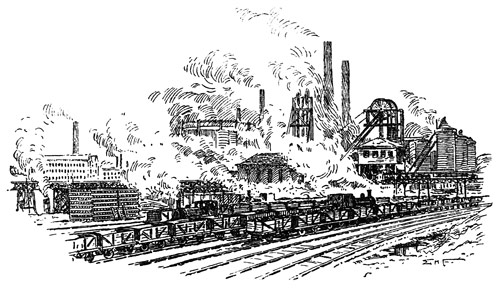
In speaking of the roads in the last chapter, we have
come right down to the present day and its needs; but
we must go back a bit, as far as time is concerned, to
say something about one special class of road which has
played an important part in the making of England.
The story of the roads began before the dawn of written
history—ages and ages before. The story of the railways
belongs, as we may say, only to yesterday.
When we speak of a railway in these days we picture
to our minds a trackway, laid with parallel steel rails,
along which long trains of carriages and trucks are
drawn by a locomotive engine. The engine, indeed, is
the first thing that a boy thinks of in connection with
a railway; and no wonder, for the "iron horse" is a
marvellous and interesting piece of machinery. But in
the history of our modern railways the trackway, or the
rail-way proper, comes first. There were railways long
before there were locomotive engines; indeed, we shall
not be far out if we say that there were railways in England
a few centuries before steam-engines of any sort
came into use.
It was up in the North, in the colliery districts by the
Tyne, that the idea of tramways, along which trains of
trucks, drawn by horses or mules, seem to have first
come into use; and they can certainly be traced there
as far back as the time of King Charles I (about the year
1630). The first railway which Parliament allowed to
be laid in the South of England was the "Surrey Iron
Railway". This connected Croydon with Wandsworth,
and, later on, it was extended to Merstham. That was
about the year 1801, and was intended to convey merchandise,
not passengers. For a time it was of great
service to mills and factories on the River Wandle.
That was the first railway in that part of the country,
and the trucks were drawn by donkeys!
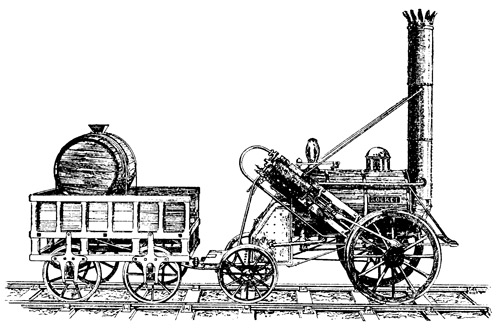
George Stephenson's Locomotive "The Rocket", which at its trial trip in 1830
ran 29 miles an hour
A writer of that time, who thought that he was a very
wise, far-seeing man, gave it as his opinion "that it
was not probable that railways would ever come into
general use!" Well, it is never very wise to prophesy
until you really know.
Nearly every new invention has been scoffed at at first.
Even in this present century, when the early experiments
in the use of air-craft were being made, thousands
of persons gravely shook their heads in disapproval,
declaring that man was never intended to "fly". The
Great War time has seen wonderful developments in
air-craft, and so many "impossible" things have been
achieved that we can realize, just a little bit, that
air-craft has "a great future" before it, greater than we
can as yet grasp.
It would be impossible to give here even a bare outline
of the story of the English Railways, but the making of
these railways and their use and development brought
about rapidly many marvellous changes which have
affected the life of the nation.
Seventy and eighty years ago, when railways were
first being made, they excited a great deal more attention
and interest than they do to-day. Railways were so
new then, for one thing, and there were so many of
them being made about the same time for another thing.
There are hundreds of miles of railway going through
quiet country districts, which were made many years
ago, and there are thousands of people living in those
districts who have been born since the railways were
made. To them the railway is as much an everyday
thing as the old parish church, the town pump, or the
river. So far as they are concerned, the line has been
always there—they never saw the country-side before
the railway came. But in the years—say between 1830
and 1860—the work was watched with much interest,
and it excited much talk, both wise and foolish.
What did the people who lived in a country village
see? Long before the navvies came, for years in fact,
the coming railway was talked about. The surveyor,
with his attendants, carrying theodolite and measuring-chain,
as he went about his work "taking levels", was
very narrowly watched, and his sayings and doings were
noted and discussed, time after time. In fact, not unfrequently
the surveyor and his men had some very
lively experiences, for there were lots of places in which
they were regarded with suspicion, and all sorts of tricks
were played upon them. Stephenson, when out surveying,
was threatened with more than one ducking in a
horse-pond; guns were fired at him, and he had to get
through his work at all sorts of odd times. There was
one surveyor who took a professional prize-fighter with
him as his assistant, and he found work for him to do
besides merely helping him in land-surveying. Bulls
were sometimes turned loose in the fields in which surveyors
were busy, and they had to leave in a hurry.
Surveyors were quite used to meeting with all sorts of
abuse, and being faced by angry men, armed with brickbats
and pitchforks.
Then, when the road was staked out, and carts and
men began to arrive, and a whole town of huts for the
workers on the railway was set up on the broad hill-side,
where the villagers and their fathers before them, time
out of mind, had ploughed, and sowed, and harrowed,
and reaped, and gleaned—tongues would wag still more,
and curiosity would be intensified. When the huts were
finished the navvies arrived. Strange folk they were to
the villagers, speaking a language of their own, and
living by themselves—strong, powerful men, doing great
deeds of strength, capable of working hard, and very
often of drinking hard, and of fighting hard. The quiet
little inns and ale-houses became noisy and busy. The
navvies brought change and excitement with them; and
also, at times, mischief, strife, confusion, and drunkenness.
For miles round the farmers would complain
that they could get no labour for farm-work. Young
men, attracted by the novelty, the higher wages, and
the greater numbers, turned navvies, "learned their
works" and left the old agricultural life of their forefathers
for ever. Then, when the navvies set to work,
the villagers saw them busy, like ants upon the hill-side,
cutting a great cleft through it, many feet in depth. As
they came along, yard by yard, they saw a rough tramway
laid, along which long trains of trucks, drawn by a
noisy, fussy little engine, were being drawn, some full
of earth and gravel or stone which had been cut away.
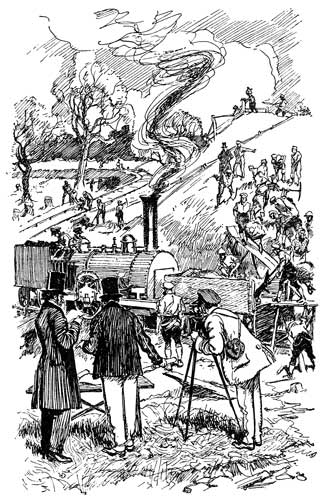
Building a Railway in the early Nineteenth Century
Then, after many months' work, the men advanced
out on to the open plain. For weeks and months trains
of trucks were constantly coming laden with earth, which
was tipped on to the lower ground, forming an embankment,
which gradually came nearer and nearer the river
bank. Down by the river bank, on the far side, and on
the near side as well, were men digging for weeks at a
time. Then, these made way for an army of brick
layers and masons, and loads and loads of brick and
stone were brought along the line, or dragged by horses
through the old country lanes to the waterside. There,
on each side of the stream, what looked like big towers
were erected, as tall as the church tower, or taller perhaps,
and still the earth day by day was being brought
along the way and tipped, adding to the embankment
yard by yard. Such earth, too; clay, perhaps, or earth
of such kind as the oldest man in the parish had never
seen in those parts before, because it had been brought
from a place or places many miles away.
Then, when the brickwork on each side of the river was
in position, there was the building of a bridge to watch.
There were several huge arches of brick, or perhaps of
stone, brought from far-off quarries. But what were
those queer, lattice-work things, looking something like
spiders' webs, which were brought down to the waterside?
There was nothing like that ever seen in the
village before. What did it mean? They saw these
great iron lattice-work sections hoisted in the air by
steam cranes and swung slowly up and round till they
were placed in position, resting on the piers of masonry.
It must have been a wonderful sight to watch the river
being spanned by a huge bridge or by these girders,
and to see the different sections being fitted and fastened
together.
You may be sure that there was much shaking of
heads and many prophecies that this sort of thing was
a flying in the face of Providence—just as in our own
time there has been over cycles, motor-cars, and air-craft.
How could those great trains and heavy engines
pass safely over such a flimsy-looking bridge as that?
It would be sure to snap in the middle. And when an
accident happened—and sad accidents did happen—many
declared that it was the Almighty's judgment
upon men for thinking that they knew better than their
fathers before them.
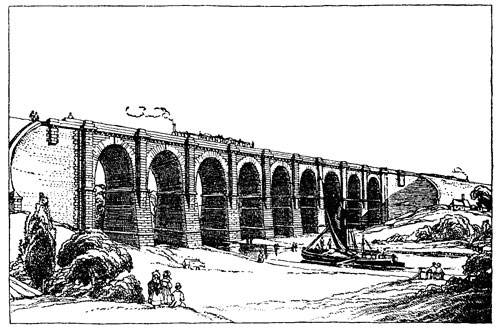
Sankey Valley Viaduct, constructed by George Stephenson on the Liverpool and
Manchester Railway (1826-9). After a contemporary painting. By permission
of the London and North-Western Railway Company
So the work went on, and in time the railway became
an accomplished fact and was no longer a wonder, and
a race grew up to whom railways became part and parcel
of everyday life.
But the railways brought many other changes. Those
loads of earth brought from distant parts of the line not
only altered the appearance of the country where they
were deposited, but caused other alterations as well.
Grass soon grew on the slopes of these embankments,
but with the grass came up also strange weeds and
plants. These seeded, the wind scattered the seeds,
and, in the fields on either side of the line, these new
weeds showed themselves the next season. For a year
or two, probably, nobody noticed this very particularly;
but, before very long, whole districts might be overrun
with varieties of weeds never seen in that district before.
In some places marshes had to be drained, and, in
consequence, many broad, shallow stretches of water
disappeared. Such "sedgy pools" in quiet districts
were once the haunt of many varieties of wild fowl. As
the pools have disappeared the wild fowl which made
these their haunt disappeared also, and with them the
wild flowers and water-plants belonging thereto have
died out as well. In much the same way insects have
been imported in the loads of earth and found a home in
a new district where they have, so to speak, "settled",
and have done in some cases good, and in other cases
harm, to the land.
Many cuttings through the beds of gravel and rocks
have taught us something of the changes which have
taken place in the earth's crust. It has been possible
to examine the structure of the soil of many parts of
England more thoroughly in the deep railway cuttings
and tunnels than could have been done in any other
way. Geologists have gathered much most valuable
information from the soil and rock dug out in railway
excavations.
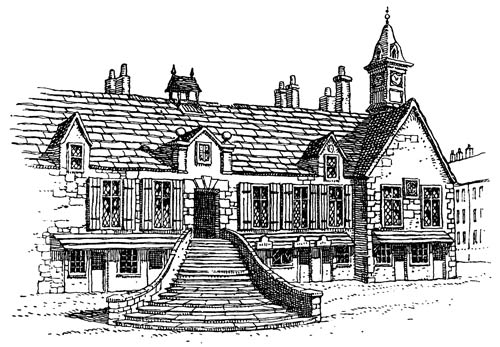
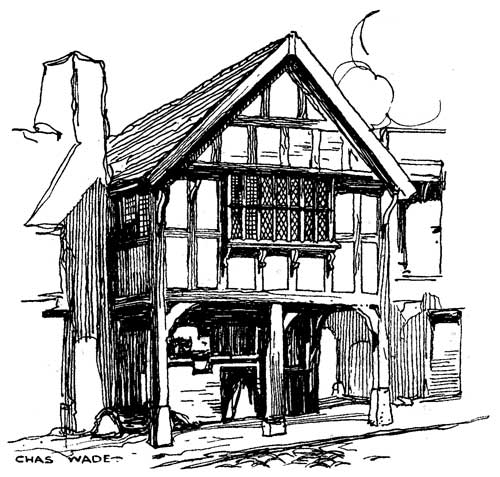
The Town Hall, Carlisle, built in time of Elizabeth. From a drawing
made in 1780
CHAPTER L Government
There was not much change for many centuries in the
way in which towns and villages were governed.
The borough towns, which gained their charters back
in the days of King John, or King Henry III, had them
confirmed by various kings in later times; but the powers
of the towns were not much altered. The corporation of
a borough was usually made up of men chosen by the
freemen; but, if the freemen did not admit many persons
to the freedom of the borough, the power of electing,
in the course of years, fell into the hands of a very few
people.
This was what actually happened in a very large
number of cases, and at the end of the eighteenth
century there were many old boroughs which were
governed by "close corporations"—the bulk of the
people living in the borough having no voice in the
management of the affairs of the town. All that was
altered in the early part of the nineteenth century.
Many of the old boroughs lost their privileges, as they
had become such small unimportant places. All other
boroughs now have regular elections of town councillors
by the inhabitants each first of November. The councils
elect the mayor on each 9th of November.
The mayor, and some of the inhabitants of the
borough, are also magistrates and attend to police
cases; while the town council looks after matters connected
with sewers, lighting, paving, and cleansing
the streets of the town. It has now also charge of
educational affairs in many of the big towns, a committee
of each county council being the educational authority
in all other parts of the country.
In London and large towns, where there is much
police court business, there are special magistrates,
trained lawyers, who attend to nothing else.
In country places, for centuries, the manor court
governed the manor; but gradually, and by Tudor
times, most of the power of the manor court, or court
leet as it was sometimes called, had passed into the
hands of the Vestry. This consisted of the parish
officers and rate-payers in the whole parish. It was
called the vestry because its meeting-place was the
vestry of the parish church, or even the church itself.
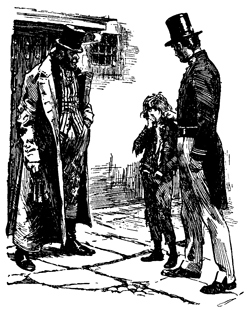
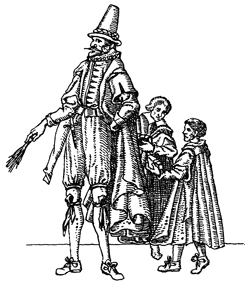
Police Officer and Jailer, early Nineteenth
Century. A scene from "Oliver Twist"
(Charles Dickens)
The relief of the poor and the care of the highways
provided the vestry with most of its business. The
churchwardens had special care of the property of the
church, but in Tudor times they were also charged
with the relief of the poor. To help them in this work
two overseers, at least, in each parish, were chosen every
year. All the rate-payers
were liable to
serve in turn if elected,
unless they could
show a good reason
for not serving. The
elections took place
about Lady Day. The
vestry fixed what rates
were to be made, and
the overseers collected
them. But the
overseers had to be
admitted to their office,
and all rates allowed,
by two justices of the
peace, before they
were legal.
It became necessary,
as the poor law
business increased, to
have constables to
help the overseers in keeping an eye on strangers,
vagrants and beggars who came into the parish.
These, too, had to serve for one year. In big parishes
they were assisted by a beadle, and had, with the help
of all the inhabitants in turn, to keep watch and ward
at night. Very unpleasant work they had to do in
towns and places just outside towns. In London, and
in many other towns also, to help the "watch" there
were special officers called "watchmen", whose duty it
was to parade the streets at night at regular intervals,
and "call the hour"—"Past two o'clock, and a frosty
morning". One of their duties was to arrest any disorderly
characters whom they might come across on
their rounds. But as each watchman carried a lighted
lantern that, together with the noise he made, gave
ample warning to that sort of people, who could usually,
without much difficulty, get out of the watchman's way.
When he did come upon the track of any of these gentry
he would "sound his rattle" as a signal for the "watch"
to come to his assistance, and, if they could, arrest the
offenders. This duty of watching and warding had to be
carried out until towards the middle of the nineteenth
century, when our present system of police was established.
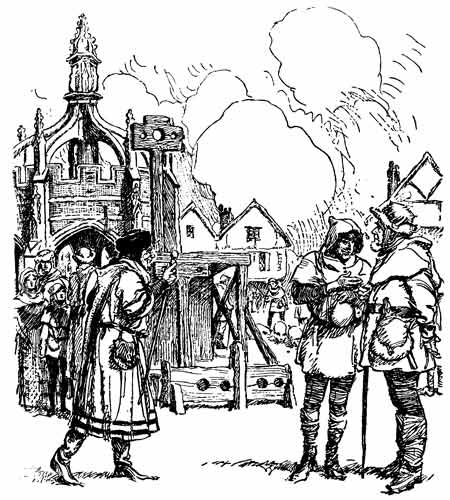
Beadles and constables had to see to the whippings,
which were so common, and to setting people in
the stocks and the cage; to moving sick and diseased
wretches on to the next parish, and other unpleasant
duties.
The surveyors of the highways had to see that each
person who was liable did his share of the work of the
highways, or paid for having it done. But by far the
most important business was that of the churchwardens
and overseers. They had to settle in what houses the
poor folk were to live, who were to look after them, what
allowance was to be made for them. The poor usually
had their money paid to them at church, monthly. Then
the overseers had to see that every able-bodied man was
at work, often having to provide the work, to place out
apprentices, and to supply flax or wool for the women
and children to spin. Sometimes the poor were boarded
out; some of them lived in cottages, or in the poors'
house which the parish built. Then, too, these officers
had to relieve beggars, and persons passing through the
parish.
This work of providing for the poor was very difficult
and very anxious, especially at the end of the eighteenth
and in the early part of the nineteenth century. It was
quite a common practice for big parishes to "farm out"
the care of the poor to the highest bidder. That is, a
man would contract with the parish authorities to look
after the relief of the poor in that parish for a certain sum
of money per annum, for so many years.
Then poor law unions were formed, and union workhouses
built, in which the helpless poor might be better
cared for, and vagrants and wanderers find a night's
lodging. These were looked after by Boards of
Guardians, especially elected for that purpose. We
have not a perfect plan yet, by any means, but much
care and thought is being given to this question, and
many changes, which we hope will be improvements in
the administration of the Poor Law, are being taken in
hand. The difficulties of how to deal with the poor who,
through no fault of their own, cannot help themselves,
and how to deal with those who are lazy and will not
work, are very great.
The work of the old vestries has now passed to the
parish councils, the district councils, and the county
councils. The work is important, and has much to do
with the welfare of our towns and villages. We must
not expect that these bodies can do everything at once,
or that they will make no mistakes. More people now
than ever have a direct voice in the work of these various
councils, and it is the duty of everyone to take a real interest
in their work, and to strive to improve it in every
possible way. If we know something of the past history
of our towns and villages it will help us to form a right
judgment concerning difficulties which have to be met
in the present, and so to act that those who come after us
may be able to go on building upon our work, that there
may be nothing to undo, nothing to blame, but that
future years may say of our times:—
"They knew how to work, and they worked on right
principles." "Do justly, love mercy, walk humbly."
CHAPTER LI Some Changes
There was not much alteration in the outward appearance
of the villages and the "look" of the country round
them for many centuries. Indeed even now many of the
villages themselves are not greatly altered in their
general arrangement. Down to the times of the Tudor
kings the old land and manor customs had gone on
since Saxon days, changing but very slowly. Many of
the class which had been villeins in the Middle Ages had
become yeomen; some had got lands of their own, and
some land on the old manors, which they rented. But
they did not alter very much the old way of treating the
land, and it was only gradually that farm-houses sprang
up away from the villages.
In some parts of the country these lonely farm-houses
are more common than in others. There are, for instance,
a good many in the Weald of Sussex which
sprang up first as huts in forest clearings, and afterwards
became houses with farm-buildings attached to them.
On the borders of great lonely heaths and commons
we can often see very old and very small cottages, with
walls of clay, or wood, or stone, according to the district
in which they happen to be. Long ago some squatter
built his little hut here, and out of pity, perhaps, or
through carelessness, the lord of the manor took no
notice. There he remained, year after year, until custom
allowed him to look upon it as his own; and in time
it actually became his private property. Such squatters
in lonely places were often looked upon more or less with
fear by the timid folk living in the distant village. They
did not care to do or say anything to upset the stranger,
fearing for the safety of their sheep, cattle, and poultry.
Many little holdings and small farms began in this
way.
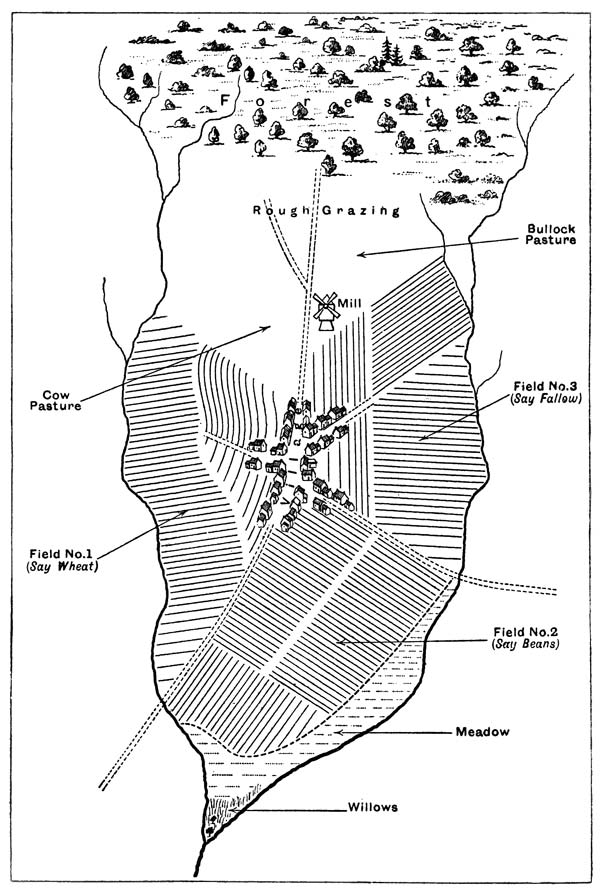
Many of the farms, though they were separate holdings,
still had strips in the big fields of the parish. The
crops were sown and gathered according to the ancient
customs, and the cattle turned into them and out on the
waste lands at certain seasons, just as they had been in
the Middle Ages.
But about the beginning of the eighteenth century
there was a pretty general movement towards breaking
up these big fields into separate parts, and letting each
farmer have his portion to himself, so that he might
know exactly what land was his and what belonged to his
neighbour. So it came to pass that Enclosure Acts were
passed for parish after parish. The old common arable
fields were divided among those who had rights in them.
Then many of the old wastes, heaths, commons, and
marshes were treated in the same way.
That caused a great change in the appearance of the
parish. Instead of the fields in long, straight strips,
with unploughed balks between them, the strips belonging
to each farmer were thrown into one, and hedgerows
planted. In time they became smooth fields, separated
from each other by hedges, in which grew here and
there timber trees. The old cart-tracks, winding across
and round the common fields, in time became lanes
bounded by high hedges. The trackways across many
of the old wastes and commons in a similar way were
turned into lanes, and the waste broken up into fields.
Still, a good deal of the waste land was left, and has
never yet been enclosed. So far as we can see now, this
is not likely to happen, because we feel more and more
every year that, for the sake of the health and recreation
of the people, it is absolutely necessary to preserve as
many open spaces as possible. Some of these wastes
and uncultivated, or only partially cultivated, lands
have been brought under the spade and the plough
during the war-time, and all over the country people
have heartily set to work to increase our "homegrown"
food supply.
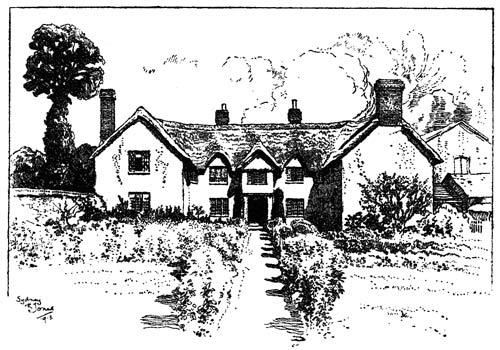
Hayes Barton Farm, Devonshire, the reputed birthplace of Sir Walter Raleigh
(1552). It is in the picturesque Elizabethan style, with thatched and gabled
roof, mullioned windows, and gabled porch
The fields, the hedgerows, and the lanes which delight
us so much in the country are, most of them, some two
hundred years old.
When the farm had its own separate fields allotted to
it, it became convenient for the farmer to live in the
midst of his land. So we find the farm-house and its
buildings, with a few labourers' cottages, a long way
out of the village, and away from the church. If you
take notice you will find that from this outlying farm-house
there is usually a pretty straight field-path to the
parish church.
good deal could be said about our forests and woodlands—their
importance, and the part they have played in
the making of England. In the seventeenth and eighteenth
centuries especially, there was great attention
paid to the cultivation of trees, and many of the owners
of private park-lands did excellent work in promoting
the growth of timber. But in the nineteenth century
there seems to have been a considerable falling-off in
this respect, and far-seeing men at times warned us that
we needed to pay more attention to trees and forests and
to the growth of timber. The terrible blizzard which
swept over the country in March, 1916, brought down
thousands and thousands of fine old trees, and the needs
of our army and navy during the war-time has made
sad havoc in parks and plantations, so that one of the
urgent needs of the days in front of us is systematic
attention to "afforestation", in order to "make good"
the terrible wastage.
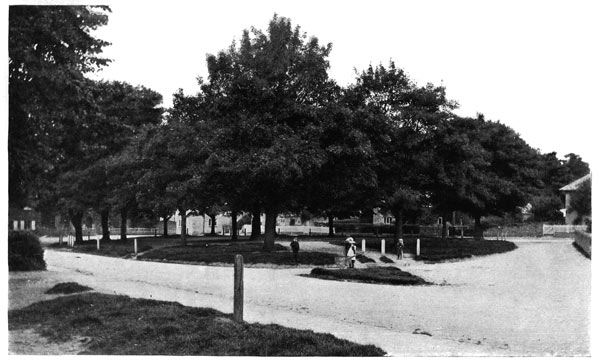
Hamlets have grown up away from the old village
green, its church, and its manor-house. The roads were
often so bad that horses frequently cast their shoes,
tires came off wheels, and wheels came off carts and
coaches; so under many "a spreading chestnut-tree"
a little smithy and wheel-wright's shop arose. A smithy
is always a centre of life and news, as everybody knows.
You can see to-day, along many of our roads, sheds and
shops being opened, where broken-down cycles and
motor-cars can be repaired and supplied with odds and
ends which they may happen to need. Round these
hamlets have in time sprung up, and in scores of places
the hamlet has become of more importance than the old
village, and has grown into a little town, with new
churches and chapels and public buildings.
In these war-years large numbers of quite new townships
of enormous size have sprung up in connection
with the making of munitions, and the provision of
hospitals and camps, and as yet we know very little
about them as a whole. Some are only temporary, but
others have "come to stay", and in them new industries
on a big scale will probably be developed. All this
means change—change of appearance, change of ideas,
change of methods.
Then there are the districts where new industries and
manufactures have been planted. That is too large a
subject to deal with here, but think of the great changes
these have wrought on the face of the country in the
coal and mineral districts of England in the last two
hundred years!
Again, there are the railways. Notice how little
townships have grown up round the railway stations,
especially on the main lines in districts near a big town.
Houses spring up for the hosts of people who, like
streams of human ants, hurry to the station to catch the
early morning trains, and, as the afternoon wears into
evening, come again from the station to snatch a few
hours' rest at home.
We have said nothing of
"The beauty and mystery of ships,
And the magic of the sea",
and the part they have had in the making of our
towns and villages. This subject would require not
only one but many books, and then we shall only just
have begun to think about it, and to find out how little
we know. Our wonderful Navy, our Merchant Sailors,
our Fishermen—what do we not owe to them for what
they have done for us in the terribly anxious times
through which we have passed and are still passing!
It is good, in spite of all the awful suffering, to have
lived through these years, and to have seen something
of what can be done by sacrifice of self, co-operation,
and just "sticking to duty"—on land, on sea, under
the sea, and in the air, in busy towns, and in quiet
country places.
Yes, the life of our towns and villages is a very
interesting subject. Nature and Man each works for
and with the other; both are full of mystery, life,
beauty, and high inspiration, if we could only use our
eyes to see, our intelligence to understand, our hearts to
sympathize, and our hands to work, for the things that
are true, and lovely, and pure.