Law of the 28th of May 1882
with reference to the introduction of Postal Savings Banks in
the kingdoms and lands represented in the Imperial Council.
(R. G. Bl.[N] No 56.) with the alterations made by the law
of the 19th of November 1897. (R. G. Bl. No 133.)
With the consent of the two Houses of the Imperial Council
I will to order as follow:
Under State administration and guarantee there will be
founded at Vienna a State Savings Bank, under the control
of the Minister of Commerce and belonging to the jurisdiction
of the Postal Administration, with the title «Post Office
Savings Bank».
The sphere of activity, the organisation and the civil service
of the Post Office Savings Bank will be fixed by means of
ordinances.
Post Offices in the kingdom and lands represented in the
Imperial Council will be appointed by the Minister of Commerce
to serve as receiving offices of the Post Office Savings
Bank.
To the Post Office Savings Bank will belong the management
and execution of the business assigned to it by this
law; in which business it will represent before the public the
administration of the State.
To give advice as well as to make proposals in the business
relating to the Postal Savings Banks, a special Council will
be constituted.
Regulations as to the composition of this special Council
as well as the determination of its special sphere of action
will follow by way of ordinance.
The Post Office Savings Bank will receive savings deposits
paid into the Post Offices, and by the agency of the Post
Offices will pay back the deposits when reclaimed.
All deposits in excess of the current needs of the Post
Office Savings Bank are to be profitably invested.
Such profitable investments of the savings-deposits will
be made by the purchase of the Austrian Consolidated Bonds
bearing interest.
From the profit of the invested deposits is to be defrayed
the interests on the deposits, as well as the whole expenses,
administrative or otherwise.
As long as the profit of the funded capital of the deposits
is not sufficient to pay the interest of the savings-deposits
and to cover the expenses of the administration, the deficit as
well as the costs of the establishment of the institution will
be advanced by the State as a charge on the Postal Budget.
These advances are to be restored without interest, to the
Postal Budget, out of the surplus appearing at the close of
the administrative year.
The surplus remaining over after the entire liquidation of the
above named advances is to be employed in the formation of
a reserve fund.
The receiving office (Post Office) in which a first deposit is
made, gives to the party who makes the deposit, a deposit
book, in which each amount paid in, each amount paid back
and the interest added to the capital is to be entered. Each
subsequent payment can be made in any receiving office (Post
Office), the amount being entered in the deposit book.
That person is to be considered the depositor on whose
behalf the deposit is made.
The deposit-book is to be delivered gratuitously and is
stamp free.
The Post Office Savings Bank will open an account for
each depositor.
The deposit-book is issued in the name of the depositor and
is to contain the notes necessary in forming a judgement of his
identity, as well as the signature of the party who makes the
first deposit.
A depositor who cannot write will have to bring with him a
trustworthy man, who will have to attest the identity of the
depositor and to sign the deposit-book in his stead.
An assignment of a deposit-book to another person, is only
to be accepted by the Post Office Savings Bank when the act
of assignment has taken place at a Post Office entrusted with
Post Office Savings Bank business.
This being done, the assignee is to be regarded as the proprietor
of the deposit-book. (Art. 21, § 3.)
Minors are entitled to pay in sums as savings and to receive
repayments back provided their legal representatives have entered
no written objection at the Post Office Savings Bank.
In case of the loss of the deposit-book, a duplicate is, after
carrying out the proceedings prescribed by article 14, to be
issued.
Whoever causes two or more deposit-books to be issued
loses the interests on the capital entered in the second and in
any subsequent books.
If the whole amount of the deposits in the two or more
deposit-books, that a depositor has caused to be issued, is over
the sum of a 1,000 florins, the depositor loses that part of the
capital which exceeds 1,000 florins.
The Minister of Commerce is empowered on well considered
reasons to be indulgent with reference to the loss of capital,
which, in conformity with the regulations occurs to surplus
deposits.
Post Office servants are forbidden, except to their superiors,
to give any information whatever to anyone, as to the names of
depositors, or the amount of their deposits.
Each single payment must amount to at least 50 kreutzers
or a multiple of 50 kreutzers.
The balance in favour of a depositor can at no time amount
to more than 1,000 florins including deposits paid in and
interest added to the capital.
Deposits of 50 kreutzers can be made in postage stamps,
or in special postal savings stamps as soon as such stamps
are issued by the Minister of Commerce. These stamps are
to be fastened on forms supplied gratuitously.
The rate of interest for savings deposits, which is never to
exceed 3 per cent per annum, after having been placed before
the special Council (art. 1) will be fixed by the Minister of
Commerce in concert with the Ministers of the Interior and of
Finances, by way of ordinances, and every alteration is to be
published in the Imperial Law Pamphlets (Reichs-Gesetz-Blatte)
in the official part of the «Vienna Gazette» (Wiener Zeitung)
and in the various official gazettes.
The new rate of interest will begin to come into operation on
the 1st and 16th of the month which follows its publication
and will also apply to deposits made previously.
Savings deposits bear interest commencing from the 1st
or the 16th day of the month following the date of their
payment, and the interest ends on the 15th or last day of
the month preceding the arrival of the notice of the expiration
of the agreement with the Post Office Savings Bank at Vienna.
Sums under a florin are not to bear interest.
The 31st of December, each year, the interests accruing are
to be added to the capital and from that time forward they also
bear interest.
In the calculation of interest each month is to be regarded as
30 days.
The officially prepared table of interest is to be publicly
posted up in the receiving offices (post offices).
Any amount exceeding 1,000 florins to the credit of a savings
deposit is not to bear interest.
The Post Office Savings Bank is obliged as soon as the deposits
and capitalized interest of a depositor surpasses the figure
of 1,000 florins, by a registered letter, to require the depositor
to lessen his capital.
If during the month following the depositor has not lessened
the balance to his credit, then at the expiration of the period,
bonds of the state debt bearing interest in notes will in the
course of the day be officially bought to the nominal amount of
200 florins, and the depositor is to be informed of the fact.
From the time of the sending out of the notice until the
reduction is effected in the balance to the credit of a depositor
no interest will accrue.
In case the depositor on whose account the bonds were
bought, does not withdraw the documents, the Post Office
Savings Bank will receive the interest falling in on the bonds
under its care and will enter these interests in the books of the
institutions as a new deposit in favour of the depositor.
For the State funds belonging to a depositor lying at the Post
Office Savings Bank a book is to be issued.
At the request of a depositor and that the balance in his
favour is sufficient, it can be employed in the purchase of
Austrian State Funds.
The payment back of the balance in favour of a depositor or
any part of it to him or to his legal heir or authorised agent,
will take place upon a notice which can be made by the party
giving it, at the receiving office (Post Office) which he names in
the notice.
The payment back is to made through the receiving office
(Post Office) named in the notice, on production of the deposit-book,
on the basis of an assignment by the Post Office Savings
Bank, except the payment is according to Article 14 barred
by legal proceedings having been instituted, or according to
Articles 6 and 17, by a protest having been made.
When such notice has been given with reference to sums up
to 10 florins, the assignment will be sent by the Post Office
Savings Bank by return of post and the payment back will be
made by the receiving office (Post Office) immediately after its
arrival.
The repayment of sums between 10 and 100 florins will be
made in a fortnight at the latest, that of sums between 100 and
500 florins in a month at the latest, that of sums above 500 florins,
at the latest within two months after the arrival of the notice.
The Administration is however authorised, with power of
countermand and under necessary precautions to permit sums
up to 20 florins of which notice has been given to be immediately
paid at one of the authorised receiving offices without
waiting for the arrival of the foregoing assignment from the
Post Office Savings Bank.
If a deposit-book proves to be lost the following proceedings
occur:
The owner has, in order to obtain a duplicate to give immediate
notice of the loss, either directly to the Post Office
Savings Bank, or to the nearest receiving office (Post Office)
with as exact an account as possible of its characteristic marks.
The Post Office Savings Bank immediately orders a note of
the characteristic marks to be entered in its books with the
result that meanwhile no payment is made to anyone on the
lost deposit-book.
At the same time the Post Office Savings Bank causes a
public placard to be put up at the Post Office where the lost
book was issued, and also in that to which perhaps it might be
forwarded, by which all persons are informed that at the expiration
of a month from the date of its publication, if no claim to
the lost book is made in the interval, it will be cancelled and
declared null and void, and a new one issued.
If within the month no claim is made, the Post Office Savings
Bank will on payment of a fee of 10 kreutzers Austrian currency,
issue a duplicate and declare the deposit-book proved
lost, to be null and void.
If a claim is made during the course of a month, the Post
Office Savings Bank must refer the parties to the ordinary tribunals,
and no duplicate is to be issued nor any proceedings
permitted with reference to the lost book until the validity of
the outstanding claim has been decided by a legal judgement.
The statement of paragraph 1480 of the General Civil Code,
by which claims to arrears of interests are lost after three years,
has no application to interests of depositors in the Post Office
Savings Bank.
In relation to the lapse of Post Office Savings Bank deposits
the ordinary legal decisions will be relied upon. Lapsed
deposits fall into the postal treasury. Such a lapsing of
deposits will be stopped by every new payment, every notice
for payment back, every entry of interest in the deposit book.
State bonds bought officially, or at the request of depositors,
and kept at the Post Office Savings Bank fall into the postal
treasury, if, during a lapse of 40 years, no one has laid claim
either to the deposit or to the interest, and the depositor has
not forwarded to the Post Office Savings Bank any order
whatever with reference to them.
Neither savings deposited at the Post Office Savings Bank,
nor the Post Office Savings Bank deposit-books can be
sequestered, and in like manner they cannot be used as security.
Nor can a deposit-book be seized or taken in distraint.
These restrictions have no application to the books mentioned
in Articles 11 and 12, as issued for the state bonds
bought for a depositor.
If a depositor declares himself insolvent, the Official Receiver
is empowered to give notice to the Post Office Savings
Bank to pay him the balance in favour of the depositor, and
thereon to give a receipt.
A protest against the payment back of a savings deposit can
only be considered in case a lawsuit has been entered into
with reference to the right of property in a deposit-book,
or on the hypothesis which Article 6 meets.
The reserve fund which is primarily intended to cover every
possible loss which may occur to the Post Office Savings Bank
is to be formed by the laying aside of the surpluses which
remain at the close of the administrative years from the produce
of the savings-money deposited, after deduction for
interest paid, administrative and other expenses, and after
restitution of the advances made from the postal budget.
The reserve fund is to be gradually stored up until it reaches
5 per cent of the total amount of the deposits, but it must never
go beyond the point of two million Austrian florins.
The reserve fund capital is to be placed at interest and
whatever it brings in is to be added to the reserve fund so long
as this last has not reached the maximum fixed.
When the reserve fund has reached the above mentioned
point, all the business profits will be entered to the credit of the
Postal Revenue.
The Post Office Savings Bank is to render a formal account
of the administration of the savings-money paid in at the receiving
offices (Post offices), and the duty of the control lies with
the supreme audit-office.
At the end of each solar year the Minister of Commerce will
communicate to both Houses of the Imperial Council, a detailed
business statement with reference to the administration, working
and position of the Post Office Savings Bank and will publish
the same in the official part of the «Vienna Gazette».
The Post Office Savings Bank will periodically make known
the actual position of the institution in the «Vienna Gazette».
The correspondence of the Post Office Savings Bank and its
organs with the depositors is post free.
The revenue of the Post Office Savings Bank is exempt from
duty.
In the business of the Post Office Savings Bank all legal
documents passing between the Bank, the authorities or the
organs of the Bank and the depositors, their legal heirs or
authorised agents, are free from stamp duty and taxes. In like
manner the interest of savings-deposits is exempt from the
Income-tax and from any tax which may replace it in time to
come.
The exact time when the Post Office Savings Bank in
Vienna, as well as the receiving offices will commence their
work will be fixed by the Minister of Commerce.
The carrying out of this law is entrusted to the Minister of
Commerce.
containing alterations in the Law of May 28^{th} 1882 (R. G. Bl.
No 56) and decisions with regard to the Orders' (Cheque and
Clearing) Service of the Post Office Savings Bank (R. G. Bl.
No 133).
With the consent of the two Houses of the Imperial Council
I ordain as follows:
The arrangements of the Law of May 28th 1882, contained
in the Articles 5, 6, 7, 8 and 13 (R. G. Bl. No 56) will no
longer be in force.
In their stead will come the following arrangements, indicated
in the articles bearing the same numbers.
(The articles altered: 5, 6, 7, 8 and 13, are with their new text
given in Appendix I, containing the Law of May 28th 1882.)
To the existing Orders' (Cheque and Clearing) Service of
the Post Office Savings Bank the modifications in the Law of
May 28th 1882 (R. G. Bl. No 56) as well as the alterations
refered to in § 1 of the present Law, have no application.
An exception, however, occurs with reference to articles 1,
20 and 21 of the above mentioned Law which are to be applied
to the aforesaid service conformably to their sense.
In addition to which the Government is authorized to regulate
this service by way of ordinances.
Apart from such regulations the service is to proceed according
to the following determinations.
The administration and keeping of the accounts of the
Orders' (Cheque and Clearing) Service at the Post Office
Savings Bank are to be carried on separately from those of the
Savings' service.
Participation in the Cheque service with or without inclusion
in the Clearing service is to be granted by the Post Office
Savings Bank on paying in a guarantee deposit.
The Post Office Savings Bank will open an account for each
participant.
The guarantee deposit remains in the Post Office Savings
Bank as long as the holder of the account continues a participant
in the Cheque service and contingently also in the Clearing
service.
In case a holder of an account on the one side, or the Post
Office Savings Bank on the other, wishes to give notice to withdraw,
which either can do at any time, the guarantee-deposit
will, within a fortnight at latest after receiving the notice, be
repaid.
To the Post Office Savings belongs also the right by giving
notice of the repayment of the guarantee-deposit to cause the
immediate withdrawal of a participant and it has also the right
to decline, without giving any reason a request to participate in
the Cheque and Clearing service.
The amount of the guarantee-deposit, which is on every
occasion to be paid in specie, will be always fixed by way of
ordinance.
This fixing can be arranged in such a way, that in the event
of the whole transactions exceeding an agreed maximum sum
the guarantee deposit is to be increased.
The rate of interest for deposits in the Orders' (Cheque and
Clearing) service cannot rise higher than two per cent per
annum.
The Government is empowered within this maximum point
to fix the rate of interest for deposits.
The Government can also ordain that the abovementioned
deposits, especially the guarantee deposits shall either bear no
interest at all or only partially do so.
Of the money paid into the Orders' (Cheque and Clearing)
Service of the Post Office Savings Bank there will always be
kept in hand a portion in specie adequate to meet probable
needs.
The surplus remaining is to be placed out at interest in such
a way as always to assure the complete fulfilment of the engagements
entered into.
The placing out can be made:
1. By acquiring partially mortgaged bills of exchange (salt
mine, treasury bonds).
2. By opening at a banking establishment a running account
at short dates of payment (a deposit running account).
3. By advances on security of bonds of the United
National Debt and of the National Debt of the kingdoms and
lands represented in the Imperial Council, also those Austrian
bills upon which loans are permitted by the statutes of the
Austro-Hungarian Bank, finally upon stock and other securities
in the Austro-Hungarian Bank. (Advances with the
exception of accounts booked.)
4. By discounting coupons of the funds pointed out in
No 3, also in prize-tickets in the Austrian State Lottery, also of
other funds indicated in No 3, repayable by draft, last on discharge
certificates of Customs duties.
5. By discounting Bills of Exchange to be cashed at a
Bank, a Savings Bank, or else at a Deposit or Credit Company,
registered according to the Law of April 9th 1873 (Z. 70
R. G. Bl.).
6. By purchase of bonds of the National Debt, deeds of
mortgage or bonds having priority rights, in so far as such
stocks are, in conformity with No 3, capable of being taken in
deposit.
The duration of the loans described in No 3, as well as the
paper to be discounted, described in No 4, and the bills of
Exchange within the kingdoms and lands represented in the
Imperial Council as described in No 5, is limited to three
months.
In selecting what to take in deposit, or what to buy, in
fixing the extent of the sum to be lent out, as well as the choice
of the institutions with which it is to enter into business relations,
the Post Office Savings Bank is to seek direction from
the Ministry of Finance.
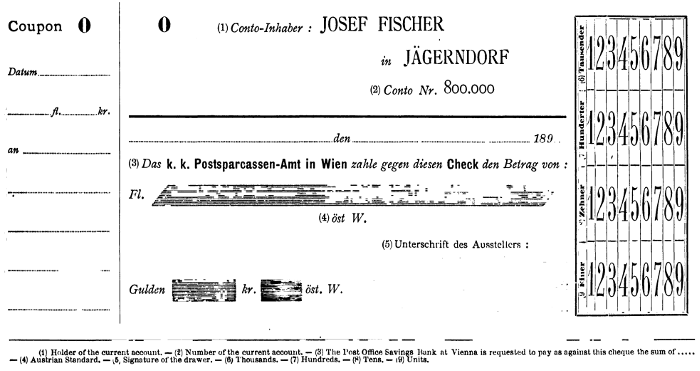
The Orders (Cheques) issued in the Orders' (Cheque and
Clearing) Service are subject to no other tax than that fixed by
the Law of February 29th 1864, § 7 (R. G. Bl. No 20) of 2 kreutzers
a piece.
The declarations which, in conformity with the regulations
of the Orders Service are added to the order (cheque) by the
Drawer, especially such as the declaration by which a third
person is designated as Receiver of the sums assigned, or by
which commissions are given for the issuing of post-office
orders or the retiring of bills, etc.; also the authorisations for
the Post Office Savings Bank and the receipt-vouchers, reciprocally
given by the Post Office Savings Bank Office and
participants, are free from stamp duty and taxation.
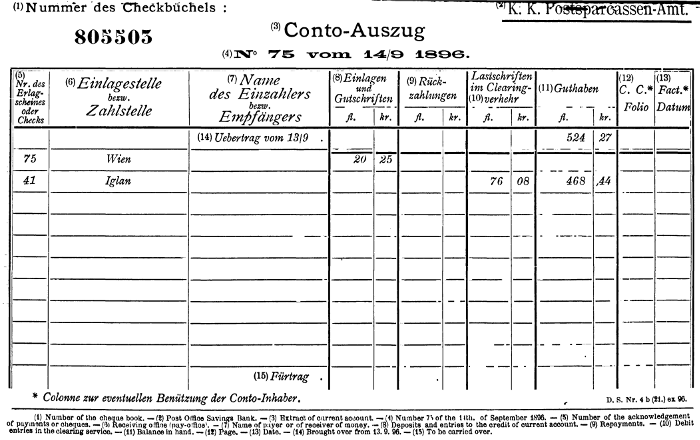
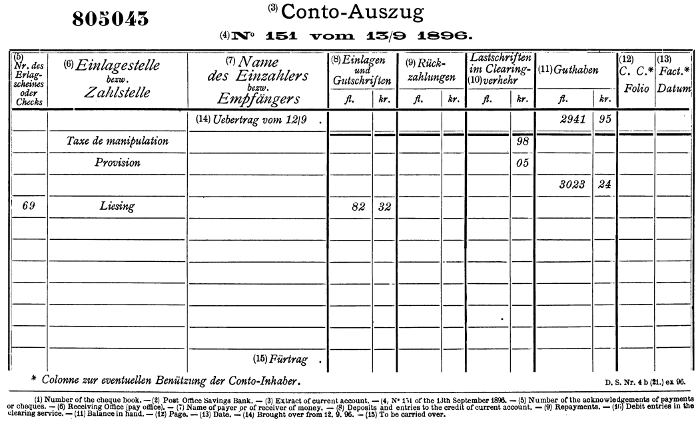
In like manner the extracts forwarded to parties from their
accounts are free from stamp duty and taxation.
In respect of sums received in current account by the Post
Office Savings Bank, the payment of the percentage tax fixed
by the Law of February 29th 1864, § 7, paragraph 2 (R. G. Bl.
No 20) does not operate.
For the use of the Orders' (Cheque and Clearing) Service
the Post Office is to impose special fees.
In addition to the already existing fees and repayment of
the cost price of printed matter supplied to parties interested,
the Government is empowered to impose to the amount stated
below the following fees:
1. A record-fee of 2 kreutzers for each official act with reference
to the account (Deposit, Assignment, Entry to credit
or debit).
2. A commission up to the maximum of ¼ the thousand on
the paying out side of the account (Entering to the debit).
These fees are to be taken by the Post Office Savings Bank
deducting them from the account.
For the Orders' (Cheque and Clearing) Service, a special
Reserve fund is to be formed, which is primarily intended to
cover possible losses which may result from the service.
This Reserve fund is to be formed from what remains of the
surpluses at the close of the administrative year after deduction
resulting from the possible deficit in the Savings Service.
This allotment of the surpluses is to continue as long as the
Reserve fund designated has not reached the point of 5 per cent
of what remains of the deposit capital in the Orders' (Cheque
and Clearing) Service, at the close of the year, after deduction
of the payments back.
The money of the Reserve fund formed for the Orders'
(Cheque and Clearing) Service is to be placed out at interest
under the restrictions of § 7 as to the nature of such arrangements,
and the produce accruing from time to time, is to be
added to the Reserve until it has reached the abovementioned
point.
The Reserve fund having reached this point, the whole of
the profits on the business done in the Orders' (Cheque and
Clearing) Service will accrue as receipts to the Postal
Revenue.
To what remains the determinations of Article 4 of the Law
of May 28th 1882 (R. G. Bl. No 56) understood in conformity
with their sense will apply.
The determinations of §§ 2 to 10 of the present Law apply
from the time it comes into operation, also to deposits paid in
before that time to the Orders' (Cheque and Clearing) Service
of the Post Office Savings Bank.
With the execution of this Law which comes into operation
from the date of its publication, together with the partially
altered Law of May 28th 1882 (R. G. Bl. No 56) My Minister of
Commerce and My Minister of Finance are charged.
in agreement with the Ministry of the Interior and with the Finance
Ministry, November 22nd 1887, by which on the basis of the
Law of November 19th 1887 (R. G. Bl. No 133) Regulations
with reference to the Orders' (Cheque and Clearing) Service in
the Post Office Savings Bank are issued.
In carrying out the Law of November 19th 1887 (R. G. Bl.
No 133) by which alterations were made in the Law of
May 28th 1882 (R. G. Bl. No 56), and determinations with
regard to the Orders' (Cheque and Clearing) Service in the
Post Office Savings Bank, the Ministry of Commerce in agreement
with the Ministry of the Interior and the Finance Ministry
ordains as follows:
§ 1.
The highest point of the rate of interest, according to the
determination of the Special Council of the Post Office Savings
Bank, is to be fixed at three per cent per annum.
§ 2.
Whoever pays the first deposit in favour of another—of
the Depositor and signs the deposit-book in this name, is to
be called the Payer.
The Depositor is at any time entitled without the intervention
of the Payer to appear at a Receiving Office and to have his
own signature accepted.
As long as the Depositor has not exercised this right, the
Post Office Savings Bank will consider the Payer as authorised
in the name of the Depositor to dispose of the balance in his
favour, unless the Post Office Savings Bank has been made
aware that it is against the depositor's will.
§ 3.
Until further notice Repayments may be made of sums up to
20 florins, immediately upon notice of recall, by duly authorised
Receiving Offices, without previous assignment from the
Post Office Savings Bank.
§ 4.
Business regulations which have been made by the Post
Office Savings Bank not in present agreement with the arrangements
of articles 5, 6, 7, 8 and 13 of the Law of November
19th 1887 (R. G. Bl. No 133) in relation with §§ 2 and 3 of
the present Ordinance are out of force.
§ 5.
In carrying out § 2 of the Law of November 19th 1887
(R. G. Bl. No 133), the Orders' (Cheque and Clearing) Service
of the Post Office Savings Bank is to be regulated by the rules
existing with reference to them in the Post Office Savings
Bank applied in such a manner as the alterations of the aforesaid
Law as well as the following determinations render
necessary.
§ 6.
The Post Office Savings Bank will keep separate the
accounts and administration of the Orders' (Cheque and Clearing)
Service from those of the Savings Service.
Participation in the Orders' (Cheque and Clearing) Service
is also to be allowed to persons who are not depositors in the
Savings Service. It will be granted on payment of a Guarantee-deposit,
and of course if the participant wishes he can enter
the Clearing as well as the Cheque Service.
In order to obtain permission to be a participant in the
Orders' Service the person wishing to enter has to ask for an
account to be opened and to pay in the Guarantee-deposit.
This request is to be made on one of the forms issued by the
Post Office Savings Bank, which are to be delivered gratuitously
at all post-offices and to be forwarded to Vienna post paid
under an enclosure containing the sum for the desired Cheque
and Receipt books.
To the Post Office Savings Bank belongs the right to refuse
a request for admission as participant in the Orders' (Cheque
and Clearing) Service without giving reasons (§ 4 of the Law).
The Guarantee-deposit is to be paid within a month at any
Receiving Office after the grant of the said request by using a
Receipt (Pay) certificate.
The Post Office Savings Bank opens an account for each
participant. Deposit-books are no longer to be used in the
Orders' (Cheque and Clearing) Service.
§ 7.
The amount of the Guarantee-deposit will until further
notice be fixed at 100 florins.
The Guarantee-deposit will remain at the Post Office Savings
Bank as long as the holder of an account continues a participant
in the Orders' (Cheque and Clearing) Service. During participation
in the Orders' (Cheque and Clearing) Service, the Guarantee-deposit
cannot be disposed of and in case the participant
should withdraw from the Service it can only be paid back upon
15 days notice (§ 4 of the Law).
§ 8.
The deposits in the Orders' (Cheque and Clearing) Service,
including the Guarantee-deposit, will until further notice bear
interest at 2 per cent per annum. The interest begins from the
1st or from the 16th of the month following the booking of the
deposit, and terminates at the expiration of the 15th or from the
last day of the month which precedes the writing off from the
account of the sum assigned for payment.
Sums under one florin will not bear interest.
On the 31st of December in every year the interest accruing
will be added to the capital and will in like manner bear interest.
In reckoning the interest every month will be regarded as
thirty days.
§ 9.
The Post Office Savings Bank has always the right to give
notice to a participant to withdraw his Guarantee-deposit, with
the result that from the day the participant receives the notice
he can no longer dispose of the balance to his credit by way of
cheques (§ 4 of the Law).
§ 10.
For making use of the Orders' (Cheque and Clearing) Service,
besides the fees at present existing—under which are
included the fee of 2 kreutzers the cheque, already fixed by § 8
of the Law of November 19th 1887, and according to rule the
equivalent of the cost price of the various printed documents
furnished to participants in the service,—the under mentioned
fees will be taken:
1. A record-fee of 2 kreutzers for each official act with reference
to the account (Deposit, Assignment, Entering to Credit
or Debit);
2. A commission on each entry to the debit up to the sum of
3,000 florins at the rate of ¼ the thousand, and 1/8 the thousand
for sums exceeding that amount.
These fees will be taken by writing them off the account.
From the commission, however, are free:
a) The Debit Entries in the Clearing Service;
b) Sums sent by means of Post Office Orders through the
Post Office Savings Bank;
c) Sums written off in the Cheque Service on account of a
purchase of State-bonds made for a participant, finally;
d) Every entry of fees, commissions, etc. in favour of the
Post Office Savings Bank.
§ 11.
The Post Office Savings Bank will keep for three years the
accounts, documents and writings in the Orders' (Cheque and
Clearing) Service relating to business concluded; it can only
therefore give consideration to claims with reference to payments
in, assignments, payments back, interest and fees, etc.,
when they come within this period.
To claims which refer to a Post Office missive (Paying in
Order, Post Office Order, Registered Letter and the like) the
Post Office regulations as to the time in which such claims can
be made will apply.
§ 12.
The foregoing regulations §§ 5 to 11 apply from the time this
ordinance comes into operation, and will also apply from the
same time to all deposits already made in the Orders' (Cheque
and Clearing) Service, (§ 11 of the Law).
§ 13.
The Officials of the Post Office Savings Bank and of the
Receiving Offices are bound by duty to keep the business and
official secrets, and not to give to any third person, except
their superiors, any kind of information whatever with reference
to the name of a depositor, to the sums paid in or
paid back, or to the amount of the balance in hand.
§ 14.
The Receiving Offices of the Post Office Savings Bank will
receive at the End of each calendar year an indemnity for business
done in the Post Office Savings Bank Service.
This indemnity amounts to:
a) Two kreutzers at the close of each year for every deposit-book
issued at the Receiving Office in question during the year
and then existing.
b) One and a quarter kreutzer for every payment during the
year effected at the Receiving Office in question, into the
Savings Service and into the Orders' (Cheque and Clearing)
Service.
§ 15.
This Ordinance will come into force at the same time as the
Law of November 19th 1887 (R. G. Bl. No 133).
All post offices in the kingdoms and lands represented in the
Imperial Council are appointed to be Receiving Offices of the
Post Office Savings Bank, and have daily during the prescribed
hours to carry out the Post Office Savings Bank Service.
They receive deposits, effect payments back, give information
about all branches of the Post Office Savings Bank Service,
and in connection with this Institution, aid the depositors in
every way.
Any one can become a Depositor in the Post Office Savings
Bank and obtain a deposit-book, or cause another person to
obtain one, upon making, in conformity with the regulations, a
payment at a Receiving Office, of a given sum within the prescribed
limits.
Societies, Unions, Cooperative Associations and persons
having a legal position are competent depositors in the Post
Office Savings Bank.
The person in whose name the book has been issued is to
be regarded as the Depositor.
No Depositor is permitted to obtain, or cause to be obtained
on his behalf, more than one deposit-book issued in his name;
on the other hand every one is free, beyond their own deposit-books,
to obtain for other, wholly distinct persons, deposit-books
and to pay in deposits on their behalf.
Whoever in favour of another,—the depositor,—pays in
the first payment and signs the deposit-book in his name is
called the Payer.
Any one can be a Depositor who can read and write. Minors
no more than persons having a legal position are debarred from
being depositors.
The Post Office Savings Bank regards the Payer as empowered
in the name of the Depositor to dispose of the balance
to his credit as long as the latter has not informed the Post
Office Savings Bank that it is against his will.
This can be done by the Depositor signing his own name in
the deposit-book at a post office.
The admission of the signature can take place:
a) In the presence of and with the consent of the Payer;
b) Without the intervention of the Payer.
In the first case the Payer confirms the authenticity of the
signature, in the second case the Depositor has to establish
his own personal identity.
The smallest deposit is 50 kreutzers, larger deposits must be
a multiple of that sum.
In order to render possible the saving of smaller sums than
50 kreutzers, Post Office Savings Cards have been issued.
Post Office Savings Cards are cards imprinted with a
postage stamp of 5 kreutzers, and having the necessary room to
fasten on further stamps; these cards are sold at all Post
Offices, and by all postage stamp vendors on payment of the
value of the imprinted stamp. Such a Post Office Savings
Card with stamps fastened on to the value of 50 kreutzers will
be accepted at the Receiving Offices of the Post Office Savings
Bank as a deposit.
One and the same depositor can only be permitted to bring
for deposit three Post Office Savings Cards during one week,
either singly or at the same time.
The balance of a depositor in paid up deposits and capitalised
interests is not permitted to amount at any time to more
than 1,000 florins.
The Depositor must with the first deposit inscribe his signature
in the place appointed on the third page of the deposit-book
and must further give an account of his calling or occupation,
the place, day, month, year of his birth, as well as the
place where he lives and his address. He must moreover sign
with his own hand the so-called «Gegenschein» (Counter-certificate)
to be found in the deposit book. And he himself choose
a given private «Watchword» (Losungswort) and inscribe it in
the appointed place in the counter-certificate.
The result of this will be that payments back in the customary
way can only follow on giving this watchword.
A person who cannot write is obliged to bring with him a
witness who authenticates the depositors mark by his own
signature. To those known personally to the Post Office
official, or, who identify themselves by means of a certificate of
domicile, a passport or a work-or service book, the Post
Office official can himself become the witness.
In the case of Societies, Unions, Cooperative Associations
and persons having a legal position either the bringer of the
first deposit can give his signature and be then regarded as the
Payer, or no signature will be received. In the latter case
nothing can be done with reference to the deposits until the
Payer by means of an official document, No 14, signifies to
the Post Office Savings Bank who will be authorised to give
notices of withdrawals and to collect payments.
Subsequent payments can be effected on each book at any
office without further notice and without its being necessary
for the person to come personally.
Every deposit must be at once entered in the deposit-book
by the Post Office official and this entry is to be certified by
the imprint of the Receiving Offices stamp of the day and the
signature of the Post Office official. The Depositor (Payer) is
bound before leaving the office to examine the entries sufficiently
so as to see that they are correct.
Deposits are also received from Rural Agents to the limit of
300 florins for each deposit-book and for each commission
bought. Deposits up to 5 florins pay no fee. For deposits of
more than 5 florins a receiving-fee of 5 kreutzers is charged.
The Post Office Savings Bank receives from Depositors,
Coupons of Austrian Bond falling due and enters the proceeds
in the deposit-book and to the depositors account.
To this end the coupons together with the deposit-book are
either to be given in at the Bank of the Office, or forwarded
post-paid to the Post Office Savings Bank at Vienna.
Each single coupon given in or forwarded must have legibly
written on the back, the number of the deposit-book and the
depositor's name, if not, a list of the sorts and numbers of the
coupons as well as the number of the deposit-book will have to
be given.
For receiving the coupons the Post Office Savings Bank
charges a commission of 1 kreutzer the coupon, which will be
deducted from what it produces.
The sending-back of the deposit-book will be post free.
It is moreover allowable when a depositor has to receive at
a post office not dependent on the Treasury a sum by order,—whether
it be an ordinary post office order, or a repayment—or
transfer post-office order, or finally by a pay-order in the
cheque service of the Post Office Savings Bank, not to pay
the same in cash, but have it immediately entered in the
deposit-book.
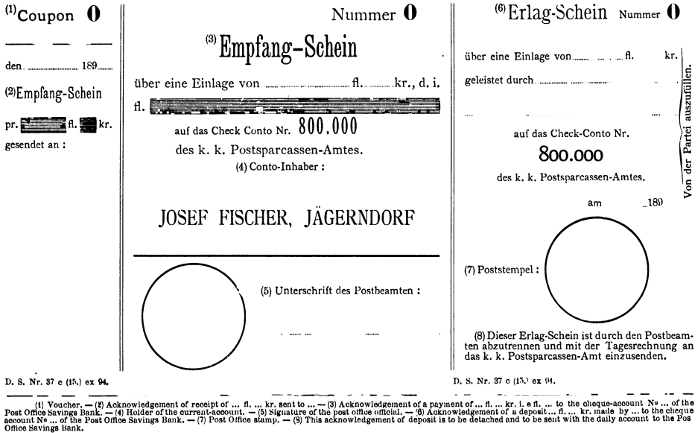
Beyond the entry which the Post Office Service makes in
the deposit-book, the depositors receive, and so, relatively,
payers, upon each deposit an acknowledgment of receipt from
the Post Office Savings Bank at Vienna, forwarded every time
to their address or to poste restante as they desire. Should
this acknowledgment of receipt not have reached a depositor
within 14 days, or should it contain some errors with reference
to the sum or name or in some other way be erroneous, the
depositor has to find in his deposit-book, «Complaint», and
to separate the paper, fill it in conformity with the case, and
to forward it in an envelope, No 42o, which he will receive
gratis at any post office.
Other blank forms of complaint are gratuitously supplied at
every post-office.
For entries of interest and coupon the Post Office Savings
Bank does not give receipts.
Should a deposit-book be lost, the loser must notify the fact
to the Post Office Savings Bank at Vienna, on a printed form,
supplied gratuitously at every Receiving Office, stating the
peculiar marks of the lost book as exactly as he can possibly
remember them, also the particular circumstances under which
the loss took place, as well as his full address, enclosing at the
same time 10 kreutzers in postage stamps and the notice
of withdrawal book, requesting that a duplicate of the deposit-book
lost may be given him. Should the notice-book be also
mislaid, this is to be notified on the printed form and the sum
of five kreutzers added for a new notice-book.
The Post Office Savings Bank notes down the loss and until
further notice makes no payment on the lost deposit-book.
Meanwhile arrangements will be made for its annulment and
if during the space of a month no claim is raised, a duplicate
book will be issued and forwarded.
If no room can be found in a deposit-book for further
entries, or it has become torn or so dirty as to become useless,
the depositor has to send it with the printed form, No 11,
properly filled up to Post Office Savings Bank at Vienna for
exchange. Books filled up will be exchanged gratuitously, for
a spoilt book, however, the sum of 10 kreutzers is to be added
to the request. In case the notice book is also spoilt, the sum
of 5 kreutzers is to be added for issuing a new one.
Deposits begin to yield interest at three per cent per annum
from one florin upwards.
Interest begins from the 1st or from the 16th day of the month
which follows on the deposit and ends with the 15th or with the
last day of the month which precedes the arrival of the notice
of withdrawal from the Post Office Savings Bank.
On December 31st of each year the interest accruing will be
added to the capital and from that time it will, in like manner
bear interest.
To each depositor, the Post Office Savings Bank sends at
the close of the year an interest-order, valid for two months
with an announcement of the amount of interest which has
accrued to him for the year ending December 31st. The
depositor must cause the amount of this interest to be entered
in his deposit-book within the prescribed two months, on
presentation of the interest order at some Receiving Office.
If a depositor has not within the time allowed caused the
entry of the capitalised interest to be effected as per order
received, he does not lose the interest, only he has to forward
his book to the Post Office Savings Bank for the purpose of
having it entered there.
The determination of § 1480 of the general Civil Code according
to which claims on arrears of interest lapse after three
years, do not apply to the interest on deposits in the Post Office
Savings Bank.
With reference to the lapsing of Post Office Savings Bank
deposits the general legal decisions are valid.
This lapsing will be arrested by any fresh deposit, by any
fresh notice or by any fresh entry of interest in the deposit-book.
A depositor or the legal successors or authorised agents of a
depositor are entitled at any time to require through the
prescribed notice the payment back of any part of the deposit
or the whole deposit. Sums less than a florin can, however,
only be recalled if the deposit-book proves that the total
amount deposited does not exceed the amount recalled.
Notice of withdrawal is given on a special document, that is
on a leaf out of the notice-book which the depositor receives
gratuitously at the same time as the deposit-book. These
leaves are to be detached according to the order determined by
the numbers printed on them, to be duly filled up and forwarded
undercover (document No 42b) to the Post Office Savings
Bank.
For the Notice of Withdrawal the following rules are to
regarded:
1. The Notices must always bear the signature which according
to instructions was received in the deposit-book, or communicated
to the Post Office Savings Bank on document No 14.
2. The address to which the order should be sent must, where
poste restante is stated, in every case give the receiver's full name.
Addresses in figures cannot be used, because they are not
allowed on registered letters, and the orders for payment are
always sent for the greater security of the depositor by registered
letter.
3. The watchword chosen by the depositor must be added
to the Notice.
If the Depositor has forgotten his watchword he can at any
Receiving Office desire the issuing of a request to make it
known to him anew. To obtain this favour he must present
his deposit-book to the Post Office officials and prove himself
the Depositor (Payer). In case he is not personally known to
the officials, he must bring some witness who is known to
them, or a document capable of giving this proof (passport,
certificate of being naturalised, Work-or Service-book).
4. If the Depositor cannot write he must add his mark to the
notice-form and this mark must be attested by a witness.
Should the witness be the same one who attested the Depositor's
signature on the Counter-cheque and in the Deposit-book,
the Notice with the mark of the Depositor and the
signature of such a witness can be sent without further delay
to the Post Office Savings Bank.
But should the signature of this person be no longer adducible,
the Depositor has himself to go to a Receiving Office
and establish his own identity.
In the case of depositors who cannot write but have a
watchword, its declaration and the attestation of the mark by
any witness is enough.
The right is reserved to give Notice to withdraw the balance
to the Depositor's credit and to give a receipt for the same to
the Official Assignee, should the depositor fail,—to the
Guardian appointed by the authorities, should the depositor
become incapable of managing his affairs,—to the executor of
the estate with relation to the person to whom the right of
inheritance to the deposit-book belongs should the depositor
die. The persons designated, are required to address their
memorials direct to the Post Office Savings Bank, sustained
by the documents necessary to form a judgement of the case
together with the deposit-and notice-books. The deposits
of a deceased Depositor are to be withdrawn in full by notice
from the person who has the right of inheritance.
If a Notice-book has been used up, or in any way has
become useless, or a depositor has lost his notice-book, he can
on form No 5d which will be supplied at all post offices gratuitously,
request the Post Office Savings Bank to forward him a
new Notice-book.
In the case of Notice-book lost or spoilt the sum of five
kreutzers must be added in postage-stamps; in that of an
ordinary used up Notice-book, a new one will be substituted
gratuitously.
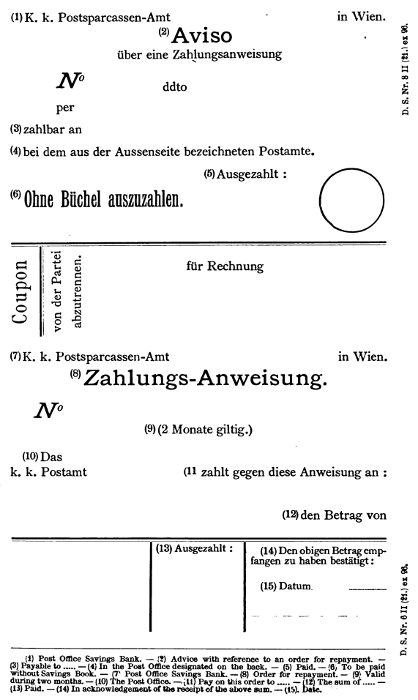
Consequent on the Notice of withdrawal the Post Office
Savings Bank sends to the Depositor, to the address he has
named Payment-order valid for two months.
The order is sent as a rule by return of post, but in any case
soon enough for the repayment to take place within the limit
named by the Law of May 22nd 1882:—upon notice of sums
between 10 and 100 florins within 15 days, upon notice of sums
between 100 and 500 florins at the latest within a month, and
finally, upon notice of sums over 500 florins, at the latest
within two months of the arrival of the notice at the Post
Office Savings Bank.
On delivery of this order, the Depositor, in the presence of the
Post Office Official, putting his signature in receipt to the Payment
Order, and on producing the deposit-book, in which the sum
paid back will be entered by the Post Office official and deducted
from the sum total of the balance, the repayment to the
depositor will follow at the pay-counter.
The Depositor can authorise any person he pleases to
receive payment of a sum thus withdrawn by notice. If he possesses
a watchword he needs only to duly fill in the form, No 15
(authorisation) and to give or send it by the person authorised
with the deposit-book and the payment-order. On this person
presenting the authorisation and signing the payment-order,
and at the same time presenting the deposit book, the sum
will be paid.
But the Depositor can in like manner also request in the
Notice that the payment-order be sent to the person he has
authorised to receive it and whose address he has given. Then
the Depositor sends the deposit-book together with the authorisation
to the person he thus authorises to receive the payment.
But for payment of the sum the person thus authorised
must, if not personally known to the post office officials, produce
a document for his identification or establish his identity
by bringing with him a witness.
For authorisation without the watchword, the legalisation of
the signature of the withdrawer, either in a law court or by a
notary is requisite.
But also without having to send a previous notice to the Post
Office Savings Bank, a Depositor (Payer) can at once at any
post office obtain repayments of sums from 1 to 20 florins.
Repayments can be made without delay on producing the
notice drawn out according to the regulations together with the
last acknowledgment of receipt or abstract of the credit account
with at the same time an entry of the sum in the deposit-book.
Repayments made without delay are not allowed on authorisations,
also the whole balance of the depositor's account
cannot thus be withdrawn, but a sum of at least 50 kreutzers
must remain in the book. This sum as well as the interest can
then in the usual way be withdrawn by notice.
After each repayment made without delay, the depositor
receives a statement from the Post Office Savings Bank with
reference to his remaining balance (Statement of Credit-account),
on the ground of which he can again obtain a repayment
without delay.
Repayments without delay cannot be made with reference
to annulled deposit-books, or, with reference to deposit-books
concerning which a protest, recognised by the Post Office
Savings Bank has been made.
The Post Office Savings Bank sends out no acknowledgements
of receipt upon entering and carrying to the depositor's
credit, interest and coupons,—the last receipt or statement of
balance of account is therefore valid for a repayment made without
delay; but the sum to be repaid must not include the
credited interests or coupons.
After repayments in the usual manner or after such payments
as the Post Office Savings Bank at Vienna itself makes
as well as after other debit entries in the deposit-book, as for
example purchases in the stocks, no statement with reference
to the remaining balance is given, the acknowledgement of the
receipt of the last deposit remains therefore in like manner valid
until the next repayment made without delay.
In the same way a statement with reference to the remaining
balance retains its validity without regard to these repayments
or debit entries, until in its place comes another acknowledgment
of receipt in consequence of a new deposit, or a new
statement with reference to the balance of the account in consequence
of a new payment made without delay.
It is evident of itself that a higher sum than the balance
remaining at the depositor's disposal after deduction of the last
repayment and entered in the book cannot at any time be paid.
Should it happen that owing to the Post Office Service the
acknowledgment of the receipt of the last deposit has not come
into the depositor's hands, the previous receipt-acknowledgment,
or statement of balance will be considered valid; the
last deposit, not yet confirmed cannot however be included in
the payment requested.
If after a payment made without delay there remains less
than 1 fl. 50 kr. to the credit of the depositor, the Post Office
Savings Bank will issue no statement of the balance of the
account, since in such a case there can be no further payment
made without delay until there has been a new deposit paid
in followed by an acknowledgment of receipt.
At the bank of the Post Office Savings Bank at Vienna
repayments can be made without delay every day from 8 o'clock
in the morning until 6 o'clock in the evening (on Sundays and
holidays from 9 until 12 at noon) without regard to the amount
of the sums required.
To this end it is necessary to present at the Cashier's sliding
window the Notice-paper filled in and signed by the person
empowered to do this together with the deposit-book; bringing
the last receipt acknowledgment or statement of balance is not
requisite.
For sums above 20 florins, the depositor, in case he has no
watchword must prove his own identity.
When the Savings account of a depositor's exceeds 1,000
florins, the Post Office Savings Bank is obliged to request the
depositor by a registered letter to lessen the amount of his saved
up capital.
If within a month after the request the depositor has not
lessened the amount of his capital, there will at the expiration
of the time, be bought on his account in the course of the day,
bonds of the only stock issued in notes, to the amount of the
sum required to reduce the account to 1,000 florins, in any case
for the nominal sum at least of 200 florins.
The price of this purchase will be entered to the debit of
the depositor's account as repayment; the bonds bought will
remain under the care of the Post Office Savings Bank and a
Stocks-book will be forwarded to the depositor.
A Depositor (Payer) who has in the Post Office Savings
Bank an adequate sum at his disposal can at any time request
the Office to make purchases for him in the Public Funds.
The request for the purchase is to be drawn up on Form
No 22, and must, if the purchased stock is to remain at the
Post Office Savings Bank contain a watchword. If the
depositor already has a watchword in connection with his
deposit book that watchword is to be inserted.
If a depositor cannot write he must make his mark and have
it attested by a witness. If this witness is the same person
who attested the depositor's mark on the counter-cheque and
in the deposit book, then the request with the mark of the
depositor and the signature of the witness can be sent without
further delay to the Post Office Savings Bank. But if the
signature of this witness cannot any longer be obtained, the
depositor has to go to a Receiving Office and himself prove his
own identity.
For the first purchase together with the request it is simply
necessary to enclose the deposit-book; for each subsequent
purchase the deposit-book and if it relates to deposited bonds
the stock account-book also must be sent.
The purchase is made as far as practicable according to the
state of the market as noted in the official price-list of the Vienna
Exchange on the day in which the request refered to reached
the Post Office Savings Bank, a commission being charged of
2 per thousand, which however cannot amount to less than
20 kreutzers.
The stock bought will, according to desire of the depositor
either be sent at his own risk and cost to the address he names
in his request or be taken care of without cost by the Office
under guarantee for kind and number of documents, class of
coupons and winning numbers in the lotteries, and the Post
Office Savings Bank will prepare and send to the depositor with
reference to them a «stock account-book» (Document No 32).
Stock which the depositor has not bought through the Post
Office Savings Bank can be deposited by means of a stock
account-book. The process is thus: the Post Office Savings
Bank buys the stock sent and enters it to the credit of the
sender, upon which the resale to him is gone through and the
stock entered in the usual way in the stocks account-book.
In such cases the purchase and sale in respect of stock of the
same kind takes place at the same market price, so that there
is no loss to the depositor, merely costing for the purchase on
account the fixed commission of 2 per thousand.
Depositors have, with a view to the taking over of such stock
to send it at their own cost to the Post Office Savings Bank,
joining with it a request in which the stock to be taken over is
described, the deposit-book being sent (either lottery or stock
account-book).
The Post Office Savings Bank undertakes to present at the
Treasury of the Public Debt, the bonds bought on account of
depositors in order that they may be stamped with the names
of the holders.
This can be done at the request of the purchaser immediately
after purchase of the bonds refered to in which case
the stamp duty will be accounted for at the same time as the
costs of purchase, or, the stamping of the bonds can be requested
which according to the stock account-book are already
in the Post Office Savings Bank. In the last case the duty
which including the cost of the form used amounts to 40 kreutzers
a stamp is to be forwarded in postage stamps enclosed
with form No 22.
In every case the request must contain the exact name of
the holder and further information as to where he wishes to take
the interest, otherwise it will be understood that it is to be
received at the Public Debt Treasury.
After the stamping has occurred, which, according to rule
must take place within 3 or 4 weeks, the Post Office Savings
Banks forwards the stamped bonds to the address given before
the business was entered on. If an account of the interest due
has to be prepared it is forwarded to the holder by the Treasury
of the Public Debt.
The coupons of the Bonds deposited as per stock account-book
will, when they fall due, be detached and cashed, and
upon the day of their falling due entered both in the stock
account-books of the holders without their having in each particular
case to give notice. With reference to these sums coupon-orders
will be issued to the depositor on the ground of which
they can receive payment of them at any Receiving Office, on
the amount being entered in their deposit-book before the
expiration of the two months during which the orders are valid.
After this the entry can only take place by sending the
deposit-book to the Post Office Savings Bank at Vienna.
It remains free to the holder of the stock-account book to
cause the Post Office Savings Bank to forward the coupons in
its case, falling due in their entirety or in part, either in natura
or in money to himself or to a third party. This order should
be sent to the Post Office Savings Bank in sufficient time for it
to arrive before the coupons fall due.
When the coupons are detached and sent in natura, no commission
is charged, only the persons to whom they to be
addressed must pay the postage as when coupon interests are
forwarded.
For banking coupons or lottery prizes, a commission will be
charged as for stock in case of the Post Office Savings Bank at
1 per thousand, excepting, however, when the produce of the
coupons is itself entered to the account of the depositor.
The owner of a stock-account book can at any time request
that his stock in the public funds be sent to him or that it be sold.
The request is to be duly addressed to the Post Office Savings
Bank on form No 22c in connection with No 24. The request
forwarded to the Post Office Savings Bank must contain the
watchword and personal signature of the person making the
request and be accompanied by the stock-account book and also
by the deposit-book when it is a question of entering the money
resulting from the sale to the credit of the depositor's account.
The sale takes place in agreement with the final state of the
market officially noted on the day the request arrived at the
Post Office Savings Bank upon a commission of 2 per 100, at
the lowest, 20 kreutzers.
If a stock-account book is lost, the loser is to inform the Post
Office Savings Bank in writing, sending at the same time his
watchword, and, enclosing 20 kreutzers in postage stamps
to request a duplicate.
If after eight days subsequent to the notice the stock-account
book is not found the Post Office Savings Bank will issue a
duplicate and send it to the depositor, or if an official act is
sought with reference to the book, the Post Office Savings Bank
will enter into communication with the actual possessor of the
book and it will depend upon the result whether the Post Office
Savings Bank can grant the request of the loser, or whether it
decides to relegate the parties to the magistrate in whose
jurisdiction the matter lies.
The correspondence of depositors with Post Office Savings
Bank as well as with the Receiving Offices and with the Post
Office management is always post-free, even in the case of a
registered letter.
This favour however has no application to the sending of
certificates of stock or with reference to money transactions
which result from the purchase and collection of the interest on
the stock, nor does it apply to notices forwarded of their declared
value, with the sole exception of the deposit-book being sent
by letter with the declared value for the purchase of stock in the
funds.
The correspondence of the Post Office Savings Bank and its
organs with the depositors is with reference to orders to
addresses designated free from the tax of 1 kreutzer the letter, a
tax appointed with reference to the post offices not dependent
on the Treasury and to rural post offices, and in connection
with the collection of registered letters also to those dependent
on the Treasury.
The memorials addressed to the Post Office Savings Bank,
to the Post Office authorities and their organs by depositors
their legal successors, or authorised representatives, as well as
the acts of conveyance mentioned in article 6 of the law of
May 28th 1882 are stamp and duty free. The interests of the
savings deposits are in like manner exempt from the Income
Tax and from any future tax coming in its place.
The deposit-book as well as the forms necessary in giving
instructions in business transactions with the Post Office Saving
Bank will be supplied to depositors gratuitously.
The officials of the Post Office Savings Bank are bound by
duty to keep the business and official secrets and it is strictly
forbidden to them, beyond their superiors, to impart to any persons
whatever, knowledge of any kind relating either to the
names of depositors or the the amount of the sums deposited or
withdrawn, or to the amount of balances. Those who contravene
this rule will undergo disciplinary treatment, and, according
to the circumstances, will be dismissed from the service.
Every depositor may therefore rely on the strictest secrecy
with relation to his business transactions with the Post Office
Savings Bank, not only with reference to the usual Post Office
Savings Service, but also with regard to the business in the
Public Funds.
Post Office Savings Bank.
The Director,
WACEK.