Footnotes have been collected at the end of each chapter, and are
linked for ease of reference.
All illustrations, charts, tables and graphs are accompanied by
a separate explanatory page, either preceding or following. Neither
are included in the pagination. They have been moved to the nearest
logical paragraph break, and demarcated by horizontal rules, which
do not appear in the text. A chart, “The Commission Plan”, facing
p. 195, is missing from the list of Maps, Charts, and Diagrams.
Minor errors, attributable to the printer, have been corrected. Please
see the transcriber’s note at the end of this text
for details regarding the handling of any textual issues encountered
during its preparation.
Any corrections are indicated using an underline
highlight. Placing the cursor over the correction will produce the
original text in a small popup.
Any corrections are indicated as hyperlinks, which will navigate the
reader to the corresponding entry in the corrections table in the
note at the end of the text.
Books by William Bennett Munro
The Government of the United States
The Government of American Cities
The Government of European Cities
Principles and Methods of Municipal Administration
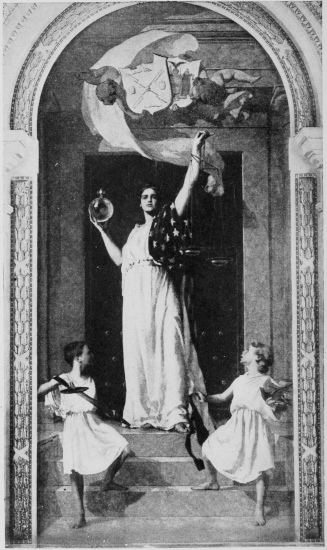
JUSTICE
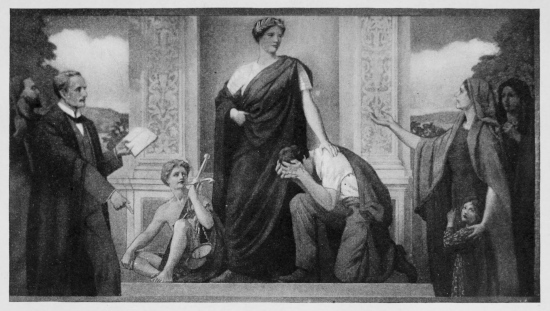
By Edward Simmons
This frontispiece is a reproduction of a famous
mural decoration in the New York Criminal
Court House.
The background is the doorway of the criminal
court room. Justice stands before the entrance
holding in one hand the conventional
scales as a token of impartiality, and in the
other hand a globe to symbolize the world.
Over her left shoulder is draped the national
flag. Condemnation and Acquittal are typified
by the two children, one of whom holds a
sword, the other the dove of peace.
It has been usual to prefigure the Goddess of
Justice with her eyes bandaged, in token of her
immunity from outside influence. Mr. Simmons,
however, has here portrayed Justice with
her eyes uncovered, because he believed that
“Justice should have her eyes wide open—particularly
in New York City”.
The artist’s wife and two children were the
models for this painting.
JUSTICE. By Edward Simmons
Copyright by Edward Simmons. From a Copley Print, copyright by Curtis & Cameron, Boston. Reproduced by permission.
SOCIAL CIVICS
BY
WILLIAM BENNETT MUNRO
PROFESSOR OF MUNICIPAL GOVERNMENT
IN HARVARD UNIVERSITY
AND
CHARLES EUGENE OZANNE
TEACHER OF CIVICS
IN THE CENTRAL HIGH SCHOOL, CLEVELAND, OHIO
NEW YORK
THE MACMILLAN COMPANY
1922
All rights reserved
PRINTED IN THE UNITED STATES OF AMERICA
Copyright, 1922
By THE MACMILLAN COMPANY
Set up and electrotyped. Published June, 1922
PREFACE
v
Many excellent textbooks are already available for the
teaching of civics. Why should another be added to
the number? Wherein does this book differ from the
rest? What are its outstanding features?
The Plan. This book covers a wider range than most
texts. It includes not only a survey of governmental
framework and functions, but many topics which are
ordinarily spoken of as questions in economics, sociology,
and international relations. The propriety of including
such topics scarcely requires a defensive argument nowadays,
for the old lines of demarcation in the social sciences
are rapidly breaking down. The problems of our complex
modern civilization pay no heed to technical boundaries.
They are the joint product of political, social, and economic
forces. No one can get a grasp of them if he lets
his mind run on a single track. A well-organized course
in civics, or in the problems of democracy, should acquaint
the student with the great institutions, relations, and
principles which dominate the life of the community. To
accomplish this end it should carry him as far afield as
need be.
The Method. Nevertheless, the main theme of this
book is American government. No matter what the topic
under discussion, the authors have tried to link it up with
the drift and purposes of governmental action and policy.
This intimate and continuous connection between public
problems and public policy is the central concept of the
book; it is the thread which holds the various chapters
vitogether. There are many winding roads in the broad
domain of the social sciences, but sooner or later they all
lead through the realm of government.
The authors have not tried to discuss every possible
phase of their subject. Questions of outstanding importance
have been given the right of way; minor matters
have been relegated to the footnotes or omitted altogether.
Those who desire enlightenment upon the odds and ends
of government or economics can get it from an encyclopedia.
The primary aim has been to get the facts
hitched up to principles, and to set the principles in their
right perspective. For this reason considerable space has
been given to problems which, although international in
their scope, are of profound importance to the people of
the United States.
The Arrangement. No two textbook writers seem able
to agree as to the proper order in which material should
be arranged. But the sequence of the chapters is not,
after all, a matter of much importance. No one feels
under any obligation to finish the Book of Deuteronomy
before beginning to read the Acts of the Apostles. The
teacher who prefers to start with the civic activities rather
than with the organization of government should have no
hesitation in doing so. In this book, at any rate, each of
the larger divisions of the subject is treated independently,
and does not depend upon the others. Some schools
devote a half year to civics, and a half year to economics.
Material adapted to such an arrangement can be obtained
by a slight transposition of the chapters.[1]
The Supplementary Material. More than a hundred
pages are devoted to lists of general references, group
problems, short studies, questions, and topics for debate.
It is not anticipated, of course, that any teacher can find
viitime to use them all; but the endeavor has been made to
afford ample variety for selection. Among the general
references are included not only a few of the most authoritative
and most recent publications, but also some elementary
books which can ordinarily be found in the smaller
school and public libraries. The group problems are intended
to be of special service to those teachers who use
the “project method” of instruction; but in any event the
practice of setting groups of pupils to work upon problems
of a comprehensive character is a good one for every
teacher to pursue at times. Some of these group problems
are “projects” in the strict sense of the term; others
are merely research topics of an elementary sort. Some
involve field work; some do not. The questions are not
designed to be tests of memory, but to provide a basis for
socialized recitations, to provoke discussion, and to encourage
among the pupils the habit of forming their own
opinions. The numerous and varied topics for debate
have been inserted with the idea of lending encouragement
to one of the most effective methods of promoting interest
in public problems.
The Point of View. In dealing with controverted
questions, of which there are a great many in the field of
civics, the authors have tried to hold the scales justly,
and to give both sides a fair hearing. It may be that
they have not in all cases succeeded; if so, they can only
plead the unconscious partisanship to which all human
flesh is heir. In any event these chapters have been
written with a sincere desire to promote a more intelligent
citizenship, with an abiding faith in the merits of American
government, and with the conviction that the people of
the United States will prove abundantly capable of solving
their manifold problems by the traditional process
of reconciling liberty with law.
The Illustrations. Apart from a number of diagrams,
viiithe illustrative material has been drawn from the masterpieces
of American mural art. They symbolize what is
best in our civilization; they may serve to give pupils
a passing acquaintance with a few creative works of
enduring value; and they have some artistic merit, which
most textbook illustrations have not. For the selection of
these illustrations and for the explanatory legends which
accompany them, I am indebted to my wife.
A Word of Acknowledgment. To Mr. Ozanne this book
owes a large part of whatever value it may possess.
He has had a great deal to do with the arrangement of
materials and the methods of presentation. Every page
has had his repeated scrutiny. It is to me a great pleasure
to have had, in this work, the close co-operation of one
who possesses not only a mastery of the subject but a
rare proficiency in classroom methods.
The purpose of this chapter is to explain why human
beings have come together into a society, to point out some
of the chief influences which affect their action in organized
groups, and to show that government is the greatest of the
agencies through which human co-operative action is maintained
today.
The supremacy of man.
Man’s Place on the Earth.—The present organization
of society finds its explanation in the nature of man.
Man is by nature a social being; he possesses intelligence
and the capacity to organize. Among living creatures
man is by no means the first in physical power—he
is neither so strong as the lion nor so fleet as the reindeer.
But he dominates the earth because he more than makes
up, by his mental and moral superiority, for whatever
may be lacking in physical prowess. We do not know when
mankind first began to assert its mastery over all other
forms of life on the earth, but it was a very long time ago.
Man’s superior intelligence gave him a start, and his
capacity for organization enabled him to clinch the victory.
Today he is supreme on land, at sea, and in the air.
Evolution.
The Principle of Development.—Human society did not
come into existence all at once; it has grown to its
present form through the slow process of time. Everywhere
we see the principle of development at work—among
individuals and among institutions. Everything
is still in a continual process of change and this has unquestionably
2been the case for many thousands of years.
Or to put it in another way, new forms of life and institutions
are continually being evolved from older forms.
Darwin and his work.
To understand this principle of continual change and
development it is necessary to know something about the
doctrine of evolution. This doctrine is commonly associated
with the name of Charles Darwin, for although many
others had hinted at the idea, he was the first to set it
forth accompanied by scientific evidence.[2] Darwin’s
theory has been much misunderstood; in the illiterate
mind it is often summed up by saying that “Man is
descended from the monkey”. But Darwin did not say
anything of the kind, neither did he ever deny the existence
of God as the controlling factor in the life of the universe.
Darwin’s theory of evolution asserted that all forms of
life now on earth have sprung from a few simple, primitive
types, and that human life is an evolution from one of these
earlier forms. Human institutions, likewise, did not arise
instantaneously but developed from simple and primitive
beginnings into their complex structure of today.
Soundness of Darwin’s theory.
The evidence upon which the doctrine of evolution rests
is too extensive and too technical to be even summarized
here but it is regarded as trustworthy by most scientists.[3]
For fifty years it has been studied, discussed, and tested
by scholars with the result that educated men are now
disposed to accept the doctrine so far as its main principles
are concerned although they differ about various details.
It is astonishing how little we know, after all, about the
beginnings of things. We do not know when or how life
3began upon the earth. We do not know the exact origin of
man. But we do know that all forms of life and institutions
have grown; they were not created in the shape we
now have them. All the general laws of life which apply
to plants and animals apply also to man. Alike they are
born, they are nourished, they mature, and they produce
descendants like themselves.
The principle of “natural selection” and the struggle for existence.
The method of evolution, according to Darwin’s theory
is based upon the principle of natural selection. It is a
well-known law of nature that “like begets like”, in other
words that offspring resemble the parent-stock although
there may be some individual differences. If it were not
so, a definite species would never be perpetuated. All
forms of life, moreover, reproduce themselves more or less
abundantly. It is said that the progeny of a single starfish
exceeds half a million per year. Even the elephants, which
are the slowest breeding of all animals, produce a sufficiently
numerous offspring to over-run the whole of Africa
if every young elephant grew to maturity.
But nowhere does the entire progeny of any organisms,
whether plants, animals, or human beings, survive to full
growth. If every acorn became an oak tree, there would in
time be no room for anything else on the surface of the
earth. If every tadpole grew to be a frog, there would be
no room for anything else in the waters of the earth. All
life, however, is a struggle for existence, a relentless competition
for air, sunshine, moisture, and soil on the part of
plants, and for food and shelter on the part of animals.
The further down we go in the scale of life the more bitter
this struggle for existence becomes; small animals eat up
the plants; large animals feed on the smaller ones. Higher
in the scale, the struggle is not so keen, and among mankind
it is the least strenuous of all.
In this struggle for existence, what plants and animals
survive? The answer is that those which are best fitted to
4their environment continue to exist and to reproduce
themselves, while those which are more poorly adapted to
their environment fall out of the race and disappear. |The survival of the fittest.|
In other words natural selection or the survival of the fittest
was thought by Darwin to be the principle which determines
the course of evolution. The unfit perish and the fit
survive, everything depending upon the relative success of
the organism in adapting itself to the conditions under which
it is endeavoring to live. The clumsy mastodon became
extinct; his bones are now relics in museums; but the horse,
being fleet of foot, managed to survive. The fit organisms,—plants
or animals or human beings,—have survived
and have perpetuated the species. They gave to their
offspring the traits or qualities which enabled themselves
to survive. In that way each generation of organisms
became a little better fitted to its environment than the
generation which went before. This is a slow process for
human beings, of course, for it takes twenty years or more
to produce a new generation of men, whereas new generations
of birds, reptiles, and lower animals appear every
few months. The principle of natural selection, moreover,
does not fully account for the form which evolution has
taken. Other factors have also been at work, but scientists
are not yet agreed as to their nature or importance.[4]
Natural selection as applied to the human race.
Now how does the human race figure in all this? Mankind
has also been at all times under the necessity of
adapting itself to its environment, and in the early stages
of human history those who did not successfully adapt
themselves went to an early grave. During century after
century natural selection and the other factors strengthened
the race. As the race grew stronger in intelligence, man
undertook to subdue his environment rather than to be
subdued by it, and in considerable measure he succeeded.
5He discovered the art of kindling a fire and made this
element his servant in conquering the cold. He domesticated
wild animals, made them provide him with milk and
meat, and compelled them to carry his burdens. Step by
step he mastered the natural conditions which surrounded
him. This he did by his ability to work with his fellow-men.
Through this power of co-operation he created
group organizations—society, the state, and government.
Today the strong assist the weak.
The struggle for existence among men is not now, therefore,
as it was in primitive days, a life-and-death competition
for food and shelter. Individuals have come to
recognize each other’s rights and to seek even their own
advantage by co-operation rather than by strife. The
association of individuals in the family and the community
serves to preserve the weak whom a keen struggle for
existence would eliminate. Our whole system of poor-relief,
hospitals, and care for the defective is based upon
the idea of giving a fair chance to those who otherwise
would be crowded out of the struggle for existence altogether.
The competition today is not so much between
individuals as among groups, small or large, including
competition between whole nations of men.
The relative influence of inheritance and environment.
The Factors in Social Progress.—Two factors have
greatly influenced the course of social evolution or social
progress. These factors are inheritance and environment.
By inheritance we mean the qualities, physical and mental,
which each generation inherits from the generation preceding.
By environment we mean the general surroundings,
physical and social, in which the people live. Mankind
influences these surroundings to a considerable extent and
moulds them to his own needs, but in turn is also influenced
by them. Everything that is characteristic of man is the
result of these two forces, inheritance and environment. In
some things the first is more important, in others the second.
For example, under normal conditions the height of a man
6or woman is determined almost altogether by inheritance,
for no one by taking thought can add a cubit to his stature.
Intelligence, likewise, is to a large degree an inherited
quality. But morals, manners, education, and personal
habits are determined much more largely by environment
than by inheritance.
Which is the more potent influence?
The respective influences of inheritance and environment
cannot, however, be in all cases clearly separated. Both
often work to produce the same result, as when a person
who inherits a strong body and a sound mind is fortunate
enough to be placed in an environment where both body
and mind are developed by out-of-door life and a good
education. Sometimes they work in opposite directions,
as when a child starts life with a strong physique and
good natural intelligence, but grows up in a crowded
tenement amid sordid conditions which weaken the one
and fail to afford scope for the other. We cannot say,
therefore, that one factor is always stronger or weaker than
the other. The social progress of the race is promoted
by improving both influences. Environment especially
can be improved by human effort. Man’s control of his
inheritance is not nearly so complete, but everything that
conduces to the betterment of health or education and
promotes a higher morality is a step towards improving
its influence.
The two forms of inheritance.
Physical and Social Inheritance.—The influence of
inheritance is exerted from two quarters which may be
distinguished by calling them physical and social. |(a) Physical.| By the
former we mean the influence exerted upon human beings
by the bodily and mental traits which are handed down
to them by their own parents. Not all the characteristics
of parents are transmitted to their children but mainly
those which the parents themselves have inherited.
Traits or qualities which have been acquired by the parents
during their own lives do not ordinarily descend to their
7children.[5] Parents who are born feeble-minded will in
all probability have feeble-minded children; but parents
who acquire through education a high degree of learning
and culture cannot transmit any of this to their children
by inheritance. There is no royal road to learning. Some
of us are born with better or worse possibilities than others,
but we are all born illiterate.
(b) Social.
The other form of inherited influence is called our
social heritage because it represents the whole accumulation
of knowledge, habits, and expedients which have
come down to us by the social process of teaching and
learning. Each generation of mankind is enormously
dependent upon its social inheritance; without it everything
that we now call civilization would collapse in a very
short time. Each generation takes over all the knowledge
possessed by the one which went before; each generation
adds something to this stock of knowledge, habits, and
expedients for the benefit of the generation which comes
after it. Each generation, if it is to live happily, must
adapt this social inheritance to its own particular needs.
The two kinds of environment:
Physical and Social Environment.—The other great
influence is that of environment. By physical environment
we mean the conditions of nature and society in which
man lives, moves, and has his being. Physical environment
includes the geographic, climatic, and other natural
conditions which surround the people. |(a) Physical.|
These conditions have an important influence upon the trend of human
development and they are not, for the most part, under
man’s control. Man must adapt himself and his ways of
life to them. In cold climates he must wear warm clothing,
provide artificial heat in houses, and consume warmth-giving
8food. Groups of men must everywhere mould their
occupations to the character of the soil, the natural resources,
and the other conditions of the physical environment
in which they live. It is because of differences in
physical environment that the Southern states developed
cotton-culture on a large scale and employed slave labor,
while the Northern states gave their attention to farming
and industry with free labor.
Physical environment, moreover, determines in some
measure the relations of the various races with their neighbors.
Men will be influenced by neighboring groups of
men in so far as physical features make intercourse easy or
difficult. A race of men who live on a distant island, or
in any other shut-off region, will not be so easily influenced
by neighboring races as if they dwelt in the midst of a
fertile plain. To some extent, as has been said, man is able
to overcome the difficulties which physical environment
sets in the face of progress. If there is inadequate rainfall,
he may devise a system of irrigation and carry on certain
forms of agriculture as successfully as though rainfall were
abundant. By means of railroads, steamships, and electric
or radio communication he can be in constant contact with
other men who are separated from him by physical obstructions.
But however much the conditions of nature may be
controlled, they still exert a great influence upon human
progress.
(b) Social.
The social environment is quite a different thing. By it
we mean the conditions altogether apart from geographic or
natural features, which influence the daily life of mankind.
We include within social environment such things as family
life, the schools, the churches, the organization and methods
of industry, the form of government—everything that society
develops in the way of institutions. Many of these,
as has been pointed out, are natural growths, but the mind
of man has also had a large part in shaping their course.
How customs and laws create a social environment.
9Most of the things we do, whether as a body of people
or as individuals, are merely the result of custom or general
habit. Why do men have their hair cut short while women
let their hair grow long? Why do people wear black when
they are in mourning? In some countries they wear white.
The answer is merely that every nation, through long-continued
habit, develops its own ways of doing things and
keeps on doing things in that way regardless of any present
reason. Orientals, when they eat their meals, squat on the
floor; Europeans and Americans seat themselves at the
table. Aryans shake hands when they meet; the Esquimos
hold their hands high above their heads as a token of
greeting. The gentleman of today, when he greets a lady
on the street, raises his hat. This is not a particularly
graceful custom, nor is it in rainy weather an altogether
hygienic one; but it has been in vogue among the people
of western Europe for many centuries. It goes back to the
days of chivalry when the armored knight raised his visor
to show his countenance and disclose his identity.
Primitive races are governed largely by customs, and
not until a race has shown itself amenable to the influence
of custom is it prepared to be governed by laws. Laws
differ from customs in that they have a definite sanction,
in other words are enforced by some official authority.
The institutions and practices which make up the social
environment may be the outcome of long-standing custom,
like the system of trial by jury, for example; or they may
be brought into existence by law, as, for instance, the
admission of women to suffrage or the establishment of
national prohibition. The avowed purpose of all human
institutions is to promote the greatest good of the greatest
number, in other words to provide the best social environment.
Some Important Social Forces.—The basis of custom is
habit. Customs, in other words, are habits which extend
10|Two important social forces: habit and imitation.|
to the whole community and receive its approval. We do
not always realize how great a part habit plays in our daily
lives.[6] Without it the day’s work could not be done. By
habit we walk, eat, dress ourselves, and perform many
other common acts. Just think how long it would take a
novice to put the various parts of a watch together; but
the watchmaker, being habituated to the task, can do it
in an hour. The foundation of habit is imitation. One man
does a thing successfully; others follow his lead; a habit
develops and a general practice or custom may be the
ultimate outcome. The influence of custom is usually
conservative, for when a custom is once firmly established
it does not easily give way. Take the custom of smoking
tobacco, for example. Europeans found it in vogue among
the Indians when they first came to America; they adopted
it and have kept it up for more than four hundred years.
Sometimes, however, the habit or custom is only of short
duration, in which case we commonly call it a fashion.
Fashions come and go. A century ago men used snuff and
women powdered their hair; but these things have wholly
passed out of fashion today.
The Course of Social Progress.—Having considered the
various social factors and forces (development, inheritance,
environment, custom, and so on) we are now in a position
to ask and to answer the following question: In accordance
with what principle has human society developed?
There was a time when even educated people imagined
that such organizations as the state were planned in
advance, that individuals merely came together in prehistoric
days and agreed after calm deliberation to establish
a civil government. That, of course, was an absurd idea.
Today we realize that one step in social organization led
11gradually to another, that institutions were not created
but evolved, that various social factors and forces exerted
an influence upon their development, and that the strongest
institutions survived while the weaker disappeared.
Institutions that have succumbed in the struggle for existence.
In the course of human history associations of every
type have come into existence; many still continue to
flourish while others merely abode their little hour
and went their way. The organizations which we have
today, including the family, the school, the church, the
community, the state, are among those that have survived.
Those that succumbed during the long journey down the
ages would make a formidable list. Who ever hears
nowadays of the totem-kin, the clan, or the gens? Where
do we now find tribunes, praetors, augurs, and triumvirates?
Absolute monarchy, as a form of government,
once held sway over most of the world. But democratic
government entered into competition with it, and as
there was not room enough for both, one crowded the other
off the stage. The great mediaeval institution of feudalism
dominated the rural life of Europe for more than five
hundred years, but the last relics of feudal tenure have
practically all been swept away. The trade guilds of the
olden days, the orders of nobility, the crowns and coronets,
the soothsayers and the alchemists—all of them have
disappeared or are rapidly disappearing. The beaches of
history are strewn with the wrecks of social and political
institutions. Some others, like the hereditary peerages of
a few European countries, are barely able to keep afloat.
The institutions which survive and flourish are the ones
that have been found best fitted to survive.
Importance of the family.
The Fundamental Social Group.—In human society the
foundation-group is the family. Human beings are social
by nature; the motive which draws people together is so
universal that we call it a natural instinct. Individuals
do not live in isolation. Nobody leads the hermit type of
12life if he can avoid it. Robinson Crusoe was not on his
little island because he wanted to be there. Even among
the least civilized races of men, among savage tribes, there
is a grouping of men, women, and children on the basis
of blood relationship. The family, as a unit, is older than
either the state or the community. It is the foundation
upon which other groups and organizations have been
built, hence it is rightly called the “social microcosm”
or basis of society.
The function of the family.
The primary function of the family is to keep the human
race in existence. Its first duty is the rearing of children
so that a new generation may take the place of the old.
Other duties that belong to the family may be handed
over to the school (the duty of secular education) or to
the church (the duty of religious instruction); but the
primary function of the family, that of perpetuating the
race, is one which cannot be transferred.
The whole stream of human life flows through the
family organization. The same virtues which make for
harmony in the household,—obedience, co-operation,
loyalty, and service,—are the ones which mark good
citizenship; therefore the home is the primary school of
all the civic virtues. For this reason the collapse of the
home and of home life would be nothing short of a human
catastrophe.
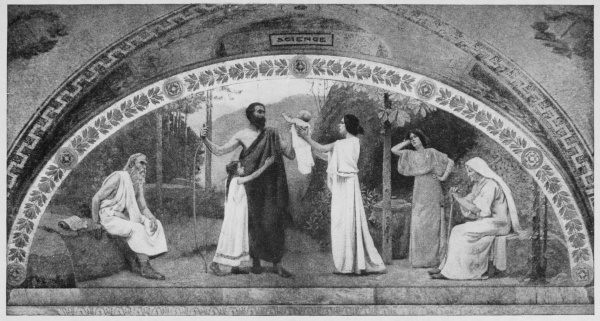
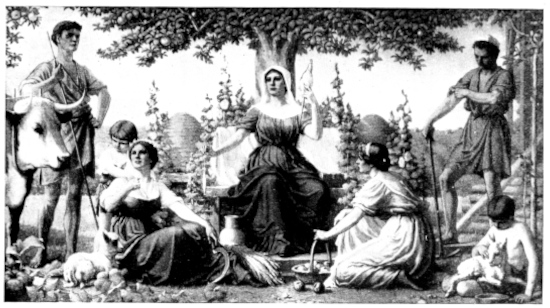
THE FAMILY. By Charles Sprague Pearce From a Copley Print, copyright by Curtis & Cameron, Boston. Reproduced by permission.
THE FAMILY
By Charles Sprague Pearce
From the mural painting in the entrance
pavilion of the North Hall, Library of Congress.
This is the ancient family. The father has
just returned from hunting. The mother holds
up the baby to welcome him and his little
daughter throws her arms about him. On the
benches of stone at either side of the group sit
the grandmother and grandfather, the latter
with the air of a patriarch. By his side lies a
scroll. Three generations are placed together
in the idyllic environment of which the poets
have so often written.
The clan.
Other Social Groups.—Out of the family grew the clan,
or group of families united by ties of kinships. In early
days the clan was a wandering group, like the gipsy bands
of today; but ultimately each clan settled upon the land
and became a community. In these communities men
became trained in manual labor; they developed customs
and the rudiments of a village government.
Then came the next stage—several village communities
joined together for defence against their mutual enemies.
A loose confederation at first, this group of communities
13in time became a state, usually with a chieftain or a
monarch at its head. In other cases a single village
community grew in size to such an extent that it became a
city state, like Athens or Sparta. The most notable
example of this development is afforded by ancient Rome,
where a small community grew into a World Empire.
The family, the clan, the community, the confederation
of communities, the state, and, ultimately, the nation—that
is the general course of political evolution, although this
line of development was not in all cases exactly followed.
But the evolution was not confined to political institutions
alone. Social and economic groups and institutions
developed also. A variety of needs called forth one
institution after another, the church, the school, the club,
the industrial organization. Each has its own function
in organized society.
Government is the guiding hand.
The Rôle of Government.—The dominating factor in
the social and economic life of today, however, is the
political community (nation, state, and municipality),
acting through the agency which we call government.
Government is the great co-ordinating factor. Day by
day we are looking more and more to government for
leadership, for regulation, and for supervision in all our
greater social and economic activities. In the field of
social and economic effort, all roads lead through government—it
is the clearing house of our greater problems.
Whether the problem be one of banking, commerce, poor-relief,
labor, or defence we must reckon with the hand of
government as one of the strongest among constructive
and harmonizing factors. Government is the focal point
in all civic relations. It provides a thread which winds
its way along every main line of civic activity. That
has been particularly noticeable in European countries;
but it is now true of America as well. The greatest of
our socializing agencies is government.
America’s emphasis on individualism.
14Individual Liberty and Social Control.—In the United
States strong emphasis has always been laid upon individual
freedom, and rightly so, because the encouragement of
individual initiative is essential to progress in a new country.
The exploitation of vast natural resources required that
men should be given encouragement to pioneer, and should
not be held down by too much governmental interference.
“That government is best which interferes the least” was
the common notion. Stress was laid upon the prosperity
of the individual rather than upon the welfare of the whole
people. This doctrine of extreme individualism undoubtedly
served a useful purpose in the days when the country’s
biggest problem was to increase production and gain for
itself a place among the strong nations of the world.
The influence of the frontier.
To a considerable extent this emphasis upon individualism
was due to the influence of the frontier. From the first
settlement of the country down to about 1880 the American
people were engaged in the task of marching steadily
westward, conquering the wilderness as they went. This
mastering of a great domain demanded qualities of enterprise,
initiative, and individual courage. It developed
men’s confidence in their own power and made them
reliant upon their own efforts. In old countries the natural
tendency is for the individual to look to the public authorities
for leadership, guidance, and supervision; on the great
American frontier the pioneers had to hew their own way.
They preceded the state and the community. This emphasis
upon individual initiative remained as the frontier
rolled west and profoundly affected the whole social temper
of the country.
The nature and scope of social control.
In time a reaction came. Social control developed.
The more thickly populated a country becomes, the more
complicated do the relations of individuals grow, and the
greater is the need for general restraint. Social control,
however, is not merely negative in its purpose. Its object
15is not simply to restrain individuals in their freedom of
action but to encourage them in the thing which the general
welfare demands. The government is the chief agency
through which social control is exercised, but it is by no
means the only one. Religious, fraternal, professional,
and benevolent organizations do a good deal in the same
general direction. Their function is to promote collective
interests as distinguished from the interests of individuals;
they protect the collective interests against the avarice or
selfishness of individuals. The government exercises social
control by means of laws and administrative orders; other
organizations exercise it by their own rules or by customs
which the members obey.
The limits of social control.
There is always a danger, of course, that social control
may proceed too far. It is not the object of government and
of social organizations to run all men in the same mould,
making them mere automatons without individuality or
initiative. Government should aim to give sufficient scope
for every individual to use his abilities in the best possible
way. Control over the acts and discretion of individuals
is justified only where such control promotes, in the long
run, the well-being of the greatest number of individuals.
The state is not an end in itself. Society is not an end
in itself. The individual is the end. Society and the
state are merely means to the promotion of the general
welfare and the welfare of the individual. Their activities
in the way of exercising social control should go no
further than this.
General References
C. H. Cooley, Social Organization, pp. 3-22;
H. G. Wells, Outline of History, Vol. I, pp. 3-103;
C. A. Ellwood, Sociology and Modern Social Problems, pp. 7-59;
F. S. Chapin, Social Evolution, pp. 3-101;
Vernon Kellogg, Darwinism Today, pp. 10-57; 129-157;
J. A. Thomson, Darwinism and Human Life, pp. 181-237;
16D. S. Jordan and V. L. Kellogg, Evolution and Animal Life,
pp. 1-56;
T. N. Carver, Sociology and Social Progress, pp. 174-270;
E. A. Ross, Social Control, pp. 1-105.
Group Problems
1. How far should society control the conduct of individuals?
Why social control is exercised. The extent of social control in
older countries,—Great Britain, France, and Germany. Its growth
in America. Causes of this growth. The point at which it ceases
to be justified. Illustrations. Effects of too much emphasis on
individualism. Effects of too much social restraint. Relation of
social control to socialism. References: E. A. Ross, Social Control,
pp. 49-76; H. G. Wells, New Worlds for Old, pp. 1-55; T. N.
Carver, Sociology and Social Progress, pp. 788-808; Ibid, Principles
of National Economy, pp. 740-749.
2. What is progress? References: F. S. Marvin, Progress
and History, pp. 8-10; John Dewey “Progress” in International
Journal of Ethics, xxvi, 312-318 (1916); James Bryce, Essays and
Addresses in War Time, pp. 84-102 (War and Progress); George
Nasmyth, Social Progress and the Darwinian Theory.
Short Studies
1. The past in the present.H. R. Burch and S. H. Patterson,
American Social Problems, pp. 33-43.
2. The beginnings of civilization.H. G. Wells, Outline of
History, Vol. I, pp. 183-208.
3. Earlier forms of the family.C. A. Ellwood, Sociology and
Modern Social Problems, pp. 108-130.
4. The development of the tribe into the community.J. Q.
Dealey, The State and Government, pp. 24-45.
5. The American family as an economic unit.Mary K. Simkhovitch,
The City Worker’s World, pp. 1-21.
6. The relation of leisure to family life.Florence Kelley,
Some Ethical Gains through Legislation, pp. 105-125.
7. The influence of environment.F. S. Chapin, Social Evolution,
pp. 121-170.
8. Habit.William James, Psychology, I, pp. 104-127.
9. The influence of frontier conditions upon the development
of American society.F. J. Turner, The Frontier in American
History, pp. 1-38.
1710. Individualism.Herbert Spencer, Social Statics, pp. 100-136;
C. W. Eliot, The Conflict between Individualism and Collectivism
in a Democracy, pp. 1-42.
Questions
1. How would you define “society”? Is it an organism? What
resemblances to an organism does it bear?
2. Explain the following terms: instinct; impulse; natural
selection; social inheritance; social environment; habit; custom;
fashion; mob mind; institution; social control. Give examples
of each.
3. How has physical environment affected the ideas of the
American people in relation to (a) national defence; (b) form of
government; (c) social control? How has the physical environment
of England affected the ideas of the English people on the same
matters?
4. What racial characteristics do you find most strongly marked
in the (a) Scotch; (b) Irish; (c) Scandinavians; (d) Italians; (e) Jews;
(f) Japanese?
5. Name any institutions, other than those given in the text,
which have served mankind for a time and been discarded.
6. Can you think of any customs which are universal throughout
the world? Any which prevail in the United States but not
elsewhere? Any which prevail in some parts of the United States
but not in others?
7. Do Americans in general pay too much deference to custom?
Is there any ground for the European idea that there is “too much
uniformity” in American life?
8. Are crowds likely to be more conservative or more radical
than the individuals who compose them? Give your reasons.
What is the difference between a mob, a crowd, a meeting, and a
deliberative assembly?
9. The family, as an organization, differs not only in size but in
nature, from all other social organizations such as the community,
the state and the nation. Show how this is.
10. In what ways would society suffer if the family as a social
unit were broken down?
11. To what extent has society the right to regulate, as a measure
of self-protection, the institution of marriage?
12. Why have we laid emphasis upon individualism in this
country? Explain why this stress is being steadily diminished.
1813. Should social control be exercised over (a) the methods of
agriculture; (b) the marketing of timber; (c) the production and
sale of tobacco; (d) the rates charged by electric lighting companies;
(e) the price of bread at retail bakeries; (f) the hours of
labor for men; (g) the hours of labor for women; (h) the kind of
pictures shown in theaters; (i) the diet of the people; (j) the
hours at which young people may be on the streets after dark;
(k) the religious beliefs of the people? Tell why or why not in each
case. Is a greater degree of social control justified over certain
classes of the population than over others? Is it justified at certain
times and not at others?
14. If society exercises too little control over the individual,
what evils result? If it exercises too much control, what are the
consequences (a) upon the individual; (b) upon society itself?
Topics for Debate
1. Physical environment has had a more important influence
than racial characteristics in determining the establishment and
maintenance of democratic institutions in the United States.
2. Thomas Jefferson was right when he said “That government
is best which governs least”.
3. Society is under obligation to ensure every industrious man a
decent living.
CHAPTER II THE PEOPLE, RACES, AND RACIAL PROBLEMS OF THE UNITED STATES
19
The purpose of this chapter is to explain how the
population of the United States has grown, how it is distributed,
the varied races of which it is composed, and the racial
problems which immigration has created.
How the national population has grown.
We, the People of the United States.—The national
constitution begins with the words: “We, the People of the
United States”. But who are the people? No one cares
to carry a lot of figures in his head and most people think
that statistics are uninteresting; but there are some figures
which everyone ought to know and, moreover, there are
some statistics which are far from being dry or tedious.
The figures relating to the population of the United States,
its growth and distribution, are interesting because they
portray something that the world has never seen before
and probably will never see again,—a country doubling
its population four times in just about a single century.
That is what the United States did in the hundred years
from 1790 to 1890. In 1790 the entire population was less
than four millions. (There are more people in the single
city of New York today, and almost as many in Chicago.)
The population had doubled in 1813, and had doubled
again in 1838, when it passed sixteen million. In 1864,
only twenty-four years later, it had doubled once more
(32,000,000). It passed the sixty-four million mark in
1891, and in all probability will double for the fifth time
about the year 1940. In 1920, when the last national census
was taken the population had passed 105,000,000.
Will this increase continue? If so, with what results?
20Now if you will take the data at the foot of the page and
work the calculation to the year 2000 (allowing for the
gradual slackening of the increase) what will the population
of the United States be then?[7] It will be around three
hundred millions, which is more than the white population
of the entire world today. Even so the country would not
be nearly so thickly populated as some European countries
now are. Today there are in the United States about
thirty-five persons to the square mile. But there are 700
to the square mile in England and 658 per square mile in
Belgium, which are two of the most thickly-populated
of all countries at the present time.[8] Three hundred
million people in the United States, if the figure should
reach that total at the end of the twentieth century, would
be less than one hundred per square mile. There would
still be six acres of ground for every man, woman and
child in the country. Whether there would be a sufficient
food supply to support so large a population is another
question and one which is not so easily answered.
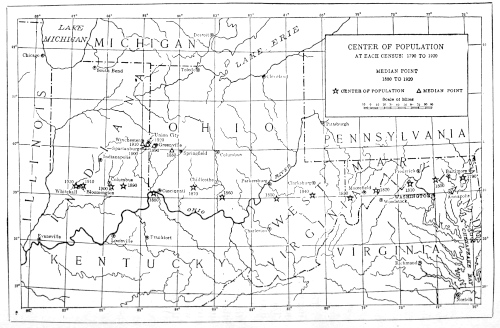
THE CENTER OF POPULATION
The way in which the center of population has been steadily moving
westward is indicated by this map. It will be noted that in its
journey to the west it has held closely to the 39th parallel of latitude.
The median point, on the other hand, has remained practically fixed
during the last thirty years.
The location of the median point is determined as follows: Take
the parallel of latitude which divides the country in such manner
that half the population is north of that parallel and half is south of
it; similarly, take the meridian of longitude which divides the country
in such manner that half the population is east of it and half is
west of it; the intersection of this parallel and this meridian is called
the median point.
CENTRE OF POPULATION AT EACH CENSUS: 1790 TO 1920
MEDIAN POINT 1880 TO 1920
☆ CENTER OF POPULATION Δ MEDIAN POINT
Some areas are more densely populated than others.
How the National Population is Distributed.—The people
of the United States are very unevenly distributed over
the face of the country. Great areas, particularly in the
West, have only a few persons to the square mile, while
the crowded sections of the largest cities have many hundreds
to the acre. Even the rural areas of some states are
thickly settled while in others the people are few and far
between. Rhode Island is nearly as densely populated as
21Belgium, having about 566 people to the square mile while
many states of the Western mountain region have only
seven or eight inhabitants per square mile of territory.
The reasons for this uneven distribution are chiefly geographical.
The states which have grown most rapidly in
population are not necessarily the oldest states but the
ones which have the greatest natural advantages in the
way of fertile soil, or mineral resources, or harbors and
waterways, or favorable climate. People make their homes
in those regions where they can best make a living.
Climate affects the density of population.
Favorable climatic conditions exert a strong influence
in attracting population. It is an interesting fact, often
noted by students of history, that whereas civilization
developed earliest in the tropical and semi-tropical zones
it has everywhere made its greatest advance in the regions
of moderate temperatures and rainfall. Taking the broad
strip of country which lies between the thirty-seventh and
the forty-fifth parallels of latitude, it will be found that
nearly four-fifths of the entire population is concentrated
within this mid-latitude area of the United States. And
this is the area which, in all probability, will continue
to be the most thickly settled.
The center of population in 1920.
The center of population in 1920 was at Whitehall,
Owen County, Indiana, a little town of forty-three inhabitants
which burst into prominence overnight when the
census bureau announced it as the pivot of the nation.
By the center of population is meant the point which the
greatest number of people could reach with the least
amount of travel. This point, at each successive census,
has been steadily moving westward following very closely
the thirty-ninth parallel of latitude. In 1790 it was at
Baltimore, in 1840 in West Virginia, in 1880 in Ohio, and
since 1890 it has been moving westward across Indiana.[9]22The center of population is a long way from the center of
area, the latter being in Northern Kansas not far from the
Nebraska border.
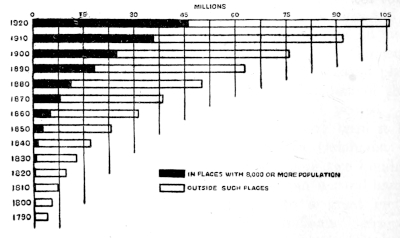
The Drift of Population to the Cities.—The distribution
of the people has also been influenced by the growth of
large cities. In 1790 there were only five communities
with populations exceeding 8000, namely New York, Philadelphia,
Boston, Baltimore, and Charleston. Taken altogether
they had only 130,000 inhabitants, that is to say
only one person in every thirty lived in these towns.
But so rapidly did the various towns and cities spring up
all over the country that by the time of the Civil War
there were nearly 150 with populations above 8000, and
today there are nearly a thousand. Not a single American
city had 70,000 population in 1790; today there are more
than a hundred such cities.
The chief causes of city growth.
This remarkable drift of population into the towns and
cities, which began early in the nineteenth century and
has continued ever since, shows no signs of slackening. It
is due to many causes, including the great demand for
industrial labor in the cities, the attractiveness of city life
to the young men and women of the country districts
(see p. 351), and the tendency of the immigrants to locate
in the crowded centers. Wherever industry and commerce
thrive, there cities will be built and will grow. Half the
population of the United States is now living in towns
and cities of over 2500 population. If the drift to the
cities continues at its present rate of progress, ninety per
cent of the people will be living in the cities and towns by
1980 and only ten per cent in the country districts. That
is already the case in England.[10] One Englishman in every
seven lives in London. That seems to be a very striking
23fact until we remember that one American in every ten
lives in New York, Chicago, or Philadelphia. New York
City has nearly six millions now; in fifty years, at its
present rate of growth, it will be an urban giant of
fifteen millions or more.
Why most immigrants go to the cities.
Why do the immigrants go to the cities rather than to
the country districts? The chief reason is that most
immigrants come to the United States to find work, and
work is most easily found in the large cities. The great
majority of immigrants have learned no trade before they
come to America, hence they must seek jobs which require
no great amount of skill or training. Another reason is
that the immigrants want to be near others who speak
their own language. In every large city these foreign
colonies or settlements are created—Italian, Polish, Jewish,
and so on. The newcomer naturally prefers to live in
one of these colonies until he learns the English language,
but having become accustomed to the city he rarely
leaves it. Among the many millions of immigrants who
have come to America during the past fifty years the
great majority have gone to the cities, particularly to
the large cities. New York City, for example, contains
today more than two million people who were not born in
this country. Nevertheless, the cities have not been built
up by the immigrant alone. Large numbers of native
Americans have left the rural districts and have helped
to swell the population of the urban centers.
The Ebb and Flow of Immigration.—The United States
has been the melting-pot of the nations. No other country
has ever welcomed to its shores so many millions of people
from all parts of the earth. One hundred years ago there
were relatively few foreign-born persons in the country.
But waves of immigration soon began to come and the
number of incoming aliens, which was less than ten
thousand in 1790, rose to more than four hundred thousand
24in some of the years preceding the Civil War. The
immigrants during this period were for the most part
from England, Ireland, and Germany. During the Civil
War the influx subsided, but when the war was over it
quickly began to swell once more and it continued, with
various ups and downs, to the outbreak of the World War
in 1914.
Where the immigrants have come from.
In some years, during this period since 1865 the number
of immigrants has been as low as 200,000; in other
years it has run above a million. Nearly every European
race has been represented in this influx, although some
have come in much larger numbers than others. Down
to about 1880 most of the newcomers were from Ireland,
England, Scotland, Germany, the Scandinavian countries,
and the other regions of Northern Europe. But since that
date the source of immigration has been steadily shifting.
During the past forty years a much larger proportion has
been coming from Italy, Austria, Hungary, Poland, Greece,
and some of the smaller countries.[11] This has brought in
many millions of people who are not of Celtic or Teutonic
stock.
Effects of the war on immigration.
Upon the outbreak of the great European conflict in
1914 the flow of immigration subsided quickly and while
the war lasted it practically ceased altogether. This was
due in part to the reluctance of European countries to let
their people leave, and in part due to the lack of shipping,
since all available vessels were engaged in carrying troops,
munitions, and supplies. Immediately after the close of
hostilities, however, the exodus from Europe recommenced,
and in the year 1920 the figures of immigration once more
rose into the hundreds of thousands. In spite of the strict
regulations imposed by the United States government,
25enormous numbers of people in Poland, Italy, Hungary,
and various other countries began applying for permission
to migrate. The American consular offices in Europe were
besieged by long lines of people waiting all day for passports
to the Promised Land. In the face of this threatened
flood Congress felt impelled to place all immigration under
strict limitation, as will be explained a few paragraphs
later.
During the hundred years from 1820 to 1920 it is estimated
that more than thirty million immigrants reached
the United States, which is the largest migration in history.[12]
It is true that considerable numbers of these immigrants
eventually drifted back to their native lands but the larger
portion of them remained permanently here.
The various factors which have caused Europeans to leave their own countries.
Causes of Immigration.—The causes of immigration to
this country are manifold. First in importance among them
is the economic attractiveness of the United States. Cheap
land, equal opportunities, the ease with which any industrious
man or woman can make a living—these are the
magnets which drew millions of people across the Atlantic
during the nineteenth century. But there were other
causes, namely, the existence in various parts of Europe
of conditions which encouraged the people to emigrate.
Religious persecution was one of the first things that drove
men or women to America. It brought the Pilgrims to
Massachusetts in the early days, the Quakers to Pennsylvania,
and the English Catholics to Maryland. Political
oppression in the middle years of the nineteenth century
sent several million Germans to the United States, particularly
to the Middle West. Oppression, both religious and
political, has been instrumental in driving the Jews across
the seas. Overcrowding in both the cities and the rural
26regions of Europe and the consequent inability of the people
to obtain lands of their own, has been responsible for much
of the drift to America. The exhaustion of the soil in
Ireland, the crop failures and consequent famines there,
have led to the migrations of the Irish, although dissatisfaction
with political conditions has also been a factor in
this case. To a considerable extent, moreover, immigration
has been assisted by those aliens who were already settled
in this country. Immigrants arrived in this country and
by hard work soon became prosperous. Then they sent
passage-money to their friends and relatives until whole
groups of families were enabled to come to America in this
way. The steamship companies, too, have advertised the
attractions of America in all parts of Europe; they have
kept agents at work in many countries, and have been an
important factor in promoting immigration.
The economic factors have been the most important.
Nevertheless the underlying causes of immigration are
economic. Immigrants come in greater numbers when
prosperity reigns in America than in periods of business
depression. This indicates that high wages and plenty
of employment are the things which have the greatest
influence in bringing them here. The democratic institutions
of America have played their part, no doubt, and the
relative social equality which exists among the people of
the United States has been an attraction to those who are
denied such equality in their own homelands. But the
equality of economic opportunity, the open career, the
chance of making a good living and even a fortune—these,
after all, have been and still are the impelling forces.
How the immigrant has affected American life.
The Effects of Immigration.—A large immigration is
certain to have far-reaching effects, particularly if the
newcomers be of a widely different race. It has assuredly
had far-reaching effects in the United States. Take the
importation of the negroes as the most conspicuous example.
The coming of several hundred thousand persons of
27African blood, during the years preceding 1808, has
resulted in placing a colored population of more than ten
millions in the heart of a white man’s country, with all the
social, economic, and political problems that this situation
implies. It influenced the agricultural system of the
Southern states, provided the underlying causes of the
Civil War, and has profoundly affected the politics of
the United States down to the present day. The problem
presented by the immigration of the various European
races has been altogether different because these races
can be assimilated whereas the negroes can not. Even
so, the European immigration has presented its own
problems and the coming of these many millions has had
profound effects upon every branch of American life.
The making of a composite race.
Social Effects.—The social effects are chiefly in the way
of introducing natural traits or qualities which were not
in the American people during the early period.
Immigration has resulted in making a cosmopolitan population
which is not uniform in temperament or tastes, and
can be made uniform only by the long-continued process
of assimilation. This lack of uniformity is in some ways
an advantage, not a defect. It may give us, in the long
run, a more vigorous population than could ever be had
from the development of a single strain. Whether the new
composite race which ultimately emerges from the melting-pot
will be superior or inferior to the original stock is
something which only the future can tell. One disappointing
feature is to be found in the fact that many of
these immigrants are inferior to the average native-born
American in physique, in mentality, and in moral fibre.
It is sometimes asserted that the immigrant population is
responsible for more than its due proportion of crime but no
satisfactory evidence has yet been brought forward to
prove this statement. It is a fact, however, that poverty
and illiteracy are more common among the foreign-born
28than among the native white population. It is quite likely
that the new environment will do much to remedy this
condition and that the second generation, through the
work of the public schools, may measure up to the native-born.
These public schools are the most potent of all forces
in the work of Americanization. It is upon them that we
must depend to make the ultimate social effects of assimilation
beneficial to the country.
Immigration in its relation to industry and labor.
Economic Effects.—Immigration has had important
economic results. It has kept the labor market well
supplied and throughout the last three-quarters of a
century has aided the great industrial expansion of the
country. American industry and commerce could not
have grown to such proportions without the man-power
which has been obtained in such enormous quantities
from Europe. We have used great numbers of aliens in
building the railroads of the country, in mines and steel
mills, in workshops and factories. On the other hand the
flood of immigration has at times proved too strong. It
has on occasions served to produce an over-supply of labor
and this, in turn, has caused wages to fall. Labor leaders
claim that the steady stream of immigrants has prevented
the rise in the American workman’s standard of living
which otherwise would have taken place. Organized labor
would like to place a protective duty upon immigrants.
If the newcomers could be scattered evenly over the whole
country instead of being concentrated in the urban areas,
this danger of glutting the labor supply would be very
small. In any case, as has already been pointed out, the
situation tends to adjust itself, because immigration always
falls off when business depression causes a slackening in
the demand for labor.
Ways in which the immigrant has influenced American politics.
Political Effects.—The exact political effects of immigration
are hard to determine. It is to be remembered that
most of our immigrants have come from countries where
29they were given no political opportunities, or almost none.
Prior to their arrival in the United States they have had
no experience with democratic institutions. Yet we have
freely offered them, after five years of residence, the
privilege of becoming citizens and voters. The rest of
the world has always looked upon this as a very dangerous
experiment in democratic government; nevertheless its
results have not been at all disastrous. True enough, the
newcomers have often been exploited by unscrupulous
politicians and they have sometimes allowed themselves
to be misled into supporting incompetent or corrupt candidates,
especially in the large cities. But the alien immigrant
is not wholly or even chiefly responsible for the bad
government that we have had from time to time in various
parts of the country. Some of the worst political abuses
have flourished in states and cities where the proportion
of foreign-born citizens is relatively small. Political
reformers rail at the iniquities of “foreign-born bosses”,
but the fact is that most of our notorious political bosses
have been native-born. Notwithstanding the admission of
many million aliens to all the rights of American citizenship
it can be fairly claimed that American government
in its various branches, national, state, and local, is just
as honest and efficient as that of any other country.
The gradual stiffening of the regulations.
The Restriction of Immigration.—Until about forty
years ago there were practically no restrictions upon the
coming of aliens to the United States, but in 1882 laws
were passed by Congress to exclude paupers, criminals,
and the insane. All laborers of the Mongolian race were
also debarred. Three years later, in 1885, it was provided
that no immigrant of any race should be admitted to the
United States if under contract to perform labor in this
country. And from this date to the present the restrictions
have gradually been tightened. In 1917 Congress
established a literacy test for all immigrants over sixteen
30years of age, and in 1921 it made further provision that
the number of immigrants admitted each year from any
European country should not exceed three per cent of the
natives of that country already in the United States, as
shown by the census figures of 1910. A tax of eight
dollars per person is now imposed upon every immigrant.
Should immigration be altogether forbidden?
There are some who believe that it would be wise to
prohibit immigration altogether, at any rate until conditions
in both Europe and America become more settled.
They argue that we already have as many aliens as we
can Americanize for some time; that immigration at the
present time increases unemployment, and that the quality
of immigrants is now considerably below what it used to
be. On the other hand it is urged that the industrial
growth of the United States requires a larger supply of
labor than can be provided without immigration and that
by providing proper facilities for selection we can make
sure of getting only the right type of immigrant.
Our Racial Problems.—We have several serious racial
problems in this country including the problem of the
European immigrants in the East (particularly in the
cities), the negroes in the South, and the Japanese on the
Pacific slope. The large percentage of European immigrants
in the Eastern cities has already been mentioned,
and the problems which their presence in these cities
creates have been alluded to. The European immigrant
can be assimilated, but the process takes time because a
large part of it must be accomplished through education.
If the immigrants could be persuaded to scatter over the
country instead of congregating in the cities with their
fellow-immigrants, the problem of making real Americans
out of them in a short time would be simplified.
Extent of the negro population.
The Negroes.—The problem of the negro is older and
more difficult still. They are of a race so far removed from
the white population of the United States that there is
31no hope of their ever being assimilated. They were
brought here by the tens of thousands without any adequate
appreciation of the problem which their presence would
eventually create, and they form an unmeltable mass in
the melting-pot of American society. At the outbreak of
the Civil War the colored population of the United States,
most of whom were then slaves, numbered less than five
millions, or about one-tenth of the total population of
the entire country. Now they number about ten millions.
In other words the negroes have a little more than doubled
in sixty years. This is a much slower rate of natural
increase than has been made during the same sixty years
by the white population. A high death rate, especially
in the cities, is mainly responsible for this.
Economic status of the negro.
The chief home of the negro is still, as it has been from
the beginning, in the South. Nearly nine-tenths of the
colored population of the United States lives below the
Mason and Dixon line, particularly in the great agricultural
plain which stretches from Virginia southwestward to
Texas. In two states, Mississippi and South Carolina, the
blacks outnumber the whites; in three others, Alabama,
Georgia, and Florida, they almost equal them. Most of
the Southern negroes live in the rural districts and are
engaged in the cultivation of the soil; those who have
made their way to the Northern states, more than a
million in all, live chiefly in the cities. During the past
few years the negroes have been coming northward in
greater numbers.
Can the negro problem be solved?
The problem of the negro has many phases, political,
social, and economic. The political problem arises from the
fact that although the negroes are guaranteed by the
constitution the right to vote they are by one means or
another debarred from voting in practically all the Southern
states. The economic problems have been due, in the
main, to the lack of educational facilities for the negro,
32and particularly to the absence of opportunities for vocational
education. This defect is now being remedied to
some extent by the spread of vocational schools, of which
Tuskegee and Hampton Institute are the best-known
examples. The social separation between the white and
colored races, especially in the Southern states, is as absolute
as ever it was and there is no reason to think that this
separation will ever be broken down. When two races in
the same community must live their lives entirely apart
there is bound to be some mutual suspicion and distrust.
In any case the negro problem, in its various phases, must
be solved by the white population of the Southern states if
it is to be solved at all.
The “gentlemen’s agreement”.
The Japanese on the Pacific Slope.—Some years ago the
influx of Japanese into the states of the Pacific slope gave
rise to the fear that the Far West would soon have a great
racial problem on its hands if this immigration were allowed
to go on unchecked. One of these states, California,
enacted laws designed to prevent the owning or leasing of
land by Japanese and pressure was brought upon Congress
with a view to having the Japanese shut out of the country
altogether. In the end, through diplomatic negotiations,
a “gentlemen’s agreement” was concluded between the
American and Japanese governments by which the latter
promised to grant no more passports enabling its citizens
to emigrate to the United States, except in the case of
merchants, students and others whose residence in this
country would be temporary. The Japanese government
has lived up to the letter of this agreement, but this has
not prevented a good many Japanese coming into the
United States under one subterfuge or another. The
Western states are determined that their territory shall
remain a “white man’s country”; on the other hand the
Japanese government is not willing to agree by formal
treaty to the exclusion of its own people from any other
33country. As a great and powerful nation, civilized and
progressive, Japan feels that such a treaty would be a
humiliation. So there the matter rests at present. Japanese
are not forbidden to enter the United States; we are
merely depending upon the informal promise of the Japanese
government to keep them from coming here.
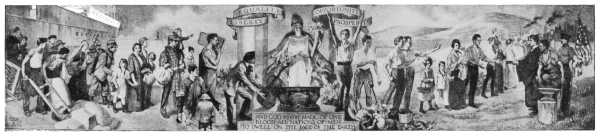
THE MELTING POT
By Vesper L. George
From a mural painting in the McClain High
School, Greenfield, Ohio.
From the giant steamship at the left comes a
procession which includes men, women, and
children of many races. Each immigrant,
whether Greek or Russian, Jew or Gentile,
brings some gift of art or skill to lay at the
feet of America, his new motherland. The
Melting Pot is not a huge cauldron into which
all individuality is to be poured so that it may
become a homogeneous and commonplace mass,
but a crucible in which the gold of character
and personality is to be discovered and refined
for the enrichment of all.
To the right are the sons and daughters of
these immigrants. They have become successful
in the trades and professions; they and their
children have gained education; they are contributing
their share to the wealth, government,
defence, and prosperity of the nation.
The picture embodies a spirit of true Americanism.
THE MELTING POT. By Vesper L. George
Copyright by Vesper L. George. From a Copley Print, copyright by Curtis & Cameron, Boston. Reproduced by permission.
On the Pillar to the left the words Equality and Liberty indicate what the immigrants seek in America. On the Pillar to the right the words Opportunity and Prosperity indicate what they find. On the pedestal are graven the stirring words which Paul addressed to the men of Athens nearly nineteen hundred years ago.
Americanization.—Among the European immigrants
now in the United States there are many thousands who
cannot speak the English language, who have never become
citizens, know nothing about the way in which American
government is carried on, and have no comprehension of
American political or social ideals. This situation was not
fully appreciated until the outbreak of the World War.
During the past few years an earnest attempt has been
made both by the public educational authorities and by
private organizations to Americanize these people by
helping them to learn the language, to obtain a knowledge
of American history, to become naturalized, and to acquire
a proper conception of what American democracy implies.
This does not mean, of course, that we desire all people,
of whatever race, to possess the same temperamental traits,
or hold the same opinions, or have the same point of view.
Diversity in individual qualities, physical, mental, and
moral, is not undesirable provided the differences are not
so great as to prevent the various elements from adequately
understanding one another. By Americanization we do
not mean, therefore, that every newcomer to this country
should submerge his individuality in the general mass,
discard his own inherited traits, and put on a veneer of
Americanism. Rather it implies that those who are the
children of the soil, the native-born, should exemplify the
Golden Rule towards the stranger who comes within our
gates and should endeavor to show him, by actions as
well as words, the meaning of good citizenship in a
democracy.
34General References
T. N. Carver, Principles of National Economy, pp. 123-140;
J. R. Commons, Races and Immigrants in America, pp. 1-38; 63-106;
J. W. Jenks and W. Jett Lauck, The Immigration Problem,
pp. 1-39; 40-66;
Mary Antin, The Promised Land, pp. 180-240;
Edward A. Steiner, On the Trail of the Immigrant, pp. 292-333;
Peter Roberts, The New Immigration, pp. 124-172; 173-199;
E. A. Ross, The Old World in the New, pp. 228-281, and passim;
Booker T. Washington, Up From Slavery, pp. 1-62;
L. H. Gulick, The American-Japanese Problem, pp. 3-27;
118-183.
Group Problems
1. Should immigration be further restricted? The history of
immigration. What the immigrants have done for the United
States. Economic, social, and political disadvantages of immigration.
The present restrictions. Figures showing the probable
influx of immigrants under the percentage system during the next
ten years. What further restrictions would improve the quality of
immigration? How might these restrictions be enforced? Could
the selection be made at the port of sailing? Conclusions.
References: P. F. Hall, Immigration, pp. 121-138; J. W. Jenks
and W. J. Lauck, The Immigration Problem, pp. 135-197;
E. A. Ross, The Old World in the New, pp. 282-304; Peter
Roberts, The New Immigration, pp. 341-359; Debaters’ Handbook
Series, Immigration, pp. 69-81; 148-163 (arguments on both
sides); F. J. Warne, The Tide of Immigration, pp. 313-361.
2. The foreign-born population of your own community. Take
some such book as F. A. Bushee’s Ethnic Factors in the Population
of Boston, or H. B. Woolston’s Study of the Population of Manhattanville,
or Robert A. Woods’ Americans in Process, and note
the plan followed in studying the characteristics of foreign-born
groups. Some excellent suggestions can be had from Carol
Aronovici’s booklet Knowing One’s Own Community. Apply
this plan to a survey of your own town or city. Some data can
be had from the national and state census reports in the case of
larger cities; in smaller communities the material must be gathered
by field work.
3. An effective program of Americanization. References:
F. S. Bogardus, Americanization, pp. 186-225; Peter Roberts,
The Problem of Americanization, especially pp. 45-108.
35Short Studies
1. The economic effects of immigration.E. A. Ross, The Old
World in the New, pp. 195-227.
2. The immigrant in American politics.M. K. Simkhovitch,
The City Worker’s World, pp. 181-209; P. F. Hall, Immigration,
pp. 183-198; R. A. Woods, Americans in Process, pp. 147-189.
3. The German immigrant.A. B. Faust, The German Element
in the United States, pp. 357-390.
4. The Italian immigrant.R. F. Foerster, The Italian Immigration
of Our Times, pp. 374-411.
5. The Slavic immigrant.E. G. Balch, Our Slavic Fellow
Citizens, pp. 349-377.
6. Our treatment of the immigrant.Jacob A. Riis, The Making
of an American, pp. 58-100; E. A. Steiner, From Alien to Citizen,
pp. 53-71; 122-168.
7. Immigrant life in the large cities.R. A. Woods, The City
Wilderness, pp. 33-57; Ibid., Americans in Process, pp. 104-146.
8. The economic problems of the negro.Booker T. Washington,
The Future of the Negro, pp. 42-66; Carl Kelsey, The
Negro Farmer, pp. 22-28, and passim.
9. The problem of the Japanese on the Pacific coast.L. H.
Gulick, The American-Japanese Problem, pp. 3-27; H. A. Millis,
The Japanese Problem in the United States, pp. 152-196.
10. As others see us.Hugo Muensterberg, The Americans,
pp. 229-254.
Questions
1. What has been the relative rate of increase of population in
your own state during the last two decades? Has the rate been
more or less rapid than that of the nation as a whole? To what
features is the difference due? What racial elements are strong in
the population of your state and in what industries are each of
these elements chiefly engaged?
2. What have been the impelling causes of immigration from
(a) Germany; (b) Ireland; (c) Italy; (d) Russia?
3. Give four reasons why most immigrants settle in the cities.
4. Explain the principal effects of immigration upon (a) the
growth of industry; (b) the scale of wages; (c) municipal politics;
(d) the public school system (including evening schools, etc.).
5. Which races are the most difficult to assimilate and why?
366. Make some definite suggestions as to how the conditions of
the negro race can be made more tolerable in this country.
7. Should Japanese as well as Chinese be excluded by law
from immigrating to the United States? Give your reasons.
8. What mistakes are we most likely to make in our zeal for
the Americanization of non-English speaking immigrants?
Topics for Debate
1. The period of residence required for the naturalization of
aliens should be extended to more than five years.
2. Aliens ought to be debarred from employment on national,
state, and municipal work.
3. The national government should take jurisdiction over and
prevent all racial discrimination by the state.
CHAPTER III ECONOMIC FACTORS AND ORGANIZATION — Some Essential Economic Activities
37
The purpose of this chapter is to show how wealth is
created and how it is distributed among the people.
Primitive needs and modern needs.
The Economic Needs of Man.—The most elementary
needs of human beings are for food, clothing, and shelter.
Until these are satisfied no higher needs can develop. In
the lowest stages of barbarism men are content with the
satisfaction of these elementary needs alone; but as they
obtain a greater mastery over nature and are able to supply
these wants more easily, other and higher wants arise within
them. As men and women become more intelligent and
more refined, they grow discontented with the primitive
and coarser kinds of food; they seek more presentable
clothing than the skins of wild animals; they replace their
rude huts with substantial houses of wood. Step by step,
as the human race has advanced in civilization, its needs
have become more numerous and more varied. Purely
material requirements being satisfied, other and higher
demands arise. The spiritual and social aspirations make
their appearance. As mankind passes each stage in civilization
it finds, through the growing control over nature,
that purely material wants can be satisfied with less and
less exertion. Men gain their daily bread today with
infinitely less effort than in primitive times. The chief
reason is that they have learned to act collectively in
mastering the forces of nature; in other words they have
achieved a high degree of economic organization.
How the economic motives promote progress.
38The Economic Motives.—Self-preservation is the first
law of nature. The primeval instinct in man is to look
out for himself, to protect himself from hunger, thirst,
and hardship. This, for the moment, is more important
to him than the satisfaction of his social and civic needs.
Hence the economic motive, the instinct which prompts
him to seek the means of getting a living, is extremely
strong. This instinct the lower animals possess as well,
but it does not carry them beyond the satisfaction of
elementary wants. The birds of the air and the beasts of
the fields have never enlarged or raised the scale of their
needs beyond the simple requirements of food, drink, and
shelter. No matter how easily obtainable these become
they make no progress to anything higher. But mankind,
endowed with superior mental faculties and a spiritual
nature, does not rest content with the easy earning of a livelihood.
The economic motive prompts men and women to
move on, to achieve wealth, to procure luxuries, and to gain
such happiness as the possession of worldly goods can
bring. This economic motive, deeply implanted in humanity,
has been a great incentive to progress in civilization,—probably
the greatest of all incentives.
The altruistic motive.
Let it not be assumed, however, that because the
economic motive is strong in man he is an altogether
selfish creature. There is also an altruistic motive which
impels him to help his fellow-men, even at personal
sacrifice. Men desire to gain wealth for themselves,
but having gained enough and to spare, they frequently
devote much of it to the assistance of those who have not
been so fortunate. The higher our civilization the more
marked does this spirit of altruism or economic unselfishness
become.
Economic goods.
The Subject-Matter of Economics.—The study of
economics does not concern itself with all the possible
wants and aspirations of men. It deals only with the
39production, distribution, and consumption of those things
which satisfy man’s desire for (a) material objects and
(b) personal services. In other words economics is a
subject which concerns itself with the production, distribution,
and consumption of economic goods, a term which
includes material possessions known as wealth and also
such personal services as have an economic value. Not
all things of a material sort are economic goods; air and
sunlight, for example, being free to all, require no effort
on the part of man to obtain. They are called free goods.
We apply the term economic goods only to such things
and services as satisfy human wants and are not to be
had free. Requiring effort to produce, these economic
goods are limited in supply and hence have a value in
exchange for other goods. For this reason they are
commonly spoken of as wealth. Certain personal services,
those of the physician, the lawyer, the foreman, the laborer,
also have an economic value in that they are limited in
supply, satisfy material wants, and can be exchanged for
tangible goods. These services form a part of the economic
activities of society, a very important part. So the
study of economics includes these personal services as
well.
Present and future economic goods.
The Consumption of Wealth.—All economic goods are
produced for the purpose of being used. This use is what
the economist calls consumption. Some economic goods
are in finished form, ready for immediate consumption at
any time; others are in the form of raw materials or half-finished
products not yet ready to be used. Hence we
distinguish between present and future economic goods.
Economic organization strives to manage matters so that
a sufficient supply of economic goods will reach their
finished form in time to fill the demands that arise. This
demand on the part of the consumers determines the
methods and amount of production. If there is no demand
40for a particular kind of economic goods, these goods will
not be intentionally produced. On the other hand a
vigorous demand will encourage production and speed up
the process of distribution.
Demand and supply.
So we get back, in the end, to the proposition with which
we started, that the purpose of economic activity and
organization is to supply human needs. Where the need
is felt, the demand arises. When the demand arises, the
agencies of supply, namely production and distribution,
usually respond. One of the great tasks of economic
organization, therefore, is to estimate the probable demand
and so influence production and distribution that the
supply will neither be excessive nor fall short. If there is
an over-supply of any commodity, prices normally will
fall. That means that goods may bring less than it costs
to produce and to distribute them. One reason for the
organization of industry on a large scale under great
corporations is that supply can thus be kept closer to
demand. At any rate the consumer, by his greater or
smaller demand, virtually determines all activities of
production and distribution. He is the pivot of the whole
economic system.
The factors in demand.
Whether the demand on the part of the consumer will
be larger or smaller depends on three factors. The first
is the utility of the goods to him. Economic goods do
not have the same utility to all men at all times. The
utility of ice on a warm summer day may be considerable;
in midwinter it is next to nothing. The utility of eye-glasses
to short-sighted men is great; to men of normal
sight they have no utility at all. Economic goods may,
therefore have a greater or smaller utility depending upon
the place, the time, and the consumer. Bear in mind,
moreover, that each consumer matches the utility of one
commodity with the utility of other commodities which
he finds available, and his demand follows the direction
41of the greater utility. A second factor in demand is the
price of the goods. When the price goes up, the demand
ordinarily will go down, because some customers will
decide that the utility of their money is greater than that
of the goods at the increased price. Finally, demand
depends in part upon the purchasing power or wealth of
the consumers. In prosperous times, when people have
plenty of income, the utility of goods seems greater than
the utility of money; in times of depression and low
incomes the reverse is true. The interaction of these
three factors determines the demand.
What production means.
Economic Production.—Production is the general term
applied to all the processes whereby economic goods are
adapted to the satisfaction of human wants. We are
often told that no man can either create or destroy a single
atom of matter. Strictly speaking, therefore, production
does not mean the creation of economic goods but the
utilization of materials in such a way that they may
satisfy the consumers’ demands. This utilization may
involve changing their form, as where iron is made
into tools or wool into cloth. The miner who takes
coal out of the earth; the farmer who makes two blades
of grass grow where one grew before; the mason who
hews the stone for the building; the baker who makes flour
into bread; the manufacturer who takes leather and turns
it into shoes—all are engaged in production. So, also, are
such workers as statesmen, judges, lawyers, physicians,
and teachers. They may not directly produce commodities
but their services are essential to the smooth working of
the processes of production. The only workers who do
not deserve to be called productive laborers are thieves,
swindlers, counterfeiters, and other parasites. They often
work harder than would suffice to earn them an honest
living; but their labor is not productive. They live on
what others produce.
Natural resources, labor, capital, organization, and government.
42The Factors in Production.—There are five factors in
production; namely, (1) natural resources (including land);
(2) labor; (3) capital; (4) organization and management;
(5) government. Natural resources, without the application
of labor to them, do not go far in satisfying human
wants. Men cannot live on soil, climate, rainfall, and
minerals. Nor can labor and natural resources, when one
is applied to the other, succeed in producing all the economic
goods which people in an advanced stage of civilization
require. Capital is also essential—capital in the
form of machinery, or in the form of money to support
labor during the process of production. These three things,
natural resources, labor, and capital must be brought
together, furthermore, and kept working in unison. This
is where organization, the fourth factor in production,
comes in. It borrows the capital, buys the raw materials,
sets the labor to work, and markets the products. Government
is not commonly looked upon as a factor in production,
but it ought to be. Without the protection and
regulation which government affords we could not carry
on production at high efficiency. It is government that
assures to labor, capital, and organization their rightful
shares in the joint production and thus affords them the
incentive to do their best.
Land and its resources.
Nature’s Contributions to Production.—Nature contributes
to the production of economic goods such things as
land, timber, waterways for transportation, minerals, coal
and oil, the motive power of steam,—in a word nature
provides all the materials and the environment of production.
Hence it is fundamentally the most important of
all the factors. If one studies the history of those nations
which have become great in various periods in history, it
will be found that the basis of their material greatness was
in practically every case the bounty of nature. Civilization
made its first advance in the fertile valleys of the Euphrates
43and the Nile. Its progress since the dawn of history has
been conditioned by man’s success in discovering and using
natural resources.
Among the contributions of nature to production some,
such as land, can be brought under private ownership. So
long as land was plentiful and population scanty there
was no occasion for private property in land. When
Caesar first came into contact with the Teutonic tribes
he found that land was not held in private ownership.
Everyone took what he wanted; when the land seemed to
be growing exhausted the whole tribe moved on to some
other region. But as these tribes grew in number and
unoccupied land became less plentiful, common ownership
gave way to private ownership. The Anglo-Saxons had
reached this stage before they migrated to England.
Rent.
Land held in private ownership can be bought, sold, and
leased. When it is leased, the owner receives for its use
a payment known as rent. Rent may be defined as the
return which is obtained by the owner of any form of
natural resource. This includes not only land but mines,
water-powers, trout-streams, and so forth. The return
which is received for the use of unimproved land is usually
called ground rent, while the return which results from
improvements such as buildings upon the land, fences,
and drains is called improvement rent. Strictly speaking,
this is not rent, but a return upon invested capital. The
amount of ground rent paid for any piece of land depends
upon its relative fertility, if it is to be used for agriculture,
and its location. Location alone determines the ground
rent of land in towns and cities.
What is labor?
Labor as a Factor in Production.—What is labor? Is all
muscular and mental exertion entitled to be called labor?
Mountain climbing involves the most severe sort of bodily
effort. Tourists do it for pleasure and guides do it for pay.
Is it labor in one case and not in the other? Some men play
44chess for recreation; others make a living out of it; in either
case there is strenuous mental exertion involved. So where
does labor begin and end?
No exact answer can be given to that question. One
man’s play is another man’s labor,—gardening, fishing,
acting on the stage, for example. But economists usually
define labor as “human exertion or effort directed toward
the creation of economic goods”. This includes mental as
well as physical exertion. All who are engaged in the production
of material things or personal services for the satisfaction
of human wants are engaged in productive labor.
The economic importance of labor.
Labor, of course, is of great economic importance. The
natural resources of the American continent were as great
three hundred years ago as they are today; yet they were
practically useless in satisfying human wants because the
red man would not and could not bestow his labor upon
them. It remained for the white man to transform natural
resources into economic goods. This he has done not only
by the use of muscular exertion but by the application of
intelligence. Labor is never an end in itself; it is always a
means to an end, and this end is the satisfaction of human
demands.
The simple and complex forms of division of labor.
Division of Labor.—In applying their labor to natural
resources men soon found that the best results could
be obtained by apportioning different tasks to different
workers. This is called the division of labor and it has
been one of the great factors in the progress of production.
In its simpler form, division of labor merely meant that
each workman confined himself to a simple occupation
and carried through all the processes of production in that
particular trade. The cloth-maker, the shoemaker, the
implement-maker performed all the work of making cloth,
shoes, or implements from start to finish. This simple
division of labor was practiced in very early times. But
as the world moved forward a more complex division of
45labor developed and this is particularly a feature of
modern production. In this development the individual
worker is assigned to make only a part of a commodity.
The making of cloth is no longer a trade, but embodies a
series of trades—that of the wool-carder, the spinner, the
weaver, the fuller, the dyer, and the finisher. In the
modern shoe factory one employee cuts the sole, another
trims it, a third turns the heels, a fourth sews the uppers
to the sole, and so on. There are more than twenty distinct
operations in the making of a factory shoe, each
requiring special skill on the part of the worker.
In the time of the Roman empire it is said that only
thirty-seven different trades and professions were in existence.
Today the number runs into the thousands. It
would be practically impossible to make a list of them all.
This is the age of specialists. Men no longer call themselves
shoemakers but cutters, lasters, welters, sole-makers.
Even in the engineering profession we have electrical
engineers, civil engineers, mechanical engineers, locomotive
engineers, stationary engineers, mining engineers, marine
engineers, and chemical engineers.
Advantages and Disadvantages of Division of Labor.—Division
of labor has brought many economic advantages.
It enables the worker, by constant practice at a single
operation, to acquire skill and dexterity. It enables
almost every worker to find some task that he is able to
do and for which he has a special liking or aptitude. It
stimulates the invention of new processes and methods by
reducing each operation to the simplest possible form, at
which point it can often be taken over by machinery.
But the elaborate division of labor which marks modern
industry also has its defects. It increases the monotony
and irksomeness of labor. It prevents the development of
all-round craftsmen, men who can turn their hands to a
variety of things. Hence when a worker in modern industry
46loses his regular employment it is difficult for him to
change to anything else. Confining men and women to
a single, simple task day after day and year after year
tends to narrow them; it certainly does not conduce to
the extension of their intelligence. No great inspiration
comes from his work to the man who spends his life in
making the nineteenth part of a pin.[13] Division of labor
has come to stay, however, and in spite of all these disadvantages
the world is on the whole far better for its
coming. It has made the production of goods so much
easier that to give it up now would carry the world back
to primitive conditions and lower the standard of living.
Our aim should be to utilize all its advantages while
reducing its evils to the minimum. This we may hope to
do by several methods; for example, by reducing the
daily hours of labor, by promoting vocational education,
by the restriction of child employment, by a better organization
of the labor market (see p. 418), and by providing
wholesome recreation for the workers.
Labor is a service.
Is Labor a Commodity?—Labor, as a factor in production,
receives its return in the form of wages. A generation
ago it was customary to speak of labor as a commodity
and to say that the worker “sold his labor” for wages.
But labor is not a commodity. The seller of goods parts
company with them when he makes a sale; the worker is
inseparable from his work. The man who sells shoes cares
not who wears them; but it makes some difference to the
shoe-worker how and where and for whom he labors.
No commodity, moreover, is so perishable as labor. The
labor of one day will not keep for sale the next. Hence
sales of labor, if we call them such, are in the nature of
forced sales. In the case of nearly all commodities, again,
47the supply can be diminished by stopping production,
thereby preventing a drastic fall in price. But the supply of
labor cannot be so easily cut down. The analogy between
labor and commodities is a poor analogy and it is much
better to speak of labor as a personal service. Workers
contract with employers for the giving of this service and
should receive, in return, not only wages but various
assurances as to the conditions under which the service
is to be rendered. The Congress of the United States,
in the Clayton Act of 1914, declared that “the labor of
a human being is not a commodity or article of commerce”
and that an organization of workers was not to be regarded,
therefore, as a “combination in restraint of trade.”
The factors which cause wages to rise and fall.
Wages.—The wages of labor depend fundamentally
upon demand and supply. But as the supply of labor is
not susceptible to a quick and unlimited increase or reduction,
wages depend principally upon demand. When there
is an increased demand for economic goods, due to factors
which have already been explained (see p. 40), the quest
for labor becomes more keen on the part of employers;
better terms are offered to the worker; in other words
wages go up and the conditions of labor are improved.
When the demand for economic goods diminishes the
contrary takes place, but in this case the decline in the
rate of wages does not, as a rule, keep exact pace with the
decrease in demand. Organizations of labor strive to
keep wages up and often succeed, temporarily at least, in
doing so. During the years 1918-1920, when the demand
for economic goods expanded greatly, the wages of labor
in the United States went up promptly all along the line.
When the turn in the tide came, about the middle of 1920,
wages began to fall slowly and their descent has been very
gradual. Wages, thus, incline to follow the general course
of prices but they show this tendency more clearly when
prices are going up than when they are coming down.
48This is altogether natural, for higher wages conduce to a
better standard of living, and when such better standard
has been achieved there is objection to any lowering of it.
Nominal and real wages.
This suggests that a distinction ought to be drawn
between nominal and real wages. Wages, of course, are
not an end in themselves; they are merely a means which
enables the worker to satisfy his wants. The real utility
of wages depends, therefore, upon what they will purchase,
and this, again, depends upon the general level of prices.
Even if wages, reckoned in dollars, go up fifty per cent,
the worker is no better off if the general level of prices
also goes up fifty per cent. A worker’s nominal wages
are what he receives in dollars; his real wages are reckoned
in terms of purchasing-power. The rate of wages should
always be studied, therefore, in connection with prices.
An increase or decrease in nominal wages may mean much
or it may mean very little.
The minimum wage level.
There is a limit below which real wages cannot fall.
This is the point at which the worker can manage to maintain
himself and his family. Just where this point is,
stated in terms of money, no one can say. It varies in
different parts of the country. Before the World War the
statistics showed that half the adult male workers in this
country were earning less than six hundred dollars a year,
yet the standard of living among American workmen was
higher than that of the workers in any other country. Today
it is probable that these same workers are earning more
than a thousand dollars. This does not mean, necessarily,
that the standard of living has risen, for the amount of
nominal wages needed to maintain the pre-war standard
is greater because of the rise in prices.
How capital arose.
Capital.—Capital is the third factor in production. In
primitive industry the application of labor to natural
resources produced direct and almost immediate results.
The savages who gathered nuts and caught fish with their
49hands, for example, gained the fruits of their efforts at once.
But these direct methods of satisfying their wants did not
carry mankind very far. It soon became apparent that
men could produce economic goods more easily and more
abundantly by indirect methods, that is by the use of
tools, implements, machinery, and other labor-saving devices.
These made possible the utilization of minerals
and other natural resources which could never have been
made to serve the wants of man without using the appliances
of indirect production. So, as civilization developed,
production came to be spread over a considerable period
of time, until today it often happens that a whole year
intervenes between the first step in production and the
sale of the finished article. Consider the articles of daily
use, clothes, shoes, furniture, books, and realize how vast
has been the series of operations necessary to produce
each of them! Many workers have contributed their
share, and each of these has had to receive his wages long
before the goods passed into the hands of the ultimate
consumer.
What it includes.
Now the factor which has enabled production to become
indirect and long-spread-out is capital. Capital consists
of all the intermediate things which men use in producing
economic goods. It includes buildings, materials, machinery,
and the money which pays the wages of the workers.
The use of capital saves labor by enabling a given amount of
it to achieve vastly better results than would be the case if
capital did not exist. Capital is really stored-up labor in
the form of economic goods which have been produced but
not consumed. In other words it is the result of saving.
If everything that the world produces were at once consumed,
there would be no capital.
How the rate of interest is determined.
Interest on Capital.—Interest is the return paid to the
owner of capital for its part in production. It is his recompense
for saving his economic goods instead of consuming
50them. Productive capital is frequently in the form of
material things but its value is reckoned in terms of money
and a certain per cent per annum is paid on this value in
the form of interest. Were it not so, there would be no
strong inducement for men to save, and capital would not
be forthcoming. The rate of interest depends, in a general
way, upon the interaction of demand and supply. If the
demand for capital exceeds the supply, the rate of interest
will ordinarily go up, and vice-versa. But this does not
always take place because capital is sometimes obtained
at a fixed rate for a long period, and this rate, whatever
it is, remains the same for the duration of such period.
Why organization is essential.
Organization and Management as a Factor in Production.—When
labor and capital are brought into play upon
natural resources the production of economic goods is the
outcome. But these three factors are in separate hands and
have to be brought into co-operation. Owners of lands,
mines, and forests control the natural resources; another
class possesses the capital; a third is in a position to furnish
the labor. Organization brings all three into joint action
for the production of wealth.
The forms of organization.
This organization may take any one of several forms.
The simplest form of organization is represented by the
individual employer, the man who borrows capital (or
provides it from his own savings), purchases the raw materials,
and hires labor to be applied to it. He is an organizer
of the productive process. This system of single employers
was nearly universal in the earlier stages of industry and
trade. Next comes the partnership. Two or more men
assume the task of bringing natural resources, capital, and
labor together. The partners divide the work and jointly
assume all responsibilities of loss. Finally, and most
common in large-scale production nowadays, there is the
joint stock company or business corporation in which many
persons participate. Each contributes to the organization
51and takes a proportionate share of the risk.[14] The nature and
work of these corporations are explained in a later chapter.
THRIFT AND PROSPERITY. By Frederick Dielman.
Copyright by Frederick Dielman. From a Copley Print, copyright by Curtis & Cameron, Boston. Reproduced by permission.
THRIFT AND PROSPERITY
By Frederick Dielman
From a mosaic picture in the Albany Savings
Bank, Albany, N.Y.
A mosaic is a decoration formed out of small
pieces of natural stone or enamel, of various
colors, set in cement. This decoration measures
fourteen feet by seven and one-half, the figures
being somewhat larger than life size.
Under a fruit tree in a landscape suggesting
grain fields and meadows, is a group of figures.
The central and principal figure, the mistress of
a household with her distaff and spindle, typifies
industry and good management; behind her
on either side among the hollyhocks are beehives—the
conventional emblems of industry
and saving.
In the foreground on the left, a woman with
a sheaf of wheat at her feet and a sickle in her
hand turns toward the keeper of the flocks and
herds. At the right, a kneeling maiden lays a
basket of fruit near the sheaf of wheat, while
a stalwart man, adze in hand, bares his arm for
work. All these figures symbolize the different
branches of agriculture. The children and the
young animals typify the way in which each
young generation is nourished by the industry
and thrift of its elders.
The whole impression of this picture is one of
industry, prosperity, thrift, and—by reason of
these three—happiness.
The nature of profits.
Profits.—The return received by the organizers and
managers of productive enterprises is commonly known as
profit. The amount of their profit depends upon the degree
of success with which they can produce goods for less than
the selling price. Every employer or organizer assumes a
considerable amount of risk. He obligates himself to pay
definite amounts for the use of capital, materials, and labor
no matter what the value of the finished products. If this
value be less than the cost of production, he loses; if it be
more, he gains. Losses, if continued, mean bankruptcy.
Gains are profits and, if continued, make him rich. It will
be seen, therefore, that the employers or organizers of
production take more risk than those who supply the
materials, the capital, or the labor. |What determines the rate of profits.| Their success, in other
words their rate of profits, depends in general upon the
degree of managing and organizing ability which they
display; but it sometimes happens that profits will be high
in all branches of production for a time irrespective of the
employer’s skill. The price of the finished product may
rise without an immediate and proportionate increase in
the cost of materials, interest, and wages. This situation,
while it continues, affords an opportunity for abnormal
profits or “profiteering” as it is often called. Abnormal
profits may also be due to the existence of a monopoly in
a particular form of production.
The economic importance of government.
Government as a Factor in Production.—It has not been
customary to speak of government as one of the essential
factors in production, but a few moments’ reflection will
show that its part in the process of industry and trade is
52very important. To begin with, the government determines
what forms of production may be carried on and
by what methods. It forbids certain forms, such as the
making of intoxicants, and strictly limits others, such as
the manufacture of narcotics. It gives to some individuals
and corporations the exclusive right to produce certain
articles under patents. It determines the forms of business
organizations, the responsibilities of employers, the rules
relating to partnership, and the powers of corporations.
It sets a limit upon the rate of interest by means of usury
laws and through its banks may virtually control the rate
(see p. 438). The government, moreover, makes rules for
the conservation of natural resources and to some extent
fixes the relation between the employer and his workers.
At times it even fixes prices. It provides courts and
commissions for the settlement of disputes affecting
production. Finally, the whole system of private property
rests upon the support of the government.
Taxes as an element in cost.
What return does the government get for these services
to production? Offhand, one might say that the government
receives its return in taxes. In a sense this is true,
for taxes, like interest, wages, and profits, must be paid from
the selling price of goods. Taxes, indeed, must be provided
for before profits can be determined. But it is not usual,
nor is it accurate, to speak of taxes as a reward or return
for services which the government renders. Revenue
in the form of taxation is essential in order that a government
may function properly, yet there is no close relation
between the rate of taxation and the amount of service
given. This whole question of taxation, in theory and in
practice, will be discussed further on.
The way in which each factor in production obtains its share.
Exchange.—It has been shown that several factors in
production are each entitled to their share. This share
53is reckoned in terms of money because every producer
gets his own return in terms of money. In other words
goods are exchanged for money, and money in turn is
exchanged for other goods or service. This mechanism
of exchange engages the energy of a great many individuals
and institutions, such as wholesalers, retailers,
brokers, and banks. Economic goods would have relatively
little value if they could not be translated into
money and thus distributed from hand to hand. No
one, as a rule, can live and flourish by consuming exactly
what he produces and nothing else. He must use his
share in what he produces as purchasing-power to secure
whatever best satisfies his own wants. Money is the lubricant
which facilitates this; in a word, it is the medium
of exchange.
Definition of value.
Value and Price.—Exchange takes place on a basis of
relative values. He who sells goods or services receives
something of assumed equal value in return. But what is
value? The term value is employed in two different
senses, value in use and value in exchange. By the former
we mean the intrinsic utility of a thing. Air and sunlight,
for example, have a high value in use; they are indispensable
to life in fact; but they have no value in exchange.
When the economist speaks of value he means value in
exchange or market value, that is to say the ratio in which
one commodity or service will exchange for other commodities.
If a ton of coal can be exchanged for a large quantity
of cloth, or food, or labor, its value is high; if it can be
exchanged for only small amounts of these other commodities,
its value is said to be low.
Definition of price.
But price is quite another thing. The price of a commodity
is the ratio at which it will exchange, not for all
other goods and services but for one specific thing, namely,
money. Price is value expressed in terms of the medium
of exchange. We habitually translate our economic goods
54into terms of money before we buy or sell them. A
general rise or fall in prices is quite possible, for this is
merely another way of saying that money will buy less or
more of all other things. It is immaterial whether we say
that prices have gone up or that money has gone down;
we mean exactly the same thing.
What determines the level of prices?
Competition and Monopoly.—Exchange is conducted,
for the most part, under free competition. Buyers give
as little as they can in money for goods; sellers get as
much as they can. When goods bring higher prices, more
will be produced until prices are forced down again; if
prices fall, production will decline until the reduction in
supply serves to bring them up again. This is the theory
of free competition. In practice, however, it does not
always work so automatically. Some things, such as
diamonds and platinum, cannot be produced in unlimited
quantities no matter how much labor, capital, and organization
we may apply. Other things are legal monopolies,
or patented articles, which can be produced by only one
concern and are not subject to the direct influence of
competition. Still others are natural monopolies due to
the fact that from the nature of things only one concern
can produce the goods or render the service. A telephone
company, for example, has a natural monopoly. Competition
involves a complete duplication of the service.
It means that many subscribers have to put two telephones
in their stores or homes in order to get into full touch
with other users of telephones. The net cost of telephone
service to customers cannot be reduced in this way.
Finally, some things are the subject of artificial monopoly,
that is to say, they are produced or distributed under
arrangements which restrict or eliminate competition
(see pp. 386-388).
The effects of monopoly.
All these forms of monopoly interfere with free competition
and they cover a great many of the things which are
55in common use by the people.[15] Recent investigations
have shown that the number of commodities which are
either wholly or in large part controlled by monopolistic
combines is larger than people commonly realize. A
certain amount of legal monopoly is essential in order to
encourage research and invention.[16] Men will not strive
to invent new machines and appliances if the invention
at once becomes common property. Natural monopolies
arise from the essential nature of things and it is difficult
to see how most of them can ever be avoided. We cannot
very well have two competing street railways on the same
street, for example. There would then be little room in the
street for anything else. Artificial monopolies are often
objectionable because they enable a few persons or corporations
to obtain excessive prices from the public; but even
an artificial monopoly can in some cases be advantageous.
Occasionally some corporation, by producing things on a
very large scale, is able to do it so cheaply that small
producers are driven out of business. The large concern
then finds that it has become a monopoly, but so long
as it does not arbitrarily raise prices the public is not injured
by the mere fact that a monopoly exists.
The principle of freedom in economic relations
Freedom of Contract.—An outstanding characteristic of
modern economic organization is the encouragement of
private enterprise through freedom of contract. By the
laws of the land the worker is not forced to take employment
from anybody; he may contract with whomsoever
he pleases. He may even join with other workers in a union
and make a collective bargain, that is, a group of workers,
56large or small, may contract with one or more employees
or with a group of employers. The employer, on his side,
is not forced to hire anybody; he also has freedom of contract.
It is true, of course, that this legal theory of individual
freedom does not find complete exemplification in
actual practice. The right of the wage-earner to bargain
collectively is not everywhere conceded by employers;
the right of the employer to hire non-union men is not
everywhere conceded by the unions (see p. 406). The
landlord is not obliged to rent his house, nor the tenant to
stay against his will. Both are bound by the terms of their
contract and no more. Buying and selling are conducted
with similar freedom. All this affords a great spur to
private initiative. Everyone depends for his own prosperity
and advancement upon the skill with which he can use his
freedom. A well-known English writer, Sir Henry Maine,
once declared that the progress of civilization has been a
movement from status to contract. He meant that in
primitive times all men had their careers virtually determined
for them by the station in which they were born.
The child of a noble became a nobleman; the child of a
peasant remained a peasant through life. In modern
economic society the individual’s own efforts, exerted
through his freedom to contract with others for his own
advantage, count far more heavily in determining his
ultimate station in life.
Why the institution of private property is maintained.
Private Property.—Freedom of contract would prove a
poor incentive to progress were it not accompanied by a
provision whereby industrious men can enjoy the fruits of
their labor and thrift. Hence we guarantee to every man
not only the right to earn but the right to save, for future
enjoyment, a portion of his earnings. These savings
become his property and within certain limits he may use
them as he pleases. He may utilize his savings during his
own lifetime or leave them to his children when he dies.
57Savings may take the form of private property in land and
buildings, or movable goods, or such investments as bonds,
stocks, mortgages, and bank deposits. Property in land
and buildings is commonly known as real property or
real estate. All other forms of property are called personal
property. Sometimes we distinguish between two kinds of
personal property, tangible, which includes all goods and
chattels, and intangible, which comprises stocks, bonds,
mortgages, notes, deposits, and other obligations.
The institution of private property is the basis of our
whole economic system. No nation has ever enjoyed
industrial prosperity for any length of time without recognizing
the right of private property. Destroy this right
and you take away what now constitutes the chief incentive
to labor, saving, and industrial efficiency. Under a
socialistic system, which would either abolish or largely
curtail this right of private property, it is argued that other
incentives would take the place of the motive now furnished
by private property and that men would keep on working
and organizing even if private property were entirely
abolished; but this is a large question and its discussion
must be relegated to a later chapter.
The right of private property is subject to restrictions.
In any case most men are now agreed that the right of
private property cannot be left unfettered; it must be
guarded against abuse. Society cannot wisely permit it to
stand as an obstacle to the general interest. Even the right
of private property, therefore, must bend to the good of
the community. Men are allowed to own property because
their doing so promotes the well-being of the whole people;
the right should not go further than that. It is for this
reason that we place various restrictions upon the right of
private property, restrictions in the interest of the public
health, or for protection against fire, or for the preservation
of public morals. No one has the right to own and maintain
property that constitutes a public nuisance, such as
58an unsanitary tenement house, for example, or a building
that forms a fire trap. The right of private property is
entitled to respect only in so far as it is exercised in keeping
with its prime purpose, which is to advance the interests
of the whole people by giving each individual a sufficient
incentive to work and to save.
General References
H. C. Adams, Description of Industry, pp. 3-117;
F. W. Taussig, Principles of Economics, Vol. I, pp. 1-110;
H. R. Seager, Introduction to Economics, 4th ed., pp. 1-121;
R. T. Ely, Outlines of Economics, 3rd ed., pp. 1-98;
C. J. Bullock, Introduction to the Study of Economics, pp. 115-179; 375-431;
H. R. Burch, American Economic Life, pp. 1-37; 71-80; 315-335;
T. N. Carver, Principles of National Economy, pp. 3-46.
Group Problems
1. The effects of division of labor and the ways in which we
may retain its advantages while reducing its detrimental effects.
How division of labor arose. The extent to which it is now carried
in industry. Its physical effects. Social, political, and economic
effects. Its value. How its defects can be overcome. The
reduction of hours in certain industries. Vocational education for
the worker. The restriction of child labor. The better organization
of the labor market. Recreation for the workers after work-hours.
The merits and practical difficulties of each plan. References:
F. W. Taussig, Principles of Economics, Vol. I, pp. 30-48;
Thirteenth annual report of the United States Commissioner of Labor on
Hand and Machine Labor (for illustrative material); H. R. Seager,
Introduction to Economics, pp. 153-158; R. T. Ely, The Evolution
of Industrial Society, pp. 398-424. See also the references given
at end of chapters XX-XXI in this book.
2. The justification of private property. References:L. C.
Marshall, Readings in Industrial Society, pp. 144-223; 947-988;
John M. Mecklin, Introduction to Social Ethics, pp. 302-322;
F. A. Cleveland and Joseph Schafer, Democracy in Reconstruction,
pp. 69-95; Herbert Spencer, Social Statics, pp. 62-65.
59Short Studies
1. Our chief economic wants.L. C. Marshall, Readings in
Industrial Society, pp. 9-15; 270-277; 828-833; C. J. Bullock,
Introduction to the Study of Economics, pp. 79-87.
2. Economic ideals.H. R. Burch, American Economic Life,
pp. 17-27.
3. Is labor a commodity?C. J. Bullock, Introduction to the
Study of Economics, pp. 432-436.
4. The relation of wages to the standard of living.H. R. Burch,
American Economic Life, pp. 47-56; J. H. Hammond and J. W.
Jenks, Great American Issues, pp. 83-96.
5. How capital is accumulated.R. T. Ely, Outlines of Economics,
pp. 116-130.
6. The place of capital in modern agriculture, industry, and commerce.L. C. Marshall, Readings in Industrial Society, pp.
154-212.
7. Natural monopolies.C. J. Bullock, Introduction to the Study
of Economics, pp. 309-324.
8. Freedom of contract.L. C. Marshall, Readings in Industrial
Society, pp. 570-574.
9. Thrift as a national asset.F. A. Cleveland and Joseph
Schafer, Democracy in Reconstruction, pp. 244-262.
10. The place of luxury in economic life.T. N. Carver, Principles
of National Economy, pp. 584-597.
Questions
1. Make a list of the chief human wants that existed a thousand
years ago. Also a list of the principal human wants of the United
States today. Name the ones that are freely satisfied by nature.
2. What is meant by “economic goods”? Which of the following
things are economic goods, and which are not: a phonograph
record; opium; the sunken Lusitania; a silver dollar; a Liberty
bond; electricity; Mr. Bryan’s skill as an orator; desert land in
the middle of Africa; weeds in a wheat field; a wide acquaintance
among business men; a ten dollar bill; a public park; a band
concert; keen eyesight; a cask of rum? Give your reasons in each
case.
3. Give some examples of the production of economic goods (a)
without the use of labor or capital; (b) with labor but without
capital; (c) with capital but without labor.
604. Explain what one would mean by speaking of the “productive
consumption of wealth”. Give some examples.
5. Is division of labor carried as far in agriculture as in industry?
Are the evils of division of labor as great in country districts as in
towns and cities? What remedies would you suggest to counterbalance
the monotony of industrial labor?
6. Which of the various productive factors are most important
in (a) sheep raising; (b) banking; (c) the coining of money; (d)
training a brass band; (e) selling newspapers on the street?
7. How would you estimate the ground rent of a piece of land,
situated on the main business street of a large city, with a store
built upon it?
8. Would an increase in the price of wheat lead to a rise in the
general rate of rental paid for farm land or would a rise in the
general rate of rental cause the price of wheat to go up?
9. Why is there more capital in the United States than in
China although the population of China is three times as large?
10. If all payment of interest were forbidden by law, would
people continue to save? If not, why does saving sometimes increase
when the rate of interest goes down?
11. Why are each of the following paid a high or a low rate of
remuneration as the case may be: (a) a locomotive engineer;
(b) a hod carrier; (c) a movie actor; (d) a member of the state
legislature; (e) a steeple jack; (f) a corporation lawyer?
12. To what different things may a fall in wages be due? A fall
in profits? If all large production could be eliminated, would we
be worse or better off?
13. If all men were of equal business ability and had the same
opportunities, would there be any business profits?
14. What are the advantages of a corporation as compared
with a partnership?
15. In what ways is democracy likely to enhance production to
a greater degree than despotism?
16. Can you think of something possessing value but not utility?
Utility but not value? Both value and utility but having no price?
17. What is meant by the saying that “competition is the life of
trade”?
18. Make a list of all the natural monopolies that you can
remember. How may the evils of legal and artificial monopolies
be lessened?
19. How is freedom of contract related to the institution of
private property? Do you think you would look forward to greater
61or less happiness in life if all private property were now to be
abolished?
20. Which of the following are proper limitations on the freedom
of contract or the right of private property: (a) a rule that billboards
must not be built of wood; (b) a provision that no one shall
buy or sell explosives without a license; (c) a regulation that no
owner of a city lot shall build on it any building costing less than
ten thousand dollars; (d) a requirement that no one sell cigarettes
to persons under sixteen years of age?
Topics for Debate
1. Labor contributes more than management to national prosperity.
2. High prices are an advantage (or a disadvantage) to the
workers of the United States.
3. Every earner of income should be required to save a certain
portion of his earnings each year, thus making all men capitalists
as well as workers.
CHAPTER IV THE NATURE AND FORMS OF GOVERNMENT
62
The purpose of this chapter is to explain what government is,
how it originated, why people obey it, and what its functions are.
Various uses of the word “state”.
What is the State?—The word “state” is so short and
simple that everybody is assumed to know just what it
means. And in a general way everyone does know what
it means. But it is used in more than one sense and with
a good deal of latitude. When we speak, for example, of
the “newly-created states of Europe” we mean Poland,
Czecho-Slovakia, and Jugo-Slavia. The term “state”,
so used, designates a country with an independent political
existence. But we also speak of “the states of the Union”,
by which we mean merely the political divisions of a single
country. Then, again, one frequently encounters such
expressions as “a statesman who served the state” or
“state control of railroads”, or “the relations between
Church and State”. To what does the term in such cases
refer? Here the expression is used in a generic sense to
include politically organized society, and those who so use
it are thinking more particularly of the political agencies
through which organized society acts.
A general definition.
A simple definition will cover all these uses of the term.
A state is a body of people, possessing a definite territory,
and politically organized. Territory is essential. The
Jews for many centuries did not constitute a state
63because they had no territory of their own. Now they
are once more in the way of obtaining a national homeland.
Population is also essential. The territory around
the South Pole does not form a state because it is uninhabited.
And a political organization, a government, is
the third essential. The territory which is now the United
States did not form a state before the first European
settlers reached it, for, although it was inhabited, the
savages who roamed over its vast expanses were not
politically organized. They had, for the most part, neither
government nor laws. Persons, territory, and organization—these
are the essential attributes of a state.
The Government and why we obey it.—By the government
we mean the various officials and bodies by whom
the people are ruled. By the government the will of the
state is carried out. But why should people obey a government?
We obey the rules of voluntary organizations
because we are free to join them or not; but no individual
is free to disobey the laws or to remain aloof from the control
of his government. By what right does the government
take money from us in taxes, call upon us for service
in war, compel us to adjust all our controversies in its
courts, and insist that we obey its laws?
The divine right doctrine.
Two theories have been offered to justify the government’s
right to the obedience of the people. The first is
known as the theory of divine right. According to this
idea all governmental authority was originally bestowed
upon the rulers by the Creator. And having received their
authority from God, the rulers were not responsible to
the people. This theory of governmental authority is
very old, as old as the Ten Commandments and probably
older. It was argued that kings ruled and princes
governed by divine right because “the powers that be
are ordained of God”. This doctrine of the divine right
of rulers was maintained throughout the mediaeval period
64and was put forth by the Stuart kings of England as a
justification of their despotic rule.[17]
The “consent of the governed”.
The other theory, which is that government has its
foundation in the “consent of the governed”, appeared in
the writings of the English philosopher, John Locke, during
the seventeenth century and was incorporated into the
Declaration of Independence about one hundred years
later. When the Stuart dynasty was finally expelled from
the throne of England, the new sovereigns were declared
to be rulers “according to the desire and resolution of
parliament”, in other words by the consent of the English
people through their representatives. Since the beginning
of the nineteenth century the theory that government
rests on the consent of the governed has been accepted in
all democratic countries.
What the consent of the governed implies.
Now if we hold this doctrine to be sound, as most men
do today, it follows that when people establish a government
by their own consent, they are under obligation
to submit to its authority. Every right imposes a duty.
The right to frame a constitution and to adopt it as
the basis of a new government carries the duty of supporting
the constitution and upholding the hands of
those who exercise authority under it. The people
who claim the right to make the laws must be ready to
obey these laws when they are made. When men and
women by their own consent establish a government they
do this because they expect to obtain some advantages
such as security, peace, and order. In return for these
65advantages they must expect to yield obedience, pay taxes,
adjust their differences in the courts, and do whatever else
a government reasonably requires.
The social contract theory.
How Government Began.—But admitting that government
rests on the consent of the governed, how was this
consent obtained, and how did the first government come
into existence? Here, again, there are two theories as to
what happened. The first is that the state and government
originated in a “social contract”. Primitive men, living
in a condition of political chaos, made a general covenant,
by which they created a sovereign power to rule them.
This idea is as old as the days of Plato, but it did not take
strong hold on the minds of men until a few centuries
ago. It was put forward by Thomas Hobbes in England
to defend absolutism, his argument being that to dethrone
a king was to break the contract upon which the state
had been founded. On the other hand it was used by John
Locke to prove that the people of England had a right to
dethrone a monarch if the monarch failed to abide by the
terms of the social contract, and those who compare certain
passages in Locke’s book with the Declaration of
Independence will see that the framers of that daring
document were much influenced by his assertions. Even
in America the contract theory took a strong hold. The
Mayflower pilgrims, lying off the rock-bound shores of
New England, drew up and signed a formal document
wherein they solemnly covenanted and combined themselves
into a “civil body politic”. The doctrine found frequent
expression in the writings of Jefferson and Madison;
but while it afforded an excellent basis for arguments in
defence of revolutions against despotism the theory that
the state had its origin in a social contract has long since
been abandoned as unhistorical. It assumes that primitive
men were free and equal individuals subject to no paternal
authority, whereas, as a matter of history, freedom and
66equality among men arose only after states had been
formed.
The theory of political evolution.
The true explanation of how government began is to
be found by applying to the study of political science the
methods of biology. We do not know exactly where or
when the first government came into existence, but we
do know that all political institutions are the result of a
gradual evolution or development.
We have already seen that the earliest social unit is the
family—a small group of individuals bound together by
intimate ties. But the family was but one unit in a larger
group, the clan, made up of families assumed to be
descended from a common ancestor. The various clans
united to form the tribe which, as an organization, rested
upon a common race, language, and religion. These tribes,
although at first roving bodies, wandering from place to
place, at length acquired some definite territory and
settled permanently there. The beginnings of a state were
then at hand and with the state, or even before it, came
government. In all probability that is the process through
which the earliest governments came into being,—a
process extending through many generations. The tribal
chiefs became kings and passed on the kingship to their
sons. As time went on the kings gathered greater power
until despotism became the customary form of government
in most countries of the world. It was not until
near the end of the eighteenth century that the world
began to shake off the despotic authority of kings and to
establish governments based upon the consent of the people.
Aristotle’s classification.
The Classification of Governments.—During this long
evolution from the early tribal organizations down to the
complex governments of the present day many forms
of rule have been tried in various countries. Even in
ancient Greece the philosopher Aristotle was able to
divide states into six classes, three of which he called
67normal types and three perverted. Where political power
was lodged in the hands of a single individual, he called
the state a monarchy; where it was lodged with a
few men he called it an aristocracy; and where it was
vested in many hands he called it a democracy. Each of
these normal types had its corresponding perversion or
travesty. A perverted monarchy he termed despotism;
a perverted aristocracy he termed oligarchy; and a perverted
democracy he called a demagogism or state ruled
by mob methods. This method of classifying states is of
little value today and would be in many ways misleading.
Monarchies and republics.
Modern states are more commonly classed as monarchies
and republics. The former includes those in which the
chief executive officer of the state—be he king, emperor,
or other potentate—holds his position by hereditary right;
the latter includes those in which he is selected in some
other way. But even this classification is not very
enlightening. It does not tell us anything definite about
the degree of actual control which the people of a state
exercise over their government. In some monarchies like
Great Britain the power of the people, exercised through
their representatives, is very great; in some republics,
in China for example, this power is very slight. The
term republic is nowadays far from being synonymous
with democracy; nor is the term monarchy incompatible
with it. Various so-termed republics of Central and
South America have been in fact little more than military
despotisms.
National and federal states.
Another classification, much more useful, is that which
separates national from federal states. By the former
term we mean a unified state with a single government
which reaches down directly to the citizen. Great Britain
is a national state with a monarchical form of government;
France is also a national state with a republican form of
government. A federal state, on the other hand, is an
68agglomeration of smaller states, each of which retains its
own government but with a central government possessing
certain powers over them all. The German empire,
a few years ago, was an example of a federal state under
a monarchical form of government, while the United
States affords an illustration of federalism with republican
institutions. This classification is worth while, for it tells
us something tangible about the states so classified. When
we say that a state is of the federal type we imply that it
has two spheres of government within it; that is has a
written constitution defining these spheres; that the upper
house of its parliament or legislature in some way represents
the component units of the federation and that it
has, in all probability, some powerful arbiter such as a
supreme court to decide conflicts of authority between the
nation and its component parts. Practically all federal
states, at any rate, have these political characteristics.
One cannot imagine a successful federal state
without a written constitution, without division of political
powers, without some existing authority to decide between
the respective claims of the whole and its parts.
True and false democracies.
But the most important thing that a student of government
ought to know about any state is whether it merely
possesses the forms of democracy or whether the people
in fact control the government. Nearly all present-day
states have the external forms of democracy, that is to
say, they have representative legislatures or parliaments
which bulk large in the general scheme of government.
But as to the actualities of democracy, the extent to which
these representative bodies really direct and control the
affairs of state, there is a considerable difference among
the nations. A classification of states from this point of
view can be made only after a careful study of their
actual governments. It is not the form of government
which makes a democracy, but the way in which popular
69control of public affairs is actually secured and
sustained.
The spread of democracy.
Is Democracy the Best Form of Government?—During
the past few years democracy has been rapidly gaining
ground. The governments of Germany, Austria, Hungary,
Poland, and other countries have been reconstructed in
such way as to give them, outwardly at any rate, the rank
of democratic states. But in spite of this phenomenal
progress, which came on the heels of the World War, it
remains a fact that more than half the population of the
world is still living under systems of government which the
people do not control. The world has not yet been made
safe for democracy, nor half of it.
This suggests the question whether democracy is the
best form of government for all races and under all circumstances.
Is it best for backward races, for races only
partly civilized? Is it the best system for people who have
had very little political experience, such as the Egyptians,
the Chinese, and the Filipinos? Are we quite certain, in
fact, that it is the best form of government for fully
civilized mankind? Most people have always felt sure
that democracy is the nearest approach to an ideal form
of government, but if you ask their reasons for this belief,
you will frequently find that they have never thought of
any reasons. Democracy has been and is being severely
criticized by various writers who declare that it merely
places political power in the hands of the ignorant and
unthinking masses, that it leads to wastefulness, extravagance,
and corruption, that it fosters incompetence in
public office, and that it results in woeful misgovernment.[18]
Now it is quite true that democracy does all this in
70some cases, but however grave the indictment may be, the
friends of democracy can always answer: “What better
alternative do you offer?” The great Italian statesman,
Cavour, once remarked that, whatever faults it might
have, a legislative chamber was better than a king’s antechamber.
The justification of democracy is that it ensures,
not necessarily the best government, or even good government;
but the sort of government the people earn for
themselves. A stream does not rise higher than its source.
Nor can a representative government reach any higher
level than that on which the people maintain it. It will
reflect the intelligence, honesty, and patriotism of the
governed. That is one reason why we should not apply
to backward races the same principles of government
which we apply to more civilized people. Democracy is
the best form of government for those who are able to
govern themselves, but this does not include all the people
of the earth by any means.
How a government fulfils its purpose.
The Purpose of Government.—Having seen how governments
originated, what forms they have assumed, and
why they ought to be obeyed, it may be well to ask ourselves:
What is the purpose of government? What ends
does it serve?
The purpose of government is to promote the interests
of each by promoting the interests of all. This
end it seeks to attain in various ways. It protects the
whole body of its people against external aggression,
against foreign invasion. It also in this connection maintains
the rights and liberties of its citizens against wrongful
interference on the part of foreign states or citizens. It is
for this purpose that armies and navies are maintained.
The government safeguards its own citizens from injustice
at the hands of one another. This it does by laws which
define the relations of individuals to one another, and of
one group of individuals to other groups. These laws
71prescribe the relations of husband and wife, of parent and
child, of landlord and tenant, of employer and employee,
of office-holder and citizen—they define and regulate every
person’s rights and duties towards others. In order that
we may exercise our rights and perform our duties we
must first know what they are. The state, through its
laws, tells us. Through its courts, moreover, it applies
such pressure upon reluctant individuals as may be
necessary to make these rights and duties real. In a word,
government exists to enforce rights and to secure liberty.
Relation of government to individual rights.
Were every individual immune from the jurisdiction of
any superior authority, and free to do as he pleased, he
would have to accord every other individual the same
immunity and the same freedom. He would then have
no rights that anyone else would be bound to respect.
He would have no liberty that others could not, by force,
take away from him. He would have no security against
violence to his person or property. The strength of his
own strong arm would be his only protection. What a
condition of chaos, injustice, bloodshed, and anarchy that
would be!
The constructive work of government.
Not all the government’s work, however, takes the form
of protection and regulation. Its functions are constructive
as well. Through its various departments it actively
promotes the general interest and thereby the interests of
each citizen. It not only protects the public health by
regulations and restrictions; it fosters and promotes things
that help to raise the general standards of health among
the people. It does not merely make rules to prevent
ships from colliding with one another; it sets out buoys
and beacons, builds lighthouses, and maintains life-saving
stations. It does not merely protect agricultureagriculture by regulations
to prevent the spread of noxious weeds and pests;
it actively assists the improvement of agriculture by means
of experiment stations and the distribution of educational
72literature. The government, indeed, is the greatest of
all the agencies through which society undertakes its
tasks of using the resources of nature to the best advantage,
eliminating friction and waste, adjusting the conflicting
claims of individuals, and giving to each and all an equal
opportunity.
The citizen’s obligations to his government.
From all this it ought to be apparent that the state and
its government are the agencies through which the individual
obtains rights, protection, assistance, and liberty.
But neither rights nor liberty can be achieved without
incurring an obligation in return. To the state, which
secures us rights and liberties, we owe the duty of patriotism.
Patriotism is not a mere sentiment. It is a concrete
expression, by thought, word, and act, of the citizen’s respect
for the state to which he belongs. It should be based upon
recognition of the fact that without the security, the justice,
and the freedom which the state provides, life would not
be worth living. Patriotism is a mixture of pride, gratitude,
and faith,—pride in the great community to which
a man belongs, gratitude for what it is doing, and faith in
what it may do for posterity.
The limits of governmental action.
How Far should Governments Go?—One of the live
questions of the present day concerns the extent to which
the government ought to go in trying to fulfil these various
purposes. Should it merely make laws, coin money, establish
post offices, maintain an army, or should it actively
engage in such activities as operating the railroads, the
coal mines, and even the factories of the country? On the
one hand there are those who take an individualistic or
laissez-faire attitude towards governmental policy and
maintain that the government should interfere as little
as possible with the daily life of the people. It should
confine itself, the individualist claims, to political matters
purely, leaving economic affairs entirely alone. At the other
extreme are the socialists, who believe that the government
73ought to step in and directly control all important agencies
of production. It should own all the land, the public
utilities such as railroads and telegraph lines, the mines,
and all the agencies of production (pp. 481-488).
Both individualism and socialism represent extremes;
most men take a midway stand as regards the proper
functions of government. The greatest good of the greatest
number among the people cannot be secured unless the
government interferes to some extent with the free play of
economic forces. It must prevent gross injustice wherever
gross injustice appears. No government fulfils its highest
aim unless it becomes an ever-active force in making our
common life more human and more fruitful in the good will
of class toward class and of man toward man. On the other
hand it must take care not to invade the field of private
enterprise so far as to take upon itself greater burdens than
can be properly carried.
Too much government is as bad as too little. In a
democracy, where public officials are chosen by popular
vote, often with little reference to their personal ability,
there are obvious limits to what a government can do and
do well. The individualist starts with the assumption
that governments are always inefficient when they meddle
in affairs of everyday life. The socialist, on the other hand,
assumes that governments can always secure better results
than private enterprise in any field of economic activity.
The truth, as usual, lies between the extremes. To fix a
rigid line between the two sets of functions, as one would
draw the boundary of two countries on a map, is impossible.
To attempt this would be to forget that civilization
is ever moving on, bringing new social needs in its train.
Every proposal to extend the functions of government
must be determined on its own merits and not upon the
basis of its conformance to any rule.
Government as a science.
The World a Great Laboratory for Experiments in
74Government.—Everywhere throughout the world the
process of experiment in forms of government is going on,
twenty-four hours a day, in ceaseless round. And it has
been going on for more than two thousand years. Every
experiment in political organization that the human mind
can suggest has had, or is having, its trial somewhere.
During the past few years we have seen earth’s proud
empires pass away and new republics rise in their stead,
just as two thousand years ago the great Roman republic
collapsed and an empire took its place. The astronomer
who scans the heavens with his telescope commands no
such laboratory of endless experiment and sees no such
continuous panorama of change as the student who watches
with naked eye the political activities of his fellow-men.
That is what makes the study of government, when carefully
pursued, the most interesting and most instructive
of all studies. “On earth”, as the poet Pope has said,
“there is nothing great but man”. And it is in his organized
activities that man shows himself at his best.
General References
James Bryce, Modern Democracies, especially Vol. I, pp. 24-50;
II, pp. 335-610;
Woodrow Wilson, The State, pp. 1-68;
J. Q. Dealy, The State and Government, pp. 119-181;
J. W. Garner, Introduction to Political Science, pp. 86-204;
Stephen Leacock, Elements of Political Science, pp. 3-51;
141-153;
Cyclopedia of American Government. (See under State Government,
Social Compact Theory, Separation of Powers, etc.).
Group Problems
1. To what extent should the government engage in business?
The original functions of government. Growth of governmental
activities. Extent of governmental enterprises in European
countries. Government enterprises in America. Effects of government
75enterprises on private initiative. Effects on the government
itself. Relation of government activities to the maintenance of
democracy. Conclusions. References: J. W. Garner, Introduction
to Political Science, pp. 273-310; Woodrow Wilson, The State,
pp. 41-57; Stephen Leacock, Elements of Political Science, pp.
386-409; J. G. Brooks, The Social Unrest, pp. 46-67.
2. The faults of democratic government. ReferencesE. L.
Godkin, The Unforeseen Tendencies of Democracy, pp. 96-144;
Emile Faguet, The Cult of Incompetence, pp. 12-36; A. M. Kales,
Unpopular Government in the United States, pp. 21-90; Alleyne
Ireland, Democracy and the Human Equation, pp. 80-118; A. B.
Cruikshank, Popular Misgovernment in the United States, pp. 1-27.
3. The merits of democratic government. References: C. W.
Eliot, American Contributions to Civilization, pp. 1-102; James
Bryce, Modern Democracies, especially, Vol. II, pp. 527-610;
J. Q. Dealey, The State and Government, pp. 338-353.
Short Studies
1. What end does the state serve?Woodrow Wilson, The
State, pp. 58-68.
2. The stages in the development of government.J. Q. Dealey,
The State and Government, pp. 24-45.
3. The divine right of kings.R. G. Gettell, Readings in
Political Science, pp. 118-120; Cyclopedia of American Government,
Vol. I, p. 605.
4. The Mayflower compact.William MacDonald, Documentary
Source Book of American History, p. 19; Edward Channing,
History of the United States, Vol. I, pp. 308-310.
5. Does federalism mean weak government?A. V. Dicey,
The Law of the Constitution, pp. 162-172; James Bryce, American
Commonwealth, Vol. I, pp. 334-341.
6. The system of checks and balances.W. B. Munro, The
Government of the United States, pp. 47-52; The Federalist, No. 47.
7. The meaning of self-government.P. L. Kaye, Readings in
Civil Government, pp. 15-21.
8. The relation of government to economic life.S. P. Orth,
Readings in the Relation of Government to Property and Industry,
pp. 25-38.
9. The first principles of democracy.F. A. Cleveland and
Joseph Schafer, Democracy in Reconstruction, pp. 48-66.
7610. Jeffersonian and Jacksonian democracy.A. C. McLaughlin,
Steps in the Development of American Democracy, pp. 78-116.
11. The outlook for democracy in America.F. A. Cleveland,
Organized Democracy, pp. 438-448.
12. The economic functions of government.C. J. Bullock,
Introduction to the Study of Economics, pp. 478-492.
Questions
1. What is the difference between a state and society? Is
India a state? Are the Esquimos a state? Are pirates citizens or
subjects of a state? Did the Mayflower Pilgrims constitute a
state before they touched land?
2. Has the doctrine of evolution affected our ideas concerning
the origin of government? Are there any primitive types of government
in the world today?
3. Give some examples of the “constructive work of government”
besides those mentioned in the text.
4. Why are ancient classifications of government practically
useless today? When you say that the United States is a federal
democratic republic what ideas do you intend to convey in each
of the three italicized words?
5. Do you believe that the plan of government now existing
in the United States would be suitable for (a) the British Empire;
(b) China; (c) Switzerland; (d) Canada? Tell why or why not
in each case.
6. Make up lists of the functions which properly belong to
national, state, and local governments respectively. Give your
reasons for placing such things as “education”, “fire-protection”,
“public health”, “criminal law”, “conservation of natural resources”,
and “regulation of commerce” in one or the other list.
7. James Madison once said that the concentration of legislative,
executive, and judicial powers in the same hands would be
“the very definition of tyranny”. What did he mean? Was he
right? Does the same danger exist today?
8. Arrange the mandatory functions of government in what
you believe to be their order of importance and give reasons for
your arrangement.
9. Can you name any characteristics of American government
other than those given in the text? Do the following things
distinguish American government from other governments: woman
77suffrage, an elective president, the absence of an hereditary nobility,
two-chambered legislatures, a supreme court?
10. In what ways may direct government be better than representative
government and in what respects not so good? (Consider
such general problems as ensuring responsiveness to the will
of the people, deliberation, the absence of corruption, educational
value, and expense.)
11. What did President Wilson mean when he said that the
world must be made “safe for democracy”? Can the world be
safe for democracy while great and powerful monarchies remain?
What changes in addition to the dethronement of the Kaiser did
Americans consider essential in order to make Germany a
democracy?
12. Argue against the proposition that the study of government
is the study of a science.
Topics for Debate
1. Written constitutions have been a hindrance rather than
a help to the development of American democracy.
2. Andrew Jackson was more of a democrat than Thomas
Jefferson.
3. It is not right under any circumstances to subject a people
to government without their own consent.
#/
CHAPTER V THE CITIZEN, HIS RIGHTS AND DUTIES
78
The purpose of this chapter is to explain who are citizens,
what their rights and duties are, and how training for
citizenship is obtained.
The old systems of oppression.
What Civil Liberty Means.—One of the best ways to
get an appreciation or what civil liberty means is to read
any book which describes the life of the French people
before the Revolution. In those days men could be arrested
without any reason, thrown into jail for months or years
without trial, and their property confiscated. No one
could travel from one part of the country to another
without permission. There was no freedom of religion, no
freedom of speech, no freedom of the press. Nothing could
be printed without a license from the authorities. The
farmer who brought his produce into town had to pay a toll
on it. The workman, in order to follow his trade, was
required to join a guild and pay a fee. The amount of
taxes which every farmer or workman had to pay depended
upon the will of the tax-collectors, who made a profit out
of the taxes. Soldiers were billeted or boarded in the
homes of the people and the king paid nothing for it. The
masses of the people toiled hard in order that princes and
noblemen might live in luxury. That was the Bourbon
despotism of old France.
Things are very different in France today under a
republican form of government; they are different everywhere
throughout Europe and America. Despotic rule
has given way to government by the people, and government
by the people has brought civil liberty.
LIBERTY, FRATERNITY, EQUALITY. By Edward Simmons
Copyright by Edward Simmons. From a Copley Print, copyright by Curtis & Cameron, Boston. Reproduced by permission.
LIBERTY, FRATERNITY, EQUALITY
By Edward Simmons
In the New York Criminal Court House.
This mural decoration is placed above the
pen in which the prisoners are kept. Equality,
holding a globe and compasses, displays a sternness
and rigor which Fraternity, with a kindly
grip of the arm, is seeking to soften. Liberty,
to the right, has broken the chain which held
him down, in spirit as well as in body. These
three words, Liberté, Egalité, Fraternité, formed
the motto of the French Revolution, and they
have been the slogan of militant democracy ever
since.
79This civil liberty, as it exists in the United States,
includes the following rights:
The general rights of citizens.
1. To travel freely from place to place on any lawful
errand, and everywhere to be accorded the equal protection
of the laws. The citizen of New York who goes to California
is not an alien there. He is entitled to all the
privileges which belong to an American citizen.
2. To own property, make contracts, and engage in
any lawful trade or labor.
3. To enjoy freedom of worship, freedom of speech,
and freedom from arbitrary arrest.
4. To have a fair trial when accused of any crime; to be
protected in the enjoyment of life, liberty, and property,
and not to be deprived of them without due process of
law.
Civil Rights were Won by Hard Struggles.—Now these
rights did not descend upon mankind like manna from the
skies. They were gained for the people by prolonged
struggles extending over many centuries. Thousands of
men, at various times in history, gave their lives in order
that these rights might be established. If you were writing
a history of civil liberty among English-speaking people,
you would have to go back at least seven hundred years to
the days of Magna Carta, when King John of England was
forced to surrender in that famous document many of the
arbitrary powers which he had claimed the right to exercise.
There, on the historic field of Runnymede, the sullen
king promised among other things that no free man should
be imprisoned or fined or outlawed or otherwise penalized
“save by the lawful judgment of his peers or by the law
of the land”. The winning of the Great Charter was
merely the first encounter in a long series of conflicts
between the kings and the people of England. Step by
step the people wrested from the Crown the right to control
taxation, to punish royal officials for wrong-doing, to be
80supreme in the making of laws, and even to change their
entire form of government should they so desire. It waswas
a long and grim struggle, hard-fought all the way.
“Lance and torch and tumult, steel and grey-goose wing
Wrenched it, inch and ell and all, slowly from the King”.
The beginnings of civil liberty in America.
The men who founded the American colonies brought
these rights across the Atlantic with them. In the new soil
civic liberty grew and nourished even better than in the
old, so much so that Englishmen at home soon became
concerned over the strong emphasis which the colonies
were placing upon the civil rights of the individual. The
gap between the colonies and Great Britain steadily
widened in this respect,—leading in the end to the Declaration
of Independence, which asserted the civil rights of
men to be natural and inalienable. When independence
had been established, after a long and difficult struggle,
it is not surprising that the people of the thirteen states
should decide to write the principles of civil liberty into
their new state constitutions. They took this means of
demonstrating their conviction that the fundamental
rights of the citizen ought to be inscribed in a solemn
document beyond the power of legislatures to change. It
would be absurd to think, however, that civil liberty exists
in the United States merely because a list of civil rights
is written into the constitutions of the states and the
nation. In the last analysis civil rights depend for their
maintenance and enforcement upon a realization of their
value by the whole people and the willingness of every
citizen to grant to others the rights which he claims for
himself.
Citizenship and allegiance.
Who are Citizens?—The proudest boast of the Roman,
in the days when Rome dominated the world was Civis
Romanus sum: “I am a Roman citizen”. By this saying
81he meant that he was entitled to the protection of the most
powerful country on earth. Cicero, in one of his orations,
declared that these three words would protect any Roman
citizen no matter where he went, even among savage
tribes. A Roman citizen was one who owed allegiance to
Rome. An American citizen is one who owes allegiance
to the United States.[19] Every man, woman, and child in
every part of the world bears a relation to some government,
and this relation we call allegiance. There is no
such thing, in the eyes of the law, as “a man without a
country”. |Citizenship by birth.| This allegiance, or citizenship, is acquired in
the great majority of cases by birth. The constitution of
the United States declares that “all persons born or
naturalized in the United States and subject to the jurisdiction
thereof are citizens of the United States and of the
state wherein they reside”. This means that every child
born in this country and subject to its jurisdiction is a
citizen, no matter who his parents happen to be.[20]
Citizenship by naturalization.
The other method of acquiring citizenship is by naturalization.
Naturalization is the process by which an alien
renounces his original allegiance and swears allegiance to
another country. All white aliens, and those of African
82blood, are entitled to become citizens of the United States
by naturalization if they fulfil the legal requirements.
The chief requirement is that the alien who seeks to be
naturalized must have been continuously a resident of the
United States for at least five years. He must also be
able to read and write, must have some knowledge of
American institutions, must be of good character, and
must not be a disbeliever in organized government. |The process in naturalization.| The
process of individual naturalization involves two steps,
first a formal declaration of intent to become a citizen,
and, second, the taking of final letters of citizenship.
At least two years, and not more than seven years, must
elapse between these two steps. The work of granting
citizenship by naturalization is in the hands of such
regular courts as are designated by law for this purpose.
Applications must be on prescribed forms; evidence as to
residence has to be presented; and the oath of allegiance
to the United States must be taken. Many thousands of
aliens are admitted to citizenship in this way every year.[21]
The naturalization of a husband also naturalizes his wife
without any action on her part. The naturalization of a
father makes all his minor children citizens.
Can a Man have Double Citizenship?—Is it possible
for anyone to be a citizen of two countries at once? Until
recent years it was the practice of some European countries
83to claim that when their citizens emigrated and became
naturalized elsewhere they still retained their original
allegiance. Germany, for example, maintained that German
emigrants to the United States did not lose their
German citizenship by becoming naturalized here. If
they subsequently returned to Germany, even for a short
time, they were treated as German citizens, required to
serve in the army and to perform the other obligations of
German citizenship. This situation created a great deal
of friction because the naturalized citizens were in the
habit of calling upon the United States to protect them
against their own original governments. All this has now
been straightened out by treaties between the United
States and foreign governments in which the latter have
conceded the right of emigrants to become naturalized
in the United States and by so doing to renounce their
original citizenship. The United States, for its part, also
concedes the right of any American citizen to become
naturalized in a foreign country, thereby renouncing his
allegiance as an American citizen. These treaties sometimes
provide, however, that if an individual who has been
naturalized in the United States goes back to his native
country and remains there a certain length of time, he
shall be deemed to have given up his American citizenship.
The specific duties of citizens.
The Obligations of Citizenship.—Many people seem to
think that citizenship involves only rights. They rarely
place much emphasis upon the duties which citizenship
involves. A government protects its citizens both at
home and abroad; it secures them all the benefits of civil
liberty. In return it lays on them the duty of obedience
and the obligation of service. It is the duty of every
good citizen to know his country’s history, to honor its
flag, and to be true to its ideals. This does not mean
that he should despise or dislike people who are not of
his own race or allegiance. All men are brothers. Above
84all nations is humanity. Yet no one can be a friend of
mankind unless he is, first of all, a friend of his own land.
It is also the duty of the citizen to know his country’s
laws and to obey them. No one knows all the laws, or
needs to know them all, for very few of them touch the
daily life of any one individual. He should know the laws
in so far as he comes into contact with them. The merchant
must know the laws relating to business; there is no need
for him to learn the legal rules relating to the practice
of medicine, for example. The physician, on his part,
must know the law in so far as it relates to his own profession,
but does not need to inform himself concerning the
laws which relate to the buying and selling of goods.
Laws are made in the common interest and if ignorance
of the law were permitted to be an excuse for disobedience,
the whole system of government would soon break down.
Finally, it is the duty of the citizen to serve his government
when called upon. This may take the form of
military service in time of war, or service in public office,
or service on a jury. All these various forms of service
may involve great personal sacrifice; but a country
worth having is a country worth serving, and it is only
through service on the part of its citizens that a free
government can be maintained.
Training for Citizenship in the Schools.—Training for
citizenship begins in the home and in the schools. The
purpose of the school is not merely to impart information.
That is a small part of its work. Its main function is to
afford the sort of mental and moral training that will
enable every pupil to achieve the durable satisfactions of
life,—to make a good living, to be of high service to others,
and to leave the world a little better by reason of his
having lived in it. Many of the best fruits of education
are not found listed on the school program. Orderliness
is one of them. Industry is another. Responsibility
85for doing daily tasks well is a third. There
are no special courses in these things. They are part
and parcel of the whole process of education. No one
should make the mistake of supposing that the schools
train for citizenship through instruction in American
history, civics, and economics alone. The whole organization
of the school, its entire program of studies, its
assemblies, its discipline, its insistence on punctuality, its
organized athletics and other activities,—all these things
afford lessons in co-operation, responsibility, service, and
government.
How the public schools teach democracy.
The public school is a miniature democracy. It is free
and open to all. Its pupils have equal privileges and equal
responsibilities. It makes no distinction of race, creed,
or wealth. The children of rich and poor parents sit
side by side and are given the same opportunities. Every
pupil who enrolls in a public school gets the same start and
his advancement depends upon his own efforts. In the
course of time some will lead and others fall behind, just
as men and women do in the outside world. Wherever
individuals, young or old, are gathered together, some will
forge ahead of the rest by virtue of their natural ability,
their superior industry, or their qualities of leadership.
School experience should impress this great fact of democratic
life upon every pupil’s mind. The pupil who
imagines that he can be regularly behind in his studies,
neglectful of his opportunities, unable to command the
respect of his teachers or his fellows in the school, and yet
hope to become a leader in the outside world is making a
grave mistake. It is not thus that the leaders of men are
trained. The useful citizen does not become so in a day or a
year. He begins to develop his qualities while he is young.[22]
86Training for Citizenship on the Playground.—Recreation
and play, when properly carried on, afford not only exercise
and amusement, but education as well. Some useful
lessons which cannot well be taught in the class-room are
learned by participation in organized athletics. Everyone
realizes, for example, that play in which there is no leadership,
no observance of rules, and no system, is a very poor
sort of play. It may give physical exercise in plenty, yet it
satisfies nobody. Anarchy on the playground is no more
satisfying than anarchy in any other branch of human
activity. Hence, whenever a group of young men or young
women go to the athletic field, their first step is to organize
into teams or sides. Each team has its captain whose
directions are to be obeyed, not because he is an autocrat,
but because the team cannot hope to win unless it is provided
with leadership. When play begins it is conducted
according to rules which everyone is supposed to know and
observe. If the contest is important, an umpire is selected
to act as arbitrator on questions involving an infraction of
the rules. Now all this is merely government on a small
scale. The element of leadership, the team-play, the rules,
the practice of obeying the umpire—these things should
suggest to us that officials, laws, government, and courts
also make for the best interests of the individual in the
great interplay of life.
The spirit that rules the playground.
What is it that secures co-operation, obedience, and
good temper on the playground? Is it the fear of punishment?
No, it is the same force which in organized society
secures obedience to law and respect for the rights of others,
namely, the influence of public opinion. Public opinion,
in other words an inherent sense of fair play among the
players, is what really rules the playground. Bullying
or meanness in any form results in unpopularity. The
player who sulks, who shirks his part in the game, or who
selfishly seeks his own way at all times is not preparing
87himself rightly to win the confidence and respect of his
fellow-citizens in later life. On the other hand the boy or
girl who gains on the playground a reputation for fairness,
good temper, and a readiness to act in harmony with others
is developing those qualities of character which enable
men and women to achieve success in any field of adult
activity. The Duke of Wellington once declared that the
battle of Waterloo was won on the playing fields of Eton,—a
famous boys’ school in England. What he meant was
that this victory was won not by military skill alone, but
by those qualities of discipline and bull-dog tenacity which
the officers of his army had developed on the school
athletic fields in their boyhood days. Peace hath her
victories not less renowned than war. Good citizens as
well as good soldiers can be trained on the playgrounds
of every community.[23]
College education and citizenship.
Training for Citizenship in Later Life.—Civic education
is not completed when one graduates from school. A man’s
whole life is a process of education, a process that is never
finished until he dies. So the work of self-improvement
should not be interrupted at any stage. If the pupil goes
to college, it will be found that there the same qualities
of obedience, industry, and respect for the rights of others
will determine whether he stands high or low in the estimation
of his equals. In the college as in the school, everyone
starts upon the same plane with equal opportunities. The
college also is an organization with officials in authority,
with rules, and with a vigilant public opinion among its
students. Compared with the school it rises a step nearer
to the ways of the world, giving its students greater latitude
but also placing more responsibility upon them. Its
88organized athletics develop the same qualities as are
encouraged upon the school playground; its various other
student activities help to make young men and women
more versatile and broader in their interests. Colleges
try to make scholars; they also endeavor to develop habits
of industry in their students and to impress upon them the
duty of service to their fellow-men. On the whole the
colleges have succeeded in these things. It is significant
that the great majority of the nation’s leaders, in every
branch of life, are men and women who have had a college
education.
Not all high school graduates, however, go to college.
The majority go directly out into the world as wage
earners or home makers. They enter the ranks of our
great economic society and seek to move onward to the
top. For the most part all must begin at the bottom, or
very near it. A high school or college education does not
relieve anyone from the necessity of starting on a low
rung of the ladder in his chosen trade or profession.
Neither the school nor the college can teach the actual
process of earning a living. This must be learned by direct
contact with the affairs of the world. But the school and
the college can so prepare young citizens that they will
climb faster by virtue of the mental training they have
obtained and the habits of industry they have acquired.
Public service is a duty of the citizen.
Citizenship and Service.—To make one’s own way
successfully in the world is a laudable ambition, but no
one can be and remain a good citizen if he devotes his
entire time and thought to his own self-advancement.
It is well to be diligent in business and faithful to the
immediate duty in hand, but no inspiring career has ever
been built upon foundations of selfishness. If everyone
is engrossed in his own affairs, there will be none to serve
and aid the state. On the other hand a very small amount
of public service freely and cheerfully given by every
89citizen, results in great benefits to the community which
receives this service, and to the individuals who give it as
well. In this sense, as in all others, it is more blessed to
give than to receive.
How this service may be rendered.
The ways of service are manifold. Every community
has its civic and welfare organizations whose aim is the
general good. They draw their members and their active
workers from among those citizens who are public spirited.
Boards of trade and chambers of commerce devote themselves
to advancing the economic interests of the community.
Municipal improvement leagues, citizens’ associations,
men’s clubs, and women’s societies are to be
found in every large town or city; they have various
aims but all are guided by the same general aspiration,
which is to better the environment in which the
people live. The opportunities for women have been
greatly increased by giving them the same responsibilities
as men in all public activities. There are organizations
for the care of the poor, for visiting the sick, and for the
prevention of cruelty in all its forms. All depend for the
effectiveness of their work, and even for their very
existence, upon the degree of interest given to them by
public-spirited citizens. There is no one so poor or so
busy that he can give no money, no time, and no sympathy
to any public cause. The citizen who centers all his interest
upon his own personal affairs is not only missing one of
the durable satisfactions of life but is giving himself a
schooling in selfishness. He is not a good citizen in the
proper sense of the term.
The value of experience in public office.
Service in public office is the best training for good
citizenship, although not all men and women can have
this form of civic education. Yet everyone has a right to
aspire to it, and ought to welcome the opportunity of such
service if it comes. It does not usually come unearned.
Like most other opportunities, this one knocks at the
90doors of those who have earned their right to it. Men and
women who have displayed no evidence of public spirit
are rarely called upon to let their names go on the ballot.
The first step to honorable public office is taken when one
joins a civic or welfare organization and shows ability to
work with and for others. Thus a man’s acquaintance,
or a woman’s acquaintance, gradually broadens; the confidence
of others is gained; and in time the hand of the
public beckons to those who have demonstrated their
spirit of service.
Public office is a public trust. The proffer of its opportunities
to any man or woman is a high compliment.
Election to public office is the highest honor a democratic
community can bestow. As a means of becoming well
versed in public affairs and in the practical problems of
government there is no training which surpasses it.
General References
Everett Kimball, National Government of the United States,
pp. 73-80;
W. B. Munro, Government of the United States, pp. 71-87;
J. A. Woodburn and T. F. Moran, The Citizen and the Republic,
pp. 1-31;
S. W. McCall, The Liberty of Citizenship, pp. 1-31;
James Bryce, The Hindrances to Good Citizenship, especially
pp. 43-74;
F. A. Cleveland, Organized Democracy, pp. 80-129;
S. E. Baldwin, The Relations of Education to Citizenship,
pp. 27-54;
W. H. Taft, Four Aspects of Civic Duty, pp. 3-34.
Group Problems
1. How aliens are naturalized. The requirements. Who are
excluded? Steps in naturalization procedure, the papers, witnesses,
oaths, fees, etc., required. The tests which applicants must
take. How aliens can best be encouraged to become naturalized.
What is being done to secure the naturalization of aliens in your
91own community? References: Cyclopedia of American Government,
Vol. II, pp. 497-498; W. B. Munro, Government of American
Cities, pp. 107-111; H. M. Beck, Aliens’ Text Book on Citizenship,
especially pp. 9-26; Peter Roberts, The Problem of Americanization,
pp. 109-129; U. S. Department of Labor, Bureau of
Naturalization, Syllabus of the Naturalization Law (pamphlet).
2. Education in its relations to good citizenship.References:
Irving King, Education for Social Efficiency, pp. 90-176; James
Bryce, The Hindrances to Good Citizenship, pp. 33-42; S. E.
Baldwin, The Relations of Education to Citizenship, pp. 1-26.
3. The civic organizations of your community. One or more
organizations, such as Chambers of Commerce, Boards of Trade,
Citizens’ Associations, Men’s Clubs, Women’s Clubs, Civic Leagues,
Local Improvement Associations, City Clubs, Reform Associations,
Family Welfare Societies, etc., etc., may be found in every large
community. Their aims and activities may be studied in their
annual reports and by personal interviews with their officers.
Short Studies
1. First steps in civil liberty.James H. Tufts, Our Democracy,
pp. 101-116.
2. What are the “privileges and immunities” of citizens?Arnold J. Lien, Privileges and Immunities of Citizens of the United
States, especially pp. 31-68.
3. Expatriation.G. B. Davis, Elements of International Law,
pp. 143-151; W. E. Hale, International Law (4th ed.), pp. 239-255.
4. Freedom of speech and of the press. Cyclopedia of American
Government, pp. 57-58; T. M. Cooley, Constitutional Limitations,
pp. 596-638.
5. Freedom of worship.James Bryce, American Commonwealth,
Vol. II, pp. 763-771; C. W. Eliot, American Contributions to
Civilization, pp. 18-21.
6. The rights of the citizen against the government.F. A.
Cleveland, Organized Democracy, pp. 80-96.
7. The right to fair judicial process.Emlin McClain, Constitutional
Law of the United States, pp. 315-332.
8. How the hindrances to good citizenship may be removed.S. E. Baldwin, The Relation of Education to Citizenship, pp. 27-54.
9. The playground as a place of education for citizenship.Joseph Lee, Play in Education, pp. 360-391.
9210. How the business man can help his community.Henry
Bruère, The New City Government, pp. 384-400.
11. How women can serve their community.Mary R. Beard,
Woman’s Work in Municipalities, especially pp. 319-337.
12. May the obstacles to good citizenship be overcome?James
Bryce, The Hindrances to Good Citizenship, pp. 105-134.
13. School government as a training for citizenship. U. S.
Bureau of Education Bulletin No. 8 (1915), pp. 7-31; Irving King,
Education for Social Efficiency, pp. 158-176.
Questions
1. What is the difference between the following: citizens,
subjects, nationals, residents, denizens, aliens?
2. What is meant by the expression to “swear allegiance”?
To “forswear allegiance”? Repeat the oath of allegiance. When
is the oath taken (a) by aliens; (b) by citizens?
3. Are the following American citizens by birth: (a) a boy
born abroad, of alien parentage, whose parents came to the United
States and were naturalized after he was over twenty-one years of
age; (b) children of Chinese parents, born in the United States;
(c) children of American parents, born in the Philippines; (d) children
of Porto Rican parents, born in Europe since 1917?
4. Name four important civic rights. Arrange in each case a
set of facts which would constitute a violation of a civic right.
5. The constitution provides that the people shall have the
right to assemble peaceably. Would it be a violation of this right
to require that a permit from the police must be had in order to
hold any meeting in the streets or in the public parks?
6. Discuss the extent to which the public school is a “miniature
democracy”. Is it organized like a democratic government?
To what extent and under what circumstances can school pupils
be entrusted with self-government or given a share in the maintenance
of discipline?
7. To what extent can public opinion be relied upon to enforce
the rules (a) in athletics; (b) in the class-rooms; (c) in business;
(d) in government? Would laws be effective if there were no penalties
but the censure of public opinion to enforce them? If not,
why not?
8. What is the value of a high school or college education in
training young men and women (a) to make a living; (b) to become
93leaders; (c) to help their fellow-citizens; (d) to hold public office?
Towards which of these things does education contribute the most?
9. Can any one be a good citizen without knowing how government
is carried on? Without knowing American history? Without
belonging to any social or civic organization? Without voting
at elections? Without being at all interested in social or political
questions?
Topics for Debate
1. No one who is not a citizen should be permitted to become
a voter.
2. The obligation of military service ought to be imposed upon
aliens as well as upon citizens.
3. The teaching of civics should be made compulsory in all
grammar and high schools.
CHAPTER VI POPULAR CONTROL OF GOVERNMENT — Public Opinion and Representative Government — The Civil Service System. — Direct Legislation by the People
94
The purpose of this chapter is to explain how the people, both
directly and indirectly, control all branches of government
in the United States.
The ultimate sovereignty of the people.
How the People Rule.—In free governments the will
of the people prevails in the decision of all important
matters. This does not mean, of course, that the people
decide every question directly, but merely that when a
substantial majority of them have reached a decision upon
any point their will prevails through one channel or
another. The wishes of the American people have at
times been thwarted by their government; but in the
long run, when the people have made up their minds,
their will has brushed aside every obstacle and has become
the supreme law of the land. This popular control of
American government is exerted in four ways, namely,
by the pressure of public opinion upon all officials, by the
periodic election of representatives, by direct law-making
through the initiative and referendum, and by the action
of the people in amending their state constitutions.
The pressure of public opinion is continuous, and it is
exerted in various ways. The government cannot proceed
very far in defiance of it. The election of representatives,
on the other hand, takes place at stated intervals, and in
the period between elections the people do not have
direct control over those whom they elect. But where
95provision for the initiative and referendum exists, the
people may frame and enact laws without the intervention
of their representatives and thus may exercise direct control.
Finally, the ultimate agency of popular sovereignty
is the power of the people to amend their constitutions.
So far as the state constitutions are concerned they accept
or reject proposed changes by their own votes; in the
case of the national constitution they act through their
representatives in Congress and in the state legislatures.
By these four methods of control we maintain what is
known as the sovereignty of the people.
What is public opinion?
Popular Rule through Public Opinion.—We hear a good
deal nowadays about public opinion. What is it? How
is it ascertained? How does it make itself felt? In general,
public opinion is the term which we apply to the predominating
sentiment among the people. Public opinion is
the sum-total of opinions held by individuals. It is not
merely the snap-judgment of the majority, however,
because intensity of belief is a factor which counts in
determining it. Public opinion is a composite of numbers
and intensity. A majority of the people may hold a
certain belief upon any public question; but if they hold
it lightly, without attaching much importance to it, we
do not speak of their sentiment as public opinion. It is
only when sentiment attains the earnestness of conviction
that the term public opinion can be properly applied
to it.
The channels through which it makes itself felt.
Public opinion, in this sense, is continually exerting
pressure upon all branches of government in the United
States. It finds expression through the editorial columns
of newspapers, through resolutions adopted by societies
and organizations, through letters from voters to their
representatives in Congress and in the legislatures, and
through the conversation of people wherever they are
gathered together. The representatives of the people are
96ever on the alert to discern the drift of public opinion.[24]
They desire to keep in touch with it. A capable representative
always keeps his hand upon the public pulse. When
public opinion undergoes a change, the attitude of the
government swings with it, slowly perhaps, but inevitably.
Public opinion is not easy to ascertain exactly, for it
cannot be measured by any process of arithmetic. Some
men are better at gauging it than others. One of the
attributes of a successful politician is his ability to estimate
public opinion accurately. When we say, therefore, that
we have “government by public opinion”, we mean that
those who are in authority are influenced and guided by it.
Government by representatives.
Popular Rule through Representatives.—Although public
opinion exerts a guiding influence upon the course
of government, the actual work of making the laws and
putting them into operation must be performed, for the
most part, by individuals selected for this purpose, that
is by elective or appointive officers. We say “elective or
appointive” because these are the two ways in which
officers of government may be chosen; they may be elected
by popular vote, or they may be appointed by some
authority which, in turn, has been elected by the people.
The members of all legislative bodies in the United States
(Congress, the state legislatures, city and town councils)
are directly elected by the people. The chief executive
officers in the nation, state, and city (President, governors,
and mayors) are chosen in the same way.[25] In many
states it is also the custom to choose some other executive
97officers, such as the attorney-general, state auditors,
superintendent of education, as well as the judges and
prosecuting attorneys by direct popular election. Subordinate
officers of administration, on the other hand, are
for the most part appointed. In the national government
all officials of administration subordinate to the President
are appointed by him, likewise all judges and court officers.
In the state and local governments, some subordinate
officers are elected but most of them are appointed by the
governor, the county commissioners, or the mayor, as the
case may be.
When we should elect and when appoint.
Election or Appointment, Which is Better?—We often
encounter the question: Which is the better plan of securing
good men in public office—to elect them or to have them
appointed? The answer to this question depends upon what
we expect the officials to do. If the function of the official
is to represent the people in deciding questions of general
policy as in the case of a congressman, a state legislator,
or a municipal councilman, the people ought to choose him.
It is the right and the duty of the people to choose their
own representatives. If they did not do so, we should not
have “representative” government. But if the function
of the official is not to decide questions of general policy
but to do work which requires skill and experience, it is
better to make the office appointive. The rule, in brief,
may be stated as follows: When you want representation,
elect; when you want skill or experience, appoint. Some
difficulty arises, however, in the case of officials who are
expected both to represent the people and to perform functions
which require expertness. Take, for example, the
state treasurer or the state auditor. These officials represent
the financial interests of the people; they are also
called upon to perform functions which require skill and
experience. Officials in this dual class are in some states
elected; in others they are appointed by the governor.
98Whether we ought to use one method or the other depends
upon where we place the emphasis—upon representation
or upon administrative efficiency. Account should also
be taken of the fact that if too many officials are elected
the ballot will be long and complicated. In that case
some poorly-qualified candidates are likely to be chosen
because voters will not go through a long list carefully
(see p. 132).
Should a representative obey his own conscience or the will of the voters?
The Function of a Representative.—The function of a
representative, as the term implies, is to represent. But
how is he to be guided in the performance of this function?
Is it the duty of a representative in Congress or in a state
legislature to reflect the public opinion of his district
whether he personally agrees with it or not? Should he
obey the dictates of his own conscience and follow his own
view of what the public welfare demands, or should he
disregard these things and consider only the opinions of
those voters who elected him? Let us suppose, for example,
that a congressman personally believes in free trade. He
is absolutely convinced, let us assume, that this is the only
right policy. But he also knows, let us say, that the
voters of his district are overwhelmingly in favor of high
protective duties because they believe that wages will be
higher if foreign goods are shut out. What is the duty of
this congressman when called upon to vote for or against
a protective tariff? Which should control—his own conviction
or the opinions of those who elected him as their
representative?
Edmund Burke’s views.
Many years ago the eminent Irish orator and statesman,
Edmund Burke, gave his opinion on this matter in a speech
to the voters of Bristol, whom he represented in the British
House of Commons. A representative, according to Burke,
ought to give due weight to the opinions of those who
elected him, but he ought not to sacrifice his own best
judgment to any man or to any group of men. It is the
99function of a representative to master all the details of
public problems, which the people of his district cannot
be expected to do, and to make his decision accordingly.
“I maintained your interests against your opinions,” he
said to the voters of Bristol in defending his actions. “A
representative worthy of you ought to be a person of
stability. I am to look, indeed, to your opinions, but
to such opinions as you and I must have five years hence.
I am not to look to the flash of the day.”
Public officials in the United States do not usually
talk that way. They dilate upon the wisdom of the
people, and profess their own readiness to conform
to whatever the people demand. They are prone to
forget that a representative in Congress or in a state
legislature does not represent his own district alone.
He is in effect a representative of the whole people in
nation or state. It is poor patriotism to sacrifice the
best interests of the whole to the desires of any single
community. At the same time when public opinion
is strong and clear, we expect the representatives of
the people to hearken to it. When it is vague or in
doubt, the representative must depend upon his own
judgment. If a representative cannot, because of his own
conscientious belief, do what the people expect him to do,
his duty is to resign. Representatives, however, do not
often resign for this or any other reason.
The Appointment of Public Officials.
Methods of Appointment.—There are three ways of
making appointments. First, appointments may be made
by some high executive officer, such as the President or the
governor of a state, subject to the confirmation of a legislative
body. Second, they may be made by the executive
without the advice and consent of anyone else. Third,
100they may be made under civil service rules by a competitive
examination.[26]
The merits and defects of confirmation.
Appointments with Confirmation.—In the national
government practically all appointments of high importance,
including heads of departments, ambassadors,
judges, and so on, are made by the President subject to
the consent of the Senate. The President nominates, but
the final appointment depends upon confirmation by a
majority of the senators (see p. 270). So in state government
the appointment of higher administrative officials
is usually shared by the governor and the upper chamber
of the state legislature. In the larger cities it has been
the custom to require confirmation of the mayor’s appointments
by the city council or the upper branch of it; but
this requirement is now being generally abandoned. The
purpose of requiring confirmation is to prevent too great
a growth in power on the part of the chief executive; its
effect has been to divide responsibility and it has resulted,
very often, in poor appointments. It is good policy, in
local and state government at least, to insist that the
responsibility for appointments shall be centralized and
not divided. In the national government, where the
appointing power is of such enormous importance, and
might, if unchecked, be so easily used to perpetuate a
President in office, the safeguard of confirmation is more
easily justified.
101Appointments without Confirmation.—The practice of
permitting a chief executive to make appointments without
confirmation began in the large cities. New York made
the start, many years ago, by allowing the mayor to appoint
the heads of the city departments on his own responsibility.
Since then the plan has spread widely and in some cases
the states have given the governor a similar power. In
other cases the confirmation has become, for the most
part, a matter of routine, the understanding being that
the governor has the real responsibility and hence should
be left free to make his own selections.
Giving the offices to politicians.
Patronage and Partisanship.—When appointments are
made by an executive officer, with or without confirmation,
or by a legislative body, there is always a danger that
partisan motives will influence the selection. Nearly all
executive and legislative officers are themselves partisan.
They are themselves nominated, in most cases, by party
conventions or primaries; they are elected with the aid of
party workers; and they are therefore under obligation to
help the party interest in any reasonable way. Now it has
been commonly believed that one effective way of helping
a party organization is to appoint prominent and active
members of the party to public office, thus giving a reward
for their work in the party’s behalf. Men who have helped
a President or a governor to gain the party nomination
and get elected do not usually allow these officials to forget
their obligations when appointments are to be made.
The appointing power, in other words, may be used as a
means of bestowing “patronage”, or rewards for party
service and it has been so used in all branches of American
government.
Rise of the Spoils System.—In the earlier days of the
102Republic it was the custom to make appointments with
little or no reference to party politics.[27] But with the
election of Andrew Jackson officials were removed in large
numbers to provide patronage for the leaders of the
victorious political party. Jackson’s supporters frankly
enunciated the doctrine that “to the victors belong the
spoils”, hence the practice of displacing one set of officials
and filling the vacant posts with another set became
known as the “spoils system”. From this time to 1883,
a full half-century, it was customary to remove large
numbers of administrative officials whenever a new
President came in. The notion spread that offices ought
to be passed around; that four years was long enough for
anyone to be on the public payroll, and that in a
democracy everyone ought to have his share of the
patronage.
The Iniquities of the Spoils System.—This doctrine,
although it was for more than fifty years accepted by
public opinion in the United States, rested upon a false
conception of democratic government. It assumed the
interests of the political party to be more important than
efficiency in the government service. It assumed that
administrative work could be well-enough performed by
men who had no qualifications in the way of education
or experience—nothing but a record of party service.
The spoils system regarded public office in nation, state,
and city as mere booty for the victorious hordes after an
election, whereas public office is “a public trust”, as
Grover Cleveland once quite rightly said. It is a privilege
and a responsibility; not a right or a reward. No man has
103a right to hold public office merely because he belongs
to the winning party. He has a right only when he is
qualified to perform the functions which the tenure of
public office involves.
Results of the spoils system.
Being based upon a false doctrine the spoils system
was pernicious in its results. It filled the administrative
offices of the land with party henchmen who were incompetent
to perform the difficult work of administration;
it resulted in such frequent changes of officials that a man
no sooner learned the duties of his position than he was
removed to make room for someone else; it debased the
whole tone of the public service. It spread from the
national government to the states and from the states to
the cities, making the government service everywhere less
efficient than private enterprise. Presidents, senators, and
representatives were forced to spend a large portion of
their time in listening to the pleas of office-seekers. Even
Lincoln, in the dark days of the Civil War, could not
escape the deluge of applicants for appointments.[28] Not
everyone who sought office could be appointed, of course,
and where refusals were made they often caused much
bitterness. The seriousness of the whole situation was
strongly impressed upon the public mind in 1881, when
President Garfield was shot by a man whose request for
an appointment had been refused.
The Rise of the Civil Service System.—Popular
aversion to the spoils system ultimately moved Congress
to pass the Civil Service Act of 1883. Although this
statute has been several times amended and its provisions
broadened, it still remains the basis of the merit system
as applied to federal appointments. Briefly, it provides
104for a Civil Service Commission of three persons appointed
by the President with the confirmation of the Senate. It
gives the President power to classify the various subordinate
offices, with the provision that all offices so classified
must thereafter be filled by competitive examinations.
When the law went into force only about fourteen thousand
positions were placed in the classified service but the list
has been steadily widened until today more than three
hundred thousand positions in the employ of the national
government are filled by examination. These examinations
are conducted by the Civil Service Commission.
The spread of civil service.
From the national government the civil service system
spread to many of the states and cities where it has steadily
made progress although it is yet far from being universally
established. More than half the states are even yet without
civil service laws. In the larger cities the adoption
of the merit system had been more general; nearly all of
them have now established it in one form or other. The
system of patronage is everywhere losing its hold although
the politicians often fight hard to retain it. From the
present outlook it is only a question of time until all
administrative offices except the very highest will be
filled under civil service rules.
The nature of civil service tests.
How the Merit System Works.—The actual operation
of the civil service or merit system is as follows: Whenever
a classified position is to be filled, the appointing officer
calls upon the Civil Service Commission to send him the
names of suitable persons. If the commission has recently
held competitions for a similar position, it may have
names on hand. For example, if the appointment is to
the position of mail-clerk, stenographer, postman, or
policeman, there is no delay in sending in the names
because examinations for these posts, owing to the steady
demand, are held frequently. But if some unusual position
is to be filled, such as that of chemist in the city’s water
105department, it is usually necessary to hold a special competition.
Public announcement is made; applications
are received; examination papers are made out; the tests
are taken by the various applicants, and the results are
figured out. Then the Civil Service Commission certifies
to the appointing officer the names which are highest on
the list, usually the three highest, and the appointment
is made from among these names.
Do not imagine, however, that a civil service competition
takes the form of examinations like those given in
school or college. The questions relate to the work which
the applicant will have to do. Candidates for appointment
as stenographers are given a practical test to determine
whether they can take dictation rapidly, read it accurately,
and write it out neatly with a typewriter. Civil service
tests for policemen take the form of a physical examination,
questions on elementary law, and on the duties of a policeman.
There are different examinations for each kind of
position. The examiners study what qualifications a
position demands and then devise a set of examinations
which will test these qualifications. The Civil Service
Commission does not make the appointments; it merely
certifies the names of those who stand highest. From
these names the appointing officer usually selects the
first on the list, but in some cases he is permitted to choose
any one of the first three names.
Value of the Merit System.—The merit system does
not always succeed in picking out the best among those
who apply for a vacant position. No system of competitive
tests is infallible. Even school examinations do not always
prove who is the best scholar. But they come nearer doing
so than any other method. Civil service tests do succeed
in weeding out the unfit. They protect the public service
against the appointment of officials who are clearly incompetent
and have no qualifications except political influence.
106If the civil service system does not always select the best
it certainly enables us to avoid the worst, which is something
that the spoils system never did.
The democratic character of the civil service system.
The civil service system is democratic. It gives everyone
an equal chance. It matters not who the candidates
are, whether rich or poor, Republicans or Democrats,
with friends or without friends—all have an equal opportunity.
Merit is the only thing that counts. And it is
the only thing that ought to count in filling public positions.
It is true that the candidate with an education usually
has an advantage in answering civil service questions;
but does not education help a man or woman in every
branch of life? In a country where education is free can
we call a system of appointment “undemocratic” because
it gives the educated candidate an advantage? Under
the merit system men and women win appointments;
they do not receive appointments by favor. They hold
their posts during good behavior and are protected against
dismissal without cause. The cause must be specific and
stated in writing. This being done, the appointing officer
usually has the right to dismiss a subordinate and this
right is necessary to the maintenance of proper discipline.
Under the civil service system, however, dismissals are
not frequent.[29]
107
Some definitions.
The Initiative and Referendum: What they are.—The
machinery of direct legislation consists of two political
devices which usually go together and are known as the
initiative and referendum. By the initiative is meant
the right of a stated percentage of voters in any state or
other political division to propose a law and to require
that if this proposal is not forthwith adopted by the
regular law-making authorities it shall be submitted to
the people for their decision at the polls. The initiative
usually covers constitutional amendments as well as laws.
To put it in less technical language, if anyone believes
that a new law or ordinance should be passed, he draws
up the law or ordinance in such form as he desires; then
he gets a certain number of voters to sign a petition asking
for its passage. If the legislature enacts it, well and good;
if it does not enact it the question whether the law will
be adopted goes on the ballot for the voters to decide.
The referendum, on the other hand, is an arrangement
whereby a measure already passed by the legislature or
city council may, under certain conditions, be withheld
from going into effect until the people have had an opportunity
to accept or reject it at the polls. The conditions
usually are that a certain number of voters shall present
a petition asking that the measure be withheld from
going into force. The referendum, as a rule, cannot be
invoked in the case of emergency measures.
Their Progress in America.—It is only about a quarter
of a century since the initiative and referendum, in this
form, made their appearance in America, the first state to
establish them being South Dakota in 1898.[30] Other
108states soon took up the idea and today nearly half the
entire number of states have made provision for direct
legislation in one form or another.[31]|Spread of direct legislation.| From the states the
movement spread to the cities, a large number of which now
have provisions for the initiative and referendum inserted
in their charters. The extension of the system to the
national government, by means of an amendment to the
constitution, is now being urged by some organizations,
including the American Federation of Labor.
Reasons for this rapid extension.
How is the rapid spread of this movement for direct
legislation in the United States to be accounted for?
Two reasons for it, at least, may be given. One is the
decline of popular confidence in lawmaking by legislators.
The work of the legislatures in many of the states, and of
the city councils in most of the cities, has been unsatisfactory
to the people on a good many occasions. It has
given vogue to the idea that the people themselves could
not do much worse and might do a great deal better. The
second reason may be found in the habit of waiving responsibility
which many legislatures and city councils have
acquired in recent years. When difficult questions come
before legislatures, the legislators frequently find an easy
solution, so far as they themselves are concerned, by
“putting the matter directly up to the people”. In other
109words they agree to place the questions on the ballot at
the next election. In many states this practice of passing
measures with a “referendum clause” has become very
common. It has paved the way for direct legislation on a
wider scale.
The Initiative and Referendum in Practice.—In actual
practice the initiative and referendum do not provide a
simple and easy means of making laws. Their use is
hedged about by all sorts of formalities and conditions.
In no two states are these conditions exactly alike, but
in a general way the practical workings of direct legislation
are somewhat as follows:
The petition.
As the first step, those who desire a new law make a
draft of it in writing. Then they write out a brief petition
to accompany it and obtain as many signatures as they
can. The usual requirement is that a certain percentage
of the qualified voters must sign the petition before it
will be accepted by the authorities. These signatures are
secured by holding meetings, or by a house-to-house canvass,
or by placing copies of the petition in banks, stores,
and other public places where voters can sign them. When
enough signatures have been obtained, the petition, accompanied
by the draft of the proposed law, is presented to the
proper official at the state Capitol or city hall and this
official checks the names with a copy of the voters’ list.
|The scrutiny.| If he finds that all the requirements have been fulfilled, he
endorses on the petition a statement to this effect and makes
provision for placing the question on the ballot at the next
election or, in some cases, at a special election held for the
purpose. Meanwhile, the legislature or city council may
enact the measure, in which case the question need not
be placed on the ballot. |The voting.| To inform the voters concerning
the various initiative measures which are to be voted on,
some states have provided that a pamphlet shall be prepared
and mailed to every voter previous to the election.
110These pamphlets contain the texts of the proposed laws
and also, in some cases, a summary of the arguments for
and against each proposal. At the election the voters
mark their ballots with a cross opposite the words Yes or
No and the proposed law is adopted or rejected in accordance
with the will of the majority.
In the case of the referendum a petition is also drawn up
and a designated number of signatures obtained. When
enough signatures have been secured, usually the same
number as is required for the initiative, the petition is
presented, checked up, and certified in the same way. The
law in question, although duly enacted by the legislature,
is then withheld from going into effect until the voters
ratify it at an election.
In some states the initiative and referendum have been
used quite freely; in others hardly at all. In Oregon, during
the decade 1906-1916, no fewer than ninety-one
measures were submitted to the voters at five elections;
in Massachusetts only four measures have been initiated
by petition in five years. Much greater use has been made
of direct legislation in the Far West than in the East.
The arguments in favor.
Merits of Direct Legislation.—The reputed merits of
the initiative and referendum may be summed up under
four heads. 1. It makes government more democratic.
In legislatures the influence of some class, section, or
partisan element among the people has often determined
the nature of the laws. By the use of direct legislation
the whole people can make their will effective. 2. It has
an educative value. People who are called upon to vote
upon measures will learn something about them before
going to the polls. When the legislators alone make the
laws, the individual voter takes no interest in the lawmaking.
But when the questions go on the ballot there is a
general public discussion of the arguments for and against.
In this way the whole body of the voters becomes informed
111on public problems. 3. It gives the ordinary citizen a
chance to make his influence felt. The legislature, in doing
its work, does not hear much from the plain man who
attends to his own business. It hears chiefly from the
“vested interests”, the corporations, and capitalists on the
one hand, or from labor organizations or the farmers on the
other. It is also subjected to pressure by politicians and
party leaders. But a considerable part of the population is
made up of men and women who are neither capitalists,
union workers, nor politicians. Direct legislation gives
this silent section of the electorate a chance. 4. It keeps
legislative bodies on their good behavior. The initiative
and referendum are not intended to supplant lawmaking
by legislatures. Most of the laws will continue to be made
by the old process. Direct legislation is merely a remedy
in the hands of the people for use when the regular lawmaking
bodies fail to carry out the popular will. Knowing
that the voters have this weapon ready for use, the legislators
are more careful about what they do. They know
that an appeal may be taken to the voters and their own
decisions overturned. This is an incentive to better work
on their part. Hence the initiative and referendum will
really strengthen rather than destroy our system of representative
government.
The arguments against.
Defects of Direct Legislation.—But there are arguments
on the other side as well; and these also can be arranged
under four headings. 1. Direct legislation weakens the civil
rights of the individual. These rights are embodied in the
state constitutions for the purpose of preserving them.
But if a majority of the voters can change these constitutions
at any time, there is no longer any distinction between
constitutions and laws. This means that there is no
special protection for the rights of property, for free speech,
or for freedom of worship. A majority can ride rough-shod
over a minority at any time. 2. Direct legislation is usually
112the work of a majority in name only. Not more than
eighty per cent of the people regularly cast their ballots
on election day; the proportion is often much smaller.
Of those who go to the polls many do not vote on all
the questions. The result is that measures are frequently
ratified by the votes of only thirty or forty per cent of the
whole electorate, in other words by a distinct minority.
The alleged “rule of the majority” thus becomes a fiction,
not a fact. 3. Direct legislation results in appeals to
public prejudice and leads to demagogism. When measures
are submitted to the people the discussion is not
confined to the merits of the proposed laws. The supporters
and opponents alike appeal to the prejudice and
the self-interest of the voters. The demagogue uses his
opportunity to the fullest extent, thus inflaming bitterness
between different classes among the people. There is no
opportunity for calm deliberation or compromise as in the
legislative halls. The voters can only say Yes or No.
They must take the measure as it stands or reject it
entirely. As a rule, moreover, the man who is ready to
say Yes or No to any public question can be set down as
one who has given very little thought to the subject.
4. Direct legislation tends to break down the whole system
of representative government. It divides the responsibility
for lawmaking, encourages the election of less
efficient representatives, and places upon the people a
task which they cannot intelligently perform. The voters
will not, and cannot, fully inform themselves about the
merits and defects of ten, twenty, or thirty different
questions on the ballot. It is absurd, the opponents of
direct legislation declare, to submit a long list of questions
to the voters when thousands of these voters are not even
able to read or write.[32]
Which are the stronger?
113The Relative Weight of these Arguments.—The fore-going
paragraphs give the arguments, both for and against
direct legislation, as they are commonly put forth by the
two sides. The supporters of direct legislation are inclined
to magnify its merits; the opponents are equally prone to
overstate its defects. Due allowance should be made for
this in weighing their respective arguments. Direct
legislation has not put an end to the power of political
bosses or destroyed the party system or made all the laws
righteous. On the other hand it has not led to lawmaking
by demagogues or impaired the fundamental rights of the
citizen. Laws passed by means of the initiative and referendum
have been, on the whole, no better and no worse
than laws passed by legislatures. The strong probability
is, if one may venture a prediction, that less use of direct
legislation will be made as time goes on. This does not
mean, however, that the system will be valueless. It still
remains a highly important weapon of last resort which
the people can use if they need it. At any rate no one need
hesitate to make up his own mind as to the relative merits
and defects of the initiative and referendum, for he will
find himself in pretty good company whichever side he
takes.
The Recall.—The recall is the right of a designated
number of voters to demand the immediate removal of
any elective officeholder and to have their demand submitted
to the voters for decision. A petition for removal
is drawn up and circulated for signatures; when enough
signatures have been obtained it is presented to the proper
authorities who thereupon hold an election to decide the
matter. The petition usually states the reasons for
114demanding the officeholder’s removal before the expiration
of his term. If a majority of those who vote on the question
are in favor of the removal, the officeholder vacates his
post at once; if they reject the demand for a recall, he
continues in office. Provision for the recall was first
established in Los Angeles (1903), and during the past
twenty years it has been adopted in many cities in different
parts of the country. Ten states have also provided
for the recall of elective state officers. Several city officials
have been removed at recall elections, but only one state
officer has yet been ousted from office by this procedure.[33]
The purpose of the recall is to ensure the complete and
continual responsibility of public officials to the people
who have elected them. It enables the establishment of
longer terms of office without incurring the danger of
autocracy on the part of officeholders. On the other hand,
the recall is a weapon which may easily be perverted to
wrongful use. If attempts were made to oust an officeholder
whenever his work gives offence to any influential
element among the voters, the recall procedure would
soon become an intolerable nuisance in that it would be
continually bringing the people to the polls. It would
likewise deter independent and capable men from accepting
office at all. But as a matter of fact the recall has not been
widely used. For the most part the people have held it
in reserve for emergencies. It is like a fire-escape on
the outside of a building, not to be used at all under
ordinary circumstances, but exceedingly valuable when
an emergency comes.
General References
James Bryce, Modern Democracies, Vol. I, pp. 151-164 (Public
Opinion); Vol. II, pp. 417-434 (Direct Legislation by the People);
115A. L. Lowell, Public Opinion and Popular Government, pp. 113-232
(Methods of Expressing Public Opinion);
A. B. Hart, Actual Government, pp. 270-273 (Appointing Power);
276-294 (Civil Service);
W. B. Munro, Government of the United States, pp. 501-521
(Direct Legislation and the Recall);
E. M. Phelps (editor), Initiative and Referendum (Debaters’
Handbook Series);
Delos F. Wilcox, Government by All the People (The Arguments
in Favor), pp. 104-128; 149-163;
Arnold B. Hall, Popular Government (The Arguments Against),
pp. 120-143.
Group Problems
1. What is public opinion? How is it formed? Influence of the
press. News columns and editorials. The press and propaganda.
Influence of advertisers. The large measure of independence in
the press. Resolutions of organizations. Communications to legislators.
Relative importance of the various channels of public
opinion. References: A. V. Dicey, The Relations between Law
and Public Opinion in England, pp. 17-47; James Bryce, American
Commonwealth, Vol. II, pp. 251-266; Ibid., Modern Democracies,
Vol. I, pp. 92-110; 151-164; A. L. Lowell, Public Opinion and
Popular Government, pp. 4-56; G. H. Payne, History of Journalism
in the United States, pp. 347-359 and passim; Arnold B. Hall,
Popular Government, pp. 25-44; Walter Lippman, Liberty and the
News, passim.
2. The initiative and referendum in their practical workings.References: J. D. Barnett, The Operation of the Initiative, Referendum
and Recall in Oregon, pp. 101-125; Illinois Constitutional
Convention (1920), Bulletins, No. 2; Massachusetts Constitutional
Convention (1917-1918), Bulletins, No. 6; A. L. Lowell, Public
Opinion and Popular Government, pp. 169-239; D. F. Wilcox,
Government by All the People, pp. 229-320; Arnold B. Hall,
Popular Government, pp. 120-143.
3. The civil service system: its progress, aims, and methods.References: A. B. Hart, Actual Government, pp. 276-294; C. A.
Beard, American Government and Politics, pp. 222-230; P. S.
Reinsch, Readings in American Federal Government, pp. 683-702;
W. B. Munro, Government of American Cities, pp. 271-290; C. R.
Fish, The Civil Service and the Patronage, passim; J. T. Young, The
New American Government and its Work, pp. 592-608.
116Short Studies
1. The responsibility of public officials.F. A. Cleveland,
Organized Democracy, pp. 394-409.
2. The function of a representative.J. W. Jenks, Principles of
Politics, pp. 77-84; J. S. Mill, On Representative Government
(Everyman’s Library), pp. 202-218; 228-241.
3. The election vs. the appointment of public officials.John
M. Mathews, Principles of American State Administration, pp.
173-190.
4. The spoils system.James Bryce, American Commonwealth,
Vol. II, pp. 136-145; James A. Woodburn, Political Parties and
Party Problems, pp. 254-265. See also W. D. Foulke, Fighting
the Spoilsmen, passim.
5. Training for public service.W. H. Allen, Training for the
Public Service, pp. 164-200.
6. How civil service tests are given.L. F. Fuld, Police Administration,
pp. 75-97.
7. The public service as a profession.A. L. Lowell, Public
Opinion and Popular Government, pp. 264-305; W. H. Allen,
Training for the Public Service, pp. 164-181; E. A. Fitzpatrick,
Experts in City Government, pp. 71-104.
8. The recall of public officers.Arnold B. Hall, Popular
Government, pp. 203-241.
Questions
1. How many “organs” of public opinion can you name?
How does each exert an influence? Which one do you consider
the most influential?
2. Is public opinion always the sentiment of the majority? If it
is not, explain why. Give a concrete illustration.
3. Do you agree with Edmund Burke’s ideas as to the proper
function of a representative?
4. When the question of woman suffrage was before the United
States Senate, and only one additional vote was needed to pass it,
a certain senator declared that while he was personally in favor of
granting the suffrage to women the people of his own state had
just voted against the proposal and he therefore felt bound to
follow their judgment. Was he right or wrong in taking that
attitude?
5. Make a list of the administrative officers of your state and
community, indicating which ones should be elected and which
117appointed. Can you think of any proper exceptions to the rule
that all administrative offices requiring skill or experience should
be filled by appointment?
6. What arguments were put forward in behalf of the spoils
system?
7. What sort of civil service tests ought to be applied in selecting
persons for the following positions: truck-and-ladder driver
in the fire department; gardener in the public park service; bookkeeper
in the office of the state treasurer; member of the United
States life-saving service; railway-mail clerk; analyst of food and
drugs; inspector of wires and lamps; woman police officer; probation
officer; draftsman in the state highway department.
8. In a city of 100,000 population what positions would you
exempt from civil service rules?
9. Is good government more important than popular government?
Can a government be both democratic and efficient? Do you regard
appointments by competition as undemocratic? Why or why not?
10. Work out a plan by which promotions in the police department
could be made under the merit system (consider the possibility
of giving credits for punctuality, acts of courage, number of
arrests, etc., and of making deductions for neglect of duty, etc.).
11. What is the strongest argument for direct legislation and
what is the weakest? Which argument on the other side impresses
you the most and which the least?
12. Is it more dangerous to subject judges to the possibility of
recall than other officials?
Topics for Debate
1. A congressman should obey his conscience rather than his
constituents when he cannot obey both.
2. Heads of state and city administrative departments should
be chosen under civil service rules.
3. The initiative and referendum should be extended to national
lawmaking.
CHAPTER VII SUFFRAGE AND ELECTIONS — Suffrage — Nominations — Elections
118
The purpose of this chapter is to explain who have the
right to vote, how the voters nominate public officials, and
how elections are held.
Direct and indirect popular control.
How the Voters Control the Government.—A democratic
government is one in which the people, acting directly or
through their representatives, control the course of public
affairs. This control may be exercised, as has been pointed
out, in either one of two ways. It may be exercised
directly, that is, by the use of the initiative and referendum.
The proposal for a law comes from a designated
number of voters, and the adoption or rejection of the
proposal is decided by a majority of the voters at the
polls.
It is easy to see, however, that the people cannot perform
the entire work of government in this direct way. There
are too many laws to be made, too many details of administration
to be handled, and too many disputes to be
adjusted. So most of the work of government is carried on
by persons who are chosen by the voters for this purpose
or who are appointed to office by the representatives
of the people. Elective officials, as a rule, have authority
to determine matters of general policy in nation, state,
or municipality, while appointive officials, for the most
part, carry out the policy thus determined upon.
GOVERNMENT. By Elihu Vedder
From a Copley Print, copyright by Curtis & Cameron, Boston. Reproduced by permission.
GOVERNMENT
By Elihu Vedder
From a mural decoration in the Library of
Congress.
Mr. Vedder portrays Government as a mature
woman in the fullness of her strength. She
is seated upon a bench of hewn marble, which is
supported by the figures of two lions—all emblematic
of strength and power. Behind is an
oak tree, which typifies slow, deep-rooted growth.
In symbolic pictures the ballot box is usually
represented as an urn. Here the marble bench
rests upon urn-shaped vases. In the lions’
mouths are mooring-rings to remind us that the
ship of state must not drift aimlessly but should
be moored to strength.
In her left hand Government grasps a golden
sceptre (the Golden Rule) to signify that all her
actions are based upon respect for the rights of
others; her right hand holds a tablet upon which
is graven a notable epigram from Lincoln’s
Gettysburg Address. On either side of Government
are two genii or mythical figures. One
holds a bridle which typifies restraint, discipline,
and order—the bulwark of effective government.
The other supports an unsheathed sword,
emblematic of defence and justice.
In this picture, therefore, the author prefigures
the outstanding marks of a successful free
government—strength; fairness, democracy, restraint,
security, and justice.
The Citizen and the Voter.—Government by the people
119does not, of course, mean government by all the people.
|Not all citizens are voters.|In every country there are many persons who are not
competent to exercise a share in the government. Very
young persons, for example, do not have maturity of
judgment, which a share in government requires. Insane
persons, prisoners in jails, aliens, and others are also, for
obvious reasons, usually debarred from the privilege of
voting. It is not to be assumed that everyone who is a
citizen is also a voter. All persons born or naturalized
in the United States and subject to American jurisdiction
are citizens no matter what their ages or mental capacity
may be, but not all are voters. The voters are those
upon whom the privilege of voting has been conferred by
law. In the United States they comprise a large proportion
of the adults but they do not form a majority of the entire
population. Out of a national population of about one
hundred and five millions the voters of the United States
number about thirty-five millions. This number is quite
large enough to ensure an adequately representative
government.
The gradual widening of the suffrage
Development of the Suffrage.—Voting is a privilege
and duty rather than a right. In the earlier states of
American history the privilege of voting was restricted to
property-owners and taxpayers. This condition of affairs,
moreover, continued for a considerable period after the
Revolutionary War. One by one, however, the various
states began to abolish their restrictions and by the middle
of the nineteenth century the principle of manhood
suffrage had become firmly established so far as the white
population was concerned. The struggle for the extension
of the suffrage to men who did not own property was a
prolonged and bitter contest in which the opponents of
manhood suffrage vainly argued that the extension would
put all political leadership into the hands of noisy agitators
and would end in the ruin of orderly government. But
120manhood suffrage ultimately triumphed because the
country came to the conclusion that the structure of
democratic government could be made more secure by
broadening the base upon which it rests.
The rights of the negro.
Negro Suffrage.—In the Southern states prior to the
Civil War colored men were excluded from voting at all
elections. But with the emancipation of the slaves the
question of guaranteeing the suffrage to colored men
had to be faced. By the terms of the Fourteenth and
Fifteenth Amendments to the national constitution no
state is permitted to withhold voting rights from any
man on account of his color; if it does so, the constitution
provides that such state shall have its number of
representatives in Congress reduced. As a matter of
fact, however, there has always been a very strong sentiment
among the white population of the Southern states
in opposition to political equality on the part of the
colored element, and this has prevented the enforcement
of the guarantees contained in the constitution.
How negroes are excluded from voting.
By various devices the Southern states have for the most
part excluded negroes from suffrage. One of these is the
requirement that all voters shall be able to read and
write. If this provision were impartially applied to the
white and the colored population alike; if all illiterate
persons irrespective of color were excluded, this action
would be entirely justified. But the aim of the South
is to eliminate the negro as a voter whether he is illiterate
or not.[34] The attitude of the white population in
the South is not difficult to understand. In the days
immediately following the Civil War the colored men
were given the ballot in all the Southern states, and
the results were disastrous. Unfit men were elected
to office, public money was spent wastefully, and government
was badly conducted in all these states under
121the domination of the colored voters. As a result the
white population took the control once more into its own
hands and has kept it there. But this can scarcely be
regarded as a final solution of the problem. No political
problem can be solved in this country in defiance of the
constitution. Many Southerners realize this and are
endeavoring to find some solution which will be for the
best interests of the negro while protecting the white
man’s political supremacy. The negro question is particularly
the Southerner’s problem; he knows the colored
race as no Northerner can; and if he cannot settle it
justly and wisely, no man can.
The extension of the suffrage to women.
The Nineteenth Amendment.—It is now more than
fifty years since women first began to claim, in this
country, the right to equal political privileges with men.
Those who supported this claim argued that women were
quite competent to assume an active share in government
and that in some branches of public administration (such
as the management of schools and the enforcement of
the laws regulating child labor) women have an even
greater interest than men. Women were required to pay
taxes and it was urged that on this account they were
entitled to representation. On the other hand the extension
of the suffrage to women was opposed on the ground
that it would tend to weaken the interest of women in
the home, thus impairing the strength of the family as a
social unit, and also that women would not use the ballot
wisely. They would be influenced by their sympathies
and emotions rather than by their judgment, it was
predicted, and would bring an element of instability into
public policy. Another objection commonly raised was
that with twice as many voters the cost of holding elections
would be doubled. But despite these objections the
movement for woman suffrage made gradual headway in
one state after another and finally, in 1920, it was made
122compulsory upon the entire country by the provisions of
the Nineteenth Amendment.[35]
Citizenship, age, and residence.
Present Qualifications for Voting.—Each state decides
who shall not vote. Each state has entire freedom to do
as it thinks best in this matter subject only to the provisions
of the national constitution, which stipulate that
the privilege of voting shall not be denied to any citizen
by reason of sex, or because of race, color, or previous
condition of servitude. There is no reason, therefore, why
the qualifications for voting should be the same in all
parts of the country, and as a matter of fact they differ
a little from state to state. At present the restrictions
relate mainly to age, citizenship, and residence, but sometimes
also to literacy and taxpaying. In every state the
privilege of voting is restricted to persons who are twenty-one
years of age or over. As for the residence requirement
it varies considerably in different states, running usually
from six months to a year. It is imposed in order to make
sure that those who vote in any community shall be
somewhat acquainted with its affairs. In most of the
states none but citizens are permitted to vote, but in two
or three states the privilege is extended to those aliens
who have declared their intention of becoming citizens.
Educational Tests for Voters.—Educational qualifications
for voting, in one form or another, exist in nearly
one-third of the states.[36] In some the requirement is that
anyone who desires to be enrolled as a voter shall be able
to write his name and also to read aloud any clause taken
at random from the state constitution. Exemptions from
this test are always granted to persons who by mere
reason of physical disability are unable to read or write.
123Several of the Southern states have provided additional
exemptions which result in excusing from the test all
white persons who are unable to read and write while
strictly applying the requirement to all colored applicants.
|How educational tests are applied.| Various methods are employed to this end. In
one case the provision is that no one may be registered
as a voter unless he can read any clause in the
state constitution or “give a reasonable interpretation
thereof”. The white officials in charge of the registration
then decide, in their own discretion, whether the
interpretation is reasonable or not. In some other
states the attempt has been made by what is commonly
known as the “grandfather clause” to excuse from the
literacy test all persons who had the right to vote
before 1867, and all descendants of such persons. As
there were no colored voters in any of the Southern
states prior to this date the “grandfather clause”
virtually establishes a racial discrimination which the
Supreme Court, a few years ago, declared to be unconstitutional.
Is an Educational Test Desirable?—In the majority of
the states men and women are permitted to vote even
though unable to read or write. The question is often
asked whether this practice is wise. Would it be better
to insist on an elementary educational qualification everywhere,
or is it desirable that in a democracy no distinction
be made between those who can read and those who
cannot?
The arguments for and against educational tests.
On the one hand it is argued that men and women who
have never had the advantages of a grammar school
education may nevertheless be good, patriotic citizens,
and indeed may be better informed upon questions of
government and politics than some who have had far
greater educational advantages. People are not required
to read and write before they are permitted to own
124property or compelled to pay taxes. Men who could
neither read nor write were drafted to serve in the army
during the war. If, then, we compel illiterate persons to
perform the duties of citizenship, ought we not to grant
its privileges to them as well? But there is something
to be said on the other side of this question. Bear in
mind that we provide free public elementary education
for everyone in the United States. The privilege of learning
to read and write is not the privilege of a single class;
it is within the reach of everyone. We no longer allow
aliens to enter the United States unless they can read
and write, nor can any illiterate person become naturalized.
Under these circumstances is it unreasonable to require an
elementary educational test for voting? It may be true
that persons who are unable to read are able to mark a
certain type of ballot without spoiling it, but they can
hardly hope to exercise an intelligent choice as among
individual candidates on the ballot; they are unable to
use any ballot which does not arrange the names of
candidates in straight party columns and they cannot
vote upon referendum questions except by mere guess-work.
If we are regularly going to submit questions to
the voters at the polls for their decision, should not the
voting lists be confined to those who are at least able to
read the questions?
Tax-Paying Qualifications for Voting.—In a few states
the male suffrage is restricted to persons who have been
assessed for a poll tax. Massachusetts has such a provision
and enforces it strictly. Some Southern states also impose
this qualification, partly, no doubt, because it is effective
in debarring large numbers of colored men who are remiss
in paying their annual poll taxes. There is a difference,
of course, between a taxpaying qualification and a property
qualification. Many people pay taxes, income and poll
taxes, for example, without owning any property. Nowhere
125in the United States is the ownership of property
a requirement for voting at national elections.
The requirements vary from state to state.
These, then, are the general and special qualifications.
It will be observed that since each state prescribes its
own requirements, no two of them establish the same
qualifications, or, if they do, it is merely by accident.
It is not strictly true that every adult citizen of the
United States has the privilege of voting; but it is approximately
true. Those who are excluded by the residence,
educational, or tax paying qualifications (apart from
colored citizens in the Southern states) form a relatively
small fraction of the total adult citizenship, probably
less than ten per cent.[37]
The registrars of voters.
How Voters are Registered.—In order to obtain a ballot
on election day it is necessary that one’s name shall be on
the voters’ list. This list is prepared by officials designated
for this purpose in every community or district. These
officials are commonly known as registrars of voters.
Whoever desires to be enrolled must appear before these
registrars and usually must make a sworn statement as to
age, citizenship, residence, and other qualifications. If
there is an educational test, it is applied by the registrars.
The printed lists of enrolled voters are then posted for
public inspection.[38] In some states a new voters’ list is
compiled every year, and it thus becomes necessary for
everyone to register annually. In others it is the practice
to keep a voter’s name on the list so long as he continues
126to pay poll taxes.[39] But in any case the only way a voter
can be sure of having his name on the list at every election
is to give this matter his personal attention. In the eyes
of the law voting is a privilege, not a right, and the voter
is responsible for seeing that he obtains his privilege.
The chief purpose of nominations.
Why Nominations are Essential.—The choice of elective
public officials usually involves two steps—the nomination
and the election. Nominations may be made, and they
are sometimes made, by a caucus or by a convention of
delegates. More often, however, they are made by the
voters at a preliminary election or primary. But the
question may fairly be asked: Why have nominations at all?
Why not give the voters blank ballots and let them write
in whatever names they please? Apart from the fact that
many voters (in states which impose no educational test)
would not be able to write, there is the objection that so
many different persons would be voted for that no one
would have anything like a majority. In order to ensure
that those who are elected will represent the choice of a
substantial body of the voters and if possible an actual
majority, it is desirable that there be some way of eliminating
all but the stronger candidates. That is why we
provide for formal nominations.
History of Nominating Methods.—During the past
hundred years or more we have tried a variety of nominating
methods. First came the caucus, sometimes a gathering
of legislators and sometimes of voters, brought together
to select a candidate. |The convention method.| The caucus gave place, in time, to
127the convention, which is a body of delegates chosen by
the voters of each locality. To this day the convention
remains the mechanism by which nominations are in
some cases made. But the convention method, for a
variety of reasons, did not prove satisfactory and it has
been replaced, throughout the greater portion of the
United States, by the system of nomination at a primary
election.
Different forms of primary.
The Primary.—The primary, in our electoral system
corresponds to the “qualifying trials” in athletic contests.
Its purpose is to see that the race is confined to the swift.
It eliminates those who have no chance to win. Those who
desire to be candidates for any public office present their
names on nomination papers, each of which must bear the
signatures of so many qualified voters—say twenty-five
or fifty. The names of the candidates are placed on a
ballot, and a primary election is held some time before the
regular election. But the details of primary elections
differ somewhat from state to state. An open primary
is one at which voters are not restricted to the ballot
or column of their own party, but may exercise entire
freedom of choice among all the names on the primary
ballot. In some states there are party primaries or
closed primaries. This means that none may vote at the
primary except those who are members of a political
party.[40] Each party may hold its primary on a different
date, in which case it is called a separate primary; or both
parties may hold their primaries together, in which case
we call it a joint primary. At a joint primary there may
be a separate ballot for the voters of each party or there
may be a single ballot which contains the names of different
party candidates in parallel columns. In some cities
and towns another form, the non-partisan primary, is
128provided, in which case the ballot bears no party designations
at all. The procedure at a primary election is like
that of a regular election, with printed ballots, ballot boxes,
and regular officials in charge of the polls.
Advantages of the primary.
Merits and Defects of the Primary.—As a method of
making nominations the primary, whether closed, open,
or non-partisan, has both merits and defects. It is better
than the convention in that it places nominations directly
in the hands of the voters, thus making it more difficult
for party bosses to dictate who the candidates shall be.
Conventions consisting of a relatively small number of
delegates, many of them officeholders, can be manipulated
by wire-pulling politicians. Nominations made by conventions
have frequently been, for that reason, very
unsatisfactory to the rank and file of the voters. The
primary gives an opportunity to the man or woman
who is popular with the voters although not popular with
the politicians. It tends to break down some of the worst
abuses of the party system.
Objections to it.
On the other hand there are some practical objections
to the primary as a method of making nominations and a
vigorous fight is now being waged to abolish it. A primary
means an additional election with all the attendant campaigning
and expense. The total vote cast at a primary
is often small; hence the candidate who gains the nomination
may or may not be the real choice of his party.[41]
The primary puts a burden upon those who seek to gain
elective public office, for they must virtually fight and win
two successive battles at the polls. To do this takes so
much time that men and women who have business of
their own to attend to are often deterred from becoming
candidates. The field of political activity thus tends to
129become monopolized by professional politicians who have
nothing else to do. The primary contests are so bitter
at times that they create dissensions in the party ranks
and weaken the party at the ensuing election. The use
of the primary has not enabled us to get rid of political
bosses; it has merely made them work a great deal
harder to retain control.
A new development.
In some states the political parties have adopted the
practice of holding an “informal” convention some few
weeks before the date of the primary. This convention,
which is composed of unofficial delegates, makes recommendations
as to the candidates who ought to be voted for
by members of the party at the primary. Members of the
party are free, of course, to do as they please at the primary,
but the recommendations made by an “informal” convention,
in view of the fact that they are largely the work of
acknowledged party leaders, carry a good deal of weight.
This means a further complication.
One result of the primary system has been, therefore,
to complicate our electoral machinery. If the practice
of holding informal conventions becomes general, there
will be four steps which a party will have to take in order
to put its candidates in office, first the informal convention,
then the primary, then the official convention which drafts
the platform, and finally the election. Surely it should be
possible to elect our public officials under some less complicated
arrangement than this.[42]
The election day.
How an Election is Held.—The date on which an election
is held is fixed by law. National elections always take
place on the Tuesday following the first Monday in
130November.[43] State elections are usually, although not
always, held on the same date. Local elections take place
on such dates as the state laws or city charters provide.
It is usually thought best that local elections shall
not be held on the same day as the state or national
elections because of a desire to keep national and state
politics out of local affairs. When national, state, and local
elections are held on the same day the tendency is for the
voters to focus their whole attention on national and state
issues, giving very little attention to the problems of their
own communities. The names of candidates for the local
offices are away down near the bottom of the ballot where
they appear relatively unimportant. Separate elections
involve additional expense, however, and increase the
number of times a voter has to come to the polls.[44]
Polling places and poll officers.
The voting is done at polling places, one or more of
which are located in each precinct. The precinct is a small
division of the county, town, or city; as a rule it does
not contain more than four or five hundred voters. The
polling place is in charge of officials, commonly known as
poll-wardens or inspectors, who are appointed by the state
or local authorities. They are assisted by clerks. The
duty of these various officials is to open the poll, give
ballots to persons who are registered and to no others,
count the votes after the poll is closed, and report the
results to the authorities who are in charge of the elections.
They are responsible for the lawful and honest conduct of
the polling. Each party is also allowed to have one or more
“watchers” at the polling place and these watchers have
the right to challenge any person whom they believe to be
an impostor. When anyone is challenged he may take
131oath that he is entitled to vote, in which case he will be
given a ballot; but such ballots are counted separately.
When a voter receives a ballot, his name is checked off the
voters’ list. Various stalls or booths are provided, into
one of which the voter then goes and marks his ballot
privately. Having finished marking it he folds the ballot
and hands it to one of the polling officials who, in the
presence of the voter, deposits it in the ballot box. Polls
are kept open during designated hours, usually from six
or seven o’clock in the morning until five or six o’clock in
the afternoon.
History of balloting.
The Ballot.—The history of the ballot in the United
States is interesting. |1. Oral voting.| Originally all votes were given orally.
The voter came to the polling place, stated his choice
aloud and the poll officials wrote it down. The objection
to this plan was that it precluded secrecy and left the voters
open to intimidation. Then paper ballots came into use,
each party providing ballots for its own members.
|2. The party ballot.| Outside the polling place, at each election, stood a group of party
workers each armed with a handful of ballots, which were
distributed to the voters as they came. This method also
was objectionable. |Objections to the party ballot.| It encouraged the voting of a “straight
party ticket”, in other words it took for granted that
everyone wished to vote for the entire slate of party
candidates without exception. If the voter desired to
do otherwise, it was necessary for him to scratch out
the unacceptable names and write others in. Most
voters would not go to this trouble. This method of
balloting was not secret, because a voter could be
watched from the time he received his ballot outside the
polling place until he deposited it in the box. This was
an encouragement to bribery and intimidation. It also
facilitated fraud at elections since there was no limit
upon the number of ballots printed by the parties and it
was not difficult for dishonest voters or corrupt officials
132to slip extra ballots into the box. This abuse, known as
“stuffing” the ballot box could only be prevented by
having all the ballots officially printed. When a definite
number of official ballots is given to each polling place
every ballot must be accounted for.
3. The Australian ballot.
In nearly all the states, therefore, an official ballot
is now used. This is commonly known as the Australian
ballot. Usually the names of all the candidates are
printed in parallel columns, each party having a column
of its own, with the name and insignia of the party at the
top. Immediately below the insignia is a circle in which
the voter, by marking a cross, may record his vote for
every one of the candidates in the entire column. The
voter who does this is said to vote a “straight ticket”.
But if he desires to vote for some of the candidates in
the column of one party and for some in the column of
another party, he leaves the circle unmarked and places
a cross after such individual names as he may choose.
This is called voting a “split ticket”. In some states
there are no party columns; the names of the candidates
are printed on the ballot in alphabetical order, each name
followed by a party designation. In a few large cities,
such as Boston and Cleveland, the party designation is
omitted. Here the voter must pick and choose individually.
The party-column arrangement encourages the
voting of straight tickets; the alphabetical plan does not.[45]
Evils of the long ballot.
The Short Ballot.—Throughout the United States the
number of elective offices steadily increased during the
nineteenth century. The result was that ballots gradually
became longer until in some cases the voters found themselves
confronted with sheets of paper containing a hundred
133names or even more. It proved exceedingly difficult to use
proper discrimination among so many names and hence
there arose an agitation for simplifying the ballot by reducing
the number of positions to be filled by election. In a
democratic government all officials who have authority to
decide questions of general policy—the President, senators,
representatives, governors, assemblymen, mayors, councilors,
and the like—ought to be chosen by popular vote.
But there are many other officials, such as state auditors,
county clerks, and superintendents of schools, whose duties
are chiefly administrative. These officials carry out a policy
which is laid down for them by law, and it is contended that
they should not be elected but appointed. If all such
officials were made appointive, the size of the ballot would
be considerably reduced, and the voters could concentrate
their attention upon a smaller number of names.
A ballot is not an effective instrument of popular
government unless it is simple enough for the average
voter to use intelligently. When a ballot is so long, so
complicated, and so unwieldy that the voter is tempted by
sheer exhaustion into voting a straight party ticket, then
the party leaders, and not the people, are really choosing
the officers of government. The movement for a “short
ballot” aims to make government more truly democratic,
not less so.
Defects of the ordinary ballot.
The Preferential Ballot.—Another defect of the ordinary
ballot is that it allows the voter to indicate only a single
choice for each office. If there are five candidates for the
office of mayor, let us say, the voter may mark his ballot
for one of them only. He is not permitted to indicate
who would be his second choice, or his third choice among
the five. Whichever candidate gets the largest number of
first choices among the voters is the winner, although he
may be the choice of a small minority. To prevent this
likelihood of election by a minority when there are several
134candidates in the field for a single office a system of
“preferential voting” is sometimes used.
How the preferential system works.
Where the preferential ballot is in use, as it is in several
American cities, the voters are asked to indicate, in
columns provided for this purpose, not only their first
but their second and third choices and even their further
choices among the various candidates. The names of
those candidates whom the voter does not want to support
are left unmarked. When preferential ballots are counted,
any candidate who has a clear majority of first choices
is declared elected. But if no candidate obtains a majority
of first choices, the second choices are added to the first
choices and if the two totals combined give what would be a
majority of first-choice votes, the candidate who received
them is declared elected. In like manner the third choices
are resorted to if necessary.[46] The candidate elected by
the preferential system is practically always the choice
of a majority among the voters, not the first choice of a
majority always, but one whom a majority have indicated
their willingness to support. The chief practical objection
to the preferential ballot is that many voters do not take
the trouble to mark their second and third choices.
The problem of minority representation.
Proportional Representation.[47]—Preferential voting
135should be distinguished from proportional representation,
which is a plan of choosing legislative bodies in such a
way that all considerable groups of voters will be represented
in proportion to their own numbers. Whenever
several representatives are elected on the same ballot it
usually happens that one political party secures them all.
So many voters adhere to the “straight ticket” that the
entire party slate wins. The minority party, even though
it may comprise nearly half the voters, in such cases
obtains no representation at all. This, of course, does not
give us a true system of representative government;
hence various plans have been put forward for securing
to “each considerable party or group of opinion” a
representation corresponding to its numerical strength
among the voters. The best known among these is the
Hare Plan, which has been used in several foreign countries
and, during recent years, in a few American cities.[48]
The Hare plan explained.
This system of proportional representation is somewhat
complicated but may be concisely described as follows:
First, the names of all candidates are printed alphabetically
on the ballot and the voter indicates his choices by marking
the figure 1 after the name of his first choice, the figure 2
after the name of his second choice, and so on. Then,
when the polls are closed, the election officers compute
the number of votes needed to elect a candidate and this
is called “the quota”. This they do by dividing into the
total number of votes cast the number of places to be
filled, plus one, and then adding one to the quotient.
For example, let us suppose that 10,000 votes have been
136cast and that there are seven candidates to be elected.
Ten thousand divided by eight (seven plus one) is 1250
and any candidate who receives 1251 first-choice votes is
declared elected. If such candidate, however, has more
votes than enough to fill his quota, the surplus votes are
distributed in accordance with the indicated second-choices
among candidates whose quotas have not been
filled. If enough candidates are not elected by this process,
the candidate with the smallest number of first choices is
then dropped and his votes are distributed in the same way.
This process of elimination and distribution goes on until
enough candidates have filled their quotas or until the
successive eliminations have left no more than enough to
fill the vacant positions. This plan is not a model of
simplicity, of course, but it is not so difficult to understand
as one might at first glance imagine, nor in its actual
workings does it present any serious complications.
What the voter has to do is simple enough. In so far as
there are any difficulties they arise in connection with
counting the ballots, not in marking them. The plan is
workable and the attainment of proportional representation
in all our legislative bodies would be a great gain.
Majorities and pluralities.
Counting the Votes.—When the polls are closed the
ballots are counted by the officials of the polling place in
accordance with whatever plan is used. With ordinary
ballots the counting does not take very long; if preferential
ballots are used, or if a system of proportional representation
is in vogue, the counting takes a good deal longer.
When a candidate receives more than one-half of all the
polled votes, he is declared to have a majority; when he
merely obtains more votes than the next highest candidate
he is said to have a plurality. In the United States, at
nearly all elections, a plurality is sufficient. When the
counting is finished the result is certified to the proper
higher officials. A recount can usually be had at the
137demand of any candidate, and recounts often take place
when the result is close.
Types of corruption.
Corrupt Practices at Elections.—All elections afford
some opportunity for corrupt practices and various safeguards
are provided against their occurrence. Personation
is the offence of voting under a name which is not your own.
Voters who have died since the lists were compiled, or
who are absent, are sometimes impersonated by men who
have no right to vote at all. Vigilance on the part of the
election officers helps to prevent personation although
the officials can hardly be expected to know everyone who
comes to the polls. Repeating is the offence of voting
twice at the same election. To do this a voter must first,
by fraudulent means, become enrolled as a voter in two
or more precincts or districts. Ballot-box stuffing is the
practice of putting in the box ballots which have no right
to be there. With the Australian ballot the practice is
very infrequent. Ballot-switching is the placing of marks
on the ballots, surreptitiously, while the ballots are being
counted. A dishonest official, with a small piece of lead
under his fingernail, has sometimes been able to spoil
or to “switch” ballots by marking additional crosses on
them during the process of counting. Intimidation is the
offence of influencing a voter’s action by threats or wrongful
pressure. Bribery, of course, is self-explanatory. All
these practices involve moral turpitude and are forbidden
under severe penalties. They have now become relatively
uncommon at American elections.[49]
138Absent Voting.—It frequently happens, in the nature
of things, that many voters cannot conveniently be in
their home districts on election day. Soldiers and sailors,
commercial travelers, railway conductors, engineers and
trainmen, fishermen, students in universities are obvious
examples. It has been estimated that in Massachusetts
the number of voters who are necessarily absent from their
homes on election day averages about thirty thousand.
Many others, in order to cast their ballots, are put to
considerable expense and inconvenience. Now it has
seemed desirable, in many of the states, to make some
provision whereby those voters may cast their ballots
without being actually at the polls on election day. The
usual arrangement is that a voter who expects to be absent
on election day must apply, some time before the election
date, to a designated official for a ballot. This ballot is
then marked by the voter and sealed in an envelope.
The envelope is attested before a notary public and
deposited with an election official who sees that it is counted
when other ballots are counted. In some states the blank
ballot is sent by mail to absent voters who request it, and
after being marked the ballot is returned by mail before
the election day. The chief objection to absent voting is
that it gives an opportunity for fraud, but in practice
this has not proved to be a serious objection.
Compulsory Voting.—Compulsory voting does not exist
anywhere in the United States at the present time although
it has been frequently proposed. Voting has been made
compulsory, however, with legal penalties for failure to
vote, in several foreign countries, notably in Belgium, in
139Spain, and in New Zealand. The usual procedure is to
impose a fine upon every voter who, without good excuse,
stays away from the polls on election day, or, for repeated
absences, to strike his name off the voters’ list altogether.
The arguments for compulsory voting.
Compulsory voting rests upon the argument that, in a
democracy, the right to vote imposes a duty to vote. The
citizen must serve on a jury in time of peace and in the
army during war whether he likes these forms of public
service or not. Why, then, should he be allowed to
shirk his duty to vote, a duty which must be performed
if democratic government is to survive? If one voter has
the right to stay away from the polls, every other voter
has the same right. And if all followed this policy, we
could not maintain a “representative” form of government.
But there is another side to the question. The
voter who goes to the polls because he will be fined if he
stays away will not cast his ballot with much discrimination,
intelligence, or patriotism. |Are they valid?| Would the votes of such
men be worth counting? Would they contribute anything
to the cause of good government? Moreover, it
has been demonstrated by foreign experience that while
you can compel a voter to go to the polls and drop a
ballot in the box you cannot compel him to mark his
ballot properly, for he marks it in secret. In one of the
Swiss cities some years ago it was found that the chief
result of compulsory voting was to induce many hundreds
of reluctant voters to drop blank ballots in the box. It
can well be argued that voting is a duty, but it is a duty
which ought to be performed from motives of patriotism
and not from dread of the penalties. Most citizens do
not require compulsion and it is questionable whether
forcing others to vote would, in the long run, serve any
useful purpose.
The merits and defects of voting machines.
Voting by Machine.—In some cities of the United States
the experiment of permitting the voter to record his
140choice by means of a voting machine has been tried with
varying degrees of success. A voting machine is constructed
upon much the same principles as a cash register.
The keys bear the names of the various candidates and
the voter merely steps behind a curtain where he presses
one key after another just as he would mark crosses on a
printed ballot. The mechanism is so arranged that a voter
cannot press two keys which register for the same office.
The voting machine plan has some distinct advantages
in that it does away entirely with the trouble and expense
of printing ballots; it eliminates spoiled ballots, it precludes
all chance of tampering with the votes, and it
ensures an accurate count. On the other hand the
machines are expensive both to install and to maintain,
particularly when several machines are needed for each
polling place. Moreover, like all other complicated
mechanisms, they get out of order, and when they do
this on election day it makes a bad mess of things. It is
doubtful whether they will ever supplant the printed
ballot plan of voting.
Summary.—In order that any systems of popular voting
shall be permanently successful it is necessary that the
ballot shall be simple, intelligible, and secret. It must
not be so long as to bewilder the voter of average intelligence,
and it ought to give the voter a reasonable chance
to “split” his ballot without running a serious risk of
spoiling it. A short ballot is a far more effective instrument
of democracy than a long ballot. Another essential is that
the polling place shall be adequately safeguarded against
fraudulent practices of any sort and that the counting
of votes shall be conducted with absolute honesty. Any
corrupt practice in connection with elections is a blow at
the very heart of democracy. We hear a good deal, from
time to time, about unfairness, fraud, and corruption at
elections in the United States, particularly at elections in
141the larger cities. While these things occur now and then
they are much less frequent than they used to be.
American elections, taking them as a whole, are conducted
with as much fairness and honesty as the elections which
are held in any other country. Rival parties and candidates
try hard to win; they seize every opportunity to
gain political advantages over their opponents, and in so
doing often travel very close to the line which separates
right from wrong; but on the whole they try to keep
within the letter of the election laws. Transgressions of
the law may bring some temporary success but in the long
run they do not pay, and the politicians know it.
General References
F. A. Cleveland, Organized Democracy, pp. 130-191;
P. O. Ray, Political Parties and Practical Politics, pp. 109-164;
298-321;
W. B. Munro, The Government of American Cities, pp. 102-152;
C. L. Jones, Readings on Parties and Elections, pp. 212-250;
A. N. Holcombe, State Government in the United States, pp. 143-164;
K. H. Porter, A History of Suffrage in the United States, pp. 20-46
and passim;
W. W. Willoughby and Lindsay Rogers, Introduction to the
Problem of Government, pp. 107-126 (Popular Government).
Group Problems
1. The direct primary: is it a success? Earlier methods of
nomination. Evils of the caucus and convention. Why the direct
primary was established. The different types of primary. Effect
of the primary on the party system. Has it curbed the power of
the bosses? Cost of the primary system. Percentage of votes
polled at primaries. Has the primary secured better candidates?
Can it be improved? Probable effects of the pre-primary informal
convention. If not the primary, what then? References: C. E.
Merriam, Primary Elections, pp. 117-132; 133-176; F. W. Dallinger,
Nominations for Elective Office in the United States, pp. 95-126;
142R. S. Boots, The Direct Primary in New Jersey, passim;
F. A. Cleveland, Organized Democracy, pp. 228-242; A. N.
Holcombe, State Government in the United States, pp. 182-204;
C. G. Haines and Bertha Haines, Principles and Problems of
Government, pp. 137-150; C. L. Jones, Readings on Parties and
Elections, pp. 53-79; P. O. Ray, Political Parties and Practical
Politics, pp. 140-164; A. B. Hall, Popular Government, pp. 45-97.
2. How can the ballot be improved?References: E. C. Evans,
History of the Australian Ballot in the United States, pp. 17-47;
R. S. Childs, Short Ballot Principles, passim; F. A. Cleveland,
Organized Democracy, pp. 262-272; C. A. Beard, American Government
and Politics, pp. 474-487; P. S. Reinsch, Readings on American
Federal Government, pp. 364-383; C. G. Haines and Bertha
Haines, Principles and Problems of Government, pp. 151-166;
A. B. Hall, Popular Government, pp. 242-269; Cyclopedia of American
Government, Vol. I, pp. 100-104.
3. Proportional representation in theory and in practice.References:
J. R. Commons, Proportional Representation, pp. 99-131;
W. W. Willoughby and Lindsay Rogers, Introduction to the
Problem of Government, pp. 263-275 (also Appendix iii); Massachusetts
Constitutional Convention, 1917-1918, Bulletins, No. 28
(Proportional Representation); American Proportional Representation
League, Pamphlets, especially Nos. 6 and 8. (The headquarters
of the League are at Haverford, Pa., and material relating
to proportional representation can be had on application.)
Short Studies
1. The gradual extension of the suffrage in the United States.F. A. Cleveland, Organized Democracy, pp. 130-150.
2. Who have the right to vote in European countries?F. A.
Ogg, The Governments of Europe (see index).
3. Qualifications for voting in the different states. World Almanac,
1918.
4. How American elections are conducted.A. N. Holcombe,
State Government in the United States, pp. 205-239.
5. How voters are enrolled.F. A. Cleveland, Organized
Democracy, pp. 220-227.
6. The preferential ballot. Massachusetts Constitutional Convention,
1917-1918, Bulletins, No. 27 (Preferential Voting). (See
also National Municipal Review, Vol. I, pp. 386-400, July, 1912.)
7. The short ballot.R. S. Childs, Short Ballot Principles,
143especially pp. 21-30; P. S. Reinsch, Readings on American State
Government, pp. 372-383.
9. Corrupt practices at elections.C. L. Jones, Readings on
Parties and Elections, pp. 202-302.
10. Are elections as fairly conducted in the United States as in
other countries? Charles Seymour and Donald O. Frary, How
the World Votes (see index).
Questions
1. Is the right to vote a natural right or merely a privilege conferred
by the state?
2. Who have the right to vote at elections in your state? Who
are excluded? In order to vote, how long must one reside in your
state? Your county? Your precinct?
3. Who enrolls voters in your community? When and where
do they enroll voters? What evidence must you supply in order
to be enrolled?
4. Make a diagram of a polling place showing its interior arrangement,
the booths in which voters mark their ballots, the location
of the ballot box, etc.
5. What are the different forms of primary and which form do
you think is the best (a) for state nominations; (b) for local nominations?
6. What effects would the use of the short ballot have upon
(a) the efficiency of government; (b) popular interest at elections;
(c) the quality of the officials chosen?
7. Explain the difference between preferential voting, proportional
representation, limited voting, and cumulative voting.
8. Explain the difference between corrupt and illegal practices
at elections. Make a list of each.
9. What are some of the reasons why so many voters stay away
from the polls on election day? Are the following excuses valid:
“I do not approve of either political party”; “My vote doesn’t
count for anything”; “I am too busy”; “I am not interested in
politics”; “It is a rainy day and I might catch cold”; “I have
an engagement to play golf”; “The polling place is too far away”;
“I do not think any of the candidates worth voting for”?
10. What are some of the practical objections to making voting
compulsory?
144Topics for Debate
1. There should be an educational test for voting.
2. The failure to vote, in the absence of a valid excuse, should
be punished by some appropriate penalty.
3. There should be a limit on the amount of money that may
be legally spent by candidates in election campaigns.
GOOD ADMINISTRATION
By Elihu Vedder
From a mural decoration in the Library of
Congress.
Good Administration, with benign countenance,
sits upon her throne, a perfect arch above
her head. As the strength of an arch depends
upon all its parts equally, so the maintenance
of a strong and efficient administration depends
upon the co-operation of all elements among the
people. In her right hand Good Administration
holds evenly the scales of justice; her left
hand rests upon a quartered shield to indicate
the fair balance of all parties and classes. On
her lap is the book of the law. At her feet, on
either side, is an urn. Into one of these urns a
maiden is winnowing wheat drawn from the waving
fields in the background. The people also,
in choosing their public officials, should winnow
well. Into the other urn an eager youth, with
books of knowledge under his left arm, is casting
his ballot.
Mr. Vedder has also executed for the Library
of Congress a companion figure portraying Corrupt
Administration. She holds the scales, unevenly
balanced, in her left hand. A seeker of
special favors is placing a bag of gold in the
scales; he has seized the book of the law and upset
the ballot urn.
GOOD ADMINISTRATION. By Elihu Vedder
From a Copley Print, copyright by Curtis & Cameron, Boston. Reproduced by permission.
CHAPTER VIII POLITICAL PARTIES AND PRACTICAL POLITICS
145
The purpose of this chapter is to describe how political
parties are organized, what they do, and how they do it.
Parties are natural groups.
Why Political Parties are Formed.—Whenever people are
in control of their government, political parties are certain
to be formed. No popular government has long continued
anywhere in the world without political parties. The reason
for this is that whenever any group of people find that they
have the same opinions or the same interests they desire to
act together. If people are interested in music they organize
an orchestra or a choral society and arrange concerts. If
men are interested in trade, they organize themselves into
a board of trade to promote their mutual interests. Workmen
associate themselves together in labor unions; boys
who are interested in athletics organize clubs; men who
have been in the military and naval service associate
themselves together in the American Legion, and so it
goes. People who have the same opinions, desires, ideas,
and interests tend to group themselves together, which is
a perfectly natural thing for them to do.
Now large numbers of men and women have identical
political opinions (or think they have) and this community
of interest draws them together into groups. Such
groups we call political parties. The Republican party
is made up of men and women who believe in certain
political principles which are set forth in the party platform;
the Democratic party is made up of those who
hold a different set of opinions. Whenever a large body
146of people wish the government to do something which is
not already being done they soon find that the best way
to achieve their end is to organize.[50]
Their first aim is to win elections.
The Aims of Political Parties.—Every political party
has two aims. The first is to get control of the government;
the second is to carry out its own policy by means of this
control. To do this they must nominate candidates for
office, raise funds for carrying on a campaign, and work
to elect their men. It is only by electing their own candidates
for office that they can accomplish the ends for
which they are organized. An army does not exist merely
to teach men drill or discipline. Its chief aim is to win
victories. Drill and discipline are merely a means to this
end. So with a political party. Its organization, leaders,
campaign work, and all other activities have one purpose
in mind, namely, to win victories at the polls. Then,
when the party has elected its candidates and obtained
control of the government it can carry its program into
effect. Occasionally a party secures its chief aim without
gaining control of the government, as the Prohibition
party did in 1920.
But the aim of a political party is not altogether selfish.
Definition of a Political Party.—Having seen why political
parties are formed and what they aim to do we are now
in a position to frame a definition. A political party is a
group of men and women who think alike on public
questions and have joined themselves together in order
to gain control of the government so that they can carry
their opinions into practice. The aim of a party is not
always selfish, however, as this definition might imply.
Most members of a political party believe that in endeavoring
to get control of the government they are promoting
147the public interest. Their aim is to bring into operation
certain policies which they believe will benefit the whole
people. The Democratic party urged a revision of tariff
ten years ago because its members believed that lower
duties on imports would help the United States as a whole
and not because the Democrats, as distinct from the
Republicans, would derive the whole advantage. The
Republicans, for their part, have favored high duties on
imports because they believe that American industry ought
to be protected against foreign competition. Both parties
seek to promote the general interest, but in different ways.
Habit is an important factor in party strength.
Party Divisions Tend to Become Permanent.—Parties
are originally formed to promote a particular policy, but
when they have gained control of the government and have
put their program into practice they do not go out of
existence. They continue, and people remain members of
the party, largely from force of habit. Each party takes
up new ideas, gains some new members and loses some old
ones. The mill keeps on turning although new forms of
grist are brought to be ground and new workmen guide
the wheels. Men and women who reach voting age join
one or another of the parties, sometimes because they are
influenced by its principles, more often because their
parents have belonged to that party. Thus it happens
that over long periods of time a party may remain strong
among the people in one section of the country and weak
in another. The reason is not that the party’s policy at
the moment happens to be popular in one area and
unpopular in the other. Habit influences people in
politics as in everything else. When a man has voted
several times with one political party he is not likely to
desert it even though the party’s program changes. Not
only that but his sons and daughters will probably join
the same political party. Pennsylvania has gone Republican
at every national election for more than sixty years
148although a wholly new set of voters has grown up; Texas
on the other hand has never failed to support the Democratic
ticket for just as long a period. The whole of the
“Solid South”, in fact, goes Democratic with unfailing
regularity, and has done so ever since the Reconstruction.
A political party thus retains a strong hold upon large
bodies of voters, old and new, even though it may change
its policies from time to time.
The active work of parties.
The Functions of Political Parties.—Could we get along
without parties? Perhaps we could, but American government
would have to be carried on very differently if parties
did not exist. If you watch an election campaign, you
will notice that several things happen in the course of it.
First, there is a great deal of public discussion about
candidates. Then, some time before the election, candidates
are nominated. Platforms are drawn up stating the
things which each candidate favors. The candidates,
together with other speakers, go out and make addresses;
pamphlets are distributed broadcast giving reasons why
people should vote for one candidate or the other; meetings
and rallies are held in halls and on the street corners; the
newspapers print the arguments on the respective sides; the
people are worked up to a white heat of enthusiasm; and
finally, on the day of election, the issue is decided.
Now how would all this be done if there were no political
parties? Candidates cannot be nominated without organized
effort; platforms do not make themselves; the people
cannot be stirred to an active interest on one side or the other
except by a vigorous campaign; without parties, indeed, an
election would be a very dull and uninteresting affair.
Parties perform three important functions:
The conclusion is, therefore, that political parties have
various definite functions to perform, and these may be
summarized under three heads. |1. They nominate candidates and frame platforms.| First, they nominate
candidates and tell the people about them. This information
is given in their platforms, of which more will be said
149a little later. |They rouse interest among the voters.| Second, they rouse public interest by their
rallies, their pamphlets, circulars, articles in newspapers,
and posters, as well as by personal canvassing. This rousing
of the voter is very important, because most men and
women are chiefly concerned with their own business and
personal affairs. Even after all these methods of getting
them interested have been used it will be found that two
or three voters out of every ten have failed to go to the
polls on election day. What would happen if there were
no rallies, circulars, canvassers, and all the rest? In that
case most of the voters would probably manifest no interest
at all, and the election would be decided by a small portion
of the people. |3. They bring the various branches of government into harmony.| Third, the parties provide a chain which holds
the various officers of the government to a joint responsibility.
We elect a great many public officers to perform
different functions. Members of the legislature are elected
to make laws; governors and other state officers to administer
these laws; and judges to help enforce them. To get
the best results all three groups of public officials must
work in harmony. But if each were elected independently
and without any reference to the others, there would be
little chance of their working together. When they do
work together it is because they have been elected to carry
out a common policy. This is the chain which holds them
together—allegiance to the same political party. If
every public official followed his own ideas, we should have
one set of men making the laws and another set of men
throwing obstacles in the way of their enforcement.[51]
150If there were no political parties, something else would
have to be organized to take their place. The things
which the party does must be done somehow. We cannot
have democratic government unless candidates are nominated,
platforms framed, public interest aroused, and
officials encouraged to work together in a common cause.
Political parties do not always perform these functions
well, but what sort of organization would be likely to
manage them any better?
The political “factions” of early days.
When and How did Political Parties Begin?—It is
difficult to say how or when political parties originated.
Someone once remarked that even at the time of the
Flood there were two political parties, namely, the
Deluvians and the Antedeluvians. John Adams declared
that “parties began with human nature”. In a sense he
was right. Anyone who has read Roman history will
remember the long and bitter struggle between the
patricians and the plebeians. The Guelphs and Ghibellines
of the Middle Ages were political parties although their
rivalry often assumed the form of open warfare. The
Cavaliers and Roundheads of Cromwell’s time armed
themselves and fought for the control of the government
with muskets and sabres, not with ballots. They were
parties, dynastic parties. But the violent conflict of
parties eventually gave way to orderly contests at the
polls, and men found that they could belong to different
political parties without thereby becoming personal
enemies of one another. So Whigs and Tories arose in
England before the American Revolution, and corresponding
groups were to be found in the thirteen American
colonies.
The first American parties.
But the real history of political parties in the United
States did not begin until after the adoption of the constitution,
when Hamilton and Jefferson became leaders of
opposing elements among the people. Hamilton and his
151followers, the Federalists, desired to strengthen the central
government; Jefferson and his supporters, calling themselves
Democratic-Republicans, desired to keep the central
government weak and to place the balance of power
in the hands of the states. In the end Jefferson’s party
obtained the upper hand, but by having things too
much its own way finally lost its solidarity and split into
several factions. Party politics gave way for a time to
personal politics, the voters ranging themselves behind
leaders rather than principles; but presently the various
factions consolidated into two parties known as Whigs
and Democrats. The Whig party eventually went to
pieces and in its place arose the Republican organization
which elected Lincoln in 1860. Since that date the
Democrats and Republicans have continued to be the two
leading parties.
The distinction between principles, policies, and issues.
What the Leading Political Parties Stand for.—The
general ideas upon which the members of a political party
agree are incorporated into its platform and are commonly
known as the party’s principles. For example, a party
may pledge itself to the principle of promoting foreign
trade, or conserving the natural resources of the country,
or keeping aloof from the affairs of Europe. The methods
by which these principles are to be carried into effect
constitute the party’s policy. The principle of promoting
foreign trade, to take an example, may be carried into
effect by lending money or credit to exporters, as was done
after the World War. But the different parties do not
usually agree upon either principles or policy, and this
divergence gives rise to party issues or points of conflict
between the parties.
It is not easy to set forth in concise form the principal
issues. During the campaign of 1916 the attitude of the
United States towards the great European conflict was
the pivot of attention; in 1920 the question whether
152America should or should not enter the League of Nations
crowded most of the other issues into the background.
The main planks in party platform change from one
election to another.[52] During the past twenty years the
platforms of both parties have dealt with a wide variety
of matters; but the disagreement between the two parties
has not always been clean-cut and in some cases it has
left the voter little to choose between them. On some
matters the two leading platforms are openly opposed;
on others they are very much alike, and on some others,
again, they are so ambiguous that it is difficult to tell
just where they differ. As a practical matter it is not
always wise to take an absolutely definite stand in the
party platform, for conditions may change and by so
doing place the party in the position of having pledged
something which ought not, in view of the changed conditions,
to be carried out.
The Minor Parties.—Americans, on the whole, have
accepted the two-party system. The great majority of
voters are either Republicans or Democrats. Nevertheless
the platforms of these two parties never suit all the people
and the result is that minor parties, or “third” parties
as they are sometimes called, come into existence from
time to time. During the past hundred years a dozen or
more of these minor parties have been formed but with
two or three exceptions they have soon melted away.[53]153These exceptions are the Prohibition party, which was
organized in 1872 for the purpose of securing the complete
suppression of the liquor traffic in the United States.
The adoption of the Eighteenth Amendment gave this
party the chief thing that it had been contending for,
but it has not yet gone out of existence. The Socialist
party is the other example of a “third party” which has
continued to be active for a considerable period.
Why “third parties” rarely survive.
In the United States minor parties do not usually live
long. Very few of them survive a dozen years. There
are reasons for this. In the first place the Democrats
and Republicans are constantly adapting their platforms
to the needs of the country. When any movement
among the people becomes strong enough, one of the
leading parties takes it up. If large numbers of voters,
for example, should desire the abolition of divorces, one
of the political parties would soon put an “anti-divorce
plank” in its platform, and would thereby prevent any
new party from making much headway on that particular
issue. In the second place the American voters, taking
them as a whole, have become accustomed to the two-party
system. Very few of them are willing to forsake
the old party organizations without strong reasons for
doing so. When they do, temporarily, as a great many
Republicans did in 1912 and a great many Democrats in
1920, they usually drift back again before very long. A
new party, moreover, is difficult to organize and expensive
to maintain. It has no chance to win the election and most
people do not care to belong to an organization which
never wins. So the easiest way to get new things adopted
in public policy is to persuade one of the leading parties
to champion them.
The Socialist platform.
154The Socialist Party.—Among the “third parties” which
exist at the present day the Socialist party is the strongest.
It has a program widely different from that of either the
Republicans or the Democrats. The Socialist party is
organized to promote the public ownership of railroads,
telegraphs, telephones, mines, forests, factories, and all
other such economic instrumentalities. In addition to
its economic program the Socialist party advocates the
adoption of various political changes such as the abolition
of the United States Senate, the election of all judges
for short terms, and the abolition of the Supreme Court’s
power to declare laws unconstitutional. In point of
strength at the polls the Socialist party stands far below
either of the two leading parties. It is much weaker in
the United States than in the various countries of Europe.
Is “independence” a virtue?
The Voter’s Relation to Parties.—So long as political
parties are essential in representative government, and
so long as they perform useful functions, it is the duty of
every citizen to affiliate with some political party if
he can honestly do so. There are times, of course, when
the voter of independent views cannot honestly support
any of the existing parties. On this point every voter
must make his or her own individual decision. There
is no inherent virtue in being an “independent”; for if
every voter persisted in assuming that attitude, there
would be no political parties at all, and democracy would
in the long run suffer rather than gain as a result.
Most voters, as a matter of fact, belong to one of the
leading parties and support the candidates of this party
at every election. They are commonly called the regular
members of the party. But membership in a political
party does not mean that one is under obligation to support
that party under all circumstances. It is possible to belong
to a political party and yet retain a reasonable degree of
independence. A political party gains, indeed, by having
155in its ranks a sprinkling of men and women who know
their own minds on political questions and will not tamely
follow wherever the party chiefs may lead.
The need of party leadership and discipline.
Let us remember, however, that a political party, like
an army, requires discipline and leadership for its success.
If every soldier insisted on following his own inclinations
rather than the advice or orders of his officers, he would
never be on the winning side in any battles. So, if every
voter declines to be led by anyone’s counsel but his own,
there will be no unity of party effort and no real triumph
of one set of principles over another. To secure any substantial
improvement in government, large groups of men
and women must pull together. This means that they
must have a platform, an organization, and capable leaders,
which is equivalent to saying that they must act as a
political party.
The citizen’s duty.
Parties are What the People Make Them.—The choice
of a political party is one of the means by which the citizen
in a democracy exercises his sovereign power. A political
party is merely what its members make it. No chain
is stronger than the links which compose it; and no political
party ever represents a higher grade of intelligence or
patriotism than its members provide. If a political party
becomes selfish or corrupt, the remedy lies in the hands of
the people. Honest men and women will then desert that
party; it will fail to win elections, and ultimately go to
pieces. On the other hand if a political party is honest in
its principles, wise in its policy, patriotic in its ideals, and
progressive in its sympathies, it will draw recruits from
among the thousands of men and women who reach voting
age each year. It will grow in strength. The voter can
best display his zeal as a citizen by joining a party and
helping to make it a power for good.
Organization helps to win victories.
The Need for Party Organization.—Organization is the
watchword of every political party. Without organization
156there is no chance to win elections and put the party’s
policies into operation. Very little is ever achieved in this
world without coöperation. However competent an
individual may be, there are limits to what he can do. It
is not the brilliant player that wins the game, but the
well-trained team. Napoleon Bonaparte once said that
organization and discipline counted for seventy-five per
cent of victory. These things are quite as important in
politics as in war.
Organization, in party politics, involves three things,
leadership, coöperation, and money. No party is well-organized
unless it possesses all three. For this reason
every strong political party uses care in selecting its leaders,
builds up a system of party conventions and party committees,
and raises campaign funds to pay the necessary
expenses of its work.
Local Party Organization.—Let us see how this organization
is effected. Beginning at the bottom each party
has its local committees. These committees are generally
chosen by the voters of the party at the primary elections,
and they have charge of the party interests in the town or
township, county or district, as the case may be. In the
large cities there is a committee for each ward and a
general committee covering the whole city. These local
committees arrange for political meetings in their own
neighborhood and help to bring out the voters on election
day. They work in harmony with the state committee.
State Party Organization.—Next come the state organizations.
The party organization in the states consists of
a state central committee and a state convention. |The state committee.| The
members of the state committee are sometimes elected
by the voters in the various congressional or state senatorial
districts; sometimes they are named by the county conventions,
and occasionally they are chosen by the state
convention. The committee’s functions are to issue the
157call for conventions (or in some states for primaries),
to raise and spend the campaign funds in state elections,
to arrange the plans for the state campaign, and to supervise
so far as practicable the work of the local committees.
|The state convention.| The state convention is made up of a large body of delegates
who are directly elected by the party voters or chosen
by the district or county conventions. It meets a short
time prior to each state election and one of its chief duties
is to prepare the party’s platform.[54] Each political party
holds its own convention.
The national convention.
National Party Organization.—In the early years of the
Republic, candidates for the presidency were nominated
by congressional caucuses, that is, by meetings of the
party’s representatives in Congress. But this method
was discarded about 1824 and in due course national
party conventions were called to make these nominations.
At present these national conventions meet every four
years, during the summer preceding the presidential
election. Republicans, Democrats, Prohibitionists, and
Socialists all hold their own conventions. In the case of
the two leading parties the conventions are made up of
delegates from every state and territory, these delegates
being directly chosen at primaries or named by the state
conventions. The national conventions choose the candidates
for the presidency and the vice presidency. They
also frame the party platforms, this work being done
through committees.
The national committee.
The chief permanent organ of each party is a national
committee made up of one member from each state, who
158is either chosen by the voters at the primary election or
selected by the delegates from the state to the national
convention. The national committee chooses its own
chairman, who has general charge of the party’s interests
in the campaign; but in making its choice the national
committee usually defers to the wishes of the party’s
presidential candidate.
How the National Party Convention does its Work.—The
national party conventions usually meet in some
large city, such as Chicago, St. Louis, Baltimore, or
San Francisco. |The convention hall.| An enormous auditorium is needed for
the gathering because a national convention consists of
nearly a thousand delegates and an equal number of
alternates. Among bodies which have to do with government
the national party convention is the largest in the
world. The delegates are seated by alphabetical order
of the states, Alabama first and Wyoming last, each state
having its delegates grouped together. Large placards
or banners show where each state is placed. |What a national convention is like.| The delegates
are arranged in the front part of the hall, the alternates
in the rear. Whenever a delegate leaves the auditorium
an alternate goes forward to sit in his place. The galleries
are filled with spectators and there is a huge bustle going
on all the time. It is hard for the speakers to make themselves
heard, as only a thunder-voiced orator can make
his words rise above the din which goes on continually.
At times, when a popular candidate appears, there is a
general pandemonium. A band starts around the aisles,
playing as it goes. Delegates fall in behind the band,
cheering and shouting. For half an hour, perhaps longer,
this racket continues. Then the noise subsides and the
convention gets back to its work—until the next commotion
begins.
The balloting.
After various names have been proposed, the convention
begins to ballot. If no candidate receives a sufficient
159majority, another ballot is taken. In the Republican
convention the successful candidate must get a majority
of all the delegates; in the Democratic convention the
requirement is two thirds. When there are several candidates
in the running, many ballotings are sometimes
required. Day after day the voting goes on, if necessary,
until somebody wins.[55] The weaker candidates drop out;
the stronger ones keep gaining, until finally the fight
narrows down to two or three and the victor emerges.
Then the tired delegates rush through the remaining
business and start for home.
Reasons for the existence of machines.
The Party Machine.—The active workers in these conventions
and committees make up what is called the
“machine”. It is called a machine because all its parts
work smoothly together in the effort to obtain the desired
result, which is to win the election. There are party
organizations in other countries, but party “machines”
exist only in the United States. Various reasons account
for this. One is the frequency of elections, which creates
a class of professional politicians. There are more elections
in the United States than in any other country. Another
reason is the organizing power of the American people,
and the zeal with which they throw themselves into an
election campaign. The practice of giving the appointive
offices to leaders of the victorious party also has something
to do with it. Many men give their time and energy to
electioneering because they expect to get favors in return.
The function of the “machine” is to serve the party,
and through the party to serve the people. But the
160“machine” often goes beyond this purpose. |How they lead to abuses.| Its leaders,
finding themselves in control of great power, are tempted
to use it for their own personal profit and advantage.
They become arbitrary, dictating what shall go into the
party platform and who shall be nominated. The party
leader who does this becomes a party “boss”, and when
groups of bosses control the party they are commonly
known as “rings”.
What is a “boss”?
Rings and Bosses.—The “boss” in politics is just like
any other kind of boss. His will is law, so far as all his
underlings are concerned. The difference between a party
leader and a party boss is that the leader is chosen by the
free action of the party and exercises his functions openly,
while the boss usurps the control of his party and utilizes
it for his own ends without assuming any open responsibility.
|Why bosses are dangerous.| The leader leads and the boss drives. Party
leaders are necessary to good party organization, but the
party “boss” is a menace to the best interests of the
party and to the cause of honest government. Great
power must sometimes be placed in the hands of one man;
but care should be taken that every man who wields
great power in a democracy is made responsible for the
use of this authority. Power, when checked by responsibility,
is not dangerous. A party “boss” is dangerous
because he has the power and abuses it. He controls a
great “machine” without being accountable to anybody
even when he directs it against the public interest. He
gives favors to his friends and the public pays the bills.
How “rings” are formed.
Rings are groups of bosses and are more dangerous
because they are stronger. Four or five unscrupulous
men working together are stronger than one working
alone. So when bosses unite, they are often able to nominate
whomsoever they please and to secure the election of
incompetent or supine men. Rings and bosses operate
largely in city and state government because the opportunity
161to gain control there is much greater than in national
affairs. The smaller the election district, the more chance
the boss has for making himself the master of it. The
people as a whole cannot spend much time over politics;
the boss is always at work, from one end of the year to
the other. He makes friends with everybody who can
help him. He is always ready to do favors. Then, when
election day comes, he expects his friends to stand by him.[56]
|Party revenue.|
How Parties are Financed.—The work which political
parties do, such as holding conventions, framing platforms,
and conducting a campaign requires a great deal of money.
Expenses that are necessary and quite legitimate have to
be met. No organization can hold together on an empty
pocketbook. So money has to be obtained, and the only
way of raising it is by voluntary contributions, for the
political parties have no right to tax anyone. Where does
the money come from? It comes largely from members
of the party who respond to the call for subscriptions
sent out by their leaders. People who are well-to-do
often give considerable sums although party leaders feel
that it is not good policy to accept very large contributions
from any one man because this may give rise to a
suspicion that the subscriber hopes to get some political
favor in return. The party leaders prefer to obtain the
162essential funds from a great multitude of small donors who
prove their loyalty to the party in this way. |Party expenditures.| A national
campaign costs each of the chief parties a large sum, several
million dollars nowadays.[57] State and local campaigns
cost a great deal less. The money is spent for the publication
and mailing of campaign literature, for the traveling
expenses of speakers, for hire of meeting-places, and for
a great many other things which go to make up an election
campaign.[58] The speakers and the party workers usually
give their services freely, but the party must furnish the
money to defray their expenses.
The Reform of Party Organization.—It will be seen,
therefore, that although political parties are necessary
and useful organizations in a democracy, they often develop
serious abuses when left free from official control. For
this reason the organization and work of the political
parties should be regulated by provisions of law. Such
provisions have already done much to eliminate boss rule
and to improve the party system. Some people feel that
political parties ought to be abolished altogether but that
suggestion is impractical. The abolition of parties would
not make government any more democratic, or more
honest, or more efficient. The work which the parties
now perform must be performed by some organizations of
voters, somehow, and if parties were abolished something
163similar under a different name would have to be created
to do this work. |Parties must not be abolished but improved.| What we need is not the abolition of
parties but the improvement of party organization and
party methods. Realizing that parties can be useful we
should give them scope for usefulness but restrict their
opportunities for evil. This is what the laws are now doing.
They aim to make party leaders responsible, to make party
nominations fair, and to make party finance honest.
General References
P. Orman Ray, Political Parties and Practical Politics, pp. 3-12;
A. Lawrence Lowell, Public Opinion and Popular Government,
pp. 57-85;
James A. Woodburn, Political Parties and Party Problems in
the United States, pp. 465-470;
M. Ostrogorski, Democracy and the Organization of Political
Parties, pp. 225-281;
W. B. Munro, Government of the United States, pp. 312-356;
Moorfield Storey, Problems of Today, pp. 1-53;
W. W. Willoughby and Lindsay Rogers, Introduction to the
Problem of Government, pp. 127-150.
Group Problems
1. The political doctrines of leading American statesmen:
Hamilton, John Adams, Jefferson, Jackson, Calhoun, Clay, and
Webster. References: Cyclopedia of American Government, passim;
C. E. Merriam, American Political Theories (see index).
2. Minor political parties—their rise and fall.References:
James A. Woodburn, Political Parties and Party Problems, pp. 133-148;
P. Orman Ray, Political Parties and Practical Politics, pp.
40-68; F. E. Haynes, Third Party Movements Since the Civil War,
pp. 221-260; E. B. Stanwood, History of the Presidency, passim.
3. The organization of political parties in a typical state of the
Union.Jesse Macy, Party Organization and Machinery, pp. 96-132;
James Bryce, American Commonwealth, Vol. II, pp. 76-81;
W. B. Munro, Government of the United States, pp. 483-487.
4. The national party conventions.C. A. Beard, American
Government and Politics, pp. 166-172; P. S. Reinsch, Readings on
164American Federal Government, pp. 826-845; P. Orman Ray,
Political Parties, pp. 145-167; J. A. Woodburn, Political Parties,
pp. 165-214; F. W. Dallinger, Nominations for Elective Office,
pp. 74-92; C. L. Jones, Readings on Parties and Elections, pp. 80-105;
T. H. McKee, National Conventions and Platforms, passim;
E. B. Stanwood, History of the Presidency, passim.
5. The platforms of the various parties in 1920: an analysis and
comparison. World Almanac (1921). Also the Campaign Text Books
issued by the party organizations.
Short Studies
1. Campaign methods.P. O. Ray, Political Parties, pp. 255-267.
2. Party loyalty and political independence.J. A. Woodburn,
Political Parties, pp. 295-303.
3. The Progressive Party: its history and platform.S. J.
Duncan-Clark, The Progressive Movement, passim.
4. Tammany Hall.Gustavus Myers, History of Tammany
Hall, pp. 267-298; Encyclopedia Americana, Vol. XXVI, pp.
235-237.
5. The boss as a personality.M. Ostrogorski, Democracy
and Political Parties, pp. 250-263.
6. The Tweed Ring.J. F. Rhodes, History of the United States,
Vol. VI, pp. 392-411.
7. How the machine works.Theodore Roosevelt, Autobiography,
pp. 61-101; 144-184; 185-222.
8. The nationalizing influence of parties.Henry J. Ford, Rise
and Growth of American Politics, pp. 150-161.
9. Municipal political parties.M. R. Maltbie, in Proceedings,
National Municipal League, VI, pp. 226ff.
10. The reform of party organization.F. A. Cleveland,
Organized Democracy, pp. 228-261.
Questions
1. Can you improve the definition of a political party given
in this chapter?
2. Among the various functions of political parties which do
you consider the most important, and why?
3. Why do political parties refrain at times from making their
platform pledges more definite? What new proposal would you
like to see inserted in a party platform?
1654. Account for the fact that constitutional questions played a
more important part in American politics prior to 1860 than since
that date.
5. Give brief sketches of the Federalist, Democratic-Republican,
and Whig parties and their work before the Civil War.
6. Explain why the “mortality rate” among “third parties”
has been so high. Account for the fact that some of these parties
have survived a considerable period of time while others have not.
7. Make an outline showing the type of party organization
used in your own state.
8. Prepare a list of things for which money can be legally
expended by political parties during an election campaign.
9. If you were a voter, to which political party would you
belong? Give your reasons.
10. What are the important points to be emphasized in discussing
the reform of party organization? Name some reforms
which you think would be advantageous.
Topics for Debate
1. Municipal elections should be conducted on party lines.
2. The campaign expenses of presidential candidates should be
paid from the national treasury.
3. A three-party system would be preferable in this country to
the present two-party organization.
CHAPTER IX COUNTIES AND RURAL COMMUNITIES — County Government — Towns and Townships
166
The purpose of this chapter is to show how the counties,
towns, and villages of the United States are governed, who
their local officials are, and what they do.
The division of governmental functions.
What Local Government Is.—The functions performed
by governments fall into two divisions. First, there are
functions which relate mainly to the life and activities of
the neighborhood, such as police administration, fire
protection, the cleaning of streets, and the care of the poor.
These things can best be managed by the local authorities.
Second, there are functions of a more general character
which relate to the life and activities of the entire state
or nation, such as the regulation of the railroads, the coining
of money, the maintenance of post offices, and the
control of corporations. These functions we have committed,
accordingly, to the state and national governments.
In earlier days, before industry and commerce developed
so greatly, local functions were the more numerous; but
as population grows the whole country tends to become one
great community, hence many functions formerly performed
by the local authorities are being taken over by
the states and the nation. It is impossible to lay down any
rule as to what functions are local and what functions are
general. A few years ago each town and village made its
own regulations concerning the speed limit for automobiles;
to-day that matter has been taken over almost everywhere
by the state authorities.
Local government in the colonies.
167The Beginnings of Local Government in the United
States.—Local government is the oldest branch of government;
both the state and the national government have
grown out of it. When colonists first came from England
to Plymouth and Massachusetts Bay they settled on
small farms and built their houses within short distances
of one another. In Virginia, on the other hand, the
colonists took up large plantations for the growing of
tobacco and cotton; their homes were spread over a wide
area. Because of the difference in the manner of settlement
the New England colonists organized themselves into
towns (or townships) while the Southern colonists created
larger units of local government known as counties. From
the Atlantic seaboard these two types of local administration—township
and county government—have spread
out over the rest of the country. In the course of this
spread they have been considerably altered from their
original forms.
Nature of the county.
The County.—Every state in the Union is now divided
into counties.[59] The division is made by the state legislature,
but when county boundaries are once fixed they
are seldom changed thereafter. In the older states the
counties are often small; in the newer states they sometimes
cover several hundred square miles.[60] Counties, like
cities, are public corporations, that is to say they have the
right to own property, to raise taxes, to borrow money,
and to make contracts. They may sue and be sued in the
courts. But counties have no inalienable rights of their
own. All their powers are derived from the state. They
168are merely political divisions of the state, created for the
more convenient administration of local affairs. In a few
states the people of each county are permitted to select and
establish such form of county government as they may
choose, but as a rule the state legislature prescribes a
uniform type of county government for all the counties
within the state.
The County Officers.—The chief governmental authority
of the county is the county board, the members of which
are usually known as commissioners or supervisors. These
members are either directly elected by the voters of the
county or sent as representatives from the townships.
County boards may have only three members or as many
as fifteen—each state has its own regulations on this point.
The board has its headquarters at the county seat, where
the county courthouse is located.
County functions.
The functions of the county board may be summarized
under six heads. 1. Financial. Most county boards have
the right to levy county taxes and to make appropriations
for expenditure. They have authority from the state
legislature to borrow money on the county’s credit.
This borrowing power is exercised in order to construct
county roads, build bridges, or provide county buildings.
2. Highways and bridges. In many states all the main
highways are designated as state or county roads. The
towns and townships are responsible for the construction
of minor highways only. The state roads are built by
state highway commissions or some such body; the county
roads are constructed and maintained by the county
board. In some states these county roads are numerous;
in others they are very few. Main bridges, which connect
two cities, towns, or townships, are also built and maintained
by the county board. 3. Public buildings. Every
county requires certain public buildings, including a courthouse,
a county jail, a registry of deeds, a county poorhouse,
169and sometimes a county hospital. These buildings
are erected and managed by the county board. 4. Poor-relief
and correction. The function of providing public
poor-relief is to some extent performed by the state and
municipal authorities but a good deal of the responsibility
still rests upon the county boards. 5. Elections. In most
states of the West and South the county board has charge
of the local arrangements for state and national elections.
It designates the polling places, appoints the election
officers, and provides the ballots. The county, in most
of the states, serves as the unit for the selection of senators
and assemblymen in the state legislature. 6. Miscellaneous.
Finally, the county boards have sundry other
functions. Occasionally they grant charters of incorporation
to companies. In some states they construct irrigation
works and arrange for the abolition of grade crossings on
railroads. They often help in the selection of jurors and
have authority to grant certain licenses.
The faults of county government.
Have County Boards been Satisfactory?—The work of
the county boards has not received much public attention
in most of the states until the last few years. The county
has been called “the jungle of American politics” because
the masses of the people know so little about what is
going on in the offices of the county authorities. On the
whole county government has not been conspicuously bad,
but it has been far from what it ought to be. American
counties, as a rule, have been more honestly and more
economically governed than American cities. The fundamental
objection to the existing system of county government
is that it places in the hands of an elective body,
the members of which are usually chosen for purely
political reasons, the performance of many difficult
executive functions. The management of finances, construction
of roads, bridges, and public buildings, the proper
treatment of the poor, the sick, and the insane are all
170tasks which require ability, skill, and experience. Elective
county supervisors cannot reasonably be expected to
perform them well, and this is especially the case when the
nominations and elections are dominated by professional
politicians.
The County Manager Plan.—In view of the large amount
of executive work, requiring skill and experience, which
is imposed upon the county boards, and especially in consideration
of the fact that this executive work is steadily
growing, it has been proposed that the boards should
confine themselves to matters of general policy, leaving
to a county manager the entire work of actual administration.
In a few counties this proposal has been adopted.
The county manager, a trained and highly-paid official,
is appointed by the county board to purchase all materials
and supplies, to hire labor, to prepare contracts for the
construction of public buildings, and to attend to all the
details which arise in connection with the board’s work.
In this way, by concentrating authority in a single hand,
a great deal of waste and inefficiency is avoided. The plan
is in harmony with the principle that responsibility for
purely executive work, particularly when it is of a technical
character, should be entrusted to men who have special
qualifications for performing it (see pp. 197-198).
County courts.
The County as a Judicial Area.—In the administration
of justice the county plays an important part. County
courts exist in nearly all the states, and although they
form an integral part of the state judiciary they have
jurisdiction over such matters within the county as the
laws may provide. Both the organization and the jurisdiction
of the county courts differ greatly from state to
state. In some states each county has its own judge;
in others there is one judge for a group of counties.
This judge holds sessions in one county after another.
The county court usually hears appeals from the
171local courts and has original jurisdiction in cases where
a jury is in order. The probating of wills is in most
cases a function of the county court. Appeals from
its decisions may usually be carried to the higher tribunals
of the state.
His functions.
The Sheriff.—Every county has a peace officer known
as the sheriff, usually elected by the voters of the county.
He is the chief guardian of the law and the right-arm of
the county court. Historically this is the oldest office in
the country. It goes back to the time of William the
Conqueror or earlier, when the shire-reeve was the agent
of the king in keeping law and order. Sheriffs have the
right to appoint deputy-sheriffs whose duty it is to help
preserve the public peace, to make arrests, and to serve
court papers. Sometimes the sheriff and his deputies
are paid regular salaries, but more often they obtain their
remuneration from fees. The sheriff is the custodian of
prisoners in the county jail; he summons the jurors to the
court sessions and carries out all the judgments rendered by
the court.
Work of the grand jury.
The Prosecuting Attorney.—Attached to every county
court there is a legal officer who is commonly known as
the prosecuting attorney or county attorney, usually
elected by the people.[61] His chief duty is to conduct prosecutions
before the county court. He investigates crimes,
prepares the evidence, and usually lays the case, first of
all, before a body known as the grand jury. This jury,
as will later be explained, is selected by lot from among
the voters of the county. It does not go into the question
of guilt or innocence, but merely determines whether an
accused person should be placed on trial before a trial
jury in a county court. In some states it is not necessary
for the prosecuting attorney to lay the case before the
172grand jury; he may merely file a sworn declaration, called
an information or complaint, stating his belief that there
is sufficient ground for placing the accused person on trial.
Prosecuting attorneys everywhere have a good deal of
discretion in the way of discontinuing or “nol-prossing”
criminal cases.[62]
Other County Officers.—There are various other officers
connected with county government. The county assessors
go about the county and assess or value property for
purposes of taxation. The county treasurer receives the
taxes and pays the county’s bills. The county auditors
inspect the financial accounts of all county officers. The
registrar of deeds or recorder keeps books in which all
deeds and mortgages on land are entered.[63]|The coroner.| The county
coroner has the duty of holding an investigation or inquest
whenever a death takes place under circumstances which
excite suspicion of crime. For this purpose he summons
a coroner’s jury of citizens to determine the facts. They
do not determine guilt or innocence, but may recommend
that a suspected person be arrested and held for trial. In
some states the office of coroner has been abolished and
its functions given to an appointive official known as the
medical examiner, who is always a physician. In many
counties there is a county superintendent of schools whose
duties are indicated by his title. Practically all these
officers are elected, usually for a short term of years.
The selection of county employees.
173Civil Service Reform in Counties.—Besides the foregoing
officers there are, in the service of county government,
large numbers of subordinate officials and employees,
including deputy-sheriffs, attendants in the jail and
poorhouse, foremen on road construction, clerks in the
county offices, and so on. All of these are still chosen, in most counties, under the spoils system. Positions
on the county pay roll are given almost everywhere
the reward of party or personal service. The merit
system of selecting subordinate officials by competitive
examination has made little or no progress in the
counties of the United States although there is no
good reason why it should not be used there as
well as in the municipal, state, and national service.
The county remains the last fortress of the spoils
system because the people as a whole have not been
fully awakened to the importance of its work and
because the political influences which control county
government have heretofore been strong enough to
prevent the loss of patronage which the introduction
of the merit system would entail.
Relations of county and city.
The Metropolitan Counties.—Special problems of
county government arise whenever a large city spreads
itself over a whole county or even over a very large portion
of it. The growth of great municipal centers during recent
years has changed many American counties from rural into
urban or metropolitan areas. Examples are to be found in
New York City which includes five counties within the
city limits. The city of Philadelphia includes the whole
of Philadelphia county; Suffolk county is almost entirely
covered by the city of Boston, and the city of Cleveland
contains nine tenths of the population of Cuyahoga
county. The cities are largely independent of the counties
within which they are located, but the functions of city
and county government run close together at many points.
174For example the sheriff of the county and the police commissioner
or police chief of the city are both responsible
for the maintenance of law and order. The result is,
quite often, a duplication of work and a waste of money.
It has been proposed that the city and county governments,
in the case of metropolitan counties, should be
substantially combined to prevent this duplication. To
some extent this has been done, as in the case of St. Louis,
Baltimore, Boston, and San Francisco. In other large
cities various plans for entire or partial unification are
under way.
Desirable changes in county organization.
The Reform of County Government.—For the improvement
of county government throughout the country three
important changes in present organization and methods
seem to be needed. |1. A centralized executive.| In the first place some provision
should be made for the better handling of executive
work. As matters now stand there is no county official
corresponding to the President, the governor, and the
mayor in national, state, and city government respectively.
Responsibility is scattered into too many hands.
It ought to be centralized in a county manager or some
other single administrative official. |2. A shorter ballot.| Second, the number
of elective county officers should be reduced. There
is no sound reason why treasurers, auditors, and superintendents
of schools should be appointed in cities
(as is usually the case), but elected in counties. The
practice of electing so many administrative officers
makes the ballot long and cumbersome; it also leads
to the choice of men who have no qualifications other
than popularity. What is even worse, it encourages
frequent changes in the incumbents of these offices and
thus interferes with the efficient management of the
county’s business. |3. The merit system.| Finally, the merit system could
be advantageously extended to include all subordinate
county positions.
175
The various units of local government.
The Areas of Community Government.—For purposes
of local administration the counties are divided into towns,
townships, or county districts, but whenever any portion
of the county becomes thickly settled it is usually organized
as an incorporated village, an incorporated town, a borough,
or a city. It will be seen, therefore, that there are at
least seven different units of community government in
the United States, not to speak of the special districts
which exist in some individual states. The reason for
this great diversity is to be found in the fact that the
American system of local government has grown up gradually
and in each state independently. In most European
countries the system of local government is uniform; in
the United States it is not. Each state has its own system
and in no two states are these systems exactly alike. For
this reason only the broad outline of the subject can be
presented; the details must be studied in the localities
concerned.
The town meeting.
The New England Town.—Among the areas of community
government the New England town is the oldest
and the most interesting. It is not always, or even
usually, a thickly-settled place. These towns differ greatly
both in size and in population; they are usually quite
irregular in shape and may contain anywhere from a few
hundred to several thousand people. The New England
town does not possess a charter of incorporation but it
has the usual corporate powers (see p. 177). The chief
governing organ of the New England town is the town
meeting, an assembly of all the voters, both men and
women. This town meeting is called together at least
once a year and often three or four times. It elects the
town officers, votes the appropriations, and decides all
questions of general policy. Sometimes the town meeting
176lasts all day; occasionally it continues even longer. Every
citizen has the right to a voice and a vote.
The selectmen.
During the interval between the town meetings the
affairs of the town are managed by a board of selectmen,
composed of three or five members, elected by the voters.
The selectmen prepare the business for the town meeting
and carry out its decisions. The larger towns also maintain
various other boards, such as a school board, a water
board, and a board of health, the members being in all
cases elected at the town meeting. Other town officials
include a town clerk, a treasurer, an auditor, and a superintendent
of schools.
Recent changes in the system.
When towns grow large the town meeting becomes
unwieldy and the system of administration by numerous
boards fails to work smoothly. For this reason some
New England towns have recently adopted a “limited
town meeting” system, by which the voters of the town
elect delegates to represent them in the town meeting. A
few towns have also abolished the various administrative
boards and have placed town administration in charge
of a town manager appointed by the selectmen.[64]
The Township.—In the great group of Central and
Middle Western states, ranging from New York and Pennsylvania
to Nebraska and the Dakotas, the principal area
of community government is the township, although it is
sometimes called the town. In the older states these
townships (or towns) are of irregular shape; in several of
the newer states the so-called “congressional” townships
177were laid out in uniform blocks, six miles square. In
some of the states, both old and new, the towns or townships
have town meetings, as in New England, but nowhere
outside of New England have these meetings
attained any great importance. Their chief function
in the Central and Middle Western states is to elect
the town or township officers. The work of township
(or town) administration is carried on either by a board
of trustees or by a single official commonly known as a
supervisor. There are also various subordinate officials,
all of whom are usually elected by the voters.
The County Districts.—In most states of the South and
Far West there are no townships. The county remains
the principal area of local government, but for the management
of various community affairs the county is divided
into districts. There are school districts, road districts,
and election districts, for example. Each district has its
own elective officers who are in charge of the function for
which the district was established.
Incorporated towns, boroughs, and villages.
The Incorporated Communities.—The vitality of townships
and district government has been weakened by the
practice of incorporating as a village, town, borough, or
city, any portion of the area which becomes thickly settled.
The laws of the various states usually provide that whenever
any part of a community becomes sufficiently populous
a designated number of the inhabitants may petition for
incorporation. The question is then submitted to a vote,
and if the vote is favorable, a charter of incorporation is
granted. A certain minimum of population is required;
usually from two to three hundred in the case of a village,
one to three thousand in the case of a town, and more than
three thousand in the case of a city. These figures vary
from state to state. In some Western states the minimum
for incorporation for a city is only a few hundred. In
any event when the place becomes incorporated as a
178village, town, borough, or city it becomes separate, for
administrative purposes, from the township or district
to which it belonged and sets up a local government of its
own. The nature of this government, the officials, and the
scope of their powers are all fixed by the laws of the state.
There are more than 15,000 incorporated villages, towns,
boroughs, and cities in the United States, nearly three
fourths of them being places of less than 2500 population.
The advantages.
The Merits and Defects of the Local Government System.—The
most marked feature of the American system of local
government, when surveyed as a whole, is its decentralization.
Nothing is uniform throughout the country; each
state follows its own plan, and everywhere a large measure
of home rule in local affairs is granted. Contrast this with
the system of local government in the French Republic for
example, where all communities, whether large or small,
are governed in exactly the same way and strictly controlled
by the central authorities in Paris. The American system
has the advantage of allowing each section of the country
to adopt whatever scheme best suits its own particular
needs. It also facilitates the making of experiments
in local government and through these experiments we
learn better ways of doing things. The large measure of
local home rule brings community government close to
the people, giving them control over it and responsibility
for it. It fosters initiative and tends to develop a wholesome
rivalry in good work. Local government is a fine
school for the teaching of democracy.
The defects.
On the other hand the American system has its defects.
So many areas of local government have been created in
some of the states that the people are over-governed. The
multiplication of local offices has led to wastefulness.
Local home rule, moreover, has in some cases been a
synonym for local misrule. The result is that we have
required, during recent years, an increase in the amount
179of control exercised over the government of the local
communities by state and county authorities. Townships,
towns, and villages are areas of government established
to meet local needs, but they are also the channels through
which the state authorities carry on a portion of their
work. This latter phase of local self-government should
not be overlooked.
General References
Everett Kimball, State and Local Government, pp. 309-344;
Charles A. Beard, American Government and Politics, pp. 638-705;
Ibid., Readings in American Government and Politics, pp. 556-566;
James Bryce, American Commonwealth, Vol. I, pp. 596-616;
W. B. Munro, Government of the United States, pp. 535-571;
H. G. James, Local Government in the United States, especially
pp. 254-299;
John A. Fairlie, Local Government in Counties, Towns and
Villages, especially pp. 57-140; American Academy of Political and
Social Science, County Government, pp. 81-111; Cyclopedia of American
Government (see under County, Towns and Townships, Borough).
Group Problems
1. Should the county-manager plan be adopted? With what
county functions do you now come into contact? How important
to you and to your home is the work of the county officials in the
matter of road-building, the maintenance of prisons, the care of the
poor, the registration of deeds, and the supervision of schools?
Are any of these things now mismanaged and, if so, in what way
can the situation be improved? The present multiplication of
county authorities. Duties of each. How these duties are performed.
The cause of waste or inefficiency. What the county-manager
system aims to do. Comparison of the city-manager andand
the county-manager plans. References: H. G. James, Local
Government in the United States, pp. 425-451; John A. Fairlie,
Local Government in Counties, Towns and Villages, pp. 75-94;
H. G. Gilbertson, The County, pp. 151-180; “County Government”
in the Annals of the American Academy of Political and Social
Science, Vol. XLVII (May, 1913); National Short Ballot Organization,
Documents on County Government; C. C. Maxey, County
Government, pp. 45-62.
1802. How town government can be improved.References: H. G.
James, Local Government in the United States, pp. 254-283; C. S.
Bird, Town Planning for Small Communities, pp. 311-340; Cyclopedia
of American Government (see under Towns and Townships);
Annual Reports of Town Officers.
3. What your township officials do.References: John A.
Fairlie, Local Government in Counties, Towns and Villages, pp. 164-181;
H. G. James, Local Government in the United States, pp. 268-283;
John Fiske, Civil Government in the United States, pp. 89-95;
Everett Kimball, State and Local Government, pp. 333-344; Annual
Reports of Township Supervisor or Chairman.
Short Studies
1. The importance of local government in a democracy.A. de
Tocqueville, Democracy in America, Vol. I, pp. 74-87.
2. French and English methods of local government.H. G.
James, Local Government in the United States, pp. 1-65.
3. The county board.John A. Fairlie, Local Government in
Counties, Towns and Villages, pp. 75-94; Everett Kimball, State
and Local Government, pp. 317-332.
4. Politics in county government.H. S. Gilbertson, The
County, pp. 43-65.
5. Where the county’s money goes.H. G. James, Local Government
in the United States, pp. 232-250.
6. City and county consolidation.Ibid., pp. 437-448.
7. A New England town meeting.John Fiske, Civil Government
in the United States, pp. 16-34.
8. The enforcement of the state laws in rural communities.J. M. Mathews, Principles of American State Administration, pp.
430-462.
9. How good planning helps the small town.C. S. Bird, Town
Planning for Small Communities, pp. 1-19; 76-99.
10. Home rule for counties.H. S. Gilbertson, The County,
pp. 207-250.
11. The government of an urban county. Cook County, Board
of Commissioners, A Study of Cook County, pp. 5-21.
12. The county courts.J. W. Smith, Training for Citizenship,
pp. 185-197; American Academy of Political and Social Science,
County Government, pp. 120-133; Illinois Constitutional Convention,
1920, Bulletins, No. 11, pp. 905-925 (Local Government in
Chicago and Cook County).
181Questions
1. Why do we need a system of local government? Suppose all
the areas of local government were to be abolished and the management
of local affairs taken over by the state, what advantages and
disadvantages would result?
2. To what extent does the constitution of your state restrict
the freedom of the state legislature in interfering with local government?
Are these restrictions too great? Why should not counties
and towns be given complete home rule?
3. Name the qualifications which a good sheriff ought to have.
An efficient coroner.
4. Why do we need a registry of deeds? If deeds were not
registered what difficulties would be encountered? Is a deed
invalid if not registered?
5. If counties were to be abolished, which of their present
functions would you transfer to the state and which to the townships,
towns, or villages?
6. Why is it thought desirable that when places become thickly-settled
they should be given separate incorporation?
7. Explain how local government serves as a school for
democracy.
8. What ought to be the minimum limit of population for an
incorporated village, an incorporated town, a city?
Topics for Debate
1. All county administrative officials, except the highest, should
be chosen by civil service rules.
2. City and county government should be consolidated in
cities like Chicago, Philadelphia, Cleveland, and Los Angeles.
CHAPTER X CITY GOVERNMENT
182
The purpose of this chapter is to explain who the city
authorities are and what they do.
To be a city a place must have a charter.
What is a City?—The poet Cowper once said that “God
made the country and man made the town”, a remark
which was not intended to flatter the cities. Nor is there
any reason why life in a crowded community should particularly
appeal to poets although it may have a strong
fascination for more worldly-minded men. A large body
of people living closely together, a place of busy streets
and tall buildings, a huge, noisy, jostling throng—that
is the customary notion of an American city, and on
the whole it is not far wide of the facts. Not all cities,
however, are big, busy, and congested. In the entire
United States there are today about a thousand places
which call themselves cities, yet more than half of them
are places of less than fifteen thousand people. In
Massachusetts no place can become a city until it has
at least ten thousand people; but in Oklahoma the
figure is two thousand and in Kansas only two hundred.
A city may be anything, therefore, from a rural hamlet
with only a few hundred people to a great metropolitan
community with several millions. Size or
population are not the things that determine cityhood.
A place is a city if it has been so incorporated and possesses
a city charter. So far as its government is concerned, it
cannot be called a city, no matter how populous it may be,
183unless it has been given a charter by authority of the state.[65]
In the West the practice has been to grant such charters
to relatively small places; in the East the requirements
are more strict.
THE GROWTH OF AMERICAN CITIES
The table and diagram on the reverse of this page will serve to
make clear the phenomenal growth of American cities during the
past hundred and thirty years. In 1820 only one person in twenty
lived in cities and towns of over 8,000 population; today nine persons
in every twenty live in these communities. The population of
the whole country has been growing steadily during the past hundred
years; but the cities have been increasing even more rapidly. These
figures should be studied in connection with the discussion on pages
184-186.
—Population in Places of 8,000 Inhabitants or More: 1790-1920.
PLACES OF 8,000 INHABITANTS OR MORE.
CENSUS YEAR.
Total Population.
Population.
Number of places.
Per cent of total population.
1920
105,710,620
46,307,640
924
43.8
1910
91,972,256
35,570,334
768
38.7
1900
75,994,575
25,018,335
547
32.9
1890
62,947,714
18,244,239
445
29.0
1880
50,155,783
11,365,698
285
22.7
1870
38,558,371
8,071,875
226
20.9
1860
31,443,321
5,072,256
141
16.1
1850
23,191,876
2,897,586
85
12.5
1840
17,069,453
1,453,994
44
8.5
1830
12,866,020
864,509
26
6.7
1820
9,638,453
475,135
13
4.9
1810
7,239,881
356,920
11
4.9
1800
5,308,483
210,873
6
4.0
1790
3,929,214
131,472
6
3.3
Population in Places of 8,000 Inhabitants or More at Each Census: 1790-1920.]
Why American cities have grown so rapidly.
The Phenomenal Growth of Cities.—The remarkable
drift of population into the cities has already been pointed
out. It is one of the most striking social facts in American
history during the past hundred years.[66] In the days when
the national constitution was framed there were only eight
or ten places that could be called cities and even these were,
with one or two exceptions, nothing but good-sized towns.
New York, the largest of them, had a population of less
than 50,000; it has grown a hundred-fold since that time.
In Washington’s day no country had as many as fifty
cities and the largest city in the world, London, had less
than a million people. The cities counted for very little
in the early days of the Republic; they then contained
less than five per cent of the national population. During
the course of the nineteenth century, however, cities
sprang into existence everywhere; a large part of the
immigration poured into them; the development of industry
and commerce built them up; and today about
half the people of the United States reside in cities of all
sizes. There are now more cities in America than in any
other country and more large cities. We have twelve
great centers with populations exceeding half a million,[67]
while the entire British empire (including India, Canada,
and Australia) has only ten; Germany has only four and
France has only two. At the present rate of progress the
184United States in 1950 will probably contain more large
cities than all the rest of the world put together. The
causes of this remarkable growth have been indicated
elsewhere and there is no need to repeat them. Factories,
railroads, and steamships have been the great factors in
this urban expansion.
Some features of city life:
Effects of City Growth upon the National Life.—The
growth of large cities has had profound effects upon
American life and temperament. It has changed the
whole character of the country, its problems and its habits
of mind. A century ago the United States was predominantly
an agricultural land; the great majority of the
people were engaged in earning their living from the soil.
They had the same occupation and common interests.
|1. Diversity of occupation.| But with the growth of industries in cities the occupations
of the people have become diversified, and no bond of
common vocation holds the population together. The
city-worker in the shops and factories is employed at a
specialized task which the division of labor assigns to
him (see pp. 44-46); he develops expertness at this one
task and depends upon others for everything else. The
farmer supplies many of his own wants, but the industrial
worker depends almost wholly upon others. |2. The absence of strong home ties.| Among the
rural population there is a large property-owning class, men
who own their farms and homes; but in the cities, particularly
in the larger cities, the great majority of the people
live in homes that are owned by others. In New York City
seven families out of every eight live in rented houses or
apartments; in Boston four out of every five. This tends
to make the population restless; the people are constantly
moving about from one job to another and from one home
to another; they do not acquire a strong attachment to
any neighborhood, as is the case in rural districts. One
result of this is that people in the crowded centers know
little about their neighbors, and strange as it may seem,
185the crowded sections of the large cities are in some respects
the most lonely places in the world.[68]
3. The docility of the people.
The tendency of the city population is to become
absorbed in its daily work, to depend upon the newspapers
for its opinions and to display marked docility in obeying
its leaders. The people of the cities depend upon official
or professional organizations for pretty nearly everything:
if disorder breaks out, they expect the police to attend
to it; when they want recreation, they expect the city
authorities to provide it (by furnishing parks, playgrounds,
band concerts, neighborhood dances, and so on); the
functions of the home are largely given over to the
school, the club, and the social organizations. The city is
thought to be radical; but it is radical only in spots. Its
population as a whole tends to be conservative (see p. 108,
footnote).
4. A place of extremes.
The city is a place where extremes meet. Great wealth
and abject poverty exist in the cities side by side; in the
rural districts there is a closer approach to a common
level. The same is true if we compare city and country
from the standpoint of education, earning-power, obedience
to law, respect for government, or any other social feature.
The city runs to extremes; it contains both the highest
erudition and the most utter ignorance; it has earners of
enormous incomes and plenty of people who can earn no
incomes at all; it has reactionaries in one quarter and
anarchists in another—a strange social mosaic when you
186study it and very much in contrast with the general
uniformity of the rural area.
5. A place of leadership.
Nevertheless, along nearly all lines of activity the cities
lead the nation. To say that half the people live in cities
does not tell the whole story. The influence which this
half exerts is greater than its numerical strength implies.
The cities are the headquarters of those who direct the
great industries, the transportation systems, and the
banking interests of the country. The newspapers of
the great cities influence the moulding of public opinion
the country over. The political power of the cities, their
influence upon every phase of public policy is very great.
Hence the character and the spirit of the cities will go far
to determine the national characteristics of the future.
The city charter.
The City and the State.—The inhabitants of a city are
a corporate body with certain legal rights and privileges.
These rights are granted to them by the state in their
city charter.[69] The charter is a document having the force
of law; it enumerates the powers of the city, tells what form
of government the inhabitants shall have, and determines
the duties of the various city officials. In the larger
cities it is a very long document covering a hundred printed
pages or more.
1. The general charter plan.
How are these charters framed and under what arrangements
are they granted to cities? Three or four different
plans are in vogue. In some states the legislature has
passed a general law relating to cities, and their charters
are all alike in accordance with the provisions of this
law. The difficulty with this plan is that cities differ
greatly in size and in the nature of their problems. The
charter that suits one may not fit another. A seaport
city, for example, needs a harbor commission with power
187to license pilots and regulate the anchoring-places of
ships; but it is absurd to require, for the sake of uniformity,
that inland cities shall also have harbor boards. To render
this general charter system more flexible, therefore, some
states have adopted the expedient of dividing cities,
according to their size, into three or four classes and giving
a uniform charter to all cities in the same class.[70]
2. The special charter plan.
A more common method is to deal with each city as a
special case, giving it a charter by special act of the
legislature, the result of this plan being that no two cities
of the state are governed in exactly the same way. The
special charter system has the merit of adapting the form
of government to the immediate needs of each particular
city; but it places a great burden upon the legislature, for
whenever any city desires an amendment to its charter
a special legislative act is necessary. The system also
encourages the legislature to interfere in city affairs, making
changes in city charters on its own initiative without any
request from the citizens. This is particularly objectionable
because so many members of the legislature come from
rural districts and consequently have little or no knowledge
of the city’s problems.
3. Home rule charters.
Municipal Home Rule.—In order to diminish this
interference by the legislature many states have made
provision for municipal home rule. This is a plan whereby
cities make their own charters just as states frame their own
constitutions. The methods by which they do this vary
188somewhat from state to state but everywhere the main
idea is the same. The voters of the city elect a charter
commission, or board of freeholders as it is sometimes
called. This miniature constitutional convention, made
up of perhaps fifteen or twenty members, proceeds to draw
up the provisions of a new city charter. When their work
is finished they submit it to the people of the city at an
election and if the people approve it, the charter goes into
effect. In some states there are certain formalities to be
gone through after the people have voted, but the important
thing is that each city obtains, sooner or later, whatever
sort of charter its voters desire. In this way the city
becomes supreme in the handling of its own local affairs.
Difficulties connected with the home rule system.
But the principle of municipal home rule is subject to
some important practical limitations, most of which can be
indicated by asking the question “What are local affairs?”
Where is the line to be drawn between things which concern
only the inhabitants of the city and those which
affect the interests of the whole state. At first glance it
might seem as though the care of streets, the maintenance
of police, the provision of a water-supply system, and the
control of education were matters of local concern, which
each city ought to handle as its citizens deem best.
But are any of them strictly local in nature? The main
streets of the city are arteries of traffic which link up with
the state highways; were it not for the speed-limit signs, it
would be difficult to tell where one class of streets ends and
the other begins. The city police enforce the state laws
and it is hardly plausible to urge that the state legislature
shall have no control over the enforcement of its own
statutes. The work of the city police is not, therefore,
a matter of strictly local concern. So it is with health
regulation, water supply, education, poor-relief, and many
other municipal functions. The state cannot allow the
children of any community to grow illiterate; it cannot
189afford to take the risk of an epidemic through the defective
care of the public health in some negligent city; and it
cannot fairly be expected to stand by idly when a city
neglects the sick or the poor because its taxpayers wish
to save money. Municipal home rule, if it were permitted
to cover all these things, would be another name for local
chaos. The relations between a city and the surrounding
country are so intimate, and each depends so much
upon the other, that no rigid line of separation between
local and general interests can be drawn. To make every
city a little sovereign republic, wrapped up in its own
local affairs and subject to no control from outside, would
not promote the common interests of the whole people.
Difference between the theory and the practice of home rule.
Municipal home rule means in practice, therefore, that
cities shall be free to frame their own charters and to
determine for themselves their form of municipal government
provided they do not infringe upon the general laws
of the state or detract from the authority of the state
officials. This is a very broad limitation and leaves the
city a comparatively narrow field of self-determination.
Nevertheless, in spite of this limitation the home rule
system has substantial advantages. It relieves the legislature
from having to do with a multitude of local matters
at every session; it helps to separate municipal from state
politics; and it encourages the people of the city to take an
active interest in the making of their own charters.[71]
The older form of municipal organization.
190The Organization of City Government.—Twenty-five
years ago the general plan of city government, as established
by these charters, was fairly uniform throughout
the country. Charters were granted in different ways;
their provisions varied in many details; but the main
framework of city government which they set up had
everywhere the same general features. This was the
mayor-and-council type of government, its chief feature
being a division of powers between the mayor, who
performed executive functions, and the council, which
served as a municipal legislature. In other words the
cities were governed on the same principle as the nation
and the states. Even today most of the larger cities
retain this plan.
The newer forms.
During the opening years of the twentieth century,
however, a new plan of city government came to the front
and spread with great rapidity through many sections of
the country. This is known as the commission system of
government. Instead of dividing powers between a mayor
and council it combines them all in the hands of a small
elective board. This plan of government now prevails
in several hundred American cities, but most of them are
small places.
Out of the commission plan has grown a third scheme
of city government during the past few years. This is
called the city manager plan. It gives to an elective
commission or small council the general supervision of
city affairs, but entrusts to a professional administrator,
or city manager, the immediate charge of the actual work.
Let us look at these three types of city government a
little more closely.
The Mayor-and-Council Plan.—Among the fifty largest
cities of the United States, the mayor-and-council system
of government exists in all but twelve. Despite the spread
of the other two plans, therefore, it is still the prevailing
191type of government in the more important communities.
|Position and powers of the mayor.| The mayor, under this system, is the city’s chief official.
He is elected by the people, usually for a two-year or
four-year term, and the election campaign is in most
cities conducted on a party basis. Occasionally men of
high ability have served as mayors in various cities, but
far more frequently the position has gone to active
politicians who can be relied upon to use the powers and
patronage of the office in promoting the interests of the
party.[72] The authority of the mayor is in general like
that exercised by the governor in state affairs. He makes
appointments (which in some cases require confirmation
by the council); and he may veto ordinances or resolutions
passed by the council. In some cities he has the exclusive
right to propose expenditures and in some others his assent
is necessary in all municipal contracts. He represents
the city on all occasions of ceremony and is the “first
citizen” of the community. City charters usually
provide that the mayor shall be responsible for the general
observance of the laws and the maintenance of order.
In a few cities he presides at meetings of the council
but for the most part he does not have this duty. When
he desires to address the council he does so by message
or written communication.
The city’s administrative officials.
The Heads of Departments.—It is impossible, of course,
for any one official to manage directly all branches of
192city administration; hence the mayor is assisted in this
work by various officials and boards, such as the superintendent
of streets, the head of the police department, the
water board, and the board of health. |Commissioners vs. boards.| In the larger
cities the tendency now is to put each department of
administration in charge of a single commissioner rather
than a board because the members of a board are too
prone to disagree among themselves and delay business.
In the smaller cities the board system is still widely used,
partly because it is less expensive. When a single official
is given charge of a department (such as police, fire
protection, or streets) he must devote his whole time to it
and hence has to be paid a good salary; but members of
a board can divide the work among themselves, each
giving only part-time to it, and serving without any pay.
It is questionable, however, if this policy means any
saving in the long run. When a city attains a population
of twenty, thirty, or forty thousand its administrative
work grows to a point where it requires close and skilled
attention in order to prevent extravagance and waste.
In behalf of the board system it is sometimes argued that
it gives political parties a chance to be represented,
whereas a single official represents the controlling party
only. But there is no good reason why departments
which have purely business functions to perform should
be influenced by party considerations at all. The board
system has some distinct advantages when applied to
such departments as schools, public libraries, poor-relief,
or city planning, where discussion and deliberation are
desirable; but it does not work well in such departments
as police, fire protection, and streets, for these are branches
of work which demand quick decisions and firm action.
There is no more reason for placing a board in charge of
the city’s police than for putting a board of generals in
command of an army.
How organized.
193The City Council.—The city council a generation ago
was usually made up of two branches; today it is almost
everywhere composed of one chamber only. A single
chamber is quite enough for all that the council now has
to do. |Election by wards and election at large.| Its members are elected, sometimes by wards,
sometimes at large. The objection to the ward system is
that itit encourages the election of inferior men and inspires
them, when elected, to strive for the interests of their
own particular wards rather than for the welfare of the
city as a whole. When councilmen are elected at large,
on the other hand, the dominant political party is likely
to elect its entire slate and control the whole council,
thus allowing the minority no representation at all. In
some cities an endeavor has been made to meet these
objections by having the council chosen in part under
each plan, some councilmen from wards and some at large.[73]
Its powers.
The council enacts the local laws or ordinances and appropriates
whatever money is needed to carry on the city’s
affairs. No expenditures can be made without its approval
and its consent is almost always needed before municipal
debts can be incurred. Its authority was large in earlier
days when it controlled through its committees the management
of the various city departments; but with the steady
growth of the mayor’s authority the powers of the council
have been diminished. It is a legislative body, and in city
government there is relatively little legislative work to be
done. The state laws cover almost everything of importance.
Defects of the mayor-and-council plan.
The chief defect of the mayor-and-council plan is its
unwieldiness. There are too many separate authorities.
Power and responsibility are scattered into too many hands.
When things go wrong the council blames the mayor; the
mayor blames the council; the voters do not know who is
at fault. Time is wasted and money is misspent because
194independent authorities fail to agree. The political bosses
take advantage of this situation to gain their own ends
by helping one side or the other. The citizen who tries to
find out the real facts has a hard time of it. It is like
threading his way through a jungle. When he has a
complaint to make he is often referred from one official
to another until he loses patience. In the largest cities
the mayor-and-council plan does not operate so badly,
because the methods of conducting business are more definitely
prescribed and the mayor is given so much power
that he cannot well evade the responsibility. It is in the
smaller communities that this plan of government obtains
the least satisfactory results.
How commission government began.
The Commission Plan.—Twenty-five years ago it
seemed impossible to secure any substantial improvement
in the administration of American cities. Foreign observers
spoke of city government as a “conspicuous failure”,
and there was a good deal of basis for that statement.
People realized that city government had become cumbrous
and top-heavy. They saw that the system of checks and
balances, whatever its merits in state and national government,
was not working well in the cities. Yet they had
grown so accustomed to the complicated network of
officials, boards, and councils that they hesitated to sweep
the whole thing away in order to put some simple form of
government in its place. So things drifted along until
1901, when the city of Galveston, driven to heroic measures
as the result of a catastrophe, installed an entirely new
scheme of government known as the commission plan.[74]195The success of this experiment was so marked that other
cities became interested and followed Galveston’s example,
until today the commission plan has been established in
nearly four hundred municipalities, scattered all over the
country.[75]
THE COMMISSION PLAN
The way in which the various branches of municipal administration
are apportioned among members of the city commission is
shown by the diagram on the other side of this page. The final
administrative authority, however, is not vested with these commissioners
(or councilmen as they are sometimes called). It rests
with the commission or council as a body. All the lines of administrative
responsibility converge inward, which is what they ought
to do in any well-organized government. Above the commission
or council stands the electorate, the whole body of voters, which
can exercise ultimate control over the whole city government by
means of the initiative, referendum, and recall.
What the plan involves.
The commission plan is simplicity itself. The people
elect a board or commission of five members. This commission
has entire control of the city government in all
its branches with the exception of schools, which are usually
left in charge of a school board. They pass the ordinances,
vote appropriations, make appointments, and award
contracts. For purposes of actual management the city’s
administrative work is divided into five general departments
(public works, public welfare, public finance, public
safety, and public health, or some other such division)
and one of the commissioners takes immediate charge of
each. The final authority in all matters, however, remains
with the commission as a whole.
Advantages of the commission system.
Its Merits and Defects.—The outstanding feature of
this scheme is that it lodges all power and responsibility
in one place. There is no division of authority, no checks
and balances, no complicated network of officials, boards,
councils, and committees. The commission meets every
day; does its business publicly; takes full responsibility
for its actions, and when it makes decisions sees that they
are promptly carried out. The plan is so simple that any
citizen can understand it. It is truly democratic in that
the voters are enabled to enforce responsibility when taxes
are too heavy or public funds are wasted. The commission
plan tends to bring better men into office and affords
them greater opportunities for the exercise of their abilities.
Reputed defects of commission government.
The objection is made that the commission plan, by
196giving so much authority to a few men, may prove to be
dangerous and result in establishing an oligarchy. But the
commissioners, like mayors and councils, are chosen by
the people and cannot remain long in office unless the
people re-elect them. Moreover, most cities that use the
commission plan have established the initiative, referendum,
and recall (see p. 107) as additional safeguards.
And so it is with the complaint that a commission of
five members is not large enough to be representative of all
classes among the people. Good representation is not
merely a matter of numbers. Large bodies, in fact, can be
easily handled by bosses. Congress with more than five
hundred members has sometimes failed to reflect public
opinion; the President on occasions has done this much
better. Five men can find out what the people want just
as well as fifty, and they are more likely to try. Quite as
much to the point—they are in a better position to carry
out the people’s wishes when the time comes.
The most serious fault.
There is one serious defect in the commission plan,
however, and it is this: The control of the various city
departments is not brought to a single center but is
parceled out into five separate hands. Each commissioner
looks after a certain portion of the city’s business; no one
is supreme over them all. The commission as a whole is
supreme, it is true, but it must trust its own individual
members to handle their own branches of work. In other
words, the commission plan establishes a five-headed
executive; it leaves room for disagreements among the
commissioners on a three-against-two basis, and does not
make some one man responsible for getting a dollar’s
worth of value for every hundred cents expended. Dividing
the responsibility among five men is better, of course,
than dividing it among fifty or sixty, as the mayor-and-council
plan does; but putting it all upon the shoulders
of one man is more effective still.
THE CITY-MANAGER PLAN
The diagram which is printed on the reverse of this page will make
clear the analogy between the organization of a business corporation
and that of a city in which the city-manager plan of government
is followed. The people of the city correspond to the stockholders
of the corporation in that they possess the ultimate power.
This power is exercised in the one case through a board of directors,
in the other through a council or commission. Administrative authority,
however, in both cases devolves upon a manager, who,
in turn, appoints and removes his subordinates. All the activities
of corporate business and of city-manager government are linked together
or correlated at a single administrative center.
This diagram should be studied in connection with the discussion
on pages 203-206.
A COMPARISON THE FACTORY THE CITY
Position and powers of the manager.
197The City-Manager Plan.—In keeping with the principle,
therefore, that some one official ought to have
direct charge of the city’s administrative work, the city-manager
plan has been devised. Under this plan the
commission (or a small elective council) continues in full
control, but its members do not divide the various functions
among themselves. Instead they appoint a well-paid,
expert official to act as general manager and he takes
charge of all the city departments. The city administration,
under this arrangement, is conducted like that of any
ordinary business corporation. The commission or council
serves as a board of directors; the city manager becomes,
as it were, a general superintendent.[76] In selecting its manager
a city often goes outside its own limits; usually it
chooses a man who is an engineer by profession because so
much of the work is of a technical nature. When the
manager is appointed he plans the work to be done, estimates
the cost, awards the contracts, purchases the materials,
and hires the labor. The city-manager plan has been
adopted by more than a hundred cities, but only a few
are large communities.[77]
Merits of the plan.
This scheme of city government has all the advantages
of the commission plan and some of its defects. The
detailed work falls on the city manager who is qualified
to do it. There is a single, responsible head of the administration.
When a citizen has any complaint to make, he
knows exactly where to go. In all these respects it is an
ideal arrangement. |Two practical questions.| But there are two practical questions
connected with the plan which only the future can answer.
|1. Will the cities pay adequate salaries?| In the first place will cities be willing to pay the high
salaries which they must pay in order to obtain the services
198of thoroughly competent managers? Men who are
capable of handling the affairs of a great corporation,
which a city is, cannot be secured without paying them
the market price for their skill and experience. Private
corporations pay high salaries to their general managers,
and the cities, if they want the right men, must do likewise.
But public opinion in most American cities is inclined to
balk at high salaries. People who have to work hard for
their own living do not see why anyone should get a
salary of eight or ten thousand dollars a year from the
city, and particularly they do not see why such a large
salary should go to an outsider. In consequence many
cities are striving to get good managers at low salaries,
which is a very difficult if not an impossible thing to do.
The sentiment which strongly favors appointing a “local
man” as city manager is also likely to work harmfully.
Local appointments in the long run are almost certain to
be influenced by local politics.
2. Is the plan applicable to very large cities?
A second limitation concerns the applicability of the
city-manager plan to very large communities. A competent
official can take charge of the entire administration
in a place of fifty or one hundred thousand people. But
how about a city of a million? Would the task be too
big? This is a question which cannot yet be answered,
because no very large city has yet tried the plan. It is
pointed out that giant business enterprises, with operations
extending into many countries, are sometimes managed by
one capable man who ensures success by a careful selection
of his subordinates. Until the experiment is made we are
not safe in assuming that the city-manager scheme can
be advantageously adopted by all communities of whatever
size.
The Future of City Government.—What the final solution
of the problem will be we cannot yet tell. The new
plans of city government which have been described in
199the foregoing pages may be merely a prelude to something
still newer. But at any rate the cities are making headway.
They are simplifying their governments, making them
more responsive to public opinion and better fitted to do
the work which has to be done. American city government
is no longer a conspicuous failure. Misgovernment and
waste have not wholly or even largely disappeared, it
is true; but conditions are far better today than they were
twenty-five years ago. The people have awakened; they
are no longer misled by promises and excuses but are
insisting upon knowing the facts. The crooked methods
of a generation ago would not be tolerated today. The
present task is to hold what we have thus gained and add
to it. That is a duty which belongs to every citizen whatever
his age, occupation, or party allegiance. The world
is becoming a world of cities, and he who helps to make
his home city a better place is performing one of the
highest duties of patriotism.
General References
F. J. Goodnow and F. G. Bates, Municipal Government, pp. 3-43;
W. B. Munro, The Government of American Cities, pp. 80-101;
C. A. Beard, American Government and Politics, pp. 578-602;
Ibid., Readings in American Government and Politics, pp. 509-534;
H. G. James, Local Government in the United States, pp. 300-357;
T. S. Chang, History and Analysis of the Commission and City
Manager Plans of Municipal Government, pp. 75-96;
Henry Bruère, The New City Government, pp. 171-204;
American Academy of Political and Social Science, Commission
Government and the City-Manager Plans, revised edition,
pp. 49-77;
Everett Kimball, State and Municipal Government, pp. 345-453.
Group Problems
1. The charter of your own city (or some nearby city). Study
the main types of city charter. Examine the procedure by which
your city charter was adopted; make a summary of its chief provisions;
200compare these with the main provisions in the charter of
some other comparable city; point out what seem to be the chief
merits and defects; state your conclusions as to desirable changes,
and explain how these may be secured. References: Nathan
Matthews, Municipal Charters, pp. 97-163; H. G. James, Applied
City Government, pp. 39-53; H. A. Toulmin, The City Manager,
pp. 170-193; National Municipal League, Municipal Program
(ed. C. R. Woodruff), passim. (Copies of the city charter can always
be found in the public library and in all but the larger cities may
usually be had from the office of the city clerk.)
2. The city-manager plan: what are its merits and its limitations?References: H. A. Toulmin, The City Manager, pp. 73-97;
C. E. Rightor, The City Manager in Dayton, pp. 31-56; E. C.
Mabie, Selected Articles on the City Manager Plan of Municipal
Government, passim (Debaters’ Handbook series); T. S. Chang,
History and Analysis of the Commission and City Manager Plans of
Municipal Government, pp. 158-220; National Municipal League,
The Story of the City Manager Plan (pamphlet); The Year Book of
the City Managers’ Association and the National Municipal Review
also contain recent material.
Short Studies
1. Characteristics of city populations.W. B. Munro, The
Government of American Cities, pp. 29-52.
2. The city and the state.C. A. Beard, American City Government,
pp. 31-51.
3. The city charter.H. G. James, Local Government in the
United States, pp. 304-311.
4. The position and powers of the mayor.W. B. Munro, The
Government of American Cities, pp. 207-237; R. M. Story, The
American Municipal Executive, passim.
5. The mayor as a human being.Brand Whitlock, Forty
Years of It, especially pp. 205-236.
6. The most striking mayor of his day.Tom L. Johnson, My
Story, pp. 108-143; Carl Lorenz, Tom L. Johnson, pp. 21-66.
7. The city council.F. J. Goodnow and F. G. Bates, Municipal
Government, pp. 179-229.
8. Parties and politics in city government.W. B. Munro, The
Government of American Cities, pp. 153-179.
2019. The selection and training of city administrators.Henry
Bruère, The New City Government, pp. 335-361.
10. How our cities have improved during the past twenty years.W. B. Munro, Principles and Methods of Municipal Administration,
pp. 1-29.
Questions
1. If you compare a city of 100,000 people with a rural district
of the same population, which would have (a) the larger income
per capita; (b) the larger proportion of property owners; (c) the
greater number of illiterates; (d) the greater number of criminals?
Give reasons for your answer in each case.
2. Compare a city charter with a state constitution, pointing
out wherein they are similar and wherein they are different.
3. Name some branches of administration which you think
ought to be wholly under the jurisdiction of the city and free from
state interference.
4. Which do you think is the better, municipal home rule or
the optional charter plan? Why do you think so?
5. In mayor-and-council cities what are the principal powers
and duties of the mayor? What are the chief functions of the city
council?
6. State which of the following officials ought to be appointed
by the mayor and which of them elected by the people, giving your
reasons in each case: superintendent of streets, chief or commissioner
of police, head of the fire department, city treasurer, overseers
of the poor, members of the school board, public library
trustees.
7. “A city’s affairs are of the nature of business, not of government.”
Is this statement absolutely correct? Why or why not?
8. “The commission plan embodied both a protest and a
policy.” Against what was it a protest? To what extent does it
avoid the defects of the mayor-and-council plan?
9. What are the practical difficulties connected with the city-manager
plan? Do you believe that preference should be given to
a “local man” in choosing the manager? The salary of the mayor
in a medium-sized city is usually not more than $5000. Should a
city manager be paid more?
10. Explain what training and personal qualities a city manager
ought to have.
202Topics for Debate
1. The head of the police department in large cities (over
100,000 population) should be appointed by the governor.
2. The city-manager plan is better than the mayor-and-council
or commission form of government for cities under 100,000 population.
3. Home rule should be granted to cities in every state.
4. The members of the city council should be chosen from the
city at large rather than from wards.
CHAPTER XI MUNICIPAL PROBLEMS OF TODAY — City Planning and Public Works
203
The purpose of this chapter is to point out some of the
difficult things which our cities have to do and to discuss
the various ways of doing them.
The city’s annual report.
Government or Business: Which is it?—At the close
of each year the city authorities issue a printed volume,
its pages well packed with figures of all sorts and interspersed
with a good deal of very dry reading matter.
This is called the annual report; it contains a statement of
revenues and expenditures compiled by the auditor, a
summary of what each department has done during the
year, and a great many other facts about the work of
the city officials. Very few people ever read these annual
reports, and not many would understand them if they did.
But any thoughtful man or woman who takes the trouble
to look through one of these publications from cover to
cover would be tempted to ask the question: Why do
they call such things government? They are not government
in any sense, nothing but business. Here is an
account of how streets have been paved, water purified
and distributed to the people, school buildings constructed,
supplies purchased, contracts awarded, labor employed,
money collected and money paid out—why do they call
these things government when they are simply business
operations and nothing else? The problems that arise in
connection with them are business problems; the methods
needed are business methods; the organization best fitted
to do the work is a business organization.
Most of the city’s work is business.
204Now there is a good deal to be said for this point of view.
A large part of the work which the city officials perform
is of a business rather than a governmental nature.
Making laws and enforcing them is a relatively small
portion of their task. The great majority of city officials
and employees are engaged in rendering social and
economic services—such as teaching in schools, caring for
the public health, building streets, inspecting markets,
attending to the water supply, putting out fires, and
making out tax bills; all of which tasks are quite different
in nature from the work which legislatures or governors
or courts perform. It is work which, in order to be
effective, must be done in accordance with the methods
of everyday business with emphasis on intelligence,
punctuality, and honesty.
But not all of it can be managed according to business principles.
Nevertheless we should be careful not to press this point
too far. The aim of all organized business is to secure a
profit, but the purpose of city administration is to promote
the well-being of the citizens. It must be conducted in
compliance with the desires of the voters, whatever these
desires may be, and must give them what they want. Business
can sometimes be managed without any heed to
public opinion, but municipal administration cannot.
The science of municipal government is, to a considerable
extent, that of keeping the people satisfied. The voters
must have what they want and they do not always want
what some expert may deem to be the best or the cheapest.
Government by the best people is not necessarily the best
government. There is no denying that business methods
can be advantageously applied to city administration at
many points (particularly in the awarding of contracts
and the buying of supplies), but it does not follow that
such departments as poor-relief, correction, and public
health should be managed according to exactly the same
principles as a railroad or a cotton factory. Success or
205failure in these departments cannot always be measured
in terms of dollars and cents. The administration must
be sympathetic and humane; it avails little to save a little
money if the saving entails a great deal of human misery.
The strict rules of business may easily be pressed too far.
MUNICIPAL ADMINISTRATIVE DEPARTMENTS
The accompanying diagram indicates the way in which the administrative
work of a large American city such as Boston is distributed
among various officials and departments. It will be noted that
there were, in 1920, some forty departments under the control of
the mayor. Some consolidation has since been made, but the
number of departments is still larger in Boston than in any other
city.
This chart should be referred to in connection with Group Problem
No. 1 (page 223).
COMMONWEALTH OF MASSACHUSETTS
One reason for waste in city administration.
The Need for Better Co-operation among City Departments.—The
greatest obstacle to satisfactory work on the
part of city officials is the absence of close co-operation
among the various city departments. Some heads of
departments are elected; some are appointed. Even when
they are all chosen in the same way they often fail to work
in complete harmony. Each department is jealous of its
own functions and anxious to follow its own policy.[78]
Some examples.
Each desires all the credit when things go right and wants
none of the blame when things go wrong. The various
departments, when unpleasant or unpopular tasks have
to be performed, often try to put the responsibility on
someone else. They have become very proficient in
what is colloquially known as “passing the buck”. The
result is that team play is usually lacking, and friction
is not at all uncommon. How frequently we see examples
of this failure to save the city’s money by co-operation!
The street department puts down a new pavement;
but the surface is scarcely dry before the water
department proceeds to tear it up in order to lay new mains,
or the sewer department sends its men along to dig a
new manhole, or the gas and electric light employees come
with picks and shovels to make excavations in it. Why
not do all this before the new pavement goes down?
In the city of Boston nearly ten thousand excavations are
made in the streets during a single year. Some of these
are unavoidable, no doubt, but many of them are simply
the result of poor planning or no planning at all.
206Or, take another illustration. Many city departments
require materials and supplies of the same sort. Coal, for
example, is needed in police stations, fire stations, the
schools, the city hall, and all other public buildings. Why
not get together, buy it all in one large order at wholesale
prices, pay spot cash, and secure a discount, instead of
having each department purchase its own supplies in relatively
small quantities from local dealers? The answer is
that each department, jealous of its own independence,
usually goes ahead in all its activities without informing the
others or consulting them. The situation is not nearly so
bad nowadays as it was twenty or more years ago but there
is still plenty of room for more effective co-operation.[79]
The lack of planning.
City Planning.—A second defect in American city administration
has been the lack of careful planning. The
mayor and other city officials serve in office for short terms
and their main concern is to do whatever happens to be
urgent at the time, leaving the more difficult problems for
their successors. Much of their work thus becomes makeshift
in character,—a street is widened, a temporary
schoolhouse is erected, a fire engine is bought, and a few
new sewers put in—but no comprehensive plan for street
improvement or schoolhouse construction or the motorization
of fire apparatus or sewage disposal is usually
made and followed. Public buildings are often badly
placed because political influences rather than public
convenience determines their location. The congestion
of traffic on the down-town streets, the lack of parks and
open spaces in certain sections of the city, the unsightliness
207due to the myriad of poles, wires, signs, and billboards in
many of the city’s thoroughfares—these things are all
due in large measure to the absence of planning.
European cities are better planned.
Many cities take little or no thought for the morrow.
They expect to grow bigger and busier, but they give small
thought to the impending problems which growth is bound
to bring. European cities have been far ahead in this
respect. If Paris is outwardly the most attractive city in
the world, it is because the authorities, more than seventy
years ago, set out to make it so. The best-built city in
the United States is Washington, the streets and parks of
which were all planned before a single building was erected.[80]
The broad scope of city planning.
What City Planning Includes.—City planning is the
science of designing cities, or parts of cities, so that they
may be better places for people to live in. It includes the
arranging of streets, the locating of public buildings,
the providing of parks and playgrounds, the devising of
a proper transportation system, and the regulating of
private property in such way as to promote the best interests
of the whole community. It is, therefore, or ought to
be, the center or focus of all the city’s activities, each one
of which should be carried on in harmony with the general
plan. It is only in this way that a great waste of the city’s
money and serious inconvenience to all classes of citizens
can be prevented.
Although city planning is not a new art it is only
within recent years that American cities have given much
attention to it. For many decades the cities and their
suburbs were allowed to grow haphazard. What was
208once a country highway became a village road, then the
main street of a town, and finally the chief business
thoroughfare of a large city. To have widened it in early
days would have been cheap and easy; but when a city
has grown up on both sides of it the project becomes too
expensive. Lack of planning is responsible for much of
the traffic congestion with which the cities are wrestling
nowadays.
The great importance of streets.
The Streets.—The streets are very important factors
in the daily life of every community, far more so than we
commonly realize. They are the city’s arteries. On their
surface they carry vehicles of every sort. Their surface
also affords locations for lamp posts, telephone poles,
hydrants, and many other instrumentalities of public
service. Underneath the street surface are sewers, water
mains, gas pipes, and conduits; overhead are wires and
signs and balconies. The streets give access to the shops
and houses; they are likewise the principal channels for
light and air, both of which are essential to life in the
buildings alongside. Nearly every form of public service
depends upon the streets; without them private property
would have little or no value. About one-third of all
the land in the city is occupied by the streets, so that
proper street planning becomes a matter of great importance
to the community.[81]
The layout of streets.
In most American cities the streets are laid out in
rectangular form, with long, broad avenues running one
way and narrower cross-streets the other. This means
that each intersects the other at right angles and the city
blocks become squares like those of a checker-board.
This plan has been widely used in America because it
takes less land for streets than any other plan would
require and it makes all building lots of convenient
209rectangular shape.[82] The chief objection to this gridiron
plan is that it makes traffic more congested at the junction
of important thoroughfares. It also gives a sameness to
the appearance of all the streets and hampers the development
of architectural variety. European visitors often
comment on this. Street after street in the shopping
or residential districts all look alike to the stranger; all
have been laid out with a pencil and ruler, the same
widths (or nearly the same); every lot of land is of the same
size; and the long rows of houses seem to be all of the same
type. In the cities of Europe, on the other hand, the streets
are more often curved or winding; some are very broad
and some very narrow, so that each street has its own
individuality. To some extent American cities are now
laying out diagonal and winding streets in their newer
suburbs on the principle that picturesqueness ought to be
combined with utility.
The old and the newer methods of determining widths.
How Wide Ought a Street to be?—Until very recent
years in all American cities, and even yet in some of them,
the practice has been to lay out streets in widths of forty,
sixty, or eighty feet,—always using multiples of ten. This
is a mere rule-of-thumb method and bears no direct
relation to the needs of traffic. The downtown streets
of the older cities are, for the most part, too narrow; in
the newer suburbs they are often a good deal wider than
they need be. “But what harm is done by having more
street space than is necessary?” it may be asked. Well,
every square foot of street space costs money; it has to
be paved, kept in repair, cleaned, and lighted. The proper
policy in laying out streets is to adapt their width to the
probable needs of future traffic. This cannot always be
done with mathematical accuracy, because the density of
210traffic changes from decade to decade; but with careful
study a fairly dependable estimate can usually be made.
The traffic “zones”.
The best practice nowadays is to fix the width of new
streets in terms of traffic zones, not merely in multiples
of ten feet. A stream of traffic—motor cars, trucks, and
other vehicles following one another—requires a certain
sluiceway or zone to move in. This zone is ordinarily
reckoned as ten feet in width. A zone of parked vehicles
alongside the curb uses about eight feet. In order to
allow full parking privileges and still have space for two
streams of traffic to flow along easily (one in each direction)
a street should be thirty-six feet in width from curb
to curb. Anything less than this usually means that
parking must be restricted or the thoroughfare must be
made a one-way street. Anything more than this is
useless unless a full zone of ten feet is added, and it
is of relatively little value unless two additional zones
are put on.[83]
The normal roadway width is based on an allowance of 10 feet
for each line of moving vehicles and 8 feet for each line of
standing vehicles.
Where space is absolutely limited this unit allowance may be reduced
to 9 feet for moving and 7 feet for standing vehicles.
The sidewalk width above suggested may be increased or reduced
to meet special requirements as to pedestrian traffic or
special demands for a tree and lawn strip.
TRAFFIC ZONES
The congestion of traffic in the downtown streets of our large cities
is due to four causes: (a) the increased number of vehicles,
(b) the different rates of speed at which different types of vehicles
desire to move (horse-drawn vehicles, street cars, motor trucks,
trucks, motor cars, motorcycles, etc.), (c) the inadequate width and
faulty arrangement of streets due to the lack of planning, and (d)
the improper driving and parking of vehicles.
The older streets cannot now be widened except at very great
expense because the private property which fronts on them is so
valuable. But new streets can be planned to take care of future
traffic growth. No city street should be laid out with less than
fifty-six feet between curb and curb. The sidewalk space varies
with the width of the street, as the accompanying diagram shows.
Types of pavement.
Street Pavements.—Apart from good planning and
adequate width, the usefulness of a street depends to a
considerable extent on its paving. The qualities of an
ideal pavement are easy enough to specify, but not so
easy to secure. To reach perfection a street pavement
should be cheap to construct, durable, easy to repair,
easy to keep clean, smooth, safe for traffic, noiseless, and
attractive in appearance. Unfortunately there is no type
of pavement possessing all these qualities. A pavement
of granite blocks will last for many years under heavy
traffic, but it is expensive to build, noisy, and hard to
keep clean. The asphalt pavement is cheaper, cleaner, and
easier to drive upon; but it is slippery in wet weather and
breaks down very quickly when heavy traffic is allowed
on it. Wood blocks have come into favor in many cities
211during recent years because they are believed to make
a pavement which is sufficiently strong to stand the burden
now placed on the streets by truck traffic and yet afford
a surface which is easy to drive over, not difficult to
keep clean, and relatively noiseless. There is no one
best form of pavement for all sections of the city.[84] It
would be absurd to lay asphalt in the dock and shipping
districts where the streets are filled with five-ton trucks,
and just as absurd to put a granite-block surface on the
streets of fine residential districts. The nature of the
pavement should be adapted to neighborhood conditions.
The contract and direct labor systems.
When the pavement has been selected it can be laid in
either of two ways—by contract or by city labor. Most
pavements have been built by contract. The city officials
prepare the plans, and call for bids; paving contractors
submit their figures, and the contract is supposed to go
to the one whose bid is the lowest. That, however, is
not what always happens. Contracts for street paving
have often been awarded, on one pretext or another, to
contractors who were able to exert political influence.[85]212In some cities the work is done by regular employees of
the street department, the city buying its own materials.
This plan is usually more expensive and it is not very
practicable when a city wants a great deal of work done in
a hurry; on the other hand it results, as a rule, in getting
pavement of a better quality. Contract work, too often,
is done hastily and proves defective. Direct construction
by the city’s own labor force is slower, and more expensive,
but usually more durable.
Parks and Recreation Grounds.—Public parks are of
two types, first the large open spaces which cover many
acres and can be used by the whole city, and second, the
small areas which are provided for use by a single neighborhood
only. Every large city has parks of both types.
The old-style park which served more for ornament than
for use, is now out of favor. Cities are placing more
stress on grounds which can be used for athletic games or
for other forms of recreation. In all communities which
have the advantage of being located on the ocean, on a
lake, or on a river, the water-front is a highly desirable
addition to the available recreation spaces. Suitable
bathing beaches in particular ought to be acquired by
the cities for free use by the people. The development of
street railway and motor transportation has lessened the
pressure upon the downtown parks by making it more
easy for the people to get out into the country.
The various classes of public buildings:
Public Buildings.—From the standpoint of suitable
location the public buildings of a city may be divided into
three classes. |1. Those which need central locations.| First, there are those public buildings which
ought to be centrally located so that they may be easily
reached from every part of the community. This class
includes the post-office, the city hall, the court house, and
the public library. In a few cities these buildings, or most
of them, have been brought together in a civic center;
but as a rule they are scattered here and there all over the
213community, wherever they may chance to have been
placed in obedience to the influences or whims of the
moment. The desirability of bringing them together,
both as a matter of good planning and for the public
convenience, is easy to realize.
2. Those which must be scattered.
Second, there are many public buildings which must be
located in different parts of the city rather than at a single
center. These include the fire engine houses, police stations,
elementary schools, and branch libraries. They
must necessarily be scattered, but this does not mean that
planning is superfluous. Very often in the past these
buildings have been located at inconvenient points because
political influence rather than the public interest has
determined the choice of a location. When a prominent
politician has land to sell at a fancy price the city is
usually a good customer. There is no good reason why
police and fire stations should not, as a rule, be housed
under the same roof. There is no good reason why the
school, the playground, and the branch library should not
be placed upon the same plot of ground, yet rarely are
these three places of instruction and recreation within
sight of one another. Haphazard location and slipshod
construction have resulted in large amounts of needless
expense in the case of public buildings.
3. Those which need special locations.
Third, there are certain public buildings which have to
be placed in special locations. Public baths, for example,
go to the water’s edge, wherever it is. The hospital should
be situated outside the zone of heavy traffic and continuous
noise. The city prison, the poorhouse, the garbage disposal
plant, and the other waifs among public buildings—nobody
wants their company. They are not welcome in any neighborhood,
yet they must be placed somewhere. Timely
planning would help to solve this problem by securing
convenient and spacious tracts of land before the city
grows so large that all the available sites are occupied, but
214most of our cities give no thought to such questions until
the problem becomes very urgent.
The private citizen and the “City Beautiful”.
Regulating Private Property.—No matter what the city
authorities may do in the way of planning streets properly,
and expending great care upon public buildings, the outward
attractiveness of a community depends to a large
extent upon the good taste and civic pride of its individual
inhabitants. Within reasonable bounds a man can erect
anything he pleases upon his own land. He may build
something which is a notable adornment or, on the other
hand, something which is an architectural eyesore to
the whole neighborhood. He may keep his grounds and
dwelling in perfect order, everything spick and span. Or
he may let them go into ramshackle, the house unpainted,
the lawn grown up in weeds, and signs of neglect apparent
everywhere. Each section of the city is as its people
make it. It is absurd for men and women to clamor for
fine parks, monumental public buildings, and brilliantly-lighted
streets if they do not obey the precept that civic
pride, like charity, ought to begin at home.
The billboard nuisance.
One of the worst offenders against civic beauty and good
taste is the flaming billboard which stares from every
vacant lot into the faces of the passers-by. For the most
part billboards serve no very useful purpose. The advertising
which they carry ought to be given to the newspapers,
which reach a far wider circle of people and are
actively engaged in promoting the best interests of the
community. These billboards often mar what would
otherwise be an attractive avenue or landscape.[86] The cities
215of Continental Europe virtually prohibit them altogether.
It is not possible to do that in the United States because
of constitutional restrictions which protect private property;
but billboards can be restricted by law and some
American cities have adopted the policy of so restricting
them.[87] It is also possible to levy taxes upon them and
thus to make billboard advertising less profitable.
The Municipal Utilities.—In addition to streets, parks,
and public buildings every city maintains various other
physical utilities. These include, in some cases, bridges,
docks, markets, ferries, and so on. More important,
however, are the so-called utilities, the water supply and
the sewerage system. Both of these are intimately connected
with the public health and can better be dealt with
when we come to that general topic. Some cities own and
operate their lighting plants, and in a few cases their
street railways. But lighting and transportation are still,
for the most part, in private hands and they present
problems of such importance that they need a chapter to
themselves (see pp. 474-481).
Beginning of the police system.
Police Protection.—The practice of maintaining in cities
a body of professional, uniformed policemen who give
their full time to the work of preserving law and order is
less than a hundred years old. Until well into the nineteenth
century the work of protecting life and property
was performed by untrained constables and watchmen
(in England and America), or by squads of soldiers (in
most of the larger cities of Continental Europe).[88] London,
216in 1829, was the first city to install a regular police force,
and this action met with great popular opposition. It
was regarded as a step in the direction of tyranny.[89] But
regular policemen proved to be so much better, as guardians
of law and order, than the untrained constable
in citizen’s clothes, that other cities followed the example
of London and eventually the system was established in
the United States, the first city to adopt the new plan
being New York. Although New York was at that time
a city of over 300,000 population the work of policing
was largely performed by elective constables and by
citizen watchmen until 1844.
Police organization today.
During the past three-quarters of a century the system
of municipal police has been steadily improved. The
police are organized on what is practically a military
model, with a commissioner or chief in command. Under
him are deputies at headquarters, captains and lieutenants
in charge of stations, sergeants and patrolmen, who do the
work of investigating, making arrests, handling traffic,
and patrolling the streets. The patrolmen in most
American cities are now selected by civil service tests;
they have regular hours on and off duty, and are subject
to strict discipline. The large cities have established
training schools in which newly-appointed policemen
receive instruction for a month or more before they are
sent to do regular duty. The number of policemen in all
large cities has had to be greatly increased during recent
years because of the growing need for traffic officers. A
considerable proportion of the whole force is now assigned
to this duty at certain hours of the day. Policewomen
217are now being appointed in most of the larger cities because
there are various forms of duty which it is believed they
can perform more effectively than men.
State constabularies.
Police protection, until recent years, has been largely
confined to the cities and towns; the rural districts have
had to depend upon civilian constables and the sheriff’s
deputies. Some states, however, have now established
bodies known as state constabularies, the members of
which patrol the country roads and perform the usual
functions of police in cities. Pennsylvania, New York,
Massachusetts, and other states have undertaken to give
the rural districts adequate protection in this way. The
men are equipped with motorcycles and are thus enabled
to cover large areas of territory in the course of a day.
The constabulary is under the control of the governor
and may be used in any portion of the state. The establishment
of these state police forces has been opposed by
the labor organizations which fear that they may be used
to coerce strikers during labor controversies.
Our enormous annual losses by fire.
Fire Prevention.—The annual loss by fire in the United
States is larger than that of all European countries put
together. Chicago and Paris are cities of about the
same size; but the yearly fire-losses in the former are
four or five times that of the latter. Whether New York
has a larger population than London is still a disputed
question but there is no dispute about which has the
larger number of fires. New York City holds the
world’s record in fire-losses, seven or eight million dollars
per annum.
In every part of the United States the losses are enormous
year after year. It has been estimated that they amount
to half a million dollars per day, taking the country as a
whole. If all the buildings burned in the United States
during a single year were placed side by side they would
form an unbroken street from Chicago to New York.
218The loss of life in these fires is also appalling; it amounts
to about three thousand per year. What are the reasons
for this situation; why is it so much worse than in other
countries?
Reasons for this heavy loss.
There are two reasons for it; one of them we cannot
control, the other we can. We cannot easily alter the fact
that most of the buildings, whether in the cities or the
rural districts of the United States, have been built of
inflammable materials. Lumber has been cheap and it
has been used lavishly. In Europe most buildings are of
brick or stone.[90] With the depletion of the timber supply
in America and the increased price of lumber fewer frame
buildings will be constructed in the United States as time
goes on. The other reason for our large fire-losses is one
which can be controlled. It is summed up in a single
word—carelessness. To some extent this carelessness is
the fault of the public authorities; to a larger extent it
is the fault of private individuals.
Public prevention measures.
The public authorities have not been sufficiently active
in framing and enforcing measures for the prevention of
fires. They have allowed certain neighborhoods to become
veritable fire-traps, liable to be wiped out by a conflagration
at any moment. During the past few years the state
and city officials have been coming to realize the importance
of prevention, however, and the laws relating to
fire hazards have been growing more strict. Special rules
are now applied to theaters, factories, garages, tenements,
and other buildings in which fires are liable to result in
the loss of life. Special fire prevention officials have been
appointed in some of the larger communities; their duty
is to inspect all buildings in which fires are likely to occur
and to enforce the fire prevention rules. An endeavor has
219also been made to educate the people to the need of exercising
greater care. This is done by distributing circulars
and by instruction in the schools.
The chief causes of fires.
The great majority of fires are the result of some
individual’s carelessness. Rubbish is left lying about
near the cellar furnace; matches are placed where children
can reach them; kerosene or gasoline is used to light the
kitchen fire; chimneys are allowed to go unrepaired and
uncleaned; ends of cigarettes are thrown on the floor or
into the waste basket—individual carelessness may take
many forms. But every fire is the same size when it
starts and a trivial accident may cause the destruction
of a whole city. Fire departments are necessary and they
should be kept up to the highest efficiency, with well-trained
men and motorized apparatus; but dollar for
dollar the money spent in prevention brings far more
return than expenditures for putting out fires after they
occur.
The work of fighting fires is spectacular and makes an
impression on the people; there is nothing spectacular
about fire prevention, hence it obtains far less attention
from the average individual. Newspapers devote great
headlines to the bravery of the fireman who carries
somebody down the sheer wall of a high building in the
midst of roaring flames and blinding smoke, but the man
who quietly builds his tenement so that no such rescue
will ever be necessary—he gets no headlines at all. For
this the newspapers are of course not to blame; they merely
follow the trend of popular interest.
The City’s Share in Health and Welfare Work.—Many
functions which formerly devolved wholly upon the city
government have now been taken over to some extent by
the state authorities. The state makes the general regulations
and prescribes how things shall be done, but the city
officials still remain largely responsible for putting the
220regulations into effect. |The broadening field of municipal activity.| This is true of public health protection,
public utilities, poor-relief, correction, sanitation,
and education, all of which are dealt with in later chapters
of this book. No clear separation between state and local
activities can be made nowadays, the two overlap and are
intermixed. The city still retains, however, almost complete
responsibility for the care of its streets, for street
lighting, for the maintenance of parks, and for the provision
of recreation. But whether it acts merely as the agent of
the state or entirely on its own behalf the city’s functions
are being broadened year by year. It is expected to do
more and more for the social welfare of its people.
A typical example.
Compare the American city of today with its prototype
of seventy-five years ago. In 1845, for example, Boston
was a city of more than 40,000 people. It had no paved
streets, not one. There was no public water supply;
the people brought enough for their daily needs from
neighborhood wells. A few sewers had been built, wooden
drains they were, and only in the more thickly-settled
portions of the city. Provision for the care of the public
health was altogether lacking; there was no regular police
force and only a volunteer bucket-brigade to put out fires.
Public playgrounds were unknown; so were public baths,
neighborhood centers, band concerts, branch libraries,
electric street lights, trolley cars, subways, and the long
list of things which come within the range of municipal
enterprise today. Those were days of intense individualism
when welfare work was left almost wholly to private
auspices. Now the city has become a leader in almost
every form of social and economic activity. This socializing
of urban life has gone on, and still goes on, without
attracting much attention, but it is one of the most far-reaching
developments of the past century.
The problem of making both ends meet.
Where will the Cities Get the Money?—This expansion
in municipal activities has brought with it an incessant
221need for more money—more money for streets, parks,
playgrounds, schools, poor-relief, recreation, pensions, and
for a dozen other things. Cities have many hard problems,
but the hardest of all is that of making both ends meet.
New enterprises mean new expenditures, and even the
older activities keep steadily costing more.
The effect of high taxes.
Now it might be surmised that this problem of ways and
means would be an easy one to solve. “Just raise the tax
rate and get more money” someone may suggest. That
betrays the existence of a very common impression, namely,
that city tax rates have the sky as their limit. But the
fact is quite otherwise. In most cases, to be sure, there is
no legal limitation upon the amount of taxes which the
city officials can exact from the people; the limit is a purely
practical one. Most of the city’s revenue comes from taxes
upon real property—on lands and buildings (see pp. 445-446).
By raising the tax rate on such property additional
revenue can be secured up to a certain point. But when
the tax rate keeps on increasing year after year it finally
reaches a level where it becomes an obstacle to the erection
of new buildings; it deters new industries from coming
to the city; it causes rents to rise and acts as a brake upon
the expansion of business. Under such conditions the
value of property stops rising and may even decline, so
that further increases in the tax rate do not yield a proportionate
revenue. The people, moreover, grow restive
under the soaring tax rate on their homes; they manifest
their displeasure by turning the elective city officials out
of office and installing others who pledge themselves to
cut the expenses down. Such pledges, as a matter of fact,
can rarely be kept. Considerable economies are undoubtedly
practicable in the government of all American cities
without exception; but the big outlays are bound to go on
increasing so long as the people keep making demands for
more and better services.
Newer sources of revenue.
222If more revenue must be had, how can it be best
obtained? Taxes on property have now reached a point
in many cities where they can hardly go much higher.
Taxes on incomes are already levied by the nation and by
some of the states; the cities can hardly look forward to
laying a heavy tax on top of these. Some cities, notably
Los Angeles, Cincinnati, and St. Louis are imposing
business taxes—so much per year on every lawyer, doctor,
merchant, dealer, broker, and so on, the rate varying in
each case. Chicago obtains a considerable income from
a wheel tax imposed on all automobiles which use the city
streets. Everywhere the quest for new sources of revenue
is being carried on earnestly but not with any great
measure of success. One serious difficulty lies in the fact
that some of the more lucrative sources have already been
tapped by the national and state governments. Congress
and the state legislatures are keenly on the scent for new
revenues; wherever the opportunity appears, they seize it.
In this way the range from which the cities may draw
their income is gradually being narrowed. It can fairly
be said, therefore, that the problem of paying its way
is the most difficult of all the problems which confront
the American city at the present time.
General References
C. A. Beard, American Government and Politics, pp. 603-637;
Ibid., Readings, pp. 535-555;
W. B. Munro, Principles and Methods of Municipal Administration,
pp. 30-73 (City Planning); 74-121 (Streets); 260-313 (Police
Administration);
H. G. James, Municipal Functions, pp. 1-24;
F. J. Goodnow and F. C. Bates, Municipal Government, pp. 316-396;
F. C. Howe, The Modern City and its Problems, pp. 34-75;
Everett Kimball, State and Municipal Government, pp. 454-550.
223Group Problems
1. Make a plan of administrative organization which will include
the undermentioned municipal functions. Provide as few departments
as possible without putting unrelated functions into the
same department. Each department should include all functions
which are actually related and none which are not related to
its main work. Consider, for example, such questions as these:
Should playgrounds be included in the school department or combined
with parks in some other department? Where does poor-relief
belong, in a department by itself or along with health or
with prisons and correction? Where should we place the public
library? If you desire to include all these functions within seven
or eight departments, the public library cannot have a department
all to itself. Where should it go? Think over carefully the proper
placing of such things as the inspection of weights and measures,
auditing, pensions, printing, assessments and collection of taxes,
billboards, care of hydrants, censorship of amusements, charities
and poor-relief, child welfare, collection and disposal of ashes,
excess condemnation, food and milk inspection, free employment
bureaus, free legal aid, grade-crossing elimination, hospital administration,
housing laws and their enforcement, licensing, limitation
of building heights, management of bridges and ferries, municipal
accounts, municipal budget making, municipal concerts, municipal
courts, municipal purchasing, parks and playgrounds, paving,
playground administration, prevention of incendiarism, prisons,
protection of life and property, public lighting, public recreation,
public water supply, registration of voters, garbage collection and
disposal, regulation of explosives, regulation of the location of buildings,
sewerage and sewage disposal, sinking funds, smoke prevention,
snow removal, street construction, street widening, supervision
of lodging houses, tree planting, vocational and industrial
education, zoning.
2. Select three or four cities of approximately the same size as
your own and compare the cost of public safety (police and
fire department expenditures) on each of the following bases: (a)
per capita; (b) per square mile of territory; (c) per $1000 assessed
valuation. (The data for all cities having over 30,000 population
can be found in the U. S. Bureau of the Census: Financial Statistics
of Cities [latest edition].)
3. What we get for our city taxes. Make up from your own
community’s latest annual report a table showing the per capita
224cost for each form of public service (streets, parks, schools, poor-relief,
etc.). The figures in the auditor’s report divided by the
population will give you the items. When your table is completed
illustrate it by drawing a circle with sectors to represent the division
of expenditure.
Short Studies
1. City planning: its scope and importance.W. B. Munro,
Principles and Methods of Municipal Administration, pp. 30-37.
2. The city’s streets.C. A. Beard, American City Government,
pp. 212-260.
3. The organization of a city police force.Raymond Fosdick,
European Police Systems, pp. 99-148; E. D. Graper, American
Police Administration, passim; Raymond Fosdick, American
Police Systems, pp. 188-216.
4. How the public can help the police.Arthur Woods, Policeman
and Public, pp. 162-178.
5. What fire prevention means.E. F. Croker, Fire Prevention,
pp. 1-37.
6. The city’s work for the social welfare.H. G. James, Municipal
Functions, pp. 150-185.
7. City parks and boulevards.Charles Zueblin, American
Municipal Progress, pp. 241-275.
8. The city’s part in health protection.Henry Bruère, The
New City Government, pp. 314-334.
9. Municipal recreation.C. A. Beard, American City Government,
pp. 334-355; John Nolen, City Planning, pp. 139-158.
10. Raising and spending the city’s money.W. B. Munro,
Principles and Methods of Municipal Administration, pp. 403-478.
Questions
1. Make in parallel columns a list of municipal functions which
you would classify as (a) political; (b) social; (c) economic or
business functions.
2. Can you give, from your own observation, any examples
of the needless expense or public inconvenience due to the failure
of city departments to co-operate properly?
3. Take any atlas which contains the street plans of the larger
cities and point out examples of the following: (a) gridiron or
checkerboard planning; (b) diagonal avenues; (c) radial streets;
(d) informal layout of streets.
2254. Select some portion of your own city which seems to you to
be well planned and some section which seems to be poorly planned.
Give reasons for your selections.
5. Make a sketch plan for a residential suburb about one mile
square on level ground with a small river, two hundred feet wide,
running from east to west through it. Each building lot is to contain,
on the average, about 20,000 square feet with access to both a
street and an alley. Make provision for one double track street
railway, conveniently located. Indicate appropriate locations for
a one-acre park, an elementary school, a playground, a branch of
the public library, a police station, a fire engine station, a bridge,
a bath house, and an athletic field.
6. What is the geographical center of your community? The
center of population? The center of access, that is, the point which,
by reason of traffic facilities can be most quickly and easily reached
by the largest number of people? If a civic center were being
established, where ought it to be placed and why?
7. In the largest cities there are about 20 policemen for every
10,000 people, in smaller cities only 10 or 12. Why is this?
Is the number of arrests made by a policeman an indication of his
efficiency? Scandals are frequent in the police departments of
large cities and this is sometimes explained by saying that the
police are exposed to more temptations than any other city officials.
Discuss this explanation.
8. What in your opinion are the most common causes of fires?
Many schools set apart one day in the year as Fire Prevention Day.
Make some suggestions concerning a suitable program for this occasion.
9. Can you think of any sources of revenue not now utilized by
cities which might be drawn upon to meet an urgent need without
arousing a great deal of opposition from the people?
10. What civic organizations in your community are helping the
public officials to solve their problems? Give an account of the
purposes and work of each.
Topics for Debate
1. A maximum limit should be imposed by the state law upon
the tax rates of cities.
2. City employees, including policemen and firemen, should
(or should not) have the right to join a labor organization.
3. All public work should be done by contract (or by the city’s
own employees).
CHAPTER XII STATE GOVERNMENT IN OUTLINE
226
The purpose of this chapter is to explain the relation of
the states to the nation, to show how the state governments are
organized, and what services they render the people.
Place of the states in the nation.
The Sovereign States.—It is customary to speak of the
American Republic as made up of “sovereign states”,
but unless this expression is clearly explained it is apt to
be misleading. On July 4th, 1776, the thirteen colonies
became free and independent states, each entitled to frame
its own plan of government. These new states were subject
to no restrictions except the very mild ones which, by
adopting the Articles of Confederation, they had agreed
to place upon themselves. They were very jealous of their
independence and disinclined to surrender any of their
powers, even to create a unified nation. For this reason,
when the national constitution was framed in 1787, the
states reserved to themselves all powers not conveyed to
the new federal government by the provisions of that
document. It was intended that the preponderance of
power should rest with the states, that most of the work
of government should be performed by them, and that the
first interest of the citizen should be in the affairs of his
own state.
Relative strength of the national and the state governments.
But scarcely had the new federal government become
established when it began to gather strength. By a series
of decisions the Supreme Court gave a liberal interpretation
to the powers of Congress as set forth in the constitution,
each decision widening the authority of the central
227government. The state governments did not look with
favor upon this development; but on the whole the people
of the country approved it. Little by little the nation
forged ahead of the states in its hold upon the interest and
loyalty of the people. The Civil War was an important
factor in all this, for the real issue in that conflict concerned
the respective rights of the federal and the state governments.
The union came out of the war much stronger than
before and for the last sixty years it has kept gaining.
Today people think of themselves as citizens of the United
States, rather than as citizens of a particular state; their
first interest is in matters of national government; they
look to the nation for the solution of all the great problems
and are disposed to give the national government even
broader powers, as recent amendments to the constitution
have shown.[91] In theory the place of the states in the nation
is almost exactly what it was a hundred and thirty years
ago; they still remain sovereign in name; but in actual
fact their relative authority has been greatly diminished.
Present importance of state government.
Nevertheless the forty-eight states are even yet very
from being mere administrative divisions as are the
counties of England or the departments in France. In
these two countries the government is highly centralized;
all power emanates from London or from Paris. In
America the forty-eight state capitals are still the location
of important governmental powers and in all probability
will continue to be. This decentralization in government
sometimes leads to friction and controversy; but it has
the advantage of keeping the people in more direct control
of their local affairs.
Territories made into states.
How States are Admitted.—In addition to the thirteen
228original states there was territory enough in 1787 for the
creation of many more. All the land east of the Mississippi
had been surrendered by Great Britain and although much
of this was claimed by the states along the Atlantic seaboard
they finally agreed to turn it all over to Congress.
The national government thereupon made provision for
governing this territory and expressly stipulated that it
should be given rights of statehood whenever the growth
of population might warrant that step. A little later the
Louisiana territory was purchased; then Florida, and from
time to time during the next fifty years additional areas
were obtained in the Southwest, Northwest, and West. In
every case these areas were administered by territorial
governments under the authority of Congress, but always
with the stipulation that the territories would become
states as soon as they had obtained a sufficient population.
We do not commonly think of the United States as a
colonizing power, in the sense that Great Britain has been
such, nevertheless the whole history of the American
people has been a chronicle of colonization. From the
Alleghenies to the Pacific ocean the march of settlement
went steadily on for nearly a hundred years; lands were
thrown open to settlers; territories were formed; and in
the end each territory became a state.
Steps in admission to statehood.
The makers of the federal constitution had no idea, of
course, that the union would ever become so large, but
they did foresee that some day there would be more than
thirteen states. Hence, they made provision in the constitution
that new states might be admitted from time to
time at the discretion of Congress. In keeping with this
provision the usual first step is the sending of a petition
to Congress from the people of the territory which seeks
to be admitted. If Congress regards this petition with
favor it passes an Enabling Act, which authorizes the
people of the territory to draw up a tentative state constitution.
229This document, having been framed and ratified
at the polls by the people of the territory, is then submitted
to Congress. If Congress finds the constitution satisfactory,
it may then, by resolution, declare the territory
to be a state. Congress has been generous in granting full
statehood to the home territories, in some cases even before
they had acquired large populations, and this attitude
has been wise. It has welded the country together as
no other policy could have unified it.
The Newer Territories.—Down to 1867, therefore, the
problem of territorial government was not difficult and
it was always handled satisfactorily. |How the territories were governed.| Each territory
was administered by a governor, who was appointed by
the President, and by a territorial legislature which was
elected by the people. Laws passed by the territorial
legislature were subject to disapproval by Congress, but
this right was seldom exercised. The people of the
territories quickly showed their capacity to govern themselves
and Congress let them alone. But after the Civil
War and particularly after the Spanish War, territorial
problems of a new sort arose. |The new insular territories.| In 1867 the United States
purchased Alaska from Russia; in 1898 Porto Rico and
the Philippines were acquired from Spain; in the same
year Hawaii was annexed, and during the past quarter of a
century other distant possessions (Samoa, the Panama
Canal Zone, and the Virgin Islands) have been added.
Can they be admitted as states?
These acquisitions differ from the old territories in two
respects; they are outside the regular national boundaries
(in some cases far outside), and they contain for the most
part populations which have not had much experience in
self-government.[92] All have been given some form of
230territorial government; but the question is: Can they be
ultimately admitted as states of the union? If they
should be so admitted, they must be given exactly the
same rights as all the other states. There is no such
thing as partial or qualified admission. If Porto Rico or
Hawaii should be admitted to statehood they will have
exactly the same status as New York or Pennsylvania.
Future of these islands.
Three courses are open. First, these territories may be
admitted in due course to full rights of statehood. In
the case of Alaska, Hawaii, and Porto Rico this policy
may be the one adopted if their populations are deemed
to be large enough. Second, the existing form of territorial
government may be continued indefinitely. This
means that they would have a large measure of control
over their own local affairs but not full control in the
sense that the states have it. Third, they might be given
their independence with a guarantee of American protection
from outside enemies. In the case of the Philippines
this is virtually what has been promised; but independence
is not to be given until the islands prove entirely capable of
governing themselves.[93] Apart from the Philippines none
of these territories is asking for independence.[94]
The State Constitutions.—It has been pointed out that
before any territory is admitted as a state it must frame
a constitution. |State constitutional conventions.| This constitution is drawn, as a rule, by
231a constitutional convention composed of delegates elected
by the people. Such a convention is called when a state
enters the union and again whenever a general revision
of the original document seems to be desirable. As a rule
there is an interval of ten years or more between such
conventions and sometimes an interval of thirty or forty
years.[95] Due to differences in the growth and progress of
the state a constitution may become out-of-date in one
more rapidly than in another. If only slight alterations
in the constitution are needed, it is not necessary or
usual to call a convention. Individual amendments, as
will be shown presently, can be made more easily.
What these Constitutions Contain.—These state constitutions
are rather long documents, much longer than the
constitution of the United States. In early days they were
much shorter, but the state governments perform far more
numerous functions today than they did fifty years ago.
It has become the tendency, moreover, in recent years to
cover many things in constitutions which formerly were
left to be dealt with by acts of the legislature. This has
meant a great lengthening of constitutional provisions.
In general a state constitution sets forth the form of
government, prescribes the powers and duties of state
officers, prohibits the legislature from doing certain things
(such as changing the state capitol, for example), and
guarantees certain fundamental rights to the citizens.
But this is not all. Some of them contain long provisions
relating to the powers of local governments, the pay of
officials, the borrowing of money, and the regulation of
banks. Putting such details into the state constitution
is an unwise policy because constitutional provisions are
difficult to change, whereas these various matters need to
be dealt with somewhat differently from time to time.
The two methods of amendment.
232How State Constitutions are Amended.—There are two
common ways of amending a state constitution. The
first, which exists in nearly all the states, is by concurrent
action of the legislature and the people. The legislature
takes the first step by proposing the amendment; then
the people at the polls accept or reject the proposal.[96]
The other way is by action of the people alone. By means
of the initiative, as already described, the people may
propose an amendment, have it put on the ballot, and
accept or reject it as they desire. This method of amending
the constitution is used in less than half the states
and even there it is not employed with great frequency.
The great majority of the amendments to state constitutions
(scores of them are made every year in the country
as a whole) are made by the first-named plan.
The states have the residuum of powers.
The Powers of the States.—Some years ago a foreign
student of government, desiring to find out what powers
belonged to the legislature of Massachusetts, took a copy
of the state constitution and began reading it carefully.
Much to his surprise he found that it contained no list
of the powers which the legislature might exercise but
merely stated some things which the legislature must not
do. The reason for this, of course, is simple enough. The
states retain all the powers which they have not given to
the national government. The way to find out whether
a state possesses a certain power is to look in the constitution
of the United States. If the power is there given
exclusively to Congress or prohibited to the states, then
the state legislature cannot exercise it. But if the power is
not mentioned in the national constitution, either expressly
or by implication, then the state legislatures have it.
On this basis a certain division of powers is made between
the nation and the states. The general principles on which
233the division is made are easy enough to understand,
but the exact distribution of powers is something that
can only be mastered by studying it. Even lawyers do
not always get hold of it accurately and newspapers are
constantly making mistakes because they fail to realize
just where the boundaries of the various governmental
powers begin and end. So let us try to condense the matter
into a nutshell, or, to be more accurate, into four nutshells
as follows:
1. Some powers belong exclusively to the nation. These
include the power to declare war, to regulate foreign and
interstate commerce, to coin money, to establish post
offices, and so on. No share in the management of these
things belongs to the state governments.
2. Some powers belong concurrently both to the nation
and the states. Both the nation and the states, each
within its own sphere, have the power to tax, to borrow
money, to charter banks, to promote education, and to do
many other things. These are called concurrent powers
because the national and state authorities may both exercise
them at the same time.
3. Some powers are prohibited to the nation and some
are prohibited to the states. The national and state
governments, for example, are forbidden to pass any bill
of attainder, to grant titles of nobility, or to take private
property for public use without compensation. The states,
in addition, are forbidden to make treaties, coin money,
or levy tariff duties. There are various other prohibitions
upon both the nation or the states, as will be seen by reading
carefully the provisions of the national constitution.[97]
4. All other governmental powers are reserved to the
states. Every power which does not fall within the foregoing
three classes belongs to the several states exclusively.
This is not only in accordance with the theory of the
234national constitution as a grant of powers but it is expressly
stated in the Tenth Amendment.[98]
Features which are similar in all the states.
235The General Similarity of State Governments.—No
two states, among the forty-eight, are governed alike. A
description of state government in Massachusetts would
not fit Illinois, much less Idaho or Nevada. On the other
hand no two states are governed very differently; in all
the essential features they conform to a single type. They
all have constitutions; every state has an elective legislature
of two chambers; each has an elective governor;
and they all have state courts. In all the states there is
universal suffrage (save for the exclusion of negroes in
the South); the secret ballot is used throughout the
country; the same political parties are in existence everywhere
from the Atlantic to the Pacific; and the principal
laws are essentially the same. The citizen who moves
from one state to another finds the difference so slight
that it is hardly noticeable. It is not worth while,
therefore, to spend any time in studying the points of
difference between the government of one state and
that of another. State government everywhere has now
been reduced to a type which is uniform for all practical
purposes.
Organization of the state legislature.
The State Legislature.—Every state has a legislature
which is the paramount branch of the state government.
It makes the laws, levies the state taxes, appropriates
money for the management of state administration, and
decides all questions of public policy. This legislature is
composed of two chambers, which have substantially
concurrent lawmaking powers. The upper chamber,
commonly called the Senate, is the smaller of the two; its
members are elected by counties or senatorial districts,
usually for a term of two or four years. The lower
chamber, which is variously known as the Assembly, or
House of Representatives, or House of Delegates, is much
the larger body; its members are also elected from counties
or parts of counties. Nominations are made either by
236conventions or by a primary; the latter is now the more
common method except in the Southern states. Sessions
of the legislature are held every alternate year except in
a few states where they are held annually.
The legislature’s powers.
The powers of the state legislature are in actual operation
very broad. They comprise the whole field of lawmaking
except in so far as it has been restricted by the national
constitution or by the constitution of the state itself.
The state laws come closer to the life of the individual
than do those of the nation.[99] They make provision for
the registration of a child’s birth; they determine the age
at which he must go to school; they establish the schools
and fix the qualifications of the teachers. When the boy
becomes a man he will find that the state laws regulate
his profession or business. The state laws enable him to
marry, to accumulate property, to vote, and to hold
office. When he dies the state laws regulate the transmission
of his property to his heirs. Thus from birth to
death the citizen comes almost daily into contact with the
lawmaking authority of the state. These laws determine
most of the taxes that he pays; they safeguard his life,
health, and property; they punish him when he does
wrong; and they provide for his maintenance if he becomes
poor or crippled or insane. Where the federal government
touches the citizen once, the state government touches
him a dozen times. The average citizen does not always
appreciate this fact.
The process of state legislation.
The consent of both chambers of the state legislature is
necessary to the making of laws. The process of lawmaking
is very much like that used in Congress (see pp. 275-278).
Bills are introduced, referred to committees,
reported back to the legislature, and voted on by each
237chamber.[100] Disagreements between the two chambers are
adjusted by a conference committee. The rules of procedure
are very complicated and new members of a
state legislature often have some difficulty in understanding
them. The purpose of the rules is threefold: To
expedite business, to ensure the careful consideration of
each measure, and to protect the rights of the minority
party in the legislature. Despite the rules, however,
legislative business is often unduly delayed; at other
times measures are hustled through without proper consideration,
and the rights of the minority are frequently
over-ridden.[101] This is done by suspending the rules or by
merely disregarding them.
The governor.
The State Executive.—The executive branch of the
state government is made up of the governor and the heads
of the various state departments. The governor is elected
by the people for a term of two or four years. His powers
are extensive. He is charged with the general supervision
over the enforcement of the laws and the conduct of
administrative affairs. He makes most of the important
appointments to state administrative offices, the chief
exceptions being the heads of state departments and the
judges of the state courts, both of whom are in most cases
elected by the people. The governor’s appointments,
238before they become effective, usually require confirmation
by the upper branch of the state legislature or by an elective
executive council. Where the civil service system is in
force, moreover, it places a limit on the governor’s discretion
in appointments. The governor also possesses the
veto power over acts of the state legislature, but this
may be over-ridden, as a rule, by a two-thirds vote of
both chambers. In all essential features the veto power
of the governor is much like that of the President. The
power to pardon offenders convicted in the state courts
likewise belongs to the governor in most states; in some
states, however, he must obtain the concurrence of a
pardoning-board or some other authority, and in a few
states the entire power of pardon is given to a special
board. The governor is commander-in-chief of the state
militia and may call it out for service in emergencies. Like
the President the governor is removable from office by
impeachment.
Officials and boards.
For carrying on its administrative work the state has, in
addition to the governor, a considerable number of administrative
officials and boards. These include the secretary
of state, who keeps the official records; the treasurer; the
auditor; the attorney-general, who conducts the legal
affairs of the state; the state superintendent or commissioner
of education; together with state boards of health,
charity, public works, public utilities, and so on. The
titles and functions of these various boards differ greatly
from state to state. In Massachusetts there are only
twenty-one state departments; in New York there are
more than one hundred. Everywhere the number displays
a tendency to increase, for the functions of the state
are everywhere broadening. The officials and members
of boards who perform all this administrative work are
sometimes elected but more often they are appointed by
the governor.
239The State Courts: Their Organization.—In each state
there are three gradations in the judiciary, and sometimes
four. First, there are local courts, presided over by justices
of the peace, or police justices. These courts try cases of
minor importance. When persons charged with serious
offences are brought before them, the offenders are held
for trial by the next higher court. These next higher courts
are known as county or district or superior courts. They
are empowered to conduct jury trials; they have prosecuting
attorneys at their service; they have a wider range of
jurisdiction to try important cases, and their decisions
are usually final so far as the facts of the case are concerned.
Finally, there is in each state a supreme court (sometimes
called the Court of Errors) which hears appeals, chiefly
on disputed points of law, from the courts below. This
court is composed of from five to fifteen judges (the number
is fixed by law in each state), and it has the last word in all
cases save where an appeal may be taken to the Supreme
Court of the United States.[102]
The election vs. the appointment of judges.
The Selection and Removal of Judges.—In more than
three-fourths of the states the judges of these various
courts are elected by the people. In the rest they are either
appointed by the governor or chosen by the state legislature.
One plan cannot be said, in general terms, to be
better than the other. Good judges have been secured by
all three methods of selection, and poor ones too. It
is worth noting, however, that the judges of all the federal
courts are appointed for life and that they are men of fine
quality.[103] It is everywhere conceded that the courts ought
to be kept out of party politics and this is much easier
if the judges are appointed for life or for long terms than
240if they are chosen by the people for short terms. But
whether appointed or elected it is desirable that judges,
so long as their work is satisfactory, should be kept in
office. If judges are denied reappointment or re-election
because their decisions do not prove popular with those
who are influential in politics, it will be very hard to get
men of ability and integrity to accept judicial positions.
SIMPLIFIED STATE ADMINISTRATION
Several states have simplified their administrative machinery during
recent years by reducing the number of state departments.
Illinois is one of these. Its plan of administrative organization, as
shown on the reverse of this page, is simple enough for any voter to
understand. This contrasts with the situation in New York State,
where there are more than a hundred administrative departments.
ORGANIZATION OF STATE ADMINISTRATION
The present weakness.
The Need of Reform in State Administration.—There
are two distinct weaknesses in state administration at the
present day. One results from the fact that the functions
of the state have been enormously expanded during the
past fifty years while the administrative machinery has
not kept pace. The state has taken over new duties in the
field of public health, the regulation of industry, the
administration of prisons, the control of public utilities,
and many other matters. In each case it has merely set
up one more department or bureau or board until the whole
organization has become top-heavy. State administration,
in other words, is now divided into too many compartments.
The other weakness arises from the fact that these
various departments are not all responsible to the governor
or to any central head. Some officials and boards are
appointed; some are elected. Some hold office for long
terms, some for short. The governor bears the responsibility
for the proper conduct of state administration, yet
the work is done by officials who are not required to obey
his instructions.[104] He is like a general who is expected to
win battles without having officers who will obey his
commands. The result is not only a good deal of friction
but a waste of time, money, and patience. Several states
241have felt the need of reforming this condition and have
proceeded to make changes in their administrative
organization. These changes involve a reduction in the
number of departments and the placing of them all under
the general control of the governor.[105] In the national
administration all departments are responsible to the
President. The same principle ought to be applied in
state administration.
Can the system of commission government be applied to the states?
The Proposed Reconstruction of State Government.—The
system of state government, as it now stands, is not
obtaining satisfactory results. The state legislatures have
declined in popular confidence during the past generation;
men of inferior quality are frequently elected to them; the
work of lawmaking is influenced too much by party considerations;
the administrative departments are too numerous
in most of the states and often fail to do their work efficiently.
State taxes are everywhere going up rapidly and
state debts are increasing. Various plans for a radical
reconstruction in state government have been proposed
in order to remedy these defects. One proposal is that the
two-chambered legislature should be abolished and a single
small body of representatives put in its place. It is argued
that if fewer legislators were elected better men would be
chosen and that the process of lawmaking would thereby
be improved. Some have even gone so far as to urge that
we should establish commission government for states as
well as for cities. State government, they argue, has
become so complicated that it now needs a smaller number
of capable men giving their undivided attention to it.
A two-chambered legislature, which meets for a few
months every second year, cannot handle the business
effectively. Nevertheless the people have become thoroughly
accustomed to double-chambered legislatures,
and where the proposal to establish a single chamber
242has been submitted to them (as in Oregon) they have
rejected it.
Should the governor’s powers be increased?
Another plan proposes the vesting of larger powers in
the hands of the governor, giving him the initiative in
financial matters and making all the state administrative
departments responsible to him. Today the drift is very
strongly in this direction. Already, in some states, the
governor is a more important factor than the legislature,
and this is strangely in contrast with the situation as it
was a hundred years or more ago. James Madison, in his
time, spoke of the governors as “little more than ciphers”
and declared that the legislatures were omnipotent. In
our day this has entirely changed, or is changing. The
balance of power is steadily swinging from the legislative
to the executive branch.
General References
C. A. Beard, American Government and Politics, pp. 428-577;
Ibid., Readings in American Government and Politics, pp. 391-508;
Everett Kimball, State and Municipal Government, pp. 131-308;
W. B. Munro, Government of the United States, pp. 389-459;
A. N. Holcombe, State Government in the United States, pp.
240-393;
J. T. Young, The New American Government and Its Work, pp.
298-341;
Woodrow Wilson, The State, pp. 315-336;
P. S. Reinsch, Readings in American Federal Government, pp.
222-239;
J. M. Mathews, Principles of American State Administration,
pp. 25-214;
W. W. Willoughby and Lindsay Rogers, Introduction to the
Problem of Government, pp. 407-429.
Group Problems
1. A revision of your state constitution. Make a tabulation of
the more important provisions in your state constitution, under
the following heads: 1. Organization of the legislature. 2. Powers
of the governor. 3. Relations between the governor and the legislature.
2434. Organization of the state departments. 5. Control of
state finances. Compare these in parallel columns with the corresponding
provisions in the model state constitution of the National
Municipal League. Discuss the relative merits of each provision.
References: National Municipal Review, Vol. IX, No. 11, pp. 711-715,
November, 1920. Copies of the state constitution may
usually be had on application to the Secretary of State at the State
Capitol. The state constitution is also published in the handbook
or manual which is supplied to members of the legislature. For
general discussions of the subject, see C. G. Haines and Bertha
H. Haines, Principles and Problems of American Government,
pp. 321-338; 423-440; W. B. Munro, Government of the United
States, pp. 522-534; J. M. Mathews, Principles of American State
Administration, pp. 499-516; A. N. Holcombe, State Government
in the United States, pp. 106-142; Massachusetts Constitutional
Convention, 1917-1918, Bulletins, Nos. 2, 4, 10, 15, 29 and 35;
New York State Constitutional Convention, 1915, Index Digest
of State Constitutions, passim.
2. What we get for our state expenditures.References: United
States Bureau of the Census, Financial Statistics of States (issued
annually since 1918); W. B. Munro, Government of the United States,
pp. 445-472; R. T. Ely, Taxation in American States and Cities,
pp. 13-24; J. M. Mathews, Principles of American State Administration,
pp. 296-400.
3. Can the procedure in state legislatures be simplified?References:
P. S. Reinsch, American Legislatures and Legislative Methods,
pp. 126-158; H. W. Dodds, The Procedure of State Legislatures,
pp. 36-62; A. N. Holcombe, State Government in the United States,
pp. 253-279; H. M. Robert, Rules of Order, passim.
Short Studies
1. The place of the states in the nation.W. B. Munro, Government
of the United States, pp. 389-403.
2. The organization and procedure of constitutional conventions.
Massachusetts Constitutional Convention, 1917-1918,
Bulletins, No. 1 (The Procedure of Constitutional Conventions).
3. Committees and committee work in state legislatures.P. S. Reinsch, American Legislatures and Legislative Methods,
pp. 159-182.
4. The growth of executive power in state government.J. M.
Mathews, Principles of American State Administration, pp. 25-133.
2445. The drift of legislation in recent years.F. J. Stimson, Popular
Lawmaking, pp. 117-123.
6. Reasons for the popular distrust of state legislatures.James
T. Young, The New American Government and Its Work, pp. 643-651.
7. How state administration has been simplified.C. G. Haines
and Bertha M. Haines, Principles and Problems of Government,
pp. 323-338.
8. The government of the Philippines.Dean C. Worcester,
The Philippines, Past and Present, Vol. I, pp. 325-407; Vol. II,
pp. 768-791.
9. The appointment and removal of judges.S. E. Baldwin,
The American Judiciary, pp. 311-343; A. M. Kales, Unpopular
Government in the United States, pp. 225-251.
10. Plans for the reconstruction of state government.W. B.
Munro, Government of the United States, pp. 522-534; A. M. Kales,
Unpopular Government in the United States, pp. 166-180.
Questions
1. The national constitution provides that the United States
shall guarantee to each state a republican form of government.
What does that mean? Would a state government be un-republican
if it (a) raised the voting age to thirty years; (b) abolished the
legislature and gave all lawmaking powers to an appointive board
of five; (c) gave up the system of trial by jury in the state courts;
(d) abolished private property?
2. If you were redistributing the respective powers of the
national and state governments today where would you place
(a) marriage and divorce; (b) education; (c) the regulation of
child labor; (d) the chartering of banks; (e) the punishment of
counterfeiting; (f) the protection of foreigners in the United States;
(g) the punishment of persons for lynching; (h) the control of the
national guard?
3. Go through your state constitution and check off four or
five provisions which you think might better be left to be dealt
with by the laws.
4. How may your state constitution be amended? What amendments
have been made within the last ten years and by which
method? Are amendments, in your opinion, too easy or too difficult
to make?
5. If every state is entirely free to determine its own form of
government why are they all so much alike?
2456. Make a list of all the steps in the passage of a law from its
introduction in the legislature to its final enactment. Does the
governor give any reason when he vetoes a bill? Should he be
required to do so?
7. Put each of the following offices at the head of a column and
insert under each a list of matters with which the officials have to
do: Board of Public Works; Commissioner of Corrections; Public
Utilities Commission; Fish and Game Bureau; Board of Labor and
Industries; Industrial Accident Board; Department of Social
Welfare; Board of Agriculture; Attorney-General; Civil Service
Commission.
8. Make a list of all the activities in which your state government
is engaged where it acts in the capacity of (a) a business man
or corporation; (b) an arbiter between parties; (c) a benevolent
agency. In which of these does it meet competition from private
individuals?
9. Make a chart showing the organization of the courts in your
state, the number of judges in each, and the general jurisdiction
of each court.
Topics for Debate
1. The commission plan of government, as it now exists in many
cities, should be applied to the states.
2. The United States should not acquire any territory which
cannot ultimately be admitted as a state.
3. Which is the better plan of choosing Supreme Court judges:
(a) appointment for life by the governor (Massachusetts), or, (b)
election every six years by the people (Illinois)?
CHAPTER XIII THE NATIONAL CONSTITUTION
246
The purpose of this chapter is to explain how the constitution
was framed, how it has developed, and how it can be
changed.
E pluribus unum.
The Achievement of Union.—The greatest achievement
of the American people has been the welding of separate
states into a single nation. To have brought into a permanent
federation thirteen relatively small communities,
containing less than four million people in all, may not
seem to us to have been a remarkable feat. These thirteen
communities had won their independence together in a
common war; they were inhabited for the most part by
people of the same race, speaking the same language, and
accustomed to the same laws. Why should there have
been any difficulty in getting them to form a union in order
to provide for the common defence and promote the general
welfare? Is not unification a natural process?
Well, if the gathering of different states into a single
permanent union is an easy matter, why did not the warring
cities of Ancient Greece unite? Why did they persist in
their disunion, and through disunion ultimately fall a
prey to their common enemy? The whole of Attica was
smaller than the single state of South Carolina. Why did
not the various states of Central America, or of South
America, form a union after they had won their independence
from Spain? How different the history of these Latin-American
countries would have been during the past
hundred years if they had established a federal union like
that of the United States!
247The forming of the American union was not an easy
task. It was brought about by dint of hard work, patience,
a rare display of public spirit on the part of the leaders in
the several states, and the common sense of the masses of the
people. If the men and women of 1787 had regarded themselves
alone and given no thought to posterity; if they had
placed the immediate interests of the individual states above
the ultimate well-being of the whole; if they had allowed
themselves to be moved by prejudice rather than by patriotism,
the American union would not have been formed.
Obstacles in the way of union.
Why the Task was Difficult.—The thirteen colonies were
founded independently. Some of them grew out of trading-company
operations. Others were founded by men
and women who left their homes in the old country to
escape religious persecution. Others, again, owed their
beginnings to wealthy men who obtained large grants of
land from the English crown in order to establish settlements.
Founded in different ways, these various colonies
had from the outset very little community of interest.
Each had its own government and these governments
differed somewhat from one another. The people did not
travel about from one colony to another, for transportation
was crude and traveling was difficult. From Massachusetts
to Georgia seemed a much longer distance in
1787 than a journey across the entire continent seems
today. Each colony, moreover, was primarily interested
in its own problems and gave little thought to outside
affairs except when dangers threatened. It is true that
the colonies also had some things in common, but the
forces which tended to keep them apart were far stronger
than those which tended to bring them together.
Early attempts at federation.
For this reason the first attempts at union resulted in
no permanent federation. As early as 1643 the four principal
New England settlements united themselves into a
league of friendship known as the New England Federation,
248but this union went out of existence after the danger of
Indian attacks had passed away. William Penn, in 1696,
proposed a general union of all the colonies but nothing
came of his suggestion. At various times during the next
sixty years conferences were called and the matter discussed,
the most important being the Albany Congress
of 1754, at which a plan of union was framed in detail.
Local jealousies, however, always proved too strong until
the impending quarrel with the mother country showed
the necessity of united action.
The Revolution as a unifying force.
How the War paved the Way for Union.—The attempt
of the English government to tax the colonies without
their consent brought home to them, for the first time, the
fact that they were all in the same boat. If they should
attempt to resist these taxes individually, they would be
coerced one by one. For this reason they hastened to
consult with one another and in due course sent delegates
to a Continental Congress which handled the common
interests of the colonies during the war. The stress and
strain of the war made unity essential for the time being,
but it did not produce an organic union. The colonies
were united in declaring their independence, but this
declaration did not create a union of new states.
The Declaration of Independence.—The Declaration of
Independence is one of the most famous documents in all
history. Drawn by Thomas Jefferson it is at once a
statement of political principles and a recital of the
colonial grievances. Four outstanding political principles
are set forth in the following words:
“We hold these truths to be self-evident, that all
men are created equal, that they are endowed by
their Creator with certain inalienable rights, that
among these are life, liberty, and the pursuit of
happiness.”
249“That to secure these rights, governments are
instituted among men, deriving their just powers
from the consent of the governed.”
“That whenever any form of government becomes
destructive to these ends, it is the right of the people
to alter or abolish it.”
“That governments long established should not
be changed for light or transient causes.”
Importance of the Declaration.
The Declaration of Independence is not the law of the
land and never has been; its text is not legally binding
upon Congress, the legislatures, or the courts. It is an
assertion of fundamental principles. It did not create a
united nation, save in sentiment. By the declaration
thirteen new sovereign states were established, each with
the right to determine its own form of government. From
a governmental standpoint these thirteen communities
were less united after the declaration than they had been
before it. Prior to 1776 there had been a single sovereign;
after that date there were thirteen. But although the
Declaration of Independence did not make any provision
for the union of the several states it is none the less an
immortal document because it boldly asserted principles
that were new to the world. In 1776 there was very
little democracy anywhere. The four truths above mentioned
are commonplace today; but one hundred and fifty
years ago they were a challenge to revolution in all despotic
countries. In our time the greater part of the civilized
world has come to accept them as the only sound basis of
democratic government. The declaration, therefore, is
not merely a landmark in the history of American democracy;
it marks the beginning of a great epoch in the
history of human freedom.
The Articles of Confederation.—Having given their
pledge to common principles and having stood shoulder
250to shoulder through the dark hours of a hard-fought war,
it might be thought that these thirteen states would have
seen clearly the wisdom of welding themselves into a single,
united nation. But they were not yet ready to drop their
jealousies or abate their zeal for individual independence.
The best they were willing to do, for the time being, was
to give their assent to a plan for a loose confederation,
something that was little better than an offensive and
defensive alliance. |Provisions of the articles.| This plan, drawn up by the Continental
Congress in 1777, was embodied in the Articles
of Confederation and sent to the several states to be
ratified. It met with very little enthusiasm, and not
until 1781 was it accepted by all the states. In truth,
these Articles did not deserve much enthusiasm, for they
provided an unworkable form of federal government. A
Congress composed of a single chamber made up of
delegates from the states was the sole organ of the Confederation.
No provision was made for an executive or
for a system of courts. In the Congress of the Confederation
all the states, large and small, were given equal
voting powers; the delegates were appointed by the
states, paid by the states, and subject to recall at any
time by the states. The people, as such, were given no
direct share in the government; on the other hand the
central government could not deal directly with the people,
itit could act only through the states.
Weakness of the Confederation.
The states were so jealous of their own sovereignty and
independence that they withheld from the government of
the Confederation most of the essential powers which a
government must have in order to do its work. They
gave it no power to tax and hence no certain means of
procuring a revenue. They gave it no power to borrow
money save with the assent of nine states. They gave it
no power to regulate trade. The Articles of Confederation,
although drawn and adopted in the midst of a war,
251gave the Congress no power to summon men into the army.
When it needed troops it could only call upon the states
to supply them. Sometimes the states responded to these
calls, but more often they did not, and in the latter case
the Congress had no way of enforcing its demands for
men. Under the circumstances it is amazing that the
government of the Confederation managed to carry on
the war and bring it to a successful conclusion.
The critical period.
The Drift to Anarchy after the War.—Despite the
utter weakness of the Confederation the war continued
to be a unifying force so long as it lasted. In the face of
a common danger and with a common goal ahead of them
the states kept their jealousies in the background. But
as soon as the war was over the bickerings began in
earnest. Each state began to look upon its own interests
as the thing of greatest importance; each sought to gain
advantages at the expense of its neighbors. Each was at
liberty to impose its own tariff and to regulate trade at
its own ports. So they began to quarrel among themselves
over trading privileges and over disputed boundaries until
a civil war seemed to be quite within the bounds of
possibility.
Impotence of the Congress.
Why did not the Congress of the Confederation intervene
to prevent this drift to anarchy? The Congress would
gladly have done so but it had no power. It had no
authority to intervene in disputes between the states, or
even to prevent war among them. It had no army of its
own, no money to raise an army. Some of the states,
now that the war was over, took so little interest in the
Confederation that they stopped sending delegates to the
Congress altogether. Time and again it was found
impossible to get a quorum in order to do business. The
utter weakness of the Congress was tragically displayed
in 1783 when it was driven out of its quarters at Philadelphia
by a mob of soldiers clamoring for their pay.
The economic disorder.
252The whole country was in a bad way. During the war
a huge debt had been created, and Congress now found
itself with no money to pay interest on it. Millions in
paper money had been issued, but nowhere was there any
gold to redeem them. Prices had been high during the
war, as prices always are during war time. When the war
ended there was a general fall in prices with the result
that the farmers got less for their products and became
discontented. Farmers, in those days, formed ninety per
cent of the population and they completely controlled the
legislatures of the various states. They clamored for relief
from the effects of the decline in prices, called for the issue
of more paper money, for high tariffs, and for measures
that would lessen the burden of mortgages on their lands.
In some of the states there was open rioting and disorder.
These years have been well called the “critical period”
of American history. It looked for a time as though
independence was to be merely a prelude to anarchy.
The leaders in despair.
No wonder the leaders of the people were discouraged
and alarmed. Washington was in despair. “I am mortified
beyond expression”, he wrote, “when I view the
clouds that have spread over the brightest morn that ever
dawned upon any country.... I am lost in amazement
when I behold what intrigue, ignorance, and jealousy are
capable of effecting.... It is but the other day that we
were shedding our blood to obtain the constitutions under
which we now live—constitutions of our own choice and
making—and now we are unsheathing the sword to overturn
them.... What a triumph for the advocates of
despotism to find that we are incapable of governing
ourselves!” These are bitter words, but the condition of
the country quite justified them. Sensible men in all the
states shared this alarm and felt that what had been won
during the war might easily be lost, for if the states should
fall to fighting among themselves, it would be very easy
253for Europe to take a hand in the fray and divide the
spoils. The fate of Poland was fresh in the minds of those
who had read history.
A Constitutional Convention called.
The Triumph of Public Spirit over Selfishness.—But
presently there came a rift in the clouds. The four
million people who formed the population of the thirteen
states, despite their sectional prejudices, were possessed of
common sense and patriotism. They were blessed, moreover,
with as fine a group of leaders as ever carried a
young nation through troublous years. Washington,
Jefferson, Franklin, Madison, Hamilton, and the others of
this notable galaxy held different views as to the best
means of bringing order out of chaos; but they were
ready, when the time came, to sink these personal differences
in order that some effective form of central government
might be established. They lent the weight of
their great influence, therefore, to a movement for revising
the Articles of Confederation in such a way that a better
union of the thirteen states might be achieved. In truth
it was a difficult task to induce the states to move towards
unity, for they were all headed in exactly the opposite
direction. But by the exercise of tact and patience, and
after discouraging delays, twelve of the states finally sent
delegates to a convention that was called to meet at
Philadelphia in 1787 to see what could be done. If the
states had been asked to join in the making of an entirely
new constitution and the establishing of a real federal
union, there is no doubt that some of them would have
declined. The convention was called to consider changes
in the Articles of Confederation. But when the delegates
set to work they soon found that no patchwork performance
would ever solve the problem of welding the American
people into a unified nation. So they proceeded to make
an entirely new covenant containing provision for a real
central government endowed with adequate powers.
254The Constitutional Convention: Its Members.—In the
convention there were fifty-five delegates representing
twelve states. Some states sent six or seven delegates;
others only two or three. The number did not matter
much, for each state had one vote on all questions. The
delegates were never all present at any one time; some
of them came and soon went away; others kept coming
and going; but the majority stayed right through the
summer and attended the meetings regularly. The convention
met in the old brick state house in Philadelphia,
the building in which the Declaration of Independence
had been signed eleven years before. It met behind
closed doors and the delegates agreed that they would
not tell what was going on. Day after day, from May to
September, they wrestled with the problem of framing a
new constitution and although their differences of opinion
often seemed impossible to adjust, the convention finally
managed to draft a document which a majority of the
delegates were willing to sign.
WASHINGTON AT THE CONSTITUTIONAL
CONVENTION OF 1787
By Violet Oakley
This picture is in the Pennsylvania State
Capitol at Harrisburg.
It portrays the Fathers of the Republic at
their great work of framing the national constitution.
Washington, the presiding officer of
the convention, is appealing to his colleagues
with the notable words which encircle the top of
the picture. Around and below him are Benjamin
Franklin, James Madison, William Paterson,
James Dickinson, Edmund Randolph,
Robert Morris, and Gouverneur Morris, all of
them in quaint costumes of the later eighteenth
century.
The picture is symbolic of America’s great
aspiration—Let us raise a standard to which the
honest can repair!
WASHINGTON AT THE CONSTITUTIONAL CONVENTION.
By Violet Oakley
Copyright by Violet Oakley. From a Copley Print, copyright by Curtis & Cameron, Boston. Reproduced by permission.
The Fathers of the Republic.
The men who took a prominent part in this convention
performed a service of such value and permanence that
their names can never be forgotten. Washington, who
headed the delegation from Virginia, was chosen by the
convention to be its presiding officer. This debarred him
from taking an active part in the discussions on the floor,
but his great personal influence was on many occasions
exerted in the interests of harmony. Benjamin Franklin,
the wisest man of his time, was the senior member of the
Pennsylvania delegation. His broad knowledge of men
and affairs, gained through a long life of more than eighty
years, made him one of the most valuable members.
Then there was James Madison, still a young man but
already a thorough scholar in matters of government.
Among all the delegates Madison ranked first in point of
active helpfulness and fully earned the distinction which
255posterity has given him as the Father of the Constitution.
Alexander Hamilton, of New York, young and brilliant,
with plenty of imagination and strong political opinions,
was the orator of the convention; but oratory did not
carry far with the delegates. They listened with rapt
attention to Hamilton’s impassioned speeches and
applauded him generously at the end; but when the
question was put to a vote he sometimes got nobody’s
vote but his own. Arguments counted for more than
eloquence in this gathering. Among the delegates of
ability and prominence were Robert Morris and James
Wilson, of Pennsylvania, the former a wizard in financial
matters, the latter a hard-headed Scotchman of great
political sense; Roger Sherman, the shoemaker-statesman,
of Connecticut; the two Pinckneys, of South Carolina,
John Dickinson, of Delaware, and a dozen others whose
names were known throughout the nation in their day.
They were not all of the same mind on political questions,
not by any means; some were conservative and some were
radical; some looked far into the future and others only
to the needs of the hour; some were always willing to
compromise and others were not ready to compromise at
all; but taken as a whole they formed an able, well-balanced
group of men, fairly reflecting the intelligence
and patriotism of their time.[106]
The obstacles and the compromises.
How the Convention Solved its Difficulties.—In a body
made up of men who held such widely-differing opinions
it was inevitable that bitter controversies should arise.
And that is what happened. Delegates from the smaller
states disagreed with the delegates from the larger states
256on the question whether, under the new constitution, the
voting power of the states should be equal, as it had been
under the Articles of Confederation. Delegates from the
North clashed with delegates from the South on the
question of giving the new government power to regulate
trade; for the South did not want export taxes placed
upon tobacco, cotton, and the other plantation staples.
The divergence of opinion was often very wide, and on
one occasion the convention almost broke off its proceedings
because there seemed to be no hope that any agreement
could be reached. But patience and public spirit finally
prevailed on all points and by means of one compromise
after another the convention managed to finish its work
without splitting its ranks wide open.[107]
The constitution drafted.
When all the main features had been agreed upon they
were put together into a constitution which thirty-nine
of the delegates were willing to sign. Of the others, some
were absent; some refused to put their names to it. Even
among those who signed it there were many who did so
without the least enthusiasm. The provisions of the new
constitution were not what any individual delegate wanted,
but merely what a majority could be induced to agree upon.
What influenced the delegates most of all was the fact
that everyone knew the existing situation to be bad; the
new constitution, whatever its defects, was sure to be an
improvement. The immediate thing was to get the states
headed towards the center and not towards the circumference
of a circle. This being accomplished, the leaders
of the convention believed the future might be trusted to
take care of itself. It was in this broad and patriotic
spirit that thirty-nine men appended their names to what
the English statesman, Gladstone, once called “the
257greatest achievement ever struck off in a given time by
the hand and brain of man”,—the constitution of the
United States.
Ratification by the states.
The Final Step.—But by signing their names to this
document the members of the convention did not make it
the law of the land. Before the constitution could go into
force it must be submitted to the states and adopted by
them. And there was grave danger that several of the
states would reject it. Public sentiment seemed to be
about evenly divided; the small farmers were largely
opposed to accepting the new government, while the
people of the towns and the large property-owners were in
favor of it. |The Federalist.| Some of those who had been leaders in the
convention, notably Hamilton and Madison, organized
a campaign to influence public opinion in favor of the new
constitution, in the course of which they wrote numerous
letters to the newspapers explaining and defending the
various provisions. These letters were subsequently compiled
into book form and published under the title of
The Federalist. Even today they form an admirable
exposition of what the various provisions of the constitution
express and imply. In the end the campaign for
ratification was successful and notwithstanding strong
opposition in some of the states all were finally induced
to accept the constitution. This being accomplished the
Congress of the Confederation dissolved and in 1789 the
new federal government came into office with New York
City as the temporary capital.[108]
A notable document.
The Constitution as a Whole.—The constitution of the
United States as framed by the convention is a relatively
short document. It is printed in the back of this book and
can be read in about twenty minutes. It is the oldest and
the shortest among republican constitutions in the great
258countries of the world. Napoleon Bonaparte once said
that a good constitution should be “short and obscure”,
short, so that people would not have to waste time in
reading it, and obscure so that rulers could interpret it
in any way they chose. The constitution of the United
States fulfils the first of Napoleon’s requirements but not
the second. It is a remarkably clear document, well-arranged,
saying in a few words exactly what it means,
and couched in admirable English. Let anyone read the
first six lines of it, for example, and see if he can put the
purposes of a free government into fewer and more telling
words. It is the supreme law of the land, the last word
on all questions of American government. No one can
claim to know how the affairs of the United States are
administered without mastering, at least in a general way,
the contents of the constitution.
Factors in the development of the constitution:
How the Constitution has Developed.—But the constitution
today is not what it was a hundred and twenty-odd
years ago. Were that the case, it would be sadly out
of touch with the needs of the nation. To be satisfactory
a constitution must be capable of steady expansion and
development; it must be able to keep step with political,
social, and economic progress. This the constitution of
the United States has been able to do through various
agencies of development, usage, judicial interpretation,
and amendment. Established for thirteen states containing
four million people it has been expanded to
cover the needs of nearly four times as many states and
more than twenty-five times as many people. Framed
in days of stage coaches and sailing ships, hand-industry
and primitive methods of agriculture, it has carried
through into the days of airships and tractors, giant
factories and miracles of industry. It is endowed with
dynamic qualities.
1. Usage.
Let us look a little more closely at these agencies of
259development. Usage is one of them. Alongside the
written document there have grown up many practices
which have practically the strength of written provisions.
Take the method of electing the President, for example.
Indirect election is provided in the constitution; by usage
the election has become direct. The constitution provides
that the President shall make appointments with the
“advice and consent” of the Senate; but as a matter of
usage its advice is never asked and its consent, in some
cases, is never refused (see p. 298). The constitution says
not a word about the Cabinet, but by usage a Cabinet
system has grown up in the United States as in England.
Nor does it say a word about political parties, nevertheless
usage has given them a large part in government. These
illustrations could be multiplied. Why does no President
seek a third term? Why does a President usually consult
individual representatives before making local appointments?
Why are non-residents in a congressional district
practically never elected to represent it? Usage answers
these and many other questions.
2. Interpretation.
The constitution has also been modified by decisions of
the courts. The courts cannot change a single word in
the constitution; they merely interpret its meaning. Their
function is jus dicere, non dare (to interpret the law, not
to make it), as the saying goes. But the fact remains that
changes in the meaning of words are equivalent for all
practical purposes to changes in the words themselves.
The Supreme Court, in a long series of decisions, has
greatly expanded the powers of the national government
by the interpretation of words and clauses in the written
constitution. It has decided that the power to borrow
money includes the power to establish banks, that the
power to regulate commerce includes the power to fix
railroad rates, that the power to establish post-offices
includes the power to punish those who use the mails for a
260fraudulent purpose, and so on. It has been the function
of the court to make the words spell out new meanings
to fit new situations. One cannot today obtain an adequate
knowledge of what these words and phrases mean by merely
reading the document; it is necessary to go through the
decisions of the Supreme Court and find out just how this
great tribunal has interpreted them.
3. Statutes.
The constitution has been developed by law. Many
things were left in general terms in order that the details
might be settled by Congress or by the state legislature.
Nothing is said in the constitution about the organization
or procedure of the federal courts. All this has been built
up by laws. Nor is anything said about the method of
nominating congressmen, or the form of the ballot, or the
duties of election officials. That, too, is arranged by law.
Much of what we call the machinery of American government
today rests upon ordinary laws which can be changed
by Congress or the state legislatures at any time.
4. Amendments.
Finally, the constitution can be changed, and on
nineteen matters has been changed by amending it.
The constitution provides four possible methods of
making and ratifying amendments,—two of initiating and
two of ratifying. These various ways are stated in the
document (Article V) more briefly and more clearly
than they can be recapitulated here. But every one
of the amendments thus far made has been proposed and
adopted in one and the same way, namely, proposal by
Congress and ratification by three-fourths of the state
legislatures. |Method of making amendments.| The other plan of proposing amendments,
that is by calling a constitutional convention, would open
the gates for a general revision or for the submission of
an entirely new constitution, which is something that public
opinion has not yet seemed to favor. If, however, Congress
should at any time endeavor to thwart the will of the
people by declining to propose an amendment strongly
261demanded by public opinion its hand could be forced
by resort to the convention method.
Nature of the nineteen amendments.
The Nineteen Amendments.—Of the nineteen amendments
which have been made since the constitution went
into force, the first ten were added in 1791. When the
convention of 1787 finished its work and sent the document
to the states for their approval there was a chorus of protest
because no Bill of Rights had been included. “Where
are there in this document”, the objectors cried out,
“any provisions guaranteeing us free speech, trial by
jury, freedom of the press, and the other securities against
oppression?” The reply was that the people needed no
guarantees against their own government but only against
governments imposed upon them from outside. But this
explanation did not satisfy, and assurance was given that
if the constitution were adopted in its original form a Bill
of Rights would be added. The first ten amendments
represent the keeping of that pledge. The last of these
amendments is of particular importance in explicitly proclaiming
that all powers not given to the national government
by the constitution, or prohibited to the states, are
reserved to the states, respectively, and to the people.
The latest nine amendments require little comment
although some are of great importance. Three of them,
the thirteenth, fourteenth, and fifteenth, were needed to
make permanent the results of the Civil War. One of these,
the fourteenth, contains provisions, relating to the rights
of citizens, which have been given a wide application and
have been the cause of a great deal of litigation before the
Supreme Court. Intended to protect the negro they have
been used, in large measure, to secure for business corporations
the equal protection of the laws. As for the
negro he has gained very little from amendments which
were primarily made for his benefit. The fifteenth amendment
was intended to secure him the right to vote; but in
262many of the states it has not succeeded in doing so. The
two latest amendments, namely, the eighteenth, which
established national prohibition, and the nineteenth, which
provides for woman suffrage, have both been ratified since
the World War.
Twenty years ago it was commonly urged that the
process of amending the constitution ought to be made
easier. It was pointed out in those days that no amendment
had been made for more than a generation. But
the adoption of four amendments during the past ten years
seems to indicate that when the people demand an
amendment the process of getting it is not too difficult.
In each of these instances there was a strong popular
demand.
Why Men Honor the Constitution.—Americans have
a great respect for the constitution of their country even
though many of them would like to see some changes made
in it. And why should they not honor it? Its reign has
been long in the land. No king ever ruled his people so
long or kept faith with them so well. Under it the
country has waxed great and prosperous; the government
which it established has become increasingly democratic
in form and in spirit; it has grown strong enough to
protect its citizens at home and abroad, and it has become
the model upon which several other governments of the
world have been patterned.
It is easy enough to pick flaws in the constitution of the
United States—or in the constitution of any country for
that matter—but where are the Washingtons, Madisons,
and Hamiltons of today whom we would trust with the
task of making a better one? During the past few years a
dozen countries of the world have framed new republican
constitutions,—Germany, Austria, Poland, Czecho-Slovakia,
and so on. They have had the experience of an
additional century to draw upon and the combined political
263wisdom of the world at their disposal. Is there any constitution
in this list which the rank and file of the American
people would prefer to their own? You can pick a
line out of Shakespeare, here and there, and improve
upon it. But when it comes to improving upon the
whole of Shakespeare’s work,—ah, that is quite a different
proposition.
General References
James Bryce, The American Commonwealth, Vol. I, pp. 15-31;
360-410 (Abridged Edition, pp. 224-284);
Charles A. Beard, American Government and Politics, 3d edition,
pp. 1-77; Ibid., Readings in American Government and Politics,
pp. 1-69; Ibid., History of the United States, pp. 139-161;
Everett Kimball, National Government of the United States,
pp. 1-46;
W. B. Munro, The Government of the United States, pp. 1-70;
Ibid., Selections from the Federalist, pp. 1-17; 56-86;
Max Farrand, The Framing of the Constitution of the United
States, especially pp. 42-67.
Group Problems
1. The means of securing co-operation among states and men
as illustrated by the American government before, during, and after
the Revolution. The obstacles to union. The cohesive forces.
The influence and nature of leadership. Historical analogies in
other parts of the world. The problem of forming a league of states
compared with that of forming a league of nations. References:
Woodrow Wilson, The State, pp. 267-298; John Fiske, The
Critical Period, pp. 50-89; Max Farrand, The Framing of the
Constitution, pp. 65-112; A. C. McLaughlin, Confederation and
the Constitution, pp. 35-52.
2. The Declaration of Independence: its origin, its importance,
and an analysis of its political principles.References: C. H.
Van Tyne, The American Revolution, pp. 50-87; John Fiske, The
American Revolution, Vol. I, pp. 147-197; The Madison Papers,
Vol. I, pp. 19-27; H. Friedenwald, The Declaration of Independence,
an Interpretation and Analysis, pp. 121-151.
2643. From what sources did the framers of the constitution borrow
their ideas?References: C. E. Stevens, The Sources of the
Constitution, pp. 35-116; J. H. Robinson, The Original and
Derived Features of the Constitution, pp. 203-210; S. G. Fisher,
The Evolution of the Constitution, pp. 11-25.
4. How the constitution has developed.References: James
Bryce, The American Commonwealth, Vol. I, pp. 360-410; W. B.
Munro, Government of the United States, pp. 57-70; C. G. Tiedeman,
The Unwritten Constitution of the United States, pp. 16-53.
Short Studies
1. The spirit of America.Woodrow Wilson, History of the
American People, Vol. II, pp. 98-126.
2. How England controlled the Colonies.G. C. Lewis, The
Government of Dependencies, pp. 189-240.
3. The New England Confederation.Edward Channing,
History of the United States, Vol. I, pp. 414-436.
4. The Stamp Act.Edward Channing, History of the United
States, Vol. III, pp. 46-79.
5. The Articles of Confederation.C. H. Van Tyne, The
American Revolution, pp. 175-202.
6. The weakness of the Confederation.John Fiske, The
Critical Period of American History, pp. 90-133.
7. The personnel of the constitutional convention.Max
Farrand, The Framing of the Constitution of the United States,
pp. 14-41.
8. The difficulties which confronted the convention. The
Federalist, No. XXXVI; (in W. B. Munro, Selections from the
Federalist, pp. 109-116; also in C. A. Beard, Readings on American
Government and Politics, pp. 44-47).
9. Contemporary objections to the constitution.A. C. McLaughlin,
Confederation and the Constitution, pp. 277-281; 287-288;
P. L. Ford, Pamphlets on the Constitution of the United States,
especially pp. 3-23.
10. The political ideas of the Fathers.H. J. Ford, Rise and
Growth of American Politics, pp. 17-34.
11. Outstanding features of the constitution as a document.W. B. Munro, Government of the United States, pp. 44-56.
12 How amendments are made.C. A. Beard, Readings in
American Government and Politics, pp. 56-61.
265Questions
1. Show how the form of government established by England
in the American colonies compares with the form of government
maintained by the United States in Alaska, Hawaii, and Porto
Rico today.
2. In what respects did the colonies differ from one another
and in what respects were they pretty much alike?
3. Make a critical examination of the four great political principles
enunciated in the Declaration of Independence. How would
you apply them today in the case of (a) Ireland; (b) the Philippines;
(c) India?
4. Name the chief weaknesses of the Confederation.
5. Who is commonly called the “Father of the Constitution”?
Does he deserve this title, and if so, why?
6. Read the constitution carefully and then answer the following
questions, “yes” or “no,” pointing out the provision on which
you base your answer: (a) Must the Vice President be a natural-born
citizen? (b) May an American citizen accept a foreign order
of nobility? (c) May any one who is not a citizen vote at presidential
elections? (d) May Congress pass a law impairing the obligations
of contracts? (e) May the President and Vice President both be
residents of the same state? (f) May the President pardon a person
convicted of treason? May he pardon a federal official convicted
of bribery?
7. What did you find in the constitution that you did not
expect to find there? What did you expect and fail to find? What
seems to you to be the most important section of the whole
document?
8. Explain the procedure by which the constitution may be
amended. Classify the nineteen amendments into four groups and
give a general title to each group.
9. Give some examples of constitutional development (a) by
law; (b) by usage; (c) by judicial interpretation.
10. If we were to revise the entire constitution today what
changes would probably be made?
Topics for Debate
1. A national convention should be called to revise the constitution.
2. The process of amending the constitution should be made
easier.
CHAPTER XIV CONGRESS AT WORK
266
The purpose of this chapter is to explain how the nation’s
laws are made.
The reason for two chambers:
Congress.—The lawmaking branch of the national
government is made up of two chambers, the Senate and
the House of Representatives. The Congress of the Confederation
consisted of one chamber only; but the members
of the constitutional convention were strongly impressed
with the desirability of establishing a bicameral legislative
body. There is a story that Thomas Jefferson, who
believed a single chamber to be sufficient, was engaged
in a friendly argument with Washington on this matter
shortly after the constitution had been completed. The
two were taking tea together and Jefferson, following a
common practice of the time, poured some of his tea from
his cup into the saucer. “Why do you do that?” asked
the Father of his Country. “To cool it”, replied Jefferson.
“Quite so”, added Washington, “and the Senate is to be
the saucer into which the laws which come hot from the
House of Representatives will be poured to cool.” That
story may or may not be true; but it gives a clue to the
principal reason why there are two branches of Congress
instead of one. There is some significance, moreover, in
the fact that every state of the Union, and every foreign
country, has a legislature or parliament of two chambers.
1. To provide a safeguard.
The bicameral system is commonly justified on two
grounds. In the first place, it is believed to afford a
safeguard against hasty and unwise legislation. A single
267chamber might be moved by a passing wave of prejudice
or enthusiasm to take action without sufficient reflection.
When all measures have to be considered by two legislative
bodies, this danger is not nearly so great. One
chamber serves as a check on the other. |2. To permit two types of representation.| A second reason
is found in the desirability of having the lawmakers
chosen in different ways, some by small districts and some
by large districts, some for long terms and some for short
terms. A good lawmaking body should be thoroughly
representative; it should represent the whole country
and all parts of the country; it should be kept in close
touch with public opinion by frequent elections, but the
entire body of lawmakers ought not to be changed at
short intervals, for there would then be no steadiness of
policy. The framers of the constitution tried to meet
all these requirements by providing for a Senate, whose
members should be chosen by the states for six-year
terms, and a House of Representatives, made up of
members elected by the people every two years.[109] The
former represents the states on a basis of equality; the
other affords them representation according to their
respective populations.
Method of choosing senators.
The Senate: Its Organization.—In the constitution,
as originally adopted, it was provided that each state
should have two senators, elected “by the legislature
thereof”. For more than a hundred years that method
of election was followed. The two houses of the state
legislature chose the senators. But this plan became
unpopular and in 1913 the constitution was amended to
provide that the senators should be chosen in each state
by popular vote. The term remains fixed at six years,
268but one-third of the senators retire every second year.[110]
Every state, large or small, has two senators. Nevada,
with only 80,000 population has equal representation in
the Senate with New York, which has above ten million
people. Proportionally, New York ought to have about
two hundred and fifty senators. This may seem to be
unfair to the larger states, but it was a necessary concession
to the smaller states at the time the union was
formed. |The principle of equality.| Population, moreover, is not the only thing that
should be taken into consideration. A state may be large
in area, with great natural resources and a splendid future
before it, and yet be very thinly settled. The Senate was
created to represent the states as such, and all the states
are equal in rights, if they are not equal in area or population.
At any rate the provision for equal representation
is in the constitution and if you read the provision,
you will see that it cannot be easily changed (Article V,
last clause).
The Senate’s procedure.
The Senate holds regular sessions each year at Washington.
It may be called in special session, even when the
House of Representatives is not sitting. This is because
the Senate has some special powers apart from those
which it shares equally with the lower house. It makes
its own rules of procedure, decides any disputes as to the
qualifications of its own members, and has power, by a
two-thirds vote, to expel any senator from its membership.
Most of the Senate’s routine work is done by committees,
the members of which are assigned every second year by
an unofficial “Committee on Committees” subject to
the approval of the whole chamber. There are about
269thirty of these committees, but many of them are of small
importance. The more important are those which deal
with revenue measures, appropriations, foreign relations,
and interstate commerce. Each committee has its own
chairman.
The Senate: Its Exclusive Powers.—The Senate has
three special powers in which the House of Representatives
possesses no share. These powers relate to impeachments,
the confirming of appointments, and the ratification of
treaties.
1. Trial of impeachments.
The Senate, as the constitution declares, has “the sole
power to try all impeachments”. The procedure known as
impeachment is of English origin and goes back to mediaeval
times when the only way of holding a king to account
was to impeach and punish his advisors. The framers of
the American constitution regarded impeachment as a
useful means of checking any arbitrary use of executive
power and they, therefore, made provision that “the
President, Vice President, and all civil officers of the
United States” should be subject to impeachment before
the Senate in case of wrong-doing. The term “civil
officers” includes members of the cabinet, judges,
ambassadors, even postmasters; but it does not include
the members of either branch of Congress nor, of course,
does it include either state or local officeholders. Civil
officers of the United States can be impeached only for
“treason, bribery, or other high crimes and misdemeanors”;
and if convicted can be punished only to the extent of
being removed from office as well as disqualified from
ever holding any federal position again. They cannot be
put to death, or imprisoned, or fined.
When it is desired to impeach any civil officer, the
charges against him are laid before the Senate by the
House of Representatives. The Senate sets a date for
hearing the case; the evidence is presented; and the Senate
270then frames its verdict behind closed doors.[111] A two-thirds
majority is necessary for a conviction.[112]
2. Confirmation of appointments.
All the more important appointments made by the
President require the confirmation of the Senate. The
President sends to the presiding officer of the Senate the
names of his proposed appointees and the Senate thereupon
refers them to the appropriate committees for consideration.
When the committees make their report the Senate
then votes to confirm or reject. A bare majority, not a
two-thirds vote, suffices. Rejections take place at times,
but the great majority of the President’s nominations
are confirmed without delay. The Senate understands
that the chief responsibility for selecting federal officers
rests with the executive branch of the government and
that confirmation should not be refused without good reason.
There is, however, a practice known as “senatorial
courtesy”, which has frequently led to the rejection of
names proposed by the President. According to this
custom the Senate will not confirm the appointment of
any local officer, such as postmaster or internal revenue
officer, unless the person named for the appointment is
satisfactory to the senator or senators from the state
concerned, provided, of course, that these senators are
of the same political party as the President himself. Or,
to put it more concretely, if a Republican President nominates
as internal revenue officer at Philadelphia someone
271who is not approved by the Republican Senators from
Pennsylvania, the Republican majority in the Senate
will not permit the appointment to be confirmed. This
unwritten rule of senatorial courtesy has been enforced
at some times and not at others. Some presidents have
been able to persuade the Senate to disregard it; but in
general it is a custom which ties the hands of all presidents
to a considerable extent. When the Senate is not in session,
the President is free to make appointments at his own
discretion. These are known as “recess appointments”
and are temporary only. If the Senate, at its next session,
fails to confirm them, these recess appointments lapse
and the appointees get no pay for the time they may have
served.
3. Ratification of treaties.
All treaties between the United States and other countries
must be approved by a two-thirds vote of the Senate
before they can go into effect. This gives the Senate an
important influence in the control and direction of foreign
affairs because the relations between the United States
and other countries are fixed, to a considerable extent, by
treaties. The whole subject of treaties and foreign relations
is so complicated, however, that it may best be
reserved for study in a later chapter.
Powers which are jointly exercised with the House.
The Senate: Its Concurrent Powers.—In all other
matters, apart from impeachments, appointments, and
treaties, the Senate has concurrent power with the House
of Representatives. There is a provision in the constitution
to the effect that all bills for raising revenue must “originate”
in the House of Representatives, but that the Senate
may amend such bills as it pleases. This is a partial reproduction
of an ancient rule in the unwritten constitution
of Great Britain which gives the House of Commons the
initiative in all financial matters. By usage, also, all bills
for spending money originate in the lower house. But
the Senate, as a practical matter, uses its amending power
272so freely that it can virtually originate measures of either
sort whenever it desires to do so. When a bill comes up
from the lower chamber it can strike out virtually the
whole measure, put a new bill in its place, and send this
back to the House of Representatives. In matters which
do not relate to revenue or expenditure the powers of the
two chambers are precisely the same both in theory and
in practice.
How the size of the House is determined.
The House of Representatives: Its Organization.—The
House of Representatives is nearly five times as large
as the Senate, having 435 members at the present time.
It is much too large for the effective debating of measures.[113]
Every ten years, after the population of each state has
been determined by the census bureau, Congress by law
fixes the total membership of the House for the ensuing
decade. Dividing this figure into the total population of
the country gives a “ratio of representation”, that is the
uniform quota of population which is entitled to one
representative. For example, if the population of the
country is one hundred millions and the membership of
the House is fixed at 400, the ratio would be one representative
for every 250,000 people. Having found this ratio,
it is a simple matter to determine how many representatives
each state shall have. New York, with ten million people,
would be allotted forty congressmen; Maine, with seven
hundred and fifty thousand people, would get only three.
Nevada, Wyoming and Delaware would not get any,
if the ratio were strictly applied, but the constitution
requires that every state, no matter what its population,
shall be given at least one representative in the House.
When the quota to which each state is entitled has been
figured the several states proceed, through their legislatures,
273to lay out congressional districts and from each such
district one congressman is chosen at the next election.
Congressional districts.
This work of “redistricting” the state gave rise at an
early date to a practice commonly known as “gerrymandering”.[114]
The national laws require that all congressional
districts within a state shall be approximately equal
in population and that they shall be composed of contiguous
territory. Apart from these restrictions, the state
legislatures are free to map out the districts as they see
fit and they do this, very frequently, with an eye to gaining
advantage for the political party which happens to control
the legislature. By adding one county or town and taking
off another, always with party motives in mind, it is possible
to “gerrymander” a district into such form that the candidate
of the favored party will have an advantage over his
opponent. True enough, these gerrymandered congressional
districts, when drawn on the map, often look like
a lizard or a starfish, but there is nothing in the constitution
or the laws of the United States which requires congressional
districts to be uniform in shape.
The method of choosing congressmen.
How Representatives are Chosen.—Every second year
elections are held in all the congressional districts of the
country and one congressman is chosen from each. Each
state determines how the nominations are made and is
responsible for conducting the election. The qualifications
for voting are the same as those established at state
elections. There is no legal requirement that a representative
must be a resident of the district which elects him; it
is enough that he be a resident of the state in which the
274district is located. But as a matter of practice congressmen
are nearly always residents of their districts.
American usage in this respect differs from that of some
other countries, particularly Great Britain, where members
of the House of Commons are frequently chosen from
districts in which they do not reside. |The residence requirement.| The advantage of
this plan is that a capable statesman can secure a seat in
the lawmaking body even though his own home district
may be one which the opposite party controls. In the
United States, on the other hand, if a capable man belonging
to the Democratic party happens to live in a strongly
Republican district, there is practically no chance of his
ever being a member of the national House of Representatives
no matter how strong his personal qualifications may
be. One congressional district, moreover, especially in the
residential portion of a large city, may have many capable
men living in it. But only one of them, under American
usage, can sit in the House. The argument that, in order
to know the needs of his district, a congressman must
actually live in it, is on everyone’s tongue, but it deserves
no considerable weight. The first duty of a congressman
is to promote the interests of the whole people and not
merely those of his own district.
The Speaker and the Committees.—The House of
Representatives elects its own presiding officer, who is
known as the Speaker. He has general charge of the
proceedings and until a few years ago appointed all the
committees. All questions of procedure are decided by
him and he determines which member of the House shall
be “recognized”, that is, permitted to speak, when several
members desire to have the floor. The Speaker is
always a prominent member of the majority party and
usually one of its leaders. He has a considerable influence
on the work of the House.
In a body of more than four hundred members, it
275stands to reason that a great deal of the business must
be done by committees. There are now nearly sixty of
these committees, the most important being those on
rules, appropriations, ways and means, interstate and
foreign commerce, post-offices, military affairs, naval
affairs, and agriculture. |The committees: how selected.| Since 1910 these committees
have been appointed by a complicated plan which places
the selection in the hands of the whole House.[115] The
majority party in the House obtains a majority on each
important committee.
Stages in the making of a law:
The Process of Lawmaking.—The work of the committees
may best be explained by describing the various
stages through which a bill passes before it becomes a
law. |1. Introduction of bill.| In the first place, any member of the House may
introduce a bill (which is a draft of a proposed law) either
for himself or for someone else. He does this by writing
his name on the back of the bill and dropping it into a
large basket at the Speaker’s table. During the course of
each session many thousand bills are placed in this
“hopper” as it is called. One of the Speaker’s assistants
takes each bill from the basket and refers it to the proper
committee. If the bill relates to taxation it goes to the
Ways and Means Committee; if it relates to railroads it
goes to the Committee on Foreign and Interstate Commerce.
Every bill goes to some committee before the
House looks at it.
2. Consideration by a committee.
When the various committees receive their bills they
place them on a list for consideration and each is taken
276up in order unless the committee decides to give some
bills the right of way. Hearings on the important measures
are then held. The members of the committee meet in
their committee room and listen to the arguments of
those who desire to support or oppose the bill. Any
citizen has the right to appear and be heard. Sometimes,
in the case of some important bills, such as a tariff measure,
the hearings may continue for several days or even for
weeks. The committee hearings, however, are usually
held in the mornings only, for the House is in session
during the afternoons. When the hearings are concluded
the committee decides what action it will take. It may
recommend to the House that the bill ought to be passed,
either with or without changes. Sometimes a committee
completely redrafts a bill and reports it to the House in
the entirely new form. But in the great majority of cases
the committees feel unfavorably towards the bills and
make no report or recommendation on these bills at all.
|How bills are killed in committee.| Such measures are merely “killed in committee” and
never get before the House. The House can, of course,
require any committee to send up a bill; but this it
hardly ever does. Most of the bills introduced by congressmen
are put to death in this way; in fact more than eighty
per cent of them never survive the committee stage.[116]
One committee acquired such a reputation for slaughtering
bills that its committee room was nicknamed the “legislative
morgue”.
3. The committee’s report.
But let us suppose that a bill is favorably regarded by
a committee and duly reported to the House. What
happens next? It is placed on one of the calendars or
lists; printed copies are made; and when its turn comes,
277it is laid before the House. A debate on the bill may take
place, amendments may be proposed, and votes taken.
4. Consideration in the House.
In considering measures, the House often sits as a Committee
of the Whole. This merely means that the entire
membership forms a great committee, but there are some
important differences between the House in Committee
of the Whole and the regular session. In Committee of
the Whole the Speaker does not preside (but calls some
member to the chair); the strict rules of procedure do not
apply; one hundred members form a quorum (in regular
session a majority of the members are needed to furnish
a quorum) and there are no roll calls. In a word, the
system enables the House to do business with less formality.
|5. Bills are then sent to the other chamber.| At any rate if the measure safely passes the House, it is
engrossed on parchment, signed by the speaker, and sent
up to the Senate where it goes through the whole procedure
of committee hearings and discussion on the floor.[117]
6. The executive approval.
Having passed the Senate it is signed by the presiding
officer of that body and is then sent to the President for
his signature. The President, as will be shown a little
later, may sign it, veto it, or allow it to become a law
without his signature.
Conference committees.
If one chamber amends a measure, and the other
chamber agrees to the amendment, the bill also goes
directly to the President. But what happens in case
either the Senate or the House make amendments to
which the other chamber does not agree? That is just
what very frequently occurs. In such cases a conference
committee is appointed, made up as a rule of three members
from each chamber. These conferees meet and try
to reach a common ground by compromise. Then, when
they have agreed, they report to their respective chambers
278and the latter must accept or reject the conference report
without further amendment.
The value of experience in Congress.
Some Tricks of the Lawmaker’s Trade.—Lawmaking is
a skilled profession; it takes the average congressman
most of his first term to learn just how it is done. He must
acquire a knowledge of the rules, written and unwritten,
the traditions, and what may rightly be called the “tricks
of the trade”. Ability as an orator does not count
for much, particularly in the House. The house chamber
is a big, noisy place where only a leather-lunged speaker
can make himself clearly heard. Congressmen, moreover,
do not take kindly to long speeches; they expect members
of the House to say what they have to say in five or ten
minutes. If a congressman desires to make an impression
upon the voters of his home district by sending them
accounts of his able speeches in their behalf, he can usually
obtain from the House, by unanimous consent, permission
to have his speech printed at the public expense and distributed
without its ever having been delivered on the
floor of the chamber at all. When long speeches are made it
is usually to waste the time of Congress and prevent the
passage of some measure to which the speakers are opposed.[118]
Filibusters.
Attempts to talk a measure to death are known as
“filibusters”. Both chambers are now able to put an end
to filibusters by applying rules which shut off further
debate when a specified majority of the members so
desire; but in the old days, before these rules were adopted,
senators sometimes kept the floor hour after hour all day
and all night long, talking on every irrelevant matter,
279reading long extracts from books, and employing all their
ingenuity to lengthen the debate. The proceedings in the
Senate are often interesting; but the visitor to the House
gallery is likely to be disappointed if he goes with the
expectation of hearing some good speech-making. The
real work of the House is done in committee.
Classification of congressional powers.
The Powers of Congress.—The powers of Congress,
as the lawmaking branch of the national government,
are set forth in eighteen clauses of the federal constitution.
Hence it is customary to speak of the “eighteen powers of
Congress”, although there are in fact more than eighteen
separate powers, as anyone will find if he takes the trouble
to count them. These powers may be conveniently
grouped together under eight heads: (1) financial, the
power to levy taxes and to borrow money; (2) commercial,
the power to regulate commerce with foreign nations and
among the several states; (3) military, the power to declare
war, to raise and support armies, to maintain a navy,
and to provide for organizing, arming, and calling forth
the state militia; (4) monetary, the power to coin money,
to regulate the value thereof, and to protect the currency
against counterfeiting; (5) postal, the power to establish
post-offices and post roads; (6) judicial, the power to constitute
tribunals subordinate to the Supreme Court; (7)
miscellaneous, including powers in relation to bankruptcy,
naturalization, patents, copyrights, and the government of
the national capital; (8) supplementary, the power to
make all laws which may be found “necessary and proper
for carrying into execution the foregoing powers”. This
is a rather tedious classification of congressional powers,
but the section which enumerates these powers is, by all
odds, the most important part of the whole constitution
and no one can claim to know much about the government
of the United States unless he understands, at least in a
general way, what these eighteen clauses express and imply.
Express and implied powers.
280It will be noted that all the powers except the last are
express powers, that is, they are conveyed to Congress
in so many words. The last is a grant of implied authority,
in other words it is a provision for supplementing the
express powers. Where Congress has the express right to
tax, to borrow, to regulate interstate commerce, to raise
and support armies, or to coin money, it has the implied
right to make whatever laws may be “necessary and
proper” to carry its express powers into full operation.
Having the express power to borrow money, Congress
may therefore establish a system of banks if this is needed
to render more easy the operations of borrowing. Having
the express power to support armies, it may place almost
any sort of restriction upon industry in war time. By
the implied powers clause of the constitution the authority
of Congress is given great elasticity.
Are the Powers of Congress Broad Enough?—If the
words of the constitution had been strictly interpreted,
the powers of Congress would now be too narrow for the
work which a strong national government must perform.
It is easy to understand why the framers of the constitution
were cautious about conferring broad powers upon
the new government. They were anxious that no legislative
despotism should be built up in America. But
as time passed the express powers of Congress have been
steadily widened by the process of interpreting them
broadly so that today the real authority of Congress
is much greater than one would suspect from a mere
reading of the constitution. For all practical purposes
they are broad enough although it is probably true that
if the constitution were to be redrawn tomorrow, the
authority of the national government would be increased.
Nearly all the amendments proposed in recent years
have been in the direction of expanding the powers of
Congress.
The handicaps to good work.
281The Efficiency of Congress.—In comparison with the
other great parliaments and legislatures of the world, the
Congress of the United States does its work fairly well.
It is rather too large in membership, and the House of
Representatives would probably gain in efficiency if it
were reduced in size. Another handicap to good work
arises from the enormous grist of measures which comes
forward at every session. Congress is always under constant
pressure for time. Many millions are often voted
in a single hour and it is impossible for the congressmen
to go carefully through the long list of financial items.
Until very recently, the absence of a budget system
afforded an incentive to extravagance; but this defect
has now been remedied.[119]
The lack of leadership.
Congress also lacks leadership. In European countries
every parliament and legislature has a recognized leader,
usually called the prime minister. He or his colleagues
present the business and carry it through.[120] There is
nothing of this sort in either the Senate or the House of
Representatives. It is true that each political party has
a floor leader, but he has not effective control over his
followers. The chairmen of the various committees also
supply a certain measure of leadership, but their work is
not unified. |The lobby.| Mention should also be made of the pressure
which is applied to individual members of Congress by
the lobbyists. These lobbyists are hired workers, usually
lawyers, who are paid to help get measures through, or
in some cases to prevent the passage of certain laws.
They are employed by corporations, or by labor organizations,
or by anyone who is deeply concerned in
measures pending before Congress. They use every form
of persuasion in their efforts to have congressmen see their
282side of the case. The “lobby” has been placed under
various restrictions in recent years, but it is still an influential
factor.
The influence of small groups in Congress.
The Congressional Oligarchies.—We are in the habit
of assuming that the power in national lawmaking rests
with the 531 men who constitute the Senate and the
House of Representatives; but the dominating influence
is in reality exercised by a relatively small group of men
in both chambers. The chairmen of important committees
and certain others of long congressional experience are
the men whose influence counts. The rest follow their
lead for the most part. Important measures, moreover,
are often discussed in a caucus of the majority party, and
the action of the caucus is considered binding on all who
attend it. A member in either chamber, especially a
new member, who displays a disposition to be wholly
independent, and to disregard the advice of his party
leaders or the decisions of his party caucus is not likely
to get many favors for himself or for his district. The
senator or representative who desires to be effective finds
it necessary, therefore, to help others with their plans
whether he approves them heartily or not, in order that
he may be, in turn, helped with his own. It is almost
always true that a group of thirty or forty members, on
the majority side, can secure the passage of measures
which they desire and can prevent the passage of measures
to which they are opposed.[121] In this respect the Congress
of the United States does not differ much from legislative
bodies the world over. Large deliberative bodies are
invariably prone to follow the lead of some relatively
283small group in their own membership; otherwise they
would never make headway, and the larger the chamber
the more likely is this to be true.
General References
James Bryce, American Commonwealth, Vol. I, pp. 97-208;
Woodrow Wilson, Congressional Government, pp. 58-129;
C. A. Beard, American Government and Politics, pp. 231-293;
Ibid., Readings on American Government and Politics, pp. 214-271;
Everett Kimball, National Government of the United States,
pp. 308-378;
W. B. Munro, Government of the United States, pp. 146-218;
S. W. McCall, The Business of Congress, pp. 43-84;
Lynn Haines, Your Congress, pp. 67-109.
Group Problems
1. Is it desirable to restrict the present powers of the Senate in
relation to treaties? Reasons for giving the Senate special
powers in relation to treaties. The meaning of “advice and consent”.
Washington’s attitude and experience. The action of the
Senate on important treaties during the past hundred years. The
practical difficulty of obtaining a two-thirds majority. Confirmation
as a barrier to secret diplomacy. References: Ralston Hayden,
The Senate and Treaties, pp. 169-195; H. C. Lodge, The Senate of the
United States, pp. 1-31; Everett Kimball, National Government of
the United States, pp. 549-551; 573; S. B. Crandall, Treaties: Their
Making and Enforcement, pp. 67-92; Congressional Record, 1919-1922.
2. The personnel of Congress.References: Types of men
elected. Their occupations at home. Their legislative experience.
Are there too many lawyers? Length of service. How the personnel
might be improved. (Material for this study may be had
in the Congressional Directory, and in the various autobiographical
works such as James G. Blaine’s Twenty Years in Congress; Champ
Clark’s Autobiography, etc.)
3. The merits and faults of the committee system.References:
James Bryce, American Commonwealth, Vol. I, pp. 156-166;
S. W. McCall, The Business of Congress, pp. 43-60; L. G. McConachie,
Congressional Committees, pp. 58-86; Everett Kimball,
National Government of the United States, pp. 344-356; P. S.
Reinsch, Readings on American Federal Government, pp. 257-264.
284Short Studies
1. The old and the new method of choosing Senators.George
H. Haynes, The Election of Senators, pp. 36-129.
2. The procedure in impeachments.W. B. Munro, Government
of the United States, pp. 168-173.
3. The Speaker of the House.C. A. Beard, American Government
and Politics, pp. 280-289; M. P. Follett, The Speaker of the
House of Representatives, pp. 296-330.
4. The rights of minorities.F. A. Cleveland and Joseph
Schafer, Democracy in Reconstruction, pp. 446-467.
5. The general powers of Congress.W. B. Munro, Government
of the United States, pp. 208-218.
6. How Congress legislates.Everett Kimball, National
Government of the United States, pp. 350-356; P. S. Reinsch, Readings
on American Federal Government, pp. 290-296.
7. An Englishman’s observation on the work of Congress.James Bryce, American Commonwealth, Vol. I, pp. 191-208.
8. The rules of the House and Senate.Everett Kimball,
National Government of the United States, pp. 333-344.
9. Obstruction in Congress.S. W. McCall, The Business of
Congress, pp. 85-92.
10. Party organizations in Congress.W. W. Willoughby and
Lindsay Rogers, Introduction to the Problem of Government,
pp. 334-351.
11. The lobby.P. S. Reinsch, American Legislatures and
Legislative Methods, pp. 228-298.
12. The Library of Congress.F. J. Haskin, American Government,
pp. 287-288.
Questions
1. Do the merits of the double-chamber system outweigh the
objections? Why should the members of the two chambers be
chosen by different methods? Name at least three different methods
of selecting representatives.
2. What is the present value of equal representation of the
states in the Senate? What legal and practical obstacles are there
to changing this system?
3. Look up and explain the following terms which are commonly
used in Congress: executive session; morning hour; union calendar;
ranking member; filibuster; leave to print; pigeon-holing a bill;
pork barrel; rider.
2854. What are the practical difficulties which arise when the
Senate declines to confirm appointments proposed by the President?
5. Explain the difference between an impeachment and a bill
of attainder.
6. The Senate usually exercises more influence than the House
in matters of lawmaking. Can you give reasons why this should
be so?
7. Tell how congressional districts are mapped out. Mark on
an outline map the districts in your state. Have any of them
been gerrymandered?
8. The chairmanships of committees usually go to senior
members. Do you think this a wise or unwise practice?
9. What would be gained, and what would be lost by lengthening
to four years the term for which representatives are chosen?
10. Two women, Miss Rankin of Montana and Miss Robertson
of Oklahoma, have sat in Congress. What are the arguments for
and against electing women in future?
11. Members of the House of Representatives receive salaries
of $7500 per year. Is this too much or too little? Give your
reasons.
12. Congressmen are entitled to the free use of the mails.
(This is called the franking privilege.) Some years ago one senator
sent nearly 750,000 copies of his speeches through the mails free.
Do you believe this privilege should be withdrawn or retained?
13. Should the rules of the House provide for unlimited debate?
14. Can you suggest any practical way in which the work of
Congress might be improved?
Topics for Debate
1. The English practice of choosing non-resident representatives
is advantageous and should be adopted in the United States.
2. The states should be represented in the Senate according to
their respective populations.
3. The provision relating to a reduction in representation,
whenever citizens are excluded from voting (see Amendment XIV)
should be enforced.
CHAPTER XV THE PRESIDENT AND HIS CABINET — The President — The Cabinet
286
The purpose of this chapter is to explain how the President
of the United States is chosen, what his powers are, and what
functions his cabinet performs.
The notable Presidents.
The Man and the Office.—Forty years ago, an eminent
English writer on American government spoke of the
presidency as the greatest secular office in the world
“to which anyone can rise by his own merits”.[122] In view
of this fact, he asked, how does it come that the position
is not more frequently filled by great and striking men?
There have been twenty-nine presidents since the constitution
went into force in 1788. Of these at least three,
Washington, Jefferson, and Lincoln have won an assured
place in world history. Five or six (including Adams,
Jackson, Grant, Cleveland, and Roosevelt) displayed
during their respective terms of office some qualities
which marked them as men of uncommon force or ability.
Three others are still living and their achievements cannot
yet be fairly estimated. But taking all these together,
and even adding a few more for good measure, would it
not still be a fair statement to say that at least half the
presidents have been men whose names would be entirely
forgotten nowadays were it not for the fact that they
occupied the presidential chair?
287Alexander Hamilton, Daniel Webster, John Marshall,
Henry Clay, and John C. Calhoun are great and
striking figures in American history although they
never reached the presidency; on the other hand the
nation has, at various times, bestowed its highest honor
upon men of commonplace qualities. This, of course,
was not what the Fathers of the Republic expected.
It was their anticipation that the presidential office
would always be filled by men of “pre-eminent ability
and virtue”.
Why has this expectation been in part disappointed?
That is a question which can only be answered
by a study of the methods by which presidents are
chosen, the relations between the office and the party
system, and the duties that presidents are required to
perform.
Why the plan of indirect election was adopted.
How the President is Chosen.—The Articles of Confederation
did not provide for a President; executive
functions were performed by committees of the Congress.
But this plan was found to be altogether unsatisfactory
and the framers of the constitution decided in 1787 that
the new federal government ought to have a single
executive head. How to choose this head, however, was
a problem which gave them great difficulty and they
debated it for a long time. They did not approve a plan
of election by direct popular vote, for they feared that
this might result in the choice of men who were personally
popular but had no other qualifications. Their study of
ancient and mediaeval republics made them averse to
choosing the head of the nation by direct popular vote.
They were not prepared to trust the people; in those days
the risk seemed too great. On the other hand they did
not desire to have the President chosen by Congress
because this would give Congress control of the office,
whereas their aim was to make the presidency a check
288upon Congress. So they finally decided upon the expedient
of direct election by means of an electoral college.[123]
The presidential electors.
The Original Plan of Election.—Stated briefly the plan
which they agreed upon and inserted in the constitution
was as follows: Each state shall choose, in such manner
as its legislature may determine, a number of electors
equal to the state’s combined quota of senators and representatives
in Congress. A state having, for example,
two senators and twelve representatives, is entitled to
fourteen electors. On a definite date, once in four years,
the electors meet in their respective states and give in
writing their votes for President and Vice President. These
votes are sealed up, sent to Washington, counted, and
announced. This plan did not contemplate that nominations
should be made in advance, or that political parties
should have anything to do with the election, or that the
various states, in choosing their electors, should pledge
them to vote for any particular candidate. It was expected
that the electors would meet, discuss the merits of all
the available men for the position, and give their votes
accordingly.
How the plan worked in the earlier elections.
The Actual Methods of Election Today.—At the first
two elections this plan was followed. There were no
nominations and no campaign preceding the election. But
at the election of 1796 it was well understood, even before
289the electors met, that the contest would be between John
Adams and Thomas Jefferson. And as time went on the
actual practice drifted further away from the original
plan of free choice by unpledged electors. Political parties
grew up; the electors were chosen with the definite understanding
that they would vote for a particular party candidate,
and their share in the election became purely
nominal. In 1804 some changes were made in the method
of election but they did not affect the general plan or the
current practice. Gradually the people took into their
own hands the function of choosing the President; everywhere
the state legislatures turned the work of choosing
the electors over to them, so that the presidential elections
became, in everything but name and form, direct elections
by the people.[124]
Five steps in the choosing of a President:
In the choice of a President there are now five steps, but
only two of these are of any practical importance. First,
each political party nominates its candidate at a national
convention, as already described.[125]|1. The nomination of candidates.| Second, in each state
the political parties nominate, either by primaries or state
conventions, their respective slates or groups of electors.
|2. The nomination of electors.| Third, the voters on election day decide which group of
electors shall be given the formal function of electing the
President. This the voters do on the Tuesday following
290the first Monday in November every fourth year. |3. The polling.| Each
voter marks his ballot for a group of electors but what he
really does is to indicate his preference for one of the
candidates already nominated at the party conventions.
This means, of course, that one or the other group of
electors is chosen as a whole and the state’s vote cast
solidly. It rarely happens, for example, that a state casts
ten electoral votes for one candidate and five for another;
if it has fifteen votes they all go to one candidate. For
this reason it sometimes happens that a candidate receives
a majority of the electoral votes although not a majority
of the popular votes, taking the country as a whole.
|4. The action of the electors.| Fourth, the electors meet in their respective states and
cast their votes. Fifth, these votes are opened in Washington
and counted in the presence of Congress. |5. Counting the votes.| Among
these five steps the first and third are the important ones.
The last step is nothing but a formality unless it appears
that no candidate has received a majority. In case
this happens the House of Representatives proceeds to
choose a President from among the three candidates who
have stood highest. In the case of the Vice President the
choice rests with the Senate.[126]
The “availability” of candidates.
Factors which Influence Presidential Nominations and
Elections.—As matters have worked out it is not possible
for anyone to be elected President without first obtaining
a nomination from one of the two leading political
291parties. The party organizations and the party conventions
are influenced by groups of political leaders and these
leaders are often more interested in a man’s strength as a
candidate than in his personal qualifications for the work
which a President has to do. The consequence is that
candidates have sometimes been nominated by party
conventions because they were compromises on whom
opposing factions of the party could agree, or because
they could be counted upon to carry some important state
at the polls, or for some other reason having nothing to do
with the executive capacity of the individual concerned.
“Dark horses”
A big national convention, comprising more than a
thousand delegates, cannot be expected to do its work with
calm deliberation or to weigh carefully the personal qualifications
of all those who seek to be nominated. If there
is a prolonged contest between two or three strong candidates,
no one of whom can obtain the requisite number of
votes in the convention, the delegates in their impatience
are likely to turn to a “dark horse”, that is to someone
less prominent on whom there is a chance of agreement.[127]
This has often happened.
The real work of nominating candidates is not done on
the floor of the convention. The plans are laid and put
into operation by groups of leaders in private conferences,
the delegates following these leaders when called upon.
And the fact that a candidate possesses “great and striking
qualities” does not always commend him to these party
leaders. On most occasions they are likely to prefer a man
who, if elected, will work in harmony with the party organization
292rather than take the reins of office wholly into his
own hands.[128] By various combinations of circumstances,
therefore, men of mediocre quality have sometimes been
nominated.
The election may turn upon various things.
Narrowness of the People’s Choice.—A nomination by
one of the two leading parties is in some cases almost
equivalent to election. There are times, of course, when
the election turns chiefly upon the merits of the two
leading candidates; but more often the result is determined
by other factors entirely. Each candidate embodies the
strength of his party as well as his own, and each political
party is for various reasons stronger in some years than in
others. When a party has been in power for a term of
years the people usually grow disgruntled with its policy
and refuse to support the candidate of that party at the
next election no matter how capable he may be. There
is every reason to believe that the Democratic candidate
was doomed to defeat in 1920 no matter who he might
have been. When one political party remains in power
for eight or twelve years it makes many enemies; people
find fault on one score or another and decide that they
will vote for a change. Even a strong candidate in such
circumstances has very little hope of winning.
Public opinion is a very fickle thing. It exalts a public
man as a hero today and execrates him tomorrow. It is
strong for one policy this year and often veers around to
something quite different a year or two later. Men are
293borne into the presidential office on this surging tide,
sometimes without much reference to their individual
qualifications. They are nominated because they are
acceptable to the party leaders, or because they come
from some strong and doubtful state, or because they are
agreed upon by compromise, or for any one of a dozen
other reasons. The capacity of the man is not always, and
indeed not usually, the chief factor in determining a presidential
nomination.[129] Under the circumstances the wonder
is that the country has obtained, in the presidential office,
such a high general level of personal capacity and character.
Presidential powers:
Powers of the President.—The actual powers of the
President are greater than those of any other ruler in the
world, whether hereditary or elective. He is the chief
engineer of a great mechanism which controls an army,
raises several billion dollars a year in taxes, enforces laws,
regulates commerce, and employs the full time of more
than half a million public officials. Congress makes the
laws, it is true; but were it not for the President and those
whom he appoints, the laws would not be enforced. Congress
decides what taxes shall be levied; but the President
and his subordinates collect them. Congress appropriates
money out of the treasury; but the executive branch of
the government, of which the President is the head, spends
the money. The President, in other words, is the nation’s
chief executive—he is charged with the duty of executing
the laws. This is a large responsibility and a good deal
of the work is necessarily entrusted to subordinates whom
the President appoints.
1. Appointments.
The appointing power is, then, an important phase of
the President’s authority. He names all the higher
294officials of the Government subject to confirmation by
the Senate as has already been explained. He has the
power to remove any national official. In the case of
minor officials he may, and usually does, depend upon the
advice of senators or congressmen both as regards appointments
and removals; but in the case of all high officers
these things must have the President’s personal attention.
Naturally they take a great deal of his time.
2. The executive veto.
In relation to Congress the President has the right to
make recommendations and to veto any measure which he
does not approve. These recommendations he may make
either by written message or by appearing before Congress
in person. The veto power places a powerful weapon in
the President’s hands. Every bill or resolution which
passes both Houses of Congress must be laid before the
President. If he approves, he signs it. If not, he is
entitled, at any time within ten days, to return the bill
or resolution without his signature, giving his reasons for
the refusal to sign. |Scope of the veto power.| When the President vetoes a measure
in this way Congress reconsiders it and a vote is then taken
to determine whether the action of the President shall be
sustained or overridden. If two-thirds of the members
present in both the Senate and the House vote to override
the veto, the measure becomes effective; if less than two-thirds
so vote, the measure becomes null.
The “pocket veto”.
But suppose the President neither signs nor vetoes the
measure within ten days after it is sent to him, what then?
The constitution provides that in such case the measure
shall become a law. If Congress adjourns before the ten-day
period has expired, however, the bill does not become a
law. It is not necessary for a President to veto any measure
that may come to him during the ten days immediately
preceding the adjournment of Congress. If he does not
approve the measure, he merely withholds his signature and
it dies on his table. This is known as the “pocket veto”.
Its use and abuse.
295The veto power has been used very little by some
presidents and a great deal by others. During the first
forty years of the Republic only nine bills were vetoed.
But during the past forty years presidential vetoes have
been very common. When a measure has been vetoed
there is great difficulty, as a rule, in obtaining the necessary
two-thirds vote to override the veto; but vetoes, nevertheless,
are occasionally overcome. The use of the veto,
although it is an exercise of executive power, makes the
President a vital factor in legislation. Under ordinary
circumstances he can defeat any measure that is not
acceptable to him.[130] There are exceptions to this rule, to
be sure, but it is valid in the main.
3. The conduct of foreign relations.
Although the power of appointment and the veto power
in normal times the two chief sources of the President’s
authority, he has others of considerable importance. He
conducts relations with foreign governments and negotiates
all treaties. Treaties do not become valid, however, until
ratified by the Senate. He decides whether ambassadors
and other diplomats sent to Washington from other
countries shall be formally recognized. He has power to
pardon offenders sentenced in the federal courts. He is
commander-in-chief of the military and naval forces.
All these functions are vested in the President by the
constitution and the laws.
4. Other powers.
Other powers have been acquired by usage, for example,
the right to have a large voice in controlling the policy
of the political party to which the President belongs.
The President is a party man, a party leader. He is
296elected on a party platform. The people expect the
President to carry out the pledges which this platform
contains. To do this the President finds it necessary at
times to take the initiative in securing the passage of
laws by Congress and also to bring influence to bear upon
the members of both Houses. Strictly speaking, the
President has no formal share in the making of the laws;
but as a matter of usage he has a highly-important
influence upon legislation.
Succession to the Presidency.—In case the President
should die, or resign, or be removed by impeachment, or
be otherwise incapable of performing his duties, the Vice
President succeeds. In the absence of the Vice President
it has been provided by law that the members of the
cabinet, beginning with the Secretary of State, have the
right of succession according to the seniority of their
offices.[131] No President has ever resigned or been removed
from office. On several occasions, however, a Vice President
has succeeded by reason of a President’s death. Some
presidents have been seriously ill during their terms of office,
and President Wilson was absent in France for several
months during 1918-1919; but in no case has the Vice President
been called upon to exercise the presidential functions.
The Vice President.
The office of Vice President, apart from the right of
succession which it carries, is not of much importance.
In selecting their candidates for the office the two leading
political parties have usually given very little thought to
the problem of getting the most capable man. By the
time the great task of nominating a candidate for the
297presidency has been finished, the delegates are in a mood
to get home. They will not spend hours and days taking
ballot after ballot for the second place on the ticket.
Apart from presiding in the Senate the Vice President
has no regular official duties, but there is the ever-present
chance that he may have to step into the chief executive
position. For that reason the work of selecting candidates
ought to be done more carefully than has usually been
the case.
The whole cabinet system rests on usage.
The Cabinet.—The constitution makes no definite
provision for a cabinet. Its framers expected that the
President would appoint subordinates to assist him in the
performance of his numerous functions and they made
allusion to these officials; but there was no anticipation
that the officials in charge of the various departments
would be formed into an organized branch of the government.
So the cabinet rests upon usage, not upon the
constitution or the laws. The same is true of the cabinet
in England. It has no legal status, exercises no formal
powers, keeps no records, and has no fixed membership.
The prime minister selects, for membership in the cabinet,
whomsoever he pleases, the only restrictions being that
they shall have seats in parliament and that the cabinet
as a whole shall have the support of a majority in the House
of Commons. The President of the United States has an
even wider range of choice in the selection of his cabinet.
He is not bound to choose a group of men who control a
majority in either branch of Congress. His cabinet may
be as large or as small as he chooses to make it. By usage,
however, the American cabinet consists of the heads of the
national administrative departments, these departments
having been at various times established by law.[132] There are
298now ten such departments and hence ten members of the
cabinet. The ten departments are as follows: State,
Treasury, War, Navy, Post-Office, Interior, Justice,
Agriculture, Commerce, and Labor. The head of each is
appointed by the President with the confirmation of the
Senate; but for more than eighty years this confirmation
has never been refused. The heads of departments are
responsible to the President alone and may be dismissed
by him at any time. They are not permitted to have
seats in either the Senate or House of Representatives.
The cabinet’s functions:
The Functions of the Cabinet.—In describing the functions
of the cabinet it is advisable to make, at the outset, a
distinction between those duties which are performed by
the cabinet as a whole, and those which pertain to the
members of the cabinet individually, as heads of their
own departments.
1. As a body.
The cabinet as a whole has no legal authority.[133] It is
merely a group of high officials which the President calls
together once or twice a week to discuss such matters
as he chooses to lay before it, or matters which he permits
individual members to bring up. The President may
follow its advice or he may not. He does not need the
approval of the cabinet for any of his actions. At the
same time it has become the custom to consult the cabinet
on practically all important questions of general policy and
to give considerable weight to the cabinet’s advice. How
much this weight will be depends, in large measure, upon
the temperament and attitude of the President himself.[134]
Meetings of the cabinet are not public; no records are
299kept or printed. Nobody knows what goes on at the meetings
of the cabinet except those who are present. It is
a point of honor among the members that no one will
disclose the proceedings to outsiders. Thus the cabinet
always presents an outward appearance of being unanimous.
If any member cannot work in harmony with the President
or with his fellow-members, he is expected to resign.
2. As individuals.
More vital than the functions of the cabinet as a whole
are those which its members perform, as individuals, as
heads of their departments. Every member of the cabinet,
as has been mentioned, is the head of a department, and
as such is given charge of some branch of the government’s
work, subject at all times, however, to the direction of
the President. The functions of each department are
indicated, in a general way, by their respective titles.[135]300These duties are so numerous and so varied that the
various departments are divided into bureaus, each bureau
having charge of a certain division of the work. On all
routine matters the head of the department has practically
independent authority, but questions of general policy
and those which affect more than one department are
either discussed at cabinet meetings or taken to the
President for his decision.[136]
Should the Cabinet be Enlarged?—Proposals are now
under consideration for enlarging the cabinet by the
creation of a department of education and a department
of public health. It is contended, and perhaps rightly,
that the work of the national government in these two
fields is sufficiently important to warrant their being
placed upon the same footing as agriculture, labor, and
commerce. As an alternative it has been suggested that
education and public health might be combined into
a single department of public welfare; but the objection
to this is that the two things have no close relation to
each other. There is a feeling, moreover, that the cabinet
should not be made much larger than it now is.
If every request for the creation of a new department
were granted, the cabinet would soon become too cumbrous
for the effective performance of its advisory functions.
American and English Cabinet Systems Compared.—The
cabinet system in the United States is like that of
England in some respects and different in others. These
similarities and contrasts may be made clear by putting
them in parallel columns.
301
Similarities
1. The American cabinet system rests on custom or usage.
1. The English cabinet system also rests on usage, having no basis in the laws of England.
2. Members of the American cabinet are chosen by the chief executive—the President.
2. Members of the English cabinet are selected in the name of the nominal chief executive—the king, by the actual chief executive—the prime minister.
3. Members of the American cabinet are heads of departments.
3. Members of the English cabinet are also heads of departments; but in England not all heads of departments become members of the cabinet.
4. The American cabinet advises the President.
4. The English cabinet, through the prime minister, advises the king.
Contrasts
1. Members of the American cabinet are not permitted to sit in Congress.
1. Members of the English cabinet must be members of parliament.
2. Members of the American cabinet are responsible to the President only; they do not have to resign if they fail to retain the confidence of Congress.
2. Members of the English cabinet are responsible to the House of Commons and must resign whenever they lose the support of a majority of that chamber.
3. The American cabinet does not prepare business for Congress nor assume any formal initiative in law-making.
3. The English cabinet is the “great standing committee” of parliament, preparing all important measures for its consideration and assuming a definite leadership in the making of laws.
Merits and defects of each plan.
302Which is the Better Plan?—The relative merits of the
American and English cabinet systems have been much
discussed by writers in both countries. The American
plan enables the executive branch of the government to
retain its independence and thus prevents the lodging of
too much power in the hands of Congress. The English
system makes the House of Commons the supreme
governing organ of the realm, with no legal checks
upon its omnipotence. It affords, moreover, a degree of
leadership in legislation which the American plan fails
to provide. The American system, on the other hand
gives the individual member of Congress greater scope
for independent action in that he is not confronted,
at the beginning of each session, with a cut-and-dried program
arranged in advance by the cabinet.
No one can say that either system is of itself better than
the other. As well might it be argued that an elephant is
stronger than a whale. The strength of each depends upon
its environment. The American cabinet system fits into
the American scheme of government; the English system
would not do this unless our whole plan of government
were greatly changed.
The arguments in favor.
Should Members of the Cabinet Sit in Congress?—The
chief defect of the American cabinet system, as thoughtful
men now realize, is the fact that while members of the
cabinet and members of Congress are deeply interested
in the same work, they are kept at arm’s length apart.
Members of the cabinet have information of great value
to Congress; and Congress is usually desirous of knowing
their opinions on public questions. On the other hand the
work of the various departments, over which members of
the cabinet have supervision, depends largely upon the
action of Congress. Congress votes them the money
which they spend and makes the laws under which they
spend it. Why not bring the two bodies into closer contact
303by permitting members of the cabinet to sit and speak,
but not to vote, in both houses of Congress? This has
frequently been proposed and it could be accomplished, if
Congress so desired, by a change in the rules.
The arguments against.
There are practical objections, however, to any such
arrangement. It would greatly increase the President’s
influence over the work of Congress by giving him ten
agents—usually men of ability and experience—in each
chamber. They would have no votes, it is true; but their
argumentative powers would count. The President would
doubtless select as members of his cabinet persons who,
by their abilities and logic, could exert a strong influence
upon the lawmaking bodies. It is also pointed out as an
objection that members of the cabinet already have
enough to do in attending to the affairs of their own departments.
Were they to spend their time in attending
sessions of the Senate and the House, they could not give
adequate supervision to their other work, and the administrative
branch of the government would suffer in consequence.
When Congress now desires information or an
expression of opinion from any member of the cabinet,
moreover, it is always possible to obtain what it wants by
inviting him to appear before a congressional committee.
This partly serves the purpose which would be attained by
giving members of the cabinet the right to sit and speak
in Congress.
General References
James Bryce, American Commonwealth, Vol. I, pp. 38-96;
Woodrow Wilson, Congressional Government, pp. 242-293;
Ibid., Constitutional Government in the United States, pp. 54-81;
W. H. Taft, Our Chief Magistrate and His Powers, especially
pp. 1-28;
C. A. Beard, American Government and Politics, pp. 166-230;
Ibid., Readings in American Government and Politics, pp. 154-213;
Everett Kimball, National Government of the United States, pp.
140-270;
304James T. Young, The New American Government and Its Work,
pp. 10-44;
W. B. Munro, Government of the United States, pp. 88-145;
P. S. Reinsch, Readings on American Federal Government, pp. 1-78;
W. W. Willoughby and Lindsay Rogers, Introduction to the
Problem of Government, pp. 178-195; 323-333.
Group Problems
1. The actual steps in the election of a President. The original
plan of election. What the framers of the constitution intended.
The early elections. Growth of a nominating system. The caucus.
The convention. Presidential primaries. Factors affecting the
nomination. Doubtful states. Functions of the electors today.
Counting the electoral votes. The part of Congress in presidential
elections. Suggested changes in the system. Should the electoral
college be abolished? References: Max Farrand, The Framing of
the Constitution, pp. 160-175; The Federalist, No. LXVII; J. H.
Dougherty, The Electoral System of the United States, pp. 13-31;
E. B. Stanwood, History of the Presidency, pp. 1-19; C. A. Beard,
Readings in American Government and Politics, pp. 154-163; Everett
Kimball, National Government of the United States, pp. 140-167;
Arnold B. Hall, Popular Government, pp. 98-119 (The Presidential
Primary).
2. The increased powers of the President in war time.References:
The Federalist, No. 74; W. F. Willoughby, Government
Organization in War Time and After, pp. 1-21; W. B. Weeden,
War Government, pp. 319-358; W. Whiting, War Powers under
the Constitution, pp. 66-83; Emlin McClain, Constitutional Law
in the United States, pp. 201-212; P. S. Reinsch, Readings on American
Federal Government, pp. 22-31; Allen Johnson, Readings in
American Constitutional Law, pp. 474-481; Everett Kimball,
National Government of the United States, pp. 188-194.
3. The American and English cabinet systems.References:
James Bryce, American Commonwealth, Vol. I, pp. 85-96; John
A. Fairlie, National Administration, pp. 54-69; C. G. Haines
and B. M. Haines, Principles and Problems of Government, pp. 259-279;
H. B. Learned, The President’s Cabinet, pp. 9-43; Jesse
Macy and J. W. Gannaway, Comparative Free Government, pp. 81-95;
395-402; 421-446.
305Short Studies
1. The personality of Presidents.T. F. Moran, American
Presidents, pp. 9-115.
2. Why great men are not elected.James Bryce, American
Commonwealth, Vol. I, pp. 69-76.
3. The Hayes-Tilden contested election of 1876.E. B. Stanwood,
History of the Presidency, pp. 356-393.
4. The President’s veto power.Allen Johnson, Readings in
American Constitutional History, pp. 370-379; E. C. Mason, The
Veto Power, pp. 24-140; H. J. Ford, Rise and Growth of American
Politics, pp. 175-187.
5. The President’s control of foreign relations.E. S. Corwin,
The President’s Control of Foreign Relations, pp. 84-125; Allen
Johnson, Readings in American Constitutional History, pp. 393-404.
6. The President’s appointing power.Everett Kimball,
National Government of the United States, pp. 181-188; L. M.
Salmon, “The Appointing Power of the President”, in American
Historical Association, Annual Report (1899), Vol. I, pp. 67-86.
7. The President as a party leader.C. L. Jones, Readings on
Parties and Elections, pp. 205-211; Jesse Macy, Party Organization
and Machinery, pp. 25-42.
8. Daily life in the White House.Benjamin Harrison, This
Country of Ours, pp. 159-180.
9. How a cabinet is formed.H. B. Learned, History of the
President’s Cabinet, pp. 110-134.
10. The cabinet’s relation to the President.Everett Kimball,
National Government of the United States, pp. 207-217.
11. Is there need for a readjustment between the executive and
legislative branches of the government?F. A. Cleveland and
Joseph Schafer, Democracy in Reconstruction, pp. 423-445.
12. The actual work of the administrative departments.F. J.
Haskin, American Government, pp. 14-26 (The State Department);
27-39 (The Treasury Department); 78-90 (The Department of
the Interior).
Questions
1. Study carefully Article II, Sections 2-7, also Amendment
XII, of the constitution, and then answer these questions: (a)
In what respects was the method of election changed by this amendment?
(b) In case no candidate receives a majority of the electoral
votes how is the President chosen? The Vice President? Explain
306how it would be possible to have a President from one party and a
Vice President from another. (c) If a retiring President or Vice
President, immediately after election in November, should desire
to have his successor take office at once, without waiting for the
regular inauguration date in March, how could this be done?
2. Explain how a candidate for the presidency may obtain a
majority of the people’s votes at the polls and yet not be elected.
(This has happened on more than one occasion.) Do you think
it a fair arrangement?
3. What are the qualifications for the presidency: (a) legal
requirements; (b) practical requirements? Compare them with
those for the vice presidency under both heads.
4. Make a list of the qualities which you think a President
ought to possess, placing them in order of their importance. Name
the President whom you would regard as having each of these
qualities in the highest degree. What qualities do you associate
with the names of Madison, Jackson, Buchanan, Cleveland,
Roosevelt?
5. Explain the veto and the pocket veto. Would you be in
favor of abolishing either? Ought the opinion of a single man to
prevail against the decisions of a majority of the senators and
representatives?
6. Ought the President to give up all connection with his party
on assuming office and be a non-partisan, representing all the
people?
7. Explain why the President has so much greater power in
war time than in time of peace.
8. Do you think that a President, in choosing members of his
cabinet, should be guided by any of the following motives and, if
so, how much weight should he give to them: (a) to have all parts
of the country represented in the cabinet; (b) to obtain men of long
political experience; (c) to reward those who have supported him;
(d) to strengthen himself for re-election; (e) to give representation
to both the radical and conservative elements?
9. Since the Attorney-General is always a lawyer, the Secretary
of Agriculture usually a farmer, and the Secretary of Labor usually
a member of a labor union, why should not the Secretary of War
be a soldier and the Secretary of the Navy a sailor?
10. Look up in the Congressional Directory and tell what department
has jurisdiction over the following matters: consular service,
pensions, the mint, animal industry, child labor law enforcement,
education, forestry, the census, Indian affairs, lighthouses, rural
307free delivery, relations with the Philippine Islands, inspection of drugs,
payment of interest on Liberty Bonds, naturalization, passports,
dredging of harbors.
Topics for Debate
1. The President should be ineligible for re-election.
2. The following new departments should be created and given
representation in the cabinet: (a) Public Health; (b) Education;
(c) Public Welfare.
3. Members of the cabinet should be permitted to speak, but not
to vote, in Congress.
CHAPTER XVI THE COURTS, THE LAW, AND JUDICIAL PROCEDURE. — The Courts — The Law — Judicial Procedure
308
The purpose of this chapter is to show how the courts are
organized and what systems of law they administer.
The supreme justices.
The Highest Court in the Land.—Visitors to the Capitol
at Washington on any week day from October to June are
usually interested to see a group of nine distinguished-looking
men, robed in silk gowns, passing at noon through
the long corridor into a room where a clerk begins to call
out, “Oyez! Oyez!”[137] This is the Supreme Court of the
United States, the highest court in the land and the most
powerful tribunal in the world. It consists of a chief
justice and eight associate justices, all of them appointed
for life by the President with the consent of the Senate.
They cannot be removed from office except by impeachment.
The court holds its sessions in the chamber which
was used by the Senate in the days when that body was
small. The justices sit in a row, the chief justice in the
center, with four associates on each side of him. There is
no jury, and for the most part the court simply hears
the arguments of attorneys on points of law in cases which
have been appealed. The sessions begin at twelve
o’clock, and continue, with a brief interruption for
luncheon, until late in the afternoon. Every Saturday
morning the court meets behind closed doors to agree
309upon its decisions and on Mondays the decisions are
publicly announced. These nine justices are the supreme
guardians of the constitution, entrusted with the duty of
seeing that its provisions are duly respected by all officials
of government from the President and Congress down to
the humblest officeholder. Their mandate is binding
upon everyone within the jurisdiction of the United
States.[138]
The power to declare laws unconstitutional.
The Supreme Court’s Power.—Congress, as has been
pointed out, is the lawmaking branch of the federal
government. With the approval of the President its
power to enact laws, within the limits prescribed by the
constitution, is complete and final. The state legislatures
are the lawmaking organs of state government and with
the approval of the governors the authority of the state
legislatures to make laws within limits prescribed by the
national and state constitutions is also complete and final.
Yet the Supreme Court, by a majority vote of its nine
justices, may nullify laws passed by either Congress or the
state legislatures. It has done so on many occasions.
Why have we given to this small group of men, appointed
for life, the power to set aside the action of the people’s
representatives?
Reason for this authority.
The answer is this: American government, both in the
nation and in the states, rests upon certain fundamental
rules which are embodied in written constitutions. These
rules determine, among other things, the powers and functions
of government officers and bodies, including Congress
and the legislatures. They have been placed in the
310national and state constitutions with the intent that they
shall be obeyed, and if they were not obeyed one branch
of the government would be encroaching upon the powers
of the other. But how can powerful bodies like Congress
and the state legislatures be held to the obedience of rules
laid down in the national constitution? The Supreme
Court performs this duty by declaring “unconstitutional”
any law which, in its judgment, violates the provisions
of that document. The constitution, for example, provides
that Congress shall pass no bill of attainder. If Congress
should enact a measure of that kind, the court would
nullify it. The constitution stipulates that no state shall
make any law impairing the obligations of contract. If
any state legislature should enact such a law, the Supreme
Court would declare it to be unconstitutional and void.
Limitations upon the discretion of the court.
Now this does not mean that the justices of the Supreme
Court have the right to veto any measure at their discretion.
They have nothing to do with the merits of a
measure, nothing to do with the question whether it has
been wisely passed. The only issue they decide is whether
a law conforms to the provisions of the constitution. If
they find that it does not, they have authority to set it
aside. And so long as government is based upon written
constitutions there must be some body with power to
decide whether a law is constitutional or not. Every
branch of the government is under a natural temptation
to extend its own authority. State legislatures would
like to have a share in regulating the trunk railroads;
Congress would like to decide how much money may
be spent by candidates for senatorial nominations. Both
of them have tried to extend their authority in these
directions during the past few years although the constitution
does not warrant their so doing. We must have
some body, therefore, endowed with the right to say to
all public officials and legislative bodies: “Thus far shall
311you go and no further; here is the point where your
authority, under the constitution, comes to an end.”
The Supreme Court’s power is essential.
It is quite true that decisions of the Supreme Court are
sometimes unpopular. People who are eager for humanitarian
reforms, when they see the Supreme Court annulling
measures which Congress has passed to protect women
or children, or the weak or the poor, are in the habit of
crying out that the court is an obstacle to progress and
that its power to declare laws unconstitutional should be
taken away. They overlook the fact that if there were no
supreme tribunal to keep Congress within its constitutional
limits, it would be easy for Congress, step by step, to take
away all the powers now possessed by the states and to centralize
at Washington the entire government of the country.
Under a federal system of government, with powers divided
between the nation and the states as they are in this
country, disputes as to where a particular power belongs
are sure to arise. How could we devise a more satisfactory
plan of deciding these disputes than by referring them to an
impartial body of nine men chosen for life from among the
ablest jurists of the land? Do we propose to abolish the
powers of juries because they sometimes render unpopular
verdicts? People sometimes question the wisdom of the
Supreme Court, but no one has ever doubted its integrity.[139]
Scope of the federal courts’ jurisdiction.
How Cases Come Before the Federal Courts.—The
authority to try cases is divided by the national constitution
into two parts, and each part is assigned to two
separate systems of courts. Certain classes of cases are
named in the national constitution as falling within “the
judicial power of the United States” and these cases are
tried in the federal courts. All other classes of cases (and
this includes the great majority of legal disputes) are left
312to the state courts. The controversies named in the
national constitution as matters for trial in the federal
courts are those which it did not seem wise to let the various
state courts decide, for example, cases arising out of
treaties made by the United States, or controversies
between two states, or between citizens of different states.
This is a wise arrangement, for if the state courts
could say the last word on the interpretation of treaties,
the nation might easily find itself forced into trouble
with foreign countries. If cases between citizens of
different states were tried in the courts of either state,
there would be a temptation for these courts to favor their
own citizens. Even the rule which requires that cases
affecting ambassadors shall be heard in the federal courts
has a good reason, for the United States guarantees to
all foreign ambassadors the privileges of international
law and must be in a position to see that these guarantees
are respected. The entire list of cases over which federal
courts have jurisdiction is so clearly set forth in the constitution
that there is no need for repeating it here.[140]
How jurisdiction is determined.
When any dispute arises between individuals or corporations
the lawyers who bring the suit determine whether
the matter is one for the federal or the state courts to hear.
This they do by considering whether the controversy
comes within any of the classes named in the constitutional
provision just mentioned. If they find that it does, the
suit is usually commenced in the federal courts; otherwise it
is begun in the state courts. Most suits begin in the
lowest court, and, if the decision is not satisfactory, can
be carried on appeal to the higher federal or state courts
as the case may be, until finally a very small proportion
of them reach the Supreme Court.[141] But not all cases
313which are heard in the lower federal courts, or in the state
courts, can be brought up to the Supreme Court of the
United States. If that were permitted, the Supreme
Court would never be able to handle all the business which
would come before it. From the lower federal courts only
cases of great importance can be brought to it, and from
the state courts only controversies in which some provision
of the national constitution is involved.
The Lower Federal Courts.—The lower federal courts
are called district and circuit courts. The country is
divided into about one hundred judicial districts, in each
of which there is a United States district court with a
judge, a marshall, and a district attorney, all appointed by
the President. Next above these courts are the circuit
courts of appeals. There are nine of these courts, each
having jurisdiction within a certain section of the country.
A circuit court of appeals has from two to four judges,
appointed by the President, and also has its own court
officials. These courts derive their name from the fact
that they go “on circuit”, that is, they move about from
one large city to another within their respective sections
of the country holding sessions in each. In most cases
they have final jurisdiction.[142]
What is Meant by the Law.—Having outlined the organization
and jurisdiction of the federal courts, the question
next arises: What branches of law do American courts
administer? We often speak of the courts as administering
“justice ”, and it is no doubt true that their decisions usually@
possess the quality of justice; but what the courts really
administer is the law. The law may be just or unjust, and
it is very difficult, if not impossible, for any court to wring
314justice out of an unjust law. Where injustice is done, the
law and not the court is in most cases to blame.
How the common law developed.
The Common Law.—Speaking broadly the system of
jurisprudence which American courts administer is made
up of three branches, known as common law, statutory
law, and equity. Of these the common law is made up
of various time-honored usages, some of which go back
many hundreds of years. The common law began its
growth in mediaeval England when there were very few
written rules, and the courts found it necessary to decide
cases in accordance with the usages or customs of the
people. Gradually these decisions became uniform, one
court following the example of another, until this body
of usages interpreted by judicial decision became “common”
or universal throughout the whole realm of England
although it had never been so established by any action
of parliament. Thus the rule developed that no man should
be compelled to testify against himself, that mere hearsay
should not (with certain exceptions) be received as evidence,
that all witnesses should be put upon oath, that
questions of fact should be decided by juries, that agreements
to restrain trade in an unreasonable manner were
punishable, and so on.[143] During several centuries a great
body of legal rules developed in this way and the system
of common law was brought by the English colonists to
America, where it speedily took root and was administered
by the colonial courts.[144] After the Revolution it was
315continued and it still remains the groundwork of the
law in all the states except Louisiana. Of course it has
been gradually modified during the past hundred or more
years by court decisions and by statutes, and it still keeps
on changing.
Statutory Law.—Second, there is statutory law. This
is law made by definite action of the people or their representatives.
Constitutions are in effect statutory law,
supreme statutory law. Laws enacted by the people
through the initiative and referendum are statutory law.
|Statutes.| Most statutory law, however, consists of laws made by
Congress, by the state legislatures, by city councils, and
by other regular lawmaking bodies.[145] These enactments
supplement or alter the common law. Until a statute is
passed affecting any question, the common law prevails.
Whenever a statute conflicts with a provision of the common
law, the statute prevails. But when ordinary statutes
conflict with the constitution, the constitution prevails.
Enormous numbers of statutes are enacted each year by
Congress and the legislatures of the forty-eight states.
They now form the larger part of the whole system of law.
The Need for Greater Uniformity in Statute Law.—In
many matters of business the fact that the statutes are
different in every one of the forty-eight states is a great
disadvantage. When wholesale dealers sell goods on credit
to merchants in far-off states they want to know just what
316the laws provide in the matter of collecting debts. The
only way to do this is to enquire into the statutes of each
state where goods are sold. So it is with wills, contracts,
notes, and so on. In some states a will must have three
witnesses; in others only two. The man who endorses
a note in one state assumes greater liabilities than are
assumed by endorsers somewhere else. To remedy this
situation there is a strong movement to secure uniformity
among all the states in the case of certain important
statutes (for example, the statutes relating to sales).
A commission of eminent lawyers has been at work for
years preparing uniform laws on various subjects and
some of these have been adopted by the legislatures of
many states.states. A uniform statute relating to negotiable
instruments (notes, bills of exchange, etc.) has now been
adopted by more than forty states, and a uniform sales
act by about a dozen of them.
Equity.—Finally, there is the branch of jurisprudence
known as equity. People think of this word as implying
something that is more just than the law, something which
has its roots in the conscience of the judge rather than in
the statute books. But equity as actually administered
in the courts is made up of formal rules which the judges
apply in certain cases without having much discretion
in the matter. The rules of equity are written in books
just like the rules of law, and they are about as precise.
The origin of equity.
The origin of these rules is an interesting story which
cannot be narrated here save in the briefest way. In
early England there grew up, side by side with the common
law, a set of unwritten rules administered by the chancellor,
who was called the “keeper of the king’s conscience”
and to whom people could appeal for relief when they
felt that they had not received justice in the courts of
common law. At the outset the chancellor, whose office
eventually grew into a Court of Chancery, decided every
317case on its own merits; but in due course all cases of the
same kind came to be decided in the same way, and thus
a set of rules or principles was gradually formulated.
With further growth these rules of chancery or equity
were gathered together, arranged logically, put into written
form, applied by the English courts, brought to
America in colonial days, retained after the Revolution,
and they continue in force at the present time.
The differences between law and equity are too technical
to be explained here; even lawyers sometimes fail
to understand them thoroughly.[146] Cases in equity often
result in the issue of injunctions and the issue of these
injunctions in labor disputes has given rise to much complaint.
(See pp. 407-408.) Both equity and law are
usually administered by the same courts.[147]
The Jury System.—When a legal dispute arises between
individuals or corporations, or when some offence is
charged against a person, there are usually two questions
to be decided. The first question is: What are the
facts? What actually took place? The second question
318is: What does the law provide with reference to these
facts? If you charge someone with having done you a
wrong, it is not enough to prove your charge; you must
also convince the court that common law, or statutory
law, or equity gives you the right to redress. The first
question in most important cases, both criminal and civil,
is decided by a jury; the second question by a judge.
How the grand jury is chosen.
The Grand Jury.—There are two kinds of juries, both
of which are selected in much the same way, but their
functions are quite different. The first is called the grand
jury. It is a body of men, varying from seven to twenty-three
in number, chosen by lot from among the qualified
voters of the county or district, and charged with the duty
of investigating whether crimes have been committed.
Evidence is presented to it by the prosecuting attorney,
or the grand jury may make investigations on its own
behalf. |Its work.| It conducts an investigation, not a trial. If it
decides by a majority vote that there are reasonable
grounds for placing any person on trial, it submits to the
court a true bill or indictment. If it believes that any conditions
within the county or district are wrong and ought
to be remedied, it submits to the court a statement of
these conditions, which is called a presentment. When a
person is indicted by a grand jury, this does not mean
that he has been proved guilty but merely that, in the
grand jury’s opinion, he ought to be placed on trial. The
grand jury does not hear the accused person’s side of the
case. Its purpose is to protect individuals from being
put to the inconvenience and humiliation of a public
trial unless there are reasonable grounds for doing this.[148]
How the trial jury is chosen.
The Trial Jury.—The other jury is known as the trial
jury or petit jury and practically always consists of twelve
persons. The method of selecting a trial jury is, in general,
as follows: Some public official who is entrusted by the
319law with this duty makes a list of the persons who are
liable for jury service. This list is usually compiled from
the roll of voters, leaving off all persons (such as lawyers,
physicians, public officials, and so on) who are exempted
by law from jury duty. From this list a certain number
of names, perhaps fifty to a hundred, are then selected,
usually by lot. These individuals are thereupon summoned
to court, where they form what is known as the
jury panel. One by one their names are called in court
and the lawyers on either side of the case are given an
opportunity to state their objections.[149] When twelve persons
have been found to whom there is no objection from
either side, these twelve constitute the jury and proceed to
hear the facts of the case. |Its work.| The trial jury, however, may
hear only such evidence as the judge permits it to hear, for
the question whether any item of evidence can be permitted
is a question of law. The value of the evidence,
after the judge has allowed the jury to hear it, is for the
jury to determine.
Jury procedure.
The usual procedure in a jury trial, therefore, is this:
When the jury has been chosen and sworn to decide
the issue fairly, the prosecuting attorney (or, in a civil
case, the counsel for the plaintiff) states briefly to the
court what he intends to prove. Then the witnesses
for the prosecution, or for the plaintiff, are called, put
upon oath, and questioned. As each witness finishes his
direct testimony the defendant’s counsel takes him in
hand for cross-examination. The purpose of this cross-examination
is to test the witness, to see if he is telling
the truth, or to induce him to say things which will weaken
his original testimony.[150] When the witnesses for the
320prosecution have finished, the witnesses for the defendant
are called and they likewise are cross-examined by the
other side. After all the testimony is concluded the
counsel on both sides make addresses to the jury, the judge
explains to the jurymen the points of law bearing on the
case, and the jury retires to consider its verdict. This it
does in secret, remaining in a room which no one is allowed
to enter or leave.
Second jeopardy.
In criminal cases the verdict must be unanimous one
way or the other; if not, the case has to be tried all over
again.[151] In civil cases unanimous verdicts are required
in some states but not in others. The verdict, whatever
it may be, is reported in open court and is ordinarily
conclusive. In some cases, however, the presiding
judge is empowered to set a unanimous verdict aside
and to order a new trial.[152] Where an accused person
is found not guilty by the unanimous verdict of a jury
he may never, under any circumstances, be placed on
trial for the same offence again.[153] If he is found guilty,
321on the other hand, he has in most cases the right to appeal,
on points of law, to a higher court.
Value of the Jury System.—The jury system has great
value but also some serious defects. Its value consists in
assuring to everyone a fair determination of the facts by an
impartial body of his neighbors, each one of whom is sworn
to decide without fear or favor. It is a great safeguard against
the tyranny of judges and public officials. On the other hand
it makes judicial administration expensive (for the jurymen
have to be paid); it results in making trials much longer
than if the evidence were heard by a judge alone; and the
requirement that verdicts shall be unanimous often results
in no verdict at all. Exemptions from jury service have
been given too freely, so that juries are sometimes made
up of men who serve because they have no other work
to do. The others are either exempted by law or ask to
be excused by the court. Prolonged trials and close
confinement make jury service a burden which many
people try to evade. In serious cases the jurymen are
sometimes not permitted to visit their homes for weeks
at a time; they sleep in the courthouse, have their meals
under the watchful eye of the sheriff, and are not permitted
to read the newspapers while the trial lasts. Occasionally
we have witnessed the absurd spectacle of a jury kept
under guard while the prisoner was out on bail. Yet with
all its faults the jury system affords a safer method of
trying criminal cases than trial by a judge alone. On the
other hand the use of jury trials in civil cases, particularly
where the matters in dispute are not of great importance,
tends to delay the work of the courts. It has been suggested
that all such cases ought to be tried by the judge alone.
The Law’s Delays.—Much complaint is heard nowadays
because lawsuits are so long and involve so much expense.
The courts are often so overwhelmed with cases that a
lawsuit which is brought today cannot be tried for many
322months. The privilege of appealing from the decisions
of lower courts is so widely granted, moreover, that when
lawsuits are once begun they may not be ended for years.
The claim is often made that all this gives a great advantage
to the rich man or the large corporation as against
the ordinary individual who cannot afford the expense
involved in prolonged litigation. Lawsuits require the
hiring of lawyers by both sides and the assistance of
lawyers is costly. Judicial procedure can be much simplified,
and it ought to be. It probably would be simplified
were it not for lawyers. Lawyers profit by the law’s delays;
the more lawsuits and the more prolonged they are, the more
profitable it is for them. And lawyers form a large element
in the legislatures which make the laws relating to court
procedure. This is not to imply, however, that lawyers on
the whole fail to promote the interests of justice. They do
perform great services in this respect. The ends of justice
would be far less perfectly served were it not for lawyers.
Reasons for these delays.
The main reason for the slowness with which justice
is administered in the United States can be found in the
great (and perhaps unnecessary) amount of care which
is taken to assure every individual his legal rights. This
has multiplied appeals, encouraged technicalities, and
given the courts far too much to do. The right to be given
a full and fair trial, to have a jury in most cases, to appeal,
and to have due process of law with all that this implies—these
are rights which the constitution guarantees and which
we greatly value. Valuable they are, no doubt, but they
make the course of justice slower in the United States
than in other countries where these constitutional safeguards
do not exist. A famous Prussian king, Frederick
the Great, once ordered that every lawsuit should be
brought to an end within a year. Despots can make their
courts move quickly in this way; but nothing of the sort
is possible in a democracy.
Keep the courts incorruptible.
323Yet the courts are, when all is said and done, the most
important among the institutions of free government.
Corruption and incompetence in legislatures, or in the
executive branch of the government, are serious evils when
they exist, to be sure; but when incompetence and corruption
invade the judiciary they reach to the very heart of
the Republic. The Great Charter of 1215 provided that
“justice should not be sold, delayed, or denied to any
man”. That is a principle which must be maintained at
all costs.
General References
C. A. Beard, American Government and Politics, pp. 294-314;
Ibid., Readings in American Government and Politics, pp. 273-290;
488-508;
Everett Kimball, National Government of the United States,
pp. 379-422;
James T. Young, The New American Government and Its Work,
pp. 275-297;
W. B. Munro, The Government of the United States, pp. 342-371;
S. E. Baldwin, The American Judiciary, especially pp. 3-124;
J. C. Gray, The Nature and Sources of the Law, pp. 84-112.
Group Problems
1. What can be done to improve the work of the courts? Present
organization of the courts. How cases are brought. Figures
concerning the number of cases. How far are the courts behind in
their work? Causes of congestion. Has the jury system anything
to do with it? The right to new trials. The right of appeal. Other
factors which make for delay. The expensiveness of lawsuits.
Justice and the poor. Proposed reforms in judicial procedure.
Conclusions. References: S. E. Baldwin, The American Judiciary,
pp. 197-251; 365-373; C. A. Beard, Readings in American Government
and Politics, pp. 500-508; R. H. Smith, Justice and the Poor,
pp. 3-34; C. G. Haines and Bertha Haines, Principles and
Problems of Government, pp. 367-402; American Bar Association,
Report on the Reform of Judicial Procedure (in Journal of the
American Bar Association, Vol. VI, pp. 509-527, July, 1920); See
also The Cleveland Survey, 1921.
3242. The Supreme Court of the United States and its place
in the American scheme of Government.References: W. B.
Munro, Government of the United States, pp. 357-371; P. S. Reinsch,
Readings on American Federal Government, pp. 703-720; C. A. Beard,
Readings in American Government and Politics, pp. 288-290; W. W.
Willoughby, The Supreme Court of the United States, pp. 22-42.
Short Studies
1. The Supreme Court at work.F. J. Haskin, American Government,
pp. 325-336.
2. The practice of declaring laws invalid.C. G. Haines, The
American Doctrine of Judicial Supremacy, pp. 173-184; E. S.
Corwin, The Doctrine of Judicial Review, pp. 1-44.
3. The influence of Supreme Court decisions.P. S. Reinsch,
Readings on American Federal Government, pp. 706-716.
4. Law: its nature and development.Woodrow Wilson, The
State, pp. 69-93.
5. The common law.J. C. Carter, Law: Its Origin and Growth,
pp. 167-190; J. C. Gray, The Nature and Sources of the Law, pp. 82-108;
266-292; Sir Frederick Pollock, The Genius of the Common
Law, pp. 1-26.
6. Trial by jury.S. E. Baldwin, The American Judiciary,
pp. 184-196.
7. Criminal procedure.Ibid., pp. 226-251.
8. The law’s delays.C. A. Beard, Readings in American
Government and Politics, pp. 500-505.
9. Justice and the poor.R. H. Smith, Justice and the Poor,
pp. 41-59.
10. The courts and democracy.J. H. Tufts, Our Democracy,
pp. 255-267.
Questions
1. Is it essential that a country with a government like that of
the United States should have some body vested with the power to
declare laws unconstitutional? Why or why not?
2. Under what circumstances might a murder case come to the
Supreme Court?
3. Tell in each case whether the following controversies would
come up in the federal or the state courts and give your reasons:
(a) a man charged with murder on an American ship at sea; (b) a
suit between the Standard Oil Company of New Jersey and the
325Ford Motor Company of Michigan; (c) a suit brought by Nicholas
Nickleby, a citizen of Illinois, against the State of New York;
(d) a charge of embezzlement brought against the cashier of a
national bank; (e) a complaint against a railroad conductor for
assaulting a passenger at a railroad station in Pennsylvania; (f) a
charge against a foreign ambassador; (g) a suit brought by a citizen
of Massachusetts against a citizen of California for non-payment of
a note.
4. What are the subordinate federal courts? How are they
organized? How are judges appointed and for what terms? How
are they removed?
5. Describe all the steps in a criminal trial by jury, from arrest
to conviction.
6. Explain the following terms, using a dictionary where needed:
plaintiff; jury panel; venireman; demurrer; second jeopardy;
appellate jurisdiction; writ of habeas corpus; affidavit; cross-examination;
peremptory challenge; counsel for the defendant.
7. Why should not every voter be required to do jury service when
his turn comes? What classes of citizens are exempted in your
state? Do you think that these exemptions are justified? Is it
right that women should be called on for jury service? Are there
any cases in which they should not serve?
8. To what extent should the right of appeal be limited?
9. If a person is found not guilty and a few days later confesses
that he actually did commit the crime with which he was charged,
he cannot be placed on trial again. Do you think this is right? Why
does this rule exist?
10. What suggestions can you make for the prevention of
existing delays in the administration of justice?
Topics for Debate
1. The power of the Supreme Court to declare laws unconstitutional
should be taken away.
2. Trial by jury should be abolished in civil cases.
3. The loser in a law suit should not be compelled to pay all the
winner’s costs, including his lawyer’s fees.
CHAPTER XVII NATURAL RESOURCES AND CONSERVATION
326
The purpose of this chapter is to show what nature has
done for the United States, and to explain the relation
between national prosperity and natural resources.
The source of America’s greatness:
The Things that Make a Nation Great.—Three things
have contributed greatly to the upbuilding of the American
nation. The first is the wide extent, the richness, and the
varied character of American territory. The United States
is not only a vast country, surpassed in area by very few
other countries of the world, but it possesses great natural
advantages. |1. The land and its resources.| It contains, as will be seen presently, extensive
regions which are well-suited for almost every form
of human activity, including agriculture in all its branches,
manufacture, mining, forestry, transportation, and trade.
It is abundantly provided with natural harbors and waterways.
In soil and climate there is great variety. No
other country of the world can produce so many different
things under such favorable conditions.
2. The initiative and industry of its people.
But it is not enough that a country shall have natural
resources. It must have a people with initiative and
industry to develop them. The American people have
spent three centuries at the task of making the land yield
its increase and they have much to show for it. Originally,
for the most part, of Anglo-Saxon stock, the population
has been enriched by the addition of immigrants from
every country of the old world. This mingling of many
races into one people has given the nation vigor and versatility.
It has helped to develop among the American
327people that alert and progressive spirit which is one
of their most valued characteristics; it has also given
strength to democratic ideals.
3. The national deals.
The enduring greatness of a nation does not depend,
however, upon its material achievements alone. It cannot
be measured by figures of population and wealth. What
a nation contributes to the progress and permanence of
civilization depends not only upon its economic prosperity
but in an even greater degree upon its spiritual and intellectual
strength. This vast land, so richly endowed by
nature and with its riches so fully utilized by man, has
won and can retain its foremost place among the nations
of the world by promoting justice and contentment among
its people, upholding the reign of law, diffusing education
among all, and holding true to the ideals of democratic
government.
Importance of the soil.
The Land.—Soil is the fundamental resource of any
country. Its fertility determines, in large measure, the
size of the population that can be supported. It is probable
that more than thirty per cent of the American people
are today engaged in earning their living from the soil;
at any rate the whole population is in one way or another
dependent upon it. From the soil comes almost our entire
food supply.
The land of the country is privately owned.
Outside the original thirteen states practically the
entire area of the country has been at some period
in the hands of the national government as part of the
public domain.[154] By far the greater part of it, however, has
been sold or granted into private ownership. In the course
of this disposal many corporations and individuals managed
to obtain large tracts of land for very little outlay, because
328careful attention was not always given to the administration
of the land laws; nevertheless the policy of selling
land cheaply and giving it free to settlers helped to build
up the great Western territories. Out of a public domain
which at one time or another included nearly two-thirds
of the entire United States only six hundred million acres
now remain in the federal government’s hands. Most
of this is desert, mountain land, or land that is otherwise
unfit for cultivation.
The Need of Conservation.—So long as land remained
plentiful and natural resources seemed to be abundant,
very little thought was given to the possibility that some
day both of these things would become scarce. The land
in some parts of the country was exhausted by wasteful
methods of cultivation and then abandoned. |Some examples of wasted wealth.| There are
thousands of abandoned farms in the New England states.
Coal, iron, and copper were mined in ways that permitted
enormous wastage. Through negligence much of our
forest wealth was destroyed by fire. By the beginning
of the twentieth century it began to dawn upon the people
that the natural resources of the country were rapidly
melting away, that practically all the good land was gone,
while the natural resources in the way of coal and timber
were being so wastefully used that they would both be
exhausted within relatively few decades unless something
were done to conserve them. Accordingly a movement
for the conservation of natural resources was started and
since 1900 it has made considerable progress both in
securing the passage of laws and in the education of the
public to the urgency of the situation.
SCIENCE REVEALING THE TREASURES
OF THE EARTH
By Edwin A. Abbey
From a mural painting in the Pennsylvania
State Capitol at Harrisburg.
In this picture the artist portrays an open coal
mine into which several mine-workers are descending.
They are stalwart, young, artless
pioneers, eager for discovery. They impart
dramatic energy and realism to the picture.
Science is pointing the way. She is accompanied
by Fortune, the latter blindfolded and
tiptoeing on her wheel. Grasping Fortune’s
right hand is Abundance, with an overflowing
cornucopia, or horn of plenty, on her shoulder.
These mythological figures lend the picture its
symbolism.
The artist portrays a great truth. Human
labor, wisely guided by science, has found fortune
and abundance in the mines and quarries
of the earth.
SCIENCE REVEALING THE TREASURES OF THE EARTH. By Edwin A. Abbey
Copyright by Edwin A. Abbey. From a Copley Print, copyright by Curtis & Cameron, Boston. Reproduced by permission.]
Conservation means three things:
What Conservation Means.—Conservation means three
things: |1. Retention.| First, that public lands still in the hands of the
nation and the states shall not be thoughtlessly turned
over to private corporations and individuals for their own
profit, but shall be administered so far as practicable by
329the public authorities for the benefit of the whole country;
second, |1. Retention.|that such portions of our timber, coal, oil, and
mineral resources as have already passed into private
hands shall be so regulated by law as to prevent their
wasteful exploitation; and |3. Replacement.|third, that the government shall
do its best to encourage the replacement of such natural
resources as can be replaced (for example, by the reforesting
of land and the restocking of lakes with fish).fish).
Coal and iron.
The Mines.—No country can ever become great in
industry unless it has ready access to minerals, especially
iron and coal. It was the possession of iron and coal in
great quantities that served to make England during the
nineteenth century the industrial leader of Europe.
Various regions of the United States possess these great
stores of mineral wealth and have made good use of them.
There is one great difference between mineral resources
and other natural resources, namely, that when minerals
are once taken from the earth there is no way of renewing
them. Soil can be replenished, and forests regrown; but
minerals form an endowment which, when once drawn
from the bowels of the earth, can never be replaced. Hence
the urgent need for a policy of conserving these important
sources of national wealth. Coal and iron, while they are
the natural resources upon which the growth of industry
mainly depends, are not the only forms of wealth drawn
from below the surface of the ground in this country.
|Other minerals.| In the mining of silver and gold the United States is one
of the foremost among the various producing countries.
Copper, lead, oil, zinc, aluminum, quicksilver, and other
natural materials are also taken from the earth in large
quantities each year.
The earlier practice.
The Conservation of Coal, Oil, and Minerals.—Until
about fifty years ago, land containing coal or other
mineral resources was sold and granted by the government
like any other lands. The individual or corporation
330became the owner of whatever wealth might happen to
lie beneath the surface. In this way an enormous amount
of wealth was practically given away. It was not until
a few years ago that the government decided to reserve
for itself all coal and minerals which might be discovered
in lands given to settlers. |The present coal situation.| But this action came too late,
for most of the coal-bearing lands had already passed
into private ownership. By its failure to take due thought
for the morrow the government had sold, for a few dollars
per acre, what might have been a source of enormous
revenue. If the practice of reserving the right to all coal,
oil, and minerals in granted lands had been adopted in
1810 instead of in 1910 the value of these rights today
would be greater than the entire national debt.
A large and steady supply of coal is of the utmost value
to industry; in fact modern industry depends upon it.
Yet when coal is once taken out and burned it cannot be
replaced; there is only so much of it in the country and
when that is gone there will be no more. It took nature
many millions of years to produce the coal that is there
now. At the present rate of increase in yearly consumption
all the coal that is known to exist in the United
States will be gone in about one hundred and fifty years.
Some saving can be made by the use of oil and water
power. Some economies in mining and in the use of coal
are also possible. But these will hardly avail to prevent
the ultimate exhaustion of the supply. At best we can
only set that day a bit further off.
Conservation of oil.
Speaking of oil, the amount of crude petroleum or fuel
oil now actually known to be available in the United
States will be exhausted in less than fifty years if the
present rate of consumption is maintained. There is
every likelihood that this rate of consumption will be
increased owing to the greater use of gasoline and kerosene
for motor power. Large quantities of oil, however, are,
331available in Mexico. Within recent years it has been
hoped that, with the progress of mechanical appliances,
it will be practicable to obtain oil from shale rock.
The wastage of our forest wealth.
The Forests.—When the first European settlers came
to America, the colonists depended heavily upon the
forests. From the woods they obtained timber for their
houses and barns, wood for fuel and, by hunting, a considerable
part of their food supply. In all stages of
civilization men have depended upon the forests to
satisfy many of their diversified wants. Nowadays
steel has taken the place of timber in the construction
of buildings and ships; coal and oil have largely
replaced wood as fuel; the days when men subsisted
by hunting are past; and mankind is no longer so
heavily dependent upon the forests as in the olden days.
Yet the forests of America are still a great source of
wealth even though the timber resources have been
heavily drawn upon during the past hundred years. This
is one of the natural resources which has been wastefully
used and it is only in recent years that attention has been
given to conserving what is left of it. The forests are
needed, not only as a source of timber supply, but in
order to preserve the fertility of the soil and to retain in
it the moisture which is otherwise evaporated or run off.
The earlier practice.
The Conservation of Timber.—In the days when so
much of the land was covered with timber the chief
concern was to get it out of the way so that the ground
could be used for agriculture. No one seemed to realize
that the day would ever come when forest land would be
more valuable than corn land. Before 1878 the national
government sold off many million acres of valuable forest
land at low prices to individuals and corporations and
they, in turn, used it in whatever ways would yield the
largest profit to themselves. |The Timber and Stone Act, 1878.| By the Timber and Stone
Act of 1878, however, it was provided that only a limited
332area of government land containing timber or stone could
be sold to any one person or corporation and then only
at a higher price than agricultural land. But even this
did not prove a sufficient measure of waste-prevention,
and in 1891 Congress adopted the policy of withdrawing
large areas of government forest land from the market
altogether. |Forest reserves.| These tracts were set aside as national forest
reservations and today there are about one hundred and
fifty million acres set apart to ensure the country’s future
supply of timber. The national government is also permitted
to buy from private owners forest lands in the
watersheds of navigable streams in order to protect the
natural flow in such waterways. The administration of
all the forest reservations is in the hands of the United
States Forest Service, which forms part of the Department
of Agriculture.
Forest policy of the states.
The area of timber land owned by the states, by corporations,
and by individuals is very much greater than
that contained in the national reservations. It is here,
moreover, that the greatest amount of waste is taking
place. Forest fires, most of which are due to carelessness,
burn up enormous quantities of timber every year. The
states which still possess considerable forest resources,
such as New York, Minnesota, and California, are also
adopting the policy of creating reservations and everywhere
more effective measures are being taken to prevent
destruction by forest fires. These measures include the
maintenance of fire patrols, the construction of fire-breaks
on the ridges of hills, the clearing out of underbrush, and
the stricter supervision of camping parties.
Timber, fortunately, is a natural resource which can
be replaced. Lands which have been cut-over can be
reforested and used to supply timber for future generations.
Large trees take a long time to mature, however,
and the lands which are being planted with seedlings today
333will not be yielding material for the sawmill until the
middle of the twentieth century has faded into the past.
Both the national and state governments are now reforesting
on a large scale. To some extent private corporations
and individuals have followed their lead.
Harbors, lakes, and waterways.
Other Natural Resources.—All the nation’s wealth does
not come, however, from the fields, the mines, and the
forests. In fisheries America leads the entire world. The
harbors and the waterways of the country are as important
to commerce as the soil is to agriculture. No other country
is better provided with natural harbors, lakes, and navigable
rivers than the United States. All the largest cities
are located upon them, and were it not for the waterways,
we would not have the great cities. Run over in your mind
the ten or fifteen largest cities of the United States and
see if you can name any that are not situated on one of
the oceans, the Great Lakes, the great navigable rivers,
or on the Gulf of Mexico. It is not a mere accident that
none of the great industrial centers are without facilities
for trade by water. Geography, not man, determines for
the most part the situation of all great industrial communities.
Water power is another natural heritage. |Water power.| From
the giant Niagara to the smallest cataract, thousands of
these water powers have been harnessed and made to
function as the servant of man, running factories and
generating electricity. Water power does the work of
coal.[155] Its presence has often determined the location of
large industries.
How geography determines a nation’s progress.
Geography and the Future.—From what has been said
in the last four sections it will thus be seen that natural
resources are a great factor in determining the progress
and prosperity of a nation. |The energy of man cannot replace the bounty of nature.| No amount of intelligence and
334industry on the part of the people will ensure rapid
economic progress if they occupy a country which lacks
a fertile soil, is devoid of minerals, possesses no forests
or fisheries, and is deficient in natural harbors and waterways.
Man can do much, but his powers are limited
without the aid of nature. Animals and plants can be
carried from one part of the world to another and made to
thrive in their new environment; but mineral resources
were laid down many millions of years ago in certain
definite places and there they have stayed. A country
which has no mineral resources cannot create them by
the genius or industry of its people. On the other hand,
if great natural resources are at hand, progress becomes
merely a question of applying human intelligence and
industry to these resources. The rise of the American
nation to its present position, therefore, is not surprising,
although it has taken a relatively short period of
time. It is the joint result of nature’s bounty and man’s
efficiency. To which of these we owe the larger share of
the nation’s progress no one can say. If the country had
lacked either, it could not have progressed in any such
measure during the past three hundred years.
Natural resources and national power.
The same things have been true of other countries.
England, during the greater part of the nineteenth century,
was the leading industrial country of the world. This
was unquestionably due not only to the enterprise of
Englishmen but to the great natural resources of the
country in coal and iron. When Germany defeated France
in 1870 she took away from the French certain territories
which were rich in minerals. With the aid of these
materials Germany in the course of fifty years was able
to become a great industrial power. Now, as the result
of the World War, the French have recovered these territories
and we may look for a marked revival in the industries
of France. During the peace negotiations more
335importance was attached to small areas of coal and mineral
lands than to whole provinces of agricultural land.
As the mineral resources of older countries become
exhausted it is altogether likely that industrial supremacy
will pass with them. New countries, which today have
unexplored possibilities in coal and iron, will then have
their turn in industrial prominence. Who knows where
the balance of industrial power will be lodged a hundred
years hence. China, for aught we know, may be the chief
manufacturing country of the world in the twenty-first
century. If we knew exactly how long the natural resources
of Europe and America will hold out, and if we knew also
just how much mineral wealth there is in the Far East,
we could predict these things with reasonable certainty.
How geography will influence the future progress of America.
Certain it is, at any rate, that the past history of America
has been determined, in no small degree, by geographical
conditions. The same factors are likely to influence the
future. The country is becoming less agricultural, less
dependent upon the soil. As it becomes more industrial
our dependence upon its other natural resources, upon
coal, iron, oil, copper, timber, and water power must
necessarily increase. The commerce of the country keeps
on growing, and with this growth the reliance of the
nation upon its harbors and waterways will inevitably
become greater. As population expands there will be a
heavier demand upon the food supply and the time will
doubtless come when the United States will have no food
for export. Indeed the day may arrive when agricultural
products will have to be imported from outside. All this
points to the need for emphasis upon conservation. It
means that we should avoid all wastage of natural
resources. The fertility of the soil should be preserved
by scientific methods of agriculture. The mineral wealth
of the country should be utilized in such a way as to give
the greatest advantage over the longest period of time.
336We must reforest our unused lands. Harbors and waterways
should be developed to aid commerce. If these
things are done, America can face the future with
confidence.
General References
Gregory, Keller, and Bishop, Physical and Commercial Geography
of the United States, pp. 252-350;
A. P. Brigham, Geographic Influences in American History,
especially pp. 70-104;
E. C. Semple, Influences of Geographic Environment, pp. 51-71;
O. W. Price, The Land We Live In, pp. 99-138;
N. S. Shaler, Man and the Earth, pp. 1-19;
C. R. Van Hise, The Conservation of Natural Resources in the
United States, especially pp. 263-306;
T. N. Carver, Sociology and Social Progress, pp. 174-270 (The
Influence Exerted by Physical Laws over the Organization of
Society and the Character of Individuals, by T. H. Buckle); Ibid.,
Principles of National Economy, pp. 3-14; 123-152;
C. A. Beard, American Government and Politics, pp. 405-416;
Ibid., Readings in American Government and Politics, pp. 368-374;
P. S. Reinsch, Readings in American Federal Government, pp.
538-589;
M. H. Gregory, Checking the Waste, pp. 42-85;
Isaac Lippincott, Economic Development of the United States,
pp. 149-182.
Isaiah Bowman, The New World: Problems in Political Geography
(see index).
Group Problems
1. The civilization of the future as determined by the exhaustion
and development of natural resources. When European and
American resources in coal, oil, and iron give out, what substitutes
can be used and to what extent? What countries have the resources
to enable them to forge ahead when that time comes? Show the
connection between industrial progress and each type of natural
wealth. Consider whether there is any way in which a country
may keep its industrial supremacy despite the exhaustion of natural
wealth. References: Encyclopedia Britannica; Statesman’s Year
Book; Gregory, Keller, and Bishop, Physical and Commercial
337Geography, especially pp. 252-350; 384-394; C. R. Van Hise,
The Conservation of Natural Resources in the United States, especially
pp. 359-379; H. T. Buckle, History of Civilization in England,
Vol. I (1868 edition), pp. 39-151; Isaiah Bowman, The New World,
passim.
2. Conservation and its apostles, especially President Roosevelt.References: H. R. Burch, American Economic Life, pp. 101-108;
C. R. Van Hise, The Conservation of Natural Resources in the
United Stales, pp. 1-14; 359-379; Ely, Hess, Leith, and Carver,
Foundations of National Prosperity, pp. 19-20; Gifford Pinchot,
The Fight for Conservation, pp. 40-70; Theodore Roosevelt,
Autobiography, pp. 408-436.
3. The coal industry: its past, present, and future.References:
W. J. Nicolls, The Story of American Coal; Peter Roberts, The
Anthracite Coal Industry, pp. 3-16; 212-227; Ely, Hess, Leith, and
Carver, The Foundations of National Prosperity, pp. 191-209.
Short Studies
1. The relation of human progress to geographic conditions.Gregory, Keller, and Bishop, Physical and Commercial Geography,
pp. 126-179; T. H. Buckle, History of Civilization, I, pp. 174-270.
2. What are the fundamental factors in national prosperity?T. N. Carver, Principles of National Economy, pp. 3-15; Isaac
Lippincott, Economic Development of the United States, pp. 14-34.
3. American forest reservations.H. D. Boerker, Our National
Forests, pp. 170-232; O. W. Price, The Land We Live In, pp. 65-98;
Ernest Bruncken, North American Forests and Forestry
(1900), pp. 161-182; U. S. Department of Agriculture, Forest
Service, Circulars.
4. The oil situation.David White, in the Annals of the American
Academy of Political and Social Science (May, 1920); C. R.
Van Hise, The Conservation of Natural Resources in the United
States, pp. 47-61.
5. The growth of the iron and steel industry.H. N. Casson,
The Romance of Steel, pp. 1-26; 72-100; J. R. Smith, The Story of
Iron and Steel, pp. 108-126; Andrew Carnegie, Autobiography,
pp. 130-197.
6. The conservation of water power.C. R. Van Hise, Conservation
of Natural Resources in the United States, pp. 144-161.
7. The conservation of iron and copper.Ely, Hess, Leith,
and Carver, Foundations of National Prosperity, pp. 210-231.
3388. The settlement and use of the national domain.Albert
Shaw, Political Problems of American Development, pp. 87-115.
9. The homestead system.C. R. Van Hise, Conservation of
Natural Resources in the United States, pp. 279-287; G. M. Stephenson,
The Political History of the Public Lands, pp. 190-245.
10. The reclamation of desert and swamp lands.H. R. Burch,
American Economic Life, pp. 93-99.
Questions
1. Mark on an outline map the chief geographical divisions
of the United States. State the chief characteristics of each.
2. Locate on the map the chief agricultural areas, the chief
mining districts, the chief industrial centers, and the chief harbors
of the United States.
3. Why do the great railroads of the United States run east
and west rather than north and south?
4. Do you approve of granting free lands to bona fide settlers?
Under what restrictions?
5. Mark on the map the location of (a) the principal coal areas;
(b) the principal oil-bearing areas; (c) the national forests.
6. Show what natural resources are utilized in the building of
a house, from cellar to garret, and tell what section of the United
States is the largest center of production for (a) oak timber; (b)
glass; (c) steel beams; (d) electric wire; (e) sewer pipe.
7. Name the harbors of the United States in the order of their
(a) natural advantages; (b) commercial importance.
8. Compare the general geographical advantages of North and
South America. To what extent has the difference in the relative
economic progress of the two continents been due to geographical
differences?
9. Which do you regard as the more urgent need at the present
day: the conservation of timber or of coal or of oil? Give your
reasons.
10. Compare the relative geographical advantages of the following
cities: Pittsburgh, Detroit, Atlanta, San Francisco, Baltimore.
Topics for Debate
1. The United States should adopt a rental system for all
public lands on which there are mineral resources or water powers.
2. The United States should insist upon free access to foreign
natural resources (for example, in Mexico).
CHAPTER XVIII THE AGRICULTURAL INTERESTS
339
The purpose of this chapter is to show the large part which
agriculture plays in the life of the country and to discuss
briefly some of the problems of agriculture today.
Importance of American Agriculture.—Agriculture has
always been the most important single industry in the
United States. |The crops in earlier days.| It was at one time practically the sole
occupation of the people; even today it directly or
indirectly engages the attention of more than half the
adult male workers of the country. In colonial days the
chief task of the people was to raise a food supply sufficient
for themselves. Corn was their principal crop, the colonists
having learned from the Indians the methods of cultivating
it. Corn had the advantage of being well suited
to the soil and climate; besides it grows well even in
partially cleared land. But in colonial days and even
for a time after the Revolution the country did not
produce much grain beyond its own needs. The production
of large quantities for export came with the opening
up of the great agricultural areas of the West.
1. Mixed farming.
Types of Agricultural Activity.—American agriculture
has developed, during the past three hundred years, in
five or six different directions. The earliest settlers in
the northern colonies devoted themselves to general or
mixed farming, in other words to the raising of grain, hay,
and cattle on the same tract of land. This was because the
environment and needs of the northern region alike favored
this method. Mixed farming has continued to be the mainstay
340of agriculture east of the Alleghenies; in some measure
it has spread to other parts of the country as well.
2. Staple or plantation farming.
A second type of agriculture, almost from the very
outset, made progress in the South. This involved the
raising of certain staple products, such as rice, tobacco,
sugar, and cotton on large plantations. The soil, climate,
and general environment of the southern colonies all lent
themselves to this type of agriculture and it eventually
spread itself over the whole region. Cotton in time out-stripped
the other staples and became king of the whole
South. This was largely because the invention of the
cotton gin, an appliance for removing the seeds from the
fibre, greatly reduced the cost of preparing cotton for the
market. The scarcity of free labor to work these great
plantations led to the importation of negro slaves and the
institution of slavery had a profound effect upon the
subsequent course of American history. Since the emancipation
of the negroes, the plantation system has remained
although many of the larger tracts have been broken up
into small holdings.
3. Cereal growing.
The opening of the Middle West and Mississippi Valley
brought in a third form of agricultural activity, namely,
the production of cereals (such as corn, wheat, oats, rye,
and barley) on great tracts of prairie land. This form of
agricultural production received a great impetus from the
invention of labor-saving machinery, notably the power-reaper.
The region of extensive cereal production today
includes the Middle West, the Northwest, and the Mississippi
Valley, making the richest grain-growing area in the
world.
LAND REGIONS OF THE UNITED STATES.
LAND REGIONS OF THE UNITED STATES
The great geographical regions of the United States are indicated
by this map. Starting from the East we have the Atlantic Plains
and, just behind them, the Eastern Plateaus running north and
south. Then come the Appalachian Mountains and the Allegheny
Plateaus, followed, still further westward, by the Lake Plains, the
Prairie Plains, and the Great Plains. Southward, fringing the Gulf
of Mexico, are the Gulf Plains. To the far west are three great land
regions, namely, the Rocky Mountain area, the Western Plateaus,
and the Pacific Slope.
This map should be used in connection with Question 1 (page 354).
4. Cattle raising.
As the frontier rolled westward to the foothills of the
Rocky Mountains a fourth type of agriculture—using the
term in its wider sense—began to make rapid strides. This
was the stock-raising industry, the production of horned
cattle and sheep on large tracts of grazing land or
341ranches. This branch of agricultural activity has made its
greatest progress in the Middle Southwest and upon the
upland states just east of the Rockies (Montana, Wyoming,
etc.). Cattle are raised on the ranches, then shipped to
the corn belt where they are fattened before being sent to
the abattoirs at St. Louis and Chicago.[156]
Miscellaneous activities.
Other branches of agriculture which have developed
largely within the past half century are dairying, market
gardening, and fruit growing. These activities are not
confined to any one section of the country but to a considerable
extent are carried on everywhere. Dairying and
market gardening have made most progress within convenient
distance of the large cities, although improved
transportation facilities in the way of air-cooled and
refrigerator cars now permit the shipment of dairy and
garden produce over long distances.
From all this it can be seen that when one speaks of
the interests of agriculture a great many different things
are included. The agriculture of the United States is
diversified to an extent that is found in no other country.
Size of the various crops.
The Value of American Agricultural Products.—The
largest cereal crop produced in the United states is corn;
the total in some years runs as high as three billion bushels.
This is more than twice the amount of corn grown in all the
rest of the world. Oats come next, with about one and one-half
billion bushels in the best years, and wheat third, with
a round billion or thereabouts. Cotton is the largest
staple crop, with an annual yield of from ten to fifteen
billion bales, each bale containing five hundred pounds.
Of this nearly half is exported. More than twelve million
cattle are received each year at the great abattoirs, besides
an equal number of sheep and twice as many hogs.
342The value of this enormous agricultural production,
if stated in dollars and cents, would be misleading because
prices change from year to year; the fluctuations are often
considerable within a very short period of time.[157] But in
any case the contribution which agriculture makes to the
yearly income of the nation is enormous. Upon it the
national prosperity depends in a very great measure.
How the war stimulated American food production.
American Agriculture and the War.—American agriculture
had a very important part in winning the World War.
As this great struggle progressed the task of providing
food for the Allied armies and for the civilian populations
became month by month more difficult. Men were drawn
off the farms of Europe to fight and the fields went
uncultivated; practically the whole of Belgium and a considerable
part of France were in the hands of the enemy;
no supplies could be drawn from remote parts of the world
such as Australia, South America, or the Far East because
the available ships were needed to carry troops and
munitions; so the American farmer had to speed up production
in order to save the situation. When America entered
the war the Allies had practically reached the end of their
resources in foodstuffs; their populations were living under
a rigid system of food rationing. Under the stimulation
of this great emergency American agriculture rose to the
occasion and the increased production of foodstuffs,
together with the savings which were made through the
observance of “wheatless” and “meatless” days enabled
the United States not only to maintain an army of two
million soldiers in France but to contribute largely to the
food supplies of the Allied armies and civilian populations
343as well. The supply trains which fed the American
army in France (and never on a single day did they fail
to reach the front), started from Kansas City and Chicago,
not from Brest or Havre. The American farmer was the
great factor in this service of supply.
An example of increasing returns.
A Peculiarity of Agricultural Production—The Law of
Diminishing Returns.—There is one fundamental feature
in which agriculture differs from industry. In industry,
as a rule, the more labor and capital you apply the greater
the amount of the produce. Many industries, indeed,
are so constituted that by applying additional capital
and labor you obtain more than proportionate returns.
Take the book-binding industry, for example. A small
shop, employing three men, might bind and stamp two
hundred books per day at a cost of twenty cents per book.
But a large establishment, employing a hundred workers
with modern machinery can easily put through many
thousand books at half the cost per volume. A manufacturer,
if he is wise, finds out what branches of his
business are most profitable. Then he applies more capital
and labor in that direction so as to increase his earnings,
and devotes less attention to the things which cannot
be made so profitably. This is known as production under
the law of increasing returns.
But in agriculture the situation is quite different. Any
farmer or ranchman will tell you, if you ask him, that some
of his land is better than the rest and yields him greater
profit for the capital and labor applied to it. But if you
thereupon suggest to him that he should devote all his
attention to this particular piece of land, and neglect the
rest, he would think very poorly of your intelligence.
|An illustration of decreasing returns.| And rightly so, for if he applied more labor and capital
to his best land, he would not be sure of getting a crop-increase
in proportion; on the contrary, he would be quite
safe in saying that, after a certain point, his extra labor
344and capital would bring him less than proportionate
returns. An investment of ten dollars per acre may result
in a crop of fifteen bushels per acre. It is very doubtful
whether by applying twenty dollars worth of capital and
labor to the land this yield could be doubled and it is
quite certain that it could not be trebled by spending
thirty dollars per acre on the land. In other words,
agriculture is carried on, for the most part, under the law
of diminishing returns, which may be briefly defined by
saying that, “if at any given time, the amount of labor
and capital applied to agricultural land is increased beyond
a certain point, the increased investment will yield less
than proportionate returns”. If this were not the case,
no one would ever cultivate the poorer lands. We would
raise our entire crops from the most fertile tracts. The
point at which the returns will begin to diminish can never
be exactly fixed, for improvements in the methods of
agriculture may place it further ahead. These improved
methods also bring into cultivation lands which otherwise
would not be utilized.
Another Peculiarity of Agriculture—Limitations on
Division of Labor.—In one other fundamental feature
there is a difference between agriculture and industry.
In industry, as will be seen presently, the individual
worker confines his attention to one operation in the process
of production. He does not make a shoe, but only part
of a shoe. But in agriculture, this division of labor cannot
be carried so far. |Why division of labor does not apply to agriculture.| The workers engaged in agriculture
cannot be ploughmen, sowers, reapers, or threshers only;
they must take a hand at all these things when the time
comes. This is because the tasks connected with agriculture
change with the seasons. Agricultural labor must,
therefore, be much more versatile than labor employed
in large-scale industry. Most industries, moreover, are
able to run along at an even pace throughout the year,
345affording steady employment to a fixed number of workers.
But in most forms of agriculture, the amount of labor
required is much greater at some seasons of the year than
at others, thus giving the farmer a labor problem of great
difficulty to contend with.
The chemical elements in soil.
The Exhaustion of the Soil.—The agricultural production
of the country depends upon the fertility of
the soil. Agricultural soil contains various chemical
properties which are exhausted by long-continued cropping,
particularly if only one type of produce is grown.
These chemical elements are, more particularly, nitrogen,
phosphorus, and potash. Some crops draw chiefly upon
one of these chemical elements and some upon the others.
Wheat and corn take large amounts of nitrogen from the
soil, while potatoes draw a larger proportion of potash.
The exhaustion of the soil is prevented in two ways, first
by rotation of crops and, second, by the use of fertilizers.
Rotation of crops involves the growing of different
products in successive years, such as wheat, potatoes,
and hay. It is not always practicable. |Fertilization.| Fertilization
involves the putting of chemical elements back into the
soil. It may be effected by the use of natural manure or
artificial fertilizers or by ploughing under the soil a green
cover crop. Land retains its fertility to the degree that
chemical elements are conserved in it.
The Effects of Agricultural Improvements.—During the
past half century great progress has been made in all the
processes of agriculture. The methods of treating the
soil, the types of grain and other produce grown, the
machinery available for use in agriculture, and the general
intelligence with which the lands are cultivated—all have
vastly improved since our grandfathers’ day. |The increased yield of the soil.| The results
are apparent in an increased production. At the time of
the Civil War the yield of wheat throughout the United
States averaged only nine to ten bushels per acre; today
346it is nearly double that figure. Good farms and good
farmers are now producing twenty-five bushels of wheat
to the acre, sixty bushels of corn, or six hundred pounds
of cotton. Similar progress has been made in the raising
of cattle and in dairying. This has been accomplished
by the selection and breeding of improved stock.
Year by year this improvement continues and it is
certain that we have not yet nearly reached the limit of
possibilities. On the highly fertilized lands of some
European countries the wheat yield is as high as thirty
or even forty bushels to the acre. In the case of root
crops, fertilization of the land is an extremely important
factor in production. |Our future possibilities.| One of the great present-day needs
of American agriculture is a better and cheaper supply of
nitrates for fertilizing the land and this has directed attention
to the possibility of manufacturing nitrates in this
country instead of importing them from abroad.[158]
The United States Department of Agriculture.—To
assist the agricultural interests of the country a Commissioner
|How the national government helps the farmer.|of Agriculture was appointed by the national
government in 1862, and seven years later this office
was expanded into a Department of Agriculture, with a
member of the cabinet at its head. The work of this
department at the present day covers a wide range. Its
more important activities, carried on through various
bureaus, may be summarized as follows: The Bureau
of Plant Industry studies new agricultural methods,
347endeavors to find improved varieties of grain and plants,
conducts research work on soil fertility, and devises
measures for the extermination of noxious weeds. It has
combed the whole world for new grains and plants likely
to thrive in this country. Its agents go about the country
giving talks and demonstrations to the farmers with a
view to educating them in all these matters. The Bureau
of Animal Industry makes investigations into improved
methods of breeding and raising live stock; it studies the
problem of preventing communicable diseases among
animals, and has charge of federal meat inspection. The
Bureau of Entomology gathers and publishes information
concerning insects which do harm to crops and cattle.
It suggests methods of exterminating each form of insect
pest. In this it has a giant task, for the ravages of insects
like the gypsy moth and orange thrip are still costing the
country millions of dollars per year. The work of the
United States Forest Service, which is in this department,
has already been mentioned. The Weather Bureau’s
work is also well known. It gathers information concerning
the weather in all sections of the country and sends
out timely forecasts of probable storms, heat-waves,
frosts, and rainfall for the benefit of agriculture and
navigation. Other bureaus make chemical analyses of
soil, water, and foods, and compile all manner of agricultural
statistics. The Department of Agriculture also
maintains, in different parts of the country, sixty experiment
stations, at which new methods are fully tried out
before being recommended.
It will be seen that by far the greater portion of the
department’s work is scientific and educational. Its
educational work is carried on not only by speakers and
demonstrators who go about the country, but by the issue
of bulletins and an annual volume known as the department’s
Year Book. This volume, which may be had free
348of cost, contains more useful information on agricultural
topics than any other book of its sort.
How the state governments help the farmer.
State Encouragement of Agriculture.—The encouragement
of agriculture has not been left entirely to the national
authorities. Most of the states also maintain departments
of agriculture in charge of boards or commissioners. In
most of the states, moreover, state colleges of agriculture
have been established, and these may be attended, usually
without the payment of tuition fees, by any qualified
resident of the state. Short courses of instruction are
given in various branches of agriculture for those who can
spend but a few weeks or months at these agricultural
colleges; extension work is carried on and scientific investigations
made. This work has been, to some extent,
assisted by grants of land and money from the national
government. The chief individual factor in bringing both
the federal and state agricultural authorities into touch
with the farmers and cattle raisers is the county agent.
He addresses them at their meetings, advises them on all
agricultural matters, and helps them to form agricultural
clubs.
The Problem of Agricultural Credits.—In agriculture,
as in industry and commerce, a considerable amount of
capital is needed. It takes capital to buy land, to improve
it, to obtain machinery and live stock, to purchase seed,
and to pay expenses during the period between seedtime
and harvest. Until recently the agriculturist has been at
a disadvantage, as compared with the manufacturer, in
securing this capital. The banking system of the country
was organized mainly to assist the operations of industry
and commerce; there were no special banks to assist agriculture.
|The Federal Farm Loan Banks.| In 1916, however, a system of Farm Loan Banks
was established. There are now twelve such banks situated
in as many regions of the country. Their function is to
loan money on the security of agricultural or grazing land
349at reasonable rates of interest, the loans to be repaid in
installments over a term of years. This has placed agriculture
on an equality with all other forms of production as
regards loans based on the security of land; but for loans
upon the security of cattle, crops, and other personal
property, the agriculturist must still depend upon the
regular banking institutions.
“Seasonal” character of agriculture.
The Problem of Agricultural Labor.—Mention has already
been made of the fact that agriculture is a “seasonal”
occupation to a very large extent. It is an occupation,
moreover, in which the workers cannot at all times call
eight hours a full day’s work. At the busy seasons of
seedtime and harvest the day of the farmer and his helpers
is from before sunrise until after sunset. As a result of
these features the securing of a sufficient labor force at
the busy seasons is an agricultural problem of great and
constantly-recurring difficulty. Time and again it has
happened that valuable crops have gone to waste because
men could not be hired to harvest them. During the war
years the scarcity of labor was especially acute and the
wages of farm workers went up very rapidly. It is believed
that this problem of getting sufficient labor might be solved
by some organized action such as the United States government
took during 1917-1918, recruiting labor in the cities,
moving them from section to section in accordance with
the demand, and effecting a more even distribution of the
available workers.
Farmers’ Organizations.—It is harder for farmers to
organize than for men in most other occupations. They
live apart from one another; they are not dependent upon
one another to the same extent that townsmen are; and
their manner of life tends to make them individually
self-reliant. In organizing they have, therefore, been
much less active than workers in industry and commerce.
Nevertheless there are many farmers’ associations in the
350United States at the present time and their membership
is steadily increasing. Some of them are co-operative
bodies, organized for the buying, selling, or manufacture
of products. Others are agricultural societies formed for
the purpose of holding fairs and meetings.
The Grange and the Farmers’ Alliance.
Two farmers’ organizations of a fraternal and social
nature have spread all over the country. The first is
the Patrons of Husbandry, more commonly known as the
Grange. The other is the National Farmers’ Alliance.
Between them these two organizations include several
million members. Their main purpose is to promote the
social and economic interests of the agricultural population,
but they are also, on some occasions, active in politics.
Farmers’ Institutes, which are being held under the joint
auspices of the national and state agricultural departments
in all sections of the country have also contributed to the
facilities for popular education and recreation. These
institutes are attended by more than two million persons
per year.
The agricultural “bloc.”
The Farmer in Politics.—While the farmers of the United
States do not possess a political organization of their own
they are able through the various bodies mentioned in the
preceding paragraph and through other associations to
exercise a very important influence upon the action of the
government. Many senators and representatives come
from sections of the country where the farmers constitute
an important element among the voters and on matters
affecting the interests of agriculture these legislators
usually stand together. In recent years this group of
congressmen from the agricultural areas has been commonly
known as the “agricultural bloc”; they do not form
an actual majority in Congress, but they have usually
had enough strength to get what they want. At the session
of 1921 they obtained a tariff duty on wheat, which is in
effect a tax on bread, and any political organization which
351can put a tax on bread must be powerful indeed. The
farmers’ lobby at Washington is exceedingly strong.
Attempts have been made to unite the farmers in the
rural districts with the workers in the cities into a regular
political party. At the presidential election of 1920 a
so-termed Farmer-Labor ticket was placed in the field,
but it did not muster much strength. A combination of
these two elements, if it could be effective, would be all-powerful.
It is very doubtful, however, if any such political
combination can be really made. The interests of the two
elements are too far apart. The farmers are producers of
food; the city workers are consumers. One wants prices
to stay high; the other wants them to come down. It will
be difficult to get two such groups to come together and
to stay together.
The rural exodus.
The Special Problems of Rural Communities.—One
of the chief problems of every rural community is to keep
its young men and women from migrating to the cities
and towns. In many parts of the country the agricultural
population is steadily declining by reason of the constant
exodus to the towns, and wherever population decreases
there is usually a fall in the value of land.[159] Thereupon the
community ceases to move forward; the lands are neglected;
methods of agriculture fail to keep pace with the times,
and the whole region takes on a shabby appearance.
Now the chief reason why young men and women
leave the rural districts for the cities is to be found in the
outward attractiveness of city life. This attractiveness
is really not so great as it appears to be; but it is the
appearances that often count. Rural comforts and
conveniences have been all too few in the past; the
hours of labor have been long and the work often disagreeable;
352the dearth of social recreations has also been a factor
in making rural life seem monotonous to youth. These
drawbacks, however, are not essential and permanent
features of rural life. The balance of advantage which
towns and cities have heretofore possessed is in fact being
steadily reduced by the advent of things which greatly
enhance the attractiveness of life in rural communities.
|The increasing attractions of rural life.| The motor car, the paved roads, the parcels post and rural
mail delivery, the extension of telephone service and electric
lighting into the country, the tractor and other labor-saving
devices, the organization of societies and clubs
among the young people of the rural areas, the improvement
and centralization of rural schools—all these are
having influence. The application of scientific principles
to agriculture, moreover, has made it a skilled occupation,
not a common industry. Routine farming by rule-of-thumb
methods is not very interesting and not very
profitable; but scientific farming is both. For these various
reasons the exodus from the farms is not likely to be as
great in the future as it has been in the past. This is a
fortunate circumstance for, as President Roosevelt once
declared, our whole civilization rests upon the attractiveness
as well as the prosperity of rural life.
General References
H. R. Burch, American Economic Life, pp. 209-232;
H. C. Taylor, Agricultural Economics, pp. 13-30;
G. F. Warren, Elements of Agriculture, pp. 372-398;
Sir Horace Plunkett, The Rural Life Problem of the United
States, pp. 59-82;
John Phelan, Readings in Rural Sociology, pp. 162-183;
K. L. Butterfield, The Farmer and the New Day, pp. 1-29;
E. G. Nourse, Agricultural Economics, pp. 210-223;
A. H. Benson and G. H. Betts, Agriculture and the Farming
Business, pp. 1-12;
S. J. Buck, The Agrarian Crusade, pp. 111-141.
353Group Problems
1. How the national and state departments of agriculture help
the farmer in your state.References: J. E. Boyle, Agricultural
Economics, pp. 312-327; L. H. Bailey, The State and the Farmer,
pp. 89-111; E. G. Nourse, Agricultural Economics, pp. 553-565.
2. Making country life more attractive.References: C. J.
Galpin, Rural Life, pp. 212-260; J. M. Gillette, Constructive
Rural Sociology, pp. 168-199; L. H. Bailey, The Country Life
Movement; University of Virginia, Alumni Bulletins, Rural Life
Conferences, passim; Report of the Country Life Commission.
3. The farmer in politics.References: S. J. Buck, The Granger
Movement, pp. 34-39; 80-122; F. L. McVey, The Populist Movement,
in American Economic Association, Economic Studies, Vol.
I, No. 3 (August, 1896), pp. 131-209.
4. Who owns the farms in the United States?References:
H. C. Taylor, Agricultural Economics, pp. 238-269; P. L. Vogt,
Introduction to Rural Sociology, pp. 61-100; T. N. Carver, Selected
Readings in Rural Economics, pp. 498-546; E. G. Nourse, Agricultural
Economics, pp. 665-673; William Kent, Land Tenure and
Public Policy, pp. 213-225.
Short Studies
1. The farm population of the United States.P. L. Vogt,
Introduction to Rural Sociology, pp. 120-145; L. H. Bailey, The
Country Life Movement, pp. 31-60.
2. The rural school and the rural community.Irving King,
Education for Social Efficiency, pp. 21-42; E. P. Cubberley, Rural
Life and Education, pp. 163-176; 226-255; Mabel Carney,
Country Life and the Country School, pp. 133-148.
3. The grange.S. J. Buck, The Granger Movement, pp. 279-301;
Mabel Carney, Country Life and the Country School, pp. 72-89.
4. The non-partisan league.Andrew A. Bruce, The Non-Partisan
League, passim; Herbert Gaston, The Non-Partisan League,
pp. 269-283.pp. 269-283.
5. Community life in the country.C. J. Galpin, Rural Life,
pp. 176-211; L. H. Bailey, The Country Life Movement, pp.
97-133; T. N. Carver, Rural Economics, pp. 334-382.
6. The farmer of the Middle West.John Phelan, Readings in
Rural Sociology, pp. 27-44.
7. The South and the negro farmer.Ibid., pp. 46-72.
3548. The New England farmer.Ibid., pp. 1-25.
9. The farmer of the Rocky Mountain states.W. E. Smythe,
The Conquest of Arid America, pp. 19-30; 150-163; F. I. Anderson,
The Farmer of Tomorrow, pp. 98-140.
10. Marketing farm products.E. G. Nourse, Agricultural
Economics, pp. 524-540; F. W. Card, Farm Management, pp. 109-138;
T. N. Carver, Selected Readings in Rural Economics, pp. 769-782;
H. C. Taylor, Agricultural Economics, pp. 352-365.
11. Women’s place on the farm.C. J. Galpin, Rural Life,
pp. 101-117; John Phelan, Readings in Rural Sociology, pp. 313-324;
P. DeVuyst, Woman’s Place in Rural Economy, pp. 23-42.
12. Rural credits.J. B. Morman, The Place of Agriculture in
Reconstruction, pp. 310-347; E. G. Nourse, Agricultural Economics,
pp. 712-723; 789-795; M. T. Herrick, Rural Credits, pp. 439-455.
13. Agriculture and reconstruction.J. B. Morman, The Place
of Agriculture in Reconstruction, pp. 146-180.
Questions
1. Name the various types of agricultural activity and indicate
on the map where they are chiefly carried on.
2. Place the following agricultural products in the order of their
relative annual value (referring to the World Almanac for such
information as is not given in the text); wood, cotton, rice, wheat,
cattle, corn, sheep, sugar, tobacco.
3. Explain fully the law of diminishing returns as applied to
agricultural land. Name some of its effects.
4. What are the chief chemical elements in agricultural soil?
How are they saved from exhaustion? What is the order of crop-rotation
practiced in your district and why is this order chosen?
Explain how the “cover-crop” system helps the soil.
5. List, in what seems to you to be their order of importance,
the services rendered by the National Department of Agriculture.
6. How are Farm Loan Banks financed? What functions do
they perform?
7. Find out how a Grange is organized, what officers it has, and
what members do at their meetings.
8. The government assures to the owners of the railroads a
minimum return on their invested capital (see p. 367). Should it
guarantee the farmer a minimum price for his products?
9. Do you believe that the farmers are justified in organizing a
“bloc” in Congress to promote their own interests? If the industrial
355workers, the shopkeepers, the manufacturers and so forth were
to do likewise, how would this affect the party system?
10. Explain how the attractiveness of rural life has been increased
in recent years.
Topics for Debate
1. The national government should (a) directly engage in
improved road-building for the benefit of agricultural areas; or
(b) assist the states by grants of money for this purpose; or (c)
leave the matter entirely to the states and communities.
2. Farmers and cattlemen should be permitted to form organizations
in order to prevent competition and keep up the prices of
their products, although such agreements among manufacturers are
forbidden.
CHAPTER XIX THE ENCOURAGEMENT AND REGULATION OF COMMERCE. — Interstate Commerce and the Railroads — International Trade and Tariff Policy
356
The purpose of this chapter is to explain what commerce
is, how it is regulated, and what the government does to promote
it.
Who are engaged in commerce.
The Purposes of Commerce.—The people of the world
spend a large part of their energy in supplying their
material wants, including food, clothing, and shelter. We
commonly think of the farmer and the manufacturer as
the ones chiefly engaged in this task, but if you stop to
think of it you will quickly realize that the farmers
could not feed the world nor could the manufacturers
clothe it without the aid of another important class,
which includes merchants, traders, transportation workers—in
a word, all who are engaged in commerce. The
purpose of commerce is not to create things but to put
economic goods into the hands of those who need them.
It places commodities where they are wanted at the time
when they are wanted. |Commerce produces values.| In this sense commerce is a great
producer, a producer of values. It fetches the raw material
from the mines or agricultural areas to the industries.
It brings the products of the factories to the merchant
and from the merchant to the homes of the people. It
helps to adjust the supply to the demand. Without
commerce there would be an abundance of things in one
place and a shortage in another. Commercial organization
permits every part of the country, and indeed every part
of the civilized world, to produce the things which it is
best fitted to produce and to use these things in buying
357goods made elsewhere. Florida grows oranges and Massachusetts
makes shoes, but through channels of commerce
each secures what it needs from the products of the other.
Commerce in its earliest forms.
The Development of Commerce.—Now although the
advantages of commerce are so easy to realize, the commercial
system of the modern world took many centuries
to develop. Primitive people did not have many wants
and all of them they supplied by their own exertions.
Each little group of people, each tribe or village, met its
own needs. Then trade between different villages and
tribes began. It grew slowly in the early ages because
there were no easy means of transporting goods, and
because neighboring tribes were so often hostile to each
other. This early trade was conducted by barter, the
direct exchange of one article for another, there being no
general use of money as a medium of exchange.
As time went on the area of trade widened until it
covered whole countries, and finally expanded into international
trade or commerce between different countries.
|Inventions which have helped commerce to grow.| This widening kept step with improvements in the methods
of transportation from pack-horse to wagon, from wagon
to railroad, and from sailing vessel to steamship. The
expansion of trade was also aided by the growth of strong
governments which protected the trader and made the
paths of commerce safe. Likewise the general use of money
facilitated the operations of trade; so did the creation of
a system of commercial credit. Without railroads and
steamships, law and order, money and credit, it would not
be possible to carry on commerce as we have it today.
If the world can feed and clothe and shelter an enormously
greater population than it could two hundred years ago
this is not because the people work harder; it is because
they work more intelligently and because they have created
that gigantic system of economic co-operation which we
call commerce.
Commerce includes exchange.
358The Scope of Commerce.—It is an error to suppose
that commerce is concerned only with the transportation
of goods. Its scope is far wider. Commerce includes not
only the moving of goods but the whole process of buying
and selling. Wholesalers, jobbers, retailers, together with
all those who work for them are engaged in commerce.
Not only are the steamship lines, the railroads, and the
motor trucks entitled to be called agencies of commerce,
but the telegraph and telephone systems as well. The
pipe lines which carry oil from the depths of the earth to
the great cities are instrumentalities of commerce; so are
the gas mains in the streets, the subways, and the street
cars. The postal service, likewise, is one of the most
important factors in expediting commercial transactions.
It depends upon currency and credit.
Commerce cannot be carried on, at least in any large
measure, without currency and credit. Hence the whole
system of money and banking links itself up closely with
commercial organization. Goods are bought on credit by
the wholesaler, and sold on credit to the retail merchant
who, in turn, often sells on credit to his customers. The
banks and other credit institutions provide the money to
carry on these operations of trade. So when one takes all
these things into account it will be seen that a considerable
proportion of the people are engaged in one or another
of the various branches of commerce.
Local, interstate, and international commerce.
The Three Fields of Commerce.—In order to clarify
the relations of government to commerce it is necessary,
at the outset, to distinguish between three fields or types
of commerce. The first is local or intra-state commerce,
which comprises all the trading operations carried on
within the boundaries of a single state. Goods produced
in Pittsburgh and marketed in Philadelphia are said to
be within the sphere of local or intra-state commerce. As
such they are wholly within the jurisdiction of the state
of Pennsylvania. In the second place there is a large
359amount of commerce which, originating in one state,
crosses into another. Shoes made in Massachusetts are
shipped to Indiana; cotton grown in Georgia is sent to
New York to be manufactured. This is called national or
inter-state commerce and it is under the jurisdiction of the
federal government. Finally, trade is carried on between
the United States and foreign countries and this is known
as international commerce. It also is subject to regulation
by the federal government.
The state governments control local commerce.
Local Commerce.—Each state makes provision for the
encouragement and regulation of commerce within its own
territory. The communities and the state provide the
improved roads which are essential for trade between
country and town. The development of motor cars,
motor trucks, and suburban trolley lines has greatly
increased the facility with which this trade can be carried
on. Each state, again, has control over the street railways,
short-line railroads, and other channels of commerce
within its own borders. This control is exercised through
provisions of laws made by the state legislatures, but the
enforcement of these regulations is usually placed in the
hands of one or more boards, commonly known as public
service commissions (see pp. 480-481). It is the duty of
these commissions to see that the rates charged are
reasonable and that adequate service is rendered. The
jurisdiction of the state authorities, it should be repeated,
does not extend over any commercial operations which
are not strictly local; if the commerce concerns more than
a single state it can be regulated only by the national
government.
Interstate commerce in early days.
Interstate Commerce.—During the years which immediately
followed the Revolutionary War the several states
were free to make their own regulations for the encouragement
360and control of commerce. Accordingly they began
to compete with one another for trade, each trying to
increase its own prosperity at the expense of the others.
This led to ill-feeling, of course, and finally to retaliation.
One state would offer inducements to bring vessels into
its ports; the others, in self-defence, held out even greater
inducements. This rivalry soon got to the point where it
looked as if some of the states might come to blows.[160]
So, when the framers of the national constitution met at
Philadelphia in 1787, they gave particular attention to
the problem of ending this unwholesome rivalry by
placing the regulation of all interstate and foreign commerce
under a single, central authority.
The constitution places interstate commerce under federal control.
The national constitution, therefore, transferred this
regulating power from the states to Congress, by vesting
in it the power “to regulate commerce with foreign nations,
and among the several states, and with the Indian tribes”.
This is a very important provision in the supreme law of
the land, and it has had a far-reaching influence in building
up the commerce of the United States. One can realize
what might have happened if every state had been left
at liberty to put duties upon goods imported from other
states and to bestow all sorts of advantages upon its own
merchants. Under such an arrangement a closely-knit,
unified country would have been impossible, for freedom
of trade within a nation is an indispensable factor in bringing
the whole people into close and friendly relations.
The adoption of this clause in the national constitution
meant that all trade, from one end of the land to the other,
could be carried on freely, without let or hindrance,
subject only to such uniform regulations as Congress
might provide.
This control is now very extensive.
361In the days when the national constitution was adopted,
the carriers of commerce were few and primitive. Trade
between different states was conducted by wagon and
sailing vessels; there were no railroads, steamships, street
cars, motor trucks, telegraphs, telephones, or parcels
post. The cost of transporting goods was so great that
it did not pay to ship them far. Goods were made almost
wholly for the local market. But when the constitution
endowed Congress with the power “to regulate commerce”
it gave to this body a right which has been sufficiently
broad to cover all the great developments of the past
hundred years. Whatever comes within the term “commerce”,
no matter howsoever carried on, is within the
purview of Congress if it concerns more than a single state.
A large part of the commerce of the United States today
does concern more than a single state. The great railroads
traverse several states, sometimes a dozen or more of them.
Goods sent from New York to Los Angeles pass through
ten or twelve states on their journey. Even street car
lines sometimes cross the state boundaries. To the trader
a state boundary means nothing; it is only a mark on the
map. Trade moves wherever the chance of profit appears.
It pays no attention to political divisions within the
country.
What interstate commerce includes.
Interstate commerce, then, includes all agencies of trade
among the states: steamships, sailing vessels, railroads,
street railways, motor trucks, telegraphs, telephone systems,
oil pipelines, power lines, and all passengers, goods,
messages, or anything else carried by them. All persons
who have to do with such things are engaged in interstate
commerce. But interstate commerce does not include
the manufacture of goods in any state, even though they
be intended for sale in other states. Commerce does not
begin until the product is finished and started on its way.
Once started on their way, with a destination in another
362state, the goods pass under the supervision of the national
government. Passengers traveling from Chicago to St.
Louis, or goods shipped from one of these cities to the other,
or messages exchanged between them by telegraph, for
example, are under the supervision of the national government
from start to finish. Illinois and Missouri have
nothing to do with them.
Railroads and steamships were at first not regulated.
How Interstate Commerce is Regulated.—For many
years after the constitution was adopted there was no
need for the regulation of interstate commerce because so
little of it was carried on. Not until the era of steamships
and railroads did commerce develop to a point where any
strict regulation was necessary. The earliest railroads,
moreover, were short lines constructed and operated
wholly within single states. They were built by corporations
under charters granted by the states. Frequently
these charters were given for an indefinite term, and
they placed no limits upon the rates which the railroad
might charge for the transportation of passengers and
goods. The chief concern of the people in those days was
to get railroads built. As time went on, however, the state
authorities became more strict in granting charters for
the construction of railroads and, finally, most of them
established commissions to protect passengers and shippers
from unreasonable rates.
Meanwhile, however, another development was going
on, namely, the consolidation of these small railroads into
trunk lines or long stretches of railway. The reason for
this consolidation was the opportunity to make larger
earnings from through traffic and at the same time to give
better service. The opening-up of the West led to the
building of new trunk lines and to further consolidations,
especially during the years immediately following the
Civil War. In this way single railroads spread themselves
far outside the territory of a single state; their tracks ran
363into many states. |But this freedom from control was abused.| The corporations controlling such
trunk lines became big and powerful. They fixed rates
to suit themselves and often favored one section of the
country at the expense of others, or gave to large shippers
an undue advantage over the smaller.[161] Where there was
but one railroad in any district everyone was at its mercy.
Exorbitant rates could be charged. On the other hand,
where there were competing lines between two cities the
rivalry of the roads often forced the rates down to a point
where goods were carried at a loss. Sometimes the competing
roads, realizing the folly of this competition, formed
a “pool” or agreement to share the traffic proportionately,
and then each put up its rates to a high level. These
practices were inimical to the best interests of commerce.
They gave rise to so much complaint that Congress
eventually responded by placing the interstate railroads
under government regulation. This it did by the Interstate
Commerce Act of 1887.
The beginnings of federal regulation.
The Interstate Commerce Act of 1887.—By the provisions
of this act and the various amendments which
have been made to it during the past thirty-five years,
all corporations engaged in interstate commerce (which
includes not only railroad companies, but express, sleeping
car, telegraph, and telephone companies) must maintain
reasonable rates; must make these rates public; and must
not discriminate in favor of any locality or shipper. The
formation of “pools” is illegal; the granting of free
passes to other than railroad officials is forbidden; and
all the important activities of the railroads are subject
364to governmental supervision. These various provisions
were not all enacted in 1887. The legislation of that date
merely made a substantial beginning. Several amending
laws, passed from time to time during the past thirty-five
years, have steadily extended the scope of regulation and
have also endeavored to secure greater safety in the
operation of the railroads.
Organization and work of the I. C. C.
The Interstate Commerce Commission.—Congress
realized in 1887 that it was not enough to pass a regulatory
law; it must also provide some means of enforcing the
regulations. So a board, known as the Interstate Commerce
Commission, was established and it has now become
one of the most powerful regulating bodies in the world.
At the outset it had five members; now it has eleven.
They are appointed by the President. The commission’s
function is, in general, to see that the national laws relating
to carriers of interstate commerce are strictly observed.
It fixes the maximum rates, hears complaints, adjusts
disagreements, and prevents discrimination. In the case
of the railroads its powers have recently been widened by
the provisions of the Transportation Act of 1920, as will
be seen presently.
Methods by which railroads consolidated.
Railroad Consolidation and the Sherman Act.—There
are at least three ways in which railroad consolidations
have been effected in the United States. The first and
simplest method has been outright purchase, one railroad
buying up another. The second is by lease, one road
leasing another for a long term of years, thus becoming
the virtual owner. The third is by forming what is
commonly called a “holding company” which steps in
and takes the controlling ownership of both roads. In
this case neither road buys or leases the other, but both
put themselves into the control of a new corporation
which proceeds to have the lines operated as though they
formed a single road. The objection to these consolidations
365is that, in many cases, they stifle competition and
create a monopoly.
The Sherman Act.
So Congress in 1890 enacted the Sherman Anti-Trust
Act, a measure which although it was not primarily
aimed at the railroads, prohibited all combinations in
restraint of trade or commerce among the several states.
|The Northern Securities Case.| For several years, however, this law was left unenforced,
but in 1904 it was invoked in the Northern Securities
Case to dissolve a combination of two great railroads, the
Northern Pacific and the Great Northern, both of which
had passed into the control of a holding company. The
Supreme Court held the consolidation to be illegal and
ordered that the roads should be restored to a competitive
basis. The same process was applied to various other
roads which had been merged in the years following 1890
and a general “unscrambling of omelets” took place.
Railroad competition, however, is often wasteful and
actually results in higher rates. To consolidate two or
more small railroads into a larger one may actually
cheapen rather than increase the cost of transportation.
The practical problem is to permit consolidation in such
cases while preventing it in others. This was what the
Supreme Court was endeavoring to do by a flexible
enforcement of the Anti-Trust Act when the World War
broke out and created new problems.
Government operation of the railroads,1917-1920.
The Railroads in War Time.—In 1917, when the United
States entered the war, it seemed advisable that Congress
should place in the hands of the President a wide range of
authority in connection with the mobilization and transportation
of troops and war supplies. By virtue of these
powers President Wilson, in the closing days of the same
year, took over the operation of all the important railroads
in the country and placed them in charge of a director-general
appointed by himself. The question of compensating
the owners of the railroads was settled by providing
366that they should receive an annual payment equal to the
average net earnings of the three preceding years. It
was also stipulated that the railroads should be given
back to their owners in as good physical condition as
when they were taken over, this return to be made within
twenty-one months after the close of the war.
How this plan worked.
During the whole of the years 1918-1919 the railroads
were operated by the government. From the standpoint
of profit-making, government operation did not prove a
success. The cost of labor and materials rose enormously
during the war and continued to rise after the fighting
ended. But passenger and freight rates were not proportionally
increased, hence there was a large deficit which
had to be paid out of the government treasury. The
service given to the public by the railroads while they
were operated by the government, moreover, was not very
satisfactory; although in partial explanation of this it
must be remembered that the carrying of troops and
supplies during 1918 placed a great strain upon the whole
transportation system.
The Plumb Plan.
But if government operation was not altogether satisfactory
to passengers and shippers, it was popular with
the railroad employees. They were much more generously
treated under government operation than they had
been when the roads were in private hands. Some of
their leaders accordingly brought forward a plan which
proposed that the roads should not be handed back to
private operation but should be purchased by the government
and managed by joint boards representing the government,
the employees, and the public. This proposal was
commonly known as the Plumb Plan. It had the support
not only of the railroad brotherhoods, or organizations of
railroad employees, but of other labor bodies as well. Congress,
however, did not fall in with this scheme and decided
to deal with the railroads in an altogether different way.
The return of the railroads to private operation.
367The Transportation Act of 1920.—The railroads were
returned to private operation in the spring of 1920 under
the provisions of the Transportation Act. This legislation
gave the Interstate Commerce Commission complete
authority over the fixing of railroad rates but stipulated
that they should be high enough to enable the railroads
in each section of the country to earn a net income of
five and one-half per cent on their valuation and a further
amount, not to exceed one-half of one per cent for improvements
at the discretion of the commission for two years
from March 1, 1921.[162] The act contained two new and
very important provisions. |The Railway Labor Board.| It stipulated that a Railway
Labor Board should be established, consisting of nine
members appointed by the President. This board has
the function of adjusting disputes between the railroads
and their employees concerning wages or conditions of
labor.[163] It also contained provisions allowing the consolidation
of railroads in each section of the country with
the consent of the Interstate Commerce Commission.
The importance of the railroads to industry.
The Future of the Railroads.—The railroads are the commercial
arteries of the nation. Some idea of their importance
may be gained from the fact that the railroads of the United
States carry a billion passengers each year and nearly
two billion tons of freight. Their mileage is greater than
that of the railroads in the whole of Europe. If all the
tracks of American railroads were placed end to end, they
368would girdle the earth eight or ten times. They represent
a huge investment of capital—nearly twenty billions—or
nearly as much as the entire national debt. It is true
that a good deal of our commerce is now carried on by
steamships, canal boats, motor trucks, and electric railways,
but we still place greater dependence upon the
railroads than upon all these other carriers put together.
Reasonable freight rates and good service are essential to
the progress of industry. This being the case, it is imperative
that there should be governmental control in the
interests of passengers and shippers. On the other hand
the railroads, to perform their service adequately, must
be assured a sufficient revenue and given due scope for
the exercise of private initiative.
Motor competition.
The railroads have been compelled, in recent years, to
face a new form of competition, that of motor cars and
motor trucks. These have a great advantage in that they
use highways which have been built entirely at the public
expense, whereas the railroads have to buy the land on
which their tracks are laid and pay the cost of maintaining
their roadbed. The use of the public highways for freight-carrying
by heavy motor trucks imposes a heavy cost upon
the taxpayer for the repair of roads.[164]
The beginnings of American foreign trade.
International Commerce: Its Beginnings.—Before the
Revolution a considerable amount of trade was carried
on between the American colonies and various European
countries, chiefly Great Britain. After the winning of
independence this foreign commerce began to grow rapidly
369because the hindrances that had formerly been imposed
upon it were now removed. Moreover, the Napoleonic
wars in Europe brought about an enormous increase in
the demand for American foodstuffs. These wars retarded
agriculture in Europe and forced the various countries
to import supplies from overseas. American shipping
developed greatly during the period 1790-1805, but it
thereafter received a set-back owing to the blockades and
the Embargo Act of 1807, followed a few years later by a
four-years’ war with England.
Tariff Policy.—During the period immediately preceding
the framing of the constitution each of the thirteen states
was free to regulate its own commercial relations. Each
determined for itself whether it would permit imports
to come in freely from other states and other countries or
whether it would impose duties on such imports. |The constitution empowers Congress to regulate foreign trade.| This
arrangement proved altogether unsatisfactory and the
constitution gave to Congress complete authority to
control commerce with foreign countries and among the
states. This action was taken primarily to afford Congress
an adequate revenue in the way of taxes on imports,
although it was also designed to put an end to undue
commercial rivalry among the states themselves. In
1792, therefore, Congress passed our first tariff law, a
measure designed mainly to bring forth income for the
new federal government but also to afford protection to
American industries. |This is done by tariffs.| This act of 1792 marks the beginning
of a long line of tariff measures, some imposing high duties
on imports and some setting these duties at lower rates.[165]
The Tariff Commission.
370The making of the tariff is in the hands of Congress but
the function of studying the industrial needs of the country
is entrusted to a Tariff Commission of six members
appointed by the President. This commission is empowered
to make recommendations to Congress, but
Congress is under no obligation to follow its advice nor
has it usually done so. Tariff rates are fixed, for the most
part, in obedience to political pressure.
The case for protection.
The Argument for Protective Tariffs.—Why should
American industry be given protection by tariff duties
against foreign competition? The answer to this question
was first given by Alexander Hamilton in his famous
Report on Manufactures (1790) and it has been elaborated
by many writers since Hamilton’s time. |1. It develops young industries.| The chief
arguments in favor of protection are that it helps home
industry, develops a home market, raises wages and keeps
them high, provides employment for a country’s own workmen,
and makes a country independent of others. Protection,
it is claimed, helps new industries or “infant industries”
to get on their feet. These new industries, if not
shielded against the pressure of foreign competition in
their early stages would be unable to make headway, but
371if given adequate protection for a time they ultimately get
well established and add to the nation’s industrial strength.
This industrial growth, it is argued, helps the farmer
by creating a home market for his agricultural produce.
The growth of industry creates large cities and these
centers of population form the farmer’s best market.
2. It keeps wages up.
Those who favor the policy of protection also argue that
if high duties were not imposed upon imports from other
countries, the wages of the American workman would
fall and many would be out of employment. Until recent
years the general rate of wages in European countries
has been much lower than in the United States, but
since the World War the disparity has not been so great.
The lower wages of labor in Europe have enabled goods to
be produced more cheaply there than in America, and
were it not for the protective tariff, the United States
would be flooded with these products of underpaid European
workers. In the end the American scale of wages
would be forced down to the same level—so the protectionists
argue.
3. It promotes an all-around economic development.
Finally, there is the nationalist argument for protection.
To be strong and independent a country ought to have an
all-around economic development. Its people ought not
to devote their entire energies to agriculture alone. All
branches of economic life ought to be fostered together.
A country should aim to provide, so far as possible, for
all its own needs; it should not be dependent on other
countries for its food supply, its manufactured goods, or
its shipping. It is difficult for a country to reach this
condition of affairs in any case, and even a near approach
to it can only be achieved by the artificial nurture of the
weaker economic activities, which is what the protective
tariff endeavors to supply.
The case against protection:
The Argument for Free Trade.—Although the foregoing
arguments for protection have carried great weight in the
372United States during the past fifty years there are many
Americans who believe that trade with foreign countries
ought to be free from all tariff duties, or, at any rate, free
from all duties except such as may be needed to provide a
revenue. |1. It creates artificial economic conditions.| Those who believe in “free trade”, or in a
“tariff for revenue only” make the point that every
country ought to devote itself to those industries which it
can carry on most advantageously and should not try to
produce for itself the things which can more cheaply be
imported from other countries. Protection, they claim,
merely diverts capital and labor into industries for which
a country is not naturally adapted, and thus makes
production expensive. |2. It keeps prices up.| It keeps wages up by keeping
prices up, and thus deprives the workman of the advantage
which high wages are supposed to bring. |3. It fosters industrial monopolies.| The policy of
protection is also criticised on the ground that it fosters
the creation of great industrial combinations, leads to the
establishment of monopolies, and encourages corruption in
politics by giving particular industries a financial interest
in governmental action. The free traders believe that there
is no more reason for protective duties upon trade between
different nations than there is for similar duties upon
trade among the several states of the Union.
Why foreign trade is important.
The Encouragement of Foreign Commerce.—The work
of the national government is not confined to the regulation
and restriction of commerce; it is concerned with the
encouragement and promotion of trade as well. This
promotion of foreign trade is an important branch of the
government’s work because the prosperity of the United
States depends to a considerable extent upon its commerce
with other countries. America produces a large surplus
of grain, meat, cotton, and other merchandise which must
be marketed abroad. On the other hand there are many
commodities, such as sugar, tea, coffee, rubber, and silk
which cannot be produced in sufficient quantities here
373and hence must be imported. The aim of the government
is to help our exporters find the best foreign markets for
their goods and to facilitate the acquisition of such foreign
products as the country requires. This help is rendered
in various ways, by making commercial treaties with
foreign countries, by maintaining a consular service, by
giving encouragement to American shipping, and by the
creation of a Department of Commerce in the national
administration.[166]
Commercial Treaties.—From time to time the United
States has established, by treaty, commercial relations
with other countries. These treaties are made for the
mutual advantage of both parties. They usually provide
that citizens of each country may carry on trade with one
another subject to the established tariffs, and that there
shall be no governmental discrimination against such
trade.[167] They allow each country to maintain consuls in
the territory of the other. On a few occasions the United
States has concluded reciprocity treaties providing for
reciprocal free trade, in whole or in part, with other
countries. An arrangement of this sort was made with
Canada in 1854 but was brought to an end twelve years
later.
The Consular Service.—Commerce with foreign countries
is assisted and facilitated by the consular service.
The United States maintains consuls in all important
374foreign countries and these countries, in turn, send their
consuls here. There are several classes of officials in the
consular service; the more important are consuls-general,
consuls, and consular agents. Consuls-general are stationed
at the larger foreign ports and exercise a general supervision
over consuls in their respective districts. Consuls
and consular agents are maintained in less important
foreign centers of trade. |How consuls are appointed.| All members of the American
consular service are appointed by the President, but
since 1906 the selections have been made by competitive
examinations for the lower grades and by promotion for
the higher.
Their duties.
Members of the consular service gather information
concerning trade opportunities and send this information
to Washington where it is printed and distributed
to American merchants and manufacturers. Consuls
verify the invoices of goods shipped to the United
States so as to avoid delay at the custom house. They
assist American citizens who may be traveling abroad,
particularly those who go abroad to buy merchandise.
In a word they are the sentinels of American foreign
commerce.
Until 1906 the American consular service was not
highly efficient because the appointment of consuls
was usually made on political grounds. Men who had
rendered service in party politics were often given important
consular positions although possessed of no real
qualifications for the work which they were expected to
do. Moreover, whenever a change of administration took
place in Washington many consuls were removed from
office and new ones appointed. This injured the
service by preventing the development of experienced
officials. Since 1906 the situation has greatly improved
because appointments and promotions have been made
upon a basis of merit alone.
375The Merchant Marine.—In order that a country may
build up a profitable foreign trade it should have vessels
of its own in which to carry exports and imports. Trade
that depends entirely upon the use of foreign vessels is
insecure, because the outbreak of war between two or
more foreign countries may keep these ships at home. So
the development of American maritime commerce has
seemed to make desirable the maintenance of a merchant
fleet under the American flag. |Early American shipping.| Since the Revolution there
has always been such a fleet; sometimes it has been large,
but more often it has been small.[168] After 1915, when the
German submarine campaign resulted in the wholesale
sinking of British and French merchant vessels, the demand
for ships became acute. |The building of ships during the war.| American shipyards once more
grew busy and expanded rapidly. In 1916, moreover,
Congress passed a Shipping Act, designed to foster the
growth of the merchant marine, and when the United
States entered the war in 1917 an Emergency Fleet
Corporation was created to build a great flotilla of vessels
at the public cost and a Shipping Board to operate them.
The work was not completed when the war came to an
end, nevertheless several hundred vessels were added to
the list of America’s ocean carriers. As a result of these
376efforts the merchant marine of the United States is once
more the second largest in the world; but the problem now
is to keep these ships busy. Foreign trade began to
fall off after the American forces had been brought back
from Europe and hundreds of the new ships have remained
tied up in American harbors. Some have been sold to
private companies; others have been operated by private
companies under lease; still others are being operated
directly by the Shipping Board.[169]
The Bureau of Foreign and Domestic Commerce.—The
progress of foreign commerce depends not only upon
ships and ports but upon the possession of accurate knowledge
concerning the course of markets and prices abroad.
Data on such matters are gathered, as has been pointed
out, by the American consular service. |Statistics of trade—their value.| This is supplemented,
however, by statistics collected for the Bureau
of Foreign and Domestic Commerce at Washington, an
office which is maintained to provide American business
men with accurate and up-to-date information concerning
every branch of foreign commerce. The bureau collects
and translates the tariff laws of foreign countries, makes
investigations into the cost of producing goods both in
America and abroad, and studies all possible methods of
making American foreign trade more profitable. It affords
a good illustration of the way in which the government,
without itself engaging in trade, may assist the private
enterprises of the people.
377Future of Foreign Commerce.—Ocean transportation
has made enormous strides forward during the past twenty
years. |What new inventions may do for trade.| Wireless communication now enables ships to keep
in touch with each other and with the shore, thus making
navigation safer. It has been demonstrated by naval
experiments that great ships can be steered and their
machinery controlled by radio apparatus in the hands of
men several hundred miles away. Then there is the airship
and the airplane, in both of which it has been shown to be
possible to cross the Atlantic far above the surface without
a stop. It seems to be beyond doubt that air carriers will,
even within our own generation, be used to carry mail
overseas as they are now being used on land, and probably
passengers as well. The day may come when goods, also,
will be ferried through the air from continent to continent
in less than a single day. The march of invention in this
as in other fields is so rapid that no one can tell today what
the morrow may bring forth.[170] But of one thing we may be
hopeful: that even as the era of rail transportation served
to bring all parts of the country into more intimate relation,
so may it come to pass that the world of the
future will find all its distant parts brought into more
friendly contact by the development of these twentieth-century
miracles of rapid transit.
Commerce and Peace.—Commerce between countries
helps to promote international good-feeling and friendship.
It is true that commercial rivalries have sometimes inspired
international jealousy and have even paved the way to
378war; but legitimate trade, honestly carried on between
nations, is far more likely to prove a means of drawing
them together. From their commercial intercourse nations
derive mutual profit. By trading with one another they
learn to understand each other. Isolation makes for
suspicion and war. World commerce makes for peace.
General References
H. G. Selfridge, The Romance of Commerce, pp. 230-239; 318-349;
C. F. Carter, When Railroads Were New, pp. 33-74;
E. R. Johnson and F. W. Van Metre, Principles of Railroad
Transportation, pp. 492-534;
Clive Day, A History of Commerce, pp. 485-517; 564-579;
E. R. Johnson, American Railway Transportation, 2d ed., pp.
52-68; 367-385;
Isaac Lippincott, Economic Development of the United States,
pp. 520-549; 611-634;
F. W. Taussig, Principles of Economics, Vol. I, pp. 508-545 (Protection
and Free Trade); Vol. II, pp. 363-396 (Railway Problems);
James T. Young, The New American Government and Its Work,
pp. 119-140 (The Regulation of Commerce); 187-202 (Federal
Power Over Interstate Commerce);
W. B. Munro, Government of the United States, pp. 246-264 (The
Commerce Power);
H. R. Burch, American Economic Life, pp. 273-296;
C. R. Van Hise, Concentration and Control, pp. 4-34; 170-192;
I. L. Sharfman, The American Railroad Problem, pp. 100-186.
Group Problems
1. The problem of American railroads—government operation—the
Plumb plan—the Transportation Act—what of the future? The
growth of American railroads. Railroad consolidation. Development
of government supervision. The Interstate Commerce
Commission and its work. Why railroads were not permitted to
consolidate. The government’s experience with the railroads,
1917-1920. The Adamson law. Government operation. Labor
problems under government operation. The Plumb plan. Why
it was not adopted. The provisions of the Transportation Act
379(Esch-Cummins law). Difficulties now being encountered by the
railroads. Proposed consolidations. The outlook for railroad
transportation. References: John Moody, The Railroad Builders,
pp. 211-241; J. J. Hill, Highways of Progress, pp. 114-139; C. F.
Carter, When the Railroads Were New, pp. 226-258; E. R. Johnson
and F. W. Van Metre, Principles of Railroad Transportation,
pp. 564-577; W. Z. Ripley, Railroads, Rates and Regulation, pp. 441-455;
457-521; Otto H. Kahn, Our Economic Problems, pp. 67-118;
I. L. Sharfman, The Railroad Problem, pp. 382-464.
2. What is commerce and how is it regulated?References: The
Federalist, Nos. 7, 11, 12, 22, 42; John Fiske, Critical Period of
American History, pp. 134-162; C. A. Beard, Readings in American
Government and Politics, pp. 343-358; Everett Kimball, National
Government of the United States, pp. 480-520; O. W. Knauth, The
Policy of the United States towards Industrial Monopoly, pp. 66-92;
L. H. Haney, Business Organization and Combination, pp. 383-414;
419-437 (The Sherman Act); A. H. Walker, History of the Sherman
Law, passim.
3. The American Merchant Marine. How can it be developed?
References: Clive Day, History of Commerce, pp. 481-483; 492-494;
513-515; 545-546; N. S. Shaler, The United States, Vol. I,
pp. 538-558; W. W. Bates, American Navigation, pp. 234-299;
335-350; W. L. Marvin, The American Merchant Marine, passim.
4. How the tariff has helped the nation as a whole.References:
F. W. Taussig, Tariff History of the United States, pp. 194-229;
D. R. Dewey, Financial History of the United States, pp. 80-84;
161-164; 176-196; 237-238; 249-251; 262-266; 438-439; 463-464
and passim; Ida M. Tarbell, The Tariff in Our Times, pp.
294-330; E. Stanwood, American Tariff Controversies, Vol. II,
pp. 243-295; E. R. Johnson, Ocean and Inland Water Transportation,
pp. 257-310; Cyclopedia of American Government, Vol. III,
pp. 476-481.
5. Our consular service: its present value and future development.development.References: P. S. Reinsch, Readings on American Federal
Government, pp. 651-675; C. L. Jones, The Consular Service of the
United States: Its History and Activities, passim; F. Van Dyne,
Our Foreign Service, pp. 117-177; 217-284; F. J. Haskin, The
American Government, pp. 14-26; Gaillard Hunt, The Department
of State, pp. 331-349; A. H. Washburn, “Some Evils of
Our Consular Service,” in Atlantic Monthly, Vol. LXXIV, pp.
241-252.
380Short Studies
1. The commerce of colonial America.George L. Beer, The
Commercial Policy of England toward the American Colonies, especially
pp. 66-90; J. R. H. Moore, Industrial History of the American
People, pp. 163-208.
2. The commercial relations of the states under the Confederation.John Fiske, The Critical Period of American History, pp. 134-162.
3. The embargo and non-intercourse policy of the years 1807-1811.Edward Channing, History of the United States, Vol. IV,
pp. 379-400; 415; 421.
4. The clipper ships.A. H. Clark, The Clipper Ship Era, pp.
173-194; R. D. Paine, The Old Merchant Marine, pp. 154-184.
5. Some great railroad builders.John Moody, The Railroad
Builders, pp. 165-178 (James J. Hill); 193-210 (E. H. Harriman).
6. Railroads and land grants.E. L. Bogart, Economic History
of the United States, pp. 348-360; J. B. Sanborn, Congressional
Grants of Land in Aid of Railways, pp. 62-75.
7. Railroad rate discrimination.W. Z. Ripley, Railroads,
Rates and Regulation, pp. 195-209.
8. The work of the Interstate Commerce Commission.P. S.
Reinsch, Readings on American Federal Government, pp. 517-527.
9. The Sherman Act and the Northern Securities Case.James
T. Young, The New American Government and Its Work, pp. 141-164.
10. Our foreign trade today.J. H. Hammond and J. W. Jenks,
Great American Issues, pp. 195-209.
11. The effects of the tariff on trade.F. W. Taussig, Some
Aspects of the Tariff, pp. 3-49; J. H. Hammond and J. W. Jenks,
Great American Issues, pp. 174-194.
12. Our river and lake commerce.G. S. Callender, Economic
History of the United States, pp. 313-326.
13. International trade.H. R. Burch, American Economic Life,
pp. 372-384.
14. The Panama Canal.F. A. Ogg, National Progress, pp. 266-277;
P. L. Haworth, The United States in Our Own Times, pp.
300-309; F. J. Haskin, American Government, pp. 209-220.
15. The Shipping Board and Emergency Fleet Corporation.W.
F. Willoughby, Government Organization in War Time and After,
pp. 121-165.
16. American commerce during the World War.F. A. Cleveland
and Joseph Schafer, Democracy in Reconstruction, pp. 397-419.
17. Government operation of the Railroads. 1918-1920. I. L.
Sharfman, The American Railroad Problem, pp. 100-131.
381Questions
1. Explain the various ways in which a bushel of wheat could
be transported from Albany to New York City in 1750; in 1850;
in 1920. State the approximate time required in each case.
2. What commercial functions are now performed by wholesalers,
jobbers, retailers, agents, brokers, and money-lenders,
respectively.
3. Apportion the following into three columns according to
whether they figure, for the most part, in the local, the interstate,
or the foreign commerce of the United States: bread, tea, oranges,
milk, spices, firewood, brick, dyestuffs, automobiles, shoes, paper,
tin, jute, gravel, glass, straw, potash, poultry.
4. Name the successive stages in the development of agencies
for the transportation of (a) passengers; (b) goods; (c) information.
State their relative merits in regard to speed, dependability, and
cost.
5. What objections would there be to giving Congress authority
over local commerce? Will the new agencies of transportation
increase the power of Congress or of the local authorities?
6. Is there in your state a commission with authority over local
commerce? How is it appointed and what are its powers?
7. What sort of cases come before the Interstate Commerce
Commission? The Railway Labor Board? Give an example in
each case.
8. Among the various arguments for protection which one
appears to be the strongest? Which seems the strongest argument
for free trade? Can you suggest any argument on either side in
addition to those given in the text?
9. Make a list of the reasons why the United States should have
a large merchant marine, putting them in the order of their importance.
Should the government sell or operate its ships?
10. If you were planning to fit yourself for the consular service,
what subjects would you study? Show how each study would be
of help to you in performing your duties as a consul. Why are
appointments to the consular service made by competitive examination?
11. Explain what is meant by the following statements and
give illustrations: “Trade follows the flag”; “Commerce makes
for peace”; “Trade rivalries lead to war”; “Commerce does not
create goods but values”.
12. During the World War, and for a time thereafter, the
382exports of the United States greatly exceeded the imports. What
effects do you think this had (a) upon prices in this country; (b)
upon our stock of gold; (c) upon tariff policy?
13. Suggest any ways, not already utilized, in which the national
government could help the development of (a) interstate commerce;
(b) foreign commerce.
Subjects for Debate
1. The national government should own and operate the railways.
2. Our protective policy has benefited (or injured) the farmer.
3. The national government should operate its own ships even
if it must operate them at a loss.
THE SPIRIT OF VULCAN
By Edwin A. Abbey
From a mural decoration in the Pennsylvania
State Capitol at Harrisburg.
In this crowded and clanging hive of industry,
where no semblance of order appears visible to
the onlooker, Vulcan sits aloft on the clouds of
smoke and steam directing the actions and energies
of the workers to a common end. It is
the co-operation of the toilers, the guidance of
their skill and strength, that makes their work
productive. Like a mentor the mythical patron
of industry, Vulcan, presides over the busy
centers of human toil.
The general impression which the artist has
sought to convey is that of industry reaching its
results, not through the unguided work of individuals,
but by mutual effort under wise and
kindly direction.
THE SPIRIT OF VULCAN. By Edwin A. Abbey
Copyright by Edwin A. Abbey. From a Copley Print, copyright by Curtis & Cameron, Boston. Reproduced by permission.
CHAPTER XX THE ORGANIZATION AND CONTROL OF INDUSTRY
383
The purpose of this chapter is to explain how American
industry is organized and how the government has endeavored
to regulate this organization in the public interest.
The broad scope of industry.
What is Industry?—Industry comprises the whole
process of converting raw materials into finished products.
It includes the production of goods by hand in the workshops,
and by machinery in the factories. Agriculture,
mining, and forestry furnish the raw materials; industry
works them up; commerce distributes them. In its
widest sense industry includes not only manufacturing,
as we ordinarily understand the term, but mining, lumbering,
the fisheries, shipbuilding, and many other great
branches of economic activity. It engages the attention
of more than one-third of the American workers and is
steadily growing to greater relative importance. The
United States is now entitled to be called one of the great
“industrial” nations of the world. As such its people
have many difficult problems to face, including such
things as the proper organization and control of industry,
the improvement of conditions under which it is carried
on, and, most difficult of all, the maintenance of good
relations between industrial labor and industrial management.
The Old Industry and the New.—One hundred and fifty
years ago practically all industry was carried on by hand.
The making of cloth was a home activity; the yarn was
spun by hand and woven into fabric on the hand-loom.
384Shoes were made—soles, heels, and uppers—by the village
cobbler. The local blacksmith made such agricultural
implements as there were. Large factories did not exist.
But with the application of steam power to industry all
this began to change. Steam power began to be utilized in
American industry right after the War of Independence;
it was not widely used at the outset, but in the course of
time it completely revolutionized the methods of industry
throughout the world. It supplanted hand methods almost
altogether, drove the village industries out of existence, and
introduced factory production on a large scale. Factories
containing machinery operated by steam power could
produce cloth, shoes, implements, and almost every other
sort of manufactured commodity more cheaply than they
could be made by hand-industry in the homes or in small
shops. So the factory system spread over the length and
breadth of the land, drawing large investments of capital
into its vortex, giving rise to great industrial corporations,
creating a new labor class, fostering the growth of great
cities, and compelling the government to take a hand in the
regulation of industry. |The Industrial Revolution in America.| This great transformation in industry,
which covered the course of the nineteenth century, is
known as the Industrial Revolution, and a gigantic revolution
it was. Nothing in modern times has exerted a more
profound or far-reaching influence upon the general course
of civilization. The factory is the symbol of a new economic
order. It has been said, and rightly, that three
things,—steam, steel, and credit,—have revolutionized
industry during the past hundred years.
Industrial Organization of Today.—In the days of hand-industry
men needed no large amounts of capital in order
to engage in the production of goods. The tools used in
hand-industry were not expensive; nor was it necessary
to buy raw materials in large quantities. The things that
the workman produced, moreover, were sold almost as
385soon as they were made. |The use of capital.| With the advent of the factory
system, however, capital in large amounts became essential
because buildings and machinery, both of which are costly,
had to be provided. Large stocks of materials must also
be kept on hand, and workmen have to be paid before the
goods manufactured by them are sold. So, whereas one
man of relatively small wealth could carry on an industry
under the old system, the combined resources of many
men are required under the new. This need of combining
the contributions of many persons into a large capital fund
has given rise to the modern industrial corporation.
Corporate organization.
American industry of today is carried on for the most
part, therefore, by corporations or companies. An industrial
corporation or company is a group of persons, each of
whom contributes a portion of the capital needed to carry
on the business. These contributors receive shares in the
corporation proportionate to the amounts of money which
they invest. The man who contributes one hundred
dollars becomes the owner of one share; the man who
invests a thousand dollars receives ten shares.[171] An industrial
corporation with a capital of a million dollars is able
to allot among its stockholders ten thousand shares of the
par value of one hundred dollars each. It may have only
a few shareholders, or it may have a great many. These
shareholders, be they many or few, control the management
of the business. They elect each year a board of
directors, who, in turn, appoint the officers and managers.
The latter purchase the raw materials, engage the workmen,
supervise their labor, sell the finished goods, and
distribute the profits among the shareholders in the form
of a dividend declared upon each share. Every corporation
has as its legal basis a charter, which is a document issued
386by the governmental authorities, usually by the state.
This charter states the purpose of the corporation and
authorizes it to do business. Charters of corporations may
be revoked if the powers conferred by the charter are
misused.
Ways of avoiding industrial competition
Industrial Agreements and Pools.—With large numbers
of industrial corporations engaged in the same line of business
it is inevitable that they should compete with one
another for the sale of their respective products. This
competition, quite naturally, tends to keep prices down,
because each corporation does its best to get trade by
underselling its rivals. But competition which forces down
prices also results in reducing profits, and the industrial
corporations often find that higher profits can be earned
for their shareholders if some arrangement is made to
limit this competition. Thus it came to pass that the men
who controlled large corporations in the same line of
business got together and made informal agreements not
to compete in such way as to force prices down. |Gentlemen’s agreements.| These
“gentlemen’s agreements”, so-called because they had no
legal force but merely rested upon the honor of the various
corporations, usually provided that a certain scale of
prices would be maintained and that no concern would sell
its products below this stipulated scale.
Pools.
These agreements, however, were not altogether satisfactory
to the corporations. At the fixed scale of prices
some companies, by reason of special advantages, were able
to make large profits while others earned very little and
became dissatisfied. Hence a new method, commonly
known as pooling was devised to give every corporation
its fair share in the earnings of the entire trade.
Under this plan each company was allotted a certain
territory within which it might sell its products without
competition on the part of the others. Then, at
the end of the year, the profits of all the companies
387were put into a “pool” or common fund and so distributed
that no company would have a higher rate of
earnings than the others. This was an ingenious method
of ensuring substantial profits to each corporation, no
matter how well or how badly it was managed. Incidentally,
it deprived the public of the benefits which
would have come to it, in reduced prices, if competition
had been freely carried on. For this reason the practice
of “pooling” was soon forbidden by law as an unreasonable
restraint of trade.
Trusts.
Trusts, Holding Companies, and Mergers.—Not to be
balked in this way the corporations devised a new plan for
checking competition. This took the form of a trust.
Corporations agreed to place their shares in the hands of
trustees and these trustees, by virtue of holding the shares,
controlled the business of all.[172] Through this control the
trustees were able to make sure that no price-cutting would
result from competition among the various companies
comprised within the trust. |Holding companies.| Another plan, not widely
different, was to organize a “holding company”, in other
words a large corporation to hold all the shares of the
smaller corporations not merely in trust but as the actual
owner.[173]|Mergers.| Finally in some cases, the smaller companies were
merged or consolidated outright into a single giant corporation.
In such instances the smaller concerns passed out of
existence and their former owners received shares in the
new corporation.
Combinations stifle competition.
Why Industrial Combinations are Objectionable.—The
chief objection to all these combinations, whether by
388informal agreement, pooling, trusts, holding companies,
mergers is that they seek to restrain trade, to create
monopolies, and to prevent the public from obtaining the
advantages in the way of reduced prices and better quality
which arise from free competition. So long as free competition
exists the rise of prices is automatically checked. But
when competition is stifled by monopoly, the public gets
fleeced. When a monopoly is once created, moreover, free
competition is difficult to establish again. The reason for
this is that when anyone enters the monopolized line of
business the holders of the monopoly cut their prices
temporarily below the profit-making point and thus make
it impossible for the new competitor to continue. Then,
when they have driven him out of business, they put prices
up once more.
The value of large-scale production.
On the other hand we must not lose sight of the fact that
large-scale production is more economical than production
in small quantities, and that large-scale production almost
inevitably leads to industrial combinations. Most manufactured
commodities are produced under what economists
call “the law of increasing returns”, that is to say the
larger the quantity produced, the smaller the cost per
article. There is a great deal of overlapping and waste
when goods are manufactured in small independent shops
or factories. Large industrial combinations can obtain
capital more easily; they can buy raw materials in larger
quantities and at better prices; they are in a position to
secure and use modern machinery; and they can create
better facilities for selling their goods. Large-scale production
also permits a profitable use of by-products, such as
coke in the manufacture of gas or scraps of leather in the
making of shoes. Where industries are small these by-products
are not sufficient to make their sale worth while;
but large-scale industries realize considerable sums from
the sale of their by-products. From almost every point of
389view the large manufacturing establishments have a great
advantage, and if we were to insist that all industry be
carried on in small concerns, the public would be the loser
in the end. Large-scale production is not in itself to be
frowned upon but rather encouraged. The trouble arises
from the misuse of the power over prices which results
from monopoly, and this misuse of power is what the laws
are endeavoring to prevent.
Federal and state control.
The Legal Control of Industrial Corporations.—The right
to exercise control over industrial corporations, and thereby
to protect the public against extortion, rests partly with
the states and partly with the national government. Most
corporations are created by state charters and this gives
the state authority over them. So long, therefore, as a
corporation confines its business within the limits of the
state in which its charter was obtained, the national
government has no control over it. But most large
corporations, such as steel and oil companies, woolen
and cotton companies, carry on their business in more
than one state. They have factories scattered over
several states. They buy materials in one state, manufacture
them in another, and sell the products in a third.
Wherever this is the case the national government does
have authority over them, for the constitution gives to
Congress the power “to regulate commerce among the
several states”.
Industrial Corporations and the Sherman Law.—To
understand the relation of the laws to combinations and
monopolies it is necessary to go back a little way into legal
history. |The common law rule against combinations in restraint of trade.| By the common law of England, which was
introduced into the colonies before the Revolution and
became the basis of the American legal system, it was
provided that combinations were illegal when formed to
restrain trade unreasonably. This was the prevailing
legal doctrine in the United States for a hundred years
390after the formation of the Union, but it did not suffice to
prevent the steady growth of monopolies. In 1890, therefore,
Congress decided to draw the line more strictly and
to this end enacted the Sherman Anti-Trust Law, which
declared every contract or combination, in the form of a
trust or otherwise, or conspiracy in restraint of trade or
commerce among the several states, to be illegal. |The rule in the Sherman Law.| No
distinction was made by the words of this law between
reasonable and unreasonable restraint of trade; the Sherman
Law simply forbade all trade-restraining combinations
in interstate business. It applied to railroads and
industries alike, but it was not enforced widely until 1904,
when the Supreme Court applied its provisions in the
Northern Securities Case (see p. 365).
This decision caused a great stirring among the dry bones
of corporate industry. Many combinations and mergers
had been formed in all parts of the country during the
closing years of the nineteenth century, and it was argued
that to tear these combinations apart would be exceedingly
difficult. But the government proceeded against other
consolidations, notably the Standard Oil Company and
the American Tobacco Company, and secured their dissolution
as well.[174]|The rule of reason.| In these latter cases, however, the
Supreme Court gave hope for a less drastic interpretation
of the Sherman Law by avowing its intention to decide
each future case in accordance with the “rule of reason”.
In other words the court stated its belief that the Sherman
Law was not intended to break up all combinations, good,
bad, and indifferent, but only those which were contrary
to the public interest. By this dictum the Supreme Court
re-established in effect the old common law principle that
a combination may be legal or illegal according as its purpose
391is reasonable or unreasonable. And such is the law
of the land today.[175]
The Practice of Price-Fixing.—Meanwhile some new
abuses on the part of various large industrial corporations
had arisen. Many manufacturers began the habit of
dictating to retail merchants the prices at which goods
should be sold. If a merchant refused to maintain these
prices and sold goods at lower figures, the manufacturer
would thereupon decline to supply him with any more
merchandise. This was an effective way of bringing a
merchant to terms, particularly in the case of patented
articles which are made by only one firm and which cannot
be obtained from anyone else. |The Clayton Act.| Here, again, the
of the Clayton Act intervened by forbidding price discriminations
wherever the effect of such action tends to
lessen competition or to create a monopoly. The Clayton
Act also prohibited manufacturers and wholesalers from
dictating to retail merchants the sort of goods they may
sell. The makers of a particular brand of flour, for example,
are not permitted to say to the merchant: “You must sell
our brand only, otherwise we will not sell to you.”
The Federal Trade Commission.—The foregoing statutes,
the Sherman and Clayton Acts, are examples of our
attempt to regulate industry by law. The trouble with
regulation by law, however, is its stiffness. Laws are hard
and fast while the scope and methods of modern business
are continually and rapidly changing. A law which is
sufficient to meet one problem today proves quite inadequate
392to cope with another problem tomorrow. The
strictest legal provisions, moreover, can usually be circumvented
or evaded by some new device. Accordingly, the
national government has reached the conclusion that it is
better to have the laws lay down the general principles of
industrial regulation, leaving the details to be applied by
an administrative board or commission. In conformity
with this idea Congress in 1914 authorized the establishment
of a Federal Trade Commission, the duty of which
is to investigate all complaints regarding unfair methods
of competition in interstate commerce (except in the case
of banks and railroads) and to order that such unfair
methods, if found to be in existence, shall be discontinued.[176]
Decisions of the Federal Trade Commission are reached
after a hearing at which both sides may be represented.
The commission is also given power to compile and publish
information concerning the organization, management, and
policy of any industrial corporation engaged in interstate
trade. Since 1914 it has rendered signal service in protecting
the business men of the country, and the general public
as well, against economic injustice.
The Control of Industrial Corporations by the States.—What
has been said in the preceding pages relates only to
corporations which are engaged in interstate business.
This includes most of the largest industrial concerns.
Smaller corporations which keep their operations within
the bounds of a single state, are not subject to the provisions
of the Sherman or Clayton Acts, neither do they
come within the jurisdiction of the Federal Trade Commission.
This does not mean, however, that the smaller
industrial corporations are exempt from regulation altogether.
Most of the states have their own anti-trust laws
393and their own legal regulations to prevent the growth of
local monopolies. These rules differ from state to state;
in some they are much more strict than in others. State
regulation is beset with serious difficulties everywhere because
in all the states industries are to some extent carried
on by corporations which have obtained their charters
from some other state and thus cannot be fully controlled
except by the national government.
The Greatest Problem of Modern Industry.—The most
difficult industrial problems of today, however, are not
connected with the question of government control. So
far as the protection of the public against combinations and
monopolies is concerned the government is bound to be,
in the long run, successful in its efforts although even the
strictest laws can work no miracle over night. Far more
perplexing is the problem of determining the proper relations
between industrial employers on the one hand and
industrial workmen on the other. Although labor is a
great and essential factor in industry it has hitherto had
practically no direct voice in determining the conditions
under which industry shall be carried on.
Taking American industry as a whole, labor has had no
share in ownership or management. |The human relation in industry.| The relation of the
worker to industry has been strictly that of a hired
employee who does his job, takes his pay, and calls the
account square. But of late years it has been becoming
apparent that this relation does not satisfy the workman
altogether and that he does not regard wages alone as a
sufficient recompense for his share in industrial production.
His leaders are asking, in some cases, for a share in the
profits, for a voice in determining the conditions of labor
and, ultimately, for some share in the management.
The representation of the workers.
Industrial Democracy.—In some large industrial concerns
representation has already been given to the workers.
They are permitted and encouraged to select a committee
394from among themselves whose function it is to take up
with the management, in an official way, all questions of
wages, hours of labor, discipline, and conditions of work.
In case of disagreement between the committee and the
management impartial arbiters are called in. Thus the
employees are given a fair share in the settlement of all
matters affecting their work and welfare.
The success of such schemes will depend, of course, upon
the degree of fairness which both sides display in conference.
Just as the success of political democracy depends
upon the exercise of tolerance on the part of those to whom
power is given, so in any form of industrial democracy the
abuse of power, whether by employers or workmen, will
surely spell failure. It is essential to the well-being of the
nation that the workers in industry shall receive their
rightful share from the earnings of industry, that they
shall have just conditions of employment and be treated
like men. But it is also essential that the management of
industry shall not be subjected to unreasonable demands
and that a system of production which the world has spent
a century in building up shall not be broken down until
something well tried and tested by experience can be put
in its place.
Profit Sharing as a Step toward Industrial Harmony.—One
of the ways suggested for ensuring to the workman his
full share in the earnings of industry is known as profit
sharing. The usual provision is that after the current rates
of interest, wages, and salaries are paid the surplus earnings
shall be divided between the employers and the workers
on some fair basis determined in advance. But the amount
which goes to the workers is not necessarily paid in cash.
Either in part or in whole it may be given to them in the
form of shares in the business and on these shares they
receive thereafter the regular rate of earnings.
It was hoped that an arrangement of this sort would
395bring the employer and his workers more closely together.
Profit sharing, indeed, was at one time proclaimed to be
a solution of the whole labor problem. But on the whole
it has not fulfilled expectations. For this there are several
reasons. |Why profit sharing has not made great headway.| Some workers did their best, others scamped
their work; but all shared alike. The employers did not
find that labor responded with increased efficiency when a
share of profits was given. The workers, on their part,
found that profits sometimes declined greatly in spite of
their hardest efforts. Bad judgment on the part of the
management would offset hard work on the part of the
men. Not having access to the books and figures the
workers often suspected that their rightful share of the
profits was being withheld from them. The trade unions,
moreover, looked askance at the whole proposal and
insisted, among other things, that no one who was not a
member of the union should be a profit-sharer. So the
movement has slackened, although it still has some strong
advocates and seems to be losing none of the ground that
it has gained.
Other Remedies for Industrial Unrest.—Several other
remedies for industrial unrest have been suggested, and
some of them are being given a trial. The relations of
labor to industry constitute a large and difficult problem,
however, and cannot be made clear in a single paragraph.
They are, in fact, of sufficient importance to have a chapter
to themselves.
Industrial opportunities.
Industry and the Individual.—The opportunities for
capable young men and women in industry were never
greater than they are today. The operations of industry
have become so complex that they afford openings for
every type of individual skill and proficiency. The management
of American business is no longer conducted by
hit-or-miss methods; everything is worked out with
scientific precision in buying materials, merchandising,
396manufacturing, marketing, and financing. American
industry in all its branches is hiring brains as well as
muscle.
The choice of a vocation
The success of the young man or woman who goes from
school into industry depends in the first instance upon a
wise selection at the start. Different types of industrial
work call for altogether different tastes and abilities on
the part of the individual. Some individuals are of a
distinctly mechanical temperament; their interests run to
machinery and the processes of working with material
things. Others have no interest at all in that direction;
but they may be tactful in dealing with other people, able
to use their imaginations, with perhaps a penchant for
figures. Others, again, have none of these qualities but
are punctual, industrious, and can always be depended
upon to carry out instructions to the letter. American
industry has openings which exactly fit individuals of all
temperaments and capacities; the big problem is to bring
the man and the opportunity into touch with each other.
A square peg will not go into a round hole; no amount of
patience will put it there. But there are many square pegs
trying to fit themselves into the round holes of industrial
employment today because so many young men
and women have taken the first job offered to them
without reference to its real suitability. These first jobs
very often lead up a blind alley. The time spent in
them by thousands of young men and women is time
wasted.
Vocational guidance.
It is to help eliminate this enormous waste of human
effort that facilities for vocational guidance are now provided
by a great many schools. But no vocational counsellor
can properly plan the start in life without assistance
from the boy or girl immediately concerned. It is the duty
of everyone to make a personal study of the opportunities
which the various forms of industry afford, to reflect upon
397his own tastes, abilities, and ambitions, and to look at the
problem as one of supreme importance to himself. A right
start is half the victory.[177]
General References
R. T. Ely, Outlines of Economics, pp. 26-62 (The New Industrial
System);
W. Z. Ripley, Trusts, Pools, and Corporations, pp. 78-96; 703-734;
F. W. Taussig, Principles of Economics, Vol. II, pp. 419-442
(Industrial Combinations);
F. A. Ogg, National Progress, pp. 58-75 (The Legal Control of
Industrial Combinations);
L. H. Haney, Business Organization and Combination, pp. 81-116;
E. D. Durand, The Trust Problem, pp. 9-30;
J. R. Commons, Labor and Administration, pp. 120-148;
F. A. Fetter, Modern Economic Problems, pp. 427-457;
Isaac Lippincott, Economic Development of the United States, pp.
469-490. See also U. S. Bureau of the Census: Abstract of the
Census of Manufacturers, 1914, ch. vi, vii.
Group Problems
1. The advantages and defects of large industrial organizations.
Advantages of large-scale production. Are large organizations
essential to large-scale production? Large industrial organizations
and monopoly. Some examples. The distinction between “good
trusts” and “bad trusts”. Can large organizations be effectively
regulated? Summary of merits and defects. References: F. W.
Taussig, Principles of Economics, Vol. II, pp. 419-442; L. H.
Haney, Business Organization and Combination, pp. 365-382;
E. D. Durand, The Trust Problem, pp. 60-85; W. Z. Ripley, Trusts,
Pools, and Corporations, pp. 324-355; J. T. Young, The New
American Government and Its Work, pp. 141-186; John Moody,
398The Truth about the Trusts, pp. 102-132; E. S. Meade, Trust
Finance, pp. 193-217; Theodore Roosevelt, Autobiography,
pp. 476-515.
2. The position of women in industry—past, present, and future.References: Edith Abbott, Women in Industry, especially pp. 1-9;
215-245; 307-323; T. S. Adams and H. L. Sumner, Labor Problems,
pp. 19-67; J. A. Hobson, Evolution of Modern Capitalism, pp. 290-321;
John Mitchell, Organized Labor, pp. 131-141; B. L. Hutchins,
Women in Modern Industry, pp. 239-265.
Short Studies
1. The far-reaching effects of machine industry.L. C. Marshall
and L. C. Lyon, Our Economic Organization, pp. 106-126.
2. Evils of the factory system.W. C. Taylor, The Modern
Factory System, pp. 177-227.
3. The power of Congress to regulate corporations.S. P. Orth,
Readings on the Relation of Government to Prosperity and Industry,
pp. 208-220.
4. Roosevelt and the trusts.F. A. Ogg, National Progress,
pp. 40-75; Theodore Roosevelt, Autobiography, pp. 476-515;
Otto H. Kahn, Our Economic Problems, pp. 317-322.
5. The Clayton Act.James T. Young, The New American
Government and Its Work, pp. 173-178.
6. The work of the Federal Trade Commission.W. H. S.
Stevens, Unfair Competition, pp. 217-244.
7. Politics and big business.J. G. Brooks, The Social Unrest,
pp. 46-67.
8. Competition and big business.J. H. Hammond and J. W.
Jenks, Great American Issues, pp. 160-173.
9. Profit sharing in industry.T. S. Adams and Helen Sumner,
Labor Problems, pp. 333-378.
10. The contribution of American industry to the winning of the
war.W. F. Willoughby, Government Organization in War Time and
After, pp. 67-120.
Questions
1. Show why the rise of the factory system is entitled to be
called a “revolution.” Are people better or worse off as a result?
2. “Machinery has made life more varied,” “Machinery has
reduced life to routine.” With which of these statements do you
agree and why?
3993. Make a diagram showing how a corporation is organized. If
you owned one or more shares in a corporation, what would be your
rights? Your duties? Your risks? What is meant by the statement
that a corporation has “legal immortality”?
4. What is the difference between a pool, a trust, a holding
company, and a merger? Is it better to forbid these things or to
regulate them?
5. Why is it that the Chicago meat-packing concerns have been
able to sell dressed meat to marketmen in the towns of the Eastern
states more cheaply than it can be procured and slaughtered locally?
6. Explain what President Roosevelt meant when he said that
there are good trusts and bad trusts. What service can a good
trust perform? What harm can a bad trust do?
7. What are the chief provisions of the Sherman Law? The
Clayton Act?
8. Show how regulation by a commission is likely to be more
effective than regulation by law.
9. In determining a choice of a vocation what considerations
are you going to keep in view? What tests have you applied to
make sure that you know your own tastes and abilities? Have
you made yourself acquainted with the industrial opportunities?
See foot note on p. 397.
10. To what extent should the workers share in the management
of industry?
Topics for Debate
1. The Sherman Law should be repealed.
2. The government should have the power to fix maximum
prices in the case of all goods produced by industrial organizations
which possess a monopoly.
CHAPTER XXI LABOR AND LABOR PROBLEMS
400
The purpose of this chapter is to describe the organization,
rights, claims, and problems of the American wage-earner.
Hand-industry created no labor problem.
Labor in the Old and the New Industrial Order.—So
long as the system of hand-industry was in existence there
was no sharp division of employers and laborers into two
separate classes. The employer was himself a workman at
the loom, the bench, or the forge. He might have as helpers
a couple of apprentices who were learning the trade, and
perhaps a journeyman or two; but rarely were there more
than a half dozen men or women employed in a single
establishment. The apprentices and journeymen, moreover,
expected in due course to set up in business for themselves.
There was no hard-and-fast labor class, and no
labor problem as we have it at the present day. The
employer and his helpers worked together, often lived
together; no great gulf separated them in wealth, education,
or social position.
THE CROWNING OF LABOR. By John W. Alexander
From a Thistle Print, copyright by the Detroit Publishing Company. Reproduced by permission.
THE CROWNING OF LABOR
By John W. Alexander
This picture forms one of the panels in a series
of mural decorations, representing the achievements
of labor, at the head of the great staircase
in the Museum of the Carnegie Institute
at Pittsburgh.
Pittsburgh, a great industrial community, is
depicted as a knight in steel armor, emblematic
of strength and power. Labor having reached
its highest expression in the prosperous industrial
community, the city is being crowned with a
laurel wreath and heralded by the winged figures
which have arisen out of the smoke and steam.
The whole picture is symbolic of the immense
energy which is guided by labor into productive
channels.
Labor problems came with the Industrial Revolution.
The advent of steam power, factories, and clanging
machinery changed all this. The number of employers
diminished; the number of employees increased. Hundreds
and even thousands of workmen were brought
together into great brick factories, working long hours,
destined to be laborers throughout their entire lives, with
no hope of ever being anything else. With this new
organization of industry the relation of the employer to his
helpers was completely changed. The old personal relation
disappeared; the employer no longer possessed even a
401passing acquaintance with his men.[178] The new relation was
simply one of dollars and cents. He gave them so much
wages; they gave him so much work. Being only one
among a hundred, or one among several hundred, the
individual employee lost his industrial independence.
Whether he liked his work or not there was little for him
to do but take the wages that were offered; he could no
longer leave his employer and set up in business for himself
as he could in the older days of hand-industry. The
Industrial Revolution thus brought into being a new labor
class, new conditions of labor, and a new labor problem.
Why Labor Organizes.—Organizations of workmen, now
commonly known as trade unions or labor unions, were not
in existence prior to the Industrial Revolution. There was
no need for such associations then. But when the workers
found that as individuals they could not bargain with their
employers on terms of equality, they naturally sought to
achieve this position of equality by combining together
into groups or unions. The original purpose of a labor
organization, therefore, was to enable its members to act
unitedly in the interest of the worker, making a collective
bargain with the employers. |The aims of labor organizations.| By this process of collective
bargaining they aim to secure fair wages, reasonable hours
of work, sanitary conditions in factories, and security
against dismissal except for proper cause. In addition to
seeking these advantages the labor organizations try to
promote the social and intellectual interests of their own
members.[179] They have supported the policy of free, public,
education and have urged the prohibition of child labor
in order that the children of the workers may be kept
at school. They have advocated wholesome forms of
402public recreation, particularly the establishment of play-grounds.
In a word the policy of organized labor is to
support every movement which aims to make the worker
self-respecting and independent while opposing everything
that tends to reduce him to the ranks of a mere cog in the
great industrial mechanism.[180]
Unions and federations.
Organization Methods.—Trade unions are composed of
the wage-earners in a particular trade or occupation.[181] A
local union is formed among the wage-earners of each city
or town. These unions, usually called “locals”, hold
regular meetings, elect their own officers, and collect small
monthly dues from each member. In the earlier stages of
the labor movement these local unions were not federated
into any national body, but in 1866 the National Labor
Union was formed by uniting many of the local associations.
This national organization became too much
involved in politics, however, and soon went to pieces.
In its place arose another national organization known
as the Knights of Labor, which gained considerable
strength during the twenty years from 1870 to 1890. The
403Knights of Labor did not attempt to federate the local
unions but took individual members directly into their
own ranks. In the end the organization became involved
in several unsuccessful strikes and gradually weakened,
although even today it still maintains a nominal existence.
Since 1890 the most important national organization in
labor circles has been the American Federation of Labor.
Meanwhile, however, the unions in particular trades (such
as garment workers, mine workers, railroad trainmen, etc.)
had begun to affiliate into individual national unions of
their own. State and city federations had also been formed,
made up of all the unions in a given state or city. All this
made more easy the rise of a giant national federation.
How the A. F. of L. is organized.
The American Federation of Labor.—The American
Federation was organized in 1881 but at first its growth
was slow. Today it claims a membership of about four
million workers. It is a federal organization comprising
various national unions in particular trades, state federations
of labor, city federations, and a large number of
directly affiliated unions. Directly or indirectly the
American Federation of Labor has brought into affiliation
nearly thirty thousand local organizations throughout the
United States and Canada. Every year it holds a convention
made up of delegates from the component organizations,
and this convention determines the Federation’s
policy. The annual convention also elects the Federation’s
general officers. The Federation has no compulsory authority
of its own but merely exercises such powers as the
organizations of which it is composed may concede to it.
Its chief function is to bring representatives of unions together
once a year for the discussion of common problems,
to secure general agreement upon a common program, to
give the labor movement greater strength through united
action, and to represent the interests of labor before the
public authorities.
The demands of “organized labor”.
404The Federation’s Program.—The Federation’s program
comprises both economic and political aspirations. Among
the former are included the demand for a rate of wages in
all trades sufficient to enable the worker to live and bring
up his family in accordance with “American standards of
living”; the establishment of an eight-hour workday in all
occupations, with a half holiday on Saturdays; the prohibition
of paid labor by children under sixteen years of
age; the more effective inspection of workshops, factories,
and mines in order that proper sanitary conditions may
be ensured and industrial accidents prevented; and the
establishment of a system of social insurance against sickness,
disability, accident, and old age. Among the political
changes advocated by the Federation are the nation-wide
use of the initiative, referendum, and recall; the election
of a President by direct popular vote; the restriction of
the Supreme Court’s right to declare laws unconstitutional;
the prohibition of injunctions in labor disputes; and the
extension of government control over railroads. The
Federation also urges that greater attention be given
to vocational training in the schools. It should be understood
that the foregoing program is not fixed and inflexible;
it may be changed by the annual convention at
any time and is being constantly modified.[182]
The radical element in labor’s ranks.
Revolutionary Labor Organizations.—In recent years it
has become apparent that the relatively moderate program
405and the strictly peaceful methods of the American Federation
do not satisfy the more radical elements in its own
ranks. Repeated attempts have been made at the annual
convention to displace Mr. Gompers, the head of the
Federation, in favor of some leader with more radical
views, but thus far these attempts have failed. In some of
the labor organizations the radicals have from time to
time got out of hand and have gone on strike in defiance
of their leaders. Strikes of this sort are commonly known
as “outlaw strikes”.
The I. W. W.—its history and aims.
But more particularly the drift to radicalism in labor’s
ranks has been shown by the organization and progress of
the Industrial Workers of the World (the I. W. W.), which
aims to supplant the American Federation of Labor and
to combine all the workers of the country into “one big
union”. The history of the I. W. W. goes back to 1898,
but it gained little strength as an organization until about
1910. Estimates as to the extent of its present membership
are uncertain. The program of the I. W. W. includes the
abolition of all capitalism, the control of all industry by
the workers, and the union of workers throughout the
world. The I. W. W. opposes the making of agreements
with employers and is at war with the whole existing
economic system. It favors the overthrow of the present
system of government and the establishment of a
proletarian dictatorship.
What “collective bargaining” means.
Methods and Policies of Labor: Collective Bargaining.—The
prime purpose of the regular labor organizations,
as has been said, is to enable the workers to bargain with
the employers upon equal terms. Where the unions have
acquired strength, therefore, they insist that all agreements
as to wages, hours, and conditions of labor shall be made
by the employer on the one hand and the officers of the
unions on the other. That is to say they insist that the
members of the union shall deal with the employers
406collectively, not individually, and that the employers shall
agree to this method of determining all labor questions.
The unions insist upon collective bargaining because they
believe it to be the only way in which the workers can be
prevented from competing among themselves and thus
reducing the rate of wages below a reasonable minimum.
The labor of today cannot be sold tomorrow. If it is not
sold today, it perishes and brings the worker no return.
This inexorable fact places the workman in a position
where, if left without protection, he would have to accept
whatever terms are offered him. Many large employers
of labor throughout the country have accepted the principle
of collective bargaining, but many others decline to do so on
the ground that it interferes with freedom of contract and
restricts employment to the members of labor unions.
Collective bargains between employers and workmen are
made at joint conferences between the representatives of
both sides, and the matters agreed upon at these conferences
are embodied in trade agreements, which usually
run for a term of months or years.
The theory and practice of strikes.
The Right to Strike.—The chief weapon in the hands of
organized labor is the right to strike. A strike is a
“concerted withdrawal from work by a part or all of the
employees in an establishment, or several establishments,
to enforce a demand on the part of the employees”.
Strikes are called by officials of the unions when it appears
that the demands of the workers cannot be enforced in
any other way. This can be done, as a rule, only after a
vote of the members has been taken, and in most cases
the approval of the national officers of the union must also
be secured. While the men are “on strike” it is customary
to grant them a small daily allowance for the support of
themselves and their families. This is paid out of the
treasury of the union where funds have been accumulated
from monthly membership fees paid by the men. |Picketing| When a
407strike is called, “pickets” are stationed near the factory
or plant against which the strike is being conducted.
These pickets or watchers are furnished from among the
strikers; their purpose is to intercept “strike-breakers”
or persons who may be going to take the places of the
strikers, and to persuade them against doing this. So long
as picketing is conducted peacefully and no intimidation
or violence is practiced, the laws do not, as a rule, interfere.
Boycotts.
In addition to picketing, the strikers often persuade
members of other unions to “boycott” the products of
the establishment against which the strike is being conducted,
in other words to refuse to transport materials
for it or to buy from merchants any of its manufactures.
It is becoming the general practice of organized labor to
buy no goods which do not bear the “union label”, which
is a sticker or tag certifying that the merchandise was made
by members of a union.
How the employer strikes back.
Lockouts and Blacklists.—But if the worker has his
weapons, so has the employer. When the employer believes
the demands of his workmen to be excessive he can shut
down the establishment and lock the workers out. Then,
if he can find men and women to work for him on more
favorable terms, he takes them into his employ and starts
up again. Lockouts are not now as common as they used
to be. Another weapon of the employer is the blacklist,
which contains the names of workmen who have been
prominent in fomenting labor troubles and who are, accordingly,
regarded by the employers as undesirable. This
list is circulated by the employers from one to another and
no workman whose name is on it will be given employment.
When a worker’s name goes in the blacklist it means that
he has the greatest difficulty in finding employment in his
own trade anywhere.
Labor and the courts.
The Use of Injunctions in Labor Disputes.—A much-discussed
question affecting the interests of labor relates
408to the use of injunctions in controversies between employers
and workmen. An injunction is a writ or order issued by a
court of equity. It commands a person or a corporation
to do something, or not to do something. A court, for
example, may by the issue of an injunction order an
employer to reinstate a workman who has been wrongfully
dismissed, or it may forbid the calling of a strike by the
officers of a union if such action involves the breach of an
agreement with the employer. |Contempt of court.| Anyone who disobeys
an injunction is guilty of “contempt of court” and in most
cases may be clapped into jail without formal trial by a
jury. Members of labor organizations feel that injunctions
are frequently used in the interest of the employers. The
American Federation of Labor has strongly opposed the
use of injunctions in labor disputes so long as men are not
given a trial by a jury before being adjudged in contempt
of court. The Clayton Act of 1914 provided that, in the
federal courts, alleged violations of an injunction issued
in connection with labor controversies should be determined
by a jury trial. In the courts of most of the states,
on the other hand, no such provision has yet been made
and there is strong opposition to making it. Many
people believe that labor is asking a special privilege in
demanding that controversies in which it is especially
interested shall have an exemption from the usual process
of the courts.
The Closed Shop and the Open Shop.—The most
hotly-debated question in the whole range of labor
problems today concerns the policy of the open versus
the closed shop. Shall all shops and factories be closed
to those who are not members of the union? Shall non-union
men be virtually required to join the union or be
refused employment unless they do? Or shall shops and
factories be open to all competent workers no matter
whether they belong to the union or not? A closed shop,
409so-called, is a factory or other industrial plant in which
none but members of a labor union are employed.[183] An
open shop is one in which the employer makes no distinction
between those who are members of the union and
those who are not. The unions insist upon the closed
shop as the only way of maintaining the effectiveness of
their organizations and of upholding the principles of
collective bargaining. They believe it to be impracticable
to have union men and non-union men working efficiently,
side by side, in the same establishment. Many employers,
on the other hand, maintain the open shop because they
believe it is essential to proper discipline and gives every
workman an equal opportunity. They believe that it is
the inalienable right of every American to work for whom
he pleases, on such terms as he pleases, without the
necessity of joining any organization. Hence they have
adopted the habit of calling the open shop system the
“American plan” of industrial organization. In those
trades where practically all the workers have become
unionized the controversy over the open or closed shop
does not usually arise; it is chiefly in those trades where a
substantial proportion of the workers are not organized.
The amicable settlement of labor disputes.
Conciliation and Arbitration.—The frequency of strikes
and lockouts has been diminished in recent years by an
increasing resort to the settlement of industrial disputes
by conciliation and arbitration. By conciliation is meant
the action of some public authority, usually a state board,
in tendering its assistance to smooth out the difficulty and
effect a settlement. This assistance both sides often
410accept, although they are under no obligation to do so.
By arbitration is meant an agreement to submit the dispute
to some one man or group of men, and to abide by whatever
decision may be rendered. An arbitration board is
commonly made up of three members, one chosen by the
employers, one by the workers, and a third mutually
agreed upon as neutral. Some states maintain official
boards of arbitration to which industrial disputes may be
referred at any time by consent of the disputants. Even
in cases where they are not called upon to arbitrate
disputes these boards usually have the right to investigate
the questions at issue and to make known their findings
for the information of the public.
Industrial courts.
Compulsory Arbitration—The Kansas Plan.—Although
the compulsory arbitration of industrial disputes has
existed for some years in a few other countries[184] it has not
been looked upon with favor by labor leaders in the
United States. These leaders feel that compulsory arbitration
would take from the worker his most effective weapon—the
right to strike at an opportune time. In 1919,
however, the legislature of Kansas passed a law establishing
in that state an Industrial Court, with judges
appointed by the governor.[185] This court is empowered to
fix rules, regulations, and practices for the operation of
essential industries.[186] All industrial disputes, of whatever
sort in these essential industries, must be submitted to it,
and its decisions are binding upon employers and employees
411alike. If either side declines to accept the award, the
state government is empowered to take over the industry
and operate it until the controversy is settled. The Kansas
law substitutes adjudication before a state tribunal for the
usual method of redress by strikes and lockouts. It is based
upon the doctrine that neither capital nor labor has the
right to carry on industrial warfare at the expense of the
public and that essential industries must be kept in operation
because the whole community depends on them. The
law has been held to be constitutional, but it is still bitterly
opposed by the leaders of organized labor.
Are the laws unfriendly to labor?
Labor and the Law.—It is often alleged that the laws
of the land are largely on the side of the employer. This
may have been true of the common law which grew up in
the days of hand-industry, but the statutes passed by
Congress and by the state legislatures during recent years
have done a great deal to ensure the just and humane
treatment of the American worker. These laws have been
concerned with such matters as the prevention of industrial
accidents and the establishment of workmen’s compensation,
the limitation of the hours of labor for women, the
prohibition of child labor, and the establishment of minimum
wages in certain industries. In addition the laws
have made provision for proper sanitary conditions in
shops and factories, and have eliminated many of the
abuses which grew up in the earlier days of the factory
system. The general tendency of American legislation
during the past twenty-five years has been in the direction
of protecting the workman in all cases where he cannot be
counted upon to protect himself.
The old plan of dealing with injured workmen.
Industrial Accidents and Employers’ Liability.—The use
of high-powered and complicated machinery in modern
times has greatly increased the danger of accident to the
workers. By the terms of the common law an employer
was obliged to grant compensation to any workman who
412met with an accident because of defects in the machinery
or because of any other negligence on the employer’s
part. But he was not obliged to grant compensation
when the accident was due to the employee’s own
negligence or to the negligence of a fellow-employee. In
any event the only way in which an injured workman
could get compensation, in case the employer declined to
give it, was by bringing a suit in the courts, an expensive
and uncertain method. This meant that large numbers
of the workers who were disabled every year by accidents
were left without any means of support for themselves
and their families. It availed very little to say that they
were themselves to blame for their plight, or that some
fellow-employee was to blame. Placing the blame did
not save the worker or his family from starvation. A great
amount of hardship and suffering was caused in past
generations by putting so much of the burden upon the
hapless employee.
Why we have changed it.
When machines break down the employer has to pay
the cost of replacing or repairing them. He, in turn, adds
this expense to his cost of production and in this way
passes it to the public which buys his product. But men
break down as well as machines. Every great industry
has many human accidents each year. No matter how
well the machinery is guarded or how careful the workmen
may be, accidents are inevitable. An enormous amount
of attention has been given to making railroad-operation
safe by means of automatic couplers, air-brakes,
electric signals, interlocking switches, and so on, yet
it is said that one railroad employee is killed or injured
each year for every mile of trackage operated. Why not,
therefore, require the employer, and through him, the
consumers of the finished products, to pay for what
is an inevitable item in the cost of transportation and
manufacture? The answer to this question is that it
413should be done, and in most of the states it is now being
done, through the medium of workmen’s compensation
laws.
The new plan.
Workmen’s Compensation.—The usual arrangement
established by workmen’s compensation laws is as
follows: Every injured worker is entitled to compensation,
according to the extent of his injury, no matter how the
accident may have been caused. If the accident results
in the death of the workman, his dependents are entitled
to compensation. The amount of the compensation is
either fixed by law, or adjusted to the amount of wages
which the employee has been receiving, or determined
by a state board. It is paid in installments, so much per
week for a set period of time. In addition, an injured
workman receives medical attention without any expense
to himself. The employer usually arranges with a liability
insurance company or with the state insurance department
to pay this compensation in return for an annual premium
which he remits to the company or to the insurance
department as the case may be. The cost of the insurance,
in other words the amount of the annual premium, becomes
one of the regular expenses of conducting business, like
taxes, fire insurance, or interest. If the employer does
not arrange for liability-insurance, he must pay the
compensation from his own pocket. These workmen’s
compensation laws have been of incalculable service to
the employees; at the same time the cost to the public,
in the way of higher prices, has been so small as to be
almost unnoticeable.
The need for special laws to regulate the employment of women.
Limitations on the Working Hours of Women in
Industry.—The various industries of the United States
now employ several million women, and the special
protection of the laws has been extended to them in various
directions. The reason for this is that women cannot work
long hours without detriment to their physical welfare,
414and any break-down in the physical well-being of several
million women would result in a serious injury to the
physique of the whole race. Women in industry, moreover,
are not as well able to protect their own interest as men
are and for that reason also the laws have intervened in
their behalf. Most of these laws have been directed
towards limiting the hours of labor for women to a certain
maximum per week, forbidding work at night, and improving
the conditions under which women are employed.
Factories, for example, have been required in some states to
provide rest rooms, and stores are under obligation to
furnish seats for the use of saleswomen whenever they are
not busy at the counters. It may be urged that women,
like men, should have the right to work as many hours
as they please; but the general welfare of society is paramount
to the rights of any class, whether of men or
women. It is the duty of society to protect itself against
anything that tends to break down its physical or moral
well-being.
The old iniquities of child labor.
Child Labor.—In the early days of the factory system
children of twelve, ten, or even seven years were put to
work for long hours under frightful conditions. Underpaid
and underfed, deprived of schooling, they grew up to be
physically and intellectually unfit and developed into
inferior citizens.[187] Child labor was thought to be cheap,
and from the employer’s point of view it was; but in the
long run society found it to be incalculably expensive.
Unrestricted child labor increased the number of illiterates,
415promoted the spread of disease and crime, augmented
poverty, and bred discontent. The child is the father of
the man; and as our children are cared for so will the future
manhood and womanhood of the nation be. No fewer
than two million persons under fifteen years of age are
engaged in some form of wage-earning occupation in the
United States today. Since they are unable to protect
themselves against overwork and underpayment, the state
must see to it that they are treated by their employers
with consideration and humanity.
Child labor laws of today.
The laws relating to child labor differ considerably in
the various states; in some the provisions are much stricter
than in others. In general the tendency is to prohibit the
regular employment of children under fourteen years of
age. Many of the states forbid the employment of persons
under sixteen years of age in night work or in certain
dangerous occupations, such as mining. The hours of
labor for persons under sixteen are also limited in some
states to not exceeding eight per day. Many other provisions
restricting child labor are now in force, and year by
year new limitations are being added.[188] In 1916 Congress
undertook to place a general restriction on child labor
throughout the entire country by passing a law which
forbade the transportation and sale in interstate commerce
of any goods made in whole or in part by children under a
designated age-limit. The Supreme Court of the United
States held this law to be unconstitutional, however,
declaring that the authority to regulate commerce among
the states does not empower Congress to control the
conditions of industry within the state boundaries.
Congress has since placed a ban upon child labor in another
way, namely, by providing that the profits of these industries
416which employ children shall be taxed more heavily
than the profits of those concerns which do not.[189]
The arguments for minimum wage laws.
Minimum Wage Laws.—Investigations into the subject
made some years ago disclosed the fact that not only
were women and children frequently overworked in
industries but that they were often underpaid as well. One
reason for this underpayment was that many of the women
and children workers lived at home and did not need to
be entirely self-supporting. They merely contributed to
the general family earnings. They were thus in a position
to work for smaller wages than if they were entirely self-dependent.
But there were also many thousands of women
and children who had to support themselves entirely
from their own earnings and to these the low rate of wages
meant hardship and suffering. It meant undernourishment,
physical break-down, and premature old age. It
led to pauperism and immorality. So the laws have once
more intervened to protect the well-being of the race
against the fruits of industrial injustice by providing that
the wages of women and children in industry shall not
fall below a certain minimum.
Nature of these laws.
Many of the states have put these minimum wage laws
upon their statute books. Sometimes the minimum rate
of wages is fixed in the law; more often it is determined
in the case of each industry by a state board after an
investigation. The minimum rate is set at such a point
as will enable the wage-earner to be self-supporting. Here,
again, the basic principle is that the actual cost of production,
including the cost of protecting society against things
detrimental to it, should be paid by the public which buys
the goods. |Some practical difficulties.| One practical difficulty connected with the
minimum wage plan is that it tends to throw the less
efficient employees out of work altogether. The employer
417who is forced by law to pay a fixed minimum in wages, no
matter how unskillful the worker may be, will promptly
dismiss all those who do not give him, in work, the worth
of their wages. If a minimum wage is established in all
industries, where will the least skillful find employment?
Causes of unemployment.
The Problem of Unemployment.—The greatest of all
economic wastes today is that which results from unemployment.
The ideal condition would be to have everybody
employed all the time. If that could be accomplished
we could produce a great deal more each year at lower
cost. Unemployment means that idle men must use
what other workers are producing. But it is not possible
to do away with unemployment altogether. Some trades
are seasonal in character, that is to say, busy at one
period of the year and slack during others. In northern
regions the building trades, bricklaying, outdoor carpentry,
and so on, are in this category. The larger part of the
unemployment, however, is due to other than seasonal
causes. It is due rather to trade depressions which from
time to time cause the shutting down of industrial establishments
and it is caused in some degree by the lack of
careful planning on the part of the employer. The number
of unemployed workers throughout the country varies
greatly from time to time. It may be as low as five per
cent or as high as forty per cent of the entire number.
Some suggested remedies.
Various plans for lessening the evils of unemployment
have been suggested, but they all present some practical
difficulties. Better vocational training would reduce the
number of unskilled workers; and it is the unskilled who
contribute most largely to the ranks of the unemployed.
The establishment of public employment offices has done
something to bring workers into touch with available
jobs. It is proposed that we have a more careful planning
of state and municipal improvements so that the heaviest
demand for labor on public works would come at times
418when unemployment is most prevalent—this, it is urged,
would help alleviate the trouble even though it might not
go very far in solving the whole problem. Much would
be accomplished by the better organization of industrial
production and by some scheme of co-operation among
employers which would enable workers to be transferred
from one industry to another. Great practical obstacles
are in the way of doing this on a large scale.
How progress toward a solution of the problem is being made.
Some large concerns have already adopted the plan of
setting aside each week a certain percentagepercentage of the total
pay roll as an unemployment reserve. Then, whenever
workers are temporarily out of employment through the
slackening of business and not through any fault of their
own, a certain weekly wage is paid to them from this
reserve. Something will also be accomplished in the way
of reducing unemployment by better vocational guidance,
for young men and women often go into employments
which afford no chance of promotion and which they
subsequently find to be unsuited to their tastes. Many
large industries now bestow great care upon the selection
of new employees. All applicants are dealt with through a
special official known as the employment manager, whose
function it is to make reasonably sure that the applicant is
fitted for the position. Foremen and bosses are not allowed
to discharge employees at will. The complaints must first
be referred for investigation to the employment manager’s
office. This plan will also help alleviate unemployment
if it becomes general.
Unemployment insurance.
Unemployment insurance has been tried in a few
European countries and has been advocated in America.
This plan contemplates that each employer shall contribute
to a fund from which a stated wage scale shall be paid to
those who remain out of work through no fault of their
own, or that the government shall provide such a fund
from the proceeds of taxes. It is easy to see that a
419scheme of this sort might be seriously abused, yet so long
as the problem of unemployment remains serious we
must strive to find some way of solving it.
Old-Age Pensions.—Most wage-earners do not save
enough to provide for themselves in old age. The result
is that after long years of toil they are dependent upon
their children, or must eke out a precarious existence by
doing odd jobs, or must be supported by the public poor-relief
funds. |The experience of Great Britain and Germany.| This is not a desirable state of affairs and in
some European countries, notably in Great Britain and in
Germany, systems of old-age pensions for workers have
been established. In Germany the worker pays a small
amount each week into the fund; the employer pays an
equal amount and the government pays the rest. In Great
Britain the employers and the government pay it all.
Every wage-earner, on reaching old age, receives a small
weekly allowance for the rest of his days.[190] The cost of
an old-age pension system is enormous, but in the long run
it is likely to represent real economy. Sooner or later the
system will probably be established in this country; the
only question is whether, when it comes, the wage-earner
should be required to pay a regular contribution during
the years in which he is able to do full work.
The patriotism of American labor.
American Labor and the War.—Among the various
factors which helped to win the World War the loyalty
and enthusiasm of American labor should be accorded
a high place. War always creates a great shortage of
workers, partly because so many able-bodied men are
taken into the army and partly because of the tremendous
need for workers in munition plants and other war industries.
During war, therefore, the labor organizations
are always in a position to make demands which cannot
well be refused. It is quite true that American labor
420took advantage of its opportunities during the World
War; but so did the employers. The wages of labor
rose everywhere, as did the profits of industry. Nevertheless
it can fairly be said that labor co-operated with the
government at all the essential points and produced the
uninterrupted flow of materials which was needed to
ensure victory. Certain it is that without this co-operation
on the part of labor the United States could not have
figured so prominently in deciding the ultimate issue of
the great conflict.
General References
Isaac Lippincott, Economic Development of the United States,
pp. 491-511;
R. T. Ely, The Labor Movement in America, pp. 34-91 (Growth
and Present Conditions of Labor Organizations);
T. S. Adams and H. L. Sumner, Labor Problems, pp. 461-501
(Labor Laws);
F. T. Carlton, Organized Labor in American History, pp. 11-44
(Epochs in the History of Organized Labor); pp. 169-197 (Labor
Parties); pp. 198-225 (Ideals of the Wage Earner);
R. F. Hoxie, Trade Unionism in the United States, pp. 254-275
(Collective Bargaining);
John R. Commons and J. B. Andrews, Principles of American
Labor Legislation, pp. 35-90 (Individual Bargaining);
Samuel Gompers, American Labor and the War, passim.
Group Problems
1. The origin, growth, and aims of labor organizations. The
organization of industry before the Industrial Revolution. Rise of
the factory system. Creation of a labor class. Early conditions
of factory employment. Beginnings of labor organizations. Early
attitude of the law and the courts. Growth of labor organizations
during the past half century. Central organizations and national
bodies. Present-day aims of labor organizations—economic, social,
and political. Specific features of organized labor’s program.
Labor as a factor in politics. The movements for industrial democracy.
References: T.S. Adams and H.L. Sumner, Labor Problems,
pp. 214-279; Sidney Webb, History of Trade Unionism, pp. 1-56;
421431-541; Mary Beard, Short History of the American Labor Movement,
pp. 47-79; F. T. Carlton, Organized Labor in American
History, pp. 11-44; 198-225; R. F. Hoxie, History of Trade
Unionism in the United States, pp. 211-252 (The Law in Relation
to Labor); John R. Commons (editor), History of Labor in the
United States, passim; R. T. Ely, The Labor Movement in America,
pp. 34-91; P. F. Brissenden, History of the I. W. W., pp. 83-112
(The I. W. W. vs. the A. F. of L.).
2. The American Federation of Labor: its history, aims, and
achievements.References: Samuel Gompers, American Labor
and the War, pp. 186-196; John Mitchell, Organized Labor,
pp. 397-406; F. T. Carlton, History and Problems of Organized
Labor, pp. 75-82; Mary R. Beard, Short History of the American
Labor Movement, pp. 86-149; G. G. Groat, Organized Labor in
America, pp. 82-99; Helen Marot, American Labor Unions,
pp. 11-28.
3. The arbitration of industrial disputes.References: T. S.
Adams and Helen Sumner, Labor Problems, pp. 295-332; Sidney
Webb, Industrial Democracy, pp. 222-246; N. P. Gilman, Methods
of Industrial Peace, pp. 301-345; R. T. Ely, The Evolution of
Industrial Society, pp. 374-397; John Mitchell, Organized Labor,
pp. 337-346; F. W. Taussig, Principles of Economics, Vol. II,
pp. 303-322.
4. The general principles of labor legislation.References: W. S.
Jevons, The State in Relation to Labor, pp. 1-32; F. W. Taussig,
Principles of Economics, Vol. II, pp. 285-302; John R. Commons
and J. B. Andrews, Principles of Labor Legislation, pp. 1-34;
H. S. Person, Labor Laws and Their Enforcement, passim.
Short Studies
1. The four epochs in the history of organized labor.F. T.
Carlton, Organized Labor in American History, pp. 11-44.
2. Labor and politics.F. T. Carlton, History and Problems of
Organized Labor, pp. 169-197.
3. The Knights of Labor: why they failed.Mary R. Beard,
Short History of the American Labor Movement, pp. 116-126.
4. The right to strike.John Mitchell, Organized Labor,
pp. 299-323.
5. Collective bargaining. Final Report of the U. S. Industrial
Commission, pp. 843-847.
4226. The use of injunctions in labor disputes.G. L. Bolen,
Getting a Living, pp. 548-580; J. R. Commons, Trade Unionism
and Labor Problems, pp. 156-163.
7. The Kansas plan.H. J. Allen, The Party of the Third Part,
pp. 16-91.
8. Workmen’s compensation.John R. Commons and J. B.
Andrews, Principles of American Labor Legislation, pp. 356-385.
See also the publications on this subject issued by the National
Industrial Conference Board.
9. Women and children in industry.T. S. Adams and H. L.
Sumner, Labor Problems, pp. 19-67.
10. The problem of unemployment.E. T. Towne, Social
Problems, pp. 140-159; W. H. Beveridge, Unemployment, 3d ed.,
pp. 1-15 (Great Britain).
11. Profit sharing as a solution of industrial problems.T. S.
Adams and H. L. Sumner, Labor Problems, pp. 333-378.
12. Old age pensions.W. H. Dawson, Social Insurance, pp.
128-165; F. W. Lewis, State Insurance, pp. 148-170.
Questions
1. Explain why labor organizations came into existence during
the nineteenth century. On the whole have they been a benefit
to industry or not? Give your reasons.
2. Give some reasons for expecting trade unions to be stronger
in certain employments than in others. In which of the following
employments would you expect the unions to be strong, and in
which would you expect them to be weak: (a) railroading; (b)
domestic service; (c) school teaching; (d) farming; (e) mining;
(f) steel-making? Give reasons for your expectations in each case.
3. With what points in the program of the American Federation
of Labor do you agree and with what ones do you disagree?
4. The closed shop is sometimes criticised as being “un-American”
and the open shop has been called the “American
plan”. What does this mean?
5. Are there any employments, public or private, in which
strikes should not be permitted?
6. Why should the consumer pay the costs of all industrial
accidents? Explain how he does so where workmen’s compensation
acts have been passed.
7. In your opinion would the legislature be justified in limiting
to eight hours per day the labor of (a) women in candy factories;
423(b) men who work on farms; (c) men who work in coal mines;
(d) physicians; (e) waitresses in hotels; (f) female servants; (g)
members of the fire-protection service in cities; (h) motormen on
street cars? Give your reasons in each case.
8. Give your views as to the minimum age at which any person
should be permitted to engage in regular employment for wages.
At what age should employment in night work be permitted?
Should persons under fourteen years of age be allowed to work for
wages after school hours, on Saturdays, and during vacations?
9. A girl of sixteen has graduated from grammar school and
could obtain a position as clerk in a millinery store at eight
dollars a week. She is living at home and does not have to support
herself. But the minimum wage for clerks in stores happens to be
ten dollars per week and the owner will not pay so much. Is
there any injustice here?
10. How can the evil of unemployment be reduced? What
abuses might arise in connection with unemployment insurance?
Who pays the cost of unemployment now? Argue whether we
should or should not place industrial unemployment on the same
basis as industrial accidents.
Topics for Debate
1. The demand for collective bargaining is (or is not) justified.
2. A plan of old-age pensions, like that now maintained in Great
Britain, should be established in the United States.
CHAPTER XXII CURRENCY, BANKING, AND CREDIT — The Banking System — The Credit System
424
The purpose of this chapter is to explain what money is,
what purposes it serves, how banks conduct their business,
and how credit facilitates trade.
Money supplants barter.
The Origin of Money.—The use of money is one of the
marks of civilization. In primitive communities money
was unknown. Buying and selling was by barter, the
exchange of one commodity for another. The man with
too much corn exchanged corn for cattle or for a boat or
for skins with which to clothe himself. But exchange by
barter is a slow and clumsy method because it means that
two persons must be found each of whom wants exactly
what the other has to sell, a thing which does not easily
happen. With the growth of trade, accordingly, it became
necessary to find a medium of exchange, in other words
some single commodity which is so readily exchangeable
for all other commodities that it can be used to facilitate
buying and selling. Some of the Indians of North America
used the ends of shells, or wampum, for this purpose. The
early colonists in Virginia chose tobacco as a temporary
medium of exchange, it being in universal demand. People
accepted tobacco in exchange for things which they wished
to sell, and gave tobacco for things which they desired to
buy. This was not because they wanted tobacco for their
own use but because of all commodities in the colony
tobacco was the most easy to exchange for other things at
a moment’s notice. No ordinary form of merchandise,
however, makes an entirely satisfactory medium of
exchange and all of them in time gave way to the precious
425metals, gold and silver, which are now everywhere used
for this purpose.[191]
Money as a standard of value and a measure of deferred payments.
The Functions which Money Serves.—Money, however,
serves not only as a medium of exchange but as a standard
of value and a measure for future payments. Money is
the common denominator by means of which we express
the value of different commodities. If money were not in
existence, how could we state the value of anything? It
would be of little avail to say that a suit of clothes is
worth ten hats, for this would merely beg the question:
How much is a hat worth? Money performs the function
of providing a uniform scale into which all values can be
translated. When we say, therefore, that a suit of clothes
is worth forty dollars and that hats are worth four dollars
apiece we are measuring both commodities according to
the same standard of value. Money also facilitates the
use of credit by providing a measure for deferred payments.
People cannot well agree to indefinite future obligations;
they must know exactly what a debt amounts to. The
use of money enables men to borrow today with the understanding
that they will repay the same amount at some
future date.
The qualities which money must have:
Characteristics of Money.—Gold and silver are best
adapted to facilitate exchange because they possess, in
high degree, certain qualities which money must have in
order to fulfil its functions properly. What are these
qualities? |1. Value.| To serve acceptably as money a substance
must have, in the first place, some value in itself; it must
therefore have utility as a basis of value. A worthless
426substance, which nobody wants, would not do. |2. Stability.| Second,
it must not only have value but stability of value. To
serve efficiently as money a metal must not be subject
to wide and frequent fluctuations in what it is worth.
A substance which might be worth much today and
little tomorrow would not be satisfactory. Gold and
silver, being produced in limited quantities, are more
nearly stable in value than any other metals, gold being
particularly so. |3. Convenience.| Third, the metal used as money must
possess relatively high value in proportion to its bulk
so that it can be easily passed from hand to hand. There
was a tradition in ancient Greece that Lycurgus compelled
the Lacedaemonians to use iron money in order that its
weight might deter them from overmuch trading. If
iron were used as currency today a dime would weigh more
than a pound.[192] In a word the metal used as money must
be portable, easy to carry around. |4. Durability.| Fourth, it must be
relatively indestructible, not subject to rapid decay or
rusting. Gold and silver satisfy this requirement, for time
does not destroy their value nor do they suffer much wear
and tear through handling. It is believed that some of the
gold which is in the coinage of European countries today
served as money in the time of the Romans. |5. Uniformity.| Fifth, it
must be homogeneous, that is, it must not vary in quality,
otherwise equal amounts of it would not have the same
value. In order that we may reckon things in terms of
money the units must be equal and similar so that twice
one will always make two. If we were to use diamonds
as money, it would not always happen that two stones
would be worth exactly twice as much as one. |6. Divisibility.| Sixth, it
must be easily divisible without loss of value, for we need
small units of money as well as large ones. One great
427difficulty which primitive people found in using the skins
of animals as money was that they could not be cut into
portions without destroying their value altogether. Nobody
would take, for example, a quarter of a skin in payment
for a basketful of corn. But gold and silver can be divided
at will and yet retain an exactly proportionate value.
|7. Cognizability.| Finally, it must be a metal or other substance the genuineness
of which can be easily determined. If every person
who receives money had to scrutinize, weigh, and test
it, the processes of trade would be intolerably delayed.[193]
Gold and silver may not themselves be readily cognizable
by the uninitiated, but they are easy to stamp into coins
with a stamp or design and this impression cannot be
easily counterfeited. The various countries of the world
adopted gold and silver as their chief media of exchange
because these metals fulfil in the largest degree the foregoing
requirements. For small units of currency nickel
and bronze are utilized because subsidiary coins of gold
and silver would be too small.
Gold is the American standard of values.
The Coinage of the United States.—In the United
States gold is the standard of values. This does not mean
that gold is circulated from hand to hand in every transaction,
but merely that all economic values are expressed
in terms of gold coin. The actual payments may be made
in paper notes, or in silver, nickel, or copper coins. The
monetary system of the United States is based upon the
decimal system, which was adopted in 1784 at the suggestion
of Thomas Jefferson. This means that we reckon in
fractions and multiples of ten—ten cents one dime, ten
dimes one dollar, and ten dollars one eagle. For convenience
there are also additional coins, such as nickels,
428quarter dollars, half dollars, and half-eagles. No gold
dollars are now coined, as they were found to be too small
for convenience.[194] The mint has also ceased coining quarter
eagles but continues to make five, ten, and twenty dollar
gold pieces although these coins remain for the most part
in the banks where they are held as reserves. Very little
gold coin is in circulation anywhere in the world today.
The coining of money is wholly within the jurisdiction of
the national government; no state is allowed to make or
issue coins. |The United States mints.| The making of coins takes place at four mints,
which are located at Philadelphia, New Orleans, Denver,
and San Francisco.[195] If you look at the reverse side of a
recently minted coin, you will find, near the base, a small
letter indicating the mint at which the coin was struck;
if there is no such letter, the coin was minted at Philadelphia.
The ratio between gold and silver.
The Controversy over Bimetallism.—In 1792, when the
first American mint was established, Congress provided
by law that there should be two monetary units, the gold
dollar and the silver dollar—the ratio between the two,
in terms of weight, being fixed at fifteen to one. Any
person bringing gold or silver bullion to the mint was
429entitled to have it made into coins at this ratio, which
corresponded to the relative market value of the two
|In 1792.|metals in 1792. Silver eventually cheapened in relation
to gold, however, and in time only silver bullion came to
be coined. |In 1834.| So Congress in 1834 reduced the weight of
the gold dollar and made the ratio sixteen to one. This,
in turn, proved to be an under-valuation of silver, and
no silver now came to the mint to be coined.[196]|In 1873.| In 1873,
after silver dollars had practically dropped out of circulation
Congress abolished the free coinage of silver altogether.[197]
Presently, however, there was a popular demand
for a resumption of silver coinage and the minting
of silver dollars was recommenced,[198]|In 1893.|but only on a limited
scale; and in 1893 it was once more abandoned.[199]
This action on the part of Congress raised a great hue
and cry in certain sections of the country, especially in
the South and West. Free coinage of silver was desired
not only by owners of mines who had silver to sell but
by large numbers of farmers who believed that gold
was becoming too scarce to serve as the sole standard of
value. Scarcity of gold meant scarcity of money, and
scarcity of money meant low prices for wheat. If money
were plentiful, prices would go higher, and the way to
get more money was to coin into dollars all the silver
430that would come to the mint. That was the farmers’
argument.
The “Cross of Gold” Campaign.—The leaders of the
Democratic party took advantage of this widespread
agricultural grievance. At the national convention of that
party, held at Chicago in the summer of 1896, Mr. W. J.
Bryan swept the delegates off their feet with his denunciation
of the “few financial magnates who corner the money
of the world” and his plea for the poor man’s dollar. “You
shall not press upon the brow of labor this crown of thorns”,
he declaimed. “You shall not crucify mankind upon a
cross of gold.” The delegates, amid tumultuous cheering
and enthusiasm, thereupon nominated the young orator
from Nebraska as their candidate for President and made
the free coinage of silver at a ratio of “sixteen to one”
a fundamental part of the Democratic platform in the
election campaign. But Bryan was overwhelmingly
defeated and the clamor for free silver soon subsided.
|Final settlement of the question in 1900.| In 1900 Congress passed the Currency Act, which declared
gold to be the sole standard and directed the secretary of
the treasury to maintain all other forms of currency at a
parity with gold. This means that every silver dollar,
whether the silver which it contains be worth a dollar or
not, is guaranteed by the national government to be worth
a gold dollar.
Our early experience with paper currency.
Paper Money.—Our experience with paper money goes
back to colonial days when bills of credit were issued by
Massachusetts to pay the costs of the expedition against
Quebec in 1690. But no great amounts were issued until
the Revolutionary War; then the various state governments
as well as the Continental Congress printed and
issued notes to the par value of nearly half a billion dollars.
In the earlier years of the war this paper currency circulated
at its face value although there was no gold or silver
reserve behind it; but as the struggle dragged on and notes
431by the million kept being issued they began to depreciate
until eventually this continental paper currency was
worth only a fraction of a cent per dollar. Hence the
origin of the slang expression “not worth a continental”.
The notes for the most part were never redeemed; they
merely became worthless and passed out of circulation.
What the constitution provides as regards paper money.
Naturally this experience made the people averse to
paper money and when the constitution of the United
States was framed it contained a provision that “no state
shall emit bills of credit (or) make anything but gold and
silver coin a tender in payment of debts”. It was strongly
urged that the national government should also be prohibited
from issuing paper money, but in the end it was
decided not to make any express prohibition, so the
constitution is silent as regards the authority of the
national government to emit bills of credit. It neither
gives this power nor denies it. In due course, however,
Congress authorized the issue of legal-tender notes or
greenbacks, and the Supreme Court upheld its right to do
this on the ground that the constitution expressly gives
Congress the power to borrow money and that the issue
of paper money is a reasonable method of borrowing. But
although the national government has itself the legal right
to issue paper money, either with or without a reserve
behind it, most of the paper money now in circulation is
issued by the federal reserve board or by the federal
reserve banks under authority granted by Congress.
The seven kinds of paper money in use.
Paper Notes now in Circulation.—There are several
kinds of paper notes now in circulation.[200] These include
silver certificates, gold certificates, treasury notes, and
greenbacks issued directly by the national government,
432national bank notes, federal reserve notes, and federal
reserve bank notes. The provisions for the redemption of
these different types of paper money vary greatly, and
each is protected by a different reserve, but in actual
fact the holder of any unit of paper money can obtain
gold for it if he so desires. This is true even of the silver
certificates which, strictly speaking, are redeemable only
in silver dollars. The arrangements under which the
national banks, the federal reserve banks, and the federal
reserve board are permitted to issue paper money will be
discussed presently.
Paper money has some advantages in convenience and cheapness.
Why do we have paper money? Chiefly because it is,
in many respects, more convenient for use than metallic
money. In large amounts it is not so bulky as silver or
gold would be. There is also the advantage that when
paper money wears out it can be cheaply replaced. If
gold coins were continually in circulation from hand to
hand, they would gradually wear down and the monetary
loss would be considerable. Hence it is better to keep
the gold in the bank vaults and circulate the paper, which
represents gold, in its stead. But a sound system of paper
433money should always provide for the redemption of the
notes, which means that the notes should have an adequate
reserve behind them. This reserve should be in gold or in
the equivalent of gold. |Inconvertible paper money.| Unredeemable paper money, issued
without an adequate reserve behind it, leads practically
always to depreciation and thereby to heavy losses on
the part of the people who have taken the money in
good faith. That was what happened in the case of
the assignats of the French Revolution, the continental
currency in the American Revolution, and the
paper money of several European countries during the
World War.[201] It is folly to try to finance a war or any
other national enterprise by issuing fiat currency, as it
is called, which is paper currency with only the word of
the government and no substantial reserve behind it.
Better tax the people outright than make them take
money as legal tender which is not worth what it purports
to be.[202]
Why not abolish money?
Radicals sometimes say: “Let us do away with money
altogether”. Instead of money, they say, we might use
“labor checks”, each check representing a given amount
of labor. One hour of labor, let us say, would then
be the standard of value instead of 23.2 grains of gold.
This arrangement, however, would not abolish money,
but only change the nature of the basis upon which
the value of money is calculated. The labor checks
would be money in every sense of the word. There is
only one way to abolish money and that is to go back
to barter.
434
Banks serve:
What Functions do Banks Perform?—Banks are established
and maintained to satisfy certain needs which arise
wherever men carry on extensive trade with one another.
|1. As institutions of deposit.]| In the first place when money is accumulated by people
in the course of their business some safe place is needed
to keep it. Banks, therefore, serve as institutions of
deposit. |2. As
agencies for
loaning
money.| In the second place, as business develops, it
becomes necessary for people to borrow money. Banks
facilitate this borrowing. Their two primary functions
are to receive deposits and to make loans. But in order
that they may perform these two primary functions to the
best advantage the banks have assumed other subsidiary
functions as well. |3. Sometimes also as issuers of paper money.| Frequently they issue bank notes, or
the bank’s own promises to pay, for use in general circulation.
|4. To transfer funds from one place to another.| They sell drafts or bills of exchange, thus enabling
people to transfer funds from one city or country to
another without the trouble and risk of sending the actual
money. As a rule they provide safe-deposit vaults in
which customers, on payment of a small sum, are permitted
to keep their valuables. These vaults are fire-proof
and burglar-proof. Banks also collect money which
may be due to a customer from someone elsewhere. They
help the national and state governments to sell their
bonds. Frequently they act as trustees, holding property
for children until they grow up or for other persons who
are unable to look after the property for themselves.
Without banks it would be difficult, if not impossible, to
carry on the operations of modern business.
The Early American Banking System.—The national
constitution contains no mention of banks or banking.
Hence it was assumed that the power to charter banks
would rest with the states. The states assumed this
authority but the national government desired to exercise
435it also, and during the first thirty years of its existence
established two great banks, both of which became
unpopular and ultimately went out of existence. The
first Bank of the United States, established in 1791, ceased
to do business in 1811; the second bank, chartered in
1816, incurred the wrath of President Andrew Jackson
and went to the wall in 1836.[203] From this date to the Civil
War the state banks, of which a large number were
established in all parts of the country, had the field to
themselves.
The National Banking Act of 1863.—During the Civil
War, however, the national government encountered great
difficulty in raising funds. When it issued bonds the people
would not buy them readily. The state banks showed
very little interest in marketing them. So Congress, in
436this emergency, decided to establish a system of national
banks in order to facilitate the sale of war bonds. The
National Banking Act, passed in that year, laid a heavy
tax upon the paper money of all state banks, with intent
to drive this currency out of circulation. It then provided
that any bank chartered by the national government
might issue untaxed paper money provided it bought
United States bonds to a designated amount and deposited
these bonds in Washington as security. In other words
the Act of 1863 aimed to provide a uniform system of
bank notes throughout the country, these notes to be
backed by government bonds. The plan worked well
and its main provisions have been retained to this day.
Present organization of the national banks.
National banks are owned by private individuals
who subscribe the capital stock. These stockholders, or
shareholders, elect the bank’s officers, who in turn manage
the business. The profits go to the shareholders in the
form of annual dividends. Each national bank must buy
a designated amount of United States bonds and these
bonds are deposited in Washington. In return the bank
receives an equal amount of paper notes, with its own
name engraved thereon, and these notes the bank pays
out over its counters, thus putting them in general circulation.
If the bank should become insolvent, the government
would redeem the notes since it holds the bonds as
security. |Their functions.| The national banks receive money on deposit,
make loans, and perform the various other banking functions.
They are strictly regulated by national law; they
must make periodic reports and are frequently inspected
by officials from Washington. |Their reserves.| One requirement is that they
shall always maintain a certain “reserve” so that they may
be in a position to make all payments which may be called
for by their customers. The supervision of the national
banks is in the hands of an official known as the Comptroller
of the Currency, who is appointed by the President.
State banks and trust companies.
437In addition to the national banks there are state banks
and trust companies throughout the country operating
under state charters. These institutions do not issue
paper money but perform all the other banking functions.[204]
Their business is regulated by the laws of the state in
which they are located and they are supervised by state
officials. The laws relating to state banks and trust
companies differ considerably from state to state.
Defects of the national banking system due to the concentration of reserves and lack of flexibility.
The Federal Reserve Banks.—Although the national
banking system worked pretty well for fifty years after its
establishment, certain defects came to be recognized. One
of these defects, in actual practice, was the necessity of
always keeping available a “reserve” amounting to a
certain percentage of each bank’s total deposits. It was
not necessary to keep this reserve in the bank’s own
vaults; a part of it might be placed upon deposit in larger
banks where it would draw interest. As matters turned
out, a considerable portion of the reserves was usually
deposited with large banks in New York City. In times
when business was good and money plentiful, this arrangement
worked very well, but when periods of business
depression arrived and money became scarce every small
bank naturally drew upon its reserve deposits in the
larger banks, which found difficulty in paying them all at
the same time. Moreover, it was found from experience
that during times of business prosperity the country
needed a large increase in paper money while the national
banking system, as established in 1863, proved too rigid
to meet the business needs of the country.
How the Federal Reserve system remedies these defects.
438In 1913, accordingly, Congress made provision for the
establishment of a Federal Reserve system which does
not displace but supplements the operations of the national
banks. By an act passed in that year provision was made
for the establishment of twelve federal reserve districts,
with a federal reserve bank in each. The capital stock of
each federal reserve bank is contributed by national or
state banks within the districts, these contributors being
then known as “member banks”. The national government
also subscribes a part of the capital stock when
necessary. |The Federal Reserve Board.| Each federal reserve bank is controlled by
officials, some of whom are elected by the member banks
and some appointed by the national government through
a body known as the Federal Reserve Board. This board
is composed of the Secretary of the Treasury, the Comptroller
of the Currency, and five other members appointed
by the President.
Functions of the Federal Reserve Banks.
These federal reserve institutions are bankers’ banks.
They do business with banks only, not with individuals.
They receive deposits from banks and lend money to
banks. The member banks now keep with them a portion
of their reserves. In this way the reserves are mobilized
at twelve different financial centers where they can be
readily drawn upon.[205] The Federal Reserve Board has
authority to increase or decrease the percentage of reserves
which the member banks are required to maintain, thus
giving the reserve system a large degree of flexibility.
Whenever a member bank needs additional paper money
for circulation it goes to the federal reserve bank of its
district and deposits any sound “collateral”, that is to
say, any acceptable security, and receives federal reserve
notes of like value in return. This collateral may be in
439the form of government bonds or it may be, and more
often is, “commercial paper”. |How they give flexibility to the whole banking system of the country.| By commercial paper is
meant the notes or other obligations of corporations and
individuals which have been given to the member banks
in return for loans made to such corporations and individuals.
The federal reserve banks are authorized to issue
federal reserve notes, to an unlimited extent on the security
of this collateral provided they also keep a gold reserve
amounting to forty per cent of the total notes issued.
In addition they are empowered to issue federal reserve
bank notes secured by United States bonds in the same way
as national bank notes are secured. It is expected that in
time the national bank notes will go out of existence
altogether, their place being taken by these federal
reserve bank notes.
Value of the Federal Reserve system.
Since their establishment in 1913 the work of these
federal reserve banks has been of great value. They have
enabled the banking operations of the country to expand
and contract in accordance with changes in business
conditions, thus obviating serious danger of financial
panics. In helping the government to float the various
Liberty Loans they rendered great service. There is no
doubt that the system has improved and strengthened
the banking facilities of the country.[206] This will appear
more clearly when the relations of banking and credit
are discussed a few pages further on.
Commercial and savings banks distinguished.
The Practical Operations of Banking.—There are some
elementary things connected with the practical operations
440of banking which everyone ought to know. Generally
speaking, there are two kinds of banks, commercial banks
and savings banks; or, in some cases the same bank may
have two departments, a commercial department and a
savings department. Both commercial and savings banks
receive deposits; the former may or may not pay interest
according to the amount of the deposit and the length of
time it is left in the bank; the latter always pay interest
if money is left on deposit a prescribed length of time.
When money is deposited in a commercial bank the
depositor is said to have an “account” and he may issue
checks up to the amount of his deposit. |Bank checks.| A check is an
order, addressed to the bank, and calling for the payment
of a designated sum. This check may be cashed at the
bank on which it is drawn, or the person who receives it
may have it cashed at the bank where he has his account.
Banks cash checks for their own customers no matter
what bank the checks happen to be drawn upon.
One result of this is that every bank at the close of each
day’s business will have on hand a large number of
checks drawn against other banks. |The clearing house system.| It receives payment
on these checks through the medium of the “clearing
house”, an institution which is maintained by the banks
in every large city. To the nearest clearing house a clerk
takes each morning all the checks on other banks that
have come in during the previous day. These are sorted
out and exchanged for checks drawn on the bank itself
which are held by other banks. Whatever difference
there happens to be is paid in cash.
How bank loans are made.
When any person desires to borrow money from a bank
he gives his note, which is a promise to repay the bank
at a designated time. The bank may ask the borrower to
obtain an endorsement upon his note, that is, to have some
responsible person put his name on the back of it, which
means that the endorser assumes liability for the amount
441of the note if it is not paid by the maker on time. Or the
bank may ask the borrower to deposit “collateral” as
security for the payment of the note. This collateral may
be in the form of bonds, stocks, mortgages, or any other
intangible property that has sufficient value. The bank
holds this collateral until the loan is repaid.
The process of “discounting.”
When a bank lends money and takes a man’s note, with
or without collateral, it is said to discount the note.
It gives the borrower the face value of his note less the
interest, whatever it is, calculated at the current rate.
Thus if the rate is six per cent and the person gives
his note for one thousand dollars payable in six months,
the bank would hand him $970 in money. Business men
obtain large sums of money from the banks by getting their
notes discounted; they borrow money in this way to buy
goods and then pay off their notes when the goods are
sold. Such notes are called “commercial paper”.
“Rediscounting.”
Now the federal reserve banks help the member banks
by “rediscounting” this commercial paper for them.
Suppose a small bank has loaned on notes all the money
it has to spare. Then it receives applications from its
customers for more loans. What does it do? It takes a
bundle of business men’s notes, or commercial paper,
from its vaults and sends this to the nearest federal
reserve bank. The latter does just what the member
bank did in the first instance; it deducts the discount at
current rates and gives the balance to the member bank
in money, that is, in federal reserve notes. The member
banks are enabled, in this way, to loan a great deal more
money than would be the case if there were no way of
getting their commercial paper “rediscounted”.
How the banks transfer funds.
Drafts or bills of exchange are used to make payments
at distant points. If a person lives in San Francisco and
wishes to pay a small bill in New York, he will probably
go to the post office and buy a postal money order; but if
442the amount is large, he may find it more convenient and
cheaper to go to a bank in San Francisco and buy a draft
on some New York bank. This draft he then sends to
New York in payment of his bill. A draft payable in a
foreign country is usually called a bill of exchange. From
any American bank one can buy a bill of exchange payable
in Paris, Madras, Hong Kong, or elsewhere. When
the money of one country is worth more than that of
another, as is the case throughout the world at the present
time, allowance is made for this difference. Bills of
exchange are “cleared” through the great clearing houses
in London or New York, and any balances are paid by the
shipment of gold.
The five chief instruments of credit.
What is Credit?—Credit is simply the giving and taking
of promises in place of money. The most common form
is “book credit”, which means that wholesalers and
retail merchants give out goods with nothing but charge
accounts on their books to show for it. These accounts
are merely the records of credit which has been extended
to customers. But in many transactions something more
than a book record is desired, in which case the person
giving the credit may ask for a “promissory note”. This
is a written promise to pay a designated sum either on
demand or at a definite date. Bank checks are also instruments
of credit; so are drafts and bills of exchange. Anything
that expresses or implies a promise to pay a sum of
money is an evidence of credit.
THE RELATION OF MONEY AND PRICES
The general relation between the amount of money in circulation
and the course of prices is shown by the two statistical diagrams
on the other side of this page.
It will be noticed that per capita circulation began to decline in
1921. Prices also commenced to fall during that year, and if the
table of prices were extended to cover the last year or two it would
show the price-lines moving downward. The data for continuing
the lines of the lower diagram may be found in the publications of
the United States Bureau of Labor Statistics.
MONEY IN CIRCULATION PER CAPITA (Figures for first day of month)
COURSE OF WHOLESALE AND RETAIL PRICES[207] IN THE UNITED STATES JANUARY, 1913, TO MAY, 1920
[Average Prices, 1913 = 100]
The Relation of Credit to Money.—A large part of the
world’s business is done on credit. If all debts had to be
paid tomorrow, there would not be enough money in the
world to pay one cent on the dollar. But all debts do not
fall due at once, and a huge credit system is able to stand
with comparative safety upon a relatively small amount
443of gold. |There is a limit to the expansion of credit.| There is a limit, however, to the expansion of
credit and this limit is roughly determined by the amount
of gold available to be held as a reserve. Hence it is
that when the volume of gold increases, credit usually
expands also. With their reserves full to overflowing the
banks are more ready to lend money on notes, and the
rate of discount goes down. Conversely, as the volume
of gold declines, credit usually contracts. The rate of
discount then goes up and business men find it harder to
borrow money upon commercial paper. In the one case
we speak of an inflation or expansion in money and credit;
in the other we speak of a contraction or deflation.
Credit and Prices.—The general level of prices depends
upon the value of money. The price of a thing is merely
its value expressed in terms of money. To say that
prices have gone up is to say exactly the same thing as
that the value of money has gone down.[208] The general
level of prices, to put the matter in another way, is determined
by the demand for goods on the one hand and the
supply of goods on the other. The demand for goods,
however, is represented by the amount of gold currency
available plus the amount of credit which is built upon
444this gold. The credit, as has been seen, bears a definite
relation to the gold. |How the general level of prices is determined.| Hence it can fairly be said that the
amount of gold is an index of demand for goods or services.
So, if the supply of goods remains approximately the same,
any large increase in the available amount of gold would
send prices up; and conversely, if the supply of goods is
greatly increased, while the available amount of gold
remains approximately the same, prices would go down.
The quantity theory of money and prices.
This is the so-called quantity theory of the relation
between money, credit, and prices and it holds good in
a general way although it does not work out as simply
as it reads. The adjustment of supply and demand sometimes
takes place very slowly. The volume of credit
which can be built upon a given reserve of gold is not
absolutely fixed, moreover; in some circumstances it may
be more extensive than in others. |Defects of the quantity theory as shown by recent experience.| During the World War,
for example, credit ran away from the gold reserve in all
the European countries. Enormous amounts of paper
money were issued with very little gold in reserve to protect
them. Due to reduced production, the supply of ordinary
goods sharply declined. A combination of these two things,
inflation of credit (i. e., potential demand for goods) and
decreased production, sent prices sky-high.[209] In the United
States credit was also inflated during the war and prices
went up, though not to the same extent as in Europe.
Since 1920 the process of “deflating” credit has been
going on. This process of deflation is guided by the
federal reserve banks, which are able to contract the
volume of credit by charging higher rates for rediscount.
The Advantages and Dangers of Credit.—It is probable
that at least two-thirds of the buying and selling in the
445world is done on credit. Nearly all large transactions are
put through by the use of credit for short or long terms.
Credit affords many advantages to modern industry and
commerce; without it, indeed, our whole economic system
would break down. |Four functions which credit permits.| A few of these advantages may be
mentioned: (a) It economizes the use of gold and silver,
by doing away with the necessity of passing gold and
silver coin from hand to hand at every transaction.
(b) It enables large payments to be made at distant
points without an actual shipment of metallic money.
(c) It permits men to engage in business operations
beyond their own means by borrowing capital and using
it productively. (d) It enables people to invest their
savings (by depositing in savings banks, lending money
on mortgages, buying bonds or stocks, etc.) so as to secure
a profitable rate of interest without great risk.
Credit may also harm.
But there are also some disadvantages. The credit
system often encourages extravagance in that people are
tempted to buy goods which they eventually find it hard
to pay for; it tends to encourage speculation which
frequently results in heavy losses; and it sometimes
enables promoters to obtain capital when there is little
or no chance of their being successful. By strict governmental
supervision, however, the advantages can be
retained and most of the dangers eliminated.
The Stock Exchange.—A word should be said about
the place where instruments of credit are most commonly
bought and sold, namely, the stock exchange. As its name
implies, this is a market in which men buy and sell stocks,
bonds, and other securities.[210] There is a stock exchange in
446every large city. The buying and selling is done through
brokers, who are members of the exchange and who
receive a small commission for their work, this commission
being paid by the persons for whom they buy or sell. A
broker, at your request, will buy or sell on the exchange
any security that is listed there. The amount of the
purchase may be paid in full, or, if the buyer desires, a
partial payment of five, ten, or twenty per cent may be
made. |Trading on margin.| This is called “buying on margin”. The current
prices of all securities are kept posted on the exchange;
they go up and down from day to day in keeping with
market conditions. Shrewd investors try to buy when
prices are low and to sell when prices are high, but in this
they are not always successful. Many fortunes have been
made—and lost—on the stock exchange.
General References
F. W. Taussig, Principles of Economics, Vol. I, pp. 227-235
(Coinage); 236-251 (Quantity of Money and Prices); 265-273
(Bimetallism); 348-359 (Banking Operations); 375-385 (The
Banking System of the United States);
Isaac Lippincott, Economic Development of the United States, pp.
550-580;
447H. R. Burch, American Economic Life, pp. 336-371;
W. A. Scott, Money and Banking, pp. 1-116;
W. S. Jevons, Money and the Mechanism of Exchange, pp. 3-41;
Marshall, Wright, and Field, Materials for the Study of Elementary
Economics, pp. 443-546;
C. J. Bullock, Introduction to the Study of Economics, pp. 224-246;
D. R. Dewey, Financial History of the United States, especially
pp. 383-413;
Everett Kimball, National Government of the United States,
pp. 460-479;
Horace White, Money and Banking (5th edition), passim;
F. A. Fetter, Modern Economic Problems, pp. 31-163.
Group Problems
1. How money and credit are related to prices. The meaning
of “prices”. The quantity theory of money. Relation of money
to credit. Reserves for paper money. Bank reserves. Discounting
and rediscounting. How inflation of money and credit affects
prices. Index numbers. American experience during the years
1914-1921. References: F. W. Taussig, Principles of Economics,
Vol. I, pp. 427-445; C. J. Bullock, Introduction to the Study of
Economics, pp. 242-278; Irving Fisher, The Purchasing Power of
Money, pp. 8-32; Ibid., Stabilizing the Dollar, pp. 1-12; J. A.
Hobson, Gold, Prices, and Wages, passim; David Kinley, Money,
pp. 199-223.
2. The American banking system: how it is organized and how
it functions. D. R. Dewey, Financial History of the United States,
pp. 320-328; 383-390; F. W. Taussig, Principles of Economics,
Vol. I, pp. 375-399; C. F. Dunbar, Theory and History of Banking,
pp. 132-153; C. A. Conant, A History of Modern Banks of Issue,
pp. 396-447; E. W. Kemmerer, The A, B, C of the Federal Reserve
System, pp. 28-65; H. P. Willis, The Federal Reserve System,
passim; A. B. Hepburn, History of the Currency and Coinage of the
United States, pp. 411-418; 511-544.
3. The controversy over free silver and its lessons for the future.D. R. Dewey, Financial History of the United States, pp. 101-104;
210-212; 403-413; 436-437; 468; F. W. Taussig, Principles of
Economics, Vol. I, pp. 265-273; J. L. Laughlin, History of Bimetallism
in the United States, especially pp. 266-280.
448Short Studies
1. The early history of money.W. S. Jevons, Money and the
Mechanism of Exchange, pp. 19-30; David Kinley, Money, pp.
14-26.
2. The quantity theory of money.F. W. Taussig, Principles
of Economics, Vol. I, pp. 236-251.
3. American and foreign banking systems compared.E. R. A.
Seligman, Principles of Economics, pp. 524-550; or F. W. Taussig,
Principles of Economics, Vol. I, pp. 360-385.
4. Can the dollar be stabilized?Marshall, Wright, and
Field, Materials for the Study of Elementary Economics, pp. 474-483;
Irving Fisher, Stabilizing the Dollar, especially pp. 12-30.
5. The free-silver campaign of 1896.C. A. Beard, Contemporary
American History, pp. 164-198; D. R. Dewey, National Problems,
pp. 220-237; 314-328.
6. Banking operations and accounts.C. F. Dunbar, History
and Theory of Banking, pp. 20-38.
7. American institutions for saving and investment.F. A.
Fetter, Modern Economic Problems, pp. 146-166.
8. Financial panics.F. W. Taussig, Principles of Economics,
Vol. I, pp. 400-426.
9. The high cost of living.J. H. Hammond and J. W. Jenks,
Great American Issues, pp. 143-159.
10. Economic crises.T. N. Carver, Principles of National
Economy, pp. 427-442.
Questions
1. Are the qualities of money given in this book in the order of
their importance? If not, rearrange them so. Can you think of
any other essential qualities? What objections would there be to
the use of platinum as money? Pearls? Porcelain?
2. Gold dollars are not coined in the United States at all. How
is it, then, that the gold dollar can be the legal standard of value?
3. Name all the different kinds of money that are circulated in
the United States (including paper money) and tell when the issue
of each kind was first authorized. Examine the money you have
with you. Tell where each coin was minted. In the case of bills
what is the security behind each? Can you detect counterfeit
bills? How?
4. Why was the action of Congress in demonetizing silver
called “the crime of 1873”?
4495. At the Democratic National Convention of 1890 Mr. Bryan
said: “You shall not crucify mankind upon a cross of gold.” Explain
in full what he meant. Was there any good reason for believing
that the free coinage of silver at a ratio of sixteen to one would (a)
increase prices; (b) give relief to the debtor class; (c) benefit the
wage earner?
6. Explain the process by which, under a dual system of coinage,
the metal which is over-valued at the mint will drive the other out
of circulation. Is it correct to say that “cheap money drives out
dear money”?
7. If you were engaged in business as a manufacturer, name all
the different dealings that you might have with a bank.
8. Explain what is meant by each of the following terms:
demand note; endorser; trustee; commercial paper; rate of
discount; rediscounting; collateral; deflation; coupon bond;
preferred stock; broker; buying stock on margin.
9. Show how the volume of credit helps to determine prices and
how the volume of credit is related to the amount of gold coin in
hand. Why does the quantity theory of money not work out
with mathematical accuracy in practice?
10. Does the argument in McCulloch vs. Maryland impress
you as logical? Does the decision mean that officials of national
banks and of federal reserve banks are exempt from state taxes?
Does it mean that when a national bank occupies a leased building
the landlord pays no taxes to the city?
Topics for Debate
1. All banking institutions should be brought under the supervision
of the federal government.
2. A “compensated” dollar (adjusted to the general level of
prices) should be established as a measure of deferred payments.
3. The national and state governments should guarantee depositors
against loss in all banks chartered by the nation and the states,
respectively.
CHAPTER XXIII TAXATION AND PUBLIC FINANCE
450
The purpose of this chapter is to explain what taxes are,
how they are levied, and how they are spent.
Taxation per capita.
The Cost of Government.—The cost of maintaining the
national government and all its activities is now about
four billion dollars per year, in other words about forty
dollars per annum for every man, woman, and child in
the country. The cost of maintaining state and local
government varies in different parts of the country, but
it would be safe enough to put it down as three billion
dollars more, or thirty dollars per head. In round figures,
therefore, the average tax payment every year for each
individual in the United States is at least seventy dollars.[211]
The extent of the burden upon the income-earner.
Bear in mind, however, that only a small part of the
whole population is earning the income which enables
these taxes to be paid. When we eliminate all the children,
all the women who are not employed in any income-earning
occupation, all the public officials who are paid
out of taxes, all the delinquents, cripples, paupers, unemployed,
and so on—when we subtract all these from the
total it will be found that only one person in five is an
actual income-earner. From the earnings of these twenty
million people the entire seven billions in taxes must be
paid; there is no other source from which the taxes can
come. A little mental arithmetic will readily demonstrate,
451therefore, that every income-earner in the United States
pays, on the average, at least $350 per year in taxes of
one sort or another, in other words about a dollar a day.[212]
Everyone is a taxpayer, directly or indirectly.
Who Pays the Taxes?—“Oh yes”, someone will say,
“but most people earn small incomes and pay no taxes
at all, or almost none. The heavy taxes are paid by
wealthy men and women who own property and have large
incomes.” That is misleading. People who own property
and earn large incomes are the ones who actually hand
the collector his tax-money, to be sure; but they merely
give him, for the most part, money which they have
collected from others. The owner of an apartment house
collects taxes from his tenants in the form of rent; the
storekeeper collects taxes in the price of his goods; the
lawyer and the doctor collect taxes when they charge
fees. Taxes are an element in the cost of everything, an
element just as certain as interest, wages, or profit. Everyone
who rents a house, buys goods, or hires any form of
service pays taxes. If you analyze the various items which
make up the price of a suit of clothes, for example, you will
find that they usually come in this order of importance;
wages, cost of materials, taxes, profits, interest.[213] The chief
factors which make up the rent of a house are interest,
taxes, and profits in the order named. Hence it is that
while landlords, merchants, manufacturers, and others
make the direct payment of taxes to the government,
they in turn pass the burden to tenants and consumers.[214]
The way in which taxes are shifted.
The Incidence of Taxation.—Taxes, therefore, do not
usually stay where they are levied. They are shifted from
452one shoulder to another until they finally reach someone,
usually the ultimate consumer, who cannot unload the
burden upon anybody else. This ultimate resting-place
of a tax is called its incidence, and an important thing
about any tax is to discover just what its incidence is;
for the justice or injustice of taxation depends upon the
ability of the actual taxpayer to bear the burden and not
upon the wealth of the ostensible taxpayer. If the government
were to levy a tax of one cent per loaf upon bread,
there would be a storm of protest because everybody would
recognize it as a direct tax upon one of the necessities of
life. But a tariff duty on wheat, or a property tax on
flour mills or bakeries, is just as certainly a tax on bread
and is paid ultimately by those who buy it. The chief
difference is that in the latter case the payment is made by
the consumer without his knowing it.
Relation of taxes to rents and prices.
Most people pay taxes unknowingly. Their taxes are
concealed in rents or prices, and they complain bitterly
that these things are high. It does not occur to the
average American wage-earner that if taxes were lower,
rents and prices would be lower, and that if there were no
taxes, it would be exactly the equivalent to finding every
morning, on coming down to breakfast, a crisp, new dollar-bill
on his plate. Demagogues tell us that trusts, and
profiteers, and other forms of organized avarice are responsible
for high prices; but one of the biggest factors in the
high-cost-of-living is the high-cost-of-government.
If waste were avoided the tax burden would be diminished.
If this enormous flow from the nation’s earnings into
the public coffers were wholly, or even largely, used to
promote and encourage production, it would not be so bad.
Much of it is wasted, or spent without adequate return.
This takes place because the people do not keep close
watch on the officials whom they elect to public office and
do not hold them to a strict accountability when public
money is squandered. More than a hundred years ago
453the most eminent of American jurists, Chief Justice John
Marshall, pointed out that “the power to tax involves the
power to destroy”. He was right; the power to tax is the
most far-reaching power that any government can possess.
By the use of the taxing power a government can take
from the people what they would otherwise save, thus
preventing the increase of the nation’s wealth and ultimately
breaking down its prosperity.
Taxes are:
How Taxes Differ from other Payments.—Taxes differ
from most other payments in two respects. |(a) compulsory.| First, they
are compulsory. No one need pay interest, rent, wages,
or prices unless he bargains to do so; but the payment of
taxes is not the result of any bargain. Taxes are levied
without any reference to the initiative or wishes of the
individuals upon whom they may fall, except, of course,
in so far as these individuals by their votes may have an
influence in determining the general taxing policy of the
government. |(b) levied without reference to service rendered.| Second, taxes are not payments made to the
government by individuals and corporations in return for
services rendered. The man who rides a hundred miles
on a railroad pays twice as much as one who goes half
that distance, because he gets twice as much for his money.
But the man who pays a thousand dollars in taxes does
not get twice as much in benefits from the government as
the one who pays only five hundred dollars.
The basis of taxation is ability to pay.
Nearly all payments that we make are in the form of a
quid pro quo; they are in proportion to the benefits
which we receive. This is the case in payments for all
forms of goods or services—the one great exception is the
payment of taxes. Taxes have no direct relation to
benefit; those who pay very little in taxes, either directly
or indirectly, sometimes receive a large return in the
form of public services. Take for example the taxes that
support the public schools. The fact that a wealthy
man has no children, or prefers to send his children to a
454private school, does not relieve him of the obligation to
pay his full share of what public education costs the
community. On the other hand, a man whose contribution
in taxes is very small may send a dozen children, one
after another, through the public schools without any
extra cost.
Why taxes cannot be adjusted to service.
It would not be possible to base taxation upon service,
because there is no way of knowing how much benefit
each individual receives from the government’s work.
Do some individuals, for example, obtain more benefit
than others from the maintenance of law and order or
do all derive benefit alike? Who gets the greater benefit
from clean streets, the rich man who drives his motor
car over them, or the poor man whose children use the
streets as a playground? Taxes could not be adjusted
to benefit. Even if they could be so proportioned, it
would be unwise to do so. The general interest requires
that everyone should enjoy the benefits of police protection,
the public schools, the parks, the playgrounds
whether they are able to pay for them or not.[215] So taxes
are levied in order to pay for these things, not on a basis
of individual benefit, but simply by putting the heaviest
burden in the first instance upon those who are best able
to pay it, letting them shift it if they can.
Principles upon which Taxes are Levied.—How is the
ability of individuals to pay taxes estimated? It is done
by taking some such thing as property or income as the
basis. Those who have more property or income are
455called upon to contribute more than those who have
less. |The basic principles of taxation according to Adam Smith.| About a hundred and fifty years ago a famous
writer on economics, Adam Smith, laid down four principles
to which all taxation should conform. These
maxims of taxation are now everywhere recognized as
valid and are worth remembering. Briefly stated, they
are as follows: People should be taxed according to their
ability to pay; all taxes should be definite and not
uncertain or arbitrary; they ought to be levied at the
time and in the manner which causes the least inconvenience
to the people; and they should be so contrived
as to take out of the pockets of the people as little as
possible over what is needed by the public treasury. Those
who make the tax laws do not always heed these maxims,
and taxes are sometimes levied on the principle of getting
the most money with the least trouble.[216]
Taxes on property.
Local Taxes.—The greater portion of the taxation levied
by cities, counties, towns, and villages is in the form of
taxes on property. This is a direct tax and as a rule it is
levied on all private property, of whatever sort, at a
uniform rate of so much per thousand dollars of valuation.
|The general property tax.| A tax levied in this uniform way on all private property is
called a general property tax. In some states, however,
provision has been made for classifying the various kinds
of property and taxing each kind at a different rate.
Property is first classified into two divisions, real property,
and personal property.[217] Real property (or real estate)
456consists of land, buildings, and other fixtures established
on the land; personal property consists of, first, tangible
things of a movable nature such as household furniture,
machinery, merchandise; and second, intangibles
such as bonds, mortgages, and bank deposits. |The classified property tax.| Where
there is a classified property tax, each of these three
forms (real property, tangibles, and intangibles) is taxed
at a different rate. One reason for taxing them at different
rates is that real estate requires a great deal more
in the way of public services (for example, in paved
streets, water supply, sewerage, etc.); another reason
is that while real property cannot evade taxation intangibles
can usually do so when the tax is too heavy.[218]
If the rate of taxation on intangibles is lowered, the
temptation to evade is not so great. It will usually be
found that more money will come into the public treasury
from a moderate rate of taxes on stocks and bonds than
from an oppressively high rate.
Other local taxes.
A few communities also obtain some revenue from
another direct tax, the poll tax, which amounts to one or
two dollars per year on each adult. In some cities franchise
taxes are laid upon public service companies (such as gas,
electric lighting, and street railway companies). The
proceeds from these sources do not form any large proportion
of the total revenue.
Assessments for purposes of taxation.
All collecting of taxes is preceded by a formal step
known as assessment. No tax can be legally collected
unless it has been assessed in ways prescribed by law.
Property of all kinds is valued for taxation by officials
457known as assessors. Usually they are county or city
officials, sometimes appointed, sometimes elected. They
re-value property at stated intervals and set their assessment
at what they believe to be the market value (unless
they are instructed to assess at a percentage of the market
value as is the case in some states). Income taxes,
corporation taxes, and inheritance taxes are assessed by
the tax officials on the basis of sworn statements made
to them by the taxpayers.
Special assessments.
In the case of such public improvements as sewers,
street pavements, and sidewalks it is the custom in many
cities to levy a special assessment upon the owners of the
property that is benefited. These special assessments are
levied in proportion to the benefit received; they are not
taxes in the ordinary sense. |Taking property for public use.| When the nation or state or
city requires land for public improvements it has the
right to acquire it from the owner, even though he be
unwilling to sell. The public authorities, by their right
of eminent domain, can take land or other property for
public use at any time, but must give the owner just
compensation. If the amount of compensation cannot be
agreed upon between the government and the private
owner, it is fixed by the courts.
The sources of state revenue.
State Taxes.—The states obtain their revenue in various
ways. One common method is by requiring the cities,
counties, or towns to pay over to the state a certain fraction
of the sums which they collect on property. Thus, when
the citizen gets his bill for local taxes he finds it itemized—so
much for state taxes, so much for county taxes, and so
much for city or town taxes. Most of the states also levy
taxes on corporations, including railways, telephone companies,
insurance companies, and banks. These taxes may
be calculated upon capital or net earnings or deposits or
upon some other basis. A few states tax inheritances and
a few levy a state income tax. Taxes on inheritances are
458usually progressive, that is, the rate is higher in the case
of large inherited fortunes. State income taxes are levied
upon the net earnings of individuals or partnerships, a
certain minimum income being left exempt. Most of the
states have other miscellaneous sources of revenue, some
of them important, as, for example, the annual license
fees imposed upon all owners of motor vehicles.
Income and excess profits taxes.
National Taxes.—The national government, by reason
of its need for larger revenues in recent years, has resorted
to many forms of taxation. At the present time the principal
sources of national revenue are the taxes on the
incomes of corporations and individuals, the customs
duties, the excises, and the inheritance taxes. The
national income taxes are levied upon the net earnings
of all individuals, partnerships, and corporations above
a certain minimum. The rate of taxation, in the case of
individual incomes, is progressive—a normal tax is laid
upon all incomes up to a certain figure and surtaxes are
levied upon incomes above this amount.[219] Under the
original provisions of the constitution, the national
government could not levy direct taxes unless it apportioned
them among the several states according
to their population, and according to a decision of the
Supreme Court in 1894 an income tax is a direct tax.[220] But
the Sixteenth Amendment, adopted in 1913, now gives the
national government authority to tax incomes “from
whatever source derived” without the necessity of apportionment
among the states. Once a year every person
or corporation earning a net income above the prescribed
minimum must make a sworn statement setting forth
459the exact amount of such earnings, and upon this “income
tax return” the legal rate is assessed.
Duties on imports.
Duties on imports still yield a large revenue, as they
have done every year since 1790. No duties may be laid
upon exports, such duties being forbidden by the constitution.
This is in some respects unfortunate, because duties
on exports go into the price of the exported goods and thus
fall upon the foreign consumer. A tariff on exports (such
as lumber, coal, and ore) would not only yield a considerable
revenue but would help to conserve the natural wealth
of the United States. The excises are levied upon tobacco,
theatre tickets, and other things which are rated as luxuries.[221]
The national government also levies an inheritance
tax, the rate of the tax depending upon the value of the
property inherited. These various taxes bring in between
three and four billion dollars per year.
Taxes for revenue and taxes for regulation.
The Two Purposes of Taxation.—The main object of
all taxation is to produce a revenue. But this is not the
only object. Taxation may also be used to bring about
such social reforms as the nation or the community may
deem desirable, and taxes are sometimes adjusted to this
end. For example, the manufacture of goods by the use
of child labor can be checked by placing a heavy excise
tax upon such products.[222] It is believed that the growth of
large fortunes can be checked by the imposition of heavy
surtaxes on large incomes and on inheritances; the present
national taxes on incomes and inheritances have been
460framed with this end in view to some extent. In other
words the system of taxation can be used and is being
used in some measure to secure such economic and social
readjustments as Congress and the state legislatures
think desirable. The question is: How far should the law-making
bodies go in this direction? Many people believe
that “swollen fortunes” are an evil in a democratic society
and that all earnings above a certain point should
belong to the community. Others feel that heavy surtaxes
place a damper upon ambition, that they lessen the
amount of money saved by the whole people, thus reducing
the amount of capital available for industry, and that
they give the government large sums which are spent
wastefully.[223]
Taxation and class prejudice.
Tax Exemptions and Extravagance.—When taxation
is regarded as a means not only of raising a revenue but
also of redistributing wealth it takes on grave possibilities
of abuse. The majority among the voters can always find
reasons for increasing the burdens on the minority; the
wage-earners urge that more taxes ought to be placed on
the rich and insist that they themselves be exempted
from taxation upon their incomes. The chief evil in all
this is not the injustice to the rich, for they usually
manage to shift the burden down the line till it comes
back upon the wage-earner; the unfortunate part of it is
that the masses of the people, proceeding under the delusion
that they pay none of the taxes, are quite unconcerned
when they see large sums of money being collected by the
government and spent wastefully. They do not realize
that it is their money; that they earned every cent of it
before the government obtained it to spend. If they could
be induced to see matters in this light, they would never
461permit their representatives in Congress, in the state
legislatures, and in city councils to throw money around
with such a lavish hand. Tax exemptions and extravagance
are twin brothers.
The single tax.
Proposed Reforms in Taxation.—Various new forms of
taxation are proposed from time to time. Many years
ago a well-known American social reformer, Henry George,
advocated the placing of all property taxes on land alone,
allowing buildings and personal property to go untaxed
altogether. His argument was that the high value of land
in cities and towns is created by the community, not by
the owner. Vacant land in the downtown portion of a
large city is sometimes worth many hundred dollars per
foot. What gives it this high value? Not the owner, for
he has done nothing to improve it. The growth of the city
round about this land has made it valuable. This “unearned
increment” of value, therefore, Henry George
proposed that the community should take by levying a
very heavy tax upon it.[224]
Objections to the single tax.
The single tax proposition, as above outlined, has many
earnest advocates; but it has made very little progress as a
practical policy in this country. The objection commonly
raised against the proposal is that it would be an outright
confiscation of a certain form of private property, namely,
462vacant land; that the single tax on the site value of
improved land, like taxes on buildings used for industrial
or mercantile purposes, would merely be shifted to the
tenant and by him transferred in the form of higher prices
to the consumer; and that the amount derived from the
single tax would not yield enough to relieve the people from
paying other forms of taxation.
The proposed sales tax.
More recently a good deal of discussion has taken place
concerning the desirability of a general tax on sales at a
uniform rate. It is argued that such a tax would fall
directly and proportionately on all the people; that it
would be so small as to have only the slightest effect upon
prices; that it would be easy to collect and hard to evade.
Such a sales tax at one per cent would probably yield
nearly a billion dollars per year to the national treasury.
On the other hand the objection is made that a tax of this
sort would be a real hardship upon masses of the people
who have small incomes and would be felt much less
severely by the well-to-do.[225]
How money is appropriated.
The Spending of Public Money.—When taxes are
collected they go into the public treasury of the nation,
state, or community. Once in the treasury the money
cannot be spent until it has been finally appropriated by
Congress, by the state legislature, by the county board,
by the city council, or by whatever body possesses the
power to make appropriations. Appropriations are
usually made once a year in the form of a budget, and the
manner of making a budget is as follows: On or before
a given date the various administrative departments
(such as the parks department in cities or the departments
of highways in states) make their estimates of
expenditure for the next twelve months. Along with
463this, for purposes of comparison, a statement of probable
revenue from taxes and other sources is prepared by the
financial officers of the state or local government.
The estimates.
The estimates are put together and submitted to
the mayor, the governor, or some other designated officer,
who transmits them to the council or legislature as the
case may be. The lawmaking body then considers the
estimates, item by item, and finally votes the entire list
after making such changes as it finds desirable. This
budget, in cities and states, usually requires the approval
of the mayor or the governor and may be vetoed like other
measures. In some states the governor may veto individual
items in the budget while letting the others stand,
but as a rule he is required to accept or reject the appropriation
bill as a whole. The general tendency is to give
the executive branch of the state and local governments
larger powers in budget-making so that the responsibility
for any extravagance may be better centralized.
The older method of making appropriations, in Congress.
The National Budget System.—Until 1921 the national
government made its large annual expenditures without
any regular budget system at all. Each department (war,
navy, agriculture, and so on) prepared its estimates and
sent them to the Secretary of the Treasury, who presented
them to the President for transmission to Congress with
whatever recommendations he might choose to make.
In addition to this every senator and representative had
the right to propose appropriations, and hundreds of such
proposals were made in Congress at every session. The
practice, prior to 1921, was to refer all the departmental
estimates and all the individual proposals to various
committees. All estimates and bills for army expenditures
went to the Committee on Military Affairs; all such
measures relating to the postal service went to the
Committee on Post-Offices, and so on. Eight or nine
committees each took a hand in considering these proposals
464to spend money; each did its work without reference to
what the other committees were doing; and each made
its own recommendations to Congress.[226]
Results of this method.
The result of this procedure was that no general plan
for keeping down the expense could ever be effectively
put into force, there being too many independent committees
to deal with. In 1921, however, Congress passed
an act providing for the establishment of a national budget
system and the rules of both chambers in Congress were
altered so as to carry the new plan into effect. |The new budget system.| The
departmental estimates now go to an official in the
Treasury Department known as the Director. He puts
them together into a budget and with the President’s
approval submits them to the House of Representatives.
Here they are considered by a single large committee,
known as the Appropriations Committee, and all proposals
of expenditure made by individual congressmen (after they
have been approved by the committees directly concerned)
are also submitted to this committee. The latter then
lays before the House a complete budget or plan of
expenditures for the ensuing fiscal year. When this budget,
with or without changes, passes the House, it is forwarded
to the Senate, where it is likewise considered by a single
committee. After it has been passed by the Senate it goes
to the President for his approval. The President cannot
veto individual items in the budget but must accept or
reject it as a whole. This is a serious handicap because the
465rejection of the entire budget would leave the departments
without funds with which to carry on their work. The
great advantage of the new budget system is that it enables
Congress to make a comprehensive plan of expenditure
for the year and thus to hold the expenses within the
estimated revenues.
Is it necessary for governments to borrow?
Public Debts: Why Governments Borrow Money.—Nearly
all nations, states, counties, cities, and even villages
have debts. Why do they find it necessary to borrow
money? Why should they not, like wise individuals, adopt
a pay-as-you-go policy? The reason is that such a policy
would be very unfair to the present taxpayers.taxpayers. Suppose,
for example, that a town or city builds a new high school.
The building will cost a great deal of money and may
reasonably be expected to serve its purpose for twenty,
thirty, or even forty years. Now there are two ways
in which the community can defray the cost: It can
levy a heavy tax rate upon the property of the people
at once, doubling or trebling the usual tax rate if necessary,
and thereby obtaining the money with which to
pay cash for the school. Or, on the other hand, it may
borrow the money and arrange that this amount (with
interest) shall be repaid in annual installments over
twenty or more years, thus spreading the burden over
the whole period in which the building fulfils its purpose.
Proper and improper borrowing.
Which of these is the fairer method? The latter plan
has the merit of placing the burden upon all those who get
the benefit; but it has the defect of saddling the taxpayers
of the future with a debt which they have had no share in
creating. Governments, however, are much more concerned
with the present than with the future, for it is the
present taxpayer who decides the elections. Wherever
practicable, therefore, they endeavor to finance public
improvements by selling bonds rather than by increasing
the present tax rates. State roads, public buildings,
466bridges, and other costly enterprises are financed by
borrowing. The construction of the Panama Canal by
the national government was not paid for at the time;
the money with which to build it was borrowed by issuing
long-term bonds. Governments sometimes go further and
borrow money to make good a shortage in current expenses.
This is an unwise policy; not one honest word can be
said in favor of it. Current expenses should be paid from
the taxes of today, not from the taxes of ten years hence.
When a government borrows money to pay current
expenses it usually defends its action by saying that the
people approved it at the polls. Of course the people will
usually approve things of this sort. When you ask a man
whether he prefers to pay for a thing himself or let somebody
else pay for it, there is little doubt what his answer
will be.
War is the greatest cause of borrowing. During the Civil
War the United States government borrowed about three
billion dollars, most of which was repaid within thirty
years. During and immediately after the World War it
secured, by the issue of Liberty Bonds and Victory Notes,
about twenty-six billion dollars, all of which becomes
repayable at various dates before 1950.[227]
THE NATIONAL DEBT
1860-1920
The largest additions to the national debt of the United States
were made during the years 1861-1865, and the years 1917-1919.
During the former of these two periods the debt rose from less than
fifty millions to nearly three billions; during the years 1917-1919
it increased from one to twenty-seven billions or thereabouts. By
using the logarithmic or proportional scale for comparing these two
periods it will be seen that the ratio of increase was less in the later
period than in the earlier.
It will be noticed that although the national debt was much reduced
during the twenty-five years which followed the Civil War,
it never dropped anywhere near its pre-war level. The enormous
debt which we piled up during the World War is already being
reduced. Will it ever be cut to the level of 1916?
THE NATIONAL DEBT 1860-1920
Long- and short-term loans.
How Borrowing Takes Place.—When governments
decide to borrow money there are two ways of doing it.
If the money is needed for a short time only, for example,
to pay expenses until the taxes come in, it can be borrowed
from the banks on short-term notes. The national
government, for its short-term borrowing, issues treasury
notes, running for a year or less. These bear interest and
are sold to the banks which re-sell them to private investors.
But if the money is needed for a longer period, the usual
467plan is to issue bonds. These bonds, as already pointed
out (p. 445) are promises to pay, and the government
pledges its credit to repay them promptly when they
mature, with interest every year or every half-year
meanwhile. National, state, and local bonds are for the
most part exempt from taxation.[228]
How the war increased the national debt.
The Burden of the Public Debt Today.—The borrowing
power of the national government is not limited by any
provision of the constitution. Congress may borrow money
up to any amount. The national debt today is about
twenty-three billion dollars, as against only one billion
before the war. The yearly interest on the present debt,
in fact, is about as large as the whole of the old debt.
Arrangements are being made, however, to lessen this
interest-burden by obtaining interest payments from
foreign countries upon the loans made to them by the
United States during the war.
Debt limits.
In the case of the states and cities the power to borrow
money is not unlimited. The state constitutions usually
contain provisions as to how much money may be borrowed
and for what purposes. Sometimes they provide that state
debts may not be created except by vote of the people.
Cities are also, in most cases, bound by debt limits which
are fixed by the state constitution or by state laws. The
limit, as a rule, is flexible; it enables the city to borrow
money up to a certain percentage of its assessed valuation,
so that when the value of property goes up the borrowing
468power becomes enlarged. State and city debts have been
increasing at a rapid rate; on the whole more rapidly than
population or wealth.[229] The tendency is to put a large
share of the burden on the shoulders of the next generation.
It is right that future taxpayers should bear their
share, as has been said; but they should not be called
upon to do more than that.[230] It is probably within bounds
to say that thirty to forty cents out of every dollar which
we pay in taxes today goes for interest and debt repayments.
Before long, if we keep on, half the taxes will
go to pay for past obligations. The large cities are
the worst offenders; some of them are mortgaging the
future at an alarming rate. Stricter laws relating to
local borrowing are needed, but more essential still is
the awakening of public opinion to the realities of the
situation.
How Public Debts are Repaid.—When bonds are issued
by the public authorities some provision ought to be made
for paying them at maturity; but this is not always done.
|Refunding.| The national debt, when portions of it become due, is
sometimes refunded, that is, paid off by issuing new bonds.
|Sinking funds.| In the states and municipalities the usual plan has been
to establish a sinking fund when the bonds are issued, and
then to pay a certain installment into this fund out of
each year’s taxes. By this process the sinking fund
grows year by year until it is sufficient to pay off the bonds
469when they become due. |Serial issues.| A better plan is to issue the bonds
in such form that they will fall due serially, that is, one or
more bonds coming due in each successive year of the loan
period. Then, instead of creating a sinking fund to pay off
the whole debt at one time, the bonds are paid off one by
one. The serial bond plan does away with the necessity
of holding large sums in hand awaiting the maturity of the
debt, and thus diminishes the risk of loss through poor
investment or corruption.
Are Public Debts a Public Evil?—Alexander Hamilton,
who was Secretary of the Treasury in Washington’s first
cabinet, propounded the doctrine that a public debt, if
not too large, is a source of strength to the government. He
argued that when government bonds are widely held by
the people, all those who own the bonds are interested in
the stability and prosperity of the nation. Other noted
financiers at various times have contradicted Hamilton
and have declared all public debts to be public evils in
that they impose burdens on the people without giving
them anything tangible to show for it. But the truth is
that public debts do not fall entirely in either class. They
are benefits in one sense and evils in another. The
power to borrow, like any other power, may be used wisely
or unwisely. In times of great emergency, or for public
improvements of permanent value, money may very
properly be obtained by borrowing; always provided,
however, that arrangements are made to pay off the
debts within a reasonable time. The evil comes when
governments borrow money in order to pay current
expenses or to defray the cost of improvements which
are not needed, and when they complacently allow the
debt to pile up, year after year, with no thought of
reducing it. “Sufficient unto the day is the evil thereof”,
it is said; but we can also make the evil sufficient unto
the future as well.
470General References
C. A. Beard, American Government and Politics, pp. 358-378;
Ibid., Readings in American Government and Politics, pp. 323-342;
F. W. Taussig, Principles of Economics, Vol. II, pp. 483-561;
Everett Kimball, National Government of the United States,
pp. 445-479;
W. B. Munro, Government of the United States, pp. 233-245;
Ibid., Principles and Methods of Municipal Administration, pp.
403-478 (Municipal Finance);
C. F. Bastable, Public Finance, pp. 261-280pp. 261-280;
E. R. A. Seligman, Essays in Taxation (9th edition), pp. 66-99
(The Single Tax);
C. J. Bullock, Selected Readings in Public Finance, pp. 39-49;
143-157; Ibid., Introduction to the Study of Economics, pp. 493-520;
C. C. Plehn, Introduction to Public Finance, pp. 310-327;
American Academy of Political and Social Science, Taxation and
Public Expenditures, pp. 1-283 (Annals, Vol. XCV, May, 1921).
Group Problems
1. Should the present rate of national income taxes and surtaxes
be raised or lowered? The Income Tax Law of 1913. The increase
in rates during the war. The changes made in 1921. Are the present
exemptions fair? How do the surtaxes operate? Are they shifted
by the taxpayers to others? How? The flow of investments into
non-taxables. Examples. Is a progressive rate justifiable in order
to promote a greater approach to equality in net incomes? Conclusions.
References: C. C. Plehn, Introduction to Public Finance,
4th ed., pp. 270-309; G. N. Wilson, The Income Tax, pp. 1-11;
F. R. Fairchild, Federal Taxation of Income and Profits (American
Economic Review, Vol. XI, No. 1, Supplement, pp. 148-159);
R. M. Haig, The Federal Income Tax, pp. 1-25; J. A. Hobson,
Taxation in the New State, pp. 95-110; American Academy of
Political and Social Science, Taxation and Public Expenditure,
pp. 180-187 (Annals, Vol. XCV, May, 1921).
2. How public budgets are made.H. J. Ford, The Cost of Our
National Government, pp. 11-21; S. G. Lowrie, The Budget, pp. 11-30;
F. A. Cleveland, Chapters on Municipal Administration and
Accounting, pp. 67-81; Cyclopedia of American Government, Vol. I,
pp. 181-184; Massachusetts Constitutional Convention, 1917-1918,
Bulletins, No. 2 (State Budget Systems in the United States);
American Academy of Political and Social Science, Public Budgets,
471pp. 36-46 (Annals, Vol. LXII, No. 151); Ibid., Taxation and Public
Expenditure, pp. 228-250 (Annals, Vol. XCV, May, 1921); U. S.
Bureau of the Census, Financial Statistics of States; Financial
Statistics of Cities. (Each is published annually.)
3. A study of the per capita cost of selected administrative
departments in your own state or community compared with
those of other states or communities. (Adequate data for this
study can be found in two annual publications of the U. S. Census
Bureau, namely, Financial Statistics of States, and Financial Statistics
of Cities. For an example of such a study, in brief form, see W. B.
Munro, Principles and Methods of Municipal Administration,
p. 457.)p. 457.)
Short Studies
1. The principles underlying taxation.F. W. Taussig, Principles
of Economics, Vol. II, pp. 483-496.
2. The power of Congress to tax.W. B. Munro, The Government
of the United States, pp. 221-227.
3. Income taxes in foreign countries.E. R. A. Seligman, The
Income Tax (2d ed.), England, pp. 167-218; France, pp. 273-328;
Germany, pp. 223-272.
4. How the Civil War was financed.D. R. Dewey, Financial
History of the United States, pp. 298-333.
5. The mobilization of American finances during the World War.W. F. Willoughby, Government Organization in War Time and
After, pp. 50-66; E. R. A. Seligman, Essays in Taxation (9th ed.),
pp. 750-782.
6. Excises as a source of revenue.C. J. Bullock, Selected
Readings in Public Finance, pp. 449-472.
7. The general property tax.F. W. Taussig, Principles of
Economics, Vol. II, pp. 528-549.
8. The tariff as a source of revenue.C. J. Bullock, Selected
Readings in Public Finance, pp. 425-448.
9. The single tax.E. R. A. Seligman, Essays in Taxation,
pp. 66-99.
10. The wastefulness of the old appropriation system.P. S.
Reinsch, Readings on American Federal Government, pp. 355-361.
11. State debts and debt limits. Massachusetts Constitutional
Convention, 1917-1918, Bulletins, No. 15 (Constitutional Restrictions
on State Debts).
12. Municipal debts and debt limits.Ibid., No. 14 (Constitutional
Restrictions on Municipal Indebtedness).
47213. Methods of borrowing: sinking funds vs. serial bonds.Ibid., No. 21 (Methods of Borrowing: Sinking Funds vs. Serial
Bonds).
14. The classification of property for taxation.Ibid., No. 20
(Classification of Property for Purposes of Taxation).
15. The new national budget system.F. A. Cleveland and
A. E. Buck, The Budget and Responsible Government, pp. 371-381.
Questions
1. Show how taxes are related to the cost of living. What forms
of taxation are most closely related to it?
2. Can you add any other principles of taxation to those laid
down by Adam Smith?
3. Select from the constitution all the provisions which relate
to taxation and put them together in this form: “Congress may
impose any sort of taxation except that——and that——and
that, etc.”
4. What is the incidence of (a) import duties; (b) export duties;
(c) a tax on vacant land; (d) a tax on a factory; (e) a normal tax on
incomes; (f) a poll tax; (g) a tax on inheritances; (h) a tax on the
profits of theatres; (i) a tax on motor trucks?
5. Is it right that income from government bonds should be
exempt from taxation?
6. Which of the following taxes is the wage-earner likely to feel
the least, and why: tariff duties, a property tax, income taxes, a
sales tax, a poll tax?
7. Should different forms of property (land, buildings, household
furniture, stocks, bonds, automobiles, etc.) be taxed at different
rates? Should factories be taxed at a different rate from homes?
If all men are equal in the eyes of the law, why should they be taxed
at different rates?
8. It cost only a billion dollars a year to run the government
before the war. Interest on the debt now amounts to nearly another
billion. But the government is spending about four billions. Why
is this? Now that the war is over, why is it not possible (apart
from interest on the war debt) to get back to the old scale of
expenditures?
9. What are the chief defects in our present system of raising
public revenues? What improvements can you suggest? Would
you favor a sales tax? Do you believe that Congress was unwise
in abolishing the tax on excess profits?
47310. Enumerate all the different forms of taxation that any one
man may have to pay in the United States at the present day.
11. How is the budget prepared and passed in your state?
Compare the relative influence of the governor with that of the
legislature in determining what the state government spends.
12. Explain treasury notes; refunding; debt limit; surtaxes;
net debt; progressive taxation; sinking fund; serial bonds; special
assessments.
13. Two cities of about the same size may have approximately
equal amounts of net debt yet one may be in a much better financial
position than the other. Account for this.
14. When Chief Justice Marshall said: “The power to tax
involves the power to destroy”, what did he mean? Should the
power to tax be used to secure a more nearly equal distribution
of wealth and net annual incomes among the people?
Topics for Debate
1. The salaries of government officials should be taxed like the
incomes of private individuals.
2. No man’s income should be twice taxed (once by the nation
and once by the state).
3. Property should be taxed by a uniform rule and should not be
classified for taxation.
4. No debt limits should be fixed for cities by state law, cities
being allowed to decide for themselves how much they shall borrow.
5. Assessors should be appointive state officials and should not
be elected by the voters of cities, counties, or towns.
CHAPTER XXIV PUBLIC UTILITIES AND PUBLIC OWNERSHIP
474
The purpose of this chapter is to discuss the nature of public
utilities, the various methods of regulating them, and the
question whether they ought to be owned by the government.
Ordinary business is regulated by competition.
The Problem.—In the case of most ordinary business
enterprises the factor which secures reasonable prices
and good service to the customer is competition. The
customer who finds that prices are high or that service is
poor at one grocery store stops trading there and goes
somewhere else. The merchant who finds one bank
unsatisfactory moves his account to another bank. The
wholesale dealer, if one factory does not send him goods
promptly, or charges him too much, gives his future orders
to some other factory. Stores, banks, and factories are
in competition with other establishments of their own kind;
in order to get business they are constantly trying to
outstrip their competitors by lowering prices and improving
service. In this sense “competition is the life of
trade”. The rivalry of those who have goods or services
to sell is in itself enough to afford the public protection.
Natural Monopolies.—But there are certain lines of
business in which no real competition exists because they
are monopolies. Monopolies, as has already been pointed
out, are of three different types, natural, legal, or artificial
(see p. 54); and all public service enterprises (railroads,
telegraphs, telephones, lighting plants, etc.) fall within
the first of these classes—they are natural monopolies.
We call them public services or public utilities; but this
is not merely because they are of great importance to the
475public. Bread and meat are also of vast public importance
but we do not refer to the bakery and the meat market
as public services. |But public utilities are natural monopolies.| Telephones, telegraphs, street railways
are called public services or public utilities because they
are monopolies by nature. The citizen has no alternative
by reason of competition. If he wants to go from one
place to another, he cannot usually find two lines of
railroad, or if so, their rates are the same. If the rates for
electric lighting are exorbitant, he cannot tell the company
that he will buy electric light from someone else, for he is
dealing with the only concern from which electric light can
be obtained in that particular locality. The man who
lives in Omaha can send to Chicago and buy his shoes
there if he finds that prices and quality are not satisfactory
in his own city; but he cannot get his telephone service
or his electric light in that way. He is absolutely dependent
on local service and, as a rule, on one local service alone.
Their nature excludes competition.
Public Utilities do not Compete.—Why do we say that
these public utilities are monopolies by nature? It is
because their business, from the way in which it is carried
on, virtually excludes competition. It would be physically
possible to have two rival street railway companies
operating on the same street, two gas companies, and two
electric lighting companies; but imagine the congestion
and inconvenience this would cause! Moreover, it would
practically double the amount of fixed capital needed to
provide the service and this would mean higher prices to
the public in the end.[231] In years gone by many cities
tried the plan of setting two public service companies in
competition with one another, and in a few cities competing
telephone companies still exist; but the competition is
476rarely in earnest and scarcely ever lasts very long. The
rival public service companies, finding that competition is
not profitable, presently form a combination and raise
their rates. The controlling fact is that light, power,
transportation, and communication (whether by telegraph,
telephone, or post) can be more cheaply served by a
monopoly than by competing companies. There can be,
in fact, no effective competition between public utilities
operating in the same area.
Being Monopolies They Must be Regulated.—Now if
public utilities are monopolies by nature, and can never
be anything else, it is essential that the government shall
exercise, in one way or another, sufficient control over
them to restrain them from abusing their power. |Public utilities use public property.| This
is all the more easy to do because public utilities, unlike
ordinary industrial or mercantile concerns, must come
to the state or city government for certain privileges
which they find necessary in order to carry on their
business. Every public utility finds it essential to use
property which belongs to the whole people. A railroad
must run its tracks across the highway; a gas company
must lay its pipes beneath the pavements; an electric
lighting company must put some of its poles in the
streets; a street railway company, as its name implies,
must make large use of the public thoroughfares. Moreover,
they all desire the right to take whatever private
property they may need for their terminals, power
houses, tanks, and so on. This is a right which only
the government can give.[232] So the public service companies,
477from the fact that they must ask privileges
from the government, render themselves amenable to
governmental control. It is not so with ordinary industrial
monopolies such as the making of steel or sugar
or tobacco. |They also use the right of eminent domain.| They do not, as a rule, ask for legal privileges
of any kind; they do not need permanent rights
in the public highways or demand that they be allowed
to exercise the right to eminent domain; hence they are
not so easily brought under public regulation.
How the Regulation is Effected.—In order to use the
streets or any other public property, an individual or
corporation must first obtain official permission. The merchant
who puts a sign out from his building over the highway,
the barber who sets his familiar red-and-white pole
in the sidewalk, the contractor who blocks the public
passage way when he is putting up a building—all must
first get the city’s permission. |Permits and franchises.| This is given by the city
officials in the form of a license or permit. But the public
service company must have a general permit covering
rights in a great many streets and holding good for a
number of years. |Definition of a franchise.| This general permission, which does
not differ from an individual permit except in its broader
scope and longer duration, is called a franchise. A franchise
is merely a grant of the right to use public property
(the streets, particularly) either in perpetuity or for a term
of years and subject to certain conditions. Before any
public service company can begin operations it must first
secure a franchise from the state, city, town, or township
as the case may be. The company secures the rights and
the government imposes the conditions.
The old-type franchise.
Franchises, Past and Present.—It was formerly the
custom of states and cities to grant franchises for long terms
of years without imposing strict conditions for the protection
of the people. The reason for this was, in part, the
strong desire of the community to get the service at once.
478When electric street railways first came into use, replacing
the old horse-cars, they were regarded as a godsend to
the suburban districts. There was a great popular clamor
to have the horse-car lines electrified as quickly as possible.
So the companies that were willing to provide this improved
service obtained, in many cases, very liberal franchises
running for long terms and without strict conditions.
These were days, moreover, when city councilmen and
state legislators often proved susceptible to corrupt
influences. Valuable privileges in many cities were bartered
away for next to nothing by dishonest or incompetent
officials. How many million dollars in franchises have
been practically given away by American states and cities
during the past generation no one has ever been able to
calculate. Certain it is, at any rate, that hundreds of
private fortunes were made from these one-sided bargains.
The newer methods.
But public opinion, in due course, became aroused to
the injustice of this free-and-easy method, and laws were
passed forbidding the grant of franchise privileges for
longer than a designated term of years, or without first
giving the opponents of the grant an opportunity to be
heard.[233] In some cases the laws forbade the granting of
any franchise without the consent of the people at the
polls. Provisions were also made to ensure that in return
for their privileges the companies should pay a share of
their annual profits into the city treasury.[234] Finally,
479it became the practice to stipulate in the franchise that the
rates charged by the company, the quality of the service,
and various other features affecting the interests of the
citizens, should be subject to public regulation. Franchises
are still granted by legislatures and municipal councils
but with much greater care than formerly.
Regulation by the terms of a franchise is not enough.
Administrative Regulation.—In spite of these various
restrictions, however, it soon became apparent that a
sufficiently close regulation of public utilities could not
be maintained by merely inserting various conditions in
their franchises. Franchises are granted for ten, twenty,
or even fifty years, and conditions greatly change within
this period. A provision in the franchise relating to the
quality of gas, or the rate of fare on street railways, or the
candle-power of electric lamps may be framed carefully
to cover the needs of today, but no one can foresee what
will be needed five or ten years hence. Progress is continually
being made in the mechanism of public utilities
as in all other branches of industry. If regulation is to
be effective, it must keep moving forward as new devices
and methods come into use. A franchise has the defect
of being a closed bargain. It stands still while the things
which it tries to regulate keep marching on. No written
document, furthermore, is self-enforcing, and unless some
machinery is provided to make the companies live up to
their agreements there are always loopholes through which
they can evade the restrictions.
It must be supplemented.
In order to make the regulation of public utilities flexible
and effective, therefore, it has become the practice to
supplement the terms of franchises by a system of administrative
regulation. Besides inserting a long list of conditions
in the franchise the government now stipulates, as
a rule, that the rates and the quality of service shall be
fixed from time to time, in accordance with existing
conditions, by a body of officials commonly known as a
480public service commission which is supposed to deal
fairly with all parties.
State and municipal commissions.
Public Service Commissions.—Public service commissions
are in some cases maintained by the cities; but more
often they are state-appointed bodies. There are two
reasons which make it desirable that the regulation of
public utilities should be in the hands of the state rather
than under the control of the cities. In the first place
the jurisdiction of the city officials does not extend
beyond the city limits, whereas public service companies
often do a considerable part of their business outside.
It is not uncommon, for example, to find the same street
railway, electric lighting, and telephone company operating
in several neighboring communities.[235] Municipal regulation,
in such cases, would subject the company to different
rules in each community.
There is a second reason, namely, that public regulation
is always expensive. A public service commission
must have skilled investigators to assist it in deciding
the technical questions which arise, and these experts
are costly to employ. Large cities can afford it, but
in the case of small communities it is better to have
a single state commission perform the functions of
regulation for them all. In this way, moreover,
the regulations can be made uniform. Public service
commissions consist of three or five members; in cities
they are appointed as a rule by the mayor; in states they
are usually appointed by the governor; but in some states
they are elected by popular vote. Appointment is now
regarded as the more satisfactory method.
Work of these commissions.
The work of a public service commission covers a wide
range. Its chief function is to see that the companies
481live up to the terms of their franchises and obey the laws
relating to public utilities. It hears complaints from city
officials and citizens, investigates these complaints, obtains
the company’s side of the case, and makes such decision
as the matter seems to require. It prevents discriminations
in favor of one community against another, and
insists that equally good service be given to all; it requires
financial reports from the various companies and often
has power to fix the maximum rates which they may charge.
In some states it is the practice to grant “indeterminate”
franchises, or franchises which run for no stated term of
years, coupled with the provision that the franchise may
be canceled at any time by order of the public service
commission if the company does not comply with the
conditions. It can easily be seen, therefore, that public
service commissions have a degree of authority which can
readily be abused unless the commissioners are fair-minded
and absolutely honest men. Their position is like that
of judges, in a sense, for their function is to hold evenly
the scales of justice between the companies on the one
hand and the public on the other. Fairness is the essence
of successful regulation.
Has regulation been satisfactory?
Public Ownership.—By the methods which have been
described in the foregoing pages the government has been
able to protect, fairly well, on the whole, the interests of
the public. Railroads, telegraph companies, electric
lighting plants, and other similar corporations are no
longer able to do as they please. On the contrary their
owners are inclined to feel that public regulation has
gone too far and has become oppressive. Yet regulation
has not always been satisfactory to the public. The
complaint is often made that members of public service
commissions are chosen for political reasons and that
their work, in such cases, is neither effective nor impartial.
The success of regulation has varied in different
482parts of the country. In some states it has been
satisfactory to both sides; in others it has satisfied
neither.
Would public ownership be better?
Because regulation has not proved successful in all
cases the proposal is sometimes made that the utilities
should be taken over and operated by the government
itself. Those who support this policy of public ownership
believe that the national government should take
over the railroads, telegraphs, and telephone lines, while
the states and the cities should become owners of all the
street railways, gas companies, and electric lighting concerns.
These utilities should then be publicly managed,
they argue, just as the postal service is now conducted by
the national government, or as water supplies are now
provided by the cities.[236]
Public ownership overseas.
European Experience in Public Ownership.—It is
pointed out, in this connection, that the policy of public
ownership has been widely followed in various European
countries, particularly in Great Britain, France, and
Germany. In Germany the railroads have been for many
years owned and operated by the government. In all
three countries the telegraphs are government-owned, and
are operated in connection with the post-offices. The
telephone service is also in public hands. Gas and electric
lighting plants are to some extent owned by companies
in various European cities, but the majority of them
have been taken over by the municipal authorities.
Even the street railways have been passing under municipal
ownership. Many European cities, moreover,
not only operate these various public services but conduct
other municipal enterprises, such as abattoirs,
483bakeries, theatres, savings banks, and even pawnshops
as well.[237]
American experience has been less extensive.
Public Ownership in America.—In the United States
the policy of public ownership has not been nearly so
popular. The railroads, telegraphs, and telephones are
owned and operated by private companies. They were
managed by the national government for a time during
the war, but when the emergency ended they were returned
to their owners. Among the larger cities of the United
States only five or six own and operate their gas plants;
about twenty have municipal ownership of electric lighting
plants.[238] Street railway lines are owned by the city in
only three or four instances; but in several other communities
they are being operated by the public authorities
under leases from the owners.[239] When one bears in mind
that the total number of public utilities in the United
States runs up into the thousands it will be seen that the
policy of public ownership has had a relatively small and
slow development on this side of the Atlantic.
Arguments for Public Ownership.—The chief arguments
484in favor of public ownership in the United States may be
briefly set forth as follows: |1. Regulation has failed.| First, all public utilities, being
natural monopolies, require a stricter measure of regulation
than can ever be provided by any form of public supervision.
So long as these utilities remain in private hands
there will be a continual effort to evade public regulation
and this effort will usually be successful because rich and
powerful companies are exceedingly difficult to control
under a democratic form of government. “We have
tried regulation”, the advocates of public ownership say,
“and it has not been satisfactory. Therefore, let us try
the only other alternative, which is to buy out the companies
altogether.” |2. Lower rates and better service.| Second, under public ownership the
people would obtain lower rates and better service. This
would be possible because the government could procure
capital more cheaply than private companies and thus
make a substantial saving in interest.[240] It would not be
seeking for profits, but would strive to give service at
actual cost. If the government owned all the utilities,
moreover, it could buy supplies and materials in large
quantities and hence at lower prices. Each street railway
company now buys rails, cars, cables, coal, and
so on for itself. If a state owned all the street railways
within its territory, it would purchase these things on
a much larger scale. |3. More just to labor.| Third, public ownership means
a fairer and better treatment of the employees. Wages,
as a rule, are higher in public than in private employment
(assuming the same degree of training and skill);
the hours of labor are not so long (since the eight-hour
day is now generally recognized in public employment);
and there is better protection against arbitrary dismissal.
For these reasons labor organizations usually
485favor public ownership. |4. The effect on politics.| Fourth, the public service companies
have had a detrimental influence upon American
politics. They are seekers of public privileges, and in
their zeal to obtain favors are under strong temptation to
work in a quiet way for the election of public officials who
will be friendly to them. They form a part of what Mr.
Elihu Root once spoke of as the “invisible government”.
Through their paid agents and lobbyists they try to
influence the action of legislatures and city councils in
ways which are to their own financial advantage but
detrimental to the public interest. The abolition of all
franchises and the direct public ownership of all utilities
would remove, it is asserted, a corrupting influence from
American politics. These are the chief arguments used
by the advocates of public ownership.
The Arguments Against Public Ownership.—But there
is much to be said on the other side. |1. More costly to the public.| First, it is claimed
that public ownership, by reason of higher wages and less
efficient management, would prove to be far more expensive
than private enterprise, and that in the long run the
increased cost would have to be paid by the people. This
higher cost might take the form of higher rates for the
service or it might come out of the general taxes; but it
would fall on the public in either case. When the national
government operated the railroads during the war it kept
the freight and passenger rates low; the result was a deficit
amounting to about a billion dollars, which had to be made
good out of the public treasury. The taxpayers carried
a burden which should have been borne by the shippers
and passengers. |2. Means retention of obsolete methods.| Second, public ownership would mean
poor service; the utilities would not keep up with modern
methods; the public would be put to great inconvenience
by reason of incompetent management. Private companies
are alert, on the look-out for new economies, and
always ready to adopt improved methods. The incentive
486to all this is their desire to make greater profits. They do
not hesitate to spend money upon improvements if by so
doing they can obtain more business and increase their
earnings.[241] Remove this incentive, as is done when the
government operates a public utility, and everybody takes
his job easily. |3. Would not improve political conditions.| Third, municipal ownership would merely
substitute the influence of organized labor for that of
organized capital in politics. The nation, states, and cities
would have an enormous number of officials and employees
on their respective pay rolls. The employees would also
be voters. They would stand solidly for whichever political
party offered them better wages, fewer hours of labor, and
other advantages. The interests of the public would have
scant consideration in the face of organized political pressure
from this huge array of government workers. Even
today the city employees are an important factor in
municipal politics. What would they be if their numbers
were doubled or trebled? The railroad employees of the
country number many hundred thousand. Count in their
wives (who are also voters), their relatives and friends, the
voters whom they can personally influence, and you will see
that they would form no negligible factor in national politics.
|4. European experience not applicable.| Fourth, although public ownership has been moderately
successful in European countries where the governments
are highly centralized it does not follow that it
would have the same success in this country. In the United
States, where government is conducted on a democratic
basis, with short terms of office and strong partisan forces
at work, with the spoils system still flourishing in many
states and cities, public ownership would result in gross
487mismanagement and extravagance. If the government is
to engage in business it should first put itself on a business
basis. Before it undertakes to operate the railroads or
the telephone service it should introduce efficiency into
its own governmental functions.
Weight of the foregoing arguments.
Summary.—In balancing these various arguments, one
against the other, and in comparing the relative merits
of public regulation with those of public ownership, much
depends upon local conditions. It cannot be said that
either policy is the better one at all times, in all communities,
for all utilities, and under all circumstances. Where
public regulation has been satisfactory there is a good deal
to be said for the policy of letting well enough alone. Where
the policy of regulation has not been successful the arguments
for trying the experiment of public ownership
become stronger. It ought to be remarked, however, that
if local conditions are such as to make regulation a failure
they are not likely to make public ownership a success.
A state or community which cannot hold capital under
effective control is not likely to be much more successful
in its dealings with a large body of public employees.
No great weight should be attached to the fact that public
ownership has succeeded in one city or failed in another.
The success or failure of public ownership, as a policy,
cannot be fairly judged from this or that adventure in it,
any more than we can judge the outcome of a campaign from
the winning or losing of a single skirmish. Banks sometimes
fail, yet our banking system is sound. Speculators
occasionally succeed, and make fortunes, but that does not
prove speculation to be a profitable form of business.
So far as can be judged from the figures of profit and loss,
public ownership is less economical than private management.
The community which owns and operates a street
railway or a lighting plant or any other public utility will
not make a profit, in most cases, unless it charges higher
488rates than would be charged by a private company. The
books may show a profit, but this is because not all expenses
which ought to be charged to the plant are put down; they
are saddled upon the taxpayer in some roundabout way.
Public ownership cannot be justified as a matter of pennies
and dimes. |The question is not one of profit and loss alone.| But profit and loss are not the only things
to be considered. The question as to which plan is better
for the public is much more than a question of surplus or
deficit. The fair treatment of labor, the reliability of the
service, the removal of sinister political influences—these
should be reckoned with as well. And that is where people
with different points of view fail to agree. The advisability
of public ownership is an intensely practical issue which
cannot be solved by appealing to any set rules or principles.
It is entirely logical for one to favor public ownership of
the water supply while opposing its extension to the street
railway. One is closely related to the public health; the
other is not. In a well-governed community, where the
service rendered by a private company has proved to be
unsatisfactory, the policy of public ownership may be
entirely justified. This does not mean, however, that the
people of boss-ridden cities, with the spoils system in full
operation, should take over public services which are doing
well enough under private management. Conditions, not
theories, should determine which is the wise policy.
Guild Operation.—In recent years another alternative
to private ownership has been put forth. It is known as
guild ownership. Knowing that many people are disinclined
toward public ownership because they fear that it
would merely mean the mismanagement of the public
services by politicians, some labor leaders have proposed
that the utilities should be owned and operated by the
organized employees. In brief they suggest that the
government should supply the capital (receiving interest
on it, of course,) and that the employees should operate
489the utilities through officials chosen by them, or chosen
by themselves and the government jointly. The Plumb
plan, put forward in 1919 as a solution of the railroad
problem, was a proposal of this nature. Some advocates of
guild operation believe in applying this policy not only to
public utilities but to all industries.
General References
F. W. Taussig, Principles of Economics, Vol. II, pp. 397-418;
Clyde L. King, The Regulation of Municipal Utilities, pp. 3-55;
H. G. James, Municipal Functions, pp. 246-281 (Public Utilities);
pp. 282-295 (Municipal Ownership);
Massachusetts Constitutional Convention, 1917-1918, Bulletins,
No. 22 (Municipal Ownership in the United States);
E. M. Phelps (editor), Government Ownership of Railroads
(Debaters’ Handbook Series). Contains material on both sides of
the question. See also K. B. Judson (editor), Government Ownership
of Telegraphs and Telephones, and J. E. Johnson, Municipal
Ownership, in the same series;
F. C. Howe, The Modern City and its Problems, pp. 149-164.
Group Problems
1. Government ownership of telegraphs and telephones. History
of the wire services. How the telegraph and telephone companies
are organized. Present methods of regulation by the national,
state, and local authorities. Public ownership of telegraphs and
telephones in Europe. The results of European experience. American
experience during the war. Summary and conclusions. References:
K. B. Judson (editor), Government Ownership of Telegraphs
and Telephones (Debaters’ Handbook Series); A. N. Holcombe,
Government Ownership of Telephones in Europe, pp. 441-463; H. R.
Meyer, Public Ownership and the Telephone of Great Britain, pp.
239-268; W. W. Willoughby, Government Organization in War
Time, pp. 191-198.
2. State regulation of public utilities.References: H. G. James,
Municipal Functions, pp. 246-281; C. L. King, Regulation of
Municipal Utilities, pp. 253-263; G. P. Jones, State Versus Local
Regulation, in Annals of the American Academy of Political and
Social Science, LIII (May, 1914), pp. 94-107; Proceedings of the
490Conference of American Mayors, 1915, pp. 123-162; H. M. Pollock
and H. S. Morgan, Modern Cities, pp. 225-249.
3. Municipal ownership in Europe.References: G. B. Shaw,
The Common Sense of Municipal Trading, pp. 17-42; Leonard
Darwin, Municipal Ownership, pp. 33-66; Douglas Knoop,
Principles and Methods of Municipal Trading, pp. 95-106; F. C.
Howe, European Cities at Work, pp. 37-67; Yves Guyot, Where
and Why Public Ownership Has Failed, pp. 55-71; W. H. Dawson,
Municipal Life and Government in Germany, pp. 208-259; C. D.
Thompson, Municipal Ownership, pp. 15-25; National Civic Federation
Report (1907), Part I, Vol. I, pp. 261-302.
Short Studies
1. Franchises. Cyclopedia of American Government, Vol. II,
pp. 44-48.
2. A model street railway franchise.C. L. King, Regulation
of Municipal Utilities, pp. 165-181.
3. Gas and electric lighting franchises.W. B. Munro, Principles
and Methods of Municipal Administration, pp. 247-257.
4. Germany’s experience in public ownership.W. H. Dawson,
Municipal Life and Government in Germany, pp. 208-259.
5. Great Britain’s experience in public ownership.Douglas
Knoop, Principles and Methods of Municipal Trading, pp. 306-365.
6. Municipal ownership in the United States. Massachusetts
Constitutional Convention, 1917-1918, Bulletin, No. 22; National
Civic Federation, Shall the Government Own and Operate the Railroads,
the Telegraph and Telephone Systems? The Affirmative Side;
Ibid., The Negative Side.
7. Guild ownership.G. D. H. Cole, Guild Socialism, pp. 42-77.
8. Public service commissions.S. P. Orth, Readings on the
Relation of Government to Industry, pp. 308-343.
9. The danger of giving government too much to do.Otto H.
Kahn, American Economic Problems, pp. 235-275.
10. The Plumb plan. Public Ownership League, Bulletin, No.
12, pp. 86-100; Ibid., Bulletin, No. 14, pp. 59-74; 127-130.
Questions
1. Name all the principal public service industries of the present
day. Would you say that the following are public utilities: abattoirs;
grain elevators; coal mines; pipe lines for conveying oil
491from city to city; wireless telegraph establishments; airships
carrying passengers; automobiles; taxicabs; jitney busses; hotels;
steamships; docks; banks; hospitals? Why or why not in each
case?
2. Make a definition of public utilities which will square with
your answer to the previous question.
3. If a merchant should install an electric generator to provide
light for his own store, would he be then engaged in a public service
and would he require a franchise? If he desired to sell current to
his neighbors (without crossing a street) would he then require a
franchise? Give your reasons.
4. Certain industries are particularly suited to public management
(for example, the postal service and water supply). Name
some others. Why are they suited?
5. What provisions should be made in a street railway franchise
as regards term, fares, service, contributions by the company to
the public treasury, disposal of the plant when the franchise expires,
and regulation during the franchise term?
6. Can you give any reasons why the government should carry
mail but not telegrams? Parcels by post but not by express?
7. Name some reasons why the effective regulation of public
utilities is difficult.
8. What public utilities are operated in your city? By what companies?
When do their franchises expire? Who regulates them?
Would any of them be better managed under public ownership?
9. Which of the arguments for municipal ownership seem to
you to be the strongest, and why? Which of the arguments against?
10. Would it be consistent for an Englishman to favor municipal
ownership of street railways in London but to oppose it in New
York after becoming a resident there?
Topics for Debate
1. Street railways should be (a) owned and operated by private
companies, or (b) owned by private companies and operated by the
government, or (c) owned and operated by the government.
2. Guild operation should be applied to all public utilities.
CHAPTER XXV EDUCATION
492
The purpose of this chapter is to explain why education
is made compulsory, how the schools are managed, what
they cost, and what they are trying to do.
In a democracy education is essential.
Education and Democracy.—No matter where one may
go, in any part of the world, it will be found that political
democracy and public education tend to keep pace with
each other. In despotisms one will rarely find a system
of universal, free, public education; or, if it is found, one
can be sure that the despotism will not last very long.
Education is the friend of democracy and the foe of despotism.
Indeed it can fairly be said that without a system of
public education no democracy can be sure of its own
permanence. This is because the maintenance of democratic
government depends upon the ability of the people
to think straight and to see things clearly. The more
political freedom you give a people the greater is their
opportunity for abusing it.
Free government depends on intelligence.
In a real democracy the only safeguard is the common
sense of the people, and a system of free, public education
will do more for the diffusion of common sense among the
people than anything else can do. It is unsafe to place
the ballot in the hands of people without giving them the
opportunity to acquire that degree of enlightenment which
is necessary to enable them to use the ballot intelligently.
The voter who cannot read a newspaper or understand the
public questions which he is called upon to decide is a poor
foundation upon which to build a government. More than
493fifty years ago, when England practically adopted manhood
suffrage, some of the old-fashioned statesmen bemoaned
the fact that the multitudes of the people would be
“masters” of the government. “Well, then”, said a certain
member of Parliament, “educate your masters!” That is
the only way to keep a democratic government honest,
intelligent, orderly, and capable.
THE EVOLUTION OF THE BOOK. By John W. Alexander
From a Copley Print, copyright by Curtis & Cameron, Boston. Reproduced by permission.
THE EVOLUTION OF THE BOOK
By John W. Alexander
These three mural paintings are in the East
Corridor of the Library of Congress.
The first depicts the spread of knowledge by
oral tradition. A seer, or wise man, narrates by
word of mouth to his tribesmen the story of the
race. This was, in earliest times, the only way
of imparting knowledge. Then, after many
centuries, came the making of manuscript books
on parchment. The monks of the Middle Ages,
as shown in the central picture, spent much of
their time in the laborious task of making
books—each letter being printed by hand.
Finally came the invention of printing. In
the third picture Gutenburg, the inventor, is
inspecting one of the pages just completed by
the primitive press which the boy is turning by
hand.
If so, why are intelligent men sometimes corrupt in politics?
But someone may interpose to ask this embarrassing
question: If education helps to make people more intelligent
in political matters, why is it that well-educated and
intelligent people are often found among corrupt and
selfish politicians, and that even college graduates sometimes
become notorious political bosses? The answer is
that in this, as in other things, a general truth does not
cease to be a general truth because there are exceptions
to it. Many well-educated men are unable to earn a
living, but would any sensible person argue that education,
as a general rule, renders no aid toward the gaining of a
livelihood? As well might one urge that newspapers render
no service in disseminating the truth because some of them
occasionally print lies. It is quite true that men are not
politically wise in exact proportion to the extent of their
education. The man or woman who is only a grammar
school graduate may have more political wisdom than the
most finished scholar in the land. But this does not impair
the fundamental truth that knowledge is preferable to
ignorance in all countries, at all times, and in every field
of human activity.
The general purpose of education.
Education and Personal Efficiency.—To make men and
women intelligent in matters of government is not, however,
the only purpose of education. The general prosperity
of the country depends, in the long run, upon the
individual ability of its citizens. Every individual who
proves able to earn his own living, establish a home, bring
up a family, and by his savings add something to the
494nation’s capital is a contributor to the national prosperity.
Every individual who fails to make his own way and becomes
dependent, either in whole or in part, upon the efforts
of others, is a drag upon the community. In its own
interest, therefore, it is the duty of the whole people to
see that everyone is not only enabled but encouraged to
become personally efficient, able to make his own way in
the world, and capable of pulling his own weight in that
many-oared boat which carries the progress of society
along.
The specific purposes of education:
The Purpose and Value of Education.—The purpose of
education therefore is three-fold. |1. Economic.| First, it aims to give
young men and women the sort of training which will
enable them to earn a living. This is a primary and
fundamental purpose, because earning a living is one of
life’s great problems. But it is not the only purpose of
education; an educational system would be very defective
if it confined itself to this and nothing more. |2. Personal.| The second
purpose of education is to develop the personality of the
individual, his own resources and mentality, so that he
may enjoy those durable satisfactions of life which are
not directly connected with the work of earning a livelihood.
The enjoyment which men and women derive from
life is not entirely dependent upon the amount of their
incomes; one need only to look about the community to
realize that this is so. Even a large fortune does not of
itself guarantee happiness. To live a full and contented life
it is necessary to know what is going on in the world, to
appreciate its significance, and to understand the many
things which, to the uneducated man or woman, are hidden
mysteries. Education helps an individual to know himself,
to know what is going on around him, to understand the
motives which govern the actions of his fellow-men, and
to adjust himself to the environment in which he lives.
Knowledge is power. It is power in the hands of everyone
495who possesses it. |3. Social.| The third purpose of education, the
social purpose, is also of great importance. Education
aims to train the individual so that he may better serve
his fellow-men. Democracy, as has been said, rests upon
the intelligence of the people. A democratic government
exacts from its citizens a sort of service which education
alone can teach them to give.[242]
The illiteracy of bygone days.
The Growth of Public Education.—For many centuries
in the history of the world the masses of the people were
afforded no opportunity for even the elements of education.
Not one person in ten thousand could read or write.
Even kings on the throne were illiterate. There is a well-known
picture of King John, with a crown on his head
and a quill pen in his hand, signing the Great Charter.
It is an altogether fanciful picture, because John Plantagenet
could not write a single word, not even his own
name. No copy of Magna Carta or any other document
has ever been found with his signature on it. The only
persons who could read or write in those days were the
monks and other officers of the Church together with a
very few laymen who were educated by them. Even
after the invention of printing, education spread slowly
and it was not until the nineteenth century that the
desirability of providing free schools for the masses of the
people came to be generally recognized. Prior to that
time education was almost everywhere regarded as a
luxury to be bought and paid for by the relatively few
individuals who could afford it.
The first American schools.
In the United States free education goes back to colonial
days. As early as 1647 the colony of Massachusetts Bay
provided that a schoolmaster should be appointed and
496paid out of the taxes in every town of more than fifty
families and that this schoolmaster should teach all the
children “to write and reade”; but this example was not
generally followed in the other colonies. It has been
estimated that not more than half the population in the
colonial days could read and write. The proportion of
illiteracy among women was especially large because
very little provision was made for educating girls. Even
after the Revolution the system of free, public schools
spread slowly and not until the middle of the nineteenth
century did it cover the greater portion of the country.
Since the Civil War, however, the policy of making education
not only free but compulsory has been adopted
in virtually every part of the United States. The total
enrolment in the public schools is now more than twenty-two
millions, and the cost of educating the vast array
of young citizens is considerably over a billion dollars
a year.
The function of the state in education.
The Control and Management of Education.—As the
national constitution gives the federal government no
power to control education the responsibility rests with
the several states. Every state has established a system
of free, public education, but the methods of control and
management differ greatly from one state to another.
Some states have centralized the management of the
schools in the hands of the state authorities; others leave
this very largely to the school officials of the counties,
cities, or districts. Everywhere there is a state department
of education, with a board or a superintendent in
charge, some states having both. The local educational
unit may be the city, town, township, school district, or
(especially in the Southern states) the county. A school
board, usually elected, erects the school buildings, chooses
a school superintendent, appoints principals and teachers
(on the recommendation of the superintendent), and
497appropriates money for the support of the schools. The
detailed work of managing the schools rests primarily
upon the superintendent.[243]
Where should the chief control be lodged?
Central vs. Local Control of Schools.—To what extent
should the public schools be under the control of the state
authorities? Is it advisable that local school boards should
be left free to manage the schools as they think best, without
interference from the state? These are questions upon
which the opinions of educators differ. It is argued that
the school board, in every city, town, or township knows
best the needs of its own community and hence ought to
be given a free hand in meeting these needs. This policy,
moreover, affords each school a chance to try experiments
and it is through experiments that progress in
education, as in everything else, is usually made. On the
other hand it is logical to assert that if the state laws make
education compulsory and if the state treasury grants
money to local schools it is the right of the state to see that
the money is properly spent. If every city, town, and
village were left free to manage its schools without any
central control there would be no uniformity in the subjects
taught, in the qualifications of teachers, or in the organization
of the schools. It would be difficult in that case for a
pupil to transfer from one school to another, outside the
same community, without finding himself a misfit in the
new institution. A certain amount of central control seems
therefore to be desirable, but it is not for the best interests
of education that every school throughout the state should
be conducted in exactly the same way. A system of that
sort tends to deaden the whole process of education.
498There is a great deal to be said for home rule in education,
provided there is a sufficient amount of state supervision
to keep the schools up to a proper standard.
Keeping the schools out of politics.
School Boards and Politics.—It is generally agreed that
party politics should have no place in the management of
the public schools. There may be justification for party
politics in lawmaking bodies; but in school boards there is
none. There is an efficient way of managing the schools and
an inefficient way; but there is no such thing as a Republican
way or a Democratic way. Yet elections to school
boards are, in many communities, contested upon party
lines. Men and women are nominated and elected, very
often, because they belong to one or the other political
party, not because they have good judgment or a deep interest
in school affairs. In this, however, public sentiment
is gradually changing. In many places the school board
elections have become non-partisan; party designations
have been taken off the ballots, and it matters little which
party a candidate belongs to. Why should it? What relation
is there between a man’s views on the tariff or the
league of nations and his ability to serve his own neighbors
acceptably as a member of a local school board? There is
no visible relation. Taking the schools out of politics
means that the taxpayers get greater value for the money
which is spent in maintaining the schools, that all questions
are decided upon their merits and not by political
favoritism, and that every pupil gets the benefit of
better schools, better teachers, and better educational
methods.
Educational Work of the National Government.—The
national government, as has already been pointed out,
possesses no formal powers with respect to education in
the states. Nevertheless it has done a good deal to promote
the interests of public education by publishing the
results of investigations into educational problems, and
499by rendering advisory assistance to the state authorities.
|The national Bureau of Education.| It maintains a Bureau of Education which is now within
the jurisdiction of the Interior Department. At the
head of this bureau is a Commissioner of Education
appointed by the President. The functions of the bureau
are almost wholly of an informal character; it collects
data for the use of educators and publishes this material
in annual reports and bulletins.[244] There has been a
strong movement to make this bureau a regular Department
of Education, with a member of the cabinet at its
head, and to increase its powers considerably; but this
movement has not yet been successful.
Federal Aid to Education.—Within the last few years
there has been a good deal of controversy, both in Congress
and outside, over a proposal to appropriate further funds
from the national treasury for the promotion of general
education in the states, particularly in those states where
the common school system needs toning up. |The Towner-Sterling Bill: its merits and defects.| This proposal
is embodied in a measure which has been before Congress
for some time but upon which no favorable action
has yet been taken.[245] In favor of the measure it is argued
that public elementary education is a national necessity
and that if any state cannot raise sufficient money
to keep its common schools up to a proper standard the
interests of the whole nation will suffer in the end. There
is just as much reason, and more, it is asserted, for federal
aid to state schools as for such aid to state roads. On the
500other hand it is objected that the policy of large federal
subsidies to education would involve the taxing of the
populous and thriving states of the East, the Middle West,
and the Pacific Slope for the benefit of those other states,
especially in the South, where the school system has heretofore
been backward through lack of funds. Most of the
federal government’s income is provided by the taxpayers
of states like New York, Illinois, Pennsylvania, Ohio, and
Massachusetts. But in these states the public school
system has already been brought up to a standard where
there is no urgent need for federal assistance. The chief
gainers under the new plan would be the states which contribute
very little of the revenue. In other words, we
should be taxing some states for the benefit of others. A
somewhat more weighty objection, to some minds, is found
in the possibility that if the national government begins
the practice of making large annual grants to the states for
educational purposes it may, in due course, undertake to
exercise control over the public school systems of the entire
country. When a government grants money for any purpose
it has an undeniable right to make sure that the
money is being properly spent. To do this it must create
some system of inspection. Inspection leads to supervision,
and supervision sooner or later merges into actual control.
It is feared in some quarters that this would be the ultimate
outcome of federal aid to common school education on any
large scale.
THE PUBLIC
BOARD OF EDUCATION
CLERK
SUPERINTENDENT
COUNSEL
SECRETARY
PRINCIPALS
ENGINEERS
SUPERVISORS
JANITORS
TEACHERS
PUPILS
HURON PLAN OF SCHOOL ORGANIZATION
THE CONTROL OF EDUCATION
This diagram illustrates a common type of municipal school administration.
The voters choose a Board of Education, or School Board.
This body, in turn, appoints a Superintendent of Schools who has
supervision over all matters of school management. In some cities
the members of the Board of Education are appointed by the mayor.
In the larger municipalities there are, as a rule, one or more assistant
superintendents.
Make a similar chart showing the organization of the school
system in your own community.
A series of present-day questions.
Some Problems of School Organization.—Several
problems of great importance are engaging the attention
of the school authorities at the present time. The more
conspicuous among them may be indicated by a series of
questions which are under discussion wherever educators
come together, but which are also of direct interest to the
pupils and to the community. To what age should school
attendance be made compulsory? How can pupils be kept
501from leaving school before they have received a sufficient
amount of education? How should the school course be
divided? Should we have junior high schools and junior
colleges as well as regular high schools and regular colleges?
How may the training of teachers be improved? Can the
work of the schools be brought into closer and better
contact with the resources of the public library? Is it
possible to use the school plant, after school hours, for
various forms of community service? Can greater use be
made of the school plant during the school day? And
where are we going to get the money with which to carry
on all these new enterprises if we ultimately agree that
they are desirable? This list of questions may seem to
contain some that are not related to one another, but they
all point to different aspects of the same great problem
and may be summed up in the one broad query: What
changes in school organization will better enable education
to fulfil its three-fold purpose?
Compulsory school attendance.
The School Age.—To what age should attendance be
made compulsory? In most of the states this age is now fixed
at fourteen years (or grammar school graduation) although
some Southern states still maintain the twelve-year
limit. Many believe that even the fourteen-year limit is
not high enough and are urging that it be raised. In some
states a step in this direction has been taken by requiring
that all persons under sixteen years of age who engage in
any form of wage-earning employment must either present
a certificate of graduation from grammar school or must
attend continuation classes for so many hours per week.
More urgent than any raising of the school age, however,
is the need for more strictly enforcing the rules which now
exist. In some communities the present age limit of fourteen
years is not insisted upon, with the result that many
thousands in the backward rural sections and in the
crowded districts of cities are growing up in illiteracy.
502Whatever the age limit it ought to be enforced to the
letter.[246]
The present school divisions.
Re-arranging the School Divisions.—But we should not
depend wholly upon the stern arm of the law for the solution
of a problem like that of keeping pupils at school.
When normal boys and girls strongly dislike going to
school, when they stay away at every opportunity and
leave school as soon as they can, we may well suspect that
there is something wrong with the school system itself.
Graduation from grammar school has hitherto been looked
upon as the natural point at which to break off. The
majority of pupils leave the schools at that stage; only a
minority go on with the regular school course. Our whole
system of school divisions has therefore brought it about
that there is no logical breaking-off point between the ages
of thirteen or fourteen on the one hand (grammar school
graduation) and seventeen or eighteen (high school graduation)
on the other. It is believed by many educators,
moreover, that the last two grades of the grammar schools
have not been so organized as to awaken in the average
pupil a desire to go further. The upper grades of grammar
schools do not differ essentially in their methods of instruction
from the lower grades although the much greater
maturity of the pupils would seem to warrant the use of
different methods.
The junior high school system.
To improve this situation it is now proposed to divide
the school course into three parts by establishing junior
high schools, and many communities have already adopted
this plan. The junior high school as usually organized
takes the last two grades of the grammar school, adds on
503the first year or the first two years of the regular high
school course, and thus provides a three-year or a four-year
program which carries pupils through to the ages of fifteen
or sixteen. The methods of instruction are those of the
regular high school.[247] This plan is said to have two marked
advantages: it induces pupils to continue their schooling
one or two years longer, and it gives them a type of instruction
which is better suited to their age and interests.
Objection is sometimes raised against the junior high
school system on the ground that it involves the introduction
of elective studies and hence may result in the neglecting
of fundamentals. It may also result in bringing all the
customary social and athletic diversions of the high school
into the lives of younger pupils. Whether this is an advantage
or a defect may be regarded as an open question.
The junior college.
What becomes of the regular high school if its first year
or two years are lopped off? There are two alternatives.
It may become simply a senior high school with a three-year
or a two-year course, or it may add on two additional
years covering work which has hitherto been done by
freshmen and sophomores in colleges, thus providing what
has come to be known as a junior college course. Where
this policy is pursued the pupil can be carried two years
beyond the old high school graduation and enabled, on
entering a college or university, to obtain a degree in less
than the usual time. All this involves a considerable increase
in the expense of maintaining the school system,
of course; but it also increases the service rendered to the
community.
The Training of Teachers.—In the last analysis the
success of education depends upon the teacher. Suitable
504buildings, a well-planned curriculum, good text books, all
contribute their share towards the efficiency of a school;
but these are inanimate things. Without capable teachers
they are of little avail. Now effective teaching requires
two attainments on the part of the teacher, a knowledge
of the subject and ability to impart this knowledge to
others. Both of these things are essential and both are in
large measure the result of training. |Normal schools.| It is for this reason
that all the states maintain normal schools in which prospective
teachers are trained in the art of giving instruction.
For teachers who are already in service many of these
normal schools provide courses during the afternoon and
evening hours so that teachers may keep abreast of the
most modern methods in education. |Extension courses.| The universities also
provide extension courses and summer instruction with the
same end in view. All this is highly desirable and should
be carried even further. We are inclined to spend our
school appropriations on buildings, books, supplies, and
facilities for the pupils and to feel that the community
discharges its full obligation to the teachers when it pays
them salaries that are by no means proportionate to the
importance of the work in which they are engaged. But
human knowledge is moving forward at a rapid pace and
anyone who does not keep close on its trail is sure to be
left far behind. Unless the teachers are afforded the opportunity
of keeping in touch with everything that is new it
is difficult to see how their instruction can keep pace with
the times.
The School and the Public Library.—The public library
is an institution of great educational value and its relation
to the schools ought to be more intimate than is usually the
case. Too often the public library is merely an ornate
building with a miscellaneous assortment of books (mostly
fiction) on its shelves. It is regarded as a place for adult
readers primarily. But the way to enlarge this circle of
505adult readers is to bring them into touch with the resources
of the library when they are young, and the public schools
are the natural channels through which this can be
accomplished.
How the public library can help the schools.
In well-managed public libraries this is now being done.
Many of them have established juvenile departments in
which an expert carefully chooses books that are likely to
interest the young. Reading lists of interesting and timely
subjects are also kept posted; the pupils in the schools are
encouraged to use the library in connection with their
studies; illustrated lectures are provided in the late afternoon
hours and on Saturdays, and the whole atmosphere
of the library becomes one of welcome to readers of every
age. It should not be thought, however, that all public
libraries are rendering this degree of service. Many of
them are unprogressive in these things.
The school as a neighborhood center.
Wider Use of the Schools.—Under ordinary conditions,
how many hours of use does a community obtain from its
school buildings in the course of a year? Five hours per
day, five days per week for about forty weeks in the year.
That makes a total of about a thousand hours—a year
contains more than eight times as many. When used
for school purposes only, school buildings are empty
seven-eighths of the time. But the cost of maintenance
(interest, care, etc.) goes on all the time just the same.
These buildings are admirably suited for many after-school
purposes; they are centrally-located, well heated and
ventilated, clean and commodious. Why not make use of
them outside of school hours? The answer to this query is
that many cities are now making use of them for evening
classes, for public meetings, and neighborhood recreation.
The high schools in many cities have become evening
social centers for the section in which they are located.
This means that the classrooms, assembly hall, and
gymnasium are opened for lectures, entertainments, games,
506and dances, all under the supervision of officials (usually
teachers) who are appointed and paid by the school board.
The complaint is sometimes made that this wider use of
the school plant is not education in the customary sense,
but recreation or amusement, and that the taxpayers
should not be required to pay for adult amusement under
color of supporting a public school system. There is some
force in this contention, but so long as the work is of value
to the community, and worth what it costs, the particular
heading under which the money is expended does not
matter a great deal. These evening activities are placed
in charge of the school authorities as a matter of convenience
and not because they are exclusively of an educational
character.
The Gary System.—Do we make sufficient use of the
school facilities within the available school hours of the
day? The usual school program does not cover more than
five hours, although there are eight hours between eight in
the morning and four in the afternoon. |Schools on an eight-hour basis.| In Gary, Indiana, a
few years ago the school authorities decided that schooling,
like labor, should be put upon an eight-hours-a-day basis.
Pupils were therefore kept at school from eight until four,
spending half their time in the classrooms and the other
half at vocational work or at organized play. In this way
the classrooms were made to accommodate twice the customary
number of pupils. The Gary plan was based on the
idea that even as regards their play the school can be of
service to pupils and that time spent in learning something
useful should be substituted for time spent in roaming the
streets. Especial emphasis is placed by the Gary plan
upon letting each pupil follow his own line of interests both
in the classroom and in the vocational work. But the
system has not, on the whole, proved popular elsewhere
with either parents or pupils. The labor organizations also
dislike it, suspecting that the plan is a capitalist scheme
507for getting the children of the worker more rapidly into
the shops and factories.
The old curriculum.
Vocational Education.—The foregoing topics do not
exhaust the list of things which educators are earnestly
considering today. There is also the important question
as to what should be taught in the schools and how it
should be taught. For some years the whole curriculum
of the public schools has been in process of change. The
training of the old-time American school was in large
measure literary and intellectual, without any direct relation
to the present or future interests of pupils. It came
to us from a past generation, when education was the
prerogative of the well-to-do alone, the privilege of the
leisure class, designed to give culture and erudition. But
inasmuch as nearly ninety per cent of all the pupils in the
public school go directly into some form of industrial or
mercantile employment (not into the learned professions)
it can readily be seen that a school program of strictly
cultural studies does not satisfy the real needs of the
community. Hence the demand for vocational education,
for such study and practice as will connect the pupil directly
with his future life work.[248]
The new curriculum.
In response to the demand for vocational studies the
old school curriculum has undergone a striking change.
Today it is the disposition of educators to challenge every
subject to demonstrate its value. A subject which cannot
demonstrate that it helps to fulfil some one of the recognized
purposes of education is given a subordinate place
in the curriculum or taken out altogether. In keeping with
508this attitude the vocational studies have come into great
prominence during the past twenty years or more, for they
are regarded as connecting the pupil with his future life-work.
Shopwork, millinery, sewing, cooking, stenography,
mechanical drawing, and a dozen other branches of vocational
work have been brought into the school program.
They are crowding the older high school studies, particularly
the classical languages, into the background. Special
schools of commerce and industry have been provided in
many of the large cities, and special schools of agriculture
in the rural districts.[249]
No sensible person should regret that the schools have
moved in this new direction; the only question is how far
they ought to go. If the only purpose of education were
to teach the art of earning a living it would be another
matter; but do purely vocational studies afford sufficient
scope for the attainment of the other educational purposes?
Man does not live by bread alone. The cultural studies
have their value although this is often overlooked because
it does not appear in plain sight to the naked eye. Even
in the vocational school there should be a proper balance
between the definitely vocational studies and the so-called
cultural subjects.
The Newer Methods of School Instruction.—Forty or
fifty years ago all American education, in schools and
509colleges, was on a prescribed basis. Definite subjects were
laid down to be studied and everybody studied them. But
the plan of allowing students to choose some or all of their
studies was adopted by the colleges and in due course this
elective system worked its way down into the schools.
The elective system.
There is a good deal to be said in favor of the elective
system; it permits a choice of work in accordance with
individual interests and capacities. After all, the school
is created for the pupil, not the pupil for the school. The
pupil is the true unit of instruction, not the subject. On
the other hand the elective system may be carried to
extremes; in some colleges that was the case and it has
now been found necessary to put restrictions on the plan.
A system of free and unguided electives leads to a patchwork
education, desultory in character and without depth.
It is all right to know a little about everything; but it is
even more important to know some one thing well. Certain
subjects form the groundwork of knowledge, and to go
ahead with others before first mastering them is like building
the roof of a house before you have dug the foundation
or erected the walls. Without a grounding in the great
languages, the English language particularly, and a fair
proficiency in mathematics, history, and the elements of
science no one is entitled to call himself an educated man.
The socialized recitation.
The classroom methods have also changed considerably
in the last generation, and they have changed for the
better. The older methods sought to drill facts into the
pupil’s mind and resulted, very often, in merely over-stocking
his memory. Today the aim is to utilize, wherever
possible, a method of approach through the interests of the
individual and to show him how every shred of knowledge
fits into the whole fabric. The old methods of classroom
instruction laid the entire emphasis upon individual study
and recitations; today much greater emphasis is being
placed upon group activity, which includes group discussions,
510group investigations, and group reports. This
does not mean, however, that the individual pupil carries
less responsibility than under the older system. It still
remains true that there is no royal road to knowledge and
no system of rapid transit either. No system can make an
educated individual without self-effort. Education is one
of the very few things in the world which anyone can
obtain but which no one can give away.[250]
Financing the Schools.—All new educational enterprises
mean increased expenses. Public education in the United
States has become enormously more expensive during the
past twenty years. The newer methods of school organization
and instruction, the wider use of the schools, the
extension of vocational education, the providing of free
text books, the progress of health work in the schools, the
establishment of evening schools, continuation schools,
vacation schools—all these things have caused the cost to
keep mounting year after year. |A billion dollars a year for education.| The public schools of the
United States now cost the taxpayer more than a billion
dollars per annum. That is twice what they cost ten years
ago. If the expenses double once more in the next decade,
where will the money come from? Practically all of it is
now obtained by taxation; but taxation spreads itself
out through rents and prices upon the whole people
511as has already been shown. A billion a year seems to
be a large sum. It is a large sum but, strange to say,
it is less than the American people spend every year
for tobacco. Money for the schools, it is safe to predict,
will be forthcoming when people understand what
education means to individuals and to the nation. If
present sources of revenue will not stand the strain others
must be found. There is no more profitable way in which
the nation can invest its wealth.
General References
E. P. Cubberly, Public School Administration, pp. 3-65;
S. T. Dutton and David Snedden, The Administration of Public
Education in the United States, pp. 25-95;
F. J. Goodnow and F. J. Bates, Municipal Government, pp. 335-354
(Educational Administration);
A. J. Inglis, Principles of Secondary Education, pp. 340-383;
John A. Fairlie, Local Government in Counties, Towns, and
Villages, pp. 215-224;
W. E. Chancellor, Our City Schools, pp. 25-77;
W. B. Munro, Principles and Methods of Municipal Administration,
pp. 356-402;
George F. Swain, How to Study, pp. 1-21;
The Annual Reports of the United States Commissioner of Education,
the Bulletins of the United States Bureau of Education, and the
Annual Reports of the State Superintendents of Education contain
much useful information.
Group Problems
1. The purpose, progress, value, and limitations of vocational
education. The old curriculum, its merits and defects. The rise
of manual training. Its value. Beginnings of industrial education.
Its progress. Its scope. Its place in the school system. Its relation
to industry and the attitude of industry toward it. The attitude
of organized labor. Limitations on the scope of vocational education.
References: P. H. Hanus, Beginnings in Industrial Education,
pp. 3-27; David Snedden, Vocational Education, pp. 1-104;
Meyer Bloomfield, The School and the Start in Life (United States
Bureau of Education, Bulletin, 1914, No. 4, pp. 117-133); S. T. Dutton
and David Snedden, The Administration of Public Education in
512the United States, pp. 404-425; Irving King, Social Aspects of
Education, pp. 144-176; A. H. Leake, Industrial Education, its
Problems, Methods, and Dangers, pp. 3-39; United States Senate and
House Committees on Agriculture, Vocational Education (Report of
Hearings, 1912). See also the Proceedings of the National Society
for the Promotion of Industrial (Vocational) Education (published
annually).
2. How far should the state control the public schools?References:
S. T. Dutton and David Snedden, The Administration of
Public Education in the United States, pp. 41-72; E. C. Elliott,
State School Systems (U. S. Bureau of Education, Bulletin, 1910,
No. 2, pp. 31-68); A. C. Perry, Outlines of School Administration,
pp. 16-28; J. M. Mathews, Principles of American State Administration,
pp. 296-334.
3. The school as a social center.References: Irving King,
Education for Social Efficiency, pp. 262-279; C. A. Perry, The
Wider Use of the School Plant, pp. 3-16; 335-380; E. J. Ward, The
Social Center, pp. 302-314; National Society for the Study of
Education, Tenth Yearbook (1913), Part I, pp. 1-69.
Short Studies
1. The social aim of education.Irving King, Education for
Social Efficiency, pp. 11-20.
2. The organization and functions of school boards.W. B.
Munro, Principles and Methods of Municipal Administration, pp.
359-372.
3. How teachers are appointed.F. W. Ballou, The Appointment
of Teachers in Cities, pp. 8-41.
4. Vocational guidance.Irving King, Education for Social
Efficiency, pp. 177-205.
5. How schoolhouses should be constructed.F. B. Dresslar,
American School Houses (U. S. Bureau of Education, Bulletin,
1910, No. 5, pp. 17-38 and passim).
6. The Gary system. General Education Board, New York
City. The Gary Schools, a General Account, pp. 17-72.
7. Has popular education failed in America?C. W. Eliot,
American Contributions to Civilization, pp. 203-236.
8. The educational lessons of the war.F. A. Cleveland and
Joseph Schafer, Democracy in Reconstruction, pp. 212-243.
9. Education and economic success.J. Ellis Barker, Economic
Statesmanship, pp. 143-179.
513Questions
1. Explain why public education is necessary for the preservation
of popular rights and liberties.
2. If democracy and public education usually go together, why
is it that Germany had an excellent system of public education and
yet remained an autocracy down to 1918?
3. Do the laws of your state provide for compulsory school
attendance? If so, between what ages? What is your opinion as
to the proper age limits?
4. Explain the organization and functions of your state board
(or department) of education and your local school board.
5. Give a summary of what the federal government is now doing
for education. Do you believe that it ought to do more? If so,
what?
6. How are funds for school purposes raised in your community?
On what basis does the state make its contribution?
7. What suggestions can you make for keeping the schools out
of politics?
8. Do you believe that teachers should be appointed under civil-service
rules?
9. Do you approve or disapprove of the Gary system? Give
your reasons.
10. Make some suggestions for bringing the school and the public
library into closer relations.
Topics for Debate
1. The Towner-Sterling Bill should be passed by Congress.
2. School discipline should be placed in charge of a student
council.
3. The age limit of compulsory school attendance should be
raised to sixteen years.
CHAPTER XXVI PUBLIC HEALTH AND SANITATION
514
The purpose of this chapter is to point out what things
endanger the public health and what means are taken to
safeguard the people against them.
Health and efficiency.
A Highly Important Matter.—Nothing among all the
activities of modern government is more important than
the care of the public health. Its importance cannot be
measured in dollars and cents or in figures of any kind.
The health of the individual is the greatest of all factors in
personal efficiency; no man, woman, or child can do the
best work in any field of activity if hampered by disease,
however slight. The health of the community is likewise
essential to its progress and prosperity. Health protection,
accordingly, is not a matter which can safely be left to
everyone’s discretion. Some people would realize the necessity
of safeguarding themselves and their families against
disease; but others would not, and their neglect would
entail danger to the whole community. Some people would
know how to avoid ill-health, so far as it can be avoided;
but others would not possess this knowledge and would
suffer for lack of it.[251] A man’s religious or political belief
515may be his own personal concern; but his ideas of cleanliness
and disease prevention are not. People who lay themselves
open to disease constitute a danger to all those around
them. In earlier days, when the population was scattered
and not brought into contact the need for social control of
the public health was less imperative. Today, when
millions of people live in crowded cities where they come
hourly into contact with one another the safeguarding of
the public health constitutes a governmental task of the
first importance and magnitude.
Old and New Ideas Concerning Health Protection.—No
science has made greater progress during the past hundred
years than the science of preventive medicine. In
early times all diseases were looked upon as due to the
same cause, namely, the anger of the gods for some misdoing
on the part of the individual or the community.[252]
The usual course, when a pestilence came upon the people,
was to go through ceremonies and offer sacrifices in order
that this anger might be appeased.
The great plagues of olden days.
Great plagues swept over Europe almost unchecked for a
thousand years. In every community there were healers
and medicine-men, who claimed to possess magic arts in
dealing with all human ailments but, as a grim truth,
nobody had the remotest idea as to what brought these
epidemics, or how they were spread, or what might be
done to prevent them. It is said that the Black Death
in the fourteenth century carried off one-third of all
the people in England. Whole towns were swept out
of existence. Knowledge concerning the nature of disease
and the methods of preventing it developed very
slowly for many centuries, because many superstitions
had to be broken down, and only within quite modern
516times did health protection reach the stage where it could
properly be called a science.
The germ theory of disease.
Health protection did not attain a scientific basis, in
fact, until the germ theory of disease was worked out and
accepted. This theory, which is simple enough in its
elementary principles, completely reconstructed the ideas
of the human race concerning the causes and methods of
preventing bodily ailments. It provided a complete
explanation for many things which had been looked upon
as utter mysteries. The wonder is that the world spent so
many centuries in discovering it. Even in the days of the
Roman Empire intelligent men suspected that there was
some connection between filth and pestilence; but just
what this connection was they never were able to trace
out satisfactorily, nor did anyone manage to do it for more
than fifteen hundred years after them.[253] How long it has
sometimes taken the world to move from one step in
knowledge to the next!
Explanation of this theory.
The Causes of Disease and Infection.—The germ theory
of disease may be concisely stated in this way: Innumerable
small organisms (known as microbes, bacteria,
bacilli, or germs) exist in the air, and in or upon nearly all
substances. These organisms or germs are so small that
they are invisible to the eye unless a powerful microscope
is used. They are so small that thousands of them can
assemble on the head of a pin or in the smallest drop of
water. |Harmless bacteria.| Most of them are harmless; and some of them
render useful service. Without the aid of these little
organisms we could not make cheese or vinegar. On
the other hand nearly all organic decay, of whatever
sort, is caused by the action of bacteria. When apples
rot, or milk grows sour, or butter becomes rancid, it
517is all due to bacterial action. Bacteria multiply with
extraordinary rapidity wherever the temperature and
other conditions are favorable; most species increase by
division, that is, one micro-organism divides itself into
two, these two into four, and so on by geometrical progression.
As successive divisions often take place within a
few hours it is easy to see how a very few germs today may
number millions tomorrow. Under the microscope most
of the different species can be identified, for they assume
varying shapes and display a variety of characteristics.
Harmful bacteria.
But although most of these diminutive organisms are
harmless, many of them are what scientists call pathogenic
germs, in other words, they are a menace to health when
they gain access to the human body. The human body,
in fact, is the most favorable environment for these
disease-bearing bacilli, and most of them can live but a
short time outside of it. Access may be gained in various
ways, but principally through the food and drink we
consume, or through the bites of germ-carrying insects.
The bacteria, when they gain lodgment in the tissues
of the body, often multiply with great rapidity, creating
poisonous substances, and thus increase the normal bodily
temperature—a condition which we speak of as fever.
When the body is strong and vigorous, it can sometimes
overcome and throw off the effects of this bacterial
action, for the human blood, under normal conditions,
possesses powers of resistance to pathogenic germs; but
when people are frail or exhausted, this power of resistance
is greatly diminished and the bacilli are enabled to
gain the upper hand.
Water-Borne Diseases—Typhoid Fever.—One way in
which pathogenic bacilli gain access to the human body
and produce disease may be illustrated by the case of
typhoid fever. Fifty years ago this disease was one of the
most common in all countries; today it has been almost
518entirely eradicated in civilized lands. Both armies in
the Civil War lost thousands of men through its ravages,
but in the American army during the World War there
were only a few cases. Accurate knowledge of the way in
which typhoid is transmitted has given mankind an almost
complete mastery over this scourge of many centuries.
The causes of typhoid and the remedies.
Typhoid is caused by a germ which is most commonly
found in polluted water, but sometimes makes its way into
milk through the use of water in washing cans and utensils.
It does not come from bad ventilation, sewer gas, ash piles,
or exposure to cold, as some people imagine. The typhoid
bacilli, being taken into the stomach with water, milk, or
any other contaminated nourishment, find their way into
the intestines and cause inflammation there, thus producing
a fevered condition. If the sewage from hospitals
and homes where there are typhoid patients is
not carefully guarded, it gets into lakes, rivers, or wells,
polluting them and spreading the disease. The elimination
of typhoid is, therefore, very largely a problem of protecting
the water supply against contact with human sewage.
This is one reason why progressive communities are giving
so much attention and spending so much money upon
modern methods of sewage disposal and upon the rigorous
protection of their public water supplies. An epidemic of
typhoid is always the outcome of somebody’s ignorance or
neglect. It has been suggested, with a good deal of force,
that for every such epidemic somebody ought to be put in jail.
Insect-Borne Diseases.—Another way in which disease-bearing
bacilli obtain access to the human blood is through
the bites of insects. |The scourge of yellow fever.| Fifty years ago yellow fever was the
great scourge of all tropical countries. When the French
built a railway across the Isthmus of Panama in 1885 it is
said that the work cost one life for every tie in the road,
so great were the ravages of yellow fever among the
laborers. But the United States, twenty-odd years later,
519succeeded in digging a canal across the Isthmus without the
loss of a single life from this disease. Under Spanish rule,
Cuba was never free from yellow fever; the island has
been free from it since the Americans cleaned it up.
The war upon insects.
The change has been brought about by the discovery that
the germs of yellow fever are carried by a certain species
of mosquito which transmits the infection from a diseased
person to others. The cleaning-up of stagnant pools in
which the mosquitoes breed, and the careful screening of
doors and windows has practically eliminated the disease
wherever these measures have been taken. Substantially the
same thing is true of the disease known as malaria so far
as causes and remedies are concerned. Typhus, a fever
which has long been the pestilence of backward countries,
is transmitted from person to person by the common body-louse
or “cootie”. Cities, armies, and even whole countries
have been set free from this plague by delousing operations,
that is by the wholesale disinfection of clothing and
persons.[254] Bubonic plague, the Black Death of the Middle
Ages, which has swept over Asia and portions of Europe
so many times, is transmitted by rat fleas. Other diseases
besides yellow fever, typhus, and bubonic are known to
be spread by insects, and still others are believed to be.
The common house-fly is undoubtedly a carrier of typhoid
germs from filth and sewage to the water, milk, and food
supplies in homes and stores. The world would be far
better off if the whole category of disease-carrying insects,
mosquitoes, lice, fleas, and flies, could be made as extinct
as the dodo.
520The Wide Range of Disease and Causes.—Not all
diseases, of course, are caused by polluted food and drink
or by the transmission of insect-borne bacilli. Some are
undoubtedly caused by pathogenic germs whose methods
of infection we do not yet know. There are various
theories as to what carried influenza from one end of
the world to the other during 1918 but none of them
satisfactorily explain all that happened. The epidemic in
one case broke out upon a sailing ship, far off at sea, six
weeks after it had left port. So disease still has its mysteries,
yet unsolved. |Things which cause and spread disease.| We know, however, that many ailments are
either directly caused or are facilitated by poor nourishment,
bad ventilation, lack of cleanliness, physical exhaustion,
and lax attention to personal hygiene. Some are due
also, in whole or in part, to certain forms or conditions of
work, and are commonly known as occupational or industrial
diseases. Such, for example, is lead poisoning in
paint factories; such also is the illness which often overcomes
men working in tunnels and other places where
compressed air is used. The spread of tuberculosis, the
great white plague of today, is undoubtedly due in some
measure to dust and bad ventilation. The relations between
diseases and occupations have not received careful study
until recent years, but it is believed that we shall ultimately
find the causes of many human ailments in the conditions
under which some forms of industry are carried on.
Industry and ill health.
Hygiene of Factories and Workshops.—Because of the
unsanitary conditions which have been found by investigation
to exist in workshops and factories, particularly in
the large cities, various states have made laws and regulations
to protect the health of employees in such establishments.
Some trades, such as the making of poisonous
phosphorous matches, have been prohibited altogether.
Others, by reason of their danger to the health of the
workers, have been subjected to strict regulation. The
521“sweat-shops” or tenement rooms in which women and
children formerly worked long hours for a mere pittance,
crowded together with almost no ventilation—these
industrial dungeons have been legislated out of existence
almost everywhere. Workshops and factories must now
be commodious, well-lighted, clean, and properly ventilated.
Adequate sanitary equipment must be provided.
It is the duty of the state factory inspectors to see that all
these requirements are fulfilled.
The Prevention of Disease—Individual Precautions.—Without
the co-operation of individuals no government
can maintain a high standard of health among the people.
All that the public authorities may do will prove inadequate
unless individuals themselves, young and old, understand
and observe the means of disease-prevention.
|Physical fitness.| Physical fitness is one of the greatest blessings any man
or woman can have, and it is largely the product of strict
attention to the upbuilding of the body in early years.
Theodore Roosevelt was a frail, sickly lad in his boyhood
days. He realized, as he explains in his autobiography, that
he could never make a marked success in life without
building up his physical vigor, so he set about doing it,
and by the time he had reached full manhood he was a
model of physical ruggedness. How did he manage it?
Regular habits, out-of-door life, prompt attention to minor
ailments, a zest for every form of wholesome sport,—these
things transformed a weakly youth into the sturdiest man
that ever sat in the presidential chair.
There is no need to lay down any definite rules as to
how the young men and women of America may gain and
maintain a high standard of health and bodily vigor.
Common sense will suggest most of them. The besetting
sin of youth is its prodigality, the wasting of strength that
should be saved for years to come, and the failure to realize
that an individual’s health at the age of forty or fifty
522depends very largely upon what use is made of health
opportunities during the years from fifteen to twenty-five.
The glory of a young man is his strength; he does not
usually let his mind run ahead to the day when he will be
neither young nor strong. No investment that young
people can make will pay higher dividends than that which
is represented by the time, the thought, and the care spent
upon the task of keeping well in early years.
Quarantine.
The Prevention of Communicable Diseases: Quarantine
and Disinfection.—First among the measures taken
by the public authorities to prevent the spread of communicable
diseases are the quarantine regulations which
are enforced at all the seaports under the authority of the
national government. Day and night throughout the year,
the health officers stand guard at these ports to see that
no disease-bearing persons are permitted to land. Vessels
leaving foreign harbors for the United States must secure
a bill-of-health from the American consul before they sail;
and the first person who goes on board an incoming vessel
after it takes on its pilot is the quarantine officer. This
official permits no passengers to be landed until he has
made sure that there are no persons afflicted with communicable
disease aboard. If there are any such cases, the
passengers are held until the danger is past. The various
states and cities also maintain systems of health-inspection
and quarantine. Certain diseases (including tuberculosis,
smallpox, typhoid, scarlet fever, pneumonia, whooping
cough, diphtheria, measles, mumps, and so forth) must
be promptly reported to the local health authorities. The
local health regulations require that in case of the more
readily communicable diseases the house be placarded. In
extreme cases, the patients may be removed to an isolation
hospital.
Disinfection.
After the illness has terminated, the regulations usually
provide that the premises shall be disinfected under the
523supervision of an official from the health department.
Every state, as well as every city and town, maintains
general regulations relating to quarantine and disinfection,
these being enforced by the state health authorities. For
the most part, however, this work is supervisory, the
detailed enforcement of the rules being left to the health
officers of the various communities, although in the case
of epidemics, involving several municipalities, the state
health authorities usually assume direct control. Similarly,
when epidemics spread or threaten to spread from
one state to another, the national health authorities
step in.[255]
Vaccination and Inoculation.—The practice of vaccinating
and inoculating healthy persons as a safeguard against
disease has been used for more than a century. Vaccination
consists in introducing vaccine into the blood of a
healthy person, usually by making an abrasion of the skin.
The vaccine is obtained from health laboratories, where it
is produced from the blood of artificially-infected cattle.
Inoculation of the human blood is also widely used nowadays
in order to prevent or to mitigate diphtheria, typhoid,
pneumonia, and rabies. All members of the American
expeditionary forces during the World War were given the
anti-typhoid inoculation. It consisted of injecting into
the blood a quantity of dead or greatly-weakened typhoid
bacilli. They were not sufficient to produce the disease but
they were enough to set the resisting-powers of the blood in
524motion so that the latter would be fully developed to
meet a real infection if it should come.
Should vaccination be compulsory?
Vaccination against smallpox is compulsory in several
of the states and in many communities, although there is
a good deal of objection to it among certain sections of the
people. If smallpox were completely wiped off the face
of the earth there would be no need for universal vaccination;
but so long as numerous cases exist, as they still do
in many countries, compulsory vaccination is likely to
prove a justifiable measure of public safety.
Importance of the milk supply.
Milk Inspection.—Among all the foods of humanity,
milk is probably the most important. It is the chief
nutrition of children until they reach school age, and sometimes
even longer. It forms a large factor in the diet of
invalids. Even in the daily fare of robust adults, it is an
item of no small importance. Yet no article of everyday
commerce is more easily contaminated, and in the
case of no other article are the results of pollution likely
to be so serious. For when the germs of disease get into
milk, they multiply with appalling rapidity and they go
directly into the diet of those who have the least power
to withstand infection, the children and invalids of the
community.
The danger of pollution.
From its source on the farms milk passes through
several hands before reaching the consumer, and at each
of these points may be contaminated. Careless milking,
the storing of milk in unsanitary places or in unclean
utensils, the lack of adequate precautions in transporting
or delivering the milk—any of these things may
result in pollution. Strict rules and frequent inspection
help to safeguard the milk supply at the source and during
its journey to the consumer, but the problem of careful
inspection is rendered difficult by the fact that the milk
supplies of large cities are now drawn from a wide area
outside the municipal limits. New York City, for example,
525obtains its supply of nearly two million quarts per day
from about forty-five thousand farms scattered throughout
eight different states.
Milk and the infant death rate.
It is easy to appreciate the difficulties involved in the
supervision of the milk supply under such conditions.
Nevertheless, this supervision is being carried on in all
large communities and it has resulted in a marked lowering
of the infant death rate. Infant mortality and the milk
supply are closely related, in fact it can fairly be said that
the rate of the one depends in a large measure upon the
purity of the other. The establishment of milk-distribution
stations in large cities has been of considerable value in
enabling the people of the crowded sections to obtain pure
milk at reasonable prices.
The Inspection of Food.—The marketing of impure or
adulterated food is everywhere forbidden by the laws and
the health regulations, but until comparatively recent
years these rules were not always strictly enforced. One
reason for this is to be found in the fact that many articles
of food are subjects of interstate commerce, produced in
one state to be sold in another, and hence are not easily
made amenable to local control. |The Food and Drugs Act, 1906.| In 1906, however, Congress
passed a comprehensive law known as the Food and
Drugs Act, by the terms of which the national government
assumed the duty of eliminating impure food from general
commerce. This act prohibited the adulteration of food
and drugs; it made provision for the inspection of meats
at the great packing plants; it required that all packages
of food and drugs shall be branded correctly and that when
artificial preservatives are used, the label shall state the
fact. All impure, adulterated, or wrongly-branded articles
are excluded from interstate commerce under the provisions
of this law.
State inspection of food.
The supervision of the national government does not
extend, however, to articles of food which are produced,
526distributed, and sold within the territory of a single state.
As regards such articles, the task of protecting the public
against impurity and adulteration rests with the state and
local health officers. These officers perform their work by
frequent inspection at places where food is produced and
sold. Makers and vendors of impure or adulterated foods
are prosecuted in the ordinary courts.
The Drug Evil.—The indiscriminate and unchecked sale
of narcotic drugs (morphine, opium, etc.) in past years led
to serious evils. Persons who regularly use any of these
narcotic drugs become slaves to the habit; they are unable
to get along without daily use of them, and in the end
become physical wrecks. The drug habit became, a few
years ago, such a widespread public evil that the national
government took the manufacture and sale of these narcotics
under its own supervision. Such drugs cannot now
be bought or sold except under strict regulations which
involve the written request of a qualified physician.
Nevertheless a good deal of trade in narcotics is still carried
on through illicit channels.
Prohibition as a health measure.
Prohibition of the Liquor Traffic.—The relation of the
liquor traffic to the public health is a matter upon which
men have not entirely agreed; but it is a well-recognized
fact that the general use of intoxicating liquors led in many
cases to poverty, and poverty in turn brought under-nourishment
and disease in its train. The action of the
states in adopting the Eighteenth Amendment, by which
the manufacture, transportation, and sale of all intoxicants
is forbidden, may therefore be looked upon as a step which,
in the long run, will conduce to the betterment of the
public health. The excessive use of alcohol impaired the
physical vigor of many thousands among the population
and rendered them less capable of resisting disease. The
statistics of hospitals during the period that has intervened
since prohibition went into effect show that, from a
527health standpoint, the Eighteenth Amendment has had
a beneficial effect.
Waste Disposal and Sewerage.—Every community
produces each day a large amount of waste which must
be collected and disposed of in a sanitary manner if the
interests of the public health are to be fully protected.
Some of this waste contains little or no element of danger—ashes,
waste paper, and rubbish of all sorts, for example.
The removal of this material is a matter of public convenience
rather than of public health protection. As a
rule it is drawn away and either used for filling marsh land
or incinerated. |Garbage.|
Another form of waste is garbage, which
includes the discarded material from markets, bakeries,
hotels, restaurants, and private dwellings. This garbage
decomposes quickly and must be gathered at frequent
intervals. In some communities the garbage is disposed
of by incineration; in others it is sold to farmers for feeding
swine; a few cities utilize it in reduction plants, where the
grease and oil is extracted for commercial use.
Sewage.
Sewage, which includes both surface water and the liquid
waste from places of human abode, is by far the most
dangerous waste of all. Although it is more than ninety-nine
per cent water, every ounce contains the possibility
of spreading disease. |Older methods of disposal.| This effluvia, which passes through
the sewers and drains, was at one time everywhere disposed
of by turning it into the ocean, lakes, or rivers. Even yet
many cities of the United States get rid of their sewage in
that way. The method is not objectionable in the case of
ocean discharge, provided the outfall sewer is carried a
sufficient distance from the shore, although even in such
cases some of the sewage may be borne landward by the
incoming tides to pollute the shellfish beds and the beaches.
The sewage of many cities along the Great Lakes is discharged
into these extensive bodies of fresh water where
the amount of dilution is so great that no serious harm
528results, provided no water for human consumption is
drawn from the immediate neighborhood of the discharge
points. The time will doubtless come, however, when the
increasing volume of sewage will compel these cities
to adopt other methods of disposal. The discharge of
untreated sewage into rivers and small streams is now
generally regarded as a public nuisance, and the abandonment
of the practice is being required by the laws wherever
practicable. Many cities, however, yet resort to this
method.
Modern sewage systems.
Modern, scientific methods of sewage disposal have
taken several different forms. A common plan is to conduct
the sewage into huge reservoirs, basins, or tanks,
where the solids are allowed to settle and form a sludge
while the liquid is run off into the ocean or a lake or a
river. The settling process is sometimes hastened by the
use of chemicals. This does not free the waterways from
danger but it is a good deal less objectionable than the
practice of turning untreated sewage into them. Some
cities pump the sewage upon filter beds (tracts of land
which have been dug out and filled with slag or other
porous substances). A few use their sewage for the irrigation
of dry farming lands. No particular plan of sewage
disposal can be regarded as the best under all circumstances.
Local conditions differ from one community to another,
and each case requires special study. Ordinarily a large
town or city will produce nearly two hundred gallons of
sewage per day for every man, woman, and child in its
population. This means an enormous total in the course
of a year and the problem of handling it safely, without
excessive expense, is often a difficult one. It may well be
repeated, however, that so far as the public health is
concerned, sewage is the most dangerous substance known
to man, and its safe disposal is one of the most important
problems of the government in every civilized community.
529The Protection of the Public Water Supply.—The great
importance of an adequate and safe water supply is something
which hardly requires a long argument. In the rural
districts and in small villages the neighboring wells and
springs may be utilized, but in large communities, especially
those having numerous industries, a public supply must be
provided. |How much water is needed?| It is customarily figured that large towns and
cities require approximately and on the average one
hundred gallons of water per capita every day in the year.
Half-a-ton of water per day per person! What is done with
it all? Not all of it, of course, is used for human consumption.
By far the greater part is utilized for public, industrial,
and general sanitary purposes. Sprinkling parks
and lawns, putting out fires, flushing sewers—all these
activities require large amounts of water. Factories,
laundries, railroads, and other such establishments make
heavy demands on the total supply. So does the modern
sanitary equipment which is now being installed almost
everywhere in hotels, stores, and houses. The amount of
water required for human consumption is very small
compared with the quantities used in these other ways.
The first essential of a satisfactory water supply, therefore,
is that it be adequate, which means that large cities
must often go a long distance in order to obtain water in
sufficient quantities. |Sources of supply.| New York City derives a large part
of its water from the Catskill Mountains; Los Angeles
brings its entire supply from the Sierra Nevadas, more
than two hundred and fifty miles away.[256] Many other
cities obtain their water close at hand: Chicago, for
example, draws from Lake Michigan, and Cleveland from
Lake Erie. Adequacy, however, is not the only consideration.
For use in the industries, water must be clear in
color and not too hard. When it is turbid or hard, it has
530to be clarified and softened by storage and the use of
chemicals. The relative purity of the water, its freedom
from pollution, is the most important consideration of all.
The treatment of water for human use.
There are various ways of making sure that water is
fit for human consumption. One way is to secure the
supply from a source which is by nature free from pollution,
from deep-driven wells or from mountain lakes which are
above the level of probable contamination. Water supplies
drawn from very large bodies of water, like the Great
Lakes, are normally safe enough if the intake is set far
out from shore, because the diluting power of these vast
water areas is sufficient to render harmless even a considerable
amount of pollution by sewage discharge. Where a
water supply of sufficient natural purity cannot be had
within reasonable distance the only safe plan is to subject
the water to such length of storage, or to such mechanical
or chemical treatment as will ensure its fitness for use.
The storage of water in a reservoir, exposed to the light
and air, will render it safe, under normal conditions. The
length of time required for this purpose will depend, of
course, upon the quality of the water which is put into
the reservoir. A period of three months is ordinarily
regarded as sufficient where the raw water has not been
badly contaminated. The mechanical treatment of water
is commonly known as filtration, and there are several
forms of public water-filtration plants now in use by
American cities. The simplest is the system of slow sand
filters in which the water is treated by allowing it to percolate
slowly through a bed of sand and crushed stone,
thereby becoming rid of noxious bacteria. A more complicated
method involves the use of rapid sand filters in
which the raw water is forced through filterbeds of crushed
stone under pressure.[257]
531Smoke Abatement.—Pure air is another essential to
the maintenance of the public health. Rural parts of the
country encounter no difficulty on this score, but the
larger cities are now finding it necessary to protect the
air which their citizens have to breathe. In these days of
smoke-belching industry, the very atmosphere of the large
city is laden with a menace to health and cleanliness.
An investigation made in New York some years ago disclosed
the fact that sulphur dioxide (a poisonous gas) was
being discharged into the air by the smokestacks and
chimneys of the city at an appalling rate. The elementary
student of chemistry can well testify that SO2 is not a
substance that human beings thrive upon. And apart from
the menace to health there is the heavy damage done by
soot-laden atmosphere to the furnishings of houses and the
contents of shops. Hence the agitation in the large cities
for an abatement of this smoke nuisance and the establishment
of regulations which now, in many places, require the
use of mechanical smoke consumers by all large industries.
The enforcement of this requirement is not at all difficult,
because any violation is visible to the naked eye.
Overcrowding and disease.
The Housing of the People.—By the homes of a town
or city you may judge its people. The proper housing of
the population has a close relation to many things, but to
none is this relation closer than to the public health.
When the people are herded together in tenements,
with dark and narrow hallways, with rooms badly ventilated
and often without sunlight, we have a fertile soil
for the spread of tuberculosis. More than ten thousand
persons die each year in the tenement districts of New York
532City from the Great White Plague alone. The children
who grow up in congested quarters, moreover, go out into
the world handicapped in both body and soul. Their
powers of resistance to disease are often seriously impaired
by the crowding, poor ventilation, and lack of proper sanitary
arrangements. An investigation of housing conditions
made in New York City over twenty years ago led to the
enactment of a comprehensive Tenement House Law
(1901) in order to prevent overcrowding, and the main
provisions of this law have since been copied by most of
the larger cities of the country.[258]
Housing experiments abroad.
In some European cities, notably Glasgow and London,
many municipal tenements have been erected. Crowded
slums have been demolished and model houses, each
accommodating one or more families, have been erected in
their place by the use of public money. These tenements
are then rented to workers at reasonable rates. This plan
has not yet been tried on any large scale in the United
States nor would it be likely to prove very satisfactory so
long as city administration, in all its branches, is conducted
so wastefully as it is in America today. During the World
War, however, the federal government built many hundreds
of workmen’s dwellings in different parts of the
country, particularly in the neighborhood of the great
shipbuilding plants. After the war they were sold to
private buyers.
533It is often urged that instead of building model tenements
in crowded sections, the authorities of large cities
ought to promote the growth of suburbs by giving them
good transportation facilities, and by promptly supplying
these suburban districts with sewers, water supply, gas,
electricity, and paved roads. People who go to the suburbs
not only have more room, but they are much more likely
in the course of time, to own their homes. |The importance of owning a home.| Home-owning
is a practice which ought to be encouraged, not only for
reasons of health and recreation, but to steady the
political temper of the people as well. The man who owns
a piece of the earth’s surface, with a house on it that he
calls his home, is not often a believer in violence or
revolution. A great deal of honest sentiment clusters
about the American home, but very little can ever attach
to three or four rooms in a tenement house.
Other Measures of Public Health Protection.—The
foregoing list does not exhaust the various measures taken
by the authorities of the nation, state, and city for the
protection of the public health. The laws and regulations
which now prohibit the use of public drinking-cups on
trains, in schools, and in other public places may be mentioned.
The common cup has been, in the past, an active
spreader of infection. Its use ought to be forbidden everywhere.
Measures for the elimination of mosquitoes and
house-flies have been taken by all the more progressive
states and cities with aid at many points from the national
government. The statement has been made, upon what
seems to be good authority, that mosquitoes, flies, and
other insect pests are directly or indirectly responsible
for a hundred thousand deaths in the United States
every year. Whatever their number, these deaths are
preventable, because a diligent campaign will suffice to
banish both flies and mosquitoes from any part of the
country. The medical inspection of children in the schools
534is another health measure of great importance. In many
of the larger cities this inspection includes all school
children, of whatever age, and is made at frequent intervals.
It permits the early detection of symptoms and thus allows
remedies to be applied promptly. It has done a great
deal to protect the schools against the frequent outbreak
of epidemics.
How Health Measures are Enforced.—The duty of
enforcing measures for the protection of the public
health rests first of all upon the local health officers.
|Local boards of health.| The laws of most states now require that a board of
health or some similar authority shall be maintained in
every township, village, town, and city. One of the members
of this board of health must usually be a physician.
In large towns and cities a qualified health officer, who
is always a physician, is employed on part time or full
time. The local boards of health and the health officers
have charge of quarantine and disinfection, the inspection
of food and milk, and the enforcement of sanitary regulations.
They also grant permits for the maintenance of
slaughter-houses and other establishments which have a
direct or indirect relation to the public health.
State health officers.
In practically all the states, moreover, there is a State
Department of Health. This department is usually under
the supervision of a State Board of Health, but in a few
states a single health commissioner has been placed in
charge. The powers and duties of these state departments
vary a good deal throughout the country, but in a
general way they assist the local health authorities,
especially when an epidemic threatens to spread beyond
local control. A good deal of their work is advisory in
character.
The United States Public Health Service
The United States Public Health Service was established
in 1912, although health work had been carried on by the
national government through other agencies prior to that
535date. It is, rather strangely, a bureau of the Treasury
Department. The Public Health Service has charge of
the port quarantine system; its assistance may be obtained
by the states at any time in coping with epidemics; and
it maintains well-equipped research laboratories for the
study of all questions affecting the public health. It is
believed by many physicians that the work of this bureau
is so important that it ought to be made a regular department
of the national administration with a member of
the cabinet at its head.[259]
What the schools can do.
Education and the Public Health.—The basis of successful
public health work is the education of people in hygiene
and sanitation. If the people can be brought to realize the
transcendent importance of the work, their co-operation
will be given cheerfully. Where the health regulations
are now disobeyed it is largely because their value to the
individual, as well as to the community, has not been made
clear. An effective method of educating the public is by
means of health exhibits which demonstrate, with the aid of
pictures, especially motion pictures, the value of proper
hygienic conditions in the workshop and the home. But
the ultimate education of the whole people in this field,
as in all others, must be primarily the work of the schools.
It is easier to teach hygiene and sanitation to children
than to grown-ups. Adults have acquired habits of life
and attitudes of mind which are hard to alter. Hence
the education of children in all that relates to clean living,
wholesome food, modern sanitation, and the avoidance
of disease should be part of the regular work in schools
throughout the country. Upon this will depend, in
no small degree, the future physical well-being of the
nation.
536General References
H. G. James, Municipal Functions, pp. 68-92;
Hollis Godfrey, The Health of the City, especially pp. 1-29;
W. H. Allen, Civics and Health, pp. 3-32;
Cyclopedia of American Government, see under Health, Contagious
Diseases, Quarantine, Tenement House Regulation, etc.;
W. B. Munro, Principles and Methods of Municipal Administration,
pp. 122-166 (Water Supply); pp. 167-210 (Sewerage and
Sanitation);
H. B. Wood, Sanitation Practically Applied, especially pp. 205-232
(Pure Foods); pp. 233-277 (Clean Milk);
Irving Fisher and L. B. Fisk, How to Live, pp. 119-168;
Walter Camp, Keeping Fit All the Way, pp. 3-41;
Charles Baskerville, Municipal Chemistry, pp. 1-19;
Milton J. Rosenau, Preventive Medicine and Hygiene, pp.
716-745;
W. T. Sedgwick, Principles of Sanitary Science and the Public
Health, pp. 89-107;
E. B. Hoag and L. M. Terman, Health Work in the Schools,
pp. 133-191.
Group Problems
1. How can the spread of communicable diseases be prevented?
Are the vital statistics of your community carefully and promptly
compiled? The local health authorities,—who are they and what are
their functions? What control is exercised over the agencies which
spread disease? Examine the status of each in your own community.
References: Milton J. Rosenau, Preventive Medicine
and Hygiene, pp. 134-158; H. B. Wood, Sanitation Practically
Applied, pp. 66-152; Woods Hutchinson, Preventable Diseases,
pp. 83-122; Hollis Godfrey, The Health of the City, pp. 158-193;
G. C. Whipple, State Sanitation, Vol. I, pp. 88-112; see also the
United States Public Health Service, Reprints on the Notifiable
Diseases, and the reports of the state and local Boards of Health.
2. Public water supplies.References: W. B. Munro, Principles
and Methods of Municipal Administration, pp. 122-166; H. G.
James, Municipal Functions, pp. 217-227; H. B. Wood, Sanitation
Practically Applied, pp. 278-337; Allen Hazen, Clean Water and
How to Get It, 2d ed., pp. 73-99; Charles Baskerville, Municipal
Chemistry, pp. 33-89; F. E. Turneaure and H. L. Russell, Public
Water Supplies, pp. 141-172.
5373. Modern methods of sewage disposal.References: W. B.
Munro, Principles and Methods of Municipal Administration,
pp. 183-210; H. G. James, Municipal Functions, pp. 227-237;
H. B. Wood, Sanitation Practically Applied, pp. 338-378; John
A. Fairlie, Municipal Administration, pp. 245-255; Charles
Baskerville, Municipal Chemistry, pp. 276-299; W. P. Capes and
J. D. Carpenter, Municipal Housecleaning, pp. 33-89; G. W.
Fuller, Sewage Disposal, pp. 175-183; Leonard Metcalf and
H. P. Eddy, American Sewerage Practice, Vol. II, pp. 78-127;
A. P. Folwell, Sewerage, pp. 300-332; L. P. Kinnicut, C. A. E.
Winslow, and A. W. Pratt, Sewage Disposal, pp. 204-232.
4. The milk question.References: Charles Baskerville,
Municipal Chemistry, pp. 90-118; H. B. Wood, Sanitation Practically
Applied, pp. 233-277; Hollis Godfrey, The Health of the
City, pp. 30-57; M. J. Rosenau, The Milk Question, pp. 1-22;
J. S. MacNutt, The Modern Milk Problem, pp. 1-30; H. N. Parker,
City Milk Supply, pp. 28-90; G. C. Whipple, Typhoid Fever,
pp. 41-91.
5. Housing in its relation to public health.References: Hollis
Godfrey, The Health of the City, pp. 302-345; F. C. Howe, The
Modern City and Its Problems, pp. 273-288; Jacob A. Riis, How
the Other Half Lives, pp. 7-27; Lawrence Veiller, Housing Reform,
pp. 3-46.
Short Studies
1. The germ theory of disease.C. V. Chapin, The Sources and
Modes of Infection, pp. 1-38; C. B. Morrey, The Fundamentals of
Bacteriology, pp. 18-31.
2. Typhoid fever. Illinois State Board of Health, Typhoid
Fever: Its Cause, Prevention, and Suppression, pp. 2-17.
3. Insects and disease.H. B. Wood, Sanitation Practically
Applied, pp. 420-444.
4. Vital statistics.Ibid., pp. 25-65; G. C. Whipple, Vital Statistics, pp. 308-337.
5. Sources of water supply.W. B. Munro, Principles and
Methods of Municipal Administration, pp. 122-142.
6. The disposal of garbage.Ibid., pp. 167-183.
7. The inspection of food.H. B. Wood, Sanitation Practically
Applied, pp. 205-232.
8. The smoke nuisance.Hollis Godfrey, The Health of the
City, pp. 1-8. (See also United States Bureau of Mines, Bulletin,
No. 49.)
5389. Tenement-house reform.C. A. Beard, American City
Government, pp. 287-310.
10. Municipal housing abroad.Hollis Godfrey, The Health of
the City, pp. 263-301; F. C. Howe, The Modern City and Its Problems,
pp. 284-304.
11. The work of local health authorities.Moses N. Baker,
Municipal Engineering and Sanitation, pp. 248-258; Henry
Bruère, The New City Government, pp. 401-413.
12. Health and education.H. B. Wood, Sanitation Practically
Applied, pp. 445-462; F. W. Burks and J. D. Burks, Health and
the School, pp. 73-102; E. B. Hoag and L. M. Terman, Health Work
in the Schools, pp. 1-35.
Questions
1. From your reading of history and literature give some examples
of the way diseases were dealt with in the olden days.
2. What are bacilli? Make a list of the things, beneficial, harmless,
and harmful which are due to their activities.
3. Explain the various ways in which disease may be communicated.
How are the following measures related to the control of
communicable diseases: (a) quarantine; (b) the draining of marshes;
(c) the removal of filth; (d) the extermination of rats; (e) the
enforcement of regulations to prevent overcrowding in tenements?
4. What are vital statistics and what is their value? How are
they compiled and by what means may they be improved?
5. Explain what is meant by vaccination. By inoculation.
Give some evidence to prove that both have been effective.
6. Why is milk inspection of supreme importance? In what
various ways may milk become infected? Why should milk be kept
in a cool place?
7. Do you understand the following terms: adulteration; artificial
preservatives; misbranding; ptomaine; narcotics?
8. Name the various wastes which the community produces
each day and explain how each may be safely disposed of.
9. In what ways may water be treated so as to make it safe for
human consumption?
10. Why and in what way is it necessary to regulate the housing
of the people in large cities?
11. What are the duties of the local board of health in your
community? The state department of health?
12. Ought hygiene to be a compulsory study in the public high
schools?
539Topics for Debate
1. Vaccination should be made compulsory throughout the
United States.
2. American cities should construct and maintain municipal
tenements.
3. Free medical attendance should be provided at the public
expense for all who cannot afford to pay for it.
CHAPTER XXVII POOR-RELIEF, CORRECTION, AND OTHER WELFARE PROBLEMS
540
The purpose of this chapter is to describe the way in which
American communities are dealing with the problems of
poverty, crime, and delinquency.
Poverty and Pauperism.—Poverty is one of the very
oldest among human problems; two thousand years ago,
in Biblical times, the world was trying to find a solution
for it and it has not ceased to try ever since. In all ages
and in all countries there have been groups of unfortunate
people who, through their own fault or the fault of others,
are not able to provide for their own subsistence. It is
to the condition of such people, whose earnings do not
enable them to maintain the normal standard of living,
that we apply the term poverty. Not all who are poor,
therefore, are in poverty, but only those who are so
poor that their health and physical efficiency are being
impaired by lack of earning power. Some of those
who are in poverty become dependent upon private
or public charity, and these we call paupers. Pauperism,
in other words, is a condition of dependence upon the
agencies of poor-relief. Many thousands of persons live in
poverty, yet are not paupers. They struggle along, able
only to make the barest sort of living, and often suffer
great privations rather than apply for any form of charity.
The Extent of Poverty and Pauperism in the United
States.—There are no accurate figures showing the extent
of poverty in the United States. |The number of paupers in public institutions.| The census of 1920
541listed nearly a million persons in charitable institutions
of one sort or another, of whom about one hundred
thousand were paupers in public almshouses. But this
census made no computation of the number receiving
poor-relief in their own homes, which must be several
times as large as that in institutions. It would probably
be within bounds to say that five persons out of every
hundred in the United States are partly or wholly dependent
upon private or public aid. Probably as many more
are in a condition of poverty, but continue to struggle
along without assistance from others. We may say,
therefore, that poverty holds about ten per cent of the
whole population in its iron grip; hence it is no exaggeration
to speak, as social-workers often do, of the “submerged
tenth”.
Comparison with Europe.
Compared with other countries, however, this is not an
excessive proportion. In the countries of Europe the
percentage of paupers is much larger. Poverty is usually
more widespread in thickly-populated regions where there
are large groups of industrial workers. In London it has
been estimated that at least thirty per cent of the people
are below the poverty line; in New York City the
estimate is twenty-five per cent. The cities everywhere
contribute far more than their due proportion to the
impoverished classes. Poverty is least prevalent, as a
rule, in the agricultural districts.[260]
The Causes of Poverty.—The causes of poverty are
numerous and complicated but they can all be grouped
into two general classes: First, those which are traceable
to the individual, and second, those which are attributable
to the environment in which he lives. These we may
distinguish by calling them individual and social causes.
1. Individual causes of poverty.
542Among the individual causes of poverty the most
common are illness, accident, old age, degeneracy, bereavement,
intemperance, shiftlessness, and ignorance. Illness
is probably the most important single cause. The figures
compiled by poor-relief organizations show that it is the
immediate reason for at least one-quarter of all the
applications which come to them for assistance, and is a
contributory reason in the case of many more. Accidents
which result in either temporary or permanent incapacity
to do full work have also been an important cause of
poverty in the past, but they are no longer so to the
same extent in those states which have made provision
for workmen’s insurance (see p. 411). Old age comes to
all in time and there are many thousands who make no
provision for its coming. This class includes many who
have worked hard all their lives, have reared families,
and have been useful citizens, but who have been either
unable or unwilling to save. In some European countries,
as has been pointed out, provision is made for them
by means of old age pension systems. Bereavement,
particularly the loss by death of the family’s main support,
has been a frequent cause of poverty among women and
children. To some extent this has been alleviated by the
practice of making provision for mothers’ pensions and
by the increasing extent to which men who have dependents
are now securing life insurance.
Mental and moral degeneracy.
Degeneracy, which is also an important cause of
poverty, may be defined as inherited mental or moral
weakness. Feeble-minded parents often transmit this
defect to their children, who start life with a handicap
which they are not usually able to overcome. It has
been estimated that nearly one-half of all the inmates of
public institutions are below the normal standard of
mentality. Many years ago a careful study was made
of a certain family—the Jukes—through four generations,
543great-grandparents, grandparents, parents, and children.
Among seven hundred persons in this family, beginning
with degenerate great-grandparents, no fewer than five
hundred became at some time or other recipients of public
poor-relief. Incidentally, it may be mentioned that they
also contributed far more than their due proportion to
the prisons and insane asylums.
Physical handicaps.
Then, again, some people who are neither mentally nor
morally degenerate, are born with physical handicaps or
acquire these handicaps early in life; such, for instance,
are the deaf-mutes, the blind, and the crippled. They
are the ones whom we most commonly meet on the public
streets begging or selling trinkets, or playing some sort
of instrument as an excuse for what is really begging.
Intemperance, too, has figured largely among the causes of
poverty during many centuries, but so far as the United
States is concerned it is not likely to do so in the future.
Alcohol is one of the important factors in the problem of
poverty which can be placed under control by the action
of society. Shiftlessness, ignorance, bad habits, and vice
are all causes of varying importance, but in the main they
are only immediate causes; the underlying causes are usually
to be found in some mental, moral, or physical defect
of the individual, or they arise from a poor environment.
2. The social causes of poverty.
The social causes of poverty are also numerous. Unemployment
is one of them, and it is in many cases due to
no fault of the individual worker. More often it is the
outcome of a serious imperfection in our industrial organization
(see p. 417). The underpayment of the worker,
particularly the underpayment of women and children in
industry, has also contributed to the problem of poverty.
It means that the workers are under-nourished and therefore
unable to maintain their normal strength; they are
unable to save anything for use in case of sickness or old
age, and hence have to fall back upon the agencies of
544private or public assistance whenever misfortune comes.
Minimum wage laws (see p. 416) aim to protect society
from having to pay the penalty which results, both
directly and indirectly, from the underpayment of labor.
Unsanitary conditions of living, bad housing, and overcrowding
are causes of poverty—they are social causes
because society creates such conditions and permits them
to continue. Unsanitary conditions lead to illness, and
illness results in unemployment. But they are also, in a
sense, the effects of poverty; they are conditions of life to
which, under our present social and economic organization,
the poor are compelled to submit by reason of their poverty.
Defects in our educational system have been productive
of more poverty than people commonly imagine. It is
not without significance that poverty is always widespread
in those countries and those regions where illiteracy and
ignorance are prevalent. Compulsory public education
is one of the greatest measures for the prevention of poverty
that the world has ever devised. |Relation of the school system to poverty.| While the system of
public education in the United States is exceedingly
efficient on the whole, it is nevertheless true that many
thousands of children are growing up without enough education
to ensure them a fair chance of success in life.
Some would also include our immigration policy among
the social causes of poverty. Until recent years these immigrants
were permitted to come in almost unrestricted numbers;
they concentrated, for the most part, in large cities;
they contributed to overcrowding and by their competition
for labor forced down the level of wages in unskilled
employments. The causes of poverty, in short, are not all
traceable to the faults or misfortunes of the individual.
Society as a whole is responsible for some of them.[261]
545How We Deal with the Problem of Poverty.—The
public attitude in regard to the problem of poverty has
undergone a marked change during the past fifty years.
For many centuries poverty was looked upon as the result
of human perverseness, the outcome of purely individual
causes which were likely to endure as long as human nature
remained the same. |Older methods of dealing with the poor.| It was taken for granted that the
poor would be with us always; that poverty could not be
prevented by any action on the part of society, and that
the only thing to do was to punish the shiftless while
helping the worthy poor by giving them public and private
aid. The measures for the relief of the poor taken by the
governments of various European countries and by
most American communities until comparatively recent
years were based upon this attitude. Those who could
work and would not were branded as vagrants and put in
jail. Those who were in poverty through sickness, accident,
old age, degeneracy, intemperance, or other individual
causes were taken into such institutions as hospitals,
infirmaries, almshouses, homes for inebriates, and the like.
The people were everywhere encouraged to give alms to
the poor, but the prevention of poverty by organized
social action received little or no attention.
The modern attitude.
The public attitude, especially the attitude of the more
enlightened part of the public, has now changed or is
changing. We know from a careful study of the problem
546that poverty is no more an essential concomitant of civilized
life than were piracy, slavery, bubonic plague, or
universal drunkenness in years now long gone by. Poverty
can be eradicated as these things have been, although not
by any means so easily. The individual causes of poverty,
of course, will always be at work. Old age will continue
to come upon mankind, and we can hardly hope under
any circumstances to get rid of sickness and accidents
entirely. But society can at least bring it about that old
age, illness, and accident, not to speak of unemployment
and other social causes, will no longer bring inevitable
poverty in their train. Attention is now being given,
therefore, to measures of prevention; and almsgiving has
come to be recognized as a mere makeshift way of dealing
with the problem. It is like trying to put an end to all
diseases and to wipe illness off the face of the earth by
merely giving people medicine after they become sick.
The Temporary Remedies.—The only permanent
solution for the problem of poverty is the removal of the
underlying causes. This, however, cannot be accomplished
in a day, and in the meantime various measures of temporary
alleviation must be provided by the public authorities
and by private organizations.
Indoor relief.
Public provision for the care of the poor takes two forms
known respectively as indoor and outdoor relief. By indoor
relief is meant the care of the poor in institutions maintained
by the state, county, or city. There was a time
when paupers of all types were herded together into the
same poorhouse, but it is now the policy to provide, so
far as practicable, different public institutions for the
sick, the mentally defective, the aged, and the young.
Hence, in many states we have hospitals for chronic cases,
institutions for the feeble-minded, homes for the aged,
institutions for the care of orphans, schools for the blind,
and so on.
Outdoor relief.
547By outdoor relief is meant the giving of assistance to
the poor in their own homes. Many years ago this was
the more common plan of dealing with the problem; it
still exists in many American communities. People who
are in need apply to the overseers of the poor or to some
other public authority from whom they receive, after
proper investigation, such assistance in the form of food,
clothing, fuel, or medicine as they may urgently require.
Some of the larger cities have abandoned altogether the
giving of outdoor relief at the public expense because they
have found this system open to grave abuses. Unless
administered with great care, it encourages shiftlessness
and results in the expenditure of large amounts from the
public funds. The tendency nowadays is to leave outdoor
relief to be provided by private organizations although
some communities still take care of the most urgent
cases from the public funds. These private organizations
are sometimes connected with the churches but
more often they are entirely non-sectarian, made up of
generous men and women who give both time and money
to the work.
Private outdoor relief often leads to indiscriminate
almsgiving, thus lending encouragement to wastefulness
and imposture. People who are too lazy to earn an
honest living apply to various organizations for help
and sometimes obtain it from several of them. |The organization of relief agencies.| To
eliminate this overlapping central bodies known as Charity
Organization Societies, or Associated Charities, or Family
Welfare Societies have been formed in many of the larger
American communities. Their function is to serve as a
clearing house of information concerning all applicants
for assistance and in other ways to make the work of the
individual organizations more efficient.
The Permanent Remedies.—The permanent solution
of the problem of poverty must be sought in comprehensive
548measures of prevention. Some of these measures are
already being taken in the more progressive states; others
have been proposed and are steadily gaining public
support. |Social insurance.| Insurance against sickness and accident, minimum
wage laws, mothers’ pensions, are already doing their
share in the prevention of poverty. Old age pensions have
been established abroad and in time will doubtless be
provided for the American worker. Insurance against
unemployment may be inadvisable (see p. 418) but the
organization of industry can be so improved as to reduce
the amount of unemployment now existing. |Other remedies.| The prohibition
of the liquor traffic has marked an important step in
the direction of reducing poverty. Vocational schools for
the deaf, the blind, and the crippled, are now training
these unfortunates in the art of earning their own living.
The enforcement of laws relating to compulsory education
will reduce illiteracy and thus decrease the class from which
poverty secures most of its recruits. Present restrictions
upon immigration, if they are continued, will render more
easy the maintenance of American standards of living
among those who toil with their hands. By the segregation
of degenerates in public institutions, moreover, we can
prevent the propagation of degeneracy.[262] Overcrowding
549and unsanitary conditions of living are being prevented
by modern city planning and good housing laws.
Now it is doubtful whether all of these measures put
together will avail to wipe out poverty entirely, but if
they are vigorously applied the amount of poverty in
the United States will certainly be much reduced. |The danger of too many remedies.| There
is always a danger, of course, that laws and regulations
designed to promote the well-being of the poor may over-reach
themselves, and may result in placing additional
burdens upon the wage-earning classes. Attempts to
narrow the gulf between the rich and the poor by the levying
of discriminatory taxes do not usually succeed; in the
end they merely augment the hardships of the poor. It is
customary for sociologists to speak of poverty as a
“social disease” and to assure us that like any other disease
it can be eradicated. That is all very true. But diseases
are not eradicated by striking at the heads of healthy
people in order that they may have a smaller advantage
over the sick. Neither will the plague of poverty be
cured by measures which strike at the well-to-do for the
mere reason that they are so much better off than the
poor. The poor can never be made rich by the simple
expedient of making the rich poorer.
The Problem of the Mentally Defective.—There are
various forms of mental defectiveness, ranging from feeble-mindedness
to violent insanity. The total number of
mentally defective persons in the United States is estimated
to exceed half a million. Until relatively recent
years no careful distinction was made between persons
afflicted with different forms of mental trouble; all were
treated in much the same way. |Old and new methods of dealing with the insane.| The usual plan was to
bring them together in large asylums where the violently
insane were kept under close restraint while the “harmless”
inmates were given somewhat greater freedom. This
crude method of dealing with unfortunates who needed
550medical treatment far more than they needed restraint
and confinement has now been almost everywhere abandoned,
and the treatment of mental defectiveness is being
carried on in accordance with more scientific methods.
These scientific methods involve the careful study and
diagnosis of each particular case and the substitution of
medical care for mechanical restraint. In response to this
treatment a considerable proportion of the cases have
proved capable of marked improvement, and sometimes
entire recovery. It should be mentioned, however, that
some forms of insanity are not curable by any known form
of scientific treatment. A permanent reduction in the
number of mentally-defective persons can best be achieved
by preventing the transmission of hereditary defects,
by the proper treatment of mental ailments as soon as the
first symptoms appear, and by the removal of two things
which have contributed greatly to the spread of insanity
in the past, namely, alcoholism and the drug habit.
The Problem of Crime.—A crime is an offence against
society. In early days all offences were regarded as having
been committed against individuals. The person who stole
something was looked upon as having wronged the owner,
and the owner was entitled to secure his own redress.
But with the development of organized society there grew
up the idea that the whole community had an interest in
the prevention of wrong-doing, and that wrongs which were
ostensibly directed against single individuals were in
reality committed against the whole people. |Evolution of the criminal law.| So society
took upon itself the responsibility for making laws to
protect the rights of individuals, and for the imposition of
punishment whenever these laws are violated. A crime is
an offence against society because it involves some violation
of a law which has been made in the interest of all. An
act may constitute a crime, therefore, without being
morally wrong. It is not morally wrong to park an automobile
551alongside a hydrant, but it is in most cities a
violation of the law to do so, and punishable in the courts.
The courts enforce the law whatever it is.
The Classification of Crimes.—It was formerly the
custom to classify all crimes as treasons, felonies, or
misdemeanors. A treason was an attempt to overthrow
the state by rebellion or otherwise; a felony was a serious
offence against persons or property, such as murder or
burglary; while the term misdemeanor was used to include
all the less serious violations of the law, such as selling
milk without a license or disregarding a sign to keep off
the grass in the public parks. Nowadays, however, a
more elaborate grouping of crimes is usually made. |The various types of offences.| This
grouping usually includes (a) offences against the public
peace and order, such as treason, rioting, and any obstruction
of the officers of the law; (b) offences against the
public health and morals, such as bigamy, gambling, the
sale of intoxicants, or the pollution of public water supplies;
(c) offences against the person, such as murder,
manslaughter, or assault; and (d) offences against
property, including burglary, theft, fraud, and so on.
This list of offences does not include such things as breaches
of contract, libel, and failure to pay debts, for these are not
crimes but torts or civil wrongs. They are still regarded
as offences against individuals and not against society.
The aggrieved individual brings his own suit in the courts,
and the courts merely act as arbiters to see that justice
is done between man and man.
The Causes of Crime.—The causes of crime, like those
of poverty, are both individual and social. |1. Individual causes of crime.| Men sometimes
take to wrongdoing because they are mentally or
morally defective, having inherited traits of degeneracy.
Handicapped by these defects in making an honest living
they often resort to crime at an early age. Bad training
in the home, habits of truancy acquired during school
552age, and aversion to work are all individual causes which
promote criminality. |2. Social causes of crime.| The social causes include poverty,
the influence of bad companions, the lack of efficiency on
the part of police in cities, the undue leniency of the courts
in some cases, and the difficulty which even honest men
sometimes encounter in obeying the host of laws which
our lawmakers are turning out every year. It is significant
that crimes against property, such as burglary and
theft become less frequent when the country is prosperous
and more numerous in times of depression when so many
persons are out of employment. Among illiterates the
proportion of offenders against the law is very high, so
that the failure to enforce rigidly the laws relating to
school attendance must also be set down as one of the
social causes of criminality.
The Extent of Crime in the United States.—More than
half a million persons are sent to jails or reformatories in
the United States every year. The number of those who
are let off with the payment of fines is much larger. Even
these two figures put together do not give us the number
of crimes committed, however, for it is probable that the
majority of crimes do not result in the detection of the
guilty person, and many minor crimes are not reported
to the police at all. The cost of maintaining police systems
for the prevention of crime, courts for the trial of accused
persons, and prisons for the incarceration of the convicted,
is about a billion dollars per year, or about as much as the
country spends upon education.
Are crimes on the increase?
Whether the number of crimes, taking the country as a
whole, is increasing more rapidly than the growth of
population we do not know. This is because the figures
in some states are not carefully or uniformly kept. But
crime has been increasing in the large cities during the
past few decades. This is partly because the crowded
cities afford unusual opportunities to escape detection and
553partly because police inefficiency or corruption has
encouraged the commission of crimes with impunity. The
number of crimes committed in the United States is much
greater, in proportion to population, than in any of the
chief European countries.[263]
The Theory of Punishment.—Among primitive people
punishment was regarded as a retaliation or vengeance,
but as civilization developed this notion gave way to one
in which punishment was looked upon as a means of
warning other people from committing similar crimes.
In either case the feeling was that punishment ought
to be severe. |The old severity.| Severity, rather than certainty of punishment
was depended upon to deter people from committing
crimes. A century ago in England, for example, men were
put to death for stealing small sums of money and were
sent to jail for long terms when they failed to pay their
debts. But even this severity of punishment did not
achieve the desired end, for crimes were relatively more
numerous in England a century ago than they are today.
What is the purpose of punishment?
In due course the public intelligence was led to the
conclusion that certainty of detection and punishment,
rather than severity, was the best way of securing the
observance of the laws.[264] Since the prime object of
punishment is neither to visit the wrath of society upon
the offender, nor yet to reform him (although this is an
incidental object), but to protect the people against the
commission of crimes, it follows that the penalty should
554be no more severe than is necessary to achieve this object.
Hence there are gradations of punishment, each adjusted
to the degree in which the offence constitutes a challenge
to the well-being of society. If murder is more severely
penalized than manslaughter, it is not because the victim
suffers more in one case than in the other. He has
lost his life in either case, and no penalty can restore it.
It is not the atrociousness of a crime that makes it
serious, but the degree of danger to the whole community
involved.
Prisons and Prison Reform.—Until a generation ago the
treatment of prisoners in all parts of the country was
inhuman. Offenders of all types, old and young, were
thrown together into the same institutions. They were
brutally treated by those in charge, confined in narrow,
damp cells, given poor food to eat and rarely set to
work at any useful employment. Even yet these conditions
have not wholly disappeared from every part
of the United States. But the movement for the reform
of prisons and prison methods has made notable progress
during the past twenty years.
The main features of prison reform:
The main features in prison reform may be briefly
stated. |1. Classification of prisoners.| First, in point of importance, is the classifying of
prisoners and the sending of each class to a special
institution instead of herding them all together in one
county jail. Some prisoners are hardened criminals and
not easy to reform. Others are first offenders, persons
who have never been previously convicted. With humane
treatment and the opportunity to learn a trade these
prisoners can often be sent out into the world, when
their terms expire, with the likelihood of their becoming
good citizens. There are others who also need to be
segregated, such as juvenile offenders and those who are
mentally defective. Prison reform involves the separation
and special treatment of each class.
JUSTICE AND MERCY. By A. R. Willett
Copyright by A. R. Willett. Reproduced by permission of the County Commissioners, Mahoning County, Ohio, from a photograph by the Youngstown Art Engraving Company.
JUSTICE AND MERCY
By A. R. Willett
From a mural decoration in the Mahoning
County Court House, Youngstown, Ohio.
There is enough realism in this picture to
obviate the need of much interpretation. The
prosecuting attorney, with the book of the law
in his hand, asks that judgment be given. He
is in no angry mood, but is merely performing a
stern duty. To the right, a wife and mother
pleads that justice be tempered with mercy.
“And earthly power doth then show likest God’s,
When mercy seasons justice.”
—The Merchant of Venice.
2. The new discipline.
555Another feature of prison reform is the humanizing of
discipline. It has been the general custom in prisons to
punish any serious breach of the rules by placing the
offender in solitary confinement for days or even weeks.
Better results are now being obtained by giving privileges
to those prisoners who behave properly and taking these
privileges away from all who do not. This plan involves
the grading of prisoners according to their conduct, the
best-behaved men being placed in the first class and
allowed various privileges. A system of marks and demerits
is used to determine the grade of each prisoner.
Solitary confinement is reserved for the incorrigibles only.[265]
3. Internal reforms.
Along with the system of classifying and grading
prisoners, a general betterment of internal prison conditions
has been taking place. It is now generally recognized
that all prisoners should be kept employed at useful
labor, that wherever practicable those who have not
already learned a trade should be taught one during their
prison terms, that those who are illiterate should learn to
read and write, that the labor of prisoners should not be
farmed out to employers as has so often been the case
in the past, that prisoners should not be subjected to
unnecessary humiliation, and that they should be given
such measure of self-government as can be safely entrusted
to them. Outdoor employment on state farms and state
roads is replacing, to a considerable extent, the activities
of the prison workshop.
Indeterminate Sentences and the Parole System.—Two
marked improvements in correctional methods have been
556introduced by the use of indeterminate sentences and
releases on parole. The old plan was to sentence every
prisoner for a fixed term, two years, ten years, or some
such period. The convict then served out his full term,
no more and no less, irrespective of his behavior. This
plan is now being abolished. Instead it is becoming the
general practice to make the sentences indeterminate, as
for example, not less than two nor more than five years.
By good behavior the prisoner is then enabled to secure
his release when the minimum period has expired. This
method is particularly desirable in the case of young
offenders who are sent to reformatories. The parole
system is also used as a means of encouraging good
behavior and reformation on the part of prisoners. Where
this system is in operation the prison officials are permitted
to release prisoners, even before their minimum terms
have expired, upon promise to give society no further
trouble. If the paroled prisoner should violate this
promise, he is brought back to finish his term. It has
been found that very few paroled prisoners fail to keep
their promises.
The Probation System.—The number of persons committed
to prison has been considerably reduced by the
use of probation. In the case of first offences, where
the crime is not serious, it is now the usual practice in
many courts to place the offender on probation for a
given period. This means that instead of being taken to
jail he is placed under the surveillance of a probation
officer. These probation officers are attached to the courts;
their duty is to help probationers, keep a watchful eye
on them, and report from time to time how they are
getting along.[266]
557The Problem of Juvenile Delinquency.—Great progress
has been made during the past twenty-five years in the
treatment of juvenile offenders. Persons under eighteen
years of age were formerly dealt with by the regular
criminal tribunals; in many of the larger cities they are
now brought before a special Juvenile Court. Where
such courts do not exist it is the usual practice to have
juvenile cases brought before the regular court at a special
session. The offenders, in serious cases, are usually sent
to reform schools or other institutions where vocational
instruction is given. For minor offences, particularly
where there is no previous record of appearance in the
juvenile court, the offender is placed in charge of a
probation officer. The purpose of the probation system
is to secure the reformation of the offenders, not to
enforce punishment.[267]
Why divorces are becoming more common.
The Divorce Problem.—The steady increase in the
number of divorces has tended to make juvenile delinquency
more difficult to handle; in other respects also it
constitutes a social problem of the first magnitude.[268]558Several economic and social changes have tended to make
divorces more common. The development of industry is
one of them. Before modern industry afforded employment
for women, the household was almost the sole center
of feminine activity. But under present economic conditions
most women find no great difficulty in earning their
own living and this has engendered a feeling of self-reliance.
Mention may likewise be made of the fact
that the rights and privileges of women have been more
strongly stressed by law and custom during recent years.
Women have been given the legal right to own property,
to vote, and to hold office. These things have helped to
develop a spirit of independence. Social conditions have
also changed. In the old days men who divorced their
wives and women who divorced their husbands were
frowned upon by their neighbors, but this weapon of
social ostracism has been gradually losing its power
because society has come to recognize the justice of
granting divorces for adequate reasons.
Can the causes of divorces be reduced?
How May the Situation be Remedied?—In seeking a
remedy for any political, social, or economic evil we must
first turn to the causes. The increase in the number of
divorces has been due in considerable measure, as already
pointed out, to the growth of industrial opportunities for
women and to the readiness with which society tolerates the
granting of divorces. It is also due, in some degree, to the
conditions of life in large cities where the nervous strain
caused by over-crowding makes it more difficult to meet
559the complex domestic problems patiently. It is significant
that divorces are much more common in the large cities
than in the rural districts. In part it is due also to the
lax divorce laws of some states, where the courts are permitted
to grant divorces on the flimsiest pretexts, and to
the absence of sufficiently strict regulations designed to
prevent hasty marriages.
Some specific remedies.
Some of these causes are hard to remedy. The economic
independence of women is a new condition which cannot
be changed. Some progress has been made in various
cities of the country by the establishment of special
tribunals known as Courts of Domestic Relations whose
function it is to adjust family quarrels. These courts have
proved their value by keeping many cases out of the divorce
courts. It has been suggested that we ought to amend the
national constitution so as to provide that no divorces
shall be granted except by the federal courts. This would
make the rules uniform throughout the United States and
prevent the securing of divorces on trivial grounds. A
proposal for such an amendment is now being considered
by Congress. Meanwhile some of the states have come to
the conclusion that a check should be placed upon hasty
marriages and have consequently made laws requiring
that persons intending to be married shall file notice of
their intention a certain number of days before the marriage
takes place. These various remedies are good enough
so far as they go, but the only permanent and effective
remedy is the education of public opinion to a point where
it will use its influence to check the stream of divorces.
Social ostracism is a powerful weapon in the hands of any
community that wishes to use it. The immediate need
is to educate the American people in the homes, in the
schools, and in the churches, so that they may appreciate
the gravity of the problem and insist upon its being
properly solved.
560General References
E. T. Towne, Social Problems, pp. 285-307 (Poor Relief);
pp. 184-207 (Mental Defectives); pp. 208-234 (Crime and Correction);
H. R. Burch and S. H. Patterson, American Social Problems,
pp. 200-250 (Poor Relief); pp. 271-288 (Mental Defectives);
pp. 237-270 (Crime and Correction);
Charles A. Ellwood, Sociology and Modern Social Problems,
pp. 299-325 (Poor Relief); pp. 326-353 (Crime and Correction);
A. G. Warner, American Charities, especially pp. 36-63;
C. R. Henderson, Dependent, Defective, and Delinquent Classes,
especially pp. 1-39;
F. H. Wines, Punishment and Reformation, especially pp. 121-132
(The Reformation of the Criminal);
Maurice Parmelee, Poverty and Social Progress, pp. 168-187.
Group Problems
1. The causes of poverty and how we may get rid of them.
Relative importance of the various causes in your own state and
community. Analyze each of these causes and ascertain what
measures have been taken to deal with each. Study the experience
of foreign countries with old-age pensions and unemployment
allowances. Note the effect, if any, of workmen’s insurance,
mothers’ pensions, and minimum wage laws in various American
states. Suggest further steps for removing the fundamental causes
of poverty. References: E. T. Towne, Social Problems, pp. 290-301;
H. R. Burch and S. H. Patterson, American Social Problems,
pp. 205-216; E. T. Devine, Misery and its Causes, pp. 1-50;
Robert Hunter, Poverty, pp. 1-65; W. H. Dawson, Social Insurance,
passim.
2. The care of dependent children.References: A. G. Warner,
American Charities, pp. 220-228; C. R. Henderson, Dependent,
Defective, and Delinquent Classes, pp. 98-120; G. B. Mangold,
Child Problems, pp. 293-345.
3. Prison reform: how far should it be carried?References:
E. H. Wines, Punishment and Reformation, pp. 312-363; T. M.
Osborne, Within Prison Walls, pp. 24-58; Ibid., Society and Prisons,
pp. 185-235; C. R. Henderson, The Dependent, Defective, and Delinquent
Classes, pp. 276-307.
4. The divorce problem in its social and economic aspects.
Early history of the problem. The spread of divorce in the United
States. Comparison with other countries. Causes of divorce.
561Relative importance of these causes. Effects on family organization.
Effects upon the children concerned. Economic results of divorce.
The possible remedies. Probable effectiveness of these remedies.
Conclusions. References: C. A. Ellwood, Sociology and Modern
Social Problems, pp. 147-166; W. F. Willcox, The Divorce Problem,
passim; J. P. Lichtenberger, Divorce; A study in social causation
(Columbia University Studies in History, Economics, and Public
Law, Vol. XXXV, No. 3, pp. 52-96, 151-171); J. Q. Dealey,
The Family in its Sociological Aspects, pp. 73-108; United States
Bureau of the Census, Report for 1910 (See Abstract, Sections on
Marital Conditions); H. Bosanquet, The Family, pp. 260-314;
W. Goodsell, The Family as a Social and Educational Institution,
pp. 456-496.
Short Studies
1. The treatment of the poor in earlier days.Thomas Mackay,
Public Relief of the Poor, pp. 35-68.
2. Unemployment as a cause of poverty.E. T. Devine, Misery
and its Causes, pp. 113-146.
3. Old-age pensions abroad.W. H. Dawson, Social Insurance
in Germany, pp. 1-21.
4. The problem of the deaf and the blind.E. T. Towne, Social
Problems, pp. 161-181.
5. Poor relief organizations in the United States.C. R. Henderson,
Modern Methods of Charity, pp. 380-451.
6. The problem of the mental defectives.H. R. Burch and S. H.
Patterson, American Social Problems, pp. 271-288.
7. Theories of crime and punishment.T. N. Carver, Sociology
and Social Progress, pp. 654-673.
8. The work of Jeremy Bentham.A. V. Dicey, The Relation
Between Law and Public Opinion in England, pp. 167-209.
9. Prison self-government.F. H. Wines, Punishment and
Reformation, pp. 364-412.
10. Fundamental factors in the prevention of crime.F. H.
Wines, Punishment and Reformation, pp. 413-461.
11. Juvenile courts.Bernard Flexner and R. N. Baldwin,
Juvenile Courts and Probation, pp. 12-78; T. D. Eliot, The Juvenile
Court and the Community, pp. 1-41.
Questions
1. What is the difference between poverty and pauperism? Has
the distinction any importance?
5622. Place the individual causes of poverty in what seems to you
to be their order of consequence and give your reasons for so placing
them.
3. What is meant by the minimum standard of living? Make an
estimate of what it costs to maintain this minimum standard in
your own community at the present time.
4. To what extent are overcrowding and unsanitary conditions
the cause of poverty and to what extent are they the effect?
5. What are the advantages and the disadvantages of private
poor relief organizations? In what way may the disadvantages be
overcome?
6. In what ways are poverty and a poor educational system
related?
7. Why is it desirable to separate the different types of mental
defectives?
8. What is the difference between crimes and torts? Which of
the following are crimes and which are not: telling a falsehood;
blasphemy; throwing rubbish in the streets; refusing to obey the
orders of a policeman; building a house on another man’s land;
ringing in a false alarm; telling false stories about a neighbor;
playing ball on Sunday? Can you make a classification of crimes
apart from that given in the text?
9. Place the causes of crime in what seems to you to be their
order of importance. Compare this with the answer to Question 2.
10. Explain the difference between indeterminate sentence,
parole, and probation.
11. Make a list of prison reforms which meet your approval.
What could you do, as a citizen, to secure the adoption of these
reforms.
12. Why are juvenile courts desirable? What disposition do
they make of cases which come before them? What are the duties
of a probation officer?
Topics for Debate
1. The public authorities should assume all responsibility for
poor relief and do away with private charity organizations altogether.
2. County jails should be abolished and all prisoners sent to
state or federal institutions.
3. The Osborne plan of prison self-government should be adopted
throughout the country.
CHAPTER XXVIII THE NATIONAL DEFENCE
563
The purpose of this chapter is to show why an army and
navy are needed by the United States; how they are organized;
and what they cost.
What we spend each year for military purposes.
The Stupendous Cost of Armaments.—Although the
people of the United States dislike war and desire peace
the national government is now spending about $750,000,000
every year to maintain the country’s military and
naval forces. Seven dollars per head of population is
our annual contribution for national defence. The people
of the United States are spending far more on national
defence, on payments for past wars, and on preparations
for wars of the future, than they are expending upon all
branches of civil government. The cost of a single battleship
is greater than that of all the school buildings in a
state like Ohio or California. And this does not reckon
the loss caused by the withdrawal of more than two
hundred thousand able-bodied young men from the farms
and factories. Why is it necessary to support armies
and navies? The leading nations of the world, at the
Washington conference of 1921-1922, reached an agreement
for the reduction of naval armaments. Would it not
be practicable for the world to abolish armies and navies
altogether? We have all heard the arguments of the
pacifists to the effect that great armaments are not
necessary, that they are in fact an encouragement to
war, and that they merely impose upon the people a
564grievous burden in taxes without any substantial advantage
in return.[269]
Let us first look at this problem from a different angle,
close at home. We spend large sums of money in all
American cities for the maintenance of police, police
courts, and prisons. Why do we do it? If people would
only obey the laws, respect the rights of others, and refrain
from interfering with their neighbors, there would be no
need for these armed guardians of the law. The trouble
is, however, that without police and prisons we would
have disorder, injustice, and oppression. A community
certainly would not promote the cause of law and order
by leaving itself helpless against those who set out to do
wrong. Now the army and the navy are our police writ
large. They are, against wrong-doing from without, what
the police are against wrong-doing from within—a measure
of protection and security.
A nation cannot leave itself defenceless.
Defence is an Essential Function of Government.—Many
years ago one of the Fathers of the American
Republic, James Madison, stated this point in a single
sentence. “Security against foreign danger”, he wrote,
“is one of the primitive objects of civil society. It is
an avowed object of the American union.” We set great
value in this democracy on the right to “life, liberty,
and the pursuit of happiness”, but no people can be
secure in their rights to any of these things so long as
they permit themselves to remain defenceless against the
assaults of their enemies. When one citizen injures
another there are courts to render justice. But when one
nation treats another unjustly the injured country has
no such redress; it must depend upon its own strength to
565assert its rights. The impulse to self-defence is deeply
implanted in human nature. A man’s first care is to
defend himself and those dearest to him. So a nation’s
first care should be for the safety of those within its
borders. A country that is not ready and able to protect
its own citizens can scarcely be said to deserve their
patriotism. Fear God and take your own part! is a
good motto.[270] A man who cannot take his own part, when
occasion demands, is a weakness in any community, for
his impotence is an encouragement to wrongdoers. The
same applies to nations. A country that cannot defend
itself against external injustice puts a premium on aggression.[271]
The day may come when, as it is written in the
Scriptures, “nation shall not lift up sword against nation,
neither shall they learn war any more”; but until that
long-looked-for time arrives it is the duty of every land
to make sure that its territories shall not be invaded with
impunity. Wanton or unjust war is an abhorrent evil,
and even a just war of self-defence brings immeasurable
suffering. The permanent avoidance of war is assuredly
a goal which human effort should strive by some means
or other to attain.
Do armaments engender militarism?
National Defence and Militarism.—It is often said that
armaments lead to militarism and the encouragement of
a warlike spirit among the people, and that the nation
which keeps a sharp sword is always under a temptation
to unsheathe it. The history of European nations proves
that there is a measure of truth in this assertion. Huge
566armies are not merely an economic burden, a source of
enormous expense; but they create suspicion and distrust
among a nation’s neighbors. During the fifty years preceding
1914 the various countries of Europe kept each
other’s tempers constantly on edge by reason of their
being armed to the teeth. The standing armies of
Germany, Austria, Russia, France, and Italy prior to the
outbreak of the World War totalled nearly two million
men. These men had to be fed, clothed, and supported
by the labor of those who were not in the military service.
How much better it would have been if most of them had
spent their time behind the plough!
What another world-war would mean.
The Causes of War.—Intelligent people everywhere are
agreed that war is the greatest curse of humanity and
that some means of prevention must be found. If the
world, within the next generation, should have the misfortune
to engage in another titanic conflict like the last,
it will not much matter who wins. Victor and vanquished
will alike go down in a welter of blood and chaos. There
is no difference of opinion among thoughtful men of all
nations on this point. So far as the desirability of permanently
avoiding war is concerned, there is entire agreement
between pacifists and other people. But how is war
to be permanently avoided? One way, and probably the
only effective way, is to remove the causes of war.
The chief motives in war.
In past years a great many different things have drawn
nations into war. Greed for territory has been a prolific
cause of armed conflict during many centuries. Governments,
like individuals, often violate the tenth commandment
and covet the possessions of their neighbors. Rivalry
in trade sometimes leads to ill-feeling, suspicion, and in
the end to hostilities. The press, or certain sections of it,
is sometimes given to fomenting this bad feeling and so
are politicians occasionally. The misgovernment of a
helpless people has at times led to outside intervention
567on their behalf, as when the United States in 1898 interposed
to terminate Spanish oppression in Cuba. Alliances
among nations, particularly secret alliances, have aroused
jealousy to a point where some relatively minor mishap
sufficed to send armies forth to battle. In the case of the
World War the murder of an Austrian archduke at Serajevo
was the match which set Europe aflame; but it was not
the underlying cause of the conflict. The real causes are
to be found in the rivalry, the jealousies, and the militarism
which turned Europe into a huge armed camp during the
years preceding 1914.
Can these motives be removed?
There is no reason why nations should be natural
enemies. Like men they can live together in amity
if, like men, they learn to secure respect for their own
rights by respecting the rights of others. Up to a certain
point rivalry between different countries makes
for progress, but when rivalry engenders bitterness it
becomes a menace to peace. A large part of the mutual
suspicion which exists among governments would be
obliterated if secret diplomacy were abolished and the
burden of great armaments removed.
The Regular Army of the United States.—Until these
causes of war are permanently removed by some agreement
among the nations of the world no country can
venture to give up reasonable measures for its own defence.
For military protection the United States relies first of
all upon the regular army. In proportion to the total
population of the country this army has never been large
in time of peace. The policy of the United States has
always been to maintain a standing army of very moderate
size and to depend, in emergencies, upon the assistance of
units raised from among the able-bodied men of the civilian
population.[272]|How the regular army is organized.| The size of the regular army is fixed from
568time to time by Congress; it is always recruited by voluntary
enlistment and has never contained any regiments
raised by conscription. Enlistments are for a term of
years, at the end of which time an honorable discharge is
given if the soldier has served faithfully. The regular
army is completely and at all times under the control of
the War Department; its officers are appointed by the
President as commander-in-chief; its discipline is regulated
by federal law and its entire cost of maintenance is borne
by the national government.
The National Guard.—But the military forces of the
United States do not consist of the regular army alone.
Each state maintains a militia in which every able-bodied
citizen between the ages of eighteen and forty-five is
under obligation to serve when called upon. The effective
portion of this militia, however, consists of organized
units known as the national guard. In time of peace the
national guard is under the control of the states, the
governor in each state being its commander-in-chief;
569but Congress has authority to provide for the arming and
disciplining of this force so that it may be serviceable in
time of war. The present regulations relating to the size,
organization, arming, and disciplining of the national
guard were framed by Congress in 1916. Its officers, in
time of peace, are appointed in each state by the governor;
but the national government furnishes the arms and
equipment besides giving an annual money grant to each
state. The national guard, like the regular army, is
recruited by voluntary enlistment. In time of war or
other emergency it may be called into the service of the
federal government and then becomes, for all practical
purposes, an integral part of the United States army.[273]
The Volunteers.—During practically all the wars in
which the United States was engaged prior to 1917 a call
was made for volunteers. In the Civil War more than
a million soldiers were brought to the colors in response
to the six successive calls which President Lincoln issued.
But recruits did not always come readily and it was
necessary on occasions to offer bounties or money grants
to all who would volunteer. During the war with Spain
in 1898 volunteers were again called for, and many
regiments were raised in this way, notably the First
Volunteer Cavalry, better known as the Rough Riders.[274]
The serious defect of an army raised in this way is that no
one can foretell the number of men who will respond.
570The volunteer system, moreover, rests upon the idea that
military service is an optional, not a universal duty, on
the part of citizens.
The draft in 1917-1918.
The National Army.—When the United States entered
the World War in 1917 it was realized that a sufficient
military force could not be obtained by using the regular
army, by ordering out the national guard, or by calling
for volunteers. So, on May 18, 1917, Congress passed the
Selective Service Act which authorized the President to
summon all male citizens between the ages of twenty-one
and thirty-one to be registered. It further provided that
the President should call into service (subject to certain
exemptions made in the act and in accordance with
regulations which he might frame) a sufficient number
of men to form a national army. |How the draft was applied.| The first registration
took place in June, 1917, and immediately thereafter the
local draft boards, under the supervision of the Provost-Marshal-General,
selected the persons who were called
into service. In due course it was found advisable to
classify all the registrants and to summon, first of all,
unmarried men without dependents who were not engaged
in any essential occupation. In the summer of 1918 an
extension of the age limit was authorized by Congress, to
include all men between the ages of eighteen and forty-five;
but it did not prove necessary to call into service any
considerable number of men from among these later registrants.
The classification of the men, the physical
examinations, and the order in which men were called to
the colors were all provided for in the body of rules
known as the Selective Service Regulations.
The men drafted under these regulations were sent to
military camps or cantonments located in different parts
of the country. There they were organized into military
units, equipped, and trained. As soon as each division
had completed its preliminary training it was sent to
571Europe. Forty divisions of the national army, mobilized
in this way, were in Europe before the armistice was signed.
These, with the non-combatant troops, made up a total of
about two million men. |The American army in the war.| In the spring of 1918, when the
last great German drive against the French and British
armies took place, there were only half a million American
troops in Europe. The need for more was urgent and
America was asked to hurry. By almost superhuman
effort great bodies of troops were rushed from the camps
to the Atlantic ports and sent across the water during the
summer at the rate of more than two hundred thousand
men a month. When the final united assault of the
Allied armies carried them through the German lines in
the autumn the strength of the American forces contributed
decisively to the ultimate victory. The speed with which
America drew a great army from the ranks of her citizenship,
trained it, sent it overseas, used it to turn the scale,
and brought it home again—these things made a profound
impression upon the whole world.
The President as commander-in-chief.
The Control of the Army in War.—According to the
constitution of the United States the power to declare
war rests with Congress. The usual method of declaring
war is the passage of a resolution by both houses of
Congress, signed by the President. War may begin,
however, without a formal declaration on either side. It
may begin by an act of war, an attack by one nation upon
another, or by one section of a country upon another.
The Civil War began with the firing upon Fort Sumter;
there was no declaration of war by either side. Once
war is declared the movements of the army depend upon
the discretion of the President. He appoints the officers
who command it and has the final decision as regards the
course of military operations. Congress votes the money
for carrying on a war, but the President directs the
spending of it. Congress determines the size and character
572of the army, but as commander-in-chief the President
controls all its operations in the field.[275] This division of
functions might possibly lead to friction and even to
disaster if Congress and the President did not work in
harmony, but on the whole the two branches of the
government have always shown a spirit of co-operation
in war-time.
The army as an aid to the civil power.
The Use of Armed Forces in Time of Peace.—In time
of peace the regular army and the national guard may be
used under certain conditions to put down riot or disorder.
The President has the right to use United States troops
within the limits of any state in order to enforce the
national laws, to facilitate the carrying of the mails, or
to maintain any other function of the national government.
This he may do without the invitation or permission of
the state government, or even against the wishes of the
state authorities. In 1894 when a railway strike in
Chicago interfered with the free passage of mails, President
Cleveland sent a detachment of regular troops to the state
of Illinois and cleared the way. The Supreme Court held
that he was within his rights. If a state is invaded, the
President may also act on his own volition; but when
internal disorders occur, it is the primary function of the
state authorities to suppress them. The governor is vested
with authority to call out the national guard for this
purpose. Federal troops cannot be sent in such cases
except upon the request of the state authorities, unless,
of course, the disorders reach a point where they obstruct
573the national government in the performance of its functions.
In any event, troops are not called out for active
service in time of peace save under conditions of serious
emergency. Soldiers are not well qualified to handle
ordinary disturbances; they have not been trained for
that purpose and their presence is likely to make mild
disturbances more serious. Bodies of state constabulary,
like those maintained in New York, Pennsylvania,
and Massachusetts, are better adapted to use in such
situations.
The articles of war.
Military Law.—The citizen, under normal conditions,
is subject only to the law of the land. But the soldier
(and this term includes officers) is subject not only to the
ordinary laws but to a special code of military law the
provisions of which are embodied in the Articles of War
and are administered by courts-martial. The Articles
of War are enacted by Congress, and anyone entering the
army, whether as a commissioned officer or an enlisted
man, becomes subject to their provisions both in time of
war and in time of peace. These articles deal with such
matters as desertion, disobedience of orders, neglect of
duty, absence without leave, the wrongful use of military
equipment, and kindred military offences.
Courts-martial.
Military law is not enforced by the ordinary courts
but by special courts known as courts-martial, which
are composed of army officers.[276] Punishment may be
inflicted in the form of dishonorable discharge from
the army, or imprisonment—even the death penalty
574may be imposed in extreme cases during war. The
accused person has the right to have his own counsel
and the customary rules of evidence are followed, as
in the civil courts.
What martial law implies.
Martial Law.—Military law and martial law are often
confused with each other, but they are in fact wholly
different. Martial law is the entire legal administration
which is applied to any area of conflict or insurrection by
order of Congress, or by the President in case such action
is urgently needed before action by Congress can be taken.
It is not proclaimed except in case of invasion, insurrection,
or civil or foreign war, and then only in districts where the
ordinary laws and courts prove themselves unable to secure
the public safety.
Its effects.
When martial law is proclaimed in any district the
ordinary laws cease to function there. The orders of the
commanding military officer take the place of the laws.
Special military tribunals are usually appointed to
enforce these orders; but if practicable, the ordinary courts
may be retained. Martial law applies to everybody within
the district, soldiers and civilians alike. The commanding
officer issues his orders and, whatever they are, they must
be implicitly obeyed. He may order, for example, that
there shall be no public gatherings, no traffic in the streets
after nightfall, and no keeping of weapons in private houses.
He may require every inhabitant to carry a pass signed by
the military authorities. There is no definite code of
martial law; the will of the commanding officer is supreme
so long as the citizen is not deprived of his rights as guaranteed
by the constitution of the United States. This constitution,
however, is the supreme law of the land and not
even the army can disregard it. Martial law is never
proclaimed except in urgent circumstances when it appears
to be the only way of securing public order and protecting
property. During the Civil War it was administered in
575some sections of the South which were occupied by the
Northern armies.[277]
The Navy.—The navy is commonly called the “first
line” of the national defence inasmuch as the most vulnerable
boundaries of the United States extend along two
great seacoasts.[278] Like the army its organization is under
the jurisdiction of Congress, which appropriates the money
576for its maintenance; but the President is also the commander-in-chief
of the navy and is responsible for directing
its operations. In this he is assisted by the Secretary of
the Navy who in turn is advised by a staff of naval officers.
Men are enlisted in the navy, and officers are commissioned
as in the army, but with different ratings and ranks. |Administration of the navy.| The
navy also has its code corresponding to the Articles of War
and its system of courts-martial. The Marine Corps,
which in organization, drill, and discipline, is really a
military organization, comes under the control of the
Secretary of the Navy because it is primarily intended to
furnish a landing force after attack. The marine, as Kipling
says, is “a soldier and sailor too”. In connection with
the work of the navy mention should also be made of the
coast defences which are located at points where they may
serve to protect the commercial seaports. These consist
of concealed land batteries, floating batteries, channels
guarded by mines, submarines, and naval airplanes.
The history of the issue.
The Problem of Disarmament.—Is there any reasonable
ground for the hope that the burden of maintaining an
army and navy may be reduced at some time in the near
future? Proposals for a general disarmament by international
agreement have been put forth at various times
for a hundred years or more. Following the long Napoleonic
Wars which exhausted the chief countries of Europe,
the Czar of Russia suggested that the nations should agree
to place a limit upon their respective armaments. But
nothing came of this proposal, and although the question
of disarmament was discussed during the next three-quarters
of a century in unofficial circles no concrete plan
for an international conference on the matter was formulated
until 1898, when Russia once more brought to the
attention of the other European powers the urgent
desirability of considering some effective measures for
disarmament.
The two Hague conferences.
577As a direct result of this action delegates appointed by
all the leading governments of the world assembled at the
Hague in the following year and discussed the possible
methods of securing international disarmament. A resolution
was adopted affirming the desirability of such action
but no definite plan was formulated. A second Hague
Conference was held eight years later but it likewise
managed to procure no definite promises of disarmament
because Germany refused to enter into any such agreement,
believing that more could be gained by war than by
disarming. So the feverish activity in preparations for
war continued until the great world conflict began. In
the negotiations which took place at the close of this war
it was generally agreed that a reduction of armaments on
the part of all countries should begin at the earliest
practicable moment, but the disordered state of affairs
in several European countries, notably in Russia, delayed
any important steps in that direction. This led President
Harding, in the summer of 1921, to propose that the chief
naval powers should send delegates to a conference at
Washington in order that some plan of limiting naval
expansion might be prepared.
The conference on naval armaments.
This conference assembled in the autumn of 1921 and
at once proceeded to consider a proposal, made on behalf
of the United States, that a fixed tonnage of capital ships
agreed upon and that this limit should not be exceeded
during the next ten years. With some slight amendments
the American proposal was ultimately accepted and embodied
in an international treaty. The conference also
framed agreements for the future limitation of submarine
warfare, the prohibition of poison gas in war, and the
restriction of fortifications in the Pacific regions. No
action was taken towards the limitation of armies.[279]
578Universal Military Training.—If the leading nations
do not agree upon a plan of general disarmament, is it
desirable that the United States should adopt a system of
universal military training? There is a popular aversion
to the maintenance of a large regular army. On the other
hand it would be folly to permit the United States to
stand unprepared if other nations go on arming themselves
as in the years preceding the World War. |The Swiss plan.| The suggestion
has been made that we could avoid the necessity of maintaining
a large regular army and yet secure the advantages
of military preparedness by adopting the plan used in
Switzerland where every able-bodied young man is required
to undergo a short period of military training. This training
would be taken at some convenient time between the
ages of eighteen and twenty-one; it would last from three
to six months. The claim is made that this training would
have educational as well as military value and that it
would conduce to the physical upbuilding of American
manhood. In opposition to the plan of universal military
training it is contended that anything of this sort would
involve a great waste of energy, would withdraw large
numbers of young men from productive labor, would foster
militarism, and would involve enormous expense.
New wars being new methods.
What is Real Preparedness?—Under present-day
conditions one must recognize that preparedness for war
does not consist in merely training men to march and shoot.
No war is ever like any previous war. No amount of
human ingenuity or foresight can avail to train men for
“the next war”, because nobody knows where, when, or
how the next war is going to be fought. The Civil War
was fought in the open; it was a war of movement. The
World War was fought, for the most part, in trenches; it
was a war of positions. In the Civil War, cavalry played
an important part; in the World War cavalry had very
little share. Artillery was the great factor. For example,
579it has been estimated that all the artillery ammunition
used during three whole days at the battle of Gettysburg
would have lasted the American artillery just about
thirty minutes in one of the Argonne battles! New
weapons and devices are brought forth in every new
conflict, and they greatly change the conditions of warfare.
The great European struggle utilized the airplane,
poison gas, incendiary bombs, gas shells, hand grenades,
liquid flame, tanks, wireless telegraphy, wireless
telephony, dirigible balloons, submarines, seaplanes, and
artillery with a range of over fifty miles—none of these
things figured in any previous war.
The “next war”, if it comes.
It has been predicted that the next war will be fought,
for the most part, in the air and under the sea; that the
entire populations of great cities may be wiped out
during a few days by a deluge of poisonous gas-bombs
hurled from the sky;[280] that science under the pressure
of war emergency will discover some form of lethal ray
(we have X-rays, light rays, heat rays,—why not rays of
a deadlier sort?) which will be shot from the clouds to
shrivel and poison human beings by the thousands;
that disease germs will be called into service to spread
pestilence among the people;—all these things have been
soberly predicted as likely to feature the next great
conflict if one ever comes.[281]
How the progress of science affects warfare.
Progress in science and in the arts completely changes
the methods of warfare in one generation after another,
If General Hooker had possessed a single airplane, you
may be sure that “Stonewall” Jackson would never have
slipped around his flank at Chancellorsville. A squadron
580of “tanks”, if the Army of the Potomac had been provided
with them in 1863, would probably have cleared the road to
Richmond within a week. Who can tell what weapons, appliances,
and tactics the nations will need for use in the
next war, if another war should ever come? Preparations
of a strictly military sort are essential, to be sure, but it is
not wise to place entire reliance upon an army which is
trained to use certain tactics in a prescribed way. That,
of itself, does not constitute true “preparedness”.
Three words sum up the reasons for the Allied victory in
the World War; these words are men, munitions, and
morale. France, Great Britain, the United States, and
Italy had civilian reserves to draw upon. They had great
peace-time industries which they converted into munition
factories. Above all things the moral strength and steadfastness
of free peoples counted in the long struggle against
autocracy. |What real “preparedness” means.| The lesson to be drawn from this is that if a
country builds up a vigorous manhood, both physically
and mentally; if it creates great, varied, and well-managed
industries; if it fosters patriotism and a sense of righteousness
through its system of public education; if it cultivates
intelligently all the progressive arts of peace—if a nation
does all these things, it is accomplishing real preparedness
for whatever may come. Great wars are won, paradoxical
as it may sound, in times of peace.
The War-Time Powers of Government.—There is an
ancient Latin maxim: inter arma silent leges. It means
that under the stress of armed conflict the ordinary laws
give way. In the United States this maxim does not
strictly apply; the constitutional rights of the citizen
remain intact and the ordinary laws of the land continue
to apply in war-time. Nevertheless it is true that a state
of war requires strict vigilance on the part of the government
and this may lead it to impose upon individual
freedom various restrictions which would not be imposed
581in time of peace. |Limitations on civic liberty during wars.| During the World War, for example,
the national government laid certain restrictions upon
the consumption of food, the use of coal, and the manufacture
of luxuries. This it did under its constitutional
authority “to raise and support armies”. |The Espionage and Sedition Acts.| Congress also
passed the Espionage and Sedition Acts which provided
penalties for making or circulating false statements with
intent to injure the United States or using “abusive
language about the government or institutions of the
country”. By these laws, in brief, it was made a crime to
favor the cause of the enemy by any word or act. In
some quarters this legislation was regarded as an unwarranted
interference with freedom of speech but on the whole
it was a justifiable war-time precaution. Those who found
their personal freedom restricted by the Espionage and
Sedition Acts suffered very little hardship compared with
that borne by the soldiers and sailors who went into active
service.
There can be no absolute freedom of speech at any time.
Freedom of Speech in War-Time.—During the World
War there was considerable complaint in some quarters
because the national government placed certain limitations
upon freedom of speech, and a good deal of discussion
arose as to what freedom of speech really means. The
issue is one which cannot be argued in general terms, for
it is not a question of principle but of practical policy.
On the one hand it is generally agreed that men ought
to have all reasonable liberty to express their own thoughts
in their own way; on the other hand it is just as fully
agreed that people must not be allowed to go about
preaching treason, uttering slanders, and by word of
mouth infringing the rights of others. The question,
then, is not whether we should grant freedom of speech
or deny it; but how much of it we should grant or deny.
But the presumption should be in favor of free speech.
In a democracy the presumption should be in favor of
freedom. It should be curtailed no further than is clearly
582demanded by the general interest. Just where that point
comes is something that cannot be fixed by any general
rule. In time of peace, for example, we may safely
permit a greater freedom of speech than in time of war.
We may rightly allow a citizen, whose loyalty is not in
doubt, a greater latitude than a foreigner who professes
his hatred of the United States. The problem is an
exceedingly difficult one and the courts may at times do
injustice in dealing with outspoken persons; but the nation
in its sober senses is not likely to let the fundamental
right of free speech be permanently restricted beyond a
reasonable point.[282]
The various war boards, 1917-1918.
Mobilizing the Economic Forces.—In order to ensure
victory it also becomes necessary to mobilize all the
economic forces of a country, the industries, the means of
transport, and even the professional skill. During the
years 1917-18 the government of the United States
established a War Industries Board whose function it
was to supervise and speed up industrial production;
likewise a Food Administration, a Fuel Administration,
a War Labor Board, a Censorship Board, a Committee
on Public Information, a War Finance Corporation, an
Alien Property Custodian, and various other war-time
583authorities with duties which are in a general way indicated
by their titles. Both the work and the authority of
a government enlarge under the stress of war.
PRICES IN THE UNITED STATES FROM 1810 TO 1920 (Prices in 1914 = 100)
Retail prices are based on wholesale prices.
Three times have wholesale prices in America
risen to more than double the normal.
1. During the war of 1812, which was in
reality the country’s participation in the
Napoleonic wars—one of the great world
wars.
2. During the Civil War, in 1861-65, a long
and costly struggle.
3. During the recent World War.
Not less notable than the great rise of prices
during these great wars has been the long and
continued fall of prices extending over a generation
of time which followed the great rise.
THE RISE OF PRICES IN WAR TIME
The diagram on the reverse of this page illustrates the way in
which war disturbs a nation’s economic life. It sends prices sky-high
by reason of the monetary inflation which almost invariably
accompanies war. This rapid rise in prices causes industries to
expand. Wages rise with prices, and for the moment we have an
era of prosperity or “good times” as it is usually called. But when
the stimulus of war inflation is removed, the general level of prices
begins to decline, and with this fall in prices the industries slacken.
Wages also come down, although more slowly than prices, and we
have an era of industrial depression or hard times.
The greatest of all human tragedies.
War’s Aftermath.—War is waste. It destroys life and
property, uses up the accumulated wealth of nations,
and saddles them with huge debts which future generations
have to pay. The cost of a war can never be reckoned in
full until long after the treaty of peace has been signed.
The Civil War came to an end more than fifty years ago,
but we are still paying more than two hundred million
dollars per annum in pensions to veterans of that struggle
or to their widows. The number of Civil War pensioners
and their widows now on the roll is more than five hundred
thousand. It was not until 1906 that the last surviving
widow of a veteran of the Revolutionary War died.
The burden of pensions growing out of the World War is
just beginning to accumulate; the country will not feel
its full weight for many years to come. A generation
born after this war ended will be required to defray its
cost. War also leaves, as its tragic aftermath, large
numbers of wounded, disabled, or invalided soldiers who
must be cared for at the public expense. No nation
which values its own honor can afford to leave its veterans
unaided in suffering and want. In the United States we
have made provision for affording medical care to those
soldiers of the World War who require it and for giving
vocational education to those partially disabled men who
need it in order to fit them for success in life.
General References
C. A. Beard, American Government and Politics, pp. 342-357;
Ibid., Readings in American Government and Politics, pp. 308-322;
Everett Kimball, National Government of the United States,
pp. 423-444;
W. B. Munro, The Government of the United States, pp. 265-276;
584A. B. Hart, Actual Government, pp. 459-480;
P. S. Reinsch, Readings in American Federal Government, pp.
610-650;
Edward F. Allen and Raymond Fosdick, Keeping Our Fighters
Fit, passim;
B. A. Fiske, The Navy as a Fighting Machine, passim;
R. M. Johnston, Leading American Soldiers, especially pp. 3-65;
E. H. Crowder, The Spirit of Selective Service, pp. 59-92;
R. R. McCormick, The Army of 1918, pp. 207-243.
Group Problems
1. In what ways did the World War differ from previous wars?
What predictions have been made concerning the weapons and
tactics of the next war? How can preparedness best be made for
such a war? References: J. F. Rhodes, History of the Civil War,
pp. 1-46; B. Crowell and R. F. Wilson, How America Went to
War, Vol. I, pp. 3-14; Will Irwin, The Next War, pp. 33-66;
Emory Upton, The Military Policy of the United States, passim;
Erich von Ludendorff, Ludendorff’s Own Story, passim; Baron
Horff von Dewitz, War’s New Weapons, pp. 5-48; W. L. McPherson,
The Strategy of the Great War, pp. 80-118; D. W. Johnson,
Topography and Strategy in the War, pp. 1-40.
2. How can the causes of war be removed? Should we have
international disarmament?References: G. L. Dickinson, The
Choice Before Us, pp. 166-186; H. M. Kallen, The Structure of
Lasting Peace, pp. 141-187; A. T. Mahan, Armaments and Arbitration,
pp. 15-35; F. W. Holls, The Peace Conference at The Hague,
pp. 66-92; J. B. Scott, The Status of the International Court of
Justice, pp. 1-30; John Bakeless, The Economic Causes of Modern
Wars, pp. 177-195.
3. The National Army of 1917-1918: how it was raised, trained,
and used.References: E. H. Crowder, The Spirit of Selective
Service, pp. 115-175; Selective Service Regulations (revised edition),
pp. 1-30; R. B. Perry, The Plattsburg Movement, pp. 173-214;
Leonard P. Ayres, The War with Germany, pp. 13-48; R. R.
McCormick, The Army of 1918, pp. 1-57.
Short Studies
1. The War Department.John A. Fairlie, National Administration,
pp. 133-151.
2. The war powers of the President and Congress. Cyclopedia
585of American Government, Vol. III, pp. 646-648; G. Glenn, The
Army and the Law, passim.
3. The growth of the navy.G. R. Clark, History of the United
States Navy, pp. 406-444; E. S. Maclay, History of the United
States Navy, Vol. III, pp. 11-36.
4. Great American soldiers.R. M. Johnston, Leading American
Soldiers, pp. 137-192 (Grant); 256-310 (Lee).
5. The Grand Army of the Republic.W. H. Ward, Records of
Members of the Grand Army of the Republic, pp. 5-15.
6. The American Legion.G. S. Wheat, The Story of the American
Legion, pp. 12-30; 193-211.
7. How the nation mobilized in 1917-1918.P. L. Haworth,
The United States in Our Own Time, pp. 422-440.
8. Military law, martial law, and military government.Everett
Kimball, National Government of the United States, pp. 434-444.
9. The human cost of the war.Homer Folks, The Human
Costs of the War, pp. 119-167.
10. The use of regular troops in labor troubles.Grover Cleveland,
Presidential Problems, pp. 79-117.
11. The Hague Conferences.F. W. Holls, The Peace Conferences
at The Hague, pp. 1-35; J. H. Choate, The Two Hague
Conferences, passim.
12. The United States Food Administration. 1917-1918. W. F.
Willoughby, Government Organization in War Time, pp. 258-292.
13. How the National Army was drafted.E. H. Crowder, The
Spirit of Selective Service, pp. 115-175; see also Second Report of
the Provost Marshal General (1918).
14. Military pensions.John A. Fairlie, National Administration,
pp. 205-208; W. H. Glasson, History of Military Pension
Legislation, pp. 70-107.
15. Freedom of speech in war time.Zechariah Chafee, Jr.,
Freedom of Speech, passim.
Questions
1. Classify the chief causes of war and indicate which class of
causes was mainly responsible for: the French and Indian Wars;
the Revolutionary War; the Napoleonic Wars; the War of 1812;
the Mexican War; the Civil War; the Spanish War; the Russo-Japanese
War; and the World War.
2. What did President Roosevelt mean when he said that a
defenceless nation is a temptation to injustice. Give some examples
to illustrate this proposition and also to illustrate the reverse.
5863. Why would it not be better to abolish the national guard
and have only a regular army?
4. Explain the various steps by which civilians were taken into
the national army under the provisions of the Selective Service
Law.
5. Is it right to use the armed forces of the nation in quelling
labor troubles? What are the objections to so doing?
6. Explain the system of trial by court-martial under the
following heads: (a) who may be tried; (b) on what charges; (c)
how the court is organized; (d) who prosecutes; (e) who defends; (f)
what sentence may be imposed; (g) who reviews the sentence.
7. What is the difference between proclaiming martial law in a
district and establishing a military government over it?
8. Outline the history of the United States navy. What are
the characteristics of (a) battleships; (b) battle cruisers; (c) gunboats?
9. What would be (a) the political and (b) the economic advantages
of disarmament? What difficulties stand in the way of an
international agreement to disarm?
10. Make a list of the special governmental agencies which were
established in the United States during the World War, and name
the functions performed by each.
Topics for Debate
1. The United States should adopt the system of universal
military training.
2. A declaration of war should require a two-thirds vote of
Congress.
3. The national government should pay pensions to veterans
of the World War in the same way that it has provided pensions
for veterans of the Civil War.
CHAPTER XXIX FOREIGN RELATIONS
587
The purpose of this chapter is to explain what international
law is, what obligations it imposes, and how the United
States carries on its relations with other countries.
Trade has brought nations together.
The Contact of Nations.—In all ages the nations of the
world have been brought into relations with one another.
During the early centuries their contact was not very
close, as a rule, because differences in race, religion, and
language, together with the lack of facilities for travel
and transportation served to keep the people apart. But
the Phoenicians, the Greeks, and the Romans all traded
with their neighbors, and this trade, which began around
the eastern shores of the Mediterranean, gradually widened
east and west. After the fall of the Roman empire chaos
reigned over the greater part of Europe; commerce
declined, and incessant warfare prevented the growth of
friendly intercourse among the people of different religions.
These were the so-called Dark Ages, in which travel was
fraught with danger and trade was at the mercy of bandits.
Gradually, however, intercourse between different regions
revived and expanded. The highways and waterways
became safe again. Nations were once more brought into
friendly relationships. During the past three or four
hundred years this intercourse of nation with nation has
been steadily becoming more extensive, broken only from
time to time by the waging of wars. The steamship, the
railroads, the automobile, the telegraph, and the telephone
have all served to reduce distances and bring the various
parts of the world closer together.
The origin of international law.
588International Rules and Customs.—Just as social and
economic relations among men gave rise to customs and
usages which everyone now obeys for the common good,
so the growth of intercourse among the nations brought
into existence, little by little, a body of usages and rules
which guide them in their relations with one another.
Even the Greeks and Romans recognized the necessity of
some such rules to prevent misunderstandings. Since
ancient times these usages, rules, and agreements have been
gradually becoming more definite until they now form
that body of jurisprudence which is known as International
Law. In a strict sense international law is not
law at all; its rules have not emanated from any definite
source such as parliament or a legislature, and there are
no courts with power to enforce its provisions.[283] Some of
its rules are of long standing custom; others have come
into effect as the result of agreements among nations.
The provision that the ambassador is exempt from the
jurisdiction of the state to which he goes is very old,—as
old as the Achaean League. It is an ancient custom,
now called law. On the other hand the rule that
a blockade of enemy ports is not valid unless maintained
by an adequate force is a relatively modern rule and
rests upon international agreement.
What international law includes.
International Law.—International law may therefore be
defined as that body of usages and rules which the
civilized nations of the world are accustomed to observe
in their dealings with one another. These rules and usages
589relate to a great many things. |The laws of war.| They provide for friendly
communication between nations in time of peace by means
of ambassadors and other diplomatic envoys. International
law declares the high seas to be free to all, but
stipulates that a country may exercise jurisdiction over
its adjacent seas for a distance of one marine league from
the shore. The usages and rules of international law also
provide for the protection of aliens, the collection of
debts, the carrying on of trade, and many other questions
which arise between nations at peace.
When nations are at war they are called belligerents, and
the rules of international law restrict the ways in which war
may be carried on. They forbid a belligerent to put poison
in wells, or to bombard undefended towns, or to kill prisoners
of war. It is quite true that these so-called “laws of war”
are sometimes set at naught in the heat of conflict, and it
is also true that when a nation violates them there is no
regular redress; but the rules are well established and the
public opinion of the world always condemns any country
which indulges in barbarities contrary to the rules of war.
The laws of neutrality.
Nations which are not at war when war is going on are
called neutrals. Their rights as neutrals are defined and
their duties as neutrals are prescribed by the rules of
international law. Neutrals are permitted to carry on
trade with belligerents subject to two limitations, namely
that their ships must not try to enter any blockaded port
and must not carry contraband of war. Contraband
of war includes weapons, munitions, military supplies, and
any other merchandise which a belligerent can use directly
or indirectly in carrying on the war. The citizens of
neutral states are also debarred from serving in the armed
forces of belligerents.
International law, in short, deals with a great variety
of matters which arise in peace, including emigration and
travel, trade, naturalization, diplomatic intercourse, the
590extradition of criminals, treaties, and so forth, as well as
with questions which arise during war such as blockades,
captures at sea, the rules of land warfare, and the rights
of neutrals. It is considered by the United States to be a
part of the law of the land, and its rules are enforced
within American territory by the federal courts.
The federal government alone controls foreign relations.
The Control of Foreign Relations.—All relations with
foreign countries are under the control of the national
government. No state of the Union can make any treaty,
or declare war, or enter into an alliance, or send ambassadors
abroad. No state, moreover, may maintain ships of war
in time of peace or armed forces except as provided in the
constitution. War can be declared by Congress alone.
These provisions are wisely inserted in the national constitution,
for if every state were permitted to deal independently
with foreign countries, we should get into endless
complications and difficulties. But in spite of the fact
that no state can make a treaty or have any formal
diplomatic negotiations with a foreign country it is nevertheless
true that a state can and sometimes does create
a situation which requires diplomatic action on the part
of the national government. Prolonged negotiations
between the American and Japanese governments have
had to be carried on, for example, as the result of
California’s having restricted the privileges of Japanese
citizens in that state (see p. 32). So, also, although the
constitution gives Congress the sole power to declare war,
the President through his command of the army and navy
can bring about a situation which leaves Congress no
choice whatsoever. On one occasion President Roosevelt
threatened that if German warships did not leave the
coast of Venezuela within forty-eight hours, he would send
the American fleet there. Had the German ships remained
and a conflict ensued, the action of Congress in declaring
war would have become a mere formality.
591How Foreign Relations are Conducted.—The conduct
of foreign relations rests with the President, whose right-hand
man in such matters is the Secretary of State. But
the President’s discretion is limited by the fact that all
appointments require confirmation by the Senate and all
treaties must be approved in that body by a two-thirds
vote before they become valid. For this reason, the
President usually finds it advisable to keep in touch with
the leaders of the Senate while he is handling foreign
affairs of importance. He is under no legal obligation to
do this, but it is politically expedient. Failure to do it
has on occasions led the Senate to reject agreements
which the President has concluded after prolonged
negotiations.[284]|The Department of State.| The Department of State is the President’s
immediate agency in the conduct of all diplomatic intercourse,
and is so recognized by all foreign governments.
It is through this department that all official correspondence
with other governments is carried on. The Secretary
of State is often called the “premier” of the cabinet, but the
function of leadership and the ultimate responsibility for the
cabinet’s work rests with the President. In handling the
details of foreign relations the State Department is assisted
by a body of officials who constitute the diplomatic service.
The Diplomatic Service.—It is the custom of every
civilized country to send and receive diplomatic officials.
The United States sends a representative to every important
foreign capital; in return, every foreign country
maintains a diplomatic agent in Washington. In the case
of the most important countries these representatives are
given the rank and title of ambassador. |Ambassadors and ministers.| There is an
American ambassador stationed at Paris; a French
592ambassador at Washington. In the case of less important
countries the diplomatic representatives are usually given
the rank and title of minister. There is an American
minister at Copenhagen; a Danish minister at Washington.
The difference between ambassadors and ministers is
in rank, title, and salary; there is no important difference
in their functions. When an ambassador or
minister is absent, the diplomatic official who is left in
charge is called a chargé d’affaires. If some special
negotiations are to be carried on, a country may send an
envoy, or an “envoy extraordinary”, as he is called.[285]
Each ambassador or minister is assisted by one or more
secretaries and a force of clerks.
Duties of diplomats.
Diplomatic officials, whether ambassadors or ministers,
have the duty of serving as channels of official communication
between their own government and the government
to which they are accredited. They act always in accordance
with instructions sent to them from home. If a
foreign government has any communication to make to
the government of the United States, it addresses itself
either to the American diplomatic representative at its
own capital, or to its own diplomatic representative at
Washington. In either case the diplomatic representative
presents the communication, orally or in writing, to the
Secretary of State. The heads of nations, whether presidents,
kings, or emperors, sometimes communicate with
each other by personal letter; but important matters are
not usually handled in that way.[286]
593In addition to forwarding communications the members
of the diplomatic service have various other duties. An
ambassador or minister is expected to keep his own government
well informed concerning all that is going on at the
foreign capital where he is stationed. He renders any
necessary assistance to American citizens who may become
involved in difficulties or danger. He represents his own
country on all occasions of ceremony and has many social
duties to perform. These duties are prescribed by the
usages of the diplomatic service and are the same at all
national capitals. Finally, he co-operates with the consuls
of his own country and does what he can to make their
work more effective.[287]
How members of the diplomatic service are chosen.
All American ambassadors, ministers, and other diplomatic
officials are appointed by the President with the
consent of the Senate. In European countries it is the
custom for young and capable men to enter the lower ranks
of diplomatic service and work up, step by step, to the
higher posts. But although lower posts in the diplomatic
service of the United States are filled by competitive examination,
the higher positions are usually given to men who
have had no previous diplomatic experience. Men whom
594the President selects as ambassadors or ministers are, as
a rule, drawn from civil life, and their appointments are
often looked upon as rewards for political service. This
does not mean, however, that they fail to make capable
ambassadors or ministers, despite the lack of experience;
on the contrary, the system has worked astonishingly
well on the whole. This is because men of marked ability
and distinction in civil life are usually selected by the
President for the more important diplomatic posts. Among
the list of those who have served as American ambassadors
to Great Britain one finds the names of Charles Francis
Adams, James Russell Lowell, John Hay, and Joseph H.
Choate. Among the notable American diplomats during
the earlier years of the World War were James W.
Gerard at Berlin, Henry Morgenthau at Constantinople,
Brand Whitlock at Brussels, and Paul S. Reinsch
at Pekin.
The official establishment of an ambassador is called
an embassy; that of a minister is known as a legation.
|The immunities of diplomats.| An embassy or a legation is exempt from local jurisdiction;
it cannot be searched by the police, and the officials
connected with it are exempt from arrest except for very
serious crimes. A country cannot, according to international
usages, decline to receive a diplomatic official
from any other country, but it can, and sometimes does,
object to receiving some particular individual as ambassador
or minister on the ground that he is persona non
grata. Similarly a country may request that any diplomatic
official who has been sent to it shall be recalled by
his own government and such requests have occasionally
been made.[288]
Consuls.
595In addition to diplomatic officials the United States
sends and receives consuls. The consular service is concerned
with commercial rather than diplomatic relations;
hence the consuls are stationed, for the most part, at ports
of entry. The functions of consuls are closely related to
the development of American foreign trade and they have
been described in an earlier chapter (p. 373).
Secret and Open Diplomacy.—The traditional policy
of the diplomatic service in all countries has been to do its
work in secret. To some extent this has been necessary,
because of the nature of the negotiations carried on.
|Why secrecy is deemed essential.| There are times, of course, when the publication of what
is going on in the way of negotiations between different
countries would lead to serious misunderstandings and
might cause the negotiations to be broken off altogether.
It is natural, for example, that each government, when it
begins negotiations on any question, should ask a good
deal more than it expects to obtain. Only as the discussion
proceeds through the channels of diplomacy does each
country give way a little and in the end they reach an
agreement. Now, if these negotiations had to be carried
on before the eyes of the whole world an agreement would
be very difficult because no government likes to back down,
even slightly, from its original demands.
So secrecy is in some cases necessary. But there has been
too much of it in the past. Many important matters have
been withheld from public knowledge even after the
negotiations have been finished, and pledges have been
made by rulers without informing their people. |The experience of Europe.| It was
because of secret diplomacy that the various European
countries, prior to 1914, became enmeshed in a maze of
intrigues and semi-secret alliances which drew them
steadily toward the brink of war.[289] The United States,
596happily, has had very little experience with secret diplomacy.
Every treaty or agreement must be submitted
to the Senate and when so submitted it cannot be kept
secret. Nothing can be kept secret after it is laid for
discussion before a body of ninety-six men, at least it
cannot remain secret very long. |The American tradition of open diplomacy.| The Senate, moreover,
has always insisted on making these agreements public,
although the discussions may be held behind closed doors.
One of the reasons why the government of the United
States has acquired a good reputation for frankness and
sincerity in its relations with other countries is to be found
in this avoidance of secrecy in international agreements.
This policy should never be abandoned.
Treaties.—A treaty is a formal agreement made between
two or more countries and binding upon each. There are
many kinds of treaties, including treaties of peace, treaties
of alliance, treaties providing for reciprocity in trade,
for the mutual surrender of fugitive criminals, postal
treaties, treaties of arbitration, and so on. |How treaties are made.| There are
three stages in the making of a treaty, namely, the negotiation,
the signature, and the ratification. The negotiations
are usually carried on through members of the diplomatic
service, but in the case of important treaties it is customary
to appoint special envoys for the purpose. When all
details have been agreed upon the treaty is engrossed
on parchment and signed by the official representatives
of the respective countries. But it does not go into effect
until it is ratified and, so far as the United States is concerned,
this ratification cannot take place until the treaty
597has been approved by a two-thirds majority of the
Senate.[290]
Whenever a treaty has been concluded on behalf of the
United States, therefore, it is transmitted by the President
to the presiding officer of the Senate by whom it is referred
to the Committee on Foreign Affairs. This committee,
in due course, makes its report to the Senate whereupon
a discussion takes place. |The power of the Senate over treaties.| When the discussion is finished
the Senate votes to give or withhold its assent. If it
acts favorably, the President notifies the other government
and the treaty becomes effective; if the Senate rejects the
treaty, it fails to go into force. The Senate, strictly speaking,
cannot amend any treaty, but it may ask the President,
and through him the other government, to accept certain
changes. As a rule the Senate has ratified treaties without
amendment but it has sometimes insisted on alterations,
and on some notable occasions it has rejected treaties
altogether.[291]
The roots of American diplomacy.
American Foreign Policy.—When Washington finished
his second term as President in 1796, he delivered to his
countrymen a Farewell Address in which he gave them
some sound advice. Among other things he pointed out
that the primary interests of America were very remote
from those of Europe and advised that the United States
should “steer clear of permanent alliances with any
portion of the foreign world”. Not long afterwards
598Jefferson reiterated this principle and urged that the policy
of America should aim at “honest friendship with all
nations, entangling alliances with none”. This attitude of
Washington and Jefferson embodied the best interests of
the United States in the early days of the Republic and
undoubtedly reflected the sentiment of the people. In
keeping with this principle of “political isolation” the
United States remained neutral during the European
wars which followed the French Revolution and strenuously
endeavored to avoid taking sides in the struggle
between England and France. The United States government,
in 1807, went so far as to shut off all trade with both
these warring countries. But in 1812, the continued violation
of America’s rights as a neutral exhausted the patience
of the people. These rights were violated by France and
England alike; the English violations, however, were the
ones which stirred up the greatest amount of popular
resentment. So the United States engaged in war with
England for the maintenance of the principles of neutrality.
The Monroe Doctrine.—Being resolved not to meddle
in the political affairs of Europe so long as American rights
were not infringed, the United States felt in a position to
insist, at the appropriate time, that Europe should refrain
from interference in the affairs of the Western Hemisphere.
|Origin of the doctrine.| The occasion for announcing this principle of “hands off”
came in 1823. During the years preceding this date the
Spanish colonies in Central and South America had
revolted. They declared their independence of Spain
and drove out the Spanish authorities, setting up in each
case a republican form of government. Spain naturally
desired to retain her sovereignty over these territories
and sought assistance of other European countries for
that purpose. There appeared to be a possibility that
France, Austria, Prussia, and Russia—a combination
known as the Holy Alliance—would join with Spain in
599the subjugation of the revolted South American territories.
The government at Washington became alarmed over the
possibilities of large military and naval forces being sent
across the Atlantic by a coalition of monarchial countries,
believing that this would not only be a blow to the republican
form of rule but a serious danger to the United States
as well. President James Monroe accordingly authorized
the issue of a declaration setting forth the interest of the
United States in the matter.[292]
The salient passages in this declaration are as follows:
“In the wars of European powers in matters relating
to themselves we have never taken any part, nor does
it comport with our policy to do so.... With the
existing colonies or dependencies of any European
power we have not interfered and shall not interfere....
But with the governments which have declared
their independence and maintained it, and whose
independence we have on great consideration and on
just principles acknowledged, we could not view any
interposition for the purpose of oppressing them, or
controlling in any other manner their destiny, by any
European power, in any other light than as a manifestation
of an unfriendly disposition towards the United
States.... The American continents, by the free
and independent condition which they assumed and
maintain, are henceforth not to be considered as subjects
for future colonization by any European powers.”
This doctrine has remained the cornerstone of American
policy with reference to the countries of Central and
South America for one hundred years. |Its application.| On several
occasions it has been invoked to protect these countries
600against armed pressure. During the Civil War,
for example, the French government sent an army to
Mexico and maintained an imperial administration there
in defiance of the Mexican people. While the conflict
between North and South continued the government of
the United States was unable to take any firm action in
this matter, but in 1866 France was requested to withdraw
her troops from Mexico, which she did. Again, in 1895,
President Cleveland informed the government of Great
Britain that the United States would support Venezuela
against any attempt to settle a boundary dispute otherwise
than by arbitration.
Its status.
The Monroe Doctrine is not a part of international law.
It is not even a law of the United States. It never received
the approval of the Senate, which is supposed to be a
check upon the President in deciding the permanent
features of American foreign policy. Its validity has
never been formally recognized either by the countries of
Europe or by the states of South America whom the
doctrine immediately concerns.[293] Its maintenance rests
upon the vigilance and strength of the United States.
In guarding the smaller states of the New World against
European aggression the United States is taking what the
American people regard as an essential measure of self-protection.
Is the Monroe Doctrine Obsolete?—We are sometimes
told nowadays that the Monroe Doctrine is behind the
times, that we have outgrown it, and ought to give it up.[294]
When the doctrine was announced, a hundred years ago,
601the states of South America were too weak to defend
themselves; the various countries of Continental Europe
were governed despotically and maintained large standing
armies. The states of Central and South America, likewise,
were at that time glad to have American protection.
But now, we are told, all this is changed. The Spanish-American
states are strong and able to look out for themselves.
They do not want our guardianship. The nations
of Continental Europe, moreover, are no longer despotisms
but republics and limited monarchies. They have enough
problems to keep them employed for the next generation
without interfering in the affairs of the New Hemisphere.
So it has been suggested that the doctrine be given up,
particularly as no one knows exactly what it means at the
present day.[295] But the doctrine is deeply imbedded in the
diplomatic traditions of the American people and there is
nothing to be gained by giving it up unless the situation
becomes very different from what it is today.
American Contributions to International Law.—The
United States has rendered signal service in making the
rules and usages of international law more enlightened
and more humane. |1. Neutral rights.| At all times the American government
has been a champion of neutral rights and particularly
has insisted upon liberal rules concerning neutral commerce
on the high seas. |2. Laws of war.| It has lent its influence to the movement
for making the laws of war more human and for prohibiting
all practices which needlessly endanger the lives
of non-combatants. It has stood for freedom of trade and
the “open door”. |3. Arbitration.| Among the nations of the world the
United States has been foremost in the advocacy and use
602of arbitration as a means of settling international disputes.
In keeping with this policy arbitration treaties have been
concluded between the United States and twenty other
countries, each treaty providing that all disputed questions,
of whatsoever nature, shall be submitted to arbitration if
they cannot be adjusted by diplomatic negotiation, and
that no resort to war shall in any event take place until
after the processes of arbitration have been exhausted.
|4. Recent contributions.| At the Peace Conference which assembled in 1919 after the
close of the World War, moreover, it was the United States
that first put forward in definite form the plan for a
League of Nations. And in 1921 it was the United States
which took the initiative in calling the international conference
which arranged for a great reduction in naval
armaments.
General References
Charles A. Beard, American Government and Politics, pp. 315-341;
Ibid., Readings in American Government and Politics, pp.
291-307;
Everett Kimball, National Government of the United States,
pp. 540-573;
A. B. Hart, Actual Government, pp. 430-445;
John W. Foster, The Practice of Diplomacy, especially pp. 34-54;
P. S. Reinsch, Readings in American Federal Government, pp.
651-682;
E. S. Corwin, The President’s Control of Foreign Relations, passim;
Gaillard Hunt, The Department of State.
Group Problems
1. The Monroe Doctrine. Is it obsolete? The international
situation during the years 1815-1823. The Holy Alliance, its
organization and aims. Spain in America. The revolt of the
Spanish Colonies. Preliminaries of the declaration. Canning’s
suggestion. Scope of the doctrine as announced. Subsequent
applications and extensions. The French in Mexico. The Venezuela
controversy. Present scope of the doctrine. Attitude of Europe
603toward it. Attitude of the Spanish-American states. Its value for
the future. Conclusion. References: Hiram Bingham, The Monroe
Doctrine: An Obsolete Shibboleth, pp. 3-55; A. B. Hart, The Monroe
Doctrine, pp. 55-83, and passim; A. C. Coolidge, The United States
as a World Power, pp. 95-120; C. H. Sherrill, Modernizing the
Monroe Doctrine, pp. 64-76; C. L. Jones, Caribbean Interests of the
United States, pp. 323-351; J. H. Latané, The United States and
Spanish America, pp. 292-334; D. C. Gilman, James Monroe
(American Statesmen Series, Standard Library Edition), pp. 156-174;
Theodore Roosevelt, American Ideals, pp. 220-237; Cyclopedia
of American Government, Vol. II, pp. 456-468; Dexter
Perkins, “Europe, Spanish America, and the Monroe Doctrine”
in American Historical Review (January, 1922).
2. The diplomatic service and how it can be improved.References:
J. W. Foster, The Practice of Diplomacy, pp. 34-54; John
A. Fairlie, National Administration, pp. 77-91; E. Van Dyne,
Our Foreign Service, pp. 45-113; Cyclopedia of American Government,
Vol. I, pp. 593-595; P. S. Reinsch, Readings on American
Federal Government, pp. 651-658; 675-682.
3. The chief rules of international law; how can their enforcement
be ensured?References: G. B. Davis, Elements of International
Law, pp. 19-30; T. J. Lawrence, Principles of International
Law, pp. 119-138; G. G. Wilson and G. F. Tucker,
International Law (7th ed.), pp. 44-60; A. S. Hershey, The Essentials
of International Public Law, pp. 143-169; A. H. Snow, The
American Philosophy of Government, pp. 113-154; 267-283. See
also the General References to Chapter XXX.
Short Studies
1. The rights and duties of neutrals.G. B. Davis, Elements of
International Law, pp. 376-395 (Rights of Neutrals); pp. 396-445
(Duties of Neutrals).
2. The privileges of diplomats.J. W. Foster, The Practice of
Diplomacy, pp. 159-174.
3. How treaties are made.G. B. Davis, Elements of International
Law, pp. 223-249.
4. The power of the Senate in relation to treaties.Ralston
Hayden, The Senate and Treaties, especially pp. 169-195; J. W.
Foster, The Practice of Diplomacy, pp. 262-283.
5. The Venezuelan controversy.Grover Cleveland, Presidential
Problems, pp. 173-281.
6046. Arbitration as a method of settling International disputes.R. L. Jones, International Arbitration as a Substitute for War
between Nations, pp. 218-269; J. W. Foster, Arbitration and The
Hague Court, pp. 39-57; J. B. Moore, American Diplomacy,
pp. 200-222.
7. The Hague Conferences.G. B. Davis, Elements of International
Law, pp. 258-263; 519-524; 525.
8. The proposed codification of international law.A. H. Snow,
The American Philosophy of Government, pp. 395-418.
Questions
1. What is international law? Is it properly a system of law?
Explain the sense in which you use the term law in the following
expressions: law of gravitation; law of the land; law of supply
and demand; law of fashion.
2. Look up and explain the following terms: belligerent, contraband,
unneutral service, filibustering, blockade, three-mile limit,
diplomatic immunity.
3. Make a list of (a) the rights of neutrals; (b) the duties of
neutrals, and show how each right involves a duty.
4. Draw up, in the form of a diary, a day’s happenings in the
American embassy at Tokyo, putting down at least six things
done by the ambassador during the day.
5. Explain what is meant by secret diplomacy. To what extent
has the United States avoided it and why?
6. Give an account (from your studies in American History) of
some important treaty to which the United States was a party.
Tell how it was negotiated, signed, and ratified.
7. Is the principle set forth by Washington and Jefferson concerning
the true policy of the United States in foreign affairs applicable
at the present time?
8. Are the following statements true of the United States today:
(a) “In the wars of European powers in matters relating to
themselves we have never taken any part.”
(b) “With the existing colonies or dependencies of any European
power we have not interfered”?
9. What is meant by the saying that “the covenant of the League
of Nations does not destroy the Monroe Doctrine but extends it
to the whole world”? Is that statement correct?
10. What seems to you to be the most important among American
contributions to international law?
605Topics for Debate
1. All members of the diplomatic service, including ambassadors,
should be chosen under civil service rules.
2. A majority vote in the Senate should be made sufficient for
the ratification of treaties.
3. It would be a violation of the Monroe Doctrine if Great
Britain were to sell the island of Jamaica to Germany.
CHAPTER XXX THE UNITED STATES AS A WORLD POWER
606
The purpose of this chapter is to answer the question: What
are the relations of the United States to the rest of the world?
The Old Policy of Isolation.—For more than one hundred
years it was the settled policy of the United States to
keep aloof from all entanglements in the affairs of the rest
of the world. |The doctrines of Washington and Jefferson.| This tradition of aloofness was given a
definite form by Washington, who solemnly warned his
countrymen against getting mixed up in the “ordinary”
conflicts of European states, and it was subsequently
endorsed by Jefferson.[296] Yet even in Jefferson’s own
administration it became apparent that if the United
States intended to carry on trade with all parts of the
world, the government must intervene for the protection
of its own citizens whenever this should become necessary.
So, in 1803, the American fleet was sent to the Mediterranean,
where it bombarded a nest of pirates who had been
interfering with American commerce. Then came the
War of 1812, which grew out of foreign interference with
American trade. On several subsequent occasions during
the nineteenth century the policy of protecting and
607promoting foreign trade drew the United States into
negotiations with various countries of Europe and Asia.
In a sense, therefore, the United States has never pursued
a policy of complete isolation; on the other hand no
permanent alliances have been made with any country,
and the principle of independence in all matters of foreign
policy has been consistently maintained. So far
as diplomatic matters did not directly concern North,
Central, or South America, the statesmen of the world
could safely leave the United States out of their reckonings
during the greater part of the nineteenth century. In
diplomacy the United States belonged, so to speak, to
a different world.
THE SPIRIT OF LIGHT. By Edwin A. Abbey
Copyright by Edwin A. Abbey. From a Copley Print, copyright by Curtis & Cameron, Boston. Reproduced by permission.
THE SPIRIT OF LIGHT
By Edwin A. Abbey
From a mural painting in the Pennsylvania
State Capitol at Harrisburg.
This is a very striking picture, one of the artist’s
best. In the background are the huge derricks
which lift the oil from the bowels of the
earth. In front of them golden-haired figures,
robed in gauze with torch in hand, are swirling
upward in joyous energy like a swarm of fireflies.
In making this picture the artist took infinite
pains. Each figure was first drawn from a living
model. Each was then photographed and
by the use of a lantern the figures were projected
upon the canvas where they were manœuvred
into place for the artist’s guidance. The whole
picture is successful in conveying the impression
of spontaneity combined with lightness and
grace.
Why Isolation was Possible.—This substantial isolation
was made possible for more than a hundred years by three
features. |1. The fortunate geographical position of the United States.| The first is the favored geographical position
of the country. The United States, as a strong nation,
has stood alone in the Western Hemisphere. Her only
neighbors were European colonies and the struggling
states of Latin-America. So long, therefore, as the powerful
nations of Europe could be held at arm’s length there
was no reason why the United States should give much
thought to problems of defence, alliances, and diplomacy.
Nature gave the United States an advantage in
this respect which is not possessed by any other strong
nation with the exception of Japan. Countries like England,
France, and Germany could not have pursued a
policy of isolation even if their people had desired it,
for they are too close to each other.
2. The abundance of land.
In the second place the United States was encouraged
to hold aloof from the older countries of the world by the
fact that there was plenty of room for expansion at home.
For a hundred years there was no need to go abroad seeking
new territories. It took the United States a whole century
to develop and populate the solid block of country which
608extends from the Atlantic to the Pacific. When other
countries desired places of overflow for their population
and new fields of investment for their capital, they engaged
in a race for colonial possessions. The United States had
no such need or ambition; there was quite enough opportunity
at home.
3. The absence of European intervention.
Finally, the traditional policy of isolation was made
possible by the good fortune which prevented European
interference at critical times, notably during the American
Civil War, when there was serious danger that Great
Britain and France might combine to aid the South. If
that had actually happened, it is not unlikely that Russia
would have come to the aid of the North, and the Civil
War would then have developed into a world conflict. In
that case American isolation would have ended more than a
half century ago. But good fortune, aided by competent
diplomacy, enabled the United States to settle its own
troubles without foreign interference and to continue the
traditional policy of incurring no obligations to any other
country. In a word there was the will to keep aloof and,
what is quite as important, the opportunity to do it.[297]
From the War of Independence down to the year 1917 the
United States entered into no military alliance or association
with any other country; when the American armies
fought, they fought alone.
America’s Entry into the World War.—The World War
created a situation which the United States had never faced
before. |The old policy of isolation comes to an end.| All Western Europe burst ablaze; one country after
another was drawn in; and hostilities soon spread beyond
the borders of the Old Continent. From the outset the
609United States endeavored to maintain a strict neutrality;
but American commerce was subjected to interference by
the belligerents on both sides. Particularly offensive to the
United States, however, was the German practice of sinking
without warning passenger vessels upon which
American citizens were traveling. The torpedoing of
the British liner Lusitania, and the consequent loss of
many American lives, stirred public opinion throughout
the United States. This and other offences against the
law of nations moved President Wilson to demand from
the German government a pledge that the practice of
sinking vessels without warning should cease, and this
pledge was conditionally given. Early in 1917, however,
the German government decided to inaugurate, as a
desperate stroke, a campaign of “unrestricted submarine
warfare”, and the government of the United States was
informed that even neutral vessels, unless they observed
certain strict precautions, would be torpedoed without
warning.
This action settled the matter of America’s continued
neutrality. |The declaration of war in 1917.| Diplomatic relations with Germany were
broken off and in April, 1917, Congress passed a declaration
of war. The events of the next eighteen months are still
fresh in everyone’s mind. America entered the struggle
with a determination to turn the scale, and on November
11, 1918, the German military authorities were brought
to terms. By signing an armistice they acknowledged
defeat and agreed to terms dictated by the Allied and
Associated Powers.
The Fourteen Points.—Some months before the signing
of this armistice President Wilson, in an address to Congress,
set forth the principal aims of the United States in
the war. These aims were grouped under fourteen heads
and soon came to be known as the Fourteen Points. Every
one of them had to do with matters which, prior to the war,
610would have been deemed of no immediate concern to the
United States. Taken as a whole, however, they outlined
the principles upon which, in President Wilson’s opinion,
a durable peace could be erected and the future security
of the world maintained. The German government, in
asking for an armistice, declared its acceptance of these
principles.
The Treaty of Versailles.—After the armistice had been
signed on behalf of the various belligerents a conference
was convened at Versailles to draw up a definite treaty of
peace. This conference included delegates from the
countries which had shared in the winning of the war.
Germany and her allies, the vanquished, were not represented.
For several months the conference wrestled with
the problems involved in the making of a treaty—the
rearrangement of boundaries, the recognition of new
states, the disposal of German colonies, the payment of
reparations, and, most difficult of all, the forming of a
league of nations to prevent future wars. When the work
was finished the German representatives were called in
and were required to sign the treaty substantially without
any changes. The treaty was then communicated to
the various countries to be ratified and in due course it
was ratified by all the important countries except the
United States.
Why isolation is no longer possible:
The New World Order.—The war and the changes which
accompanied it served to alter the whole world environment.
America was brought into more intimate contact
with Europe than ever before. Even before the war, however,
it had become apparent that the traditional policy
of isolation could not be permanently maintained. To all
intents and purposes the world has become much smaller
in these latter days. In point of miles America is just as
far away from Europe as ever, but a thousand miles count
for less nowadays than did a hundred in our great-grandfathers’
611time. During the summer of 1918 the United
States transported to Europe in less than four months a
million men. Fifty years ago that would have been
deemed to be an utterly impossible achievement. |1. The annihilation of distance.| The
fast steamship of today can cross the ocean in a hundred
hours; in Washington’s time the fleetest sailing-ships
could not skim the Atlantic in less than three weeks on
the average. The time is soon coming, in all probability,
when men can be in London one day and in New York the
next. This is not a mere dream; it is well within the range
of possibilities. So we can no longer talk of geographical
isolation. The progress of mankind has virtually annihilated
distance.
2. The acquisition of overseas possessions.
Again, the United States is no longer, as in the old
days, devoid of tangible interests in distant parts of the
earth. Beginning in 1898, Porto Rico, the Philippines, and
Guam were acquired from Spain, and Hawaii was annexed.
Later the Panama Canal was built and a zone of territory
on both sides of it acquired. More recently, the Virgin
Islands were purchased from Denmark. All this has
involved a departure from the traditional policy of
acquiring local interests only. It has given America, in
the case of the Philippines, an outpost several thousand
miles away. Whatever, therefore, concerns the Malay
Archipelago or, indeed, any part of the Far East, concerns
the interests of the United States. Isolation is no longer
possible because the United States has surrendered, in
this case at any rate, the geographical advantage of
isolation.
3. The acquisition of interests through the war.
Finally, during the past few years, the relation of the
United States to the rest of the world has been changed
by reason of the interests acquired through the war.
The fact that the Treaty of Versailles did not receive the
approval of the Senate does not in any way impair the
rights and interests which the United States acquired as
612one of the victors in the war. Those interests, obtained
at great sacrifice and acknowledged by Germany in the
separate treaty which the United States made with that
country in 1921, are spread over virtually the entire world.
They are of incalculable value, present and future. No
policy of isolation is now possible unless the country is
ready to abandon these privileges altogether, and, for
reasons which will presently be stated, the surrender of
these various American interests is out of the question.
In the new world order the United States cannot hold
off from the rest of the world. The policy of a nation is
determined by what it regards as its own vital interests.
Wide scope of these interests.
The New American Interests.—Some important interests
in various parts of the world were acquired by the
United States before the war; others have been obtained
or intensified as a result of it. The scope and nature of
these interests may best be explained, perhaps, by grouping
them under four main heads, according to their general
geographical location, namely, Europe, Central and South
America, the Far East, and the Near East. It is not
possible to arrange them in the order of their relative
importance, for only the future can determine what this
order of importance may turn out to be. Certain it is,
however, that in all four world-areas the interests of the
United States are of vast consequence not only to the
American people but to the cause of world peace and
prosperity. Above and beyond all, moreover, is the vital
interest of America in the maintenance of international
amity. Apart from the loss of life, America’s participation
in the World War cost the country, directly and indirectly,
more than thirty thousand million dollars. That is indeed
a heavy price to pay for helping to settle a quarrel which
the United States had no part in promoting. It surely
requires no argument to prove that America has a vital
interest in avoiding another such calamity.
America’s interests now extend to everything that may threaten peace.
613America and Europe.—The war resulted in placing
Great Britain, France, Italy, and the other victorious
countries of Europe under heavy obligations to the
United States. To a certain extent these obligations are
sentimental; in return for America’s help towards winning
the war the other victorious countries are under a natural
obligation to give the United States an adequate share
in determining the permanent conditions of peace. This
they have been willing to do; but it involves responsibilities
which the United States has shown no great
willingness to accept. The old tradition of non-interference
in strictly European affairs is still strong and this
has led the American government to distinguish, wherever
possible, between questions of local and of world-wide
concern. The distinction, however, is practically impossible
to make. The boundaries of some small European
state may seem to be a matter of no concern at Washington;
but if a disagreement over this question should
bring once more a general European clash of arms, the
importance of the issue would speedily be recognized.
So long as the general preservation of world-peace is
among the primary interests of the United States, as it
seems bound to be, no menace to peace, anywhere, at any
time, can be lightly regarded by the people of America.
The Loans to Associated Nations.—But the war did
not result in the creation of sentimental obligations only.
Obligations of great importance and a tangible nature on
the part of Europe to America grew out of it. During
the conflict the United States loaned large sums of money
to Great Britain, France, Italy, Russia, and the other
Associated Powers.[298] These loans were made generously,
in the midst of a grave emergency; but nothing definite
was arranged as to when or how they should be repaid.
614|How the loans were made.| In view of the disorganized conditions in Europe created
by the war no request for the payment of interest was made
by the United States during the conflict or for some years
after its close. In 1922, however, Congress authorized the
President to appoint a commission of five persons to arrange
with the European countries for the funding of the
debts by the issue of bonds. These bonds will be given
to the United States.
Now it must be reasonably clear to anyone who gives
the matter a moment’s thought that until these bonds
are paid off by the various European countries (which
will be thirty or forty years hence) the United States will
be vitally interested in what Washington called the “vicissitudes”
of the Old World. |America’s mortgage on Europe.| America, in effect, holds a
mortgage on Europe, and it is the practice of mortgage-holders
to keep a sharp eye on their invested funds.
Great Britain, France, and the other debtor countries
expect to redeem these loans, in considerable part, out
of reparation payments made to them by Germany. If
Germany does not pay them, it will be much harder for
them to pay America.[299] In this roundabout way, therefore,
the United States has acquired a tangible interest in the
pledges made by the German government.
America’s Interest in the Industrial Reconstruction of
Europe.—The sum total of America’s interest in the peace
and prosperity of Europe is not represented, however, by
these ten billion dollars of loans. The commercial relations
of the two continents have become so intimate that whatever
is an injury to the one is a detriment to the other.
Europe is America’s best customer. Our exports there
are greater than to all the rest of the world put together.
615|Importance of Europe as a market.| The farmer, the cotton grower, the manufacturer—all
depend in part upon the European market. There is
not sufficient demand at home for all the foodstuffs,
materials, and manufactured goods which the United States
can now produce. The European market, however, has
been broken down as the result of the long conflict and it is
greatly to the interest of the United States that it should
be built up again. This can only be done by keeping the
world at peace until the damage done by the war has been
repaired. For that commercial reason, if for no other, the
United States cannot well afford to remain entirely isolated
from the rest of the world.
The United States and Latin-America.—The relations
of the United States with most of the Latin-American
states have been at all times friendly. We have never been
at war with any of them except Mexico. When these
various countries revolted against Spanish control about
a hundred years ago, the people of the United States,
remembering their own experience, were in sympathy
with them. The announcement of the Monroe Doctrine
was regarded by Latin-America as an act of friendliness.
And for more than a century since that time the United
States has served as a protector to the sister republics
of the southern continent. When the War with Spain
began in 1898 Congress announced that the United States
had no intention to annex Cuba and this pledge, at the
close of the war, was kept. Cuba was given her independence.
Naturally this evidence of good faith made a
strong and favorable impression upon the Central and
South American states.
Relations with Mexico.
With Mexico, however, relations have not been cordial
for several years. Ever since the invasion of their country
by an American army in 1846 the Mexican people have
been suspicious of American aggression; but the relations
between the two governments remained cordial enough
616so long as President Diaz continued in power south of
the Rio Grande, which was from shortly after the close
of the American Civil War until well into the twentieth
century. Diaz ruled Mexico in the fashion of a dictator;
but he kept the country peaceful as well as on good terms
with the outside world. Since the expulsion of Diaz the
Mexicans have had several changes in the presidency and
for ten years the government has been denied recognition
by the United States. The successors of Diaz have
professed their desire to place the government of the
country on a truly democratic basis and to some extent
they have succeeded in doing so; but they have not managed
to maintain order and justice with a firm hand.
Twice during the past decade it has been deemed necessary
to send American troops into the country. The government
of Mexico is republican in form, but elections have
not, as a rule, been fairly conducted. The leaders who
have control of the government try to manipulate the
elections so as to maintain their own hold upon the
country, and they usually succeed.
The situation today.
Between Mexico and the United States there are today
no questions of great importance in dispute. The United
States is ready to recognize the existing government of
Mexico but only upon condition that certain pledges are
made in writing. These include assurances that payments
will be made by Mexico as compensation for the lives and
property of American citizens destroyed during the troubles
of the past ten years; that there shall be no confiscating of
property without legal reason in the future; and that payments
of interest on Mexico’s foreign obligations shall be
resumed. These do not appear to be unreasonable conditions.
There are large American investments in Mexico, particularly
in the oil and mining districts. Some of those
who hold these investments would like to see the United
617States intervene by force of arms, but it is quite unlikely
that there will be anything of the kind unless all other
means of securing the rights of Americans in Mexico prove
unavailing. The United States has a certain moral responsibility
for the good behavior of Mexico, even though the
Mexican government may not recognize the existence of
such an obligation. |Mexico and the Monroe Doctrine.| If the Monroe Doctrine gives the
United States the right to keep European countries from
interfering in Mexican affairs, even when their citizens
have been wronged, it may also be said to carry the duty
of seeing that Mexico does not abuse this protectorship.
Panama.
In the region of the Isthmus the interests of the United
States are especially important because of the Canal. The
Panama Canal is not only of commercial but of military
value to the United States, and no serious disturbance of
the peace in this section of Central America can well be
tolerated.
The Pan-American Congress.
Many years ago the United States government made
the suggestion that from time to time a Pan-American
Congress made up of delegates from all the republics of the
New World should be held to discuss matters of common
interest. The suggestion was accepted and several Congresses
have been held during the past three decades.
There has also been established at Washington a Bureau
of American Republics whose function it is to carry out the
resolutions of each Congress and to spread information
concerning the common interests of all the countries.
The United States and the Far East.—In ordinary usage
the term “Far East” includes the Japanese and Chinese
empires, Siberia and the other Russian territories to the
north of China, and the Malay Archipelago to the south.
Until a quarter of a century ago the interests of the United
States, whether political or commercial, were relatively
small in this part of the world. |The Philippines.| But the acquisition of the
Philippines and the growth of American trade with the
618Orient have combined to alter the situation. Another
factor which has impelled the United States to pay greater
attention to the Orient today is the progress of Japan.
The rapid growth of this empire in military and naval
strength means that the United States has a rival for the
mastery of the Pacific.Pacific. During the nineteenth century
the eyes of America were turned entirely towards Europe;
in the twentieth they will have to be turned towards Asia
as well.
China and Japan.
Apart from affairs in the Philippines the problems of the
Far East, so far as the United States is concerned, center
around two present-day international phenomena, the
weakness of China and the strength of Japan. China is a
vast country with at least three or four times the population
of the United States. Although nominally a republic
its government is weak, inefficient, unable to exercise firm
control over all parts of the country, and without effective
means of national defence. Quite naturally, therefore,
China offers a temptation to any strong country desiring
exclusive trade advantages for itself. Her nearest neighbor,
Japan, would speedily be able to secure entire control
of the Chinese Republic and make China a vassal state
were it not for the deterring influence of the other great
powers of the world.
In 1899, after the close of the Spanish War, the government
of the United States addressed a note to all the great
powers urging that they agree to seek no further special
trade advantages in China, that the integrity of Chinese
territory be preserved, and that the principle of “equal and
impartial trade” should be adopted. |The “open door.”| To this suggestion
all the powers agreed. This policy thus accepted has
become known as the policy of the “open door”, and until
the outbreak of the World War it was substantially
followed, except that the various powers retained the commercial
advantages that they had already acquired.
619During this war, however, Japan attacked and captured
Kiao-Chao, a port which had been leased by China to
Germany for a long term of years, and this territory the
Japanese continued to hold after the war was over. Not
until the Washington conference of 1922 did Japan agree
to give it up. |Recent developments.| In 1918, moreover, the government of
Japan made a list of twenty-one demands upon China
for special privileges, and although some of these demands
were later modified or withdrawn entirely, several
important privileges were wrung from the Chinese.
In connection with these negotiations the United States
government gave assurance in the so-called Ishii-Lansing
agreement that the United States would recognize the
“special interest” of Japan in Chinese affairs. It is avowedly
the policy of Japan to acquire, if she can, the same
predominance in Asia that the United States has exercised
in North and South America.
The Conference on Pacific Problems. Regarding it as
highly desirable that all controversies affecting the Far
East and the Pacific should be amicably settled, thus forestalling
the growth of large naval armaments on both sides
of the Western ocean, President Harding in the summer of
1921 proposed that the Washington conference should
discuss these questions and should endeavor to secure a
satisfactory solution of them. |The Washington conference.| The conference did so, and
embodied the results of its negotiations in certain agreements,
particularly in what is commonly known as the
“Four Power” treaty. By the terms of this treaty the
United States, Great Britain, France, and Japan mutually
agree to respect the integrity of each other’s possessions
in the islands of the Pacific.[300] The nations represented at
the conference also agreed to refrain from the erection of
fortifications in certain places now unfortified.
620Out of the negotiations at Washington, moreover, came
the agreement on the part of Japan to restore Kiao-Chao
and the adjacent province of Shantung to China. First
and last, therefore, the Washington conference succeeded
in promoting an amicable agreement on most of the questions
at issue. It did not, however, take up the question
of Japanese immigration to the Pacific Coast of America,
nor did it discuss the grievances of the Japanese immigrants
already there. These matters are left for further
negotiation through the regular diplomatic channels.
America and the Near East.—The expression “Near East”
is commonly regarded as including the areas which lie at
the eastern end of the Mediterranean and thereabouts; it
comprises Turkey, Armenia, Syria, Palestine, Arabia,
Mesopotamia, and other territories in the same general
region. As a result of the war the Turkish Empire has
been disintegrated; most of its territories have been
virtually placed under the control of Great Britain, France,
Italy, and Greece through the instrumentality of mandates
(see p. 636). The United States was offered the mandate
for Armenia, but declined to accept it.
The oil question.
Now some of these territories are rich in natural resources.
Mesopotamia, for example, is known to possess
extensive oil fields. The question arises, therefore, whether
the European countries which hold the mandates are to have
the lion’s share of this natural wealth. And it is a question
of considerable importance when one bears in mind the
fact that the oil fields of the United States will probably be
exhausted before many decades have passed (see p. 330).
The direct interest of the United States is less immediate,
perhaps, than in the other areas (Europe, Central and
South America, and the Far East), but it is sufficiently
vital to deserve mention.
The Wide Scope of America’s Interests.—From this brief
and general survey some idea of the scope of American
621interests can be gained. But the preceding paragraphs
have not listed them all. The people of the United States
have a sentimental interest in many foreign problems
where no economic considerations are at stake. Ireland
is an example. America’s interest in a just and peaceful
settlement of the Irish question is not inspired by economic
motives. It arises in large part from the sentimental
desire to see a people, with whom there are close ties of
kinship, attain contentment and prosperity. So with
Poland and the new Slavic countries of Continental
Europe. America would regret to see them lose a status
of independence which was gained at so great a sacrifice.
There is no part of the world, in fact, to which the interest
of the United States, direct or indirect, sentimental,
political, or economic, does not now extend. The enormous
strength and prestige of America, as disclosed during
the war, have made a profound impression in every part
of the globe and have given the United States a potent
influence upon the destinies of mankind. The United
States has become a world power of the first order.
Whether the American people like it or not, that inexorable
fact remains.
General References
A. T. Mahan, The Interest of America in International Conditions,
pp. 127-185;
W. E. Weyl, American World Policies, passim;
A. C. Coolidge, The United States as a World Power, pp. 95-120;
C. E. Jones, Caribbean Interests of the United States, pp. 148-192;
J. H. Latané, America as a World Power, pp. 255-268; Ibid.,
From Isolation to Leadership, pp. 3-39;
H. H. Powers, America Among the Nations, pp. 197-239;
W. A. Dunning, The British Empire and the United States,
pp. 357-371;
A. B. Hart, Foundations of American Foreign Policy, pp. 1-52;
Woodrow Wilson, State Papers and Addresses, pp. 464-479;
P. S. Reinsch, World Politics, pp. 327-362.
622Group Problems
1. How the United States became a world power. Early relations
with Europe. The Monroe Doctrine. The opening of Japan.
The war with Spain and the new acquisitions. John Hay and the
“open door.” The World War and its aftermath. Scope of American
interests today. References: J. H. Latané, America as a
World Power, pp. 3-28; 63-81; Ibid., The United States and Latin
America, pp. 61-291; A. C. Coolidge, The United States as a World
Power, pp. 121-147; J. W. Foster, American Diplomacy in the
Orient, pp. 399-438; W. M. Fullerton, Problems of Power, pp.
11-43; P. S. Reinsch, World Politics, pp. 309-336.
2. How foreign trade affects the national welfare. Foreign trade
and national prosperity. Foreign trade and world power. “Dollar
Diplomacy.” Trade and imperialism. References: C. M. Pepper,
American Foreign Trade, pp. 3-32; 62-89; 110-139; J. D. Whelpley,
The Trade of the World, pp. 391-425; A. J. Wolfe, Theory and
Practice of International Commerce, pp. 495-522; C. L. Jones,
Caribbean Interests of the United States, pp. 1-16; L. C. and T. F.
Ford, The Foreign Trade of the United States, pp. 1-27.
3. How the building of the Panama Canal extended American
interests abroad.References: Lincoln Hutchinson, The Panama
Canal and International Trade Competition, pp. 46-97; F. A. Ogg,
National Progress, pp. 246-265; A. B. Hart, The Monroe Doctrine:
An Interpretation, pp. 340-348; W. M. Fullerton, Problems of
Power, pp. 300-315.
4. The open door in China. What it means. Obstacles in its
way. References: K. K. Kawakami, Japan in World Politics,
pp. 117-166; J. H. Latané, America as a World Power, pp. 100-119;
W. W. Willoughby, Foreign Rights and Interests in China, pp. 245-266;
A. B. Hart, The Monroe Doctrine: An Interpretation, pp. 282-298;
W. R. Thayer, The Life and Letters of John Hay, Vol. II,
pp. 231-249; A. C. Coolidge, The United States as a World Power,
pp. 327-374; K. K. Kawakami, Japan and World Peace, pp. 160-196;
John Dewey, China, Japan, and the United States (New
Republic Pamphlets, No. 1).
Short Studies
1. Pan-Americanism. What it means. R. G. Usher, Pan-Americanism,
pp. 203-231; J. V. Noel, The History of the Second
Pan-American Congress, pp. 9-30; Pan-American Union, Bulletins,
March, 1911.
6232. The United States as an international policeman.Theodore
Roosevelt, Autobiography, pp. 543-553; D. C. Munro, The Five
Republics of Central America, pp. 227-264; A. B. Hart, The Monroe
Doctrine: An Interpretation, pp. 223-242.
3. Our Mid-Pacific possessions.E. J. Carpenter, America in
Hawaii, pp. 192-251; J. M. Callahan, American Relations in the
Pacific and the Far East, pp. 114-145.
4. World competition for oil.F. A. Talbot, The Oil Conquest
of the World, pp. 17-34; F. R. Kellogg, The Mexican Oil Situation
(in Clark University Addresses, Mexico and the Caribbean, pp. 54-72).
5. The United States in Panama.C. L. Jones, Caribbean Interests
of the United States, pp. 193-228; Ralph Page, Dramatic
Moments in American Diplomacy, pp. 227-259; Theodore Roosevelt,
Autobiography, pp. 553-571.
6. America’s interest in China.W. E. Griffin, America in the
East, pp. 203-225; B. A. Robinson, America’s Business Opportunity
in China (in Clark University Addresses, Recent Developments
in China, pp. 237-255; also Clark University Lectures,
China and the Far East, pp. 95-119).
7. The United States and the Latin American republics.J. H.
Latané, America as a World Power, pp. 269-284; C. E. Jones,
Caribbean Interests of the United States, pp. 106-124.
8. Isolation as an American policy.A. B. Hart, Foundations of
American Foreign Policy, pp. 1-52; J. H. Latané, From Isolation
to Leadership, pp. 3-53.
9. America’s maritime power.E. N. Hurley, The New
Merchant Marine, pp. 122-166; A. T. Mahan, The Interest of
America in Sea Power, pp. 3-27.
10. America’s interest in the reconstruction of Europe.D. J.
Hill, The Rebuilding of Europe, pp. 236-282; Walter Weyl, The
End of the War, pp. 50-72; R. S. Baker, What Wilson Did at Paris,
pp. 3-35.
Questions
1. Give reasons why a policy of isolation was possible during
the first three-quarters of the nineteenth century.
2. Was the entry of the United States into the war in 1917 in
keeping with American traditions or a departure from American
traditions? Give your reasons.
3. Look up the Fourteen Points. Indicate the ones which were
incorporated in the Treaty of Versailles. Name the ones which
were not so incorporated.
6244. Explain why America is interested in the reconstruction of
Europe. How can this reconstruction be best aided by the United
States?
5. It has been suggested that the loans made by the United
States to European countries ought to be canceled. Why is this
proposal made and what is your opinion of it?
6. What policy do you think the United States ought to pursue
toward Mexico? Has the United States any responsibility for
the good behavior of Mexico towards European countries? Why
or why not?
7. To what extent should America insist upon the maintenance
of the “open door” in China? Has Japan a special interest in the
Orient similar to that of the United States in the Western Hemisphere?
8. What did the Washington Conference accomplish? Why
did it not accomplish more?
9. Was the United States wise or unwise in declining to accept
any mandates from the League of Nations?
10. Does the strength and prestige of America entail any
responsibilities of leadership? If so, give some idea as to how these
can be carried out.
Topics for Debate
1. The United States should maintain the Monroe Doctrine.
2. The United States should recognize a Japanese “Monroe
Doctrine” in the Far East.
3. The United States should not participate in international
conferences dealing only with European questions.
CHAPTER XXXI THE UNITED STATES AND THE LEAGUE OF NATIONS
625
The purpose of this chapter is to describe the relations of the
United States to the most ambitious experiment in government
that the world has ever attempted.
The Desire to End War.—Since the dawn of human history
mankind has been divided into independent tribes
and nations ready to hurl themselves upon one another in
warfare. No mind can comprehend the immeasurable
suffering which war has brought upon the human race
during the past three thousand years. From the days when
the Assyrian charioteers crushed their enemies under horse
and wheel to those tragic years of yesterday when the
hospitals of Europe were filled with the victims of high
explosive shells and poison gas,—in all this long interval
there has been no cessation of warfare among men and no
era of peace on earth.
Small wonder it is, therefore, that in the anguish of the
World War men of all races should have cried out for some
such settlement as would put an end to war and all its
horrors forever.[301]|The cry for a permanent peace.| Soldiers in the ranks called it a “war to
626end war“ and gave up their lives unflinchingly in the hope@@
that future generations would be spared a repetition of
the world-wide misery. But how might such a blessing
be obtained for future generations of mankind? That was
one of the great problems which the soldiers bequeathed
to the statesmen.
How strife between individuals has been diminished.
Can this Desire be Realized?—Now it is believed by
many that war can never be permanently abolished except
by applying to nations a principle which men have
applied to themselves as individuals, that is to say, by
establishing an organization whereby all controversies
can be settled without resort to force. Treaties of amity
and arbitration among nations are valuable so far as
they go; but so long as there is no high authority with
power to administer justice between nation and nation
each must look to its own self-preservation. This means
that each feels obliged to regard war as a possibility
and to be prepared for it. Without sufficient assurance
against the possibility of war it is idle to expect that nations
will wholly disarm. And when interests clash and the
passions of men are aroused they will use the weapons
which are at hand.
The motive behind the League of Nations.
The primary motive of those who urged the formation
of a League of Nations was the desire to avoid war by
substituting another method of adjusting disputes, but
they also hoped that such an organization would enable
the vast sums hitherto spent each year on warlike preparations
to be applied to the development of industry and
commerce, to education, to the protection of the public
health, to the betterment of labor conditions, and to promoting
all the arts of peace. They harbored the hope, moreover,
that great constructive tasks which are beyond the power
of any one nation to accomplish might be achieved by the
nations of the world in co-operation. As an ideal it is
truly great. The Italian poet, Dante, dreamt of it six
627hundred years ago. Perhaps we can best appreciate what
the realization of such an ideal would mean to the world
by glancing for a moment at what tribulations the world
passed through during the course of a single century, from
1814 to 1914.
The Great Wars of a Century Ago.—A little more than
a century ago the various nations of Europe engaged in a
long and exhausting war. First and last all the chief
countries of the world were drawn into it. |How the Napoleonic Wars failed to eliminate the causes of war.| The chief cause
of this great struggle was the ambition of Napoleon, who
sought to make France dominant in the political affairs of
Europe and by his aggressions finally managed to array all
the other leading nations in an alliance against him. When
France was finally vanquished by the combined efforts of
England, Prussia, Russia, Austria, and Spain, a congress
of the nations was held at Vienna to determine the detailed
arrangements by which the future peace of the continent
might be preserved, and after prolonged discussions this
congress agreed upon a general settlement. The principal
motive which actuated the delegates at the Congress of
Vienna was that of strengthening the four powers to whom
the overthrow of France had been chiefly due, thus
establishing a combination which would be able to impose
its will upon the rest of the continent in the interests of
peace. Great Britain, Prussia, Austria, and Russia
dominated the congress and for some years after 1815 virtually
remained in a quadruple alliance to see that the
terms of peace were observed. But the Congress of Vienna
took no action in the way of establishing a league or
confederation to which all the nations, great and small,
should be admitted. It left the peace of Europe in the
hands of four powerful states with the hope, a futile hope
it turned out to be, that these four states would agree
among themselves.
The Rise of the Alliances.—The map of Europe, as rearranged
628by the Congress of Vienna, paid no attention to
the right of self-determination. Territories were taken
from one state and given to another without reference to
the desires of their inhabitants. The chief aim was to
strengthen the powers that had won the war, giving each
of them boundaries that could be easily defended. The interests
of military defence, not those of nationality, prevailed.
The rivalries of the nineteenth century.
Because of this action the congress left many openings for
friction and jealousy among the various states, yet provided
no regular means whereby disputes could be adjusted.
In the course of time, moreover, the interests of
the four great powers which dominated the work of the
congress drew apart. England preferred to hold aloof from
the diplomatic intrigues of the continental states, devoting
her energies to the upbuilding of an empire in other parts
of the world. France, moreover, regained her old-time
strength and once more became recognized as one of the
leading European powers. Italy, which had been left by
the Congress of Vienna a mosaic of small independent
states, eventually achieved its unity, and the kingdom
of Prussia expanded into the German Empire. Thus,
the four great powers of 1815 grew to six before the end
of the nineteenth century—Great Britain, Russia, Austro-Hungary,
France, Italy, and Germany.
With these six great states progressing side by side, ambitious
for power and jealous of one another, it was inevitable
that alliances and counter-alliances should be formed.
These combinations took many twists and turns during
the diplomatic manoeuvres of the nineteenth century, but in
the end the six leading nations of Europe gravitated into
opposing camps. The first, known as the Triple Alliance,
included Germany, Austro-Hungary, and Italy. The
second, commonly called the Triple Entente, was made up
of Great Britain, France, and Russia. These alliances
were based upon treaties or understandings of which
629certain portions were made public and the rest kept
secret.
The “armed peace.”
The Balance of Power.—For many years the preservation
of European peace rested upon the observance of a
principle known as the “balance of power”. This principle is
not easy to define, but in general it meant that no single state
or combination of states should be allowed to become strong
enough to outweigh a rival state or its combination. The
balance could never be exact because some states, by
virtue of their more rapid increase in population and prosperity,
were always outrunning others, hence the situation
developed into a race wherein each group of powers sought
to strengthen itself by bringing smaller states into its
circle, by welding its members more closely together, and
by the creation of great armaments. The purpose of the
alliances, based upon the principle of balance of power,
was not to prevent war but rather to prevent any state from
being attacked by a combination of other states and having
to defend itself single-handed. Under the terms of the
Triple Alliance and the Triple Entente it remained quite
possible for single states to go to war and fight it out alone;
but both alliances protected their members against combined
attacks. In a word, the situation became such that
any war, wherever it might start, was very likely to become
a general war.
The nations in the recent war.
The Realignments of 1914-1918.—On the outbreak of
the World War in 1914 the Triple Entente held together,
but the Triple Alliance was weakened by the action of
Italy in refusing to be drawn into a cause which the
Italian people did not approve. Italy, a little later, joined
with France, Great Britain, and Russia. Meanwhile
Japan had also taken the side of these allies and eventually
the United States became associated in the war with them.
Thus the Triple Entente developed into a powerful allied
combination including not only the five powers named but
630many smaller states as well. Before the close of hostilities
twenty-five states had declared war upon the German
government. Germany and Austro-Hungary, the remaining
states of the Triple Alliance, had the aid of two other
states only, Turkey and Bulgaria. The course of events
showed, therefore, that not only were alliances ineffective
in preserving the peace but that they actually helped to
extend the area of conflict over a whole continent.
The War to End War.—When the United States, after
long hesitation, decided to throw its strength on the side
of the Allies, one of the chief actuating motives was the
desire to see the struggle settled in such a way that there
would never be another great war. |Idealism in this war.| As the spokesman of
the American people, President Wilson repeatedly declared
that out of the war some general agreement and
league for the permanent preservation of world peace must
come. In this he undoubtedly reflected the sentiment not
only of his own country but of the great masses of the
people in the other warring states as well. Everywhere
there had been going on, practically throughout the world,
a popular agitation for the establishment of some general
covenant which would make future wars impossible. It
was now felt that the balance of power was gone, that
individual treaties among nations were not sufficient
protection, and that something more effective must be
found. There was no great difference of opinion as to the
ideal. It was welcomed everywhere. The problem was
how to translate the ideal into a reality. This task
President Wilson believed to be the most important and
yet the most difficult among all the problems of peace-making.
To help with its solution he took the highly-unusual
course of himself attending the conference which
was held at Paris to determine the conditions of peace.
How the League was brought into existence.
The Framing of the Covenant.—When the members of
this conference assembled it was agreed, after some
631deliberation, that a commission should be appointed to
prepare a plan for a League of Nations and that this plan,
when accepted by the conference, should become an
integral part of the peace treaty. This latter point was
particularly insisted upon by President Wilson and was
agreed to as the result of his insistence. The commission
was appointed; it prepared a plan; the plan was laid before
the peace conference, and before being adopted was
published to the world. In the United States it met with
strong support in some quarters and vigorous opposition
in others. The Senate, by which the whole peace treaty
would have to be approved before it could be binding upon
the United States, discussed the details of the plan and
thirty-one senators signed a declaration that some of the
provisions were unacceptable. In the end, however, the
original covenant, with some modifications, was adopted
by the peace conference and incorporated as a part of the
treaty of peace.[302] As such it was subsequently accepted
by all the leading powers to whom it was submitted, except
the United States. In its scope the League of Nations is
designed to include, ultimately, all the countries of the
world. Provision is made in the covenant for the immediate
admission of most countries by their simple acceptance
of the covenant; others may be admitted to
membership by a two-thirds vote of the league assembly.
Fifty-one states are now members.[303]
An analogy and contrast.
632The League as a Scheme of Government.—What are the
important features in this scheme of super-government?
This question may best be answered, perhaps, by taking
as our background the federal system with which we are
most familiar in the United States, noting the outstanding
points of resemblance and contrast. At the time of its
formation, indeed, the American federal government was
looked upon by the several states as a super-government
and they were very jealous of it. It was not until many
years had passed that this jealousy died down. This same
designation was given to the scheme of organization
established by the League Covenant. The government of
the United States has its deliberative, executive, and
judicial departments; so has the League of Nations. But
there the resemblance ends. The methods of constituting
the organs are different; so are their powers, and so are
their relations to one another.
The Assembly and the Council.
The League’s Deliberative Organs.—The League of
Nations has two deliberative bodies,—an Assembly to
which each member-nation may send not more than three
delegates, and a Council, made up of one member from
each of the five great powers,—the United States, Great
Britain, France, Italy, and Japan (these five nations
being always represented), and one member from each of
four lesser powers to be designated from time to time
by the Assembly. Since the United States has not
joined the League, the Council now consists of only eight
members, the four nations constituting the second group
being at present Belgium, Brazil, Spain, and China.
Unless otherwise stated in the covenant, any decision
either of the Council or the Assembly requires a unanimous
vote. The Council must meet at least once a year;
the Assembly meets at stated intervals determined by
itself. The Assembly has decided to meet annually on
the first Monday in September and the Council is now
633holding quarterly sessions. Geneva has been selected
as the League capital.
The Secretariat.
The Administrative Organization.—By the terms of
the covenant certain functions of an executive nature
are given to the Council, but the administrative work
devolves upon the Secretariat of the League. This body
comprises a permanent secretary and numerous officials
appointed by him. The Secretariat performs the clerical
work, registers all treaties, carries on the correspondence
with the member-nations, and prepares business to be
laid before the Council and the Assembly.
The League’s judiciary.
The Court of International Justice.—The covenant
also makes provision for a permanent world court, composed
of judges selected by the Assembly from among
eminent jurists nominated by the different member-countries.
At the second Assembly session, held during
1921, the eleven regular judges and four alternate or
deputy judges were chosen. Controversies come before
this court whenever nations agree to submit their disputes
to it for decision.
Outstanding Features of League Organization.—In comparing
the general organization of League government
with the American federal system some striking contrasts
appear. |Equality of all nations in the League Assembly.| First of all, it is significant that in the Council
and in the Assembly each nation has one vote only.
Each nation may send to the Assembly one, two, or three
representatives; but whether it sends one or three its
voting power is the same. In the American Senate all
the states have the same voting power, but in the House
of Representatives the states with larger populations
have proportionate voting strength. Equality of voting
power is natural in a political union that is just starting.
The nations of the world, being accustomed to sovereignty
and legal equality were not willing to recognize gradations
of rank. The same feeling was manifested among
634the American colonies when, under the Articles of Confederation,
it was provided that every state, small or
large, while it might send from two to seven delegates
to the Congress, should have the same voting power as
any other. There was a long fight over this question in
the Constitutional Convention of 1787, the smaller states
demanding equal power with the larger, the larger asking
that representation should be based upon population.
The matter was settled by giving the smaller states
equal representation in the Senate, and conceding to the
larger states the right to dominate the House. But the
framers of the League Covenant could not accept a compromise
of this sort; for if representation according to
population were made the rule in either the Council or
the Assembly, India and China would have far more
delegates than the United States, England, and France
put together. So all were given equal representation in
the Assembly, while representation in the Council was
confined to nine nations only.
Other marked contrasts should be noted. In the House
of Representatives and in the Senate of the United
States measures are passed by a majority vote; |The requirement of unanimity.|in the
Assembly and Council of the League, unless otherwise
specified, a unanimous vote is necessary for action.
This is a mark of the distrust with which the nations
regard one another. The provision for unanimity means
that nothing can be carried through the Assembly if a
single nation disapproves, for a solitary vote can block
action. The same is true of the Council as respects each
nation represented in it. This, of course, establishes a
very cumbersome and slow-working scheme of government.
Decisions of the Council or the Assembly, moreover, have
no absolute binding force, as have the enactments of
Congress. There is no centralized executive authority,
with power to see that decisions are obeyed—no executive
635authority in the national sense. The League has no
army to enforce its will. Even the International Court
of Justice has no jurisdiction save when the suitors, of
their own accord, come to it. It lacks the coercive power
of a Supreme Court.
Provisions for the Prevention of Wars.—The prime
purpose in establishing the League of Nations was a
desire to lessen the danger of wars. To that end the
covenant contains several provisions of high importance
which may be briefly summarized.
1. Armaments.
First, there is a provision for the reduction of armaments.
The Council is directed to have a study made by experts
and to report upon the amount of armed strength needed
by each nation. The various governments, however, are
not bound to accept the Council’s recommendations.
In any case, all members of the League agree to keep
one another informed as to the extent of their respective
armament programs. This represents, of course, a very
modest step in the direction of actual international
disarmament.
2. Territorial integrity.
Second, the members of the League agree to protect
one another against any seizure of their territories or
any destruction of their independence by outside attacks.
This is the famous Article X. Whenever such attack
occurs, the Council is to advise as to how the pledge of
integrity can be fulfilled.
3. Conciliation.
Third, if a dispute which cannot be settled by diplomatic
negotiations arises between members of the League, the
members agree to refer it to arbitration if it is suitable
for such disposition; or, if not, then to the Council of
the League for inquiry. The members of the League
agree to refrain from hostilities until three months after
the Council has rendered its decision.
4. Coercion.
Fourth, if any member-nation resorts to war in violation
of the preceding provisions, the other members of the
636League agree to boycott it and to withdraw from relations
with it; in extreme cases, the Council is authorized
to consider and recommend means of compulsion by
armed force.
5. Registration of treaties.
Fifth, a very important provision is that by which all
treaties hereafter entered into by members of the League
shall be registered with the Secretariat and published.
Until this has been done, no treaty is to be considered
binding. This, of itself, embodies no small step in the
direction of eliminating a prolific source of friction and
strife. Secret treaties have been the mainspring of
many wars.
Duties of the mandatories.
The System of Mandates.—In previous wars it has been
the habit of victorious nations to divide all the conquered
territory among themselves, each taking a portion in
full ownership. The Peace Conference of 1919, however,
agreed to try a new plan, namely, that of placing the
League of Nations in charge of some former German and
Turkish territories. It was provided that by means of
mandates each of these territories should be directly
governed, on behalf of the League, by one of its member-countries,
with the understanding that eventually
complete self-government should be given in certain
cases. The mandatory, or country holding the mandate,
is required to present an annual report to the League
and a permanent commission is provided to examine
these reports. In accordance with these arrangements,
several mandates have been granted. Great Britain, for
example, has been made the mandatory for Palestine,
France for Syria, and New Zealand for certain former
German colonies in the South Pacific.
A territorial trust.
The possession of a mandate does not give the mandatory
any exclusive commercial privileges in the territory
concerned, but merely creates a trust which is to be
exercised for the benefit of the people who inhabit it.
637Whether this new experiment in the government of
dependent territories will work out successfully no one
yet can tell. Much will depend upon whether the League
acquires prestige and power. If it should collapse, there
is little doubt that these various territories would merely
pass into the full ownership of the countries which now
hold the mandates.
The League and Labor.—The widely-differing policies
hitherto pursued by various countries in relation to
labor have long been a cause of international distrust
and friction. When any one country endeavors to accord
greater privileges to its workers—such as the adoption
of a shorter working day or the guarantee of a minimum
wage—this action places it at a disadvantage in
trade competition with other countries not so progressive.
It is, therefore, provided that a permanent International
Labor Office shall be established and that members
of the League shall send representatives to a labor
conference at least once a year. Such measures for
the protection of labor as may be recommended by
this conference are to be presented to the government
of each member-country for adoption. Each government
may adopt or refuse to adopt the recommendations
as it sees fit; but where a recommendation is adopted, a
country must live up to it and provisions are made for
ensuring this. |The first labor conference.| The first meeting of the labor conference
took place at Washington in 1919. Since that time two
further conferences have been held. Recommendations
have been made in favor of the eight-hour day, the prohibition
of child labor, and an effective system of factory
inspection. In most of the discussions concerning the
League these great opportunities which it presents for the
improvement of labor conditions were entirely overlooked.
The League and the Protection of Health.—Great
improvements in the science of health protection have
638been made during the past generation by all civilized
countries, as a previous chapter has indicated. But no
matter how watchful a country may be in guarding the
health of its own people, it can never feel safe so long as
epidemics are allowed to rage unchecked in other lands.
The ravages of disease stop at no national boundaries.
Trade and travel carry infection across even the best-protected
borders. In recognition of this the League
covenant pledges the member-countries to take steps for
the international prevention and control of disease. |The international health office.| This
is to be accomplished by the establishment of a permanent
International Health Office. The function of this office is
to gather data relating to public health questions, to
promote the acceptance of the best health regulations
by the different countries, and to secure common action
in the case of dangerous epidemics.[304] The League is also
authorized to wage a war upon the use of opium and other
harmful drugs, likewise to take measures against the
traffic in women and children.
American Objections to the Covenant.—When the
provisions of the covenant were finally adopted by the
Peace Conference, objections were urged in various countries,
but more particularly in the United States. To what
features was objection made? Some objected to the provision
which gives the British Empire six votes in the Assembly
of the League while the United States had but one.[305]
Article X of the covenant, by which the nations who enter
the League must guarantee one another’s territory and independence
639against outside aggression was also objected to,
for it seemed to pledge the United States to defend
boundary lines in all parts of the world. Many feared
that this provision would some day require the use of
American soldiers in distant places. Objection was also
raised against certain provisions of the peace treaty, such
as that which turned over to Japan the territorial and other
rights in the Chinese province of Shantung, which had
been held by Germany.[306] And in general there was a feeling
that if the United States were to enter the League,
this action would involve a continual entanglement in
European affairs and a complete abandonment of America’s
traditional policy.
The proposed reservations.
It was at first believed that by making reservations on
these various points the United States could overcome
the more important objections, ratify the treaty, and
enter the League. But President Wilson declined to
accept such reservations and in the end the whole document,
treaty and covenant together, failed to receive
the requisite two-thirds vote in the Senate.
The presidential election of 1920 was fought out on
this issue. The Democratic candidate declared in favor
of entering the League with suitable reservations, while
the Republican candidate made no explicit pledge as
to what course he would pursue although he seemed for
a time to favor the formation of a new association on a
somewhat different basis. |The ultimate decision.| After the election, which
resulted in a decisive Republican victory, President
Harding announced that the United States would not
enter the League; the project of a new association was
quietly dropped; and a separate peace with the new
German republic was concluded.
The League at Work.—The refusal of the United
640States to assume membership was a severe, and possibly
a fatal, blow to the strength and prestige of the League.
It is as though the state of New York, a century and a
quarter ago, had declined to ratify the constitution,
leaving the other twelve states to form a union by themselves.
|What the League has done.| Nevertheless, the League of Nations seems to
be a going concern; it has established headquarters at
Geneva; its Secretariat has been organized; its Council
has held many sessions; its Assembly has been twice
convoked; its court has been established; labor conferences
have been held; mandates have been allotted;
commissions have been appointed; and a good deal of
important business has been transacted. Its members
are very anxious to have the United States join with
them and would doubtless go a long way in accepting
whatever reasonable reservations this country might
choose to make. But there is no immediate probability
that America will become a member on any terms. The
problem which now engages the attention of the American
government is that of arranging, through treaties and
conferences, for the removal of the various dangers to
peace in the future.
Can the work be done by a series of conferences?
The League and the Washington Conference.—The
calling of the Washington Conference was the first step in
this direction. The agreements reached at this conference
represent a very substantial step in the direction of avoiding
future wars but they do not cover the whole field of
possible controversy. They leave untouched the whole
question of land armaments and deal with none of the
chief European problems. It is taken for granted that
other conferences will be called from time to time, each for
the purpose of dealing with some specific set of international
questions, and there are many who believe that the primary
purposes which the League of Nations was intended to
fulfill can be served in this way. One advantage of the
641conference plan is that it allows each nation to retain
greater freedom of action; but this is also a defect, for it
permits any single country to block progress by merely declining
to join with the others when a conference is called.
The Washington Conference demonstrated how easy it
is to reach agreements in the common interest when
nations come together for a free and frank discussion.
A lost opportunity.
Will the League of Nations Live?—Will the League
slowly acquire strength despite the failure of the United
States to become a member? Or will the League gradually
lose all its reason for existence, save as an agency
for carrying out the terms of the peace treaty, and when
these terms are fulfilled, pass out of existence? These
are questions which no one can answer today. The
close of the war gave the world its greatest opportunity
to devise a plan which would forever put an end to the
curse of war and usher in a long era of international
amity. Men labored long and diligently to provide such
a plan, but they failed to achieve a full measure of success.
Where the blame for this partial failure belongs is not
a matter that it can profit the world much to discuss. The
opportunity came and has gone. Whether the partial
failure can ever be retrieved, whether the League devised
at Paris will survive the severe setback given to it by the
action of the United States, are things which only the
next generation can determine. In spite of its handicap,
however, the League must strive to maintain its existence,
for its continuance is essential to the enforcement
of the peace treaty. Those nations which are interested
in seeing the provisions of the treaty fulfilled must either
use the League, or provide other machinery in its place, or
else revise the terms of peace, and on the whole, the first
alternative seems to be the easier one. To the exhausted
nations of Europe it offers some hope of relief from the
burden of great armaments, and to small countries throughout
642the world the League stands as a means of obtaining a
fair hearing for their grievances. It is easy enough to pick
flaws in the covenant; but is there any likelihood that a
different document would gain the adhesion of fifty-one
states? No such number ever agreed to anything of the
sort before.
The attitude of the United States was not dictated by
self-interest alone, or by party politics. There was, and
still is, a strong conviction in the minds of a large element
among the American people that the covenant of Versailles
will not prove to be a safeguard against war, but
may, indeed, lead to intensified rivalries and bitterness.
Many Americans, and many Europeans also, feel that
the terms of peace which were arranged at Paris contain
many unwise, unjust, and even impracticable provisions.
They believe that a League of Nations, charged with the
duty of enforcing these provisions, is bound to encounter
difficulties of a serious character.
General References
F. C. Hicks, The New World Order, especially pp. 3-91 (The
Peace Treaty, including the Covenant, is printed in the appendix);
W. H. Taft, G. W. Wickersham, and others, The Covenanter:
An American Exposition of the Covenant of the League of Nations,
passim;
S. P. Duggan, The League of Nations, p. 1-17; 96-111;
J. A. Hobson, Towards International Government, pp. 11-57;
Annals of the American Academy of Political and Social Science,
The Place of the United States in a World Organization for the
Maintenance of Peace (July, 1921), pp. 1-29;
G. G. Wilson, The First Year of the League of Nations, pp. 1-55;
R. B. Fosdick, George Rublee, J. T. Shotwell, Léon Bourgeois,
and others, The League of Nations Starts, pp. 1-28;
L. Oppenheim, The League of Nations, pp. 28-48;
D. L. Morrow, The Society of Free States, pp. 137-154;
T. J. Lawrence, The Society of Nations, pp. 33-57;
Ray Stannard Baker, America and World Peace, passim.
643Group Problems
1. The idea of a league of nations in history. Ancient Greek
leagues. Dante’s De Monarchia. The Great Design of Henry IV.
William Penn’s plan. The proposed confederation of Europe after
the Napoleonic wars. Kant’s “Everlasting Peace.” The Holy
Alliance. The federation of Central America (1824). The Hague
Conferences. References: Elizabeth York, Leagues of Nations,
Ancient, Mediaeval, and Modern, pp. 114-179 (see also Bibliography,
pp. 331-337); William Ladd, The Peace of Europe, pp. 1-11; W. A.
Phillips, The Confederation of Europe, pp. 145-156; F. C. Hicks,
The New World Order, pp. 66-78; J. H. Choate, The Two Hague
Conferences, pp. 3-44; D. L. Morrow, The Society of Free States,
pp. 12-32.
2. A study of the merits and faults of the Covenant.References:
Senate Debates during the period June 2 to October 6, 1919, in
Congressional Record (66th Congress, 1st Session, Vol. 58), For the
League: Senator Swanson, of Virginia (pp. 2532-2542), Senator
Hitchcock, of Nebraska (pp. 6403-6427); Against the League:
Senator Johnson, of California (pp. 501-509), Senator Lodge, of
Massachusetts (pp. 3778-3784).
Short Studies
1. The League of Nations and American ideals.A. H. Snow,
The American Philosophy of Government, pp. 155-172.
2. The League of Nations and American interests.Otto H.
Kahn, Our Economic Problems, pp. 354-367.
3. The League and the Monroe Doctrine.S. P. Duggan, The
League of Nations, pp. 273-303; Annals of American Academy of
Political and Social Science, The Place of the United States in a
World Organization for the Maintenance of Peace (July, 1921), pp.
31-44.
4. The international labor conferences.F. C. Hicks, The New
World Order, pp. 270-279.
5. The League and disarmament. Annals of the American
Academy of Political and Social Science, The Place of the United
States in a World Organization for the Maintenance of Peace (July,
1921), pp. 45-67.
6. The League at work.Arthur Sweetser, The League of
Nations at Work, pp. 29-62.
7. Some examples of international government.L. S. Woolf,
644International Government, pp. 179-265; F. B. Sayre, Experiments in
International Administration, pp. 18-62.
8. The “Concert of Powers” in Europe.T. J. Lawrence,
Principles of International Law, pp. 268-279.
9. The system of mandates.R. B. Fosdick, George Rublee,
J. T. Shotwell, Léon Bourgeois, and others, The League of
Nations Starts, pp. 110-125.
10. International public health and sanitation.R. B. Fosdick,
George Rublee, J. T. Shotwell, Léon Bourgeois, and others,
The League of Nations Starts, pp. 155-169.
11. The League of Nations as a scheme of government.L.
Oppenheim, The League of Nations, pp. 28-48.
12. Small nations and the League.S. P. Duggan, The League
of Nations, pp. 161-183; Annals of the American Academy of
Political and Social Science, The Place of the United States in a
World Organization for the Maintenance of Peace (July, 1921),
pp. 68-97.
Questions
1. What is meant by “applying to nations a principle which
men the world over have applied to themselves as individuals”?
2. Explain what was done at the Congress of Vienna and why
there were so many wars during the hundred years which followed
that congress.
3. Explain the following expressions: balance of power, Triple
Alliance, Entente, concert of powers.
4. Make a diagram showing the organization of the League of
Nations. Explain by means of this diagram the contrasts between
the League’s organization and that of a federal government.
5. What are the weak features in the League organization?
6. Summarize the provisions which were placed in the Covenant
for the prevention of future wars and give your opinion as
to the value of each.
7. Explain the relation of the League to (a) labor problems, (b)
health protection, (c) the suppression of the drug traffic.
8. Make a list of the chief American objections to the League
and indicate how much importance you attach to each.
9. Do you regard the refusal of the United States as a death-blow
to the success of the League? Give your reasons.
10. If the League fails, how can international peace be best
secured?
645Topics for Debate
1. A scheme of universal arbitration should be substituted for
the League of Nations.
2. The United States should call another conference to effect
an international agreement for the reduction of armies.
CHAPTER XXXII POLITICAL AND ECONOMIC RECONSTRUCTION
646
The purpose of this chapter is to discuss some present-day
problems of world democracy.
Why the people are now thinking new thoughts.
The War and the New Era.—The world has spent the
years since the war in a condition of political and
economic unrest. This is not surprising because this
herculean contest rocked the foundations of civilized society.
It let loose the primitive passions of men, hurled
monarchs from their thrones, turned industry upside
down, drew millions of men out of life’s normal routine,
and wasted as much wealth as the whole world can
create in twenty or thirty years. Small wonder it is that
people should ask themselves whether a social order
which permitted all this to happen is in reality the best
type of organization for the civilized countries of the
world. Self-examination usually takes place among men
and nations after a great disaster. Things which have
been assumed to be true are inspected; old traditions
are overhauled, and new proposals receive a more ready
welcome than at other times.
THE GRADUATE. By Edwin H. Blashfield
From a Copley Print, copyright by Curtis & Cameron, Boston. Reproduced by permission.]
THE GRADUATE
By Edwin H. Blashfield
From the mural painting in the Great Hall of
the College of the City of New York.
Wisdom sits enthroned, a globe in her hands.
Her placid head, covered with a fold of her mantle,
is lighted from below by the flame on the
altar at her feet. The light also illumines the
globe which she holds. On either side of her
pedestal, in a long curved row, sit the great centers
of learning (Paris, Rome, Oxford, etc.) represented
by graceful female forms, and in front of
them are some illustrious representatives of the
arts and sciences—Petrarch, Galileo, Shakespeare,
and others. In the immediate foreground
are young men of today—students on
the right and aspirants on the left.
Directly in front of the altar is the Graduate,
with academic cap and gown. Beside him
stands Alma Mater, handsome and dignified,
in a figured Venetian mantle, bearing a shield
with a seal of the college and holding a scroll.
She bids the young graduate go forth into the
world, bearing the torch which he has lighted at
the altar of Wisdom. In front of both, and a
little to the right, is Discipline, or Self Control,
holding in one hand a scourge and in the other
a sword. She stands ready to accompany the
young graduate on his journey through life.
Below the picture is the inscription: “Doth
not Wisdom cry? She standeth in the top of the
high places, by the way of the places of the
paths. She crieth at the gates at the entry of
the city, at the coming in at the doors.”
The Growth of Radicalism.—Two working principles
have hitherto furnished the basis for political and economic
organizations in such countries as the United
States, Great Britain, and France. |Democracy and individualism.| Democracy, by which
we mean the control of government by the whole people,
acting chiefly through their representatives, has been
the accepted basis of political institutions. Individualism,
by which we mean an economic system founded upon the
647individual ownership of private property and, through
private property, the individual control of industry has
been in general the recognized foundation of economic
institutions. By the masses of the people in all free
countries the principles prefigured by these two words,
democracy and individualism, have been tacitly accepted
for fifty years or more as the groundwork of political and
economic activity. Both were challenged from certain
quarters; the socialists, for example, attacked the whole
system of economic individualism; but in no country was
the policy of individualism overthrown.
Should they be displaced?
During and after the war, however, the demand for a
reconstruction of the world’s entire political and economic
structure became more insistent. Radical ideas as to what
ought to be done, and radical proposals as to how it ought
to be done were brought forth and spread. The world
found itself, almost in a day, face to face with demands
for the complete repudiation of democracy as an ideal
and of individualism as a principle of economic organization.
Proposals for state socialism, guild socialism, communism,
and a dictatorship of the proletariat were put
forth aggressively on every hand. No country proved
to be immune from this radical movement, although in
some it made far greater headway than in others.
The Soviet Plan of Government in Theory.[307]—Among
the various countries, Russia has gone the farthest, of
course, in the radical demolition of the old political and
economic order. The overthrow of the Czarist empire
was presently followed by the establishment of soviet
government and a system of economic communism.
This action naturally attracted world-wide attention and
it has exerted, during the past few years, a profound influence
648upon the attitude of men toward political and
economic problems everywhere. |Why should Americans care to know anything about it?| It has given new inspiration
to radicalism in the United States. We ought,
therefore, to know something about this extraordinary
overturning of the old political and economic structure
in Russia; otherwise we cannot grasp the far-reaching
significance of radical movements in our own country.
What is the soviet form of government and what is
meant by communism as applied to industry?
The soviet form of government is a repudiation of
the entire scheme of government which has been described
in this book. |Why the Bolshevists object to democracy.| Its supporters regard democracy
as a mere weapon of the capitalist by means of which
he exploits the worker. The only way in which the
workers can obtain their rights, they declare, is by establishing
a “dictatorship of the proletariat”, in other
words, a government absolutely dominated by themselves
to the exclusion of all others. This, in the first instance,
must be done by violence; but, eventually, they hold,
the people will accept it peaceably.
The difference between soviet and democratic government.
Soviet government differs from democratic government
in two all-important respects. In a democracy all adult
citizens, whatever their occupation, are equally entitled
to a share in the control of the government. Democracy
stands on the principle of universal, direct, and secret
suffrage. The soviet form of government repudiates
the doctrine of political equality. It asserts that all
power must be vested in the hands of the peasants and
workers, and that the bourgeoisie (by which they mean
capitalists, storekeepers, employers of any kind, including
even farmers who employ hired labor) are entitled
to no share in the control of the government.
Democracy and equal suffrage, the soviet apologists
proclaim, are merely instruments by which the strong
oppress the weak. For a system of government by the
649people, they would substitute government by a portion
of the people. In Russia this has meant, as a matter of
fact, government by a very small fraction of the people.
The soviet system also differs from democracy as
respects the way in which the officials of government are
chosen. Representation in democracies is based upon
areas of territory. |The soviet basis of representation.| All the voters of a town, country, or
district join in electing a single representative. The
people who live in a given territorial area are assumed to
have a common interest by reason of their living close
together. Under the soviet system this is considerably
changed. Occupation as well as territory is the
basis of representation. Groups of voters unite in choosing
delegates because they work at the same trade, not
because they live in the same neighborhood. For example,
all the workers in a particular factory, or all the
farmers in a certain district begin by choosing one or
more representatives. These representatives come together
and form the city workers’ soviet or the township
soviet. The city workers’ soviet is made up of one or
more delegates from every factory. Each local soviet,
moreover, appoints delegates to higher soviets and these,
in turn, choose delegates to the All-Russian Congress of
Soviets, which is the supreme governing body. As this
congress is too large to do the routine work of government,
it delegates this function to a cabinet or Council of
Peoples’ Commissars.[308]
The Soviet Plan of Government in Practice.—This is
the theory of soviet government. The supreme political
authority is constituted by the workers alone, through a
long process of indirect election. The national executive
is several steps removed from the control of the people. He
650is not directly responsible to the people as in the United
States. In actual fact, moreover, this elaborate plan of
indirect representation has become, in Russia, little more
than a scheme on paper. Many of the provincial Soviets
have chosen no delegates at all. There is no assurance
that those who now hold the reins of power in Russia are
the real representatives of the masses of the people. To
keep themselves in office the Commissars have throttled
all opposition. |Some results of the soviet rule.| They have set at naught all the securities
for personal liberty which exist in democratic countries.
Arrests have been made without warrants, thousands of
them; men and women have been held in prison and put to
death without public trial; freedom of speech, freedom of
the press, and freedom of assembly have been denied. The
soviet leaders admit all this but argue that these measures
are necessary in order to prevent a counter-revolution.
The Economic Aspects of Communism.—The Russian
revolution did not confine itself to political reconstruction
alone. It was an economic revolution as well.
|Relation of communism to industry.| All private trade, of whatever sort, was, in theory at
least, abolished throughout Russia and all industries taken
over by the government. The factories, shops, stores,
and all other instrumentalities of business were placed
in charge of officials to be managed for the benefit of
the workers. These workers were assigned to the various
industries by the soviet authorities, compulsory labor
being decreed by law and a fixed standard of wages
established. Trade unions and co-operative societies were
put under the ban. Workers received their pay in the
form of requisitions or orders on the government stores
for food and other supplies. Strikes were forbidden on
penalty of imprisonment. All land was declared to be
owned by the state, but the peasant farmers were allowed
to retain their farms upon giving the government a share
in the produce.
Breakdown of communism in Russia.
651Although the government did its best to carry through
the foregoing program, economic communism in Russia
broke down.[309] Factories and stores went out of business;
the peasants could not be coerced into supplying
food for cities; foreign trade stopped almost entirely;
the railroads failed to function; everywhere there was
misery and starvation. So the soviet authorities in 1921
decided upon a partial return to the system of privately-managed
industry. Factories and shops, to some extent,
have been reopened under individual ownership; the
trade unions have been permitted to reorganize; the
rules relating to compulsory labor have been relaxed;
and differences in the rate of wages paid to different
workers are once more permitted. The country has swung
back to a modified form of individualism and capitalistic
production.
The Russian lesson.
The great lesson of communism in Russia is that no
system of economic organization can long survive unless
it succeeds in producing enough to feed, clothe, and shelter
the people. When the incentive of private gain is taken
away, some equally strong incentive to production must
be put in its place; otherwise production will decline and
there will not be enough to go around. That is what
happened in Russia. Neither compulsion nor appeals
to the loyalty of the worker availed to keep production
up. Fewer goods were produced and there was less to
distribute. Equality of distribution avails nothing when
there is too little to be distributed.
The International Aims of the Communists.—Communism
is not merely national in its aim; it is international.
Its motto is: “Workers of the World, Unite!”
Its goal is the violent overturning of the existing political
652and economic organization in all countries so that soviet
governments may be established and all private industry
abolished. |Program of the Third International.| This is the program of the Third International,
a body made up of communist delegates from all over the
world. In order to promote this program the Russian
authorities have endeavored to carry on a propaganda in
all other countries, sending out literature and agents wherever
possible. The communists realize, however, that the
prospects for such a revolution are not good in countries
like the United States, Great Britain, and France so long
as the trade union movement makes progress and gains
advantages for organized labor. Hence they aim to secure
the destruction of unions, to promote “outlaw” strikes,
and to encourage every form of industrial discontent.
Socialism and communism are widely different.
Moderate Socialism and Communism Distinguished.—Communism,
as it has been exemplified in Russia during
the past few years, should be distinguished from socialism
as the latter term is commonly understood, although
extreme forms of socialism may go substantially as far.
Socialists do not propose that all except the workers shall
be excluded from a share in government. They do not
propose to wipe out the political rights of the individual,
or to destroy trade unionism, or to provide for labor
conscription. Orthodox socialism does not aim at a
“dictatorship” of any kind.
Socialism defined.
State Socialism.—The program of the moderate socialists
is commonly known as state socialism. Briefly stated,
it proposes that all the land, the mines, the forests, the
factories, the railroads, and every other instrumentality
of production or distribution should be managed in the
interests of the whole people. Under the system of
individualism, according to the socialist argument, these
things are now managed primarily in the interest of private
owners. The worker creates values in far greater
proportion than the wages he receives. This surplus
653value goes to the employer in the form of profits. The
socialist would abolish profits. The entire net earnings
would go to the worker. The basis of government would
not, however, be revolutionized. With some changes to
make democracy more effective (for example, the wider
use of the initiative and referendum), state socialism
would leave government about as it is. The workers,
being in the majority, would control government through
their numerical superiority at the polls; they would not
deny the suffrage to non-socialists. State socialism proposes
the doing of all this through the ballot-box, not by
violence or armed revolution.
The Case for Socialism.—Many books have been written
in advocacy of state socialism and many arguments advanced
in its behalf. The case for socialism rests largely
upon certain propositions which may be briefly stated
as follows: |The present industrial injustice.| Wealth is largely the product of labor, yet
labor does not get its rightful share in the product.
Capital and management, on the other hand, get more
than their rightful share. Hence the rich are growing
richer, and the poor are growing poorer. The control of
industry, and with it the well-being of many million
workers, is passing steadily into the hands of a very few
men. Inequalities of wealth lead to discontent; the
present organization of industry results in unemployment;
and men are engaged in a perpetual class war with one
another. Great wastes, moreover, result from the system
of competition. Several milkmen, for instance, go up and
down the same street, each serving a few families. Think
of what the postage rates would be if we had a similar
state of affairs under free competition in furnishing postal
service! Socialism, it is claimed, would unify production
and distribution, thus preventing waste.
What socialism proposes as a remedy.
Now the remedy for this is to abolish private capitalism,
to have the government take over the industries,
654divide the earnings fairly, giving every worker his rightful
share, thus securing a more nearly equal distribution of
wealth and happiness. By this means, also, poverty and
unemployment would be abolished. If all the products of
labor were given to the worker (rent, interest, and profits
being abolished), there would be enough to give everybody
a reasonable day’s work and a comfortable living. There
would be steady employment for all. The great majority
of the people are workers. Their welfare should be the
first care of organized society; but their welfare can never
be secured so long as practically complete power over
the conditions under which the workers labor and live is
exercised by the private owners of industry. Socialists
also claim that a moral gain would result, inasmuch as
the present class conflict would give way to a recognition
of human brotherhood. Co-operation, not conflict, would
be the watchword of industrial society.
The Case Against Socialism.—The advocates of socialism,
in their arguments, frequently assume something
which they have not been able to prove. |Are the poor growing poorer?| They proclaim
that the rich are growing richer and the poor are growing
poorer, that the middle class is being crushed out, and
that soon there will be only two groups, the very rich and
the very poor. It is true that wealth is increasing and that
there are more rich men today than ever before in the
history of the world; but it is also true that the middle
class is more numerous and the worker much better off
than at any previous time. The standard of living among
American wage-earners today is higher than it was among
well-to-do people a hundred years ago. The average worker
is better housed, better clothed, better fed, and has more
of the comforts of life than the employer of a century ago.
The chief argument against socialism.
But apart from this the crucial question concerns the
way in which production would be maintained and how
the earnings would be distributed under a socialist system.
655Today the main incentive to work is the expectation of
reward. Most men work because they expect to be paid
for it. Cut down their pay and they will usually stop
work and try to persuade other people from working.
There are exceptions to the rule, of course; but when
men and women work hard and try to do their best
it is because they hope to get promoted, to get their
wages raised, to secure an easier job at higher pay.[310]
Socialism would abolish this exact relation between skill
and wages. Everyone would work at whatever task he
was best fitted to perform and would be given enough to
live on comfortably. Or, as the socialists put it, everyone
would produce according to his ability and be paid
according to his needs.
Some practical questions.
This, however, begs some very important questions of
a practical nature. Who would determine the work that
you or I should do? Who would determine that you must
labor in the coal mines while I go abroad, as a foreign
ambassador? Who will determine your needs and mine,
so that we may be rewarded accordingly?
Socialism and compulsion.
The answer is that authorities would have to be established
with power to settle these things and to apply
compulsion where necessary. We would have industrial
autocracy. Men and women would have no complete
freedom to choose their own occupations. The socialists
say that if the existing wage system were abolished
everyone would do his best to increase production in
order to make the new plan a success; but where socialistic
experiments have been tried the contrary is true;
the workers do less and produce less. Let us remember,
also, the increased danger of corruption which would
656come if the authorities were given so great an increase
in power. The whole resources of the country would
be placed in the control of an official class; the entire
labor-force of the nation would be put at their disposal.
The socialist answers that if officials proved arbitrary
or corrupt the people would turn them out of office.
Does our experience with other forms of government
warrant any such expectation?
Socialism and human nature.
Two methods of getting work done have been tried by the
world at one time or another. In ancient and mediæval
times most of the work was done by slaves. The slave
got no wages; he did his work because he was compelled
to do it. In modern times, since slavery and serfdom no
longer exist among civilized people, most of the work is
done by free men who do it because they expect to be paid
for doing it. And since there are differences in the abilities
of different men, some get more pay than others, even
though the opportunities be the same for all. If the
capable worker were not paid more than the less competent,
he would not exert himself to do his best. To get the best
out of any free man he must be given the hope of a reward
in proportion to his efficiency, and for the great majority
of people this means a reward in dollars and cents. That
is human nature.
Can human nature be changed?
It is sometimes said that human nature may change
and that, in a new environment, men might work unselfishly
for the common welfare without reference to their
rate of wages or profits. True enough the motives of
men may and do change somewhat; but when we trace
the course of human history through twenty centuries
we find that the dominant traits of mankind have altered
very little in all that time. Human nature itself affords
the greatest obstacle to the success of a socialist system.
Socialism and Liberty.—Liberty does not include
political freedom alone. It comprises the right of the
657individual to choose his own career, to make his own
bargains, and to become his own employer if he can.
An industrial system in which all men are compelled to
do as some higher authority dictates would establish
the very negation of liberty. Under socialism the complete
control of all economic life would be vested in
some supreme authority. It matters little how that
authority might be chosen; the concentration of such
vast powers anywhere, in the hands of any group of
men, would make individual liberty a meaningless expression.
It may be replied that under our present system
of private industry the worker has in fact very little liberty;
that many employers are despots and that the worker is
subjected to tyranny. That is to a certain extent true.
But in so far as there is an undue and needless restriction
under present conditions of industry the remedy is to
promote the liberty of the worker through the power of
his own organizations and by the laws of the land.
Socialism and Democracy.—Socialism and democracy
can never be good friends. Democracy is government by
the people; in other words it is government by amateurs.
It is not government by a professional class. The government
of the German Empire before the war was largely in
the hands of a professional class, a bureaucracy it was
called. Now a democratic government, being managed by
the rank and file of the people, is often wasteful and clumsy
in its handling of business affairs. We have had some
notable examples of this in the United States; for example,
the building of airplanes and ships during the war, the
operation of the railroads during 1918-1920, and the construction
of public buildings. A bureaucratic government,
conducted by professional administrators, is much
more efficient. |Socialism would professionalize the government.|
It is not improbable, therefore, that socialism,
by placing upon the public authorities the entire
management of every form of industry, including factories
658and shops as well as railroads and telegraphs, would mean
the breakdown of the democratic ideal and the professionalizing
of government. The entire industrial system of the
country could not be successfully managed by amateurs.
To save it from collapse under socialism the government
would have to be reorganized on bureaucratic lines.
Can Democracy Solve Its Problems?—But if not
socialism, what then? Certain it is that we are facing
great problems both at home and abroad today; and these
problems must be solved in the interest of human happiness.
We cannot close our eyes to them and trust that
somehow or other they will work out their own solution.
Can democracy and our present system of private industry
master them? Well, democracy and our present
industrial system have overcome a great many obstacles
in the past and it is only by studying the past that we
can make any forecast of the future. The land surveyor,
when he wants to project a straight line from a given
point, walks back some distance so that he may align
his pickets in the ground. Let us for a moment pursue
the same plan, walk back a dozen decades in American
history and take a sight along the great landmarks to
the present time. What have democracy and individualism
contributed to the well-being and happiness of the
American people?
Democracy and American progress.
What America Has Done.—In the past one hundred and
twenty years the people of the United States have
increased their territories ten-fold, their numbers twenty-fold,
and their wealth at least a thousand-fold. They
have, with one great exception, composed their internal
quarrels peaceably during the whole of this long period.
They have developed a government based upon the consent
of the governed and have placed the capstone upon
it by the grant of universal suffrage. They have kept
the various branches of government within their own
659respective fields and have thus prevented the growth of
despotic power anywhere. The people’s direct control
over the policy of the government, moreover, has been
greatly augmented during the past generation. It is
indeed doubtful whether Washington, Hamilton, and
Madison, if they were to arise from their graves, would
recognize the present government of the United States
as their own handiwork, so far has it moved along lines
of greater democracy. In the states and the cities this
steady drift to more direct popular control has been very
marked. One need only mention such things as the
initiative, referendum and recall, direct primaries, popular
election of senators, the short ballot, the commission
and city-manager forms of government, and the extension
of suffrage to women—all of which are the product of the
last twenty-five years—to indicate how strong has been
the tide of popular control.
Most striking of all American achievements, however,
has been the wide diffusion of material comforts among
the masses of the people. In no other country is there
anything approaching it. The standard of living among
wage-earners is higher than it is anywhere else, much
higher. The average American worker is better housed
and better provided with food than is the typical workman
in any other country. He and his children get better educational
opportunities and a better chance to rise in the
world. The way in which immigrants have been flocking
to our shores during the past hundred years is a proof
that millions of men and women have looked upon America
as a land of opportunity. This is not to imply, by any
means, that there are no slums in American cities, no
poverty, no misery, and no industrial oppression. We
have, in truth, far too much of all these things. But it is
also the truth that we have relatively less of them than
any of the other great industrial lands.
660Not all of this progress and prosperity is due, of course,
to the political and economic system which America has
maintained during the past century. The rich natural
resources of the country and the steady industry of its
people have been fundamental factors. But no matter
how vast their resources or how unremitting their industry
a people cannot achieve lasting prosperity and contentment
unless they possess a political system and an economic
organization which is well suited to their needs.
What Democracy Has Failed to Do.—It would be
idle to regard democratic government everywhere as an
unqualified success. No scheme of political organization
will of itself secure a government which is both efficient
and popular. The active efforts of the people are required
to achieve this end. Not merely the consent of the
governed but the participation of the governed is essential.
By reason of popular indifference the institutions of
democracy in America have frequently been perverted and
abused by men whom the people have placed in power.
|Some examples.| What passes for public opinion is at times nothing but propaganda,
organized to promote some selfish interest. Democracy
has not yet succeeded, moreover, in preventing
wars or inducing all nations to deal justly with one another.
It has not prevented the rise of opposing classes among
the people, or kept groups of individuals from setting
themselves in antagonism to each other. Democracy
has not reconciled labor and capital; it has not carried
its principles very far into our industrial organization.
These are serious failings, no doubt; but the friends
of democracy can fairly say, “Would any other system have
done better?” Democracy is what the people make it,
and its faults point to the defects of human nature.
The Citizen’s Duty in a Democracy.—No form of
government gives the citizen so much as democracy, and
none makes greater demands upon him in return. We
661are far too much concerned about the rights of men and
women; far too little concerned about their obligations
to society, to the state, and to their fellow-men. Voting
at elections is but a small part of the citizen’s duty. His
share in the forming of a sound and enlightened public
opinion constitutes an obligation upon him every day in
the year. When public opinion takes an unwise course
it is because the people make up their minds hastily,
without careful thought, and without the guidance which
should be provided by the educated men and women of
the land. Every individual is a unit in the forming
of public sentiment; he can be a helpful factor if he will.
Education is the chief corner-stone of democratic government,
and it must also be the chief prop to any plan of
industrial democracy which hopes to be successful and
permanent. Education makes men and women tolerant
of other people’s opinions, gives them confidence in mankind,
and faith in what mankind can accomplish.
Democracy has passed through many raging storms.
In the dark days of the Civil War there were many who
feared that in America it was about to perish utterly.
But it survived and grew stronger than before. Without
the faith of the people in it, and the work which is the
exemplification of faith, democracy can accomplish
nothing; with these things there is no problem that it
need fear to face.
General References
E. M. Friedman, American Problems of Reconstruction, pp. 45-55;
Bertrand Russell, Proposed Roads to Freedom, pp. 186-212;
R. C. K. Ensor (editor), Modern Socialism, pp. 65-89;
N. P. Gilman, Socialism and the American Spirit, pp. 46-89;
H. G. Wells, What is Coming, pp. 96-124;
O. D. Skelton, Socialism: A Critical Analysis, pp. 16-61;
John Spargo, Social Democracy Explained, pp. 1-49;
C. J. Bullock, Selected Readings in Economics, pp. 668-705;
662J. R. Commons, Industrial Government, pp. 110-134;
F. A. Cleveland and Joseph Schafer, Democracy in Reconstruction,
pp. 165-192;
Sidney and Beatrice Webb, A Constitution for the Socialist
Commonwealth of Great Britain, passim;
William Macdonald, A New Constitution for a New America,
pp. 127-139.
Group Problems
1. What industrial democracy means. The traditional organization
of industry. Relations of employer and employee. The representation
of the workers in the management of industry. Methods
of securing this representation. Shop councils. Merits and defects
of the plan. Other proposals. Effects of industrial democracy upon
production. References: G. D. H. Cole, Guild Socialism Re-stated,
pp. 42-77; Ibid., Self-Government in Industry, pp. 24-47; R. W.
Sellars, The Next Step in Democracy, pp. 246-272; J. R. Commons,
Industrial Government, pp. 77-109; Ida M. Tarbell, New Ideals
in Business, pp. 134-162; Sidney and Beatrice Webb, A Constitution
for the Socialist Commonwealth of Great Britain, pp. 147-167.
2. The worker in the socialist state.References: Hartley
Withers, The Case for Capitalism, pp. 138-168; H. G. Wells and
others, Socialism and the Great State, pp. 69-119; R. W. Sellars,
The Next Step in Democracy, pp. 135-156; O. D. Skelton, Socialism:
A Critical Analysis, pp. 177-219; John Spargo, Social Democracy
Explained, pp. 50-84.
3. The newer problems of democracy.References: F. A.
Cleveland and Joseph Schafer, Democracy in Reconstruction,
pp. 25-66; E. M. Friedman, American Problems of Reconstruction,
pp. 447-464; F. J. C. Hearnshaw, Democracy at the Crossways,
pp. 11-78; Graham Wallas, Our Social Heritage, pp. 158-186;
L. T. Hobhouse, Democracy and Reaction, pp. 167-187; H. F.
Ward, The New Social Order, pp. 35-75; J. H. Tufts, Our Democracy;
its Origins and its Tasks, pp. 268-298.
Short Studies
1. How the workers manage business enterprises.C. R. Fay,
Cooperation at Home and Abroad, pp. 222-237.
2. Anarchism: its teachings and methods.Bertrand Russell,
Proposed Roads to Freedom, pp. 32-55; F. J. C. Hearnshaw,
Democracy at the Crossways, pp. 262-287.
6633. Syndicalism: its organization and aims.John Spargo,
Social Democracy Explained, pp. 244-277; J. G. Brooks, American
Syndicalism, pp. 73-105.
4. Communism.Leo Pasvolsky, The Economics of Communism,
pp. 1-17; 48-83.
5. Bolshevism.R. W. Postgate, The Bolshevik Theory, pp.
13-41; Bertrand Russell, The Practice and Theory of Bolshevism,
pp. 119-156; John Spargo, Bolshevism, pp. 262-323.
6. The soviet experiment in Russia.H. N. Brailsford, The
Russian Workers’ Republic, pp. 37-79; Frank Comerford, The
New World, pp. 118-169; 281-305.
7. Guild socialism.G. D. H. Cole, Guild Socialism Re-Stated,
pp. 9-41; Hartley Withers, The Case for Capitalism, pp. 189-235;
Graham Wallas, Our Social Heritage, pp. 102-121.
8. Marxian socialism.B. L. Brasol, Socialism vs. Civilization,
pp. 61-110; John Spargo, Socialism Explained, pp. 123-157.
9. State socialism: the arguments for and against.Hartley
Withers, The Case for Capitalism, pp. 138-168; A. E. Davies,
The Case for Nationalization, pp. 12-29.
10. The individual and the new society.A. B. Hart (editor),
Problems of Readjustment After the War, pp. 98-128.
11. Women in the new social order.H. G. Wells, What is
Coming, pp. 159-188; H. A. Hollister, The Woman Citizen,
pp. 142-178.
12. Fiscal reconstruction.E. M. Friedman, American Problems
of Reconstruction, pp. 427-446.
Questions
1. Why has the movement for political and social reconstruction
become stronger in recent years?
2. Explain how “the soviet form of government is a repudiation
of the entire scheme of government which has been described in
this book”.
3. Make a diagram showing the organization of the soviet
government in Russia. Show how much more direct is the control
of the people over their government in the United States.
4. What is the lesson of the economic breakdown in Russia?
5. Explain what is meant by the International. What are its
aims?
6. State any arguments for socialism which are not given in the
text. Any arguments against socialism. Is it true that “as a general
664rule there are only two ways of getting work done in this world”?
In a socialist state what would be the incentive to work? Would it
be sufficient?
7. Would the establishment of socialism necessarily involve the
abandonment of democracy? Argue the point.
8. Name the principal achievements of American democracy
during the past hundred years. Which of them do you regard as the
most important and why?
9. Name some present-day political and economic injustices
which you would like to see set right. Suggest what might be done
about them.
10. Are you a more earnest or a less earnest believer in democracy
by reason of your having studied Social Civics?
Topics for Debate
1. Representation in government should be based on occupations
rather than on territorial divisions.
2. The laborers should be given a voice in the management of
their respective industries.
3. The condition of the laborer is better under private capitalism
than it would be under socialism.
APPENDIX CONSTITUTION OF THE UNITED STATES — PREAMBLE — ARTICLE I LEGISLATIVE DEPARTMENT — Section 1. Two Houses — Section 2. House of Representatives — Section 3. Senate — Section 4. Elections and Meetings of Congress — Section 5. Powers and Duties of the Houses — Section 6. Privileges of and Restrictions on Members — Section 7. Revenue Bills: Veto of President — Section 8. Legislative Powers of Congress — Section 9. Prohibitions upon the United States — Section 10. Prohibitions upon the States — ARTICLE II EXECUTIVE DEPARTMENT: THE PRESIDENT AND VICE-PRESIDENT — Section 1. Term: Election: Qualifications: Salary: Oath of Office — Section 2. President’s Executive Powers — Section 3. President’s Executive Powers ( continued ) — Section 4. Impeachment — ARTICLE III JUDICIAL DEPARTMENT — Section 1. Courts: Terms of Office — Section 2. Jurisdiction — Section 3. Treason — ARTICLE IV RELATIONS OF STATES — Section 1. Public Records — Section 2. Rights in One State of Citizens of Another State — Section 3. New States: Territories — Section 4. Protection to States by the Nation — ARTICLE V AMENDMENT — ARTICLE VI NATIONAL DEBTS: SUPREMACY OF NATIONAL LAW: OATH — ARTICLE VII ESTABLISHMENT OF CONSTITUTION
665
We, the people of the United States, in order to form a more
perfect Union, establish justice, insure domestic tranquillity, provide
for the common defence, promote the general welfare, and secure the
blessings of liberty to ourselves and our posterity, do ordain and
establish this Constitution for the United States of America.
1. All legislative powers herein granted shall be vested in a Congress
of the United States, which shall consist of a Senate and House
of Representatives.
1. The House of Representatives shall be composed of members
chosen every second year by the people of the several states, and the
electors in each state shall have the qualifications requisite for electors[311]
of the most numerous branch of the state legislature.
2. No person shall be a Representative who shall not have attained
to the age of twenty-five years, and been seven years a citizen of the
United States, and who shall not, when elected, be an inhabitant of
that state in which he shall be chosen.
3. Representatives and direct taxes shall be apportioned among
the several states which may be included within this Union, according
to their respective numbers, which shall be determined by adding to
the whole number of free persons, including those bound to service
666for a term of years, and excluding Indians not taxed, three-fifths of all
other persons[312]. The actual enumeration shall be made within three
years after the first meeting of the Congress of the United States, and
within every subsequent term of ten years, in such manner as they
shall by law direct. The number of Representatives shall not exceed
one for every thirty thousand, but each state shall have at least one
Representative; and, until such enumerations shall be made, the state
of New Hampshire shall be entitled to choose three, Massachusetts
eight, Rhode Island and Providence Plantations one, Connecticut five,
New York six, New Jersey four, Pennsylvania eight, Delaware one,
Maryland six, Virginia ten, North Carolina five, South Carolina
five, and Georgia three.
4. When vacancies happen in the representation from any state,
the executive authority thereof shall issue writs of election to fill such
vacancies.
5. The House of Representatives shall choose their Speaker and
other officers; and shall have the sole power of impeachment.
1. The Senate of the United States shall be composed of two
Senators from each state chosen by the legislature thereof[313] for six
years; and each Senator shall have one vote.
2. Immediately after they shall be assembled in consequence of
the first election, they shall be divided, as equally as may be, into
three classes. The seats of the senators of the first class shall be
vacated at the expiration of the second year; of the second class, at
the expiration of the fourth year; and of the third class, at the expiration
of the sixth year; so that one-third may be chosen every second
year; and if vacancies happen by resignation, or otherwise, during
the recess of the legislature of any state, the executive thereof may
make temporary appointments until the next meeting of the legislature,
which shall then fill such vacancies.[314]
3. No person shall be a Senator who shall not have attained to
the age of thirty years, and been nine years a citizen of the United
667States, who shall not, when elected, be an inhabitant of that state
for which he shall be chosen.
4. The Vice-President of the United States shall be President of
the Senate, but shall have no vote, unless they be equally divided.
5. The Senate shall choose their other officers, and also a President
pro tempore, in the absence of the Vice-President, or when he shall
exercise the office of President of the United States.
6. The Senate shall have the sole power to try all impeachments.
When sitting for that purpose, they shall be on oath or affirmation.
When the President of the United States is tried, the Chief Justice
shall preside; and no person shall be convicted without the concurrence
of two-thirds of the members present.
7. Judgment in cases of impeachment shall not extend further
than to removal from office, and disqualification to hold and enjoy
any office of honor, trust, or profit, under the United States; but the
party convicted shall, nevertheless, be liable and subject to indictment,
trial, judgment, and punishment, according to law.
1. The times, places, and manner, of holding elections for Senators
and Representatives, shall be prescribed in each state by the legislature
thereof: but the Congress may at any time, by law, make or
alter such regulations, except as to the places of choosing Senators.
2. The Congress shall assemble at least once in every year, and
such meeting shall be on the first Monday in December, unless they
shall by law appoint a different day.
1. Each House shall be the judge of the elections, returns, and
qualifications of its own members, and a majority of each shall
constitute a quorum to do business; but a smaller number may
adjourn from day to day, and may be authorized to compel the
attendance of absent members, in such manner, and under such
penalties, as each House may provide.
2. Each House may determine the rules of the proceedings, punish
its members for disorderly behavior, and, with the concurrence of
two-thirds, expel a member.
6683. Each House shall keep a journal of its proceedings, and, from
time to time, publish the same, excepting such parts as may, in their
judgment, require secrecy; and the yeas and nays of the members of
either House, on any question, shall, at the desire of one-fifth of those
present, be entered on the journal.
4. Neither House, during the session of Congress, shall, without
the consent of the other, adjourn for more than three days, nor to
any other place than that in which the two Houses shall be sitting.
1. The Senators and Representatives shall receive a compensation
for their services, to be ascertained by law, and paid out of the
treasury of the United States. They shall, in all cases, except
treason, felony, and breach of the peace, be privileged from arrest
during their attendance at the session of their respective Houses, and
in going to, and returning from, the same; and for any speech or
debate in either House, they shall not be questioned in any other place.
2. No Senator or Representative shall, during the time for which
he was elected, be appointed to any civil office under the authority of
the United States, which shall have been created, or the emoluments
whereof shall have been increased during such time; and no person,
holding any office under the United States, shall be a member of
either House during his continuance in office.
1. All bills for raising revenue shall originate in the House of
Representatives; but the Senate may propose or concur with amendments
as on other bills.
2. Every bill which shall have passed the House of Representatives
and the Senate, shall, before it become a law, be presented to the
President of the United States; if he approve, he shall sign it, but if
not, he shall return it, with his objections, to that House in which it
shall have originated, who shall enter the objections at large on their
journal, and proceed to reconsider it. If, after such reconsideration,
two-thirds of that House shall agree to pass the bill, it shall be sent,
together with the objections, to the other House, by which it shall
likewise be reconsidered, and, if approved by two-thirds of that
House, it shall become a law. But in all such cases the votes of both
669Houses shall be determined by yeas and nays, and the names of the
persons voting for and against the bill shall be entered on the journal
of each house respectively. If any bill shall not be returned by the
President within ten days (Sundays excepted) after it shall have been
presented to him, the same shall be a law, in like manner as if he
had signed it, unless the Congress, by their adjournment, prevent its
return, in which case it shall not be a law.
3. Every order, resolution, or vote, to which the concurrence of
the Senate and House of Representatives may be necessary (except on
a question of adjournment), shall be presented to the President of the
United States; and before the same shall take effect, shall be approved
by him, or, being disapproved by him, shall be repassed by two-thirds
of the Senate and House of Representatives, according to the rules
and limitations prescribed in the case of a bill.
The Congress shall have power:
1. To lay and collect taxes, duties, imposts, and excises, to pay
the debts, and provide for the common defence and general welfare,
of the United States; but all duties, imposts, and excises, shall be
uniform throughout the United States:
2. To borrow money on the credit of the United States:
3. To regulate commerce with foreign nations, and among the
several states, and with the Indian tribes:
4. To establish a uniform rule of naturalization, and uniform
laws on the subject of bankruptcies, throughout the United States:
5. To coin money, regulate the value thereof, and of foreign coin,
and fix the standard of weights and measures:
6. To provide for the punishment of counterfeiting the securities
and current coin of the Unites States:
7. To establish post-offices and post-roads:
8. To promote the progress of science and useful arts, by securing,
for limited times, to authors and inventors, the exclusive right to
their respective writings and discoveries:
9. To constitute tribunals inferior to the Supreme Court:
10. To define and punish piracies and felonies, committed on the
high seas, and offences against the law of nations:
67011. To declare war, grant letters of marque and reprisal, and
make rules concerning captures on land and water:
12. To raise and support armies; but no appropriation of money to
that use shall be for a longer term than two years:
13. To provide and maintain a navy:
14. To make rules for the government and regulation of the land
and naval forces:
15. To provide for calling forth the militia to execute the laws of
the Union, suppress insurrections, and repel invasions:
16. To provide for organizing, arming, and disciplining the militia,
and for governing such part of them as may be employed in the
service of the United States, reserving to the states respectively the
appointment of the officers, and the authority of training the militia,
according to the discipline prescribed by Congress:
17. To exercise exclusive legislation in all cases whatsoever, over
such district (not exceeding ten miles square) as may, by cession of
particular states, and the acceptance of Congress, become the
seat of the government of the United States, and to exercise
like authority over all places, purchased by the consent of the
legislature of the state in which the same shall be, for the erection
of forts, magazines, arsenals, dock-yards, and other needful
buildings:—And
18. To make all laws which shall be necessary and proper for
carrying into execution the foregoing powers, and all other powers
vested by this Constitution in the government of the United States,
or in any department or officer thereof.
1. The migration or importation of such persons, as any of the
states, now existing, shall think proper to admit, shall not be prohibited
by the Congress prior to the year one thousand eight hundred
and eight; but a tax or duty may be imposed on such importation,
not exceeding ten dollars for each person.
2. The privilege of the writ of habeas corpus shall not be suspended,
unless when, in cases of rebellion or invasion, the public safety may
require it.
3. No bill of attainder, or ex post facto law, shall be passed.
6714. No capitation, or other direct tax, shall be laid, unless in proportion
to the census or enumeration hereinbefore directed to be taken.[315]
5. No tax or duty shall be laid on articles exported from any state.
6. No preference shall be given by any regulation of commerce or
revenue to the ports of one state over those of another; nor shall
vessels bound to, or from, one state, be obliged to enter, clear, or
pay duties, in another.
7. No money shall be drawn from the treasury, but in consequence
of appropriations made by law; and a regular statement and account
of the receipts and expenditures of all public money shall be published
from time to time.
8. No title of nobility shall be granted by the United States; and
no person holding any office of profit or trust under them shall, without
the consent of the Congress, accept of any present, emolument,
office, or title, of any kind whatever, from any king, prince, or foreign
state.
1. No state shall enter into any treaty, alliance, or confederation;
grant letters of marque and reprisal; coin money; emit bills of credit;
make anything but gold and silver coin a tender in payment of
debts; pass any bill of attainder, ex post facto law, or law impairing
the obligation of contracts, or grant any title of nobility.
2. No state shall, without the consent of the Congress, lay any
imposts or duties on imports or exports, except what may be absolutely
necessary for executing its inspection laws; and the net produce
of all duties and imposts, laid by any state on imports or exports,
shall be for the use of the treasury of the United States; and all such
laws shall be subject to the revision and control of the Congress. No
state shall, without the consent of Congress, lay any duty of tonnage,
keep troops, or ships of war, in time of peace, enter into any agreement
or compact with another state, or with a foreign power, or
engage in war, unless actually invaded, or in such imminent danger
as will not admit of delay.
672
1. The Executive power shall be vested in a President of the
United States of America. He shall hold his office during the term of
four years, and together with the Vice-President, chosen for the same
term, be elected as follows:
2. Each state shall appoint, in such manner as the legislature
thereof may direct, a number of Electors, equal to the whole number
of Senators and Representatives, to which the state may be entitled in
the Congress; but no Senator or Representative, or person holding an
office of trust or profit, under the United States, shall be appointed
an Elector.
3. [The Electors shall meet in their respective states, and vote by
ballot for two persons, of whom one, at least, shall not be an inhabitant
of the same state with themselves. And they shall make a list of all
the persons voted for, and of the number of votes for each; which list
they shall sign and certify, and transmit, sealed, to the seat of the
Government of the United States, directed to the President of
the Senate. The President of the Senate shall, in the presence of the
Senate and House of Representatives, open all the certificates, and
the votes shall then be counted. The person having the greatest
number of votes shall be the President, if such number be a majority of
the whole number of Electors appointed; and if there be more than
one, who have such majority, and have an equal number of votes,
then the House of Representatives shall immediately choose, by
ballot, one of them for President; and if no person have a majority,
then, from the five highest on the list, the said House shall, in like
manner, choose the President. But in choosing the President, the
votes shall be taken by states, the representation from each state
having one vote; a quorum for this purpose shall consist of a member
or members from two-thirds of the states, and a majority of all the
states shall be necessary to a choice. In every case, after the choice
of the President, the person having the greatest number of votes of
673the Electors shall be the Vice-President. But if there should remain
two or more who have equal votes, the Senate shall choose from them,
by ballot, the Vice-President.][316]
4. The Congress may determine the time of choosing the Electors,
and the day on which they shall give their votes; which day shall be
the same throughout the United States.
5. No person, except a natural-born citizen, or a citizen of the
United States at the time of the adoption of this Constitution, shall
be eligible to the office of President; neither shall any person be
eligible to that office, who shall not have attained to the age of thirty-five
years, and been fourteen years a resident within the United
States.
6. In case of the removal of the President from office, or of his
death, resignation, or inability to discharge the powers and duties of
the said office, the same shall devolve on the Vice-President, and the
Congress may by law provide for the case of removal, death, resignation
or inability, both of the President and Vice-President, declaring
what officer shall then act as President, and such officer shall act
accordingly, until the disability be removed, or a President shall be
elected.
7. The President shall, at stated times, receive for his services a
compensation, which shall neither be increased nor diminished during
the period for which he shall have been elected, and he shall not
receive, within that period, any other emolument from the United
States, or any of them.
8. Before he enter on the execution of his office, he shall take the
following oath or affirmation:
9. “I do solemnlysolemnly swear (or affirm), that I will faithfully execute
the office of President of the United States, and will, to the best of
my ability, preserve, protect, and defend the Constitution of the
United States.”
1. The President shall be Commander-in-Chief of the army and
navy of the United States, and of the militia of the several states,
when called into the actual service of the United States; he may require
674the opinion, in writing, of the principal officer in each of the executive
departments upon any subject relating to the duties of their respective
offices, and he shall have power to grant reprieves and pardons for
offences against the United States, except in cases of impeachment.
2. He shall have power, by and with the advice and consent of the
Senate, to make treaties, provided two-thirds of the Senators present
concur; and he shall nominate, and, by and with the advice and consent
of the Senate, shall appoint ambassadors, other public ministers,
and consuls, judges of the Supreme Court, and all other officers
of the United States whose appointments are not herein otherwise
provided for, and which shall be established by law; but the Congress
may by law vest the appointment of such inferior officers, as
they think proper, in the President alone, in the courts of law, or in
the heads of departments.
3. The President shall have power to fill all vacancies that may
happen during the recess of the Senate, by granting commissions
which shall expire at the end of their next session.
1. He shall, from time to time, give to the Congress information of
the state of the Union, and recommend to their consideration such
measures as he shall judge necessary and expedient; he may, on
extraordinary occasions, convene both Houses, or either of them, and
in case of disagreement between them, with respect to the time of
adjournment, he may adjourn them to such time as he shall think
proper; he shall receive ambassadors and other public ministers; he
shall take care that the laws be faithfully executed, and shall commission
all the officers of the United States.
1. The President, Vice-President, and all civil officers of the
United States, shall be removed from office on impeachment for, and
conviction of, treason, bribery, or other high crimes and misdemeanors.
675
1. The judicial power of the United States shall be vested in one
Supreme Court, and in such inferior courts as the Congress may
from time to time ordain and establish. The judges, both of the
Supreme and inferior courts, shall hold their offices during good
behavior, and shall, at stated times, receive for their services a
compensation which shall not be diminished during their continuance
in office.
1. The judicial power shall extend to all cases, in law and equity,
arising under this Constitution, the laws of the United States, and
treaties made, or which shall be made, under their authority; to all
cases affecting ambassadors, other public ministers, and consuls; to
all cases of admiralty and maritime jurisdiction; to controversies
to which the United States shall be a party; to controversies between
two or more states, between a state and citizens of another state,[317]
between citizens of different states, between citizens of the same state
claiming lands under grants of different states, and between a state,
or the citizens thereof, and foreign states, citizens, or subjects.
2. In all cases affecting ambassadors, other public ministers and
consuls, and those in which a state shall be a party, the Supreme
Court shall have original jurisdiction. In all the other cases before
mentioned, the Supreme Court shall have appellate jurisdiction, both
as to law and fact, with such exceptions and under such regulations
as the Congress shall make.
3. The trial of all crimes, except in cases of impeachment, shall be
by jury; and such trial shall be held in the state where the said
crimes shall have been committed; but when not committed within
any state the trial shall be at such place or places as the Congress may
by law have directed.
676
1. Treason against the United States shall consist only in levying
war against them, or in adhering to their enemies, giving them aid
and comfort. No person shall be convicted of treason unless on the
testimony of two witnesses to the same overt act, or on confession in
open court.
2. The Congress shall have power to declare the punishment of
treason, but no attainder of treason shall work corruption of blood or
forfeiture, except during the life of the person attainted.
1. Full faith and credit shall be given in each state to the public
acts, records, and judicial proceedings of every other state. And the
Congress may, by general laws, prescribe the manner in which such
acts, records, and proceedings shall be proved, and the effect thereof.
1. The citizens of each state shall be entitled to all privileges and
immunities of citizens in the several states.[318]
2. A person charged in any state with treason, felony, or other
crime, who shall flee from justice, and be found in another state, shall,
on demand of the executive authority of the state from which he fled,
be delivered up, to be removed to the state having jurisdiction of the
crime.
3. No person held to service or labor in one state, under the laws
thereof, escaping into another, shall, in consequence of any law or
regulation therein, be discharged from such service or labor, but shall
be delivered up on claim of the party to whom such service or labor
may be due.
1. New states may be admitted by the Congress into this Union;
but no new state shall be formed or erected within the jurisdiction of
677any other state, nor any state be formed by the junction of two or
more states, or parts of states, without the consent of the legislatures
of the states concerned as well as of the Congress.
2. The Congress shall have power to dispose of and make all
needful rules and regulations respecting the territory or other property
belonging to the United States; and nothing in this Constitution
shall be so construed as to prejudice any claims of the United States,
or of any particular state.
1. The United States shall guarantee to every state in this Union
a republican form of government, and shall protect each of them
against invasion; and on application of the legislature, or of the
executive (when the legislature cannot be convened), against domestic
violence.
1. The Congress, whenever two-thirds of both Houses shall deem it
necessary, shall propose amendments to this Constitution, or, on the
application of the legislatures of two-thirds of the several states, shall
call a convention for proposing amendments, which, in either case,
shall be valid, to all intents and purposes, as part of this Constitution,
when ratified by the legislatures of three-fourths of the several states,
or by conventions in three-fourths thereof, as the one or the other
mode of ratification may be proposed by the Congress: provided that
no amendment which may be made prior to the year one thousand
eight hundred and eight shall in any manner affect the first and
fourth clauses in the ninth section of the first Article; and that no
state, without its consent, shall be deprived of its equal suffrage in
the Senate.
1. All debts contracted and engagements entered into, before the
adoption of this Constitution, shall be as valid against the United
States under this Constitution as under the Confederation.
6782. This Constitution, and the laws of the United States which shall
be made in pursuance thereof, and all treaties made, or which shall be
made, under the authority of the United States, shall be the supreme
law of the land; and the judges in every state shall be bound thereby,
anything in the constitution or laws of any state to the contrary
notwithstanding.
3. The Senators and Representatives before mentioned, and the
members of the several state legislatures, and all executive and judicial
officers, both of the United States and of the several states, shall be
bound, by oath or affirmation, to support this Constitution; but no
religious test shall ever be required as a qualification to any office or
public trust under the United States.
1. The ratification of the conventions of nine states shall be
sufficient for the establishment of this Constitution between the
states so ratifying the same.
AMENDMENTS [319] — ARTICLE I FREEDOM OF RELIGION, OF SPEECH, AND OF THE PRESS: RIGHT OF PETITION — ARTICLE II RIGHT TO KEEP ARMS — ARTICLE III QUARTERING OF SOLDIERS IN PRIVATE HOUSES — ARTICLE IV SEARCH WARRANTS — ARTICLE V CRIMINAL PROCEEDINGS — ARTICLE VI CRIMINAL PROCEEDINGS ( continued ) — ARTICLE VII JURY TRIAL IN CIVIL CASES — ARTICLE VIII EXCESSIVE PUNISHMENTS — ARTICLE IX UNENUMERATED RIGHTS OF THE PEOPLE — ARTICLE X POWERS RESERVED TO STATES — ARTICLE XI [321] SUITS AGAINST STATES — ARTICLE XII ELECTION OF PRESIDENT AND VICE-PRESIDENT — ARTICLE XIII [323] SLAVERY — Section 1. Abolition of Slavery — Section 2. Power of Congress — ARTICLE XIV [324] CIVIL RIGHTS: APPORTIONMENT OF REPRESENTATIVES: POLITICAL DISABILITIES: PUBLIC DEBT — Section 1. Civil Rights — Section 2. Apportionment of Representatives — Section 3. Political Disabilities — Section 4. Public Debt — Section 5. Powers of Congress — ARTICLE XV [325] RIGHT OF SUFFRAGE — Section 1. Right of Negro to Vote — Section 2. Power of Congress — ARTICLE XVI [326] INCOME TAX — ARTICLE XVII [327] SENATE: ELECTION: VACANCIES — ARTICLE XVIII [328] NATIONAL PROHIBITION — ARTICLE XIX [329] WOMAN SUFFRAGE
Congress shall make no law respecting an establishment of religion,
or prohibiting the free exercise thereof; or abridging the freedom of
speech, or of the press; or the right of the people peaceably to
assemble, and to petition the government for a redress of grievances.
A well-regulated militia being necessary to the security of a free
state, the right of the people to keep and bear arms shall not be
infringed.
679
No soldier shall, in time of peace, be quartered in any house, without
the consent of the owner; nor, in time of war, but in a manner to be
prescribed by law.
The right of the people to be secure in their persons, houses, papers,
and effects, against unreasonable searches and seizures, shall not be
violated; and no warrants shall issue, but upon probable cause, supported
by oath or affirmation, and particularly describing the place to
be searched, and the persons or things to be seized.
No person shall be held to answer for a capital, or otherwise
infamous, crime, unless on a presentment or indictment of a grand
jury, except in cases arising in the land or naval forces, or in the
militia, when in actual service, in time of war, or public danger; nor
shall any person be subject, for the same offence, to be twice put in
jeopardy of life or limb; nor shall be compelled, in any criminal case,
to be a witness against himself; nor be deprived of life, liberty, or
property, without due process of law; nor shall private property be
taken for public use, without just compensation.[320]
In all criminal prosecutions, the accused shall enjoy the right to a
speedy and public trial, by an impartial jury of the state and district
wherein the crime shall have been committed, which district shall
have been previously ascertained by law; and to be informed of the
nature and cause of the accusation; to be confronted with the witnesses
against him; to have compulsory process for obtaining witnesses in
his favor; and to have the assistance of counsel for his defence.
680
In suits at common law, where the value in controversy shall exceed
twenty dollars, the right of trial by jury shall be preserved; and no
fact, tried by a jury, shall be otherwise re-examined in any court of
the United States than according to the rules of the common law.
Excessive bail shall not be required, nor excessive fines imposed,
nor cruel and unusual punishments inflicted.
The enumeration in the Constitution of certain rights shall not be
construed to deny or disparage others retained by the people.
The powers not delegated to the United States by the Constitution,
nor prohibited by it to the states, are reserved to the states respectively,
or to the people.
The judicial power of the United States shall not be construed to
extend to any suit in law or equity, commenced or prosecuted against
one of the United States by citizens of another state, or by citizens
or subjects of any foreign state.
1. The Electors shall meet in their respective states, and vote by
ballot for President and Vice-President, one of whom, at least, shall
681not be an inhabitant of the same state with themselves; they shall
name in their ballots the person voted for as President, and in distinct
ballots the person voted for as Vice-President; and they shall make
distinct lists of all persons voted for as President, and of all persons
voted for as Vice-President, and of the number of votes for each,
which lists they shall sign, and certify, and transmit, sealed, to the
seat of the Government of the United States, directed to the President
of the Senate; the President of the Senate shall, in the presence of
the Senate and the House of Representatives, open all the certificates,
and the votes shall then be counted; the person having the greatest
number of votes for President shall be the President, if such number
be a majority of the whole number of Electors appointed; and if no
person have such a majority, then, from the persons having the highest
numbers, not exceeding three, on the list of those voted for as President,
the House of Representatives shall choose immediately, by
ballot, the President. But in choosing the President, the votes shall
be taken by states, the representation from each state having one
vote; a quorum for this purpose shall consist of a member or members
from two-thirds of the states, and a majority of all the states shall
be necessary to a choice. And if the House of Representatives shall
not choose a President, whenever the right of choice shall devolve
upon them, before the fourth day of March next following, then the
Vice-President shall act as President, as in case of the death, or other
constitutional disability, of the President.[322]
2. The person having the greatest number of votes as Vice-President,
shall be the Vice-President, if such number be a majority of
the whole number of Electors appointed; and if no person have a
majority, then, from the two highest numbers on the list, the Senate
shall choose the Vice-President; a quorum for the purpose shall
consist of two-thirds of the whole number of Senators; a majority of
the whole number shall be necessary to a choice.[322]
3. But no person constitutionally ineligible to the office of President
shall be eligible to that of Vice-President of the United States,
682
Neither slavery nor involuntary servitude, except as a punishment
for crime, whereof the party shall have been duly convicted, shall
exist within the United States, or any place subject to their jurisdiction.
Congress shall have power to enforce this article by appropriate
legislation.
All persons born or naturalized in the United States, and subject
to the jurisdiction thereof, are citizens of the United States and of
the state wherein they reside. No state shall make or enforce any
law which shall abridge the privileges or immunities of citizens of
the United States; nor shall any state deprive any person of life,
liberty, or property, without due process of law, nor deny to any
person within its jurisdiction the equal protection of the laws.
Representatives shall be apportioned among the several states
according to their respective numbers, counting the whole number of
persons in each state, excluding Indians not taxed. But when the
right to vote at any election for the choice of electors for President and
Vice-President of the United States, Representatives in Congress, the
executive and judicial officers of a state, or the members of the legislature
thereof, is denied to any of the male inhabitants of such state,
being twenty-one years of age, and citizens of the United States, or
683in any way abridged, except for participation in rebellion or other
crime, the basis of representation therein shall be reduced in the proportion
which the number of such male citizens shall bear to the whole
number of male citizens twenty-one years of age in such state.
No person shall be a Senator or RepresentativeRepresentative in Congress, or
elector of President and Vice-President, or hold any office, civil or
military, under the United States, or under any state, who, having
previously taken an oath, as a member of Congress, or as an officer of
the United States, or as a member of any state legislature, or as an
executive or judicial officer of any state, to support the Constitution of
the United States, shall have engaged in insurrection or rebellion
against the same, or given aid or comfort to the enemies thereof.
But Congress may, by a vote of two-thirds of each House, remove
such disability.
The validity of the public debt of the United States, authorized by
law, including debts incurred for payment of pensions and bounties
for services in suppressing insurrection or rebellion, shall not be
questioned. But neither the United States nor any state shall assume
or pay any debt or obligation incurred in aid of insurrection or
rebellion against the United States, or any claim for the loss or
emancipation of any slave; but all such debts, obligations, and
claims shall be held illegal and void.
The Congress shall have power to enforce, by appropriate legislation,
the provisions of this article.
The right of citizens of the United States to vote shall not be
denied or abridged by the United States or by any state on account
of race, color, or previous condition of servitude.
684
The Congress shall have power to enforce this article by appropriate
legislation.
The Congress shall have power to lay and collect taxes on incomes,
from whatever source derived, without apportionment among the
several states, and without regard to any census or enumeration.
The Senate of the United States shall be composed of two Senators
from each state, elected by the people thereof, for six years; and each
Senator shall have one vote. The electors in each state shall have the
qualifications requisite for electors of the most numerous branch of
the state legislatures.
When vacancies happen in the representation of any state in the
Senate, the executive authority of such state shall issue writs of
election to fill such vacancies: Provided, That the legislature of any
state may empower the executive thereof to make temporary appointment
until the people fill the vacancies by election as the legislature
may direct.
This amendment shall not be so construed as to affect the election
or term of any Senator chosen before it becomes valid as part of the
Constitution.
Section 1—After one year from the ratification of this article the
manufacture, sale or transportation of intoxicating liquors within, the
importation thereof into, or the exportation thereof from the United
States and all territory subject to the jurisdiction thereof for beverage
purposes is hereby prohibited.
685Section 2—The Congress and the several States shall have concurrent
power to enforce this article by appropriate legislation.
Section 3—This article shall be inoperative unless it shall have
been ratified as an amendment to the Constitution by the legislatures
of the several States, as provided in the Constitution, within seven
years of the date of the submission hereof to the States by Congress.
Section 1—The right of citizens of the United States to vote shall
not be denied or abridged by the United States or by any State on
account of sex.
Section 2—Congress shall have power to enforce this article by
appropriate legislation.
1. For example, by covering Chapters i, ii, iv-xvi, xxviii-xxix, in the
first term and Chapters iii, xvii-xxvii, xxx-xxxii in the second.
2. Charles Darwin, a distinguished English student of biology, was
born in 1809, and died in 1882. His theory was set forth in two
famous books, The Origin of Species and The Descent of Man.
3. The most interesting general account of the beginnings of life and
the ancestry of man is that given in H. G. Wells’ Outline of History,
Vol. I, pp. 3-103. A brief summary of the evidence on which the
doctrine of evolution rests may be conveniently found in H. R. Burch
and S. H. Patterson, American Social Problems, pp. 12-32.
4. For a discussion of these other factors see Vernon Kellogg, Darwinism
Today.
5. There has been much discussion among scientists as to whether
acquired characteristics can be transmitted at all. The best opinion
seems to be against such transmission, but some biologists still hold to
the belief that transmission is possible, particularly in the lower organisms.
For a further discussion see W. E. Castle, Genetics and Eugenics,
pp. 26-27.
6. One of the best things ever written is the chapter on “Habit” in
William James’s Psychology. No one will regret the time spent in reading
it.
7. The following table shows the increase, by decades, in round figures:
1790— 3,900,000
1840— 17,000,000
1890— 62,900,000
1800— 5,300,000
1850— 23,100,000
1900— 75,900,000
1810— 7,200,000
1860— 31,400,000
1910— 91,900,000
1820— 9,600,000
1870— 38,500,000
1920—105,000,000
1830— 12,800,000
1880— 50,000,000
From this it will be seen that the ratio of increase is declining. The
population increased about one-third in each decade from 1790 to 1860;
by about one-fourth in each decade from 1860 to 1890; by about one-fifth
in the two decades from 1890 to 1910; and by less than one-sixth
in the decade from 1910 to 1920.
8. It is customary to think of India and China as very densely populated;
but both have fewer than 225 inhabitants to the square mile.
9. A map showing the progress of the center from East to West will
be found facing this page.
10. Mr. H. G. Wells, in his interesting book entitled When the Sleeper
Wakes, gives a picture of what the world will be like if all its inhabitants
live in cities, and the country workers are carried back and
forth by rapid transit.
11. In 1880, for example, only about four per cent of the immigrants
were Italians while about thirty per cent were Germans; in 1910 the
Italians had risen to more than twenty per cent while the German
immigrants had declined to less than five per cent.
12. From 1783 to 1820 it is estimated that not more than 250,000
immigrants came to the United States. P. F. Hall, Immigration, p. 4.
The total population in 1820 was ten millions.
13. The monotony of labor, however, is to some extent a matter of
temperament. Some workers find even routine tasks interesting because
they are constantly trying to attain greater expertness at the particular
job. Others find work of a very varied character to be monotonous.
14. There are two other forms of productive organization, neither of
them very common. One is the co-operative association, with or
without capital stock; the other is the organization of production under
the direct management of the public authorities. The organization
of the postal service is an example.
15. The Lockwood Committee, which made its investigations during
1920 in New York, found that excessive costs of building construction
were due in considerable measure to the existence of artificial monopolies
among producers of building materials.
16. It has been suggested that instead of giving inventors the exclusive
right to make and sell their appliances, this right should be given to
everybody with a provision that a fixed rate of royalty should be paid
to the inventor. This would afford an incentive to the inventor while
preventing the creation of legal monopolies.
17. The doctrine of the divine right of rulers was based upon certain
Biblical texts, particularly Romans xiii, 1-7, and was put forth in the
Middle Ages to support the secular rulers against the Church. The
Bourbon kings of France, especially Louis XIV, asserted it, as well
as the Stuart kings of England. The House of Hohenzollern in Germany
maintained the doctrine, and the former Kaiser on more than one
occasion alluded to himself as a ruler by divine right. Those who are
interested in pursuing this topic further will find a great deal about
it in J. N. Figgis, The Divine Right of Kings (London, 1896) and in
The Political Writings of James I (ed. C. H. McIlwain, Cambridge,
1915).
18. For example, E. L. Godkin, Unforeseen Tendencies of Democracy
(N. Y., 1898), p. 46; Emile Faguet, The Cult of Incompetence (N. Y.,
1911), pp. 35-36; A. M. Kales, Unpopular Government in the United
States (Chicago, 1914); A. B. Cruikshank, Popular Misgovernment in the
United States (N. Y., 1920), and Alleyne Ireland, Democracy and the
Human Equation (N. Y., 1921), pp. 75-79.
19. Corporations, as well as individuals, are citizens in the eyes of
the law. The Standard Oil Company of New Jersey is a citizen of
New Jersey and as such is entitled to all the “privileges and immunities
of citizens of the United States”.
20. Some children although born in the United States are not subject
to American jurisdiction. The children of a foreign ambassador, serving
in the United States, are for this reason not citizens, even though
born here. Children born on board a foreign warship in an American
harbor are not deemed to be “subject to the jurisdiction” of the
United States. But with a few unimportant exceptions of this sort
all persons born in the United States are born within its jurisdiction,
and hence are citizens by birth.
One may be an American citizen by birth, moreover, without having
been born in the United States. The children of American parents,
even though born outside the territory of the United States, have the
right to claim this citizenship. Children of American parents, born
on the high seas, or on American war vessels in foreign ports, or children
of American ambassadors born abroad, are citizens of the United
States by virtue of their parentage. Children of American parents,
born on foreign soil, have the right to choose between American citizenship
and citizenship of the country in which they were born.
21. On rather rare occasions a large body of people, not citizens by
birth, have become citizens of the United States by what is called
collective naturalization. When Louisiana (1803), Florida (1819) and
Alaska (1867) were acquired, for example, the treaties which provided
for their acquisition stipulated that all inhabitants of these territories
should be admitted to American citizenship without becoming individually
naturalized. On the other hand, when Porto Rico and the
Philippine Islands were ceded to us by Spain in 1898 there was no
such provision. In the case of the Porto Ricans,Ricans, citizenship was conferred
by an act of Congress in 1917; in the case of the Filipinos the
full status of American citizenship has not yet been granted. The
Filipinos are called “nationals” of the United States, which means
that they have the protection of the federal government, but are not
entitled to all the other privileges and immunities of citizenship as
provided in the constitution. Collective naturalization may thus be
provided for by treaty or granted by act of Congress.
22. The leisure hours of pupils may also be utilized to secure excellent
lessons in good citizenship. Unfortunately they are not always so
used. Many of the recreations which are now popular with the young
people of the United States afford neither physical exercise nor mental
inspiration, neither do they conduce to the strengthening of character.
23. Attention should be called to the inducement which in some schools
is given to broad civic training by awarding to pupils a rank which is
based upon proficiency in all their activities, scholarship, athletics,
debating, good influence upon others, qualities of leadership, and so
on. Student self-government may also be used in schools to afford
training in the fundamentals of good citizenship.
24. In doing this they do not take editorials, resolutions, and letters
too seriously. Some newspapers merely reflect the opinion of their
owners, not public opinion. Societies often adopt resolutions without
hearing both sides of the case. Congressmen sometimes receive several
hundred letters in a single day, most of them saying exactly the same
thing, which means that they have all been inspired from the same
quarter.
25. The President of the United States is to all intents and purposes
chosen directly by the voters although as a matter of form the choice is
made indirectly (see pp. 288-290).
26. The appointment of officials is sometimes made by legislative
bodies, although this plan is not common. In a few states the judges
are named by the legislature. In some others the legislature elects
the state treasurer, the secretary of state, the comptroller, or the auditor.
Where the commission form of city government has been adopted all
appointments are made by the commission. The general theory of
American government is, however, that the choosing of administrative
and judicial officers should not be vested in the hands of a legislative
body. It is regarded as undesirable that the body which enacts the
laws should have anything directly to do with the selection of those
officers who enforce or apply the laws. But this principle ought not
to be applied inflexibly; there are good reasons at times for making
exceptions to it.
27. Washington was not a party man and cared very little about the
political views of men whom he appointed to public office. His
immediate successors, Adams and Jefferson, did not preserve this
strict impartiality; on the other hand, they were disinclined to treat
public office as a mere means of rewarding their own supporters. They
did not remove office-holders in order to make room for their own
political friends.
28. The story is often told, and it may well be true, that at a critical
time in the war a visitor to the White House remarked to Lincoln that
the responsibilities of the great struggle must be a heavy burden upon
his shoulders. “No,” replied the President, “it is not the war that is
giving me the greatest worry at this moment. It is the problem of
filling that postmastership at Little Rapids, Indiana.”
29. No method of appointment will secure the best results, however,
unless it is accompanied by a fair system of promotions. This has
not yet been arranged for on any large scale. Appointments are to
a large extent based upon merit, but promotions are still determined,
in many cases, by personal or party favoritism. Rarely is there any
examination or other test to decide who will be promoted when a
vacancy occurs higher up. It is desirable, therefore, that the merit
system of appointment should be supplemented by a merit system
of promotions. Many capable young men and women will not enter
the public service today because there is no certain chance of promotion
on the basis of ability and industry. A merit plan of promotion
would help to attract better candidates. The public treasury,
moreover, ought to provide pensions for those who retire by reason
of old age after many years of faithful service. Some large private
institutions are now doing this. The nation, state, and city ought to
adopt the same practice, not only because it is the humane way of
treating aged employees but because it would make the public service
more attractive as a career.
30. In a sense, however, the terms initiative and referendum are
merely new names for very old institutions. The right of petition,
which is the foundation of the initiative, has always existed in the
United States. The referendum, in other words the submission of
questions directly to the people, is as old as the New England town
meeting; indeed it goes back to the time of ancient Athens. All early
democracy, in fact, was direct democracy; the people decided things
without legislatures. But as communities grew in size this system of
direct democracy became impractical; hence they resorted to representative
government. Now, when representative government fails
to satisfy, we go back again in a roundabout way to the old method.
31. Only five of these states, however, lie east of the Mississippi River.
Why is it that so many of these new movements, political and economic,
originate somewhere in the West? Direct legislation, the recall,
woman suffrage, popular election of senators, free silver, the single tax,
Populism, the Non-partisan League,—the list would be a considerable
one if given in full. It is often said that the growth of industrial communities,
with large bodies of propertyless workers, tends to promote
radicalism; but the West is still predominantly agricultural. What
new political or economic movements have had their origin in industrial
states like Massachusetts, Connecticut, or Pennsylvania during
the past twenty-five years?
32. Here are some of the matters submitted to the voters of a certain
Western city at one election: to pension firemen; to grant a street
railway franchise; to abolish grade crossings; to exempt certain city
officers from being citizens of the United States; to define the powers
of the municipal court; to exempt certain officers from the civil service
rules; to regulate the sale of bonds; to change the method of passing
ordinances; to allow the city to acquire property outside the city limits,
etc. Is the average voter likely, or unlikely, to know much about
things of this sort?
33. In 1921 the voters of North Dakota recalled Governor Frazier
from office before the expiry of his term.
35. In England full suffrage has been granted only to women who are
thirty years of age or over. This was purposely done in order that the
male voters should be in the majority.
36. New York State in 1921 joined the list of states which impose the
literacy test.
37. Various classes of people, although qualified by citizenship, age,
and residence, are debarred from voting on other grounds. Among
these are insane persons, criminals, and, in some states, those who
have been convicted of bribery or other serious offences against the
election laws. In some states, also, soldiers of the regular army and
enlisted men of the navy are denied the right to register as voters on the
ground that they are not really residents but merely representatives
of the national government temporarily quartered within the state
boundaries. Civil officials of the national government are not debarred.
38. This gives the party workers an opportunity to investigate all
suspicious names on the list and be ready for action when election
day comes.
39. Sometimes annual registration is required in the cities but not
in small towns or rural districts. In Ohio there is an annual registration
in cities of over 100,000 population; a registration every four years in
smaller cities, and no general registration at all in the rural districts.
In the latter the same list is used year after year with such individual
changes as may be necessary.
40. In most cases they take the voter’s say-so as sufficient proof of
his party allegiance.
41. At the New York state primaries of September, 1920, the candidate
who won the Democratic nomination for governor received fewer than
200,000 votes; at the November election he received more than a
million, and yet was not elected.
42. In a few cities, for example in Boston, there are no primaries before
the municipal elections. Candidates for the office of mayor may be
nominated by presenting a petition signed by not fewer than 5000
qualified voters; candidates for the city council must have at least
2500 signatures.
43. This roundabout way of fixing the election date is used in order
to make certain that the election shall not take place on the first day
of the month, a time when those who work in banks, offices, etc., are
particularly busy.
44. It is sometimes arranged that local elections shall take place in the
odd years, while national and state elections come in the even years.
45. A ward boss in a certain American city some time ago was urging
his followers to vote the “straight ticket”, but knowing that some of
them could not read and recalling the fact that the figure of an eagle
stood at the top of his party column, he bellowed at them “Now when
you go to the polls put your cross right under that chicken with the
short legs”.
46. For a further discussion, with additional data, see C. A. Beard,
American Government and Politics, p. 673.
47. Proportional representation should also be distinguished from limited
voting and cumulative voting. Under the limited voting plan a voter
is permitted to mark his ballot only for some smaller number of candidates
than there are places to be filled. For example, if seven councilmen
are to be chosen by the electorate of the city at large, each voter
might be permitted to vote for not more than four. The outcome would
very likely be that the strongest party would elect four councilmen and
the next strongest three. This gives a certain amount of minority
representation, but does not ensure proportional representation. Cumulative
voting is an arrangement under which each voter is given as many
votes as there are candidates to be elected but is permitted to allot
all or any of his votes as he pleases. Thus, if three assemblymen are
to be elected, the voter will have three votes. He may give all three
votes to one candidate; or two votes to one candidate and one vote to
another; or one vote to each of three candidates. This plan also gives
reasonable assurance of minority representation, because the weaker
party will concentrate its votes upon one candidate, but the usual outcome
is that the majority, whatever its strength, will have twice as
many representatives as the minority. It does not, therefore, ensure
proportional representation. This plan has been used in Illinois.
48. In Ashtabula (Ohio), Boulder (Colorado), West Hartford (Connecticut),
and Sacramento (California). Cleveland, the fifth largest
city in the United States, adopted in 1921 a new city charter in which
provision is made for using proportional representation at council
elections. The first election under the new plan will be held in the
autumn of 1923.
49. Various other things, not in themselves wrong, have been made
illegal by statute because they are regarded as contrary to good public
policy in that they tend to render an election undignified, or unfair, or
unnecessarily expensive. Canvassing and distribution of campaign
literature is forbidden within a certain radius of the polling place.
Campaign advertisements must not be printed in some states unless
they bear the name and address of a qualified voter. Candidates are
required to file with the proper authorities a statement of their campaign
expenses and it is illegal to spend more than a prescribed sum
even for purely legitimate purposes, such as the hiring of halls and the
printing of posters. The purpose of these provisions is not only to render
the election a dignified affair, as becomes an exercise of popular sovereignty,
but to give every candidate, rich or poor, as nearly equal a
chance as the laws can ensure. These regulations are sometimes evaded,
it is true, but on the whole they are well respected both by party
organizations and by candidates. In Senator Newberry’s case the
United States Supreme Court ruled that Congress could not limit the
campaign expenses of candidates for election to the Senate or the
House. Control of these elections rests with the several states.
50. They try to persuade the existing parties into helping them gain
their object; if they fail in this, they frequently organize a new party.
Thus the Liberty and Free Soil parties were organized to abolish slavery;
the Prohibition party to get rid of the liquor traffic, and the Progressive
party to put through various political and economic changes which
the older parties would not father.
51. That, indeed, is what does actually happen at times in spite of
the party system. A President, elected by one political party, negotiates
a treaty; a Senate controlled by the other political party declines
to ratify it. A governor insists that pledges made by him during the
election campaign shall be carried out; but the legislature (having a
majority of the opposite faith) declines to pass the necessary laws.
A mayor tries to make an appointment, and his political opponents in
the city council refuse confirmation. Such things happen now and then.
As a general rule, however, when a political party gains control of one
branch of the government it gains control of the other too.
52. There have been some critical issues at different times in American
history, such as nullification, slavery, secession, reconstruction, green-backs,
free silver, the regulation of trusts, imperialism, the league of
nations, and so on. Most of the leading issues in recent years have
been economic in character; they have been concerned with such
matters as the railroads, the merchant marine, the regulation of industry,
immigration, relations with Mexico, banking reorganization, the extension
of aid to agriculture, conservation, budget methods, and international
trade.
53. This is quite a contrast with what has happened in France, Germany,
Italy, and the other countries of Continental Europe. In these
countries there are several parties and they continue in existence for
long periods of time. No two parties ever manage to get the field of
politics largely to themselves. It is significant that the two-party
system has flourished in the English-speaking countries, that is, in
Great Britain, the British colonies, and the United States. Everywhere
else there are from three or four to a dozen parties. Why should
there be this difference?
54. Until recent years the state convention also had the function of
nominating the party candidates for state officers, but in most of the
states this prerogative has been taken away from the convention and
the nominations are made by the party voters at state-wide direct
primaries. In the others the nominations are still made by the conventions.
Even where the primary is used, however, it is sometimes
the practice of a convention to adopt an “unofficial” slate of candidates
which it recommends to the voters for their endorsement at the
primary (see p. 129).
55. At the Republican national convention of 1880 it took thirty-six
ballots to nominate Mr. Garfield. In 1912, at the Democratic national
convention, Woodrow Wilson was not nominated until the forty-sixth
ballot. Sometimes the very first ballot results in nominating the
candidate as happened with Mr. Wilson in 1916. How many ballots
were taken before the nomination of Mr. Harding at Chicago in June,
1920, and before the nomination of his opponent, Mr. Cox, at San
Francisco, a few weeks later?
56. Rings and bosses are not American inventions. Pericles was a
political boss, and a very successful one in his day. There were bosses
in ancient Rome; they could even get together and form a ring (they
called it a triumvirate). Simon de Montfort, the so-called “father of
the House of Commons”, was a boss and a rather skilful one at that.
Pitt, the younger, was a boss of the first order, a corrupt one, too. In
America we have had many political bosses from Aaron Burr down, but
most of them have operated in state and city politics. There is no
national party boss; the field is too large for any one man to control.
Perhaps the most notable of all American bosses was William M. Tweed,
who dominated the politics of New York City a half century ago.
“He was an American by birth, a chairmaker by trade, a good fellow
by nature, a politician by circumstances, a boss by natural process of
evolution, and a grafter by choice.” As the boss of his party he sold
nominations openly, assessed public officeholders for contributions to
his campaign funds, gave out contracts to his friends, looted the city
treasury, and finally went to jail. New York’s experience with Tweed
cost the city about fifty million dollars in less than five years.
57. The campaign fund of the Republican party, when it elected
Abraham Lincoln in 1860, was a little over $100,000. The amount
raised by the Republicans for the campaign of 1920 was about $4,000,000.
The Democratic campaign fund was considerably smaller, but it also
ran into the millions. The laws provide that the treasurers of these funds
must publish, before the election, the names of all contributors who
give more than $100, and after the election must file a statement of all
moneys expended. Corporations are forbidden to contribute to any
federal campaign fund.
58. These costs mount up quickly. A torchlight procession in a large
city costs several thousand dollars. To send a single circular, with a
one-cent stamp on the envelope, to every registered voter in a city
the size of Boston costs for printing, stationery, stamps, and labor
about $10,000. Some large halls cost $500 per night, yet halls for meetings
have to be hired night after night during the latter part of the
campaign.
59. In Louisiana, however, the counties are known as parishes.
60. The largest county in the United States is San Bernardino county,
California, which covers more than 2000 square miles. The smallest
is Bristol county, R. I., with about 25 square miles. Cook county,
which includes Chicago, has the biggest population and Cochran county,
Texas, with less than 100 people, has the smallest.
61. In some states he is known as the district attorney, state’s attorney,
or county solicitor.
62. To discontinue a prosecution the prosecuting attorney files in
court a statement known as a nolle prosequi, indicating that he does
not wish to press the case to trial. The right to do this gives the official
a great deal of power, which has been in some cases abused.
63. A deed is a document by which one person conveys land to another.
It is the duty of the purchaser to make sure that his deed is valid and
that the seller has a good title to the land which he sells. This he can
ascertain by examining the records in the registry of deeds. In some
states a plan known as the Torrens System is in operation. Intending
purchasers submit their deeds to the registration official, who examines
them. If he finds that the title is good, he registers the deed and
thereafter the title may not be questioned. Where the Torrens System
is not in operation a purchaser can get his title insured by paying a
premium to a title insurance company.
64. There is a widespread impression that the government of the New
England towns, being a close approach to a direct democracy, has been
a great and consistent success. These towns have been pictured by
some writers as little Utopias, free from state interference, and privileged
to manage their own affairs in their own way. Unhappily this
portrayal does not square with the facts. Small agricultural communities,
such as the New England towns used to be, can manage their
local affairs satisfactorily under almost any form of government. But
when population grows, and factories come in, and local activities are
multiplied—then the problems of a town are akin to those of a city
and have to be handled in the same way.
65. In some of the New England states there are places of twenty,
thirty, or even forty thousand people which are still governed as towns.
(See p. 175.)
67. According to the census of 1920 these twelve cities are as follows:
New York, 5,612,151; Chicago, 2,701,212; Philadelphia, 1,823,158;
Detroit, 993,737; Cleveland, 796,836; St. Louis, 772,897; Boston,
747,923; Baltimore, 733,826; Pittsburgh, 588,193; Los Angeles,
575,410; San Francisco, 508,410; Buffalo, 505,875.
68. If you make your home in a rural community, you will become
acquainted with most of your neighbors within a week; you will know
all about them, and (if they can find it out) they will know all about
you. But if you go as a stranger to live in a city apartment, with only
thin walls separating you from your neighbors, you may remain there
for months or even for years without becoming acquainted with any of
them. You may not even know your neighbor’s name, save for seeing
it on his door. Neighborliness is a trait of human nature which disappears
in the great cities. In the city a man’s friends are not his neighbors
as a rule, but persons of his own occupation or interests who may
live a considerable distance away. This is an important difference, for
it means that townships and villages have a unity which the wards
and districts of large cities do not possess.
69. The shortest city charter ever granted is the charter of London,
given by William the Conqueror in 1066. It contains exactly sixty-six
words. The longest is the present charter of New York City, which
fills a closely-printed book of 1478 pages.
70. It was understood that by applying a general charter law or municipal
code to all the cities of a state, or to all the cities of a certain class,
the legislature would be discouraged from enacting special laws for
particular cities. But that is not what resulted. Legislatures adopted
the plan of passing laws which were general in form but which by the
nature of their provisions could apply to some one city alone. For example:
The Ohio legislature on one occasion provided that “Any city
of the first class, having a population of more than 150,000, wherein a
public avenue of not less than 100 feet in width is now projected, to
be known as Gilbert Avenue, is hereby authorized to issue bonds, etc.”
This law, on its face, applied to all cities of the first class; in reality it
gave special privileges to one particular city.
71. A few states, although unwilling to grant municipal home rule, have
gone part way in that direction by establishing what is known as the
Optional Charter system. The legislature, under this plan, draws up
several different types of charter. A city may by popular vote adopt
any one of these but is not permitted to make a special charter for
itself. The merit of this plan is that it allows a city a considerable
amount of choice without opening the door for all manner of rash local
experiments, many of which bring controversy and lawsuits because
they run foul of the state constitution or laws. The various optional
charters are so framed as to be in harmony with the general laws of the
state. This plan is used in New York, Massachusetts, and Virginia. Ohio
has both the home rule and the optional charter system; in addition
there is a general charter law for such cities as do not take advantage
of the other opportunities.
72. Surprisingly few mayors have ever gone any higher in the public
life of the state or nation. Most mayors, when they finish their terms,
drop but of sight. There are some exceptions, of course, the most
noteworthy being Grover Cleveland, who served as mayor of Buffalo
before he was elected governor of New York and, later, President of the
United States. Before becoming Secretary of War in President Wilson’s
cabinet, Newton D. Baker served two terms as mayor of Cleveland,
and Brand Whitlock was thrice mayor of Toledo before he became
minister to Belgium. A few other mayors have become governors,
ambassadors, or members of Congress; but when we remind ourselves that
nearly 400 men have held the office of mayor in the fifty largest cities of
the United States since 1900, we may well wonder what became of all the
rest. Apparently the office of mayor is not a good political stepping-stone.
Is the fault with the office or with the men who usually occupy it?
73. The objection may also be overcome by using the system of proportional
representation described on pp. 134-136.
74. In September, 1900, a tidal wave swept in from the Gulf of Mexico
and destroyed about a third of the city. Galveston was already overburdened
with debt, and by this disaster, which wrecked much city
property, became practically bankrupt. The leading citizens came
together and decided that radical measures would have to be taken.
They, therefore, petitioned the Texas legislature to abolish the old
city government, placing entire charge of all municipal affairs in the
hands of five trustees or commissioners. The legislature complied and
the new plan went into effect in 1901.
75. The largest of these cities are Buffalo, New Orleans, and St. Paul.
Among the 400 commission-governed cities there are only fifteen with
populations exceeding 100,000. The plan has proved most popular in
places of small and medium size.
77. The plan originated in Sumter, N. C., but the first large city to
adopt it was Dayton, Ohio, about ten years ago. In the autumn of
1921 Cleveland adopted a city-manager charter which will go into
effect in January, 1924.
78. For an example of the way in which the city’s administrative work
is divided, see the diagram facing this page.
79. Some cities have established a central purchasing office which buys
all supplies of every sort, thus securing a concentration of the work.
A considerable saving is made in this way. But in most cities each
department still does its own buying.
80. More than a hundred and twenty-five years ago, when it was decided
to build the nation’s capital on the shores of the Potomac, President
Washington sent to France for Major L’Enfant, an engineer who had
served in the American army during the Revolution, and entrusted to
him the task of laying out the new city. L’Enfant took great pains to
provide for wide streets; he designated the location of the important
public buildings (such as the Capitol and the White House) and left
plenty of open spaces in his plan.
81. In Washington, thanks to L’Enfant’s sagacious planning, the
streets occupy about one-half the entire area.
82. This plan also renders it easy to find one’s way about, and this is
particularly true when the streets are known by numbers rather than
by names.
83. See the illustrative diagram facing this page.
84. Pavements Arranged in Their Approximate Order of
Desirability from Different Points of View
Economy
Economy
Durability
Cleanli-
Noiseless-
Safety
in
in
ness
ness
construction
Repair
Macadam
Granite
Granite
Asphalt
Wood
Granite
Asphalt
Brick
Wood
Brick
Macadam
Macadam
Brick
Wood
Brick
Wood
Brick
Brick
Wood
Asphalt
Asphalt
Granite
Asphalt
Wood
Granite
Macadam
Macadam
Macadam
Granite
Asphalt
85. A common pretext is to allege that the lowest bidder is not a reliable
contractor, or that he underpays his workmen, or that on some previous
contract he failed to do a good job. Any such excuse is good enough
for city officials who desire to favor their own friends at the public
expense. City charters sometimes provide that contracts must be given
to the lowest bidder, but a hard-and-fast requirement of this kind may
sometimes lead to difficulties.
86. The unsightliness of the billboards is not their only objectionable
feature. Unless they are firmly anchored in the ground they are often
blown down by heavy winds; they afford places of concealment for
footpads; and they become the nucleus of a rubbish heap. Land is
rented for billboard space which otherwise would be improved and built
upon. Billboard space is given over very largely to the advertising of
non-essentials. If you will make a survey of say fifty billboards in your
own community, you will find that by far the greater portion of the
space is given to advertising luxuries. Local merchants use billboard
advertising very little. Outside concerns take most of their surface.
87. Restrictions may legally be placed upon private property in the
interest of the public safety, health, or morals. But people cannot be
prohibited from using their own private property in ways which merely
offend the public taste.
88. The watchmen were very unreliable. In London it was said that
most of them spent the greater part of the night in the ale-houses while
thieves prowled around in the streets. In order to keep the watchmen
on their patrols it became the custom to have them call out the hours
as they went along. These watchmen’s cries, “Three o’clock, a misty
morning”, etc., were a quaint feature of London life a hundred years
ago.
89. Sir Robert Peel, who established the first regular police force in
England, made himself very unpopular for a time by this step. The
members of the new police force, by way of ridicule, were called
“peelers” and “bobbies”, and these nicknames persist in England to
the present day. They wore (and still wear) blue coats with copper
buttons, for which reason the London youngsters also referred to the
policeman as “the copper”. In America we have shortened it to “the
cop”.
90. In Berlin, for example, 98 per cent of the buildings are of brick,
stone, concrete, or other fire-resisting material. In the average
American city such buildings do not usually form more than 25 per cent
of the total.
91. Take the income-tax amendment, for example; or the prohibition
amendment. Both of them show a popular willingness to place great
powers in the hands of the federal government. The people would not
have agreed to direct election of senators a hundred years ago; but they
did it in 1913.
92. Hawaii and Alaska are both governed in the same way, and exactly
like one of the old territories. Porto Rico has a slightly different form
of government, in that certain high officials besides the governor are
appointed by the President. The government of the Philippines differs
still further in that the higher administrative officials are appointed by
the governor who, in turn, is named by the President.
93. During 1921 a study of Philippine conditions was made, at President
Harding’s request, by Major-General Leonard Wood and the Hon. W.
Cameron Forbes, former governor-general of the islands. These two
eminent investigators, after a careful survey, found much to say in
praise of the Filipinos; but their general conclusion was that the
islanders needed further training in self-government under American
supervision before they could wisely be given complete independence.
The entire text of the Wood-Forbes report is printed in The Times
“Current History” (January, 1922), pp. 678-694.
94. An area which is neither a state nor a territory, a zone nor an
insular possession remains to be mentioned. This is Washington, or
the District of Columbia as it is officially called, the home of the nation’s
government. It has neither mayor nor aldermen. The government
of the District is in the hands of three commissioners appointed by the
President, one of them being an officer of the army. These three commissioners
carry on all the work of municipal administration.
95. In some states, in Ohio, for example, the question of calling a constitutional
convention must be voted upon every twenty years.
96. In some states the legislature, in proposing an amendment, must
pass it in two successive sessions, or by a two-thirds vote, or must
conform to some other special requirement.
97. See especially Art. I, Sec. 9; and Amendments I-XV, XIX.
98. These four propositions may perhaps be made more understandable
by the accompanying table, which does not purport to be a complete
enumeration but only an illustration of the way in which the propositions
work out.
Exclusively National Powers
Concurrent Powers
Prohibitions upon the Nation
Prohibitions upon the States
Exclusively State Powers
To conduct
To tax.
To abridge
To keep troops
To make and
foreign af-
freedom of
or ships of
enforce the
fairs.
To borrow
worship or
war in time
ordinary
money.
of the press
of peace.
civil and
To raise and
or of assemb-
criminal
support ar-
To promote
ly or of pet-
To entry into
laws.
mies.
education.
ition.
any treaty.
To establish
To maintain a
To encourage
To deny any
To coin money
and control
Navy.
agriculture.
of the other
or issue
local govern-
privileges
bills of
ment.
To regulate
To charter
enumerated
credit.
foreign and
banks and
in the Bill
To conduct
interstate
other corpor-
of Rights
To pass any
elections.
commerce.
ations.
(see Amend-
law impair-
ments I-X).
ing the law
To regulate
To coin
To enforce the
of contracts.
commerce
money.
Eighteenth
To permit
and industry
Amendment.
slavery in
To lay any
within the
To establish
any territory
tax or duties
state.
a postal
To establish
within the
on imports.
service.
and maintain
national jur-
To protect the
courts.
isdiction.
To abridge
life, health,
To grant pat-
the privi-
and morals of
ents and
To abridge
leges or im-
the people
copyrights.
the suffrage
munities of
(the “police
of citizens
citizens of
power”).
To admit new
on account
the United
states.
of sex.
States, or
deprive them
To give prefer-
of life, lib-
ence to one
erty, or pro-
state over
perty without
another in
due process
matters of
of law or de-
commerce.
ny to persons
within their
jurisdiction
the equal
protection of
the laws.
To abridge the
voting rights
of citizens on
account of
race, color,
previous
condition of
servitude, or
sex.
To pass any bill of attainder or ex post facto law. To grant letters of nobility. To levy duties on exports.
99. A wide range of authority is included, for example, within the term
“police power”, which is the power of the state to take measures for
protecting the safety, health, and morals of the people.
100. Any member of the legislature may introduce a bill, but not many
of them know how to draft one properly. That is not surprising, for
state legislatures are not made up of lawyers alone but of farmers, shop-keepers,
and other plain citizens who have had no previous experience
in lawmaking. In order to help the members of the legislature some
states have established legislative reference bureaus in charge of expert
bill-drafters. These bureaus keep on file all the latest information
concerning what is being done in other states, including copies of laws
which have been passed there. At the request of any member the
bureau officials will prepare a bill embodying the member’s ideas.
101. A good deal of the trouble is due to party leaders and to lobbyists
who plague the members into voting for measures or against them.
Lobbyists are paid agents of corporations, labor organizations, women’s
leagues, reform associations, granges, and so on, who hang around the
lobby and argue with the legislators, trying to influence their action
by persuasion or threats as may seem likely to be most effective. At
any state capitol one may count these lobbyists by the dozen.
102. In New York State the Supreme Court, paradoxically, is not supreme.
Final authority among the state courts rests with a still higher court,
known as the Court of Appeals.
103. The jurisdiction of the federal courts is explained on pp. 311-313.
All other cases besides those named in the constitution come within the
authority of the state courts.
104. When a governor instructs these elective officials to do something,
they frequently refuse. In one case a state treasurer kept large sums
of money in banks which the governor and other high state officials
believed to be unsafe. They urged him to withdraw these funds, but
the treasurer declined to do so. A little later two of these banks were
closed by order of the bank commissioner and half a million dollars of
the state’s money was tied up.
106. There were some notable absences. Thomas Jefferson and John
Adams were not there; both were serving their country as diplomatic
representatives abroad, the one in France and the other in England.
Nor was John Hancock, whose flashing signature first meets the eye
among the signers of the Declaration. Neither was Patrick Henry
present, for he was strongly opposed to the convention’s being held
at all and declined to be a delegate from Virginia.
107. Three of these compromises, commonly known as “The Great
Compromises”, stand out prominently and are fully described in all
books of American history, so that they do not need to be given in
detail here. There were compromises on many minor points as well.
108. North Carolina did not ratify, however, until 1789, and Rhode
Island not until 1790.
109. A congressman who is elected in November does not take his seat
until a year from the following December. This is because, although
elected in November, his term does not begin until the ensuing fourth
of March. By that time the winter session is over. Thus it happens
that men who are defeated at the polls often continue to make the
nation’s laws.
110. No one is eligible for election to the Senate unless he is at least
thirty years of age. He must also have been a citizen of the United
States for at least nine years and at the time of his election an inhabitant
of the state from which he is chosen. The governor of the state may be
empowered by the legislature to fill any vacancy which may occur
through the death or resignation of a senator, this temporary appointment
to be valid until a senatorial election is held.
111. The Vice President of the United States presides over the Senate
when trying impeachments, as at other times; but when the President
is being impeached the Chief Justice of the Supreme Court serves as
temporary presiding officer. Who would preside in case the Vice President
were impeached? The constitution does not say. Presumably the
president pro tempore of the Senate would preside.
112. Nine civil officers of the United States have been impeached at one
time or another during the past hundred and twenty-five years. The
most notable case was that of President Andrew Johnson in 1868. He
was charged by the House of Representatives with having violated the
laws relating to appointments (particularly the Tenure of Office Act),
but was acquitted. The Senate voted thirty-five to nineteen for his
conviction, but this was one vote short of the necessary two-thirds
majority.
113. Despite the desirability of keeping the membership down, there is
a constant temptation to increase it in order that no state shall have
fewer representatives than it has become accustomed to having.
114. When Elbridge Gerry was governor of Massachusetts in 1812, the
state legislature rearranged the congressional districts in such a way
that one of them had a dragon-like appearance. The boundaries of
this district had been marked on a map in a local newspaper office.
Gilbert Stuart, the famous painter, happened to come in and with his
pencil added a head, wings, and claws to the figure. “That will do for
a Salamander,” he said. “Better say a Gerry-mander,” replied the
editor, and the outlandish name, thus accidentally coined, passed into
the English language.
115. The plan at present (1922) is as follows: the Republican members
of the House from each state select one of their members to represent
them in choosing the committees. This representative from each
state becomes a member of the Committee on Committees and at
meetings of this committee casts a vote equal to the number of Republican
Representatives from his state. This Committee on Committees
selects the Republican members of the various committees. A caucus
of the Democratic members of the House, sometimes through the medium
of a Committee on Committees, selects the Democratic members of the
Committees. Then the House as a whole accepts the joint list.
116. On many bills the committees do not even hold hearings; if they
did, they would never get through with their work. Measures by the
hundred are introduced each year by congressmen simply to please
people in their districts and without the slightest expectation that
they will ever be passed.
117. When bills are introduced in the Senate, they are considered there
first and then sent down to the House. Except in the case of bills relating
to revenue and expenditure any measure may be introduced in
either chamber.
118. Another way to delay business is to keep continually asking for
roll-calls to see if a quorum is present. Calling the names of 435 members
takes a lot of time. Some years ago a bill was introduced to provide
for the installation of electric apparatus by means of which every member
could register “Yes”, “No”, or “Present” by merely pressing a
button at his seat. On the wall there were to be electric bulbs set
opposite each congressman’s name. Pressing the button would indicate
the congressman’s answer to a roll call by flashing a red or white or
blue light on the wall. Congress did not adopt the plan.
120. On the question whether members of the American cabinet should
sit in Congress, see p. 302.
121. During the past year or two a group of congressmen, both senators
and representatives, from the agricultural states has been voting solidly
and without regard to party affiliations on many important measures.
This group is known as the “agricultural bloc”. Its avowed aim is to
see that the interests of the farmers are properly safeguarded in all
legislation. For a brief discussion of this topic from a different angle,
see p. 350.
122. James Bryce, American Commonwealth, Vol. I, Ch. VII.
123. When the constitution was finally drawn and made public many
features of it were strongly criticized, but nowhere was there any
objection to this method of electing the President. Everyone seemed
to feel that this method of choice by an electoral college was an admirable
one. Yet curiously enough it turned out to be one of the poorest
things that the convention did. It has completely failed to work out
as the convention intended. Direct popular election, which the constitution
endeavors to avoid, is exactly what we have. The convention,
moreover, placed no limit upon the number of terms which a President
might have. But Washington set the example by declining a third
consecutive term and no President since his time has ever served three
terms. From time to time it has been suggested that the President’s
term should be lengthened to six years and that he should then be made
ineligible for re-election, just as, in some of our larger cities, the mayor
is ineligible to succeed himself. This suggestion, however, has never
found much favor.
124. If the original plan were now followed, this is about what would
happen: After the presidential election in November the people and
the newspapers would be discussing the probable attitude of the electors,
wondering whom they would choose and making various suggestions
to them. Some electors would be announcing their preferences; others
would be keeping silent. With great interest we should await the meetings
of the electors in January; the newspaper reporters would crowd
outside the door to gain the first inkling of their decisions in each state;
the returns would come in one by one from the forty-eight state capitals
and would be figured up with breathless interest. But what actually
does happen is very different from this. On the evening of the presidential
election the fight is all over. Nobody knows, and nobody cares
who the electors are. We only know that a majority of them will vote
for the Republican or for the Democratic candidate when the time
comes. In January they meet, almost unnoticed, cast their votes as a
matter of form, and get a small paragraph somewhere on the inside
pages of the newspapers.
126. The House votes by states; the Senate by individual members.
See Amendment XII. In 1800 there was a tie, Thomas Jefferson and
Aaron Burr, each having an equal number of votes. The House of
Representatives decided the tie by electing Jefferson. Then the Twelfth
Amendment was adopted. In 1824 no candidate received a majority,
and on this occasion the House chose John Quincy Adams as President.
The system worked thereafter without mishap for over fifty years, but
in 1876 there was a serious muddle because twenty-two electoral voters
were in dispute, namely, the votes of Oregon, Louisiana, South Carolina,
and Florida. From each of these states two sets of electors claimed
to have been chosen. The controversy was decided by a special commission
of fifteen members, five from the Senate, five from the House,
and five from the Supreme Court. By a vote of 8 to 7 this commission
decided in favor of Rutherford B. Hayes and he became President.
127. In the Republican national convention of 1920, for example,
General Leonard Wood and Governor Lowden polled the largest number
of votes on the first ballot. Senator Hiram Johnson of California was
third and Senator Harding of Ohio was fourth. But neither of the
two leading candidates could obtain a majority although ballot after
ballot was taken. Finally, when the delegates were becoming tired
and impatient, some of their leaders came together and agreed to unite
on Senator Harding. They advised their supporters to swing over to
him and on a subsequent ballot he was nominated.
128. The delegates sometimes resent this attitude on the part of the
leaders. They may make a strenuous fight in the convention or they may
bolt altogether. Thus, in 1912, the leaders of the Republican convention
decided to renominate President Taft and, after a hard fight, managed
to get a majority of the delegates recorded in his favor. But a very
strong minority desired to nominate ex-President Roosevelt, who was
believed to be far more acceptable to the rank and file of the party
throughout the country. When they failed in the convention they left
the hall, formed a new party, and nominated Colonel Roosevelt as the
Progressive candidate. But this merely split the Republican ranks
wide open and made certain the success of the Democrats at the forthcoming
election.
129. During the past fifty years there have been eleven presidents. Of
these, six came from Ohio and three from New York. One came from
Indiana (but was a native of Ohio), and one from New Jersey. Only
four states, therefore, have contributed occupants to the presidential
office during half a century.
130. England is a monarchy and the United States a republic, yet the
English monarch has no veto power like that of the President. By usage
the king must sign every bill that is laid before him. Someone has said
that the king of England would be under obligations to sign his own
death warrant if parliament should send it up to him. The President
of the United States is given his far-reaching power to override the
wishes of a majority in Congress because he is an elective officer and
in the exercise of his veto acts for the people, not for himself.
131. When Mr. Harding was elected in November, 1920, President
Wilson was slowly recovering from a severe illness. Great problems
were awaiting attention and by many it was deemed unfortunate that
the newly-elected President could not take hold of them for four months.
So Mr. Bryan suggested that Mr. Harding should be appointed Secretary
of State and that thereafter the President and Vice President
should resign. This, under the rules of succession, would have enabled
Mr. Harding to take office at once. But the suggestion was not accepted.
132. On assuming office in 1921 President Harding invited the Vice
President to attend all meetings of the cabinet.
133. When President Wilson was ill in 1920 the Secretary of State,
Mr. Robert Lansing, called the cabinet together to discuss some urgent
matters of business. In due course the President heard of this action
and resented it. In a letter to the Secretary of State he called attention
to the fact that without the President there was nothing that the
cabinet could legally do.
134. President Lincoln, for example, did not consult the cabinet in the
framing of the Emancipation Proclamation; he merely read it to the
cabinet after it was finished. General Grant treated his cabinet as
though it was merely his general staff with the function of carrying out
orders rather than giving advice. President Roosevelt usually had his
own mind made up on matters of policy, and the members of his cabinet,
although they differed from him in temperament, did not often differ from
him in opinion. President Wilson, in choosing his cabinet, made it a
point to get men whose minds ran along with his own. On the other
hand, President Hayes, President Harrison, and President McKinley
were considerably guided by the advice of their cabinets and consulted
them freely.
135. The State Department deals chiefly with foreign and diplomatic
affairs as well as with relations between the nation and the states;
it also promulgates the laws passed by Congress. The Department of
the Treasury collects the revenues, pays the government’s bills, attends
to the borrowing of money when necessary, issues the currency, and
has general supervision over the national banks. The War Department
has charge of the armed forces, the land fortifications, the purchase
of munitions, and the whole upkeep of the army. The Department
of the Interior has functions of a very miscellaneous nature, so
much so that it has been jocularly called the “department of things in
general”. It has charge of national parks and forests, patents, pensions,
the geological survey, and various other things which have little relation
to one another. The Postmaster-General assumes the oversight
of the entire postal service. The Department of Justice has an Attorney-General
at its head. He is the government’s chief legal advisor and
represents it in all legal controversies. The Navy Department has
charge of all the nation’s armed forces afloat. The Department of
Agriculture has to do with the promotion of agricultural interests
throughout the country (see pp. 346-348). The Department of Labor
has charge of immigration, naturalization, and the execution of the
federal laws relating to labor. The Department of Commerce is concerned
with the development of foreign and domestic trade, the inspection
of steamboats, the publication of consular reports (see pp. 373-374),
and so forth.
136. In addition to the ten regular departments there are other branches
of the national administration whose heads are not members of the
cabinet. These include such bodies as the Interstate Commerce Commission
(p. 364), the Federal Trade Commission (p. 391), the Civil
Service Commission (p. 103), the Tariff Commission (p. 370), besides
various bureaus of one kind or another. Members of these boards and
heads of the independent bureaus are all appointed by the President,
responsible to him, and removable by him.
137. This is old French for Hear Ye! Hear Ye! The custom of opening
a court session with these words goes back to the time of the Plantagenets
in English history.
138. It may be well to explain briefly some of the terms commonly used
in connection with the law and the courts. The parties to a suit at law
are usually known as the plaintiff and the defendant. A criminal case
is one in which some crime is charged; in a civil case, the issue concerns
the private rights of individuals (for example, when a man is
sued for debt). A court has original jurisdiction where cases come
before it in the first instance without having already been heard by
some other court; it has appellate jurisdiction when cases come up from
some other court on appeal.
139. In more than one hundred and thirty years only one Supreme Court
justice has been impeached and he was acquitted. The charges in this
case, moreover, did not reflect upon the integrity of the judge.
141. A few cases come directly before the Supreme Court, for example,
suits between two states of the Union; but the great majority of cases
come up on appeal, or on writ of error, which is a method of appeal.
142. There are, in addition, some special federal courts, such as the
court of claims, the courts which try cases in the District of Columbia,
and the courts of the insular possessions.
143. These rules were gathered together and put into written form by
various commentators, chief among whom were Glanvil, Bracton,
Coke, Littleton, and Blackstone. Blackstone’s Commentaries on the
Common Law of England, compiled before the American Revolution, is
still the standard work, known to every lawyer.
144. The colonists looked upon the common law as a bulwark of individual
freedom. Edmund Burke, in one of his speeches, mentioned as
a significant indication of the colonists’ familiarity with the common
law the fact that almost as many copies of Blackstone had been sold in
America as in England. The Declaration of Rights adopted by the
First Continental Congress in 1774 spoke of the colonies as entitled
to all the provisions of the common law.
145. Where may these laws be found? Statutes passed by Congress are
printed in the Statutes-at-Large, one or more volumes for each session.
State statutes are printed in volumes known as Session Laws, or simply
as Laws of Pennsylvania or Acts and Resolves of Massachusetts.
From time to time, usually every ten years, these state laws are revised,
rearranged, and consolidated into one general compilation, usually
published as the Revised Statutes or Revised Laws. A similar publication
is issued periodically containing the revised national statutes. City
councils enact legislation by means of ordinances, which are put
together in a volume of Revised Ordinances. When all the national or
state laws relating to a certain subject (for example, criminal law, or
civil procedure, or municipal affairs, etc.) are brought together into one
compilation this is usually known as a code. Thus we speak of the
Criminal Code or the Code of Civil Procedure or the Municipal Code.
146. In general, equity applies only to certain classes of civil actions
and never to criminal cases; its procedure is simple; a jury is not
ordinarily summoned to hear the facts; evidence in writing may be
submitted; judgment is given by the issue of an order or decree and
not by awarding a certain sum in damages. A further explanation
may be found in the Cyclopedia of American Government, Vol. I, pp.
673-675.
147. Courts of law, in addition to awarding punishment in criminal
cases and damages in civil cases are empowered to issue writs. Writs
are orders or decrees commanding certain things to be done or left undone.
They are addressed to other courts, or to public officials, or to individuals.
The best-known of these writs is the writ of habeas corpus, an
order issued to a jailor or other custodian commanding him to produce
a person in court and show why he is held in custody. If the court
finds that the person is wrongfully held in custody it orders his release.
Another common writ is the writ of mandate (mandamus) issued to
public officials to compel them to perform some duty which is imposed
upon them by law. A writ of error is issued in order to carry a case
from a lower to a higher court.
148. In some county courts the grand jury is not now used (see p. 172).
149. These objections are called challenges. The judge decides whether
they are well-founded. Both sides are usually allowed a certain number
of peremptory challenges, that is, objections for which no reason at all need
be given.
150. There are two or three things which you ought to remember when
going on the witness stand. Tell what you know about the case
simply and briefly; tell only what you actually know, not what you
think, or what somebody told you. Don’t venture your own opinion
unless you are asked for it. When you are being cross-examined, think
over every question before you answer it. If you answer everything
quickly and without thought you will probably fall into a trap and
appear to be contradicting yourself. The opposing lawyer is playing a
game of chess with you. Watch his moves and take your own time in
making yours. If you make any slip, correct it there and then; don’t
let it pass with the idea that it will never be noticed. The witness
stand is a place where a man needs to have his wits about him.
151. If the case is not very serious the prosecuting attorney sometimes
recommends that there be no further trial and the accused person is
then freed.
152. For example, where the jury has disregarded the judge’s instructions
on points of law or where the jurymen have reached their verdict
in some improper way.
153. A prisoner was once charged with setting fire to his own home
and burning it down, thus causing the death of his father and mother.
The prosecuting attorney first put him on trial for the murder of his
father; but the jury acquitted him. Another jury was then summoned
and the attempt was made to place him on trial for the murder
of his mother. The prisoner’s counsel argued that this was placing him
on trial the second time (or in second jeopardy as it is called) for the
same offence. The prosecuting attorney argued that it was a different
offence, the murder of a different person. Which was right?
154. After the Revolution the different states claimed vast tracts of
western lands but they ultimately surrendered these claims to the
national government. The lands were surveyed and offered for sale
at low prices. Many years later Congress adopted the homestead
system by which actual settlers might get lands for almost nothing.
155. It is said that if all the available water power of the United States
were put to use, it would take the place of all the coal that is now
being used in supplying industries with power. “White coal” it is
called, and there is an abundance of it.
156. In early days the slaughtering of cattle was done locally, but the
use of refrigerator cars has led to the centralizing of the meat industry
at a few great centers.
157. We have had a striking illustration of this in recent years. During
the World War the prices of all agricultural products rose enormously
and they continued high for a short time after the war came to an end.
Then they dropped quickly to a low level and by so doing left the
American farmer in a hard situation. Labor and supplies cost him
nearly as much in 1921 as in 1919, while he received in some cases only
half as much for the products of his land.
158. A large part of our nitrate supply comes from Chile, but owing to
the lack of shipping during the war not much could be brought from
that quarter. The United States government built a huge nitrate-making
plant at Muscle Shoals, Ala., but it did not get into operation
before the close of the war. It has now been offered for sale to private
capitalists. There has been some discussion of the possibility of making
nitrates by the electric fixation of the nitrogen which is in the air, using
water power to generate the electric power cheaply. It is an interesting
fact that certain types of bacteria gather nitrogen from the air at the
roots of leguminous plants (peas, beans, alfalfa, etc.), and in order to
ensure the presence of these bacteria the seed is frequently inoculated
before planting.
159. An investigation of the exodus from Ohio farms a few years ago
showed that as many as 60,000 men and boys left the rural districts
in a single year, while fewer than 9000 went from the cities and towns
to the farms.
160. There is a somewhat similar situation in Europe today. The
various new states which were created at the close of the war all have
their tariffs, their rivalries, and their jealousies.
161. They did it, sometimes, in this way: Suppose A and B are towns
of about equal size and about the same distance from Chicago, or that
A is a little further away.
A railroad desiring to build up A and make it an important industrial
center would merely give it lower freight rates to and from the western
metropolis, despite the greater distance.
162. The act further provides that all net profits above the rate of six
per cent upon the valuation of the railroads, as fixed by the Interstate
Commerce Commission, shall be divided in equal shares between the
railroads and the government. The share received by the government
is to go into a fund for the benefit of those railroads which are not able
to earn the normal net income.
163. Of the nine members three are representatives of the railroad owners,
three of the railroad employees, and three of the public. This board
has its headquarters at Chicago, which by reason of its location may
properly be termed the railroad capital of the country. When the
board hears both sides in a labor dispute it makes its recommendations
but has no power to enforce these recommendations. It is believed,
however, that the pressure of public opinion will give sufficient force
to its decisions.
164. Canal transportation, which declined after the railroads were built,
seems now to be gaining a new lease of life. The State of New York
is improving the Erie Canal and proposals have been made to enlarge
the canals between the Great Lakes and the Gulf of St. Lawrence so
as to permit through traffic from Europe to the Lake ports.
165. The general course of American tariff policy may be marked off
into four main periods. The first, which extended from 1792 to the
close of the War of 1812, was a period of relatively low tariff duties.
The duties levied during these years did not greatly hamper imports.
While the United States and England were at war, however, some new
industries were established in America, and it was deemed advisable
to afford these new industries protection against English competition
when the war was over. Accordingly, a more strongly protective
policy was adopted in 1816, and this action ushers in the second period,
which lasted till about 1842. During the earlier part of this interval
the duties on imported manufactures remained relatively high. The
high duties created strong opposition, however, especially in the
Southern states, and in time a reaction took place with the result that
the rates were gradually lowered to a general level of about twenty
per cent in 1842. From this date until the outbreak of the Civil War
the duties remained low, so that the third period saw the virtual abandonment
of protection in favor of a tariff for revenue only. Then
the outbreak of the Civil War changed the situation. The need of
a great increase in revenue became imperative, and high duties on
imports seemed to be a ready way of obtaining national funds. A
series of tariff measures put the rates higher and higher. When the
war was over the high rates for the most part remained and they have
remained relatively high throughout the fourth period, which carries
us to the present day. Since 1865 many tariff measures have been passed
by Congress; some have raised the duties, while others have lowered
them. In 1913 duties were considerably reduced by the Democrats;
in 1921 they were put up again by the Republicans. The question
of tariff rates has been an issue at many national elections. But, with
all its ups and downs, the tariff has remained protective both in its
purpose and effect.
166. In 1920 Congress enacted two important measures to aid the revival
of foreign trade. One of these measures relieved foreign trade from
some of the anti-trust restrictions; the other authorized the lending of
government funds to exporters.
167. Many of the commercial treaties which the United States has concluded
with other countries contain what is known as the “most favored
nation clause”. This is a provision that if either of the treaty-making
countries should grant to a third nation any special trading privilege,
this same privilege shall at once accrue to the other treaty-making
country. For example, if the United States and Brazil conclude a
commercial treaty containing the “most favored nation clause” and
Brazil should subsequently grant to Mexico the privilege of shipping
oil into Brazil without payment of duty, the United States would
become forthwith entitled to the same privilege or favor.
168. In the days of wooden vessels, propelled by sail, America had
natural advantages in shipbuilding, particularly in the abundant
supply of ship-timber. Many such vessels were built and the once-famous
American “clipper ships” carried our commerce to all parts
of the world. During the period from 1815 to 1860 the American
merchant marine reached its zenith in size and prosperity. In 1860
it was second to that of Great Britain and served not only to carry
the entire commerce of the United States but the trade of other countries
as well. The Civil War interfered greatly with the progress of
American shipbuilding, however, and with the advent of iron vessels,
propelled by steam, the United States began to drop behind in the
construction of ships for ocean service. European countries, particularly
Great Britain, forged far ahead during the period from 1865 to
1900. Of the tonnage which cleared for foreign countries from the seaports
of the United States in 1900 less than one-fifth was American.
This decline in the size of the merchant marine inspired the government
of the United States to stimulate the construction of ships by the
grant of subsidies, but no great success attended these efforts. The
shipbuilding industry did not make renewed progress until it received
a great impetus from the World War.
169. As a means of facilitating commerce the national government
also maintains various aids to navigation. It provides lighthouses,
buoys, landmarks, and lifesaving stations. It has made surveys of
the coasts and furnishes charts for the use of navigators. It trains
and licenses pilots and makes rules to ensure the safety of vessels entering
or leaving American ports. Much money has also been spent by the
national government in the deepening and improvement of harbors.
Mention should likewise be made of the greatest enterprise ever undertaken
by any country for the promotion of maritime commerce, namely,
the building of the Panama Canal, which connects two oceans and
cost the United States more than three hundred and fifty million
dollars.
170. In illustration of this it may be mentioned that in all the years
from 1000 A. D. to 1750 A. D. there were only three inventions of
remarkable value or interest; namely, printing, gunpowder, and the
steam engine. But what of the period since 1750? The railroad, the
steamship, the telegraph, the cable, the telephone, radio communication,
the electric light, the electric motor and the trolley, the submarine,
the airplane, the cinematograph, the phonograph, the internal combustion
engine and motor vehicles of all kinds, the X-ray, and so on.
These, moreover, are only the landmarks of mechanical progress, which
is a relatively small item in the sum-total of human advance.
171. The customary par value of a share is one hundred dollars, but it
may be fifty, ten, or five dollars. Occasionally shares of no par value
are issued.
172. The stockholders in the original corporation received “trust certificates”
in place of their shares.
173. During the presidential campaign of 1896 there was a good deal
of popular outcry over the asserted failure of the government to “curb
the trusts”. When Mark Hanna, chairman of the Republican National
Committee, replied, “There are no trusts”, he was laughed at from
one end of the country to the other. But he was right, for most of the
trusts had been converted into holding companies.
174. In the long run this action did not amount to much, however,
for the companies reorganized in a way which kept them within the
letter of the law.
175. In order to evade the provisions of the Sherman Act many
large corporations resorted to the plan of “interlocking directorates”.
While forming no combination, merger, or holding company,
they merely arranged that the various companies should elect the same
men to their respective boards of directors, thus placing control of the
companies in the hands of the same group of men. To put an end to
this practice Congress in 1914 enacted the Clayton Act, which provided,
among other things, that no person may serve as a director in
two or more large competitive interstate corporations except banks
and railroads, these latter being under separate regulations.
176. The Federal Trade Commission is made up of five members, each
appointed by the President, with the advice and consent of the Senate,
for a term of seven years.
177. For those who are willing to look at the matter in this light, bearing
in mind the old adage concerning the kindliness of fate to those
who help themselves, the following helpful books are suggested:
Frederick J. Allen, A Guide to the Study of Occupations (Cambridge,
1921). A survey of all the best literature on the subject.
Frederic M. Giles and I. K. Giles, Vocational Civics (N. Y., 1920).
A brief, interesting account of the opportunities in different occupations.
178. The employer, in fact, was often a corporation with neither body
nor soul. The factories were in charge of managers whose function
was to earn profits, not to look after the well-being of the employees.
179. In America the unions also serve as schools of citizenship. They
gather together into their membership men and women of all races and
creeds, and they encourage their members to become American citizens.
180. The labor union movement began in England because it was there
that the Industrial Revolution first brought in the factory system. At
the outset the formation of unions was bitterly opposed by the employers
and laws were enacted declaring such organizations to be illegal. In
the closing years of the eighteenth century any English worker who
joined an organization, in order to secure better wages or fewer hours
of labor, was liable to be arrested and punished by the courts. In due
course the labor organization movement spread to America, where also
it encountered strong opposition during the first half of the nineteenth
century. Attempts to secure better wages by forming labor
associations were held to be conspiracies in restraint of trade and
those who openly took part in the organization movement were frequently
imprisoned. After 1830, however, the opposition began to
grow less intense and by 1870 it had become generally recognized that
labor organizations were here to stay. In one state after another they
began to receive legal recognition and today the right of the workers to
organize for the promotion of their own interests is not denied in any
part of the country.
181. Most writers use the term “trade union” to include only such labor
organizations as are composed of men and women who work in the
same trade or occupation; but some employ the term to include all labor
organizations whose object is collective action in the interest of their
members.
182. Although this program does not contain anything that savors of
violence, or of arbitrary control of industry by the workers, or of dictatorial
methods towards the public it sometimes happens that individual
labor organizations or their leaders are guilty of these things. While
professing disapproval of violence, the labor leaders have on occasions
(though not as a rule) tolerated it. Labor leaders, moreover, in some
cases have exacted money from employers under threat of calling
men off their jobs; the Brindell case in New York City is a recent
illustration. On some notable occasions labor leaders have been convicted
and sent to jail for resorting to organized terrorism against
employers. All this, however, does not condemn the program of labor
organizations as a whole. No body of men, particularly when it numbers
several million members, can in fairness be judged by the wrongful
acts of a few.
183. It should be borne in mind that not everyone who desires to work
at a particular trade is entitled to membership in the trade union.
He must apply for admission to membership and the initiation fee for membership
is often as high as a hundred dollars or more. Moreover, he must
satisfy the union that he is properly skilled in the trade, if the trade
requires skill. Some unions, commonly called “open unions,” take
in practically all who apply; but these unions exist, for the most part,
in unskilled trades only.
184. In New Zealand, for example. For a time it was looked upon as
a great success in that country, but in recent years it has not prevented
numerous strikes.
185. This was the sequel to a strike on the part of the Kansas coal miners,
which threatened to leave the people without fuel for the winter. When
the strikers refused to return to work a call was sent out for volunteers
and men of all occupations came forward to work in the mines. When
the emergency was past the legislature decided that the rights of the
public ought to be protected in the future against both employers and
workmen.
186. These include all industries affecting food, clothing, fuel, and transportation.
187. “The children were kept working for fourteen, and even sixteen,
hours a day; they were beaten for the slightest mistake or offence;
and sometimes they were tortured by the overseers, who would tie
them to a beam close over the whirling machines by way of teaching
them to hold their feet up, or would rivet irons on their ankles and
hips to teach them not to try to run away. Locked in the factory
while they worked, and in neighboring barracks while they slept, these
pitiful martyrs were as absolutely abandoned by their kind as though
they had been adult convicts on the way to Botany Bay, or negro
slaves on the middle passage.” G. H. Perris, The Industrial History
of Modern England, p. 207.
188. Congress has established a Bureau of Child Welfare in the Department
of Labor with the duty of encouraging the enactment of
laws to protect children.
189. The Supreme Court has decided that this action also is unconstitutional.
190. Robinson and Beard, Outlines of European History, II, 640.
191. Many sorts of merchandise have been used as money at one time
or another. In early times cattle often served as the standard of value.
This was undoubtedly the case among our Indo-European ancestors, as
is shown by the survival of certain words in the English language at the
present time. The word “pecuniary,” for example, comes from the Latin
“pecunia,” meaning money, which is in turn from “pecus,” cattle.
The word “fee” is merely a rendition of the old German word “Vieh,”
which also means cattle.
192. The Chinese use copper money, which they call “cash.” The coins
have a hole in the center so that they can be carried on a string like
beads.
193. That was what had to be done in the old days before gold and
silver were stamped into coins of known weight and fineness. You
remember the Scriptural story of the patriarch Abraham’s weighing
out the four hundred shekels of silver to pay the sons of Heth for Sarah’s
grave. If not, read it in Genesis, xxiii, 2-19.
194. The weight of the gold dollar, as fixed by law, is 23.2 grains of
pure gold.
195. Anyone may take gold to these mints and have it coined. Pure
gold would be too soft for use as money, however; so an alloy of silver
is mixed with it. The mixed metals are then heated and rolled into
strips. These strips are next put into a stamping machine which forms
them into so many little gold cakes, ready to be placed in another
machine which stamps an impression upon them. In the case of gold and
silver coins the edges are “milled” to prevent their being clipped or
scraped by dishonest people. In the United States this is in the form of
a raised and serrated edge; in European countries an inscription is often
printed on the edges of the coins. The German twenty-mark piece
before the war had the legend, “Gott mit uns,” in this form. The
silver, nickel, and copper for American currency is bought by the mint
and made into coins at a profit. This profit is called seigniorage and it
is sufficient to make all the mints self-supporting. The amount of metal
in a nickel, for instance, costs only a fraction of five cents. When coins
are lost or destroyed—by shipwreck, fire, etc.—the government is just
so much to the good, and a great many coins are permanently lost or
destroyed every year.
196. With a dual system of coinage the ratio at the mint must be exactly
that of the open market, otherwise the metal which the mint overvalues
is the only one which will come in to be coined. If mine-owners
who produce silver, for example, can get more gold in exchange for
it in the open market than they can get dollars for it at the mint, they
will naturally exchange it in the open market. But it is difficult to keep
the legal ratio in exact accord with the market value because the latter
fluctuates somewhat from year to year.
197. In this same year a severe commercial panic took place and the
action of the government in demonetizing silver was blamed for it.
Hence the frequent reference in later years to “the crime of 1873.”
198. Provision for the coinage of silver on a limited scale was made
by the Bland Act (1878) and the Sherman Act (1890). These acts
merely provided that the Treasury should buy so much silver each
year and coin it, a very different thing from free coinage.
199. Curiously enough there was another financial panic in 1893; but this
had nothing whatever to do with the stoppage of silver coining.
200. The paper money is made at the Bureau of Engraving in Washington,
not at the mints. Every working day in the year this Bureau
turns out a million dollars or more in notes. A special kind of paper,
made by a secret process, is used, and in the manufacture of this paper
small strands of red silk are imbedded in the fabric. The notes are
printed from mechanical copies of engraved plates, the originals of
which are made by hand. It takes several expert engravers a whole
year or more to make one of these originals, with its portrait, seal,
symbols, and myriad of fine lines. All these precautions are taken to
prevent counterfeiting. On its way through the presses the bills are
counted and checked many times to make sure that none go astray or
are pocketed by employees. So carefully is this done that only once
in the last twenty years has a single bill been unaccounted for. When
a paper note is permanently lost or destroyed after being issued Uncle
Sam is very much the gainer, for it costs him, on the average, only about
one cent to print a dollar bill. If the bill is only torn or partly destroyed,
the government will redeem it. Full face value is given if at least three-fifths
of the original bill is presented, or half the face value if two-fifths is
handed in. If less than two-fifths of the bill is presented, it will not be
redeemed except by proving the circumstances under which the rest
of the bill was destroyed. When bills get dirty or worn the banks send
them back to the Treasury. Some years ago the practice was to burn
them in the furnace; but there was a rumor that charred pieces of the
bills were in the habit of flying off through the chimney to be found
by people who presented them for redemption. Now the worn money
is put into a macerator or chewing machine, which masticates them
to a pulp at the rate of about a million dollars a mouthful.
201. The German paper mark, for example, depreciated to less than one-fiftieth
of its face value in gold; the Austrian crown depreciated even
more. Even more striking has been the depreciation of the Russian
paper rouble which has fallen more than a thousand-fold.
202. Money which, according to law, must be accepted in payment of
debts, is called legal tender. Gold coin, silver dollars, and certain notes
are legal tender up to any amount. Half dollars, quarters, and dimes
must be accepted in payment up to the amount of ten dollars. Nickels
and pennies are legal tender to the amount of twenty-five cents only.
203. The establishment of this second bank led to the raising of a very
important constitutional question. The constitution, as has been
said, contains not a word about banks. Hence the power to establish
banks might be assumed to remain entirely with the states in view of
the rule that powers not delegated to the nation by the constitution,
nor prohibited by it to the states, are reserved to the states respectively,
or to the people. Congress having gone ahead, however, and established
a bank, the State of Maryland proceeded to levy a tax on the
bank’s paper money. This tax the cashier of the Baltimore branch of
the bank, McCulloch, refused to pay, whereupon he was held liable
by the courts of Maryland and appealed to the Supreme Court. The
latter tribunal went into the whole issue thoroughly and rendered one
of the most important legal decisions ever given in this country.
The decision in McCulloch vs. Maryland was that Congress, having
been given by the constitution the express power to collect taxes,
to borrow money, and “to make all laws which shall be necessary and
proper for carrying into execution the foregoing powers,” was thereby
vested with implied authority to establish banks as a means of facilitating
the collection of taxes or the borrowing of money. This being
so, the Supreme Court decided, no state can be permitted to interfere
with an instrumentality through which the national government
is legally carrying on its work. They must not interfere by taxation
or otherwise. “The power to tax involves the power to destroy,”
declared Chief Justice Marshall in rendering this decision. If the states
could tax one agency employed by the national government in the
execution of its powers, the chief justice explained, they could tax
every other one. They could tax the post office, the custom houses,
the forts, the ships of war. By taxing these things heavily enough they
could cripple the national government and eventually drive it out of
existence altogether. The court was unanimous in affirming that
Congress had the right to establish banks and that with such action
no state could interfere.
204. Trust companies were established to act as trustees or guardians
of funds belonging to widows, orphans, and others who could not look
out for their own investments. Then they began the practice of accepting
deposits from others and paying interest on these deposits, whereas
national banks and most of the regular state banks usually paid no
interest to their depositors. Gradually the trust companies became
banks in every sense of the term, and they have gradually increased
in number during recent years. As a rule they can do a wider range
of business than is permitted to national or state banks.
205. The locations of these twelve federal reserve banks are as follows:
Boston, New York, Philadelphia, Cleveland, Richmond, Atlanta,
Chicago, St. Louis, Minneapolis, Kansas City, Dallas, and San Francisco.
206. A further addition to the banking facilities of the United States
was made in 1916, when Congress inaugurated the federal farm loan
bank system. This is under the control of a federal farm loan board
composed of the Secretary of the Treasury and four other persons appointed
by the President. Two systems of lending money on mortgages
are provided under the supervision of this board, one working through
twelve farm land banks situated in different parts of the country and
the other through joint stock land banks. Provision is also made for
the forming of farm loan associations composed of farmers who wish
to borrow money on the security of their lands. See also p. 348.
207. Retail prices represent prices of the principal articles of Food; wholesale prices include articles of all kinds.
Figures from the U.S. Bureau of Labor Statistics.
208. For this reason it is often said that gold is not a good measure of
deferred payments. For example, if somebody were to give you a note
for a thousand dollars, payable five years from now in gold coin, the
amount of goods which you will be able to buy with the proceeds of
this note when it is paid may be much greater, or much less, than what
you could buy today. Thus you would get your money back, but it
would not have the same purchasing power, and purchasing power is
what counts. To determine the actual purchasing power of gold at
different dates, figures known as “index numbers” are compiled by
various economic organizations. Index numbers are compiled in this
way: Take a certain amount of various things which are in common
use, say a barrel of flour, ten pounds of butter, a bushel of potatoes,
so much steel, leather, lumber, and other commodities,—make the
list long enough to cover the general range of prices. Add together
the current prices of these things today and you have an index number.
Ten years from now, if you take exactly the same amounts of exactly
the same commodities and add together the prices, you will have
another index number. By comparing them you can say that the
purchasing power of money has gone up or gone down, as the case may
be. The index number more than doubled during the years 1914 to
1919; that is to say, the purchasing power of money was cut in two.
209. People are in the habit of thinking that the high cost of living is due
largely to “profiteering” and monopoly. To some extent, no doubt,
this is true. But the three most important factors in the high cost
of living are: (a) the inflation of money and credit; (b) decreased
production; and (c) heavy taxes. It is these things that give the profiteers
and monopolists their opportunity.
210. Bonds are promises to pay a certain principal sum at the expiry
of a certain term of years. They are issued by governments and by
business corporations. They bear interest annually or semi-annually.
In the case of registered bonds the name of the bondholder is inscribed
on the books of the government or company and a check for the interest
is sent to him. Coupon bonds, on the other hand, are payable to bearer
and small tickets or coupons must be cut off by the holder and presented
on each interest date. Stocks are merely shares in a business corporation
and do not carry an obligation to pay a definite sum at any given
time. There are two kinds of stock, preferred and common. The preferred
stock is entitled to a stated dividend; the common stock takes
what is left of the net profits if there are any.
Bonds, as a rule, yield a smaller return than preferred stock, because
the security is better. The man who holds common stock takes the
greatest risk of all and for this reason expects the largest rate of dividend.
When you invest money the income which you get from it is
proportioned to the risk which you take. An absolutely safe investment
like government bonds brings in only four or five per cent annually;
the preferred stock of railroads or industrial corporations may yield
six or seven per cent; the common stock of some companies pays as
high as eight or ten per cent. When you find that an investment
promises a large income you may be sure that the risk is proportionately
large. All sorts of “get rich quick” schemes are placed before
the public by promoters who promise high rates on “safe” investments.
Such investments are not safe; if they were, the banks and large capitalists
would put their money into them. To protect the public from
these frauds, some states have passed “blue-sky laws,” which require
that every stock-selling concern shall be investigated by the state
authorities before it is allowed to take money from the people.
211. If anything, this estimate is probably too low. In 1921 the tax
commissioner of Massachusetts estimated the tax burden in that
state to be $117 per capita.
212. The cities spend a great deal more than the rural districts and the
per capita burden there is consequently much heavier.
213. In the case of some heavily-taxed forms of merchandise, such as
tobacco, more than half the price is made up of taxes.
214. There are some cases, of course, in which the tax cannot be
shifted; for example, taxes on vacant or unimproved land, or taxes
on fixed incomes and salaries. But all this is a small element in the
total tax bill.
215. Many public services which are now paid for out of the general
taxes were at one time supported by charging only those who made
use of them. Many of the first macadam roads were built by private
companies, which collected a few cents in toll from every person using
them. Toll bridges were not uncommon a generation ago and they
still exist in some places. Fees were charged in many places by the
schools, so much per pupil. Before regular police forces were established,
well-to-do people hired watchmen to patrol the streets around
their property, the poorer sections of the city being left without any
protection at all.
216. The French statesman, Colbert, chief minister of Louis XIV, once
said that the art of taxing the people was like that of plucking a
goose, namely, to get the largest amount of feathers with the least
amount of squawking. There is more truth than fiction in that remark.
217. In a general way the distinction between real and personal property
is simple enough, but the exact line between the two is not as a practical
matter so easy to draw. For example: Is grain growing in the field
real or personal property? Which is it after it is cut by the reaper? To
which class do the trees in the forest belong (a) before they are cut
down, (b) after they have been felled? Would it be correct to say that
cattle grazing in the field are converting real estate into personal
property?
218. Real estate is in plain sight and cannot be concealed from the taxing
authorities; but stocks, bonds, notes, and so forth, are kept in a safe
where no one sees them but the owner. There is no way of knowing how
much taxable wealth a man has hidden away unless he is honest enough
to tell. In some states the plan of taxing intangibles has been given
up altogether on the ground that such taxes are too easy to evade. As
a substitute these states impose a tax on the income from intangibles
and require every person to make, once a year, a sworn statement of
such income.
219. The exemptions, allowances, and rates change from time to time.
The existing rules can be found in the latest edition of the World Almanac.
They cannot be briefly stated without serious danger of inaccuracy.
220. See Cyclopedia of American Government, Vol. III, p. 492. The
court held that a tax on land was a direct tax; that a tax on the income
from land was in effect a tax on land, and hence also a direct tax.
221. During the years 1918-1921 these excises were also laid on railway
tickets, telegrams, and sales at soda fountains. The excess profits tax,
which also brought in a large revenue during the years 1918-1922 was
levied upon all business profits above a designated standard.
222. Every state undoubtedly has power to lay such a tax. There is
some doubt whether the national government also possesses it, because
a tax on the products of labor is in reality a means of regulating the
conditions of labor, and the constitution gives the national government
no authority to regulate the conditions of labor; such authority belongs
to the states. The question whether the national government can levy
a tax on the products of child labor is now pending before the Supreme
Court. See also p. 415.
223. People who have large fortunes may invest them in non-taxable
investments, such as state and municipal bonds, thus evading the
heavy surtaxes on incomes.
224. Henry George advocated that on all land a tax should be levied
equal to the full amount of its ground rent (see p. 43) and that all
other taxes should be abolished. This, in effect, would do away with
the private ownership of land, making the government the real owner.
Mr. George endeavored to prove that nearly all our economic troubles
are due to the private ownership of land and land monopoly. “What
I therefore propose”, he said, “as the simple yet sovereign remedy
which will raise wages, increase the earnings of capital, extirpate pauperism,
abolish poverty, give remunerative employment to whoever
wishes it, afford free scope to human powers, lessen crime, elevate
morals and taste and intelligence, purify government and carry civilization
to yet nobler heights, is—to appropriate rent by taxation.”
Progress and Poverty, Book VIII, Ch. ii. This is a good example of the
extravagant and Utopian hopes held out by reformers who are carried
away by a single idea. If earth could be changed into heaven by merely
taxing one thing instead of another, the transformation would have
been made long ago.
225. President Harding, early in 1922, suggested the imposition of a
sales tax as a practicable method of obtaining money with which to
pay a bonus to veterans of the World War.
226. It was the custom to take such individual measures as were approved
by the various committees and put them all together into
what was called an “omnibus bill”, providing for many millions of
dollars to be spent upon the erection of new post-offices, the dredging
of harbors, and so on. In these bills every congressman expected to
get something for his district, whether there was need or not. Such
grants of money were commonly known as “pork barrel” appropriations.
One way of keeping congressmen in Washington until the very
last day of the session was to hold back these appropriations until just
before adjournment. Every senator and representative would then
stay at his post lest by some mishap his particular item might be
dropped out.
227. About ten billion dollars of this total was loaned by the United
States to England, France, and other countries to help them carry on
the war (see pp. 613-614).
228. There are some exceptions. The income from the first issue of
Liberty Bonds is entirely exempt from national taxation; the income
from the other issues is exempt up to a certain amount for a designated
period of years. All the bonds issued by the national government are
exempt from state and local taxation. Bonds issued by states, counties,
cities, and other municipalities are exempt from national taxation;
they may or may not be exempt from state and local taxes, depending
usually upon where the owner resides. For example, if a man owns
bonds issued by the city of San Francisco and resides in California,
the income from these bonds is exempt from state and local taxes;
but if the owner resides in some other state which has an income tax,
the income is taxable.
229. The debt of New York state is about one hundred and thirty-five
millions; no other state has a debt half as large. A few states have
no debts at all. The total net debt of the counties, cities, towns, villages,
and other communities is nearly five billions. It would be conservative
to say that the total public indebtedness of the American people
today is about twenty-eight billions. From this may be subtracted, of
course, the ten billions owed to the United States by other countries.
But even allowing for this, the debt is about $700 per family.
230. It is a sound rule of public finance that bonds ought not to run for
a longer period than the estimated life of a public improvementimprovement. For
example, if a new street pavement is estimated to be good for twenty
years, the bonds should all be repayable within that term. Very often,
however, the taxpayers of American cities have been paying off paving
bonds long after the pavements have completely worn out.
231. The cost of any public service is made up largely of two items,
overhead charges and running expenses. In the case of electric light
the overhead charges include interest on the capital invested in power
houses, machinery, wires and poles, conduits; also such things as insurance,
taxes, and rentals, which go on whether the plant produces much
or little. Running expenses include the cost of labor, coal, supplies,
etc., and these things, of course, vary with the amount of business done.
Overhead charges often make up half the cost of producing electric current;
so if you double the overhead, the price to the consumer would go
up, not down.
232. Public service companies, when the government gives them the
power to take private property by right of eminent domain must pay
just compensation for what they take. The government could not
give a company power to take private property without compensation,
for it does not itself possess that power.
233. Franchises were often granted in perpetuity. When the laws forbade
the granting of perpetual franchises the attempt was sometimes made
to evade this restriction by granting them for 999 years. Sometimes
the grant of a franchise was put through the board of aldermen or the
city council without any notice being given to the public. Loud protests
then followed, but they availed little after the grant had been made.
234. These payments are arranged in a variety of ways. Sometimes a gas
company pays the city so much per year for every mile of gas-mains or
so much per million cubic feet of gas sold. Street railway companies
occasionally pay so much each year per mile of track. More commonly
the payment is based upon gross earnings or upon the value of the company’s
capital stock, or upon the estimated value of its franchise. In
some instances the franchise is sold to the highest bidder, that is the company
which offers to pay most for the privilege of using the streets gets it.
235. The street railway system of Boston, for example, operates in more
than twenty other cities and towns. A single telephone company
sometimes controls the telephone service in all the cities and towns
of the state or even in several states.
236. Fifty years ago these water supplies were usually controlled by
private companies operating under franchises. Today there are very
few public water-supply companies in the country. Among the sixty-five
cities of over 100,000 population there are only six which do not have
municipal ownership of this service.
237. The city of Glasgow, in Scotland, is sometimes cited as an example
of a community which has gone the longest distance in the way of
municipal ownership. The citizen of Glasgow, it is said, may be born
in a municipal tenement, be fed on milk from the municipal dairy
(which is warmed on a municipal gas stove), be transported to school
on municipal tramcars, and when he dies be carried off in a municipal
hearse to the municipal cemetery.
238. There are about thirty municipal gas plants and several hundred
municipal electric lighting plants in the United States; but the great
majority of them are in small communities.
239. There are municipal street railways in San Francisco, Seattle, and
New Orleans. Public operation of street railways, without public
ownership, is the policy of Boston and several other cities. These street
railways are operated on a service-at-cost plan. The government of the
state or city takes over the street railway, appoints officials to manage
it, and charges whatever fares are necessary to pay the expenses of
operation (including whatever rate of interest is to be paid to the owners
of the street railway). When wages go up, fares go up. In some cases
service-at-cost has been proved to be a costly plan. When wages
went up during and after the war, fares rose correspondingly. But
although wages have come down since 1920 in private employments,
they have not been reduced to the same extent on publicly-owned
street railways, hence the fares remain where they were. To be fair
to the public, the system ought to work both ways.
240. The national, state, and municipal governments can borrow money
at five per cent or less; the companies have to pay six or seven per cent
under present conditions.
241. Notice the way in which gas and electric lighting companies try
to increase their business by selling gas stoves, electric irons, and other
appliances at low figures and on the installment plan. Telephone companies
place public pay-stations in every nook and corner to pick
up a few extra nickels and dimes. Telegraph companies give special
rates on night letters to get messages which would be sent by mail
if the regular rates were charged. Can you imagine the post-office
keeping open at night in order to obtain more business?
242. By naming these three purposes of education, first, second, and third,
it is not intended to imply that this is their order of importance. Some
would put service to the community first of all. Over one of the main
gates at Harvard University, through which the students pass out into
the world after they have been graduated, is this timely inscription:
“Depart to serve thy country and thy kind.”
243. The laws and the practice differ greatly from state to state, and
sometimes from one community to another. It would be futile to
attempt the task of presenting here even the most important variations.
Those who desire to know exactly how the schools are controlled and
managed in different parts of the country will find full information
in S. T. Dutton and David Snedden, The Administration of Public
Education in the United States.
244. In 1917 Congress provided that each year a grant from the federal
treasury should be made to the several states in order to encourage
vocational education. This money is distributed among the states on
condition that each shall contribute an equal amount, the distribution
being made, not by the Bureau of Education, but by a body known as
the Federal Board for Vocational Education. This board is made up
of seven persons, the Secretaries of Agriculture, Commerce, and Labor,
the Commissioner of Education and three other persons appointed by
the President. A considerable part of its work for the present is connected
with the providing of vocational training for American soldiers
and sailors who were disabled in the World War.
245. The Smith-Towner Bill, now the Towner-Sterling Bill.
246. According to the census figures only one person in fifteen (above
school age) is unable to write; but the experience of army officers with
drafted men during the war showed that the proportion must be a great
deal larger. The census enumerators take a man’s word for it; the
army authorities at the various camps applied an actual test. They
found that about one man in every five was unable to write a simple
letter of a dozen lines.
247. The essential differences between grammar school and high school
instruction are these: the work of the grammar school grades is practically
all prescribed; in the high school there are some elective studies;
in the grammar school grades one teacher gives the instruction in all
the subjects, whereas in the high schools the various subjects are taught
by different teachers, each one a specialist.
248. A proper system of vocational education involves three things:
(a) a broad and practical foundation in elementary education of the
ordinary type; (b) a study of the social and civic forces which control
the life of the people; and (c) definite training in some particular vocation
or trade. In order to help the pupil choose his life work more
intelligently, many schools have made provision for vocational guidance.
A vocational director or counsellor studies the special aptitudes and
abilities of each pupil, points out what opportunities are open, and
advises as to the best means of training for the work selected.
249. The demand for vocational education has come from several
sources: namely, from parents who believe that education ought to be
directly related to earning-power; from teachers who are convinced
that there is little or no educational value in drilling pupils in studies
which do not interest them; from the general public which thinks
the schools would render a larger social service in training pupils to
vocational efficiency; and from enterprising employers who see in
this form of education a chance to get a supply of trained workers without
having to break them in as apprentices. Organized labor at first looked
with suspicion upon the movement, but is now more favorably disposed
toward it. Vocational education should be clearly distinguished from
manual training, which is merely a general education in the principles
of skilful hand work without regard to any particular vocation or
trade. Vocational education does not turn out a fully-trained worker,
but only one who has practically finished the apprentice stage.
250. There is a current notion that those who stand highest in their
studies at school or in college usually do poorly when they get out into
the world, and that those who take a prominent part in school or college
activities, even though their scholarship be very poor, are the ones who
rise to the top in later life. The evidence is all to the contrary. Every
investigation that has ever been made into this matter indicates that
in the vast majority of cases the boy who does well at school does well
in his college studies if he goes to college; and that students who
stand high in their college studies are much more likely to succeed in
later life than those who stand low. Three great Eastern universities,
Harvard, Yale, and Princeton, gave the nation three successive Presidents
during the years 1901-1921, Roosevelt, Taft, and Wilson. Nobody
thought it worth while to mention that each of the three was a scholar
of high rank at graduation; but if anyone of them had been graduated
near the bottom of the list, we should have heard comment in plenty.
The exceptions are too often singled out for notice; the instances that
prove the rule are so numerous that they pass unobserved.
251. Measures for the promotion and protection of the public health
have a marked effect upon the death rate. Fifty years ago it was not
at all uncommon to find, in American cities and towns, an annual
death rate of thirty persons per thousand of population. Today this
rate has everywhere been cut in two. Even in large centers of population
like New York and Chicago the annual death rate, in normal
years, is now below fifteen per thousand. This means, of course, that
the average duration of life, taking the population as a whole, has been
lengthened. The lowered death rate has probably added seven or eight
additional years to the average life-span. It is easy to see what an
enormous gain this has meant to the productive power of the country.
252. Recall, for example, the passage in Homer’s Iliad, where the sun
god in anger raised his terrible bow and with every twang of the bow-string
sent men to their death by pestilence.
253. It was the same with many other things. The Romans, for example,
used seals with which to stamp impressions on documents and coins.
That is the essence of printing. Yet the world did not learn the next
important step, how to print books, for a thousand years.
254. During the earlier years of the World War, before the armies of the
Central Powers overran Serbia, that country was stricken with typhus
from one end to the other. The Allied countries equipped a great
sanitary expedition which went through the land and virtually disinfected
the entire population. Trains of box cars were fitted up as
bathing and delousing plants, with hot water and steam from the locomotive.
These trains went along from village to village, stopping at
each long enough to put the inhabitants, one by one, through the
scrubbing process and their clothing through the steam vat.
255. In order that measures for preventing the spread of disease may
be effective, they must be based upon a well-organized and accurate
system of vital statistics. These statistics include figures relating
to births, deaths, and illness. They are compiled in the offices of the
health authorities from the reports sent in by physicians. These reports,
to be of real value, must not only be accurate but prompt. By
means of these statistics the health authorities can sense the beginnings
of an epidemic, can often determine its source or cause, and can immediately
set the machinery in motion to ensure its control. When one
physician reports a case of typhoid this may not be of great significance;
but if a dozen cases are reported on the same day, the necessity of an
immediate investigation into the water and milk supplies becomes
apparent.
256. The city of Glasgow obtains its supply of pure water from Loch
Katrine, immortalized in The Lady of the Lake.
257. The choice between the two kinds of filtration depends upon local
conditions. Where the raw water is excessively turbid or bad-colored,
the rapid sand filter is more commonly used. The chemical treatment
of water involves the use of chlorinated lime (better known as bleaching
powder) or some other chemical disinfectant which kills the noxious
bacteria. Only small quantities are required in proportion to the
volume of water used. Chemical treatment is not commonly used except
in emergencies; it is not regarded as a satisfactory permanent plan of
water treatment.
258. These housing regulations now provide, as a rule, that houses
designed to accommodate more than two families shall not occupy
more than two-thirds of the lots upon which they are built, the remaining
space being left for light and air. They also require that such
houses shall not be of highly inflammable construction, that they be
provided with lighted hallways, that sanitary equipment be installed,
and that no rooms be used for ordinary living purposes unless they have
one or more windows. A further provision in some of these tenement-house
laws is that houses may be condemned as unsanitary if they contain
less than so many cubic feet of air space for each person living in
them. This last provision is difficult to enforce except by frequent
inspection, yet it is very important because no matter how well a house
may be constructed, there will be a danger to the public health if it
is seriously overcrowded.
259. At the Peace Conference in 1919 the protection of the public health
throughout the world was considered so important that provision for
it was included in the Covenant of the League of Nations (see p. 638).
260. An exception to this must be made in the case of the negro population
of the South. The amount of poverty among the Southern negroes
is large, although most of them live in rural communities.
261. Poverty, in a way, reproduces itself. Some years ago a New York
social worker gave the following rather cogent description of the way
in which one generation passes its poverty on to the next. “A child,
reared in a poor home, is taken out of school and sent to work at an
early age. He drudges away, brings home every cent of his pay, is
allowed to keep little or none of it, and gets no fun out of life. After a
while he gets tired of this; he meets some girl who has been brought up
in the same way; they get married; but neither of them has saved any
money nor has the slightest idea of how to manage a home. They rent
a small flat, buy some furniture on the installment plan, and then find
that they are not able to pay for it. They get into debt and when
either falls sick or the husband is out of work there is nothing to eat.
When children come they grow up on improper nourishment; they are
slapped in the face and scolded at all hours; they get no home training
and very little schooling; as soon as they are able to earn a few dollars
a week they are hauled out of school and put to work—and so history
just repeats itself.”
262. The marriage of feeble-minded or other mentally defective persons
ought to be prevented, for the results of such marriages are bad for
the whole community. They help to fill the poorhouses, the asylums,
and the jails. There are some who believe that the government ought
to go further and lend its influence towards the promotion of greater
care in determining the marriage of persons who are not mentally defective.
Marriage, as has been shown in an earlier chapter, is the basis of
the home and hence the foundation of the whole social order. It is an
institution of exceedingly great importance to the well-being of society.
Yet we leave the whole thing to the caprice of individuals, or their
passing fancy, or to the accidents of chance friendships. Whatever
may be the inspiration to marriage it can truly be said that many unions
of man and woman contribute nothing to the well-being of present or
future society. Is it right that an institution of such importance to the
human race, both present and future, should be so little controlled by
law, by custom, or by public opinion and so largely left to the discretion
of individuals? Can the race be improved in that way? Beyond preventing
the marriage of mentally degenerate persons is there any
further action that society ought to take?
263. Many explanations are offered for this. We are a relatively new
country, with a population made up of many races. Court procedure
is slow and cumbrous; it takes a long time to punish offenders, and
they have a fair chance of escaping punishment altogether. Police
have been under the control of politicians and have been lax in enforcing
the laws. We have emphasized the idea of liberty so strongly
that it has benefited even the criminal. We have not made punishment
certain enough or severe enough to deter people from evil-doing.
All these excuses have some force, no doubt, but do they fully account
for our poor showing in comparison with other countries?
264. The reformer who first educated the public to this doctrine was
Jeremy Bentham, an English writer on social topics who lived in the
early years of the nineteenth century.
265. The most conspicuous figure in this branch of prison reform during
recent years is Mr. Thomas Mott Osborne, who was for a time in charge
of the state prison at Auburn, N. Y. Mr. Osborne entirely abolished
the old system of discipline and established a scheme of self-government
among the prisoners. But public opinion was not quite ready for such
a radical experiment as Mr. Osborne inaugurated, and his work was
bitterly criticised in many quarters, although it was commended in
others. In the midst of the controversy he gave up his post and his
successor did not continue his policy.
266. A good many people are beginning to wonder whether the reaction
against the old-fashioned methods of dealing with offenders has not
been carried too far. Persons charged with crime are now given a
fair trial with liberal opportunities for appeal. When convicted they
are frequently given indeterminate sentences and then, after a short
term of confinement, are released on parole. In prison they are well
housed, properly fed, given various privileges, provided with motion
picture entertainments, and given other forms of recreation. The
complaint is made that we have made the path of the transgressor
altogether too easy and that the sort of punishment which is now meted
out to offenders is inadequate to serve as a deterrent to crime. The
increase in crime, particularly in the larger American cities, is by some
attributed to this leniency of treatment.
267. One of the first of these courts, and the best known of them all,
is the Juvenile Court of Denver, Colorado, which was for some years
presided over by Judge Ben B. Lindsey. For a time the success of this
court seemed to be remarkable, for Judge Lindsey possessed the knack
of getting wayward boys to tell him the truth; but in his zeal for giving
them a chance to reform he appeared to many citizens of Denver to be
unduly lenient. The Juvenile Court was retained, but another judge
was put in charge of it.
268. In number of divorces the United States, unhappily, leads the
world. More divorces are granted each year in this country than in
all other civilized countries put together. This is one of the things which
gives us no occasion for boasting, because it points to a serious weakening
in the stability and strength of the family as a social unit. Not only is
the number of divorces very large, but it is rapidly increasing year by
year. Fifty years ago the number per annum in the United States was
only about twenty thousand; now it is over one hundred and twenty
thousand. On the average there was one divorce for every thirty
marriages in 1870; today the ratio is one in ten. At the present rate of
increase it has been estimated that by 1950 no fewer than one-fourth
of all marriages will be terminated by divorce, and if the same condition
of affairs should continue until the end of the twentieth century, one-half
of all the marriages would eventuate in that way. This would indeed
be an ominous outlook were it not that conditions are likely, sooner or
later, to undergo a change. When a social problem becomes very serious,
as this one is now becoming, it is the habit of society to seek out and
apply appropriate remedies.
269. Since its foundation in 1788 the national government has spent, in
round figures, about sixty-seven billion dollars. Of this entire sum
fifty-eight billions have been spent for war, that is, for maintaining the
army and navy, for carrying on the nation’s various wars, for pensions,
and for interest on war debts.
270. Theodore Roosevelt, Fear God and Take Your Own Part (N. Y.,
1915), Ch. I.
271. History is full of examples to support this statement. When Carthage
proved unable to defend herself against Roman aggression, the victors
left not one stone upon another. Look at Poland, ripped apart during
the seventeenth and eighteenth centuries by her avaricious neighbors
and now restored to nationhood by the armed forces of France, England,
Italy, and America. And what of China today? Are her four hundred
million people happier and more prosperous because they happen to be
citizens of a defenceless country?
272. The War of Independence was won by a volunteer army. On the
conclusion of peace this army was disbanded, but the absence of a
defence force was deemed a serious danger. Accordingly, when the
constitution was framed in 1787, it provided that the new Congress
should have power “to raise and support armies.” During Washington’s
first term a Department of War was established in the national government
and a small regular army was created under the supervision of
this department. The size of this army was not above five thousand
men of all ranks, barely sufficient to keep the Indian tribes from giving
trouble. But the Napoleonic wars in Europe led Congress to increase
its size as a measure of precaution, and during the War of 1812 an
endeavor was made to raise the regular army, by enlistment, to about
35,000 men. Recruits, however, did not come readily because the war was
unpopular in some parts of the country, and it therefore became necessary
to call out the militia organizations of the several states. After
1816, when peace was made, the regular army was greatly reduced,
and until 1860 it remained small with the exception of the years in which
the United States was at war with Mexico. The Civil War necessitated
a considerable expansion of the regular army, but the larger portion of
the fighting force was obtained by calling out the state militia and by
raising regiments of volunteers. When the war was over, Congress
fixed the maximum strength of the regular army at 25,000, and there
it remained until the outbreak of the war with Spain, when it was
more than doubled. In 1916, during the World War, but before the
United States entered the conflict, a further increase to a maximum
of 175,000 was authorized. This figure subsequently rose to 225,000
but in 1921 it was cut down by Congress to 150,000, at which point it
remains today, although a further reduction is now being considered.
273. Prior to 1916 the national guard could not be called upon for service
outside the United States, but only for defence against invasion and for
the suppression of internal disturbances. But in 1916 it was provided by
the National Defence Act that whenever Congress authorizes the use
of armed forces in addition to the regular army, the President may
draft any or all members of the national guard into the service of the
United States and may employ them outside American territory.
274. Theodore Roosevelt was serving as Assistant Secretary of the Navy
when the war with Spain began in 1898. He offered to raise a volunteer
cavalry regiment of cowboys from the cattle country and his offer was
accepted by the government. Resigning his position in the Navy
Department he organized this regiment of Rough Riders and became
its lieutenant-colonel. The Rough Riders went to Cuba, where they
gave a good account of themselves.
275. The actual organization and disciplining of the army during peace,
as well as its movements and operations in war, are under the immediate
direction of the General Staff. This body consists of a Chief of
Staff, who is appointed from among the high officers of the army, and
numerous other army officers who are detailed for this service. The
General Staff is so organized that in the event of war one section of it
can take charge of operations in the field while the other keeps building
up the army at home. General Pershing, who commanded the American
Expeditionary Forces in the World War is now Chief of Staff, his principal
assistant being Major-General Harbord, who commanded the First
Army overseas.
276. For minor offences an enlisted man is tried by summary court-martial
before a single officer. For more serious offences a special
court-martial of from three to five officers is convened. If the offence
is very serious, or if the accused person is a commissioned officer, the
trial takes place before a general court-martial of from five to fifteen
officers, who must be, wherever possible, at least of equal rank with
the accused. The verdict, or finding, of the court-martial, together
with its recommendations for punishment in case of conviction, is
transmitted to the officer by whose order the court was convened. This
officer has power to diminish but not to increase the punishment recommended
by the court-martial.
277. There is still another phase of military jurisdiction which must be
distinguished from both military law and martial law. This is called
military government. It may be explained as follows: When any
territory is conquered and held by an invading army it must obviously
be given some temporary form of government. The former government
usually flees and something must be put in its place. Under such
conditions the commander-in-chief of the occupying force sets up a
temporary administration. In 1919, when a portion of the American
Expeditionary Force advanced into German territory under the terms
of the armistice, a military government with its headquarters at
Coblenz was established for the area occupied by the American troops.
A military government may even be set up in home territory during
a civil war or insurrection. After the fall of the Confederacy military
governments were maintained in the South until the state governments
were reconstructed, hence we commonly speak of the “reconstruction”
period. Military government is always a temporary arrangement,
never intended to be permanent, although it may last for several years.
It does not, like martial law, supplant the ordinary laws of the occupied
territory, but merely means that the occupying army, through its
commander-in-chief, takes over the administration.
278. The beginnings of the American Navy go back to the time of the
Revolutionary War, when a few frigates were placed in service; but
when the war was over these ships were sold and the navy abolished.
In 1794, however, Congress authorized the building of six new frigates,
and four years later a Department of the Navy was created, with a
member of the Cabinet at its head. The number of vessels increased
very slowly and when the War of 1812 began the United States had
only sixteen war vessels, some of them too small to be of great usefulness.
This small navy, nevertheless, gave a good account of itself
during the course of the war at sea. From 1815 to the outbreak of the
Civil War little attention was paid to the upbuilding of American naval
strength, but during the course of this struggle a great expansion took
place. The invention of the iron-clad Monitor revolutionized naval
construction. But when the South had been subdued the Navy was
once more allowed to dwindle and it was not until after 1885 that the
United States again made a serious attempt to build up a strong naval
establishment. Since that date naval progress has been steady and today
the United States navy ranks second in point of size among the sea
forces of the world. By the terms of the agreement concluded among
the chief naval powers of the world at Washington in 1922 it has been
arranged that the United States, Great Britain, and Japan shall each
destroy certain war vessels now built or in process of building, and that
each shall refrain from building new capital ships (except for purposes
of replacement), during the next ten years. At the end of this period
the navies of the United States and Great Britain will be approximately
equal in strength, while that of Japan will be about three-fifths as strong.
See also p. 577.
279. For the action of the conference with reference to matters in the
Far East, see p. 619.
280. Brigadier-General Mitchell of the United States Army Air Service,
in his testimony before a committee of Congress in 1920, declared that
a few planes could visit New York City and rain down enough phosgene
gas to kill every inhabitant “unless we provide some means of repelling
them.”
281. See the quotations from various military authorities given in The
Next War, by Will Irwin, pp. 46-66.
282. There is a tradition in England that if a person goes into Hyde
Park, London (a large open space in the center of the city), he may
gather a crowd around him and say anything he pleases, subject only
to the chance that he may be roughly handled if his hearers do not like
what he says. For this reason, Hyde Park is sometimes referred to as
the “safety valve” of the English government. Anyone who has a
grievance, real or imaginary, can go there and blow off steam. Having
had his say, without let or hindrance, the speaker feels better about it.
Somewhere in this country we ought to have a Hyde Park.
We must be careful not to judge the liberties of the citizen and the
severity of a government by what may happen in war-time or in time of
civil insurrection. War inflames popular passion and impels both the
officers of government and the people to do unwise things, sometimes to
violate the laws of the land in the name of patriotism. An excited nation,
like an excited man, is entitled to some allowance. Nevertheless, it is
the duty of all who understand the meaning of free government to stand
firmly against the wrongful curtailment of personal rights at any time;
for the true interests of free government are never promoted by resort
to injustice or oppression.
283. This is a great and fundamental weakness of international law, that
there is no executive authority to apply it and there are no courts to enforce
its rules when nations disobey. During the World War the rules of
international law were violated on many occasions, for example, in the use
of poison gas, the bombing of hospitals, the sinking of hospital ships, the
forcing of prisoners to labor on military works, and the illegal detention
of neutral ships. Yet in spite of these violations international law
emerged from the war stronger than it was before. The nations which
violated international law most shamelessly were the ones that lost the
war, and their defeat was due in no small measure to the resentment
which was aroused throughout the world by reason of these violations.
284. Illustrations are too fresh in everyone’s mind to require any extended
comment. In 1918 President Wilson took with him to the peace negotiations
at Paris no member of the Senate. He did not keep in touch
with the leaders of the majority party in this body. But in 1921 when
President Harding appointed the four American delegates to the Washington
Conference he named two of them from the Senate.
285. In addition to regular envoys, it is sometimes customary for a
country to send an unofficial representative to conduct negotiations
informally. During the years before the United States entered the
war, Colonel Edward M. House, of Texas, was sent to Europe by President
Wilson on at least two occasions in order that certain confidential
discussions might be carried on without using the regular diplomatic
channels. When unofficial representatives are sent in this way no
public announcement is made.
286. Communications between diplomats and their own governments
are not usually sent by mail if the matters dealt with are of great importance.
They are sent by special couriers or messengers. When diplomatic
communications are sent by telegraph or cable they are transmitted
in cipher, that is, in a secret code of words which no outsider can
read. Nations occasionally get hold of one another’s diplomatic codes
and decipher communications which they are not supposed to read.
For example, the German government in the spring of 1917, before the
United States declared war, sent a wireless message to its official representative
in Mexico, telling him in substance that if America entered
the war, he was to stir up Mexico against the United States by promising
that when the war was over Mexico would be rewarded with some
American territory. This message was in secret code; but the American
officials caught it from the air, deciphered it, and at the appropriate
time put the German government in an embarrassing situation by
publishing the message in plain English to the whole world.
287. When two countries go to war they at once withdraw their diplomatic
representatives from one another’s capitals. The embassy or
legation and its archives are put under the care of some neutral ambassador
until the war is over. During the years 1914-1917 the American
ambassador in Berlin and the American minister in Brussels looked
after the interests of Great Britain at these two capitals. The work
of Mr. Brand Whitlock at Brussels was notable, and the services which
he rendered to the Belgian people during the years of their country’s
captivity will long be remembered in that heroic little land.
288. In 1915, for example, the Austro-Hungarian ambassador to the
United States, Dr. Dumba, endeavored to stir up trouble among certain
Hungarian immigrants who were working in American munition factories,
making weapons and military supplies for sale to Great Britain and
France. When the United States government discovered these intrigues,
Dr. Dumba was dismissed from the country.
289. The making of secret treaties continued, in fact, after the war
began. By secret treaties France and Great Britain promised that
Italy should have certain territories which were held by Austria and
that Russia should have Constantinople. When the war was over the
new government at Vienna permitted the publication of a whole volume
of secret treaties that had been made during the preceding fifty years.
The Bolsheviks in Russia also published all the secret treaties of the
Czar that they could find.
In the covenant of the League of Nations it is provided that every
treaty between nations which become members of the League must be
registered and published.
290. There are some cases in which the approval of the House of Representatives
is also needed before a treaty can go into effect. In the treaty
which provided for the purchase of Alaska in 1867 and in the treaty
which closed the war with Spain in 1898, provision was made for the
payment of money by the United States. Now no money can be appropriated
from the treasury without action on the part of the House, and
if the House had declined to appropriate the money, the conditions of
these treaties could not have been fulfilled. In both cases, however, the
House did actually vote the necessary funds.
291. In 1870, for example, President Grant concluded with the government
of San Domingo a treaty which provided for the annexation of
that island to the United States. The Senate, after a hard fight, rejected
the treaty altogether. Even more notable, of course, was the Senate’s
action in declining to ratify the treaty which President Wilson signed
at Paris in 1919.
292. The English government proposed that the United States and Great
Britain should issue the declaration jointly, but President Monroe
and his secretary of state, John Quincy Adams, thought it better that
the United States should make the declaration alone.
293. At the Peace Conference in 1919 the European countries were willing
to concede what was virtually a recognition of the Monroe Doctrine,
and the covenant of the League of Nations contains a provision that
nothing in that document shall affect the validity of “regional understandings,
like the Monroe Doctrine, for securing the maintenance of
peace” (Article XXI).
294. Hiram Bingham, The Monroe Doctrine: An Obsolete Shibboleth (New
Haven, 1913).
295. No one knows exactly what it means today because its scope has
been rather indefinitely extended at various times. No doubt it would
be further extended if the occasion should arise. For example, the
original doctrine was directed against European powers only. But if
Japan should attempt to acquire territory in Central or South America,
the Monroe Doctrine would unquestionably be invoked as applicable
to an Asiatic power as well.
296. Washington was well aware that the United States might have to
take a hand in European quarrels if they should assume an extraordinary
importance. Notice the exact wording of the passage in his
Farewell Address. “It would be unwise in us to implicate ourselves
by artificial ties in the ordinary vicissitudes of her (Europe’s) politics,
or the ordinary combinations and collisions of her friendships or enmities.”
Washington was not in the habit of wasting words, and he
did not twice insert the limitation “ordinary” without good reason.
By the way, he did not use the phrase “entangling alliances”. That
expression was first used by Jefferson in his inaugural address
(March 4, 1801).
297. From 1815 to 1914 all the great wars were localized. The Crimean
War (1854-1855), although five nations took part in it, was confined
to the territories around the Black Sea; the War of 1859, in which the
French and Italians on the one side fought the Austrians on the other,
was settled in Northern Italy. The other important wars were, for the
most part, individual duels between two nations or between two sections
of a single nation.
298. The total amount loaned to European governments by the United
States during the war was about ten billion dollars, of which nearly
half was loaned to Great Britain.
299. The payments made by Germany to Great Britain, France, and
Italy, as well as the payments made by these countries to the United
States, must inevitably take the form of payment in goods. There is
not enough gold in Europe to make payment in gold. All this means
that so long as the reparations and loans are being liquidated large
imports of goods from Europe are likely to come into this country.
300. By the terms of a supplementary treaty, this does not include the
main Japanese islands themselves.
301. It is said that the Thirty Years’ War reduced the population in some
sections of the warring states to one-half or one-third of what it had
been when the struggle began. The losses of all the countries engaged
in the World War have been estimated to be almost ten millions, more
than the entire population of Canada from ocean to ocean. Millions
more died from famine and under-nourishment at home. Is it not
strange that nations should work for years with might and main to
increase the size and prosperity of their populations, then turn around
and undo a large part of what they have been able to accomplish?
In peace nations labor to alleviate each others’ distress; in war they
labor to cause it. Patiently through the decades men of science wrestle
with the problem of relieving pain and suffering; then, in an instant, all
their skill is devoted to killing, maiming, and suffocating men by the million!
There is no wisdom like the wisdom of man, and no folly like it either.
302. The covenant was made an integral part of the peace treaty, largely
at President Wilson’s insistence, for two reasons: First, because it was
believed that this would be a surer way of obtaining the assent of all
the great nations to the provisions of the covenant; second, because many
of the terms of the treaty (for example, those relating to boundaries
and mandates) were framed on the assumption that a League of Nations
would be in existence to carry them into effect. Taken together, the
treaty and the covenant make the longest international document ever
framed, a printed book of 87,000 words—about half the size of this
text-book. Nearly a thousand diplomats, experts, and clerks spent
more than three months in drafting it.
303. Invitations were not extended to Germany, Austria, Hungary,
Bulgaria, Turkey, Russia, or Mexico. Austria, however, has since been
admitted to membership.
304. When, for example, a typhus epidemic broke out in Poland, and
the Polish authorities found themselves unable to control it, the League
sent a commission of health experts to assist them.
305. This is because not only Great Britain herself but India, Canada,
Australia, South Africa, and New Zealand are members of the League.
It was assumed that the six British votes in the Assembly would always
be cast together; but, as a matter of fact, the various British dominions
insisted upon having separate votes in order that they might vote
according to their own particular interests. In most international
matters the interests of Canada, Australia, and South Africa are not
at all certain to coincide with those of England.
306. Since the treaty and the covenant were joined together, the objections
to one applied to the other. Concerning Shantung, see also p. 620.
307. The term “soviet” means council or meeting. The constitution of
the Russian Socialist Federated Soviet Republic may be found in
Frank Comerford, The New World, pp. 281-305.
308. Nikalai Lenin is now the head of this Council; Leon Trotzky is
Minister of War in it. Each member of the Council is head of a department.
309. The breakdown was due in part, no doubt, to the disorganization
wrought by the war and the internal revolts which broke out in Russia
after the war. To make matters worse there were crop failures, with
resulting famines, in some of Russia’s best grain-producing regions.
310. It is quite true that some men and women work because they like
to work and dislike to be idle, or because they feel that what they do is
of value to the community, or for some other reason not directly connected
with their pay. They form, however, a very small fraction of
the total body of wage-earners.
The index entry regarding the duties of the Vice President refers
to a note on p. 270, but no such note exists.
The index entry regarding compulsory arbitration in New Zealand
refers to a note on p. 419. The note appears on p. 409.
Other errors deemed most likely to be the printer’s have been corrected, and
are noted here. The references are to the page and line in the original.
Where the error is in a footnote, the original note is included and the
line within it.