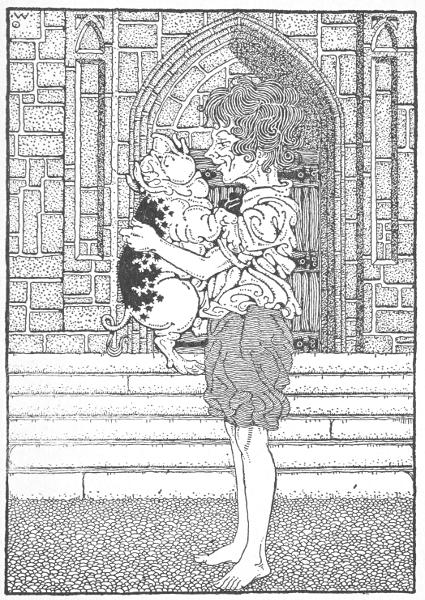
Snythergen’s mother was poor—so
poor that she did not feel able to support
her baby boy. So she put him in
a basket—it had to be a large one—and left
it on the doorstep of a little old couple who
had long wished for a child.
The pair were very much surprised, not
only at finding Snythergen, but at his unusual
appearance. He was thin as bones and very
long—so long that he appeared to be wearing
stilts. His body was very ungainly and the
couple’s first feeling was one of disappointment—until
they looked into his eyes. These
were bright and roguish and something else
not easy to name—something that made them
know he was their child, and they loved him.
The new papa and mamma were very proud.
First of all they wanted their boy to fill out
into a healthy well-fed child, so they stoked his
neglected stomach with the richest of farm
foods. The effect was prompt. It was amazing
how Snythergen changed from day to day.
His cheeks rounded, his shoulders broadened,
and the layers of flesh spread over his lean
trunk until he was as bulging as a rubber ball.
He was getting enormous and his parents were
beginning to sense a new danger.
“He will burst if he keeps on getting fatter,”
said his mother anxiously.
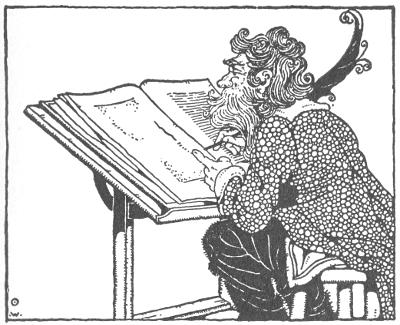
“I must study the question,” said his father,
who was a philosopher.
One day the father came in much excited.
“I know what it is that makes baby so fat!
He eats the wrong kind of food. His diet is
too round. It is all pumpkins, potatoes, tomatoes,
eggs, oranges. Now to get thin he should
eat thin foods, like celery, asparagus, pie-plant,
and macaroni.”
So they fed him long slender foods, and he
began changing at once. He shot up almost
as fast as Jack’s beanstalk, until they were
alarmed for fear he would never stop shooting
up. He had grown until he could look into
the second story windows standing on the
ground, and could place his hand on the top
of the chimney without getting on tiptoes.
Again it was time something was done, and
they sat down to think the matter over.
“I have it,” said the papa at last. “Son must
not eat all round nor all slender foods! The
two must be mixed!”
So they mixed them just in time to save Snythergen
from shooting up like a skyrocket.
But by the time his growth was arrested he was
altogether too big for a boy.
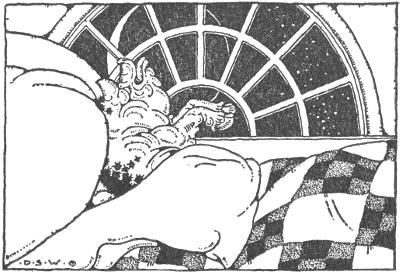
There was no room in the house large
enough for him to sleep in and he could not
go upstairs; the passage was too small and the
ceiling too low. But they found a place by
letting his legs and body curl around through
the hallways and connecting rooms of the
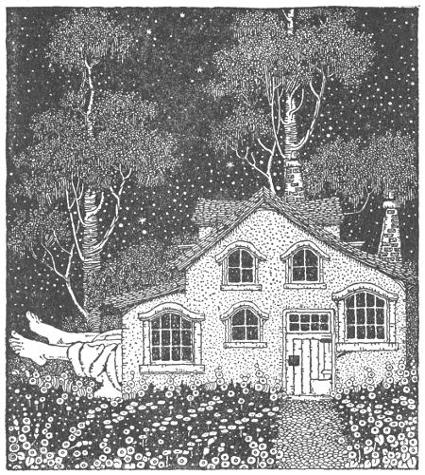
ground floor. His head rested on a pillow in
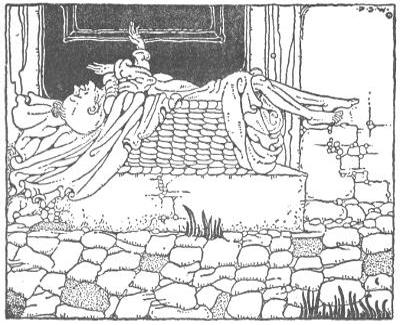
the living room and his feet projected out of
the window in the butler’s pantry. Every
night before he went to bed his mother tucked
him in carefully, unfurling a roll of sheets and
quilts that had been sewed together and were
long enough to stretch from his feet to his
neck.
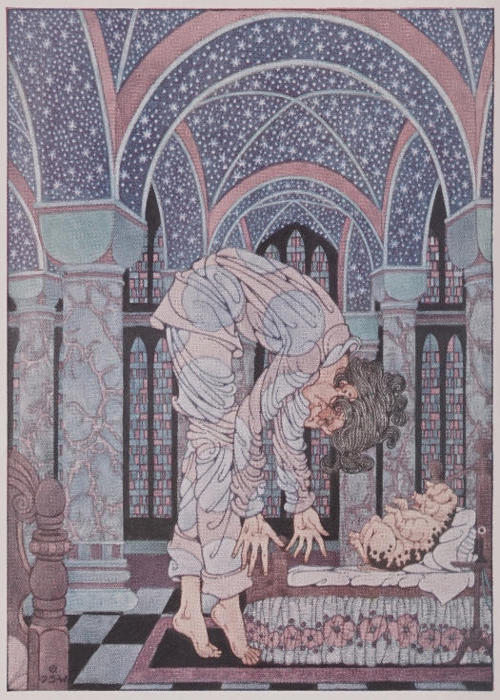
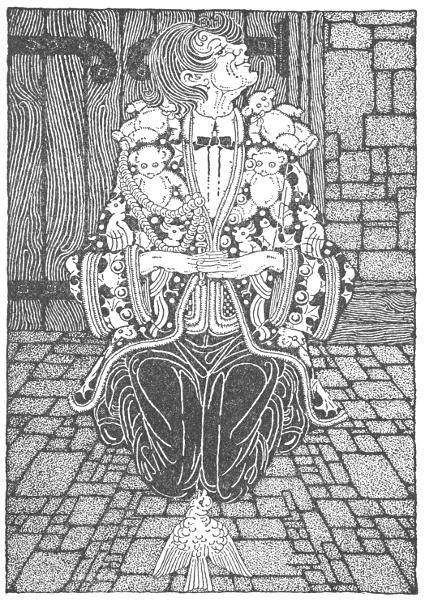
His father would stand on one hand and his mother on the other
Before he left for school in the morning his
parents always kissed him good-by affectionately.
The parting took place outdoors in
front of the house. Snythergen would bend
over and place his broad hands on the ground,
palms up. His father would stand on one
hand and his mother on the other, holding
tightly to their son’s coat sleeves. Then Snythergen
would raise his arms, lifting his parents
until they were on a level with his face.
“Now be a good boy, Snythergen,” said the
little father, “or I shall spank you severely!”
“Of course he will be a good boy,” said the
mother, as she leaned over and kissed him.
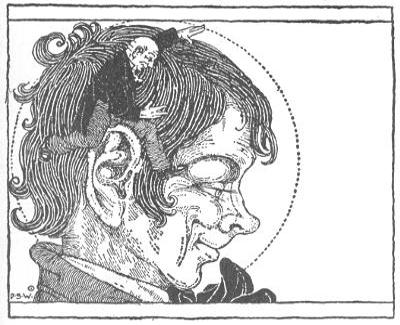
Then the papa would climb up his ear and
place his hands on his son’s head and give him
his blessing. Snythergen would then lower
both parents gently to the ground and start for
school.
Snythergen was nearly always late in starting
for school. He seldom slept well, for his
bed was uncomfortable and he could not turn
over or even change his position, without injuring
the house. Every night before going
to sleep he would resolve to be up early on the
morrow, but regularly failed. And one morning
he arose so very late that it was necessary
to find a short cut if he were to arrive at school
in time.
What could he do? He tried to think of a
scheme while collecting his books. Bending
over to pick up his slate pencil, he placed his
head between his heels, just for the fun of it.
And this gave him an idea! With his head still
in this position, he bent his body into a circle
making a hoop of himself. Then he began to
roll down hill across the fields, slowly at first,
then faster and faster, then so fast he could
not stop. He bounded over fences and ditches,
until, all out of breath and very much flushed,
he found himself at the school house door!
This short cut saved him at least a mile, and
it was such fun rolling down hill, he went that
way every morning thereafter, rolling up to
the door just as the school-bell was ringing—to
crawl into the passage on his hands and
knees.
There was not room enough for Snythergen
to stand up in school, so the janitor cut a trap
door beside his desk so that his feet extended
into the basement. Even then he stood taller in
the school room than the other pupils. But he
would have managed very well had the janitor
not been absent-minded and near-sighted. He
seemed never able to remember that those long
shanks were legs—not pillars. Again and
again he would tie the clothes-line to them,
and on wash days when Snythergen went out
at recess, usually he trailed a piece of clothes-line
behind each leg, with the washing hanging
on. And the janitor got such a scolding from
his wife for this that he grew to dislike Snythergen
almost as much as Snythergen disliked
him.
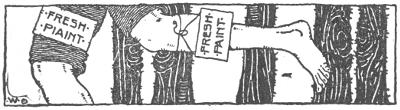
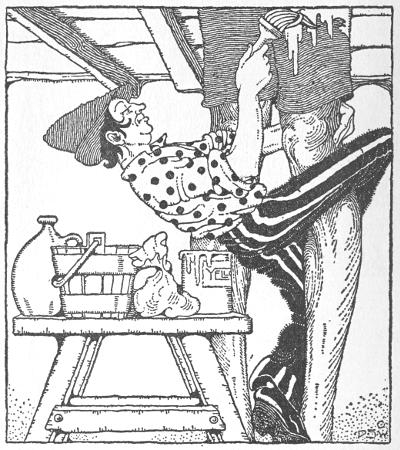
One morning the janitor painted the basement.
And when Snythergen went out at recess
his legs were a brilliant yellow and pinned
to each was a sign: “Fresh Paint.” That day
he had an easy time playing tag, for no one
wanted to get smeared with paint badly enough
to touch him.
One day the janitor was so forgetful as to
start to drive a nail into one of Snythergen’s
legs. This was too much! The poor boy
jumped out of the cellar, and in rising thrust
his head through the roof. So angry was he,
he hardly knew what he was doing. He
stepped over the walls carrying the roof with
him, then tossed it on the ground and hurried
away. “I won’t, won’t go back to school,” he
kept saying to himself. Rather than go back
and face the ridicule of his schoolmates he decided
to run away.
CHAPTER II A TICKLISH TREE
For some time Snythergen had been
thinking of running away and had
planned to go to the forest and live
with the trees, whose size was about like his
own. While waiting for the time to arrive,
he had made himself a disguise—and a very
good one it was, too,—it was a suit of brown
and green that made him look just like a tree.
For a long time he had kept it hidden in some
bushes. Yes, he had quite made up his mind
to run away.
He went home that night and looked into the
upstairs windows for a last sight of his dear
mother and father. His father was already
asleep when he arrived, but his mother was sitting
anxiously by the window waiting for her
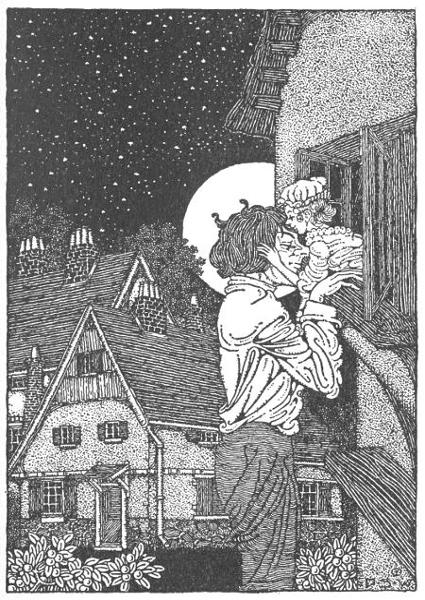
little boy to come home. He rubbed his nose
on the glass until she noticed that he was there,
then placed a finger to his lips cautioning her
to be quiet. She raised the window softly and
whispered:
“Snythergen, what is the matter?”
“Mother, dear, I am going away. I cannot
stand going to school any longer. I am too
big and they are beginning to laugh at me. I
was never meant for a student anyway. I am
going to live in the forest with the trees. They
will not make fun of me. I have made myself
a suit of bark and branches which makes me
look just like one of them. Some day I will
come back to you and take you to my new
home. But now I must leave you and go and
seek my fortune!”
Like mothers the world over she knew how to sacrifice herself when
it was for the good of her child
The poor mother’s heart was almost breaking.
The tears streamed from her eyes, but deep
in her heart she knew it was best for him
to go. Like mothers the world over she knew
how to sacrifice herself when it was for the
good of her child. She kissed him again and
again. Just then the father turned uneasily
in his sleep.
“Hurry, hurry, my darling boy! If your
father hears you he will give you a terrible
spanking.” As he rushed away, great tears
were dashed from his eyes by the branches of
tree-tops.
Snythergen went straight to the forest and
very early the next morning dressed in his
suit of green and took his place as a tree. For
a long time he stood very still, holding his
branches out and waving his leaves in the
breeze. “I wish something would happen,” he
said to himself. “It certainly bores one to be
a tree.” He had been standing there since
daybreak and the sun was now high in the
sky. The birds as yet had not lighted on him.
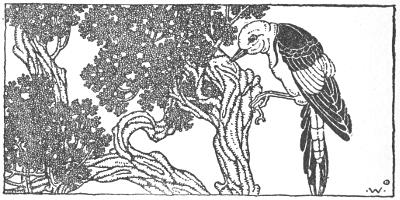
Some instinct made them hesitate. At last a
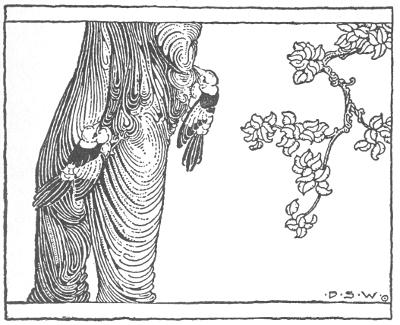
daring woodpecker approached his trunk, and
began a series of sharp pecks. Snythergen
stifled an “ouch” and made a wry face. The
first woodpecker was followed by others.
They attacked his bark until it itched and
smarted all over. In spite of his discomfort
he tried to stand very still for he thought it beneath
a tree’s dignity to show its feelings.
Unfortunately Snythergen was ticklish and
whenever the birds touched a sensitive spot he
could not help wiggling. This frightened the
woodpeckers for a while and they flew to a
neighboring limb to gaze at the strange tree.
But as soon as they stopped tickling Snythergen
always stopped shaking. This puzzled
the birds. They could not understand why
they felt the tree shake when they pecked, but
could not see it move when they stopped to
look at it. Finally they decided that they only
imagined it moved, and after that they did not
fly away unless the wiggling was very violent—which
it was whenever a bird happened to
blunder upon Snythergen’s “funny bone.”
Snythergen was beginning to realize that the
life of a tree is not all joy. Hardly could he
wait for night to come when the birds would fly
away. In the meantime he tried and tried to
think of a plan to outwit them. “I have it!”
he whispered to himself at last.
When it was quite dark he pulled off his tree
suit, and went to a near-by town to purchase
several xylophones. These are musical instruments
with keys usually made of wood, and
played on with a little mallet. Snythergen took
the keys apart and strung them about his trunk
so that they hung about him like a skirt of mail,
to protect his bark from woodpeckers. The
next morning when the birds began to circle
around him, he smiled to himself. When one
of them lighted and began pecking away, a
cheery sound came forth. And when the others
followed his example the whole tree became a
bedlam of musical jingles. “Peck away, peck
away!” said Snythergen to himself, “you cannot
hurt me now!”
It was not long before the strange sounds issuing
from the tree attracted all the wild life
of the forest. The air became almost black
with flying things, and the ground was swarming
with animals little and big. Even a bear
came along and Snythergen trembled from roots
to peak leaf. How he wanted to run home to
his mother! It would be easier to go back and
face his schoolmates than to stay alone with a
bear. But at heart Snythergen was really a
brave little boy and his courage soon returned.
He had set out to be a tree and he made up
his mind he would be a worthy one. He did
not want the forest to be ashamed of him. “I
must not be the first tree that ever ran away. It
would set all the others such a bad example!”
he thought. So he held his teeth together very
firmly, and stood up ever so straight and stiff.
“I must appear calm and unconcerned,” he said
to himself, but his heart beat so rapidly and
thumped so loudly he thought the bear must
surely hear it. But the big brute was too much
absorbed in the strange concert to think of anything
else, and did not suspect that a spare-ribbed
boy trembled behind a disguise of bark,
boughs and leaves.
After a while the novelty wore off and the
bear went about his business, much to Snythergen’s
relief. The others, too, felt easier when
the big brute was gone, and crowded more
closely about the strange tree.
His feet projected out of the window in the butler’s pantry
CHAPTER III PLAYED ON A MUSICAL SKIRT
A thoughtful appearing goldfinch
hovered about the strange tree. He
would sit long in one of Snythergen’s
branches as if lost in a golden study. Occasionally
he would peck at the various wooden
keys and listen critically, but the sounds he produced
were sickly compared to the woodpeckers’
ringing tremolo.
“I wonder what he’s up to,” thought Snythergen.
“Some deviltry, I’ll wager! He
seems a wise little bird. Evidently he’s planning
to do something to me. I suppose I’ll
find out what it is when he gets ready to let
me know, and not before!”
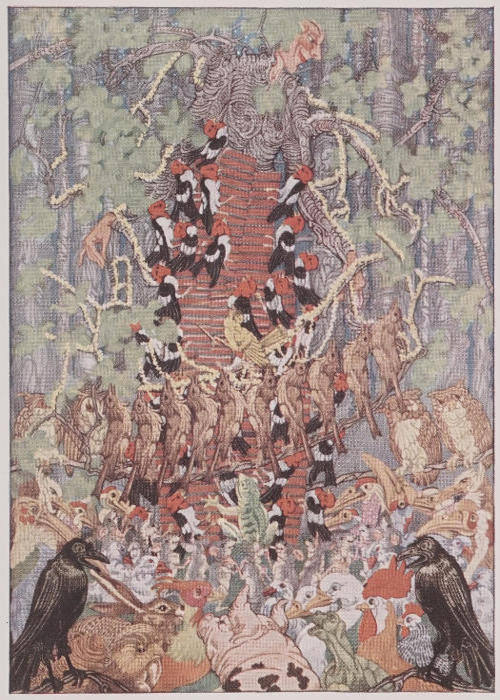
The goldfinch flew among the woodpeckers
and assembled about two hundred of them in
Snythergen’s branches. Then he made them
a speech.
“He is explaining his project,” thought Snythergen.
The finch would flit up to a key,
peck it and return to his branch, chirping animatedly.
When he had finished the woodpeckers
tossed their heads and chorused something.
Snythergen could not decide whether
it was an oral vote or a cheer.
“The meeting must be over,” thought Snythergen,
relieved. But his relief was short-lived.
The entire flock flitted down, landing
on his trunk, and covering it until there was
a bird stationed beside each xylophone key.
“Whew,” gasped Snythergen. “It wouldn’t
be so bad on a cold wintry day, but this is no
time of year to be smothered in an overcoat of
xylophones and birds!”
His sap coursed feverishly through his trunk
and the veins of his leaves. He fanned his
moist bark cautiously with his upper boughs.
The birds were too absorbed in their scheme,
whatever it was, to pay any attention to the
tree’s unusual motions.
Snythergen was almost suffocated with heat.
“Why don’t they tar and feather me and be
done with it!” he groaned. “It amounts to that
anyhow, for my sap is as hot as tar—and as for
feathers!”
Here he paused, struck by the sweet sounds
issuing from his trunk. The goldfinch was apparently
leading an orchestra of woodpeckers
and they were playing bird calls!
“So this is your scheme,” thought Snythergen.
“Not a bad idea at all!” A cool breeze
had just sprung up from the north, enabling
Snythergen to cool off and enjoy the performance.
The finch was perched on a central
limb and was pointing his bill at the different
players when he desired them to respond. He
was standing on one leg. With the other he
beat time, using a tiny twig as baton. The
music attracted many birds and animals and
the goldfinch made them a speech. As nearly
as Snythergen could guess from his gestures the
little bird said something like this:
“We’re going to give a symphony concert to-night
shortly after bug time! Everybody is invited
to come and bring his family and friends.”
Preparations for the concert were in progress
all day. An hour before the audience was admitted
the western sky was ablaze and the animals
thought the forest was on fire. But it
was only a cloud of fireflies coming to light the
concert. When they arrived the business manager
(an intelligent crow) directed them to
stand just touching each other along all the
branches, twigs and leaves of the tree, until
Snythergen sparkled from roots to peak with
thousands of points of light. The branch on
which the goldfinch perched was lighted more
brilliantly than the others. Festoons of acrobatic
fireflies holding together hung down from
it like ropes of light.
It was inspiring to hear this chorus accompanied
by full orchestra
At the appointed time animals and birds were
admitted to the reserved space about the tree.
Crow ushers kept order and showed each one
where to sit. Birds were admitted to all but
the stage branches of the tree, and they covered
every part of Snythergen unoccupied by
fireflies. At first the fireflies were afraid of
the great birds that stood close enough to touch
them, and they would have flown off in terror
if the crows had not watched over and protected
them. By this time the ground was
black with animals. Not only every seat, but
every inch of standing room was taken. By
eight o’clock every member of the orchestra
was perched at attention. Beside every xylophone
key a woodpecker awaited the signal to
begin.
When all were seated the goldfinch walked
proudly forth from his dressing room of leaves
and took his position in the center of the stage-limb.
He was indeed a handsome fellow. His
gay head-dress was gracefully arranged. His
feathers were as smooth as satin, and his manicured
claws shone in the light of the fireflies.
His entrance was greeted with tremendous
applause and he had to bow again and
again. When it was quiet, he raised his baton
and bill together and gave the signal. The concert
began. All listened breathlessly to the
wonderful strains. Aside from the music there
was not the faintest sound of animal, bird or
insect in the forest. Even the trees kept tight
hold of their leaves, to keep them from rustling
in the breeze.
Before the concert was over the call of nearly
every being present had been given by the
orchestra. The meadow lark’s song was encored
again and again. It was so short it was
over in a jiffy and the audience could not get
enough of it.
Once during the evening the leader was
worried for a moment. In a front seat he had
spied an old frog and he knew his bass woods
did not go low enough to imitate the frog
song. So when an usher came up and whispered
in his ear that the frog was stone deaf
and would not know it if his call were omitted,
he was very much relieved. Happily the old
fellow was the only frog present.
The favorite number proved to be the brown
thrasher’s song. It was long enough to make
a piece, and seemed just suited to xylophones.
Since Snythergen wore at least twelve of these
instruments in his skirt of mail, there were
enough different keys to provide soprano, alto,
tenor and bass. The audience was much
stirred by the wonderful performance, and the
leader as a compliment to the brown thrashers
directed the ushers to conduct all of them present
to a stage limb just beneath him. They
were lined up in a row and firefly foot-lights
shone upon a long line of feathery breasts in
front and straight slender tails behind.
It was inspiring to hear this mighty chorus
accompanied by full orchestra, in one of the
most beautiful of bird songs. No wonder birds
and animals clapped until their claws and paws
ached, and when the concert was over, refused
to go home until the leader announced another
performance next week.
“Well, at last,” said Snythergen, when all
had left, “I can have a moment’s rest. There
won’t be another concert if I can help it—and
I think I can!”
CHAPTER IV A BIRD AND A TREE PLAY AT HIDE AND SEEK
Snythergen took off his suit and lay
upon the ground. In a minute he was
fast asleep. Early the next morning he
arose and put on his tree suit but not the xylophone
skirt. It was a hot day and it would be
cooler without that. And he believed that
after their hard day the woodpeckers would
sleep till noon. He was right. Not one came
to disturb him in the morning. But without
them there were plenty of curious eyes staring.
For the birds and animals could not understand
the change that had come over the strange
tree.
The goldfinch did not sleep as late as the
woodpeckers, for he did not believe in lying
abed in the morning even if he had been up
late the night before. When he saw that the
tree no longer wore its skirt of xylophone keys
he studied Snythergen curiously, hopping from
twig to twig and pondering. He discovered
that this tree was much warmer than the others—for
the heavy tree suit made Snythergen very
hot. The little bird wondered if the strange
tree would not be a good place in which to build
a winter home. This would save him going
south every year. In place of a one-room nest,
why not build a mansion? He flew away excitedly
to draw up the plans.
“At last I can enjoy a little peace,” murmured
Snythergen and dozed off for a standing nap.
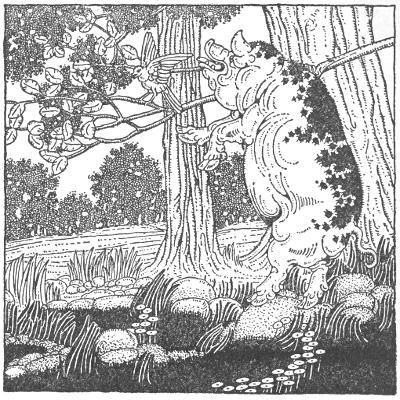
When he awoke, it was with a start. “Stop biting
my toes,” he cried. Glancing down he saw—a
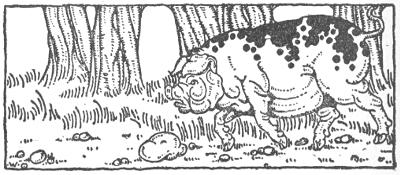
pig! “He must be hungry,” thought he.
“Well, I’ve eaten enough pig in my day. It
would only be fair to let one of his kind have
a bite of me. But I am thankful his teeth are
not sharp. The bites feel like little pinches.
I hope he is enjoying himself, but now he is beginning
to damage my costume!” He gave a
kick and the pig jumped back, so frightened
that his hair and his tail stood pompadour. He
was pale and trembling and his little eyes grew
big and round.
“What in the world is the matter with that
tree?” he exclaimed. “I thought it moved!”
It was now Snythergen’s turn to be surprised.
“Can he talk, the little rascal? Now how did
a pig ever learn to talk? I must investigate.”
Evidently the pig liked the taste of bark; and
as Snythergen stood very still the pig’s courage
returned. He approached the tree once more,
and was just about to take a really good bite
when Snythergen cried, “Don’t do that!”
“Who said that?” cried the pig, startled.
“Why, I did, of course.”
“Who are you and where are you?”
“Can’t you see, you simpleton!” said Snythergen.
“I am the tree and I want you to stop biting
my roots.”
The pig did not wait to hear more. So
frightened was he that he ran away as fast as
he could.
“Come back,” shouted Snythergen, “come
back after dark and we can visit without being
seen.”
Soon the little finch returned with plans all
drawn, and set to work to build in one of the
strange tree’s branches. This made Snythergen
anxious for he did not fancy having his limbs
tangled up in nests. And when the finch flew
farther than usual in search of thistle down,
Snythergen strolled softly to an open space several
hundred feet away behind a hillock.
When the finch returned he could not find
the tree. Nearly frantic he flew wildly about in
circles; then darted across in diameters. Was
he dreaming? He all but lost his reason and
contracted a painfully stiff neck. “That tree
must be somewhere!” he exclaimed, and turning
suddenly he would charge the spot where
it had been, as if to take it by surprise. Then
he described larger and larger circles until at
length he came upon Snythergen’s hiding place.
Joyfully he returned to his work careful this
time not to let the tree out of his sight. It was
now Snythergen’s turn to be perplexed. How
was he to dodge that energetic nest builder!
For every time he attempted to take to his roots
there were those sharp little eyes regarding him.
“No chance! That is the most suspicious
goldfinch I ever saw!” he sighed.
Snythergen cried, “Don’t do that!”
The nest was progressing alarmingly. The
fuzzy material tickled Snythergen’s limb, and
every time he tried to rub it, the goldfinch was
watching.
“Is there no way to get rid of the little pest?”
he groaned. “Can’t I ever get him to turn his
back long enough for me to rub my itching
limb? My, but he must love me, the way he
keeps staring all the while! If this keeps up
much longer I’ll get the St. Vitus’ dance.”
He remembered that the finch had gone a
long way off for milkweed silk and thistle down
with which to line his nest, and it was while he
was searching for these that Snythergen had had
his chance to hide.
“I’ll just pull out some of that fuzzy stuff
and put it in my pocket the next time birdie
turns his back,” he chuckled. “When he sees
it is gone he will go for some more, and when
he comes back—well, there won’t be any tree
or any nest to welcome him!”
This thought amused Snythergen so much
that he almost gave himself away by laughing
out loud. Luckily the finch thought it was a
child in the woods and turned his back to see.
And the moment he did so Snythergen jerked
out most of the fuzzy stuff and put it into his
pocket. When the finch saw the damage he was
very much puzzled.
“Bless my feathers! Now how in the world
did that happen?” he said. “This place must
be bewitched!”
He looked around, painfully twisting his
neck, then sat still on a branch for a long time,
watching and thinking, but he failed to find a
single clue leading to the cause of the damage.
At length he gave it up and went to work to
repair it. First he looked all around carefully,
then dashed away to the place where the thistles
grew, planning to grab a billful of down and fly
back in the briefest possible time. But the moment
he was out of sight Snythergen took to his
roots and ran toward the place where he had told
the pig to meet him, tearing off his tree suit as he
ran, and he had barely gotten out of it when
the finch flew screeching by.
“This time I fooled you,” thought Snythergen,
as he stretched out on the ground for a nap.
CHAPTER V HOW A PIG LEARNED TO TALK
Snythergen dreamed that he was sitting
on a pier, dangling his feet in the
water. Little fishes were nibbling his
toes, when suddenly a large one darted up and
took a bite that hurt. Raising both feet
quickly, he woke up.
“You don’t need to be so rough,” said the
pig, who had been bowled over by the raising
of Snythergen’s feet and lay on his back, waving
his legs in the air.
“It’s you, is it! Up to your favorite trick of
biting my toes! Well, it serves you right. Of
course I am glad you like me, but I wish you
would show your affection in some other way!”
“Oh,” cried the pig. “So you were the
strange tree that kicked me and spoke to me!
I recognize you by the taste of your toes. But
how was I to know that the last time I nibbled
you, you were a tree,—unless I nibbled you
again to find out?”
“In that case, I’ll forgive you,” said Snythergen,
“and I hope you’ll overlook the fright I
gave you.”
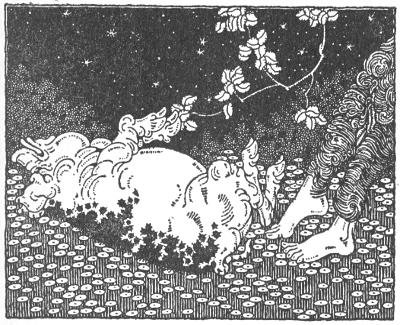
They lay on the ground side by side and gazed
up at the stars.
“Tell me, how did you learn to talk?” asked
Snythergen.
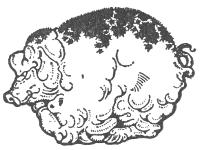
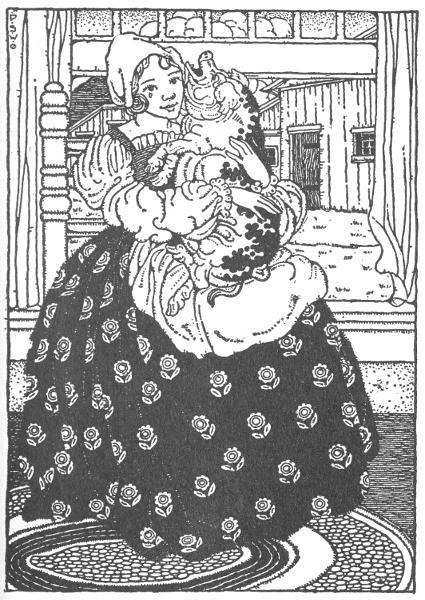
“The farmer’s wife taught me,” said the pig.
“Why did she do that?”
“Because I was hungry.”
“That’s no reason. They give people food
when they are hungry—they don’t teach them
to talk.”
“This woman did. She would not give me
anything to eat until I learned to ask for it.
And as I was nearly starving I learned rapidly,”
said the pig. “As soon as I could ask for things
I gained in weight, and when the farmer saw I
was getting fat he asked his wife to keep right
on feeding me so that—”
“Yes,” said Snythergen.
“So that they could eat me for dinner!”
faltered the pig, dashing a tear from his eye.
“Then what did you do?” asked Snythergen.
“I ate as little as possible until the farmer’s
wife saw I was getting thin again. Then she
told me to eat all I wanted and not to worry.
She said she would manage somehow so—they
would not have to—eat—me for dinner! I
trusted her and after that enjoyed three good
meals a day. You see she had taken a fancy to
me because I kept myself looking neat, and tried
to be gentlemanly. She called me ‘Squeaky’
and treated me like a child of her own. Little
by little I began to understand what she said,
and learned to talk.
“One day the farmer’s wife was sitting by the
window sewing. The farmer had gone to
town. I trotted up as usual for a chat, but instead
of chatting—
“‘You must go away,’ she said, with a catch
in her voice, ‘for my husband says we must have
you—for—dinner—to-morrow!’
“She could hardly say the words. We looked
at each other sadly. Then she took me in her
arms and squeezed me so tightly I thought she
would break my bones; and I would not have
cared much if she had. To die in her arms
would have been a happier lot than leaving her.
“‘But surely I may come back some day,’ I
managed to say, ‘or send for you when my fortune
is made.’
“‘I’m afraid not,’ she faltered.
“I cannot tell you any more about our parting.
It was too sad. Somehow I survived it—I
suppose because I was young and the world
lay before me.
“A farmer’s buckboard approached in the
rough lane, thumping over the frozen ruts, announcing
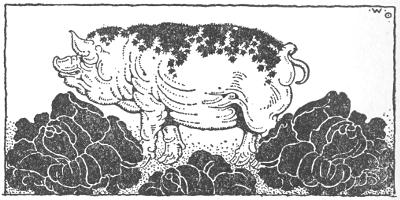
its coming long in advance. I hid in
the cabbage-patch. The farmer’s wife stopped
the vehicle and gossiped with the driver, to give
me a chance to climb into the back and hide.
To die in her arms would have been a happier lot than leaving her
“It was not easy to scramble up into the
vehicle, for I was fat, and could not get a foothold.
I tried using the spokes of the wheel as
a ladder, but kept slipping and falling back. I
knew one side of the wheel would go up and
the other down when the wagon started, but
could not figure out which side did which.
However, I decided to take a chance. Taking
a firm grip on one of the lower spokes I braced
my feet on the one below it. It happened to
be the right side of the wheel. So when the
vehicle started the spoke I was holding to began
to rise, carrying me up nearly to the top of the
wagon. Bracing my legs, I gave a leap that
landed me in the buckboard upon some empty
potato sacks. Hurriedly selecting one I
crawled into it.
“The farmer thought he had heard something
fall into the wagon, and stopping his horses, he
glanced back. I was hidden by this time but
he saw a bulging under the pile of sacks and
was about to poke into them when I said, ‘Please,
Mr. Smythers, let me stay here until we get
by those boys in the road. I am hiding from
them.’
“When he heard my voice Mr. Smythers, of
course, took me for a boy and he answered:
‘No, you cannot stay there. You will smother.
Come out and I will protect you from the boys.’
“Receiving no reply he poked about among
the sacks until he found the one I was in.
“‘Why, it’s a pig in the bag instead of a boy!’
he cried in great surprise. ‘Well, I’ll soon fix
him so he can’t get away!’ and he tied up the
opening with a string. ‘But where is that boy
that spoke to me just now?’
“Mr. Smythers looked under the wagon,
searched both sides of the road, and even the
trees, but of course found no one. Greatly perplexed
he got into his buckboard and drove on,
glancing back every few minutes to see if there
wasn’t a boy around somewhere. After he had
driven about a mile he ceased looking around,
and as we were going through a dense forest, I
decided to try to escape. The bag I was in had
a hole in it (that is why I had chosen it), and it
was not difficult to make the opening larger by
tearing the rotten threads. Little by little I
squeezed myself out, and dropping off the back
of the buckboard, fell in a heap in the road.
“‘Now I am free,’ I thought, and I wandered
deeper and deeper into the woods until I found
you.”
CHAPTER VI THE HOUSE AT THE END OF A ROPE
“Hm,” said Snythergen when Squeaky
had finished his tale, and for some
time he remained silent. At last he
spoke.
“I think we had better build a house!”
“Good,” said Squeaky, “but is this a safe
place? Didn’t I see a bear in the crowd you
attracted?”
“Yes, but I don’t think he’ll come back. If
he does my tree suit will save us. I can bend
over until my limbs touch the ground. Then
you can climb into my top branches and I’ll
lift you out of danger. The bear will take me
for a tree and leave us alone.”
So they set to work very promptly. The
plans they drew called for a round house. And
to make sure it would be big enough for Snythergen,
he lay on the ground curling up in the
smallest space he could, and Squeaky traced a
line around him in the dirt to mark the position
of the outside wall. They planned to make
the roof high enough for Snythergen when he
was lying down, but of course he would be unable
to stand up or even to sit up without bumping
his head on the ceiling. The outer circle
just inside the wall was to be Snythergen’s bedroom,
and Squeaky was to occupy the space in
the middle. It took several weeks to build the
house and before the paint was quite dry Snythergen
spread pine boughs over the ground
floor to make a soft place for them to lie.
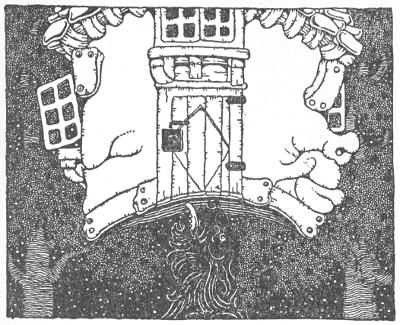
The house was left dangling above ground to
receive an airing out
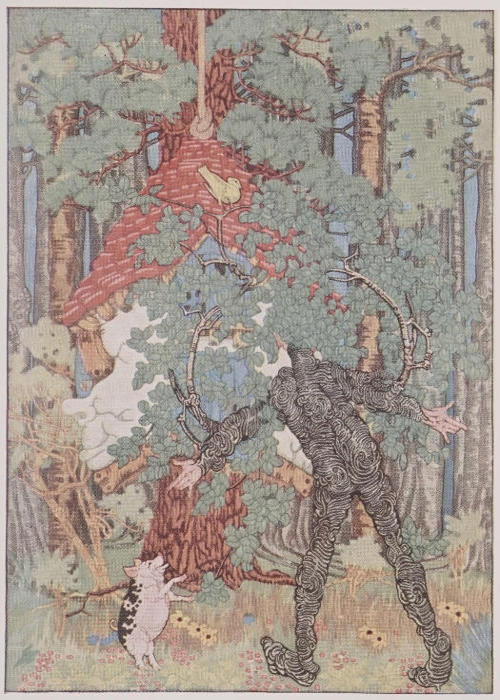
In the center of the roof was a hook to which
was fastened a rope running up over a pulley
attached to the top of a pine tree. From the
other end of the rope hung a huge boulder, just
as heavy as the house. The stone and the building
balanced each other so nicely that a little
pull would send the house up or down. In
the daytime the house was pulled up and left
dangling above the ground to air out. At
night when they went to bed Snythergen would
lie down, bending himself into the exact shape
of his bedroom by following a line marked out
on the ground; and when he lay in just the
right position so that the house when lowered
would clear him, Squeaky would crawl over
him into his little nest. Then Snythergen,
reaching up, would pull the house down over
their ears, making them snug and cozy for the
night.
While they had been at work on their new
house a most persistent little bird had followed
them around, perching on a near-by tree or
bush. He appeared to listen to their words
and moved his bill as if practicing the sounds;
and sometimes he would make the strangest
noises! Squeaky, always glad of a chance to
visit, fell into the habit of talking to the bird.
It did not occur to him that a goldfinch would
not be able to understand; besides the little fellow
stood so still when Squeaky spoke to him
he seemed to be taking it in.
“Do you understand me?” Squeaky would
ask impatiently.
A strange sound not unlike “no” was the
response.
“Then you do understand!” said Squeaky.
“No,” it came unmistakably now.
“Evidently the finch wants to learn to talk,”
thought Squeaky, so he began to instruct him.
He knew well how to set about it, for he had
learned himself only with the greatest difficulty.
He used the silent speech method—that is, he
had the finch go through the motions of saying
the words with his bill and throat, without actually
making a sound. It was a good way to
learn, but amusing to watch. The first day the
goldfinch learned to make the motions for several
words. When he did “cat” how he shuddered
and flapped his wings as if to fly away
in a hurry. How his bill did water and what
a hungry gleam came into his eyes when he did
“worm”!
Because his teacher would not permit sounds
at first, the finch learned to put great feeling
into his gestures and the expression of his face.
And in time when he had learned to talk this
assisted him greatly with animals and birds
ignorant of the language. For those who did
not understand what he said, knew what he
meant by his gestures. After he had been instructing
the finch for a fortnight and had come
to like him, Squeaky decided to ask Snythergen
to invite the little bird to share their quarters.
“He is such a sensible little bird,”
thought Squeaky, “if he behaves well to-morrow,
I’ll ask Snythergen’s permission then.”
That was the day the house was completed
and that night the owners were very tired.
They slept soundly until three o’clock in the
morning when something woke them.
“What was that?” asked Squeaky in a shaky
voice.
“It sounded like a growl,” said Snythergen,
and his trembling was so violent it shook the
house. Thereafter no more sleep was possible
for either, but the sound did not return. When
morning came they investigated and found bear
tracks leading to the door.
“What shall we do?” asked Snythergen.
As usual the finch was perched on a branch
listening, standing so close to Snythergen’s ear
that his wing rubbed against it.
“Who’s tickling my ear?” said Snythergen,
looking around. But the finch had hidden behind
a leaf.
“What do bears want?” asked Squeaky.
“To make trouble, I guess,” said Snythergen.
During the building of the house Snythergen
had been so busy he had not even noticed
Squeaky’s little friend. Now the finch wished
to join in the conversation, for his teacher had
just given him permission to speak out loud.
He wanted to celebrate his first spoken words
by saying them at the top of his voice, so pushing
his little bill into Snythergen’s ear, he
screamed:
“Bears don’t want to make trouble, they
want food!”
Snythergen jumped as if a bee had stung
him.
“What was that!” cried he, looking around
and seeing nothing. For again the finch had
hopped behind a leaf.
“It’s my good friend, the goldfinch,” said
Squeaky. “I want you to meet him. I have
been teaching him to talk, and you heard the
first words he has spoken out loud. Don’t you
think he did them rather well?” he asked, proud
of his pupil.
“If loudness is an indication I should say he
did, most decidedly,” said Snythergen, whose
ears were still ringing. “If he keeps on improving
they can hear him in the next county!”
“Come,” said Squeaky, looking around for
the finch, “I want you to meet him.” At
Squeaky’s request, the finch came out of his
hiding place and was presented.
“If it isn’t the little goldfinch!” exclaimed
Snythergen in surprise, and he burst out laughing.
“What are you laughing at?” asked the finch
suspiciously.
“I was just thinking how difficult it seems
to be for some birds to find their way back to
their nests,” said Snythergen.
At this the sensitive bird flushed a brighter
gold and hung his bill dejectedly.
“I suppose trees look a good deal alike,” continued
Snythergen mockingly, “and that is why
it is so hard to find the one your nest is in!”
Too confused to answer, the finch made up
his mind to question Squeaky when they were
alone, and at the first opportunity told the pig
of his adventure with the strange tree. When
Squeaky explained that Snythergen had a costume
of bark, branches and leaves, the little
bird understood how the “tree” had been able
to hide from him, and why he had been unable
to get any trace of his nest. Though he felt
indignant about the way he had been treated,
he decided for the present to say nothing and
bide his time.
CHAPTER VII BEAR ON ICE
The goldfinch stayed close to his new
friends and in the end they accepted
him as one of them. They named him
“Sancho Wing” and built him a little house on
the roof of their new home. In many respects
it was not unlike the permanent nest the bird
had planned to build in one of the strange tree’s
branches, but it was made of regular building
materials—not woven of twigs and weeds—though
Snythergen remembered Sancho Wing’s
weakness for soft things, and caught and
saved all the thistle down and milkweed silk that
blew against his leaves to use for lining the walls
and floors. The living rooms were down stairs,
but in the garret above there was ample space in
which the finch might store stray bits of string,
odd twigs, and curious little things he found in
the woods—for Sancho Wing was an eager collector
of curiosities. But the most interesting
thing about the house was its watch tower, which
rose to a dizzy height—even for a bird. For it
was intended as a look-out from which Sancho
might keep a sharp watch for the bear.
Sancho Wing was far too curious a little
bird to sit quietly at home and wait for things
to take their course. So, in addition to scanning
the horizon daily for signs of the bear,
he searched the forest over until he located
the cave in which the beast lived, and actually
flew into it. As it was getting dark and the
beast was half asleep, he mistook the bird for a
bat and paid no attention to him. Although
very much frightened, Sancho hovered around
until the brute’s heavy snoring indicated that
he was fast asleep. Then hastening back he
assured Snythergen and Squeaky they might
now rest in peace, and retired to his own snug
feather bed.
The three friends had been living together
happily and unmolested by the bear for about
a month, when one Sunday at daybreak Sancho
Wing opened his eyes and wondered what had
awakened him. He listened. There was a
faint sound like the crackling of twigs. He
winged a few hundred yards into the woods in
the direction of the cave and saw the bear approaching.
Hastening back he pecked Snythergen
until he opened his eyes.
“The bear is coming! Get into your tree
suit at once, it’s your only chance!” said Sancho.
Snythergen pushed the house up out of the
way and jumped out of bed, calling to the pig.
But Squeaky would not wake up. He was
too fond of sleep ever to allow himself to be
disturbed before breakfast was on the table,
and always he slept rolled into a ball, his head
tucked under his body; and so tightly did he
curl himself up that he kept this position no
matter what any one did to him. Snythergen
might have rolled him on the ground or tossed
him into the air, without waking him. And
had he done so Squeaky would have recounted
these adventures afterwards as part of his
dream.
Therefore Snythergen did not waste time trying
to wake Squeaky, but hastened to arrange
himself in his tree suit. This done, he bent
over and with his top branches picked Squeaky
up and lifted him out of danger. Next he lowered
the house to the ground to make the bear
think it was occupied, and took his position as
a tree. Hardly had he shaken out his leaves
and arranged his branches when the beast arrived.
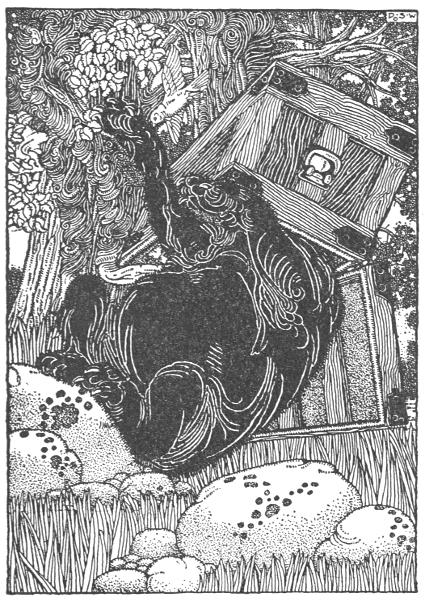
Casting an inquiring glance at the tree, the
bear entered the house in search of food. He
proceeded at once to the ice-box. Luckily (as it
turned out) the door was open. Before leaving
Snythergen had had the quick forethought to
put a piece of cheese in his pocket and had neglected
to close the ice-box door. When the bear
had eaten up everything that was handy, he
pushed his head far into one of the smaller
compartments of the box to reach a last morsel
of jam he had been unable to get before. This
time he succeeded and, licking his lips, attempted
to pull his head out.
He pulled and he pulled but he could not
pull his head out. It was caught in the opening,
and the harder he strained, the more firmly
the ice-box became attached to him. He
growled and he gnashed his teeth. He stood
on his hind legs and pounded the ice-box against
the walls, until Snythergen and Sancho Wing
feared he would knock the house down.
Through a window Sancho saw the bear bracing
himself for a mighty blow which, if allowed
to land, would surely break through the
wall.
“Quick, quick, pull the house up!” he called.
Grasping the rope with the twigs of a lower
limb, Snythergen gave it a jerk. And just as
the brute was delivering a terrific blow the
house shot up and the bear’s effort spent itself
in the air harmlessly, except that the big fellow
was thrown sprawling to the ground, with a
force that twisted his neck painfully.
For the moment Snythergen and Sancho
Wing forgot their own fears to laugh at the
beast’s comical state. Undoubtedly he was the
most surprised bear in the whole world. Thinking
himself still inside of the house (for whoever
heard of a house running away!), he felt
about for the walls, but there were no walls
there! The ice-box fastened to his head,
blinded him. Back and forth he stumbled,
groping in every direction. And the pounding
of the heavy box on the ground was giving
him a splitting headache.
After he had pulled the house up Snythergen
was not at all pleased to find the bear had eaten
up all of their food. And now he beheld the
intruder in a rage, bent on breaking their new
ice-box! He was so indignant, his branches
fairly itched to punish the clumsy brute. And
the moment the bear was in a favorable position
Snythergen crept softly behind him, stripped the
leaves and twigs from one of his stoutest limbs
and gave the beast a sound thrashing. As the
blows fell fast and heavy the bear yelled like a
sick puppy. But Snythergen closed his ears
to the sound, and not until he was out of breath
and perspiring did he conclude the brute had
had enough. Then his kind heart was touched,
for with the headache and the spanking, the bear
was aching and smarting at both ends.
“At least I can relieve his headache”
“At least I can relieve his headache,” thought
Snythergen, bending over to examine the ice-box.
There was still ice in one of the compartments.
Removing a piece Snythergen was able
to crowd it in against the bear’s head, and in
spite of the brute’s wiggling, placed it so it
rested against his forehead. Very gently the
beast settled down on his aching haunches, to
let the ice cool his throbbing brow. The ice-box
was still attached to him as securely as ever.
Apparently he had given up trying to free himself.
But the bear was not to rest in peace for
long. His head recently so hot now became
freezing cold. And the pain of it drove him
into a frenzy. Snythergen and Sancho were
about to come to his assistance when he charged
blindly forward and a lucky jump was all that
saved Snythergen from a fatal collision. The
bear rushed back and forth beating the ice-box
against the rocks and trees, not minding how it
hurt his neck and shoulders. His one desire
was to relieve the terrible freezing in his brain.
Snythergen quite understood all the bear’s
thoughts and now decided that the big fellow
had been punished enough. Grasping the rope
from which the boulder dangled, and swinging
it around his head, he brought it down squarely
upon the ice-box. This well-aimed blow split
open the box, freeing the bear’s head, but the
door frame still clung about his neck—an absurd
collar.
Stunned, lame, and aching, the poor bear
crawled into the sunlight to thaw out his brain
and to melt his frost-bitten thoughts. But the
sun did not melt his hard heart or calm his
rising indignation. He looked about angrily
for his persecutors. He strode threateningly
up to one tree after another, but they all stood
very still and wore the innocent look that comes
natural to trees. Snythergen, however, had not
been a tree long enough to look as unconcerned
as the others; besides he had a guilty conscience.
The bear may have smelled the cheese in
Snythergen’s pocket, or maybe something unusual
in his appearance made the beast suspect
him, for he came up and walked around and
around the tree until poor Snythergen was dizzy,
following with his eyes, and so frightened he
could hardly stand. Uneasily he swayed from
side to side, catching his balance just in time
to avoid a fall. The bear stopped, rubbed his
nose on Snythergen’s bark, dug a claw into it.
And Snythergen could not avoid a cry of pain.
Sancho Wing saw the danger his pals were in,
and realized that something must be done
quickly if they were to be saved.
“Throw the cheese to him!” cried the little
bird. Snythergen tossed it on the ground a few
yards away and the bear followed it eagerly,
gulping it down in one mouthful. Sancho
Wing thought he heard woodchoppers in the
distance and flew away to summon help. Soon
he found two men with axes and a rifle, and hiding
in some leaves, he called to them:
“Hello, hunters! there is a bear over there
near that shaking tree. Follow the sound of
my voice and you will easily find the place.”
The men were simple fellows, only too eager
to follow Sancho as he darted through the leaves
calling: “This way, this way!” They could
not see who was calling but supposed it was a
little boy who was keeping out of sight for fear
of the bear. Now that help was near, in the
midst of his anxiety Sancho could not avoid
chuckling. For he had thought of a way to get
even with Snythergen for the tricks he had
played on him about the nest. As he hurried
along he told the woodsmen, after driving away
the bear to cut down a certain tree. “You will
know it by the sleeping pig in its top branches,”
he said. Just then the bear saw the huntsmen
approaching and he did not wait for them to
come up, but made tracks before they could get
a shot at him.
CHAPTER VIII A RUNAWAY TREE
Snythergen gave a sigh of relief when
the bear went away and was just about
to step out and un-bark, when he heard
voices.
“This is the tree we are to chop down!”
Snythergen heard one of them say, and already
the woodchopper was swinging his axe. Snythergen
did not wait for the blow to land, but
leaped into the air and was off as fast as his roots
would carry him. To be sure, he was hampered
by his leaves and his branches and his
sheath bark skirt. Brushing none too gently
against bushes and trees he trod on the toes of
innumerable growing things. Apologizing
with his bows to right and left, he did not pause
even to see what damage he had done, nor did
he know he had stepped heavily on the roots of
an oak, or rubbed the shins of a birch. He
knew only that two woodsmen were after him,
threatening to chop him into kindling wood.
“Did you ever see such a rude tree?” cried
a graceful elm suffering from a broken limb.
“And it’s so untreelike to run away like that!
Suppose the rest of us did likewise—what would
become of the forest!”
“If he is restless, I don’t object to his walking
about in a gentlemanly manner,” said the birch
whose shins had been rubbed, “as long as he
picks his steps carefully; but to go slamming
through regardless of the rest of us is most inconsiderate!”
There was much bobbing of tree-tops and
angry shaking of limbs in the direction the runaway
tree had taken. But Snythergen might
have saved himself running so far and so fast,
had he taken the trouble to look around. For
the hunters were not following but standing
still, astonished at the spectacle of a tree racing
through the forest at break-limb speed. In all
the years they had lived in the woods never
had they seen a runaway tree before.
“Is the forest going crazy?” cried one.
“What if all the trees were to run after us like a
herd of buffalo! What chance would we have
of escape?”
The mere thought of it was so terrifying they
turned and ran, leaving coats, rifle, and axes
where they lay, and they did not stop until they
were well out of the woods and safe in their own
home, behind locked doors and windows. And
they did not stir abroad for two days.
When Sancho Wing saw the hunters and
Snythergen running away from each other in
opposite directions, it was too much for him.
He laughed and laughed, and shook so that he
fell from the limb he was perched on, and only
saved himself from a bad fall by using his wings.
“Surely I have paid Snythergen now for all
of his tricks,” he cried merrily.
During all this time Squeaky actually had remained
asleep in Snythergen’s top branches,
though his rest had been somewhat uneven.
“Where am I?” he cried, rubbing his eyes
and waking up to find himself violently tossed
about, and bumped against the branches of trees
as Snythergen crashed through the forest.
With a breathless word here and there as he
ran, Snythergen gave the pig an idea of what
had happened, and when Squeaky realized all
the dangers he had slept through, he lost his grip
and would have fallen had Snythergen not
tightened his hold. On and on ran the tree,
stumbling and reeling, and with every lurch
Squeaky’s little heart quivered; for tree-riding
was as terrifying as hanging to the top of a mast
in a storm at sea. What a relief when Snythergen
slowed up and stopped at the shore of a
lake, panting like a porpoise!
“I think you had better get down now,” said
Snythergen, “for I am going to wade across that
lake and plant myself in the farmer’s yard on
the other side. I shall remain there until the
woodchoppers get tired of looking for me. I
believe my leg is cut. Will you look on the
ground and see if I am bleeding?”
“I guess your leg isn’t bleeding,” said
Squeaky after looking around, “for I don’t see
any sawdust.”
“Would you mind running home now,
Squeaky, just to see that Sancho Wing is all
right? I am a little worried about him. But
if you will come back to this spot twice a day
I will signal across the lake to let you know how
I am getting on.”
Very much shaken Squeaky limped home
following the broad trail Snythergen had made
through the woods, and found Sancho Wing
still chuckling. After talking over their adventure
for a little while they settled themselves for
a nap.
As soon as Squeaky left him, Snythergen
waded into the lake. He found the cool water
refreshing to his overheated roots and tattered
branches, but when he bent over to drink he
came near losing his balance and floating away.
Only while he stood erect and kept in shallow
water did his roots find a firm footing on the
bottom of the lake. With much splashing of
water and stirring of mud, and by wading
around the deep places he managed to cross.
When no one was looking, he crept into the
farmer’s yard, where he hoped to find an end to
his troubles. After looking the place over, he
decided to plant himself where he would shade
the dining-room window and could see what
the family had for dinner. It occurred to him
that if he became very hungry, he might reach
through the window and help himself to a morsel
of food. “Turn about is fair play,” he
reasoned. “If I provide shade for them, they
should not begrudge me a bite to eat now and
then!”
Luckily the farmer and his wife were away
at camp meeting when Snythergen arrived, and
when they returned, it was dark. A crescent
moon and the stars revealed but a dusky outline
of the place.
“Somehow things don’t look natural around
here,” said the farmer when he reached home.
“The place seems changed, swelled out! Why,
I believe the house has got the mumps!”
“Silas, you don’t think baby has the mumps,
do you?” cried his wife, thinking he must be
referring to their child.
“No, no, it’s the house that’s got the mumps,”
said the farmer.
“Nonsense, Silas, you must be out of your
mind!” she said. She saw nothing out of the
way, for her eyes sought only the windows of
a room on the other side of the house where her
small son had been left, and nothing more was
said about the matter that night.
CHAPTER IX THE DOCTOR DISCOVERS A TREE WITH ST. VITUS’ DANCE
The next morning the discovery of a new
tree in the farmer’s yard caused great
surprise. At first the people were awed
and afraid, and some were a little suspicious.
Indeed, Snythergen had to stand very stiff and
still and put on his very best tree manners to
make them believe he was a real tree. He was
watched so closely that he scarcely dared to
breathe, and he feared the cool breeze from the
lake might make him cough, for already he had
a slight cold from wading in the chilly water
the day before. Once or twice he nearly exploded
trying to hold in a sneeze. But the people
on the ground saw only his top branches
tossing and thought it due to an upper current
of air.
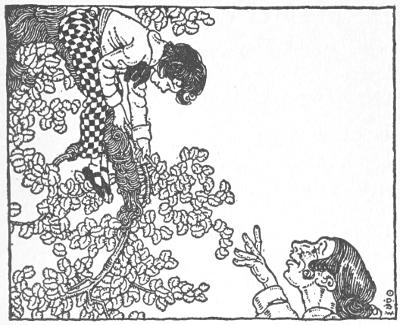
Then an adventurous boy began climbing his
trunk, and Snythergen thought surely the little
fellow would feel his heart beat. But the child
only climbed higher and higher, venturing out
on a high limb which Snythergen held insecurely
with the thumb and forefinger of his left
hand. It had been difficult to support the
branch alone and keep it from swaying, but with
the heavy boy on it Snythergen found it almost
impossible. The perspiration stood out on
every bough. His left arm became so tired it
pained him dreadfully, and it took all his
strength to keep from dropping it to his side.
He knew that he could not hold it out much
longer, and yet if he let the branch drop the boy
would be dashed to the ground and perhaps
cruelly hurt. In spite of all he could do he was
horrified to see the limb settling slowly downward
and he closed his eyes to shut out the catastrophe
that seemed sure to follow. Suddenly
there was a cry from below.
“Get right down out of that tree,” called the
mother of the boy. Snythergen braced himself
to hold on a moment longer, and just as the
boy reached his trunk, the branch fell to his
side. Snythergen breathed a prayer of thanksgiving.
The child soon was safe on the ground.
Snythergen thought the people in the farmer’s
yard curious and watchful, but he was mistaken.
He was soon to learn what real curiosity and
watchfulness are like. Some one had sent for
a famous tree doctor, and he came promptly to
look Snythergen over. When he appeared
Snythergen put on his most correct forest behavior
and really was a model tree, for the doctor’s
benefit.
“I can’t see anything unusual about that tree,”
said the physician, unpacking his instrument
case. Snythergen was holding out his branches
gracefully and letting his leaves flutter naturally
in the breeze. The doctor spread his shining
wood-carving tools out on a cloth on the ground.
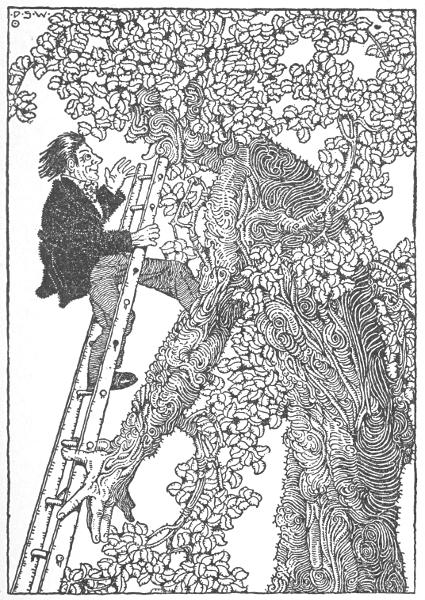
Much as the little man knew about trees, he
had never learned to climb one, and the farmer
had to fetch him a long ladder before he could
make his examination.
When the little man had mounted well up
toward the top of Snythergen he placed a fever
thermometer in a knothole, which happened to
lead into Snythergen’s mouth. Leaving it there
he descended to the ground, and wrapped a rubber
bandage about his trunk, winding it so
tightly that Snythergen barely avoided a cry of
pain. One look at the indicator gave the tree
doctor a shock.
“Sap pressure 110!” he cried. “There must
be some mistake!”
Again and again he tried it and each time
it registered 110.
“Surely there is something very strange here!”
said the doctor. “Never have I heard of a tree
with a sap pressure over 30. Why, it’s as high
as the blood pressure of a boy!”
But the tree doctor was to receive another
shock when he tapped Snythergen’s bark and
listened with a tree stethoscope.
“Why, I didn’t think there was a tree in the
world with such a violent throb. It’s as fast
and strong as the heart beat of a child!”
But the greatest shock of all was to come
when he climbed up to read the fever thermometer.
He could hardly believe his own eyes
when he saw what it registered.
“I never heard of a tree having such a temperature!”
he cried. “It is as high as a boy’s.” Indeed
the temperature was so much like a boy’s,
the little doctor so far forgot himself as to shout:
“Stick out your tongue!”
“Stick out your tongue!”
This command took Snythergen by surprise,
and without thinking, he stuck his tongue out
through the knothole, and when the little man
saw it, he was so frightened he nearly fell from
the ladder. Snythergen drew back his tongue
in a hurry. The doctor puzzled and puzzled
over the matter. Finally he concluded that he
must have seen a squirrel’s red head.
There were so many strange things about the
tree that the physician made up his mind in the
interest of science to watch it day and night.
He camped in a tent beside Snythergen, and
only when he retired for a cat nap did he take
his owl-like eyes from the tree. Even then Snythergen
could not attempt to escape, or even
stretch his limbs and relax, for the little man
was a light sleeper and would rush out at the
faintest unusual rustle of a twig.
Snythergen realized more than ever that the
life of a tree is not all joy. His roots were sore
and calloused from standing in one position.
A leg or an arm would go to sleep because he
dared not move it. He was numb all over, besides
being cold, tired and hungry. He gazed
longingly into the dining room. His mouth
watered and he swallowed hard at the sight of
the rich home cooking. How eagerly would he
have eaten the crusts the farmer’s little boy tried
to hide under the edge of his plate! How he
would have enjoyed taking the heaping plate of
his tormentor, the little doctor, when the latter’s
back was turned! But usually the window was
closed, or some one was looking.
All the next morning Snythergen watched impatiently
for Squeaky to appear on the opposite
shore of the lake. He wondered why Sancho
Wing did not come, but he could not know that
Sancho was spending all of his time keeping
track of the bear, who was in a revengeful mood
and very restless. The ice had given him mental
chilblains and the pain served as a reminder,
making him more determined than ever to find
and punish his persecutors.
About eleven o’clock Snythergen thought he
saw a little movement in the bushes along the
opposite shore of the lake. Then he recognized
Squeaky’s peculiar wobbling walk. So delighted
was he that he forgot the little doctor,
and waved his branches excitedly. Squeaky
answered. Snythergen signaled back that he
was hungry and wanted some bread and butter
with sugar on it—not an easy message for a tree
to wave to a pig all the way across a lake. It
took ingenuity to figure it out, and this is how
he did it.
First Snythergen held out two limbs and pretended
he was carrying a slice of bread in each
hand. Next he rubbed an upper branch over
these in such a way that Squeaky would know
he wanted them spread with butter—and not to
save on the butter. Then he bent his top
boughs down, shaking them vigorously to make
the pig understand that he wanted all the
powdered sugar the bread would hold.
The little tree doctor was watching this performance
with the utmost amazement.
“Why, I believe that tree has the St. Vitus’
Dance!” said the physician. “I never heard of
a tree having it before. The discovery will
make me famous. But I must prove it beyond
a doubt or the scientists will never give me credit
for it. In order to be sure I must give it the
brass band test for that is the only reliable one.
If our leafy friend here dances when the band
plays I will know then that he has the St. Vitus’
Dance. If he does not, I may have to ‘tree-pan’
him to find out.”
Snythergen shuddered at the horrible thought
of being trepanned—or in other words of
having his skull operated on so his brain could
be examined. As he talked to himself the little
man danced excitedly about.
“The fit seems to be over,” he said breathlessly,
when Snythergen had waved his last
signal to Squeaky.
“Dinner is ready,” called the farmer’s wife
from the house.
“I will be right in,” answered the doctor,
for he had decided to wait until he had eaten
before going for the musicians.
The chance of running away to meet Squeaky
and bread and butter had become more and
more doubtful now the little doctor had seen
him waving, and Snythergen was so hungry!
He looked in through the dining-room window
to see what the family was having to eat. It
was a very hot day and the window was wide
open. The farmer was placing a steaming
plate of meat and potatoes before the doctor,
who sat facing the window where he could
watch the tree while he ate. The rich odor of
food arose to Snythergen’s nostrils and it was
more than he could resist.
“I must have something soon, or I’ll fall
over,” he said to himself. “I wonder how I
can manage it?” For a moment he thought,
then an idea came to him. Leaning over, with
his top branches he beat violently upon the
roof of the house.
“What’s happening upstairs!” cried the farmer’s
wife in alarm.
“It sounds as if the roof was falling in!”
said the farmer leaping from his chair, and
they rushed out of the room. In his excitement
the doctor followed part way upstairs.
The instant he was gone Snythergen reached
a forked limb into the dining room and helped
himself to the doctor’s dinner.
“He will never miss it,” he thought. “He’s
too excited to eat, anyway.”
When the physician returned and found his
dinner had disappeared, he was dumbfounded.
“What has become of it?” he cried, jumping
up and looking under the table. He searched
behind the chairs, in the closets, and even in
the hall. In each new place he cried out over
and over again, “Who took my dinner? Who
took my dinner?”
While he was thus occupied Snythergen had
an opportunity to eat, but he was in such haste
to be done before his tormentor looked out of
the window again, that he entirely forgot his
table manners and crammed and stuffed his
mouth with his twigs. The farmer and his wife
had found nothing out of the way upstairs to
explain the noise on the roof, and when they
returned the little man was still fussing about,
looking in the china closet, the napkin and silver
drawers, and other absurd places.
“What’s up now?” demanded the farmer,
who was getting a bit tired of the tree doctor’s
queer ways. The farmer’s wife too was looking
on suspiciously. She did not fancy having
a stranger poking into her drawers and closets.
The physician tried to explain but they only
laughed at him.
“The very idea!” cried the farmer’s wife.
“Nobody could come into the room and take
your dinner away without your knowing it!”
“Besides, who would want something to eat
that bad around here,” said the farmer. “Everybody
knows we feed every tramp that comes
along!”
The little doctor felt uncomfortable and embarrassed
because they laughed at him, and he
barely touched the second plate of food the
farmer served him. Snythergen was right, he
was too excited to eat. Scarcely could he wait
until the dinner was over for the farmer to drive
him to town to get the band.
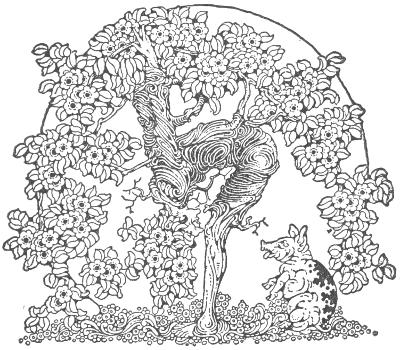
Thereafter he would strike a tree-like pose not so difficult to hold
The doctor’s departure was Snythergen’s cue
to escape. Cautiously he stole away from the
house and waited for an opportunity to cross
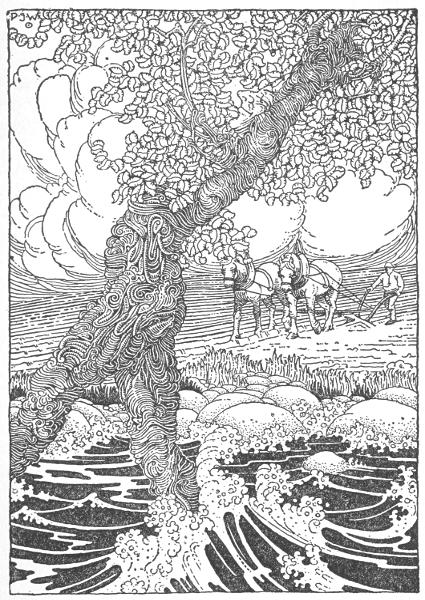
the lake. The man next door was plowing, and
Snythergen had to be very careful. While the
man’s back was turned he ran as fast as possible,
but when he plowed toward him, Snythergen
had to stand motionless and trust that his
altered position would not be seen; and whatever
position Snythergen’s limbs were in when
the farmer turned toward him, had to be held
while the plow traveled the whole length of the
field. Once when the man approached, Snythergen
was in the lake with one root raised
ready to step, and he dared not lower his root
or make any other movement until the farmer
had walked the whole distance and had turned
his back again. Thus he stood balancing himself
for fifteen minutes, and to make matters
worse he had been caught with his branches
pointing to the sky. The painful experience
of holding this position taught him a lesson,
and thereafter when the plow neared the end of
the row, he would strike a tree-like pose not so
difficult to hold. Luckily the farmer was near-sighted,
and failed to remark the strange apparition
of a tree wading across the lake up to its
branch pits in water.
In spite of various discomforts Snythergen
made the crossing successfully and had no difficulty
in following the trail home. On reaching
the house he found Sancho Wing and
Squeaky feverishly preparing the bread and butter
and sugar to take to him. They were overjoyed
to see him, but Snythergen was too tired
to sit up and visit. He had been standing on
his roots so long he was only too glad to lie
down and sleep. But before he would close
his eyes, they had to assure him that the woodchoppers
had left the forest.
CHAPTER X THE BEAR SEES THE “GRASSHOPPER PIG,” HEARS THE “HUNTSMEN” AND IS PRESENT AT THE “ESCAPE”
When Snythergen woke up, Sancho
Wing was sorry to have to tell him
that the bear had resumed his midnight
prowlings and might call upon them at
any time.
“We must prepare to defend ourselves,” said
Sancho wisely, as he perched on Snythergen’s
ear.
“How can a pig defend himself from a bear?”
asked Squeaky, absent-mindedly biting one of
Snythergen’s toes.
“Simple,” said Sancho. “Give him what he
wants. You flatter yourself if you think he
wants you. He is after food, that is all.”
“Well, let us give it to him,” said Snythergen,
“as long as he doesn’t share Squeaky’s weakness
for toes.”
“Just what I was thinking,” said Sancho.
“Let us set a bear lunch every night, and to
make sure he will find it we must spread it in
a circle around the house. Then, no matter
from what direction the bear approaches, he
will find something to eat across his path.”
“I’ve heard that round foods make people
fat,” said Snythergen. “Maybe food served on
a round table will make the bear fat.”
“That wouldn’t help us any,” said Sancho
Wing, “for fat bears are as dangerous as lean
ones.”
“Won’t it be pretty expensive boarding a
bear?” asked Squeaky.
“Of course,” said Sancho Wing, “but if we
find we can’t afford to feed him we can build
an airplane and journey to a land where there
are no bears. We may have to travel to the
end of the sky to find such a place, but who
cares?”
At Sancho Wing’s suggestion Snythergen set
to work at once to build a supper table. When
completed it encircled the house and resembled
a well planed sidewalk. That night Squeaky
set the table, being careful to spread the food
so thin that it went all the way around.
There were so many hungry beings in the forest
besides the bear that Sancho Wing had to
keep a keen look-out for thieves, and his duties
kept him very busy. One minute he would be
scanning the woods from the top of his tower,
the next he would dive down to the round table
to scream at the small animals that were forever
nibbling. Often he was obliged to call Squeaky
and even Snythergen, to chase away the larger
birds, the rabbits, and the squirrels. Each
night they set the table as late as they dared
to prevent so much of the food being stolen.
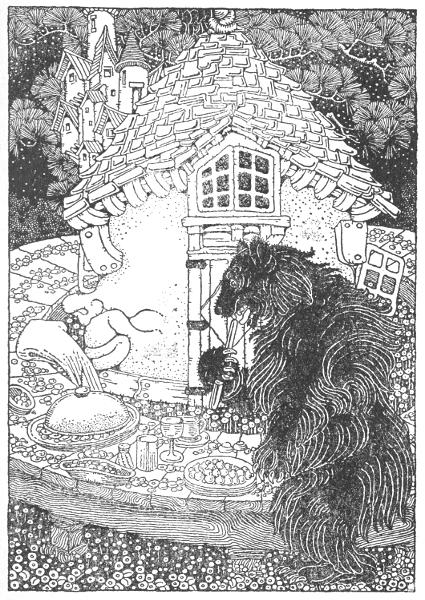
On the evening of the fourth day the bear
paid them a call, but he did not attempt to enter
the house. The lunch on the round table
stopped him. Walking all the way around he
ate everything, then went around again to see
if he had overlooked any crumbs. Squeaky happened
to be very fussy about table manners, and
he had scattered salad forks, finger bowls and
napkins here and there hoping the bear would
take the hint; but the big beast paid no attention
to them, and ate only with his knife and his
paws in the most vulgar manner.
The bear was a hearty eater and what made
matters even more serious, his appetite was
growing. Soon it was evident that the food supply
would not last much longer. The three
friends realized that the “outer works” as they
called the lunch table, was all that stood between
them and disaster. And now in spite of
their efforts they were unable to keep abreast
of the beast’s increasing desire for food. There
was nothing to do but to adopt Snythergen’s
plan of building an airplane and fleeing to a
land where there were no bears. They began
work immediately and hurried all they could,
but even so they ran out of food when there was
still another day’s work to be done on the plane.
“If we can only keep him away to-night we
are saved,” said Squeaky.
Then went around again to see if he had overlooked any crumbs
Snythergen dressed in his tree suit to be ready
in case of trouble. Carefully Squeaky set the
round table with what few morsels he could
scrape up, arranging them to appear like a
bountiful meal. The bear came a little earlier
than usual that night, and made short work of
the slim repast. Indeed Snythergen had just
time to tiptoe out and take his place as a tree
when the beast devoured the last bite of food
and looked hungrily about for more. In a
stage whisper Snythergen called to Squeaky who
was still in the house, to warn him of his danger.
Fortunately the pig was awake and whispered
back that he was coming. A moment later Snythergen
heard the most awful squealing and
Squeaky came running out, the bear after him.
Sancho Wing was flying above the pig to encourage
him.
“Don’t squeal so! Save your breath for running!”
he cried. The bear was gaining.
Bending over Snythergen touched his roots with
his top limbs, to be ready. But Squeaky was
slow on his feet, even when running for his
life, and already the bear was upon him. Sure
of his prey the great beast slowed up to brace
himself for a lunge. Quick as lightning Snythergen
shot out his branches and grabbed the
pig, lifting him to safety.
The bear did not suspect that a tree could
come to the rescue of a pig, and so sure was he
that his victim could not escape, he closed his
eyes as he struck at him. But he opened them
quickly enough when his paw struck nothing
solider than air. The pig had vanished! But
where, and how? His disappearance had been
as sudden as it was complete, and the bear had
not an idea where to look for him. Too surprised
for growls, the big brute rushed distractedly
about looking here and there. Naturally
it did not occur to him to look up into the
tree tops, for whoever heard of a pig climbing
a tree!
“Did I really see a pig at all?” thought the
bear, “or am I losing my mind! It wouldn’t be
surprising with that neuralgia from the ice!”
He paused as the thought struck him: “I
wonder if by any possibility it could have been
the Grasshopper Pig?”
The day before the bear had been reading the
story of the Grasshopper Pig to a neighbor’s
cubs out of a book of nursery rhymes called
“Mother Moose.” This pig seemed to disappear
in much the same way as the one in the
story. For the Grasshopper Pig is said to make
long leaps so suddenly that he cannot be seen
making them. One moment he is standing beside
you and the next, bingo! he is a hundred
feet away!
“Well, if it’s the Grasshopper Pig, I might as
well save myself the bother of looking,” thought
the bear; “no one has ever been able to catch
him!”
As he came to the place where Snythergen
was standing he sniffed curiously, and although
Snythergen did his best to stand still, it is not
surprising that he failed. For it takes something
stronger than flesh and blood to stand still
while a bear walks around you and stops to paw
your bark, to rub his hungry head against your
trunk, or to try his vicious teeth on your roots.
No wonder the trunk of the tree trembled and
its branches twitched nervously. The big animal
was puzzled by the shaking as he nosed
about Snythergen’s extremities and clawed at
them. It was more than wood and sap could
stand and the badly frightened boy was weakening
rapidly. Again Snythergen felt the sinking
feeling that had come over him the day the
small boy had crawled out on an upper branch.
Tottering from side to side, he caught himself
with an effort.
For a while Squeaky managed somehow to
hold on with his teeth and legs, but his teeth were
chattering and he was shivering all over with
terror. And a sudden twist of the tree shook
him so violently that he lost his footing. Desperately
he reached for a limb. He missed it,
and fell crashing through the branches!
With remarkable quickness of thought Snythergen
brought his lower limbs together to form
a basket in which to catch the falling pig.
Plunging through the branches Squeaky landed
upon Snythergen’s leafy chest, safe for the time
being, but stunned and out of breath.
“It is the Grasshopper Pig,” cried the bear,
seeing him, “and I’ve got him up a tree!”
Eager to get at Squeaky, he pawed Snythergen’s
tender bark and pushed against him
roughly.
All this time Sancho Wing’s little brain had
been puzzling to find some way to save his pals.
Flying a little distance and hiding among the
leaves he hallooed at the top of his piping voice,
hoping the woodchoppers might be in the forest,
and hear him. Anxiously the bear glanced
around. The hallooing reminded him of the
sound the hunters made, and thinking best not
to take any chances he strolled away cautiously.
The three friends breathed a sigh of relief and
Squeaky began to dance for joy.
“We haven’t escaped yet,” Sancho Wing reminded
him. “The bear will return when he
discovers the hunters are not after him. We
must finish the airplane immediately.”
At once they resumed work and kept at it
until the plane was completed. And now it
needed only to be tested. It was new and stiff
and repeatedly the engine refused to start,
though Snythergen cranked it again and again.
It was nearing the bear’s lunch time and Sancho
Wing flew away to the cave to see what the big
brute was up to. Soon he came back out of
breath, panting so hard he could scarcely speak,
for he had raced all the way.
“Quick, quick!” he gasped.
Snythergen and Squeaky understood and
Snythergen cranked so furiously he was wet
through with perspiration.
“Let me try it,” urged Squeaky impatiently
when Snythergen had to rest a moment to get
breath, and the pig grasped the crank and pulled
with all his strength. But he had turned it only
half way round when it flew back, and sent him
sprawling. Sancho, who had flown back to
keep track of the bear, now darted up to report
him only a few hundred yards away.
“Crank as if your life depended on it!” he
cried.
Frantically the little bird flew back and forth
to tell them each time how much nearer the bear
had come. Snythergen was cranking mightily
while Squeaky piled in what scanty luggage
could be collected in a jiffy.
“He’s almost here!” groaned Sancho Wing.
Snythergen heard the crackling of sticks under
the brute’s feet. “It’s now or never,”
thought he, putting all his strength into one last
pull. The engine gave a sickly “pop.” Snythergen’s
heart sank. But there was another little
“pop.” Others followed slowly, then more
rapidly. Now the explosions were in quick
succession. The engine was running! The
three scrambled aboard. The airplane coasted
down hill and rose gently from the ground.
They were saved.
CHAPTER XI THE JOURNEY TO THE WREATH—A SPIN IN A HUMMING-TOP—AN UNKNOWN FRIEND
The plane had to be an exceedingly large
one to accommodate Snythergen’s great
length. With much squirming he managed
to get out of his tree suit, and now he lay
face down, his feet hanging out over the tail.
In this position his hands came just right for the
controls. Sancho Wing’s compartment was
next to Snythergen’s ear and Squeaky occupied
a basket on the opposite side. Sancho would
have liked going back a little way for a last look
at the bear, just to make sure they had left him
on the ground but the wind created by their
great speed was too strong for a finch to fly in,
and the little bird would have been blown away
had he ventured out. For some strange reason
the nose of the plane kept pointing up in
spite of Snythergen’s efforts to keep the machine
horizontal.
“Either there is something wrong with the
steering gear,” said Snythergen, “or there is
some unusual weight behind that keeps heading
the bow up by pulling the tail down. I can’t
point her below that big star—the one that looks
like a flaming doughnut.”
“You will have to keep her on the star then,”
said Sancho, “for if anything is riding under the
tail it isn’t safe for any of us to go back to see
what it is.”
All night long Snythergen steered toward the
blazing doughnut, which grew bigger and bigger,
they were approaching it so rapidly.
“It must be some new planet floating very
near the earth. Maybe we can land on it to-morrow,”
said Snythergen to Squeaky, but the
pig did not answer, nor even look up. He was
rolled up in a tight ball, his head under his body,
fast asleep.
“Some unusual weight behind that keeps heading the bow up
by pulling the tail down”
By daylight the star seemed very near, but it
no longer sparkled. Now it resembled a huge
Christmas wreath, tied with a gorgeous bow of
red silk ribbon which hung down in vast folds.
Snythergen steered for the center of the hole,
then turning and mounting to the top he made a
landing along the shady side of a grove of pines.
The jolt when they struck the ground wakened
Squeaky, and glancing around he thought he
saw a prowling shadow alight from the rear of
the plane and disappear into the woods. The
others looked but saw nothing.
“It looked like a bear,” said Squeaky with a
shudder.
“Nonsense, you’ve got bear on the brain,”
said Snythergen.
Near where they had landed an enormous boy
was playing marbles with bowling balls. He
was nearly as tall as Snythergen and heavier.
“Hooray! There’s some one I can talk to
without bending down to the ground,” cried
Snythergen joyfully. “I can play with him
without being afraid of stepping on him.” And
he strolled up to watch him play marbles while
Sancho Wing and Squeaky remained at a safe
distance, a little awed by the bigness of two
such giant boys.
“Want to play?” asked the boy, whose name
was Blasterjinx.
“Yes,” said Snythergen, and the two shot the
big ten pin balls about as if they were peas.
“Let’s spin tops,” said Blasterjinx after
Snythergen had won most of his marbles and
paid back what he had borrowed.
“This is a hummer,” said the boy, taking a
colored top from under his blouse and winding
it with a string as thick as a clothes-line. He
hurled it through the air and it landed upright
on its point, spinning so rapidly it seemed
standing still, and as it spun it sang.
Interested in the big top, Sancho Wing and
Squeaky edged closer and closer.
“Why, it sounds like canary birds!” cried
Snythergen delighted.
“It ought to!” said Blasterjinx.
“Why?”
Taking the top in his hand Blasterjinx unscrewed
the upper part. “See,” said he. Snythergen
looked inside, and beheld a flock of
canaries singing and flying about.
“This is the only kind of humming-top to have”
“This is the only kind of a humming-top to
have,” said Blasterjinx. “For you can change
the music any time you want to. I’ve tried violinists,
pianists, story-tellers, singers, harpists—almost
everything you can think of, but I like
canaries best. Wouldn’t your friends here like
to take a spin?” he asked, pointing to Squeaky
and Sancho Wing.
It happened to be just what they wanted most,
so Blasterjinx opened a trap door in the floor of
the room inside the top, and shooed the canaries
downstairs into the top basement, telling them
to remain silent. Then Squeaky and Sancho
Wing descended a silver ladder into the huge
top, and the cover was screwed on. They found
themselves in a pleasant circular room, dimly
lighted by stained glass windows and ventilated
by air holes. The objects in the room, piano,
chairs, pictures, all were fastened securely to
hold their positions when the top wobbled or
fell to its side. A brass railing attached to the
wall ran all the way around, to give the passengers
something to hold to.
“Hold on tight now,” said Blasterjinx, and
winding the top carefully he hurled it through
the air. It lighted on its point, spinning at terrific
speed. Through one of the ventilating
holes Squeaky watched the topsy turvey landscape
dance giddily about, until it made him
dizzy and soon he became ill from it. Sancho
Wing was too busy keeping his balance and
holding on, to pay any attention to how Squeaky
was getting along.
“Stop the top, stop the top!” bellowed
Squeaky.
“What’s the matter?” cried Snythergen.
“He’ll be all right in a minute,” said Blasterjinx,
taking the top in his hand and winding the
string the other way around. When he threw
it again it spun in the opposite direction, unwinding
Squeaky and as Blasterjinx had said,
he was all right in a minute. But he was glad
when the top stopped and he could get out.
Snythergen was having such a good time that
he forgot why they had come until Sancho Wing
flew up to his ear and whispered: “Ask him if
there are any bears on the Wreath.”
“I never heard of any,” said Blasterjinx, when
the question had been repeated to him. “I am
sure you will like the Wreath,” he went on, “for
a good friend of yours lives not far from here.”
“How can you know he is a friend of ours?”
asked Sancho Wing in surprise. “You do not
know who our friends are!”
“I know this man is your friend just the same,
but I am not going to tell you who he is because
I want it to be a surprise.”
“Have I ever seen him?” said Squeaky.
“I don’t think so,” said Blasterjinx, “but I am
sure he has been in Snythergen’s house.”
“Where does he live?” asked Snythergen.
“Stop the top, stop the top!” bellowed Squeaky
“In a very big house about a mile from here.
You can visit him later on, but first I want you
to spend a week with me and see some of the
sights on the Wreath. Your friend overworked
himself last Christmas and needs another week
of rest.”
It made Snythergen homesick to go to Blasterjinx’
house and meet his parents, for they were
small like his own father and mother and their
house was not very large either, except Blasterjinx’
room which was a separate building covering
most of the yard. Blasterjinx’ mother was a
kind soul and made her visitors feel very much
at home with the aid of doughnuts, cookies and
pies. Somehow this made Snythergen feel better,
although his mother and father were always
in his thoughts.
The three friends told Blasterjinx about their
adventures, and he became so interested he
wanted to play tree at once. He tried on Snythergen’s
suit of green but it was not big enough in
the waist for him, and when he squeezed into it
the bark began to rip.
“You will tear it,” cried Blasterjinx’ mother,
“and then Snythergen won’t be able to wear it—for
I am sure I don’t know how to mend torn
bark. I might sew it with a pine needle, but I
wouldn’t know what to use for thread.”
“Let’s make Blasterjinx a suit for himself,”
cried Sancho Wing; and delighted with the idea
they set to work. Blasterjinx was just the right
build for a sturdy oak, and they fastened acorns
all over his suit, and made his bark gnarly and
his branches twisty. They tried to teach him
the habits of an oak, but he did not learn readily.
For being a tree did not come natural to him as
it did to Snythergen. He was too restless to
stand still very long.
“He’ll never make the birds think he is real,”
whispered Sancho Wing to Squeaky.
“Perhaps it is just as well,” replied Squeaky,
looking at Sancho Wing out of the corners of his
little eyes, “for then he won’t be bothered with
any goldfinch nests tickling his branches!”
They were having such fun the week was up
in no time and yet they had done no sight-seeing.
With many warm farewells and promises to return
soon, the three companions left to call on
their unknown friend.
CHAPTER XII ABOARD A FLOATING BEARD
Squeaky, Snythergen and Sancho
Wing were very much surprised when
they saw their unknown friend’s house—for
it was the largest home they had even seen.
They mounted the steps and Snythergen sounded
the knocker on the great front door. Immediately
it was opened by a flunky arrayed in shining
silk clothes decorated with Teddy bears, parrots
and goldfish embroidered in colors.
“Who lives here?” asked Sancho Wing in his
piping voice.
“Santa Claus lives here,” answered the flunky.
“Santa Claus!!” chorused the three in amazement.
“So that’s the friend Blasterjinx meant!” said
Snythergen. “I should say he was our friend!”
But they could hardly believe that they really
were at Santa Claus’ door, and in their surprise
and wonder they forgot the doorkeeper who
stood attentively awaiting their pleasure.
“We would like to see Santa Claus,” said
Squeaky at last.
“I’m sorry, but no one can see him except by
appointment,” said the flunky, “but if you will
call at ten o’clock to-morrow morning you may
have a chance to speak with him.” And with
that he closed the great door and they were left
alone on the doorstep.
“There must be some way to see him. I am
going to investigate,” said Sancho Wing, and he
flew off. Squeaky and Snythergen threw themselves
on the ground in the shade of a great elm.
“What a relief to have some other tree cast your
shade for a change!” remarked Snythergen, just
as Sancho Wing flew up very much flustered.
“I know where Santa’s room is!” he cried.
“He is taking a nap now.”
“What good will that do us?” said Squeaky,
ever practical like stout people generally.
“A great deal of good,” said Sancho Wing.
“You and Snythergen wait near the door. I am
going to make that flunky open it for you.”
And he was off before they could make any reply.
Sancho Wing flew through the open window
into Santa Claus’ room. Cautiously he approached
the bed and hid in Santa Claus’ great
white beard. Santa moved uneasily.
“There are three wise men here to see you,”
whispered Sancho softly.
“Why didn’t somebody tell me?” murmured
Santa Claus, half asleep.
“The doorkeeper said you wouldn’t see anybody
except by appointment,” replied Sancho.
“Is that true?” mumbled Santa Claus
drowsily.
“Yes, he would not open the door; that is why
I came in through the window.”
Santa Claus woke up with a jump. “Who am
I talking to!” he shouted—“or was it only a
dream? Whoever you are come out and let
me see you! What are you hiding for?”
“I am just a voice, Santa Claus, and the rest
of me is not very presentable. My necktie is
untied and there is a hole in my stocking.”
“Where are you hiding!” cried Santa Claus,
and he looked under the bed, behind the chairs,
and in the closets. Sancho Wing feared every
moment he would be discovered, and tried to
escape by flying out of the window. But his
head had become caught in the long whiskers
and he could go only the length of the beard in
any direction. As he flew vigorously about the
room trying to free his head Santa’s beard floated
in the air like a living thing.
Too surprised to move or speak, Santa Claus
could only gaze dumbly at his beard making
serpentine movements in the air, or winding
about his body as if to hide behind his back.
“What in the name of Popcorn is the matter
with my beard!” cried Santa Claus, finding his
voice at last.
Sancho Wing concluded that it was wiser to
stop flying and let the beard settle back to its
accustomed place, lest Santa Claus discover him.
He was too hopelessly caught to escape by flying;
but he was so well concealed by the whiskers
that Santa Claus still failed to see him.
“Well, I give up!” said Santa Claus at last.
“Wherever you are, you are well hidden. Did
I understand you to say that you and your two
friends had come to visit me? Where are the
others?—since I can’t find you. Are they hiding
too?”
“They are waiting at the door.”
“Squeaky, who is a voice with a pig’s body”
“I invite you all to dinner,” said Santa Claus.
“‘Three Wise Men’ I think you call yourselves?”
“Four, including our host,” said Sancho politely.
“Thanks!” said Santa Claus.
Sancho’s conscience was troubling him for
he had hesitated to explain that they were not
just ordinary men, lest Santa Claus might not
want to see them.
“When I said we were men,” began Sancho,
“I used the word ‘men’ in a broad sense, to include
birds, animals and trees.”
Santa Claus yawned and stretched his arms.
He liked a chat after his nap.
“I am glad to see you are democratic,” said
he. “I think it is too bad that birds, animals and
trees are so often left out. If they could talk
they might say some unkind things of us.”
“No, indeed, we won’t, Santa Claus,” assured
Sancho eagerly.
“We? Who are ‘we’?” asked Santa Claus.
“One of us is a boy-tree. He is a boy by birth,
but a tree by profession.”
“Go on,” demanded Santa Claus.
“Then there is Squeaky, who is a voice with
a pig’s body; and as for me, well, you know me.”
“I know your voice, but the rest of you?”
asked Santa Claus.
“Is a goldfinch,” answered Sancho.
“Three wise men indeed,” muttered Santa
Claus. “How interesting it will be to have dinner
with a pig, a tree, and a goldfinch! But
what can we have to eat that three such different
guests will enjoy?”
“Oh, that’s easy,” said Sancho Wing. “You
can give the others birdseed porridge.”
“And you?” asked Santa Claus, with a twinkle
in his eye.
“Oh, I’ll eat some too,” said Sancho, with
seeming indifference, though it made his bill
water to think of his favorite dish.
“What will we do for table conversation?”
asked Santa Claus. “I don’t know what subjects
trees, pigs and birds like to talk about.”
“You won’t need to help us talk,” said Sancho.
“We are worse than magpies when we are together.”
“You may go back to your friends now,” said
Santa Claus, “and I’ll see that you are admitted
to the house.”
Sancho made an effort to walk out of the beard
in a dignified manner, but he was too firmly
caught to get away so easily. He began to pull
and struggle.
“Ouch!” cried Santa Claus, “who’s pulling
my beard?”
“I can’t get out,” cried Sancho Wing.
“So there’s where you are! In my beard!
Well, of all the places to hide!” cried Santa
Claus in the greatest amazement. With a pair
of shears and a mirror he succeeded in freeing
the little bird after the exercise of a good deal
of patience.
As soon as he was released Sancho told Santa
Claus he was sorry for the trouble he had caused,
thanked him for the invitation to dinner, and
flew back to his companions.
CHAPTER XIII THE PIE ROOM—BEAR AGAIN!—SANCHO WING SCOLDS
“I thought somebody had kidnapped
you,” said Snythergen when Sancho
Wing returned. “Why were you gone
so long?”
“I was visiting Santa Claus. He invited us
all to dinner, and the door-man will now let us in.
Follow me,” said Sancho.
“Is it the three wise men?” bellowed the flunky
through the keyhole when they knocked.
“It is,” said Sancho Wing.
The large door swung open and the flunky
prepared to make his best bow. But he could
hardly welcome three such different beings with
one salute, so he greeted each one separately.
To Snythergen he leaned back, pointed his face
toward the ceiling, and bobbed down and up by
bending and straightening his knees. Sancho
Wing, like most little people, wished to appear
important, and when it came his turn to bow he
raised himself on tip claws and stretched up to
make his body as tall as he could; then leaning
forward stiffly he flapped his left wing. Puzzled
to know just how to respond to this, the
door-man got down on his knees, and turning
his head sideways wiggled his left ear. Squeaky
had a habit of tossing his head when he bowed,
and the flunky merely gave him a toss of the
head in return.
The door-man turning his head sideways wiggled his left ear
In the hall the housekeeper welcomed them
very kindly, offering to show them about while
Santa Claus dressed for dinner. When she
learned that they were the “three wise men” she
treated them with great respect. Inside, the
house seemed even larger than it had from without,
and Snythergen was thankful for ceilings
so high that he could stand up comfortably.
So enormous were the rooms each one might
have been used as a public hall. There was
little furniture—mostly vast spaces with a background
of oriental carpets and cathedral windows.
“What is this?” asked Snythergen, as they
came into an odd little room in the basement
with circular wall and a spotless aluminum
floor. To cross it they walked on a bridge,
raised several feet above the floor.
“This is the pie room,” said the housekeeper.
“The crust is rolled out on the pie pan floor
and the work of putting in the filling is managed
from the bridge. When it is ready, we
light the gas under the floor and the pie is
cooked.”
“But who could ever eat such a big one?”
asked Sancho Wing.
“Oh, the bear eats most of it,” said the housekeeper.
“The bear!” cried they in great alarm. “Is
there a bear?”
“Yes,” said the housekeeper.
Snythergen turned pale and looked for the
door. Squeaky had already started to run and
Sancho Wing flew up to the ceiling.
“Stay right here—there’s nothing to fear,”
said the housekeeper, calling them back.
“The bear arrived about a week ago,” she
continued when they were able to listen. “We
did not want to let him in but Santa Claus telephoned
the keeper at the zoological gardens and
asked if bears were safe.”
“‘They are,’ said he, ‘if you feed them olives
and custard pie.’
“We tried it and it worked, and now there is
not a quieter member of our family than the
bear after he is fed. When he is hungry is the
only time he is quarrelsome. But at such times
we keep food between ourselves and him.”
“We had a bear too,” said Snythergen, “but
he always stole away as soon as he had eaten, and
never came near except when he was hungry.”
“That’s just like our bear,” said the housekeeper,
“forever trying to hide when he is not
at his best. But Santa Claus has him sit around
and visit after dinner, though he makes a very
sorry figure.”
“Why, what does he do?” asked Squeaky.
“As soon as he is fed his spirit is gone,” replied
the housekeeper. “He becomes as timid
as a mouse, and trembles if you look at him;
jumps if you speak to him; blushes if you pay
him any attention.”
“How does a bear blush?” asked Snythergen.
“Bears should not talk when their mouths are
full of food,” said Santa Claus kindly
“He does it with his lips. They change color
back and forth very rapidly from pink to red.
But Santa Claus is coming and it is time for
dinner.” As she spoke they entered a dining
room so large, the huge table and ancestral
chairs seemed like dolls’ furniture in its vast
interior.
And now Santa Claus entered smiling
blandly. He was attired in gorgeous evening
clothes—a flaming swallowtail coat lined with
crimson, deep purple vest with large white buttons;
a ruby glowing like a burning eye adorned
his shirt. Cream silk stockings and pale blue
knickerbockers he wore, and his boots were red
with black trimmings.
Scarcely had Santa Claus entered the room
when the bear came lumbering after him.
Eying the “three wise men” with a swift look of
recognition he licked his chops.
“Why, it’s our bear!” said Snythergen in a
sickly whisper. “How did he follow us?”
The three edged around until the table stood
between them and the beast, and they were eying
the nearest exit when Santa Claus requested them
to be seated at table. The bear was served first,
though “served” is hardly the word for the way
they rushed food to him. Cramming his mouth
full he uttered a few growls.
“Bears should not talk when their mouths are
full of food,” said Santa Claus kindly.
But the bear answered only with an impudent
growl which so frightened Squeaky that he tumbled
from his chair, upsetting a bowl of soup as
he fell. In spite of Sancho Wing’s assurance,
the table conversation was exceedingly restrained.
Though for politeness’ sake Snythergen
did try a few comments, which came out
in faltering tones. Squeaky was so nervous he
could not speak without breaking into little hysterical
peals of laughter which sounded like the
squeals of a badly frightened pig. He had had
one of these fits in the middle of the blessing and
Santa Claus eyed him curiously.
Sancho Wing attempted to calm the troubled
scene by keeping his head and saving them from
awkward pauses. He was not so much afraid
as the others because he knew that, no matter
what the bear did, he could escape by flying a
few strokes into the air. But the nervous way
he kept waving his wings about to be sure they
were ready for use, showed how far his little
heart was from peace and a feeling of security.
At first the bear was very noisy about his
eating but grew quieter as his hunger was appeased.
And as the meal progressed his eyes
became dull, his manner modest—almost demure.
The others saw this and were encouraged.
Squeaky found his speaking voice and
talked wisely on the advantages and disadvantages
of pig life. The table talk Sancho Wing
had promised Santa Claus now began to flow,
and the host was delighted. He asked many
questions and nearly every one led along some
trail of adventure, relating incidents peculiar to
their lives. By this time the bear was painfully
ill at ease, for he had not learned man-talk and
the loud firm voices around him gave him
strange fears. Were they plotting against
him? He sat stiffly upright with forepaws
crossed upon his chest, and ears cocked suspiciously.
When they arose from the table Sancho
Wing hopped over to the bear for a little private
conversation.
“I want to say a few words to you,” he said,
“and luckily for you you will not understand
them.”
The bear shuddered and his lips turned a paler
pink.
Thoroughly angry Sancho Wing began:
“You great big overgrown nuisance of a brute!
You cowardly thieving bully!”
If he did not comprehend the words certainly
the bear understood Sancho’s gestures. And as
he talked the little bird’s body shook with passion.
He bobbed his head, flapped his wings,
raised one leg threateningly with claws advanced.
The bear looked sheepish. His startled eyes
were pleading now. He hung his head as he
backed away. Sancho Wing followed closely
scolding ever more abusively. The tiny finch
seemed to tower with rage as he bullied the
frightened beast, who stood six feet six in his
bare hind paws while the finch was but a few
inches high. When they reached the hall the
big fellow dropped to all fours and ran. Returning
to the big table Sancho Wing saw a hurt
look in Santa Claus’ face and readily guessed
the cause.
“Forgive me for making a scene,” pleaded the
little bird.
“The bear is very sensitive,” said Santa Claus
seriously. “And on the whole I think he is
rather well behaved for a bear.”
“I am sure I would like the bear much better
if I did not know him so well,” said Sancho
Wing.
“What? Do you know him?” asked Santa
Claus.
There was an awkward pause. Sancho did
not want to tell on the bear, for like himself he
was Santa Claus’ guest.
“I know him distantly,” said Sancho—“just a
growling acquaintance. He may have changed
since I saw him last. Maybe I shall like him
better now.”
“I am sure you will,” said Santa Claus kindly,
as they drew their chairs up to the fire and prepared
to spend a cozy evening.
CHAPTER XIV SNYTHERGEN’S TROUBLES
The “Three Wise Men” and Santa Claus
were sitting up very late around a coal
fire in the enormous grate. Santa Claus
would have preferred a log, had not delicacy of
feeling made him avoid burning wood in Snythergen’s
presence. Sancho was perched on the
back of the chair Squeaky had curled up in; and
Snythergen sat tailor fashion on the floor.
Santa Claus nestled in the depths of his great
easy chair. There was no light save the flicker
of the fire.
“I don’t know when I have had such an enjoyable
evening,” said Santa Claus, “and I am sure
it is past all our bedtimes.”
“Oh, no,” said Squeaky, “we got into the habit
of late hours on account of the bear.”
“What bear?” said Santa Claus, in surprise.
“Oh,” said Sancho on his guard, “there was
one prowling about in the forest where we
lived.”
“You needn’t have been afraid if you had provided
him with food,” said Santa Claus.
“So we found,” said Snythergen feelingly.
“I have been thinking,” said Santa Claus,
“that we make a cozy little group together. I
would be glad to have you stay here and live
with me.”
“Splendid,” cried Snythergen. “This is the
only comfortable house I ever saw. The architect
had the good sense to make the ceilings high
enough.”
“There is a bedroom upstairs, too, just right
for you,” said Santa Claus, “and you may all
occupy it together if you will promise to go to
bed and not talk.”
“Oh, Santa Claus,” cried Snythergen delighted,
“you are too good!”
“And we’ll be polite to the bear,” said
Squeaky.
“Maybe you won’t like it here as well as you
think,” said Santa Claus. “I shall expect you
to do some work.”
“We don’t mind that,” said Sancho Wing.
“Snythergen built a house and table!”
“Speak for yourself,” said Snythergen. “Tell
Santa Claus what you can do.”
“Yes, Sancho, what work can you do?” asked
Santa Claus.
“Oh, I’m a good watch bird,” said Sancho
Wing. “I can get up close to people and hear
all they say, and see all they do without being
seen myself. If necessary there is always some
little place for me to hide. I can dodge into a
man’s coat pocket—or”—(with a sly look at
Santa Claus)—“creep into his beard!”
“I can testify to that,” said Santa Claus emphatically.
“And Squeaky here, what can he do?” asked
Santa Claus.
“I will say this for him,” said Snythergen,
“he’s good about visiting. Usually he sleeps
while I work so as to be bright and lively when I
want to rest. He entertains me and makes me
forget my troubles.”
“Your troubles!” said Santa Claus in surprise—“I
didn’t think you had any.”
“Oh, yes, plenty of them! The little ones,
such as”—(with a look at Squeaky)—“pigs nibbling
my toes, woodpeckers stabbing my trunk,
bears biting my roots, bothersome nest-builders”—(here
Snythergen winked at Sancho
Wing)—“tickling my branches; woodchoppers
plotting against my life—these are bad enough.
But my big trouble—” His face grew long and
a great tear trembled on his cheek and splashed
down on Squeaky’s head, making him jump.
“What is the big trouble?” asked Santa Claus
kindly, while Sancho Wing and Squeaky looked
up in surprise.
“I never told anybody,” said Snythergen.
“Maybe you would rather not say anything
about it now,” said Santa Claus sympathetically.
“Oh, I must tell you. I have a father and a
mother and I love them very much and they love
me. I ran away because they do not make
school houses large enough for boys like me.
I told my mother I would come back some day.
Now I think of it I am afraid I cannot come to
live with you—it’s too far away from home.”
“Why, Snythergen, you never told us you had
any parents,” said Squeaky.
“I supposed you knew I had. Every boy has
to have them. I used to steal away at night in my
tree suit and go home when you and Sancho
Wing were fast asleep. I would brush my
branches on the second story windows until
father and mother looked out. I did not dare
tell them it was I for fear they would want to
send me back to school, and I feared father
might spank me.”
“It would take rather a tall man to bend you
over his knee,” said Santa Claus.
“Oh, it wasn’t his size, but his voice I was
afraid of,” said Snythergen.
“Then your father is a little man?” asked
Santa Claus.
“Yes, he and mother are midgets. I guess
they adopted me because they admire big
things.”
“What does your father do?” asked Santa
Claus.
“He is a philosopher,” said Snythergen. “He
thinks and plans while mother knits.”
“I wonder how midgets would like it here?”
asked Santa Claus, thoughtfully.
“I am sure they would like it very much,”
said Snythergen, “except for one thing. They
are sensitive about their size and cannot bear
to live in a house with high ceilings. You see
it makes them realize how small they are. But
if you are willing to have them here, I can build
a little two-story house with six rooms, and set
it up in a corner of our big bedroom. I could
place it where it would not be in the way, and
when the housemaid comes to sweep and dust I
could hang it up on a hook in the wall.”
“I will have to look up our laws before I can
ask them,” said Santa Claus. “I don’t think
grownups are allowed to come to the Wreath.
I might as well repeat, since you may come here
to live,” he continued, “that this is no palace of
idleness. There is much to do and everybody
helps. The reindeer’s faces, necks and ears
have to be washed every day, and the sleighbells
rubbed with silver polish. We have to keep
track of all the children in the world and enter
the new babies in a big book as fast as they are
born. We have a toy factory where Christmas
presents are made, such as popcorn balls, Noah’s
arks, fire engines and dolls.”
“What will the bear do?” asked Squeaky anxiously.
“I intend to have him pose as a model for
Teddy Bears,” said Santa Claus. “Of course
the housekeeper will have to sit by his side ready
to feed him olives and custard pie the moment he
shows any restlessness.”
Santa Claus took his watch from his pocket.
“It’s my bedtime,” said he, “so if you are ready
I will escort you to your room.”
A traffic butler stood at hall intersections
A house automobile was waiting in the hall.
The distances between rooms were so great that
Santa Claus used motor cars to take his guests
about the house. As Snythergen was too large
to ride he had to walk behind, and his long
strides easily kept pace with the machine—too
easily. He was so taken up with the pictures on
the walls and peeping into the rooms they
passed, he neglected to look where he was going.
Several times he tripped on the car, almost upsetting
it. The chauffeur grew to fear this danger
from behind more than the perils ahead, and
drove looking backwards. Once when he gave
a sudden lurch to avoid Snythergen’s foot,
Squeaky fell out, and there was a great squealing
in the hall until he was picked up and put back.
Snythergen apologized to both of them and
promised to be more careful.
The halls were as wide as boulevards and in
place of stairways there were graded inclines,
enabling chauffeurs to drive from floor to floor.
The traffic even at that late hour was heavy, for
eatables were being taken from vegetable cellars
to kitchens; towels and bedroom linen were being
whisked here and there; servants were returning
to their rooms after a social evening.
Muffled honks were heard at the turns, and a
traffic butler stood at hall intersections.
At last they drew up beside an enormous
chamber illuminated by points of light set like
diamonds in the deep blue of a vaulted ceiling, to
give the effect of stars. Snythergen was overjoyed
when he saw his bed. Actually it was
several feet longer than he was. For once he
would not have to sleep twisted up in a circle,
but could lie full length like any one else.
When Squeaky got into his little bed he was
surprised to find a silk tassel sewed to each of
the blankets and sheets, and wondered what it
was for. Pig-like he had to experiment. He
pulled one and to his amazement it resisted. It
was as if some one concealed in the foot of the
bed were trying to pull it away from him. No
wonder the tassel slipped from his grasp! A
blanket ran away, disappearing into the footboard
with a bang. Squeaky was so shocked he
fell to the floor and when he got into bed again
the blanket was nowhere to be seen. He pulled
another tassel. This time a sheet made off. He
tried others, and by the time he was through
pulling tassels every bit of bedding had disappeared
and he could not find any of it. Shivering
with cold he called Snythergen. But the
room was too big and the beds too far apart for
Squeaky to make himself heard.
“What’s this?” he cried, upsetting something
on a stand beside his bed. It was a little telephone.
Consulting the directory he found a
number opposite “Big Bed.” When he removed
the receiver a bright voice chirped
“Merry Christmas.” It was central and
Squeaky gave the number.
Snythergen heard soft chimes at his bedside,
and when he saw it was the telephone he did not
remove the receiver at once, for he was enjoying
the sweet tinkling sounds. When at last he did
answer, Squeaky was very impatient.
“Why didn’t you answer?” he demanded.
“What’s the matter?” asked Snythergen.
“Somebody’s stealing the bed clothes, and I
am almost frozen. I can’t find a stitch of covering.”
“Is that all? I will be right over,” and in a
moment Snythergen stood beside the pig’s bed.
When he saw what had happened to Squeaky he
leaned back and laughed until another great
tear splashed down upon the pig.
“I didn’t call you over to give me a bath,” said
Squeaky. “You’re only making matters worse,—and
what are you laughing at anyway! I
can’t see anything amusing.”
“Why, you poor pig!” cried Snythergen, as
soon as he could control his voice. “Can’t you
see that the bed clothes wind up in the foot of
the bed on rolls like window shades? All you
need do is to lean over and pull the silk cords, but
you must grasp them firmly. You can pull up
or take off as much bedding as you like without
getting out of bed. Now good night, I’m
sleepy!” said Snythergen and he went back to his
bed for the first comfortable night’s sleep of his
life.
CHAPTER XV TOY FOODS
The next morning “the three wise men”
had a long chat with Santa Claus, and
it was decided they were to come there to
live. But Santa Claus explained to Snythergen
kindly that as he had feared, it was against the
laws of the Wreath to bring any more grownups
there; and that he would be unable to include his
parents in the invitation.
Snythergen looked so sorrowful when he
heard this that Santa Claus said brightly:
“Cheer up! Stay for a while, and I will see
if it cannot be arranged somehow.”
Snythergen’s interest in the wonderful things
he saw soon revived his spirits—though the
thought of his mother and father was seldom far
away.
When Santa Claus explained to the housekeeper
that the family would be enlarged by
three new members, she looked rather doubtful.
“Are you sure, Santa Claus,” she asked, “that
it is wise to add them all at once, before you know
more about them?”
“Yes, I am sure,” he said, “and I know they
will be handy in the toy factory.”
And so it proved. For a time the newcomers
made themselves so useful, even the housekeeper
wondered how they had ever managed without
them. Sancho Wing devised all sorts of new
toys. Squeaky made a model of a Teddy Pig so
cunning and lifelike, it bid fair to vie in popularity
with the famous Teddy Bear. When
you squeezed it it squeaked so naturally, that
you had to look twice to be sure you were not
holding a live pig in your hands. Snythergen
designed a mechanical tree that walked on its
roots and waved its branches in the most comical
manner.
For a month Snythergen was happy. He
seemed almost to have forgotten his “big trouble.”
But as the novelty of his new life wore
away, he found his thoughts returning more and
more often to his mother and father. One day
Santa Claus said to him:
“Snythergen, you are not happy and the reason
is not hard to guess. No boy can be happy
long away from his parents. The housekeeper
and I have been talking it over and we can find
no way of getting grownups admitted to the
Wreath. So I have decided to give you your
choice. Either you may stay here and live with
us, or I will reduce you to the size of an ordinary
boy and let you go home.”
“Can you make me small like other boys!”
cried Snythergen excitedly.
“Yes,” said Santa Claus, “I can do it by feeding
you toy foods! I can have my cooks and
my bakers make such tiny cakes and pies, that if
you eat them one at a time, you will grow smaller
and smaller. It will not be easy and you may
have to go hungry at times, but in the end you
will be just the right size. You can play with
the other boys and no one will laugh at you.
Then you may return to your father and
mother!”
“And not see you, and Squeaky, and Sancho
Wing any more!” faltered Snythergen.
“You may come and visit us at night after your
mother has tucked you in your bed—just as you
used to steal away from the forest to go home.”
Snythergen still hesitated.
“You will be very happy,” said Santa Claus.
“You will grow up to be a man, and all your
life you will be happier for having visited Santa
Claus’ land on the Wreath.”
Snythergen made the choice that Santa Claus
knew he would, the one that any boy would have
made. There was a great deal of bustle in all of
the kitchens and bakeries on the Wreath, as they
made toy foods for Snythergen. There were
wonderful loaves of bread shaped like the little
tree doctor, which Snythergen wanted to devour
by the handful, but was permitted to eat only one
at each meal. There were cookies molded in
the form of the woodchoppers’ axes, cakes and
pies resembling the nest that had once tickled his
long green boughs.
And squeezed him almost as tightly as the farmer’s wife had done
Little by little Snythergen un-grew until he
became the size of a boy. At last the day of his
departure arrived and his friends were gathered
before Santa Claus’ door to bid him farewell.
The doorkeeper and the housekeeper said good-by
with feeling. When he came to Blasterjinx
the big fellow bent over, placed one hand on the
ground, palm up for Snythergen to stand on,
then lifted him up to say good-by. Snythergen
felt a keen pang of regret when the sight of his
friend made him realize that his own great size
was gone. But this feeling was soon forgotten
in an affectionate farewell to the faithful chums,
with whom he had shared so many joys and dangers.
He took Squeaky into his arms and
squeezed him almost as tightly as the farmer’s
wife had done. Sancho Wing perched on his
shoulder and tried to say good-by in as loud a
voice as when first he had spoken to Snythergen,
but somehow the words caught in his throat.
As Snythergen said his last farewell to all, even
the bear’s eyes filled with tears (he had just had
his olives and custard pie).
“We shall expect you to visit us very soon,”
said Santa Claus as they parted.
How they all waved and cheered as Snythergen
rose in his boy’s airplane and began the journey
home! Turning his head he watched them
until they dwindled to mere specks and disappeared.
CHAPTER XVI HOME
As Snythergen’s friends passed from view
a new happiness came into his heart,
overcoming the sorrows of parting—for
at last he was going home. All day he had been
soaring above the clouds, and now he was speeding
through the air in the swift descent. It was
night and the Wreath was but a star. Soon he
was sailing above the forest, over the tops of
his old comrades the trees. “They would never
recognize me now,” he thought; then suddenly
he wondered: “Will they recognize me!”
He was almost home. Choosing a clear
space in a pasture, he made a landing, and hurried
towards the house. It was a warm, still
night in mid-summer. Through the open door
he saw his mother and father sitting by the
lamp.
“I wonder where our dear boy is to-night?”
Snythergen heard his mother ask.
“Mother! Mother!” he cried.
“It’s his voice!” cried his mother, jumping up
and running to the door. “Snythergen! Snythergen!
Where are you?” Both parents were
looking up among the tree-tops. “Where are
you,” they cried.
“Here I am,” answered Snythergen, now but
a few feet away. “Don’t you see me,” he said, almost
under their noses.
“No,” said they, looking toward the top of the
house.
“Is it only his voice that has come back,” faltered
his mother, her eyes filling with tears.
“No,” cried Snythergen, throwing his arms
about her waist.
“What’s that!” she screamed in fright.
“Snythergen!” she whispered, recognizing her
boy. “How you have changed!” The mother
took her boy in her arms and kissed him again
and again.
The father could hardly believe it was Snythergen,
but there was no mistaking the voice.
“He has come back a regular boy!” cried he,
waiting for a chance to hug his son. “How did
you make yourself small?” he asked, too impatient
to wait any longer.
“Toy foods!” shouted Snythergen, half smothered
in his mother’s embrace.
“I knew it! I knew it!” cried the father.
“Just after you left I thought of toy foods—but
then it was too late.”
They entered the house and Snythergen began
telling his adventures. It was a happy night—the
first of countless others that were to come.
For a happier boy than Snythergen simply did
not exist.