“Hurrah for you, Archie!” shouted Eugene,
as he and Fred came galloping up. “You’ve
made sure work this time, haven’t you?”
“I told you that if I got another fair chance at
him he was mine,” replied Archie. “You had a
suspicion that I was shooting with a long bow, last
night, when I told you that I had seen a horse help
his master catch cattle, didn’t you, Fred?”
“No,” returned Featherweight, quickly. “I
only thought it something wonderful.”
“I told you I had seen a horse hold a steer down
while his owner butchered him, didn’t I?”
“Yes,” answered Fred.
“Well, now you will see my horse hold this
fellow down while I put a bit in his mouth. Look
out, there,” he added, as the boys, having dismounted,
ran up to watch his movements; “don’t
come too near his heels, for he can out-kick a mule.
Keep a good hold of your own horses too, or they’ll
go off to join the drove.”
Archie’s nag, as his owner afterward declared,
had shown himself to be a “perfect trump.” He
seemed to know what the boy intended to do as
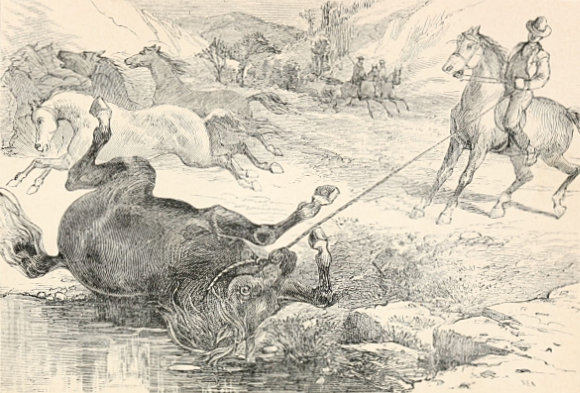
well as the boy knew it himself. When the lariat
settled down over the bay’s head and the latter was
about to run off, he planted his fore-feet firmly on
the ground to stop him, and the bay was thrown on
his side, as we have described. Archie’s horse,
without waiting for the word from his rider, quickly
backed up until the lariat was drawn tight, and thus
the bay was held as securely as if he had been tied
to the ground.
Archie, finding that his horse could be depended
on, quickly dismounted, slipped the bridle off his
head, and when Fred and Eugene came up he was
kneeling on the bay’s neck, trying to force the bits
into his mouth.
“You’re not going to ride him now, are you?”
exclaimed Fred, amazed at Archie’s apparent recklessness.
“Certainly I am,” was the reply. “He’s got to
be backed some time, and it might as well be now as
to-morrow.”
“How are you going to get a saddle on him?
You can’t put the girth around him while he is
lying down.”
“I don’t want any saddle!”
“Why, he’ll throw you and break your neck!”
“If he does it shan’t cost him anything,”
answered Archie, as he buckled the throat-latch
about the bay’s neck. “Now, Fred, slack up on
that lariat, please, and give us room according to
our size and importance. We shall need plenty of
space to spread ourselves in!”
Fred, in compliance with the request, unfastened
the rawhide rope from Archie’s saddle, and then he
and Eugene, still holding fast to their horses and
leading Archie’s, retreated quickly to the foot of
the cliffs. As soon as Archie saw that they were
out of the way, he removed his weight from the
bay’s neck, and in an instant the captured horse
was on his feet. How Archie managed to get upon
his back as he was rising was a great mystery to the
two boys who were looking on—it was done so
quickly. But he was there, and he had secured a
firm seat, too.
The bay was no sooner on his feet than he began
to make the most desperate attempts to shake off
his rider, but all to no purpose. When he reared,
Archie pounded him between the ears with his
clenched hand; and when he kicked, he used his
spurs with such hearty good-will that the horse was
glad to desist. During all the terrific struggle
Archie was as cool as a cucumber and was never
once moved from his seat. Failing in his efforts to
throw his rider, the bay tried to run, and this Archie
not only permitted, but encouraged. There were
two well-beaten paths at this point, one running to
the right and the other to the left around the valley,
and when the bay showed a desire to try his speed
his rider turned him into one of these paths and
touched him gently with the lariat, which he had
managed to gather up, and now held in a coil in
his right hand. The horse responded on the instant,
and with a few rapid bounds carried Archie
out of sight behind the trees. The boys stood
listening to the sound of his hoofs for a moment,
and then turned and looked at each other.
“That is something I never saw done before,”
said Eugene, at length.
“And if anybody had told me that it could be
done, I wouldn’t have believed him,” added Fred.
“He will probably go on around the valley, and as
that is a good ten-mile ride, we shall have plenty
of time to make the camp and get something to eat
before he returns.”
The boys watered the horses at the little brook
that ran from the spring, staked out their own animals
(having no lasso with which to picket Archie’s
horse they hobbled him with a halter so that he
could not stray far away) and then went to work to
prepare breakfast. From one of the bundles Fred
brought to light a small sheet-iron camp-kettle, a
coffee-pot and a hatchet. While he was undoing
another, which contained the small supply of bacon
and hard-tack they had remaining, Eugene picked
up the hatchet, and in a few minutes had split up
dry wood enough to start a roaring fire. The camp-kettle
was filled with water from the spring, several
slices of bacon placed around the fire on spits to
roast, and then the two boys threw themselves on
their blankets to take a few minutes’ rest after their
twenty-four hours in the saddle, and to await
Archie’s return.
He came much sooner than they expected, and
they saw at a glance that that ten-mile gallop had
taken considerable of the wild spirit out of the bay.
He looked as if he had been driven through a stream
of water; his breast was flecked with foam, and,
although he still kept his ears laid back close to
his head and showed a good deal of the white of his
eye, he did not kick and plunge as he had done at
starting, and seemed quite willing to stop when his
rider gave him the word.
“Well?” said both the boys at once.
There was a good deal of meaning in that little
word, and Archie rightly interpreted it. Fred and
Eugene were anxious to know if their new horse
was swift enough to beat the black.
“I don’t know,” replied Archie, drawing his
shirt-sleeve across his forehead; “I am not yet prepared
to say. The horse was tired when he got here,
and as the path around the valley is rocky and full
of logs and brush, he didn’t have a chance to show
himself. But he moves as if he were set on springs
and clears a good stretch of country at a jump, and
there is no telling what he may do after he has had
a good rest. Want to try him, either of you?”
“Well, n—no,” replied Fred, with so comical an
expression that Archie and Eugene laughed outright.
“I believe I’ve ridden far enough for one
day.”
“Then I’ll walk him up and down till he gets
cooled off a little,” said Archie. “After that we’ll
tie him to a tree and blanket him. In the meantime,
if you don’t know what else to do, you might
cook some breakfast.”
“We’ve cooked one breakfast and eaten it,”
said Eugene. “We were too hungry to wait for
you.”
“We’ll have to send somebody out on a foraging
expedition pretty soon,” said Fred, holding up
all that was left of the bacon. “To-morrow will see
the last of our provisions, unless we put ourselves
on short rations.”
Fred set about his cooking operations again,
while Eugene reclined on his blanket and watched
Archie as he rode the bay slowly back and forth.
Having once been thoroughly broken to saddle, the
animal was still “bridle-wise,” but, although he
understood every command of his rider, he did not
like to yield obedience. He preferred freedom to
slavery and needed constant watching, for he was
ready to take advantage of the smallest chance
that was given him for escape. He was a very
handsome, stylish animal, and it was no wonder
that Colonel Gaylord did not like to give him up.
When the bacon and coffee were ready, Archie
hitched his horse in a thicket of evergreens, where
he was effectually protected from the cold wind
that was blowing, threw a blanket over him and
went to breakfast.
The boys spent one day and night in their camp
in the valley, during which the bay received the
best of care and fully recovered from his fatigue,
although he did not appear to become reconciled to
captivity. He was a vicious brute, and so quick
with his heels that it was a matter of some difficulty
to handle him, and Archie was the only one who
cared to attempt it. The wild horses seemed to
miss him. They frequently came about the camp
and called to him, and at such times he struggled
so desperately to escape that the boys were alarmed
lest he should injure himself.
Early on the morning following their arrival in
the valley, they packed their bundles and took to
their saddles for the return journey, Eugene leading
Archie’s old horse, and Archie himself riding
the bay. They now had a good view of the gorge,
and it was so full of obstructions—tangled thickets,
fallen trees and boulders that had tumbled from the
cliffs above—and the path was so narrow and winding,
that it was a mystery to them how the horses
could have found their way through there in the
dark. They stopped once for a short rest and
lunch, and about three o’clock in the afternoon
arrived within sight of the prairie. They thought
of the wild man, but saw no signs of him.
The way was now clear, and being impatient to
reach the Fort and exhibit their prize, they put
their horses into a lope, and by the time the sun
began to dip behind the mountains they had made
fifteen miles farther on their journey. They
followed a course a few miles to the eastward of
the route they had first travelled, in order to find
water. They knew just where to look for it, for
the trapper had been very explicit in his instructions,
and Eugene had communicated them to his
companions while they were yet fresh in his memory,
so that there might be no chance for any mistakes.
The willows, which pointed out the position of the
stream, came in sight at last, and then the boys
halted and held a consultation. A thin cloud of
smoke slowly rising above the tops of the trees
showed them that their camping-ground was already
occupied.
“Ask me something hard,” said Archie, when
his companions, after looking at the smoke through
their field-glasses, turned to him as if to inquire
what he thought about it. “I am sure I don’t know
who they are.”
“What shall we do?” asked Fred. “I don’t
like the idea of going into a stranger’s camp, for I
have not forgotten Frank’s experience with Black
Bill and his party.”
“But Dick assured me that we had nothing to
fear from any one we might meet,” said Eugene.
“He told me, too, that if we got into any difficulty
he and old Bob would be around.”
“Perhaps Dick and Bob are there now,” said
Archie.
“That’s so. We can go down and see, and if
they are strangers we need not intrude upon them.
We can go a mile or two farther up the stream.”
The boys rode down the swell, and in a few
minutes reached the willows that lined both banks
of the stream. No sooner had they entered them
than a chorus of angry yelps and growls arose in
advance, and three or four gaunt, savage-looking
hounds came toward them with open mouths.
“Begone, you brutes!” shouted a voice. “Begone,
I say! Come on, strangers, whoever you be.
They won’t pester you.”
The boys kept on, and when they reached the
other side of the willows, came in sight of the camp.
Two covered wagons were drawn up, one on each
side of the fire, and a span of small, shaggy mules
and a yoke of very poor oxen were grazing close
by on the prairie. About the fire were gathered a
party of men, women and children, half a score in
number, all but two of whom the boys at once put
down as emigrants. Three of these emigrants
were men—one an old gray-headed patriarch, and
the others sturdy young fellows, one of whom must
have been some relation to the old man, if there
was any faith to be put in the resemblance they
bore to each other.
The two who were not emigrants reminded the
boys of that brace of worthies who had ridden into
their camp on the night Walter was spirited away—Parks
and Reed—who were now safe in irons in the
Fort. The dress and accoutrements of these men
proclaimed them to be hunters, but their faces told
a different story. They did not seem at all pleased
to see the boys, but the old man welcomed him
cordially.
“How do, strangers?” said he. “Alight and
hitch.”
“We’re obliged to you,” said Archie, “but we
have no wish to intrude. We thought, when we
saw the smoke of your fire, that perhaps we should
find some of our friends here. We’ll make our
camp a little farther up the stream.”
“No intrusion at all,” said the old man. “You
are almost the only white folks we’ve seen for weeks
till we fell in with our friends here——” nodding
his head toward the two hunters—“and we’d like to
talk to you.”
Archie hesitated. If the old man wanted him
and his companions to camp with him, it was plain
that the hunters did not, and he was well enough
acquainted with men of their class to know that it
was sometimes a dangerous proceeding to act in opposition
to their wishes. But then these men did
not belong to the train. Archie judged by what
the old man said that he and his company had
fallen in with them accidentally during their journey
across the prairie, and if that was the case, they
had nothing to say.
“Better get down,” urged the emigrant. “We’ve
got grub enough to feed you. We’re on our way
to Fort Bolton; where might you be a travellin’
to?”
“We’re bound for the same place.”
“Then camp with us to-night and to-morrow we’ll
travel in company.”
The promise of a good supper was a very tempting
one to the hungry boys, whose commissary would
have been exhausted long ago if they had given
their appetites full swing, and they knew that if
they accepted the emigrant’s invitation their wants
would be abundantly supplied. There was a coffee-pot
on the coals, something that looked like biscuits
in a pan beside the fire, and from one of the trees
hung a joint of fresh meat, from which had been cut
a sufficient number of steaks to fill a large frying-pan.
The fact that the tin plates and cups that
were scattered around were not as clean as some
they had seen, and that the emigrant’s wife went
about her domestic duties with a pipe in her mouth,
did not take the sharp edge off their appetites, as it
might have done a few months before. So they
decided to remain. The old man took their bundles,
accompanied them when they went out to picket
their horses, asked them more questions than he
would give them time to answer, and finally went
back to camp to make sure that his wife had obeyed
orders and added more steaks to those already in
the pan.
Fred and Eugene, having picketed their own
horses, went to assist Archie, the bay having suddenly
taken it into his head that he would not allow
himself to be staked out. The boys had a lively
battle with him, and while it was going on, one of
the hunters came out.
“Look a yer! who be you an’ what brought you
yer?” he demanded.
Archie, who had quite as much on his hands as
he could attend to, was not in just the right mood to
answer such questions, especially when propounded,
as this one was, with all the insolence the man could
throw into his tones. He paid no attention to it
until the man said, pointing his finger at him:
“You heard me, I reckon! What’s your name,
an’ what brought you yer?”
“There, he’s safe enough,” said Fred, when he
had driven down the iron picket-pin with the
hatchet.
“We’ll not trust to that alone,” said Archie.
“We’ll hobble him, too. Now, my friend, in reply
to your question I have to say that I left all my
cards at Fr’isco; but when I return there, as I
expect to do in the course of a month or so, I will
send you one, if you will be kind enough to give me
your address.”
The man stared, and then looked down at the
ground in a brown study. He could not make head
or tail of what Archie said; but when Eugene
spoke, he began to have a vague idea that the boys
were making game of him.
“We’ll send it by special train, too,” said Eugene,
who was highly indignant over the man’s insulting
manner.
“I don’t want no sass,” said the latter. “I
axed you a fair question.”
“But you didn’t ask it in a fair way,” said
Archie. “Now, then, stand clear of his heels and
I will let him go,” he added, as Eugene buckled
the halter-strap around the bay’s leg below his knee.
“I think we shall find him here when we want
him.”
The horse was doubly secured now. He was
fastened by a lariat to an iron pin, which was driven
as deeply into the ground as repeated blows from the
hatchet could send it, and his head was tied down
to his feet, so that even if he succeeded in pulling
the pin out he could not run away. The boys
had found that these precautions were absolutely
necessary. They had been so long about this work
that the fresh steaks had had plenty of time to
cook, and when they went back to camp the host
told them that supper was ready, and backed up his
welcome announcement by grasping the frying-pan
by its long handle and passing it to each of his
guests in succession, who helped themselves by
using their hunting-knives in lieu of forks. The
host, not being so particular, fished his share out
with his fingers. The emigrant’s wife passed them
each a biscuit with a hand which looked as though
it had never seen water; a tin cup, with which one
of the youngsters had been amusing himself, was
filled with coffee and handed over with the remark:
“I reckon you three haint afeared of one another;”
and everything being thus satisfactorily arranged
and everybody provided for, the host found a seat
and applied himself to the task of learning a full
history of everything our heroes had done since
they were born. After asking a few questions he
suddenly paused, having thought of something.
“I declare, I’m losin’ all my manners since I left
the settlements,” said he. “I’m Reuben Holmes,
gentlemen, all the way from Pike, Missouri. That
chap there,” he added, pointing to one of the young
men, “he’s Reuben Holmes, junior. He’s my son.
Know him, strangers.”
The boys, with great difficulty controlling their
desire to laugh, bowed to Reuben Holmes, junior,
who did not know enough to acknowledge it in any
way, and the old man went on.
“This ’yer’s my old woman; that big gal is my
darter, and them’s my young children. That chap
is Simon Cool, my hired help. He’s going out to
the mines to run a quartz-mill for me. Them two,”
waving a biscuit toward the two hunters, “are
Zack and Sile. I don’t know their other names,
but they’re friends of our’n. They met us on the
prairie, and finding that we were a trifle out of our
reckoning, they took us in tow and are going to
show us the way to where we want to go. We’re
bound for the mines, and I am going to set up a
quartz-mill there.”
Having thus, as he imagined, placed our heroes
quite at their ease, the old man took a bite out of
his biscuit, first dipping it into the frying-pan, and
went on with his questioning. The boys good-naturedly
replied, paying no heed to the winks,
nods and grunts of disbelief which the two hunters
constantly exchanged with Simon Cool, and finally
the emigrant came down to their recent exploits.
“Where you been lately and what a doing?” he
asked.
“We have just come from the mountains,” was
the reply of Archie, who acted as spokesman.
“Humph!” grunted Zack.
“What were you doing there?”
“Hunting wild horses.”
“Did you ever hear tell of the like of that,
Zack?” asked Silas.
“I never did,” was the answer. “They’re nice
lookin’ chaps to go a huntin’ wild hosses, haint they
now?”
“An’ the mountains is a likely place to find ’em,
too,” added Silas.
“Is that frisky critter of your’n out there a wild
hoss?” asked the old man.
“He is.”
“Well, I do think in my soul! And you did
ketch him, didn’t you? You say you’re going to
Bolton to-morrow?”
“Yes.”
“How far is it from here?”
“About three days’ journey, the way you will
travel. We, on horseback, could accomplish it in
less time.”
“Which way is it from here?”
“Off there.”
“Why how does that come?” said the emigrant,
with some surprise. “We’ve been travelling that
way for the last two days,” pointing in just the
opposite direction.
“Then you have lost your course, or else somebody
has been misleading you.”
“Don’t listen to ’em, old man,” said Zack.
“Tain’t noways likely that me an’ Sile could get
lost.”
“We don’t suppose you could,” said Eugene,
who had been made so angry by the hunters’ sly
winks and nods that he could scarcely restrain himself.
“You know where the Fort is as well as
we do.”
“I reckon we do, an’ better,” said Zack.
Simon Cool, for some reason or other, had been
making persevering, but unavailable, efforts to turn
the conversation into another channel, and Archie,
seeing that Eugene was treading on dangerous
ground, joined in with Simon, and finally succeeded
in getting the old man started on the subject of
mining, on which he could talk like a book. Archie
listened until he had finished his supper, and then
went out to look at his horse. He glanced over his
shoulder as he went, and saw that Simon and the
two hunters were sitting with their heads close
together, as if engaged in consultation.
“There’s something afoot,” thought Archie,
“and I have half a mind to saddle up and clear
out. Here comes Eugene. I’ll see what he thinks
about it.”