Phil had been sitting alone in the pilot-house, where,
in the chill darkness, the weight of his responsibility
seemed almost too great to be borne. He had held
out bravely until this moment, but now it seemed as
though a great black wall of difficulty was reared
against him, and that it was gradually enclosing him
on all sides. The many channels revealed by the waning
light of that day must all be explored ere the right
one could be determined. Phil dared not consider
how many days might thus be spent, for he knew he
had no days nor even hours to spare.
At any moment now the river might close, and once
caught in the relentless fetters of its ice the Chimo
must remain motionless until crushed and swept away
by the resistless fury of the spring floods. In the
meantime what would become of her little company,
stranded there in the open river, exposed to the full
fury of arctic blasts, remote from human habitation,
and equally so from any visible supply of fuel? They
had not even the fur clothing without which none may
spend a winter in that region.
To be sure, as soon as the ice would bear them they
might make their way to some wretched native village,
and there drag out a miserable existence during the long
winter months. Even in that sorry retreat there could
be no hope for Gerald Hamer, who must either be left
behind to perish, or taken with them to meet an equally
certain fate from exposure. As poor Phil reflected
on these things he asked himself why he had so obstinately
forced the expedition farther and farther into
the wilderness, day after day, until he had at length
brought it to this danger point. Why had he not
laid the boat up in the first winter harbor that offered?
He could remember that they had passed several very
good ones, some of which were in the vicinity of
Eskimo villages.
Why? Because he had made up his mind to reach
Anvik, and declared his intention of doing so, and his
Yankee grit was not of the kind to be daunted by
obstacles nor turned back by them from an uncompleted
duty. Why? Because he had promised Captain
Hamer to carry him to Anvik. Phil Ryder did
not often make promises, being opposed to them
on general principles, but when he did make one he
kept it. Why? Because while he was thus thinking,
that cheery voice came ringing out of the darkness,
bringing with it such a thrill of hope and relief that
just to hear it was worth all the toil and anxiety expended
in reaching that point.
Serge was down in the galley cooking supper, and
whistling a melancholy little tune, that tried its best
to sound cheerful as he did so. Poor Isaac, the millwright,
homesick, grief-stricken, and despairing, was
working by lantern-light on a rude coffin for his dead
comrade. Mr. Sims, morose and silent, was busy with
his machinery, while Gerald Hamer tossed wearily but
weakly beneath the piled-up coverings of his narrow
bed.
All heard the first shout of that unknown voice, and
each suspended operations to listen. When it came
again, and they heard Phil’s answering hail, all rushed
to the gangway on that side, that is, all except the
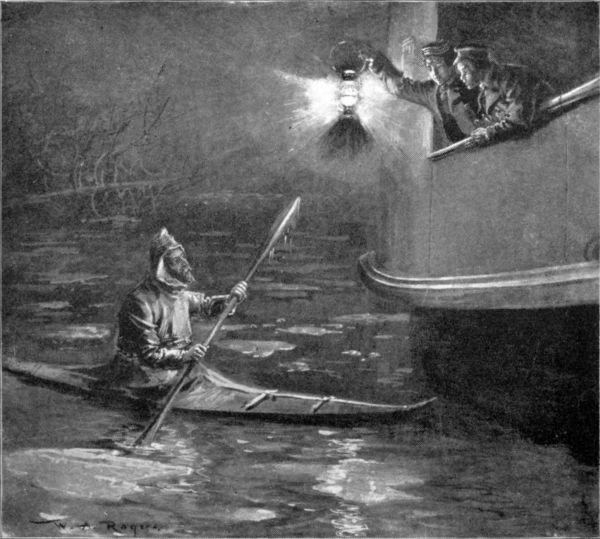
sick man, and there, holding flashing lanterns to guide
him, they excitedly awaited the approach of the unknown.
While they peered vaguely into the gloom, listening
for the slatting of sails or the rattle of oars, he
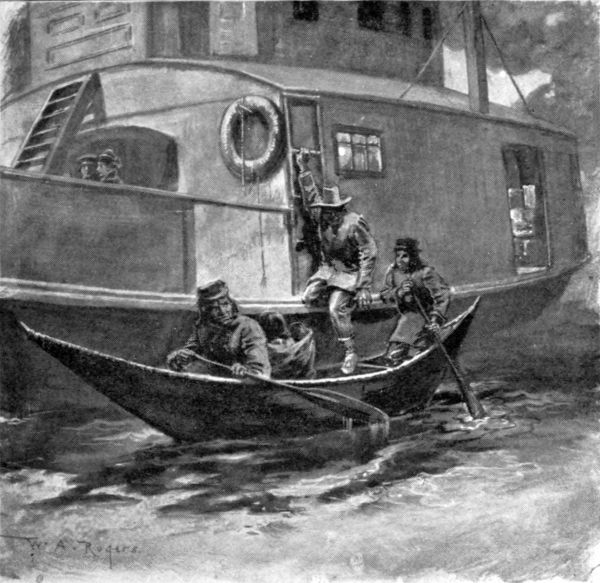
suddenly swept alongside, seated in an Eskimo kyak
or skin boat, very similar to the one in which Phil and
Serge had made their perilous voyage on Bering Sea
a month before, only much smaller.
They could see that he was a white man, wearing a
thick, close-cut brown beard; but otherwise he might
easily have been mistaken for a native, so completely
was he enveloped in a kamleika. The hood of this
was drawn over his head, while its ample skirts were
fastened to the coaming of the hatch in which he sat,
so as to prevent the entrance of water.
“Well, if this isn’t a bit of good-fortune, then I
don’t know what good-fortune is!” he exclaimed, smiling
up at the eager faces peering at him from the
steamer’s side. “May I come aboard?”
“May you come aboard?” cried Phil. “Well, sir,
I rather think you may, for even if you didn’t want
to, I am afraid we should capture you and drag you on
board by force. Why, we couldn’t be more delighted
to see you if you were the President of the United
States himself.”
“I doubt if you can be half as happy to see me as I
am to meet with you thus fortunately and unexpectedly,”
laughed the stranger.
“In that case,” replied Phil, “you must be the very
happiest person in the world, for you have made me
almost that.”
During this interchange of courtesies the stranger
had been unlashing his kamleika, and now, stepping
lightly from his fragile craft, he gained the deck, to
which his kyak was also lifted.
“Ah! but this is cosey and comfortable,” he remarked,
as he entered the well-lighted mess-room, which opened
from the galley and was warmed by its glowing stove.
Serge had just finished his preparations for supper, and
the well-laden mess-table did indeed present a sight
calculated to cheer the heart of a hungry man, especially
one who had been for hours battling with the
ice of an Alaskan river.
“You gentlemen seem to be travelling and living
like princes,” continued the stranger; “but I must
confess to considerable surprise at finding you on the
river so late in the season. You are bound down and
out, I presume?”
“No, sir,” answered Phil, “we are bound up the
river, and hope to reach Anvik before it closes.”
“Anvik!” cried the stranger. “Why, that is the
place to which I also am going.”
“Alone, at night, and in a bidarkie?” asked Phil, incredulously.
“Yes,” laughed the other, “though I was only trying
to cross the river to-night for fear it might close
before morning, and leave me stranded on the farther
bank. It was a reckless thing to undertake, I acknowledge,
and but for your timely presence I might have
come to serious grief ere this. It had grown so dark
before I sighted your lights that I could no longer
avoid the floating ice, and was in great fear that my
boat would be cut open. You may believe, then, that
I was glad to see them. Now, to find myself seated
among those of my own race, and at a civilized table
after a rather trying experience of Eskimo hospitality,
caps the climax and renders my content complete.”
“Are you on a hunting or fishing trip, sir?” asked
Phil, anxious to establish the status of this new acquaintance.
“Neither, just now,” was the laconic answer.
“Trading, perhaps?”
“Not exactly.”
“Travelling for pleasure?”
“Yes, so far as it is a pleasure to do my work.”
“Prospecting?”
“For some things, though not for gold.”
“In government employ?”
“No.”
“Working for the company, perhaps?”
“If you mean for the fur-trading company, I am
not.”
Phil was nonplussed, and knew not what to ask next.
In fact, but for the stranger’s affable manner and quizzical
smile he would not have pushed his inquiries so
far as he had. Finally he said: “I need not ask if
you are a good boatman, for any one who can manage
a bidarkie as well as you do must be that. I do
want to make one more inquiry, though, and I hope
you will excuse my inquisitiveness, but we are in distress
and greatly need assistance. Are you a Yukon
pilot?”
“For that part of the river lying between here and
Anvik I am,” replied the stranger. “In fact, I know
it so well that I would not hesitate to run it in the
dark. Furthermore, to satisfy your very proper curiosity
concerning an utter stranger, who has forced
himself upon your hospitality, I will say that I am a
trader, a prospector, a fisherman, a hunter, a boatman,
a mechanic, a writer, a teacher, something each of a
lawyer, a physician, and a surgeon; and, above all, I
am a preacher of the Word of God, for I am a missionary
of the Protestant Episcopal Church, and stationed
at Anvik.”
“Oh, sir, are you, really?” cried Phil. “Then you
are the very man I have wanted most to meet. Had I
not heard that you were at Anvik, and believed you
would help us, I don’t think I should have dared bring
the boat even as far as I have. I was trying to make
up my mind what to do next, and had almost decided
not to attempt a further ascent of the river, but to go
into the best winter-quarters we could find to-morrow.
You see we are all mixed up as to the channels, and
greatly afraid of being caught by the ice.”
“As well you may be,” replied the missionary.
“But, pardon my curiosity, you speak of bringing the
boat to this place as though you were her captain. Is
that the case?”
“No,” replied Phil, with a flush. “I am only her
first mate, while Serge here is second, and Mr. Sims is
engineer. But I am acting as captain during the illness
of our real captain, Mr. Gerald Hamer, who is
down with the measles.”
“Indeed?” said the missionary, gravely. “I am
very sorry to hear that, for in this climate, especially,
measles is a serious sickness and has been a terrible
scourge on the river. I have just been spending a few
days at one of the Shagelook villages installing a native
teacher in place of one who died of measles a few
weeks ago. How long has your captain been ill?”
“Since the day we entered the river.”
“And do you mean to say that you have navigated
the steamer all this distance without help?”
“Oh no, sir! I have had the help of Serge, who is
a capital sailor and can talk Russian besides, and of
Mr. Sims, who is a first-class engineer, and of Isaac,
who is a millwright, but who makes one of the best
firemen I ever saw, and we had another millwright,
only he died last night, and a native pilot part of the
way.”
“Well, you have certainly shown an immense
amount of pluck and perseverance,” exclaimed the
missionary, “and I don’t think I know another boy of
your age who would have done as well, for you don’t
look as though you were out of your teens yet. Are
you?”
“Almost,” answered Phil, again flushing. “That is,
I shall be in two years more.”
“And Serge?”
“He is almost as old as I am.”
“How about Isaac?”
“Oh, Isaac is most twenty.”
“Well, Mr. Sims,” said the missionary, turning to
the engineer, “I congratulate you on your crew.”
“Yes,” assented the man, gruffly, “they’re a pretty
plucky lot of boys. We’ve been mighty short-handed,
though, since the cap’n took sick, and Martin died,
and my assistant was set ashore for mutiny, and I for
one am powerful glad to see another white man come
on board, even if he is a parson.”
Smiling at this equivocal compliment, the missionary
asked if he might visit the captain, and was
conducted by Phil to the sick man’s bedside. As they
came away he said to the young mate: “Your captain
is dangerously ill, and the sooner you get him to Anvik,
where there is a doctor, the better. Therefore I
would advise you to up anchor and make the run to-night,
especially as I fear the river may close before
morning.”