Larger versions of most illustrations may be seen by right-clicking them
and selecting an option to view them separately, or by double-tapping and/or
stretching them.
By the Same Author.
WHERE BLACK RULES WHITE—HAYTI
THROUGH THE HEART OF PATAGONIA
HUNTING CAMPS IN WOOD AND WILDERNESS
THROUGH TRACKLESS LABRADOR
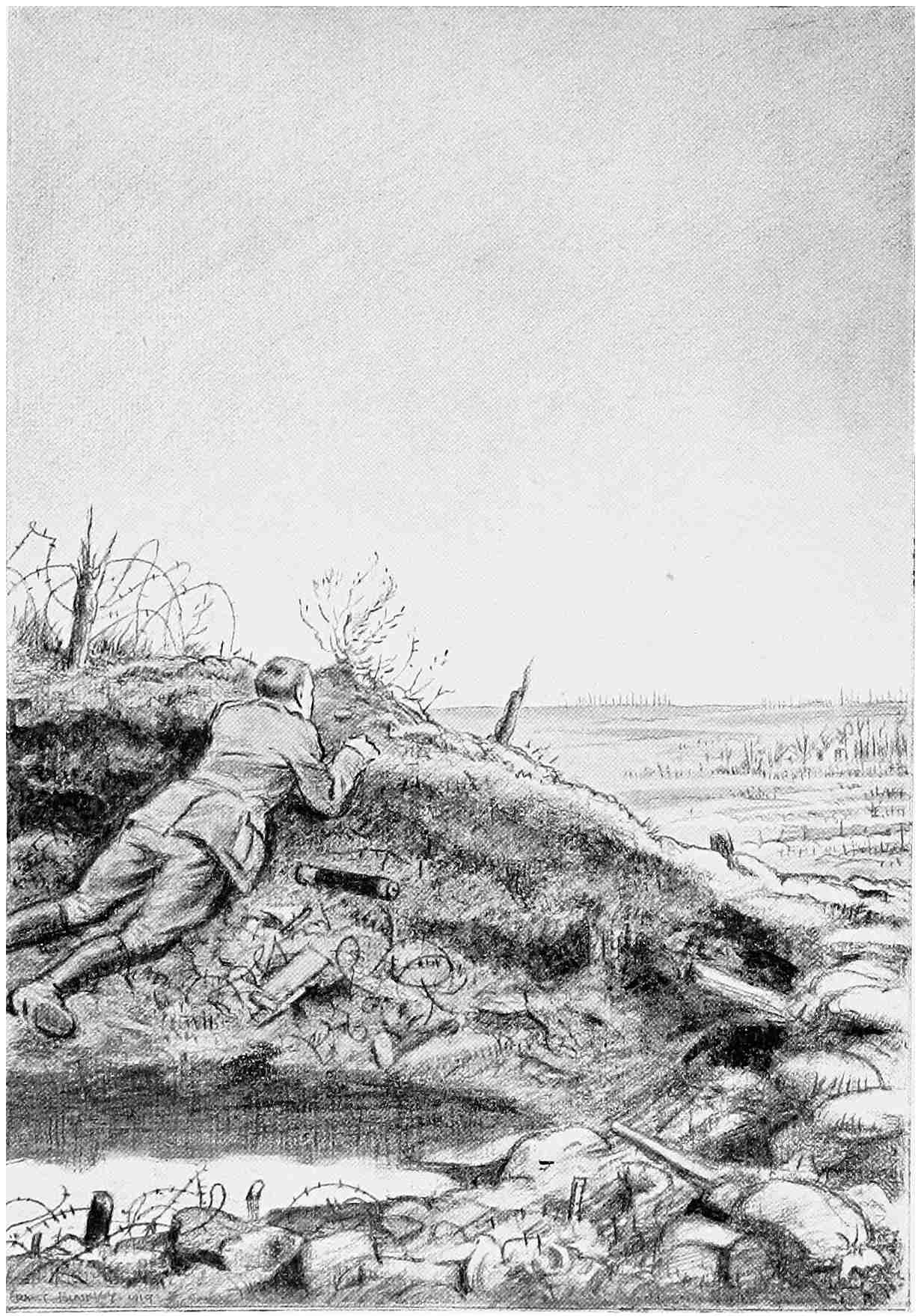
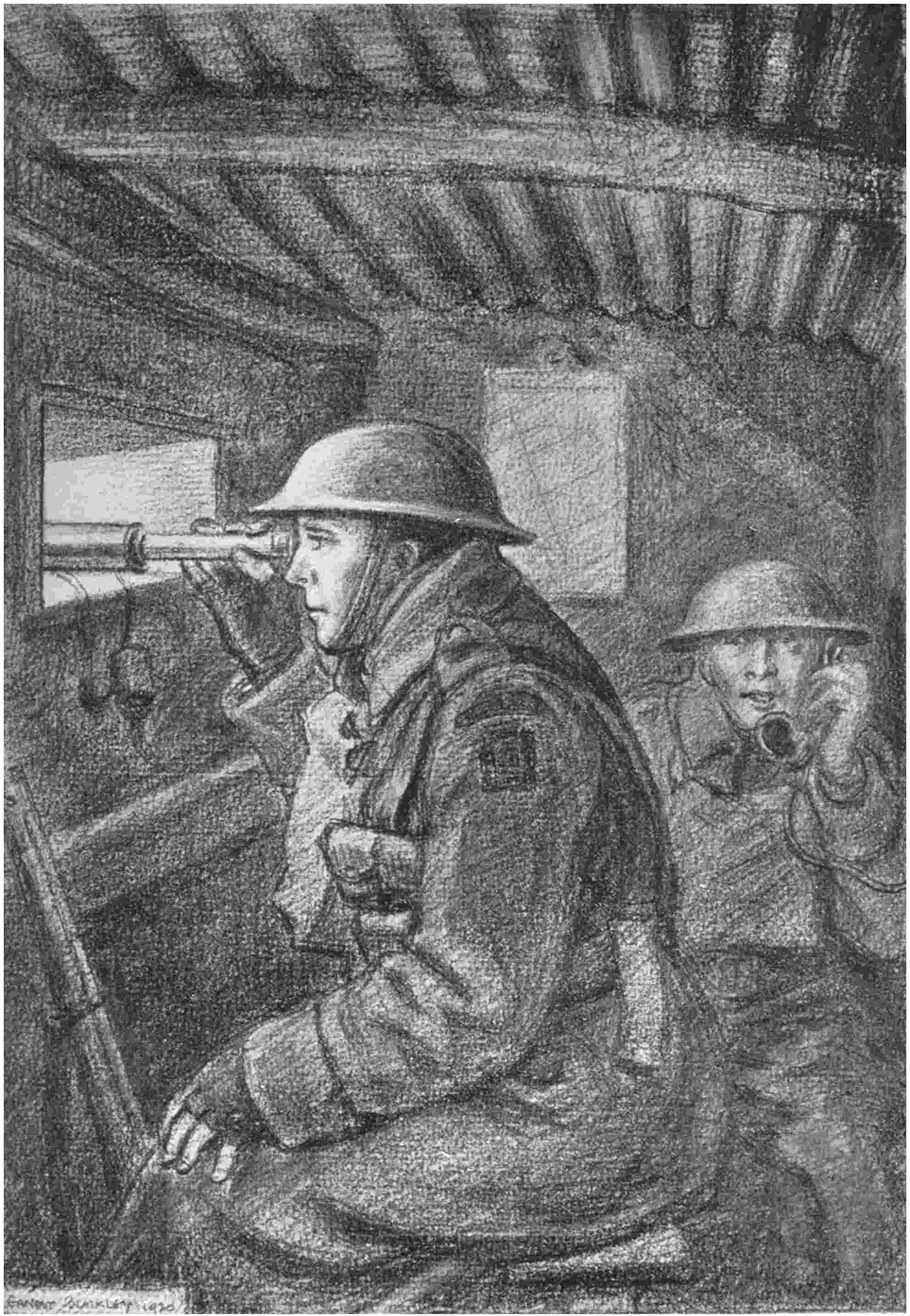
From a drawing by][Ernest Blaikley.
The Sniper-Observer-Scout.
SNIPING IN FRANCE
With Notes on the Scientific Training of
Scouts, Observers, and Snipers
BY
MAJOR H. HESKETH-PRICHARD D.S.O., M.C.
WITH A FOREWORD BY GENERAL LORD HORNE OF STIRKOKE
G.C.B., K.C.M.G., etc.
Illustrations by ERNEST BLAIKLEY, Artists’
Rifles, late Sergeant-Instructor at the First
Army School of S.O.S., the late Lieut. B. Head,
The Hertfordshire Regt., and from Photographs.
NEW YORK: E. P. DUTTON AND COMPANY 681, FIFTH AVENUE
Printed in Great Britain.
FOREWORD By General Lord Horne , G.C.B.
It may fairly be claimed that when hostilities ceased
on November 11th, 1918, we had outplayed Germany
at all points of the game.
Perhaps as a nation we failed in imagination.
Possibly Germany was more quick to initiate new
methods of warfare or to adapt her existing methods
to meet prevailing conditions. Certainly we were
slow to adopt, indeed, our souls abhorred, anything
unsportsmanlike.
Had it been left to us, “Gas” would have taken no
part in the Great European War.
But, however lacking in imagination, however slow
to realize the importance of novel methods, once we
were convinced of their necessity, once we decided to
adopt them, we managed by a combination of brains
and energy, pluck and endurance, not only to make up
the lost ground, but to take the lead in the race. In
proof of this statement I would instance Heavy Field
Artillery, High Explosives, Gas, Work in the Air, etc.,
and many other points I could mention in which
Germany started ahead of us, including Sniping,
Observation and Scouting.
And for our eventual superiority we owe much to
individuals, men who, like the author of this book,
Major Hesketh-Prichard, combined expert knowledge
with untiring energy, men who would not be denied
and could not recognize defeat.
In the early days of 1915, in command of the 2nd
Division, I well remember the ever-increasing activity
of the German sniper and the annoyance of our
officers and men in the trenches. I can recall the
acquisition by the Guards’ Brigade, then in the
Brickfields of Cuinchy with Lord Cavan as Brigadier,
of two rifles fitted with telescopic sights and the good
use made of them. It was the experience of 1915
that impressed upon us the necessity of fighting for
superiority in all branches of trench warfare, amongst
which sniping held an important position. It was
therefore a great satisfaction to me upon my
arrival from the battlefields of the Somme in the
autumn of 1916 to find Major Hesketh-Prichard’s
School firmly established in the First Army area,
thanks in a great measure to the support and encouragement
of Lieut.-General Sir Richard Haking, the
Commander of the Eleventh Corps.
From that time onwards, owing chiefly to the
energy, enthusiasm, tact and personality of its Commandant,
the influence of the Sniping, Observation
and Scouting School spread rapidly throughout the
British Forces in France. Of its ups and downs, of
its troubles and its successes, and of its ultimate
triumph, Major Hesketh-Prichard tells the tale with
modesty typical of the man.
I may be permitted to add my testimony that in
each phase of the war, not only in the trenches, but in
the field, we found the value of the trained sniper,
observer and scout.
This book is not only a record of a successful system
of training, valuable as such to us soldiers, but also
will be found to be full of interest to the general
reader.
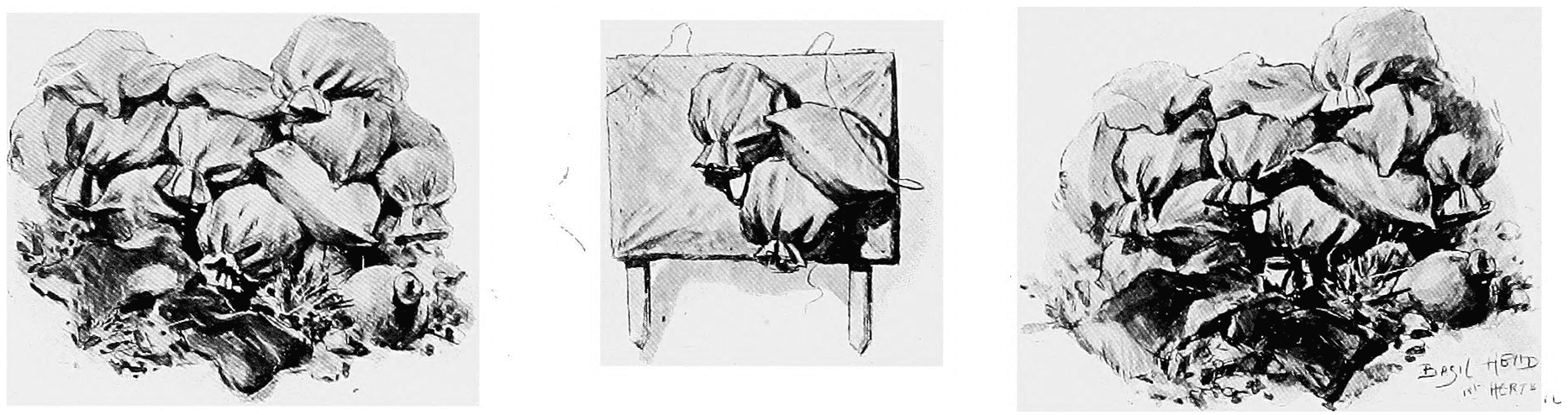
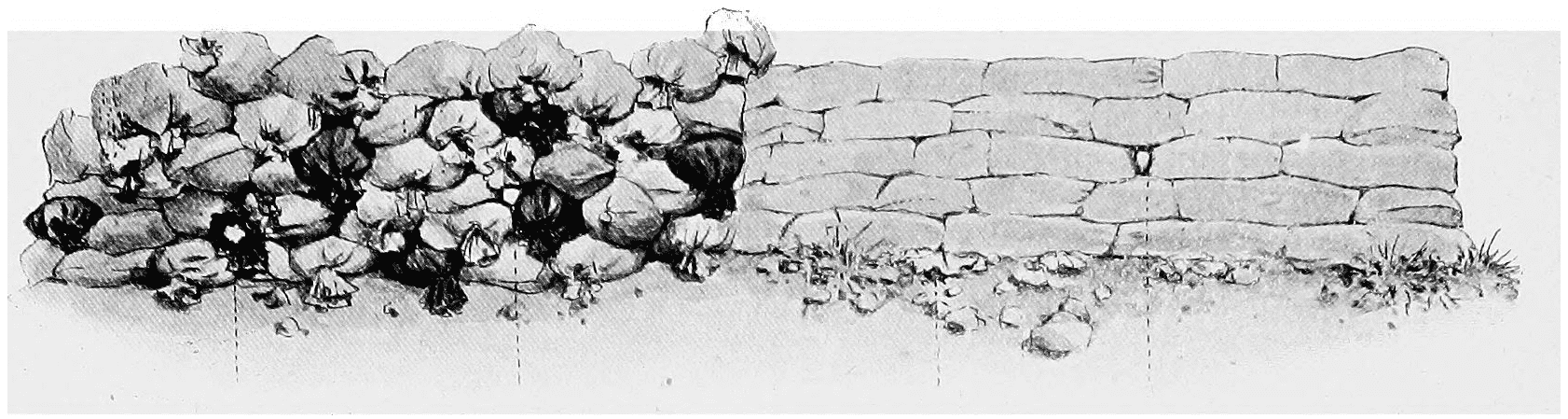
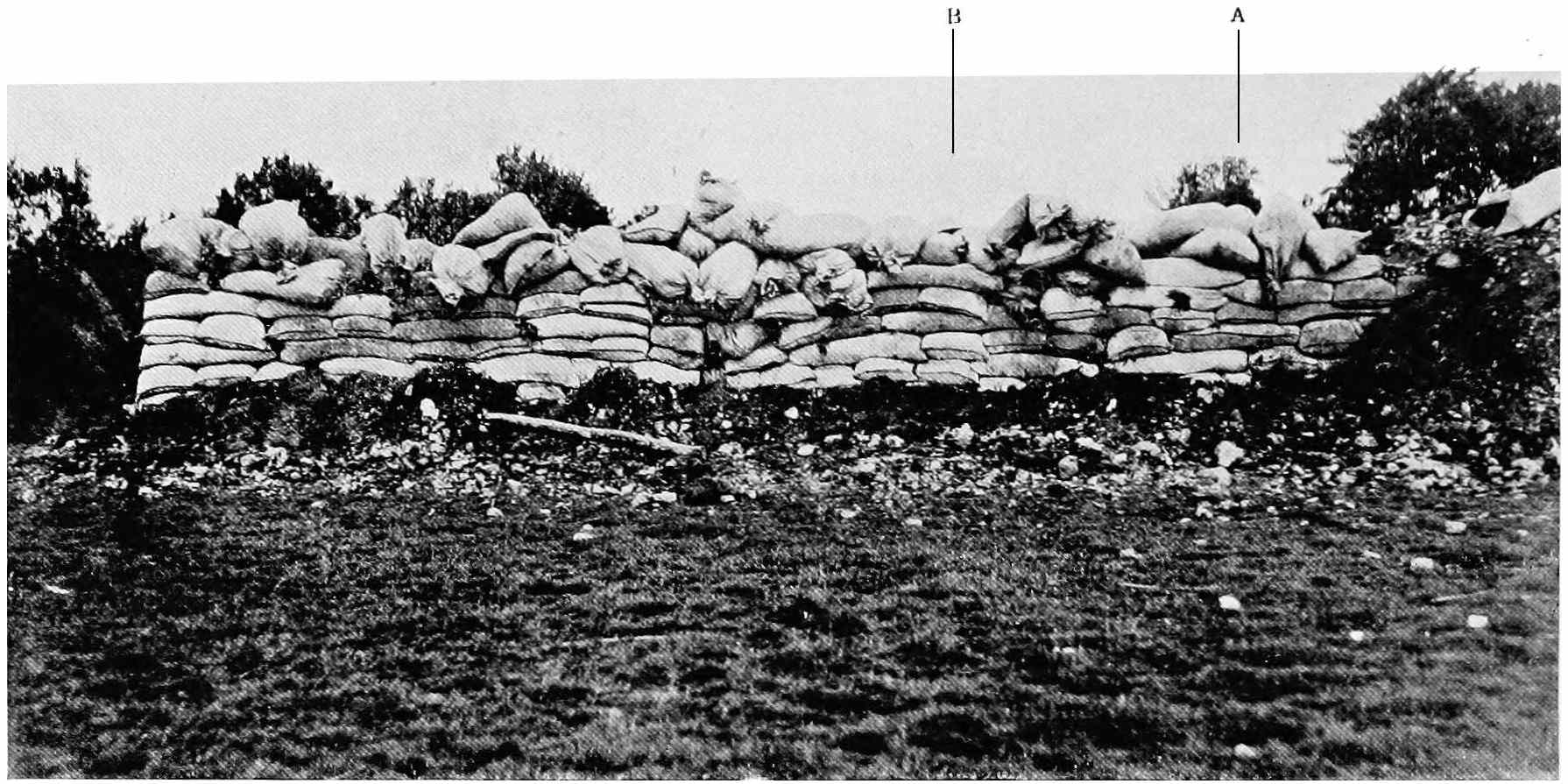
Method of inserting Loophole. 1. Original Section of Parapet; 2. How bags are arranged and fixed round loophole to imitate original parapet (Gray’s Boards.); 3. Parapet reconstructed with loophole
SNIPING IN FRANCE — CHAPTER I THE GENESIS OF SNIPING
Readers of this book must realize the necessarily
very narrow and circumscribed point
of view from which it is written. It is simply an
account of some memories of sniping, observation
and scouting in France and Flanders, and its purpose
is to preserve, as far as may be, in some form the work
and training of a class of officers and men whose duties
became ever more important as the war progressed.
It is in the hope that the true value of sniping and
scouting will continue to be recognized in the future
training of our armies, as it certainly was recognized
in the later years of the war, that this book is
written.
The idea of organized sniping was not a new one
to me when I went out to France in May, 1915. I
had been there before, in the previous March, and
had seen the immense advantages which had accrued
to the Germans through their superiority in trench
warfare sniping.
It is difficult now to give the exact figures of our
losses. Suffice it to say that in early 1915 we lost
eighteen men in a single battalion in a single day to
enemy snipers. Now if each battalion in the line
killed by sniping a single German in the day, the
numbers would mount up. If any one cares to do a
mathematical sum, and to work out the number of
battalions we had in the line, they will be surprised at
the figures, and when they multiply these figures by
thirty and look at the month’s losses, they will find
that in a war of attrition the sniper on this count
alone justifies his existence and wipes out large numbers
of the enemy.
But it is not only by the casualties that one can
judge the value of sniping. If your trench is dominated
by enemy snipers, life in it is really a very hard
thing, and moral must inevitably suffer. In many
parts of the line all through France and Belgium the
enemy, who were organized at a much earlier period
than we, certainly did dominate us. Each regiment
and most soldiers who have been to France will remember
some particular spot where they will say the
German sniping was more deadly than elsewhere,
but the truth of the matter is that in the middle of
1915 we were undergoing almost everywhere a severe
gruelling, to say the least of it.
When I went out in May, 1915, I took with me
several telescopic-sighted rifles, which were either my
own property or borrowed from friends. I was at
the time attached to the Intelligence Department
as an officer in charge of war-correspondents, and
my work gave me ample opportunity to visit all
parts of the line. Whenever I went to the line I
took with me, if it was possible, a telescopic-sighted
rifle, and I found that both brigades and battalions
were soon applying to me to lend these rifles. In
this way opportunities arose of visiting the line and
studying the sniping problem on the spot.
One day I remember I was going through the
trenches in company with the Australian Correspondent,
Mr. Gullett, when we came to a very smart
notice board on which was painted the word “Sniper,”
and also an arrow pointing to the lair in which he lay.
The sniper, however, was not in the lair, but was
shooting over the top of the parapet with a telescopic-sighted
rifle. These rifles were coming out from
England at that time in very small numbers, and
were being issued to the troops.
I had for many years possessed telescope-sighted
rifles, and had some understanding of their manipulation
as used in big-game shooting. In a general
way I could not help thinking that they were unsportsmanlike,
as they made shooting so very easy, but
for shooting at rabbits with a small-bore rifle, where
you only wounded your rabbit unless you hit him in
the head, they were admirable and saved a great deal
of unnecessary suffering.
But to return to the sniper. Much interested, we
asked him how he liked his rifle, and he announced
that he could put a shot through the loophole of the
iron shields in the German trenches “every time.”
As the German trenches were six hundred yards away,
it seemed to me that the sniper was optimistic, and
we asked him if he would let us see him shoot. I
had with me a Ross glass which I always carried in
the trenches, and when the sniper shot I saw his bullet
strike some six feet to the left of the plate at which he
was aiming. He, however, was convinced from the sound
that it had gone clean through the loophole! He
had another shot, and again struck well to the left.
I had a look at his sight, which was a tap-over fitting,
and seeing that it was a little out of alignment I
questioned the sniper as to how much he knew about
his weapon. It is no exaggeration to say that his
knowledge was limited.
From this moment all telescope-sighted rifles
became a matter of great interest to me, and it was not
long before I came to the conclusion that about
80 per cent. were quite useless, much worse, in fact,
than the ordinary open sights, in the hands in which
they were. The men using them had in most cases
hardly any knowledge of how their sights were aligned.
A tap or a knock and the rifle was straightway out of
shooting.
For the benefit of the untechnical reader it will be
well here to remark that if a telescopic sight set upon a
4-inch base is one-hundredth of an inch out of its
true alignment, it will shoot incorrectly to the extent
of 9 inches at 100 yards, and, of course, 18 inches
at 200 yards, and 54 inches at 600 yards. The sights
had been issued without instruction, were often
handed over as trench-stores, and were served out by
quartermaster-sergeants who very often looked on
them as egregious fads.
It seemed to me that here was something definite
to go upon towards that organization of sniping in
which I so much desired to have a hand. That evening
I laid the matter before my Commanding Officer,
Lieut.-Colonel A.G. Stuart, of the 40th Pathans,
than whom surely no finer officer went to the war.
He was killed in 1916 by a chance bullet a mile behind
the trenches, when he was serving near Ypres as
G.S.O.1 to the 50th Division.
He listened with both sympathy and interest.
“You say,” said he, “that all or nearly all the telescope-sighted
rifles you have seen are so incorrect as
to be worse than useless. Are you quite sure of this?”
“Quite sure,” said I. “And that is only one side
of it. The men have no idea of concealment, and
many of them are easy targets to the Hun snipers.”
“The proper authorities should move in the
matter,” said Colonel Stuart.
“There don’t seem to be any proper authorities,
sir. The officers know no more than the men about
these sights, and what I want to do is this: If it is
possible I should like to be appointed as sniping expert
to some unit. I believe I could save hundreds of
lives even in a brigade the way things are.”
Colonel Stuart said nothing, so I went on:
“Will you help me to get a job of this kind, sir?
I am asking because it seems absurd for a fellow like
me who has spent years after big game to let men go
on being killed when I know perfectly well that I
can stop it.”
“Are you sure of that?”
“I am quite willing, sir, to go to any unit for a fortnight’s
trial, and if I do not make good, there will
be no harm done.”
“Well,” said Colonel Stuart at length, “we will
talk to people about it and see what they say.”
After that, Colonel Stuart often questioned me, and
I pointed out to him our continued and heavy losses,
the complete German superiority, the necessity not
only of a course of training but, more important still,
the selection of the right men to train and also their
value to Intelligence if provided with telescopes, and
made a dozen other suggestions, all very far-reaching.
When I look back now on these suggestions, which
came from a very amateur soldier of no military
experience, I can only marvel at Colonel Stuart’s
patience; but he was not only patient, he was also
most helpful and sympathetic. Without him this very
necessary reform might, and probably would, have
been strangled at birth, or would have only come into
the Army, if it had come at all, at a much later time.
Colonel Stuart not only allowed me to speak of my
ideas to various officers in high command, but even
did so himself on my behalf. I was amazed at the
invariable kindness and courtesy that I met on every
hand. I used to introduce myself and say: “Sir, I
hope you will forgive me if I speak about a thing I
am awfully keen on—sniping, sir. The Huns got
twelve of the Blankshires in this Division on their
last tour of duty, and I think we could easily beat them
at this if we had proper training and organization.”
And then I would lay out my plans.
But, though people listened, there were immense
difficulties in the way, and these might never have been
surmounted, although quite a number of Corps and
Divisional G.O.C.’s had said to me: “If you can get
away from your job at G.H.Q., come here and be our
sniping expert. We shall be very glad to have you.”
Still, as I say, there is a thing in the Army called
“Establishment,” and there was no Establishment
for a sniping officer, and if the matter were put through
the War Office it would probably take some months,
I knew, to obtain an establishment. Colonel Stuart,
however, once I had convinced him, backed me up
in every possible way, going to see the M.G.G.S.,
Third Army, Major-General Sir A.L. Lynden-Bell,
who was in full sympathy with the idea. It was thus
that the matter was mentioned to Sir Charles Monro,
commanding the Third Army, and Colonel Stuart
arranged with Brigadier-General MacDonogh, now
Lieut.-General Sir George MacDonogh, who was then
in command of the Intelligence Corps, to allow me to
serve with the Third Army as sniping expert.
John Buchan,A who was at that time the Times
correspondent on the Western Front, also gave the
idea great encouragement. He had seen for himself
the awful casualties that we were suffering, and considered
the scheme which I laid out to be a sound one.
A Afterwards Lieut.-Col. John Buchan, Director of Information.
Sir Charles Monro, in talking over the matter, made
a remark which I have always remembered.
“It is not,” he said, “only that a good shot
strengthens his unit, but he adds to its moral—he
raises the moral of his comrades—it raises the moral
of the whole unit to know that it contains several first-class
shots.”
These are not the exact words which Sir Charles
used, but they are as near them as I can remember.
* * * * *
Now that I had got my chance I was at first extremely
happy, but later, as I could not go to my new
work at once, I became a little nervous of failure, and
pictured myself unsuccessful in my attempt to
dominate the German snipers. I began to wish that
I had gone to my work a month earlier, for when
the Third Army took over from the French, the
Germans offered any amount of targets, whereas I
now heard that they were becoming more cautious.
I, therefore, cast about for some way in which I might
hope to make certain of success, and to this end, having
conceived a plan, I went down to Neuve Chapelle,
where my friend, Captain A.C. Gathorne-Hardy,
9th Scottish Rifles, since killed at Loos leading his men
and within ten yards of the German wire, was in the
line. We obtained from the old German trenches
a number of the large steel plates from behind which
the German snipers were wont to shoot, and these I
took home with me to England, for I had obtained a
week’s leave before taking up my new duties.
I proceeded to try on these plates all kinds of rifles,
from the Jeffreys high velocity .333 to heavy elephant
guns of various bores, and was delighted to find that
the bullets from the .333, as well as the elephant guns,
pierced them like butter. Here, again, Colonel John
Buchan came to my assistance, and obtained for me a
fund, to which Lord Haldane, Lord Glenconner and
Lord Finlay kindly contributed the money, and which
enabled me to purchase the necessary rifles. Later
on, Mr. St. Loe Strachey, the editor of The Spectator,
continued to keep up my fund, which really was of
incalculable value to us, and out of which everything
from dummy heads purchased at Clarkson’s to football
jerseys for the splendidly-appointed Sniping
School, which finally eventuated, were purchased.
At length I was free of my work at G.H.Q., and
went down to the Third Army, where I was attached
to the 7th Corps, the 4th Division, and the 10th and
12th Infantry Brigades.
It would be out of place to describe in detail the
days that followed. Suffice it to say that very early
in the proceedings it became clear that snipers must
always work in pairs, one man shooting and one man
finding the targets with the telescope. The regulation
issue of the latter was at the time, I think, about
eight telescopes per battalion, and these were used by
the Signallers, but Lord Roberts’ Fund, administered
with extraordinary energy by Mr. Penoyre, came to
the rescue, and soon a certain number of telescopes
dribbled down into the 4th Division line. As to the
heavy and armour-piercing rifles, they did their work
exceedingly well, and no doubt caused a great surprise
to the enemy.
One day I obtained leave to go to Amiens, where I
visited the French Camouflage Works, and found to my
delight that they had made a number of papier-mâché
models of the heads and shoulders of British soldiers.
Of these I was able to purchase a large quantity, and
had no longer any need to buy in London, where the
heads were rather theatrical properties than the real
thing. The uses to which the heads were put were
varied. They were, in these early days before they were
too much advertised (for they afterwards became an
issue in our Army), most useful in getting the enemy to
give a target. It was also possible, by showing very
skilfully the heads of Sikhs or Ghurkas in different parts
of the line, to give the German Intelligence the impression
that we were holding our line with Indian
troops, and I have no doubt they were considerably
worried to account for these movements.
One day I received orders from Army Headquarters
telling me that Colonel Langford Lloyd, D.S.O.,
had now started a telescopic-sight school in the 10th
Corps area, and ordering me to go there and to collaborate
with Colonel Lloyd in a book upon sniping and
telescopic sights. I went and found a splendid school
running, in which the instruction in telescopic sights
was rapidly correcting these rifles in the 10th Corps.
I had the opportunity at Colonel Lloyd’s school of
learning a great deal that I did not know about telescopic
sights, and many other matters in which Colonel
Lloyd is a past master. He listened with great interest
to the various ruses, of which there was now
quite a long list, that we had employed in the trenches.
We wrote our pamphlet on sniping and telescopic
sights, a pamphlet which, owing to a change in the
Army Command, was never published, and shortly
after my visit to Colonel Lloyd I received the intimation
that my trial time with the Third Army had been
successful, and that steps would now be taken to get
me placed permanently upon its strength. In the
meantime, I went from brigade to brigade, burning
with eagerness to make organized sniping a definite
fact. The instruction took place both in and out of
the trenches, and during the course of it we had many
interesting experiences. As soon as people began to
talk about sniping as a new and interesting subject,
our arrival in the trenches became rather trying,
as we were certainly looked upon as something in the
light of performing animals who would give some
kind of a show of greater or less interest. But the
Higher Command soon put a stop to this, and thence-forward
we were allowed to plough our lonely furrow.
It would be difficult to describe the various days
spent in the trenches, or the duels that took place
there; but each one threw fresh light upon sniping and
showed the enormous extent to which it might be
developed. I will make some reference to these days
in later chapters.
As I have stated, snipers always worked in pairs,
one observing, the other shooting, and soon we found
that the notes kept by the observer were invaluable
from an Intelligence point of view. If a line was
well covered with snipers’ posts, nothing could happen
in the enemy line without our snipers’ observers reporting
it—no work could be done, no alteration in
the parapet made. Successful observation was, in
my experience, first obtained in the 10th Brigade,
commanded by Brigadier-General Hull,B by the 2nd
Seaforth Highlanders. They had an extraordinarily
keen Commanding Officer, who provided his men
with good telescopes.
We now began all through the 7th Corps to start
sniping sections consisting of trained snipers and
observers, and the success of the movement grew very
rapidly. The German began to cower in his trenches,
and as time wore on our casualties grew less and less.
My life at this time was an extraordinarily interesting
and strenuous one. Moving from brigade to brigade,
I would often find splendid arrangements for testing
the telescopic sights, and as often none at all. A horse
before breakfast, on which I would set forth to find a
range, followed by an hour in the Pioneer’s shop,
pasting up targets made out of old Daily Mails on to
frames—the snipers of the brigade paraded at nine
o’clock, the march to the improvised range, shooting
the telescopic sights at the target, and after dark a
lecture in some barn, was often the order of the
day.
I think in these early days that I was exceedingly
fortunate in having something definite to show. The
telescopic sights were often very much out of shooting,
and no one understood the cure. I think many
thought for the first time that there was something in
this sniping movement when a sniper missed the target
three times running at 70 yards, and a little later,
after his rifle had been manipulated, scored three bulls
on end.
One thing that struck me was the extraordinary
interest taken by all Brigade Commanders in every
detail of the work. I do not say, nor do I think, that
at the beginning they looked on my coming with
unmixed favour. Once I walked into a Brigade Headquarters,
and while waiting in the passage heard a
voice say:
“Who is this blighter who is coming?” And then
someone gave my name. Then a voice said: “Plays
cricket, doesn’t he?”
I could not help laughing, but as I say, in the very
early days every Brigade Major and G.O.C. had to be
converted to a belief in sniping. Often and often
the Brigade Commanders would spend hours on the
first day at the range, and I think that without exception
when they saw the incorrect rifles being made
correct, they once and for all decided in my favour.
On my second visit to these Brigades, I was almost
always made the guest of the Brigadier-General and
received with a kindness so great as to be really overwhelming.
Things, in fact, were going very well
indeed for the work which one hoped would soon
spread through the whole B.E.F., for to my delight
one day I received a letter from Major Collins, then
G.S.O.2 to the Second Army, whom I had informed
of my appointment as sniping expert, to say that
General Plumer was starting an Army Sniping School
in the Second Army, and asking for any notes I might
have.
But one morning while shooting on the range I
heard that Sir Charles Monro and his staff had gone
to Gallipoli. I had been so keen on my work that I
had not pushed the matter of getting my appointment
regularized, but now I realized that its tenure
might become very insecure. Indeed, as a matter of
fact when I did raise the question I was informed by
G.H.Q. that if I did not keep quiet I should be recalled.
In 1915, the Third Army was far and away the best
sniping Army in France. There was hardly an incorrect
sight in the 10th or 7th Corps, and scores of
officers and hundreds of men had been through courses
at Colonel Lloyd’s 10th Corps School, or with me.
It was while I was with one of the Infantry Brigades
of the 37th Division that I received a letter which gave
me immense pleasure. It was to the effect that Lieut.-General
Haking, the Corps Commander of the 11th
Corps in the First Army, wished to borrow me, so
that I might lecture on sniping to his Corps, and go
through their telescopic sights. Here was a splendid
chance of carrying the work outside my own Army.
About this time I was attached to the Third Army
Infantry School, then just formed under its first and
very capable Commandant, Brig.-General R.J. Kentish,
D.S.O. I lectured there on sniping and started a range
and demonstrations, but I found myself lecturing to
Company Commanders, whereas I ought to have been
doing so to sniping officers, in order to get the best
results. The Company Commanders liked, or appeared
to like, the lectures, but, in the Army phrase, it
was “not their pidgin,” and I soon felt that I should
do better work nearer the line.
From the school, however, I journeyed up into the
First Army area, and went through the sights and fulfilled
my engagement with the 11th Corps. I think
these days as the guest of the various Corps Commanders
of the First Army—for I was passed on from
the 11th Corps to the 3rd, and from the 3rd to the
1st—were the best days I had in France, for the extraordinary
keenness in the First Army was very marked.
It was here that I had to go through the ordeal of
having to lecture to the Guards Divisional Staff and
Snipers at nine o’clock in the morning. In lecturing,
even on an interesting subject like sniping, it has
always seemed to me much easier to be successful in
a warm room at five o’clock rather than in a cold
one at nine.
After finishing with the First Army and correcting
some 250 telescopic sights, I went back to the Third
Army Infantry School. Here I found that the Army
Commander of the Third Army, Sir E. H. H. Allenby,
had applied for my services for the Third Army, and
had received the reply that these could be granted
provided I relinquished the staff pay I was receiving
and was willing to accept instead the lower rate of an
Infantry Captain. This, of course, I agreed to do.
Evidently, however, there was some further hitch,
for I received no pay for the next eight months, nor
did I dare to raise the question lest I should be sent
back to G.H.Q.
I remember one General saying to me upon this
question, not without a smile, “You are not here
officially, you know, and any Germans you may have
killed, or caused to be killed, are, of course, only unofficially
dead.”
I will conclude this chapter with a letter that I
wrote in November, 1915, which gives my impressions
at that date.
My Dear ——
Since I have been with the 3rd Army, I have had
an Officer from every battalion in the 7th Corps
through my course. These Officers in their turn
train snipers, and so the thing permeates quickly and,
I think, with really good results.
Sniping seems to me to be the art of—
I.—Finding your mark.
II.—Defining your mark.
III.—Hitting your mark.
With regard to No. I, it is absolutely essential that
the use of the telescope should be taught from the
stalking or big-game point of view. If we had one
Officer teaching it in every battalion of our Army in
France, we should kill a lot of Germans, and not only
this but the task of Intelligence Officers would be
greatly facilitated. With four good telescopes on
every battalion front, very little can happen in the
enemy line without our knowing it. There are a good
many telescopes in France.
With regard to defining a mark. It is here that
telescope sights help us, but telescope sights in the
hands of a man who does not thoroughly understand
them are utterly useless. I have had a great many
through my hands, and in every ten I have had to
correct about six after they have been in the trenches
a short time. I wish every battalion had an Officer
who could correct and shoot telescopic sights. It is
very important that he should be thoroughly knowledgeable,
because a rifle barrel must not have too
many shots fired through it. With a new barrel a
good shot can nearly always get a 3-inch group, but
after 600 or 1000 shots have been fired through the
barrel the group becomes more scattered. It is
therefore necessary that the man who regulates the
rifle behind the trenches should be able to do so with
as few shots as possible.
Another point is,—that men must be trained to
understand and believe in their telescopic-sighted rifles.
One Brigade I had for instruction, on the third day of
instruction with 16 snipers shooting, got 17 hits on a
model of a human head at 430 yards in the first 21
shots. Some of the rifles used by these men had been
6 or 8 inches off at 100 yards until regulated. In all
they got 27 hits in 48 shots on the head, shoulder hits
not counted.
Also I have been having Officers through a regular
course. I give them first of all 20 objects, such as
models of heads of French, British and German
soldiers, periscopes, rifle barrel, pickaxe, fire lighted,
etc. These objects are shown for fifteen seconds each
from a trench, and those under instruction have to
write a list of what they can see with a telescope from
600 or 700 yards away. It is wonderful how quickly
they come on. After a short time they can spot the
colour of the pieces of earth thrown up from the trench
under observation. Then I give them a hillside to
examine. On this hillside I place a couple of objects
which are easy to find, perhaps the heads of a Frenchman
and an Englishman. I also put in two carefully
concealed loopholes, which they usually fail to find.
This teaches thoroughness of search.
The construction of loopholes is most important.
In this we are behind the Germans. There is one
form of double loophole, which I am keen to see more
universally adopted. The plate is placed in the parapet,
and two feet behind it a second plate is placed in
grooves along which it will slide. Not once in a
hundred times does the German at whom one is shooting
get his bullet through both loopholes.
The drainpipe loophole is also very good. If put
in at an angle, it is very difficult for a German to
put a bullet down it. In fact if the drainpipe is put
in low in the parapet, the brave Hun has to come clean
over the top of his own parapet to shoot down it at all.
I am also keen on teaching our fellows to open loopholes
sanely. I usually lie in front watching, and it is
rarely that, if I shot straight, I should not be able to
kill or wound nine of every ten men who open them.
Loopholes should, of course, be opened from the
side, and a cap badge exposed before they are looked
through. If the German does not fire for 75 seconds,
one may conclude that it is fairly safe. These little
simple-sounding precautions can save so many lives.
I cannot help feeling that sniping, even in these
days of many specialists, should be organized and improved.
My aim has always been to work in with
battalions. Some are better than others, naturally so,
but always without exception I have found them very
keen on improving sniping.
The use of snipers in attack is another point. If
you have a man who can hit a model of a human head
once in every 2 shots at 400 yards—and I will undertake
to get most men up to this standard who can
shoot decently—we shall kill some machine gunners
in our next advance. Also when a German is shooting
at our troops coming down a road through an
aperture made by the removal of a brick from a wall,
as they have often done, how useful to have a fellow
who can put a bullet through the aperture.
Of course no telescopic sight should ever be touched,
except as far as moving the focussing sleeve goes, by
anyone who does not understand it thoroughly. When
the object-glass becomes dirty or fogged with wet,
snipers often unscrew it. Unless they put it back in
its exact original position, they of course alter the
shooting of the rifle hopelessly. They also unscrew the
capstan heads, which are for the lateral regulation of
the sighting. I have seen telescopic sights which were
30 inches out at 100 yards, or about 25 feet at 1000
yards. These things would be impossible under a
keen sniping Officer.
One thing I am certain snipers can do. They can
make it very hot for the enemy’s forward artillery
observing Officers. If when the enemy shell our
trenches, one can get on the flank, one can often spot
a Hun Officer observing. The thing to do then is to
lay a telescope on through a drainpipe loophole near
by. If you pack in the rifle on to a bed of sandbags
so that the pointer of the telescopic sight rests just
under the place where the Hun pops up, it is possible to
take aim and fire the rifle in from two to four seconds.
It is very important that the man who is to shoot
should look through the big telescope and get a map
of the trench opposite into his brain. Our telescopic
sights magnify about 3½ and one can often make a
successful shot by shooting six inches or a foot left
or right, or above or below a white stone or some
prominent object in the opposing parapet, even when
you cannot define the Hun’s head very clearly through
the sight.
I have seen this done. It is a very good sign when
the Hun’s field-glasses fall on the wrong side of the
parapet.
Another thing to which we might give attention is
the use of decoys. I have had some made for me by
the French.
I am quite convinced if I were asked to give the
Germans the impression that we had been relieved by
Sikhs, Gurkhas or Frenchmen, that I could do so, so
wonderful are the models made for me by the French
sculptor. It is impossible to tell them from the real
thing if skilfully exposed at 100 yards, unless the light
is very strong, and at 300 and 400 yards it is quite
impossible.
In fact as long as trench warfare lasts, I believe much
can be done in many small ways, if desired. But 1200
or 1500 telescopic sights in the hands of trained men
and four times as many optical sights, if full value is
got out of them, might along our line shorten the German
army of many a valuable unit before the spring.
Again and again battalions report two, three or four
Germans shot by their snipers in a single day; if you
reduce these claims by half or even if each battalion
snipes but one Hun a day—and this is an absurdly
low estimate where adventitious sights are skilfully used,
the loss to the Germans would be great.
I have received the most kindly welcome possible
from everybody, and in many cases, almost in all, the
Corps have been asked to let me go back to give further
instruction. All Brigadiers are very keen indeed to
get a high standard of sniping, and many of them feel
that to do this is almost impossible unless the snipers
are trained to their rifles until their belief in their own
powers of hitting a mark, however small, becomes fixed.
As I think of sniping all day and often dream
about it at night, I could write you a lot more on the
subject, of which I have only touched the fringes. If
we organize sniping, we can get solid and tangible
results by killing the enemy and saving the lives of our
own men. Only those who have been in a trench
opposite Hun snipers that had the mastery, know what
a hell life can be made under these conditions.
I don’t think the Germans are better snipers than
our men, except that they are more patient and better
organized and better equipped. I have found out a
good deal about the German sniping organization, but
this is too long to go into now. I have said nothing
of piercing and blowing in German plates with heavy
and .333 rifles. You can shut up their sniping very
promptly for a time in this way.
CHAPTER II THE SNIPER IN THE TRENCHES — I — II
In my last chapter I attempted to give some history
of the small beginnings of organized sniping, and I
will now turn to the actual work of sniping in the line.
Sniping, which is to be defined in a broad way as
the art of very accurate shooting from concealment or
in the open, did not exist as an organized thing at the
beginning of the war. The wonderful rapid fire
which was the glory of the original expeditionary
force was not sniping, nor was it, beyond a certain
degree, accurate. Its aim was to create a “beaten
zone” through which nothing living could pass; and
this business was not best served by very accurate
individual shooting. Rather it was served by rapid
fire under skilled fire-control. But when we settled
down to trench warfare, and the most skilful might
spend a month in the trenches without ever seeing,
except perhaps at dawn, the whole of a German, and
when during the day one got but a glimpse or two of
the troglodytic enemy, there arose this need for very
accurate shooting. The mark was often but a head
or half a face, or a loophole behind which lurked a
German sniper, and no sighting shot was possible
because it “put down the target.” The smallest of
big game animals did not present so small a mark as the
German head, so that sniping became the highest and
most difficult of all forms of rifle shooting. At it,
every good target shot, though always useful, was not
necessarily successful, for speed was only less necessary
than accuracy, and no sniper could be considered worthy
of the name who could not get off his shot within two
seconds of sighting his target.
So much for the sniper in trench warfare, of which
a certain clique in the Army held him to be the product.
The officers who believed this prophesied that
when warfare became once more open, he would be
useless. This proved perhaps one of the most short-sighted
views of the whole war, for when it became our
turn to attack, the sniper’s duties only broadened out.
Should a battalion take a trench, it was the duty of
snipers to lie out in front and keep down the German
heads during the consolidation of their newly-won
position by our men, and were we held up by a
machine-gun in advance, it was often the duty of a
couple of snipers to crawl forward and, if possible,
deal with the obstruction.
I am here, however, going ahead of my narrative,
but I want early in this book to state definitely that
the sniper is not, and from the first, as I saw him, never
was meant to be, a product of trench warfare. In modern
war, where a battalion may be held up by a machine-gun,
it is invaluable to have in that battalion a
number of picked shots who can knock that machine-gun
out. For this purpose in some of our later attacks
a sniper carried armour-piercing ammunition, and
did not shoot at the machine-gunners, but at the
machine-gun itself. A single hit on the casing of
the breech-block, and the machine-gun was rendered
useless.
In the Army there has always been in certain
quarters a prejudice against very accurate shooting,
a prejudice which is quite understandable when one
considers the aims and ends of musketry. While
sniping is the opportunism of the rifle, musketry is its
routine. It would obviously never do to diminish
the depth of your beaten zone by excess of accuracy.
But this war, which, whatever may be said to the
contrary—and much was said to the contrary—was
largely a war of specialists, changed many things, and
among them the accurate shot or sniper was
destined to prove his extraordinary value.
But a great deal that I have said in the foregoing
paragraphs only became clear later, and at the moment
of which I am writing, September and October, 1915,
the superiority lay with the Germans, and the one
problem was to defeat them at a game which they had
themselves started. For it was the Germans, and not
the British, who began sniping.
That the Germans were ready for a sniping campaign
is clear enough, for at the end of 1914 there were
already 20,000 telescopic sights in the German Army,
and their snipers had been trained to use them. To
make any accurate estimate of how many victims the
Hun snipers claimed at this period is naturally impossible,
but the blow which they struck for their side
was a heavy one, and many of our finest soldiers met
their deaths at their hands. In the struggle which
followed there was perhaps something more human
and more personal than in the work of the gunner or
the infantryman. The British or Colonial sniper
was pitted against the Bavarian or the Prussian,
and all along the front duels were fought between men
who usually saw no more of their antagonists than a
cap badge or a forehead, but who became personalities
to each other, with names and individualities.
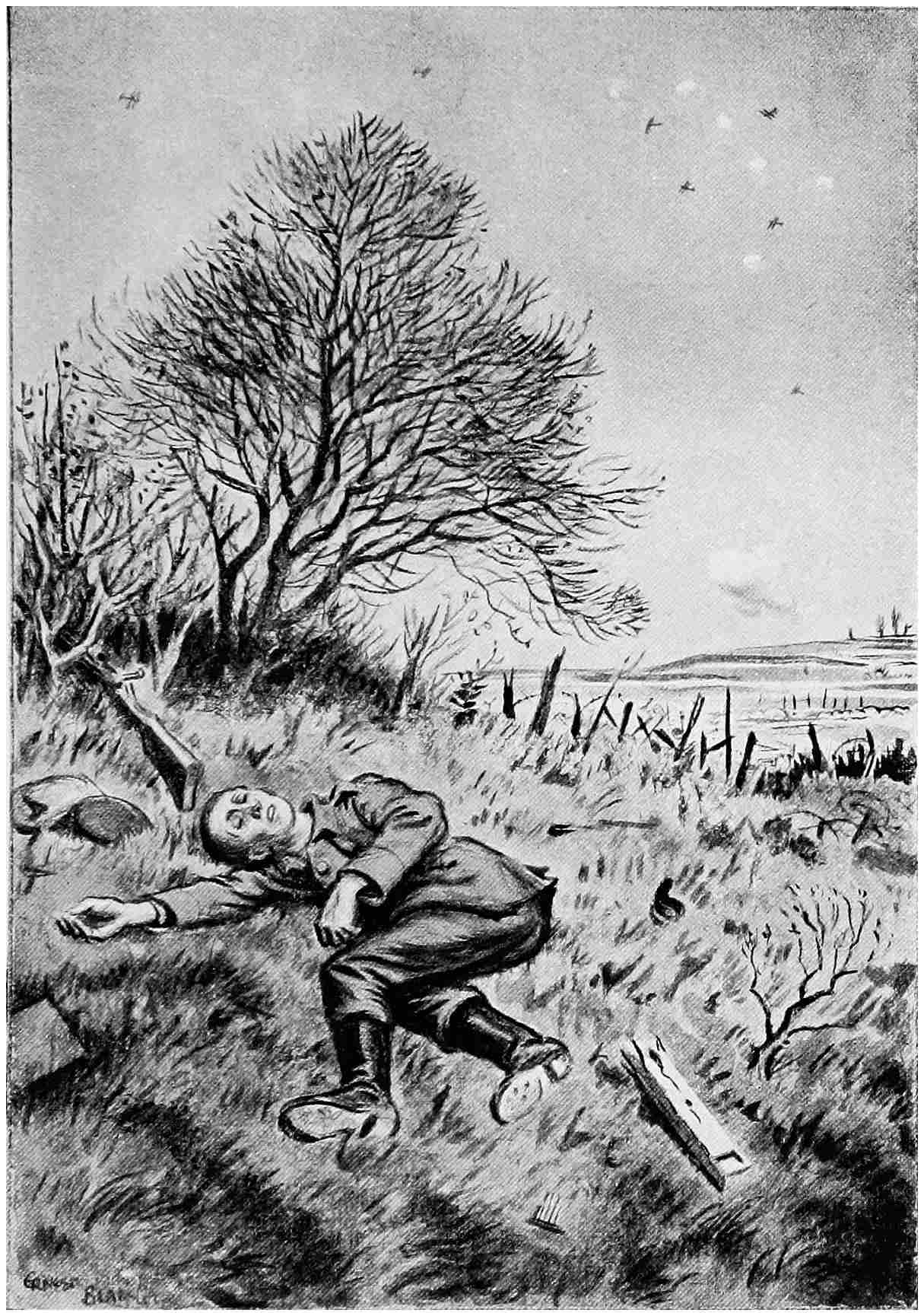
From a drawing by][Ernest Blaikley.
The Sniper’s End.
Only the man who actually was a sniper in the
trenches in 1915 can know how hard the German
was to overcome. At the end of 1914 there were,
as I have said, 20,000 telescopic sights in the German
Army, and the Duke of Ratibor did good work
for the Fatherland when he collected all the sporting
rifles in Germany (and there were thousands of them)
and sent them to the Western front, which was
already well equipped with the military issue. Armed
with these the German snipers were able to make
wonderfully fine shooting. Against them, lacking
as we did a proper issue of telescopic-sighted rifles,
we had to pit only the blunt open sights of the service
rifle, except here and there where the deer stalkers
of Scotland (who possessed such weapons) lent their
Mannlichers and their Mausers. But for these there
was no great supply of ammunition, and many had
to be returned to their cases for this reason.
At this time the skill of the German sniper had become
a by-word, and in the early days of trench
warfare brave German riflemen used to lie out between
the lines, sending their bullets through the
head of any officer or man who dared to look over
our parapet. These Germans, who were often
Forest Guards, and sometimes Battle Police, did their
business with a skill and a gallantry which must be
very freely acknowledged. From the ruined house
or the field of decaying roots, sometimes resting their
rifles on the bodies of the dead, they sent forth a
plague of head-wounds into the British lines. Their
marks were small, but when they hit they usually
killed their man, and the hardiest soldier turned sick
when he saw the effect of the pointed German
bullet, which was apt to keyhole so that the little
hole in the forehead where it entered often became
a huge tear, the size of a man’s fist, on the other side
of the stricken man’s head. That occasional snipers
on the Hun side reversed their bullets, thus making
them into dum-dums, is incontrovertible, because
we were continually capturing clips of such bullets,
but it must also be remembered that many bullets
keyholed which were not so reversed. Throughout
the war I saw thousands of our snipers’ bullets, and
I never saw one which had been filed away or otherwise
treated with a view to its expanding upon impact.
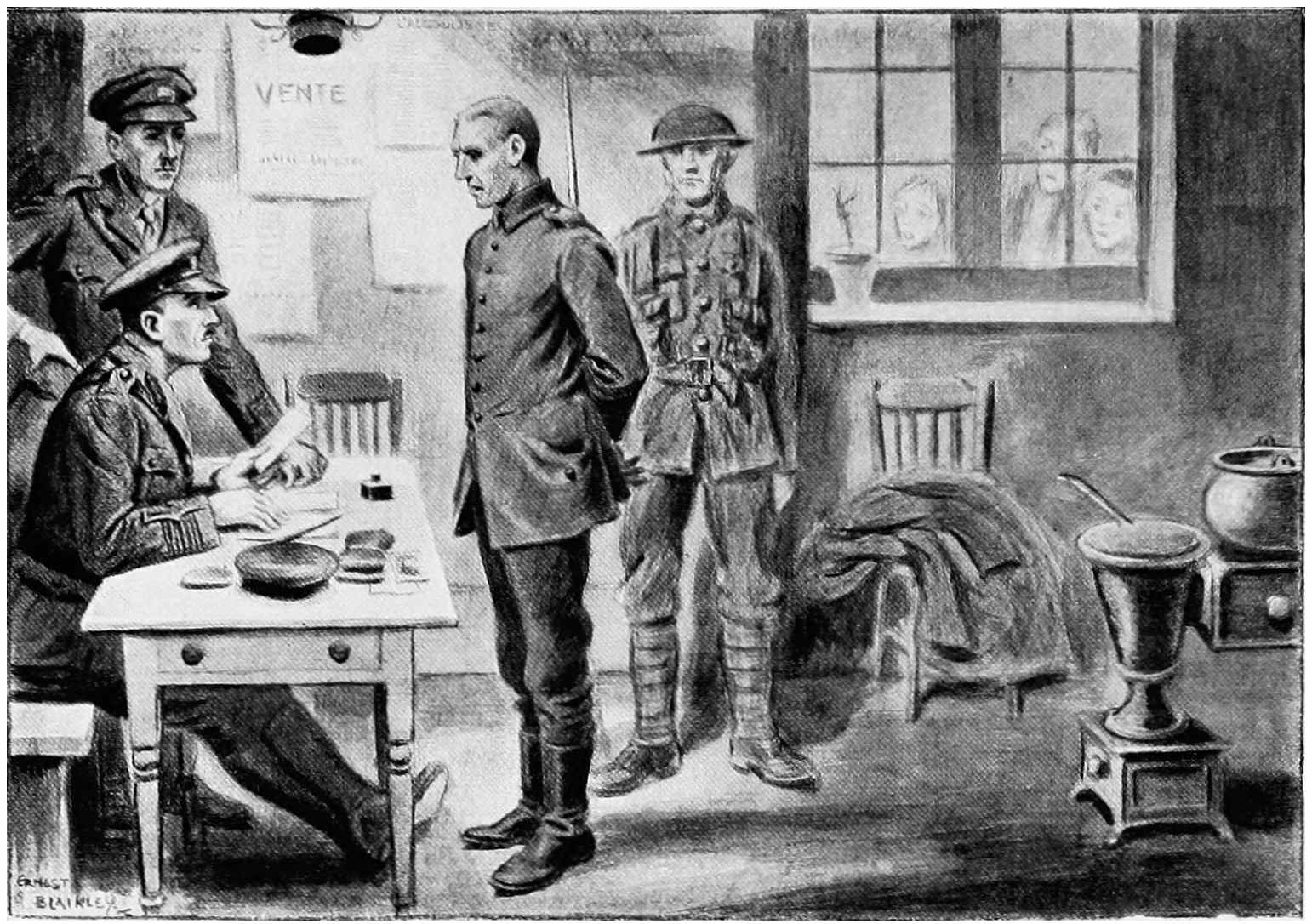
From a drawing by][Ernest Blaikley.
Examination of a German Prisoner
At that time in the German Army there was a
system of roving snipers; that is, a sniper was given a
certain stretch of trench to patrol, usually about half-a-mile,
and it was the duty of sentries along his beat
to find and point out targets for him. This information
I got from a prisoner whom I examined soon
after I went down to the trenches. Indeed, I used
to go any distance to get the chance of examining a
prisoner and so learn something of the German
organization. One deserter gave quite a lot of information.
He had the Iron Cross, and was a
sergeant. One of the scenes that always remains
with me is the examination of this man on a
rainy, foggy night by the light of a flaring smoky
lamp in the room of an estaminet just behind the
lines. As time went on it became very difficult
for a German prisoner to lead me astray with wrong
information. There were so many questions to which
one got to know the answers, and which must be more
or less common knowledge to German riflemen. The
demeanour of prisoners was very diverse. Some
would give no answers—brave fellows these, whom we
respected; others would volunteer a good deal of
false statement; others yet again were so eager to
answer all questions that when they did not know
they made a guess. But one way and another, through
them all I gained an immense amount of information
as to the German sniping organization.
It would appear that the telescopic-sighted rifles in
the German army were served out in the ratio of six
per company, and that these rifles were issued not
to the private soldiers who shot with them, but to
N.C.O.’s who were responsible for their accuracy,
and from whom the actual privates who used the
rifles obtained them, handing them back at given
intervals for inspection. In the top of the case of
each German telescopic sight were quite short and
very clear instructions, a very different matter to
the conditions obtaining upon our side, where very
often, as I have before stated, the man using the
telescopic sight knew nothing about it.
On one occasion I had gone down on duty to a
certain stretch of trench and there found a puzzled-looking
private with a beautiful new rifle fitted with
an Evans telescopic sight.
“That is a nice sight,” said I.
“Yessir.”
I examined the elevating drum, and saw that it
was set for one hundred yards. “Look here,” I said,
“you have got the sight set for a hundred. The
Hun trenches are four hundred yards away.”
The private looked puzzled.
“Have you ever shot with that rifle?” I asked.
“No, sir.”
“Do you understand it?”
“No, sir.”
“How did you get it?”
“It was issued to me as trench stores, sir.”
“Who by?”
“The Quartermaster Sergeant, sir.”
Certainly many a German owed his life in those
earlier days to the fact that so many of the telescopic-sighted
rifles in the British Expeditionary Force
were incorrectly sighted to the hold of the men
using them. By this I mean that some men hold
tightly and some men hold loosely, and there may be
a difference at a hundred yards of six inches in the
shooting of the same rifle in different hands. To hand
over the rifle as “trench stores,” in which case it
would be shot by different men of different battalions,
was simply to do away with the accuracy which formed
its only asset.
But to return to the examination of German
prisoners. One point cropped up over and over
again, and this was the ease with which German
snipers quite frankly owned that they were able to
distinguish between our officers and men in an attack,
because, as one said naïvely: “the legs of the officers
are thinner than the legs of the men.” There are
hundreds and hundreds of our officers lying dead in
France and Flanders whose death was solely due to
the cut of their riding breeches. It is no use wearing
a Tommy’s tunic and a webbing belt, if the tell-tale
riding trousers are not replaced by more commonplace
garments.
In 1915 there were very few loopholes in the British
trenches, whereas the Germans had a magnificent
system. In early days when I used to be told at
Brigade Headquarters that there was a German
sniper at such and such a map reference, and I was to
go and try to put him out of action, I very rarely
found a loophole from which I could reconnoitre
him, and as every German sniper seemed to be supported
on either flank by other German snipers,
looking for him with one’s head over the top of the
parapet was, if made a continual practice, simply a
form of suicide. I used, therefore, to have a couple
of sandbags filled with stones and rubble placed as
inconspicuously as possible on the top of the parapet.
No ball will pierce a sandbag full of stones, and it
was thus that one got the opportunity of a good look
at the German trenches without fear of receiving
a bullet from either flank.
At this time the efforts to camouflage our loopholes
were extraordinarily primitive—indeed, concealment
was nearly impossible in the form of parapet
then in use. Many of our units took an actual pride
in having an absolutely flat and even parapet, which
gave the Germans every opportunity of spotting
the smallest movement. The parapets were made
of sandbags beaten down with spades, and it is not
too much to say that along many of them a mouse
could not move without being observed by the
most moderate-sighted German sniper. It was curious
how some few commanding officers stuck to these
flat parapets in the face of all casualties and the
dictates of common-sense, even after the High Command
had issued orders upon the subject. At a
later date a trial was instituted, and proved that in
spotting and shooting at a dummy head exposed for
two and four seconds over a flat parapet, the number
of hits was three to one, as compared with the same
exposure when made over an imitation German
parapet.
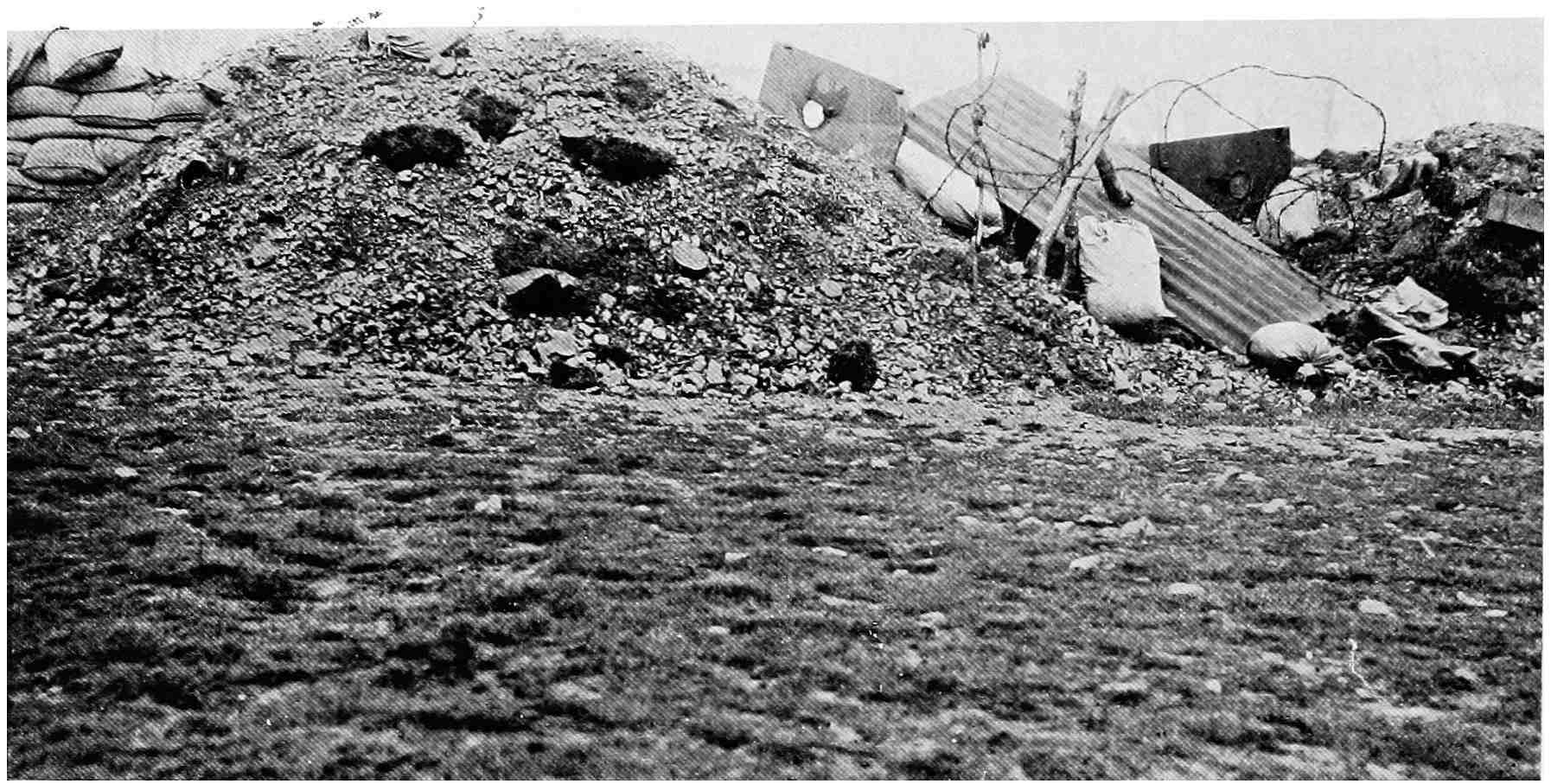
Over on the other side of No Man’s Land the German
trenches presented a quite different appearance
from ours—ours being beaten down, as I have said,
until they made as clear a line as a breakwater. The
German trenches were deeper, with much more wire
in front, and from our point of view looked like the
course of a gigantic mole which had flung up uneven
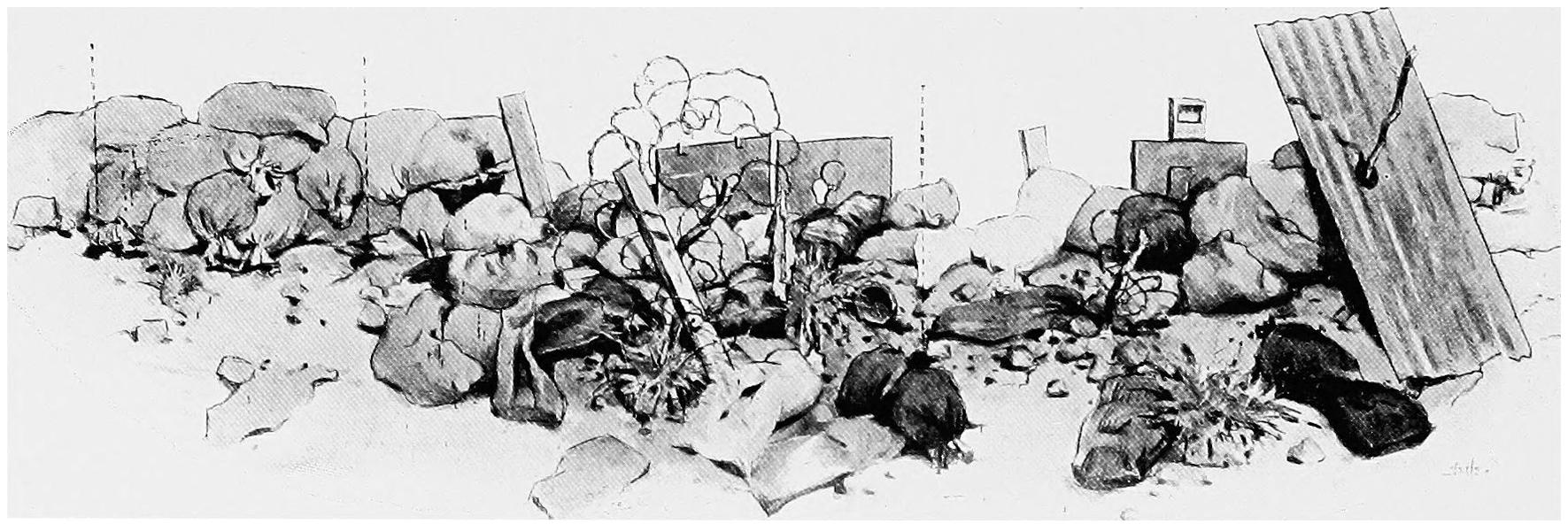
heaps of earth. Here and there, a huge piece of
corrugated iron would be flung upon the parapet,
and pinned there with a stake. Here and there stood
one of those steel boxes, more or less well concealed
under a heap of earth, from which set rifles fired all
night. Here and there lay great piles of sandbags,
black, red, green, striped, blue, dazzling our eyes.
It was said that the Germans used the pink and red
ones to look round, because they approximated to
flesh colour, but this was no doubt apocryphal. But
what was not apocryphal was the fact that the Germans
had a splendid parapet behind which a man could
move and over which he could look with comparative
impunity, whereas we in this respect gave heavy
hostages to fortune.
There was one protection which was always sound,
and which could be put into immediate operation,
and that was to teach our men to hang as many
rags as possible upon our wire, and wherever else they
could in the region of our parapet. These fluttering
rags continually caught the German eyes, which were
drawn by the movement of the rags in the wind.
It is possible that, if the truth were recognized, those
simple little rags saved many a life during the course
of the war. Of course, there were battalions in which
attempts had been made to remedy these defects,
as there was one type of officer whom one occasionally
came across. This was the soldier who had done a
certain amount of stalking, or big-game shooting, and
it is not too much to say that wherever there was such
an officer, there were usually two or three extra telescopes
and telescopic-sighted rifles, and various well-concealed
posts from which to use them. The Intelligence
report, which was each day forwarded to
Brigade, was also full and accurate. Indeed, the truth
of the matter forced itself upon me, as I spent day
after day in the trenches. What was wanted, apart
from organization, was neither more nor less than the
hunter spirit. The hunter spends his life in trying
to outwit some difficult quarry, and the step between
war and hunting is but a very small one. It is inconceivable
that a skilled hunter in a position of command
should ever allow his men to suffer as our men
sometimes did in France. It was all so simple and so
obvious. The Canadian Division and, later, the
Canadian Corps was full of officers who understood
how to deal with the German sniper, and early in
the war there were Canadian snipers who were told
off to this duty, and some of them were extraordinarily
successful. Corporal, afterwards Lieutenant, Christie,
of the P.P.C.L.I., was one of the individual pioneers
of sniping. He had spent his life hunting in the
Yukon, and he simply turned the same qualities which
had brought him within the range of the mountain
sheep to the downfall of Fritz the Forest Guard.
In the long monotony of the trenches during that
bleak winter of 1915, the only respite besides work
which was possible to our soldiers was the element of
sport and excitement introduced by sniping and its
more important and elder sister, observation. Sniping
in a dangerous sector—and there were many of these—was
really neither more nor less than a very high-class
form of big game shooting, in which the quarry
shot back. As to danger, there are in Africa the lion,
the elephant, the buffalo and the rhinoceros, and
though the consensus of instructed opinion agrees
that in proportion more hunters come back feet foremost
from lion hunting than from the pursuit of the
three other forms of dangerous game, yet I suppose
that no one would dispute that the German sniper,
especially when he is supported on either flank by
Kamaraden, was far more dangerous in the long run
than any lion.
In sniping, as the movement grew and sections were
formed, one relied to an enormous extent upon the
skill of the section to which the individual sniper
belonged. A really first-rate man in a bad section was
thrown away. First-rate men under a moderate officer
were thrown away, and, worse than all, a good section
under a good officer, who were relieved by the
slack and poor section of another battalion, often suffered
heavy casualties through no fault of their own.
Thus, the Royal Blankshires, who have an excellent
sniping organization, build half-a-dozen skilfully-hidden
posts for observation and sniping purposes.
All kinds of precautions, which have become second
nature, are taken to prevent these posts being given
away to the enemy. The telescopes used are carefully
wrapped in sandbags, their sunshades carefully
extended lest the sun should, by flashing its reflection
upon the object glass, give away the position.
The loopholes in dry weather are damped before being
fired through, and, most important of all, no one
but the C.O., the sniping officer, and the snipers and
observers are allowed in the posts. If anyone else
enters them there are for him heavy penalties, which
are always enforced. The result is that the Blankshires
have a good tour of duty, lose no casualties to
enemy snipers, and get splendid detail for their
Intelligence reports.
They are relieved, however, by the Loamshires.
The C.O. of this Battalion does not believe very
much in sniping. He has a way of saying that
sniping will “never win the war.” He has, it is true, a
sniping section because, and only because, his Brigadier
and his Divisional General are keen about sniping,
and continually come into the trenches and inquire
about it. But the Loamshire sniping section is a
pitiable affair. They take over from the Royal
Blanks.
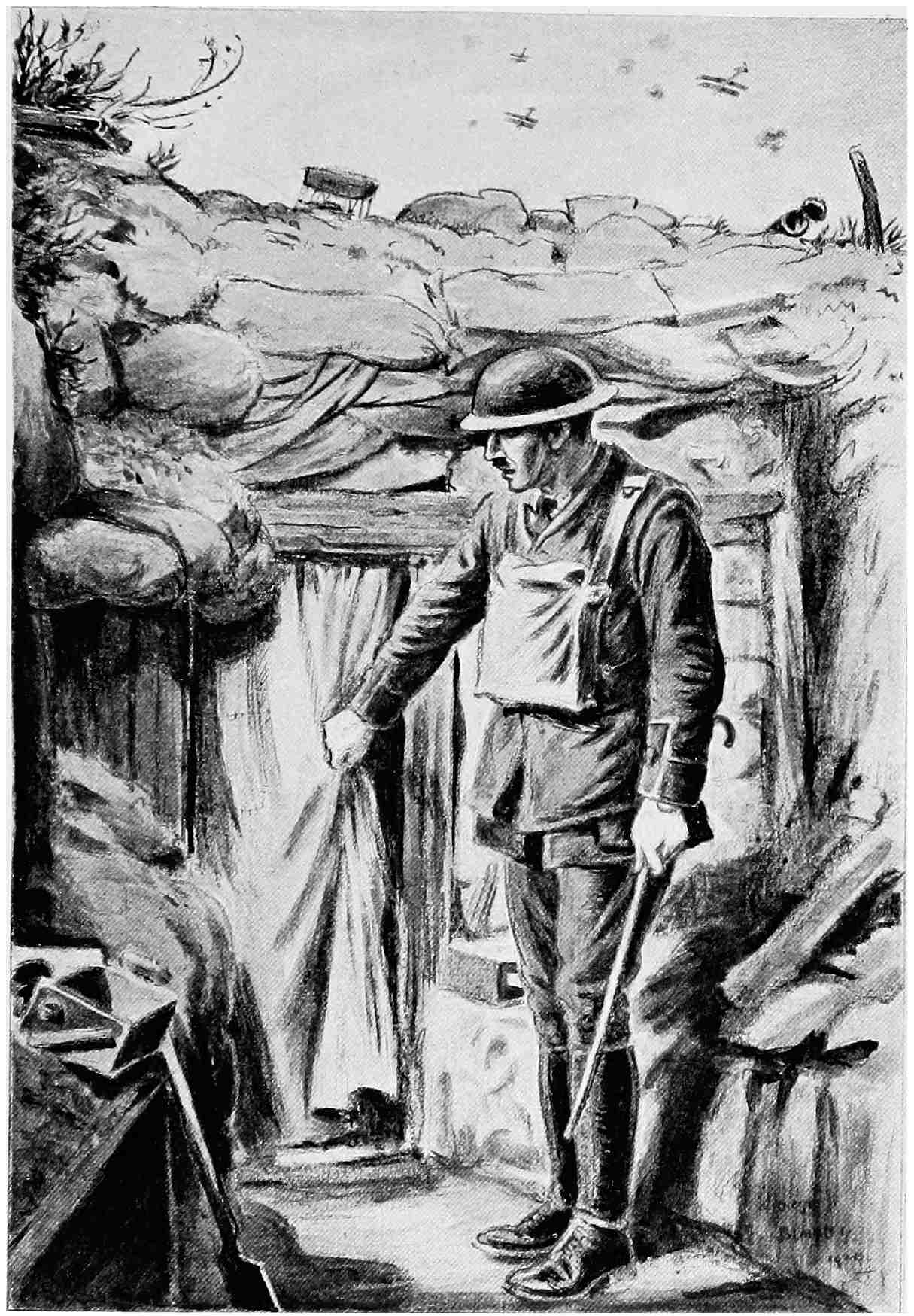
From a drawing by][Ernest Blaikles.
OUTSIDE THE SNIPERS’ POST.
“Shut the loopholes. I’m coming in.”
“These are jolly good observation posts,” says the
Royal Blanks sniping officer. He is the real thing,
and he dreams of his job in the night. “But one has
to be a bit careful not to give them away. I never
let my fellows use the one in Sap F until the sun
has worked round behind us.”
“Aw—right oh!” says the Loamshire opposite
number.
“One has to be a bit careful about the curtains
at the back of those loopholes in Perrier Alley. The
light’s apt to shine through.”
“Aw—right oh!” says the Loamshire officer.
“We are leaving our range-cards.”
“Aw—right oh!”
So the keen Royal Blanks officer and his keen section
go out into rest billets, and do not visit the trenches
again till they come back to take over from the
Loamshires.
“Well, how are the posts?” asks the Royal Blanks
officer, cheerily.
“Pretty rotten; they were all busted up the first
day.”
“Damn! They took us a fortnight to build.”
“Well, they are busted up all right.”
“Did your fellows give them away, do you think?”
“Oh, no!”
Now, as a matter of fact, the moment the Royal
Blankshires were out of the trenches the Loamshire
snipers, who knew no better, had used the O.P.s for
promiscuous firing, and the posts which had been
so jealously guarded under the Blankshire régime
had been invaded by Loamshire officers and men in
need of a view of the German trenches—or of sleep.
The curtains that kept the loopholes dark had been
turned back. The result was as might have been
expected. The watching German, who had suffered
from those posts without being able to locate them
when the Blankshires were in the trenches, now
spotted them, rang up their guns, and had them
demolished, not without casualties to the Loamshires.
So the work was all to be done again—but no sooner
does the keen Blankshire officer build up a post than
the slack Loamshire officer allows it to be given away.
It is now a case for the Royal Blanks C.O. to take up
with the Loamshire C.O.
Such were the difficulties of the keen officer when
the opposite number of the relieving battalion was a
“dud.”
Conscientiousness is a great quality in an officer,
but in the Sniping, Scouting and Observation Officer
something more was needed. To obtain success,
real success, it was necessary that his should be a labour
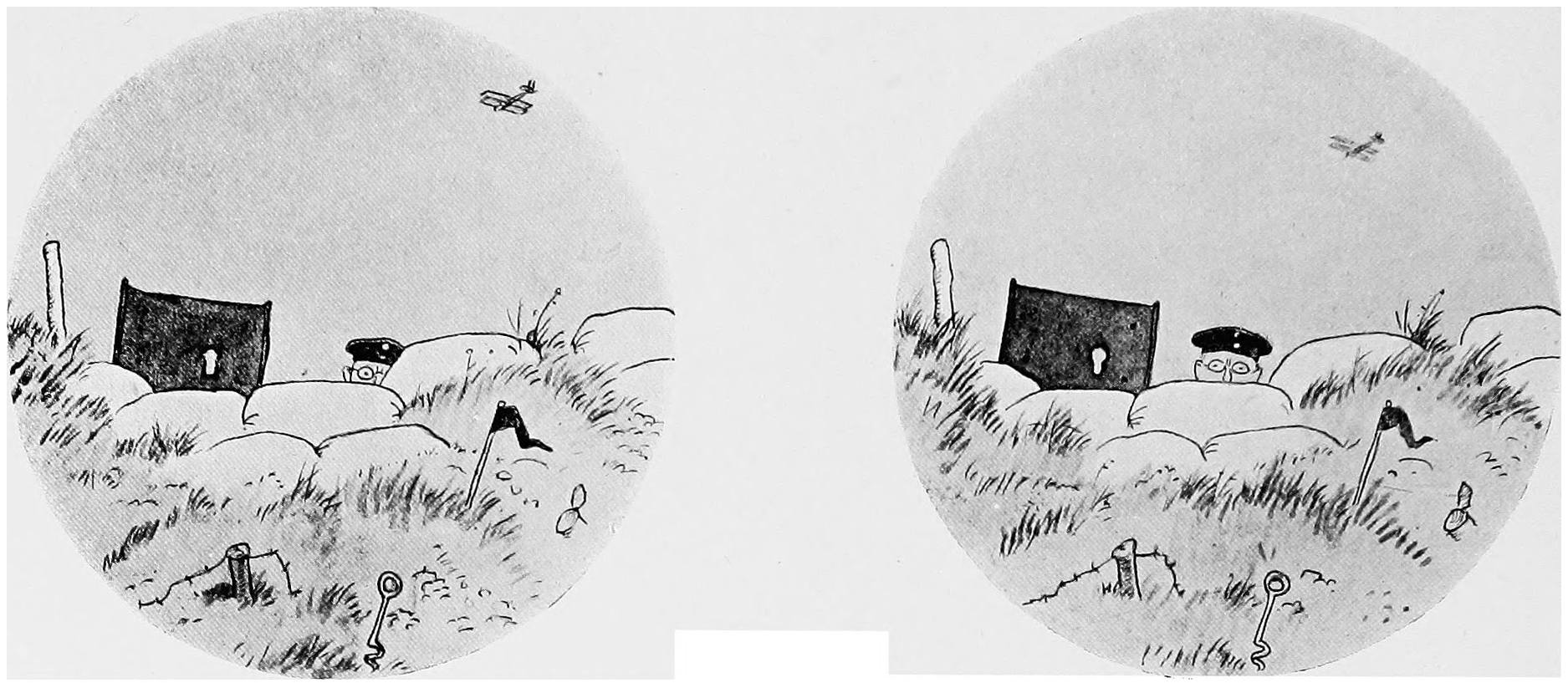
of love. He must think and dream of his work at
all hours and all times, and it was wonderful how many
came to do this. In the battalion the Intelligence
and Sniping officer had always a sporting job, and if
he suffered in promotion (as do nearly all specialists
in any great Army) yet he had the compensations
which come to an artist in love with his work.
There were at this time one or two other factors
in the situation to which I must allude in order that
the reader may understand the position as it was then.
The enemy had an immense preponderance in trench
weapons such as minenwerfer. The result was that a
too successful bout of British sniping sometimes drew
a bombardment. The activity of snipers was therefore
not always welcome to short-sighted officers, who
distinctly and naturally objected to the enemy riflemen
calling in the assistance of the parapet-destroying
engines of war, in which they so outclassed us.
Soon, however, it was realized that the state of
things obtaining while the German held the mastery
of aimed rifle-fire could not be permitted to continue—the
casualties were too great—and I will now give
some account of the instruction and experience in
the trenches that went on while we were attempting
to capture the sniping initiative from the enemy.
Towards the end of October, 1915, I was ordered
to report to the 48th Division, then holding a line in
the neighbourhood of Hebuterne. I was to proceed
to Divisional Headquarters behind Pas, and was there
ordered to Authie, where a number of officers were
to come for instruction. This instruction was, as
usual, to be divided between the back areas and the
front line. I had applied for the services of my friend,
Lieut. G.M. Gathorne-Hardy, an experienced shot, and
skilled user of the telescope, who had been many shooting
trips in different parts of the world with me and
others. At Authie we at once settled down to work;
the officers going through a course which need not be
detailed here. Suffice it to say that the telescopic-sighted
rifles of all the battalions in the Division
were shot and corrected, and various plans which we
had formed for the destruction of German snipers
were rehearsed.
On the third day arrangements were made by Division
as to which trenches we were to visit, and after
duly reporting at Brigade Headquarters in a dug-out
in Hebuterne, we proceeded upon our way.
It is not an easy thing to instruct five or six officers
in the line in sniping—the number is too large—so as
soon as we entered the trenches I divided my class
into three parties, and assigned to each an area in
which to look for German snipers, Gathorne-Hardy
and I going from one group to another.
At the point at which we entered the front line
trenches, our line was a little higher than that of the
enemy, so that the initial advantage was certainly
with us, and almost at once G. (for so I shall
refer to Capt. Gathorne-Hardy) spotted a German
sniper who was just showing the top of his cap at
the end of a sap. He was about three hundred
and fifty or four hundred yards away, and though we
watched him for half-an-hour, he gave no target. So
we moved on. Examining the enemy line was enthralling
work, as he had, even at that time, begun his
campaign of skilled concealment, and was apt to set
periscopes in trees, and steel boxes in all sorts of positions.
To spot and actually place these upon the map was
as important a duty of the sniper as killing the enemy
by rifle fire. For, once discovered, such strong points
and emplacements could be dealt with by our artillery.
But to return. G. and I, after visiting the sections,
acted together as shooter and observer.
After spending a couple of hours examining the
enemy line, we got into a disused trench and crawled
back to a little bit of high ground from which
we were able to overlook a group of poplar trees which
grew between the lines, and which were said to be the
haunt of a very capable German sniper.
Nothing, however, was to be seen of him, though
we could clearly make out the nest he had built in one
of the trees and, on the ground, what appeared to be
either a dead man lying in the long grass or a tunic.
While we were here a message came down to say
that No. 1 group had seen a party of nine Germans,
and had wounded one of them. No. 2 party had not
been successful.
At the time of which I write the Germans were
just beginning to be a little shy of our snipers on those
fronts to which organization had penetrated, and it
was clear that the time would arrive when careful
Hans and conscientious Fritz would become very
troglodytic, as indeed they did. We had, therefore,
turned our minds to think out plans and ruses by
which the enemy might be persuaded to give us a
target. We had noticed the extraordinary instinct
of the German Officer to move to a flank, and thinking
something might be made out of this, we collected
all our officers and went back to the place where
G. and I had spotted the Hun sniper or sentry at the
end of the sap. A glance showed that he was still
there.
I then explained my plan, which was that I should
shoot at this sentry and in doing so, deliberately give
away my position and rather act the tenderfoot, in
the hope that some German officer would take a hand
in the game and attempt to read me a lesson in tactics.
TELESCOPIC SIGHTS. “NURSE YOUR TARGET.”
1 “Not yet.”2. “Now!”
On either flank about 150 yards or so down the
trench I placed the officers under instruction with
telescopes and telescopic-sighted rifles, explaining to
them that the enemy snipers would very possibly make
an attempt to shoot at me from about opposite them.
I then scattered a lot of dust in the loophole from which
I intended to fire, and used a large .350 Mauser, which
gave a good flash and smoke. As the sentry in the sap
was showing an inch or two of his forehead as well
as the peak of his cap, I had a very careful shot at
him, which G., who was spotting for me with the glass,
said went about twelve inches too high.
The sentry, of course, disappeared, and I at once
poured in the whole magazine at a loophole plate,
making it ring again, and by the dust and smoke
handsomely giving away my own position. I waited
a few minutes, and then commenced shooting again.
Evidently my first essay had attracted attention, for
two German snipers at once began firing at me from
the right flank. At these two I fired back; they were
almost exactly opposite the party under instruction,
and it was clear that, if the party held their fire, the
Germans would probably give fine targets. As a
matter of fact, all that we hoped for actually happened,
for the exasperated German snipers, thinking they had
to deal only with a very great fool, began to fire over
the parapet, their operations being directed by an
officer with an immense pair of field-glasses. At the
psychological moment, my officers opened fire, the
large field-glasses dropped on the wrong side of the
parapet, as the officer was shot through the head, and
the snipers, who had increased to five or six, disappeared
with complete suddenness. Nor did the enemy fire
another shot.
It should be borne in mind, in reading the above,
how great a plague were the skilled German snipers to
us. One of them might easily cause thirty or forty
casualties. Later in the war we had, on our side,
many a sniper who killed his fifty or even his hundred
of the enemy. Besides, as I have pointed out, in these
early days of trench warfare the continual attrition
caused by German snipers was very bad for moral.
At a later date we found a means by which we were
able at once to find the position of any German
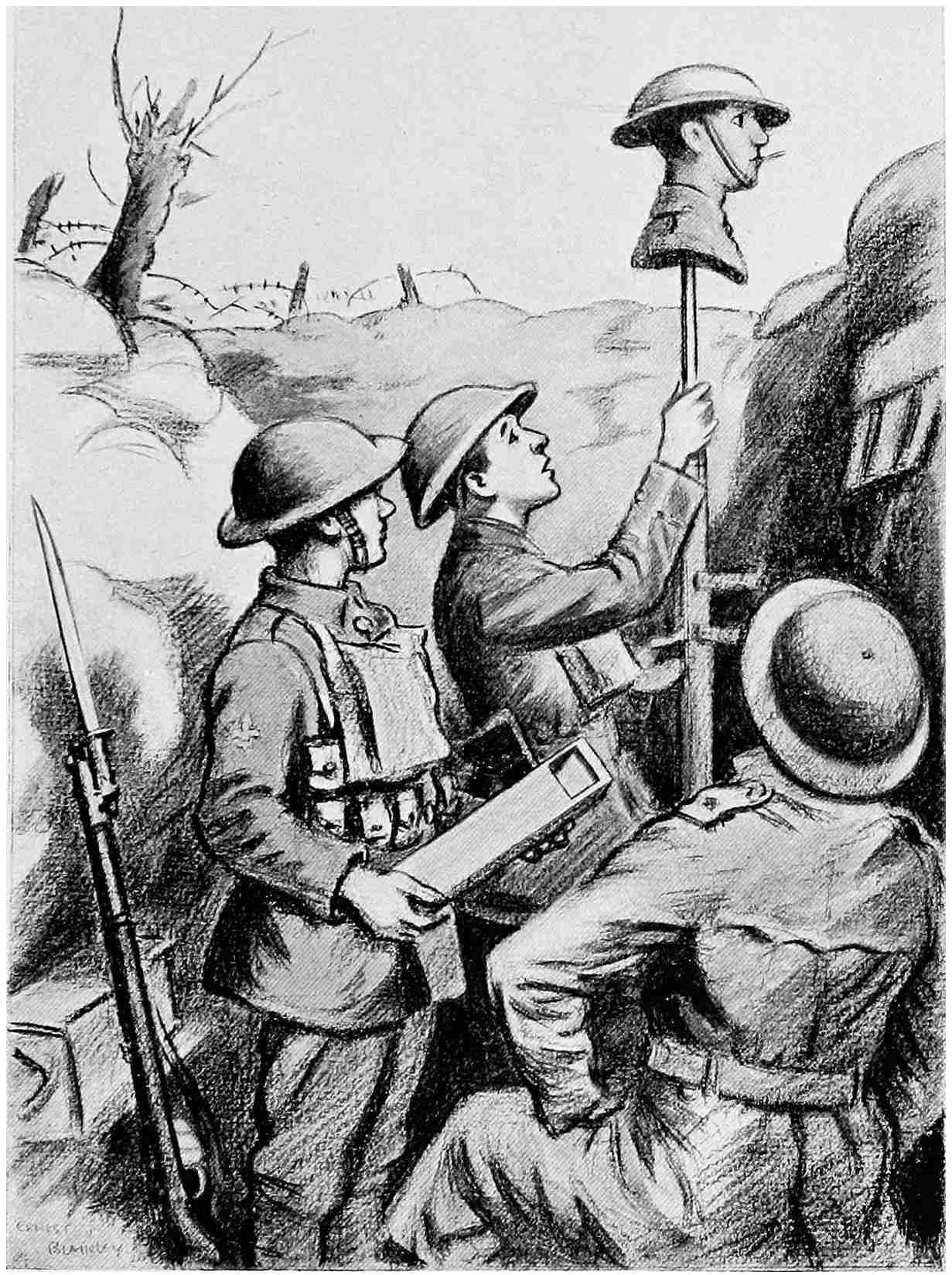
sniper. For this purpose we used a dummy head
made of papier-mâché.
The method of using was as follows: When a
German sniper was giving trouble, we selected a good
place opposite to him, and drove two stakes into our
own parapet until only about a foot of them remained
uncovered. To these we nailed a board on which was
fashioned a groove which exactly fitted the stick or
handle attached to the dummy head. This stick was
inserted in the groove and the dummy head slowly
pushed up above our parapet.
If the enemy sniper fired at and hit the head, the
entry and exit of the bullet made two holes, one in the
front, and one in the back of the hollow dummy head.
The head, immediately on the shot, was pulled down
by whoever was working it in as natural a manner as
possible. The stick on which it was mounted was then
replaced in the groove, but exactly the height between
the two glasses of a periscope lower than the position in
which it was when shot through.
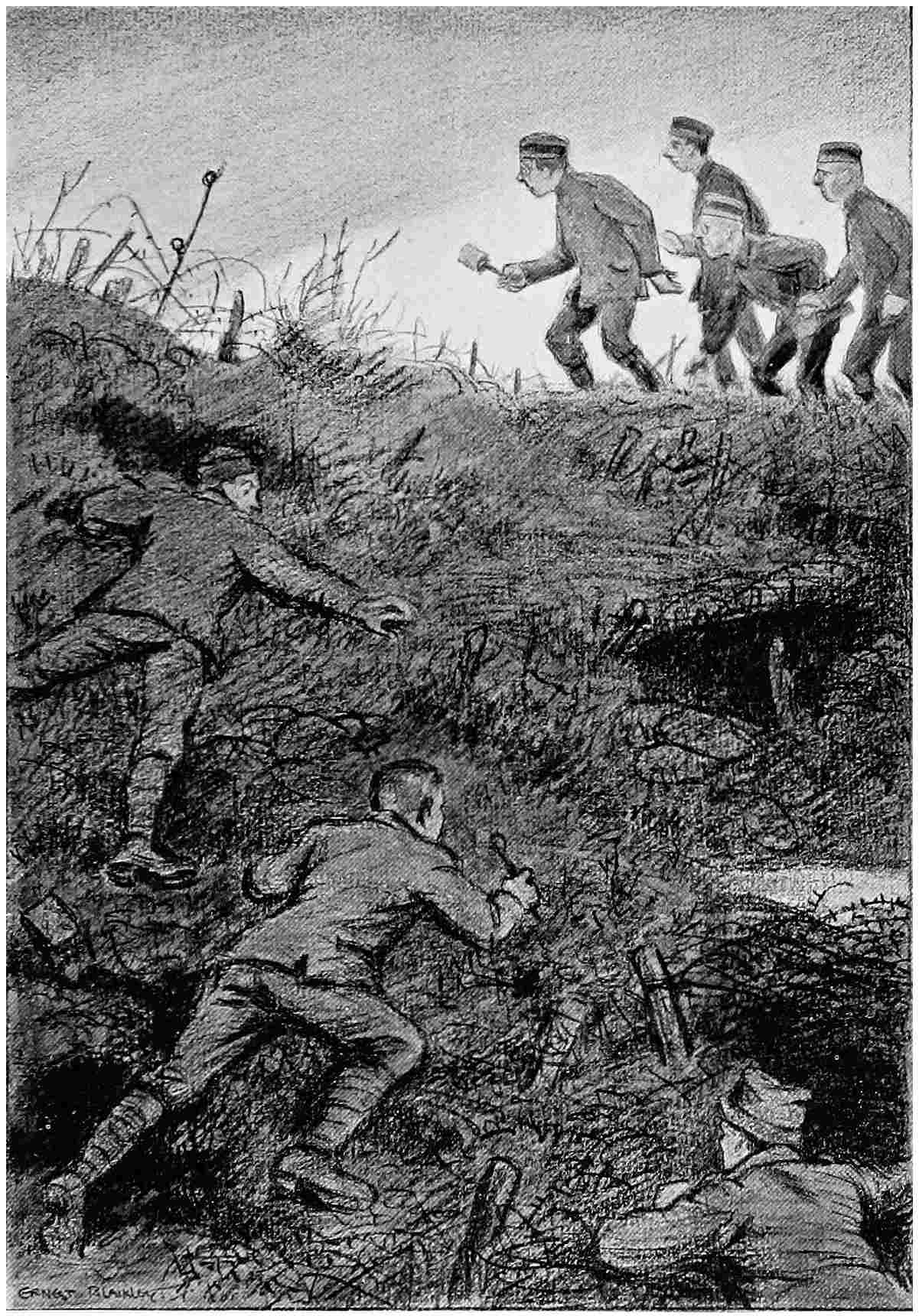
From a drawing by][Ernest Blaikley.
Spotting the Enemy Sniper.
Now all that remained to do was to place the lower
glass of the periscope opposite the front hole in the
head, and apply the eye to the rear hole and look into
the periscope, the upper glass of which was above the
parapet.
In this way we found ourselves looking along the
path of the bullet, only in the opposite direction to that
in which it had come, and, in the optical centre of the
two holes, would be seen the German sniper who had
fired the shot, or the post which concealed him.
Once found he was soon dealt with.
In trials at First Army Sniping School, we were
able by this invention to locate sixty-seven snipers out
of seventy-one.
Some of those who wanted to give the dummy head
a specially life-like appearance, placed a cigarette in
its mouth, and smoked it through a rubber tube.
It is a curious sensation to have the head through
which you are smoking a cigarette suddenly shot with
a Mauser bullet, but it is one that several snipers have
experienced.
After the incidents last described, we went up
towards the flank, where the 4th Division lay alongside
the 48th. It was in this Division that the 2nd
Seaforth Highlanders had just played a delightful trick
on the enemy. Someone in the battalion had obtained
a mechanical stop, one of those ticking bits of
mechanism which are made with a view to saving the
employment of a human “stop” at covert-shoots.
This particular stop was guaranteed to tick loudly for
hours.
The Seaforths were facing the Germans across a
very wild piece of No Man’s Land. One night some
adventurous and humorous spirit crawled out and
placed the “stop” about sixty yards from the German
parapet, and then set it going. The Germans at once
leaped to the conclusion that the tick-tick-tick was the
voice of some infernal machine, which would, in due
time, explode and demolish them. They threw
bombs, and fired flares, and officers and men spent a
most haggard and horrible night, while opposite them
the Scotsmen were laughing sardonically in their
trenches. The whole incident was intensely typical
of the careless and grim humour with which the Scottish
regiments were at times apt to regard the Hun.
Another battalion at a much later date, when the
Germans had become very shy, and mostly spent their
off-duty hours in deep dug-outs, had the brilliant idea
of preparing a notice board on which was printed
in large letters and German: “Bitter Fighting in
Berlin,” and then, in smaller type, some apocryphal
information. This notice it was their plan to raise,
having first posted their snipers, who would be sure to
obtain shots at the Huns who attempted to read the
smaller lettering with their field-glasses. I do not
think, however, that this plan was ever actually carried
out. This was fortunate, since, though ingenious, the
idea was not sound, as it would inevitably have led to
a heavy bombardment of the trenches in which the
notice was shown, and the game would not have been
worth the candle.
To continue, however, with our day. Late in the
afternoon, no Germans having shown themselves since
the shooting of the officer—a heavy bombardment
broke out on the right flank, and we hurried in that
direction, as experience had taught me that the
German Forward Observation Officers often did their
spotting for the guns from the front-line trench on
the flank of the bombarded area.
Sure enough, we soon picked up one of those large
dark artillery periscopes, shaped like an armadillo.
It was being operated by two men, as far as could be
seen. One of them wore a very high peaked cap, and
was at once called “Little Willie;” the other had a
black beard. The nearest point to which we could
approach was more like five than four hundred yards,
and though we waited till dark, Little Willie did not
show more than his huge cap peak and an inch or two
of forehead. As evening fell, we went out of the
trenches without having fired, as soon after our arrival
the bombardment had ceased, and Little Willie never
gave a good target, and the bearded man had disappeared.
I did not wish to disturb the German
F.O.O.’s in their post; as, now that they were discovered,
arrangements could be made to deal with
them when next they were observing.
The opportunity occurred three days later, when,
after a very long vigil, an officer shot Little Willie,
and the same evening a Howitzer battery wiped out
the post for good and all.
As, when Little Willie met his end, he was just in
the act of spotting the first shots for his battery, which
had opened on our front line trenches, his death probably
saved us some casualties, for it temporarily
stopped the activities of his guns.
It was not only the number of the enemy that our
snipers shot that was so important. It was often the
psychological moment at which they shot them that
gave their work an extra value.
In the autumn of 1915 there came high winds
following frosty nights. It was clear that a heavy fall
of the leaf would take place on the following days. I
therefore asked, and obtained leave from the 4th
Division, to which I was at the time attached, to drop
instructional work, and instead to go into the trenches
in order to spot enemy snipers and artillery observation
officers’ posts. On my way down I called at
Headquarters, where I was told that a very troublesome
sniper was operating at Beaumont Hamel. This
man had killed a number of our fellows. He was
supposed to live in a pollarded willow, one of a row not
very far from Jacob’s Ladder, which will be remembered
by all who were on that front in 1915. There
was on that day a certain amount of mild shelling of
the communication trenches, but before the advent
of gas-shells this rarely caused trouble in the daytime,
except to those who had to repair the breaches. On
the day in question I was alone with my batman, who,
I can say, without fear of libel, shot better than he
“batted,” for he had been chosen because he was a
marksman. Arrived in the front line, we at once set
about trying to locate the sniper. As a rule, in such
a case, the enemy one seeks is taking a siesta, but this
was not so now, for as soon as I looked over the parapet
a bullet, striking low, knocked some dust into my eyes.
At this point, you must understand, our trenches were
shaped like an arm, with a crooked elbow, the crook or
turn of the elbow being at the bottom of a hill. In
front lay Beaumont Hamel, where in the German
lines when I arrived a soldier had hung out his shirt
to dry. Between us and Beaumont Hamel lay a wild
piece of No Man’s Land, with some dead ground on
the Beaumont Hamel side, and at the bottom of the
hill the row of willows from which the sniper was
supposed to operate.
As these willow trees were out of sight from the
place where I had been fired at, I did not put down
that shot to the sniper, whom we will call Ernst. In
this I was probably wrong, as transpired later.
All that morning we tried to locate Ernst, who had
four more shots at me, but all that I had learned at
the end of it (when I imagine Ernst went off for a
well-earned siesta) was that he was a good shot, as
though obviously some distance away, he had made
quite good practice. We most carefully examined the
pollarded willows, and spotted one or two good snipers’
posts, especially one at the bottom of a hedge, but as
far as Ernst was concerned he had all the honours.
The next day I was occupied all the morning with
an enemy artillery O.P. which was destroyed by
howitzer fire, and it was not till after lunch that I
could turn my attention once more to Ernst.
This time I began at the bottom of the hill. There
were no loopholes, so it was a case of looking over, and
almost at once Ernst put in a very close shot, followed
again by a second which was not so good. The first
shot had cut the top of the parapet just beside my
head, and I noticed that several shots had been fired
which had also cut the top of the sandbags. Behind
the line of these shots was a group of trees, and as they
stood on slightly higher ground I crawled to them,
and at once saw something of great interest. In
the bole of one of the trees a number of bullets had
lodged, all within a small circle. Crouching at the
base of the tree, and with my head covered with an
old sandbag, I raised it until I could see over the
parapet fifty yards in front, and found at once that
the line of these shots, and those which had struck the
tree behind my head, were very nearly the same, and
must have been fired from an area of No Man’s Land,
behind which it looked as if dead ground existed on the
enemy’s side, and probably from a large bush which
formed the most salient feature of that view.
I then went back to the trenches, and warned all
sentries to keep a good look-out on this bush
and the vicinity. Very soon one of them reported
movement in the bush. With my glass I could see a
periscope about three feet above the ground in the
bush, which was very thick. Being certain, as the
periscope was raised so high, and as it had only just
been elevated, that it was held in human hands, I
collected half a dozen riflemen and my batman, and
giving them the range, and the centre of the bush as
a target, ordered them to open fire. On the volley
the periscope flew backwards and the activities of
Ernst ceased forthwith.
It was this experience of looking along the path of
the enemy’s bullets that led directly to the invention
for spotting enemy snipers, which I have described
earlier in this chapter.
No one can deny that Ernst was a gallant fellow,
lying out as he did between the lines day after day.
Whether he was killed or not who can say, but I should
think the odds are that some bullets of the volley found
their billet. At any rate, sniping from that quarter
ceased.
I have now given enough description of the work and
training which was going on at that time in the Third
Army in the line. The aim and end of all this work
was the formation of sniping sections in each battalion,
consisting of sixteen privates with two N.C.O.’s
under an officer.
I had realized that my whole problem turned upon
the officer. If I could succeed in obtaining fifteen
or twenty officers who would be simply fanatics in
their work, it was perfectly clear that the sniping
movement would spread like wildfire throughout the
Army. Already we had got together an immense
amount of detail concerning the German sniping
organization, and had begun not only to challenge his
superiority, but also to enforce our own. It is wonderful
what can be done in a single week by sixteen
accurate shots along the length of line held by a
battalion. You must understand also that the success
of the German sniping rested largely upon the deeds
of certain crack snipers, who thoroughly understood
their work, and who each one of them caused us heavy
casualties. The first work to be done in the trenches
was the organized annihilation of these skilled German
snipers, and I think this was the easier in that they
had it their own way for so long.
As time went on, the reports from the brigades
were very good; one BrigadierC even going so far as to
wire me: “Only one Hun sniper left on my front.
Can you lend me your elephant rifle?” In this
particular brigade the Brigadier informed me that
he had not lost a man through enemy sniping in four
months.
Sniping, I think, or let us say the sniping campaign,
may be divided into four parts. During the first, the
Germans had the mastery. During the second, our
first aim was to kill off the more dangerous German
snipers and to train our own to become more formidable.
The third was when the Germans had fairly
gone to ground and would no longer give us a chance.
The idea now was to invent various ways in which to
induce them to give a target, and the final period came
at a much later date, when great battles were being
fought, and the work of sniping was beginning to
merge into that of scouting, and snipers were being
trained in great numbers to deal with the new situations
that were arising every day as the Germans altered
their tactical plans of defence.
CHAPTER III EARLY DAYS WITH THE 11TH CORPS AND FIRST ARMY
Towards the end of 1915 my services were
again borrowed by the First Army, this time
to take a class of Sniping and Intelligence officers
through the course of sniping and observation which
was already in operation in the Third Army, and also
to lecture to a G.H.Q. Intelligence Class on the
Observation and Intelligence side of sniping—a big
subject.
I went up the long road through Doullens, Frévent
and St. Pol, which I had traversed so many times
from the days when it was impassable with French
soldiers before the Battle of Loos to the quieter times
which had now dawned. During the war one had
very few relaxations of any kind. Shooting was forbidden,
games were difficult for the unattached
Ishmaelite to obtain, and often for long periods it was
impossible to get any change of thought. The long
drives to all parts of the line held by the British Army,
which were part of my work, were, therefore, exceedingly
pleasant by contrast. Wherever there was a
battle I used to try and get to it at the earliest possible
moment, in order to have the opportunity of examining
the German trenches, for as time went on sniping
became more and more scientific, and the Germans
were always starting some new method which had to
be countered. One of the most important points was
to obtain specimens of each issue of their steel plates,
in order to experiment on them with all kinds of
bullets.
But to return to the First Army Class. We were
allotted a curious range on the outskirts of the town of
Bethune, then a thriving community, which had
been hardly shelled at all, although well within the
battle area. Our rifle-firing took place under cover,
and each target appeared through a series of holes cut
in a number of brick walls which crossed the range
at right angles. The noise in the room of the cottage
which formed the 200-yards firing-point was deafening,
but as the weather was both wet and cold
head-cover had its advantages.
The class which assembled consisted of a picked
officer from each Division, twelve in all. Some I
lost sight of afterwards, but two, at least, of this class
rose to command their battalions, and one was awarded
the double D.S.O., another the M.C. and Bar, and
several more single decorations.
In order that the class might be taught the manipulation
of telescopic sights, all the rifles of the 1st Corps
which were fitted with these sights or with optical
sights were sent down, together with the snipers who
shot them, in order that the rifles might be tested for
accuracy. As at that time there had been no real
organization or instruction in the use of adventitious
sights in the Corps, it is not to be wondered at that
most of these were incorrect. Of the first eighty,
fifty-nine were quite valueless until regulated, and we
were hard put to it to correct them as party after party
arrived.
At length a party of Scottish Rifles came, every one
of whose weapons was entirely correct. They were
under the command of a young officer who, when the
trial of his men’s rifles was over, saluted and said to
me:
“Will I stay and help you with the other rifles, sir?”
“Do you understand telescopic sights?”
“Yes, sir.”
“Have you done much shooting?”
“Yes, sir.”
“Won anything?”
“The King’s Prize, and the Scottish Open Championship,
and the Caledonian Shield, sir.”
“What is your name?”
“Gray, sir.”
That evening Corps Staff was rung up and Gray
was straightway appointed Corps Sniping Officer.
Suffice it to say, that in a few weeks the German
snipers had been dealt with in a way that must have
amazed them.
Later on, Gray’s Division moved into the 11th Corps,
where I have always thought that sniping on some
sectors reached its high-water mark as far as the year
1916 was concerned. Afterwards he became my
assistant at the 11th Corps School, and later at the
First Army School. He finally proceeded to the
U.S.A., with the rank of Major, to spread the light
there. In this he was most successful, receiving the
thanks of the Divisional General to whose Division he
was attached for the extraordinary efficiency of his
work. In my experience of sniping officers in France,
two are outstanding, and he was one of them. The
other was Major O. Underhill, 1st K.S.L.I.
Our class on that queer range in Bethune lasted a
fortnight and was instrumental in getting me a bout
of sick leave; for when, as part of the instruction, we
had to make a trench and build into it various posts
such as snipers use, we found ourselves working in an
extremely noisome atmosphere. As far as we could
make out, the greater part of the town drainage seemed
to be at no great distance under the ground in which
we had to dig. The result was a bout of trench
fever. The time I spent at home was not, however,
wasted, as I was able to collect large numbers of
telescopes and get the various courses for sniping
instruction written down, which was useful, as I was
continually receiving applications for a syllabus from
units outside the Third Army.
When I returned to France I was again attached to
the Third Army, but not to the Infantry School, who
had secured the services of Captain Pemberthy during
my absence. This very capable officer did splendid
work for the Third Army. Instead, I went down the
line and resumed my old work of instructing brigades
and battalions. I also went to the Indian Cavalry
Divisions.
At this time, I remember, volunteers who possessed
a knowledge of the fitting of telescopic sights were
asked for in the 7th Corps. The result was exceedingly
typical. One private, who sent in his name,
stated that he was well acquainted with telescopic
sights and their fittings, having been for four years
employed by Messrs. Daniel Fraser of Leith Street
Terrace, Edinburgh, the well-known firm of gun and
rifle makers, whose work on telescopic sights stands so
deservedly high. The staff who unearthed this applicant
did not continue to congratulate themselves on
having produced exactly the article wanted, when,
through a letter to Messrs. Fraser, it transpired that,
though it was quite true that the man had been
employed by them, the position that he had held in the
firm was that of errand boy, and that his knowledge of
telescopic sights was consequently not one which
they felt they could confidently recommend.
During these days I went back to many of the
brigades to which I had been attached six months
previously. The casualties among snipers had not
been very heavy and we had fairly obtained the upper
hand. At this period troops were massing for the
Battle of the Somme, in which the Third and Fourth
Armies took part. The use of the telescope was now
a matter of immense interest, as Intelligence wanted
all the facts they could get about the enemy, and
consequently instruction in glass-work for battalion
and brigade observers became more and more sought
after, and I trained many observers for Major-General
Hull, G.O.C. 56th Division. Just at this period,
however, there was a change in my fortunes, and I
was ordered to proceed to the First Army, to the
command of which Sir Charles Monro had just succeeded
after his wonderful performance in Gallipoli.
I therefore left the Third Army area and went by rail
to Aire-sur-Lys, in order to report to First Army
Headquarters, which was situated in that town.
It would be absurd to deny that I was very glad to
be attached to the First Army, where the keenness
which I had seen on my visit at Christmas time to the
various Corps Commanders was glorious. Arriving
at Aire I reported to the Town Major, and was
allotted a room in the hotel called “Le Clef d’Or.”
Here I was eating my dinner when the Town Major
came across and wanted to know if an officer of my
name was present. He said that a car was waiting
outside, and that I was to go direct to the Army
Commander’s château to dine and stay the night.
The next day the Army Commander questioned me
very closely about sniping, and about all that had
occurred with regard to it since he had seen me last.
He then informed me that I was to be attached to the
11th Corps, and that my orders were the same as they
had been under him in the Third Army—to make
good shots, and as many of them as possible.
The 11th Corps, since my previous visit, had started
a sniping school, where they were putting through five
officers and twenty men on short courses. The school
was situated on the far side of the Forest of Nieppe,
near a place called Steenbecque. I was ordered to
make this school my headquarters. It was in charge of
Lieut. Forsyth M.C. of the 6th Black Watch. A
more curious and picturesque-looking spot for a
school it would be hard to imagine. The headquarters
were in a little Flemish farmhouse, kept by an
exceedingly close-fisted family, and the range, which
had firing points at one, two, three and five hundred
yards, was neither more nor less than a long sloping
cornfield. A most satisfactory point about the range—which
was an excellent one—was that it was within
two hundred yards of headquarters, so that after
parade hours were over an immense amount of voluntary
work was done upon it. It was here that we first
began to tend towards the really much longer and more
detailed course of instruction which we afterwards
amplified to a vastly greater extent at First Army
School, as soon as the courses were lengthened to
seventeen days’ duration.
From the first it may be said that the men and
officers who came upon all these courses were extraordinarily
keen. They liked sniping, and still more,
observation, because they felt that here, at last, in
the great impersonal war, was an opportunity for
individual skill. The more imaginative of them
realized also the enormous possibilities of the trained
observer. In other chapters I will give several
instances of the observation of small details which
have had consequences of the most far-reaching nature.
I think that this feeling of the ever-present possibility
of the opportunity of being able to do a big thing
formed part of the fascination of the S.O.S. courses—S.O.S.
in this case meaning, “Sniping, Observation
and Scouting,” and not “Service of Supply,” as it
does in the American Army.
It has been said, and truly, that soldiers are pretty
destructive, but the fact remains that hundreds of
privates, N.C.O.’s and officers went through their
shooting courses in the Steenbecque cornfield, which
was traversed in all directions by narrow paths, and
yet it was difficult to find any downtrodden ears of
corn. Our one difficulty was that at one of the firing
points the corn grew up and obscured the targets.
It had, therefore, to be cut to the area of about ten
yards. I do not know what the claim sent in by the
farmer was for this damage, but as far as claims were
concerned nothing was ever missed by the Flemish
peasant.
Although it was my Headquarters I used only to
spend the first two days of every course at the school;
the other days I passed attached to various divisions
and brigades, and in this way became conversant with
the trench line of the Corps along the whole length
of which I inspected the snipers’ posts. The 33rd
Division, who were holding the line opposite Violaines
and the Brick-stacks, had had a tremendous duel with
the German snipers. This line has always been a
difficult one from the sniper’s point of view, as the
Germans had, unfortunately, the best of it as to position.
The Brick-stacks made ideal sniping-posts,
and there were many other points of vantage which
were very much in their favour. It shows, however,
what a first-class sniping officer can do when it is
realized that the 33rd Division who, when they went
into the trenches, found the Germans very much in
the ascendant, soon reduced them to a more fitting
state of mind.
XI CORPS SNIPING SCHOOL.
Imitation German Trench used for spotting targets, &c. Note
snipers’ loophole and observation hole in tree.
METHOD OF INSERTING LOOPHOLE.
1. Original Section of Parapet
2. How bags are arranged and fixed round loophole to imitate original parapet. (Gray’s Boards.)
3. Parapet reconstructed with loophole.
Drawings by][Basil Head.
It was here that Gray—the sniping officer in question—had
a trying experience. One day while
making his tour of duty, an officer told him that there
was a sniper who was causing them trouble. Gray
asked where he was, and was led without words to the
part of our trench opposite which the German sniper
was supposed to lie. Gray, being signed to do so by
his guide, looked over, only to be saluted at about
ten yards’ range with a bullet which whizzed by his
ear.
“That’s him,” said the officer delightedly. “I
knew he was pretty close. But what am I to do?
He shoots if one tries to spot where he is.”
“Have you never heard of the sniperscope, you
——?” demanded Gray.
“By Jove, the very thing!” cried the officer, and
it was not long before the German sniper was reduced
to impotence.
But to return to the 11th Corps School. Work
there was certainly strenuous. There was nothing to
do in the village and nothing to do in Morbecque.
The nearest place of relaxation was Hazebrouck,
and Hazebrouck was out of bounds. The result was
that having an interesting course with plenty of rifle
shooting competitions, together with occasional mild
cricket and football, officers and men were able to
concentrate upon the work in hand, and certainly
their shooting improved with amazing quickness.
About this time the 33rd Division moved south,
and Lieut. Gray was attached to the School, where he
soon left the impress of his personality and methods.
One of the difficulties that we had always found in
the First Army was due to the fact that our trenches,
as far at any rate as the Neuve Chapelle-Fauquissart
area was concerned, were very shallow, and, indeed
we lived rather behind breastworks than in trenches.
To make loopholes in these breastworks was exceedingly
difficult, but Gray invented a system
which we christened “Gray’s Boards” which fairly
met the case. Thus, if he wished to put in a concealed
iron loophole plate, he first of all cut a square of wood
of exactly similar size. In this he fashioned a loophole
to correspond with the loophole of the iron
plate. He then wired the wooden plate on to the iron
plate, and having rolled and stuffed a number of sandbags
in exact imitation of the parapet in which he
wished to insert his loophole, he tacked these with a
hammer and tacks upon the wooden board. The
whole loophole was then built in at night. These
loopholes of his were rarely discovered, and they had
also the added advantage that if a bullet struck them
it did not ring upon the iron plate, as it had to pierce
the wooden board first, so the posts were never given
away by sound.
It was at the 11th Corps School that we first constructed
exact imitations of German trenches and
German sniping posts; in fact, in one way or another,
a great deal of pioneer work was put in there, and the
school prospered exceedingly.
XI CORPS SNIPING SCHOOL.
Best form of parapet to conceal loopholes.Wrong type of parapet for concealing snipers’ loopholes.
SECTION OF TYPICAL GERMAN PARAPET.
Showing concealed loopholes made through tins, bags, &c. Note—The steel shields on top are dummies.
Drawings by][Basil Head.
The chief reason, I think, for the success of the
school was the great personal interest taken in it by
the Corps Commander, Sir R. Haking, who would
come out from his headquarters at Hinges and inspect
the school at frequent intervals, as did also Brigadier-General
W. Hastings Anderson, then B.G.G.S. of
the Corps. We were inspected in July by the Army
Commander, and from time to time officers from
other theatres of war and from other armies visited us.
In a meadow near the school was a small pond, full
of fish, which it was the ambition of Gray and myself
to catch. There was only room for two fishermen at
a time, and only on one occasion was a fish caught.
This we gave to the farmer who owned the pond,
and I presume he ate it, for he was up at Headquarters
early the next day inquiring for a “médecin!”
Still, nothing could be more delightful than after
three or four strenuous days, on each of which one
walked perhaps eight or ten miles of trenches, to sit
before that funny little pool in the French meadow,
and forget there was a war.
At the time of which I write, the Corps which
formed the First Army were the 11th, the 1st and
the 4th. The 3rd had gone to the Battle of the
Somme. The 1st Corps had a sniping school, which,
at a later date, reached an extraordinarily high pitch
of efficiency under Captain Crang and the late
Lieut. Toovey, the author of “The Old Drum
Major” and well-known Bisley shot. It was a party
commanded by Captain Crang which went into the
Portuguese trenches, where it was reported the
Germans were showing themselves rather freely, and
made a big bag. The 4th Corps also had a good
school, but they soon moved out of the Army to the
south. In fact, when I first went there, the system
in the First Army was that which I had always advocated,
to have Corps Schools of sniping and observation.
The difficulty, of course, was that there was
still no establishment, and that sniping schools did
not officially exist. This was quite a common thing
in the war, for when I first went to the large Third
Army Infantry School, with a score of instructors, a
large staff, and a couple of hundred N.C.O. and officer
pupils, it did not exist officially.
While I was at the 11th Corps School, the War
Office at last officially acknowledged my existence
as a sniping-officer to the extent that I received my
pay, which had been withheld for several months.
After various tours of inspection and work with
other Army Corps, I was ordered by the Army Commander
to form an Army School of Sniping. Greatly
rejoicing, Gray and I borrowed a car from the Army
and set out to search through the broad lands of the
Pas de Calais. These were delightful days, but
search as we would, it was exceedingly difficult to
find any place in the area of the First Army which
would suit our purpose. It was all too flat. I
remember that we once very nearly decided upon a
queer little hill, not very far from Hinges, called
Mont Bernenchon, but luckily we went on further
and at last came to the village of Linghem. Above
the village on a high plateau lies an old civilian range
backed by a large rifle butt. The plateau on which
the range is situated is of considerable extent, and
upon its slopes (it was July) bloomed heather and
gorse.
“Why,” said Gray, “the place is trying hard to be
like Scotland!”
The plateau gave us a range of eight hundred yards
and plenty of room for playing fields, which the
Army always consider to be absolutely necessary to
the well-being of a school—one reason, I think,
that the health of our men was so good.
Having decided that here was the ideal place for
our projected First Army Sniping School, Gray and
I were disgusted to see the fresh tracks of a motorcar.
It was quite clear that somebody else had
discovered and had an eye upon our find. We did
not even wait for a cup of coffee at the local estaminet
but got on board our car and went full speed to Army
Headquarters, where we informed the Staff that we
had decided upon our location, and were told that
as no one else had applied for it, it should be ours.
We were only just in time for as we afterwards discovered
the Royal Flying Corps had decided to
apply for it.
All’s well, however, that ends well, and a little
later on we left the 11th Corps School with great
regret, and set forth on a lorry for Linghem to found
the First Army Sniping School.
Often afterwards I used to go across to see how
things were getting along at the dear old 11th Corps
School. The last time I was there, before it was
taken over by a Second Army formation, it was a
wintry day with snow falling. I must say that I
was glad that I had never been attached there during
winter, for what had been a smiling cornfield was
now a sea of yellow and glutinous mud. The little
becque or stream which ran between our stop-butt
and our targets had overflowed, and Lieut. Hands,
who had succeeded to the command of the school,
was urging some one hundred and fifty odd German
prisoners to reconstruct the stop-butt itself. The
scene really might have been upon the German
“Eastern Front.”
CHAPTER IV THE FIRST ARMY SCHOOL OF SCOUTING, OBSERVATION AND SNIPING
The First Army Sniping School was formed
for the purpose of training officers, who
might act as Instructors in the various Corps Schools,
Brigades and Battalions throughout the Army.
The system of Corps Schools was, as I have said,
peculiar to the First Army, who, for the next year
and a half, turned out three snipers to any other
Army’s one. Further, the First Army School became
recognized throughout the B.E.F. as the training
place of observers with the telescope. Indeed, at
a later date, we were overwhelmed with applications
from Corps and Divisions in other Armies who wished
to send observers for a course. This was especially
the case before any big movement, and we might
almost have guessed where an advance was contemplated
by the applications for the training of
observers by the units concerned.
However, all this occurred at a later date, and I
must pick up my narrative when we left the 11th
Corps School in the lorry. Those who were to start
the First Army School got aboard after an early
breakfast. They were only six in number, Lieut.
Gray, Armourer Staff-Sergeant Carr, Private Fensome
(an extremely capable and skilled carpenter),
myself and two batmen. We took with us all the
spares we could obtain from the 11th Corps School
as well as a lot of sniping kit belonging to Gray and
myself.
As we rode through the country in the direction
of Aire we passed a huge desolate camp which, I
believe, had once been inhabited by Australians.
No doubt it had boasted a guard at one time, but it
had now fallen into sad disrepair, the Flemish
peasantry having appropriated all the stoves and
most of the wooden walls. A little further on we
came upon two or three Armstrong huts standing
in a field adjacent to the deserted camp, and as these
were in better preservation, and we had no Armstrong
hut of our own, it seemed a pity to leave them for
the French, so we set to and took one down and
loaded it on the lorry. This was, no doubt, a very
wrong thing to do, but when you have no “establishment,”
you can have no conscience either, or, at
least, if you allow yourself such a luxury you will find
that your job becomes impossible.
First Army School of S.O.S.
Presently we rolled into Aire over the canal bridge,
which was afterwards destroyed by long-range guns,
and in Aire we made the little purchases which are
necessary for the formation of officers’ and men’s
messes. We then passed through the old town by
the Cathedral. Army Headquarters had moved away,
and there was now only the Town Major and one or
two A.S.C. columns in possession. On the far
side of Aire we took the Lambres and St. Hilaire
Road, and passed on through the level country. As
we turned off through Lambres, we saw, rising in
front of us, the high ridge which formed the plateau
on which our school was to be situated, and not long
afterwards we rode into the village of Linghem. The
lorry then went round and disembarked our Armstrong
hut upon the plateau, where we at once
erected it, and a fortunate thing it was that we did
so, for that night there were some heavy showers
of rain which would have destroyed a good deal of
our kit, and more especially our target-paper and
dummy heads, had we not put them under proper
shelter.
And now, I think, began one of the most interesting
periods which I spent in France. Various
fatigue men were added to the Staff, and a working
party from the Army Service Corps was sent up.
We were rather amused to see that the men of this
working party, who had been well behind the line
for at least a year previously, thought it quite an
adventure to come up to the school. When they
rolled up their sleeves for digging, we noticed, too,
that their arms were white, forming in this a great
contrast to our fatigue men. It was necessary to
dig trenches, make stop-butts, build snipers’ posts
and observation posts, and all this hard work the
A.S.C. working party tackled with extraordinary
energy. We put up goal-posts, and they had a game
of football each evening. Several of the A.S.C.
party, I believe, were professional football players of
repute.
FIRST ARMY SCHOOL OF S.O.S.
No. 1 Flat Parapet. The easiest possible form of parapet to spot movement behind—practically a death-trap.
But it would be tedious to describe the growth of
the school step by step. Suffice it to say that, beginning
with a class of a dozen to fifteen officers, who
were dealt with by two officer instructors, our classes
grew until we had twenty-five officers and forty or
fifty N.C.O.’s at each course. But the actual teaching
was only one side of the work of the school, for
it was soon thoroughly known throughout the Army
that if any Division, Brigade or Battalion wanted its
telescopic sights tested, or if any individual sniper
found himself shooting incorrectly, all that had to
be done was to apply to the First Army Sniping
School. The divisional snipers came up in ’busloads,
and single snipers often came on foot. This
continual testing of rifles kept Armourer Staff-Sergeant
Carr busy both on the range and in his
armourer’s shop. Fortunately, as well as being an
excellent armourer, Sergeant Carr was also a shot
of no mean order, having shot in the King’s Hundred
at Bisley.
The school had not been long in existence before
the Canadian Corps came into the Army. They
were then holding the line which they afterwards
immortalized opposite the Vimy Ridge, and we were
at once struck at the school by their great energy
and keenness. There is no doubt that as a sniper,
scout or intelligence officer, the Canadian shows the
greatest initiative, and during the long period, well
over a year, which they remained in the Army, our
school was voluntarily visited by two Canadians
for every one Britisher. They were most extraordinarily
helpful, too, and if ever I wanted the
services of some Canadian officer for a particular
purpose, they were almost always granted, and not
only that, but he was on the spot within a few hours
of my application.
At first the greater part of our teaching dealt
with sniping, but as time went on the curriculum
was much extended. Map reading, intelligence
work, the prismatic compass, the range-finder, instruction
on crawling, ju-jitsu and physical drill
were all added. In addition to these, we had continual
demonstrations of the effect of all kinds of
bullets, both British and German, on the armoured
steel plates used by us and by the enemy. We formed
a museum, which became quite famous, and in which
were various exhibits of German and British sniping
paraphernalia. We also had many photographs, and
again and again officers who had been through the
course at the school sent up contributions. It was
said that anyone going through the museum could
really gain a very good idea of the development of
sniping during the war, and this was by no means
an exaggeration.
I soon found that the officers and men who came
to the school were really in need of a clear mental
change, and this we attempted to provide by giving
long hours to games.
FIRST ARMY SCHOOL OF S.O.S.
No. 2. Same parapet as in No. 1 after five minutes’ alteration. Sandbags have been thrown on top. A man in a sandbag-covered
helmet is looking over at A, and a man in a cap is looking between the sandbags at B. N.B.—Bags must be filled with broken stone or
shingle to be bullet-proof; but should be sparsely used in case of bombardment.
For many months the school was “unofficial,”
but at last, on the 24th November, 1916, more than
fifteen months after I had begun serving as a sniping
officer, we were granted a “provisional establishment.”
Up to this time, it was terribly hard to
keep the school running, not to speak of the Corps
Schools, which were its offshoots. The real difficulty
was that when each division moved, all its personnel
moved with it, and thus it came about that, seven
weeks after the First Army School was started, Lieut.
Gray’s division moved out of the Army, and he
was recalled to it; in spite of applications from
Headquarters that he might be allowed to remain
and continue the good work he was doing, this was
refused, and he went down to the Somme to be
made officer in charge of trolleys, or sports, or some
such appointment. The mere fact that he was a
King’s Prizeman and perhaps the best shot and the
most capable sniper in the B.E.F. made not one
whit of difference. All these qualities are, no
doubt, of the highest use in an officer in charge of
trolleys!
On Gray’s departure there set in for me a very
strenuous time, for at the same moment the Commandant
of the 11th Corps School was also spirited
away. I found an officer who had been through the
course at the First Army School to take his place,
and at the same time it became necessary to find a
Commandant for the 1st Corps Sniping School. I
had at this time no assistant myself, and was dealing
with a class of fifteen officers, as well as sometimes
as many as fifty snipers, who came up from the line
for a day’s instruction. My N.C.O.’s, however,
stepped nobly into the breach, and Armourer Staff-Sergeant
Carr took over the explanation of telescopic
sights—work which lay entirely outside his duties.
At that time there were ten or fifteen patterns of
these sights in the Army, and each officer on the
course had to learn to manipulate every one of them.
In fact, the course was a pretty stiff one, and, over-worked
as I was, it was difficult to be certain how
much knowledge the officer students carried away
with them, so I started an examination paper on the
last day, which was of a very searching nature. The
full marks were a hundred, and this paper was continued
until the school closed down after the Armistice.
Again and again we had classes, the least
successful member of which obtained seventy-five of
the hundred marks.
During the period in which I was alone after
Lieut. Gray’s departure, an officer attended the
school who became my assistant, Lieut. N. Hands,
of the 11th Warwickshire Regiment. I had great
difficulty in obtaining his services, but finally his
General exchanged a month of them for some lectures
on Sniping by me. As I was taken in a car to and
from the lectures—and as they were to be given after
parade hours, it did not interfere with my work—this
was a very pleasant arrangement, but Hands had
not been with me long when there was another
upheaval at the 11th Corps School. The 61st
Division left, and Lieut. Benoy, who was in charge
of the school, left with it. So Hands went across
and took over the 11th Corps School. He afterwards
proceeded with the 11th Corps to Italy, where he
was awarded the Military Cross, and did fine work.
However, after another period of running the
school alone on Hands’ departure, Army Headquarters
sent me Second Lieut. Underhill, of the 1st K.S.L.I.
Underhill had been wounded at Ypres, and came out
for instructional duties. The story of his being sent
to the school is an amusing one, in the light of after
experience, for he was the most tremendous worker
that I have ever known. He arrived at Army Headquarters
at eight o’clock in the morning, and two
hours later, feeling unhappy at still having nothing
to do, he went to the G.S.O.1, and asked if he could
not be put to work. The G.S.O.1, who was my
very good friend, seeing from his papers that Underhill
had passed through Hythe, and was stated to be
competent as an instructor, sent him out to me, and
thus it was that I at last obtained a permanent assistant,
and a better no man could have had. Our
establishment was still only a tentative one, and
it was not until some months later that we were
allowed the two extra officers and four extra
N.C.O.’s, and the dozen scouts and fatigue-men,
who made up our staff.
Underhill had, by that time, been promoted to
Temporary Captain, for good services, and became
Adjutant, and Captain Kendall, of the 4th Warwickshire
Regiment, who, after a course at the School,
had become attached to the Royal Flying Corps as
Intelligence Officer, took over the intelligence duties
and map reading at the school. Lieut. W.B. Curtis,
of the 31st Canadian Infantry, became scouting
officer: he had had nearly two years’ experience
between the lines, and had been decorated on three
occasions.
Our N.C.O.’s, too, were the very pick of the Army.
There was Armourer-Staff Sergeant Carr, Sergeant
Slade, of the Essex Yeomanry, Sergeant Hicks, of the
1st Rifle Brigade, and Sergeant Blaikley, of the
Artists’ Rifles. All these N.C.O.’s became in time
amazingly proficient at their work. I have never
heard a more clear exposition of the compass than
that given by Sergeant Hicks, who, while one squad
was firing, would sit down under the bank with the
other, and explain to them all the mysteries of the
magnetic North.
The physical training of the school was in the
hands of Sergeant-Major Betts (Coldstream Guards),
one of Colonel Campbell’s magnificent gymnastic
staff.
Sergeant Blaikley, who had drawn for Punch from
time to time, was invaluable as an artist, and it was
he who drew our Christmas card—“Der Sportsmann”—depicting
a German gassing stags on a Scottish
deer forest. This picture, which was very widely
circulated, certainly obtained the flattery of imitation,
as the same idea was used in most of our comic
papers a month or two afterwards.
Captain Kendall was a trained surveyor, and an
artist of no ordinary merit. Whatever conundrum
was brought up by officers—and a great many were
brought up—Kendall, in his own department, was
certainly unassailable.
Der Sportsmann.
Christmas Card (1917) of the First Army School of S.O.S.
Drawn by Ernest Blaikley.
Besides the officers and sergeants, we had another
member of the staff who did splendid work. This
was Corporal Donald Cameron of the Lovat Scouts.
Lord Lovat had visited the school, and had expressed
his satisfaction at the way in which we were teaching
observation and the use of the telescope. I asked
him if he could get me a really good stalker to assist
me, and he very kindly promised to do so. As one
of his own men could not come, he sent me Corporal
Cameron, who showed the greatest keenness, and had,
I think, a peculiar affection for the last man over
the stile. If ever there was a weak member in learning
the compass, Cameron would seek him out and explain
it. The results were wonderful, and certainly saved
several privates from failure. Cameron, when I
asked him his age on his joining, gave it as “offeecially
forty-one.” He was a very skilful glassman,
and as such was of continual assistance to me. I
remember one day when we were trying some aspirant
reinforcements for Lovat Scouts Sharpshooters, and
were looking through our glasses at some troops
in blue uniforms about six thousand yards away,
most of the observers reported them as “troops in
blue uniform;” but Cameron pointed out that they
were Portuguese. His reasoning was simple. “They
must be either Portuguese or French,” said he, “and
as they are wearing the British steel helmet, they
must be Portuguese.”
On my establishment, when it finally came along,
there were apportioned to me three scouts among the
eleven privates to the services of whom the school
was entitled. I remember these eleven privates
parading for the first time, and I remember also
attempting to pick out, with Capt. Underhill, the
three “scouts.” One of the scouts was a Salvation
Army musician, an excellent fellow, but quite unfit
for his duties. Another was an ex-barber of the White
Star line, and the third had for years been unable
to break into a double. As the work of scouts with
an Army School is of supreme importance, since one
uses them to personate the enemy in scouting schemes,
the employment of such men as these was quite impossible.
Good fortune here, however, came to
our aid, for some performing scouts from G.H.Q.,
who were giving demonstrations, came to demonstrate
to us, and were afterwards attached to the school.
These were boys under nineteen, and the three I
kept ended up as past masters of their work. By
Armistice Day they had been at the school for some
eighteen months, were first-class shots, knew every
detail of the course, and could pass an examination
equal to any officer. At the physical training and ju-jitsu,
which they had almost every day, they were
really young terrors. In fact, I remember a commercial
joy-rider who was visiting the school, and whom
I was showing round, on seeing two of the boys doing
ju-jitsu, saying with infinite tact: “’Ere, where do
you live when you are at ’ome? I’ll keep clear o’
your street on a dark night.”
I might add that all three boys were accomplished
Association football players, so that we always had a
really first-class centre forward, left wing and halfback
upon the premises. Our Association team, for
so small a unit, was thus a very strong one, though
it might have been much stronger had not so many
of the older members of the staff been wounded.
I think the only other member of the staff that I
need mention is Sergeant Foster of the Canadians. At
a later date, it became our duty to train the Portuguese
Army in sniping and shooting, and Sergeant
Foster spoke a kind of Portuguese.
I have given at full length this account of the
officers and N.C.O.’s of the school, because whatever
efficiency the school obtained was founded upon their
selection. Whenever it was possible to do so, it was
always a standing order that between courses, when
we sometimes had from two days to a week free, all
instructors should go to the line. For this purpose,
arrangements were made with different battalions to
receive them. This kept the school in touch with
the progress of events.
I have often regretted that I did not keep a Visitors’
Book at the First Army Sniping School, for certainly
enormous numbers of visitors came to us. Outside
the officers of the B.E.F., of whom several hundred
visited the school, we had attachés and missions of
various allied and neutral powers—Japanese, Roumanian,
Dutch, Spanish, American, Italian, Portuguese,
Siamese and Polish officers, as well as large numbers
of journalists, from whom, when they were not our
own accredited correspondents, I used to conceal a
good deal of the more secret parts of our work. One
day, however, on being informed by the officer-in-charge
of the correspondents that they were perfectly
safe, and that I could show them anything, I showed
them a small new invention by which we were able to
spot the position of German snipers. I carefully warned
them that it was not to be written about, but about
three months later I saw a large and glaring article
describing the visit of one of these journalists to the
school. The description of the invention could have
been of little interest to the great public which he
served, but it was there, carefully set out. This was
the only case of a definitely-broken promise of this
nature which I came across during the war. Our
own correspondents, Valentine Williams (afterwards
Captain Valentine Williams, M.C.), Philip Gibbs,
Beach Thomas, Perry Robinson, H.M. Tomlinson,
Prevost Battersby, Percival Phillips, and others who
came after I left G.H.Q., were welcome and trusted
throughout the whole Army.
The feeling in the Army against the Press—for there
certainly was, at one period, such a feeling—is really
very often a rather stupid pose adopted by the younger
officers, who usually copy some downright senior; but
it will always remain as long as journalistic mistakes
are made—and that will be as long as wars last.
Outside the members of the staff, we had help from
time to time from various officers who were attached
for short periods of duty. Among these was Major
A. Buxton, D.S.O., of the Essex Yeomanry, who took
two classes of Lovat Scouts in observation. He was, I
believe, the only officer who was habitually successful
in catching trout in the French streams. Second
Lieut. C.B. Macpherson of Balavil, a true expert
with the telescope and map, was also attached to the
school for a time. He came out at the age of sixty-two
with his splendidly trained group of Lovat
Scouts Sharpshooters.
Another officer who was temporarily attached to the
staff was Capt. T.B. Barrie of the Canadian Highlanders.
He first came to the school on a course, and
was afterwards lent to me by the Canadian 4th Division.
Shortly after his first visit to the school he gained
two M.C.’s in a fortnight, both in raids, in one of
which he penetrated six hundred yards behind the
German line. There can have been few more gallant
officers in France, and his death later in the war was
a matter of deep regret to all who knew him.
One day Major-General the Hon. W. Lambton,
commanding the 4th Division with which I had begun
my sniping duties in 1915, came to the school. His
division was then in one of the other armies, but he
wished to have observers trained, and sent up a
party under Lieut. Kingsley Conan Doyle, of the
Hampshire Regiment, the son of Sir Arthur Conan
Doyle, and one of the best observation officers we
had at any time. Conan Doyle possessed an extraordinary
facility for teaching and was most successful
with one or two classes of Lovat Scouts which he took.
He went back to his Division, was promoted to Captain,
and acted in charge of the Divisional Battle Observers
in the big battles of 1917. It is tragic to think that
when the order came out for all medical students to
return to complete their studies Capt. Conan Doyle
went back to England; there he contracted influenza
and died. This has always seemed to me one of
the saddest things in the war—to have gone through
so much, to have rendered such good service, and
finally to be struck down by the horrible influenza
germ instead of the German shells among which
he had walked about so unconcernedly.
I have now given you a somewhat rambling account
of the formation, and of those who were chiefly
connected with the early days, of the First Army
Sniping School. On the very day on which it was
founded, Sir Charles Monro left France to take up
his appointment as Commander-in-Chief of the Forces
in India. Sir Richard Haking succeeded to the temporary
command of the Army, and as it happened was
the very first visitor who ever came to First Army
School. He told us that the King was coming almost
at once into the Army area, and that he wished Gray
and myself to go back to the 11th Corps School to
prepare for a Royal Inspection. This we did, but
unfortunately the King was held up in Bethune by
shelling, so that there was no time for him to visit us.
We greatly regretted this, as a Royal visit would have
been of enormous value to sniping at that time.
One visitor who came to the school was of peculiar
interest to me. This was my old friend Sir Arthur
Pearson, who arrived accompanied by his son, whom
I had last seen at the Boys’ Cricket classes at Lord’s
when he was first in the running for the Eton Eleven,
of which he was afterwards Captain. He was now
an officer in the R.H.A. Sir Arthur Pearson went
over the whole school and asked me many questions.
Though he could not, of course, see the loopholes
and all the rather technical work which I explained to
him, it was perfectly amazing to realize the way
in which he gripped it in its essentials. I think that
he knew more about sniping, scouting and observation
after the hour or two he spent at the school
than I have known other men gather in a week.
FIRST ARMY SCHOOL OF S.O.S.
Sniper’s Robe on a 6ft. 4in. man in the open, Hawkins position. Distance from camera, 8 yards.
The only ladies who visited us were Mrs. Humphry
Ward and her daughter. It was terrible weather
when they came and the little path which led up to
the range, and which was really more or less the bed
of a stream, had become a glacier of ice several feet
in thickness. On the range the wind was blowing
exceedingly cold, and few worse days could have
been picked for a visit. I remember Mrs. Ward
saying to me that she thought sniping—the terrible
and ruthless killing of men with weapons of precision—one
of the most dreadful sides of the war. I
pointed out to her the life-saving side of sniping,
and how many hundreds and probably thousands of
British officers and men were alive at that moment
who, if it were not for our snipers, would have
been killed by the Germans. Mrs. Ward quite saw
the force of this argument and wrote a most admirable
account of her visit to the school. I saw this in
proof, but when it appeared the censors had clearly
cut out a certain amount. Why they had cut it
out no one could ever tell. We had at that time a
good number of snipers’ robes of painted canvas at
the school. The Germans had somewhat similar
robes and both sides knew that the other was using
them; but the British Censorship would never allow
any mention of these robes. You might mention
something really important, some new invention,
or the effect of some new bullet, or any other matter
which would be of real assistance to the Germans,
but these robes were the one thing which seemed to
interest the Press Censorship. Speaking as an Officer-in-charge
of a very technical branch of work, I can
only say that the Censorship was at times just like
an ostrich hiding its head in the sand.
Mrs. Humphry Ward went over the whole school,
and I must say that her questions probed our work
more deeply than those of the average sight-seeing
officer who visited us.
Apart from visitors who came for various purposes
to see the school, we had also several officers who
came on duty. Among these was Col. the Hon.
T.F. Fremantle, now Lord Cottesloe. Lord Cottesloe
knew more of telescopic sights and rifle shooting than
did any of us at the school, and there can be no doubt
whatever that his visit was of the greatest assistance
to us. With him came Lieut.-Col. Robinson, who
was in charge of the manufacture of telescopic sights
at Enfield, and who did so much to assist us in a
hundred different ways. I never had the opportunity
of visiting the school in England of which Lord
Cottesloe was the Commandant, but I had many
officers and men who had received a sound grounding
there.
Lieut.-Col. P.W. Richardson, the well-known
Bisley shot, also visited the school. He was interested
in sniping from the very earliest days, and was probably
the first officer to advocate schools for the
teaching of shooting with telescopic sights.
One evening after the school had been running
well over a year I was sitting by the mess-room fire
when a couple of officers were shown in. Both
were wearing Burberrys, so that I was not able to see
their rank, but both were very young-looking. One
of them said: “We looked in to have a talk to you
about schools, for we are going to start one. What
we want to know is, how this school manages to get
everyone who comes to it so damned keen on their
job?”
I pointed out that we had a really interesting subject
to teach, and enlarged upon the great theory that I
always used to hold that you did not want to have
officers on a course too near a big town. If you have
a good subject to teach, and can teach it intelligently,
you ought to be able to interest them enough in the
course to keep their minds at work, especially if you
have at least two hours’ games for those who want
them every afternoon. If you are near a big town,
it means dinners and sweet champagne, and other
things which do not conduce to accurate shooting.
Our school was rather more than four kilometres
from Aire, and no one was allowed to go there without
a pass. A pass could be had by any officer for the
asking, but I found that, once the course got its grip,
except on Sunday, Aire was very little visited.
My two visitors then ran through the curriculum
of the school with me, and as the room was hot, removed
their Burberrys. I then realized how great
a compliment had been paid to the School, for both
were regular soldiers of long service—as I could tell
from their decorations and medals—and high rank.
Presently, they went, and I never saw them again,
nor did I learn their names, but we always thought
that their visit was about the highest compliment
ever paid to the First Army School of S.O.S.
One point that certainly struck us in our first
coming to Linghem was the delight of the inhabitants
in getting a permanent school quartered in their
village. This, of course, meant prosperity to them.
They had previously had one or two battalions, and
there was still a large notice affixed on one of the
houses, “Billet Officer,” but when we came they
had had no British soldiers for the last six months.
We were welcomed with open arms. White wine
which started the war at 90 centimes was 1.50 a
bottle. Eggs, fruit, and everything else were cheap.
When we left in 1918, that same white wine was
10 francs a bottle, and even a potato was hard indeed
to come by.
FIND THE SNIPER.
(The flat cap gives him away.)
We owed much to the courtesy of the Secretary
to the Maire, M. Huart, who smoothed away every
kind of difficulty. That occasional difficulties should
arise is natural enough, but the French were for the
most part extraordinarily kind. Here and there, of
course, one came across difficult people, as for instance,
the determined lady who, when a Portuguese class
was quartered in the village, finding that they drank
no beer at her estaminet—for the Portuguese do not
drink beer, and the 10-franc vin blanc was rather
beyond them—refused to allow them to draw water
at her well, although it was the only decent one in the
village. I had an interview with the lady, at which
she wept copious floods of tears, and said that the
Sergeant who had reported the matter to me was a
diable, who had always disliked her from the first
day that he saw her. But she ultimately, of course,
had to give in, under threat of having a permanent
guard placed upon the well.
I have often marvelled how little friction there
really was between us and the French. If a French
Army were quartered in England in the same way that
we were quartered in France, I do not for a moment
believe that our people would show towards them the
same kindness and consideration which we received
from the French.
When Gray and I had spent seven very strenuous
weeks at the Army School we were both granted
eight days’ leave. Immediately on our return we
were inspected by Sir Henry Horne, the new Army
Commander, who came out many times afterwards.
It was always a matter of pride to the School to have
some new thing to show to the Army Commander.
On one occasion Lord Horne inspected some Lovat
Scouts whom we were training as reinforcements for
our Army Groups, and after this an order came through
to us to hold ourselves ready to train all reinforcements
for Lovat Scouts throughout the B.E.F. How much
Lord Horne did to encourage and help the School
no words can describe.
At this time also, or a little later, Major-General
Hastings Anderson was appointed Chief of Staff at
First Army Headquarters.
CHAPTER V SOME SNIPING MEMORIES
When first I came into the First Army area the
main point which struck me was the difference
between the trenches where my work now lay and
those of the Third Army. The Third Army had, of
course, taken over from the French, and their trenches
were really in the nature of deep ditches, without
any vast amount of sandbags. Sometimes these
trenches extended through a clayey formation, but
more often they were in chalk. This chalk made
front line observation in the bright sunlight somewhat
trying, as there was always a dazzle in the rays
reflected from the white background. In the Third
Army area also the ground was rolling, and it was
nearly always possible to obtain some kind of a position
of vantage behind the parados. For this purpose I
had had a special portable loophole made, shaped
something in the form of a wide triangle, but the back
shutter of which slid along in grooves. This back
shutter was made of steel and formed a very fine
protection, as even if an enemy sniper put a bullet
through the front loophole, the bullet was stopped
by the sliding shutter behind, unless, that is, the shot
happened to be fired—a twenty to one chance—along
the exact line in which one was looking through the
two loopholes. A good many of these loopholes were
used in the Third Army, but I found that conditions
in the First Army rendered them of no great value.
FIND THE SNIPER.
(Look for the rifle barrel.)
The First Army were holding from just south of
Armentières down to Vimy Ridge, and subsequently
it held almost to Arras, but at this time their lines
did not stretch so far south. All the northern part
of their trench system was in an absolutely flat plain,
where trenches were shallow owing to the presence
of water at no great depth underground, and were
really much more in the nature of breastworks. In
most places it was useless to go out behind the parados,
as the ground was so low that you got no view. This
refers, at any rate, to all the northern line, after
which we entered the coal region, where posts could
be dug in the slag-heaps and in the ruins of shelled
buildings. As a rule, to put a post in a shelled
building in the northern part of the line was simply
to court disaster, as these buildings, where they
were near enough to the line to admit of sniping, were
continually shelled and sprayed with machine-gun
bullets. But further south buildings were more
common and might be made use of. As a rule,
however, I found that the placing of sniping posts in
either buildings or trees was a mistake. For once
such posts were discovered by the enemy he had little
difficulty in ticking them off on his map and demolishing
them. Of course the same was true of
posts in more open ground, but these were much
harder to spot and it is better to be shelled in the open
ground than in a house where you are liable to be
hurt by falling bricks, etc.
The problem then that the First Army line presented
was an interesting one, and I have always
thought it much the most difficult line to organize
for sniping of which I had knowledge.
Having learned my work in the trenches of the
Third Army I found that in the First Army I had
first of all to unlearn a great deal. The problem was
essentially different, but after a year’s experience,
during which practically every portion of the Front
was visited, one collected a great number of ruses and
plans. Still at first to put a concealed loophole into
the Fauquissart or Neuve Chapelle breastworks was
a really difficult problem, which indeed was only
solved when, as I have explained in an earlier chapter,
“Gray’s Boards” were invented. These were immediately
successful, and from the time that they were
first used, it was easier to make a good loophole in
the breastworks than in any other part of our line.
There were here and there, all along the Army front,
what may be known as “bad spots,” that is, places
where, through some advantage of ground, the enemy
dominated us. In such places our snipers had to
redouble their efforts, and even then the enemy
remained a thorn in our sides. There were other
places, of course, where we had an equivalent advantage,
and there we were soon able to force the Germans
to live an absolutely troglodytic existence. In fact
orders were published in the German army on some
fronts, that when a man was off duty he was to remain
in a dug-out.
Of course the greatest difficulty that we had was
the continual movement of divisions. A division
would just be settling down comfortably and getting
its sniping into good order, when it would be ordered
to depart to another Army, and the incoming division
would almost always succeed in giving away some of
the posts. This was a necessary evil, and could not
be helped, but the advent of a single really bad sniping
division gave an immense amount of extra work.
It was exactly as if a party of really capable sportsmen
were shooting an area for big game, or, better still, a
Scottish deer forest. Imagine these sportsmen replaced
by careless and ignorant tourists. The ground
would inevitably be maltreated, the wrong beasts shot,
corries shot when the wind was unfavourable, and all
the deer stampeded onto the next forest. Of course in
this case the deer did not stampede, but plucked up
courage and shot back.
This condition of things was of course impossible to
remedy, but we were luckier than other Armies, since
our southern wing was formed by the Canadian Corps,
who had the same trenches for fifteen months, and
who never changed their divisions. In this Corps
many of the reliefs worked beautifully, the incoming
and the outgoing sniping officers being thoroughly in
accord with each other. Major Armstrong, a well-known
British Columbian big-game shot, was Corps
Sniping Officer, and there was no keener.
With Periscopic Prism—Aldis.With Winchester.With German telescopic sight (showing use at
night).
TELESCOPIC SIGHTS.
Diagrams showing point of aim.
Of course it must be understood, as I have tried to
explain before, that in writing this book I realize that
my point of view is an exceedingly narrow one, and
that I look at everything from the point of an officer
whose business it was to consider sniping, observation
and scouting of paramount importance. We were
continually getting new snipers who took the places
of those who had either become casualties, or had
been put to other work. New snipers were nearly
always optimistic, and it was quite a common
thing for them to think that they were doing the
enemy much more damage than was really the
case. A conversation has been known to run as
follows:
“Morning, you two.”
“Good morning, sir.”
“Anything doing?”
“Smith got a ’un this morning, sir.”
“Good. How do you know?”
“He give a cry, threw up his hands and fell back.”
* * * * *
Now this may have been correct, but, as a matter
of fact, continued observation showed that a man
shot in ordinary trench warfare very very rarely
either threw up his hands or fell back. He nearly
always fell forward and slipped down. For this
the old Greek rendering is best, “And his knees were
loosened.”
We soon found that a very skilled man with a telescope
could tell pretty accurately whether a man
fired at had been hit, or had merely ducked, and this
was the case even when only the “head of the target”
was visible; but to be certain of his accuracy, it was
necessary that the observer should have had a long
experience of his work, coupled with real aptitude
for it. The idea of how to spot whether a German
was hit or not was suggested by big-game shooting
experiences. An animal which is fired at and missed
always stands tense for the fraction of a second before
it bounds away, but when an animal is struck by the
bullet there is no pause. It bounds away at once on
the impact, or falls. Thus, a stag shot through the
heart commences his death rush at once, to fall dead
within fifty yards, whereas a stag missed gives that
tell-tale sudden start.
In dealing with trench warfare sniping a very
capable observer soon learned to distinguish a hit from
a miss, but there were naturally many observers who
never reached the necessary degree of skill. A reason
once advanced for claiming a hit was that the Germans
had been shouting for stretcher-bearers, but a question
as to what was the German word for stretcher-bearer
brought confusion upon the young sniper, whose
talents were promptly used elsewhere!
But taken long by broad the accuracy of the information
given by snipers was really wonderful.
On one occasion the snipers of the 33rd Division
reported that two Germans had been seen with the
number 79 upon their helmets. This information
went from Battalion, through Brigade, Division and
Corps, to Army, who rather pooh-poohed the
snipers’ accuracy, as the 79th, when last heard of, had
been upon the Russian front. Within a day or two,
however, the Germans opposite the battalion to which
these snipers belonged sent a patrol out of their
trenches one misty morning. The patrol fell in with
our scouts, who killed two and carried back the
regulation identifications. These proved the sentries
to be correct.
It was in the same Division that in one tour of duty
the snipers reported the cap-bands of the Germans
opposite as: (1) brown; (2) yellow; (3) white.
This again raised a doubt as to their accuracy;
the matter was interesting, as it seemed possible that
the trenches had been taken over by dismounted
Uhlans. But before long the snipers were once again
justified. A prisoner was taken, who acknowledged
that the men of his unit had, under orders, covered
the state badges on their caps with strips of tape
wound round and round the brims. Prior to putting
on this tape, he said, many of his comrades had dipped
it in their coffee.
It is only fair to say that the sniping officer of the
division in question was Lieut. Gray, and the exceeding
skill of the officers and men under him may
fairly be laid at his door.
There was in the trenches a very simple way of
testing the accuracy of the sniper’s observation. The
various German States, Duchies or Kingdoms all
wore two badges on their caps, one above the other,
the higher being the Imperial badge and the lower
the badge of the State. Thus, the Prussian badge is
black and white, the Bavarian light blue and white;
the Saxon, green and white. These badges or, to be
more correct, cockades, are not larger than a shilling,
and the colours are in concentric rings. A series of
experiments carried out at First Army School by the
Staff and some of the best Lovat Scouts proved that
these colours were indistinguisable with the best
Ross telescope at a distance of more than 150 yards,
except under the most favourable circumstances.
So if ever a sniper (who, of course, knew what troops
he was faced by) reported the colours of cockades
when more than 150 yards from the enemy, it was at
once clear that his imagination was too strong to admit
of his useful employment with an observer’s telescope.
Another great duty of snipers was the blinding of
the enemy. Thus, if the Germans bombarded any
portion of our front, their artillery observers almost
always did their work from the flank, where very often
from the front line or from some other point of
vantage they spotted and corrected the shell bursts
of their gunners. On such occasions our snipers
opposite both flanks of the bombarded area broke the
periscopes of the German observers, and thus often
succeeded in either rendering them blind, or forcing
them to take risks.
When Germans retaliated and shot our periscopes,
we had a number of dummies made, and by taking
the entry and exit of the bullet through the back and
front of these, we were able to spot many posts from
which the Germans were firing. The result was that
the enemy suffered casualties. It is, in fact, not too
much to say that in these ways we were able from very
early days to place the position of any sniper who
troubled us, and, once placed, there were many methods
by which the man could be rendered harmless.
Another point that was not without interest was
the fact that occasionally, and apparently for no
reason, the Germans sighted their rifles by firing at
marks upon our parapets. If they did this in a high
wind, it might have been possible that they were
trying to get the correct wind allowance to put on
their rifles; but as they often did it, and it happened
all along the line on a still morning, we felt we must
seek some other explanation. Collaboration with
Intelligence proved that this orgy of rifle sighting
seemed to coincide with the relief by one battalion
of another in the trenches. It was one of the many
little straws which showed which way the wind was
blowing.
The psychology of the different races of snipers
was always interesting. The English were sound,
exceedingly unimaginative, and very apt to take the
most foolish and useless risks, showing their heads
unnecessarily, and out of a kind of unthinking optimism.
Nor did the death of their comrades cause them to
keep their heads down, except in the particular place
where a man had been killed. Unimaginativeness is
a great quality in war, but when one is playing a very
close game, in which no points can be given away,
between skilled antagonists as we were doing in
sniping, one sometimes wished for a little less wooden-headed
“bravery” so-called and a little more
finesse.
The Welsh were very good indeed, their 38th
Division keeping a special sniper’s book, and their
sniping officer, Captain Johnson, was very able. I
think that in early 1918, the snipers of this Division
had accounted for 387 Germans in trench-warfare.
The Canadians, the Anzacs, and the Scottish
Regiments were all splendid, many units showing an
aggressiveness which had the greatest effect on the
moral of the enemy. Of the Australians I had, to
my deep regret, no experience, but they always had
the name of being very good indeed.
The Americans were also fine shots, and thoroughly
enjoyed their work, but my experience of them lay
simply in teaching at the school, and I never had the
opportunity of seeing them in action.
Of the Germans as a whole one would say that,
with certain brilliant exceptions, they were quite
sound, but rather unenterprising, and that as far as
the various tribes were concerned, the Bavarians were
better than the Prussians, while some Saxon units
were really first-rate.
I remember once being in the trenches at Ploegsteert
Wood, where the Saxons were against us, and
our fellows were talking about them being “good old
fellows.” All the same, it did not do to show the
breadth of your forehead to the “good old fellows,”
for they were really admirable shots. Somehow or
other this idea of the “good old fellow” rather stuck
in my mind, and I used to picture Fritz the sniper
as a stout and careful middle-aged man, who sat in
his steel box with a rifle, took no chances, and carried
on his work like a respectable tradesman. This idea
of the fat bearded sniper, however, was not supported
by the telescope, through which I saw some of the most
desperate and bedraggled-looking snipers that one
could wish to see. Those who sometimes got outside
their own lines were, however, I think, rather the
“wild boys,” and after we got rid of them the Germans
fell back upon a kind of sober rifle fire which made up
the main bulk of their sniping.
One point that was noticeable was the good
focussing powers of the German snipers of certain
regiments, who shot very well before dawn and towards
dark. In the very crack Jäger regiments, such
regiments as were, I suppose, recruited from Rominten
or Hubertusstock districts, where the great preserves
of the Kaiser lay, and in which were a large percentage
of Forest Guards, this was very noticeable. But for
long distance work, and the higher art of observation,
the Germans had nothing to touch our Lovat Scouts.
This is natural enough when one comes to consider
the dark forests in which the German Forest Guards
live, and in which they keep on the alert for the
slightest movement of deer or boar. Mostly game is
seen within fifty or seventy yards, or even closer, in
these sombre shades, and then it is only the twitching
of an ear or the movement of an antler lifted in the
gloaming. Compare the open Scottish hills. It was
the telescope against the field-glass, and the telescope
won every time. In fact, in all the time I was in
the trenches, I never saw a German telescope, whereas
I saw hundreds and hundreds of pairs of field-glasses.
Now the best field-glass cannot compare with the
telescope. Anyone who has tried to count the points
on the antlers of a stag will know this. I had a great
deal of difficulty in convincing some of our officers,
who were used to field-glasses, of this fact, but there
was near by the place at which I was quartered in
early days the carved figure of a knight in armour
standing on the top of a château. This knight had
very large spurs, and I would ask student officers to
try and count the rowels with their field-glasses. They
never could do so. I would then hand them one of
my beautiful Ross glasses, and there always came the
invariable question, “Where can I get a glass like
this?”
The telescope sight, of course, made accurate shooting
in the half-lights very much easier, and indeed for
some valuable minutes after it had become too dark
to use open sights the telescope sights still gave a
clear definition. At night they were invaluable.
With a large telescope sight which magnified five
times, and which was very kindly lent me by Lady
Graham of Arran, several of us succeeded in making
a six-inch group on the target at a hundred yards by
moonlight, and even by starlight once we made a
two and a half-inch group. I tried hard to get an
issue of somewhat similar sights for night firing
authorized, for when you think of the large amount
of coming and going which continues all night behind
an occupied trench, there is no doubt that plenty
of targets are always presenting themselves. Even
the Government issue of telescopic sights were quite
useful at night, but their effect would have been
many times increased had it been possible to fit them
for this purpose with a large object glass.
On both sides thousands upon thousands of lives
were saved by wind, since it was not easy to judge its
strength in the trenches, and as the targets aimed at
were usually only half a head, the very smallest error
of judgment resulted in a miss. Once a bullet had
whizzed by a German’s ear within a few inches, a
second exposure of the head was rarely made in the
same place.
Trench sniping was, in fact, as defined by Colonel
Langford Lloyd, “the art of hitting a very small
object straight off and without the advantage of a
sighting shot.”
At a certain spot in our lines not very far from
Auchonvillers, known to fame as “Ocean Villas,” a
German sniper had done fell work. It is hard to say
how many British lives he had taken, but his tally was
not small. He lurked somewhere in the mass of
heaps of earth, rusty wire and sandbags which there
formed a strong point of the German line. There
were twenty or thirty loopholes from which he might
be firing. The problem was from which of these did
his shots actually come? The Germans had a trick
of multiplying their loopholes in this fashion. Many
steel plates were shoved up on the parapet in the most
obvious positions. These were rarely shot through,
but they were certainly sometimes used. The German
argument must have been that if you have thirty
loopholes, it is thirty to one against the particular
one from which you fire being under observation at
that particular moment.
On our side there was no loophole whatever covering
the area in which this German sniper worked,
and any attempt to spot his post had perforce to be
done over the top of the parapet. As he was simply
waiting and watching for people to look over, it was
only a very hurried and cursory glance that could be
taken. At length, however, the Hun was located by
an officer, in the vicinity of two enormous steel plates
set near the top of his parapet.
As I have said, there was no loophole upon our
side, so orders were given that one should be put in
during the night right opposite to those two big
plates. The next morning it was hardly light when
the German sniper shot into our new loophole, which
was at once closed. The trap was now ready, and the
officer whose duty it was to deal with the matter went
one hundred yards down the trench to the right
flank, while an assistant protruded the end of a black
stick which he happened to have in his hand, keeping
at the same time well to the side. At the same moment
the officer on the flank shot at the right hand of the
two big plates once, and then again. The bullets
rang aloud upon the plates, and the German sniper
at the second shot betrayed himself. Thinking as he
did that the shots were fired from the open loophole
opposite to him, he fired at it, and the gas from his
rifle gave away his position. The two big plates were,
of course, dummies, and he was firing almost from
ground level, and from an emplacement cleverly
concealed by a mass of broken wire. The loophole
was now shut for a moment or two, and then once
again opened, the officer on the flank having moved
to a position where he could command the German
sniper’s loophole. His cap had fallen off. He had a
bald head. Once found, and unaware of the fact
the sniper was soon dealt with.
One could relate very many such incidents, but they
are rather grisly. Sooner or later nearly every troublesome
German sniper met his fate.
But the duty of the sniper changed as the war
went on. At first his job was to dominate the German
snipers, destroy their moral, and make life secure for
his own comrades. At the same time there was his
Intelligence work. Later, as the warfare became more
open, he proved his value over and over again in attack.
When a trench was taken, it was his duty to get out in
front and (lying in a shell-hole) to keep the enemy
heads down while his companions consolidated the
newly-won position. When an advance was held
up by a machine-gun, it was the sniper’s business to
put it out of action if he could, and the list of V.C.’s
and D.C.M.’s, as well as thousands of deeds of nameless
men, prove how often he was successful. In the last
advance of the Canadian Corps, their very skilled
sniping officer, Major Armstrong, told me that a single
sniper put out of action a battery of 5.9 guns, shooting
down one after another the German officer and men
who served it—a great piece of work, and one
thoroughly worthy of General Currie’s splendid Corps.
But the machine-gun was the sniper’s special target.
Once, of course, a machine-gun was spotted, or moved
in the open, a single sniper was quite capable of
putting it out of action. In fact, the sniper’s duties
were legion. He had to be a really high-class shot, a
good and accurate observer, and a good judge of
distance, wind and light. Suffice it that in the more
open warfare many a sniper killed his fifty Germans
in a single day, and whether as a rifleman or scout, he
bore a part more perilous than that of the rank and
file of his comrades. If you who read this know a man
who served his year or two in the sniping section of his
battalion, you know one whom it is well that you should
honour.
A position which was much used by German snipers
is supposed to have been trees. This was the theme
of many pictures in the illustrated papers, but as a
matter of fact a high tree makes a wretched sniping
post, and I rarely allowed one to be used on our side.
The Germans, however, did extensively use the
pollard willows which were so common a feature on
the First Army front. We did not use them, as I have
said, but we found that the German sense of humour
appears to be much tickled by seeing, or thinking he
sees, a Britisher falling out of a tree, and when our
sniping became very good, and the enemy consequently
shy of giving a target, a dummy in a tree worked by a
rope sometimes caused Fritz and Hans to show
themselves unwisely.
When the sniping was of high class on both sides,
all kinds of ruses were employed to get the other side
to give a target. But one had to be very careful not
to go too far in this sort of work or trickery, lest a
minenwerfer should take his part in the duel.
From time to time wild geese crossed the trenches
in the winter, and their appearance was usually a
signal for a fusillade in which every rifle and machine-gun
that could be brought to bear on both sides took
part. Very rarely was one brought down, though it
is possible that along the whole front in the years of
war a dozen may have been killed. One in particular,
on a wild and stormy evening, was shot by the
British and fell in the German lines. The enemy the
next day hoisted a sign on which was painted in
English the words: “So many thanks!”—which was
indeed hard to bear!
There is another incident into which birds also came
which occurred on the Brick-stacks front of the First
Army. It was when our sniping had reached its high-water
mark in the 11th Corps. Not very long before
we had been dominated on this front, but the 33rd
Division had put all that right.
One day Lieut. Gray was coming down the
trenches on a tour of inspection, when he found a
private soldier with five partridges lying before him
on the fire step.
“How did you get them?” said Gray.
“Shot them, sir.”
“Yes, but I mean how did you get their bodies?”
“Crawled out, sir, and picked them up.”
“By daylight, and in full view of the Germans?”
“Yes, sir. It’s all right, sir; they never shoot
now.”
Gray gave the private in question a good dressing-down,
but the incident was not without its significance.
One day in 1915 I was knocking about on the top of
Hill 63 with a telescope. The edge of Ploegsteert
Wood abuts upon this hill, and as I came up I saw an
old cock pheasant walking about. At that moment a
shell burst very close to him. He was not hit, but he
was certainly very much dazed, for he stood stupidly
watching the fumes rising from the cavity, and had it
not been for the strict orders concerning game—and
the probable arrival of more shells—I could easily have
captured him; but after a few moments, during
which he sat with his feathers all fluffed out, he
gathered himself together and disappeared into the
nearest thicket.
I was always very much afraid all through the war
that, having started poison gas, the Germans might
start using shot guns loaded with buckshot for work
between the trenches. Had they done so, patrolling
would have become a horrible business; but I suppose
that they were restrained by the fact either that such
weapons are not allowed by the Geneva Convention,
or that the British Isles have such a supply of shot
guns and cartridges that the advantage would not
remain long upon their side. As it was, things were
much more satisfactory, for there was plenty of excitement
out in No Man’s Land, what with machine-gun
bullets and rifle fire, without the added horror of
a charge of small shot in the face.
I have touched on the work of observers in the front
line in this chapter, but it will be more fully considered
in the next upon the subject of Observation, to which
this side of the sniper’s work really belongs.
CHAPTER VI AN OBSERVER’S MEMORIES
As I have already said, when sniping was started
in the B.E.F., we owed our fairly rapid and certainly
very definite success in the task of dominating
the Hun to a single factor. Whereas the German
sniper usually worked alone, we put up against him two
men, one of whom, “A,” used the telescope and kept
a close watch for “targets” upon a good sector of
the enemy’s line, while “B,” his comrade, used
the rifle and shot at the “targets” which “A” found.
The result was that at a hundred points along the line
you could daily hear a conversation such as this:
A.—“Black Sandbags—left—two feet—’alf a ’Un’s
’ead showing. D——! he’s down!”
B.—“Hope he’ll come up again.”
A.—“He’s up!”
B.—(Fires).
A.—“Close shave—six inches high—bad luck, ole
son!”
Now the total result of the above passage was in all
probability not only that a German in the trench
opposite had been fired at and missed, but that “A,”
the telescope man, had seen certain details which
might prove of interest. These details “A,” at once,
as a matter of routine, entered in his log book. He
enters the time—11.18 a.m. let us say. The place is
C3d.25.85 on the squared map. So far all was simple;
but the next entry as to what he had seen was important.
A Hun’s head, or a yellow-bearded Hun, or
an ugly Hun, meant nothing; but a Hun wearing a
Prussian cockade, or a Hun wearing a helmet with
No. 119 on the cover—these things were of importance,
and soon, under instruction, sniper-observers
gave up reporting black-bearded Germans who
leaned over the parapet, and realized the value of the
all-important game of identification. They entered
besides the details already given, a note of the action
taken and the result: In the case we have imagined,
“Fired one shot—missed.”
It will be further understood that a sniper’s observer
(and do not forget that the observer’s work is much
the more trying, and that “A” and “B” change
places every twenty minutes to rest the observer’s
eyes), saw a great many things happen in the enemy
lines which did not come under the heading of “targets.”
Earth being thrown up usually meant work in
progress. The occurrence was, of course, noted down
in the log book, with a map reference at which it took
place and the spot, if worth while, bombarded with
trench mortars. Or the observer might spot a
machine-gun emplacement, or locate a minenwerfer.
But it will be seen that the possibilities are endless,
and as the war went on the snipers provided a mass of
detail, much of which was confirmed by raids and
identifications taken from prisoners or from the dead,
and very little could happen near the enemy’s front
lines without our Intelligence being at once aware
of it.
An interesting question which arose was whether a
sniper should enter deductions as well as facts in his
reports, and this question was often asked me. The
reply was that he should invariably do this provided
he marked his deductions very clearly as such.
The most brilliant piece of deduction that I came
across was that of an officer in the Royal Warwickshire
Regiment, and it had a remarkable sequel. At
one point of a supposed disused trench, a cat was observed
sunning itself upon the parados. This was
duly reported by the observant sniper, and in his
log book for three or four days running came a note of
this tortoise-shell cat sunning itself, always at the same
spot.
The Intelligence and Sniping Officer of the battalion,
on reading his entries, made his deduction, to wit,
that the cat probably lived near by. Now at that part
of the British line there was a terrible plague of rats,
which was probably at least as troublesome upon the
German side. So our officer deduced that the cat
was a luxury, and that this being so, it had most certainly
been commandeered or annexed by enemy
officers and probably lived in some enemy officer’s
headquarters—possibly a company commander’s dug-out.
Some aeroplane photographs were next taken and
studied, with a result that an enemy headquarters was
discovered, located and duly dealt with by one of the
batteries of howitzers which made a speciality of such
shoots.
I give the full details of this incident in a later
chapter. In fact, in trench warfare there was a great
deal of scope for deduction.
At one time, before the Germans received the large
numbers of light machine-guns which were issued in the
later stages of the war, their heavier weapons were
mounted in fixed posts, which were very carefully
concealed. Sometimes these guns fired a burst at
night, and we invented a way in which it was possible
to locate them. We had a large tin structure, shaped
like an oblong box and made of three walls of tin, each
some inches apart. This was mounted on straight
square sticks fixed at either end of the box. These
sticks fitted into grooves which were nailed on boards
set into the parapet, and after dark were run up until
the tin box was above the parapet. Should it in this
position happen to catch even one bullet of a burst of
fire, as an enemy machine-gun sprayed our trench,
it was only necessary to slide down the legs through
the grooves, and to place a periscope in front of any
hole the machine-gun bullets had made. In this
way the observer found himself looking down the course
along which the bullet had come, direct at the spot
from which it was fired.
This was rather a clumsy and very uncertain device,
but it was used in a dozen other forms. Had it been
invented earlier, before the issue of light machine-guns
which I have referred to above, it might have
been quite valuable, but it came too late, and was
soon discarded.
To spot a hostile machine-gun emplacement was one
of the most valuable services a front-line observer
could render, since of course a single machine-gun
can hold up an attack and inflict great casualties.
Therefore, when a machine-gun emplacement was
spotted it was not necessarily put out of action at once,
but its map reference was noted and sent to Intelligence,
where it was filed, and action taken by the
divisional artillery at the correct time, usually just
before a raid or an attack.
On the 11th Corps front in 1916 our troops were
continually making raids, and there was a great deal
of competition as to who should make the most successful.
The result was that the enemy was kept continually
upon the jump. The Germans were allowed
very little sleep during those months.
One night they decided to try and regain the lost
initiative, and a German raid was turned on, which,
however, did not meet with great success; in fact,
things began to be critical for the raiders, and the
German Company Commander in charge came out into
No Man’s Land to see for himself what was amiss.
There in No Man’s Land he was killed by our men,
and from his body a map was taken on which the
position of no less than eighty machine-gun emplacements
was marked. At first it was thought that the
map on which these eighty emplacements were described
might be a fake intended to mislead us, but on
comparing it with the emplacements discovered during
the previous weeks it was found that no fewer than
forty-two of the eighty had been spotted and ticked
off, though as yet no serious action against them had
been taken.
Such a chance never comes twice, and a few nights
later the gunners blew up all the machine-gun emplacements
while the South Wales Borderers went
across and raided the German trenches. To such a
tune was the raid carried out that, though a record
number of prisoners were brought in, the raiding party
suffered hardly any loss themselves.
More than one officer in the war must have found
himself in a dreadful position when captured by the
enemy with important maps of his own lines in his
pocket. Carelessness, darkness, or misadventure might
each or any of them be responsible, but bad as was the
lot of the ordinary prisoner, how much worse was that
of one whose capture had given valuable local information
to the enemy! It is too painful a subject to pursue.
Many people seem to think that all observation is
now done from aeroplanes, but this is absurd. The
airmen can spot hostile concentrations and do invaluable
work in a hundred ways, but, as the war went
on, more and more was it recognized how necessary
was the ground-observer, for he looked at the enemy
from a different angle, and his reports were often
of the highest value.
Once the Germans started a new and large form of
periscope, and we ceased destroying them at once
the moment a clever observer found that with the
telescope he could read the reflection of the numbers
on the shoulder straps of the Germans who used them,
thereby allowing us to identify the opposing unit
with both comfort and ease.
It was perhaps natural enough that when a sniper
first won his way into the sniping section of his battalion,
he should desire to shoot rather than to observe,
yet, as a matter of fact, the observer’s was, in my
opinion, the post of honour. It was very hard work
too, especially in summer time, and more especially
still in the chalk country. Some of the happiest
days of our lives were spent with the Ross telescope,
either watching the German lines from the front
trenches or from some observation post further back
overlooking the wide areas that lay behind them.
On many occasions one became so interested that
meals were forgotten, as the telescope searched and
waited for the artillery observers’ observation posts.
Such a one there was at Beaumont Hamel. It
was in the autumn of 1915, and the leaves were falling,
which is the best time of all for spotting the posts
of enemy observers. Right back in the village was
a building which, though it had been heavily shelled,
still stood in a fairly commanding position. A direct
hit had at some previous time smashed a jagged hole
under the eaves through which one could see a beam
stretching across. It was the presence of this beam
which first drew attention to the spot, for it seemed
strange that the shell should not have carried it away.
It looked, indeed, as if it had been placed there afterwards;
but it was a little back in the room behind,
and it was difficult to tell whether the shell might
not have left it intact.
In the morning, when the light was bad owing to
the position of the sun, it was very hard to spot the
shell hole, and the beam was invisible, but one day
when the light was very good in the afternoon, the
glass revealed five bricks standing on this broken beam.
Natural enough—but not quite so natural when the
next day the five bricks had changed their position.
On the first day four had been lying along the beam
at full length and one was set upon its end. On
the second day a second had adopted the erect
position.
Late in the afternoon of that clear day the officer
who had observed and who was taking interest in the
five bricks saw through his 30-power glass a German
hand moving the bricks and the light glint on a pair
of German field-glasses levelled amongst them.
The second shell from our gunners removed for ever
that post of Beaumont Hamel.
That was one side of the game.
The other was when your own post got given away—as
it sometimes did—usually by the flash of a glass
in some unskilled hands, by aeroplane photographs,
or by some idiot approaching the post when the light
allowed of good observation from the German line.
Then the first news you had of it was the arrival of
the German shells. Followed either the decision
to stick it, or the climb, during the later stages of the
war in a gas mask, down the ladder and a dash for the
nearest dug-out.
From a drawing by][Ernest Blaikley.
Inside the Observation Post.
Once on a certain famous ridge riddled with our
observation posts, I can remember finding a path
leading to every post clear in the new fallen snow,
and a German aeroplane imminent overhead. Now
supposing that plane happened to be a photographic
plane, as it most probably was, the whole of the
posts would be given away as clearly as if we had
sent a map across with them marked upon it.
I can remember how we made false trails in little
parties, and never did soldiers double at a faster pace!
A fall of snow helped us a great deal as far as aeroplane
photographs were concerned, and no doubt the
Germans also, but even at such times the German
flying man did not come much over our lines.
There was another post which we used for a long
time, the only road to which lay along a disused
trench in which were several deep shell holes. As
this trench was full of a kind of thick dust or mud
according to the weather, and as the whole length
of it had to be passed over by crawling there was
great fear that the trails of the observers would one
day be photographed from the air. At one point,
therefore, an entrenching tool was left with which
each observer obliterated his trail as far as he could.
One becomes very careful in these small details when
one’s life hangs upon the issue.
Perhaps the most remarkable observation posts
used during the war were three famous ones in the
French lines. At one point there was a slight rise
in front of the French position and above the German.
Both trenches cut across the Paris road, and exactly
upon the top of the rise between the trenches where
the observation was best stood a milestone on which
was stated the number of kilometres to Paris.
This milestone the French photographed. The
photograph was sent to the Camouflage Works, where
an exact copy of the milestone, with the number of
kilometres printed on it, was made in steel, but with an
observation eye-slit covered with gauze. Then one
night a French party crept out and removed the real
milestone, putting in its stead the camouflaged one.
A tunnel from the trench was next dug, and for many
months inside that harmless-looking milestone a pair
of keen French eyes noted much of interest that
happened in the German line.
In another case, a huge dead, yellow-bearded Prussian
lay, on a point of vantage, staring at the sky.
He, too, was photographed and copied, and from the
hollow shell, clothed in his uniform, another observer
fulfilled his duty. A dead horse likewise was replaced
and used.
In fact, the romance of observation was endless,
forming, as it did, one of the more human phases of
the world-war, for here, at least, an observer’s life
was often dependent upon his own skill. Observers
often lay in full view, their lives depending upon
quiescence and their art of blending with the background.
When, at a later date, there was an issue in the
British Army of sniping robes for the use of snipers
and observers—robes which tallied with any background
and were ornamented with all kinds of dazzle
painting—there was a tendency to send snipers and
observers out in front. As a rule I think this was a
mistake, for the hours out in front from dawn to
dark were very long, and the observer had to keep
upon the qui vive for too long a period. Also the
smallest movement would give him away, and he was
rarely in a position to use his telescope over any large
area. Freedom of movement is necessary to the
observer, and as to the sniper, I always felt that it
was wrong to send him out except on a definite
quest, for the man behind the trench is always in a
superior position to the man who is lying on open
ground without any chance of escape.
So far I have dealt with what is known as front
line observation; but besides this we have to consider
the very wide subject of back area observation.
The sniper’s duty is to watch the enemy’s front and
support lines. The brigade observers, if any—and
keen brigades were always sending them to be trained—and
the divisional observers working from posts
on their own support lines, or from some point of
vantage far behind, watched the areas lying at the
back of the enemy fighting lines as far as the glass
could see.
To some of the Army Corps were attached the
Lovat Scouts Sharpshooters. This name turned out
in a way really a misnomer, for the Lovats were found
to be so invaluable with the telescope that they
were in many cases forbidden to use the rifle. Many
Corps also had groups of observers formed from
their Corps Cavalry. Besides these we had the
F.O.O.’s and Artillery observers who, however, do
not come within the scope of this chapter as their
work is so largely for the guns.
In order to understand fully the tremendous mass of
work done by observers, you must realize that behind
the lines the Major-General, the Corps Commander,
the Army Commander and the Commander-in-Chief
himself are all blind. Their brains direct the
battle, but it is with the eyes of Sandy McTosh that
they see. And nobly through the war did Sandy
do his part. It is from him and his officers that the
blind General behind learns how the battle goes—that
the brigade have gained their first objective—that
the —th are held up by wire—that at N26,
C4.3 at least six German battalions are massing
for a counter-attack. In the Vimy Ridge battle did
not Lieut. Whamond and Sergeant Fraser observe,
and did not the guns they warned break up, a mighty
counter-attack before ever it was launched?
The duty of the battle observer is to obtain the information
as to how each phase of the battle goes,
and then to get that information back to where it
should be of value.
From a drawing by][Ernest Blaikley.
Lovat Scouts: Battle observers.
The battle observer’s post or, rather, his series of
posts, in an advance, may begin in an observation
post, proceed forward to a series of shell holes and
finish in a wrecked German lorry stranded upon some
convenient slope. He will use the telephone. His
runners—who take back his reports when the telephone
wires are cut by shell fire—will escape on one
occasion almost unshot at; on the next gas shells
will pursue them with positive malignancy. The
observer cannot observe in his gas mask, so that gas
shells are his particular enemy, and in many of the
later attacks the Germans at once drenched all possible
observation posts with gas.
But, as I say, the observer is the eye of the High
Command. Far away a General and his Chief of
Staff are looking at a map. An orderly enters and
hands over a flimsy to the Chief of Staff. He reads
out the message. The General gives a sigh of relief.
He knows now that the danger spot is behind the
remnants of the gallant battalions of the 381st Brigade.
Sandy McTosh has made “siccar”—he has seen—he
has verified—he has got his report back. Those
eyes, trained on the hill among the deer, may have
had their share, and that no small one, in the making
of history.
Battle-observing was the blue ribbon of observation.
Although the first battalion of Lovat Scouts went to
Gallipoli, and later to Salonica, only coming to their
true work in France in 1918, yet since 1916 this
splendid regiment was represented there by the Lovat
Scouts Sharpshooters whom I have referred to above,
and of whom nine groups, each about twenty strong,
and each under an officer, were attached to a certain
Army Corps. Every man of these groups was a picked
stalker and glassman, and they were used largely
for long range observation.
It fell to the First Army Sniping School to train
their reinforcements. Keener men never lived, nor
more dependable. I remember once a Zeppelin
was reported as falling in the enemy back areas some
six or seven thousand yards behind the German line.
This report was made by divisional observers, but it
was promptly denied by the Lovat Scouts, who stated
very gravely that there was a difference between a
Zeppelin and a half deflated balloon!
Lovat Scouts Sharpshooters were trained at Beauly
in map-reading, compass work, etc., and first came
out in separate groups. A little later Lieut.-Colonel
Cameron of Lochiel arrived in France to co-ordinate
their work. At this time their raison d’être was not
always apparent to the units to which they were
attached, and some of them were put on to observe
for enemy aeroplanes, in which work their skill was
rather thrown away. But this was largely put right
by Lochiel, whose work was invaluable. Later they
were under the command of Lieut.-Colonel Grant,
and towards the end of the war, as I have mentioned
above, the First Lovat Scouts were brought home
from abroad to take up their true work of observation,
just the whole period of the war too late.
At first they were quarantined for a time, as most
of them were suffering from malaria, and from then
onwards tremendous efforts were made to train the
whole regiment in the higher forms of map-reading.
It is, I believe, a fact that it was only on November
11th, the day of the Armistice, that the order
finally came through from the War Office which settled
the establishment of the Lovat Scouts with the
British Expeditionary Force.
The Lovat Scouts were intensely and rightly proud
of their regiment and its work. Once I received
orders to train forty foreigners as Lovat Scouts, and
called up an old Lovat and told him so and ordered
him to make certain arrangements.
“Yes, sir,” said he and saluted.
One of my officers was lying behind a hedge observing,
and on leaving me the old Lovat walked
down this hedge soliloquizing. He did not see the
officer, who, however, overheard his soliloquy. It
ran thus:
“Forty Englishmen to be trained as Lovat Scouts!
Abominable!—Preposterous!—and it can’t be done!”
The 1st Corps had a splendid system under which
the Lovat Scouts attached to it worked. It possessed
a grand group under Lieut. Whamond, M.C.,
whose equal at his work I never saw in France. The
system was this: Scouts from the group were available
on application to the Corps Intelligence Office.
Thus, if a battalion had been ordered to raid the
enemy trenches, the Commanding Officer of that
battalion could indent for some Lovats to go and
make a reconnaissance of the enemy wire for him.
Or if a Divisional Commander thought the enemy
activities increasing, he could obtain some special
pairs of Lovats to watch the part of the line he considered
threatened. The group, in fact, were at the
service of all units in the Corps, and the result was
that when they were applied for, their assistance
was fully valued, and they went always to a definite
job.
Various scouts from this group used to come up
to First Army School of S.O.S. to recoup, for,
during the long drawn out operations in front of
Lens, the continual use of the glass was very trying.
A story, probably apocryphal, was always told
in the 1st Corps concerning a gigantic corporal of the
Lovats who stood six feet five inches in height, and
was certainly one of the strongest men in the Army.
He was talking with his companion—for the scouts
worked in pairs—when his conversation was overheard
by some men of a new formation. As the Lovats
were speaking Gaelic, these men at once jumped
to the conclusion that they were listening to German,
and demanded an instant surrender.
The night was dark, but, as the story goes, it was
not the new formation who brought back the Lovats
as prisoners, but the Lovats who brought back the
new formation.
The final arrangement in the B.E.F., which never
took effect, allotted groups of Lovat Scouts to each
Division. At each Army there was to be a Major
in charge on the Headquarters staff, and a captain
at the Corps; but, as I have said, this system had
hardly begun to operate when the war ended.
In training glassmen, one wonderfully soon realized
how impossible it was to teach any man to use his
telescope skilfully who had not been accustomed to
it from early youth. Every soldier can, of course,
be taught which end to look through, and how to
focus, and such details, but these men who began
late in life never got the same value from their glasses
as did the gillies and the stalkers, and from the point
of view of accuracy they were in no way comparable.
The truth, that to use a stalking telescope well needs
just as much time, practice, and natural gift as first-class
shooting, was soon recognized, and would-be
observers were sent to the First Army School from
all over the B.E.F. But work on them as we would,
they never averaged anything like the Lovat standard.
It sounds a bold statement to make, but the Lovats
never let one down. If they reported a thing, the
thing was as they reported it. Certainly the men
who follow the red deer of Scotland proved themselves
once again in this war to possess qualities which, let
us hope, will never pass from the British race.
As ammunition grew plentiful, and observation
more and more adequate, it naturally became less
and less healthy for the German to move about in
his back areas in daylight. Thus, one day, two
officers happened to be in an observation post which
was connected with the guns, when out of a wood
some thousands of yards behind the German line
emerged three figures. The light was beautiful,
and as the figures came nearer and nearer one of the
officers began to take an interest.
As a rule, that observation post did not ring up the
guns unless a party of Germans over half a dozen
in number was seen, but presently the officer at the
telescope spoke.
“I say?”
“Yes.”
“Get on to Stiggins” (the code name of the
battery). “Tell them three Hun officers with blue
cloaks lined with light blue silk, blucher boots and
shining swords, will be at the cross-roads at H16,
C45.5 in about five minutes. Tell them they are
probably Prince Eitel Fritz and Little Willie. I will
give the word when to let them have it.”
Through the glass could be clearly seen—it was
afternoon, and the sun was in a perfect position—the
nonchalant way in which those three arrogant-looking
Hun officers stared about as they approached
the cross-roads.
Then, in due course, the observing officer said:
“Now”—and a moment later the shells passed over
the observation post with a sound as of the tearing
of silk, and the three “princes,” blue cloaks and swords
were flying at all angles as they dashed back from the
cross-roads, only to run into another shell burst. Two
fell—the other made good his escape. It was never
learned who they were.
Another incident. One very misty day two officers
were in an observation post looking out over the huge
devastation of the Loos salient. They were not in
an artillery, but in an Intelligence observation post,
which, however, was linked up with the guns. Suddenly
the mist thinned, revealing far behind the
German lines, 7,000 yards away, a number of figures
engaged in harvesting.
“Ring up ‘Compunction,’” said one officer,
“and tell them that sixty Huns are working on the
corn at U22, A45.70.”
“By God, cancel that,” cried the other, whose
eyes were still on the telescope. “There are women
among them.”
They were French women, with a sprinkling of
Bavarian or Prussian soldiers. The long distance
observer saved lives, even behind the Hun lines, as
well as took them.
Sometimes it was the observer’s duty to watch a
single German for days at a time, not for the sake of
watching a particular man, but because the man
happened perhaps to be a sentry on the particular
piece of line which was under observation.
I remember watching a German sentry in this way,
or, rather, seeing him from time to time from the
Monday to the Thursday. He never gave an opportunity
for a shot, though periodically he used to
peer quickly over the parapet and as quickly subside;
but one got quite used to his routine. His
dinner was brought him at his post, where he seemed
to remain for very long hours. Once a friend, who
was engaged in painting a notice, seemed to come and
sit and talk with him. The sentry himself was an
exceedingly young German, and I should say an extraordinarily
bad sentry. He sometimes used to
shoot at us if we gave him provocation, but he was an
appallingly bad shot. He was so exceedingly young
that I was very glad that I had not a rifle with me,
for when at last he did give a chance it was the Company-Sergeant-Major,
who cared not if he was young
or old, who did what was necessary.
There were certain observation posts in or outside
the British lines from which no shot was ever allowed
to be fired, lest the post should be betrayed, so valuable
were they for observation. From one you could
see at close range a German mounted military policeman—he
was not always mounted—directing the
traffic. You could almost see the expression on the
faces of the Huns.
At another point an observation post which was
linked up with the guns had a long distance view of
a straight road near a ridge running behind the German
lines, along which even in daylight Huns were
wont to move in small bodies.
One day an officer and a corporal were in this post,
when the corporal drew the attention of the officer
to a single figure moving along the road. By deduction
it was that of a German officer, for every now
and again he would meet little parties of troops coming
along the road in threes and fours, not enough to shoot
at.
“Sir,” said the corporal, “the officer stops each
lot and kind of seems to inspect them. I expect he
is a disciplinarian.”
The officer smiled.
Some little distance further on he knew a point
on the road was registered by our guns. Before
the officer came to this he gave the word along the
telephone to fire. As the shells approached the
Hun officer hurled himself to the ground, from which,
after the smoke cleared from a very nice shot, he was
not seen to rise. But the chances are he crawled away.
If not, the German Army was certainly short of an
officer of “push and go.”
Of course the difference between the really skilled
observer and the makeshifts who sometimes had to
act in their places came out in a very marked degree at
the longer ranges. The latter did not understand the
telescope, and were never able to focus it so as to get
the best results. In fact, when happenings were
quite clear to anyone used to the telescope, these
men were all at sea and could not distinguish much.
Anyone who was a real artist with the telescope
was, of course, always trying different glasses and different
magnifications. Apart from the telescopes
which I had purchased with Mr. St. Loe Strachey’s
invaluable fund, the Lady Roberts fund sent me
out a number of very high-class glasses of all magnifications,
and after a great deal of experimenting we
came to the conclusion that during all the morning
hours, when the sun was facing us, we should do best
for all our work with a 10-power magnification,
whereas, of course, when the sun went round behind
us, higher-powered glasses gave better results. Still,
it was very rare indeed that it was worth while to
pull out the 30-power stop. Glasses even of the
same magnification vary to an amazing extent. Some
are what may be called sweet, that is, easy and restful
for the eyes to look through. Others, of perhaps
exactly similar type and by the same maker, are hard
and unsatisfactory. Most of the Lovat Scouts
brought out their own glasses, nearly all Ross’s—indeed,
I never knew of any glass to compare with those made
by this maker.
There was one duty of back area observers which
was always interesting, and this was watching
enemy railway crossings. All these crossings were,
of course, registered by our guns, and it was the duty
of the observer to keep a good look-out on them,
and when a train stopped in the station, and consequently
a good deal of traffic was held up on either
side of the railway crossing, he would ring up the
guns. A few well-placed shells would then wreak
havoc upon the enemy.
A system which was extraordinarily clear and interesting
was adopted by one Corps. This Corps
had, let us say, five posts manned by observers. All
these posts were linked up with artillery. Back at
Corps, stretched on an enormous table, was a large
map, on which, of course, the five observation posts
were marked. The observers in the posts sent in
their daily diary of observation, and when anything
in it was of importance, it was entered on this large
map. Thus, we will call the posts Tiger, Lion,
Leopard, Puma and Jaguar, the names by which they
were known. Everything observed from Lion was
entered in red ink, everything from Tiger in violet,
and from the others also in different coloured inks.
It was thus possible at a single glance to tell exactly
what had been seen during the past week from each
post. Of course sometimes two posts observed the
same thing, but only on the extreme limits of their
area of observation.
A good observation post was a great asset, and sore,
indeed, were the observers if it was given away. There
was one such post on a certain front which lay within
six hundred yards of the enemy’s front line. This
post had been used, and had remained undiscovered
for four months. One day there was some change
in the arrangement of Corps, and a smart young staff
captain arrived at the post and stated that he had
orders to take it over from the observers.
Luckily the observer officer, who shall be nameless,
was in the post, and he is reported to have addressed
that staff captain as follows:
“There are two ways, sir, in which this can be done.
The one would be if you were to bring me a written
authorization from the head of Intelligence in my
Corps, telling me to deliver up the post. That would
be the proper and official way. The other would be
to throw me out. Which are ye for?”
As the speaker was over six feet high, and had to
pass most-doors sideways, he remained in unmolested
possession of that post.
One lingers over observation, because it was so
intensely interesting. During the long and weary
period of trench warfare, when one saw so few Germans
in the ordinary course of events, it was delightful
to be able to go and look, with the help of a Ross glass,
into their private life. Many and many a time did
officers say to me that one of the things they most
desired and would most enjoy would be to go for
a short tour behind the German lines and see what
it all looked like. I quite agreed with them, but by
the use of the telescope we were able to visualize
a great deal of the German common task and daily
round.
One early morning, when I was at First Army
Sniping School, it became necessary that a recently-joined
N.C.O. who had just come out from England,
should be what Archibald Forbes’ German general
called “a little shooted.” Almost as soon as it was
light we went down to the line and crawled up through
a wood which overlooked the German lines. This
wood would have been an almost ideal place for observation,
and, indeed, there were two or three observation
posts there, but, as usual, some incoming
division had wanted some of the material which went
to the making of these posts and had torn it from them,
thus giving them most royally away. The result
was that the woods were by no means a health resort,
as one never knew when the Germans would start
shelling them.
That summer morning, however, the sun had risen
clear and bright, throwing for a short period of time
some kind of illusion over the sad and war-worn
landscape—for really after two or three years in France
one began to feel a horror of broken masonry and the
ugly distortion of war. Very rarely was a scene
beautiful, on that part of the front at any rate, but
on this morning there was a tang in the air, and it
was good to be alive. With our telescopes, as soon
as we reached a point of vantage, we were able to see
various slight movements in the German lines. It
was a curiously peaceful movement—fatigue parties
moving about carrying large pots full of cooked
rations. In front of us and at no great distance there
was a little rounded hummock, which had obviously
been strengthened with concrete. Two men came
up to this, bearing two large pots slung upon a pole
between them, and shortly afterwards four more
arrived. All went into a concrete fort which was
too large to be a pill-box. I suggested to an officer
who was with me that the place ought to be shelled,
but he laughed and said: “They have tried it a
couple of times, but the shells have simply bounced
off. And now they have the place safely registered
on the map, and if we come to advance in that quarter
we should put some howitzer on to it which would
do the work properly.”
Some of these German strong posts certainly did
need heavy guns to deal with them. No doubt
there is a great satisfaction in having an absolutely
safe hole into which to creep when artillery fire begins,
but it is doubtful whether it is good policy to make
too good arrangements of this kind. Many Germans
no doubt saved their lives by going down their deep
dug-outs and into their concrete pill-boxes, but many
more, as is common knowledge, when our men came
over, stayed down too long and were bombed to
death.
But to return. Lying on that hillside in the early
morning has always remained, for no particular
reason, one of my most vivid memories in the war,
probably because there was no shelling on either side,
and one had for once the opportunity of watching
the enemy moving peacefully about his tasks.
One point that struck me very strongly was the
appearance of the Germans, who were certainly
very much less smart than our men. The little round
caps which the privates wore always reminded me of
a cook’s cap, and if the French steel helmet was
a thing of beauty and the British certainly not, the
German was hideous beyond words. The colour of
the German uniform was splendid, and very difficult
to pick up.
When in a back area observation post, one was often
watching both Germans and British, and there is
no question at all that the British were much easier
to see than the Germans. This was not because
khaki was a bad colour to blend with backgrounds,
but because the tops of the British caps were all of
so much larger area than the German. The flat-topped
caps which so many of the British at one time
wore were simply an advertisement of their presence,
and even the soft caps, for wearing which officers
were arrested when on leave by conscientious A.P.M.’s,
were too wide. Any flat surface worn on top of the
head is certain to catch every bit of light, and a flash
of light means movement, and draws the observer’s
telescope as a magnet draws metal.
The ideal army, could I clothe it, would wear a
very curious shape of cap, with certainly an uneven
outline.
But I do not need to labour this point. You have
only to look at the photographs contained in this
book to see what a terrible handicap a definite outline
is.
The Fatal Cap.
There was one incident of observation which,
although it did not happen often, gave one a distinct
feeling of importance. Most shelling done by the
Germans was on registered cross-roads and suchlike
spots, and always when they saw a body of men
of any size they would, of course, shell it. But the
observer, who usually went into his post rather late—as
in the early morning observation, owing to the
mist and the position of the sun, was impossible—often
received the honour of a special shelling all
to himself. This was not the usual chance shelling,
as that, as I have said, was always done upon the roads,
and very often the observer made his way by footpaths
or across the open ground.
I think the Germans often suspected observation
posts, and they paid a compliment to observers by
shelling all those who moved in their neighbourhood.
CHAPTER VII THE CURRICULUM AND WORK AT FIRST ARMY SCHOOL OF S.O.S.
The making of a good shot in a course of seventeen
days is no easy matter. The First Army School
of Sniping was, as I have said, founded for the instruction
of officers and N.C.O.’s who should, in their
turn, instruct, and all who came to it were supposed
to be already “good shots.” As a matter of fact
the standard was wonderfully high, and we very
rarely had a hopeless case. Did such a man put in
his appearance, there was only one thing to be done,
and that was to send him back to his battalion.
Yet although a great mass of good material came
to us, we were nearly always able to improve every
student’s shooting by 30 or 40 per cent. It is wonderful
what can be done in seventeen days if both
the class and the instructors are working in unison.
Each class used to begin with an inspection of
rifles, followed by a lecture on care and cleaning, at
which the value of the polished barrel was taught
with no uncertain voice.
FIRST ARMY SCHOOL OF S.O.S.
Comparison of sniper’s robe as opposed to ordinary kit firing over a turnip heap. To find second sniper look for muzzle of rifle.
Distance from camera, 8 yards.
There were many difficulties in the way of teaching
shooting with telescopic sights, when the issue of
these was so limited as it was in France. Many times
officers who ought to have known better advocated
the shooting away of a mass of ammunition through
telescope-sighted rifles at ranges of five or six hundred
yards. It was hard to make these officers realize
that the sole value of a telescopic rifle lay in its extreme
accuracy, and that if the rifle were continually fired
through, the barrel would become worn, and the best
shot in the world, were he using it, would find his
group spreading ever more widely upon the target.
It was necessary, therefore, that the happy mean
should be struck, so every officer and N.C.O. who
came to the school was ordered to bring with him
two rifles, one of them with open sights, and until
a man had proved that he could shoot really well
with open sights, he was not allowed to touch a
telescopic-sighted rifle.
As a matter of fact, anyone who can make good
shooting with the ordinary service rifle will find very
little difficulty in improving his marksmanship when
he is promoted to a telescopic sight.
One of the greatest difficulties that we had—the
difficulty which literally haunted the whole of instruction
in France, was the fact that the telescopic
sights were set, not on top, but at the left-hand side
of the rifle. This caused all kinds of errors. The
set-off, of course, affected the shooting of the rifle, and
had to be allowed for, and the clumsy position of the
sight was very apt to cause men to cant their rifles,
and some used the left eye. Worse than all, perhaps,
in trench warfare was the fact that with the Government
pattern of telescopic sight, which was set on
the side of the rifle, it was impossible to see through
the loopholes of the steel plates which were issued,
as these loopholes were naturally narrow; and looking
into the telescopic sight, when the muzzle of the
rifle was pointing through the loophole, one got nothing
but a fine view of the inside of the steel plate and the
side of the loophole. Why the telescopic sights were
set on the sides of the rifles was never definitely or
satisfactorily explained, but it was always said that
it was done so that rapid fire should be possible.
I believe the decision was taken in the War Office,
and if this is true, and the sight was set on the side
for this reason (and one can see no other reason why
it should have been so set)—then surely whoever
was responsible can have had no knowledge whatever
of the use of telescopic sights.
To take a telescope sight off a rifle occupies not
two seconds of time, and to think that a sniper could
or would ever do rapid fire through a telescope sight,
or need to load with a clip, shows nothing short of
incredible ignorance. At any rate, the Germans
made no such mistake, though they made many others.
Nevertheless, the sights came out to us in this
form, and by the time that representations had been
made from high quarters in France asking that telescope
sights should be set on top of the rifle, an alteration
was impossible, as it would have thrown out all
the factories who were engaged in the manufacture
of these weapons. But once again, many a German
owed his life to the original decision.
To take a concrete instance. One day I was down
in the trenches and watching No-Man’s-Land with
a telescope. There was a sniper beside me who
had one of my rifles, a Mauser, which had a telescope
sight on the top, and with which he was able to fire
through his loophole. It was very early in the morning,
and the light had not strengthened, when a working
party of Germans appeared who had been working
under cover of some dead ground. They had but a
few yards to go to regain their own trench. The
sniper who was next to me got off a shot, but two of
the snipers armed with the Government weapons
a little farther along, who were waiting at loopholes,
found that neither of them could bring their rifles
to bear at the extreme angle at which the Germans
were disappearing. Both ran out from their posts
to try and get a shot over the top, but they were,
of course, too late.
This is only one instance of a thing that was always
happening. As we could not get the sights altered,
the First Army and the 11th Corps arranged that
their workshops should cut special sniping plates with
large loopholes for the use of snipers armed with
telescope sights. But even so it was always unsatisfactory,
and the sight on the side of the rifle had
a very circumscribed field of view when used from
behind cover.
FIRST ARMY SCHOOL OF S.O.S.
Typical German Loophole Disguises in Earth Parapet.
In order to show how little telescope sights were
understood, it was, I think, in July, 1916, that Lieut.-Colonel
P.W. Richardson came out to France to
lecture on telescopic sights. On his departure he
sent in a report to G.H.Q. as to the inaccuracy of
these sights. Colonel Richardson intended to draw
attention only to the inaccuracy, for there is no man
who is keener on these weapons or who knows their
value better; but the authority into whose hands
the report fell read it quite differently, and a month
or two afterwards there came down to Brigades,
and indeed to all our formations, the question from
G.H.Q. as to whether it would not be well to abolish
telescopic sights altogether, especially as “economy
was now so urgent.” The answers that went back
to that question from G.O.C.’s were couched in no
hesitating language, so that our telescope sights were
not taken away. Had they been taken away, the
German would once again have attained his sniping
superiority, and there would be many a man now
alive and enjoying life who would never have left
the endless series of trenches which we were yet
destined to defend or capture.
But to get back to the course at the school. Our
aim was to create good shots in as short a time as
possible, and not only must they be good shots, but
they must also be quick shots. After finding out
errors in the ordinary way by grouping, we eschewed
as far as possible shooting at targets; the round
black bull on the white ground was very rarely used,
and all kinds of marks were put up in its place. The
head and shoulders was the most efficacious target,
and practice was further carried on at dummy heads
carried at walking pace along trenches. In fact,
where such appliances as we had at the school
are lacking, it is far better to allow snipers to shoot
at tins stuck up on sticks than to permit them to become
pottering target shots.
Speed was always the essence of sniping, and it was
wonderful how, after short practice at the disappearing
head, the men began to speed up. Competition was
encouraged to the limit, and on every course a picked
team of men shot against a picked team of officers.
Those who were chosen for these matches were those
who obtained the highest scores during the course.
Further, a number of prizes were offered, and competition
for these was always keen. Sometimes we
had the Canadians and Colonials shooting against
what they called the “Imperials,” and sometimes
the representatives of the Scottish regiments shot
against the English.
One thing we always made a point of, and that
was to take up every shooter to his target and show
him exactly what he had done. A man with a telescope
who spots each shot takes infinitely more interest
in what he is doing than does a man who merely
has results signalled to him, but going up to the
target is the best method of all.
After eight days with the open sight, those who
were considered worthy passed on to practise with
the telescopic. One of our great difficulties was that
the telescopic sights were so much wanted in the line
that it was hard to call them away for courses; but,
as a matter of fact, many battalions seemed to keep
a telescopic sight which they always sent on the
course. It was generally a bad one, but this did not
much matter, as we were continually having snipers
sent up with the rifles they were actually using,
in order that they might shoot them at the school.
Thus a man might come on a course, and if he got
a good report, might be back at the school within a
week with a telescope sight which he was thence-forward
to use and which we were asked to regulate
to his hold.
1. There are two snipers here—one in uniform and one in a “sniper’s robe.”
But I do not want to go too far into this question
of shooting, and it will not be necessary to say more
than that of every hundred students who came to
a course, somewhere about seventy-five went back as
quite useful shots. We had many, of course, far above
the class of “useful,” and sometimes the competition
for the champion shot of the classes was extraordinarily
keen. Considering the very small bulls and the
continually moving targets, the scores made at the
school reflected great credit upon the students.
But though there was a great deal of shooting at
the school there were many other subjects also in
which students were instructed. One of these was
observation. The way that this was taught was
exactly the same that I had used from the earliest
days of 1915. Two trenches were dug at a distance
of three or four hundred yards apart, and one of these
trenches was an exact imitation of a piece of German
line. Those who were to be taught observation
were put with their telescopes and note books in the
other trench, while a couple of scouts dressed in
German uniforms showed themselves at certain points
of the German trench, and generally attempted to
produce the exact happenings that would occur
were those under instruction watching an actual
piece of German line. Thus at one point of the
trench earth would be thrown up, and five minutes
later at another a man in a helmet carrying a pick
would pass along. Here and there a loophole would
be opened, and so on. The observation class kept a
look-out upon the German trench, and noted down
in their note books the time and place of all that
happened therein which they were able to observe.
As far as possible, every member of the class was given
a telescope of equal power, and it was an extraordinary
thing to see how while some men sent in excellent
reports, others seemed to be quite incapable of accurate
observation.
Besides teaching the use of the telescope for front
line work, this system gave a very useful practice
lesson in the art of reporting things seen. Sometimes
the officers of the staff or the Lovat Scouts attempted
to crawl out of the German trench without being seen,
and on one occasion two Lovat battle observers who
were resting at the school crawled clean round an
officer class unseen, and took them in the rear. This
is an easy enough thing to do when the ground is
favourable, but our trenches had been very carefully
sited, so that there were at least three or four spots
in which a man crawling was well within view, and
in passing across these he had to exercise the most
infinite care if he wished to obtain success.
2. A contrast showing the drawbacks of uniform and a “correct” position.
At night time these two trenches were used for
another purpose—that of teaching patrolling. Between
them was a strip of typical No Man’s Land
with shell holes which we spent a whole day blowing
up, wire, old uniforms—in fact, everything to make
it as like the real thing as possible. After I left the
school, Major Underhill had the bright idea of putting
out in this No Man’s Land a number of imitation
German dead. In the pockets of these “dead”
were soldbuchs—that is, the German pay-books—and
various other identifications which it is the duty of
scouts to collect and send to H.Q. I think there can
be very little doubt that the conditions under
which patrols worked and practised at First Army
Sniping School approached the real in a very high
degree. For instance, all our work was in competition,
very often the officers against men, or Colonials
against the World. Sometimes the defenders were
supplied with pistols and Verey lights, which they
fired off just as do the Germans. The attacking
patrol carried with it small pegs with the patroller’s
name marked upon them. These pegs they stuck
into the ground at the most advanced or important
point which they attained.
A certain amount of teaching of patrolling was
done in the daytime by the use of night glasses.
These were the invention of Major Crum, of the
King’s Royal Rifles. On the sunniest day, once one
had put on one of these pairs of goggles, one could
not see more than was possible on the darkest night,
and there is no doubt that a great deal was learnt by
watching in daylight the kind of movements that a
man must make at night.
Experience of scouting in No Man’s Land showed
that our patrols were most often spotted at the
moment of leaving or returning to our own trenches,
and great stress was laid on the proper way in which
to get in and out of a trench. Another dangerous
moment for the patrols was when they made a turning
movement. The man who crept out with care and
skill was apt to rise to his knees as he turned, and if
a Verey light happened to be in the air at that moment,
he was thus apt to give the whole show away.
There were many other subjects taught at the school
into which I need not go, for those interested will
find them all set out in the appendices, but special
stress was always laid upon marching on compass
bearings by night. It was an amazing thing how few
officers really understood the prismatic compass, and
indeed, how high a percentage of them did not possess
a compass worth understanding. The advent of the
gas mask, or box-respirator, added new difficulties to
training, for it was necessary to carry out a good deal
of our work under gas alarm conditions.
At least once on every course we had a scouting
scheme. For this, the N.C.O.’s and men were told
off in small parties, each under an officer, and were
given a certain line to hold. They were to report
all details of a military nature which they saw, all
transport, etc. Some of our staff scouts were sent
out early in the day, and were ordered to try and make
their way back unseen through this line, and the staff
instructors used to go out and see what they could
of it. This scouting scheme gave great individual
play to the fancy of the officer in charge of each party,
and many of them used it to the full.
For some reasons a story was started that I had once
gone right along the road which was the line that was
being held disguised as a French peasant. I had never
done anything of the kind, but the keenness to spot
me when I did go round was always a matter of
amusement.
The training of observers at the school, as distinct
from the front line telescope work which I have
described, was always extraordinarily interesting. I
give in Appendix A the exact course the Lovat Scout
reinforcement observers were put through. We were
exceedingly lucky in having at the school so many
first-rate glass-men, so that it was possible to get ahead
with teaching the telescope very fairly quickly. Sometimes
through pure ignorance a young observer, or
an observer new to his work, would think he knew
a great deal more than he actually did. It was only
necessary to put him down for five minutes beside a
Lovat Scout for him to rise a much wiser and less
self-sufficient man!
Another branch of long-distance observation was
the building of properly concealed observation posts,
and by the time the school left Linghem, the plateau
was honeycombed with posts looking in every direction.
Very early in the school’s career, a model sniper’s
post was built, and all along one series of trenches
we had model loopholes. One point that I always
found when visiting the real trenches was that nearly
all loopholes were made with three iron plates in the
form of a box. This shape of loophole very much
circumscribes the angle of fire. The true way to
make a loophole is to set the two flanking plates at
an angle of at least forty-five degrees, so that the field
of fire may be enlarged.
One of the most important object lessons which
we used to have was to send a sniper into the model
trenches with orders to fire from different loopholes
in turn. The rest of the class then watched the loopholes,
and gave opinions as to which one the shot had
come from. It takes a considerable amount of skill
to fire from a loophole without giving away your
position by the gas which comes from your rifle
muzzle. These demonstrations also taught the snipers
how in the dry weather the dust round the mouth
of a loophole will invariably give it away, and how in
cold weather the smoke will hang a little.
FIRST ARMY SCHOOL S.O.S.
Showing effects and importance of light and shade.
Lectures on aeroplane photographs were another
side of our work, and one which was undoubtedly
very necessary. All the school trenches and, indeed,
the whole school and plateau and the woods around
it had been photographed from the air. Each
officer or N.C.O. student was provided with a photograph,
and went over the actual ground, Captain
Kendall accompanying them to explain all details.
In this way a practical knowledge of what trenches
looked like from the air was gained.
The demonstrations showing the use of protective
colouring and the choice of backgrounds always
interested the classes very much. Often the whole
class arrived within twenty yards of a man lying
within full view without being able to spot him.
On one occasion during a big demonstration, one of
the staff was lying out in a coat of the colour and
contour of sandbags on top of a trench, and the whole
party of staff officers were all round him without
having spotted his whereabouts. When I pointed
him out a foreign officer who was present, and who
evidently did not understand me, thought I was
referring to an object a little further on, and in order
to see it better he actually leaped on to the camouflaged
man!
As a matter of fact, this protective colouration
scheme business can very easily be overdone, for the
man who lies out in the open is at the mercy of the
changes of light and shade. What is an absolute
protective background at eleven o’clock may become
quite useless at twelve. But it was necessary to teach
it to a certain extent, as in open warfare the observer
and the scout have to obtain safety by concealment
rather than by cover from fire.
Another of the most useful lessons at the school
was undoubtedly the practical one of judging distance.
On the average I think students were worse at distance-judging
than at any other subject, but a little practice
made an enormous difference.
The ruling idea of the School was to make sniping
as simple as possible, and for this purpose nothing was
ever used in building a post or loophole which could not
be obtained at once in any trench in the British Army.
There were many very elaborate loopholes which could
be indented for from the Special Works Park R.E.
(Camouflage), but I do not think these were successful
unless they were put in by specially selected officers,
for in sending indents to the Special Works Park,
Commanding Officers usually forgot to mention the
background and the kind of earth in which their
trenches were dug.
A demonstration that used always to interest the
class exceedingly was one which showed the effect
of different forms of ammunition on various kinds of
loophole plates, British and German. Some time in
1917 the Germans produced an armoured mask for
snipers. This was of steel, and of great weight and
thickness, and indeed it looked as if no bullet could
possibly go through it, so much so that one of my
officers volunteered to put it on and let someone
have a shot at him. This I, of course, refused to
countenance for a moment, and lucky it was, for the
first shot went clean through the armoured headpiece.
Anyhow, I should imagine, whether the shot
pierced the vizor or no, the man in it must almost
certainly be stunned by a direct hit.
Although when first I became a sniping instructor,
I used to have some firing practice at five and six
hundred yards, when I went to the First Army School
I gave this up. The chances of hitting a German head
at six hundred yards with a telescope sight, if there is
any wind blowing at all, are not great, for, as I have
repeatedly said, a sighting shot is not possible, and I
came to the conclusion that continual popping
away with telescopic-sighted rifles at six hundred yards
simply wore out their barrels. After all, a rifle only
lasts at its highest efficiency for, in certain cases, as few
as five hundred rounds, and every shot taken through
a telescope-sighted rifle shortens the life of the barrel.
We, therefore, until warfare became more open,
never went back further than four hundred yards, and
our greatest difficulty was to teach the snipers to appreciate
the strength of the wind. The system by which
wind must be taught to snipers must be both very
accurate and very simple, for some of the best snipers
who came to the school had difficulty in making
calculations. Usually we found that the best way to
begin to teach wind allowance was to take the man up
on the range, and for one of the staff to demonstrate
against the stop butt. The class all had telescopes,
and the puff of dust gave away the exact point at
which the bullet struck. This system had the further
advantage of teaching snipers what a distance of two
feet looks like at three hundred yards. But individual
practice is the only way to learn wind-judging.
At the school we gave six different strengths of
wind, gentle, moderate, fresh, strong, very strong,
and gale, and it was, of course, in the judging of the
gentle, moderate and fresh, that the difficulties lay.
Our range had this advantage, that it was a good one
on which to teach wind allowance by letting the men
practise for themselves, for there was almost always
a wind blowing.
Night firing and observation by moonlight, as well
as many other schemes which the reader who is interested
can see for himself in the curriculum which
is set out in the appendix, took up the rest of our
time; but, from the very earliest days, the moment
the day’s work was over we used to adjourn for games.
At first we used to play rounders and baseball of a kind.
Later we made a rough golf course of three or four
holes; but as soon as we got our Establishment and
the school increased in size, games became a matter of
great importance, and, as usual, football was by far
the most popular. We had throughout a very good
Association team, and sometimes were able to play
two elevens on Saturday afternoons, and all the other
days there were pick-up sides and punt-about.
In summer we played some cricket matches, and
were never beaten, though once, one lovely summer
evening, we adjourned for dinner at the end of our
opponents’ second innings having fifty runs to get
to win. When we came out to get the fifty it was
so dark that we only pulled it off by one wicket.
In June, 1917, there was a conference of sniping
officers at Boulogne, and here I first met the Commandants
of the S.O.S. Schools of the other armies:
Lt.-Col. Sclater, D.S.O. (2nd Army), Major Pemberthy
(3rd Army), Major Michie, D.S.O. (5th Army)
and the Major commanding the School of the 4th
Army. All the above are well-known throughout the
B.E.F. for the splendid work they did.
One point which we always tried to impress on all
who came to the school was the vital necessity for
snipers and observers to take immediate action when
anything unusual and not normal was seen. I give
the following instance to illustrate this essential.
One day I had been ordered to visit a certain battalion
in order to go round their sniping posts and
to look over their telescope sights. As through some
mistake their telescope sights were in the line, I
had to use my own rifle to demonstrate with.
At this time I was shooting with a .350 Mauser,
which, of course, carried special ammunition, and
after the lecture, as there was still some light left,
I wandered up to the line through the darkness of a
large wood. Here there was a railway cutting, across
which our trenches and those of the Germans opposing
us lay. My batman was carrying my rifle, and I descended
into this cutting, where we had a post. The
Germans, at a distance of about 250 yards, had
also a strong post across the cutting. Four or five
privates were keeping a look-out upon the German
line, but none of them had telescopes, and the moment
I used mine I saw a German officer who was standing
up and giving directions. I at once took my rifle
only to find that my servant had left the cartridges
behind.
Although I could see the German officer quite
clearly through the telescope of the rifle, it was
getting so dark that I could not pick him up with
the open sights of one I borrowed, so that an accurate
shot was out of the question; but with the telescope
I was able to get an inkling of what he was doing.
Very obviously, he was superintending the placing
of a trench mortar into position with which to bombard
the post in which I was; for I could see quite
a movement of men, and earth was being continually
thrown up.
It rapidly grew quite dark, and I went back and
reported the matter to the proper authority. Now
the proper authority was, I thought, not very much
interested, and although I put the case very strongly,
and said I was sure the minenwerfer would bombard
our post next day, it appeared from subsequent
events that he took no action, nor did he ring up the
guns and ask them to demolish the German minenwerfer
that night as I begged him to do. The result
was that shortly afterwards our post was demolished,
with loss of life.
There is no doubt that on that evening the star
of the German officer was in the ascendant, for had
I had a cartridge, the chances were enormously against
his ever having left the trenches alive, as I had the
range from the map and knew the shooting of my
rifle to an inch.
CHAPTER VIII WILIBALD THE HUN
[This and the following chapter are representative of the two sides of
sniping—i.e.—shooting and observation. The incidents occurred.]
“Who’ve you got there?”
“Mr. Harrison, sir; killed, sir.”
A short, red-haired officer ranged up alongside
the stretcher, turned back the blanket, and somewhat
hurriedly replaced it.
“Damn those pointed bullets,” he said, speaking
in a detached kind of way and half to himself. His
mind was working already on its problem.
“Where did it happen?”
“Caisson Trench, sir. That sniper Wilibald.”
“When?”
“Just after nine, sir.”
“Anyone with him?”
“Sergeant Small, sir.”
The officer turned, and the stretcher-party resumed
its way. He stood watching them for a little, his
thoughts roving from the horrible way in which a
pointed bullet, fired from a rifle with a muzzle-velocity
of 3,000 feet a second, will at times keyhole,
to the deeds and too-haunting personality of Wilibald
the Hun. British troops have throughout the war
given names to any German sniper whose deeds
lent him a personality. Fritz is generic; but once
let a Hun impress himself by skill, and he is christened.
Thus we have known Adolfs, Wilhelms, Old Seven-trees,
Bluebeard, and a hundred others. At first,
thanks to the Duke of Ratibor, who collected all
the sportsmen’s telescopic-sighted rifles in Germany—and
it is proof of German far-sightedness that a
vast percentage of them took the military cartridge—the
Hun sniper took heavy toll against our blunt
open sights. Later, things happened, and the plague
was stayed; but in the days of this incident the Hun
and the Briton were still striving unevenly for mastery.
The officer turned at length, and walked slowly
down the trench till he came to company headquarters.
A second-lieutenant, standing at the entrance
to the dug-out, was unloading a rifle.
“Hullo, Bill,” said the officer. “Whose rifle?”
“My batman’s.”
“What have you been doing with it?”
“Wilibald shot Jack Harrison through the head.
I——”
“Don’t,” said the red-haired officer shortly.
“Why not?”
“Have you ever shot with that rifle?”
“No.”
The red-haired officer raised his eyes wearily.
“Wilibald’s bag is big enough already. Wilibald
sits over there”—he indicated the German position
with a swinging movement—“in some hole or
other as snug as a bug in a rug, with a telescope
sighted rifle which he knows to the inch. You
go and look for him with a rifle you don’t know to a
yard. You —— fool!”
“All right, Red. We know your hobby. Only
we wish you’d deliver the goods.”
“Meaning Wilibald?”
“Yes. Wilibald is becoming a public nuisance.
He’s got nine of us, including an officer and an N.C.O.,
and he’s got more than a dozen of the West Blanks
who relieve us. He’s ... Damn! that’s him.”
A shot had rung out, followed by an ejaculation.
The two officers hurried along the trench to where
in a bay a consequential private was pouring iodine
into a sergeant’s cheek. Three or four other privates
were talking excitedly.
“It come from the ’Un trench.”
“It didn’t. It come from the trees in the spinney.”
“That’s right. The fifth tree.”
“Naw. The sixth.”
“Garn!”
Red, with a word, broke up the group, and addressed
the sergeant:
“Hullo, Small. What’s happened?”
“I was takin’ a spy, and Wilibald ’ad a drive at me.
Clipped my cheek, ’e did,” said Small, in the aggrieved
voice of the N.C.O. whose dignity has been touched.
“Then, for God’s sake, don’t take a spy, Small,
until you learn how to do it without offering a target.
Let’s see your cheek. Only a scratch. That’s lucky.
Now, did you see where the shot was fired from?”
“Beyond that it come from the left flank, I did not,
sir. I——”
“All right. Go and get your cheek bandaged.”
As the sergeant saluted and went off down the
trench, Red, having ordered the observers to keep
a good look-out upon the enemy trench, took off his
cap, and, fixing it on his stick, told Bill to raise it
slightly above the parapet until the badge of a famous
regiment glinted in the sun, while he watched.
Nothing happened.
Red laughed.
“Wilibald’s not a dasher,” said he. “He’s a
regular Hun. Probably has some rule about not firing
unless he can see half the head he’s aiming at. ‘Shoot
to kill’ is his motto. Useful man, Wilibald. I
wonder if his company commander appreciates him.”
After passing along the trench and warning its
garrison not to give unnecessary targets, Red went
a round of his observers. They were stationed at
loopholes and in O.P.s.
“Keep a good look-out, and try to spot Wilibald
if he fires again. The light will be pretty good
when the sun works round behind us.”
“Which part of the trench do you think he is in,
sir?” asked a lance-corporal.
“Don’t know; perhaps not in the trench at all.
Some of the Royal ——shires thought he was in the
spinney, and some thought he was in the willow-trees.
He got twelve of them. He must be dealt with.”
“Yes, sir,” said the lance-corporal optimistically.
It was four o’clock in the afternoon when Red,
having passed down an old disused trench in the
rear of the British position, crawled cautiously out
behind the parados. Here was an area seamed with
shell holes, each half-full of green, scummy water,
little piles of rotting sandbags, rusty wire, nettles,
and coarse grass. About fifty yards behind the
front line a heavy shell had fallen almost on the top
of the almost imperceptible rise which culminated
at that point. This shell hole was Red’s objective, for
from it he could, he knew, get a fair view of the German
trenches. It was not a safe place to visit in the
morning, when the sun was behind the German lines,
and everything in the British stood out clearly to their
Zeiss glasses; but in the afternoon the position was
reversed, and the Hun observers were in their turn
looking into the sun.
To this place Red made his way. It was long
before the days of snipers’ robes of canvas, painted
yellow and green and black, which for such work would
have been useful, though the earlier patterns, cut
like a greatcoat, were difficult to crawl in. Later
a pattern of overall shape was issued, which gave
free play to the knees; but, as we say, such issues
were not yet “available.”
At length, Red reached the shell hole, and slowly
made a place for his telescope among the clods of earth
upon the crater-lip. Then he bent himself to a careful
study of the scene.
The line of the German trenches was marked in
white, for it was a somewhat chalky country, with
here and there loophole plates sticking gauntly up
on the top of the parapet. To these Red gave no
attention. Many of them were dummies; the
danger-spots, he knew, were set lower; often upon
the ground level, where, through some gap in the
rusty wire, the German sniper’s eyes watched ceaselessly
for a “target.” Very carefully Red examined
the German trenches. Well he knew their appearance.
One by one he picked up the familiar landmarks; here
a machine gun emplacement, there a suspected sniper’s
post. All was quiet. Once a sentry fired, and the
bullet hummed like a bee high above him. Next,
Red turned more to the business in hand—the location
of Wilibald. No easy business, since there was a
great divergence of opinion. He had been located so
often; in a sniping-post by the black sandbags—for
at one point in the Hun trenches there were a number
of black sandbags; the Germans used all colours on
that front. Red turned his glass on that point. Yes,
there seemed to be a post there, but there was nothing
to prove that it was tenanted. Then he tried the
spinney; but neither the third tree nor the fifth
yielded up any secret. Then the ruined house or
hovel; after that, the wide expanse of No Man’s Land.
As he watched, Red remembered the words of the
Corps Commander: “There is no No Man’s Land.
It must be our land right up to the enemy trenches.”
That was an ideal to live up to. But stare now as
he would, and as he continued to do for an hour, he
saw nothing, could see nothing of Wilibald. Broken
wire, shell holes, sandbags, pulverized bricks and
mortar, men lying in queer positions, men whose
ragged tunics the evening wind stirred strangely,
men who would never move again.
All Red’s life he had been apt, in moments of tension,
to recur to a phrase which made a kind of
background to his thoughts, and now he found himself
repeating:
“Exiled and in sorrow far from the Argive Land.”
He turned round and glanced at the sun. It was
sinking red, like a cannon-ball. Then he turned for
a last look at No Man’s Land and the Hun positions.
Nothing stirred. Far away on the right, a mile or
two away, a machine gun sounded like a rapidly worked
typewriter. A bat flew and turned above the British
trench fifty yards in front of him. Red crawled back.
In the trench he met his brother officer Bill.
“Hullo, Red. Any luck?”
“No.”
Bill laughed.
“Wilibald’s some man.”
Red nodded.
That evening at mess Wilibald formed the topic
of conversation. The Colonel spoke of him very
seriously.
“He must be a splendid shot,” said he. “He
puts it through the loophole in the post in Bay 16,
two shots in three—at least, so Carpenter, of the Blankshires,
was telling me. Said he supposed he’d got
one of those big Zeiss telescopic sights which magnify
four times. Shooting with ’em must be as easy as
falling off a log.”
“Yes, sir,” said Red.
It was a full hour before dawn that the chill woke
Red in his dug-out. His thoughts switched at once
on to the subject of Wilibald. The man had taken
over twenty British lives. He pictured him waiting
at his loophole, his bearded cheek pressed to the
stock of his rifle. A fine shot, no doubt—Carpenter
had said that he put two shots out of three into the
loophole of Bay 16 sniping-post.... Good shooting.
... Dashed good. It was cold, though! The
first cold morning. By Jove!——
Red had an idea. He rose and dressed hastily,
his dressing consisting of little but pulling on his
boots and tunic. He took his telescope and made
his way along the dark trench until he came to Bay 16.
A figure was leaning against the side of the post.
Red realized that it was Corporal Hogg, a N.C.O.
of sound sense.
“Corporal!”
“Yes, sir!”
“Anyone in the Post?”
“No, sir. You told me not to have it manned at
night, lest the flash should give it away.”
“Quite right. Now listen. I want the loophole
shut. As soon as it is light enough to shoot—at
5.15 say—I want you to open it cautiously. Open
it from the side, in case Wilibald—got that?”
“Yes, sir.”
“Understand. Loophole to be closed till 5.15
a.m. Then to be opened by you cautiously, and
from one side. I shall be out in the shell hole behind
the parados.”
Half an hour later Red crouched in the shell hole,
his telescope discarded, since its field of view was
too narrow. In front of him lay his watch, which
he had synchronized with that of Corporal Hogg.
The hand marked 5.11. The moments passed. Red’s
heart was beating now. He glanced—a last glance,
a very hurried glance—at his watch. It was past the
fourteen minutes! Hogg would be opening the
loophole.
Bang!
A shot had rung out. From the garden—or what
was once the garden—of the razed house, not seventy
yards distant, a little wisp of gas floated away to the
cold morning star. Very cautiously Red wrapped a
bit of sandbag round his telescope, and pushed it
on the little plot of turnips.
At first he saw nothing.
Then he was aware of some turnip-tops moving,
when all the rest were still. A moment later he had
made out the top of Wilibald’s head, garlanded with
turnip-tops, and the upper part of Wilibald’s large
German face. This, then, was the explanation of
the accurate shooting and the long death-roll. Wilibald
had been firing at short range.
Red felt it was almost uncanny.
Hitherto, in trench warfare, as far as daylight was
concerned, the Huns had seemed to him almost an
abstraction, creatures apparent to the sense of hearing
certainly, but troglodytes who popped above ground
for only a passing moment, and then only to disappear.
But this man, not one hundred yards
away....
Red withdrew into the shell hole, and quickly
mapped out his course. He must at once get back
to his own trench. To do so meant a crawl over what
must be the skyline to Wilibald, and consequently a
point Red could hardly hope to pass unobserved.
Red marked a thistle. It was there that he would
come into view. He would remain so for about ten
yards. Of course, could he once regain his own
trench he could take steps to deal with Wilibald, but
at present the Hun held the better cards. Red
smiled grimly when he thought of his crawl to the
shell hole of the previous evening. To the sun,
which was shining straight into Wilibald’s eyes, he
most certainly owed his life. Now that sun was
behind Wilibald.... Red started. As he neared
the thistle, his heart beat fast and quick. He passed
the thistle. He felt very like a fly crawling over
an inverted plate while someone with a fly-trap
waited to strike. He was crawling straight away now.
The thistle was behind him. Another four yards—two—one—still
Wilibald did not fire, and with a deep
sigh of relief Red hurled himself into the disused sap
and safety.
Later the C.O. was speaking.
“So Wilibald’s gone west?”
“Yes, sir.”
“How did you spot him?”
“The cold woke me. I have noticed how the gas
from a rifle hangs on chilly days. Wilibald forgot
that. He had a shot at the loophole of No. 16 Bay
Post, and I was watching, and spotted him. He was
lying out in the turnips, about seventy yards from our
line. He had turnip-tops fixed round his cap, and
lay in a hole he’d dug. He must have come out before
dawn and gone back after dark. He was a pretty
gallant fellow, sir.”
The C.O. nodded.
“D——d gallant,” said he.
“I thought, sir, if you’d no objection, I’d take a
patrol out and fetch him in—for purposes of identification.”
So Wilibald was brought in. His cap, some letters
in his pocket, and his shoulder-straps were forwarded
to Brigade; but his rifle, beautifully fitted with a
Zeiss telescope sight, which had taken over twenty
British lives, turned its muzzle east instead of west,
and began to take German lives instead.
CHAPTER IX THE CAT — I — II — III — IV — V
The two snipers of the Royal Midlandshires,
the shooter and the observer, were comfortably
in their post. The shooter was longing for a
cigarette, which regulations forbade lest the enemy—two
hundred yards away—should see the smoke
issuing from the concealed loophole; but the observer,
Private William Entworth, was studying the parapet
opposite.
Suddenly he spoke:
“Line of water-tower. Red sandbag. Left.
Two feet.”
Saunders’ eyes picked up the water-tower in the
distance, ranged to the parapet, found the red sandbag,
then swung to the left of it. Yes, something
moving. He cuddled the stock of his rifle, and
brought the pointer in the telescope to bear. Then
slowly he began to squeeze the trigger.
“Don’t shoot.”
Entworth was only just in time.
“Why not, ole son?”
“It’s only a cat.”
“A ’Un cat! ’Ere goes.”
“Come off it. If you get shootin’ cats outer this
post Mr. Nowell’ll—— Besides, it’s rather a nice-lookin’
cat. Tortoiseshell colour. We ’ad one in
Ferrers Street ’e reminds me of.... There, ’e’s
climbin’ up on the bloomin’ parados, curlin’ round and
goin’ to sleep just as if there wasn’t no war. Shall I
enter ’im?”
“Wot’s the good?”
“Dunno. Shows we was awake. ‘Time 11.25 Ac.
Emma. Cat (tortoiseshell) at K 22.C.35.45. Action
taken: None.’”
So wrote Private Entworth with laborious pencil.
As he finished a voice sounded outside.
“Who’s in there?”
“Private Entworth. Private Saunders.”
“Shut the loopholes. I am coming in.”
“Well, seen anything?” questioned Mr. Nowell,
the Sniping and Intelligence Officer of the Battalion.
“They’ve been working on the post at K.22.D.85.60.”
“Seen any Huns?”
“Only a cat, sir. I’ve entered it in the log-book.
It’s sunning itself on the parados now, sir. Line of
water-tower. Red sandbag.”
“Yes, I have it,” said Nowell, who had taken the
telescope.
“Shall I shoot ’im, sir?”
“Why should you?”
“’E probably kills rats and makes life brighter-like
for the ’Un, sir, by so doing. There’s a glut o’
rats on this sector, sir.”
“The cat looks very comfortable. No, don’t
shoot, Saunders. Entworth, give me that log-book.”
The officer turned over the pages.
“I wonder if anyone has ever seen that cat before?
Hullo, yes. Private Scroggins and Lance-Corporal
Tew two days ago in the afternoon. Here’s the
entry: ‘3.4 pip emma K.22.C.35.40. Cat on
parados.’”
Nowell’s eyes showed a gleam of interest.
“Note down whenever you see that cat,” said he.
“Yes, sir.”
“And keep a bright look-out.”
“Yes, sir.”
Once more the loopholes were shut, and Nowell,
lifting the curtain at the back of the Post which
prevented the light shining through, went out.
His steps died away along the trench-boards.
“Think we’ll see it in ‘Comic Cuts’” (the universal
B.E.F. name for the Corps Intelligence Summary).
“‘At K.22.C.35.45, a tortoiseshell-coloured he-cat.’
I don’t think!” said Saunders.
“Shouldn’t wonder. The cove wot writes out
‘Comic Cuts’ must ’a bin wounded in the ’ed early
on. Sort o’ balmy ’e is.”
Meantime we must follow Mr. Nowell down
the trench. He was full of his thoughts and
almost collided round a corner with a red-hatted
Captain.
“Sorry, sir,” said he, saluting.
“Righto! my mistake. Can you tell me where
I shall find the I.S.O. of this battalion?” asked the
Staff Officer.
“My name’s Nowell, sir. I am the Sniping and
Intelligence Officer.”
“Good. I’m Cumberland of Corps Intelligence.”
Nowell looked up with new interest. He had
heard of Cumberland as a man of push and go, who had
made things hum since he had come to the Corps a
few weeks back.
“Anything you want?” continued Cumberland.
“You’ve been sending through some useful stuff. I
thought I’d come down and have a talk.”
Nowell led the way to his dug-out. He had suffered
long from a very official Corps Intelligence G.S.O.,
whom Cumberland had just replaced. Under the
old regime it never really seemed to matter to the
Higher Intelligence what anyone in the battalion
did, but now Cumberland seemed to take an interest
at once. After a quarter of an hour’s talk Cumberland
was taking his leave.
“Well,” said he, “anything you want from Corps,
don’t hesitate to ask. That’s what we’re there for,
you know. Sure there isn’t anything?”
“As a matter of fact there is, but I hardly like to
ask you.”
“Why not?”
“It’s such a long shot, sir.”
“Well, what is it?”
“I’d like aeroplane photos taken of K.22 squares
C. and D. opposite here. New photographs, sir.”
Cumberland was about to ask a question, but looking
up he caught the slight flush of colour that had risen
in Nowell’s face.
“Righto,” he said easily. “We rather pride ourselves
on quick work with aeroplane photos up at
Corps. I’ll have the squares taken to-morrow morning
if visibility is pukka. And the finished photos will
be in your hands by five o’clock. Good afternoon.”
Cumberland strode along the trench, and Nowell
stood staring after him.
“Never asked me what I wanted ’em for,” he
muttered. “Taken in the morning; in my hands by
afternoon. Why, in old Baxter’s time such efficiency
would have killed him of heart-disease. Well, let’s
hope that cat’s playing the game, and not leading a
poor forlorn British Battalion Intelligence Officer to
make a fool of himself.”
The next afternoon the aeroplane photos duly
arrived, together with a note from Cumberland:
“Dear Nowell,
“Am sending the photographs of K.22.C.
and D. taken to-day, also some I have looked out of
the same squares which were taken six weeks ago. It
would appear from a comparison that a good deal of
work has been put in by the Hun round C. 3.5. It
looks like a biggish H.Q. I have informed C.R.A.
who says it will be dealt with at 3 pip emma to-morrow,
18th inst.
“C. Cumberland,
“Capt. G.S.”
It is five minutes to three on the following day, and
the bright sun which has shone all the morning has
worked round behind the British position.
In the morning two gunner F.O.O.’s have visited
the trenches, compared certain notes with Mr. Nowell,
and gone back to their Observation Posts on the higher
ground. Nowell himself has decided to watch events
from the O.P. in which was laid the first scene of this
history. He hurries along to it, and calls out:
“Who’s in there?”
“Private Saunders. Private Entworth, sir.”
“Shut the loopholes. I’m coming in.”
He goes in.
“Move along, Entworth, and I’ll sit beside you on
the bench and observe with my own glass. Get yours
on to the spot where the cat was. Got it? Right.
Two batteries of 6-inch Hows. are going to try and
kill that cat, Entworth, in a minute and a half from
now. Zero at three o’clock. Nice light, isn’t it?”
At these words of Nowell’s several thoughts, mostly
connected with his officer’s sanity, flashed through
Entworth’s rather slow brain, but long before they were
formulated Nowell rapped out:
“Here they come.”
Sounds just like half a dozen gigantic strips of silk
being torn right across the sky were clearly audible
in the Post. At the same instant through the watching
glasses heaps of earth, tin, a stove-pipe, were hurled
into the air. There were other grimmer objects, too,
as the shells rained down.
Fifteen minutes later, Mr. Nowell having gone,
Private Entworth was speaking, though his eye was
still glued to his glass.
“Direct ’it right off and right into a nest of ’Uns.
There was ’ole ’Uns and bits of ’Uns in the air, I tell
yer, Jim Saunders. Loverly shooting, ’twas! I
doubt there’s anything at C.35.45. left alive. There is,
tho’! By —— there is! There goes that ruddy-coloured
cat over the parados like a streak, and what ’o!
for Martinpunch!”
And finally an extract from “Comic Cuts,” the
Corps Intelligence Summary of the next day:
“A cat having been observed by our snipers daily
sleeping on the parados of a supposedly disused enemy
trench at K.22.C.3.4. it was deduced from the regularity
of its habits that the cat lived near-by, and—owing
to the fact that the German trenches at this
point are infested by rats—probably in a dug-out
occupied by enemy officers. Aeroplane photographs
were taken which disclosed the existence of a hitherto
unlocated enemy H.Q., which was duly dealt with by
our Artillery.”
CHAPTER X THE TRAINING OF THE PORTUGUESE
When first we saw the Portuguese troops upon
the roads of France, we did not dream
that it would fall to our lot to train them in sniping,
scouting and observation, but it did so fall, and after
one or two Portuguese officers had been attached
to the school for instruction, we were suddenly
ordered to take an entire Portuguese class. This
was the first of three or four, and we usually had
eight officers and forty N.C.O.’s and men at a
time.
The Portuguese were equipped largely, as is known,
by the British, and had served out to them our short
service rifle. In the Portuguese Army they use the
Mauser, so our rifle was new to all ranks, and had to be
carefully explained.
Of course, the great difficulty in training Portuguese
troops lay in the necessity for the use of interpreters.
One of my N.C.O.’s was able to talk Portuguese,
which was of great assistance, and from time to time
an English-speaking Portuguese officer was attached;
but for the most part none of the officers and men who
came to the school could speak a word of English, and
the result, as I say, was that we had to carry on through
interpreters.
In one of the first classes there was a Portuguese
sergeant who was extremely capable, and very keen on
his work. As a mark of appreciation I gave this sergeant,
when he went away, a very nice telescope. About
three weeks later the sergeant, who had spent the intervening
time in the trenches, turned up at the school
and said that he wished to speak to the Commandant.
He said that he had come to thank me again for the
telescope, as it had enabled him to spot a concentration
of some fifty Germans, on to whom he had
successfully directed artillery fire. He had taken the
trouble to walk out quite a number of miles—at
least ten or twelve—to inform me of his success.
Poor fellow, he was afterwards badly gassed, and
when I last saw him was in a very bad way. He
was a most useful man as an observer, as he
had been the master of some small coasting
craft which used to sail up and down the coast
between Lisbon and Setubal, and had knowledge of
instruments.
Considering that the Portuguese troops did not know
anything about our rifle, they really came along very
quickly in shooting. One of the classes was at the
school when we were informed that the Portuguese
Corps Commander and Staff and various British
G.S.O.’s would come over to see a “demonstration”
two days before the course ended. The demonstration
included shooting at dummy heads exposed for
four seconds—five rounds; application on a 6-inch
bulls-eye at two hundred yards; an attack upon a
position, and a demonstration of the work of scouts.
As soon as the Portuguese troops realized that they
were to be inspected at the end of the course, there
was a tremendous competition among them to get
into the shooting team, and when the day arrived
the eight who were picked obtained 34 hits out of
40 shots on the dummy head. At the 200 yards
application the team scored 208 out of a possible
224. This shows how quickly shooting can be
taught when both men and instructors are all out for
success.
The greatest difficulty we had was training Portuguese
as observers; for none of them had used a
telescope before, and it was very difficult to make
them realize its possibilities. Of course, I am here
talking of the private soldiers. The officers in their
observation often made excellent reports, and developed
the greatest keenness on the work. There
was one thing which occurred, owing to my attempting
to speak Portuguese myself, which always struck me
as not without its humorous side.
I had been attempting to point out to a squad of
Portuguese scouts the elementary fact that when you
were looking through a bush, or through roots or grass,
it was sometimes well worth while to put a leaf or two
into your cap. I sent them off to do this, keeping
with me a few of their number to observe the value of
the experiment. The rest went over the brow of the
hill, and were away for some period of time, so
long that I was just going to see what was happening
when suddenly a bush, followed by several
other trees, began to move slowly over the hill!
I found that the squad, not quite understanding
my instructions, had cut down small trees with
their large knives, had bound them upon their
backs, and in the shadow of these were advancing
upon me!
A part of their training upon which the Portuguese
were extraordinarily keen was patrolling in No Man’s
Land. Usually at the school we used to begin this
as soon as it was dark, often in summer, therefore, as
late as eleven o’clock at night. After two or three
hours’ patrolling the Portuguese always still wanted to
continue, and once they got out into our large imitation
No Man’s Land it was not easy to get them back
again.
At one time, when we had a class of Portuguese,
to whom we had been teaching patrolling, an officer
and sergeant, who were making a round of Sniping
and Infantry Schools, to give demonstrations on
patrolling, turned up at the school. The Portuguese
held the trench while the demonstrators set out to
show them the way in which a reconnaisance patrol
should be conducted. I was lying beside the Portuguese
trench, and at once realized that something
was afoot. Presently one of the Portuguese officers
came up, and said, “Our men say that they hear
them and can capture them.” I told them to go
ahead, and do it.
Well, that patrol developed. A battle was going
on at the time in the north, and all the plateau was
lit with the flashes of the guns and the flares of the
Verey lights, which the Germans kept firing into the
air. For a long time there was silence. The Portuguese,
who had had several days at the school and
were learning well, had sent out a strong patrol,
which very skilfully worked round and surrounded
the hostile reconnaissance. I do not know what
happened in No Man’s Land, but the sergeant
who was doing the demonstration, and who was a
ju-jitsu expert, famous in pre-war days in the music
halls, was captured and carried in by the Portuguese.
There must have been a considerable scrap, for the
sergeant was too stiff to come on parade next day!
The Portuguese were much pleased at their success,
and almost immediately afterwards they went back
to the line, where a German patrol of eleven came
out against them. The Portuguese tried their surrounding
tactics with such success that they killed
eight and captured three.
One day I was asked by the Portuguese Corps
commander to attend a review of the Portuguese
Army, which was being held at Marthes, some six
miles from my Headquarters. When the time for
the march past came, I saw the forty observers we
had trained go by under their officers as a separate
unit, each with a large white “O” sewn upon his
sleeve.
The great difficulty was to obtain telescopes for
these observers, for the demand was, all through the
war, vastly in excess of the supply. The G.S.
(General Service) telescope used by signallers in the
British Army was, I believe, afterwards issued to
the Portuguese troops, and this was a quite good
enough glass for the purpose.
Another part of our training which the Portuguese
troops took with enthusiasm was the physical training
and ju-jitsu.
Sometimes when we had mixed classes, it was
very difficult indeed, as all lectures had to be repeated
in Portuguese, and the ordinary daily morning
talks on the care and cleaning of the rifle, the stalking
telescope, or on the work of snipers in attack and
defence, which usually took from thirty to forty
minutes, used to tail out, as each sentence was
translated, into a matter of an hour and a half and
even two hours.
But I think that, on the whole, the Portuguese
troops really enjoyed their time at the school, and
I remember our taking the field at Association football
with a good sprinkling of them in our team.
CHAPTER XI THE MODERN SCOUT
In all previous wars, the scouts and patrols have
had their own special place. In this, the
greatest of all wars, although there was much scouting
done—far more than in any previous war—yet in
many respects it was of so different a nature that a
new era in these practices may fairly be said to have
set in.
In former wars, the individual scout had far more
chance. In the Boer War, for instance, Major
F.R. Burnham, D.S.O., an American who held a commission
in the British Army, made a wonderful name
for himself, as did Dan Theron on the Boer side.
First and last, I suppose that Burnham was the
greatest scout of our time. Physically a small man,
he was amazingly well knit, and very strong, and his
many feats of hardihood owed much to his compact
and untiring build. His name will live on account
of two feats—the first, his passing through the entire
Matabele Army and shooting the M’limo, the witch
doctor, who was responsible for the Matabele War;
and the second, his dash through the Boer lines, when
he blew up the railway on the far side of Pretoria.
The first article of Burnham’s faith was absolute
physical fitness, and his idea of physical fitness was
much more rigorous than that of most athletes.
It was not with him a matter of merely keeping his
muscles of speed and endurance in good fettle, but—what
is a much harder thing—the keeping of all
his senses at their highest pitch of efficiency. Thus,
apart from his hearing and eyesight, which were very
keen, I have never met anyone else, except one Indian,
who possessed anything like his sense of smell. He
could smell a small fire in the open at an extraordinary
distance, and he told me that this power had often
been of the greatest value to him.
But Burnham was essentially, as a scout, the
product of what may be called a savage, or extra-European
War, and in this war there was no one on
either side who had anything like the same opportunities
of hand-to-hand work. Whereas it would
perhaps be too much to say that the day of Burnham
has passed for ever, yet it is true enough that a new
generation of scouts has arisen, whose work, or much
of it, has been of a very different nature. In open or
semi-open warfare a scout may still be ordered to go
by day or night, and find out if this or that village is
occupied by the enemy, but once trench warfare sets
in, and the battle fronts of the opposing armies stretch
from the sea to Switzerland, the work of the scout
undergoes great changes. His theatre of action is
No Man’s Land, which comprises all the area between
the two armies which are drawn up one against the
other.
The Corps Commander of the 11th Corps, Sir R.
Haking, would never allow the use of the word “No
Man’s Land.” “There is no such place opposite my
Corps,” he would say. “All the land right up to the
edge of the enemy’s parapet is our land, and we have
got to have control of it.”
I believe I am right in stating that about seven
out of every ten raids undertaken on the First Army
Front in 1916 were the work of the 11th Corps,
and they had long held the record in the number
of prisoners taken in a single raid.
The work of the scout was, of course, to dominate
the enemy in No Man’s Land, and to this end he
was continually patrolling it during the hours of
darkness. Little, as a rule, is done by daylight,
though Gaythorne-Hardy, who was Intelligence
Officer of the 4th Battalion of the Royal Berkshire
Regiment, and whom I have referred to before, in
order to investigate the German wire under Hill 63,
near Messines, decided, after looking at the ground
with a telescope, to crawl out by day. The German
lines were some three hundred to four hundred yards
away. The season was summer, and the grass long.
In winter, crawling between the lines was almost
impossible, owing to lack of cover.
The officer in question, accompanied by a corporal,
crawled right up to the enemy wire, and got all
information and a complete plan of the ground and
obstacles. It was a task upon which any but a skilled
hunter of big game, as my friend is, might easily have
given himself away. To crawl across three hundred
yards of open ground, with hundreds of German eyes
watching for any movement, and bent on investigating
any suspicious spot with a machine-gun, calls for
courage and good nerve. This officer, however, had
examined his route, decided to make the attempt, and
he came back successful. He said it was no more
difficult than stalking a deer. He was awarded the
Military Cross, and the corporal is now a sergeant
with the D.C.M.
But not much was done in No Man’s Land in daylight.
Snipers lay out in it, and sentries watched
it, and both sides sent a deal of lead across it, but
when night fell, it became tenanted, and scouts and
patrols crawled out into it—and sometimes never
came back. The aim, of course, was always domination,
and in order to gain domination many strange
things were done.
From a drawing by][Ernest Blaikley.
Night-work in No Man’s Land.
For instance, there was the “Silent Death,” as it
was called, invented by the Canadians, who, under
cover of darkness, crawled out into No Man’s Land
every night, and lay there awaiting the advent of a
German patrol. If such came, it was attacked hand
to hand with trench daggers, and its members killed
as silently as possible. This soon made the Germans
very shy of taking their evening crawl, when so many
of them who had gone over the top vanished into
the darkness and were never heard of again.
At length the Germans almost gave up patrolling
in that sector, and one of my officers who used to
be in charge of a “Silent Death” party has often
told me how dull and chilly were those long and
weary waits in the frost or the rain, waiting for Huns
who never came.
In trench warfare, No Man’s Land was the cockpit
of the war. Some sections of it were more favourable
than others for action, but every evening and every
night a great number of British used to go out in
front. When one first went out, it seemed almost
certain that one must be killed. There was a spasmodic
sputter of fire from machine-guns, but as
an actual matter of fact, moving about in No Man’s
Land was much safer than it seemed.
At first our patrols were very haphazard, and you
could sometimes hear a private roaring out that a
patrol was out, and that it would return at such
and such an hour to such and such a point. This
was giving away things with a vengeance to any
Germans who spoke English, and it sounds almost
impossible that it should have been done—yet it was
done, and not in isolated cases only.
I do not think that scouts ever got very far into
the German lines; at any rate, during the continuance
of trench warfare. To do so was well-nigh
impossible, and behind the German battle-front
the place of the scout was taken by the spy or secret
service agent.
But to return to No Man’s Land. There was a
certain sergeant who got a D.C.M. for removing a
trench board. A raid was projected by us, and, as
usual, a careful rehearsal had been gone through.
The scheme was to attack a certain sector of enemy
trenches about two hundred yards long. This length
of trench had to be blocked off at each end, so as
to prevent assistance coming to the enemy down the
trench from either flank.
Two parties were therefore told off to capture and
hold the two points, which were to be the limits of
our raid. Both parties went over, the northern
party arriving in strength, but the southern had
casualties from machine-gun fire, and finally only
the sergeant and one private arrived in the enemy
trench. Here the private was killed before the
enemy fled, and there was only the sergeant to form
the block and keep off the reinforcements which
were sure to come.
The sergeant, however, was a man of resource,
and he swiftly removed the duck-board from the
trench draining well—a large sump hole, or pit,
which lay between him and the path taken by the
retreating Germans. The trenches are often drained
by pits of this kind, dug in the middle of the right-of-way,
and bridged by a duck-board laid across
them. In these pits there collected a mass of liquid
mud as thick as glue. The sergeant removed the
duck-board, and relaid it eight or ten feet on his
side of the mud-hole. Then he went round the
corner of the next traverse, and waited to see what
would happen.
Meantime, the main raiding party had got to
work, and soon enemy reinforcements came rushing
along the trench towards the sergeant. Seeing the
duck-board ahead of them, they mistook the position
of the mud-hole, and in they crashed. Soon the
hole was as full of men as is a newly-opened tin of
sardines. Next the sergeant opened fire upon them.
The whole raid was a glorious success. Prisoners
were taken, and German dug-outs blown up—a
result that could hardly have occurred had it not
been that the sergeant had the sense and acumen
to remove the duck-board; thus, by a very simple
action, holding up quite a mass of reinforcements.
There is another raid story, for which I do not
vouch, but which was firmly believed in the First
Army.
All enemy movement was watched by aeroplanes,
and photographed and reported. As the war went
on, the science of aeroplane photography progressed
enormously. It is hardly too much to say that the
Germans could not deepen a trench without our
knowing it almost at once. We never made a raid—or,
at least, need never have made one—without all
who were going over, even down to the private
soldier, having the opportunity of studying photographs
of the trenches where their work lay.
The Germans, of course, did the same, but in a
limited degree, as their aeroplanes did not dare to
come over our lines in the way that ours crossed
theirs.
Once, when the Germans were contemplating a
raid, their Flying Corps succeeded in taking photographs
of that portion of our trenches which was to
be attacked. With the help of these photographs,
the German Command caused to be built an exact
replica of the trenches which they intended to raid.
They did this at no great distance behind their lines,
with a view to rehearsing the raid just as a play is
rehearsed in a theatre. We, of course, often did the
same.
But to continue. One of our aeroplanes happened
to pass over just as the Germans were having
a daylight rehearsal, and, noticing the concentration
of troops and the new workings of earth, a photograph
was taken. This photograph was, of course,
sent in the ordinary routine to Army Headquarters.
The Army possessed an extremely capable aerial
photography expert, who soon made his deduction,
and as he, of course, possessed the photographs of the
entire front line system of the Army, it was not long
before he had identified that piece of it which the
Germans had copied, and on which they were meditating
an attack.
There was only one object which could lead them
to practise attacks upon so short a length of line.
A raid was clearly in contemplation. The expert
informed the General Staff of his discovery, and the
General Staff informed those who were manning
the threatened area. Preparations were made and
precautions taken, and, sure enough, the Germans
came over, to meet about as hot a reception as
even modern war can provide.
As I say, I do not know if this story is apocryphal
or not, but if it is, others about our aeroplane photography
and its amazing efficiency were common talk
in the Army.
Psychologically, going out into No Man’s Land in
the dark, especially if you are alone, is a distinctly
eerie business. I really have no right to write much
about it, as I was only out in front on a few occasions.
On one, I remember, I was more frightened than I
hope ever to be again. Although the story is
personal, as it is against myself there can be no
harm in telling it.
I had gone out to a cottage which stood in No
Man’s Land. It was pretty dark, and a wild night,
and there was, of course, a chance that some German
might be in the cottage, which, though heavily
shelled, was not entirely smashed.
After listening for a while and hearing no sound,
I went in, and on the ground floor there was nothing
but the usual mass of rubble and brick. A ladder
led up to the second floor, and I climbed up this
and began to tip-toe across the floor. One got a
good deal of light from the star-shells which were
thrown up by the Germans, but in a particularly dark
moment I suddenly felt my left leg go from under
me. I thought that it had been plucked away by
some crouching Hun, or else that I had been hit by
some missile—in fact, never did thoughts come
quicker or more confusedly! What had really happened
was that I had put my leg through the floor,
and had got rather a heavy jar. But anything more
disagreeable than that moment I have never
experienced.
Of course, it is only one of the little incidents that
are the hourly lot of those who go out into No Man’s
Land, but one’s nerves are on these occasions strung
up to a very high pitch.
But, as I say, my experience of No Man’s Land was
really so small as to be negligible, for when I was in
the line I was sniping or observing all day, and you
cannot do that and work at night also.
Crawling out into No Man’s Land in daylight is a
very different business, and if there is reasonable cover,
it is to my mind more satisfactory to crawl out then,
when your life depends on your own skill, than to crawl
about in the dark over the bodies of men who have been
dead for weeks, and when Chance of the blindest kind
absolutely rules the game.
Now, of course, when a patrol is sent out the report
handed in should be in a definite and generally accepted
form, giving the composition of the patrol.
I can perhaps explain my meaning best by referring
the reader to the appendix on Patrols, at the end of
this book.
Of course, patrolling in No Man’s Land is only
one small part of a scout’s duties, and when the war
became more open there were many opportunities for
scouts.
One point that struck me as being exceedingly
valuable was the proper delivery of messages by runners.
Major Crum used to demonstrate this by a
small piece of acting which was extraordinarily well
done, in which an object lesson was given as to how
not to deliver a message, and how a message should
be delivered. In moments of excitement many men
become somewhat prolix, and it is of the utmost
importance that they should be taught to get their
message into the fewest and clearest possible words.
A question that arose as the war went on was the
definition of the duties of a sniper and a scout. It
was held in some quarters that a sniper and a scout
were two quite different men, who had in view two
entirely different objects. The sniper, those who
held this view said, was a man whose first duty was
offensive action against the enemy, whereas a scout’s
duty was not to fight, but to obtain information. We
at the school could never see it in this light, for there
must be occasions when a scout must fight to get his
information back, or indeed, to obtain it, and it seemed
futile that in the morning a man should ask himself,
“Am I to-day a sniper or a scout?”
I would not refer to these opinions had they not been
rather widely held.
A modern scout must know a great many things—so
many that it is almost impossible to detail them all,
and for this reason a scout’s work changes with the
conditions under which he is working.
But I do not think that for a long time sufficient
use was made of modern science in the equipment of
the scout. A scout may, in a single two hours of his
life, be a sniper, an observer, and the old-fashioned
scout who has to go out to find out things at close
range. He has to be essentially an individualist
capable of seeing and seizing his opportunity. He
must be a man of instant decision, who understands the
value of cover and background, who possesses that
quality which is very often born in men, a sense of
direction.
His training was exceedingly difficult, and unless
he had a natural aptitude, no amount of teaching
was of any real practical value. Think what a difference
it makes to a Commanding Officer to have in
his battalion a certain number of men, however few,
whom he can send out to obtain information, and who
are so accurate and so dependable that he can always
act upon their reports. There are hundreds of such
men in the Lovat Scouts, but then, of course, the
whole trend of their lives is towards observation,
skilled movement, and accuracy. The man who has
spent twenty years on the hill, and who has counted
the points on a thousand stags, who knows the difference
between every track that he sees in a corrie, and
who is never far from his telescope, is, when he goes
to war, simply carrying into another sphere the normal
activities of his life.
And yet there should be no difficulty in training a
number of scouts in every battalion, but the ideal
scout, or rather the ideal scout section, in a regiment,
should be looked up to. Their immense value should
be realized, and due credit and honour given to them
for their skill. The scouts of a battalion should be
the pick of that battalion, and the fact that a man has
attained the rank of scout should be signalized by his
receiving extra pay and extra consideration.
As long as war lasts it will be necessary to find out
what is in the enemy’s mind, and this is so important,
that those who prove themselves capable of discovering
and of giving warning of what is about to occur, should
be objects of admiration and respect to all their comrades.
Of course there is another point which struck one
most strongly, and this was the examination of prisoners.
It may well be that a man cannot help being taken,
whether through wounds or otherwise, but it is
of the first importance that he should give away
nothing to the enemy. For this reason, as scouts and
anyone who has anything to do with any kind of Intelligence
work are always put through a much more
rigorous examination if they should be captured, we
were very strongly against badges for scouts.
Let us take the ordinary Tommy. If he is captured,
unless it unfortunately happens that he knows of some
imminent move that is to be made, there is very little
danger of his giving away anything, for the simple
reason that he knows so little. But a scout is another
matter. He knows all the posts in our line; he knows
something of the system by which the various offshoots
of Intelligence work are being operated, and as he has
been trained to observation of detail and deduction,
he is a man who, if he can be got to speak, will reveal
things of great value to the enemy.
The only two questions that a prisoner need answer
are his name and regiment, but many and sinister are
the tricks by which he may be beguiled.
A British officer who is supposed to have special
knowledge is, let us imagine, captured by the Germans.
He is wounded, and is taken up to the Headquarters
of a German Division. He is examined, and,
of course, gives away nothing. Now what happens?
Very possibly a German officer comes to him and says:
“Herr Captain, we deeply regret that there is no room
for you in the officers’ quarters in the Hospital. We
trust that you will not object if you are put in a room
with a British N.C.O.” The officer, of course, says
he does not object, and he goes into the room. There
he will find a British N.C.O. heavily bandaged and lying
groaning upon his bed. It is inevitable, if they are
two or three days together, that conversation will
take place between them. The so-called British
N.C.O. is, however, simply a decoy. He is not
wounded at all, and his business is, by clever questions,
to extract certain information which the British officer
is supposed to possess.
Again, when men were taken prisoners, very often
into the guard-room in which they were confined
would be thrown another Britisher, bleeding and
wounded, who would raise a tremendous outcry and
declaim upon his wrongs. The newcomer, as a matter
of fact, often was only a clever actor coached to his
part, who was simply put into the guard-house to
ferret out information.
These are not isolated incidents, but a commonly
accepted policy in the German Army. After all, it is
natural enough, for a little bit of information may win
a battle, and it was certainly held among our foes that
the end justified the means.
But as the war went on, and these things came to
knowledge, it needed some very clever work on the part
of the Germans to obtain information from those who
had been warned. Of course, as long as the world
continues there are, one supposes, men who will undertake
work of this kind, whether for money or urged on
by some other motive. The motive may be good
even. The decoy may be actuated by a really high
form of patriotism. But not often. For the most
part he is one of those men who have a touch of the
traitor in them, and who are in some way perverted
in their minds.
Of course to be a decoy back at Divisional Headquarters
is a safe and probably a paying job, but it is
one which must always leave a very nasty taste in the
mouth.
So much for German methods of interrogation.
When we took German prisoners, they were very
often in a state of pitiable fright, for they had been
absolutely fed by their officers with stories of the most
circumstantial nature of the habitual brutality of
the British to their prisoners; and yet it was a fine sight
to see a German prisoner, obviously afraid to his very
bones, and yet absolutely determined to give away
nothing. One really laboured under an almost incontrollable
impulse to go and shake such a man by
the hand. After all, courage of the lonely sort is
surely the most glorious thing that we can hope to
witness, and whether it is displayed upon our side or
upon the other, one feels the better for having witnessed
it.
APPENDICES
APPENDIX A
The following is a programme which has given
excellent results when training Brigade, Divisional,
Corps Observers and Lovat Scouts Observers.
1st Day.
Lecture.
Maps and Conventional Signs.
Practical.
Comparison of Map with the Ground.
Setting Maps.
Location of points by drawing rays.
2nd Day.
Lecture.
The Stalking Telescope.
Practical.
Front Line Observation with Reports.
Instruction and Practice in reading.
Map co-ordinates.
Judging Distance.
3rd Day.
Lecture.
Contours, gradients, slopes, etc.
Practical.
Pegging out contours on the ground.
Long Distance Observation with Reports.
Judging Distance.
4th Day.
Lecture.
The Prismatic Compass.
Practical.
Taking Bearings.
Working out mutual visibility problems.
Concave and convex slopes, drawing slopes.
5th Day.
Lecture.
The use of the protractor.
Practical.
Plotting Bearings.
Re-section problems.
Long distance Observation with Reports.
6th Day.
Lecture.
Scales.
Practical.
Road Traverse.
Filling in conventional signs and contours.
Long Distance Observation with Reports.
7th Day.
Lecture.
Use of Scouts and Observers in Attack and Defence.
Practical.
Marching to Map co-ordinates.
Selection of positions for Observation Posts.
Front Line Observation with Reports.
8th Day.
Scheme.
Bringing in the use of Observers in Open Warfare.
Construction and concealment of Observation Posts.
Taking Bearings with Compass.
9th Day.
Lecture.
Front Line Observation.
Practical.
Locating of points by drawing rays.
Compass March (by Day).
10th Day.
Lecture.
Aeroplane Photographs.
Practical.
Comparison of photos with the ground.
Re-section problems.
11th Day.
Practical.
Handing over and relief of Observation Posts.
Using Telescope as Director.
Long Distance Observation with Reports.
Use of Director Board.
12th Day.
Practical.
Making and plotting a Road Traverse.
Making a Road Report.
Compass March (by Night).
13th Day.
Practical.
Enlarging Map and constructing scales.
Work with Director Board.
14th Day.
Recapitulation and Examinations.
APPENDIX B General Course at First Army S.O.S. School
(From this the Battalion I.O. can frame Programmes
of work to suit any period of Rest.)
The following lectures are given during the Course,
and are attended by all students except in the case of
No. 11, which is attended by the officers only.
1. Care of Arms and Grouping.
2. The Enfield 1914 pattern Rifle.
3. The Stalking Telescope.
4. General lecture on Map-reading.
5. Patrolling and Scouting.
6. Elevations and Wind.
7. The construction of Sniping and Forward O.P.’s.
8. General lecture on Telescopic-Sighted Rifles.
9. Duties of Scouts, Observers and Snipers in Attack and Defence.
10. Front Line Observation and Reports.
11. Duties of the Bn. Intelligence Officer.
12. Aeroplane photos, with Lantern Slides.
13. General Musketry Lecture.
14. Bayonet Training (by Supt. P. and B.T. First Army).
(Note:—Nos. 13 and 14 are given on two evenings
during the last week of the Course.)
In addition to the above and to the Programme,
the officers go thoroughly into such subjects as:
1. Map-reading and Field Sketching.
2. Use of Prismatic Compass.
3. Enlarging Maps and interpolation of Contours.
4. Panorama Sketching.
5. Adjustments and care of Telescopic sights.
6. Methods and principles of Instruction.
7. Organization and Training.
8. Practical study of Ground.
Practical work is also given to all students in the
following subjects at night:
1. Patrolling.
2. Marching on Compass Bearings.
3. Concentration Marches with and without Box Respirators.
4. Siting and construction of Posts.
5. Night Firing, and the use of Field Glasses and Stalking Telescopes on suitable nights.
It will be seen that the two Sundays have been
omitted; on these days the Range is open to all ranks
for voluntary shooting under a qualified Instructor.
Instruction in the use of Armour Piercing S.A.A.,
Disguising, Methods of Instruction, Practice in
Map-reading, Taking Bearings, etc., etc., goes on continually
while students await their turn to fire.
1st Morning.
General talk on the objects of the Course and discipline during. Thorough examination of open-sighted rifles for defects. Demonstration of Grouping and Holding. Grouping at 100 yards, followed by analysis of faults and correction of rifles where necessary.
Afternoon.
Lecture: Care of Arms and Grouping. (Practical) Observation on a German Trench with reports. Criticism of Reports.
2nd Morning.
Lecture: The Stalking Telescope. (Practical) Repetition of failures in Grouping practice. Application at 200–300 yards. Observation of single shot strike.
Afternoon.
Practical Observation. (a) On German Trench. (b) Open Country.
3rd Morning.
Lecture: The Enfield 1914 pattern Rifle. (Practical) Judging Distance up to 600 yards. Snapshooting at 100–200 yards, 4 seconds’ exposure. Application at 200 yards. Hawkins position.
Afternoon.
Practical Map-reading on the ground and long distance observations with Reports.
4th Morning.
Lecture: General lecture on Map-reading. (Practical) Application at 400–500 yards. Application at unknown range (within 400 yards).
Afternoon.
Demonstration: Use of Ground and Cover. (Practical) Practice in selecting, attaining and constructing hasty observation posts for open warfare. Cover from view rather than Cover from fire to be specialized in.
5th Morning.
Lecture: Patrolling and Scouting. (Practical) Application at 300 yards. Snapshooting at 100 and 200 yards. 3 seconds’ exposure.
Afternoon.
Demonstration of Camouflage and its uses. (Practical) Scheme: Snipers are given an area of ground in which they must establish posts utilizing the material found on the spot for disguise. Observers select posts from which they can command the above area. The snipers will fire blank from the posts they have selected at any observers who expose themselves; also endeavour to give the map-reference of their targets. The observers endeavour to locate and give map-references of the snipers’ posts.
6th Morning.
Lecture: Elevations and Wind. Demonstration: Building in battens for and spotting enemy snipers; actual practice in above each student to locate at least two snipers. (Practical) Snapshooting combined with movement; students endeavour to advance unseen from 500 to 100 yards. Targets representing enemy heads appear at odd places and intervals in the butts.
Afternoon.
Demonstration: Building in and use of Night Firing Boxes. Actual practice in above. Observation on a German trench, the appearance of which is altered by moving sandbags, loopholes, etc., with reports.
8th Morning.
Lecture: The construction of Forward and Sniping O.P.’s. (Practical) Patrolling with the use of Night Firing Goggles. Practice in the correct use of cover and in keeping touch. Application practice at unknown range.
Afternoon.
Practice in marching by day on Compass bearings with and without Box-respirators.
9th Morning.
Lecture: General lecture on telescopic sighted rifles. (Practical) Zeroing of telescopic sighted rifles.
Afternoon.
Complete the zeroing of rifles. Long distance observation.
10th Morning.
Lecture: Duties of scouts, observers and snipers in attack and defence. (Practical) Grouping at 100 yards with Telescopic sighted rifles. Practice in scouting in Open Country, with reports.
Afternoon.
Scheme: Making “Good” woods and enclosed country with scouts and snipers.
11th Morning.
Lecture: Front line observation and reports. (Practical) Application at 200 yards with telescopic sighted rifles. Snapshooting at 100–200 yards, 3 seconds’ exposure.
Afternoon.
Concentration march. Students are put into four parties, each representing a platoon. They are given a map co-ordinate at which they must concentrate at a given time. Signals representing Gas Alarm are given, when all students put on their box-respirators and continue the march.
12th Morning.
Lecture: Duties of the Bn. Intelligence Officer. (Practical) Application at 300–400 yards. Observation on a German trench.
Afternoon.
Scheme: To demonstrate the use of Scouts and Snipers as a protective advanced screen to Infantry in open or semi-open warfare.
13th Morning.
Lecture: Aeroplane Photos, with Lantern Slides. Practical study of aeroplane photographs on the actual ground depicted in the photo.
Afternoon.
Examinations in Long distance and Front line observations.
15th and 16th.
Oral examinations. Mutual Instruction. Written examination. Examination of note-books. Competition shoots.
Note:—The above programme is only given as
a guide; changes in sequence must often occur
through inclemency of the weather.
APPENDIX C — PART I — Care of Arms, Grouping and Range Practices : — Avoidable Causes of Inaccuracy : — Some Unavoidable Causes : — Other Definitions : — Grouping and Range Practices : — PART II — Patrolling and Scouting — Types of Patrols in Trench Warfare — Open Warfare — PART III — The Stalking Telescope — The General Service Telescope — PART IV — Front Line Observation and Reports — PART V — Some Uses of Scouts, Observers and Snipers in Attack, Defence and Open Warfare — PART VI — The Enfield 1914 Pattern “Sniper’s Rifle”
The following are the rough notes used for some
of the Lectures given at the First Army School of
S.O.S. in France.
It is essential that the Sniper shall have a
really clean rifle if he is to obtain the extreme
accuracy that is required of him. By a clean
rifle I mean a rifle in the cleaning of which not
only have all the normal precautions been taken,
but, in addition, the bore has received a very
high polish. This high polish is of great importance
to accurate shooting, and to be efficient
as a Sniper you must be far more accurate than
the average Service Shot. Hence the necessity
for going rather deeply into Care of Arms.
OILY BARREL:
Is a great cause of inaccuracy, as the resistance
offered to the bullet in its passage down the bore
is varied, and thus the shooting of the rifle
becomes inconsistent.
OILY BREECH:
This prevents correct “seizing” in the breech,
and tends to lead to a blow-back. If a blow-back
occurs there is a loss of driving power,
muzzle velocity is decreased and accuracy is
lost.
CORDWEAR:
Is caused by misuse of the pull-through, and
usually occurs at the muzzle, but in cases of
extreme negligence it may be found in the chamber.
When it occurs at the muzzle, gases escape
through the cord groove as the bullet is leaving,
thus forcing it in the opposite direction. If
in the chamber, it is a source of weakness, and a
burst chamber may be the result.
FIXING THE BAYONET:
Musketry Regulations inform us that with the
“S.M.L.E.” the effect of fixing the bayonet
is to throw your shot 18 inches high at 200 yards’
range. This is because the extra weight slows
down the vibration, and thus converts a negative
into a positive jump. Hence, as a Sniper, you
will fire without your bayonet fixed.
(Note:—From tests carried out at this First
Army School of S.O.S. it would appear that
Musketry regulations greatly over-estimate the
effect caused by fixing the bayonet.)
HOLD:
Unless the Sniper reproduces the same hold
for each shot and when he rests his rifle rests it
always at the same point (for preference the
middle band), his shooting can never be consistent.
AMMUNITION:
Different makes of S.A.A. give slightly different
elevations on the target. This is because
the Powders burn at different rates, thus slightly
altering the jump.
WARPED WOODWORK:
The fore-end is fitted so as not to influence
the barrel when firing. The barrel must be able
to lie perfectly straight as each shot leaves it.
If the fore-end is warped (and warped fore-ends
are common) the barrel will be unable to lie as
was intended, and erratic shooting will result.
CAUSES:
1. Wet entering between the barrel and the
fore-end.
2. Unequal dryness such as caused by rifle
lying in hot sun or in front of fire.
3. Dry woodwork.
4. Twisting of wood through insufficient
seasoning before use.
PREVENTION OF:
Oil all woodwork daily, ensuring that the oil
penetrates between the hand-guard, fore-end
and barrel.
CURE OF:
Armourer refits fore-end.
NICKELLING OR METALLIC FOULING:
Is really an obstruction in the bore caused by
a portion of the envelope of the bullet becoming
brazed on the surface of the bore. It is a cause
of great inaccuracy, and its presence should always
be looked for. When found, it must be removed.
This should be done by an Armourer.
EROSION:
Is the gradual increase in the size of the bore,
and is caused through the heat generated by the
gases slightly fusing the metal. The gases
rushing over the metal carry away minute particles
of the steel. This is the factor which
decides “The Life of the Barrel” for purposes
of real accuracy.
DRIFT:
Is the continual deviation of the bullet in the
direction of the rifling. About one minute,
i.e., one inch per 100 yards, must be allowed for
this at the longer ranges in sniping.
SUPERFICIAL FOULING:
The fouling that appears in the bore immediately
after firing. It is then quite soft
and easily removed, but if allowed to remain,
it becomes hard, difficult to remove and, by
attracting moisture from the air, begins the
rusting process.
INTERNAL FOULING:
Fouling that actually gets below the surface
of the metal when firing; this gradually sweats
its way to the surface and should be removed
as it appears.
(Note:—If cleaned with really boiling water,
the pores are reopened, internal fouling is removed,
and thus the cause of sweating is done
away with. The Barrel must, however, be
dried immediately, or the cure will be worse
than the complaint.)
CORROSION:
Is the black pock-mark or indentation left in
the bore after removing rust.
CLEANING RODS:
Finally it is suggested that a cleaning-rod
properly used is better than a pull-through:
each Battalion is authorized to hold 32 of these
Rods on Charge. (See G.R.O.’s 512, 540 and
2,094.)
It must be understood that Grouping with the
Open Sights is a definite test of (a) the rifle,
and (b) the man.
Grouping is a practical system of locating
faults, and it is of the utmost importance that
such faults, having once been located, should at
once be corrected. It should also be clearly
understood that a man’s average group at a given
range, i.e., 100 yards, will (except for the error
of the day) be the measure of his capacity at all
ranges. For instance, if his average at 100
yards be a 3-inch group, his best standard will be a
6-inch group at 200 yards, 9-inch group at 300
yards, 12-inch group at 400 yards, and so on.
Unless this fact is clearly understood, we shall
have our men making shot corrections when actually
shooting up to standard, and if this is done,
consistent shooting can never be obtained.
LESSONS TO BE LEARNT FROM A GROUP:
1. If a man makes a vertical group it is fairly
safe to assume that he is making one of the following
errors:
(a) Varying amount of fore-sight taken.
(b) Varying point of Aim.
(c) Not restraining his breathing when trigger-pressing.
2. If he makes a lateral group his error will be
usually found among the following:
(a) Incorrect centreing of fore-sight.
(b) Varying point of Aim.
(c) Bad let-off.
3. If he gets a good group, but wide of the
aiming mark, it will be safe to assume that his
rifle is throwing wide and should be corrected at
once by alteration of fore-sight. For this reason
the Armourer or other qualified person should
be present when grouping is being carried out.
4. If a man’s shots are widely scattered, it
will be necessary to carry out the Analysis of
faults, i.e.:
R. Test Rifle.
A. Test Aim.
T. Test Trigger-pressing.
S. Test Sight.
You should by this time have discovered the
fault, but remember it is of no use having found
it unless you can cure it before proceeding
further.
5. If the rifle be correct the point of Mean
Impact should be 5 inches above the point of Aim.
If incorrect the fore-sight should be altered.
The following can be got on indent for this
purpose.
Cramp R.S.L.M.E.
Supply of fore-sights in nine different heights.
RANGE PRACTICES:
Nothing definite can be laid down on account
of the lack of uniform targets, ranges, etc., but the
following hints may be of value:
1. If a liaison be cultivated between Battalion
Sniping officers in the Brigade, it will be easy to
improvise a Range and Target for the use of the
Battalion in rest.
2. When in divisional rest it is usually possible
to find a Range ready for use in the Training
Area.
3. Excellent work and all Zeroing can be done
on even a 30-yard range by the really keen officer.
4. Training in shooting should be carried
out with an Open and not a Telescopic sighted
rifle, which should be kept for:
(a) Snapping Practice.
(b) Shooting in order to Zero.
(c) Killing the enemy.
It is important that the barrels of these rifles
should not be worn out in practice shooting.
5. All training should be made progressive
and where possible competitive.
6. The first essential is extreme accuracy, after
which the Instructor must coach up for rapid
snapshooting, the ultimate standard being looked
upon as the ability to get off a really good shot
under two seconds.
7. Always start with a Grouping Practice
and eliminate faults as they are discovered.
8. Re zero Telescopic sighted rifles: to ascertain
that they have maintained their correctness
each time you are out of the trenches, and arm
only your best shots with these rifles.
9. Improvise cover on the Range and make
all Snipers’ fire practices under as near as possible
Service Conditions.
10. Although normally he will not fire Rapid,
keep your sniper efficient in this valuable art.
11. You may at any time become a casualty,
therefore train your N.C.O.’s to carry on in your
absence.
PATROLS AND PATROLLING:
The importance of patrolling cannot be exaggerated.
It is a means of keeping in touch with
the enemy and of obtaining much valuable
information.
In open warfare we must patrol day and night.
In trench warfare, observation to a great extent
does away with patrolling by day. We should
always look upon the ground between the hostile
armies as being ours, and should make it so by
patrols. This gives our men a greater sense of
security, and also has the effect of destroying
the enemy moral.
Patrolling is looked upon by some as being
particularly dangerous work. This is not so
if patrols are carefully carried out by trained
men.
Training beforehand is essential; to send out
untrained men in a haphazard manner is worse
than useless.
No patrol should go out except for a distinct
and definite object.
RECONNAISSANCE PATROLS
Are the work of scouts who go out on some
specific mission. Numbers should be as small
as possible. A party of two or three will probably
obtain the best results.
FIGHTING PATROLS
Should consist of Lewis gun and gunners,
bombers and scouts. Strength 10–15. Object
to disperse enemy working parties, to engage
enemy patrols, to obtain identifications.
Note:—It may often be necessary to combine
these patrols; the Fighting Patrol
going out to form a screen in rear, while
the Reconnaissance Patrol pushes forward
to complete its task. This has the effect
of giving the Reconnaissance Patrol confidence,
of assisting them to pass back
any casualties they may suffer, and, in
fact, provides them with an Advanced
Headquarters from which they carry out
their reconnaissance. The system is particularly
useful, and, in fact, necessary,
where a great distance separates the opposing
lines.
PROTECTIVE PATROLS
Should consist mainly of Bombers, and are
used in front of our wire, or between Isolated
Posts. Numbers depend on circumstances. Object:
Protection of our line from surprise
attacks.
It is not necessary here to classify definitely.
The Reconnoitring Patrol should always be
prepared to fight. In fact, all Patrols, at all
times, should be fully organized self-contained
fighting units. Numbers depend on conditions,
but Scouts will be largely used.
TRAINING:
The general principles of training both for
Trench and Open Warfare are a thorough training
in the following:
1. Map Reading.
2. Compass Work.
3. Reports.
4. Use of Ground and Cover.
5. Reconnoitring through Periscopes and
by means of Aeroplane Photographs
and Maps by day, the ground over
which patrol must pass at night,
and selecting the best method of
approach.
6. Actual Patrolling by day and night.
7. Keeping touch.
FORMATIONS:
Nothing definite can be laid down, as, of
necessity, formations will vary with the prevailing
conditions. It is essential, however, that
all formations shall be so simple as to ensure that
they can be maintained even on the darkest
night and when working over very rough
ground.
The Lewis gun, when it forms a part of a
Patrol, must be well protected and in such a
position as will enable it to be used at a moment’s
notice.
The Officer or N.C.O. in charge should always
lead the Patrol, and there should be a Second-in-Command,
whose position should be in the
centre and rear of the Patrol; he will specialize
in keeping the men in their proper places and
maintaining touch.
EQUIPMENT:
The rifle often hampers movement, particularly
when crawling, but it is essential that both
this and fighting order be carried when patrolling
in open warfare. In trench warfare it should
usually be sufficient to carry the rifle, a bandolier
of S.A.A., the web belt with bayonet and
scabbard attached, a bomb in the pocket and a
compass. Steel helmets should not be taken,
the cap-comforter being worn instead.
If necessary to fix the bayonet, such as when
rushing an Isolated Post, it should be fixed with
the scabbard still on; both bayonet and scabbard
should be well oiled; the scabbard can then be
taken off quietly just prior to the rush.
INSTRUCTIONS TO BE GIVEN:
Before going out personnel should be given:
1. All known information;
2. An opportunity to examine by day
through periscope, by aeroplane
photographs and maps, the ground
to be covered at night.
3. The object of the patrol.
4. The pass-word.
Everything that is liable to give information
or identification, if captured, must be carefully
collected before the party goes out.
All men in the Garrison and battalions on right
and left must know when the patrol is out, and
also the pass-word.
The patrol leader, both on leaving and returning,
will himself pass the word along to this effect.
This is very important. He cannot forecast
how long he will be away, or the point at which
he will return, therefore, the trench garrison
must be prepared to receive him at any time or
place.
GENERAL:
Patrols often give themselves away by leaving
their own trench in a careless manner. The
firing of rifles and lights should continue as usual
when a patrol is out, but in such a manner as
not to interfere with the patrol. Two patrols
should never be sent out on the same front at
the same time, as this only leads to their mistaking
each other for the enemy. Often, the
most suitable time for patrolling is when the
weather conditions are very bad. In addition
to taking precautions against Verey lights,
men on patrol can often take advantage of
their brightness to obtain the information
required.
A FORM OF PATROL REPORT:
PATROL REPORT
Blankshire Regiment. Night of 12–13th/6/17.
Ref. Map Sheet 54 S.E.1.
Composition.
Time and Point of Exit.
Object.
Information gained and action taken.
Time and Point of Return.
1 Offr. and 1 o/Rk. Lt. Tew Pte. Dew.
11 p.m. Trench Willow Walk. A6a92.85
To report on enemy wire from High Command Redoubt to No Man’s Cottage
Gap in wire at Points
No. 1 A5a65.75 2 A5b20.35 3 A5d85.87
Width in Gaps:
1 about 4 yards.
2 „ 2 „
3 „ 3 „
Average depth of wire 10–15 yds.
General condition: High, barbed, and fairly strong.
2 a.m. Trench Willow Walk. A6a95.87
Handed in at 3 a.m. Date: 13/6/17.
(Sgd.) R. G. A. Tew, Lieut.,
Blankshire Regiment.
N.B.—These headings, etc., are given as a guide.
They will vary according to the nature of the information
required, and the circumstances under which
the Patrol is working.
Apart from the regular issue of G.S. Telescopes,
there are now in the B.E.F. about 40,000
or 50,000 more or less high-class telescopes.
These have been obtained from all kinds of
sources, from deer-stalkers, yachtsmen, etc.,
and the care and use of these glasses has become
a matter of great importance.
CARE AND CLEANING:
The first thing to remember is that the lenses
of all telescopes are made of very soft glass, and
that this glass is polished to a very high degree.
A few scratches on the outer surface of the object-glass
will negative the value of the best telescope.
When the telescope is first taken from its case,
a light film of dust will usually be found to have
formed on the object-glass. This should be
flicked off with a handkerchief, and if any polishing
is necessary, it should be done with a piece
of chamois leather or well-washed piece of four-by-two;
this cleaning material should be free
from grit, and should be carried in a pocket or
in the pay-book, where it will be kept clean.
Over 50 per cent. of the telescopes in use, in or
about the front line, have been scratched more
or less badly, owing to the neglect of this simple
precaution.
Special attention should be paid to the cleaning
of the objective lens, which is liable to become
covered with dust owing to its position in the
telescope and the opening and closing of the
draws.
Never on any account touch the glass with the
finger or thumb. If the glass be allowed to get
damp, fogging will result. To cause the fogging
to evaporate, remove object-glass and eye-piece,
lay the telescope out in the sun or in a warm
room. Never permit the metal work to get
hotter than the temperature of your hand,
otherwise the Canada Balsam (which is used to
join the concave and convex lenses in the object-glass
of all high telescopes, except the G.S.)
will melt. If the draws get wet, they must be
thoroughly dried and slightly lubricated. The
same applies to the sun-shade. When an officer
is inspecting telescopes, he should inspect the
cases also. In screwing tubes or cells into place,
great care must be taken not to damage the
threads. It is often as well to turn the screw the
wrong way with a gentle pressure; the threads
will then come into correct engagement, and a
slight click may be heard.
As has been stated above, Canada Balsam is not
used between the lenses of the object-glass of
the G.S. telescope. When a G.S. Telescope
has been taken to pieces, the only difficulty
experienced in assembling it again will be
in the replacing of the lenses forming the
object-glass. To do this two rules must be
remembered:
1. The convex lens is always the nearest
to the object, and, therefore, must be
replaced first.
2. On the side of the lenses forming the
object-glass an arrow-head will be found cut
into the glass.
Before the lenses are put back the arrow-head
must be completed, and the middle of
the arrow must be allowed to slide over the
barb or raised line in the cell.
RULES FOR USE:
1. Always extend your sun-shade (more O.P.’s
have been given away by the light shining
upon the object-glass of telescopes than
in any other way).
2. Always mark your focus by scratching a
circular ring on the focussing draw.
(This will allow you to focus your glass
correctly and quickly before putting it
to your eye.)
3. Always pull out or push in the draws of
your telescope with a clock-wise circular
motion, and keep them slightly lubricated.
4. Always carry your telescope slung on your
body. If you take it off and let it travel
in a lorry or car the jolting will almost
certainly ruin it.
5. Always use a rest when observing.
6. When looking into the sun, make a sun-shade
nine inches or a foot long, to fit
on the short sun-shade of the telescope.
This will give you great assistance when
the sun is over the German lines. It is
a trick borrowed from the chamois-hunters
of the Pyrenees.
7. Remember that when there is a mirage you
will get better results with a low than
with a high power of magnification.
Conditions in France are more suitable
to a magnification of under than over
twenty-five. Excellent work can be done
in the front line with a glass that magnifies
only ten times. If the high-power eye-piece
is used for any special purpose when
reconnaissance is finished, it should be
replaced by a low-power eye-piece.
8. When searching a given sector of ground or
trench divide it into “fields of view”
work slowly allowing each field to overlap.
Never leave any suspicious-looking
object without having ascertained what
it is and why it is there.
9. Slight movement is more easily detected
if you do not look straight at the object.
Always look, a little left, right, high or low.
Keenest vision is at the edges of the eye.
This particularly applies to dusk or dawn.
10. When your object is found, consider:
(a) Distance.
(b) Shape.
(c) Colour.
(d) Size.
(e) Position.
Use each detail to check other details;
for instance, if you can distinguish the
state cockade upon a German cap you may
be certain that you are not more than
two hundred yards distant.
11. Do not forget that good results can be
obtained on clear starlight or moonlight
nights, by the use of night-glasses or
telescopes, especially if working in conjunction
with a Lewis or Vickers Gun.
Generally speaking, the bigger the object-glass
and the lower the magnification
the better will be the results obtainable at
night.
12. In trench warfare a really good glass-man
working from our front line by day can
make a most valuable wire reconnaissance.
13. Remember that the conditions of visibility
are constantly changing; an object which
is indistinct at eleven o’clock may become
quite clear at eleven-five.
14. Always be ready to avail yourself of natural
conditions. The visibility after a rain-shower
is almost always good; it shows up
wire and gaps in the wire, paths, ground
traversed by patrols, etc. The best
season for “spotting” O.P.’s is autumn,
when the leaves fall and the grass withers.
15. It is a good thing to disguise the whole of
the telescope by use of sandbags or other
material around it. Great care must
be taken to ascertain that such disguise
is kept free from dust or grit.
Remember that straws show which way the wind
blows, and that apparently trivial information may
be of great importance if considered in correct perspective.
For instance, three small parties of Germans
seen in front of a battalion sector is not an item of
much interest, but if such parties are seen by all
or most of the observers on a divisional front, enemy
movement of importance is indicated, so include everything
observed which is of the slightest importance.
Remember that your report passes through the
hands of the Battalion Intelligence Officer, and by
him the information it contains is passed on to
Brigade, thence to Division, and so on. During the
whole of this process, the information is weighed,
sifted, and compared over and over again. Hence,
that which really proves to be of no importance will
be eliminated, while that which is of value will reach
those to whom it may be of use.
Remember that you are in close touch with the
enemy, and that you, and you only, are responsible
for the observation of his forward area. You must
not rely upon the Divisional or Corps Observers to
do this work for you.
When taking over a post for the first time you
must study the ground carefully and get to know
the exact location of all prominent objects. Then,
in a few days’ time, you will be capable of giving
map locations of targets without bearings.
It is of little or no use to look for movement until
you know your front by heart, the GOOD observer
is the man who can almost see the co-ordinates lying
on the ground. In this way some of the Lovat Scouts
can give the map references of a moving object as it
moves, without a glance at the map.
The best times of the day for you, as a front-line
observer, are dawn and dusk. Ration parties, working
parties, reliefs, etc., are all waiting to move forward
at dusk, and much good work can be done by picking
up these targets and reporting them to the Artillery.
The same or similar parties can often be seen returning
at dawn, particularly after a night during which our
harassing fire has been heavy.
Again, a misty day—although the definition obtained
through your telescope is not so clear as usual—is
often excellent for observation of the enemy’s front-line
system, as, on such days, through a false sense of
security, the enemy often shows himself in concealed
posts, etc., which he would never give away by carelessness
during clearer weather.
Always note time (signal time) and map co-ordinates
of anything observed.
If anything of importance be seen, such as abnormal
movement, suspected reliefs, etc., report them at
once. Don’t wait until you come off duty.
All targets should be reported as soon as possible
to the Artillery.
If there are any Artillery O.P.’s in your vicinity,
they should be visited, as the occupants can often
assist you by “placing” objects, the exact location of
which you yourself are doubtful about. The Artillery
Observers should be shown all tracks where
movement has been observed to enable them to get
a gun trained on to them.
All new enemy work must be followed closely and
its object, if possible, ascertained.
Take a pride in extreme accuracy, let a direct
statement represent fact, but do not hesitate to include
information of which you are not quite certain. You
must, however, never fail to indicate clearly the degree
of accuracy or certainty which you yourself feel. Useful
words for qualifying your statements are as follows:
Possibly;
About;
Probably;
Approximately, etc., etc.
Remember that your duty is rather to observe and
report your observations than to interpret what you
see. At the same time, give personal impressions.
These may start a new line of thought in the minds of
those who read your reports; also, if two or three observers,
from different points, think that they have
seen a certain thing, then there is at least a strong
probability that a foundation existed for their belief.
Realize that your observation is part of a huge net
which is continually trawling the whole enemy world
for information, and see to it that not even the smallest
fry slip through the meshes for which you are personally
responsible.
For purposes of actual observation a rough log-book
must be kept in the sniping or observation post.
In this book everything seen should be noted as it
occurs. From it each evening the information must
be set out under suitable headings, and your report
rendered to the Battalion Intelligence Officer. Customs
vary in battalions, but the following list of
headings may help you in this matter:
OPERATIONS, ENEMY:
1. Artillery
}
No. and Calibre of projectiles and targets.
2. T.M.’s
3. Grenades
4. A.A. Guns
Activity.
5. M.G. Fire
}
Methods and Targets.
6. Rifle Fire
MOVEMENT, ENEMY:
1. Aircraft.
2. Trains.
3. Transport.
4. Men actually seen.
5. Indication of movement (periscopes, loopholes, etc.).
6. Patrols. (Seen, heard or encountered.)
(Note:—Time and place must always be
given.)
BATTALION INTELLIGENCE REPORT TO BRIGADE:
The subject matter forming this falls naturally
under the following main headings:
1. Operations. (Enemy.)
2. Movement. „
3. Work. „
4. Signals. „
5. General Intelligence.
6. Weather.
Under these six main headings are the following
sub-headings:
WORK, ENEMY:
(a) Changes visible in enemy line.
(b) Working parties seen or heard.
(c) New wire observed or reported by patrols.
SIGNALS, ENEMY:
(a) Flash lamps.
}
Full description of and any apparent results.
(b) Verey lights.
(c) Rockets.
GENERAL INTELLIGENCE:
Information of a doubtful or uncertain nature,
general impressions, etc.
WEATHER:
(a) General conditions.
(b) Light and visibility during the day.
(c) Wind, its strength and direction.
In some Brigades, reports on our own operations,
particularly observation of our own Artillery and T.M.
fire are required in the Battalion Intelligence Reports,
but this is a mistaken policy.
A FORM OF OBSERVATION REPORT.
OBSERVATION REPORT
No. of Post (Map Ref.): Teapot Post N33c55.90
Sheet 17A N.E.
Time on Duty: 7 a.m. to 10 a.m.
Date: 20.6.18.
Observers on Duty, Name, Rank and Regt.
H. Smith Pte.
G. Shaw L/Cpl.
Wind: Gentle S.W.
Visibility: Fair.
Time.
Map Ref.
Event.
Remarks.
7.30 a.m.
M39d45.35
1 German N.C.O. and 14 Ptes.
Ptes. carrying wood, corrugated iron and sandbags. Wearing caps with red bands. Badges not visible.
Probably working on entrance to dug-out at M39c78.65.
8.45 a.m.
Over trench at M28c36.03
Enemy Aeroplane Pilot and 1 other.
Opened fire on trench. Flying low, about 700 feet. Flew off in S.W. direction. Not fired on by our men.
Enemy probably suspects concentration in this area.
(Changed
over 9 a.m.)
Observer—Shaw. Writer—Smith.
9.15 a.m.
G30a40.92
Horse transport.
15 wagons, 4 horse, all very heavily loaded, moving N. on Vitry-Douai Road.
Possibly ammunition or heavy material. Had difficulty in ascending slight hill.
Relieved at 10 a.m. Observer: Shaw.
Handed in at 10.15 a.m. Writer: Smith.
(Signed) H. Smith. G. Shaw.
It is difficult to lay down any hard and fast rules on
this subject, as so much depends upon the prevailing
conditions. The following notes should therefore
be looked upon as tentative hints or suggestions.
To commence, it is well to remember that these
men, in addition to being fully-trained soldiers, have
received specialist training in such subjects as map-reading,
obtaining and reporting information, scouting,
accurate shooting, etc., therefore their value to
the Company Commander, whether in Attack or
Defence, in trench warfare or in open warfare, has
been enhanced, and he should keep this in mind when
making his dispositions.
Prior to attack on any given objective, the Scouts
and Observers can obtain much valuable information;
in fact, the actual plans for local attack will often depend
upon the information so obtained.
The following are some of the points that should be
ascertained either by direct observation or patrolling
or both:
1. Location of enemy M.G.’s and strong points.
2. Whether the enemy is holding his line continuously
or by isolated posts; if the
latter, the location of each post should,
if possible, be ascertained.
3. If our wire-cutting operations have been
successful, and the location and width
of the gaps.
Vigorous patrolling should take place for some time
prior to attack, to ensure that the enemy is driven out
of “No Man’s Land,” thus enabling us to “jump off”
from a point as near as possible to the enemy line.
The Snipers can, by making each enemy periscope
and loophole a target, render the enemy to a great
extent blind in Front Line Observation. Before the
actual assault has commenced, our snipers can be
established in shell holes in “No Man’s Land” from
which they can command any known machine-gun
emplacements. They should always carry a few rounds
of armour-piercing S.A.A., and should look upon the
breech casing of the gun as their target rather than
the gunners. (Your good sniper will appreciate the
fact that one hit on the breech-casing of a machine-gun
with armour-piercing S.A.A. will definitely put
the gun out of action, as it ruins the vital portion, i.e.,
“the recoiling portion” of the gun.)
After the objective has been gained, the snipers
should push forward beyond our new line and establish
themselves in shell holes or in old trenches. From
these positions their fire will be of great value in conjunction
with the Lewis gunners in keeping down the
enemy during consolidation.
The Scouts should be able to fill in the dispositions
of the troops and maintain touch with flanking units;
they should form part of exploiting patrols, locate the
enemy’s new positions and ascertain their attitude, i.e.,
whether they are demoralized and retiring in disorder
or whether they are under control and likely to counter-attack.
The Observers must be in a position from which they
can watch the whole of the attack, and must be provided
with a means of communication whereby they
can constantly report upon the situation. After the
objective has been gained they can push forward and
locate enemy machine-guns and battery positions;
this will be comparatively easy as, if the enemy is putting
up a fight, machine-guns, etc., will be advertising
themselves.
The Brigade and Divisional Observers will also be
in positions from which they can follow the whole of
the attack, and will constantly report its progress.
They should particularly watch for any massing of
enemy troops in the back areas for counter-attack.
IN DEFENCE:
The Snipers can be of great value in defence, and
should be given a definite “battle station.” If the
attack be delivered in daylight, the snipers’ special
task should be to pick off the leaders, and members
of machine-gun and flamenwerfer detachments.
If the enemy succeed in occupying our trenches
the snipers must have in readiness alternative
posts that command stretches of our trenches;
they will thus be in a position to inflict heavy
losses upon the new occupants. In this way
and by working in conjunction with Bombers,
they can do much to prevent the enemy from
establishing himself.
The Observers can, in defence, find out much
valuable information, and the good observer can
usually foretell an enemy attack by carefully
watching for the following signs of offensive
operation:—
1. Construction of new T.M. emplacements.
2. Registration of new T.M.’s.
3. Increased artillery registration.
4. Bridging of trenches.
5. Cutting of wire.
6. Additional dressing stations instituted.
7. Signboards erected.
8. Unusual amount of movement in back areas.
9. Increased aerial activity.
10. Reconnaissance of front by enemy officers.
OPEN WARFARE:
In open and semi-open warfare it is essential
that observers push forward from one post to
another. They must keep in touch with the
attack, with flanking units and with headquarters.
The most important duties of scouts and snipers
will be reconnaissance. By pushing forward as an
advanced screen to cover the advance, they can
collect much valuable information and, if correctly
organized, can get such information back
quickly to the officers whom it concerns. The
following are some of the things upon which they
should report:—
1. Where the enemy are, and if holding a
continuous line or isolated posts.
2. Condition of roads, etc.
3. Best approaches for Infantry, Machine-guns,
Artillery, etc.
4. Any obstacles such as rivers, etc., and the
best means of negotiating them.
5. Places which are exposed to fire.
6. Any topographical features from which
the enemy can be commanded.
In fact, there is no limit to the amount of useful
information that scouts and snipers can obtain.
They can also be of extreme value in working round
and cutting off isolated posts. They may also
form a thin but effective firing-line that can delay
considerably a small counter-attack, and thus
enable their unit to complete the, of necessity,
hasty preparations for holding its gains.
As each battalion now holds three of these rifles on
charge for sniping purposes (G.R.O. 3567) it is essential
that your snipers shall understand the main differences
between this and the R.S.M.L.E.
It is as well to understand at once that a far higher
degree of accuracy can be obtained from the Enfield
1914 than from the R.S.M.L.E., and this is the reason
why it has been issued to snipers. The higher degree
of accuracy is due to two main causes:—
1. The rifles so issued have been specially selected
from thousands of other rifles of the same
pattern, on account of their accuracy, after
severe and exhaustive tests.
2. The rifle is fitted with an aperture or peep
sight, which, as will be readily acknowledged by
most expert riflemen, possesses a great advantage
over the open U or V backsight. It is therefore
unnecessary to focus the backsight, and the blur
which is unavoidable when aiming with the
open U or V backsight is entirely absent with
the aperture or peep sight.
The following are the main differences which must
be noted and thoroughly understood in order to get
the best results from the new rifle.
THE SIGHT
The rear of the body is made in the form of a
bed in which the sight should always lie when not
in use. In this position the aperture battle sight
can be used if desired, but it should seldom be
necessary for the sniper to use this sight. The
battle sight is actually sighted to hit on the
aiming mark at about 400 yards’ range.
The sight leaf is hinged on to the sight bed
and is raised to an angle of about 90° from the
sight bed for use. There are in all four positions
in which it will rest. (See diagram 1.)
1. At an angle of about 45° from the sight
bed; this is the most convenient position
for “sight setting.”
2. At an angle of about 90°; this is the position
when in use.
3. At an angle of about 135°.
4. At an angle of about 180°.
The two last positions have been made
possible so as to avoid damaging the
sight by accidentally knocking it, if
raised against undergrowth, etc., when
skirmishing.
Note:—The bolt lever must not be raised and
drawn back when the sight is in No. 4 position, as
if this is done the battle sight is sheared off.
Diagram showing 4 Positions of Backlight.
No 1.
ELEVATION
The elevation is obtained by raising a slide on
the leaf. This slide carries the aperture, and,
when set, is held in position by a spring-catch
adjustment on the right of the leaf. The leaf is
graduated from 200 to 1100 yards in hundreds of
yards, and from 1100 to 1650 yards in fifties. The
reading line is situated in the centre of the slide,
and care must be taken to point out this fact
clearly, otherwise men are apt to take readings
from the top or bottom of the slide.
FINE ADJUSTMENT
The sight is fitted with a fine adjustment in
the form of a worm screw with a milled head. By
rotating the milled head clockwise we raise the
elevation, and by turning it anti-clockwise we
lower it. The top of the milled head is marked
off into three divisions, each of which is equivalent
to one minute of angle, which is about 1″ per 100
yards of the range. Thus at 100 yards it would
equal 1″ rise, or fall, on the target; at 200 yards 2″;
at 300 yards 3″, and so on. A reading line is
marked on the top of the sight leaf to enable these
minute adjustments to be made. (See diagram.)
The advantage of a fine adjustment screw on
this principle lies in the fact that, without
alteration of foresight, the rifle can be zeroed
with exactness in a vertical sense, for any individual
hold, thus: If a man, when zeroing
his rifle at 100 yards’ range, finds the point of
mean impact to be 3 inches low, or high, he has
only to remember that he must first reproduce on
his backsight the range for which he is firing,
and then add, or subtract, 3 minutes of elevation,
i.e., by giving the milled head one complete
turn or revolution in the required direction;
he will then have his correct zero for
that particular range. (Note:—Before starting
to zero at 100 yards, he must raise the sight to
200 yards, and then take off 3 minutes; this is
equivalent to setting his sight to 100 yards
(which is not marked). With the sight so set,
the “point of mean impact” should be 1½
inches to 2 inches above the point of aim.)
In addition the fine adjustment can be used
to overcome the difficulty of not having the
sight calibrated to read to fifties at the closer
ranges. By memorizing the following table,
the sniper will have no difficulty in adjusting his
sight to 250, 350, 450 yards, and so on:
To raise from
To
Add to Column 1.
200 yards
250 yards
1 minute
300 „
350 „
1½ minutes
400 „
450 „
2 „
500 „
550 „
2½ „
600 „
650 „
3 „
The table has not been taken further, as 600
yards is the limit of “individual effort.”
LATERAL ZERO
If there should be a lateral error when zeroing,
the foresight should be moved as in the
R.S.M.L.E., except that the cramp is made to
fit over and through the foresight protectors,
and, as there is no nose-cap to remove, it is a
simpler operation.
AIM, HOW TAKEN
No 2.
Sights:
Enfield 1914 Rifle.
Diagram 2 will illustrate far better than a
word picture how aim should be taken. The
main thing is to look through the aperture, and
not at it. The foresight will be centred in the
aperture, and the tip of it placed at 6 o’clock
in the ordinary way. (Note:—It will be found
that with very little practice the eye will instinctively
centre the foresight, and that aiming,
with this sight, will in reality simply be the
action of holding the tip of the foresight on to
6 o’clock.)
THE MAGAZINE
The magazine holds five rounds only, and is
constructed in such a manner as to permit the
magazine platform to rise and engage the face
of the bolt-head when the magazine is empty.
This advertises the fact that “re-loading” is
necessary. At the same time, it prevents giving
practice in “rapid manipulation of the bolt,”
unless the “Depressors magazine platform,” or
a coin such as a franc (which will serve the
same purpose) be used to hold down the
platform, thus enabling the bolt to pass freely
through the bolt-way when the magazine is
empty.
It is of simple construction, consisting of
three parts only: the platform, the spring and
the bottom plate. To remove: press the point
of a bullet into the hole that will be found in
the bottom plate, in front of the trigger guard,
then push downwards and in the direction of
the trigger; this releases the spring and allows
the magazine to be removed and cleaned. To
replace: reverse the above process. Care must
be taken when loading to ensure that the charger
is placed vertically in the charger guide; if
allowed to lean forward the first cartridge will
foul the padding of the magazine, and loading
will become difficult.
There is little possibility of a jam if the bolt-way,
the breech and the magazine are kept
clean.
SAFETY DEVICES
1. The Safety Catch.—This is similar to the
R.S.M.L.E., but is on the opposite side, i.e.,
the right side of the body. If the thumb piece
is turned over to the rear, it performs two actions.
(a) Rotates the half-moon on the eccentric
stem until it engages in the recess in the cocking
piece, thus preventing the cocking piece from
going forward if the trigger be accidentally
pressed. (b) Pushes forward the locking bolt
plunger until it is engaged in the locking bolt
recess in the bolt lever, thus preventing the
rotation of the bolt.
2. Bolt Lever.—This when turned down, i.e.,
when the breech is closed, fits into a recess in
the body of the rifle, and ensures that the bolt
cannot be blown back, even should the resisting
lugs give way.
3. The Safety Stud.—This is in direct communication
with the sear, and is constructed
in such a manner as to ensure that the sear
cannot be depressed without the safety stud
rising. On the under side of the bolt is a recess,
which comes immediately over the safety stud
when the bolt lever is turned fully down. It is,
therefore, impossible to press the trigger, which
depresses the sear, until the bolt lever is fully
turned down and the action sealed.
GAS ESCAPES
Of these there are three. On the right
of the hood; on the under side of the bolt,
one in front and the other in rear of the extractor
ring. They perform the same duties
as the gas escapes in the R.S.M.L.E., except
that the one in front of the extractor ring prevents
air-pockets—which would act as brakes—from
forming.
PULL OFF
This is slightly different to that of the
R.S.M.L.E., the first pull being from 2 to 3 lbs.,
and the second from 5 to 6 lbs. The first pull
is comparatively long, and it is necessary to
obtain, by practice, the correct “trigger
squeeze” before firing the rifle for the first time.
CARE AND CLEANING
In order to take full advantage of the rifle,
it is essential that it be kept absolutely clean;
the following parts should receive special
attention:
The Bore.—This should always carry a high
polish.
The Sights.—Must be kept free from oil,
and the aperture free from fluff.
The Hood.—Must always be free from oil
and dirt, as it contains the recesses in
which the resisting lugs work, and if dirt
be allowed to gather there, the shock of
discharge cannot be evenly taken on both
sides, and accurate shooting under these
conditions is unattainable.
The Breech.—Must be kept clean and free
from oil by means of the stick which is
provided for the purpose.
The Bolt.—Must be kept free from oil,
and must be the correct one for the rifle,
i.e., must carry the same number as that
shown on the hood and on the sight leaf.
Gas escapes.—Must be kept free from oil
and dirt.
GENERAL.
The rifle is issued specially as a sniping rifle,
and although a bayonet is issued with it, it should
not be used for bayonet fighting practice. The
woodwork of the rifle must on no account be
cut down, and as, when it is issued, it is correctly
zeroed to suit one man’s hold, it should not be
transferred to another man without re-zeroing
it to suit his particular hold.
THE END
PRINTED AT
THE CHAPEL RIVER PRESS,
KINGSTON, SURREY
Transcriber’s Notes
Punctuation, hyphenation, and spelling were made
consistent when a predominant preference was found
in the original book; otherwise they were not changed.
Simple typographical errors were corrected; unbalanced
quotation marks were remedied when the change was
obvious, and otherwise left unbalanced.
Illustrations in this eBook have been positioned
between paragraphs and outside quotations. In versions
of this eBook that support hyperlinks, the page
references in the List of Illustrations lead to the
corresponding illustrations.
Illustrations were not “descreened” (removal of diagonal,
light gray lines) because doing so made them blurry. The
topic of the book required them to remain as sharp as
practical.