SMUGGLERS’ ISLAND and the Devil Fires of San Moros
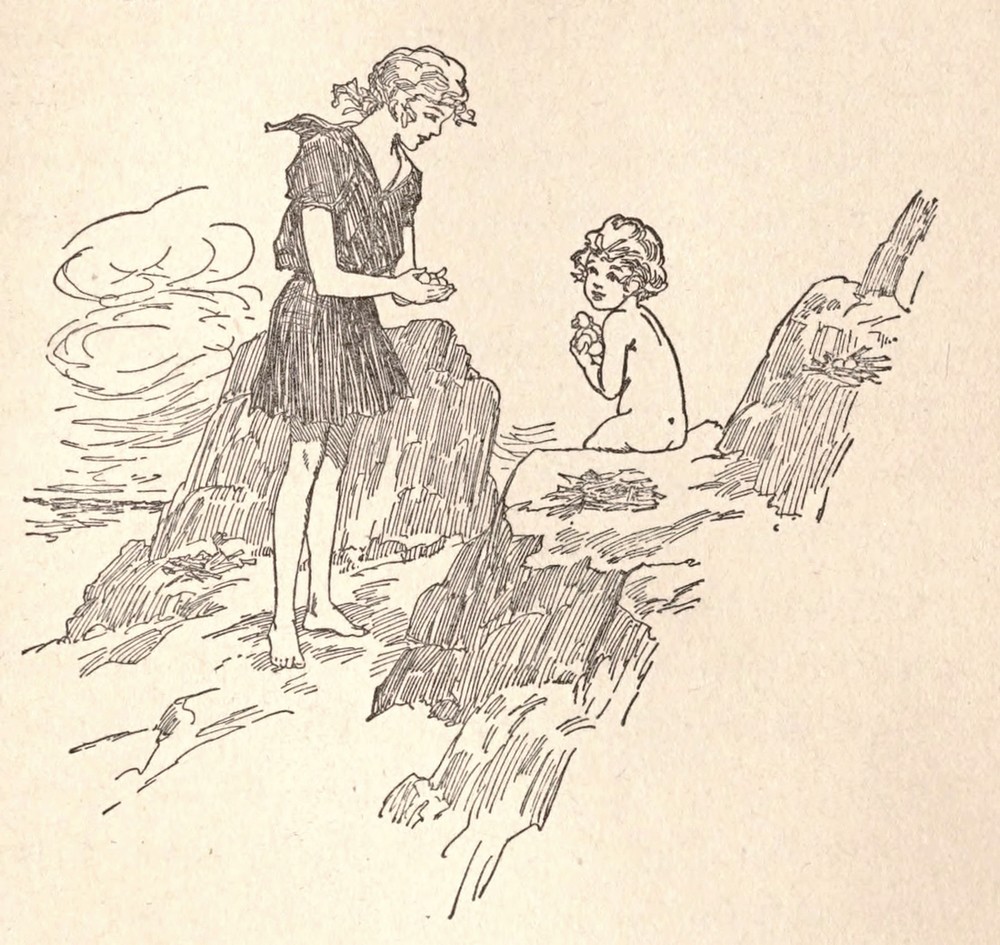
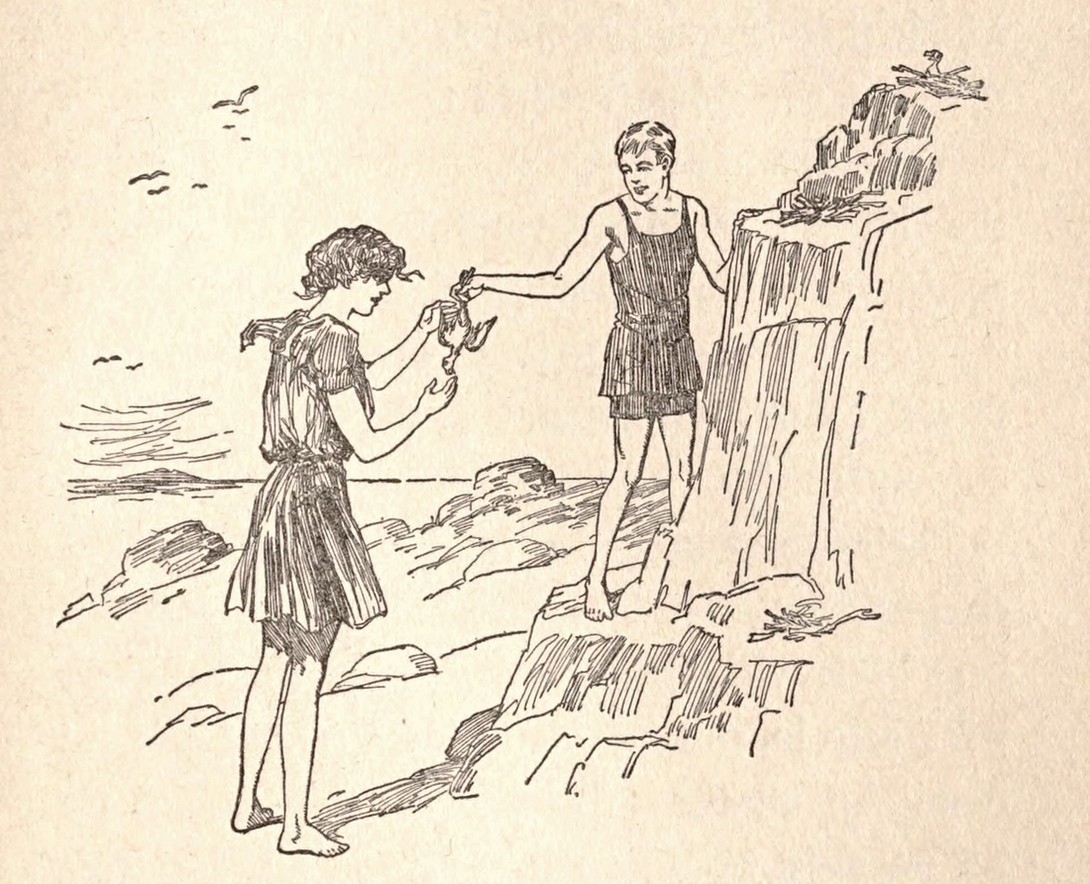
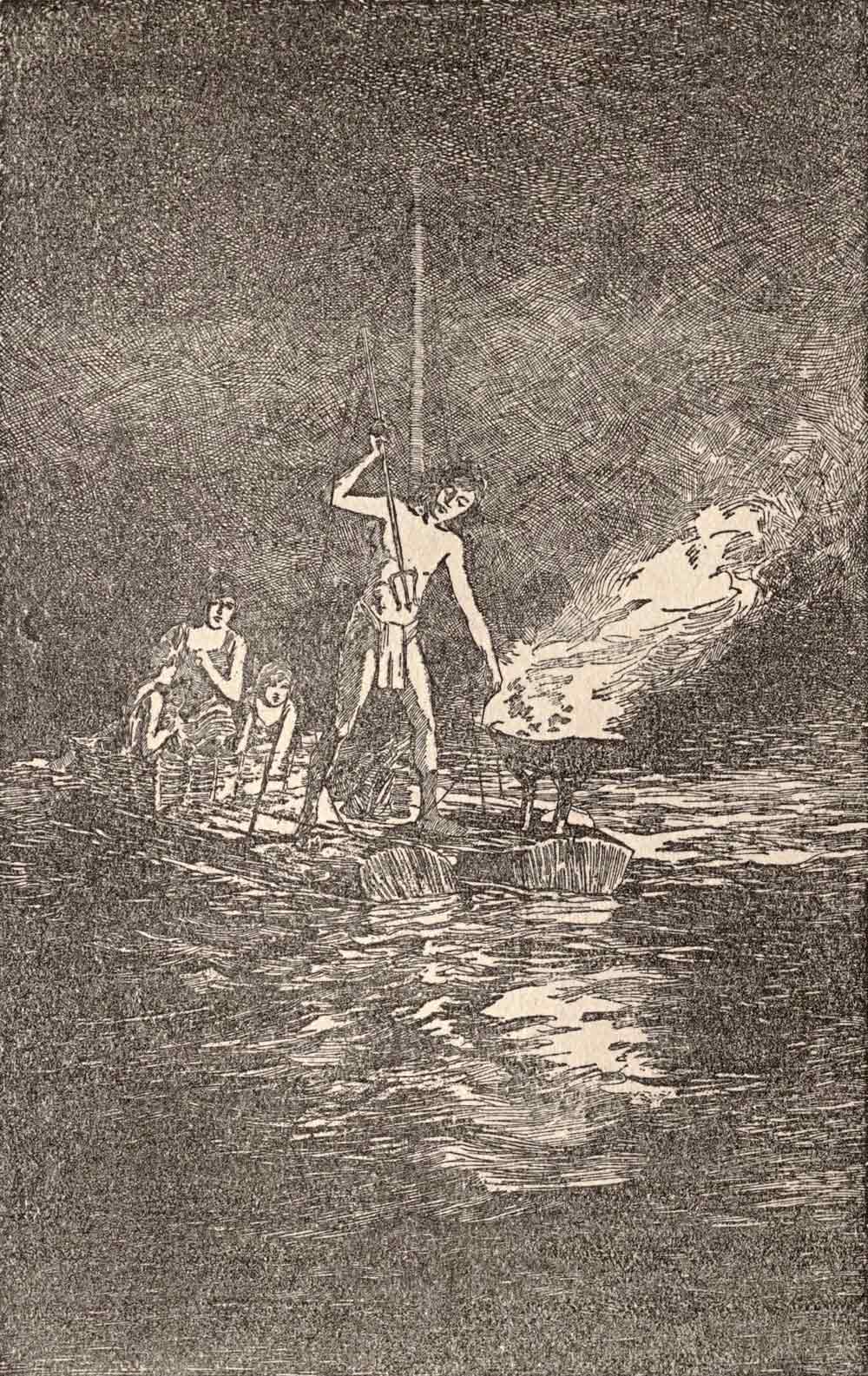
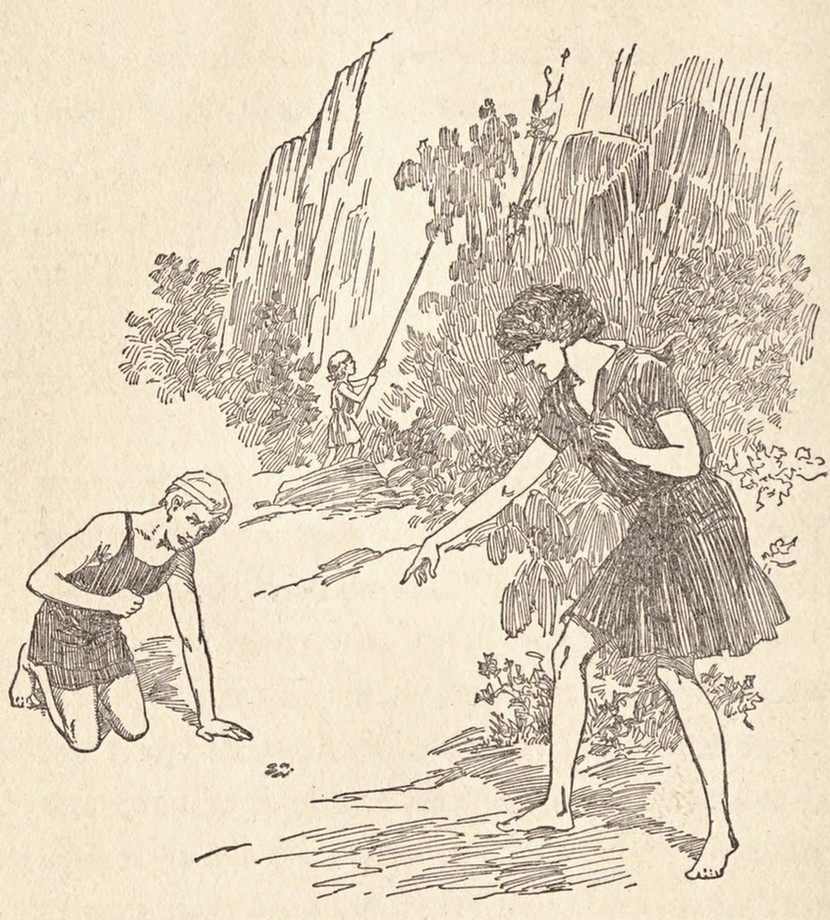
Marian Hadley stood in the doorway of her
home in a small seaport town of Mexico, watching
her ten-year-old brother Delbert come stumbling
up the hill with his arms full of mail.
“We’re out early,” he shouted. “The teacher
let us all out early. There are the girls coming
now, down by the office. Oh! and we’re not
going to have any more school this week. The
teacher has got to go to the dentist every day,
and she isn’t going to feel like teaching; so we
are going to have vacation.”
“Dear me,” said Marian, smiling, “what in
the wide world will you children do, with so
much spare time on your hands?”
“O Marian! Marian! Can’t we—it will be
just the time to do it—can’t we go to Smugglers’
Island?” Delbert’s body fairly quivered
with excitement, and his dark eyes were shining
like stars. “Let me ask Mr. Cunningham
for the launch. We could go to-morrow. O
Marian, do, please!”
Marian hesitated. “Smugglers’ Island! That
is a long way off. We couldn’t be ready by to-morrow;
it is late now.”
“We don’t need anything but a lunch. I
don’t mean to get up a party. Just us go. We
don’t need to go to a lot of fuss.”
If Marian had an especial weakness, it was
her brother Delbert. She was proud of that
spirited, handsome little face, and rarely clouded
it by a refusal if a consent was possible. Besides
the sister love she gave him in common with
the other children, there was a desire to make
up to him the loss of a companion brother who
had died a few years before, a brother a little
older than Delbert, but of much the same cast
of features.
Now she thought, “Why not? Why think
one must make elaborate preparations for every
little pleasure, when the children would enjoy
it as well, maybe better, without?”
She laughed. “Here come the girls,” she said.
“We’ll put it to a vote.”
The little girls, Jennie and Esther, came up
the path. Jennie was eight, a puny, thin little
shadow, with eyes that seemed much too big
because the face was so thin and colorless. She
had been born a sickly baby and had averaged
at least one illness every year of her life since,
and had never known what actual health was.
When Mrs. Hadley had decided to accompany
her husband on his business trip to Guaymas
she had thought seriously of taking Jennie with
her, though she had had never a moment’s uneasiness
at leaving the other three in their sister’s
care. But it had seemed a pity to take the
little girl out of school, where she was doing well;
and also there was a good American doctor in
town, whom Marian promised faithfully to send
for at the first symptom of anything wrong; so,
as Jennie herself did not seem to care about
going, it was finally decided she should stay.
Esther, the six-year-old, stood in pleasing contrast
to her sister. Having never known sickness,
she was a sturdy, robust little specimen,
as plump as the baby David, dimpled and rosy,
with curly hair that was forever getting into her
bright eyes.
Delbert was dancing with delight. “Girls,
girls,” he squealed, “listen, quick. All in favor
of going to Smugglers’ Island to-morrow, signify
by saying ‘Aye.’”
“Aye, aye, aye!” he yelled; and Esther, taking
her cue, also launched a myriad of “ayes,”
but Jennie shook her head in grave disapproval.
“You are too ev’lastin’ noisy,” she said.
“Marian, we are not going in the launch, are
we?”
The baby was calling “Aye” most lustily.
“There,” declared Delbert, “that’s a m’jority,
Marian. Three out of five’s a m’jority.”
Marian drew Jennie tenderly to her. “Delbert
wants to go to Smugglers’ Island to-morrow.
It is a long way, but perhaps you would not
be seasick in the launch. Do you want to go?”
The little girl’s shining eyes were answer
enough. Marian laughed and kissed her. “Delbert,”
she said then, “take that bill that is in
my purse down to Mr. Cunningham now and
refund him for the duties on these packages and
thank him for me,—don’t forget that,—and
then see if he can let us have the launch to-morrow.
It may be let to some one else, but if it
isn’t, and if we can have it, why, pay him for
that too, and don’t forget that. But I warn you
children there’s not a thing for lunch but bread
and butter. I haven’t so much as a cooky in the
jar, and it’s too late for me to bake now.”
Previously there had lived at the Port for
some years an American boy whose chief joy in
life had been found on the water, and, having
been blest with a small sailboat of his own, he
had been able to indulge his sailor propensities
to the utmost. Sometimes with other boys,
often alone, he had sailed up and down the coast
for miles, exploring the shallow bays and winding
esteros,[1] and he knew all the sandbars and
islands.
[1] An estero (pronounced es-tāʹ-ro) is an estuary, an arm of
the sea.
A few miles out from the Port was a group of
islands known to the Americans thereabouts as
the Rosalie Group. The natives gave them another
name, unpronounceable, and certainly unspellable.
They consisted of quite an assortment
of rocky knolls and stunted trees, and little
beaches, fine for bathing. Most people confined
their seaward excursions to trips of greater or
less duration of time to these islands, some half-dozen
in number, but Clarence had ventured
much farther; he had even gone as far as San
Moros, many miles down the coast.
San Moros was a wide-mouthed, shallow bay,
full of rocks and sandbars, but at its farther
extremity the young explorer had discovered an
island that gave unmistakable evidence of having
once been inhabited,—probably by smugglers,
as in times past they had flourished like
the bay tree all up and down the west coast, as
everybody knows.
Boy-like, Clarence had kept his discovery a
secret, or at least had revealed it only to a
chosen few, Marian and Delbert being among the
elect. And when afterwards he had made a second
trip to the place, Mrs. Hadley had allowed
Delbert to go with him. Clarence had been fond
of children and of Delbert in particular, and
often took the little boy with him on his all-day
trips on the water. On this occasion they had
camped over and explored the Island and its
surroundings.
It was long months now since Clarence’s family
had moved from the Port, but Delbert had
always been anxious for a second trip to the Island
in San Moros, being eager to show it to
Marian and his little sisters.
Before long Delbert came rushing back. “We
can go! We can go!” he called. “We—where’s
Marian?—oh, there you are. Mr. Cunningham
says we can have the launch. The man he usually
sends with it is sick or something, but he
got Mr. Pearson to take us instead. We can
start early in the morning. Goody! And say,
Marian, can’t you fix some dough for doughnuts
and let me fry ’em for you?”
Marian looked severe. “Do you remember
what happened the last time I let you fry doughnuts?”
she asked.
Delbert’s eyes twinkled. “Yes,” he said, “but
that was learning; I won’t do it that way now.”
“Shall we trust him, Jennie?” she asked.
“If you don’t, there won’t be any doughnuts
to-morrow,” Delbert assured her. “Marian has
not got time to make ’em.”
“I guess we can this time,” decided Jennie.
“Me fry doughnuts, too,” said Esther.
“I am afraid me had better not,” said Marian;
“but you and Jennie may roll and cut them out
for Delbert. And Davie, you sit up in your high
chair and watch sister stir up these doughnuts
quickly, and then Davie shall make a doughnut
of his very own. Delbert, put the granite-ware
kettle on, and the lard is in that pail on the shelf
there by you. I think there is just enough; put
it all in.”
She hurried the ingredients together, and, as
soon as the dough was ready for rolling out,
turned it over to the apprentices and ran out
of the kitchen to the numerous other tasks that
awaited her.
“You haven’t read us mamma’s letter yet,”
called Jennie.
“Oh, I will read it while we eat supper,”
Marian answered.
“What mamma say?” shrilled Esther.
“Says they will be back in two weeks,” came
Marian’s muffled voice from the far bedroom.
Presently she came back. “Jennie,” she said,
“do you know what was done with your and
Esther’s bathing-suits when you came back from
bathing the other day?”
Jennie looked blank, but Esther answered
promptly.
“Down to Bobbie’s.”
“Down at Bobbie’s? Whatever did you leave
them there for?”
“Oh, yes,” cried Jennie, her face brightening,
“I ’member now. We stopped to play and
hung ’em on Bobbie’s mother’s clothesline and
forgot ’em.”
“Well, that’s a great way to do! Esther, you
run down after them now.”
Esther was kneading doughnut dough industriously.
“To-morrow,” she said.
Marian considered a moment, and then said:
“No, you go now, it is two days they have been
there already, and they may have got into some
corner where Bobbie’s mother won’t know where
they are, and we won’t have any time to hunt
for lost things in the morning. It is a long way
to Smugglers’ Island, and we must get off early
or we shan’t have time to explore it and get
back by dark.”
Esther sighed, and began to clean the dough
from her little fat hands. “Tell where we going?”
she asked.
“No; better not.”
“Why?”
“Oh, because if Bobbie knows we are going
in the launch, he will want to go, too, and I
know positively his mamma wouldn’t let him.”
“Why?”
“Oh, you little interrogation-point!” expostulated
Marian under her breath. Aloud she answered
patiently, “Because Bobbie was awfully
naughty and went in the fishing-boat without
asking his mamma, and she was so worried about
him, and when he got back she told him he couldn’t
go anywhere except to school,—not anywhere,
not even up here to play with Delbert,—for
two whole weeks.”
“Not two weeks yet?”
“No, it is not two weeks yet. Now, do go on,
Esther. Just ask for the bathing-suits and don’t
make Bobbie feel bad by telling him about a
picnic he can’t go to.”
In the morning, before Marian had breakfast
out of the way, Delbert came in with a rush.
“I have just seen Mr. Pearson. He is going to
his breakfast, and he says he is all ready, and
he wants to know if there is anything you want
him to do.”
“Yes,” said Marian; “tell him to get a demijohn
of water. Mr. Cunningham has a demijohn
he uses for that, but Mr. Pearson may not
think of it.”
“Oh, but there is water on the Island, plenty
of it.”
“Yes, my dear, but it has not been filtered,
and I don’t want you children drinking anything
and everything. Oh! and did you put
plenty of water for the chickens, Delbert?—and
put a big stone in the pan so they can’t tip
it over?
“Bread and butter and doughnuts,” she continued,
“and I must take milk for Davie. Dear
me! I haven’t enough to fill the jar either.
Here, Jennie, get a dime from my purse and take
this pail and run down and see if Bobbie’s
mother can let me have a quart of milk. If she
hasn’t it to spare, you will have to go to Doña
Luisa. Delbert, find the hatchet. It will come
in handy when we come to build a fire for
noon.”
“Haven’t you got eggs, Marian? Take some
raw eggs, and we can boil them over a fire; it’s
lots of fun.”
“I’ve only three, Delbert, but if you can, get
some at Bobbie’s, or ask Fanny’s mother if she
can spare me some.”
“We can get crabs and clams, you know,”
said Delbert. “There’s barrels of ’em. Clarence
and I had ’em. But take plenty of bread and
butter, Marian. Mr. Pearson can eat a lot, I
know.”
“Yes. Run on now and see about the eggs,
and then go down and tell Mr. Pearson about
the water. Let me see,” she continued,—“what
else? Oh, yes, if we go bathing, I shall
have to comb my hair.”
She wrapped up her comb and brush in a
clean towel, and then, on second thought, tucked
in a little pocket-mirror and a cake of tar soap
and two more towels.
“Marian, me got my spade and pail, but me
can’t find baby’s,” called Esther.
“His little pail is here,” answered Marian,
“but I don’t know where his spade is. Let him
take the big dig-spoon instead.” A dig-spoon,
be it known, is a spoon so old and dilapidated
that mother does not mind if the children
use it to dig in the dirt with. The big dig-spoon
of the Hadley children was a huge iron affair
about a yard in length that had doubtless
been originally intended to stir soup in a hotel
kitchen.
As they started down the hill on the way to
the pier, Bobbie’s mother ran out to her gate.
“Marian,” she called, “are you taking plenty
of wraps with you? You know it gets cold toward
evening.”
Marian held up a couple of light shoulder
shawls. “Delbert has his coat,” she said, “and
Esther and I never want anything around us
anyway. There are always a couple of blankets
on the launch seats.”
“Oh, you foolish child,” declared the lady;
“you wait.” She ran back into the house, and
in a moment came back with a very large heavy
circular cape, “There, you take this,” she said.
“It will cover you and Esther and the baby too.
Jennie will need both those flimsy shawls. You
know it won’t do to let her get chilled.”
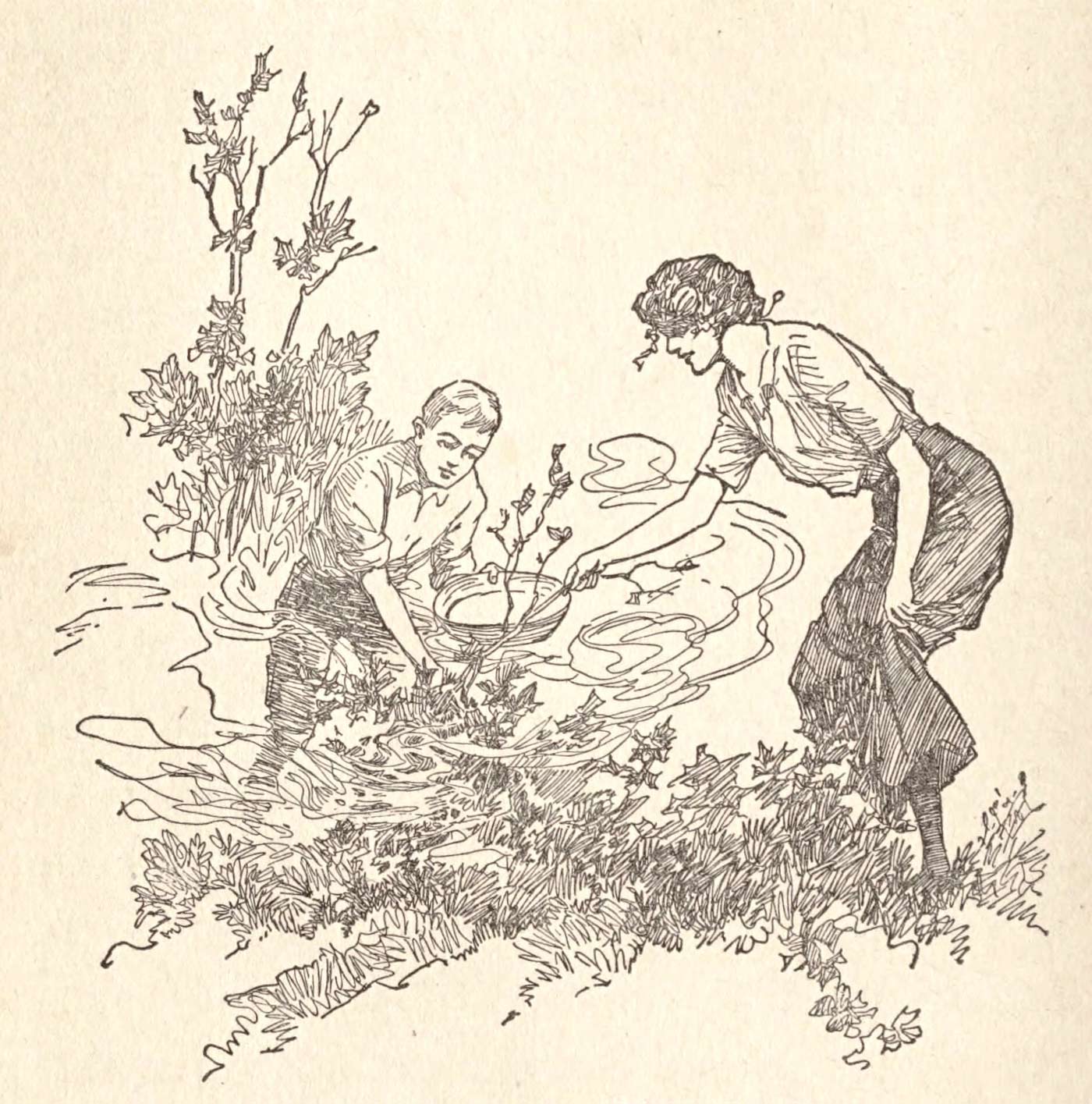
Marian thanked her laughingly and accepted
the cape.
Mr. Cunningham was down on the pier. He
was a dapper young man, pleasant and good-looking
and well liked by everybody at the Port,
and he held the
most lucrative and
responsible position
of all the
Americans there.
MARIAN LAUGHINGLY ACCEPTED THE CAPE
He smiled as the
Hadley party
trailed down the hill
and out on the pier, the
sturdy baby well in the lead.
“Here comes King David
and his train,” he called.
“By Jove,” he added, observing
the huge dig-spoon,
“he has his scepter with him
too.—Good-morning, Miss Marian; do you
mean to tell me that basket is full of lunch?”
“Not quite,” laughed Marian. “There is a
hatchet and my workbag and a few other things
as well.”
“Workbag!” exclaimed Delbert in disgust.
“What did you bring that for?”
“Oh, I may hemstitch a little while you children
dig in the sand. I shan’t ask you to do any
sewing, Delbert.”
As the big basket was being stowed away in
the launch, Mr. Cunningham said laughingly,
“If you find you have not enough, Miss Marian,
there is some canned stuff in the locker you
are welcome to.”
“Thank you,” said Marian, “I think we have
plenty. I have been on trips like this before;
I know how children eat. Delbert, I forgot to
put in anything to cook the eggs in. You wanted
to boil them, and we haven’t a thing.”
“Use Esther’s pail,” he suggested.
“It leaks too badly, and baby’s pail is wooden.
No, if you want those eggs cooked, you will have
to go back and get something.”
“There will be the clams, too,” said Delbert,
starting back across the pier on a trot.
“Oh, and, Delbert—”
“What?”
“You might bring Jennie’s cape, too, while
you are there; and, Delbert, Delbert! Be sure
and lock the door again when you come out.”
“We ought to have something to bring home
clams in, too,” she said after a moment, “but
he is too far gone now to call back.”
“There is a big pail here in the boat-house,”
said Mr. Cunningham, going to get it.
“I shan’t be here when you get back,” he said,
coming back with the pail, “but the launch can
be turned over to Manuel. I am going up the
river for a couple of days. I must be getting
ready now, so I will bid you good-bye and wish
you a pleasant trip.”
He shook hands with Marian, pulled Esther’s
curls, smiled at Jennie, stood the baby on his
head a moment, and strode off across the pier.
Soon Delbert came running down the hill
again, his arms full.
“Morning, Mr. Faston,” he called to an old
gentleman who, with a basket on his arm, was
starting toward the plaza for his breakfast
steak.
“Good-morning, Delbert. Where you all going
so bright and early?”
“Going to Smugglers’ Island.”
Delbert ran down to the launch and scrambled
in. “I brought baby’s jacket, too,” he said,
dumping the wraps, the granite-ware kettle, and
a little bright new dishpan in a heap at Marian’s
feet.
“I see you did, but whatever did you bring
that dishpan for?”
“Why, it was sitting out there on the table,
so I s’posed you forgot it, and I wasn’t going
to be sent back again.”
Marian laughed. “I had no notion of bringing
it,” she said. “Well, Mr. Pearson, I guess we
are all ready. You’d better start off before we
think of something else we might like to take.”
“Just think, Marian,” said Delbert; “Mr.
Pearson has not been outside the harbor since
he has been here.”
“No? Never been to the Rosalie Group, Mr.
Pearson?”
Pearson cleared his throat. “No; when a man
is busy he don’t get much time for picnics,” he
said.
“I am to show him the way,” continued Delbert,
“and he is to make the launch go there.”
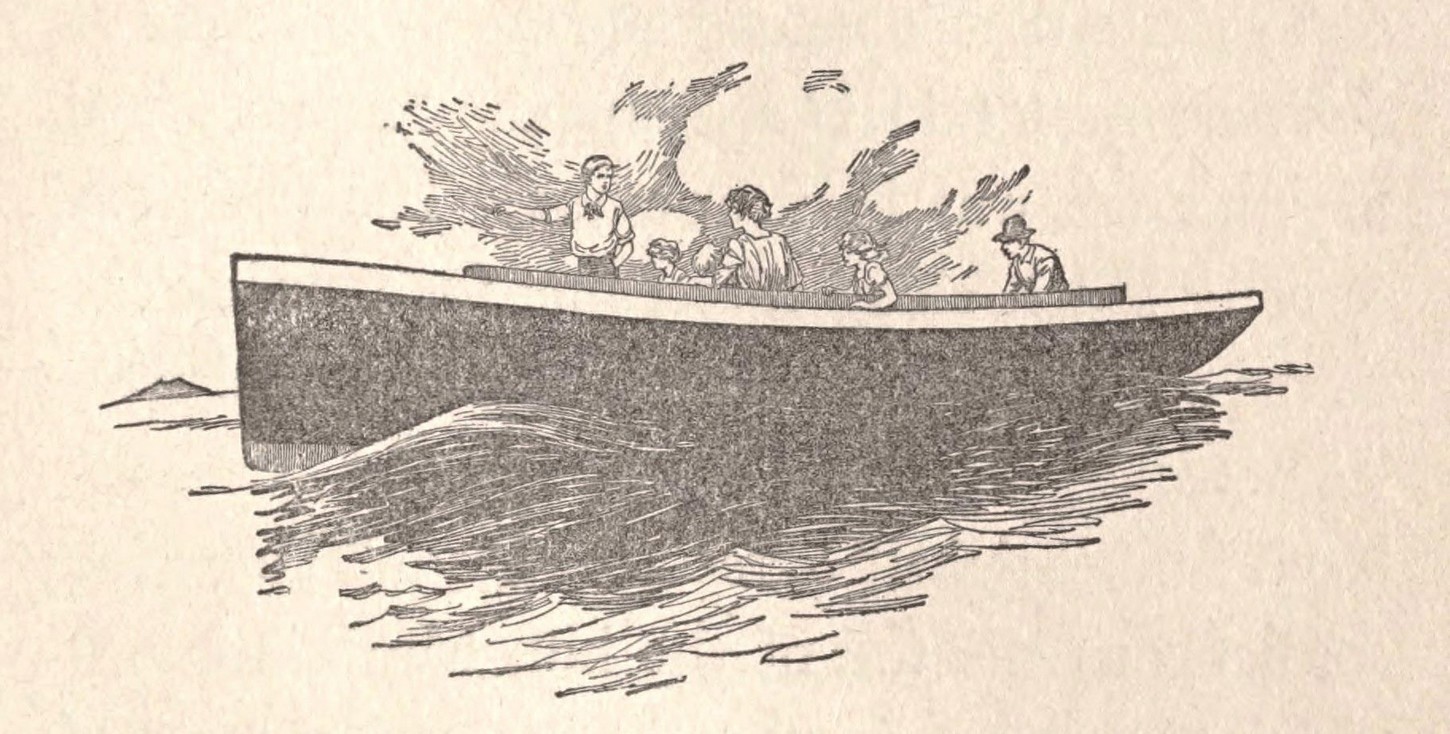
It was a lovely day. The children were fairly
bubbling over with the glee of it, and Marian
herself felt unusually gay and light-hearted.
Mr. Pearson was rather silent. He was a
newcomer to the Port, and Marian had had
hitherto but a bare speaking acquaintance with
him. She had an instinctive feeling, however,
that he considered children as necessary nuisances;
so she tried to keep them from annoying
him too much with their chatter. However,
though he volunteered no remarks, he answered
good-naturedly what was said especially to him,
followed minutely Delbert’s instructions as to
their direction, and listened with apparent interest
when the little fellow told of trips taken
with Clarence in the sailboat.
Outside the shelter of the harbor they encountered
the high waves of the Gulf, and Davie was
so frightened that Marian had much ado to keep
him quiet. Jennie, too, began to feel a few
qualms of her old enemy, seasickness, so that
with them both Marian had little chance to exchange
sociabilities with Mr. Pearson.
Leaving the Rosalie Group on their right,
they turned down the coast bound for San Moros.
Delbert was entirely unafraid. The higher
the wave the better it suited him, and he was
constantly declaring he only wished they were
going to stay a week. Esther echoed him, as was
her wont, and Jennie feebly put in a few remarks
of the same tenor, her feeling in the matter, however,
being born of a desire to put off the nausea-beset
homeward trip rather than to prolong the
picnic joy.
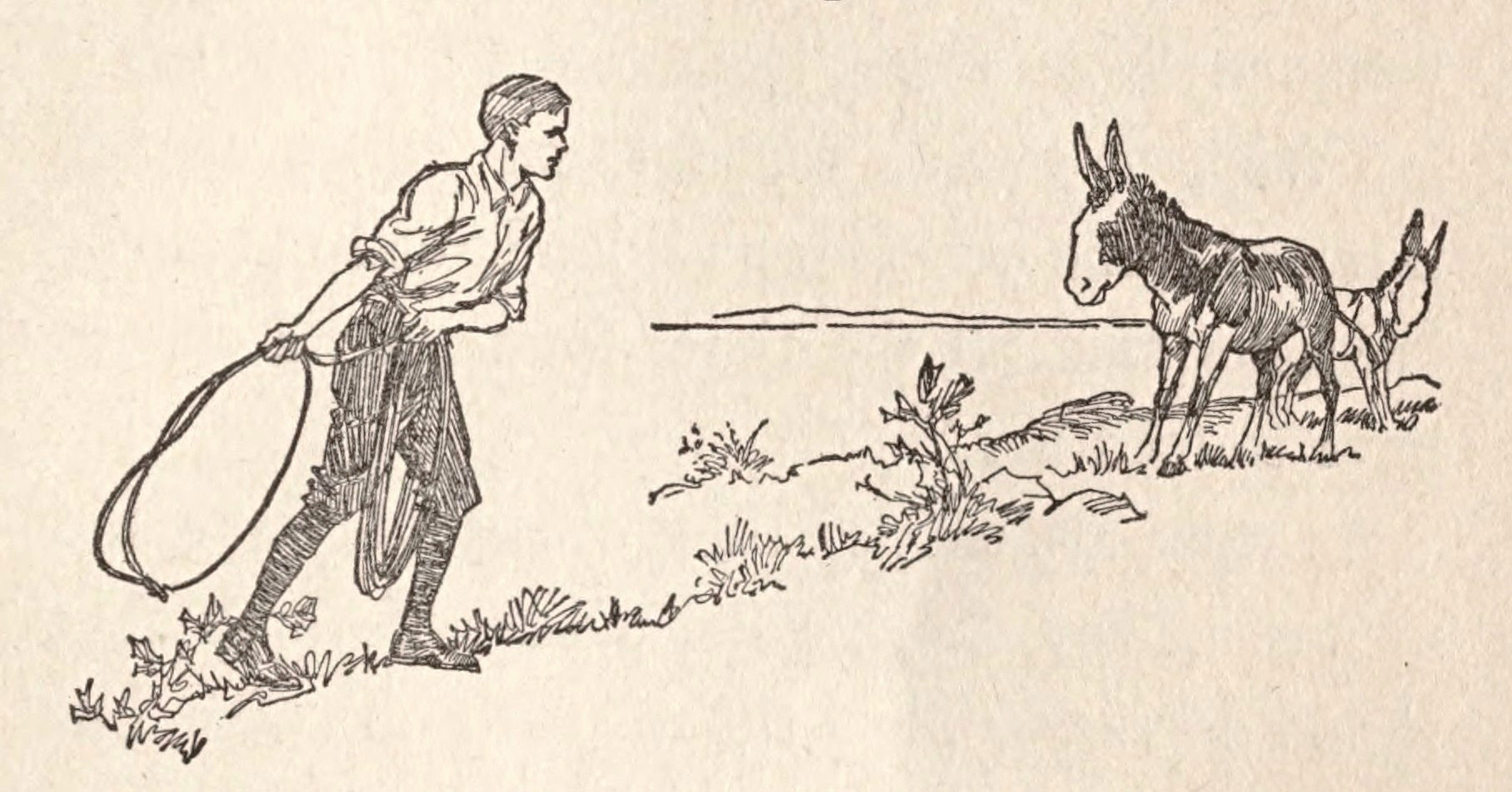
FOLLOWED MINUTELY DELBERT’S INSTRUCTIONS AS TO THEIR
DIRECTION
Finally they rounded the point and entered
San Moros. Delbert remembered just how
Clarence had made his way in among the many
rocks and sandbars, most of which were covered
at high tide. The Island lay some miles back,
a crescent in shape, high and rocky at one end
and running out to a narrow sandy point at the
other. No one approaching it would have mistrusted
it was other than the mainland, for the
formation was such as to blend it perfectly with
the mainland back of it, and it showed no sign
of the strip of water between till one was close
upon it.
“We landed first by that point of rock,” declared
Delbert, pointing, “and then afterwards
we took the boat in back of the Island and tied
her to the pier till we were ready to go home.”
“I guess that is a good enough programme to
follow now,” said Mr. Pearson. “Didn’t you
say this side was best for crabs? That’s a nice-looking
beach along there, fine for you kids to
bathe on. We will tie up to those rocks till after
dinner.”
“Well, all right,” agreed the boy. “There is a
path up to the top of the hill, Marian, but it
doesn’t come down on this side. Clarence said
the smugglers wore it going up to peek over the
hill to see if any one was coming for ’em.”
The little point of rock on the seaward side
of the Island made a very good substitute for a
pier. They landed there and were able to reach
the sand without getting their feet wet. Jennie
declared she felt better as soon as she touched
shore.
Delbert was anxious to lead the expedition
over to the other side of the Island, where remained
the signs of former habitation.
“You can go on over now,” said Pearson
good-naturedly; “I’ll unload the launch and
take a swim, and if you say there is anything
there worth looking at I can go over afterwards.”
Delbert hesitated; he was counting on expatiating
on the extent and glory of the ruins and
preferred a large audience.
“Why, of course, Delbert,” said Marian;
“Mr. Pearson can take the launch around after
dinner. This is the best side for bathing. I am
not sure,” she added, as the children started off,
“but after dinner would be soon enough for the
rest of us, but—”
Pearson laughed and shrugged his shoulders.
“There is no wait in that kid,” he said.
“I see there isn’t,” said Marian, as she
started after her eager brother.
The hill was decidedly rocky and steep, with
a goodly strip of sandy beach at its base. The
crabs scurried away as the children ran across
this.
“See, Marian!” called Delbert; “see all those
crabs? We’ll have them for dinner. Don’t they
look fat?”
“Fat and luscious,” laughed Marian. “You
are fat and luscious, too, baby darling,” she continued,
catching Davie as he stumbled over a
stone, “but those qualities alone will never make
a mountaineer of you.”
Delbert forged ahead, scrambling over rocks
and skirting thorny bushes, and the others followed
as best they could.
“I suppose when you get there you will stop
and wait for us,” called Marian.
“Oh, yes,” he answered; but he did not take
the hint and slacken his pace then.
His bump of locality was good, and although
it was almost a year since he had been there, he
made his way directly to the spot on the apex of
the hill where a faint path led down on the other
side. Here he paused, and, letting out a series
of triumphant whoops, announced his arrival
to his upward-toiling sisters.
One by one they joined him where he sat on a
big gray rock, swinging his lariat, his most treasured
possession, a new hair rope given him by
an old Mexican a few weeks before.
“Dear me,” said Marian, all out of breath, as
she set down the baby, whom she had been
carrying the last part of the way; “whatever
did you expect to lasso here, Delbert? Crabs?”
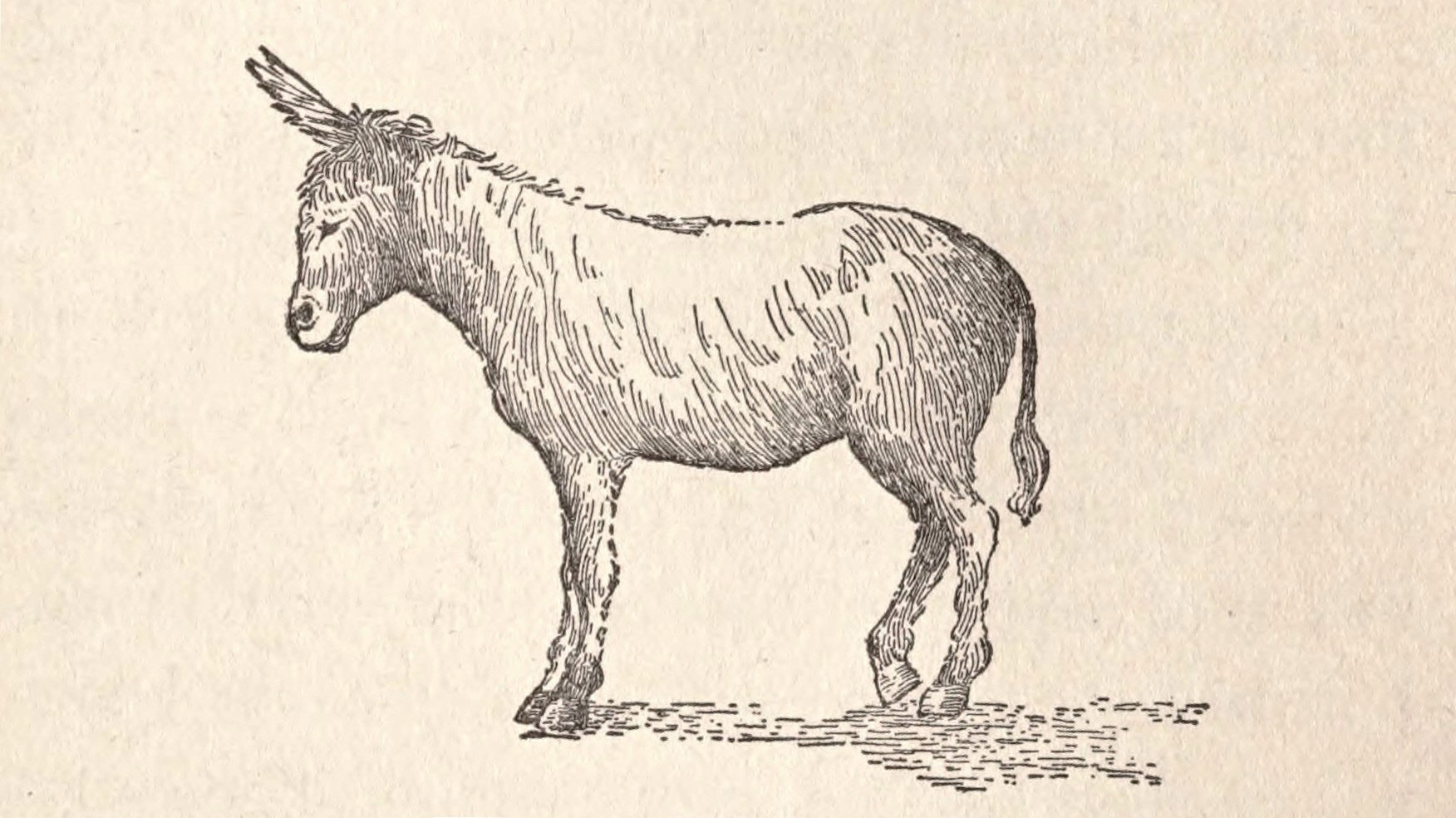
“No,” he replied, “burros! Didn’t you
know there were burros here? There’s a herd of
’em. Clarence said probably the smugglers had
to leave in a hurry and couldn’t stop to round
up everything they had. Anyway, there’s burros
here. Yes, and pigs, too. We saw their
tracks; we didn’t see them, but Clarence said
when he was here the first time he heard ’em
grunting in the bushes.”
Marian was examining the surroundings. “I
believe Clarence was right,” she said. “That
is a real path certainly, but there is not a sign of
it on the seaward side of the hill. Whoever lived
down there used to come up here to this rock.
You can see away out into the gulf from here,
ever so many miles, but it is so bushy that no
one here would ever be seen.”
“Yes,” assented Delbert; “Clarence called
this Lookout Rock. Farther back this hill
spreads out into a mesa.[2] It’s several miles long.
Clarence said there were deer here, too; he saw
’em.”
“No,” said Delbert. “I remember when we
camped here it was awful quiet at night, and I
asked Clarence if he s’posed there were any panthers
here, and he said no, he hadn’t seen a sign
of any such thing here, and he guessed if there
ever had been, the smugglers had killed them all
off.”
“That is not unlikely,” said Marian; “but
the burros and pigs must have come from what
they had; perhaps the deer, too,—they might
have had some for pets. But, come, if we have
our breath now, children, we’d better go down;
for see, Mr. Pearson has the launch unloaded
already, and there is dinner to get when we get
back.”
So they followed the twisting trail downward.
It was very faint, in some places entirely obliterated,
yet taken as a whole was distinct.
Between the Island and the mainland lay a
strait that was deep enough for even large
steamers, though there was little of San Moros
that a big steamer could have ridden safely over.
A little rough rock pier had been built here.
“And Clarence said the fellow that built it understood
his business, too,” declared Delbert, emphatically.
“He said it was a good job; but
come and look at the bananas,” he continued,
leading the way.
The Island, which elsewhere presented such
rough, not to say precipitous, sides, here was
level or nearly so. A house had once stood there.
The mound of its ruins was unmistakable. In
one place a forked timber stuck up; on one side
was a pile of other timbers overgrown with
weeds and shrubbery. There was a spring, too,
that had had some sort of masonry cover,
broken now, but with a tiny pool of water at
the bottom of the rocks. There were the remains
of an old stone wall that had once surrounded
a garden, of which only a thick, matted banana-patch
was left.
A banana plant grows to maturity, produces
one bunch of bananas, and then dies. During
the time it is doing this a number of young
plants spring up about the parent stalk, and
each of these produces its one bunch of fruit and
group of little ones, which in turn go through
the same process. It will be readily seen, therefore,
that, with no one to trim out the old stalks
and superfluous young ones, a banana-patch
would in the course of time become a very
crowded place, indeed.
This was just what had happened to the
Smugglers’ Island patch. How long it had been
left uncared-for no one could tell, but it was
now an impenetrable jungle.
Marian and the children walked all round it,
looking for bananas, but except for several
bunches from which the birds had eaten the
fruit, leaving the blackened skins dangling, they
saw only one, and that was too high up for them
to reach. It did not look very tempting, anyway.
A little beyond were a few fan palms, but
this kind of palm bears no fruit.
Marian sat near the site of the old house,
while the children rummaged about and explored.
This was certainly an ideal place in
which to hide from the world, a sunny little spot,
sheltered and secluded, for the hill hid the place
from the seaward view, and across the narrow
strait lay only the rocky, thorny tangle of the
uninhabited hill of the mainland, with not even
an Indian ranch for miles and miles, Clarence
had said. Marian wondered what chance or
incident had caused the abandonment of the
place.
Presently she rose.
“Come, children,” she called, “we were
going to catch crabs for dinner, you know. We
must be going back.”
So they went back up the dim little path to
Lookout Rock and began to pick their way down
from there as best they could.
“Why, Marian,” called Delbert, “Mr. Pearson
has moved the launch. It is not by the
rocks now. Where’s he gone?”
Marian glanced up.
“I guess he thought we were pretty long in
coming and has gone exploring on his own
hook,” she said.
“I’ll see,” said Delbert, and he went out to
where he could see the water all around the end
of the Island and in to the little pier.
“No,” he said, as he came back, “he has not
gone round there.”
They went on down the hill.
“I don’t see why he should move it,” persisted
Delbert. “That is the best place for it
on this side of the Island, and this is the best
beach for bathing.”
They went over to where the things were
piled up. Pearson had dumped them all together
and thrown one of the launch blankets
over them; and on top of this a note was pinned
with two wooden splinters.
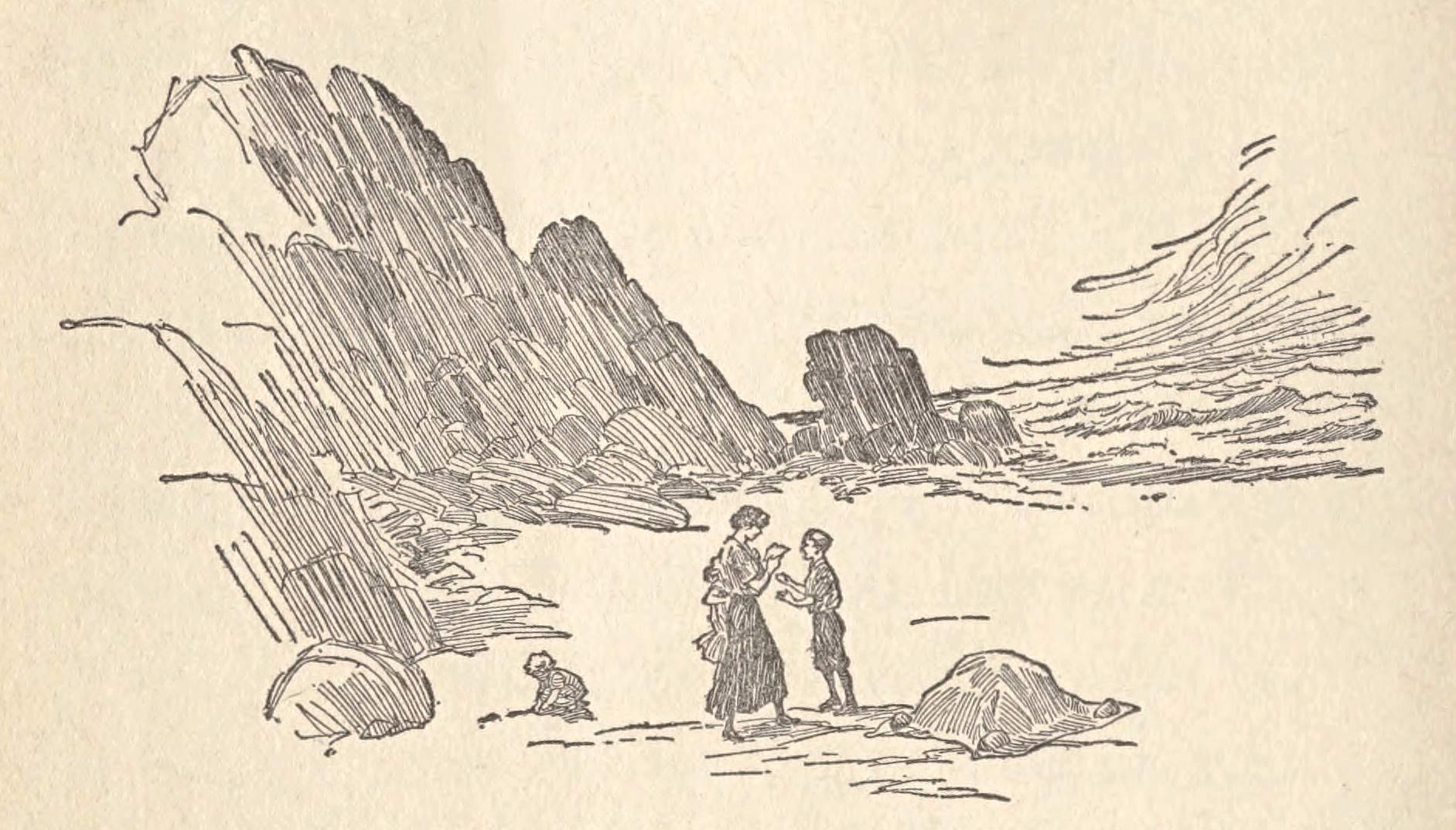
MARIAN TOOK IT OFF AND READ IT, AND THEN STOOD LOOKING
AT IT FOR SEVERAL SECONDS
Marian took it off and read it, and then stood
looking at it for several seconds.
“Delbert,” she said quietly, “did you know of
any trouble between Mr. Pearson and Mr. Cunningham?”
“Trouble?” repeated the boy, startled,—“trouble?
Why—why, no,—not—not trouble.
Why?”
“Because,” said Marian, still quietly, “Mr.
Pearson has stolen the launch and gone away
and left us here.”
CHAPTER II FOR SHELTER IN A STORM
Delbert stared with wide eyes for a moment;
then he snatched the note from Marian’s hand
to read for himself. He was not much accustomed
to reading writing, but this was very
plainly written with a purple indelible pencil on
a leaf torn from a pocket memorandum-book.
Miss Marian,—
Boss Cunningham has done me plenty of dirt
and now he is going to regret it just one gasolene
launch. Sorry to inconvenience a lady and all
that, but the kids want to stay overnight anyway.
Delbert looked up again into his sister’s face;
then, dropping the note, he sped across the sand
and up the hillside to where he could get a good
view of the Gulf beyond the bay.
Marian picked up the note, and still stood
looking at it.
“How we get home?” inquired Esther.
That was precisely the question that was racing
round in Marian’s brain.
“I don’t know—yet,” she said.
Slowly she took off the blanket that was
thrown over the things. The other blanket was
there, too, and all of their things, also the five-gallon
demijohn of filtered water and a tin box
of crackers, nearly full, three cans of corn, and
a quart can of tomatoes. She remembered Mr.
Cunningham had said there were some eatables
in the locker.
A big crab came slowly up and regarded them.
Marian returned his look gravely. “Yes,” she
said, “I see you are there, and we may thank
our stars you are there, too, you and your relations.”
“W-won’t Mr. Pearson come back?” faltered
Jennie.
“I am afraid not,” answered Marian.
“But—but what shall we do?”
Marian reached down into her boots, where
her heart had sunk, and pulled up a smile by
main force and put it on her lips. A connoisseur
in smiles would have known at a glance that it
never grew there of its own accord, but Jennie
was only eight and was not versed in artificial
smiles.
“Well, my dear,” said the big sister, “we
can’t walk back and we can’t swim back, so I
guess we shall just have to Robinson Crusoe it
here till some one comes after us. When they
find we don’t come home, they will hunt for us,
of course. See here,” she added, briskly, pulling
out the big pail Mr. Cunningham had lent
them for clams, “you children take this pail and
get some crabs. I will build a fire, and we will
have dinner right away before anything else
awful happens to us.”
The children, reassured by her tone and smile,
took the pail and trotted off down the beach.
They had caught crabs on the little beaches of
the Rosalies and understood the business. Even
Davie got a stick and landed a few.
Marian gathered some sticks and built a fire
in the shade of a big rock. She had it well started
when Delbert came back to her.
“I can see something black away out in the
Gulf; probably it is him,” he said.
“Probably,” she answered.
They brought the things up to the fire and
began to unpack the basket.
“I don’t see why he did it!” finally burst
forth Delbert with clouded face and quivering
lips.
“Well,” said Marian quietly, “he evidently
was a different kind of man from what we
supposed. There are a few such people in the
world.”
“But, Marian, no one knows where we are.
They wouldn’t know where to look for us if
they were hunting for us.”
“No, but I have been thinking, probably Mr.
Pearson doesn’t know that. What did you say
to him last night?”
“Nothing. Mr. Cunningham did the talking.
He just called and asked him if he could go out
with a party in the launch to-day, and he said
yes and came over and asked who was going,
and when Mr. Cunningham told him, he asked
what time we should want him. It was this
morning he asked me if I knew the way, because
he had never been out to any of the islands, he
said.”
“Did you tell Mr. Cunningham where we
were going?”
Delbert thought a moment. “No; I just
asked could we have the launch for all day.”
“And you didn’t tell Bobbie or any of the
other children?”
“No; I didn’t see any of them last night, and
not to talk to this morning. When I went for
the milk, I just said we were going in the launch.
But Bobbie’s mother knew we were going; she
brought out the cape to you.”
“Yes, but she didn’t know where. I never
thought to mention it to any one. When you
came back with Jennie’s cape, you told Mr.
Faston we were going to Smugglers’ Island, but
unless some of them remember hearing Clarence
tell of it they won’t know where Smugglers’
Island is.”
Delbert shook his head. “Clarence didn’t
tell about it to any one but his folks and us. We
had it for a secret. Why, Marian, they won’t
know at all where to look for us!”
“No,” replied Marian steadily; “it was an
awfully mean trick for Mr. Pearson to serve us,
even without counting the stealing of the launch,
but you see, Delbert, Mr. Pearson supposes
every one knows where Smugglers’ Island is.
He heard what you said to Mr. Faston, and,
besides that, I’ve been thinking, and there was
not a single thing said on the way out this morning
that would have led him to suppose we were
the only ones that knew about the place. We
talked about my never having been here before,
but not a word but what other people knew. He
supposes of course everybody knows, and that
when we do not come home to-night they will
come straight here in the morning.”
“But they won’t,” said the boy. “When we
don’t come home they will think we are camping
over. They won’t know till Mr. Cunningham
gets back that we were coming home to-night,
and he is not coming back for two days.”
“Oh, they will all know I wouldn’t have taken
you children out camping with only Mr. Pearson
along; besides Bobbie’s mother knows we
didn’t take any bedding along, and even if
she didn’t, she would know that if we had intended
to be gone overnight you would have
asked Bobbie to take care of the chickens.”
“Well, anyway, what if they do know we
meant to be back? They don’t know where we
are. Hunting the Rosalie Group over won’t
find us.” Then he smiled a little grimly. “Do
you know, Marian, it will be the chickens that
will tell them about it? They won’t worry
about us to-night; they will s’pose, of course, we
will get in all right; but in the morning all our
chickens and old Peter Duck and Madam
Waddle and the whole brood of ’em will simply
swoop down when Bobbie goes to feed his chickens.
Then they will begin to investigate. That’s
all the good it will do them; they won’t find us,”
he concluded moodily.
“Marian,” he burst forth presently, unable
in his nervous state to put up with his sister’s
silence,—“Marian, what do you think?”
“Delbert,” she answered, pausing in her work
and looking up at him, “the biggest thing in
my mind just now is that bunch of bananas we
saw over on the other side.”
Delbert’s eyes roved over the provisions before
him. “How long will this last us?” he inquired.
“Well, I planned it for perhaps two meals for
six people; as it happens, there are only five to
eat it, and we have Mr. Cunningham’s eatables
as well, you remember,”—she gave a little
laugh. “You remember he said we were welcome
to them, if we didn’t have enough of ours.”
“Huh! I should think so. You bet Mr. Cunningham
would never do a dirty trick like that.
We—we can starve here for all Pearson knows
or cares.”
Marian put down the kettle and went to her
brother, with his flushed face and flashing eyes
winking back the tears. She drew the slender
little form into her arms close and tipped up the
handsome, quivering little face.
“Delbert boy, darling,” she said softly, “we
are not going to starve. The children might if
you and I were not here, but we are here; there
are clams and crabs for the gathering, and I know
a boy who, with his jack-knife, can make a trap
that will catch quail, and I once knew him to
kill a rabbit with a bow and arrow.”
“Yes, and you scolded me for it, too,” he said.
“I did. We didn’t need that bunny rabbit
at all, but these babies are going to need feeding,
and we shall have to feed them with whatever
we can get, rabbits or what. And we can take
care of them, Delbert, you and I, till somebody
comes. We will do it in spite of Mr. Pearson.”
“Pearson!” said the boy fiercely; “he can just
go to—to blazes.”
Marian leaned down and kissed him. “No,
dear,” she said lightly, “but he may go to some
other port and let the police catch him and send
him and the launch back to Mr. Cunningham.”
The boy laughed chokily and, twining his
arms about his sister’s waist, held her closely
while she stroked his hair.
“No, darling,” she said presently, “we will
not worry. You and I can do a lot of things; you
will see. Now, here come the girls with the crabs.
We mustn’t let them be frightened.”
Delbert straightened up. “How many did you
get?” he called, and Marian smiled at the easy
cheerfulness of his tone.
“Oh, you will do,” she said approvingly, “you
will do.”
While she cooked and prepared the crabs,
she sent the children off after clams. Under
Clarence’s tuition Delbert had become quite an
expert at finding clams, and fortunately they
were plentiful. Marian, poor child, wondered
how long one could live on an exclusive diet of
crabs and clams before getting utterly sick and
tired of them.
She decided to put everybody on a rather
short allowance of bread, so as to make it last
longer and explained it to them when she called
them up to eat. They did not mind; they preferred
crabs anyway.
“Marian,” said Delbert, “I can’t think of a
thing between Mr. Pearson and Mr. Cunningham,
except that Mr. Cunningham didn’t like
his work when he first came and discharged him
from the shop. But he has been working somewhere
else ever since; that needn’t have made
him mad.”
“Probably there is something that we don’t
know about,” she said.
“Well,” he persisted, “I bet Mr. Cunningham
didn’t know about it either. He wouldn’t
have sent him out with us if he hadn’t thought
he was all right. There was a fishline and hooks,
too, in the locker,” he continued. “Did you
see anything of them, Marian?”
She shook her head. “He only left us the crackers
and canned stuff—oh, and a box of matches,
and I had another one in our basket.”
“How many fires can we build with them?”
he asked.
“A good many, but we don’t need to use them;
we can keep live coals over from one time to another,
as papa does in the fireplace winters. That
is what we’ll do and use the matches only when
we really have to. On a sunshiny day I could
light a fire with the crystal from my watch.”
They had never heard of such a thing, and
Jennie and Esther wanted her to take
it off and
show them how at once.
Marian declined. “We have a fire now,”
she said. “The thing for us to do is never to let
it go out, day or night. If it goes out in spite of
us, because of something we cannot help, then
we can build one some other way.”
“Don’t people on desert islands build signal
fires?” asked Delbert.
“Yes, and put out flags of distress, too. We
couldn’t keep a fire going all night, but we could
put up one of the towels or the tablecloth daytimes,
and we can build our fire nights where it
can be seen out at sea. And I think about the
first thing we’d better do is to get up a woodpile.”
That was an easy task. There was much
driftwood along the beach, besides the sticks
that could be gathered from the hillside; and the
children enjoyed gathering it up, and Marian
would have also if she had not been inwardly so
perplexed and worried.
To add to her worries, the sky turned cloudy
and the wind rose. Suppose it were to storm, and
she with not even a tent to shelter these little
ones!
“Delbert,” she asked, finally, “isn’t there a
cave on this Island?”
“Sure,” he answered; “right down here a
way. Let’s go see.”
Marian’s hopes rose, only to fall again when
she viewed the cave. It stood barely above high
tide, a dark hole, foul and ill-smelling from the
myriads of bats that lived in it.
“Dear me!” she said, “we can’t sleep in this,
Delbert. Besides, if a storm should come up,
the water would wash right in.”
“It goes back a long way,” said Delbert.
“Clarence and I went in with a torch, but the
farther you go the smellier it gets. Phew! No,
I should say we couldn’t sleep in it. If it’s a
cave to sleep in that you want, I guess we shall
have to hunt one up.”
So they climbed back up the hill and began
an investigation of the big masses of rock which
at that end of the Island looked as if some giant
hand had tossed them up and they had since
lain in the same wild confusion in which they
fell.
It would be very strange, thought Marian, if
some sort of shelter could not be found among
these. But she had no luck. Several places she
discovered that would have been ideal in pleasant
weather, an overhanging rock to keep off
the dew, or a thick, dry, mossy bed, but when
wind and rain were to be considered—
Finally Delbert called to her from a point
farther up than she had yet gone.
“O Marian, here is a sort of a crack; maybe
it would do.”
She scrambled over the intervening rocks and
surveyed the “crack,” and though it was far
from being what she wanted, she saw at once
that it was the best place they had yet found.
It might, perhaps, have been called a miniature
cave. It was not high enough to stand up
in, but extended back some ten or twelve feet,
growing smaller and smaller, till at its extreme
end it was not more than a foot in height. Its
width was about the same as its depth. A few
feet away from the opening rose another rock, a
smooth-faced, gigantic mass that would keep
the worst of the wind and rain away from the
mouth of the cave, or crack, as Delbert called it.
“I believe it is the best we can do,” she said.
“We could at least keep dry and warm in there.
All the other places would be good only in good
weather. We’ll get some sticks and poke around
and see if there are any snakes or anything.”
Delbert promptly followed the suggestion.
He crept in and punched and poked most industriously
and raked and scraped with energy, but
could start nothing, and he declared there did
not seem to be any cracks leading any farther
back.
“That’s all right, then,” said Marian. “I
didn’t want to dispute the right of way with
any snakes or centipedes. Now we’d better go
down to the bananas and get a lot of dried banana
leaves to help out our bed.”
This they did, gathering an enormous bundle
and tying it with the lariat rope. Then Marian
slung it over her shoulder and so with a very
little assistance conveyed it to the Cave.
By this time it was getting late in the afternoon.
The sun had disappeared completely from
the gray sky, and the wind had risen so that
there was no doubt at all about the approach of
a storm.
“We must bring everything up,” decided
Marian. “Everything must come under shelter
here right away. We must not leave even the
dig-spoon down on the beach.” She was seized
with a nervous dread of the water, which was
already rolling in higher than usual.
The little feet got tired of going up and down
the rocky hillside, but Marian and Delbert persevered
till everything, even the wood they had
gathered, was safe at the Cave. Then Marian
arranged things as best she could for the night.
She packed their belongings, so that they would
be some shelter for the bed of banana leaves and
blessed Bobbie’s mother for the big cape, which,
with Jennie’s pinned to it, would serve as a third
blanket. Then she built a fire back of the big
rock that sheltered the mouth of their cave bedroom,
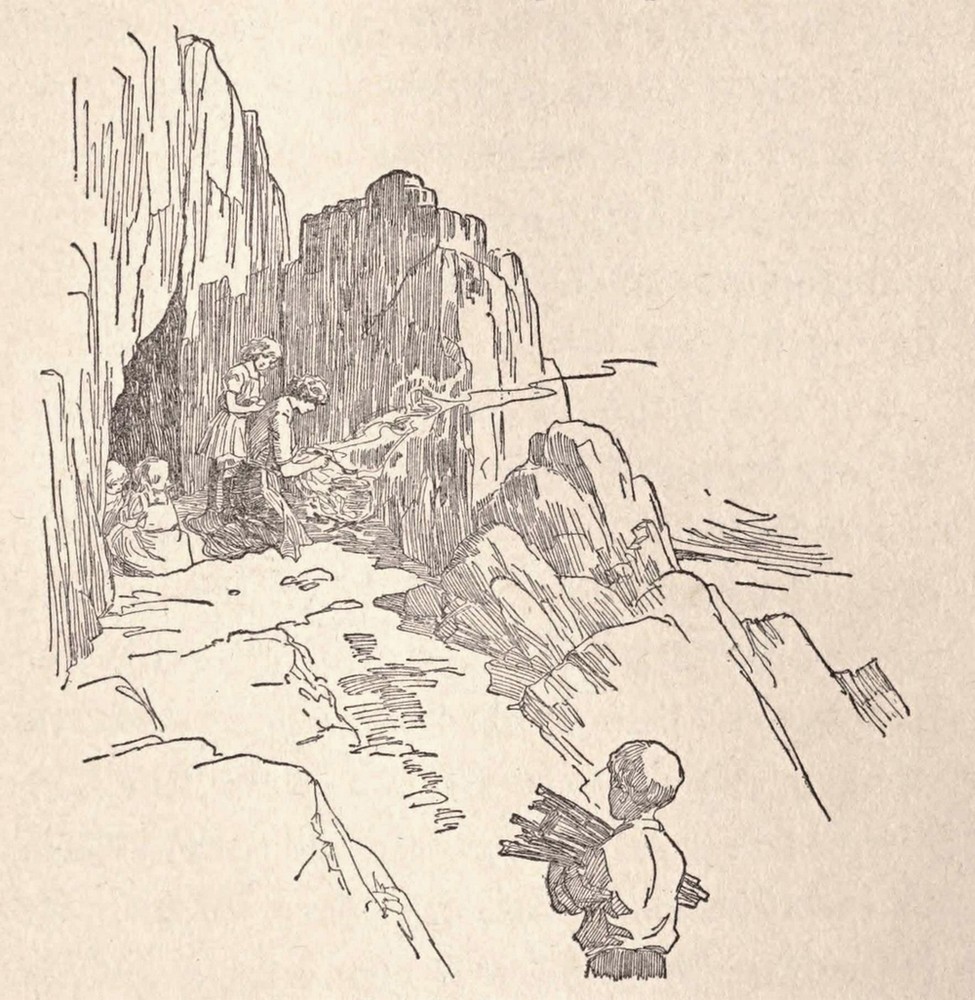
and cooked the clams for their supper.
The children huddled together by the fire.
They were enjoying the experience. Marian was
big; she would take care of them; and it is fun to
cuddle down behind a big rock and watch your
supper cook over a dancing camp-fire.
COOKED THE CLAMS FOR SUPPER
After supper Marian carefully packed a solid
chunk of wood in a bed of coals, covered these
with ashes and dirt, and piled little rocks over
them to protect them from the rain that she felt
sure would come in abundantly before morning.
She kept a fire going for light, as they had no
lamp or lantern of any description.
The children were tired and willing to go to
bed after they had eaten, and Marian herself
was fully ready to lie down after she had got
them all packed away. She slept, too, for a
while, but when the storm came it wakened her,
and there was no more sleep for her all that long,
long night.
The roar of the sea was terrific; the big waves
were sweeping in from the sea and breaking on
the beach with thundering crashes. The flashes
of the lightning were intense, and the thunder
seemed to Marian to shake the very earth. She
had thought they would be protected from the
wind, but it seemed to sweep over them with
perfect freedom. She shivered and shrank closer
to the children. Davie was next to her. He
seemed to be warm and comfortable and he
slept peacefully in all that pandemonium. Poor
little chap, he had been all worn out climbing
up and down the hill and chasing crabs on the
beach. The others woke, and Marian anxiously
inquired if they were all warm. Delbert said
his feet were cold, but aside from that all were
fairly comfortable. Crowded in together as they
were, they kept one another warm.
But they were frightened, and no wonder! The
storm outside was a regular tempest, and they
were cooped in that little hole, sheltered from
the rain, indeed, but exposed to everything else.
They were afraid the rock roof would fall and
crush them, that the lightning would strike
them, and Jennie was afraid the water would
wash up to where they were.
Marian knew there was no danger of the first
and no probable danger of the second, and she
knew they were far beyond the reach of anything
less than an actual tidal wave that might
engulf the whole Island.
She soothed and reassured them by every
argument she could think of, and then she sang
to them all the songs she could call up that
might tend to reassure the shrinking human
spirit at such a time, beginning with
“The Lord’s our Rock; in Him we hide,
A shelter in the time of storm”;
and finishing with a rollicking glee with a rousing
chorus that announced that
“We’re all right, all safe and tight,
Let ’er howl, Bill, let ’er howl!”
And indeed “she” was howling outside so furiously
that it was only because Marian’s lips were
so close to their ears that they could hear her
songs at all.
Some time along toward morning the thunder
and lightning ceased, and though the rain still
came down in a steady pour, the wind still
blew, and the waves still thundered on the
beach, one by one the children dropped off to
sleep. Marian did not. She lay there in a
cramped, uncomfortable position, for to change
it meant to get out from under the covering and
expose the children to more of the cold wind.
She wondered where Pearson was passing the
night. How she longed for morning, yet when
it came it brought little enough of relief. The
worst fury of the storm seemed to be over, but
the wind was still high and there was some rain.
Marian’s carefully banked fire was utterly
drenched and washed away, and she had to light
a new one with a precious match. She built it
under shelter of the Cave, and then the smoke
nearly drove them out into the storm.
There was some of the clam soup left from
supper, and, reinforcing it with one of Mr. Cunningham’s
cans of corn, she was able to fill them
all up with a hot breakfast.
They could not see anything because of the
big rock in front of the Cave, and to go out past
the range of it meant to be drenched, or at least
dampened, and every one but Davie could see
that that would not do. The little girls could
stand up in the wider part of the Cave, but
when Delbert forgot himself and tried it he got
such a bump that he fairly cried with the pain.
Marian smoothed up their bed and packed the
food back into the basket, and then racked her
brain for methods of amusement. There was
not much that could be done, but they played
a few simple little games that could be played
while sitting still, and really, all things considered,
got on marvelously well.
In the afternoon there was a cessation of wind
and rain for a while, so that they did venture
out a little, but Marian was so fearful of their
getting their clothes damp that it was not much
diversion, after all. Of course, every tree was
loaded with drops of water that the slightest
shake released, and the ground under foot was
soaked and running in little rivulets.
The second night was only less miserable than
the first. There was no storm to frighten them,
and they slept more, but they were colder and
more uncomfortable when they were awake,
which was really a good deal of the time, after
all. By morning the wind had died down and
the sun was struggling to break through the
remaining clouds.
When Bobbie went to feed his chickens on
the evening of the day the launch party went
out, his little round, freckled face wore an unusually
sober expression. As he tossed out the
handfuls of corn, he gazed out over the waters
regretfully. The way of the transgressor is hard
certainly, but only the last part of the way, the
first part is most remarkably easy. He had been
down on the pier that fateful morning with his
mother’s full knowledge and consent,—nothing
wrong in that,—and when the fishing-boat
was ready, the men had said, “Come along,
Bobbie,” and “Come, jump in if you want to,
kid,” and there was no time to go and ask his
mother; they would not have waited for him if
he had; even his mother admitted that. There
was no time to go and ask, so he had gone without
asking, and see what he had had to suffer on
account of it. One whole week already with no
diversions besides school and errands, and another,
dreary with monotony, stretching ahead
of him.
To-day had been worst of all, with the Hadley
house closed and silent, and Bobbie knew they
would have asked him to go with them if it had
not been for that ill-fated fishing-trip.
He heaved a sigh and flung out the last kernels,
and then, as many of Delbert’s chickens
were hungrily helping themselves and the launch
was not yet in sight, he went over to the Hadley
yard, climbed through the shed window, and
measured out the amount of corn he knew Delbert
always fed his flock. After he had given
it to the eager biddies, he went back home, and
a little later, when he ran out to shut up his
own, he went over and closed Delbert’s coop
also, first carefully counting the inmates, as he
knew Delbert always did. When he found one
was missing, he searched till he found the silly
thing perched on a barrel in the yard, a tempting
meal for coyotes, and, hustling the misguided
fowl into the coop, closed the door securely.
It was a service that he and Delbert performed
for each other so often that he did not even
mention the matter to his mother, and she, busy
with her household tasks, gave the launch party
scarcely a thought, and supposed, of course, it
came home on time.
The storm was the worst the Port had known
for years. Bobbie might have saved himself the
trouble of closing the coops so carefully, for
both were blown to pieces, and numbers of the
chickens of each were drowned. People had no
thought or time to spare for chickens and their
coops. Roofs were sent flying, and many a wall
had to be braced and watched through the wild
night. While Bobbie’s mother hurried to and
fro, moving things out from under the leaks in
the roof, quieting her frightened children, and
keeping general watch and ward, she thought of
the Hadleys and spoke of them to her husband.
“Marian’s kitchen roof is probably leaking
like a sieve,” she said, “but I guess the rest of
the house is all right.”
“Yes,” he answered, “I was just thinking it
was lucky Hadley fixed things up so well before
he left. As it is, it is the safest house in town.”
“Dear me!” cried the lady suddenly, discovering
a stream of water coming down in a corner
hitherto considered safe and dry, “I only wish
ours was. Half the things I have will be utterly
ruined if this keeps up.”
“And it is going to keep up all right,” was the
consoling reply of her husband.
In the gray morning, when the storm abated
and men in waterproofs began to venture out
and take stock of the damage done and compare
notes, it was discovered that the launch had
not come back; that while frailer shelters had
gone crashing down, compelling their inmates
to flee through the storm to other shelters, the
“safest house in town” had stood untenanted
and alone.
When Mr. and Mrs. Hadley, hurried back
from Guaymas by the awful news, reached the
Port, every foot of the Rosalie Group had been
searched over. On one had been found a child’s
handkerchief beaten into the sand. They gave
it to Mrs. Hadley, and she looked at it a moment
silently. Just a ragged, soiled little thing
it was, with a faint trace of what had once been
a picture printed in bright colors.
“It’s Esther’s,” said the mother, and she put
it away, the most sacred of her treasures. As a
matter of fact, it was not Esther’s at all,—Esther
had hers with her at that moment,—but
the grimy little rag was taken for evidence
indisputable that the launch party had been on
that particular island.
Over and over the boats went out and searched.
All of the Rosalies, all of the esteros and marshy
mud flats for many miles were gone carefully
over, not, indeed, with any hope now of discovering
the lost ones, but for some trace, some
sign, something washed from the wreck.
When Mr. Cunningham returned, he declared
himself completely mystified. He knew the
launch was in perfect condition when it went
out that morning, for he had examined it himself;
and he knew Pearson was in every way
competent to run it. There had been plenty of
warning of the oncoming of the storm, plenty
of time to have returned in safety.
But the launch did not return; it had gone
out into the blue, and the blue had swallowed it
entirely. The waves lapped, lapped on the rocks
and little beaches, the seabirds swooped and
called to one another, and in time even the gray-haired
father gave up the search, and he and
his quiet, sweet-faced wife packed up all their
belongings and left the scene of their terrible
sorrow.
Only one person had advanced any theory
other than that the launch party had been in
some way wrecked and lost in the storm. One
man had suggested that perhaps Marian and
Pearson had eloped,—an idea that caused more
than a few smiles even at that time, for an eloping
couple would have been so likely to take
the lady’s four small brothers and sisters with
them. Just how any accident could have occurred
was a mystery, but that one had happened no
one doubted.
Old Mr. Faston had, indeed, told of Delbert’s
remark to him that they were going to Smugglers’
Island, but Bobbie and the other children
told of playing pirate and smuggler on a sandbar
of one of the Rosalies, and the childish game was,
of course, thought to be the reason of Delbert’s
statement.
So time passed. The Hadleys had gone from
the Port, Delbert’s chickens were added to
Bobbie’s flock, a Mexican family moved into
“the safest house in town,” Mr. Cunningham
bought a new launch, and, so far as the Port
was concerned, the incident was closed.
CHAPTER III COMMISSARY MATTERS
But for Marian in the midst of her hungry,
grimy little flock the incident was far from closed.
Indeed, it was only begun.
When their food was all gone but the can of
tomatoes and a part of the crackers, she made up
her mind that nothing but accidental help could
be looked for. No one, not even her parents,
knew anything about Smugglers’ Island, and
probably they were thought to have perished
in the storm. Perhaps Mr. Pearson had been
swamped and drowned. In the course of time
some one would come into San Moros for something,—Indians
hunting turtles maybe,—but
it might be long months before they saw a human
being besides themselves. There was no
one to rely upon but themselves; whatever was
done they must do themselves.
Looking at the cluster of
tousled
heads, Marian
set her teeth together and clenched her
hands tightly. The fierce protective spirit of
motherhood swept over her. They were hers,
these little ones; come what would, they should
not perish, they should be fed, sheltered, cared
for. They should have their child’s rights of
tender love and happiness. Esther, running up
just then, was caught in a close embrace and
kissed fervently.
The Cave afforded the best shelter for night
that they could find. As soon as things were
dried up a little from the storm, Marian set
about improving it somewhat. For tools she
had only the hatchet, Esther’s spade, the dig-spoon,
and Delbert’s knife and lariat.
With the hatchet she cut sticks and brush
and with the lariat dragged them up to the
Cave, where she and Delbert made them as
best they could into a sort of roof for the space
between the Cave and the big rock in front.
It was crude work, of course, but it gave shade
and to some extent served as a wind-break, at
least. It was just high enough to stand up under.
A place to cook over was soon made of a few
rocks, and then Marian turned her attention to
the securing of food other than crabs and clams.
First there was the banana-patch. Not finding
any good way of reaching up to the bunch they
found there, they cut the stalk it was on, first
looking carefully to see that there was no other
bunch on the same stalk. Later on they learned
that each stalk bears but a single bunch anyway.
Unquestionably those were the worst bananas
that Marian had ever seen in her life. Not only
was the fruit small and dwarfed, but about half
of each banana was a dry, brown pith, while
what remained was very far from being good.
But they were food, and Marian conveyed that
bunch of bananas to the Cave with the greatest
of care.
Then with the hatchet and knife they cut
down a great many other stalks and dragged
them out of the way, so that they could get
about in the patch and see what was there. It
was not the pleasantest work in the world, for
they had to keep a sharp lookout for ugly, crawling
things. They found, however, several other
sickly-looking bunches and quite a number of
birds’ nests. These last Marian was careful to
leave undisturbed.
Delbert was anxious to fly a signal flag, and
as Marian was wearing an extra petticoat, she
decided to dedicate it to that purpose.
But it was a question where was the best place
to fly it. There were no very tall trees, and no
place where it did not seem to her that a flag
would blend with the background. She had
really very little hope of its doing any good, but
she did not suggest that to the children.
At last they picked out a tree and, after considerable
discussion as to ways and means and
several ineffectual attempts, finally succeeded
in attaching the white skirt to one of the higher
branches, where Delbert was sure it would be
seen if any one chanced into San Moros.
Delbert was continually mourning that they
had no fishhooks and lines. He and Bobbie had
been famous fishers,—in their own estimations,
at least,—and he was quite sure that if he only
had a hook and line he would be able to haul out
innumerable fish from the quiet water about the
little rock pier. Marian searched through their
belongings and not a hook could she find, and all
her thread was rather fine. But though crabs and
clams were good, it took a great many of them
to satisfy five people three times a day, and it
took more time to prepare them than Marian
wanted to spend. She declared that she would
not open the can of tomatoes till they were
actually starving and could not get anything
else, and she put them on an allowance of one
cracker apiece each meal. Davie often howled
for more, but Marian resolutely put them where
he could not get them for himself, and his lusty
wails availed him nothing.
A few quail occasionally wandered into Delbert’s
traps and from there into Marian’s kettle,
but Marian was not content, and one day she
braided her hair in two braids down her back
and tried her hand at making fishhooks out of
her wire hairpins. She had not brought her
shears with her, but in her bag was a pair of
little buttonhole scissors that could be made to
serve as plyers, perhaps, and her pretty pearl-handled
penknife had a nail-file on one blade.
She could not put barbs on her hooks, but she
could sharpen them with the file. As one hairpin
by itself was not strong enough, she straightened
out three and bound them tightly together
with embroidery silk.
After working faithfully all her spare time,
one day she finished a hook that she and Delbert
were both sure would work. Then came the
question of a line.
“Delbert,” she said, “quite a while ago wasn’t
Bobbie’s Uncle Jim teaching you boys how
to braid round whiplashes? Yes? Well, do you
remember now how he did it?”
“I guess I do,” said the boy slowly; “but you
haven’t got near enough thread to make a line
strong enough to amount to shucks. That colored
silk would be all right, but you’ve got only
a teenty bit of that.”
Marian smiled. “Why is your rope better than
a common one?” she asked him.
“’Cause it’s hair and it won’t rot and wear
out like the fiber ones.”
Marian was unbraiding one of the long braids
that hung over her shoulder and with the scissors
she snipped out here and there, where it
would not show, quite a number of tresses.
“Here,” she said, “you get busy now and
let’s see if you know how to braid a nice, smooth,
round line, and then you can show me how, too.”
“O Marian, your pretty, pretty hair!”
“Yes, I know; it has been my pretty hair all
my life, and it’s high time it was useful as well
as ornamental.”
But it took a long time to braid the line, and
food had to be secured meantime. Food!—that
was the main topic of conversation,—to find
clams, to get big crabs, to make traps and set
and watch them afterwards. Never a fish was
sighted but they wondered if it was good to eat;
never a bird flew over but they discussed whether
or not it would cook up tender. Delbert used
to go twice a day, at least, to look over his traps.
Simple things they were, made of sticks fastened
together with strips of rag torn from the towel
that had been wrapped around the bread, and
afterwards of the fibrous stems of the banana
leaves. Every day he saw rabbits, and one day
he threw a stone that hit one on the head and
stunned it, and he despatched it with his knife.
He did not seem to mind killing the things that
got into his traps, and Marian was glad he did
not, since it had to be done.
It was after the rabbit incident that the little
boy came in one day from making the round of
the traps, holding by the tail a good-sized rattlesnake.
“Mercy!” cried Marian, “how did you kill
that?”
“With sticks and stones,” he answered. “He
was right there in the path by my last trap, and
I settled his hash in a jiffy. Say, Marian, he
looks nice and fat. Bobbie’s Uncle Jim says they
are as good eating as eel.”
Marian gasped, “Snakes!” But the clams were
getting scarce in the immediate vicinity, and she
had even begun to imagine that the crabs were
not quite so plentiful on the little sand-beaches.
“The history says,” continued Delbert, “that
when the Spaniards were conquering this country
and South America, sometimes when parties
were sent out to go to places and got lost and
wandered around, they had to eat roots and
snakes and toads.”
Marian was thinking she had certainly heard
of people eating rattlesnakes and—well—“All
right,” she said, turning away to the construction
of the fishline, “you skin it, Delbert,
and I’ll cook it.”
The filtered water in the demijohn did not
last very long, of course, and when it was gone
Marian marshaled all hands to clean out the
spring. She usually marshaled all hands when
there was anything to be done, because somehow
she could not bear to have any of the children
out of her sight for any length of time.
When they were with her she knew they were
safe. True, there seemed to be little danger of
any kind, save that they were surrounded with
plenty of water to drown in, and there was no
knowing how many more rattlesnakes the Island
might possibly contain.
She had hoped that when she got the stones
cleared away the spring would reveal itself as
something extra good in the way of water-supply,
but it did not. Indeed, she was reluctantly
forced to the conclusion that it was no spring at
all, only a shallow little well.
In the rainy season the water falling on these
islands sinks into the sand and stays there. One
could find fresh water any time by digging at a
little distance back from the beach, where the
sand lay in hills and hollows, and Marian concluded
that the only reason why the water came
to the surface in that particular spot was because
it was situated in a decided depression of the
ground.
So she dug and scooped till she had a hole
with about a foot of water in it, and then she
smoothed the sides and laid rocks so the sandy
soil should not cave in. From the tracks abounding
in the vicinity she concluded that the deer
and burros both were accustomed to drink there,
and while she was willing that they should continue
to do so, she did not want them poking
their noses into the very pool that she must dip
from for her little flock; so she made a cover with
some sticks and pieces of driftwood and some
stones to keep them in place, and then, to be
still surer, she hollowed out another place for
her four-footed neighbors. The old dig-spoon
and the little spade were her chief tools in these
labors.
“Dear me! Delbert,” she said playfully, “why
didn’t we have sense enough to bring a hoe and
shovel with us?”
“Huh!” he retorted gloomily, “if we had had
any sense we’d have stayed at home.”
“There may be something in that too,” she
answered.
“I know what I could do if you had brought
your shears,” spoke up Jennie.
“What, dear?”
“I’d cut a thing from this,” holding up the
piece of tin cut from the end of one of the cans
of corn, “that Delbert could spear fish with.”
Delbert stared at her a minute, and then with
one of his nervously quick movements possessed
himself of the ragged bit of tin.
Marian had opened the can with his knife.
He looked at it a moment and spoke excitedly.
“We could! It wouldn’t be like a regular spear-head,
but we could catch ’em. I know just how
the Indians throw them. Bobbie has one, but
he’s never caught anything yet.”
The idea was certainly worth trying. Marian
would not ruin her precious buttonhole scissors
cutting tin with them, but she scratched the
pattern in the bit of tin and then went over it
with the tip of the butcher-knife, denting it; and
the dents, made deeper and deeper, finally became
holes, and then soon there was her spear-head,
such as it was, needing only to be smoothed
up a little and filed and bound on the end of a
smooth, slender stick that Delbert had been preparing.
Marian split the end of the stick a little and
slipped in the bit of tin and bound the stick with
thread that she had doubled and twisted till it
was strong enough to suit her, then tied the
lariat rope to the other end of the stick.
Delbert spent the next day in exercising the
new tool. His patience was certainly marvelous.
Hour after hour went by with no success, but
he was sure he would be successful some other
time.
“I’ll get on to it after a while,” he said, as
they ate their supper of hot clam soup. “Those
Indians at the Port catch them right along.”
“The thread will soon rot out,” said Marian.
“I ought to have wire to wrap the end with;
copper wire would be best. There are two hairpins
left, but they are so short I can’t fix them,
I’m afraid.”
It was fully a week afterwards before it
dawned upon her that she had in the edge of her
hat-brim a nice piece of copper wire that just
filled the bill, and though its removal left the
brim rather droopy, that was a small matter.
Their supper they always ate at the Cave, as
the light of their fire could be seen far out from
there; but breakfasts and dinners were usually
eaten down on the beach to save the trouble of
carrying food and water up the hill. Marian
had built a second place for cooking down in the
shadow of the big rocks where they had eaten
their first dinner on the Island, and the children
had dug a well in a hollow of the sand not far
off, which they used, although the water did not
seem to be so good as that on the other side of
the Island, having more of a salty flavor.
As Marian was carefully dipping water from
the beach well one morning, Jennie and Esther
came running to her in great excitement.
“O Marian, come quick! The High-Tide Pool
is full of fish, and Delbert is going to spear them
all!”
This was interesting, certainly. The High-Tide
Pool was down quite a way from where
they had the well and the cooking-place. It was
beyond the sandy beach, where the rocks ran
down into the water. When the tide was high
it had considerable depth, and ran back into a
little cave among the rocks, but at low tide the
water was only two or three feet deep in its
deepest part, which was in the cave.
Sometimes they had seen a few little fish in it
before, but that morning the little girls had gone
down and found it well stocked.
Probably just as the tide was going out, a
great number had taken refuge there. Perhaps
some enemy was lurking outside and they dared
not leave the safe retreat, and now they could
not leave it till high tide came again.
Delbert was spearing industriously when
Marian got there. He had actually caught one,
and it flapped feebly on the rocks beside him.
As his sister came up, he triumphantly called
her attention to it.
“See that? Told you I could spear fish! But
they all want to hide back there in the cave. I
tell you, Marian, I’ll go in there and drive them
out, and you can stand here and spear them.
We’ll just keep spearing and spearing till the
tide comes in and the rest get away. I bet we
can get enough for several days. We can dry
’em as the Mexicans do.”
He handed her the spear and began hastily
to disrobe. Delbert’s movements were always
hasty.
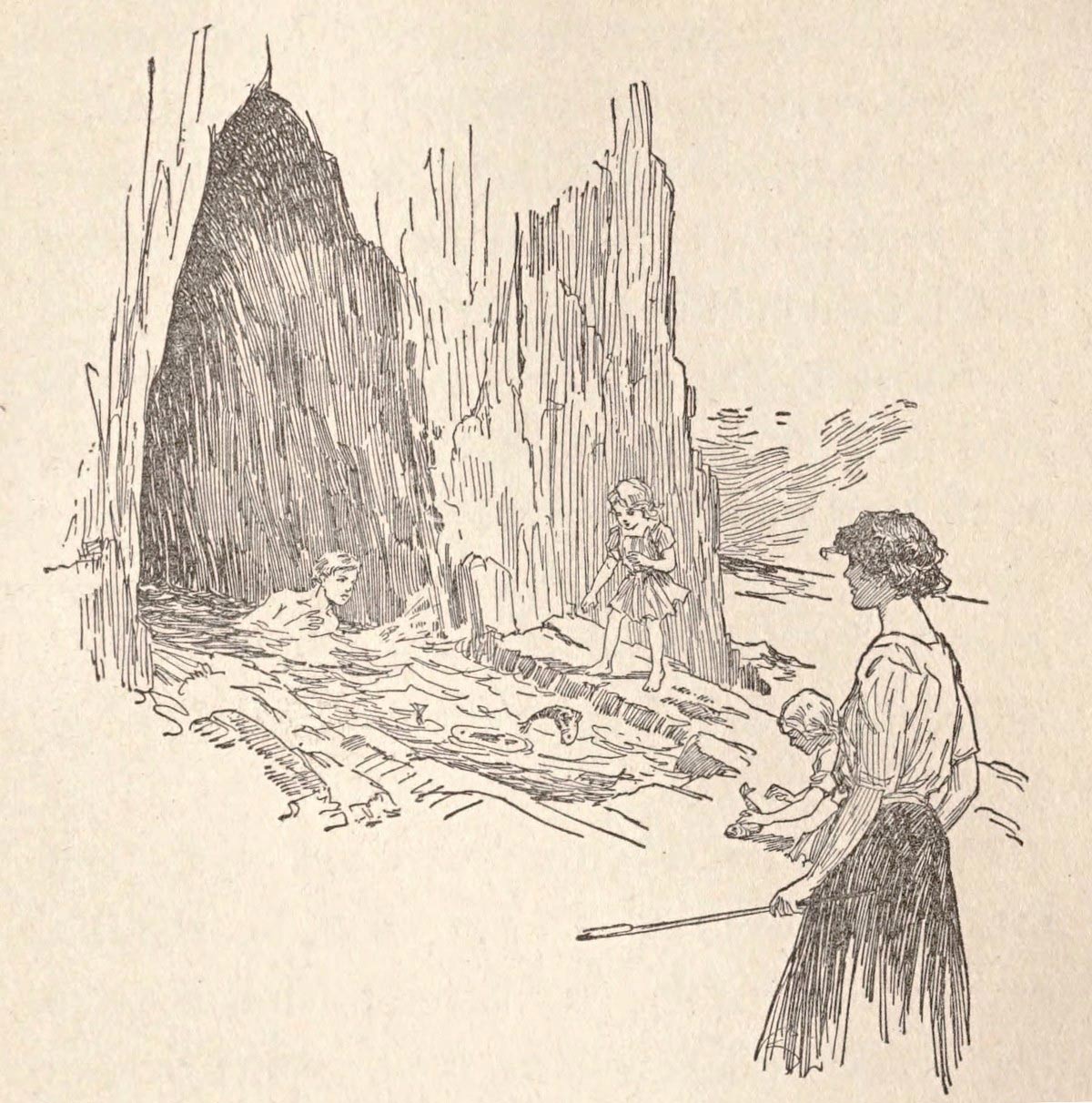
Marian began casting the spear unsuccessfully,
but when Delbert got into the pool he
created such a commotion that several of the
fish in their wild endeavor to escape, flopped clear
out on the bare rocks and were easily captured.
By that time a better idea had come to Marian.
MARIAN HAD BEEN CASTING THE SPEAR UNSUCCESSFULLY WHEN
DELBERT GOT INTO THE POOL
“O Delbert,” she cried, “come out now, wipe
up on my apron and get back into your clothes.
We have enough for breakfast and dinner, too.”
“Oh, but we want all we can get,” he called
back. “We can dry ’em, I tell you, and as soon
as the tide is high again they will all get away.”
“That’s all right, but listen! I have a scheme
for keeping them all. This is too good a thing to
let the tide take away from us. Why, there must
be fish enough in there to last us a week at least,
maybe two. See, Delbert, we must build some
kind of a fence across, so they can’t get away
when high tide does come. Then we can come
every day and get what we want till they are all
gone.”
Delbert splashed right out without more remarks.
“We can do it with rocks and sticks and
brush,” she continued. “It won’t be possible
to drive stakes in the ground here, because
it isn’t ground,—it is all rock,—but we can
make them stand firm by piling rocks around
them.”
She went to work systematically. She set the
children to bringing rocks, while she and Delbert
cut the stakes and brush up on the hillside
and dragged them down with the rope. Then,
selecting the place where she could accomplish
her purpose with the least labor, she set a row
of stakes a little way apart, piling rocks about
each one till it was quite firm and solid, and then
began weaving in brush.
It was a long task. Trip after trip she made
up the hillside with the rope and hatchet, and
her face and hands were scratched with the
thorny brush. The children grew tired of helping,
and Davie was crying because he was hungry,
for Marian would not stop to prepare food.
She dared not. In that little pool was food,
food. If she could shut the way across before
the tide came in, then she and her little ones
were safe without question for some time to
come; if not—“Why, Delbert,” she said, “we
might live here for years before we should have
such a chance again.”
Finally she sent him up to start a fire and
clean the fish they had got before they began
the fence, and when he had them in the kettle
over the flames he returned to help her. Thereafter
she would occasionally send up the little
girls to put on more wood or to pour a little more
water into the kettle, but she herself kept at
the task.
Marian did thorough work; she dared not
slight it in a single place; it must be strong
enough to resist the force of the waves, and it
must be so solid that no fish of any considerable
size could get through, and she dared not stop,
she dared not stop. The tide began creeping
back over the rocks, and she sent the children
back for more brush and sticks, and more still,
and went herself again, and still again, and now
the water was running over into the pool again,
and still she worked. She knew how high up on
the rocks it would be when the tide was at its
full height, and she must get above that. She
had done the work well so far, yet it would all be
in vain if she did not get above high-water mark.
Finally she finished it with the water waist-deep
around her, and as she dragged herself out,
it seemed as if she had never been so tired in all
her life before, but she was sure that her work
was done well. Tired and hungry and smarting
from scratches and the thorns she had not had
time to remove, she was yet happy. For the
first time since Pearson’s treachery had left
them stranded there, she felt a firm foundation
under her feet.
In spite of the little girls’ care the fire had
gone out under the kettle and the fish were not
done. They were not very trustworthy as cooks
yet, but Marian started things going again and
sent Jennie up to the Cave for a blanket and
some safety-pins and a needle from her workbag.
When she came back, Marian removed her
wet clothing and donned the blanket in its stead,
pinning it in place with the safety-pins, and then
proceeded to extract thorns with the needle.
Delbert also required some of the same surgical
attention. Then, as soon as the fish were done,
they broke their fast, and afterwards she took
Davie and lay down in the shadow of a rock to
sleep, secure in the knowledge that there were
fish enough in the kettle for one more meal and
that there were plenty more where they came
from.
The fencing-in of High-Tide Pool certainly
marked a new period in the life on the Island.
It was the first work of any size, and its completion
gave assurance of food for many days to
come without spending all their time in the securing
of it.
Afterwards Marian bent her energies on the
fishline to the exclusion of everything else till it
was finished. It took the two extra hairpins to
fasten the hook and line together satisfactorily,
but Marian did not grudge hairpins nor time nor
labor when she saw how eager the fish of High-Tide
Pool seemed to be to attach themselves to
that amateurish-looking implement. She thought
the fence she had built probably served, to some
extent, to screen out the smaller fish that would
otherwise have provided breakfasts and luncheons
for those she had imprisoned. At any
rate, their appetites seemed to be excellent, anything
was acceptable as bait, and Delbert was
now and then successful in spearing one.
They worked another day on the banana-patch,
thinning it out and letting in the sunlight,
and another in dragging more brush up to the
Cave to shade and shelter it, and in carrying
up more dried banana leaves for their bed.
Then Marian said she was ready to go on an
exploring expedition.
So far they had gone no great way from the
end of the Island where they had landed, but
now she decided the time had come to learn
more of their locality. Some of the bananas were
ripe; that is, they were soft and could be eaten.
They could take them along for lunch.
Delbert was a little afraid some one might
come while they were gone, but Marian had a
lead-pencil in her workbag and with it she wrote
on a smooth piece of driftwood a brief account
of their predicament which she left in a prominent
position near the tree their signal flag
flapped on. To make assurance doubly sure, they
put another signal flag by the side of the notice.
Not being sure they could find water on all
parts of the Island, Marian thought it would be
safest to carry some with them, but the only
thing she had to carry it in was the two-quart
Mason jar that had held Davie’s milk. They
would take Mr. Cunningham’s pail, too, and
the spear and lariat and hatchet. It seemed to
Marian that that was all they would need, but
Davie was very sure the dig-spoon would be
indispensable, so he carried that also.
They went along on top of the hill where Delbert
had set his traps. It was very rocky at
first, but became more even and level, with fewer
rocks, and more open and grassy. There was an
abundance of thorny brush, but no trees of any
size worth mentioning. This portion of the Island
they used afterwards to refer to as the pasture.
Beyond it the thorny tangle became
thicker again, and here were more rocks. Indeed,
the farther end of the Island fell quite
precipitously to the water without any sandy
beaches, but they could make their way down
well enough, and most of the way could follow
the shoreline without wading.
The Island was fairly uniform in shape, and
it looked to Marian as if it had been broken as a
whole from the mainland ages back, the sides
there being very steep and precipitous, as was
the shore of the mainland opposite. The little
harbor did not seem to extend very far, and no
vessel of any size could have picked her way
through behind the Island.
The seaward side contained various little bays
and coves, very fascinating to explore, but only
one of these was of any size. This lay in such a
relation to the tides and currents that it gathered
more of the flotsam and jetsam of the sea
than any or all of the others, and when its treasure
possibilities were realized it was named
Bonanza Cove.
These details were not all learned in one day’s
exploration, but little by little as day after day
they searched and learned.
Always supreme above all other motives was
the search for food.
Every plant or root or berry that they knew
to be edible they eagerly seized upon, and Marian
was constantly warning them lest they grow
careless in their selection and suffer thereby.
One day they found the burros all down by
the water-hole on the landlocked side of the
Island. They had seen them before, about a
dozen in number, but had not paid much attention
to them. They were grazing peacefully
on the outskirts of the banana-patch, and the
children were quick to notice that the herd had
been increased by one in the last day or two,
a silky-looking little fellow with that peculiarly
fascinating quality that only a baby burro has.
In glee they ran toward them, but though the
burros seemed to be not at all wild, they plainly
did not mean to permit any actual handling
and skillfully evaded all attempts in that direction.
After several ineffective attempts to round
up the woolly baby, the children stopped to rest
and regain their breath, and the four-legged infant
sidled up to his mother and proceeded to lunch.
Suddenly Marian turned to her brother. “Delbert,”
she said, “can you lasso that old burro as
she stands there?”
“Reckon I could if I tried. What do you want
of her?”
“See that baby there fairly guzzling down the
milk, and look at our baby here without a spoonful
all these days. Don’t you suppose that old
mother burro has more than that little fellow
really needs in his business? Anyway, if he had
to go a little short he could make it up on grass.”
“O—oh!” ejaculated the boy, “burro’s milk?
Why, Marian, it wouldn’t be good.”
“Indeed, my dear child, burro’s milk is a
regular article of commerce in some places, just
as cow’s and goat’s milk is in others.”
“Anyway,” reflected Delbert, “if we didn’t
tell him, Davie wouldn’t know but what it was
all right. Milk is milk to him; he wouldn’t
care.”
“Of course not,” said Marian briskly; “you
older children might object to it, but it won’t
make any difference to him whether he shares
with a baby burro or a baby calf. You just get
a good loop over her head, and we’ll try this
thing out.”
GETTING A LOOP OVER THE MOTHER’S HEAD WAS THE EASIEST
PART OF THE BUSINESS
As a matter of fact, getting a loop over the
mother’s head was the easiest part of the business.
Delbert soon accomplished that, but Madam
Burro had no intention whatever of standing
still and being milked. Indeed, she developed
quite surprising activity, and it was only after
at least an hour of patient labor that Marian
was able to secure a few spoonfuls of milk in the
tin cup which the little girls brought down from
the Cave.
“Now, then,” said Marian, “the thing we
have got to do is to secure the baby. If we keep
him tied here, his mother will stay around, and
we can try her again in the morning. But if he is
turned loose with her, we may not be able to get
near them again.”
“But we have only one rope, and if I take it
off her she will take him right away now,” said
Delbert. “Let’s keep her tied up, I should say.”
“Well, tie her up till morning. Then we can
think of some other way to do. It will not do to
keep her tied all the time, for then we should
have to feed her.”
As they ate supper they discussed ways and
means. They could make palm-leaf ropes that
would do very well to tie the little one with, but
that did not seem to be as convenient as Marian
wanted. Finally they decided to make a little
corral to keep the baby in. Then he could nibble
at weeds and grass and could not reach his mother
except when Marian chose, and she could
thus have a better chance to secure a ration for
Davie. The corral would have to be pretty solid
and secure, she thought, or the old burro might
tear it down; still, it would not have to be quite
as compact as the fence that had been built at
High-Tide Pool.
JACKIE
They went to work at it the next morning. A
little of the old stone wall was still solid enough
to serve, but most of it was badly tumbled down,
and they could not seem to do much at building
it up again. The banana-patch could be used
as one side,—it was so thick nothing would try
to go through it,—and a couple of palms could
be utilized as fence-posts. There were several
nondescript bushes that could be worked in too.
The banana stalks they had already cut down
could be used as building-material, and more
could be cut. They were soft and thornless,
which was an advantage; also every stalk they
cut out improved the patch by giving those
remaining a better chance to grow and mature
fruit. The hatchet was getting pretty dull, but
Marian managed to hack off a number of slender
stakes, which she set in the ground in pairs
just far enough apart to lay a banana stalk in
between; and these stalks all averaged about the
same size and were piled one above the other to
the top of the stakes, which were then tied together
with banana-leaf stems.
The old pile of poles was overhauled. Part of
them were so worm-eaten that they fell apart in
Marian’s hands, but some were of a different
kind of wood and were still solid. These were
built into the fence as children build corncob
houses, and Marian was only sorry there were
so few of them. For part of it they used brush,
but that was not so easily handled as the bananas
or poles because of the thorns. The corral
was not finished in one day nor in two, and when
it was finished it showed half a dozen styles of
fence-pattern and had no particular shape, but
was, nevertheless, very satisfactory, as it would
hold the little one in and keep the old one out.
The little burro was easily driven into it, and
then the old one was turned loose. She grazed
about during the day, and when milking-time
came Delbert could easily lasso her. Then, with
much labor and great tying of legs and an abundance
of help from the children in holding of the
same, Marian would get Davie’s little portion of
milk. Then the four-legged baby was allowed
to have what remained, after which he was
engineered back into the corral.
In the morning the same performance was
gone through. During the day the mother and
baby could rub noses through that part of the
corral that had been made of poles, and in the
course of time they both became so tame that
the little one was a pet and a playmate for
the children and the old one offered but little
objection to sharing with Davie, who used to sit
on the top rail of the fence and watch the milking
with wide eyes that let no detail of the performance
escape him.
He was very generous, too, considering the
small amount of milk he received, and would
offer to share with the others; they would all
take a sip, even Marian, to encourage his unselfish
impulses, and, as Delbert said, for politeness’
sake.
CHAPTER IV BONANZA COVE
It was about the time that the corral was finished
that they came to realize that they had
lost count of the days and really did not know
how long they had been on the Island. They
had even lost track of the day of the week, and
Marion did not know when she had ever done
that in her life before. She and Delbert sat down
and figured and figured, trying to count back
and remember what had been done on each day;
but it was no use, it had been too long. Jennie,
however, was quite sure that it was Wednesday
then, though she could not tell why,—she just
thought it was, that was all,—and so, assuming
that she was correct in her belief, Marian
easily figured up what day of the month it was
then, for of course she knew the day and date
upon which they had left home.
“Now,” she said, “we will not trust to our
memories any more. Every day I will put a
notch in a stick,”—which she faithfully did,
using for the purpose a smooth stick that Delbert
picked up on the beach one day. As a matter
of fact, Jennie had been mistaken and they
were two days ahead of time, but they did not
know that till afterwards.
The days were filled pretty full. Marian
thought that the busier they were, the less would
they be a prey to loneliness and homesickness.
They tumbled out of the Cave mornings, milked
the burro, got breakfast, and then worked
awhile at something till it was time for a big
sea bath.
When they first began their life on the Island,
Delbert was the only one who could swim to
amount to anything. Clarence had taught him,
and he had been a very apt pupil; but the others
knew so little of the useful art that Marian herself
dared not venture beyond her depth, while
the little girls declined water that was more than
knee-deep and Davie preferred it even less than
that. But already there was a vast improvement
among them all. As the way to learn to
walk is to get up and walk, so the way to learn
to swim is to strike out and swim, and they were
following that method.
After dinner there were walks to take, little
coves to examine, or ropes to braid. Marian
watched over the children with eyes of a most
jealous, brooding love. Never had they seemed
so dear to her, never so sweet and precious. She
was constantly thinking up things to amuse as
well as benefit them. Of course, she could not
perform impossibilities, and there were some
doleful days. There was one perfectly awful
day when she found Jennie huddled down behind
a rock, crying for her mother. And Delbert
would sit for an hour at a time on Lookout Rock,
gazing out over the water, so wistful and disconsolate
that it made Marian’s throat choke up
just to see him, and she would rack her brain for
some interesting thing to set him at to keep
him busy.
But it is only fair to say that the doleful spots
came far less often than one would have supposed
they would. Marian was always steadfast
in her assurance that some one would find
them some day. They would take good care of
each other and be as happy as they could till
some one should come and take them back to
the Port. And she herself always kept a cheerful
face. Her loving voice and sunny smile, her
merry little ways, inspired confidence. As
much as possible she made it appear that a desert-island
experience was a very desirable thing
to have happen to one. She twisted things till
they looked like a joke, and in the process often
found herself growing as light-hearted as she
wanted the children to be.
The bill of fare was limited, to be sure, but
they brought to it appetites sharpened by the
constant exercise they were taking in the sea air
and the sunshine.
One day up in the pasture they ran across a
panal.[3] This is the nest of a kind of wild bee
and is made of the same material that our hornets
use in constructing their homes, but the bee
itself is not so large as a hornet. Marian saw
the nest first and pointed it out to the other
children merely as a matter of curiosity, but
Delbert straightway became excited.
[3] Pronounced pah-nahlʹ; plural, pah-nahʹ-layss. It is the
regular Spanish word for honeycomb.
There was honey in that bees’ nest; he knew
it; splendid honey. Hadn’t Clarence bought
some once of an Indian and given him a lot?
And Clarence had told him all about panales.
You take all the outside honey and comb away
and leave the core, and they will build on again,
just as tame bees will.
Marian was a little dubious. Honey was all
very well, but stings were not at all desirable.
How were they to proceed to get the sweet store?
“We have no bee-smoker,” she reminded him,
“and if we had, there are no rags to be burned
in it.”
“Huh!” declared Delbert scornfully, “do you
s’pose the Indians have smokers?—or rags
either? No, sirree! they just build a fire of trash
they gather up. Besides, the stings of these little
bees don’t amount to shucks!”
It was not in Marian’s policy to discourage
him from doing anything not actually dangerous
to life and limb, and she was glad he was willing
to dare the stings; so she said they would go
back to the Cave for the little dishpan and
some coals to start a smudge with, and see what
they could do.
The younger children were to keep back out
of the danger zone,—which they were very
willing to do, for they did not share Delbert’s
optimism about the trifling nature of wild-bee
stings,—and she and Delbert swathed their
hands and faces as well as they could and still
be able to work handily. They built three little
fires about the bush the nest was in, and gathered
trash and piled it on till they were all smoking
finely. With a forked pole Marian raked one
of them as nearly under the nest as she could,
and then, holding her skirts carefully so that
they should not swing into the fire, she began
the task of robbing the little bees.
Delbert held the pan, and she cut off layer
after layer of the paper-like comb filled with the
clear sweet liquid, but she was careful to leave
a goodly portion at the center for the bees to
begin on anew. Then they retreated with their
booty, threw a towel over it, and gave it to
Jennie and Esther to carry off, while they raked
back and stamped out the fires and threw dirt
over the ashes, so that they could not start up
again.
During the whole performance both of them
had received stings, but, as Delbert said, they
did not amount to much, and certainly honey
never tasted sweeter.
THE TASK OF ROBBING THE LITTLE BEES
From then on the children’s eyes were always
open for panales. They found two small
nests that they decided to let alone till they
were larger, and about a week later they found
one down near the shore that yielded even more
honey than the first. They got several stings,
too, and Marian smiled grimly as she reflected
how necessity was teaching them hardihood.
That was the day they discovered the riches
of Bonanza Cove.
They had never gone down into it before,
having always skirted it quite a way up on the
hill, for there was no sand at that part, only
ragged rocks with broken shells and barnacles,
interspersed with occasional clumps of mango
bushes,—certainly not easy ground for little
feet to run over. But this day, as they were returning
home with the little dishpan of luscious
sweetness, Esther had declared, “I see a bottle”;
and on the strength of that declaration they
climbed down into the cove, for a bottle would
be a very valuable thing to have. And, once
there, they found so many valuable things that
they gathered up a load and carried it home and
went back in the afternoon for more.
The bottle proved to be a quart beer-bottle
that some one had doubtless tossed, corked but
empty, over some steamer’s side, and careful
search revealed six others, besides the remains
of several that had been broken. Marian hailed
them with delight. Now they could carry water
in bottles when they went exploring, and leave
her precious glass jar safe at the Cave. She
had always been afraid it would get broken on
some of those trips. Five of the seven bottles
were only pints, but were none the less eagerly
welcomed and treasured.
Also there was discovered in a clump of
mango bushes, half buried in the mud, an old
broken five-gallon demijohn. The basketwork enclosing
it was nearly intact, and Marian thought
they might use it for something some time.
The wreck of an old barrel was also rescued
from the mud. Only three of its staves were
gone. Who knew what might not some time be
done with what remained? Several rusty tin
cans were acquired. Marian could mend them
by drawing a tiny rag through the holes in them;
and Esther came up with a piece of scrap iron
that might be made into a spear-head if a body
only knew how; Delbert knew Clarence could
have done it all right. They found three little
boards, too, and an old shoe whose top was not
yet stiff. Besides all this, there were innumerable
armloads of driftwood. They gathered it
up into piles beyond the reach of high tides.
But the most exciting discovery of all was the
remains of an old canoe. One side and a goodly
portion of the bottom were gone, but it was undeniably
a canoe. It had been tossed up on the
rocks by some storm and had lain bleaching in
the sun ever since. Nothing would do but Delbert
must get that old fragment into the water.
They all caught his enthusiasm and worked with
a will.
The canoe was of native manufacture, having
been hollowed out from one big log, and what
was left of it seemed to be quite solid. After
they had it floating they hunted up poles and
practiced the art of navigation for a while. It
was a clumsy thing, and of course everybody
connected with it got wet, but already Delbert
had visions of what it might lead to.
“Marian,” he said, “let’s pile a lot of that
wood on this and take it around that way. It
will be a lot easier than carrying it over.”
“The waves are too high,” she objected, “and
we should have to tie the wood on good and
solid, for the way this thing dips and tips and
turns it would all be off before we were out of the
cove.”
“The waves are high,” he conceded, “and,
of course, we should have to tie the wood on.
This thing won’t stay anywhere. What’s left of
it knows it used to be the side and it doesn’t
understand that it is the bottom now.”
“I’ll tell you,” she said; “let’s wait till to-morrow.
Maybe the wind will not pile the
waves quite so high then, and we can tie your
rope to it. See there is the hole in the prow they
made to moor it by, and we can tow it round, if
you like. That is splendid wood and it will certainly
be easier getting it home that way than
carrying it up over the hill.”
But Delbert was not quite satisfied.
“I’ll tell you,” he said; “if we can get it
around the point there, we can take it the other
way, in back of the Island. It’s a lot longer way,
but there are no breakers in there.”
“I guess we could do it that way all right.
So let’s go back now and braid palm-leaf ropes
the rest of to-day, so as to have plenty to tie
the wood with, and hunt up some nice poles and
paddles; and to-morrow early we will come and
take this gallant bark round into harbor.”
So they beached it again, and piled stones in
it so it could not get away, and then went back
to the home end of the Island.
Mexicans make a very good rope of twisted
palm-leaves, but our islanders had not learned
how yet, and so braided them instead, for even
the children could do that. For a large rope they
simply took three of the small ones and braided
them together. The finished articles were very
knobby, uneven affairs, of course, and could not
be used to lasso with, but they were flexible
and strong and served to tie things. They had
quite a number of these ropes of home manufacture.
In the morning, after attending to the burro
and eating a breakfast of fish baked in the hot
coals, they filled the two big bottles and three of
the little ones with water, tied stout little palm-leaf
strings to them, so that each person could
easily carry one, and started out with their ropes
and poles.
Marian had Mr. Cunningham’s pail with more
fish for their dinner, and the hatchet also, and
Davie as usual flourished the dig-spoon. He
soon got tired of carrying his bottle of water and
passed it over to Marian, who put it into the
pail.
At the cove they put the pail and their bottles
into a clump of mango bushes and began to
gather up the best and biggest of the wood.
Marian made compact bundles of it and lashed
them as best she could to what remained of the
old canoe. Alone it would not stay in any position
that made it navigable, but reinforced by
the bundles of wood on what Delbert called the
“absent” side of the craft, it floated as any
other mass of wooden wreckage would have
floated and maintained an equilibrium which
allowed the children to perch on top in safety.
Delbert scratched his head.
“This isn’t a canoe and it isn’t a raft. What
in creation is it, anyway, Marian?”
“I reckon it’s a float,” she answered.
So, after the pail had been placed on the safest
spot, where it would not get water splashed
into it, and after Jennie had received explicit
instructions to watch over it, the voyage began.
They had taken the precaution to put on their
bathing-suits and expected to do as much wading
and swimming as anything else.
Marian knew a good deal about rowing and
sailing a boat, but this was a different matter.
To begin with, they had only one really good
pole. The other was too short, besides being
crooked, and their craft swung round and
twisted and did its best to wobble its way back
to the beach. At last, however, they got out
quite a way, beyond the depth of the shortest
pole, but when they came to round the point
there was trouble again. Finally Marian jumped
off and, half swimming, half wading to shore
with the lariat, towed them round the point;
and then, because they made better progress
that way, accomplished most of the rest of the
journey so.
THE VOYAGE BEGAN
Davie also preferred to do most of his traveling
on his own feet, and Marian did not blame
him, for the float did not even look like a safe
craft, and the way it wobbled and bobbed might
well have made an older passenger than Davie
uneasy. So he trudged on, mostly in the edge of
the water, now and then whimpering when he
hurt his bare toes and again laughing gleefully
at some treasure of the sea which the fates cast
at his feet.
MARIAN TOWED THEM ROUND THE POINT
At some places it was not convenient to tow
the float, and then they resorted to poling altogether.
At one or two points Delbert took the
rope and swam across to a better place for pulling.
And several times the bundles of wood
became loosened, and all hands had to retire to
shore till Marian could get them satisfactorily
retied.
Altogether, their progress was so slow that
the day was nearly done before they moored their
gallant craft to the little rock pier behind the
Island.
Next day they tried it another way. They
took all the wood off and allowed the old fragment
to turn turtle. That did a great deal better
in some ways, but it was a little difficult to
get aboard of it. Once they were aboard, however,
it sustained the weight of them all well
enough, though, of course, there was no freeboard
at all, and, while it was willing to remain
in that position, the ends of the canoe, being well
under water, offered considerable resistance and
made it more difficult to pole than a boat or raft
would have been.
Jennie thought Marian had better cut off
those ragged ends and leave only the smooth
side, but Marian was not anxious to attempt
such a task as that with only a dull hatchet and
a few knives to work with. Besides, she was not
sure at all but she would some day want those
ends right where they were. She could not
think of any way of improving it, and even as
it was it enlarged the horizon of their daily
lives.
The prow being under water, they could not
very well use the hole in it to tie the rope to,
but at one place in the bottom there was a knothole,
and Marian firmly wedged a stick into that.
With a rope fastened to this stick they could tie
the canoe where it would float out quite a little
distance from shore, and then they could swim
out to it. She soon found her little flock were
improving in their swimming lessons. With the
old canoe at hand it did not matter so much if
one did get beyond one’s depth a little; it gave
one security.
Then pretty soon, when they began to get
the knack of making the old thing move along
in the water where they wanted it to, they would
go out to the little sandbars and reefs that had
before been beyond their reach.
Some of these had mango bushes where a
certain variety of small oyster attached themselves
to the stems and rocks, where they could
be easily gathered at low tide. One had an outcropping
of rock in one place which had several
basin-like depressions, which Marian cleaned
out and made use of. She would boil down sea-water
in her kettle, till it was about a saturated
solution, and then put it into the demijohn, and
when that was full would take it over and empty
it into those shallow rock basins, where the sun
evaporated it till nothing was left but the salt.
Close on the heels of the food problem had
come that of clothing. Marian thanked her stars
that the soil of the Island was sandy and brushed
off easily, but even with that in their favor they
had not been on the Island so very long before
their clothing sadly needed washing. She put
her whole flock into their bathing-suits and
washed everything else. But that made such
inroads on her lone cake of soap that she decided
things must do without soap in the future,
and what dirt would not come out with water
and sunshine would have to stay in. That went
sorely against the grain, for Mrs. Hadley was
a notoriously neat and clean woman and had
trained her daughter in her own spick-and-span
ways; but it could not be helped.
Before long it became plain that the question
of washing was not all there was to it either.
Clothes constantly worn will in time wear out,
and Marian’s little flock soon became shabby as
well as dingy. She staved off the evil day for a
while by decreeing that the bathing-suits must
be worn all the time, and so the other clothes
were folded away up at the Cave, to await the
blest day when some one should wander into
San Moros and take them all back to the
Port.
The children were willing enough. It did
away with the need of dressing and undressing,
for they had so little bedding that Marian let
them sleep in their suits too. Davie could not see
any use in clothes anyway, except when he was
cold. Before long he rebelled against even the
little bathing-suit, and as there was no one to
see and criticize, his sister let him run from
morning till night absolutely naked. He was so
fat and dimpled and sweet that the other children
liked him best that way, and his little body
became so tanned that Marian called him a little
Indian, and because he strutted about in such
a lordly way she dubbed him Hiawatha. That
tickled Delbert, who then tied his little brother’s
hair in tufts and stuck them full of feathers.
Delbert himself began to need the barber’s
services, but when Jennie told him so one day
he declared he was not going to have his hair
cut, he was going to let it grow long and make
fishlines of it.
“You’ll look fine,” said she, scornfully; “a
boy with pigtails; you’d better cut it, Marian.”
But Marian, with a mental vision of how fine
he would look after she had barbered him with
the buttonhole scissors, decided in favor of pigtails.
So Delbert tied a string about his forehead,
stuck feathers in it, and demanded an Indian
name. Marian named him Chingachgook. Of
course the little girls wanted Indian names too,
so she told Jennie she could be Wahtawah and
Esther Pocahontas.
They were very much pleased and went
straightway to hunt up some feathers, though
Delbert declared that squaws never wore them.
“Never mind,” said Marian soothingly, “these
squaws can do anything they have a mind to.”
She herself did not adopt a name, but Delbert
used to call her the great squaw chief.
As for shelter, they never found on the Island
a better place than that which they had fortunately
secured the first night. The bat cave
near the water’s edge was the only other cave
of any considerable size, and nothing else would
have afforded any security whatever from a
storm. Whenever it was convenient, Marian
reinforced the brush shade in front of the Cave.
She had it good and thick now, but of course it
would not have turned a rain. The nights were
getting cooler, and she cast about for ways and
means of getting more bedding. She pounded
sticks and dried banana leaves into the Cave
where it ran back and became too narrow for
their feet. She blocked up the sides with rocks
and pieces of driftwood and filled in the chinks
with little wads of banana leaves, so that the
wind was shut out better. She saved the feathers
from the birds they killed, and tied them up in
the little girls’ petticoats for pillows, and she
saved every rabbit-skin and stretched it out so
that it dried smoothly, scraping it as clean as
she could, and when it was almost dry, rubbed
and worked it till it was soft and pliable. This,
of course, was not the same as having them
tanned, but she did not know how to tan leather,
much as she wished she did.
After she had learned how to keep herself
supplied with salt, she used to rub that on the
fresh skins when she stretched them out to dry,
believing that was one good step toward preserving
them. When she had quite a number all
finished up in this manner, she trimmed the
edges a little and sewed them together. In the
course of time she would have a robe large enough
to cover them all, and as long as she could keep
it dry it would not spoil.
Delbert was interested in bows and arrows.
His first efforts at making bows were not startling
successes, by any means, and he soon
turned them over to Wahtawah and Pocahontas
and tried for better ones for himself. At first
he used any and every kind of a straight smooth
stick he ran across, and it seemed almost impossible
to find any that combined the necessary
straightness and strength, but when he
finally caught the idea of making them of palm-leaf
stems, which are very tough and strong,
he evolved one that would actually shoot quite
effectively.
Then his sisters straightway clamored for
good bows also, and he must needs make for
them too. He was at first a little scornful, but
Marian advised that he arm them as well as
possible, for while the chances of their bagging
any game were slim in any case, there was simply
no chance at all with bows that were only toys.
Bowstrings were made from Marian’s hair, but
arrow-points were a puzzling problem. The
boys at the Port had tipped their arrows with
heavy wire, but wire was not an Island commodity.
Marian suggested bone, and a few were
made of that material, but it was so very hard
to work, and the knives needed so much whetting,
that they were constantly on the lookout
for something easier. Finally they learned to
make them of wood hardened in the fire.
The first bows made were now Davie’s property,
and he was so reckless with his shooting
that Marian forbade points of any description
being put on his arrows. He did not seem to
mind the omission,—he never hit anything except
by accident, and then it was usually one
of the other children, and they were all careful
not to call his attention to the fact that his arrows
were all blunt.
Davie was the only one who was not at times
more or less depressed by their situation. He
was so little, and had now been separated from
his mother so long, that he never fretted for her.
Marian had always taken the most of the care
of him anyway, so as long as she was there to
do it he considered that conditions were normal.
He found life very interesting and satisfactory
and felt no need of more extensive society. His
comical baby ways were closely watched and
intensely enjoyed by the other children, who
loved him dearly, and they would eagerly report
to Marian everything funny he did when she
was not present. Even when he was naughty,
which he occasionally was, they were rather apt
to overlook it and laugh at the funny spectacle
he made of himself. Delbert, though, would get
provoked sometimes.
One trick the little fellow had when His Majesty
was displeased was to hide the whetstone.
This was a stone which he himself had picked
up out on one of the salt reefs. It was a little
different from any other that they had found
and was splendid to sharpen the knives and
hatchet with. Delbert used to make quite an
ado over borrowing it from Davie, because it
pleased him so to have something apparently
so valuable to lend. Marian, too, was careful
to say, “Please lend me your whetstone, Davie,”
before she rubbed her knife over it, and as a
rule he would beamingly give permission. That
and the dig-spoon were about the only things
that were considered especially his, and as it
was not often that any one else used the dig-spoon,
he did not bother much about it; but
when he felt naughty he would conceal the little
stone and refuse to reveal its whereabouts.
Sometimes Delbert would use some other
stone then, or he would coolly wait until Davie
got over his pouts and brought forth the good
one, or else he would slyly hunt it up and use it
without Davie’s knowledge, carefully replacing
it when he had finished.
But one day he could not find it, and Davie
simply would not get it. Marian herself wanted
it too, but Davie resisted even her coaxing. Delbert
lost all patience, and Marian began to
wonder on the second day if some measure more
strenuous than common might not be needed.
She began to think that perhaps the child himself
did not know where it was; it might possibly
be that he had lost it instead of hiding it. He
was so little and his speech was so limited as yet
that she did not always feel sure that she understood
him perfectly. Perhaps he simply did
not want to admit that he had not been bright
enough to keep track of the valuable thing himself.
But then Esther saw him playing with the
stone off by himself. When she ran to tell Marian,
however, he hid it again and only smiled
impishly at their requests.
No, he was simply being naughty, and, what
was worse, was staying naughty; so after a little
Marian issued her verdict.
“I won’t punish him, though I could probably
make him get it by spanking him, but
mother never did that to him, and I will not till
I really have to, but the next time any of you
see that whetstone you may take it from him
and I will confiscate it and it won’t be his stone
any more.”
“But,” said Jennie dubiously, “it is his stone;
he found it, Marian.”
“That is true,” returned her sister, “and if it
were some less necessary thing I would say he
had a right to do as he chose with it, but a whetstone
is something we all need. I need it to
sharpen the hatchet with; nothing else I can
find does so well. Delbert needs it right now to
sharpen his knife, so he can work out that bone
arrowhead. It is to Davie’s interest as well as
ours that the hatchet and knives should be sharp,
only he is so little he can’t realize it. Just because
he saw the stone first does not give him a
right to hide it away and refuse to let us use it,
when we all need the use of it and there is not
another one like it that we know of.”
She explained this all as well as she could to
Davie, but he remained obdurate. They set
themselves to work, therefore, to ferret out the
much-needed implement, and before long Delbert
found it and brought it in triumph to Marian,
who took possession of it amid Davie’s loud
wails.
His crying availed him nothing, however; the
stone was put in a cleft of the rock where only
Marian and Delbert could reach it, and the
young would-be monopolist finally decided that
it was not worth crying for, and, smoothing out
his face, trotted about his affairs as sweetly important
as ever.
CHAPTER V THE EGG ISLANDS
It was now growing close to that time so dear
to children’s hearts,—and grown people’s, too,
for that matter,—namely, Christmas.
The Hadleys had always made much of it,
and, hampered as she was, Marian determined
to celebrate in some manner. She had had to let
Thanksgiving go by unnoticed, for the especial
rite of that day is a loaded dinner-table, and
she had bowed to the inevitable, but, though
good dinners are in order of a Christmas Day,
they are not the entire programme, and Marian’s
fertile brain grew busy.
In her workbag was the roll of fine lawn of
which she had been making handkerchiefs. One
was partly made, and with careful planning
there was enough material to make three more,
leaving a few little scraps. In off moments,
when the children were engaged in making love
to the baby burro or busy at play on the beach,
she hemmed the handkerchiefs, and then with
her colored silks outlined Mother Goose pictures
on them and wrote the children’s names in the
corners. So far, so good.
Then she constructed three little dolls, each
doll being made of one straight bone with a knob
at one end that would do for the head, with a
wishbone tied below to make the arms. One doll
had wishbone legs too, but that exhausted the
supply of wishbones, and the other two had to
be content with legs that were not so nicely
matched. Faces and hair she made with the
lead-pencil, and little suits of underwear from
the scraps of lawn, and she cut a piece out of the
ruffle of her colored petticoat for the dresses and
three cunning little sunbonnets. For Delbert she
whittled out a little boat about three inches long
and rigged it out with silken ropes and a lawn
sail.
On Christmas Eve she gathered them about
her in front of their fire up by the Cave, and
told them Christmas stories till they were sleepy,
and, to their glee, had them hang up their stockings
before they crawled into the Cave and
cuddled into bed.
Somewhat to her surprise, they insisted that
she hang up her stocking too, which she did,
wondering much what they had planned to surprise
her with, for she knew now, by their dancing
eyes and loving voices, that they had planned
something, though she had not noticed anything
mysterious in their behavior before.
In the morning she was careful to go down to
the well for a pail of water the first thing, so as
to give them a chance to fill her stocking, and,
sure enough, upon her return she found it full to
overflowing.
It seemed that for several weeks back Delbert
and the little girls had been saving every pretty
shell and feather they found for this purpose and
they had accumulated a large assortment.
Shells, feathers, crabs’ claws and seaweed,—how
sharp their bright eyes had been to spy out
every pretty thing they passed! How industriously
the little hands had gathered!
Marian’s heart swelled. How she praised that
collection! And straightway after breakfast
she hunted up a nice, safe, dry little cleft in the
rock, a sort of a baby cave, where she arranged
them all, sorting the feathers and tying them in
bunches, and when all was in order fitted one
of the little boards they had found in the cove
in front for a door, so nothing should disturb the
treasures.
That morning, out on one of the salt reefs,
they found a log in among the mango bushes,
where it had hitherto lain unseen. Marian
judged that it had been tossed there by the
storm the night of their arrival, for it did not
appear to have lain there so very long.
Of course, they worked and tugged till they
had it in the water, and it was so much of
an improvement over the old canoe that they
straightway discarded that,—Marian later working
it into the corral,—and every day they
went out on the log.
It floated in shallower water than the canoe
and was easily poled or paddled wherever they
wished to go, but it had two drawbacks; first,
it had nothing to which the rope could be tied to
moor it,—but that really did not matter much
for they could roll it up on the beach out of reach
of the water; but for the second, it was so round
and smooth that it was forever rolling over and
spilling some one off into the water, and this
drawback simply had to be put up with.
One morning, down in the cove, Delbert
found a small watermelon. Probably it had been
lost overboard from some steamer passing by
out in the Gulf, for it was many a long league to
where such things were grown, yet in any case it
seemed a wonderful thing that, with all that
waste of tossing water, that little melon, scarce
as large as Marian’s head, should have drifted
into San Moros and then into their cove. It was
ripe and they ate it, gnawing down the rind to
the very outside. Ordinarily Marian would not
have allowed that, but so small a melon divided
into five pieces did not give a very large piece to
each one, and they were hungry for something
besides animal food, and had not found a really
good bunch of bananas yet.
They saved the seeds of the melon and decided
to plant a patch with them, though they
hoped to be rescued long before they could eat
of the fruits of their labor. To plant the patch
would give them something new to do, and perhaps
some one else would be benefited by the
crop even if they were not.
Marian had never been much of a gardener,
but she thought the long, low, sandy point would
be a good place to plant, for by digging down a
little there they would reach soil that was always
damp with the fresh water underneath; so
the garden would not need irrigation, and she
had heard some one say that sandy soil was good
for melons.
Delbert remembered reading in his history
that the North American Indians used to put a
fish in each hill of corn for fertilizer, and he
wanted to try it. But fish were not so easily secured
as to warrant that; they were growing
scarce in High-Tide Pool, and in other places
they were not very hungry somehow, and it was
rare, indeed, when Delbert could manage to
spear one with his one-pronged spear.
However, the traps were gathering in rabbits
pretty frequently, and the discarded portions
of these could be used instead. So they planted
their melon-patch, digging holes down to the
damp soil and planting the seeds in the bottoms
with a little fertilizer near. Marian saved half
the seeds in case the planting should not prosper
and should have to be done over again.
When they had finished that labor and were
proudly viewing their neat rows of melon holes,
Delbert suddenly exclaimed, “Say, Marian! I
bet I know where we could get some more vegetable
seeds.”
“For pity’s sake, where?”
“In
my coat pocket. Don’t you remember
when Bobbie’s father sent off for seeds, and they
were so long in coming, and the rats had got to
’em somewhere on the road and chewed holes
in the papers, and the seeds were all spilling out?
Well, I helped Bobbie carry them home from
the office, and we put them in our coat pockets,
some of them, and I’ll bet there are some of
those seeds in my pockets yet.”
Straight they went to the Cave and turned
every pocket wrong side out over a white cloth
and with miserly care saved every tiny seed that
fell. There was in all nearly a teaspoonful.
Marian separated them, putting each kind in a
clamshell by itself.
There were seven kinds. One was peas; there
were just three of them. They were not sure of
the others, though Jennie rather thought one
kind was eggplant, and Marian was pretty sure
another was onions.
Down in a corner by the bananas was the place
chosen for this second planting. They built a
fence around it, a rather frail affair, but specially
designed to keep out rabbits, and they sprinkled
the beds twice a day. All three of the peas
sprouted, but something ate them up. What
Marian had thought was onions never came up at
all, but the remaining five kinds all sprouted
and grew well, and though their ranks were
diminished by various bugs and birds,—for
Marian could not be on guard every minute of
the time,—there were a few plants of each kind
that survived all accidents.
Jennie’s eggplant turned out to be big sweet
peppers; the other plants proved to be turnip,
carrots, lettuce, and—poppies. Delbert could
never understand about that last, for he was
very sure Bobbie’s father had sent only for
vegetable seeds, but Marian thought Bobbie’s
mother had probably had something to do with
the list of seeds ordered.
The melons did best of all. There were so few
of the others that Marian vetoed all eating till
the seeds could be gathered, but the melon-patch
produced abundantly, so that they did not have
to worry about seeds, but began eating as soon
as the centers were pinkish, and only saved seeds
from the best ones that came later.
But long before the melons were ripe, their
scanty larder had been replenished from a totally
different direction.
“Marian,” Delbert had said, “those little
white-looking islands away down the bay are
duck islands. Clarence told me so, and I can
see the ducks going to them every day. Wish
we could go there; duck eggs are good, I tell
you.”
Away down San Moros they could see them,
two little islands, mere trifles compared with
Smugglers’, and so far away that ordinarily
Marian would not have wasted a moment on
thoughts of a journey there, but eggs, perhaps
young ducks, and here were her hungry little
crew gazing wistfully. “Ducks” the children
called them, and it was not till long afterward
that they learned that the birds were really cormorants.
If they had known this at the time,
they might not have been so hungry for the
eggs, but cormorants’ eggs, like the eggs of other
seabirds, are not uneatable when one is hungry
enough, and they are often eaten by fishermen.
The young girl thought and studied and made
ropes and looked toward the “duck islands.”
Every morning long lines of birds went out from
them to the sea; every evening long lines came
back.
On those two islands thousands of these
“ducks” were nesting.
All of her charges could swim now; even Davie
could help himself a little in the water. If only
the log did not turn over in the water so easily
and often! If that could be remedied, Marian
thought they might risk the voyage. She and
Delbert could easily steer the craft now. They
had picked and chosen among the few poles at
their disposal, till they had three that seemed
pretty good,—one longish one for poling, two
others that served in a fashion as paddles. Jennie
and Esther could use them a little.
Then a full week was spent in cutting down
banana plants and fixing them in the corral
fence so as to release the poles that were in it,
and this was the time too when the old canoe
was put into the fence.
Those big poles, though not nearly so large as
the log, were now laid parallel to it and tightly
lashed on, making an extension on each side that
would prevent the log rolling over, so that, while
they could not ride on it and keep dry, they
could at least ride it in safety. They could not
now roll the craft up the beach, but it could
easily be moored by tying a rope to one of the
poles. Good ropes were scarce, though; it had
taken the best ones to lash the queer raft together.
Marian’s mind was now fully made up for
the venture. They started early. The old barrel
was tied on, also the broken demijohn. Fire
to cook their dinner with was a question. Marian
did not want to risk taking the matches
for fear they would get wet by some unlucky
accident, so she put a quantity of ashes in the
barrel and buried some good half-burned brands
in them. And because they did not know for
sure whether they would find wood on the
“duck islands” or not, they took along a little
bundle of sticks too. They had learned that the
trunks of the banana plants contain a tough,
strong fiber, and they were using this for tying,
where short strings were wanted.
Their breakfast consisted of cold boiled cottontail
left over from supper and a few small and
very inferior bananas. These they ate on the
raft after they had started, and they drank from
the bottles of water which had also been put into
the old barrel. It was not a very ample meal,
and they turned longing eyes on the distant
islands. It was devoutly to be hoped that food
was plenty there.
The sea was very smooth; Marian would not
have started if it had not been. The raft was
easily paddled along, and she soon lost the few
nervous misgivings with which she began the
trip, but she also soon decided that she would
never make it again till she had studied up some
way of putting up a sail. She was quite sure
that Clarence would have done it, and it did
seem as if it would take forever to get across
that stretch of water.
However, they reached their destination before
noon, and, drawing their odd craft up on a
bit of beach, they took everything ashore and
hunted a good place for a fire. Having found
one, they carefully drew the embers from their
bed of ashes and, with much coaxing and blowing
and pulling of handfuls of dried grass,
finally got a little blaze started, and then they
hung the kettle over it with water to heat for
the eggs which they then went to hunt.
THE GROUND WAS COVERED WITH THE ROUGH NESTS
They had to climb a little to reach the eggs,
but there were certainly plenty of them when
they got there. The ground was covered with the
rough nests,—just a few sticks with no art in the
construction,—but there were hundreds upon
hundreds of them, far beyond the children’s
power to count. There were eggs in all stages of
incubation from fresh-laid to fully hatched, and
awkward squabs tumbled about, while the air
was rent by the discordant cries of the older
ones.
The unpleasant odor arising was so strong
that Jennie sickened and quickly retreated to
the beach below, where the fresh air was untainted,
but Esther and Davie were undaunted
by the noise or the smell and remained to be
taught the difference between fresh eggs and
stale ones. The eggs were smaller than the ordinary
hen’s egg, being more slender and pointed,
with a pale-blue chalkiness, which was not so
apparent in eggs that had been for some time sat
upon.
Neither Delbert nor Marian had seen these
islands before or any others like them, but Clarence
had, and they remembered his teaching and
soon had all the fresh eggs they could carry
away. Delbert also picked out a couple of half-grown
squabs, whose necks he wrung as soon as
he reached the beach; and soon they had their
kettle full of eggs simmering, while the squabs
roasted before the fire.
DELBERT PICKED OUT A COUPLE OF HALF-GROWN SQUABS
Cormorants’ eggs have a slight fishy flavor,
but the Hadley appetite did not stick at that,
nor at the fact that the white does not coagulate
solid, but remains a quivering jelly of a pale-green
color, through which the yellow yolk can
be plainly seen. The flavor of the squabs, too,
might not have been appreciated at Delmonico’s,
but Marian’s company was not so fastidious
as some people are. That which could be
eaten they ate without ado.
And after they had eaten all they wanted,
they examined the island. There was nothing
of importance upon it but the birds and the
eggs. There was some driftwood, to be sure,
which they threw up on the high banks out of
reach of the tides, in case they might want it
some time; and down on the narrow little beaches
the children found great numbers of little clamshells,
from the size of Davie’s little fingernail
up to as large as a quarter, and of various assorted
colors, which they gathered with great
enjoyment.
Their fire at home having been carefully covered
as usual, they did not need to take any embers
back with them, and so used the ashes to
pack eggs in, putting into the barrel and the old
demijohn all they thought they could use up
before they would spoil. It took several trips
up to the nests to get enough, and they took a
dozen half-grown squabs as well. These, with
their legs tied together, were also put into the
barrel, where in spite of all precautions they
managed to break quite a number of eggs before
they were landed at Smugglers’.
As it chanced, they had a tide in their favor
on the way home, and they arrived in good time.
They carried their eggs up to the Cave and they
picketed the squabs out, tying each one where
it could not get entangled with its neighbors.
Their supper consisted of eggs and some quail
that had got into the traps during their absence,
and as they sat about their cozy fire up at the
Cave, Marian felt that the day had been well
spent.
It took considerable planning to contrive a
sail for the raft. To begin with, there was nothing
at all suitable for a mast, and, secondly, there
was nothing suitable for a sail. The hatchet,
too, was by this time very dull and needed a
great deal of sharpening. Delbert said he had
seen Indian canoes with an oar for a mast and a
blanket for a sail, and they could use a blanket
also and perhaps could make shift with a pole
of some description in lieu of an oar; but even
then it needed ropes, and they had used all theirs
in lashing the raft together, and there were no
more palm-leaves till more should grow. It was
then they resorted to banana fiber entirely. It
took considerable time to work it out nice and
clean, but they finally got serviceable ropes of it.
With a great deal of bracing and tying of crooked
poles, they succeeded at last in rigging up a sail
that very materially assisted them in making
several other trips to the bird islands before the
nesting-season was over.
But to carry live coals with them when they
went away from the home island was a nuisance,
and Marian did not want to use the matches
except in case of absolute necessity. Besides,
there was danger of getting them wet if they were
taken on the raft, for nothing on that craft was
sure of not receiving a bath sooner or later on
every trip, and often everything and everybody
got ducked several times; even what was in the
barrel was not always secure.
The children wanted Marian to try building a
fire with the crystal of her watch, but she did
not want to take that off for fear of getting dirt
in the works.
“But there are other ways,” she told them.
“Our grandparents used to make fire with a
flint and steel. Let’s watch for flints.”
“Why, I’ve got a flint now in my pocket,”
said Jennie. “Carmelita gave it to me. She
said her father lit his cigarettes with it, but he
had bought him another one.” She produced a
bit of stone as big as the end of her thumb.
Marian examined it.
“This is too small,” she said. “It has been
used till it is nearly all chipped away; there is
hardly enough of it left to hang on to.”
“Why won’t any stone do?” asked Jennie, as
she pocketed her treasure.
“I guess because flint is harder than other
stone. It has to be hard enough to shave off a
little shaving of steel you know. That is what
the spark is, a tiny shaving of steel that is afire.”
“Where’d we get steel?” asked Esther.
“Oh, the knives are all steel.”
“And the dig-spoon?”
“No, that is only iron. It isn’t just the same
thing, Pocahontas, and I’m sure if we keep our
eyes open we can find little pieces of flint that
will do.”
That, indeed, was not difficult. They soon
had a collection of bits of flint, some of which,
indeed, were actual arrowheads dropped in some
age long gone by.
Then Marian tried over and over to strike
sparks from the bits of flint and the backs of
the knives; sometimes a weak little spark would
fly out only to disappear immediately, and no
kindling she could get would ignite. They had
seen Mexicans light their cigarettes by this
method time and again, but the Mexican has a
prepared wick which catches the spark and burns
on till it is put out.
Marian tried to make a wick from strips of
rag torn from the towel, but it was of no avail.
She was not very successful in striking a spark
in the first place, and she never could retain one
for a second after it was struck.
“I believe we’ve got to be more primitive
still,” she said to Delbert. “The real wild Indian
makes his fire by rubbing two sticks together.”
Something distracted her attention then, and
she thought no more about it till Delbert came
to her a half-hour later, flushed and tired and
disgusted.
“Marian,” he said, “I don’t believe any Indian
ever made two sticks light by rubbing them
together!”
“Have you been trying it?” she asked.
“Yes, and I’ve rubbed and rubbed and rubbed,
and they don’t light at all.” He showed the
sticks that he had been rubbing broadside
against broadside till they were quite nicely polished.
Marian had to laugh.
“Dear boy, they don’t do it that way,” she
said. “I don’t know that I can do it, but I saw
it done once. I truly did. Do you remember that
man—I don’t suppose you do, though, you
were so little, but he was uncle to the lady that
lived in the white house just across the stream
there where we lived before Ronald died.”
“I remember the white house,” said Delbert,
“and the lady,—Mrs. Walton, wasn’t it? She
had the funny cats with long hair and she always
had pink ribbons on their necks.”
“Angora cats. Yes, I remember she had a
couple. Well, her uncle came to visit her once,
and he had been agent or something out on an
Indian reservation, and he knew all kinds of
Indian things that the Walton boys wanted to
know, and so he used to tell them about these
things, and I took it all in whenever I was there.
He knew how to scalp a dead enemy, and how
to tie a live one to a horse so he couldn’t get
away. I remember those two things distinctly,
and he explained about smoking a peace pipe,
and how to tell which way you were going when
you got lost, and also—how to make a fire with
two sticks.”
“Well, I just want you to show me; that’s
all!”
“All right, we’ll try it. That man told just
what kind of wood to use, but I’ve forgotten
that, and probably we couldn’t get the same
kind anyway. I guess this piece will do to begin
with, and if it doesn’t work we’ll try some other
kind. Now, it wants a nice smooth, round stick.
Give me your knife; I can whittle better with
it than I can with the other one. Let me see,
it needs a—where is that broken bottle that
Davie was playing with that just had the rounded
bottom left on it? That’s it. You see, now, we
have this stick about a foot long, and we smooth
one end off nicely, and we make the other one
pointed, then we make a little notch in this other
stick and down like that. Where is your bow?
I believe that is too big. Give me Jennie’s and
tighten the string on it. Now I put this big
stick with the notches down where I can hold it
firm with my foot, so, and take a turn of the
bowstring around the little round stick, so, and—give
me that piece of bottle—I put it over
the top end of the round stick so it can revolve
smoothly, which it could not do in the palm of
my hand,—at least, not without wearing my
hand out,—and I fit the pointed end into the
top notch I made in the other stick, so. Now,
you will see how quick we’ll have a fire here.”
She started drawing the bow back and forth,
thereby twirling the stick first one way and
then the other, and she whirled and whirled and
whirled it till her arm fairly ached; but nothing
came of it. She took a rest and tried again. This
time she produced smoke and charred the sticks
a little, but still no fire.
“Perhaps it isn’t the right kind of
wood,”
said Delbert.
That was the beginning of their effort to make
fire without matches. It was fascinating. With
some sticks the smoke would curl up thick and
white till Marian’s eyes fairly smarted with it,
but no fire appeared. Delbert tried it, the little
girls tried it, and Davie, with great gravity and
earnestness, tried it too.
They whittled sticks constantly in the endeavor
to get one just right. Then the craze died
out for a few days; but it was taken up again.
Marian was sure that she was doing it just as the
Walton’s boys’ uncle had done it, and he had
produced fire in a very short time,—not more
than a minute, she was sure. She studied over
the problem. It seemed as if with so much
smoke and charring it simply must ignite, but
it did not. She would rub and rub, till there
would be a teaspoonful of brown powdered
wood at the foot of her downward notch, but
never a spark. She would drop the implements
in disgust and go at something else, but always
next day, or the next, she returned to them and
tried again.
She had seen it done and she herself could
produce a little wreath of smoke, while her implements
grew hot and actually charred. She
tried with every kind of driftwood that seemed
different from what she had used before, and
while up in the pasture she would cut sticks from
the different growing shrubs and dry them in
the hot sun to experiment with. Then, one day,
as she watched the little pile of black powder
fall from her twirling stick, she saw a bit of it
turn to a red glow and knew that she had succeeded.
How they scurried for kindlings and coaxed
that tiny bit of brightness! It glowed and glowed
till all the black powder was burned, and then
it went out. Well, having once done it, of course
she could do it again, and next time she would
be prepared and have fine stuff ready to kindle
with.
So she tried again and again and again, till
her arm ached and her breath came in gasps.
And the children would squat in a circle, their
bright eyes glued to the tiny pile of powdered
charred wood, and Esther, with unvarying monotony,
would ask, “Why doesn’t it light, Marian?
Did before”; and presently, “Why doesn’t
it light, Marian? Did before.”
It was fully a week after the first success before
she achieved the second one, and then also,
in spite of her best and most earnest endeavor,
she could not kindle it any farther, and when
the charred powder was exhausted it went
out.
Of course, she could not spend all her time
upon it, but every day there would be a trial of
it sandwiched in between other labors.
She took particular notice of the wood she
was using when success crowned her efforts.
The little round stick was from a piece of driftwood.
She did not know what it was, but it was
a soft wood that whittled easily, and the base
piece was from a kind of tree cactus called echo.[4]
After a while she became so accomplished that
she could produce fire about every tenth time
she tried, and in course of time she became much
more expert than that. She always used echo
for her base piece, and for the other she found
that a certain bush up in the pasture was best.
She could cut sticks from it and dry them, and
they were straight and round and smooth without
any whittling.
Also she learned that a handful of grass so
old and dry that it had all turned gray, if it were
broken and rubbed till it was very fine, made good
kindling. With a handful of that over her precious
coal of fire, she could, with careful coaxing,
get a blaze, and then it was easy to build on with
other material.
Having once learned how, she felt easier. She
laid up pieces of the selected wood in several
places on the Island, where they would keep
dry,—carried some away back into the bat cave
for one place,—besides having a good supply
tucked away in the home Cave.
When they went away from the Island, they
would take a couple of the fire-sticks with them
along with Delbert’s arrows. They used to tie
them high up on the mast to keep them out of
the way of spray and splashings, and Marian
would slip the bottle-bottom into her pocket.
The glass was somewhat clumsy, however, and
there was danger of cutting her fingers on it, and
afterwards they found some shells—big barnacles,
I think they were—which served the
purpose just as well and were neater and safer
to handle.
Dried grass they could always find; so they
could have a fire whenever they wanted it without
using the matches, which were dropped into
the workbag to await some possible emergency.
On the Island, however, they found it more convenient
to bury the brands from one fire over
to another, as they had done before.
Their trips to the egg islands, however, did
not wait on all of this. As before mentioned,
there were two of these islands. On the farther
and smaller of the two they found several things
that proved of value. It was the one the
nearer to the mainland, and some time or other
there had been a house or camp of some description
on it. They found the blackened stones
where the food had been cooked over the fire
and some broken fragments of pottery such as
the natives use, and, not far away, some scraps
of iron so broken and rusty that they could not
make up their minds what they had been, but
Marian saved them.
Growing near were shrubs and bushes like
those in their own pasture, but Delbert found
one bush that had two shoots longer and
straighter than any he had yet seen, and when
cut and trimmed they made better spear-handles
than the one he had been using. And at low tide
they found there the largest oysters they had
yet discovered anywhere.
When back at their own camp, Marian and
Delbert resolutely attacked the job of making a
better spear or harpoon than the one they had.
It seemed to the girl that if one only understood
a little of blacksmithing, one of the pieces of
iron could be altered a little and made into a very
respectable spear-head, and perhaps, if one did
not understand, one could learn a little.
She could easily poke the iron into the fire
till it grew red-hot. To handle it afterwards was
the question. She and Delbert were both afraid
of getting burned, and wasted much time because
of that fear.
They rigged up a rude pair of tongs with some
green sticks and a little rope, and, using the
hatchet for a hammer and a flat stone for an
anvil, they began work. It was intensely interesting.
The experiment in “duck”-raising proved
unsuccessful, for the cormorant squabs which
they brought home alive would eat nothing but
fish, and as each one of them demanded more
than his own weight in food every day, the children
soon found that the task of keeping them fed
was a hopeless one. They killed them all off at
once, therefore, and had such a feast of “duck”
that they were content to do without that
particular kind of meat for some time to come.
They had plenty of eggs and clams, however,
and an occasional quail or rabbit; so they did
not need to waste any time searching for food.
Davie and the little girls wandered off to play
with the little bone dolls or the baby burro.
Marian glanced toward them or stopped to listen
sometimes, but the sight of their little forms
near by or the sound of their sweet, childish
voices reassured her, and she continued with the
task in hand.
A man who understood such things would
have done much better even with those rude
tools. Time and again it seemed to the girl that
she could do no better, go no further in the task;
then some idea would come to one or the other
of them, and they would work awhile longer. A
full week went by before the new tool was finished,
a two-pronged affair, one prong a little
longer than the other and of a different shape,
but both sharp and barbed. It fastened quite
snugly to the straightest of the new handles.
After that she and Delbert went spearing at
night in the little harbor, when the tide was just
right and the children were asleep. They would
go out on the raft where there were mango
bushes, but for this they had to have a torchlight
at one end of the raft.
They had often seen the Indians at the Port
start out at night with great piles of pitalla in
their canoes to burn in a huge wire and iron basket,
which would cast a bright circle of light for
quite a space around, in which the fish could be
plainly seen. Marian thought that the light
attracted them.
This pitalla is a kind of tree cactus the bark
of which is very resinous and when dry burns
with a very hot, bright flame. They could
gather it in the pasture, but they had no wire
basket and nothing to make one of. The best,
it seemed, that they could do was to make a
mat of green banana leaves and mud on the
poles and build the fire on that.
It was very unsatisfactory, for the water was
forever washing over it and putting it out.
Necessity is the mother of invention, however,
and after a while Marian hunted in the pasture
till she found four little crotches of the same
size, which she cut and trimmed and then fastened
on the extreme end of the log by tying them
above and below it and to one another. Then,
by laying little sticks across them, she made a
platform which rose about three feet above the
surface of the water. She made it quite tight
by weaving in stout twigs and banana leaves and
stems, and when it was finished, she plastered
it over with the slimiest mud she could find, and
on that laid thin flat rocks, fitting them with
care so that their edges projected past the edge
of the platform and filling in the little chinks
with mud and pebbles. On that when it was finished,
she could build her fire with safety, for it
was up out of reach of the water. It was not so
good as the iron basket of the Indians, for it was
clumsier, it cast a shadow on the water, and
there was likelihood of its needing frequent
repairs; but it would serve. The supply of fuel
could be kept dry by putting it into the barrel,
which was tied on so that its open side and end
were upward.
When they were first left on the Island, Marian
would not have dared take those night trips.
She would not have dared leave the children
alone at the Cave for one thing, but in all
the time that they had been there they had
seen nothing which could have harmed them
save the one rattlesnake which Delbert had
killed.
From the Cave they had cleared three paths,—one
to the beach, one to the garden and the
little pier, and one toward the pasture. This last
had needed no clearing beyond the cutting-out
of two or three bushes. The path to the pier had
been mostly a matter of clearing away loose
stones, and it was easy to follow even in the
dark.
However, it was only when Davie was sleepy
that the children were left at the Cave. When
he gave promise of being able to keep awake,
they all went together. Marian would place him
on the log between the little girls and give them
strict instructions that they were not to let go
of him. Then she and Delbert would take turns
with the spear and the steering of the craft.
And when she had her little flock all with her,
Marian would venture out beyond the little harbor,
where the water was shallow and the mango
bushes were thicker, and as long as their fuel
lasted they would stay out.
It was a weird scene,—the star-dotted sky
above, the black, whispering water below, the
clumsy raft in the light of the hot fire swept back
by the breeze, the slender, eager-eyed, half-naked
boy watching keenly, as mass after mass
of the mango bushes came into the circle of their
light. Marian generally guided the raft, for she
was better at that than Delbert, who seemed
about as successful as she with the spear.
Not that either of them had any startling success.
Indeed, for a long time it always seemed
accidental, more the fish’s fault than theirs,
when one became impaled upon the iron prongs.
But the sport was exciting, and there was always
the need that lay back of it to keep their interest
spurred up, and after a while they both learned
to strike quickly and with force, so that, with
constant practice, the time came when a night’s
spearing meant enough fish for one meal at least,
and, if luck was with them, for more.
They had better luck with the spear at night
than with the line in the daytime, for the hairpin
hook was very inadequate and big fish were
forever straightening it out. When a fish was
speared, they put it into the barrel with the fuel,
where one of the girls held a piece of drift-wood
over it till the wildest of its flopping was past.
THEY HAD BETTER LUCK WITH THE SPEAR AT NIGHT THAN WITH
THE LINE IN THE DAYTIME
Davie generally fell asleep, and then it took the
whole attention of Jennie to hold him safe. Indeed,
Marian would not risk him with just that,
and used to take a rope along to tie him when
he finally dozed off. He objected strenuously to
being tied as long as he was awake enough to
know it, but, once he was asleep, she could moor
him securely, and Jennie could devote herself
to keeping him cuddled and covered, with no
fear that he would roll out of her hands when
the raft careened with some of the spearman’s
wild lunges.
When they had as many fish as they wanted,
or, more often, when their fuel was exhausted,
they would paddle back to the little pier, moor
the raft, wash the fishiness off their hands and
climb back up to the Cave, where they would
cuddle down in bed and quickly go to sleep.
Then in the quiet, as she thought of her
mother, Marian’s eyes would fill with tears and
her outstretched hand would pass lovingly over
each little form. “Safe as yet,” she would whisper,
“and, O mother, I promise to keep them safe
till I can give them back to you again.”
CHAPTER VI THE JAGUAR’S TRACK
One day, while poking her inquisitive little
nose into Marian’s workbag, Esther fished up
five or six knobby, roundish little lumps, demanding,
“What are these, Marian?”
“Nasturtium seeds,” replied Marian carelessly.
“’Sturtium seeds?”
“Yes.”
“Why, Marian,” reproachfully; “why haven’t
you been planting ’em? Don’t you know ’sturtium
seeds are good to eat?”
Marian gazed steadily for a moment at the
seeds in the little girl’s outstretched hand, then
she slowly took them into her own.
“Pocahontas,” she said solemnly, “I never
thought of that. Of course they are good to eat,—the
seeds, leaves, flowers, stems, and all.
We’ll plant them before the sun goes down to-night.”
“You’re a great squaw chief, you are,” said
Esther scornfully. “Jennie! Dellie! Looky,
here’s ’sturtium seeds been in Marian’s bag all
this time, an’ she never thought of planting ’em.”
Jennie and Delbert came up excitedly. Jennie,
too, was rather inclined to scorn at such evidence
of Marian’s lack of thought, but Delbert threw
his arms around her and planted vehement
kisses on her cheeks.
“You shan’t scold her,” he declared. “She’s
the best squaw chief ever was. Nobody could do
better, nobody could, and I love her!”
“So do I! So do I!” shrieked the girls, rushing
in to contribute their share of affectionate demonstration,
and Davie, dropping the dig-spoon, ran
up, crying, “Do I! Do I!” in parrot-like refrain;
and Marian, laughing, had much ado to keep
from being knocked down with the onslaught.
But the seeds were straightway planted, and
in time became a profusion of red and gold and
green which delighted the eyes, and incidentally
the palates, of Marian’s nestful of hungry little
hawks, as she called them.
In time also came warm weather and rains,
and in some respects this bettered their condition
and in some respects it made it worse.
With warm weather they needed less bedding
and less clothing at all times. Moreover, the
rains made things grow. In the pasture there
were several things that they knew to be good
for greens, and they gathered a mess of some
kind every day, boiling them with salt, and wondering
how it had been that they had once upon
a time thought that greens must have butter
and vinegar to be really good.
But the rains brought gnats and mosquitoes
to some extent, and sometimes these were so bad
among the mango bushes that they could take
no comfort in fishing. Sometimes, too, they
troubled them so that they could scarcely sleep
of nights, though their Cave was so high up on
the hill that there was usually a light breeze that
drove away the insect invaders. When the pests
were very bad, the tribe would draw the tablecloth
over their faces or would throw grass and
green leaves on the fire, making a “smudge”
that would subdue their tormentors.
Marian thought the bananas had begun to respond
a little to the cultivation she had given
them in the way of thinning out their numbers.
At any rate, they were bearing a slightly better
class of fruit. As soon as a bunch ripened a little,
the birds would promptly start in to take their
share, and she would cut down the stalk and
take the bunch up to the cave, where she could
keep it safely covered up till it was ripe enough
to be good eating.
With these and the greens and the watermelons
she felt always sure of a sufficient commissary
supply. Still, they were as keen as ever
to detect new food. One day Delbert came in
with several bulbs, or roots, that he had dug up
in the pasture. He said they looked good enough
to eat and he wanted to try them.
Marian was very doubtful, but finally put them
to roast in the coals while they went down for
their morning swim, intending to offer one to
the baby burro when they got back. They had
taught the burro to eat everything that they
did, and Delbert had suggested that they try
the new food on him first.
He was willing to be cautious, but he was not
willing to let a perfectly good food lie in the
ground unused because they were not courageous
enough to find out about it. If the burro
had no trouble with it, Marian herself would
sample a little, but very cautiously. She would
hold a little of it in her mouth awhile first and
see if anything came of it, and if it seemed all
right they would all eat a little.
They had a fine swim. There were nice little
breakers on the open side of the Island that
morning. The children would run out a little
way, wait till the right moment, then turn dextrously
and let the foamy wave sweep them up
on the beach. Marian kept hold of Davie, for
the water was far too rough to trust his safety
to his own little legs, sturdy though they were.
But, with her to hold his hand, he had no fear,
and laughed as loudly as the rest when the water
slapped him off his feet and swept him up with
the seaweed and the crabs. After a while he said
he was tired and wanted to go and dig; so his
sister let go of him, and he trotted off to where
he had left the dig-spoon under a rock, and a
moment later was excavating most industriously,
while Marian turned her attention to
the others.
They all joined hands and waded out a little
farther than she had cared to go with Davie.
It was splendid fun, but pretty soon Jennie
called out, “Look, Marian! Davie is going up
to the Cave!”
They all looked; sure enough the little fellow
was almost up the hill. Delbert became excited
immediately.
“I’ll just bet he will go to monkeying with
those potatoes!” he cried, and started forthwith
for the beach. The same thought had crossed
Marian’s mind at the same instant, and, ordering
the little girls to come too, she followed close at
Delbert’s heels.
They made all speed for the Cave, but they
got there too late. Davie was just gulping down
the last mouthful as they reached him.
He did his best to look sweetly innocent as he
told them it was “goo-ood!” Delbert’s face was
a study. He was provoked enough to shake his
little brother thoroughly, yet he was frightened
enough to cry. Marian’s face turned pale. Perhaps
the things were perfectly harmless, perhaps
even highly nutritious, but again perhaps
they were deadly poison. She dared not risk it,
and tried everything she could think of to force
the small gourmand to disgorge his stolen—or
shall we say misappropriated?—tidbit.
It was no use. Davie would not drink a lot of
warm salt water, and he would not let Marian
run her fingers down his throat either.
She tried coaxing first, to no avail, and then
she used force, but though they managed, by
holding his nose, to get a few spoonfuls of the
emergency emetic down his throat, and though
Marian got her fingers well bitten, at the end of an
hour or so the potatoes had not reappeared, and
Marian, regarding the thoroughly enraged and
squawling youngster, reflected that if any harm
had been going to result from his impromptu
lunch it would probably have begun to take effect
before then, and so gave up the struggle.
Still she was not easy. She watched him
closely all day. After he got over his fit of temper
he went about his play just as usual.
Several times in the night the elder sister
awoke with a start, and, leaning over him, held
her breath till she heard the regular rising and
falling of his. All the next day she watched, but
everything seemed to be perfectly normal, and
in the afternoon Delbert brought in another
batch of the potatoes, which they did try on the
burro. Davie watched with great interest. He
said again that they were “goo-ood,” but he did
not offer to eat any himself. Marian thought
that if her fight the day before had not accomplished
the end she worked for, it had probably
taught Davie to attend more strictly to his own
business, which might be of great advantage
some time in the future.
The burro also said the bulbs, or potatoes as
Delbert called them, were good, and ate all Delbert
would give him; so afterwards they tried
them themselves. They found them somewhat
like rather poor sweet potatoes, but they were a
welcome change for their bill of fare, nevertheless.
But they could not find them very often.
The baby burro was a great comfort to the
children. Sometimes, when they were quite sure
his mother was not near, they would let him out
of the corral, and he would follow them about
like a dog. They even made him drag home little
bundles of wood for them sometimes. The other
burros were quite tame, but not enough so to be
handled at will.
Often the children had glimpses of the deer
and sometimes of the pigs. Marian had been
afraid at first that these latter might be the wild
peccaries and more or less dangerous, but, after
seeing them quite close one time, she concluded
that they were not, for they certainly looked like
the domesticated pig except that they were not
at all fat.
Always they kept watch of the sea, never forgetting
that each day might bring rescue, but,
though many and many a sail passed by in the
distant Gulf, never a one turned into San Moros.
Sometimes, indeed, Indian canoes had been seen
inside the narrow sandbars that divided San
Moros from the Gulf, hunting turtles maybe,
but they did not come within signaling distance
of Smugglers’.
Marian’s white skirt was flapping itself to
tatters. Sometimes a heavy wind and rain tore
it down altogether, and they would find it beaten
into the sand, but it was always rescued, washed,
dried, and sent aloft again.
The rainy days were the dreariest. Then
there was nothing to do but curl up at the Cave.
The brush shade they had built in front did not
avail to keep out the rain. Before the rainy
season was over they got so sick and tired of
huddling in the Cave every time it rained that
they would reduce their clothing to a minimum
and go on with their occupations as if nothing
were happening. If you really don’t mind getting
wet, there is a fascination in becoming a part
of the gray, drizzling landscape. But they preferred
the sunshine.
One day, as Jennie tossed down an armload of
wood beside the fire down by the beach, something
about her suddenly arrested Marian’s attention.
She looked startled.
“Jennie,” she said, “come here.”
Jennie came wondering, while Marian, dish-towel
in hand, stood motionless, gazing at her.
“What is it?” asked the sweet-faced little girl.
Her sister did not speak for a moment longer,
then, “Lift up your skirt,” she said. Jennie
obeyed, revealing her little bare legs.
Esther, drawing near, lifted her skirt also.
Marian put down her dish and towel and knelt
in front of the two for a closer inspection.
“Jennie,” she said finally, “Jennie, you are
actually getting fat.”
“Is she?” questioned Esther. “She isn’t as
fat as I.”
Marian took off Jennie’s jacket and inspected
her arms. Delbert drew near, and Davie came
up to pass his expert opinion on the subject.
“You are getting fat,” repeated Marian.
And it was so. The little face was rosy, the
cheeks were not hollow now, and the chin was
not so pointed as it used to be. The little legs,
though not so plump as those of Esther’s showing,
were really and truly rounded out.
“Well,” said Delbert, “she hasn’t been sick,
you know, not since we have been here, and we
have been here ’most a year.”
“No,” said Marian, “she has not been sick.
She has not even complained of feeling badly,
as far as I can remember. Do you ever feel bad
any more, Jennie?”
Jennie soberly examined her sensations for a
moment.
“I feel hungry,” she said.
Marian laughed,—a long ringing peal; but
there were tears in her eyes too as she went back
to her task. It was stewed “duck” that morning,
one that Delbert had shot with his bow and
arrow and then swam out and got. It was stewed
duck and watermelon,—all they could eat of
the latter,—and after breakfast they armed
themselves with the longest poles they could get
and went up into the pasture after the fruit of
the pitalla cactus.
This was the cactus whose dried bark they
burned on their spearing expeditions. The fruit
grows high up and must be poked off with a long
stick and then have its many spines carefully
removed before it can be eaten. Fortunately,
when it is ripe the spines come off easily and the
center is cool, sweet, and nutritious. They were
very plentiful, and sometimes they stewed them
down in the little granite kettle, stirring them
constantly. This made a thick, syrupy jam that
the children were very fond of indeed.
Marian filled her two-quart glass jar and set
it away till times when there should be none of
the fresh fruit to be had.
Conning their prospects over and over, Marian
often pondered on the chance held out by the
mainland. With the aid of the log they could
easily reach it. It was not nearly so far across the
harbor as it was down to the egg islands. They
could manage the raft so well now, and they
could all swim so well, that she was not afraid
of going anywhere when the water was smooth.
And the mainland was just across the quiet
little harbor. Suppose they crossed over, what
was the chance of making their way to some
ranch or settlement? Delbert could not remember
just what it was that Clarence had said
about it, but it was something about there not
being a house for fifty miles, or was it a hundred?—he
was not sure.
A wild tangle of thorny woods, no road or
path, no compass to guide them! Perhaps a
lagoon of water, perhaps not; perhaps plenty of
pitallas, perhaps not! Marian always shook her
head at the end. Here on the Island she was sure
of food, here was safety and shelter, but out
there—How long would it be before Davie
would tire out and she would have to carry him?
And then their path to be cut through how
many miles of thorny brush? And no certainty
then that they were not traveling in the wrong
direction.
No! And still it drew her, that mainland.
Perhaps if they could climb to the top of those
hills they could look out over the land beyond,
and perhaps some sign of a ranch might be seen
in the far distance.
Many a time she had felt humbly grateful to
Clarence for the things he had taught them, odds
and ends of stray knowledge that had come in
their need to be like precious jewels,—how to
get oysters and clams, how to sail a boat, how
to paddle, and many other things. Now she felt
a little provoked that he had not taught them
more.
Why in the wide world couldn’t he have told
Delbert where the nearest habitation was, and
what it was?—for it was quite likely that he
knew. How had he got his information? she
wondered.
When she suggested to Delbert that they
cross over the harbor and climb that highest
mountain and see what they could see, he was
very willing; he had thought of it himself.
So they started out one morning, taking
water with them, but depending on the pitallas
they would find for food. They crossed over
easily enough and did not have much trouble
in reaching the foot of the mountain. But the
ascent was not an easy matter. There was cactus
of every description, all interwoven with
thorny brush,—such a thick, matted underbrush
that the children were scratched and
pricked all over.
Davie was crying lustily before long, and
Jennie fell and, in her efforts to catch herself,
rolled a stone on Esther’s foot that showed black
and blue for many a day afterwards. Sometimes
there would be a space comparatively clear where
they could pick their way without encountering
thorns at every step, and it was in one of these
that Marian saw that which turned her back and
kept her feet from the mainland for a year to
come.
They had just come up a particularly steep
part of the mountain, where an outcropping
ledge added to the difficulties for little climbing
feet. Above it was space to breathe before one
had to cope with the next ledge above, which rose
in an abrupt cliff. There was a pitalla tree there
with a dozen fruit on it, all opened out red and
inviting, and Delbert started with the long pole
to bring them down.
Marian paused to get a thorn out of Esther’s
thumb and two from her next-to-the-littlest toe,
and when that was finished the little girl ran on
to help the others gather the fruit, and the older
one, rising, put the needle carefully into a little
case she had and slipped it into her pocket. Her
supply of needles was limited and she must not
lose a single one.
THERE WAS A CAT-TRACK
Then, as she turned to join the others, her eye
fell to the ground at her feet, and there, plain
and distinct, was a cat-track so large that she
could not have covered it with one of her hands,
and her hands were not so very small either.
Fascinated, she stared at it. There was no doubt
as to what it was. She glanced around, but
could see no others. The ground chanced to be
a little soft in that particular spot. But surely
that one was enough; there was no need of more.
What a monster it must have been to have made
that track! Marian drew in a quick breath and
then threw up her head and called casually, “O
children, come back now. We won’t go any
farther.”
Delbert, his eyes wide with surprise, came
quickly with some protesting words, but Marian
frowned warningly at him and with a tilt of her
chin indicated the track. His gaze found it instantly.
Indeed, it seemed to Marian to be the
most conspicuous feature of the landscape.
He bent his head toward it a moment; then
his eyes met hers again. For a second they looked
at each other; there was no need of words. He
turned back to the pitalla to hurry the others
back, and Marian saw him casting surreptitious
glances at the cliff above them.
The little girls and Davie were so glad to turn
back that they asked no questions, taking it for
granted that the plan was changed because there
were too many thorns.
The two older ones were rather silent on the
way back. They went as quickly as they could,
but it was not a thing that could be done so very
quickly, and Marian grew more and more nervous.
Supposing the creature saw them, supposing—she
jerked herself up and mentally
gave herself a good scolding, but never was she
so glad as when they left the mountain behind
and pushed through to where the raft was tied,
waiting for them.
As they pushed out and paddled back, calmness
came to her. There were hard things in her
pathway, dreary things to face, but, compared
with what might be, her life seemed full of rosebuds
and sunshine.
Four pair of bright, loving eyes looked at her;
four healthy, warm, breathing little bodies would
lie within reach of her touch that night. Suppose
one were ever missing through her fault
or carelessness, what pleasure would life hold
then?
Looking back at the face of the mountain, she
judged that they had climbed about a third of the
way up.
It was well into the afternoon when they got
home, and a hungry lot they were, too.
That night Delbert waited till he was sure the
little ones were asleep and then he cautiously
spoke Marian’s name.
She was awake. “What is it?”
He turned over and raised himself on his elbow.
“Do you—do you suppose—it could swim
over?”
“I don’t think so,” said she; “it is probably
strong enough, but it seems to me I have read
that they never go into the water unless they
are compelled to. No, I am quite sure it would
never do that.”
Delbert drew a long breath of relief.
“I know the house kitty never wanted to get
her toes wet,” he said.
“No, we are quite safe from it here.”
“I guess we’d better stay here,” he said.
They did stay there. When the weather
turned cold again, they were in better condition
than they had been the year before. They had
two rabbit-skin blankets, or robes, that kept out
the chill winds at night, and they had the brush
shelter in front of the Cave so thick and matted
and interwoven with banana leaves and strips
of stalk that the wind did not penetrate that
either; so with the bright fire they could be comfortable
through the evenings and cold nights.
In the daytime they were always so active that
the cold did not much trouble them. Besides, it
soon warmed up after the sun rose.
One day, while up in the pasture, hunting food
and fuel, they noticed an unusually large mescal
or century-plant. These were very common on
the island, and Marian had never thought of
any use they could put them to, but that day
it suddenly dawned upon her that very similar
plants were cultivated in some places for the
rope fiber in the great sharp-pointed leaves.
Perhaps it would be stronger and better than
banana fiber. So they dug this one up by the
roots and dragged it home.
They chopped off the thick leaves and tossed
the stump to one side. Then, with some stones,
the hatchet, and the knives, they thumped and
pounded and smashed the leaves and worked
and scraped away till they got the fiber out, and
when they finally did get it, it seemed to Marian
that it really was better than banana fiber. That
evening they would see what kind of a rope
could be made out of the new material. So after
supper they got at it, sitting before their fire at
the Cave.
They did not braid their ropes any more; they
had learned better than that; but they both felt
that their method of rope-making could be vastly
improved upon, for it was a very slow process at
best, and the rope finally produced was a very
uneven thing.
But ropes they had to have. The raft must
always be well lashed together, and ropes so
used soon wore out. Their fences were tied with
ropes in many places. They never went on any
excursion without taking some ropes along, for
they were constantly wanting them, chiefly,
perhaps, to tie about their bundles of wood. A
very large bundle of heavy sticks could be quite
easily dragged home with a rope.
In the first place they had had only Delbert’s
hair rope and had used it for everything, but
now they were trying to be as saving of it as possible,
never using it when another one would
suffice, but Delbert always carried it with him,
coiled up and tied at his waist.
When they finished working out the fiber it
was clean, straight, and pretty as it lay in a neat
pile.
“Now, how is the best way to do this?” asked
Marian in a businesslike tone.
“I have been thinking,” said Delbert. “Remember
that time I went with Clarence and his
father after a load of corn? Well, at one place
where we stopped there was an old Indian making
ropes. I’ve been trying for a long time to
remember how he did it. Dear me!” he exclaimed
in disgust, “why didn’t I pay ’tention? Clarence
explained it all to me, but I just let it go into one
ear and out the other. I wasn’t interested in
making ropes then.”
“Can’t you remember anything about it at
all?” asked his sister sympathetically. “If you
could just remember a point or two, we could
work it out from that, maybe. Davie, don’t you
want to put a stick of wood on the fire? Not that
one, dear; that one won’t burn,” for Davie had
picked up the stump of the mescal plant and
heaved it into the center of the flames.
“Yes, will burn,” asserted he complacently,
and returned to his play of fitting little clamshells
together and laying them in a row.
Jennie poked the stump to one side and raked
the coals and hot ashes over it. “We’ll dry it
out, and then maybe it’ll burn, Davie dear,”
she said.
“Here,” said Esther, gingerly handing over
a piece of particularly thorny pitalla; “this
will make a light.”
“Why, you see,” said Delbert, “they had the
fiber—este they call it—all in a pile, but tangled
as if they must have tangled it themselves.
They had that part of it all done when we got
there, but I remember Clarence said they laid it
on something—a board, I guess—and hooked
one end over a nail to hold it, and scraped it
with an old machete blade fixed in a crooked
stick,—scraped it and scraped it till there wasn’t
anything left of the leaf but the fiber; then,
I s’pose, they tangled it all up next; anyway,
the man had a thing he whirled and he backed
off across the yard, a-whirling it and whirling it
and spinning a strand of rope out from that pile
of este.”
“Was it a wheel he whirled?”
“No, it wasn’t. It was just a little stick thing
he held in one hand,—two sticks, one of them
whirled on the other.”
“Give me your knife,” said Marian, “and,
Jennie, hand me that piece of driftwood there
by you; no, the other one. Was the stick he had
as long as that, Delbert?”
“Just about, but it was nice and smooth.”
“This will be nice and smooth when I get
through with it. You just tangle some of that
fiber the way the old Indian had his.”
Delbert began picking it apart and dropping
it careless and crisscross.
“You can just bet,” he burst out, “you can
just bet your boots, if I ever have a chance to
see anybody else doing anything again, I’ll
see what they are doing; don’t care what it
is.”
“That is the best way,” admitted Marian.
“There are a whole lot of things, simple things,
that would help us a great deal if we only knew
how to do them. Can’t you remember anything
more Clarence said about this?”
Delbert wrinkled his brows. “There was
something about a balance-wheel. What is a
balance-wheel?”
“I don’t know that I can explain it, though
I know what it is myself. Maybe I can show
you pretty soon. Hand me that little smooth
stick about a foot and a half long, that one with
the knob on the end. Yes, I think that will do
nicely.”
She had shaved and whittled the piece of
driftwood till it was about a foot long, an inch
thick, and two and one half inches wide at one
end and tapering to a point at the other, which
point she whittled into a button-like knob. Just
back of the knob she made a hole big enough to
slip the second stick into. It slipped down, but
was prevented from slipping clear off by the
knob on the end of it. Then, grasping this second
stick, she began to whirl it so that the driftwood
stick whirled round and round on it.
“There!” she cried; “does that look anything
like it, Delbert?”
“It does! it does! That’s it exactly! How did
you guess?”
“I didn’t guess. I have seen one myself
somewhere, but didn’t know what it was for.
I think I saw a couple of them down at Doña
Luisa’s one morning when I went down for milk.
But the proof of the pudding is in the eating.
Let’s see how this complicated machine will
work.”
She twisted a little of the tangled fiber round
the knob on the driftwood stick and began to
twirl. Of course it promptly twisted the fiber
into a little strand.
“Here, Delbert,” she said, “you whirl this
while I spin out the strand, or else it will all
twist up in bunches.” Sitting down by the little
pile of fibers, she grasped the twisting strand in
one hand so that it should spin out of an even
size. “Now, whirl away,” she said, “and back
off as fast as it spins out.”
“This is just the way they did it,” said Delbert.
“I remember now, there were two of them;
one whirled the stick, and the other sat down
and pulled the strand out of the pile of fiber just
as you are doing it.” And he backed off, whirling
vigorously, until the little pile of tangled
fibers was all used up.
“There,” she said, “that is a lot better than
twisting it just with our fingers, as we have been
doing with the banana fiber, and it certainly
beats braiding all hollow. We can twist and
twist and twist, and then we can put as many
strands as we want to into the rope.”
They worked that night till they had used up
all their fiber, and then went to bed, agreeing
to go next day and gather more mescal plants.
In the morning, when Marian raked open her
fire, she raked out the stump of the mescal plant.
It was brown and juicy. She began to examine
it.
“Looks good. Doesn’t it?” she said to the
children, who were rolling out of the Cave.
Esther came suddenly forward and bent over
it. “It is good, too,” she declared. “That is the
stuff they had down at Julianita’s one day. They
were eating it, and said for Jennie and me to eat
some too, but Jennie wouldn’t touch it ’cause she
was ’fraid it would make us drunk.”
“You didn’t eat any either,” remonstrated
Jennie.
“I didn’t ’cause you didn’t.”
Marian was cutting the stump in pieces. They
all tried it. It was sweet and good, though there
was a great deal of string and fiber to be discarded
after the sweetness and goodness had
been chewed out and swallowed.
“But it is what they make mescal of; isn’t
it?” asked Delbert.
“I presume it is; in fact, it must be, only this
wild plant doesn’t grow just the same as the
tame ones, maybe; but it must be that they
cook the centers something like this and mash
them and let them ferment and distill it some
way. It seems to me I have heard how it was
done, but I was like you about the ropes; I didn’t
pay enough attention to remember. It certainly
never occurred to me that there was anything
about it that was any good to us. I think
we owe Davie a vote of thanks.”
“Clarence ought to have told us,” said Esther
reproachfully.
So another food was added to their list, and
after a little practice they could turn out mescal
fiber ropes that were so smooth and well twisted
that they could be used to lasso with.
The two little girls had learned to lasso burros,
but Marian’s aim was not much better than
Davie’s. She did not practice the art as her little
sisters did. She whittled out a big crochet-hook,
though, and then twisted a very fine strand of
fiber and crocheted a bag of it that was very
useful to put things into on their travels. Whenever
there was a storm, they would always go to
Bonanza Cove afterwards to collect the riches
found there.
These consisted mostly of driftwood, and the
small pieces could go into the bag, while the big
ones were tied together and carried or dragged
home. But sometimes other things came, bottles
empty but corked,—so many of them
that Marian concluded all sailors must be sad
drinkers,—bits of board, an old leaky bucket,
and, best of all, this second year, a broken
oar.
“I hope it didn’t incommode any one much
when it broke,” Marian said, “but we certainly
can make good use of it.” It was just barely
long enough to use as a paddle.
When it came nesting-time again, they were
right on hand at the bird islands. They would
put the eggs into the bag and the demijohn and
a few young squabs into the barrel, and they
were so much better equipped for the cruise
than they were the first time they made the
trip that it did not seem such a big undertaking,
and they could go oftener.
Once, while out on one of the sandbars, hunting
clams, they saw something farther out still,
something dark on the water. Delbert thought
it was probably only a mass of seaweed, but he
wanted to go and see. So, as the water was very
smooth that morning, they paddled the raft
out, though they had never been so near the
Gulf before since their arrival.
They found the dark spot to be another log,
much smaller and somewhat shorter than the
one in their raft, but they took it in tow just
the same.
They found some turtle-eggs on those sunny
sandbars that second summer. Sometimes they
saw the turtles themselves, but they were never
able to catch one, though Delbert was very enthusiastic
in the pursuit.
That summer they had vegetables; and how
good they were! The turnips and carrots grew
splendidly, and the children devoured them both
cooked and raw. The green peppers, for some
reason, did not flourish so well till the next year,
but they were eaten with a relish also. The lettuce,
when transplanted and cared for, set in
solid heads that reminded them of cabbage, and
the children ate it like so many hungry little
calves eating clover, and Marian often boiled
a head of it with a fowl, and they voted it
fine.
The bananas bore good fruit now, large, well-filled-out
bunches. Marian dried some. Among
the edible fruits of the Island was the wild tomato.
They found very few of these, and the
fruit was very small, scarcely larger than the tip
of Marian’s little finger, but when the seeds
were planted in their garden they came up and
did well, plenty of water increasing the size and
quality of the fruit somewhat. The plants bore
abundantly, and the flavor was good. They
put them in soups or stewed them by themselves
sometimes, sweetening them with the
juice boiled from the pitallas, or, at rare intervals,
with wild honey. But the greater portion
of them were eaten raw.
There was certainly no lack of food now.
Delbert did not set traps any more. He could
shoot so well with his bow and arrow that he did
not need traps to secure a rabbit when one was
wanted, and the little girls could sometimes hit
a hopping mark as well as he.
They lost the hook one day, some big fish
making off with it, and they caught their fish
entirely with the spear after that.
They were milking two burros. Jacky, being
thoroughly weaned, was turned out of the corral
and went where he pleased, and he generally
pleased to go with the children whenever they
were going where he could follow. Jennie was
really plump now, strong and healthy, but not
so strong or so healthy as Esther, who, solid
little urchin, could follow Delbert very closely
in all his exploits. She could run as far without
getting tired, she could shoot an arrow with almost
as accurate an aim, and she did not always
miss the fish she aimed her spear at.
She was a splendid little swimmer, better
even than Marian, and it used to seem to Marian
that she was the prettiest little mermaid any
one ever set eyes on.
CHAPTER VII THE MUGGYWAH
The time came when Marian had to face the
problem of clothing. Every bathing-suit was
worn to rags, and everything else was so near it
that there was no trusting anything. When the
weather was cold they had their wraps, and these
covered a multitude of tattered sins, and none
of the tribe save Marian herself ever wore anything
into the water any more, but even with
such economy there was no dodging the issue
any longer. Unless she were willing that her
flock should revert to extreme savagery in costumes,
something had to be done.
Her first attempt was to crochet clothing out
of fiber, but it took so long to make a garment
that way that she was always eagerly on the
alert for other modes. She remembered that
soaking skins in wet ashes would remove the
hair. Old Mr. Faston had said so once. So she
tried it with some rabbit-skins. It worked very
well. After being packed in a little hollow of the
rock with ashes and water all night, the fur
was easily pulled off. Then, when the ashes
were washed off and the skin was nearly dry,
it could be rubbed and worked till it was soft
and pliable and Marian could begin dressmaking.
Rabbits were getting scarce in their immediate
vicinity, however, and the search for better
hunting-grounds took them back to the mainland
again. They did not cross the harbor and
go to climbing mountains this time, however.
They took the raft down the bay and followed
one of the winding esteros that led between
mango bushes, off and off, farther and farther,
twisting and turning and growing narrower and
more and more shallow till they came out into
a comparatively level country, with no hills
near at hand, but great stretches of mud flats
and sandbanks and miles and miles of pitalla and
scrubby brush.
They took the raft as far as they could and
tied it to some bushes and proceeded afoot. They
wandered several miles, taking care not to lose
their bearings. They found wagon-loads of fine
pitalla and some other wood, rabbits galore, and
a few stone or flint arrowheads, but no sign
whatever of human habitation.
Delbert shot eight big jack rabbits, Esther
got three, and Jennie two, thirteen in all. They
decided that the unluckiness of the number was
for the rabbits, not for them. They took only
the skins home with them, for they did not need
the meat, and they had plenty of other things
to carry back to the raft.
They loaded it with all the good dry pitalla
they could pile up and tie on. Down close by
the water, half buried in the salty mud, Delbert
found a stone hatchet. Once before he had found
a broken one, but this was perfect. He held it
in his hand with a dreamy look on his face.
“How long ago do you s’pose it was, Marian,
when they made ’em and used ’em like this one?”
“Mercy! I have no idea; hundreds of years at
the least and like as not a million.”
“Well, anyway, it’s mine now,” he said decidedly,
as he dropped it into the fiber bag.
“Yes, I think you can keep it with a clear
conscience. Now, get on here, all of you. Never
mind that crab, Davie; you don’t need it, anyway.”
They did not get home till the moon was well
up.
There was probably stuff growing at her hand
that would have given those skins a good tan, if
Marian had only known what it was and how to
use it, but she did not. The soaking in ashes did
fairly well; only if the skin got well wet afterwards,
it would dry stiff unless it was worked
and kept pliable while drying. Of course there
was no strength in the rabbit-skins. They tore
easily, but they were, nevertheless, a material of
which Marian could make simple clothes, so that
they should not be entirely naked if any one ever
did come along. She made dresses for the little
girls first, the simplest style she could think of,
eliminating sleeves altogether and not continuing
the skirts below the knees.
She crocheted belts of fiber, and used it also
to sew with, for her supply of thread was very
low indeed. There was no need of buttons; the
little girls just slipped the dresses over their
heads, slipped their arms through the generous
armholes, belted the slight fullness at the waist,
and there you were—pretty as pictures, too.
The only foreign articles in the construction
of those robes were the belt-buckles, which
Marian had contrived out of the fasteners of
their old stocking-supporters. Of course the
elastic and the stockings had worn out long ago.
Every one was barefoot now except Marian,
who was near enough to it, but the soles of her
shoes had been very thick and good, and though
the tops were worn out she still managed to use
the bottoms as sandals and thus had some protection
to her feet, which somehow she could
never get toughened as the children’s were.
After several more trips up the estero and more
or less success in hunting, they had enough rabbit-skins
to make Marian a dress too. She made
it just as she had the other two, belting it with
her red leather belt, which she had worn for
several years, but which was still as strong as
new. Her dress came a little below her knees.
The rabbit-skins were not at all satisfactory
for Delbert. He was in and out of the water so
constantly, and climbed and scrambled over
the rocks so much, that a garment that must not
be wet and that would not stand strain was not
at all what he needed.
He told Marian that all he wanted was a loin-cloth
such as other Indians wore, but Marian
was not at all sure how loin-cloths were made or
worn. She thought about cutting off an end of
one of the blankets, but rather hated to do that;
so she worked away with her hook and the banana
fiber till she had evolved what satisfied
him. And when he donned it and strode along,
shirtless and barelegged, his hair stringing over
his shoulders and kept out of his eyes by a red
rag tied around his forehead, and the rag stuck
full of feathers, he certainly looked not unlike
an aborigine of some sort.
Davie declined even a loin-cloth; simple nature
unadorned suited him to a T.
Thus, between the bananas and the rabbits,
Marian managed to keep her family clothed.
They took many trips to the mainland. There
were several esteros that led far inland, and they
explored them all. They became accustomed
to going without water. They always had some
with them, but it was such a bother to take a lot
of bottles along every time they stirred out from
home that they trained themselves not to want
a drink every little while. They would take a
big drink before they left the Island in the morning,
and often no one would take another till
noon. Also they learned to go without much
food in the middle of the day and to eat that
little raw.
Children are children the world over, I fancy.
These had their little games and plays, which
Marian was always ready to foster. The little
girls and Davie used to put their dolls to bed
every night, tucking them in as carefully as
they did themselves. Also the dolls were usually
carried with them, if they were making a trip
of any great length, lest they should get lonesome
and frightened if left too long alone. They
traveled in a little fiber bag Jennie crocheted,
and were generally hung up on the mast where
they were well out of the way of the water, and
if they went inland Jennie would wear the bag
hung about her neck.
When they went in swimming, the children
would play they were fishes and other water
creatures and would imitate the different characteristics
as well as they could. Davie’s favorite
characterization was that of the crab. He would
run sideways on all fours and pinch the other
children’s toes. He played this so strenuously
that he often made himself something of a nuisance
and had to be tactfully guided into other
channels of thought.
They were all perfectly delighted when Marian
taught them how to stay under water as
long as they pleased. On one of their inland trips
they had found some large hollow weed-stalks.
They played with them at first by simply blowing
bubbles in the water and drawing up mouthfuls
of water which they blew out at each other,
but when Marian showed them that by holding
one of the hollow tubes in the mouth one could
stay under water as long as he remembered to
breathe always through the mouth and to keep
the top of the tube above the water, they invented
all kinds of games that the new trick
could be used in.
Delbert could do it best. He declared he
could lie under the water and go to sleep, it was
so easy. Marian did not advise him to try it.
“You might get to snoring and drown before
you could wake up,” she told him.
Their novel clothing gave new impetus to
their Indian play. There was some discussion
at first as to which tribe they belonged to.
They could not seem to recognize themselves
as belonging to any they had yet heard of and
they finally invented a new one and called
themselves the tribe of the Hawks. Marian
had been calling Delbert that for some time,
he was always so keenly on the alert for anything
to eat. And when he perched himself
on a rock and fished patiently,—that was
before they lost the hook,—he reminded her
of nothing so much as a fish hawk ready to
swoop.
They spent more and more time on the trips
inland. They began to skirt the hills a little.
Davie was so big now that he did not seem to tire
out any quicker than Jennie, and the little feet
were all so tough that hard roads did not daunt
them.
They saw no more cat-tracks, but Marian
never forgot that one, and because of it kept the
tribe away from the high rocky hills and the
thick growth.
The country beyond the largest estero became
familiar to them for several miles. There was a
certain lagoon there that they liked to go to in
the rainy season,—and there was no lagoon
there except in the rainy season. There were
beautiful blue pond-lilies in it. Marian dug
up some roots and planted them on the home
Island.
They frequently found arrowheads and sometimes
other stones, broken, but showing the work
of human hands upon them, all of which spoke
with certainty of bygone people, but never anything
of modern times. Near the lagoon were several
low hills, and on these they found the cotton-tree.
This tree in its season produces big pods
full of silky white cotton, and though the yield
is not so very abundant, nor the quality so very
fine, yet they saved every pod they could find,
Delbert and Esther often climbing up for those
that could not be reached from the ground with
a pole.
“Some day I will invent a spinning-wheel and
a loom,” said Marian, “and we will make cloth.”
And the children, remembering the rope-making
machine she had made, never doubted her ability.
Once, when they were about two miles from
the end of the estero, they found a good-sized
tree that had blown down some years before on
the side of a little hill. It was larger than any
tree growing there now and seemed to have been
alone among its dwarfish neighbors. It was too
heavy to be dragged all that distance, but if they
could manage to chop off the few limbs and the
roots that stuck up so high, they could roll it
down to the estero and float it home.
It was a big task, but because they had plenty
of time on their hands and no pressing social
duties, and also because they needed that log in
their business, they made trip after trip, starting
at daylight and not getting home till nearly
dark, chopped and chopped with the hatchet until
they had the log smooth enough to roll, and
then rolled it over and over all that distance
and floated it home in triumph.
Then they set about improving the raft. The
new log was a little crooked, but otherwise was
about the equal of the one they had captured
out in the bay. The three logs together would
be much better than the raft as it was. Delbert’s
idea was to lash them together as they
had been doing, but Marian had thought of
an improvement, though it almost seemed as
if it could not be done with their limited facilities.
They had already accomplished so many
tasks that seemed hard, however, and Delbert
was such a bright and willing helper, and the
little girls were always so willing to contribute
their share to any labor, that she told Delbert
that at any rate they would have a try at shipbuilding.
CHOPPED AND CHOPPED UNTIL THEY HAD THE LOG
SMOOTH ENOUGH TO ROLL
Long and longingly she looked at the old canoe,
but in the end left it where it was in the corral
fence. She could think of no way to combine it
with the logs to make a more serviceable craft.
The new log was rolled up on the beach beside
the one they had found out on the water, and
then the raft was taken to pieces, and the log in
the middle of it was also rolled up on the beach.
After they were all fixed in just the right position,
they were kept in place by stakes driven
into the ground.
The next thing was to make a new tool. Among
the scraps of iron found on the little egg island
was one about an inch in diameter and nearly
three feet long when straightened out. It was
round, an immense bolt maybe, but rusted and
bent and twisted. What Marian did first was to
heat it to straighten it out.
It was very hard to handle it when it was
hot. She had an assortment of green sticks and
matted-fiber holders for this purpose. As when
they were making the fish-spear, they used a flat
rock for an anvil and the hatchet for a hammer,
and after many heatings and hammerings they
got the iron straight with a blunt point on one
end.
But straightening the bar was only the beginning
of the work. She kept the fire hot and
heated the bar time after time, and burned three
holes entirely through the two outside logs and
corresponding ones well into the middle log.
Then they took six of the toughest stakes they
could find, whittled them straight and smooth
to the right size, and drove them in through the
burned holes like huge nails. Next they burned
and whittled a big hole down into the center log
as a socket for the mast. Then they picked out
the best of the poles that had been in the raft
and set it in place and drove in wedges to hold it
solid. This got rid of the clumsy lashings and
proppings, besides giving them a straight instead
of a crooked mast, and it was not difficult
then to rig up a sail that could be easily raised
and lowered, using, of course, one of the blankets
for a sail as before.
The platform that they burned their pitalla on
when spearing next demanded their attention.
It was too clumsy and was always needing repairs.
Once out on the salt reef they had found
a dead sea turtle half buried in the sand. They
had fished it out and fastened it with stakes
where it would not be washed away, though
every tide would cover it, and the elements combined
with the scavengers of the sea to clean the
shell for them. With rocks and the hatchet they
broke away the under part of the shell, and the
top part, about two and a half feet in diameter,
curved and dished, would hold the pitalla
nicely.
Two stout, widespread crotches were cut and
driven tightly into burned holes at one end of
the projecting middle log, so that they supported
the inverted turtle-shell. It did not,
however, rest firmly enough till Marian had wired
it to the crotches by means of the bail from the
old wooden bucket, which was passed through
little holes burned in the shell.
Away off up in the pasture they had found a
place where the soil partook of the nature of
clay. They brought some from there, mixed it
to the right consistency and spread a coating all
over the inside of the turtle-shell. It dried without
much cracking, and the fire would harden it.
This was a vast improvement over the old platform,
which, in spite of their best efforts had
always been a trifle wobbly and evinced a tendency
to spill the fuel off into the water at the
slightest provocation.
Delbert thought they had their task about
finished now, but Marian had a great deal more
to do to it still. She wanted to build on the other
end a platform of some sort, where they could
put things and have them stay dry. By burning
holes and driving in stakes and then weaving in
with small, tough green sticks, she succeeded in
making that end of the raft look not unlike a
huge basket. Then by filling that same basket
with dried seaweed and such material, which was
bulky but light, she had a place where things
could be carried out of reach of the waves and
where a little girl could lie down if she was tired.
Of course, the waves slopped up and soaked
through the seaweed to some extent when the
raft was in use, but when it was moored quietly
to the beach the hot sun dried it out pretty well.
When the raft was finished, their third rainy
season on the island was past. Marian was learning,
and the others along with her, something
of the eternal patience of the universe. So long
as she was accomplishing her purpose, she did
not count much on the time it took to do it.
They all thought the new raft was such a
beauty that it deserved a name. Marian suggested
everything she could think of from “Fleet
Wings” to “Annabel Lee,” but they finally decided
on Jennie’s choice, which was “Muggywah.”
She said it was Indian and meant something
very safe and strong that nobody could
conquer. Where she got the name or the notion
Marian could not imagine, and she herself could
not tell, but the Muggywah became one of the
family forthwith.
Out where the center log projected, at the
turtle-shell end, Marian burned the name. “Oh,
we are getting wonderfully aristocratic,” she
told the children. “It is not every family that
can have their own private yacht.”
They went on a big spearing expedition when
the Muggywah was finished. The tide was just
right, and the fish were plentiful. They got
three enormous red snappers and a lot of smaller
fry, and it was the most satisfactory trip they
had ever made.
Marian sat Turk-fashion on the seaweed deck
and steered with the broken oar, which had been
spliced to make it better to handle, and Davie
was in front of her, dry and warm. When he
went to sleep, it was the easiest thing in the
world to tie him safely, for some of the stakes of
the basketwork had been left high for that especial
purpose, and then he did not have to be
watched.
Jennie took the spear first, and when, after a
while, she grew tired and gave the spear to
Esther, who had been teasing for it, she too
crept back and crawled in with Davie under the
shawls and lay on her back, watching the bright
stars above and the mango bushes, weird and
grotesque with the flare of the pitalla fire and
the backward swirl of the smoke. When the
game became an old story to Esther, she yielded
the spear to Delbert, and, after replenishing the
fire from the fuel in the barrel, she too curled
down on the deck at Jennie’s feet.
Delbert and Marian then took turns at steering
and spearing, and only turned the Muggywah
back toward the pier when the fuel was all
gone.
Along with their feathers the children took
up other modes of Indian decoration of their
persons. They did not quite come to war paint,
but they wore long strings of beads, principally
of the guaymuchel seeds. These are flat black
seeds that grow embedded in a thick sweetish
pith enclosed in a pod which grows on a big
tree. The pithy part is highly prized by the
Indians for eating, and the Island Hawks gathered
them for that, and saved the seeds, which,
when soft, are easily strung.
Then there were the tiny many-colored clamshells
that they found so plentiful on the beaches
of the bird islands. They bored holes in these
with Marian’s big fat darning-needle and strung
them into valuable wampum belts. There were
other seeds and beans that they strung, but
these were the staples.
One Christmas, Marian gave Jennie a string
of bone beads. She had found a number of the
bones of some big bird, long, smooth, and hollow,
and she whittled them into little sections and
strung them on a string of her own hair. That
same year her gift to Esther was a headdress of
pink feathers taken from a dead bird that Delbert
had found washed up on the beach one
morning. To Delbert she gave a gay feather-trimmed
quiver for his arrows and two new
arrow-points of bone, and to Davie a number of
little toys whittled out of driftwood. The children
had remembered their kindergarten lore
that year, and each one made Marian a little
basket. They were rather loose and ill-shapen,
but they were the forerunners of better ones.
With the Muggywah their food problem was
still further simplified. They had lived so long
on the Island now that they knew the tides,
when they would be high and when low, and
always took these into consideration along with
the wind. With their gay striped blanket for a
sail and a paddle of some sort in the hands of
each, with their trips planned to have the tide
in their favor as much as possible, they could
accomplish much more business than formerly.
They could take a dishpanful of boiled-down
sea-water out to the salt reef, put it into the
rock-hollows there, where the sun finished the
evaporation for them, and maybe gather up a
dish of dry and quite passably clean salt to take
back with them; go on to some other place and
gather a lot of clams for dinner, or perhaps
oysters; go back again to Smugglers’, put up
the salt and attend to the clams, and strike
off across the bay toward some distant estero,
which would lead back into good pitalla country,
or perhaps to a panal which they had seen some
days before and been too busy to gather in; and
by night they would have accomplished several
times as much as when they had crept over the
water on the old log with only driftwood and
poles for paddles, or else had had to stay on land
because the water was a little rough. With the
new firm mast which was in no danger of falling
down, they could utilize a wind that had been
much too strong for them to tamper with before,
and with the children able to swim like little
fishes, they could brave a possible capsize or
tumble overboard. Of course Marian was not
going to risk the great waves outside in the
Gulf, and when the wind blew the water into
breakers on the Island, white and thunderous,
she kept her tribe busy in the pasture or the
garden.
Some time during each day they took their
bath and swim. If the water was too rough on
the seaward side, they took it in the harbor,
where it was quieter, but there were not so very
many days when it was too rough. Marian
would keep her eye on Davie if they were out
very far, but she had little anxiety about the
others. Sometimes they took the Muggywah out
into deep water and anchored her with a stone,
and had their swim from there.
They had had no storm yet equal to the one
on the night of their arrival on the Island, but
during the fall after the Muggywah was finished
they had one which came nearer to it than any
in the three years. It lasted two days and two
nights and certainly gave them a miserable time.
They turned the little burros out with their
mothers to save feeding and milking, and they
collected vegetables and bananas in the Cave,
which they ate raw, not being able to have a fire
to cook by. Indeed, their precious embers were
all put out, so that they had to start anew with
the fire-sticks when the storm was over.
They snuggled up in the Cave, not going out
except when it seemed absolutely necessary, and
Marian sang over all the songs she knew and
which she had sung to them on rainy days a
hundred times before,—or at least it seemed so
to her,—and told over all the stories they
called for and racked her brains for new ones.
The Cave had never been a roomy chamber,
and now it reminded Marian of a nest that is
filled to overflowing with nestlings which are
ready to fly. Neither of the little girls could
stand up in it now, not even in the widest part,
and Davie, fast growing up into a big, strong
boy, had to be very careful.
The first day dragged, the second crawled,
and in the afternoon Marian delivered herself of
the emphatic remark, “We are not going to live
in this Cave through another rainy season; we
will build us a house!”
The children were all struck dumb for a second
and then fired volleys of comments and
questions.
“You see,” said Marian when quiet reigned
again, “this Cave was all right in the first place.
You were all little then, and it was the best
we could do, but now,—why, see! Delbert is
stretching up nearly as tall as I am; Jennie and
Esther take up as much room as all four of you
did then; we spread out so we can’t keep ourselves
covered from the mosquitoes; and I am
sick and tired of camping out forever; I want a
home.”
“But, Marian,” said Jennie, “don’t you think
some one will find us now before long?”
“I think,” said Marian, “that there is no likelihood
of any one but Indians coming into San
Moros. There is nothing to bring any one else
here, and, as you know, we have seen very few
canoes in all the time we have been here. I don’t
understand it; it seems as if they would all know
about there being bananas and good water here
and be coming all the time, but evidently there
are no settlements anywhere near, and the poor
Indian is not going very far from home in his
canoe. Clarence must have found out about
the place from some old Indian who, I suppose,
had happened to stumble on to it somehow, and,
as far as I know, Clarence was the only white
person who ever came here, but”—she paused
and looked impressively at the children—“some
day, when we can sail the Muggywah a
great deal better than we do now, when Davie
is big and strong enough so that I dare risk him
out there on the Gulf waves, and when the rest
of you are bigger and stronger than you are now,
we’ll stock the Muggywah up with provisions
and we’ll go back to the Port ourselves. I don’t
dare risk it overland and I shall not try it by
water so long as there is any risk in it, but if no
one comes for us before then, the time will come
when you children will be so big that we can go
in safety, and then we’ll go.”
“I’d be willing to take some risk,” said Delbert
moodily.
“I’m not,” said Marian. “Four children
mother left in my care when she went to Guaymas
that time, four I shall return to her. Your
lives are safe here. If I lost one of you in trying
to get back, I should never be happy again.”
“How well shall we have to swim?” asked
Esther.
“Better than any of us do now,” said Marian.
“We must be able to swim so well that if the
Muggywah should swamp or turn turtle out
there, we could all get to shore if we had to. It
is a good deal, but we can do it in time. Clarence
could have done it, but it may take us several
years yet. We don’t dare go out of the bay
yet, and we all get tired out if we have much hard
paddling to do; but to go to the Port in the Muggywah
would take several days. Unfortunately,
she doesn’t go as swiftly as the launch did.”
“If Clarence was here, he’d make her go better
than she does,” said Delbert.
“I think he would,” returned Marian; “but
what we don’t know about sailing her we must
learn; and meantime, I am tired of living in this
little hole in the rocks, and the next job on hand
is to build a house. We can do it.”
The first thing to do usually is to select a site.
Esther thought a good place to put the new
dwelling in would be down by the pier, where
the smugglers had had their house. It would
be close to the water and the garden. But that
took them out of sight of the bay and the distant
Gulf, and mosquitoes and gnats were apt
to be plentiful there at night, and so it was not
to be thought of. Jennie, too, still retained her
fear of the water during storms, and the higher
they could get the better it would suit her. One
thing about the Cave which they meant to improve
upon in their new habitation was the fact
that their view was cut off by the big rock in
front. To see what might be out on the water
they had to go clear past it, out of the house,
as one might say. Of course, it sheltered them
from wind and rain to a great extent, but Marian
wanted to be sheltered from the elements and
still be able to see out on the water.
From the mound that had been the smugglers’
house projected a crotched timber, and
Marian suggested that they dig it out for their
new dwelling, though she had not yet decided
where to build nor what material to use.
They made some wooden rakes and shovels,—that
is, they called them that,—and these did a
little better for the work than the old dig-spoon
and the little spade. As they dug and scraped,
Marian told them of the ancient cities which
lay buried for centuries and then were sometimes
discovered and excavated and of the wonderful
things found in them. The children were
very much interested, and straightway they
ceased to be Indians and became a band of eminent
scientists who had discovered an ancient,
oh, a very ancient, city. It was very interesting
indeed, for, when you came to think of it,
there was really no knowing what you might or
might not find.
They finally got the timber out. It was shorter
than Marian had hoped, but then the children
wanted to go on and dig the whole mound over.
They had found a few bits of broken pottery,
which they seemed to think very wonderful, and
they hoped for more riches.
So, as it seemed a pity to veto anything so
exciting, Marian consented to go on with the
work. It seemed almost strange that they did
not find more things than they did. There were
a number of other timbers unearthed, but all
but one of them were too rotten to be of use.
There was the half of a metate stone[5] which
they made a great deal of use of afterwards, and
a broken pitcher and more pieces of pottery, but
none of it big enough to be of any use. There
were some very small fragments of glass and
quite a number of bricks; also a few rusty scraps
of iron, one of which had been an oarlock and
one a knife. The bricks were mixed in with a
number of stones, all bearing the marks of
fire,—a cooking-place of some sort evidently.
The children were most excited over the
pitcher. It had a gay flower on one side of it,
and they watched eagerly for other fragments.
They found a few and fitted them together, but
when all was done there was still a hole in it as
big as Delbert’s fist and a piece gone from the
nose, but they took as much pride in that old
fragment as if it had been really something
valuable.
But to Marian the bricks appealed the most.
She meant to have a real fireplace in the new
house, and they would aid very much. The
crotched timber, short though it was, would
also come in very handy, and the ground they
had dug over so industriously was in fine condition
for a garden.
Every day they took their swimming-lesson.
Now they began to practice on long swims.
They would take the Muggywah out, and while
Marian or Delbert paddled it along, or tended
the sail if there was a breeze, the rest would
swim by the side. As soon as one got tired, all
he had to do was to climb in and take his turn
with the paddle. Even Davie was learning a
little about paddling, and Jennie and Esther,
now eleven and nine years old, could manage
very nicely.
Out on the blue water they made a pretty
picture,—the Muggywah dancing along with
her gay striped sail, Marian in a garment
constructed of her old brown petticoat which
reached to her knees but left neck and arms
bare, Davie’s old straw hat tied under her chin,
her long braids falling to her waist as she steered
with the oar; the four children, their slender
bodies gleaming white in the water, splashing
each other, laughing, calling, now and again
climbing on the seaweed deck to rest a few minutes
before plunging down again into the salty
waves.
And when they had been out long enough,
they would turn the Muggywah and run for
Smugglers’, pretending they were fleeing from
their enemies,—smugglers escaping from the
government revenue men maybe, or Indians
returning from striking some decisive blow at
their tribal foes.
Always there were the little burros to be
tended, a little gardening to be done each day,
fresh water to be carried up to the Cave, and
wood to be gathered. Marian had learned that
as long as she worked with them her tribe did
very well, but it was not well to leave them at
separate tasks. She still felt, too, the desire to
have them within her reach, to know for a certainty
where each one was and that he or she
was safe. So they fished together, gathered wood
together, worked together in the garden.
Delbert sometimes went to the pasture alone
when Marian was busy with something else,
yet as a rule he took Esther with him even there.
Jennie was more apt to stay with Marian, to
help with the cooking, or maybe just to sit on
the rocks gazing out over the sea. As for Davie,
he stayed with Marian too. Delbert never
wanted him along when he was after game, for
the little fellow was sure to make some sort of a
noise at the wrong time, which Delbert always
found hard to forgive, while Esther, on the other
hand, would follow at his heels like a well-trained
dog, moving silently, stealthily, and her
aim was nearly equal to his own.
CHAPTER VIII THE BUILDING OF THE WICKIUP
Delbert came laughing to his breakfast one
morning. “I’ve found the ideal spot for a house,”
he said.
“Good for you!” said Marian, as she carefully
raked out from the embers the red snapper
which had been stuffed with green peppers,
wrapped in green banana leaves, and buried in
the hot coals and ashes overnight. “All right,
tell us about it as we eat.”
“It can’t be told. It will have to be seen to be
appreciated,” he said.
“In that case we will go and see right after
breakfast.”
Which they did, and he led them to the highest,
rockiest point of that end of the Island, facing
the long, sandy point where the watermelons
were and where one could see both the bay and
the harbor.
“Now,” said he, seating himself on a big
boulder, “you observe the lovely view we have.
Nowhere on the whole Island can you get a better
one. With a little clearing there is a fair
chance of a path down to the pier. We are not
so very far from the Cave either. And then, too,
you see, this nice high cliff would save our making
more than three sides to the house, and those
big rocks there would be handy to brace against.”
“Where would be our floor?” asked Jennie.
“It’s all rocks here.”
But Marian was looking. The cliff, as Delbert
called it, would save making one side of the
house, and several of the big rocks Jennie was so
scornful of were in a direct line for working into
the walls, while the others could be moved by
means of crude levers that they could work. The
floor could then be leveled by building up with
rocks from the lower side. It would be impossible
to dig holes to set posts in, but, if one were
not too particular about having the house symmetrical,
there were several fissures in the rocks
where posts could be put, and braced solid with
other stones packed in about them. The face of
the big rock, or cliff, back of them was very irregular,
and there were several good places to set
roof-timbers in.
The ground sloped rather steeply down to the
sandy point and was covered with brush, but a
path, as Delbert said, could be cleared down to
the pier, and it would be a better one really than
the one they were using, too. Also a little tossing
of the rocks to one side would clear the way back
to the Cave, where they could use the old path
to the beach. The heavy task would be bringing
all the material up the hill, but that would have
to be done in any case; only, of course, if they
built at the Cave, for instance, they would not
have to carry things so far.
“Delbert,” she said, “what we are going to
need, and need badly, is lime.”
“Lime? What for?”
“To mix with sand and fresh water to make
mortar to pack around the roof-timbers, where
we set them into the cliff there, and around the
posts, where we put them into this crevice below.
Good mortar would set and keep them solid.”
“They dig lime out of the ground, don’t they?”
“No; they dig a certain kind of rock out and
burn it, and it turns into lime; and they burn
shells, and that makes lime too.”
“Shells? Well, we can get plenty of shells.”
“Yes, but I don’t know how to burn lime,—how
long it takes or how it ought to look when
it is right,—and I don’t know exactly how to
work it afterwards either.”
“Can’t we experiment and find out? Burn just
a few at first and see how they work?”
“I guess we’d better, for I don’t want this
house falling down on us in a storm, and if I can
get the frame of it absolutely solid, I’ll risk but
what we can manage the rest of it all right.”
“What will you make the roof of?” asked
Jennie.
“Thatch,” promptly responded Marian.
“Don’t you remember all that tall thatch grass
out beyond the lagoon? The Mexicans at the
Port sometimes make their whole houses of it.
And, Delbert, there is another big job ahead of
us. We are going to need every pole that is in
the corral fence; we must build a good brush
fence to hold in the burros, so that we can have
every stick and pole there, every piece of driftwood.
I guess we’d better clear that patch of
brush beyond the garden. It will be nicer cleared
away, and we can pile it all on to the fence.”
They gathered a lot of shells that day, and,
after a few experiments in their cooking-fire,
made a little pile of alternate shells and wood and
started it burning. Marian thought the shells
ought probably to burn slowly; her idea was to
rake out a few every now and then and see how
things were going. Her only safe way was to
mix a little mortar and see if it set hard.
Between times they worked on the brush fence.
They had not progressed very far before they
wished they had got at it at least two years
sooner, for in the midst of the tangled growth of
bushes, choked and stunted but still struggling
to keep alive, they found a goodly number of
cotton plants.
These must have been, along with the palms
and the bananas, a part of the smugglers’ garden.
There were three straggling rows, and most
of the bushes had a few sickly-looking cotton
bolls on them. They are never very large on
that particular variety of plant, but none of these
were larger than a small hen’s egg; indeed, most
of them more closely resembled marbles. But
they contained actual cotton, and with care and
some cultivation the plants would produce more
and larger bolls. They gathered them—what
few there were—and put them with the cotton-tree
pods.
“As soon as the house is done, I shall have
to see about a spinning-wheel and loom,” said
Marian, “and oh! if we had only found them
before!”
They cut out the brush systematically, clearing
out, as thoroughly as they could, each bush
as they came to it. Delbert and the little girls
would take sticks and bend back the bushes, so
that Marian could get at them to chop them off
near the ground with the hatchet; then with
ropes they would drag them to the corral and
pile them on the fence. They were trying to
make it very solid and compact, also a little
larger than before.
In this way they managed to release every pole
that had been in the fence, and they piled them
at one side to await the time when they should
be ready for them at the new house.
They were not so very successful with the lime.
They burned a good many shells before they produced
what was at all satisfactory.
They found that there were not enough shells
near by, but off across the bay, at the mouth of
one of the esteros, was a bank that had seemed
to be composed almost entirely of shells; so they
took the Muggywah and made several trips
there, coming back loaded down with all the
shells they could carry. These shells were very
old and broken, but Marian thought they would
probably make as good lime as fresh ones would.
There were other places, too, where shells were
more plentiful than near home, and they made
trips after them.
While they were gathering the shells they cut
a good many pitalla poles, peeled the green bark
off them, and left them to dry before taking
them home. Delbert used his stone hatchet for
that work; he had made a handle for it, as Marian
said probably the first owner had, by splitting a
stick down and tying it above and below where
the hatchet was inserted, and while he could not,
of course, chop wood with it, the soft green
pitalla bark yielded to it very well. To be sure,
it was no better, even for this purpose, than the
other hatchet, but think how much more romantic
it is to work with an ancient stone hatchet
than with an ordinary little modern steel one!
Delbert thought so much of that hatchet that
Marian said he had better give it a name, and
told him about King Arthur’s sword Excalibur;
but when Delbert asked her if she thought that
would be a good name for the hatchet, she said
she thought they had better modify it a little and
call it the “Exscalper” instead, because, though
it might once have been used to scalp with, it
was not in that business now.
These pitalla poles are hollow, but durable and
comparatively straight, and are much used in
building the humbler homes of western Mexico.
EXSCALPER
The poor little overworked hatchet had to be
sharpened many, many times. There was no
need now to put the whetstone beyond Davie’s
reach. He was too sensible to want to hide it,
realizing as well as any of them that what the
whole community needs should not be selfishly
regarded as private property.
Delbert’s jack-knife had been worked and
overworked till it was about used up. One blade
was broken, and the other leaned backward in a
most heartrending fashion. He did not use it
much, but always had the butcher-knife tucked
into his belt beside the Exscalper.
The two case-knives had been sharpened, and
the two little girls carried them. Davie never
felt at home without the dig-spoon. With much
use its edge had become as sharp as a knife, and
he used it for that right along. And he, like all
the others, except Marian, always had his bow
and arrows slung at his back.
They did not take much time off the work till
the season for “duck” eggs came again; then
they dropped everything and sailed for the little
white islands. It took only a part of a day to
make the trip, and they could get eggs enough
for several days. They almost lived on them
through the season, and when it was over
dropped back to their vegetarian diet, varied
only by an occasional meal of fish from a night’s
spearing.
When, after much time and labor expended,
and many, many experiments, Marian decided
that there was enough lime to make the mortar
to set the posts and roof-timbers, they began the
task of getting their timbers up the hill.
They had thought that they could utilize
Jackie for that, but he soon undeceived them.
He was not averse to carrying small loads of
wood, but when it came to pulling anything really
heavy, Jackie called a halt, and, moreover, remained
halted till the load was removed.
They found no means of coaxing or persuasion
that availed in the least. It made not an iota of
difference to Jackie whether those poles remained
at the top or the bottom of the hill, and if the
children wanted them at the top, why, let them
take them there, that was all. In the end they
had to drag them up themselves. They tied
ropes to them and used main force. It was not
a very long job when they once got over trying
to make Jackie do it for them. As for him, he
skipped along beside them, gay and carefree.
Then they debated long and earnestly as to
just which crotched timber should be placed in
this place and which pole in that. They tried
each one in all the places to see where it would
fit best, and everybody expressed his opinion.
They planned where to put the doors and the
window, and where was the best place for the
fireplace.
When they had these momentous questions
settled, Marian mixed her mortar. Each upright
was made solid by being packed tightly with big
rocks and all set in mortar; each roof-pole was
set in the same way where it rested on the cliff.
At the same time Marian tried not to be too
prodigal with her mortar, for she wanted to have
enough left to lay up the chimney, at least where
it would come above the roof and be exposed to
the wind and weather. And her supply of lime
was not at all large, for it took so long to gather
up the shells, and often they had not got them
well burned after they were gathered.
After her timbers and poles were well set, she
began on the fireplace. For this they brought up
the bricks and the blackened stones from the
smugglers’ old house; for some kinds of stones
will crack and split with heat, or even go so far
as to pop into little pieces which fly in all directions,
and Marian wanted that fireplace built of
tested stones that would be up to no mischief.
The stones she had cooked over at the Cave
were brought, and two nice, smooth, large ones
from the cooking-place at the beach. She used
clay from the pasture as mortar for the fireplace
and the lower part of the chimney.
Once, on a trip up an estero that wound past a
little hill, they had noticed a big flat rock that
Delbert thought would make a fine hearthstone.
They could find other flat rocks, of course, but
this one had especially appealed to the boy, because
it was much larger and smoother than any
other they had seen, and he thought it would be
nice to have the hearth of one big stone. Marian
thought so, too, but was afraid it was too big for
them to manage. However, she finally consented
to try it. If they could get it on board the Muggywah
at all, they could find some way of getting
it off again and up the hill and into place.
After all, thought Marian, if her flock learned
to achieve things, to overcome difficulties, to persist
in spite of obstacles, was that not of itself
a fair education? And to bring that great rock
home would certainly be a lesson in achievement.
So they went after it. They took plenty of
ropes along and several round pieces of driftwood
to serve as rollers under the stone. They found
it readily. One side was so flat and smooth that
it seemed as if it must some time have been
worked upon by human hands; the other was
rough and irregular, being much thicker at one
end than at the other. It was all Marian and
Delbert could do to lift it alone, and even with
Jennie’s and Esther’s help it was none too easy.
Fortunately it was not far from the water’s edge.
They got it on their two largest rollers, and, by
smoothing the way and prying the rollers along,
they got it down to the Muggywah.
Then it developed that it would be more easily
got aboard at low than at high tide. At low tide
the Muggywah could be placed under a bank and
the big stone swung off on to her; at high tide
it would have to be lifted up to get it aboard.
So they made their preparations. They tied
the Muggywah fore and aft, and rigged up a tripod
to assist in swinging the hearthstone over
on to her just where they wanted it. They pushed
and pried the rollers, and tugged and twisted till
they had the big stone in position on the edge
of the bank, and then retired to the shade of a
scrubby mesquite to eat their lunch of turnips
and carrots and drink Island water from the
bottles, while they waited for the tide to go out.
And when the lunch was finished, they sallied
forth and hunted for panales, clams, oysters, and,
incidentally, arrowheads and more hatchets.
When the Muggywah dropped below the
bank, they rallied again to the task in hand. The
tripod was a big help; they had the hair rope for
that. Carefully they worked. It was not merely
the getting of the big stone that Marian had in
mind; she wanted to be quite sure no one was
going to get hurt in the process.
“Delbert, don’t lift on that till you really
strain yourself,” she said. “Davie, you stand by
that pole and see that it doesn’t lift up; I
don’t want your little fingers mashed under this.
Esther, poke that stick under there where
Jennie’s fingers are. There, that’s right; that
holds it instead. Now, Jennie, you stand there
where Delbert is. Delbert, you and I will have
to swing round below here now. Davie, hold that
pole down tight.”
Davie held valiantly with all his might. There
was no danger of that particular pole budging,
but Marian wanted him out of the way, and
knew that the only way to be sure he would not
slip in at the wrong minute, and maybe get a
finger jammed before she could help him, was
to keep him busy elsewhere.
“There, now, you see, part of the weight
comes on the tripod. Carefully now, Esther.
Jennie can do that alone now; you jump down
and be ready to help here.”
In the midst of it all she began to laugh. “Delbert,
if it takes all this fuss to get it aboard, how
in the world are we ever going to get it off again?
We may have to dump it into the harbor yet.”
“Not much we don’t,” muttered Delbert between
his teeth.
“Well, all steady now! Gently there, Jennie!
That’s right! Now jump down and help Esther.
There, there she is, neat as a whistle. Look how
it pushes the Muggywah down, but it’s all right.
Knock up that tripod pole there, Delbert. We’ll
have the rope off. Where did you put your
oysters, Jennie? Oh, I see. Well, drop ’em in
here; we must be starting back. It will take us
all day to-morrow to get this hearthstone off the
deck, and two more to get it up the hill, as like
as not.”
As a matter of fact, it took a great deal longer
than that, but they did not work at it all the
time. They rigged up another tripod to help
them swing it off the Muggywah, and by aid of
rollers got it to the foot of the hill safely. There
they tied it to something to make sure it would
not slip and roll down on them, and little by
little, as they felt inclined, they pushed it up the
hill. Sometimes a day or two would go by without
its being touched, and then, some morning
when they felt vigorous, they would get at it
with levers and rollers and work it up the hill
a little farther. Davie got quite expert in slipping
the stones in back of it to block it up while
they rested.
In the course of time it was taken into the
frame of the new house and settled into place,
being blocked with stones till it did not wiggle
in the least; and as they stood back surveying
it, they all felt that it was worth all the trouble
it had been to get it. The fireplace itself was
built up waist-high when the hearthstone was
put in place.
Marian was planning a good handy place to
cook over, and several of the scraps of iron were
used with that idea. The old twisted, rusty oarlock,
for instance, was converted into a hook to
hang the kettle on at one side, and there were
various little places made, to put things on to
keep hot or to go on slowly cooking. At the
proper height a mantel-shelf was put in, too,
a smooth piece of driftwood. It had once been a
board about a foot wide by three or three and
a half long, but it had been tossed and beaten
till the edges were thin and ragged. Marian
fitted it across and surveyed it with pride.
It seemed as if the longest and most tiresome
part of the work was the building of the chimney.
Massive was the word for it. It was continued
up pretty high. Marian climbed up on the roof-timbers
and had the children hand her the stones
and mortar.
They got well tired of the job before it was
finished. At the last, Marian herself would help
gather a pile of stones, and then, after mixing
the mortar, would climb up on the roof and work
away, and Delbert would hand up the rocks one
by one and the mortar in the little wooden pail.
She used the dig-spoon and the little spade for
trowels, assisted by a piece of old board she had
whittled into shape.
Yet, after all, considering how tiresome it must
have been, the children were pretty good about
it. Delbert never complained of the monotony,
and though the little girls were quite sure Marian
was building that chimney higher and thicker
than was at all necessary, they did their work
cheerfully.
They stopped when their good lime gave out,
but Marian was sure that she had it high enough
to draw well at all times, and so big and solid that
it would not blow over in a storm, even if it had
not been protected to some extent by the high
rock, or cliff, back of it.
She would have been glad of more lime, but
it was such a task to gather and burn the shells
that she decided to finish the house without it.
They gathered up their pitalla poles now, clean,
creamy-white poles, which they fastened in
place by tightly lashing with small ropes. Where
they needed them in the walls they packed the
end that rested on the ground with rocks and
mud and tied the upper ends. The house began
to take shape rapidly. The pitalla poles were
easily split when smaller, finer pieces were
needed.
Finally they were ready for the thatch. It
would take a great many trips to get that. They
knew of but one place where it grew, and that
was away up by the lagoon. They would go and
cut grass, or rather dig it out by the roots, till
they had enough for a bundle for each one. These
bundles were graduated in size, of course, but
Marian allowed no shirking. Nobody really
tried to shirk but Davie. He didn’t like to carry
thatch-grass down to the estero, and he tried all
kinds of excuses to get out of it, but Marian was
firm.
“Every little helps,” she said. “It is work that
you can do, and you must.”
So, in spite of his grumblings and groanings,
Davie carried his little bundle as well as the rest.
They would make several trips, stacking the
grass in a pile at the pier; then they would stop
and carry it all to the top of the hill to the new
house, and Marian and Delbert would put it on
the roof. Jackie helped them there. He did not
mind carrying quite a bundle of grass up the
hill, for it was light and did not tax his strength.
It was pulling that Jackie objected to.
They put the grass on very thick, tying each
little bunch very firm and tight to the split
pitalla prepared for it. Here again the little
girls felt very sure that Marian was doing a much
better job than was at all necessary. They were
quite sure that much less grass would do just as
well. But Marian, remembering the fury of that
first storm on the Island, was not going to run
any risks, and Delbert backed her up in her determination.
So for weeks they worked at it,
digging and tugging at the grass up by the lagoon,
often cutting their fingers on the sharp edges,
toiling down through the hot sun to the estero
with their bundles, tying them on the Muggywah,
and then paddling back home. Then, when
Marian and Delbert climbed up on the roof, the
little girls handed up bunch after bunch of the
rank, heavy grass to the two above, who tied
them with the stout little cords that they sometimes
took a day off to make. And finally the
whole roof was covered with a thick mat of the
rustling grass, the long loose ends of each row
hanging well down over the root ends of the row
below. Several poles were fastened across to
hold it down better and make it all the surer that
the wind would not get in underneath and undo
any of their labor.
Then there were the sides to come next.
Marian had thought that they would maybe
thatch them too, but the children were tired of
going after grass. Indeed, they had gathered all
the best of it; what was left was so much shorter
and thinner that it would take much more time
to get it. So she cast about for other material
nearer home.
There were several big rocks in a line with the
walls, two of which were immovable, but there
were several others that they succeeded in prying
up and swinging round into place. In between
them Marian built up a wall even with
their tops, using for her mortar the shells that had
not been well burned, mixing them with clay
brought from the pasture. It was very tiresome
bringing it, but it did nicely after they got it
there, for it dried hard and smooth and would
stay so as long as it was kept dry at least.
One thing Marian was particular about was to
use only the fresh water for her mortar. It was
more trouble than it would have been to use salt,
but she had heard some of the men at the Port
once talking about some one who had made a
failure of a kiln of bricks because he had used
salt water in the making. She did not remember
what they had said was the reason why the
salt was bad in that particular place, nor just
what effect it had had, but she intended to
run no risks; so her mortar was all mixed with
water from the well on the pier side of the
Island.
But she could not build up the entire wall that
way, and by the time she had it up as high as the
big rocks there were no more loose stones near
them and she had used up every bit of her burnt
shells. All hands were very tired, too, of lugging
earth from the pasture, and they could find no
clay nearer home.
She turned to the banana-patch then, and
they tore the big stalks into strips of uniform
size and used these to weave in basket-fashion
between the uprights and the split pitallas. It
did very well except that, as with everything else,
Marian insisted upon its being done so well that
it seemed to take forever to do it. They also used
the dried leaves, weaving them in and out and
pounding them down so as to have a good thick
wall. Some kinds of brush they used, too, fine
branches that had no thorns, or at least no large
ones, but the fibrous strips of the banana stalks
were the main material used.
This part of the task was something they
could all work at. Even Davie learned quickly
how to weave in brush and banana stalk and
work and pound them down. Up under the eaves
they were not quite so particular to have it thick
and firm.
Finally it was all done. There remained now
but the floor, the doors, and the windows.
The floor must be leveled and made as smooth
as possible. It was so rocky and rough that it
seemed the only way would be to build up from
the lower side with stones. There were plenty of
stones, but they had to be brought from some
little distance now, as everything loose in the
neighborhood had been pretty well cleaned up.
Marian packed stones in as well as she could,
and when it was comparatively level, filled in
the chinks with pebbles and wads of banana
leaves, and then they lugged up pailful after pailful
of sand from the beach.
Jackie helped here too. They made a pair of
sacks by folding a blanket over once and sewing
up the ends. This could be thrown over Jackie’s
back. They put in as much sand as they thought
he would stand, and then, when the rest of them
had their loads ready, they would all go up the
hill together. Some one had to watch pretty
closely to see that the load did not slip off over
Jackie’s tail on the steep parts of the path, but
he carried so much more than any of them cared
to that it paid to use him. Of course, if they had
really put much of a load on him, he would probably
have balked as was his habit, but they were
careful not to do that. Marian thought that he
would gradually get used to carrying loads and
be a great help to them some time in the future.
They poured the sand on the floor, where it
ran down into the cracks and little holes, till
after two or three days of pretty steady work the
cracks seemed to be all filled up and their floor
was level and smooth.
Then they went to Bonanza Cove, where in
the storms the seaweed had been pounded and
churned and tossed far up on the beach; there
it had dried and bleached in the suns of later days
till now it could be peeled up in great white
layers. They took this dried seaweed in as big
flakes as they could carry without breaking it,
and carpeted every bit of the floor, clear up to
the hearthstone. But Marian was a little afraid
this was too near the fire for safety; so they
hunted till they found enough big flat stones to
lay a row all around the hearth. Then, by wetting
the seaweed, they could pack this row down to a
level with the hearthstone, and finally, after filling
with sand all the little corners where the
stones did not just match, they felt pretty certain
that no sparks would fly out far enough to set
their carpet on fire.
Then they moved in. It was not so tremendous
a task. There was no packing or unpacking
to do, no bickering with drivers of moving-vans.
They simply gathered up their bedding and bags
of feathers and dumped them down in one corner
on the floor, and then brought over the few utensils
from the Cave. A very few more trips
brought over all the odds and ends that had
accumulated,—pretty shells and other small
treasures such as children always collect.
The new home was very irregular in shape, for
their material had been far from regular or uniform
and they had had to place their posts and
poles where the unyielding rocks would receive
them best, but the room averaged about eight
feet by fifteen, the eaves being about six feet
lower than the side built against the cliff.
There were two narrow doors and one window,
and for the doors Marian made a light frame of
split pitalla tied together at the corners and then
wove a sort of mat of palm-leaf across them.
This was too light and thin to be trusted in a
storm; so of stouter material, split pitalla, but
heavier pieces, she made a pair of large, heavy
frames and covered these with thatch-grass, for
which they made another trip to the lagoon.
Even then it was not quite enough, and she finished
with palm-leaves, the old dried ones that
were not strong enough for ropes, but could be
used whole. Some of these, too, she tied on the
outside of the house where the wattling seemed
to be a little thin; they would help a little when
the rains came.
The light doors she fastened on permanently
with fiber ropes, but the heavy storm doors were
left outside, where they were out of the way
ordinarily, but could be quickly put into place
and tied over the others when a storm came up.
She did not bother to make a mat frame for
the window, but contented herself with the one
heavy thatch one, which was fastened across the
top so that it could be swung out and up and be
propped with a stick, thus making a shade over
the opening like an awning; it could also be
swung down and tied tight whenever desired.
Inside there were several shelves put up by
swinging them from the roof, and their largest
piece of driftwood, laid across two rocks, made
a very good table. These and the mantel-shelf
were enough to hold all their dishes and other
valuables. The bedding, folded up neatly in a
corner, did not take up much room. The fireplace
did not smoke, and it was very convenient
indeed for the cooking.
At night the children lay down where they
chose on the clean, springy seaweed floor, and
pulled a part of a blanket or a rabbit-skin robe
or the big cape over them and slept the sleep of
the healthy till morning.
They had no lamp or lantern, but the bark of
the pitalla burned with a white light that made
the inside of the little house very cheery and
cozy of an evening, and was a good enough light
for anything they might want to do.
They had begun the house at the end of one
rainy season; they had it finished just as the next
one was upon them. They went with the Muggywah
and gathered up all the pitalla bark, now
nicely dry, which had been stripped from their
poles and which they had not already brought in,
and stored it in the Cave to keep it dry, and
when they had that full they piled another heap
in another cave, where it would be partially protected
from the wet.
They gathered, too, a big pile of driftwood
near the house,—light stuff such as the waves
were always tossing up, and as much heavy stuff
as they could get for back-logs to bury at night,
so as to have good embers in the mornings when
it was cold, for a bed of hot embers was a comfort
indeed to start in with.
The children had begun calling the new home
a wigwam, but Marian said she was quite sure
that a wigwam was always made of skins
stretched over poles, but she believed—she was
not quite sure, but she believed—that a wickiup
was made of wattles with a thatch or dirt roof;
so, of course, theirs was a wickiup.
Rainy days had no terrors for them now, and
no dreariness. They would do what was needful
to make the little burros comfortable, gather
into the wickiup what food and fuel was needed
for the next day and night, close the storm
door, on the side the wind and rain were coming
from and open the other to let in plenty of
light.
A very small fire would keep the room comfortable,
and they could sit warm and dry, and
do whatever amused them best,—weave baskets,
or make little ropes, or sharpen knives or
the hatchet. Rainy days were good times to
crochet fiber into bags or clothing and to bore
holes in wampum. Delbert made himself a
beautiful wampum belt. It was woven of fiber
about two inches wide, and he covered it with
little shells sewed on through two little holes
bored in each one. It was a great deal of work,
but he was very much interested in it, and
showed such ability in boring holes without
breaking the shells, and in sewing them on so
that they made a pretty pattern, that Marian
was as proud of him for doing it as he was proud
of the belt when it was done.
It was that summer that Marian took up the
long-neglected task of the children’s education.
She was handicapped certainly; her sole schoolroom
equipments were half a lead-pencil, a piece
of blue chalk half as big as her thumb, which
chanced to be in her workbag, and a part of a
newspaper that had lain in the bottom of their
lunch-basket and had a dozen times only narrowly
escaped being used up for something else.
This paper consisted mainly of advertisements
of real estate for sale, male and female help
wanted, and a page of sporting news and market
reports, with half a column of mineral discoveries.
It was not an ideal primer, but it would do
to teach Davie his letters from.
There was a place on the rock wall that was
comparatively smooth, and Marian made it
more so by rubbing it with flat stones small
enough to be handled easily and as much like
a grindstone in composition as she could find.
She would rub and rub, throw on a little water,
and rub again, and she kept that up till she had
a space that would serve very well as a blackboard.
Of course the blue chalk did not last
long, but then they used bits of charcoal, and if
bones were burnt just right they made a very
good substitute for chalk. A bunch of mescal or
banana fiber made a very good eraser.
There were several pieces of driftwood smooth
enough to do for slates, and one or two bits of
flat stones also. Clamshells were useful. They
had quite a number of these, as big as saucers,
that they had used as dishes. Marian took them
now and made school readers of them. With the
lead-pencil she wrote lessons on them, Mother
Goose verses, bits of poetry that did not have too
many big words in them, remembered proverbs,
and little stories. When the three older children
could read and spell all the words in them, she
washed them out and wrote another lesson.
Arithmetic was taught by means of the blackboard
and little shells, stones, and seeds. Delbert
always did his figuring on the hearthstone.
He would stretch out on his stomach and elbows,
his chin in his hands, and his feet kicking at all
angles.
The other children had to give him a wide
berth or they got all kinds of cracks. Jennie
complained that she could not think lying down,
so she always used the blackboard. Esther used
it too, not because her brain would not work
horizontally, but because when Delbert had the
hearth there was no room for any one else there,
and he made his figures as big as all out-of-doors
anyway. After all, mental arithmetic was more
satisfactory, and Marian drilled them pretty well
in that.
The paper-tree proved a treasure to them. It
is, I think, in some respects a distant cousin of
the birch. At any rate, its bark can be peeled
off in the same way, only it is much thinner—of
paperlike thickness, or thinness rather—and
partially transparent. When she could get good
pieces of this, Marian never failed to acquire
them, and she made books of it, clumsy, of
course, but serving a little better than the clamshells.
She was constantly experimenting for ink,
testing every juice she came across that seemed
at all likely. Pens she could make, as her ancestors
had before her, of big quills. Her little
penknife had never been much used except to
whittle out toys for Christmas, and it was just
the thing to make quill pens with.
Fortunately, Delbert and the girls were eager
to learn. They did not want to be behind their
mates when they got back to them, and as they
were all three pretty bright, Marian’s task was
much easier than it would otherwise have been.
But Davie was not over anxious to spend
time on what seemed to him so useless. He was
more backward than either of the others, too,
and with him Marian had need of the most loving
patience, also of ingenuity in thinking up
ways to get him interested. Fortunately, she was
patient, and, moreover, loved the little fellow so
fervently that she would have developed patience
even had she been naturally devoid of it.
CHAPTER IX DAVIE’S PANAL HUNT: AND WHAT CAME OF IT
Davie was really getting to be quite a chunk
of a boy. He was different from Delbert,—more
square and solid of build, of quieter and
calmer temperament too, slower in his motions
and also in his thought and speech. In features
he resembled Esther more than any of the others.
He was a very straightforward little fellow.
No matter how much he differed from the others,
he never saw any reason for concealing his opinions
or denying his actions. He did not talk
much, but seemed to do his share of thinking,
and when he reached a conclusion was apt to
cling to it rather tenaciously. He usually yielded
to Marian’s authority with a pretty good grace,
but as he grew older he was more and more apt
to disregard the wishes of the others when they
crossed his own. Jennie could, as a rule, manage
him pretty well, for she was very diplomatic
about it, and seemed to have a gift for knowing
when to coax and pet him into doing what she
wanted him to and when to twist him adroitly
round her fingers in some other way.
Esther, too, though she was not so successful
as Jennie, rarely clashed with her little brother,
but Delbert, having perhaps less of the guile of
the serpent in his make-up, often did clash in a
small way. He thought that as he was older his
wishes should have the preference as a matter of
course. But Davie held other ideas. He did not
propose to have Delbert bossing him just because
he was bigger, and often he was stubborn
just for the pleasure of plaguing his older brother.
The trouble was never very deep-seated. Two
minutes after an explosion of hot words on Delbert’s
part had called Marian’s attention so that
she could settle the matter, whatever it was,
the little boy would be cuddled up beside the
older one, sweet-tempered and smiling as you
please.
Delbert never seemed to lay Davie’s naughtiness
up against him after the immediate occasion
had passed. But one day there were after effects
which neither of them had counted upon.
Davie had gone with Delbert and Esther up
into the pasture to see how a certain panal was
growing, Marian and Jennie being detained at
the wickiup. The panal was still too small to be
molested, so they went back, skirting the high,
rocky part of the Island that lay overlooking the
shallow part of the harbor. They went down to
the water once and then climbed up again, and
Delbert suggested that they go back to the level
pasture and follow the path home as the quickest
way of getting there. Davie, for no reason
save that Delbert wanted to go back to the path,
decided that he wanted to continue climbing over
the rocks; he said he was looking for panales.
Delbert did not want to go on and leave him
behind, for they were a long way from the
wickiup, and Davie was little. But he coaxed
to no avail and issued positive orders with as
little result. Esther, too, tried her hand, but it
was useless. Davie continued wending his way
along the roughest, rockiest part, “looking for
panales.”
Delbert fretted and fumed, and presently they
came to where Davie must come back to the
level land or else crawl along where it was really
dangerous for him to go.
Had it been Jennie, she would have looked the
other way, started a conversation with Esther
about something a long way off, and pretended
to forget all about the little boy, and he, finding
himself no longer in the lime-light, as it were,
would have quietly come back and trailed
along in the path behind her. But Delbert was
pretty well worked up anyway, and he was truly
alarmed for Davie’s safety in that spot.
“Now, Davie, you will have to come back,”
he said.
“No, go along here,” returned Davie with
true Indian brevity.
“Why, you can’t! Honest, Davie, it isn’t
safe. Marian wouldn’t let you if she were here.
Come on, now.”
Davie hesitated a minute, debating whether
he should attempt farther advance where he was
or go back with the others. To jump across to
the next rock was almost beyond his daring, but
it would be having his own way. He made, or
appeared to make, preparation for it.
A quick, hot wave of anger flashed over Delbert.
He started forward, intending to catch his
naughty little brother and carry him back along
the path by force, at least till they were well past
the rocky danger. He knew he could do it, once
he got hold of him.
Davie knew it, too, and made all haste to jump
before Delbert could get to him. Perhaps he
could have made it, if he had done it with deliberation,
but, as it was, he slipped, missed his
mark, lost his balance, and, slipping, failed to
regain it and fell.
Delbert and Esther never will forget the sickening
horror of that moment. They rushed forward
and scrambled down the rocks as best they
could to where the little boy lay, making no effort
to get up, but screaming at the top of his lungs.
Esther was crying, too, but Delbert managed
to control himself enough to refrain from that,
and, frightened as he was, horrified through and
through, he could still reflect that though such a
fall might easily have broken his neck, Davie’s
yells proved he was still very much alive.
DAVIE’S FALL
When he reached his little brother and tried to
pick him up he screamed louder than before, if
possible, and then Delbert saw that one leg was
bent in a way that proved even to his inexperience
that the bone was broken. There was also
a cut on the head that was bleeding badly. With
white face and shaking fingers Delbert examined
the head and was relieved to find that the skull
did not seem to be broken, so he took off the rag
that was tied about his own head to keep the
hair out of his eyes, and tied it about Davie’s to
stop the bleeding. There was only salt water to
be had just there, and Delbert did not know
enough to know whether that would do at all to
put on or not, but he knew it would make the
wounds smart badly, so he did not risk washing
them with it.
Esther had already started off to carry the
news to Marian. Delbert almost wished he had
gone himself, as he would probably have reached
the wickiup a few minutes sooner. Still, supposing
Davie were hurt inside! Supposing he
were to die before Marian got there!
If Delbert had been older and wiser, he would
have known that only about half of Davie’s yells
were from the pain of his injuries, and the other
half were from fright at the pain. As it was, not
daring to move the little fellow a bit lest he hurt
him more, he could only curl down beside him
and, putting his arms around him, kiss him and
talk as soothingly as he could.
One arm that lay under him Davie did not try
to move, but he put the other about Delbert’s
neck and sobbed, “I—want—to go—back—to—to
the—path, Dellie!”
A week later Delbert sat down and laughed
till his sides ached over the memory of that
speech, but at the time it did not strike him as
being at all funny.
As soon as she got back to the smooth ground,
Esther ran like a little deer, ran and ran, stumbled
and fell twice, and picked herself up and ran
again till she was out of breath, and walked
till she regained it, and ran again. She was
all out of breath when she stumbled into the
wickiup.
Marian was not there. She and Jennie had
started down the new path for water, but in answer
to Esther’s wild calls they quickly returned.
The tears had made streaks through the dirt that
Esther got on her face when she fell, and she was
sobbing so she could not talk straight.
“Oh, he wouldn’t mind Dellie, Marian, he
wouldn’t mind Dellie, and he fell way down on
the rocks, and he’s all broken and bleedy!”
It was not a very reassuring way to tell news
certainly. Jennie began to cry, but though
Marian’s face went white, she remained calm.
“Esther, who fell?”
“Davie. He wouldn’t mind Dellie—”
“There, there! Listen, Esther! Esther, is he
dead?”
“N—n—not yet,” gasped Esther, “but he’s
all bleedy and Dellie says his leg is broke, and
he is crying awfully.”
Marian drew a long breath; then, “Jennie,
stop crying, so you can help me,” she said.
“Esther, sit down there and get your breath.
Where is Davie? Where did he fall?”
“Down by Little Pig Cove. He wouldn’t go
in the path, and he tried to jump and he fell, and
Dellie stayed with him.”
Marian pressed her hands tightly to her
temples for a moment, and in that moment
thought of all that she could do.
“Esther,” she said, “fold that blanket to take
back with us. Did Delbert have his good lariat
with him? Yes? Then see if you can find another
stick like this out in the pile. Jennie, hold
this jar so I can pour what water is in the demijohn
into it. There, it isn’t full, but we can’t
stop to go for more now.”
Esther appeared with the two sticks. Marian
made a bundle of their old ragged clothes and
gave it to Jennie to carry; then, taking the jar of
water and the blanket, she followed Esther’s lead
as fast as she could.
When they got back to where the boys were,
they found Davie still lying where he fell, sobbing,
but not quite so wildly as at first.
Delbert, white-faced and shaken still, crouched
beside him.
Marian examined the child as well as she
could. The cut on the head was already ceasing
to bleed, and the other scratches and bumps,
ugly though they were, did not alarm her, but at
sight of that little crooked leg her heart sank.
How could she set a bone? She mistrusted that
the under arm was injured too, and goodness only
knew how much more.
She set Jennie and Delbert to making a
stretcher out of the two sticks and the blanket,
while she and Esther hunted up some sticks as
nearly straight as they could find to make a
temporary splint for the leg, till they could get
back to the wickiup.
Every time they moved the leg, Davie
screamed and beat at them with his good arm.
He made no attempt to move the other one. At
last Marian ordered Jennie and Esther to hold
him and his pugnacious little arm, while she and
Delbert managed the leg.
Jennie began to cry. “O Marian, don’t!
don’t!” she sobbed.
Marian sat up and pushed back some loose
strands of hair that straggled over her eyes.
“Jennie,” she said, “we have got to hurt him.
We can’t help it. We have got to get him back
to the wickiup, where I can fix it—as well as I
can. If we don’t get it right, he will be a cripple
all his life. The pain won’t kill him; just the pain
won’t, dearie. He may faint, but it won’t be any
worse. Don’t make it worse by your crying.”
So Jennie controlled herself as well as she
could, and she and Esther, steeling their hearts,
held the little arm and head and shoulder down,
while Marian straightened the leg a little and
arranged it so it would be held fairly steady as
they carried him back. Then she turned him
over and examined the arm. She could not see
that it was hurt, but she knew it must be. As
gently as she could, she lifted him on to the
stretcher and gave him a big drink of water.
Then they started back. Davie and Esther cried
all the way.
At the wickiup they laid him as gently as they
could on the floor, but he screamed with the pain
nevertheless. Marian set all three of the others
to bringing up water, and she put some on in the
little kettle over the fire.
She washed off the blood and dirt and tore her
bathing-suit into bandages. Fortunately, it was
clean, having been washed and boiled in fresh
water, as it chanced, since she had used it,
and she put a clean bandage around the head
in the place of the rather dirty rag that Delbert
had tied it with. Then she gathered all
the little pieces of board they had, and while
the others brought the water, she worked at
splints.
When she had got these ready, she straightened
her patient out on the floor on his back,
and undid the first hasty bandaging and tried to
straighten his leg till it would look and feel just
like the other one. Jennie and Esther were too
much wrought up by Davie’s suffering to be of
much service, but Delbert set his white lips together
and held the screaming child firmly. At
last they thought it seemed to be right and bandaged
it up.
“Marian,” said Delbert, “his shoulder cracked
awful funny just now.”
After a little examination she said, “I guess it
must have been twisted out of place a little and
slipped back in. You see, he moves it now, and it
certainly feels just like the other one, at any rate.”
She felt him all over, but could find nothing
more that seemed like broken bones, for which
she was devoutly thankful.
She had an idea that Davie must not be moved
at all for a week at least, and as a precaution
against this she tied the bandaged leg to the side
of the wickiup. For the life of her she could not
remember how long it took a broken bone to heal,
though she must some time have heard some one
say; and of course the others were no wiser. Delbert
had it running in his head that it was three
weeks, but Jennie said, “No, that is how long it
takes a chicken to hatch.”
“Anyway,” said Esther, “when it does grow
together it itches awfully. I heard Mr. Faston
say so.”
Davie was so exhausted that he slept quite a
while that afternoon, but by night he was awake
and feverish, and, of course, very fretful.
Marian kept pouring a little cold water on his
bandages. She was sure that was the right thing
to do, and she sat beside him, soothing him by
every device she could think of and feeling her
heart grow heavier and heavier as his fever rose
and he struggled to turn and toss, and moaned
and cried.
At night the little girls slept, and Delbert too
to some extent, but there was no sleep for
Marian. She was afraid there was some internal
injury, not knowing that the fever was the natural
result of the shock and hurt and only what
any doctor would have expected.
She kept the bandages wet with cold water
and wrung out hot cloths and applied them to the
sore and lame spots. She bathed and rubbed and
worked over Davie and she kept her voice cheerful
and her eyes smiling, though a sickening fear
held her heart.
It was days and days before she could feel at
all easy, but the fever departed, the swellings
went down, and no more lame spots came to
light. Davie ate well and slept fairly well too.
He began to regain his old sunny ways, and the
tension on Marian’s nerves relaxed. But, of
course, she had to stay by him pretty closely;
so the other children performed the business of
the day alone.
They attended to the garden and went down
after each tide to see if there were any fish
in High-Tide Pool, because, though they never
found a whole school in there as they had on that
day soon after their arrival, still there were very
likely to be one or two lurking in the dark hole in
the rocks, and one child would wade in and scare
them out, and Delbert, standing ready with the
spear, would gather them in. There were quite a
number of places among the rocks where fish,
and often big fish, were to be found after high
tide. If they could get them that way, it saved
going at night, and of course they could not well
do that now. Anyway, it took quite a pile of
pitalla to light them for a night’s spearing, and
pitalla was getting scarce in the near neighborhood.
CHAPTER X DELBERT’S BIG GAME
Delbert was getting tired of small game now.
He began to plan for deer and pork. He made
himself a new bow, larger and stronger than he
had ever had before, with a new, strong string,
and he made new arrows tipped with the best
points he could get, and then he and Esther
went deer-hunting.
Jennie always stayed with Marian, to help
with Davie and because she really did not like
hunting. She could not bear to kill things nor
to see them killed. She carried her bow and arrows
and shot at marks along with the rest of
them, and sometimes at game, but she never
seemed to enjoy it when she hit it.
As soon as it was light enough for them to see
their way at all, Delbert and Esther would creep
out and try for a close approach to the deer.
Sometimes they did not come back till about
noon, their only breakfast having been some
raw vegetables carried with them, a few bananas
usually, which they carried in their quivers
with their arrows,—sometimes not even that.
Marian had no hopes of their ever getting a deer,
but she never discouraged them. She and Jennie
could manage Davie and tend the little burros,
and the lessons could be studied in the afternoons.
Davie, poor boy, certainly had to take
his lessons with great regularity in those days;
there was no way he could escape from them.
Marian had had to loosen his bandages a number
of times, but she did not yet dare take them off,
though she had not kept him strapped to the
house very long.
Marian now began to study very earnestly on
the spinning and weaving problem. Rabbit-skin
clothing was very unsatisfactory, as were the
crocheted fiber things, too, though for different
reasons, but little King David’s misfortune had
simply wiped every other kind out of existence.
What with bandages and towels, there was not
one single thin, worn garment left, only a little
pile of frayed rags. Marian took her swim at
night now. It was imperative that new clothes
be acquired in some way, and she thought and
thought, and was just beginning to see light on
the subject when Esther came tearing in one
morning, breathless and disheveled, to announce
that Delbert had killed his deer.
His sisters could scarcely credit the story,
but Marian took the path straightway, leaving
Jennie to keep Davie company and give him his
frequently demanded drinks of water and dampen
his bandages and see if he had remembered from
yesterday the little words written on the big
clamshell. Marian found Delbert dancing a veritable
war dance round a fair-sized buck. The
thing had happened almost as far back as Little
Pig Cove, where Davie had fallen, and, in a way,
the two occurrences were somewhat similar.
Delbert and Esther had crept along that
morning, as luck would have it, in time to witness
a very serious disagreement between two
bucks. The wind was in their favor; otherwise
they might not have got quite so close to where
the two were struggling together.
Perhaps one of them had thought they should
cross the pasture on the level land, perhaps the
other wanted the herd to hunt panales among
the rocks. Delbert never knew what the quarrel
was about. He had read of such things, but this
was his first chance to see anything of the sort.
His blood leaped, and his eyes sparkled. Esther,
a little behind him, practically inclined, fitted an
arrow to her bow and shot. In her excitement the
shaft went wide of the mark; so much so that no
one, not even the deer, noticed it at all, a result
which so sobered her that she did not try again.
Delbert was actually forgetting to shoot at all,
which Esther afterwards declared was worse
than shooting and missing, even as wildly as she
had.
But the stronger of the two bucks was beginning
to push the other about, and in the scuffle
they worked nearer and nearer to the edge of the
rocks, though it is hardly likely this was other
than accidental. Probably they were so taken up
with their tussle that they did not notice where
they were going. But presently a rock loosened
and slipped, and then, before they could realize
what was happening, a great mass of rocks and
earth and bushes fell thundering down the steep
to the level strip below.
Esther screamed and ran back; the group of
deer which had been watching the combat also
fled, and did not stop till they had reached the
safety of the farther pasture. One of the fighting
bucks was able to spring back and save himself,
and he fled with the rest, but the other one went
down with the avalanche.
HE COULD SEE THE BUCK STRUGGLING TO FREE HIMSELF
Delbert, with a shout, ran forward and began
clambering down where it was not so steep and
appeared to be perfectly safe. In a minute he
could see the buck struggling to free himself
from the mass of débris. Even then he did not
think of the trusty bow and arrows he had
taken such pains with for this very occasion,
but, pulling out his long knife, he ran forward,
and, by the time Esther had scrambled down
beside him, the deer had ceased to kick, and
Delbert was tugging at the rocks that still partly
covered it. He sent her post-haste for Marian,
and when they got back to him, he had the deer
pulled out on a clear space and was already beginning
to skin it.
Neither of them knew a thing about cutting
up such an animal except what they dimly remembered
used to be done at “Grandpa’s” at
hog-butchering time, but they managed to get
the skin off after a fashion and they chopped and
cut away at the rest, breaking the bones with a
stone or the hatchets when they could not find a
joint.
The discarded parts they would leave there,
for it was too far to carry them to the watermelon-patch
for fertilizer, and there were plenty
of the scavengers of the sea waiting for them to
go so that they could clean up after them. The
good meat they tied up in the skin, and they
swung it on a pole and carried it home between
them, Esther carrying the hatchet and
knives.
It was past noon when, blood-stained and
weary, they arrived at the wickiup. Jennie was
getting anxious, and Davie was decidedly fretful.
Delbert was then sent out to the salt reef to bring
back all the salt there was there. They would
need it besides what they already had in the
wickiup, for Marian was determined not to lose
a bit of that meat. She cleaned up the pail and
hung it over the fire too, for the kettle would not
hold all the bones. Some of the ribs were put to
roast immediately, and then she set to work cutting
up and salting and hanging up to dry. They
stretched a line out in the sun and hung the
pieces over that.
The skin would fill several long-felt wants, one
of which was to provide Marian with sandals.
Her leather ones had worn entirely out, and she
had tried fiber ones without much success; she
had even tried wooden ones.
Before that meat was half gone,—and they
ate with true Indian appetites,—Delbert had
determined to go after pork. There was a certain
place on the farther end of the island where the
pigs were pretty apt to be found, especially in the
heat of the day. It was back from the shore, but
low. In fact, it was a lagoon of water in the rainy
season and contained water till near the rains
again. In one or two places the fresh water oozed
out all the year round. It was here that the
young hunter proposed to make his attack.
The boy’s idea was certainly novel. Good as
his new bow and arrows were, he did not really
suppose he could kill a hog with them except by
accident. Perhaps a shot through the eye would
be fatal,—he was not sure,—but if one was
merely wounded there was danger of the rest
showing fight, and—well, Delbert proposed to
take no chances.
So where the big rocks, solid as the Island itself,
overhung the bushes and little pools below,
he would establish himself. Here he would be
where the game could not get at him without
making a détour of a quarter of a mile or so, and,
after he had cut some brush and piled it properly,
they could not see him either.
So with his hair rope he made a trap or snare
across a much-used pig path, the rope running
up over a crude but strong pulley and being tied
about a good-sized cactus in the rocks above.
With the butcher knife lashed to the end of a
good stout pole and several such implements by
his side he sat and waited patiently.
When it became pretty warm, the pigs assembled
by the lagoon to drink and wallow in the
mud. Before so very long the Muggywah appeared,
with Jennie and Esther on board. They
moored her out a little way and waded in.
Quietly they drove the herd up toward the rocks
and bushes, for, though not what could be called
wild, the pigs would not permit a close approach.
Presently one of them poked his nose through
Delbert’s waiting noose, and Delbert fairly held
his breath till he stepped on, and then he gave a
mighty jerk and began hauling in his rope over
the pulley. He had caught the porker just back
of one front leg, and the astonishment of that
pig and his companions when he was thus lifted
bodily into the air was enough, Delbert afterward
said, to pay him for all his trouble.
From behind his screen of rocks and bushes he
pulled the squealing animal up till he could reach
him with a sort of shepherd’s crook he had provided
himself with; whereupon he fastened the
rope and pulled the pig in out of sight of its companions
and dispatched it.
At the first squeal the girls had retreated most
hastily to the Muggywah and pushed off, paddling
back till they were well out of sight of the
herd of pigs, when they moored the craft again,
this time to a rock on shore, and, ascending the
hill, circled round back till they found Delbert
cutting up the game.
DELBERT PULLED THE SQUEALING ANIMAL UP
They did by it as they had done by the deer,—skinned
it and carried the meat home tied up in
the skin slung over a pole. They had a stick
with a fork at one end, so each of the girls could
take a fork, and Delbert managed the other
end.
After that Delbert had no more taste for potting
small game. He spent his time thinking up
tricks and traps for deer and pigs. The deer
were not such easy marks, but the pigs, being
more stupid or less shy, could often be successfully
bagged by practically the same tactics as
he had used the first time.
Finally Marian suggested to him that it would
be in the long run a great saving of time and an
all-round better plan if he would build a good
little pen somewhere and catch rather small pigs
and put them into it, where they could fatten
them up on garden stuff, of which they had
plenty now,—the inferior bananas, for instance,—and
then they could kill them when
they chose. Jennie thought of a good place for a
pen, close to the watermelon-patch, where there
was a scrubby tree or two and a great overhanging
rock that the pigs could go under for shade
and shelter, and where they would not have to
build a fence except on two sides.
The plan was put into operation and worked
very well. They built the fence mostly of rocks
piled up into a wall, and when it was finished,
Delbert stocked it with youngsters that he was
sure were quite old enough to leave their mothers.
And the catching of them and the conveying of
them across to the pen gave him much glee in
spite of the hard labor involved.
The pork when killed was cured with salt and
smoke. Marian did not have very good success
with the last method, yet she managed it after a
fashion. First she tried smoking the meat by
hanging it over their chimney, but that was too
hot, for it cooked it as well as smoking it and
fried out all the grease too. But she did better
when she built a smokehouse where a tiny fire
discharged its smoke through a tunnel in a bank
that terminated in a little cubby-hole affair of
sticks and rocks where the meat was laid. They
called it a smokehouse. It was a sort of doll
smokehouse. The meat was always cut in rather
small pieces and well salted, for Marian had a
horror of spoilt meat.
Soap was also attempted,—staggered at,
Marian said. She knew little about it, but had
seen Bobbie’s mother making it, and she happened
to know that ashes contained lye. The
bottom of the wickerwork around the good demijohn
had worn clear through. Marian carefully
broke it away at the neck as well and took it off
entirely. Then, tipping it upside down, she had
a basket forsooth. She lined the sides with green
banana leaves and filled it full of ashes.
She rigged it up where she could slip under it
the old broken demijohn they had found in the
cove and had used so much, which would hold
about a gallon. Then she poured a little water
on the ashes, and when that soaked in, a little
more, and kept it up till she had it dripping
through into the old demijohn below. Thus she
leached out her lye. And if it did not seem very
strong, she could boil it down in the porcelain
kettle, which was the only thing she had that
she dared use for that purpose, though she could
boil things and even try out her grease in Mr.
Cunningham’s pail.
When the lye was stout enough to suit her, she
put it into the two-quart glass jar or the bottles,
and finally she started in with the soap-making.
Well, she made it, but don’t imagine it was nice
white, sweet-smelling soap, such as you can buy,
for it certainly was not. She made, first and last,
a good many batches. Some of it would harden,
and some would not.
What did harden she cut into cakes and put on
a shelf to dry, where it would proceed to do so,
shrinking itself up into the most absurd shapes
of about half its former size. And what would
not harden, she put into broken bottles or great
shells or hollowed-out pieces of wood, but it was
nearly all black in color and smelled—oh, like
nothing in the world but very strong-smelling
soap, but it would make a lather, after a fashion,
and would take out dirt and grease.
CHAPTER XI WHEREWITHAL SHALL WE BE CLOTHED?
Marian’s grandmothers had known how to
spin and weave, and as a little girl she herself had
seen the old wheels and looms of her ancestors
and had had their workings explained to her.
But her childish mind had understood little, and
the intervening years had wiped out much of
that. Still, there remained a little, a wavering
memory that she called up now and caused to
supplement her grown-up knowledge of how
such things must needs be worked out.
“I need two wheels, Delbert,” she said, “and a
band to go from one to the other as on mother’s
sewing-machine. One wheel must be small, and
I think this spool will do. Jennie, you can wind off
what’s left of the thread on to this little stick instead.
But where can I get the other wheel? It
must be big.”
“There’s the bottom of the old barrel,” suggested
Delbert. “We can make something else
to put on the Muggywah to carry things in.”
“That’s so,” said Marian; “I could burn a
hole through the center to run an axle through
and another one to stick a handle in near the
edge to turn it by.”
“But doesn’t the wheel have to have a groove
on it? Mamma’s machine wheel did,—grooved,
you know, so the band couldn’t slip off.”
“No, if I remember rightly, the big wheel on
grandma’s spinning-wheel was very wide, or had
a wide tire, and the band was so narrow there
was no danger of its getting off. There probably
was a groove on the little wheel, and our spool
will fix that, you see, as well as if it had been
made specially; but I don’t see my way clear yet
to making that barrel-bottom carry the band.
Maybe I can char the edge and make a groove
in it.”
Investigation proved the bottom of the barrel
to be made of two pieces which would come apart
as soon as the pressure of the staves was removed.
That, however, was remedied by nailing
two bits of boards across the two pieces.
Where did she get the nails? Well, she had
been saving them up for a long time. Two of
them had been in Davie’s apron pockets when
they came to the Island, and one had chanced to
be lying in the bottom of the lunch-basket. The
others had been picked up one time and another
in bits of driftwood on the beaches. Most of
these were too crooked and rusty to be good for
much, but there were enough good ones to fasten
the pieces of the barrel-bottom securely together.
Then they knocked off the hoops and staves and
released the round piece, and burned the center
hole, and another near the rim to put a handle in
to turn it by, as Marian had said.
By this time she had abandoned the idea of
charring the edge and making a groove. She
gathered a lot of little straight pieces about five
inches long and varying in width, some round
but most little flat pieces, and in the center of
each she cut a V-shaped notch and pounded
them down tight on the edge of the wheel till
she had circled it entirely, in that manner, then
tied two strings round near the ends of the little
sticks to bind them so they would not loosen up
and come off.
She decided to use the same iron bar for an
axle for the wheel to turn on that she had used
to burn the holes in it with, and she pounded it
into a crack in the rock wall of the wickiup. The
outer end of the bar had a sort of knob on it,—it
might once have been a nut,—so that the
wheel would not slip off, and to keep it from
wandering in the other direction up to the wall
she twisted a bit of rope round the bar and tied it
to make a good-sized knot on that side.
She was not quite satisfied with the rim of her
wheel, and she worked a long while, weaving and
winding fiber in and out till she had it all smooth
with no chance of any of the little pieces being
knocked loose. For the rest of her apparatus she
had to do some searching for materials. She
spent a full half-day up in the pasture before she
found what she had decided she must have,—a
straight little tree that divided into two branches
about three feet up. She cut it close to the ground
and trimmed off the top, leaving the forks about
six inches long.
A piece of driftwood flat on one side was taken
for the base, and a hole was burned in the middle
of it and enlarged till the forked stick could be
inserted and made snug by driving in little pegs
where it did not fit tight. Two little holes were
burned through the two forks. She used a big
old nail to do that, for she did not want such
big holes as the bar would have made,—besides,
the bar was tight in the wall now with the big
wheel swung on it. A little round stick that fitted
snug into the spool was then made into a spindle.
It turned nicely in the two little burned
holes in the forks.
THE SPINNING-WHEEL
However, the standard was not heavy enough
of itself to stand as firmly as would be required,
so one end of the driftwood base was slipped
under a rock projection, and then Delbert tugged
in as big a rock as he could lift and set it down on
the other end.
Now all that was lacking was a band to connect
the two wheels. Marian crocheted this out
of fiber, just wide enough to fit the spool.
Any of the children could turn the big wheel.
Even Davie would be able to when he got up.
This left Marian’s hands free to manipulate her
cotton at the spindle.
Probably no spinning-wheel that was ever
built was just like that one, but that did not disturb
Marian’s equanimity so long as her wheel
would spin, and that it certainly did. True, her
yarn was always lumpy; she never did get so she
could make it nice and smooth, but she was convinced
that that was the fault of the manipulation
of the cotton, for the wheel itself went quite
swiftly and smoothly.
After she had spun up all their cotton, which
included that from the wild cotton-tree, which
she mixed in with that of the now flourishing
bushes in the garden, she got out the little bundle
of the combings of their hair, which she had
saved ever since about the first of their being on
the island, and she finally got that all spun into
yarn too. It took as much time to prepare her
material for spinning as it did to spin it, but the
children helped with the cotton. They all, Davie
included, got to be quite expert at picking out
cotton seeds.
The next problem was weaving. Delbert was
unexpectedly helpful at that. He knew nothing
of his grandmother’s loom, but once upon a time
he had seen a woman weaving a rag carpet, and
on that never-to-be-forgotten trip with Clarence
and his father he had seen an old Indian weaving
on a loom.
As, however, the son of the old Indian had
been blest with a number of fighting cocks which
he was very desirous of showing off to the Americans,
the small boy had bestowed most of his
attention on the pugnacious birds instead of on
the sober and less interesting loom; with the
result that of the two processes that of rag-carpet
weaving was really the clearer in his
mind, though it had been witnessed earlier.
“There were two rollers,” he told Marian.
“One had the threads and one had the carpet,
and there were two little frame things something
like in a beehive, only with strings across, and
when one jerked up it lifted up every other
thread, and she’d throw the thing through and
then the other would jerk up and that lifted the
other every other thread, and she’d throw it
back again and pound it down with a stick.”
Marian drew a long breath. “Delbert,” she
said, “it sounds just like a nightmare.”
Delbert stared. “Why,” he said, “I can see it
just as plain as can be, only I can’t remember
how it was made.”
“Probably we couldn’t make one just like it,
anyway,” she consoled him.
Indeed, after much cogitating, she decided
that an actual loom was beyond their resources,
just at that time, at least, and concluded to weave
by the simple method followed by the Indians in
weaving the fajas,[6] or narrow sashes the men
wear. They had seen this done by an Indian
woman at the Port.
This calls for two pairs of forks set in the
ground and two round sticks laid across the forks.
The thread for the warp is wound round these
sticks, from one to the other, over both and then
under both, across and across, till the sticks are
full.
A thin flat stick is then woven in under one
thread and over the next of the top layer of
threads, and then turned up on edge. This makes
a space to pass the shuttle through, and the
shuttle, by the way, is simply a slender stick
with the filling wound on it.
Then the flat stick is pulled out and woven in
again and the process repeated again and again.
As fast as is needed, the round sticks are turned
over, thus turning the woven cloth underneath
till all but a few inches of the warp has been
woven. These threads are then cut and form the
fringe on the ends of the faja.
Marian changed the plan a little. Two little
crotches were set in the floor of the wickiup just
at the right height to be handy to work at. They
had to dig up the floor to get them set right,
but when they were set, the children smoothed
things over and packed the seaweed carpet down
again.
A smooth round stick about as big as Marian’s
wrist was laid across the crotches. The other
roller was much smaller around, and instead of
being put on a pair of crotches was fastened to
the side of the house with loops of rope, being
just loose enough to turn easily in the loops.
Then came the task of wrapping the warp
round the two rollers. It had to be very even and
snug, and every once in a while a thread would
break and have to be tied, and altogether it
called for a good deal of patience.
THE LOOM
“I remember,” said Delbert, “that on the
carpet the lady wove, this part was all red and
green. She had a wide stripe of red in the middle
and a wide stripe of green out a little way from
it on both sides, and in between were narrow
stripes, but, on the very outside, on each edge,
there was a stripe of red just half as wide as the
one in the center, and she explained it to me.
She said it was so that when the carpet was all
sewed together it would make a red stripe just
the same size as the one in the middle. The rags
that she put in the other way were all kinds of
colors.”
“How came you to remember all that?” asked
Jennie.
“Dunno, but I do.”
When the warp was all ready, Marian tried
weaving in the cross-thread with her darning-needle,
as she would have mended a sock; but
that was altogether too long and tedious a process,
so she hunted for a thin flat stick such as the
Indians have, to weave in and turn up on edge to
hold the threads apart, while she slipped through
a shuttle which she made of a weed stalk. That
did better, but was not wholly satisfactory, and
Delbert kept thinking and thinking, trying to remember
how that part of the work had been done
on the carpet-loom. He could not get it entirely
clear in his head, but he finally evolved a plan
that answered the purpose.
He arranged a pair of harnesses—though
neither he nor Marian knew that that was their
name—of two sticks wound with thread that
looped down round the threads of the warp.
These harnesses were connected by a rope that
ran over a spool pulley that he fixed in the roof.
Marian pulled this rope a little; and that lifted
one of the harnesses and with it every other
thread of the warp; she thrust through her weed-stalk
shuttle, then pulled that harness down,
which released the upheld threads, at the same
time lifting the harness and with it all the other
threads.
With this device she could accomplish two or
three times as much in the same space of time,
and she was not at all niggardly in her praise.
Delbert glowed in consequence and, of course,
Esther glowed with him. Even Jennie, who was
most apt to be a little skeptical of Delbert’s abilities,
had nothing but the most respectful remarks
to offer on the subject.
With this crude loom they could weave a piece
of cloth about a foot wide by six feet long, and
the children were all so interested and eager to
work at it, and it was such a simple process, that
they all easily learned; so Marian did not have
all the weaving to do.
Marian had kept Davie’s leg bandaged till she
was very sure that it must be well knit together,
and then she would not have him bear his
weight on it for almost a week after. She was so
very ignorant as to how such things should be
attended to that she simply did not know what
might happen. So she would undo it every day
and bathe and rub and work with it and then do
it up again, leaving it more and more loose and
finally gave him permission to walk on it a little,
but even then she kept the splints on it and provided
him with a sort of a crutch.
When at last she discarded all bindings and
allowed him to go free, they watched him most
jealously. There was a queer little half-limp that
Marian saw immediately. She hoped it would
pass off in a week or so, and it did get better, but
it never entirely disappeared. In spite of all her
care, something had not been just right, and little
King David never walked quite straight again.
Marion felt much worse about it than he did.
As long as he could walk and run and swim,
what did he care if one leg was a trifle shorter
than the other? He could roam the Island wilds
with the rest of them now, and that was joy
enough.
Marian hoped his experience would teach him
wisdom, and she did her best to impress it upon
his mind that when she was not there Delbert’s
authority came next; that, as Delbert was the
oldest, it was his duty to take care of the younger
ones, and they must obey him.
Davie admitted that he had not really needed
to look for panales, that he could plainly see he
would have saved himself a great deal of pain and
trouble if he had minded Delbert, and he even
went so far as to say of his own accord that he
wished he had. Also, at Marian’s request, he
promised to be “more good” in the future.
This was all she could hope for in that direction,
and she took pains to instruct Delbert,
when the others were not present, that, while she
fully intended to back up his authority, at the
same time he must take care not to issue orders
that were not really necessary. She did not
worry about his having trouble with the girls,
for Esther would think anything Delbert wanted
was the thing to do, anyway, and Jennie was
growing into such a sensible little woman that
her judgment could be depended upon as well
as Delbert’s own; but Delbert was to take care
that he came pretty near letting Davie have his
own way in the minor, unimportant things and
only issue orders to him when there was some
reason for it.
She also privately instructed the little girls to
use their influence whenever they could to keep
Davie within bounds and see that he gave Delbert
as little trouble as possible. And there she
had to leave the matter, trusting for the best, for
she could not always go with them now, the
spinning and weaving and the making of their
clothes took up so much of her time. The children
would go off of a morning and sometimes
not be back till nearly noon, coming in laden
with fish, or maybe clams, or with great armloads
of wood.
While they were gone, Marian would clean up
the wickiup and work a while among the great
mass of poppies and nasturtiums she had growing
about the house and paths; but the wheel
and loom were the principal things. She spun
her cotton and hair-combings as fine as she could,
so as to make them go as far as possible, and
then she was always looking for new material.
She learned to work in a great deal of fiber without
spinning, especially in the filling, and many
and many a morning was spent in cleaning out
banana fiber to be used in her cloth. Oh, there
was always plenty to keep her busy till the children
came back at noon. They would be hungry,
and there would be dinner to eat, and then lessons,
and afterwards they would help with whatever
she had in hand.
And for the lessons she took up another labor,
that of making books of rabbit-skins. She had
Delbert bring her some new skins, and she used
part of the old skin clothes, which had been
promptly discarded as fast as she had made new
ones. She would trim her pages to the desired
size and sew them together with fiber or hair.
She used her little buttonhole scissors for the
cutting, and of course she had real needles,
though she thought that she could have made
shift with thorns if she had had to. Her ink was
brown.
Her pens were made of quills, and she could
not write very nicely with them. Fine lines and
graceful curves were not easy to achieve with
them, so she discarded script and “printed” her
books, as little children do before they have
learned to write.
I think in time she would have worked out a
printing-press to print her books on. Indeed,
she did take the first step; she began to make
type. It began accidentally almost. A pen had
gone bad, and in fixing it her knife slipped and
spoiled it altogether. Then, her mind on something
else, she began toying with it idly and
presently cut it square across and, pressing it
down on her wrist, noted the neat o it printed
there. Then it struck her that if it were inked it
would make a better o than she could with a
pen. She tried it, and it worked.
A second quill cut across and a section taken
out made a c. It gave her an idea. Why not
make a lot of type? It could not all be made
with quills, but it would be amusing to see
what she could do. She whittled out from bits
of wood a capital A, and a W, and a D. She
needed an ink-pad, and made it by padding a
chip with cotton and then covering it with one
of her last scraps of lawn.
Her type worked well enough, but it would be
too much bother to whittle out the whole alphabet.
The little letters would be beyond her skill,
anyway, and it would be slower printing one
type at a time than it was writing them. But by
that time she had thought of a way whereby she
might make a few types serve for the whole alphabet,
as all letters are composed of curves and
straight lines.
The curves she could make of quills, which
were finer than anything she could whittle out,
and the straight lines she made on the end of a
little bone, two of them,—one for long lines,
one for short ones. Four quills properly cut furnished
her with an assortment of curves, and she
could hold all six in her left hand between the
first and middle fingers, which was better than
laying them down and picking them up each
time she wished to change. It was too much
bother to change with every letter, too, so she
would take one and make all she wanted of that
kind clear across the page, then she would change
and make all of another kind, and so on. She
soon learned to gauge her distances properly.
It was no quicker than writing, but she could
put her lines closer together, thus getting more
on a page, and her letters were more uniform,
and there were no more blots. It used the ink
up faster than plain writing, for it dried out from
the pad, but, as it chanced, there were plenty of
ink materials.
The children were delighted; it was easier to
read than the old-time script, and it looked so
neat and businesslike.
In those soft skin books Marian put every
poem or set of verses that she could remember.
She began with Mother Goose rhymes and graded
on up to “The Charge of the Light Brigade” and
“Thanatopsis,” which she had learned to speak
at school. Into one book went Bible verses and
several whole chapters from the holy book, notably
the twenty-third Psalm and the thirteenth
chapter of First Corinthians.
Anything and everything pleased the children.
They learned to read everything and to repeat a
great deal by heart. Esther especially was a perfect
little parrot and could reel off all kinds of
lofty sentiment of the meaning of which she had
no conception. Jennie and Delbert always had
to study longer on a thing, and Davie, where
lessons were concerned, was a little lazybones.
Davie never learned anything that he did not
have to, and Marian had such a time getting
the fundamentals well rooted in his memory
that she never tried to plant anything there that
was not necessary. He was as quick and keen as
any of them in other things, though, and it filled
Marian’s heart with pride to see how fearless he
was in the water and how little he was behind
the others in that element.
As fast as she could, Marian replaced the rabbit-skin
clothes with the newer, better ones, but
the style of making was the same,—low-necked,
sleeveless dresses with rather scant, short skirts,
for material was scarce. Delbert still clung to
his “loin-cloth,” and Marian was more than
willing, it was so much simpler than trousers.
Even David, for the sake of wearing some of the
product of their combined labor, consented to be
clothed like Delbert, and as he found a loin-cloth
did not impede his actions in any way, he
continued to sport one from then on. There was
one thing in favor of the new clothes: they certainly
wore well; there was no shoddy in them.
Gradually Jennie spent more and more time
at the wickiup. For one thing, the children did
not like to go off and leave Marian alone all the
morning, and as Davie was growing so big that
he could help appreciably, there was really no
need for so many of them on the morning excursions.
So Jennie stayed with Marian. Her particular
forte was making baskets. Jennie could make
beautiful baskets. She wove them of straws and
tough weeds and palm-leaf. Her only teachers
were her memories of certain kindergarten lessons,
the big basket they had brought their
lunch in, and a rather blurry picture down in one
corner of the old newspaper of a half-dozen Indian
baskets with strange designs. For the rest
she taught herself, and when she once got interested
in the work she wanted to do nothing else.
It was Jennie who made a basket of split
palm-leaves to take the place of the old barrel on
the Muggywah. She would sit for hours on the
seaweed carpet of the wickiup, leaning against
the pile of bedding, and weave and weave, the
work growing much faster under her slim brown
fingers than it did under Marian’s. Indeed, after
Jennie took to making baskets, Marian and the
rest quit. What was the use of their wasting
their time when Jennie could do it so much better
and quicker?
She made big baskets to carry wood and clams
in; she made little ones to hang up in the wickiup
to drop little pieces of moss and seashells into.
She loved the little ones best. She made them in
patterns. She colored some of her material a
dull red with juice from the cactus fruit and
some of it brown with Marian’s ink. She used
some kinds of seaweed, and she made one basket
with a row of starfish around the edge and over
the handle, and she made some with lids. When
Marian’s hat wore out, Jennie made her a new
one, weaving it as she did her baskets and trimming
it with sprays of seaweed and shells.
The ordinary rains did not inconvenience
them, but when they were very severe the wickiup
leaked a little down the rock wall. They had
not been able to make the roof perfectly tight
there, and the water, when the wind blew hard,
would find its way down; then they would have
to remove whatever was hanging or leaning
against that side, and Marian would turn back
the seaweed carpet so that it should not get wet,
and the water would run down the wall and soak
into the sand and rocks of the floor. They enjoyed
the big rains, though. They could always
keep warm and dry, and the wickiup was big
enough to allow each one to move about a
little and follow whatever occupation he or
she chose.
It was on a rainy day that Marian conceived
the idea of weaving up the old rags that had been
their clothes into new cloth, though the task was
not finished on that one day by any means, nor
in two. She had used up everything she had on
hand in the way of thread; so she made the warp
out of new hair clipped from her own and the
children’s heads with the buttonhole scissors;
and with the same sharp little instrument she
cut the old rags into strips, as narrow as she
could and have them hold together at all, and
wove them in as rag carpets are woven; and lo!
she had new towels, and they needed new towels
very much.
So time passed, rainy season and cold weather
and rainy season again. Often at night they
built brush fires out on the rocks where they
could be seen a long way off. Their signal flag
had been blown down one stormy night and lost
altogether.
Sometimes, far out, they saw canoes and
started out in the Muggywah to intercept them,
but the canoes always went on their way too
fast and too far to be overtaken.
IT SEEMED AS IF THEY MUST SURELY HAVE SEEN OR HEARD HER
Once, when the children were gone in the
Muggywah after eggs, Marian sighted a canoe
and started to swim out to it with only a piece
of driftwood to help keep her afloat. She got
so close to them that it seemed as if they must
surely have seen or heard her, but they put up
their sail, and, despairing, she had to see them
depart. Giving up the chase, she rested a little
before battling her way slowly back, but she
arrived so tired that she could scarcely drag herself
out of the water and across the beach, to find
the children returned and hunting desperately
for her.
Then one day they hauled the Muggywah up
on the beach for repairs. Two of the sticks
driven through the burnt holes had broken, and
they were going to put in new ones. They took
it apart and rolled the logs up beyond the soft
sand into the shade of a mesquite tree that grew
at the foot of the hill.
The next day they found the material they had
got was not so good as they had thought it was,
and so they spent the day hunting for something
better. And that night came the second big
storm.
CHAPTER XII DISASTER AND A NEW TASK
The storm was fully as severe as the one that
had welcomed the children to the Island, though
they did not realize what they were in for till
midnight. When it began to blow so strong that
they were really sure a storm was coming, Delbert
took their best ropes and securely moored
the logs of the Muggywah to the tree, thinking
it barely possible that the waves might reach up
to them if the wind kept on increasing. And such
a terrible wind as it threatened to be!
They turned the little burros loose with their
mothers,—there were four of them that year,—and
the one little pig that they happened to
have in the pen was also turned out to seek its
shelter where it chose. The little girls tried to
get it into the wickiup, but it was wild and escaped
them, and Marian told them to let it go,
that it would take care of itself.
They gathered in the best of the melons, for
there was no knowing if there would be one left
by morning, the sandy point was so low; and they
piled up a great stack of wood and pitalla by the
fireplace; and then it was too dark to do any more.
The wind howled and the waves broke on the
beach like mighty thunders. The thatch of their
roof struggled to be gone, and the water poured
down the wall in a steady sheet. Fortunately, it
could soak through the sand and rocks of the
floor and run off down the hill as fast as it came
in; otherwise they would have been flooded. The
window and the storm doors were tied as tightly
as possible, and Marian watched them closely
and thanked her stars that she had insisted on
taking such endless pains to have everything
about the house solid and sure.
Of course, they were protected somewhat by
the cliff, and the girl shuddered to think what
would have happened had they not been. She
imagined how it would seem to go crawling
through the fury of the storm, holding to one
another’s hands, beaten to the ground and half
drowned, and finally reaching the old Cave, the
only possible other shelter, and crawling in,
soaked and chilled, to lie, packed like sardines in
a box, till morning.
It was not a pleasant picture; she was glad to
come back to the reality,—the interior of the
wickiup, somewhat disorderly with so much
wood and everything piled away from the rock
wall, but warm and dry and safe; Delbert
stretched out by the fireplace, a great strong
boy, his eyes, steady and straightforward, regarding
the flames as they spluttered in protest
against the water that found its way down the
chimney; Davie sprawling at her feet, sleeping in
utter carelessness of the storm, well knowing
that whatever happened he would be taken care
of; the two girls on a blanket beyond him, awake,
and Jennie a little nervous but Esther calmly
confident that everything would turn out all
right,—that they were, and would continue to
be, safe.
Marian’s throat swelled a little as she watched
them. How dear they were, every one, and so
big and strong now, even Davie! Surely now,
when this storm was over and the Muggywah
repaired, they might start back to the Port. The
first few miles outside the shelter of the bay
would be the worst. The waves were always
very big and high out there, but after that,—well,
they might not make very good time,
but what mattered it if they were a week on the
way, so they got there at last? They could take
food and water with them, though for that matter
they could go hungry and thirsty if need be;
what mattered it so they got home?
All that night the wind tore at them; all the
next day it screamed about their ears, and the
breakers on the beach were like great guns of a
battle. The next night it calmed down, and the
next morning they sallied forth to take account
of the damage done.
They found a considerable amount of damage,—the
felling of many banana plants, half the
patch in fact, the complete disappearance of
every melon vine on the point, every plant in the
garden beaten into the ground, the little pig
gone, and their carefully gathered woodpile scattered
to the four winds. But all this sank into
insignificance beside the fact that not one log of
the Muggywah was left to them. The tree had
been uprooted and washed away bodily, and all
search up and down the beaches revealed no
trace of it. The great storm had cast many
treasures at their feet, but they were so dispirited
over their losses that they could not be very
joyful over the gains.
Mechanically they lugged the wood up out of
reach of the waves, which were still pounding
angrily, gathered in a number of new bottles,
and took note of the great masses of seaweed
that would make fresh carpet when it was dry.
But with all the wood there was no log like those
of the lost Muggywah, and with all their gazing
to sea they could not see anything that might of
a bare possibility be an uprooted tree.
They fashioned a poor sort of a raft out of the
best pieces of the driftwood, and with its aid explored
the outer reefs and esteros and even as far
as the egg islands. The raft was clumsy and
slow and generally unmanageable, and Delbert
said that it made him sick just to look at it, but
they wanted to go longer distances than they
could swim, and the float was made to serve.
At the end of about two weeks, however, Delbert
said: “It’s no use, Marian. We are only
wasting time. The Muggywah simply did not
lodge anywhere near us. Maybe it didn’t
lodge at all; it may be going yet, in three different
directions, and our best ropes with it.”
“Yes, more’s the pity, Delbert. I hate losing
your hair rope about as bad as losing the Muggywah
herself.”
“Well,”—and the boy’s jaw set solid and
square,—“there’s not a bit more use crying
over a lost boat than there is in crying over spilt
milk. We can’t find it, and we haven’t got a
stick of timber fit to put into a new one either.
We can’t walk back to the Port; it would be hundreds
of miles to follow the coast line, and we
should be sure to get lost if we tried any short
cuts. If Davie was a couple of years older, I’d
say to risk it. But we aren’t going to wait two
more years. I want to see mother.” His voice
broke a little, but he conquered it and went on.
“There is only one thing to do; it has been in my
head kind of hazy for some time, but now I’ve
got it clear; we must fix the old canoe, Marian.”
“How?” asked Marian quietly, for she had
never been able to think of any way to do
that.
“Well, we must put a framework in the side
that is gone, the hole, you know. I’m not sure
yet just what is the best material, but I think
palm-leaf stems would be,—we can burn holes
through the canoe to fasten to,—a solid framework,
that will not break and give way at any
little tap, and as near the shape of the other side
as we can make it. Then we’ll weave in basketwork,
strong as we can, and, as we go, pack all
the cracks full of fiber and pitalla tar. I’ve got
it all studied out, Marian. We’ll weave the
basketwork double with a space between, and
in that space we can put stones, just enough
to make that side of the canoe as heavy as the
other. We’ll mix the fiber and tar together and
pound it down as we go along, and when it’s all
finished, if there come any cracks, we can fill
them in with cotton and tar, and if we can’t jam
it in tight enough so but what it still leaks some,
why, one of us can bail all the time.”
“Do you know how to make pitalla tar?”
Delbert threw up his head.
“Yes, I do! That is one thing I saw made that
I paid enough attention to to know how it was
done. Bobbie’s Uncle Jim used to try it out.
Don’t you remember? He had a place fixed down
by the old blacksmith shop, and we kids were
always fooling around there, and he showed and
explained all about it to us.”
“And for a wonder you listened?” asked
Jennie.
“For a wonder I listened,” he answered, smiling
grimly.
“Good boy!” said Marian. “From now on we
bend our energies to the canoe. When it is done,
we won’t wait for anything more,—once we can
sail it,—we won’t wait for anything more except
a still day. The first still day we’ll start for
home.”
Delbert had a great time making a retort to
extract his tar. He found a place near High-Tide
Pool where there was a hole in the rock which he
could utilize, and he built it up with stones and
earth till it suited him.
Then they began gathering the pitalla. They
had gathered everything near them for the fireplace,
but they knew where there was plenty
more to be had, so they went after it,—up the
estero, past the tide-flats toward the lagoon.
There they could gather it, pile it high on the
clumsy raft, and float it home as they had
brought the thatch-grass. It was slow work, but
there was no other way. It was not so easy to
get down to the estero as the grass had been,
for the pitalla is thorny indeed, but they managed
it somehow, because they had to. They
could gather a good deal on the shores nearer
home, but nowhere was there such an abundance
as beyond that particular estero.
They decided, however, never to leave the
home Island alone. They had seen several canoes
since the storm, and they hoped one might come
into San Moros and near enough to be signaled.
Delbert and the girls were perfectly capable of
gathering the pitalla and bringing it home; so
Marian and Davie stayed at home to do the
work there and watch the bay for canoes.
Marian put in a little garden, for they could
not tell how long it might take them to finish
the canoe, and she planted part of the melon-patch
over again, thinking that what they did
not reap perhaps some one else would. She
straightened up the bananas and mended the
fence where they had dragged the old canoe out
of it.
As soon as they had got quite a little pile of
pitalla, they began to burn it in the retort, and
some one had to watch that and attend to it.
Delbert was sure that he lost a great deal of tar
because his retort was so crude. He was sure
Bobbie’s Uncle Jim got much more out of a pile
of pitalla than he did, but he had to manage as
best he could. And the tar did come; it trickled
down into the little dishpan slowly but surely,
and Delbert, impatient though he was, would set
his face toward the estero and bring more pitalla.
Every morning the three were in such a hurry
to get off that they did not stop for a hot breakfast,
and they took only a light lunch with them
for noon, but Marian always had a good hot
meal ready for them upon their return. The destruction
of the garden was a drawback, for the
little new one was not of service yet. Still, not
all the plants had been destroyed by the storm;
some had been rescued, straightened up, washed,
and tied to stakes, and were pursuing the even
tenor of their way again, and, of course, the turnips
and carrots that had already attained their
growth were as good as ever, and the newly
planted seeds would soon be making quite a
showing.
Twice since the storm Delbert had killed a
deer, and the meat was not allowed to spoil.
What could not be cooked immediately was
salted and dried, some of it smoked, and all was
watched carefully to thwart the flies. When the
raft came back at night it would bring game of
some kind,—a rabbit killed in the brush of the
shore or a fish speared on the way down the
estero. These would be put into the kettle and
left simmering over the coals till morning, or
wrapped in green banana leaves and buried in
the hot coals, to be raked out hastily for breakfast;
and of the remnants Marian would make
a stew to have piping hot for supper, flanked by
a dish of greens which she and Davie had picked.
As they ran across them, the children brought
in other things that they needed,—tough sticks,
or mescal plants to make ropes of,—and Davie
was always waiting for them on the pier to see
what the particular booty of the day was and to
carry it up to the wickiup to show Marian. And
Marian always had warm water ready for them,
and when they had washed off the day’s accumulation
of dirt and combed the tangled hair and
braided it anew,—they did not stop for that in
the morning,—they would sit down and eat;
and they always ate all Marian had prepared for
them, too, and then filled up on bananas and
chattered and chattered like a flock of birds all
the time. Then they would go down and unload
the pitalla and carry it over to the retort, and by
that time they were ready to settle down in the
wickiup in front of the pitalla fire for a rest.
There would be a very short session of school
then, a little reading from the rabbit-skin book,
a review of the multiplication or division tables,
and a spelling-lesson. It was not much; Marian
had got them about as far as she could without
books, and it did not seem as if it mattered so
much, now that the home-going was, as you
might say, in sight. They always sang in the
evenings. Their mother had come of a musical
family, and Marian had taught them all the
songs she knew, and there was not one of them
that could not sing sweet and clear and strong.
Marian gloried in their voices and knew that her
mother would too.
And she always had to tell them a story after
lessons were over. They said that was Marian’s
lesson. She had become quite expert at it.
Usually it was a rehashing of some dimly remembered
thing that she had read, but sometimes
it was a pure product of her imagination.
If it was an Indian story, why, so much the
better, for the tribe never forgot that it was a
tribe, though sometimes the Indian names and
pretenses would be dropped for several weeks,
only to be taken up with renewed vigor later.
When Marian thought that it was long enough
since they had eaten, and about bedtime,—her
watch had stopped the year before,—they
would go down to the water and have their swim.
Sometimes the water was pretty cold, but they
were so used to it that they did not stop for that
any more. Once in a while Davie was left asleep
at the wickiup, but as a rule he went with them.
They would take the raft away out from shore
and have oceans of fun plunging from it, diving,
swimming races, floating, in short doing everything
that could be done in the water.
A favorite game was “rescue.” One of them
would fall overboard with a yell of “Oh, save
me!” and then do as little as possible to help
himself, while another one would dive in after
him and those on the raft would paddle it off a
little, so as to give the gallant rescuer scope for
his or her endeavors. They got so that there
was not one of them—except Davie—who
could not take care of himself and one other in
the water, and even Davie could make a very
respectable stagger at it.
Delbert and Esther were the best swimmers;
they could do the most difficult stunts. In a
straight swim, though, Marian would outlast
Esther, while Jennie fell considerably behind her.
Moonlight nights were best for this play.
Marian, her paddle in hand, watched them with
exultation in her heart, they were so strong and
full of grace; and they were hers,—she had
thought, studied, prayed, watched, and worked
for them. Once she had read a novel whose hero
had been described as being “straight and handsome
as a young god.” That was the phrase that
always came into her mind out there on the raft
as she watched Delbert,—“straight and handsome
as a young god,”—but she never said it
aloud.
And Jennie,—puny, sickly little Jennie, always
the least pretty of them all,—how slim
and lovely she stood in the moonlight, her hair
in two dripping braids, her eyes like shining
stars! It fairly took Marian’s breath away sometimes
to realize what a winsome beauty was
growing to be Jennie’s. She had always expected
Esther to be pretty, but that Jennie should blossom
out like this!
Sometimes the water was full of phosphorescence.
This was, of course, more noticeable on
dark nights, and then every move they made was
a pale blaze. That was better than moonlight; it
was magic; it was a fairyland made real. Then
they quit playing they were Indians and played
they were mermaids and sea-goblins of the deep.
The raft was a Spanish galleon wrecked in ages
past and drifting still, filled with treasure. Just
see how the jewels gleamed! Or it was a great
sea turtle, ridden by sea nymphs, plunging
and careering, unable to throw off its tormentors.
Then it was foam of the waves, unsubstantial
and formless, and the fish that
came scurrying by in silver flashes were chased
in glee.
It was always hard to coax them back to land
on these nights, but sooner or later they had to
go, and they would then huddle about the fire a
little, drying their hair, before they lay down to
sleep soundly till morning. Then early the three
would be up and off, generally taking their breakfast
with them to eat on the way up the estero,
while Marian and Davie took up their daily
tasks.
Davie found it a little lonesome with Delbert
and the girls gone all day, but he was such a
sunny-tempered little chap that he managed
pretty well after all. There were his lessons,
which went much faster and smoother than they
had done at first, and then he helped Marian do
everything, even cook. And he made little boats
and sailed them, and he rode on Jackie, who was
growing very steady and sedate this year, and he
gathered in wood and crabs. Always he watched
for little shells and other treasures of the sea, to
bring to Marian for her inspection, as she sat
weaving or writing in the rabbit-skin books. It
was at this time that she wrote out “Thanatopsis,”
all but six lines that she could not for the
life of her remember.
She kept her subconscious mind on the retort
and went out every so often to attend to it, for
all things now were subordinate to the tarring
of that canoe. When the little dishpan was full
of pitalla tar and they had a nice big pile of
pitalla on hand, they decided to begin on the
work. So they dragged the canoe into the water
at the pier and paddled it round to the other side
of the Island and dragged it up high on the beach
not far from the tar retort. Then they began the
main task to which all these weeks had been preparatory.
Marian left the housework and cooking to the
girls; they could spear the fish and gather the
greens and cook them, they could boil down
the salt water and take it out on the raft to the
reef and bring back the dry salt, and they could
watch the dry meat and gather the bananas.
The older sister and Delbert devoted their time
to the canoe. There were holes to be burned and
the toughest and strongest of pegs to be whittled
and driven in; there was much testing of materials,
much discussion of ways and means,
much sighting and squinting and balancing.
This work must be done right.
Slowly the framework grew. The basket work
would be made entirely of the split palm stems,
or, if there were not enough of them, they would
put the next best thing on the top.
They tipped the old canoe into the best position
to work on and propped it up with stakes
and stones. And when the framework was finished,
they called in Jennie for her opinion on the
next step. So she worked too, for none of them
could weave so well—so neatly and tightly—as
she. And as she wove, Marian and Delbert began
packing in the tarred fiber. It took a lot of it,
but Delbert thought that, if they ran out entirely,
they could, perhaps, use some kinds of seaweed
at the top where it would not matter so
much.
Egging-time came and went. They stopped
work long enough to go for eggs once, and then
Davie and the girls went alone, or Davie and
Esther, while the three older ones worked steadily
on the canoe.
They had it about two-thirds done and were
shifting it into a different position one day and
propping it up, when Esther and Davie came
running down the hill laughing. They had been
off in the pasture. As soon as she got within
calling distance Esther began to shout, “Davie’s
found a panal! Davie’s found a panal!”
“Don’t believe it,” said Delbert shortly.
“Have,” declared Davie, coming up with a
grin reaching from one ear round to the other.
“Have, too. ’S whopper. Heap big chief me.
Find whopper panal. All the tribe eat.”
Marian smiled indulgently. “Great brave,
Hiawatha! Where did you find it? Where Pocahontas
had just pointed it out to you?”
“No,” with great scorn; “I saw it myself. I
pointed it out to her.”
“Is that so, Pocahontas?” asked Marian,
still smiling.
“Yes, it is,” declared Esther; “and it is a
big one, bigger than we ever had before, and
we have been by it lots of times and none of us
ever saw it before. Come on, Marian, let’s
have it for supper. We haven’t had one for
a year.”
“I guess we haven’t,” agreed Marian. “Somehow
panales are not very plenty. What do
you say, Delbert? Shall we knock off work
and take in this newly discovered and most marvelously
large panal?”
“All right,” said Delbert, throwing down his
stake. “Let me fix the retort first.”
So they all trooped off and were soon en route
to the pasture. It was a big panal, and it was
so near to the path that it was a thousand
wonders that they had never seen it before,
with all those little workers flying back and
forth. But then it was a long way from the
wickiup, and they had been so busy with the
canoe lately that they had not been much in
the pasture; and probably it had grown pretty
fast and a few weeks earlier would not have
shown much.
At any rate, they took their toll of the little
workers now, taking care to leave enough of the
center for them to build on again and going off
with their booty in the kettle and pail well covered.
They had not gone far when they came
upon the deer, and, of course, Delbert must try
for a shot. He could have got one, a little fawn,
but his heart forbade. It was such a dainty little
darling that he wouldn’t have minded catching
it alive, but as long as there was other food he
would not kill it.
It was past noon as they wended their way
back. Those who were not carrying honey
gathered up wood. Davie was ahead. As they
came out by the rock where the path wound
smoothly down to the pier, Davie stopped suddenly
and let his wood fall to his feet.
“Look!” he said excitedly. “What’s that? Is
that a canoe by the pier?”
They all looked.
“Canoe!” said Delbert in a queer, quiet voice.
“That’s the launch.”
CHAPTER XIII HOW THE LAUNCH CAME BACK TO SMUGGLERS’
When the Hadleys had left Mexico they had
turned their steps toward California. They had
some friends there, but the place they finally
bought was not near any of them. It was many
miles inland, too, for Mrs. Hadley had said she
did not want to live by the ocean.
“All my life I have been fond of it,” she said,
“but now I don’t want ever to have to see it
again.”
So they had settled down on a little fruit farm
in the interior.
They are not cheap, those little fruit farms of
California. The price asked per acre is usually
enough to make your head swim till you get used
to it, and the Hadleys were not rich, which explains
the fact that every cent they had in the
world was not enough to pay for that farm.
But they paid over what they had and set out to
raise the rest from the farm itself. In a few years
they had succeeded.
Neither of them was old yet; they could still
work, and did work. But Mrs. Hadley’s face
was quieter than it had been in former years,
though she went about patient and cheerful, a
busy, kindly woman much beloved by her neighbors.
Mr. Hadley was older than his wife by a number
of years. He was beginning to turn gray
when their sorrow came to them, and his hair
whitened rapidly after that, and somehow he did
not seem so tall as he had been; but, aside from
that, one would not have seen any great change
in him.
They made a fair living, nothing more, out of
the farm. Sometimes there is drought, you know,
or there is failure of crops for some other reason,
or the crop is too large and then prices go down,
and transportation takes most of the profits in
any case. And because of all these things the
Hadleys had been in California over six years before
they felt free to take a little visiting-trip
among their friends who lived in the State.
They had to plan most carefully then to keep
within the limits of their very modest income,
for already there loomed on the horizon of the
future the expenses of the coming season. But
they went and had a good time, being heartily
welcomed everywhere, and nowhere more heartily
than at the Harrises’, the last place on their
list. The Harrises had been old neighbors at the
Port, being in fact none other than the family
who numbered among its members the Clarence
to whom the Island Hawks felt that they owed
so much.
Clarence was not a boy now; he was a man
grown, but he still lived at home and helped his
father run a fruit ranch of about four times the
size of that of the Hadleys. A man grown he
was, but in many respects the same boy, as was
proved by the way his widowed sister’s children
trailed at his heels all day.
The Hadleys arrived in the evening, and it
was not till the next day at noon that the conversation
turned upon their loss at the Port.
The Harrises had heard about the happening at
the time, for Mrs. Harris corresponded with
Bobbie’s mother, and they had received, too,
several newspapers containing reports of the
occurrence, these having been marked and sent
out by Mr. Cunningham to various persons to
whom he knew the event would be of interest.
But there were, of course, details that they
had never heard, and it was only natural that
they should ask for the story and that Mr.
Hadley should tell it over as they sat about
the table after the main part of the meal had
been eaten.
Clarence was sitting between his lively little
niece and nephew, cracking walnuts for them,
picking the meats out into their eager little
hands, and making little boats and turtles of the
shells. The little boy had slipped down and
brought him the mucilage-bottle, a piece of stiff
paper, and his grandmother’s best shears, purloined
from her basket with many sideways
glances.
Mr. Hadley told the tale quietly. They were
undemonstrative people, and after these years
they could talk of this quite without emotion.
He told it all,—all the little incidents,—how
Esther had been sent for the forgotten bathing-suits
the evening before; how Marian had started
out without sufficient wraps and Bobbie’s
mother had made her take her big cape; of the
question Mr. Faston put to them as they were
going down to the pier and Delbert’s answer.
Of the long search and nothing to pay for it save
the little handkerchief beaten into the sand.
The others asked a question now and then during
the recital, but Clarence sat silent, letting no
word of the story escape him, but making no
comments as he worked quietly on the little
shell boats.
When Mr. Hadley finished, he laid his shipbuilding
tools down by his shell-littered plate,
and, looking into the white-haired father’s eyes,
spoke.
“Mr. Hadley,” he said, “Smugglers’ Island
was not within fifty miles of the Rosalie Group.”
In one of the busy seaport towns of our Pacific
Coast Mr. Hadley sat at a little restaurant table,
eating an inexpensive meal alone. Every cent
that he and his wife possessed in the wide world
had gone into that little fruit farm up in the
hills, and now by means of a mortgage on it he
had raised money enough to carry him back to
the coast to take up the old heart-breaking task.
His passage was already engaged on a steamer
to sail for the Port the next day. Mrs. Hadley
remained on the farm to carry on the work there
as best she could alone.
If this were a model story, Clarence would
most assuredly have gone with his old neighbor,
but in real life people do not start on journeys
unless they have the railroad or steamship fare,
which Clarence did not have. It takes money to
travel, and ordinary people cannot get money so
easily that they can afford to spend it on anything
that is not strictly necessary. Certainly
Clarence wanted badly enough to go and show
the way to Smugglers’ and search for his old
playmates, but the best he could actually do was
to make a map of the coast and San Moros as
well as he could remember it, and give it to Mr.
Hadley, with the name of the old Indian who
had told him about Smugglers’ in the first place,
but who, doubtless, had slept with his fathers for
years now.
What did Mr. Hadley expect to find on Smugglers’?
Certainly not his living children, for had
they lived through the storm, even though the
launch were disabled or destroyed, Pearson
would have found some way to get back. No;
it was only a confirmation of death which the
father looked for at best, something to show
where and how his children had perished,—some
fragment of the launch, perhaps, all but
buried in the sand.
As he sat eating, there came slowly into his
consciousness a face at a table near him. He
looked at it. Surely it had not been there when
he came in. Whose was it? Why did it seem to
claim his attention more than the dozen others
on all sides? He tried to resume his meal, but—who
was that man? where had he seen that face
before?
In a blinding flash it came to him. It was
Pearson! Pearson, the man whom Cunningham
had sent with Marian and the children in the
launch. But, of course, that could not be. Pearson
was dead,—dead these nearly seven years
ago,—but this fellow—
Just then the man looked up and met his gaze.
It was the look of a complete stranger. Mr.
Hadley politely dropped his eyes. But he did not
drop his thinking, and so keenly conscious was he
of that face that he knew instantly when the
other rose from the table.
Mr. Hadley glanced up again. The other was
leaving his dinner almost untouched. Mr. Hadley
himself arose. His memory for faces was remarkably
good; that man had Pearson’s face, he
might be a brother; at any rate, he would speak
to him; it could not be Pearson, but why was he
leaving his dinner uneaten?
The man, who was sauntering out apparently
without haste, glanced back and saw Mr. Hadley
advancing toward him, and a look came over his
face that Mr. Hadley did not mistake. In a flash
he knew it was Pearson; impossible as it seemed,
it was Pearson, and he was afraid!
A moment or two later a placid policeman just
turning a corner was knocked nearly off his feet
and out of his dignity by a man coming from the
opposite direction, a man past middle age with
white hair and flashing eyes.
“Officer,” he cried, grasping the representative
of the law by the arm, “arrest that man! the
one in brown with the striped coat!”
“What’s the charge?” inquired the policeman.
“There will be charge enough,” cried the
other; and from his earnestness and the rapidity
with which the striped coat was disappearing
down the street, the policeman concluded that
the owner of it needed arresting and started
forthwith in pursuit.
Within two blocks he had two of his brother
officers chasing with him, and farther on they
gathered up another one, to say nothing of the
several onlookers who joined for the pure pleasure
of the chase.
The policemen were used to chasing men, but
Mr. Hadley was not, and in spite of his utmost
efforts he was soon left in the rear. As he kept
on, panting and puffing, and seeing more and
more ground stretch between himself and the
bluecoats, and was finally left out of sight altogether,
it came over him what a good idea it
would have been for them to have carried paper
scent, as the boys used to when they played hare
and hounds, for now they were like to catch
their man so far away that he would never be
able to find them.
And, indeed, it was a long and merry chase,
and when it came to an end, as luck would have
it, a patrol-wagon was just passing, and into it
the triumphant bluecoats thrust their man in the
striped coat, one of them going with him while
the rest dispersed, the first retracing his steps
till he met the breathless Mr. Hadley.
“Got him? Of course we got him. He’s safe
enough, never you worry. You can go down and
appear against him in the morning.”
“In the morning!” gasped Mr. Hadley. “In
the morning! I’m not waiting till morning. It’s
right now that I want to talk to him!”
The officer regarded him a moment, and then,
“Would yer mind tellin’ me what the man has
been doin’?” he inquired.
Mr. Hadley leaned against a building till he
had regained his breath and his self-control.
“Six or seven years ago,” he said, “my five
children went out in a little gasoline launch for
a day’s excursion. That man went with them to
run the launch for them. We never saw them
again and could get no trace of them, and supposed
they had all drowned together. But to-day
I ran across him, and when he saw that I recognized
him and was going to speak to him, he
ran. You will understand that I can’t wait till to-morrow
to know what became of my children.”
The officer glanced at his watch. “My own
time is up,” he said. “I’ll walk up with you.”
“Take your time an’ get your breath back,”
he added presently. “He is safe enough; ’twas
Larry O’Flannagan had him by the shoulder,
an’ no man ever yet broke from Larry’s grip
when he once got a good grip on ’im. He’s safe
enough.”
Safe enough he certainly was, and an hour
later he stood face to face with the father of the
Hadley children.
“You’ve made a mistake,” he repeated.
“You’ve made a mistake. My name is not
Pearson. My name is Franks, John Franks. I
never lived in the Port; never was across the
line into Mexico at all, in fact. No, I never saw
you before, not to my knowledge at least.”
He said it all over again stubbornly, and, with
dark and scowling face, he declared that Mr.
Hadley would be sorry for this trouble he was
making him, and he wanted it understood most
emphatically that he had never been in Mexico
six years ago or at any other time and that his
name was John Franks.
But Mr. Hadley knew he was not mistaken, he
knew the man was Pearson, and he would not
back down or give one hair’s breadth, and under
his steady, stern gaze Pearson suddenly threw
up the game with a vehement burst of profanity,
winding up with the inquiry as to what earthly
difference it made to Hadley about the launch,
anyhow?
Mr. Hadley stared at him a moment.
“WHAT DID YOU DO WITH MY CHILDREN?”
“Launch!” he said slowly,—“launch! What
do you suppose I care about the launch? What
I want to know is, what did you do with my
children?”
It was now Pearson’s turn to stare. His jaw
dropped, and his face turned ashy.
“Your children? What do you mean?
Didn’t they find Miss Marian and the kids all
right?”
“Find them! Where? Where did you leave
them? They’ve never been seen from that day
to this. Speak up! What did you do with
them?”
Pearson crumpled down into a chair. There
was no more resistance in him.
“Good Heavens! Hadley, I never dreamed of
any harm coming to them. I’ll tell you all I
know about it.”
And tell it he did, holding nothing back. He
told it all,—how Cunningham had discharged
him for no fault of his, so he declared, and how
he had vowed that he would get even with the
dude; he wouldn’t take dirty treatment from no
man. He had nothing against the girl and the
kids; he wouldn’t have hurt them, but he didn’t
suppose it would. People were going out to those
picnics every day, and they often camped overnight,
and when he saw what a daisy the launch
was,—she ran like oil,—it just came to him
that he could leave them there on the Island
and run the launch over to Santa Anita, where
he knew a couple of fellows who would take it
off his hands.
So he did it; he was owing the fellow at Santa
Anita about seventy-five dollars that he would
have paid long before if Cunningham had not
fired him; and he got there before the storm got
really bad and hunted up his friend that night
and found he would be glad to take the launch
on the debt and pay him the difference.
The storm was sure a bad one, but he had
thought that Miss Marian and the kids would
be all right, for the boy had been telling about a
house on the Island around on the sheltered side
and a cave, too, and he left them all the food and
blankets, and he thought Cunningham would be
after them the first thing in the morning. He’d
left Santa Anita as soon as the storm was over
so anybody could leave, and, of course, he had
not heard anything about the tragedy at the
Port, but he’d swear by everything holy that
he never dreamed of any harm coming to
them.
Mr. Hadley explained then; he told the man
huddled up before him of the search that had
been made, and how he himself had just in the
last week learned what and where Smugglers’
Island was, and how he was even then on his
way to see if after all these years there was
some trace still to be found in San Moros.
When he had finished, Pearson straightened
up a little.
“Look a-here, Hadley,” he said, “I’ve been
some tough, but I’d never ’a’ done a thing like
that if I’d ’a’ known it, and since then I’ve
been straight. I told you the truth when I said
my name was Franks; that is my name; I used
Pearson at the Port for other reasons, but when
I got back to God’s country I went back to my
own name. I was married under it about a year
later. My wife is a fine woman, and we’ve got
two fine children. I’ve been as straight as a
string and we’ve got some ahead. O Hadley,
don’t put me through for this!—it will come
harder on my wife and the kids than it will on
me if you do,—and I’ll go down with you and
help you hunt, show you the way and all; and
you can use my money to the last cent; it ain’t
much, but it’s all yourn to carry on the search;
and I’ll stand by you and help you as long as
there’s life in me, for, as God is my witness, Hadley,
I never meant no harm to Miss Marian and
your kids. I wouldn’t ask it if’t wasn’t for my
own kids.”
Mr. Hadley was thinking. He believed the
man was telling the truth, and no punishment
meted out to him would bring back the dead.
As far as that went, what punishment would be
fitter than to take him back with him and let
him see, if, indeed, there was anything left to
see, the terrible suffering his act had caused?
And there would be something left; not six years
nor seven would destroy what five deaths had
left on that grim island in San Moros.
Before they sailed, Mr. Hadley had time to
write to his wife and tell her of his finding Pearson
and of what he had learned from him and of
the latter’s agony of remorse. After receiving the
letter, Mrs. Hadley sat down and wrote most of
its contents to Mrs. Harris, for she knew their
old friends would be anxious to hear any news.
After hearing that letter read, Clarence declared
that he could have lived seven years, or twice
seven years on Smugglers’, and he dared bet
Marian could. But his father and mother were
quite sure there was no hope of that.
“Why,” said Mrs. Harris, “Jennie would not
have lived three days after exposure to that
storm. I never knew such a delicate child.”
“And,” Mr. Harris declared, “if they had
lived any length of time at all, some one would
have seen some sign of them in all this time.
Probably they took refuge in that cave and were
washed out and drowned the first night.”
“Perhaps,” he admitted. “I’d forgotten
about Jennie being so sickly, and Delbert himself
was not what you would call rugged, but if
they lived through the storm there’s a chance,
I tell you. Their not being seen since doesn’t cut
any figure. There was a reason for that. I never
told Delbert, for I didn’t want to frighten him,
and he was a nervous little chap, but no Indian
ever went to Smugglers’. You couldn’t have
hired one to, and I tell you, if they lived through
the first night, there’s a chance! and oh, glory!
wouldn’t I have liked to go along?”
The steamer that Mr. Hadley and Pearson
had taken passage on was pretty well filled up
with passengers. Among others there was a
group of mining men going to the Port, whence
they would make their way inland, and there was
a wealthy Mexican family also bound for the
Port, with a half-dozen fine-looking daughters
who reminded you of all the Spanish romance
you had ever read every time you looked at
them.
There were various others, and among them
all Mr. Hadley and Pearson attracted no particular
attention until the morning they were
nearing the Port, when it was learned that Mr.
Franks and the white-haired gentleman with
him had a launch aboard and were going to be
set down in it out in the Gulf and were not going
into the Port at all. It seemed that the captain
had known about it all the time, but to the
passengers it seemed like a very queer thing
to do.
However, some one made the announcement
that the two were going to examine some guano
caves for a rich company, and that seemed to
explain everything, and the passengers watched
with interest while the launch was being made
ready and lowered, and the mining men all hung
over the rail and cheered as she shot off across
the water, and the pretty señoritas waved their
handkerchiefs, and then everybody turned his
attention to watching the channel, for if the passengers
did not keep a sharp lookout, what was
to hinder the captain from forgetting himself
and coming up sharp on the rocks?
THE PRETTY SEÑORITAS WAVED THEIR HANDKERCHIEFS
They passed the Rosalie Group before long.
On dark and cloudy nights people on boats passing
there can hear children crying, and if the
night is actually stormy, you are likely to see
Marian Hadley walk across the white-capped
waves wrapped in a long cloak. This is a solemn
fact. The captain told it himself. He said he did
not tell the tale at night. No one connected the
name of Hadley with the white-haired Mr. Hadley
who had left them in the launch.
Pearson was running the launch. Mr. Hadley
had Clarence’s map spread out on his knee.
There was silence between them. Pearson’s face
looked drawn and old. Mr. Hadley was tired and
patient; he was looking at the map, but he was
not thinking of it.
Pearson leaned forward to look at the little
map.
“I don’t remember just what the shore-line
looked like along here,” he said, “but I guess I
shan’t miss San Moros.”
He did not, either. About noon he turned into
the place, remembering Delbert’s instructions
which tallied with the map correctly. The tide
was high just then, anyway, and there was no
danger of sandbars or sunken rocks. In a little
more he could point out to Mr. Hadley the
outline of Smugglers’ Island as he remembered it.
Afterwards, as they got pretty close to it, he
said in a low voice, “Maybe we’d better go in
back of it. That’s where they said the harbor
and the pier were, and it will be a better place to
moor the launch than this pile of rocks ahead.”
Mr. Hadley assented; so they turned her nose
and ran out by the sandy point and round it in
back into the harbor.
It seemed shadowy in there. It was dark and
uncanny, Pearson thought. He shuddered. Not
a sign of life had they seen other than the seabirds,
for the old canoe was too far up the beach
to catch the eye, and the wickiup was so covered
with vines that it blended perfectly with its
background, especially as the doors and window
were shut.
Had they landed, they would have seen the
path. Had Marian’s watermelons been a little
higher, they would have attracted attention by
reason of their regular rows, but they were
scarcely above the holes yet. At the pier, too,
there was nothing to tell them anything. The
raft was farther along, back of some mango
bushes.
There were the bananas and the palms. The
corral fence was so overgrown that, like the
wickiup, it attracted no attention till one was
very close to it.
They stepped out of the launch and moored her
to the pier. Mr. Hadley noticed that Pearson’s
face was gray again. He was losing his nerve. It
seemed to him as if the air in this narrow slit in
the hills were suffocating him.
“I’ll take the things out,” he said to his companion.
“All right,” said Mr. Hadley. His voice was
quiet and even, and, turning, he walked toward
the hill.
Pearson stepped back into the launch, cursing
himself under his breath for his own lack of self-control,
for he was trembling; but taking the
things out and carrying them up past the pier
steadied him a little.
Then he started to follow Mr. Hadley, and
was glancing about wondering if there was any
particular choice of spots to pitch camp in, when
something on the hilltop caught his eyes. He
stopped and stared with his mouth open. Out
from among the bushes into an open space came
one, two, three, four, five persons, and some of
them were children! A sudden weakness came
over him. He dropped where he was, and for a
moment everything went whirling black. When
he came to himself he was sitting on the ground,
his knees clasped in his arms, as he rocked back
and forth, repeating over and over his wife’s
name, “Rose, Rose, Rose, it’s them! O Rose,
it’s them! I ain’t killed ’em, Rose! Rose!”
SUDDENLY CAME A CHORUS OF CLEAR YOUNG VOICES
Mr. Hadley had scanned the hillside to no
avail as he started to walk toward it, and then he
noticed what seemed to be a path leading to a
mass of brilliant bloom beyond. He followed in
the path. The tracks seemed to be those of deer.
But when he came to the blossoms he was surprised.
There were nasturtiums and poppies, a
wild riot of them beside a little spring, or shallow,
scooped-out well, that was walled with rocks
except at one place where stepping-stones led
down. And there, sitting half buried in the
clear water, shaded by overhanging bloom, was
a two-quart Mason jar about half full of oysters.
A most charming refrigerator truly, and Mr.
Hadley stared at it stupidly, not even yet understanding,
when suddenly came a chorus of clear
young voices calling to him from above, and,
turning, the father saw what he had never hoped
to see again this side the gates of heaven,—his
five children racing down the hill to meet him.
CHAPTER XIV THE END OF THE PICNIC
Pearson sat on the pier, swinging his feet.
His feelings would have been hard to describe,
they were so very mixed up. One moment he
was swearing softly at the launch that was dipping
gracefully up and down before him, then he
grinned and whistled, also softly, a few bars of a
rollicking tune.
He glanced out of the corner of his eye at the
group up there by that tumbled pile of red and
yellow and green. He could hear their voices,
but he could not hear what they were saying.
By and by, when they had had a little more
time, perhaps he would go up there, though
what in thunder he would say was more than he
knew. Anyway, they were alive. That was
something to tell Rose. Rose! How her face had
looked when she bade him good-bye. She had
known that he had been tough,—thank goodness
he had not lied to her!—but he had not
gone into details, and when he had had to tell
her about that affair at the Port,—well, it was
a darned sight worse than anything else he had
had to do. And when she kissed him good-bye,
she had whispered that she would pray for him.
Pray! Pearson laughed a little and kicked at
the rocks. Wa’n’t that just like a woman? Pray!
What good was it going to do to pray now about
a thing that happened seven years ago? But she
would pray all right, and like as not she would
always feel that her prayers had had something
to do with their finding the lost ones alive and
safe. Suppose they had died! What good would
praying have done then? he wondered.
But Rose would pray just the same, and when
he got back to her,—he might have to ride a
brake-beam to do it,—she would turn in and
work her fingers to the bone to help him get
another nest-egg rolled up, and never a word of
blame would she say. No; she would spend all
her spare breath thanking God that her prayers
had been answered.
What a queer thing life was, anyway! Here,
seven years ago Cunningham had served him,
Pearson, low-down mean, and he had retaliated.
The affair was between him and Cunningham,
wasn’t it? It would seem so; but look you,
seven years afterwards the blow he dealt recoils
on—whom? Himself? No, not by a jugful!
On Rose; on Rose and his youngsters, the very
people of the whole wide world that he loved
and wanted most desperately to protect. If it
had only been him, he wouldn’t say a word,
but—darn it all!
Well, there they were coming down. He rose
and turned. It was an awkward situation.
Really, it would have been easier to stand up to
be shot.
It was Marian and Delbert. Pearson drew a
long breath, and, throwing back his shoulders,
went to meet them.
Marian was first. She held out her hand, all
brown and calloused, and her eyes shone at him
from under wet lashes.
“Mr. Pearson,” she said, “papa has explained
it all to us, and—well, I guess I am too happy
to lay up anything against you to-day.”
Pearson took her hand. He choked a little, but
found nothing to say. Then Delbert, the little,
slender, nervous, eager lad, stood there, tall as
his sister, straight and strong, and his clear eyes
were steady and stern.
“Marion is of a pretty forgiving disposition,”
and his voice was cold and held scorn. “I think
myself—”
But Pearson reached out and gripped the hand
the boy had not offered him, and found his voice.
“Young man,” he said, “I am so all-fired
glad to see you that I don’t care a red cent what
you think!”
Marian laid a gentle hand on her brother’s
arm.
“O Delbert,” she said softly, “not to-day,
dear, not with papa here to take us all back safe
to mamma. Besides,—it isn’t a parallel case,
I know,—but suppose Davie had died that
day he fell!”
Delbert looked from her face, tremulous
with joy, back to Pearson’s, and, remembering
that terrible day that he had been in some small
measure to blame for, he suddenly understood,
understood something of what the man in front
of him probably had been suffering.
His face softened, and he returned the pressure
of the other’s hand.
“All right!” he said boyishly. “I guess what
Marian says goes. You will have to fight it out
with Mr. Cunningham about the launch, but
come on up to dinner now. Say,” he continued
with a wistful eye on the pile of things from the
launch, “you got anything to eat in those?—any
bread or crackers?”
Up at the wickiup Mr. Hadley sat on a chunk
of driftwood and looked over the treasures
Esther and Davie showed to him, while Marian
and Jennie prepared dinner.
There was a great deal to show. There were
the rabbit-skin books and the paper-tree-bark
ones and the shell and bone and wooden toys.
There were the ropes and baskets.
Davie could not remember his father, but he
curled down at his feet and, with an angelic
expression on his face, smiled up into his eyes
in the sunniest way possible. And every two
minutes he would remember some other treasure
and, hopping up, would go to fetch it. His
father, watching his little limping gait, smiled
at Marian, who shook her head sadly. “Too
bad, daughter, but I think mamma will be willing
to accept him, even if he is a little damaged.”
“We’ll throw off a little on his price,” said
Jennie.
Pearson had brought up the lunch from the
launch, and the Hawks fell upon it with the
greatest enthusiasm. After dinner they began
to pack up those things they wished to take with
them.
And, of course, before they left the Island
they had to show the old canoe that would not
need to be finished now, and the tar retort, and
High-Tide Pool, and the watermelon-patch, and
everything else.
“I’ll bet,” said Delbert, “that this place will
be more popular for picnics from the Port than
the Rosalies for a while.”
So Marian left her dishes, the kettle and little
dishpan, the knives and forks, and even the
glass jar on the table. They put everything in
neat order and tied the window down, and put
the storm doors in place and fastened them, for
though they did not expect ever to see the place
again, they could not
bear
to think of the dear
little wickiup standing untidy and open to the
elements.
They took a last survey from the top of the
hill and then went down the path, the smugglers’
old path, to the pier.
They turned out the little burros, but when
they called Jackie, he was nowhere to be found.
He had wandered off somewhere with the other
burros, as he had done sometimes of late. The
children, Davie especially, felt badly to go without
saying good-bye to Jackie, but Marian explained
that he would probably forget them in
a little while and would be perfectly happy with
the other burros, and perhaps would be happier
than if they had stayed and made him carry
loads for them once in a while. So Davie
smoothed out his face, and curled down at
his father’s feet again, quite contented. Nothing
ever upset Davie for any great length of
time.
So the launch puffed out of the harbor and
round the point, and then Smugglers’ was left
behind them, and they were crossing the bay
past the salt reefs, and now were out of sight
of the egg islands, and soon were encountering
the big waves that had guarded their prison so
long. Jennie laughed, remembering how seasick
she had been when they came in. Then San
Moros itself passed from their sight, and the
life there glided into a closed past.
Already Marian was planning a new and different
future.
“Father,” she said, “you say you had to mortgage
the home to get the money to come for us.
A mortgage is always a hard thing to lift, isn’t
it?”
“Apt to be, daughter,” replied Mr. Hadley,
“but after seeing what you children did with
your bare hands back on that Island, I am not
worrying about a little thing like a mortgage. If
you don’t like the place, we’ll get your uncle
to let us in some way on some of that wild land
of his up in the mountains, and you can carve
out and build up a place to suit yourselves.”
The steamer at the Port had unloaded her
passengers,—those that were to get off there,—and
had since been busy taking in a nice
little pile of cargo. Her captain wished to go
out that night, and they were about ready to
start. There were a good many down on the
pier, coming and going, and the place was lighted
by a few lanterns, leaving great spaces of shadow
in between their circles of light.
Mr. Cunningham’s new launch was just in
with a picnic party from the Rosalies. They
were unloading shawls and baskets and pails of
clams.
“I say, Cunningham,” called out one of this
party, “is that Beekman’s crowd we passed out
there?”
“No,” was the answer; “Beekman will not be
in for two days. I had a wire to-day.”
“Well, who in thunder was it, then? We
passed a launch out there. If it wasn’t Beekman,
who was it?”
“Perhaps it was the two men the captain
dropped in the Gulf this morning. He said they
would be in in a few days. Perhaps they changed
their minds.”
“Not much. This batch had women and children.
They were laughing and singing,—mighty
fine voices, too. We supposed it was
those new cousins of Mrs. Beekman’s from New
York.”
“No, not they yet, but there comes a launch
now. By Jove, there are women in it too.”
Out of the darkness of the night and the
water a launch came swiftly into the broad
light of the stream. A moment they showed
clear as in daylight to the crowd on the pier,
but that was not long enough for any one to
recognize those upturned faces before they glided
into a shadowy place not far from the other
launch.
People watched the new arrival curiously as
it discharged its passengers, but they did not
come out of the shadow.
Then one man detached himself from the
group and advanced into the light in front of
Cunningham.
“Well, Cunningham,” he said in a clear voice,
“there’s your launch.”
Cunningham stared at him.
“There’s your launch, I say,” repeated the
other, thrusting his face forward a little. Still no
answer from the bewildered Cunningham, who
could not imagine what he was talking about.
The newcomer straightened up and placed his
arms akimbo.
“I say,” he repeated again, “that I have
brought back your launch. Launch, man,
launch! There—is—your—launch!”
From the group in the shadow came a little
rippling laugh.
Cunningham started. It was nearly seven long
years, but he had not forgotten Marian Hadley’s
laugh. He snatched at a lantern, but before he
could detach it from its hook, a young fellow
beside him, a great stalwart fellow, yelled and
began to swing his hat.
“The Hadleys!” he shouted, “the Hadleys!”
and threw the hat into the air, but before it
could fall he was rushing over, calling Delbert.
Marian, laughing, grasped his arm.
“For Heaven’s sake, Bobbie,” she said, “take
us girls up to your mother before they get here
with those lanterns.”
Late, very late, that night Delbert sat on the
edge of Bobbie’s bed and said to him:—
“Now, look here! what I want to know is, how
in creation it could happen that, with that bay
fairly teeming
with fish and turtles, there could
be over six years with never a canoe really inside
of it, never one within hailing, or even signaling,
distance of the Island, though it must be
known among the Indians that there is fresh
water and an old banana-patch there.”
THE HADLEYS! THE HADLEYS!
“Simplest thing in the world,” said Bobbie,
tossing his shoes to one side and peeling off his
socks. “All the Indians around these parts know
that San Moros is bad medicine for a native. I
never thought much about it, but I’ll bet on it
now, that it was those same old smugglers. Probably
they murdered some Indians there to prevent
their going off and telling of the place, or
something like that. I never heard of the Island,
but I have heard the Indians say numbers of
times that people who go in to camp there never
come out again. They think the farther shores
are inhabited by some style of devil or hobgoblin,
and I remember now I have heard them saying
that in the last few years they have seen devil
fires burning there.”
“Devil fires!” said Delbert helplessly, dropping
his hands to his sides. “Devil fires!”
“Your camp-fires, of course,” returned Bobbie;
“but if those fellows in the canoes that you
tried to go out and intercept,—if they saw you
at all,—that would be explanation enough of
why they put up their sails and put off as fast as
they could.”
To the mother waiting on that far-off mortgaged
farm, a message went out that night, the
last one sent from the office. It contained eight
words, and it was followed by a fat, fat letter the
next day, which explained that it in turn was to
be followed by a party of six just as soon as certain
absolutely necessary sewing could be done.
But, after all, the telegram contained the
heart of the matter, the sunshine of the whole
wide world and part of that of the next world,
all on a piece of yellow paper. At least, Mrs.
Hadley thought so when she tore it open and
read:—
“All found alive and well on Smugglers’
Island.”
THE END
The Riverside Press
CAMBRIDGE . MASSACHUSETTS
U . S . A
Transcriber’s Note
Spelling, hyphenation and punctuation have been retained as published
in the original publication except as follows:
Page 40
to take if off and show them changed to
to take it off and show them
Page 57
cluster of towsled heads changed to
cluster of tousled heads
Page 119
In my coat pocket changed to “In my coat pocket
Page 135
kind of wood.” said Delbert changed to
kind of wood,” said Delbert
Page 349
they could not bare to changed to
they could not bear to
Page 354
with that bay fairly teaming changed to
with that bay fairly teeming