ON APPARATUS, AND ITS USES AND ABUSES—HOUDIN'S
DIE—ADDITIONAL EFFECT—NEW METHOD—THE GOLD-FISH TRICK:
PISCICULTURE EXTRAORDINARY—THE BOWLS AND COVERS—THE
CLOTH—WHERE TO CARRY THE BOWLS—HOW TO PRODUCE
THEM—BAD AND GOOD INNOVATIONS—HOW TO CAUSE THE BOWLS
TO DISAPPEAR—MISHAPS—GOLD FISH AND INK—THE GLOBE—THE
LINING—THE LADLE—HOW TO FILL IT—THE CARD—THE TRICK
IN A SMALL WAY—TRAVELS OF A GLASS OF WATER—GOLD!
GOLD! EVERYWHERE—THE HEN FOR EVERY HOUSEHOLD—THE
BEST BREEDS: NO. 1, NO. 2, AND NO. 3—HOW TO HATCH
YOUR EGGS WITH DESPATCH—DECAPITATION NOT FATAL TO
FOWLS—"KLING, KLANG"—HOW TO STAND FIRE—THE INTERCEPTED
BULLET—THE WANDERING GINGER-BEER BOTTLE—THE PLUME AND
THE SEED—COOKING MADE EASY: HAT VERSUS SAUCEPAN—A
LITTLE ACCIDENT, AND HOW TO RECTIFY IT—THE FLAGS OF
OLD ENGLAND—A NUT FOR BLACKSMITHS TO CRACK—THE DRAWER
BOX—HOW TO MAKE IT—WHEN TO USE IT, AND WHEN NOT—THE
CONE—BACCHUS' DOVECOTE—HOW TO PREPARE THE BOTTLE—HOW
TO MESMERISE AND CAUSE A DOVE TO DISAPPEAR—THE
WINE-DRINKING CRYSTAL BALL—BACCHUS' MAYPOLE—ON PROGRAMMES
AND TITLES—HOW TO MAKE THE BOTTLE—THE ACCOMMODATING
BOTTLE—HOW TO "WORK" IT SUCCESSFULLY—ANOTHER METHOD—THE
MESMERIC SUSPENSION WAND: TWO METHODS—THE MAGI'S BRAZEN
ROD—THE BALLS—HOW TO CHANGE THE RINGS—THE SHOWER OF
PLUMES—THE FAIRY FLOWER—THE VASE.
However great the respect which one may have for sleight of hand pure
and simple, it is quite undeniable that a set performance is greatly
improved by the occasional introduction of some neat-looking, but
not gaudy, apparatus. Under this head need by no means be included
self-acting machinery, during the performance of which the performer
acts as a mere puppet. All the apparatus mentioned in this work will
require adroit handling; and the conjuror will do well to practise
as thoroughly with each article as he would towards the acquisition
of a feat of sleight of hand. Apparatus seems to have a malicious
pleasure in going wrong, always on the most critical occasions, and,
for this reason, the majority of skilful performers feel most happy
when using very little of it. One thing may be taken for granted,
viz., that apparatus, exhibited without the assistance of sleight
of hand, and plenty of it, causes the performer to degenerate into
a mere showman—opening a box here, and taking off a lid there. In
introducing apparatus, the performer must lay a very great deal of
stress upon the sleight of hand portion of the business, as though
therein lay the whole of the trick, the apparatus being a mere
necessary evil in connection with it. By engaging the attention of the
company with sleight of hand, it is drawn away from the apparatus, the
spectators being so convinced of the performer's skill that they do
not so readily accuse him of trusting to gaudy boxes and canisters for
his effects.
Some of the apparatus described can be made at home, but, as a
general rule, it is cheaper and more satisfactory to buy it at a
conjuring repository. Low prices are the order of the day; and, as the
articles are made by experienced men, they must be superior to those
manufactured by persons new to the business.
Houdin's Die Trick.—Although this trick, sold everywhere for a
shilling, must be as well known as any, I have found it appreciated
by certain audiences, which have, by the way, invariably been
drawing-room ones. Before a boys' school, or large public audience, it
would not be advisable to exhibit it. The trick consists in placing
a die upon the uppermost of two hats, covering it with a cover, and
causing it to pass through into the lower hat. The secret lies in a
hollow false die, which has five sides only, and which fits over the
real die like a cover. The actual cover used in the trick fits over
the dummy die. The method of performance is extremely easy. Place the
dummy die in the breast pocket, in a handy position, and give the
real one to be examined with the cover. Whilst this is being done,
borrow two hats, and take them to the centre table, slipping the
false die from the pocket into one of them when your back is turned.
Place the hat containing the dummy on the table, crown downwards, and
invert the other one over it. Now take the die and place it upon the
uppermost hat, and explain to the audience as follows: "Ladies and
gentlemen,—You have all kindly examined the die and cover, and found
that both are genuine and free from trickery. I now take this solid
die and place it upon this hat; but before doing so I will show you
that the hat has no hole through the crown. [Take up hat, and hold it
before the light, and bang it about a little, then replace and put
die upon it.] The trick I shall perform will be to cover the die with
this cover, and, on again removing it, it will be found that the die
will have passed through the hat into the one underneath, thus [tilt
the top hat so as to cause the die to fall into the lower hat]. Now
that I have explained what is to be done, I will proceed to do it."
Take the dummy die out of the hat (being careful to keep the open
part from the audience, and leaving the real die behind), and place
it, with the opening downwards, upon the upper hat, which you have
replaced. You can pretend to cut through the hat, all round the die,
with a penknife, making a noise with the nail to imitate the sound of
cutting, and then, placing the cover over the die, give it a rap with
the wand. Grasp the cover very tightly near the bottom, and raise it,
bringing away the dummy die as well. Hold it up to the spectators, and
rattle the wand inside, and then turn out the real die from the hat
on to the floor. Whilst doing this with one hand, the other should be
passed behind the table, and the dummy allowed to slide out of the
cover on to the shelf. This latter effect is invariably omitted by
conjurors, and the trick, in my opinion, spoilt, as attention to it
enables the performer to hand round the cover for inspection after
the trick is performed, thereby totally upsetting those who, having
purchased the trick, fancy they know all about it. I have frequently
been asked by such people how I do the trick, they little thinking
that the apparatus I use is exactly similar to their own. The die,
cover, and dummy can be purchased so cheaply that it is scarcely
worth while for the conjuror to manufacture his own. If he wishes to
exercise his ingenuity, let him try the following method, which is an
improvement on Houdin's old one only inasmuch as it is not so well
known.
Procure a die some four inches square, with dummy and cover complete.
A smaller size can be used, but I give the most effective for the
trick. Now take five pieces of cardboard, each the size of one side
of the die, and join them together with hinges of linen, not all in
a row, but with one in the centre and the four others on either side
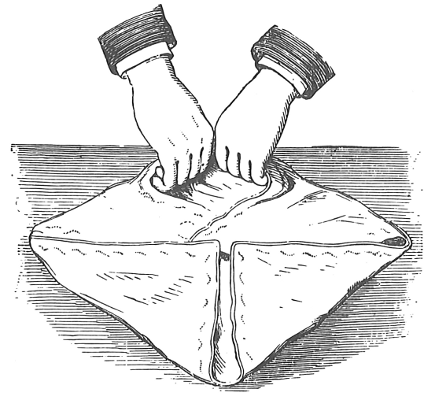
of it. Lay these upon the centre of a large coloured handkerchief,
and place another handkerchief, of a precisely similar pattern, over
it. Sew the two handkerchiefs and cardboard together through the
centre piece of card only, and then sew the edges of the handkerchiefs
together all round. The two handkerchiefs are made to pass as a
single one only. Before commencing, the dummy must be placed, opening
downwards, upon the shelf, and the handkerchief should be lying
carelessly upon a chair or side table. Show the die and cover round,
and borrow two hats. Take the cover and hats to the table, and whilst
one hand is placing one hat over the other, as in the first method,
the other should place the cover over the dummy die on the shelf,
which must thus be picked up. Show the inside of cover (i.e., the
inside of the dummy), and place it upon the uppermost hat. Now take
the die and place it upon the table, a few inches only from the
back. Spread the handkerchief over it, and whilst taking hold of the
centre piece of card of the internal arrangement across the middle,
with one hand, from the outside, pass the other hand underneath the
handkerchief, and, under cover of the same, place the die upon the
shelf. The hand holding the handkerchief will all the time appear to
be holding the die in the air a few inches from off the table. Fold
the handkerchief carefully up, and the five pieces of card will give
an exact resemblance of a die folded up in a handkerchief, which idea
is what you wish to convey to the minds of the audience. Place this
carefully upon a side table, and then explain that you are about to
pass the die from the handkerchief invisibly under the cover. Raise
the cover—and, along with it, the dummy die—once more rattle the
wand inside, and replace it. Then take the handkerchief carefully by
two corners and suddenly give it a hard shake in the air. The die
that is supposed to be inside will not, according to the expectations
of the spectators, roll upon the floor, but you will show it to be
on the top of the hat by raising the cover only, and revealing the
dummy. Remove the dummy from the hat to the table with two hands,
as if it were solid, and act as if you were about to return the two
hats. You, however, take one of them, opening downwards, and, bringing
the brim on a level with the top of the table, but overhanging the
shelf considerably, pop the die inside it with the other hand, which
instantly takes up the second hat, and you advance with both. Before
you have progressed very far, however, you say that, perhaps, after
all, the audience would prefer seeing the die back again; and it is
very evident that so large an object must be somewhere. Of course,
no one will object, and you replace the hats one over the other, the
one containing the die being naturally the lower one. The trick then
proceeds as before described, the dummy die being carefully lifted
with two hands upon the uppermost hat, and the cutting operation gone
through. The difficult portion of the trick is getting the die from
the shelf into the hat. This should be well practised.
The Gold-fish Trick.—Of the first three questions asked a conjuror
by a new acquaintance, one will infallibly be, "Can you do the
gold-fish trick?" When it was first exhibited, it caused intense
excitement, and, the secret being fairly well kept, the trick is but
little known even now. The performer advances with a shawl or large
handkerchief, and, after waving it about, he produces from it a
large glass bowl full of water, in which gold-fish are complacently
swimming. I have heard the wildest suggestions made in explanation of
the trick. One says the bowls of water come up a trap door, regardless
of the fact that the cloth does not reach the ground, consequently
anything coming up through the floor must infallibly be seen at once.
Another explains that the performer has the bowls empty about him,
and has an indiarubber reservoir of water up his back, with a pipe
coming down the sleeve. Where the fish come from is not explained.
No one seems to be able to think of the real secret—an indiarubber
cover. The bowls are flat, not more than two inches deep in the
centre, resembling gigantic saucers made of glass. The indiarubber
covers are made exactly the size of the rim of the bowls, and have a
broad turn-under edge besides. The bowls are filled with water, the
fish put in, and the covers are then stretched over. To put them on
neatly and with dispatch two persons are required, as some force is
necessary to pull the indiarubber out sufficiently far to enable it
to go on the bowl. Deep, round-bellied bowls should be avoided, as
the covers cannot get a good grip upon them. As, with ordinary care,
there is no possible chance of a leakage taking place, the bowls can
be placed anywhere the performer pleases, and in any position. The
favourite places about the person are inside the vest, which will
distend sufficiently if prepared with elastic behind, and inside the
large breast pockets of the coat. Some conjurors, however, prefer
placing the bowls simply under the armpits, inside the coat, and it
is surprising how remarkably safe they are in such a position. They
are certainly less liable to cause any extraordinary distension of
the performer's person, and are far more easily got at. But this is a
matter entirely for the consideration of the performer. Some go so far
as to put a bowl up the back, which to me seems making the trick as
difficult as possible. Wherever the bowls are put, they must be pushed
well back, so that all the distension takes place behind, and the
performer must necessarily always face the audience during the trick.
A bowl is also sometimes placed upon the shelf of the table; but a far
better place than this is the back of a chair, made opaque on purpose,
where the bowl is held by means of two large wire hooks. As three
bowls are generally sufficient for most audiences, one can always
manage to carry a sufficient number about one's person. I usually have
one in the vest and one in each breast pocket.
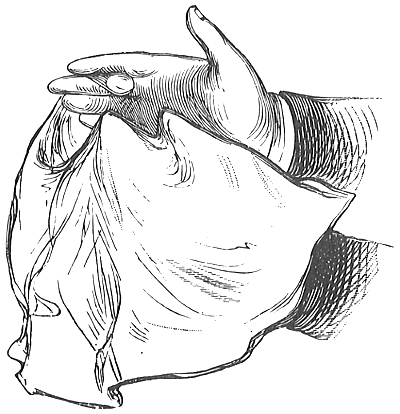
To produce the bowls, the performer takes a cloth by two corners,
and, after waving it about a short time for effect, he throws it over
one shoulder, allowing it to hang well down in front of him. If the
bowl is to be taken from the left side, then the cloth must cover
that side most, and the left arm must be held out so as to allow the
right arm room to work. With the right hand, take the bowl from its
hiding place, and hold it horizontally under the cloth, which then
draw off the shoulder by means of the other hand, and let it hang over
the bowl. Now, with the disengaged hand, grasp the indiarubber cover
firmly on the edge of the bowl, through the cloth, and remove it from
the bowl with a backward motion. This wants some little doing, as,
although it greatly heightens the effect to spill a little water, it
looks clumsy to three parts empty the bowl. Lay the cloth carelessly
aside and take up a fresh one for each bowl. Some conjurors, Dr. Lynn
amongst them, use only one cloth, which is provided with pockets, into
which the covers are stowed away; but this is a totally unnecessary
innovation, and often obliges the performer to fumble about before
he can get the covers into the pockets. The idea that the audience
think more of the trick if the bowls are all produced from one cloth
is erroneous, for in most instances the fact is not noticed; and
when the performer uses a fresh cloth for each bowl the spectators,
when they give the subject any thought at all, attribute it to the
cloths becoming wet and so disagreeable to use a second time. By using
several cloths, greater freedom of action is obtained.
An innovation by Herrmann was calculated to make the trick even more
wonderful than it is in its ordinary form. Herrmann, after producing
no fewer than four bowls, used to go right amongst the audience, and
there, from a borrowed handkerchief, produce a fifth. This bowl was
carried either in the vest or in a breast pocket, and its production
was the more extraordinary by reason of the handkerchief being held
across the performer's breast by one of the spectators. It may be
safely asserted that no such feat of daring has ever been performed by
any other conjuror. Few men possessed such indomitable pluck and nerve
as Herrmann, who, during a performance, was to be deterred by nothing.
He took the precaution of using a very shallow bowl with sharp sides
and a very thin cover. The instant the cover was off, the handkerchief
containing it was rolled up in the hand and carried off along with
the bowl as if by accident, to be immediately returned to its owner,
minus the cover.
The most recent addition to the trick is causing the bowls to
disappear after production. The simple method for doing this is
to have a double handkerchief, as described in the die trick,
with a circular piece of cardboard, the size of the bowl to be
made to vanish, inside. The bowl is placed upon the table, and the
handkerchief spread over it. As one hand raises the card the other
hand places the bowl upon the shelf. The handkerchief is then brought
forward with great care, and then shaken out in the midst of the
audience. A piece of wet sponge is kept on the shelf, and this is
squeezed when the performer goes forward with the supposed bowl. A far
better method than this is to use a bowl the top of which is entirely
of glass and made in one piece with the bowl, the water and fish being
put in through a hole underneath, which is stopped with a cork or
plug. It must not be quite filled with water, and when produced the
surface must be held a little from the audience, so that the glass top
cannot be noticed. When the bowl is to be vanished, all the performer
has to do is to cover it with the cloth, and thence quietly put it
back into his pocket or vest. It must, of course, be done quickly.
Some ludicrous mishaps have occurred with carelessly covered bowls.
One celebrated conjuror produced two bowls with the contents of a
third distributed impartially about his person, saturating his clothes
and filling his boots. Another performer, a very skilful amateur,
accidentally threw the whole of the water from a bowl into a lady's
lap, much to the discomfiture of both parties. Had due care been
taken, these accidents could never have taken place.
The bowls and covers can only be obtained at conjuring repositories.
Gold-fish and Ink Trick.—This is another instance of astonishing
and inexplicable effect produced by most simple means. A large globe
(not a bowl, such as is used in the foregoing trick), full of ink, is
produced. The performer ladles out some of the ink and sends it round
on a saucer for examination. He also dips a white card into the globe,
and brings it out dripping with ink. After this, he merely spreads a
handkerchief over the globe, and instantly removes it, when the ink
is found to have disappeared and its place supplied by pure water and
gold-fish.
The preparation for this trick is as follows: Procure a piece of
black silk, in width about four-fifths of the height of the globe,
and sufficiently long to go once round it on the inside. Sew the two
ends together, so that a broad band is formed. To any part of the top
edge fasten a piece of thin wire, which blacken. With this silk line
the inside of the globe, and then pour in water exactly to the height
of the top of it. The wire must be turned over the edge of the globe
a little, so as to be easily found. When the globe thus prepared is
brought on, it is impossible to tell it from one full of ink. The
ladle, which will be best procured at a conjuring repository, is not
an ordinary one, but has a hollow handle communicating with the bowl
by means of a tiny hole. This hole is made where the stem joins the
bowl, and at the upper end of the handle is another small hole. The
hollow handle is filled with ink, and a finger or thumb placed over
the uppermost hole, thus preventing the fluid from running out. When
the performer puts the ladle into the globe, as if dipping some ink
out, the thumb or finger should be removed from the upper hole, and
the ink will then flow from the handle into the bowl of the ladle.
The methods for filling the handle with ink are various. One way is
to fill the bowl of the ladle with ink, and then apply suction to the
hole at the other end. This is a very simple method, but, unless the
person who applies the suction has a decided taste for ink, it is not
a pleasant one to adopt. Another method is to exhaust the air from the
handle by means of suction, and then put the ladle in ink; but this
is even worse than the other. The way I get over the difficulty is
by making the upper hole, which is never seen, large enough to admit
the nozzle of a very small syringe, by means of which article the ink
can be injected into the handle with cleanliness and dispatch. In
purchasing a ladle, care should be taken to procure as plain a one as
possible. A fancy ladle excites suspicion. If the conjuror does not
mind a little expense, he will possess a most perfect article if he
purchase a cheap plated sauce ladle, and then have the handle and stem
fitted with a hollow back. This will be entirely free from suspicion.
The card which is dipped in the supposed ink is simply a piece of
card, about an inch and a half wide and a few inches long, with about
half of one side of it blackened with ink or paint. The white side is
shown to the audience, and it is then turned over with the peculiar
twist illustrated in "Drawing-room Magic," Figs. 19 and 20. It is
then actually dipped into the water and brought out with the blackened
side towards the audience. The water dripping from it will appear to
the audience to be ink, and the deceptive twist can be again given to
show that both sides are blackened.
In apparently taking out ink with the ladle, and dipping the card
in, care must be taken that the manner of the performer does not
too forcibly impress upon the minds of the audience that he is over
anxious they should believe there is actually ink in the globe. The
ladling out and dipping the card in must be done tolerably briskly;
for, if the audience have time, some of the members may suggest, what
is only reasonable, that the performer should show the bowl round
bodily. The trick is finished by a large, dark-coloured cloth or
handkerchief being thrown over the globe, and instantly removed, the
performer taking care to grasp the wire, which will, of course, be
on his side of the globe, through the cloth, and so cause the silk
lining to come away inside the cloth or handkerchief. I do not believe
in introducing rock work into the globe, as it gives the audience
the idea of something fixed, and they thus obtain a groundwork to
start upon. Water and fish are enough to manufacture from ink, in all
conscience. The trick is also very effective when performed in a small
way with a tumbler.
The Ubiquitous Glass of Water: First Method.—Procure two small
tumblers, exactly similar in size, shape, and appearance. Fill one
with water, cover it with a tight-fitting indiarubber cover, and
place it in the breast pocket or inside the vest. These little
covers are easily procurable, as they are universally sold as covers
for jam-pots. They cost about sixpence each. Have a small double
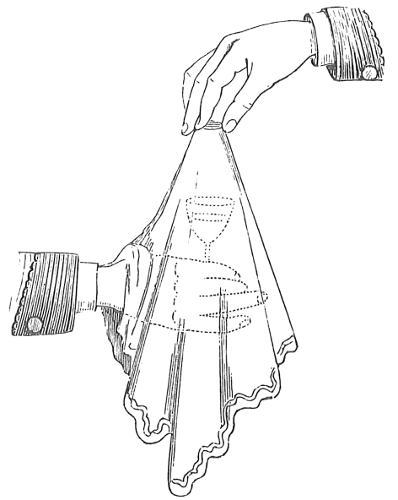
handkerchief or cloth, containing a circular piece of card, the size
of the mouth of the tumbler, with a few stitches through it to keep it
in the centre. Show the empty tumbler, and then fill it with water.
Cover it with the handkerchief, and affect to take it up, but place
it on the shelf. Advance very carefully with the supposed glass of
water, and either stumble on the floor and drop everything, or else
pretend to place the glass in someone's hands. If you stumble you
must take care to avoid injuring the concealed tumbler. The glass and
water vanished, it is now your business to find them again. For this
purpose, you call in the aid of a spectator (a youth preferred), whom
you request to stoop. Over his back spread the cloth or handkerchief,
and, grasping that portion containing the card, raise it gently.
Hold it a short time in the air, and then say that you will throw it
into someone's pocket, indicating the particular person. Shake out
the handkerchief or cloth again and then desire the person indicated
to examine his or her pocket. Of course nothing will be found, but
you borrow the handkerchief, which will have been taken from the
searcher's pocket during the examination, and, waving it about, get
the tumbler into it from the pocket, according to the directions
given for producing the bowls of water and fish. Remove the cover
and produce the glass and water, saying that you knew you had passed
them into the indicated pocket. The cover being small, it can be
easily removed and the handkerchief returned. It improves the effect
a great deal if a small piece of wet sponge can be introduced beneath
the cloth whilst the glass, presumably found in the youth's back, is
being held, and then squeezed in imitation of the spilling of water
from the glass. The sponge can be carried at the mouth of one of the
large breast pockets, and, if carefully disposed, need not make the
performer uncomfortable by wetting him. I have even seen the sponge
attached to the under side of the prepared cloth or handkerchief,
which is an excellent plan if the performer is careful not to expose
that side, as the sponge is always at hand, and there is no necessity
to introduce the hand under the covering, compression from the outside
being equally effective in exuding the water.
Some performers think it necessary to go through certain actions for
the purpose of convincing the company that the handkerchief does not
contain a card or other shape. I must confess that I regard such
actions as being decidedly supererogatory, for there is not the least
foundation for assuming that the audience suspect the existence of
any such thing; and for the performer to do anything indicative of an
anticipation on his part that the company are likely to divine what
is the true secret of the trick is highly suicidal. However, all are
not of my opinion, so, if any beginner thinks he would like to be able
to draw the handkerchief through the fingers previous to using, he
can easily do so. All he will have to do will be to run a couple of
stitches from two adjacent corners to the centre of the handkerchief,
and inclose his card in the triangular space thus formed. As it is now
loose, when the handkerchief is held by one of the opposite corners,
the card falls to the extreme border, and the bulk of the handkerchief
may be drawn through the hands. When the handkerchief is held by that
side which forms the base of the triangle, the card falls at once into
position in the centre. A copper or brass wire ring, being heavier
than card, is perhaps more serviceable, as it more readily falls into
position.
Second Method.—For this a special tumbler will be required. It is
a large one, with perfectly straight sides, and is furnished with an
outside cylindrical shell, also of glass, which is not discernible
from the glass itself when in position. This outside shell must be
sufficiently large to slip over the hand of the performer, so it will
be seen that it is of considerable dimensions. This fact is always of
value from the point of view of effectiveness: the larger the article
the performer can manage to successfully manipulate, the better. The
performer advances with the glass and shell together, and fills the
former to the brim with water. He then places the whole on the rear
edge of the table, and covers with the cloth. Grasping the shell,
from the outside, with one hand, and placing the other hand below,
the glass is slid gradually off the table, when it will drop through
the shell into the hand of the performer, which places it upon the
shelf. The more rapidity there is employed, the better. The performer
comes forward with the shell inside the cloth, and allows the audience
to feel its shape, and also taps it with the wand, to make the glass
ring. He cannot allow the shell to be actually seen, as the absence of
any water would be at once noticed; but the satisfying of the senses
of touch and hearing will be sufficiently convincing. Retiring to
about the centre of the stage, the performer thrusts one of his hands
through the shell, from the bottom, and, whilst supporting the card
shape with the fingers, allows the shell to glide down the arm, inside
the coat sleeve. The handkerchief is then shaken out, and shown to be
empty. In this case, the glass is not reproduced, the trick depending
for effect upon the apparent bringing of a very large glass, full of
water, amongst the audience, and causing it to vanish before their
eyes. In the first method, there is no tapping of the sides of the
glass when in the handkerchief, or any feeling of its shape, which
is, of course, a very great feature of this method. The cuff must be
gripped by the third and little fingers, when the arm may be dropped
without any fear of the glass shell falling to the ground.
Third Method.—This method is, in every way, vastly superior to
either of the preceding, and, in clever hands, becomes perfectly
marvellous to the uninitiated. Only one tumbler is employed. This
should be of a substantial character, and requires to be fitted with
a flat glass top, exactly the size of the top of the tumbler. To the
under side of this should be cemented a slightly smaller circular
piece, the size of the interior circumference of the mouth of the
tumbler. The glass top cannot now possibly shift from its position.
This top the performer has concealed under his vest or in his breast
pocket, so that it is readily at hand. Without so much as approaching
a table or chair he has the tumbler filled, and, as he covers it with
the cloth, he gets out his top and places it into position. With the
supposed object of, say, placing the tumbler upon a chair, so that
some plea be instituted for bending the body, the tumbler is removed
from the cloth and put into the pocket at the bottom of the coat tail.
The performer now goes through any performance he pleases with his
shape and sponge, and, at the proper moment, produces the tumbler
again. In doing this, however, he must get both hands under the cloth,
so that he may secrete the top in one of them. It would not do to lift
this off from the outside of the cloth, as its extra presence would be
noticed. Its size enables it to be readily nipped between the joints
of the fingers and root of the thumb.
As the performer does not approach the table, it is impossible for the
audience to imagine what has become of the glass, filled, as it is,
with water. There is no doubt that this method calls for more skill in
execution than does the first, but the effect is immeasurably superior.
To Invert a Glass of Water.—This is an effect which may either
be accomplished separately, or may follow the third method of the
preceding trick. The performer places the tumbler upon the table,
fills it with water, and, in the act of shifting its position, places
the lid, unperceived, upon it. He is provided with a half-sheet of
note-paper, which he places upon the tumbler, and then, covering the
whole with one hand, inverts the glass upon it. He then addresses
the company, remarking that they are, no doubt, familiar with the
schoolboy trick of holding an inverted tumbler of water, with merely
a sheet of paper to keep the contents from falling to the ground. To
illustrate this, the performer holds the tumbler by the base in the
disengaged hand, and removes the one below. In the ordinary way the
paper would fall to the ground; but the performer has taken care to
allow it to become slightly wetted, so that it adheres to the glass
top. The performer now proceeds: "This any schoolboy can do; but I
dare say you do not think it possible for me to remove this paper and
yet retain the water in the tumbler. However, I will show you that
such a feat is possible." Taking the paper by an edge, the performer
gradually removes it, all the time affecting to hold the tumbler with
the greatest steadiness, and keeping his eyes rigidly fixed upon it,
as though momentarily anticipating some catastrophe, to avert which
a concentration of all his energies is necessary. If he pleases, the
performer may swing the tumbler into an upright position and back
again, repeating the action three or four times. The paper may be
eventually replaced, and the top removed inside it, or that article
may be got rid of without the aid of the paper at all.
A slight objection exists in connection with the use of the glass top,
from the fact that it is liable to "talk," i.e., make a noise, as
it is being placed in position. This does not signify on the stage,
but, when performing before small audiences, it may be as well to
use a piece of mica. As this has no sunken edge, it is not quite as
secure as the glass top; but, with ordinary care, no mishap need be
apprehended. In removing the paper from beneath, it will be necessary
to adopt great caution in avoiding all approach to a sideways sliding
movement, which would probably have the effect of shifting the mica,
when a deluge would immediately follow. The paper must be boldly
peeled off away from the mica. Mica may be purchased in sheets,
and the conjuror should cut several sizes, both, for tumblers and
wineglasses, and carry them in his pocket-book.
When at a house, if even only for the evening, where he is likely to
be called upon, he can soon obtain an opportunity for fitting the
various glasses in use, by carrying a mica in the palm. Performed
with a wineglass, the trick makes a very valuable addition to the few
applicable to the table. In turning the glass back to the upright
position, always place the hand beneath first, as, in removing it, it
is then an easy matter to take away the mica.
The Shower of Gold.—The conjuror can perform this trick with the
same tumblers and prepared cloth. One tumbler must be filled with
imitation sovereigns (which are sold cheaply as whist counters) and
placed upon the shelf. The empty tumbler is handed round, and then
covered with the cloth, and apparently placed upon the table. It is
instead rapidly exchanged, under cover of the prepared cloth—which,
when held by the circular card, will sustain the idea that the
tumbler is inside it all the time—for the one containing the coins.
The performer now goes down to the audience, and continues to find
in various ways either single coins or three or four of such at a
time, which are "passed" into the distant tumbler by the various
methods described in "Drawing-room Magic." As coins thrown from a
distance would not in the ordinary way fall into a glass receptacle
without causing any sound, it behoves the conjuror to imitate such
sound. This is easily accomplished by having an assistant behind the
scenes, stationed as close to the table as possible, and provided
with a quantity of coins and a tumbler. When the performer "passes"
any coins towards the tumbler, the assistant should, after a short
lapse of time, allow some to pour into his tumbler. The attention of
the audience is so riveted on the covered glass that the deception
cannot be detected. Indeed, it is difficult for anyone who knows
exactly what is going on behind to notice anything at all suspicious.
The deception is a very perfect one, and is used in many ways by
the best conjurors. Of course, performer and assistant must be en
rapport with each other, the one being careful to state loudly at
each "pass" how many coins are being transmitted, and the other paying
strict attention to what is going on. Supposing the performer finds a
single coin, he will exclaim loudly, "Ah! madam, here is just one
coin on the edge of your fan! Permit me." And, on finding several,
he will say, "Ah! in your head, sir, quite a quantity of coins. One,
two, three, four, five!" Sometimes, too, it is as well, for effect,
to vary the speed with which the coins perform their imaginary aerial
journey. "This one," the performer will say, "is, I see, a very old
coin, so will go very slowly indeed;" or, "quite a new one, I declare;
see how quickly it will travel." If the assistant be not listening,
the effect will be absurd. The tumbler into which he drops the coins
should be covered, or the sound will be too sharp. It should be a
muffled sound.
The Egg Bag.—This is a bag which, although repeatedly shown to be
quite empty, continues to give forth eggs. In its smallest form, it
consists of a square bag, made from chintz, or similar material. One
of the sides is double, and thus forms a secret compartment, the mouth
of which is at the bottom of the bag, inside. The bag can be taken
and turned inside out, to show that it is empty, and yet have an egg
inside the compartment. The bag, on being turned back again, can be
held upside down and shaken without the egg falling out, for it will
still be sustained by the inner lining. To produce the egg, all the
performer has to do is to put his hand inside the bag and take the
egg out of the compartment. He can then replace it, and cause it to
disappear. Sometimes the inner lining covers only about three-fourths
of the real side of the bag, but it is best to have it almost the
same size. If, in turning the bag inside out, the double side were
accidentally shown to the audience, they would infallibly notice the
mouth of an inner bag, if it were placed about three-fourths of the
way down one side; but if it came on a level with the bottom of the
bag itself, it would rarely be noticed.
The larger egg bag, for the production of many eggs, is a very
different affair, and requires some making. There are various
patterns, the best of which I give: No. 1 is a chintz bag, about
two and a half feet long, and of proportionate breadth. There is no
double lining to it, but it is barefacedly provided with as many
little pockets, each just capable of containing an egg, as one side
can be made to take. These pockets have buttons, and the eggs are
placed in them, and they are then fastened, their mouths being, of
course, downwards when the bag is held in its proper position. The
performer brings on the bag; and, after explaining that he has simply
an ordinary chintz bag in his hands, proceeds to show that it is
quite empty by turning it first upside down and then inside out. In
performing the latter operation, that side which is provided with
the pockets must, naturally be always turned towards the performer.
The bag is then turned back again, and waved about, and, saying that
he fancies something has been put into his bag by the fairies, the
performer puts his hand inside, opening one of the pockets rapidly
as he does so. The egg thus released is produced, and the bag again
waved about. The operation of producing the eggs is continued until
all are exhausted. It is perhaps better to open the pocket sometimes
as the hand is withdrawn with an egg. This will enable the performer
to compress the material round the egg, thereby released from the
outside, before inserting the hand again to extract it, and exhibit
its contour to the audience, who will then see that the egg is
not placed into the bag by sleight of hand just previous to being
withdrawn. No. 2 is made of any opaque material, a soft one for
choice. Besides the ordinary mouth, it has two smaller ones, each some
sizes larger than an egg, at the bottom corners. They are best made
by simply cutting the corners off. The double lining is very small,
it being only of sufficient breadth to take an egg. It is situated
at the mouth of the bag and runs along the entire length of it. It
has only one opening, a slit across the centre, and the eggs are put
in through this. For safety's sake, it is as well to have the opening
secured with a button. After the bag has been duly turned inside out
and back again, and the slit (if closed) opened, the fingers are run
along the top of the bag, where the narrow strip of inside lining is
situated, and an egg squeezed out through the slit. This egg falls
into the bag proper, which is then tilted sideways over a plate or
a basket, or even a hat, and the egg thus caused to roll out of the
open corner. No. 3 is similar in principle to No. 2, but has a net
underneath, into which the eggs drop with very pretty effect. The
corner openings are dispensed with, and the hand is inserted into the
bag when an egg is to be taken out.
What puzzles audiences as much as anything is that so many eggs
are manipulated and yet not broken. The secret of this is that the
eggs used are, with the exception of the one first produced, which
is broken on a plate as a specimen, guiltless of the possession of
any interior, the performer having taken the precaution of blowing
them. This enables the performer to throw the bag carelessly on the
floor and then to trample on it. Of course the trampling would be
equally fatal to both blown and unblown eggs if the performer did not
carefully avoid that portion of the bag which contains them; but the
mere act of throwing a bag full of eggs in their original state on
the floor would alone be disastrous to many of them. The method for
holding a bag for the purpose of taking out an egg is to hold one
corner between the teeth and the other in one hand stretched out.
This leaves the other hand free for operation. Ordinarily, conjurors
do not produce more than eight eggs. If the amateur wishes to perform
the trick in really good style, he should have a bag made capable of
producing at least two dozen eggs. For this, a large-sized chintz bag
is recommended.
Incubation by Magic.—A very amusing trick can be performed when an
entertainment is given in the country, or anywhere where a few very
young chickens are procurable. Take four or five of these, and put
them in a black alpaca or silk bag, the mouth of which is tied with
cotton, and is easy to open. Place the bag on the shelf. Be provided
with a blown egg, not too large, which palm. Borrow a hat, and find
the egg in any way you please, and then retire to the stage. Place the
hat on its side on the table, with the crown towards the audience,
and the brim over the back edge, just where the bag is placed on the
shelf. Do not place the hat in the desired position at once, but try
it in various places first, and finally decide that the position in
which you place it is the only secure one. Stand at the end of the
table (r), and place the left hand on the brim of the hat, to
hold it steady. With the right hand take the egg, and, after one or
two feints, make a pass at the crown of the hat with it. Palm the egg
and rub the hat, as if the egg had gone through it. This process of
palming is not difficult when the egg has been made light, by blowing
out the inside; the small end fits nicely between the two fleshy
portions of the hand. Find another egg (i.e., the same one), in your
leg, wand, or elsewhere, and pass it through the hat as before, and
repeat the operation as often as you have chickens inside the bag.
This bag will have to be introduced into the hat with the left hand,
and the best time for doing this is when the right hand is engaged in
finding another egg on any part of your person. It is not advisable to
do it when the hat is first set down, as the eyes of the audience are
full upon it. This is an illustration of misdirection. When you have
"passed" the requisite number of eggs through the hat, raise it and
bring it forward, remarking that not only have eggs passed through,
but they have all become hatched. (The hatching can, of course, be
done over a candle.) Great astonishment and amusement will be caused
when you produce the chickens one by one. Before removing the last
one secure the bag in the hand, for it will never do to allow the
audience to see that. The egg you, of course, vest before commencing
to reveal the contents of the hat. This trick is but little known,
which is a pity, as it is a very simple one, and invariably causes
great amusement. It also serves to vary the conventional list of
tricks performed with hats.
There is a capital method for collecting the eggs for this trick in
place of finding each one with the hand, and "passing" it through the
crown of the hat. The hat is loaded, as before, with the chickens in
a bag, and placed upon a side table, as being the least suspicious,
brim upwards. The performer now takes a handkerchief, which is lying
carelessly about, and opens it out. It is then doubled lengthwise,
perpendicularly, and, held by opposite ends; one end is tilted over
the hat, when an egg slides out. The handkerchief is then opened
out to show that it is perfectly empty, is taken up by two corners,
folded, and once more emptied of an egg into the hat. This process is
repeated as often as necessary, when the handkerchief is put aside and
the trick proceeded with, as before described.
The secret of the handkerchief is that on one side is suspended a
blown egg, by means of a piece of black silk thread. A very thick,
or, at any rate, opaque handkerchief, must be employed, so that by
no possible chance can the shape of the egg be seen through it. The
length of the thread will require nice adjustment, as will also its
position on the handkerchief, for naturally it must not be long enough
to allow the egg to appear below the lower margin of the handkerchief,
when that article is held up by two corners, but must still have an
inch or two to spare, to enable it to fall into the hat without being
jerked backwards in the least, for so unnatural a movement imparted to
a falling egg would at once undeceive the company. The position for
the thread to be sewn to the handkerchief is about half way between
the centre and a corner. The folding of the handkerchief must be done
in a very easy manner, but without imparting a wavy motion to it, for
the least lifting of the lower portion will expose the egg. When the
handkerchief is folded the performer may go with it to various parts
of the room, seeking where he can magically find an egg. The egg
found, one of the company may be allowed to feel its contour through
the handkerchief. The opening out of the handkerchief, after the egg
has been poured from it, requires some attention. The lower end is
released, and then the two upper corners are seized, one by either
hand, and the handkerchief thrown wide open, showing the side to which
the egg is attached. It is then thrown forward, so as to spread over
the hat. By this act it has been turned completely over, the audience
having seen both sides of it, whilst the egg has been peacefully
resting inside the hat, the thread not being sufficiently prominent
to become observed. The two corners nearest the performer, originally
those belonging to the lower end of the folded handkerchief as the egg
was tilted into the hat, are then taken, and the handkerchief drawn
off from the hat towards the performer, with an oblique upward motion.
The handkerchief is then in the position for refolding, and right for
the discovery of a new egg.
One defect which always struck me as being apparent in this method
was the fact that the handkerchief could never be given round for
examination. This difficulty I surmounted by the following method: The
egg and thread I keep apart from the handkerchief until the actual
moment for performing the trick arrives. At the loose end of the
thread, the length of which has, of course, been previously adjusted
to a nicety, I fasten a bent black pin; that is, a very much bent
pin—a hook, in fact—with the head end very short and the pointed end
very long. The egg lies in my capacious breast pocket, and the hook
is fastened in a convenient position in the edge of the coat flap.
The handkerchief is given round for examination, and returned to the
performer, who, as he retires to the stage, fastens the hook into it.
Before he turns for this purpose, he must have fixed his eye upon the
place where the hook should go, and have grasped the handkerchief
there, so that afterwards he may be able to conclude his movements
without turning his eyes upon the immediate scene of operations;
not that this need take very long. The pin hook must not be merely
stuck through the handkerchief, such a hold being very insecure,
but it must be put through and brought back again immediately. This
will effectually prevent its slipping out during the manipulations
to which the handkerchief is subjected. So soon as the pin is fixed,
the performer faces the audience, if otherwise ready, and, taking
the handkerchief by the two upper corners, stretches them out, when,
by putting his hands away from him in front, the egg will be drawn
out of the side pocket. The trick then proceeds precisely as before.
If the performer deems it necessary to allow the handkerchief to
be again inspected, which is a matter of fancy, he must, prior to
commencing, place a white handkerchief in the hat, "in order that the
eggs may fall soft, and not make an omelette," he will explain. When
the requisite number of eggs have been found, the pin is unhooked,
and the egg allowed to remain in the hat, from whence it is removed,
folded in the white handkerchief. If the performer observes a suitable
handkerchief amongst the company, he may borrow it, when, of course,
the egg must be got rid of; but it is not often that this circumstance
will occur. It must be admitted that connected with the whole of this
trick there are a style and a neatness which are very different from
the general run of conjuring tricks.
The Resuscitated Fowl.—This can either follow the trick just
described, or it can form a separate trick altogether. It is very old,
and has formed a portion of the stock performance of conjurors for
hundreds of years. The head of a fowl is concealed in the hand, and
a live bird seized. The conjuror engages in a mock struggle with it,
endeavouring to seize its head, the object of the disturbance being
to enable the real head to be turned down under one of the wings, and
there held with one hand, and the loose head to be held on with the
other hand, in its place. The stage assistant now advances with a
large knife, and cuts off the imaginary head. The performer must make
the deed as realistic as possible by causing the fowl to appear to
struggle vehemently, and twitch its legs if possible. The head is then
taken, and applied to the neck, the conjuror remarking that nothing is
easier than to cause it to grow on again. Palm the loose head, and,
at the same time, allow the real one to escape from its confinement,
when it will at once appear to have suddenly grown on again. Release
the fowl for a short run, to show that there is no mechanism about
it. This trick is frequently performed by the very best conjurors,
sometimes with a pigeon. The loose head must match the real one as
nearly as possible, or the deception may be noticed.
"Kling-Klang."—This is a pretty little trick, and does not take
long to perform. Take a fancy coloured silk handkerchief, of a small
size, not more than a foot square, at the utmost. To the centre of
this attach a blown hen's egg by means of a piece of thread 2in.
to 3in. long. The end of the thread inside the egg is attached to
the centre of a tiny piece of wood, such as a portion of a match,
which can be pushed in, end foremost, through the hole at the end of
the egg, but which, when once inside, will steadfastly refuse to be
pulled out again. This method is far better than all other devices
with cobbler's wax and glue. Two other silk handkerchiefs, quite
opposite, in point of colour, to the one attached to the egg, will
also be required, as will a toddy glass with a foot, and an ordinary
egg, not blown. The last-mentioned article must be vested. One of
the two handkerchiefs of a like colour fold neatly in the palm, and
in the same hand take the blown egg, and, as a natural consequence,
the handkerchief attached to it, which arrange neatly around the
egg, so as to conceal the handkerchief in the palm. Place the other
handkerchief in the toddy glass, and, with the wand under arm, emerge
thus laden from the secrecy of "behind the scenes." Give the glass
and handkerchief to one person, and ask him to examine them both,
and then take from him the glass, to be held by another person. Then
say, "I have here another silk handkerchief and an egg. The egg I
will place in this glass, and then cover it with the handkerchief."
Proceed to do this, taking care to slip in the concealed handkerchief
under the egg, and then retire to the stage, taking with you the
second of the duplicate handkerchiefs. As you go to the stage, bring
down the egg from your vest, and take the handkerchief in the hand
which contains it. Turn to the audience, and ask the holder of the
glass to shake it gently to show that the egg is still inside. The
peculiar "kling-klang" made by the egg against the glass gives the
name to the trick. A caution from you not to shake too strongly, as
you do not want an omelette inside the glass, is sure to amuse. Now
bring both hands together in front of you, and commence to draw in the
handkerchief little by little. At intervals have the glass shaken.
When a few inches only of the handkerchief protrude from the hand,
draw near the holder of the glass, whom desire to cease shaking.
When you have drawn the handkerchief completely into the hands, and
feel that it is perfectly concealed, ask a spectator to hold out his
hand, and suddenly produce the egg, which give to him. Without losing
a moment, raise the handkerchief from over the glass by its centre,
thus removing the egg at the same time, taking care to continually tap
the glass with the wand during the operation, otherwise an accidental
knock of the egg against the side of the glass would be heard, and
the whole trick spoilt. Call particular attention to the fact of
the egg which you produce being a genuine one, and then get away
with your other properties as fast as you decently can. The trick is
mostly performed with an imitation egg, instead of a real one. The
egg is hollow, and has a great opening in one side. Into this the
handkerchief is forced. There is no sleight of hand about this, and
the egg cannot be given for examination, which is fatal.
The Harmless Shot.—Procure a substantial-looking muzzle-loading
pistol, the larger the better, and get a tinman to make a tube that
fits neither tightly nor loosely inside. One end of the tube must be
closed, and the open end be furnished with a turn-over rim, which you
colour or polish, so as to resemble as nearly as possible the muzzle
of the pistol. If it comes easier, by all means reverse the process,
and make the muzzle of the pistol resemble the muzzle of the tube.
The tube should be at least two-thirds the length of the interior of
the pistol barrel, and not about an inch and a half only. Now make a
wooden ramrod, which will fit rather tightly into the tube—tightly
enough to bring it away from the interior of the pistol when withdrawn
after being rammed into it. The exterior of the tube should match the
ramrod in colour and appearance, so that the fact of the one being
within the other when held in the hand in that condition will not be
detected.
Advance to the audience with the pistol, ramrod, powder, caps, paper,
and bullets. The tube is concealed somewhere about you. Give round
one or more bullets to be marked by the audience, and, at the same
time, give the pistol into the hands of someone for examination.
If the pistol takes to pieces, so much the better, as it is highly
advantageous for the audience to be quite convinced that there is
no mechanical preparation of the performer's own devising connected
with the implement. Have a fair charge of powder put in, and give the
ramrod for ramming the charge. Whilst this is being done, get the tube
into the hand, and, when the ramrod is returned to you, pass it into
the tube, and then at once say earnestly, "I hardly think you rammed
it sufficiently, sir." Without taking the pistol yourself, hold the
muzzle in the fingers of the left hand, and ram with the right. The
left hand must pinch the rim of the tube, which will thereby become
disengaged from the ramrod, and remain inside the pistol. By this
means the tube has become inserted in the pistol without any occasion
for the pistol leaving the possession of the person assisting. The
bullet or bullets are then dropped in by such of the audience as have
marked them, the pistol being handed round by the volunteer assistant,
who is also asked to put a piece of paper in as well. This piece of
paper is very small, and is rolled up by the performer himself, who
will, of course, take particular care that it is not bulky enough to
jam in the tube. The performer now, without taking the pistol, puts
in the ramrod and presses down the bullets—apparently. He, however,
takes good care to avoid pressing them at all, but brings the hand
holding the ramrod over the muzzle of the pistol, and so secures the
tube. There is nothing in the action to excite the least suspicion;
still, it is best to have the ramrod of such length that only an inch
or so of it protrudes from the muzzle. If this particular be observed,
then the hand must approach the muzzle on every occasion of ramming
down a charge, and so no suspicion can possibly be excited by the
action. The imaginary ramming is, of course, continued, the tube being
moved up and down inside the pistol vehemently. Withdraw the ramrod
and tube, carefully concealing the junction of the two, and have the
pistol capped. Having secured the bullets in the tube, the next thing
is to get them into the hand. As it is impossible to withdraw the
rod from the tube in full view of the audience (it can certainly be
done behind the table; but the unavoidably lengthened absence of both
hands for the purpose would be fatally suspicious), the performer
must necessarily retire behind the scenes. The best excuse is that of
requiring a plate. Whilst fetching this, the rod is withdrawn from
the tube, and the bullet or bullets shaken out. The paper ought not
to stick, but it might; and so it is always as well to have a piece
of wire with a sharp hook at one end in readiness. This abstraction
of the bullets could be managed whilst the performer retires up the
stage, and it would be advisable to do so if the bullets were certain
to drop out, which, however, they are not. When the performer has a
stage assistant, as he always should have when possible, the matter
becomes much easier. The assistant holds the box of caps on or near
the stage, and the performer goes to him for them, and gives him the
wand with the tube on it in an offhand manner. The assistant then
manages all the abstraction whilst the capping of the pistol is going
on, and stands, just removed from sight, with the plate in one hand
and the bullets in the other. The performer then has only to stretch
his arm behind to receive the bullets first and the plate next, both
in one hand. The bullets are held under the fingers, which are on the
inside of the plate. The performer now holds the plate either in front
of his face or at arm's length, and requests that the pistol may be
fired at it. When this is done, the bullets are allowed to roll on the
plate, which is brought simultaneously into a horizontal position, a
kind of "grab" being made with it, as if catching the bullets in the
air. I like this method better than catching the bullets in the mouth,
as the performer can at once run forward with them on the plate,
and the audience will be thus enabled to see for themselves that no
substitution has taken place during transit.
The difficulty of extracting the bullet or bullets I finally mastered,
after various trials, by using a tolerably thick piece of cork for
the purpose of closing the one end of the tube. When the performer
retires up the stage, he holds the closed end in his hand and presses
the ramrod against his body, thus forcing out cork, bullet, and paper
with one vigorous push. The operation does not occupy a second, and,
when the performer turns facing the audience again, the ramrod is in
his hand as before. It will naturally occur to everybody that, if
the ramrod fits tightly into the tube, the whole arrangement will
be neither more nor less than a popgun, and the cork will be blown
out as soon as the ramrod is inserted into the tube. To avoid such
a startling result, the ramrod must, although fitting the tube at
certain places, be made out of truth, so as to admit of an escape of
air, or else the cork must have a hole burnt through it by means of
red-hot wire. Piercing a hole through the cork will not suffice, as
the nature of the material will speedily cause the opening to close up
again. If this cork arrangement be used, then the performer need never
leave the stage.
I have given the learner what I consider to be the best method for
performing the trick. A method which differs only slightly from mine,
the principle being the same, is to use a tube barely two inches in
length. This tube is dropped into the pistol by the performer, who
takes the pistol entirely in his hands, for the purpose of ramming
down the powder charge. As it lies secreted a long way down the
pistol, it, of course, can never be seen. In pushing the ramrod down,
it becomes fixed in the tube, and brings it away, the ramrod being
the least bit tapered, to insure its going into the tube. It should
be tapered at each end, so that there may be no bother about looking
to see which end is the graduating one. The rest of the trick is
performed exactly as in the other method. My objections to the use
of the short tube are that, in order to get it into the pistol, the
performer must secure actual possession of the firearm, and he must
repeat the manœuvre when he wishes to take it out again. Again, it
is very difficult to conceal the point of junction of a short tube on
a long ramrod. If the performer does not use the utmost caution, the
tube will be noticed sticking on the rod as they are withdrawn from
the pistol. The rim of the long tube is covered with the hand before
the abstraction is made, and added to this is the fact that the pistol
never leaves the hand of the volunteer assistant, which is a great
feature in the trick. The only objection to the long tube I found to
be the difficulty sometimes arising in abstracting the bullets; but
my cork has now removed that difficulty. I have given both methods
that the learner may choose for himself. Although I have said "bullet
or bullets," because some conjurors employ one only and some three or
four, I should, myself, never think of using more than one. The effect
is the same, whilst the trick is made immeasurably easier to the
performer. People may, perhaps, be a little more satisfied at seeing
several bullets marked by different people, but it is just as easy,
and quite as effective, to have one bullet thus treated. It will not
matter in the least to the performer how many people mark it.
Another method for performing the trick is to substitute for the
marked bullet a blacklead one. This, on account of its lightness,
the performer must himself drop into the pistol and see that it is
so rammed that it is broken up. I would never advise anyone to adopt
this method, although Houdin caused consternation amongst the Arabs by
allowing himself to be fired at from a distance of a few paces. With
his usual completeness he finished the trick by firing another pistol
at a whitewashed wall, on which appeared a large splash of blood. This
was managed by means of a ball of black wax, the inside of which was
filled with blood. The Arabs were duly impressed.
There are some pistols made with spring openings in the barrel,
through which the bullet falls into the hand of the performer; but,
in this case, the pistol cannot be examined, which fact is quite
sufficient to taboo the method. Unless the pistol is given to be
examined, and left in the hands of the spectators the whole time,
there is, in my opinion, nothing in the trick.
A Bottle of Ginger Beer.—The reader will scarcely require to be
told that one of the great deceits practised by conjurors is that
of duplication. In order to apparently execute the impossibility of
conveying a large solid body invisibly through space, the conjuror has
to cause the article itself to disappear by any means at hand, and to
produce another similar article, or counterfeit thereof, at the spot
to which the original one is supposed to be magically transported. In
the case of Houdin's die trick a counterfeit die was made use of, and
in many of the coin tricks duplicate coins were employed. Whatever
the article used, the method is almost invariably the same; and the
public are often invited to witness the exhibition of a new wonder,
which is in reality only a variety of what has been done in hundreds
of ways before.
One very effective variety of this particular deceit is the
transposition of a ginger-beer bottle from one paper cover to another.
The trick and its explanation are as follows: The performer brings
forward a ginger-beer bottle and a glass, on a tray. If he pleases,
he may have two ginger-beer bottles, and ask the audience to choose
between them. He should ask them to select between the one on the
right and the one on the left. If "right" is said, and the one with
which the trick is to be performed is on the left of the audience,
then the performer must say, "On my right. Thank you"; and instantly
take up that bottle without more ado, and uncork it. He then pours
out the ginger beer, to show that it is genuine—so he says, but the
real object is to keep the spectators from suspecting that there
is anything "uncanny" about the bottle itself. The peculiarity of
the bottle is that it either never had a bottom to it, or else that
portion of it has been forcibly removed. Some few conjuring trick
makers supply bottles without bottoms; but any lapidary will perform
the desired operation should the performer himself be unsuccessful
in accomplishing it with a hammer. The chief thing is to obtain
two bottles that match exactly in colour. Height is not of much
consequence, as that is not so readily retained by the eye as is
colour; still, it is as well to have them match in that even, but
colour stands first in importance. One of these bottles is placed
upon the right-hand side of the shelf behind the table, and the other
is fitted inside with either a piece of thick cork or gutta-percha.
Whichever it is, it must fit very tightly, and be situated about an
inch from the foot of the bottle. The cork must be left out until the
last minute, or the fermentation of the ginger beer will cause the
false bottom to come out unexpectedly with a "pop." This prepared
bottle is the one that is brought on on the tray, with or without
another genuine one, as the performer pleases. When two are brought
on, the second one should always be left with the audience for them
to open if they be so minded. It is sure to be examined with strict
minuteness, and its unblemished innocence will reflect upon its late
companion.
Under his vest band the performer has a small apple, a walnut, or
little ball. This he gets down as he retires to the table, and slips
it in the lower cavity of the bottle, holding it there suspended
by means of the little finger. He then places the bottle upon the
left-hand front corner of the table, and on the corresponding corner
he places a duplicate of the article which he has secretly introduced
under the bottle. This duplicate will have been lying on the table
all the time, and can, of course, be examined. The performer now
takes two cardboard or paper covers, each just large enough to cover
a ginger-beer bottle easily, and shows them round. These covers
can be made with very little trouble, and the plainer they are the
better, in my opinion. Spectators think no more of a trick because
of a cover of many colours covered with gold or silver stars. A
fancy paper on the outside is all that is required, for it will not
do to look "beggarly." These two covers are now taken back, and the
performer goes behind his table. With the left hand he places one
cover very slowly and deliberately over the bottle, and calls very
particular attention to what he is doing. The cover in the right hand
is meanwhile being placed over the bottle on the shelf. The conjuror's
whole attention, eyes and everything, must be engrossed on what he
is doing with the bottle which is visible. Any glance which he may
want to take for ascertaining the exact position of the bottle on the
shelf must take place as he goes behind the table; any downward look
after this would be fatal. Directly it is felt that the hidden bottle
is safe in the cover, the latter must be brought into view again; and
care must be taken that it is held a little obliquely, the mouth being
towards the performer. As an additional security, it is always as
well to have the inside of the covers blackened, or lined with black
paper, and the inside and base of the second bottle treated likewise.
Any accidental exposure will then not be so likely to be attended by
serious results.
When the first cover is fairly over the bottle, the second one,
containing the other bottle, is placed over the little ball, or
whatever it is. The performer next takes up his wand and says,
"Now, what I am about to do is to cause the ginger-beer bottle and
the little ball to change places. This, I am aware, anyone can do
by simply lifting off the covers and altering the positions of the
articles with the hand; but I shall do nothing so transparent. I will
show you that the articles are still where I placed them, and that I
have not already moved them from their positions." (The covers are
alternately lifted, care being taken not to prematurely expose the
wrong article.) "My method of procedure is as follows: First, I take
out the little ball" (on the shelf there is a third article, similar
to the other two, and this the performer palms in the left hand) "in
this manner. You see, I simply run my wand up the side of the cover,
and here I have the little ball in my hand." (Strike left hand with
wand, and open it and put the ball on table.) "This cover is now
empty. By means of my wand, I remove the ginger-beer bottle, large and
cumbrous as it is, from the cover—here it is, see, on my wand!—and
pass it gently, for fear of breakages, into the empty cover. This
little ball I take thus, and pass into this cover, where the bottle
was, not five seconds since." (Perform any pass with the ball, and put
it back upon the shelf.) "On raising the covers, it will be seen that
the change has actually taken place." Raise the left-hand cover first,
grasping it firmly so as to ensure the bottle from slipping, and then
show the second bottle on the right, bringing the left hand, at the
same time, over the shelf, upon which the first bottle is permitted to
drop, very gently, from the cover. Both covers should be afterwards
shown round, although the trick can be repeated, i.e., done backwards,
if the performer desires. If he does so, he should say, "Ah, I daresay
everybody did not see how that was done, and, as I always like the
method of my tricks to be understood by everybody, I will do it over
again. There is no fun in a trick if one does not see how it is
done." On removing the bottles at the close of the trick, care must
be taken that the hidden ball, &c., is not knocked down on the floor,
as is sometimes done by accident. This is a genuinely good trick, the
opening of the ginger-beer bottle before the audience serving to throw
that body off its guard.
The Flying Plume and Seed.—This is another trick in which
duplicated representations play an important part, but the articles
and methods employed are so totally distinct from those used in the
preceding trick that one might follow the other in a performance, and
yet both appear to be totally distinct in every way. There is a little
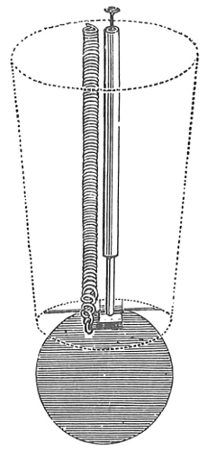
simple apparatus in connection with the trick. First of all, a tin
tube, 18in. long, and at least 1-1/2in. in diameter. It is provided
with a cap at each end, fitting inside, and not over, as is usual. The
tube also possesses the peculiarity of being divided longitudinally,
by a tin partition, into two portions. This partition does not run
down the centre of the tube, but takes a transverse direction from one
side of one end to the opposite side of the other end. By this means,
both ends are open to their full extent, and the tube can be shown
briskly round, with the cap off, without anyone being able to detect
anything wrong. Of course, only one end will be given for inspection,
the audience not suspecting the existence of more than one opening.
Then there is a vase, also of tin, but painted on the outside or
japanned. This vase has a foot about 3in. high, which is hollow, and
is connected with the body of the vase by means of a very large hole.
This hole is hidden by a large domed cap on the end of a pin, which
runs through the foot, and is furnished with a button underneath. A
spiral spring inside keeps the cap down on the hole, but pressure on
the button under the foot causes it to rise, and any seed that may be
in the body of the vase will instantly run down into the foot. Two
plumes of exactly the same colour and length will also be required.
These plumes can be obtained at a cheap rate at any plumassier's. One
of the compartments of the tube is secretly filled with seed, and the
end opening that division is closed with the cap. This cap should bear
a distinct mark to distinguish it from the other. In the vase there
should be an egg, orange, lemon, or apple, &c., which must not be seen
by the audience, and on the table there should be another similar
article. Up the performer's sleeve, or in his side pocket, one of the
plumes is secreted. The other plume is handed round and then thrust
down the tube, which, to all appearances, it entirely fills. Place the
tube on a chair or on the floor, and then take the vase, and into it
pour a quantity of seed, going forward so soon as the article at the
bottom is covered. Show the vase round full of seed, and then place it
on another chair, the button being pressed and all the seed allowed to
run away in transit.
Now borrow either a hat or a handkerchief. If the plume is up the
sleeve, then a handkerchief is required. Spread the handkerchief over
the hand, as if showing there is nothing in it, and seize the end
of the plume through it with the other hand. Draw the handkerchief
smartly away with the plume inside it, and throw both on the floor. If
the plume is in the pocket, then borrow a hat and slip the plume into
it. The plume will curl round inside the hat, and remain firmly fixed,
so the hat can be turned brim downwards without fear of the plume
falling out.
These preliminaries concluded, proceed as follows: Touch the tube
with the wand and say you have taken out the plume, which you then
"pass" into the hat or handkerchief, as the case may be. Now touch the
vase with the wand, and say that you have removed all the seed, which
you then command to go into the tube. Vanish the egg, or whatever
it may be that you use, down a trap, and "pass" it into the vase.
Nothing then remains but to open the tube, and to show the vase and
handkerchief or hat. Millet is by far the best seed to use. It is
light, and its spherical shape causes it to run smoothly. A conjuror,
who was experienced enough to know better, persistently used rice for
this trick. The result was extra delay, for the rice generally managed
to clog somewhere, and always made a tell-tale rattling as it trickled
into the foot. It made one tremble to look and listen. The trick is
very easily managed, and creates a remarkably pretty effect. The
conjuring shops supply the apparatus.
How to Make and Cook a Pudding in a Hat.—Procure a large size
gallipot with nice thin sides. Have a tin lining made to fit the
inside of this, and divide the lining into two portions by means of a
horizontal division across the middle. The inside of a gallipot being
somewhat narrower at the bottom than it is at the top, the lining
will be taper, and consequently one partition will be larger than the
other. Into the larger partition put a plum pudding, or cake, hot, and
stand it on the shelf, without the gallipot. Borrow a hat, and, whilst
busy about putting some paper at the bottom of it, and explaining that
it is to prevent its being spoilt, take an opportunity of slipping
the tin containing the pudding into it. Now take some flour, eggs,
plums, sugar, and water, and mix them all up in the gallipot, to the
accompaniment of some facetious remarks about your being a first-rate
cook. Next pour the paste from the gallipot into the empty division of
the tin, and, putting the pot momentarily into the hat, press it down
well over the tin, which it will bring away, leaving the pudding alone
behind. Now hold the hat over a spirit lamp (a candle would spoil the
hat), and profess to be cooking the contents, which presently take out
close to the audience and distribute. Some conjurors make omelettes
and pancakes, which certainly make a good show, and are suggestive
of being cooked on the crown of a hat. Some address is required in
executing this trick, especially in getting the tin into and out of
the hat. The knack of putting things into hats from the shelf neatly
is one of the most difficult things to acquire, and the performer must
never be nervous at the moment, or he will be certain to allow himself
to be discovered. Sometimes the egg is first broken into the hat
(i.e., the tin), and the flour and water afterwards mixed up in the
gallipot. The effect of the contents of an egg dropping into a hat is
certainly good.
An amusing interlude, when borrowing a hat, is to apparently push the
forefinger through the crown and then restore the hole supposed to be
made by the act. This deception is managed by having a cast of a human
forefinger made in either wax, gutta-percha, or plaster, and provided
with a pointed wire at the thick end. This finger is concealed in
the right hand, and the left hand put inside the hat. The right hand
is then brought on the outside of the crown, and with the remark, "I
fancy you have a hole in your hat, sir," an apparent effort is made,
and a finger shown protruding through the crown. All that is done is
to pass through the wire, which is held on the inside by the left
hand. After making a few sharp movements simulating a finger in the
act of being shaken, bring the right hand on to the crown again, and
make as though considerable exertion were required in order to get
the finger back again. The dummy is, of course, merely secured in the
right hand, and the hat immediately shown ostentatiously round, so as
to keep attention away from the right hand. The imitation finger must
naturally be coloured to resemble the performer's flesh. The trick
must not last long—a quarter of a minute is ample. If the finger
remains through the hat for any length of time the audience will soon
realise what the nature of the deception is. It should appear as if
the finger had been just pushed through, shaken derisively, and then
withdrawn.
The Flags of Old England.—Without any visible preparation, and
from no conceivable source, the performer produces hundreds of
flags with the hands. The flags, which can, of course, be of any
colour, but, for obvious reasons, should be red, white, and blue,
for preference, are thus made quickly: Procure some sheets of tissue
paper, and cut them into slips of equal dimensions. A good size to
commence with is 3in. by 1-1/2in., three of which will make a flag of
4in. by 3in., a very nice size. For rapid pasting, place, say, the red
slips one over the other, each one permitting just a quarter of an
inch of the one beneath it to be seen. With one sweep of the brush a
large number can be thus pasted. Perform the same operation with the
blue papers, and the white ones will not require any paste at all.
Join the three together, and, when dry, paste them on either very
thin sticks or wire, or else on bass. The latter is far preferable to
any other substance, and can be easily procured. Now make some flags
about 6in. by 4in. in the same manner, and, if you choose, a few even
larger still. Roll them all up very tightly in two or three bundles,
and secrete them about you. I always place a bundle of small flags
up each sleeve, the larger ones being either in the vest or in the
large breast pocket of the coat. Take a little flag in each hand, and
advance with them. Wave them about, and, lowering one hand, allow the
bundle to slide into it from the sleeve, care being taken that the
back of the hand is towards the audience. Bring the hands together
immediately, and continue to wave them about for a few seconds, when
commence to unroll the flags, and cause a few to appear first at the
top, and then to fall on to the floor. Continue this, all the time
moving about, until you find the supply getting low, when, with a
downward sweep of the hands, extract the bundle from the other sleeve.
This movement will be perfectly concealed by the numerous flags flying
about. It will also be perfectly easy to obtain possession of the
other bundles from the vest or pocket, if care be taken to raise the
flags that are being exhibited, so as to conceal the motion of the
hand. When the larger flags are being unravelled, the waving should
increase. The effect of a quantity of flags coming from apparently
nowhere is always very bewildering to an audience, and this is
heightened when the larger ones appear. I remember producing one quite
8ft. in length, with a complimentary motto, allusive to the season of
the year, elaborated upon it. There is, however, no necessity to go to
such a length as this. Buatier, instead of two flags to commence with,
takes a bundle of coloured paper, which he rolls up, and then pretends
to transform into flags. This is not at all a bad method, and, if
the performer prefers it to my own, there is no harm in adopting it.
Buatier decidedly makes a mistake, though, in producing the original
paper after he has manufactured several hundreds of flags from it.
This is not consistent.
The Chinese Rings.—Whether originally Chinese or not, is of little
moment: the trick has received the name, and is known by it only, so
I adhere to it. The trick consists in apparently accomplishing the
evident impossibility of linking strong metal rings, that have no
break or opening in them, one within the other. The secret of the
trick lies in the fact that one of a number of rings is provided
with a slit or opening, which is kept carefully concealed by the
performer's fingers. As, however, one ring with an opening would not
alone suffice to link several others together in a continuous chain,
the rings are made in sets of three and two welded together, besides
three or four single ones. The set of two I always dispense with as
useless. There is not the slightest necessity for going to a conjuring
repository to obtain the rings, for an ordinary smith can produce a
much more serviceable article. My idea of a good ring is one made of
iron wire fully 3/8in. in thickness and 9in. in diameter. Let the
metal be well burnished, and see that the welding is properly done.
The opening in the one ring should be 7/16in. wide so as to admit the
other rings freely. Some rings have a slit merely, whilst others have
the ends springing one into the other. These precautions are quite
unnecessary, for the secret ring is never given round for examination.
When the performer comes on, he has the open ring concealed either
under his armpit, in his breast pocket, or in the vest; or he may have
it hanging behind a chair, if he has one with an opaque back on the
stage. The other rings he has in the hand, and gives them round for
examination. Unless this examination takes place, there is nothing in
the trick, for the audience would justly argue that all the rings have
secret spring-bolt openings which are invisible at a short distance.
To abstract the concealed ring without detection requires, at times,
considerable address. A good way is to allow some of the others to
fall, and whilst stooping quickly for them, get out the concealed
one. Turning the back upon the audience, and deliberately taking the
ring out from its place of concealment whilst walking towards the
stage, is the method I usually adopt. When it is hung at the back of a
chair, the bulk of the rings should be placed upon the seat, and two
or three taken up in one hand; say, the right. In stooping to pick up
some more rings with the left hand, the right, naturally enough, finds
its way to the top of the back of the chair, and, as the ring will be
suspended half an inch down, the end of one finger will be sufficient
to obtain it.
I lay some stress upon this recovery of the open ring, for in its
neat execution lies the whole secret of the trick. If the performer
feels that he has accomplished the feat without being observed, he
may boldly assert that he knows that other conjurors perform the same
trick with prepared rings—he does nothing so mean and despicable. As
a rule, I disagree with any hint whatever that may give a clue to the
secret of a trick; but this particular one is so widely known that I
doubt if an audience of ordinary size could be found with everyone
ignorant of its secret. Under these circumstances, the conjuror who
wishes for success must be different to everyone else. If he is not
"prepared to do or die," let him leave the Chinese rings alone.
The method of "working" the trick is to first take up the open ring
and one of the single ones, one in each hand. Unless the performer
be left-handed, or ambidextrous, it is always advisable to hold the
open ring in the right hand, the opening being between the finger
and thumb. Stand at the front of the stage (if there are side boxes,
then a little back), and let the open ring hang carelessly on the
thumb, only broadside on to the audience. By turning up the point of
the thumb ever so little, the opening is rendered quite invisible
to spectators, who will think that two perfect rings are being held
before them, they having no possible reason to suspect even that an
open ring is anywhere about. Bang the two rings together several
times, and pretend to make two or three attempts to fit one into the
other, by what precise movement does not matter in the least.
Presently slip the solid ring rapidly through the opening of the
other, without ceasing for an instant the movements you have hitherto
made, which continue as if the two rings were still apart. Soon you
will work the two close together, and, by degrees, bring round the
solid ring to the bottom of the open one, and then allow it to hang
from it. Be careful, however, that the opening is never so much as
approached by the solid ring after the latter has been passed through
it. By a reversal of the proceedings, the ring must be taken off
again, the two rings being held touching one another, and worked about
as if still linked, long after the actual detachment has taken place.
The audience are supposed to actually see one ring pass through the
other, and the performer must cause this to appear to be done at the
lower half of the open ring. Performers always make a grand mistake
in hurrying over this, the opening part of the trick, which is really
the most important part of it. Within reasonable bounds, the linking
of the two first rings cannot be much too long drawn out. If he be
possessed of sufficient daring, the performer may advance to one of
the audience with the two rings linked, and give him one of them
(the solid one, of course) to hold. Just as the ring is put into his
hand, the disconnection should take place. This is an interlude, which
the performer may use or not, according to how he feels in spirits,
for conjurors are like race-horses, and are at times "in" or "out of
form." Two loose rings can then be put on the open one, one at a time,
and then removed and held together. The open ring can be passed over
the arm out of the way, the opening being, of course, concealed, and
some "business" can be gone through with the other two, which, as they
never were together, can be separated without much difficulty.
Some conjurors become breathless at the bare idea of allowing the open
ring to leave the hand, whereas, when properly managed, there is not
the least danger to be apprehended. When the ring is passed over the
arm, the hand does not leave the opening until it is well embedded
inside the elbow joint. It is bad policy to hold one ring continually
in the hand, as the fact is extremely likely to be noticed. When a
few evolutions have been performed with the single rings, including
throwing one in the air and catching it on the open ring on its
descent, the triplets should be taken up, and, after plenty of shaking
about and turning round and over, an end one should be linked on. By
linking up the other end as well, a square is formed. Give two rings
of this to be held by different people, and tell them to pull. Give
one or two jerks yourself, and at one of them disconnect, and then
gradually appear to unlink the square, bringing, at last, the four
in a single chain. Make a lot more flourishes, but merely bring the
four side by side in one hand, hanging. Hold the open ring firmly,
and allow the others to drop steadily. This they will do in two
distinct stages or jerks, at each of which you make a movement with
the disengaged hand as if controlling them. As a finish, it is usual
to put all the rings in a bunch on the open one. When this is done,
one of the solid rings should be made to sustain the rest for a short
time in place of the open one, which may be allowed to hang down in
the rear of the others, where it will not be seen. The solid ring thus
temporarily used should be held alternately in several places, so that
the audience, and especially such as know the secret of the trick,
may see that there is actually no opening it. This is an excellent
ruse to adopt. When performing with the rings, always make a deal
of clatter with them; it adds to the effect. An effective finale
is to grasp the open ring by the solid part immediately opposite
the opening, and, turning the whole bunch rapidly over, shake the
other rings loose upon the floor, dropping the open ring amongst the
rest. The apparent recklessness of this goes still further to disarm
suspicion as to an open ring.
It will be seen that, beyond obtaining the open ring, everything is
what is understood as "hankey-pankey"—in fact, downright humbug—but
it is humbug of a superior order. The performer who introduces it
injudiciously and unskilfully will have reason to regret any imperfect
study of this trick. There is not much true sleight of hand in it, but
the perfection of "address" will be required.
The Drawer-Box.—This is not the name of a trick, but of one of the
most useful pieces of apparatus which a conjuror can possess. I have
purposely refrained from making any mention of it before, because I
wanted to make the beginner an adept at vanishing and producing with
his hands before I gave him an article that would save him the trouble
at the loss of a large amount of effect. When a person is able to do
considerable execution with his hands alone, there need be no anxiety
about giving apparatus into them. It is only with the beginner that
the danger lies, for he will say, "Oh! this box does all I want—at
least, quite well enough for me—so why should I take the trouble
to learn to do it without?" The expert is never too anxious to use
apparatus, and invariably manages with as little of it as he can.
Now, the drawer-box is an article of such peculiar handiness on so
many occasions, that the temptation held out to beginners to use
it frequently is too great to be resisted. It will bear a cursory
examination, and yet, although crammed with any kind of article to its
fullest extent, it is made to appear quite empty, by merely being shut
and re-opened, and this in the midst of the audience; or the operation
may, with modifications, be reversed, and the box shown first empty,
and then full.
Most of us must have seen the little cigar-case which is so handy to
smokers who wish to keep a good brand of cigar to themselves. The
drawer-box is made on exactly the same principle as this, only, of
course, in an enlarged form, and in wood.
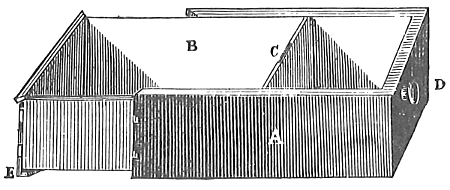
Fig. 51.
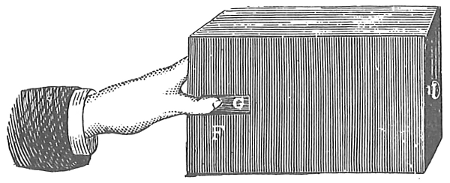
Fig. 52.
The appended sketches (Figs. 51 and 52) show the apparatus. I give a
minute description of it here, as it is only in very large towns that
the article is procurable, made in the manner it should be, so the
conjuror can either get a cabinet maker to make him one, or, if he be
anything of a carpenter, make one for himself.
A (Fig. 51) is a lightly-made drawer, without any back end, and
fits somewhat easily into F (Fig. 52), which should be made of
3/8in. stuff, and strongly put together. B is another lightly-made
drawer, smaller than A, into which it fits. A has a narrow combing all
round the upper surface of the front end and sides. This serves to
conceal the presence of B, which in reality looks like the inside of
A. To perfect this deception, the open sides of A are, as depicted in
sketch, made with mortises, and the end of B being allowed to extend
a little each side, and also mortised, the two dovetail one into the
other, and present a most innocent appearance. The knob D is not
fixed, but has a slight perpendicular play. It is connected with a
piece of flat metal, which extends from the knob to the upper portion
of the wood, inside the combing, where it is furnished with a catch,
which can be made by turning over the end of the metal and sharpening
it a little. In B there is a slight incision made at C. When B is
pushed home into A, and the knob D pressed downwards, the catch fixes
itself into C, and thus keeps the two drawers firmly together. The
action of shifting the knob up and down is very slight indeed, a
1/4in., or, at the outside, 1/3in. play being ample. When the two
drawers are thus fixed, they may be shown round, and no one not in the
secret will suspect that there is more than one drawer. The more care
and attention that is paid in fitting the drawers nicely together, the
better.
At the lower part of the back end of B will be noticed a protruding
piece of wood, E. This fits closely against A when the two are closed
together, but it plays an important part in the working of the box.
In the body, F (Fig. 52), is cut a square hole, immediately under
the point where the thumb is seen to be pressing. G is a flat spring
let into the bottom of F, and fixed at the end farthest removed from
the square hole. A square piece of wood, the same thickness as the
bottom of the body F, and slightly smaller than the hole, is glued
firmly on the free end of the spring, so that it is always in the
hole. The exterior of the box should be painted or French polished,
and the bottom covered with baize or cloth. The material should be
glued on, the space covering the spring, and half an inch all round
it, being left free. The apparatus is then ready for use, and is thus
"worked": We will suppose that it is required to cause several apples
to disappear. The drawer A, with B inside it, and the knob pressed
firmly down, is shown in one hand, and the body F in the other. The
apples are then put into A (really into B), which is then pushed into
F. After the performer has pretended to extract the apples by magical
means, he takes up the box with both hands, one hand grasping one end,
with the thumb on the spring G (Fig. 52), and the other hand seizing
the knob D, which it presses upwards, thus removing the catch from the
slit C. With the thumb pressing as hard as possible on the spring,
the drawer A is pulled out. The square piece of wood on the end of
the spring G, being pressed inside the box, causes an obstruction to
the inner drawer B through the medium of the protrusion E, and B is
consequently held back in F. The drawer A, which is, after all, merely
an outer shell, is shown instead, and the audience, not knowing of
the existence of a double drawer, imagine that the one shown them is
the one which they saw filled with apples. When the box is opened, it
should be held sideways, with the top turned towards the audience,
and when it contains such articles as apples, which easily shift in
a very audible manner, it should be placed in this position on the
table, before the contents are made to disappear. It would be stupid
to pull out an empty drawer and then cause a rumbling to be heard. The
audience would at once divine that the articles were kept back in the
body of the box by some means.
When the box is made so large that the hand cannot grasp it in the
manner shown at Fig. 52, the closed end should be furnished with
a knob matching that on the drawer A. This can then be held by the
fingers, and so enable the thumb to find a purchase.
A very good box is one made without the spring acted upon by the
thumb. In its place is a loose metal peg, which drops in and out
of the hole in the double drawer by the mere tilting of the box.
This style of box is best made with both ends of the cover open, an
increased appearance of innocence being thereby secured.
With such a handy article at command as the drawer-box, which will
vanish or produce anything at will, it will be easily understood that
the beginner is extremely likely to be tempted into using it with
too great a frequency. Let him beware of this, and, at the outside,
use it not more than twice in the same evening, and then only under
completely differing conditions, and after the lapse of a good
interval of time. In a number of the foregoing tricks the drawer-box
could be used with success, I grant, but not with any very great
effect. In the trick with the large die and the handkerchief, it would
be handy for causing the die to vanish. It could be used in
The Sun and Moon,
A Bottle of Ginger Beer, and in a dozen others, but the
temptation to do so must be resisted.
Popular usage has assigned the drawer-box the position of a regular
"property" in a very effective trick performed with a large solid
block of wood, familiarly known as the Cone. It can be made of any
size, but it is as well to have it as large as possible, that is,
not less than 6in. in height. When large, it is just as easy to
manipulate, and is much more effective. The only desideratum is that
it should go comfortably into the drawer-box. It should be well
tapered from the base to the summit, which may be simply flat or
fancifully turned. Over this block fits a thin shell, the facsimile
of it—the die and dummy repeated, only in a different shape. The
dummy shell is usually turned out of a piece of wood similar to that
of which the block is made, and both are polished to match. It is
essential that they be very smooth. All else that is required is a
very tall paper cone, which passes very loosely over the shell, and
a couple of apples, oranges, lemons, or any similar articles, both
being placed on the shelf. The drawers, fastened, should be taken out
of the body and stood upon it at one end of the table, and the cone,
with the shell on it, at the other end. The performer next takes the
paper cone and exhibits it. He then says, standing behind the table,
"This cover, which is, as you see, made simply of paper, is for the
purpose of covering this solid block of wood." The paper cover is
passed over the cone and shell, which are grasped firmly with one hand
and slid off the table on to the other hand. The shell is then grasped
a little higher up, through the paper, and the solid block jerked out
of it on the floor. The paper containing the shell cone is then laid
flat on the table, with the closed end towards the audience, and the
solid cone picked up and placed in the drawer, which is first shown
briefly round. The drawer-box is closed and placed on a side table
to the left, and the performer, passing behind the table, takes up
one of the two articles which are upon the shelf. This he produces in
any way he pleases, taking it from the wand being the most effective
method (see "Sleights for General Use"). He should then say that he
requires an orange, &c., for the trick, which he will ask his wand to
give him. The orange, or whatever it may be, is then placed upon the
table, and covered with the paper cover, with the dummy cone inside
it. The performer then explains that what he is going to do is to
cause the solid cone to come out of the box and pass into the paper
cover. Whilst saying this, he goes behind the table and secures the
second of the two articles that were on the shelf, in the right hand.
He then comes round, and proceeds: "To do this, it will be first
necessary for me to remove the orange from the paper, and I accomplish
the feat in this manner." (He runs the wand lightly up the side of
the paper, and then produces the orange out of it, the action being
somewhat similar to that used in the previous production.) "Now that
the cover is empty, I can pass the block of wood into it. I take it
out of the box, thus" (taps box with wand), "and, see, it is on my
wand. I carry it carefully to the cover and pass it thus into it." The
wand is carried very gingerly, in a horizontal position, as if the
block of wood were really balanced upon it.
The paper is then taken by its very apex, and lifted carefully off the
dummy shell, and the drawer-box opened, as previously explained for
showing it empty. The performer, after a short pause, to allow of the
free circulation of universal wonderment, says, "Ah! but perhaps I
did it a little too quickly, and you did not notice how it was done.
I will do it in a different way. Here we have the piece of wood,
which I cover with the paper; my box, empty, I shut and place here,
and the orange I take in my hand, thus" (trap it), "and rub it slowly
away. I command the block of wood to pass back again into the box,
and the orange to appear under the paper cover." Lift the paper and
dummy together, pinching them at the base, and lay them down as before
directed, and then tilt out the drawer, allowing the wood to fall
upon the floor. If the cone be not very large, then the dummy may be
allowed to slide out of the paper cover on to the shelf, and the paper
shown empty.
There is an objection to having the dummy shell made of wood, which
is that it is necessarily very light, and so easily overturned. An
accidental stumble against the table will sometimes effect this
untoward result. Zinc and tin are heavier, but there is an objection
laid against them as well: they "talk"—that is, they make a scraping
noise against the real block of wood when withdrawn from it. I leave
the conjuror to decide which is the lesser of the two evils. Cones
standing two or three inches in height can be successfully passed
through hats, after the method employed in Houdin's die trick.
Further uses for the drawer-box will appear in the course of the
description of other tricks.
Bacchus' Dovecote.—The performer advances with a bottle and
glasses on a tray, and a dove on his shoulder. From the bottle he
pours some wine, and then places it upon a side table. The dove
is next wrapped in some paper, from which the tail is allowed to
protrude, and the performer then jumps upon it or else burns it. On
the bottle being broken, the dove is found inside.
The bottle is prepared by having the bottom knocked out, which can
be easily managed with a hammer, smart taps with which have to be
administered, in a circle. The hand holding the bottle whilst this
is being done should have a glove upon it, in case of a breakage. A
dove is put into the bottle, head first, through the bottom. This
is rather uncomfortable for the bird, and I cannot bring myself to
think that the latter likes it; but no bad results seem to follow
the treatment, which should be rendered as gentle as possible. A tin
tube is passed down the neck of the bottle, secured at the mouth by
means of red sealing-wax, and then filled with red wine. On the table
are spread some sheets of paper, on the margin of one of which are
pasted some dove's tail feathers. The exhibited dove is placed upon
the centre trap, and the performer pretends to wrap it in the paper
having the feathers upon it. It is, instead, passed through the trap,
and the paper rolled carefully up, as though the bird were inside.
The protruding feathers leave no doubt of this in the minds of the
audience. The ends of the paper should be screwed up tightly, and
a little hole torn in the parcel, "to give the dove air." If, when
placed upon the floor or table the paper should accidentally roll
slightly, the performer must attribute it to the restlessness of
the bird supposed to be inside, and apostrophise it accordingly. If
crushed, it should be treated lengthways, so that the feathers are not
afterwards observed, or the audience might think it only reasonable
that the bird found inside the bottle should be minus a tail if he
has left it behind him in the paper. It may seem very simple on their
parts, but audiences never seem to doubt that the dove apparently
wrapped in paper and the one found in the bottle are one and the
same bird. There is no distinguishing mark on it to identify it, and
everything tends to make one think otherwise; but never a doubt is
raised. This circumstance should be very consoling to the conjuror.
I have even seen two doves put into a drawer-box and two other doves
made to appear at the other end of the room, and no one seemed to
doubt for a moment that they were the same ones that had been just
before put into the box.
Doves are most docile creatures, and accommodate themselves to
circumstances in a remarkable manner. When passed through a trap, they
never wander about and exhibit themselves at the corners of the shelf,
or otherwise expose the performer's secrets. At times, though, they
will start their peculiar call, but this happens very rarely. Most
regular performers, whether professional or not, usually keep a pair
of doves at least. They are very hardy, and soon become accustomed to
being pulled about.
The Wine-drinking Crystal Ball.—The tube in the neck of a
bottle, mentioned in the preceding trick, is a very effective and
much-practised deception. In the present instance, the performer
selects an opaque bottle with a deep "kick" in the foot, and has a tin
tube fitted into its neck. The mouth of the tube is provided with a
rim turning outwards, to prevent a total disappearance of the article
inside the bottle. This rim should be nicely rounded, so as to fit
the mouth of the bottle neatly, as it will not do for the audience
to entertain the slightest suspicion of its presence. The bottle
is three-parts filled with water, and the tube with red wine. The
performer is provided with two clear white glass balls, a little over
an inch in diameter, and one red one, of the same dimensions. These
are concealed conveniently about the person. The trick is commenced
by the wine being poured into glasses and handed round. Retiring to
the table, the tube is extracted and "vested," or put elsewhere out
of sight, and one white ball got into the hand. By means of the wand,
this ball is magically produced. The performer then remarks that
he wants two balls, and manufactures another by striking the one he
has in the hand with the wand; the explanation given being that the
original one has been cut in two. The reader will understand that the
second white ball has been got down from concealment, and exhibited at
the proper moment. Two balls are not really required for the trick,
but the diversion is made for the sake of increasing the attention of
the audience, and for giving the trick a general completeness. If he
so pleases, the performer can proceed to rub one of the balls until
it becomes as small as a pea, or as large as an orange: all that is
required is to be provided beforehand with balls of the necessary
sizes. The ball which is supposed to be undergoing the compression
or expansion can be easily palmed in the right hand, the fingers of
which are engaged in shaping the latest arrival by rolling it in the
palm of the left hand. To get it back to its original size from the
tiny one, the small ball has only to be concealed between the roots
of the third and fourth fingers (Fig. 25). To get it back from the
large size, place the large ball upon the table over a trap, and,
after admiring it as a splendid production on your part, pretend to
take it in the hands, trapping it. After much hard squeezing and
rubbing, accompanied by expressions of doubt as to the success of your
exertions, all enacted close to the audience, the original ball will
be produced, it having been, of course, palmed the whole time. Give it
to a spectator to hold, and then fetch the bottle. Whilst retiring get
down the coloured ball and introduce it into the "kick," where keep
it by means of the little, or any other convenient, finger. With the
bottle in the left hand, return to the audience, and, taking the white
ball from the person holding it, palm it at once, retiring a few steps
as you do so, holding the fingers as though they contained the ball.
If the palm be kept upwards, there is no fear of the ball slipping out
of it, which it possibly might do—it being an awkward thing to hold
firmly—were the fingers turned downwards. Explain that you are about
to throw the ball into the air and catch it in the bottle. As the ball
is considerably larger than the mouth of the bottle, this announcement
will naturally be received with incredulity. You, however, with the
hands as widely separated as possible, toss an imaginary ball into the
air with the right hand, and affect to catch it in the bottle with
the left. A vigorous shake given to the bottle will cause the ball
held in the foot by the left hand to rattle, and the illusion of the
catch will be perfect. Now say that, having got the ball inside the
bottle, you must break open the latter in order to get the ball out,
and turn round, feigning to look for a hammer. This will give you an
opportunity for concealing elsewhere the ball in the palm. So soon as
this is done, say, "Well, perhaps I shall only make a litter with the
broken glass; so I will get the ball out in a more artistic manner.
Whilst I am talking, though, I fear the little gentleman inside is
making very free with the wine." Ask the ball how he is getting on,
and advise him not to drink too much, &c., and then proceed to get
him out of the bottle by striking the palm of the right hand on the
mouth of the latter with considerable force. At the third blow or so,
release the ball in the "kick," and it will fall to the ground with
the appearance of having been forced through the bottom of the bottle.
Call attention to the fact that it is red, and consequently, as you
feared, must have been drinking the wine. To test this, pour out
the contents of the bottle, which, being pure water, will cause the
audience to be of your opinion, ludicrous though it may appear. After
this, hand round both bottle and ball for inspection. It is a great
mistake to omit showing the bottle, as the audience is invariably
impressed with the idea that it has an opening in the bottom.
Instead of the imaginary catch, the bottle can be stood upon a table,
and the ball passed into it by any ordinary "pass." The disadvantage
attending this is that the ball is not heard to fall into the bottle,
as in the other method. It is natural that a heavy ball falling into
a bottle must make some noise on striking the bottom. Audiences,
perhaps, are not sharp enough to remark the absence of this natural
result, but there is no denying that the trick is rendered more
complete with its addition. Besides, when placing the bottle upon a
table, the ball in the "kick" would naturally be loose were not some
method for preventing this to be adopted, and it would become a matter
of great difficulty, if not an absolute impossibility, to raise the
bottle again without revealing the real state of affairs. A little
black wax in the apex of the "kick" serves to sustain the ball in a
very satisfactory manner; but, in adopting this auxiliary, one has to
dispense with what I consider to be a most necessary feature in the
trick, viz., giving the bottle round for examination afterwards. The
wax will tell an undeniable tale.
It is possible to vary this trick in many ways, quite according to the
fancy of the performer. It is well, however, to be certain of palming
and vanishing your ball quickly and neatly before attempting the trick
at all, as everything depends upon this. If the white ball is observed
to be still in your palm, no amount of rattling in the "kick" of the
bottle, however seductively executed, will convince an audience that
it has passed into the bottle.
Bacchus' Maypole.—I do not mind admitting to the reader that,
where my imagination will permit, I am inventing new names for my
tricks. I do this in order to save those who may hereafter undertake
performances a certain amount of trouble, and also to get a little out
of the beaten track. Ever since this trick has been invented it has
been known as "Ribbons and Bottle." Now, that is a very poor title
to put upon a programme, which, as it cannot possibly give any very
valuable information to the spectator, may as well be embellished
with neat terms as slovenly ones. A bottle and some ribbons certainly
are used in the trick; but, as the old title does not reveal whether
the ribbons go into or come out of the bottle, or whether the bottle
comes out of the ribbons, a more fanciful one, so long as it is near
the mark, seems just as appropriate, and much more ornamental. At the
same time, it is very unadvisable to fill a programme with outrageous
and ridiculous titles. I went to an entertainment once, given by a
gentleman afflicted with a liking for high-sounding titles. At first
I thought I was going to see something totally new, and waited for
the curtain to draw up with some impatience, for the first item on
the programme was thus designated: "The Celestial Mystery; or, the
Winged Fairies of the Emperor Foo-Chow." This was the butterfly trick.
However, although greatly disappointed, I kept up my courage, for item
No. 2 was "The Sorcerer's Secret; or the Sheik's Visit to the Great
Mogul." The egg bag! I collapsed, and took no further interest in the
"Arabian Necromantic Divinations," "Scandinavian Second Sight; or,
the Finnish Seer," &c., for they were all tricks of the most ordinary
class. Let the performer, by all means, embellish his programme with
well-chosen titles; but let him, at the same time, steer clear of
the other extreme. Experience teaches one that there is more in a
programme well got up than at first meets the eye.
Although there is rather more of mechanism, and less of sleight of
hand, in it than I usually adopt, still this is such a very pretty
trick that it would be a pity not to mention it. The performer comes
on with a bottle, from which he pours a quantity of wine, beer, or
other liquid, and then, either still holding it in his hand, or
placing it upon a table or chair, he draws from it a ribbon of any
colour that may be asked for by the audience. More liquid is poured
out, and more ribbons produced.
The secret lies in the manufacture of the bottle. In most cases, an
imitation one of blackened tin is used, but, as the difference between
a metal bottle and a glass one is easily discernible, this is a bad
principle. The best method is to procure a tapering bottle, quart
size, and opaque, and get the bottom neatly cut out by a lapidary. If
the glass be semi-transparent it is easily rendered opaque by being
painted with Brunswick black on the inside. Into the bottom fit a
block of wood nearly an inch thick, the upper half of which has been
turned away half an inch, so as to form a step. To this step have
fitted a long tin funnel of such a length that, when the block of wood
is fitted into the bottle, the small end will be within the third of
an inch of the mouth. This funnel is much smaller than the interior
of the bottle, so that when it is in position there is space for a
considerable quantity of liquid between it and the glass sides. The
small end is closed up with a piece of metal, which is provided with
a number of slits, each large enough to admit of a ribbon passing
through it.
On the block of wood arrange as many tiny reels as it will take. It
will be necessary to do this in tiers. There is no reason why they
should be like the ordinary reel, for the smaller they are the better.
Each of these reels carries a differently coloured ribbon, which has
been previously passed through one of the slits at the closed end of
the funnel. It will be discovered that it is not possible to wind them
up quite tightly, but an inch or two hanging loose will not signify
if care be taken not to cross the ribbons in any way. That end of
the ribbon which appears outside the slit must have a piece of wire
sewn in it, to prevent its going quite through. With the block thus
prepared, and the funnel fitted firmly upon it, put the whole into
the bottle, and then pour the liquid carefully down the sides of the
funnel, taking care not to let any get in through the slits.
Having poured out a little of the liquid, for the benefit of the
company, say that you are now going to ask the bottle to give you a
colour, and request the audience to say which particular one it shall
be. Of course, some half-dozen, at least, will be given by as many
persons, which is all in your favour, as you may then choose which you
please, or, more properly speaking, not notice any extraordinary one
with which you may not be provided. Some clever person is sure to
rack his brains for some impossible colour, but, as you will take no
notice whatever of him, it will not matter much. Each time a colour is
asked for, turn to some object of that particular hue, and pretend to
convey some of it on the end of the wand to the mouth of the bottle.
There is nothing in this, perhaps, but it gives an air of finish to
the trick. Snatch up the bottle every now and then, and pour out some
liquid from it, and also call attention in an indirect manner to the
fact that the ribbons are perfectly dry. Also tap the bottle once or
twice with the wand, for the unexpressed purpose of showing that it is
glass, and handle it generally in a careless manner, swinging it about
by the neck, taking care, however, not to expose the bottom. This
makes a very effective stage trick.
A second method, which the reader is not at all likely to have seen
performed, seeing that I invented it myself, enables the conjuror
to employ an ordinary glass bottle, having no preparation whatever
about it. It should be a dark bottle, so as to be quite opaque at a
distance. The bottle is shown for examination, and placed upon a low
table or chair, and the performer extracts coloured ribbons, just as
they are called for. As the bottle has been examined, no necessity
exists for occasionally pouring out liquid from it, which is a dumb
way of saying that the bottle is an ordinary one. Secreted beneath the
vest band, the performer has his rolls of ribbon arranged. They may be
either upon bent pins, stuck in the vest itself, or the performer may
have a band, fitted with wire hooks, which may be buttoned on in a few
moments. As the ends of the hooks or pins are towards the performer's
body, the ribbons cannot fall off; but the ends of the fingers,
curled slightly underneath, obtain them at once. The colours must be
arranged in a certain order, which the performer will, of course, have
to remember, and he must depend entirely upon his sense of touch.
Directly the colour is named, the performer commences to seek for
some article of furniture or dress containing it; and whilst the wand
is extended towards the object, for the purpose of magically bearing
away some of its colour, the other hand is getting down the ribbon,
that side of the body upon which it is secreted being turned from the
audience. Proceeding to the bottle, the wand affects to place the
colour magically obtained into the bottle, and, as soon as the other
hand has secured the loose end of the ribbon, it is brought to the
mouth, and the ribbon allowed to unroll. A tiny piece of lead, sewn
in the end, will assist this greatly; but the ribbons should always
be kept flat, except when in actual use, otherwise they will assume
a curl, which will betray the fact that they have been rolled up. If
symptoms of curling manifest themselves, the wand should be held at
the mouth of the bottle and pressed against the ribbon as it comes
out, and it should be then taken in both hands and held stretched
until placed upon the table.
By adopting this method, the performer is enabled to produce a very
great number of colours; and it is advisable to have two or three of
them twice over. However well the trick may be performed with the
prepared bottle, the company instinctively feel that a certain number
of ribbons are concealed somewhere or other, and that when they are
once produced no more can come. By producing the same colours twice,
the notion of an inexhaustible productive power is conveyed.
There is a third method, which can only be employed on a regular
stage. The bottle is a specially constructed glass one, that part
which is known as the "kick" extending upwards to the neck, and having
a hole in the top. Thus there is still space left in the bottle for
plenty of liquor, whilst there is an open passage up the middle of it.
This bottle is placed over a hole in a table having a hollow leg (a
small, single-legged round table is invariably used), and the ribbons
are passed up on the end of a rod by an assistant below. By this
method, an endless supply can be taken from the bottle, but few of my
readers will, I fancy, be able to adopt this method, although it could
be done over a draped table under which a small boy was secreted for
the time being. When the performer advances to the bottle he gives out
the name of the colour very loudly, and places his fingers over the
mouth, at the same time pressing hard, to prevent the bottle being
shifted by the action of the ascending rod. The assistant below has
his ribbons arranged in order, and, as soon as he hears the colour
given, attaches the proper one to the pin at the end of the rod. When
the performer is quite ready he strikes the bottle with the wand,
upon hearing which, but not before, the assistant pushes up the rod.
He must be in no hurry to withdraw it, but give the performer plenty
of time to clear the ribbon. A suitable bottle may be manufactured by
knocking the bottom out of an opaque glass bottle, and then fitting a
tin lining to it, inside, which can be fixed and rendered watertight
by means of putty, afterwards blackened, if white putty be used. The
bottle is occasionally taken up, and liquor poured from it, as in the
first method.
The Accommodating Bottle.—This is a bottle from which the
performer pours any kind of wine or spirits that may be asked for.
The secret, as in the foregoing trick, lies in the bottle, and it
is only introduced here on account of its remarkable effectiveness
in clever hands. The interior of the body is divided into a number
of compartments, usually five. Each compartment has a tiny tube
running from it half way up the neck of the bottle, and has also an
aperture, just capable of admitting an ordinary pin, at the side
of the bottle. Four of these apertures should be arranged an inch
apart in a slightly curved line, so that one finger can be placed
upon each when the bottle is grasped in the hand. The fifth aperture
should be situated underneath the thumb. It is possible, but very
difficult (owing to the absolute necessity for having the partitions
hermetically closed, except at the tubes and the apertures), to have
an ordinary quart bottle, with the bottom knocked out, fitted with a
tin lining, properly prepared. When this can be done, it is decidedly
advantageous; but, in the ordinary way, one has to be contented with a
tin article, japanned.
By means of a specially fine funnel, each compartment is filled with
a different wine, and great care must be taken in remembering which
contains the port, which the sherry, and so on. So long as the fingers
and thumb are kept firmly pressed upon the apertures, no liquid
will escape, even when the bottle is inverted, as it will be by the
performer, previous to commencing, to show that it is empty. Some
bottles have an extra compartment, into which water is poured, in full
view of the audience, and the bottle apparently washed out, the water
being poured out again. The adoption of this addition is a matter of
taste. A dozen or so of liqueur glasses upon a tray, and carried by
an attendant, will be required, and, after calling attention to the
fact that the bottle is quite empty, and that he has no pipes running
up his sleeve, the performer asks a lady what particular wine she
would like. It is as well to use the words "port, sherry, or what?"
by way of suggesting something which you have in your bottle to start
with. You will, of course, have champagne, claret, and hock, which,
with the sherry and port, will make about as good a quintet as could
be selected. On any particular wine being called for, all you have to
do is to raise the finger covering the hole corresponding with the
compartment containing the required beverage, and it will flow out;
on replacing the finger the flow will cease. By using small glasses,
one appears to supply so much more than would be the case with larger
ones. Never more than half fill a glass, and always pass as rapidly as
possible from one person to another. Of course, you will be frequently
asked for a wine with which you are not provided. This, in nine times
out of ten, you can manufacture out of your stock. For marsala,
for instance, give a little sherry and hock mixed. For sparkling
burgundy mix champagne and port, or champagne and claret. When you
make a mistake, pretend to be in a great hurry to attend to another
applicant, and accidentally (!) drop the glass on the floor. Never
mind if the glass does break; your trick is not spoilt.
It is wonderful how much success is attained by management in this
trick. In one person's hands, it falls so flat as to be almost a
failure; whilst, in another's, it will probably be the success of
the evening. It is especially successful in the hands of a brisk and
lively performer, before, or rather amongst, a large audience of a
free and easy nature. It is not a good trick to introduce before a
select and stiff company. Should any particularly fastidious person
be met with, he can generally be settled by the administration of a
mixture of the whole five wines. If he is still dissatisfied, ask him,
if the beverage is not the one for which he asked, to say what it is.
It will puzzle him to answer, and you will then be able to retaliate
upon him by supposing that he does not know the taste of the wine for
which he was so anxious.
Some first-rate continental conjurors, who, as a rule, take infinite
trouble with their tricks, perform this trick with an ordinary
bottle, which, after being examined, is filled with sweetened water
(ostensibly plain water), and then any liqueur is given from it. The
secret in this case lies in the glasses, which are coloured, and
contain each an extract of a certain liqueur. The sweetened water
answers for all. By this means, it is possible to be provided with an
immense number of flavours, but the trouble in preparation is such as
only a professed conjuror could undertake.
The Mesmeric Suspension Wand.—The Fakir of Oolu (he is known in
private circles by a far less sounding and much more cockneyfied name
than that) was the first to introduce this trick to the British public.
The performer is provided with an ordinary conjuring wand, blackened
all over. He passes it through one hand, to show that it is not
attached to any suspending medium, and then performs a series of feats
with it, which apparently entirely upset the laws of gravitation.
For instance, when placed horizontally against the under side of the
outstretched hand, it does not, as one would expect, fall at once
to the ground, but remains in the unnatural position. When placed
perpendicularly against a finger or thumb, the result is the same;
and it can be just as easily suspended from the tip of the finger by
its extreme end. There are three methods in general use for producing
these phenomena. One is to have the rod provided with several black
pins, which stand out a little from the wand, and are then bent at
right angles. The heads are taken off, and the exposed ends left
rough. If two of these pins be placed about five inches apart, with
the points of each turned towards the other, a hand placed flatly
between them will be enabled to sustain the rod in any position by
merely opening out the fingers, thereby causing a pressure on the
two pins. This is the whole secret of the first method. The conjuror
can arrange his pins according to fancy. I find five ample viz., two
about two and a half inches apart at each end, and one small one at
the actual tip. There is no necessity for more; and the space of two
and a half inches admits of the introduction of two fingers, which
possess quite sufficient power to sustain the rod. The advantage of
using two fingers only is that, by employing the middle ones, those
on the outside are left free to be moved about, as they should be, to
assist in abolishing the idea of any connection existing. When the
wand is drawn through one hand, the action must be quickly executed,
and no notice given of the intention to perform it, otherwise the
attention of the audience will be sufficiently attracted to the wand
to cause it to be noticed that the hand does not actually touch it,
although it appears to do so. A serious pantomime of mesmerising the
wand by means of a few passes may be indulged in with advantage,
according to the ability of the performer in this direction; but he
must treat it seriously. If it is at all well done, one half of the
audience will remain almost convinced that some influence has been
exercised over the rod. The wand should then be taken in one hand, and
struck smartly on the palm of the other, to show that it is solid,
or it can be done previous to the mesmerism. This is very necessary,
as a universal idea exists, amongst those who do not know the trick,
that the wand is made of pith, and that the performer has some "sticky
stuff" on his fingers. It should next be held horizontally at the end
by one hand, and the other passed slowly along it once or twice, the
motion becoming slower and slower until it ceases altogether. The
fingers will then be between two pins, and, on the rod being released
by the other hand, it will apparently cling to the under surface of
the one above it. To cause it to attach itself to a finger or thumb
perpendicularly, it is only necessary to hang it by one pin on the
outstretched member, and the prodigy is accomplished. The pin at the
tip is for the purpose of suspending the rod from the end of a finger.
This is accomplished by pushing the pin under the nail. No trick could
be simpler; therefore the performer must do all he can to make the
audience believe in its extreme difficulty. Once or twice, at least,
the mesmeric power should fail, and fresh passes resorted to in order
to restore it. An effective action to introduce is that of placing
both hands above the wand whilst it is in a horizontal position, and
then appearing to move them backwards and forwards along it. This is
accomplished by fixing the fingers of one hand only in the pins. The
hands are then parted, and joined twice with considerably rapidity.
The disengaged hand must not alone be moved, but the other as well,
otherwise it will be seen that the wand is affixed to one hand, and
the other merely moved along it. The care taken by the conjuror will
make this trick the more or less successful.
The second method is to have a ring upon the finger provided with a
clamp, which receives the wand in its embrace. The only thing to be
said in favour of this device is that it enables the wand to be shown
round. In all else it is vastly inferior to the bent pin arrangement.
The number of positions in which it is possible to suspend the rod
are exceedingly limited, and the probability of the ring being
accidentally exposed is by no means remote.
As it is decidedly advantageous to give the rod round for examination,
it is always well for the performer to devise a method for handing
round one rod, free from any preparation whatever, and then exchanging
it for a prepared one. This is, perhaps, best managed by concealing
the prepared one up the coat sleeve. The one that is shown round is
dropped into the tail pocket, which can be specially arranged for such
a use without much difficulty. The change behind the table is weak,
and a large majority of the audience invariably see through it, in
which case all the performer's subsequent actions with the article are
looked upon as farcical. When a dummy article is to be exchanged for
a prepared one, the change must be perfect, or left alone altogether.
If the performer have any doubt about it, let him rather dispense
with the examination and consequent exchange, for then the audience
can only suspect; but, if any covert action is detected, then the
suspicion resolves itself into a tolerable certainty.
The wand for this trick is very easily made, any ordinary wood being
suitable, and a packet of black pins, a pair of pliers, and a file
will do the rest. It is best as a stage trick, private audiences in
small rooms being somewhat too close for safety.
There is, however, a third method, which I think the reader will,
after giving it a trial, find commend itself highly, as it enables
him to use his ordinary wand, and so avoid the suspicion naturally
engendered by the employment of a fresh article expressly for a
special trick. Our old friend, the silken thread, is once more the
means employed, and it may be either passed round the performer's
neck, in the form of a large loop, or be affixed to a waistcoat
button. Experiment will at once determine the proper length, which
will naturally vary with the physical proportions of each performer.
The wand is, of course, given round for examination, and may be passed
through the loop whilst the performer is facing the audience, although
it is, perhaps, the safer way to do this whilst retreating to the
stage. It will be found that when the thread is stretched outwards
from the body by means of the wand, acted upon by the hands, it
supports the wand by drawing it hard against the fingers. At first the
wand is taken in the two hands, one near each end, and held out very
gingerly. When the thread is felt to be tightly stretched, the fingers
are opened, and it is as well to at once give a swinging motion to
the hands. The hands should then be drawn together and parted again
two or three times, both slowly and fast, a slight swinging being
still kept up, and then two or three, or single fingers can be
employed, as may the sides and backs of the hands. These movements
will necessitate some little practice, in order to ensure facility of
execution. When enough has been done by two hands, one hand should
be placed in the centre of the wand, the thread passing between the
fingers, when the wand will be just as securely supported. The hands
should be changed, the one hand taking the wand from the other, from
beneath. The finale to this method of doing the trick is the most
startling of all, the wand being suspended by one end from the tip of
a finger, and from thence given to the company. To bring this about
neatly, grasp one end of the wand with the right hand and place the
tip of a finger of the left hand against the other end. Let the wand
assume a perpendicular position, the right hand undermost, and, at the
same time, cause the thread to slide along until within a bare inch
of the finger at the other end. If the wand be fitted with ferrules,
as directed, the thread is certain to rest at their terminations.
The pressure of the finger against the resistance of the thread,
delicately dispensed, will cause the wand to be supported, and with it
in this position the performer advances to the company, and, with the
right hand, places it in their hands, a very slight under sweep, quite
compatible with a graceful presentation of the article, sufficing to
free it of the slight tenure the thread holds over it. As the Fakir's
wand has been on sale for very many years, there will probably be
amongst the spectators some who know its secret. With these the method
now described will be most successful in creating astonishment, for it
will be quite beyond them.
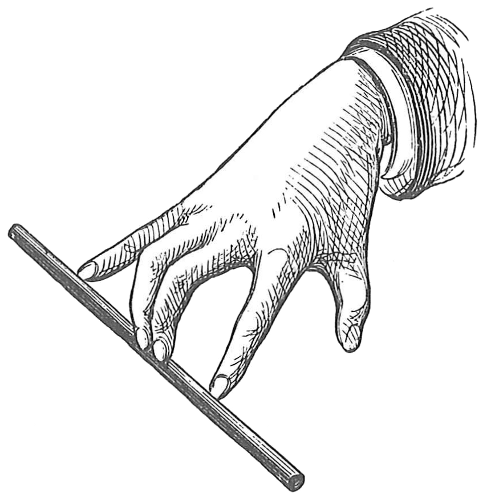
Fig. 53.
A little additional sleight may be practised, which gives finish to
the trick. This is to cause the wand to apparently attach itself to
the tips of the outstretched fingers of one hand. To the spectators,
it appears as if the fingers were merely outstretched, and the wand
placed against them, when it adheres. It is quite true that only the
tips of the fingers touch the wand, but they must be so disposed that
the first and fourth are on the inside, and the second and third on
the outside. The theory of the grip is the same as though the wand
were held between the four fingers, an inch or more down them. What
the conjuror has to study is to bring sufficient pressure to bear
by means of the tips only, the nails of the first and third fingers
resting against the wand. The hold is really of the most fragile
description, only one longitudinal half (the inside one) of the wand
being operated upon. A strong and rather fleshy finger will succeed
best, but, in any case, the first and fourth fingers must be stretched
out as wide as they can be made to do, and the whole operation will be
very materially assisted by using a wand that is neither heavy, thick,
nor slippery. An unvarnished wand would be the best, and it should be
as much less than half an inch in thickness as can be made convenient.
Weight will then be comparatively immaterial. The performer will find
the effect of his trick wonderfully enhanced if, in handing the wand
from one member of the company to another, he does so by means of the
apparently magnetic tips of his fingers. The sleight is illustrated at
Fig. 53.
The Magi's Brazen Rod.—This is a solid brazen rod, one quarter of
an inch in thickness. At each end is a brass ball, free (whether solid
or not) from any preparation whatever. One ball is firmly fixed, and
the other screws off and on. Some ladies' rings are borrowed, and a
solid wooden ball, which is subjected to examination, is then passed
on the brazen rod, and the movable brass ball screwed on. The ball
ends are then held firmly by two of the audience, and a handkerchief
spread over the wooden ball. The performer introduces his hands,
containing the rings, beneath the handkerchief, and, in a moment,
the ball drops from the wand, upon which, on the withdrawal of the
handkerchief, the rings are seen.
There are many variations in the details of the trick; but the one
great secret in connection with it is that, besides the solid wooden
ball which is shown round, the performer has one behind the scenes
that is hollow, and is divided into two equal parts, which fit firmly
together, like a box and lid. In the box portion is fitted a piece
of cork, in which are three slits. Ostensibly to fetch the solid
ball, the performer retires behind, and there rapidly places the
three borrowed rings, for the possession of which at this stage I
shall presently account, lightly into the slits, closes the ball up,
and palms it. Returning to the stage, with the solid ball openly in
the hand, he gives it to be examined. On receiving it back, he has
to exchange it for the prepared one (a feat neither too difficult
nor too easy), which is passed on the rod instead, the solid ball
being vested. The sequel follows as a matter of course. The solid
ball is re-palmed, and secretly introduced under the handkerchief at
the same time as the rings (i.e., their substitutes); the hollow
ball is opened, thus leaving the rings alone on the wand, re-closed
and palmed, the solid ball at the same moment being dropped on the
floor. The performer must be careful not to have the wooden balls
larger than is absolutely necessary, or he will find some difficulty
in exchanging and concealing them neatly when occasion requires. They
must be turned with circular grooves, in one of which the opening
of the prepared ball is made, so as to escape detection from casual
glances. The method of obtaining the rings varies considerably. Some
performers put them into boxes with secret openings, and thus obtain
possession of them. The simplest plan, if one has a stage assistant,
is that described under the heading "Sleights for General Use." The
assistant remains on the stage, holding the wand until the rings are
required again. The performer then puts them in a piece of paper,
ostensibly to "take better care of them," but really to make it easier
for him to get rid of them, and they are palmed, along with the dummy
ball, when that is taken off the wand. I have seen it attempted to
place the dummy rings inside the ball before re-closing it, but the
operation took too long by far in execution. If too much paper be
not used, and the rings are small and tightly folded together, it is
possible to pop the little parcel inside the lid of the ball. The
rings could be of such a size as to allow of this. The method for
managing the exchange of the rings depends much upon circumstances.
The one I have given will be found generally applicable, especially as
the trick is essentially a stage one. The handkerchief that is thrown
over the rod should be drawn off smartly, so as to cause the rings to
spin round, by the hand containing the ball just removed from the rod,
which it will assist to conceal. On the completion of the trick, hand
back the borrowed rings on the rod itself, and also show round the
ball again.
There is no reason why this should be an expensive trick. A brazier
could make the rod and knob ends for a very few shillings, and the two
wooden balls should cost about 1s. 6d.
The Shower of Plumes.—This is a trick requiring a great display
of dexterity, combined with considerable boldness. The performer
produces, from a large handkerchief, enough plumes, each nearly 2ft.
in length, to cover the floor of an ordinary room. The plumes are
rather expensive articles to purchase, but, when once obtained, form
an excellent stock-in-trade. The method for producing them is to
take off the coat, and then, grasping a large quantity by the lower
ends in each hand, replace the coat. The compressible nature of the
feathers enables a dozen or more plumes to be concealed up each
sleeve. Care should be taken that they lie along the back of the arm.
The performer, thus padded, comes on with a large silk handkerchief
in his hands, but contents himself with remaining well at the back of
the stage, and also refrains from turning his back to the audience.
He waves the handkerchief to and fro, to show that it is empty, and
then says that he will try and find something in it. To do this, he
spreads it over one hand, and, with the other, seizes the end of one
plume through it. At the same moment, with a sharp swift movement,
the handkerchief and plume are withdrawn, the underneath hand falling
to the side, assisting thereby in the withdrawal of the plume, and
also keeping the ends of the remaining ones out of sight. The hand
holding the handkerchief is inverted, and the plume will be revealed.
Under pretence of removing this plume, the disengaged hand seizes
another plume through the handkerchief, and withdraws it with the same
movement which casts the one exhibited on the floor. The second one
is then shown, and the process of drawing out another repeated from
each arm alternately, the production of the plumes being made as rapid
as possible, the motive being to bewilder the audience, who, if the
performer does not make any blunder, will never imagine that they are
concealed up the sleeves. It is as well to draw out a couple at one
time once or twice, for the sake of extra effect, and, with the same
object in view, have the plumes of several colours. Some should be
all white, some all red, and others all blue, whilst another variety
can be of two or even three colours. Never attempt to produce a plume
until the handkerchief has fallen well over the arm from which it is
to be drawn, and let the whole trick be executed with great dash.
Sometimes larger plumes are placed round the body and drawn out
from the vest, the handkerchief being spread over the chest for the
purpose. The attendant who picks up the plumes should make the best
show he can with them. Some performers place the plumes in fan-shaped
vases or other receptacles, but the operation hampers the performance
of the trick too much, and also leads to too many undesirable
movements to be recommended. An excellent ruse is to conceal one plume
beneath the carpet, with the end just through a hole or slit in the
seam. The handkerchief is spread on the floor, and the plume produced.
It is undoubtedly a very difficult trick to perform well, but it
produces a great effect.
The trick may be performed, in a small way, by means of ostrich
feathers laid inside the shirt sleeve, the coat sleeve being turned
back.
The Fairy Flower.—From a large cut-glass vase, having a cover,
cut out a large portion—say, a piece 3in. wide, and extending from
the top almost to the bottom, or foot. Along the back edge of the top
of the table affix a spiral spring of several close coils, the free
end of which should be of sufficient length, and of such shape as to
enable it to extend well over the top of the table. To the extreme
end of it affix a cut rose, camellia, or other showy flower, and then
bend it down until it is out of sight behind the table. A sliding pin,
working in a couple of staples, and having a loop at one end, must be
brought on at the side of the spiral spring, and when the end with
the flower on it is bent back, this pin is pushed across it, and so
prevents it returning to an upright position. A thread attached to the
loop, and passed out at the side, will enable the assistant to release
the spring when desired. The vase is brought on, and the best side
shown to the audience, besides being rung with the fingers or wand
to show that it is sound, and it is then placed in position exactly
against the spot where the spring is affixed, and the cover put on.
The performer then says that he will cause the fairies to place a
flower inside the vase, and commands them to do so. He can either
spread a handkerchief momentarily over the vase, or dispense with
the operation altogether. The attendant pulls the thread, the pin is
drawn aside, and the spring with the flower on it flies into the vase.
The cover is then removed, and the flower taken out from the top, a
strong nip of the nails being necessary to remove it. The assistant,
in removing the vase, bends back the wire and pushes the pin over it.
This trick is usually performed with the aid of a box-shaped pedestal,
on which the vase is stood. Within this pedestal the spring and wire
arrangement, with flower attached, is concealed, the working being
practically the same as that just described; but the reader will,
doubtless, agree with me, that the introduction of a large box is
likely to bring suspicion along with it.
The Perambulating Bottle and Tumbler.—This is a trick in which
absolute sleight of hand does not appear; but it calls for a certain
amount of finish in execution, and, like A Bottle of Ginger
Beer, makes an agreeable change in a programme, both to company
and performer. The performer has a bottle of beer, a tumbler, and
two cardboard covers, which are, in fact, mere cardboard tubes,
open at each end. Beer is poured from the bottle into the tumbler,
and both articles are then placed upon the side tables, and covered
with a cover. After the performance of the usual magical passes,
the covers are removed, when the glass and bottle are found to have
changed places. The following is the ingenious method by which the
impossibility is apparently brought about: Have a tin bottle made,
exactly in imitation of a beer bottle, between nine and ten inches
high, and japanned so as to look like glass at a distance. The bottom
of this bottle is open, but four inches from the lower edge is a tin
partition, dividing the bottle laterally into two compartments. The
upper compartment is for the purpose of containing the beer. Passing
through its very centre, and reaching to within half an inch of the
top of the neck, is a tube about a third of an inch in diameter, or,
at any rate, large enough to take a small funnel. Thus communication
is established with the lower open compartment, by means of the tube.
Then have a second bottle made, also of tin, and japanned to match,
just large enough to pass over the first one. This bottle has no
interior whatever, and is, in fact, a mere shell. In height it need be
only the merest trifle taller than the other, and the tinman should
be enjoined to keep it as narrow as possible, compatible with an easy
fit over the smaller bottle. Each bottle should be decorated with a
flaring beer label, taken from genuine bottles. Needless to say, they
must be precisely similar, and if each has a piece accidentally (!)
torn out of it, sufficiently large to be noticed by the spectator,
so much the better. In the middle of the body of each bottle is cut
a circular hole, nearly an inch in diameter, and fully two inches
removed from the nearest edge of the label. Further will be required
the two pasteboard covers, which may be of any length between twelve
and fifteen inches. These must be made to fit very closely over the
bottles, without actually clinging to them, consequently one will be
larger than the other. Finally, two tumblers, precisely similar, will
be wanted. They must not exceed four inches in height, or they will
not go under the small bottle, on account of the partition there.
Behind the scenes the small bottle has its compartment filled with
beer, and is then placed over one of the tumblers, the large shell
bottle being finally placed over both. Placing the middle finger
through the holes in the bottles pressure is brought to bear upon the
tumbler, which in this way may be lifted with the bottles. The whole,
looking to the audience merely like a single bottle, is thus brought
on, and placed upon the centre table. The two covers are shown, the
performer explaining that they are merely made to cover the bottle.
Suiting the action to the word, he places the large cover over the
bottle, and at once withdraws it, nipping it near the bottom, so as to
bring away the outer shell inside. With the other hand, the smaller
cover is then placed over the smaller bottle, and at once withdrawn.
The company, knowing of only one bottle, will fancy they have seen
both covers placed over it. The large cover, having the shell within
it, must not be laid upon its side, but stood up alongside the empty
one. The performer now takes the smaller bottle in one hand—holding
the tumbler beneath it as well, by means of a finger through the
hole—and the visible tumbler in the other. Beer is poured out until
the tumbler is filled. The performer now says that he does not want
his glass too full, and, replacing bottle on table, places a small
funnel into its mouth, care being taken to insert it in the tube. Half
the beer—neither more nor less—must now be poured into the funnel,
and it of course finds its way into the tumbler beneath. The conjuror
will have to experiment beforehand, so as to discover how much liquid
he must leave in the visible tumbler, and how much he must pour away,
slight marks being made, with a diamond or file, for his guidance
whilst exhibiting. It is highly essential that each glass contains
precisely the same quantity. The visible tumbler is now placed upon
one side table and covered with the large cover, containing the shell.
The small bottle is placed upon the other side table, with the tumbler
still concealed under it, and covered with the small cover. By means
of his wand, an imaginary exchange of the articles is now made, and
the covers are lifted—that containing the shell lightly, so as to
leave the shell behind; whilst that containing the bottle is gripped
nearer the bottom, so as to lift that article with it, exposing the
second tumbler. The general method adopted in lifting the covers is
to take them by the extreme top when the article contained is to be
exhibited, and at the very bottom when it is to be carried away. These
are certainly very safe methods; but they are unnecessarily so, and
afford far too much clue to the spectators. The variation between
the positions of the hand need never exceed a couple of inches. The
height of the upper edge of the body of the bottles the performer may
have indicated upon the outside of the cover. Half an inch below that
line he has only to exert pressure to ensure the carrying away of the
bottle or shell. A little above it he is clear of them, and need not
fear carrying them away by mistake. A variation of two or three inches
is a natural one, and unnoticeable. Poor conjurors, too, always treat
a cover containing anything in a far too gingerly manner. An empty
cover they flourish about with extreme recklessness, exhibiting the
interior freely; but, a few moments later, they carry the same cover
about as gingerly as one would a very lofty and quivering tipsy cake
or jelly. Spectators cannot but notice this sudden change from extreme
freedom to plainly-depicted trepidation, and generally draw very
correct conclusions. The conjuror should practise to be as free and as
nonchalant as possible with articles that are really mysterious, and
study carefully how far he may go without exposing any secrets. In the
present instance, the cover containing the shell should be flourished
about a good deal, and finally placed over the tumbler in a careless
manner.
The change made, the performer will of course offer to do it again,
"in order to give everyone a chance of noticing how it is done." He
may pretend to give his spectators some assistance by telling them,
in confidence, that the tumbler and bottle really came out at the
tops of the covers, his original statement, that the openings were
there to prevent suspicion, being untrue, their real purpose being
to afford easy exits and entrances for the articles. The articles
then make a return to their original positions, after the covers have
been replaced, the shell being carried away, and the bottle allowed
to remain. The feature of the trick, which completely mystifies the
company, is the transposition of the beer-containing tumbler. The fact
that the bottle has been nearly inverted, in the act of pouring out
the beer in the first instance, precludes the idea that it could ever
have been concealed in that. Although beer is here mentioned, claret
or claret and water may be used, or any other showy liquid at hand.
The Magic Omelette.—This is a very favourite trick. The performer
borrows two or three rings, which are cast into an omelette pan.
Eggs are broken into the pan, and spirit added, and lighted. A cover
is momentarily placed over it, and, when removed, all traces of the
omelette have vanished, two doves taking its place. This would,
perhaps, not be so very extraordinary were it not for the fact that
around the birds' necks are pieces of ribbon, having upon them
the borrowed rings. Such a trick may well be admired. It is thus
performed: The pan, about 10in. in diameter, and between 2in. and 3in.
deep, is made of plain brass, copper, or nickel, and has a slight
turnover edge, turning outwards. The cover, which is a shallow one,
has a 2in. flange. This flange is for the reception of a secret lining
to the pan, containing the doves, and left behind when the cover is
raised, after being placed over the pan. It fits outside the cover
flange, loosely, but very tightly into the pan, for there must be no
danger of its being carried away when the cover is lifted. It also has
a turnover edge, precisely as has the pan, and by means of this edge
it is temporarily attached to the cover. The cover, on the under side,
at the extreme border, has two flat hooks, an inch or so in length.
These are placed on opposite sides. In the turnover edge of the lining
are two slits, admitting the flat hooks. To attach the lining to the
cover is therefore simple, the hooks being placed in the slits and a
twist given to the cover, which has only to be twisted the reverse way
to withdraw the hooks from the lining again.
Firstly, the performer sends his assistant forward to borrow the
rings, which the lenders place upon the little wand he carries. In
returning he changes them for dummies, as described at page 176,
and at once retires behind the scenes, where he has the cover and
lining already prepared with the birds inside, but not with the hooks
in position. The ribbons around the necks of the birds are left
outside, the insertion of a stick in the loops preventing their being
pulled inside by the movements of their wearers. This prearrangement
is necessary, as rapidity of action is essential. A ring is rapidly
attached by the ribbon loop being first passed through it, and then
opened out over it. When attached, the rings are popped inside,
the cover hooked to the lining, and a prearranged signal given the
performer that all is in readiness. The performer, in the meanwhile,
has been making his omelette, which he must not light until his
assistant signals that he is ready. Then he applies fire, and, rushing
forward, shows the spectators the rings frizzling in the midst of the
eggs. This is done rapidly; and it is certainly advisable to avoid,
if possible, the actual owners of the rings, or the absence of a lent
one may be noticed. The assistant seizes this opportunity for bringing
on the cover, which he does in a careless manner; and it is as well
to bring on the wand at the same time, as though both articles had
been carelessly forgotten. The majority of the spectators, if not all,
will, however, be engaged with the movements of the performer, who
rushes back to his table, claps on the cover, his assistant firing a
pistol to stir up the company to increased excitement, and takes it
off again, giving, at the moment, the disengaging twist, the lining
being thus left inside the pan, with the doves. The latter are brought
down to the company, with the rings on their necks, and the pan shown
empty, the contents being concealed between the bottom of the lining
and the bottom of the pan.
To Pass a Borrowed Ring Inside an Egg.—A ring is borrowed, and
placed in a handkerchief, or elsewhere, and an ordinary full egg,
which may be examined, is placed in an egg-cup. The ring is "passed"
into the egg, which is broken by the spectators, who also find the
ring inside the egg by means of a little hook, with which they fish
for it. The secret of the trick lies in the egg-cup. This may be of
wood or metal—the latter for preference, wooden egg-cups being open
to suspicion, whereas plated ones are not. Inside the cup, at the
bottom, is cut a moderately deep slot; and when the performer has
obtained possession of the ring by one of the methods described in
this book, he secretly places it in the slot. The egg is now placed
in the egg-cup, but, before doing so, the performer accidentally (!)
breaks the shell at the small end, either by tapping the egg on the
table or striking it with his wand, whilst in the act of explaining
that the ring is to be found inside when the egg is placed into the
cup, with the cracked end downwards. A little pressure will cause
the ring to be forced into it. A small hook is now presented to a
spectator, who is desired to break the top of the egg, and fish for
the ring with the hook. Sooner or later, the ring will be brought to
light. Particulars to be observed in connection with this trick are
that the borrowed ring must not be too broad, or it may jam in the
slot, nor must it be of a nature likely to be injured by the contents
of the egg. The cup, with egg in it, should be brought forward on a
plate or small waiter, in case of an overflow, a napkin being also
necessary, for the same reason, and for the additional purpose of
wiping the ring. The performer should present several eggs to the
company, who select the one with which the trick is to be performed;
but he should previously ascertain that each of them fits well into
the cup, and does not jam at the sides. The safest plan is to have a
special egg-cup made sufficiently large to take any ordinary hen's
egg, as occasions may arise when the eggs will be provided by the
house, as would be the case in the country. An additional feature is
sometimes introduced of having a second egg-cup, without any slot
in it, this one being given for examination, and the prepared one
afterwards exchanged for it. The prepared one can very well be kept
under the vest, and exchanged in the act of turning round.
The Flying Cage.—The performer comes forward with a square cage
in his hand, containing a live bird. Standing close in front of
the audience, he suddenly makes a movement as of throwing the cage
upwards, when that article disappears, bird and all. The secret lies
in the fact that, whilst the framework of the cage is actually of wood
or metal, and the wires of real wire, the whole is jointed together at
the corners with elastic, and the wires looped or hinged where affixed
to the framework, so that the whole may be shut up, cornerwise,
longitudinally, and made to disappear up the coat sleeve. The sleeve
must be pretty large for this purpose, and the shirt cuff must offer
no obstruction; in fact, a cuffless shirt should be worn. At one
corner of the cage is affixed a strong black cord, which passes up the
sleeve, round the back, and down the other sleeve, where it is tied to
the wrist. The length must be such that the performer is just able to
hold the cage, and have the cord tight. The bird is inserted through
the wires. When the performer desires to cause the cage to disappear,
he shuts up the cage obliquely, and, by simultaneously stretching
out his arms, it is made to fly up his sleeve. So instantaneously
is this accomplished, that even those acquainted with the means by
which the disappearance is arrived at cannot actually see the cage go,
although the performer faces the company during the entire execution
of the trick. It is advisable to purchase a cage ready made, in
preference to constructing it oneself. A black frame is preferable to
a brightly-burnished brass one.
The Great Dictionary Trick.—Few tricks have caused more general
wonderment than this one. It is presented in various ways; but
the original form, to which the reader may make what variations
circumstances and ingenuity may suggest, is as follows: The performer
advances with several pieces of paper, all blank. These are folded
and thrown into a hat. One is selected by a spectator, and left in
custody of the company. Several dictionaries are now produced, and
handed round for subsequent reference. A paper-knife is placed in
the hands of a spectator, who is desired to thrust it at will into
the dictionary which the performer presents to him. The book is
opened at the place thus indicated, the performer announcing the
pages, to which the holders of the other dictionaries at once turn.
The audience select which page and which of the two columns upon
it shall be employed; and then, in order to ascertain which word
shall be selected, a bag containing numbered counters, shown to be
all different, is presented to another spectator, who draws one,
and is asked to announce it. The word corresponding to that number,
counting from the top of the page, is then read out, and on the paper
previously chosen being opened, the word is found written upon it.
The working of this trick is as follows: The dictionary which is
presented by the performer to the holder of the paper-knife is
composed of two pages only, repeated over and over again, throughout
the book. Thus, it makes no difference where the knife may be thrust.
Say that the thirteenth word on the right-hand column of the left-hand
page of the book is the one selected by the performer. He would
first ask someone which page he should take. If the right hand were
said, the performer immediately ejaculates, "Your right hand;
thank you!" and immediately proceeds to have the right-hand column
selected by someone else, in the same one-sided manner. The selection
of the proper word is thus managed. The bag is a double one, and in
one side are numbers running in proper arithmetical progression.
These are shown and replaced. In the other side are a quantity of
counters, but each is numbered "thirteen," so the drawer is bound to
draw that number, the performer taking care to open that side for the
insertion of his hand. The corresponding word has been previously
written upon the paper. This may be forced upon the selector by being
placed upon the crown of a hat in a circle with other pieces, the hat
being adroitly turned at the proper moment, so that the desired piece
of paper comes to the hand of the chooser. This force must not be
insisted upon if the chooser be at all unwilling, and the performer
must resort to the alternate ruse (which many prefer entirely to the
force) of a change. For this, the prepared paper is held in the left
hand, and a plain paper apparently put into it by the right, it being,
of course, retained there, and the one in the left hand exhibited.
When performed many times before the same company, different
arrangements of pages will have to be adopted, or the recurrence of
the same page may easily lead to detection of the fraud.
Magical Wine.—The performer comes forward with a glass of port wine
in his hand. He then explains the convenience of being a conjuror,
since one can always accommodate one's friends. For instance, here
is a glass of port wine. The friend to whom it is proffered does
not happen to care for port. In the ordinary way the wine would be
wasted; but not so with the conjuror. All he has to do is to borrow
the friend's handkerchief (here a handkerchief is borrowed), and,
waving it thus over the glass, see, the wine has changed to sherry!
But the friend does not like sherry either. What does he like, then?
A little spirit? Yes! Gin, perhaps? If you please. The handkerchief is
once more waved over the glass, and the sherry turns to gin, which the
company are welcome to prove by the ordeal of taste.
The secret of this trick lies in two pieces of coloured glass, shaped
thus:
 so as to fit perpendicularly into a wineglass.
One piece of glass is yellow, to represent sherry, and the other red.
The performer advances with the glass full of gin, and the two glasses
placed in it. The red and the yellow commingling produce the tawny
port colour. It need hardly be said that the edges of the glasses
must never be towards the company. The first time the handkerchief is
placed over the glass the red glass is abstracted, leaving the yellow,
which is removed on the second occasion. The glasses are most easily
palmed. Provided with his glasses, the performer will find this a
handy trick to perform extempore at the houses of friends, where water
might be used if gin were not handy, or else very pale whisky. It is
not of sufficient importance for the stage.
The Sack Trick.—This trick is variously performed, but I shall only
give one method, as being the one best within reach of the amateur.
It requires the aid of an assistant, who comes forward undisguisedly
as such. A large sack is handed round to the company, along with a
piece of cord, for examination. As a matter of fact, there is nothing
to be discovered in connection with these articles. Into the sack the
performer or his assistant steps, and it is tied securely over his
head, the cord being finally sealed by one of the company. A screen is
placed in front of the individual in the sack, and, in a very short
space of time, he comes from behind it with the sack in his hand, and
minus a boot. The sack is given to the company for examination, when
the mouth is found to be firmly tied and the seal unbroken, whilst
the missing boot is clearly inside, it being thereby conclusively
demonstrated that it was actually the sack which contained the owner
of that piece of wearing apparel. The seal has to be broken before
the boot can be recovered.
The explanation is that there are two sacks, the second one being
concealed up the back of the person who is tied up. So soon as he
is put into the first sack he gets down the concealed one, and pops
his boot into it. He then folds the mouth of it neatly, and, as his
confrère forms up that of the visible sack for tying, he thrusts it
up into his hand. The tyer, holding his hand so as to conceal the fact
of there being two mouths, ties up the inside one very securely—a
few folds of the cords just nipping the outside sack also, so that
the hand holding them may be presently removed without any exposure
resulting. The greatest care must, of course, be taken that the
sealing is done upon the inside sack only, the tyer superintending
this operation very closely. Everything depends upon the neatness
with which he performs his part. If it is a clumsy job, the sealing
must be dispensed with, or the sealer will notice the presence of
two sack mouths. The material of which the sacks are made should,
therefore, not be very thick, or the cord will not be able to conceal
the outside sack mouth. When the screen is placed in front, the man
inside carefully pulls away the outside mouth from under the cord, and
he is free. The first sack he merely hangs up behind the screen—which
is afterwards folded up and carried away with the sack inside it—and
comes forward with sack number two, which he has never been inside, in
his hand. It is a good stage trick.
The Dancing Sailor.—This is a trick which may always be relied
upon not to fall flat, and should be introduced whenever the audience
has had a good dose of serious tricks administered. The feat consists
in taking the rude effigy of a sailor, cut out of a simple piece of
cardboard, which may be freely and minutely examined by the company,
and, standing it on the floor, to cause it to remain there, and to
dance according to the directions of the performer, without any
visible means of support becoming evident. The sailor can be very
easily manufactured in an hour or so, out of a piece of fairly thick
card. The trunk and head should be cut out of one piece, with the arm,
from the shoulder to the elbow protruding at a considerable angle.
The forearm is jointed on, as are also the legs, which must be in two
pieces. The joints may consist of thread, and should be very loose.
The design may be varied according to the fancy of the maker, but
he will be safe in giving to the cheeks and nose an extravagantly
rubicund hue, and the mouth a humorous turn. The hat should be on one
side, the trousers broad at the bottom, and the feet large, and turned
outwards, and slightly upwards. When the jointing has been done, it is
as well to cover the whole figure with thick paper, on both sides, in
order to obtain a smoothness of exterior. In pasting on this paper,
care must, of course, be taken that the joints are not touched by
the adhesive matter employed, or they will not work properly. The
whole figure, to look sufficiently imposing, should stand quite 15in.
high; but if it be intended to dance it upon the table, then 12in. is
sufficient. Effect is everything in conjuring, and a great deal may be
lost by having things just a size too small.
In performing the trick, the conjuror brings forward the sailor, whose
appearance, if properly designed, should at once create amusement. He
is given for examination, and the performer then retires to the stage,
bending, as he does so, the arms of the figure at the armpits slightly
backward from the body. He then proceeds to show the company that no
threads or wires are anywhere about. This he does by slashing about
in every direction, high, low, and on either side, with his wand. As
a matter of fact, no threads or wires are within his reach, so he
cannot do wrong; but a thread does exist in connection with the trick
all the same. It should be a fine silk thread. Invariably use silk
for everything, as it is both stronger, finer, and more durable and
pleasant than cotton. If two assistants are available, there should be
one on each side of the stage, holding the ends. When the performer
is doing his slashing around, the thread is simply held as high as
possible, the expedient of standing upon chairs being resorted to by
the assistants, if necessary. It is very often the case, however,
that the aid of only one assistant is possible or advisable. The
thread must then be fixed on one side of the stage, at the proper
height from the floor, a few inches of elastic being first tied on to
counteract the effect of any unpremeditated jerk, which might easily
prove disastrous to the trick. The elastic, being thick in substance,
must be out of sight. If the dancing is to be done upon the floor,
then the thread must be affixed about an inch higher than the armpits
of the figure (to allow for the drop in the centre of the thread),
and allowed to lie upon the floor, except when in actual use. If the
dancing be done upon the table, the assistant must do the best he
can, and the performer use judgment in the way he sweeps with his
wand. When the assistant receives his "cue" from the performer, which
may be done in a thousand different ways, he lowers the thread, and
holds it taut. The performer then places the figure directly over it,
allowing the thread to pass under the armpits. As these have been
pressed back, the thread will pass across the front of them, and
across the back of the figure. The assistant must watch the figure
narrowly, so that no motion whatever is given to it. A rehearsal or
two is all that is necessary to make it appear that the figure stands
of its own accord, and without aid, upon the floor. Any swaying motion
will tend to destroy this illusion. The rest of the trick follows as
a matter of course. If music be at hand, the performer has a lively
air, such as a hornpipe, played, or, in the absence of any instrument,
the performer must needs whistle. In any case, he keeps time with his
wand, and looks approvingly at the figure, talking to it occasionally.
The assistant need jerk but very slightly at the thread to cause the
figure to dance, and he can easily vary his motions to fast or slow.
The legs of themselves assume various steps, which many of the company
will think to have been brought about by design. Once or twice the
performer passes his wand over and before and behind the figure whilst
it is dancing, to show that there really is no connection. If it be
dancing upon the table, a borrowed hat may be held in front of it,
and the figure made to advance upon it and dance upon the crown.
This, besides being additionally diverting, indirectly does away with
any suspicion, which might excusably exist, as to the presence of
mechanism within the table. When the assistant and performer are well
together, all sorts of tricks may be indulged in. The figure may be
made to dance inside a hat; and I have even seen a skilful performer
twirl an umbrella between it and the floor, the sailor continuing his
hornpipe merrily and unconcernedly all the while.
If the performer chooses to add to the humour of the situation, he
may, if the figure be dancing upon the table, take it by the head (it
should never be touched elsewhere) and lay it down, saying that there
has been dancing enough. He then turns to the company, and commences
to say something, as if about to explain a new trick, when the figure
suddenly starts up and commences dancing with great vigour. The
company laugh, and the performer goes to the figure to lay it down,
this time with the wand placed across it to keep it quiet. So soon
as he begins to speak to the company, however, up starts the figure
a second time, the wand rolling off on to the floor, the dance being
renewed with fresh energy.
When the trick is to be brought to a close, the assistant holds the
thread firmly, and the performer, seizing the sailor by the head,
lifts him off. Now, if I had not directed both sides of the figure
to be covered with paper, a very great risk would be run of the
projections at the joints catching in the thread. Properly covered on
both sides, everything is smooth, and so there is nothing to catch.
The figure should be instantly brought forward to the company for
re-examination.
In a small way, i.e., before children, the figure may be made to dance
between the legs, the thread being attached to the legs. (See
To Cause a Stick or Poker to Stand on End.) The slightest movement of
the legs in an outward direction will give motion to the figure, the
feet beating time with the air, whether played, hummed, or whistled,
so as to cover the action. The country public-house conjuror affects
this phase of the trick.
The Anti-Gravitation Ball.—The performer produces a solid wooden
ball, having a thick cord passing through it, and this he allows the
company to examine. It is seen that the cord passes freely through
the hole. Placing one end of the cord under his foot, he holds the
other end at arm's length, so that the cord is perpendicular. With the
disengaged hand, the ball is raised up to the other, and, on being
released, of course falls to the ground; when, however, the performer
gives the word for it to remain at the top of the cord, instead of
descending, it obeys. He then points with the wand to a part of the
cord a foot or so down, and the ball at once descends so far, and
then stops dead. To any place on the cord that is indicated by the
performer or any of the company the ball will stop and remain.
The secret of this is, that the hole is not drilled straight through
the ball, but has an angle, or bend, in it. The result is, that when
the cord is pulled tight the ball is held, but when it is slackened
the ball falls, a sudden tightening being sufficient to arrest it in
its career.
A very good form of ball is that now generally sold. It has a very
large hole indeed, quite a dozen times larger than the cord passing
through it. This hole is slightly tapered, and the cord is passed
through a small plug fitting into the hole. This plug is concealed in
the performer's hand as he holds the cord, at one end of which is a
big knot, or tassel. The plug has a crooked hole drilled through it,
and when the ball is run down the cord, so as to get the plug inside
it, the two become one, and the ball behaves precisely as it would
were it itself prepared. As the spectators, however, fancy the ball
to be strung on a cord that is many times smaller than the opening,
the force which causes the object to remain wherever it is ordered, in
defiance of the laws of gravitation, is quite inexplicable. I once saw
a Chinaman with a doll which went both up and down a cord. This was
very ingenious and diverting, but was too obviously mechanical.
A neat way of performing this trick, and one which I recommend for
drawing-room use, is to take a ball of worsted and thread it with
cotton or thread, the threading not being done straight through the
ball, but crookedly. This ball will then be found quite amenable to
discipline, and, of course, not the least suspicion can attach to it,
the worsted being borrowed from the hostess's work-basket, and the
threading done before the company's eyes. In any form, this trick is
not sufficiently important for the stage, there being no variety or
change in it.
To Cause a Stick or Poker to Stand on End.—For this feat the
performer must be provided with 2ft. or so of fine black cotton or
silk, with a black pin at each end, securely tied on. The pins may
be either bent or straight, and must be fixed in the trousers at the
calf, one in each leg, which will enable the operator to walk about
without any fear of the thread getting him into trouble. The performer
first takes a stick or poker (if a poker, it should be a light one),
and, after having had it examined, proceeds to mesmerise it, as he
will call it. This mesmerism should be conducted with the greatest
seriousness imaginable. When the magnetic influence has been properly
aroused by rubbing, &c., the performer should sit down and open his
legs, so causing the cotton or silk to become stretched. He then takes
the stick or poker, and stands it upon the floor in front of him. On
being left to itself, it, of course, falls to the ground, but after
three or four failures, the performer brings it against the thread,
and then, making several mesmeric passes with the hands, relinquishes
all hold. The stick or poker will, of course, be supported by the
thread, but during the whole time it is so sustained the hands must be
waved over and around it, as though exercising some influence over it.
Do not prolong this trick more than can possibly be avoided, but get
out of sight and remove the pins and thread with all despatch. (See
also The Dancing Sailor.)