Ancestral excellence is an invaluable legacy. As a rule, "blood will
tell," and the marked physical, mental, and moral traits of a prominent
family are likely to re-appear in many successive generations. And,
added to this hereditary wealth, comes the inspiration of a noble
example, suggesting the possibility and the desirability of worthy,
helpful living. The subject of this sketch was fortunate in this regard.
In the garnered wealth of a vigorous, talented, and virtuous ancestry,
he has "a goodly heritage."
From an abundance of reliable data, we extract only so much from the
genealogical record as is necessary to the integrity of the direct lines
from a very distant past to the present.
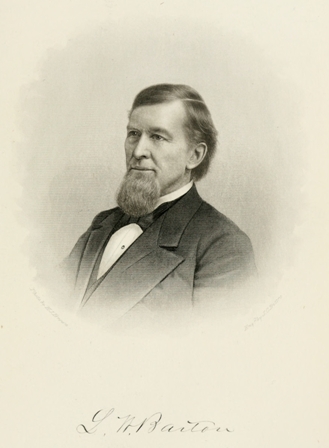
Levi W. Barton's parents were Bezaleel Barton, 2d, and Hannah (Powers)
Barton. Let us glance at the maternal ancestry.
The family of Power (or Le Poer, as formerly written) was of Norman
extraction, and settled in England at the conquest of that kingdom by
the Normans, under William, duke of Normandy, in the person of Power, or
Le Poer, who is recorded in "Battle Abbey" as one of the commanders at
the battle of Hastings, in 1066. Soon after, Sir John Le Poer resided in
Poershayse, Devonshire, England.
In 1172, one of his descendants, Sir Roger Le Poer, went with Earl
Stougbon in his invasion and partial conquest of Ireland, where he
greatly distinguished himself, and received large grants of land. He was
the ancestor of a succession of distinguished men, among whom were Sir
Nicholas Le Poer, who had a summons to parliament, in 1375, as Baron Le
Poer, and Sir Richard, Sir Peter, Sir Eustace, and Sir Arnold Le Poer.
The barony, descending by writ to heirs, female as well as male, is now
held by the Marquis of Waterford. The Earl of Lynn, for a term of one
hundred years, and the Marquis of Waterford, were of that descent,
through Lady Catharine Poer. The family was also a distinguished one in
England, from the Norman conquest down. In 1187, Richard Poer of this
line, high sheriff of Gloucestershire, Eng., was killed defending the
"Lord's Day;" and Sir Henry Le Poer distinguished himself greatly as a
commander under the Duke of Wellington. This remarkable family has
outlived the dynasties of the Conqueror, the Plantaganets, the Tudors,
and the Stuarts, and flourishes yet. Since the time of Queen Elizabeth,
they have returned to their early orthography of Power; and finally, in
America, have added the "s," making it Powers.
Walter Powers, the ancestor of all the Powers families of Croydon, N.
H., was born in 1639. He came to Salem, Mass., in 1654. He married,
January 11, 1660, Trial, daughter of Deacon Ralph Shepherd. They moved
to Nashoba, and he died there in 1708. The town, in 1715, was
incorporated by the name of Littleton (Mass.).
 L. W. Barton
Of the nine children of Walter and Trial Powers, the eldest, William,
was born in 1661, and married, 1688, Mary Bank.
Of the nine children of William and Mary (Bank) Powers, William, 2d, was
b. 1691, in Nashoba, and m., 1713, Lydia Perham.
Of the four children of William, 2d, and Lydia (Perham) Powers, Lemuel
was b. in 1714, and m. Thankful Leland, of Grafton, Mass., daughter of
Capt. James Leland. All except the eldest of their children settled in
Croydon. N. H.; and two of his sons served Croydon as soldiers in the
Revolution. Although not an "original grantee of Croydon," he owned
"proprietors' rights" at an early day, and often attended "proprietors'"
meetings at the inn of his brother-in-law, Lieut. Phinehas Leland, as
moderator. He died in Northbridge, Mass., 1792.
Of the ten children of Lieut. Lemuel and Thankful (Leland) Powers,
Ezekiel was b. in Grafton, Mass., March 16, 1745, and m., Jan. 28, 1767,
Hannah Hall of Uxbridge, Mass., who was daughter of Lieut. Edward and
Lydia (Brown) Hall. Levi W. Barton was her great-grandson. They came to
Croydon in 1767. He was a prominent citizen, and held here many offices
of trust. He was a man of industry and indomitable energy. He d. in
Croydon, Nov. 11, 1808. His widow d. Oct. 21, 1835.
Of the seven children of Ezekiel and Hannah (Hall) Powers, Ezekiel, 2d
(the first male child born in Croydon), was b. May 2, 1771. He m.
Susannah Rice, Jan. 18, 1790.
Of the six children of Ezekiel, 2d, and Susannah (Rice) Powers, Hannah
(mother of Levi W.) was b. Feb. 20, 1795, and m. Bezaleel Barton.
Edward Hall (the earliest ancestor of Lieut. Edward Hall, who settled in
Croydon about 1774) was at Duxbury, Mass., in 1637, and d. at Rehoboth,
Nov. 27, 1671. The direct line by generations is: 1st, Edward; 2d,
Benjamin; 3d, Edward; 4th, Lieut. Edward, b. in Wrentham, Mass., July
18, 1727; went with his father in 1740 to Uxbridge, where he held
commissions under the king of Great Britain. He m., Aug. 17, 1747, Lydia
Brown. About 1774 they came to Croydon, N. H., where he was moderator,
March, 1775, tax-collector and constable, 1778, and selectman, 1784,
1785, and 1786. He d. in Croydon, Dec. 28, 1807. His widow d. Aug. 10,
1819. 5th, Hannah, b. Oct. 1, 1749, who m. Ezekiel Powers and settled in
Croydon. At this point the Hall unites with the Powers genealogy, and
the last-named persons were great-grandparents of Levi W. Barton.
The Bartons are of English descent. Without undertaking to be precise as
to the details of kinship, we are able to identify the following as
among their earliest ancestry in New England. Marmaduke Barton was in
Salem, Mass., as early as 1638. Edward was in Salem in 1640. Rufus fled
from the persecution of the Dutch at Manhattan, N. Y., and settled in
Portsmouth, R. I., in 1640, and died 1648.
Mrs. Eliza Barton testified in an important case at Piscataqua, N. H.,
in 1656. Edward, undoubtedly the one living in Salem in 1640, and
husband of Eliza Barton, came to Exeter, N. H., in 1657, and died at
Cape Porpoise, Jan., 1671. Benjamin Barton of Warwick, son of Rufus
Barton, m., June 9, 1669, Susannah Everton. Edward Barton, son of Edward
of Exeter, took the freeman's oath in 1674. Doctor John Barton (probably
son of Doctor James Barton) m., April 20, 1676, Lydia Roberts of Salem,
Mass.
James Barton, b. in 1643, came to Boston, Mass., before 1670. He d. in
Weston, Mass., in 1729. Samuel Barton (probably son of Doctor James
Barton) was b. in 1666. He testified in a witch case (in favor of the
witch, be it said to his credit) in Salem, Mass., in 1691. Stephen
Barton was at Bristol (then in Mass.) in 1690. Col. William Barton, b.
in Providence, in 1747,—who with a small body of men crossed
Narragansett bay on the night of July 20, 1777, passed, unnoticed, three
British vessels, landed, reached the quarters of the English general,
Prescott, and captured him, and for which, history informs us, he
received from congress the gift of a sword, a commission as colonel, and
a tract of land in Vermont,—was a descendant of Samuel Barton and
Hannah his wife, ancestors of the Bartons of Croydon. They were living
in Framingham, Mass., as early as 1690, and moved to Oxford, Mass., in
1716, where his will was proved Sept. 23, 1738. Of their eight children,
Samuel was b. in Framingham, Oct. 8, 1691; and in., May 23, 1715,
Elizabeth Bellows.
Of the children of Samuel and Elizabeth (Bellows) Barton, Bezaleel was
b. July 20, 1722, and m., April 30, 1747, Phebe Carlton, a lady noted
for her beauty.
Of the children of Bezaleel and Phebe (Carlton) Barton, were Phebe (one
of whose grand-daughters was the wife of Dr. Judson), Bezaleel,
Benjamin, and Peter who was b. at Sutton. Mass., Sept. 3, 1763, and went
with his parents to Royalston. Mass., in 1764, where he m. Hepsibeth
Baker, Nov. 12, 1789. Bezaleel Barton and his sons, Bezaleel, Benjamin,
and Peter, served Royalston as soldiers in the Revolution. Bezaleel,
senior, was killed at the battle of Bunker Hill.
Peter and Hepsibeth (Baker) Barton came to Croydon, N. H., in 1793,
where he resided until 1824, when he removed to Sunapee, where he d.
Sept. 24, 1825. He was chosen selectman of Croydon from 1801 to 1805,
inclusive. He shared largely the confidence of the public, and was noted
for his strict integrity. Of his thirteen children born in Croydon,
Bezaleel, 2d, was b. July, 1794, and m. Hannah Powers, daughter of
Ezekiel Powers, at which point the Barton and Powers genealogies unite.
Of the children of Bezaleel Barton, 2d, and Hannah (Powers) Barton, Levi
Winter was b. March 1, 1818.
The father, a man of marked social qualities, and frank and genial in
his bearing, died before the son had reached his majority, and previous
to this business had taken the father from home, so that most of the
responsibilities of the family rested upon the mother. But it is no idle
pun upon her maiden name to say that she was a power in that
household. She exercised a healthful and unchallenged discipline. Her
intuitive vision saw every material necessity of the family; her
unsurpassed executive capacity was equal to every demand; and, what is
quite as essential to the formation of a symmetrical character, her
moral and religious precepts and example compelled a recognition of the
claims of God and man. The sick and the poor of her neighborhood were
often greatly indebted to her for the wisdom of her counsels, the
abundance of her alms-deeds, and the warmth of her sympathy. Universally
venerated and esteemed, she died in Croydon, Sept. 14, 1881, aged 86
years.
Inheriting the best qualities of such an ancestry, molded and inspired
by such a mother, and in boyhood acquiring his fiber in the severe but
practical school of tireless industry, rigid economy, and heroic
self-denial and self-reliance, we might anticipate for Mr. Barton a
character and a career which would place him among the best and foremost
citizens of his state, and entitle him to an important chapter in its
history. We hazard nothing when we say that he has made that
anticipation a reality, and that he has afforded us another conspicuous
example of what the humblest may achieve under the fostering genius of
republican institutions.
His district-school education, often interrupted by demands upon his
manual labor, consisted of ten brief winter terms. At eighteen he
assumed the responsibility of his own education and support. He had no
money, but he had what is better, courage and muscle. He went to work.
His books were always near by, so that, whenever there was a leisure
moment, "the horny hands of toil" would grasp and his hungry mind would
feast upon them. He would brook no discouragements. No hours were
allowed to run to waste. Often on rainy days he would call on his old
friend, John Cooper, Esq., to receive instruction. These efforts,
supplemented by a term under Dr. Miner of Boston, qualified him to teach
in the common schools. But for awile he devoted himself chiefly to
farming.
At twenty-one he married Miss Mary A. Pike, one of Newport's worthiest
young ladies. She died the next year, leaving an infant son, Col. Ira
McL. Barton, now deceased. The death of his wife was a severe blow to
one in whose nature the domestic element is so marked. With the light of
his home gone out, and with his life-plan destroyed, he seemed almost
paralyzed for a time. But the bent steel of his intense personality was
sure to react. The second year after this bereavement he entered Kimball
Union Academy, to pursue a classical course under that distinguished
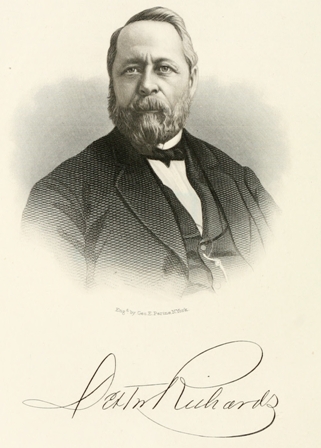
teacher, Dr. Cyrus Richards. Having but one hundred dollars when he
entered, he was compelled to teach winters and to toil with his hands
during the summer vacations; but his uncompromising zeal carried him
successfully through the three years' course. We cannot repress our
admiration for the young man whom neither bereavement nor poverty could
crush, but who, in spite of the most disheartening circumstances, earns
the right to stand in the front rank with his most brilliant
competitors. This he did.
In the same spirit, and still relying upon his own exertions for means,
he entered Dartmouth College in 1844, and honorably graduated in 1848.
His oration, on graduation, was highly commended by the public journals
of the day. At the commencement and close of the terms, he would make
the journeys to and from college, twenty-one miles, on foot. During his
senior year he studied law with Hon. Daniel Blaisdell of Hanover.
After graduating, Mr. Barton taught five terms in the Canaan Academy,
and at the same time was a law student with Judge Kittredge. During this
period he was appointed postmaster of Canaan. In the early part of 1851
he left Canaan, and completed his legal studies with Messrs. Metcalf &
Corbin of Newport, and was there admitted to the bar in the July
following. In 1854 he formed a law partnership with Hon. Ralph Metcalf,
which continued until Mr. Metcalf was elected governor. He then became
the law partner of Shepherd L. Bowers, Esq., with whom he was associated
until 1859. Notwithstanding his extensive law practice, Mr. Barton has
been engaged, to a considerable extent, in building, farming,
stock-raising, and fruit-growing. No man with equal means has
contributed more to the growth and permanent improvement of the village
of Newport. None Have done more by their own personal industry to
convert rough fields into attractive streets, luxuriant gardens, and
pleasant homes. Taught from childhood to cultivate the soil, he has, all
along through his busy life, found his highest enjoyment in turning
aside from the turmoil of professional labors to the more genial
occupation of agricultural pursuits.
As evidence of his superior legal abilities, and of the public esteem in
which he is held, we point to the following record: He was register of
deeds for Sullivan county from 1855 to 1857, inclusive; county solicitor
from 1859 to 1864; representative to the state legislature in 1863,
1864, 1875, 1876, and 1877; and state senator in 1867 and 1868. During
all these seven years of service in both houses, he was a member of the
judiciary committee, and for five years its chairman. In 1866 he was
chairman of the board of commissioners appointed to audit the war debt
of the state. In 1876 he was a member of the convention which revised
the state constitution; and was chosen Republican elector of president
and vice-president of the United States. Gov. Harriman appointed him
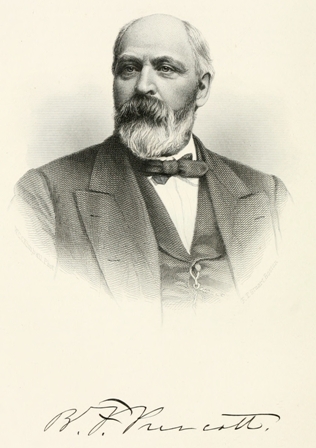
bank commissioner, but he declined the office. Gov. Prescott appointed
him, in 1877, one of the commissioners to revise and codify the statutes
of New Hampshire.
His many friends have fondly hoped to see him elected to congress. It is
conceded that his abilities and his fidelity to important public trusts
reveal his eminent fitness for such a position. But local divisions, for
which he is in no way responsible, have thus far prevented his
nomination. His name has come twice before the nominating conventions,
and each time with a very flattering vote.
When Mr. Barton commenced the practice of law in Newport, he found there
able rivals for the honors of the profession, whose reputations were
well established. I cannot better express the truth than to use the
language of a writer who, speaking of this period of his life, says:—
"The field seemed to be fully and ably occupied, but from the
outset his success was assured. It immediately became apparent
that he would bring to the discharge of the duties of his new
position the same energy and devotion to principle which had
hitherto characterized his actions. From that time to the
present, he has enjoyed the confidence of the public. As
counselor, he is cautious and careful, dissuading from, rather
than urging on, litigation. As an advocate, he is eloquent,
zealous, bold, and persistent. His faithfulness and devotion to
the interests of his clients have often been a subject of
remark."
Mr. Barton's legislative experience began in 1863, that intensely
feverish period of the rebellion. The Democratic party was represented
by its ablest orators and most skillful parliamentarians. They were
artful, bitter, and desperate. The majority could not afford to waste or
misapply its resources. Competent leadership was essential to the
utilization of the Republican strength. Fortunately this was found. It
came from the ranks of the "raw recruits." Wary and watchful, alert and
forcible, Mr. Barton promptly and successfully met the assaults of the
opposition, and sometimes "carried the war into Africa." The house soon
acknowledged his leadership,—a leadership which he maintained at the
subsequent sessions. The soldiers will never forget his fearless
advocacy of the measure allowing them to vote in the field. This cost
him his re-appointment as solicitor; but he was not the man to sacrifice
so sacred a principle for the loaves and fishes of office. In 1875 and
1876 he occupied the responsible position of chairman of the Republican
legislative caucus. In the sessions of 1876 and 1877, the Manchester
Mirror, Independent Stateman, and other papers spoke in the highest
terms of his service, giving him the credit of punctual attendance,
praiseworthy diligence, and of ably championing the best measures that
were enacted, and pointing him out as a probable candidate for the
national congress. His long and able legislative experience has never
been stained by political corruption, or by the betrayal of any moral
question. John Cooper, Esq., in the Granite Monthly of May, 1879, has
truthfully said: "Through all these years of political life he presents
a record without a blemish."
Mr. Barton is a man of well proportioned, commanding physique, and is
well preserved by temperate living and total abstinence from all
intoxicants and narcotics. He is also a man of fluent and agreeable
speech, of fine conversational powers, and is the inspiration of every
social circle which he enters. At home as well as abroad, in private as
well as in public life, he is the invariable advocate of every moral and
social reform. He is an honor to the Masonic fraternity, whose
principles he worthily represents. He is the warm and helpful friend of
the Methodist Episcopal church, to which he belongs; but he has an
unaffected contempt for all sectarian narrowness. His sense of justice
is intuitive, his sympathy quick, and in its exercise he regards neither
state nor condition. The destitute and forsaken always find in him a
true friend. From boyhood he has been an avowed and uncompromising
opposer of slavery, and of whatever oppresses the masses, whether white
or black. If he sometimes asserts and maintains his opinions with
earnestness and warmth, he never does so with malice. In the advocacy of
what he deems to be just, he is never turned aside by motives of
self-interest.
In 1852 he married Miss Lizzie F. Jewett, of Hollis,—a cultured,
christian lady. Her amiability, good sense, and force of character
render her every way worthy of her distinguished husband. Their "silver
wedding" was observed in 1877, and was honored by a large circle of
friends. Besides other tokens of appreciation bestowed at that time,
Hon. Edmund Burke presented, in behalf of the donors, an elegant silver
service.
Their children are Herbert J., Florence F., Natt L., and Jesse M. The
eldest son, Herbert J. Barton, was born September 27, 1853. He prepared
for college at Tilton, and graduated at Dartmouth in the class of 1876.
He has taught with great success in Providence, R. I., also for two
years as principal in the Newport high school, and, still later, as
principal in the high school of Waukegan, Ill. In 1881 he was admitted
to the bar of Illinois at Chicago, and is now associated in practice
with his father. He married, August 21, 1877, Miss Sarah L. Dodge,
daughter of Leander F. Dodge of Newport, a very intelligent and worthy
young lady. The son has many of the elements which have contributed to
the father's success, and we expect his native state will hear from him.
Florence F. graduated from the Newport high school in 1881, and is a
young lady of fine promise.
In conclusion we remark, Mr. Barton stands well at home. Conscious of
his personal integrity and of the worthiness of his aims, his well
earned honors clustering thickly upon him, beloved by his family and
community, and cheered by the favor of Providence, he may with great
propriety congratulate himself that he has not lived in vain. And as his
physical and intellectual forces seem not in the least abated, we may
fondly hope that his fellow-citizens may for many years to come enjoy
the benefits of his practical wisdom and patriotic devotion; and that
his posterity may as nobly sustain the name of Barton as he has the
names of those from whom he descended.