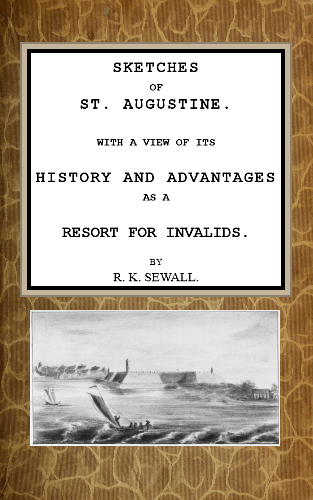
This city is by forty years the oldest town within the limits of the
United States of America. It was the offspring of the religious bigotry,
fanaticism, and jealousy, of a barbarous but heroic age.
On the 8th of September, 1565, at noonday, on the celebration of a
religious festival in honor of Mary, the virgin goddess of Papal homage
and superstitious reverence, a creature of the Spanish government, Pedro
Melendez by name, who had recently crossed from the old world, entered
this harbor, debarked, and taking formal possession of the country,
proclaimed Philip II king of North America, had the service of Mass
performed, and the foundations of the town immediately laid.
Pedro Melendez was a man of blood. His bigotry had been nourished, says
the historian, in the wars against the Protestants of Holland. He had
also acquired wealth and notoriety in the conquests of Spanish America.
But there he had been guilty of such excesses, and pursued a course of
such rapacity, that his conduct had provoked inquiry. It ended in his
arrest and conviction. The king confirmed sentence against him. To
recover the favor of his sovereign, retrieve his character, if not to
atone for his crimes, Melendez devised the scheme of conquering,
colonizing, and converting to the faith of Papacy, the Province of
Florida. He agreed also to import five hundred negro slaves.
In the meanwhile, a company of French Huguenots, in their flight from
the bloodhounds of persecution, let loose upon them from the
strong-holds of the Romish church, had found an asylum in the wilds of
America, and as they supposed, on the banks of the St. John’s River in
East Florida. Thither they had fled and planted their colony. Amid the
desert wilds and pestilential vapors of the morasses of Florida, they
fondly hoped to enjoy “freedom to worship God.”
Delusive hope! Where could a poor Protestant hide from the wrath of the
“great red Dragon,” breathing out fire and death to worry and destroy
the saints, if the dens and caves of the earth could afford him no
shelter in Europe?
Melendez, whose piety had been fed on the blood of Protestants till it
had become bloated with bigotry, smelling the scent of prey from afar,
“collected a force of more than twenty-five hundred persons:—soldiers,
sailors, priests, Jesuits, married men with their families, laborers and
mechanics.”[3] With this company he embarked, not merely to found, but
to root up and destroy a peaceful colony, solely because it was made up
of the followers of Calvin, and not of the Pope!
In traversing the Atlantic he encountered a storm. His ships were by it
scattered; so that only one third of the number he embarked with from
Spain reached the coast of Florida.
It was on a day consecrated to the memory of St. Augustine, a venerable
and pious father of the early ages of Christianity, that he came in
sight of the coast of Florida. Four days he sailed along this coast; and
on the fifth he landed, having discovered a fine haven and harbor.
Learning from the natives, the place where the French Huguenot colony
had established itself, and the position of Fort Caroline on the banks
of the St. John’s, and having named the harbor and haven here, where he
first set foot on shore, St. Augustine, Melendez immediately sailed
northward in quest of the infant Protestant community.
Landonnier had conducted the expedition which had sought the shores of
Florida, to find an asylum for the persecuted Protestants of France.
Under the patronage of Admiral Coligni, he had on the 30th of June, in
1564, settled the mouth of the River St. John’s with Protestant
refugees, and erected Fort Caroline. This place Ribaut had reached on a
return voyage from France, a few days prior to the appearance of
Melendez. Melendez purposed to seize by treachery the French shipping,
which, however, by suddenly running to sea, eluded his grasp, and was
soon after wrecked; being driven by a storm on the coast below, while
menacing this place.
The appearance of the Spanish fleet foreboded evil. The circumstances
excited the fears of the Protestant colonists. They inquired the name
and objects of the Spanish commander. To the deputation he answered: “I
am Melendez of Spain, sent with orders from my king to gibbet and behead
all the Protestants in this region. Frenchmen who are Catholics I will
spare—every heretic shall die!”
Thus did he announce his mission to be one of blood with unblushing
boldness. Melendez now returned to this place, to prepare for, and put
it effectually into execution. Here his forces were collected, his plans
laid: and from the newly laid foundations of this—the first town within
the United States of America—even while they were wet in the holy water
of the Mother Church—armed with the blessing of her priesthood,
Melendez led a chosen band to the execution of his bloody mission. He
marched through the wilderness with eight days’ provisions, and reached
the forests and hammocks on the banks of the St. John’s near to Fort
Caroline, where the Protestant colony reposed, unconscious of the evil
impending. He now prepared himself and his followers for their work of
human butchery, “by kneeling and praying for success.”[4] All was
silence, save the calm voice of nature, whose soft whispers were wafted
through the branches of the gray old trees and sturdy oaks, that stood
round about and cast their protecting shade over the heads of a peaceful
colony. These, perhaps, sighed at what they saw, and against which they
could not warn. From prayers Melendez rose up to the slaughter. The
blood of the mother and of her innocent babe mingled in the same pool!
Helpless woman and decrepit age bowed together in death and violence!
The citizen and the soldier met the same fate! A scene of carnage and of
cruelty was enacted, unparalleled in the annals of human butchery!
Some eighty-six persons, whose only crime was their Calvinism, fell
victims to the barbarity of a savage Popish bigot. But few escaped. Of
these, such as were afterwards taken were hung on the limbs of the next
tree, where their bodies became food to hungry birds of prey; and to
mark the spot, Melendez erected a monument of stone, on which he
engraved, in extenuation of his crime, “Not as Frenchmen, but as
heretics.”[5]
Having executed his avowed mission of death to Protestantism in Florida,
he retraced his steps to the place where he had laid out his new town,
the work of the erection of which he was prepared to complete on the
foundations he had now consecrated with hands reeking in Protestant
blood, as well as with holy water. Here “Melendez was hailed as a
conqueror by a procession of priests and people who went out to meet
him.” “Te Deum was solemnly chanted!”[6]
But the sacrifice offered could not satiate the thirst for blood which
inflamed the desires of this persecutor, whose life had been steeped in
atrocities. Perhaps he felt that a life of crime such as his, could have
its guilt washed out only in the blood of poor innocents, who presumed
to avow their purpose to worship God according to the dictates of their
own consciences. The taste of Protestant blood he had just sipped seemed
but to quicken his appetite.
“Angry,” says Bancroft, “that any should have escaped, the Spaniards
insulted the corpses of the dead with wanton barbarity;” and having
celebrated mass, and reared a cross on the spot, and chosen for the site
of a church the ground still smoking with the blood of a peaceful
colony, Melendez went in pursuit of the shipwrecked fugitives, who were
now the only survivors of the French Protestant settlement in East
Florida. They had been cast upon the sands south of this city. In their
wandering along the beach, they had reached the inlet of the Matanzas.
Here they were found, a company of famished and forlorn men. To secure
the destruction of these men more effectually, the cowardly assassin,
Melendez, first contrived to obtain their confidence in his humanity, a
virtue of which this creature in human shape was utterly incapable.
They surrendered by capitulation, though a few, suspicious of treachery,
distrusted the integrity of Melendez, and fled into the interior. The
major part being secured, the captives, in successive bands, were
ferried over the river and received among the Spaniards. On reaching the
opposite shore, each man’s hands were pinioned behind him; and thus,
like sheep to the slaughter, they were driven toward St. Augustine. But,
as the company approached the fort, “a signal was made.”[7] Thereupon,
the man in whose perfidious honor and humanity they had
confided—(acting, it may be fairly presumed, on the principle that no
faith was to be kept with heretics—a principle worthy of the Romish
church, and which had been baptized and sanctified in oceans of
Protestant blood)—this man, I say, amid a flourish of trumpets and
drums, cut the throats of the whole company, not as “Frenchmen, but as
heretics.”[8]
Though the government of France looked on this thrilling scene of
horror, in the destruction of her own peaceful subjects, unmoved, yet,
adds the historian, “history has been more faithful, and has assisted
humanity by giving to the crime of Melendez an infamous notoriety.”
The site of the Huguenot colony was named Fort Caroline. De Gourgas was
a Roman Catholic and a Frenchman. He had been distinguished in public
life, but had retired to the enjoyment of his repose, when, on learning
the barbarous atrocities with which his countrymen on the St. John’s had
been sacrificed to Spanish bigotry, he emerged from private life—again
buckled on his armor for vengeance. At his own risk, he got up and
fitted out an expedition. He sailed from France, with a chosen band of
followers, to avenge the blood of his slaughtered countrymen. Between
the years 1569 and ’74 he reached the coast of Florida—debarked his
forces at the mouth of the St. John’s—carried several outworks—and
finally inclosed the Fort, now occupied by a Spanish colony. He entered
it, and the first sight that greeted his eyes, was the horrible vision
of the skeleton forms of his murdered countrymen, their bones and sinews
dangling from the limbs of the surrounding trees. Here too was the stone
set up by Melendez, with its inscription. The bones and relics of the
slaughtered Huguenots De Gourgas ordered to be buried. He then fell upon
the Spaniards. Hardly one escaped; and their bodies he ordered to be
hung in the places where those of his countrymen had been before
suspended, and underneath De Gourgas wrote this inscription—“Not as
Spaniards, but as murderers.” He immediately returned to France.
Thus the light of Protestantism, which had been first kindled by the
fugitive Huguenots of France on the coast of Florida, in the southern
extreme of these United States, was put out in the blood of those, who,
as pioneers, were the torch-bearers of religious liberty, which was not
to be again rekindled until it shot up from Puritan altars, and burst
forth in the frozen north, where it was cherished and protected by
chilling snows and frosts in those wintry wilds, till it had acquired
force and intensity sufficient to spread its beams over the whole land.
Such is the connection of this city and its founders, in its early
history, with the early Protestant institutions of the republic! It can
hardly be credible to an American citizen, that there is within the
bounds of these United States a nook or corner so dark and
blood-stained!
Melendez, for twelve years, presided over the destinies of this town,
directing his attention mainly to the subjection, and conversion to
papal superstitions, of the aboriginal inhabitants, aided by the
Franciscans, an order of monks. Their missions were established
throughout the interior. An ancient monkish retreat, occupying the
present site of the United States Barracks, was the head-quarters of the
order in this city. A number of the missionaries, while on their passage
from Cuba to this place, were wrecked on the bar at the entrance of this
harbor, and in full view of their convent, and, with the crew of the
vessel, were drowned.
Some twenty-one years had elapsed since the founding of this city and
the massacre of the neighboring Protestant colony, when Drake, as he
coasted along the shore, discovered the “Look-out,” a tower on the
adjacent island. This led him to suspect a settlement inland. He ordered
his boats to be lowered and manned, to make a reconnoisance on the
shore. He landed on an island. In the exploration he perceived, across
the water, a town built of wood. Soon after, a French fifer deserted
from the Spanish forces—crossed the lagoon in a canoe, playing an
English air, the march of the Prince of Orange. This circumstance
recommended him to the favor of the English admiral—for Drake now
sailed as an admiral of the royal navy. The Frenchman described his
situation to be that of a captive. He probably told also of the recent
massacre, and described its horrors; and was himself, undoubtedly, one
of the fugitives from that scene, who had been spared for some reason.
Elizabeth of England was a Protestant queen; Drake, her representative,
was a Protestant in his sympathies. Moreover, Spain and England were on
terms of hostility at this time. His marine force was disembarked, under
the command of Carlisle, his subordinate; the intervening sound was
crossed; and, notwithstanding the greatest caution had been observed in
all these movements, the reconnoitering officer was discovered by the
Spaniards. A cannon was fired, and thereupon they all fled to town. This
took place at an outpost. This work was immediately taken possession of
by the reconnoitering party under Carlisle. It was a fort built of
timber, mounting fourteen pieces of brass cannon. Drake then plundered
the garrison of a chest of silver, and next day marched for the town. As
he approached, he encountered the Spaniards. An action commenced; but at
the first fire of the invading force, the Spaniards fled, and the
inhabitants evacuated the town, which fell into the hands of Drake, who
burnt and plundered it; and then sailed for England, where he arrived in
July of the same year, 1586.[9]
Twenty-five years[10] passed away before any other tragedy was enacted
within the precinct of this then new city. But vengeance did not slumber
long. The natives of Florida—a brave, warlike, and cruel, as well as
numerous band of savage men—assaulted, captured, and burned the city to
ashes. The details of this terrific scene of savage barbarity, and the
immediate causes thereof, we have not at hand.
1665. In a quarter of a century more, Davis, the Bucanier, discovered
this Spanish retreat. He entered on a piratical expedition against it;
invested it with an armed band of freebooters; captured, and plundered
it. The circumstances of this movement, the details of the attack and
plunder of the town, are not to be found.
The Florida archipelago, and the neighboring keys and islands of the
West Indian seas, have been the resort of freebooters from an early
period. The security they afforded, as a place of retreat from
discovery, gave these points great eminence, as the centre of operations
for a large, bold, and ruthless band of sea-rovers. Their piratical
expeditions swarmed over the adjacent waters, and desolated the
neighboring coasts of the Gulf of Mexico and the Spanish West Indies.
This brotherhood of outlaws were termed Bucaniers. They hailed from
France, England, and Holland. They led a life of plunder; and reduced
piracy to a profession, regulated by its own laws and customs, which had
all the force of martial law among themselves.
The existence of these desperate men as a class was owing to the
exclusive and arbitrary measures of the Spanish government, through
which, they endeavored to secure and maintain the exclusive control of
the commercial resources of the New World.
In war, the Bucaniers preyed on commerce as commissioned privateers; in
peace, they resorted to hunting wild cattle, and contraband trade
against the Spanish. Finally, they entered upon a course of open piracy
and plunder. They are said to have originated on this wise. Soon after
the Spanish conquests on the Main had secured the fertile plains of
Mexico and extended over it the Spanish power, the island of Cuba was
nearly depopulated by a tide of emigration setting into the newly
acquired territory. The emigrants left their cattle behind. These, in
course of time, multiplied prodigiously. The hills and valleys of the
island of Cuba were at length covered with herds of wild cattle; and it
was soon found profitable to hunt them for their hides and tallow alone.
The first who engaged in this business were French. The distinctive term
applied to these men, had its origin in their customs. Bucanier is
supposed to be a derivative of the Carib word “boucan,” by which the
Indians designated flesh prepared for food by its being smoked and dried
slowly in the sun. The hunters prepared the flesh of the slaughtered
cattle for food in this way. From this circumstance, the term “Bucanier”
was first applied to the hunters; and subsequently, it was used to
designate all such as followed a contraband trade, or were engaged in a
predatory life upon the sea or shore.
The Bucaniers, at first, made the island of Tortuga their head-quarters.
But the settlement being obnoxious to the Spaniards, they seized the
first opportunity to destroy it. This dispersed the company, who sought
other places of refuge; and from thence they worried the Spanish
settlements, actuated by motives of revenge. Several places and Spanish
towns were compelled to submit to the degradation of purchasing the
forbearance of the Bucaniers, by paying them contributions, equivalent
to black-mail levied by the banditti of Scotland.
Being driven from their original retreat on the island of Tortuga, the
Bucaniers retired to the Keys. No doubt the inlets and islands of the
southern peninsula of Florida attracted their bands. Not only the towns
and settlements on the Spanish islands and on the Main became objects of
plunder, but the commerce of every nation also.
It is not till within a few years, that the remnants of this desperate
class of men, who have long infested the waters in the neighborhood of
the West India islands, have been driven from their haunts, and hunted
down, by the American Navy. The Bucanier was terrible in his appearance,
as well as in his profession.
His dress consisted of a shirt dipped in the blood of cattle—trousers
prepared in the same manner—buskins without stockings—a cap with a
small front, and a leathern girdle, into which were stuck around his
body, knives, sabres and pistols. Such was the filthy and terrific garb
of the Bucanier in full costume.
Such was Davis, who laid this city under contribution some eighty years
after it was founded by Melendez. At this period, the Bucaniers seem to
have regarded the whole Spanish race as their natural enemies, and their
commerce and their cities as lawful objects of plunder.
At the close of the seventeenth and in the beginning of the eighteen
century, the English settlements of Carolina had acquired permanency and
importance. But Spain had proclaimed her exclusive right to American
possessions. By a permit from the Roman Pontiff, she had already seized
and subdued a greater part of the New World, and left the prints of her
bloody hand upon the rights and treasures of the aboriginal inhabitants.
In the face of the civilized world, Spain, then one of the richest and
most powerful states on earth, having asserted a claim to and planted
her foot upon the soil of North America, how could she forego the
exclusive control of the same? How could she endure the presence, or
divide the occupancy of the soil with a rival state? She had already
acquired the proud title in her sovereign, of “Defender of the Faith,”
for the ardor and fidelity with which she supported the arrogant
pretensions of the See of Rome, having given her strength to the
extension of its interests, even to the prostitution of her civil power
to ecclesiastical domination. How then could Spain consent that the
Protestant religion should gain a foothold in North America? Had she not
already extinguished it on the coasts of Florida? Were not the English
colonies still in their infancy, as well as within the reach of her
arms? It required but a single well directed stroke, and the Anglo-Saxon
race and the hated Protestant faith would perish together.
We have glanced at the barbarous scenes with which Spain opened her
schemes of colonization in North America. The same malign purposes and
bigoted spirit moved all her subsequent counsels, and hung like a dark
and portentous cloud over the future peace and prosperity of her border
settlements.
In her efforts to make good her pretensions, a series of petty
jealousies and strife between the English and Spanish races ensued.
Distrust and jealousy were fostered. These feelings led to mutual
hostile demonstrations. Mutual depredations were perpetrated; and thus
the seeds of open war were sown. The struggle was maintained till
English blood and the Protestant faith acquired permanent ascendency in
the Floridas.
The Spaniards and Indians, stimulated by the bigoted and rapacious
spirit of the mother country, perpetrated acts of wanton barbarity on
the colonial settlements of Carolina and Georgia. Provoked to
retaliation by these depredations, Governor Moore, A. D. 1702, projected
an invasion of Florida, by the forces of South Carolina. In the month of
September, with an army of twelve hundred men, he embarked on an
expedition for the reduction of St. Augustine, which was esteemed the
centre of the predatory operations against the English settlers.
Col. Daniel was ordered to scour the country inland, and penetrate to
the city by the route of the St. John’s River. An officer of
distinguished military skill and enterprise, Col. Daniel, with great
promptitude and success, marched through the country, captured and
plundered the city, and shut its inhabitants up within the walls of
their Castle. Such was the position of affairs when Gov. Moore reached
the scene of his military operations before St. Augustine. A regular
siege was advised. The Fort was invested. But the artillery of the
besieging army was too light, and no impression could be made on the
fortified works.
Col. Daniel was despatched to procure guns of a larger caliber and more
effective powers. In the meanwhile, a Spanish naval armament made its
appearance off the coast. Governor Moore, in a panic, appalled at this
demonstration, raised the siege, abandoned his ships and stores, and
fled back to Carolina by the nearest inland route.
The original causes of disquietude were in nowise removed or abated.
They became, indeed, more and more active and aggravated, till they
ripened into further hostile demonstrations.
The Spanish charged the English with intrusion. The grounds of complaint
were mutual.
The English, on the other hand, charged the Spaniards with enticing away
their colored servants, and with exciting the Indians to murder and
depopulate their frontier towns. The Spanish governor not only justified
himself in these things, but immediately fitted out an expedition from
Augustine and marched into Georgia, laying waste the country, sparing
neither age nor sex.
These provocations occurred twenty years after Gov. Moore had invaded
the Floridas.
The tribe of the Yamasee Indians had been made the tools of Spanish
barbarity in their recent hostile operations against the English
colonies of Georgia and Carolina.
The intrepid Col. Palmer immediately raised a force of militia and
friendly Indians, with which he marched into Florida to retaliate the
injuries of his countrymen. He pushed at once to the very gates of the
city, laying waste nearly every settlement. The citizens fled and
entrenched themselves within the city fortifications, leaving the poor
natives, their allies, to the mercy of the invaders; and the power of
the Yamasee tribe was broken under the walls of the city, being nearly
all killed or made prisoners by the English.
All was destroyed but what lay within range and protection of the guns
of the Fort.
The Georgians, in their fury, seized on the Papal Church of “Nostra
Seniora de Lache,” plundering and burning it to the ground, from which
they took the gold and silver ornaments for booty, and also an image
baby, which they found in the arms of the image of a woman, the Virgin
Mary, with which the church was adorned.
This place of worship occupied a position a little without the city
gates. The point of land back from the old steam mill is alleged to have
been its site, the ruins of which, it is alleged, are still to be found
there.
Palmer, with his Georgians, having taken ample vengeance, and being
unable to reduce the city without heavier ordnance than he then had at
command, gathered all the booty within his reach, which was
considerable, and retired to Georgia, leaving the Spaniards to obtain
satisfaction as best they could.
During the next fifteen years, no considerable overt act of hostility
was perpetrated, though the spirit and embers of war still glowed in the
hearts of the border colonists. The Georgians were still plundered of
their property. Their negroes were enticed and spirited away into the
wilds of Florida; and this was justified by the Governor of St.
Augustine, on the pretence that the Spaniards “were bound in conscience
to draw to themselves as many negroes as they could, in order to convert
them to the faith of the Roman Catholic Church.” Moreover, “a plot was
discovered, which contemplated the utter extinction of the English
settlements. A German Jesuit—one Christian Priben—a resident among the
Cherokees, was the master spirit in this conspiracy. He was taken by the
English traders. Upon his person was found his private journal,
revealing his design to bring about a confederation of all the southern
Indians, and to effect a new social and civil organization. He had noted
his expectations of assistance in the execution of his original design
from the French, and from another nation, whose name was left a blank.
Among his papers were found letters for the Florida and Spanish
governors, demanding their protection and countenance. Also, there were
found among his papers the plan and regulations for a new town.
Many rights and privileges were enumerated, marriage was abolished, a
community of women and all kinds of licentiousness were to be allowed.
In addition, the Spaniards had just made an abortive attempt to
dispossess the Georgian colonists of Amelia Island.
At this juncture, Oglethorp appeared on the stage of action. He had been
recently appointed to the office of governor of the colony.
The salvation of the English settlements required prompt and vigorous
measures.
Oglethorp solicited and secured the co-operation of South Carolina, in a
combined effort to insure the safety of the English settlement.
The invasion of Florida, and the reduction of St. Augustine, as the nest
where were hatched the broils and perils of a border serife, and from
whence swarmed the savage hordes which overran and devastated the land,
were determined upon.
South Carolina promptly responded to the call of Oglethorp. Carolina
raised a regiment of five hundred men, and equipped one vessel of war,
carrying ten carriage guns and sixteen swivels, with a crew of fifty
men. Two hundred men enlisted as a volunteer force. In addition,
Oglethorp had his own regiment of five hundred men, two troops of
Highland and English rangers, and two companies of Highland and English
foot.”[11] His plan was to take the city by surprise. This however
failed.
With a select force, he entered East Florida, invested and reduced Fort
Diego, situated some twenty-five miles north of St. Augustine. Having
left here a garrison force, and completed his arrangements, he marched
direct for St. Augustine and occupied Fort Mosa. This work he destroyed;
and then advanced to reconnoitre the city. The result of the
reconnoisance was disheartening. The town was strongly fortified. The
Spanish force within the intrenched city and castle, amounted to seven
hundred regulars, two troops of horse, with armed negroes, militia, and
Indians.[12]
At the outset an oversight had been committed, in neglecting to blockade
the harbor, on account of which, supplies were thrown into the city, and
additional means of resistance. Oglethorp, however, soon afterward
enforced a blockade. The ships were moored across the entrance of the
bar; and lines of investment were drawn around the town on the land.
Col. Palmer, with a company of Highlanders and a small force of Indians,
occupied the old Fort Mosa, with orders to scour the country. A small
battery was planted on Point Quartele; while Oglethorp with his own
regiment erected and occupied field works on the northern extremity of
Anastatia Island, opposite the Castle. The ruins of these works are
marked by a clump of shrubbery and a slight elevation on the point.
The arrangements being perfected, a bombardment of the town and Castle
was attempted. Oglethorp opened his batteries with a hot fire of shell
and shot, a great number of which were thrown into the town. The fire
was returned with spirit from the Castle, and from galleys in the
harbor; but the distance was too great for either party to do much
execution. The shallow water of the bar prevented any co-operation of
the English naval force with that of the land. The fire of the besieging
army at length abated. A counsel of war was held. In the meanwhile a
sortie was made by the besieged; and Col. Palmer, with his entire force,
were surprised in sleep, and all cut off at Fort Mosa, except a few who
escaped by a small boat, and crossed to Point Quartele, where the
Carolina regiment was stationed. The Indian allies soon grew impatient,
and left in disgust. The blockade of the inlet at Matanzas was raised,
and provisions and other supplies were thrown into the town, through
this approach to the city. The English troops became enfeebled by
disease, dispirited, and filled with discontent, and many deserted. The
naval force became short of provisions, and the hurricane season was at
hand. Oglethorp was taken down with fever, and the flux raged among his
troops. The siege was thereupon raised, and the army withdrawn into
Georgia. Thus the expedition became abortive, though the face and angles
of the Castle, fronting the harbor, bear the mark of Oglethorp’s storm
of shot and shells to this day.
A counter invasion of Georgia was projected from this city, two years
after. But though the preparations were made on a scale of unusual
magnitude, and the expedition was well supported by competent naval
power, the Spaniards were whipped and frightened off from the
settlements of Georgia. They related, on their return, as an excuse for
their disgraceful and cowardly behavior, that, “the deep morasses and
thickets were so lined with wild Indians and fierce Highlanders, that
the devil could not penetrate to the strong-holds of the Georgians.”
Retaliation was, of course, the natural result. The very next year,
Oglethorp again visited Augustine, captured a fort in the vicinage of
the city; but being frustrated in some of his plans, retired again to
his province, without further molestation to the enemy. These
hostilities and differences continued to distract this city, till A.D.
1763, when the peace of Paris gave the Floridas into possession of the
government of Great Britain. For the twenty years that Florida remained
in possession of Great Britain, great improvements were made,
flourishing settlements begun; and the prosperity which industry and
skill insure began to show itself on every side. In 1784, the Floridas
were retroceded to Spain. The Anglo-Saxon race forsook their fields and
villages, and retired under the shield of British law and the Protestant
faith.
Says the historian, “A military government succeeded, together with a
sparse population, who barely subsisted on their pay, who neglected
improvements,—who suffered their gardens and fields to grow up with
weeds, their fences and houses to rot down, or be burned for fuel.”
The Minorcan population, however, it is alleged, were an exception.
Their industry furnished fish and vegetables to the market. This is a
peculiar people, and they compose a large proportion of the population
of the city. The present race were of servile extraction. By the
duplicity and avarice of one Turnbull, they were seduced from their
homes in the Mediterranean—located at Smyrna—and forced to till the
lands of the proprietor, who had brought them into Florida for that
purpose. After enduring great privation, toil, and suffering, under the
most trying circumstances of a servile state, they revolted in a body,
reclaimed their rights, and maintained them under English law, by a
decision of the king’s court at Augustine, whither they had fled from
their oppressor, under the conduct of one of their number, a man by the
name of Palbicier. A location was assigned them in the north of this
city, which they occupy in the persons of their descendants to this day.
Their women are distinguished for their taste, neatness, and industry, a
peculiar light olive shade of complexion, and a dark, full eye. The
males are less favored, both by nature and habit. They lack enterprise.
Most of them are without education. Their canoes, fishing lines, and
hunting guns, are their main sources of subsistence. The rising
generation is, however, in a state of rapid transition. The spirit of
American institutions, and the reflex influence of an association with
Anglo-American society, are working an assimilating change in the whole
social structure of the native population of this city; the present
population of which is estimated at from 1800 to 2000 souls.
From the time of the retrocession of the Floridas, till the disturbances
growing out of the late war with England, there was a state of
comparative quiet in the border settlements. But ancient jealousies and
the seeds of former dissensions, differences of religion, and the
remembrance of past injuries, had not been altogether eradicated.
Moreover, the occupants of lands on the line between the American and
Spanish nations found those within the Spanish domain who strongly
sympathized with the free and liberal spirit of American institutions,
as seen in contrast with the despotic features of a military government
under the control of an intolerant and bigoted hierarchy.
A patriot war ensued.[13] A neutral territory was erected. Spanish
authority was rejected. Augustine was again invaded. But the American
government interposed, restored quiet, and immediately entered upon
negotiations with the king of Spain for the purchase of the Floridas.
These negotiations were at length crowned with success; and on the 17th
of June, 1821, the “stars and stripes” of the United States of America
floated from the Castle, and St. Augustine became an Anglo-American
town, under the government of the American general, Andrew Jackson.[14]
Protected by the shadow of the American eagle, for the first time, the
genius of the American institutions called together her sons and
daughters in the old Government House, for the exercise of a right which
had been watered with Protestant blood in the soil of Florida centuries
before—“freedom to worship God.” On Friday, the 11th of June, 1824,
was organized the Presbyterian church. Subsequently, the Protestant and
Methodist Episcopal churches were established. Thus Protestant influence
and institutions gained a firm foothold in the ancient Spanish capital
of East Florida.
It is related,[15] that immediately on the exchange of flags a strange
sight was seen in the city. A Methodist itinerant was observed, wending
his way from street to street and from house to house on a religious
mission, distributing Protestant religious books, and otherwise
intruding himself among the sons and daughters of the mother church.
The circumstance, so unusual, and the great presumption of the stranger,
of course alarmed the Romish ecclesiastical authority. The priest could
not brook such intrusion. He went in pursuit of the presumptuous man in
black, and when he had overtaken him, menaced him with the indignation
of his ghostly power if he did not at once desist.
The itinerant surveyed him for a moment in silence, as if measuring with
his eye the capacity of his power, and then, with the most imperturbable
coolness, and an impudent though significant movement of the eye,
pointed the wrathy shadow of the Pope to the “stars and stripes,” which
now proudly floated over the battlements of the Castle—when it
vanished, and left the Methodist minister to prosecute his favorite work
among the people as he listed.
This, undoubtedly, was the first time that prelacy had been taught a
lesson of forbearance here, or to consider the nature of the change
which had come over the scene of its former undisputed sway, and to
understand, that under the flag of the United States of America man was
protected in the enjoyment of his high prerogative—“freedom to worship
God.”
Prior to February, 1835, groves of the sweet orange had for many years,
and with great care, been brought into a thrifty and productive state.
Then St. Augustine was one immense orange orchard, and appeared, says an
eye-witness, “like a rustic village, with its white houses peeping from
among the clustered boughs and golden fruit of the favorite tree,
beneath whose shade the invalid cooled his fevered limbs and imbibed
health from the fragrant air.” Much attention was given to the rearing
of orange orchards, and large investments had been made in planting out
nurseries of fruit trees, which, indeed, could hardly supply the demand
for the young trees.
The season prior to February, 1835, was very productive. Some of the
orange groves paid from one to three thousand dollars. I have been
informed, that twelve years ago the income to the city was some $72,000
per annum. Mature, thrifty trees sometimes produced 6000 oranges; and
the average product per annum of a single tree was 500 oranges.
In the vigor and thrift of the orange business, the annual export of
oranges was between 2 and 3,000,000 per annum from this city.
The trade was brisk, and a source of revenue and profit to the place of
great value. In the orange season, the harbor was enlivened with a fleet
of fruit vessels, that thronged the city for the purchase and
transportation of oranges to the northern market.
But on the night of the fatal month of February, 1835, a frost cut down
the entire species of the orange tribe, some of the trees rivaling in
stature the sturdy forest oak. At one fell stroke, the labor and profit
of years of toil—the inheritance of many generations—the little all of
many families, were swept away! The resources of the city were dried up!
Many were hurled in a night from the seat of affluence, into the lap of
poverty and distress!
To this day, the city has not recovered from the blight of that dire
stroke. Shoots from the withered stocks of the old trees have indeed
sprung up, and been struggling for life ever since, but under the
pressure of disease; and all efforts to resuscitate the tree have been
rendered abortive by the ravages of insignificant animalculæ, which prey
on the life and vigor of the young shoots, and perpetuate the influence
of the frost of 1835.
There are important facts relative to these agricultural products and
resources of East Florida, which ought to be better understood by those,
who, on account of constitutional delicacy, consumptive habits, or other
causes, at the north, are disposed to seek other and more congenial
latitudes. On the east coast of South Florida the lands are productive,
and healthy in location. On the St. Lucie River and Sound, the banks are
high shell bluff, and exceedingly fertile for high lands. Though north
of the tropical latitude, yet the climate is so genial, that it
nourishes with luxuriance, in the open air, most of the fruits of
tropical climes. The cocoa, orange, lemon, lime, guava, citron,
pine-apple, banana, and other like products, together with the
semi-tropical fruits, the grape, fig, olive, &c., and garden vegetables,
the cabbage, potato, beet, onion, with various species of the melon
kind, grow with great luxuriance. Orange orchards, pine-apple fields,
banana and cocoa-nut groves, are now in process of cultivation by
settlers, many of whom are from the north, and have begun to clear their
lands within the last few years.
Industry and perseverance are the chief investments of capital required,
in order to reap ample remuneration. Northern men, with their own hands,
are now thus engaged. It is no longer an experiment. On the banks of the
Indian River and St. Lucie Sound fruiteries are being raised. Fruit
groves and cane fields are being planted, which will probably ere long
furnish for northern markets the delicious products of tropical climes,
in a more perfect condition and of better quality than can be elsewhere
found.
The lands of tropical Florida on the east coast, in the region of the
Indian River, appear to be of an older formation, and are on a higher
level above the sea, than those in this neighborhood. The landscape is
finer. The climate is more salubrious. Its attractions for those who
wish to make their own labor their capital, from which they shall be
enabled to draw a support for themselves and families, are great. The
orange, pine-apple, and sugar lands of South Florida are worthy more
attention from agriculturists, capitalists, and emigrants, than they
have received; and the day is not far distant, when their rich resources
will begin to be developed, and will excite interest.
 Bromelia Ananas.
PINE APPLE
Lith. of F. Michelin 111 Nassau St. N.Y.
The orange culture has been proved to be a source of great profit. It
will be again, whenever in this country groves can be reared. The
culture of the pine-apple will be found to be of equal worth with that
of the orange.
The pine is said to mature its fruit from the slips, when they are well
set out, in about eighteen months, and their stocks will continue to
bear for several years. One acre of land will produce some 40,000 pines,
and the sale of this fruit is made in market at say from ten to
eighteen dollars per hundred.
Moreover, the fruit from the pine plants of South Florida need not be
plucked till it has matured on its stock. It will therefore come into
market in a more mature condition, and of finer flavor than any that can
elsewhere be grown. It will bring the highest market prices; and the
fruit of this kind that has already been grown, by competent judges is
said to be of the best quality.
The lands which are adapted to this culture are, indeed, of limited
extent; but there are sufficient to supply the home market.
These facts, together with the salubrity of the fruit-growing region,
must ere long attract attention from the public. Thousands, in that mild
and equable climate, might there live and labor, and enjoy a ripe old
age, who must soon die, amid the vicissitudes of the climate in the
north.
Admitting that the pine-apple, on account of risks in transportation and
cost in getting to market, should be worth only about one-half the
market price in the field, yet an acre of thrifty, well cultivated
pines will yield from $1500 to $2000 per annum. At five cents each, the
product of an acre of pine-fruit would be $2000.
These calculations show the great value of the pine lands and other
fruit soil of Tropical Florida. These facts have but to be known, to be
understood and appreciated. They indicate the great resources of South
Florida, in the soil of its tropical fruit lands, which is a region of
country lying some forty miles south of Cape Carnavaral.