AT Roosendal, about an hour's railway journey
from Antwerp, the boundary between Belgium
and Holland is crossed, and a branch line diverges
to Breda.
Somehow, like most travellers, we could not help
expecting to see some marked change on reaching a
new country, and in Holland one could not repress the
expectation of beginning at once to see the pictures
of Teniers and Gerard Dou in real life. We were
certainly disappointed at first. Open heaths were
succeeded by woods of stunted firs, and then by fields
with thick hedges of beech or alder, till the towers of
Breda came in sight. Here a commonplace omnibus
took us to the comfortable inn of Zum Kroon, and
we were shown into bedrooms reached by an open
wooden staircase from the courtyard, and quickly joined
the table d'hôte, at which the magnates of the town
were seated with napkins well tucked up under their
chins, talking, with full mouths, in Dutch, of which to
our unaccustomed ears the words seemed all in one
string. Most excellent was the dinner—roast meat
and pears, quantities of delicious vegetables cooked
in different ways, piles of ripe mulberries and cake,
and across the little garden, with its statues and
bright flower-beds, we could see the red sails of the
barges going up and down the canals.
As soon as dinner was over, we sallied forth to see
the town, which impressed us more than any Dutch
city did afterwards, perhaps because it was the first
we saw. The winding streets—one of them ending in
a high windmill—are lined with houses wonderfully
varied in outline, and of every shade of delicate
colour, yellow, grey, or brown, though the windows
always have white frames and bars. Passing through
a low archway under one of the houses, we found
ourselves, when we least expected it, in the public
garden, a kind of wood where the trees have killed all
the grass, surrounded by canals, beyond one of which
is a great square château built by William III. of
England, encircled by the Merk, and enclosing an
arcaded court. There was an older château of 1350
at Breda, but we failed to find it.
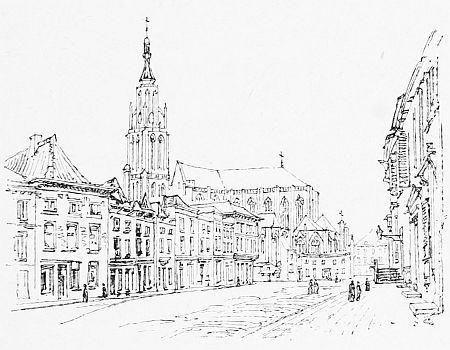
THE MARKET-PLACE AT BREDA.
In stately splendour, from the old houses of the
market-place, rises the noble Hervormde Kerk
(Protestant Church), with a lofty octagon tower, and
a most characteristic bulbous Dutch spire. Here, as
we wanted to see the interior, we first were puzzled
by our ignorance of Dutch, finding, as everywhere in
the smaller towns, that the natives knew no language
but their own. But two old women in high caps and
gold earrings observed our puzzledom from a window
and pointed to a man and a key—we nodded; the
man pointed to himself, a door, and a key—we
nodded; and we were soon inside the building. It
was our first introduction to Dutch Calvinism and
iconoclasm, and piteous indeed was it to see so
magnificent a church thickly covered with whitewash,
and the quantity of statues which it contains of
deceased Dukes and Duchesses of Nassau bereft of
their legs and petticoats. Only, in a grand side
chapel on the left of the choir, the noble tomb
of Engelbrecht II. of Nassau, general under the
Emperor Maximilian (1505), remains intact. The
guide lights matches to shine through the transparent
alabaster of the figures; that of the Duke represents
Death, that of the Duchess Sleep, as they lie beneath
a stone slab which bears the armour of Engelbrecht,
and is supported by figures of Cæsar, Hannibal,
Regulus, and Philip of Macedon; that of Cæsar is
sublime. The tomb of Sir Francis Vere in Westminster
Abbey is of the same design, and is supposed
to be copied from this famous monument. Outside
the chapel is the tomb of Engelbrecht V. of Nassau,
with all his family kneeling, in quaint headdresses.
The other sights of the church are the brass font in
the Baptistery, and a noble brass in the choir of
William de Gaellen, Dean of the Chapter, 1539. It
will be observed that here, and almost everywhere else
in Holland, the names of saints which used to be
attached to the churches have disappeared; the
buildings are generally known as the old church, or
new church, or great church.
After a delicious breakfast of coffee and thick cream, with rusks,
scones, and different kinds of cheese, always an indispensable in Dutch
breakfasts, we took to the railway again and crossed Zealand, which
chiefly consists of four islands, Noordt Beveland, Zuid Beveland,
Schouwen, and Walcheren, and is less visited by the rest of the
Netherlanders than any other part of the country. The land is all
cut up into vast polders, as the huge meadows are called, which are
recovered from the sea and protected by embankments. Here, if human
care was withdrawn for six months, the whole country would be under the
sea again. A corps of engineers called 'waterstaat' are continually
employed to watch the waters, and to keep in constant repair the dykes,
which are formed of clay at the bottom, as that is more waterproof
than anything else, and thatched with willows, which are here grown
extensively for the purpose. If the sea passes a dyke, ruin is
imminent, an alarm bell rings, and the whole population rush to the
rescue. The moment one dyke is even menaced, the people begin to build
another inside it, and then rely upon the double defence, whilst they
fortify the old one. But all their care has not preserved the islands
of Zealand. Three centuries ago, Schouwen was entirely submerged, and
every living creature was drowned. Soon after, Noordt Beveland was
submerged, and remained for several years entirely under water, only
the points of the church spires being visible. Zuid Beveland had been
submerged in the fourteenth century. Walcheren was submerged as late as
1808, and Tholen even in 1825. It has been aptly asserted that the sea
to the inhabitants of Holland is what Vesuvius is to Torre del Greco.
How well its French name of Pays-Bas suits the country! De Amicis says
that the Dutch have three enemies—the sea, the lakes, and the rivers;
they repel the sea, they dry the lakes, and they imprison the rivers;
but with the sea it is a combat which never ceases.
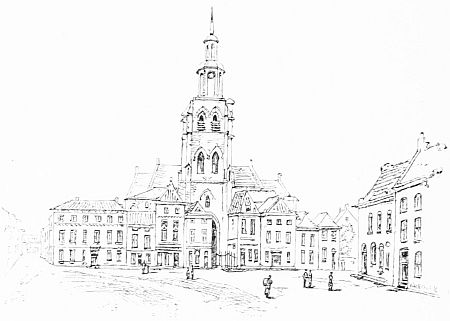
BERGEN-OP-ZOOM.
The story of the famous siege of 1749 made us
linger at Bergen-op-Zoom, a clean, dull little town
with bright white houses surrounding an irregular
market-place, and surmounted by the heavy tower of
the Church of S. Gertrude. In the Stadhuis is a fine
carved stone chimney-piece; but there is little worth
seeing, and we were soon speeding across the rich
pastures of Zuid Beveland, and passing its capital of
Goes, prettily situated amongst cherry orchards, the
beautiful cruciform church with a low central spire
rising above the trees on its ramparts. Every now
and then the train seems scarcely out of the water,
which covers a vast surface of the pink-green flats,
and recalls the description in Hudibras of—
A country that draws fifty feet of water,
In which men live as in the hold of nature,
And when the sea does in upon them break,
And drown a province, does but spring a leak.
The peasant women at the stations are a perpetual
amusement, for there is far more costume here than
in most parts of Holland, and peculiar square handsome
gold ornaments, something like closed golden books,
are universally worn on each side of the face.
So, crossing a broad salt canal into the island of
Walcheren, we reached Middleburg, a handsome town
which was covered with water to the house tops when
the island was submerged. It was the birthplace of
Zach Janssen and Hans Lipperhey, the inventors of
the telescope, c.1610. In the market-place is a most
beautiful Gothic townhall, built by the architect
Keldermans, early in the sixteenth century. We
asked a well dressed boy how we could get into it,
and he, without further troubling himself, pointed the
way with his finger. The building contains a quaint
old hall called the Vierschaar, and a so-called museum,
but there is little enough to see. As we came out
the boy met us. 'You must give me something:
I pointed out the entrance of the Stadhuis to you.'
In Holland we have always found that no one, rich
or poor, does a kindness or even a civility for
nothing!
The crowd in the market-place was so great that
it was impossible to sketch the Stadhuis as we should
have wished, but the people themselves were delightfully
picturesque. The women entirely conceal their hair
under their white caps, but have golden corkscrews
sticking out on either side the face, like weapons of
defence, from which the golden slabs we have observed
before were pendant. The Nieuwe Kerk is of little
interest, though it contains the tomb of William of
Holland, who was elected Emperor of Germany in 1250,
and we wandered on through the quiet streets, till
a Gothic arch in an ancient wall looked tempting.
Passing through it we found ourselves in the enclosure
of the old abbey, shaded by a grove of trees, and
surrounded by ancient buildings, part of which are
appropriated as the Hotel Abdij, where we arrived
utterly famished, and found a table d'hôte at 2.30 P.M.
unspeakably reviving.
Any one who sees Holland thoroughly ought also
to visit Zieriksee, the capital of the island of Schouwen;
but the water locomotion thither is so difficult and
tedious that we preferred keeping to the railways,
which took us back in the dark over the country we
had already traversed, and a little more, to Dortrecht,
where there is a convenient tramway to take travellers
from the station into the town. Here, at the Hôtel
de Fries, we found comfortable bedrooms, with boarded
floors and box-beds like those in Northumbrian cottages,
and we had supper in the public room, separated
into two parts by a daïs for strangers, whence we
looked down into the humbler division, which recalled
many homely scenes of Ostade and Teniers in its
painted wooden ceiling, its bright, polished furniture,
its cat and dog and quantity of birds and flowers, its
groups of boors at round tables drinking out of
tankards, and the landlady and her daughter in their
gleaming gold ornaments, sitting knitting, with the
waiter standing behind them amusing himself by the
general conversation.
Our morning at Dortrecht was very delightful, and
it is a thoroughly charming place. Passing under a
dark archway in a picturesque building of Charles V.
opposite the hotel, we found ourselves at once on the
edge of an immense expanse of shimmering river,
with long rich polders beyond, between which the
wide flood breaks into three different branches. Red
and white sails flit down them. Here and there rise
a line of pollard willows or clipped elms, and now and
then a church spire. On the nearest shore an ancient
windmill, coloured in delicate tints of grey and yellow,
surmounts a group of white buildings. On the left is
a broad esplanade of brick, lined with ancient houses,
and a canal with a bridge, the long arms of which are
ready to open at a touch and give a passage to the
great yellow-masted barges, which are already half
intercepting the bright red house-fronts ornamented
with stone, which belong to some public buildings
facing the end of the canal. With what a confusion
of merchandise are the boats laden, and how gay is
the colouring, between the old weedy posts to which
they are moored!
It was from hence that Isabella of France, with
Sir John de Hainault and many other faithful knights,
set out on their expedition against Edward II. and
the government of the Spencers.
From the busy port, where nevertheless they are
dredging, we cross another bridge and find ourselves
in a quietude like that of a cathedral close in England.
On one side is a wide pool half covered with floating
timber, and, in the other half, reflecting like a mirror
the houses on the opposite shore, with their bright
gardens of lilies and hollyhocks, and trees of mountain
ash, which bend their masses of scarlet berries to the
still water. Between the houses are glints of blue
river and of inevitable windmills on the opposite shore.
And all this we observe standing in the shadow
of a huge church, the Groote Kerk, with a nave
of the fourteenth century, and a choir of the fifteenth,
and a gigantic brick tower, in which three long Gothic
arches, between octagonal tourelles, enclose several
tiers of windows. At the top is a great clock, and
below the church a grove of elms, through which
fitful sunlight falls on the grass and the dead red of
the brick pavement (so grateful to feet sore with the
sharp stones of other Dutch cities), where groups of
fishermen are collecting in their blue shirts and white
trousers.
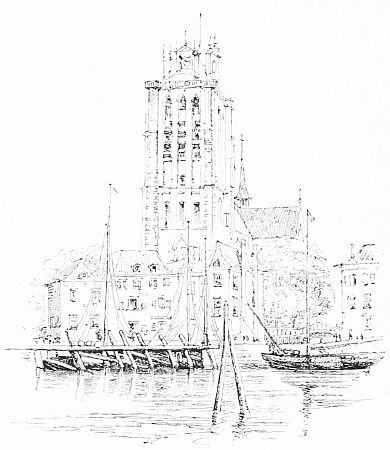
GROOTE KERK, DORTRECHT.
There is little to see inside this or any other
church in Holland; travellers will rather seek for the
memorials, at the Kloveniers Doelen, of the famous
Synod of Dort, which was held 1618-19, in the hope
of effecting a compromise between the Gomarists, or
disciples of Calvin, and the Arminians who followed
Zwingli, and who had recently obtained the name of
Remonstrants from the 'remonstrance' which they
had addressed eight years before in defence of their
doctrines. The Calvinists held that the greater part
of mankind was excluded from grace, which the
Arminians denied; but at the Synod of Dort the
Calvinists proclaimed themselves as infallible as the
Pope, and their resolutions became the law of the
Dutch reformed Church. The Arminians were forthwith
outlawed; a hundred ministers who refused to
subscribe to the dictates of the Synod were banished;
Hugo Grotius and Rombout Hoogerbeets were imprisoned
for life at Loevestein; the body of the
secretary Ledenberg, who committed suicide in prison,
was hung; and Van Olden Barneveldt, the friend of
William the Silent, was beheaded in his seventy-second
year.
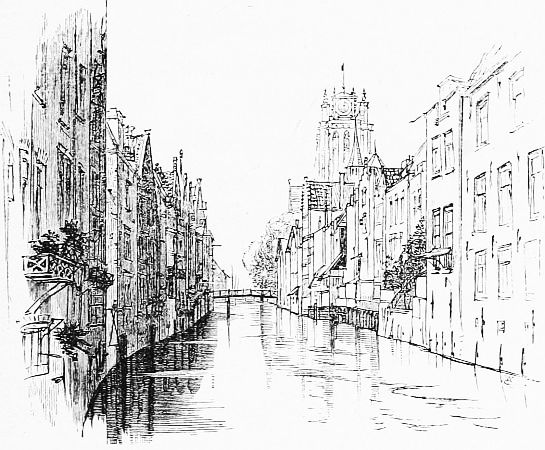
CANAL AT DORTRECHT.
There is nothing in the quiet streets of Dortrecht
to remind one that it was once one of the most
important commercial cities of Holland, taking
precedence even of Rotterdam, Delft, Leyden, and
Amsterdam. It also possessed a privilege called the
Staple of Dort, by which all the carriers on the Maas
and Rhine were forced to unload their merchandise
here, and pay all duties imposed, only using the boats
or porters of the place in their work, and so bringing
a great revenue to the town.
More than those in any of the other towns of
Holland do the little water streets of Dortrecht recall
Venice, the houses rising abruptly from the canals;
only the luminous atmosphere and the shimmering
water changing colour like a chameleon, are wanting.
Through the street of wine—Wijnstraat—built
over storehouses used for the staple, we went to
the Museum to see the pictures. There were two
schools of Dortrecht. Jacob Geritse Cuyp (1575),
Albert Cuyp (1605), Ferdinand Bol (1611), Nicolas
Maas (1632), and Schalken (1643) belonged to the
former; Arend de Gelder, Arnold Houbraken, Dirk
Stoop, and Ary Scheffer are of the latter. Sunshine
and glow were the characteristics of the first school,
greyness and sobriety of the second. But there are
few good pictures at Dort now, and some of the best
works of Cuyp are to be found in our National
Gallery, executed at his native place and portraying
the great brick tower of the church in the golden
haze of evening, seen across rich pastures, where the
cows are lying deep in the meadow grass. The works
of Ary Scheffer are now the most interesting pictures
in the Dortrecht Gallery. Of the subject 'Christus
Consolator' there are two representations. In the
more striking of these the pale Christ is seated
amongst the sick, sorrowful, blind, maimed, and enslaved,
who are all stretching out their hands to Him.
Beneath is the tomb which the artist executed for his
mother, Cornelia Scheffer, whose touching figure is
represented lying with outstretched hands, in the
utmost abandonment of repose.
An excursion should be made from Dortrecht to
the castle of Loevestein on the Rhine, where Grotius,
imprisoned in 1619, was concealed by his wife in the
chest which brought in his books and linen. It was
conveyed safely out of the castle by her courageous
maid Elsje van Houwening, and was taken at first to
the house of Jacob Daatselaer, a supposed friend of
Grotius, who refused to render any assistance. But
his wife consented to open the chest, and the philosopher,
disguised as a mason, escaped to Brabant.
It is much best to visit Rotterdam as an excursion
from Dortrecht. We thought it the most odious
place we ever were in—immense, filthy, and not very
picturesque. Its handsomest feature is the vast quay
called the Boompjes, on the Maas. Here and there a
great windmill reminds you unmistakably of where
you are, and the land streets are intersected everywhere
by water streets, the carriages being constantly
stopped to let ships pass through the bridges. In the
Groote Markt stands a bronze statue of Desiderius
Erasmus—'Vir saeculi sui primarius, et civis omnium
praestantissimus,' which is the work of Hendrik de
Keyser (1662), and in the Wijde Kerkstraat is the
house where he was born, inscribed 'Haec est parva
domus, magnus qua natus Erasmus, 1467,' but it is
now a tavern. The great church of S. Lawrence—Groote
Kerk—built in 1477-87, contains the tombs of
a number of Dutch admirals, and has a grand pavement
of monumental slabs, but is otherwise frightful.
The portion used for service is said to be 'so conveniently
constructed that the zealous Christians of
Rotterdam prefer sleeping through a sermon there,
to any other church in the city.' Part of the rest is
used as a cart-house, the largest chapel is a commodious
carpenter's shop, and the aisles round the part
which is still a church, where there has been an
attempt at restoration in painting the roof yellow and
putting up some hideous yellow seats, are a playground
for the children of the town, who are freely admitted
in their perambulators, though for strangers there is a
separate fee for each part of the edifice they enter.
We went to see the pictures in the Museum bequeathed
to the town by Jacob Otto Boyman, but did
not admire them much. It takes time to accustom
one's mind to Dutch art, and the endless representations
of family life, with domestic furniture, pots and
pans, &c., or of the simple local landscapes—clipped
avenues, sandy roads, dykes, and cottages, or even of
the cows, and pigs, and poultry, which seem wonderfully
executed, but, where one has too much of the
originals, scarcely worth the immense amount of time
and labour bestowed upon them. The calm seas of
Van de Welde and Van der Capelle only afford a certain
amount of relief. The scenes of village life are
seldom pleasing, often coarse, and never have anything
elevating to offer or ennobling to recall. We thought
that the real charm of the Dutch school to outsiders
consists in the immense power and variety of its
portraits.
Hating Rotterdam, we thankfully felt ourselves
speeding over the flat, rich lands to Gouda, where
we found an agricultural fête going on, banners
half way down the houses, and a triumphal arch as
the entrance to the square, formed of spades, rakes,
and forks, with a plough at the top, and decorated
with corn, potatoes, turnips, and carrots, and cornucopias
pouring out flowers at the sides. In the
square—a great cheese market, for the Gouda cheese
is esteemed the best in Holland—is a Gothic Stadhuis,
and beyond it, the Groote Kerk of 1552, of which
the bare interior is enlivened by the stained windows
executed by Wonter and Dirk Crabeth in 1555-57.
We were the better able to understand the design of
these noble windows because the cartoon for each
was spread upon the pavement in front of it; but one
could not help one's attention being unpleasantly distracted
by the number of men of the burgher class,
smoking and with their hats on, who were allowed to
use the church as a promenade. Gouda also made an
unpleasant impression upon us, because, expensive
as we found every hotel in Holland, we were nowhere
so outrageously cheated as here.
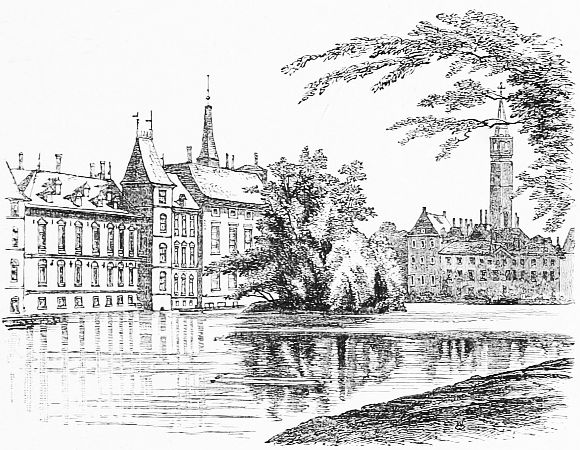
THE VIJVER.
It is a brief journey to the Hague—La Haye,
Gravenhage—most delightful of little capitals, with its
comfortable hotels and pleasant surroundings. The
town is still so small that it seems to merit the name
of 'the largest village in Europe,' which was given to
it because the jealousy of other towns prevented its
having any vote in the States General till the time of
Louis Bonaparte, who gave it the privileges of a city.
It is said that the Hague, more than any other place,
may recall what Versailles was just before the great
revolution. It has thoroughly the aspect of a little
royal city. Without any of the crowd and bustle
of Amsterdam and Rotterdam, it is not dead like the
smaller towns of Holland; indeed, it even seems to
have a quiet gaiety, without dissipation, of its own.
All around are parks and gardens, whence wide streets
lead speedily through the new town of the rich bourgeoisie
to the old central town of stadholders, where
a beautiful lake, the Vijver, or fish-pond, comes as a
surprise, with the eccentric old palace of the Binnenhof
rising straight out of its waters. We had been
told it was picturesque, but were prepared for nothing
so charming as the variety of steep roofs and towers,
the clear reflections, the tufted islet, and the beautiful
colouring of the whole scene of the Vijver. Skirting
the lake, we entered the precincts of the palace through
the picturesque Gudevangen Poort, where Cornelius
de Witte, Burgomaster of Dort, was imprisoned in
1672, on a false accusation of having suborned the
surgeon William Tichelaur to murder the Prince of
Orange. He was dragged out hence and torn to
pieces by the people, together with his brother Jean
de Witte, Grand Pensioner, whose house remains hard
by in the Kneuterdijk.
The court of the Binnenhof is exceedingly handsome,
and contains the ancient Gothic Hall of the
Knights, where Johann van Olden Barneveld, Grand
Pensioner, or Prime Minister, was condemned to death
'for having conspired to dismember the States of the
Netherlands, and greatly troubled God's Church,' and
in the front of which (May 24, 1619) he was beheaded.
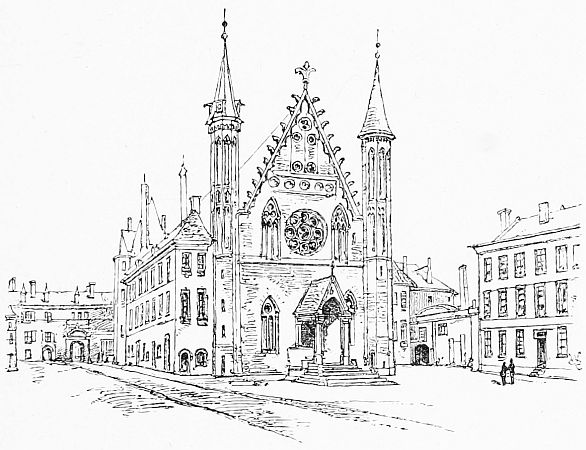
HALL OF THE KNIGHTS, THE HAGUE.
Close to the north-east gate of the Binnenhof is
the handsome house called Mauritshuis, containing
the inestimable Picture Gallery of the Hague, which
will bear many visits, and has the great charm of not
being huge beyond the powers of endurance. On the
ground floor are chiefly portraits, amongst which a
simple dignified priest by Philippe de Champaigne,
with a far-away expression, will certainly arrest attention.
Deeply interesting is the portrait by Ravesteyn
of William the Silent, in his ruff and steel armour
embossed with gold—a deeply lined face, with a slight
peaked beard. His widow, Louise de Coligny, is also
represented. There is a fine portrait by Schalcken
of our William the Third. Noble likenesses of Sir
George Sheffield and his wife Anna Wake, by Vandyke,
are a pleasing contrast to the many works of
Rubens. There are deeply interesting portraits by
Albert Dürer and Holbein.
On the first floor we must sit down before the
great picture which Rembrandt painted in his twenty-sixth
year (1632) of the School of Anatomy. Here
the shrewd professor, Nicholaus Tulp, with a face
brimming with knowledge and intelligence, is expounding
the anatomy of a corpse to a number of
members of the guild of surgeons, some of whom are
full of eager interest and inquiry, whilst others are inattentive:
the dead figure is greatly foreshortened
and not repulsive. In another room, a fine work of
Thomas de Keyser represents the Four Burgomasters
of Amsterdam hearing of the arrival of Marie de
Medicis. A beautiful work of Adrian van Ostade is
full of light and character—but only represents a
stolid boor drinking to the health of a fiddler, while
a child plays with a dog in the background.
A group of admirers will always be found round
'the Immortal Bull' of Paul Potter, which was considered
the fourth picture in importance in the Louvre,
when the spoils of Europe were collected at Paris.
De Amicis says, 'It lives, it breathes; with his bull
Paul Potter has written the true Idyl of Holland.'
It is, however—being really a group of cattle—not a
pleasing, though a life-like picture. Much more
attractive is the exquisite 'Presentation' of Rembrandt
(1631), in which Joseph and Mary, simple peasants,
present the Holy Child to Simeon, a glorious old
man in a jewelled robe, who invokes a blessing upon
the infant, while other priests look on with interest.
A wonderful ray of light, falling upon the principal
group, illuminates the whole temple. Perhaps the
most beautiful work in the whole gallery is the Young
Housekeeper of Gerard Dou. A lovely young woman
sits at work by an open window looking into a street.
By her side is the baby asleep in its cradle, over which
the maid is leaning. The light falls on the chandelier
and all the household belongings of a well-to-do citizen:
in all there is the same marvellous finish; it is said
that the handle of the broom took three days to paint.
There is not much to discover in the streets of the
Hague. In the great square called the Plein is the
statue of William the Silent, with his finger raised,
erected in 1848 'by the grateful people to the father
of their fatherland.' In the fish-market, tame storks
are kept, for the same reason that bears are kept at
Berne, because storks are the arms of the town. But
the chief attraction of the place lies in its lovely
walks amid the noble beeches and oaks of the Bosch,
beyond which on the left is Huis ten Bosch, the Petit
Trianon of the Hague, the favourite palace of Queen
Sophie, who held her literary court and died there.
It is a quiet country house, looking out upon flats, with
dykes and a windmill. All travellers seem to visit it,—which
must be a ceaseless surprise to the extortionate
custode to whom they have to pay a gulden a head,
and who will hurry them rapidly through some commonplace
rooms in which there is nothing really worth
seeing. One room is covered with paintings of the
Rubens school, amid which, high in the dome, is a
portrait of the Princess Amalia of Solms, who built
the house in 1647.
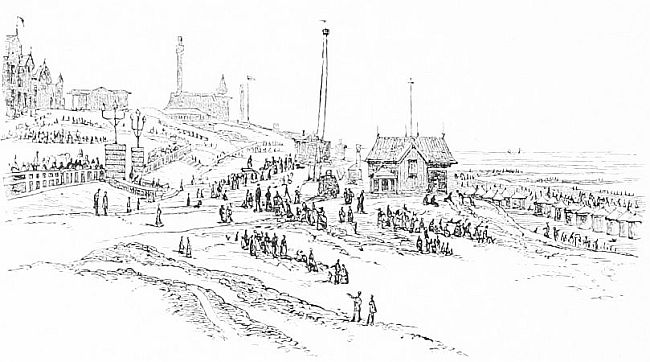
SCHEVENINGEN.
A tram takes people for twopence halfpenny to
Scheveningen through the park, a thick wood with
charming forest scenery. As the trees become more
scattered, the roar of the North Sea is heard upon the
shore. Above the sands, on the dunes or sand-hills,
which extend from the Helder to Dunkirk, is a broad
terrace, lined on one side by a row of wooden pavilions
with flags and porticoes, and below it are long
lines of tents, necessary in the intense glare, while,
nearer the waves, are thousands of beehive-like
refuges, with a single figure seated in each. The flat
monotonous shore would soon pall upon one, yet
through the whole summer it is an extraordinary lively
scene. The placid happiness of Dutch family life has
here taken possession. On Sunday afternoons,
especially, the sands seem as crowded with human
existence as they are represented in the picture of
Lingelbach, which we have seen in the Mauritshuis,
portraying the vast multitude assembled here to witness
the embarkation of Charles II. for England.
An excursion must be made to Delft, only twenty
minutes distant from the Hague by rail. Pepys calls
it 'a most sweet town, with bridges and a river in
every street,' and that is a tolerably accurate description.
It seems thinly inhabited, and the Dutch themselves
look upon it as a place where one will die of
ennui. It has scarcely changed with two hundred
years. The view of Delft by Van der Meer in the
Museum at the Hague might have been painted
yesterday. All the trees are clipped, for in artificial
Holland every work of Nature is artificialised. At
certain seasons, numbers of storks may be seen upon
the chimney-tops, for Delft is supposed to be the stork
town par excellence. Near the shady canal Oude Delft
is a low building, once the Convent of S. Agata, with
an ornamented door surmounted by a relief, leading
into a courtyard. It is a common barrack now, for
Holland, which has no local histories, has no regard
whatever for its historic associations or monuments.
Yet this is the greatest shrine of Dutch history, for it
is here that William the Silent died.
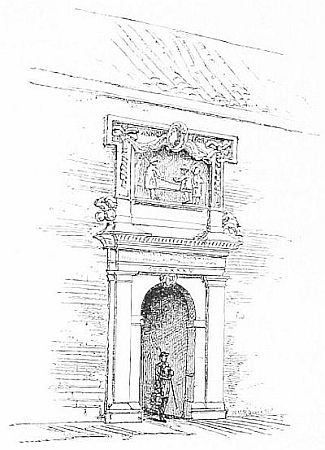
ENTRANCE TO S. AGATA, DELFT.
Philip II. had promised 25,000 crowns of gold to
any one who would murder the Prince of Orange.
An attempt had already been made, but had failed,
and William refused to take any measures for self-protection,
saying, 'It is useless: my years are in
the hands of God: if there is a wretch who has no
fear of death, my life is in his hand, however I may
guard it.' At length, a young man of seven-and-twenty
appeared at Delft, who gave himself out to be
one Guyon, a Protestant, son of Pierre Guyon, executed
at Besançon for having embraced Calvinism,
and declared that he was exiled for his religion.
Really he was Balthazar Gerard, a bigoted Catholic,
but his conduct in Holland soon procured him the
reputation of an evangelical saint. The Prince took
him into his service and sent him to accompany a
mission from the States of Holland to the Court of
France, whence he returned to bring the news of the
death of the Duke of Anjou to William. At that
time the Prince was living with his court in the convent
of S. Agata, where he received Balthazar alone
in his chamber. The moment was opportune, but the
would-be assassin had no arms ready. William gave
him a small sum of money and bade him hold himself
in readiness to be sent back to France. With
the money Balthazar bought two pistols from a soldier
(who afterwards killed himself when he heard the use
which was made of the purchase). On the next day,
June 10, 1584, Balthazar returned to the convent as
William was descending the staircase to dinner, with
his fourth wife, Louise de Coligny (daughter of the
Admiral who fell in the massacre of S. Bartholomew),
on his arm. He presented his passport and begged
the Prince to sign it, but was told to return later. At
dinner the Princess asked William who was the young
man who had spoken to him, for his expression was
the most terrible she had ever seen. The Prince
laughed, said it was Guyon, and was as gay as usual.
Dinner being over, the family party were about to remount
the staircase. The assassin was waiting in a
dark corner at the foot of the stairs, and as William
passed he discharged a pistol with three balls and
fled. The Prince staggered, saying, 'I am wounded;
God have mercy upon me and my poor people.' His
sister Catherine van Schwartzbourg asked, 'Do you
trust in Jesus Christ?' He said, 'Yes,' with a feeble
voice, sat down upon the stairs, and died.
Balthazar reached the rampart of the town in
safety, hoping to swim to the other side of the moat,
where a horse awaited him. But he had dropped his
hat and his second pistol in his flight, and so he was
traced and seized before he could leap from the wall.
Amid horrible tortures, he not only confessed, but
continued to triumph in his crime. His judges believed
him to be possessed of the devil. The next
day he was executed. His right hand was burnt off
in a tube of red-hot iron: the flesh of his arms and
legs was torn off with red-hot pincers; but he never
made a cry. It was not till his breast was cut open,
and his heart torn out and flung in his face, that he
expired. His head was then fixed on a pike, and his
body cut into four quarters, exposed on the four gates
of the town.
Close to the Prinsenhof is the Oude Kerk with a
leaning tower. It is arranged like a very ugly theatre
inside, but contains, with other tombs of celebrities,
the monument of Admiral van Tromp, 1650—'Martinus
Harberti Trompius'—whose effigy lies upon his
back, with swollen feet. It was this Van Tromp who
defeated the English fleet under Blake, and perished,
as represented on the monument, in an engagement
off Scheveningen. It was he who, after his victory
over the English, caused a broom to be hoisted at his
mast-head to typify that he had swept the Channel
clear of his enemies.
The Nieuwe Kerk in the Groote Markt (1412-76)
contains the magnificent monument of William the
Silent by Hendrik de Keyser and A. Quellin (1621).
Black marble columns support a white canopy over
the white sleeping figure of the Prince, who is represented
in his little black silk cap, as he is familiar
to us in his pictures. In the recesses of the tomb—'somptueux
et tourmenté,' as Montégut calls it—are
statues of Liberty, Justice, Prudence, and Religion.
At the feet of William lies his favourite dog, which
saved his life from midnight assassins at Malines,
by awakening him. At the head of the tomb is
another figure of William, of bronze, seated. In the
same church is a monument to Hugo Grotius—'prodigium
Europae'—the greatest lawyer of the seventeenth
century, presented to Henri IV. by Barneveld
as 'La merveille de la Hollande.'
On leaving the Hague a few hours should be
given to the dull university town of Leyden, unless it
has been seen as an afternoon excursion from the
capital. This melancholy and mildewed little town,
mouldering from a century of stagnation, the birthplace
of Rembrandt, surrounds the central tower of
its Burg—standing in the grounds of an inn, which
exacts payment from those who visit it. Close by is
the huge church of S. Pancras—Houglansche Kerk—of
the fifteenth century, containing the tomb of Van
der Werff, burgomaster during the famous siege, who
answered the starving people, when they came demanding
bread or surrender, that he had 'sworn to defend the
city, and, with God's help, he meant to keep his oath,
but that if his body would help them to prolong the
defence, they might take it and share it amongst those
who were most hungry.' A covered bridge over a
canal leads to the Bredenstrasse, where there is a
picturesque grey stone Stadhuis of the sixteenth
century. It contains the principal work of Cornelius
Engelbrechtsen of Leyden (1468-1533), one of the
earliest of Dutch painters—an altarpiece representing
the Crucifixion, with the Sacrifice of Abraham and
Worship of the Brazen Serpent in the side panels,
as symbols of the Atonement: on the pedestal is
a naked body, out of which springs a tree—the
tree of life—and beside it kneel the donors. The
neighbouring church of S. Peter (1315) contains
the tomb of Boerhaave, the physician, whose lectures
in the University were attended by Peter the Great,
and for whom a Chinese mandarin found 'à l'illustre
M. Boerhaave, médecin, en Europe,' quite sufficient
direction. Boerhaave was the doctor who said that
the poor were his best patients, for God paid for
them.
The streets are grass-grown, the houses damp, the
canals green with weed. The University has fallen
into decadence since others were established at
Utrecht, Groningen, and Amsterdam; but Leyden is
still the most flourishing of the four. When William
of Orange offered the citizens freedom from taxes, as
a reward for their endurance of the famous siege, they
thanked him, but said they would rather have a university.
Grotius and Cartesius (Descartes), Arminius
and Gomar, were amongst its professors, and the
University possesses an admirable botanical museum
and a famous collection of Japanese curiosities.
The Rhine cuts up the town of Leyden into endless
islands, connected by a hundred and fifty bridges.
On a quiet canal near the Beesten Markt is the
Museum, which contains the 'Last Judgment' of
Lucas van Leyden (1494-1533), a scholar of Engelbrechtsen,
and one of the patriarchs of Dutch
painting.
A few minutes bring us from Leyden to Haarlem
by the railway. It crosses an isthmus between the
sea and a lake which covered the whole country
between Leyden, Haarlem, and Amsterdam till 1839,
when it became troublesome, and the States-General
forthwith, after the fashion of Holland, voted its
destruction. Enormous engines were at once employed
to drain it by pumping the water into canals,
which carried it to the sea, and the country was the
richer by a new province.
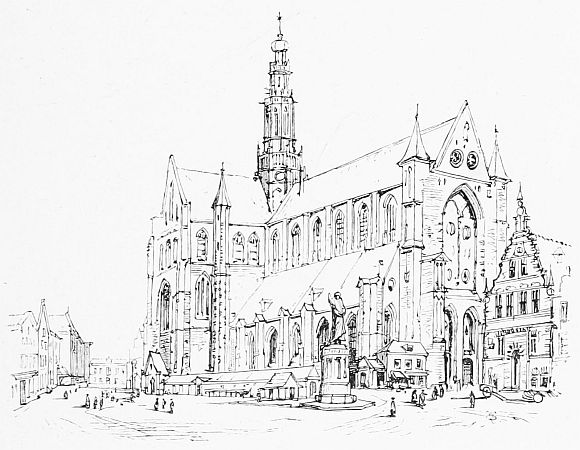
MARKET-PLACE, HAARLEM.
Haarlem, on the river Spaarne, stands out distinct
in recollection from all other Dutch towns, for it has
the most picturesque market-place in Holland—the
Groote Markt—surrounded by quaint houses of
varied outline, amidst which rises the Groote Kerk
of S. Bavo, a noble cruciform fifteenth-century
building. The interior, however, is as bare and
hideous as all other Dutch churches. It contains a
monument to the architect Conrad, designer of the
famous locks of Katwijk, 'the defender of Holland
against the fury of the sea and the power of
tempests.' Behind the choir is the tomb of the poet
Bilderdijk, who only died in 1831, and near this the
grave of Laurenz Janzoom—the Coster or Sacristan—who
is asserted in his native town, but never believed
outside it, to have been the real inventor of
printing, as he is said to have cut out letters in wood,
and taken impressions from them in ink, as early as
1423. His partisans also maintain that whilst he
was attending a midnight mass, praying for patience
to endure the ill-treatment of his enemies, all his
implements were stolen, and that when he found
this out on his return he died of grief. It is further
declared that the robber was Faust of Mayence, the
brother of Gutenberg, and that it was thus that the
honour of the invention passed from Holland to
Germany, where Gutenberg produced his invention
of movable type twelve years later. There is a
statue of the Coster in front of the church, and, on
its north side, his house is preserved and adorned
with his bust.
Amongst a crowd of natives with their hats on,
talking in church as in the market-place, we waited
to hear the famous organ of Christian Muller
(1735-38), and grievously were we disappointed with
its discordant noises. All the men smoked in
church, and this we saw repeatedly; but it would
be difficult to say where we ever saw a Dutchman
with a pipe out of his mouth. Every man seemed
to be systematically smoking away the few wits he
possessed.
Opposite the Groote Kerk is the Stadhuis, an old
palace of the Counts of Holland remodelled. It
contains a delightful little gallery of the works of
Franz Hals, which at once transports the spectator
into the Holland of two hundred years ago—such is
the marvellous variety of life and vigour impressed
into its endless figures of stalwart officers and handsome
young archers pledging each other at banquet
tables and seeming to welcome the visitor with jovial
smiles as he enters the chamber, or of serene old
ladies, 'regents' of hospitals, seated at their council
boards. The immense power of the artist is shown
in nothing so much as in the hands, often gloved,
dashed in with instantaneous power, yet always
having the effect of the most consummate finish at a
distance. Behind one of the pictures is the entrance
to the famous 'secret-room of Haarlem,' seldom seen,
but containing an inestimable collection of historic
relics of the time of the famous siege of Leyden.
April and May are the best months for visiting
Haarlem, which is the bulb nursery garden of the
world. 'Oignons à fleurs' are advertised for sale
everywhere. Tulips are more cultivated than any
other flowers, as ministering most to the national
craving for colour; but times are changed since a
single bulb of the tulip 'L'Amiral Liefkenshoch'
sold for 4,500 florins, one of 'Viceroy' for 4,200,
and one of 'Semper Augustus' for 13,000.
Now we entered Amsterdam, to which we had
looked forward as the climax of our tour, having
read of it and pondered upon it as 'the Venice of
the north;' but our expectations were raised much
too high. Anything more unlike Venice it would
be difficult to imagine: and there is a terrible want
of variety and colour; many of the smaller towns of
Holland are far more interesting and infinitely more
picturesque.
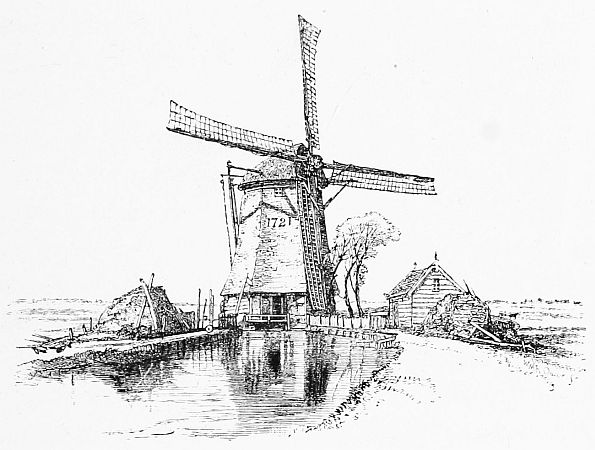
MILL NEAR AMSTERDAM.
A castle was built at Amsterdam in 1204, but
the town only became important in the sixteenth
century, since which it has been the most commercial
of ancient European cities. It is situated upon the
influx of the Amstel to the Y, as the arm of the
Zuider Zee which forms the harbour is called, and it
occupies a huge semicircle, its walls being enclosed
by the broad moat, six and a half miles long, which
is known as Buitensingel. The greater part of the
houses are built on piles, causing Erasmus to say
that the inhabitants lived on trees like rooks. In
the centre of the town is the great square called
Dam, one side of which is occupied by the handsome
Royal Palace—Het Palais—built by J. van Kampen
in 1648. The Nieuwe Kerk (1408-1470) contains a
number of monuments to admirals, including those of
Van Ruiter—'immensi tremor oceani'—who commanded
at the battle of Solbay, and Van Speyk,
who blew himself up with his ship in 1831, rather
than yield to the Belgians. In the Oude Kerk of
1300 there are more tombs of admirals. Hard by,
in the Nieuwe Markt, is the picturesque cluster of
fifteenth-century towers called S. Anthonieswaag,
once a city gate and now a weighing-house.
But the great attraction of Amsterdam is the
Picture Gallery of the Trippenhuis, called the Rijks
Museum, and it deserves many visits. Amongst the
portraits in the first room we were especially attracted
by that of William the Silent in his skull-cap, by
Miereveld, but all the House of Orange are represented
here from the first to the last. We also see
all the worthies of the nation—Ruyter, Van Tromp
and his wife, Grotius and his wife, Johann and
Cornelis de Witt, Johann van Oldenharneveldt, and
his wife Maria of Utrecht, a peaceful old lady in a
ruff and brown dress edged with fur, by Moreelse.
The two great pictures of the gallery hang opposite
each other. That by Bartholomew van der Helst,
the most famous of Dutch portrait-painters, represents
the Banquet of the Musqueteers, who thus
celebrated the Peace of Westphalia, June 18, 1648.
It contains twenty-five life-size portraits, is the best
work of the master, and was pronounced by Sir
Joshua Reynolds to be the 'first picture of portraits
in the world.' The canvas is a mirror faithfully
representing a scene of actual life. In the centre
sits the jovial, rollicking Captain de Wits with his
legs crossed. The delicate imitation of reality is
equally shown in the Rhenish wine-glasses, and in
the ham to which one of the guests is helping
himself.
The rival picture is the 'Night Watch' of Rembrandt
(1642), representing Captain Frans Banning
Kok of Purmerland and his lieutenant Willem van
Ruytenberg of Vlaardingen, emerging from their
watch-house on the Singel. A joyous troop pursue
their leader, who is in a black dress. A strange light
comes upon the scene, who can tell whence? Half
society has always said that this picture was the
marvel of the world, half that it is unworthy of its
artist; but no one has ever been quite indifferent to it.
Of the other pictures we must at least notice, by
Nicholas Maas, a thoughtful girl leaning on a cushion
out of a window with apricots beneath; and by Jan
Steen, 'The Parrot Cage,' a simple scene of tavern
life, in which the waiting-maid calls to the parrot
hanging aloft, who looks knowingly out of the cage,
whilst all the other persons present go on with their
different employments. In the 'Eve of S. Nicholas,'
another work of the same artist, a naughty boy finds
a birch-rod in his shoe, and a good little girl, laden
with gifts, is being praised by her mother, whilst
other children are looking up the chimney by which
the discriminating fairy Befana is supposed to have
taken her departure. There are many beautiful
works of Ruysdael, most at home amongst waterfalls;
a noble Vandyke of 'William II.' as a boy,
with his little bride, Mary Stuart, Charles I.'s
daughter, in a brocaded silver dress; and the famous
Terburg called 'Paternal Advice' (known in England
by its replica at Bridgewater House), in which a
daughter in white satin is receiving a lecture from
her father, her back turned to the spectator, and
her annoyance, or repentance, only exhibited in her
shoulders. Another famous work of Terburg is 'The
Letter,' which is being brought in by a trumpeter to
an officer seated in his uniform, with his young wife
kneeling at his side. Of Gerard Dou Amsterdam
possesses the wonderful 'Evening School,' with four
luminous candles, and some thoroughly Dutch children.
A girl is laboriously following with her finger
the instructions received, and a boy is diligently
writing on a slate. The girl who stands behind,
instructing him, is holding a candle which throws a
second light upon his back, that upon the table
falling on his features; indeed the painting is often
known as the 'Picture of the Four Candles.'
Through the labyrinthine quays we found our
way to the Westerhoof to take the afternoon steamer
to Purmerende for an excursion to Broek, 'the
cleanest village in the world.' Crossing the broad
Amstel, the vessel soon enters a canal, which sometimes
lies at a great depth, nothing being visible but
the tops of masts and points of steeples; and which
then, after passing locks, becomes level with the tops
of the trees and the roofs of the houses. We left the
steamer at T Schouw, and entered, on a side canal,
one of the trekschuiten, which, until the time of
railroads, were the usual means of travel—a long
narrow cabin, encircled by seats, forms the whole
vessel, and is drawn by a horse ridden by a boy (het-jagerte)—a
most agreeable easy means of locomotion,
for movement is absolutely imperceptible.
No place was ever more exaggerated than Broek.
There is really very little remarkable in it, except
even a greater sense of dampness and ooziness than
in the other Dutch villages. It was autumn, and
there seemed no particular attempt to remove the
decaying vegetation or trim the little gardens, or to
sweep up the dead leaves upon the pathways, yet
there used to be a law that no animal was to enter
Broek for fear of its being polluted. A brick path
winds amongst the low wooden cottages, painted blue,
green, and white, and ends at the church, with its
miniature tombstones.
The most interesting excursion to be made from
Amsterdam is that to the Island of Marken in the
Zuider Zee—a huge meadow, where the peasant
women pass their whole lives without ever seeing
anything beyond their island, whilst their husbands,
who with very few exceptions are fishermen, see
nothing beyond the fisher-towns of the Zuider
Zee. There are very picturesque costumes here,
the men wearing red woollen shirts, brown vests,
wooden shoes, fur caps, and gold buttons to their
collars and knickerbockers; the women, embroidered
stomachers, which are handed down for generations,
and enormous white caps, lined with brown to show
off the lace, and with a chintz cover for week days,
and their own hair flowing below the cap over their
shoulders and backs.
An evening train, with an old lady, in a diamond
tiara and gold pins, for our companion, took us to the
Helder, and we awoke next morning at the pleasant
little inn of Du Burg upon a view of boats and nets
and the low-lying Island of Texel in the distance.
The boats and the fishermen are extremely picturesque,
but there is nothing else to see, after the
visitor has examined the huge granite Helder Dyke,
the artificial fortification of north Holland, which
contends successfully to preserve the land against the
sea. There is an admirably managed Naval Institute
here. It was by an expedition from the Helder that
Nova Zembla was discovered, and it was near this
that Admirals Ruyter and Tromp repulsed the English
fleet. Texel, which lies opposite the Helder, is the
first of a chain of islands—Vlieland, Terschelling,
and Ameland, which protect the entrance of the
Zuider Zee.
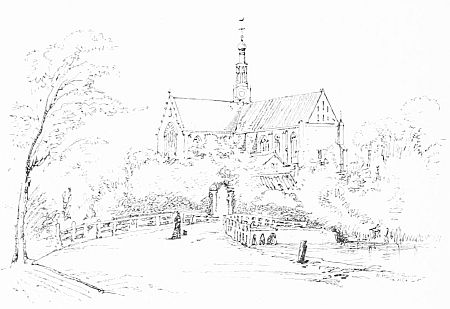
APPROACH TO ALKMAAR.
The country near the Helder is bare and desolate
in the extreme. It is all peat, and the rest of Holland
uses it as a fuel mine. It was here that the genius of
Ruysdael was often able to make a single tree, or even
a bush rising out of the flat by a stagnant pool, both
interesting and charming to the spectator. We crossed
the levels to Alkmaar, which struck us as being altogether
the prettiest place in the country and as possessing
all those attributes of cleanliness which are
usually given to Broek. The streets, formed of bricks
fitted close together, are absolutely spotless, and every
house front shines fresh from the mop or the syringe.
Yet excessive cleanliness has not destroyed the picturesqueness
of the place. The fifteenth-century
church of S. Lawrence, of exquisitely graceful exterior,
rises in the centre of the town, and, in spite of
being hideously defaced inside, has a fine vaulted roof,
a coloured screen, and, in the chancel, a curious tomb
to Florens V., Count of Holland, 1296, though only
his heart is buried there. Near the excellent Hôtel
du Burg is a most bewitching almshouse, with an old
tourelle and screen, and a lovely garden in a court
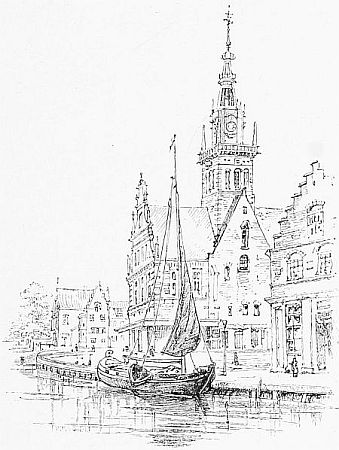
surrounded by clipped lime-trees. And more charming
still is an old weigh-house of 1582, for the cheese,
the great manufacture of the district, for which there
is a famous market every Friday, where capital costumes
may be seen. The rich and gaily painted façade
of the old building, reflected in a clear canal, is a
perfect marvel of beauty and colour; and artists
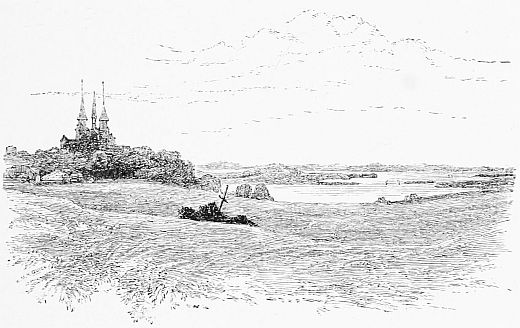
should stay here to paint—not the view given here,
but another which we discovered too late—more in
front, with gable-ended houses leading up to the
principal building, and all its glowing colours repeated
in the water.
THE WEIGH-HOUSE, ALKMAAR.
It is three hours' drive from Alkmaar to Hoorn,
a charming old town with bastions, gardens, and
semi-ruined gates. On the West Poort a relief commemorates
the filial devotion of a poor boy, who
arrived here in 1579, laboriously dragging his old
mother in a sledge, when all were flying from the
Spaniards. Opposite the weighing-house for the
cheeses is the State College, which bears a shield with
the arms of England, sustained by two negroes. It
commemorates the fact that when Van Tromp defeated
the English squadron, his ships came from Hoorn and
on board were two negroes, who took from the English
flagship the shield which it was then the custom to
fix to the stern of a vessel, and brought it back here
as a trophy. Hoorn was one of the first places in
Holland to embrace the reformed religion, which
spread from hence all over the country, but now not
above half the inhabitants are Calvinists.
In returning from Alkmaar we stopped to see
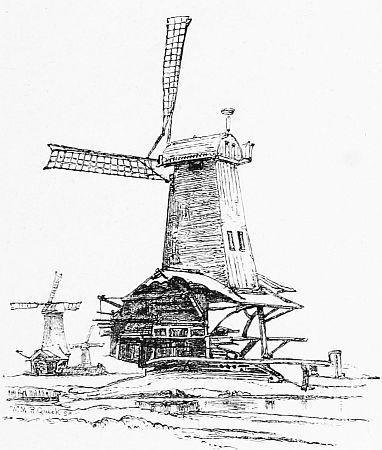
Zaandam, quite in the centre of the land of windmills,
of which we counted eighty as visible from the station
alone. They are of every shade of colour, and are
mounted on poles, on towers, on farm buildings, and
made picturesque by every conceivable variety of prop,
balcony, gallery, and insertion. Zaandam is a very
pretty village on the Zaan which flows into the Y,
with gaily painted houses, and gay little gardens, and
perpetual movement to and from its landing-stage.
Turning south from thence, a little entry on the right
leads down some steps and over a bridge to some
cottages on the bank of a ditch, and inside the last
of these is the tiny venerable hovel where Peter the
Great stayed in 1697 as Peter Michaeloff. It retains
its tiled roof and contains some old chairs and a box-bed,
but unfortunately Peter was only here a week.
MILL AT ZAANDAM.
PAUSHUIZEN, UTRECHT.
The evening of leaving Zaandam we spent at
Utrecht, of which the name is so well known from
the peace which terminated the war of the Spanish
succession, April 11, 1715. The town, long the seat
of an ecclesiastical court, was also the great centre of
the Jansenists, dissenters from Roman Catholicism
under Jansenius, Bishop of Ypres, condemned by
Alexander VII. in 1656, at the instigation of the
Jesuits. The doctrines of Jansenius still linger in its
gloomy houses. Every appointment of a bishop is
still announced to the Sovereign Pontiff, who as regularly
responds by a bull of excommunication, which is
read aloud in the cathedral, and then immediately
put away and forgotten. Solemn and sad, but pre-eminently
respectable, Utrecht has more the aspect of
a decayed German city than a Dutch town, and so
has its Cathedral of S. Martin (1254-67), which,
though the finest Gothic building in Holland, is only
a magnificent fragment, with a detached tower (1321-82)
338 feet high. The interior as usual is ruined by
Calvinism and yellow paint. It contains the tomb of
Admiral van Gent, who fell in the battle of Solbay.
The nave, which fell in 1674, has never been rebuilt.
The S. Pieterskerk (1039) and S. Janskerk offer nothing
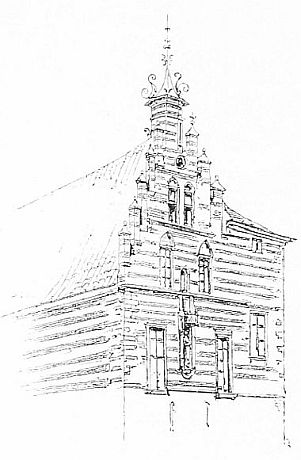
remarkable, but on a neighbouring canal is the
quaint Paushuizen, or Pope's house, which was built
by Pope Adrian VI. (Adrian Floriszoom) in 1517.
Near this is the pretty little Archiepiscopal Museum,
full of mediæval relics.
The interesting Moravian establishment of Zeist
may be visited from Utrecht.
From Utrecht we travelled over sandy flats to
Kampen, near the mouth of the wide river Yssel, with
three picturesque gates—Haghen Poort, Cellebroeders
Poort, and Broeders Poort; and a town hall of the
sixteenth century. Here, as frequently elsewhere in
Holland, we suffered from arriving famished at midday.
All the inns were equally inhospitable: 'The
table d'hôte is at 4 P.M.: we cannot and will not be
bothered with cooking before that, and there is nothing
cold in the house.' 'But you have surely bread
and cheese?' 'Certainly not—nothing.'
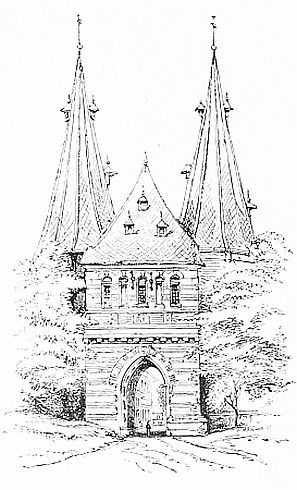
CELLEBROEDERS POORT, KAMPEN.
At Zwolle, however, we found the Kroon an excellent
hotel with an obliging landlord; and Zwolle,
the native place of Terburg (1608), is a charming old
town with a girdle of gardens, a fine church (externally),
and a noble brick gateway called the Sassenpoort.
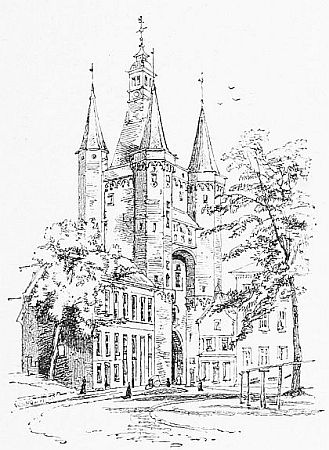
SASSENPOORT, AT ZWOLLE.
It was more the desire of seeing something of the
whole country than anything else, and a certain
degree of misplaced confidence in the pleasant volumes
of Harvard, which took us up from Zwolle, through
Friesland, the cow-paradise, to Leeuwarden, its ancient
capital. Sad and gloomy as most other towns of
Holland are, Leeuwarden is sadder and gloomier still.
Its streets are wide and not otherwise than handsome,
but they are almost deserted, and there are no objects
of interest to see unless a leaning tower can be called
so, with a top, like that at Pisa, inclined the other way,
to keep it from toppling over. An hour's walk from
the town there is said to be a fine still-inhabited castle,
and, if time had allowed, respect for S. Boniface would
have taken us to Murmerwoude, where he was martyred
(June 8, 853), with his fifty-three companions.
King Pepin raised a hermitage on the spot, and an
ancient brick chapel still exists there.
Here and elsewhere in Friesland nothing is so
worthy of notice as the helmets—the golden helmets
of the women—costing something equivalent to 25l.
or 30l., handed down as heirlooms, fitting close to
the head, and not allowing a particle of hair to be
visible.
In the late evening we went on to Groningen, a
university town with a good hotel (Seven Provincen),
an enormous square, and a noble tall Gothic tower of
1627, whence the watchman still sounds his bugle.
Not far off is Midwolde, where the village church has
fine tombs of Charles Jerome, Baron d'Inhausen and
his wife, Anna von Ewsum.
As late as the sixteenth century this province was
for the most part uninhabited—savage and sandy, and
overrun by wolves. But three hundred years of hard
work has transformed it into a fertile country, watered
by canals, and sprinkled with country houses. Agriculturally
it is one of the richest provinces of the
kingdom. This is mostly due to its possessing a race
of peasant-farmers who never shrink from personal
hard work, and who will continue to direct the plough
whilst they send their sons to the university to study
as lawyers, doctors, or churchmen. These peasant
farmers or boers possess the beklemregt, or right of
hiring land on an annual rent, which the landlord can
never increase. A peasant can bequeath his right to
his heirs, whether direct or collateral. To the land,
this system is an indescribable advantage, the cultivators
doing their utmost to bring their lands to perfection,
because they are certain that no one can take
away the advantage from themselves or their descendants.
On leaving Groningen we traversed the grey,
monotonous, desolate district of the Drenthe, sprinkled
over at intervals by the curious ancient groups of
stones called Hunnebedden, or beds of death (Hun
meaning death), beneath which urns of clay containing
human ashes have been found. From Deventer
(where there is an old weigh-house, and a cathedral
of S. Lievin with a crypt and nave of 1334),
time did not allow us to make an excursion to
the great royal palace of Het Loo, the favourite
residence of the sovereigns. The descriptions in
Harvard rather made us linger unnecessarily at Zutphen,
a dull town, with a brick Groote Kerk (S. Walpurgis)
which has little remaining of its original
twelfth-century date, and a rather picturesque 'bit'
on the walls, where the 'Waterpoort' crosses the
river like a bridge.
At Arnhem, the Roman Arenacum, once the residence
of the Dukes of Gueldres, and still the capital
of Guelderland, we seemed to have left all the characteristics
of Holland behind. Numerous modern villas,
which might have been built for Cheltenham or
Leamington, cover the wooded hills above the Rhine.
In the Groote Kerk (1452) is a curious monument of
Charles van Egmont, Duc de Gueldres, 1538, but
there is nothing else to remark upon. We intended
to have made an excursion hence to Cleves, but desperately
wet weather set in, and, as Dutch rain often
lasts for weeks together when it once begins, we were
glad to hurry England-wards, only regretting that we
could not halt at Nymegen, a most picturesque place,
where Charlemagne lived in the old palace of the
Valckhof (or Waalhof, residence on the Waal), of
which a fragment still exists, with an old baptistery,
a Stadhuis of 1534, and a Groote Kerk containing a
noble monument to Catherine de Bourbon (1469), wife
of Duke Adolph of Gueldres.
We left Holland feeling that we should urge our
friends by all means to see the pictures at Rotterdam,
the Hague, and Amsterdam, but to look for all other
characteristics of the Netherlands in such places as
Breda, Dortrecht, Haarlem, Alkmaar, and Zwolle.