THE starting of the engines had us up fairly early the next morning, and
we found the country very much changed. The desert now came to the
river’s edge, and granite had taken the place of limestone; it seemed as
though we had come to the end of fertile Egypt. Two white vultures were
the only living things in sight. Then we came to some wonderful bends
in the river, and the sakiehs once more began to dip up the muddy water;
but the skins of the men who worked them had changed: they glistened
like coal in the sunlight.
By two o’clock we reached Assuan, and moored to the island of
Elephantine, just opposite the town, from which any number of little
bright-painted ferry-boats rowed toward us; and in a few minutes some
thin-legged Egyptian policemen and a few natives were on the bank, and a
small boy with a stick had been selected to mind the turkeys that we had
brought from Esneh. Some of the poor birds were very weak on their legs,
and where they ought to have been red they were only a pale
salmon-color; but the little cook promised that they would be all right
in a day or two. Some of the crew had homes on the island, and they all
put on their best clothes and were met by friends. They immediately
established a laundry on shore, and the building of an oven proved that
we were to be there for some time.
We began the 27th with a visit to the tombs on Grenfell Hill, high on
the river’s bank, below Elephantine. There was a strong wind, full of
sand, from the south, and the light natives had trouble in getting the
heavy boat to the foot of the hill. The wind helped us back to the
Nitocris, and after lunch we crossed the river to Assuan, where the
inhabitants seemed especially prepared for tourists. The natives were
more theatrical in Assuan, and the bazaars were filled with musical
instruments, made as primitive as possible to please the traveler.
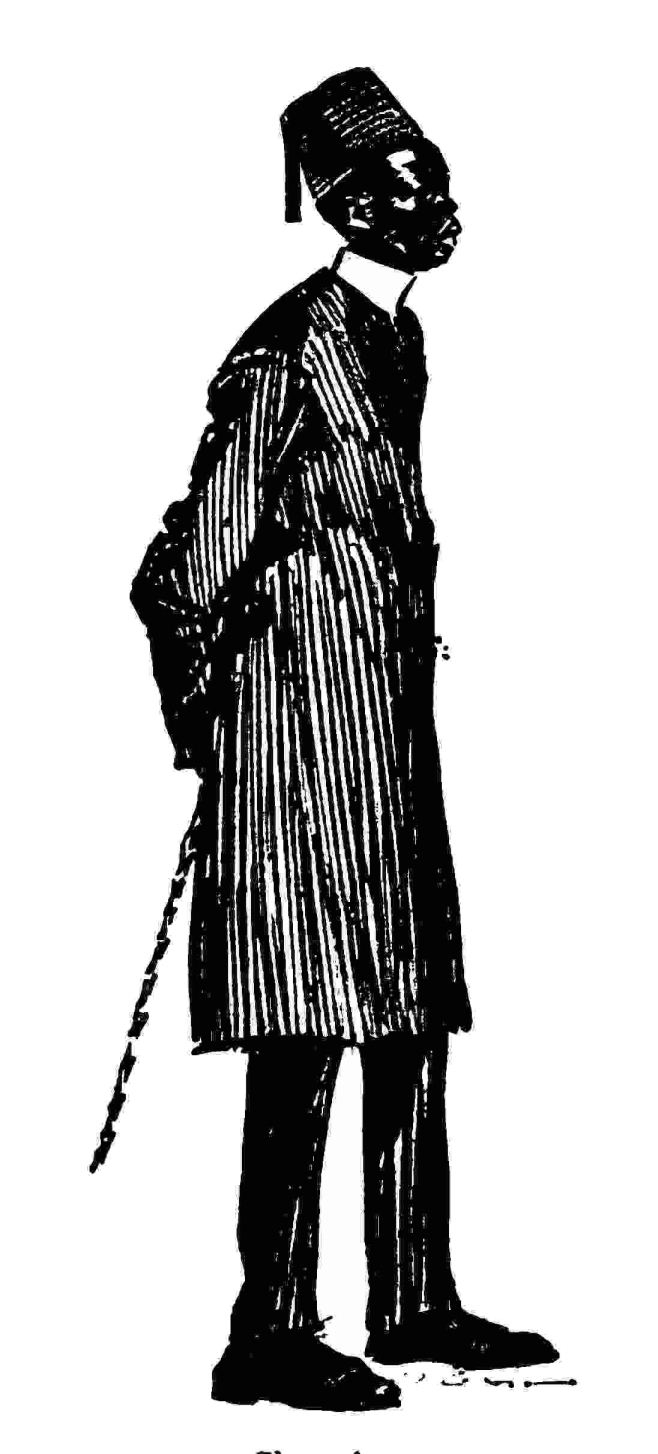
There is a railroad at Assuan. It is only a small, disconnected link;
but some day it will be part of a road to the Cape, and vestibule
trains will run over it, and passengers may get only flying glimpses of
Philæ from car windows. Think of being on a train that went by Pharaoh’s
Bed in the night! But it is impossible to believe that the world could
become used to such a wonderful place, and it is to be hoped that all
trains will go slow when they come to Philæ; for without it Egypt would
be like “Romeo and Juliet” without a balcony. It is the most romantic
ruin in Egypt, and it marks the end of the first-cataract tourist’s
journey.
If the Nitocris had been a sailing-dahabiyeh, and had belonged to us,
and if the season had been younger and the river higher, we would have
had her pulled up one cataract after another until we had made some
important discoveries; but we were one-month tourists on a hired boat,
and that night, while the Nitocris was tied fast to some large wooden
pegs driven deep into the
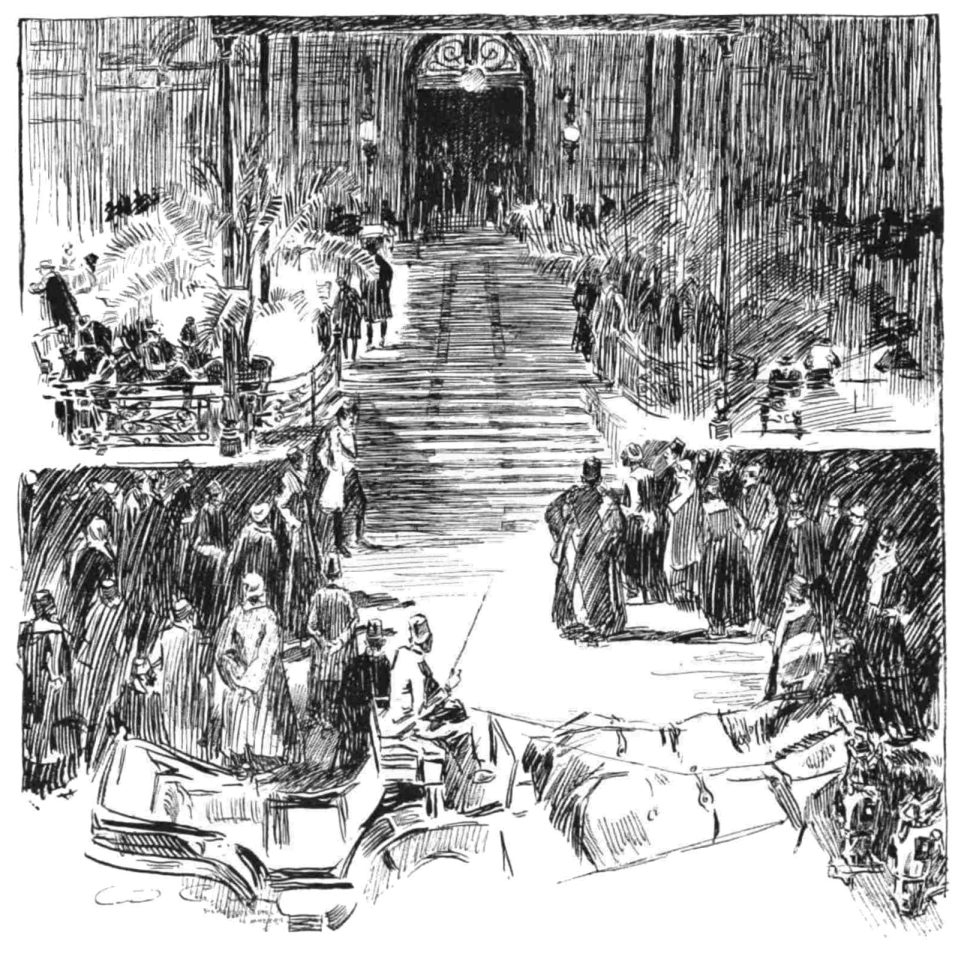
Shepheard’s Hotel, Cairo.
beach, we read how the Rip Van Winkle and other dahabiyehs had gone to
Abu-Simbel.
The next morning we chose the nine-o’clock train, in preference to
camels and donkeys; and after some minutes of rocking and twisting in
the little box-car, we were ferried from the mainland to the famous
island, where we were to forget Komombos and all the others amid new
beauties, which no guide-book can exaggerate.
After lunch we walked to the northern end of the island, hoarded a big,
clumsy, eight-oared boat with a great deal of rigging lashed overhead,
and our homeward journey began. There was a crew of ten, and we soon had
the greatest respect for their skill, especially one little man with
crooked teeth, who sat in the stern and shouted over our heads at the
men in the boat.
The rapids were tame enough at first. The wind was strong against us,
and we found some shelter behind the high granite islands we drifted
among. The river had worn them into fantastic shapes so closely
resembling temples that hieroglyphics had been cut on the polished
stones by the Pharaohs, who never tired of seeing their names in print.
At one place we stopped and watched ten or fifteen boys swim and float
down a part of the rapids. They would come shivering up to us, and the
next instant they would be in
the water shooting by us on a log, screaming to attract our attention,
and then back again to us, with their teeth chattering for bakshish.
But after that it was very different. The man at the tiller half stood
up, and I could see, by the little patches of sand on his forehead that
the wrinkles there had formed in two parallel lines, that he had been
praying while we had been watching the boys swim, and by the same sign I
could see that most of the crew had been doing the same thing; and
Mohammed must have been with us, for fifty times within half that number
of minutes we needed help. With the little man in the stern continually
wetting his lips and jamming the tiller from side to side, apparently
steering in just the wrong place, and always proving that he was right,
we “shot” over the uneven surface of the river, dodging half-buried
rocks, first near one bank and then the other, until we reached the
natural bed of the
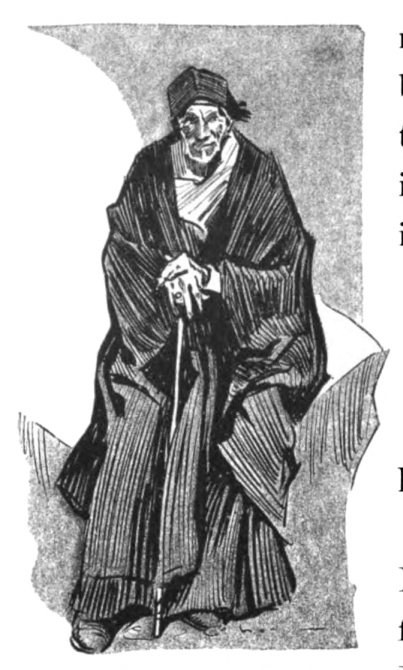
The Sheik of the Pyramids.
river. Here the crew began their battle with the wind, and by evening,
after much chanting and hard rowing on their part, we reached the
Nitocris, feeling very much as if our faces had been sandpapered.
During our stay at Elephantine we made friends with four little Bisharin
girls. They were graceful and pretty, and had the power to make the most
dismal tomb cheerful. They followed us to the quarries back of Assuan,
and turned the top of the half-finished obelisk into a stage and danced
in the sunlight, while the blackest man in Africa played an instrument
of his own invention. And the last I remember of Assuan is their
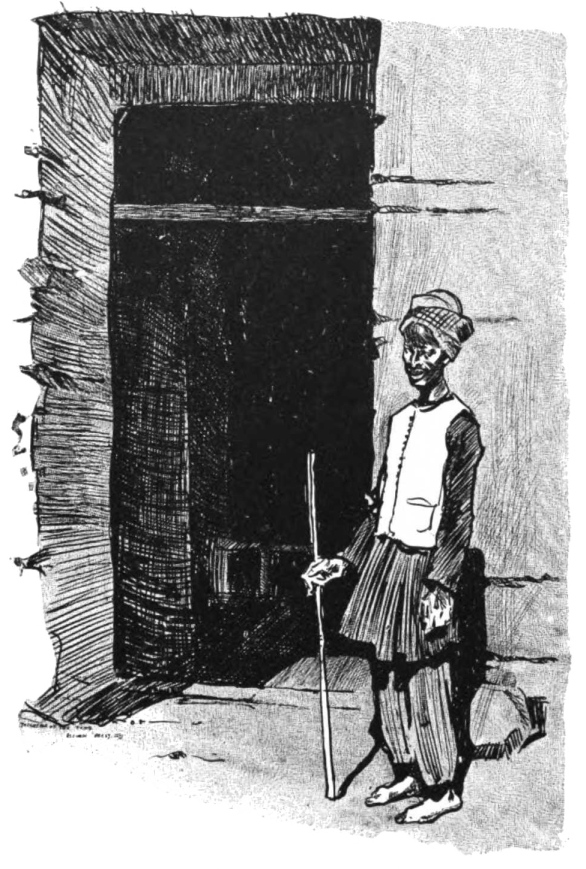
On Grenfell Hill. The Keeper of the Tomb, Assuan,
December 29, 1897.
four little figures wrapped in the brightest-colored shawls that could
be bought in Lower Egypt, and they waving their hands until a bend in
the river hid them.
It was a novelty to find ourselves going with the current, which had
been until now against us, and we could count on much bigger runs; but
there was double the danger of running on a sand-bar, and from that time
on there was always a man with a pole in the bow.
On the 30th we stopped beneath our old friend Komombos, and visited Edfu
the next day; and from the top of its pylons we looked into the
mud-walled yards of the town, where little fly-covered children stopped
playing with goats and called to us, even at that height, for bakshish.
On the 31st we were once more in Luxor, where the donkey-boys and
beggars gave us a hearty welcome. Again we visited Thebes, and were
followed from tomb to tomb by the usual venders of imitation antiques
and shriveled mummy-hands.
Our trips back from Thebes were always enlivened by donkey-races across
the great fields of young wheat, in the middle of which the great
Memnons sit. Those races generally proved that “Columbus” was a faster
donkey than “New York.”
Pharaoh must have continually thought of the future. His tombs at Thebes
show how anxious he was to outlast time. And it seems hard that his
carefully prepared plans should have been interfered with. How
impressive it would be to find, at the end of the long subterranean
passage, the king whose one wish had been to lie there. He must have
visited it often before his death. He might have superintended its
building and criticized the drawings that decorate its walls. But the
sarcophagus is now empty, and its lid is broken, and the king’s new
friends have put him in a cheap wooden house; and written
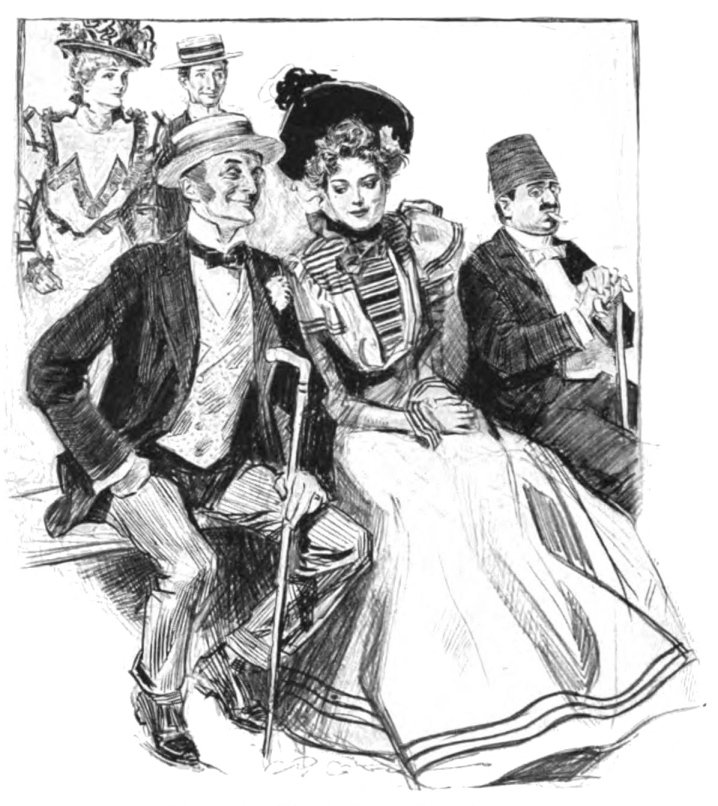
At the Races, Khedival Sporting Club.
on a piece of cardboard, and tacked on the glass case in which he now
lies, is the name he was so fond of cutting in granite.
One year more or less makes very little difference to Egypt, but the New
Year was properly welcomed aboard the Nitocris, for one of us had
never seen a January 1 before. So it happened that, even in Egypt, the
occasion was treated as a novelty, and the Nitocris once more
blossomed out with lanterns, and looked as well that night as her more
graceful rivals, the sailing-dahabiyehs, that were anchored above and
below us.
January 4 was our last day at Luxor. We had ridden up the limestone
valley at Thebes to the tombs of the kings, had spent several days and a
moonlight night at Karnak. We had said good-by to our donkey-boys. Mine
had held an umbrella over me with one hand and had fought natives at the
same time with the other, and I hope that some day he will be a
dragoman. Before daylight on the 5th we had once more started north,
with only five more days on the river left to us. At night we tied to
the bank and walked through moon-lighted villages, and did our best to
imagine that our journey had only just begun.
On the evening of the 7th an extraordinary thing happened. It rained
hard enough to make a noise on the awning over us, and in the excitement
we almost forgot that there were only three more days between us and
Cairo. We had begun to count the hours and to dread that fatal bend in
the river that would show us the pyramids at Sakkara, where we were to
spend our last night. We passed dahabiyehs with American and English
flags flying over them, and we were filled with
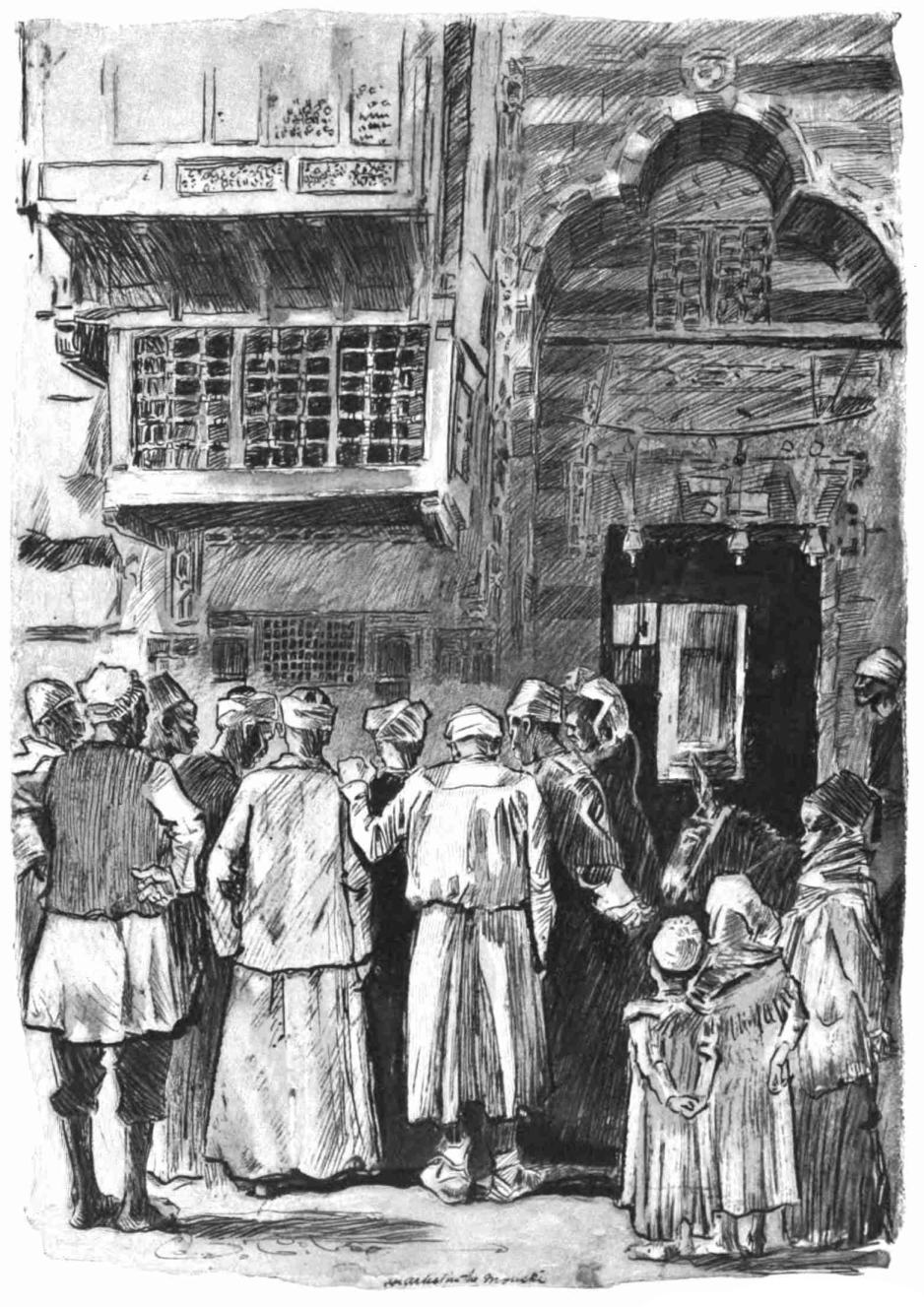
An Artist in the Mouskie.
envy. Handkerchiefs and parasols were sympathetically waved at us, and
at a distance we may have looked cheerful; but it was a forlorn,
childish feeling to be taken home because our time was up and our
dahabiyeh had another engagement. We felt that all the other boats knew
our secret, and we even suspected the crew of having become tired of us
and only remaining civil in order to collect the present that they were
expecting.
Ghesiri’s suggestion that we spend the night of the 10th at Cairo seemed
to prove that they were anxious to have done with us; but we had no
inclination to be tied to the bank at Cairo overnight, waiting to be
sent away in the morning before a crowd of natives, and among them,
possibly, those other people who had chartered our boat. We would wait
at Sakkara, and not get to Cairo one minute before our time was up.
On the 8th we visited a sugar-factory at
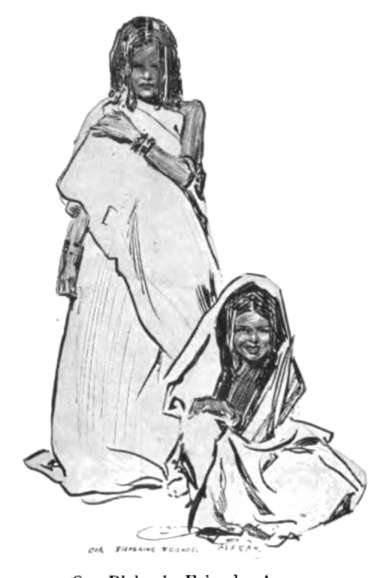
Our Bisharin Friends, Assuan.
Tel-el-Amarna, and later on the same day passed our first landing-place,
Beni-Hassan.
By noon on the 9th we reached the fatal bend in the river and saw that
we were once more in the land of pyramids, and we were soon tied to the
bank beneath which once stood the city of Memphis. We rode to Marietta’s
House, past the pyramids and the colossal Rameses lying on his back
among tall palms, surrounded, for some reason, by a mud house, as if the
great granite figure had not already proved that it could continue its
battle with time unassisted by a few mud bricks and some tin roofing
that is very much in the way.
We lighted candles and walked through the hot, suffocating galleries of
the mausoleum, and peered into the huge granite sarcophagi that once
held the mummied sacred bulls. Then we rode to the tomb of Ti, and
Ghesiri’s last lecture was about that gentleman.
In the distance was Cairo; and even a view of the pyramids at Gizeh and
the citadel failed to console us, and we still mourned our late month on
the Nile. We took our last donkey-ride through the palms that now grow
where Memphis once stood, and reached the Nitocris by sundown.
By midday on the 10th, we shook hands with the crew and left the
Nitocris tied to the bank where we had first found her, just as though
nothing had happened; and, after all, what had happened was this: six
more tourists had gone to the first cataract and back, and a few more
Egyptian sketches had been made. For us the performance of the Nile was
at an end, and we were once more in the streets on our way to the
Ghezireh Hotel, with a determination to console ourselves with Cairo,
which now looked to us, after our stay in the country, like a full-grown
European capital.
By January 10 the season had commenced
and the prices of rooms had doubled. Since we left, several steamers
from the west had brought an army of tourists, who were turning Africa
into New York, London, and Paris. And at the Casino, in the Ghezireh
Gardens, was as good an imitation of Monte Carlo as the law allows, but
such a poor one that even the Frenchmen who worked it seemed ashamed of
themselves, and the New-Yorker who owned it was very seldom seen there.
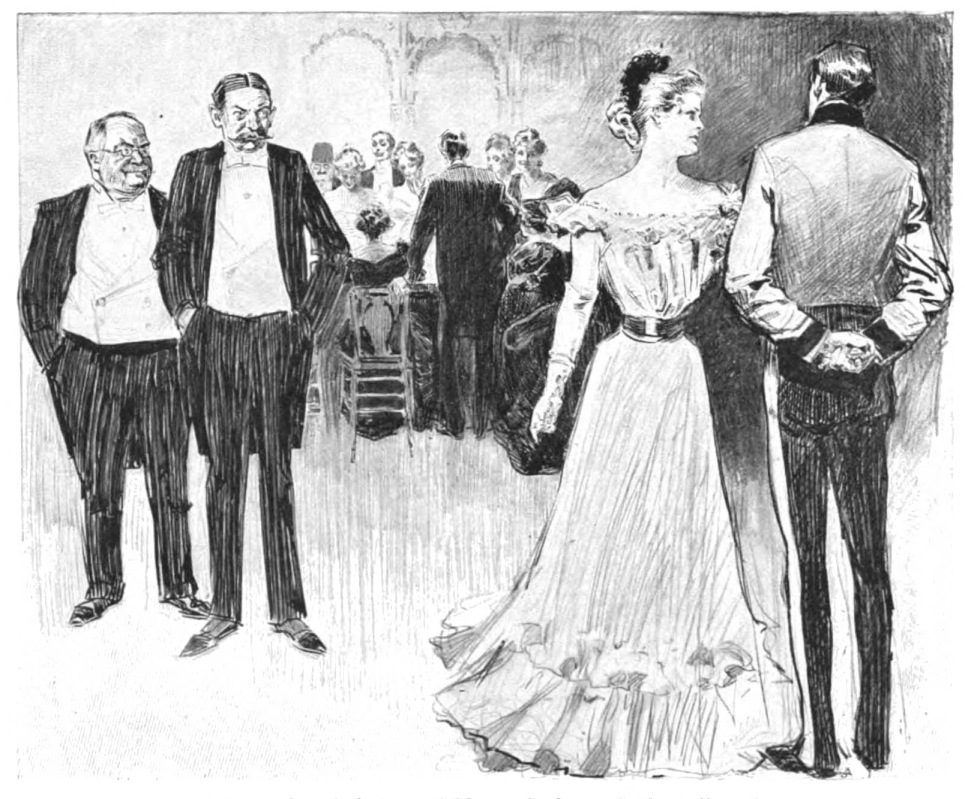
“As good an imitation of Monte Carlo as the law
allows.”
At Shepheard’s there is always the man who has “been there before,” and
like the same man at the play, he sits beside you and interprets the
picture. You finally promise that you will not go to the monskie
without him, and that you will not see the Sphinx by moonlight unless he
is there; for if you do, not having been there before, you will be sure
to go too early or too late. He says the moon should be at just such an
angle and no other. The peddlers in the monskie know him, and while they
entertain him with little cups of sweet tea they complain that they have
had no luck since they last saw him, and they ask eagerly after that
gentleman he brought to them the year before—the gentleman who had such
exquisite taste and backed it up so generously with his money. And you
drink their tea, and feel, as you leave the shops, after having only
looked at their things, that they will never ask affectionately after
you. The man who has been there before generally walks in front of you,
as if he were not as anxious to have you see the place as he is to have
you see that he knows his way about; and, after all, it is no small
thing to be proud of. If I ever go to the mouskie again, I shall pity
the greenhorn who happens to be with me.
The bazaars are dirty, and so many pasty-faced Turks squatting about in
the filth grow tiresome. At first they are described in letters home as
fascinating and picturesque, and whole days are spent with them, buying
hundreds of things that are destined to be left in hotel bureau drawers
and gradually lost. The souvenirs we buy in the mouskie seem to melt
away. The precious stones we bought there turn to glass, the slippers
become pasteboard, the gilt things tarnish, and the brass-work bends
itself into old junk, and the mouskie is only a confused dream; so no
wonder the old traveler is proud that he can actually find his
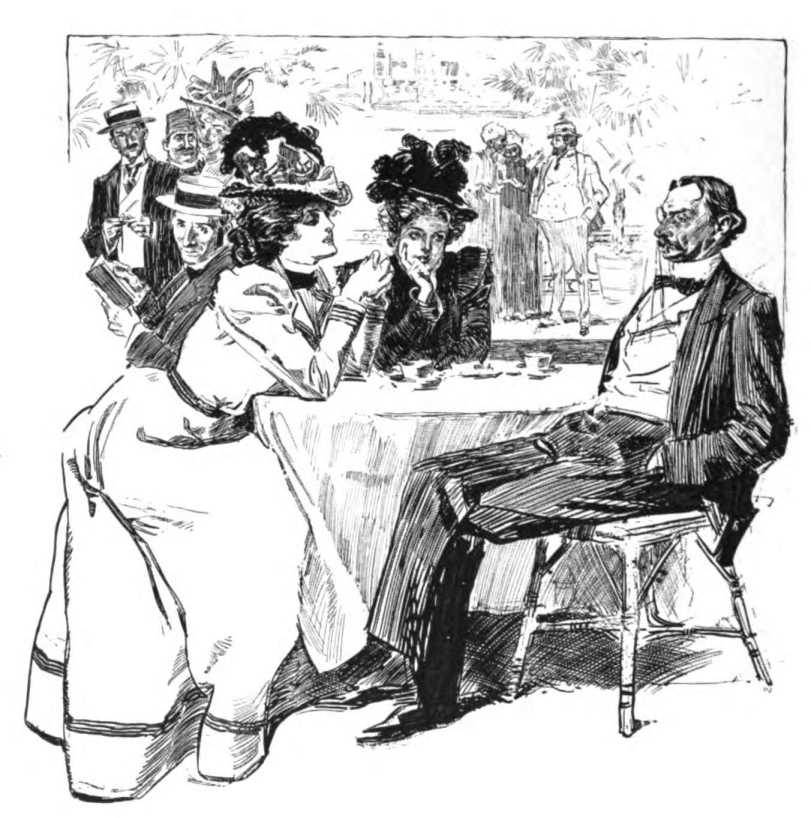
“The man who has ‘been there before.’”
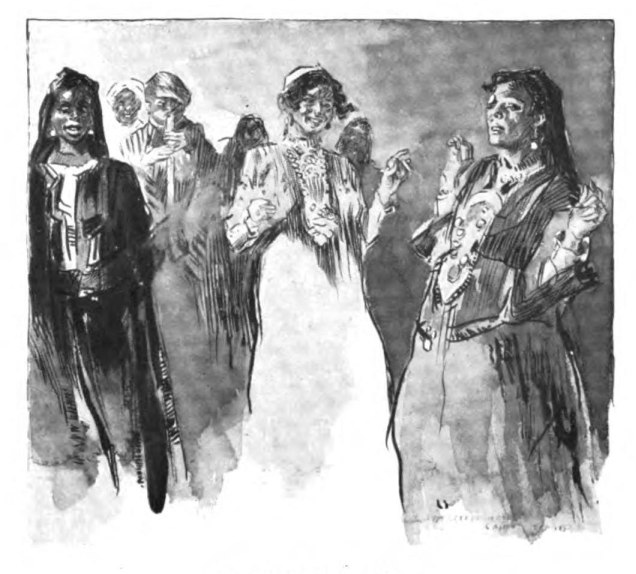
In a Coffee-house, Cairo.
way about in it. He had probably begun to think that there never had
been such a place.
But Egypt is full of real things, and probably the most genuine thing of
them all is the English occupation. Egypt herself is the best proof of
how necessary to her well-being this is. It is hard to tell just how
unhappy the fellaheen were before the English came. The Egyptian is not
the sort of man that complains. After centuries of oppression, he now
accepts whatever form of government is offered in a browbeaten way, and
shuffles along after his donkey, and pays his tax for bringing a few
bundles of clover across the bridge into Cairo without a murmur; and,
judging by his looks, I doubt if he would make much disturbance if he
found, some morning, that the tax on his clover had been doubled. He
evidently feels like a very small depositor in a broken bank. England is
the largest creditor, and is straightening things out for them both, and
he is satisfied.
There never were so many cooks trying to spoil a broth. Before a
consul-general is received by the Khedive, the Sultan of Turkey must
first approve of him, and it is said that the Sultan allows months to go
by before he gives his consent, which is his Oriental way of showing his
authority. But Egypt is geographically so important that, in spite of
herself, she will be saved, and with England’s help she will some day
pay her debts, and in centuries to come the fellah may learn to hold his
head up like the Nubian.
There is no fear of Egypt becoming dull and commonplace, for if the East
and the West should ever fight, it must be for the possession of her
canal; and many an unborn soldier’s reputation will be made before the
railroad that has started up the Nile’s valley reaches Cape Town. The
same land that offers death and reputation to the strong gives life to
the weak, and the tired rich man on his dahabiyeh and the soldier on the
transport go up the Nile side by side, and in most cases they both find
what they are in search of.
Shepheard’s, in all probability, will forever remain a composite
portrait of Europe and Asia, with Cairo as its frame. Time has made, and
probably will continue to make, some slight alteration in Upper Egypt’s
appearance; but the locomotive’s whistle will have difficulty in
breaking the silence and calm of Karnak and Thebes. And the present
indications are that Egypt will remain true to the Pharaohs of old, and
until the judgment-day she will, in all probability (assisted by the
Nile, who made her), continue to quietly resist the attentions of modern
nations, and patiently wait for that last day.