The solemn yearly marriage between the Venetian
commonwealth and the Hadriatic sea had much more
effect on the eastern shore of that sea than on the
western. On the eastern side of the long gulf there
are few points which have not at some time or other
"looked to the winged lion's marble piles," and for
many ages a long and nearly continuous dominion
looked steadily to that quarter. On the western shore
Venice never established any lasting dominion very
far from her own lagoons. Ravenna was the furthest
point on that side which she held for any considerable
time, and at Ravenna we are hardly clear of the delta
of the Po. In the northern region of Italy her power
struck inland, till at last, defying the precepts of
the wise Doge who could not keep even Treviso, she
held an unbroken dominion from Bergamo to Cividale.
That she kept that dominion down to her fall, that
that dominion could live through the fearful trial of
the League of Cambray, may perhaps show that
Venice, after all, was not so unfitted to become a
land-power as she seems at first sight, and as Andrew
Contarini deemed her in the fourteenth century. Yet
one might have thought that the occupation of this or
that point along the long coast from Ravenna to the
heel of the boot would have better suited her policy
than the lordship over Bergamo and Brescia. And one
might have thought too that, amid the endless changes
that went on among the small commonwealths and
tyrannies of that region, it would have been easier for
the Republic to establish its dominion there than to
establish it over great cities like Padua and Verona.
Yet Venice did not establish even a temporary
dominion along these coasts till she was already a
great land power in Lombardy and Venetia. And
then the few outlying points which she held for a
while lay, not among the small towns of the marches,
but within the solid kingdom which the Norman had
made, and which had passed from him to kings from
Swabia, from Anjou, and from Aragon. It is this
last thought which gives the short Venetian occupation
of certain cities within what the Italians called
the Kingdom a higher interest in itself, and withal
a certain connexion in idea with more lasting possessions
of the commonwealth elsewhere. At Trani
and at Otranto, no less than in Corfu and at Durazzo,
the Venetian was treading in the footsteps of the
Norman. Only, on the eastern side of Hadria the
Republic won firm and long possession of places
where the Norman had been seen only for a moment;
on the western side, the Republic held only for a
moment places which the Norman had firmly grasped,
and which he handed on to his successors of other
races. And, if we pass on from the Norman himself
to those successors, we shall find the connexion
between the Venetian dominion on the eastern and the
western side of the gulf become yet stronger. The
Venetian occupation of Neapolitan towns within the
actual Neapolitan kingdom seems less strange, if we
look on it as a continuation of the process by which
many points on the eastern coast had passed to and
fro between the Republic and the Kings of Sicily and
afterwards of Naples. The connexion between Sicily
and southern Italy on the one hand and the coasts
and islands of western Greece on the other, is as old
as the days of the Greek colonies, perhaps as old as
the days of Homer. The singer of the Odyssey seems
to know of Sikels in Epeiros; but, if his Sikels were
in Italy, we only get the same connexion in another
shape. A crowd of rulers from one side and from the
other have ruled on both sides of the lower waters of
Hadria. Agathoklês, Pyrrhos, Robert Wiscard, King
Roger, William the Good, strove alike either to add
Epeiros and Korkyra to a Sicilian dominion or to add
Sicily to a dominion which already took in Epeiros
and Korkyra. So did Manfred; so did Charles of
Anjou. And after the division of the Sicilian
kingdom, the kings of the continental realm held a
considerable dominion on the Greek side of the sea.
And that dominion largely consisted of places which
had been Venetian and which were to become
Venetian again. To go no further into detail, if we
remember that Corfu and Durazzo were held by
Norman Dukes and Kings of Apulia and Sicily—that
they were afterwards possessions of Venice—that
they were possessions of the Angevin kings at Naples,
and then possessions of Venice again—it may perhaps
seem less wonderful to find the Republic at a later
time occupying outposts on the coasts of the
Neapolitan kingdom itself.
It was not till the last years of the fifteenth
century, when so many of her Greek and Albanian
possessions had passed away, that the Republic
appeared as a ruler on the coasts of Apulia and of
that land of Otranto, the heel of the boot, from which
the name of Calabria had long before wandered to the
toe. It was in 1495, when Charles of France went
into southern Italy to receive for himself a kingdom
and to return,—only to return without the kingdom,—that
the Venetians, as allies of his rival Ferdinand,
took the town of Monopoli by storm, and one or two
smaller places by capitulation. What they took they
kept, and in the next year their ally pledged to them
other cities, among them Trani, Brindisi, Otranto,
and Taranto, in return for help in men and money.
These cities were thus won by Venice as the ally of the
Aragonese King against the French. But at a later
time, when France and Aragon were allied against
Venice, the Aragonese King of the Sicilies, a more
famous Ferdinand than the first, took them as his
share in 1509. We cannot wonder at this; no king,
or commonwealth either, can be pleased to see a string
of precious coast towns in the hands of a foreign power.
Again in 1528 Venice is allied with France against
Aragon and Naples, and Aragon and Naples are now
only two of the endless kingdoms of Charles of Austria.
For a moment the lost cities are again Venetian. Two
years later, as part of the great pageant of Bologna,
they passed back from the rule of Saint Mark to the
last prince who ever wore the crown of Rome.
So short an occupation cannot be expected to have
left any marked impress on the cities which Venice
thus held for a few years at a late time as isolated
outposts. These Apulian towns are not Venetian in
the same sense in which the Istrian and Dalmatian
towns are. In those regions, even the cities which
were merely neighbours and not subjects of Venice
may be called Venetian in an artistic sense; they
were in some sort members of a body of which
Venice was the chief. Here we see next to nothing
which recalls Venice in any way. The difference is
most likely owing, not so much in the late date at which
these towns became Venetian possessions, as to the
shortness of time by which they were held, and to the
precarious tenure by which the Republic held them.
As far as mere dates go, Cattaro and Trani were won
by Venice within the same century. But, as we have
seen, the architectural features which give the
Dalmatian towns their Venetian character belong to
the most part to times even later than the occupation
of Trani. Men must have gone on building at
Cattaro in the Venetian fashion for fully a century
and a half after Trani was again lost by Venice.
There are few Venetian memorials to be seen in these
towns; and if the winged lion ever appeared over their
gates, he has been carefully thrust aside by kings and
emperors. More truly perhaps, kings and emperors
rebuilt the walls of these towns after the Venetian
power had passed away. Still the occupation of these
towns forms part of Venetian history, and they may
be visited so as to bring them within the range of
Venetian geography. Brindisi is the natural starting
point for Corfu and the Albanian coast, and Brindisi is
one of the towns which Venice thus held for a season.
The two opposite coasts are thus brought into direct
connexion. The lands which owned, first the Norman
and the Angevin, and then the Venetian, as their
masters, may thus naturally become part of a single
journey. We may have passed through the hilly lands,
we may have seen the hill-cities, of central Italy; we
may have gone through lands too far from the sea to
suggest any memories of Venice, but which are full of
the memories of the Norman and the Swabian. We
find ourselves in the great Apulian plain, the great
sheep-feeding plain so memorable in the wars of
Anjou and Aragon, and we tarry to visit some of
the cities of the Apulian coast. The contrast indeed
is great between the land in which we are and either
the land from which we have come, or the land
whither we are going. Bari, Trani, and their fellows,
planted on the low coast where the great plain joins
the sea, are indeed unlike, either the Latin and
Volscian towns on their hill-tops, or the Dalmatian
towns nestling between the sea and the mountains.
The greatest of these towns, the greatest at least in
its present state, never came under Venetian rule.
Bari, the city which it needed the strength of both
Empires to win from the Saracen, is said to have been
defended by a Venetian fleet early in the eleventh
century, when Venetian fleets still sailed at the
bidding of the Eastern Emperor. Further than this,
we can find few or no points of connexion between
Venice and these cities, till their first occupation at
the end of the fifteenth century. But that short
occupation brings them within our range. We are
passing, it may be, from Benevento to fishy Bari, as
two stages of the "iter ad Brundisium." Thence we
may go on, in the wake of so many travellers and
conquerors, to those lands beyond the sea where the
Lords of one-fourth and one-eighth of the Empire of
Romania, and the Norman lords of Apulia and Sicily,
the conquerors of Corfu and Albania, were alike at
home. Between Benevento and Bari the eye is caught
by the great tower of Trani. Such a city cannot be
passed by; or, if we are driven to pass it by, we must
go back to get something more than a glimpse of it.
And Trani is one of the towns pledged to Venice by
Ferdinand of Naples. In the midst of cities whose
chief memories later than old Imperial times carry us
back to the Norman and Swabian days of the eleventh,
twelfth, and thirteenth centuries, we find ourselves
suddenly plunged into the Venetian history of the
end of the fifteenth.
Trani then will be our introduction to the group of
towns with which we are at present concerned. At
the present moment, it is undoubtedly the foremost
among them; but it is hard to call up any distinct
memory of its history till we reach the times which
made it for a moment a Venetian possession. Trani,
like other places, doubtless has its history known to
local inquirers; but the more general inquirer will
very seldom light upon its name. It is hard to find
any sure sign of its being in Roman times, but it must
be the "Tirhennium quæ et Trana" of the geographer
Guido. Let us take such a common-place test as looking
through the indices to several volumes of Muratori and
Pertz till the task becomes wearisome. Such a task will
show us the name of Trani here and there, but only
here and there. We do by searching find it mentioned
in the days of King Roger and in the days of the
Emperor Lothar, but it is only by searching that we
find it. The name of Trani does not stand out without
searching, like so many of the cities even of southern
Italy. Yet Trani is no inconsiderable place; it is an
archæpiscopal see with a noble metropolitan church;
and in our own day, though much smaller than its
neighbour Bari, it seems to share in the present
prosperity of which the signs at Bari are unmistakeable.
The visitor to Trani will find much to see there,
but he will not find the stamp of Venice on the city.
Trani, like its fellows, had received its distinctive
character long before it had to do with Venice, and
that character was not one that was at all marked by
Venetian influences. The city is not without Venetian
monuments; the memory of its Venetian days is not
forgotten even in its modern street nomenclature.
There is a Piazza Gradenigo, and an inscription near
one of the later churches records the name of Giuliano
Gradenigo as the Venetian governor of Trani in 1503,
and as having had a hand in its building. The castle
might be suspected of containing work of the days of
the Republic; but a threatening man of the sword
forbids any study of its walls even with a distant
spy-glass; not however till the chief inscription has
been read, and has been found to belong to days later
than those of Venetian rule. There is no knowing what
may not happen to places when they have once fallen
into the hands of soldiers; to the civilian mind it might
seem that, when a king writes up an inscription to
record his buildings, he wishes that inscription to be
read of all men for all time. It is hard too to see
how an antiquary's spy-glass can do anything to
help prisoners confined within massive walls to break
forth, as Italian—at least Sicilian—prisoners sometimes
know how to break forth. The metropolitan
church of Trani is happily not in military hands;
neither are the streets and lanes of the city, the
houses, the smaller churches, the arcades by the haven,
the buildings of the town in general. All these
may therefore be studied without let or hindrance;
civil officials, even cloistered nuns, see no danger to
Church or State if the stranger draws the outside of
a window or copies an inscription on an outer wall.
But though we may find at Trani bits of work which
might have stood in Venice, it is only as they might
have stood in any other city of Italy. There is
nothing in Trani, besides the memorial of Gradenigo,
which brings the Serene Republic specially before the
mind. The great church, the glory of Trani, bears
the impress of that mixed style of art which is characteristic
of Norman rule in Apulia, but which is
quite different from anything to be found in Norman
Sicily. It has some points in common with its neighbours
at Bitonto and Bari, and some points very
distinctive of itself. It is undoubtedly one of the
noblest churches of its own class. If we were to call
it one of the noblest churches of Christendom, the
phrase would be misleading, because, to an English
ear at least, it would suggest the thought of something
on a much greater scale, something more nearly approaching
the boundless length of an English minster
or the boundless height of a French one. In southern
Italy bishops and archbishops were so thick upon the
ground that even a metropolitan church was not likely
to reach, in point of mere size, to the measure of a
second-class cathedral or conventual church in England
or even in Normandy. But mere size is not everything,
and, as an example of a particular form of
Romanesque, as an example of difficulties ably grappled
with and thoroughly overcome, the church of
Trani might almost claim to rank beside the church
of Pisa and the church of Durham. And higher
praise than that no building can have.
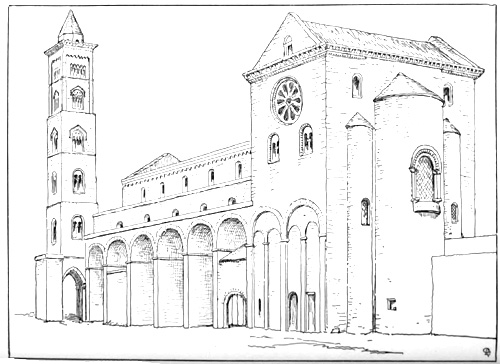
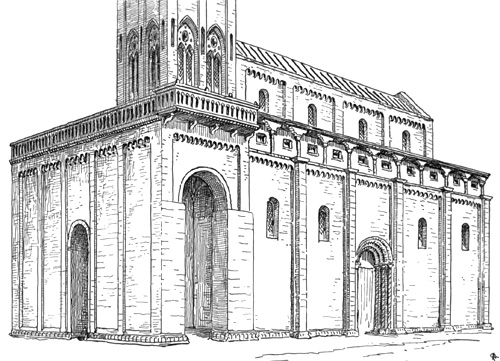
CATHEDRAL, TRANI.
Fully to take in the effect of this grand church, it
will be well not to hurry towards it on reaching the
city. Go straight from the railway-station towards
another bell-tower, not to that of the duomo. That
course will lead to the so-called villa or public garden.
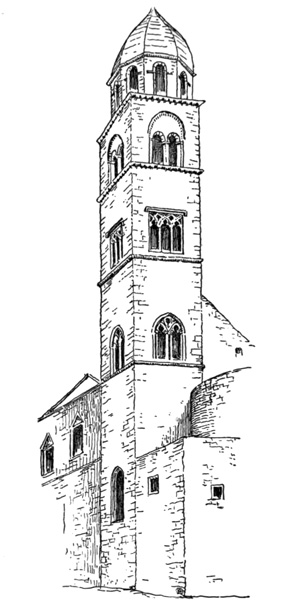
The suppressed Dominican convent close by its gate
has no attractive feature except its tower, one of the
usual Italian type, only with pointed arches. But the
grounds of the villa, raised on the ancient walls of the
monastic precinct, look down at once on the waves of
Hadria. In the northern view we look out on lands
and hills beyond the water; but no man must dream
that the eastern peninsula of Europe is to be seen
from Trani. We look out only over the gulf of Manfredonia—the
name of the Hohenstaufen king is as
it were stamped upon the waters—to the Italian peninsula
of Mount Garganus. Hence, on our way to the
metropolitan church, we pass by the basin which
forms the haven of Trani, a basin which reminds
us of the cala which is all that is left of the many
waters of Palermo. The distant view clearly brings
out its main outline; above all, it brings out those
arrangements of the eastern end which form the most
characteristic feature. We see the tall tower at the
south-west corner; we see the line of the clerestory
with its small round-headed windows; above all, we
see—so unlike anything in Northern architecture—the
tall transept seeming to soar far above the rest of the
church, with the three apses, strangely narrow and
lofty, treated simply, as it would seem, as appendages
to the transept itself. Those who have not seen
Bitonto and Bari will not guess how great a danger
these soaring apses have escaped. The Norman of
Apulia did not, like the native Italian, deal in detached
bell-towers; he clave to the use of his native
land which made the tower or towers an integral part
of the church. But he seems to have specially chosen
a place for them which is German rather than Norman,
and then to have treated them in a way which is
neither German, Norman, nor Italian. At Bitonto
and in the two great churches of Bari, a pair of towers
flanks the east end. In Italy it might be safer to say
the apse end; but we think that in all these cases the
apse end is the east end or nearly so. Such pairs of
eastern towers are common in Germany; but there
the great apse projects between them. At Bari and
Bitonto the whole apsidal arrangement is masked by
a flat wall. The towers rise above the side apses;
the great central apse is hidden by the wall carried in
front of it. We thus get at the east end a flat front,
like a west front; we lose the curves of the apses, and
with them the arcades and grouped windows which
form so marked a feature in the ordinary Romanesque
of Germany and Italy. A single window, of larger
size than Romanesque taste commonly allows, marks
the place of the high altar. And this window is
adorned with shafts and mouldings of special richness,
and with animal figures above and below the shafts.
Now here at Trani, though all the apses stand out, yet
a like arrangement is followed. The central apse has
only a single window of the same enriched type; the
side apses have also only a single window each, but of
a much plainer kind. Thus much, without taking in
every detail, we can mark in our distant view; we can
mark too somewhat of the unusually rich and heavy
cornice of the transept, and the upper part of the
transept front, the wheel window and the two rich
coupled windows beneath it. We can mark too the
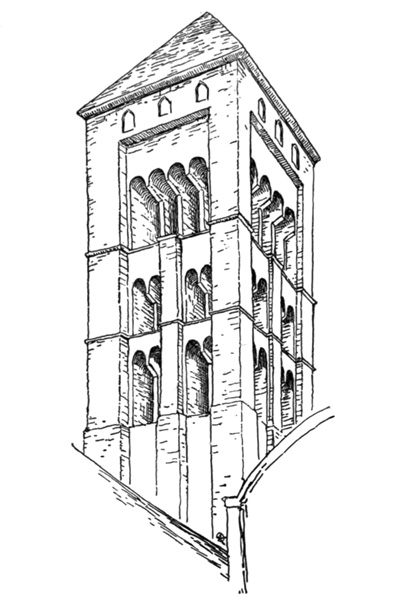
arrangements of the great square tower, crowned with
its small octagonal finish; and even here we can see
that, with all its majesty of outline, it is far from
ranking in the first class of Italian bell-towers. Its
composition lacks boldness and simplicity, while it
has nothing remarkable in the way of ornament.
Saint Zeno among the simpler towers, Spalato among
the more elaborate, stand indeed unrivalled. But the
cathedral tower of Trani, when closely examined, is
less satisfactory than its own majestic neighbour at
Bari. It is not merely that the pointed arch, always
out of place in an Italian bell-tower, is used in the
upper stages. The pointed arch is used with better
effect, both far away in the noble tower of Velletri,
and close by at Trani itself, in the far humbler
tower of the Dominican church. The fault lies in
this, that the windows, instead of being spread over
the whole face of each stage, are gathered together in
the centre of each, while two of them have rather
awkward pointed canopies over the groups of windows.
Still, seen from far or near, it is a grand and majestic
tower, though its faults, which catch the eye at a
distance, become more distinct as we draw nearer.
The road by which we approach the duomo will give
us no view of it from the west, and, till we come quite
near to the church, we shall hardly see how closely it
overhangs the sea. We take our course by the harbour,
for part of the way is under heavy and dark arcades
which remind us of Genoa. Presently, before we reach
the great church, we come across the east end of a
smaller one, with which we shall afterwards become
better acquainted from its western side. At this end
it seems to be called Purgatorio; at the other end we
shall find that its true name is Ogni Santi—All Hallows.
Here there is no transept; still the three apses
may pass for a miniature of those in the metropolitan
church; there is the same single large and elaborate
window in the mid apse, the same smaller single
windows in the side apses. We go landwards for a
short way, and we presently find ourselves on a terrace
overlooking the sea, close under the east end of the
duomo. We now better take in both the grandeur and
the singularity of the building whose general effect we
have studied from a distance. We take in some fresh
features, as the tall blank arcades along the walls, a
feature shared by Trani with Bari, and we guess that
the extraordinary height of the apses must be owing
to the presence of a lofty under-church. We see signs
too at the east end which seem to show that at some
time or other there was a design for some other form
of east end, inconsistent with the present design. The
visitor will now perhaps be tempted to go at once
within, though he ought in strictness to pass under the
tower in order to finish his outside survey at the west
end. It is curious to see how the same feeling which
prevails in the east end prevails in the west front also.
Here we have no continuous arcades like Pisa, Lucca,
and Zara—happily we have no sham gables like the
great one at Lucca; we have again the single great
window with the small ones on each side. Only here
the mid window has over it a rich wheel, the favourite
form of the country, a form which the apsidal east end
would not allow. And it is treated in exactly the same
way, with the same kind of surrounding ornaments, as
the single-light windows.
This west front, as it now stands, has a rather bare
look; the windows have too much the air of being cut
through the wall without any artistic design, and
there is too great a gap between the windows and the
west doorway with its flanking arcades below. But
this last fault at least is not to be charged on the
original design, which clearly took in a projecting
portico. We may doubt however whether the portico
could have been high enough to have much dignity,
and we shall find this feature far more skilfully treated
in the other smaller church of which we have already
spoken. And here we must confess that it is possible
to make two visits to Trani, and each time to make a
somewhat careful examination of its great church, and
yet to miss—not at all to forget to look for, but to fail
to find—the bronze doors which form one of the
wonders of Trani. This may seem incredible at a
distance; it will be found on the spot not to be
wonderful. We will not describe the doors at second-hand;
we will rather hasten within to gaze on the
surpassing grandeur of an interior, which, as an
example of architectural design, may, as we have
already hinted, rank beside the church by the Arno
and the church by the Wear, beside the Conqueror's
abbey at Caen and King Roger's chapel at Palermo.
We say King Roger's chapel advisedly; for the
palace chapel of Palermo, were every scrap of its
gorgeous mosaics whitewashed over, would still rank,
simply as an architectural design, among the most
successful in the world. And the chapel of Palermo
has points which at once suggest comparison and
contrast with the great church of Trani. We see
the traces of the Saracen in both; but at Palermo
the building itself is thoroughly Saracenic, at Trani
the Saracen contributes only one element among
others. In Sicily, where the Saracen was thoroughly
at home, the Norman kings simply built their churches
and palaces in the received style of the island, a
style of which the pointed arch was a main feature.
In southern Italy, where the Saracen was only an occasional
visitor, a style arose in which elements from
Normandy itself—elements, that is, perhaps brought
first of all from northern Italy—are mixed with other
elements to be found on the spot, Italian, Saracenic,
and Byzantine. The churches of Bari, Bitonto, and
Trani, all show this mixture in different shapes. One
feature of it is to take the detached Italian bell-tower,
and to make it, Norman fashion, part of the church
itself. In such cases the general character of the
tower is kept, but Norman touches are often brought
into the details; for instance, the common Norman
coupled window, such as we are used to in Normandy
and England, often displaces the œcumenical mid-wall
shaft which the older England shared with Italy.
Thus here at Trani, the tower joins the church, though
it is not made so completely part of its substance as
it is at Bari and Bitonto. The inside of the church
shows us another form of the same tendency. The
Norman in Apulia could hardly fail to adopt the
columnar forms of the land in which he was settled;
but he could not bring himself to give up the threefold
division of height and the bold triforium of his own
land. An upper floor was not unknown in Italy, as we
see in more than one of the Roman churches, as in
Saint Agnes, Saint Laurence, and the church known as
Quattro Coronati, to say nothing of Modena and Pisa,
and Sta. Maria della Pieve at Arezzo. But in some of
these cases the arrangement is widely different from
the genuine Norman triforium, and the threefold
division certainly cannot be called characteristically
Italian, any more than characteristically Greek. But
it is characteristically Norman; and when we find it
systematically appearing in churches built under
Norman rule, we must set it down as a result of special
Norman taste. At Trani each of the seven arches of
the nave has a triplet of round arches over it, and a
single clerestory window above that. The Norman in
his own land would have made more of the clerestory;
he would have drawn a string underneath it to part it
off from the triforium; he would have carried up shafts
to the roof to mark the division into bays. But the
triforium itself, as it stands at Trani, might have been
set up at Caen or Bayeux, with only the smallest
changes in detail. But where in Normandy, where in
England, where, we may add, in Sicily, is there anything
at all like the arcades which in the church of
Trani support this all but thoroughly Norman triforium?
These have no fellow at Bitonto; they have
hardly a fellow at Bari. In those cities the Norman
adopted the columnar arcades of the basilica, while in
Sicily the Saracen still at his bidding placed the pointed
arch on the Roman column. At Trani too we see the
work, or at least the influence, of the Saracen; but it
takes quite another form. The pointed arch would
have been out of place; in Normandy and England it is
ever a mark of the coming Gothic, and there is certainly
no sign of coming Gothic at Trani. But the
coupling of two columns with their capitals under a
single abacus—sometimes rather a bit of entablature—to
form the support of an arch, is a well-known Saracenic
feature. Not that it was any Saracen invention.
In architecture, as in everything else, the Saracen was,
as regards the main forms, only a pupil of Rome, Old
and New; but, exactly like the Norman, he knew how
to develope and to throw a new character into the
forms which he borrowed. The coupled columns may
truly be called a Saracenic feature, though the Saracen
must have learned it in the first instance from such
buildings as the sepulchral church known as Saint
Constantia at Rome. We may fairly see a Saracenic
influence in a crowd of Christian examples where this
form is used in cloisters and other smaller buildings
where the arches and columns are of no great size. It
is even not uncommon in strictly Norman buildings
in positions where the shafts are merely part of
the decorative construction, and do not actually support
the weight of the building. It was a bolder risk
to take a pair of such columns, and bid them bear up
the real weight of the three stages of what we may
fairly call a Norman minster.
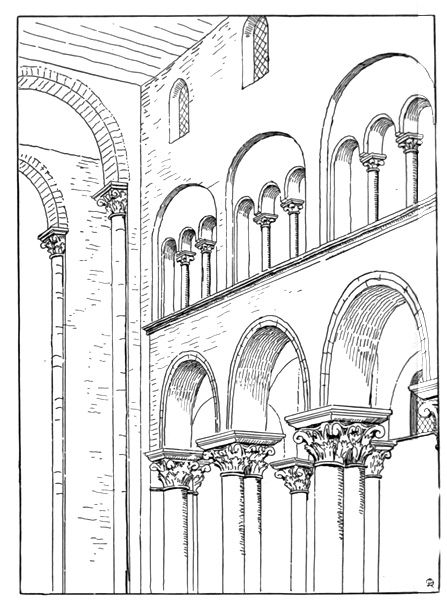
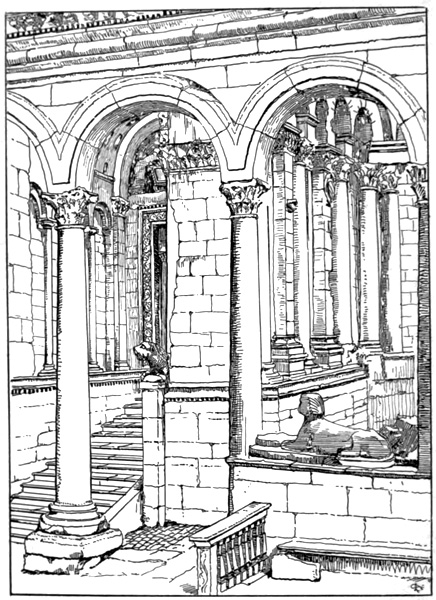
CATHEDRAL, TRANI, INSIDE.
But the daring attempt is thoroughly successful;
there is not, what we might well have looked for, any
feeling of weakness; the twin columns yoked together
to bear all that would have been laid on the massive
round piers of England or their square fellows of
Germany, seem fully equal to their work. It may be
that the appearance of strength is partly owing to
the use of real half-columns, and not mere slender
vaulting-shafts, to support the roofs of the aisles.
But the slender shaft comes in with good effect to
support both the arch between the nave and the
transept, and the arch between the transept and the
great apse. The lofty transept is wholly an Italian
idea; but the general idea of these two tall arches is
thoroughly Norman.
In looking at such a church as this, so widely
different from any of the many forms with which we
are already familiar, there is always a certain doubt as
to our own feelings. We admire; as to that there is
no doubt. But how far is that admiration the result
of mere wonder at something which in any case is
strange and striking? how far is it a really intelligent
approval of beauty or artistic skill? Both feelings, we
may be pretty sure, come in; but it is not easy to say
which is the leading one, till we are better acquainted
with the building than we are likely to become in an
ordinary journey. It is familiarity which is the real
test. It is the building which we admire as much the
thousandth time as the first which really approves
itself to our critical judgement. We have not seen
Trani for the thousandth time; but we did what we
could; we were so struck with a first visit to Trani that,
at the cost of some disturbance of travelling arrangements,
we went there again, and we certainly did not
admire it less the second time than the first. And,
whatever may be the exact relation of the two feelings
of mere wonder and of strictly critical approval, it is
certain that a third feeling comes in by no means
small a measure. This is a kind of feeling of historic
fitness. The church of Trani is the kind of church
which ought to have been built by Normans building
on Apulian ground, with Greek and Saracen skill at
their disposal.
But at Trani, as commonly in these Apulian churches,
it is not enough to look at the building from above
ground. The great height of the apses will have already
suggested that there is a lower building of no small
size; and so we find it, conspicuously tall and stately,
even in this land of tall and stately under-churches—crypt
is a word hardly worthy of them. The under-church
at Trani shows us a forest of tall columns, some
of them fluted, with a vast variety of capitals of foliage.
A few only can be called classical; some have the
punched ornament characteristic of Ravenna. A good
many of the bases have leaves at the corners, a fashion
which in England is commonly a mark of the thirteenth
century, but which in Sicily and Dalmatia
goes on at least till the seventeenth.
But the metropolitan church is not all that Trani has
to show. In some of the buildings which we pass by in
its narrow streets, we see some good windows of the
style which it is most easy to call Venetian, though it
might be rash hastily to refer them to the days of
Venetian occupation. And there are other windows
seemingly of earlier date, certainly of earlier character,
which bear about them signs of the genuine Norman
impress. But the strength of Trani, even setting
aside the great church, lies in its ecclesiastical
buildings; the best pieces even of domestic work are
found in one of the monasteries. Two smaller churches
deserve notice; one of them deserves special notice.
This is the church of All Saints, of which we saw the
east end on our way to the great minster, and on
whose west end we shall most likely light as we come
away from it. That west end is covered by a portico,
or rather something more than a portico, as it contains
a double row of arches. The front to the street forms
part of a long and picturesque range of building, of
which the actual arcade consists of four arches. One
only of these is pointed, and that is the only one which
rests on a column, the others being supported by
square piers. But beyond this outer range, the vaulted
approach to the church displays a grand series of
columns and half-columns, with capitals of various
forms. One is of extraordinary grandeur, with the
volutes formed of crowned angels; the forms of the
man and the eagle, either of them good for a volute,
are here pressed into partnership. Within, the church
is a small but graceful basilica, which, notwithstanding
some disfigurements in 1853 which are boastfully
recorded, pretty well keeps its ancient character, its
columns with their capitals of foliage. He who visits
Trani will doubtless also visit Bari, and such an one
will do well both to compare the great church of Trani
with the two great churches of Bari, and to compare and
contrast this smaller building with the smaller church
at Bari, that of Saint Gregory. Besides this little
basilica, Trani possesses, not in one of its narrow streets,
but in its widest piazza, a church, now of Saint Francis,
but which, among many disfigurements, still keeps the
form of the Greek cross within, and some Romanesque
fragments without. Here, as also at Bari and at
Bitonto, oriental influences—something we mean more
oriental than Greeks or even than Sicilian Saracens—may
be seen in the pierced tracery with which some
of the windows are filled. In these cases this kind of
work suggests a mosque; with other details, it might
have carried our thoughts far away, to the great towers
of the West of England.
Among the other members of this group of cities we
might have expected to find Brindisi, so famous as a
haven of the voyager in Roman days, and no less
famous in our own, fill a high, if not the highest,
place among its fellows. And Brindisi has its points
of interest also, one of them of an almost unique
interest. Over the haven rises a commemorative
column—its fellow has left only its pedestal—which
records, not the dominion of Saint Mark, but the
restoration of the city by the Protospatharius Lupus.
Is this he whose name has been rightly or wrongly
added to certain annals of Bari? Anyhow there the
column stands, one of the few direct memorials of
Byzantine rule in Italy. There is the round church
also, the mosaic in the otherwise worthless cathedral,
and one or two fragments of domestic work. The lie
of the city and its haven is truly a sight to be studied;
we see that in whatever language it is that Brentesion
means a stag's horn, the name was not unfittingly
given to the antler-like fiords of this little inland sea.
We trace out too the walls of Charles the Fifth, and
we see how Brindisi has shrunk up since his day.
But we are perhaps tempted to do injustice to Brindisi,
to hurry over its monuments, when we are driven to
choose between Brindisi and the greater attractions of
the furthest city of our group, in some sort the furthest
city of Europe. We pass by Lecce, which lies outside
our group, as between Trani and Brindisi we have
been driven to pass Monopoli, the spot which saw the
first beginnings of the short Venetian rule in these
parts. Everything cannot be seen, and we shall
hardly regret sacrificing something to hasten to a spot
which may well call itself the end of the world, and
which forms the most fitting link between the central
and the eastern peninsulas of Europe.
Hydrous, Hydruntum, Otranto, has as good a claim
as a city can well have to be looked on as the end of
the world. It is very nearly the physical end of the
world in that part of the world with which it has most
concern. When we have reached Otranto, we can go
no further by any common means of going. It may pass
for the south-eastern point of the peninsula of Italy:
it is the point where that central peninsula comes
nearest to the peninsula which lies beyond it. It is
the point where Western and Eastern Europe are
parted by the smallest amount of sea. It has therefore
been in all times one of the main points of
communication between Eastern and Western Europe.
The old Hydrous appears as a Greek colony, placed,
as one of the old geographers happily puts it, on the
mouth either of the Hadriatic or of the Ionian sea.
Hydruntum appears in Roman days as a rival route
to Brundisium for those who wish to pass from Italy
into Greece. A city so placed naturally plays its part
in the wars of Belisarius and in the wars of Roger.
Held by the Eastern Emperors as long as they held
anything west of the Hadriatic, it passed, when the
Norman came, into the hands of Apulian Dukes and
Sicilian Kings, and it remained part of the continental
Sicilian kingdom, save for the two moments in its
history which bring it within our immediate range.
Otranto is the one city of Western Europe in which
the Turk has really reigned, though happily for a
moment only. It is one of the cities in this corner of
Italy which formed, for a somewhat longer time, outlying
posts of Venetian dominion; and it is a spot
where the memory of the Turk and the memory of the
Venetian are mingled together in a strange, an unusual,
and a shameful way. In most of the other spots which
have seen the presence of the Turk and the Venetian,
the commonwealth which was the temple-keeper of the
Evangelist shows itself only in its nobler calling, as
"Europe's bulwark 'gainst the Ottomite." At Otranto,
Venice appears in a character which is more commonly
taken by the Most Christian King. Before Francis
and Lewis had conspired with the barbarian against
their Christian rivals, the Serene Republic had already
stirred him up to make havoc of a Christian city.
At Otranto then we finish our journey by land, and
from Otranto, as Otranto is now, we have no means of
continuing it by sea. We cannot sail straight, as men
did in old times, either to Corfu or to Aulona. To
make our way from the central to the south-eastern
peninsula, we have to make the "iter ad Brundisium"
back again from the other side. It is the natural consequence
of being at the end of the world, that when
we reach the point which holds that place, we have to
go back again. And when we find ourselves at Otranto,
the fact that we are at the end of the world, that we
have reached the end, not only of our actual journey,
but of any possible journey of the same kind, is forcibly
set before us as a kind of symbol. We have come to an
end, to a very marked end, of the great railway system
of central Europe. From any place within that system
we can find our way to Otranto by the power of steam.
Beyond Otranto that power can take us no further;
indeed we have so nearly reached the heel of the boot
that there is not much further to go by the help of
any other power. We are at the end of Italy, at the
end, that is, of the central peninsula of Europe, in a
sense in which we are not even at more distant Reggio.
For Reggio is before all things the way to Sicily, and
Sicily we must allow to be geographically an appendage
to Italy, strongly as we must assert the right of
that great island to be looked on historically in quite
another light. And that at Otranto we have distinctly
reached the end of something is clearly set forth by
the arrangements of the railway station itself. The
rails come to an end; the buildings of the station are
placed, not at the side of the line, but straight across
it, a speaking sign that we can go no further, and
that the thought of taking us further has not entered
the most speculative mind.
At Otranto then we have come to the end of one
of the great divisions of the European world; it is
therefore a fitting point to form a main point of connexion
between that division and another. Otranto and
its neighbourhood are the only points of the central
peninsula from which we can, as a matter of ordinary
course, look across into the eastern peninsula. We say
as a matter of ordinary course. There are Albanian or
Dalmatian heights from which it is said that, in
unusually favourable weather, the Garganian peninsula
may be descried; so it may be that the Garganian
peninsula is favoured back again with occasional
glimpses of south-eastern Europe. But a stay of
even a few hours at Otranto shows that there south-eastern
Europe comes within the gazer's ordinary ken.
It is easy to see that it does not so much need good
weather to show it as bad weather to hinder it from
being shown. Before we reach Otranto, while we are
still on the railway, the mountains of Albania rise
clearly before our eyes; from the hill of Otranto itself
they rise more clearly still. And even to those to
whom those heights are no unfamiliar objects from
nearer points of view, it is a thrilling and a saddening
thought, when we look forth for the first time from a
land of which every inch belongs to the free and
Christian world, and gaze on the once kindred land that
has passed away from freedom and from Christendom.
From the soil of free Italy we look on shores which
are still left under the barbarian yoke, shores where so
many whose fathers were sharers in the European and
Christian heritage have fallen away to the creed of the
barbarian and to all that that creed brings with it.
On the other hand, it is said that there are more
favourable moments when it is possible to look from
free Italy into free Greece. It is said that, sometimes
perhaps Corfu itself, more certainly the smaller islands
which lie off it to the west, may be seen from the hill
of Otranto. If so, we look out from that one spot of
the central peninsula, from that one spot of the
general western world, where the Turk can be said to
have really ruled, for however short a time, and not
simply to have harried. And we look out on that one
among the many islands which gird the eastern
peninsula, which has gone through many changes and
has bowed to many masters, but where alone the Turk
has never ruled as a master, but has shown himself
only as a momentary besieger.
The Turk then was never lord of Corfu; he was for
a while, though only for a very little while, lord of
Otranto. The winged lion floated over Corfu while
the crescent floated for a season over Otranto. It was
therefore perhaps not wholly unfitting that, for another
somewhat longer season, the winged lion should float
over Corfu and Otranto together. But it was not
in his nobler character that the winged lion floated
over Otranto. It would have been a worthy exploit
indeed, if the arms of Venice, by that time a great
Italian power, had driven out the Turk from his first
lodgement on Italian soil. But instead of Venice
driving the Turk out of Otranto, it was the common
belief of the time that it was Venetian intrigue which
had let him in. Nay more, if there was any truth in
other suspicions of the time, the good old prayer of
our forefathers, which prayed for deliverance from
"Pope and Turk," might well have been put up by
the people of Otranto and all Apulia in the year 1480.
Not only the commonwealth of Venice, but the Holy
Father himself, Pope Sixtus the Fourth, was believed
to be an accomplice in the intrigues which enabled
the infidel to establish himself on the shores of
Italy. A time came, almost within our own day,
when Pope and Turk were really leagued together,
and when the Latin Bishop of the Old Rome owed his
restoration to his seat to the joint help of the Mussulman
Sultan of Constantinople and the Orthodox Tzar
of Moscow. But in the fifteenth century we need
hardly expect even such a Pope as Sixtus of deliberately
bringing the Turk into Italy. His own interests
both as priest and as prince were too directly
threatened. But it is hard to acquit the Venetian
commonwealth, under the dogeship of Giovanni
Mocenigo, of risking the lasting interests of all Christendom,
and of their own Eastern dominion as part of
it, to serve the momentary calls of a petty Italian
policy. We even read that Venetian envoys worked
on the mind of the Sultan by the argument that it
was the part of the new lord of Constantinople to
assert his claim to all that the older lords of Constantinople
had held east of the Hadriatic. No argument
could be more self-destructive in Venetian
mouths. If the Turk had inherited the rights of
Eastern Cæsar in the Western lands, how cruelly
was Venice defrauding him of a large part of the
rights of the Eastern Cæsar in his own Eastern
lands.
The conquest of Otranto was the last of the conquests
of him who rightly stands out in Ottoman
history as pre-eminently the Conqueror. The second
Mahomet, he who completed the conquest of Christian
Asia by the taking of Trebizond, who crowned the
work of Ottoman conquest in Europe by the taking
of Constantinople, who by the taking of Euboia dealt
the heaviest blow to the Venetian power in the
Ægæan, who brought under his power, as a gleaning
after the vintage, the Frank lordship of Attica and
the Greek lordship of Peloponnêsos, in his last days
stretched forth his hand to vex Western Europe as he
had so long vexed Eastern Europe and what was left
of Christian Asia. He was in truth attacking both at
the same time; he won Otranto almost at the moment
when he was beaten back from Rhodes. Each scene
of his warfare illustrates the nature of the Ottoman
power at that moment, how it was by the hands of her
own apostate sons that Christendom was brought into
bondage. Against Rhodes the infidel host was led
by a Greek, against Otranto by an Albanian, both
renegades or sons of renegades. And under the first
Ferdinand of Aragon such was the state of things
in the land which had once been ruled by good
King William that soldiers of the Neapolitan King
were willing to pass into the service of the Turk.
Nay, the inhabitants in general seemed ready to
believe the Turk's promises and to accept his dominion
as likely to be milder than that of their own
stranger king. The invader was his own worst enemy.
A contemporary writer witnesses that the prisoners
taken by Achmet Break-Tooth—such is said to be
the meaning of his surname Giédek—pointed out to
him that by his cruelties at Otranto he was losing for
his master a province which otherwise might have
been won with little effort.
But happily things took another turn. Otranto was
in the Western world what Kallipolis—the Kallipolis
of the Thracian Chersonêsos—had been in the Eastern.
It was the first foothold of the barbarian, the gate by
which he seemed likely to open his way to the possession
of the central peninsula of Europe, as he had by
the gate of Kallipolis opened his way to the possession
of the eastern peninsula. Otranto was the last of the
conquests of the great Conqueror; what if he had
been longer-lived? what if the second Bajazet had
deserved the name of Thunderbolt like the first?
Would the threat of the first Sultan have been
carried out, and would the Turk have fed his horse
on the high altar of Saint Peter's? The eastern
peninsula fell by internal division, and the central
peninsula, as his very entrance into it shows, was
fully as divided as the eastern. The French conquests
presently showed how little prepared Italy
was to withstand a vigorous attack, and Mahomet
the Conqueror would have been another kind of
enemy from Charles the Eighth. But all such
dangers were warded off. The Turk still showed
himself once and again in northern Italy, but only
as a momentary plunderer. Otranto remained his
only conquest on Italian ground, and that a conquest
held for thirteen months only. Alfonso, who bears so
unfavourable a character from other sides, must be at
least allowed the merit of winning back the lost city
for his father's realm. Otranto, and Otranto alone of
Italian cities, belongs to, and heads, the list on which
we inscribe the names of Buda and Belgrade and
Athens and Sofia, on which it may now inscribe the
names of Arta and Larissa, but from which hapless
Jôannina and twice-forsaken Parga are still for a while
shut out.
It was not therefore till the Turk had been driven
out, not until southern Italy had been more thoroughly
but not much more lastingly overrun by the armies of
France, that Otranto passed for a while under the rule
of Venice. The Serene Republic hardly deserved to rule
in a city which she had so lately betrayed; the place
seems never to have recovered from the frightful blow
of the Turkish capture. The town now shows no sign
either of the short Venetian occupation or of the
shorter Turkish occupation. From the side of military
history, this last fact is to be regretted. We
must remember that in that day the Ottomans, pressing
and hiring into their service the best skill of
Europe, were in advance of all other people in all
warlike arts. So Guiccardini remarks that the Turks,
during their short occupation of Otranto, strengthened
the city with works of a kind hitherto unknown in
Italy, and which, as he seems to hint, Italian engineers
would have done well to copy, but did not.
The present fortifications date from the time of Charles
the Fifth. Their extent shows at once how far the
Otranto of his day had shrunk up within the bounds
of the ancient city, and how far again modern Otranto
has shrunk up within the walls of the Emperor. It
is said that, before the Turkish capture, Otranto
numbered twenty-two thousand inhabitants; it has
now hardly above a tenth part of that number. As
the military importance of the place has passed away,
military precautions seemed to have passed away with
it; the castle stands free and open; no sentinel
hinders the traveller from wandering as he will within
its walls. But the traveller will gain little by such
wanderings except the look-out over land and sea.
The town stands close upon the sea, on a small height
with a valley between it and the railway station. It is
entered by a gateway of late date, but of some dignity;
but it is not much that the frowning entrance leads to.
The visitor soon finds that Otranto, which gave its
name of old to the surrounding land, which still
ranks as a metropolitan city, has sunk to little more
than a village. It seems to have had no share in the
revived prosperity of the other towns along this coast.
Its one object of any importance is the metropolitan
church, and this is at once the only monument of the
ancient greatness of the place, and also in a strange
way the chief memorial of its momentary bondage to
the barbarian.
In order thoroughly to take in the position of the
great church of Otranto in its second character, as a
memorial of bondage and deliverance, it may be well
to pass it by for a moment and to go first to the
castle, and look out on one of the points of view
which it commands. Any local guide will be able
to show the traveller the Hill of the Martyrs. It
stands at no great distance beyond the town, and is
held to mark the site of a pagan temple. There the
Turks, after their capture of the city, did as they have
done in later times. Some eight or nine hundred of
the people of Otranto were massacred. Their bodies
lay unburied so long as the Turk kept possession; on
the recovery of the city, the bodies of the martyrs,
as they were now deemed, were gathered together, and
a special chapel was added to the metropolitan church
to receive them. There they may still be seen, piled
together in cases, with inscriptions telling the story.
There are skulls, legs, arms, bones of every part of the
human body, some still showing the dents of barbarian
weapons, some with barbarian weapons still
cleaving to them. There we look on them, ghastly
witnesses that, neither in their days nor in ours, is the
Æthiopian at all disposed to change his skin or the
leopard his spots. What the Turk did at Otranto
he has done at Batak; he may, if the freak seizes him,
do the like at Jôannina. Only the deeds of Otranto
were at least done by the Turk as a mere outside
barbarian; he was not licensed to do them by the
united voice of Europe. It is only in these latest
times that the Turk has been fully authorized, under
all the sanctions of so-called international right, to
renew at pleasure the deeds of Otranto and of Batak
in lands to which Europe has twice promised freedom.
The martyrs of 1480, their sufferings, their honours,
have made so deep an impression on the mind of
Otranto that the metropolitan basilica has popularly
lost its name of Annunziata, and is more commonly
spoken of as the church of the martyrs. But the
great church of Otranto, the church of the prelate
whose style runs as "archiepiscopus Hydrutinus et
primas Salentinorum," is a building of deep interest
on other grounds. Like so many Italian churches, it
is not very attractive without, nor is there anything
specially to tarry over in its bell-tower. But even
outside we may mark one or two signs of the restoration
which the church underwent after its deliverance
from the Turk. The west window is of that date,
one of those rose-windows to which Italian, and still
more Dalmatian, taste clave so long, even when all
other mediæval fashions had vanished away. Of the
same date is the north door, showing, like the great
doors at Benevento, the Primate of the Salentines
attended by the bishops and chief abbots of his
province. As we go within, our first feeling is one of
wonder that so much should have lived through the
infidel storm and occupation. But, according to the
usual practice of Mussulman conquerors, the head
church of the city was turned into a mosque; there
was therefore, after the first moment of havoc had
passed by, no temptation on the part of the new
occupants to damage the essential features of a building
which had become a temple of their own worship.
It is therefore not wonderful that the main features of
the basilica are still there, either untouched or most
skilfully restored. Seven arches rise from columns,
perhaps of classical date, with capitals, mostly of
different kinds of foliage, but one of which brings in
human figures, after the type which was so well set in
Caracalla's baths. But a more interesting study is
supplied by the great crypt, or rather under-church.
At Otranto, as in some of its neighbours, the craftsmen
who worked below clearly allowed themselves a
freer choice of forms in the carving of capitals than
they ventured on above ground. The vault of the
under-church rests on ranges of slender columns, with
heavy abaci and with an amazing variety in the
capitals. None perhaps can be called classical; but
very few are simply grotesque. The few that are so
are found—one does not quite see the reason of the
distinction—among the half-columns against the walls.
Most of them show various forms of foliage and animal
figures; the old law that almost any kind of man,
beast, or bird, can be pressed to serve as the volute
at the corner of a capital is here most fully carried
out. But the further law, that that duty is most
worthily discharged by the imperial eagle, can be
nowhere better studied than in the Hydrantine under-church.
In some capitals again, especially in the
columns of the apses, the bird of Cæsar is perched as
it were on Byzantine basket-work, clearly showing
which Augustus it was to whom the Salentine Primate
bowed as his temporal lord. Other capitals again
are much simpler, but also savouring of the East; the
plain square block has mere carving on the surface.
Then, of the columns themselves, some are plain, some
are fluted, some are themselves carved out with various
patterns. In short a rich and wonderful variety reigns
in every feature of the under-church of Otranto.
Our comparison of the columns and capitals has
carried us underground; but the really distinctive
feature of the basilica of Otranto is above. Other
churches of southern Italy have wonderful crypts;
none, we may feel sure, has so wonderful a pavement.
And here we do wonder that the Turks did not do
incomparably more mischief than they did do. Some
mischief they did; but the archbishops and canons of
Otranto seem—perhaps unavoidably—to have done a
great deal more by destroying or covering the rich
pavement to make room for the furniture of the
church. It would surely be hard to find another
example of a pavement whose design is spread over
the whole ground-floor of a great church. The pictures
are in mosaic, rough mosaic certainly, of the second
half of the twelfth century, when Otranto formed part
of the Sicilian realm, and when that realm was ruled
by William the Bad. Luckily inscriptions in the
pavement itself have preserved to us the exact date,
and the names of the giver and the artist. One tells
us in leonine rimes:
"Ex Ionathi donis per dexteram Pantaleonis
Hoc opus insigne est superans impendia digne.
Another stoops to prose: "Humilis servus Ionathas
Hydruntinus archieps. jussit hoc op fieri per manus
Pantaleonis prb. Anno ab Incarnatione Dni Nri Ihu.
Xri MCLXV indictione XIV, regnante Dno nostro W.
Rege Magnif." The design of the priest Pantaleon,
wrought at the bidding of Archbishop Jonathan in
the last year of the first William, is of a most extensive
and varied kind. Scriptural scenes and persons,
figures which seem purely fanciful, the favourite
subject of the signs of the zodiac, all find their place.
We meet also with one or two heroes of earlier and
later times whom we should hardly have looked for.
The main design starts, not far from the west end,
with a tree rising from the backs of two elephants.
The huge earth-shaking beast, the Lucanian ox, is, it
must be remembered, a favourite in southern Italy;
he finds a marked place among the sculptures of the
great churches of Bari. The tree—one is tempted to
see in it the mystic ash of Northern mythology—sends
its vast trunk along the central line of the nave, throwing
forth its branches, and what we may call their
fruit, on either side. Here are strange beasts which
may pass either for the fancies of the herald or for the
discoveries of the palæontologist; but in the lion with
four bodies and a single head we must surely look for
a symbolical meaning of some kind. He is balanced,
to be sure, by other strange forms, in which two or
three heads rise from a single body. Here are figures
with musical instruments, here a huntress aiming at
a stag; and in the midst of all this, not very far from
the west end, we find the figure of "Alexander Rex."
To the left we have Noah, making ready to build the
ark—the story begins at the beginning, like the
building of the Norman fleet in the Bayeux Tapestry.
Four figures are cutting down trees, and the patriarch
himself is sawing up the wood, with a saw of the type
still used in the country. The centre of the pavement
is occupied by the zodiac; each month has its befitting
work assigned to it according to the latitude of
Otranto. Thus June cuts the corn. July threshes it,
neither with a modern machine, nor with the feet of
primitive oxen, but with the flail which many of us will
remember in our youth. August, with his feet in the
wine-press, gathers the grapes. December carries a
boar, as if for the Yule feast of Queen Philippa's
scholars. Each month has its celestial sign attached;
but it would seem that the priest Pantaleon was in a
hurry in putting together his kalendar, and that he
put each of the signs a month in advance. Beyond
the zodiac, near the entrance of the choir, and partly
covered by its furniture, is a figure, which startles us
with the legend "Arturus Rex." If we were to have
Alexander and Arthur, why not the rest of the nine
worthies? If only a selection, why are the Hebrews
defrauded of their representative?—unless indeed
Samson, who appears in the form of a mutilated figure,
not far from the left of Arthur, has taken the place of
the more familiar Joshua, David, and Judas. Here is
a witness to the early spread of the Arthurian legends;
here, in 1165, within the Sicilian kingdom, the legendary
British hero receives a place of honour, alongside
of the Macedonian. Nor is this our only witness to
the currency in these regions of the tales which had
been not so long before spread abroad by Walter Map.
By this time, or not long after, the name of Arthur
had already found a local habitation on Ætna itself.
Among other scriptural pieces in different parts, we
find of course Adam and Eve, and Cain and Abel;
there is Jonah too, far to the east; and in the eastern
part of the north aisle, the imagination of Jonathan
or Pantaleon has forestalled somewhat of the Dantesque
conception of the Inferno. "Satanas" is
vividly drawn, riding on a serpent, and other figures
armed with serpents are doing their terrible work in
the train of the "duke of that dark place." The
whole work is strictly mosaic, and the design, though
everywhere rude, is carried out with wonderful spirit.
We may indeed rejoice that the hoofs of Turkish
horses and the improvements of modern canons have
left so much of a work which, even if it stood by
itself, it would be worth while going to the end of
railways at Otranto to see.
Such is now the one city in which the Turk ever
ruled on our side of Hadria. In earlier times we might
have passed straight from Otranto to the lands where
he still rules, or to the island where he never ruled.
But now he who looks out for Otranto on the heights
of Albania, and whose objects call him to the nearer
neighbourhood of those heights, must go back to
Brindisi to find his way to reach them.
In our present journey we draw near to the eastern
peninsula, to the Hellenic parts of that peninsula, by
way of the great island—great as compared with the
mass of Greek islands, though small as compared with
Sicily or Britain—which keeps guard, as a strictly
Hellenic outpost, over a mainland which was and is
less purely Hellenic. From Brindisi we sail to Corfu,
the elder Korkyra, as distinguished from the black
isle of the same name off the Dalmatian shore. In so
sailing, we specially feel ourselves to be sailing in the
wake of the conquerors who made Corfu an appendage
to the Sicilian realm; we are passing between spots
on either side which have known both a Norman and
Venetian master. But it may be that we may have
already drawn near to Greece by another path. It
is easy to prolong the voyage which took us from
Trieste to Spalato, from Spalato to Cattaro, by a third
stage which will take us from Cattaro to Corfu. In
this case we may have already studied the Albanian
coast, and that with no small pleasure and profit.
We may have marked a point not long after we
had left Dalmatia behind us, and that where a
line may well be drawn. There is a geographical
change in the direction of the coast, from the shore of
Dalmatia, with its islands and inland seas, its coast-line
stretching away to the south-east, to the nearly
direct southern line of the shore of Albania. In
modern political geography we pass from the dominion
of Austria to the dominion of the Turk. In
the map of an earlier day, we pass from the all but
wholly continuous dominion of the two commonwealths
of Venice and Ragusa. In modern ethnology
we pass from the Slave under a certain amount of
Italian influence to the Albanian under a certain,
though smaller, amount of influence, Italian or Greek,
according to his local position and his religious creed.
In modern religious geography we pass from a land
which is wholly Christian, but where the Eastern form
of Christianity, though still in the minority, makes
itself more deeply felt at every step, to a land where
Islam and the two great ancient forms of Christianity
are all found side by side. In the geography of earlier
times this point marks the frontier of a land intermediate
between the barbaric land to the north, with
only a few Greek colonies scattered here and there,
and the purely Greek lands, the "continuous Hellas," to
the south. We find on this western shore of the south-eastern
peninsula the same feature which is characteristic
of so large a part of the Ægæan and Euxine
coasts, both of the south-eastern peninsula itself and of
the neighbouring land of Asia. The great mainland
is barbarian; the islands and a fringe of sea-coast are
Greek. As we draw nearer to the boundary of Greece
proper, the Hellenic element is strengthened. Thesprotians,
Molossians, Chaonians, were at least capable
of becoming Greeks. Epeiros, Ἤπειρος, terra firma,
once the vague name of an undefined barbarian region,
became the name of a Greek federal commonwealth
with definite boundaries. And the character of a barbarian
land, fringed with European settlements and
looking out on European islands, did not wholly pass
away till almost our own day. A few still living men
may remember the storming of Prevesa; many can remember
the cession—some might call it the betrayal—of
Parga. It was only when Parga was yielded to
the Turk that this ancient feature of the Illyrian and
Epeirot lands passed away. What Corinth had once
been Venice was. Corinth first studded that coast
with outposts of the civilized world. Venice held those
outposts, sadly lessened in number, down to her fall.
And the men of Parga deemed, though they were mistaken
in the thought, that to the mission of Corinth
and Venice England had succeeded.
From whichever side our traveller draws near to
Corfu, he comes from lands where Greek influence
and Greek colonization spread in ancient times, but
from which the Greek elements have been gradually
driven out, partly by the barbarism of the East, partly
by the rival civilization of the West. Whether we
come from Otranto and Brindisi or from the Illyrian
Pharos and the Illyrian Korkyra, we are coming from
lands which once were Greek. But Otranto and
Brindisi, Pharos and Black Korkyra, even Epidamnos
and Apollonia, were scattered outposts of Greek life
among barbarian neighbours; as the traveller draws
near to the elder Korkyra, he finds himself for the
first time within the bounds of "continuous Hellas."
He may have seen in other lands greater and more
speaking monuments of old Hellenic life than any
that the island has to show him; he may have seen
the lonely hill of Kymê, the hardly less lonely
temples of Poseidônia; but those were Greece in
Italy; now for the first time he sees Greece itself.
Whatever we may say of the mainland to the left,
there can be no doubt, either now or in ancient times,
of the Hellenic character of the island to the right.
There are the small attendant isles; there are the
great peaks of Korkyra—not the lowlier peaks which
gave city and island their later name—but the far
mightier mountains which catch the eye as we approach
the great island from the north. That island
at least is Hellas—less purely Hellenic, it may be,
than some other lands and islands, but still Hellenic,
part of the immediate Hellenic world of both ancient
and modern days. It was and is the most distant part
of the immediate Hellenic world; but it forms an
integral part of it. The land which we see is Hellenic
in a sense in which not even Sicily, not even the
Great Hellas of Southern Italy, much less then the
Dalmatian archipelago, ever became Hellenic. From
the first historic glimpse which we get of Korkyra, it
is not merely a land fringed by Hellenic colonies; it
is a Hellenic island, the dominion of a single Hellenic
city, a territory the whole of whose inhabitants were,
at the beginning of recorded history, either actually
Hellenic or so thoroughly hellenized that no one
thought of calling their Hellenic position in question.
Modern policy has restored it to its old position by
making it an integral portion of the modern Greek
kingdom. And, if in some things it is less purely
Greek than the rest of that kingdom, what is the cause?
It is because, if Corfu may be thought for a while to
have ceased to be part of Greece, it never ceased to be
part of Christendom. It was for ages under alien
dominion, but it never was under the dominion of the
Turk. The Venetian could to some extent modify and
assimilate his Greek subjects; the Turk could modify
or assimilate none but actual renegades. And, after
all, the main influence has been the other way. If
Italian became the fashionable speech, even for men
of Greek descent, men on the other hand whose names
distinctly show their Italian descent have cast in their
lot with their own country rather than with the country
of their forefathers. Shallow critics have mocked because
men with Venetian names have been strong
political assertors of Greek nationality. They might
as well mock whenever a man of Norman descent
shows himself a patriotic Englishman. They might
as well hint that Presidents and Ministers of France
and Spain, who have borne names which proclaim
their Irish origin, were bound or likely to follow an
Irish policy rather than a French or a Spanish one.
The first aspect, indeed every aspect, of the island
of Corfu and the neighbouring coast of Epeiros is
deeply instructive. The island and the mainland come
so close together that, till the eye has got well used
to the outline of particular mountains, it is not easy
to tell how much is island and how much mainland.
A statesman of the last generation twice told the
House of Lords that Corfu lay within a mile of the
coast of Thessaly. We cannot say, without looking
carefully to the scale on the map, how many miles
Corfu lies from the coast of Thessaly, any more than
we can say offhand how many miles Anglesey lies
from the coast of Norfolk. It is a more practical fact
that some parts of Corfu lie very near indeed to the
coast of Epeiros, though not quite so near as Anglesey
lies to the coast of Caernarvonshire. The channel must
surely be everywhere more than a mile in width;
certainly it could nowhere be bridged, as in the case
of Anglesey, or in the cases of Euboia and nearer
Leukas. Both coasts are irregular, both coasts are
mountainous, and the mountains on both sides fuse
into one general mass. Above all, prominent from
many points, soars the famous range where, with a
singular disregard of later geography,
"Arethusa arose
From her couch of snows
In the Acroceraunian mountains."
Snow of course is in these lands to be had only at
a much higher level than the snow-line of the Alps, so
that the couch of Arethousa stands out yet more conspicuously
over the neighbouring heights than it might
have done in a more northern region. The inhabitants
of Corfu are fond of pointing to the contrast between
the well-wooded hills and valleys of their own fertile
island and the bare, almost uninhabited, land which
lies opposite to them. And of course they do not fail
to point the inevitable moral. As in most such cases,
there is truth in the boast, but truth that needs some
qualifications. Corfu, through all its changes of
masters, has always been under governments which
were civilized according to the standard of their own
times. It has fared accordingly. Epeiros has been
handed over to a barbarian master, and it has also been
largely colonized by the least advanced of European
races. Besides having the Turk as a ruler, it has had
the Albanian, Christian and Mussulman, as a settler. In
Corfu the Albanian is a frequent visitor; his sheepskin
and fustanella may be constantly seen in the streets of
Corfu; but he has not—unless possibly in the shape of
refugees from Parga—formed any distinct element in
her population. It is only in the nature of things that
Greeks under successive Venetian, French, and English
rule should do more for their land than Albanians under
Turkish rule. But we may doubt whether any people
under any government could have made the land
opposite to Corfu like Corfu itself. Had the mainland
shared the successive destinies of the island, it would
doubtless have been far better off than it has been.
But it could hardly have been as the island. One
point of advantage for the island was the mere fact
that it was an island. In all but the highest states of
civilization, this is an advantage beyond words; and
the ancient colonists fully understood the fact.
Still it is a striking contrast to pass across the
narrow sea from Corfu to what was Butrinto. Buthrotum,
the mythical city of the Trojan Helenos, has
a more real being as a Roman colony, and as one of
those outposts on the mainland in which Venice succeeded
the Neapolitan Kings, and which she kept
down to her own fall. Butrinto was once a city no
less than Corfu; to Virgil's eyes it was the reproduction
of Troy itself. Now we cross from the busy
streets and harbour of Corfu to utter desolation at
Butrinto. The desolation is greater in one way than
any that Helenos or any other primitive settler could
have found, because it is that form of desolation which
consists in traces of what has been. We enter the
mouth of the river, with rich trees and pasturage
between its banks and the rugged mountains; we
mark ruins of fortresses and buildings on either side,
till we come to the ruined castle at the mouth of the
lake. The lake is a carefully preserved fishery, and
permission is needed to enter it. A few dirty-looking
men assemble at the door of a tumble-down building
standing against the ruined castle. But among them
are personages of some local importance. One is the
lessee of the fishery, whose good will is of special
importance. There is also a Turkish officer of some
kind—more likely a Mussulman Albanian than an
Ottoman—with his small and not threatening following.
There are one or two native Christians; and it
brings the varied ethnology of the land more deeply
home to learn that they are neither Greeks nor
Albanians, but that they belong to the scattered race
of the Vlachs, the Latin-speaking people of the East,
whose greatest settlement, far away from Butrinto,
has now grown into an European kingdom. It is
well to be reminded at such a moment that the
Rouman principality, though the greatest, is only one
among many, and that the latest, of the settlements of
this scattered people. And it brings home the fact to
us when we see here, in a land where Greek and
Albanian—that is, Hellên and Illyrian—are both at
home, the third of the great primitive races of the
peninsula, the widely spread Thracian kin, the people
of Sitalkês and Kersobleptês, so far away from the
land in which alone political geography acknowledges
them.
One feeling however the group, so small, but differing
so widely in race and creed, seem all to share very
deeply. This is a devout reverence for the image of
George King of the Greeks, when graven on a five- (new)
drachma piece, and held up in the hand of one
of the representatives of Corfu in the Greek Parliament.
We remember the ancient power of much
smaller coins—ὡς μέγα δύνασθον πανταχοῦ τὼ δύ' ὀβολώ—and
we begin to doubt whether a smaller sum might
not have done the work as well. Anyhow his Hellenic
Majesty's countenance, in this attractive shape, acts as
a talisman on all, private and official, Christian and
Mussulman; it buys off all questions or searchings
of any kind, and wins free access to the beautiful
scenery of the lake, full licence to poke about among
what little there is to poke about in the shattered castle.
The thought cannot help coming into the mind that
those who so greatly respect the image and superscription
of King George would have no very violent
dislike to become his subjects. Still it is not without
a certain feeling of having escaped out of the mouth
of the lion that we cross once more over the channel,
and find ourselves at the hospitable door of a Greek
gentleman of Koloura.
The great argument to establish the fact of a long-abiding
Slavonic occupation in Greece has always
been the changes in local nomenclature, the actual
Slavonic names and the Greek names which have
displaced older Greek names. The former class speak
for themselves; the latter class are held to have been
given during the process of Greek reconquest. Nor
can there be any reasonable doubt that there is a large
amount of truth in this doctrine, if only it is kept in
moderation, and is not pressed to the extreme conclusions
of Fallmerayer. But it is important to note
that the change from one Greek name to another has
taken place also in cases when there has been no foreign
settlement, no reconquest, no violent change of any
kind. One of the greatest of Greek islands has lost
one Greek name and has taken another, without the
operation of any of the causes which are said to have
brought about the change of nomenclature in Peloponnêsos.
Crete and Euboia, we may say in passing,
seem to have changed their names, when in truth they
have not; but Korkyra really has changed its name.
It had, for all purposes, become Corfu—in some
spelling or other—till the modern revival—unwisely,
we must venture to think—brought back, not the true
local Korkyra (Κόρκυρα), but the Attic and Byzantine
Kerkyra (Κέρκυρα). City and island alike are now
again Κέρκυρα; or rather we cannot say that the city
is again Κέρκυρα, as the modern city never was Κέρκυρα
at all, nor even Κόρκυρα. The modern town of Corfu—in
its best Greek form Κορυφώ—stands on a different
site from the ancient town of Korkyra, and there
can be little doubt that the change of name is connected
with the change of site.
The legendary history of the island goes up, we
need not say, to the Homeric tales. That Korkyra
was the Homeric Scheriê was an accepted article of
faith as early as the days of Thucydides. His casual
phrase goes for more than any direct statement. He
connects the naval greatness of the Korkyraians of his
day with the seafaring fame of the mythical Phaiakians
(ναυτικῷ πολὺ προέχειν ἔστιν ὅτε ἐπαιρόμενοι
καὶ κατὰ τὴν τῶν Φαιάκων προενοίκησιν τῆς Κερκύρας
κλέος ἐχόντων τὰ περὶ τὰς ναῦς). Nearly a thousand
years later Prokopios is equally believing, though he
goes into some doubts and speculations as to the
position of the isle of Kalypsô. His way of describing
the island should be noticed. With him the
island is the Phaiakian land, which is now called
Korkyra (ἡ Φαιάκων χώρα, ἣ νῦν Κέρκυρα ἐπικαλεῖται).
Against this description we may fairly balance that
of Nikêtas (ἡ Κερκυραίων ἄκρα, ἣ νῦν ἐπικέκληται
Κορυφώ), with whom the promontory of the Kerkyraians
is now called Koryphô. The two answer to
each other. To talk of Κερκυραίων ἄκρα was as
much an archaism in the eleventh century as to talk
of Φαιάκων χώρα was in the sixth. The everyday
name of the island in the days of Prokopios was still
Κόρκυρα or Κέρκυρα. In the days of Nikêtas it was
already Κορυφώ.
We put the two phrases of Prokopios and Nikêtas
together, because they are turned out as it were from
the same mould. But there is no doubt that the
change of name had happened a good while before
Nikêtas, and there is some reason to believe that it
was the result of causes which are set forth in the
narrative of Prokopios. The earliest mention of
Corfu by its present name seems to be that in Liudprand,
who calls it "Coriphus" in the plural, the Greek
Κορυφούς. The change therefore happened between the
sixth century and the tenth, the change doubtless of site
no less than the change of name. And no time seems
more likely for either than the time which followed
the wasting expedition of Totilas which Prokopios
records. Then doubtless it was that the old city, if it
did not at once perish, at least began to decay; a new
site began to be occupied; a new town arose, and that
new town took a new name from its most remarkable
physical feature, the κορυφώ, the two peaks crowned
by the citadel, which form the most striking feature in
the entrance to the harbour of modern Corfu.
One argument alone need be mentioned the other
way, and that is one which perhaps is not likely to
present itself to any one out of Corfu itself. The local
writer Quirini quotes a single line as from Dionysios
Periêgêtês, which runs thus:—
κείνην νῦν Κορφὺν ναῦται διεφημίξαντο.
Dionysios is a writer of uncertain date; but he may
safely be set down as older than Prokopios. If then
he used the later name, and used it in a form more
modern than the Κορυφώ of Nikêtas, the whole argument
would be set aside, and the name of Corfu would
be carried back to a much earlier time. But where
Quirini got his verse is by no means clear. We have
looked in more than one edition of Dionysios, and no
such verse can we find. The only mention of Korkyra
is in a verse which runs thus:—
καὶ λιπαρὴ Κέρκυρα, φίλον πέδον Ἀλκινόοιο.
Nor does the commentator Eustathios say one word as
to the change of name. We can only conceive that
the line must have been added as a gloss in some
copy, printed or manuscript, which was consulted by
Quirini.
We will assume then that, as far as the island is
concerned, Korkyra and Corfu—in its various spellings—are
two successive names, one of which supplanted
the other, while, as far as the city is concerned,
they are strictly the names of two distinct though
neighbouring cities, one of which fell as the other
rose. And now the question comes, Is the island of
Korkyra the Scheriê of Homer? Is his description
of Scheriê and the city of Alkinoos meant for the
description of Korkyra or any part of it, whether the
historical city or any other? We must remember that
the general witness of antiquity in favour of Korkyra
being Scheriê loses a good deal of its weight when we
consider that the ancient writers felt bound to place
Scheriê somewhere, while no such necessity is laid
upon us. Bearing this in mind, the plain case seems
to be that it is far more likely that Scheriê was
nowhere at all. In dealing with Scheriê and its inhabitants,
we are not dealing with an entry in the
Catalogue of the Iliad, the Domesday of the Mykênaian
empire; we are simply dealing with a piece
of the romantic geography of the Odyssey. Everything
about the Phaiakians and their land reads as if
the whole thing was as purely a play of the imagination
as the Kyklôpes and the Laistrygones. It is
indeed quite possible that, even in describing purely
imaginary lands, a poet may bring in his remembrance
of real places, just as the features of a real
person may be reproduced in the picture of an imaginary
event. The poet, in painting Scheriê, may
have brought in bits of local description from Korkyra
or from any other place. But that is all. As we read
the story, it seems quite as reasonable to look on the
map for Nephelokokkygia as to look on the map for
Scheriê. The thinkers of the days of Thucydides or of
some time before Thucydides, deeming themselves
bound to place Scheriê somewhere, fixed it at Korkyra.
The reason doubtless was that the Phaiakians are
spoken of as the most distant of mankind, far away
from any others, and that Korkyra really was for a
long time the most distant of Greek settlements in this
region. When Korkyra was once ruled to be Scheriê,
the process of identification naturally went on. Spots
received Homeric names. Alkinoos had his grove and
his harbour in the historical Korkyra. All this is the
common course of legend, and proves nothing for
either geography or history. Yet the tale of Scheriê,
of Alkinoos, Arêtê, and the charming Nausikaa, is not
simply one of the loveliest of tales. Scheriê knew the
use of wheeled carriages; therefore Scheriê had roads.
Alkinoos, the head king, was chief over twelve lesser
kings. Here we get real history, though history
neither personal nor local. Scheriê itself may safely
be looked for in the moon; but the roads of Scheriê
and the Bretwalda of Scheriê have their place in the
early history of institutions.
Other names of the island are spoken of, as Drepanê
and Makris, descriptive names which perhaps never
were in real use, and which, if they were, were supplanted
by the historical name of Korkyra. We must
again repeat that Korkyra, not Kerkyra, is the genuine
local name. It is the spelling on the coins of the
country; it is the spelling of the Latin writers, who
would get the name from the island itself; it is the
spelling of Strabo. But it is equally plain that in
Greece generally the spelling Κέρκυρα prevailed. It
is so in Herodotus and the Attic writers; it is so in
Polybios; it is so in the Byzantine writers, who of
course affect Attic forms. It must never be forgotten
that, from the time of Polybios, perhaps from an
earlier time than his, down to the present moment,
written Greek has been one thing, and spoken Greek
another. Polybios wrote Κέρκυρα, while its own people
called it Κόρκυρα, just as he wrote Ἦλις, while its
own people called it Ϝᾶλις. The difference has been
thought to have its origin in some joke or sarcasm—some
play on κέρκος, κέρκουρος, and the like. But the
literary form may just as likely be simply a tempting
softening of the local form. One point only is to be
insisted on, that the syllable Κορ in Κόρκυρα, and the
syllable Κορ in Κορυφώ, have nothing to do with one
another. The latter name is no corruption of the
elder; it is a genuine case of one Greek name supplanting
another—perhaps rather a case of a Greek
name, after so many ages, supplanting a name which
the first Greek colonists may have borrowed from
earlier barbarian inhabitants. In this case the change
implies no change of inhabitants, no change of
language. It is a change within the Greek language
itself, which can be fully accounted for by historical
causes. It therefore teaches that changes of name,
such as the Slavonic theory insists on in Peloponnêsos,
though they do often arise from new settlements and
reconquests, do also come about in other ways.
It is for the mythologist to find out whether Homer
had Korkyra in his eye when he described the mythic
Scheriê. This, be it again noted, is a perfectly
reasonable subject for inquiry, and in no way implies
any historical belief in the legend. It is simply like
asking whether the real Glastonbury at all suggested
the mythic Avalon. History begins to deal with
Korkyra in the eighth century B.C., when the settlement
of the Corinthian Chersikratês added the island
to the Greek world. From that day onward the island
has a long and eventful story, reaching down to our
own times. But, before that story begins, the historian
may fairly ask of the ethnologist what evidence, what
hints of any kind, there are as to the people whom the
Corinthian colonists found settled in the island. It is
not likely that they found so promising a site wholly
uninhabited. Some branch of the great Illyrian race,
the race which is still so near to the island, and which
still supplies it, if not with inhabitants, at least with
constant visitors, may well be supposed to have made
their way into so tempting an island. The harbours
of Corfu would surely attract the seafaring Liburnians.
We are then brought to the common conditions of a
Greek colony, planted, as usual, among pre-existing
barbarian inhabitants, and, as Mr. Grote has so
strongly enforced, sure to receive a dash of barbarian
blood among some classes of its members. The dêmos
of Korkyra may well have been far from being of pure
Hellenic descent—a fact which, if it be so, may go
far to explain the wide difference between the dêmos of
Korkyra and the dêmos of Athens. Since the time of
the Corinthian settlement, the island has undergone
endless conquests and changes of masters, each of
which has doubtless brought with it a fresh infusion
into the blood of its inhabitants. But since the time
of Chersikratês there has been nothing like extirpation,
displacement, or resettlement. Korkyra has ever
since been an Hellenic land, though a succession of
foreign occupations may have marred the purity of
its Hellenism. And one point at once distinguishes
it from all the neighbouring lands. Among all the
changes of masters which Korkyra or Corfu has undergone,
they have always been European masters. It
is the one land in those parts that has never seen
the Turk as more than a momentary invader, to be
speedily beaten back by European prowess.
So much for the origin and the name of the greatest
of the group which in modern geography has come by
the strange name of the Ionian Islands. The only
sense in which that name has any meaning is if it be
taken as meaning the Islands of the Ionian Sea. It
ought to be needless to remind any one that the word
in that sense has nothing whatever to do with the real
Ionians, with the Ionic dialect or the Ionic order. It
certainly has an odd effect when one hears the people
of Doric Korkyra spoken of as "Ionians;" and we
have even seen the whole group of islands spoken of as
"Ionia," to the great wrong of Chios, Samos, Ephesos,
and others of the famous Ionian twelve. But having
said so much about names, we must in another paper
say something of the long series of revolutions which
mark the history of Korkyra under its two names, and
of their effect on its present state.
We have already spoken of the singular change of
name which has befallen the most famous and important,
though not the largest in superficial extent,
of the group known as the Ionian Islands. The
change of name, as we hold, followed naturally on the
change of site of the city. The new city took a new
name, and the island has always followed the name
of the city. The old city and the new both occupy
neighbouring points in a system of small peninsulas
and havens, which form the middle of the eastern
coast of the long and irregularly-shaped island of
Korkyra. There, to the south of the present town,
connected with it by a favourite walk of the inhabitants
of Corfu, a long and broad peninsula stretches
boldly into the sea. Both from land and from sea, it
chiefly strikes the eye as a wooded mass, thickly
covered with the aged olive-trees which form so
marked a feature in the scenery of the island. A few
houses skirt the base, growing on the land side into
the suburb of Kastrades, which may pass for a kind
of connecting link between the old and the new city.
And from the midst of the wood, on the side nearest to
the modern town, stands out the villa of the King of
the Greeks, the chief modern dwelling on the site of
ancient Korkyra. This peninsular hill, still known
as Palaiopolis, was the site of the old Corinthian city
whose name is so familiar to every reader of Thucydides.
On either side of it lies one of its two forsaken
harbours. Between the old and the new city lies the
so-called harbour of Alkinoos; beyond the peninsula,
stretching far inland, lies the old Hyllaic harbour,
bearing the name of one of the three tribes which
seem to have been essential to the being of a Dorian
commonwealth. But the physical features of the
country have greatly changed since Chersikratês led
thither his band of settlers twenty-six centuries back.
It is plain that both harbours once came much further
inland than they do now, that they covered a great
deal of the low ground at the foot of the peninsular
hill. The question indeed presents itself, whether
the two did not once meet, whether the peninsula was
not once an island, whether the original colony did
not occupy a site standing to the mainland of Korkyra
in exactly the same relation in which the original
insular Syracuse, the sister Corinthian colony, stood
to the mainland of Sicily. The physical aspect of the
country certainly strongly suggests the belief. And
though Thucydides does not directly speak of the
city as insular, though his words do not at all suggest
that it was so, yet we do not know that there is
anything in his narrative which directly shuts out the
idea. Anyhow, the great change which has happened
is plain when we see how utterly the great Hyllaic
haven has lost the character of a haven. It is now
called a lake, and exists only for purposes of fishing.
We may believe that these physical changes had a
great deal to do with the removal of the city to
another site, with the change from Korkyra to Corfu.
The description which Thucydides gives of the
great sedition brings out a fact which we should at
first sight hardly have expected, the fact that the
aristocratic quarter of Korkyra was on the lower
ground by the harbour, while the upper part of the
town was occupied by the dêmos. To one who thinks
of Rome, Athens, and ancient cities generally, this seems
strange. But arguments from the most ancient class
of cities do not fully apply to cities of the colonial class.
These, where commerce was so great an object, were
no longer, as a rule, placed on heights; convenient
access from the sea was a main point, and we can
therefore understand that the ground by the coast
would be first settled, and would remain the dwelling-place
of the old citizens, the forefathers of the oligarchs
of the great sedition. There on the lower ground was
the agora, where the Epidamnian exiles craved for
help, and pointed to the tombs of their forefathers.
The impression of the scene becomes more lively when
we see not far off an actual ancient tomb remaining in
its place, though it could hardly have been the tomb
of the forefather of any Epidamnian. This is the
tomb of Menekratês of Oianthê, honoured in this way
by the people of Korkyra on account of his friendship
for their city, a plain round tomb with one of those
archaic inscriptions in which Korkyra is rich. Archaic
indeed it is, written from right to left, in characters
which mere familiarity with the Greek of printed books
or of later inscriptions will not enable any one to read
off with much ease. It formed doubtless only one of
a range of tombs, doubtless outside the city, but
visible from the agora. An orator in the Roman forum
could not have pointed to the tombs of forefathers by
the Appian Way.
The position of the quarter of the oligarchs by the
modern suburb of Kastrades seems perfectly clear from
Thucydides. The dêmos took refuge in the upper part
of the city and held the Hyllaic harbour; the other
party held the agora, where most of them dwelled,
and the harbour near it and towards the continent
(οἱ δὲ τήν τε ἀγορὰν κατέλαβον, οὗπερ οἱ πολλοὶ ᾤκουν
αὐτῶν, καὶ τὸν λιμένα τὸν πρὸς αὐτῇ καὶ πρὸς τὴν
ἤπειρον).
This district marks out the haven by
Kastrades, looking out on the Albanian mountains,
as distinguished from the Hyllaic haven shut in by
the hills of Korkyra itself.
But where was the Hêraion, the temple of Hêrê,
which plays a part in more than one of the Thucydidean
narratives? and where was the island opposite
to the Hêraion—πρὸς τὸ Ἡραῖον—and the isle of
Ptychia, both of which appear in his history? The
answer to the former question seems to turn on
another. Was the present citadel, the true Κορυφώ,
itself always an island, as it is now? The present
channel is artificial—that is to say, it is made artificial
by fortifications—but it may after all have been a
natural channel improved by art. And that is the
belief of some of the best Corfiote antiquaries. If so,
this may well be the νῆσος πρὸς τὸ Ἡραῖον, and
Ptychia may be the isle of Vido beyond. The Hêraion
would thus stand on the north side of the old Korkyra,
looking towards the modern city; it would stand in
the oligarchic quarter on the low ground near the
agora. It was therefore neither of the two temples of
which traces remain. One, of which the walls can be
traced out nearly throughout, and of which a single
broken Doric column is standing, overlooks the open
sea towards Epeiros. Another on the other side overlooked
the Hyllaic harbour. This in course of time
became a church, a now ruined church, but which
keeps large parts of its Hellenic walls and some windows
of beautiful Byzantine brickwork. It seems
hardly possible in any case that the Hêraion could
have been at quite the further end of the peninsula,
and that the island πρὸς τὸ Ἡραῖον
could be either of
the small islands, each containing a church, which
keep the entrance of the Hyllaic harbour.
Such then was old Korkyra, the colony of Chersikratês,
the Korkyra which figures in the tale of
Periandros, the Korkyra which played such a doubtful
part in the Persian War, which gained so fearful a
name in the Peloponnesian War, and which, within
two generations, had so thoroughly recovered itself
that in the days of Timotheos it struck both friends
and enemies by its wealth and flourishing state. It is
the Korkyra of Pyrrhos and Agathoklês, the Korkyra
which formed one of the first stepping-stones for the
Roman to make his way to the Hellenic continent,
the Korkyra whose history goes on till the wasting
inroad of Totilas. Then, as we hold, ancient Korkyra
on its peninsula began to give way to Koryphô (Corfu)
on another peninsula or island, that to which the two
peaks which form its most marked feature gave its name.
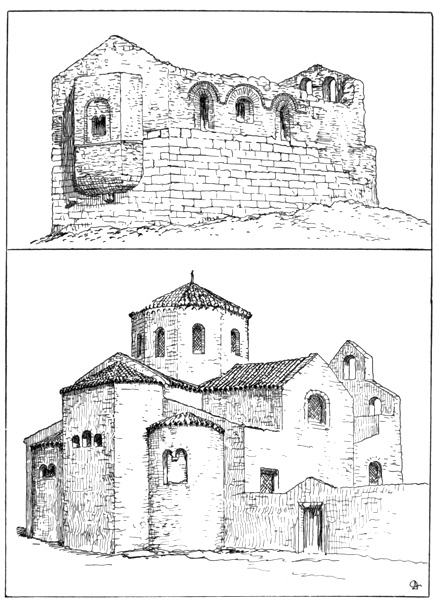
CHURCHES AT CORFU.
This last is the Corfu whose fate seems to have
been to become the possession of every power which
has ruled in that quarter of the world, with one exception.
For fourteen hundred years the history of
the island is the history of endless changes of masters.
We see it first a nominal ally, then a direct possession,
of Rome and of Constantinople; we then see it formed
into a separate Byzantine principality, conquered by
the Norman lord of Sicily, again a possession of the
Empire, then a momentary possession of Venice, again
a possession of the Sicilian kingdom under its Angevin
kings, till at last it came back to Venetian rule,
and abode for four hundred years under the Lion of
Saint Mark. Then it became part of that first strange
Septinsular Republic of which the Tzar was to be the
protector and the Sultan the overlord. Then it was
a possession of France; then a member of the second
Septinsular Republic under the hardly disguised
sovereignty of England; now at last it is the most
distant, but one of the most valuable, of the provinces
of the modern Greek kingdom. But Corfu has never
for a moment been under the direct rule of the
Turk. The proudest memory in the later history of
the island is the defeat of the Turks in 1716. Peloponnêsos,
the conquest of Morosini, had again been
lost, and the Turk deemed that he might again carry
his conquests into the Western seas. The city was
besieged by land and sea; the two fleets, Christian
and infidel, stretched across the narrow channel between
the island and the mainland, the left wing of
the Turkish fleet resting strangely enough on Venetian
Butrinto, while the ships of Venice and her allies
stretched from Vido to the Albanian shore. The
statue of Schulemberg, set up as an unparalleled
honour in his lifetime, adorns the esplanade of the
city which he saved. Unless we count the Turkish
acquisition of the Venetian points on the mainland,
which, though done under the cover of a treaty, took
at Prevesa at least the form of an actual conquest,
this was the last great attempt of the Turk to extend
his dominion by altogether fresh conquests at the
expense of any Christian power.
Korkyra thus gave way to Corfu, and the endless
fortifications of Corfu of every date were largely built
out of the remains of Korkyra which supplied so convenient
a quarry. None but an accomplished military
engineer could attempt to give an account of the
remains of all the fortifications, Venetian and English,
dismantled, ruined, or altogether blown up. But the
kingdom of which Corfu now forms a part still keeps
the insular citadel, the outline of the two peaks
being sadly disfigured by the needs of modern military
defence. Of the modern city there is but little
to say. As becomes a city which was so long a
Venetian possession, the older part of it has much of
the character of an Italian town. It is rich in street
arcades; but they present but few architectural features,
and we find none of those various forms of
ornamental window, so common, not only in Venice
and Verona, but in Spalato, Cattaro, and Traü. The
churches in the modern city are architecturally worthless.
They are interesting so far as they will give to
many their first impression of Orthodox arrangement
and Orthodox ritual. The few ecclesiastical antiquities
of the place belong to the elder city. The
suburb of the lower slope of the hill contains three
churches, all of them small, but each of which has an
interest of its own. Of one, known as ἡ Παναγία τῶν
βλαχερνῶν
, we have already spoken; another, known
specially as Our Lady of Oldbury (ἡ Παναγία παλαιοπόλεως),
is unattractive enough from any point from
which the spectator is likely to see it. Its form is by
courtesy called basilican; but, if so, it is like the
basilica of Trier, without columns or arches. Within
it is a dreary building enough, but it presents one
object of interest in a side-altar, a Latin intrusion
into the Orthodox fabric. But the west end is one of
the most memorable things to be found in Corfu or
anywhere else. Two columns, not of the usual early
Doric of the island, but with floriated capitals, though
not exactly Corinthian, are built into the wall with a
piece of their entablature. On this is graven a
Christian inscription, which is given in an inaccurate
shape by Mustoxidi (Delle cose Corciresi, p. 405), who
has further improved the spelling. The spelling is in
truth after the manner of Liudprand and the modern
shoe-makers of Corfu, and is therefore instructive. At
the top come the words of the Psalmist; "This is the
gate of the Lord; the writeous shall enter into it":—αὕτη
ἡ πύλη τοῦ Κυρίου, δίκεοι εἰσελεύσονται ἐν αὐτῇ.
Below come four hexameters:—
πίστιν ἔχων βασίλιαν ἐμῶν μενέων συνέριθον,
σοὶ μάκαρ ὑψιμέδον τόνδ' ἱερὸν ἔκτισα ναὸν,
Ἑλλήνων τεμένη καὶ βωμοὺς ἐξαλαπάξας,
χειρὸς ἀπ' οὐτιδανῆς Ἰοβιανὸς ἔδωκεν ἄνακτι.
Who was this Jovianus? Clearly a Christian as
zealous as his Imperial namesake; for he cannot be
the Emperor himself, as some have thought. He
thought it glory and not shame to destroy the works
of the Gentiles—the Ἕλληνες—and to turn them to
the service of the royal faith. But are we to take
the "royal faith" in the same sense as the "royal
law" of the New Testament? or does it mean the
"royal faith," as being set up under some orthodox
Emperor, when the orthodoxy of Emperors was still a
new thing? Anyhow the plunderer of Gentile temples
and altars could not keep himself from something
of the Gentile in the ring and the language
of his verses. And had he made use of his spoil to
rear a basilica like those of Constantine and Theodoric,
we should, from a wider view than that of the
mere classical antiquary, have but little right to
blame him. The rest of the columns, besides the two
that are left, would have well relieved the bareness
of his interior; better still would it have been if Saint
Peter ad Vincula had found a rival in two arcades
formed out of the Doric columns whose fragments lie
about at Corfu, almost as Corinthian and Composite
fragments lie about at Rome. The third church, that
which professes to be the oldest in the island, that
which bears the name of the alleged apostles of the
island, the Jasôn and Sosipatros of the New Testament,
is a more successful work. Brought to its present
form about the twelfth century by the priest Stephen,
as is recorded in two inscriptions on its west front,
it is, allowing for some modern disfigurements, an
admirable specimen of a small Byzantine church. It
will remind him who comes by way of Dalmatia of old
friends at Zara, Spalato, and Traü; but it has the
advantage over them of somewhat greater size, and
of standing free and detached, so that the outline of
its cross, its single central cupola and its three apses,
may be well seen. This church, like most in the
neighbourhood, has a bell-gable—κωδωνοστάσιον—with
arches for three bells, of a type which seems to be
found of all ages from genuine Byzantine to late
Renaissance.
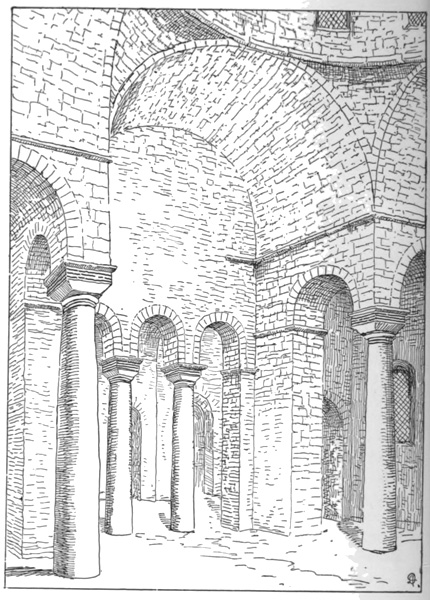
SAINT JASON AND SAINT SOSIPATROS, CORFU.
To go back to earlier times, the museum of Corfu
contains an inscription, βουστροφηδόν inscription, rivalling
that of Menekratês in its archaism, attached to a
Doric capital, of far later workmanship, one would have
thought, than the inscription. The building art had
clearly outstripped the writing art. The military
cemetery contains some beautiful Greek sepulchral
sculptures from various quarters, not all Korkyraian.
And at some distance from the city, near the shore
of Benizza—a name of Slavonic sound—is a Roman
ruin with mosaics and hypocaust, whose bricks we
think Mr. Parker would rule to be not older than
Diocletian. In Corfu such a monument seems at first
sight to be out of place. For Hellenic remains, for
Venetian remains, we naturally look; still it is well
to have something of an intermediate day, something
to remind us of the long ages which passed between
the revolutions recorded by Polybios and the revolutions
recorded by Nikêtas.
We start again from Corfu, and this time our course
is northward. A survey of Greece as Greece would
lead us southward and eastward. So would even a
complete survey of the subject lands of Venice. For
that we must go on to the rest of the western islands,
to not a few points in the Ægæan, to the greater
islands of Euboia and Crete, to Saint Mark's own
realm of Cyprus, which the Evangelist so strangely
inherited from his daughter and her son. Not a few
points of Peloponnêsos for some ages, all Peloponnêsos
for a few years, Athens itself for a moment, comes
within the same range. We might write the history
of Argos from the Venetian point of view, a point of
view which would shut out the history of Mykênê,
and would look on Tiryns only as Palai-Nauplia, the
precursor of Napoli di Romania. But no man could
journey through Greece itself with Venice in this way
in his thoughts. Far older, far nobler, memories
would press upon him at every moment. The mediæval
history of Greece is a subject which deserves far more
attention than it commonly gets, and in that history
Venice plays a prominent part. But it is hard, in a
Greek journey, to make the mediæval history primary,
and even in the mediæval history Venice is only one
element among others. A large part of Greece fairly
comes under the head of the Subject and Neighbour
Lands of Venice; but we cannot bring ourselves to
make that the chief aspect in which we look at them.
It is otherwise with the Dalmatian and Albanian
possessions of the Republic. There, though other
points of view are possible, yet the special Venetian
point of view is one which may be both easily and
fairly taken. So too with Corfu; thoroughly Greek
as the island is, it still lies on the very verge of
continuous Greece. In its history and geography it
is closely connected with the more northern possessions
of the Republic; its Venetian side is at least as
important as any other side; we can without an effort
bring ourselves to treat it in a way in which we could
hardly bring ourselves to treat Argos. We can then
fairly take Corfu into our special Venetian survey;
but we can hardly venture to carry that survey further.
The rest of Greece, though it has its Venetian side,
though it is important that its Venetian side should
not be forgotten, can never be looked on in this way as
an appendage to the Hadriatic commonwealth. We
cannot go through the earliest homes of European civilization
and freedom, and keep our mind mainly fixed
even on the days when Rome had made them members
of her Empire, and when their influence had gone
far to make the later power of Rome at least as much
Greek as Roman. Still less can we go through them
with our mind mainly fixed on the days when so large
part of Greece had passed under the rule of a city
which was in truth a revolted member of the Empire
which it helped to split in pieces.
We start then again from Corfu, with our faces turned
towards our old haunts among the Illyrian coasts and
islands. In so doing, we pass for a while out of the
Christian and civilized world, to skirt along the coasts
where Europe is still in bondage to Asia. The wrong
is an old one, as old as the days when Herodotus put
on record how Greek cities for the first time passed
under the rule of a barbarian master. From his day,
from times long before his day, from the days of Agamemnôn,
perhaps from the days of the brave men who
lived before him, the same long strife has been going
on, the same "eternal Eastern question" has been awaiting
its "solution." And nowhere does that abiding
struggle come more fully home to us than in the lands
where the Eastern question has become a Western
question. The Greek cities whose bondage to the
barbarian was recorded by Herodotus were Greek
cities on barbarian ground. They were outposts of
Europe on the soil of Asia; they were spots in winning
which the Asiatic might deem that he was
winning back his own. And after all, the barbarian
whose conquest of the Greek cities of Asia marks
one important stage in this long strife, was a
barbarian of another kind from the barbarians whom
European lands have in later times been driven to
receive as masters. Crœsus worshipped the Gods
of Greece, and Greek poets sang his praises. It may
even be that the Lydian, like the Persian who succeeded
him, was not a barbarian at all in the strictest
sense, but that there was some measure of kindred,
however distant, between him and his European subjects.
It is another kind of master, another kind of
bondage, which has fallen to the lot of the lands along
whose coast we are now sailing. Here we do indeed
see the West in bondage to the East, we do indeed see
Europe on her own soil bowed down beneath the yoke
of Asia. We pass by coasts which look to the setting
sun no less than our own island, but which the Asiatic
intruder still holds beneath the yoke,—over some
of which he has pressed the yoke for the first time
within the memory of living men. On these coasts
at least we think of Venice only in her nobler character.
Here indeed every island, every headland,
which owned her rule, was something saved from the
grasp of the enemy; it was indeed a brand plucked
from the burning. As we sail northward, we leave
spots behind us, memorable in past times, memorable
some of them in our own day. We leave behind us
Prevesa, where, till almost within our own century,
Saint Mark still held his own, hard by the City of
Victory of the first Emperor. We remember how
Prevesa was torn away from Christendom by the arms
of Ali of Jôannina, and how within the last three years
freedom has been twice promised to her but never
given. We leave behind us more famous Parga, where,
within the lifetime of many of us, stout hearts could still
maintain their freedom, in the teeth alike of barbarian
force and of European diplomacy—Parga, whose banished
sons bore with them the bones of their fathers
rather than leave them to be trampled on by the feet of
the misbelievers. There must be men still living who
had their share in that famous exodus, and who have
lived to see Europe first decree that their land should be
again set free, and then thrust it back again beneath
the yoke. We leave behind us Butrinto, happier at
least in this, that there no promise of later days has
been broken. There we have passed the point beyond
which assembled Europe ruled that even the dreams
of freedom might go no further. And as we sail
between the home of freedom and the house of bondage,
our thoughts overleap the mountain wall. They
fly to the heights where Souli, birth-place of Botzarês,
is left to the foes against whom it so long and so
stoutly strove. They fly to Jôannina, so long the home of
light and comparative freedom amid surrounding darkness
and bondage, but which now, instead of receiving
the twice-promised deliverance, is again thrust back into
bondage for a while. We pass on by the High Thunderpeaks,
fencing in the land of Chimara, famous in the
wars of Ali. We double the promontory of Glôssa,
and find ourselves in the deep bay of Aulôn, Aulona,
Valona, with the town itself high on its hill, guarding
the entrance to the gulf from the other side. Here is
a true hill-city, unlike Korkyra, unlike even Buthrotum;
but while Korkyra and Buthrotum, each on its
shore, has each its history, Aulôn on its height has
none. We pass by the mouths of the great Illyrian
rivers, by Aoos and Apsos, and we leave between them
the place where once stood Apollonia, another of the
paths by which Rome made her way into the Eastern
world. At last we find ourselves in another bay, wider,
but not so deep as the bay of Aulôn. Here we look out
on what remains of a city whose earlier name dwells in
the memory of every reader of the greatest of Greek
historians, a city whose later name, famous through a
long series of revolutions, ought to be ever fresh in the
minds of Englishmen, as having become by a strange
destiny the scene of one stage of the same struggle as
Senlac and York and Ely. The city on which we
look was, under its elder name of Epidamnos, that
famous colony of Korkyra which gave an occasion
for the Peloponnesian war. Under its later name of
Dyrrhachion or Durazzo it beheld Englishmen and
Normans meet in arms, when Englishmen driven from
their homes had found a shelter and an honourable
calling in the service of the Eastern Cæsar.
The city on which we gaze, though it is only by a
figure that we can be said to gaze on the original
Epidamnos, is one of those cities which, without
ever holding any great place themselves, without
being widely ruling cities, without exercising any
direct influence on the course of the world's history,
have given occasion for the greatest events through
their relations to cities and powers greater than themselves.
Under none of its names was Epidamnos the
peer of Corinth in the elder state of things, or of
Venice in the later. Yet events of no small moment
came of the relations between Epidamnos and Corinth,
of the relations between Durazzo and Venice. Greater
events still came of the relations between Dyrrhachion
and Rome. The three names, though of course the
third is a simple corruption of the second, are convenient
to mark three periods in the history of the
place, just as one of the great Sicilian cities is conveniently
spoken of at three stages of its life as
Akragas, Agrigentum, and Girgenti. When and how
the name changed from Epidamnos to Dyrrhachion
is not clear, nor are the reasons given for the
change satisfactory. In practice, Epidamnos is its
old Greek name, Dyrrhachion its Roman, Durazzo its
mediæval name. But the name Dyrrhachion can be
Roman only in usage; the word itself is palpably
Greek. In strictness it seems that Epidamnos was the
name of the city, and Dyrrhachion the name of the
peninsula on which the city was built. The change
then has some analogy with the process by which the
tribal names in northern Gaul have displaced the
elder names of their chief cities, or with the change
among ourselves by which Kingston-on-Hull, as it is
still always called in formal writings, is in common
speech always spoken of as "Hull." Anyhow, under
Roman rule, the name of Dyrrhachion altogether displaced
Epidamnos. The new name gradually came to
be mispelled or Latinized into Durachium and Duracium,
and, in that state, it supplied the material for
more than one play upon words. When Robert Wiscard
came against it, he said that the city might indeed be
Duracium, but that he was a dour man (durus) and
knew how to endure (durare). The Norman made his
way by this path into the Eastern lands, as the Roman
had done before him; but as his course was quicker,
his stay was shorter. Epidamnos, along with Apollônia
and Korkyra, were the first possessions of Rome east
of the Hadriatic. They were possessions of the ruling
city where dominion was for a long time disguised
under the name of alliance. But, under whatever
name, Rome, Old and New, held them till the Norman
came. But the Norman did not hold them till the
Venetian came. In a few years after the coming
of Robert Wiscard, Durazzo and Corfu were again
cities of the Eastern Empire.
Amidst all the revolutions which this little peninsula
has gone through, one law seems to hold.
Under all its names, it has had in a marked way
what we may call a colonial life, in the modern
sense of the word colonial. It has ever been an outpost
of some other power, of whatever power has
been strongest in those seas, and it has been an
outpost ever threatened by the elder races of the
mainland. Herein comes one of the differences
between this Albanian coast and the Dalmatian coast
further north. The Roman Peace took in all; but in
the days before and after the Roman Peace, the settlements
of Corinth, Venice, or any other colonizing
and civilizing power, along the coast of which Durazzo
was the centre, were merely scattered outposts. There
never was that continuous fringe of a higher culture,
Italian or Greek, which spread along the whole coast
further north. As a colony, an isolated colony,
Epidamnos or Durazzo was always exposed to the
attacks of barbarian neighbours. And in this land
the barbarian neighbours have always been the same.
The old Illyrian, the Albanian, the Arnaout, the
Skipetar—call him by whichever name we will—has
here lived on through all changes. He has indeed
a right to look on Greek, Roman, Norman, Angevin,
Servian, Venetian, and Ottoman, as alike intruders
within his own immemorial land. It was danger from
the Illyrian that led to the disputes which open the
history of Thucydides, when Corinth and Korkyra
fought over their common colony. It was danger from
the Illyrian which drove Epidamnos into the arms of
Rome. It was the Illyrian under his new name
who in the fourteenth century for a moment made
Durazzo the head of a national state, the capital of a
short-lived kingdom of Albania. Twice conquered
by the Normans of Apulia and Sicily, twice by their
Angevin successors, granted as part of a vassal kingdom
by the Norman and as a vassal duchy by the
Angevin, twice won by the Venetian commonwealth,
held by the despots of Epeiros, by the restored
Emperors of Constantinople, by the kings of Servia,
by the native kings of Albania, no city has had a
more varied succession of foreign masters; but, save
in the days of the old Epidamnian commonwealth and
in the days of the momentary Albanian kingdom, it
has always had a foreign master of some kind. But
in the endless succession of strangers which this
memorable spot has seen, as masters, as invaders, as
defenders, it is the Englishman and the Venetian who
can look with most satisfaction on their share in its
long history. Englishmen had the honour of guarding
the spot for the Eastern Cæsar; Venice had the
honour of being the last Christian champion to guard
it against the Ottoman Sultan.
We stand then gazing from our ship on what is left
of the city which Robert Wiscard crossed the sea to
conquer, which Alexios came with his motley host to
defend, and to find that in all that host the men whom
he could best trust were the English exiles. There, as
in their own island, the English axe and the Norman
lance clashed together; there the stout axemen alone
stayed to die, while the other soldiers of the Eastern
Rome, the Greek, the Turk, and the Slave, all turned
to fly around their Emperor. We look out, and we long
to know the site of the church of Saint Michael, which
our countrymen so stoutly guarded, till the Normans,
Norman-like, took to their favourite weapon of fire.
But may we confess to the weakness of looking at all
these things only from the deck of the steamer?
Perhaps there are some who may be forgiven if
they shrink from thrusting themselves alone, with no
native or experienced guide, into the jaws of the
present masters of Durazzo. They may be the more
forgiven when those who have the care of their vessel
and its temporary inhabitants utter warnings against
any but the most stout-hearted trusting themselves
to the boats which form the only means of reaching
the Dyrrhachian peninsula. Strengthened in weakness
by such counsels, there seems a kind of magnanimity
in the resolution to abide in the ship, to say
that we have landed at free Corfu, that we shall land at
recovered Antivari, but that we will not betweenwhiles
set foot on any soil where the Turk still reigns. And
the time of distant gazing is not wasted. Without
risking ourselves either on Turkish ground or on the
rough waves of the Epidamnian bay, a fair general
view of the city may be had from the steamer. The
wide curve of the bay has for the most part a flat shore,
with a background of mountains in the distant landscape.
Towards the north-west corner, a promontory
of a good height, backed by a comb-like range of
peaks, rises at once from the water. This is the
peninsula of Dyrrhachion, once crowned by the Epidamnian
city. The modern town is seen on a small
part of the tower slope of the hill. The walls can be
traced through the greater part of their circuit; a
huge round bastion by the sea, more than one tower,
round and square, teach us that Durazzo has been
strongly fortified. If we may eke out our own distant
impressions by the help of an old print showing what
Durazzo was in times past, we see that it was fortified
indeed. We can recognize in the picture most of the
towers which we have seen with our own eyes, and
there is shown also another tower far greater, a huge
square tower of many stages, which no imagination of
the artist can have devised out of anything which
now comes into the sea-view of the city. But that
view enables us to trace out a few buildings within
the wall. We mark the distinctive symbols of the
two stranger forms of worship, from the East and from
the West, which have, each in its turn, supplanted or
dominated the native Church. The Latin church,
with its conspicuous bell-tower, carries on the traditions
of Angevin and Venetian rule; the mosque, with
its more conspicuous minaret, speaks of the more
abiding dominion of the representative of the False
Prophet. The native church meanwhile lurks significantly
unseen in the general view. Our teacher on
board our ship assures us that Durazzo is not without
an Orthodox place of worship; but he cannot point
out its whereabouts.
And it may be that it is no common anniversary
on which we look out on the land which has passed
into bondage. Looked at by the evening light of the
twenty-ninth day of May, the group of buildings at
Durazzo, alike by what is present to the eye and by
what is absent, brings to the mind the fate of a greater
city than Durazzo was in its proudest day. It makes
us muse how, after four hundred and eight and twenty
years, we have still to repeat the Psalmist's words: "O
God, the heathen have come into thine inheritance;
thy holy temple have they defiled, and made Jerusalem
an heap of stones." Durazzo has not indeed,
like some other cities under the yoke, sunk to a heap
of stones; but it is easy to see how the Turkish town
has shrunk up within the Venetian walls, and again
how narrow must be the circuit of Venetian Durazzo
compared with the Epidamnos of the days of Thucydides,
or even with the Dyrrhachion beneath whose
walls our banished kinsmen so well maintained the
cause of the Eastern Augustus. For the church that
they so stoutly defended we need not say that it is vain
to look in such a Pisgah view of the city as is all that
we can take. But to the left of the present wall, where
the hill soars, one stage upon another, far above the
height of Durazzo that now is, we must surely place
the site of the akropolis of the old Korkyraian settlers.
Such a post, looking over the wide bay and commanding
its mouth, would be just what would commend
itself to the Greek colonists for the site of their
new stronghold, while the lower city would naturally
be spread over the more sheltered ground which holds
all that is left of Durazzo under the rule of the Turk.
Pausanias indeed implies that there had been a
change of site before his time, that the Dyrrhachion
of his day did not stand on exactly the same ground
as the elder Epidamnos. No doubt the loftier site
was the older; men came down from the hill-top as
they did at Athens and Corinth. Thus much the
passing stranger can see of this historic spot, even
without setting his foot on the soil which the barbarian
has torn away from Christendom. His course
will bear him on to the place of his next halt, to the
spot which, only a few months back, was the last soil
which Christendom had won back from the barbarian.
Since then, if another land has been denied the promised
freedom, in a third the boon has been actually
bestowed. And we may comfort ourselves by thinking
that, while the shame of what is left undone belongs to
others, the praise of what is done belongs to our own
land only. We may comfort ourselves too by further
thinking that right and freedom are powers which have
an awkward way, when they have taken the inch, of
going on to take the ell. The wise men whose wisdom
consists in living politically from hand to mouth, are
again crying out against "re-opening the Eastern
question." In sailing along the shores, in scanning
their history in past and present times, we feel how
deep a truth was casually uttered in the shallow sneer
which called that question "eternal." We feel how
vain is the dream of those who think that this or that
half-measure has solved it. As we gaze on enslaved
Durazzo, with free Greece behind us, with free Montenegro
before us—as we run swiftly in our thoughts
over the long history of the spot—as we specially
call up the deeds of our own countrymen on the
shore on which we look—we feel that something
indeed has been done, but that there is yet much
more to do. Before us, behind us, are lands to which
England, and England only, has given freedom. A
day must come when, what England has done for
Corfu, for Arta, and for Dulcigno, she must do for
Jôannina and for Durazzo.
We wind up our course with one more of the once
subject cities of Venice, one where we can hardly say
that we are any longer following in Norman footsteps,
but whose history stands apart from the history of
Dalmatia and Istria, while it has much in common
with our last halting place. But here the main
interest belongs to our own day. It is with new and
strange feelings that we look out on a land which,
when we last passed by it, was still clutched tight in
the grasp of the barbarian, but to which we can now
give the new and thrilling name of the sea-coast of
Tzernagora. And yet it is with mingled feelings that
we gaze. We rejoice in the victories, in the extension,
of the unconquered principality, the land which has
shown itself a surer "bulwark 'gainst the Ottomite"
than Hungary or Poland, or even Venice, ever proved.
We rejoice that the warriors of the mountain, long
shut in by force and fraud, have again, with their own
right hands, cut their way to their own sea. And
yet we feel that, though the sea to which they have
cut their way is truly their own sea, their own ancient
heritage, yet the coast and the havens which they
have won are not the coast and the havens which they
should have won. If all had their own, Dulcigno,
Antivari, and the ewe lamb which the rich man stole
at Spizza, would be the havens of the free Albanian,
while the free Slave would have his outlet to the
Hadriatic waters at his own Cattaro and at Ragusa
too. In such an ideal state of things, the present lord
of Cattaro and Ragusa might reign peaceably and
harmlessly in the duchy of his grandmothers, happy
in deliverance from the curses of those whom he now
keeps back from union with the brethren whom they
love and with the one prince whom they acknowledge.
The Montenegrin, in short, kept back by wrong from
winning his way to the sea by peaceful union with
those who yearn for his presence, has been driven to
win his way to the sea by the conquest of lands which
were once the heritage of his race, but from which his
race has now passed away. Forbidden to be the
deliverer of the Slave, he has been forced to be the
conqueror of the Albanian. The Albanian Mussulman
himself has practically gained by being conquered;
still, as we said, if every one had his own, arrangements
would be different. The blame indeed lies, not
with the people who extend their borders when to
extend their border is a matter of national life, but
with those who, not in the interest of any people,
nation, or language, but in the private interest of
their own family estate, sit by to hinder them from
extending their borders in the right way. We rejoice
then as we look for the first time on the sea-coast
of Montenegro; but we mourn that the sea-coast of
Montenegro lies where it does and not elsewhere.
We mourn too that the enlargement of Christendom,
the falling back of Islam, has been bought only by
the destruction of an ancient and beautiful city from
which the memorials at least of Christendom had not
wholly passed away.
Antibaris, Antivari, in the tongues of the land,
Bar and Tivari, is perhaps rather to be understood as
meaning "the Bari on the other side" than "the city
opposite Bari." But there is no doubt that its name
contains, in one way or another, a reference to the
more famous Bari, "Barium piscosum," on the other
side of the Hadriatic. And Antivari is the opposite
to Bari in a sense which was certainly not meant; no
two sites can well be more unlike one another than
the sites of Bari and of Antivari. The Apulian Bari
lies low on a flat shore, with not so much as a background
of hills; the Albanian Bari crowns a height,
with a wall of more soaring heights on each side of it.
The Apulian Bari had no chance of occupying such a
position as this; the marked difference between the
two coasts of the Hadriatic forbade it. But the
site of Antivari is hardly less unlike most of the
other sites on its own coast. Zara, Salona and its
successor Spalato, Epidauros and its successor Ragusa,
Cattaro, Durazzo, and a crowd of others of lesser name,
are none of them placed on heights. Some of them
nestle immediately at the foot of the mountain; some
have thrown out their defences, older or newer, some
way up the side of the mountain; in none is the city
itself perched high on the hills. For a parallel to
Antivari on this coast we have to go back to the
mountain citadel of Aulona. The position and the
name of Antivari seem to point to a state of things
differing both from the days of the Greek and Roman
foundations, and from the days of the cities which arose
to shelter their fugitives in the day of overthrow.
Long Salona stood low on the shore; the house of
Jovius stood low on the shore also; it did not come
into the head of the founders of either to plant city or
palace on the height of Clissa. When Antivari arose,
it would seem that men had gone back to that earlier
state of things which planted the oldest Argos, even
the oldest Corinth, on mountain peaks some way from
their own coasts. The inaccessible height had again
come to be looked on as a source of strength. Antivari
may take its place alongside of the mediæval Syra,
the Latin town covering its own peaked hill—a mons
acutus, a Montacute, by the shore—while the oldest
and the newest Hermoupolis lies on the shore at its
feet. The town does not even look down at once on
the haven; it has to be reached in a manner sideways
from the haven. It is true indeed that the sea has
gone back, that the plain at the foot of the mountains
between the town and the shore was smaller than it
now is, even in times not far removed from our own.
But Antivari was never as Cattaro; it always stood
on a height, with some greater or less extent of
level ground between the town and its own haven.
The city thus placed has gone through its full
share of the revolutions of the eastern coasts of the
Hadriatic. Once a commonwealth under the protection
of the Servian kings and tzars, it came late under
Venetian rule. But it remained under that rule down
to a later time than any other of the possessions of the
Republic on this coast, save those which came within
the actual Dalmatian border and those detached points
further to the south which have a history of their own
in common with the so-called Ionian Islands. It was
for a while in the fifteenth and sixteenth centuries,
what Budua was for so long afterwards, the furthest
point of the continuous rule of Saint Mark, a city
which remained part of Christendom after Durazzo
and Skodra had passed into the hands of the infidel.
In earlier times, when Antivari had a separate being,
its tendency was rather to a connexion with Ragusa
than with Venice. Ragusa, though the nearer of the
rivals, was the weaker, the less likely to change
alliance or protection into dominion. Antivari too,
like most other city-commonwealths, had its patricians
and plebeians, its disputes between the privileged and
the non-privileged order. As the justice of either side
at home was distrusted, it was agreed that the decision
of some classes of causes should be referred to the
courts of Ragusa. Such a settlement, though taking
another and more dangerous form, is the same in
principle as the favourite Italian custom of choosing
a foreign podestà, as the earlier usage by which cities
which had won their independence in all other points
were still willing to receive a criminal judge of the
Emperor's naming. In all these cases alike, the
stranger is looked on as more likely than the native
to deal out even-handed justice amid the disputes
and rivalries of persons and parties.
Though Antivari stands on a hill, it does not
crown any such height as those of Cortona or
Akrokorinthos, nor does it call for any such journey
as that which leads to the spot which masters of
the high-polite style will now doubtless call its
"metropolis" at Tzetinje. It stands on an advanced
point among the mountains, one easily commanded
from higher points, as was soon found in the siege
of 1877. A road of no astonishing steepness leads
us up to the town—or more strictly to its ruins.
We look down on a church in the valley, whose
air proclaims it as belonging to the Orthodox communion;
and that church seems to be the only
untouched building within sight. It is not till we
get within the walls that we take in the full measure
of the destruction which has been wrought; but the
first glance shows that Antivari has suffered not
a little from the warfare of our own times. The walls
and towers are there; but we see that they fence in
only roofless buildings; the mosques, with their
minarets, several of them shattered, remind us that
we are drawing near to a city which has been won
for Christendom from Islam, as a nearer view reminds
us that it is a city which had before been won for
Islam from Christendom. We halt at a small café
outside the walls, where we receive a friendly greeting
from the representatives of Montenegrin authority
in the new conquest. Here too is the club and
reading-room of Antivari, supplied with newspapers
in the Slavonic, Italian, and Turkish tongues; the
really prevailing speech of the district, the immemorial
Skipetar or Albanian, hardly boasts of a
representative in the press. Here too are gathered
a few fragments from the ruins, a few capitals,
sculptures, and inscriptions, all or most of Venetian
times. Among them is the winged lion himself, and
the epitaph of a local dignitary who bears the very
English-sounding title of "justitia pacis." Even
among ourselves embodied righteousness sometimes
takes the same abstract form, instead of the more
mortal and fleshly "justitiarius." A slight descent
and a steep ascent leads us through a rebuilt suburb,
which now forms the only part of Antivari which
serves as a dwelling-place of man. A line of shops,
or rather booths, supplies the needs of the neighbouring
people, among whom Christians and Mussulmans,
Slaves and Albanians, seem pretty equally
mingled. A Montenegrin sentinel, whose national
coat must once have been whiter than it now is,
guards the gate, a Venetian gate where inscriptions
in the Arabic character record the dominion of the
late masters of Antivari. We enter, we gaze around,
we climb a tower for a better view, and we look on
a scene of havoc which is startling to men of peaceful
lives, and which, one would think, must be unusual
even in the experience of men of the sword. We
believe that we are speaking the truth when we say
that every building within the enclosed space has
become uninhabitable; certainly not one seemed to
be inhabited. This destruction is indeed not wholly
the immediate result of the siege. A powder-magazine
was afterwards struck by lightning, and its
explosion destroyed whatever the siege had spared.
But the havoc wrought by the siege itself must
have been fearful. Antivari is as strictly a collection
of ruins, and of nothing but ruins, as Ninfa at the foot
of the Volscian hills, looking up at the mighty walls
of Norba. But Ninfa was simply forsaken some ages
back. Its inhabitants fled from an unhealthy site,
and left their houses, churches, and military defences,
to crumble away. But at Antivari we see the work
of destruction in our own day, almost at the present
moment. Four years back, the traveller passing
along the Albanian coast was shown where Antivari,
then an inhabited town, nestled among its rocks.
The war was then raging inland; the Montenegrin
was then defending his own heights against Turkish
invasion; he had not yet come down to win back a
fragment of his ancient coast from one of the two
intruders who kept him from it. The traveller comes
again; this time he does not only look from afar, but
examines on the spot with his own eyes. But he finds
only the shattered fragments of what four years before
was a city of men.
And, small as Antivari must have been even in its
most flourishing times, it is no mean city that it must
have been. It must be remembered that Antivari,
though it was a Mussulman town under Turkish rule,
was never in any strict sense a Turkish town. Its
history is that of Albania generally, as it is the
history of large classes of men in Bosnia. Antivari
was easily won by the Turk, and it remained in
the hands of its old inhabitants, Christian Albanians
and Venetian settlers. Gradually, for the sake of
their temporal interests, they conformed outwardly to
the religion of their conquerors, and so passed from
the subject to the ruling order. At first, this was a
mere outward conformity for worldly ends; men still
hoped that some chance of warfare would bring back
the rule of Saint Mark. If so, they were ready to
return to the faith which they still secretly held.
But the happy revolution never came; new generations
sprang up with whom Islam was an hereditary
creed, and Antivari became a Mussulman city. But
it never became a Turkish city. The descendants of
the once Christian inhabitants lived on in their
fathers' houses, and worshipped in the same temples
as their fathers, though they were now turned to the
use of another faith. Each church had a minaret
added, and it became a mosque. In most cases of
Mahometan conquest, the conquerors took the head
church of the city as a trophy of their own faith, but
left the subject Christians in possession of one or
more of the lesser churches. So, in this same region,
it was at Durazzo; so it was at Trebinje; in both
there was a church, or more than one, within the
walls. Here at Antivari, as the inhabitants gradually
embraced Islam, all the churches became mosques;
and thus, for the very reason that there was less of
violent disturbance than in most cases of Turkish
conquest, Antivari, while never becoming Turkish,
became more strictly Mussulman than most cities
under Turkish rule. The churches, or rather their
ruins, still stand, examples of the usual churches of
the country, none of them remarkable for size or
antiquity or architectural splendour; but still essentially
churches, with their fabrics untouched, save
only the inevitable addition of the minaret. Some
of them even keep memorials of their earlier use of
which one would have expected Mussulman zeal to wipe
out every trace as monuments of idolatry. Intruding
Turks or Saracens would doubtless have done so; but
the Mahometan descendants of the Christian citizens
of Antivari still felt a tenderness for the works of
their forefathers. Even pictures of Christian subjects
have been spared. In one case especially, in
a church which does not seem ever to have been a
mosque, but, as having perhaps been a private chapel,
to have formed part of a private house, among other
kindred pictures, the baptism of our Lord in Jordan
is still almost as clear as when the painter first traced
it on the wall. Old ancestral memories, perhaps the
vague feeling that after all a day of change might
come—the feeling which led Bosnian beys, while
holding their Christian countrymen in bondage, to
keep Christian patents of nobility and even concealed
objects of Christian worship—were clearly stronger
in Antivari than any strict regard to the Mussulman
law.
And as it was with the churches, so it was with
the houses. Antivari never became, like Trebinje, a
tumble-down Eastern town, nor, like Butrinto, a collection
of beggarly huts, not fit to be called a town
at all. It was a small, but well-built city, after the
pattern of the other cities on the eastern coast of
the Hadriatic. There was clearly no moment of
general havoc; the Mussulman lived on in the house
of his Christian father. Some of those houses must
have been still almost new when their owners embraced
the faith of their conquerors. At every step
we see among the shattered houses some pretty scrap,
door or window, of the style which we commonly call
Venetian; we see some too which belong to the confirmed
Renaissance, and which can hardly be older than
the sixteenth century. One stately building indeed
seems to have perished. An old print of Antivari, in
a book called Viaggio da Venetia a Costantinopoli, a
book without date but which has an air of the
sixteenth century, shows what is plainly meant for a
municipal palace, after the same general type as the
bigger one at Venice and the more beautiful one at
Ragusa. It has arcades below and windows above.
Still as we tread, even in their state of ruin, the
streets, the little piazze, of what once was Antivari,
we see that the city perched on its Albanian height
must have been no unworthy fellow of its neighbours
on the Dalmatian shore.
It is sad that the enlargement of Europe and of
Christendom, the winning back of their ancient coast
by the valiant warriors of the Black Mountain, should
have been bought only at such a price as the destruction
of this interesting and really beautiful little city.
The loss, it may be feared, cannot be repaired. A
gently working hand might possibly set up again the
ruined houses and churches nearly as they once were.
Or it might at first sight seem a more obvious work
to forsake the ruined hill-town, and to build another
by the haven, a new Montenegrin Cattaro, to make
up as far as may be for the city by the Bocche so
cruelly torn away from its free brethren. But either
scheme seems to be forbidden by the growing unhealthiness
of the spot. The place has been for some
while getting more and more fever-stricken, and the
disease has now—seemingly since the siege—spread
upwards to the hill-town itself. It is for medical
knowledge to judge whether, as is said to be the
case in some parts of the Roman Campagna, sudden
colonization, the settlement of a large number of new
inhabitants at once, could do anything to check the
evil. Failing this chance, it would seem as if Antivari
was doomed utterly to perish. A new Montenegrin
town and haven may arise, but not on the site of
the ancient town and haven of the eastern Bari.
On whom rests the blame? Surely not on the conquerors,
whose warfare was waged in the noblest cause
for which man can fight, for their faith, their freedom,
their national life, the extension of freedom and
national life to their brethren under the yoke. Nor
can we say that it rests with the men who fought
against them, who, from their own side, were fighting
for faith and freedom and national life fully as much.
It rather rests with the dangerous neighbour of both,
whose very existence is founded on the trampling
down of freedom and national life among all its
neighbours. It rests with the power which takes care
to strike no blows itself, but which knows how to suck
no small advantage from the blows which are struck
by others on either side. The ruin of Antivari is
in truth the work, though the indirect work, of the
power hard by, the power which was not ashamed to
stretch forth its hand for such a spoil as Spizza, the
hard-won earnings of its poor neighbour. The guilt
of ruined Antivari rests with those who drove its
conquerors to conquest in the wrong place by hindering
them from peaceful advance in the right place.
It rests with those who stirred up its defenders to
a hopeless resistance by promises which never were
fulfilled. When we see how in 1878 Montenegro
was allowed to keep possession of ruined and almost
worthless Antivari, but was forced to give up its
other comparatively flourishing conquests of Spizza
and Dulcigno, we better understand how the rule of
doing as one would be done by is looked on in
the council-chamber of an Apostolic King. And we
see too, with some comfort, how England, as one of
her first national acts when England found herself
once more under English leadership, knew how to
step in, with vigour and with patience, to undo at
least one part of the wrong which had been done.
THE END.
LONDON:
PRINTED BY WILLIAM CLOWES AND SONS, LIMITED,
STAMFORD STREET AND CHARING CROSS.