In the remaining pages, I shall attempt to give a word-picture
of Mr. Lincoln, his person, his moral and intellectual
characteristics, and some personal recollections, so as to aid the
reader, as far as I may be able, in forming an ideal of the man.
Physically, he was a tall, spare man, six feet and four inches
in height. He stooped, leaning forward as he walked. He
was very athletic, with long, sinewy arms, large, bony hands,
and of great physical power. Many anecdotes of his
strength are given, which show that it was equal to that
of two or three ordinary men. He lifted with ease five or
six hundred pounds. His legs and arms were disproportionately
long, as compared with his body; and when he walked,
he swung his arms to and fro more than most men. When
seated, he did not seem much taller than ordinary men. In
his movements there was no grace, but an impression of
awkward strength and vigor.
He was naturally diffident, and even to the day of his
death, when in crowds, and not speaking or acting, and
conscious of being observed, he seemed to shrink with
bashfulness. When he became interested, or spoke, or
listened, this appearance left him, and he indicated no self-consciousness.
His forehead was high and broad, his hair very
dark, nearly black, and rather stiff and coarse, his eyebrows
were heavy, his eyes dark-gray, very expressive and varied;
now sparkling with humor and fun, and then deeply sad and
melancholy; flashing with indignation at injustice or wrong,
and then kind, genial, droll, dreamy; according to his mood.
His nose was large, and clearly defined and well shaped;
cheek-bones high and projecting. His mouth coarse, but
firm. He was easily caricatured—but difficult to represent as
he was, in marble or on canvass. The best bust of him is
that of Volk, which was modeled from a cast taken from life in
May, 1860, while he was attending court at Chicago.
Among the best portraits, in the judgment of his family
and intimate friends, are those of Carpenter, in the picture of
the Reading of the Proclamation of Emancipation before the
Cabinet, and that of Marshall.
He would be instantly recognized as belonging to that
type of tall, thin, large-boned men, produced in the northern
portion of the Valley of the Mississippi, and exhibiting its
peculiar characteristics in a most marked degree in Illinois,
Kentucky and Tennessee. In any crowd in the United States,
he would have been readily pointed out as a Western man.
His stature, figure, manner, voice, and accent, indicated that
he was of the Northwest. His manners were cordial, familiar,
genial; always perfectly self-possessed, he made every one feel
at home, and no one approached him without being impressed
with his kindly, frank nature, his clear, good sense, and his
transparent truthfulness and integrity. There is more or less
of expression and character in handwriting. Lincoln's was
plain, simple, clear, and legible, as that of Washington; but
unlike that of Washington, it was without ornament.
In endeavoring to state those qualities which gave him
success and greatness, among the most important, it seems to
me, were a supreme love of truth, and a wonderful capacity
to ascertain it. Mentally, he had a perfect eye for truth.
His mental vision was clear and accurate: he saw things as
they were. I mean that every thing presented to his mind for
investigation, he saw divested of every extraneous circumstance,
every coloring, association, or accident which could mislead.
This gave him at the bar a sagacity which seemed
almost instinctive, in sifting the true from the false, and in
ascertaining facts; and so it was in all things through life.
He ever sought the real, the true, and the right. He was exact,
carefully accurate in all his statements. He analyzed well; he
saw and presented what lawyers call the very gist of every
question, divested of all unimportant or accidental relations,
so that his statement was a demonstration. At the bar, his
exposition of his case, or a question of law, was so clear, that,
on hearing it, most persons were surprised that there should
be any controversy about it. His reasoning powers were
keen and logical, and moved forward to a demonstration with
the precision of mathematics. What has been said implies
that he possessed not only a sound judgment, which brought
him to correct conclusions, but that he was able so to present
questions as to bring others to the same result.
His memory was capacious, ready, and tenacious. His
reading was limited in extent, but his memory was so ready,
and so retentive, that in history, poetry, and general literature,
no one ever remarked any deficiency. As an illustration
of the power of his memory, I recollect to have once called
at the White House, late in his Presidency, and introducing
to him a Swede and a Norwegian; he immediately repeated
a poem of eight or ten verses, describing Scandinavian
scenery and old Norse legends. In reply to the expression of
their delight, he said that he had read and admired the poem
several years before, and it had entirely gone from him, but
seeing them recalled it.
The two books which he read most were the Bible and
Shakespeare. With these he was very familiar, reading and
studying them habitually and constantly. He had great
fondness for poetry, and eloquence, and his taste and judgment
in each was exquisite. Shakespeare was his favorite
poet; Burns stood next. I know of a speech of his at a
Burns festival, in which he spoke at length of Burns's poems;
illustrating what he said by many quotations, showing perfect
familiarity with and full appreciation of the peasant poet of
Scotland. He was extremely fond of ballads, and of simple,
sad, and plaintive music.
He was a most admirable reader. He read and repeated
passages from the Bible and Shakespeare with great simplicity
but remarkable expression and effect. Often when going to
and from the army, on steamers and in his carriage, he took a
copy of Shakespeare with him, and not unfrequently read,
aloud to his associates. After conversing upon public affairs,
he would take up his Shakespeare, and addressing his companions,
remark, "What do you say now to a scene from Macbeth,
or Hamlet, or Julius Cæsar," and then he would read
aloud, scene after scene, never seeming to tire of the enjoyment.
On the last Sunday of his life, as he was coming up the
Potomac, from his visit to City Point and Richmond, he
read aloud many extracts from Shakespeare. Among others,
he read, with an accent and feeling which no one who heard
him will ever forget, extracts from Macbeth, and among others
the following:—
"Duncan is in his grave;
After life's fitful fever, he sleeps well.
Treason has done his worst; nor steel, nor poison,
Malice domestic, foreign levy, nothing
Can touch him farther."
After "treason" had "done his worst," the friends who
heard him on that occasion remembered that he read that
passage very slowly over twice, and with an absorbed and
peculiar manner. Did he feel a mysterious presentiment of
his approaching fate?
His conversation was original, suggestive, instructive, and
playful; and, by its genial humor, fascinating and attractive
beyond comparison. Mirthfulness and sadness were strongly
combined in him. His mirth was exuberant, it sparkled in
jest, story, and anecdote; and the next moment those peculiarly
sad, pathetic, melancholy eyes, showed a man "familiar
with sorrow, and acquainted with grief." I have listened for
hours at his table, and elsewhere, when he has been surrounded
by statesmen, military leaders, and other distinguished men
of the nation, and I but repeat the universally concurring
verdict of all, in stating that as a conversationalist he had no
equal. One might meet in company with him the most distinguished
men, of various pursuits and professions, but after
listening for two or three hours, on separating, it was what
Lincoln had said that would be remembered. His were the
ideas and illustrations that would not be forgotten. Men
often called upon him for the pleasure of listening to him. I
have heard the reply to an invitation to attend the theater,
"No, I am going up to the White House. I would rather
hear Lincoln talk for half an hour, than attend the best
theater in the world."
As a public speaker, without any attempt at oratorical
display, I think he was the most effective of any man of his
day. When he spoke, everybody listened. It was always
obvious, before he completed two sentences, that he had
something to say, and it was sure to be something original,
something different from any thing heard from others, or
which had been read in books. He impressed the hearer at
once, as an earnest, sincere man, who believed what he said.
To-day, there are more of the sayings of Lincoln repeated by
the people, more quotations, sentences, and extracts from his
writings and speeches, familiar as "household words," than
from those of any other American.
I know no book, except the Bible and Shakespeare, from
which so many familiar phrases and expressions have been
taken as from his writings and speeches. Somebody has
said, "I care not who makes the laws, if I may write the
ballads of a nation." The words of Lincoln have done more
in the last six years to mold and fashion the American character
than those of any other man, and their influence has
been all for truth, right, justice, and liberty. Great as has
been Lincoln's services to the people, as their President, his
influence, derived from his words and his example, in molding
the future national character, in favor of justice, right,
liberty, truth, and real, sincere, unostentatious reverence for
God, is scarcely less important. The Republic of the future,
the matured national character, will be more influenced by
him than by any other man. This is evidence of his greatness,
intellectual, and still more, moral. In this power of
impressing himself upon the people, he contrasts with many
other distinguished men in our history. Few quotations
from Jefferson, or Adams, or Webster, live in the every-day
language of the people. Little of Clay survives; not much
of Calhoun, and who can quote, off-hand, half a dozen sentences
from Douglas? But you hear Lincoln's words, not
only in every cabin and caucus, and in every stump speech, but
at every school-house, high-school, and college declamation, and
by every farmer and artisan, as he tells you story after story
of Lincoln's, and all to the point, hitting the nail on the head
every time, and driving home the argument. Mr. Lincoln was
not a scholar, but where is there a speech more exhaustive in
argument than his Cooper Institute address? Where any thing
more full of pathos than his farewell to his neighbors at
Springfield, when he bade them good-bye, on starting for the
capital? Where any thing more eloquent than his appeal for
peace and union, in his first Inaugural, or than his defense of
the Declaration of Independence in the Douglas debates?
Where the equal of his speech at Gettysburg? Where a
more conclusive argument than in his letter to the Albany
Meeting on Arrests? What is better than his letter to the
Illinois State Convention; and that to Hodges of Kentucky,
in explanation of his anti-slavery policy? Where is there
any thing equal in simple grandeur of thought and sentiment,
to his last Inaugural? From all of these, and many others,
from his every-day talks, are extracts on the tongues of the
people, as familiar, and nearly as much reverenced, as texts
from the Bible; and these are shaping the national character.
"Though dead, he yet speaketh."
As a public speaker, if excellence is measured by results, he
had no superior. His manner was generally earnest, often playful;
sometimes, but this was rare, he was vehement and impassioned.
There have been a few instances, at the bar and on
the stump, when, wrought up to indignation by some great
personal wrong, or by an aggravated case of fraud or injustice,
or when speaking of the fearful wrongs and injustice of slavery,
he broke forth in a strain of impassioned vehemence which
carried every thing before him.
Generally, he addressed the reason and judgment, and the
effect was lasting. He spoke extemporaneously, but not
without more or less preparation. He had the power of
repeating, without reading it, a discourse or speech which he
had prepared or written out. His great speech, in opening
the Douglas canvass, in June, 1858, was carefully written out,
but so naturally spoken that few suspected that it was not
extemporaneous. In his style, manner of presenting facts,
and way of putting things to the people, he was more like
Franklin than any other American. His illustrations, by
anecdote and story, were not unlike the author of Poor
Richard.
A great cause of his intellectual power was the thorough
exhaustive investigation he gave to every subject. Take, for
illustration, his Cooper Institute speech. Hundreds of able
and intelligent men have spoken on the same subject treated
by him in that speech, yet what they said will all be forgotten,
and his will survive; because his address is absolutely perfect
for the purpose for which it was designed. Nothing can
be added to it.
Mr. Lincoln, however, required time thoroughly to investigate
before he came to his conclusions, and the movements of
his mind were not rapid; but when he reached his conclusions
he believed in them, and adhered to them with great
firmness and tenacity. When called upon to decide quickly
upon a new subject or a new point, he often erred, and was
ever ready to change when satisfied he was wrong.
It was the union, in Mr. Lincoln, of the capacity clearly to
see the truth, and an innate love of truth, and justice, and
right in his heart, that constituted his character and made
him so great. He never demoralized his intellectual or moral
powers, either by doing wrong that good might come, or by
advocating error because it was popular. Although, as a
statesman, eminently practical, and looking to the possible
good of to-day, he ever kept in mind the absolute truth and
absolute right, toward which he always aimed.
Mr. Lincoln was an unselfish man; he never sought his
own advancement at the expense of others. He was a just
man; he never tried to pull others down that he might rise.
He disarmed rivalry and envy by his rare generosity. He
possessed the rare wisdom of magnanimity. He was eminently
a tender-hearted, kind, and humane man. These traits
were illustrated all through his life. He loved to pardon:
he was averse to punish. It was difficult for him to deny
the request of a child, a woman, or of any who were weak
and suffering. Pages of incidents might be quoted, showing
his ever-thoughtful kindness, gratitude to, and appreciation of
the soldiers. The following note (written to a lady known to
him only by her sacrifices for her country) is selected from
many on this subject:—
"Executive Mansion, Washington,
"November, 1864.
"Dear Madam:—
"I have been shown, in the files of the War Department, a statement of the
Adjutant-General of Massachusetts, that you are the mother of five sons who have
died gloriously on the field of battle. I feel how weak and fruitless must be any
words of mine which should attempt to beguile you from the grief of a loss so
overwhelming. But I can not refrain from tendering to you the consolation that
may be found in the thanks of the Republic they died to save. I pray that our
Heavenly Father may assuage the anguish of your bereavement, and leave you
only the cherished memory of the loved and lost, and the solemn pride that must
be yours to have laid so costly a sacrifice upon the altar of freedom.
"Yours very respectfully,
"ABRAHAM LINCOLN.
"To Mrs. Bixby, Boston, Massachusetts."
One summer's day, in walking along the shaded path
which leads from the White House to the War Department,
I saw the tall form of the President seated on the grass under
a tree, with a wounded soldier sitting by his side. He had a
bundle of papers in his hand. The soldier had met him in
the path, and, recognizing him, had asked his aid. Mr. Lincoln
sat down upon the grass, investigated the case, and sent the
soldier away rejoicing. In the midst of the rejoicings over the
triumphs at Chattanooga and Lookout Mountain, he forgets not
to telegraph to Grant, "Remember Burnside" at Knoxville.
His charity, in the best sense of that word, was pervading.
When others railed, he railed not again. No bitter words,
no denunciation can be found in his writings or speeches.
Literally, in his heart there was "malice toward none, and
charity for all."
Mr. Lincoln was by nature a gentleman. No man can
point, in all his lifetime, to any thing mean, small, tricky, dishonest,
or false; on the contrary, he was ever open, manly,
brave, just, sincere, and true. That characteristic, attributed
to him by some, of coarse story-telling, did not exist. I assert
that my intercourse with him was constant for many years
before he went to Washington, and I saw him daily, during
the greater part of his Presidency; and although his stories
and anecdotes were racy, witty, and pointed beyond all comparison,
yet I never heard one of a character to need palliation
or excuse. If a story had wit and was apt, he did not reject
it, because to a vulgar or impure mind it suggested coarse
ideas; but he himself was unconscious of any thing but its
wit and aptness.
It may interest the people who did not visit Washington
during his Presidency, to know something of his habits, and
the room he occupied and transacted business in, during his
administration. His reception-room was on the second floor,
on the south side of the White House, and the second apartment
from the southeast corner. The corner room was occupied
by Mr. Nicolay, his private secretary; next to this was
the President's reception-room. It was, perhaps, thirty by
twenty feet. In the middle of the west side, was a large
marble fireplace, with old-fashioned brass andirons, and a
large, high, brass fender. The windows looked to the south,
upon the lawn and shrubbery on the south front of the White
House, taking in the unfinished Washington Monument,
Alexandria, the Potomac, and down that beautiful river
toward Mount Vernon. Across the Potomac was Arlington
Heights. The view from these windows was altogether very
beautiful.
The furniture of this room consisted of a long oak table,
covered with cloth, and oak chairs. This table stood in the
center of the room, and was the one around which the Cabinet
sat, at Cabinet meetings, and is faithfully painted in Carpenter's
picture of the Emancipation Proclamation. At the end
of the table, near the window, was a large writing-table and
desk, with pigeon-holes for papers, such as are common in
lawyers' offices. In front of this, in a large arm-chair, Mr.
Lincoln usually sat. Behind his chair, and against the west
wall of the room, was another writing-desk high enough to
write upon when standing, and upon the top of this were a
few books, among which were the Statutes of the United
States, a Bible, and a copy of Shakespeare. There was a
bureau, with wooden doors, with pigeon-holes for papers,
standing between the windows. Here the President kept
such papers as he wished readily to refer to. There were
two plain sofas in the room; generally two or three map-frames,
from which hung military maps, on which the movements
of the armies were continually traced and followed.
The only picture in the room was an old engraving of Jackson,
which hung over the fireplace; late in his administration
was added a fine photograph of John Bright. Two doors
opened into this room—one from the Secretary's, the other
from the great hall, where the crowd usually waited. A bell-cord
hung within reach of his hand, while he sat at his desk.
There was an ante-room adjoining this, plainly furnished; but
the crowd usually pressed to the hall, from which an entrance
might be directly had to the President's room. A messenger
stood at the door, and took in the cards and names of visitors.
Here, in this room, more plainly furnished than many law
and business offices—plainer than the offices of the heads of
bureaus in the Executive Departments—Mr. Lincoln spent
the days of his Presidency. Here he received everybody,
from the Lieutenant-General and Chief-Justice, down to the
private soldier and humblest citizen. Custom had established
certain rules of precedence, fixing the order in which officials
should be received. The members of the Cabinet and the
high officers of the army were, of course, received always
promptly. Senators and members of Congress, who are
usually charged with the presentation of petitions and recommendations
for appointments, and who are expected to right
every wrong and correct every evil each one of their respective
constituents may be suffering, or imagine himself to
be suffering, have an immense amount of business with the
Executive. I have often seen as many as ten or fifteen Senators
and twenty or thirty Members of the House in the hall,
waiting their turn to see the President. They would go to
the ante-room, or up to the hall in front of the reception-room,
and await their turns. The order of precedence was,
first the Vice-President, if present, then the Speaker of the
House, and then Senators and Members of the House in the
order of their arrival, and the presentation of their cards. Frequently
Senators and Members would go to the White House
as early as eight or nine in the morning, to secure precedence
and an early interview. While they waited, the loud ringing
laugh of Mr. Lincoln, in which he was sure to be joined
by all inside, but which was rather provoking to those outside,
was often heard by the waiting and impatient crowd.
Here, from early morning to late at night, he sat, listened,
and decided—patient, just, considerate, hopeful. All the
people came to him as to a father. He was more accessible
than any of the leading members of his Cabinet—much more
so than Mr. Seward, shut up in the State Department, writing
his voluminous dispatches; far more so than Mr. Stanton, indefatigable,
stern, abrupt, but ever honest and faithful. Mr.
Lincoln saw everybody—governors, senators, congressmen,
officers, ministers, bankers, merchants, farmers—all classes of
people; all approached him with confidence, from the highest
to the lowest; but this incessant labor and fearful responsibility
told upon his vigorous frame. He left Illinois for the
capital, with a frame of iron and nerves of steel. His old
friends, who knew him in Illinois as a man who knew not
what illness was, who knew him ever genial and sparkling
with fun, as the months and years of the war passed slowly
on, saw the wrinkles on his forehead deepened into furrows;
and the laugh of old days became sometimes almost hollow;
it did not now always seem to come from the heart, as in
former years. Anxiety, responsibility, care, thought, wore
upon even his giant frame, and his nerves of steel became at
times irritable. For more than four years he had no respite,
no holidays. When others fled away from the dust and heat
of the capital, he must stay; he would not leave the helm
until the danger was past and the ship was in port.
Mrs. Lincoln watched his care-worn face with the anxiety
of an affectionate wife, and sometimes took him from his
labors almost in spite of himself. She urged him to ride, and
to go to the theater and places of amusement, to divert his
mind from his engrossing cares.
Let us for a moment try to appreciate the greatness of his
work and his services. He was the Commander-in-Chief,
during the war, of the largest army and navy in the world;
and this army and navy was created during his administration,
and its officers were sought out and appointed by him.
The operations of the Treasury were vast beyond all previous
conceptions of the ability of the country to sustain; and yet,
when he entered upon the Presidency, he found an empty
treasury, the public credit shaken, no army, no navy, the
officers all strangers, many deserting, more in sympathy
with the rebels, Congress divided, and public sentiment unformed.
The party which elected him were in a minority.
The old Democratic party, which had ruled the country for
half a century, hostile to him, and, by long political association,
in sympathy with the insurgent States. His own party, new,
made up of discordant elements, and not yet consolidated,
unaccustomed to rule, and neither his party nor himself possessing
any prestige. He entered the White House, the object
of personal prejudice to a majority of the people, and of
contempt to a powerful minority. And yet I am satisfied,
from the statement of the conversation of Mr. Lincoln with
Mr. Bateman, quoted hereafter, and from various other reasons,
that he himself more fully appreciated the terrible conflict
before him than any man in the nation, and that even
then he hoped and expected to be the Liberator of the slaves.
He did not yet clearly perceive the manner in which it was
to be done, but he believed it would be done, and that God
would guide him.
In four years, this man crushed the most stupendous rebellion,
supported by armies more vast, and resources greater
than were ever before combined to overthrow any government.
He held together and consolidated, against warring
factions, his own great party, and strengthened it by securing
the confidence and bringing to his aid a large proportion of
all other parties. He was re-elected almost by acclamation,
and he led the people, step by step, up to emancipation, and
saw his work crowned by the Constitutional Amendment,
eradicating Slavery from the Republic for ever. Did this
man lack firmness? Study the boldness of the Emancipation!
See with what fidelity he stood by his Proclamation!
In his message of 1863, he said: "I will never retract
the proclamation, nor return to slavery any person made free
by it." In 1864, he said: "If it should ever be made a duty
of the Executive to return to slavery any person made free
by the Proclamation or the acts of Congress, some other person,
not I, must execute the law."
When hints of peace were suggested as obtainable by
giving over the negro race again to bondage, he repelled it
with indignation. When the rebel Vice-President, Stephens,
at Fortress Monroe, tempted him to give up the freedman,
and seek the glory of a foreign war, in which the Union and
Confederate soldiers might join, neither party sacrificing its
honor, he was inflexible; he would die sooner than break
the nation's plighted faith.
Mr. Lincoln did not enter with reluctance upon the plan
of emancipation; and in this statement I am corroborated by
Lovejoy and Sumner, and many others. If he did not act
more promptly, it was because he knew he must not go faster
than the people. Men have questioned the firmness, boldness,
and will of Mr. Lincoln. He had no vanity in the exhibition
of power, but he quietly acted, when he felt it his
duty so to do, with a boldness and firmness never surpassed.
What bolder act than the surrender of Mason and Slidell,
against the resolution of Congress and the almost universal
popular clamor, without consulting the Senate or taking
advice from his Cabinet? The removals of McClellan and
Butler, the modification of the orders of Fremont and Hunter,
were acts of a bold, decided character. He acted for himself,
taking personally the responsibility of deciding the great
questions of his administration.
He was the most democratic of all the presidents. Personally,
he was homely, plain, without pretension, and without
ostentation. He believed in the people, and had faith in
their good impulses. He ever addressed himself to their
reason, and not to their prejudices. His language was simple,
sometimes quaint, never sacrificing expression to elegance.
When he spoke to the people, it was as though he said to
them, "Come, let us reason together." There can not be found
in all his speeches or writings a single vulgar expression, nor
an appeal to any low sentiment or prejudice. He had nothing
of the demagogue. He never himself alluded to his humble
origin, except to express regret for the deficiencies of his education.
He always treated the people in such a way, that
they knew that he respected them, believed them honest,
capable of judging correctly, and disposed to do right.
I know not how, in a few words, I can better indicate his
political and moral character, than by the following incident:
A member of Congress, knowing the purity of his life, his
reverence for God, and his respect for religion, one day expressed
surprise, that he had not joined a church. After
mentioning some difficulties he felt in regard to some articles
of faith, Mr. Lincoln said, "Whenever any church will inscribe
over its altar, as its sole qualification for membership, Christ's
condensed statement of both Law and Gospel, 'Thou shalt
love the Lord, thy God with all thy heart, and with all thy soul,
and with all thy mind, and thy neighbor as thyself,' that
church will I join with all my heart."
Love to God, as the great Father, love to man as his
brother, constituted the basis of his political and moral creed.
One day, when one of his friends was denouncing his political
enemies, "Hold on," said Mr. Lincoln, "Remember
what St. Paul says, 'and now abideth faith, hope, charity,
these three; but the greatest of these is charity.'"
From the day of his leaving Springfield to assume the
duties of the Presidency, when he so impressively asked his
friends and neighbors to invoke upon him the guidance and
wisdom of God, to the evening of his death, he seemed ever to
live and act in the consciousness of his responsibility to Him,
and with the trusting faith of a child he leaned confidingly
upon His Almighty Arm. He was visited during his administration
by many Christian delegations, representing the
various religious denominations of the Republic, and it is
known that he was relieved and comforted in his great work
by the consciousness that the Christian world were praying
for his success. Some one said to him, one day, "No man was
ever so remembered in the prayers of the people, especially of
those who pray not to be heard of men, as you are." He replied,
"I have been a good deal helped by just that thought."
The support which Mr. Lincoln received during his administration
from the religious organizations, and the sympathy
and confidence between the great body of Christians and the
President, was indeed a source of immense strength and power
to him.
I know of nothing revealing more of the true character of
Mr. Lincoln, his conscientiousness, his views of the slavery
question, his sagacity and his full appreciation of the awful
trial through which the country and he had to pass, than the
following incident stated by Mr. Bateman, Superintendent of
Public Instruction for Illinois.
On one occasion, in the autumn of 1860, after conversing
with Mr. Bateman at some length, on the, to him, strange conduct
of Christian men and ministers of the Gospel supporting
slavery, he said:—
"I know there is a God, and that He hates injustice and
slavery. I see the storm coming, and I know that His hand
is in it. If He has a place and work for me—and I think He
has—I believe I am ready. I am nothing, but truth is every
thing. I know I am right, because I know that Liberty is
right, for Christ teaches it, and Christ is God. I have told
them that a house divided against itself can not stand; and
Christ and Reason say the same; and they will find it so.
"Douglas don't care whether slavery is voted up or down,
but God cares, and humanity cares, and I care; and with
God's help I shall not fail. I may not see the end; but it will
come, and I shall be vindicated; and these men will find that
they have not read their Bibles right."
Much of this was uttered as if he were speaking to himself,
and with a sad, earnest solemnity of manner impossible
to be described. After a pause, he resumed: "Doesn't it
appear strange that men can ignore the moral aspect of this
contest? A revelation could not make it plainer to me that
slavery or the Government must be destroyed. The future
would be something awful, as I look at it, but for this rock on
which I stand (alluding to the Testament which he still held
in his hand). It seems as if God had borne with this thing
(slavery) until the very teachers of religion had come to defend
it from the Bible, and to claim for it a divine character
and sanction; and now the cup of iniquity is full, and the
vials of wrath will be poured out." After this, says Mr. Bateman,
the conversation was continued for a long time. Every
thing he said was of a peculiarly deep, tender, and religious
tone, and all was tinged with a touching melancholy. He
repeatedly referred to his conviction that the day of wrath
was at hand, and that he was to be an actor in the terrible
struggle which would issue in the overthrow of slavery,
though he might not live to see the end.[9]
Perhaps in all history there is no example of such great
and long continued injustice as that of the British press
during the war toward Mr. Lincoln. His death shamed them
into decency. While he lived they sneered at his manners.
Let them turn to their own Cromwell. They said his person was
ugly. Has the world recognized the ability of Mirabeau, or
that of Henry Brougham, notwithstanding their ugliness?
They made scurrile jests about his figure, as though a statesman
must be necessarily a sculptor's model! They were
facetious about his dress, as though a greater than a Fox or a
Chatham must be a Beau Brummel. They were horrified
by his jokes. If the same had been told by the patrician
Palmerston, instead of the plebeian Lincoln, they would not
have lacked the "Attic salt," but would have rivaled Dean
Swift or Sidney Smith.
It has been truly said there is one parallel only, to English
journalism's treatment of Lincoln, and that is to be found in
their treatment of Napoleon. "The Corsican Ogre," and the
"American Ape," were phrases coined in the same mint. But
the great Corsican was England's bitter foe; Lincoln was
never provoked either by his own or his country's wrongs, to
hostility against Great Britain. Yet at the great Martyr's
grave, even this injustice changed to respect and reverence;
even "Punch" repented and said—
"Yes he had lived to shame me from my sneer,
To lame my pencil, and confute my pen;
To make me own this hind, of princes peer,
This rail-splitter a true-born King of men."
The place Mr. Lincoln will occupy in history, will be higher
than any which he held while living. His Emancipation
Proclamation is the most important historical event of the
nineteenth century. Its influence will not be limited by time,
nor bounded by locality. It will ever be treated by the historian
as one of the great landmarks of human progress.
He has been compared and contrasted with three great personages
in history, who were assassinated,—with Cæsar, with
William of Orange, and with Henry IV. of France. He was
a nobler type of man than either, as he was the product of a
higher and more Christian civilization.
The two great men by whose words and example our great
continental Republic is to be fashioned and shaped are Washington
and Lincoln. Representative men of the East, and of
the West, of the Revolutionary era, and the era of Liberty
for all. One sleeps upon the banks of the Potomac, and the
other on the great prairies of the Valley of the Mississippi.
Lincoln was as pure as Washington, as modest, as just, as
patriotic; less passionate by nature, more of a democrat in his
feelings and manners, with more faith in the people, and more
hopeful of their future. Statesmen and patriots will study
their record and learn the wisdom of goodness.
END OF BOOK ADVERTISEMENTS
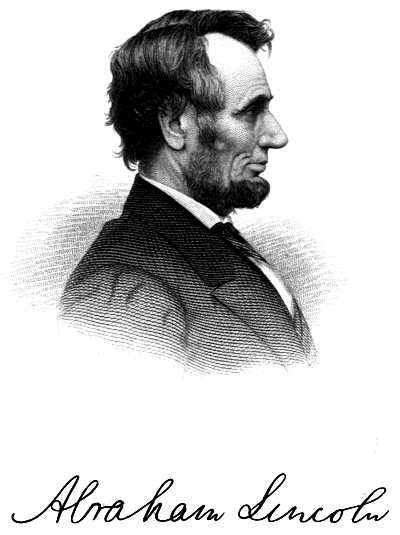
ENGRAVED PORTRAIT OF PRESIDENT LINCOLN.
The Portrait of Mr. Lincoln, accompanying this book,
has been engraved, for the Publisher, expressly for it. No
labor or expense has been spared to produce a First-Class
Engraving. It was executed by H. B. Hall, Jr., Esq., who
unquestionably stands in the front rank of American
Engravers. The great Painting of
"The Last Hours of Lincoln,"
is now being engraved by Mr. Hall, in the same style.
This Portrait of President Lincoln is pronounced by
all to be the most life-like—the best ever engraved of him.
It may not be improper to state that I have a letter from
his family to that effect, which I refrain to place in print.
I will, however, publish a few from persons intimately
acquainted with him, selecting from the large number that I
have received.
Engraved Portrait of President Lincoln.
Opinions of his Friends.
Washington, D. C., June 22, 1868.
"Dear Sir:—
"I have examined with interest the steel engraving of President Lincoln published by you.
I knew him intimately more than thirty years, being at times a member of his family.
"I regard this portrait the happiest likeness—and it conveys to me the most pleasing recollection of
Abraham Lincoln of any that I have seen.
"Very truly yours,
"J. B. S. TODD.
"Col. John B. Bachelder."
Treasury Department, Washington, D. C., July 30, 1868.
Dear Sir:—
"I have carefully examined the portrait of the late President, Mr. Lincoln, engraved by
Mr. H. B. Hall, Jr., and published by yourself. The engraving is exceedingly fine, and the likeness is
superior to any that I have seen. As a work of Art, it is in the highest degree creditable to Mr. Hall.
"Very respectfully,
"Hugh McCulloch,
"Secretary of the Treasury.
"Col. John B. Bachelder."
War Department, July 30, 1868.
"* * * It is one of the most truthful likenesses of the late President that I have seen. * * *
"Yours very truly,
"J. M. SCHOFIELD,
"Secretary of War.
"Col. John B. Bachelder."
"Navy Department, July 30, 1868.
"* * * I think it a correct and satisfactory likeness in all respects.
"GIDEON WELLES,
"Secretary of Navy.
"J. B. Bachelder, Esq."
"Head-Quarters, Corps of Engineers,
"Washington, D. C., July 30, 1868.
"* * * It is a beautiful piece of Art, indeed it is I think quite remarkable, presenting, as it does
that characteristic expression of the eye as well as of the features and lines of the face. * * *
"I am very truly yours,
"A. A. HUMPHREYS,
"Major-General."
A quarto edition of this Engraving has been published, suitable to frame, which will be sent free by mail
to any part of the country on the reception of the price.
STYLE AND PRICES.
Print, $1.00; Plain Proof, $2.00; India Proof, $3.00; Artist's Proof (selected and signed
by the engraver, and tastefully framed in a passe-partout), $5.00. (Express delivery extra.)
Orders Addressed to
JOHN B. BACHELDER, Publisher,
59 BEEKMAN STREET, NEW YORK.
Prospectus of Works
PUBLISHED BY
JOHN B. BACHELDER,
59 BEEKMAN STREET,
NEW YORK.
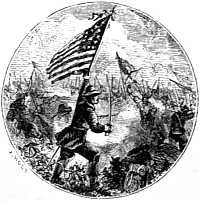
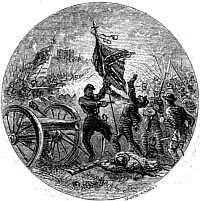
COL. MORROW, with the COLORS of the 24th MICH. VOLS.
GETTYSBURG.
When a person is desirous of procuring a published work upon
any subject, it is natural for him to inquire for the sources of
information from which the author has compiled that work. I have,
therefore, without wishing to be considered egotistical, concluded to
issue this prospectus to such as have an interest in the Battle of
Gettysburg, that they may know what I have already done, and what
I yet propose to do, to eliminate the history of that battle.
ISOMETRICAL DRAWING OF THE GETTYSBURG BATTLE-FIELD.
In compiling the Isometrical Drawing of the Gettysburg Battle-field, it was
first necessary to establish its extent and boundaries. When I arrived at Gettysburg
the debris of that great battle lay scattered for miles around. Fresh mounds
of earth marked the resting-place of the fallen thousands, and many of the dead
lay yet unburied. It therefore required no guide to point out the locality where
the battle had been fought.
As the term field, when applied to a battle, is generally used figuratively, and,
by the general reader, might be misunderstood, it is well to consider at the start,
that the battle-field of Gettysburg not only embraces within its boundaries many
fields, but forests as well, and even the town of Gettysburg itself is included in
that battle-field. The formation of the ground and the positions of the troops,
favored the plan of sketching the field while facing the west. Consequently the
top of my Drawing of it is west: the right hand, north; the left, south, &c.
There was no point from which the whole field could be sketched, nor would such
a position have favored this branch of Art. On the contrary, it was necessary to
sketch from every part of the field, combining the whole into one grand view.
DEATH OF GEN. ZOOK.
Having located its boundaries, I commenced at the southeast corner, and
gradually moving toward the north, I looked toward the west, and sketched it
carefully, as far as the vision extended, including fields, forests, houses, barns,
hills, and valleys; and every object, however minute, which would influence the
result of a battle. Thus I continued to the northeast boundary, a distance of five
and a half miles. The next day I resumed my work at the south (having advanced
to the point where my vision had been obstructed the preceding day), and sketched
another breadth to the north, as before: and so continued, day by day, until I had
carried my Drawing forward four and a half miles, which included within its
limits the town of Gettysburg. When the Battle-field had been Isometrically
drawn. I sketched in the distance and added a sky.
This Drawing was the result of eighty-four days spent on that field immediately
after the battle, during which time I sketched accurately the twenty-five
square miles which it represents.
I spent two months in hospital writing down the statements of Confederate
prisoners, and as they became convalescent, I went over the field with many
of their officers, who located their positions and explained the movements of their
commands during the battle.
I then visited the Army of the Potomac, consulted with its Commander-in-Chief,
Corps, Division, and Brigade commanders, and visited every Regiment and
Battery engaged, to whose officers the sketch of the field was submitted, and they,
after careful consultation, located upon it the positions of their respective commands.
PHILLIPS' 5th MASS. BATTERY
From the information thus obtained, I have traced the movements of every
Regiment and Battery from the commencement to the close of the battle, and
have located on the Drawing its most important position for each of the three
days.
Since its publication I issued an invitation to the officers of the Army of the
Potomac to visit Gettysburg with me, and point out their respective positions and
movements, thus giving an opportunity to the actors in this great drama to correct
any misapprehension, and establish, while still fresh in memory, the facts and
details of this most important battle of the age. This invitation was responded to
by over one thousand officers engaged in the battle; twenty-eight of whom were
Generals commanding. And it may be interesting to those who possess the Drawing,
to know that but one solitary Regiment was discovered to be out of position
on it.
Many thousand copies of this work have been sold, yet the demand still continues,
and orders are constantly coming in from all parts of the country. Though
complete in itself, it is really but the introduction to other works yet to be published
on this battle, and will be considered almost an indispensable companion to
the history of it.
It can be furnished at the following:
PRICES.
Colored Proof, on heavy plate paper, carefully finished in Water-Colors, $15.00
Proof, printed in tints, on paper as above, with positions of Regiments,
colored, 10.00
Tinted, printed with one tint, on lighter paper, 5.00
The above styles have a sky, and are suitable to frame, and are accompanied
by a key.
Plain, on lighter paper, without sky, $3.00
CAPTURE OF THE 8th LA. COLORS BY LT. YOUNG, ADG'T 107th OHIO VOLS.
The original plate has not been used except to print copies for transfers. The
first impressions from each transfer are reserved for PROOFS. Therefore the
quality of the print can never materially change, as the original plate would furnish
a thousand transfers. The colored PROOFS are carefully colored by an Artist.
The TINTED and PLAIN editions are next printed, and when the plate is worn a new
transfer is made.
To any person remitting the money, for either of the above styles, I will forward
the print by mail, to any part of the United States, Free of Charge, carefully
packed on a roll: or, I will send it by express, at their expense, with bill for
collection. I have sent hundreds by mail, to all parts of the country, and have yet
to hear of the first copy being lost or injured, while it is quite a saving of expense.
A Key, embracing a brief description of the battle, accompanies each print without
extra charge. I have hundreds of letters of indorsement from which I select
the following:—
TESTIMONIALS.
"Head-Quarters Army of the Potomac. Feb. 11, 1864.
"I have examined Col. Bachelder's Isometrical Drawing of the Gettysburg Battle-field, and am perfectly
satisfied with the accuracy with which the topography is delineated, and the positions of the troops
laid down. Col. B., in my judgment, deserves great credit for the time and labor he has devoted to obtaining
the materials for this drawing, which have resulted in making it so accurate. * * * * I can cheerfully
recommend it to all those who are desirous of procuring an accurate picture and faithful record of the
events of this great battle. * * * *
"I remain most truly yours,
"GEO. G. MEADE,
"Maj.-Gen. Comd'g. A. P."
"Head-Quarters Second Army Corps. Dec. 29, 1863.
"The view of the Battle-field of Gettysburg prepared by Col. Bachelder, has been carefully examined by
me. I find it as accurate as such a drawing can well be made. And it is accurate, as far as my knowledge
extends.
"WINF'D S. HANCOCK,
"Major-General Comd'g 2d Corps."
"Col. Bachelder's Isometrical View of the Battle of Gettysburg is an admirable production, and a
truthful rendering of the various positions assumed by the troops of my command.
"A. DOUBLEDAY,
"Maj.-Gen. Vols., Comd'g 1st Corps."
"Boston, Sept. 23, 1964.
"Col. Bachelder:—I have examined your beautiful drawing of the Battle-field of Gettysburg and
vicinity. The certificates of Gen. Meade and the Corps Commanders, which appear on its face, establish its
accuracy on the highest authority. Your personal explorations, and your inquiries of all the commissioned
officers in command of the Union Army, and of the Confederate officers made prisoners, have furnished you
means of information not possessed, I imagine, by any other person. Such opportunities of observation as I
had during three days passed at Gettysburg satisfy me of the fidelity of your delineation of the position of
every regiment of the two armies on each of the three eventful days. * * * * I may add, that the
engraving is beautifully executed and colored. Wishing you ample remuneration,
"I remain sincerely yours,
"EDWARD EVERETT."
"Head-Quarters Fifth Army Corps. Sept. 28, 1864.
"Mr. Jno. B. Bachelder:—
"Dear Sir:—I am exceedingly gratified with receiving a finished copy of your print of the Battle-field
of Gettysburg. I am familiar with your long and untiring labors in all the fields where truth could be
reached, and know that your efforts were crowned with a success that leaves nothing more to be desired.
You are authorized to add my name to those who bear testimony to Its accuracy.
"Very respectfully your obedient servant,
"G. K. WARREN.
"Maj.-Gen. Vols., Comd'g 5th Corps.
"Ch. Eng. at Gettysburg."
"Orange, Oct. 1, 1864.
"Jno. B. Bachelder, Esq.:—
"My Dear Sir:—I have carefully examined your Isometrical Drawing of the Battle-field of Gettysburg,
with great interest and much profit. Never having been on that field, of course I can not express an
opinion as to its accuracy—so abundantly indorsed for, however, by most competent judges: but I can say
that it has given me a much clearer idea of the battle than I had before, and I earnestly hope that you will
find it convenient to illustrate others of our great battles in the same manner.
"I am very truly yours,
"GEO. B. McCLELLAN."
"Head-Quarters Dep't and Army of the Tennessee. Oct. 24, 1864.
"Mr. Jno. B. Bachelder:—
"My Dear Sir:—I was much gratified on receiving a copy of your beautiful drawing of the 'Gettysburg
Battle-field.' I have never seen a painting or topographical map that could give so vivid a representation
of a great battle. I regard it as an honor that you have associated my name with those of other corps commanders
in your historical picture. Be pleased to accept my kind regards.
"Respectfully yours,
"O. O. HOWARD, Major-General."
"Col. Jno. B. Bachelder:—
"Dear Sir:—I have examined with care your Isometrical Drawing of the Gettysburg Battle-field, and
can cheerfully bear testimony to the accuracy of the position of the troops on the right of our line.
"Yours very truly,
"H. W. SLOCUM,
"Maj.-Gen. Vols., Comd'g Right Wing at Gettysburg."
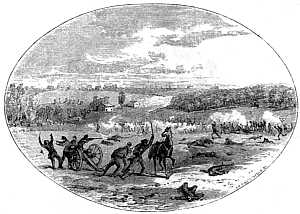
WOFFORD'S FLANK ATTACK ON SWEITZER'S BRIGADE, DEATH OF COL. JEFFERS 4th MICH. VOLS.
HISTORY OF THE BATTLE.
During my consultations with officers at the front, as well as on
the Battle-field, I noted down with great care their conversations,
and have books full of material thus rescued from oblivion.
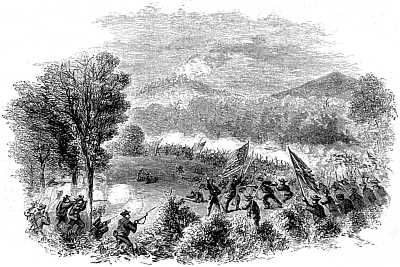
STANNARD'S BRIGADE OPENING ON PICKETTS' DIVISION.
Since the publication of the Drawing, and even before, I have been steadily
engaged in compiling the History of the Battle of Gettysburg. I have traveled
many thousand miles to add to my knowledge. I have received a great number
of letters relating to it, and the Government have very considerately placed at my
disposal the entire Reports of both the Union and Confederate officers; and have
also given me access to the archives at Washington. They have recently ordered
a re-survey of the field, which is now being done by Government Engineers in
the most complete and scientific manner. A fine Topographical map is to be compiled
and engraved, copies of which I have arranged to have to illustrate my History
of the Battle. This book, in addition to the maps, which will cost several
thousand dollars, will also be illustrated with Steel Plates and Wood-Cuts in a
manner second to no book heretofore published in this country. Over $7,500
worth of illustrations are already engraved to embellish it, including fine Steel
Portraits, executed by the best engravers in America, in line and stipple, of
Generals Reynolds, Doubleday, Newton, Meredith, Stannard, Hancock, Gibbon,
Zook, Hays, Webb, Hall, Sickles, Birney, Humphreys, Berdan, Sykes, Barnes,
Tilton, Wright, Bartlett, Wheaton, Howard, Ames, Slocum, Williams, Geary,
Kane, Pleasanton, Butterfield, Warren, Hunt, Ingalls, Randolph, Martin, and McGilvrey.
Several others are in hand, and undoubtedly more will be added to the
list. In addition to these the Portraits of leading Confederate Generals will be
engraved. Many of the prominent scenes of the battle have already been beautifully
designed and engraved on wood, samples of which embellish this circular,
others are to be added, and to those interested I shall be pleased to furnish full
information regarding either portraits or wood-cuts.
I shall publish a Popular Edition of the history, with portraits printed from
transfers, and bound in cloth. Price. $7 50
The next will be the Library Edition, royal octavo, printed on good fair
paper, good plates, and substantially bound in sheep. $12 00
The same size printed on fine paper. Proof Portraits—bound in half morocco,
beveled boards. $17 50
A Fine Edition on tinted paper. Proof Portraits. Full morocco, gilt,
beveled boards, gilt edges. $25 00
A Large Paper Edition (limited) will be printed from new type, and the
original wood-cuts in the best style of modern hand-press work, on heavy toned
paper, with the finest India Proof Portraits. In Sheets, stitched, uncut, $100.00
Elaborately bound. Full levant morocco, gilt. $125.00
I have now devoted five years and a half to collecting material for the history
of the Battle of Gettysburg, but until quite recently I have felt unwilling to commence
to write, knowing that other matter existed which it was important for me
to have, and which, when obtained, might make a material change in the account.
This reason no longer exists, though I shall still thankfully receive suggestions
from any participant in the battle.
Within another year the Government will have completed the Topographical
Map of the field, by which time I hope to be ready to publish my work. As a
publisher I would have done so long ago, but as a historian not until I feel that I
have written the truth—the whole truth, and nothing but the truth.
PAINTINGS OF THE BATTLE.
I have also in progress, the finest Collection of Oil Paintings
executed of any battle in this country. The whole to be known as
"THE GETTYSBURG ART GALLERY."
I have divided the Battle into a series of episodes, beginning with its commencement
and continuing to its close, each to embrace such movements and
operations as of themselves form a complete unit. Of each, I make an accurate
historical design, which design I place in the hands of some eminent battle-scene
painter, who will be responsible for the artistic rendering of the subject. Each
painting is to be 7 × 4 ft., and when completed, will be exhibited in the places
where the regiments represented in it were raised. The whole, together, will
form a most complete and graphic representation of the Battle from its commencement
to the close. Each of these paintings will be engraved on steel, and hereafter
engravings may be had representing actual scenes, which, having been
designed under the personal direction of the participants themselves, will possess
the merit of historical truth.
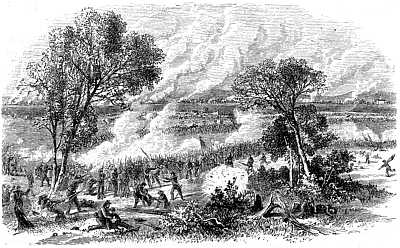
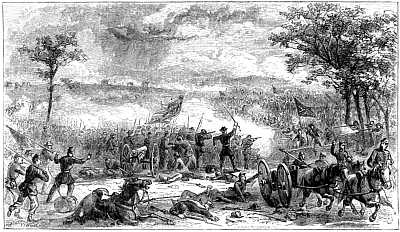
REPULSE OF LONGSTREET'S CHARGE.
It must not be understood that this whole work is to be put in hand at once.
It will be taken up in detail, and continued as rapidly as I have time and means to
attend to it. I shall be happy to correspond with those interested in any portion
of the Battle. When convenient, it will be better to call a meeting, at Gettysburg,
of the officers of the command to be represented, before commencing a painting,
that all the details may be properly arranged. I have already made a design,
representing the "charge" of the 6th Wisconsin, 95th N. Y., and 14th N. Y.
S. M., on the first day, resulting in the capture of the 2d Mississippi Regiment,
which is now being painted by Alonzo Chappel, Esq., the eminent historical
painter. I have recently met, at Gettysburg, the officers of the 3d Division,
1st Army Corps, and under their direction completed a design of their engagement
on the afternoon of the first day, which will also embrace the movements
of the 1st Brigade, 1st Division. This picture is now being painted by the
distinguished battle-scene painter, James Walker, Esq.
Fine Steel Engravings will be published from these paintings. Size (engraved
surface), 12 × 21 in.
PRICES:
Prints, $5.00; Plain Proofs, $10.00; India Proofs, $15.00; Artist's Proofs, $25.00.
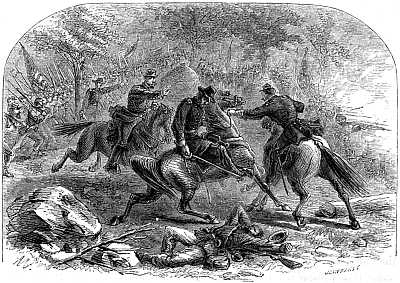
DEATH OF MAJOR FERRY, 5th MICH. CAV'Y.
Mr. Walker has just completed for me, his graphic representation of
THE REPULSE OF LONGSTREET'S CHARGE,
on the afternoon of the third day, which will be exhibited in the principal cities
of the country. This is also from my historical design, and has been painted under
my immediate direction. Mr. Walker spent weeks at Gettysburg, transcribing
the portraiture of the field to canvas, which has been done in the most pleasing
and lifelike manner. We have received in this matter the kindest support and
co-operation of the officers of the army, engaged on that portion of the field.
Many distinguished general officers, on my invitation, visited Gettysburg, and
went over the field with us, and pointed out all the details of this great turning
point of the Rebellion; each explaining the movements of their several commands.
Among those present at different times, were Generals Meade, Hancock,
Gibbon, Howard, Doubleday, Stannard, Hunt, Warren, Humphreys, Graham,
Burling, De Trobriand, Wistar, and Dana; together with a large number of Field,
Line, and Staff-Officers. Most of these gentlemen have since kindly called at Mr.
Walker's studio, and aided the work with their advice. Many others, who were
unable to meet with us at Gettysburg, have, at considerable trouble, visited the
studio in New York; among them, Generals Webb, Hall, Newton, Hazard, Sickles,
Ward, Brewster, Berdan, and Gates, and Generals Wilcox and Longstreet, of the
Confederate Army; the latter taking great interest in the painting, and leaving
me a fine letter indorsing its accuracy. This painting has been designed strictly
in conformity to the directions of these gentlemen, given on the field for that
purpose, and from the Reports of the Confederate Commanders, furnished to me
by the Government.
This great representative Battle-scene has not its equal in America, for correctness
of design or accuracy of execution. Gibbon's and Hays's Divisions and
the Corps Artillery, occupy the immediate foreground. It is on a canvas 7-1/2 × 20
feet, and represents, not only every Regiment engaged at that portion of the field,
but where the formation of the ground would admit, the entire left wing is shown.
It presents such an accurate and lifelike portrait of the country, that on it
the movements of the first and second day's operations can readily be traced.
No important scene has been screened behind large foreground figures, or, for the
want of a knowledge of the details, hidden by convenient puffs of smoke; but
every feature of this gigantic struggle has, in its proper place, been woven into a
symmetrical whole.
A fine steel plate is also to be engraved of this picture, which will be accompanied
by a Key, by which the position of every Regiment and Battery can be
determined.
PRICE OF ENGRAVINGS.
Print, $10.—Plain Proof, $25.—India Proof, $60.—Artist Proof (limited to
200 copies), $100.
The following gentlemen, intimately identified with the Battle of Gettysburg,
and exercising the highest commands at the battle, kindly furnished me these
letters, as indorsements to an application to examine Confederate Reports of the
Battle of Gettysburg at the War Department.
"Philadelphia, Nov. 3, 1867.
"General:—
"* * * * Mr. Bachelder has accumulated a vast amount of official and reliable testimony on our
side, and I am of the opinion his work will be as truthful as the data in his possession will admit; I am
greatly interested in his application being granted, and would most earnestly recommend permission being
given him to examine the Confederate Reports, in case you do not see any strong reasons preventing it.
"Very truly yours,
"GEO. G. MEADE,
"Major-General, U. S. A.
"General U. S. Grant.
"Sec. War, ad interim."
Permission Granted.
[Extract of a letter from Major-General Humphreys, Chief of the Corps of Engineers.]
"Washington, D. C., Nov. 14, 1867.
"General:—
"* * * The information which Mr. Bachelder has collected concerning the Battle of Gettysburg, is
extraordinary in amount and correctness. So far as I am able to judge, there is no battle of any war
respecting which so many truthful accounts, so many exact details, have been collected and compiled.
From every source, from the private to the general commanding the army, facts have been collected,
and where discrepancies were found, evidence was multiplied, and in this way errors have been dissipated.
Mr. Bachelder has peculiar qualifications for the task he has undertaken, and has devoted four years to
it. * * *
"A. A. HUMPHREYS,
Major-General.
"General U. S. Grant.
"Sec. of War, ad interim."
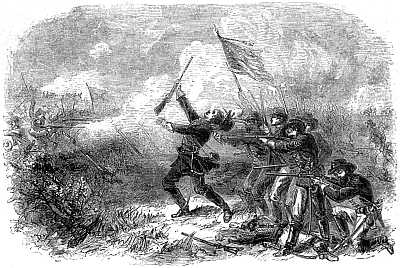
DEATH OF PRIVATE RIGGIN, GUIDON BEARER, RICKETTS' (PA) BATTERY
Note.—The wood-cuts interspersed through this circular have been engraved to illustrate scenes in the
Battle of Gettysburg, and with many others will appear in the History of that Battle.
"THE LAST HOURS OF LINCOLN."
ORIGIN OF THIS HISTORICAL PAINTING.
ABRAHAM LINCOLN, President of the United States, was assassinated by John Wilkes Booth on
the night of April 14, 1865, at Ford's Theater, Washington, D. C. This night, fraught with woe to the
peoples of two continents, sombered by its halo of diabolism, must forever remain the Golgotha of American
history.
At the threshold of the temple of peace—the High Priest was stricken down—and the great heart
whose every throb was a pulsation of love for his country's enemies, was robed in silence. In company
with Mrs. Lincoln, Miss Harris, and Major Rathbone, Mr. Lincoln had sought a brief respite from the
iron wheel of State toil, and in the search, through the medium of the assassin's bullet, found a respite for
all time.
Immediately after the fatal shot was fired, and under direction of Assistant-Surgeons Leale and
Taft, he was removed to a private house, and placed upon a couch in a small bedroom. Robert Lincoln,
General Todd, and Dr. Todd, cousins of Mrs. Lincoln, and other personal friends, speedily arrived. His
family physician, Dr. Stone, and Surgeon-General Barnes, accompanied by Asst.-Surgeon General Crane,
were in early attendance, and later he was visited by Drs. Hall and Liebermann, and other eminent physicians,
all of whom agreed that the wound was unto death. The bullet had entered the back of his head,
and lodged behind the right eye.
Mr. Lincoln was visited during the night by Vice-President Johnson and the entire cabinet, except
Mr. Seward, including Secretaries McCulloch, Stanton, Welles, and Usher. Postmaster-General
Dennison, and Attorney-General Speed, together with Asst.-Secretaries Field, Eckert, and Otto. There
were also present Speaker Colfax, Chief-Justice Cartter, Senator Wilson, Representatives Farnsworth,
Arnold, Marston, and Rollins, Governor Oglesby, accompanied by Adjutant-General Haynie, Major
Hay, Generals Auger, Meigs, and Halleck, Ex-Governor Farwell, Rev. Dr. Gurley, and Commissioner
French, Colonels Vincent Pelouze and Rutherford, and Major Rockwell. Early in the night Mrs.
Lincoln sent for Mrs. Senator Dixon, who was accompanied by her sister and niece, Mrs. Kinney and
daughter. There were also a few others present during the night, but never more than half of those
represented on the painting at any one time.
By the publicity of the assassination it was soon known throughout the city, and thousands crowded
the avenues leading to the house where the President lay.
The news of this tragic event flashed with the speed of lightning throughout the land. From Maine to
California consternation reigned, and feelings of surprise and grief were depicted on every face. The great
man now martyred had for more than four years held the highest place in the gift of the American people,
and on him their hopes had centered. The designer of the painting of
"THE LAST HOURS OF LINCOLN,"
Jno. B. Bachelder, arrived in Washington on the night of his death, and being impressed with the
historic importance of the event, at once determined to collect such materials as should be necessary for an
historical picture commemorating that sad scene, and should the demand warrant it, to publishing a steel-plate
engraving from it. The design for the painting was soon completed, and arrangements having been
made with Brady & Co., Photographers, as soon as the remains of the President left the city each of the
persons represented were visited, and at their convenience were posed and photographed in the position
which they now occupy in the painting. It being important that the best possible original should be had
for the engraver's use, the design was placed in the hands of Alonzo Chapel, Esq., the historical painter,
to whose genius the painting is to be credited. Much of its completeness is due to the kindness and attention
of the persons represented; as all cheerfully gave their time for frequent sittings, both to the designer
and painter.
No expense has been spared to produce a work worthy the scene it represents, and the high encomiums
given it by eminent judges is the best proof of the result.
To publish any thing now short of a first-class copy of such a painting would be a breach of confidence
to those who have so kindly aided in its production. The proprietor has therefore decided to have this
picture engraved in the finest style of line and stipple, the engraved surface of the plate to be 18 × 31
inches; believing that nothing short of a genuine work of art will meet the approval, and secure the
patronage of the American people, and to those interested the proprietor can most confidently promise a
suitable memento of their departed chief.
The engraving is being executed by H. B. Hall, Jr., Esq., the eminent engraver upon steel.
PRICE OF ENGRAVINGS.—Prints, $15.00; Plain Proofs, $35.00; India Proofs,
$60.00; Artist's Proofs (limited to 200 copies which will be numbered and signed by the artist and
engraver), $100.00.
A beautiful engraved and photographic Key to the Engraving will be presented to the subscribers. It
is a complete picture of itself, and may be had in advance by subscribers only.
JOHN B. BACHELDER, Publisher, 59 Beekman Street. New York.
The Last Hours of Lincoln
KEY
1 Pres. LINCOLN.
2 Mrs. LINCOLN.
3 Vice Pres. JOHNSON.
4 Maj. RATHBONE.
5 Mr. ARNOLD. M.C.
6 P.M. Gen. DENNISON.
7 Sec. WELLES.
8 Atty Gen. SPEED.
9 Dr. HALL.
10 Dr. LEIBERMANN.
11 Secy. USHER.
12 Secy. McCOLLOCH.
13 Gov. OGLESBY.
14 Speaker COLFAX.
15 Dr. STONE.
16 Surg. Gen. BARNES.
17 Mrs. Sen. DIXON.
18 Dr. TODD.
19 Asst. Surg. LEALE.
20 Asst. Surg. TAFT.
21 Asst. Secy OTTO.
22 Gen. FARNSWORTH. M. C.
23 Sen. SUMNER.
24 Surg. CRANE.
25 Gen. TODD.
26 ROBT. LINCOLN.
27 Rev. Dr. GURLEY.
28 Asst. Secy FIELD.
29 Adjt Gen. HAYNIE.
30 Maj. FRENCH.
31 Gen. AUGER.
32 Col. VINCENT.
33 Gen. HALLECK.
34 Secy. STANTON.
35 Col. RUTHERFORD.
36 Asst. Secy. ECKERT.
37 Col. PELOUSE.
38 Maj. HAY.
39 Gen. MEIGS.
40 Maj. ROCKWELL.
41 Ex Gov. FARWELL.
42 Judge CARTTER.
43 Mr. ROLLINS, M. C.
44 Gen. MARSTON. M. C.
45 Mrs. KINNEY.
46 Miss KINNEY.
47 Miss HARRIS.
Brief Sayings of Eminent Men.
Surgeon-General's Office, }
Washington City, March 20, 1867. }
Col. J. B. Bachelder.
Sir:—The picture of "The Last Hours of Lincoln." painted by Alonzo Chappel from your design, presents,
with remarkable fidelity, the portraits of those in attendance at various times during the night of
April 14, 1865, preserving truthfully the principal features of that most sad event.
Very respectfully yours,
J. K. Barnes. Surgeon-General, U.S.A., Brevet Major-General.
It is certainly a work of great interest and merit. I have looked upon it with the liveliest satisfaction
on account of its singularly graphic delineation of the actual scene as myself beheld it, and also because
the likenesses of most of the distinguished persons presented by the painting seem to me to be very
accurate and striking.
P. D. Gurley. Pastor of the N. Y. Ave. Pres. Church
I cheerfully bear testimony to the accuracy of the Portraits of the persons present on that melancholy
occasion, and especially that of the martyred President.
W. T. Otto. Assistant Secretary of the Interior.
It gives me pleasure to testify to the accuracy with which you have represented the principal features
of the scene in question, and to the fidelity of the portraits which you have introduced. You have been
especially successful in the likeness of President Lincoln.
John Hay,
Brevet Colonel, formerly A. D. C. to President Lincoln.
The truthful likeness of President Lincoln, the fidelity of the portraits of those present on that most
mournful night, and the excellent grouping of the figures, render this picture peculiarly valuable in an historical
point of view, apart from its merits as a work of art.
C. H. Crane, Assistant Surgeon-General U. S. Army.
Without possessing a critical capacity for judgment, I can say, in all sincerity, that the painting as a
whole, is faithful to the scene of the death-chamber on that eventful night, and impressively truthful in
its portraiture.
D. K. Cartter, Chief-Justice.
The above gentlemen visited President Lincoln during his last hours, and are represented in
the painting.
It is admirable as a picture, and of great value for the fidelity of the portraits.
A. A. Humphreys, Major-General.
Dear Sir:—Permit me to thank you for the enjoyment of the luxury of grief afforded me in the viewing
of the great picture commemorating "The Last Hours of Lincoln." It is deserving of great praise. If
it has a fault, it is its high coloring. As I have personally known nearly all the forty odd persons who
appear in it, I can speak with confidence of the truthfulness of the likenesses.
F. E. Spinner, Treasurer United States.
The majority of the portraits could hardly be improved.
O. O. Howard, Major-General.
I know personally a large majority of the persons represented, and take pleasure in bearing my testimony
to the singular fidelity of their portraits.
Ira Harris, United States Senator.
EXTRACT FROM A CRITICISM.
[From the Washington Sunday Herald.]
Washington, March 31, 1867.
A great picture has been designed of the "Last Hours of Abraham Lincoln." The designer is Mr. John
B. Bachelder, the painter Alonzo Chappel. * * The value of such a picture of such a scene is enormous,
and of a kind to ever increase with time. * * Looking like himself, from his finger-nails to his hard,
protruding lip, Stanton, with paper and pencil in hand, and uplifted forefinger, is giving instructions to the
soldierly General Auger, the then Military Commander of the District. * * Portraits so minutely like
I have never seen, even from the brush of Elliot. * * *
The grandeur in the face of Lincoln, is grand indeed. The cold hues of death are warmed to the eye by
the red rays of a candle held over him, and the flickering flare causing a Rembrandt-like effect, is very
felicitously managed. The eye rests in love and pity on it, turning from those around impatiently. * * *
McCulloch who turns from the scene, and Johnson who sits in the left foreground, are wonderfully like.
As is the erect Dennison beyond them; and Meigs, with his hand resting on the door-post, where he stood
to prevent disturbing entrances; Dr. Stone and Surgeon-General Barnes, General Todd, Judge Otto,
Sumner, Farnsworth, Speaker Colfax, and Governor Oglesby, are looking down on the face of Lincoln with
an expression of respectful concern. * * * Judge Cartter and Ex-Governor Farwell stand in front of
Meigs, forming the right foreground of the picture; they are given in profile and seem conversing.
The greatness of the picture lies in its correct transcription of an actual scene and perfect portraiture
of American men. It is just such a work as, above all others, should be American property, for if ever
there was a National picture, this is one.
Arc.
ADVERTISEMENT.
Sketch of the Life of Abraham Lincoln.
PRICE.
People's Edition. 8vo. Steel Portrait. Cloth $1.50
A Fine Edition. 8vo. Proof Portrait. Fine binding,
beveled boards, Levant cloth, gilt edges 3.00
Memorial Edition. On heavy toned paper, large margin.
India Proof Portrait. Morocco, Antique, gilt edges 7.00
I am prepared to supply the Trade with the
"SKETCH of the LIFE of ABRAHAM LINCOLN," and the "PORTRAIT of LINCOLN,"
ON LIBERAL TERMS.
My other publications are sold exclusively by Subscription, including
The Steel Engraving of
"The Last Hours of Lincoln;"
The Isometrical Drawing of
"The Gettysburg Battle-field;"
"The History of the Battle of Gettysburg."
The Steel Engraving of
"The Battle of Gettysburg;" (Longstreet's Repulse.)
And the Steel Engravings of the Different
"Episodes of the Battle of Gettysburg."
Each of the latter forming a fine business opportunity for a man of energy, who has a
small amount of capital, which he would invest with a certainty of liberal returns.
To Canvassers of Experience, having the Capital and Business Capacity to manage
the canvass of States, Counties, or Cities, I can offer superior inducements. (See separate
notices of subjects.) Orders received for either of the above at the office of
publication.
From my intimate business relations with the best Painters, Designers, Steel Engravers,
Wood Engravers, and Lithographers, in this City, I am prepared to receive
orders from my patrons, and have them executed under my immediate superintendence, in
any style required.
JOHN B. BACHELDER, Publisher,
59 Beekman St., New York.