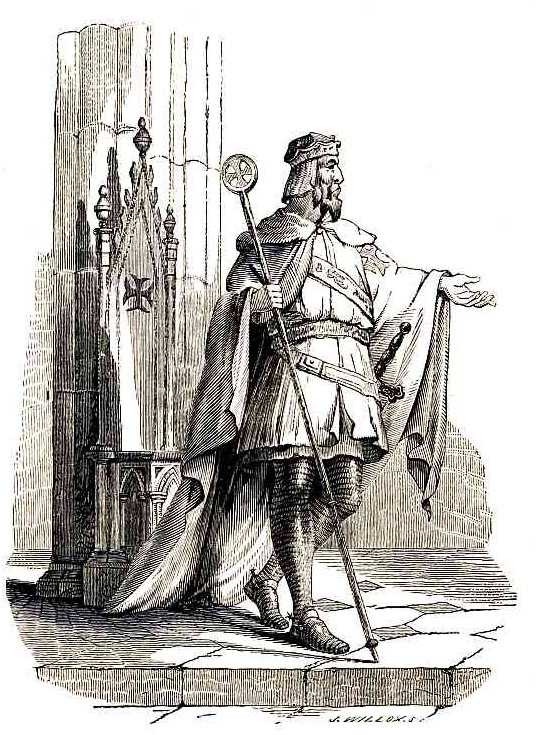
The Knights of the Temple were introduced
into Scotland before 1153 by King David the First, who established
them at Temple on the Southesk,[38]
and who was so attached to the brotherhood,
that we are told by an old historian "Sanctus
David de prœclara Militia Templi optimos fratres secum retinens,
eos diebus et noctibus morum suorum fecit esse
custodes."[39]
Malcolm, the grandson of David, conferred on the
brethren "in liberam et puram Elymosynam unum plenarium
Toftum in quolibet Burgo totius terræ," which foundation
was enlarged by his successors, William the Lion and Alexander
the Second. The charter of the latter is still in the
possession of Lord Torphichen, whereby he grants and confirms
"Deo et fratribus Templi Salomonis de Jerusalem
omnes illas rectitudines, libertatis et consuetudines quas Rex
David et Rex Malcolm et decessus pater meus Rex Willielmus
eis dederunt et concesserunt, sicut scripta eorum authentica
attestant." This curious document, after enumerating
certain of these rights and liberties, scilicet,—the king's sure
peace; the privilege of buying, selling, and trading with all
his subjects; freedom from all tribute and toll, &c. proceeds
"Et nullus eis injuriam faciat, vel fieri consentiat super
meam defensionem, Et ubicunque in tota terra mea ad judiorum
(q. judicium) venerint, causa eorum primum tractata,
et prius rectum suum habeant, et postea faciant. Et
nullus ponat hominem predictorum fratrum nostrorum ad
foram judicii si noluerint, &c. Et omnes libertates et consuetudines
quas ipsi per alias regiones habent in terra mea ubique habeant."
These general privileges, throughout Europe, were
very extensive. The Templars were freed from all tythes to the
church, and their priests were entitled to celebrate mass, and
to absolve from sins to the same extent as bishops, a privilege
which was strongly objected to by the latter. Their houses
possessed the right of sanctuary or asylum for criminals.
They could be witnesses in their own cause, and were exempted
from giving testimony in the cause of others. They
were relieved by the papal bulls from all taxes, and from
subjection and obedience to any secular power. By these great
immunities, the Order was rendered in a manner independent,
but it would appear, nevertheless, that both the Templars
and Hospitallers considered themselves subjects of the countries
to which they belonged, and took part in the national
wars, for we find by the Ragman Roll, "Freere Johan de
Sautre, Mestre de la Chevalier del Temple en Ecoce," and
another Brother, swearing fealty to Edward I. in 1296; and
the author of the Annals of Scotland, taking notice of the
Battle of Falkirk, 12th July 1298, informs us, that the only
persons of note who fell were Brian le Jay, Master of the
English Templars, and the Prior of Torphichen in Scotland,
a Knight of another Order of religious soldiery. The former
of these Chevaliers met his death by the hand of the redoubted
Sir William Wallace, who advanced alone from the midst
of his little band, and slew him with a single blow, although
the historian adds, that Sir Brian le Jay was a Knight Templar
of high military renown, who had shewn himself most
active against the Scots.[40]
Little is known of the farther History of the
Knights Templars in Scotland from the time of Alexander II. down
to the beginning of the 14th century, excepting that their
privileges were continued to them by succeeding Kings,
whose bounty and piety were in those ages continually directed
towards the religious Orders. By their endowments,
and the bequests of the nobles, the possessions of the Order
came to be so extensive, that their lands were scattered "per
totum regnum Scotiæ, a limitibus versus Angliam, et sic discendo
per totum regnum usque ad Orchades." Besides the
House of the Temple in Mid-Lothian, the following Establishments
or Priories of the Order may be enumerated, viz.
St. Germains, in East Lothian; Inchynan, in Renfrewshire;
Maryculter, in Kincardineshire; Aggerstone, in Stirlingshire;
Aboyne, in Aberdeenshire; Derville or Derval, in
Ayrshire; Dinwoodie, in Dumfriesshire; Red-abbey-stedd,
in Roxburghshire, and Temple Liston, in West-Lothian.
The date of the spoliation of the Templars of
Scotland, corresponds of course with that of the persecution of the
Order in other countries, and it is to the credit of our forefathers
that we can obtain no account of any Member of the
Brotherhood having been subjected to personal torture or
suffering amongst them; their estates, however, appear to
have been duly transferred to the possession of their rivals,
the Knights Hospitallers; into which Order it is not improbable
that, like their Brethren in England, a number of the
Templars entered.
In November 1309, John de Soleure, the Papal
Legate, and William, Bishop of St. Andrews, held an Inquisitorial
Court at the Abbey of Holyrood to investigate the charges
against the Templars, but Walter de Clifton, Grand
Preceptor of the Order in North Britain,[41]
and William de Middleton, were the only two Knights who appeared before
the Tribunal, the proceedings of which, as recorded at length in
Wilkins' Consilia, make no allusion to any punishment being
inflicted, so that we may fairly conclude they were soon set
at liberty. The Preceptor, in his examination, readily confessed
that the rest of the Brethren had fled, and dispersed
themselves propter scandalium exortum contra ordinem,
and we are told by a learned French writer, that having
deserted the Temple, they had ranged themselves under the
banners of Robert Bruce, by whom they were formed into a
new Order, the observances of which were based on those of
the Templars, and became, according to him, the source of
Scottish Free Masonry.[42]
This statement corresponds with
the celebrated Charter of Larmenius already referred to, in
which the Scottish Templars are excommunicated as Templi
desertores, anathemate percussos; and along with the
Knights of St. John, dominiorum Militiæ spoliatores, placed
for ever beyond the pale of the Temple, extra gyrum Templi
nunc, et in futurum; and it is likewise supported in
some measure by the authority of the accurate historian of
Free Masonry, M. Thory, who, in his "Acta Latomorum,"
states that Robert Bruce founded the Masonic Order of Heredom
de Kilwinning, after the Battle of Bannockburn, reserving
to himself and his successors on the Throne of Scotland,
the office and title of Grand Master. Scottish tradition has,
moreover, always been in favour of this origin of the Ancient
Mother Kilwinning Lodge, which certainly at one time possessed
other degrees of Masonry besides those of St. John;
and it is well known to our Masonic readers, that there are
even in our own days at Edinburgh, a few individuals claiming
to be the representatives of the Royal Order established by
Bruce, which, though now nearly extinct in this country,[43]
still flourishes in France, where it was established by Charter
from Scotland, and even by the Pretender himself, in the
course of last century, and is now conferred as the highest
and most distinguished grade of Masonry, sanctioned by the
Grand Orient, under the title of the Rose Croix de Heredom
de Kilwinning. It may be interesting to add, that the
introduction on the Continent of this ancient branch of our
national Masonry, has been commemorated by a splendid
medal struck at Paris, bearing, amongst other devices, the
Royal Arms and Motto of Scotland; and that the Brethren
of the Lodge of Constancy at Arras, still preserve with
reverence an original charter of the Order, granted to their
Chapter in 1747, by Charles Edward Stuart, and signed by
that unfortunate Prince himself as the representative of the
Scottish Kings.[44]
Nor can any thing indicate more strongly
the high estimation in which the chivalry of the Rosy Cross
of Kilwinning is held in France, than the fact that the
Prince Cambaceres, Arch-chancellor of the Empire, presided
over it as Provincial Grand Master, (the office of supreme
head being inherent in the Crown of Scotland,) for many
years; and that he was succeeded in his dignity, if we mistake
not, by the head of the illustrious family of Choiseul.
But whether the Scottish Templars really joined
the victorious standard of Robert Bruce, and with him, as our
countrymen would fain hope, fought and conquered at Bannockburn,
or whether the majority of them transferred themselves
along with the possessions of the Order, to the Knights
of St. John of Jerusalem, certain it is, that from the time of
the persecution, the Order of the Temple, together with all
its wealth, became merged in that of the Hospitallers, though
certainly not to such a degree as to obliterate all distinct
traces of the Red Cross Knights. On the contrary, we find
by a public document recorded entire in the Register of the
Great Seal of Scotland, and dated two centuries after the
incorporation of the Orders, that King James the Fourth
confirmed all former grants sancto Hospitali de Jerusalem,
et fratribus ejusdem militiæ Templi Salomonis,—a satisfactory
proof that the Order, although proscribed by the
Pope, was still retained conjointly with that of the Hospital,
in law papers at least.[45]
The Knights of St. John had also been introduced
into Scotland by King David the First, and had a charter granted
to them by Alexander the Second, two years after that to the
Templars. The Preceptory of Torphichen, in West Lothian,
was their first, and continued to be their chief residence, and
by the accession of the Temple lands and other additions,
their property at the time of the Reformation came to be
immense. When that event took place, the chief dignitary
or Grand Preceptor of the Order in Scotland, with a seat as
a Peer in Parliament, was Sir James Sandilands, a cadet of
the family of Calder, whose head, as is well known to readers
of Scottish History, was the private friend of John Knox,
and one of the first persons of distinction to embrace the reformed
religion. We might suspect, that even before the
promulgation of the statute 1560, prohibiting all allegiance
within the realm to the See of Rome, the former personage
had become indifferent to the charge confided to him by the
Order; for a rescript from the Grand Master and Chapter
at Malta, dated so early as the 1st of October 1557, and
addressed to him, is still on record, wherein they complain
"that many of the possessions, jurisdictions, &c. were conveyed
or taken away from them contrary to the statutes and
oaths, and to the damnation of the souls, as well of those who
possessed them, as of those who, without sufficient authority,
yielded them up; producing thereby great detriment to religion
and the said Commandery;" but be this as it may, we
are certain that the conversion of Sir James Sandilands, or
as he was termed, the Lord of St. John of Jerusalem in Scotland,
was followed by his surrender to the Crown of the
whole possessions of the combined Templars and Hospitallers,
which having been declared forfeited to the State on the
ground that "the principal cause of the foundation of the
Preceptory of Torphichen, Fratribus Hospitalis Hierosolimitani,
Militibus Templi Salomonis, was the service enjoined
to the Preceptor on oath to defend and advance the
Roman Catholic Religion," were by a process of transformation
well understood by the Scottish Parliament of those days,
converted into a Temporal Lordship, which the unfortunate
Queen Mary, then only twenty years of age, and newly established
amongst her Scottish subjects, in consideration of a
payment of ten thousand crowns of the Sun, and of his fidele,
nobile, et gratuitum, servitium, nobis nostrisque patri et
matri bonæ memoriæ, conferred on, or rather retransferred
to the Ex Grand Preceptor himself and his heirs with the
title of Torphichen, which, although the estate is much dilapidated,
still remains in his family.[46]
All this was transacted
acted on the petition of Sir James Sandilands himself, with
the formal approbation of the National Legislature; and after
renouncing the profession of a soldier-monk, we find that the
last of Scottish Preceptors of St. John became married and
lived to a good old age, having died so late as 1596 without
issue, when the title of Torphichen passed to his grand
nephew, the lineal descendant of his elder brother, Sir John
Sandilands of Calder.
We shall not pause to consider whether a body of
Masonic Templars unconnected with the Hospitallers, and representing
the Royal Order which Bruce is said to have instituted
from the relict of the Ancient Knights, has been perpetuated
in Scotland since the days of Bannockburn, having no means
of illustrating so obscure a subject; but, with all due respect
to the learned French writer, whose authority we have already
quoted, we may observe, that the Masonic Tradition of the
country does not connect the Templars with Bruce's Order
in any way whatever, but, on the contrary, invariably conjoins
those Knights with the Hospitallers, and consequently points
to the period of the renunciation of Popery, as the time when
they first sought refuge, and a continuance of their Chivalry
among the "Brethren of the Mystic Tie." The Chevaliers
also of the Rosy Cross of Kilwinning in France, own no
alliance with Masonic Templary, which they consider a comparatively
modern invention; nor do there exist, so far as
we know, any authentic records anterior to the Reformation,
to prove a connection between the Knights Templars and
Freemasons in any part of the world, though we must not
omit to mention, that a formal document in the Latin language
is said to be deposited in a Lodge at Namur on the Meuse,
purporting to be a proclamation by the Freemasons of Europe,
"of the Venerable Society sacred to John," assembled by
representatives from London, Edinburgh, Vienna, Amsterdam,
Paris, Madrid, Venice, Brussels, and almost every other
Capital City, at Cologne on the Rhine in 1535; and signed,
amongst others, by the famous Melancthon, in which, after
declaring that "to be more effectually vilified and devoted
to public execration, they had been accused of reviving the
Order of the Templars," they solemnly affirm, that "the
Freemasons of St. John derive not their origin from the
Templars, nor from any other Order of Knights; neither
have they any, or the least communication with them directly,
or through any manner of intermediate tie, being far more
ancient," &c.—all of which would imply, that some sort of
connection was understood in those days to exist between
certain of the Masonic Fraternities and the Knights Templars.
A Copy of this document was sent to Edinburgh in
1826, by M. de Marchot, an Advocate at Nivelles, and a
translation of it has been inserted under the attestation of a
Notary Public in the Records of the Ancient Lodge of
Edinburgh, (Mary's Chapel); but we have little faith in
German documents on Free Masonry, unless supported by
other testimony; and as no Historian of the Craft makes the
slightest allusion to the great Convocation of the Brethren at
Cologne, in the sixteenth century, rather than ask the reader
to believe that it ever took place, we shall presume that
M. de Marchot may have been deceived.[47]
From the era of the Reformation, the combined
Order appears in Scotland only as a Masonic body; but there are some
records to indicate that, so early as 1590, a few of the brethren
had become mingled with the Architectural Fraternities, and
that a Lodge at Stirling, patronised by King James, had a
Chapter of Templars attached to it, who were termed cross-legged
Masons; and whose initiatory ceremonies were performed
not in a room, but in the Old Abbey, the ruins of which
are still to be seen in the neighbourhood. The next authentic
notice we can find on this subject, is in M. Thory's excellent
Chronology of Masonry, wherein it is recorded, that about
1728, Sir John Mitchell Ramsay, the well-known author of
Cyrus, appeared in London, with a system of Scottish Masonry,
up to that date, perfectly unknown in the metropolis,
tracing its origin from the Crusades, and consisting of three
degrees, the Ecossais, the Novice, and the Knight Templar.
The English Grand Lodge rejected the system of Ramsay,
who, as is well known, along with the other adherents of the
Stuart Family, transferred it to the Continent, where it became
the corner-stone of the hauts grades, and the foundation
of those innumerable ramifications into which an excellent and
naturally simple institution has been very uselessly extended
in France, Germany, and other countries abroad.[48]
In pursuing the very curious subject of the
hauts grades, we may observe, however, that they never obtained
much consideration during the lifetime of Ramsay, although they
are invariably traced to him and to Scotland, the fairy land of
Foreign Masonry,[49]
but gathered their chief impulse from the
disgraceful dissentions in the Masonic Lodges at Paris, about
the middle of last century, which induced the Chevalier de
Bonneville, and other distinguished persons at the Court of
France, to form themselves into a separate institution, named
the Chapitre de Clermont, in honour of one of the Princes of
the Blood, Louis de Bourbon, Prince de Clermont, then presiding
over the Masonic Fraternities. In this Chapter they
established, amongst other degrees, Ramsay's system of the
Masonic Templars, which, along with other high grades, was
soon conveyed into the Northern Kingdoms of Europe, by
the Officers of the French Army, but especially, by the Marquis
de Bernez, and the Baron de Hund, the latter of whom
made it the ground-work of his Templar Regime de la Stricte
Observance, which occupied, for several years, so prominent a
place in the Secret Societies of Germany. This adventurer
appeared in that country with a patent, under the sign-manual
of Prince Charles Edward Stuart, appointing him Grand
Master of the seventh province; but although he had invented
a plausible tale in support of his title and authority,—both
of which he affirmed had been made over to him by the Earl
Marischal on his death-bed,—and of the antiquity of his order,
which he derived, of course, from Scotland, where the chief
seat of the Templars was Aberdeen,[50]
—the imposture was
soon detected, and it was even discovered that he had himself
enticed and initiated the ill-fated Pretender into his fabulous
order of Chivalry. The delusions on this subject,
however, had taken such a hold in Germany, that they were
not altogether dispelled, until a deputation had actually visited
Aberdeen, and found amongst the worthy and astonished
brethren there, no trace either of very ancient Templars or
Freemasonry.[51]
From some of the Continental States, it is
conjectured that Masonic Templary was transplanted into
England and Ireland, in both of which countries it has continued
to draw a languid existence, unconnected with any
remnant of the Knights of St. John, whose incorporation in
the Scottish Order, is one of the most remarkable features of
that Institution. We are happy to add, nevertheless, that
the most fraternal feelings and intercourse subsist between
the Scottish brethren and the Templars of the sister kingdoms,
and we can ourselves testify to the cordiality with which the
former are received in the encampments of London.
During the whole of the eighteenth century the
combined Order of the Temple and Hospital in Scotland can be but
faintly traced, though I have the assurance of well-informed
Masons that thirty or forty years ago they knew old men who
had been members of it for sixty years, and it had sunk so low
at the time of the French Revolution, that the sentence which
the Grand Lodge of Scotland fulminated in 1792 against all
degrees of Masonry except those of St. John, was expected to
put a period to its existence. Soon after this, however, some
active individuals revived it, and with the view of obtaining
documentary authority for their chapters, as well as of avoiding
any infringement of the statutes then recently enacted
against secret societies, adopted the precaution of accepting
charters of constitution from a body of Masonic Templars,
named the Early Grand Encampment, in Dublin, of whose
origin we can find no account, and whose legitimacy, to say
the least, was quite as questionable as their own. Several
charters of this description were granted to different Lodges
of Templars in Scotland about the beginning of the present
century, but these bodies maintained little concert or intercourse
with each other, and were certainly not much esteemed
in the country. Affairs were in this state when, about 1808,
Mr. Alexander Deuchar was elected Commander, or Chief
of the Edinburgh Encampment of Templars, and his brother,
Major David Deuchar, along with other Officers of the Royal
Regiment, was initiated into the Order. This infusion of
persons of higher station and better information gave an immediate
impulse to the Institution, and a General Convocation
of all the Templars of Scotland, by representatives, having
taken place at the Capital, they unanimously resolved to
discard the Irish Charters, and to rest their claims, as the
representatives of the Knights of old, on the general belief of
the country in their favour, and the well-accredited traditions
handed down from their forefathers. They further determined
to entreat the Duke of Kent, who was a Chevalier du
Temple, as well as the chief of the Masonic Templars in England,
to become the Patron Protector of the Order in North
Britain, offering to submit themselves to His Royal Highness
in that capacity, and to accept from him a formal Charter
of Constitution, erecting them into a regular Conclave of
Knights Templars, and Knights of St. John of Jerusalem.
The Duke of Kent lost no time in complying with their request,
and his Charter bears date 19th of June 1811. By a
provision in it, Mr. Deuchar, who had been nominated by
the Brethren, was appointed Grand Master for life.
These wise and vigorous measures rescued the Order
from obscurity; and in its improved condition, we find that it
continued rapidly to flourish, numbering, in the course of a
few years, no less than forty encampments or lodges in different
parts of the British dominions holding of its Conclave.
In 1828, the Order seemed to have received a fresh impulse,
and assumed a novel and interesting aspect by the judicious introduction
of the ancient chivalric costume and forms. Dissentions,
however, unfortunately occurred, from 1830 to 1835,
tending to impede the further progress of the Order; and for a
while it may be said to have again almost fallen into abeyance.
In the end of the latter year, a committee of ten gentlemen was
appointed to settle all differences, as well as to frame proper
regulations for the future government of the Order. Under
their arrangement and arbitration, the present statutes were
established, and a reconciliation effected between the contending
parties. In January 1836, Admiral Sir David Milne,
K. C. B. was unanimously elected Grand Master, and at a
general election in the same month, Lord Ramsay (now
Earl of Dalhousie) was appointed his Depute, the various
other offices in the Order being filled by gentlemen, generally
well known, and of a respectable station in society. In
the course of three months after the re-union, not fewer than
a hundred persons, chiefly men of fortune, officers, and members
of the learned professions, had been received into the
Order in the Edinburgh Canongate Kilwinning Priory or
Encampment alone. Since then, other Priories have been established
in the country, and the Institution has assumed an
importance and dignity worthy of the highest class of gentlemen
connected with the Masonic Institutions of Scotland.


Charter of Transmission.
Ego Frater Johannes-Marcus Larmenius, Hierosolymitanus,
Dei gratia et Secretissimo Venerandi sanctissimique
Martyris, Supremi Templi Militiæ Magistri
(cui honos et gloria) decreto, communi Fratrum
Consilio confirmato, super universum Templi
Ordinem Summo et Supremo Magisterio insignitus,
singulis has decretales litteras visuris
salutem, salutem, salutem.
Notum sit omnibus tam præsentibus quam
futuris, quod, deficientibus, propter extremam
ætatem, viribus, rerum angustia et gubernaculi
gravitate prepensis, ad majorem Dei gloriam,
Ordinis, Fratrum et Statutorum tutelam
et salutem ego, supra dictus, humilis Magister
Militiæ Templi, inter validiores manus
Supremum statuerim deponere Magisterium.
Idcirco, Deo juvante, unoque Supremi
Conventus Equitum consensu, apud eminentem
Commendatorem et carissimum Fratrem,
Franciscum-Thomam-Theobaldum Alexandrinum,
Supremum Ordinis Templi Magisterium,
auctoritatem et privilegia contuli, et
hoc præsenti decreto pro vita confero, cum potestate,
secundum temporis et rerum leges,
Fratri alteri, institutionis et ingenii nobilitate
morumque honestate præstantissimo, Summum
et Supremum Ordinis Templi Magisterium
summamque auctoritatem conferendi.
Quod sic, ad perpetuitatem Magisterii, successorum
non intersectam seriem et Statutorum
integritatem tuendas. Jubeo tamen ut
non transmitti possit Magisterium, sine commilitonum
Templi Conventus Generalis consensu,
quoties colligi valuerit Supremus iste
Conventus; et, rebus ita sese habentibus, successor
ad nutum Equitum eligatur.
Ne autem Languescant Supremi Officii munera,
sint nunc et perenniter quatuor Supremi
Magistri Vicarii, supremam potestatem, eminentiam
et auctoritatem, super universum Ordinem,
salvo jure Supremi Magistri, habentes;
qui Vicarii Magistri apud seniores secundum
professionis seriem, eligantur. Quod
Statutum e commendato mihi et Fratribus
voto sacrosancti supra dicti Venerandi Beatissimique
Magistri nostri, Martyris (cui
honos et gloria) Amen.
Ego denique, Fratrum Supremi Conventus
decreto, e suprema mihi commissa auctoritate,
Scotos Templarios Ordinis desertores, anathemate
percussos, illosque et Fratres Sancti
Johannis Hierosolymæ, dominiorum Militiæ
spoliatores (quibus apud Deum misericordia)
extra girum Templi, nunc et in futurum, volo,
dico et jubeo.
Signa, ideo, pseudo-Fratribus ignota et ignoscenda
constitui, ore commilitonibus tradenda,
et quo, in Supremo Conventu, jam
tradere modo placuit.
Quæ vero signa tantummodo pateant post
debitam professionem et equestrem consecrationem,
secundum Templi commilitonum Statuta,
ritus et usus, supra dicto eminenti Commendatori
a me transmissa, sicut a Venerando
et Sanctissimo Martyre Magistro (cui honos
et gloria) in meas manus habui tradita.
Fiat sicut dixi. Fiat. Amen.
Ego Johannes-Marcus Larmenius dedi, die
decima tertia februarii 1324.
Ego Franciscus-Thomas-Theobaldus Alexandrinus,
Deo juvante, Supremum Magisterium
acceptum habeo, 1324.
Ego Arnulphus De Braque, Deo juvante,
Supremum Magisterium acceptum habeo, 1340.
Ego Johannes Claromontanus, Deo juvante,
Supremum Magisterium acceptum habeo, 1349.
Ego Bertrandus Duguesclin, Deo juvante,
Supremum Magisterium acceptum habeo, 1357.
Ego Johannes Arminiacus, Deo juvante,
Supremum Magisterium acceptum habeo, 1381.
Ego Bernardus Arminiacus, Deo juvante,
Supremum Magisterium acceptum habeo, 1392.
Ego Johannes Arminiacus, Deo juvante, Supremum
Magisterium acceptum habeo, 1419.
Ego Johannes Croyus, Deo juvante, Supremum
Magisterium acceptum habeo, 1451.
Ego Robertus Lenoncurtius, Deo juvante,
Supremum Magisterium acceptum habeo, 1478.
Ego Galeatius de Salazar, Deo juvante, Supremum
Magisterium acceptum habeo, 1497.
Ego Philippus Chabotius, Deo juvante, Supremum
Magisterium acceptum habeo, 1516.
Ego Gaspardus De Salciaco, Tavannensis,
Deo juvante, Supremum Magisterium acceptum habeo, 1544.
Ego Henricus De Monte Morenciaco, Deo
juvante, Supremum Magisterium acceptum habeo, 1574.
Ego Carolus Valesius, Deo juvante, Supremum
Magisterium acceptum habeo, 1615.
Ego Jacobus Ruxellius de Grancio, Deo
juvante, Supremum Magisterium acceptum habeo, 1651.
Ego Jacobus-Henricus De Duro Forti, dux
de Duras, Deo juvante, Supremum Magisterium acceptum habeo, 1681.
Ego Philippus, dux Aurelianensis, Deo juvante,
Supremum Magisterium acceptum habeo, 1705.
Ego Ludovicus-Augustus Borbonius, dux
du Maine, Deo juvante, Supremum Magisterium acceptum habeo, 1724.
Ego Ludovicus-Henricus Borbonius-Condœus,
Deo juvante, Supremum Magisterium acceptum habeo, 1737.
Ego Ludovicus-Franciscus Borbonius-Conty,
Deo juvante, Supremum Magisterium acceptum habeo, 1741.
Ego Ludovicus-Hercules-Timoleo de Cosse-Brissac,
Deo juvante, Supremum Magisterium acceptum habeo, 1776.
Ego Claudius-Mathæus Radix de Chevillon,
Templi senior Vicarius Magistri, adstantibus
Fratribus Prospero-Maria-Petro-Michaele
Charpentier de Saintot, Bernardo-Raymundo
Fabre-Palaprat, Templi Vicariis
Magistris, et Johnne-Baptista-Augusto de
Courchant, Supremo Præceptore, hasce litteras
decretales a Ludovico-Hercule-Timoleone
de Cosse-Brissac, supremo Magistro, in temporibus
infaustis mihi depositas, Fratri Jacobo-Philippo
Ledru, Templi seniori Vicario
Magistro tradidi, ut istæ litteræ, in tempore
opportuno, ad perpetuam Ordinis nostri memoriam,
juxta ritum (voyez le Rituel levitique)
Orientalem, vigeant: Die decima junii 1804.
Ego Bernardus-Raymundus Fabre-Palaprat, Deo juvante,
Supremum Magisterium acceptum habeo: Die quarta novembris 1804.
Boisgelin, himself a Knight of Malta, gives the
following authentic copy of the Oath of Profession, from the original
text, which every Candidate took at his reception into the Order:—
Vow of the Knights of St. John.
"Io N. faccio voto e prometto a Dio Omnipotente,
ed alla Beata Maria sempre Vergine, Madre di Dio, ed a San Giovanni
Battista d'osservare perpetuamente, con l'ajuta di Dio,
vera obedienza a qualunque superiore che mi sera data da
Dio e dalla nostra religione, e di più vivere senza proprio e
d'osservare castità."
Votum,
In nomine Dei Patris + et Filii + et Spiritus Sancti.
Ego,
Ordinis Templi Militiae Sanctae memetipsum ad praesens et
in oevum devovens, libere solemniterque Obedientiae, Paupertatis, et
Castitatis, sicut et Fraternitatis, Hospitalitatis et Praeliationis
Votum suscipere profiteor;
Quo voto firmam et non quassabilem edico voluntatem, ad Religionis
Christianae, Ordinis Templi, Commilitonumque causam,
tutelam et honorem, maximamque illustrationem, et ad Templi Sepulchrique
Domini Nostri Jesu Christi Palestinae, Orientisque
terrae et Patrum dominiorum recuperationem, gladium, vires,
vitamque et singula alia mea impendendi,
Regulae S. P. Bernardi, Chartae transmissionis,
regulis, legibus, decretis, singulisque aliis actis, secundum Ordinis
Statuta emissis me submittendi: nullos Equites creaturus, nullosve
titulos aut gradus ritusque et usus Ordinis proditurus, nisi patuerit
ex Statutis licentia: omni denique modo, sive in Ordinis domibus sive
foras et in quocumque vitae, statu Supremo Magistro,
omnibusque et singulis in Militia superioribus absolute obediturus.
Sic Fratres meos Equites Templi, Sororesque Equitissas in
charitate habendi, ut ipsos, Fratrumque Viduas et liberos, sicut et
Sororum liberos, gladio, concilio, copiis, opibus, auctoritate, singulisque
rebus meis adjuvem, illosque semper et ubique, nullo casu excepto, cuivis
Commilitonum Templi non consorti praeferam;
Pios peregrinos tuendi; captivorum propter crucem, infirmorumque
et pauperum subsidio simul et solatio inserviendi:
Infideles et incredulos, exemplo, virtute, bonis operibus, alloquiisque
suasoriis oppugnandi: in Infideles autem et incredulos gladio
Crucem aggredientes, propter Crucem gladio praeliandi:
Ab omni impudicitia abhorrendi, et ad nullam carnis operam, nisi
debitam, et tantum cum uxore legitima accedendi:
Tandem apud singulas quas adibo Gentes, ipsarum, salvo Religionis
Ordinisque jure, legibus et moribus obtemperandi: Gentibus
vero Hospitalitate et amicitia Ordinem colentibus, Cuis et Equitis
fidelissimi sacra officia praestandi.
Haec sic, coram Equitibus (huicce Conventui adstantibus)
Voveo, alta voce Dico, et Vovere Profiteor. Quod
Votum Sanguine meo subsigno et confirmo, atque in tabulas (conventuales)
iterum scribo et subsigno, subsignantibus supra dictis testibus.
Gloria Patri + et Filio + et Spritui Sancto, +
Amen.
N.B.—The above Vow is always signed with the interpretation
explained in the text annexed to it.
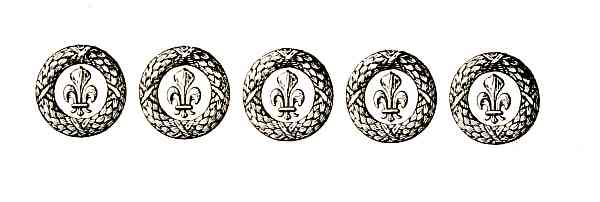
Le Trésor. — I re . PIÈCE DU TRÉSOR. — II e . PIÈCE. — III e . PIÈCE. — IV e . PIÈCE. — V e . PIÈCE. — VI e . PIÈCE. — VII e . PIÈCE. — VIII e . PIÈCE. — IX e . PIÈCE. — X e . PIÈCE. — XI e . PIÈCE. — XII e . et dernière PIÈCE.
Inventaire des Chartre, Statuts, Reliques et
Insignes composant le Trésor sacré de l'Ordre du Temple, extrait de
la minute du procès-verbal qui en a été dressé le 14e. jour
de la lune de Tab., l'an de l'Ordre 692, du Magister le
6e. (18 mai 1810.)
La chartre de transmission (par J. M. Larmenius),
écrite en deux colonnes et demie sur une très-grande feuille de
parchemin, ornée, suivant le goût du temps, de dessins
gothiques architecturaux, de lettres fleuronnées, coloriées, dorées
et argentées, dont la première offre un chevalier appuyé
sur un bouclier armorie de la croix de l'Ordre.
Au haut, en tête, est peinte la croix conventuelle dans la
forme aulique.
Au bas est le sceau de la milice, suspendu par des lacs de
parchemin.
Les acceptations par les Grands-Maîtres commencent vers
le milieu de la troisième colonne, se continuant à la troisième,
et finissant aux deux tiers inférieurs de la marge à droite.
L'archétype des Statuts de l'an de l'Ordre (587,) transcrits
à la main sur vingt-sept feuilles de papier, reliés en un
volume petit in-folio, couvert en velours cramoisi, doublé en
satin idem, doré sur tranche.—Cette pièce signée Philippus
(d'Orléans.)
Un petit reliquaire de cuivre, en forme d'église gothique,
contenant, dans un suaire de lin, quatre fragmens d'os brulés,
extraits du bûcher des martyrs de l'Ordre.
Une épée de fer (cruciforme) surmontée d'une boule, et
présumée avoir servi au G.-M. J. Molay.
Un casque de fer, à visière, armorié de dauphins et damastiqué
en or, présumé être celui de Guy, dauphin d'Auvergne.
Un ancien éperon de cuivre doré.
Une patène de bronze, dans l'interieur de laquelle est gravée
une main étendue, dont le petit doigt et l'annulaire sont
repliés dans la paume.
Une paix en bronze doré, représentant Saint-Jean sous
une arcade gothique.
Trois sceaux gothiques de bronze en forme ovale pointue,
et de grandeur différente, désignés dans les Statuts sous les
noms de sceau du G.-M. Jean, sceau du chevalier croisé,
et sceau de Saint-Jean.
Un haut de crosse d'ivoire et trois mitres d'étoffe, l'une en
or, brodée en soie, et deux en argent, brodées en perles, ayant
servi aux cérémonies de l'Ordre.
Le baucéant en laine blanche, à la croix de l'Ordre.
Le drapeau de guerre, en laine blanche, à quatre raies noires.
A la plus Grande Gloire de Dieu.
Guillaume-Sidney, — Article Premier. — Article II. — Article III. — Article IV.
Par la Grace de Dieu, et la désignation Testamentaire du dernier Grand-Maître.
Prince Magistral, Régent de l'Ordre du Temple;
A Tous Ceux qui ces Présentes, Verront:
Salut.
Vu, l'Article 38 des Statuts de l'Ordre du Temple, et le 3me paragraphe de la
Charte de transmission;
Vu, les Articles 13, 15, 16 et suivans desdits Status;
Considérant, que l'etat de haute civilisation des diverses Nations Européennes et
principalement de la France, ou se trouve le siège Magistral, permet toute Réunion
du Convent Général, sans qu'il puisse en resulter le moindre danger pour les
Chevaliers;
Considérant, que les tems sont venus de rendre au Convent général tous les droits dont
il a joui jusques au G. M. Jacques de Molay, (à qui scient honneur et gloire),
et de faire rentrer dans de sages et constitutionnelles limites la puissance du Magistère;
Considérant, qu'une reforme prudente et réfléchie des Statuts, dans les parties qui ne
sont plus en harmonie avec la Charte de transmission, les moeurs du siècle et la règle,
est le moyen le plus efficace de rendre possible l'accomplissement des hautes destinées
auxquelles l'Ordre du Temple est appellé;
Le conseil privé entendu;
Nous avons décrété et décrétons ce qui suit:
Le Convent Général de l'Ordre du Temple est Convoqué pour le dix Novembre, 1838.
Immédiatemement après sa réunion, le Convent général devra se prononcer
sur la présentation du Prince Magistral Régent, désigné par Bernard Raymond
(à qui soient honneur et gloire) pour lui succéder en qualité de Grand Maître
de l'Ordre du Temple.
En tête du Commentarium sera placé la revision du Chapitre IV et de
tous les Articles des Statuts qui ont des connexions avec ce Chapitre.
Il sera ouvert à la Sécretairerie Magistrale un Registre destiné à l'inscription
des propositions faites pour être présentées au Convent général, et qui seront insérées au
Commentarium, conformément aux Statuts.
Soit, le présent décret, expédié, enregistré et scellé par qui et a qui de
droit; adressé spécialement au Grand Connétable, au Gouverneur général et au Grand Maître des
Dépêches, qui sont chargés de son exécution;
Soit aussi, ledit Décret, envoyé par lettres communicatoires, 1o,
au Prieur de chaque Convent, pour être porté à la connaissance de tous les Chevaliers de son
obédience, 2o, et personnellement, aux Chevaliers qui ne feraient partie d'aucune
Maison de l'Ordre.
Donné à Paris, en notre résidence Magistrale,
le 1er du mois de Mai, de l'an de N. S. J. C. 1838,
720e. de l'Ordre.
Signé
 F.
F. Guillaume Sidney
De par S. A. le Prince Magistral, Régent de l'Ordre.
Le Grand Précepteur, Ministre Secrétaire Magistral,
Signé
F. Réné Léon De Sud-Europe.
Enregistré en la grande Sénéchaussée, le 3 Mai 1838.
Le Ministre Grand Sénéchal,
Signé,
F.
Eugène De France.
Scellé en la grande Chancellerie, le même jour,
Le Grand-Précepteur, Ministre Grand Chancelier,
Signé,
F.
Felix De Nord-Afrique.
Vu par le Grand-Connétable; Signé
F. Sébastien Louis De Bauvais.
Vu par le Gouverneur Général; Signé F.
Fréchot.
Vu par le Grand Maître des Dépêches, Signé
F. E. Loubert.
Pour copie conforme:
Le Grand Précepteur, Ministre Secrétaire Magistral.
F.
Réné Léon De Sud-Europe.
DISCOURS DE L'AMIRAL SIR SIDNEY SMITH, AU CONVENT GENERAL LE 27 JANVIER 1837. — "SIDNEY SMITH TO BUONAPARTE."
S. A. le Lieutenant-Général d'Asie demande la parole.
Ce vénérable frère s'exprime ainsi qu'il suit.
"Sérénisme Grand-Maître, et vous tous mes nobles frères:
"Justement et infiniment sensible à l'honneur qui m'a été conféré,
par suite de ma nomination, à la haute dignité de Lieutenant-Général d'Asie, je dois
vous en témoigner toute ma reconnaissance.
"A mon âge avancé, je puis prétendre à être considéré comme exempt
d'ambition: je vois par conséquent dans cet acte de la haute confiance du Grand-Maître,
une charge onéreuse et un lourd fardeau, plutôt qu'un avantage:
mais, je l'accepte avec respect. Mes soins et mes efforts constans seront
toujours employés pour prouver que je n'ai pas fait en vain le serment de
fidélité et de soumission à l'ordre et à son chef suprême.
"Je vois dans cette nomination une preuve de la vraie libéralité du
Grand-Maître éclairé de cet ordre, essentiellement cosmopolite, où toutes les nations
chrétiennes se confondent et co-opèrent ensemble pour le maintien de la paix
du monde et de l'harmonie entre les sectes religieuses, par la tolérance, la
charité et la protection pour les pélerins en Terre Sainte, contre les pirates et
brigands; premier but de sa fondation, qui précéda les autres ordres de la
chevalerie moderne, ordres qui n'ont été et ne sont que ses imitateurs:
car le notre ne demande que l'occasion de remplir son devoir sacré. Aussi est-ce
avec une vive satisfaction que je vois enfin un Grand-Maître apprécier l'importance
de l'ordre, et pour la premiére fois, appeler pour un de ses lieutenans, je
ne dis pas un anglais, mais un templier de la langue d'Angleterre. Honneur
au Grand-Maître qui a fait un tel acte, et qui montre ainsi à toutes les nations,
que toutes ont des droits égaux à remplir les diverses charges du Temple:
Honneur à ce chef qui a si longtemps et si loyalement conservé le feu sacré,
et les traditions, malgré les orages et les persécutions, suite d'une révolution
dont l'origine remonte pour nous, a Philippe-le-Bel et au Pape Clement V.
Mais espérons qu'enfin nous rentrerons dans tous nos droits; et qu'au lieu de
dresser la tente magistrale dans une langue excentrique, un jour nous la dresserons
au lieu de notre crèation, dans la ville qui nous appartient, dans la
sainte Jérusalem!
"Honneur aux très nobles chevaliers qui se sont montrés penétrés
du sentiment de leurs devoirs, et ont donné constamment des preuves qu'ils sont
incapables d'oublier leur serment de fidélité et d'obéissance!......
"J'ai déjà communiqué verbalement à S. A. E., devant témoins, ce
que j'ai consigné dans mon testament, la disposition formelle, pour la restitution
au chef du Temple, d'une croix de l'ordre qui est très ancienne, à en juger par
sa forme et la monture des pierres, laquelle croix a appartenu à un de ses Grand-Maîtres,
et fut du temps des croisades portée dans la guerre sainte par le roi
d'Angleterre Richard Ier, dit Cœur-de-Lion. Ce roi l'a laissée
en dépôt entre les mains de l'archevêque de Chypre lors de son départ de cette ile, dont
il était Souverain par conquête. J'ai été personnellement décoré de cette
croix en 1799, par les mains du dixhuitième archevêque, successeur du dépositaire,
qui l'a plaçé sur ma poitrine, en reconnaissance de la réussite de mes
efforts, pour rétablir la paix et la protection due à la population chrétienne de
l'île, contre l'insurrection des troupes Asiatiques qui avaient assassiné leur
chef, appelé le Patrona Bey, et commençaient déjà à se livrer au pillage et au
massacre des habitans: désastres que j'ai empêchés par ma présence au milieu
de ces furieux, sans armes, le firman du Sultan Selim en main, et par la nomination
d'un successeur a Patrona Bey, en vertu de l'autorité supréme qui
m'avait été déléguée dans le temps par la Porte Ottomane, sur les forces
combinées de terre et de mer dans le Levant.
"L'autorité qui maintenant m'est déléguée par le sérénissime grand-maitre
sur le continent d'Asie, pourra en temps et lieu être employée utilement pour
protéger la population chrétienne de ces contrées, et le maintien de la hiérarchie
de l'ordre. Croyez, que pour la plus grande gloire du Temple, je me
ferai un devoir d'employer l'influence que les antécédens m'ont donnée. Les
templiers fidèles peuvent compter sur moi."
Le grand-maitre exprime au lieutenant-général d'Asie, les sentimens
dont lui et ses frères sont animés pour un Chevalier qui a conquis l'admiration du monde
par ses hauts faits maritimes, et a mérité par ses vertus sociales et templières,
l'estime et l'affection de tous ses frères. Le grand-maitre lui donne au nom de
l'ordre l'accolade fraternelle.
Le Convent Général ordonne que le discours de l'Amiral
Sir Sidney Smith soit inséré textuellement au procès-verbal.
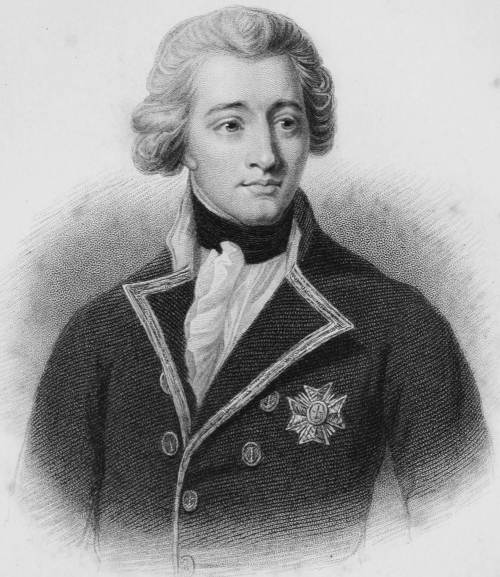
The following account from the pen of the learned
Biographer of the gallant Admiral, of the Investiture of Sir Sidney
Smith, as a Knight Commander of the Bath, by his
contemporary and brother in arms, the great and illustrious
Wellington, and the "very extraordinary" document
which follows, will, no doubt, be read with much interest:
Towards the termination of this year, 1815, our officer
was honoured, in a most particular manner, by his Sovereign.
His Grace the Duke of Wellington having received
the gracious commands of his Royal Highness the Prince Regent
of the United Kingdoms, through his Royal Highness the Duke
of York, Grand-master of the most honourable order of the
Bath, to invest Vice-Admiral Sir William Sidney Smith,
Knight-commander-grand-cross of the Royal Military Order of
the Sword, with the insignia of commander of the aforesaid, his
Grace fixed on the 29th of December for the performance of
the ceremony, which took place accordingly at the Palace
Elisée-Bourbon, the Knights-grand-crosses, Knights-commanders,
and Companions being present, as also his Grace the
Duke of Richmond and the Right Honourable the Earl of
Hardwick, both Knights of the most noble Order of the Garter.
At six o'clock the Commander elect arrived at the
palace, and being conducted and supported into the presence of the
noble Duke representing the Sovereign on the occasion, by the
two junior grand-crosses, Sir James Kempt and Sir Henry
Colville, after the usual reverences in advancing, (the Commander
elect being already a Knight, the usual ceremony of
dubbing him as such was formally dispensed with,) his Grace
proceeded, according to the order of his Royal Highness the
Grand-Master, which he first read, and invested the Commander
with the insignia of the Order: after which his Grace embraced
Sir Sidney Smith twice most cordially, with every
demonstration of the feelings of esteem and regard, feelings
which the Knights, Grand-crosses, and Commanders, many of
whom had served in Egypt as his juniors in rank, also testified;
and it certainly may be said to be a proud day for England
when such a scene took place in the evacuated palace of
Buonaparte, between these two British officers of the two
services, one of whom first checked, and the other of whom
finally closed, the career of that ambitious chieftain.
The banquet being announced, his Grace desired
his Excellency the British ambassador, Sir Charles Stuart, G.C.B.,
to conduct the new Knight Commander to the hall of the same,
where the members of the Order, including some foreigners
of distinction, amongst whom were Don Michael Alava,
General Muffling, and Count Demetrius Valsamachi, a nobleman
of the Ionian Islands, were entertained most sumptuously
in the usual style of the Duke's elegant hospitality.
After the health of the King and Prince Regent
had been drunk, the Duke gave the health of "Sir Sidney Smith:"
the company hereupon rose, and followed his Grace's example
in greeting the new Commander with the most cordial acclamations.
When silence was restored, Sir Sidney Smith
rose, and addressed the company nearly as follows:—
"My Lords, noble Knights, Grand Crosses, Commanders,
and Companions!—I should not do justice to my feelings,
were I not to endeavour to express them in returning you
my thanks for the honour you have done me by this reception:
at the same time, I feel I cannot do justice to them by
any mode of expression I can make use of.
"The language of compliment must die on the
lips of any man in the presence of the Duke of Wellington; first, from
the inadequacy of all language to express what every man
must feel when speaking of such a highly distinguished chief;
next, from the recollection of the noble simplicity of his character
which disdains it. It will, I trust, be readily believed,
that I must be most truly gratified to be invested by a knight
of such high renown and glorious achievements; and the
more so in this particular place, and in an assembly of so
many illustrious and highly distinguished Knights-Commanders
and Companions. A combination of circumstances, which
could only happen in the present times, and are mainly owing
to the successful result of the battle of Waterloo. Noble
and illustrious Knights, I beg you to accept the expression of
my humble thanks for the honour you have done me."
The Duke of Wellington having acceded to Sir Sidney
Smith's request to be allowed to propose a toast to the company,
he proceeded to say—"I beg leave to call to remembrance
that this day (the 29th of December) is the anniversary
of a re-union of illustrious knights of various orders,
which took place at Vienna, where many Sovereigns were
present, and when the toast I shall have the honour to propose
to you was drunk by them with a manifestation of their
conviction, that the object of it intimately concerned knighthood
as such, in all nations. I beg leave to propose the
health and deliverance of the white Slaves in the Barbary
States."
The toast was received with the most marked approbation,
and drunk with the usual demonstrations thereof, by three
times three regular and hearty cheers, when the company
adjourned to the ball-room, preceded, on the indication of
the Duke of Wellington, by the new Knight-Commander,
supported by his Britannic Majesty's ambassador, in the
same order as on entrance, where a brilliant assembly of
ladies, English, French, Spanish, Russian, &c. &c. continued
to increase till a late hour; his Royal Highness the Duke
of Berry, the French, and the foreign ministers, were also
present, and all joined in cordial congratulations of, and
compliments to, the cosmopolite chieftain, President of the
Knights Liberators of the white slaves in Africa; who, we
observed, was decorated with the various orders of the nations
he has contributed by his endeavours to release from the
yoke of the former inhabitants of the palace where this
extraordinary assembly was held; then a prisoner on the top
of a rock in the Southern Atlantic. These circumstances reminded
the Parisians of the prophetic inscriptions left by
Sidney Smith on the window shutter of the Temple prison,
when he escaped, of which many copies were taken and are
now again in circulation, and read with great interest since
the accomplishment has taken place: we have been favoured
with a translation, of which we give our readers a copy, the
original having been in French, and respected by various
successive guardians of the tower, till the Prince de Rohan,
afterwards Duke de Rohan, subsequently a prisoner in that
tower, removed it for its preservation, and we are assured he
now possesses it.
"Fortune's wheel makes strange revolutions, it
must be confessed; but for the term revolution to be applicable,
the term should be a complete one, for a half turn is not a
revolution; (see the Dictionary of the Academy;) you are at
present as high as you can mount. Well! I don't envy you
your fortunate situation, for I am better off than you; I am
as low in the career of ambition as a man can descend; so
that let fortune turn her wheel ever so little, and as she is
capricious, turn it she will, I must necessarily mount, and
you as necessarily must descend. I do not make this remark
to you to cause you any chagrin; on the contrary, with the
intent to bring you the same consolation I have at present
when you shall arrive at the same point where I am; yes!
the same point; you will inhabit this prison, why not as
well as I? I did not think of such a thing any more than
you do at present, before I found myself brought hither.
In party wars 'tis a crime in the eyes of opponents for a man
to do his duty well; you do yours now, and consequently
you by so much irritate your enemies; you will answer me.
"'I fear not their combined hatred, the voice
of the people is declared for me, I serve them well:' that is
all very good talking; sleep in quiet, you'll very soon learn
what one gains by serving such a master, whose inconstancy
will perhaps punish you for all the good you do him.
'Whoever,' (says an ancient author, Pausanias Atticus,)
'puts his entire confidence in public favour, never passes his
life without pain and trouble, and seldom comes to a good end.'
"Finis coronat opus."
"In fact, I need not prove to you that you will
come here and read these lines, because here you must be to read
them. You will certainly have this chamber, because it is the best,
and the keeper, who is a very civil good sort of man, will, of
course, treat you as well as he does me."
N. B.—These lines having appeared in the
Parisian papers in 1799, and having been put into Buonaparte's hands at
Cairo, on his return from his unsuccessful Syrian expedition,
where he was foiled and worsted by the writer of them, he
exclaimed, 'It is very extraordinary;' and on his return to
Paris, fearing the accomplishment of the remainder of the
prediction, after having procured through Regnauld de St.
Jean d'Angely the sight of a copy in the hands of Baruel
Beauvert, he forthwith ordered the building to be levelled
to the ground.
After this display of his country's gratitude to
Sir Sidney Smith, which became so much the more enhanced, as it may
be said to have taken place almost in the presence of so many
Sovereigns, Sir Sidney had little else to do but to enjoy his
richly-merited rewards, the universal admiration, and the
approbation of his own mind, ever active in doing good, not
only for his country, but for the whole human race.
He prosecuted with ardour his plans for the abolition
of white slavery, even after the destruction of the pirates' nest in Algiers.
DISCOURS
PRONONCE
AUX FUNERAILLES DE
L'AMIRAL SIR SIDNEY SMITH,
PAR M. JULLIEN, DE PARIS,
Son ancien ami et son Collègue, comme membre et
président honoraire de plusieurs Sociétés Savantes ou Philantropiques, le 29 Mai 1840.
Messieurs,
L'homme respectable auquel nous venons adresser un dernier adieu,
ne fut pas seulement un marin et un guerrier célèbre; il fut surtout un ami constant,
dévoué et chevaleresque de l'humanité. Dans sa longue et aventureuse carrière
qu'il a parcourue avec tant d'éclat, il s'est moins distingué encore par sa brillante
valeur que par une loyauté et une générosité qui lui ont conquis les coeurs,
même de ses ennemis. Né a Londres le 21 Juin 1764, entré au Service en
1777, avant l'âge de 13 ans, comme simple novice (élève de marine,) a bord
d'une frégate stationnée sur les côtes de l'Amérique, pendant la guerre de
l'indépendance, il passa, en 1779, sur le Sandwich, vaisseau de 90 canons, sur
lequel l'Amiral Sir George Bridges Rodney arbora son pavillon
de Commandement-en-Chef, et fit voile, le jour de noël de cette même année, pour
Gibraltar, et ensuite pour les Indes Occidentales, Sidney Smith
fut successivement Lieutenant de vaisseau et Capitaine de corvette. Il prit part à tous
les combats qui eurent lieu dans cet hémisphère jusqu'à la paix de 1783.
En 1788, Sidney Smith passa en Suède, alors en guerre avec la Russie,
ostensiblement comme volontaire auxiliaire, mais en réalité comme Aide-de-Camp
honoraire et intime du roi Gustave III. Après avoir rendu, en cette
qualité, les plus brillant et les plus utiles services à la Suède, il reçut des mains
mêmes de ce monarque chevaleresque, la décoration de première classe de
l'ordre de l'epée. A cette époque, ces distinctions honorifiques n'étaient point
prodiguées et prostituées, comme elles l'ont été depuis, et elles avaient un véritable
prix, n'étant accordées qu'au mérite et aux services réels.
En 1793, le jeune Smith se rendit comme volontaire en Turquie, où il
conduisit avec lui plusieurs constructeurs de vaisseaux. Peu après, il était chargé
d'un commandement dans la Croisière Anglaise sur les côtes de France. Le 18
Avril 1796, ayant abordé un vaisseau Français à la hauteur du Ilaîre, obligé
par le courant de remonter la Seine, il fut fait prisonnier par des forces supérieures
qui l'attaquérent; puis amené à Paris, ou il resta deux ans dans le
prisons de l'Abbaye et du Temple. Echappé de sa prison par l'intervention
d'amis dévoués, il rejoignit la flotte Anglaise en 1798. La même année, appellé
à commander les forces auxiliaires que La Grande-Bretagne mettaìt à la disposition
de la Turquie, où son frère Sir Spencer Smith, était Ministre
Plénipotentiaire, auprès de là Porte Ottomane, il se trouve le 1 Mars 1799, jusqu'au
20 Mai suivant, au siège mémorable de Saint Jean d'Acre, et co-opère puissamment
à la défense de cette place.
Nous ne devons, en présence d'un cercueil, rappeler que des souvenirs
compatibles avec notre unanime sympathie pour notre illustre ami, Bornons-nous
à dire que Sidney Smith se montra grand et magnanime envers les Français faits
prisonniers; il sut les garantir, par son énergique volonté, des violences et de
la barbarie Turques; il mérita leur estime et leur affection; et la loyautè Française
aime à reconnâitre que sa conduite, lors même qu'il était l'allié de nos
ennemis, fut noble et généreuse envers ceux que le sort des armes mettait en sa
puissance. Les généraux Kleber et Desaix, qui entrèrent en négociation avec
lui après le départ de Bonaparte, ont apprécié sa droiture et son humanité, et
lui ont rendu justice.
Sidney Smith, après avoir sauvé la vie de nos compatriotes, rendit intactes
aux savans de l'expédition les caisses contenant les papiers et les cartes qui devaient
servir à écrire l'histoire de la campagne d'Egypte. Aussi, à la paix le
gouvernement Français, sur la proposition de la commission de l'institut Egyptien
lui a offert un exemplaire de ce magnifique ouvrage, comme un témoignage
de la reconnaissance publique.
Après les événemens d'Egypte es de Syrée, où Sidney Smith avait
contribué à ménager à l'armée Française des conditions honorables pour revenir
dans sa patrie, il quitta lui-même les parages de l'Orient, et se rendit en Angleterre
où il fut élu membre de la Chambre des Communes, par la ville de Rochester, en 1802.
Nous le voyons reparaître, en 1803, avec un commandement sur les côtes
de la France et de la Hollande. En 1807, il commande la flotte chargée de défendre
la Sicile. En 1806, il est envoyé à Constantinople où il force les Dardanelles, au
mois d'Octobre 1807, il commande les forces Anglaises mises à la disposition
du Portugal; et le 29 Novembre suivant, une partée de sa flotte accompagne au
Bresil la famille royale, qui va chercher au-delà des mers un asyle dans ses
possessions Americaines.
Dans ses relations avec les Rois et avec les princes souverains, comme
avec les peuples et dans tous les pays où le conduisit sa destinée aventureuse, Sidney
Smith contracta d'honorables et d'illustres amitiés. Ce fut principalement en
1814, au Congrès de Vienne, qu'il fixa l'attention de tous les grands personnages
réunie alors pour poster les vases de la Paix Européenne, et qu'il reçut de tous
sans exception les hommages, d'une estime respectueuse. Il conçut alors la
pensée philantroprique de fonder, avec le concours des Monarques alliés, et de
tous les hommes de bien qui partageaient ses vues, une institution anti-pirate, en
association des chevaliers libérateurs des esclaves blancs et noirs en Afrique. Car,
il avait souvent déploré, dans ses commandement sur les différens points de la
Mediterranée, les actes cruels de la piraterie barbaresque, trop longtems tolérée
par les puissances Chrétiennes, et il s'était promis d'y mettre un terme. Plus
de cent noms illustres remplirent les listes de souscription qu'il avait ouvertes.
Il entretint, pendant plusieurs années, une vaste et active correspondance, au
moyen de laquelle il contribua puissamment à faire cesser les malheurs d'un
grand nombre de victimes, des actes de piraterie qui jusqu'alors s'étaient commis
impunément et presque librement sous les yeux de l'Europe civilisée.
Pendant les 25 années de paix générale qui ont précédé sa mort,
le grand homme de guerre que nous pleurons aujourd'hui se montra constamment homme
pacifique et bienfaisant, véritable cosmopolite, ami sincère de l'humanité, en
prenent ce mot dans sa plus complète acception.
Par une singularité nouvelle de sa destinée, Sidney-Smith meurt en France,
où il reçoit les regrets et les hommages de ses compatriotes, et de ses concitoyens
d'adoption, au moment même où l'Angleterre, sa patrie, restitue à la France
les cendres de Napoléon. La nation Anglaise paie un tribute d'admiration à ce
même Empereur qu'elle n'a cessé de combattre pendant sa vie. La terre Française
reçoit les dépouilles mortelles de l'Amiral Britannique qui employa longtems
contre elle ses talens et son courage, qui depuis a consacré 25 années à servir, au
milieu des Français et avec leur co-opération, la cause sacrée de l'humanité et
celle du malheur.
Au nombre des titre de gloire de l'Amiral, nous ne devons pas omettre
la louable persévérance avec laquelle il s'est occupé de perfectionner les moyens de
sauvetage et sa grande part à la fondation de la socièté générale des naufrages,
qui a donné un plus grand dèveloppement à ses vues bienfaisantes. Ainsi les
passions humaines s'éteignent en présence d'un tombeau. Ainsi les nations abjurent
de cruelles et injustes antipathies qui les ont trop longtemps divisées.
Ainsi tous les hommes de bien, quelle que soit leur terre natale, se réunissent
pour honorer l'homme qui, par ses vertus et ses actions, a servi avec dévouement
les grands intérêts de la famille humaine.
DISCOURS
PRONONCÉ
SUR LA TOMBE DE
SIR WILLIAM SIDNEY SMITH,
AMIRAL DE LA FLOTTE ROUGE D'ANGLETERRE,
Lors de ses obsèques, dans le cimetière de l'Est, à Paris, le 29 Mai 1840,
PAR M. CAILLE,
Avocat à la Cour Royale de Paris.
Messieurs,
Invité depuis quelques instans seulement, par la famille de l'Amiral William
Sidney Smith, á exprimer de justes regrets sur sa tombe, je ne puis apporter qu'un
bien faible tribut d'admiration à sa mémoire, surtout après l'éloge que vient
de prononcer au nom de l'Ordre du Temple, dont cet illustre Anglais était le
régent, l'un des dignitaires de cet ordre, et lorsqu'une notice historique de sa
vie vous a été présentée par l'un des litterateurs les plus distingués de la France.
L'histoire transmettra à la postérité les exploits du célèbre marin,
de l'habile négociateur, du généreux philanthrope, dont nous déplorons la perte. C'est
exclusivement sous le rapport moral et philosophique que j'essaierai de vous retracer
quelques épisodes de sa carrière entièrement consacrée au bonheur de ses
semblables, et l'influence politique qu'il exerça sur les états, avec lesquels il fut
mis en rapport par son gouvernement.
Sidney-Smith, comme vous le savez, comptait déjà dix-huit années de
services militaires distingués, lorsque, à l'âge de trente-quatre ans, il fut chargé
par le ministère Anglais, en qualité de commodore, de la station maritime de
l'Archipel du Levant, en 1798; c'est-à-dire à l'époque de la conquête de
l'Egypte, par l'armée de la république Française, sous les ordres du général
Bonaparte.
Je ne vous peindrai pas sa lutte héroïque avec le géant du siècle,
à Saint-Jean-d'Acre, dont il fit lever le siège après soixante jours de tranchée: je me
hâte de vous signaler un service qui devait être incalculable dans ses conséquences
politiques, et que Sidney-Smith rendit à la sublime Porte, dont il
releva le courage par ses succès: il sut profiter du crédit obtenu par sa victoire
de Saint-Jean-d'Acre, auprès du sultan Selim III, et de Kléber, général de
l'armée Française en Egypte, depuis le retour de Bonaparte en France, pour
négocier le fameux traité d'El-Arich, du 24 janvier 1801, traité qu'il considérait
comme le préliminaire de la paix entre les puissances belligérantes. Il y
stipula que l'armée française évacuerait l'Egypte, avec armes et bagages, et
serait transportée en France.
Sidney-Smith signa ce traité avec les pleins pouvoirs du ministère
Britannique, dont il était revêtu: le grand-visir et le général Kléber le signèrent,
au nom de leurs gouvernemens respectifs.
Je ne puis trop insister, messieurs, sur cette époque où Sidney-Smith arbora
l'olive de la paix entre trois camps ennemis; il avait prévu les nouvelles destinnées
de la France, et sa haute sagesse avait préféré de traiter avec elle, dans
l'intérêt de la Sublime Porte, et de gouvernement Britannique lui-même, et
surtout dans l'intérêt de l'humanité, plutôt que de courir la chance faillible des
combats.
Mais le ministère Anglais, qui ne lui avait donné qu'à regret des
pouvoirs et des instructions pacifiques, informé que l'armée du grand visir était forte
de 80,000 hommes, tandis que celle de Kléber ne l'était que de 8000, crut l'occasion
favorable d'anéantir la puissance Française en Egypte, il refusa de ratifier le
traité d'El-Arich, et osa donner l'ordre à l'amiral Keith d'exiger que l'armée
Française mît bas les armes et se rendît prisonnière de guerre. Sidney-Smith
fut profondément affligé de cette violation des lois de la guerre et du droit des
gens.
Dés-lors les hostilités recommencèrent. L'armée Française combattit
avec ce sentiment de l'indignation qui décuple le courage: elle défit entièrement l'armée
ottomane á Héliopolis. Le grand-visir, qui la commandait, ne dut son salut
qu'à la fuite, en laissant aux vainqueurs ses bagages, et un immense butin.
Ce ne fut q'une année après cette victoire que l'Egypte fut rendue
aux Turcs, par le traité d'Amiens, de 1802; tandis qu'ils l'auraient recouvrée, sans de
nouvelles pertes, dès 1801, si le traité de Sidney-Smith eût été ratifié, comme
il aurait dû l'être, puisqu'il n'avait fait que se conformer strictement aux
instructions de son gouvernement.
Vous connaissez, messieurs, la brillante réception qui fut faite à
Londres, à Sidney-Smith, lors de son retour dans sa patrie, en 1802; il y fut accueilli
avec le plus grand enthusiasme; le surnom de Dieu marin lui fut décerné par
le peuple. La ville de Rochester s'empressa de l'élire pour son représentant au
Parlement, où il siéga dans les rangs de l'opposition, entre Shéridan et Fox.
J'appellerai votre attention sur un autre genre de services rendus à
la nation Ottomane, par Sidney-Smith. Pendant son séjour à Constantinople, il avait
acquis une grande influence sur Mahmoud-Kan II, qui, en 1808, succéda au sultan
Mustapha IV, son frère. Sidney-Smith, par ses conseils, a puissamment contribué
aux importantes révolutions politiques que Mahmoud-Kan II a introduites
dans ses états, et notamment à la charte constitutionnelle que sous le titre de
Hatti-Shériff de Gulaneh, cet immortel sultan a donnée au peuple Ottoman,
charte dont le vice-roi d'Egypte, Méhémet-Ali, vient d'ordonner l'application,
pour la révision de l'horrible procès intenté, dans la ville de Damas, par le fanatisme
de secte, contre d'honorables Juifs, faussement accusés du meurtre d'un
prêtre catholique.
Il est un plus grand service encore rendu a l'humanité, et auquel
Sidney-Smith a eu la gloire de participer très-activement, c'est l'abolition de l'esclavage,
dans toutes les colonies de la Grande-Bretagne. Grâce a l'ascendant irrésistible
de l'opinion publique, les gouvernemens de l'Europe seront forcés d'imiter ce
sublime exemple, et de proscrire irrévocablement cet abominable trafic d'hommes,
arrachés a leur patrie, pour être vendus, comme un vil bétail.
Je ne dois pas oublier que, dès l'année 1817, Sidney-Smith infatigable
dans son dévouement a l'humanité, avait établi, a Londres et a Paris, une association
anti-pirate, dont l'objet était de faire cesser la traite des blancs, exercée impunément,
en présence de l'Europe civilisée, par les corsaires d'Alger, de Maroc et de Tunis.
Dans les dernières années d'une vie illustrée par tant d'actes mémorables,
Sidney-Smith s'occupa de la recherche des moyens de sauvetage, pour les navires
exposés aux tempêtes de la mer. Il a eu l'honneur d'être dans cette découverte
l'un des inventeurs qui out le plus approché de la solution du problème
de la garantie contre les naufrages.
Telle a été, messieurs, la carrière de Sidney-Smith, promu successivement à
tous les grades de la marine, et jusqu' à celui d'Amiral de la Flotte Rouge d'Angleterre,
que lui conféra le roi Guillaume IV; il a été de plus décoré de tous les ordres des souverains
de l'Europe, en reconnaissance des nombreux services qu'il leur a rendus.
A la vue du triste cercueil, qui contient les restes de Sidney-Smith,
nous bornerons-nous au stérile récit de ses nobles actions? Non, messieurs. Le vénérable
évêque de l'église Anglicane, qui préside avec tant de dignité, à ces funérailles,
vient d'invoquer, dans sa prière, le texte de l'Evangile, sur l'immortalité de
l'âme, qu'il me soit permis d'ajouter à cette révélation du Christianisme, que les
progrès de la science out démontré cette vérité, sans lui faire rien perdre du
charme de l'espérance.
En effet, dans ce cercueil, que la tombe n'a point encore dérobé à nos
regards, que reste-t-il? Des débris d'organes inanimés. Mais ces nerfs, cette membrane
qui les enveloppa, cette pulpe cérébrale qui les pénétra, qu'étaient-ils? de la
matière! Ah! de ces organes matériels, à la Sensation, il y a un abîme! Et de la
Sensation à la Pensée, un nouvel abîme! Elle est donc immatérielle, cette Pensée,
qui distingue si éminemment notre espèce, des autres êtres organisés!
N'est-ce pas la Pensée qui créa les arts et les sciences, qui, s'élevant
jusqu'à la cause première, terme de ses conquêtes, y découvrit la Divinité, dont elle
établit le culte universel, comme le plus puissant mobile de la civilisation?
Combien n'est-il pas consolant, au milieu des parens et des nombreux
amis qui entourent cette tombe, d'y professer, d'y confirmer le dogme de l'immortalité
de l'âme, et de pouvoir y proclamer que Sidney-Smith n'est pas mort tout entier?
Oui, messieurs, le principe intellectuel qui nous anime, est incontestablement
un être, et cet être est immortel. Pourrait-il donc s'anéantir, quand les organes
matériels de nos corps sont eux-mêmes éternels dans leurs élémens?
L'orateur qui vient de retracer avec tant de talent, la carrière de
l'illustre Amiral, vous a signalé la restitution des cendres de l'empereur Napoleon a la
France, par le gouvernement Britannique, comme un gage de la parfaite harmonie,
heureusement rétablie entre les deux nations. Je partage ce favourable
augure, et tel fut le vœu le plus intime de Sidney-Smith, qui ne cessa de
répéter que la civilisation du monde tenait essentiellement à l'alliance de la
France et de l'Angleterre.
A l'aspect des restes de Napoléon, traversant l'Océan pour recouvrer
un tombeau dans sa patrie, j'aime à prévoir que les restes de Sidney-Smith seront
pareillement réclamés par son gouvernement, et qu'à leur tour, ils traverseront
la mer, pour être déposés à Westminster, dans le lieu consacré à la sépulture
des rois et des reines, ainsi qu'à celle des grands hommes de l'Angleterre.
SKETCH
OF THE
HISTORY AND POSSESSIONS OF THE ORDER
IN IRELAND.
The Order of Knights Templars was introduced
into Ireland about the year 1174, by Richard, surnamed Strongbow,
Earl of Pembroke, or Strigul. A Priory was founded by him in that
year, under the invocation of St. John the Baptist, at Kilmainham,
in the County of Dublin, for Knights Templars, (see Archdall's
Monasticon Hibernicum, pages 222 et seq.) and King Henry
II. granted his confirmation. Hugh de Cloghall was the first
Prior, and enjoyed that office till about the year 1190. The
noble founder had enfeoffed the Prior in the whole lands of Kilmainham;
and dying in 1176, was interred in Christ Church.
The two Orders of Knights Templars and Hospitallers were confirmed
the same year. After this, Hugh Tirrel bestowed upon
the Prior of this hospital the lands of Chapel-Izod and Kilmehanock,
"free from all secular services and burthens, with all liberties
and free customs, in wood and open country, in meadows
and pastures, in roads and paths," &c. &c.
Kilmainham continued to be the Grand Priory or Preceptory
of the Templars, till their suppression in 1312; and the Superior
of the Order, according to Sir James Ware, sat in the House of
Peers as a Baron, a privilege enjoyed, as regarded the military
orders, only by the Grand Priors of Kilmainham for the Templars,
and of Wexford for the Hospitallers. He is styled by Archdall,
quoting different ancient records, sometimes Prior, and sometimes
Master, as in the case of Maurice de Prendergast, 1205 and 1210;
sometimes Preceptor, as "D. Walens, Preceptor of the Templars,
1247;" sometimes Grand Master, as "1266, Robert was Grand
Master of the Templars in Ireland this year." In 1288, we find
"William Fitz-Roger was Prior this year, and Thomas de Thoulouse
Master of the Templars;" in 1296, "Walter le Bachelour
was Master, and William de Rosse was Prior, who the same
year was made Lord Deputy of Ireland." He continued in these
offices till 1302, when he was made Chief Justice; and appears
in this year also to have preferred his complaint against the sheriff
of Dublin for an illegal seizure, as "the Master of the Templars."
And in 1309, Gerald, son of Maurice, Lord of Kerry, is spoken
of as "the last Grand Prior of the Order."
The subordinate governors of the Order appear to
have been styled indiscriminately Preceptors or Commanders; and
their castles or estates Preceptories or Commanderies. These
were (according to Ware and Archdall) at Clontarf, in the
county of Dublin, founded in Henry II.'s reign, as it is supposed
by the Nettervilles; St. Sepulchre, in the city of Dublin
or its suburbs, near the place where the Archbishop's
palace stands; Kilsaran, in the county of Louth, founded in
the 12th century by Maud de Lacie; Kilbarry and Killure, the
one about a mile and a half from Waterford, and the other two
miles east of that city, in the county of the same name, both
founded in the 12th century, the founders unknown; Crooke, in
the harbour of Waterford, four miles east of the city, founded in
the 13th century, by the Baron of Curragmore; Clonaul, in
Tipperary, as also one at Thurles, in the same county, where a
castle now standing was, according to the tradition of the country,
for no record exists, the castle of the Knights Templars; Teach-Temple,
or Temple House, in the county of Sligo, founded in
the time of Henry III.; Mourne, in the county of Cork, founded
in the reign of King John, by Alexander de Sancta Helena;
Killergy, or Killarge, in the county of Carlow, "founded in the
reign of King John, by Gilbert de Borard, for Knights Templars,
under the invocation of St. John the Baptist; Kilclogan, in the
county of Wexford, founded in the 13th century by the family
of O'More, which appears to have had a large estate attached to it,
from the report made in the thirty-second year of King Henry
VIII., quoted by Archdall, page 748; and Dundrum, in the
county of Down, where is a strong castle, now in ruins, said to
have been built by Sir John de Courcy."
All these Commanderies and Preceptories were,
together with the Grand Priory of Kilmainham, granted on the abolition
of the Order, to the Knights of St. John of Jerusalem, in whose
possession they continued till the dissolution of monasteries in
the reign of King Henry VIII.
It may not be uninteresting to add the account of
Archdall regarding the circumstances which attended the persecution
and attempted destruction of the Order in Ireland.
"In 1307, Walter de Ewias, or de Aqua, being Prior,
the King (Edward II.) transmitted to John Wogan, Justiciary of
Ireland, the order made for the suppression of the Knights
Templars in England, on the Wednesday after the feast of the
Epiphany, enjoining him to have it executed in Ireland without
delay, and before the rumour of what was done in England could
reach this kingdom. The mandate was accordingly obeyed, and
on the morrow of the Purification the Templars were everywhere
seized."
"1309. The King, by writ, dated September the 29th,
did further command the said Justiciary to apprehend, without
delay, all the Templars that had not yet been seized, and them
safely to keep in the Castle of Dublin, together with those who
had been before apprehended."
"1311. On the petition of Henry Danet, or De Tanet,
the late Master of the Templars, and the other members of that
Order, the King, by writ, dated December 4th, did grant for
their support the manors of Kilclogan, Crooke, and Kilbarry."
"1312. This year, on the morrow of St. Lucia the Virgin,
the moon appeared variously coloured, on which day it was finally
determined that the Order of Knights Templars should be totally abolished."
"The trial of the Templars was conducted with great
solemnity in the city of Dublin, before Friar Richard Balybyn, minister
of the Order of the Dominicans in Ireland, Friar Philip de
Slane, lecturer of the same, and Friar Hugh St. Leger. Amongst
other witnesses against the Knights, were Roger de Heton,
Guardian of the Franciscan Friars; Walter de Prendergast, their
lecturer; Thomas, the Abbot; Simon, the Prior of the Abbey
of St. Thomas-the-Martyr, and Roger, Prior of the Augustinian
Friary in Dublin. The depositions against the Templars were
weakly supported, yet they were condemned; but more indeed
through blind compliance with the prevailing practice throughout
other parts of Europe, than any demerits being proved against
their persons. Their lands and possessions of every kind were
bestowed upon the Knights of St. John of Jerusalem by the
Pope, which grant was confirmed by the King, who at the same
time entered a protest of his rights against the assumed power of
the Pope."